Skip to content
Wednesday

19 November 2014

Four Easy Steps to Shivoham

Dated photos
33
Source pages
1
Media
2
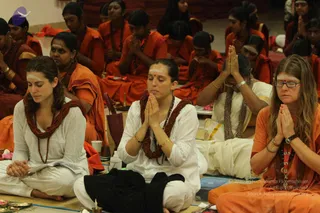
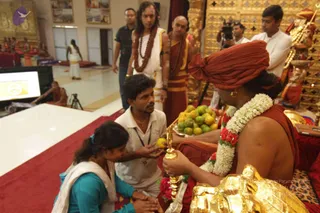
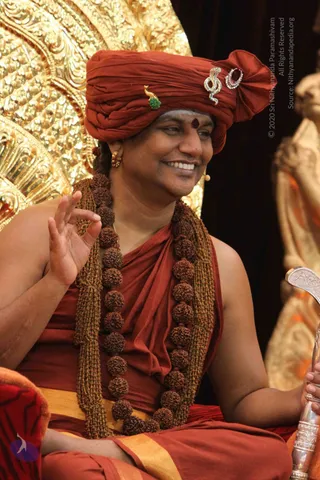
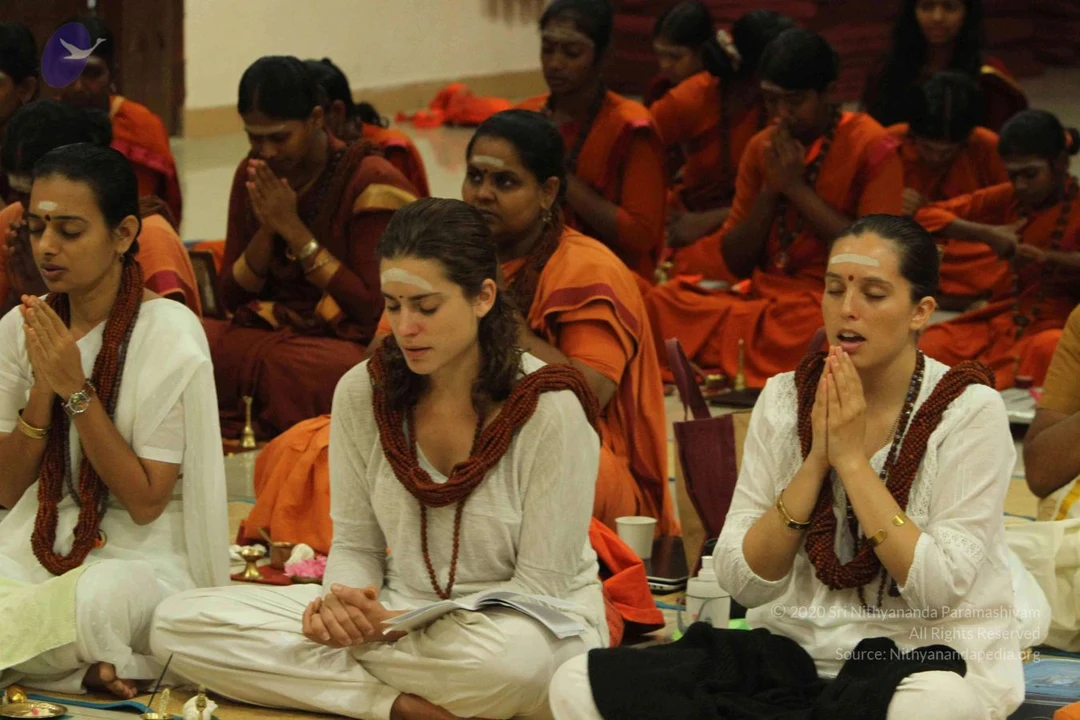
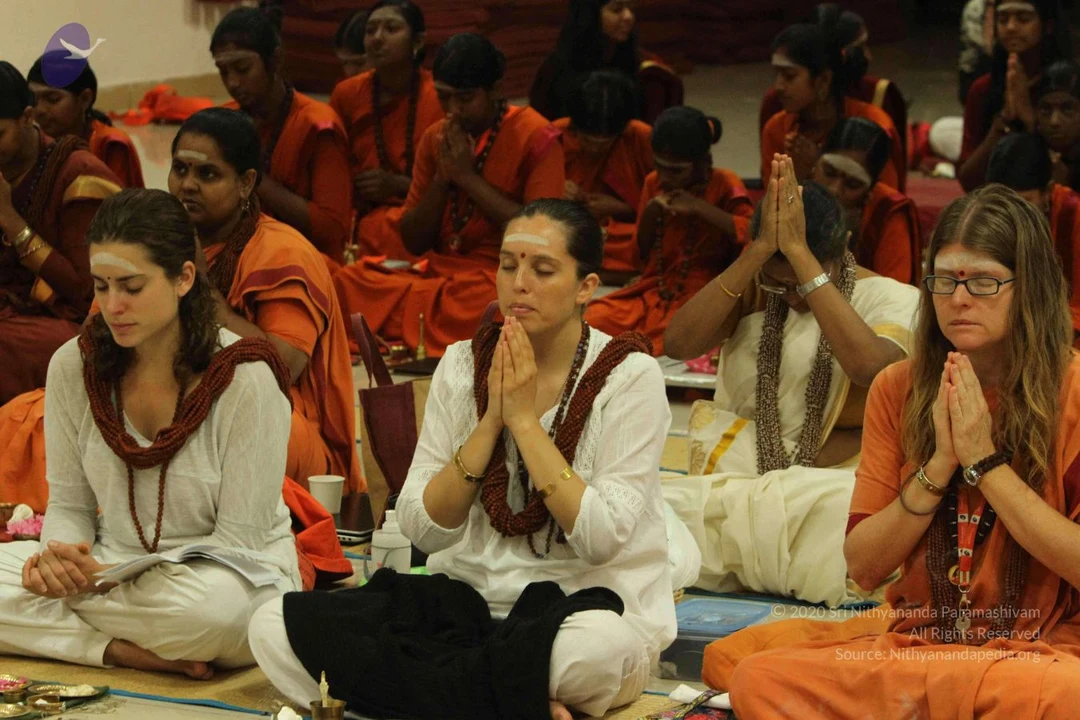
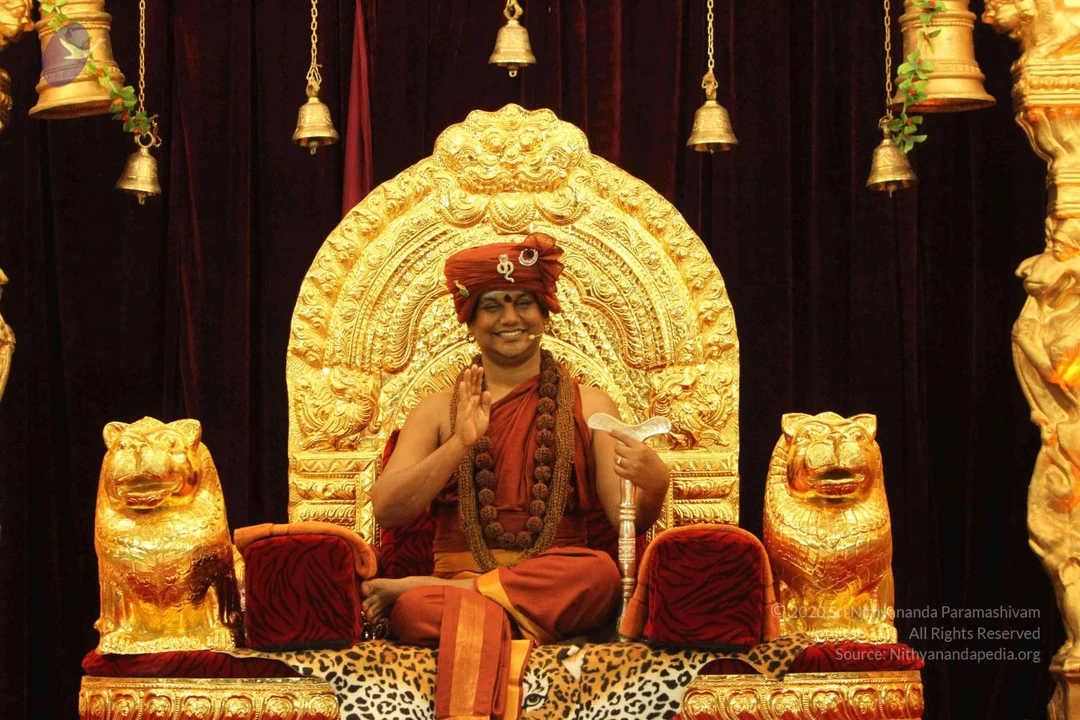
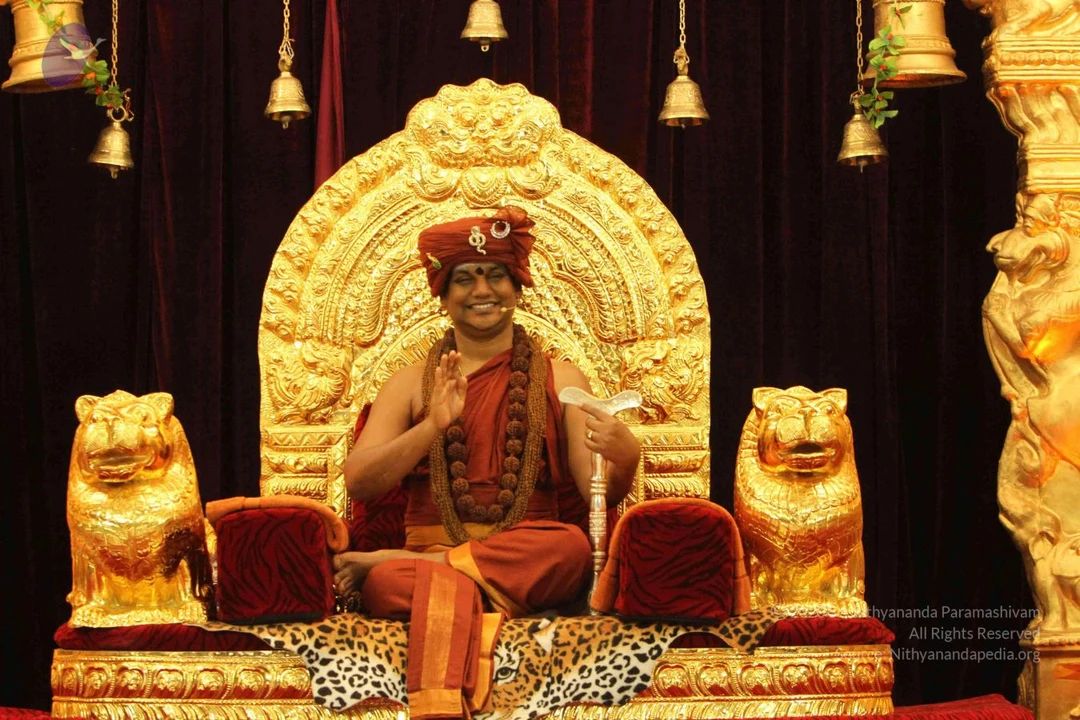
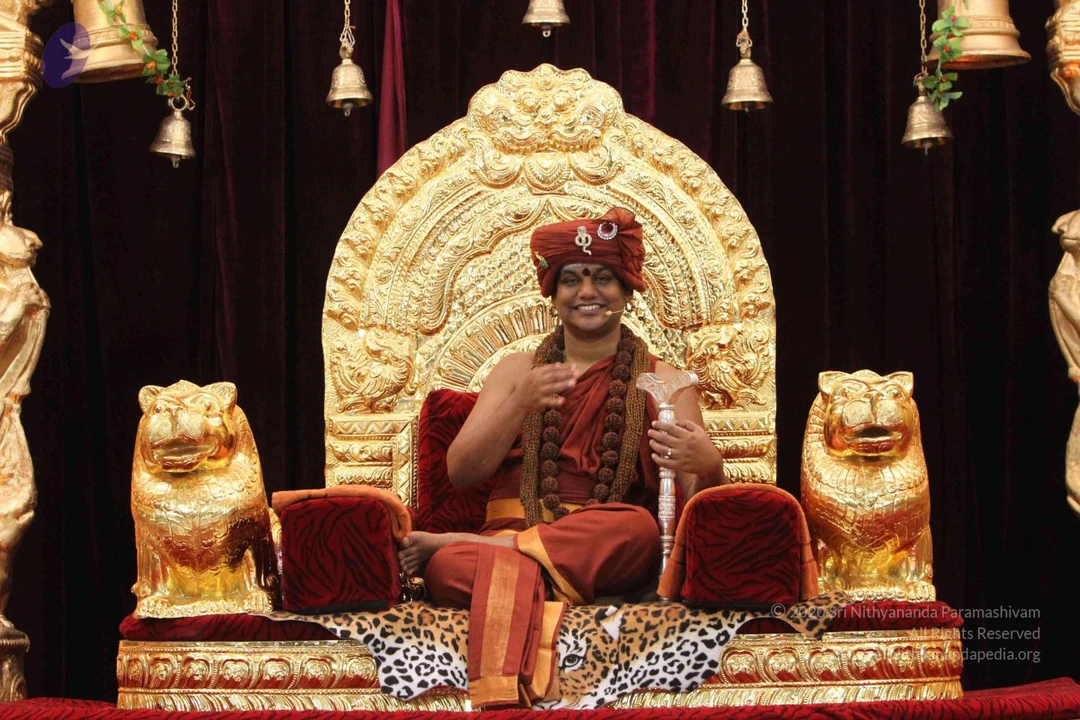
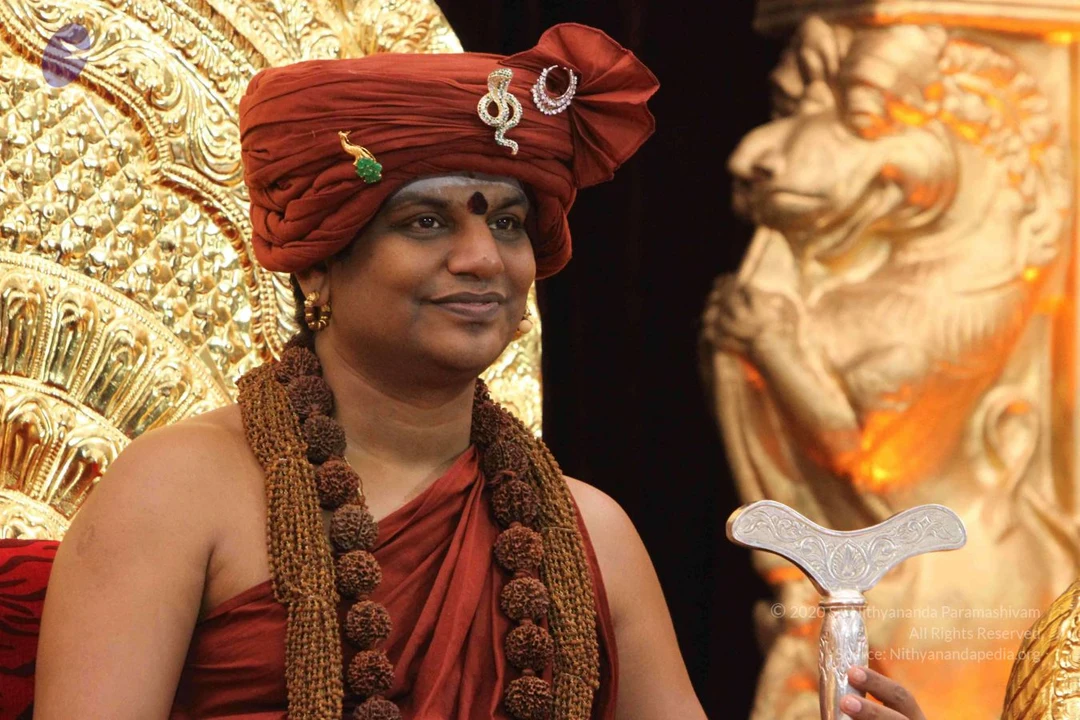
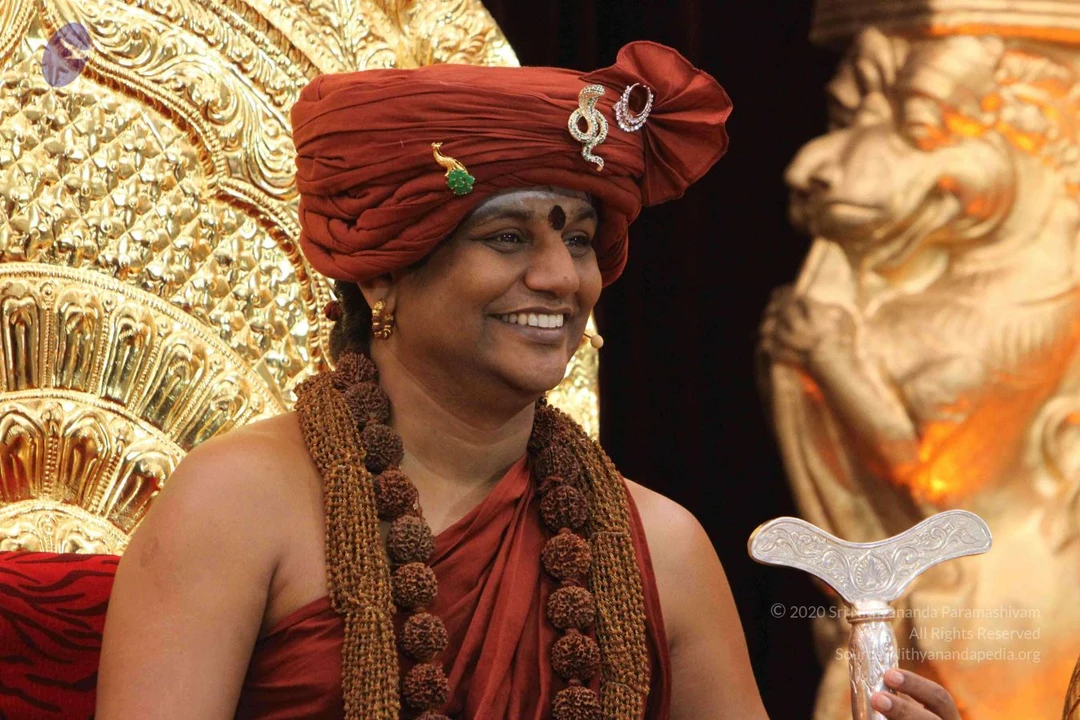
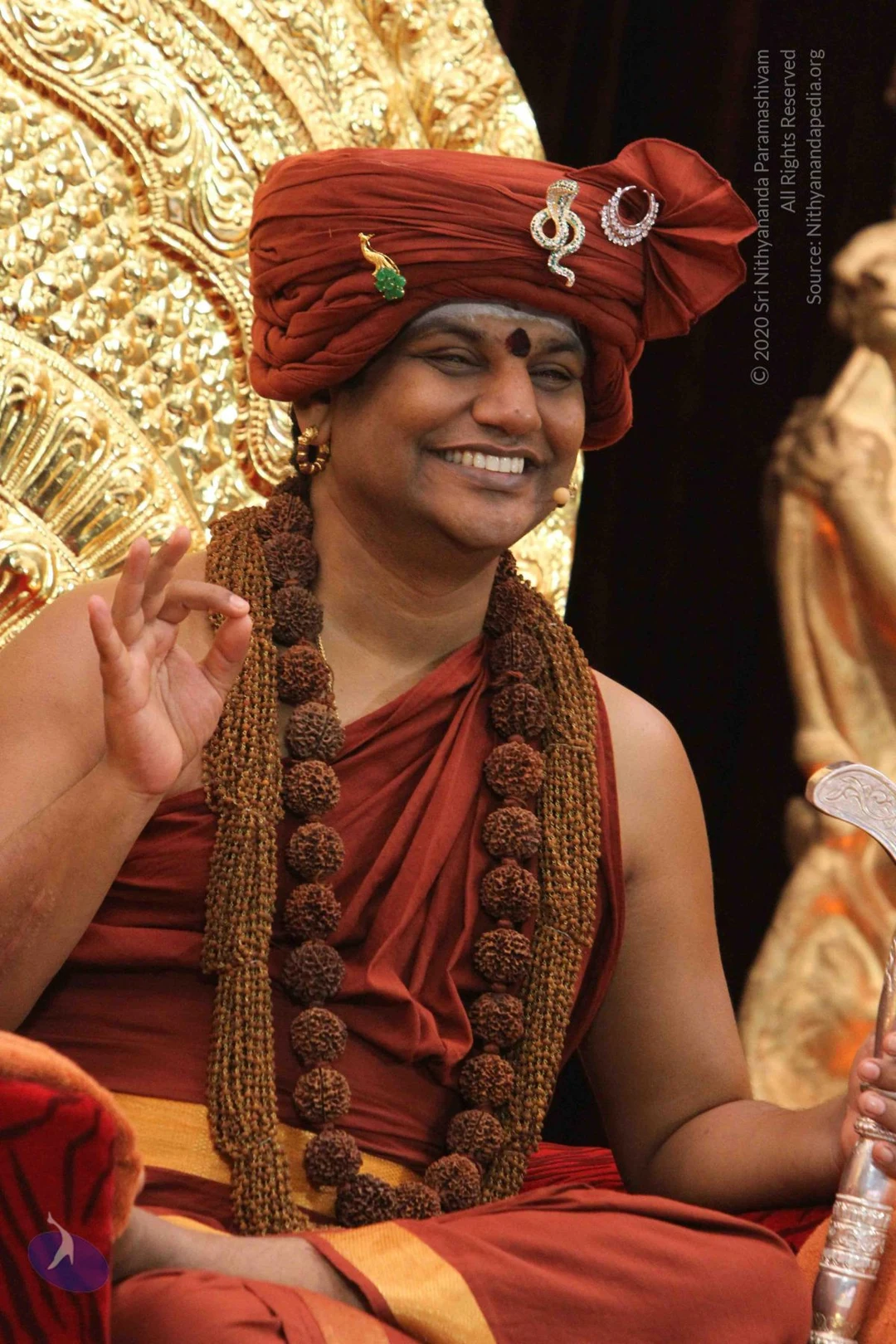
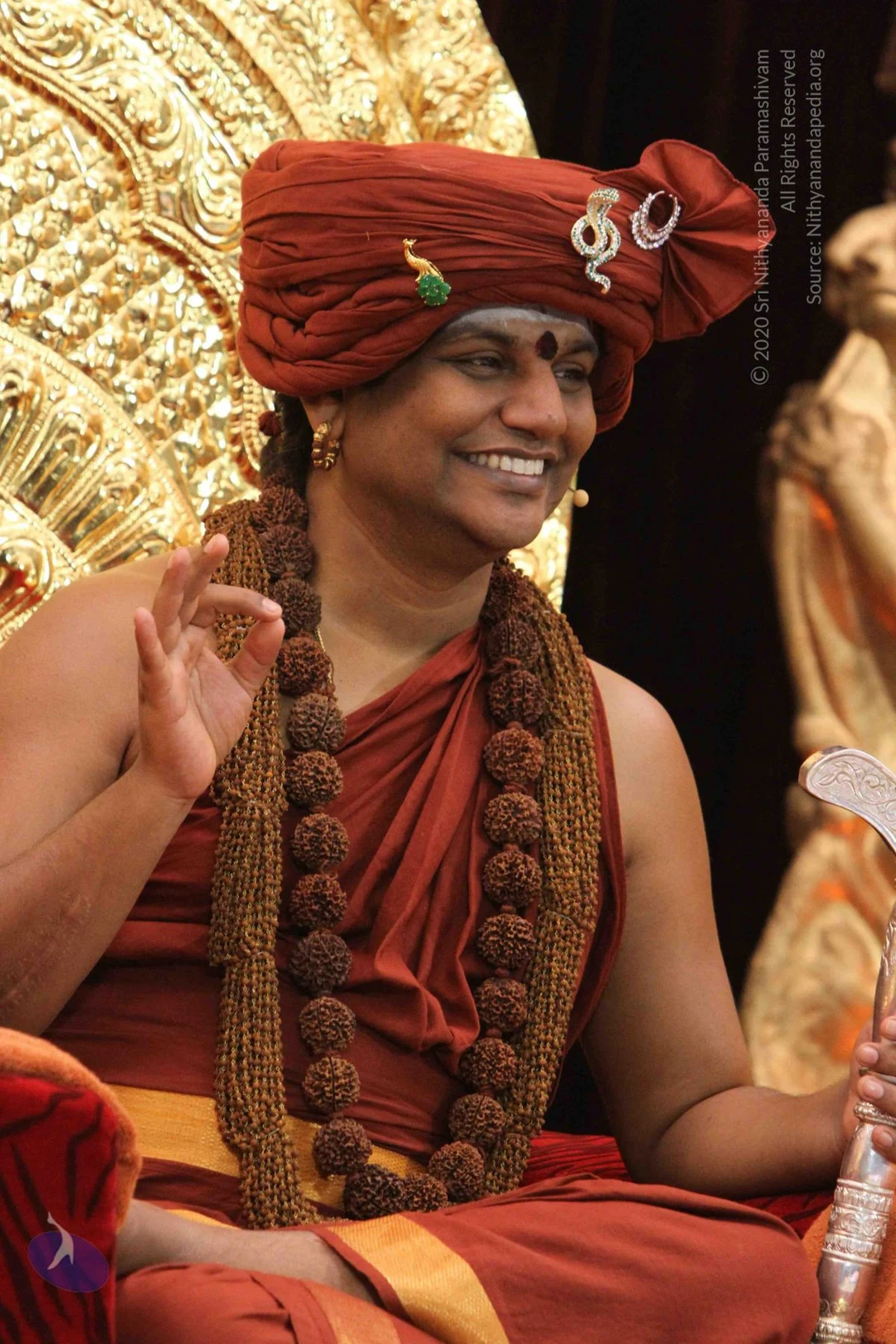
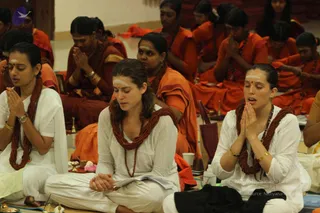
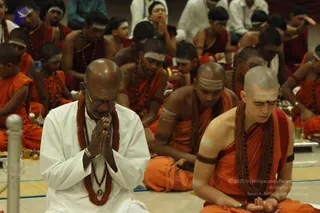
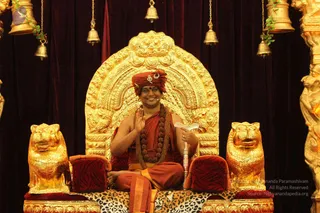
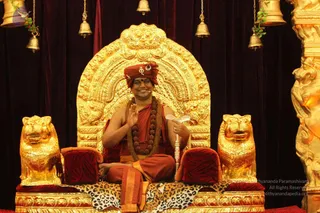
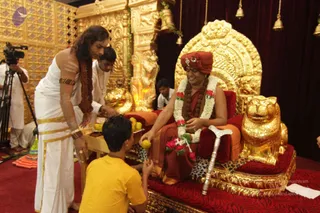
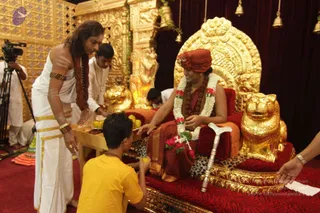
A seated group satsang in an ashram hall. In the foreground, three women sit cross-legged with palms pressed together in anjali mudra; the woman at centre wears a white outfit and a rudraksha mala, the woman at right wears orange robes, glasses and a wristwatch, and the woman at left wears white with a rudraksha mala and holds an open book. Behind them, a row of people in orange robes sits with hands folded, some with white tilak on their foreheads. A man in white dhoti and shawl with a beaded mala sits with hands in prayer, and small brass oil lamps and offering plates are placed on the floor. The visible crowd is large, with many more seated devotees in the background.A photograph inside a gold-accented temple hall. In the foreground, a figure in a saffron-orange turban, garlanded with white jasmine and red flower strands and wearing a saffron shawl, holds a gold ritual implement while a young man in a white shirt with a lanyard and a girl in a teal top kneel and offer citrus fruit from a silver tray. Behind them a shaved-headed man in white ritual cloth stands beside a long-haired man with a rudraksha mala and a white garment. A cameraman films, a golden deity murti stands on the right, and a bowl of fruit and a golden lion-like figure appear near the front, with a red carpet and a television screen in the background. a person is an appearance-based candidate only.Close photo of a smiling man seated before an ornate gold-leaf backdrop, wearing a red-orange turban with a green jewelled brooch and a diamond-set cobra ornament, plus a red-orange shawl and tunic. A dark red tilak marks his forehead, and he wears a long necklace of brown rudraksha beads with gold chains. A small microphone clips near his cheek. His right hand is raised in a mudra and his left rests near a silver-handled object. Appearance-based candidate, Swamiji (probable): turban and rudraksha malas with ceremonial gold ornaments, seated in discourse. One physical person visible, and a carved stone figure stands partly at the right edge.

November 19 2014

Original wiki page
Contents

Title

Four Easy Steps to Shivoham

Description:

In today’s (19th November, 2014) Morning Satsang, Paramahamsa Nithyananda gives us an easy, logical technique to complete with doubts around the statement: I am Mahadeva! The problem is that we think our incompletions and patterns are the reality, making us doubt that we that are already Shiva. The best thing is that there are no prerequisites or conditions; it is only our logic that needs convincing. 1st of the KISS (Keep it Simple Series) of talks on Shivoham

Link to Video:

VideoAudio

Transcript:

Nithyanandeshwara Samaarambhaam Nithyanandeshwari Madhyamaam | Asmath Aachaarya Paryanthaam Vandhey Guru Paramparaam ||

I welcome all of you with my love and respects. I welcome all the devotees, disciples, samajis, satsanghis, sitting with us through Sadhna TV, Nithyananda TV, and two-way video-conferencing.

Cities sitting with us through two-way video-conferencing: Kuala Lumpur-Palani, St. Louis-Tirumala, Oman-Sivagangai, Rajapalayam-Aadheenam, Chennai, Morris Plains-New Jersey, Hyderabad, Hyderabad-Gupta Kashi, China, Hong Kong, Jorpati, San Jose, Ohio, Guadeloupe, Los Angeles, Colombo-Sri Lanka, Dubai, Singapore, Thiru Kailaasa Aadheenam, Kalahasti-Houston, Hyderabad-Gupta Kashi, Los Angeles-Arunachalam, Varanasi, Oklahoma-Somanatham, Glendale, Seattle, Pudukottai...........

I welcome all of you with my love and respects.

I can see Coimbatore also.

Listen! I will expand on ‘SHIVABODHA’. The word ‘bodha’ seems more down to earth than ‘Shiva Ananda’. The word ‘Shivananda’ seems to be very remote; but ‘Shivabodha’ seems to be immediate. ‘Shiva Ananda’ can be translated as ‘bliss of being Shiva’. ‘Shivabodha’ can be translated as ‘intoxication of being Shiva’. Whatever may be the translation, ultimately, experience is one. When the ‘bodha’ becomes permanent, it is ‘ananda’. When ‘ananda’ gives its glimpse once in a while, it is ‘bodha’, that’s all. When the intoxication becomes permanent, eternal, it is ‘bliss’. When the bliss comes once in a while and goes, it is ‘intoxication’, Shivabodha. See, it is a kind of a logical exercise you need to do, a simple logical exercise.

The FIRST LOGIC you have to establish in yourself is: ‘My guru is the ultimate spiritual expression I know. As far as I know, my guru. There might have been bigger or smaller (gurus), I don’t know. But, whatever I know.... There might have been the greatest whisky, brandy, coffee, tea....might have been, might be....but what comes in my cup only I can drink. The best I can, I get it to my cup. The best I can is my guru...I know is my guru. That is the best spiritual expression I know. He told me clearly I am Mahadeva. Then, this is the path I need to start walking.’ That is the first logic you need to establish in you.

SECOND: ‘He did not tell me if I become like this I am Mahadeva, if I behave like that I am Mahadeva, if I reduce my tummy I am Mahadeva or clean my face I am Mahadeva or shave my hair I am Mahadeva or leave my hair long I am Mahadeva. No! He said, ‘You ARE Mahadeva as you are’. Then the whole problem boils down to somewhere me not accepting it. There is no other factual, logical point that why I am not Mahadeva.’

Please understand, there is a vast difference between the stone temple built like this with a pillar, and this decoration structure. This is a decoration structure. Both may look like same, but there is a vast difference. Same way, all the reason why you think you are not Mahadeva are like this, the decoration pieces reason. Not, even though it looks like factual, but not factual reasons. Listen! Listen! This may look like pillar, but this cannot do the job of the pillar. It can be a decoration as pillar.

Same way, the reasons you have why you are not Mahadeva are not factual. They are not cognizable. They are not real in Cosmic Law of Life. Because, your guru did not tell you if you become this, this, this, you are Mahadeva. No! I might have told if you experience Shivoham, this, this, may express through you. But I never tell; if I told I am withdrawing. Even if you understood, or heard, I am withdrawing those statements. No pre-condition for Shivoham. Shivoham is the unconditional truth. Shivoham is the unconditional apology Maya gives you, delusion gives you. It says, ‘You are That! Sorry for deluding you for all these days. Please forgive me. Unconditionally I am apologizing and leaving you.’

Understand, the SECOND LOGIC you need to establish inside you is: ‘There is no pre-condition, pre-qualification for me to experience, live, radiate Shivoham.’

And, I am also reminding you that Day One you will not be able to perfectly experience Shivoham; you don’t have to bother about it. Whatever YOU know as Shivoham! You may not be able to immediately sit under the Kalpavriksha and give initiation, enlightenment to people. But you will be able to easily give one small soap, comb, cloth, rudraksha you have around you. When somebody comes and asks, be like Mahadeva. Will Mahadeva say ‘No!’? No! Whatever YOU know as Mahadeva!

I can give you some simple basic expressions of Mahadeva: SAT-CHIT-ANANDA. He is ‘Sat’ – Truth. He is ‘Chit’ – Conscious, alive. He is ‘Ananda’ – Bliss, bliss of constantly being himself; bliss of constantly being himself.

So, understand, start with that: ‘I am in bliss of just being myself. I am in bliss of being Mahadeva.’ And whatever logic says, ‘I am not Mahadeva, I am not the Ultimate’, is not factual; because, ‘If it is factual, my guru would have told me! My guru did not tell ‘with all these conditions you are Shivoham’. No!’

There is no fine-prints involved in Shivoham initiation. Shivoham is Shivoham is Shivoham. There is no star (*) mark, and below, in fine-print: ‘Conditions Apply’. No! You ARE Mahadeva! You ARE Mahadeva! You ARE Mahadeva!

Listen, Listen intensely! So, all the logic and reason you are having to say, ‘No, no, no. I don’t think I am Mahadeva’, that has something to do with you, and not it has something to do with reality. Listen! If you have any reason that you are not Mahadeva, Shivoham is not the reality for you, that logic, that reasons have nothing to do with reality. It has something to do with you. You need to work only on that.

Understand, the moment you know these pillars are not stone, original pillars, simply you know how to remove it. You will have the energy, intelligence, everything, just to pull it out. But, as long as you are thinking it is a stone pillar, you won’t even come near to remove it! So, anything which says you are not Shiva, those logic has nothing to do with reality; it has something to do with you. This is the second logic you need to establish within you.

The THIRD LOGIC......

Please understand, in a very beautiful Sankhya way – ‘Sankhya’ means, ‘liberating logic’, ‘enlightened thinking’ – through the liberating logic, enlightened thinking, I am initiating all of you into this Shivoham. You will see this, these seventeen days of Nithyanandeshwara Brahmotsavam, Mahadeva is really going to dance here! He is preparing! I think these seventeen days you guys are going to have a feast of Shivoham! This Brahmotsava we will celebrate with the theme of Shivoham. I think in four days we are starting. Twenty-third (23 November 2014), the Poorvanga Puja, the first rituals are starting.

Listen! The NEXT LOGIC (THIRD LOGIC) you need to establish within you: ‘Anything which is not factual, I can complete it. After all, it is my freedom. I created the delusion around me. All this I kept it as a decoration, these pillars and all this. This is not a stone structure. If I want to alter it, I can move or remove.’ That remembrance itself will drastically reduce the powers of incompletion, the power incompletion has over you, understand?

Today, this is, what I am doing now is layman’s initiation into Shivoham, initiating a layman into Shivoham. There is a series of books called ‘KISS’, very popular in U.S. ‘Keep It Simple Series’ it is called. KISS! That series books are very popular. Just like ‘Books for Dummies’! All the major topics you will see – ‘Yoga for Dummies’, ‘Tantra for Dummies’, ‘Hinduism for Dummies’, ‘Buddhism for Dummies’, ‘Christianity for Dummies’, ‘Bible for Dummies’. Take all the major topics, you will see that ‘Dummies’ title books. And, same way, one more series that, ‘The Idiot’s Guide to ........’. That is also a very popular series. And this ‘Keep It Simple Series’ – KISS – is one more popular series. And ‘Chicken Soup for the Soul’, that is one more popular series. I don’t know how many of you are able to believe, I have read thoroughly the whole series, all these four! All these four I spent time. I think, each series, around hundred to two-hundred books are available. ‘Chicken Soup’ is more than that....four-hundred. Just scanning, scanning, scanning, scanning. After ten-twelve books, you just know the thought-trend, and you catch it. It is a beautiful way of spreading knowledge. Amazing work they have done! I thank all the four series’ publishers.

Just like that, today this is K-I-S-S, Keep It Simple Series on Shivoham! Straightforward! No hanky-panky, unturned stones, unattended portions, unexplained logic. No! Straight K-I-S-S series! Actually, I want to create like that, ‘Guaranteed Solutions’ series. We will do it! We will do it! And ‘Living Enlightenment’ series - I wanted to do that. ‘Living Enlightenment for Pregnant Women’, ‘Living Enlightenment for Nursing Mothers’, ‘Living Enlightenment for Teenage Kids’, ‘Living Enlightenment for Confused Youth’, ‘Living Enlightenment for Spoiled Brat’, ‘Living Enlightenment for Unmarried Youth’, ‘Living Enlightenment for Married Bound’! Books are books are books whatever is said and done. You can’t compete with books to transmit knowledge. Nothing like books! You may find thousand and one new things like Kindle, Internet, everything. Only nuts can read and receive knowledge in the Internet. Nobody else! How will you read thousands of pages in the computer screen? No! That doesn’t give you that kind of a fulfillment. And, moreover, when the book is in your hand, you can pick up any chapter any area, you can play with it! You can read the last chapter come back to the first chapter to understand the thought current. The free flow of ability to play is denied in kindle or any other electronic versions.

Books are the books are the books! It will be irreplaceable knowledge medium even though tons and tons of new methodologies come. Still, even though I am tech savvy and use all the possible technology, still, for knowledge receiving or knowledge giving, I depend on books. That is more reliable! The publishing industry should be revived. It is dying in a very bad way; in West especially. It should be revived.

Listen! Let me come back to this ‘Keep It Simple Series’.

The NEXT LOGIC you need to establish: ‘Let me start celebrating all the qualities I can radiate as Mahadeva.’

Being blissful always just because you exist is ‘Shivabodha’, being intoxicated of being Shiva. Actually, you don’t even need to struggle. Just visualize it is there; it is there oozing like blood oozing in the body. The energy of Shivabodha! And Shiva is not some dead qualities; he is a living being! Request him, ‘O, Mahadeva, I request you, I am a initiated disciple. I am authorized to invoke you and request you.’

Initiation gives you the authority; so you don’t even have to have the doubt, ‘Am I qualified to invoke him? Am I qualified to call him? Am I qualified to receive him?’ No! Initiation gives you authority.

‘I am initiated disciple. I invoke you. Please come inside. Be you. Let me be you. Let you be me. Let you just be.’

And he is such vibrant, living, intelligent being! When you invoke him, he clears tons of incompletions which you were thinking too big. Invoke him again and again. Invite him again and again. When you invoke him, you don’t need to be cleaning up everything bit by bit, inch by inch – ‘Oh, this corner of the house I have to clean and burn the dust.’ When he comes, the whole thing is burnt, nothing is left! He remains as he! Establish this few logic.

I request everyone, all the satsangis, today’s satsang watch at least two-three times. Logically you need to be convinced, understanding. Then, naturally you will internalize, this great truth.

I have given four points today. This is the essence of today’s satsang. Just simple, straightforward initiation into Shivoham!

Today, the whole day, in Nithyananda TV, the satsangh will be replayed continuously. Please watch.

Mahadeva, Shiva, as Mahadeva I initiate all of you powerfully into this great truth, Shivoham, Shivoham, Shivoham. Live this truth.

I will continue to expand in further satsangs with this Shivoham.

Now, I bless you all! Let you all radiate with Integrity, Authenticity, Responsibility, Enriching and Causing eternal bliss, Nithyananda! Thank you!

Photos

Paduka Puja
Nithya Satsang
Kalpataru Darshan
Tags:

Yoga,Meditation,Spirituality,Kundalini,Awakening,Transformation,Enlightenment,KISS series,Shivoham,mahadev,technique,Mahadeva,reality,Shiva,logic

Photos Of The Day:

FB-photo-of-the-day
Photos Of The Day:

MorningSatsang
Photos from this day

View all 33 photos

Paduka Puja

4 photosSource gallery
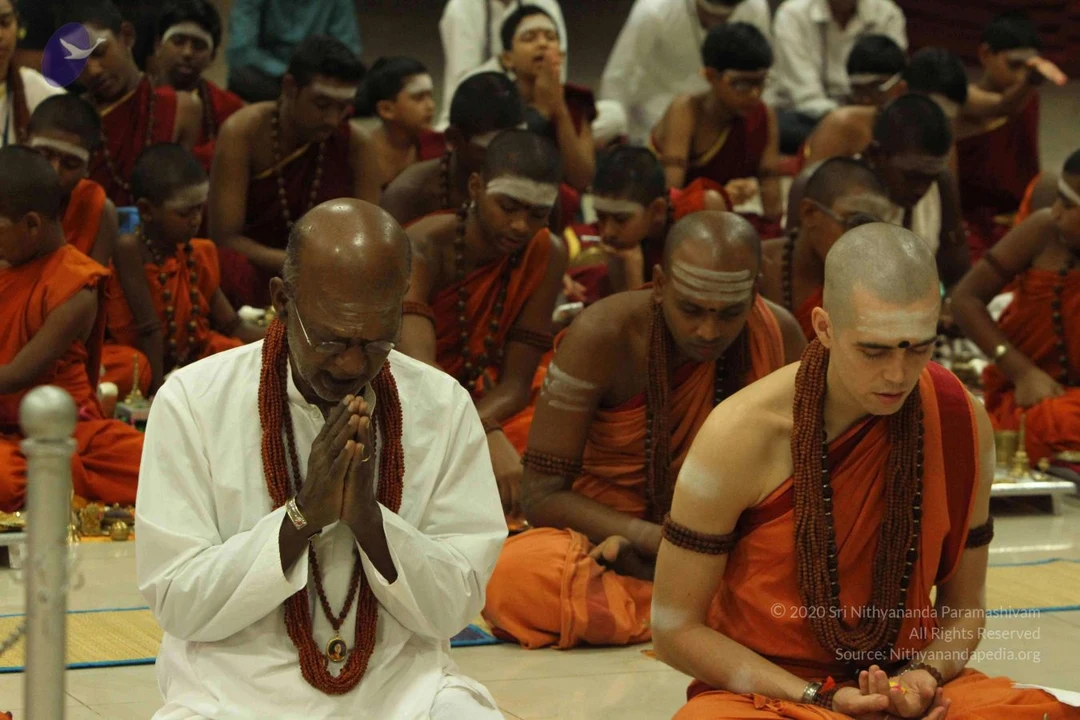
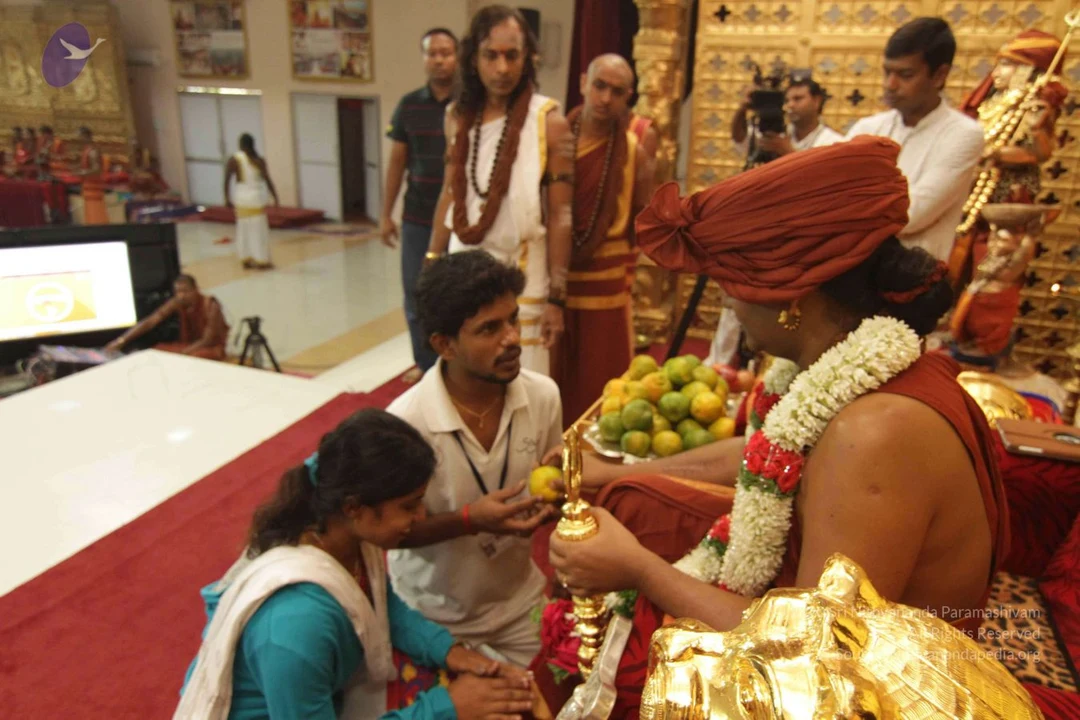
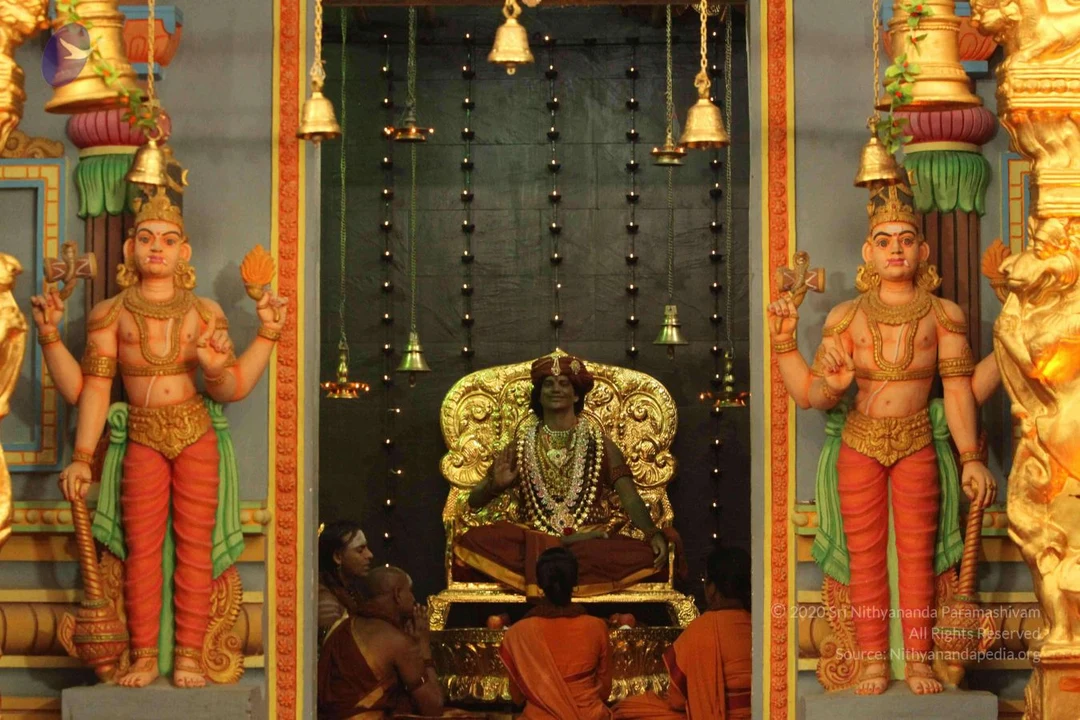
A photograph inside a temple shrine showing a seated figure on a gilded throne, appearing to be a statue or life-size depiction rather than a living person, dressed in a red-brown cloth with layered white and pearl necklaces and a red turban-like head covering, with one hand raised in blessing. Two tall painted guardian figures stand on either side, each with multiple arms, orange-red dhoti, green sashes, gold ornaments and crowns, and hanging brass bells and beaded strands frame the doorway. In the foreground, three people in orange-saffron robes sit with their backs toward the camera, facing the throne in devotion. Offerings sit at the base of the throne.Seated group of devotees in a hall during a satsang or chanting session. Foreground: three women in white clothes with rudraksha malas, palms pressed together in prayer, eyes closed; one holds an open book. Behind them, women in orange and saffron robes sit with hands folded, some with white vibhuti marks on their foreheads. Brass oil lamps and small offering dishes sit on the floor mat.A seated group satsang in an ashram hall. In the foreground, three women sit cross-legged with palms pressed together in anjali mudra; the woman at centre wears a white outfit and a rudraksha mala, the woman at right wears orange robes, glasses and a wristwatch, and the woman at left wears white with a rudraksha mala and holds an open book. Behind them, a row of people in orange robes sits with hands folded, some with white tilak on their foreheads. A man in white dhoti and shawl with a beaded mala sits with hands in prayer, and small brass oil lamps and offering plates are placed on the floor. The visible crowd is large, with many more seated devotees in the background.A seated group of devotees in orange and maroon robes with rudraksha malas and white forehead markings sits on a light floor, eyes closed in meditation or prayer. In the foreground, an older man in a white kurta with red rudraksha malas and a gold pendant sits with palms pressed together at his chest. Beside him, a young monk in orange robes and long rudraksha garlands sits with hands folded in his lap. Behind them, rows of younger boys in orange and red robes sit with bands of white ash on their foreheads, and brass lamps and vessels rest on the floor at the right edge.

Nithya Satsang

10 photosSource gallery
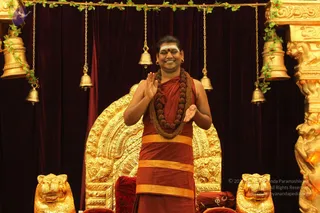
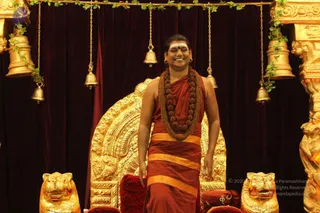
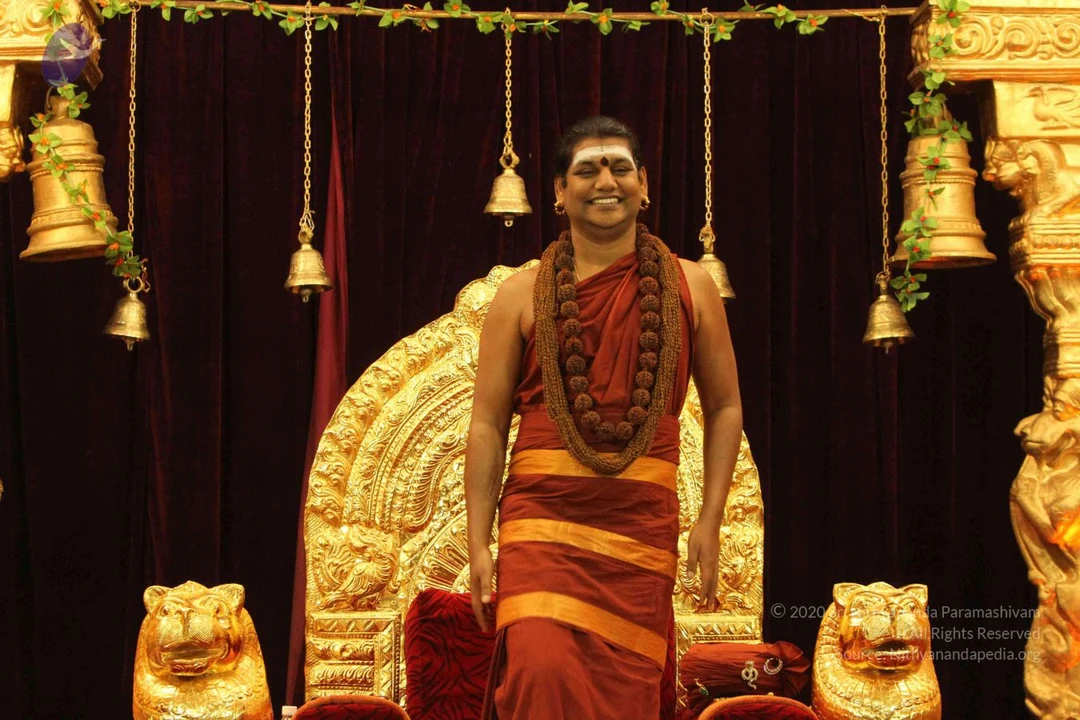
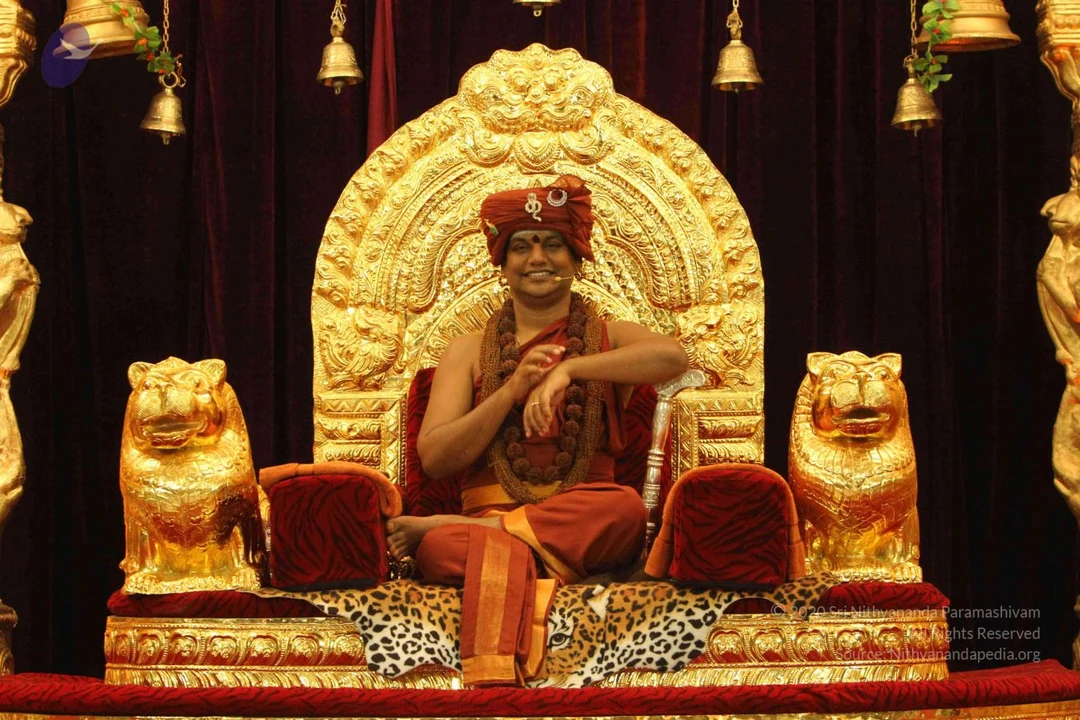
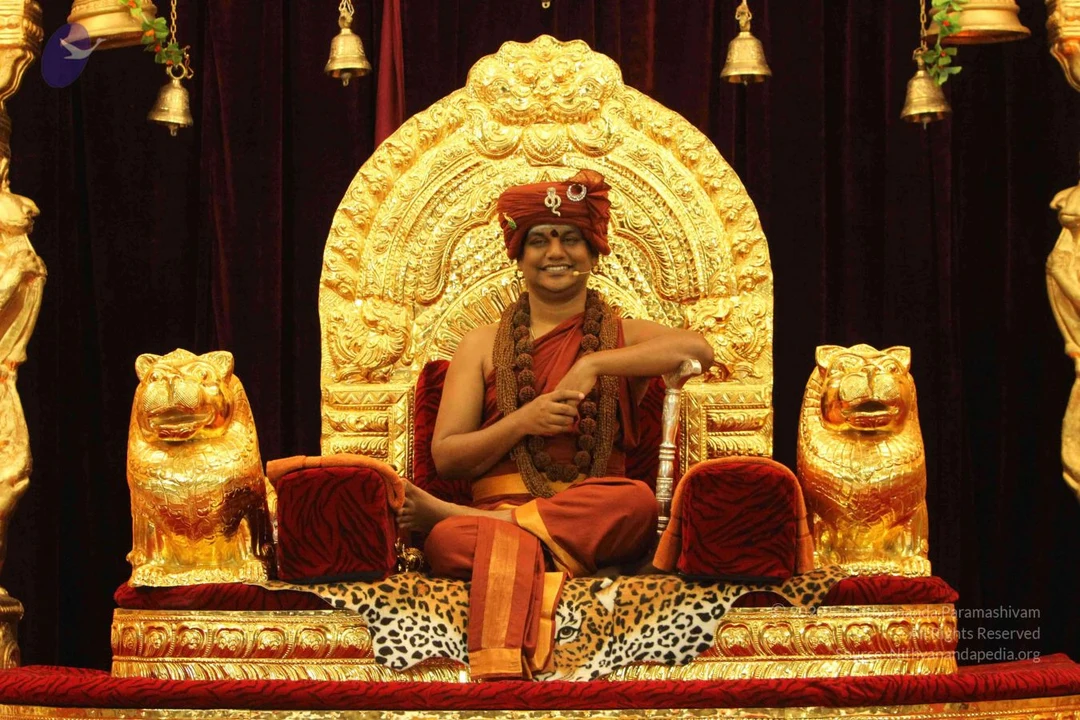
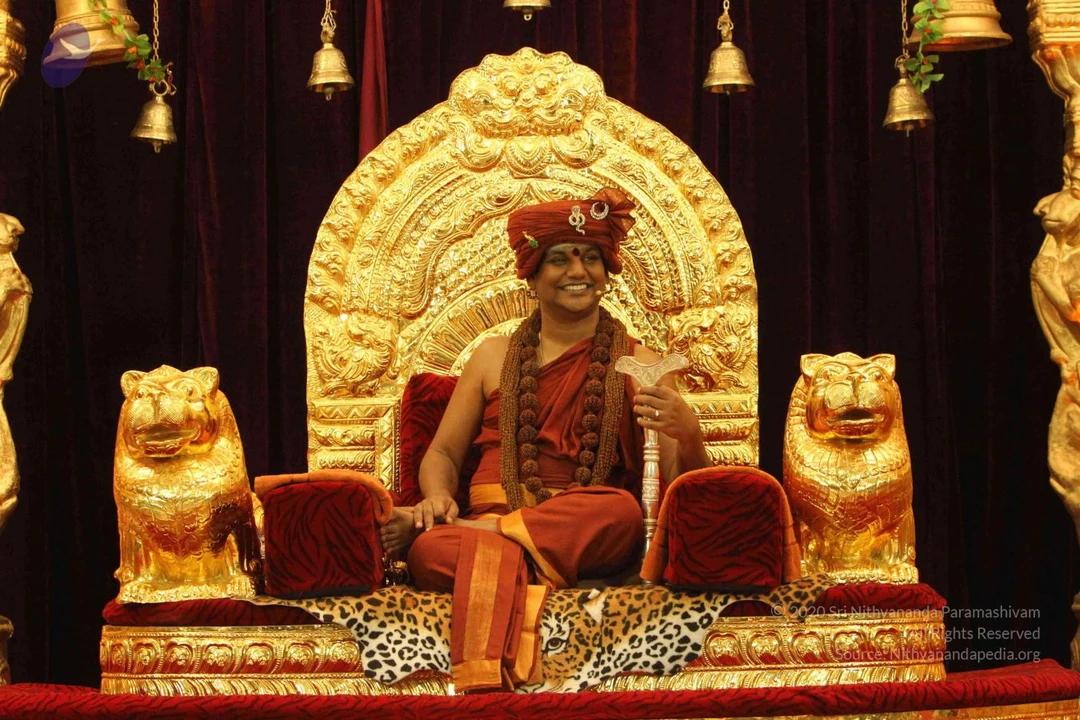
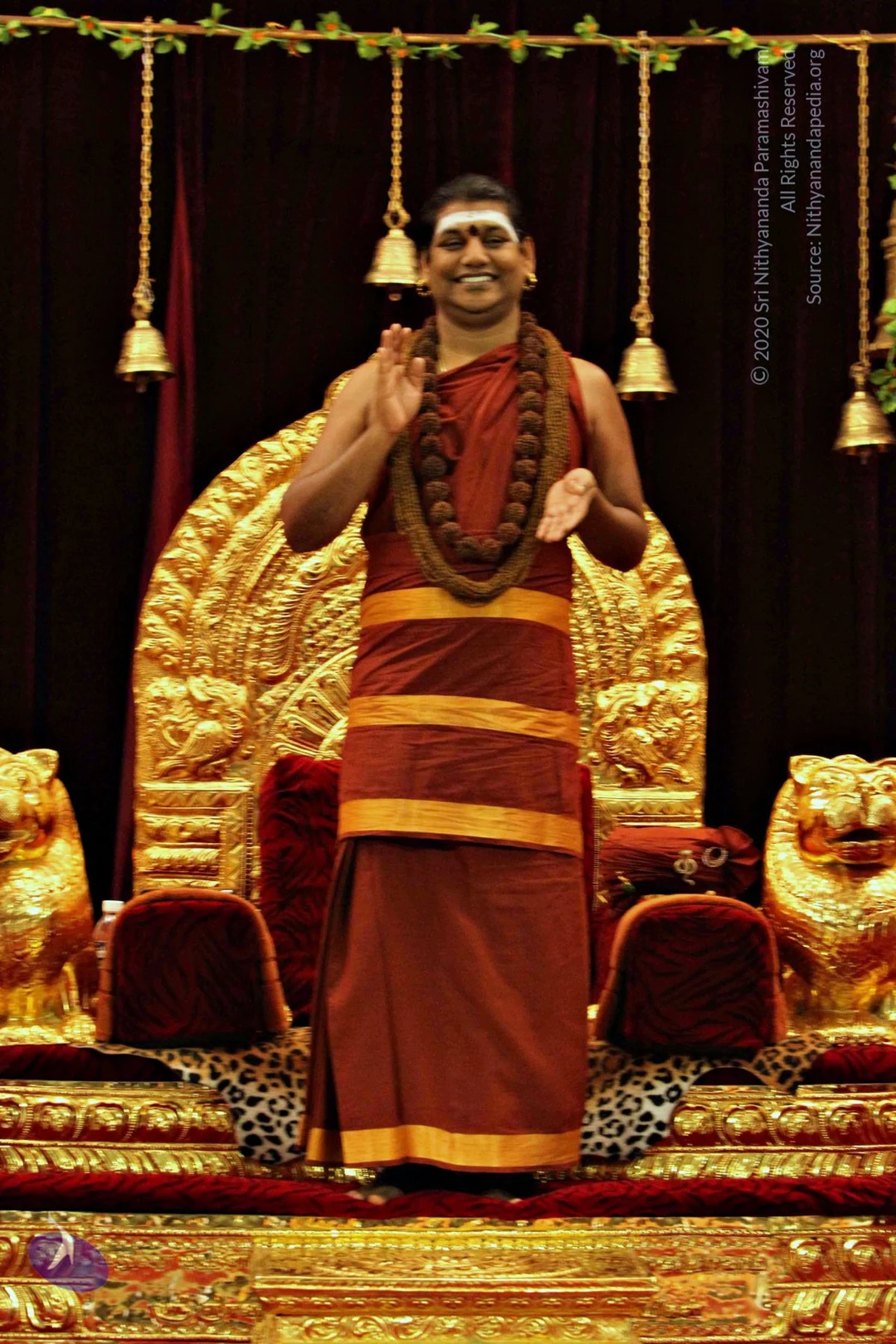
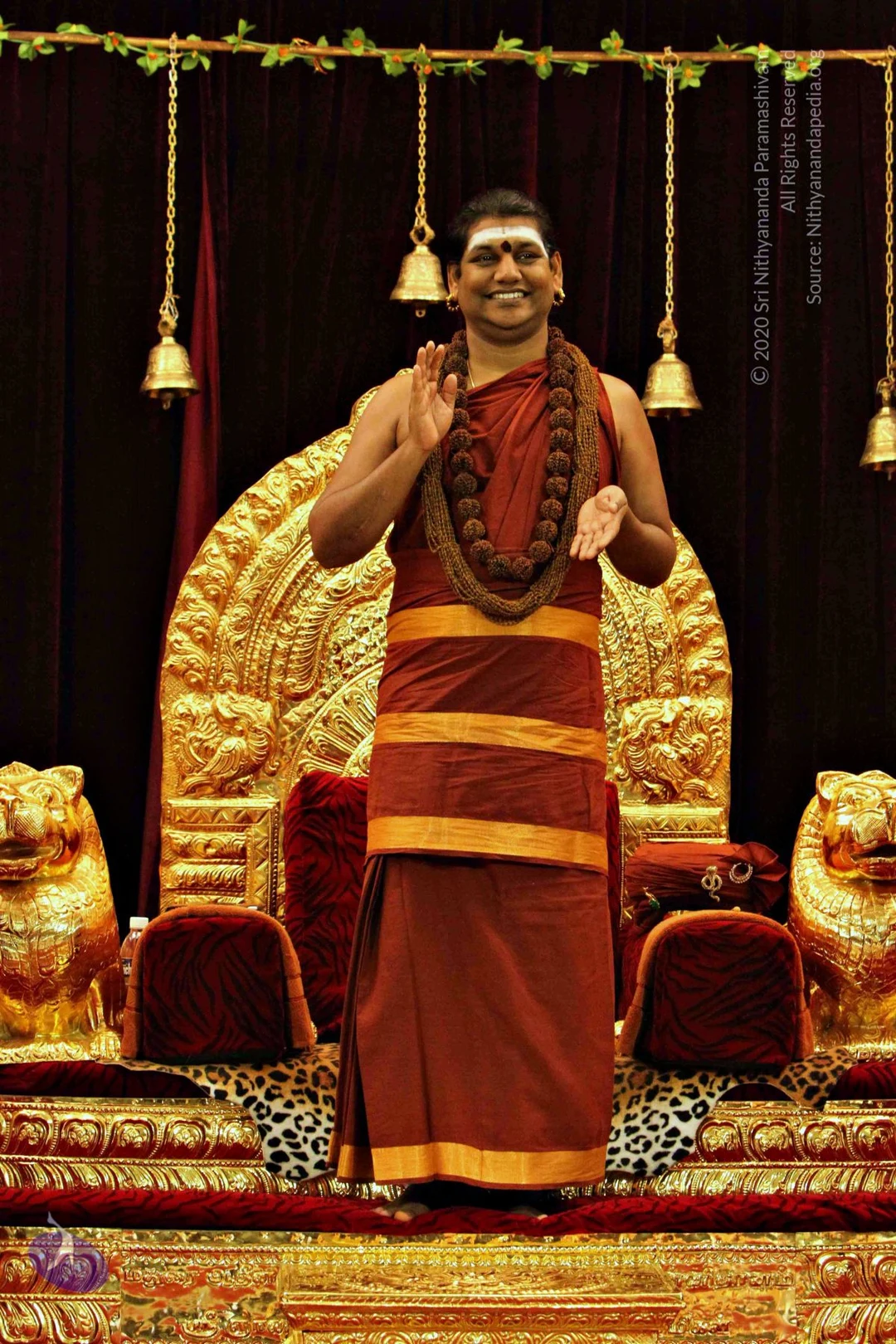
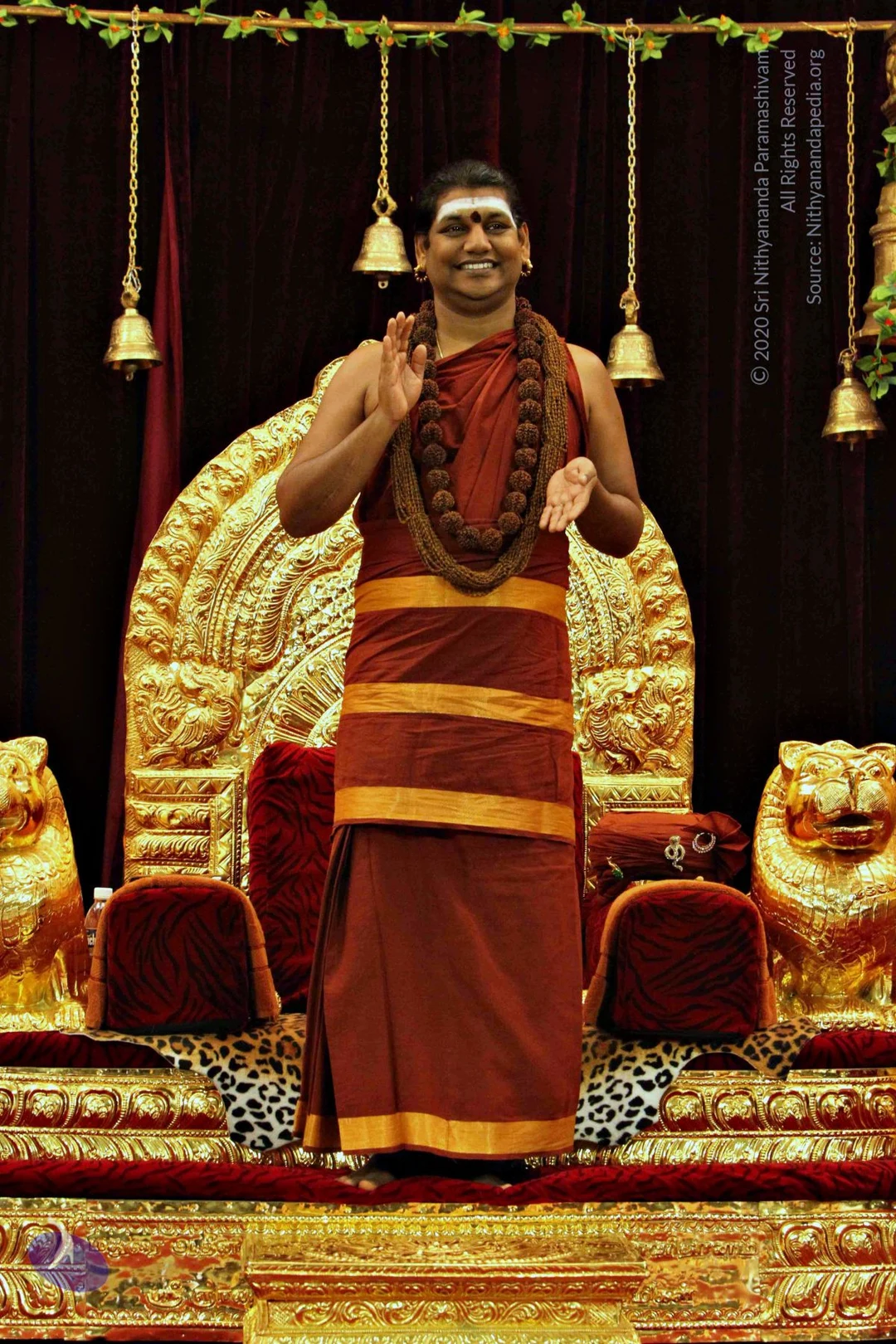
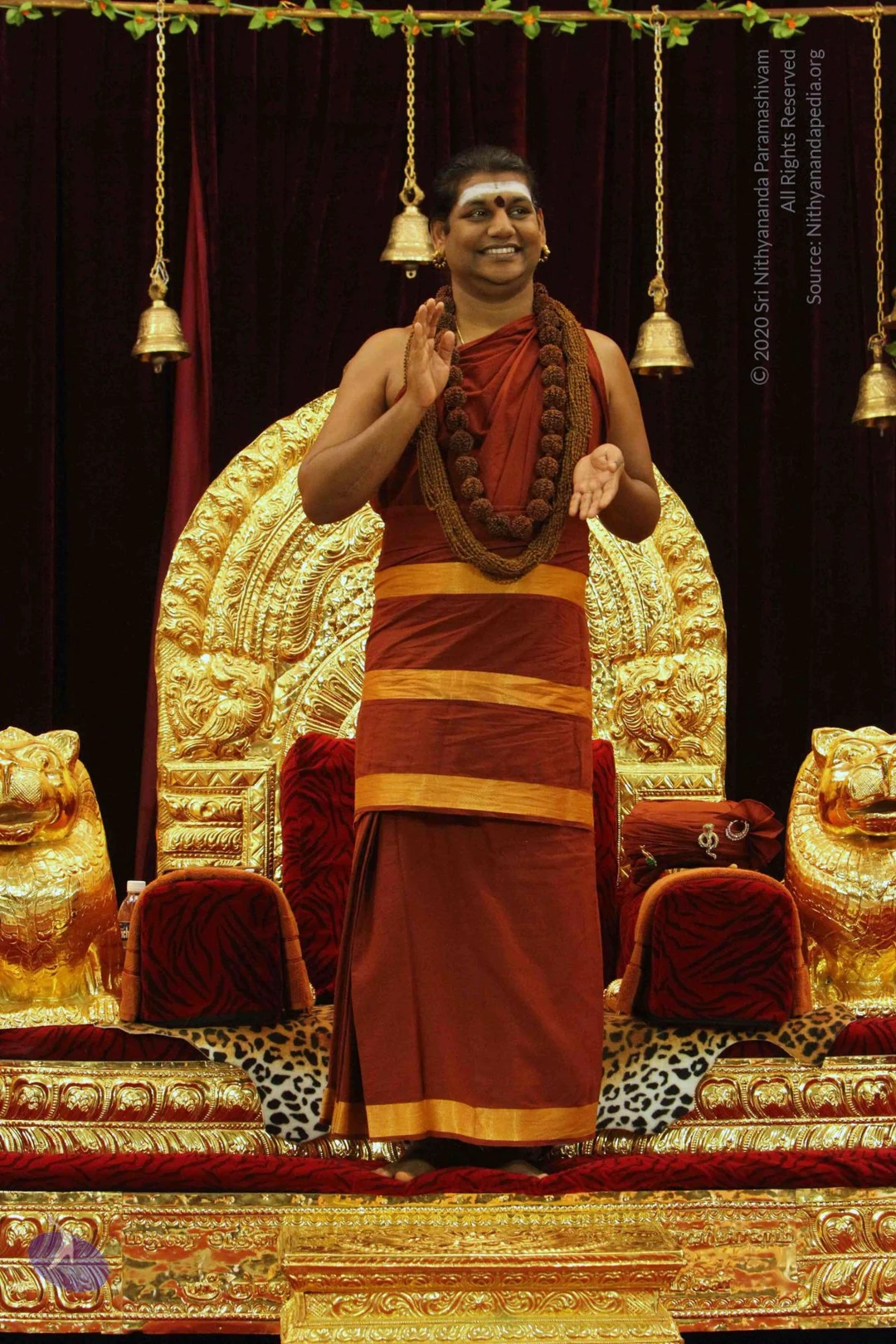
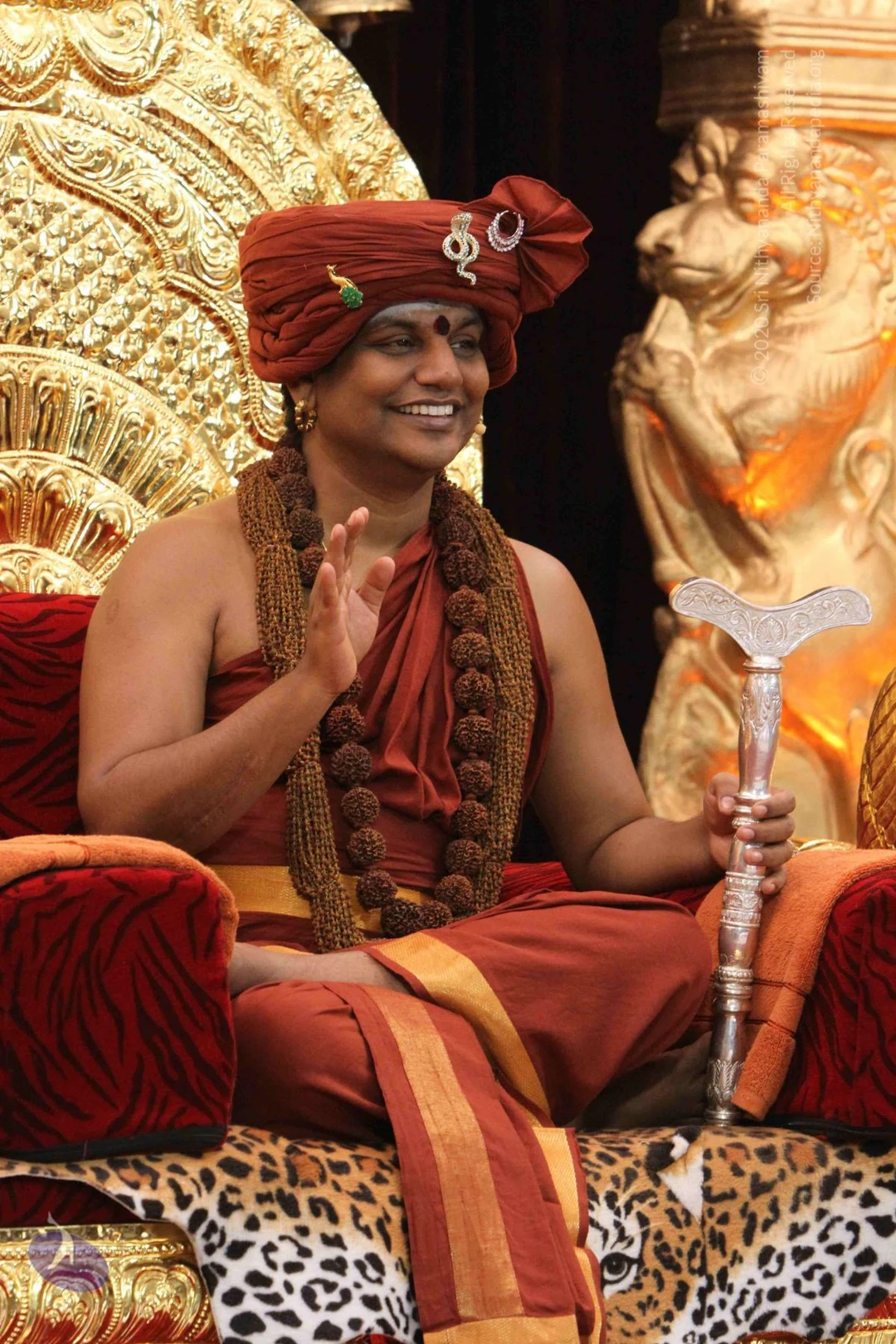
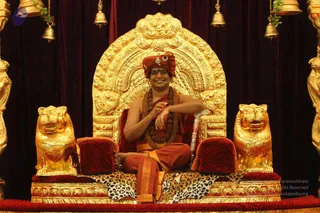
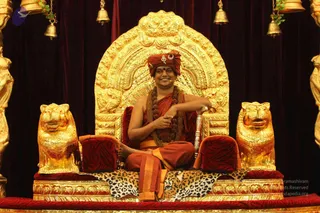
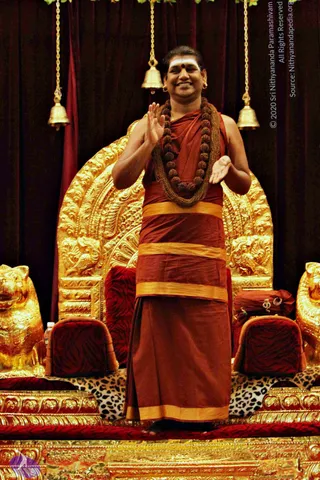
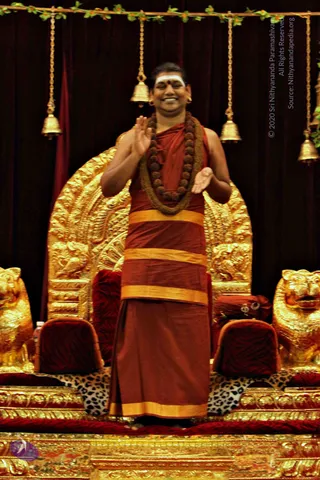
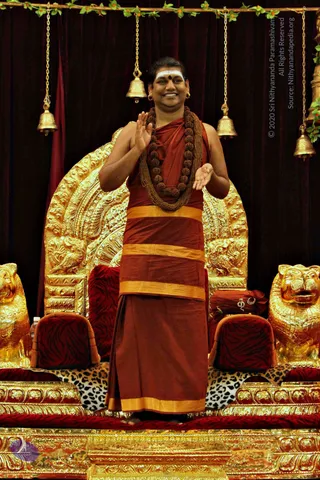
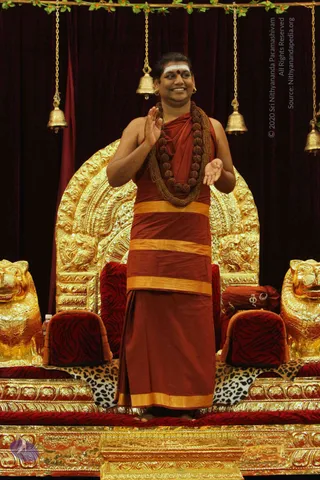
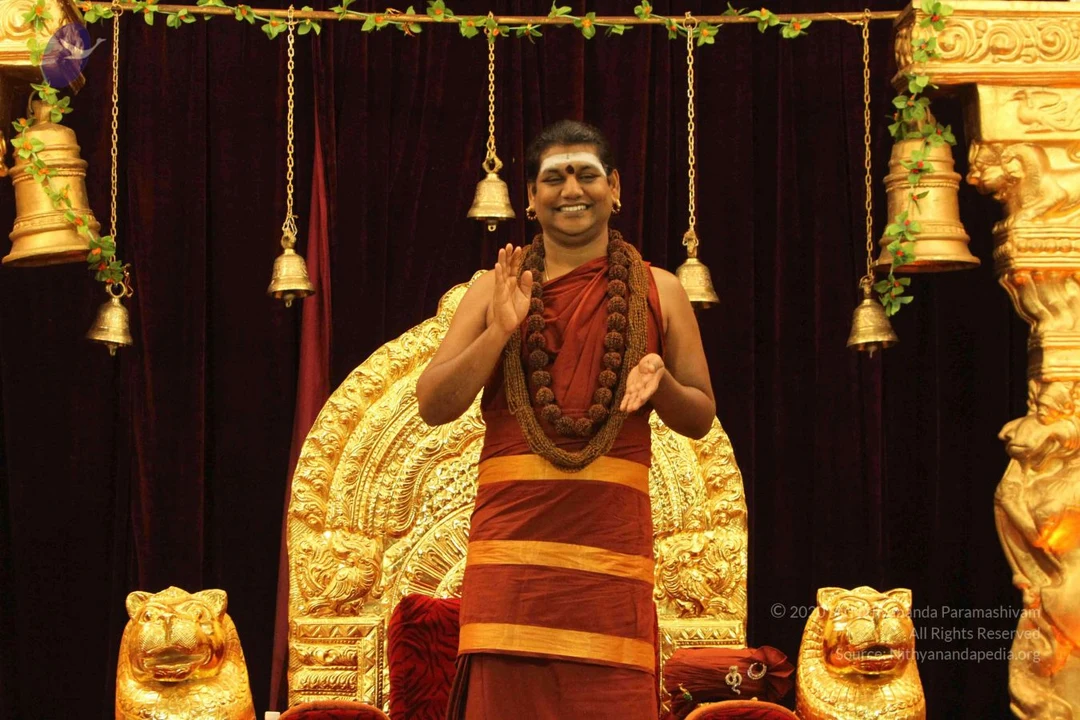
A smiling man stands centrally before a golden ornate throne with carved lion-head armrests in the foreground. He wears a rust-red robe with a wide gold-coloured border, a rudraksha mala with a beaded necklace, a white vertical tilak on his forehead and a red bindi, and holds his palms up in front of him in a greeting gesture. Behind him hang brass bells on chains and a garland of green leaves across dark maroon drapes.A smiling man in saffron-orange robes stands before an ornate gold throne on a stage draped with deep maroon velvet curtains. He wears a long rudraksha mala with large beads around his neck, a white tilak with a red dot on his forehead, and a gold ear stud. A gold-and-maroon cushion sits on the throne, flanked by two golden lion-head sculptures. Gold bells hang from chains and green vine garlands decorate the stage, with carved gold pillars at the sides. The page indicates this is a person, but the appearance is uncertain, so the candidate is marked unsure. Only one physical person is visible.A man seated cross-legged on an ornate golden throne with lion-shaped golden armrests, a leopard-print cloth beneath him, and dark maroon curtains with hanging brass bells behind. He wears a red-orange turban with a silver emblem, a rudraksha mala, and saffron-orange robes, smiling and raising one hand in blessing while holding a small ceremonial object in the other. a person: the figure wears a red-orange turban, a rudraksha mala and saffron robes, consistent with the page's attribution, but the appearance cues are insufficient to confirm identity with certainty. Single person on stage.A seated man sits on an ornate golden throne with lion-shaped armrests and a leopard-print cloth draped over the seat, in front of a deep maroon velvet backdrop and hanging brass bells. He wears a red-orange turban with a small emblem, a saffron-orange robe, and a long rudraksha mala with a gold-toned pendant. His right hand is raised in a blessing gesture while his left hand holds a white ceremonial fan. Ornate gold carved pillars frame the scene at right. Swamiji (probable) is identified by the saffron-orange clothing, red turban, long rudraksha mala, and seated throne posture, presented as the speaker for the satsang.A seated man in saffron-orange ceremonial robes sits on an ornate gold throne with a carved arched back, flanked by two golden lion figures and a leopard-print cloth on the dais. He wears a red-orange turban with a gold emblem, a long rudraksha mala with a ceremonial gold necklace, and holds a silver-topped staff in one hand. Dark maroon drapes and hanging brass bells frame the stage. Swamiji (probable): the saffron and orange clothing, the turban and the rudraksha mala are the qualifying cues for the presenter, shown in person on the throne. The image is a photograph of a dais at a satsang setting.A seated man on an ornate gold throne with a carved arched back and two golden lion-shaped armrests, draped with leopard-print cloth and red tiger-striped cushions. He wears an orange-red turban with a small gold emblem, a saffron-red garment, a long rudraksha mala, and a gold necklace, with a red-and-gold cloth across his lap; he smiles while resting one hand on a silver staff. Gold bells hang from the top of the frame against dark maroon drapes. Swamiji (probable): the figure wears a red turban, rudraksha mala and ornate ceremonial gold necklace on a throne setting, but these cues alone are not conclusive.

Kalpataru Darshan

10 photosSource gallery
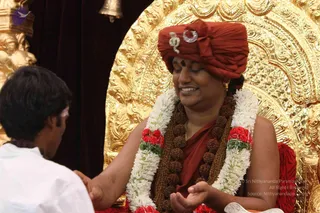
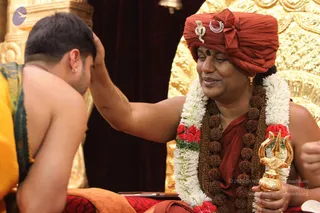
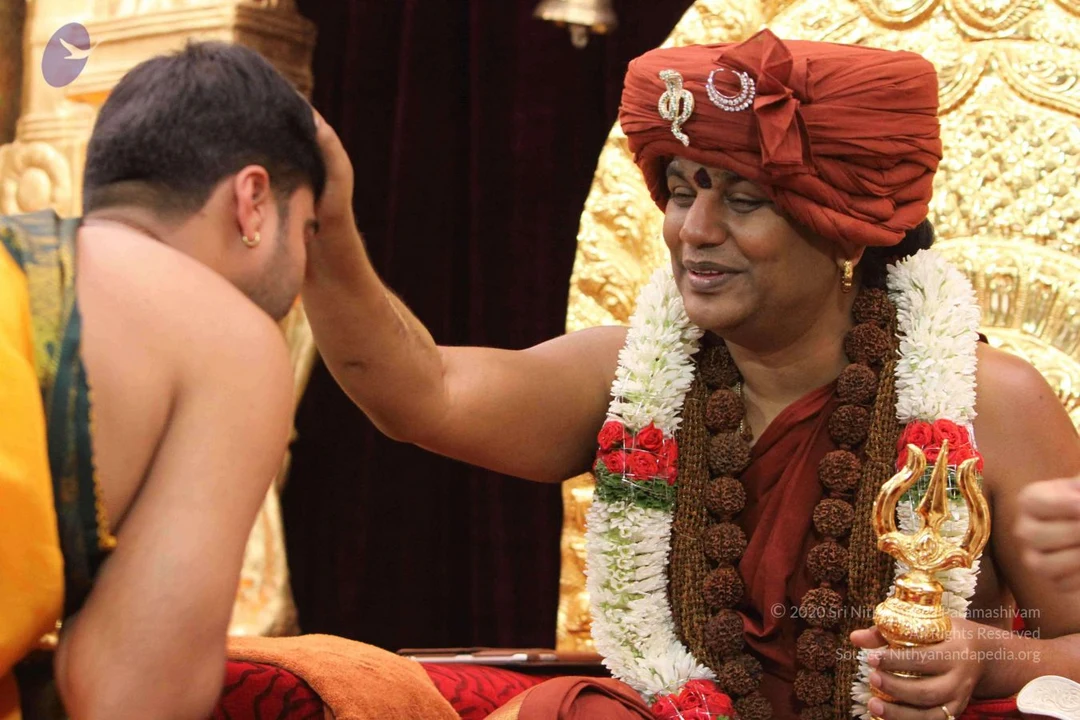
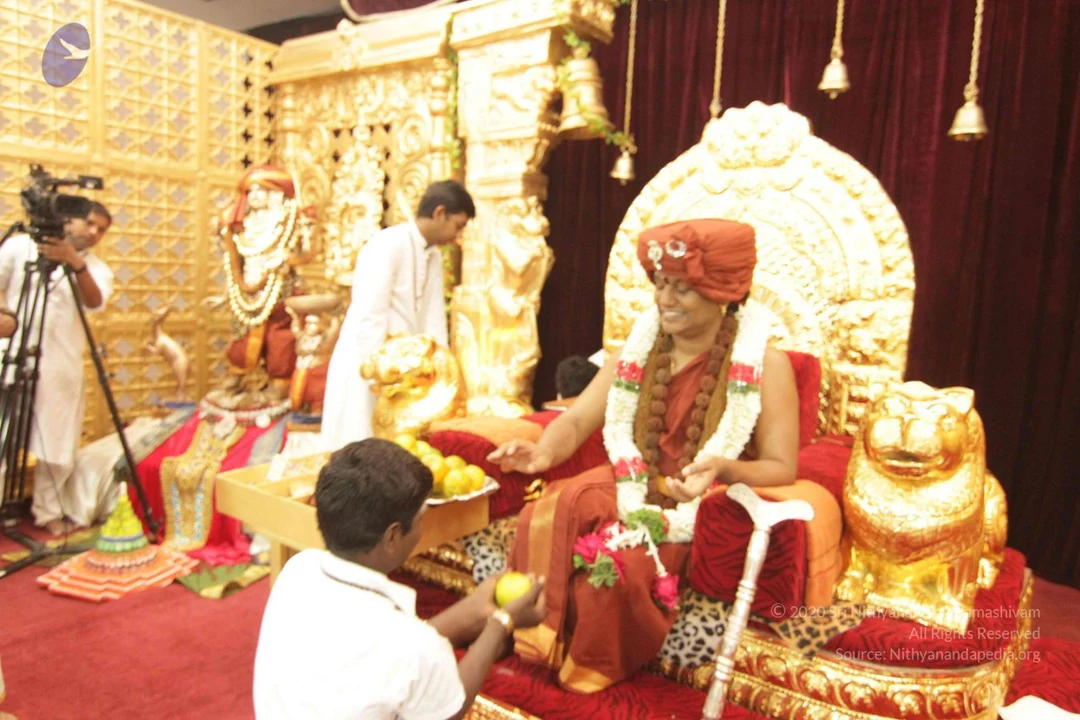
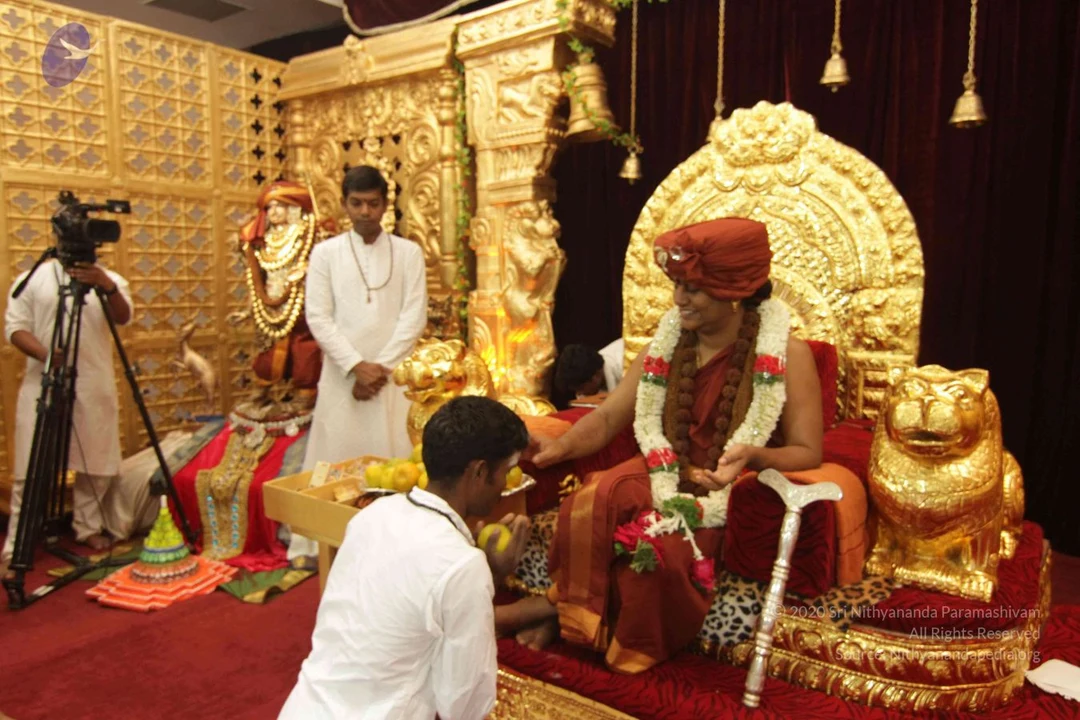
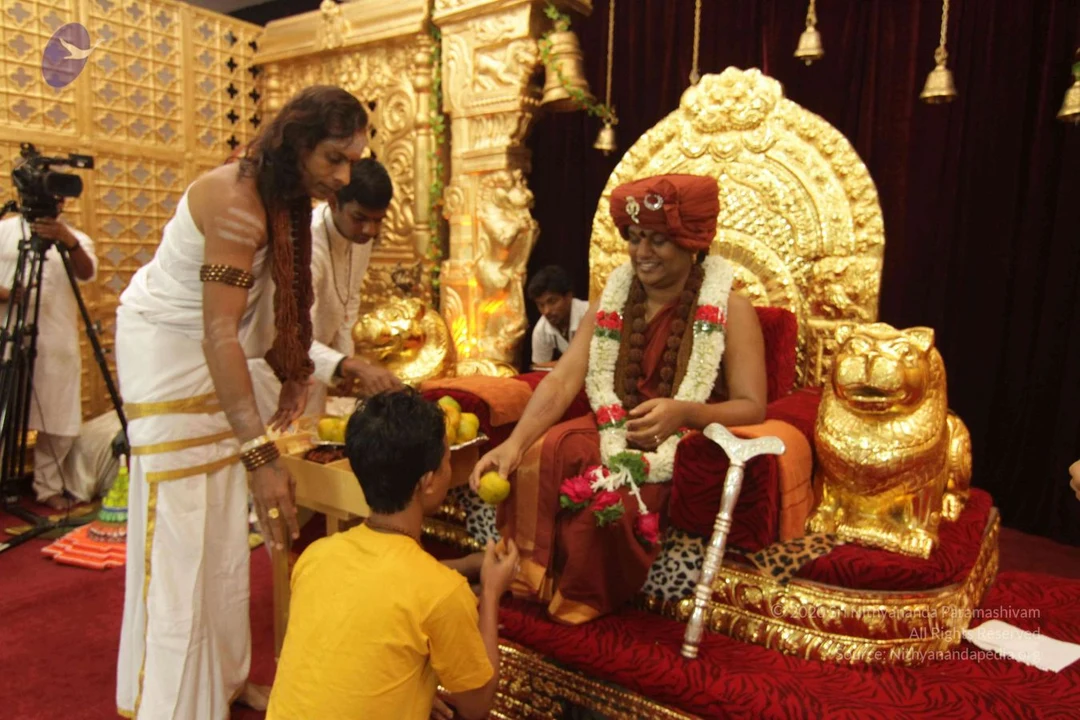
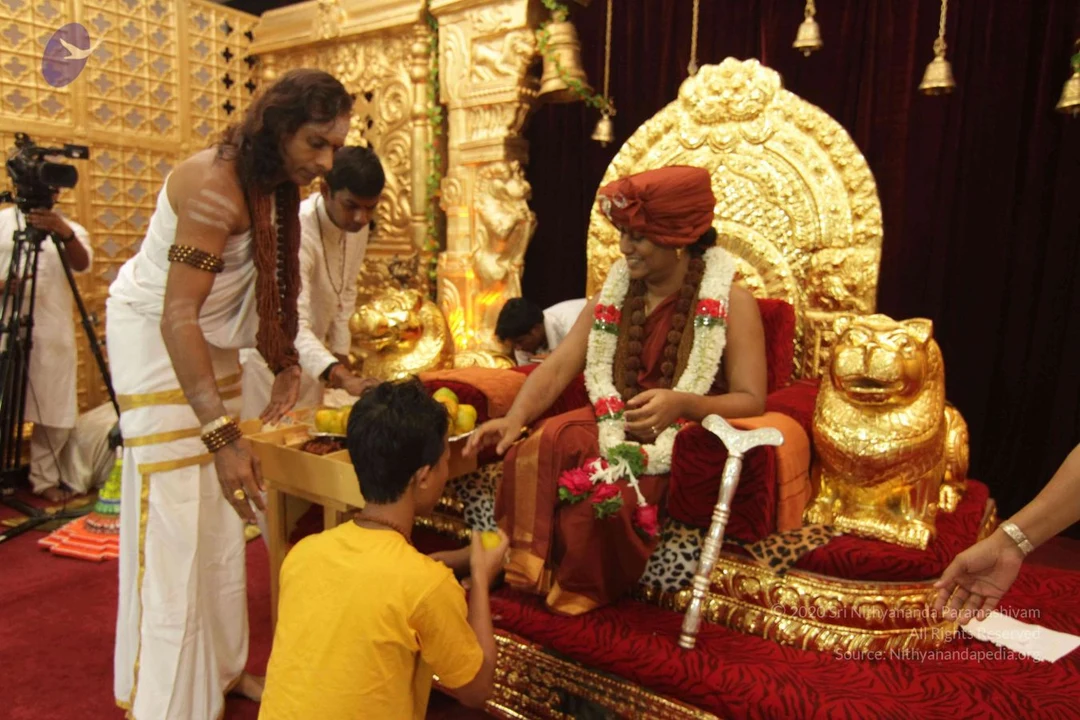
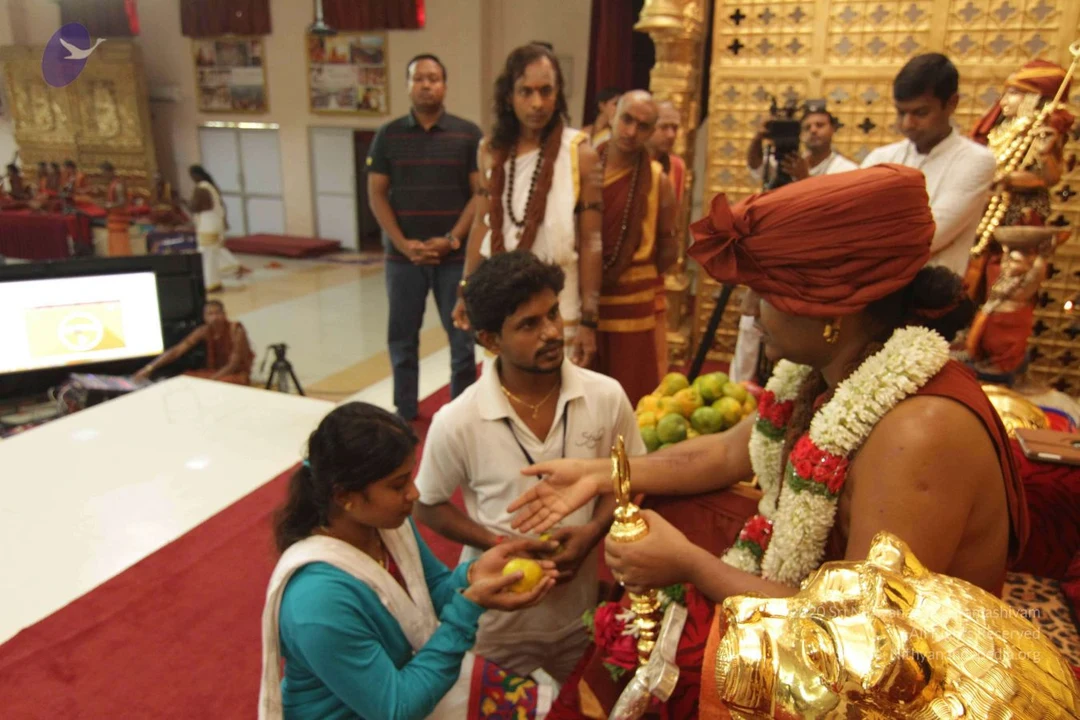
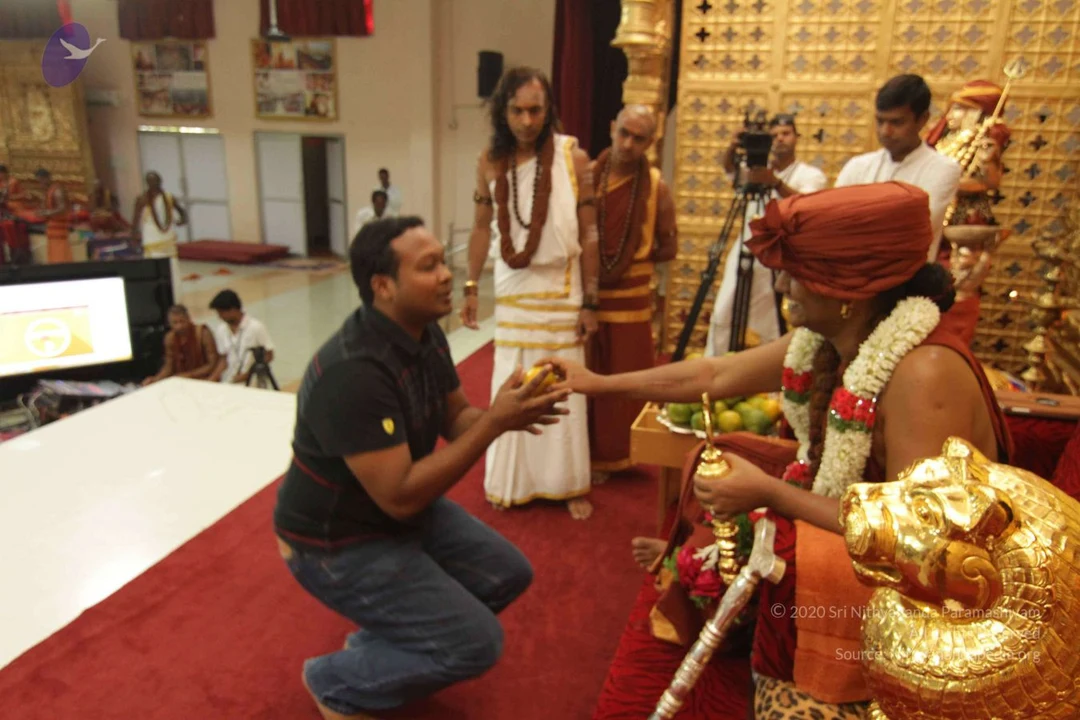
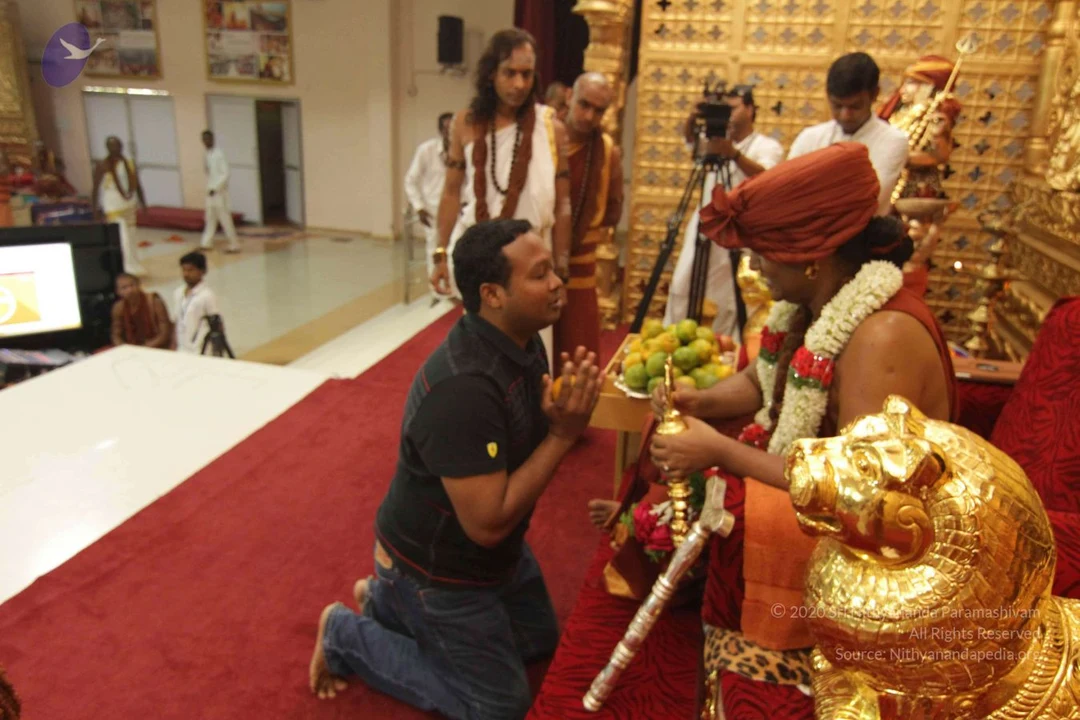
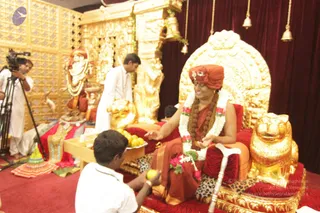
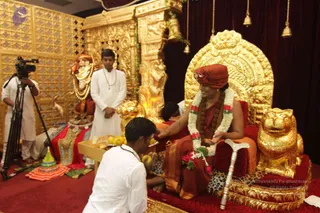
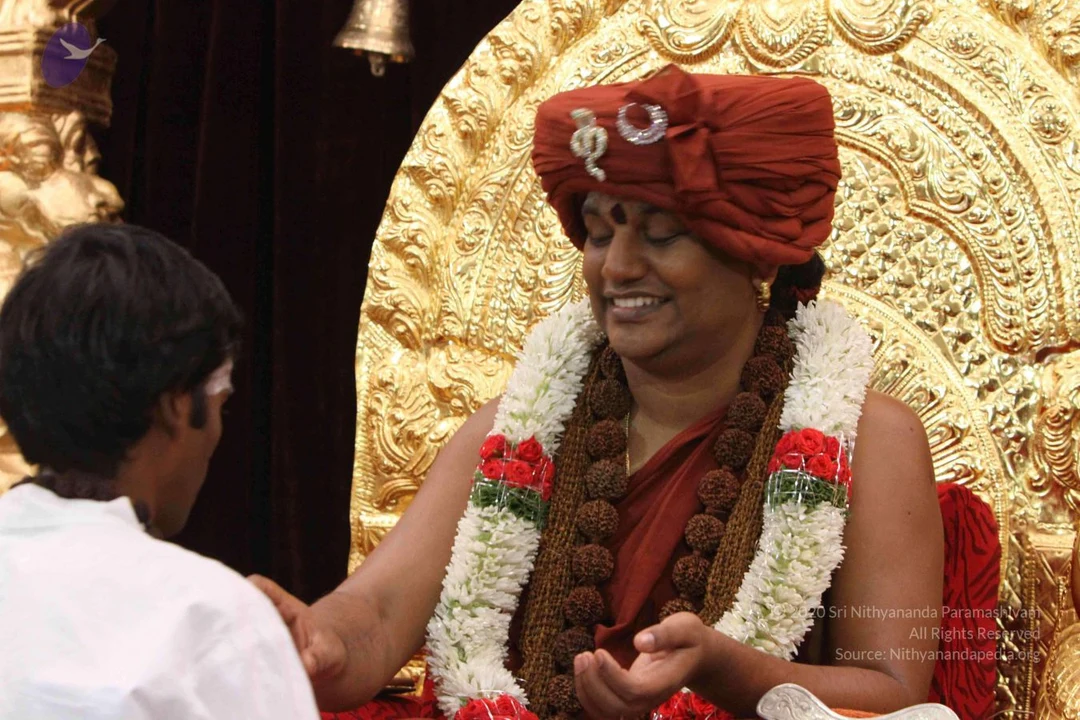
Photo of a seated figure on an ornate gold throne with a carved gold backrest. The seated man wears a red-orange turban with a silver emblem and a crystal-like ornament, a red-orange robe, and a long rudraksha mala with a garland of white jasmine and red roses. He smiles with eyes lowered and holds his right hand palm-up toward a younger man in a white shirt on the left, who reaches out toward him. A bell hangs in the upper background beside a dark velvet drape. Probable Swamiji (probable): the seated figure's turban, orange robe, rudraksha mala and garland match the expected cues, with the seated figure presented in a throne setting.A seated man in a rust-red turban with a gold emblem and white-and-red garland sits on a golden throne, smiling as he places his right palm on the head of a bare-chested young man kneeling before him. The seated figure wears a red-orange cloth wrap, a dense rudraksha mala, a white flower garland with red roses, and holds a gold trident in his left hand. The kneeling devotee wears a yellow cloth and a dark green-and-gold wrap. A dark maroon curtain and gold decorative backdrop frame the scene, with a red cushion and a brown cloth below.A photograph in a gold-decorated temple hall with a red carpet. A person in an orange-saffron head turban, orange robe, rudraksha mala and white flower garland sits on an ornate gold throne with lion-figure armrests, holding a yellow fruit and gesturing toward it. A man in a white dhoti kneels at the lower left holding a yellow fruit, and a plate of yellow fruit sits on a tray beside him. A man in white stands behind the throne, a cameraman with a tripod-mounted camera is at the left, and a gold deity murti with garlands stands near the left. Golden bells hang from the top right.A seated figure on an ornate gold throne with carved lion armrests and a gold arched backrest sits on a red cushioned dais. The seated person wears an orange-red turban, an orange-red robe, a rudraksha mala, and a white flower garland with red and green ribbons. A kneeling man in white clothes offers fruit on a tray at the feet of the throne, while a standing man in white with a sacred thread watches. A gold-framed shrine with bells and a golden deity murti stands behind, and a camera on a tripod films the scene. A small kalasha-style offering stands on the left. The setting suggests a devotional darshan or puja.A photograph of a golden throne room with an ornate gilded backdrop and hanging bells. A seated figure in an orange-red turban and rust-orange robe, wearing a white flower garland with red accents and a rudraksha mala, sits on a gold lion-carved throne with red cushions and a silver cane resting beside them, receiving a fruit from a kneeling young man in a yellow shirt. A bare-chested man in white dhoti with gold borders and arm bands stands at left, holding a tray of offerings, while another attendant in white stands nearby and a camera on a tripod records the scene. A small lamp flame glows near the throne. Swamiji (probable): the seated figure has the turban, rudraksha mala and ceremonial garland cues, and is placed on a throne receiving offerings.A photograph of a seated figure on an ornate gold throne with carved lion-head armrests and a golden lion sculpture beside it, under a red velvet canopy backdrop. The seated person wears an orange-red turban and orange-red robe, with a long rudraksha mala, a white flower garland with red and green accents, and a silver-topped walking staff at the side. A standing man in white dhoti with gold border and bare upper body, wearing beaded bracelets and sacred ash markings, reaches toward a wooden offering table holding fruit. A young man in a yellow t-shirt kneels in front of the throne offering a fruit, and another man in white stands behind. A TV camera on a tripod and a golden shrine structure with bells appear at left and top. The seated figure's appearance is consistent with the page's identification but not distinctively confirmed, so the identity is treated as uncertain. Four people are visible.

FB-photo-of-the-day

1 photoSource gallery
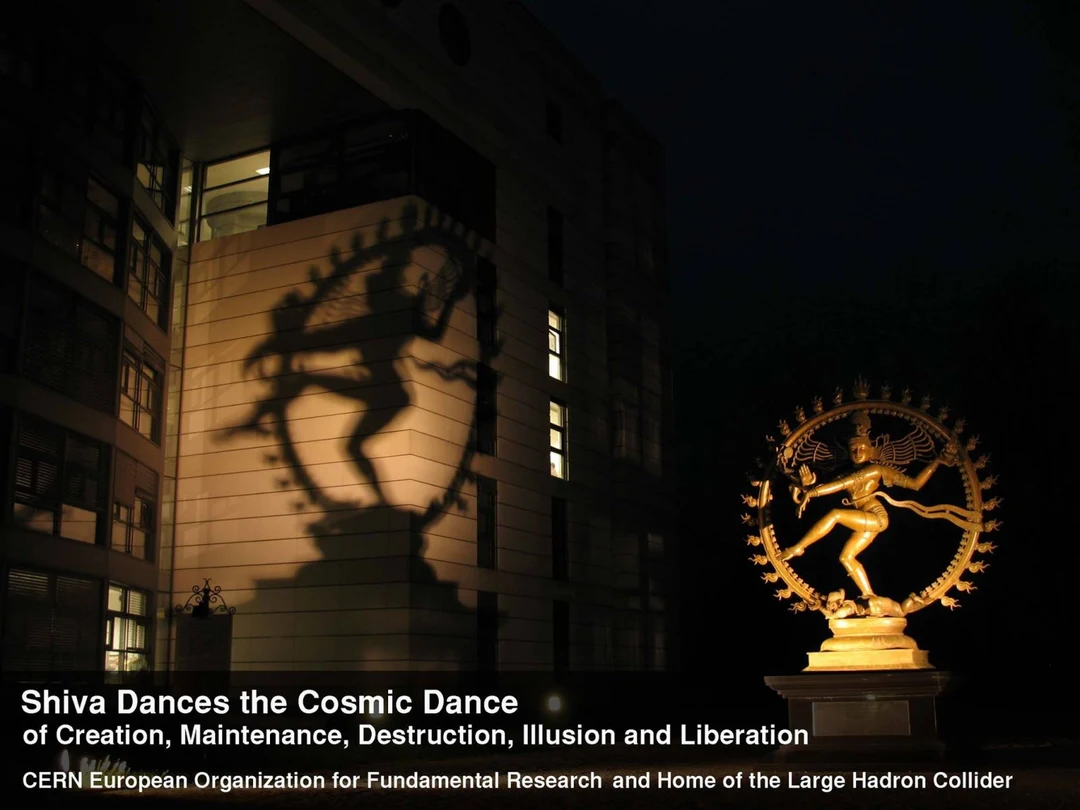
A night photograph of a golden statue of Nataraja, Shiva as the cosmic dancer, standing within a ring of flames on a pedestal at right. The statue's arms and flowing hair are lit gold against a dark sky. At left, a modern multi-storey building with lit windows carries a large projected shadow of the dancing Shiva figure across its facade. White text overlay at bottom reads that Shiva dances the cosmic dance of creation, maintenance, destruction, illusion and liberation, with a CERN European Organization for Fundamental Research and Large Hadron Collider caption. No physical people are visible.

MorningSatsang

8 photosSource gallery
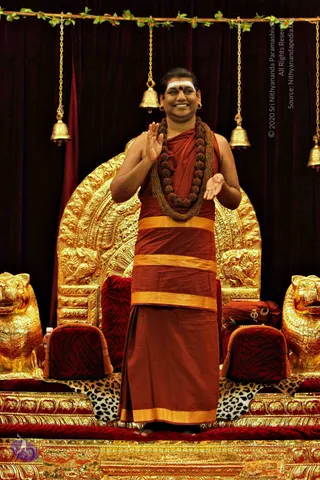
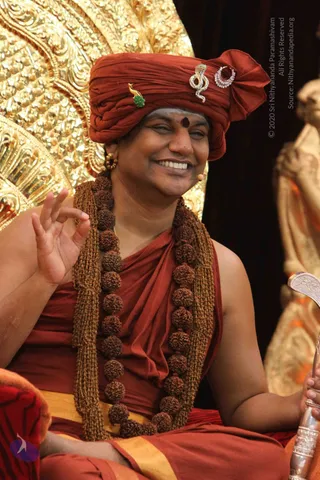
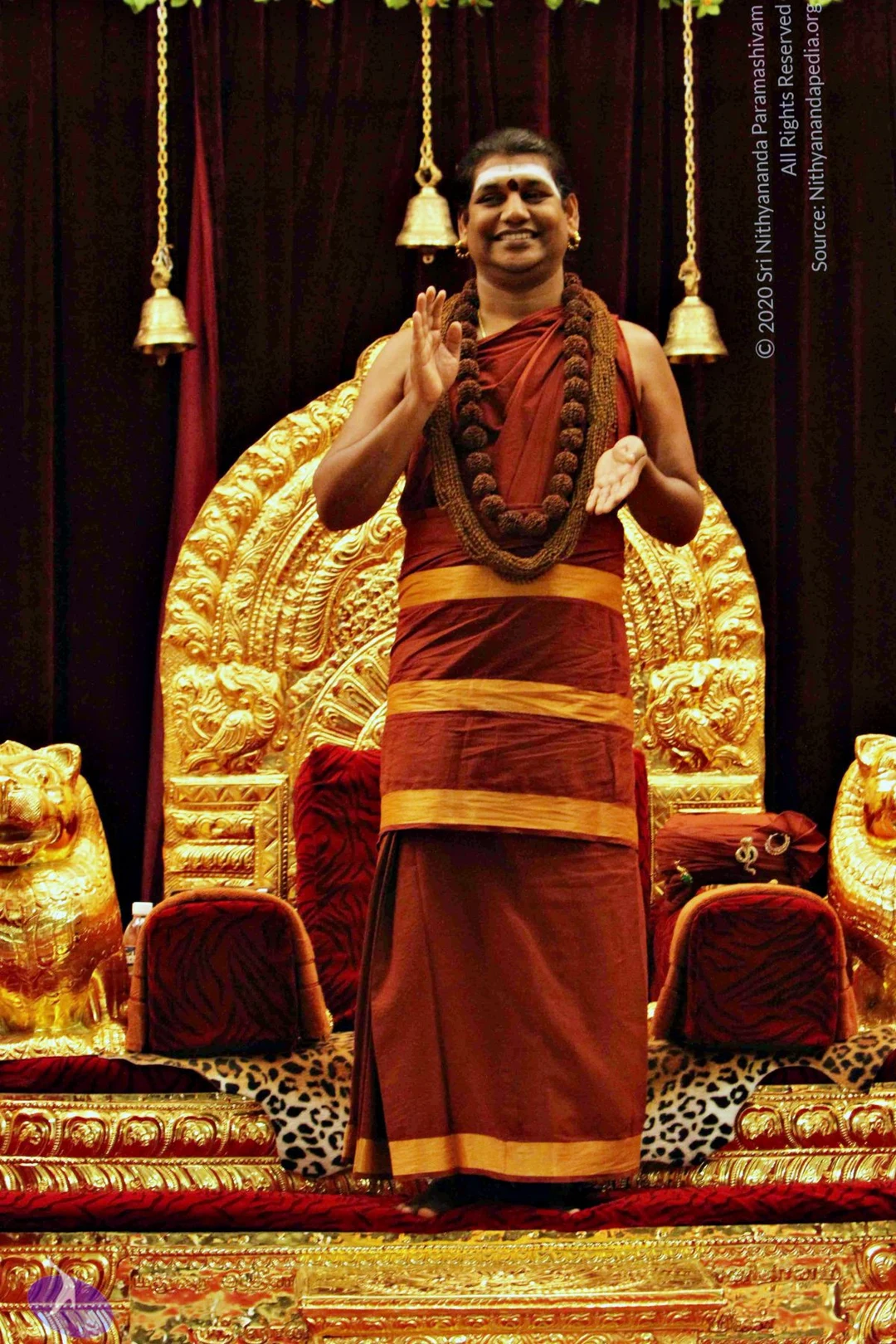
A smiling man in a rust-red and gold-bordered dhoti and upper cloth stands with palms pressed together in greeting before an ornate gold throne. He wears a long rudraksha mala with ornate gold accents, a white forehead marking with a red bindi, and gold earrings. Behind him hang golden bells on chains and dark red drapery. Two gold lion sculptures flank the throne, which has a red leopard-print cushion and a red bolster with a gold emblem. The figure's appearance, with rudraksha mala and gold adornments, is a probable match for a person addressing a satsang from the throne.A man stands before an ornate gilded throne with carved lion-head arms and lion statues at each side, in front of dark red drapes with hanging brass bells. He wears a maroon-red robe with wide gold-yellow bands at the waist and a long rudraksha mala around his neck, a white horizontal tilak with a red dot on his forehead, and gold earrings. He smiles and raises both palms in a welcoming gesture. Leopard-print cloth covers the dais. a person in appearance, with a maroon robe, rudraksha mala and gold throne setting; the page identifies him as a person at this event, but this is an appearance-based label.A man stands on a raised golden throne platform in front of a deep red velvet backdrop hung with brass bells and a garland of green leaves. He wears a rust-red dhoti and upper cloth with gold borders, a long mala of rudraksha beads around his neck, and a white vertical tilak with a red dot on his forehead. He smiles and raises both palms in a gesturing, teaching pose. Behind him stands an ornate gold chair flanked by gold lion sculptures, with a leopard-print cloth and red cushions. The figure's appearance, with rudraksha mala, red-and-gold robes and ceremonial throne setting, is consistent with the a person in the satsang setting, though this is an appearance-based label only.A man stands on a raised golden dais before an ornate gold throne carved with lion heads, with a dark maroon curtain behind and brass bells hanging from a garland-decorated rod above. He wears a rust-red and gold-bordered dhoti and upper cloth, a long rudraksha mala and a white vertical tilak with a red dot on his forehead. He raises both palms in a gesture of blessing while smiling. Leopard-print cushions and gold lion statues flank the throne. a person is visible in person, identified by the rudraksha mala, saffron-red robes and ceremonial setting.A standing man in a rust-red shawl and dhoti with gold borders, wearing a long multi-strand rudraksha mala, smiles and gestures with raised hands while speaking. A white tilak and red bindi mark his forehead, and small gold earrings are visible. He stands on a raised golden stage before an ornate gold throne with lion-head armrests, red tiger-striped cushions, a leopard-print mat, hanging brass bells and a garland of green leaves above. Appearance-based label: a person, a candidate by his rudraksha mala, rust-red clothing and ornate gold setting, but the face is not used to identify him.A smiling man in a deep red-orange turban adorned with a jeweled cobra and a crescent-shaped ornament, plus a green gem brooch, sits before an ornate gold carved backdrop. He wears a red-orange robe, a long mala of brown rudraksha beads over a gold-threaded shawl, a red bindi and gold earrings, and gestures with one raised hand while holding a silver-handled object at his right. A partial statue appears at the right edge. Swamiji (probable) is shown in this appearance-based label, with his turban, saffron-toned robes and rudraksha mala as the qualifying cues, seated and teaching.