Skip to content
Thursday

24 April 2014

Dated photos
46
Source pages
1
Media
2
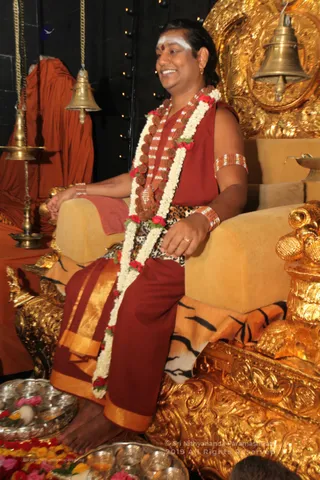
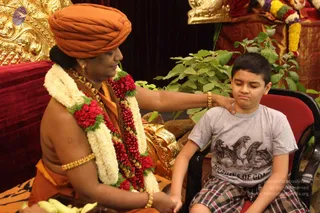
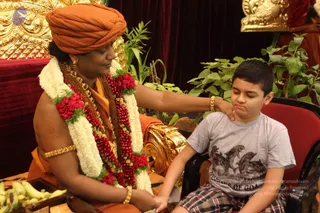
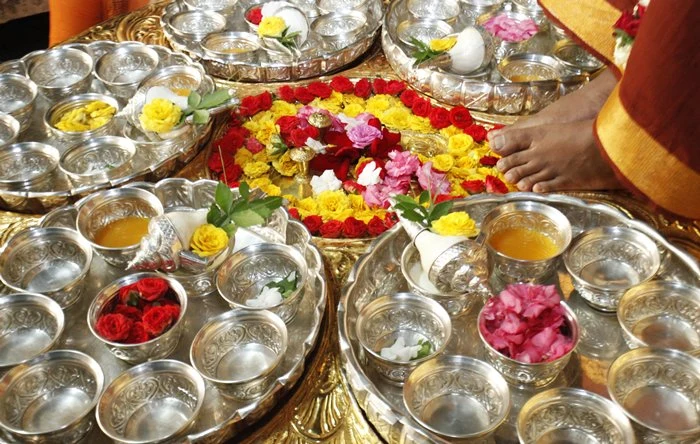
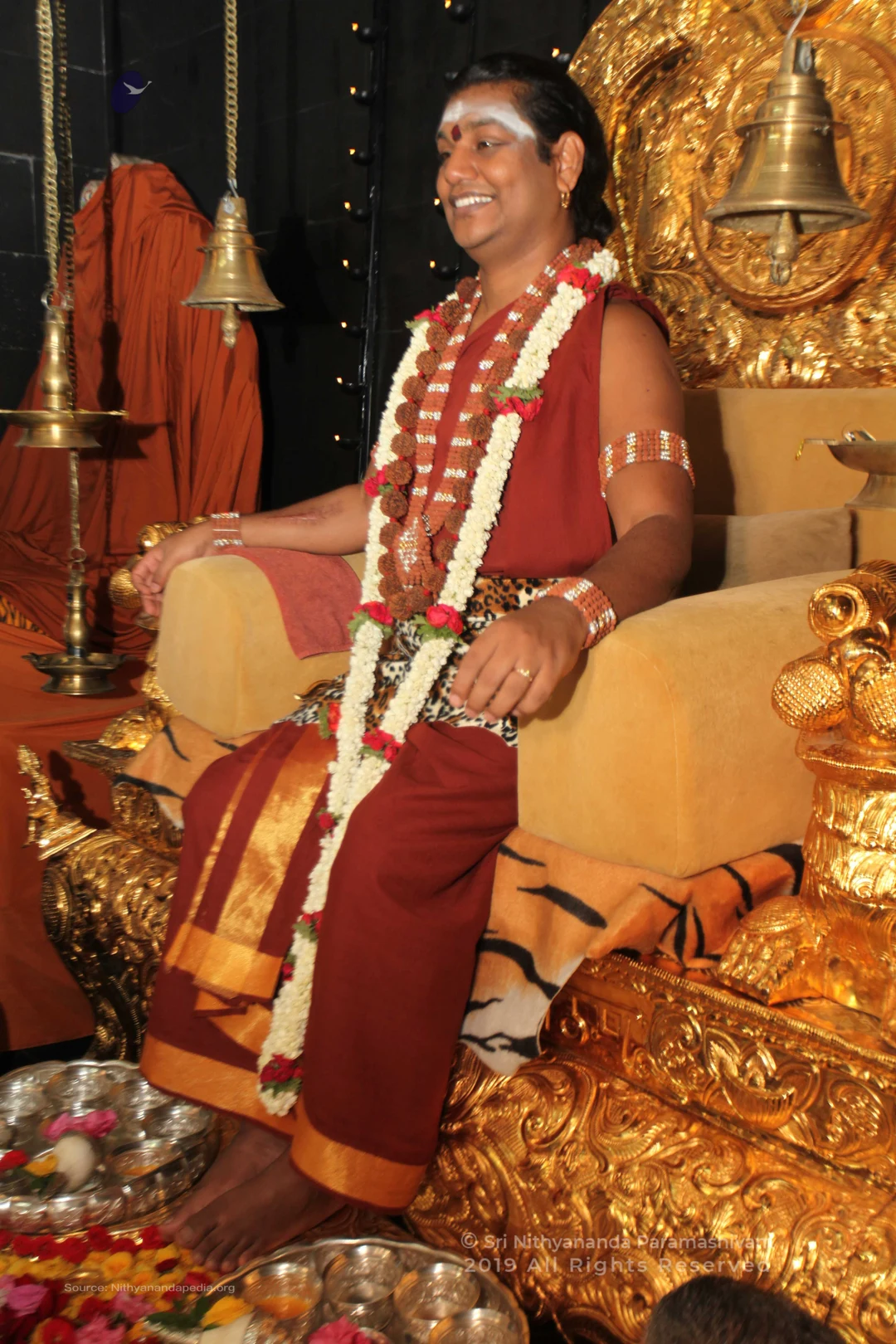
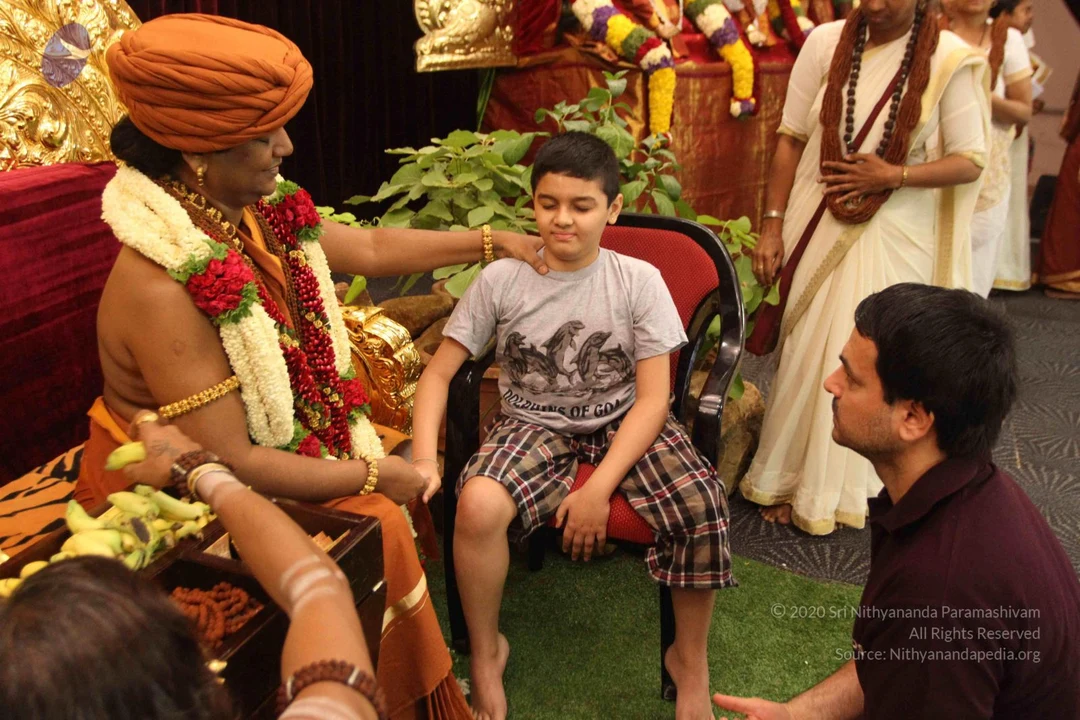
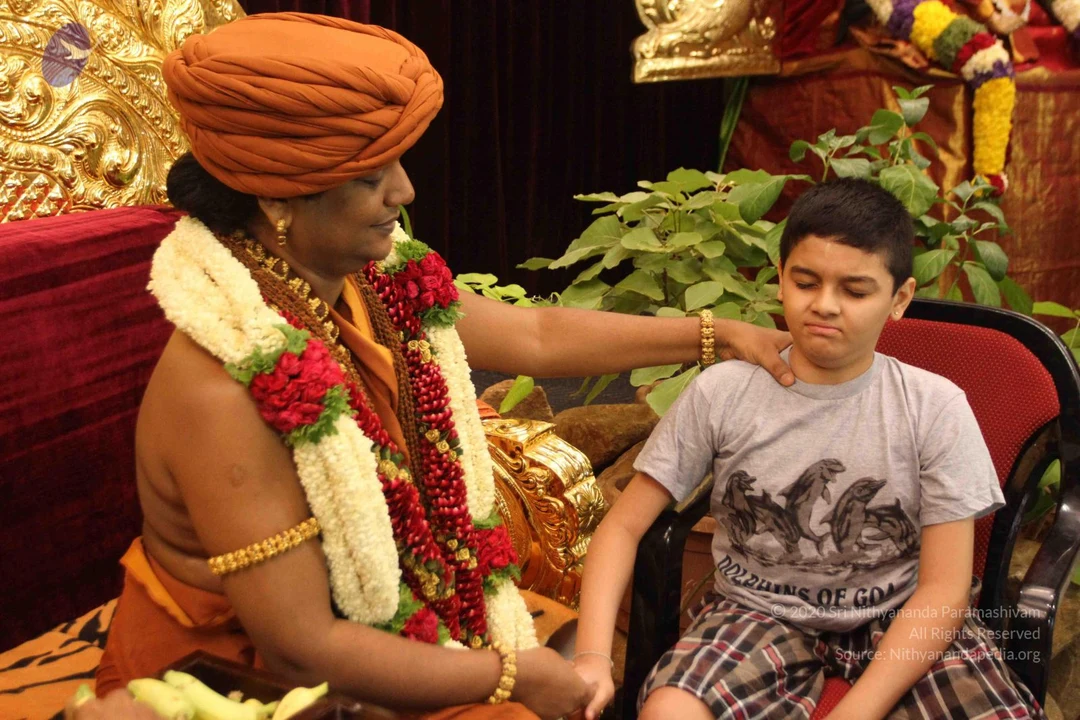
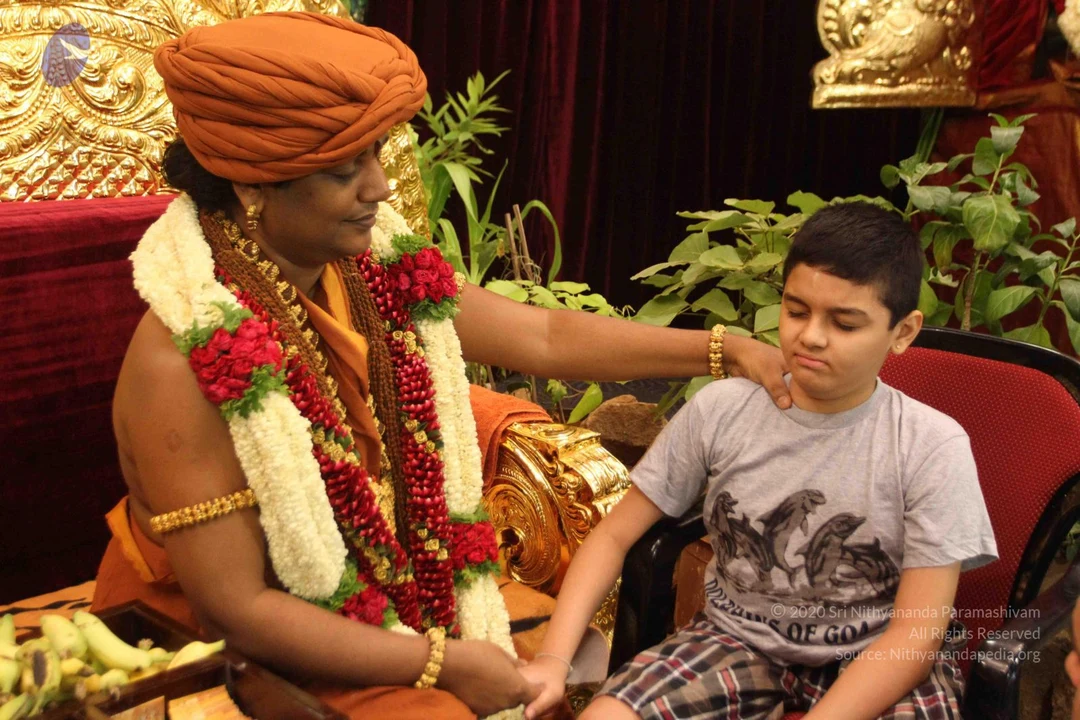
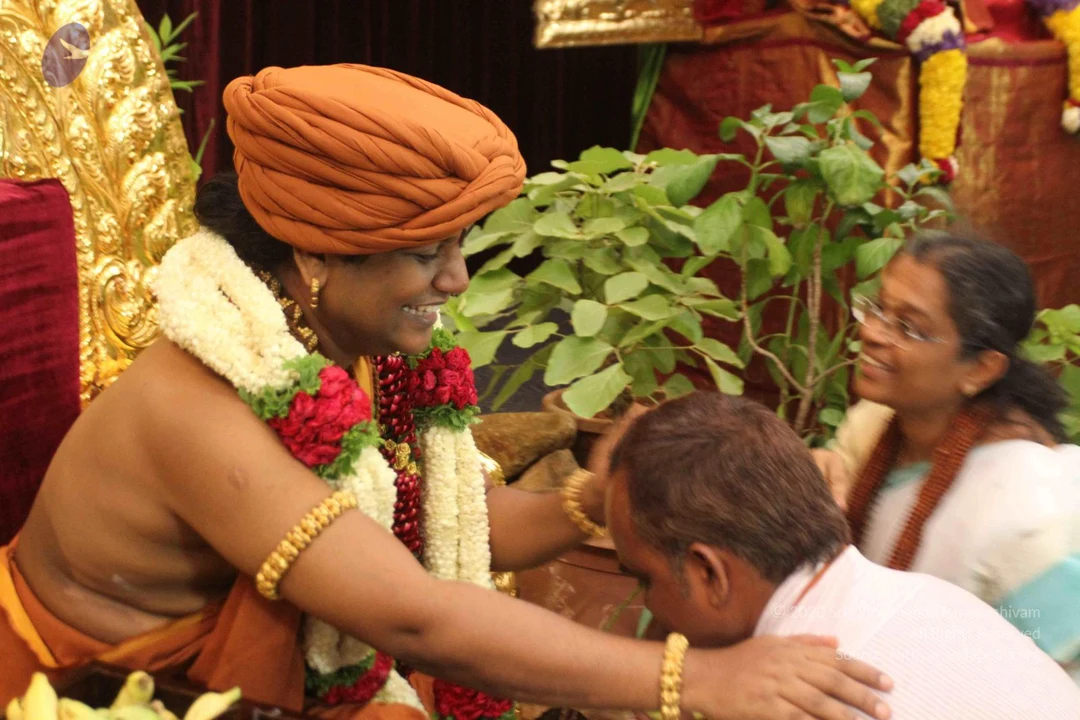
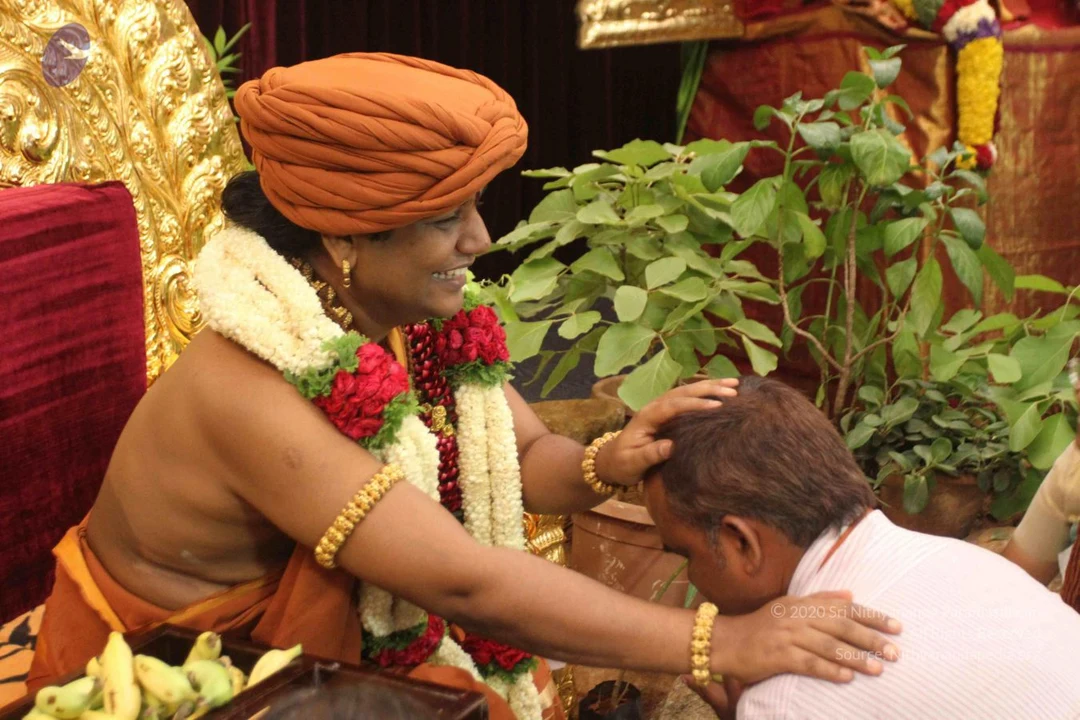
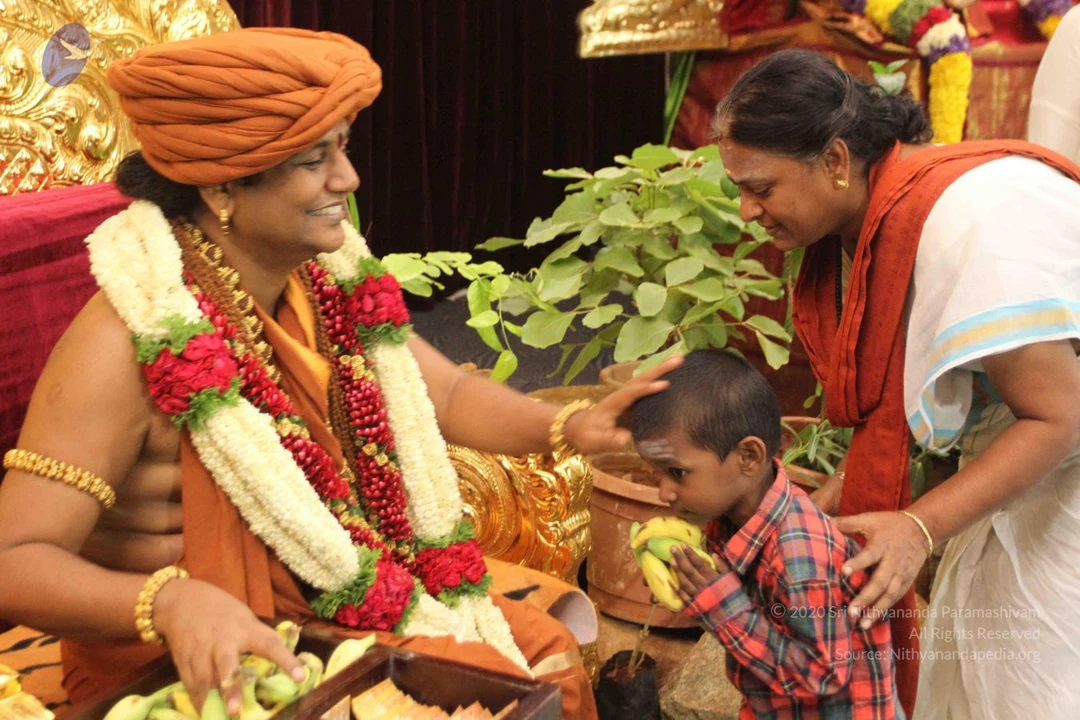
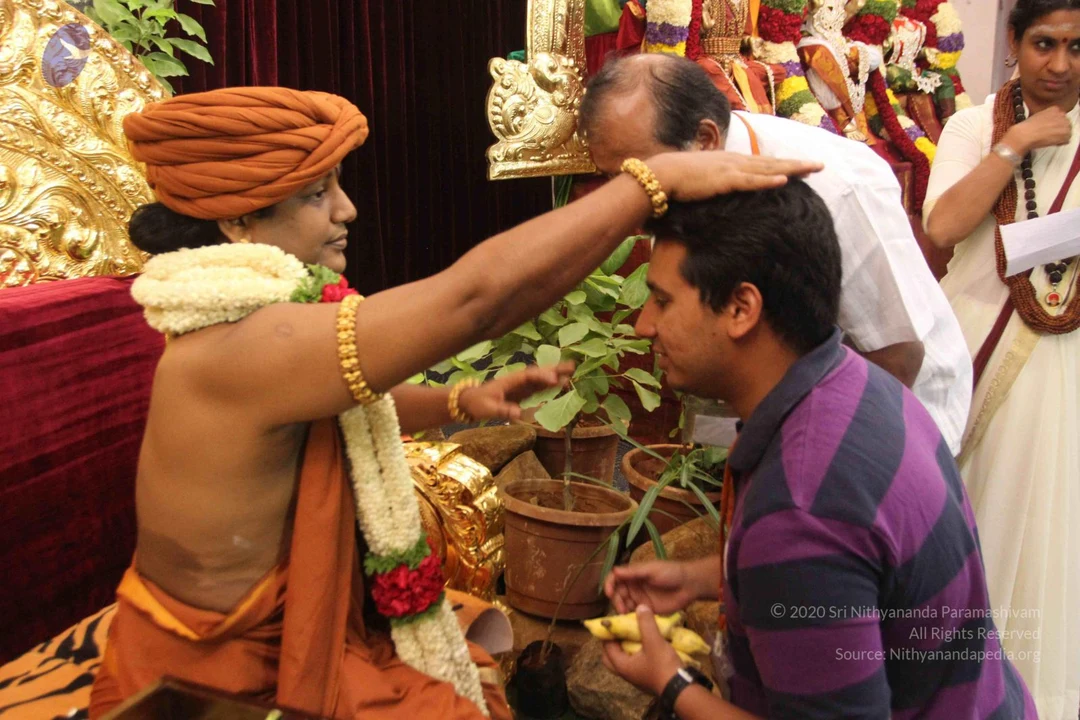
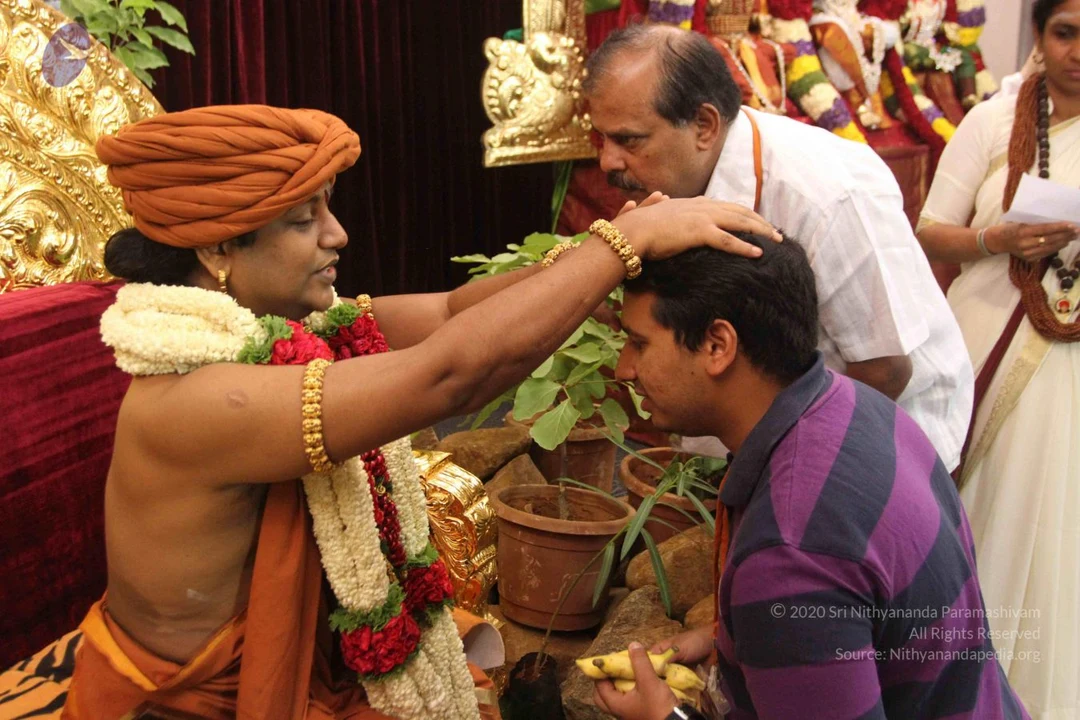
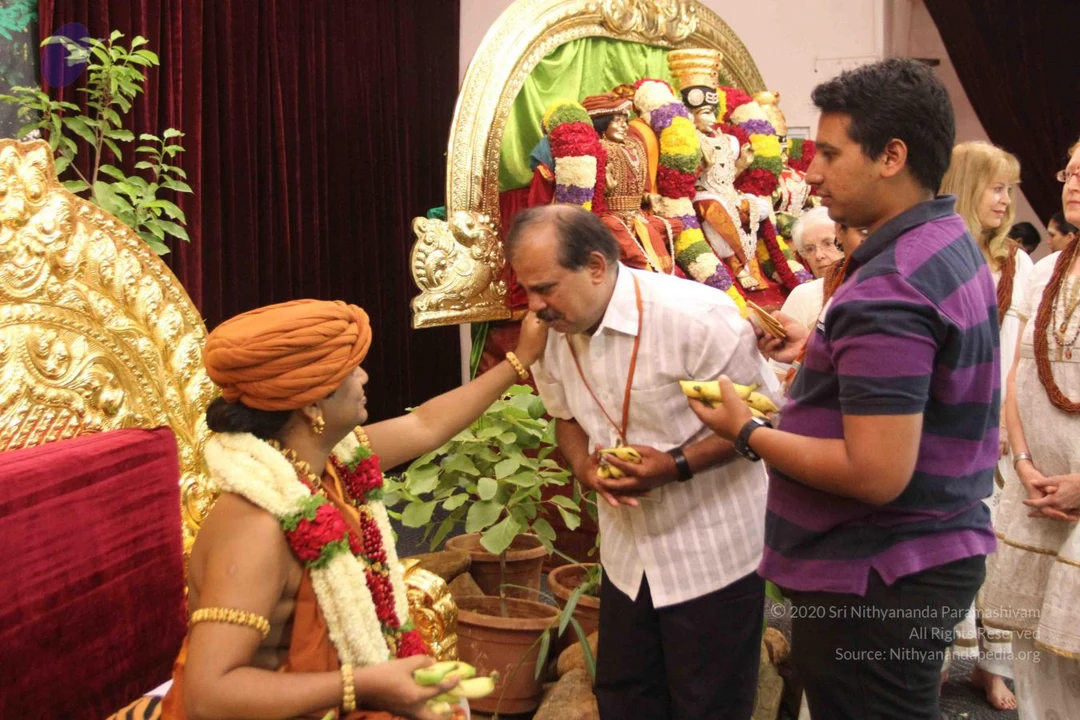
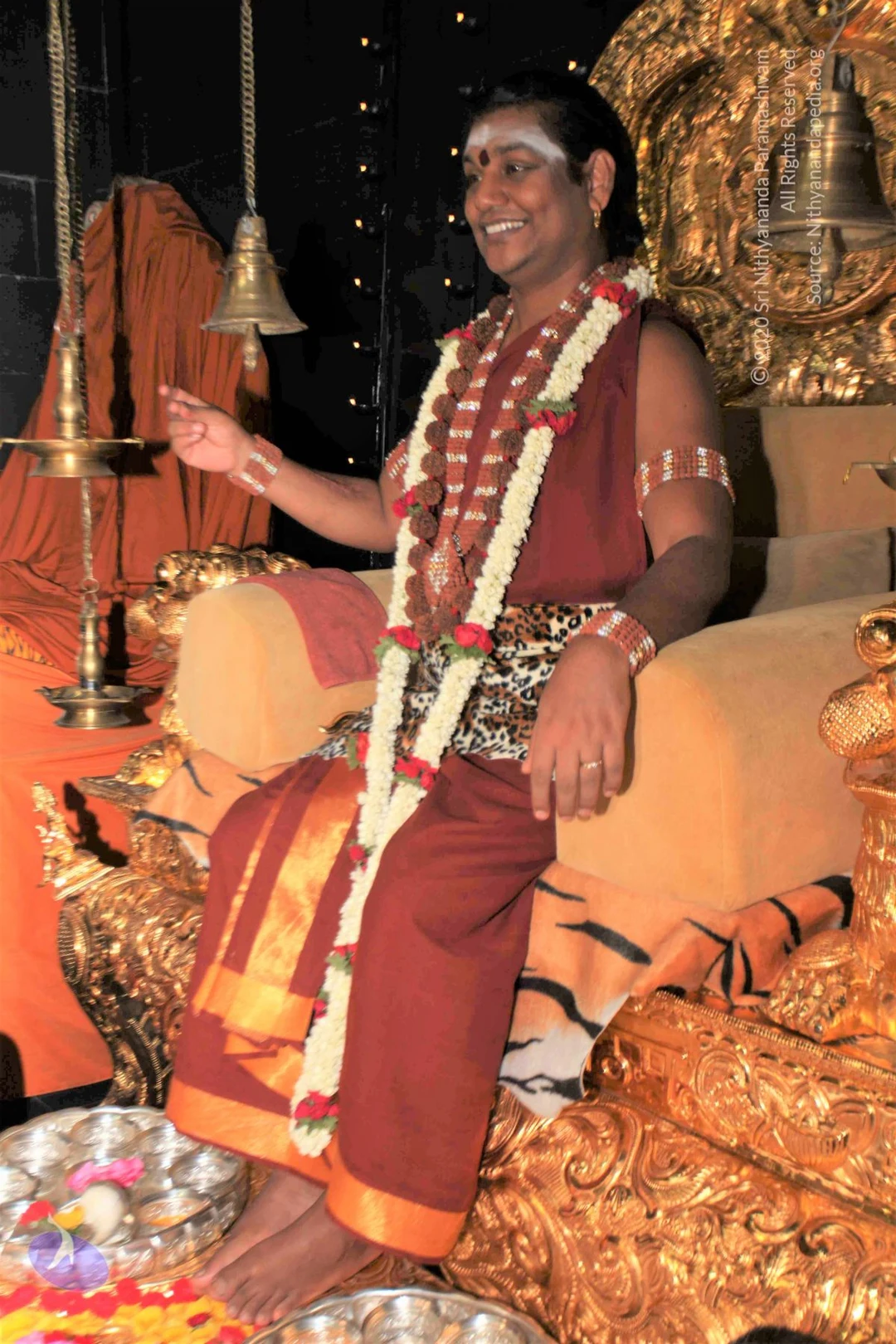
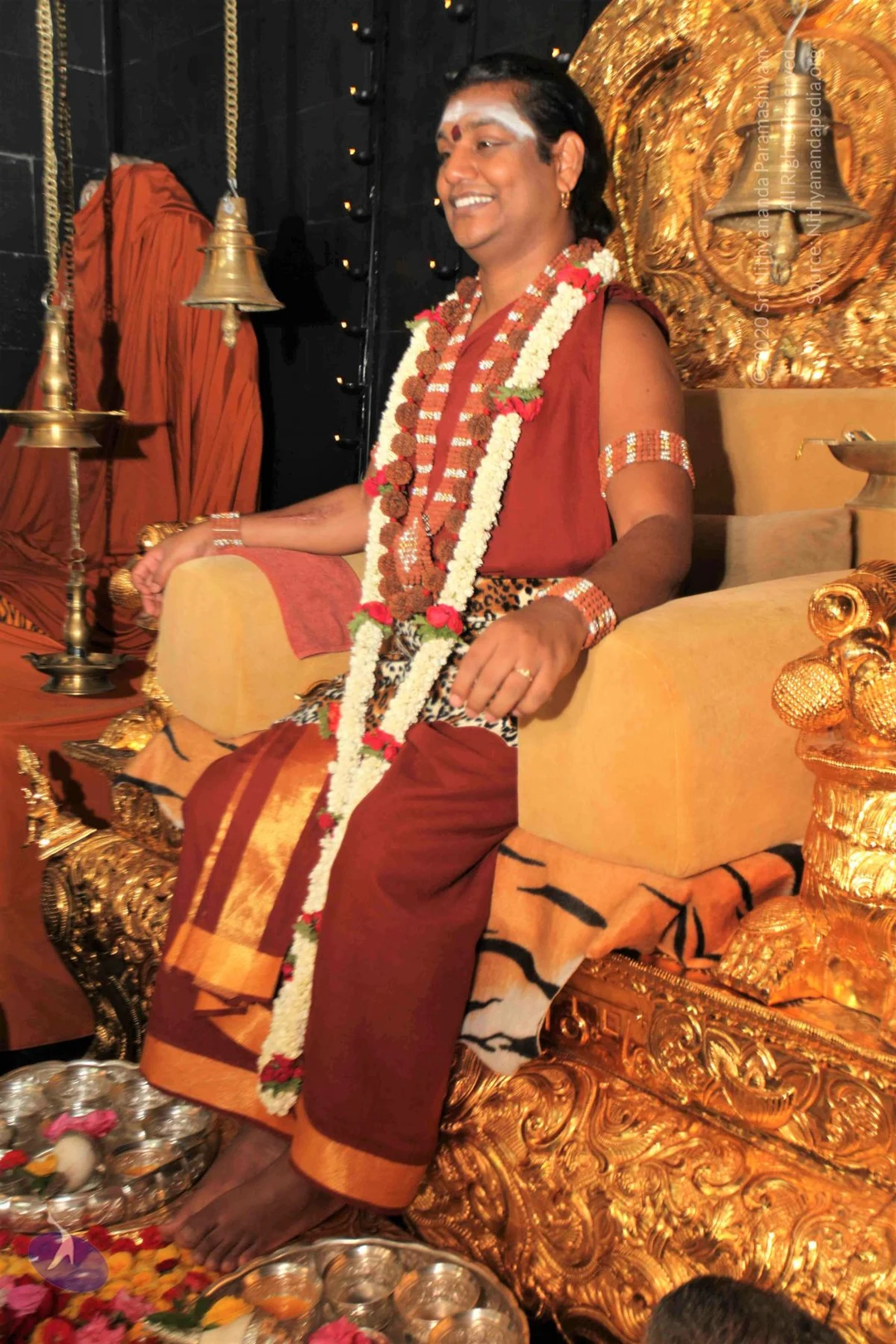
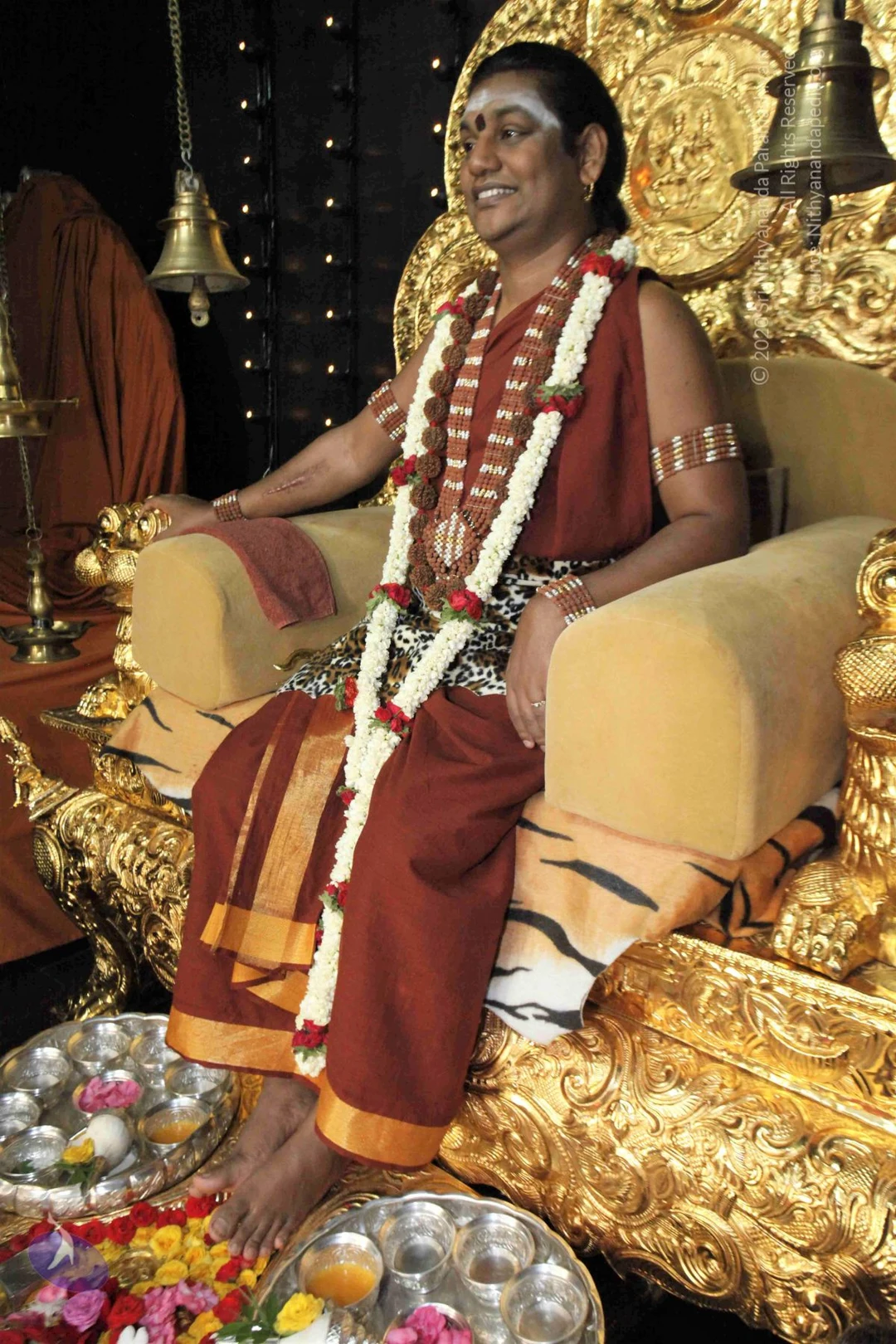
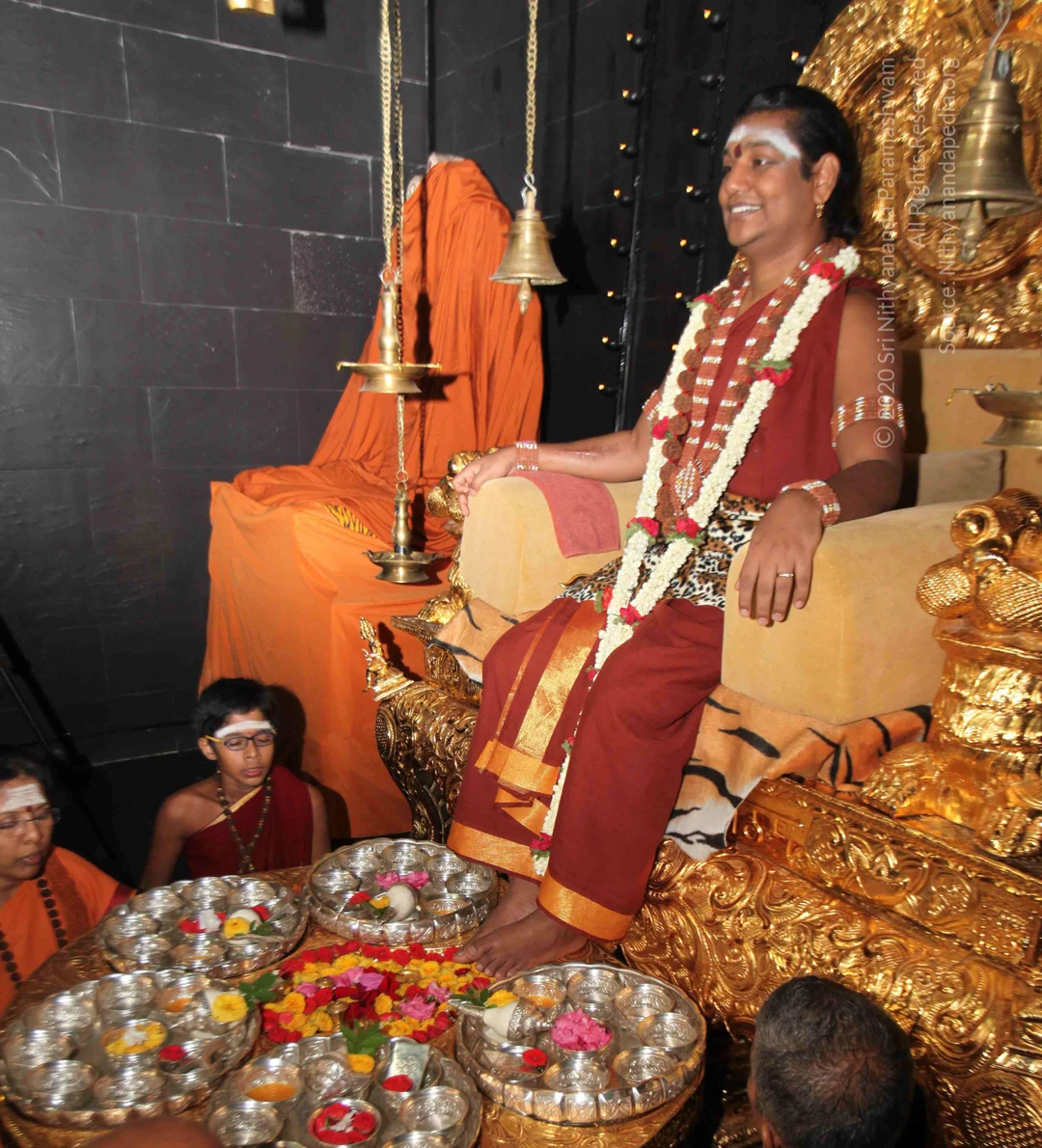
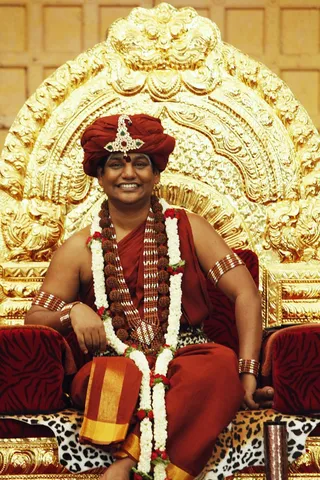
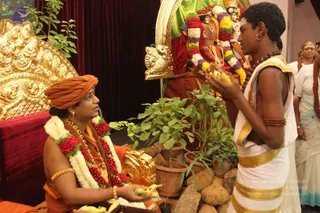
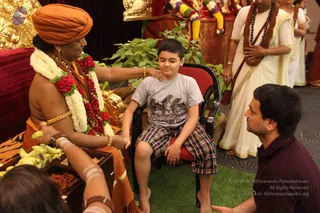
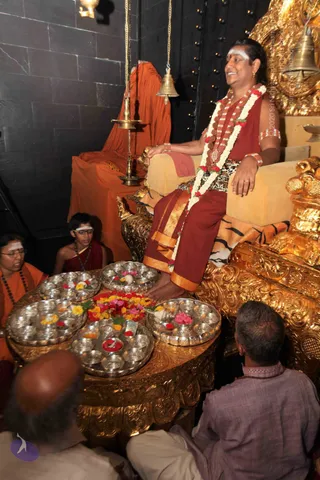
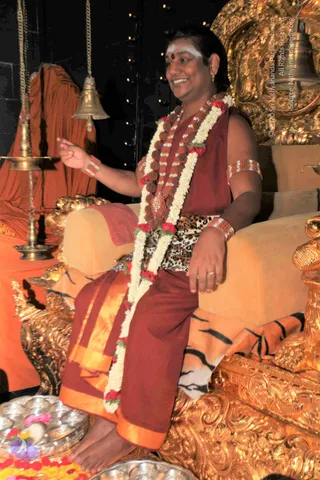
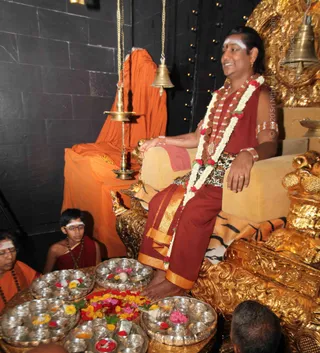
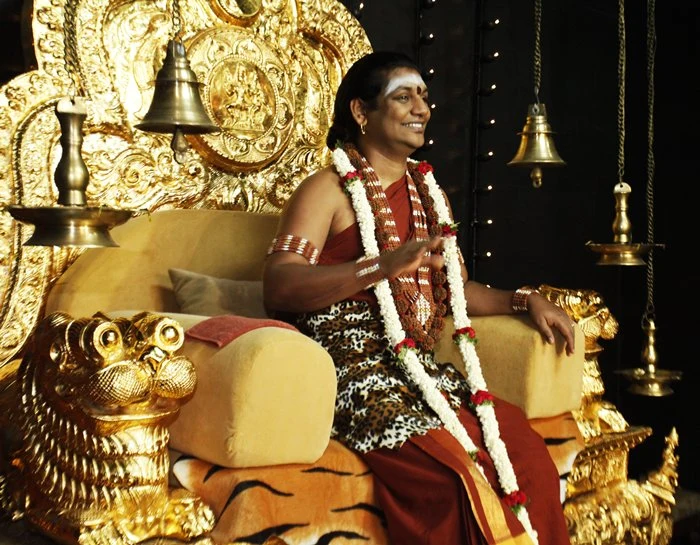
A smiling man seated on an ornate gold-carved throne with mustard velvet armrests, dressed in a maroon sleeveless garment and maroon dhoti with gold border, draped over a leopard-print cloth. He wears a long garland of white jasmine and red flowers over rudraksha beads, rudraksha bracelets on his arm and wrists, a white forehead marking with red bindi, and gold earrings. Behind him hang brass bells and an orange-robed figure stands nearby. Brass lamps and silver plates of flowers and offerings lie at his feet, with a scattered carpet of red and yellow petals.A seated person in an orange turban, orange garment and layered white and red flower garlands touches the shoulder of a seated boy in a grey graphic t-shirt and plaid shorts, who sits on a dark red chair with eyes closed. A gold-patterned throne and green potted plants stand in the background, with a gold-wrapped armrest and a tray of fruit at the lower left.A photograph of a seated person in an orange turban and saffron wrap wearing white and red flower garlands, gold necklaces and a gold armlet, with one hand resting on the shoulder of a young boy in a grey graphic t-shirt and plaid shorts seated in a red-cushioned chair. Behind them are gold-embossed throne panels, dark red drapery, green potted plants and a bunch of bananas at lower left. The boy appears to be receiving a blessing-like touch.

April 24 2014

Original wiki page
Contents

Description:

In today’s (24th April, 2014) morning Satsang, Paramahamsa Nithyananda told precisely how to build the authentic identity. He revealed that we have started believing that the No Mind State can be achieved by the messy mind. This is not true. The mind must be organized before jumping into the no mind state. We must jump from the Authentic Identity. Perpetual completion; bringing authenticity to your thinking, actions and words is how we should organize the mind.

Link to Video:

VideoAudio

Tags:

Paramahamsa Nithyananda, precisely how to build the authentic identity, No Mind state, true organized, Authentic Identity,perpetual completion, authenticity, thinking, actions, words, organize the mind.

Transcript:

Nithyanandeshwara Samaarambhaam

Nithyanandeshwari Madhyamaam |

Asmath Aachaarya Paryanthaam

Vandhey Guru Paramparaam ||

I welcome all the devotees, disciples, samajis, satsanghis, Shrimahants, Mahants, Kotharis, Thanedars, sitting with us all over the world through Nithyananda TV, Lotus News Channel, Sadhna TV, Eshwar TV, Janashree TV and in two-way video-conferencing having Nayana Deeksha in many countries all over the world.

Cities sitting with us in two-way video-conferencing having Nayana Deeksha: Oman-Sivagangai, Hong Kong, Doncaster-UK, Jorpati-Nepal, Teun Mun-Hong Kong, Dakota Dunes, Hyderabad-Gupta Kashi, Guadeloupe-Rameshwaram, Nithyananda University-Los Angeles, Nithyananda University-Paris, Nithyananda Nagaramu-Hyderabad, Nithyananda Nagara-Bidadi, Nithyananda Nagar-Tiruvannamalai, Ohio-Prayag, Oklahoma-Somanatham, Varanasi, San Jose-Madurai, Seattle-Chidambaram, Seremban-Malaysia, Singapore-Singapuram, Toronto-Kailasam, Vancouver-Bhubaneshwar, London-Kashi, Camus-Hong Kong, Devon-UK, High Point-North Carolina, Hong Kong-Sirkazhi, Houston-Kalahasti, Indrani-New Jersey, Abu Dhabi, Scottsdale-Arizona, Johns Creek-Georgia, Port Washington-New York, Winston-Salem-North Carolina. That’s it.

I welcome all of you with my love and respects.

Today I’ll teach precisely how to build the authentic identity.

First thing, one of the biggest mistake our bhaashyakaaraas, vaarthikakaaraas, tikakaaraas. Hinduism has commentators commenting on commentary, commenting on the commentary of the commentary. Please listen, Hinduism has commentators, people who comment on the commentary, people who comment on the commentary of the commentary. Bhaashyakaaras are commentators, vaarthikakaaraas are the commentators of the commentary, tikakaaraas are the commentators on the commentary of the commentary. Let me tell you the truth as it is, the stark reality.

Please understand, as a representative of Hinduism and Spiritual Head of one of the oldest apex bodies of Hinduism, now very recently coronated as one more Peetadhipathi of one of the oldest mathas, the name will soon be revealed. Listen, I am a representative of Hinduism. I don’t mean to disrespect Hinduism. But I need to tell you the problem we created for ourself. The stark reality is – a very big miss which led to a very big mess – we started thinking that the space of the “no-mind” can be directly achieved from this messy mind. Both your legs are tied with the chain in this mess mud, but you go on thinking you can just jump and fall into heaven. It is very unfortunate, the bhaashyakaaraas, vaarthikakaaras, tikakaaraas, of many of the Hindu philosophies. Usually Bhaashyakaaras means Shankara, Vaarthikakaaras means Sureshwaraachaarya. But, here, when I am using the word bhaashyakaara, vaarthikakaara, tikakaara, I am not mentioning them, I am not talking about them, I am talking about many people who tried to interpret, missed this, one of the important point: From the messy mind, you cannot take a jump into the “no-mind” space. Only from an organized mind, you can enter into “no-mind” space, beyond “mind” space.

Ramakrishna was able to catch it because Ramakrishna is an experiential expression. He says very clearly, ‘It is from Vidya Ahankaara only you can jump into the space of “no ahankaara”.

So the first thing all of us have to realize is, the authentic identity you are building is a spiritual practice. Only from this you can take the quantum jump of beyond identity, the space of beyond identity. We always think, ‘After all from the bridge if I am going to jump into the river why should I build the bridge?’ But without bridge if you directly try to jump into the river, you may die by hitting yourself on a rock. From the banks if you just try to jump into the river, what will happen? You may die on the rocks which are there in the banks! So, even to jump into the river, you need to find the right place from where you can really swim and enjoy the river. So you need to build a bridge even if you are going to jump into the river. You need to build an authentic identity even if you are going to enter into the space of “beyond identity”. That’s the first lesson.

Buddhism, I tell you – being one of the leaders of Hinduism, I tell you with all the respect – Buddhism did not miss this truth: You need to build mind to jump beyond mind. Very unfortunate, we missed it! We really missed it! A very bad miss! We were always imagining - just like that suddenly you can jump into. It is possible – I am not saying it is not possible – sudden enlightenment is possible, but it is not for mass. Very rare, few intelligent beings declare the sudden Completion like Valmiki, Ramadasa, Arunagirinatha Swamigal of Tiruvannamalai – not Arunagiri Yogishwara, but Arunagirinatha, a great devotee of Subramanya – Kanakadasa. There were, there are, there will be a few beings who had the spontaneous enlightenment, the sudden jump into the mindlessness, into the Cosmos, into the consciousness, declared Completion suddenly. But that is not a system; that is an exemption. Exemption cannot be celebrated as a system; that is one of the biggest mess and miss Hindus had.

Please understand, we SHOULD know our problems, only then we can correct it. The practices of building the mind, practices of building the mind – listen, I am using this word once more – the practices of building the mind is as important as practices of building the body like eating, sleeping. I wanted this as the punchline for today. Just like sleeping, Completion is required for mind. Just like eating, Authenticity is required for the mind. For body, eating; for mind, Authenticity. For body sleeping; for mind, Completion. Like how we eat whole day! If you don’t have work, you are only eating or drinking. Morning the moment you wake up, little fruit, two bread, one cup coffee; and then brush the teeth, finish one-two-three, come back and have just a few idlis, hot idlis-chutney-sambar; and then while you are driving to the office, little French fries and two-three burgers; then the moment you reach the office, Coca Cola! Whole day how you go on and on and on eating! There are some people who just faint the moment they hear about my disciples’ Nirahara! Forget about doing Nirahara, the moment they hear that my disciples, many of them live without food, they die, they faint! ‘Without eating?’

All of you should know I may not be directly conducting the Nirahara Samyama, but it goes on, thanks to, hats off to the sincerity of Sri Priyan and Nithya Devi! Twenty-seven batches of Nirahara Samyama, Level-1, Level-2, Level-3 is done successfully and it is going on. I wanted this to be part of our University syllabus also. Thanks to Sri Priyan and Nithya Devi’s sincerity. I am seeing regularly they put it in the Facebook, enrol the people, send the instructions, conduct the Nirahara Samyama.

Understand, just by listening about Nirahara Samyama, people die! Many people. Anyhow.

I just wanted you guys to know, Authenticity is much more important than eating. Same way, sleeping; Completion is much more important than sleeping. Whole day build your identity with Authenticity. See every step, every action, every inch, every step, every action, every inch, every thought goes on should get aligned to what you want to be.

Listen. The muscles which are not becoming part of your body only becomes tumour. Your thoughts and actions, words which are not becoming your authentic identity only becomes incompletion. Your incompletions receives energy from you. Your tumour grows from the energy supplied by your body. Don’t think your enemy is supplying energy to your tumour from somewhere. No, your enemy should not agitate you with the wrong beliefs. You should agitate your enemy with the right facts.

Understand, never allow yourself to be agitated by your enemies. Be very clear, no enemy can supply energy to your tumour. No enemy can supply energy to your inauthenticity. It is YOU who supply energy to your inauthenticity, YOU who supply energy to your tumour; nobody else!

So whole day you will see your thoughts, your actions, your words strengthen the inner-image, outer-image, others-image, life-image you want to create. Tuning your thoughts, words, actions to your authentic identity whole day and living is what I call “Perpetual Completion”. Listen. Perpetual Completion. Whole day, whole night, continuously, perpetually your thoughts, words, actions strengthening your authentic identity, is “Perpetual Completion”. If you want your identity to be very friendly, loving, never ever use a strong abusive word. Don’t think, ‘No I want to be friendly with that group, but with this fellow if I use an abusive word, what is wrong?’ No! That group may not listen to this word but the effect of this word will be there inside you which will be smelt by that group! You can never cheat yourself. So understand if you think logically you can hide information here, information there, life doesn’t work like that.

Bring Authenticity to your thinking, action, words. I tell you, the power Authenticity gives you! If you are my disciple, if you have lived around me and felt awed by the power I radiate. See I cannot compare, I cannot give any other explanation, definition; I can only speak from my experience. Please understand if you are my disciple, if you have lived around me, if you have experienced the power I radiate, if you have been awed by it, I just want to tell you one word, with all my Integrity I tell you: THAT COMES FROM AUTHENTICITY.

Practice Authenticity. I tell you, even if you are sitting in a secret cave and locking yourself and practicing Authenticity, the moment people see you, they will simply walk behind you. How do you think all these thousands of Adheenamites and Swamis and volunteers leaving everything behind and walking behind me? Neither then nor now I have a separate training session or the invitation session for Adheenamites. The Authenticity you radiate will make thousands of beings filled, understand? If you can speak into your listening, the words you utter will speak into millions of people’s listening. When your actions become authentic to you, you will have thousands of hands to act for you. When your words become authentic to you, your words will move millions of lives. When your thinking becomes authentic to you, you will be able to reproduce that same thinking in millions of people, understand? Just if you authentically align your thinking to your authentic image – your inner-image, outer-image, others-image, life-image – if you just align you to your Authenticity, suddenly your thinking will become so powerful, it’ll simply fill, inspire, show the path to millions!

Understand, I have nothing other than my authentic thinking but that is everything! I am not an intellectual, orator, doctorate, Ph.D., pachadi, kichadi, this University, that University. I do not have Degrees. In many countries when I enter that country they ask me, ‘What for you are coming?’ When I say, ‘to take classes’, they think I am going to attend classes – means, I am going to study there – because they don’t see any Degree, any qualifications in my papers. Then it takes a lot of time to make them understand I am going to teach. Anyhow. I don’t even have time to prepare for my satsanghs, nor I have mind to think and plan. I only have one strength – my Authenticity – which goes on producing the truths in a different, different, different, different way, the way it reaches you; that’s all.

I tell you, when your thinking has become authentic, every situation happening in your life, everywhere, you will be able to give solution for the individual and you will be able to inspire thousands, or I can say, millions with your authentic thinking.

Listen. Listen. Authentic thinking is an asset useful for you and for others for Janmas to come, for births to come.

So today ten minutes if you sit and align your words, thoughts, actions as you want your identity to be, this practice will be useful for you not tomorrow, day-after-tomorrow, but forever. For Janmas to come this is the wealth you earned already!

The wealth of outer world like a gems, dollar, precious metal, land, all these will be useful for you as long as you have this body. Once it is dead, it will not be useful for you. But actually I am working on creating a new system; I am already consciously scanning and studying how the Tibetan Lamas, Karmapas, reincarnations are recognized. So now I am going to make the same system. If you are a Mahant and build the Sangha, then you come back and join the Gurukul, then next birth you take charge of the same ashram and become the Shri mahant till you achieve enlightenment! No it is possible. It is possible the same birthmark will be there when you come back and with that you can be recognized.

See when you are alive during certain initiations, the high peak energy of your body is awakened. In that highest Kundalini moment, there are some specific tattoos which are put in your body in a very secret code and it is recorded in your Will. Next time when you come back, you will carry that same birthmark in same place in the same shape. It is possible. It is possible. How I am carrying the birthmark of this whole Bidadi map, Bidadi campus map is there as a birth mark. It is possible. Please understand, I am not talking some foolish superstitious things; I am talking a very practical, simple possibility. Because Tibetan Buddhists who are the 52nd Marhi of the Mahanirvani Akhada, have used this process, have used this technique.

Wealth can be useful only in one birth. Knowledge can be useful only in one birth. But Authenticity will be useful for Janmas, births after births after births. If you build the authentic identity, you don’t even need to have the birthmark to come back and reclaim your wealth. The moment you land, you will see everything is there around you. Many of our Krama Brahmacharis are “last time missed” only. Now they are back!

Bhagavad Gita very beautifully says, Bhagawan explains, ‘Even if you practice little of this Yoga, it will be a great help for you for your births and births and births to come, Janmas and Janmas and Janmas to come.’ I tell you, I’ll exactly say the same thing for your Authenticity. Even if you put a little energy and practice, it’ll help you so much.

Let me give you the exact practicing technique:

Sit and see: This action you are doing is it furthering the identity you want to build, or is it compromising? The thinking you are having, is it furthering the identity you want to build?

See, you want to have the identity of “always blissful”, but you are all the time worried and depressed and go on encouraging the thought-trend of depression, thinking that one day Swamiji will touch you on your forehead, and suddenly the bliss will happen, and after that I’ll always be blissful, now I’ll continue to be worrying as I am .’ Whom are you cheating? I can only put fire. Whether to be a banana tree or a bomb is up to you. I can only put fire. If you are a camphor you will just catch. If you are a banana tree, fire will be put off. If you are a bomb, not only you will catch, you will explode and burn everything else around you! Banana tree is the fools who miss the Guru. Camphor are the enlightened beings. Bombs are my Sannyasis! Understand. But end of the day I can only put my fire nothing else.

Understand, building Authenticity is perpetual Completion. That should be your perpetual spiritual practice.

People ask me, ‘Swamiji, so many organizations have so many different spiritual practices. What should be the continuous spiritual practice for our Sangha, our devotees? Should we do Ajapa Japa? Should we do this mantra? Should we do the Unclutching?’

Now, I tell you: Perpetual Completion should be the perpetual spiritual practice for all my disciples! That should be the message for the whole universe, the whole humanity.

I bless you all. Let you all radiate with Integrity, Authenticity, Responsibility, Enriching and Causing eternal bliss, Nithyananda. Thank you.

Photos

Pada Puja
Nithya Satsang
Photos Of The Day:

Photos Of The Day:

NKY-Bidadi-Day2
Photos Of The Day:

Pada-Puja-EDITED-READY-TO-PUBLISH
Nithya-Satsang-EDITED-READY-TO-PUBLISH
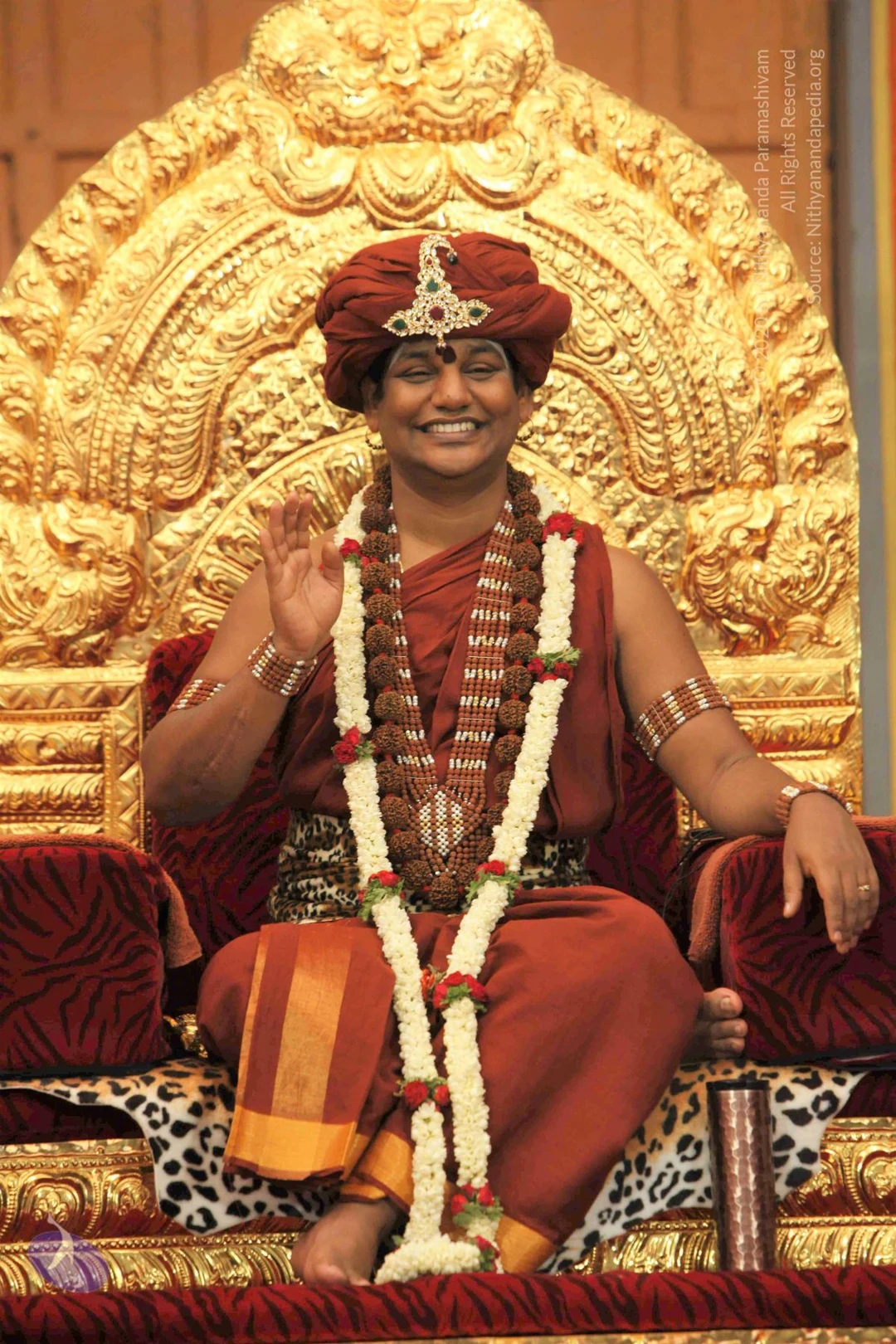
Kalpataru-EDITED-READY-TO-PUBLISH

01-Pada-Puja

IMG_1165_CMP_WM

03-Kalpataru

Photos from this day

View all 46 photos

Pada Puja

3 photosSource gallery
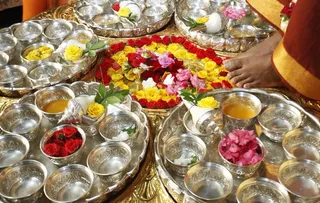
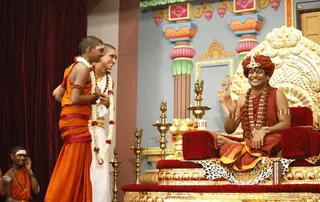
A photograph of a seated person on an ornate gold throne carved with lion-headed arms and a gilded backrest. The person wears a rust-red blouse and a leopard-print garment, with a white and red flower garland draped over the shoulders, a rudraksha mala, and wrist bangles. A white forehead mark is visible, and the person smiles while gesturing with one hand. Brass hanging lamps and bells stand beside the throne against a dark background with small fairy lights. The throne has a tiger-striped cushion at its base.Close view of a padapuja offering arrangement on a golden tray. Red, yellow and pink rose petals form a central pattern, surrounded by silver bowls holding honey, rose petals, yellow flowers and red roses on silver platters. A bare foot in the lower right, with an orange-saffron garment edge, rests near the flowers. No face is visible, so the identity of the person is uncertain.A seated man on an ornate gold throne with red cushions and a leopard-print cloth smiles broadly and raises his right hand in blessing. He wears a red-orange turban, a rudraksha mala, ceremonial gold necklaces and armbands, and a saffron robe. Two standing men in orange-saffron robes face him: one with a shaved head and an orange shawl, the other in a white dhoti with a garland of white flowers, both with white forehead markings. A small figure in orange robes is partly visible at the lower left. Brass oil lamps stand on the dais and a golden peetha backdrop with pillars is behind them. Swamiji (probable) is the seated figure on the throne, wearing a red-orange turban, rudraksha mala and gold ornaments, in a blessing gesture.

Nithya Satsang

8 photosSource gallery
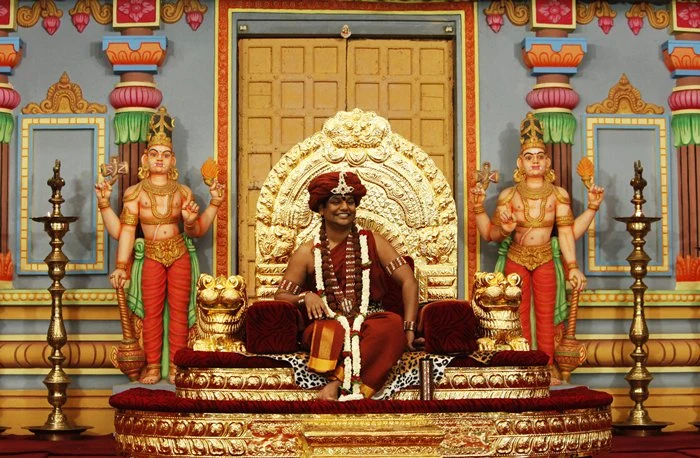
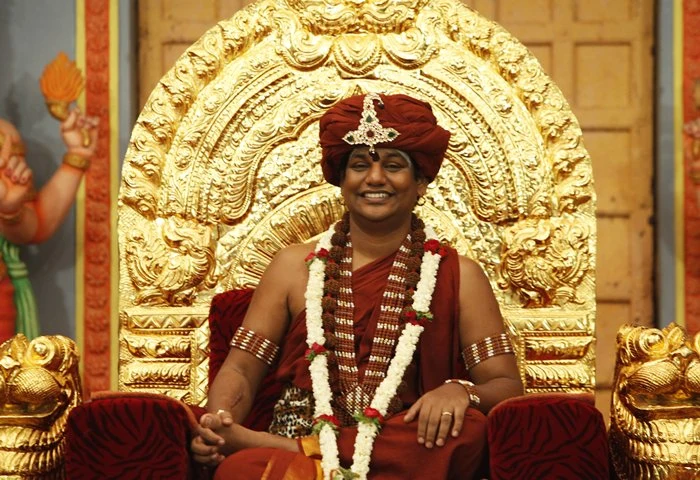
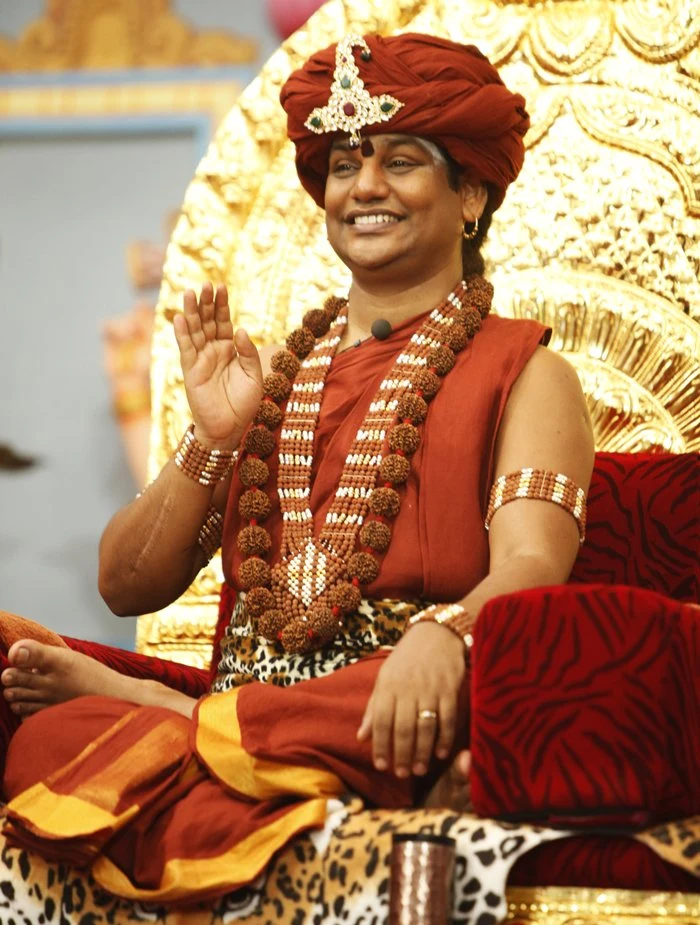
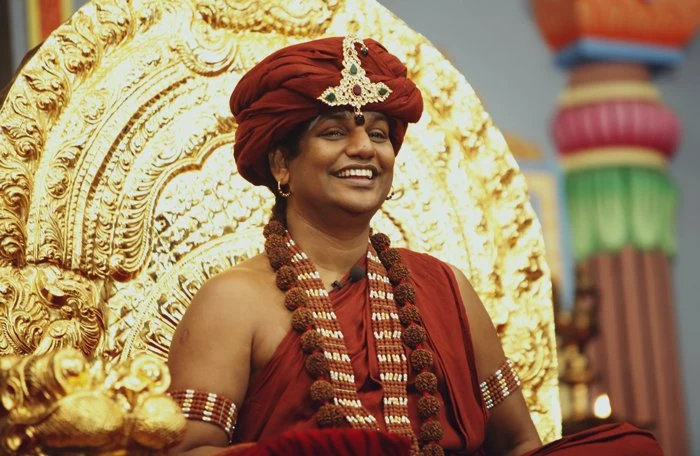
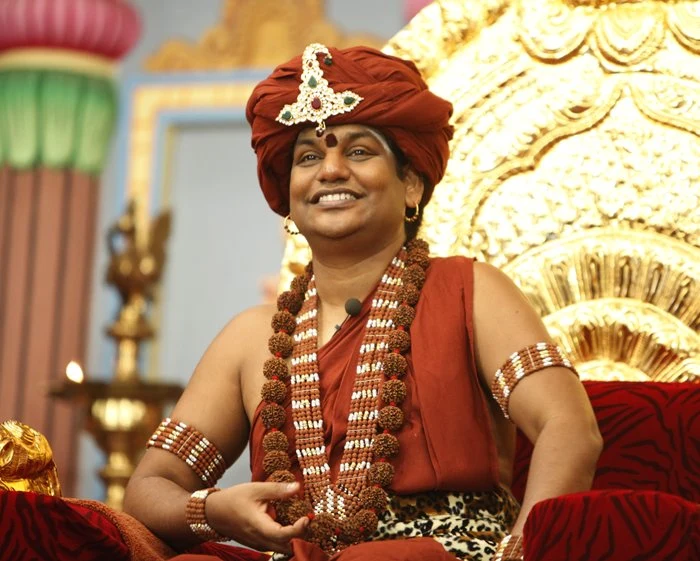
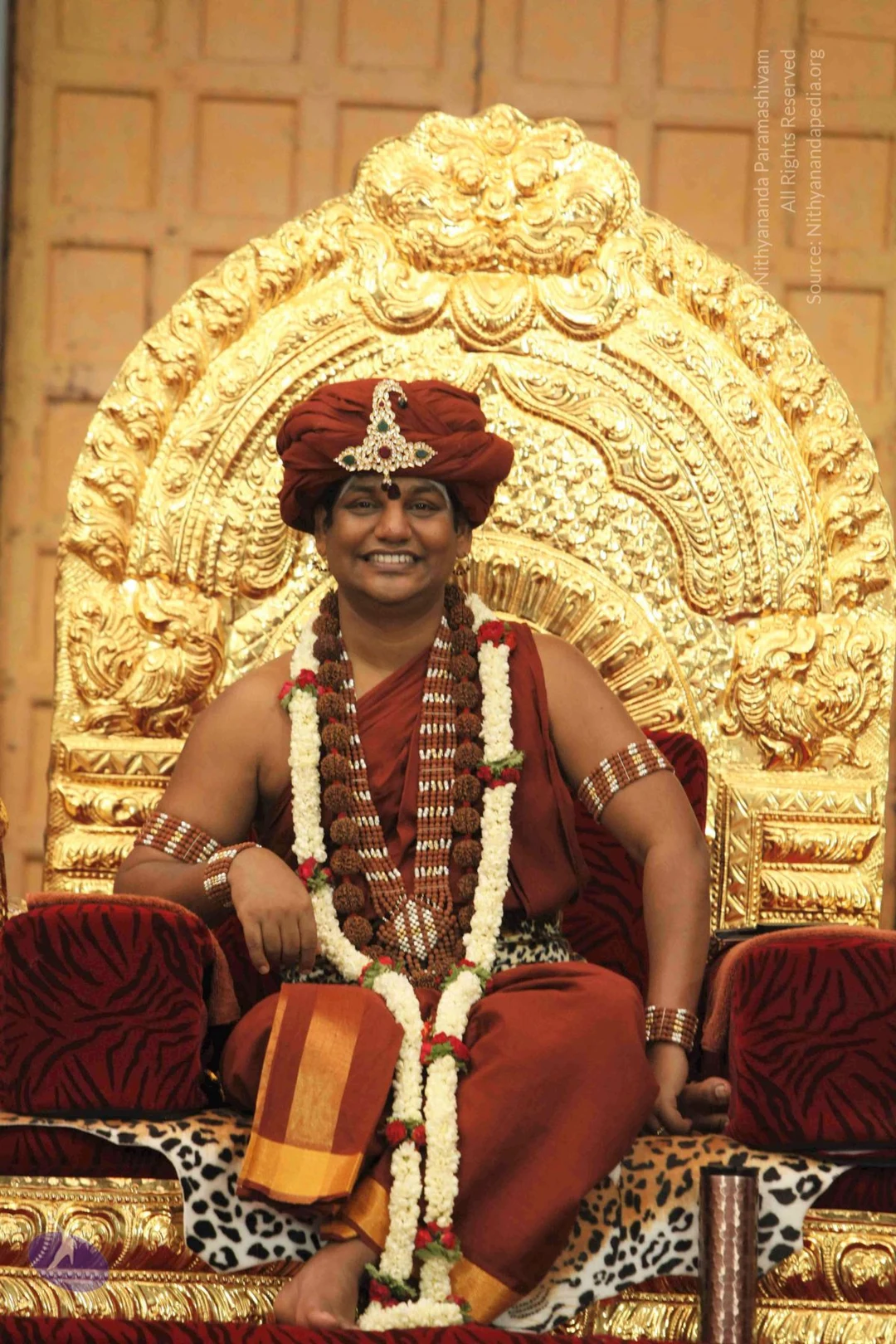
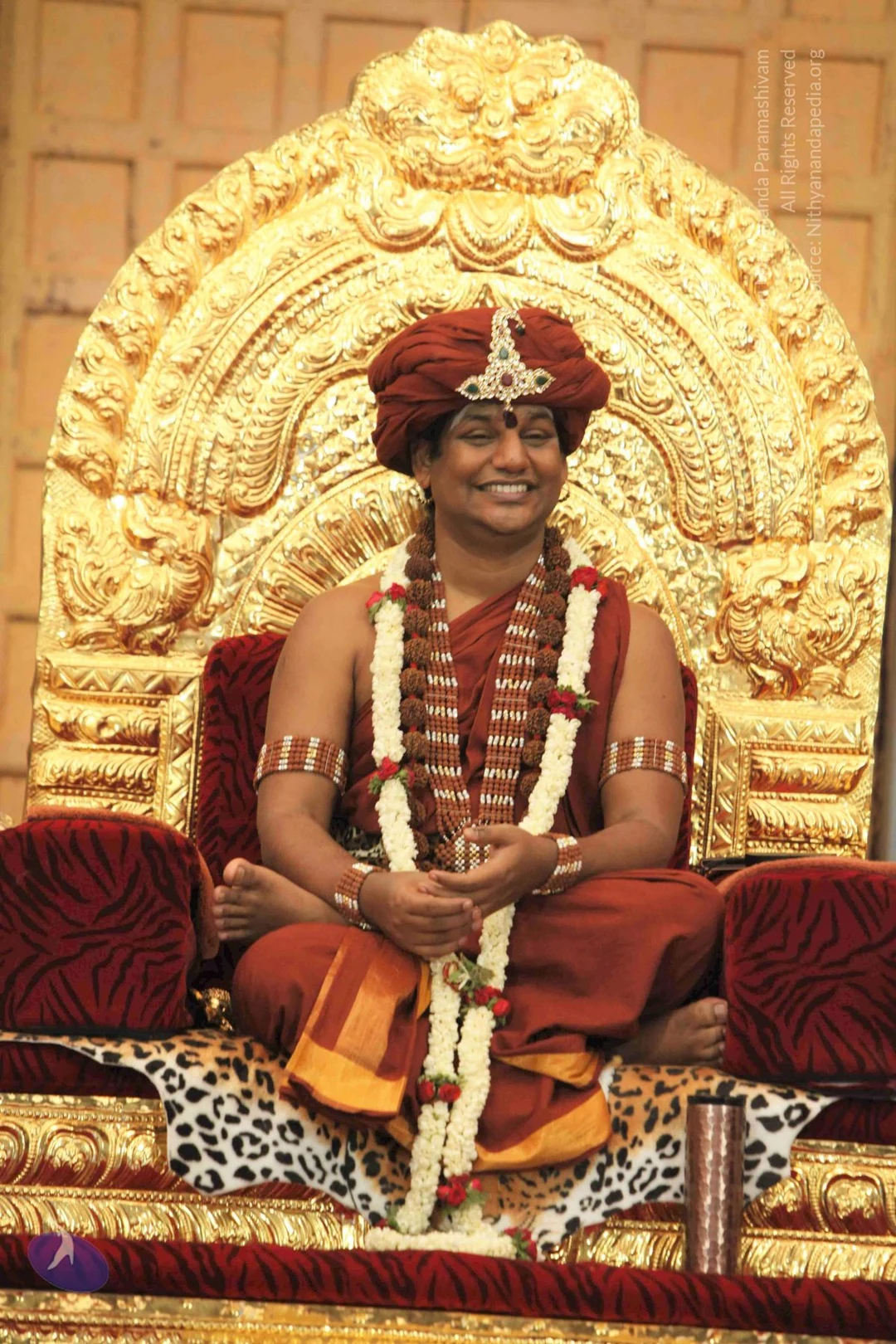
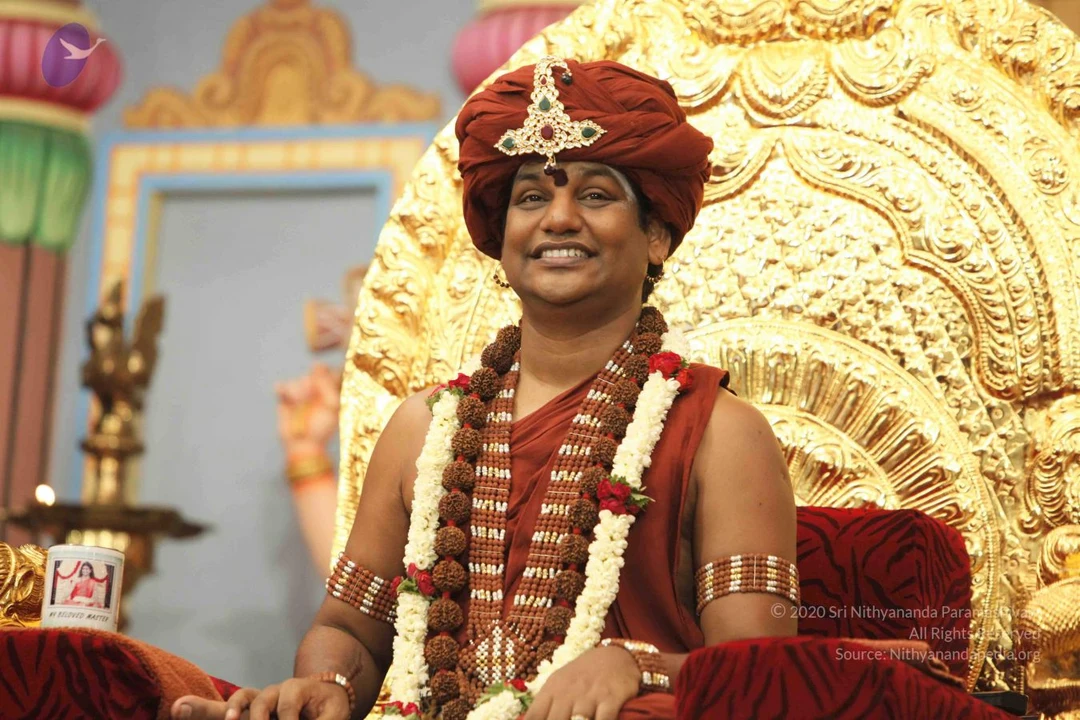
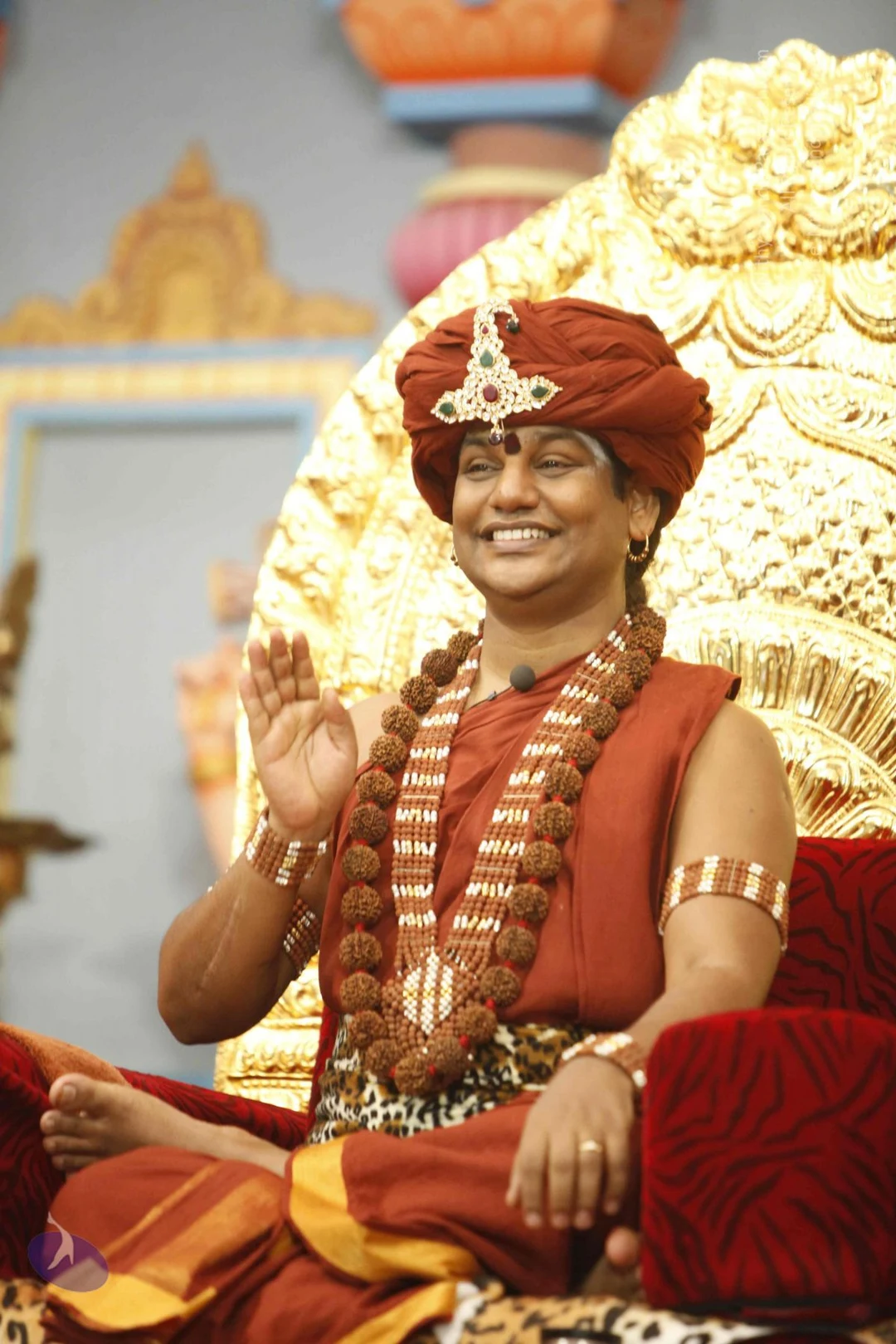
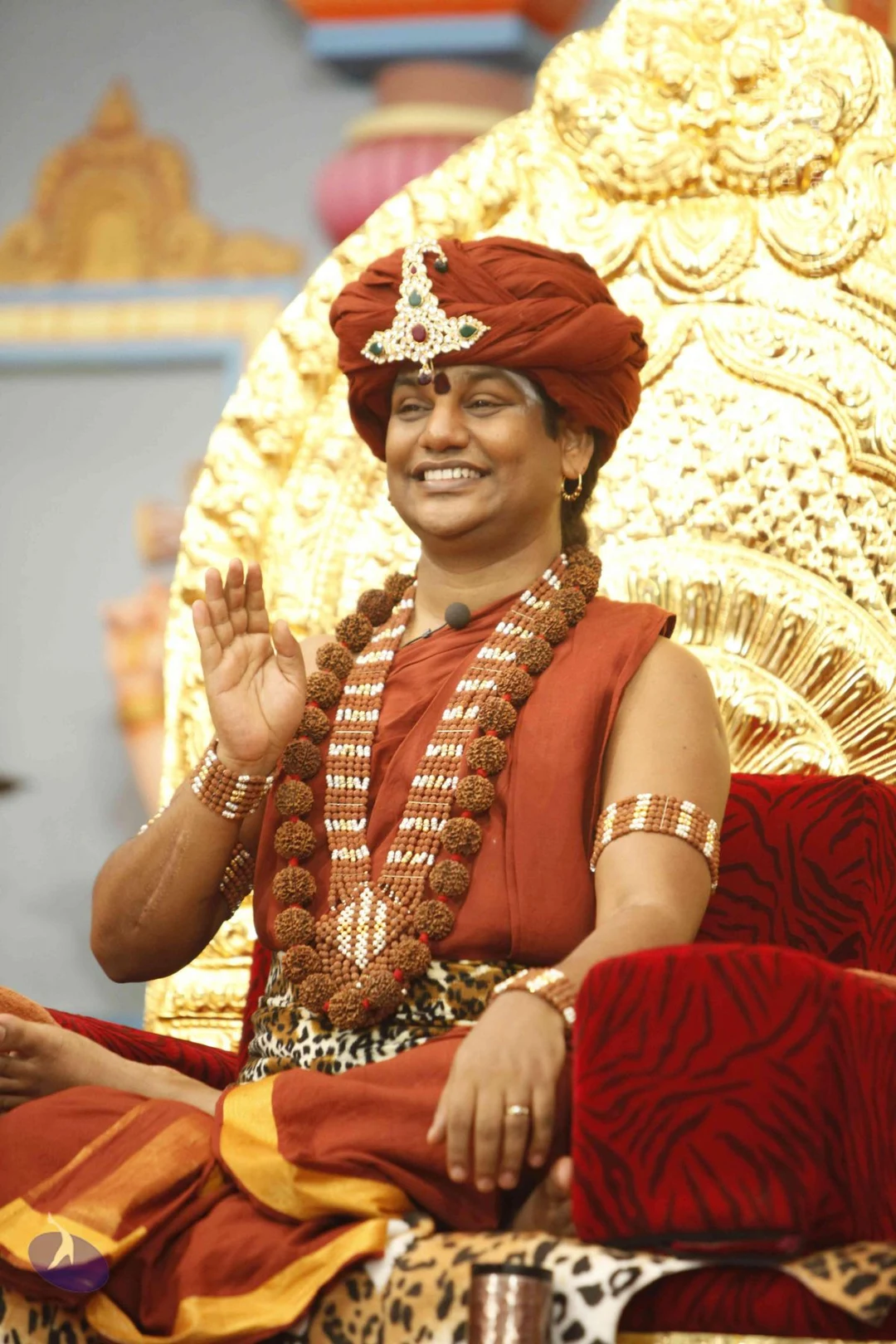
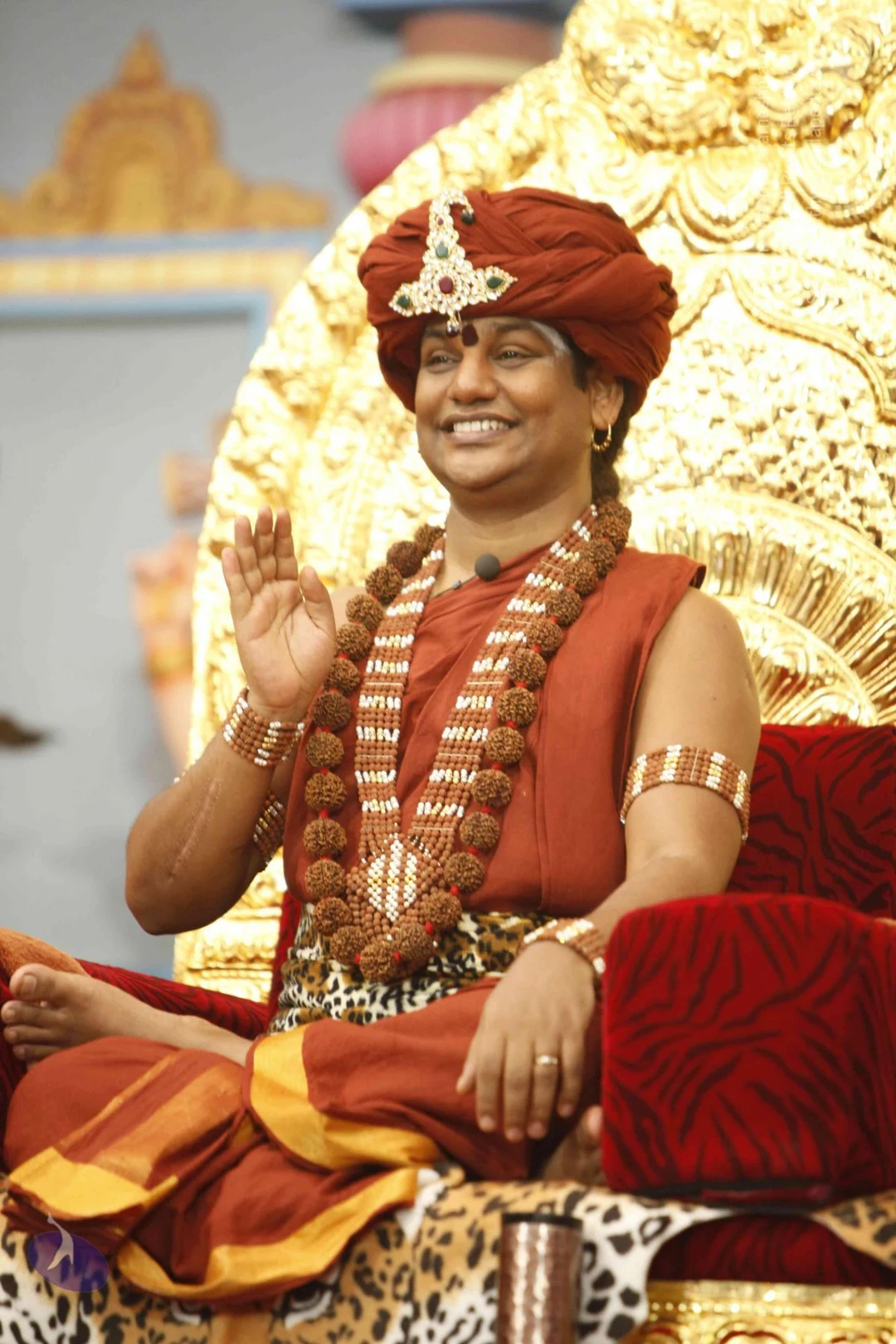
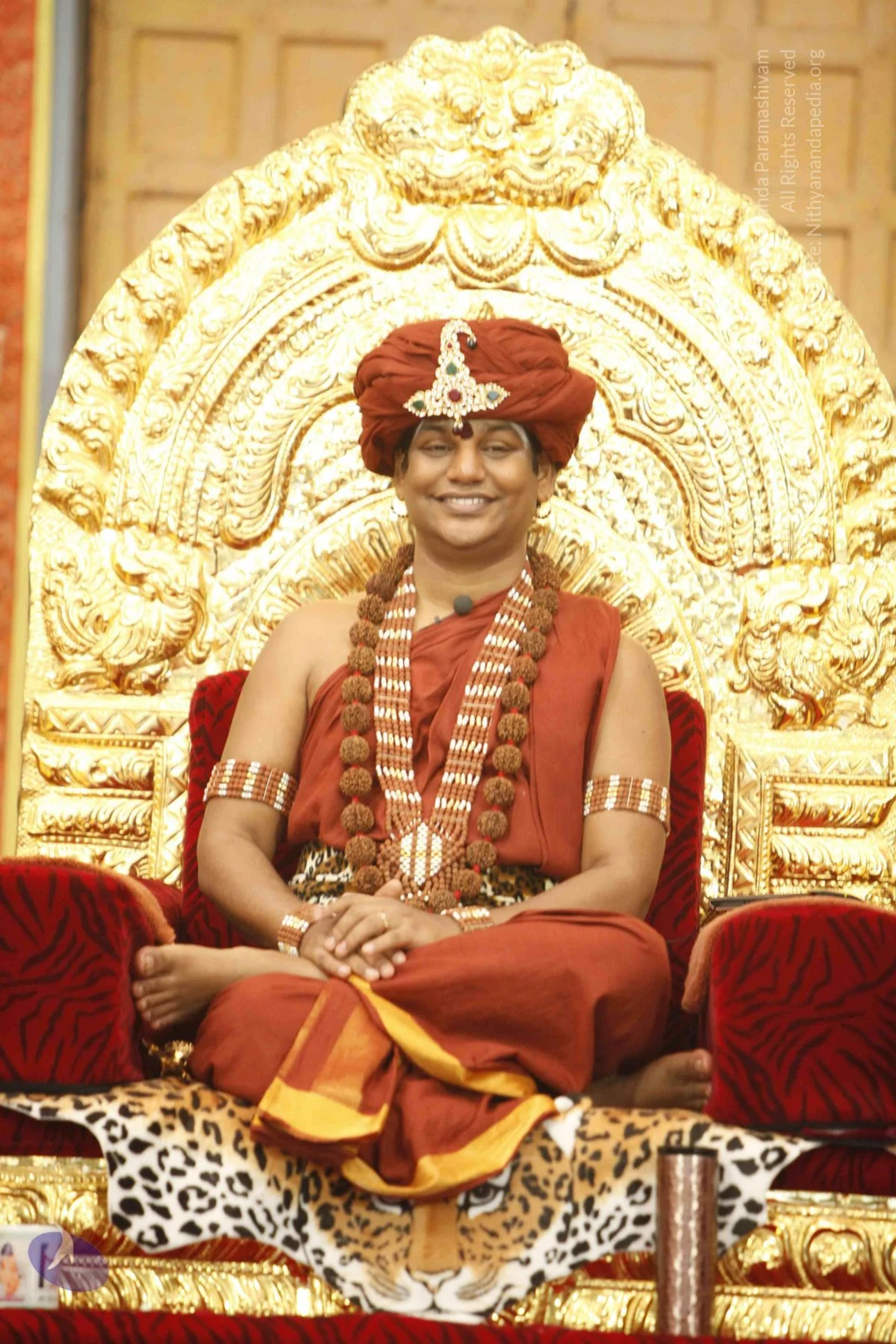
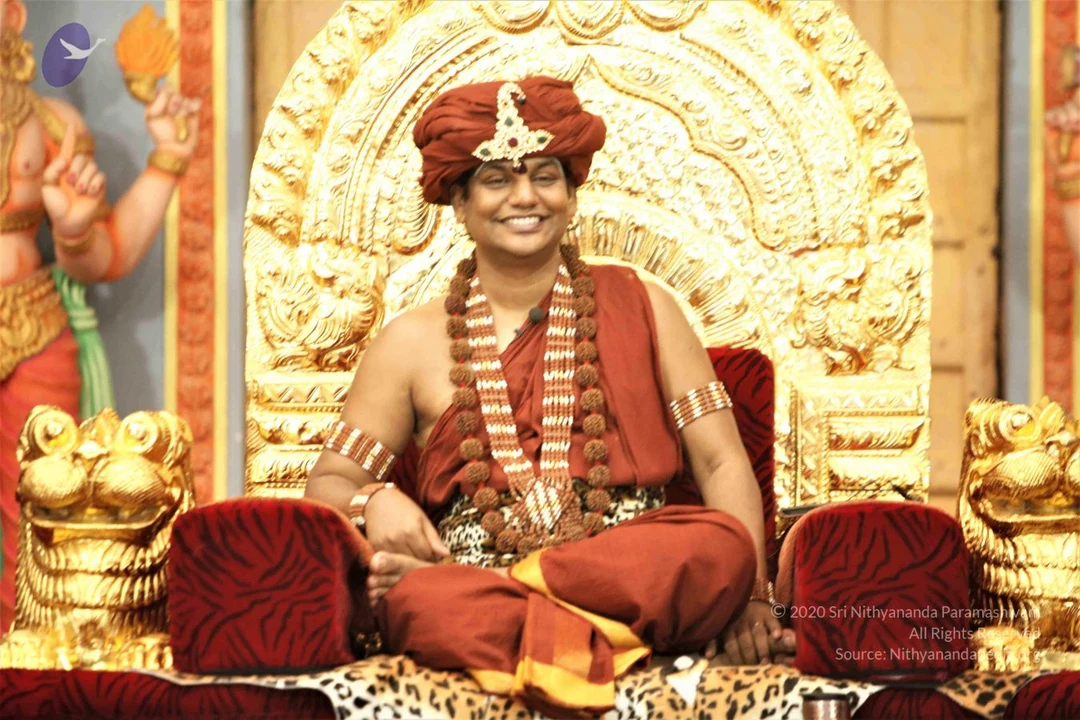
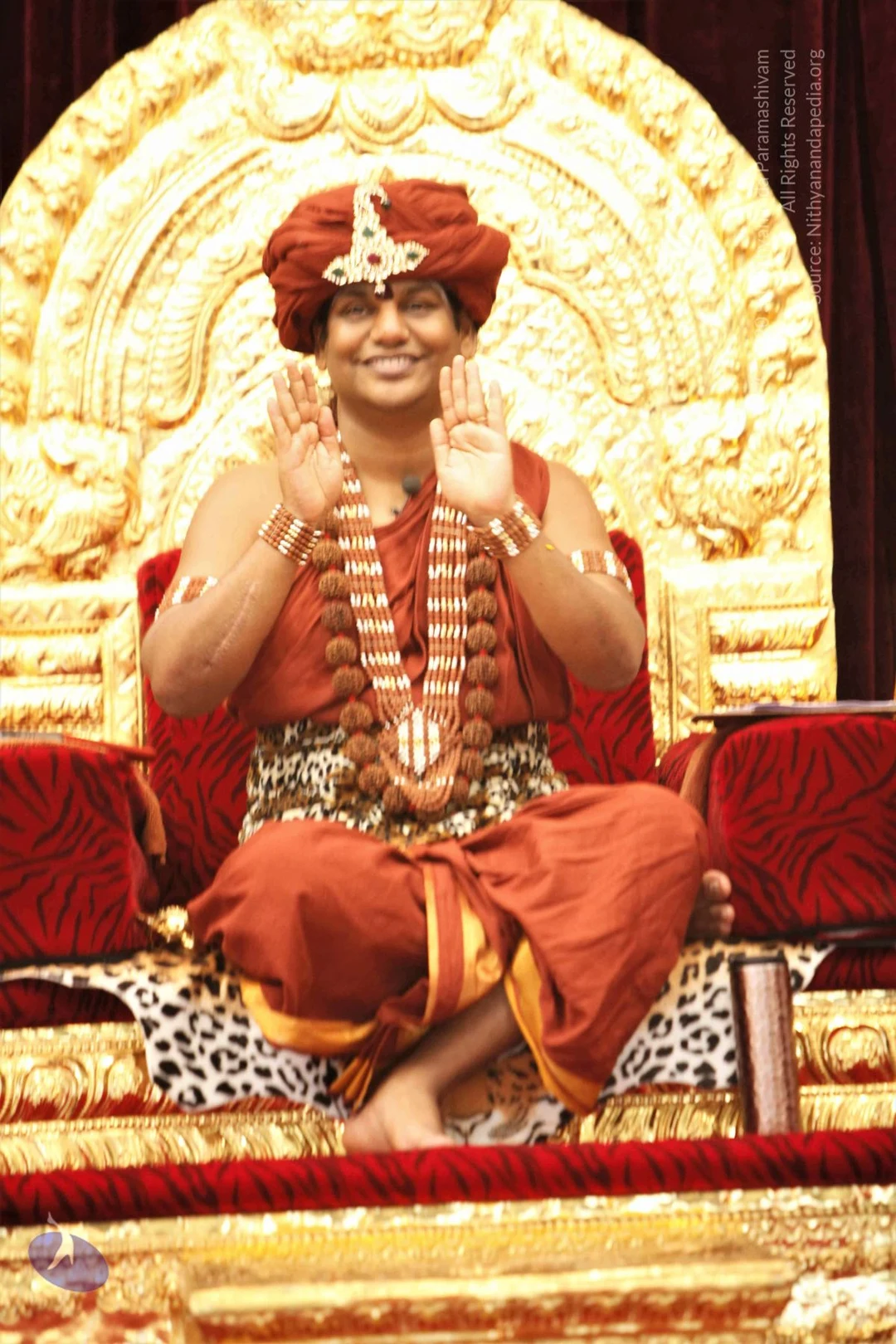
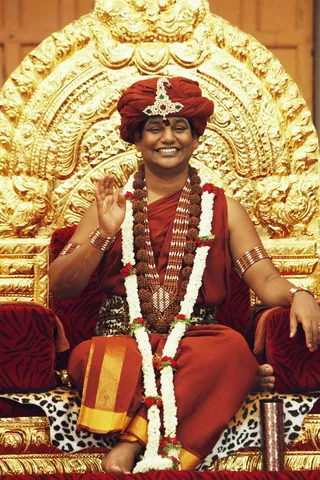
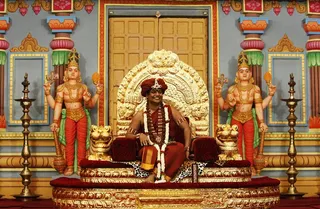
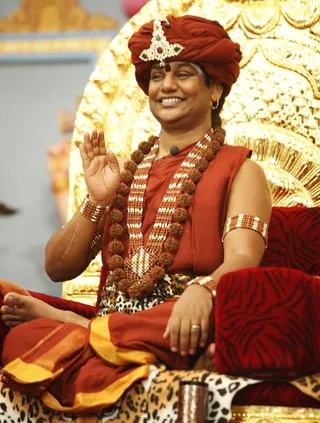
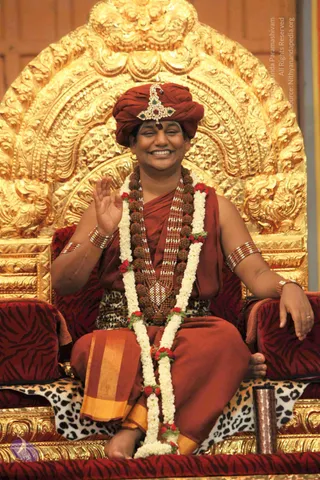
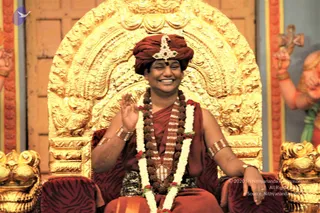
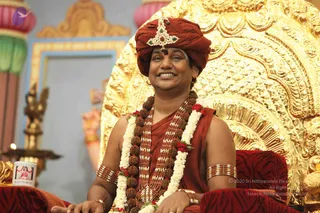
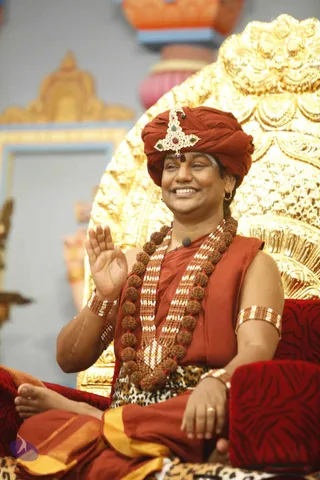
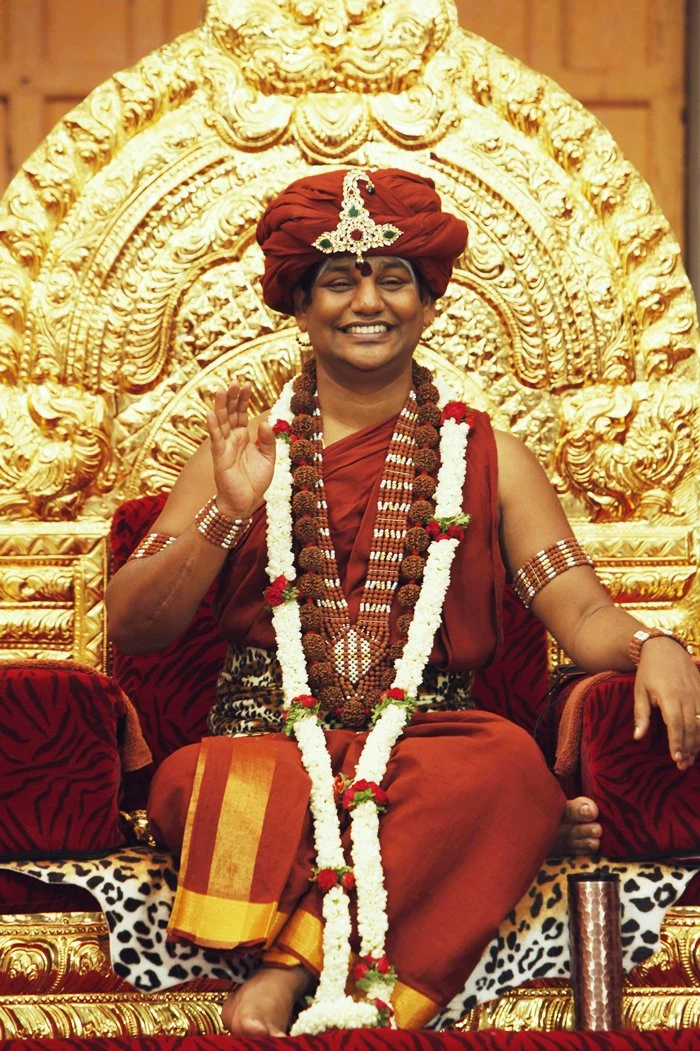
A smiling man sits cross-legged on an ornate gold throne with a carved, arched gold backrest, draped in a red-orange robe with a matching turban decorated with a gold and jewelled ornament at the front. He wears layered rudraksha malas and long white flower garlands with red blossoms, gold bangles on his upper arms and wrists, and gold and red accents. His right hand is raised in a blessing gesture while his left hand rests on a red, leopard-print cushioned armrest. Leopard-print fabric covers the base of the throne, and a metal vessel stands at the lower right. The setting suggests a satsang or darshan. Presentation cues include the long garlands, rudraksha malas, saffron-red clothing and ornate throne, so this is a person in person.A seated man sits centrally on an ornate golden throne with a carved gilt backrest and lion-shaped armrests, draped in a deep red and maroon cloth and wearing a red turban. He has a white flower garland and rudraksha-style beaded necklaces, with gold bangles on his wrists, and his hands rest in his lap. Two carved standing deity murti flank the throne, painted in red and orange with gold crowns, jewellery and multiple arms. Tall brass oil lamps stand on either side, and the background has a wooden door and a painted red, yellow and blue temple wall with decorative columns. The throne sits on a red-cushioned dais with a leopard-print cloth. The scene is an ashram or temple hall with no visible crowd.A photograph of a smiling man seated on an ornate gold throne with a carved, arched back. He wears a deep red turban with a jeweled ornament, a red-orange robe, long rudraksha beads and white flower garlands with red flowers, and beaded armlets. He sits on red velvet cushions over a leopard-print cloth.A smiling man sits on an ornate gilded throne with carved lion-head armrests and a large golden back panel. He wears a red-maroon turban with a silver ornament at the front, a red-maroon robe, a long white and red flower garland, and a rudraksha mala. Gold armlets adorn his upper arms and his hands rest in a meditative pose. Behind him a figure with a raised hand and golden crown suggests a deity image on the left, and wooden panels form the background.A smiling person seated cross-legged on a red cushioned throne in front of an ornate gold carved backrest, raising one hand in a blessing gesture. They wear a red-orange turban with a jeweled gold ornament, a red-orange robe with a yellow-gold border, and a long necklace of rudraksha beads and white beads, plus beaded bangles and an armband. A small microphone is clipped at the collar. Patterned leopard-print cloth lies beneath the red throne. Swamiji (probable): the saffron-red turban, rudraksha mala and ceremonial ornaments match the page's claim, but the face is not used for identification. The person is seated on a throne, giving a satsang-style blessing.A smiling man sits on an ornate golden throne with intricate relief carvings. He wears a deep red turban with a jeweled gold ornament at the front, a red shawl draped over bare shoulders, and a long necklace of rudraksha beads alternating with white and red beads, plus red and gold armlets. A small microphone is clipped to his chest. Behind him, a pillar with red and pink bands and a warm-lit lamp suggests an indoor satsang hall. The figure's ceremonial presentation with rudraksha malas, a turban and a shawl is consistent with the page's description of Swamiji (probable) at a satsang.

NKY-Bidadi-Day2

15 photosSource gallery
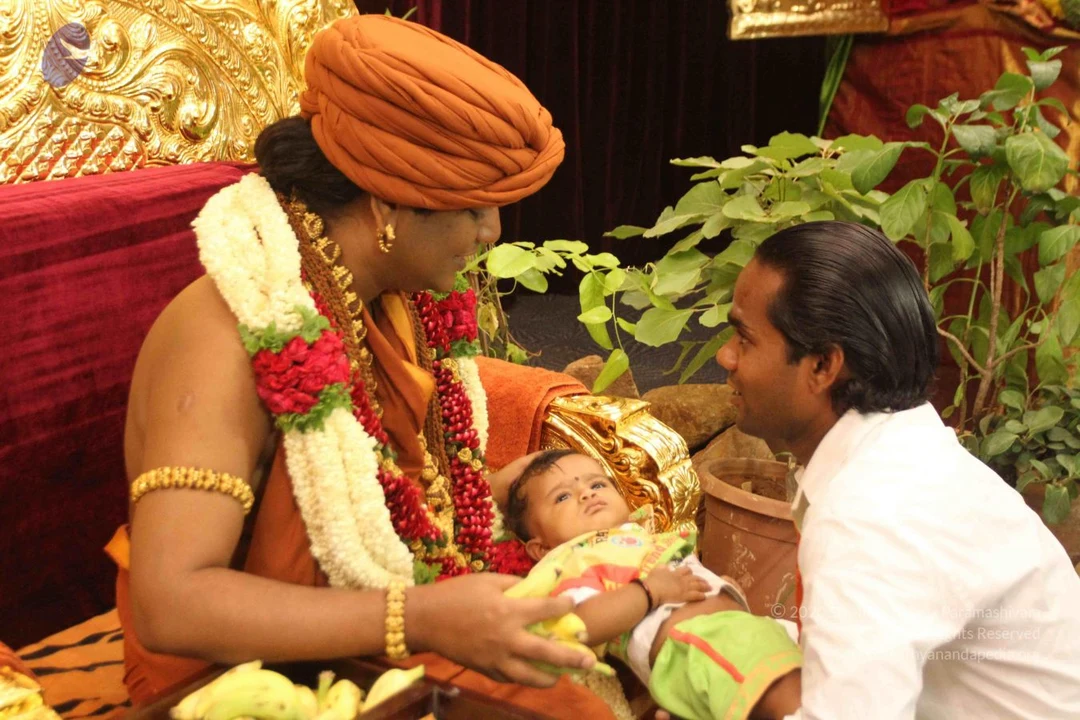
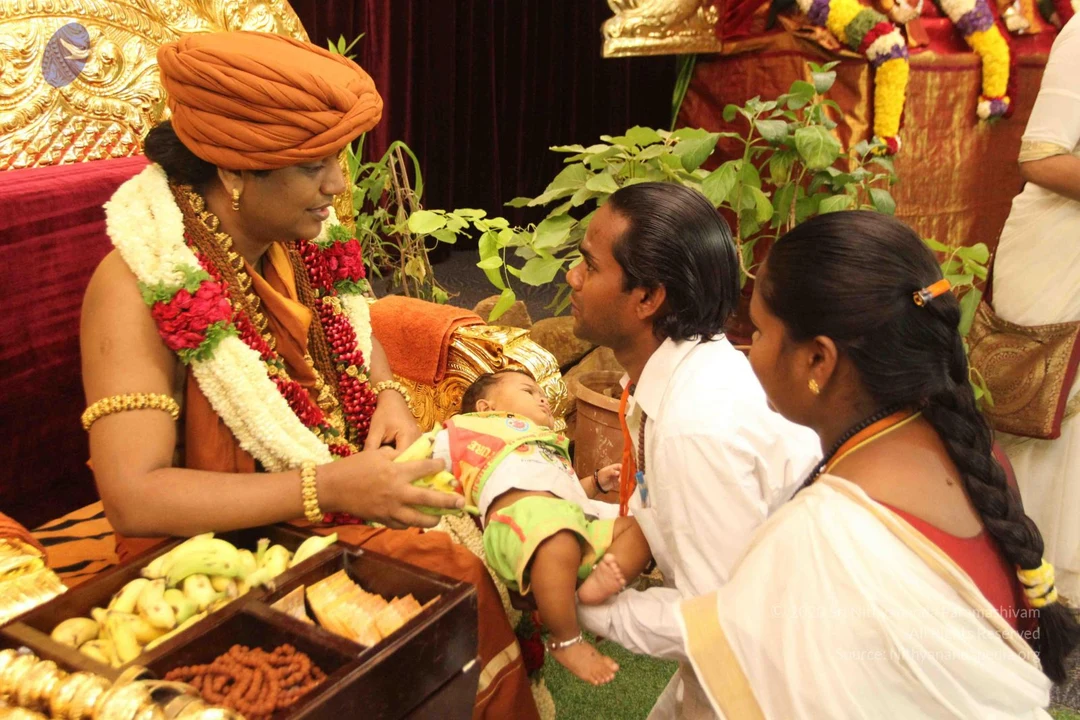
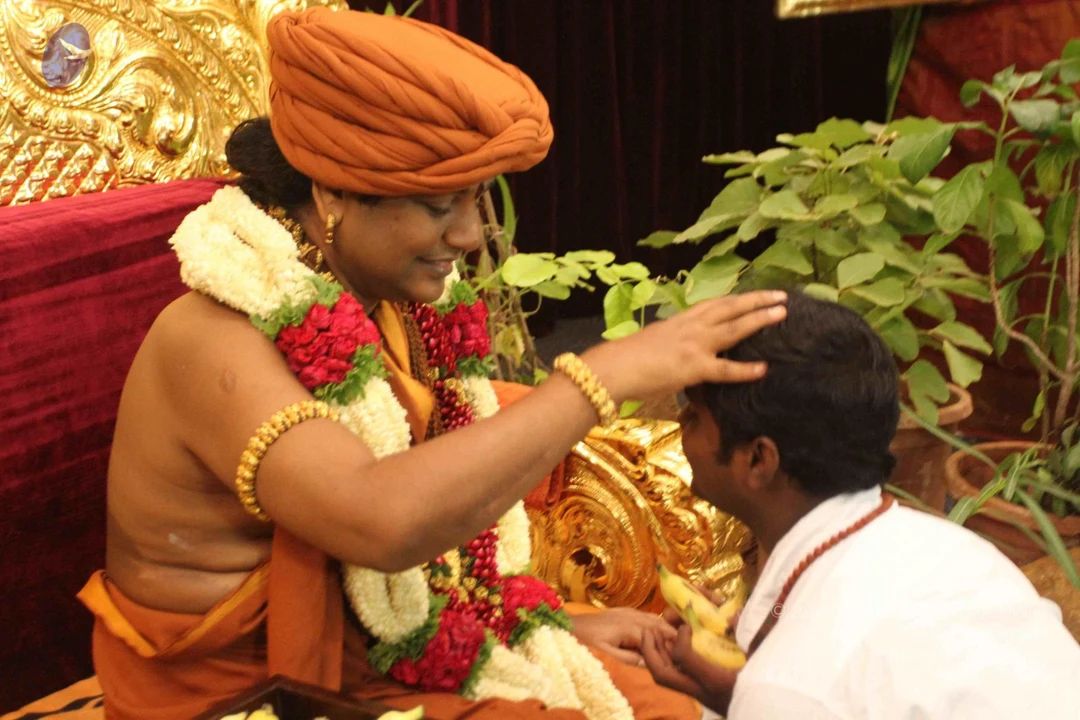
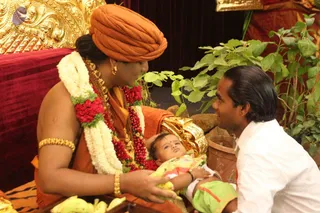
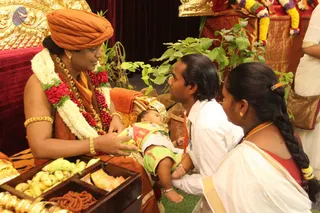
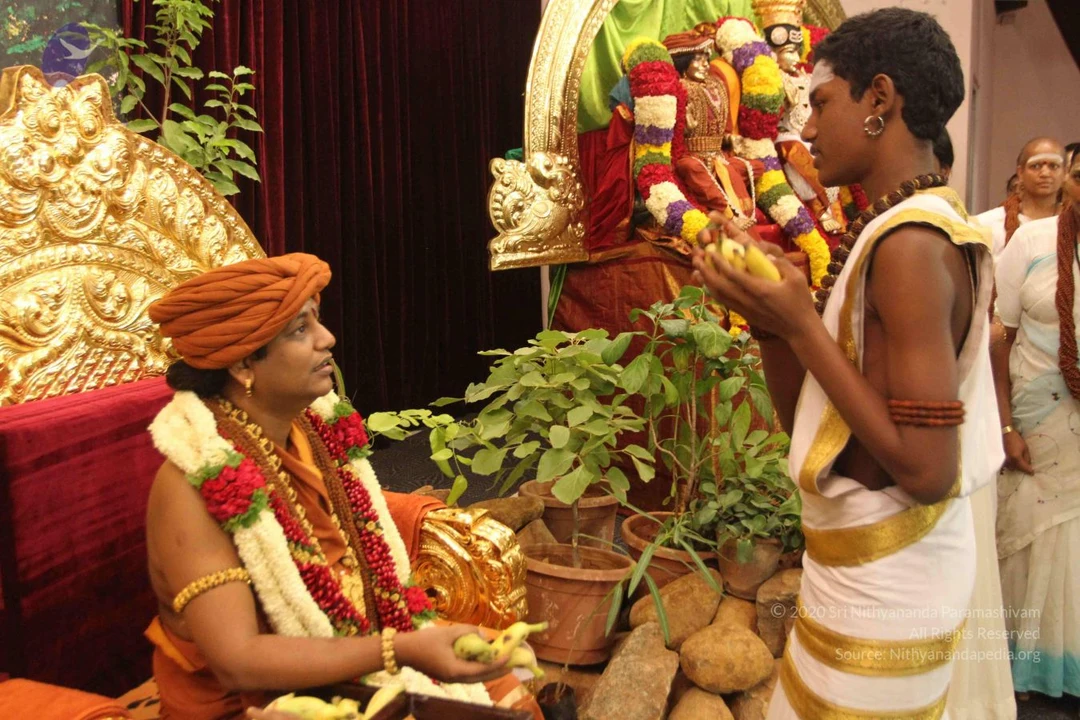
A seated man in an orange turban and saffron robe, wearing a white and red flower garland, gold necklaces and gold bangles, sits on a gold-and-red throne before a green backdrop and deity murti decorated with colourful flower garlands. Beside him stands a young man in a white dhoti and shawl with gold borders and a rudraksha mala, holding bananas in both hands as an offering. Potted plants and stones are arranged on the floor, and devotees in white stand at the right. The seated figure, with his orange turban, saffron clothing and layered garlands and gold ornaments, matches the Swamiji (probable) appearance cues, presented in the role of the seated guru receiving offerings.A seated figure in an orange turban and saffron-orange cloth, wearing a white and red flower garland, bare-shouldered with gold bangles and a gold necklace, rests a hand on the shoulder of a young boy in a grey graphic t-shirt and plaid shorts seated on a red-cushioned chair on green artificial grass. A man in a maroon polo kneels beside the boy, looking up. Behind them, a standing woman in cream and white sari with a rudraksha mala holds hands together, and a bank of marigold garlands and potted plants appears in the background. Fruit, bananas and a tray of kumkum-like offerings sit in the foreground. The figure's appearance is consistent with a person, with turban, saffron cloth, garlands and gold ornaments.A seated person in an orange turban, orange garment and layered white and red flower garlands touches the shoulder of a seated boy in a grey graphic t-shirt and plaid shorts, who sits on a dark red chair with eyes closed. A gold-patterned throne and green potted plants stand in the background, with a gold-wrapped armrest and a tray of fruit at the lower left.A photograph of a seated person in an orange turban and saffron wrap wearing white and red flower garlands, gold necklaces and a gold armlet, with one hand resting on the shoulder of a young boy in a grey graphic t-shirt and plaid shorts seated in a red-cushioned chair. Behind them are gold-embossed throne panels, dark red drapery, green potted plants and a bunch of bananas at lower left. The boy appears to be receiving a blessing-like touch.A seated figure in an orange turban, orange-saffron robe and a bare shoulder wears layered garlands of white jasmine and red flowers with a gold chain, and a gold armlet. Seated on a red velvet and gold-carved throne, he holds an infant in green and yellow clothes and looks down at the child. A younger man in a white shirt leans in at right, smiling. Green potted plants and a copper pot stand nearby, with bananas in the foreground.A photograph of a seated figure in an orange turban and saffron garment, wearing a white and red floral garland, multiple rudraksha malas, a gold necklace and gold armlets. The figure leans forward offering a fruit to a baby in a green outfit held by a man in a white shirt. A woman in a white sari with a long braid kneels beside them. Trays of bananas, sweets and rudraksha beads sit in front, with golden throne elements and green plants behind.

Pada-Puja-EDITED-READY-TO-PUBLISH

3 photosSource gallery
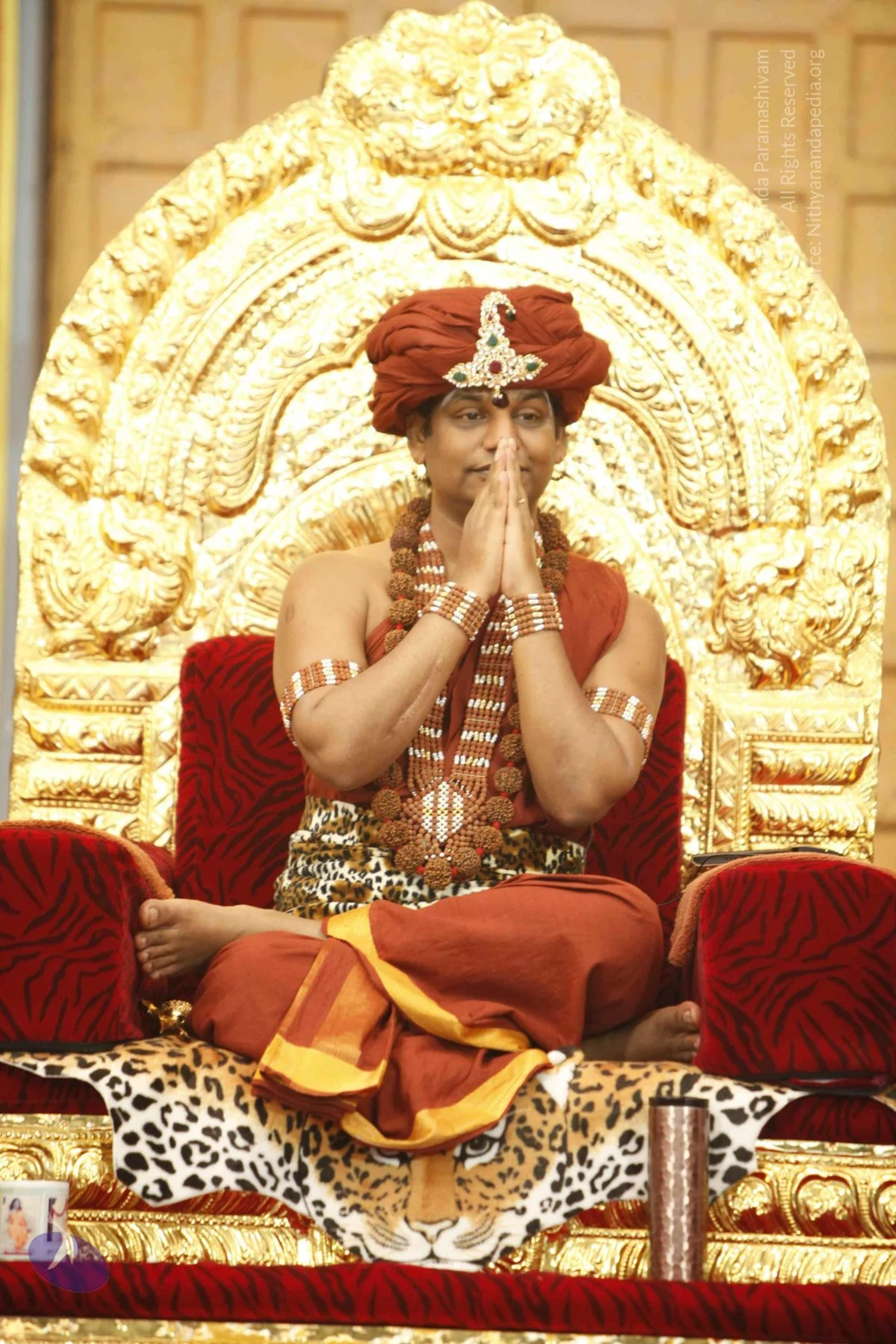
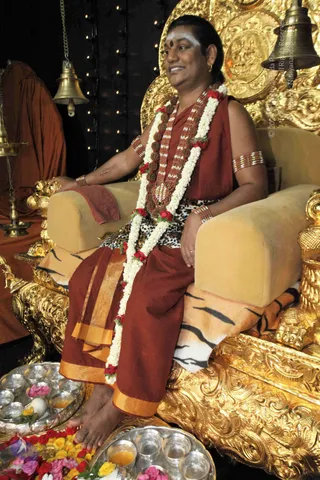
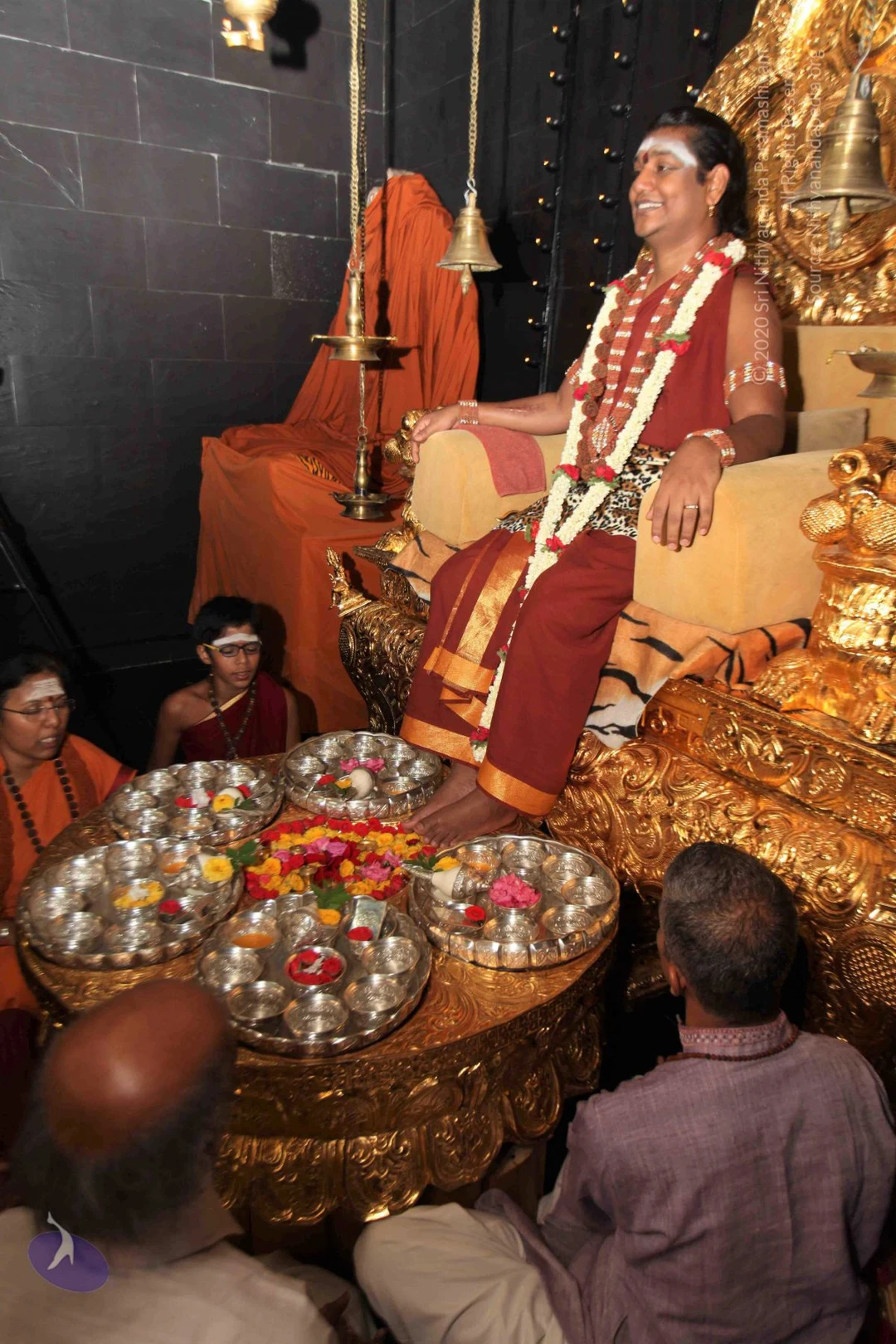
A man seated on an ornate gold throne with tiger-print cushions, wearing a maroon sleeveless top, maroon dhoti with gold border, a white-and-red flower garland, and a rudraksha mala with a white tilak on his forehead. He is smiling and speaking. Silver trays of flowers, fruit and lamps sit on a gold-carved table before him, with bells hanging above. To the left, a woman in orange robes and glasses sits, and a boy in maroon with a white forehead mark sits near an orange cloth draped over a seat. Two men in lower frame, seen from behind, face the throne. The scene suggests a satsang or ritual gathering. Four physical people are visible in the photograph.A smiling man sits on an ornate golden throne with a cream upholstered armrest, gesturing with his right hand. He wears a maroon sleeveless garment with a leopard-print waist cloth, a maroon dhoti with a gold border, and layered white jasmine and red flower garlands over a rudraksha mala. He has white vibhuti and a red bindi on his forehead, and red-and-silver beaded armbands and bangles. Behind him hang brass bells and a brass oil lamp beside an orange cloth. Silver plates with flower petals sit at his feet.A seated person on an ornate gold throne with a tiger-striped cloth draped over the armrest, wearing a rust-red dhoti with gold border and a leopard-print cloth at the waist. A long white and red flower garland and a rudraksha mala hang across the chest, with beaded armlets and a white forehead mark with a red bindi. Brass bells hang above, and silver trays with rose petals, offerings and cups sit at the feet, which are bare on a bed of red, yellow and pink flowers. Swamiji (probable): long swept-back hair, rudraksha mala, ceremonial garland and an ornate throne match the page's reference to Swamiji.

Nithya-Satsang-EDITED-READY-TO-PUBLISH
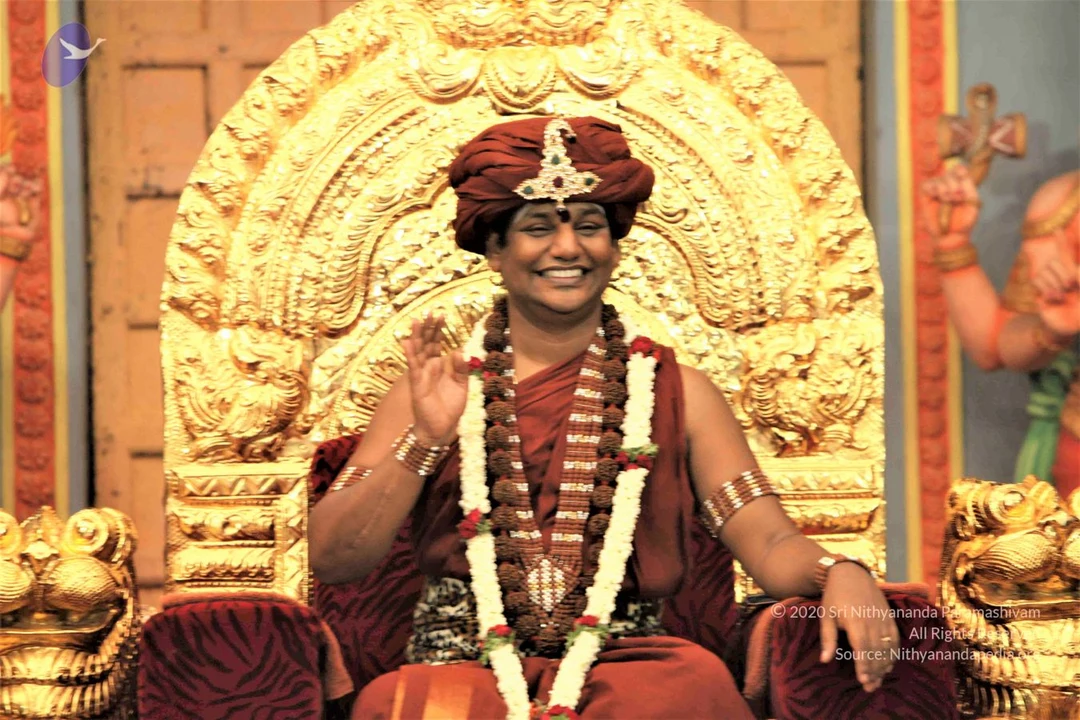
12 photosSource gallery
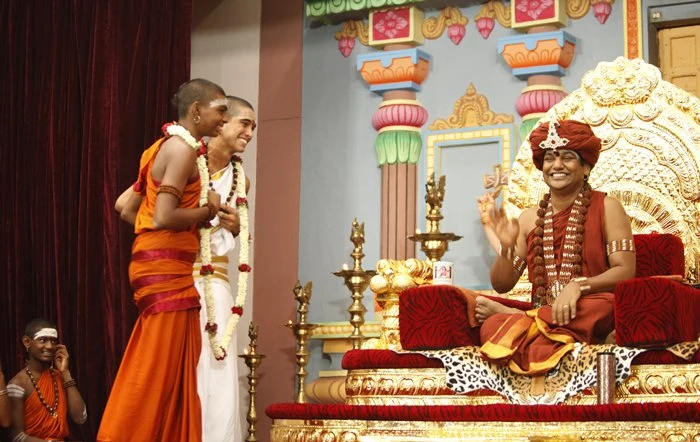
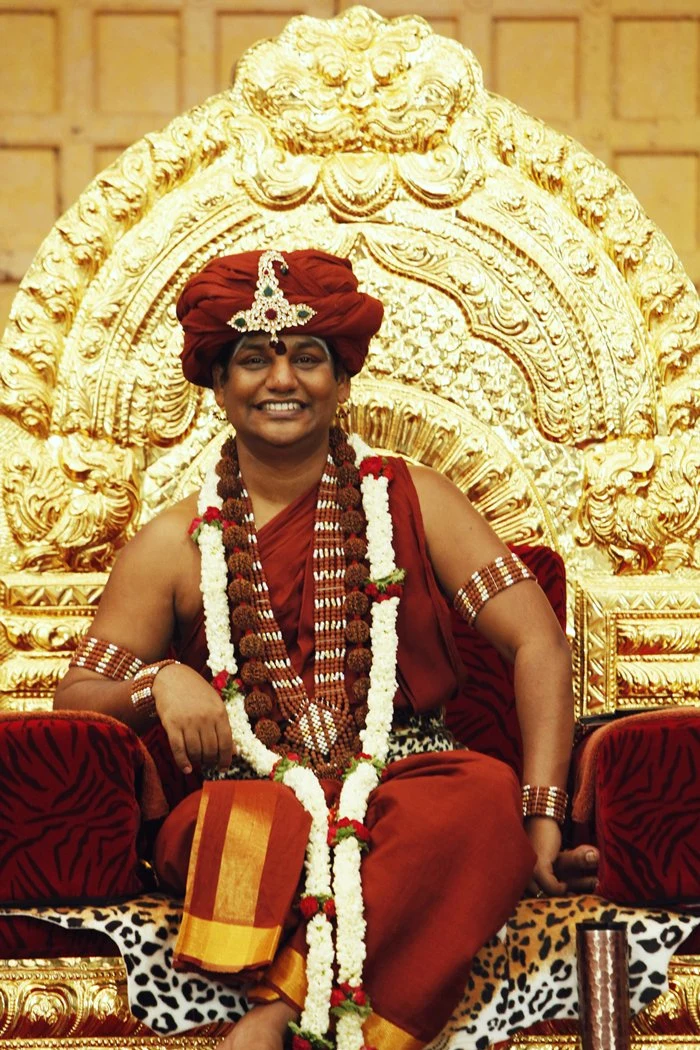
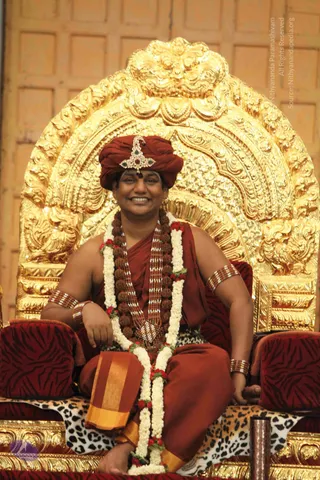
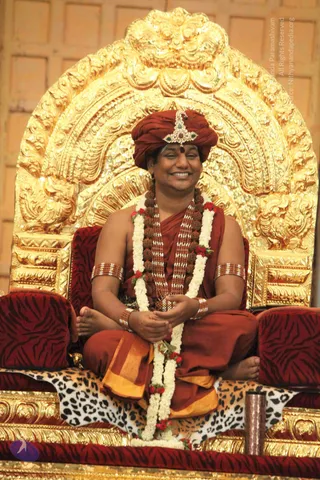
A smiling man seated on an ornate gold throne with a carved arched back, raising his right hand in a blessing wave. He wears a red-maroon turban with a jewelled gold ornament at the front, a maroon robe, a white and orange striped dhoti, multiple rudraksha malas and a white flower garland with red blossoms draped across his chest. Red patterned cushions and a leopard-print cloth cover the throne, and a copper vessel stands beside him. The figure matches the appearance cues of a probable Swamiji with a turban, ornate clothing and rudraksha malas, seated as a teacher at a satsang setting.A smiling man seated on an ornate gilded throne with carved floral and lion-head armrests, raising one hand in greeting. He wears a deep maroon turban with a jeweled gold ornament, a maroon-orange robe, a long rudraksha mala with a white flower garland, layered bead necklaces, and gold bangles on his arms. Behind him stand painted deity figures in orange and green, and a wooden door frames the left side. Swamiji (probable): long swept-back hair is not visible, but the turban, saffron-maroon ceremonial clothing, rudraksha mala and ceremonial gold necklaces on a throne match the cues for the page's subject, so he is the seated devotee-facing teacher on the throne.A photograph of a smiling man seated on an ornate golden throne with a carved arched backrest and red-and-black leopard-print cushions. He wears a rust-red turban with a jewelled ornament at the front, a rust-red shawl over his shoulders, orange-and-gold dhoti, a long rudraksha mala and a white flower garland with red blossoms, beaded armbands and bracelets. The image is a single person seated on a stage with no other people visible.A smiling man sits cross-legged on an ornate gilded throne with a carved arched back and red tiger-striped cushions, a leopard-print cloth draped over the seat. He wears a rust-red turban with a jewelled ornament, a rust-red shawl, a rudraksha mala with white flower garlands, and beaded bangles on both arms, hands clasped in his lap. The figure fits the appearance cues for a person, seated in a position of honour during a satsang setting. A small copper cup sits beside the throne.A seated man in a rust-red turban with a gold and jewelled ornament at the front smiles broadly, wearing a red-orange sleeveless robe, multiple rudraksha malas and a white jasmine garland with red flowers around his neck, and beaded armlets. He sits on a red velvet cushion before an ornate gold throne-back with carved detailing. Behind him are a brass oil lamp and pink and green painted pillars. A small framed devotional card sits at the lower left. Swamiji (probable): the appearance cues of turban, rudraksha malas, saffron-orange clothing and ornate adornment match the page claim, and he sits in a throne-like seat.A seated man in an ornate saffron-red turban with a jewelled gold ornament at the front, wearing a rudraksha and white bead mala with a tall ceremonial necklace, red sleeveless robe and gold armlets. He raises one hand in a blessing gesture while smiling, sitting on a red velvet cushioned seat in front of a large gold carved throne back. A small lapel microphone is clipped to his chest. Swamiji (probable) based on the turban, rudraksha mala and saffron-red ceremonial attire.

Kalpataru-EDITED-READY-TO-PUBLISH
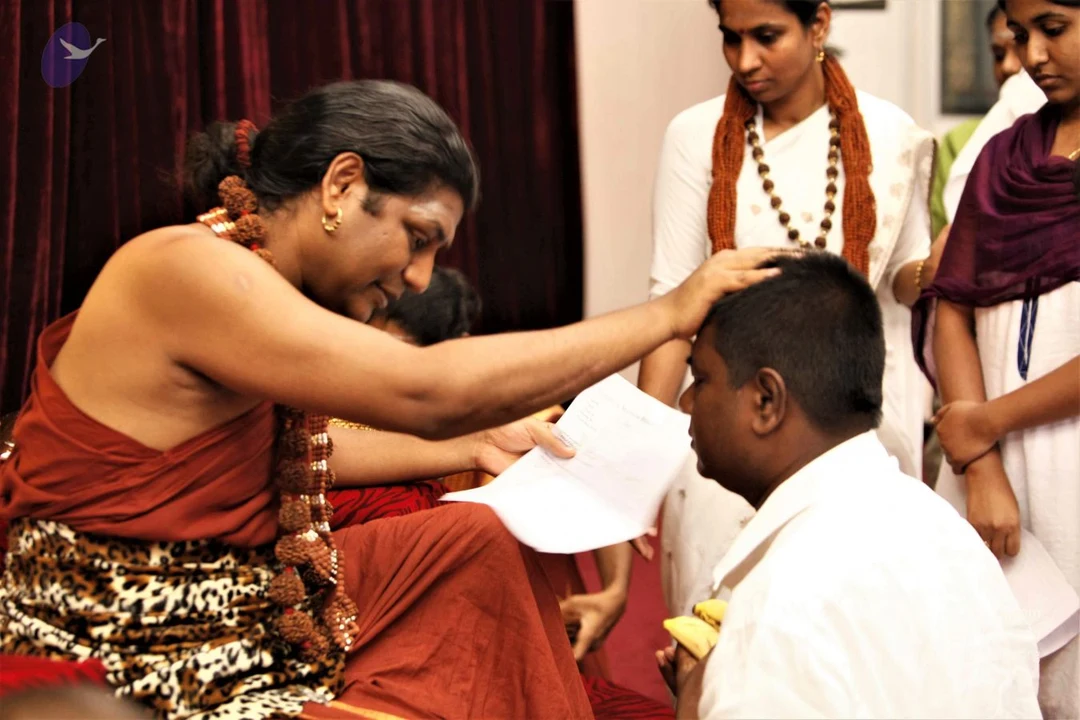
2 photosSource gallery
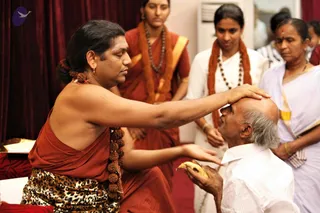
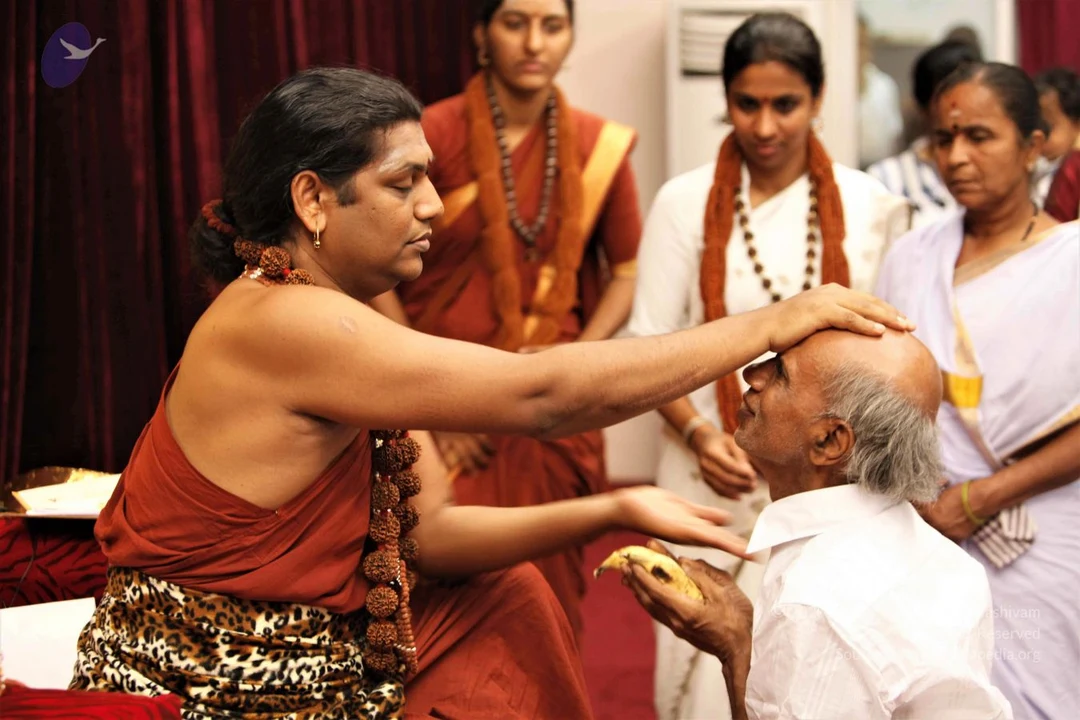
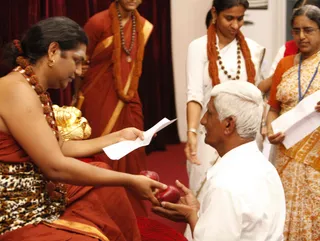
A seated figure with long swept-back dark hair, bare-shouldered in a rust-red wrap over a leopard-print lower garment, wears a rudraksha mala and ceremonial gold necklace, and holds a white paper while placing his right hand on the head of a kneeling man in a white shirt. Behind them, a woman in white with an orange-brown rudraksha mala watches, and a younger woman in white with a purple shawl stands at right. Deep maroon drapery hangs behind. This matches the Swamiji (probable) appearance cues of long hair, rudraksha mala, ornate gold necklace and rust-red wrap, performing a blessing or initiation on a devotee. Photo of a satsang-style blessing.A photograph of a devotional blessing. A man with long dark hair, wearing a saffron-orange garment, rudraksha malas and a leopard-print lower wrap, sits and places his right hand on the forehead of an elderly bald man with grey hair who wears a white shirt and holds a banana. Behind them, two women stand in orange and white saris with orange shawls and rudraksha beads, and an older woman in a white sari with a red bindi watches. Red drapes form the background. The scene appears to be an appearance-based probable Swamiji (probable) giving a blessing; the figure's long hair, saffron clothing and rudraksha malas are the qualifying cues.

03-Kalpataru

2 photosSource gallery
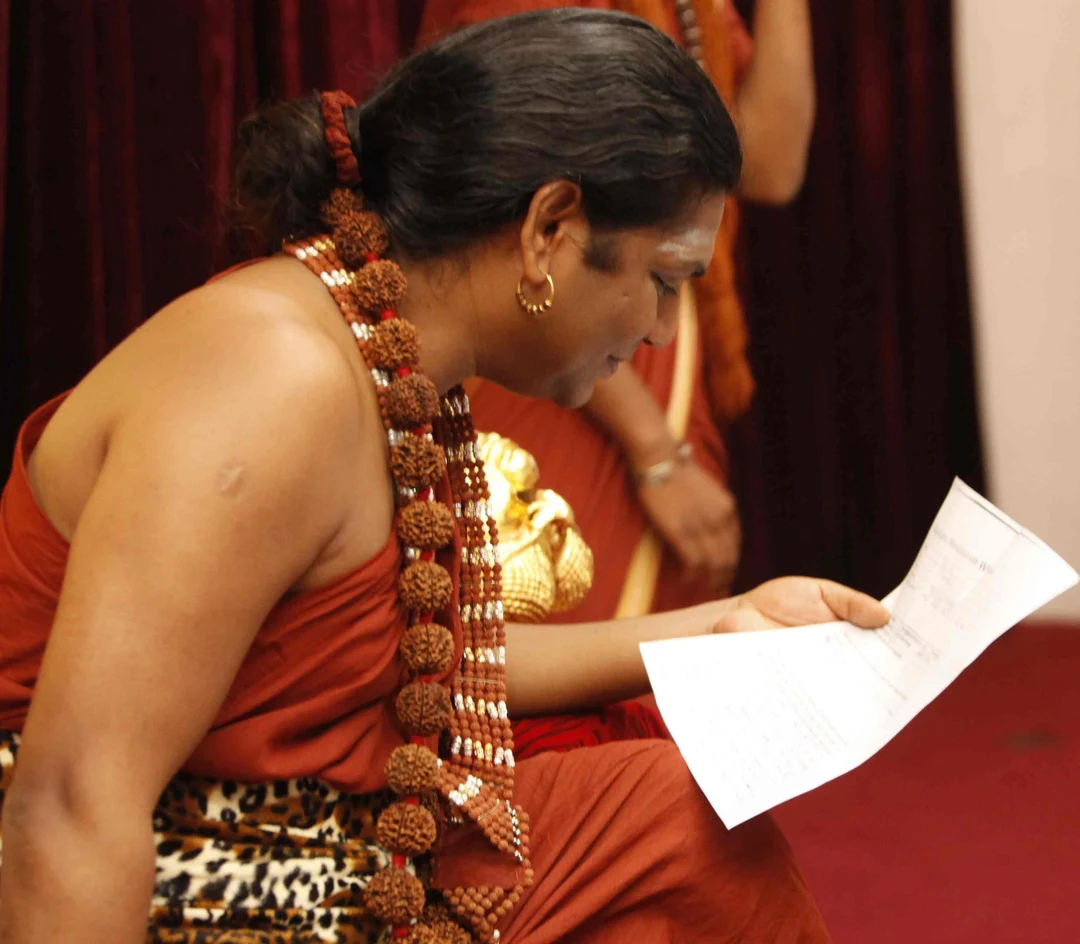
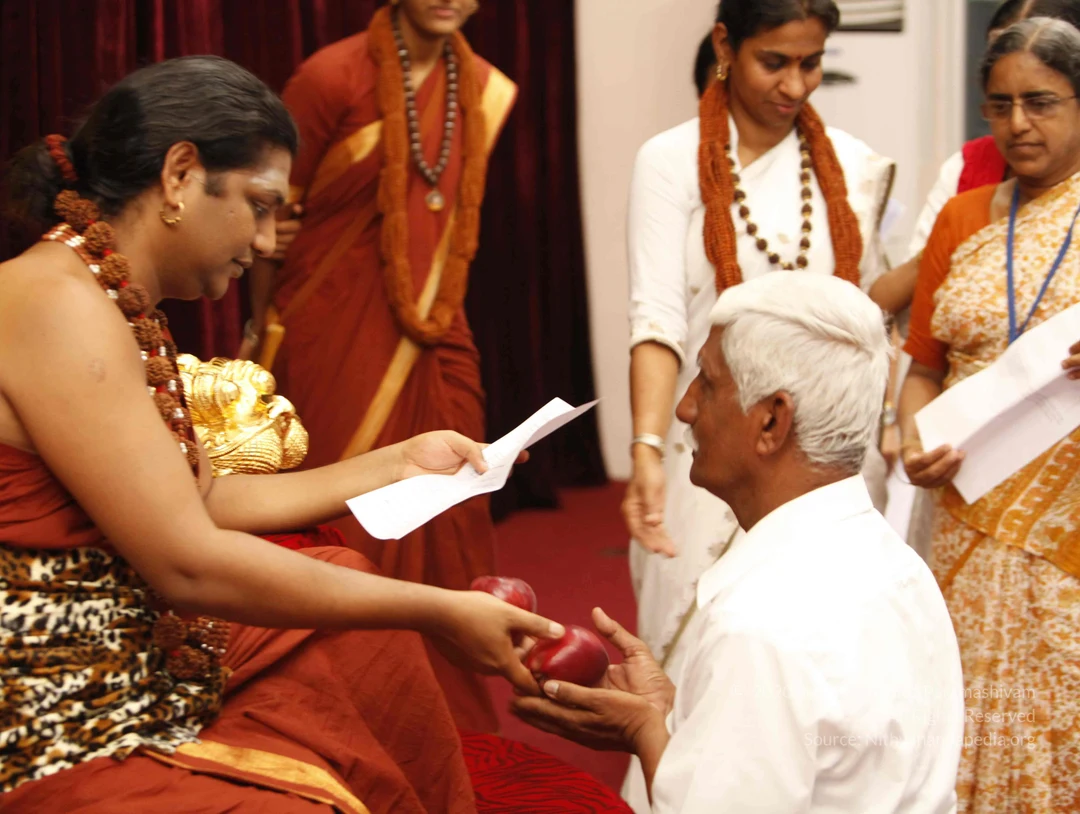
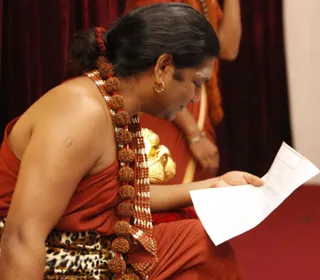
A woman in a rust-orange sari-style garment sits in profile, reading a printed sheet of paper held in her right hand. She wears a long rudraksha mala with multiple tiers of brown seed beads and white spacer beads draped over her shoulder and down her back, plus small gold hoop earrings and a white forehead marking. Behind her, a golden ritual vessel is visible on a red-draped surface, with dark red velvet curtains forming the backdrop. Another person in orange clothing is partially visible behind her.A seated woman in a rust-red and gold-bordered robe with a rudraksha garland and a leopard-print shawl receives offerings from a kneeling elderly man in a white shirt, who presents two red apples in his cupped hands while holding a folded white paper. Beside her stands a golden figure, possibly a deity murti. Behind them a standing man in an orange robe with a rudraksha mala and a woman in white with an orange shawl and mala look on, and at right an older woman in an orange-and-cream sari with a blue lanyard holds papers. The red carpet and dark red drapery frame the scene.

April 24 2014

1 photoView all
A photograph of a padapuja ceremony in an ornate temple-like hall. A smiling man with swept-back dark hair and white-and-red tilak on his forehead sits on a gold-carved throne draped with a tiger-striped cloth. He wears a maroon dhoti with a gold border, a maroon sleeveless upper garment, a long garland of white jasmine and red flowers, a rudraksha mala, and beaded bracelets. His bare feet rest on a bed of marigolds and rose petals in front of the throne. Silver trays holding kumkum, flowers, and small offering dishes surround his feet. Beside him a young boy with white tilak and glasses sits in a maroon robe, and a woman in orange clothes with a tilak sits at left. Behind the throne hang brass bells and an oil lamp above an orange draped cloth on a black stone wall. The scene is a padapuja, the washing and worship of the feet, with a seated devotee at the lower right.