Skip to content
Friday

24 April 2015

Experience Truth with Pure seeking

Dated photos
131
Source pages
1
Media
12
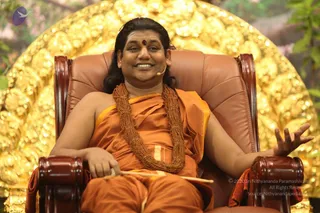
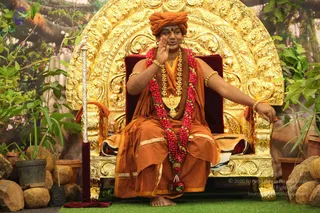
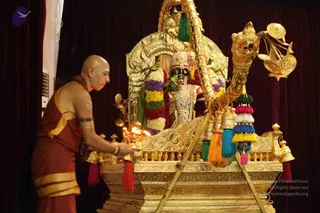
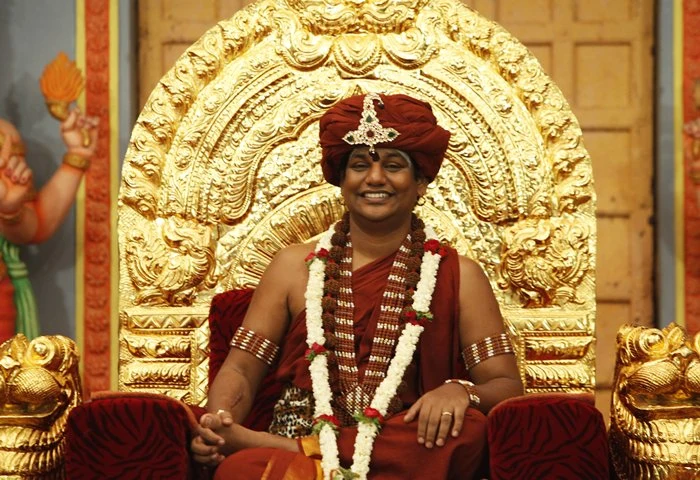
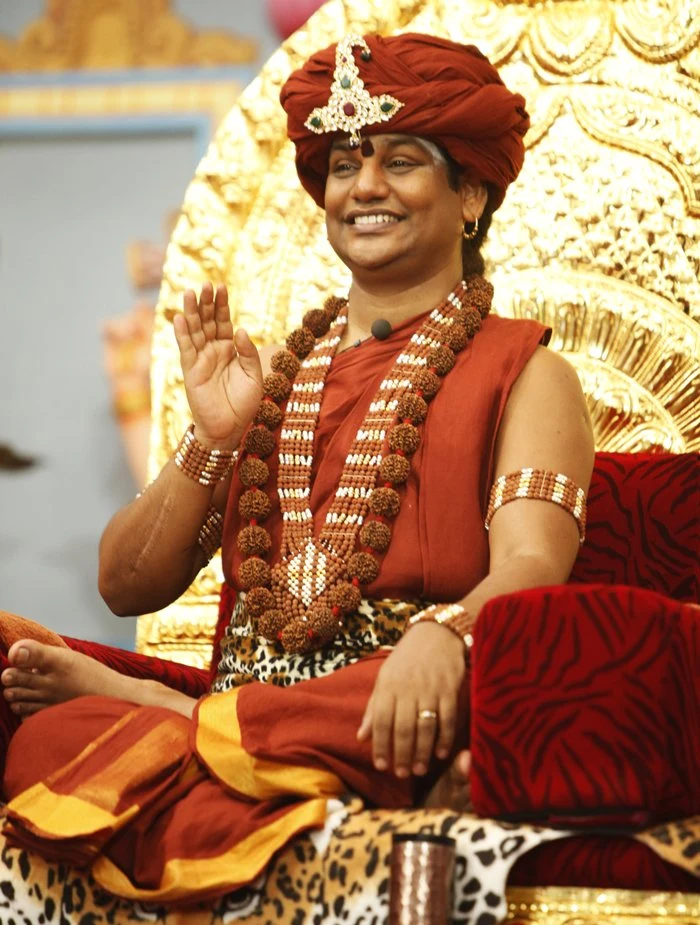
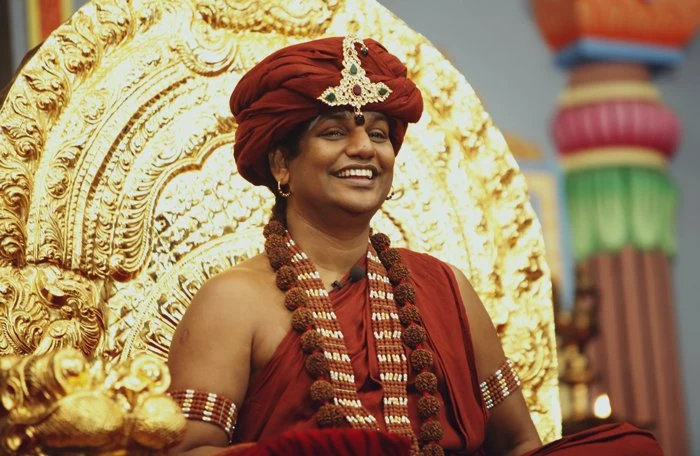
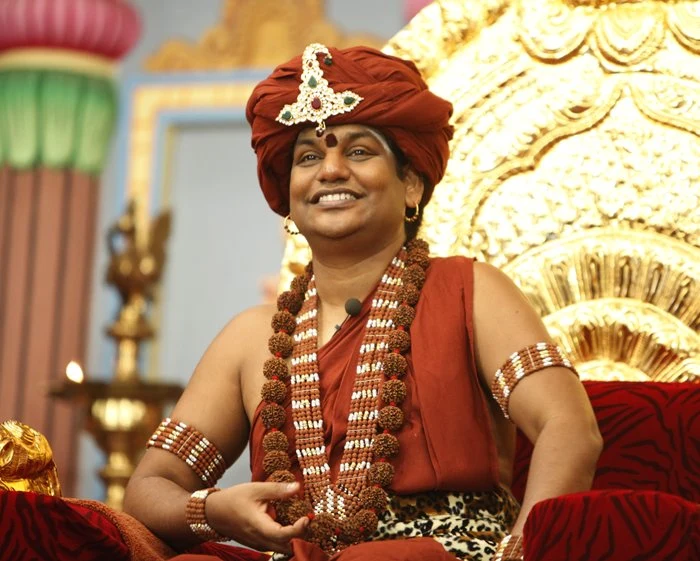
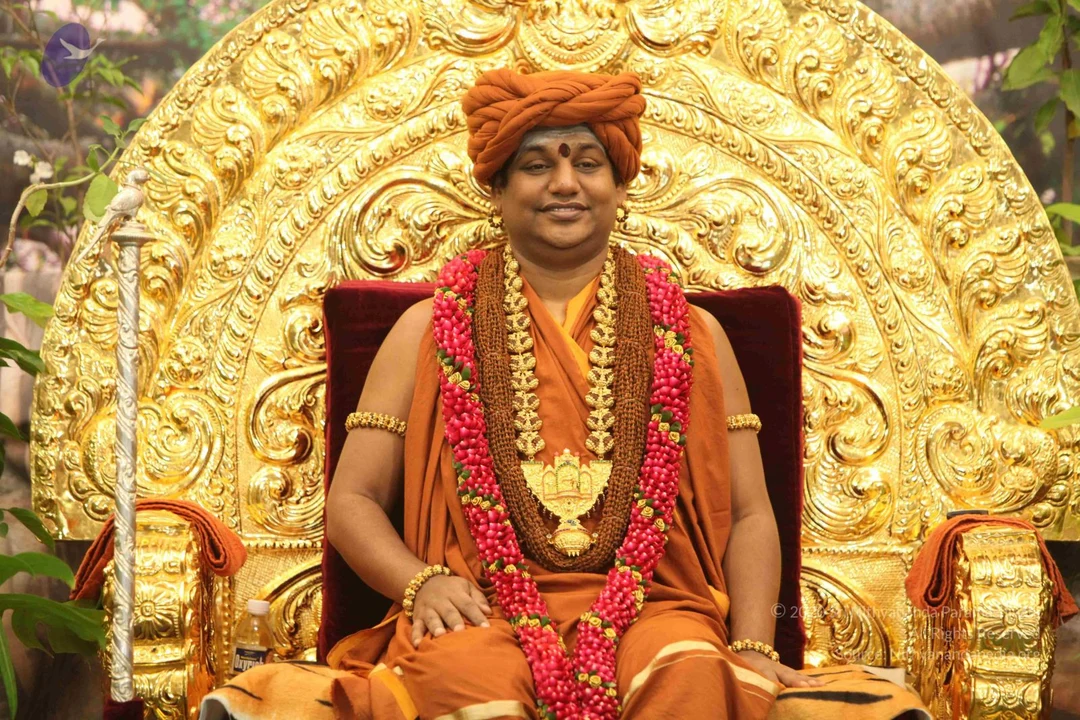
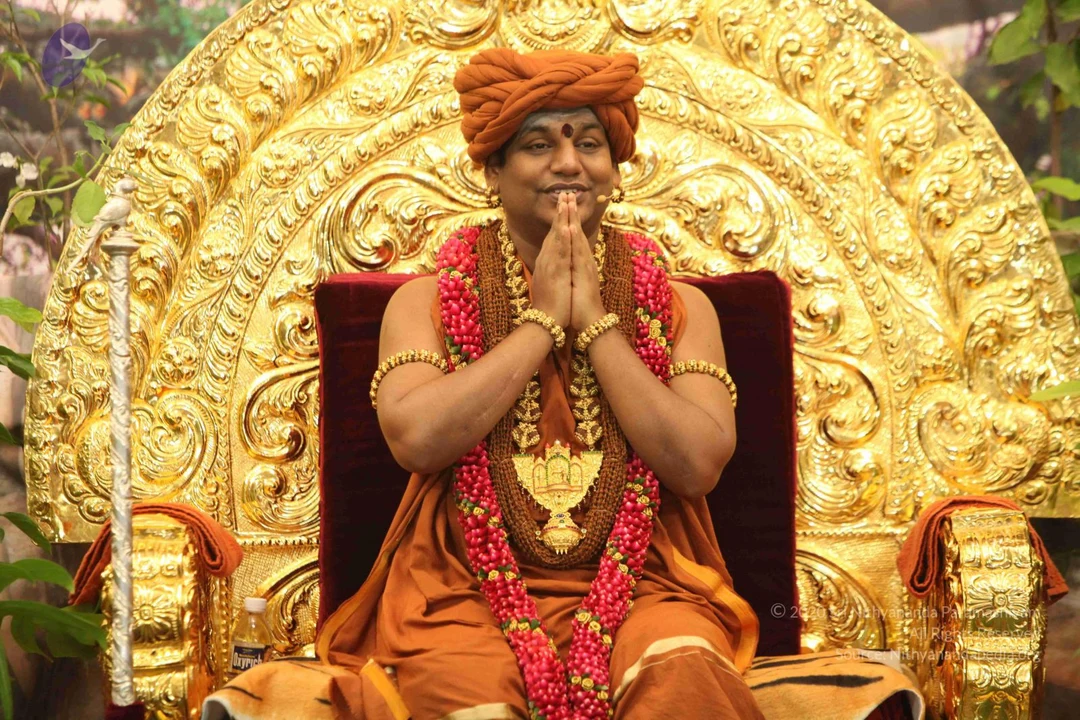
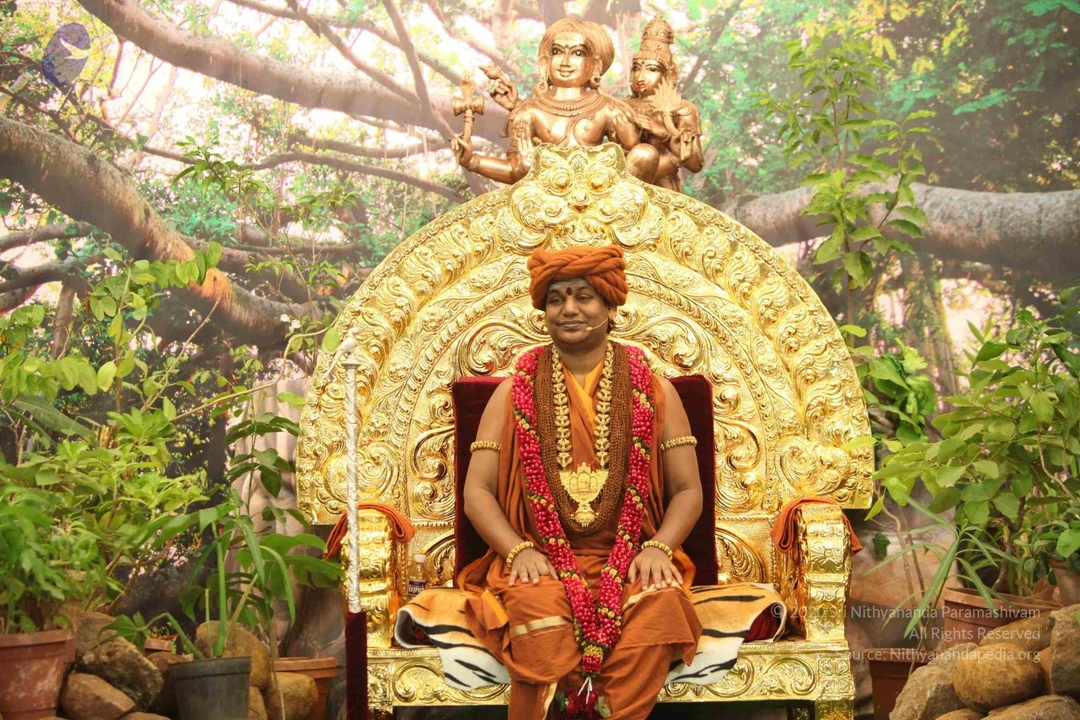
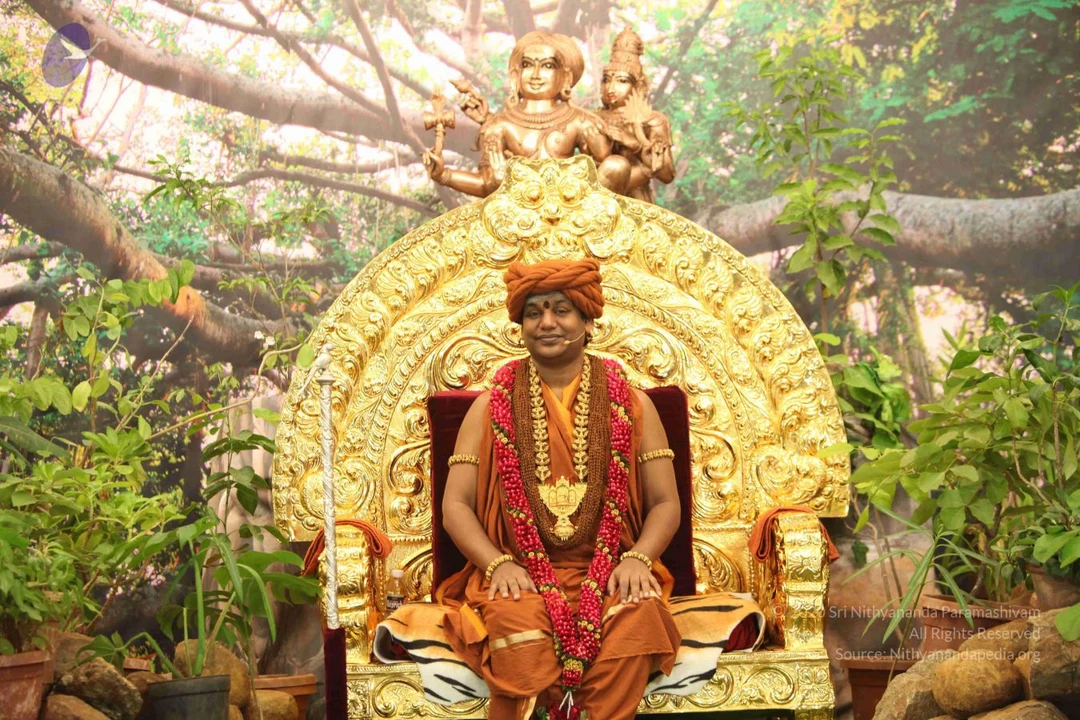
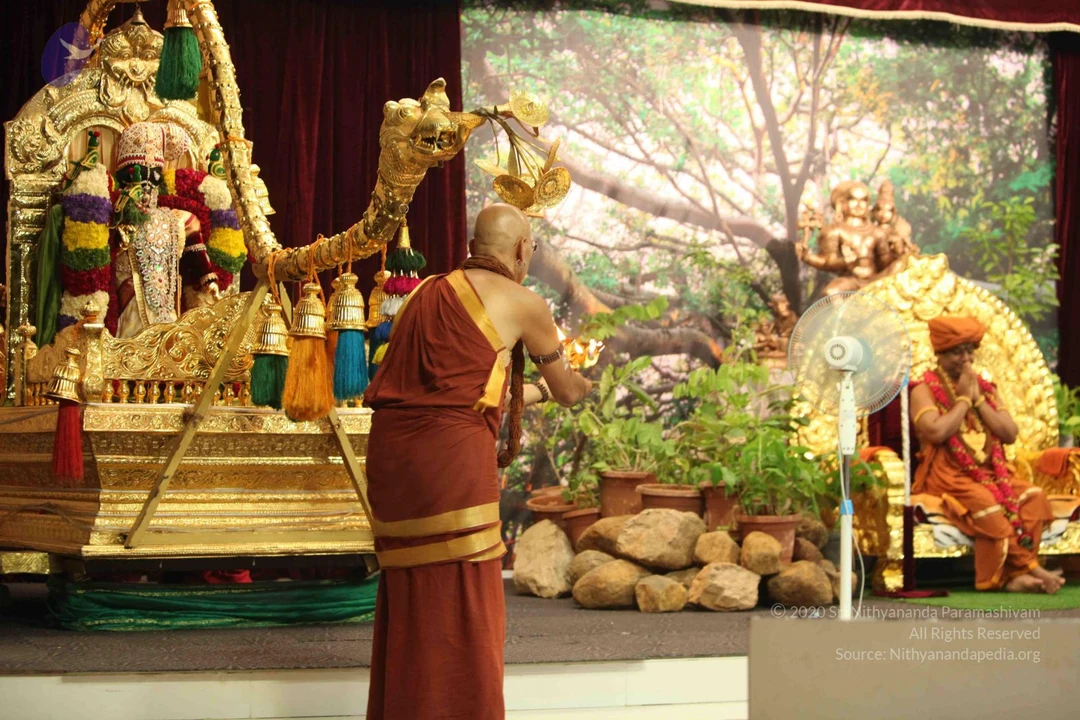
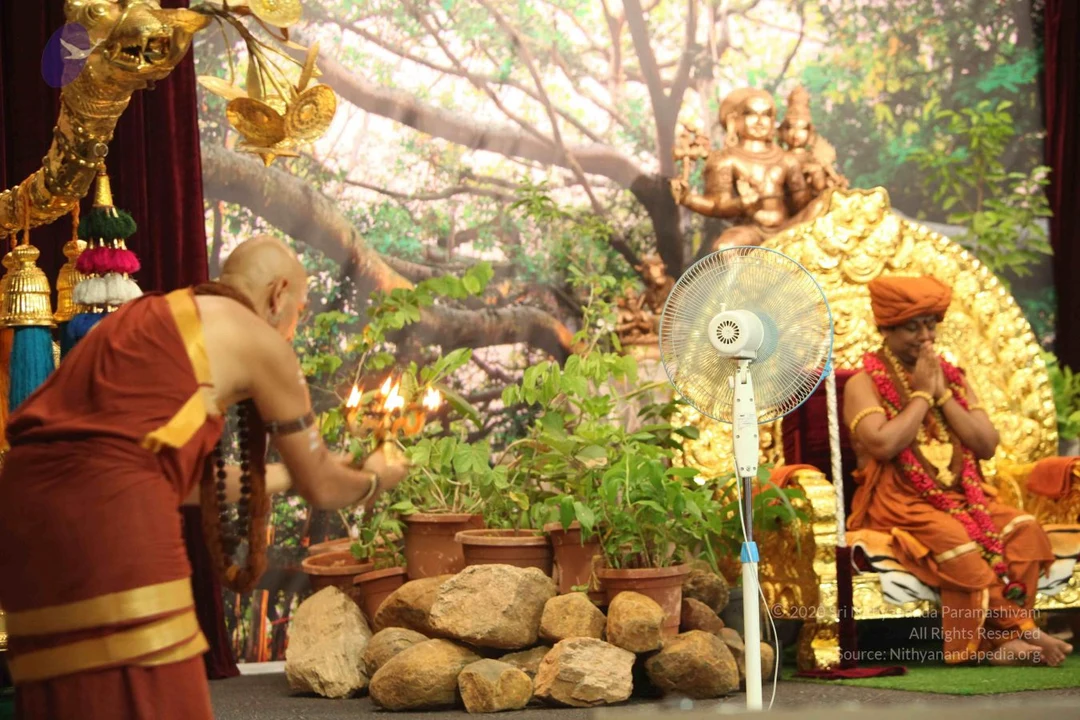
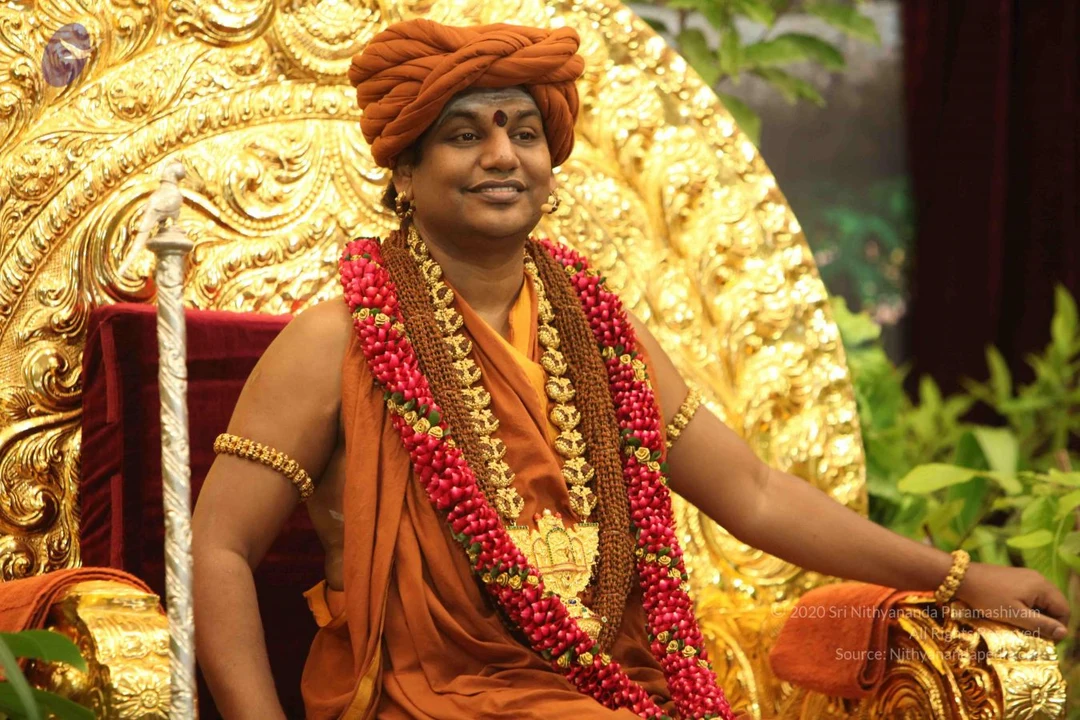
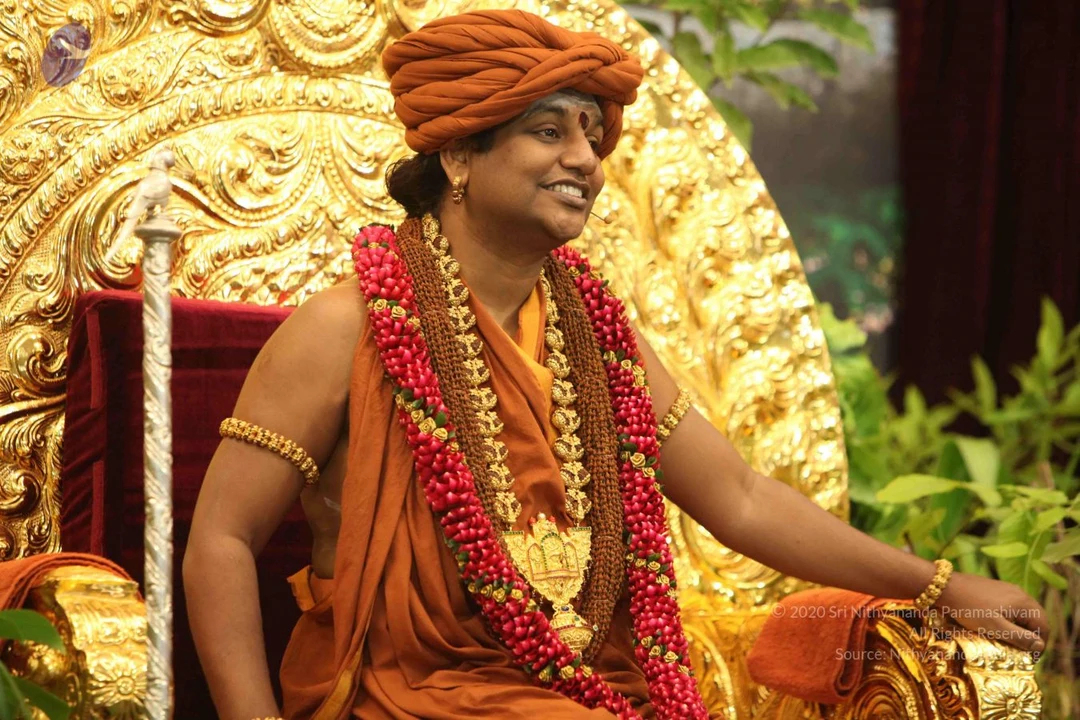
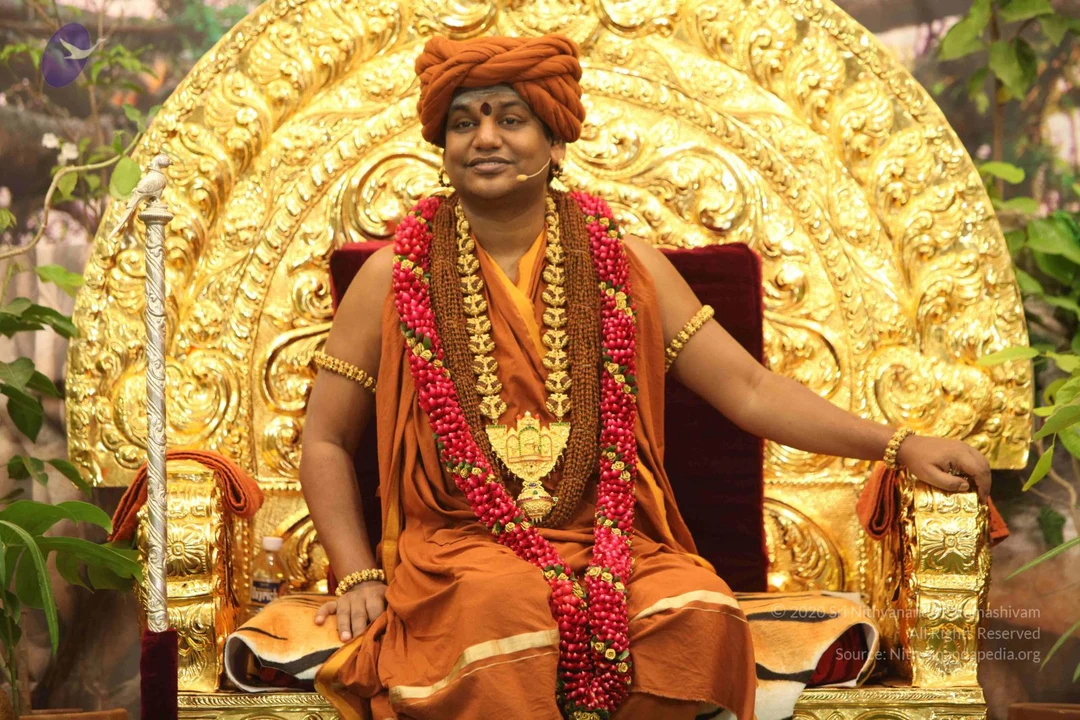
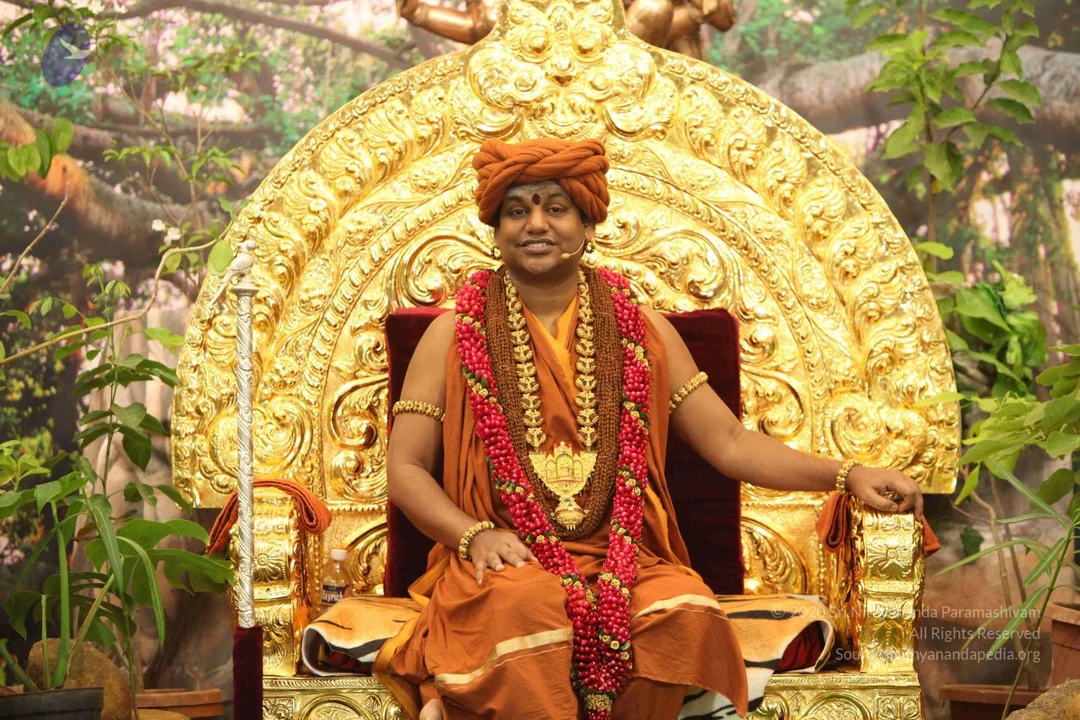
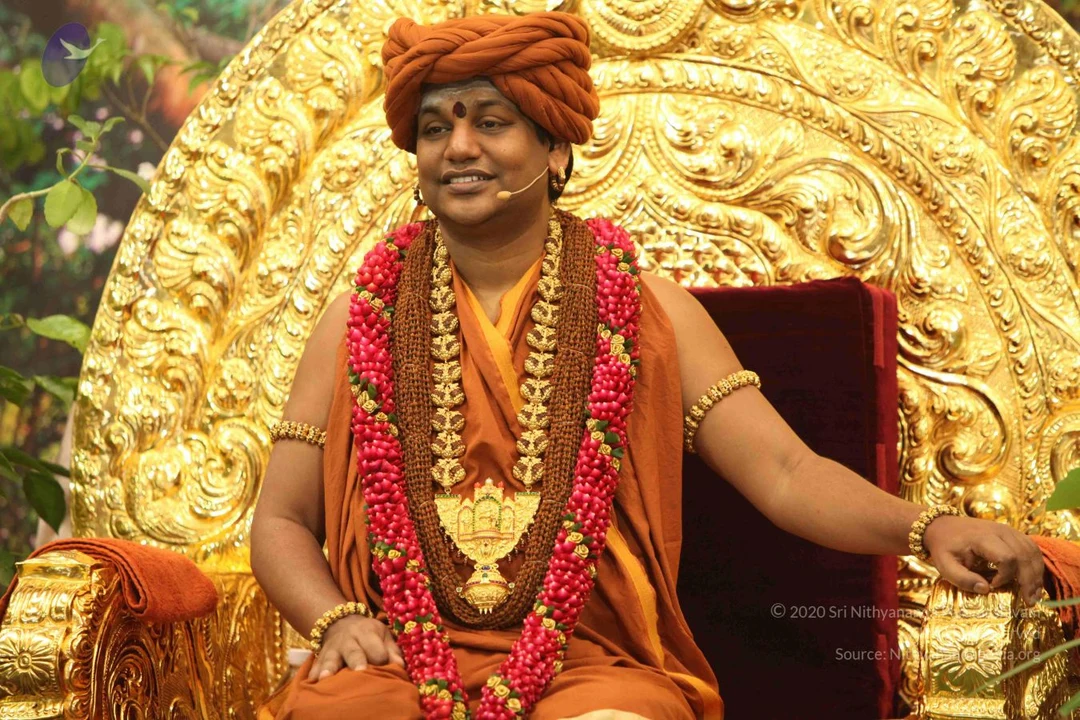
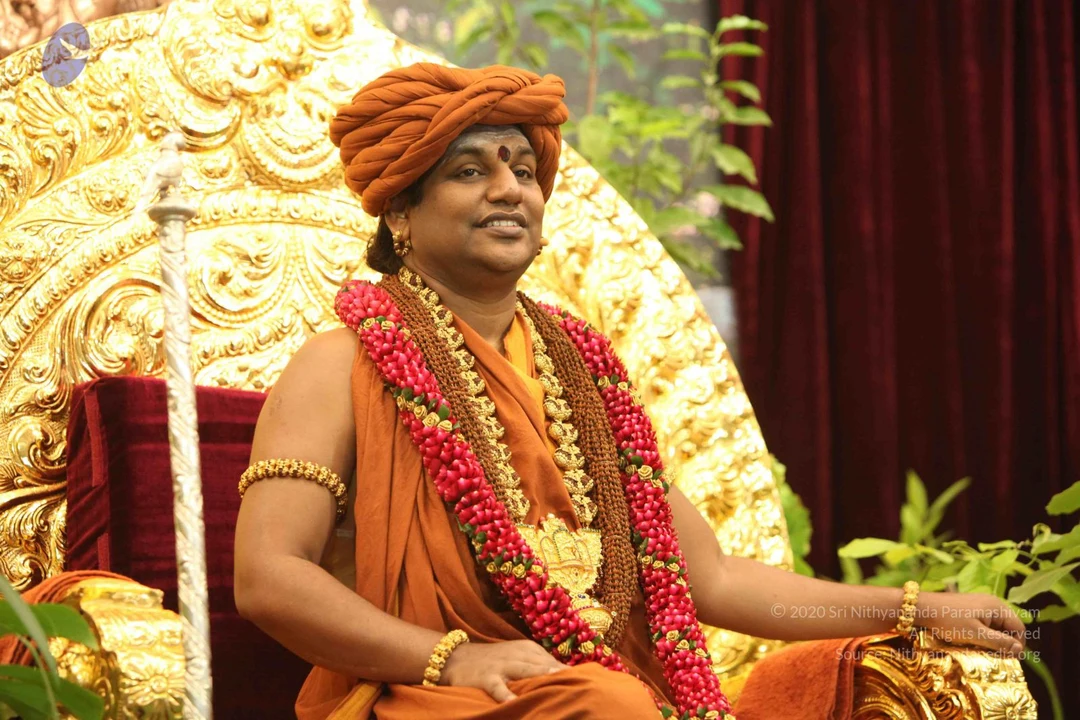
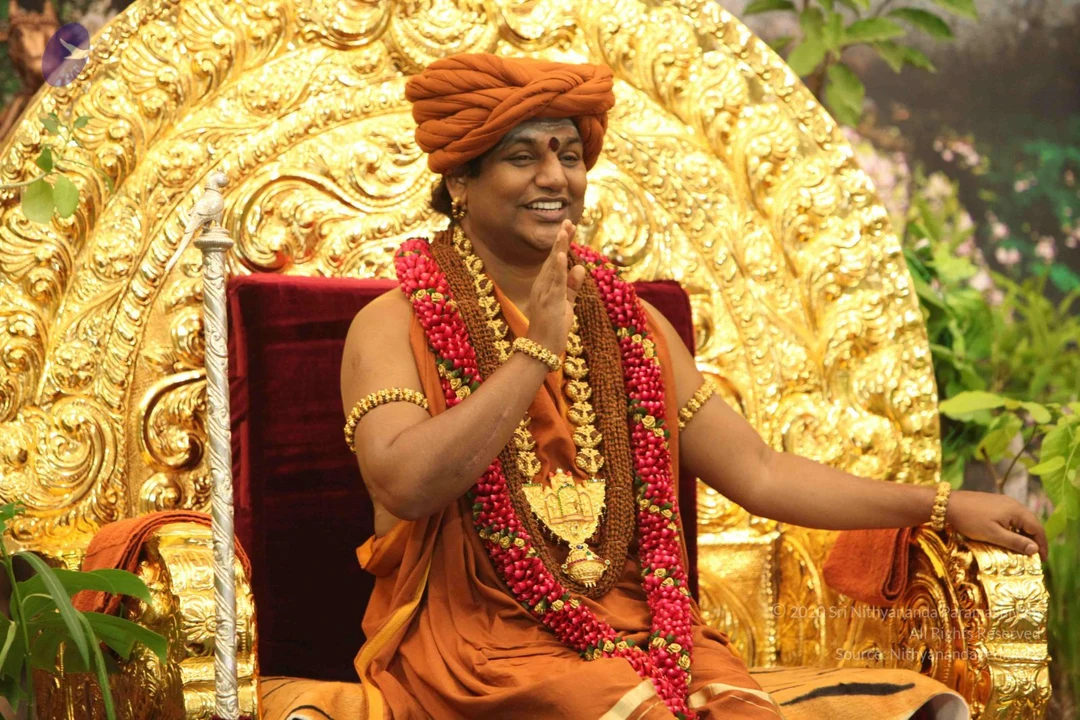
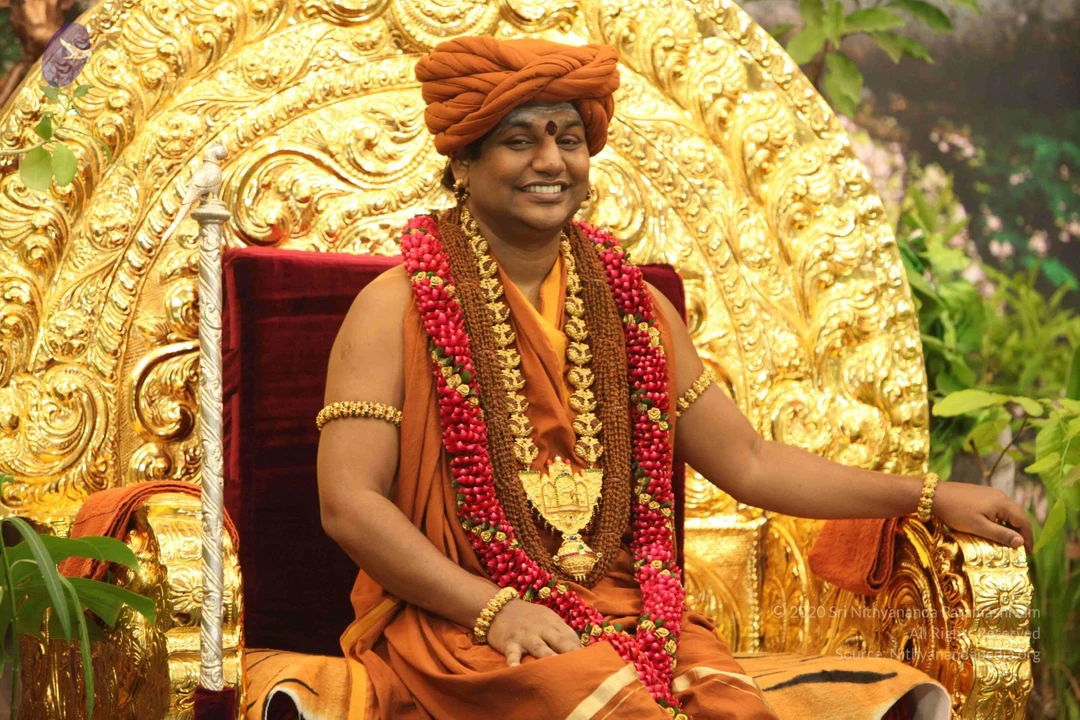
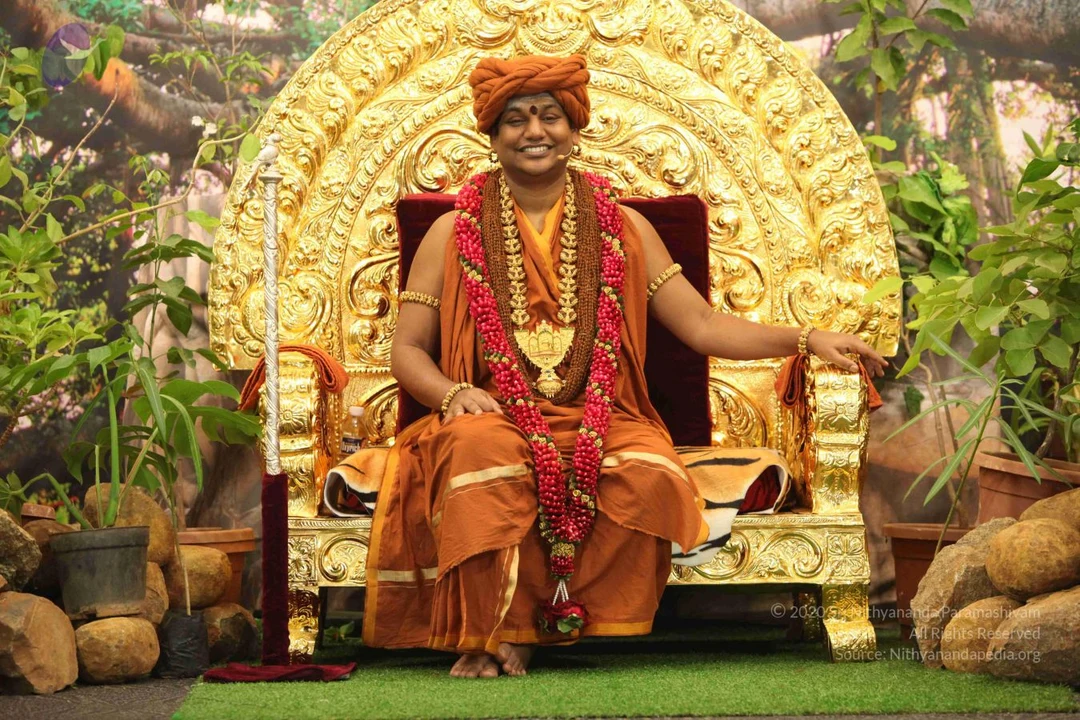
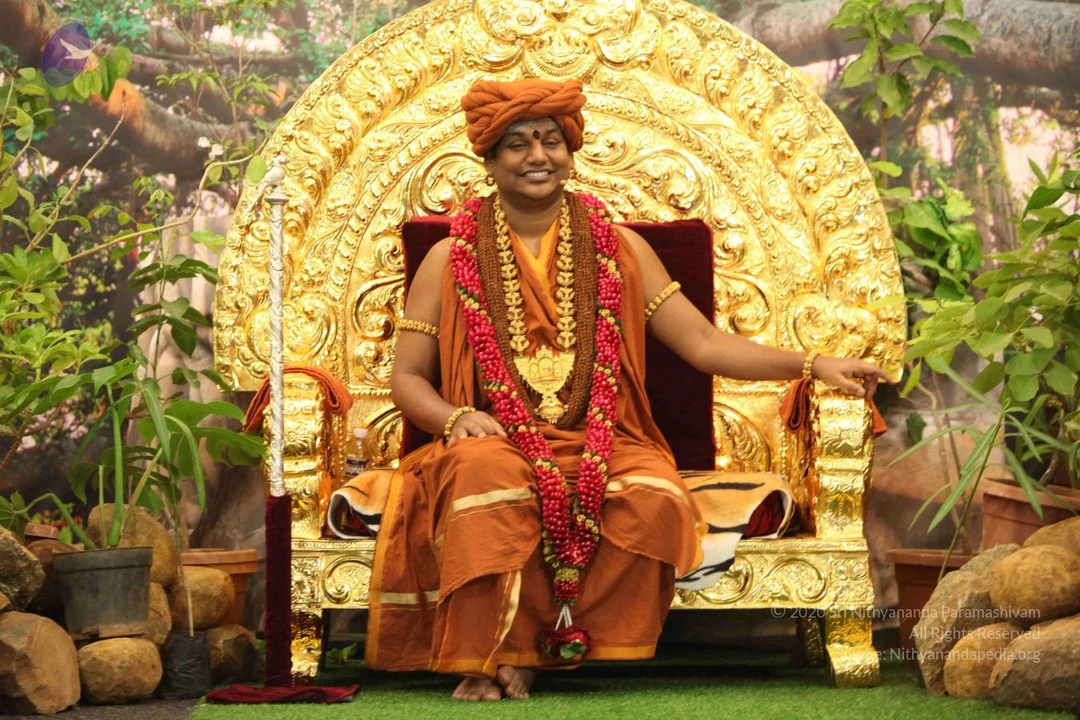
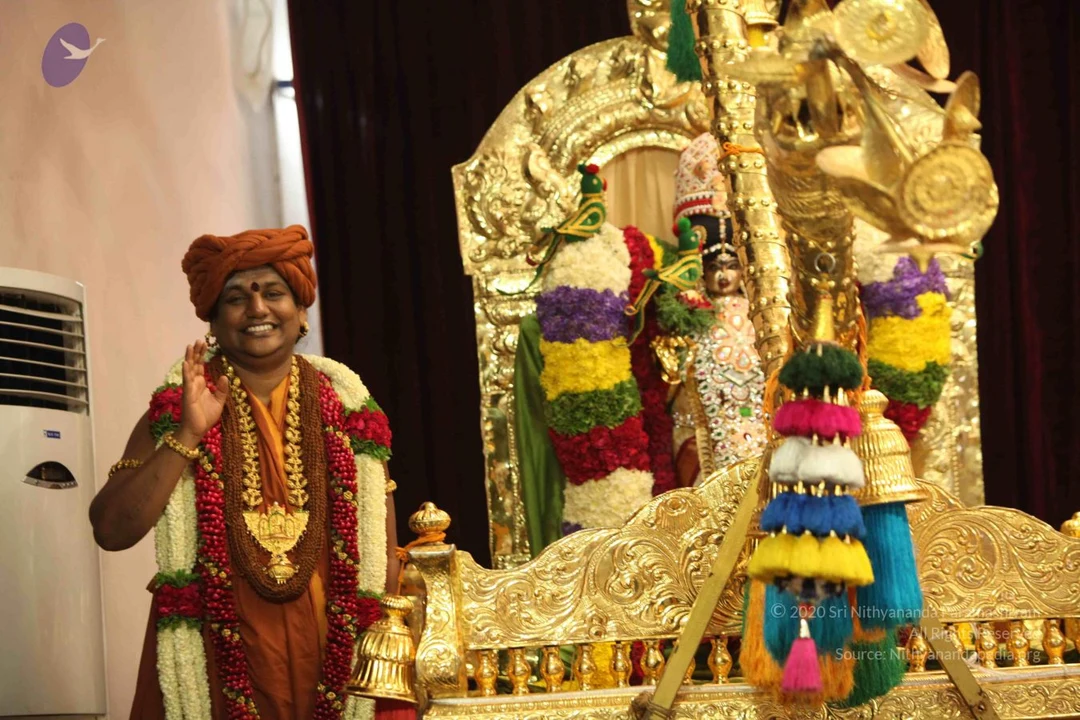
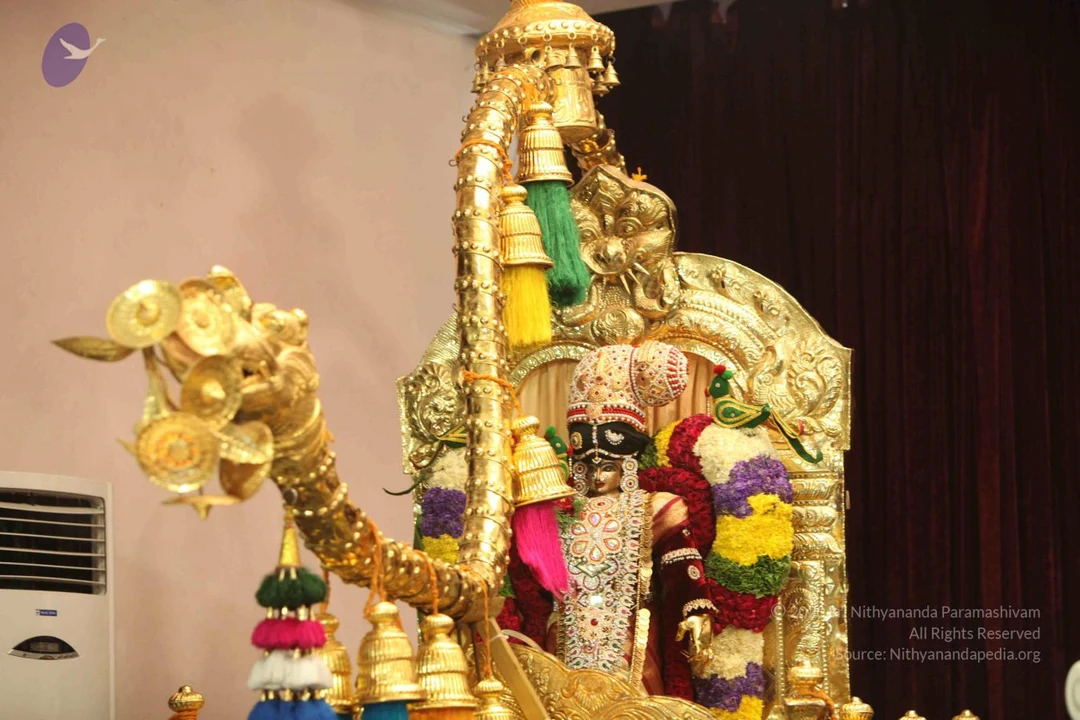
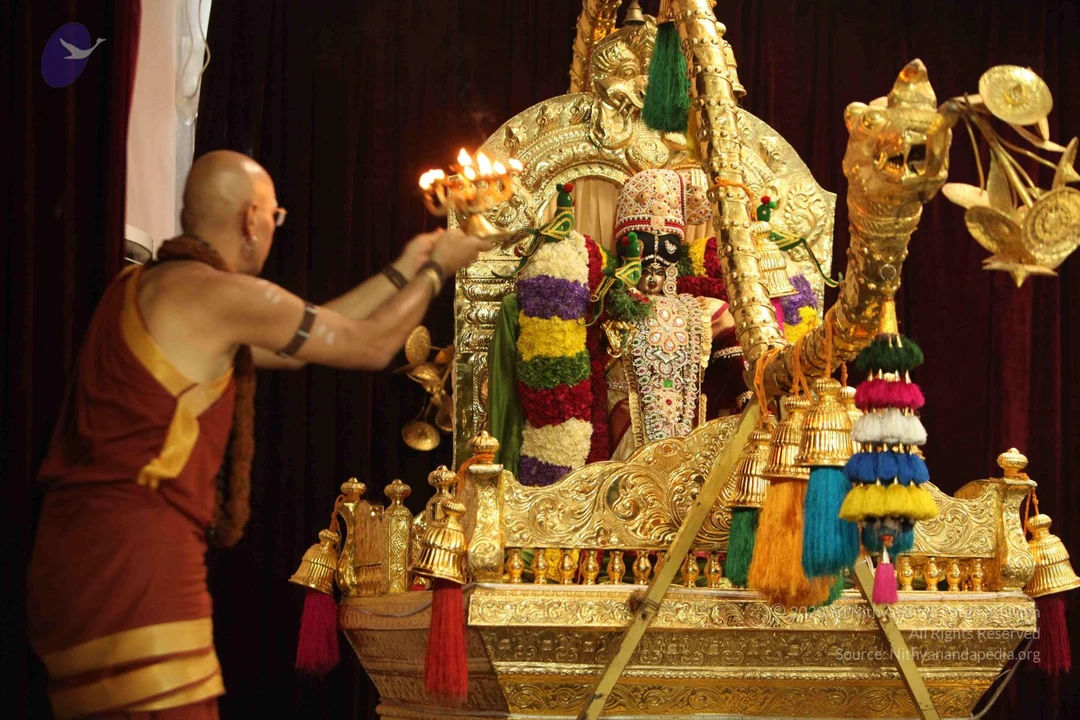
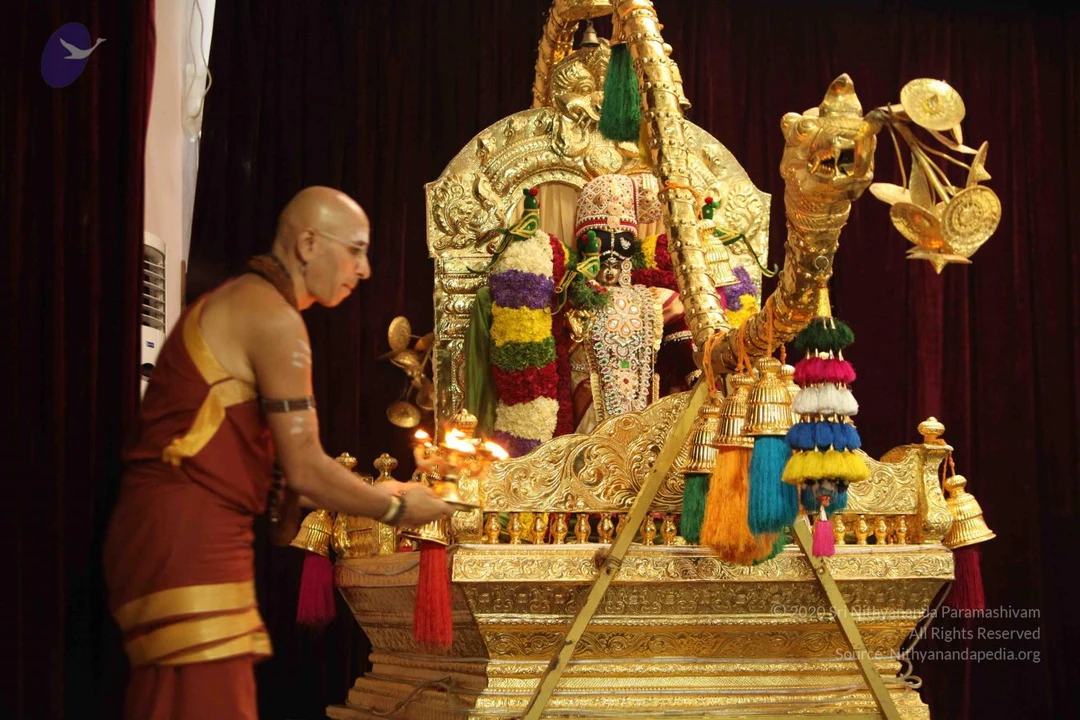
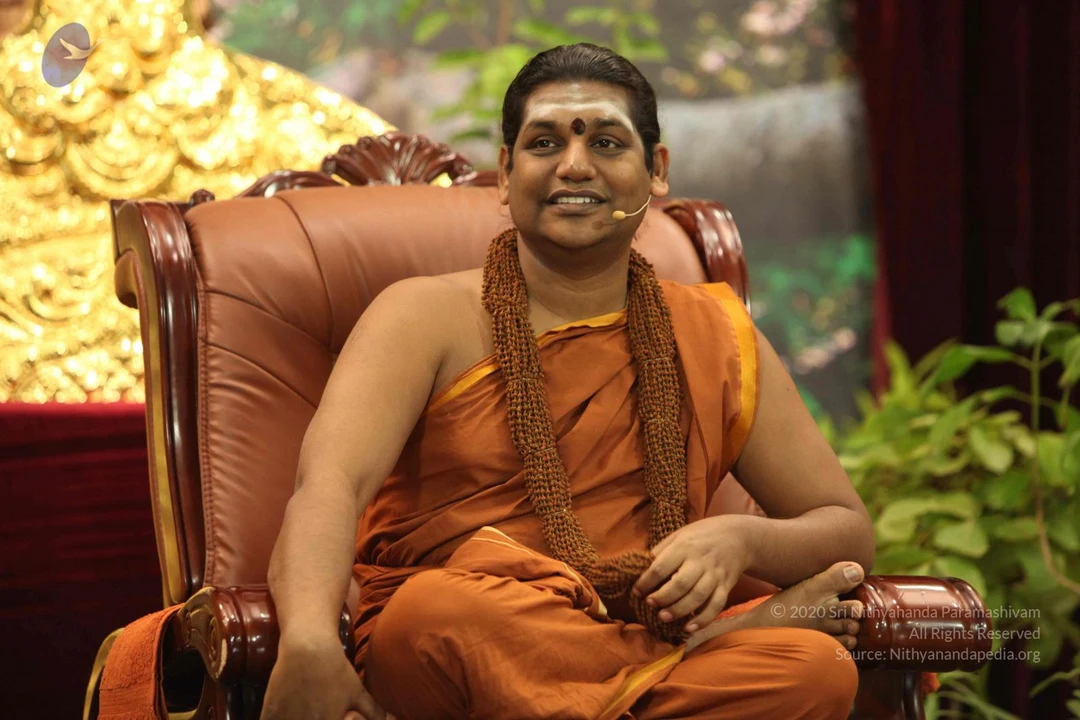
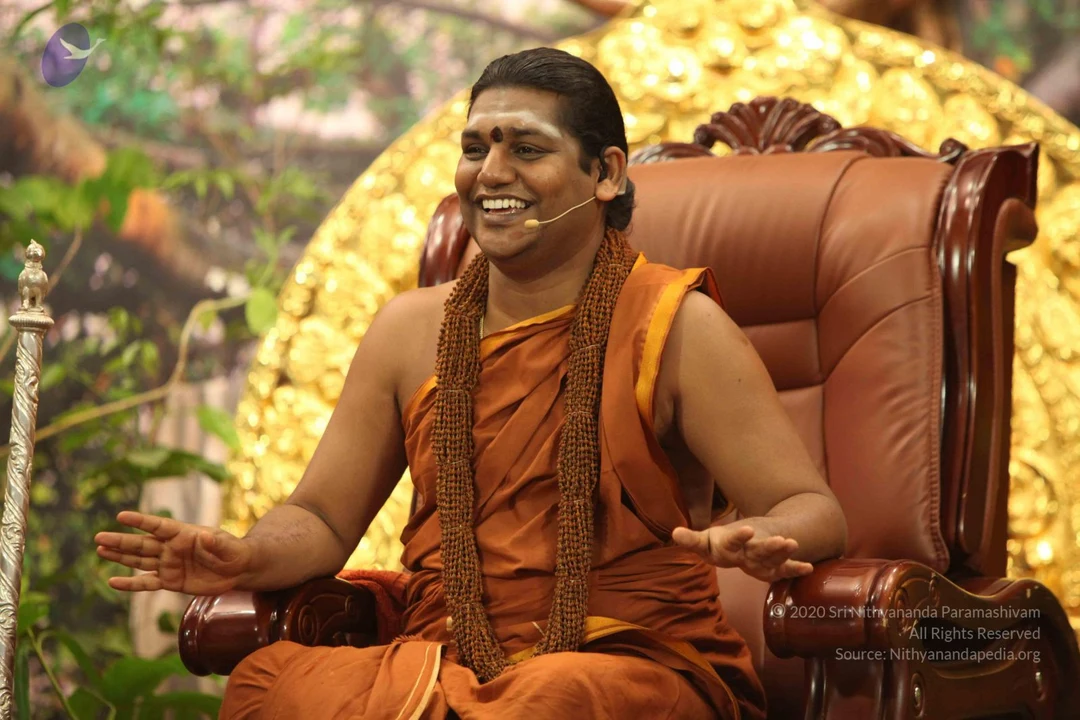
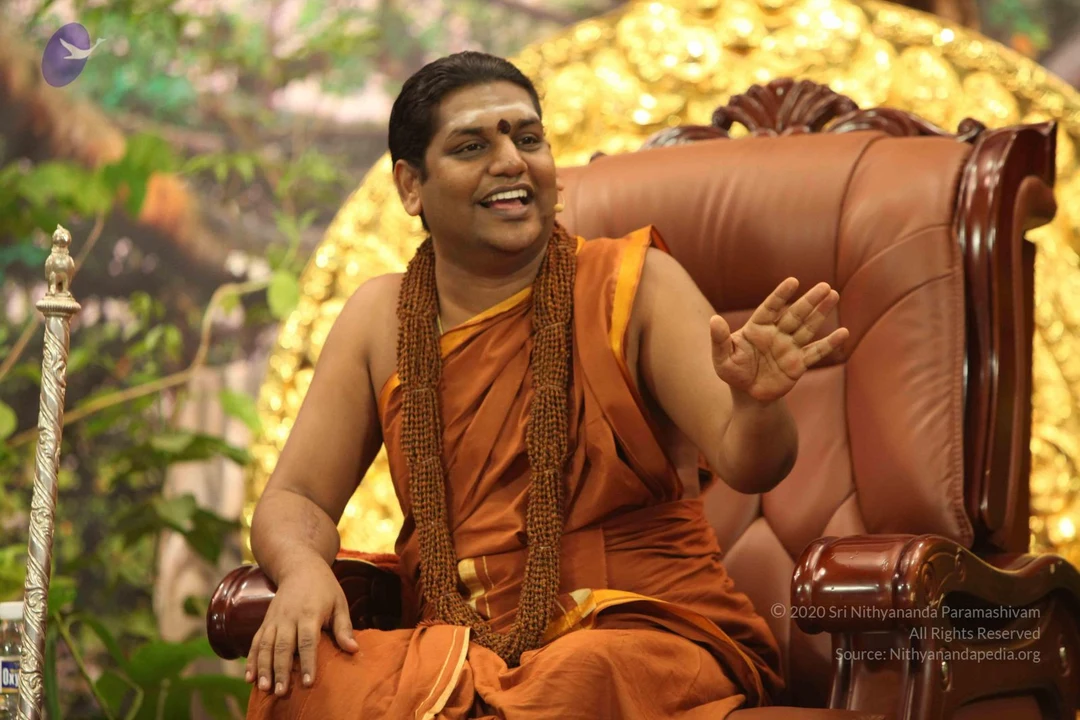
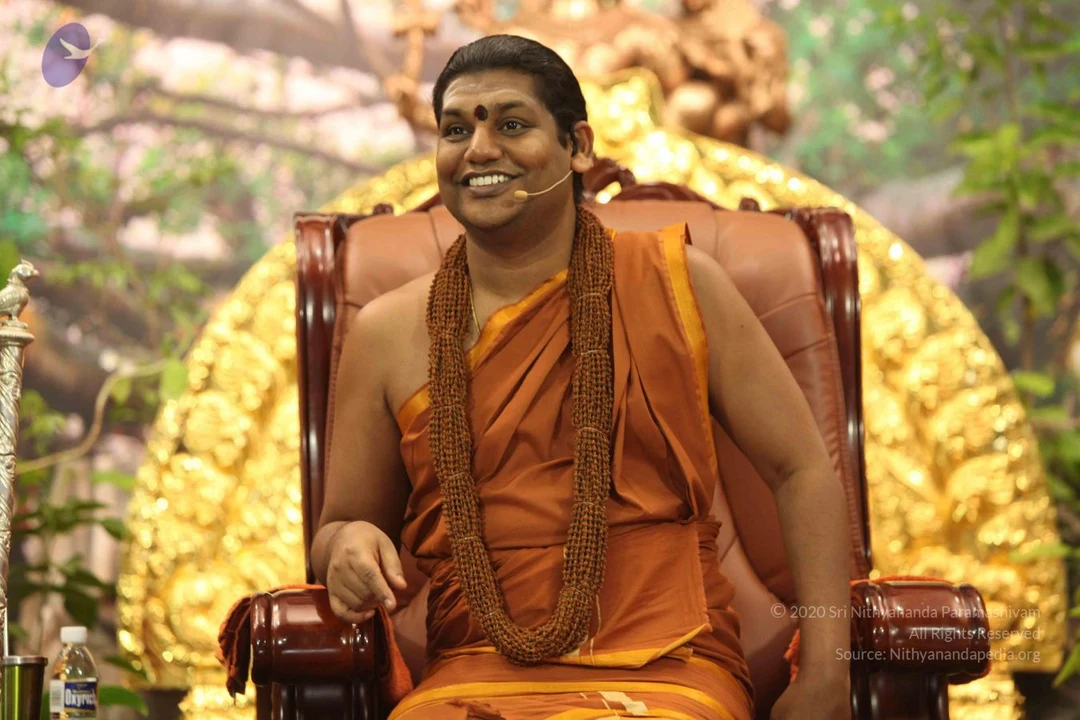
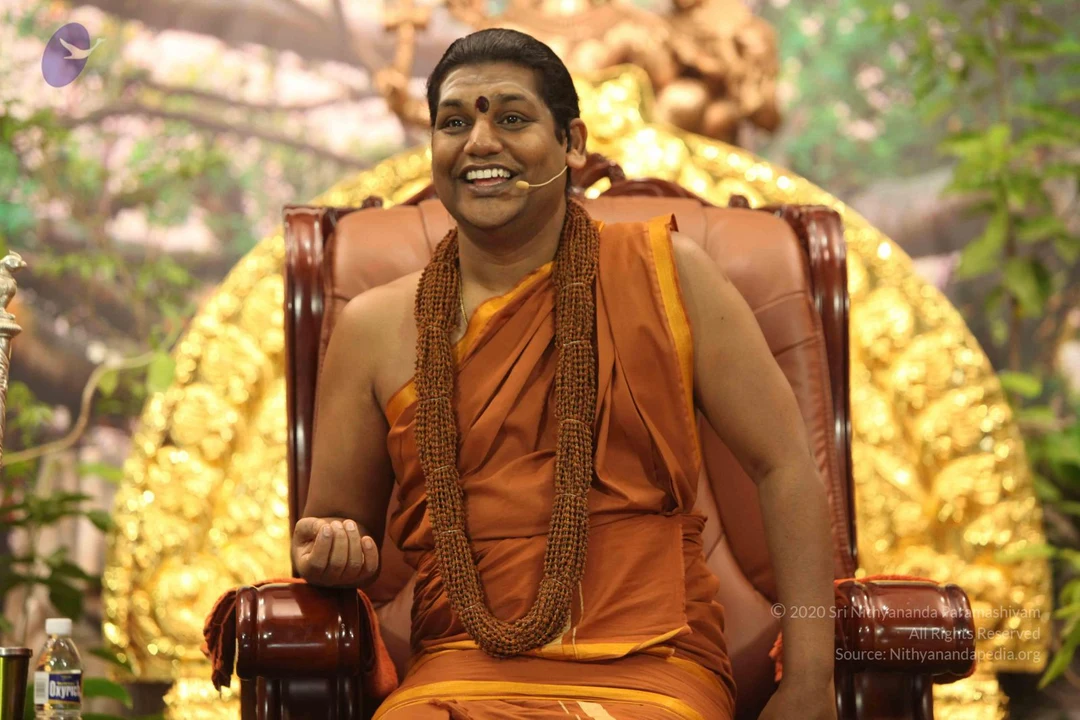
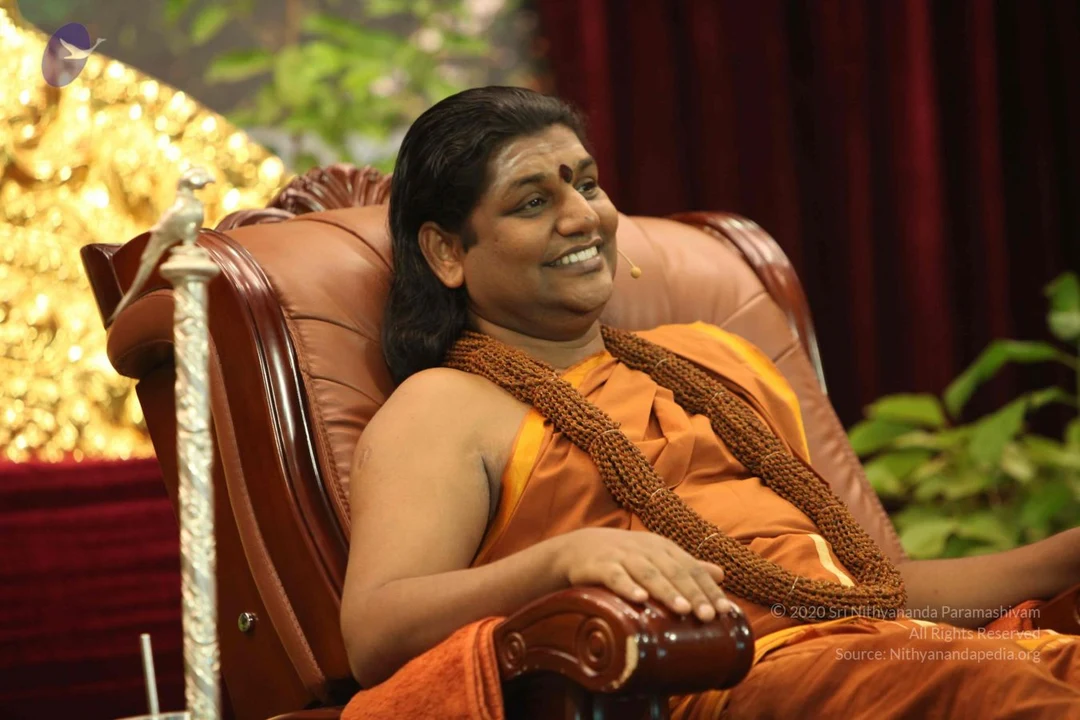
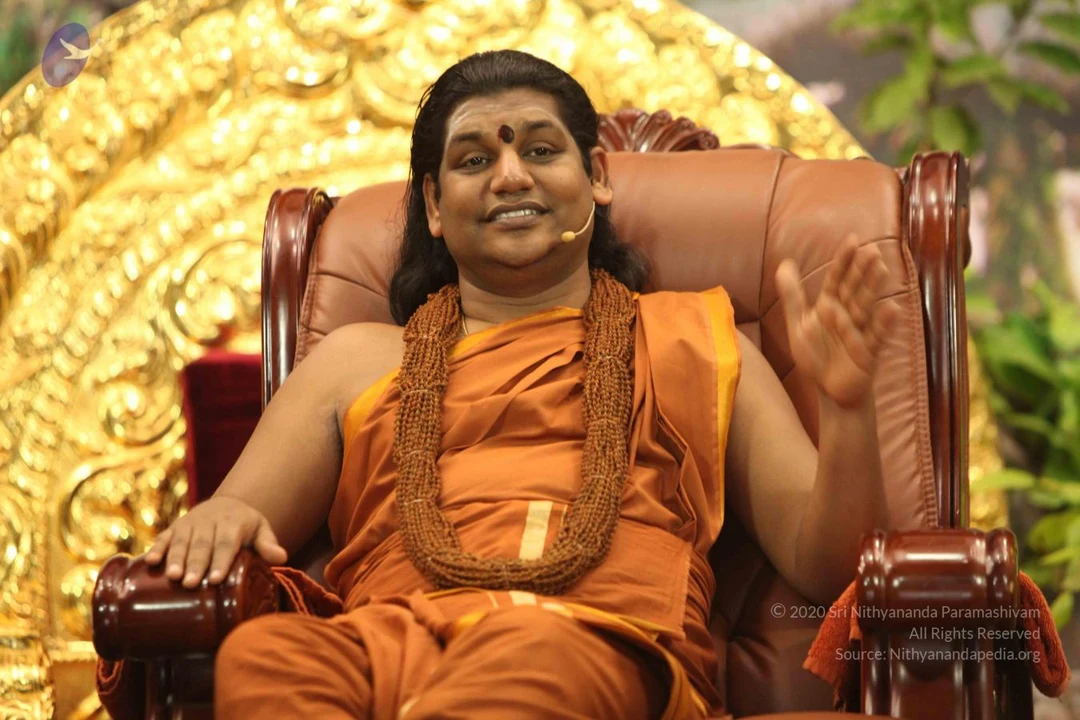
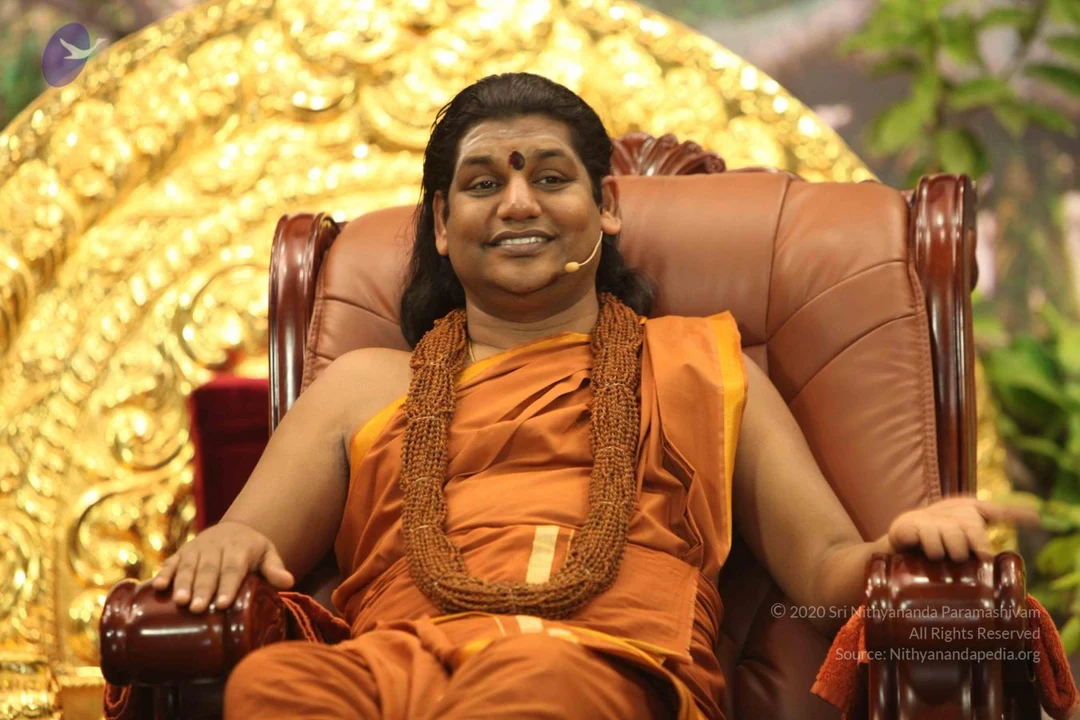
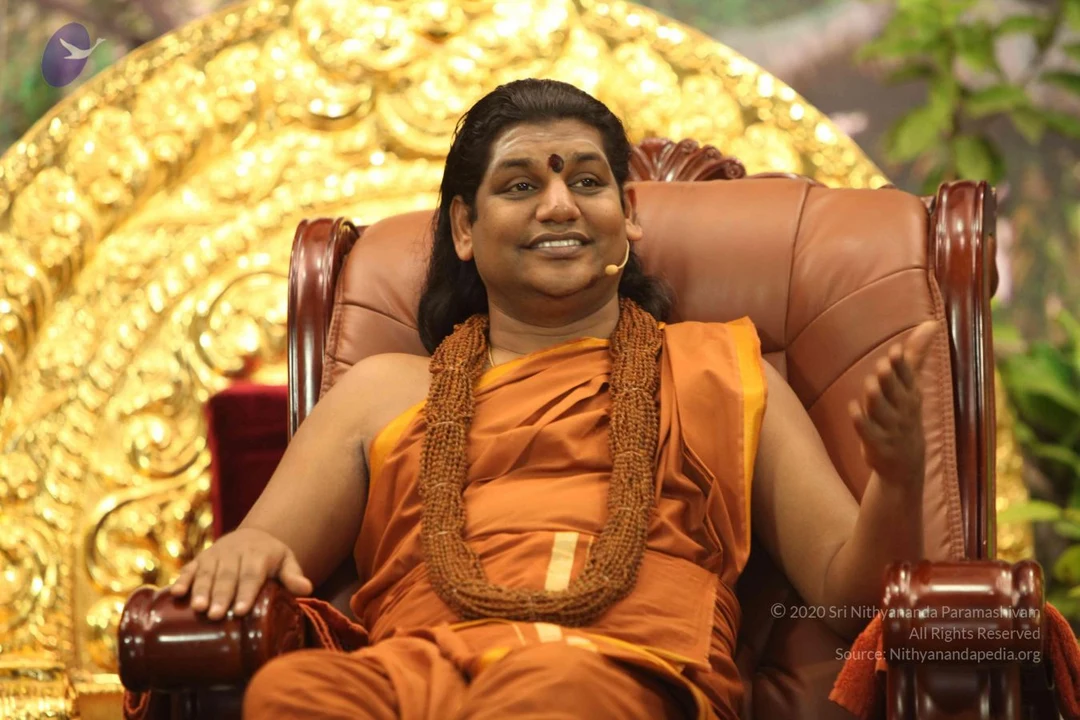
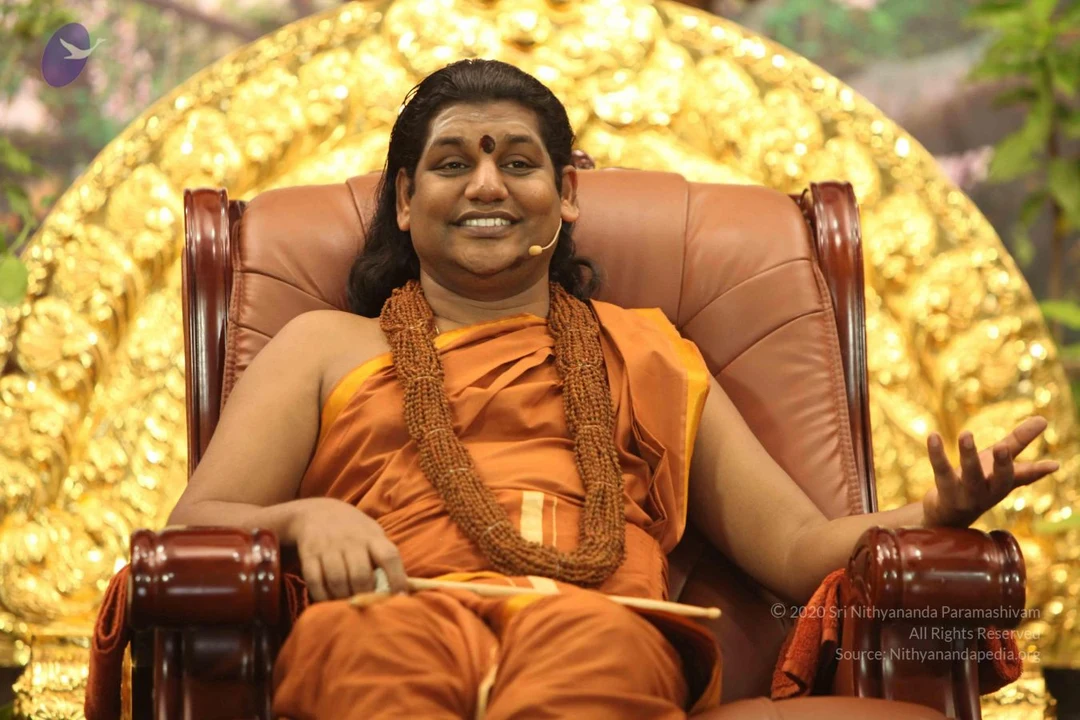
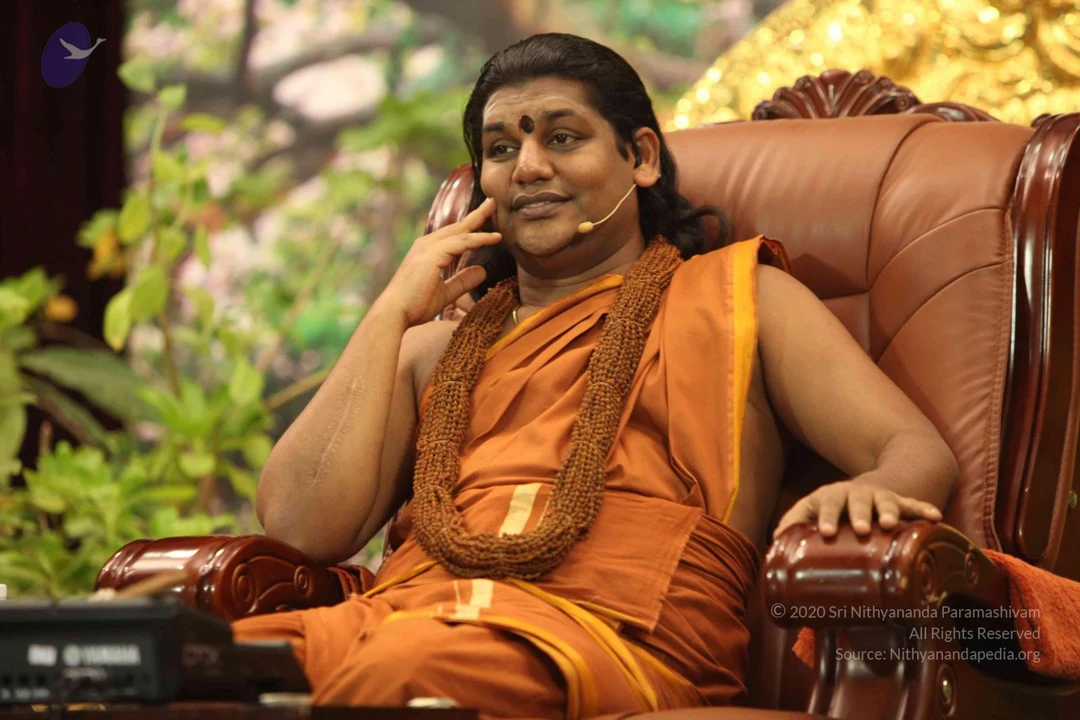
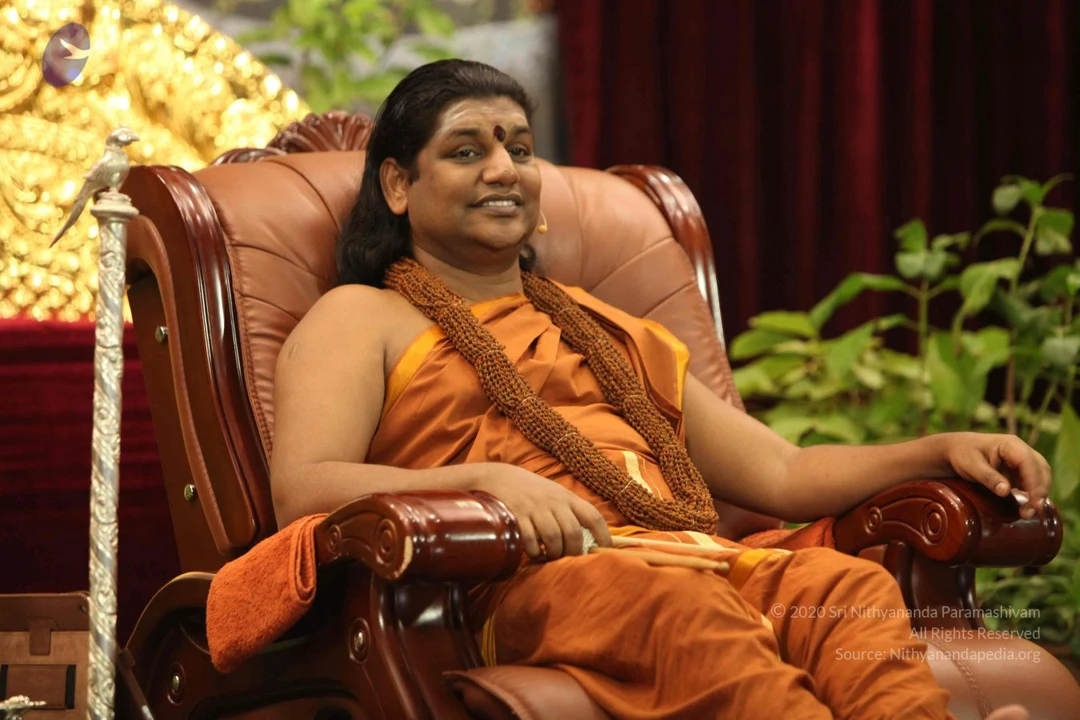
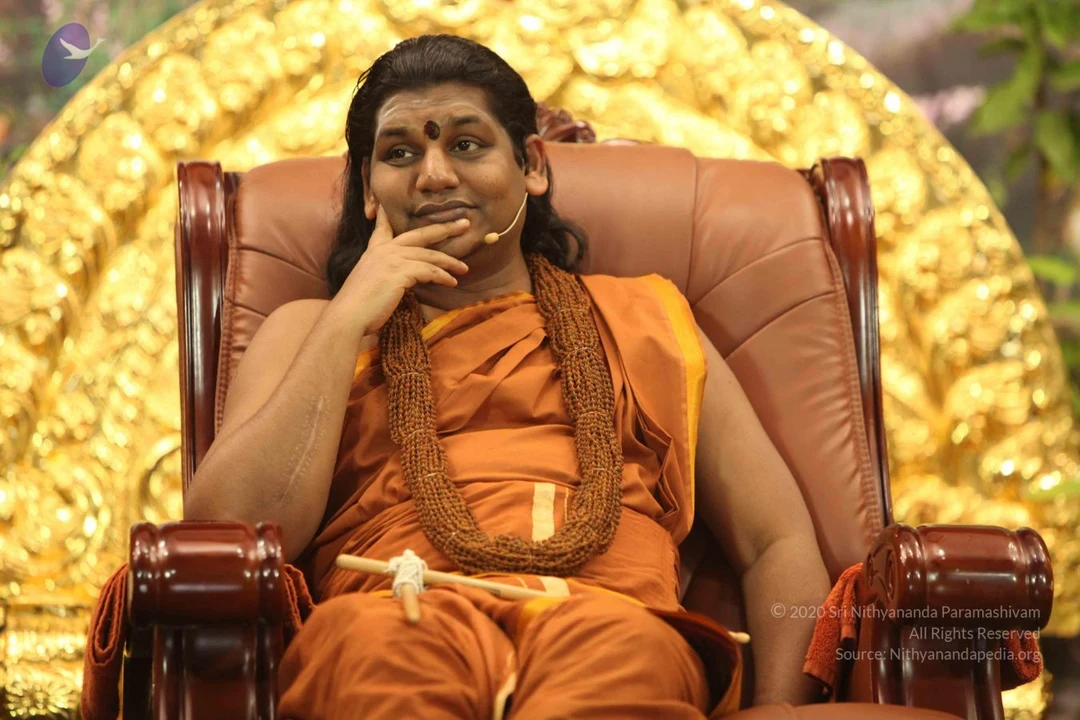
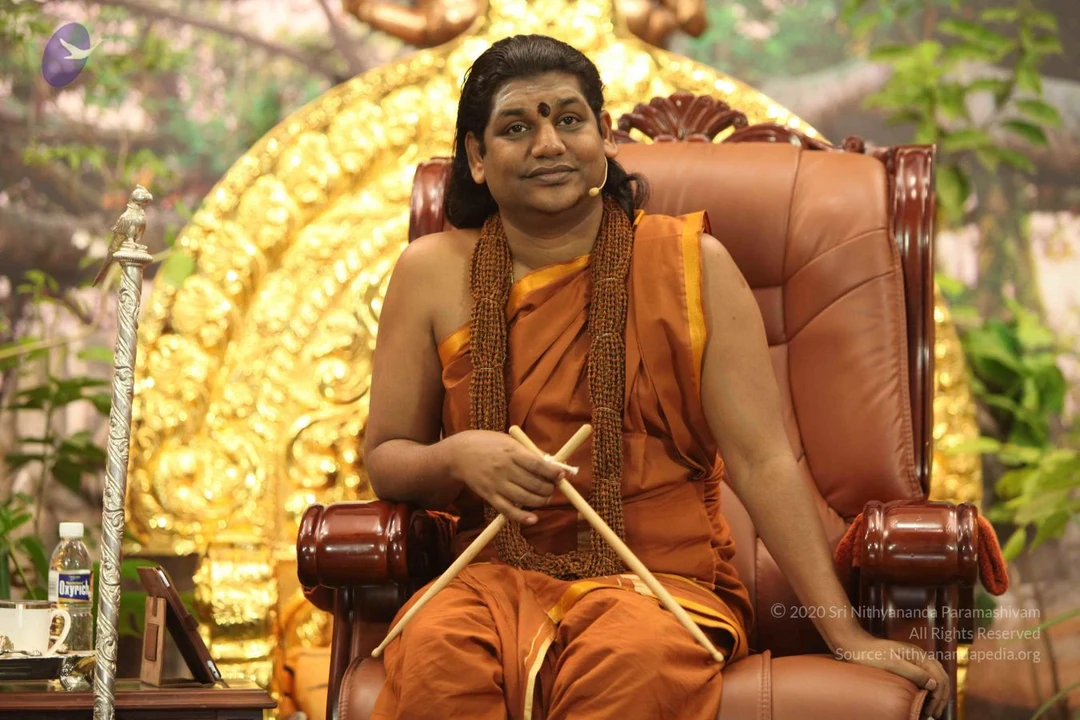
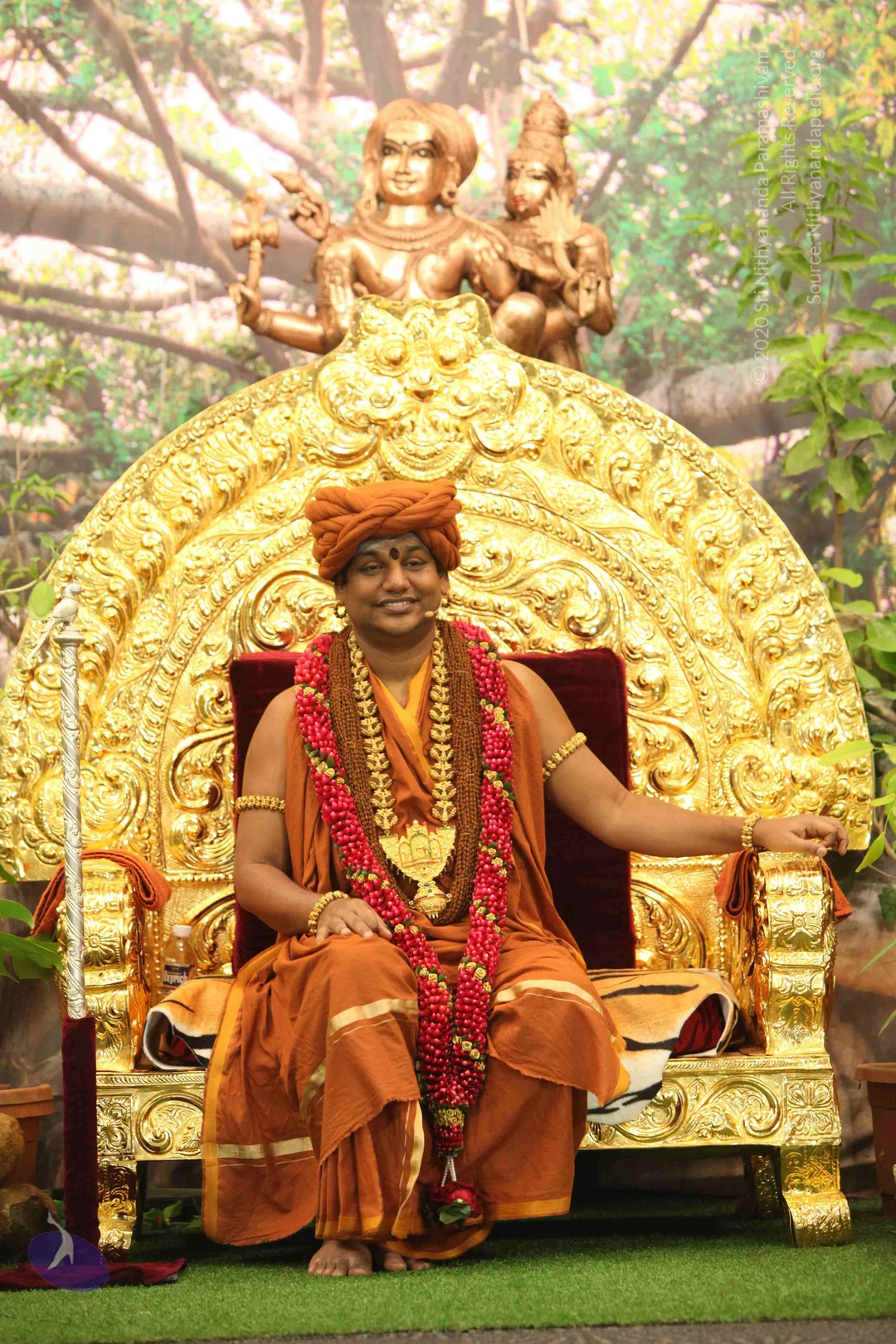
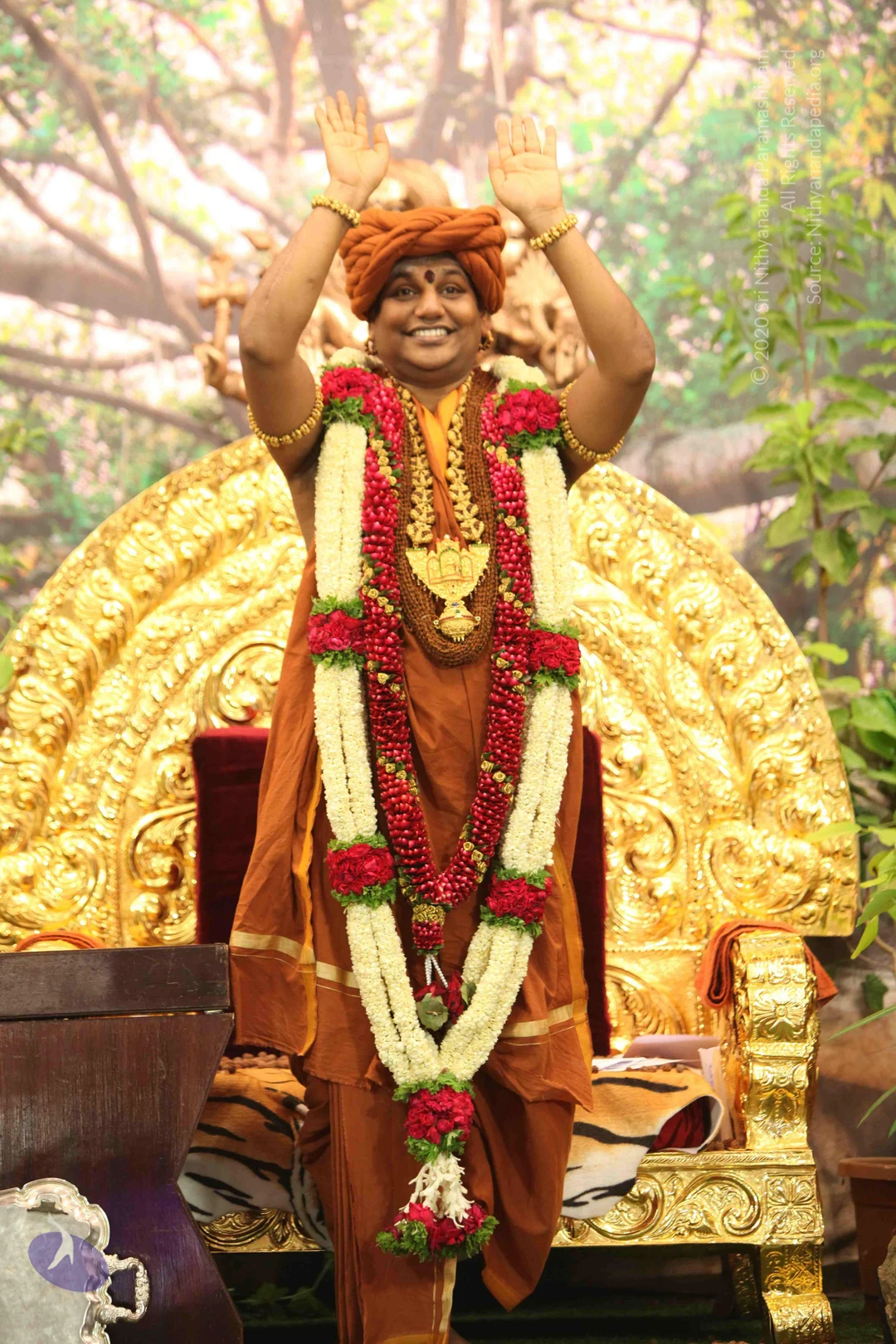
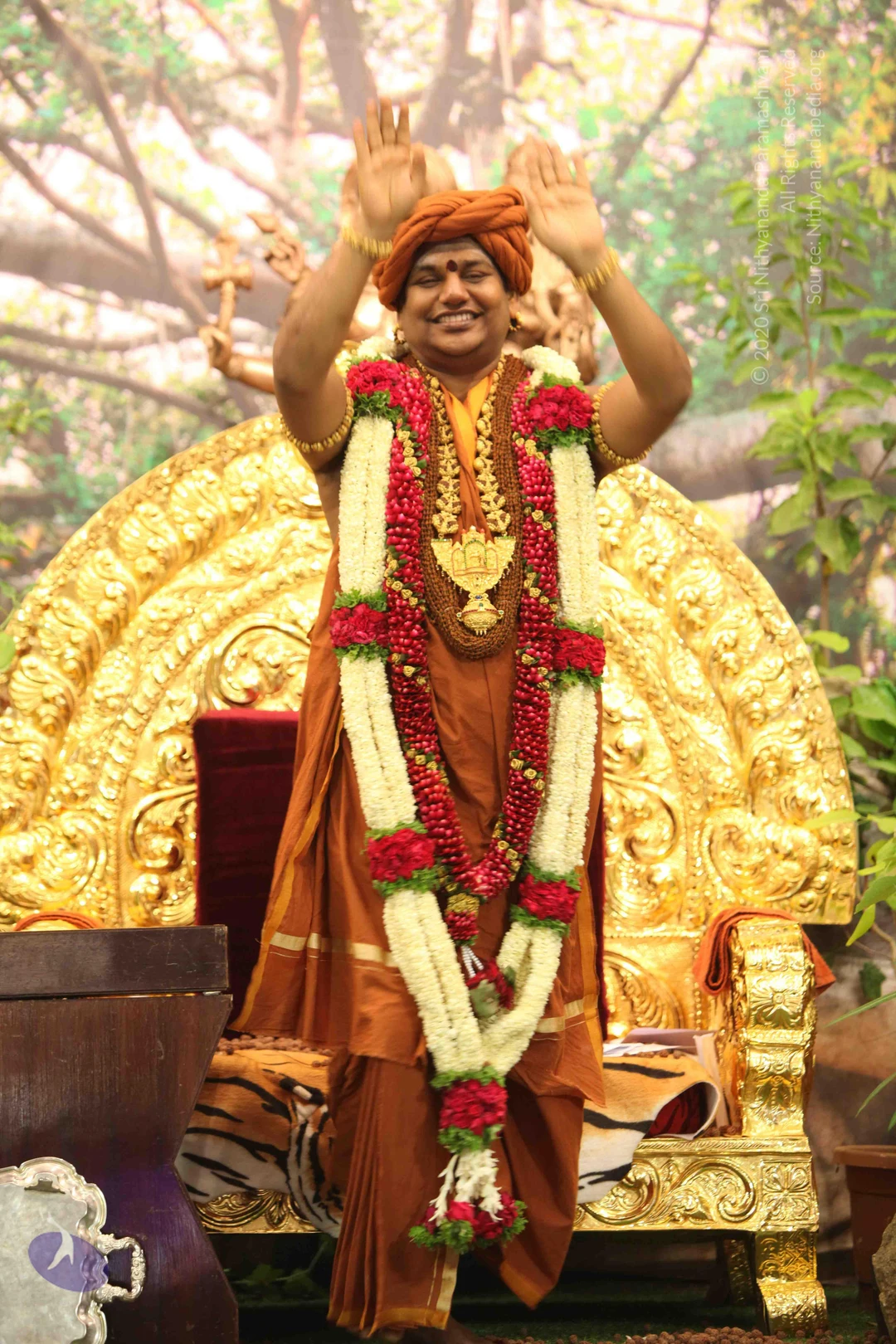
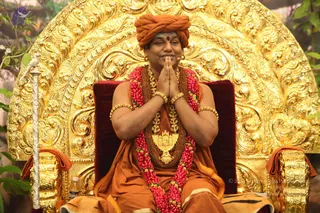
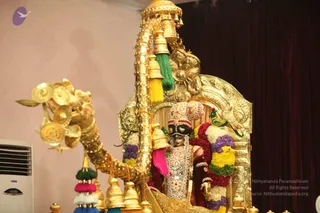
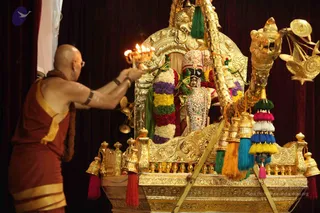
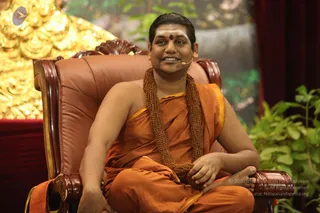
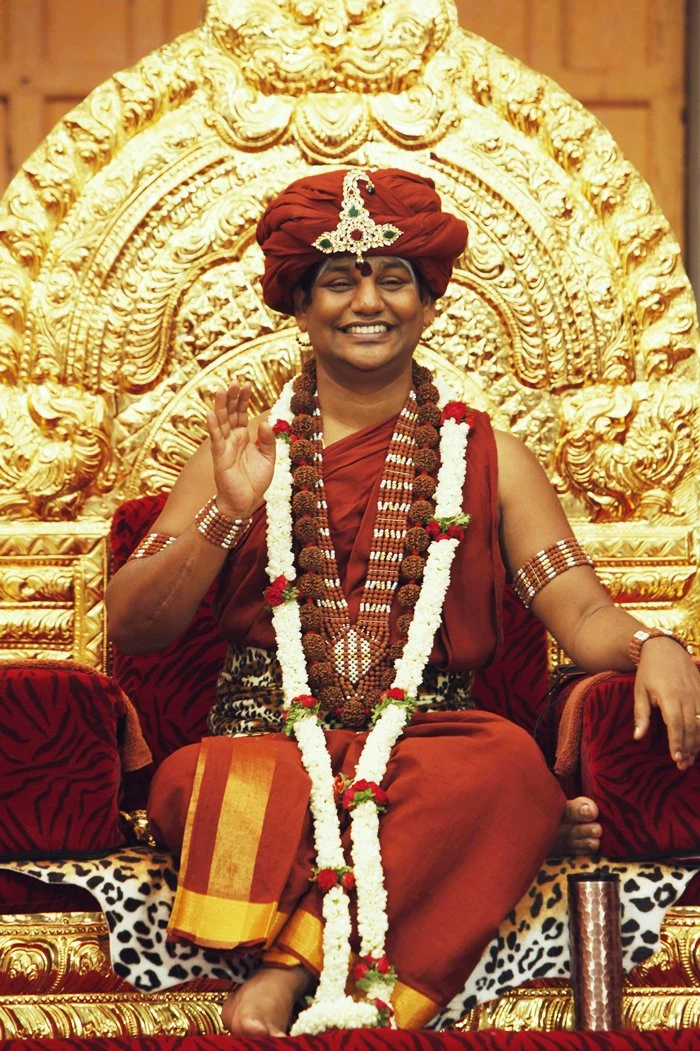
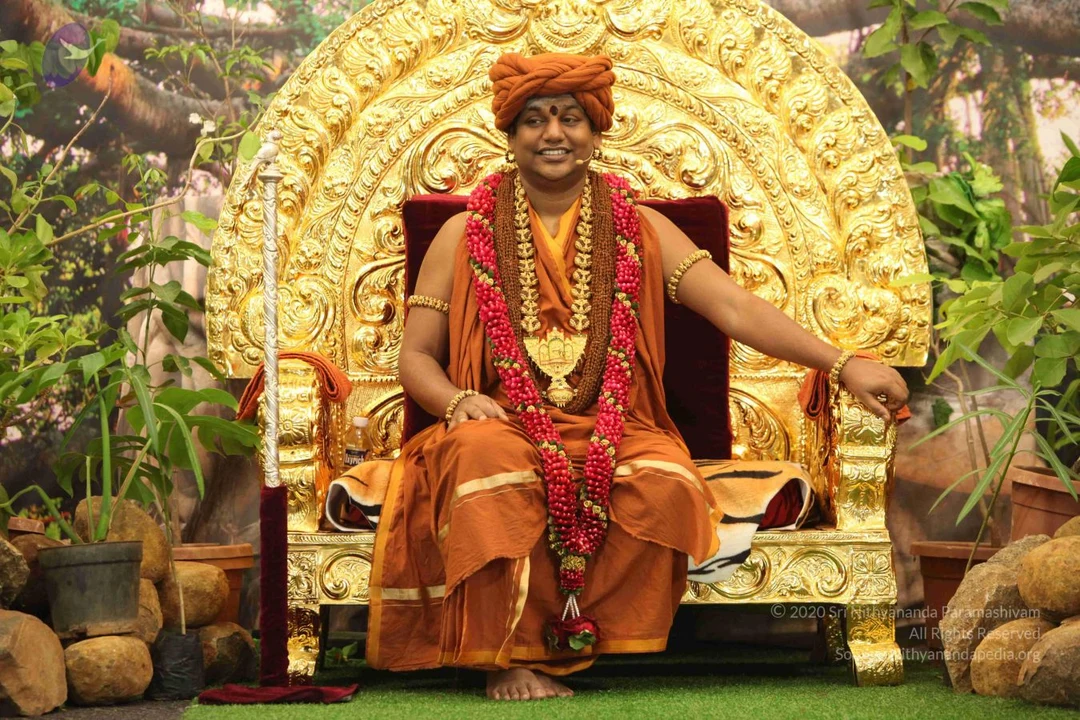
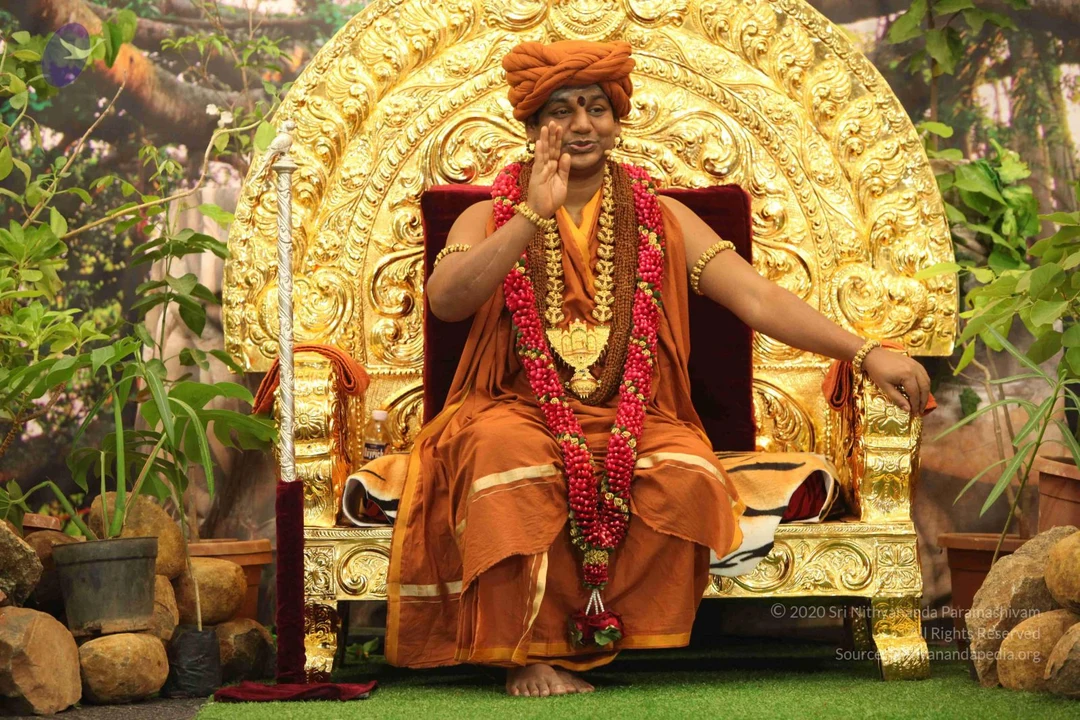
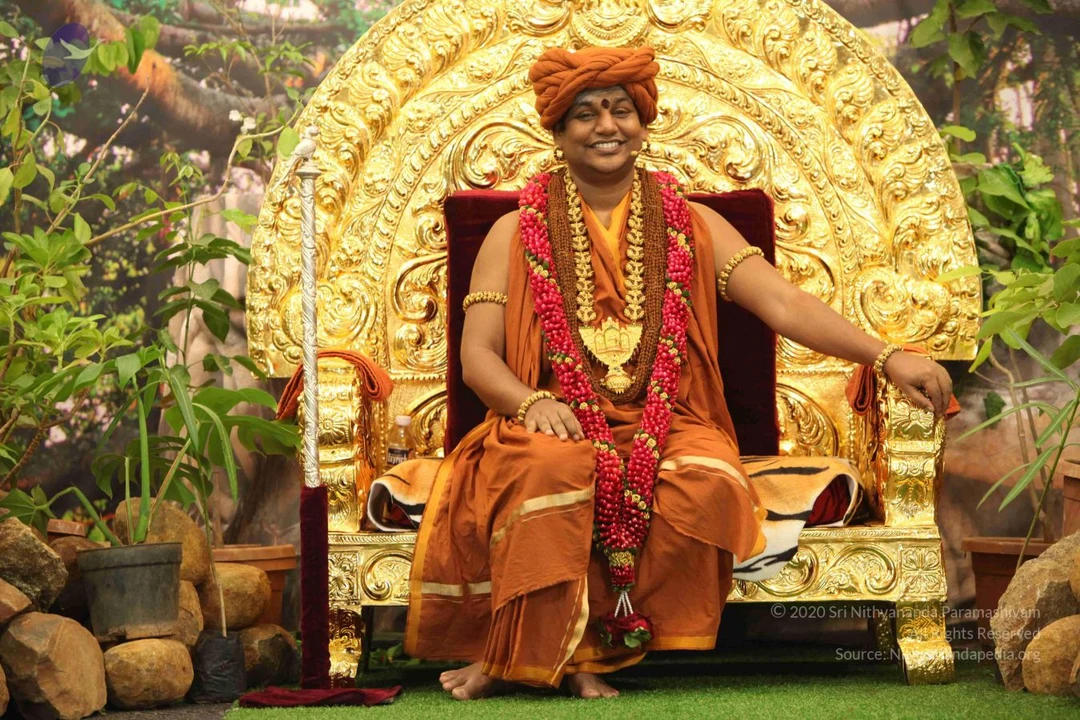
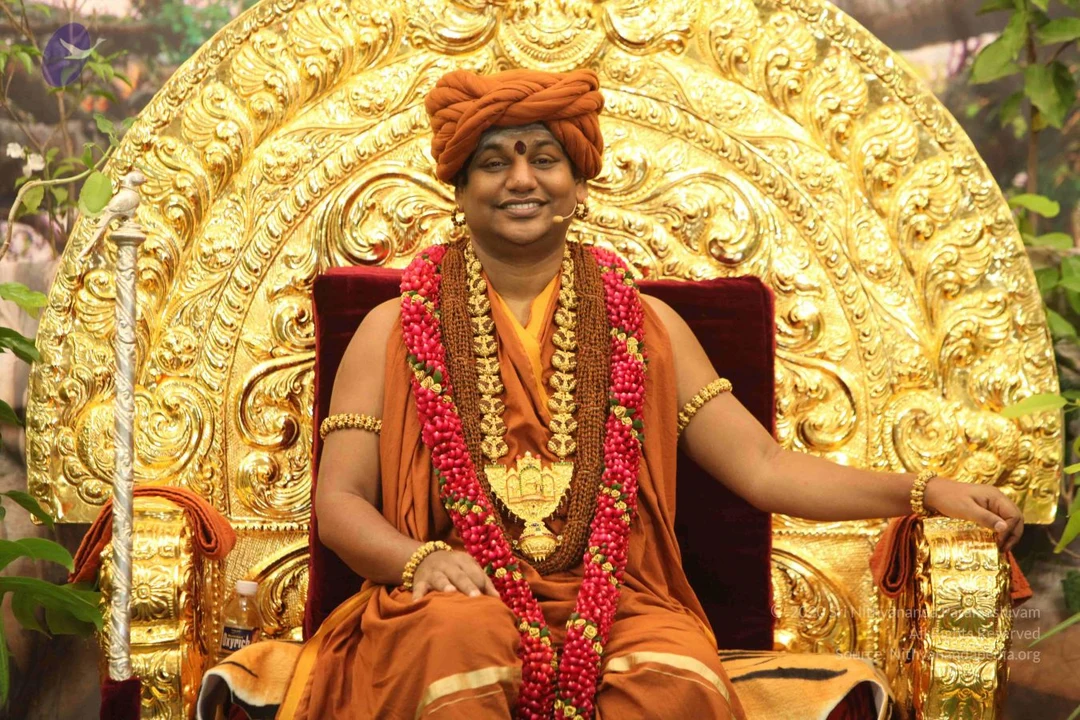
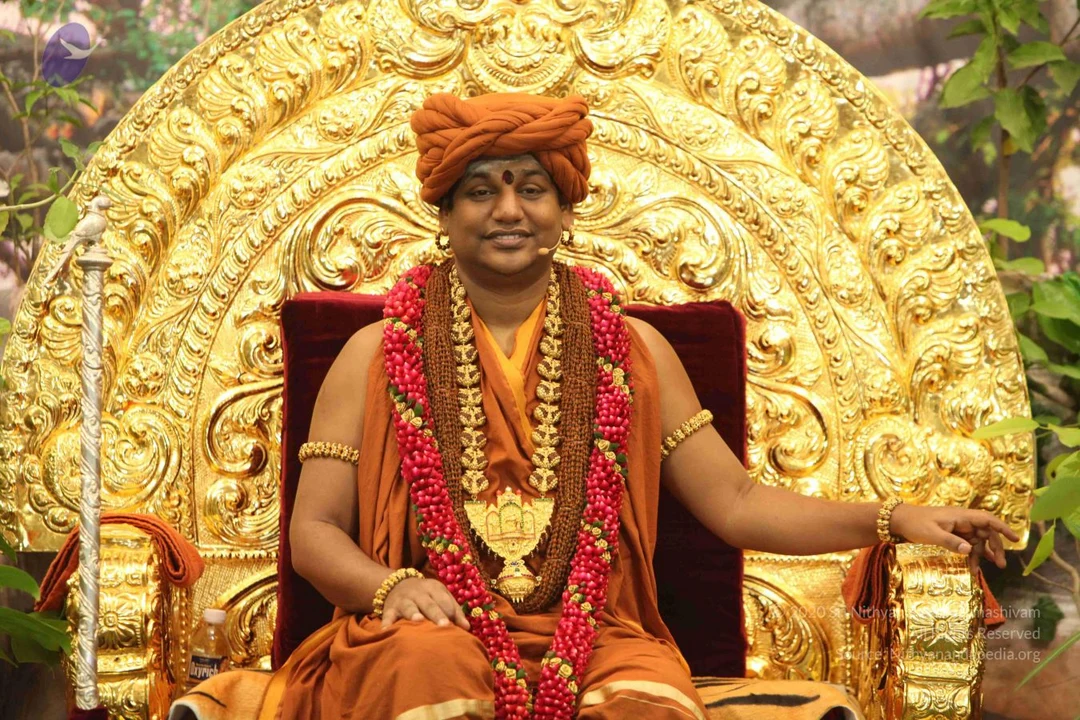
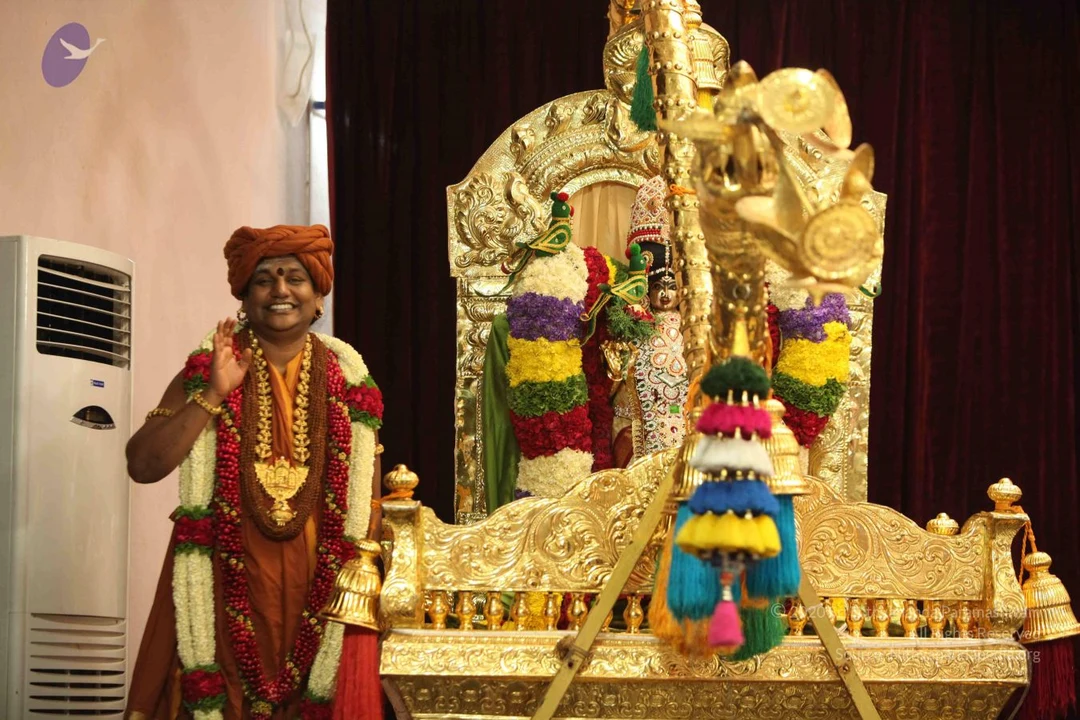
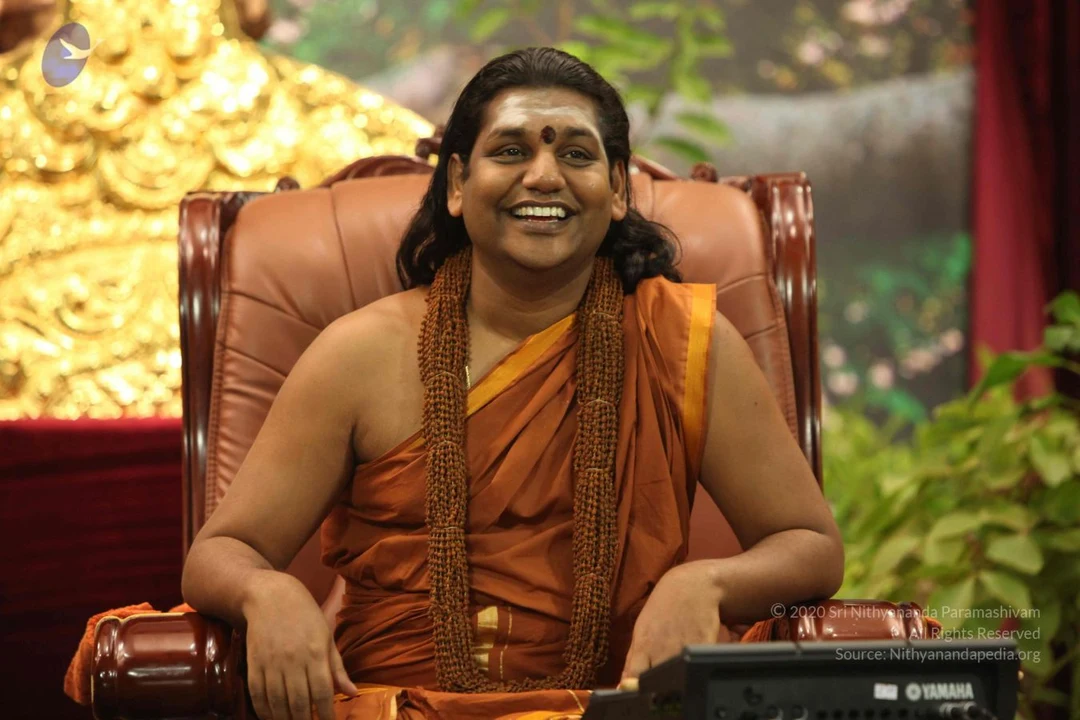
A man seated in a brown leather armchair with dark wooden armrests, in front of a large gold repoussé backdrop with floral motifs. He wears an orange saffron wrap draped over his shoulders and a long rudraksha mala necklace, with a red bindi on his forehead and a small microphone clipped near his face. He smiles broadly and extends one hand outward while the other rests on the armrest. A small white-and-gold stick lies across his lap.A seated man in saffron-orange robes and an orange turban sits on an ornate gold throne with carved floral scrollwork and a deep red cushion draped with a striped tiger-print cloth. He wears a long red and pink flower garland, layered gold and beaded necklaces, gold bangles and a rudraksha-style mala, with a red tilak on his forehead. His right hand is raised in a blessing gesture while his left arm rests on the armrest. Potted plants, rocks and green turf surround the stage, with a painted forest backdrop behind him. Only one person is present. The throne and seated figure are visible in the photograph.A photograph of a golden ceremonial palanquin-style peetha holding a deity murti adorned with multicolored flower garlands in purple, yellow, red and white and a jewelled crown-like headdress. A bald man in a rust-orange and gold dhoti-style garment, with a sacred thread and an arm band, leans in from the left holding a lit oil lamp with flames toward the altar. Golden bells and a tall golden staff with tassels in green, red, orange, blue and white decorate the structure against a dark maroon curtain.

April 24 2015

Original wiki page
Contents

Title

Experience Truth with Pure seeking

Description:

Today’s (24th April, 2015) Nithya Satsang on Ishavasya Upanishad in Living Advaita Series. Paramahamsa Nithyananda intercepts into the context of 9th verse that describes two major problems a seeker faces when he starts transforming his cognition that he is Consciousness, Mahadeva. Beautifully illustrating the whole context, he narrates the story of Brahma and Vishnu as seekers, searching for Mahadeva’s head and feet. Vishnu becomes bored and tired seeking. But Brahma uses cunningness, with the false evidence of a flower, which is the false ritual or technique, the incomplete knowledge that claims it knows the Truth, the head of Mahadeva, without experiencing it. With this, he tells the world, never to fall victim to people who design techniques which are not aligned with Apta Pramana, the words of Rishis, the Vedas. And reminds us to — Look into the context and catch Mahadeva, Consciousness. Isha Upanishad – Verse 9 andhaṁ tamaḥ praviśanti ye’avidyām upāsate | tato bhūya iva te tamo yau vidyāyāṁ ratāḥ || 9 || Today’s Vakyartha Sadas, topic for spiritual explorations on truth is — “How to keep our seeking pure without being touched by Brahma and Vishnu both. Neither boredom nor false purpose, the vested interests, incomplete knowledge should disturb our seeking. Contemplate about this. Do Vakyartha Sadas on this. How to keep our seeking pure, how to retain our seeking pure, away from boredom, away from false identities. That is why the Vedic Tradition insists on higher forms of tapas and penance. Have Vakyartha Sadas on this today.”

Link to Video:

VideoAudio

Transcript:

(00:10)

nithyānandeśvara samārambhām nithyānandeśvari madhyamām | asmat āchārya paryantām vande guru paramparām ||

(00:33)

I welcome all of you with My love and respects. I welcome all the Devotees, Disciples, Samajis, Satsangis, Sri Mahants, Mahants, Thanedars, Kotaris, Visitors, Viewers, Nithya Kriya Yoga Participants, everyone of you, sitting with us through Sadhana TV, Arra TV and 2-way Video Conferencing, having Nayana Deeksha. Cities sitting with us in 2-way Video Conferencing having Nayana Deeksha - Los Angeles Aadheenam, Ohio Aadheenam, Toronto Aadheenam, San Jose Aadheenam, Vancouver Bhuvaneshwar, Istanbul Turkey, Oklahoma Aadheenam, Guadalope Aadheenam, Phoenix Arizona, St Louis Aadheenam, Australia, Seattle Aadheenam, Singapore Aadheenam, Bengaluru North, Warrington UK, Houston Aadheenam, Hyderabad Aadheenam, Tallahassee Florida, Dubai Aadheenam, Puduvai Aadheenam, Manhattan New York, Varanasi, Hosur Aadheenam, China, GuptaKashi, Indrani New Jersey, Trinidad Tobago, Los Angeles Sherman Oaks, Hong Kong Sirkazhi and some more cities, joining, Kuala Lumpur Aadheenam, St Louis Aadheenam, Seattle Aadheenam. I welcome all of you with My love and respects

(02:34)

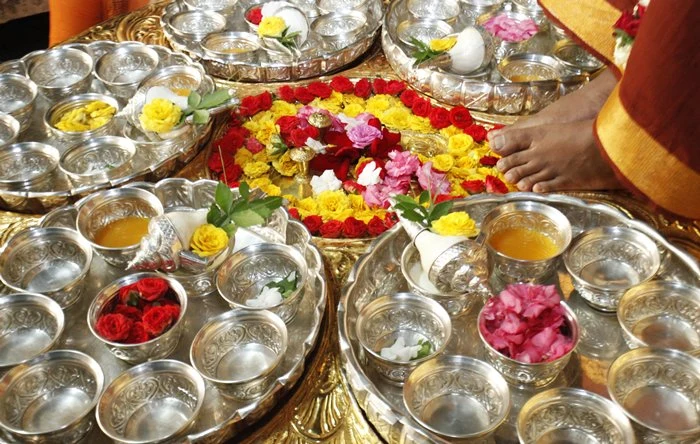
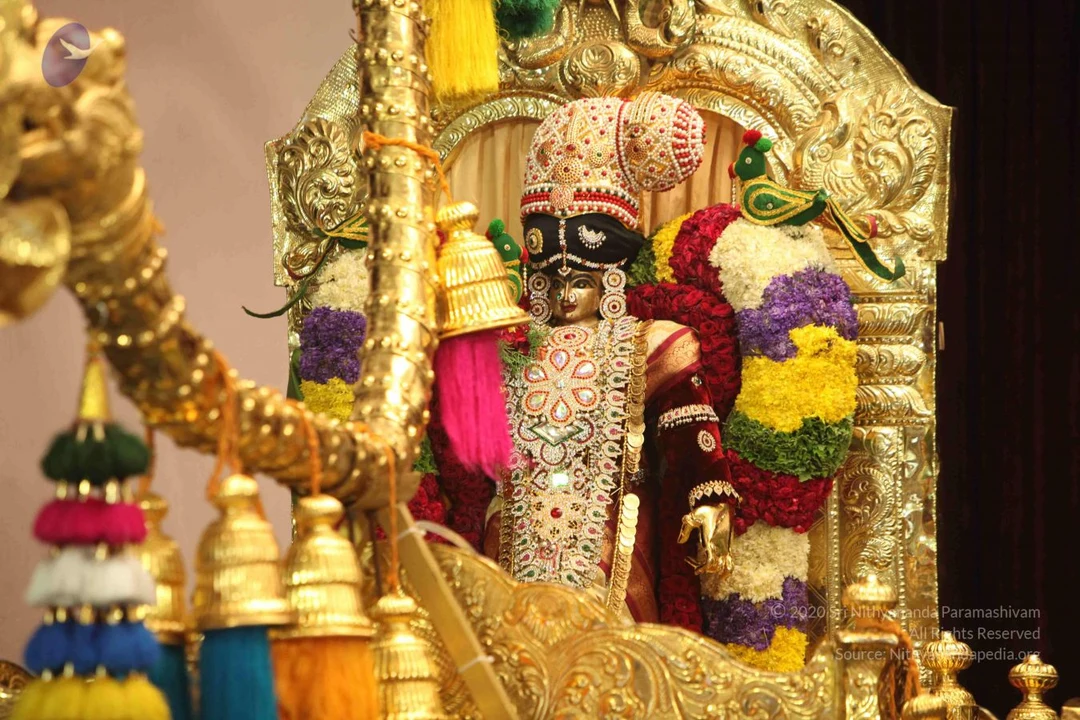
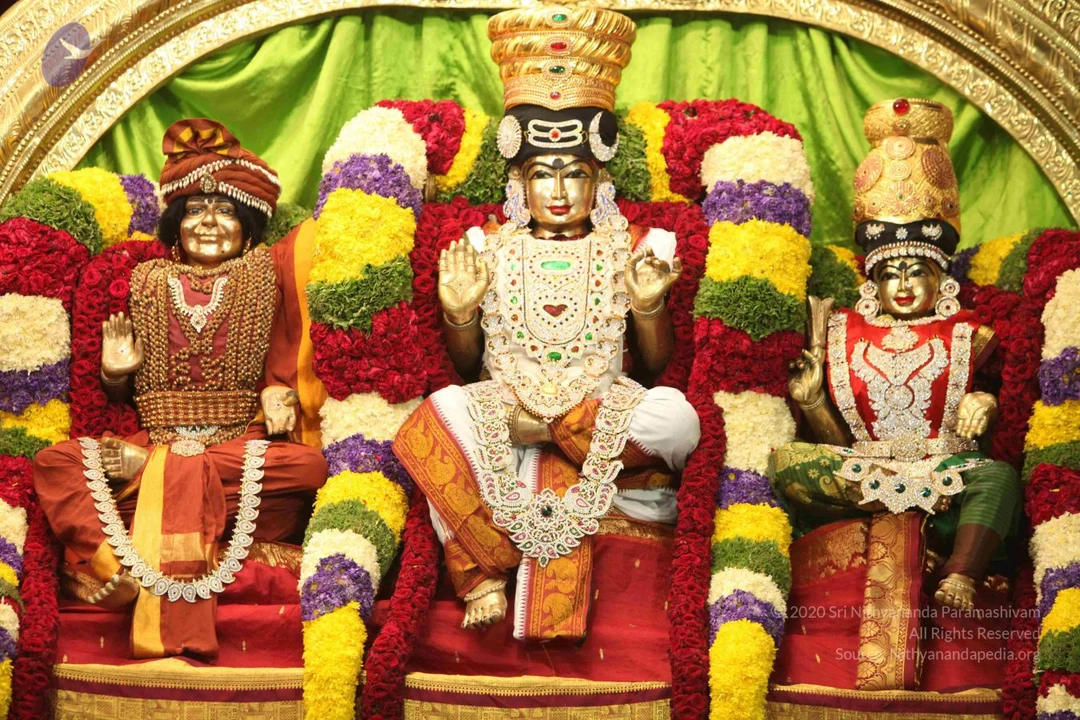
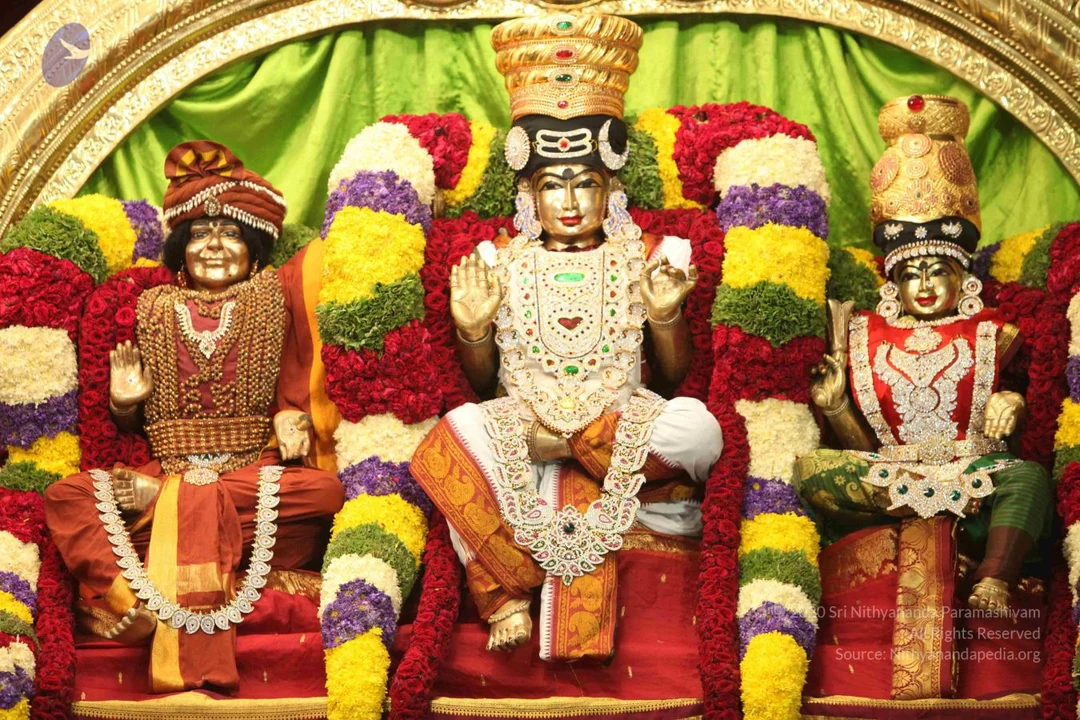
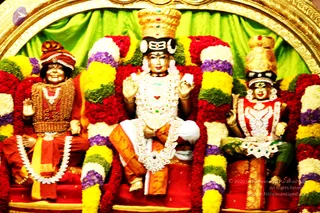
Today, the Meenakshi Brahmotsavam - fourth day. Devi is gracing on Svarna Shipika, the Golden Palki. Meenakshi in the Golden Palki with the pearl crown. Sundareshwara on Sarvalankara. First let us receive their grace.

(03:13) (Aarti performed) (03:27)

Let’s enter into 9th verse of Ishavasya Upanishad. I’ll continue to expand on the 9th verse of the Ishavasya Upanishad. Please recite along with Me. “andham tamah pravisanti ye’vidyam-upasate - tato bhuya iva te tamo ya u vidyayagm ratah” Let Me give you the English translation - “Those who worship avidya, the ignorance that veils the true knowledge of truth, consciousness, enter into blinding darkness, characterized by the absence of perception, but into greater darkness of ignorance than that. Enter they who considering themselves as scholarly and learned or engaged in vidya, the incomplete knowledge acquired for vested interest, characterized by the impure perception of truth, consciousness.”

(05:09)

Listen. Only if I sit on the edge of the seat, I make you also sit on the edge of the seat. Listen. I have expanded enough on the first part of this verse -“andham tamah pravisanti ye’vidyam-upasate” I have expanded enough on that. “tato bhuya iva te tamo ya u vidyayagm ratah”. I have expanded enough on this verse. The first part I have expanded enough. I’ll expand on the second part and the context of the whole verse. Listen. Most of the time, the knowledge is so addictive, after certain period, the knowledge becomes so addictive. You start feeling, “This is enough.” Please understand. If you started your seeking, because of some problems you face in your life and if those problems are attended, addressed - after that you think, “Why continue seeking?” This ‘why continue seeking.... even after my problems are attended’, that is the time either you become dull, means you developed a ‘don’t care’ attitude towards ignorance. What Upanishad declares - “avidya upasate”... or... you become active.

(07:42)

If you become active, that’s more dangerous, because with that knowledge but without having experience, you create big chaos and mess. Listen. This story can completely explain this one verse. Brahma and Vishnu searching Mahadeva’s head and feet; Brahma goes up. Vishnu goes down. Both are seekers. Vishnu goes on and on and on and on and on. At one spot, He feels, “Enough!” Tired, bored! At least tiredness and boredom will not become cunning. He comes back and says, “No, I am not able to do, forget about it.” He develops a ‘don’t care’ attitude towards ignorance,” It’s okay, what can be done. I am tired and bored. Leave it.” But Brahma, not only He is not able to find the truth, He tries to become cunning, with that knowledge, but not having experience. He becomes cunning. That is the most dangerous. That’s the most dangerous. He becomes cunning.

(09:36)

He gets engaged in vidya - the incomplete knowledge acquired for vested interest, characterized by impure perception of truth, consciousness. Listen. When Brahma becomes cunning, not only He doesn’t accept, He has not...He tries to lie saying, “I found”, and He develops a false evidence, that is false rituals, false techniques to say, “I found... if use this technique you will find.” I wanted to tell the whole world, never ever fall prey to the fellows who say, “They design techniques based on their own experience”, but which is not aligned to the Apta Pramana - the words of the Rishis. Understand. In Vedic tradition, you can design any technique... any permutation, combination is allowed. You are given so much freedom... but, it should be in tune with the Vedas, the Apta Pramana. Don’t ever accept, if it is not in tune with the Pramanas of Rishi’s Apta Pramana.

(11:45)

Listen. If you accept somebody’s words, that it is a technique from their own experience and it is not in tune with the original Vedic tradition - be very clear - it is false evidence, false technique, false rituals, just like Brahma bringing a flower as a false evidence, saying that,” He reached Mahadeva’s head.” These fellows without reaching, trying to prove they reached. See, these false flowers….false evidence, what Brahma brought, that is also flower, but it won’t take you to the ultimate. So called these techniques, also may help you to have little peace, wheezing will be healed... little good for health; but that won’t lead you to Enlightenment. Understand. Enlightenment is altogether a different game. Having little health, good feel good feeling - are not sufficient! They may be good initial side effects of a technique, but technique itself is not aimed just towards little health and feel good feeling. Don’t become victims of Brahma - catch Mahadeva! Don’t become victims of Brahma - His false claims and the false evidence He brings, false techniques He brings - catch Mahadeva.

(14:12)

Understand the context of this verse. This verse describes two major problems a seeker faces, when he starts transforming his cognition that, “He is Consciousness”. Understand, the context... meditate on the context. Look in and face all the difficulties you face when you shift the cognition, “You are the Consciousness - Mahadeva, Shiva.” Look into the context, try to experience the truth, again and again and again. If you search for the context, if you reach the context, you will understand what Upanishads mean by this verse – “andham tamah pravisanti ye’vidyam-upasate tato bhuya iva te tamo ya u vidyayagm ratah”. Some of the major difficulties, problems, you will face during your seeking, is defined and explained in this verse. Your mind will try to encourage you to become a false Guru. That is what the second part of the verse describes - “engaged in vidya, the incomplete knowledge, acquired for vested interests, characterized by the impure perception of truth and Consciousness”.

(17:33)

Today’s subject for Vakyartha Sadas - “How to keep our seeking pure without being touched by Brahma and Vishnu both.” Neither boredom nor false purpose, the vested interest, incomplete knowledge, should disturb our….. Contemplate about this, do Vakyartha Sadas on this - “How to keep our seeking pure, how to retain our seeking pure, away from boredom, away from false identities.” That is why the Vedic tradition insists on higher forms of tapas and penance.

(19:05)

I bless you all. Let you all radiate with Integrity, Authenticity, Responsibility, Enriching, Causing, Living Advaita, the Eternal Bliss - Nithyananda. Thank you. Be Blissful.

(19:20)

Title

Genesis Of Identity || Part 1 || NKY || 24 April 2015

Description

Genesis of Identity in Tamil Part 1
Name Of The Program : Nithyananda Kriya Yoga
Session on: 4 images of our Identity
Date : 24 April 2015
Venue : Adikailash, Bangalore, India

In this video Supreme Pontiff of Hinduism HDH Nithyananda Paramashivam during the Nithyananda Kriya Yoga program, Swamiji explains what the inner image, outer image, others image, and life image in a tamil session.

Link to Video

VideoAudio

Title

Genesis of Identity || Part 2 || NKY

Description

Genesis of Identity Tamil Part 2
Name Of The Program : Nithyananda Kriya Yoga
Session on: 4 images of our Identity
Date : 24 April 2015
Venue : Adikailash, Bangalore, India

In this video Supreme Pontiff of Hinduism HDH #Nithyananda Paramashivam during the Nithyananda Kriya Yoga program, Swamiji explains what the inner image, outer image, others #image, and #life image in a tamil session.

Link to Video

VideoAudio

Title

குண்டலினி சக்தியை விழிப்படையச் செய்யும் கிரியை || நித்ய கிரியா யோகா || 24 ஏப்ரல் 2015

Description

நிகழ்ச்சி நிரல் - நித்ய கிரியா யோகா தலைப்பு - குண்டலினி சக்தியை விழிப்படையச் செய்யும் கிரியை இடம் - ஆதி கைலாஸா, பெங்களூரு , கர்நாடகா, இந்தியா தேதி - 24 ஏப்ரல் 2015

இந்த வீடியோ பதிவில் பகவான் ஸ்ரீ #நித்யானந்த பரமசிவம் அவர்கள் நாம் நினைத்ததை உடனடியாக குண்டலினி சக்தி மூலம் நிறைவேற்றுவதற்கான கிரியையை நமக்கு வழங்கியுள்ளார். இந்த கிரியையில் உள்ள இரண்டு நிலைகளை பற்றி விவரமாக எடுத்துரைத்துள்ளார். அதன் தொடர்ச்சியாக , நம் குண்டலினியை விழிப்படைய செய்யும் தீக்ஷையையும் வழங்குகிறார்.

The Supreme Pontiff of Hinduism Jagatguru Mahasannidhanam His Divine Holiness #Nithyananda Paramashivam (HDH) is the reviver of #KAILASA - the ancient enlightened civilization and the great cosmic borderless Hindu nation. Revered as the incarnation of Paramashiva - the primordial Hindu Divinity, HDH has a following of 2 billion Hindus worldwide with de facto spiritual embassies in over 150 countries. He has worked untiringly for over 26 years for the revival of Kailasa, for global peace and to give super conscious breakthrough to humanity. He has survived the worst persecution of multiple assassination attempts on person and on character by anti-Hindu elements. He is collecting, organising, preserving, time capsuling, decoding, spreading and reviving 20 Million source books of Hinduism and the 64 sacred arts & sciences like Ayurveda, music, dance, sculpting, astrology, vastu and much more. Close to 20,000 hours of HDH’s timeless talks have been recorded till date (Sep 2020), which are a treasure trove of powerful cognitions to solve individual and global problems of any kind.

Link to Video:

VideoAudio

Title

குற்றஉணர்ச்சியில் இருந்து விடுபடுங்கள் || நித்ய கிரியா யோகா || 24 ஏப்ரல் 2015

Description

நிகழ்ச்சி நிரல் - நித்ய கிரியா யோகா தலைப்பு - குற்றஉணர்ச்சியில் இருந்து விடுபடுங்கள் இடம் - ஆதிகைலாஸா, பெங்களூரு, கர்நாடகா, இந்தியா தேதி - 24 ஏப்ரல் 2015

இந்த வீடியோ பதிவில் பகவான் ஸ்ரீ #நித்யானந்த பரமசிவம் சமஸ்காரங்கள், அதன் பாதிப்பை பற்றி விளக்குகிறார். நமக்குள் நம்மை ஆனந்தமாக இருக்கவிடாமல் தடுத்து கொண்டிருக்கும் இந்த சமஸ்காரங்களை வெளியேற்றுவதன் மூலம் நம்முடைய இயற்கை நிலையான ஆனந்தத்தை அடைகிறோம். அதற்கான நுட்பத்தை இதில் அளிக்கின்றார். இந்த வீடியோ பதிவு 24 ஏப்ரல் 2015 அன்று ஆதிகைலாஸா, பெங்களூரு, கர்நாடகா, இந்தியாவில் நடைபெற்றது.

The Supreme Pontiff of Hinduism Jagatguru Mahasannidhanam His Divine Holiness #Nithyananda Paramashivam (HDH) is the reviver of #KAILASA - the ancient enlightened civilization and the great cosmic borderless Hindu nation. Revered as the incarnation of Paramashiva - the primordial Hindu Divinity, HDH has a following of 2 billion Hindus worldwide with de facto spiritual embassies in over 150 countries. He has worked untiringly for over 26 years for the revival of Kailasa, for global peace and to give super conscious breakthrough to humanity. He has survived the worst persecution of multiple assassination attempts on person and on character by anti-Hindu elements. He is collecting, organising, preserving, time capsuling, decoding, spreading and reviving 20 Million source books of Hinduism and the 64 sacred arts & sciences like Ayurveda, music, dance, sculpting, astrology, vastu and much more. Close to 20,000 hours of HDH’s timeless talks have been recorded till date (Sep 2020), which are a treasure trove of powerful cognitions to solve individual and global problems of any kind.

Link to Video:

VideoAudio

Title

Nithyananda Times - 24th Apr 2015

Link to video

VideoAudio

Photos From The Day:

Paduka Puja

Nithya Satsang
Link To Facebook Post

https://www.facebook.com/ParamahamsaNithyananda/photos/a.321615927926264/825553137532538

Tags:

Upanishads, Advaita, Living Advaita, Isha Upanishad, Ishavasya, Isha Upanishad Verse 9, Paramahamsa Nithyananda, Isha, Satsang, Mahadeva, Shiva, Vidya, Avidya, Mahadeva, Brahma, Vishnu, Apta Pramana, Truth, Coonsciousness, Rishis

Photos Of The Day:

FB-photo-of-the-day

Photos Of The Day:

morning-satsang
deities-alankar

Photos Of The Day:

NKY-Day2-Q&A

NKY-Day2-Shivoham

NKY-Session

Photos Of The Day:

NKY-Day2-Shivoham

NKY-Session

1--Deities-Alankar

IMG_2124_CMP_WM

2--Morning-Satsang

Photos from this day

View all 131 photos

FB-photo-of-the-day

1 photoSource gallery

morning-satsang
40 photosSource gallery
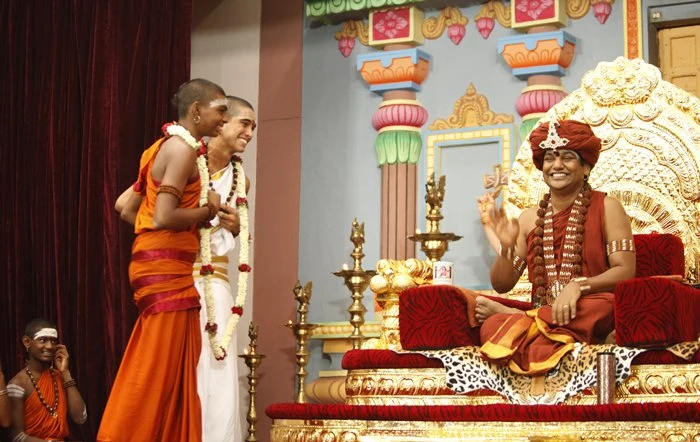
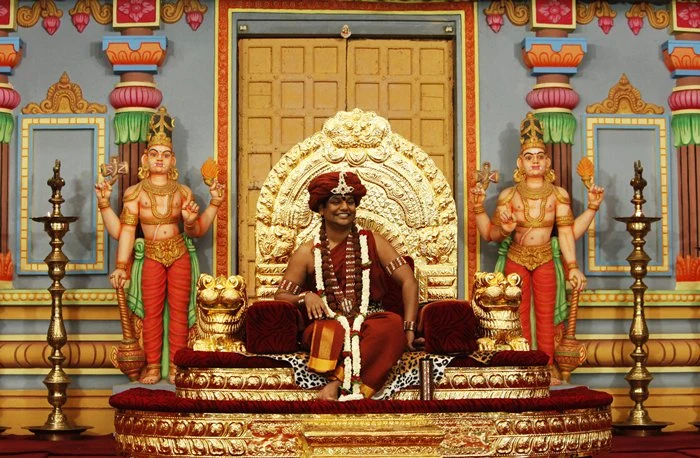
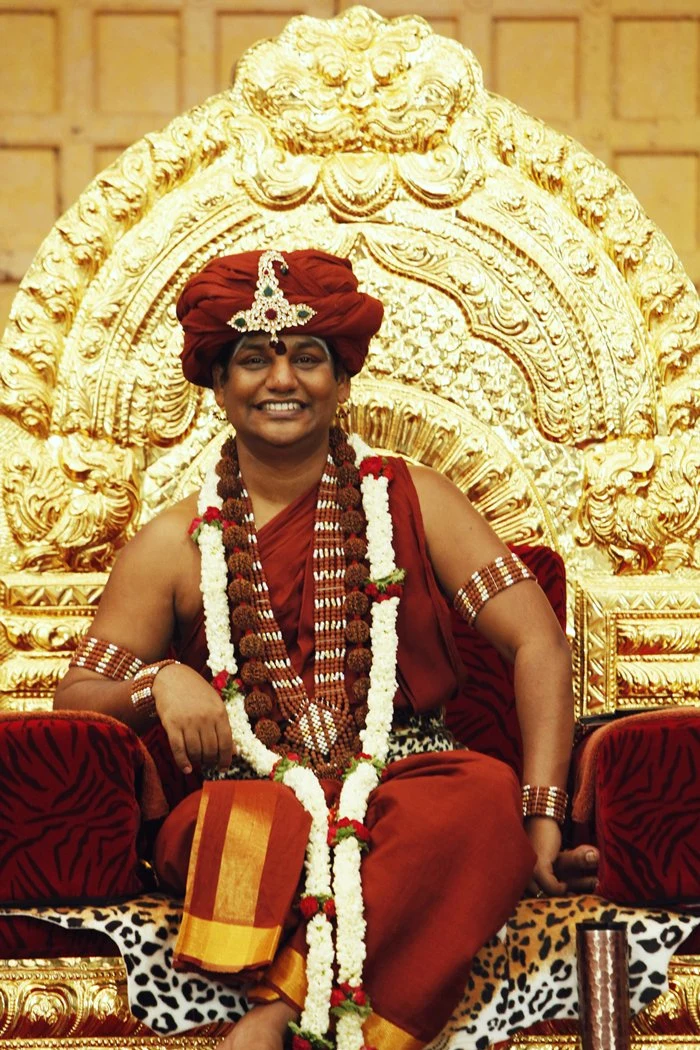
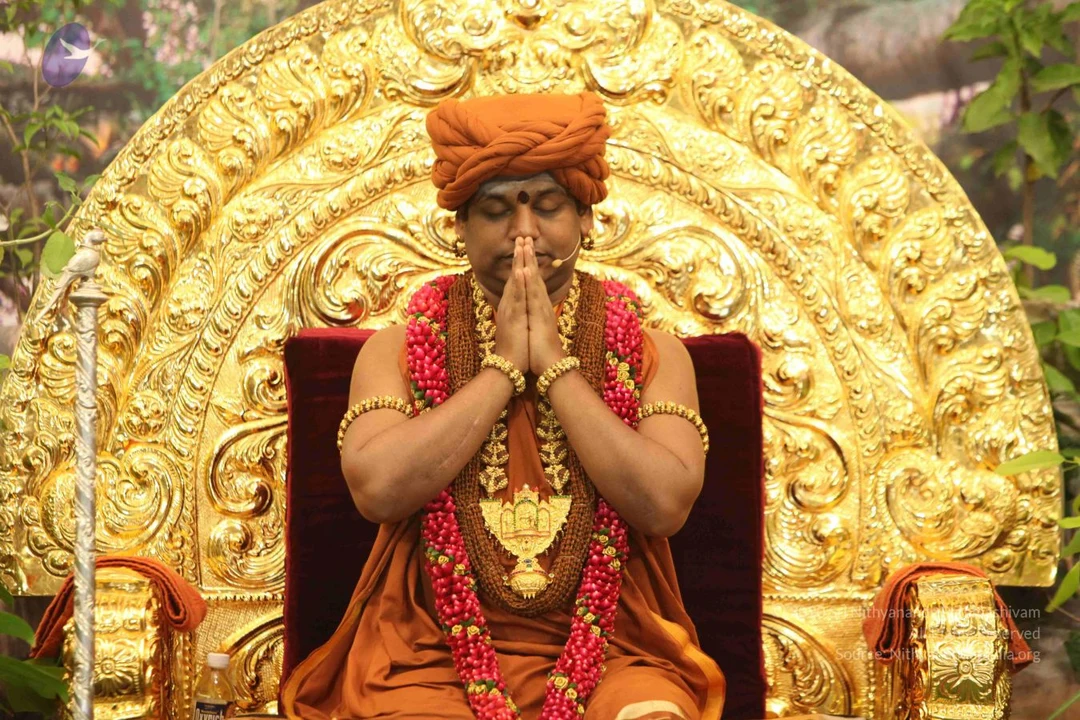
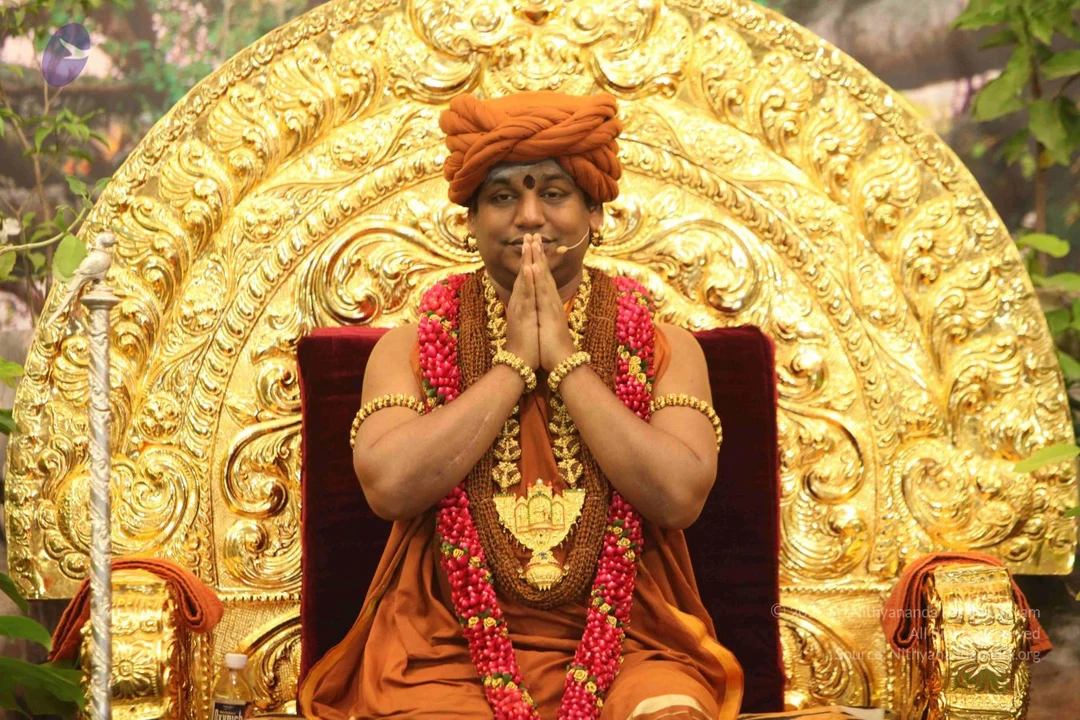
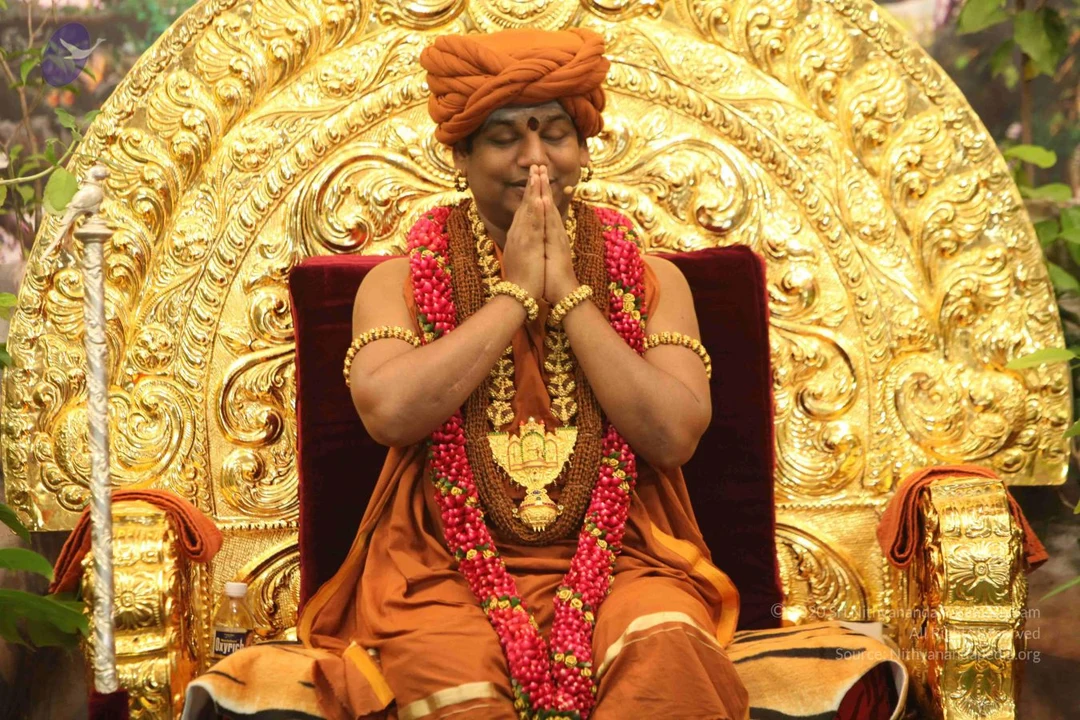
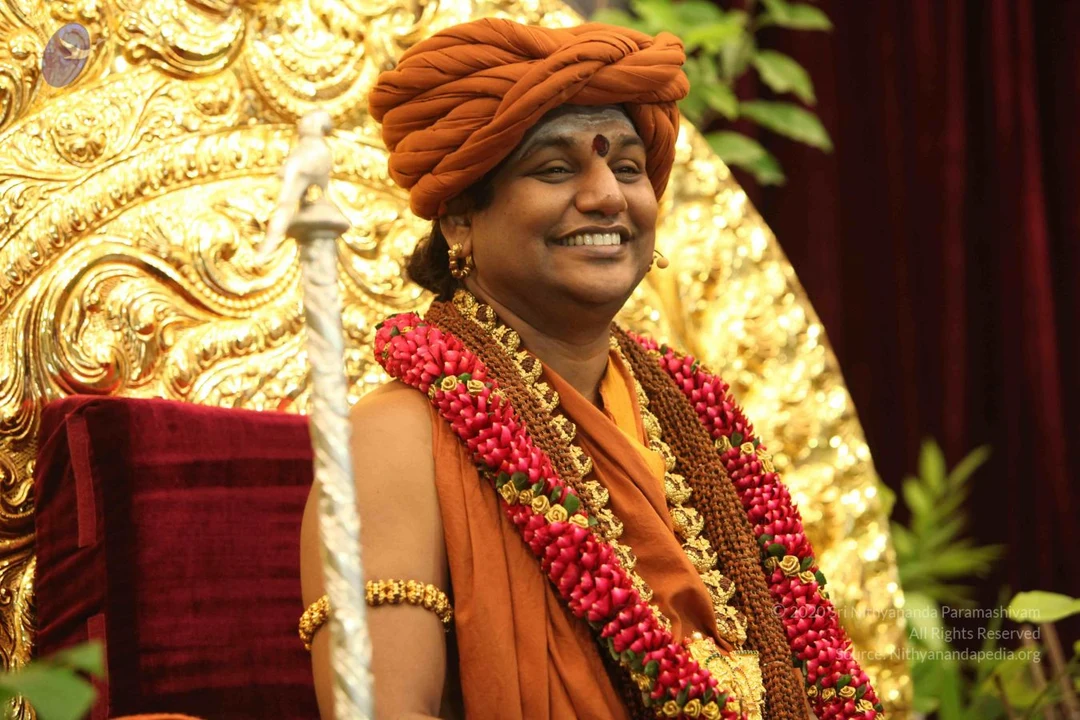
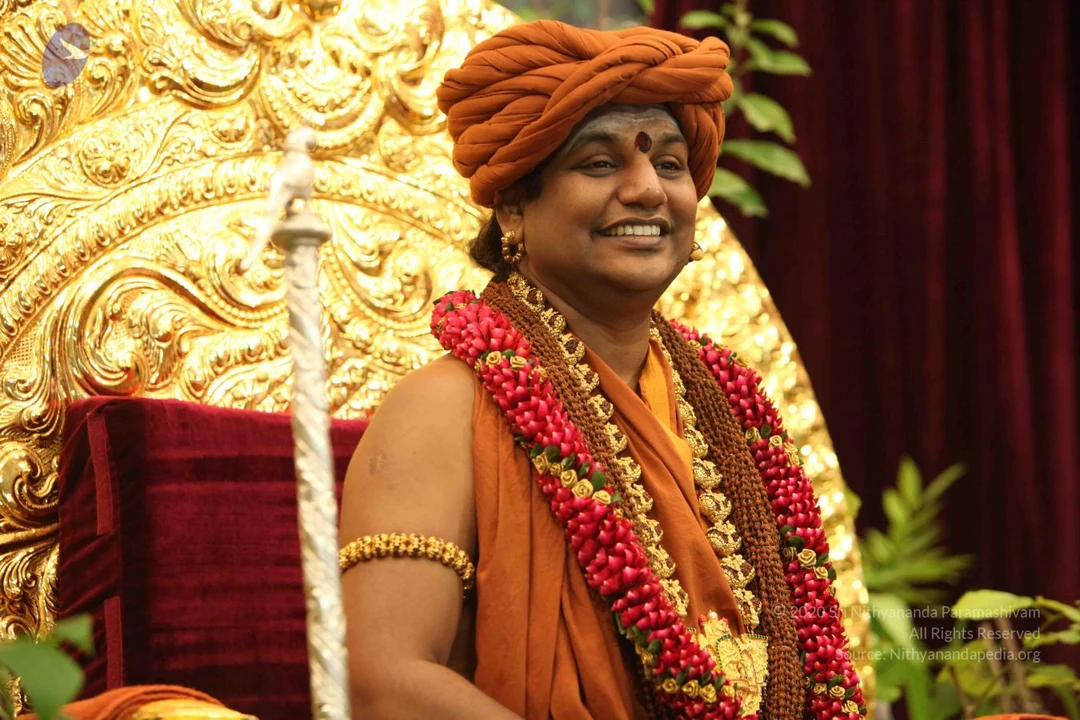
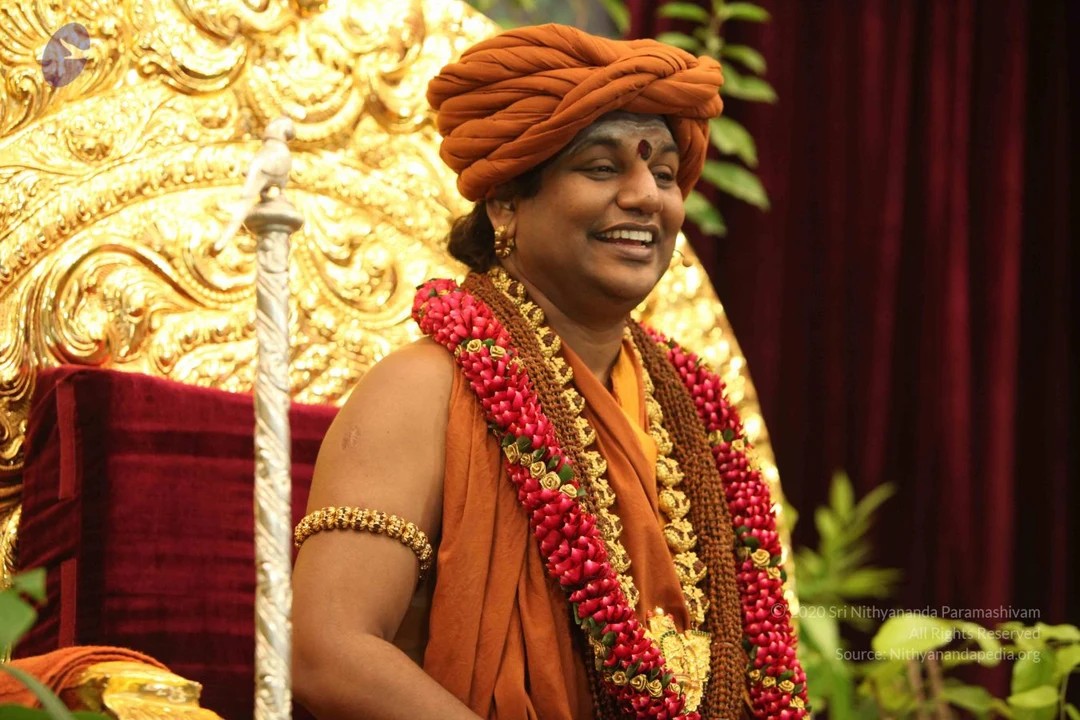
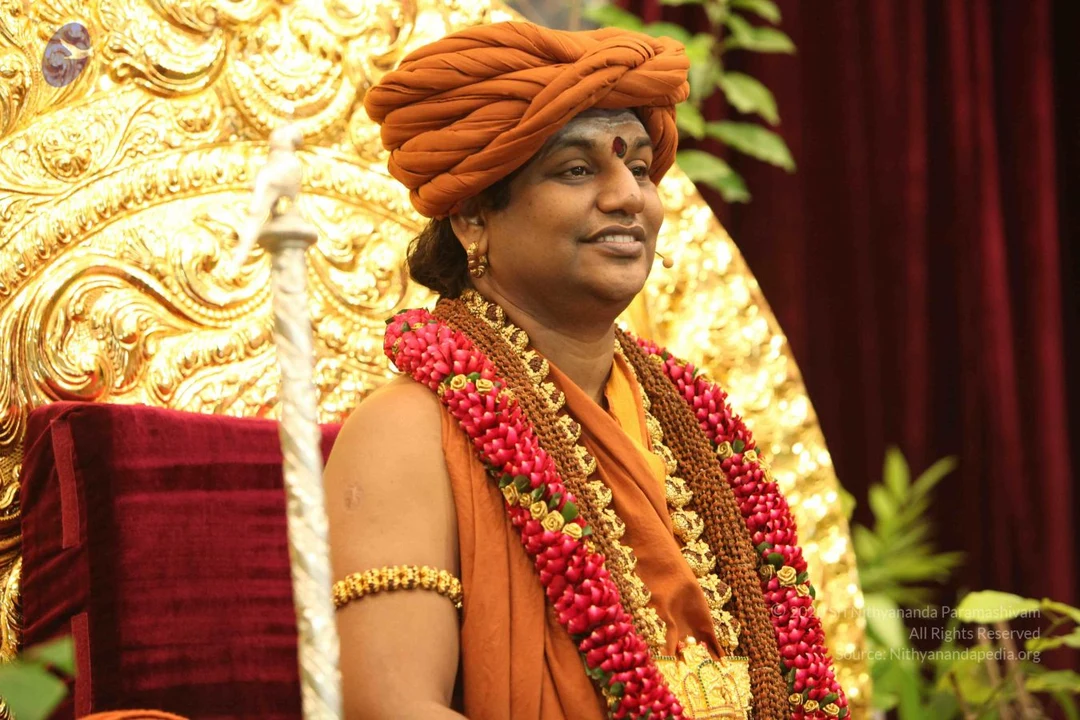
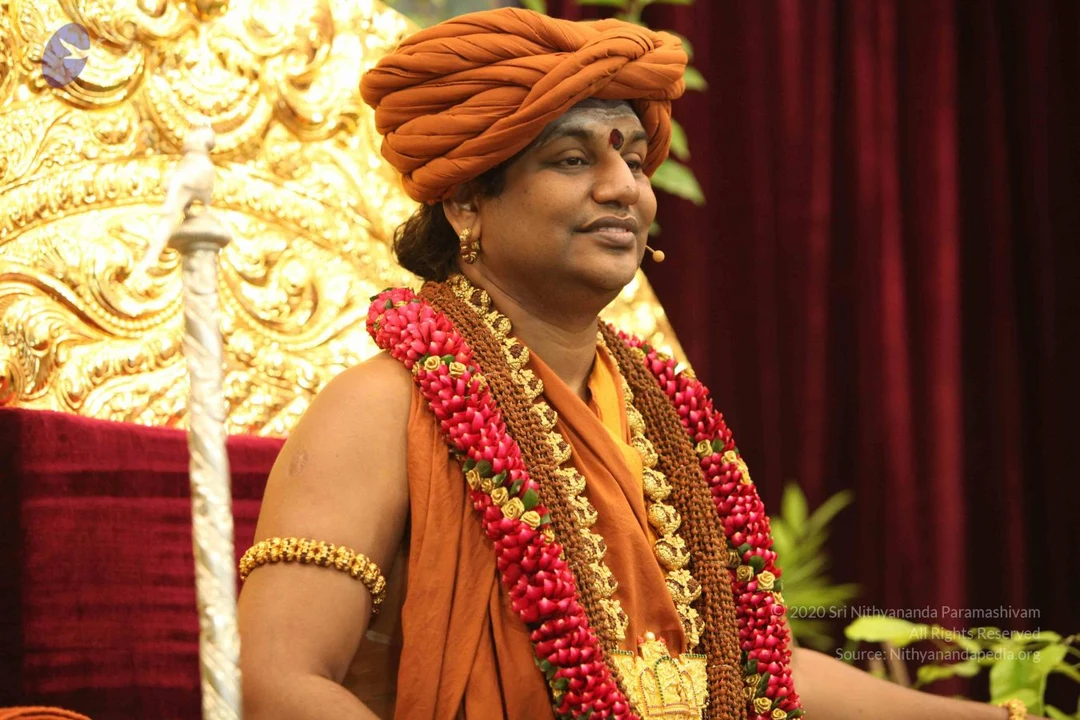
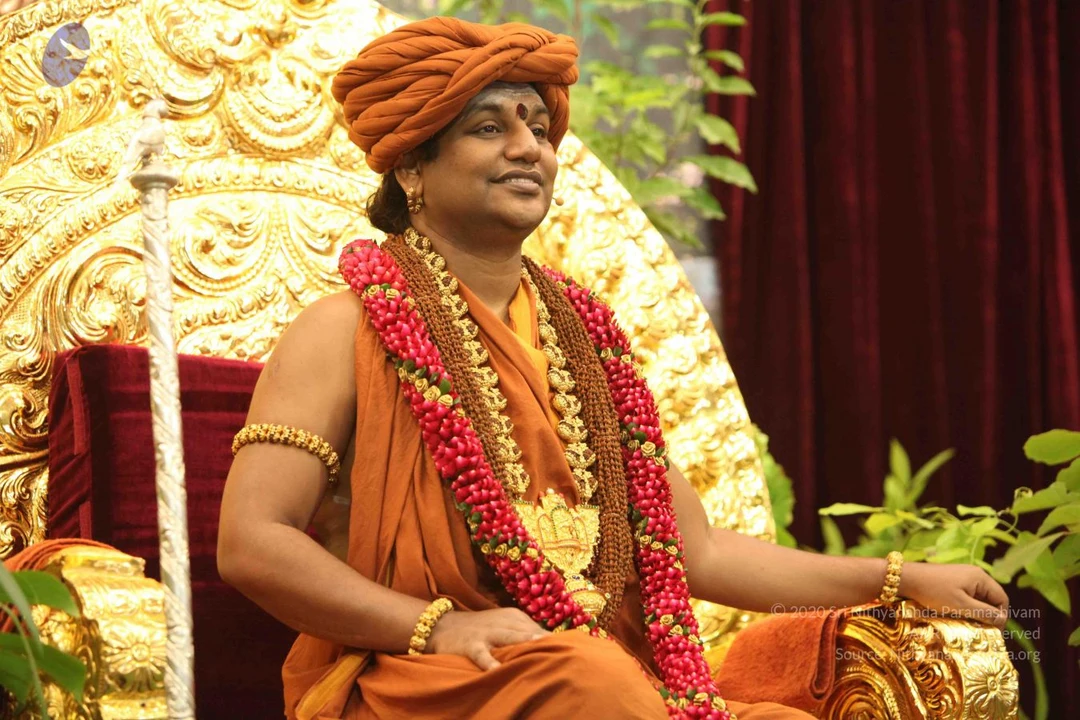
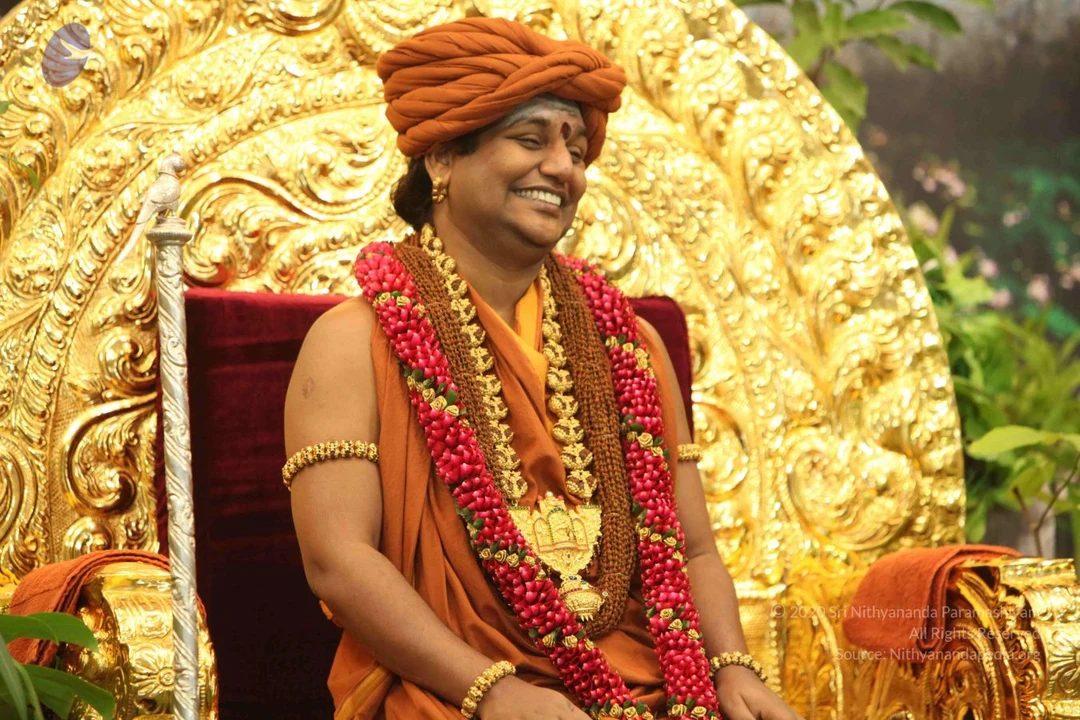
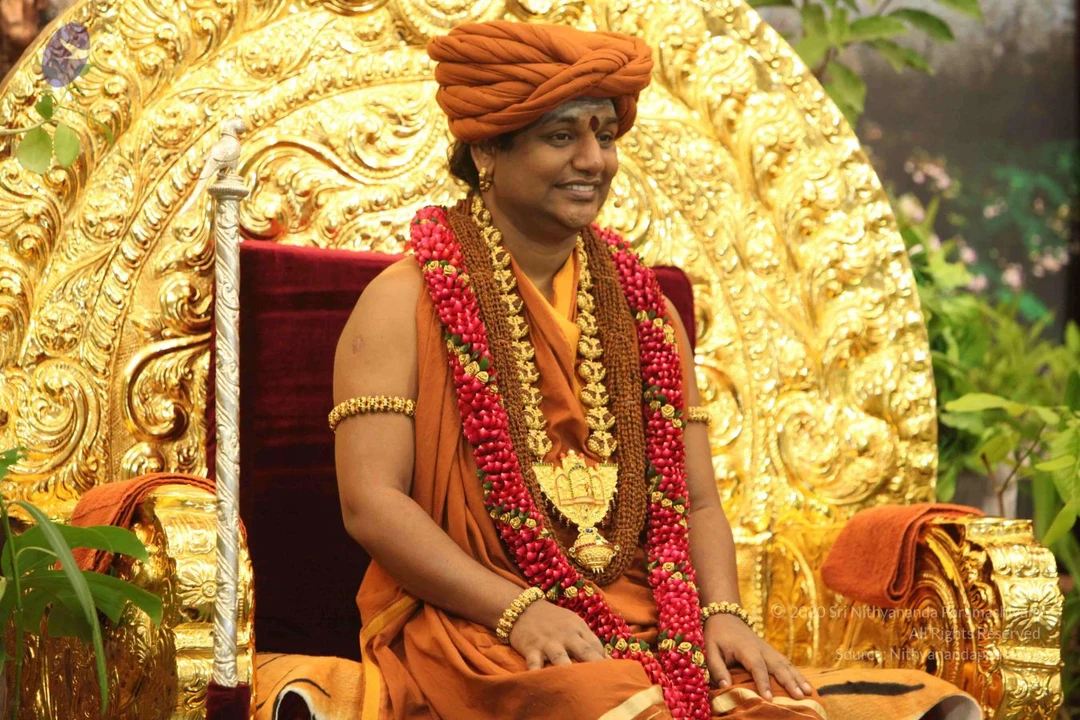
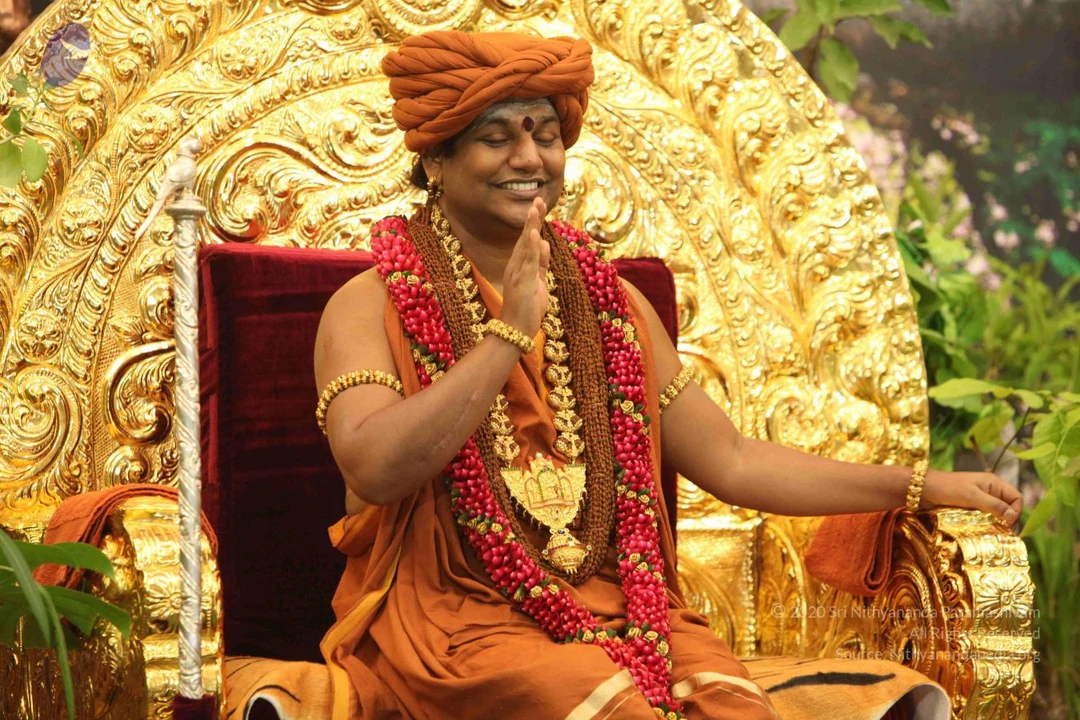
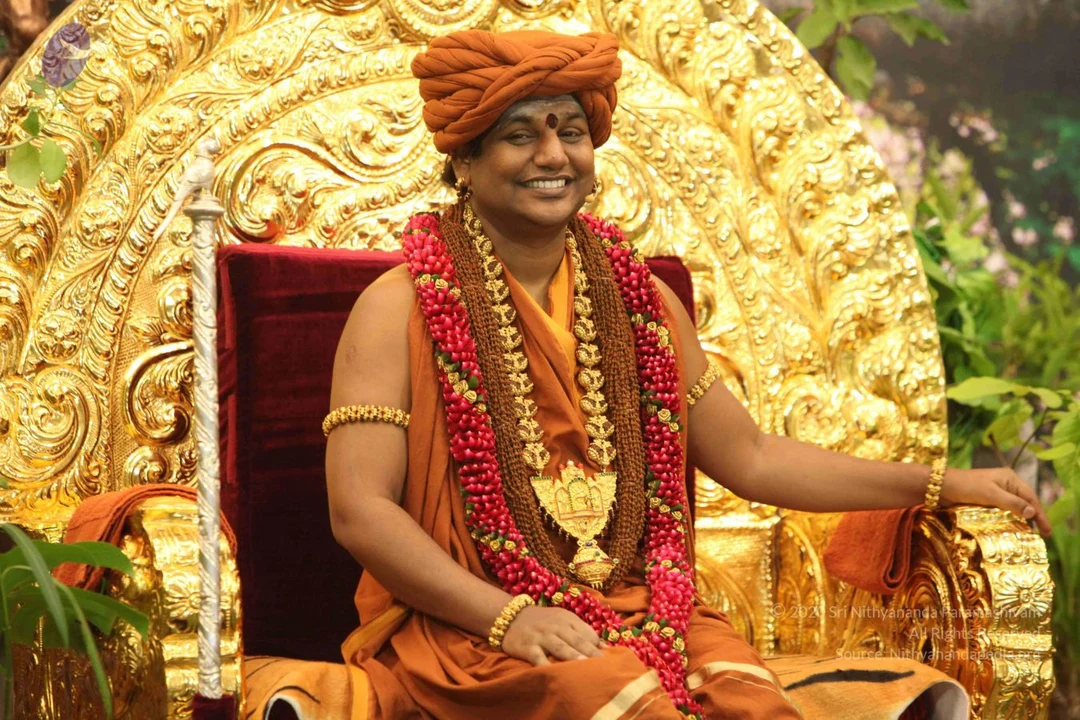
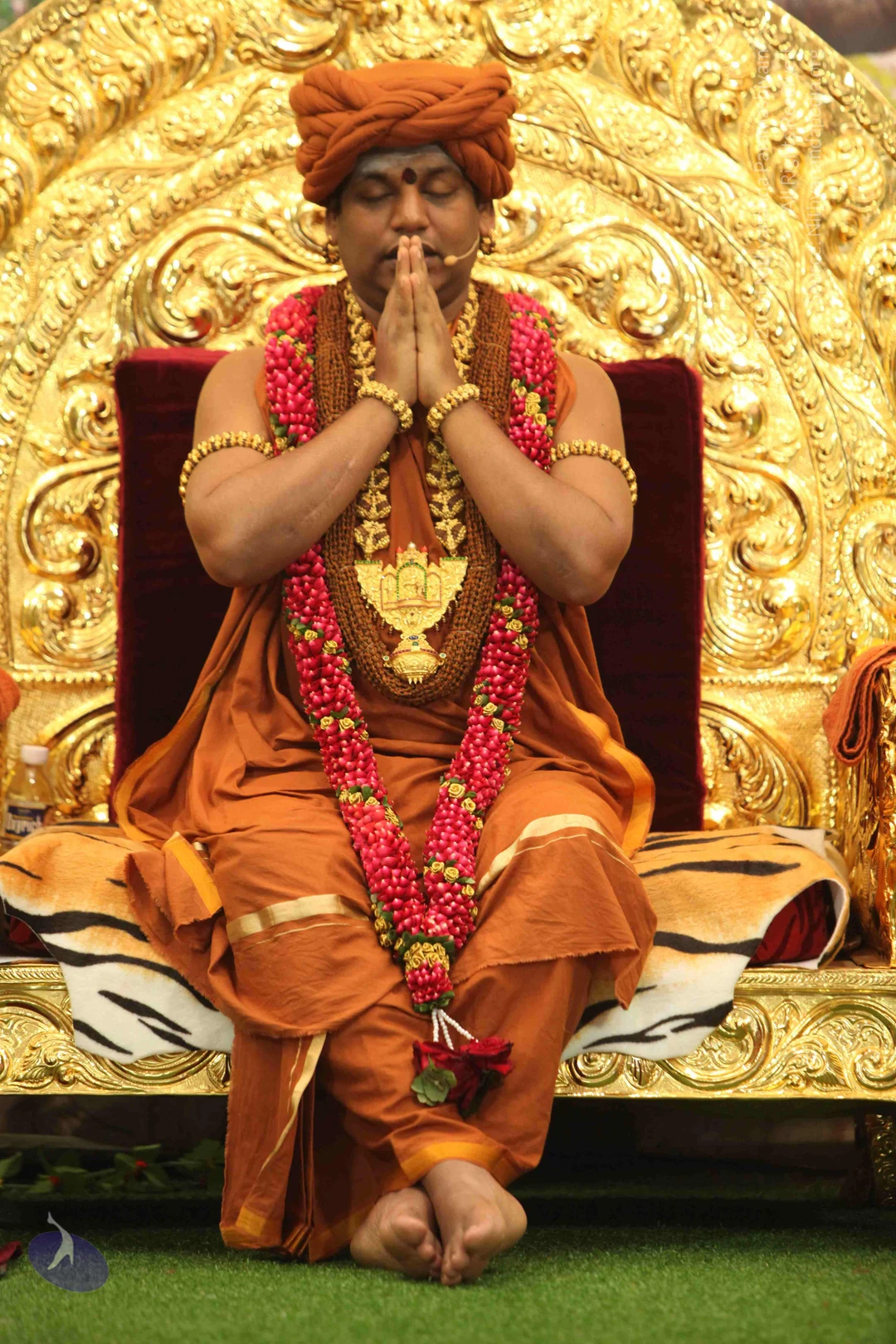
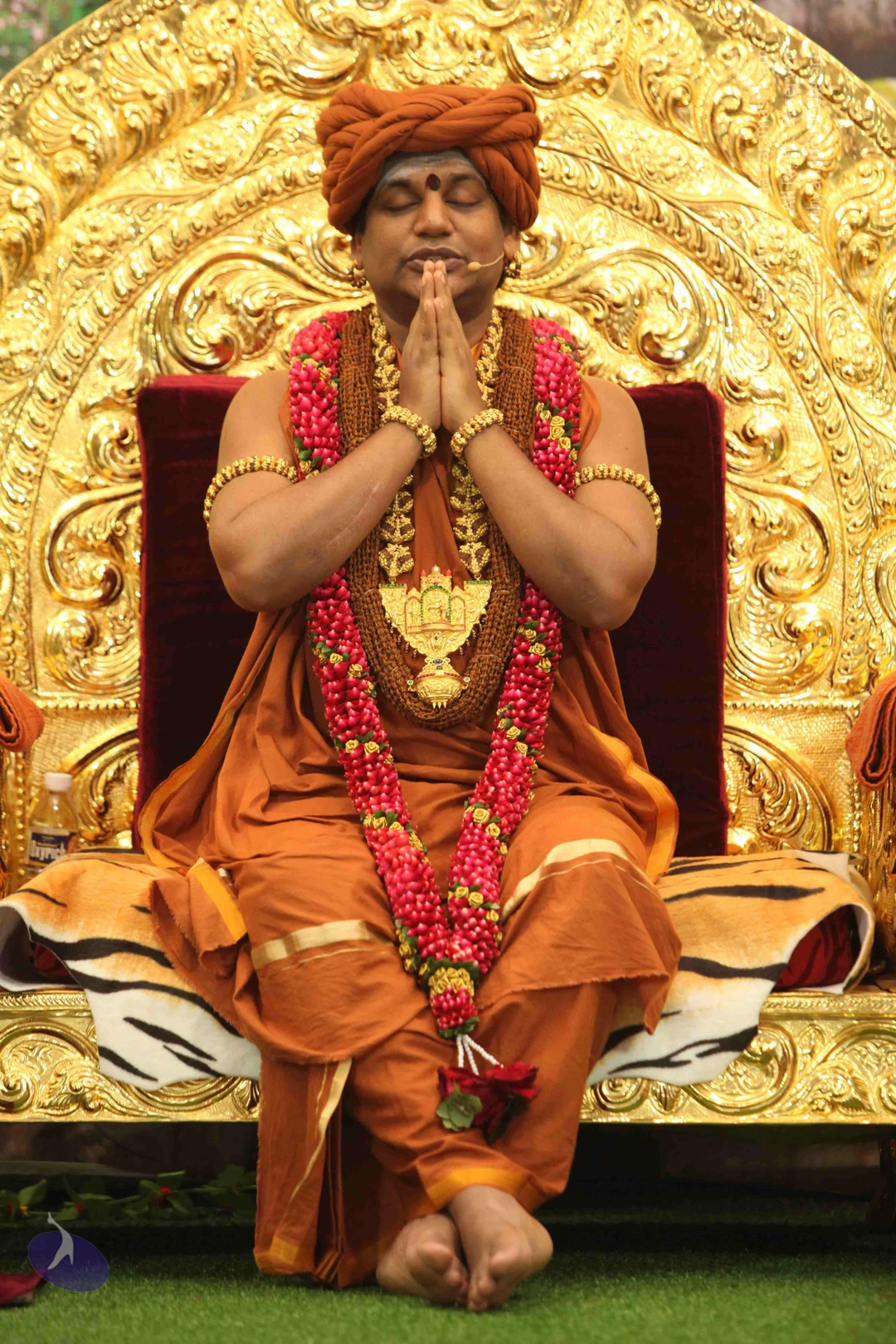
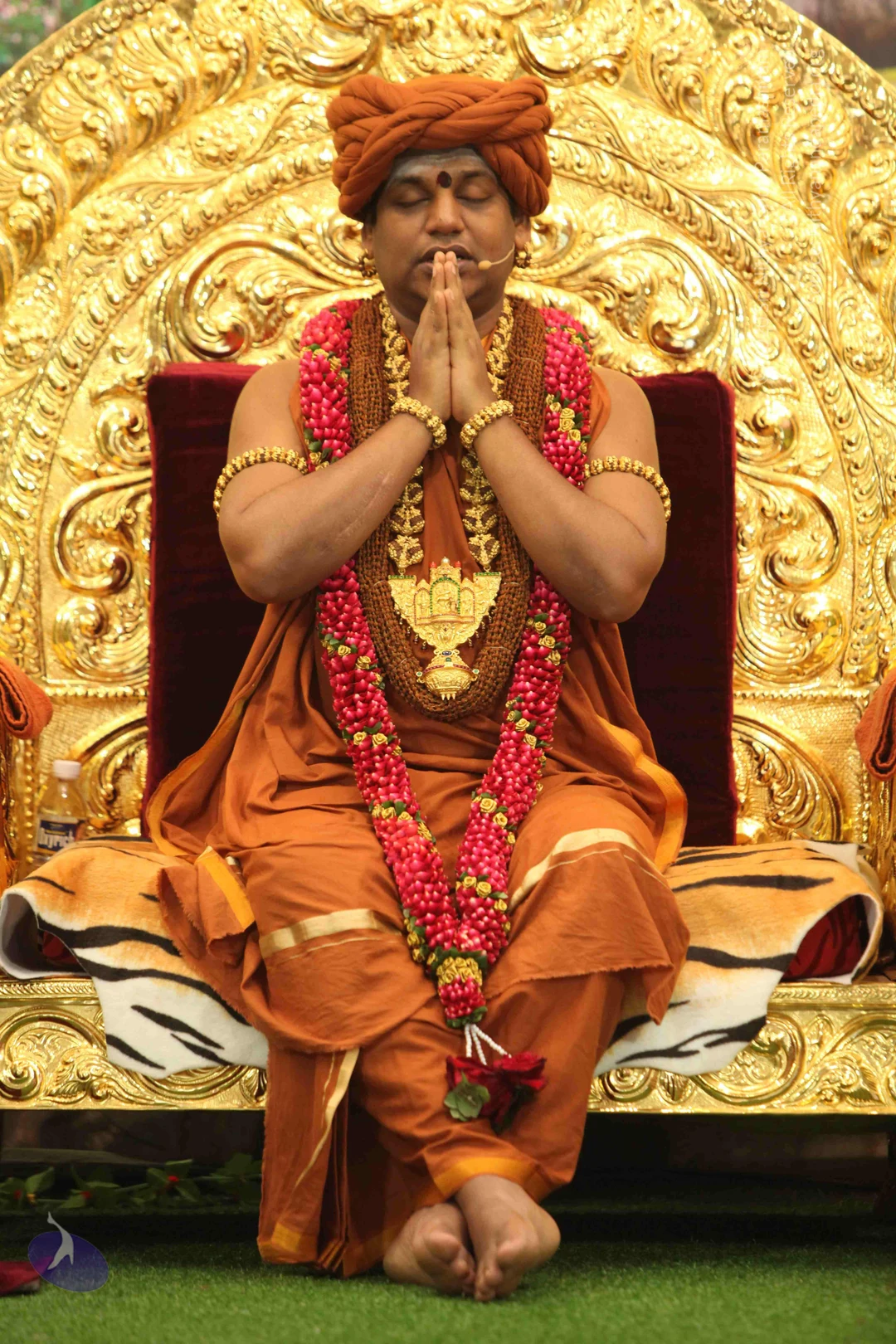
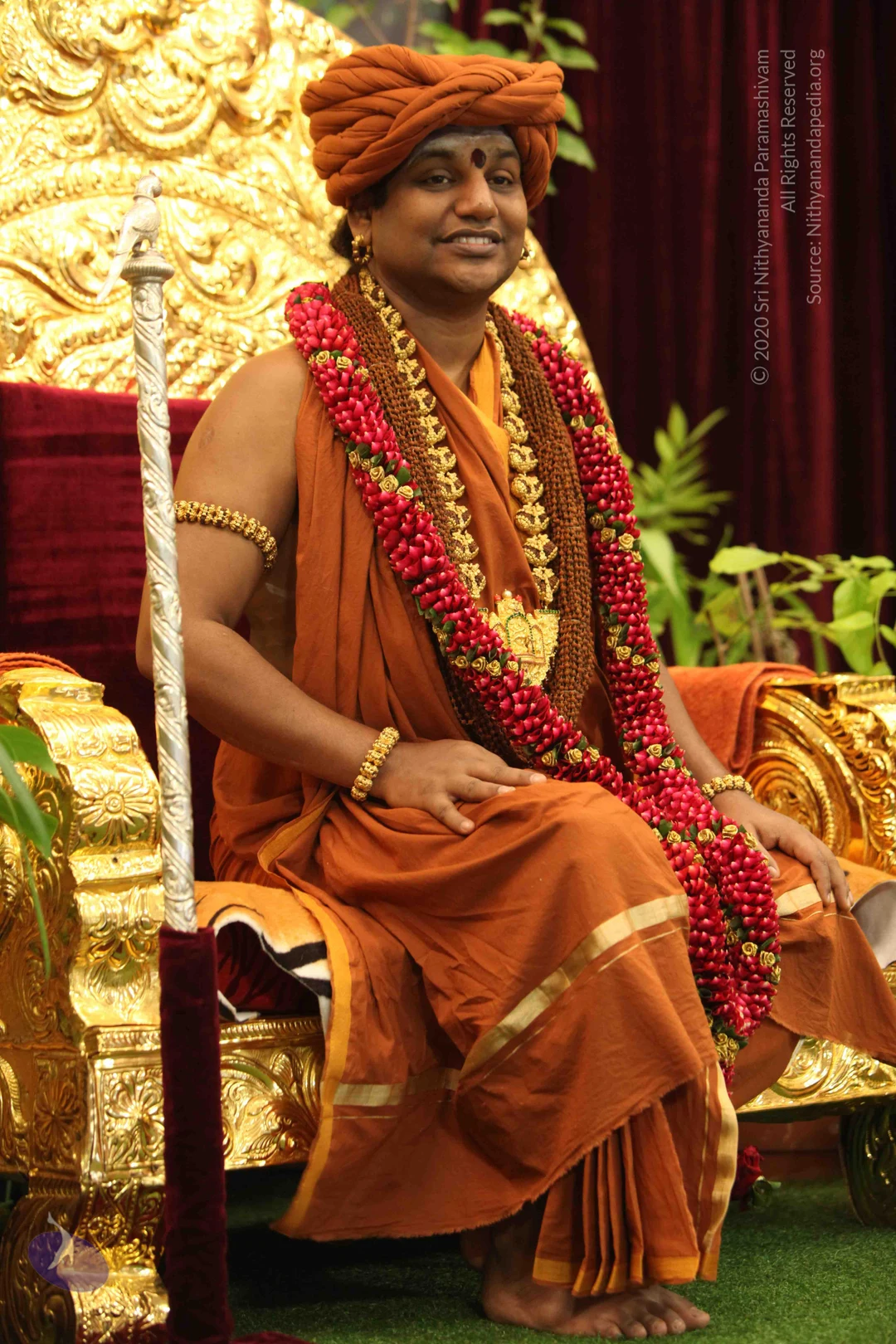
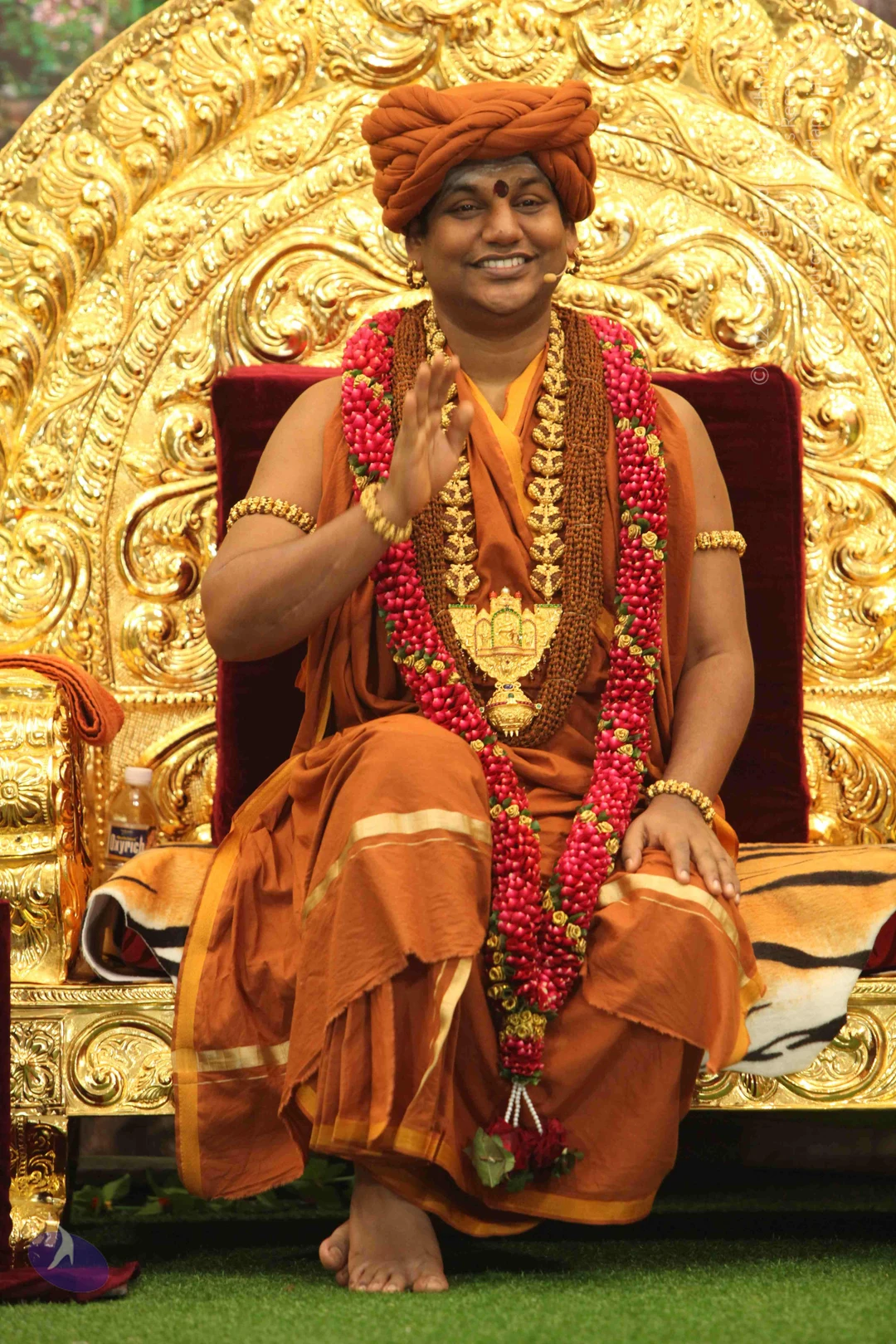
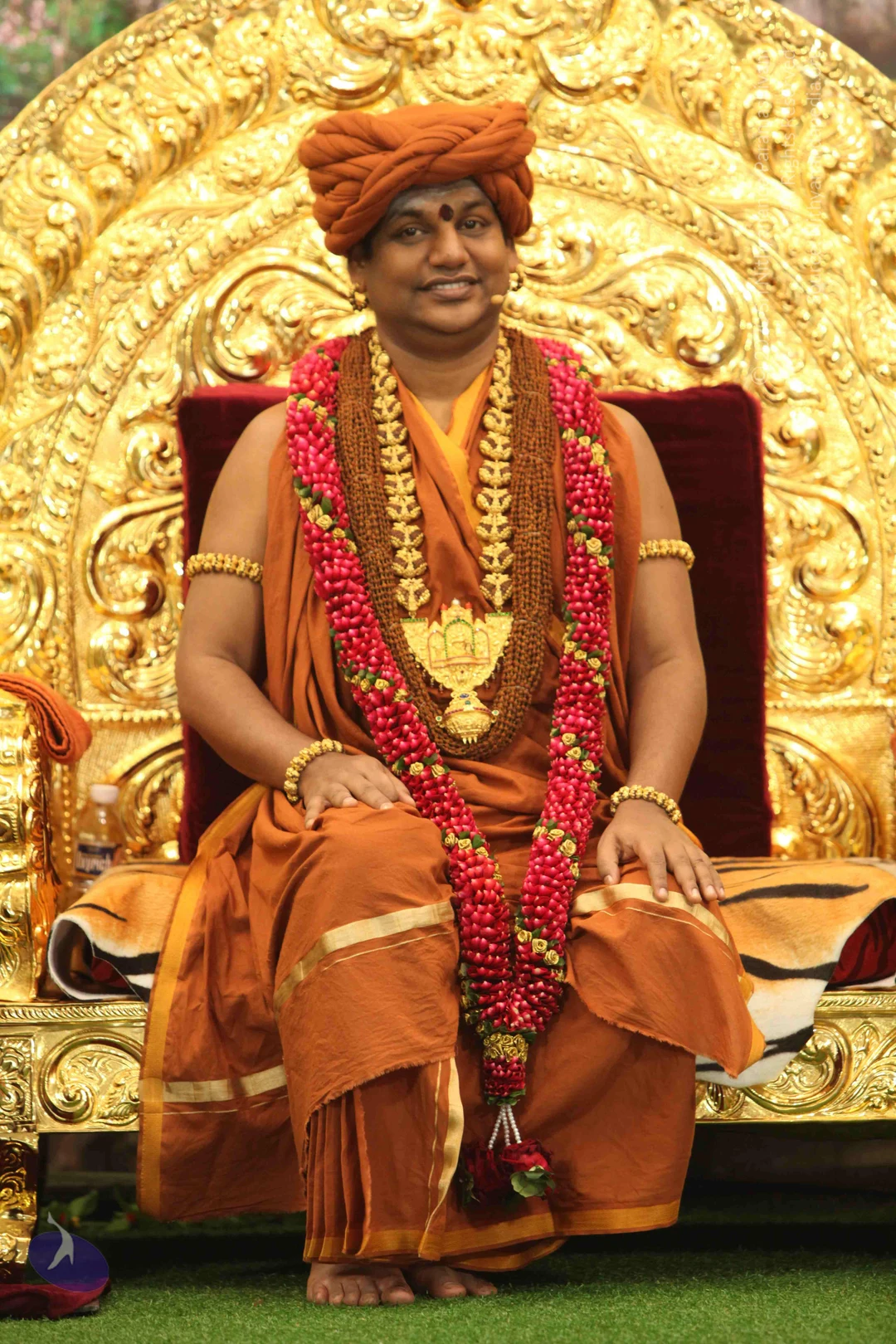
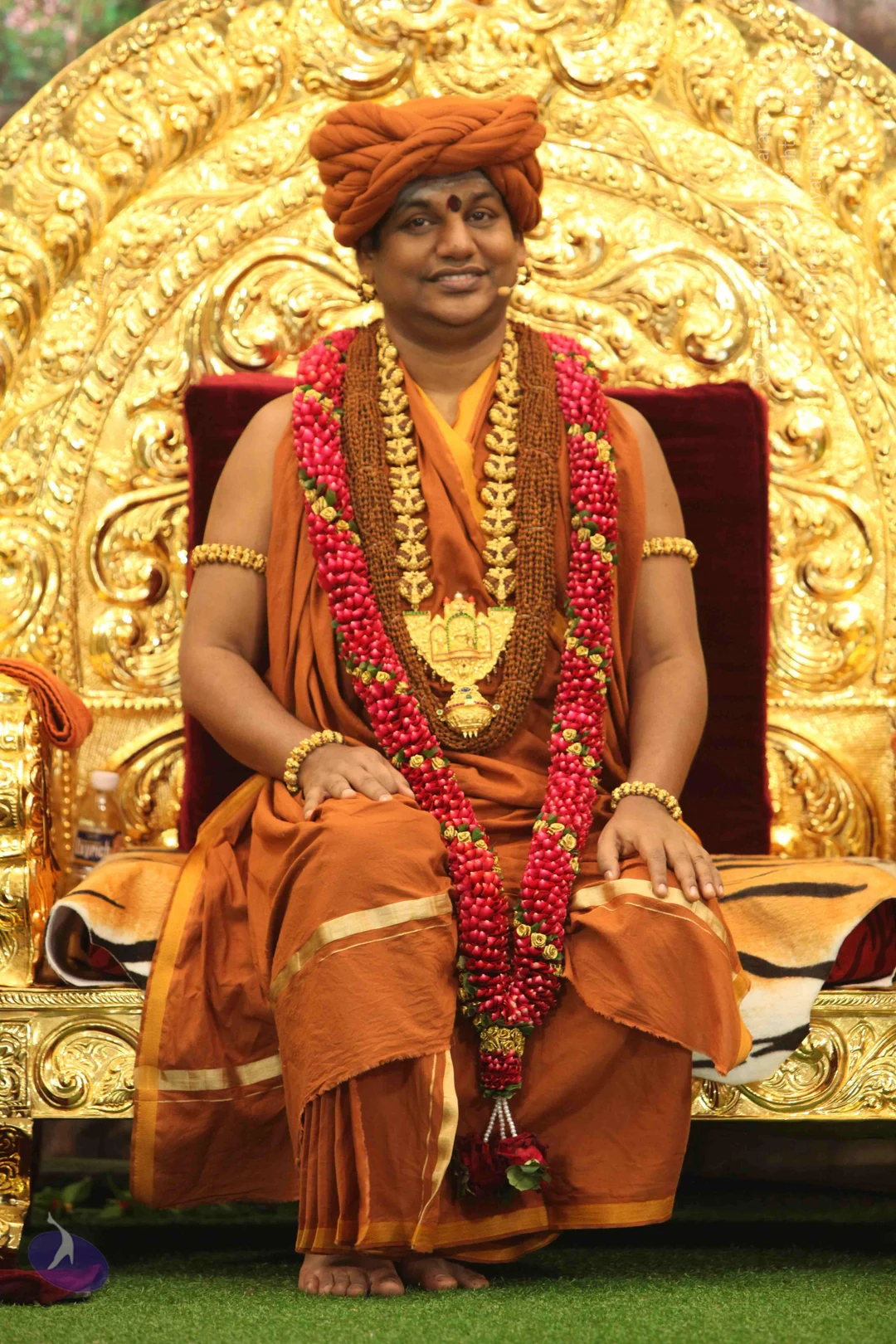
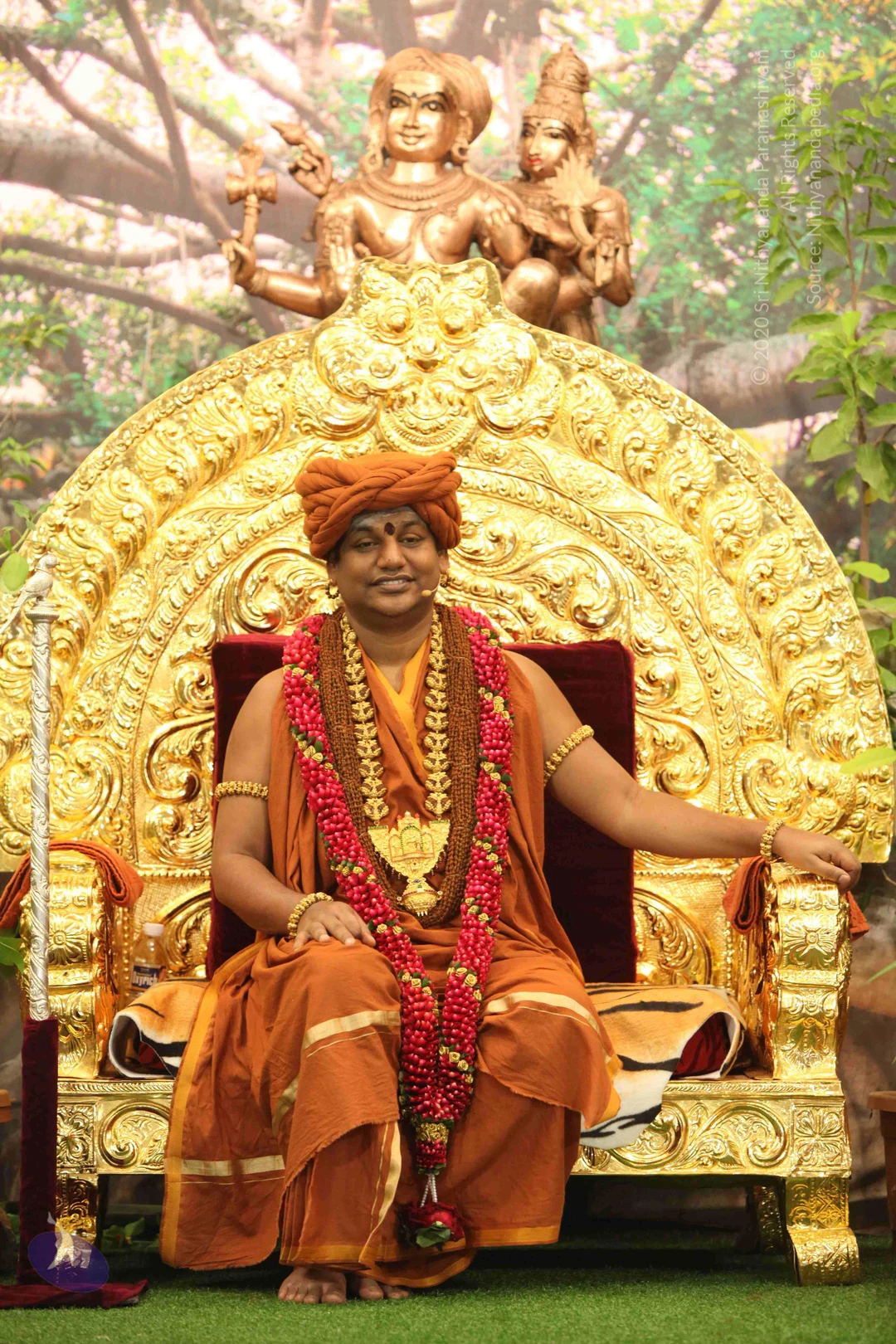
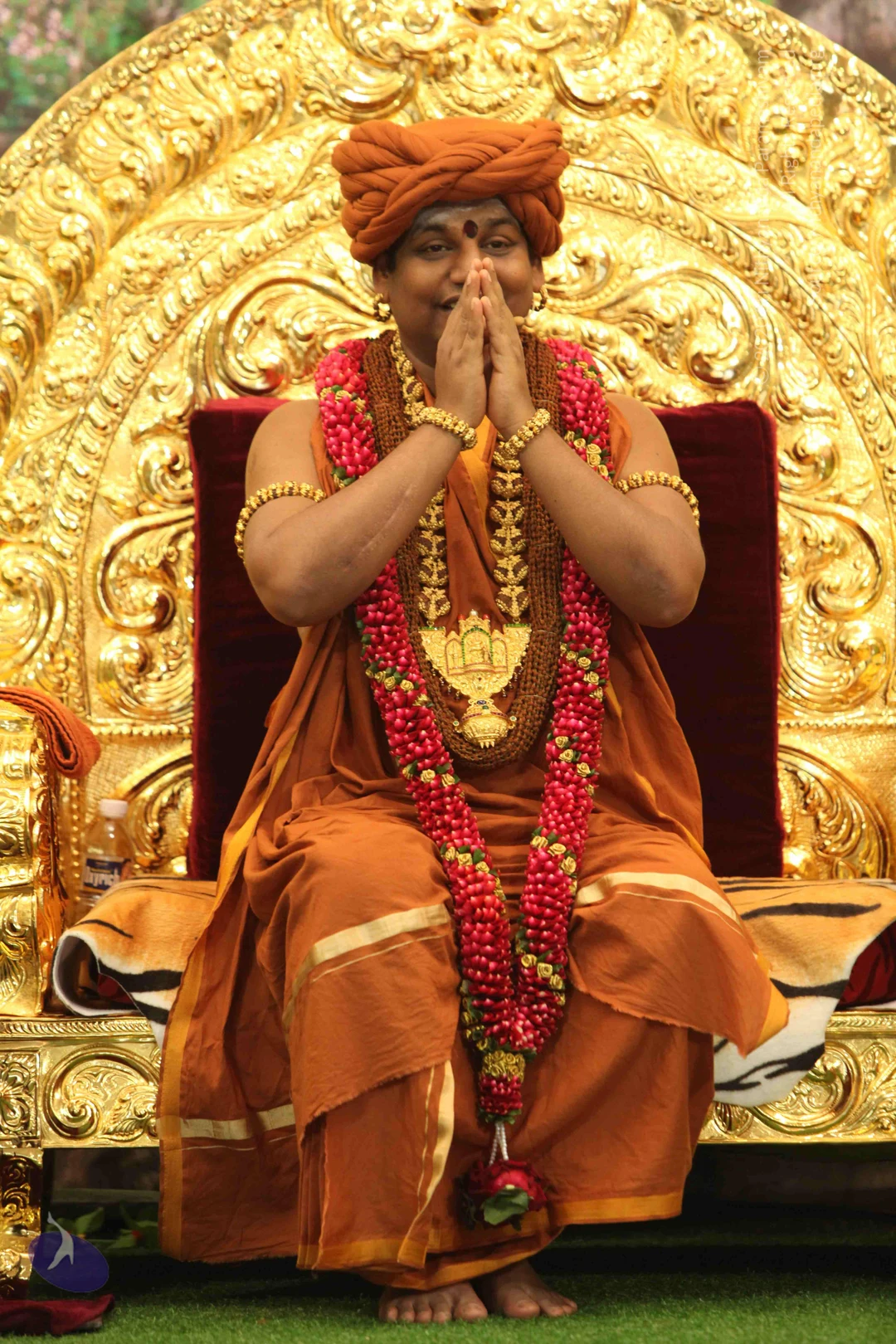
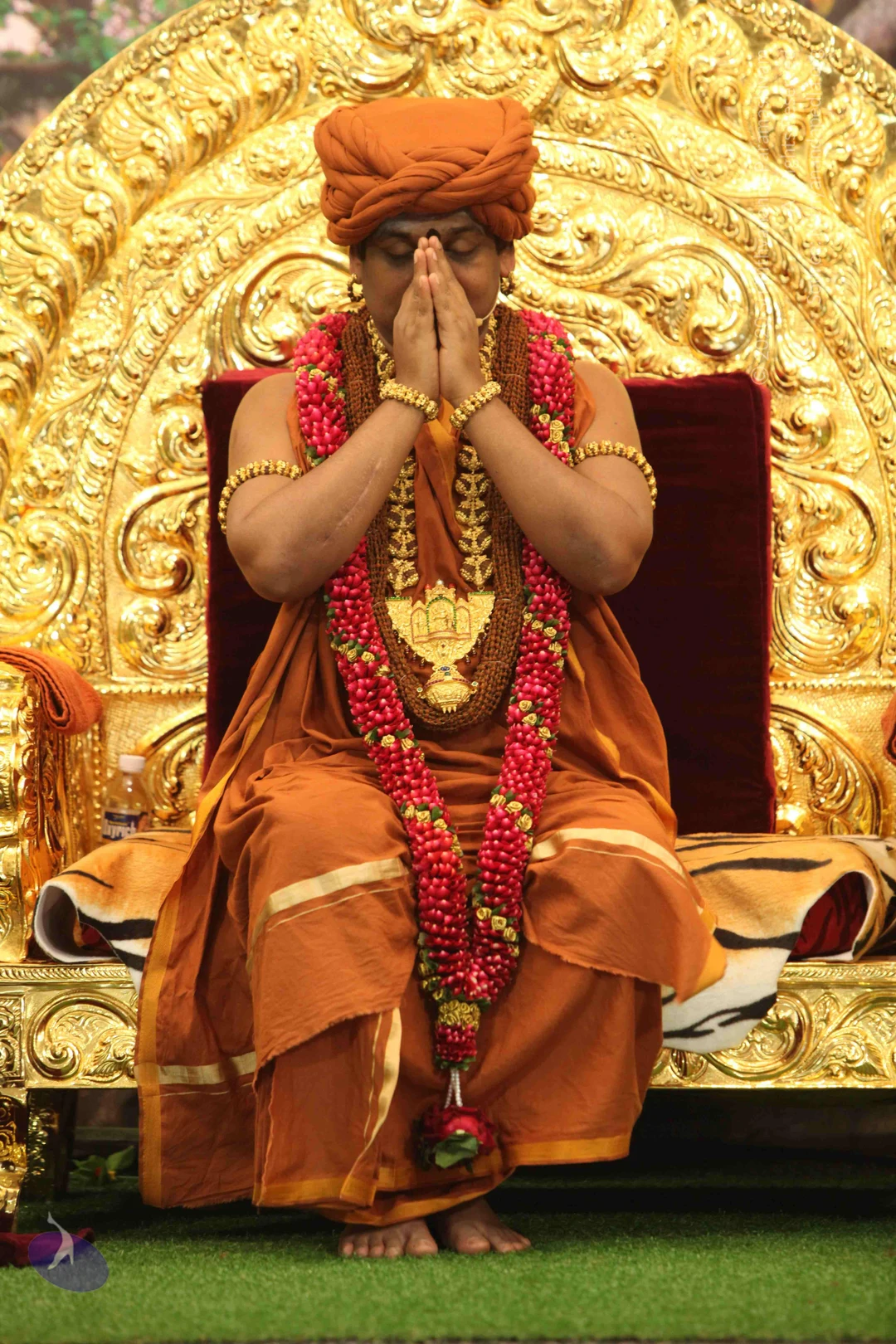
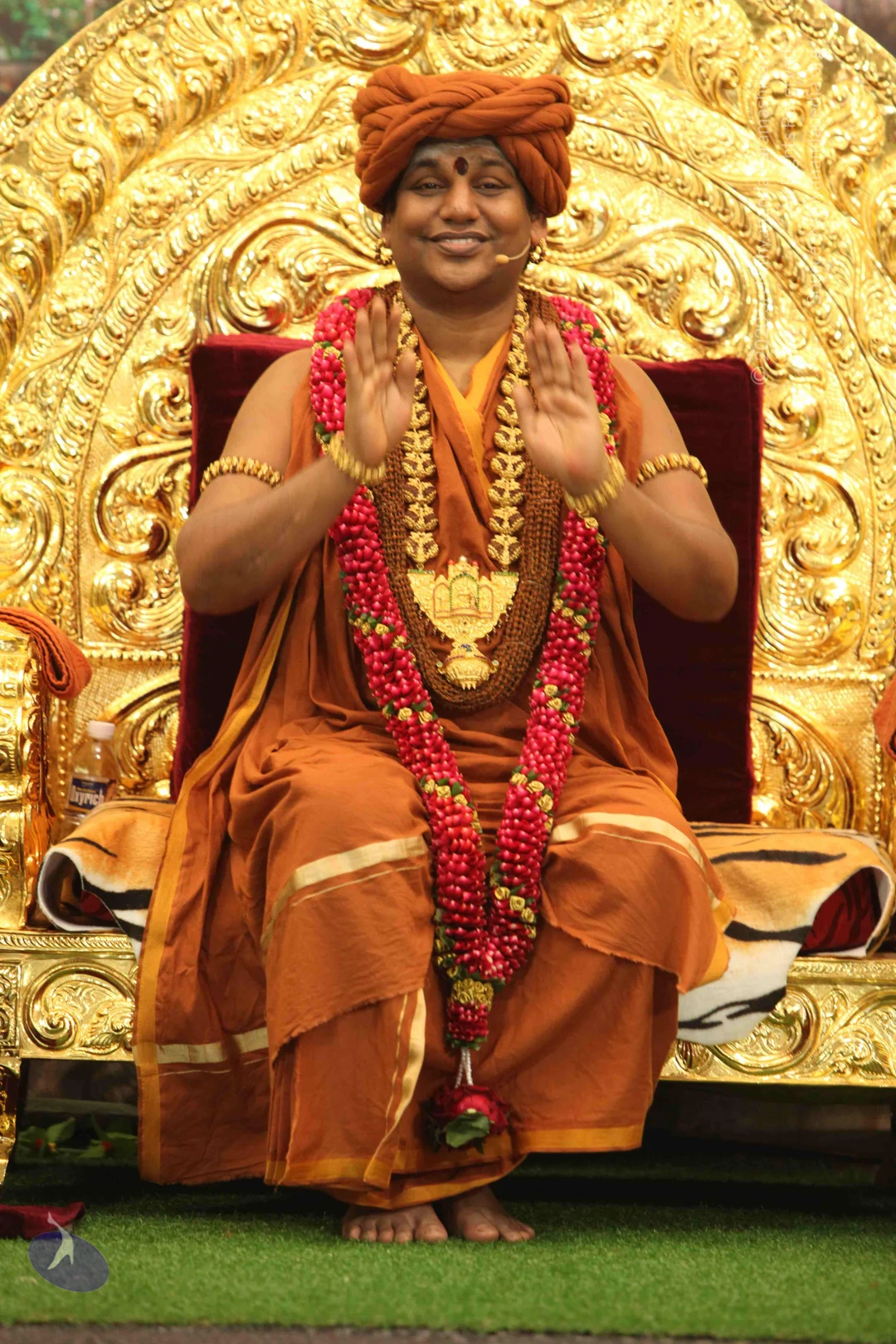
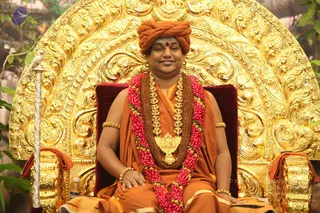
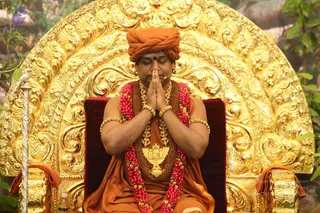
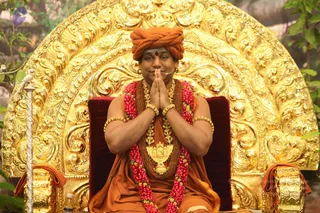
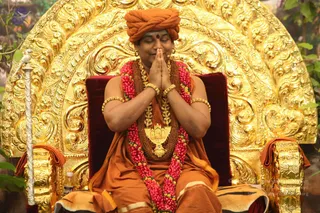
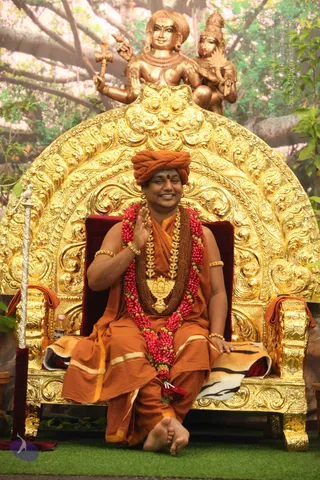
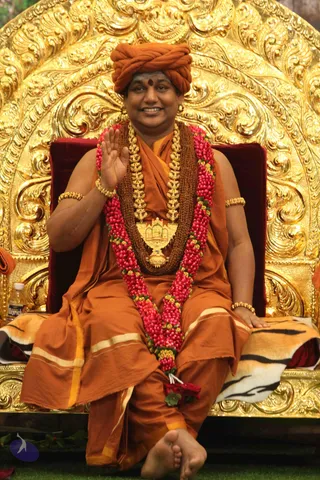
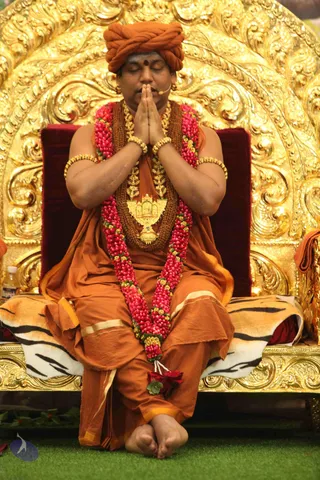
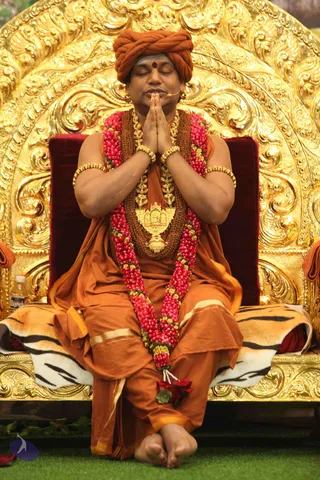
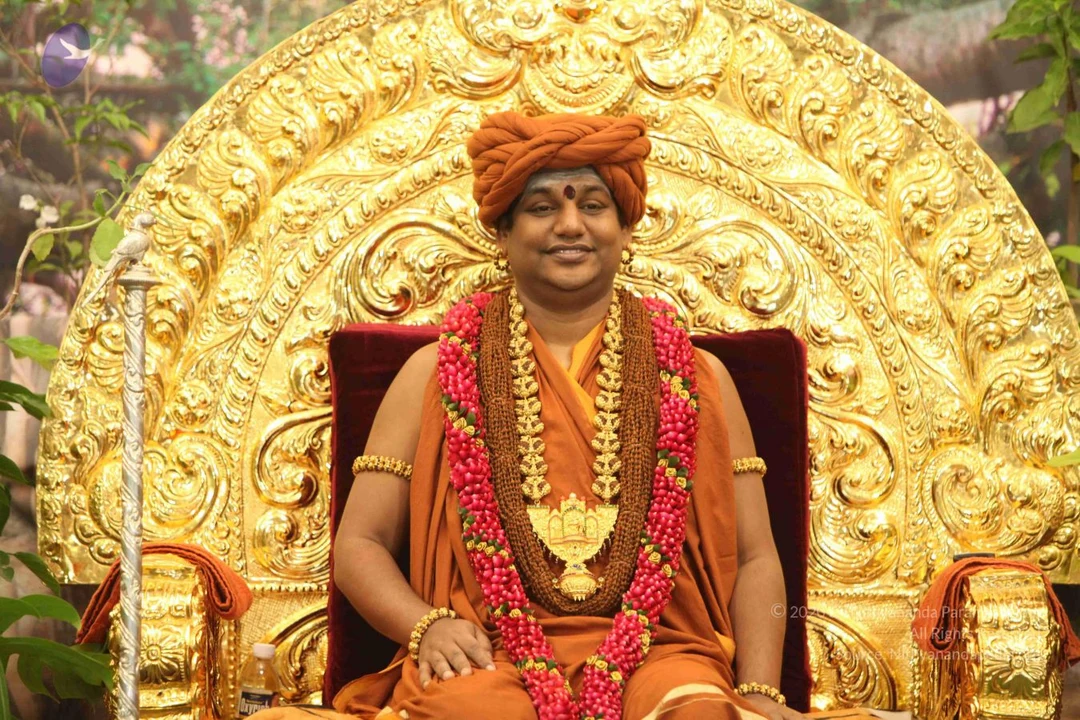
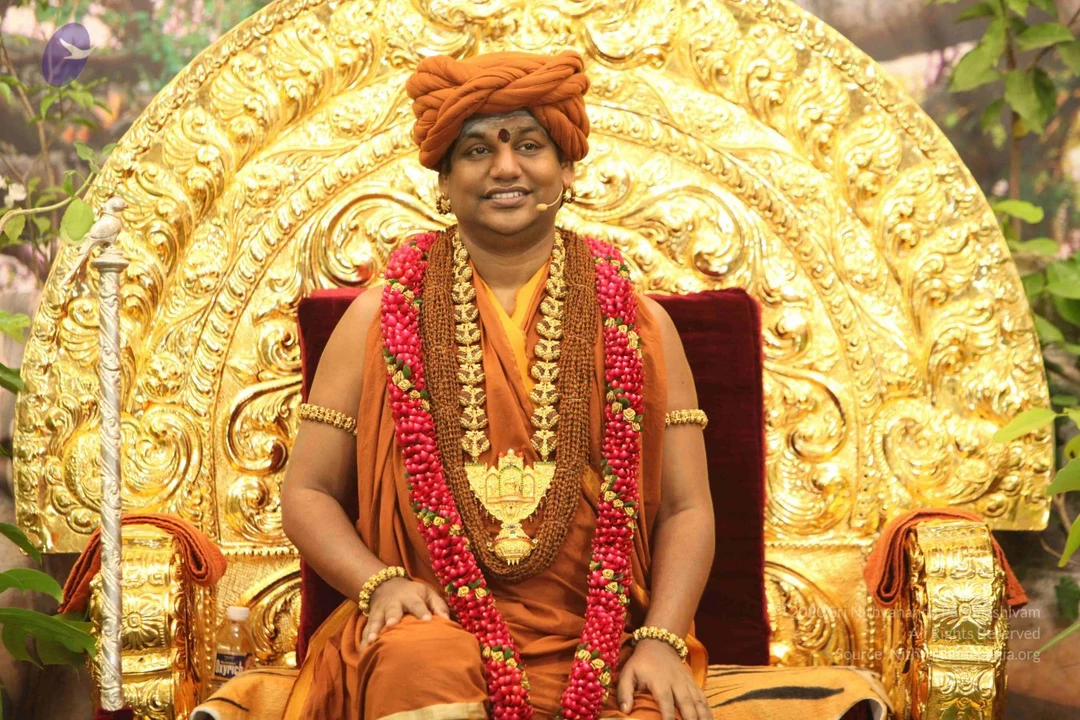
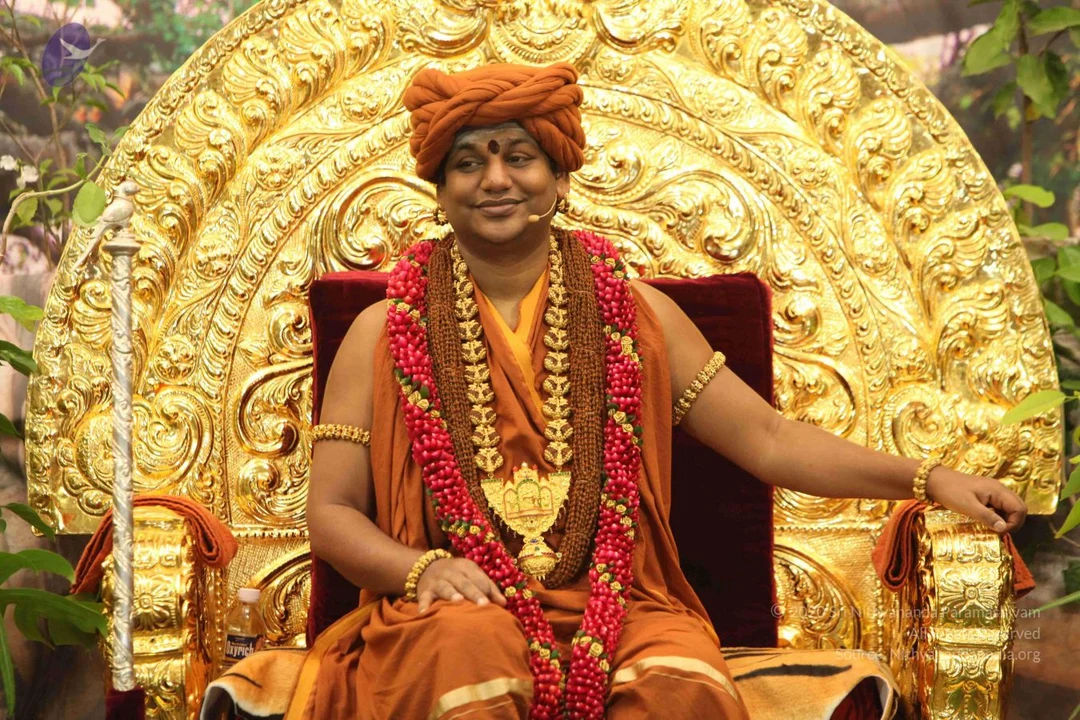
A seated man in saffron-orange robes and an orange turban sits on a red velvet throne backed by an ornate gold repoussé arch with floral scrollwork and a leafy green backdrop. He wears a dark rudraksha mala, a long ceremonial gold necklace, gold armlets and bangles, and a pendant of a golden temple-like emblem. A red-and-pink flower garland hangs across his chest. He wears a red tilak on his forehead and smiles, his hands resting on his lap. A water bottle and a ceremonial staff stand beside the throne. Appearance-based probable Swamiji: a seated figure with orange turban, rudraksha mala and gold ornaments on a throne, indicating a darshan or satsang setting. Visible text on the image reads aA seated man in saffron-orange robes and a matching orange turban sits on a red velvet cushioned seat in front of an ornate gold-leaf throne with scrolled relief carvings. He wears a long red and pink flower garland, a brown rudraksha mala, and layered gold necklaces with a gold pendant, plus gold armlets and bangles. A red-brown bindi marks his forehead, and a tiger-stripe cloth lies over the seat cushion. Potted green foliage and a small water bottle sit nearby. Swamiji (probable): a saffron-robed figure with a turban, rudraksha mala and ceremonial gold necklaces seated on the throne.A seated man in saffron-orange robes and a matching orange turban sits in a red velvet chair before an ornate gold carved backdrop, with his palms pressed together in namaste and his eyes closed. He wears a rudraksha mala, a ceremonial gold pendant, gold armlets and bangles, and a long red-and-pink flower garland. A small red bindi and a headset microphone are visible. Gold-tone throne armrests and a water bottle sit at the sides, with greenery behind the carved throne.A man seated on a red velvet chair in front of an ornate gold repoussé backdrop, hands pressed together in namaste. He wears an orange turban with a red bindi, a saffron robe, a brown rudraksha mala, a ceremonial gold necklace with a pendant, gold armlets and bangles, and a long garland of red and pink flowers. A small headset microphone is visible near his ear. Gold-coloured armrests and a water bottle are in the frame, with green foliage behind. The visual matches the appearance cues of a person, seated as a speaker, though the photo does not establish identity.A photograph of a seated figure in an orange-saffron turban and orange robes, hands pressed together in namaste with eyes closed. He wears a red-and-white flower garland, a rudraksha mala, a gold pendant and gold bangles, and sits on a red velvet cushion before an ornate gold throne with carved scrollwork. Green foliage and a folded orange cloth are visible at the sides, and a water bottle sits at lower left. The figure matches the Swamiji candidate in appearance, with a turban, saffron clothing, rudraksha and gold ornaments, so this is a probable match described by role as a seated teacher giving satsang, a probable in-person presence.A photograph of a seated figure in saffron-orange robes and a matching saffron turban, palms pressed together in namaste, on a deep red velvet seat before an ornate gold-leaf throne backdrop. He wears a red and white flower garland, a rudraksha mala with a gold pendant, and gold bangles on the upper arms and wrists. A water bottle and a silver staff stand beside the throne, with green foliage at the upper left.
deities-alankar

6 photosSource gallery
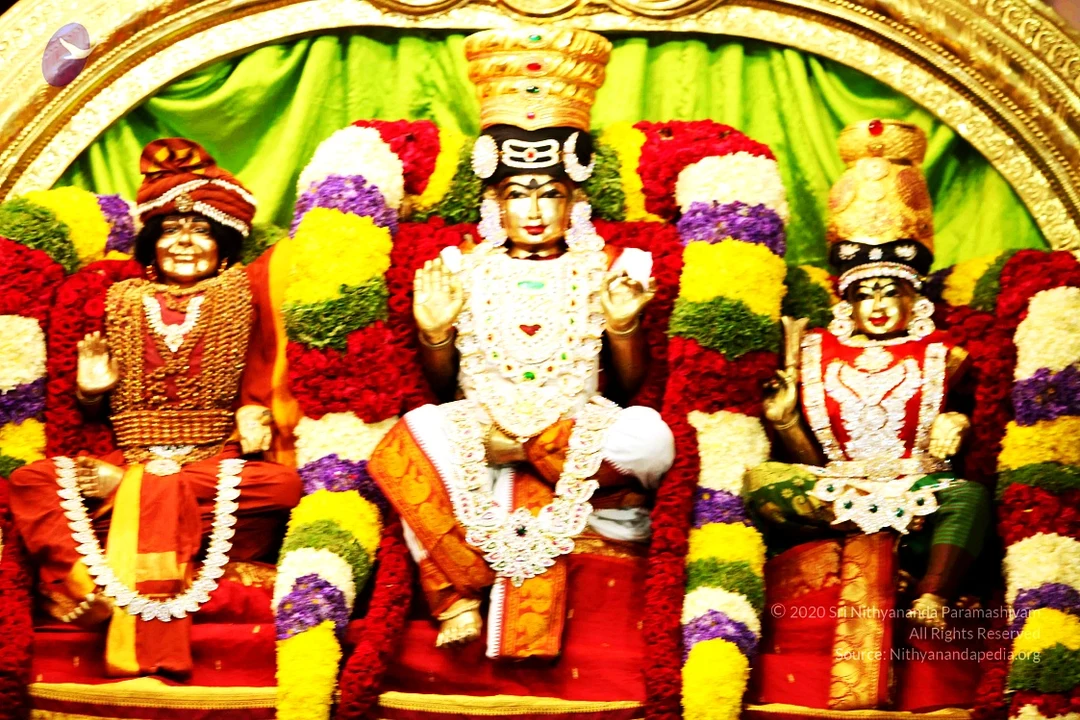
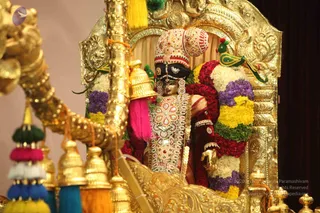
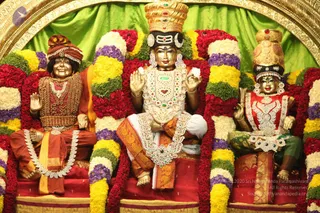
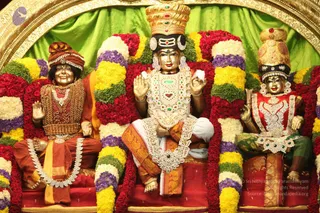
A photograph of an ornate golden processional palanquin or ratha canopy holding a decorated deity murti. The murti wears a red and white crown, a red garment, a jewelled breastplate and a long necklace, and is draped in garlands of purple, yellow and green flowers. Golden bells, a green, yellow, pink and white tassel fringe, and a golden arched frame with carved lion-face motifs surround it. Dark red drapery hangs behind, and a white floor fan is at the left edge.A photograph of a deity murti decorated for a procession, seated within an ornate gold-toned canopy or palanquin. The murti wears a jewelled crown, a red-and-gold sari, a heavy ornamented necklace with green and red stones, and a dark face with painted features. It is garlanded with red roses, white flowers and purple and yellow blooms, and a green-and-red parrot figure is mounted at the top. Gold bells and tassels in pink, white, blue, green and yellow hang from the vehicle in the foreground. No people are visible.Three golden statues seated side by side on a red-and-white cushioned throne, decorated with dense garlands of red, yellow, purple and white flowers. The central figure is a deity murti with a tall gold crown, Shiva-style forehead marking and a jewelled white garment and necklaces, hands raised in blessing. To the left, a figure wears a red and orange turban and a beaded brown-and-gold garment. To the right, a figure wears a tall gold crown, a red blouse with silver embellishment and a green lower garment. A green draped curtain and an ornate gold arch frame the scene. These are statues, not living people.A golden murti display on a red-and-gold seated platform beneath a green draped backdrop and gold arch. A central figure with a golden crown, Shiva tripundra marking on the forehead, jewelled white ornaments and a white-and-gold dhoti sits with hands raised in blessing. To the left, a golden figure in a rust-red turban and robes with rudraksha-style beaded necklaces sits in a teaching pose, hand raised. To the right, a golden figure in a tall crown wears a red and white embellished blouse with green lower garments. Garlands of yellow, white, purple, green and red flowers frame all three figures.A bald man in a rust-red dhoti with a gold-bordered yellow cloth draped over his shoulder performs aarti, holding a lit multi-wick oil lamp toward a deity murti on a gold palanquin. The murti wears a red and white headdress, a green and red garland of flowers and a jewelled white-and-gold garment, with a large gold ceremonial mace-like staff and bells, tassels in green, orange, blue, yellow and pink hanging from the palanquin. Behind is a dark maroon curtain. The man has a rudraksha-style mala around his neck and a silver bracelet on his wrist.A photograph of a golden ceremonial palanquin-style peetha holding a deity murti adorned with multicolored flower garlands in purple, yellow, red and white and a jewelled crown-like headdress. A bald man in a rust-orange and gold dhoti-style garment, with a sacred thread and an arm band, leans in from the left holding a lit oil lamp with flames toward the altar. Golden bells and a tall golden staff with tassels in green, red, orange, blue and white decorate the structure against a dark maroon curtain.

NKY-Day2-Q&A

15 photosSource gallery
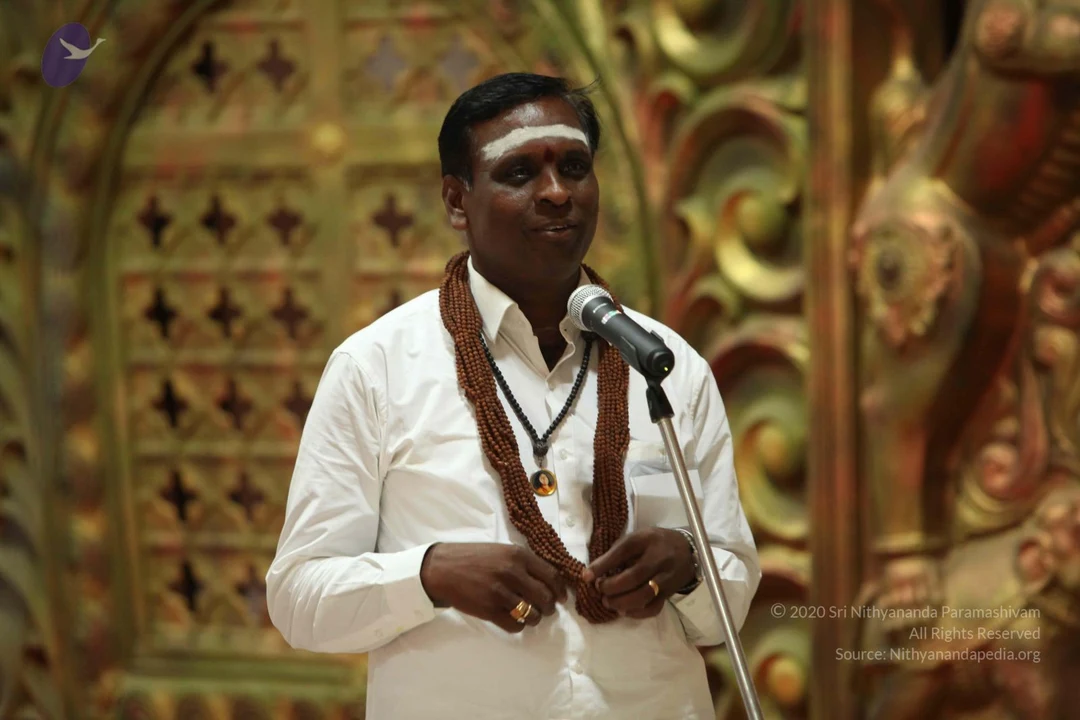
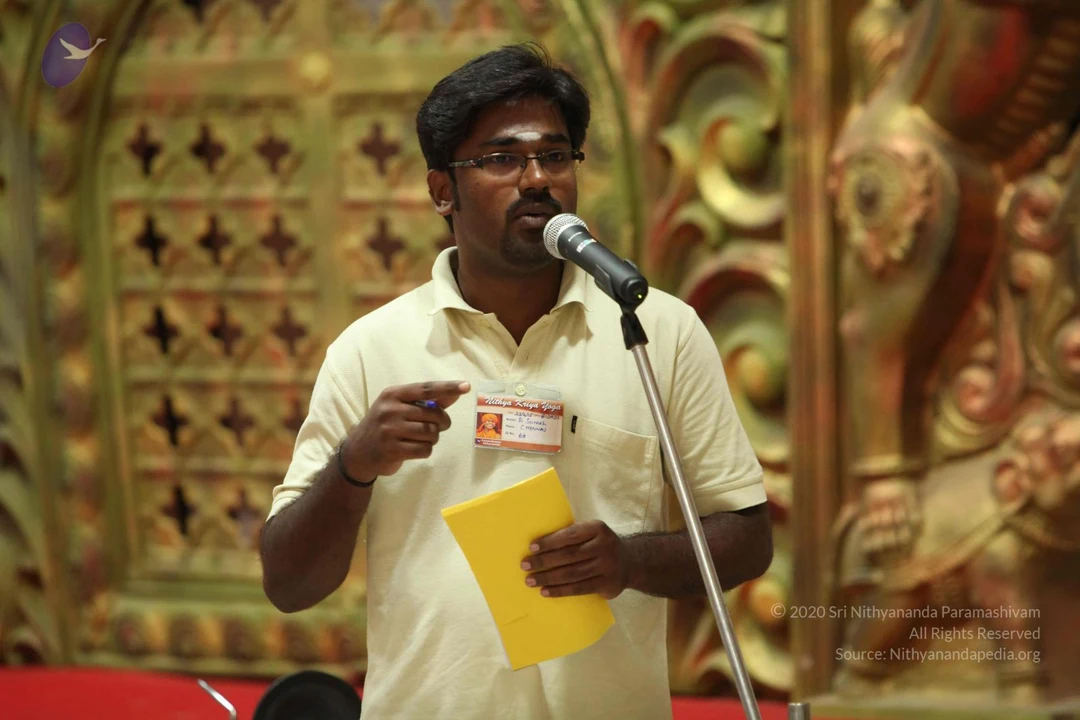
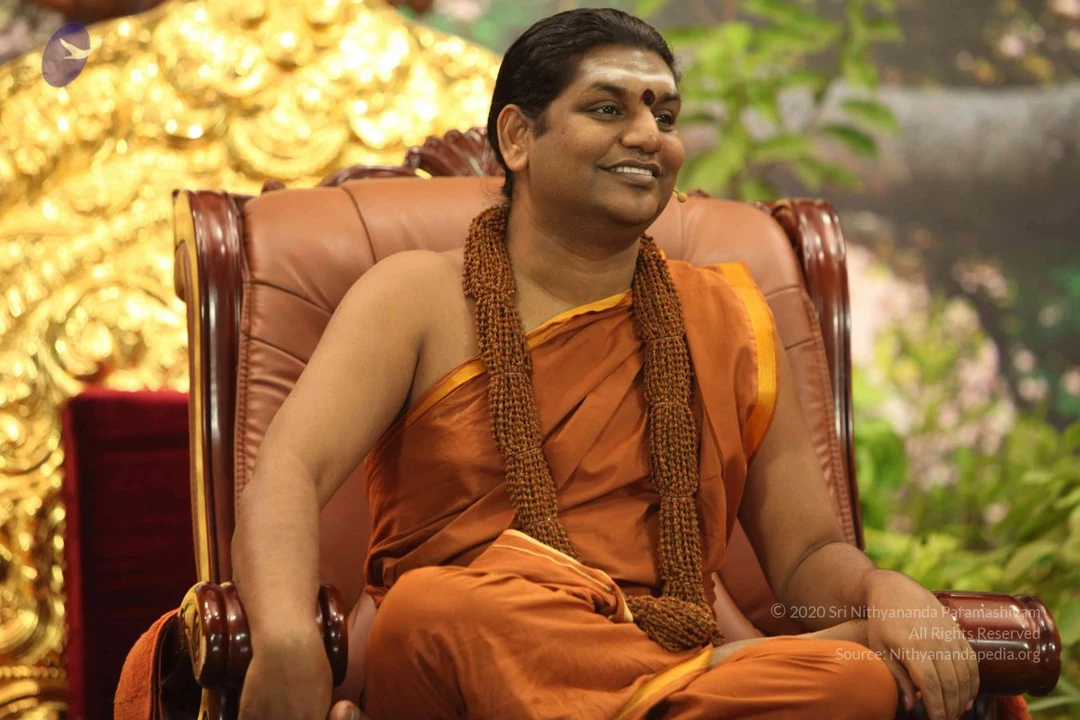
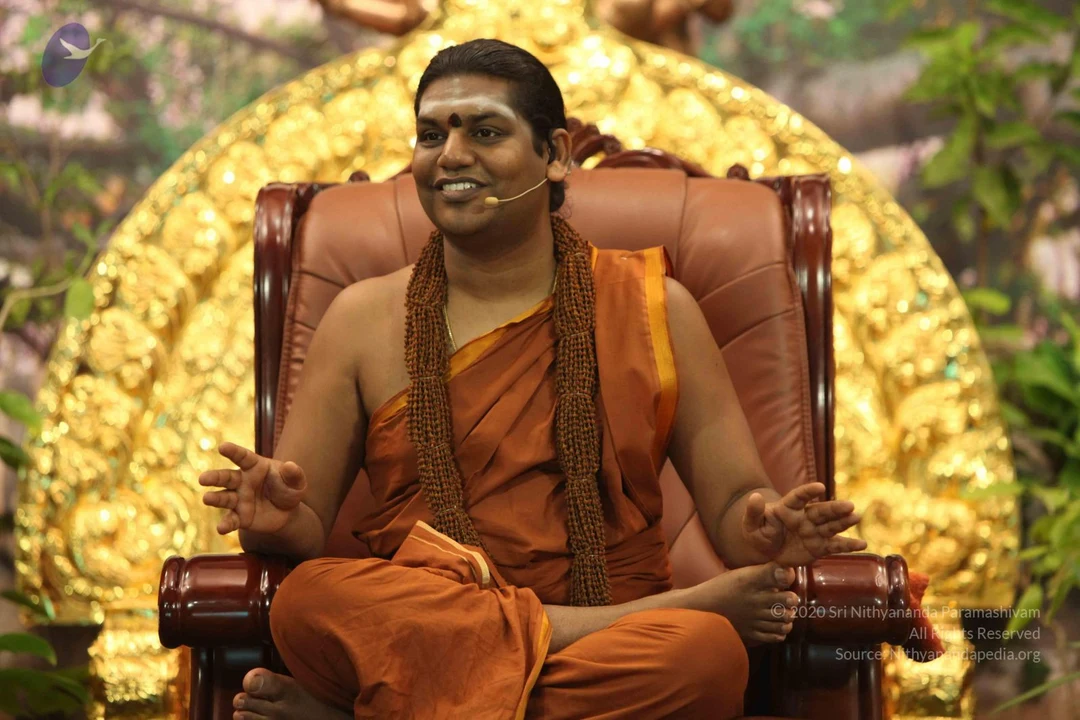
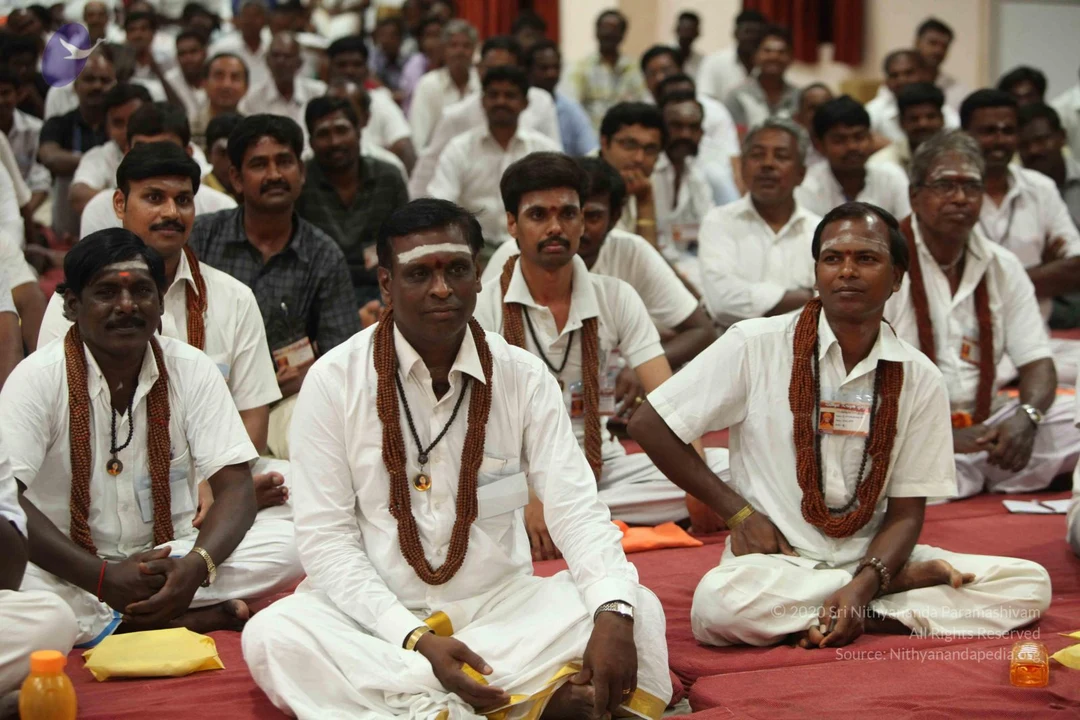
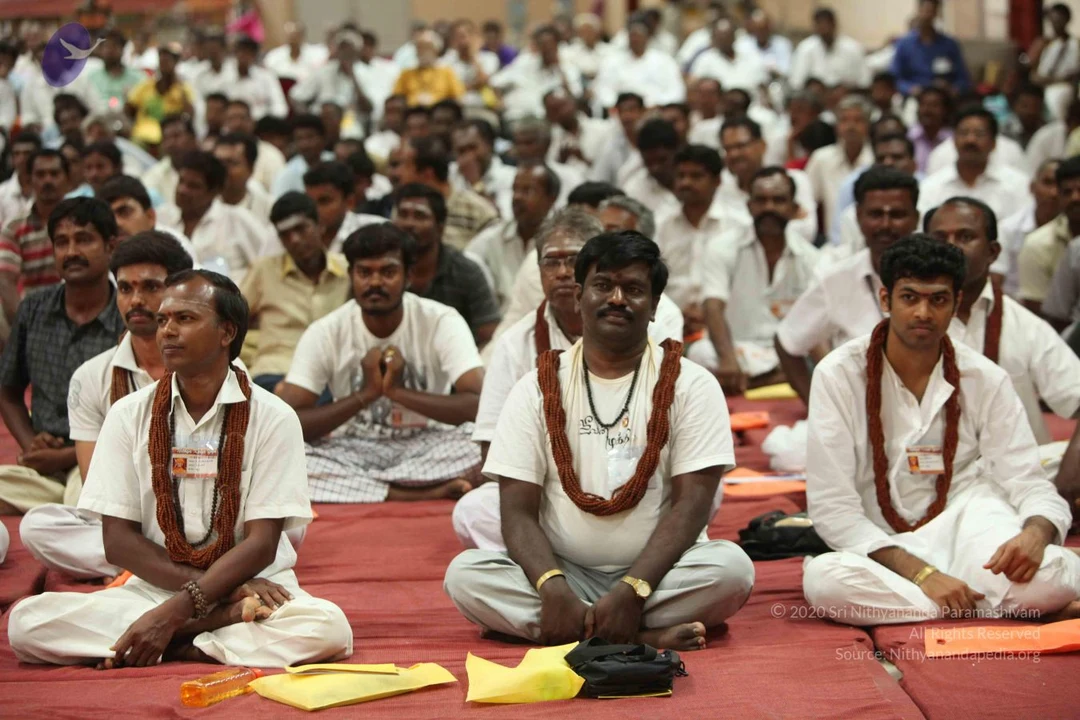
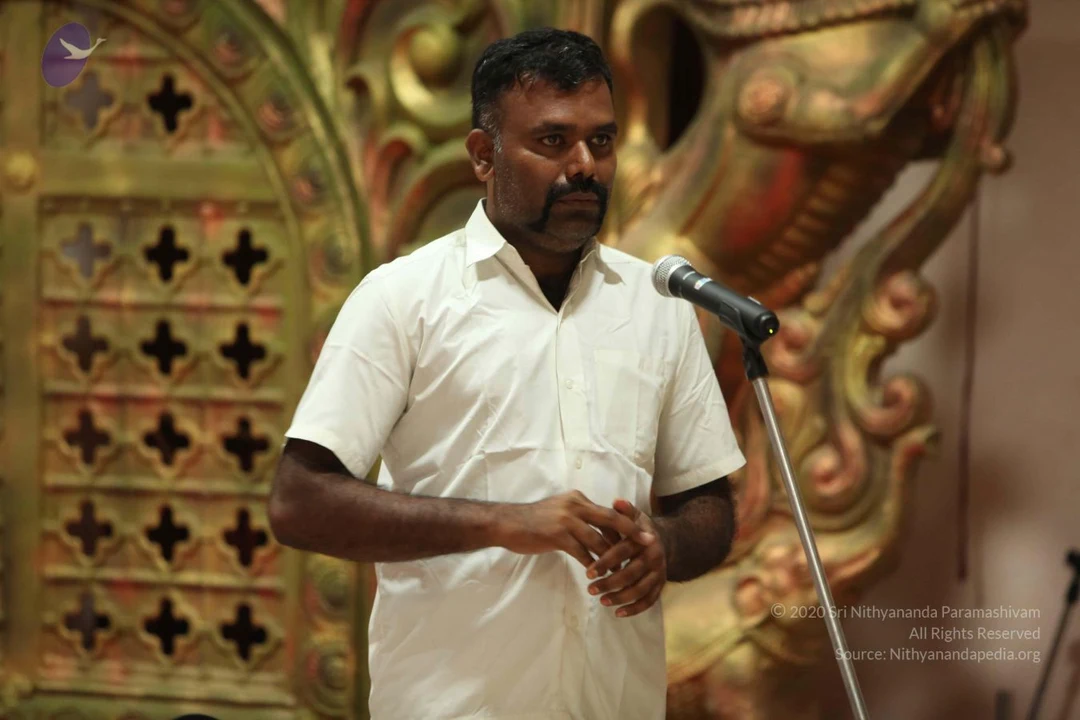
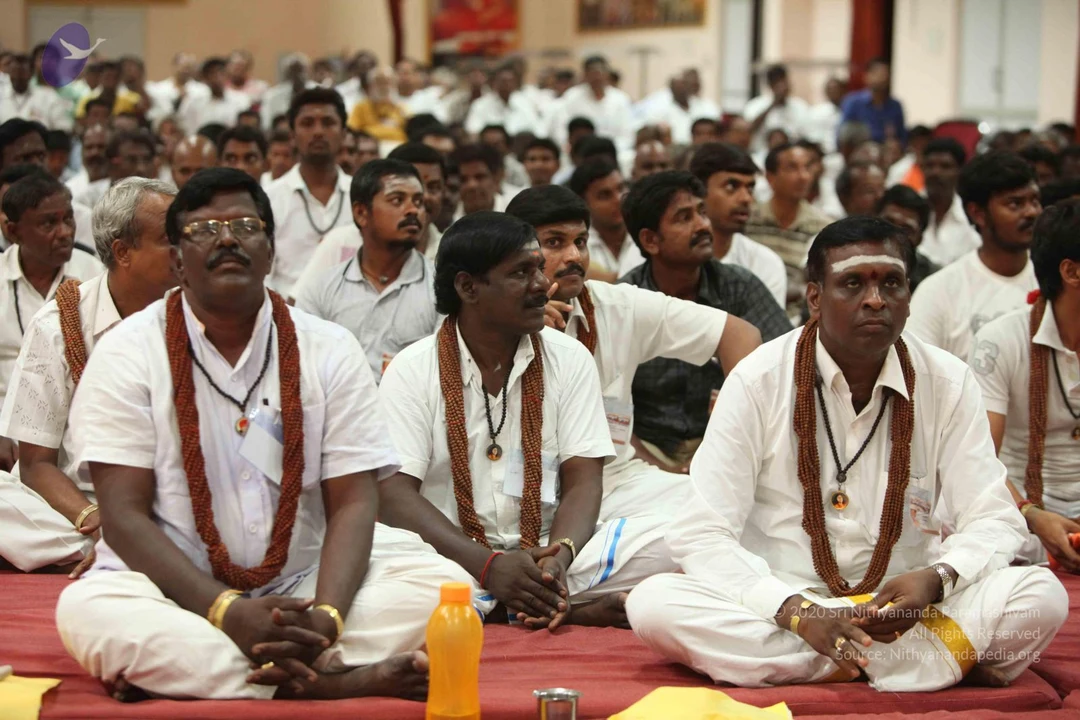
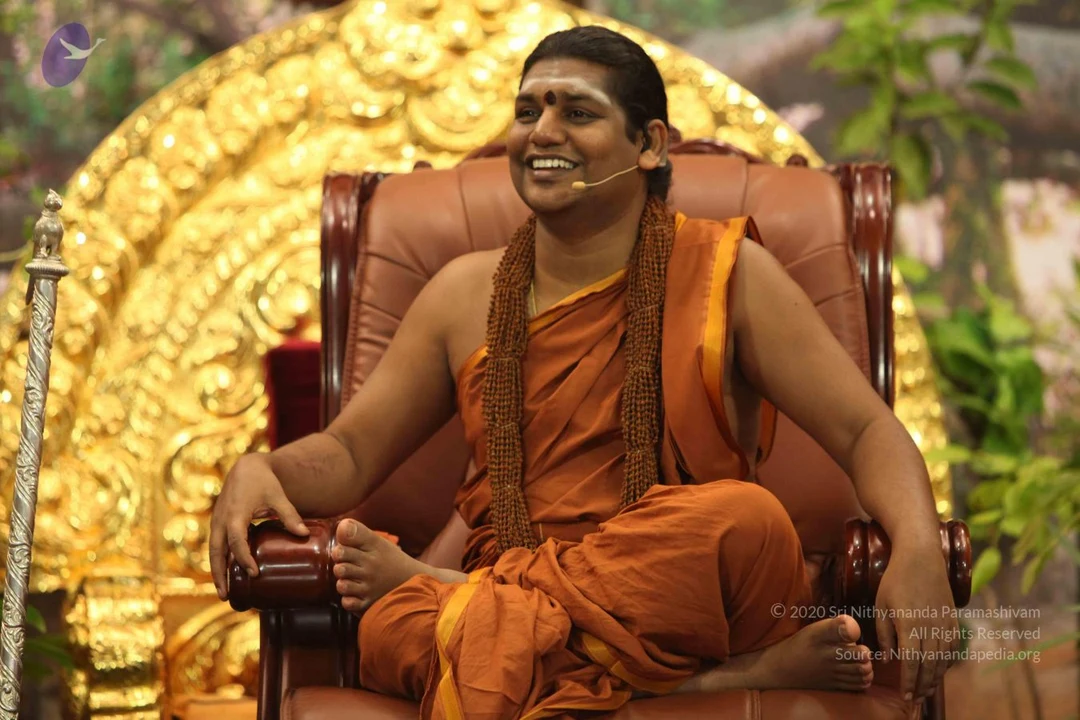
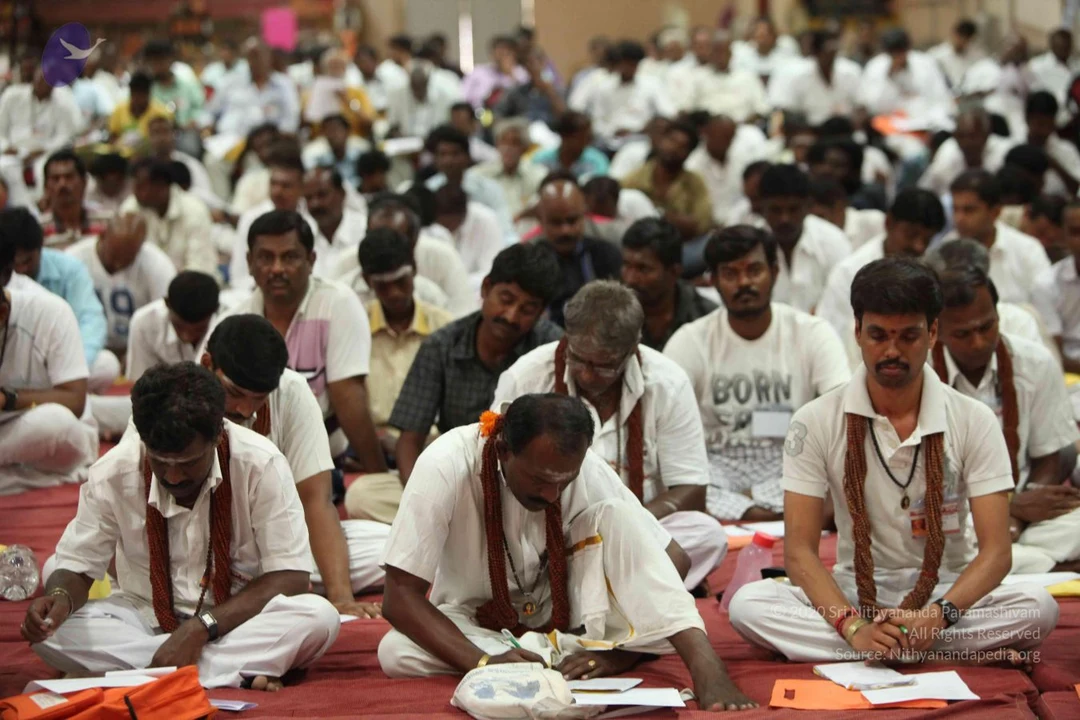
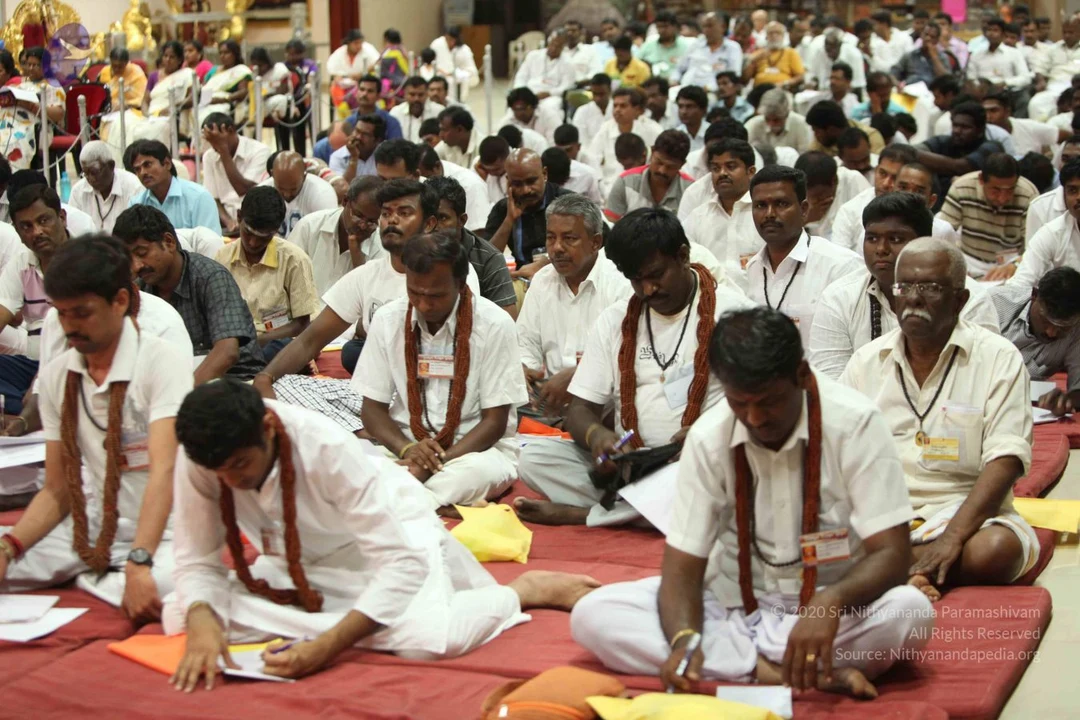
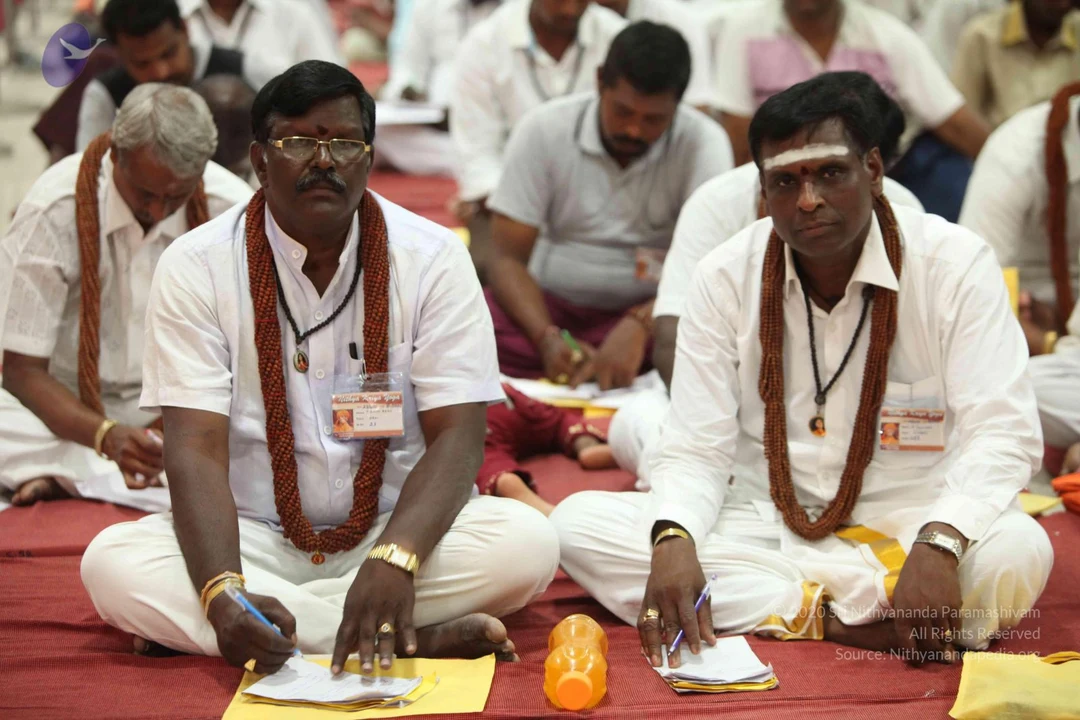
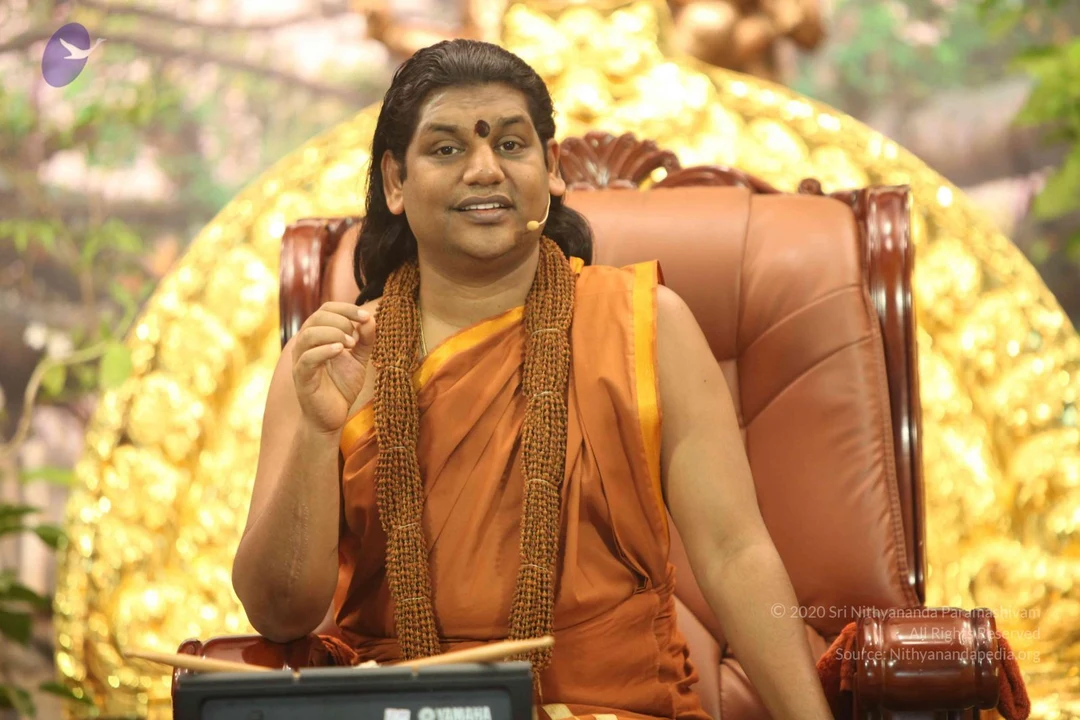
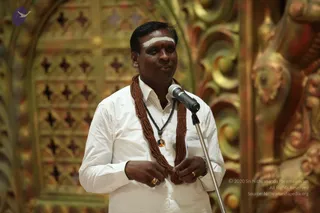
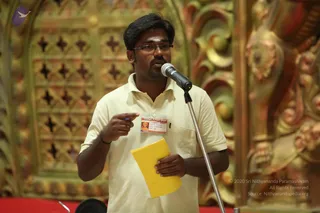
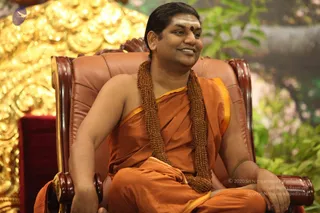
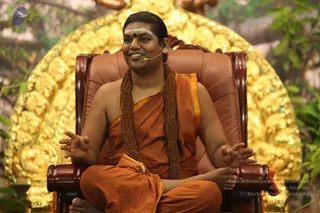
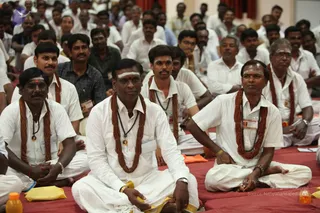
A man stands at a silver microphone stand speaking, wearing a white collared shirt and white ritual sacred ash line on his forehead. He wears multiple strands of brown rudraksha beads and a dark cord necklace with a small pendant, and gold rings on his fingers. Behind him is an ornate gold and red carved wooden backdrop with decorative scrollwork and lattice panels. The setting appears to be a satsang discourse hall.A man in saffron-orange robes sits cross-legged in a dark brown leather armchair with carved wooden arms, smiling, with a small microphone clipped near his face. He wears a long rudraksha mala draped over his shoulders and a vertical white sandalwood mark with a red dot on his forehead. Behind him a large golden figure of a deity murti is partly visible, and green plants and a painted backdrop fill the stage. a person is seated as the satsang speaker, identified by the saffron robes, the rudraksha mala and the seated, discourse-giving posture.A man in a cream short-sleeved polo shirt stands at a microphone on a stand, speaking while holding a yellow folder in his left hand and pointing with his right index finger. He wears glasses, a dark wrist band and a name badge on a lanyard reading Nithya Satsang region badge. Behind him is ornate gold and bronze carved decorative panelling with a red carpeted stage edge. One physical person is visible, appearing to be a speaker or sadas participant rather than the a person; the a person field is set to unsure because no clear appearance-based candidate is present.A photograph of a man seated in a large brown leather armchair with dark wooden armrests, smiling and looking off to the side. He wears a saffron-orange dhoti and matching shawl draped over one shoulder, a long brown rudraksha mala hanging to his waist, and a small red bindi with white tilak on his forehead. Behind him a gilded golden ornate backdrop stands on the left, and green foliage with pink blossoms fills the right. a person candidate is shown with these cues: saffron clothing, a rudraksha mala, and a ceremonial throne-like seat.A seated man in an orange-saffron dhoti and shawl with a thin orange border sits cross-legged on a brown leather armchair with carved dark wood arms, speaking animatedly with a small lapel headset microphone and smiling. He wears a long double-strand rudraksha mala and a gold chain, a red bindi and white tripundra marks on his forehead, and gestures with both hands, palms out. Behind him is a large gold-embossed ornate backdrop with green foliage and a glimpse of a painted figure at the top. He is the only person visible.A large seated congregation fills a hall during a satsang. In the foreground, three men in white dhotis and white shirts sit on red mats wearing long rudraksha malas; the central man has a white forehead mark with red kumkum and a pendant, and the man on the right has his hands resting on his knee. Behind them, many more men in white and some in dark shirts sit attentively, and some hold small paper badges. Orange water bottles and yellow cushions are visible at the bottom edge. The scene reflects attentive listening, not a ritual abhishekam or homa.
NKY-Day2-Shivoham

8 photosSource gallery
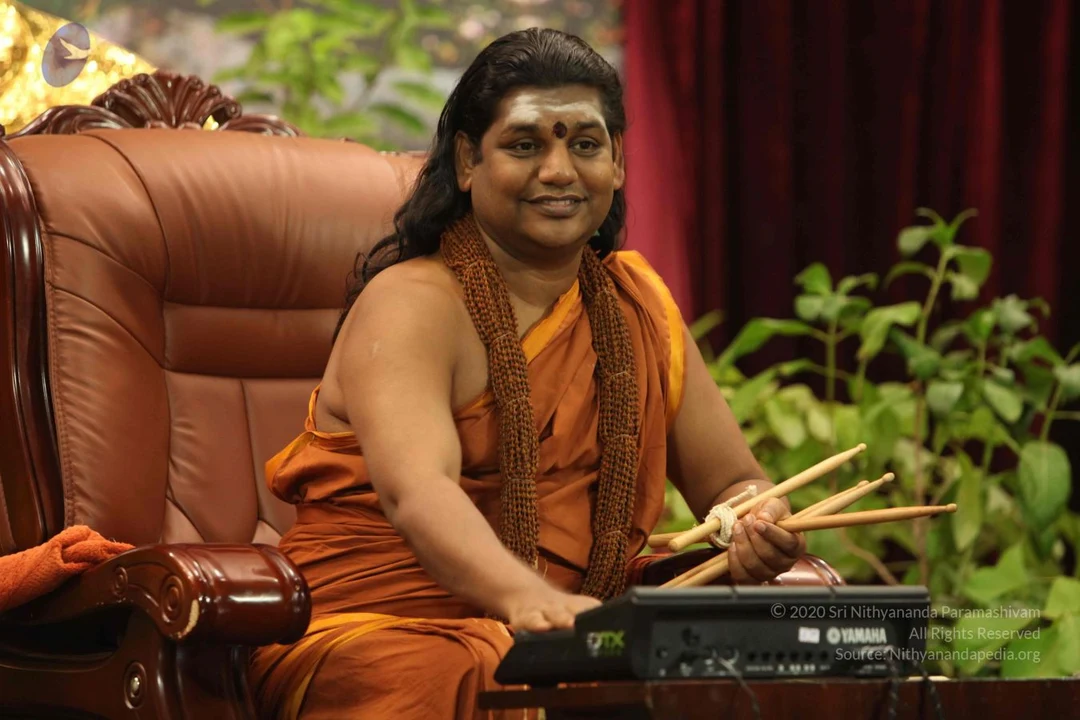
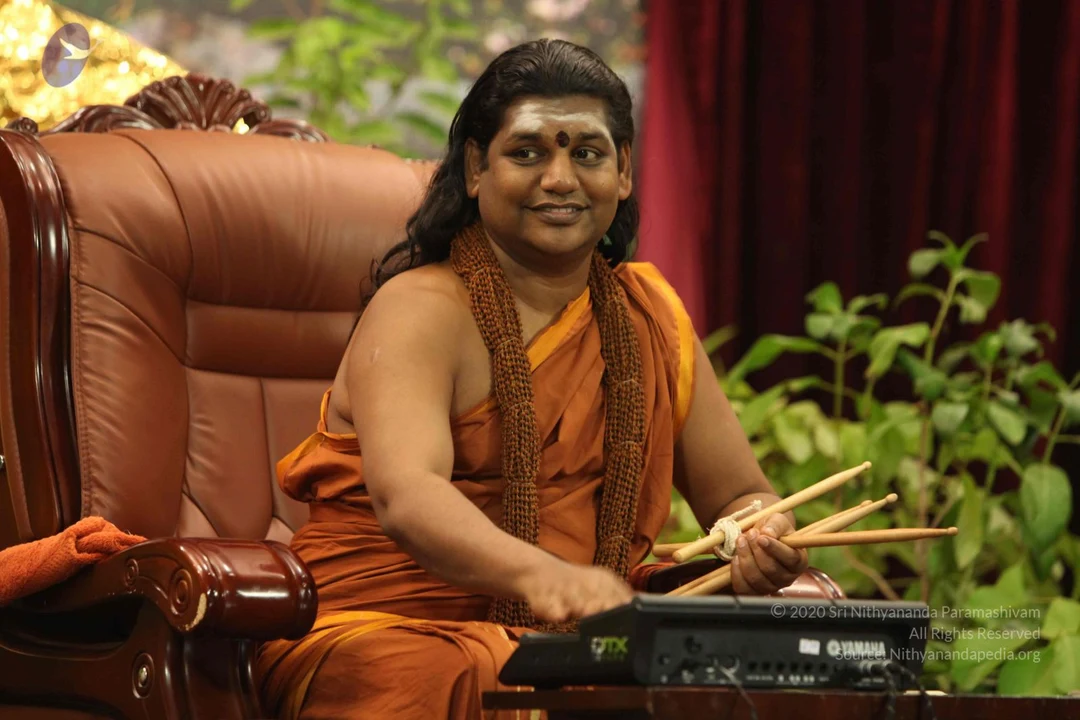
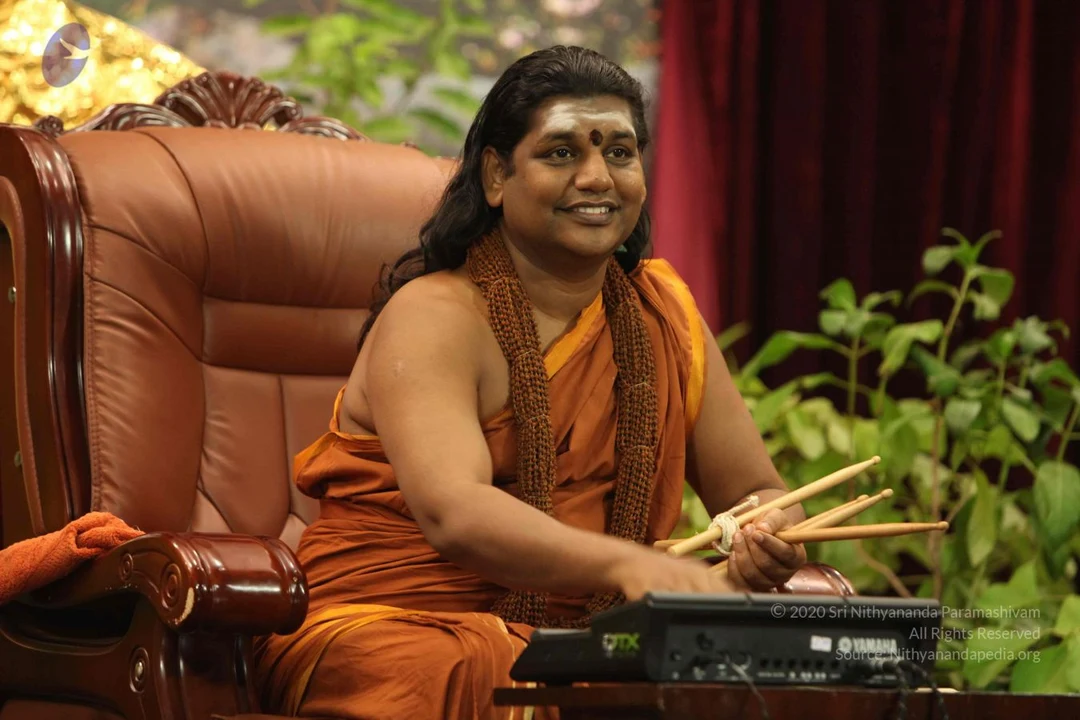
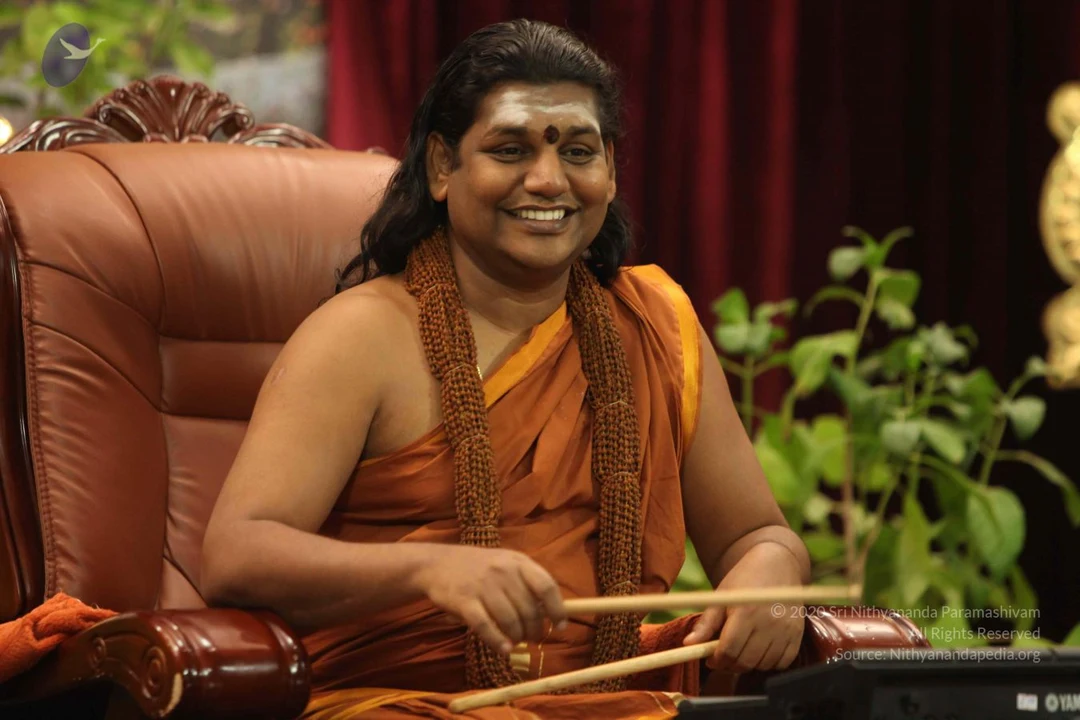
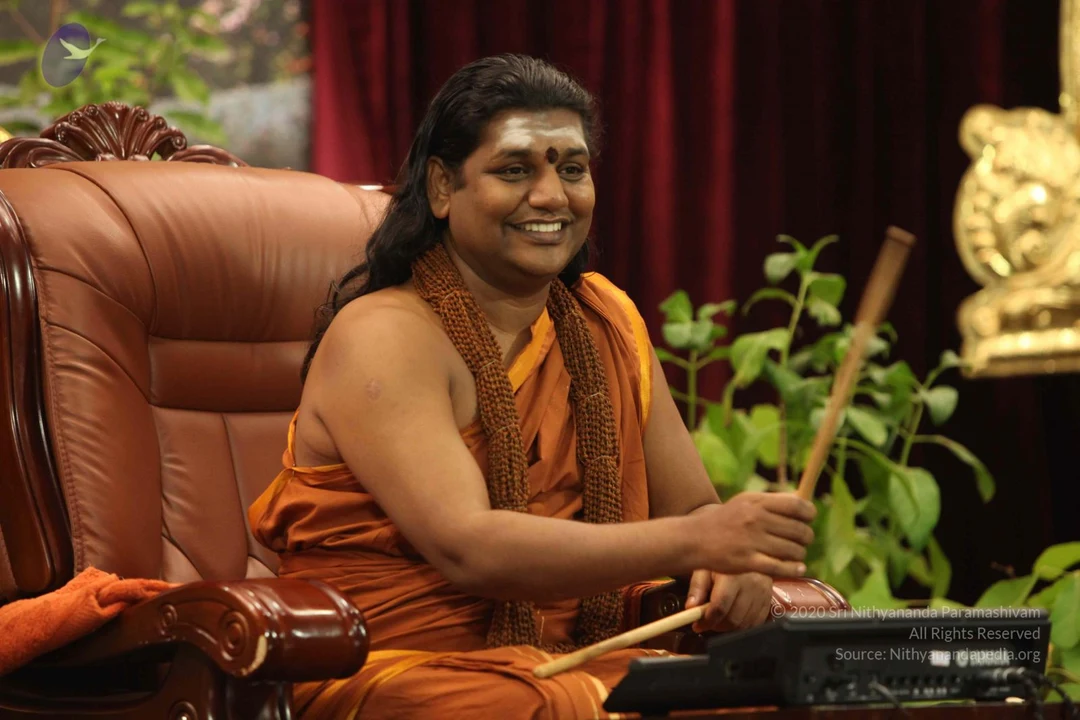
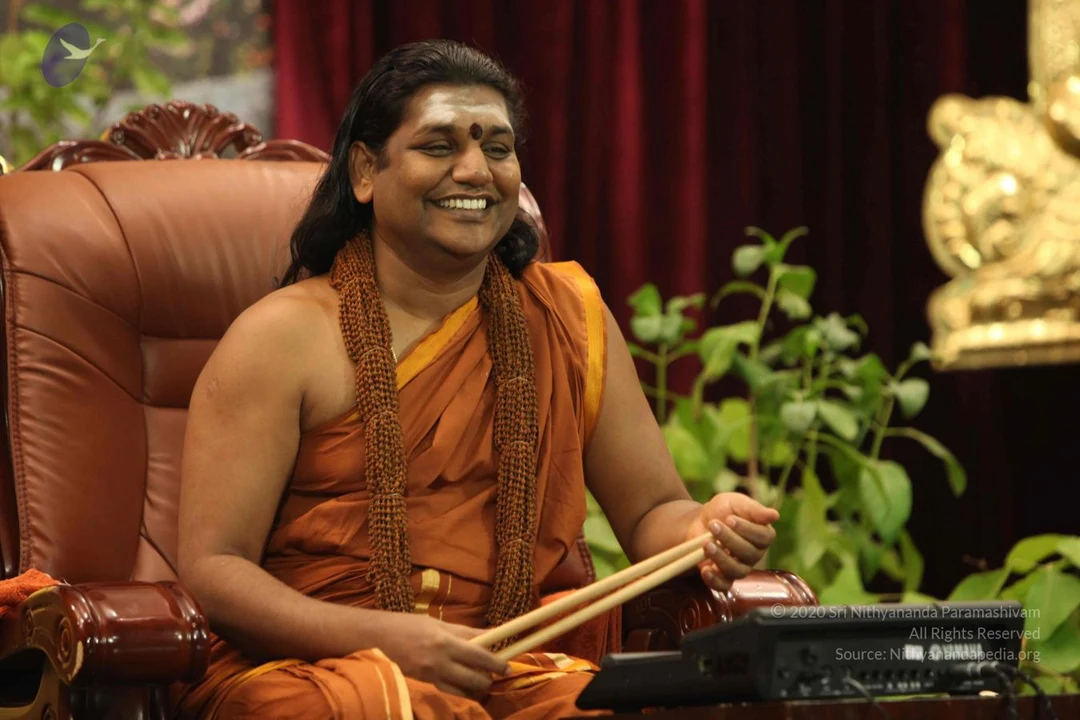
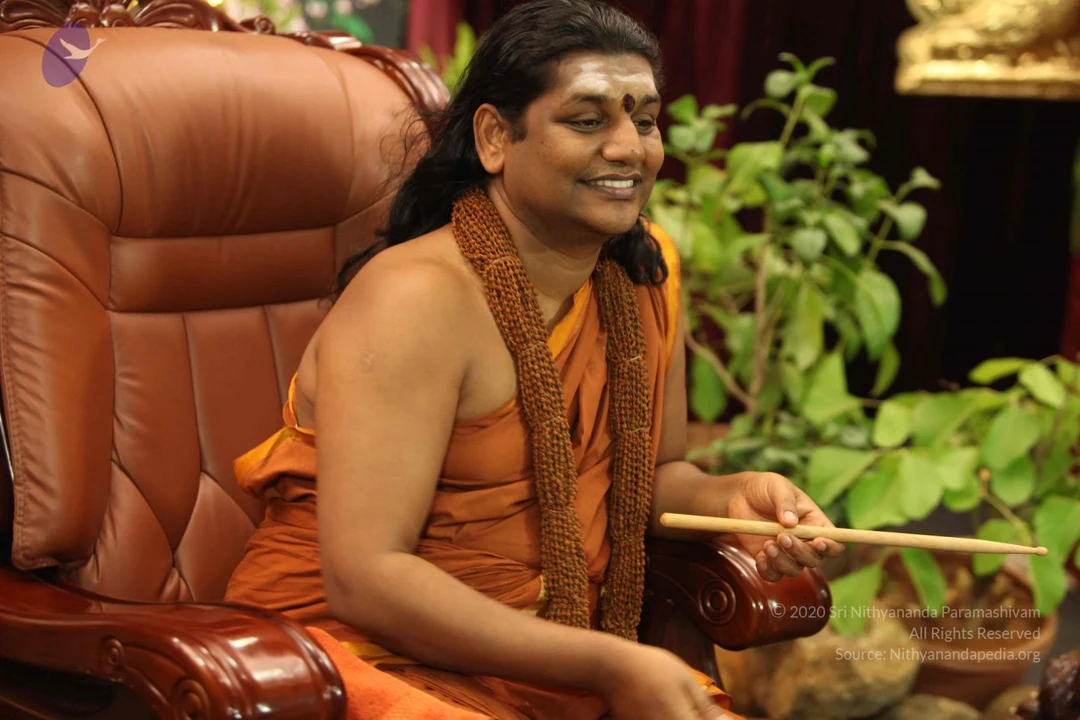
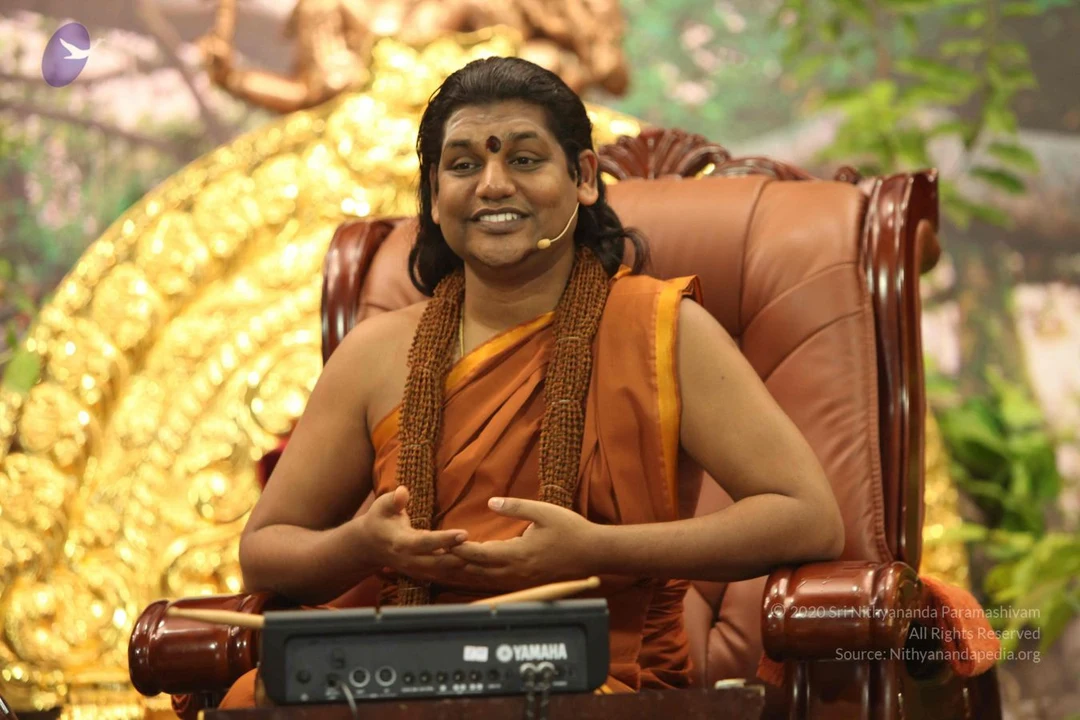
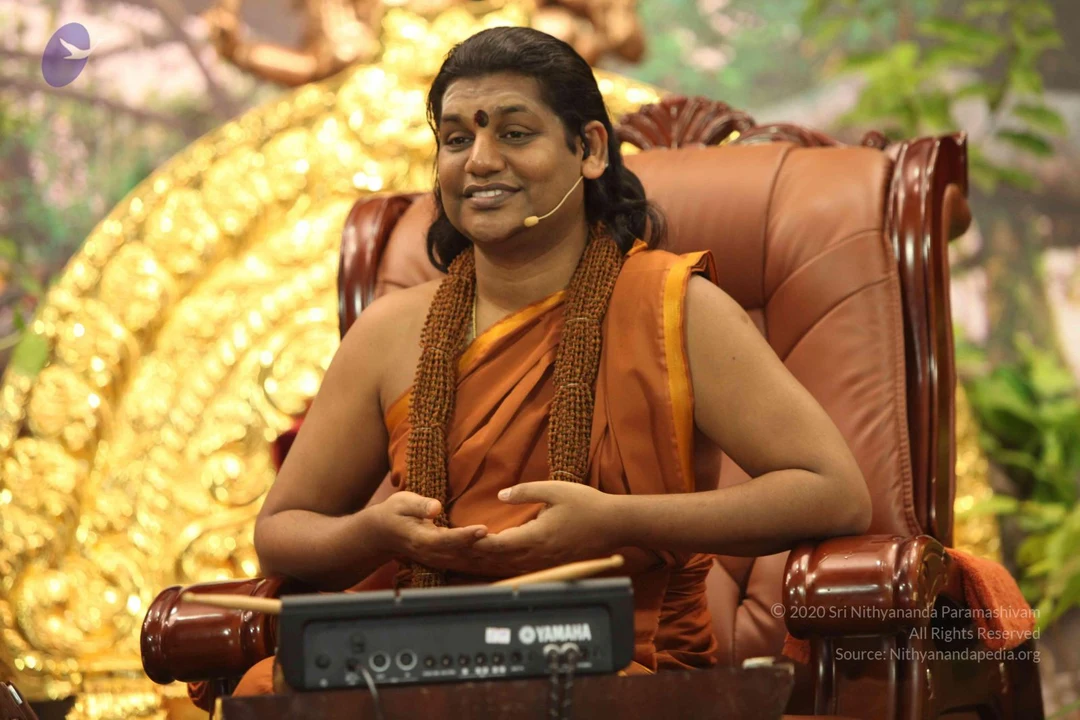
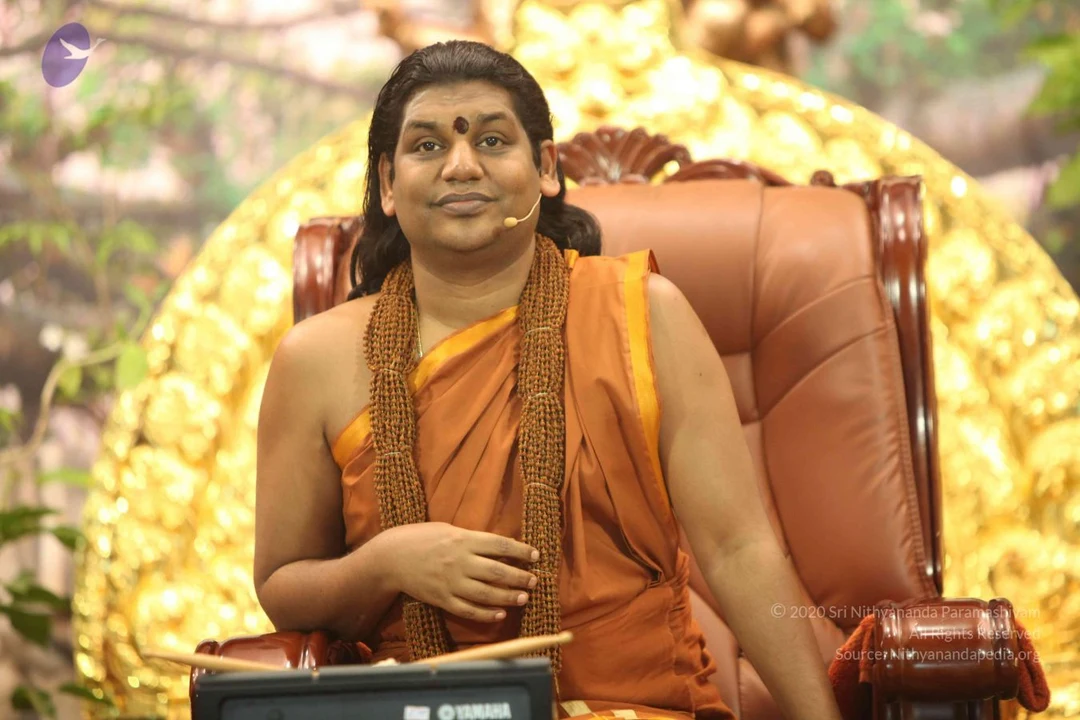
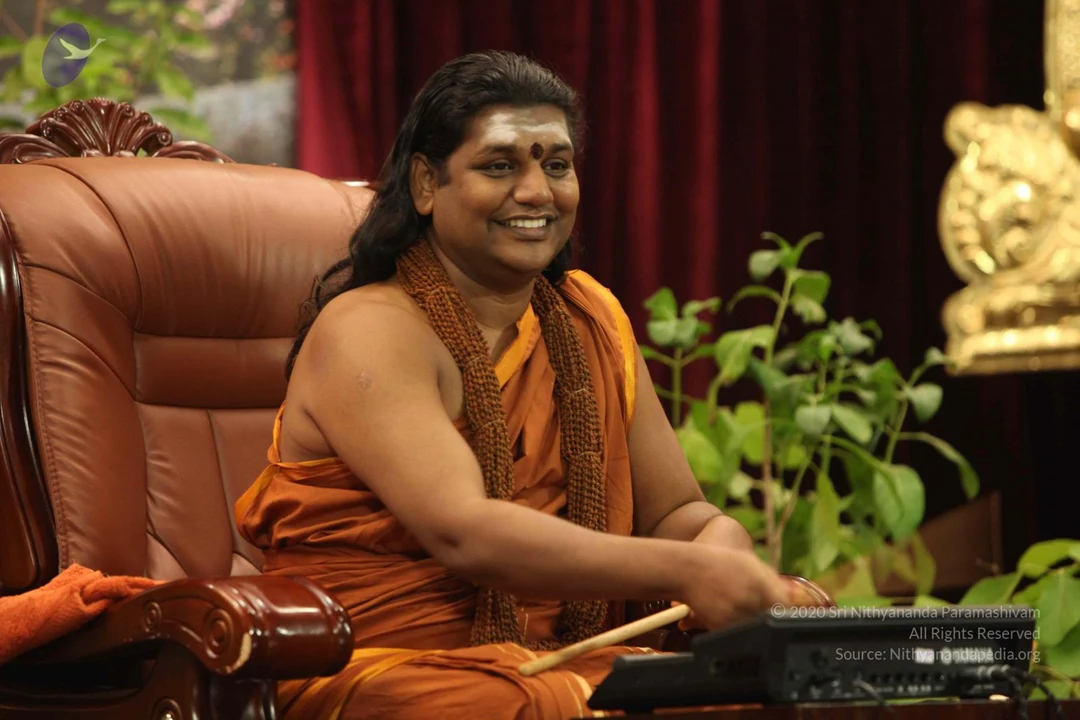
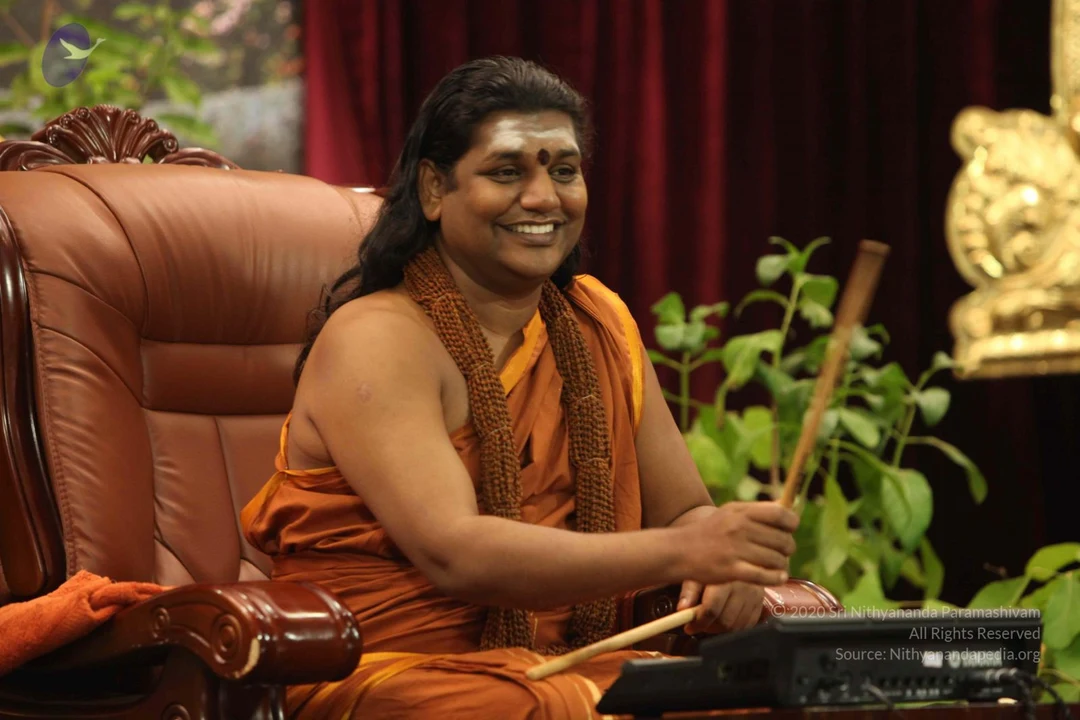
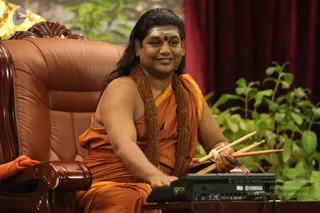
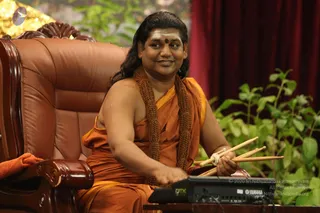
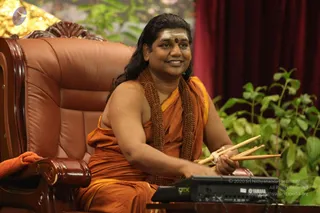
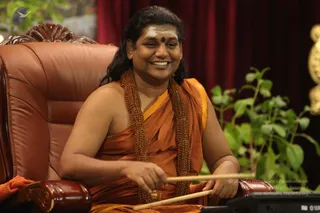
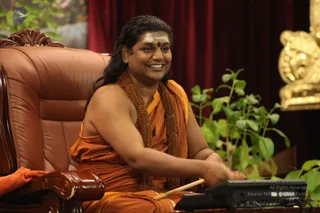
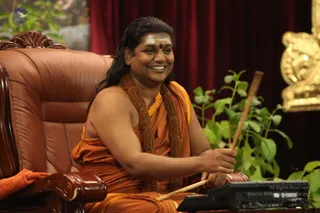
A photograph of a seated man in an orange saffron robe with a long brown beaded rudraksha-style mala around his neck, long dark hair swept back, white forehead markings and a red bindi. He sits in a large brown leather throne-style armchair, holding a pair of wooden drumsticks over a black Yamaha electronic drum pad. Green potted plants and a dark red curtain stand behind him. Swamiji (probable): the long swept-back hair, saffron clothing and rudraksha mala are the qualifying cues for the page's stated Swamiji presence.A man with long swept-back dark hair sits in a large brown leather armchair, holding drumsticks over a black Yamaha electronic drum pad on a table in front of him. He wears an orange-saffron garment with a yellow edge, a long brown rudraksha mala around his neck, and a red tilak on his forehead. He smiles and looks to the side. A small orange towel rests on the chair arm, and green potted plants and a dark red curtain stand behind him. Swamiji (probable): the appearance cues of long hair, saffron clothing and rudraksha mala match the page's claim that he is present at this satsang.A man with long swept-back dark hair, a white forehead mark and a red bindi sits in a brown leather armchair, smiling and holding wooden drumsticks over a black Yamaha electronic drum pad. He wears an orange-saffron dhoti-style garment with a matching orange wrap and a long rudraksha mala. Green leafy plants and a deep red curtain form the backdrop, with an orange cloth draped over the chair arm. a person is shown in an appearance-based label given the long hair, saffron clothing and rudraksha mala, seated for a satsang-style session.A smiling man with long dark hair sits in a brown leather armchair, wearing an orange-saffron shawl draped over one shoulder and a long rudraksha mala with a golden necklace. He has white vibhuti on his forehead and a red kumkum dot. He holds two thin wooden sticks, appearing to drum on a keyboard or instrument at the lower right edge marked with a YAMAHA logo. Behind him are deep red curtains, a potted green plant, and an ornate gold carved object at the right edge. Appearance-based label: a person, seated in the armchair with saffron clothing and rudraksha mala.A smiling man with long swept-back dark hair and a tilak on his forehead sits in a brown leather armchair. He wears saffron-orange robes and a long brown rudraksha mala draped over his shoulders, and holds a thin wooden stick in his right hand. A green potted plant and a red velvet curtain are behind him, with a gold ornamental figure at the right edge. A small black device sits on the table in front.A smiling man with long dark hair sits in a brown leather armchair, holding two wooden drumsticks over a black electronic device on a table. He wears orange-saffron robes with a gold-edged shawl and a long rudraksha mala draped over his shoulders, plus a red bindi on his forehead. Green potted plants and a red curtain stand behind him, with a golden ornament at the right edge. Swamiji (probable): the long swept-back hair, saffron robes, rudraksha mala and ceremonial setting match the page's claim of his presence at this satsang.

NKY-Session

27 photosSource gallery
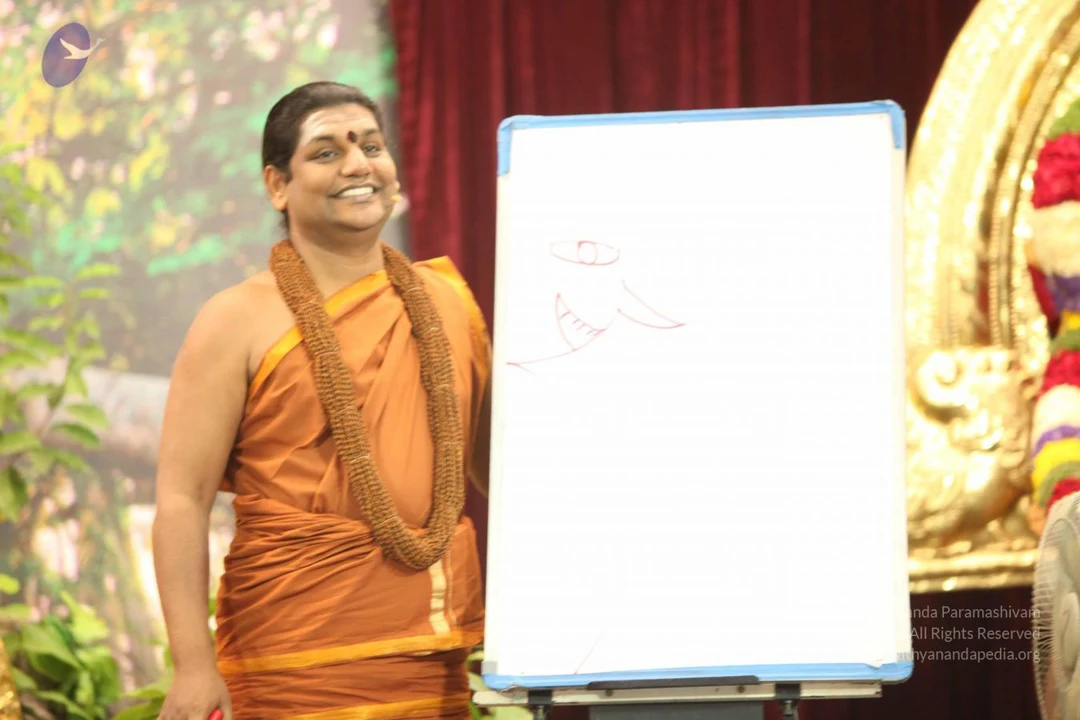
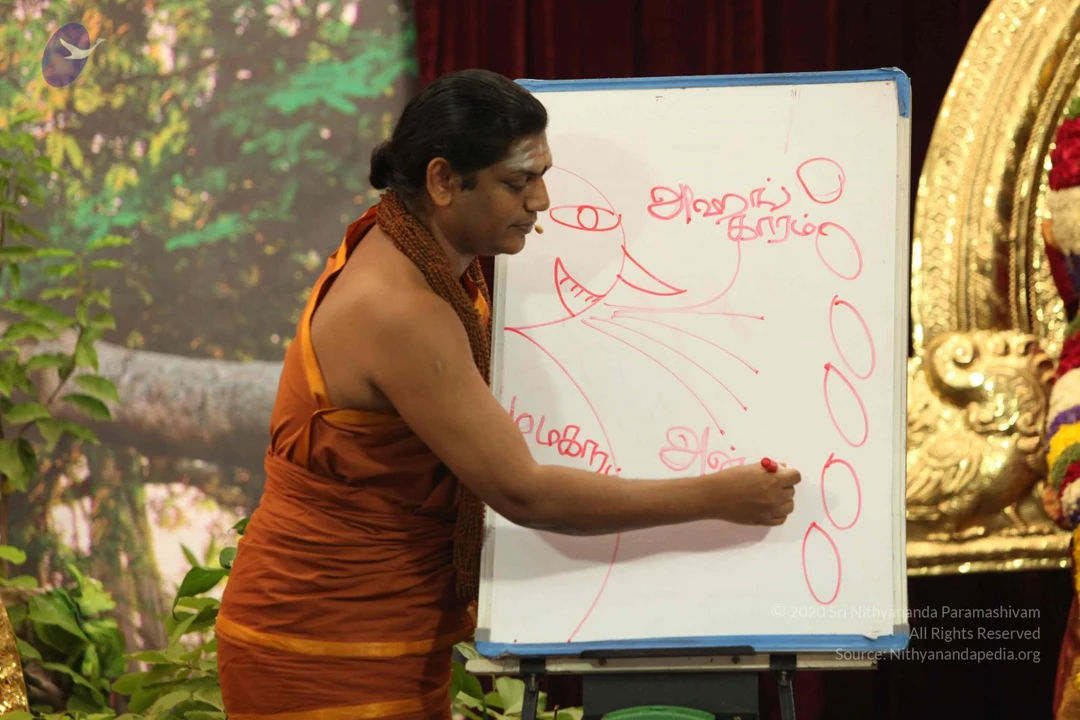
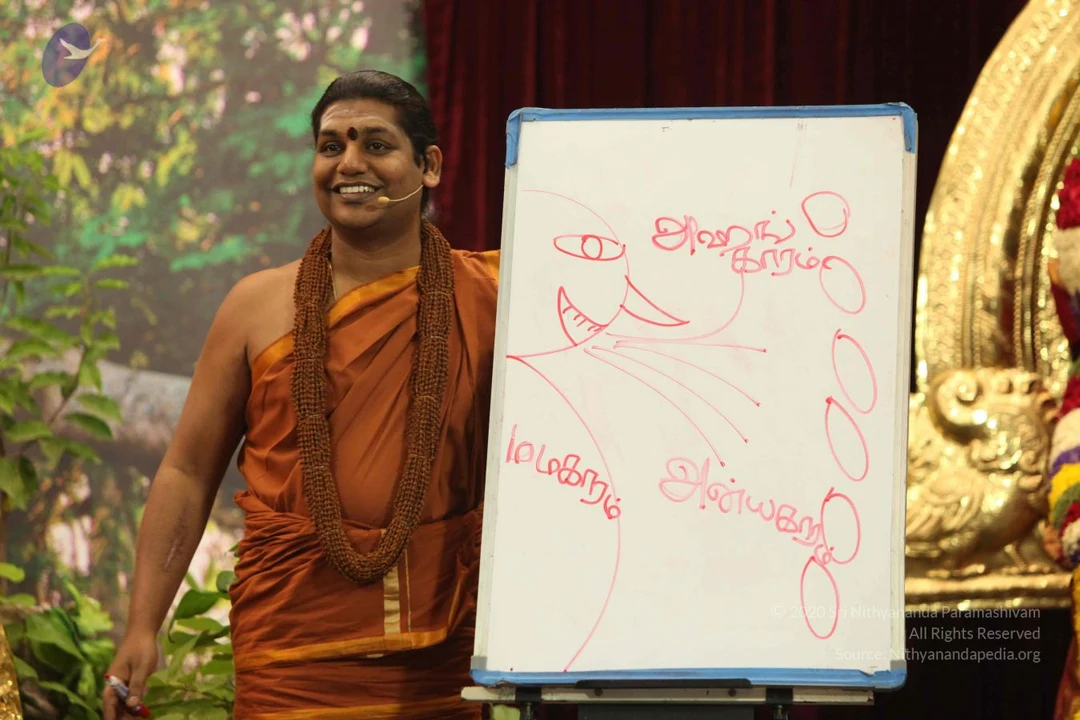
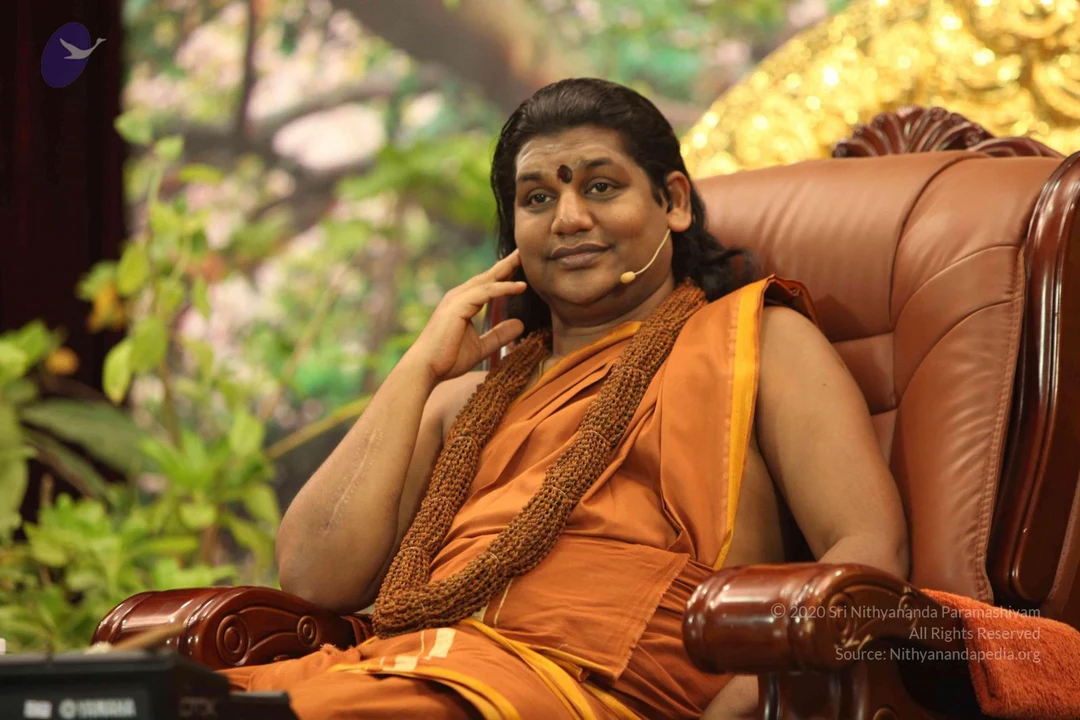
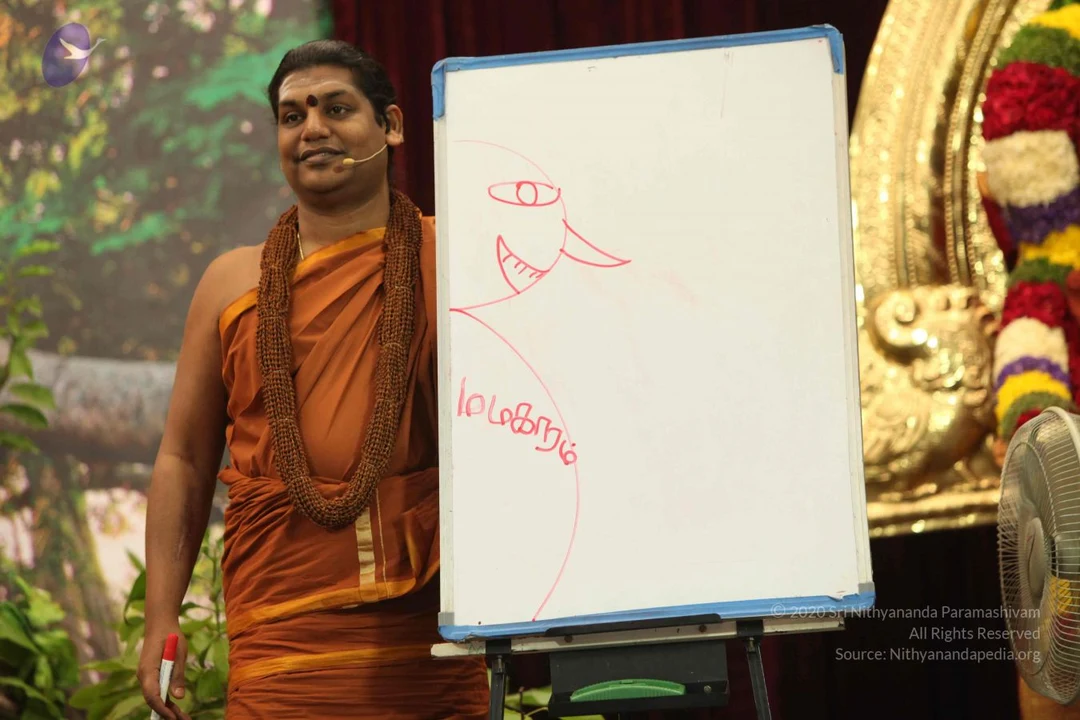
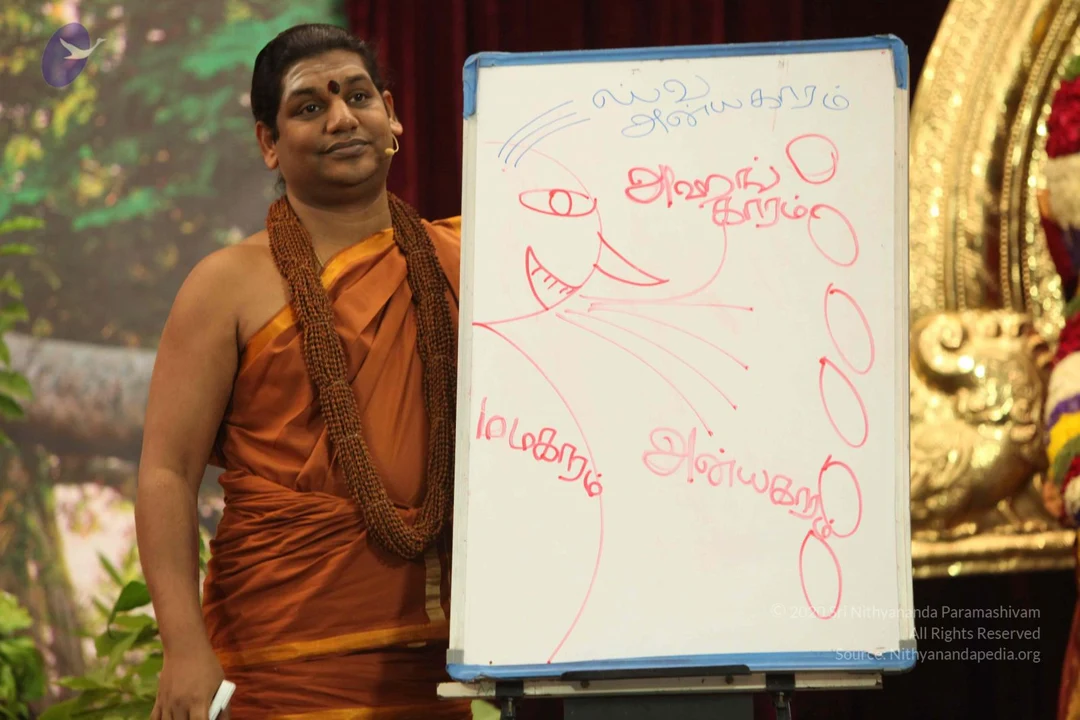
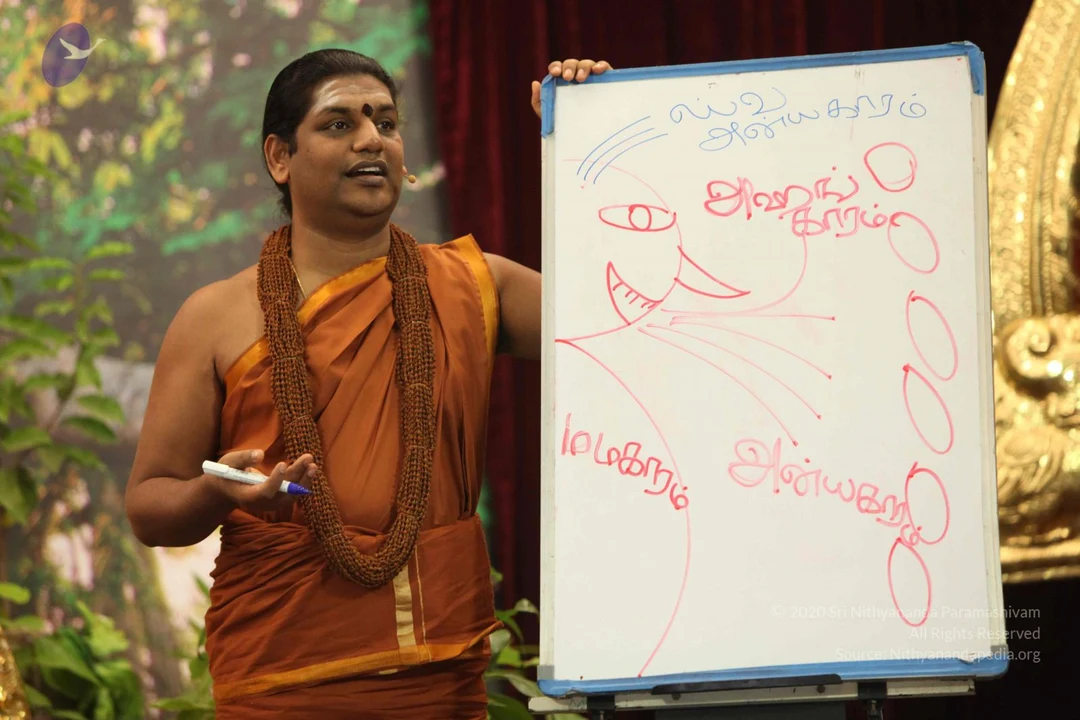
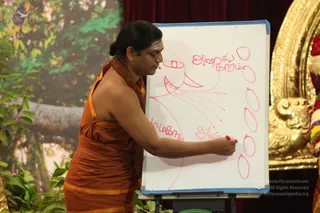
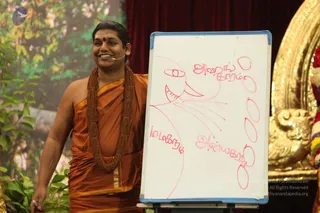
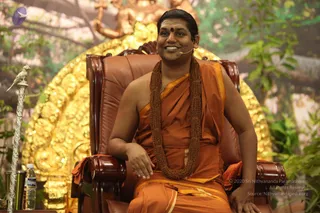
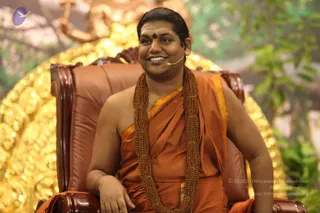
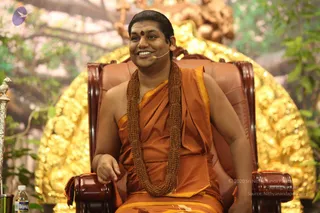
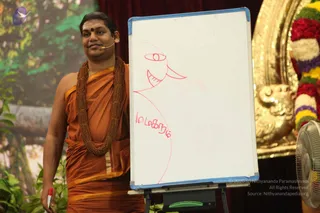
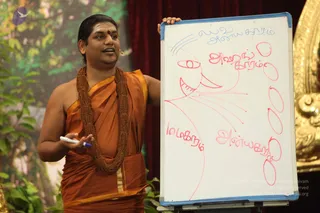
A man in saffron-orange robes stands beside a white flipchart on an easel, smiling toward the audience. He wears a rudraksha mala draped over his shoulders, a red bindi on his forehead, and a gold-bordered orange wrap. Behind him a gilded ornate arch and a red-and-green flower garland frame a stage; green foliage decorates the left side. The flipchart holds a red marker sketch of a head with eyes and a wide mouth. The setting suggests a satsang talk on a spiritual teaching. a person: the saffron robes, rudraksha mala and speaking-at-flipchart role are the qualifying cues here.A man in an orange saffron wrap and a brown rudraksha-style beaded mala stands at a whiteboard on an easel, drawing red marker sketches with a red marker in hand. He wears a white tilak on his forehead and has his hair tied back. The whiteboard shows a red drawing of an eye, a curved line, and several red oval outlines in a column, with Tamil words written in red. Behind him are a green painted forest backdrop and a gold ornate frame with a floral garland at the right edge, and the setting appears to be a satsang stage.A smiling man in orange-saffron robes and a rudraksha mala stands beside a whiteboard on an easel, a small red bindi on his forehead and a headset microphone at his cheek. He is a photographed speaker at a satsang-style talk. The whiteboard holds a red marker drawing of a bird-like figure with an eye and beak, with Tamil words written beside it and a row of ovals along its right side. Behind him is a gilded throne-like structure with carved golden ornaments and a red curtain, and green foliage stands at the left edge.A smiling man in saffron-orange robes sits on an ornate brown leather throne-style chair during a satsang. He wears a long multi-strand rudraksha mala over his shoulder and a small red bindi on his forehead, with a clip-on microphone at his cheek. Behind him a large gilded golden backdrop and green foliage frame the seat. At the left edge a silver staff topped with a bird figure stands beside a water bottle and a metal cup on a small table.A photograph of a smiling man seated on a brown leather armchair with carved wooden trim, set against a gold-foil backdrop and green foliage. He wears an orange-saffron cloth draped over one shoulder with a golden-yellow border, a long brown rudraksha mala around his neck, and a red bindi on his forehead. A small wireless headset microphone is clipped near his ear and his hand rests on the armrest. a person is shown in a satsang-style setting, with his distinctive rudraksha mala and saffron robes as the visible cues; the page indicates a Nithya Satsang event.A smiling man sits in a large brown leather armchair in front of an ornate gold backdrop with carved relief patterns and green foliage behind him. He wears a small red bindi, a lapel microphone, and an orange-saffron robe draped over one shoulder with a gold-edged border, along with a long multi-strand rudraksha mala hanging to his waist. His hands rest on the chair arms, and a water bottle and a silver ornamental pillar appear at the edges. a person: the saffron robe, rudraksha mala and ceremonial setting with a throne match the appearance-based cues, though the face is not used for identification.
NKY-Day2-Shivoham
2 photosSource gallery
A smiling man with long dark hair sits in a large brown leather armchair in front of a dark red curtain, wearing an orange-saffron cloth draped over his shoulder and a long brown rudraksha mala around his neck. He wears a white tripundra with a red bindi on his forehead and rests his hand on a small black device with a wooden stick on a table. A potted green plant stands to his right and a golden ornamental figure is visible at the edge of the frame.A smiling man with long dark hair and an orange-saffron robe sits in a large brown leather armchair with carved wooden arms. He wears a brown rudraksha mala draped over the shoulders and a red bindi on his forehead, and holds a thin wooden stick in his right hand. A green potted plant stands beside him, with a dark red curtain behind and a golden ornament at the right edge. A black electronic device sits on a low surface in front of the chair, and an orange cloth lies on the left armrest. a person: the long swept hair, saffron robe and rudraksha mala match the appearance cues, seated in a chair of honour in a satsang setting.

NKY-Session
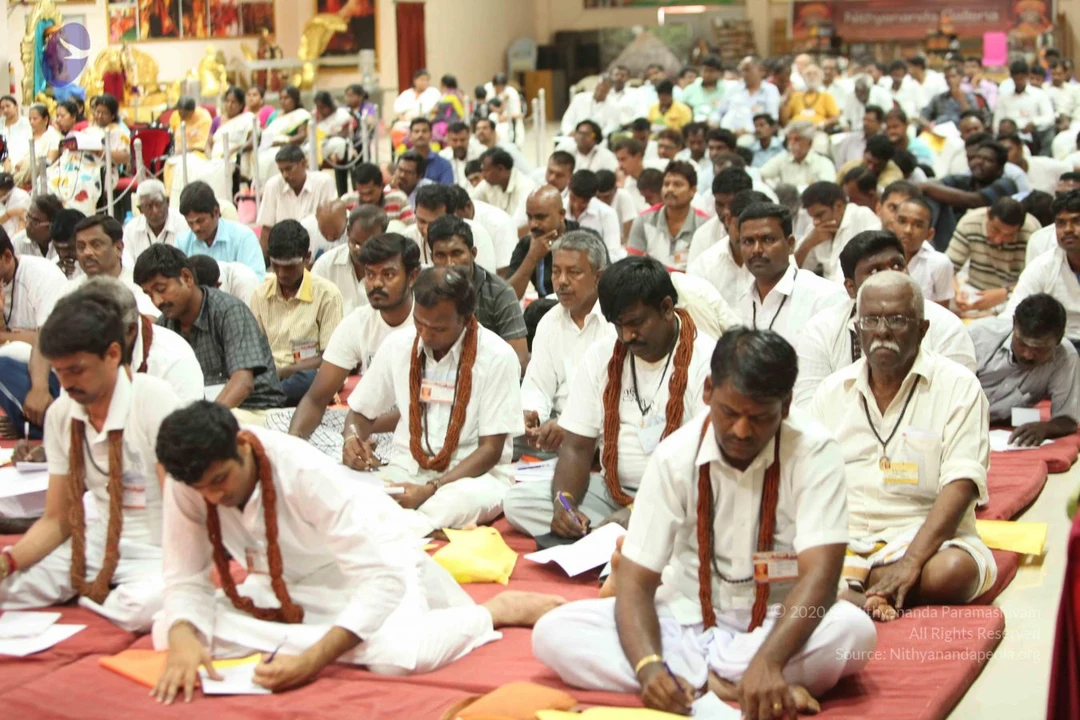
8 photosSource gallery
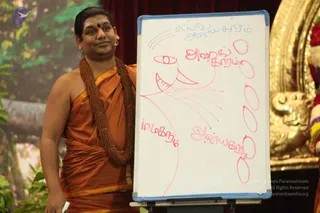
A man in orange saffron robes and a rudraksha mala stands beside a whiteboard on an easel, holding a red marker in his left hand. He wears a small red bindi and a headset microphone. On the whiteboard he has drawn a red line sketch of a bird with a large eye and open beak, with a Tamil word written beneath. Behind him are a green leafy backdrop, a gold ornate frame and a garland of red, yellow and purple flowers, with a fan at the right edge.A man in saffron-orange robes and a long rudraksha mala stands beside a whiteboard covered in red marker drawings: a bird-like figure with arrows and several ovals, with Tamil words written above and beside it. He wears a small red bindi and a head-mounted microphone, and gazes toward the audience. Behind him are a red curtain, a gold-coloured ornate peetha or throne carving, and a painted forest backdrop. The scene suggests a teaching session with a visual aid.A man in saffron-orange robes with a long rudraksha mala draped over his shoulders stands beside a whiteboard, pointing with a blue marker. He has a small headset microphone and a red tilak on his forehead. He is giving a teaching: on the whiteboard, a red hand-drawn bird-like figure with a beak and eye, with arrows and circles beside it, and Tamil words written in red and blue. Behind him are green foliage backdrops and a gold ornate element at right, with a red curtain.A man seated on a brown leather armchair speaks while gesturing with both open hands, wearing a saffron-orange draped garment with a golden border and a long rudraksha mala necklace. He has a white forehead marking with a small red bindi, hair swept back, and a small clip-on microphone at his cheek. Behind him a dark red curtain and a gilded deity murti with floral greenery form the backdrop. Swamiji (probable) appears as the central speaker, identified by saffron robes, rudraksha mala, swept-back hair and seated discourse setting.A man seated in a brown leather armchair with carved wooden armrests, in front of an ornate gold-leaf backdrop and green foliage. He wears orange and saffron robes with a yellow border, a long rudraksha mala necklace, a red bindi on his forehead, and a white tilak on his chest. He has long swept-back dark hair, smiles and gestures open-handed while a small wireless lapel microphone is clipped near his ear. Swamiji (probable): long swept-back hair, saffron robes and rudraksha mala indicate the teacher seated for a satsang.A man seated in a large brown leather armchair with wooden armrests, dressed in saffron-orange robes with a matching orange wrap over the shoulder and a long rudraksha mala draped around the neck. He has long swept-back dark hair, a red bindi on the forehead, and a small microphone clipped near his face, smiling while looking to the side. A silver staff topped with a small bird figure stands beside the chair, a golden decorated backdrop glows behind him, and green potted plants and a deep red curtain frame the stage. Appearance-based label: a person, seated in a throne-like chair as the discourse speaker.

2--Morning-Satsang
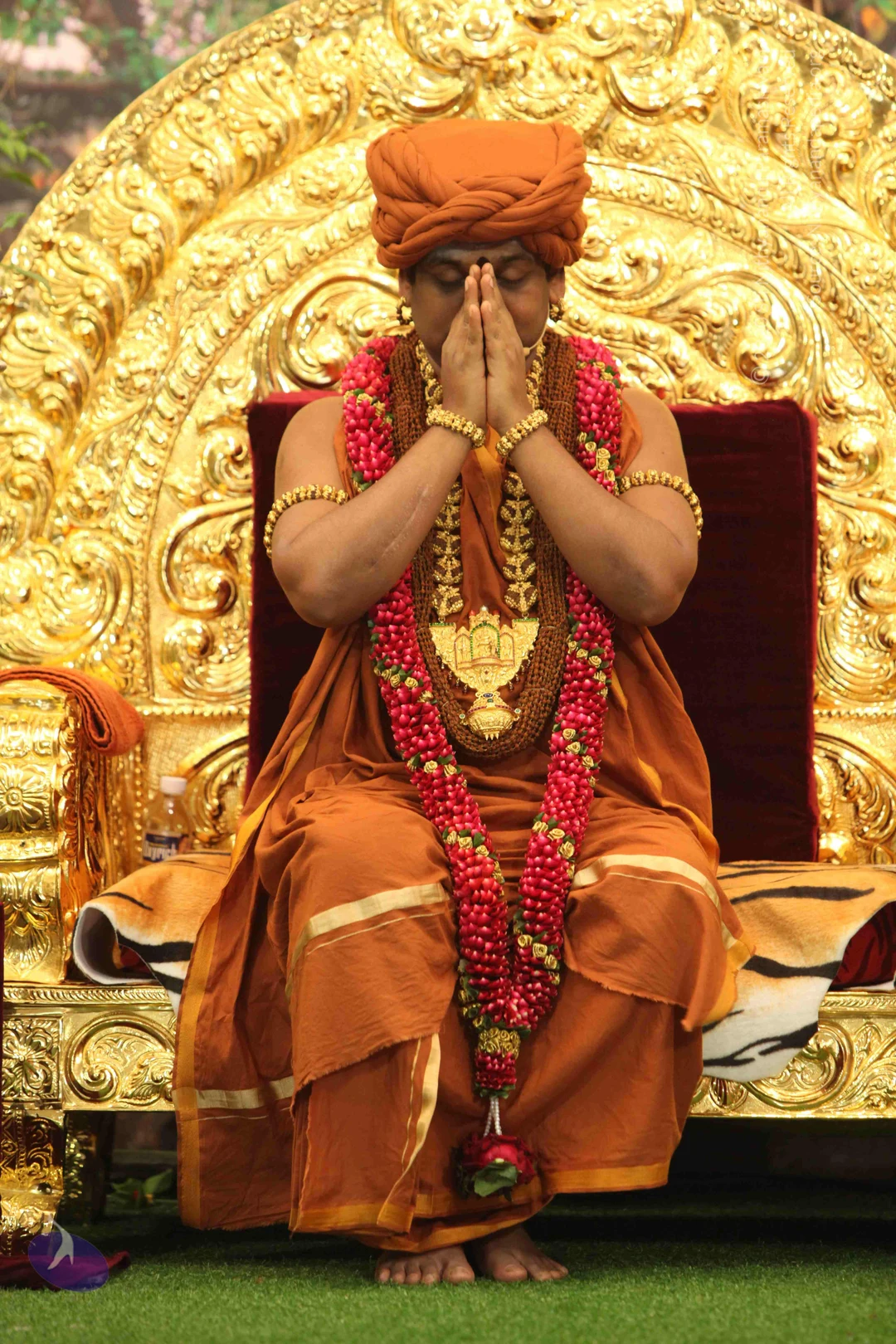
23 photosSource gallery
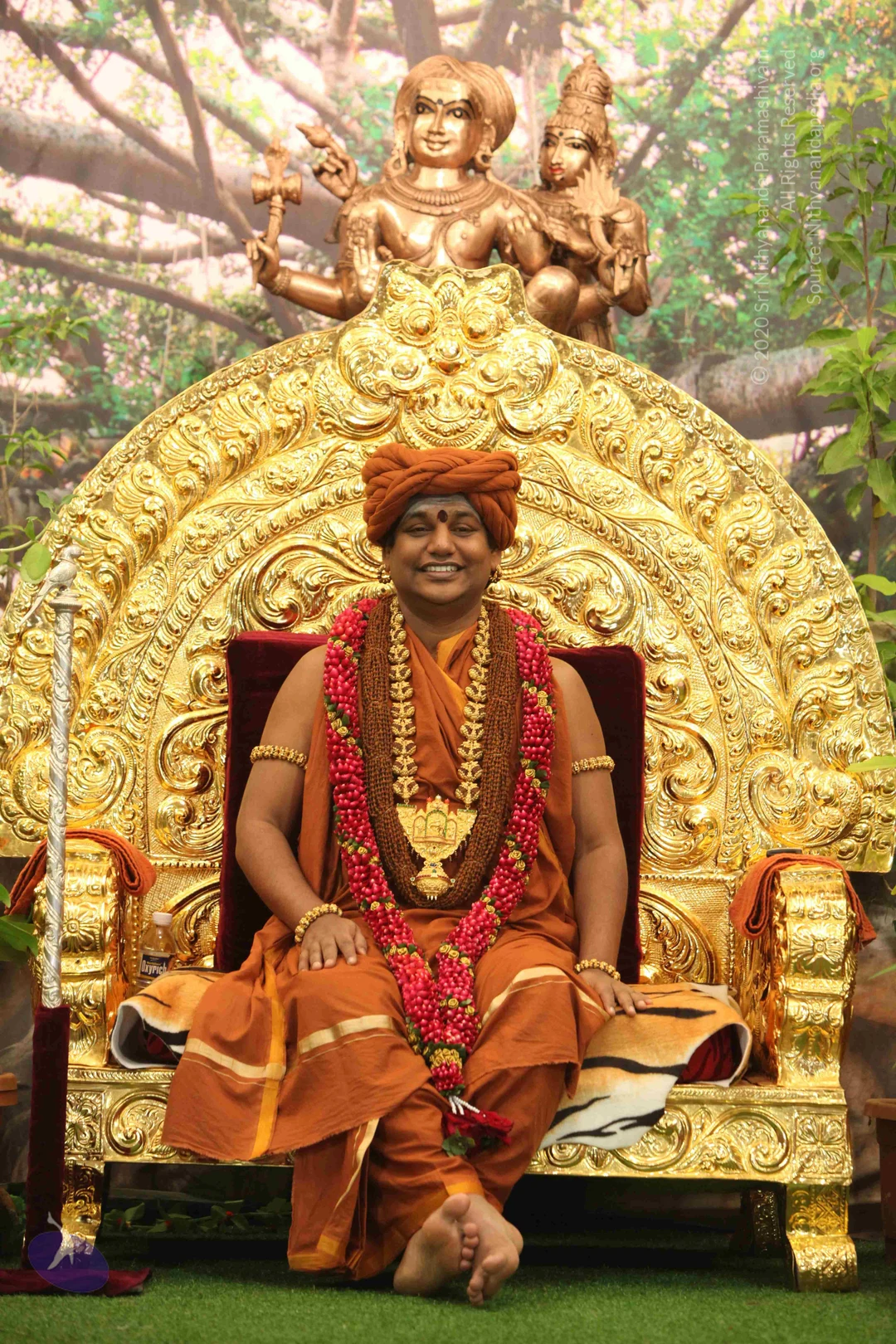
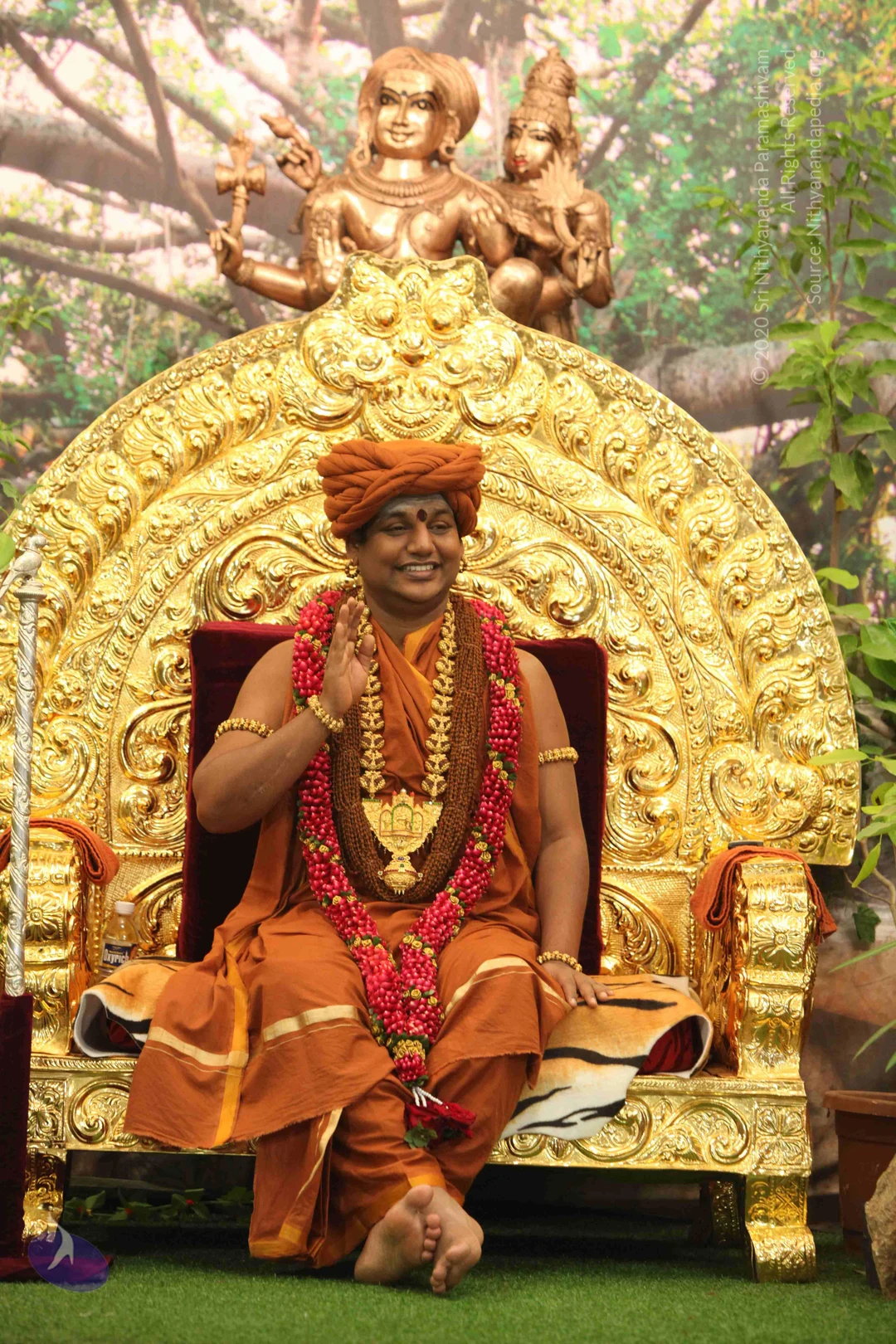
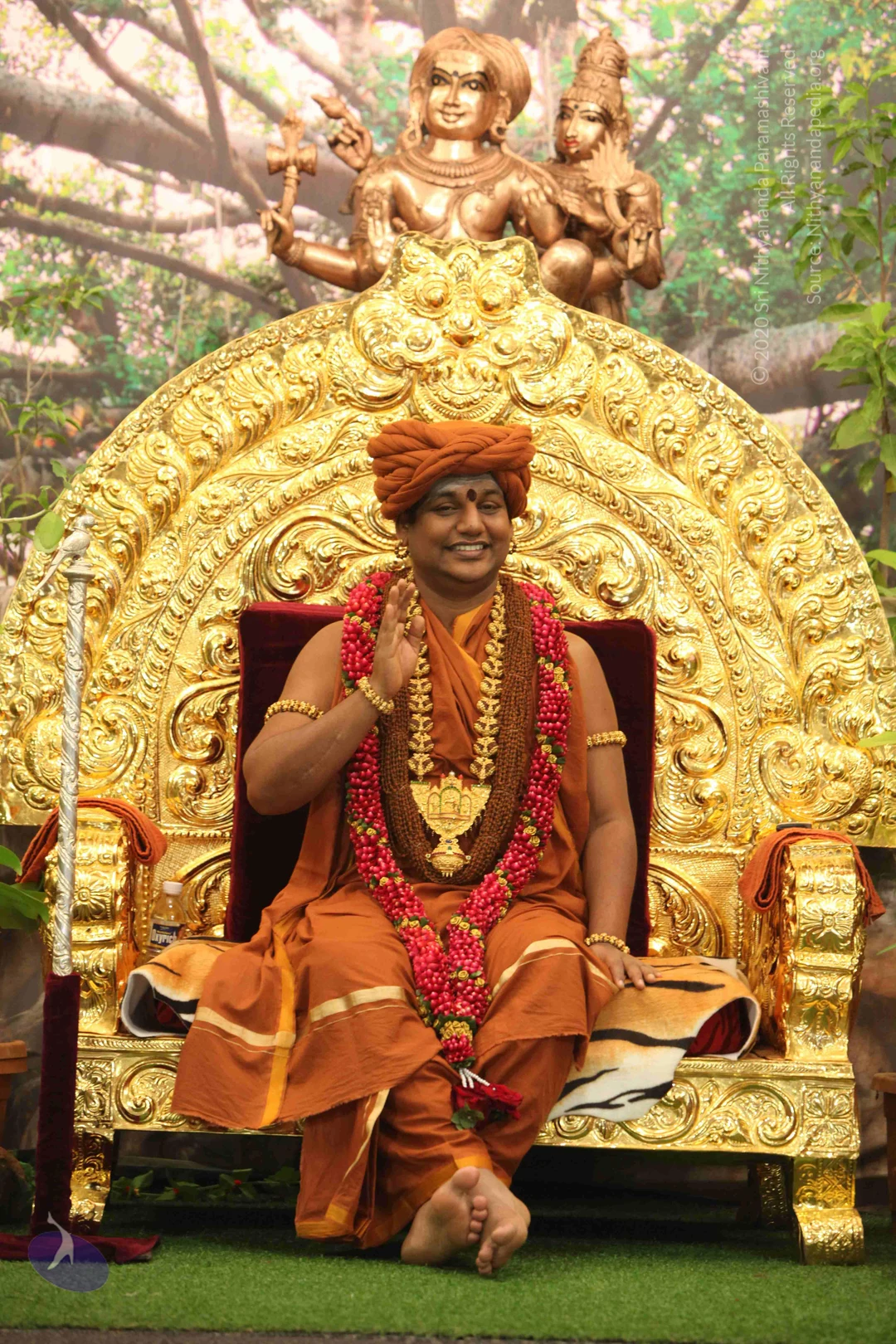
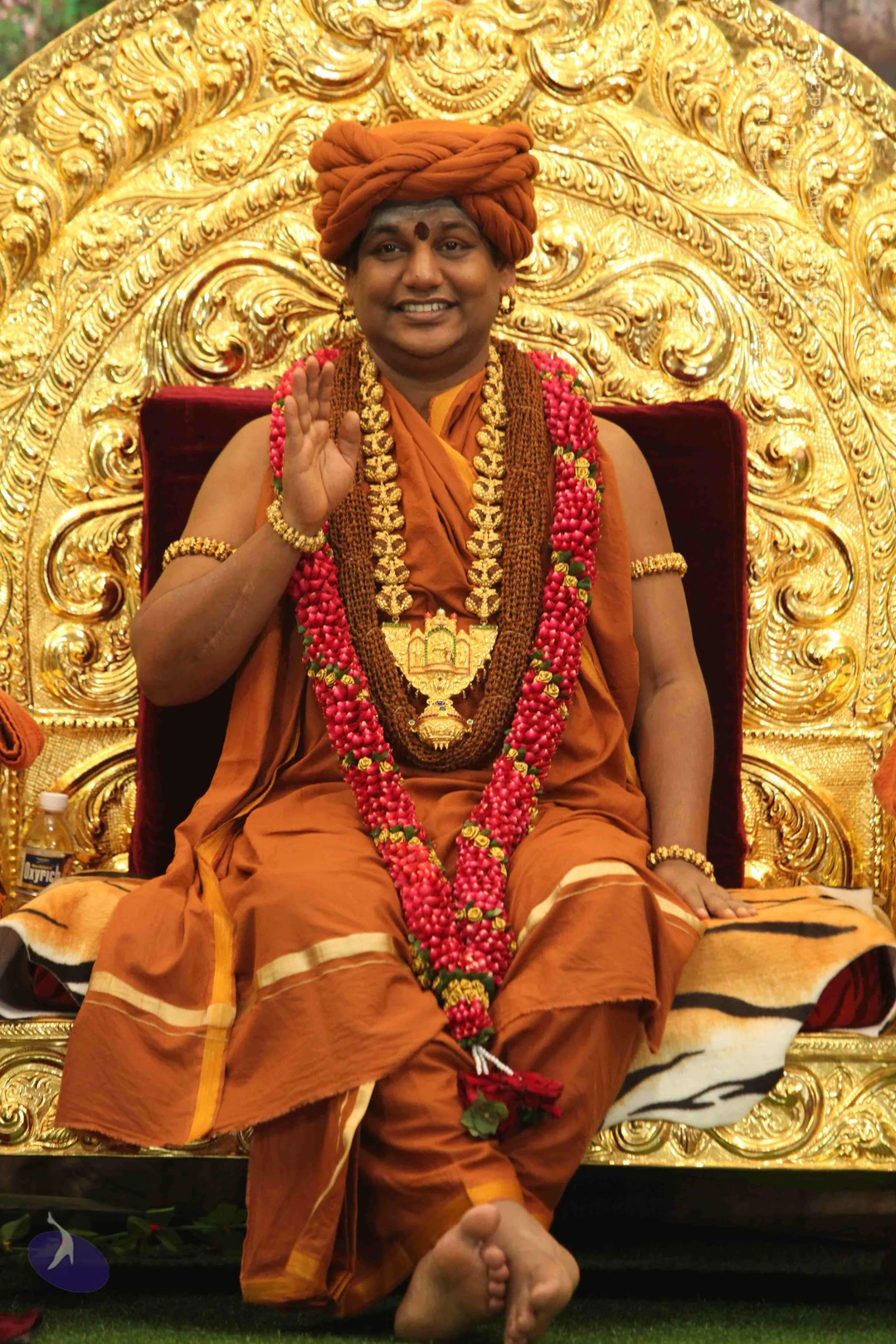
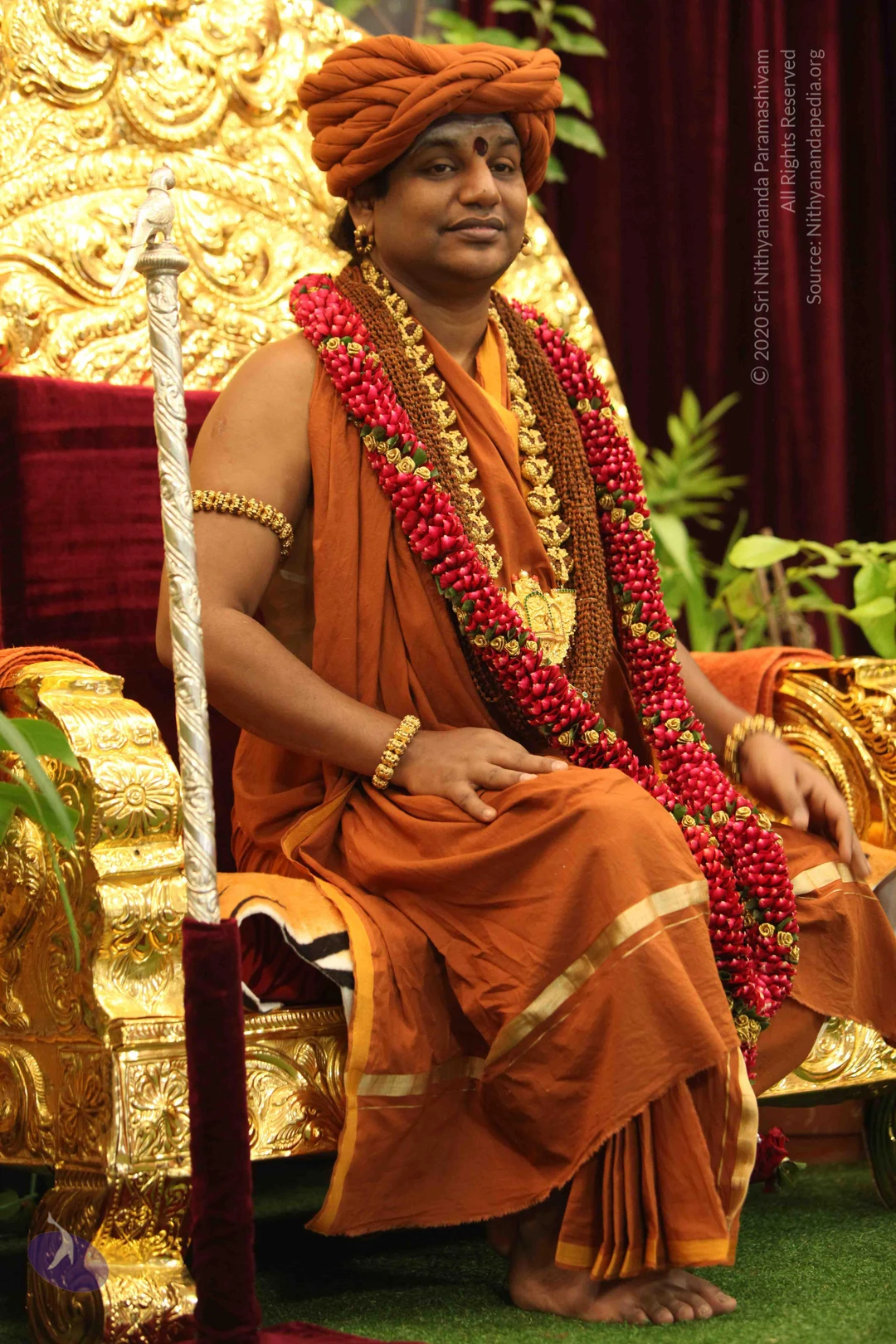
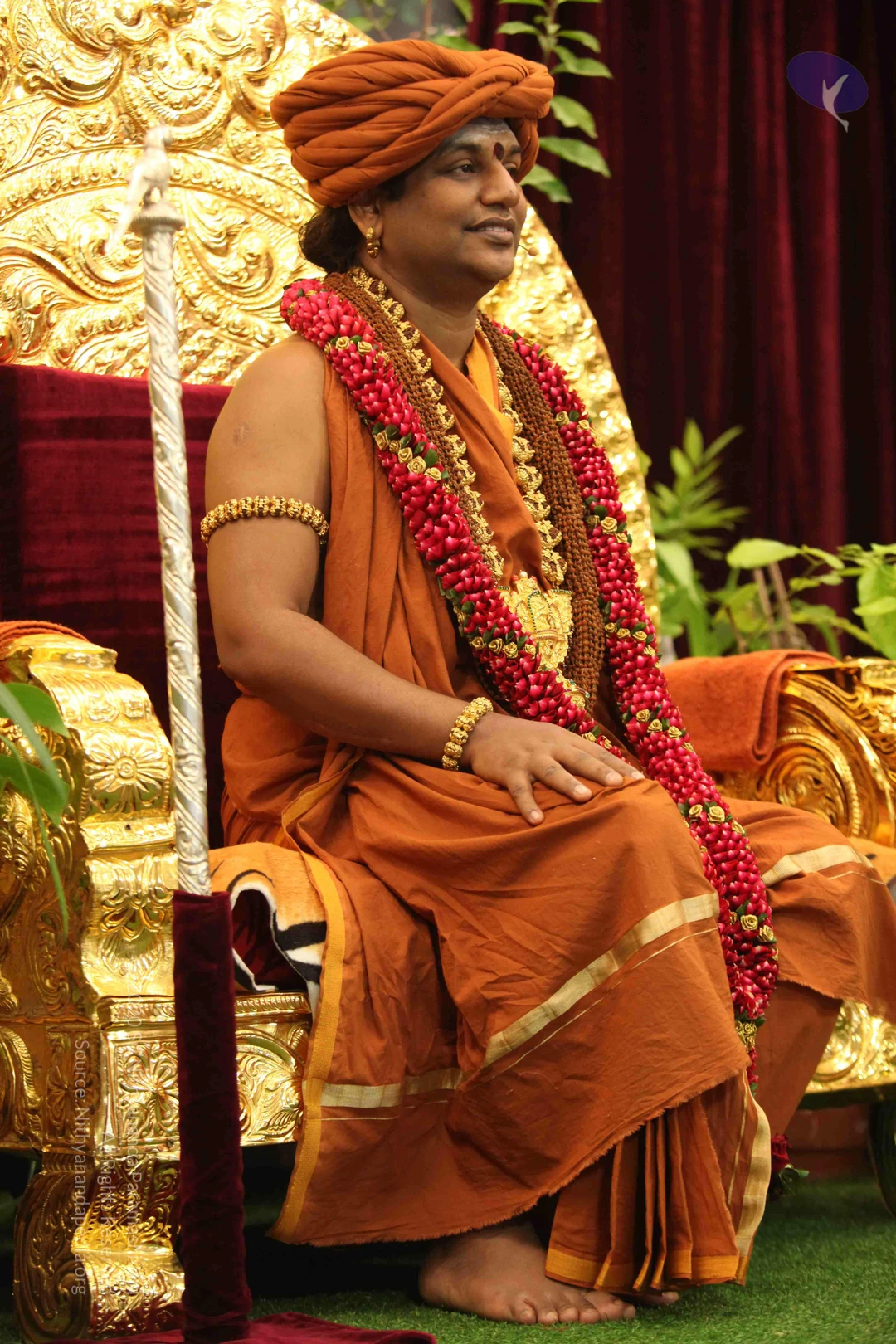
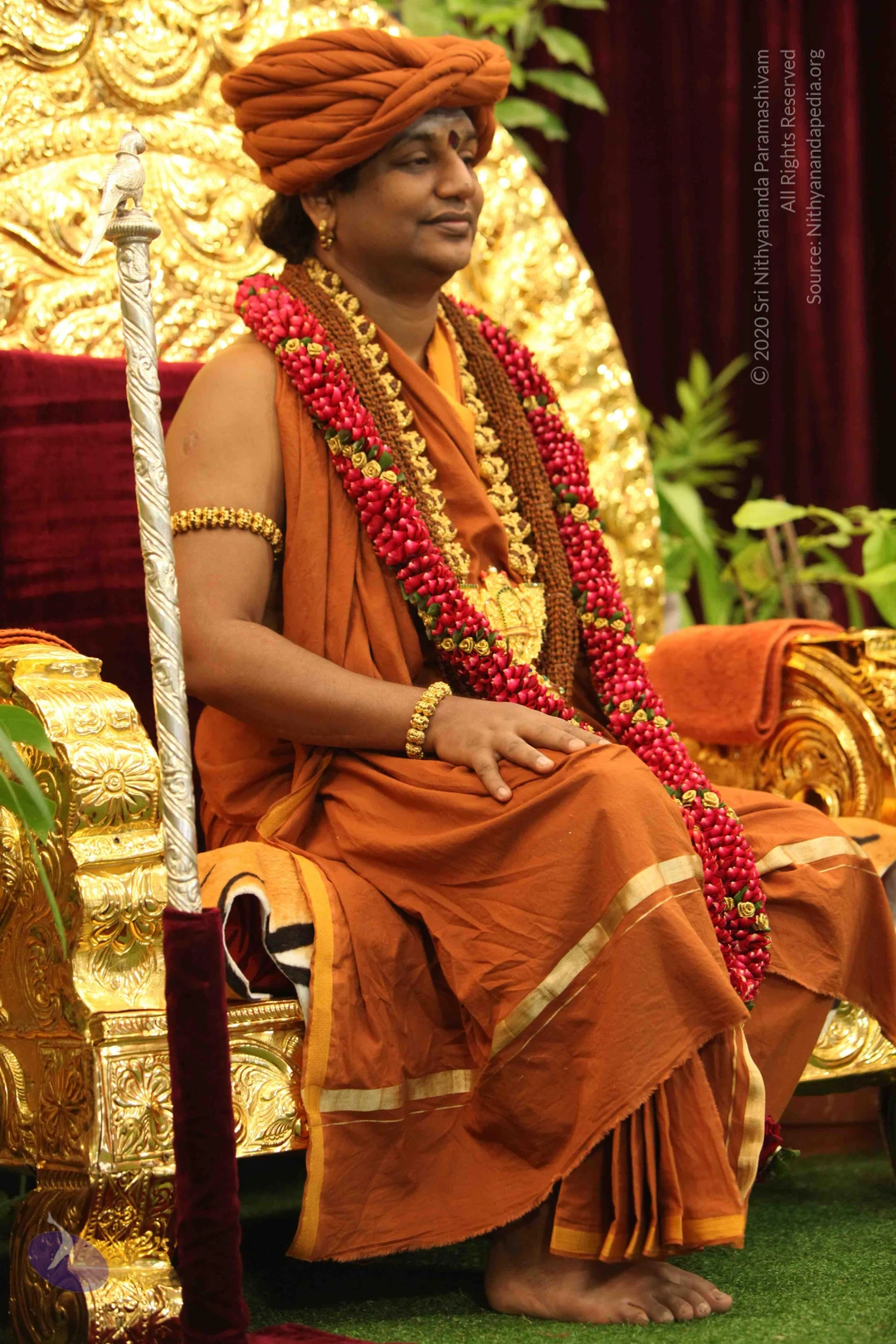
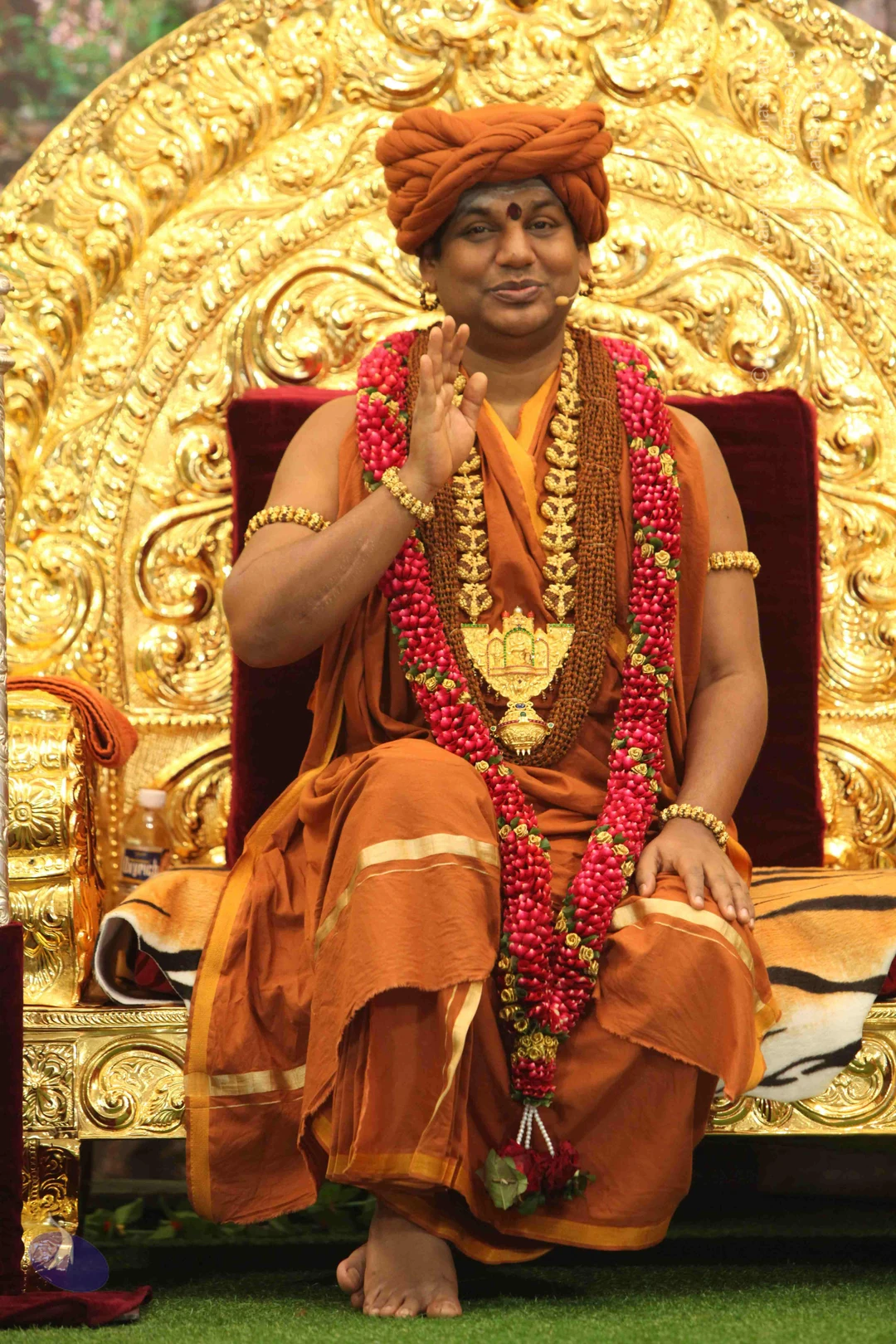
A seated man in saffron-orange robes and an orange turban sits on an ornate gold throne with red velvet cushioning. He wears a red and white flower garland, rudraksha mala beads, a gold necklace with a pendant, and gold armbands and bangles. A tiger-striped cloth draped over the throne's arm and a silver staff stand beside him. Behind the throne, golden deity statues stand in front of a painted tree backdrop with a water bottle nearby. The man has a distinctive presentation with orange turban, saffron robes and rudraksha mala, matching the page's Swamiji reference, so he is a probable Swamiji candidate seated in person.A seated man in an ornate golden throne with a carved arched back, wearing an orange turban, saffron robes with a gold-bordered dhoti, a long red flower garland, a rudraksha mala with a gold pendant, and gold bangles, raises one hand in blessing while smiling. Behind the throne, golden statues of deities stand against a painted backdrop of trees. A tiger-striped cloth covers the armrest and a water bottle sits beside the throne. The seated figure's appearance and distinctive saffron turban, rudraksha and gold adornments are consistent with Swamiji (probable), while the setting shows a satsang or discourse.A photograph of a man seated on an ornate gold throne with a carved arched backrest, draped with a tiger-striped cloth. He wears an orange turban, orange robes with gold borders, a red and white flower garland, a long rudraksha mala and gold chain with a pendant, and gold bangles; he raises one hand in greeting and smiles, with bare feet on green carpet. Behind him, a golden deity murti of a multi-armed figure with a trident and a seated companion stands before a painted banyan tree backdrop. Swamiji (probable): the in-person candidate is seated on the throne, wearing an orange turban, saffron robes and rudraksha mala, with a page note indicating his presence.A smiling man in an orange turban and saffron robes sits on an ornate gold throne with a red velvet cushion, raising his right hand in blessing. He wears layered red-and-pink flower garlands, a gold necklace, a brown rudraksha mala, a gold pendant, and gold bangles. A tiger-striped cloth covers the throne's edge, and a water bottle sits at left. The ornate gold throne and saffron clothing, with a turban and rudraksha mala, form the appearance-based label Swamiji (probable) as a seated figure in a satsang-style setting.A seated man in saffron-orange robes and an orange turban sits on an ornate gold throne with a red velvet back cushion and a tiger-striped cloth draped over the seat. He presses his palms together in anjali namaskar with eyes closed. He wears layered red and pink flower garlands, a brown rudraksha mala, gold armlets and bangles, and a gold pendant. A small red bindi marks his forehead and a lapel microphone is clipped near his face. His bare feet rest on green carpet. Swamiji (probable) based on the orange turban, saffron robes, rudraksha mala and ceremonial gold ornaments.A seated man in saffron-orange turban and robes sits on an ornate gold throne with a red velvet cushion and a tiger-striped cloth draped over the seat. He has his eyes closed and palms pressed together in namaste at chest level. He wears layered red and pink flower garlands, a rudraksha mala, gold armlets and bangles, and a gold pendant at his chest. A red tilak is on his forehead and a small microphone is clipped near his face. Bare feet rest crossed on the green floor, with a red rose at his lap and a small bottle on the left. Seated on the throne in front of satsang attendees, the scene reads as a discourse moment.

April 24 2015

1 photoView all
A decorated deity alankar display in a temple-style shrine framed by gold arch and green draped backdrop. Three murtis sit on a red cushioned dais, the central figure a Shiva form with a tall gold crown, a third eye on the forehead, white and red jewelled necklaces and garlands of yellow, red and purple flowers. A figure on the left wears a red and gold turban and gold-embroidered vest, while the figure on the right wears a red and silver blouse with a tall gold headdress. No living people are visible.