Skip to content
Monday

20 May 2013

THE SUPREME PONTIFF OF HINDUISM HDH BHAGAVAN NITHYANANDA PARAMASHIVAM

Dated photos
395
Source pages
1
Media
3
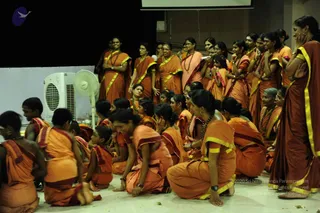
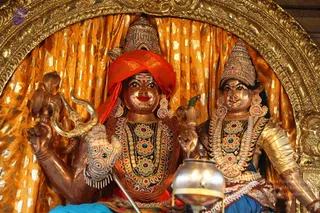
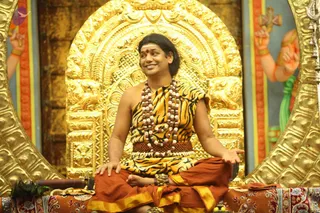
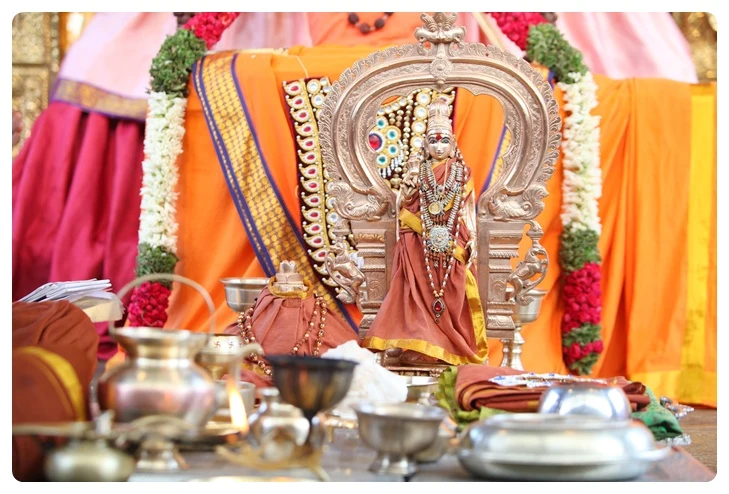
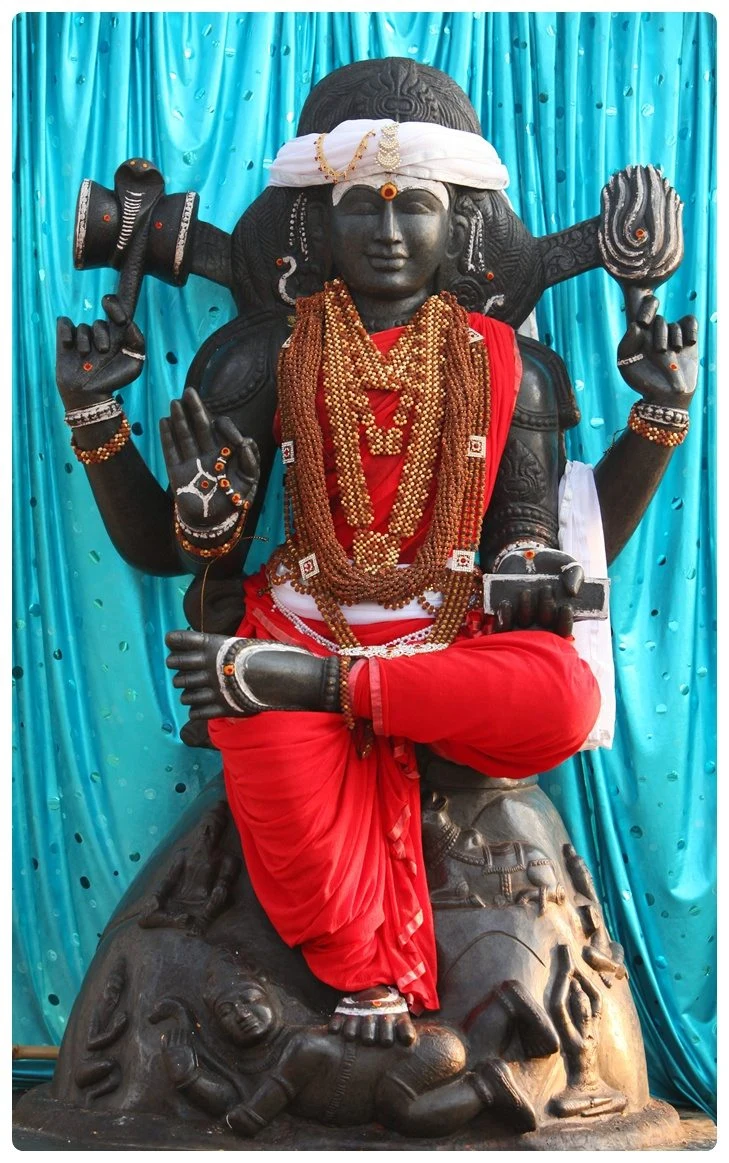
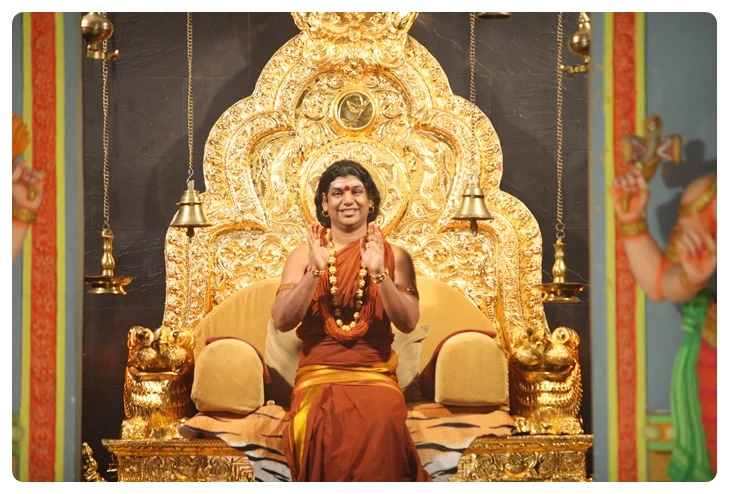
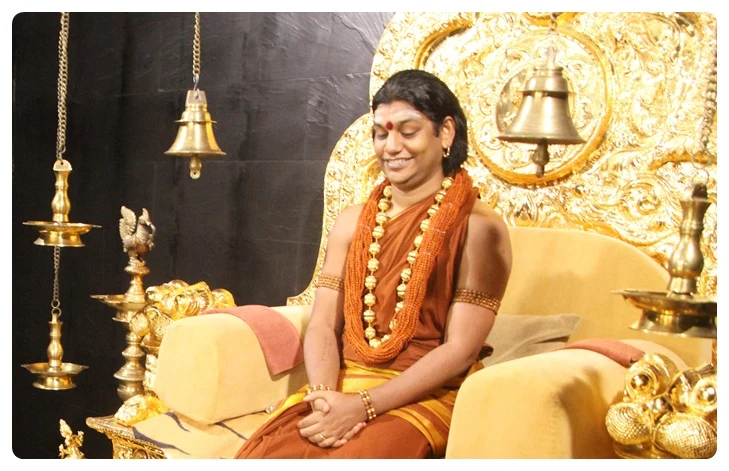
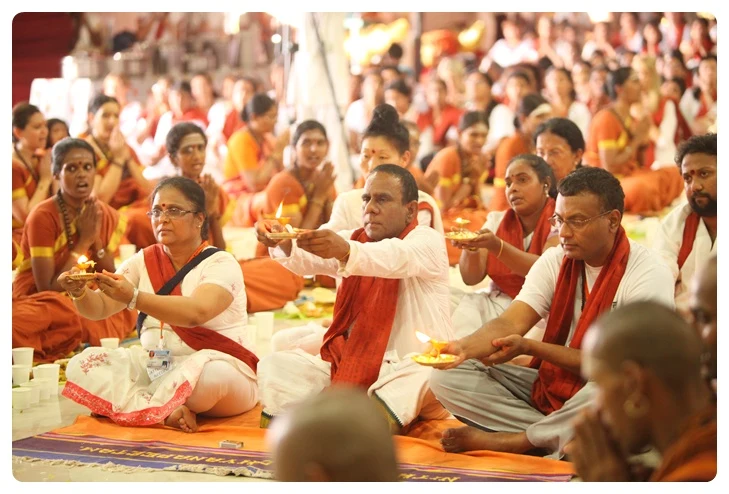
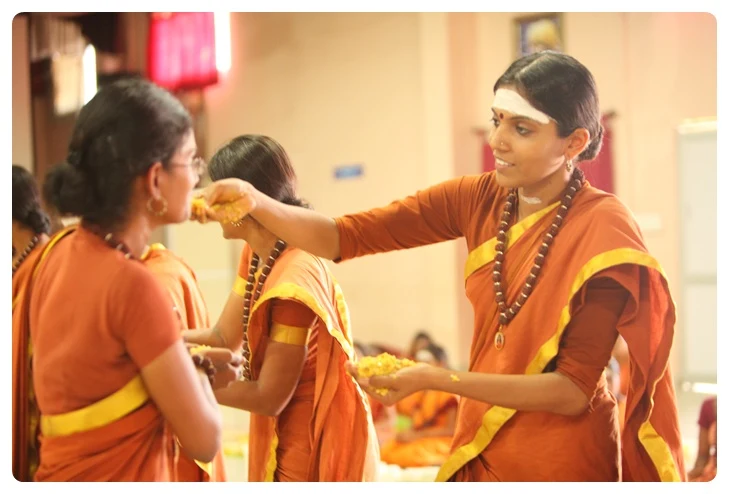
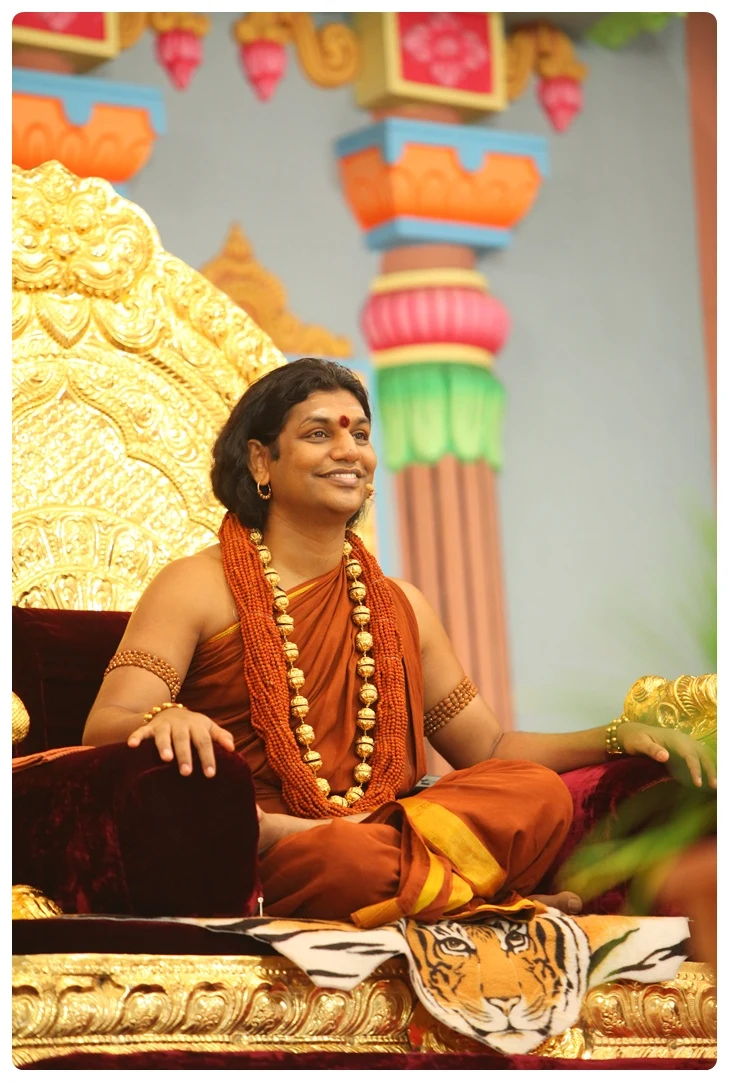
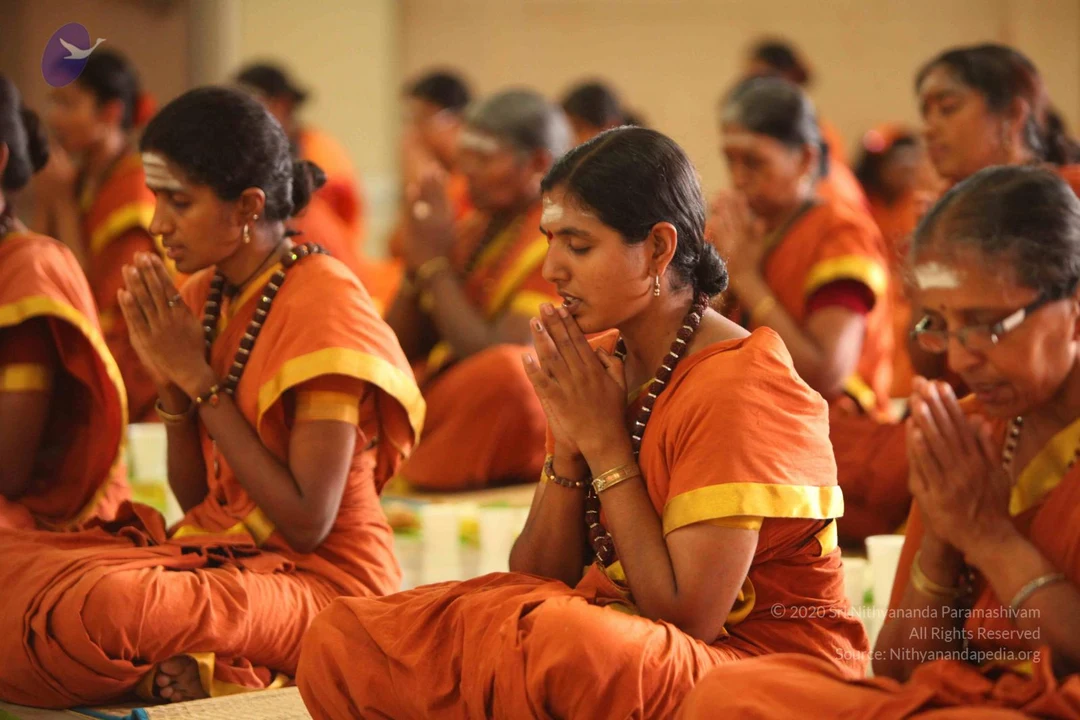
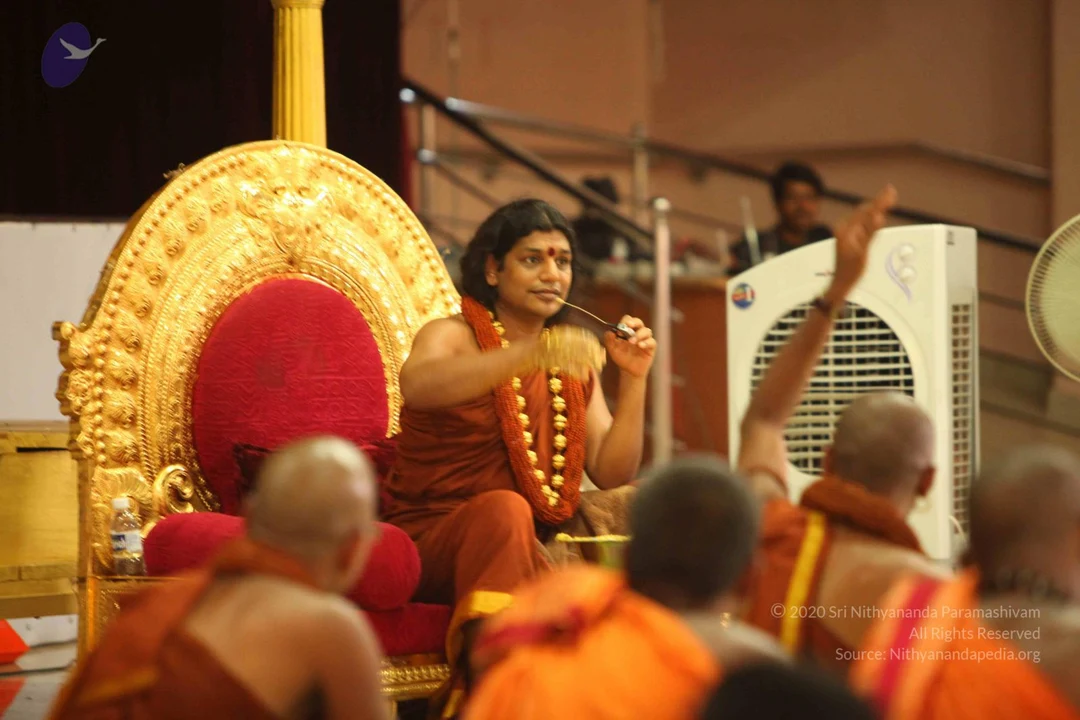
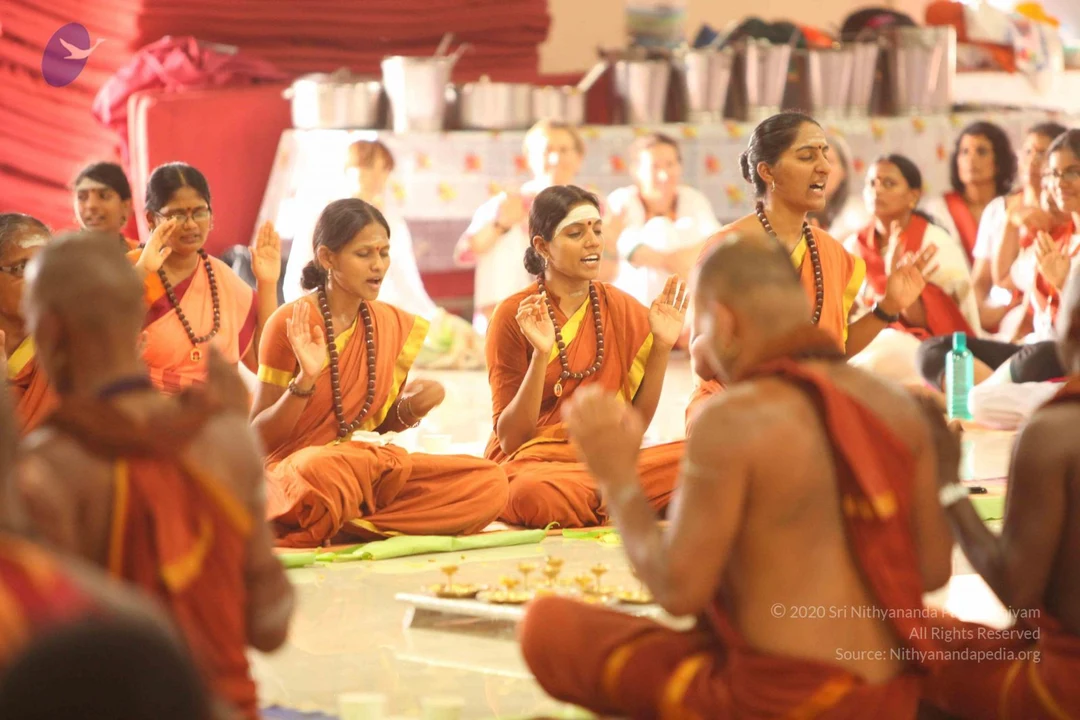
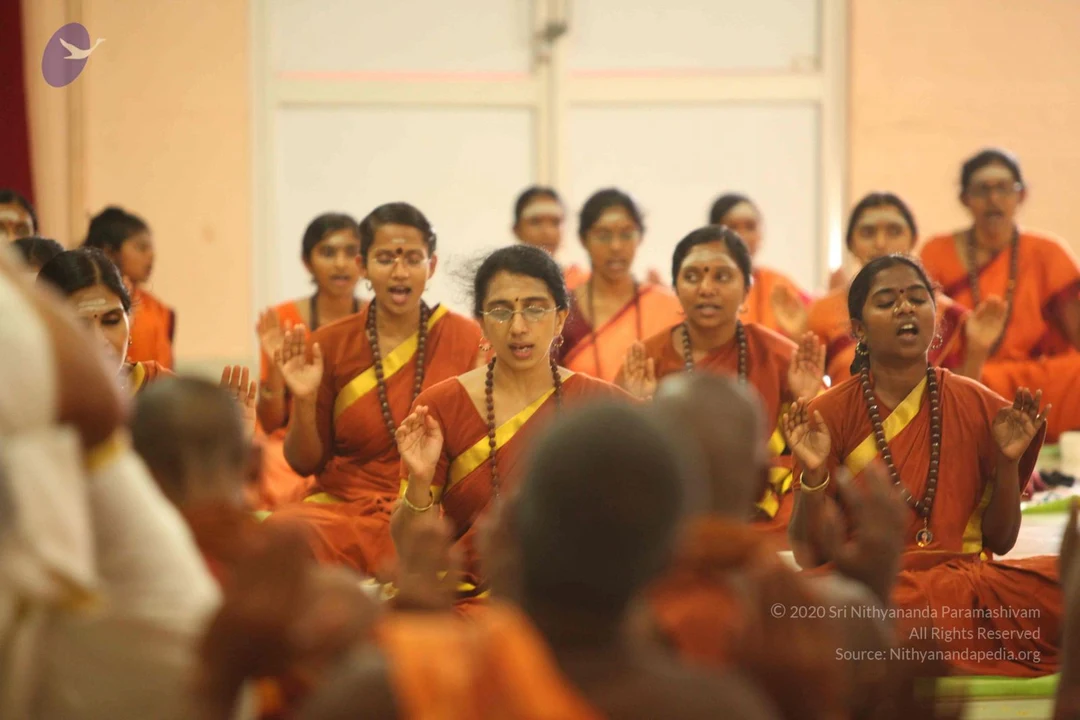
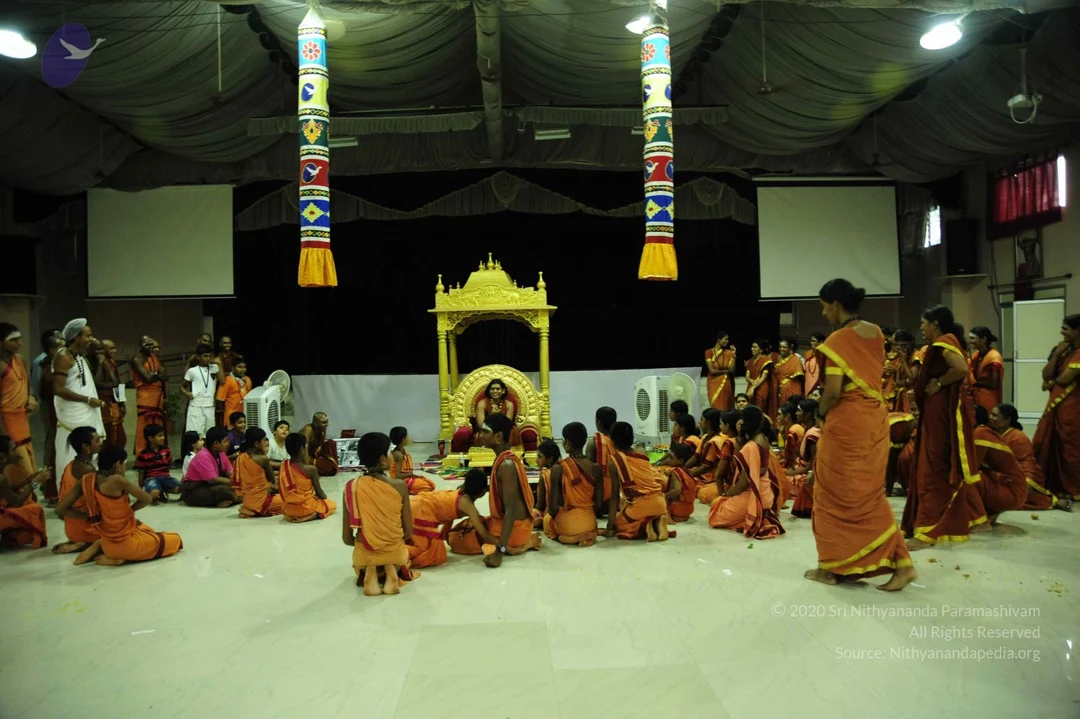
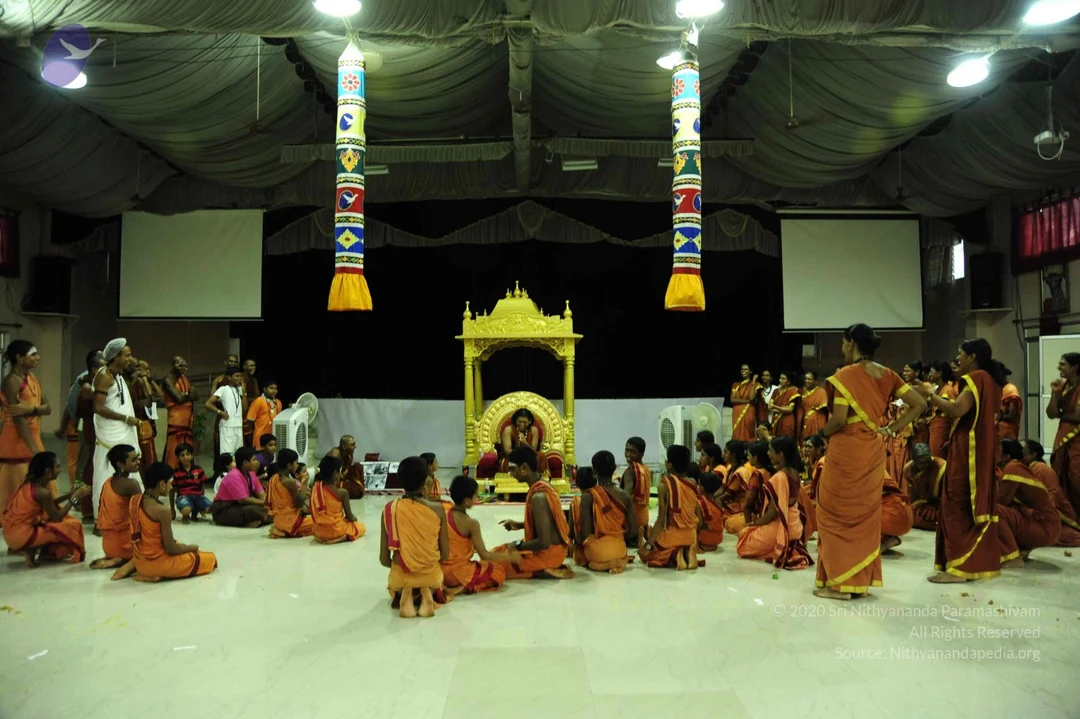
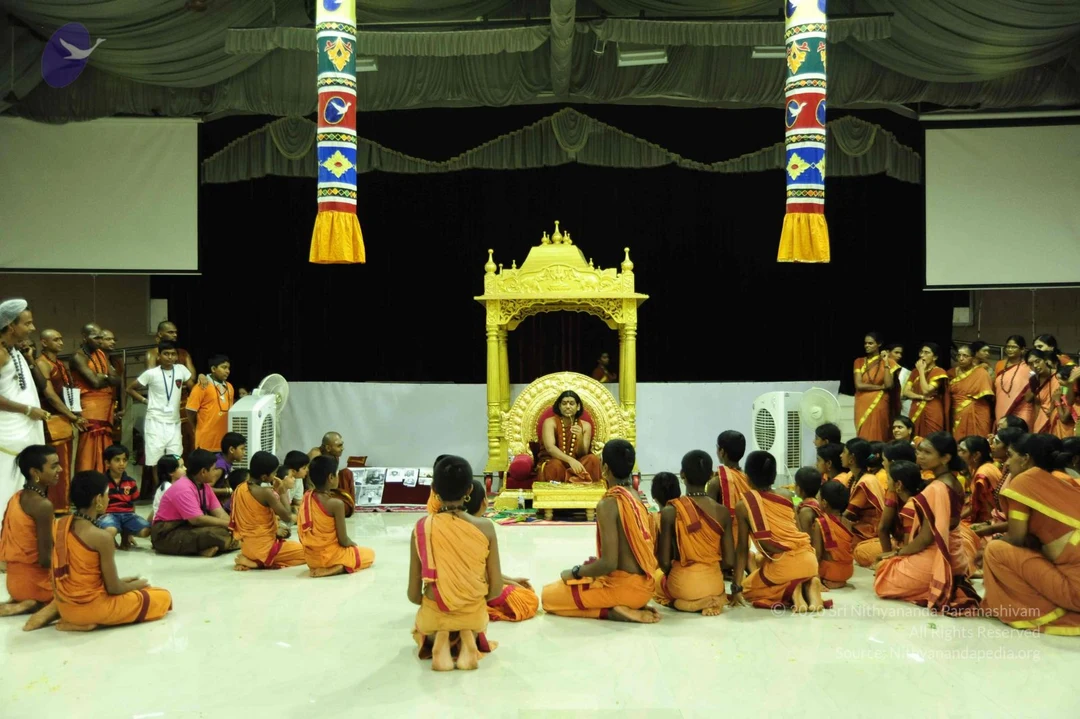
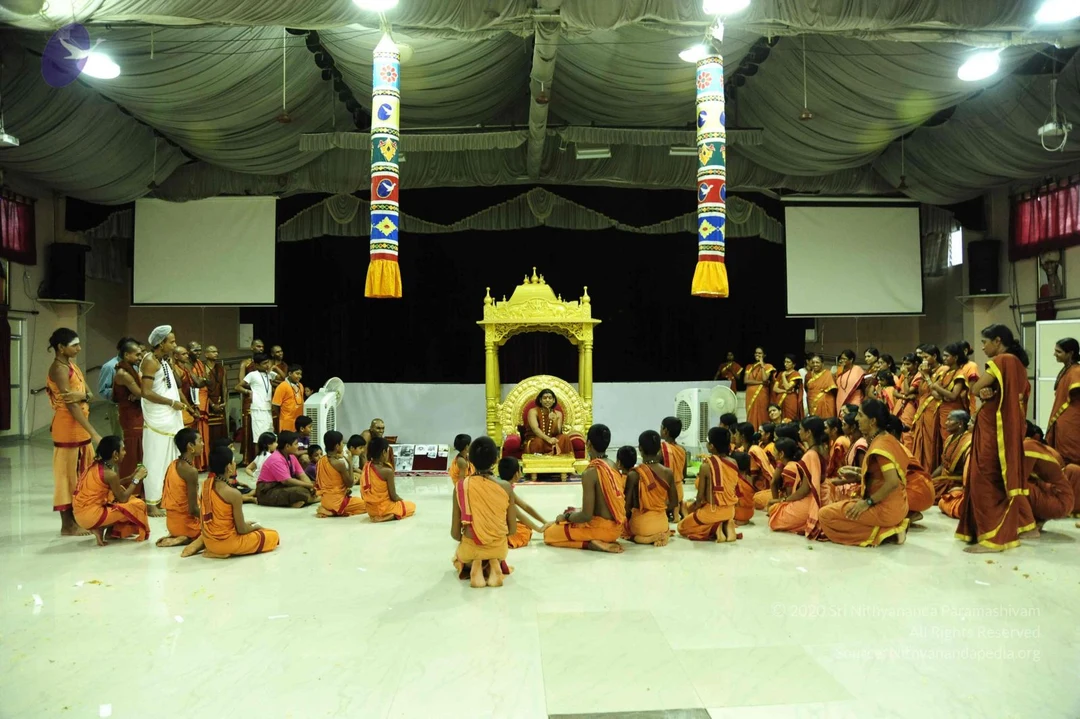
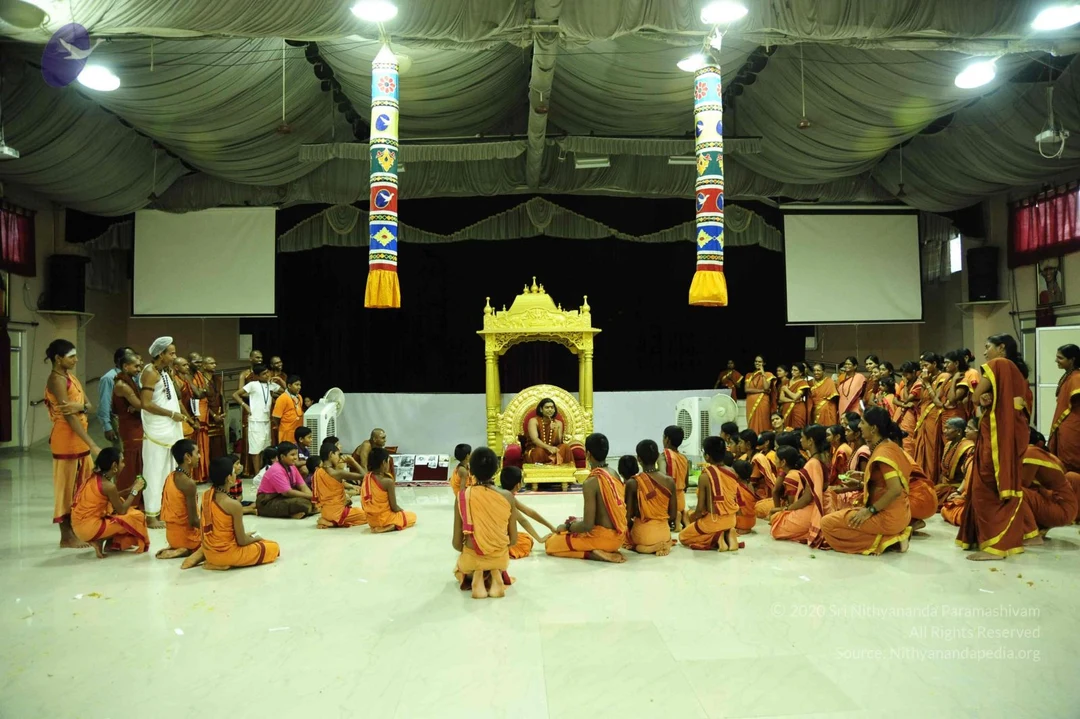
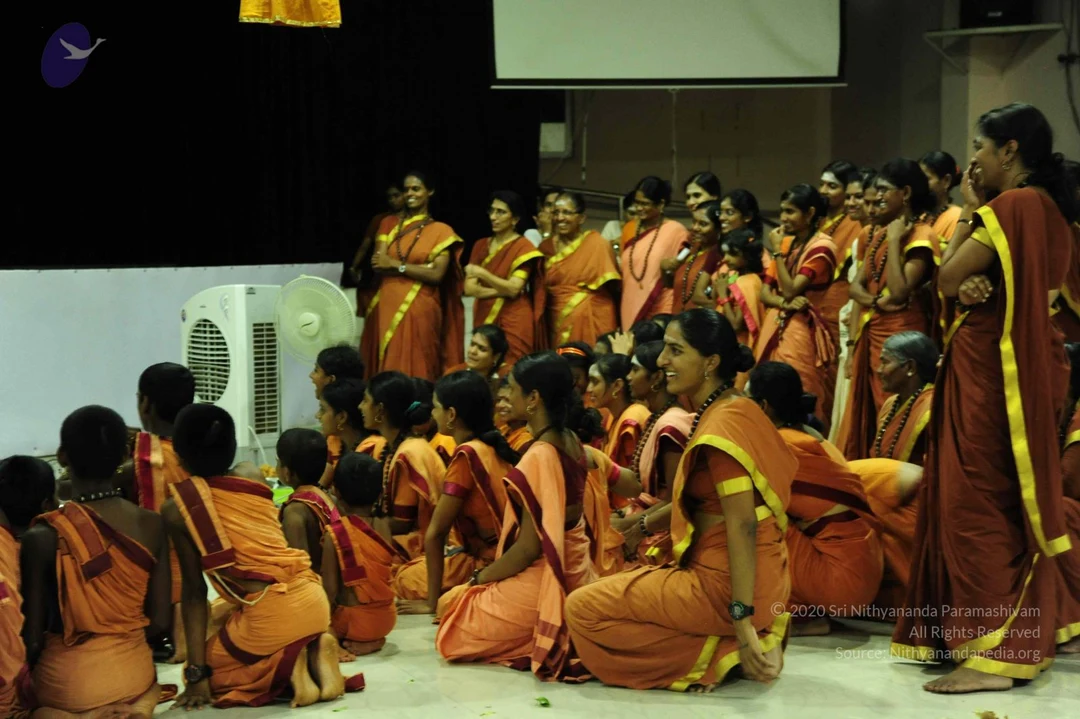
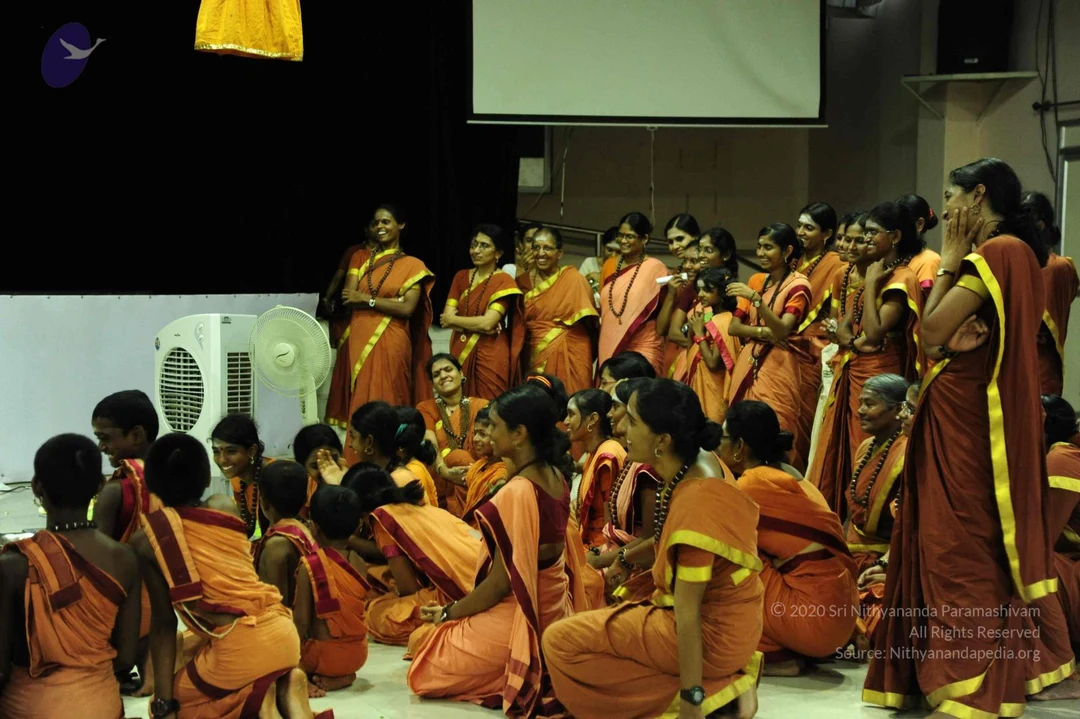
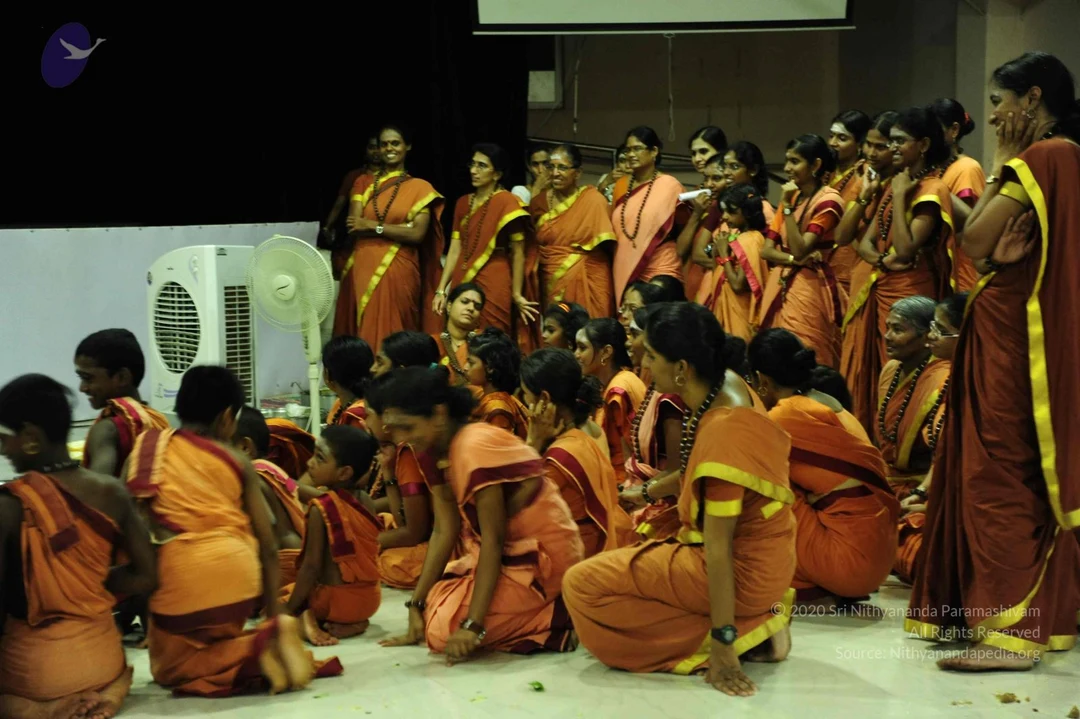
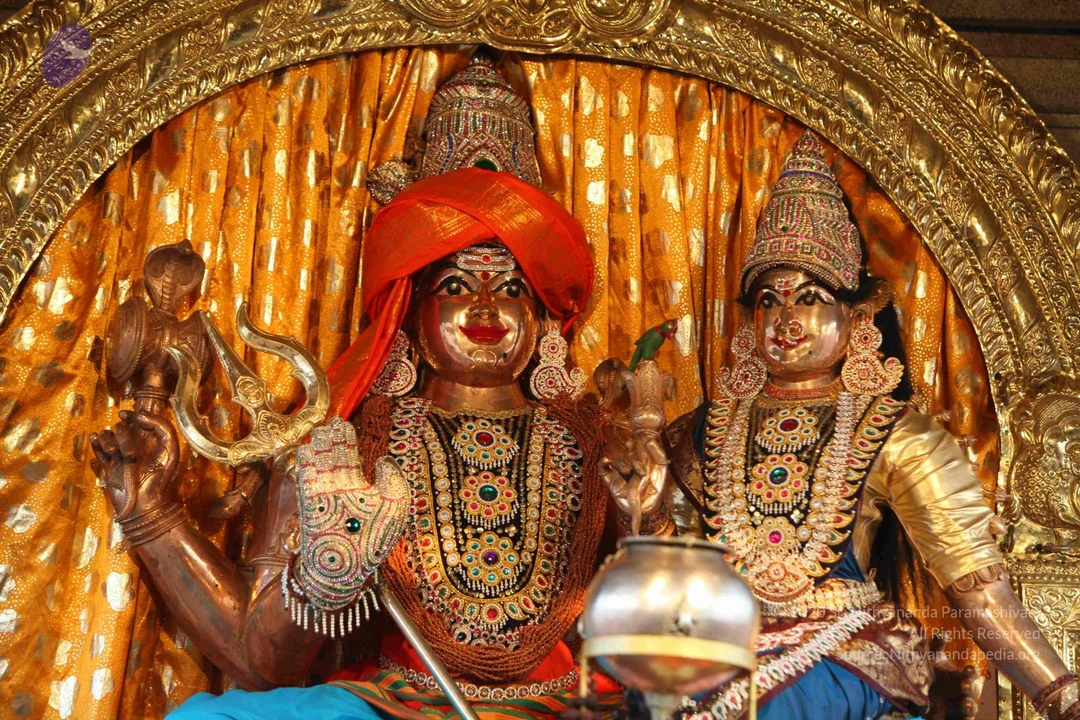
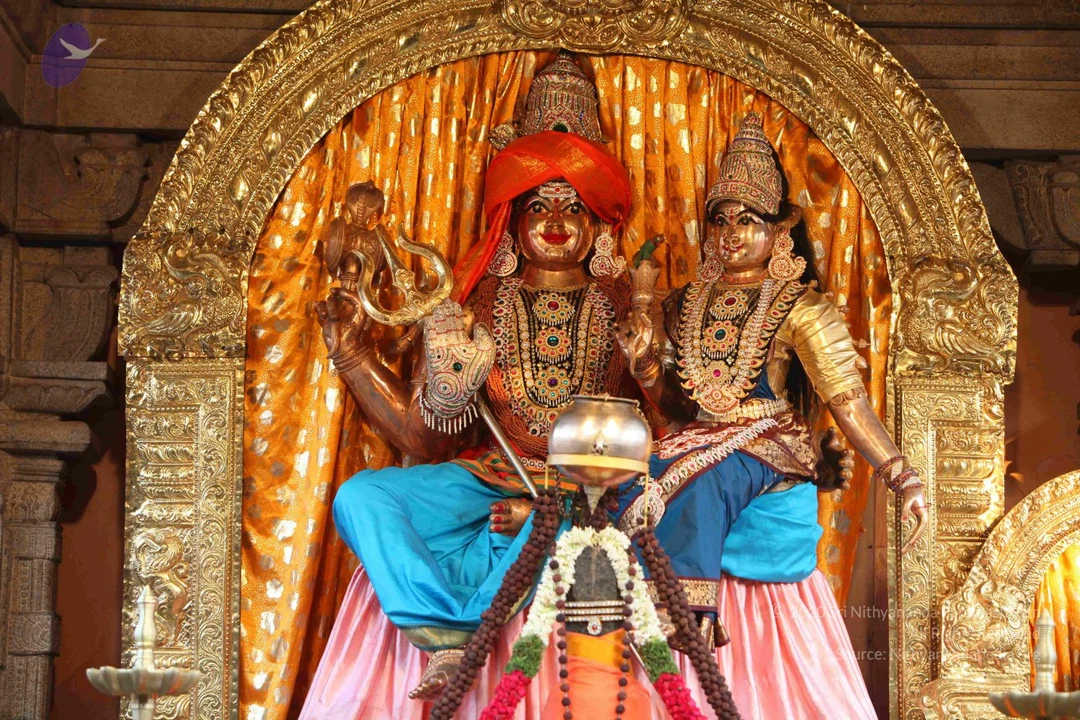
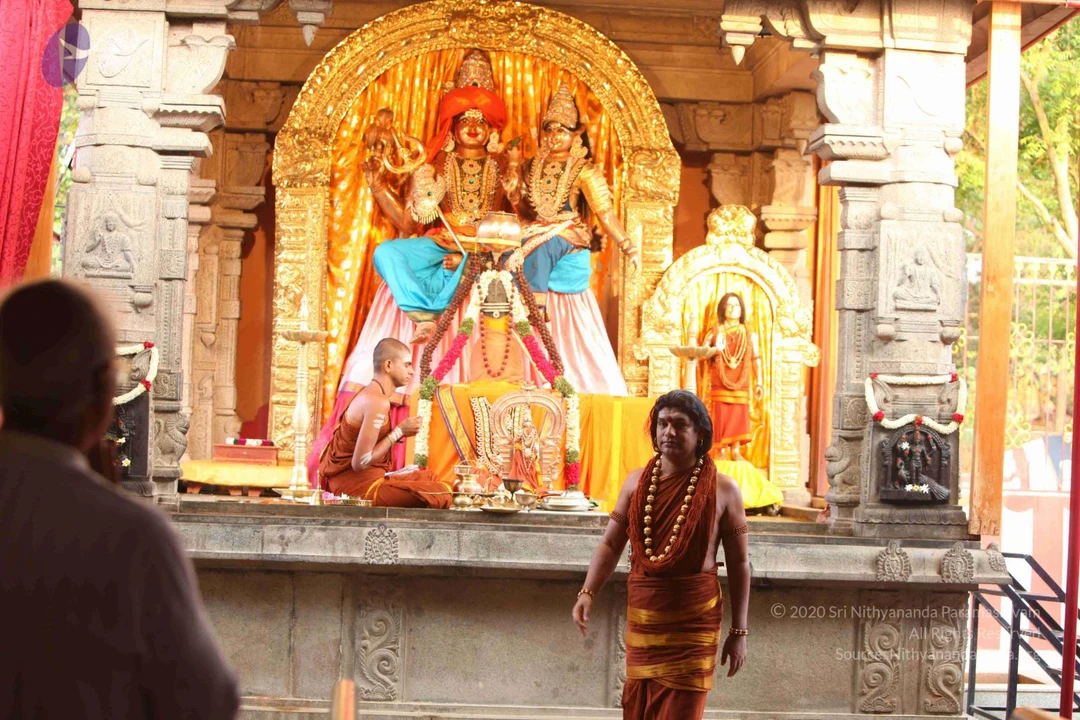
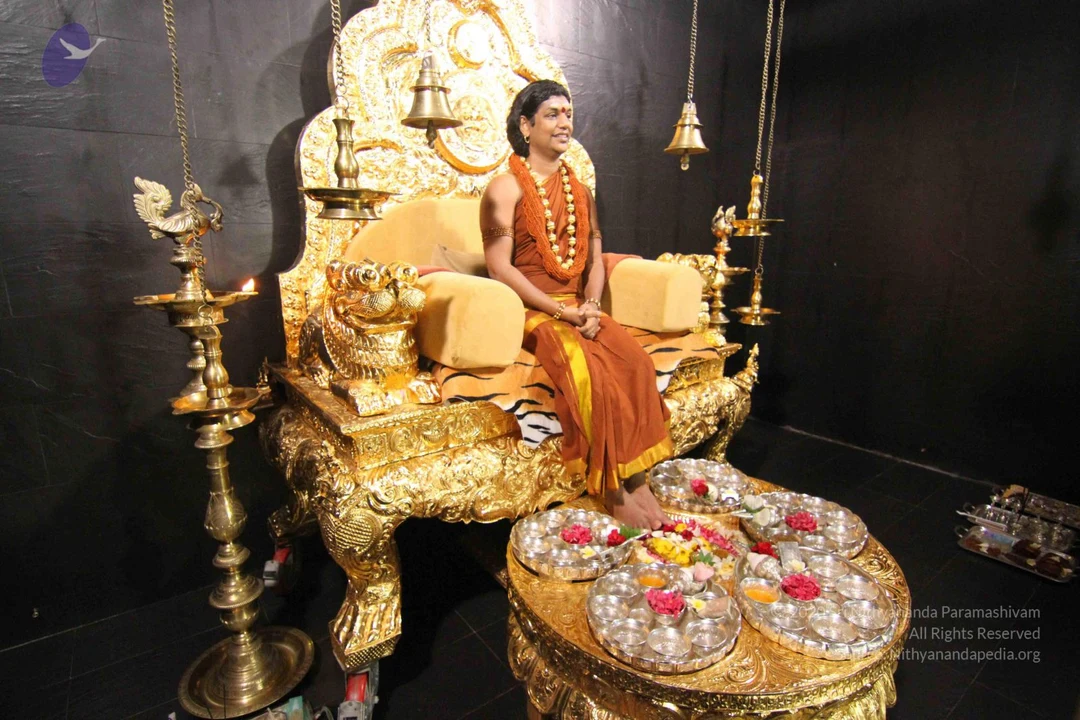
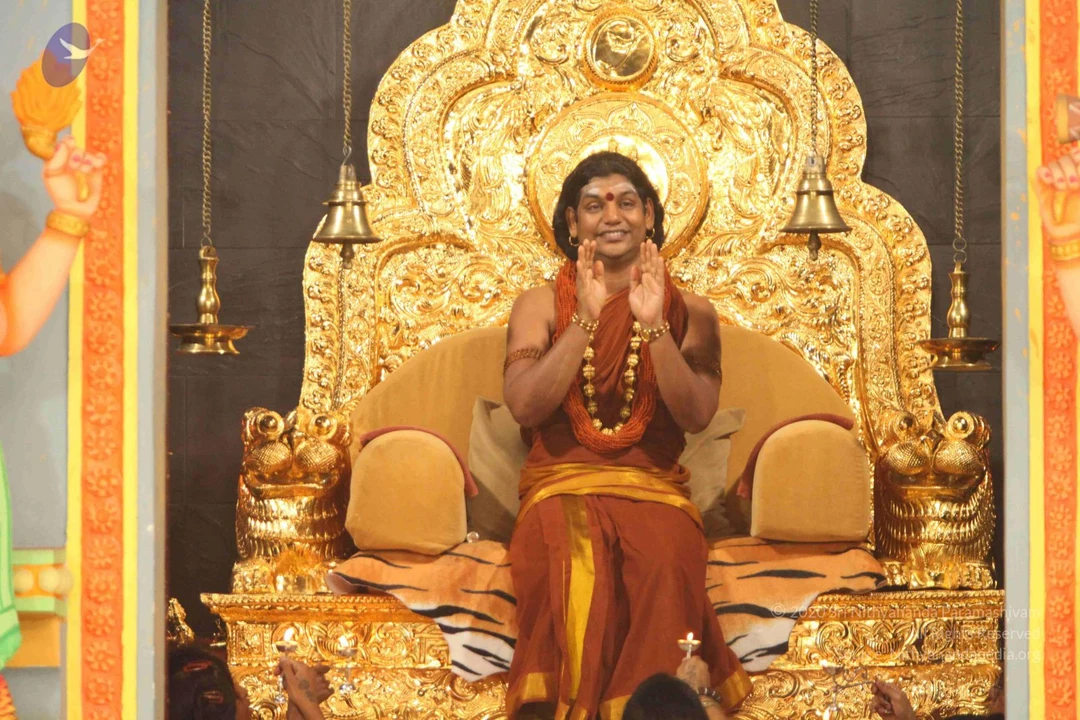
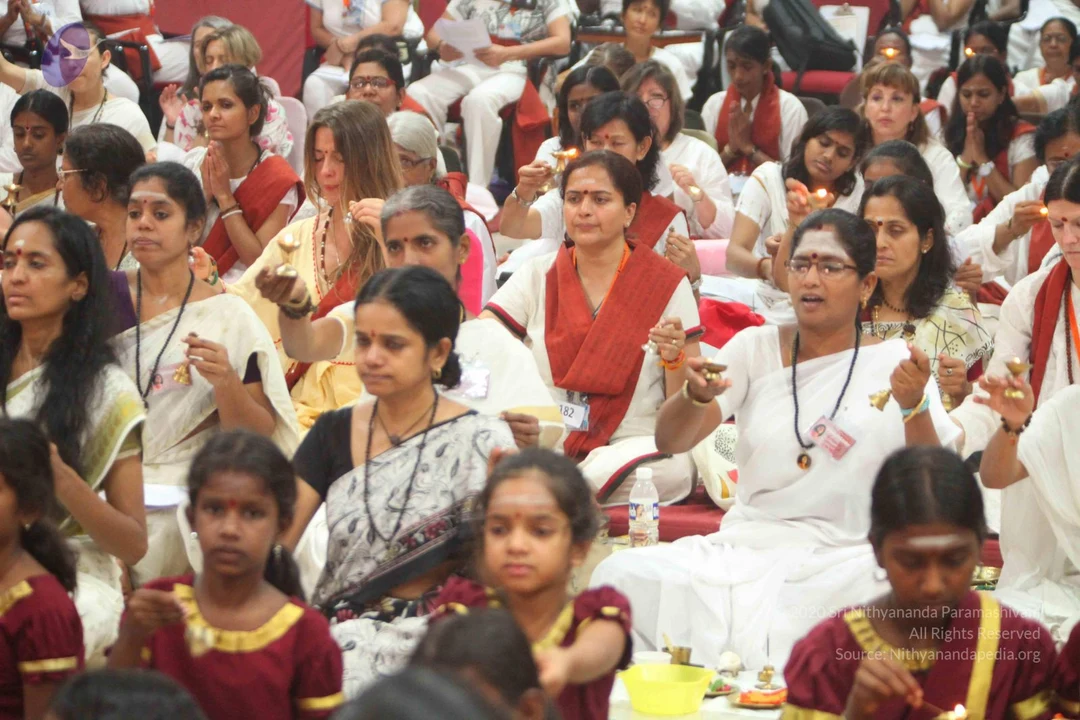
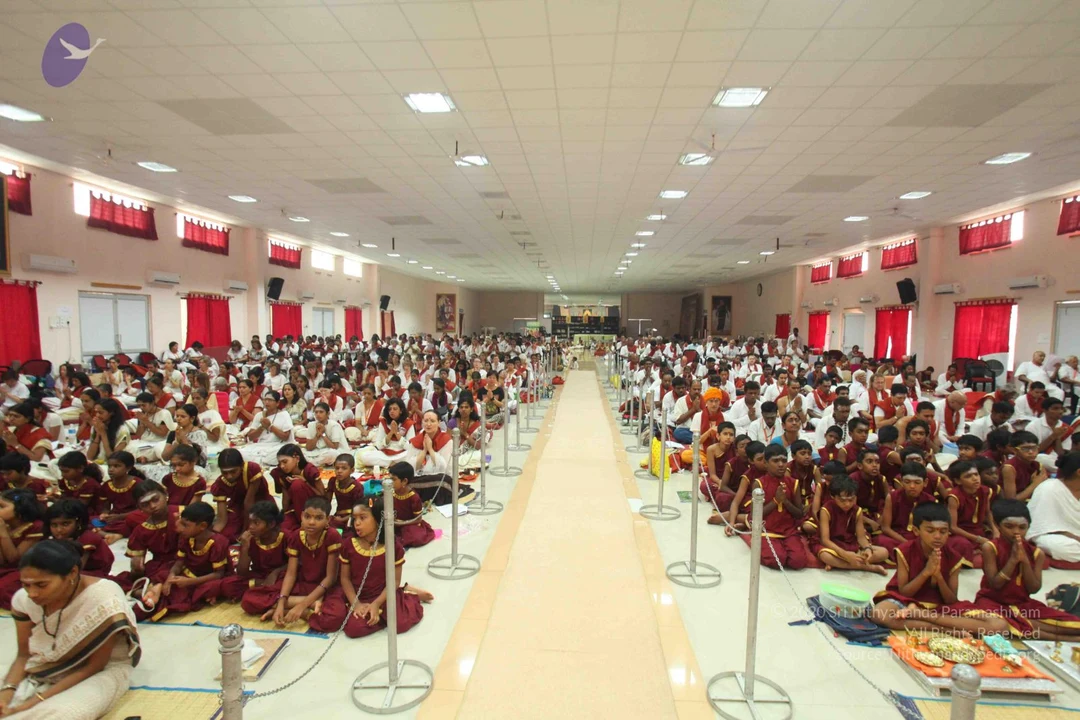
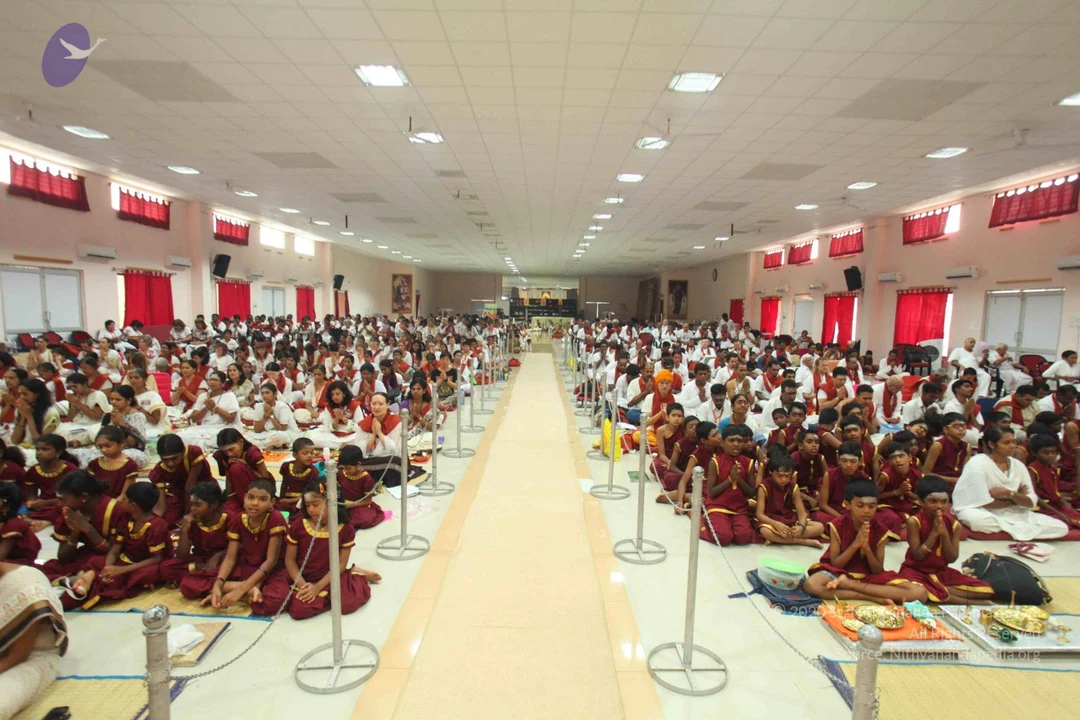
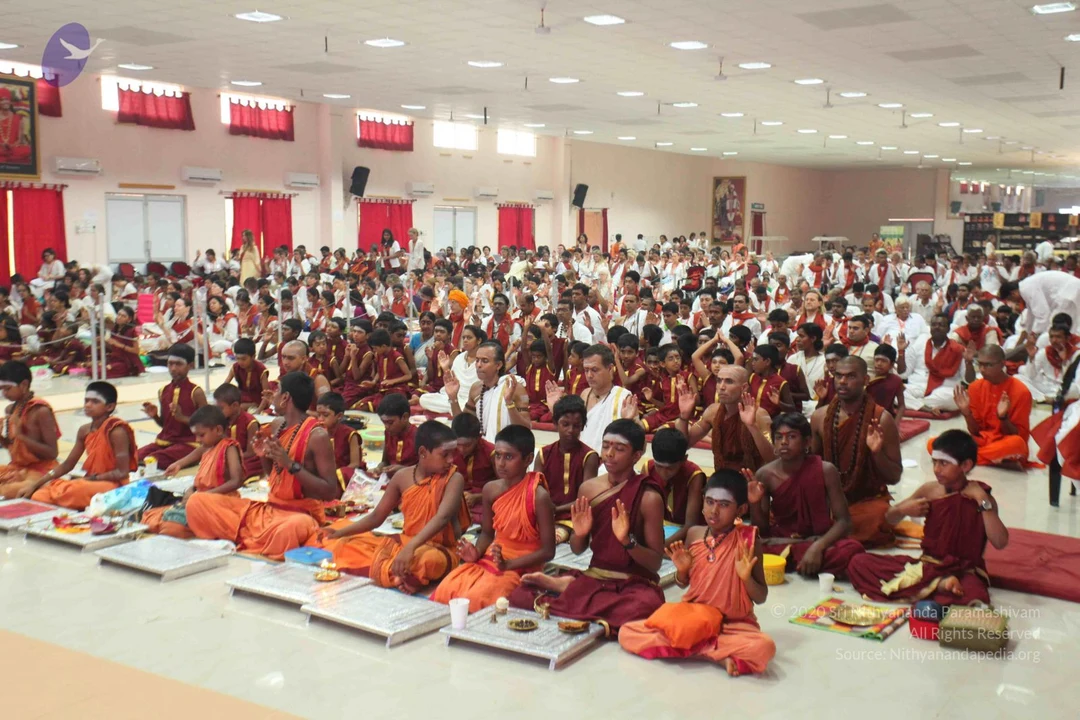
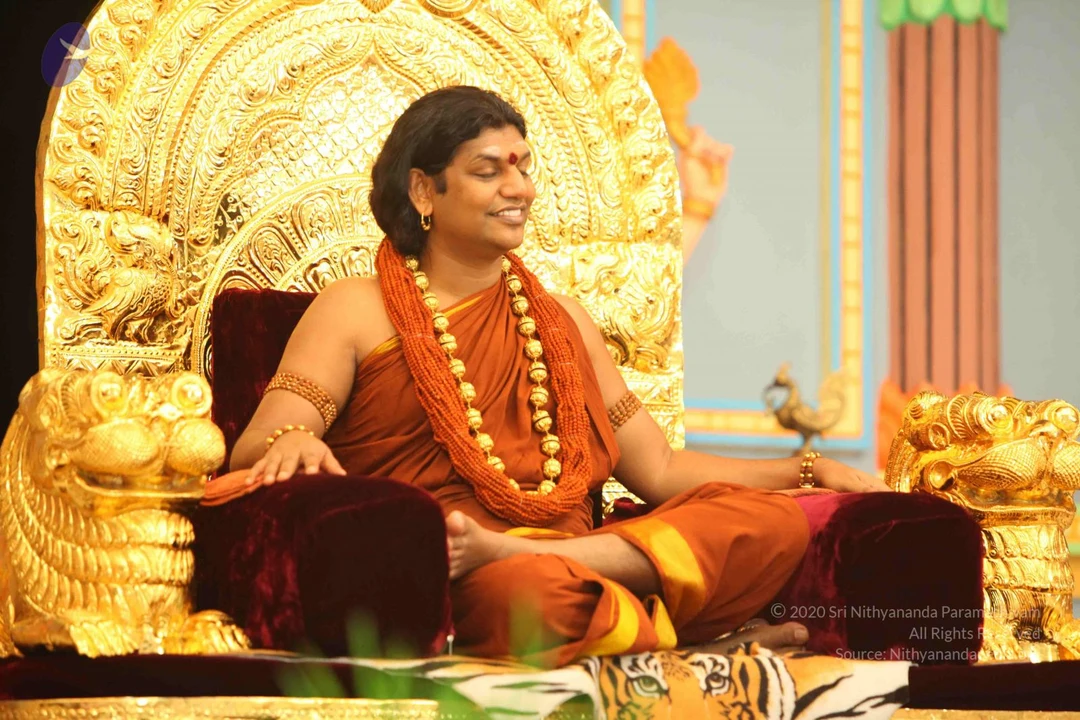
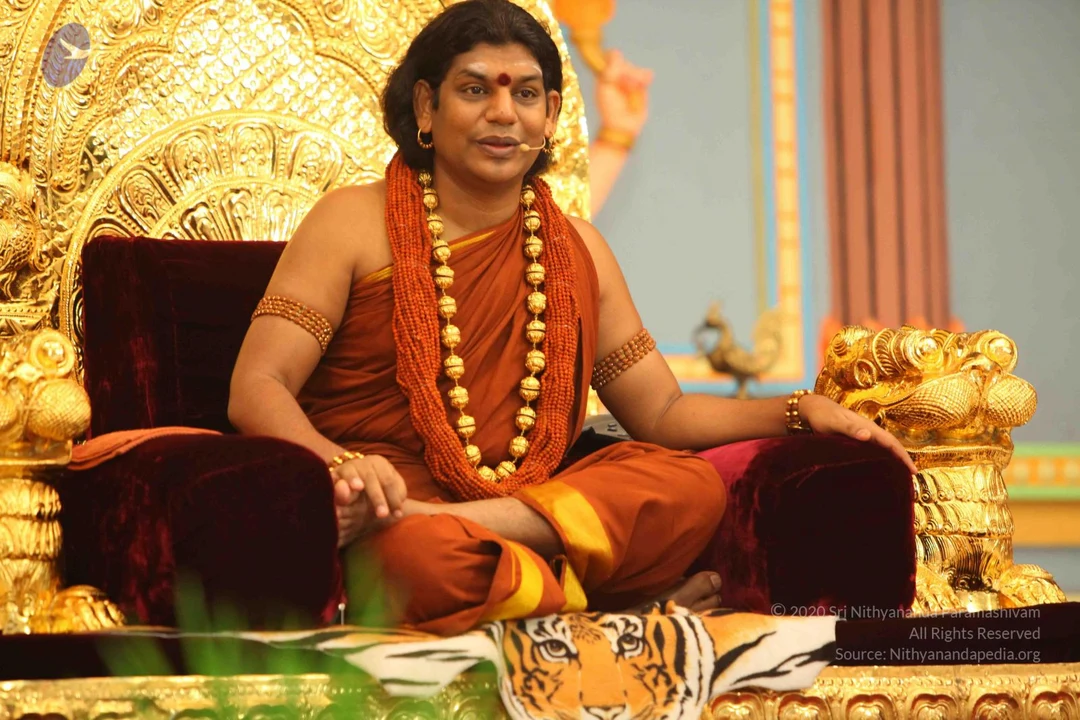
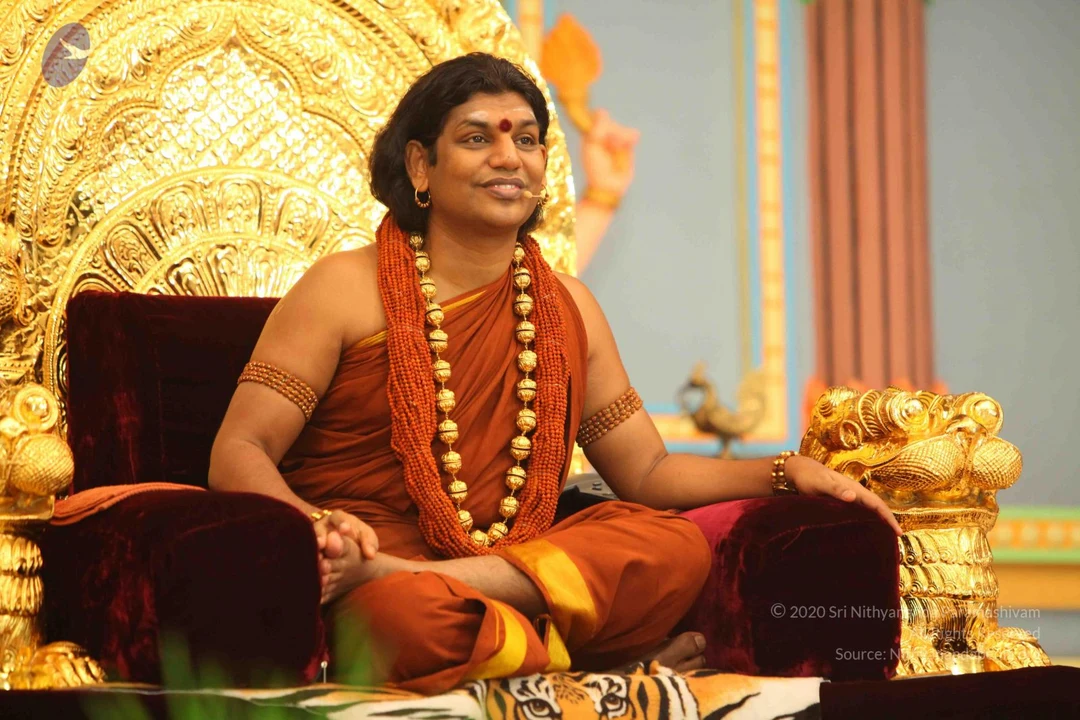
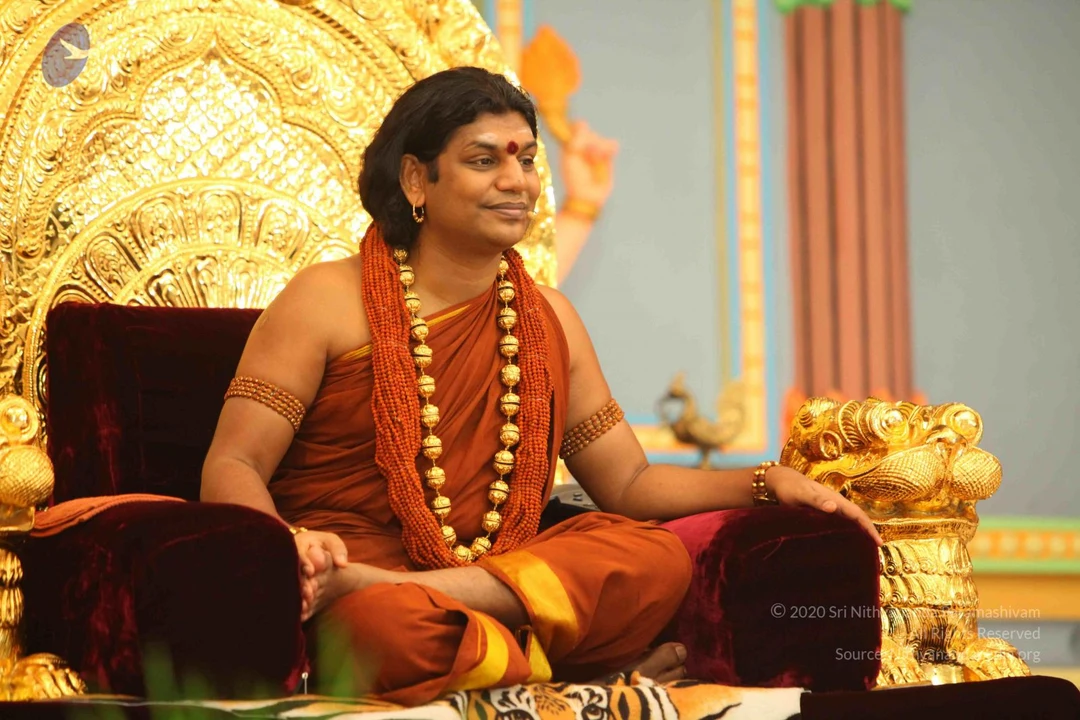
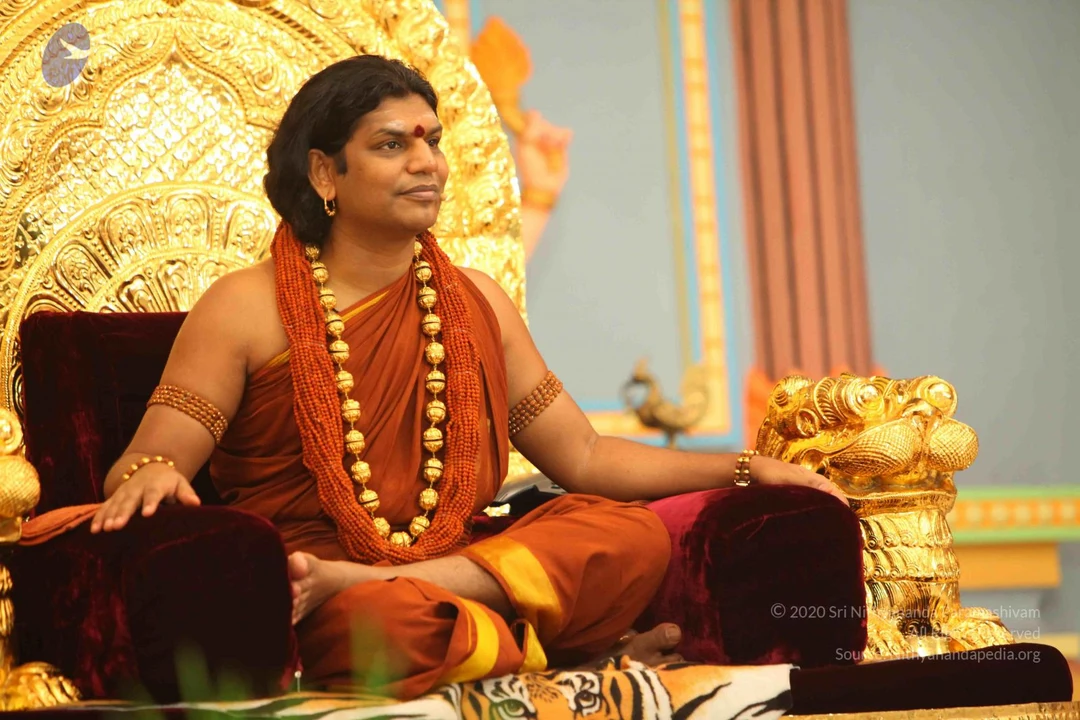
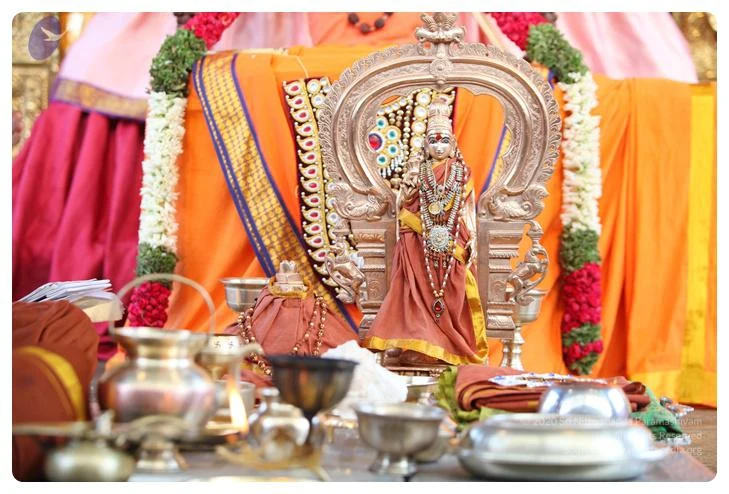
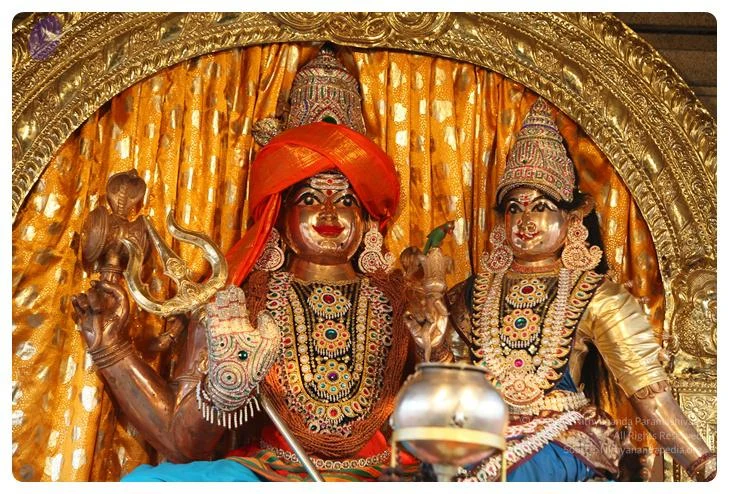
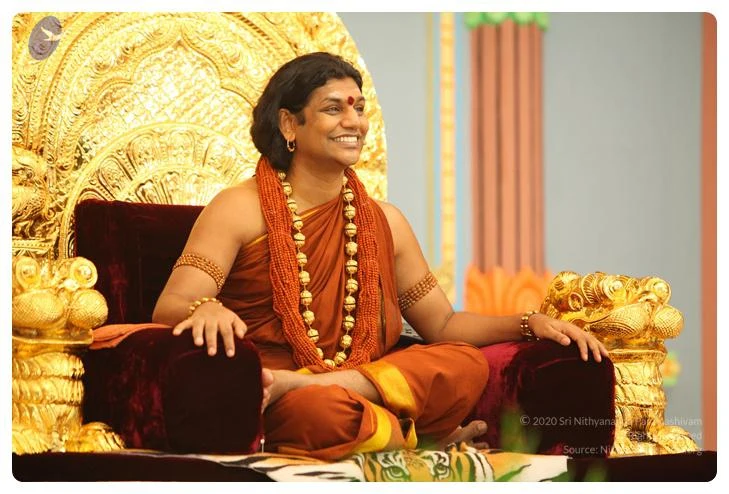
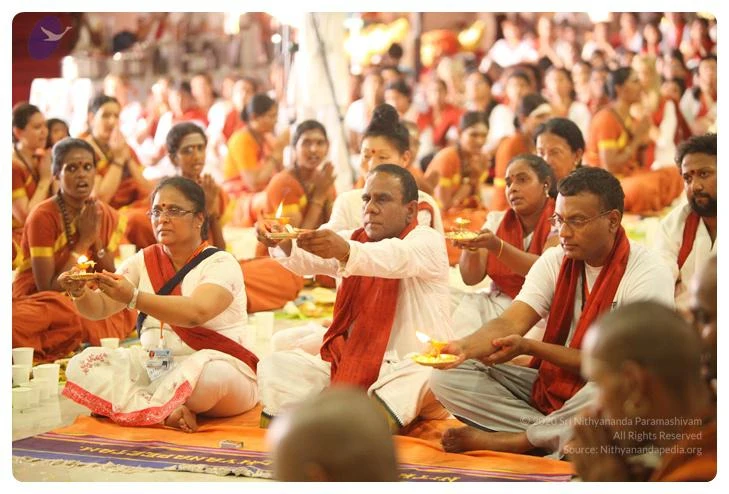
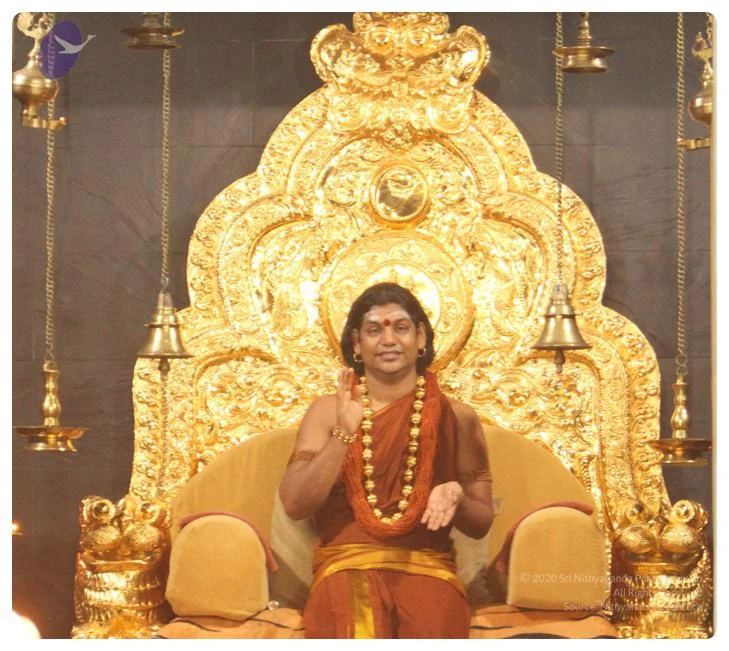
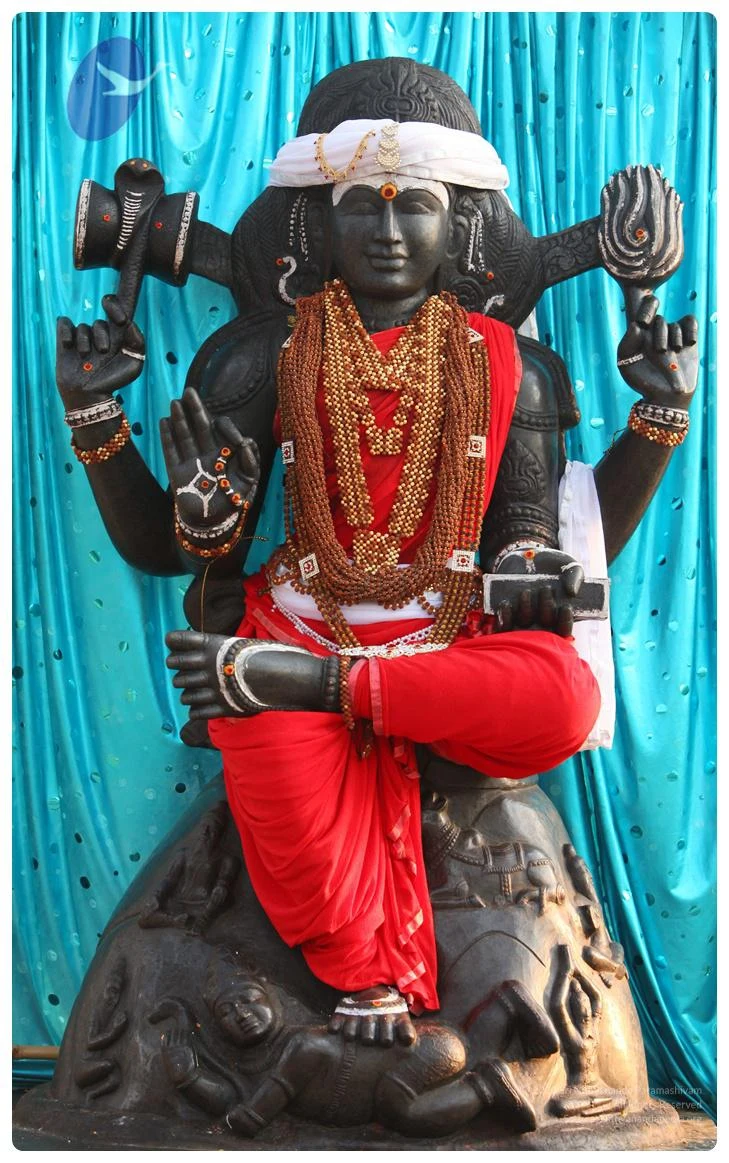
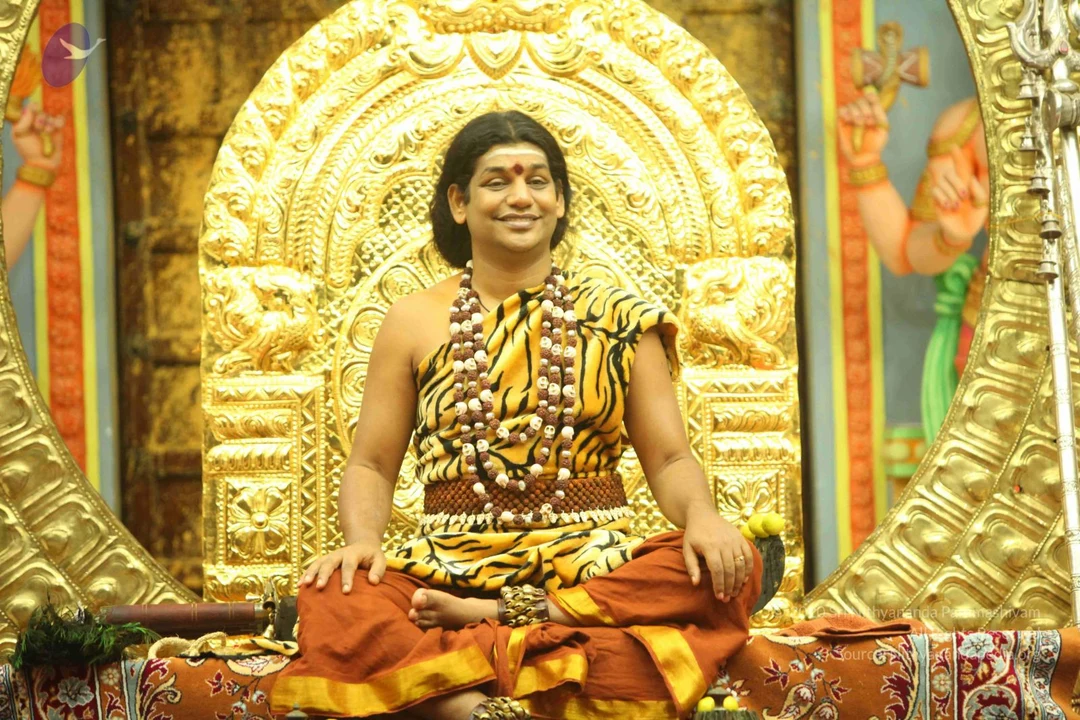
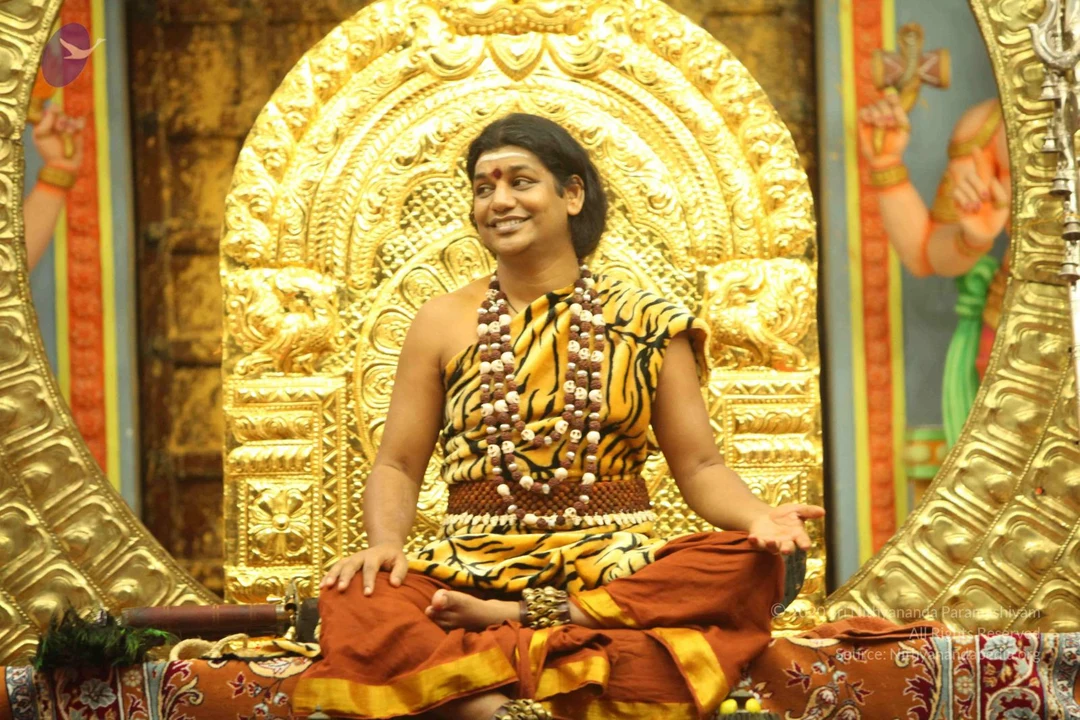
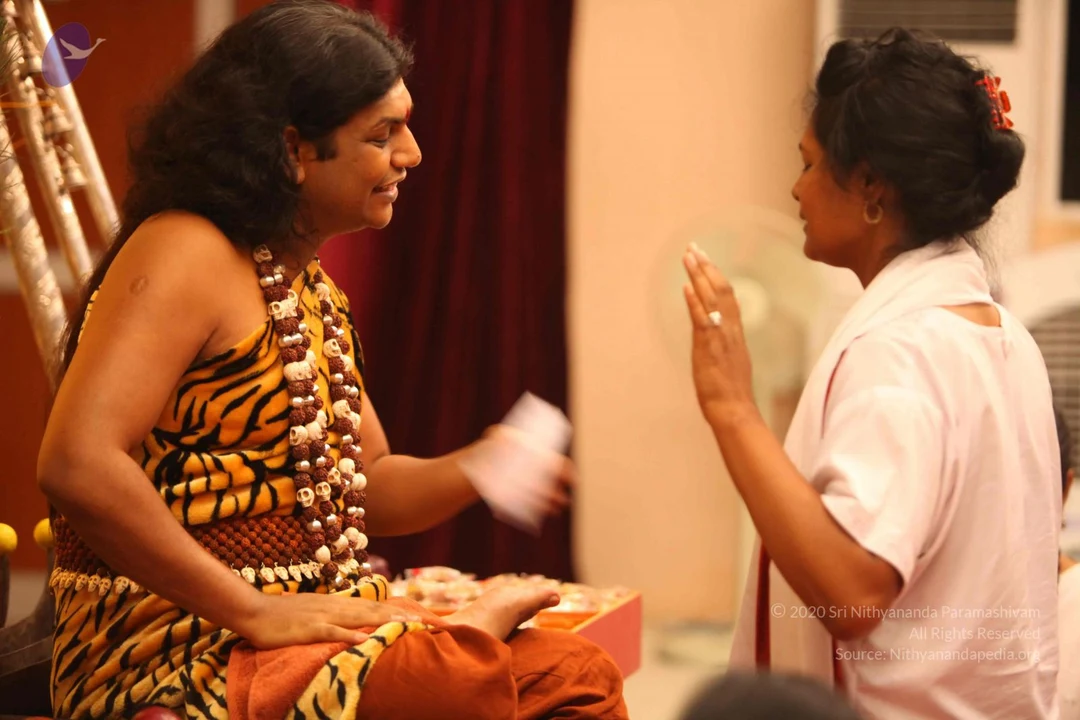
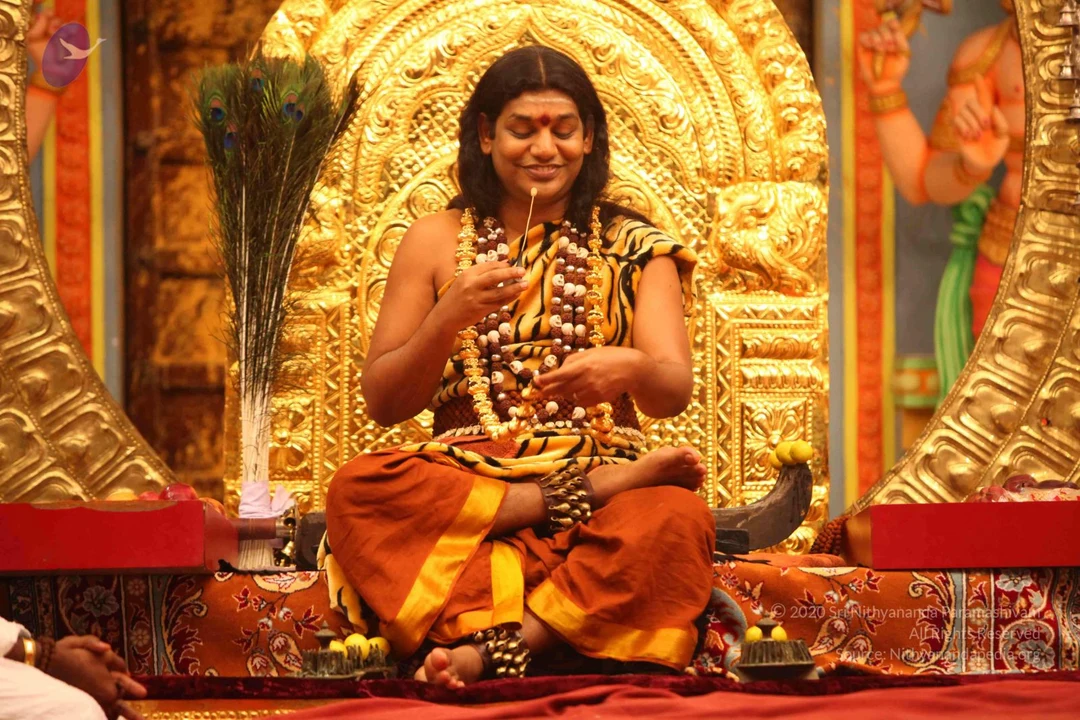
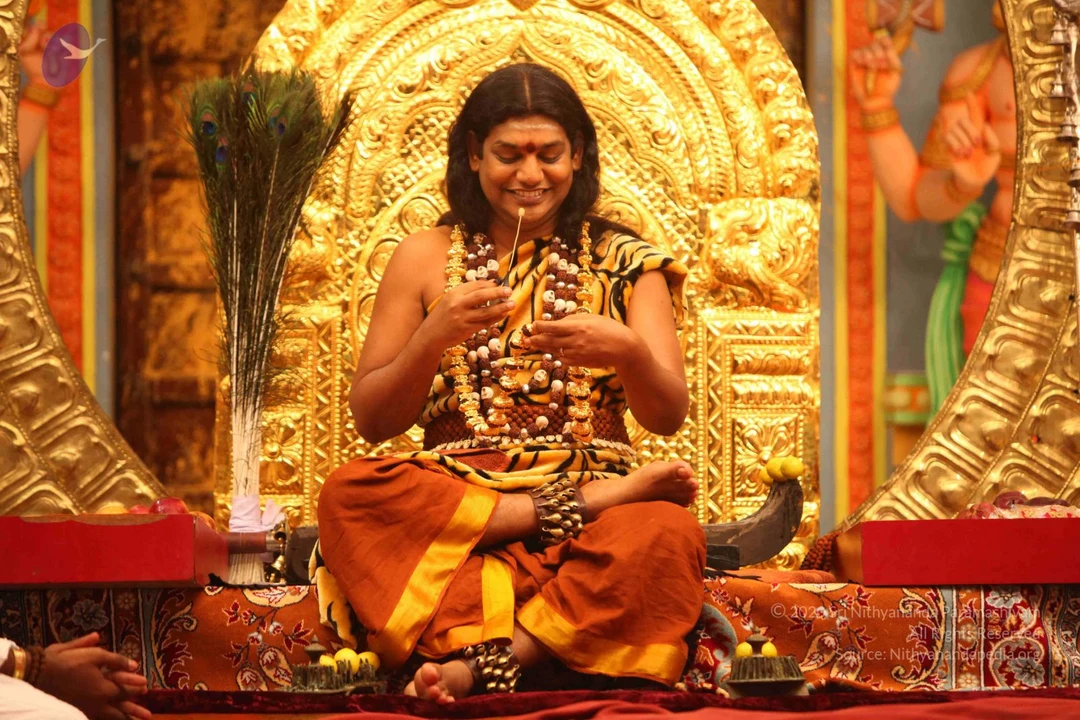
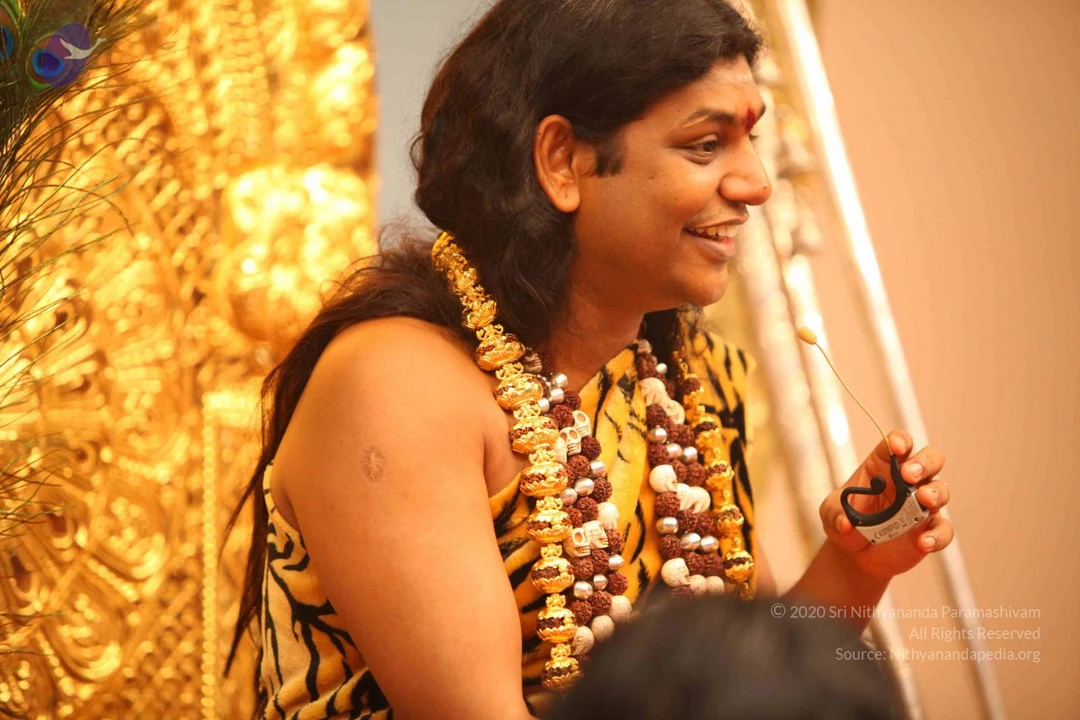
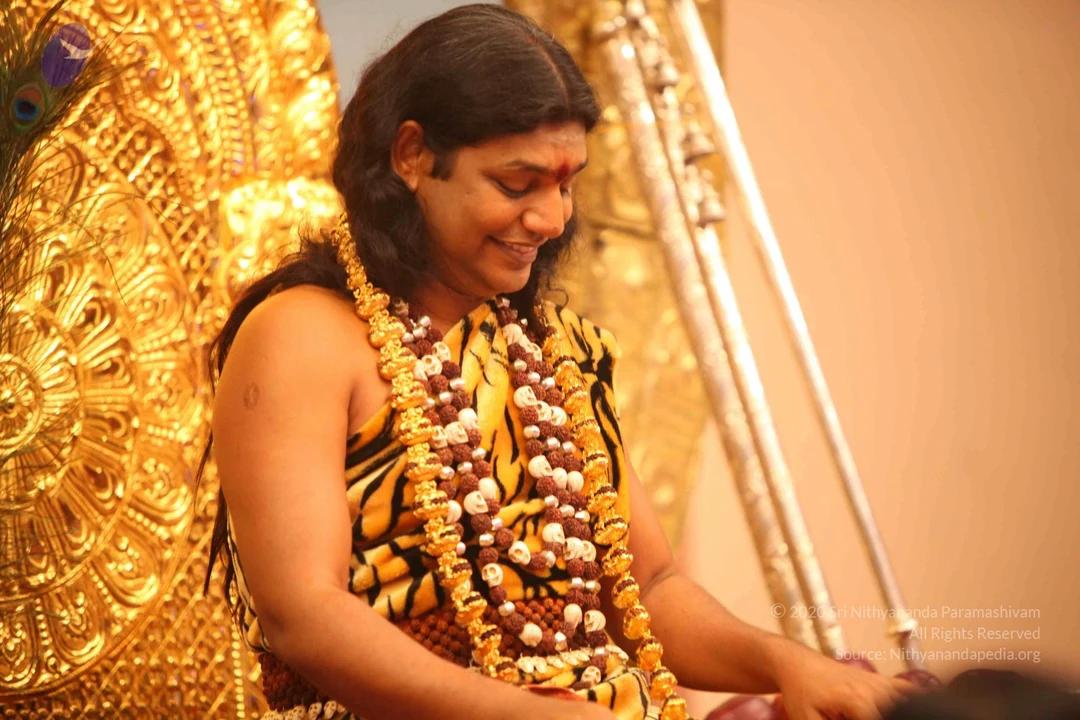
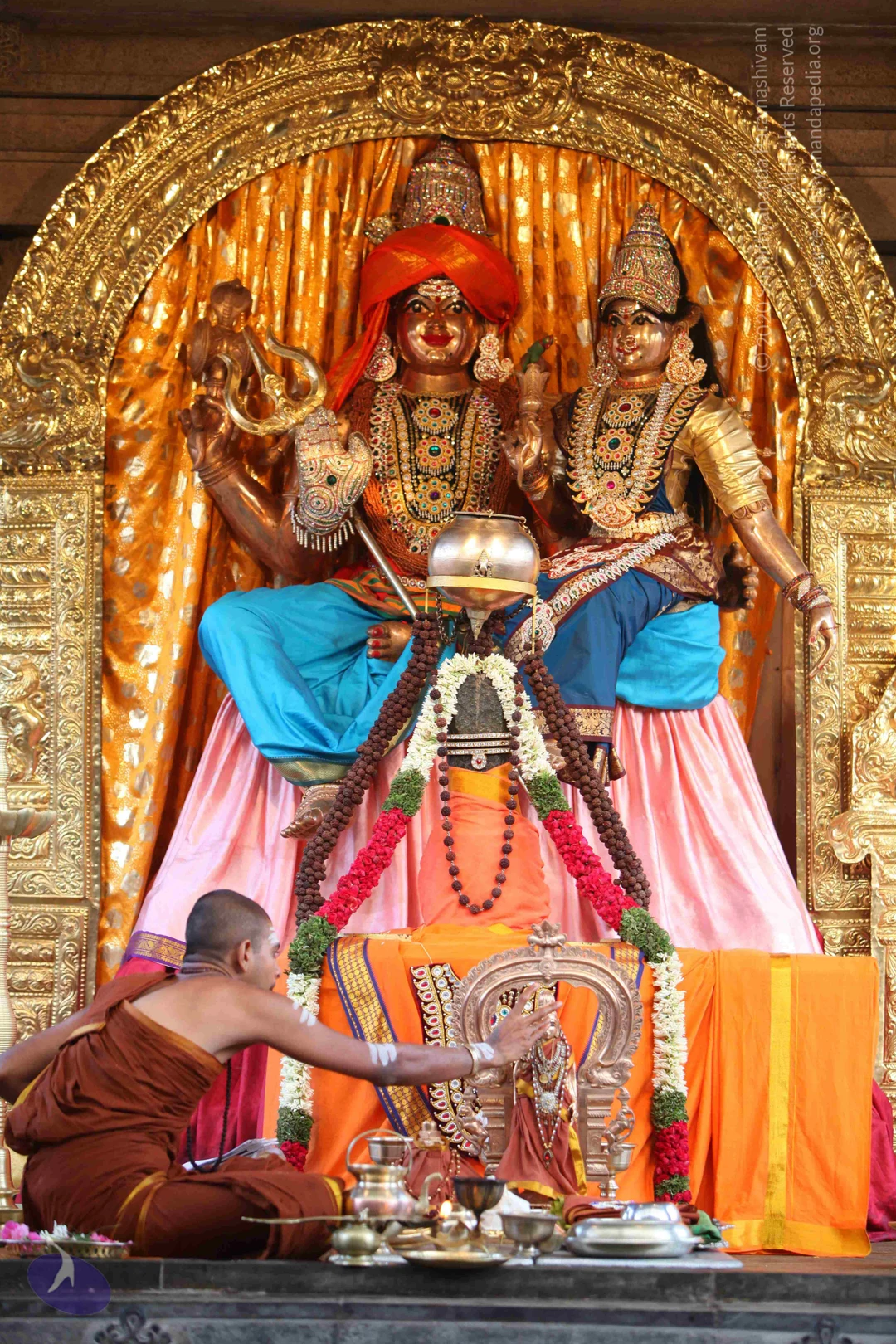
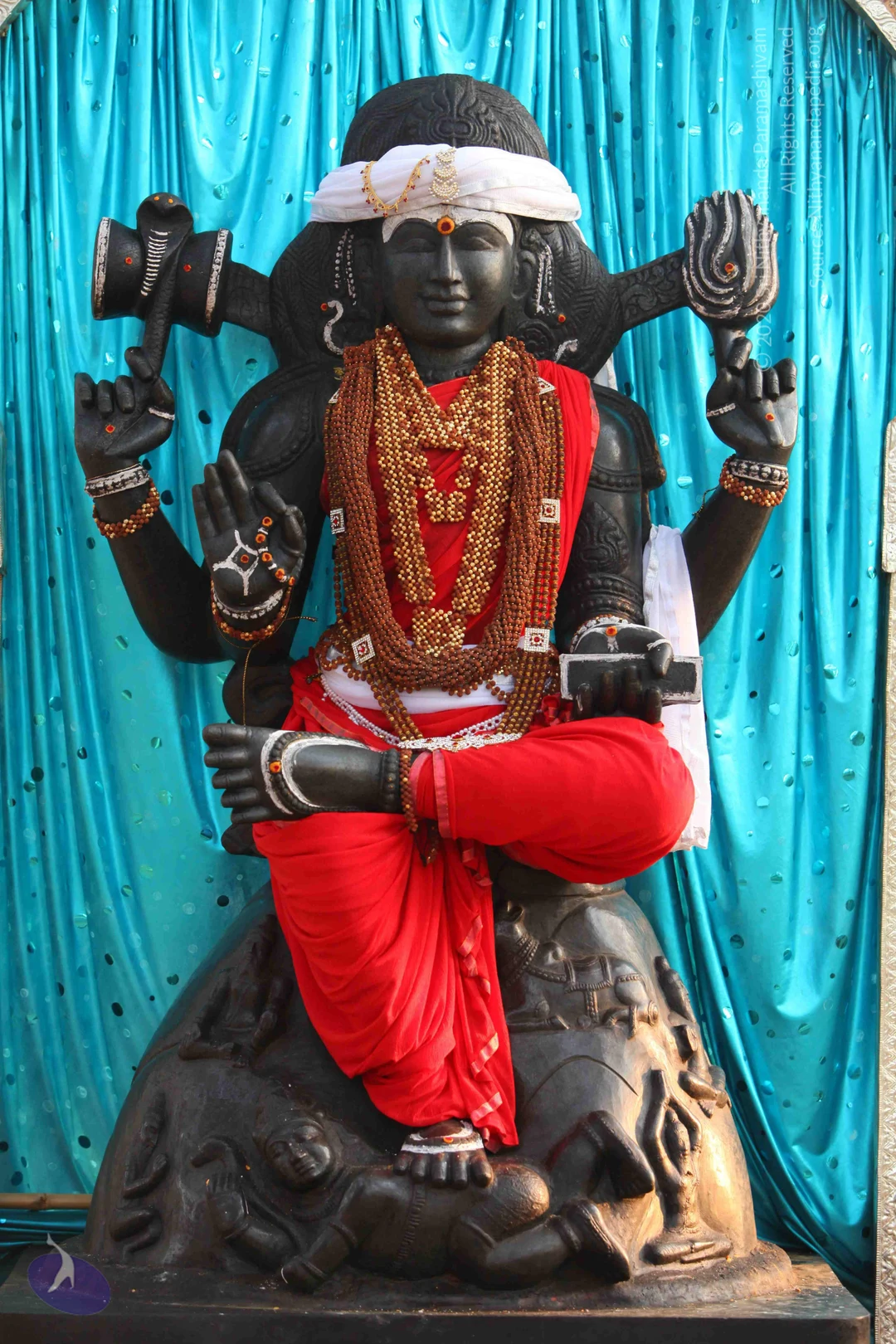
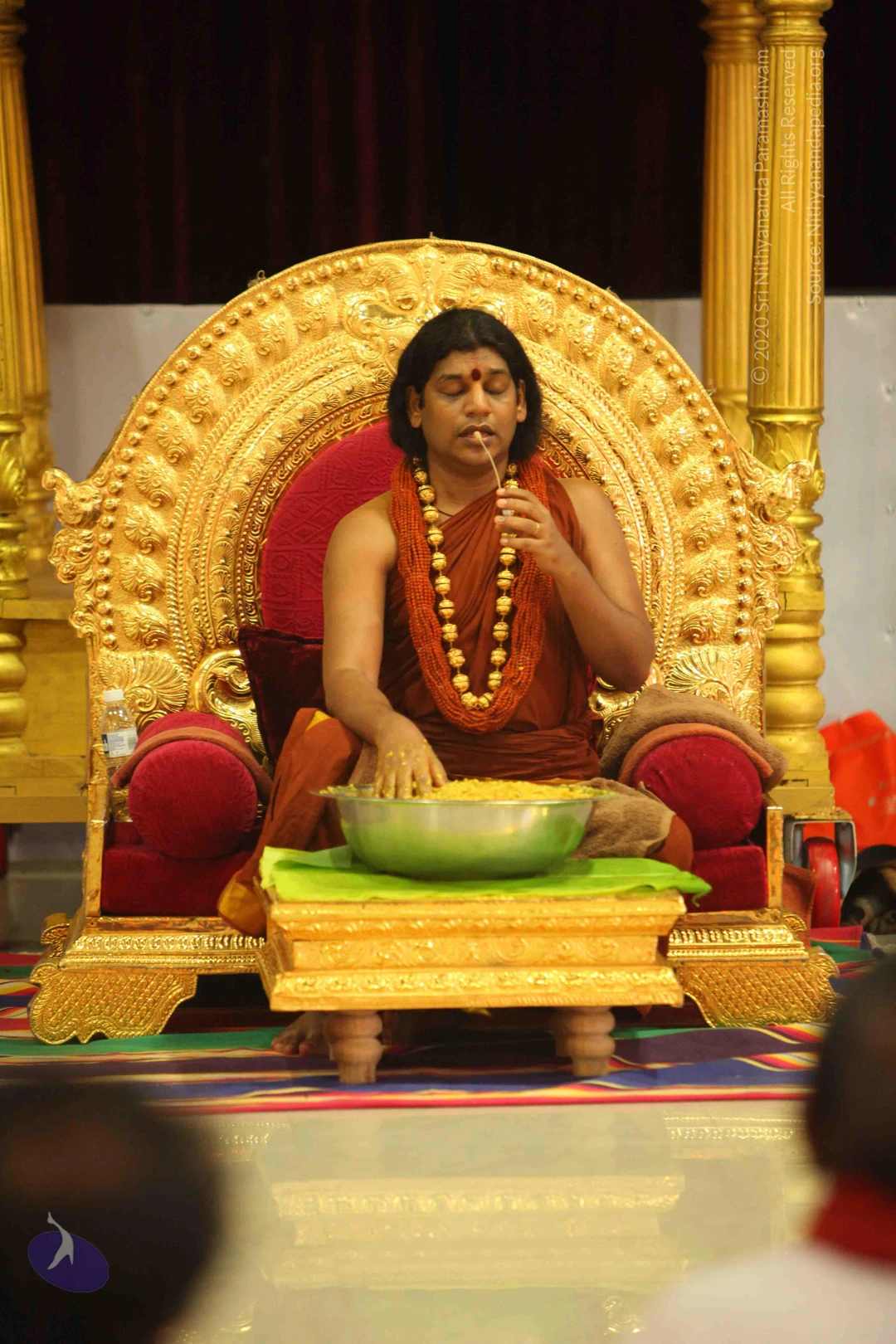
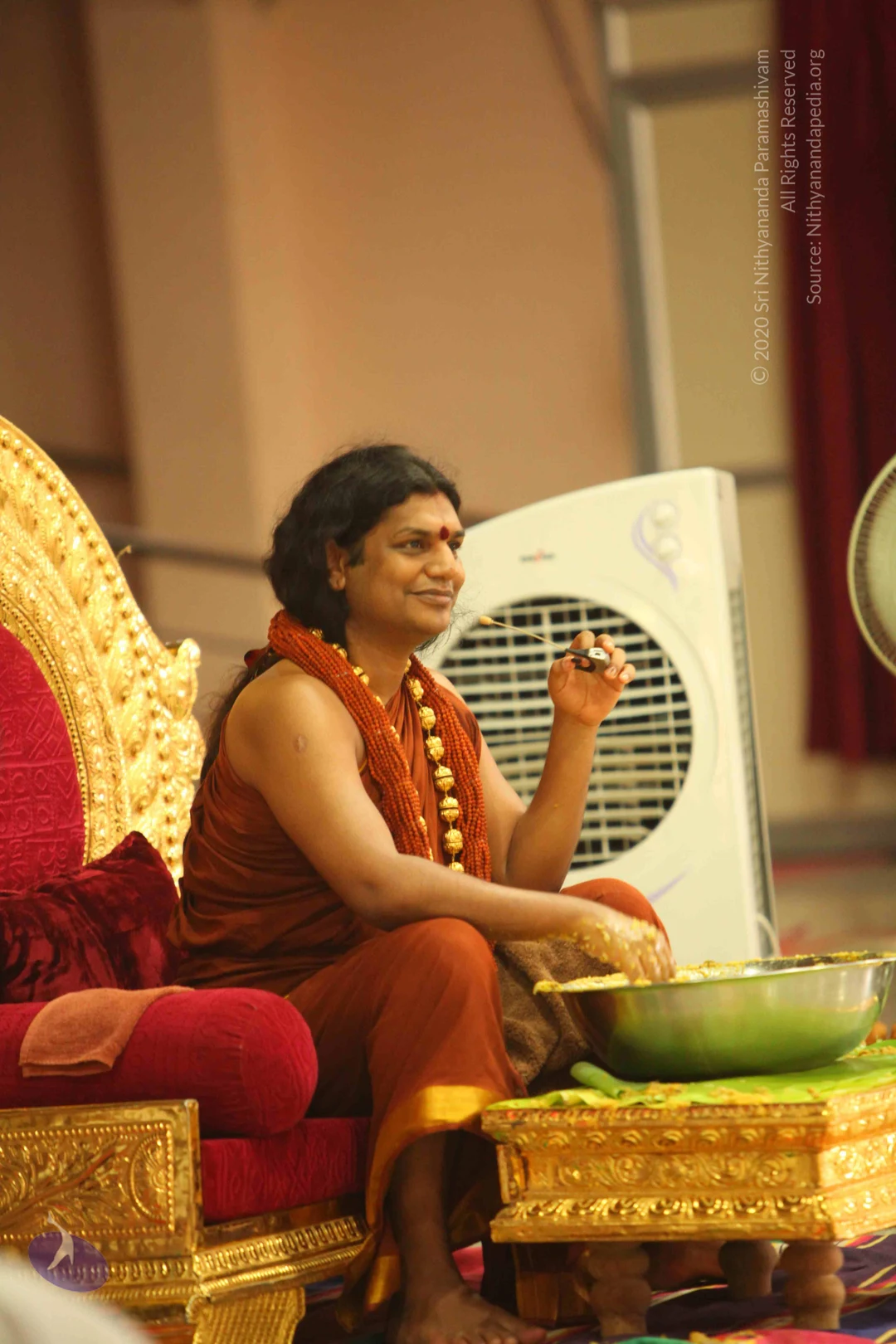
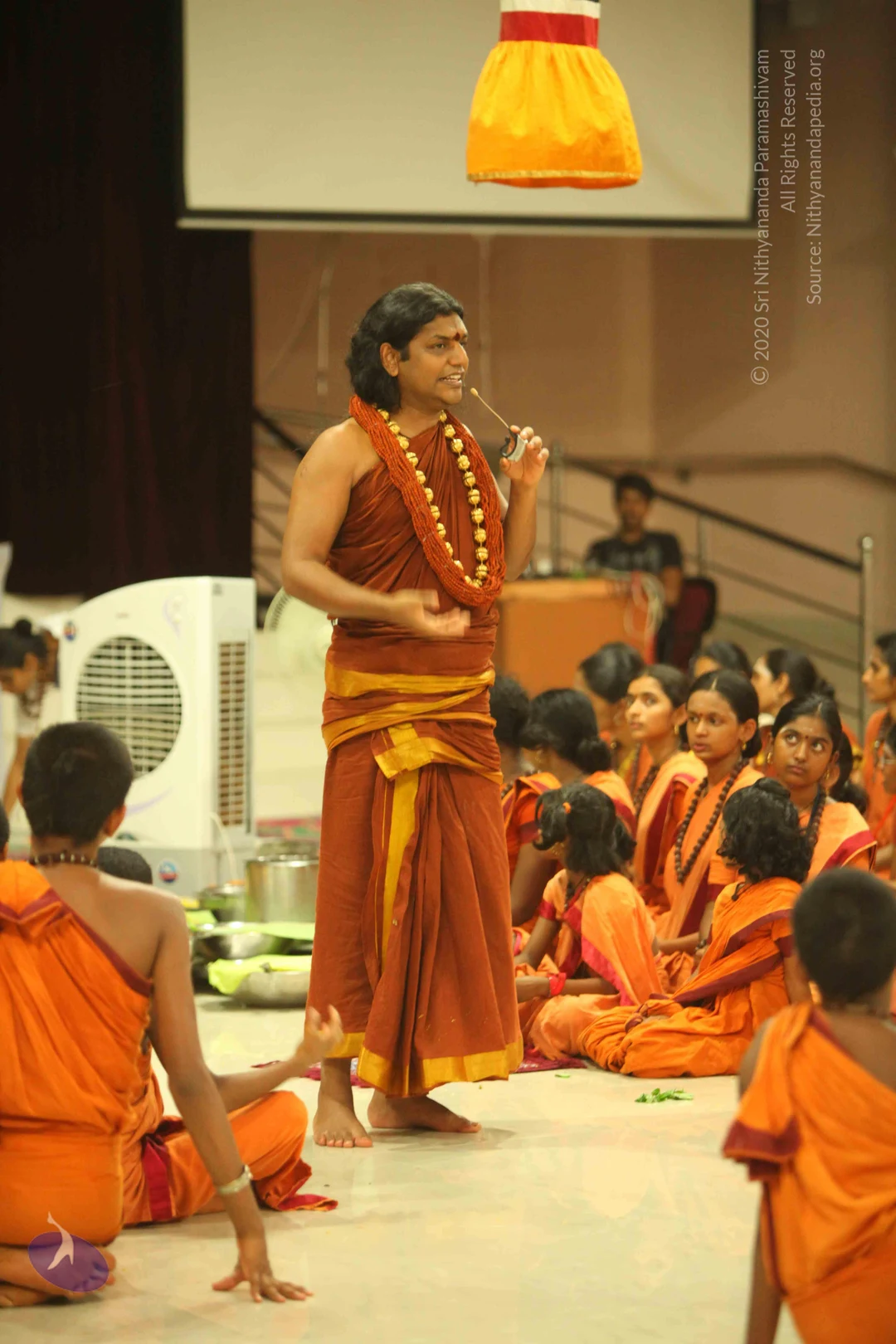
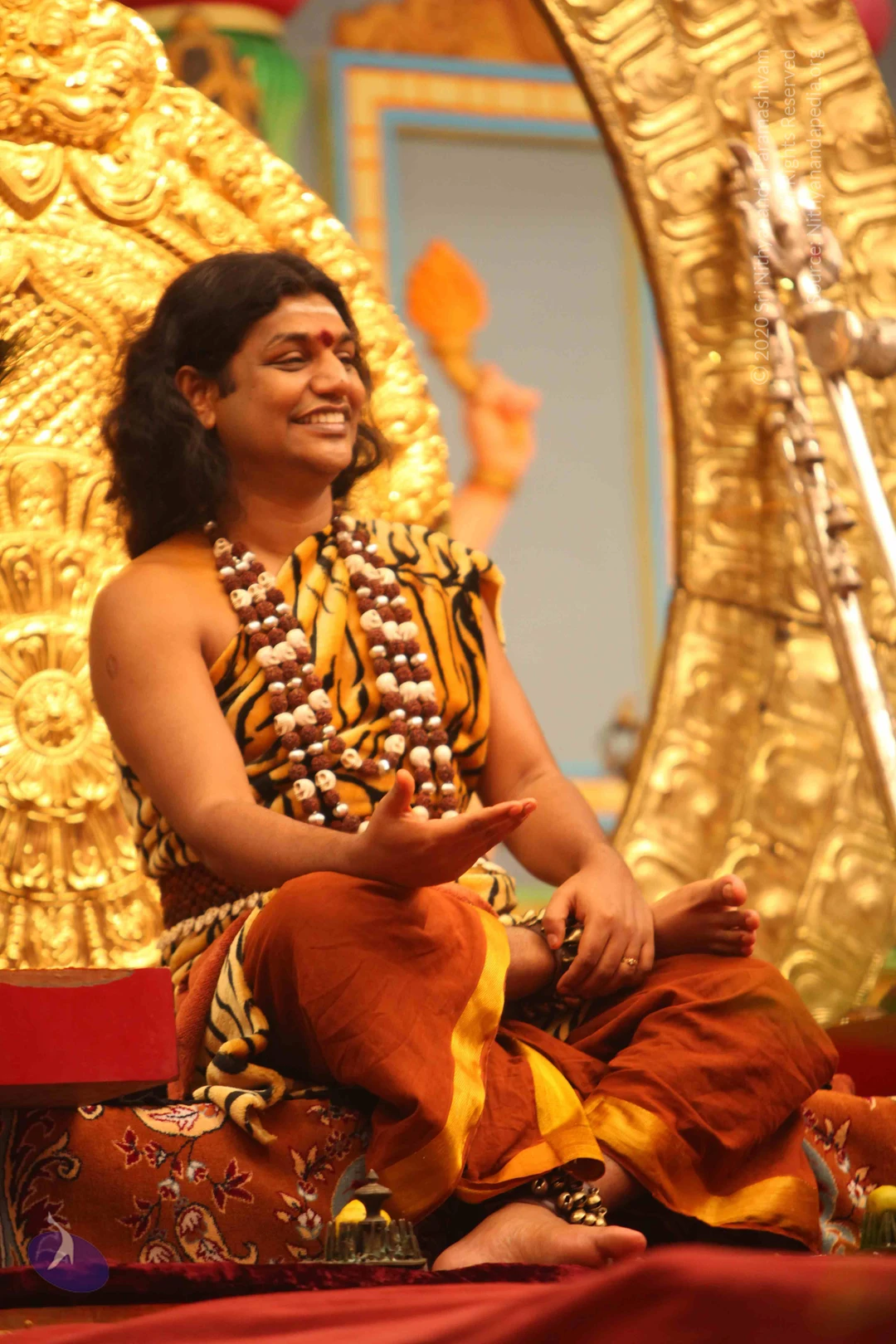
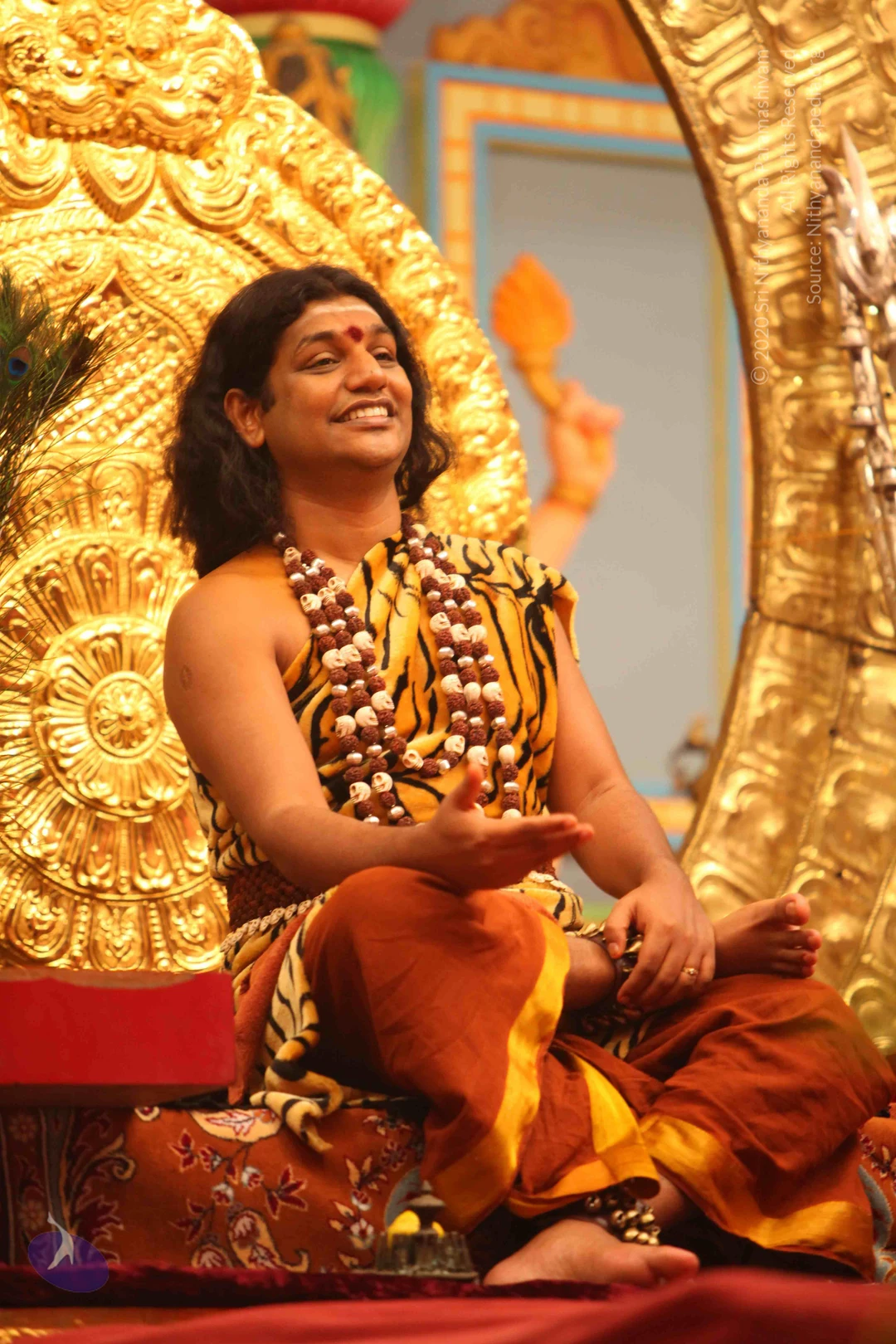
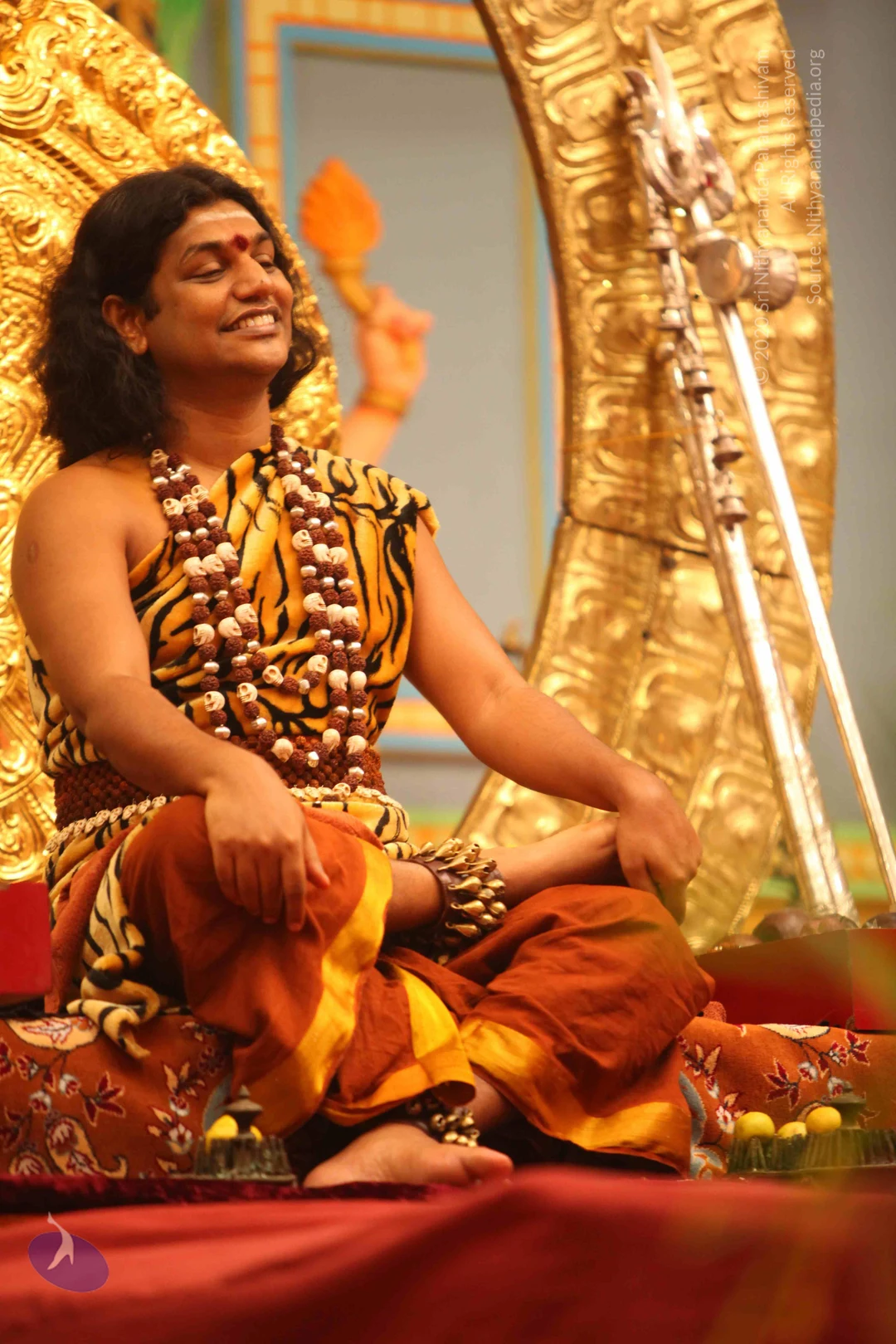
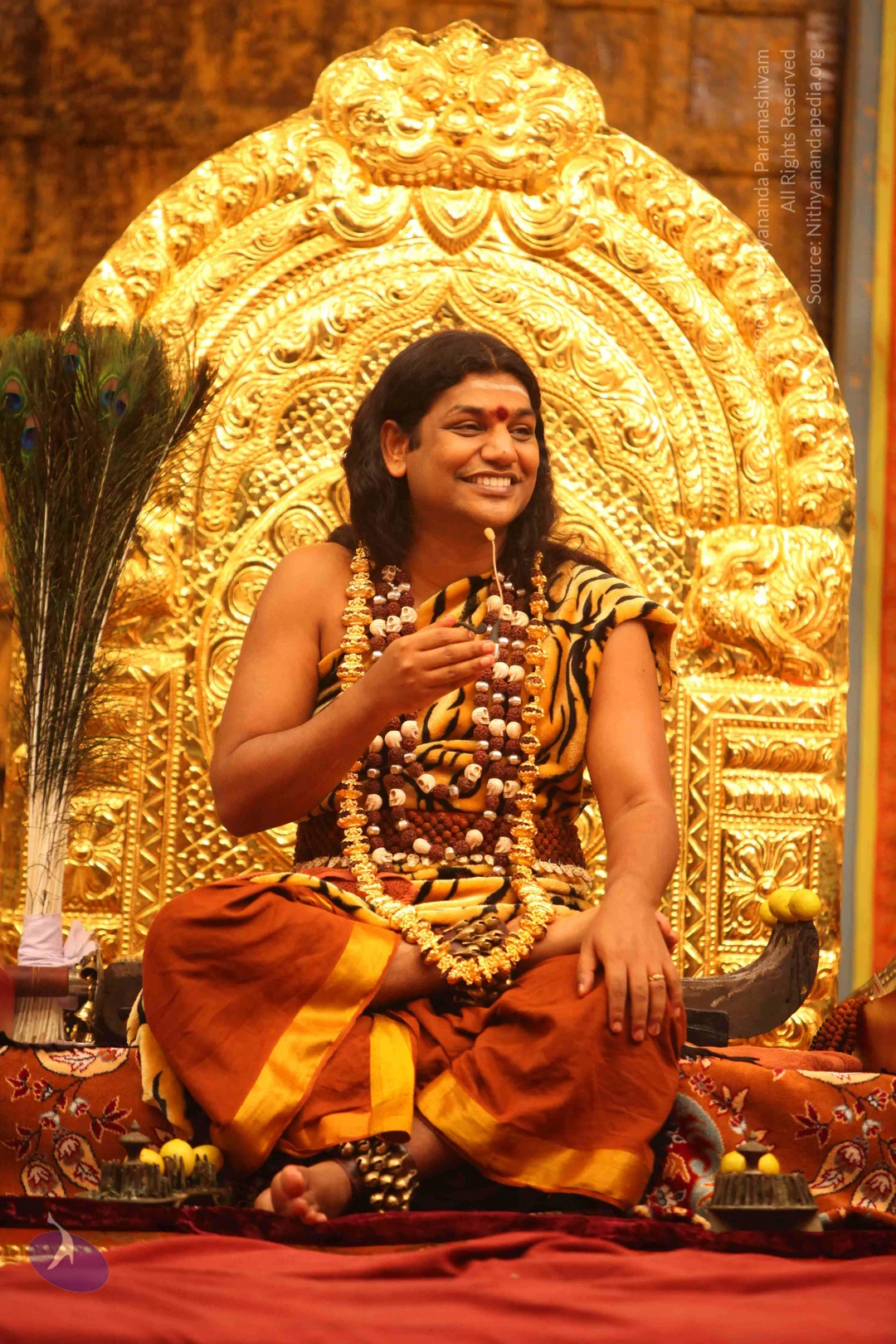
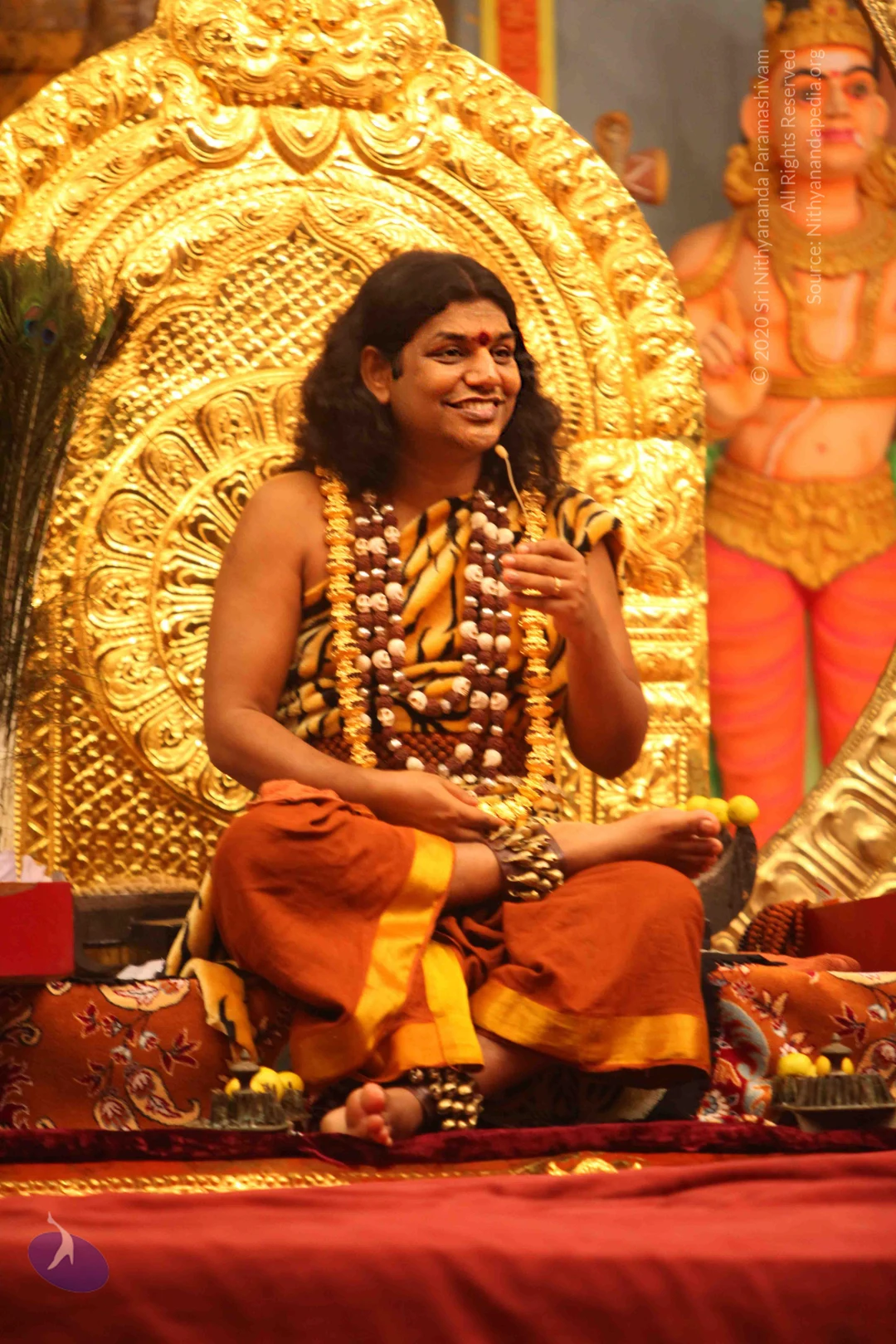
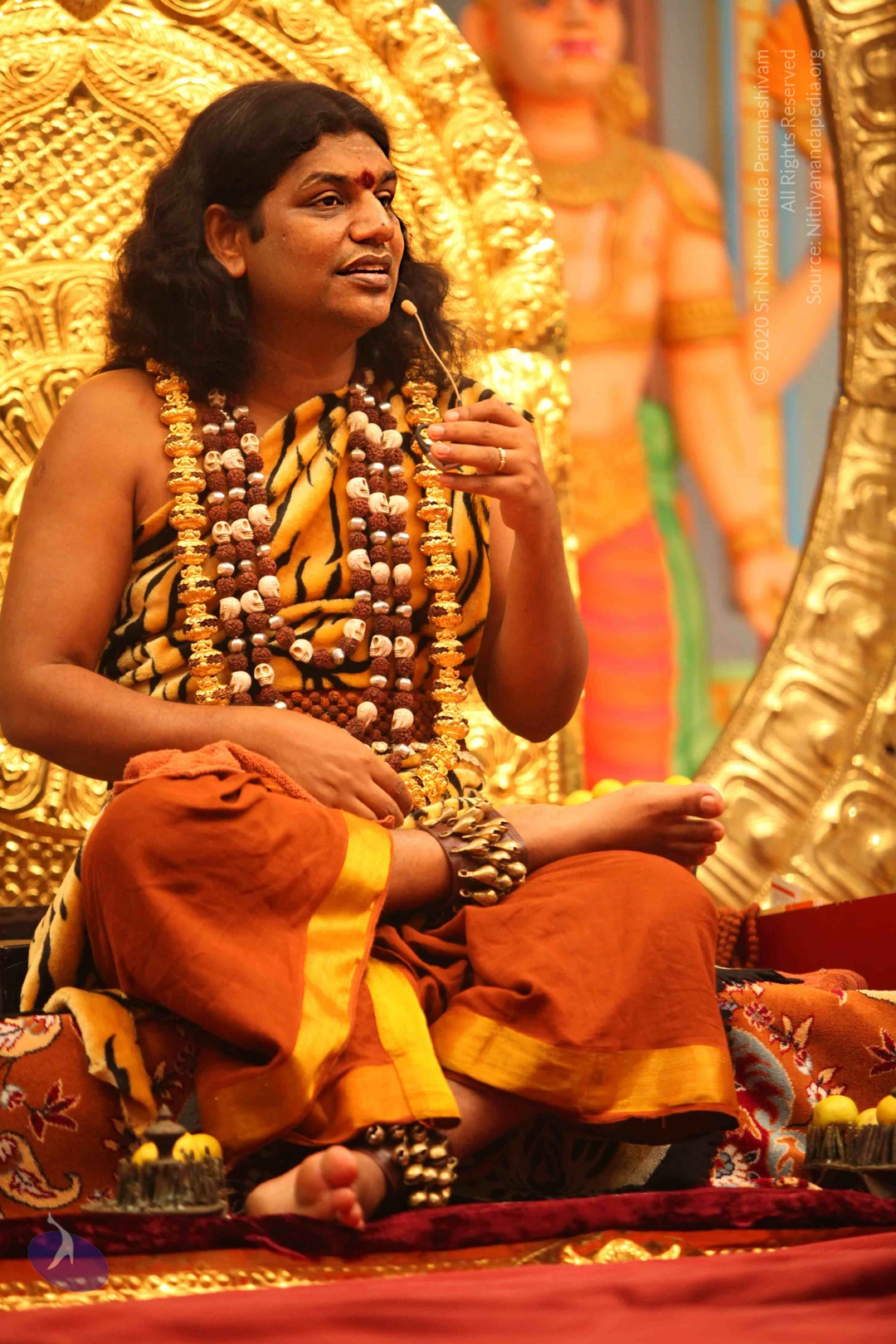
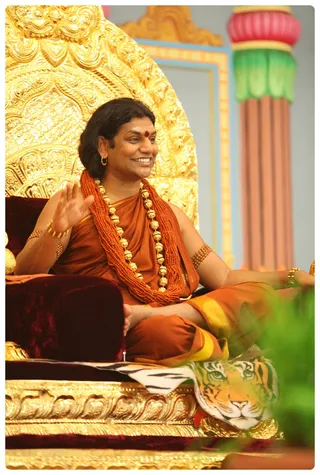
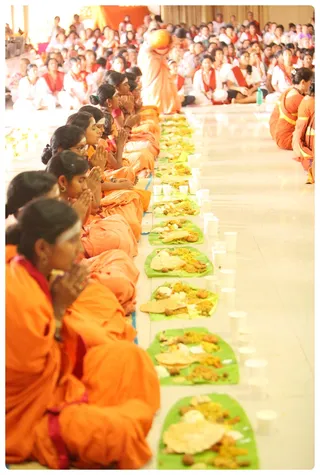
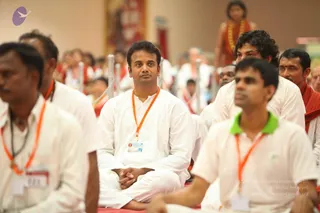
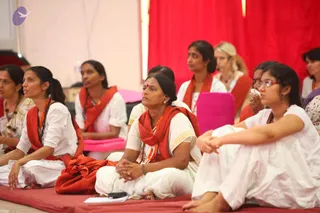
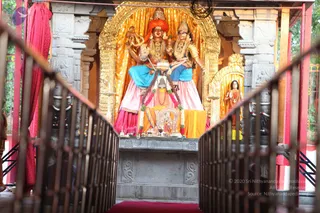
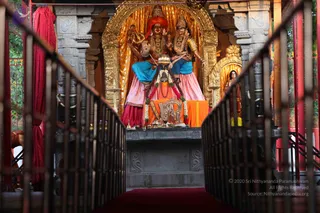
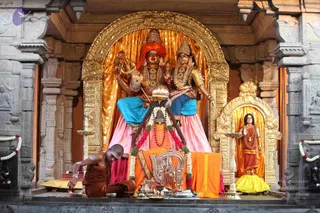
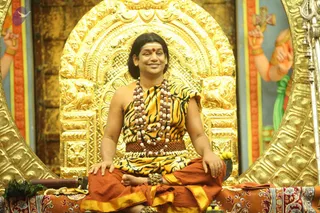
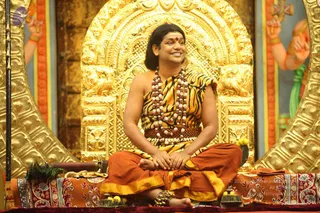
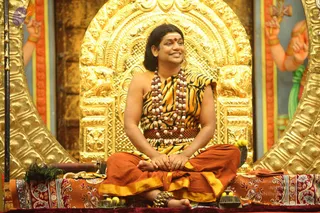
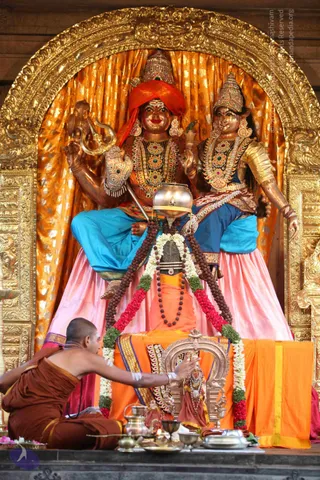
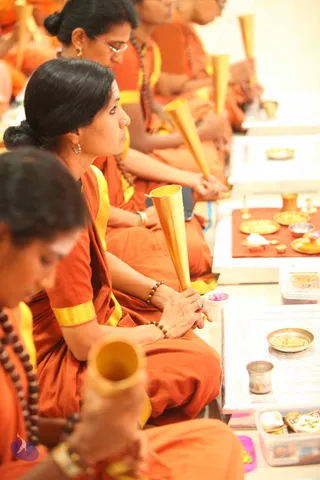
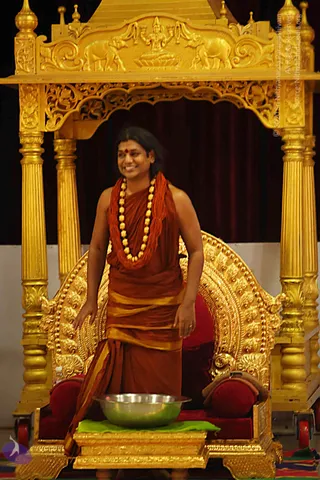
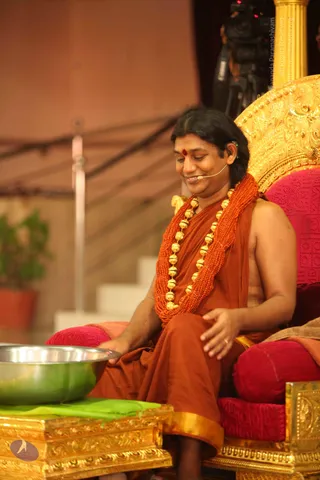
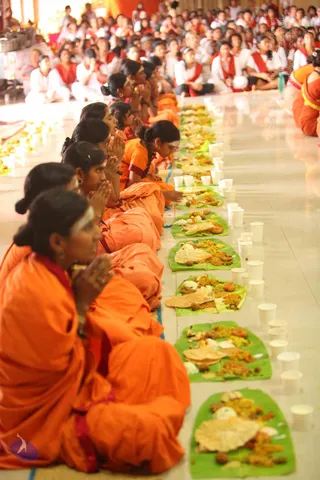
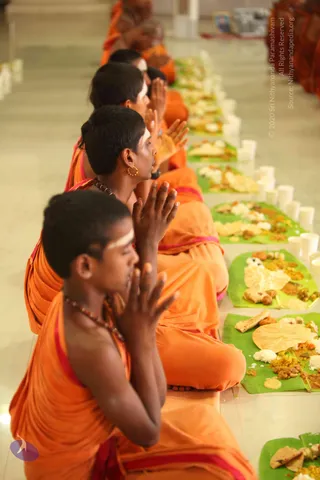
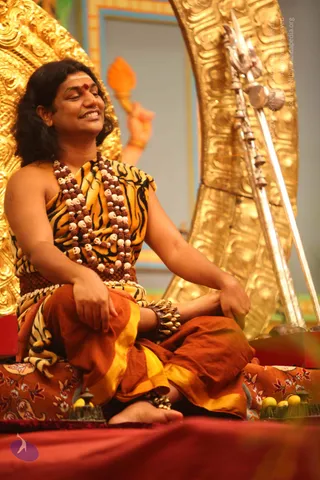
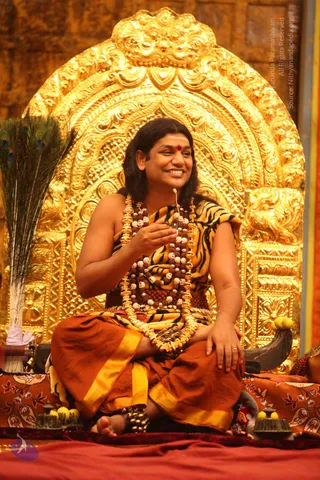
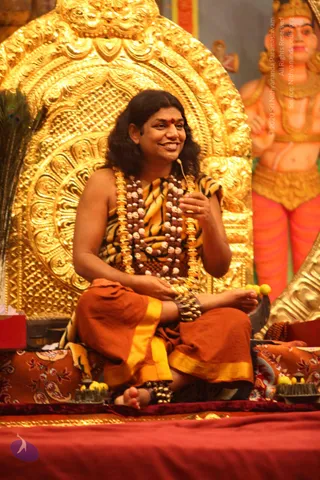
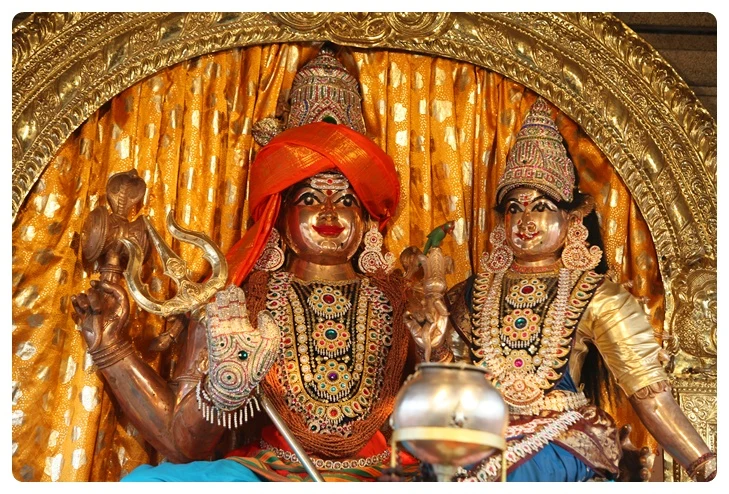
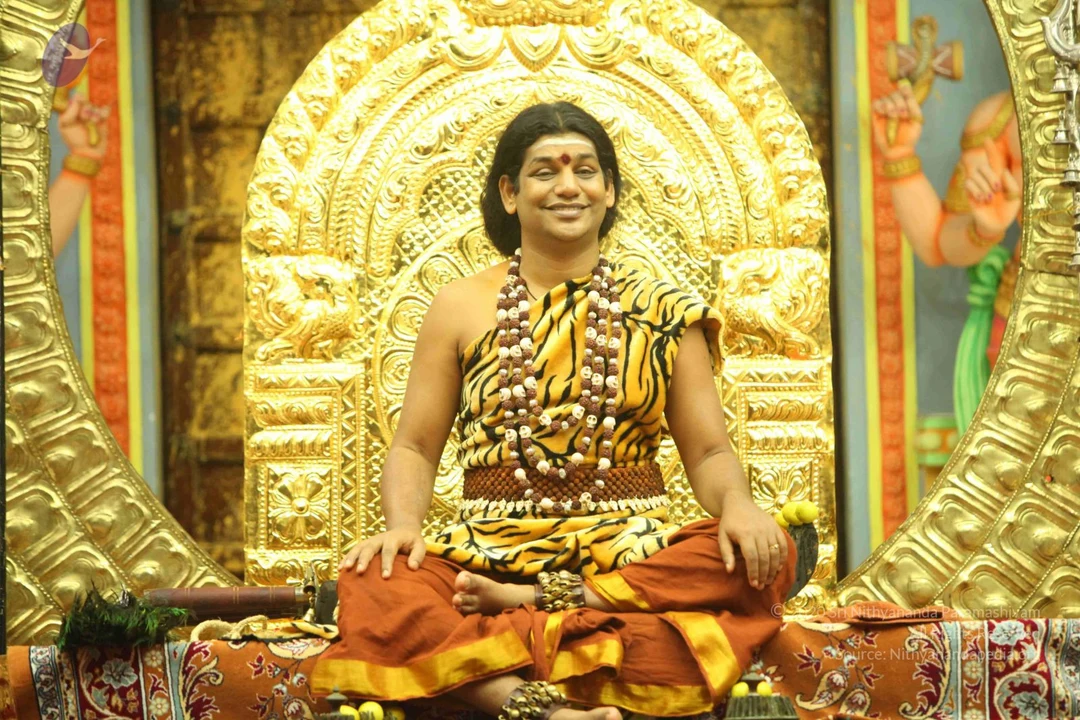
A photograph of a large group of women and girls in saffron and orange saris with yellow and maroon borders, many wearing rudraksha malas and gold necklaces, gathered in an indoor hall. Several standing women at the back raise hands together or hold a small microphone, while a row of seated women and girls in the foreground sit cross-legged on a white floor, some with hands folded. A white room cooler and a standing fan stand at left, and a projection screen hangs at the top. The setting resembles a satsang gathering. No individual is clearly identifiable as a person.A photograph of two ornately decorated metal murti of deities seated before a gold-and-orange draped backdrop framed by an elaborate gilded arch. The murti on the left has four arms, holds a trident, and wears a red turban and a large jewelled necklace; the murti on the right wears a tall jewelled crown, long necklaces, and a gold blouse. A small green parrot perches on the right-hand figure's raised hand, and a silver kalasha-like vessel sits in the foreground. Watermarked archive text appears at the lower right and is omitted.A photograph of a man seated cross-legged on an ornate golden throne with a carved gilded arch, in front of painted panels showing deity figures with raised hands. He wears a yellow and black tiger-striped garment over his torso, rust-orange cloth around his waist and legs, multiple strands of rudraksha beads and white beads, and a bronze-coloured bangle. A red tilak mark is on his forehead, and his dark hair is swept back. He smiles while looking to one side, with one hand resting on his knee and the other open. Ornamented red cushions and a dark feather-like object are at the lower edge.

May 20 2013

Original wiki page
Contents

Title

THE SUPREME PONTIFF OF HINDUISM HDH BHAGAVAN NITHYANANDA PARAMASHIVAM

Description:

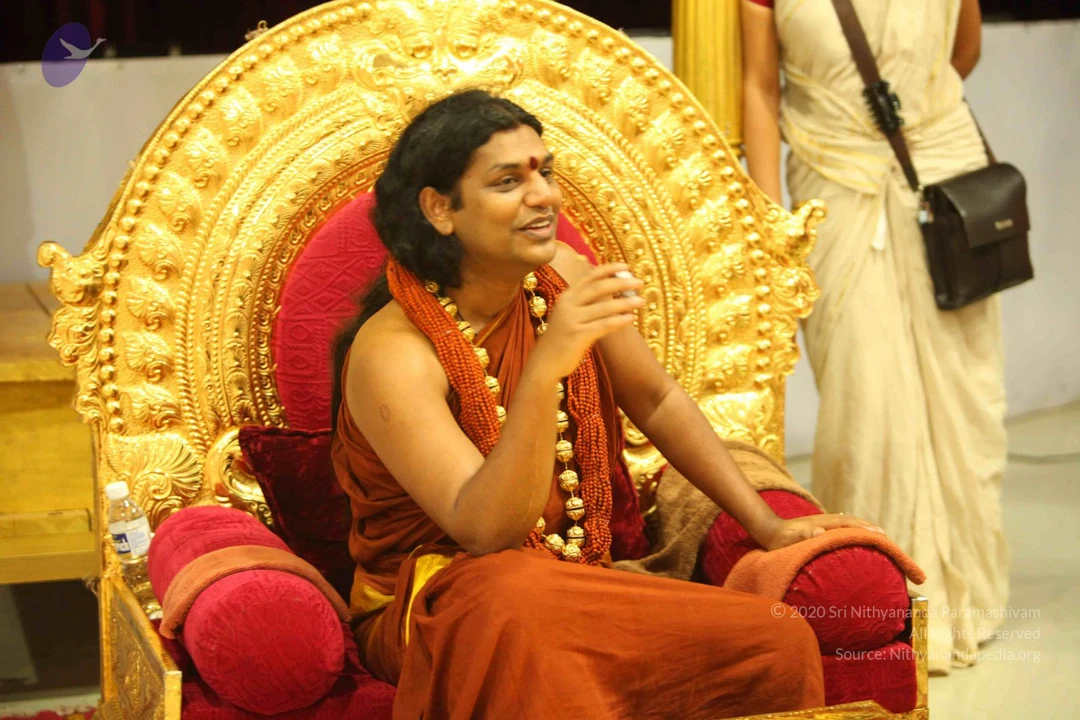
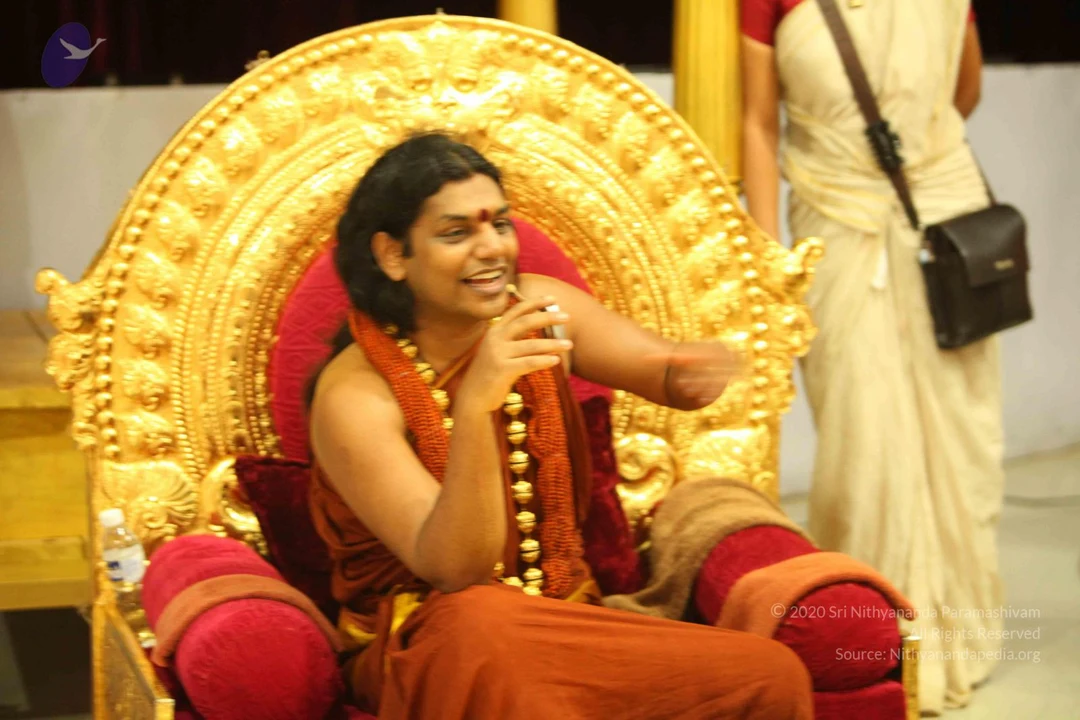
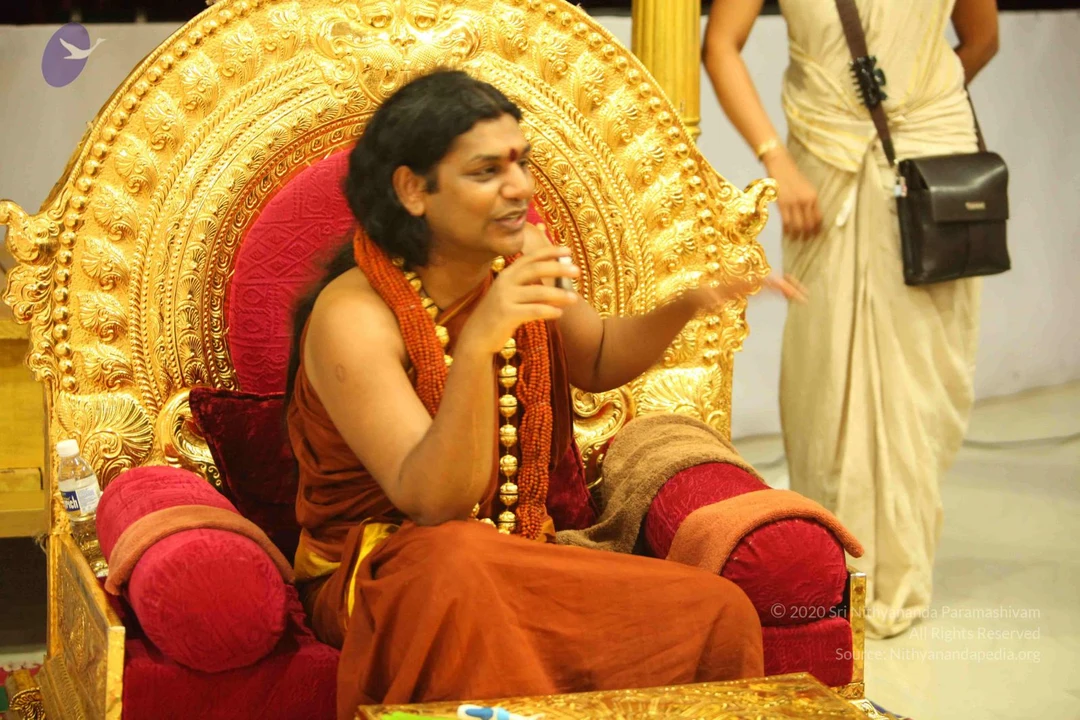
In today’s morning satsang, Paramahamsa Nithyananda clarifies his teachings about karma. Karmas are incomplete behavior patterns which hold us back in life. Once we have completed these patterns, we should share our understanding with others to enrich them. Nithyananda also answers mystical questions. How does it feel when Kalabhairava comes through Him? He says He cannot summon the deity by will but when He surrenders His will, the deity enters like a great flood. Another question asks about different planes of existence. Nithyananda replies that the best planes for us to seek are Possibility, Positivity, Leadership and Enlightenment. Finally Nithyananda speaks on the caste system of India. In reality it is not a social system, it is an internal system. If we run through life in confusion we are Shudra. If we run after wealth we are Vaisya; if we pursue power we are Kshatriya; if we seek knowledge, we are Brahmana. So we can change our caste when we change our inner space.

Link to Video:

VideoAudio

Transcript:

Karma, Relationships, and Enlightenment

I welcome you all for today’s Nithya Satsang. I will continue answering your questions today also for you to practice these four tattvas.

Question: ‘The first question today is from ID No.301, Annamalai, who is asking, “Swamiji, whether Karmas affect our business growth, wealth attractions? After this Inner Awakening can I come out of Karmas and whether the karmas are the truth?’

Swamiji:Annamalai, please be seated. “Swamiji, whether Karmas affect our business growth, wealth attractions? After this Inner Awakening can I come out of Karmas and whether the karmas are the truth?’ First thing, karmas do affect every span of your life. “Karma” means what? Incomplete actions, thoughts, desires, patterns you created for you, and others created for you, is Karma. Listen! Incomplete actions, desires, commitments you created for you and you created for others is Karma. It affects your business, relationships, life, everything, including the wealth attractions. After this Inner Awakening, naturally, you will be out of all Karmas, because you learn the science of completion here. Not only you learn, literally I make you complete…. wait, wait, wait, and see to it that you become complete.

03:15

You are given the science of completion continuously. You learn the science of completion. This whole Inner Awakening is nothing but learning and experiencing completion. You can see the essence of this Inner Awakening is learning and practicing, experiencing completion. Karma is nothing but when you bite more than you can chew what you suffer is Karma. In the life also, many time you bite more than you can chew or swallow. Understand, Karma means completion, completion, completion. If you are struggling with what you are having in your mouth, means, biting more than you can chew or swallow, that is Karma. If you can complete, complete, complete and finish it, that is liberation from Karma, Vikarma! When you complete, please listen, when you complete with your spouse, suddenly your business will start flourishing. You may think how this and that is connected. ‘If I complete with my clients and customers, my business will flourish. That I can understand. How can my business flourish if I complete with my spouse?’ You don’t know! One incompletion can affect you in an unexpected way. If you have incompletion with your morning yoga, it can affect you with your evening vacation. So, incompletion can attack you anywhere, anyway. Understand, with completion you are free, liberated from the Karmas so naturally, your business, your life, relationship, everything expands. Everything becomes prosperous.

08:47

Just by physically bending the body, Yoga, you cannot achieve completion. Just by mentally practicing the tattvas alone, you cannot achieve completion. In modern day, the layers of problems need layers of solution. Your problems are not simple so that the solutions can be simple. You have layers of problems. So you need layers of solutions. If you just have only blood pressure, then you can say, alright, do yoga; that is enough. You have blood pressure due to depression and depression due to blood pressure, and both cause diabetes, and then some phobias, then some incompletions, then some broken relationships, then finally bipolar disorder, and then as if all these are not enough, poverty! When problems are complicated, solution has to be layer by layer by layer, complicated. That is why I am attacking your problems from all sides: Yoga, Kriya, Tattwas, Completion. In all sides attacking! Attacking … attacking your problems from all sides!

11:13

Real completion is not when you are in completion with the other person, but when the other person also comes back to you and completes with you and you enrich the other person with the four tattwas. That is the best thing you experience in your life. Am I right? Whatever is the best thing you experienced in your life, enrich others with that. That will keep on growing in you. If you think food is the greatest thing you experienced, enrich people with food. You will keep on growing food. You will see food is attracted to you. If you think money is the best thing you achieved, enrich everyone to achieve money. Give them the knowledge. You will see you keep on accumulating more and more money. Whatever you think is the best thing in your life. I have experienced in my life Enlightenment as the best thing, the four tattwas as the best thing. I keep on enriching everyone with that. I have everything I need, more than what I need around me, including enlightenment. I can see more and more and more energy, enlightenment experience, everything is happening in me. Keep on enriching. You will see completion happens in you.

14:13

Completion is complete not only when you complete with that person, but that person also learns the four tattvas and comes back and completes with you after finding his or her root-pattern. So, enrich them with the four tattvas. Now, how many of you are completely complete in this Inner Awakening? Raise your hand. Means, with whoever you are completing, they completed with you. If you are completing, they have not completed, it now your responsibility. Make sure they attend the Inner Awakening Level-1 and they find the root-patterns, learn the tattvas, come back and complete with you. Complete! You will see Karmas dissolve, business flourishes, relationships grows, above all, the joy and contentment of completion is with you.

15 - 30 min

Question: The next question is from ID Number 214, Inner Awakening ID Number 214, from Rama Rao, who is asking, ‘I am a farmer. I have some experience in farming. My son is in Sanatana Publishing Organization. He is unmarried. He is 47 years old and does not help me in farming. Then in future, we do not want food grown with chemicals so I do not have time to do yoga, meditation, etc. For people like me, how salvation, moksha can be attained? How can I be enlightened, Swamiji?’

Swamiji: First thing, when you grow food, it can be completion; it can lead to enlightenment. You don’t need a separate time for completion and enlightenment. May I know the devotee ID number 214 Rama? Please be seated. Please understand, growing food can be an amazing way to complete. When you say you don’t want chemicals, food grown with chemicals, you are in Integrity with the food, you are in Authenticity with the food. When you make it, be responsible for the food, enrich others with that same food, you will see you will have wealth. I am not saying freely give away. No! Have the money required for keeping this cycle. But I tell you, even this when it is done with Integrity, Authenticity, Responsibility and completion, you are enlightened! You are complete! You don’t need a separate time. There are millions of stories of farmers getting enlightened in our tradition. Just by enriching others with food, they have become enlightened. So, understand, there is no separate time required, separate action required for completion or enlightenment. Next.

The next question is from Inner Awakening ID No.20, Suzanne Davidson, who is asking. ‘Enriching means, enriching me and others by fulfilling the expectations I have for myself and the expectations others have of me. In the book, “Life Solutions”, expectations are said to create suffering because expectations are based on our perceptions, beliefs and opinions. Can you please clarify the meaning of the word “expectation” as it applies to the four tattvas, especially enriching?’ Let me read the question. Suzanne Davidson? Long question. ‘Enriching means, enriching me and others by fulfilling the expectations I have for myself and the expectations others have of me…’ No! You are wrong! First step you are wrong! Enriching means, not giving upon you. Constantly make expanding you with Integrity and Authenticity, and expanding others with Integrity and Authenticity. It is not fulfilling your expectations or others’ expectations. So, Davidson, Suzanne Davidson, your definition of Enriching is wrong. I have defined Enriching very clearly. Get it now. Second, ‘In the book, “Life Solutions”…..’,

21:05

I don’t know whether I have written any book called “Life Solutions”! Is it my book? No! There is no book “Life Solutions”. It is only “Guaranteed Solutions”! ‘……expectations are said to create suffering because expectations are based on our perceptions, beliefs and opinions. Can you please clarify the meaning….?’ So I think I have very clearly clarified. See, I still stand by the word in “Guaranteed Solutions” ‘Expectations are said to create suffering.’ I am very clear about it. But Enriching is not fulfilling the expectations. In Authenticity you practice fulfilling others’ what you stand for others, what you committed with others, what you made others expect from you. Even for that, finally, you are responsible. So, now I think it is clear. If you understand, both are actually one and the same. Next.

22:13

Question: The next question is from Inner Awakening ID No.223, Anuradha Chary, who is asking, ‘How does Kalabhairava manifest through Swamiji? Is there a process, like puja or meditation, or is it at his will? How does Swamiji feel after Kalabhairava settles down? The darshan is magnificent, electrifying and uplifting! Thank you Swamiji and Kalabhairava!’

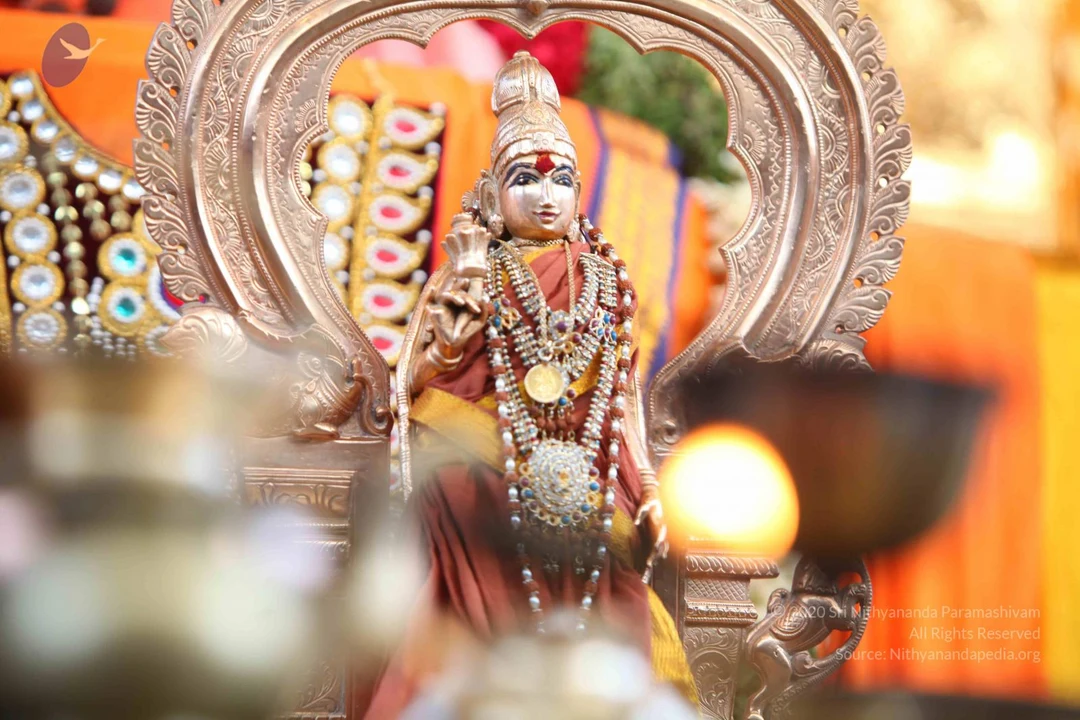
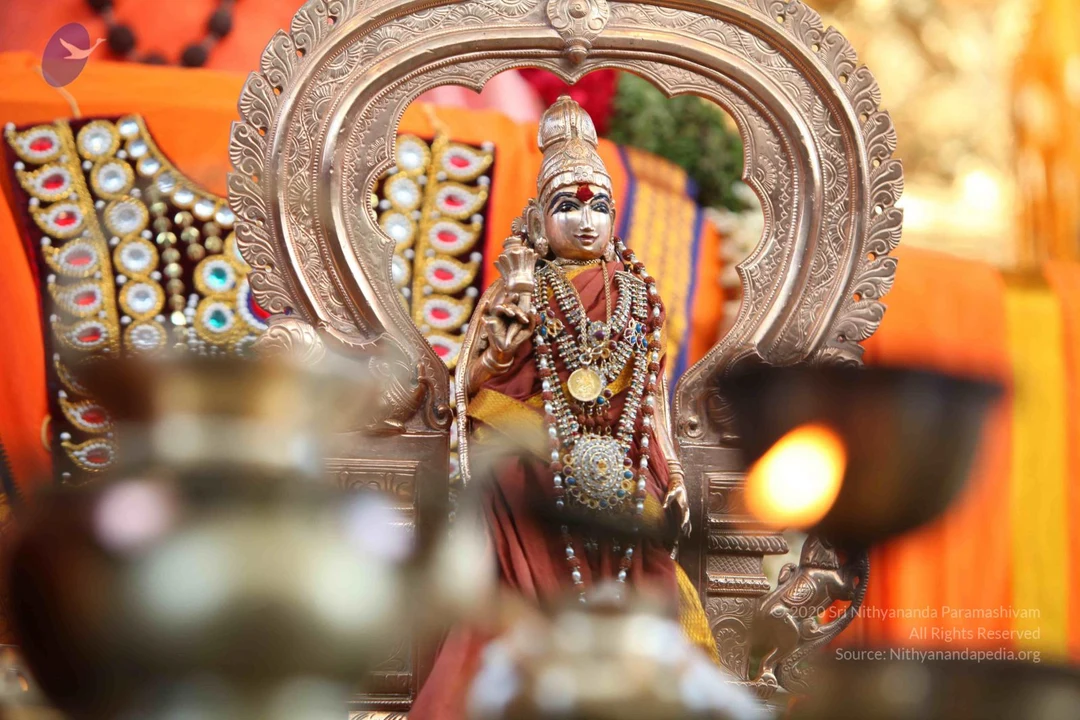
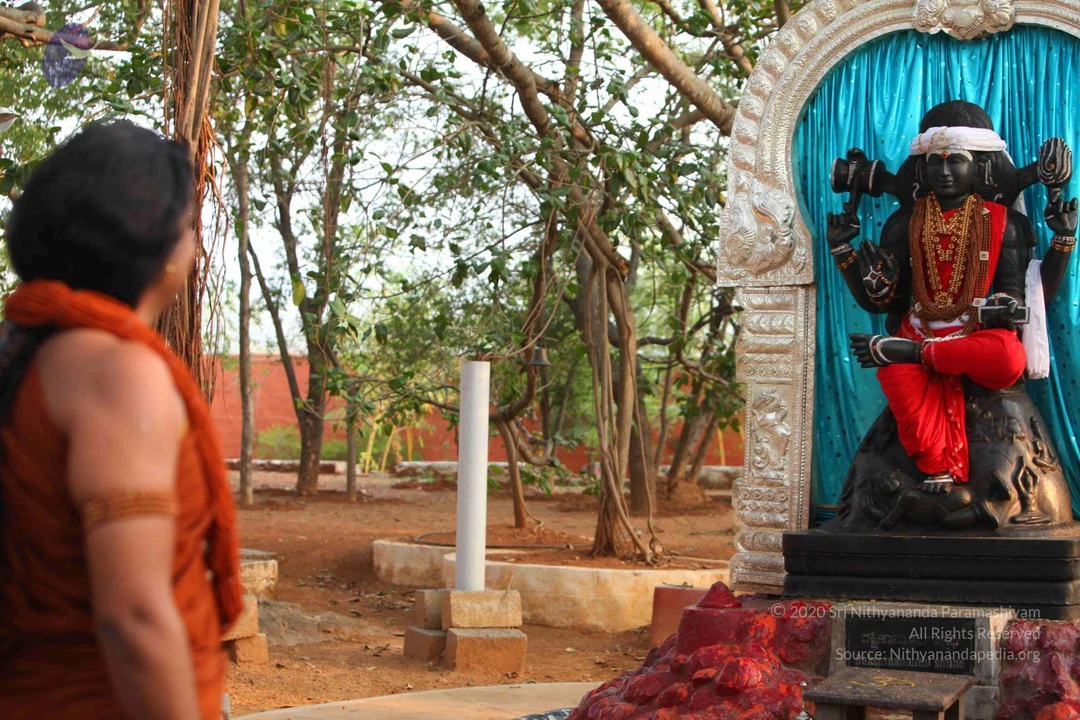
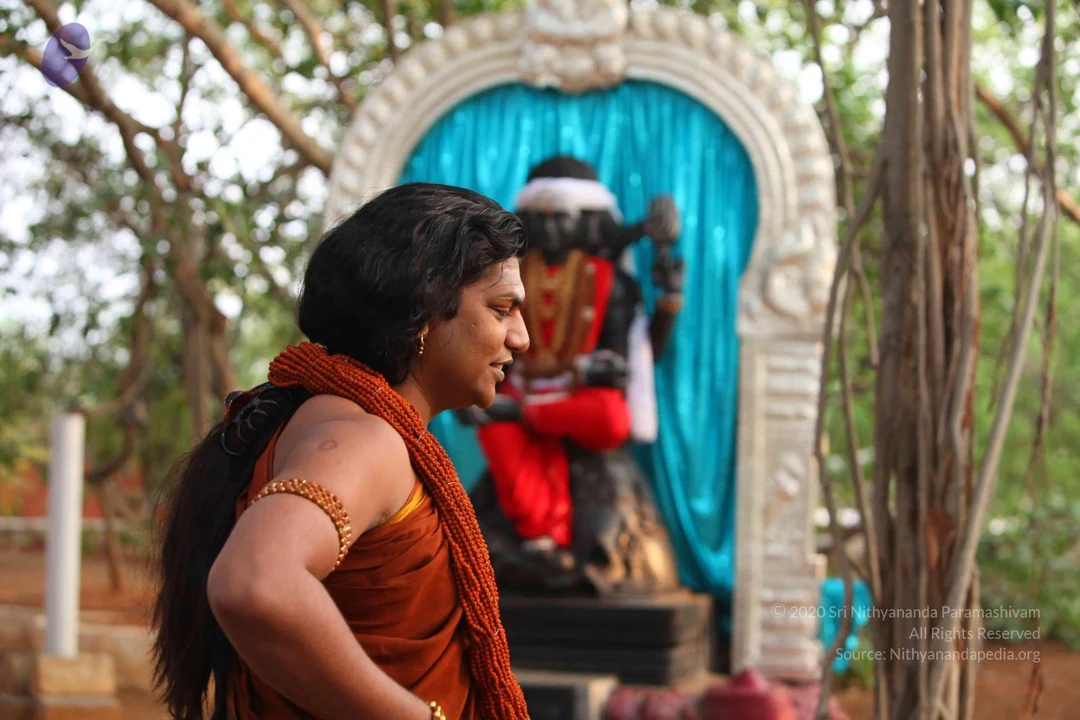
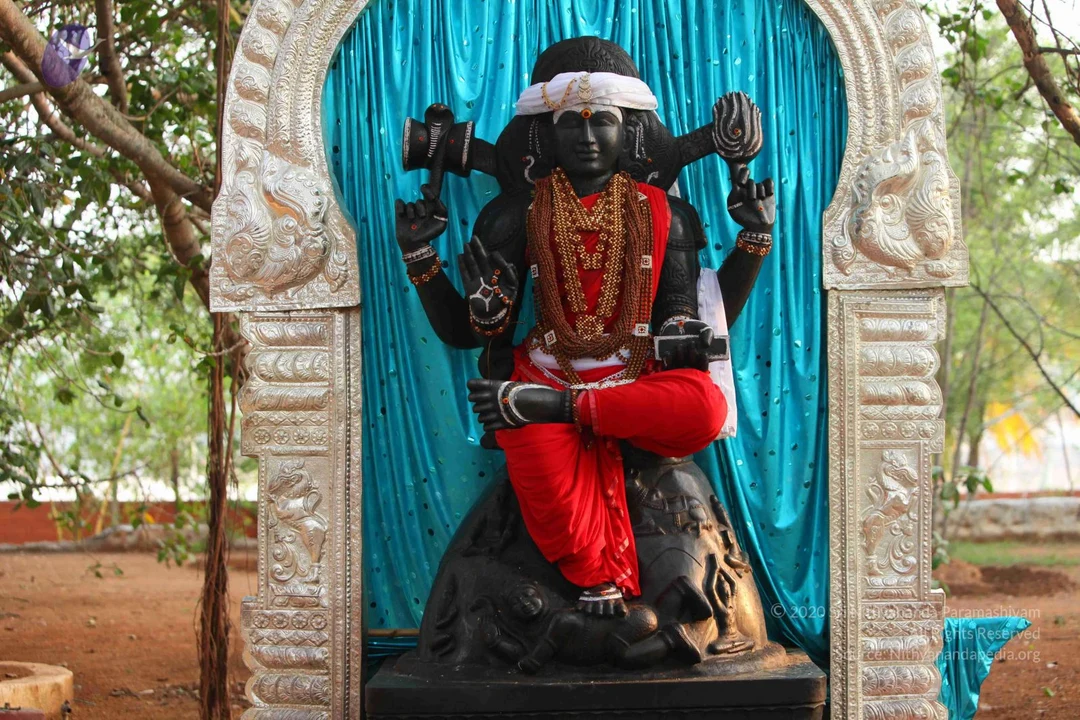
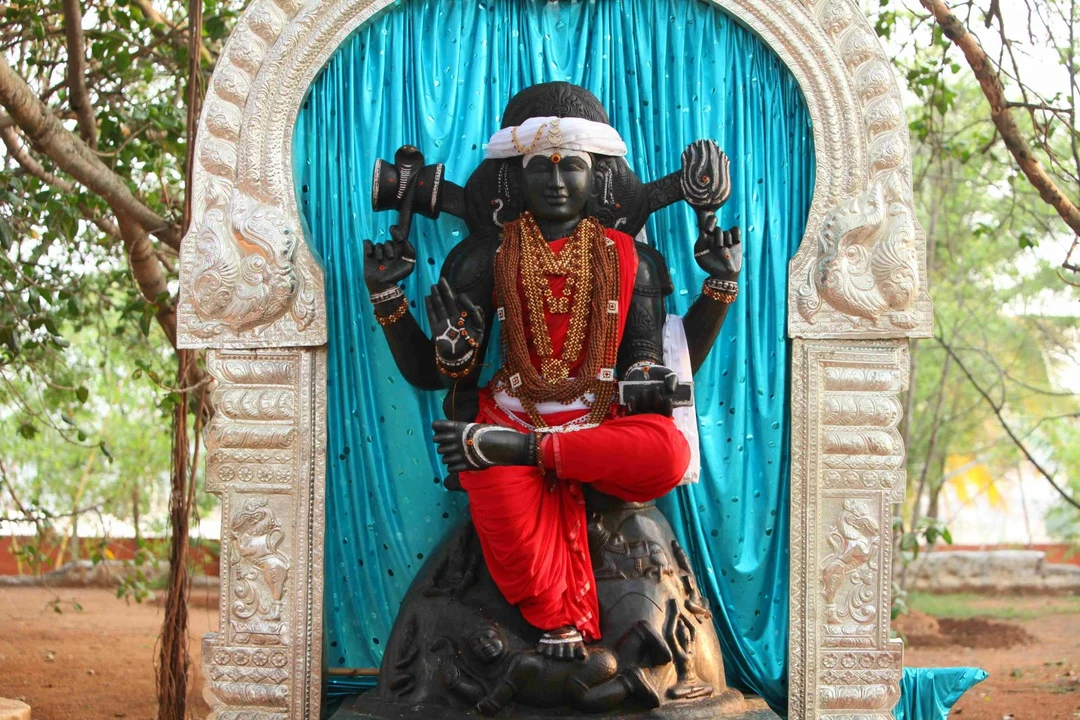
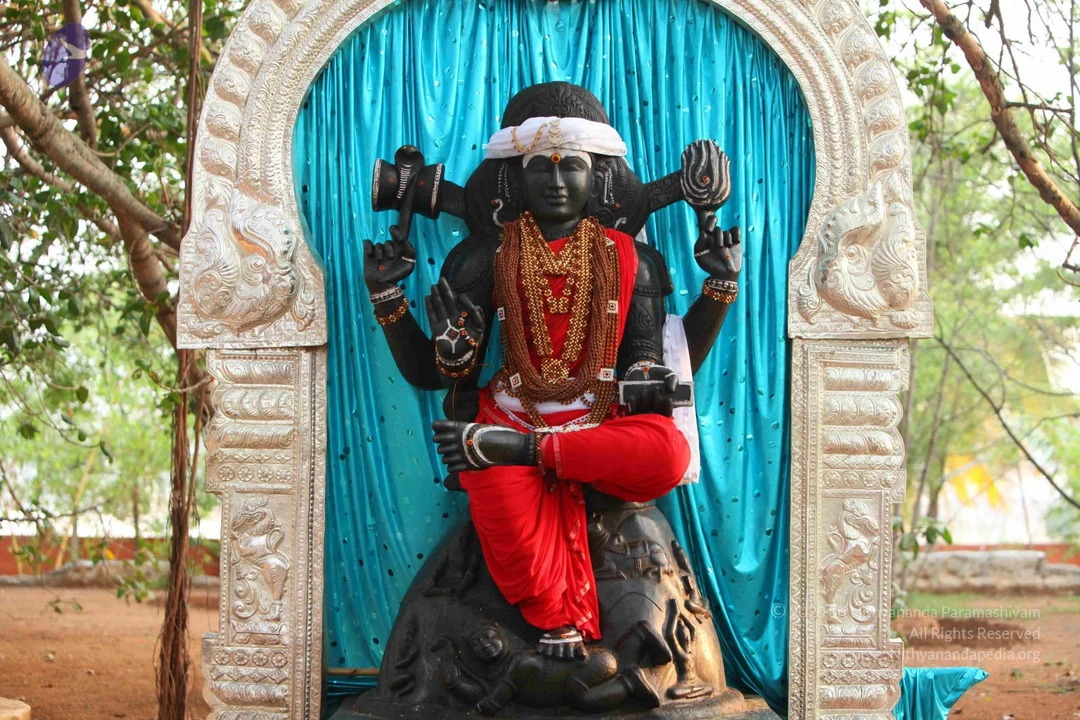
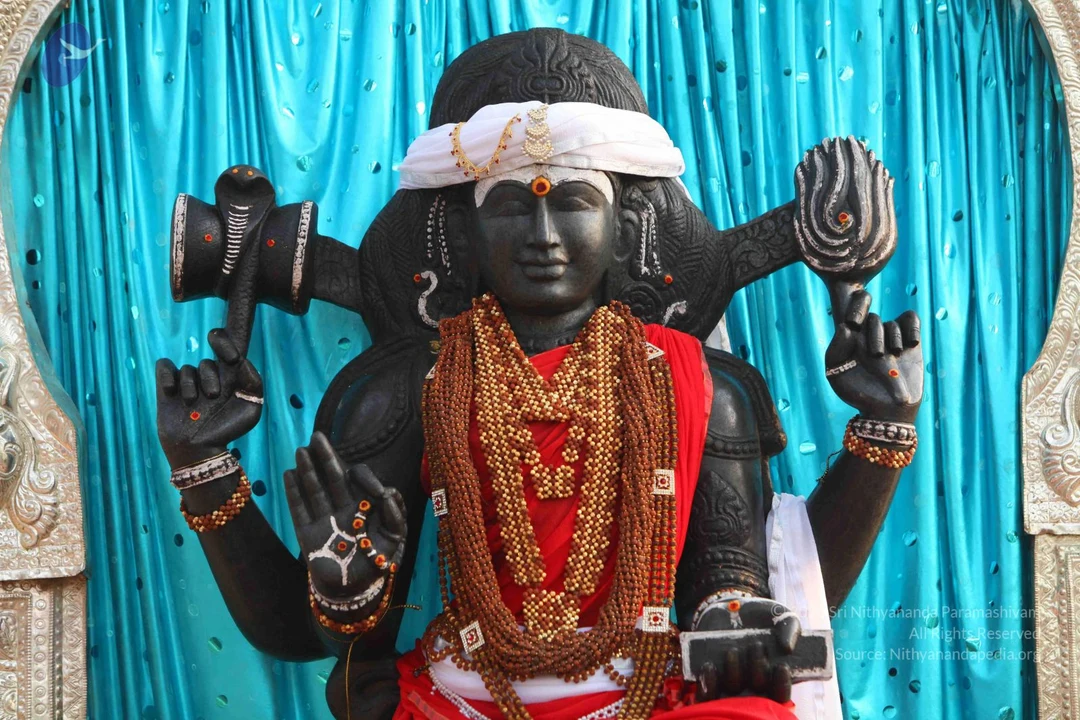
Swamiji: HAHAHAHAHAHAHAHAHA! It is a very mystical question and mystical subject. I am on national TV. But I have decided I will answer this question. Anuradha Chary ID No. 220.. Please be seated. ‘How does Kalabhairava manifest through Swamiji? First thing, is there a process, puja or meditation, or is it according to his will?’ I can say, neither puja nor meditation or according to my will! When my will withers away, he manifests!

24:09

Let me tell you exactly what happens during Kalabhairava’s manifestation. It is like ten-thousand Nithyanandas entered into me! How many of you feel when the Kundalini is awakened the body is uncontrollably moving? Raise your hand. All of you can understand what I am saying. When the Kundalini is awakened, due you feel somebody else has entered into you? Nobody else has entered into you. But you feel you are not able to control your body. You are just floating in the ecstasy. You don’t know where your hands are, where your legs are, what to catch, where to catch. You are just in high frequency. Same way, I can say, when Kalabhairava manifests through me, the Cosmic Kundalini is awakened! It is like ten-thousand Nithyanandas entered into this body! I don’t do any puja or meditation or anything. Just I say, ‘Come on! Let me be the space now for Maha Kalabhairava!’ Simply, like a dam opened, He is there! ‘And how does Swamiji feel after Kalabhairava settles down?’ This is the next part of the question. I feel like a huge flood has settled down. After a huge cyclone how do you feel? The PEACE….! That is exactly how I feel. In PEACE! An extraordinary joy! See, when Kalabhairava lands, not only me, the whole presence, the whole breathing space, the whole hall, I can see the amount of joy he brings. Even if your question is not answered, the amount of joy he adds to the whole sabha, the whole being! How many of you really acknowledge what I am saying, cognize what I am saying? That’s it! It is a huge, huge and...It is a unexplainable, inexplicable! It is! It is! It is what it is! She also says, ‘Darshan is magnificent, electrifying and uplifting! Thank you Swamiji and Kalabhairava!’ Of course, you have to thank him. I am only the instrument he is using. Next.

29:34

Question: The next question is from Inner Awakening ID No.284, from Brendon. He is asking, ‘In Yoganandaji’s “Autobiography of Yogi”, Shri Yukteshwarji visited Yogananda and told him of the various astral planes and different planets. Swamiji, what is your experience with this?’ Brendon. He is asking, ‘In Yoganandaji’s “Autobiography of Yogi”, Shri Yukteshwarji visited Yogananda and told him of the various astral planes and different planets. Swamiji, what is your experience with this?’

30 - 45 min

Swamiji: Whatever Niteshwar Ji says, is completely truth. Its 100% truth and my experience is also same. Only thing, I wanted to add, tell you, as on now you don’t need to worry so much about the planes, planest, planes. Establish yourself in enlightenment. Establist yourself in the space of positivity, possibility, leadership and enlightenment. Whenever required, the other planets & planes beings, they will come and visit you.

They will come and visit you for darshan, for blessings, for healing. Do you thing 310 inner awakening participants, you guys are sitting here and having kalabairava darshan. If you think only you guys are sitting and having Kalabhairava darshan, you are wrong. Hundreds, hundreds of siddhas, yogis, rishis come and have darshan, get their answers in their language. Each kalabhaira’s laughter is an answer for those beings. They receive the answer, enjoy the presence. So understand, when you are established, those beings come to have your darshan, blessings, counseling, guidance and everything. Next

Question: The next question is from Inner awakening id # 225, from Devendra saying Sawmji, How to complete with relationships where I had anyakara for them in the past, but don’t have any anyakara now, while they still have anyakara of me in the present.

Swamiji: Make them understand, I had anyakara and I dropped it. So slowly you also drop your anyakara about me, for me. Devendra, I know exactly what you are asking. Please be seated. Make them understand, you won’t be able to fulfill their anyakara about you. You did not fulfill my anyakara, even the commitment you gave me, you did not fulfill. Same way do that. But I am complete. I have no problem. But usually, when you give a word to the master, even if I am complete, when you don’t fulfill, you will never be complete. Because that’s the deepest relationship. The deepest relationship you can’t afford incompletion.

Make them understand, you will not be able to fulfill their expectations towards you. Take responsibility of making them understand without leaving incompletions with them. Don’t leave incompletions with them. Take responsibility, you can be successful. Next

Question: The next question is Inner awakening id # 39, Kirupanandan who is asking “when we finish inner awakening can I levitate and do healing,

Swamiji: Kripanandan, you can do healing. Please be seated. You can , but I myself can directly tell you, regarding levitating, you also need to co-operate. From today, we are starting the process for levitation. You also need to imbibe these tattvas very strongly. From today, every day, during energy darshan, you will be doing a special process called Shakti dharana, which will help to to awaken and experience the kundalini awakening in the form of levitation or even teleportation, means receiving Vibuthi or KumKum in your hand or something like all this way. So, understand, when you complete the inner awakening, you can do healing. I will put it in this way, when you finish inner awakening you can do healing, when you complete inner awakening, you can levitate also. Healing is directly in my hands, you don’t have to take any responsibility. I can straightaway give as a gift. That is why, I can take it away from you also. It is in my free will. But levitation, you also need to co-operate, same way, once you start, I cannot lock it. Even I cannot take it away from you. So anything which you are also responsible, Even I cannot take it away from you. Next Question

The next question is from Inner awakening ID # 135, Jailalitha, saying Swamiji, “ you’re born for Hinduism, what about casteism, why in India there are lot of castes. I don’t know all the names also. But why there is a waste/ reservations. Why is there big caste and small caste. You are telling, Hinduism is unique, Bramhins feel they are great. Reddy’s feel they are great, Kumba’s feel they are great, Kamma’s feel they are great. What about all other castes. When will casteism be destroyed.

It’s a very sensitive question. But I will answer. Who is the … Lalitha, please be seated. First thing you need to understand, Let me read the whole question. Swamiji, you are born for Hinduism, What about casteism, First thing, you should be very clear, I am born from Hinduism, but I am born for the world. Not for Hinduism, So you need to correct. I am born for the whole world. You are asking, what about casteism. This subject needs to be analyzed, with more sympathy and compassion than Marxists terrorists, Commie medias and pseudo secularists, militant missionaries and missionary militants. Don’t look at the caste system from their view. I am dead against the discrimination based on caste system – somebody is high, somebody is low. No! I am dead against! But I am not against the caste system itself, understand!

You are asking, ‘Why in India there are a lot of castes?’

May I know you are from which country? India? (Lalitha replies that she is from Hyderabad, India). Oh, you are from India only! You live in India? You live in India only! That is why you don’t know! Go to any country, you will see the caste system on the wrong scales.

Listen! In the U.S., night you hear the calling-bell sound, you go and peep through the peep hole. A small glass will be there on every door. What do you call that hole. Key Hole, No! there will be lens, see lens, No, not the key hole, Peep Hole ! You peep through the peep hole, If you see a man, white skin, fair-complexioned, and with a good suit, shoes, trim, handsome, how you will react? Or a dark guy, fat, unshaved, standing, how will you react?

Understand, there is no civilization where there is no caste system. When you see a black guy in the night, you automatically assume he is going to be attacking you. He is there for the wrong purpose. When you see a white guy in the night time, automatically you assume he isl not be there for wrong purpose. He may be asking for shelter.

Understand, by nature, human-beings are animals which forms their own group. Why? Get into the flight. Walk through the first-class to go to economy. The fellows who are sitting in the first-class, how they look at you? Is it not casteism? No Brahmana would have looked at any Shudra in India in such a cheap way, the way the first-class passengers look at the economy class passengers! Especially in the international flights!

So, understand, in all countries casteism is there. Now in the modern day, in metropolitan cities like Hyderabad, Chennai, Bangalore, the apartments are there. A-level, three bedroom apartment; two bedroom apartment, single bedroom apartment. In one complex, three different towers will be there. The single bed-room apartment residents, how they are treated by the three-bedroom apartment residents, do you know? How many of you are cognizing what I am saying? Then What ?

Understand, the western civilization casteism is based on money. In India, in Hinduism, casteism was created based on knowledge. But even then, I don’t agree any reservation. I don’t agree any reservation. I neither agree reservation for Dalits, nor agree reservation for Brahmins or Acharya Mahamandaleshwar post.

Finally, I decided, requesting them to change the constitution. They all decided. I agreed. I am dead against all reservations. Reservation is nothing but the outcome of vote bank politics. It is just vote bank politics.

Why is there big caste and small caste? No! There is no big caste and small caste. So understand, it is individual, individual, individual who lives, he is responsible for caste. I tell you, caste comes by the action, not even by the birth. There are many so-called lower castes. I tell you, Caste comes by the action, Not even by the birth. There are many so called lower castes. Their statues, deities are worshipped every day by the great Brahmanas in all temples of South India. Nandanar, Thiru Neelakanta Yazhpanar, all of them were so-called untouchables when they were in the body. Now their statues are touched by the Brahmins!

So, in Hinduism, caste was never based on birth. It was based on the life they lived. It’s based on the character. It’s based on the character!

45:00

• If you are a person running in confusion without direction, you are a SHUDRA.

• If you are a person running towards wealth, you are VAISHYA.

• If you are running towards power, you are KSHATRIYA.

• If you are running towards knowledge, you are BRAHMANA.

That’s all. Your goal decides your Gotra, not the hole from which you came out. Your goal decides your Gotra understand?

0:46:01 Hindi - 0:47:05

Understand, I neither agree with the commie Marxist terrorists, militant missionaries, missionary militant views about casteism, nor agree with the discrimination based on the casteism. Caste is based on your mental set-up, the responsibility you take it up and there is no high or low.

Next.

Question: The next question is from Inner Awakening ID No.177, Catherine Parson, who is asking, “Is it true that once you get enlightened, all the generations above you become enlightened?’

Swamiji: Catherine Parson, Catherine Parson? Yes please be seated.You are right. Once you get enlightened, seven generations above you become enlightened they are liberated because the power of your completion reaches seven generation immediately. Immediately all seven generations are suddenly relieved from the load of Karmas, load of Karmas, and they are enlightened. They are enlightened. They are liberated.

0:49:16 Hindi - 0:49:25

Next question.

Question: The next question is from Chin Guan ID No.48 who is asking, ‘ Dear Swamiji, once the person passed away and the soul left the body for the next birth is it good to donate the body for medical research or the good organs for the present ready life? By doing this is it going to help the person achieve completion in present life and liberate the soul in achieving enlightenment?

Swamiji: First thing, if he is an enlightened being, preserving the body intact will be the best thing for the planet earth, because it will radiate so much of energy. If he is not enlightened, you can donate the organs and give the body for research that will be the best thing you will do for society. If you are not enlightened donating the body is the best way to last enriching, the ultimate enriching you will do for the world. If you are enlightened, keeping the body intact, either in the Samadhi or Jeeva Samadhi, is the best thing you will be doing to the world, because the body will be like a atomic power station continue to radiate energy and help human-beings continuously. That is why in Hindu tradition, only enlightened beings’ samadhis are protected, means, enlightened beings’ bodies only are kept, tombs are built and worshipped, or their body is left in Ganga, so that Ganga itself becomes eternal energy. That is why, I say, Ganga has at least one million enlightened beings’ bodies.One million enlightened beings’ bodies. So enlightened beings’ bodies should be protected, safeguarded, so that they continue to radiate the

energy. If not, the body can be cremated or donated for medical purposes nothing wrong it will only help that will only be the enriching of the society.

So, understand, in Hindu tradition we don’t have a standard policy about whether to cremate or bury. It depends on the person’s life. 0:52:52

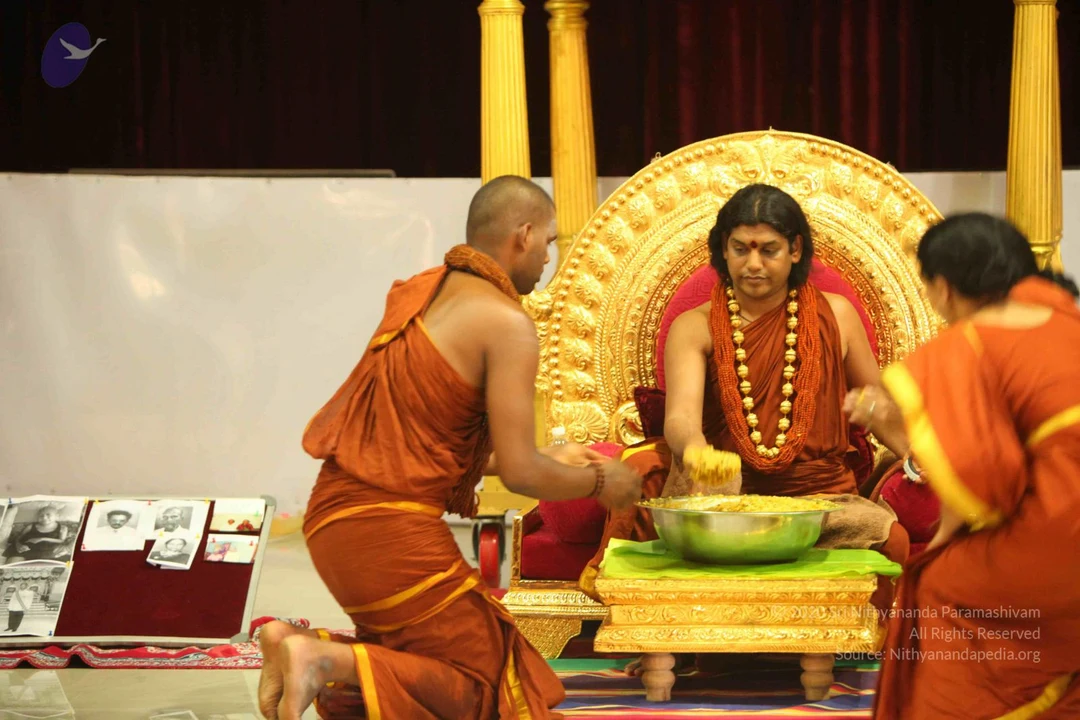
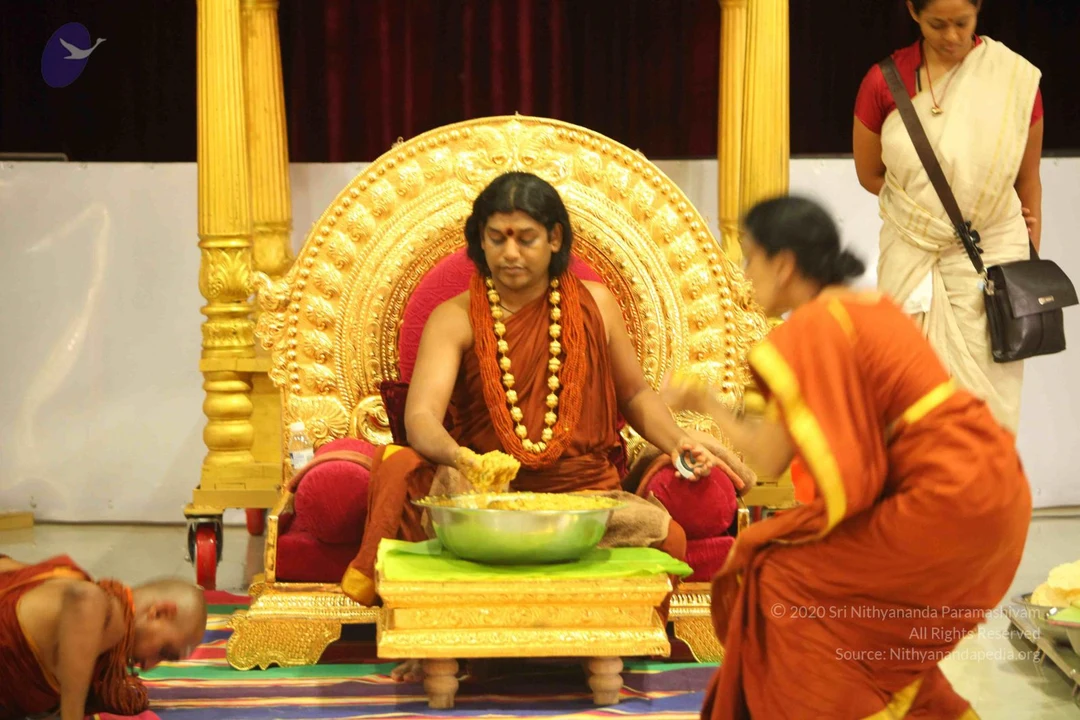
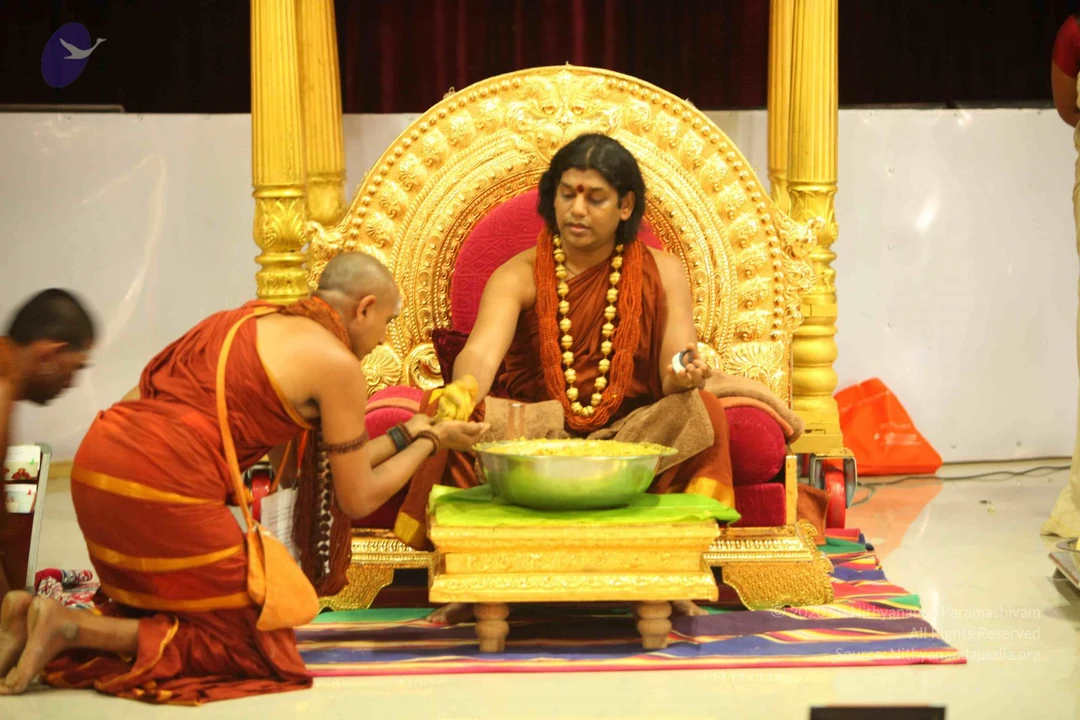
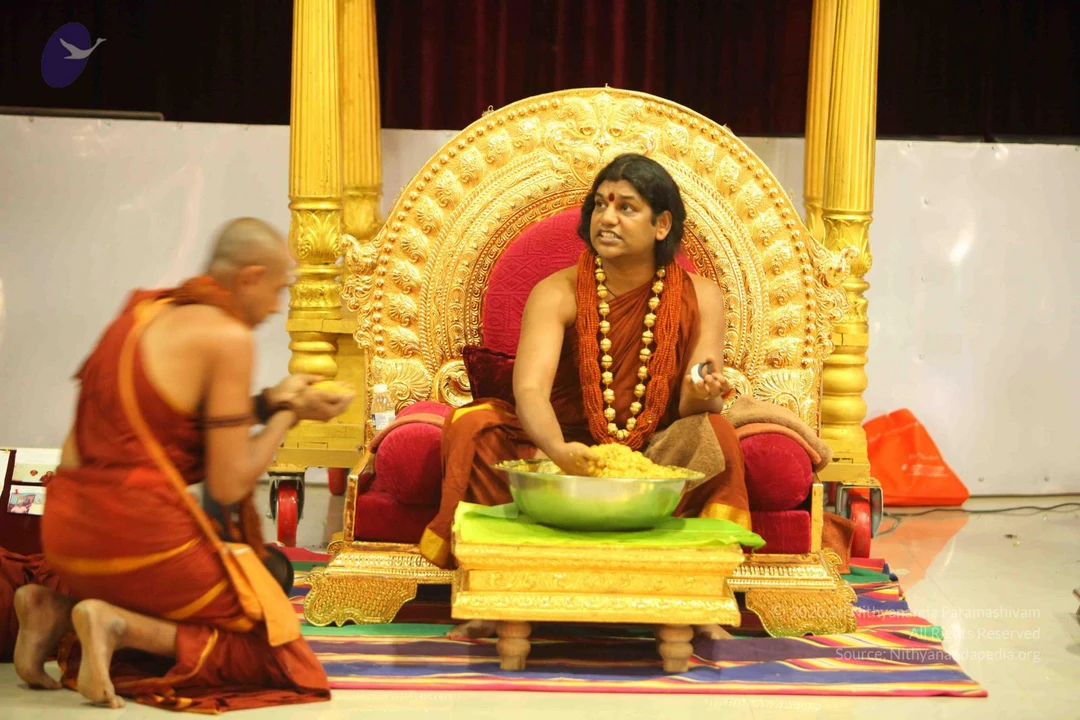
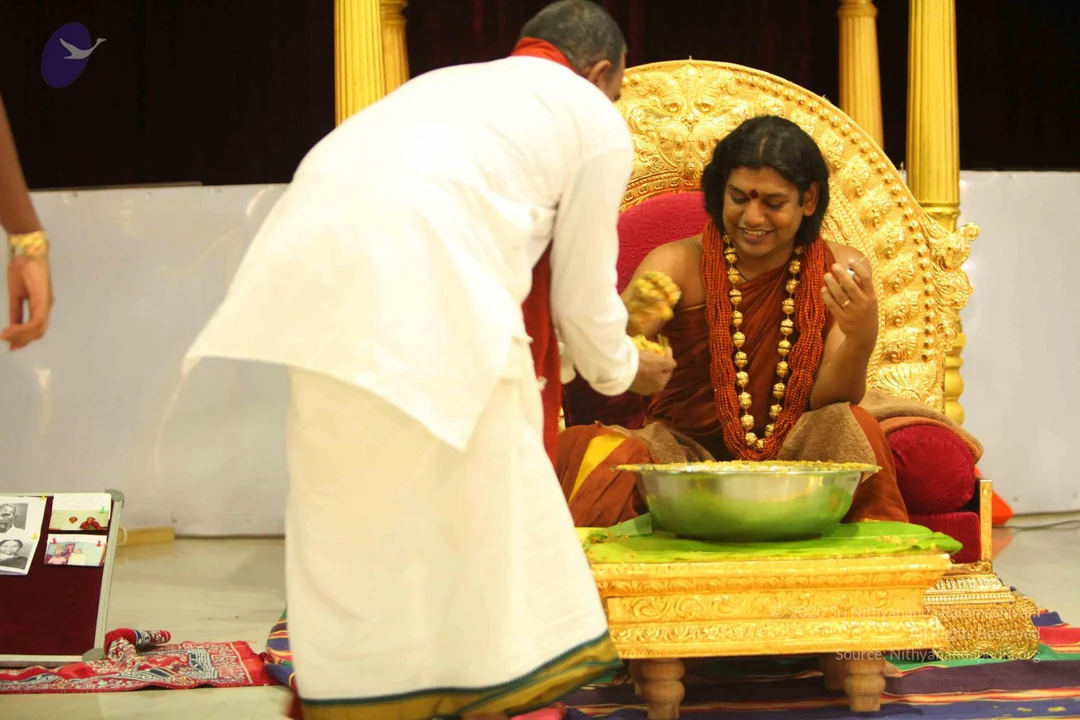
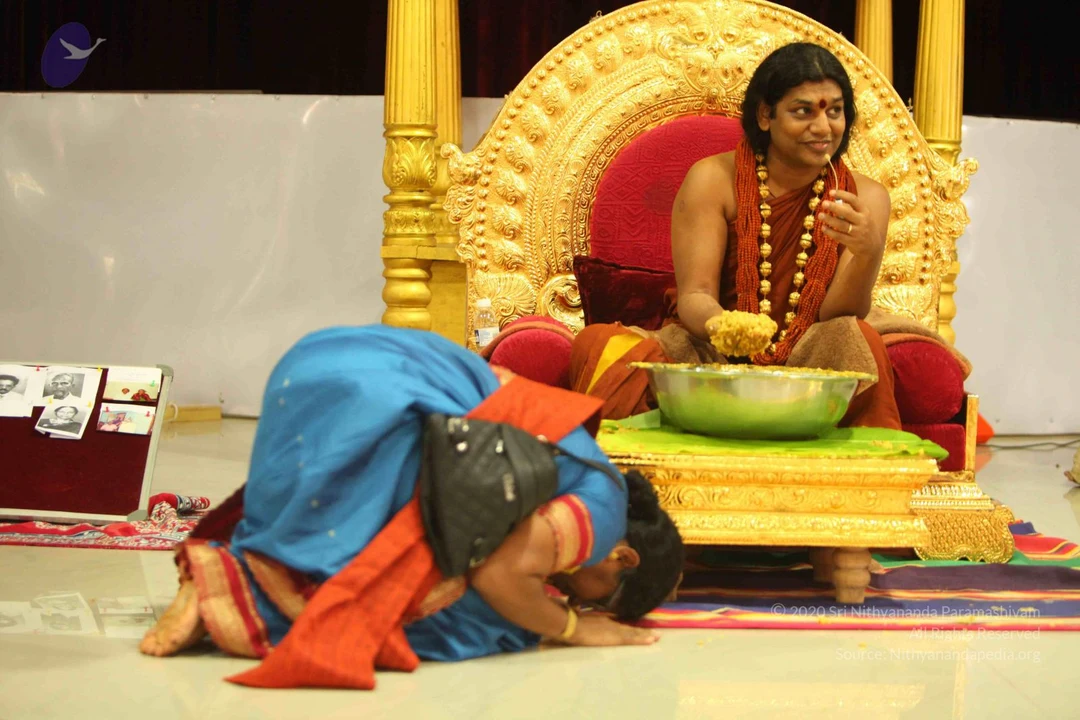
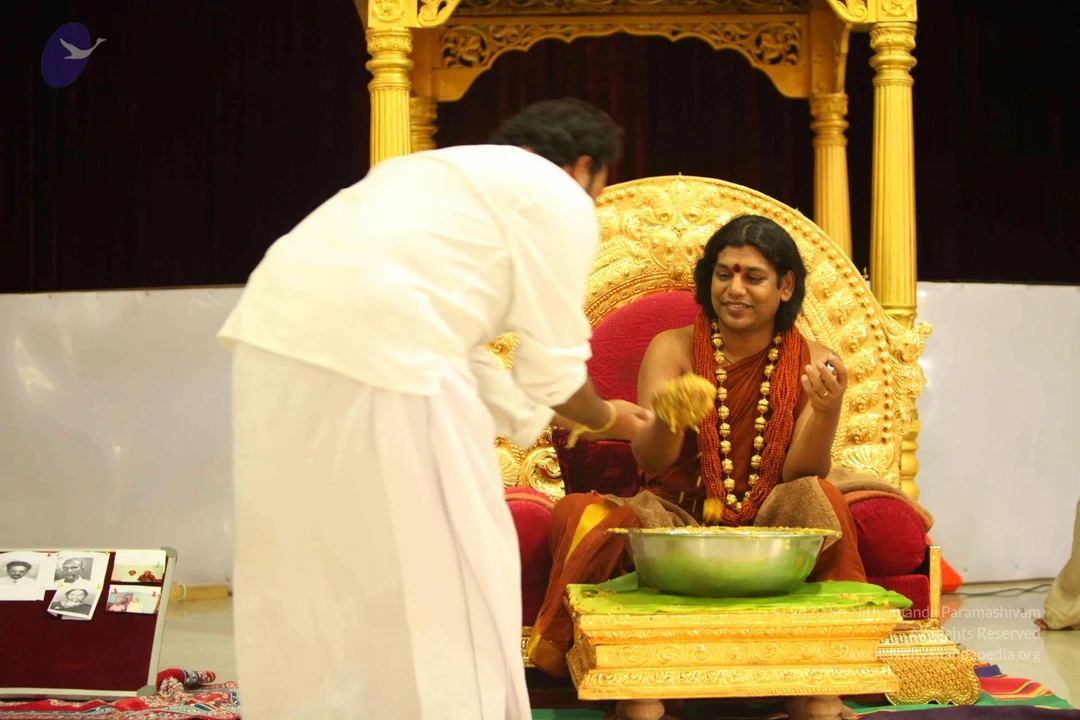
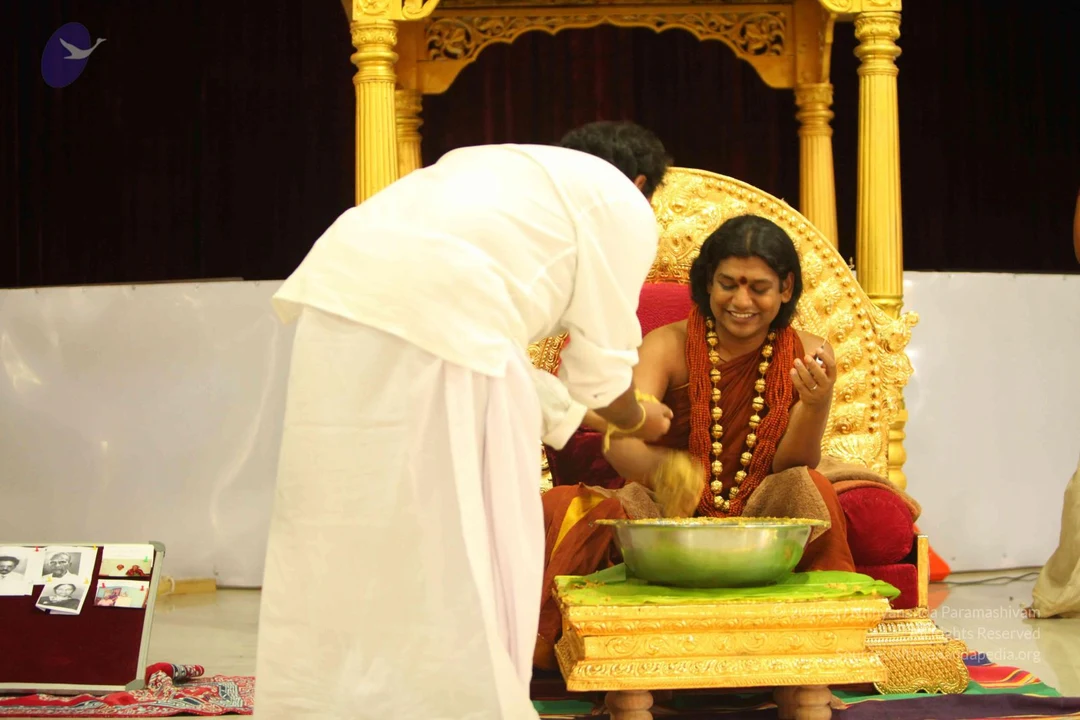
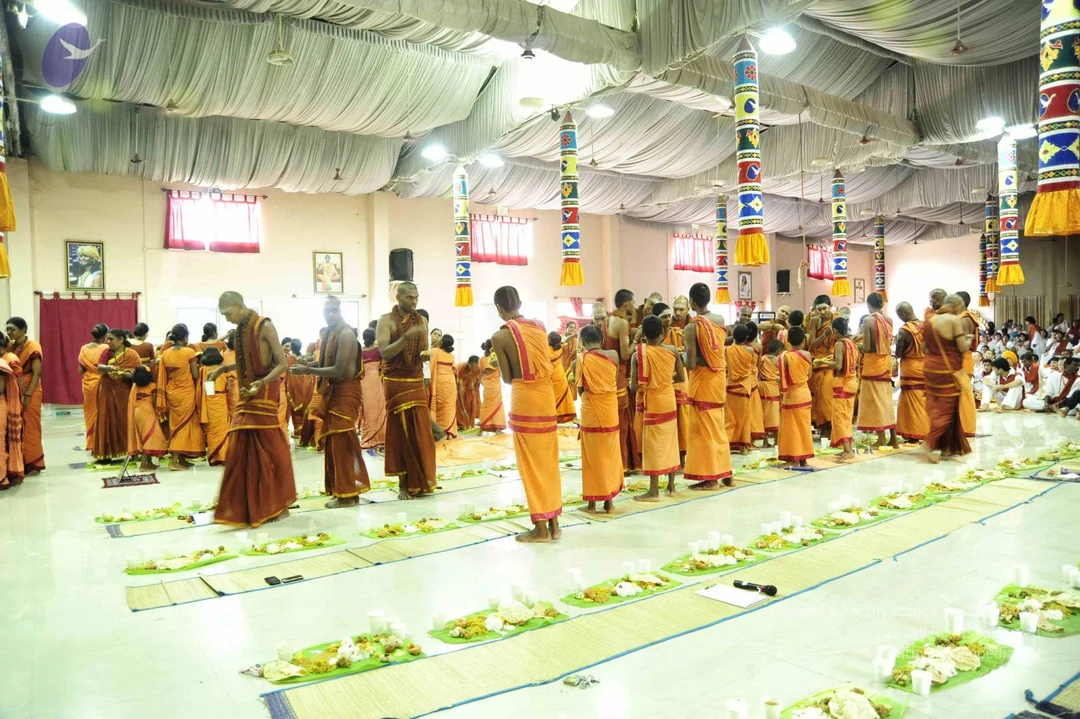
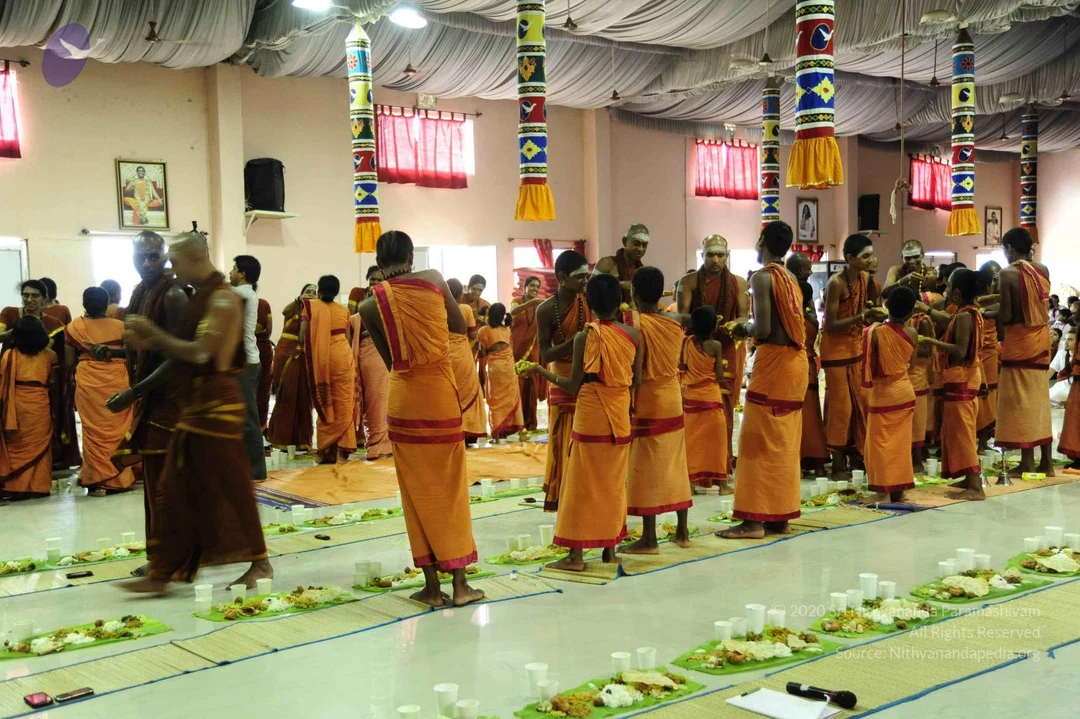
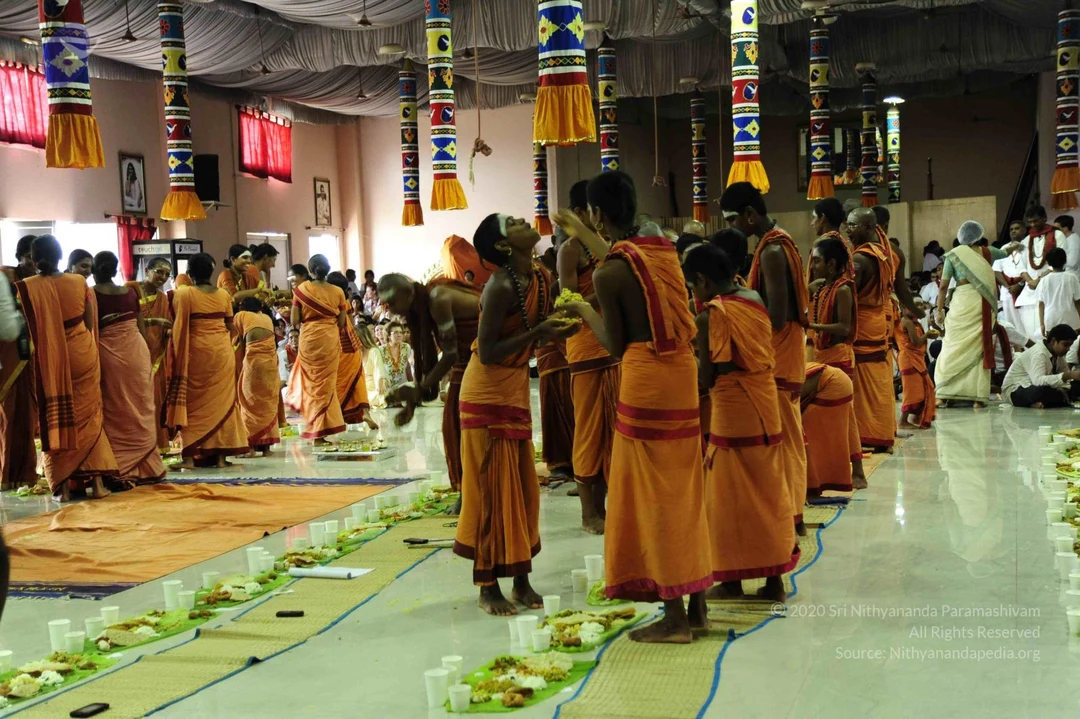
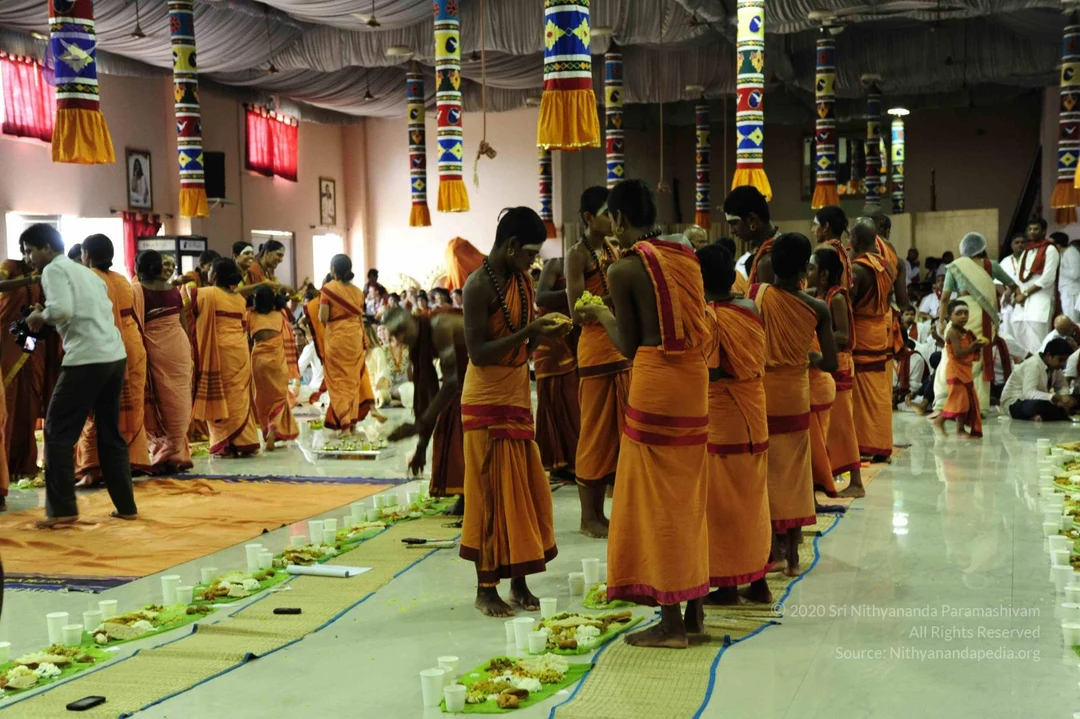
Photos From The Day:
Researches

Stunning Health Recoveries

Participants from different Inner Awakening programs participated in a Health survey before and after the program. The participants were from various backgrounds from across the globe with varied health conditions. Results seen were stunning and consistent for all the Inner Awakening programs. The Chart below shows the % of participants that had 100% health recovery from each Inner Awakening programs.

Link to Video:

Tags:

Paramahamsa Nithyananda, karma,behavior, life, understanding, mystical, KalaBhairava, deity, caste system, India, reality, confusion, wealth, power,knowledge.

Photos Of The Day:

RTP-4-Maheshwara-Puja

RTP-3-IA-Session

RTP-2.Rudram-Chanting

RTP-1-Morning-Message-8A-SNU

RTP-5-Akashic-Readings-Kalabhairava-Darshan

1-Morning-Message-8A-SNU

2-Rudram-Chanting

4-Maheshwara-Puja

5-Akashic-Readings-Kalabhairava-Darshan

Photos from this day

View all 395 photos

Photos From The Day:
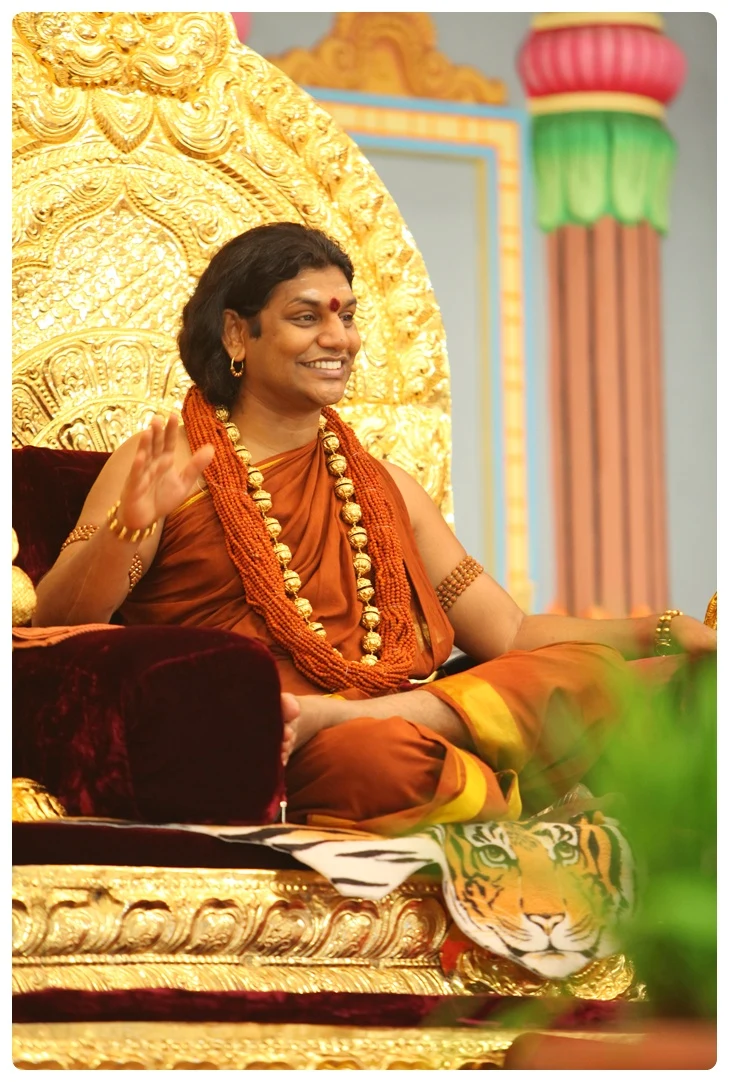
5 photosSource gallery
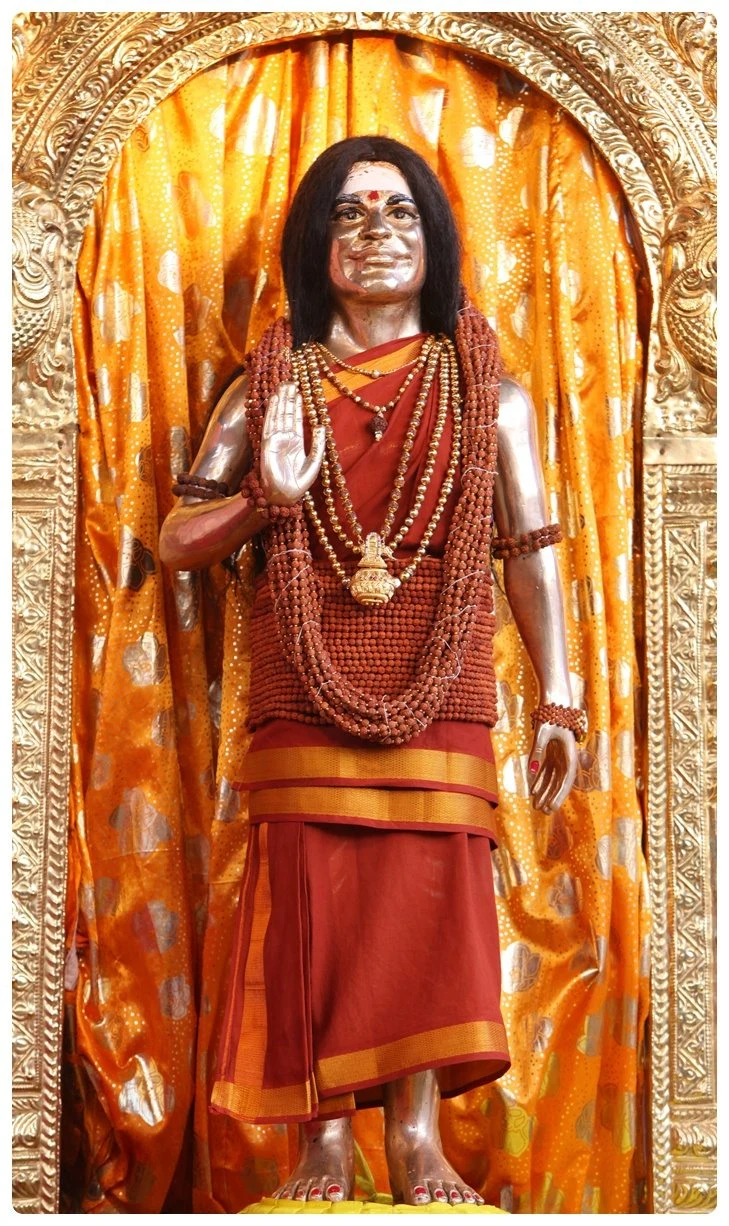
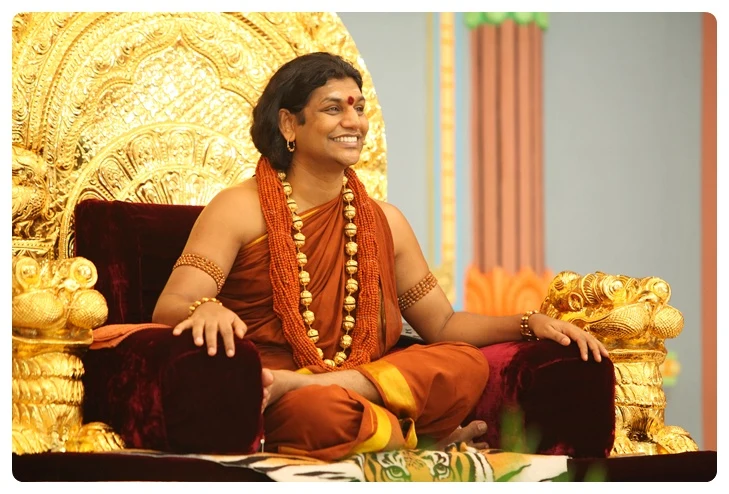
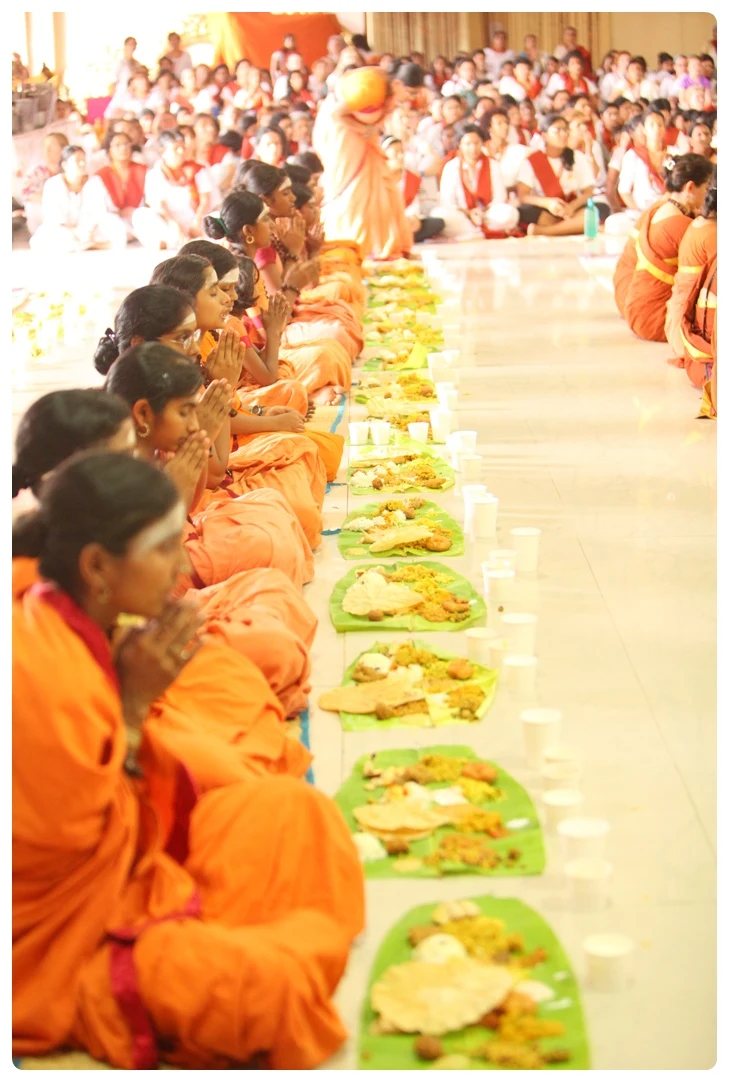
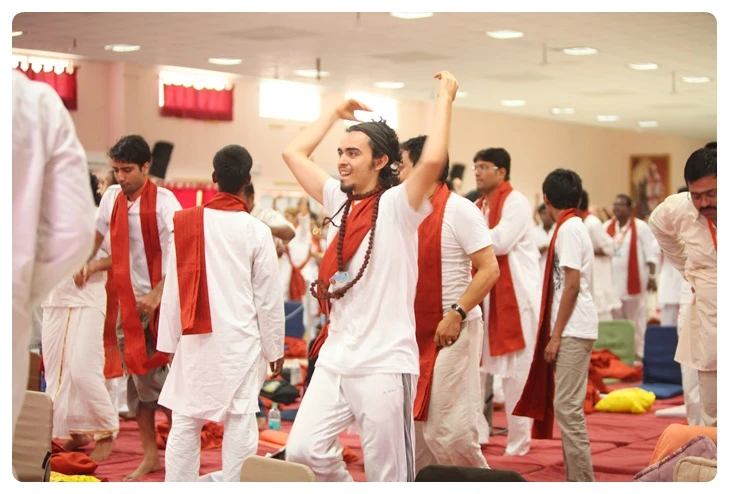
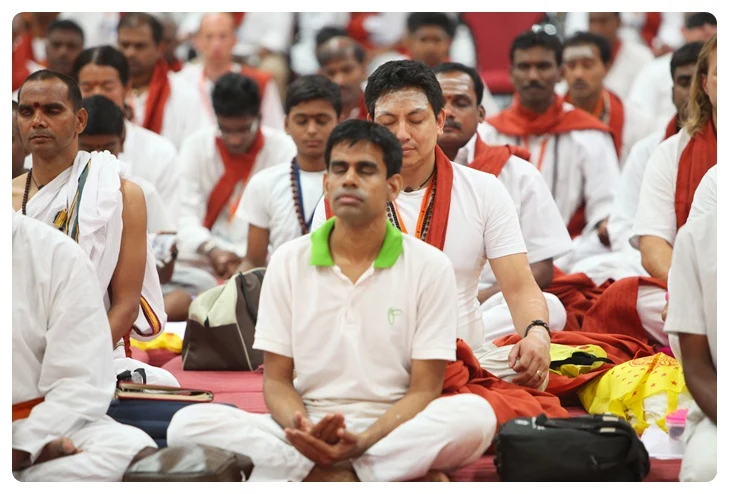
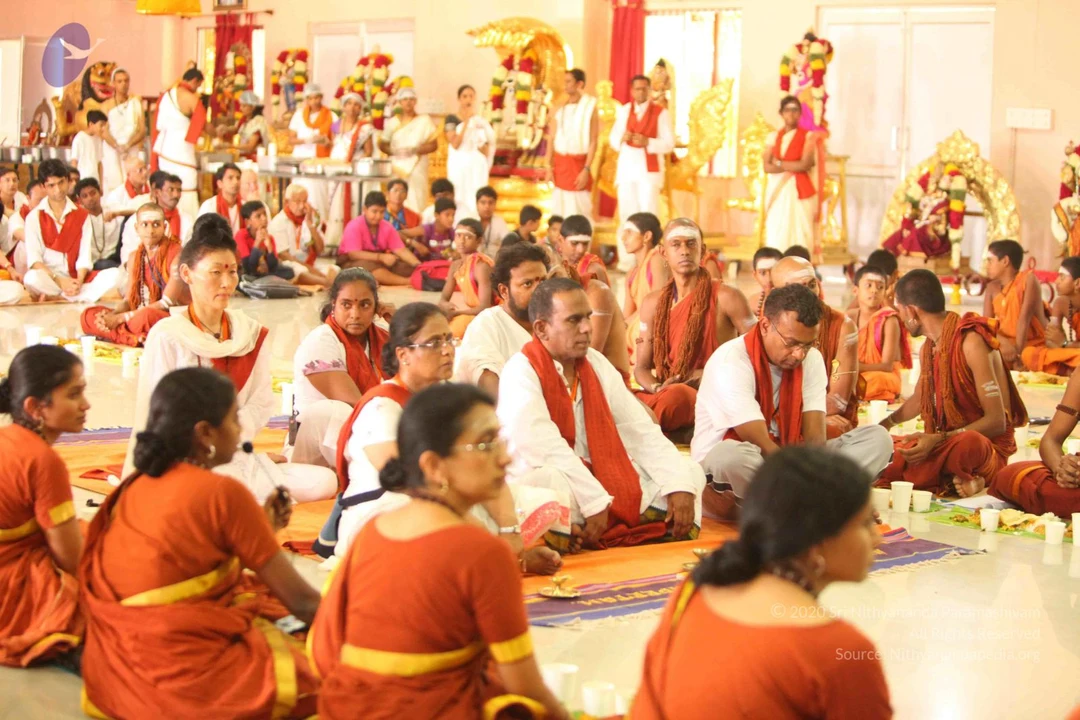
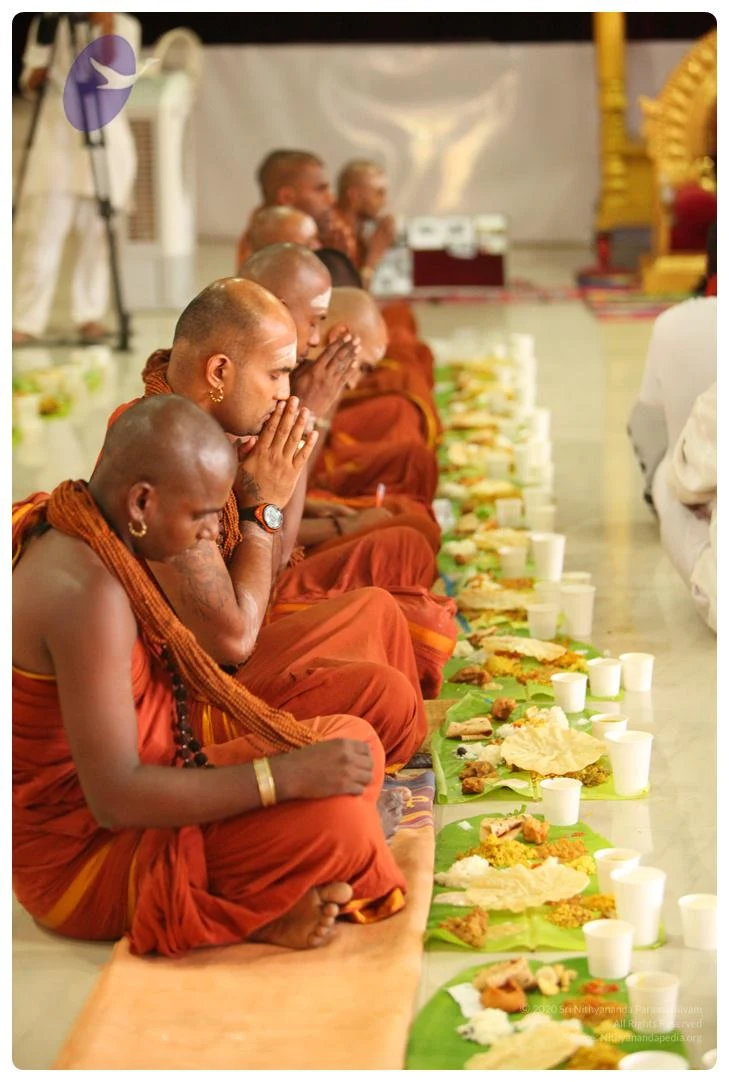
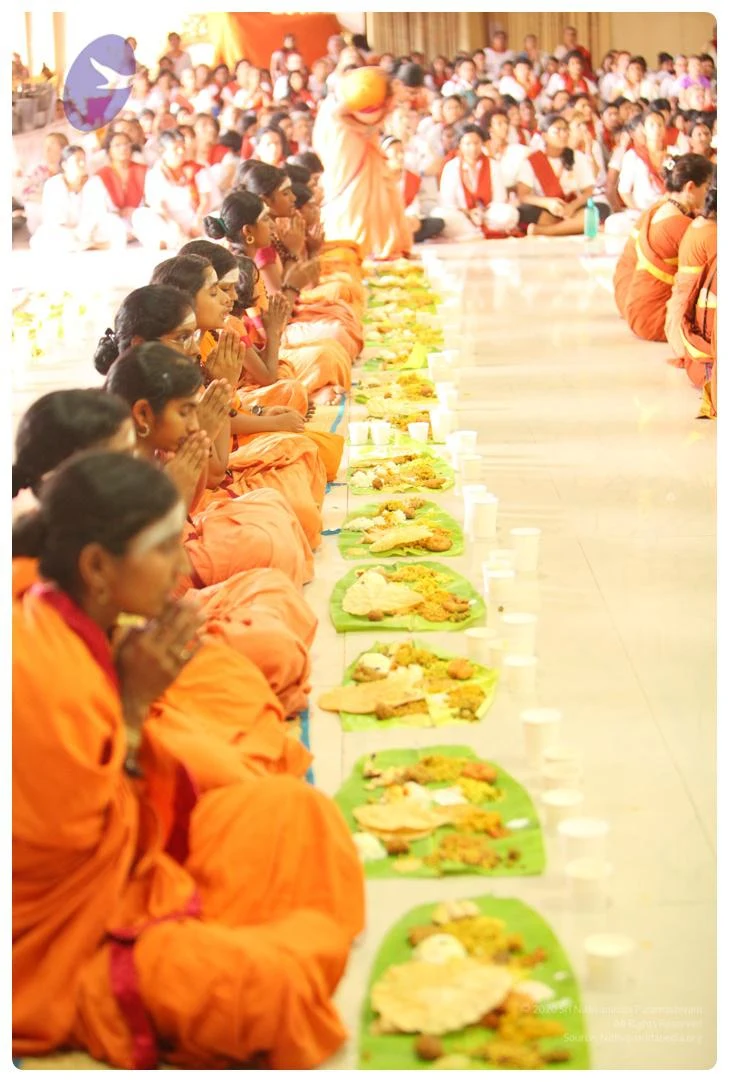
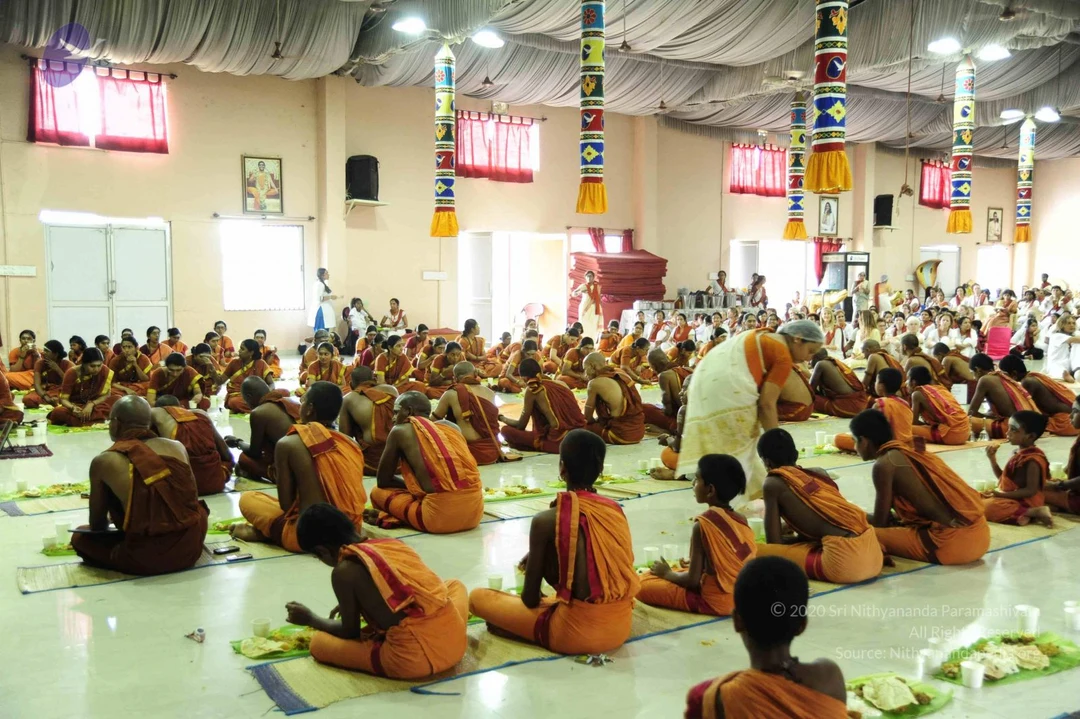
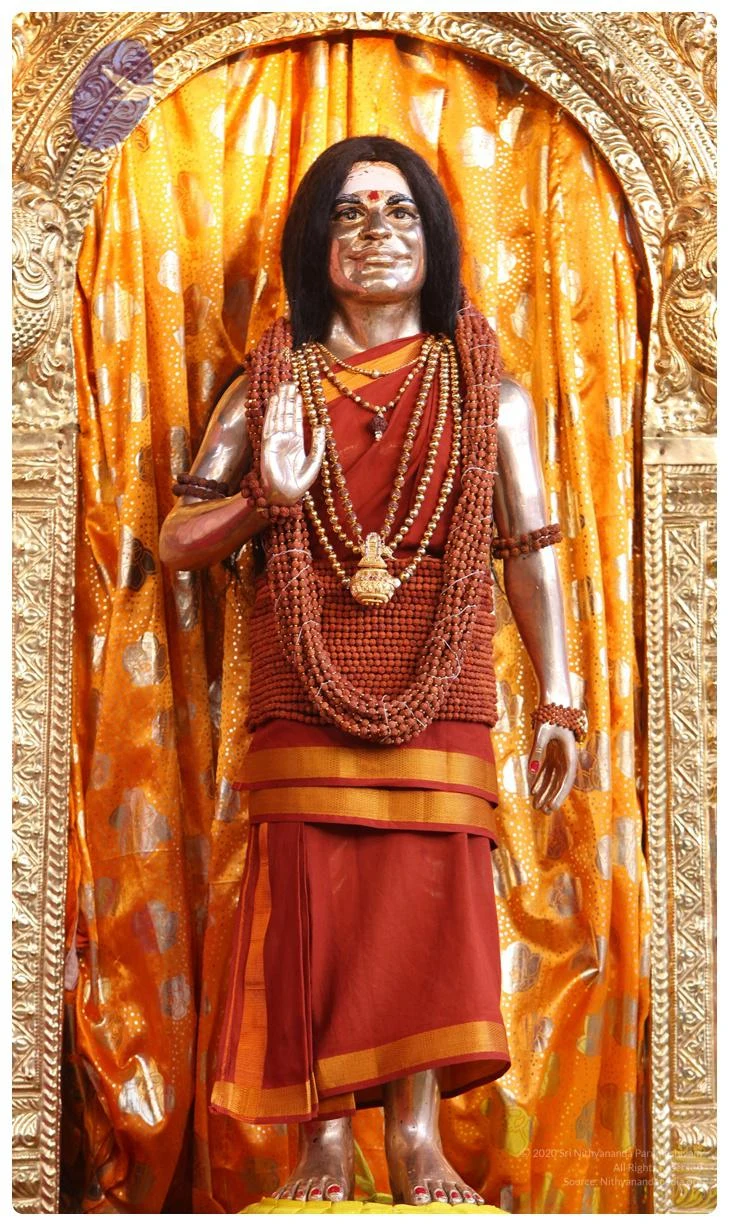
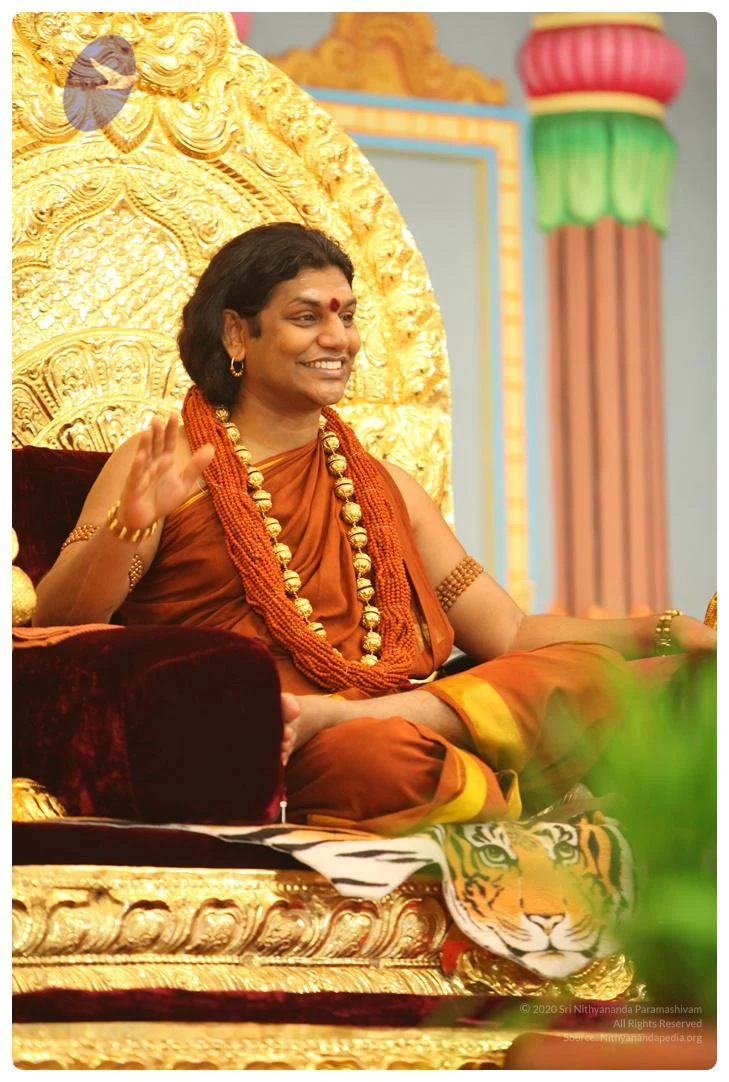
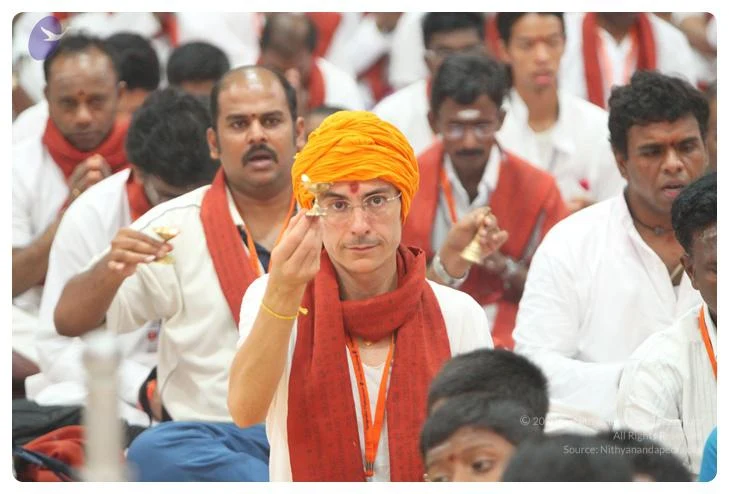
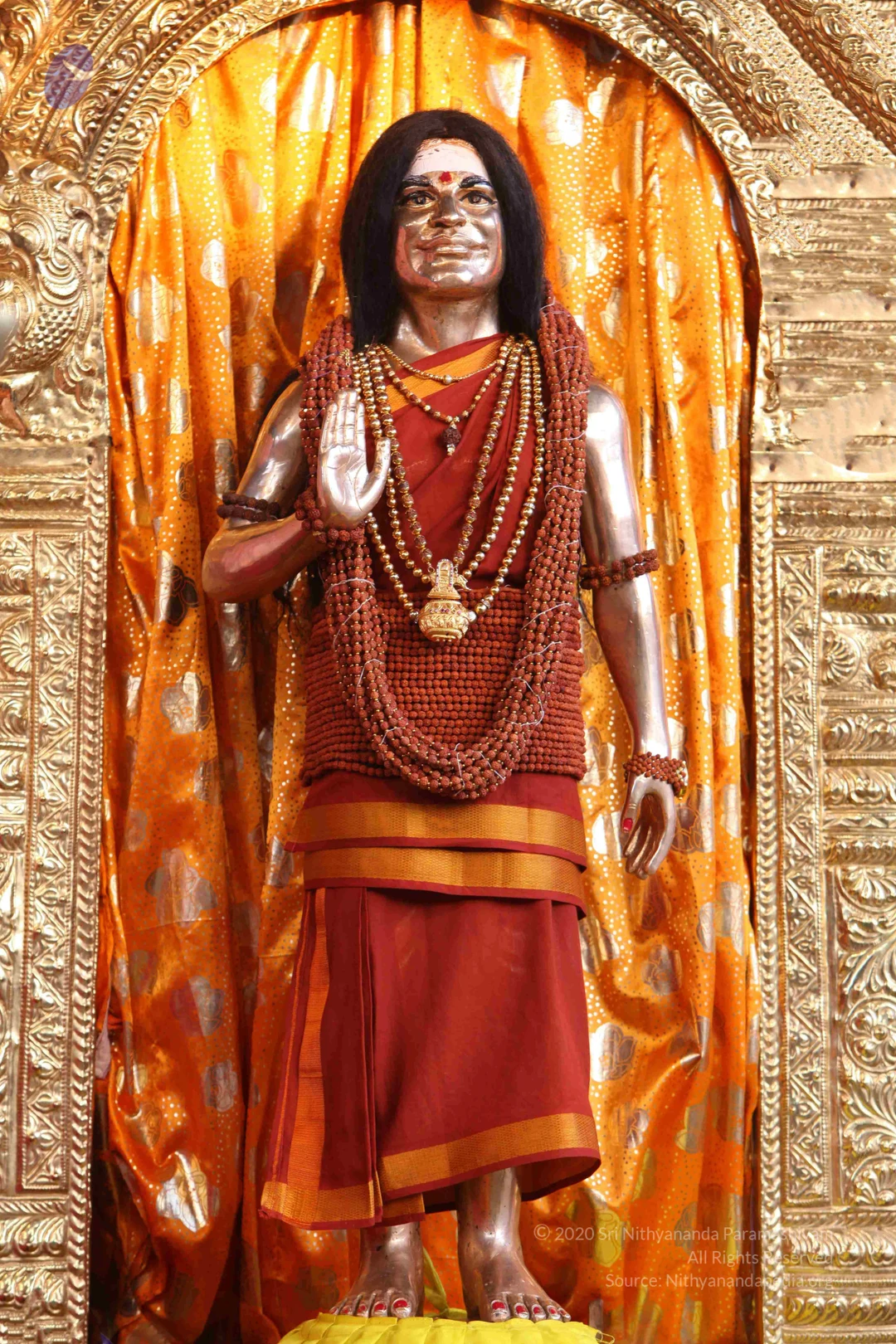
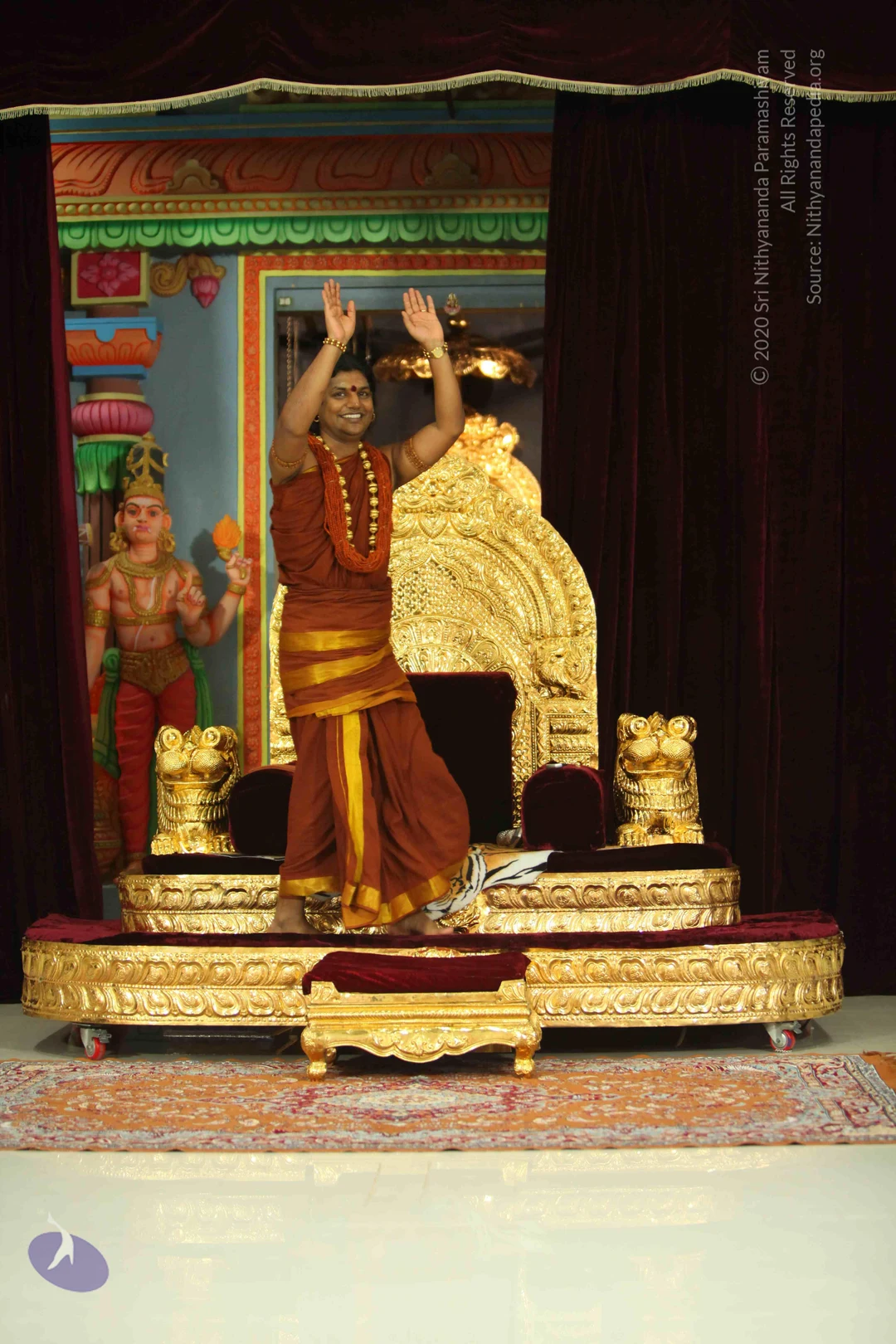
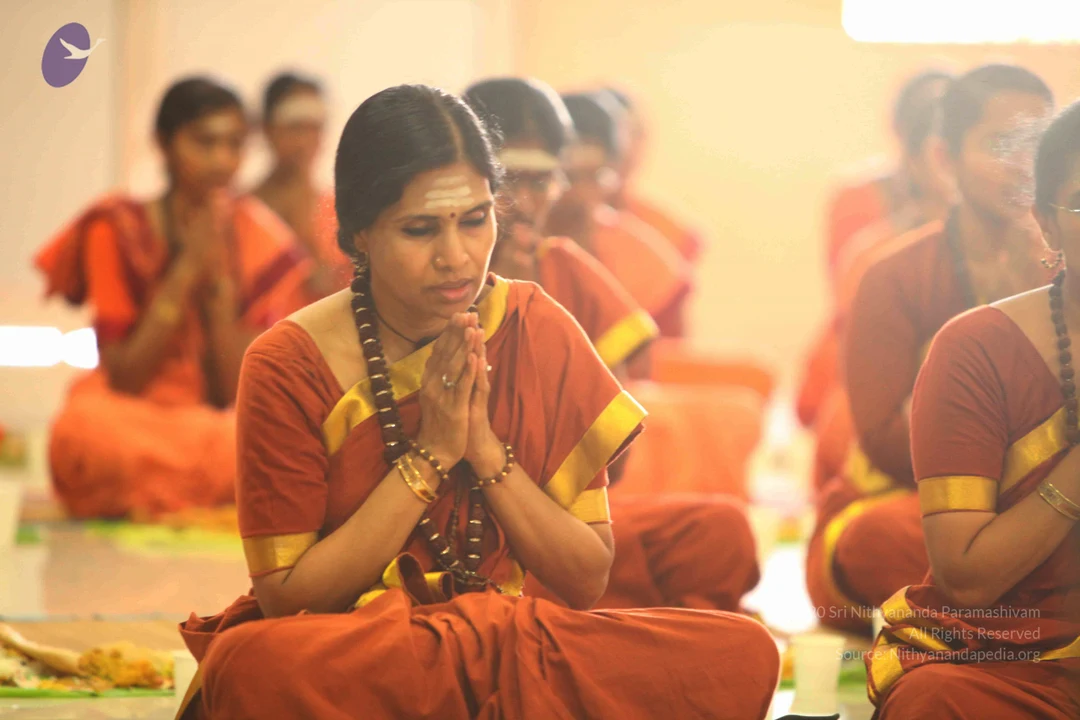
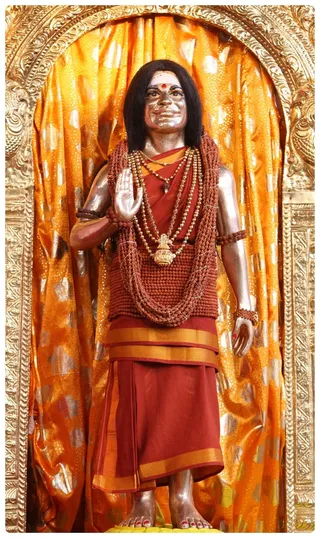
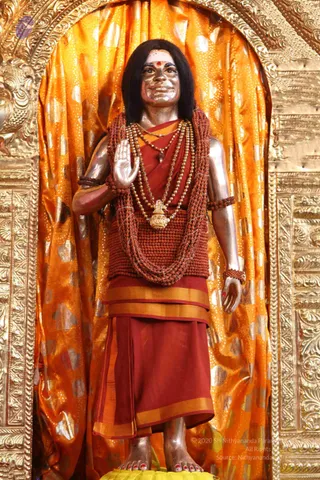
A life-size silver-toned statue of a standing male figure in a gilded arched niche draped with orange and gold brocade curtains. The figure has long dark hair, a red tilak on the forehead, and wears a rust-red dhoti and upper cloth with a gold border, layered rudraksha malas, a gold chain with a gold pendant, and rudraksha bracelets. The right hand is raised in blessing and the left hangs at the side, with red-painted toenails visible on a yellow base. Because the figure is a statue, it is a depiction, not a person present.Photograph of a smiling man seated on an ornate gold throne with a deep red velvet cushion, raising one hand in a gesture of address. He wears a saffron-orange robe, a rudraksha mala with gold beads and a second long orange-red rudraksha necklace, gold bangles and armlets, a red bindi and a small gold earring. A striped tiger-skin cloth covers the throne's base, and a pink and green lotus-topped pillar stands behind him. Probable Swamiji (in_person): the orange robe, long swept-back hair, ornate gold necklaces and rudraksha malas match the candidate cues on this satsang page, so this is an appearance-based label only.A photograph of a long seated meal line in a hall. In the foreground, women in saffron-orange robes sit cross-legged with palms pressed together in namaste, several with white vertical marks on their foreheads. Before them, rows of green leaf plates hold rice, fried snacks and flatbread, with paper cups placed along the edge. Behind them, more people in orange and red-bordered white clothing sit in rows across the hall, and a figure in orange stands at the top. The scene resembles an annadan prasadam meal.A photo of a crowded hall with a red carpet where men in white kurtas and white dhotis wear red-orange shawls draped over their shoulders. In the centre, a young man with long dark hair and a beard raises both arms above his head in an energetic dance pose, wearing a white shirt, white trousers, a red shawl and a rudraksha mala. Other men stand and move around him, some with their hands joined, and a framed picture hangs on the wall at right beside a red curtain. Red and orange cushions lie on the floor in the foreground. The scene suggests a satsang gathering, though the specific ritual is not clearly visible.A seated satsang gathering in a large hall, with devotees in white clothes and saffron-orange shawls sitting cross-legged on red mats. In the foreground, a man in a white polo shirt with a green collar sits with eyes closed and hands folded in his lap. Beside him, a man in white with an orange shawl and a black bead necklace sits in meditation. On the left, a man with a shaved head and vertical tilak marks wears a white dhoti and sacred thread. Behind them, rows of attendees in white and orange-red shawls sit in meditation, with black and yellow bags placed on the mats. Several people in the back row wear white and red garments.

RTP-4-Maheshwara-Puja
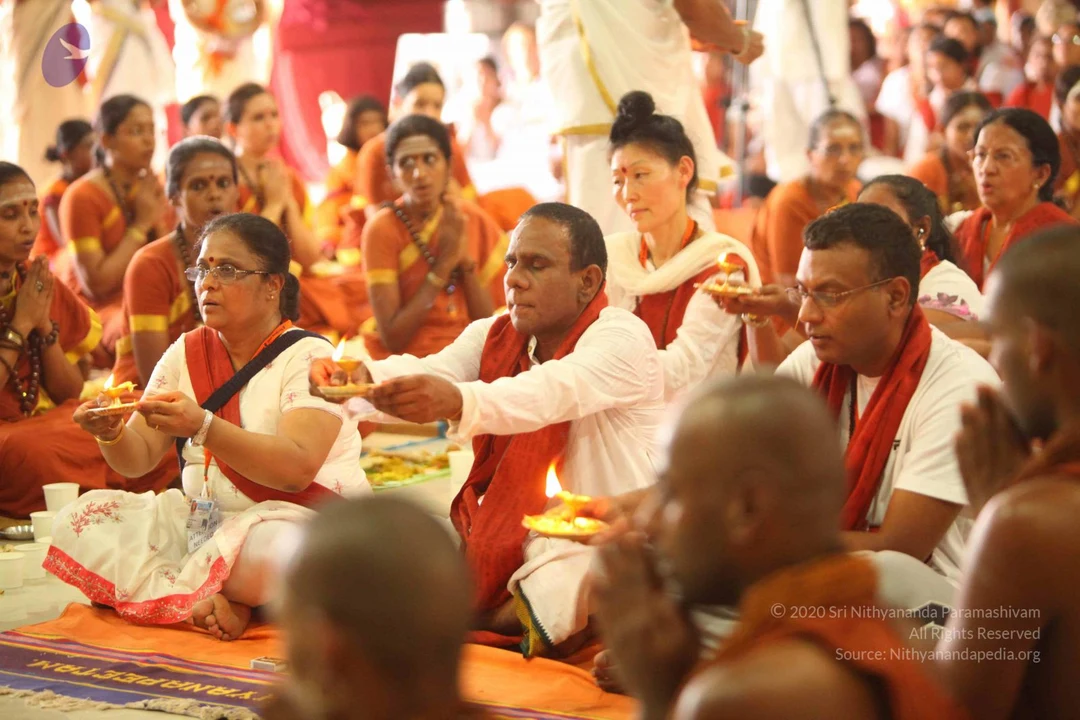
119 photosSource gallery
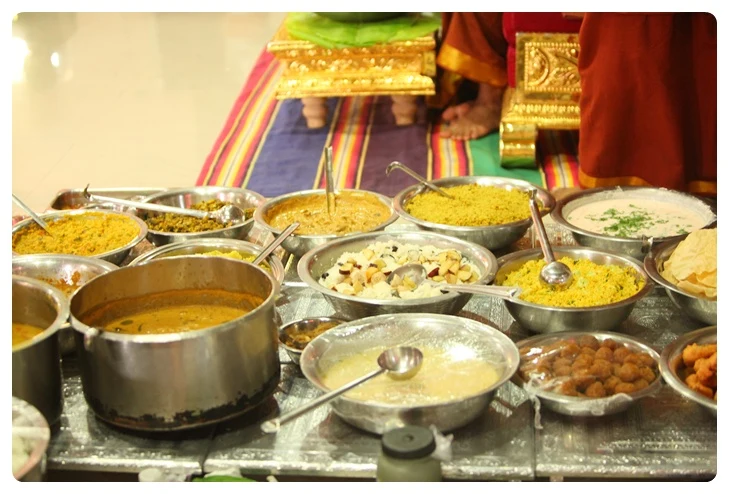
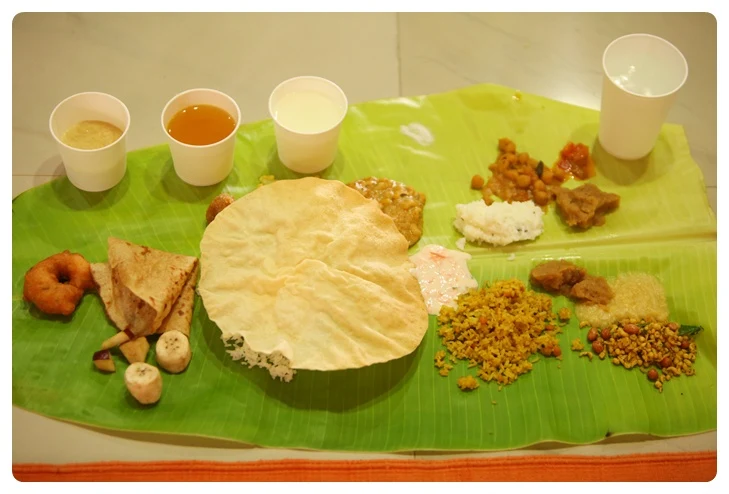
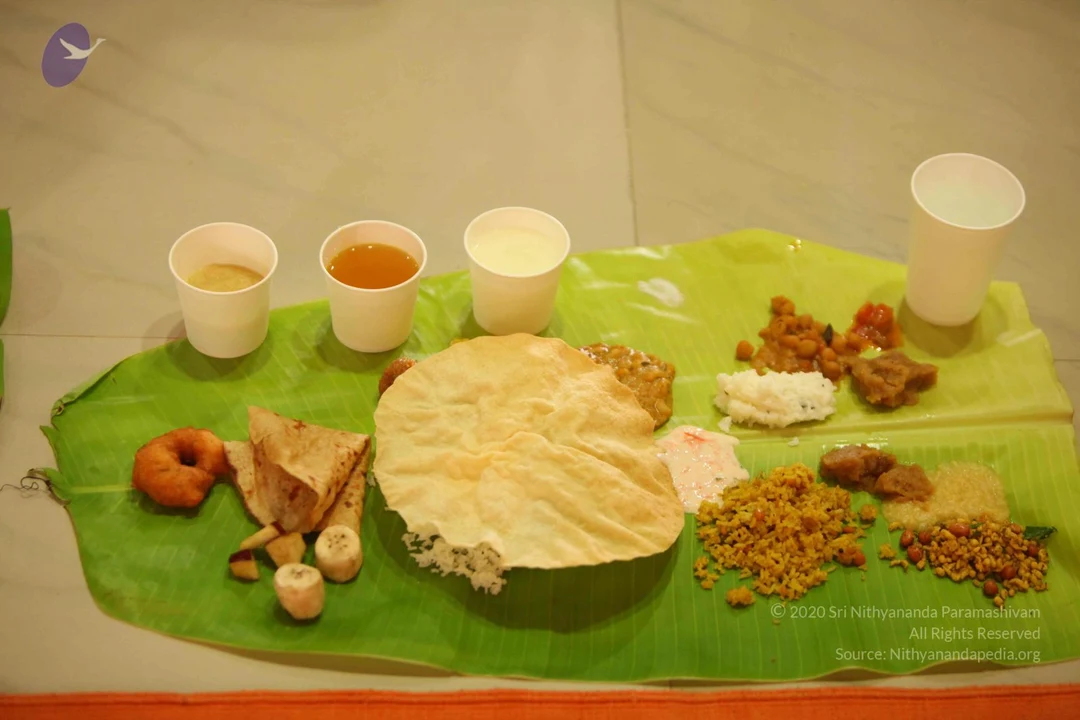
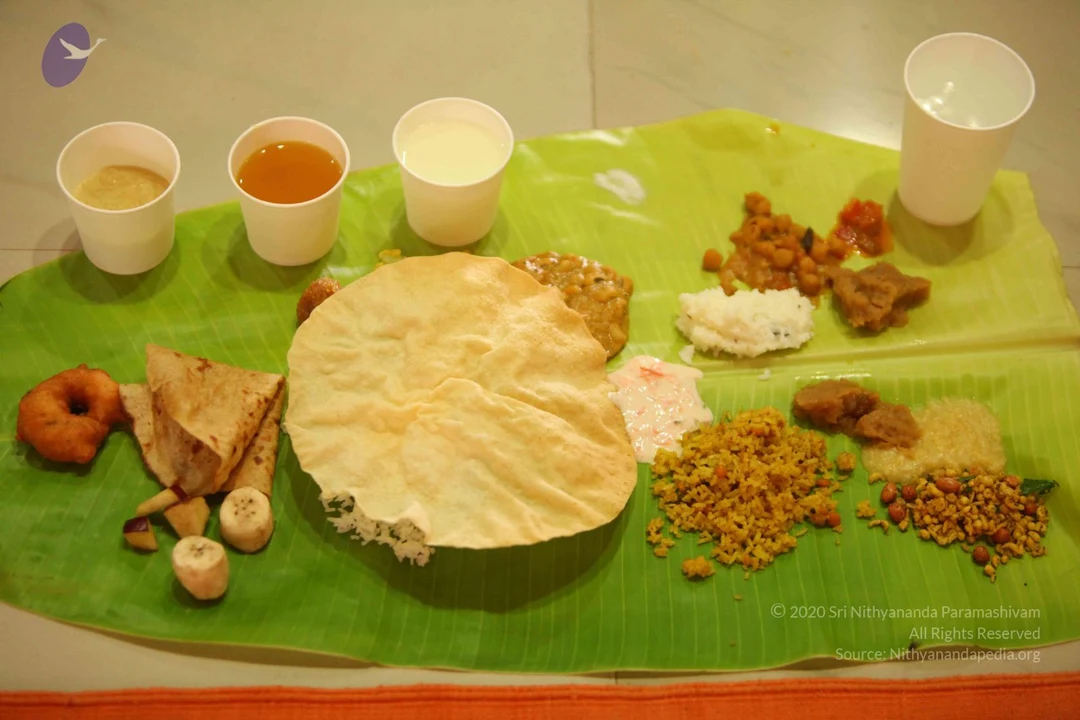
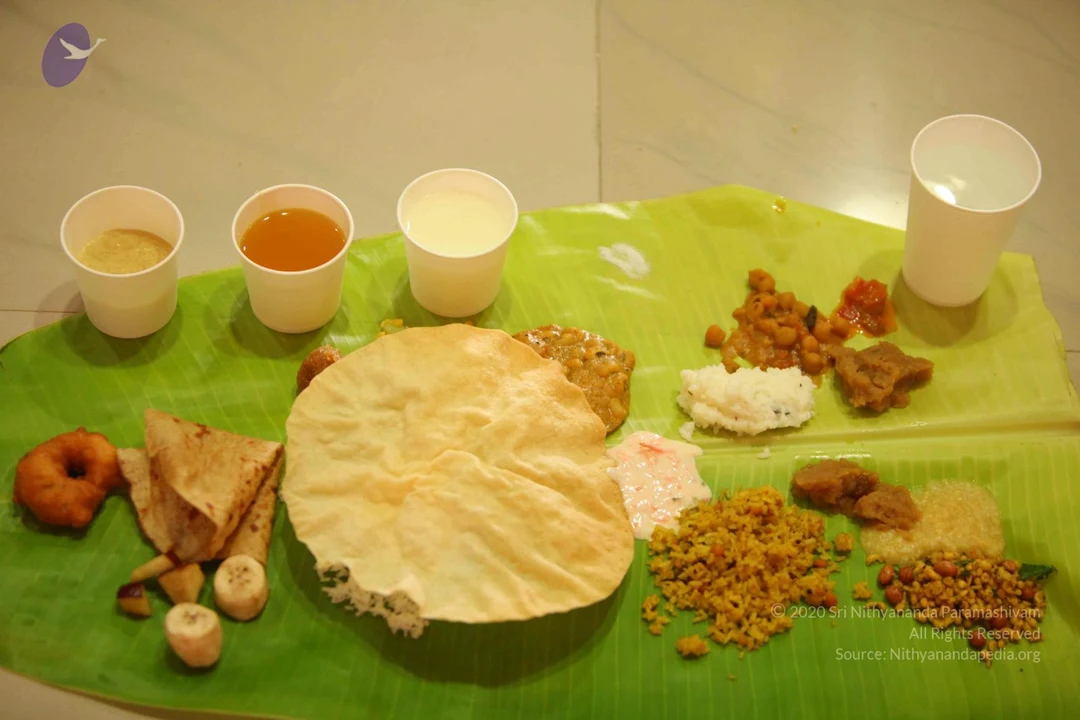
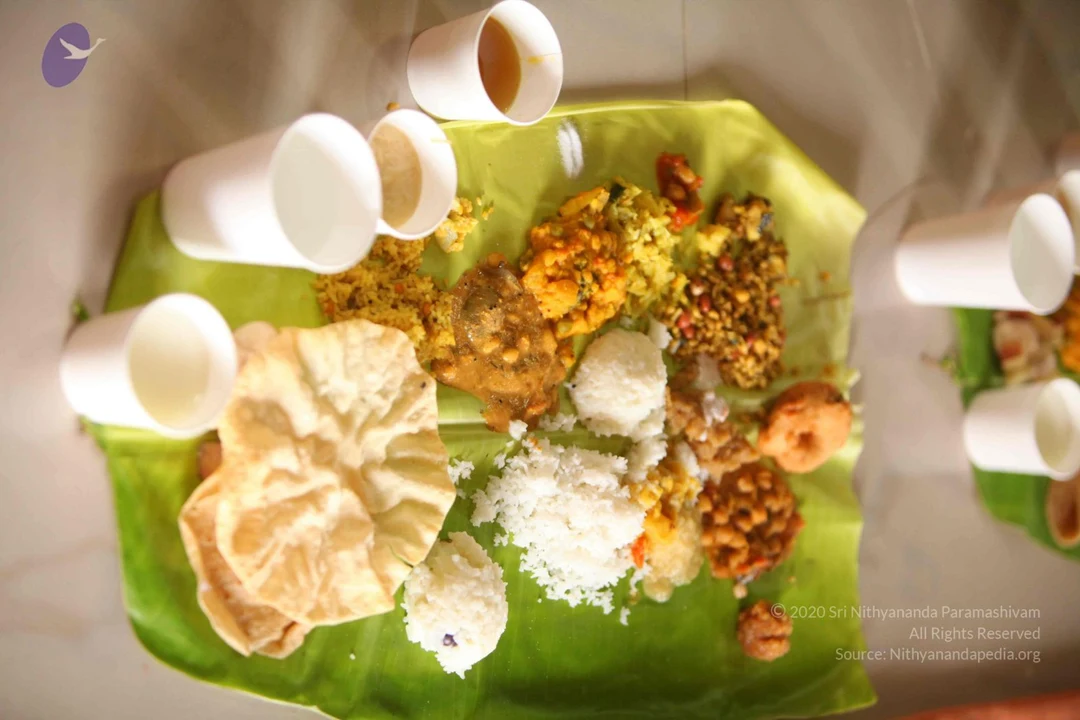
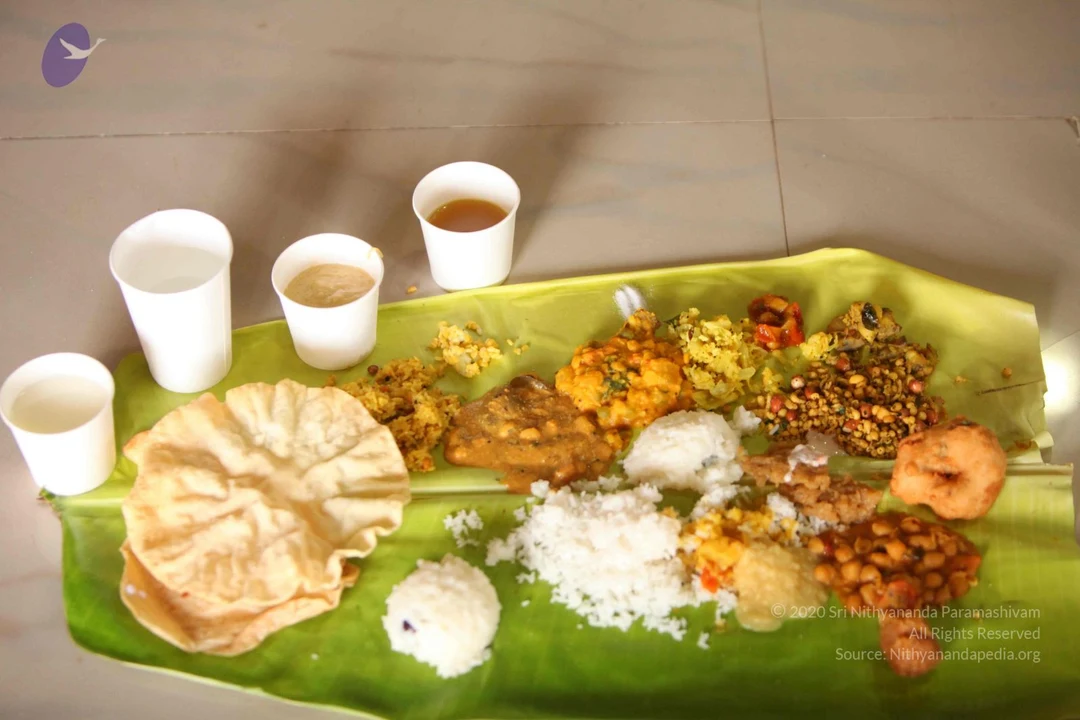
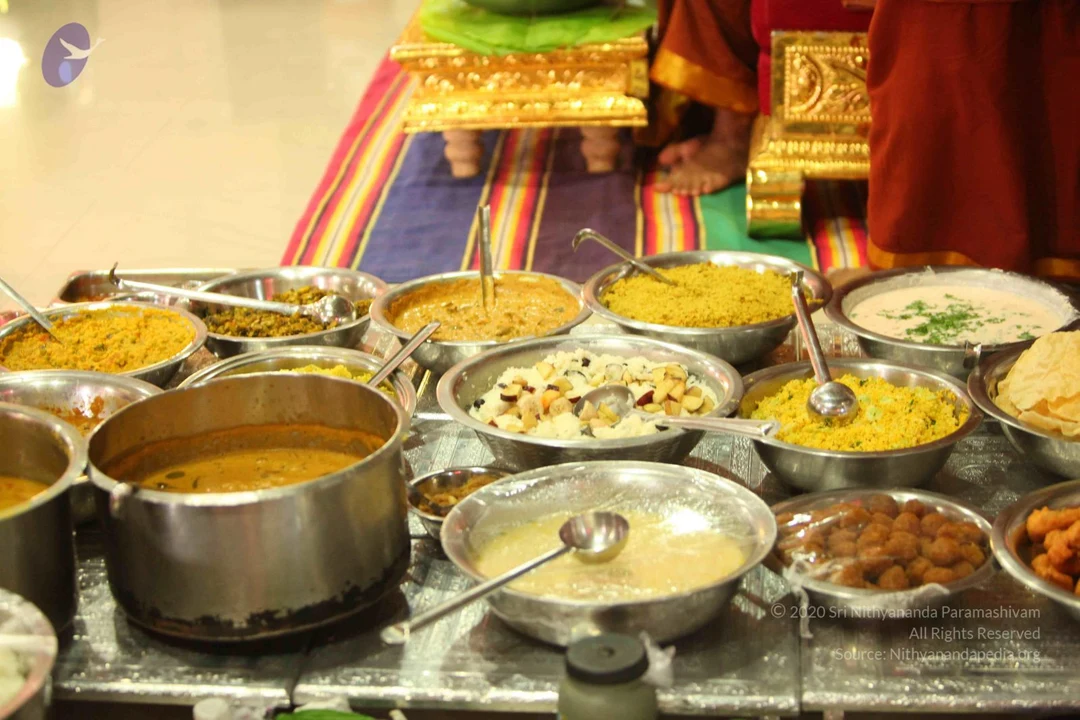
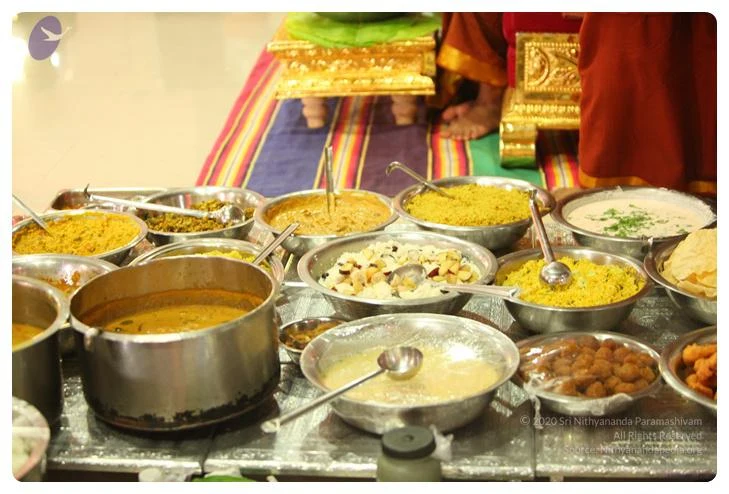
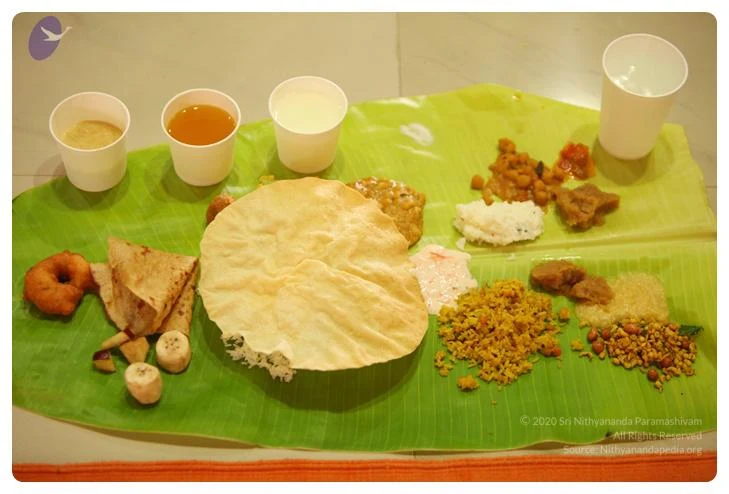
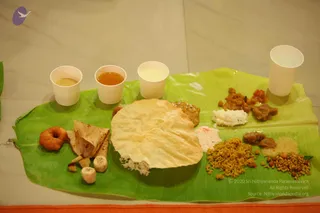
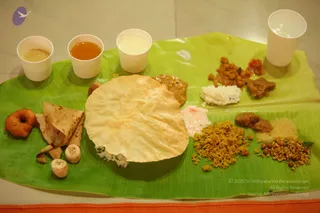
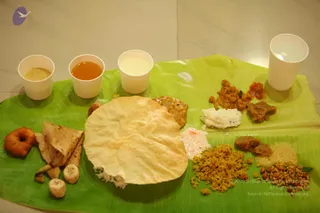
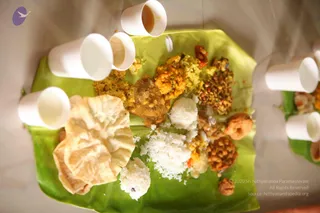
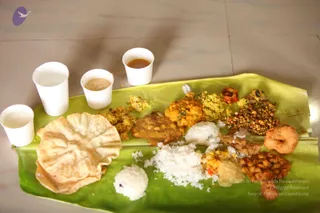
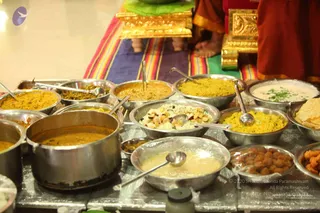
A photograph of a traditional South Indian meal served on a large green banana leaf placed on a pale marble floor. The leaf holds a large thin crisp papad or poppadom, steamed rice, a golden vada-like fried snack, a folded dosa or flatbread, sliced fruit pieces and a bite-sized sweet, and small heaps of spiced lentils, pickle, a bowl of dal-like curry and grated coconut or chutney. Three small white paper cups hold a yellow soup or dal, an amber liquid and a milky drink, with a fourth white cup at the upper right. An orange cloth edge runs along the bottom of the frame. No people are visible.A served vegetarian meal on a large green banana leaf placed on a pale tiled floor with an orange cloth edge at the bottom. Four small white paper cups hold chutney, a golden syrup or sauce, a white liquid and a thin drink. Around the leaf are a large puffed poori, fried vada, a folded dosa, sliced banana and pieces of fruit, rice, dal, curried vegetables and chutney, plus a heap of yellow spiced rice and a sweet with nuts. No people are visible and no one is identifiable in the scene.A traditional South Indian vegetarian meal served on a green banana leaf on a pale tiled floor. A large crisp papadum sits at center, surrounded by small portions of rice, a spiced chickpea curry, a lentil dish, a fried vada, a folded dosa, fresh banana slices, a yellow spiced rice, a sweet pudding, and white dips. Four small white paper cups hold a pale drink, an orange drink, milk, and water. No people are visible.Overhead photo of a meal served on a green banana leaf. Arranged on the leaf are a crisp papadum, a mound of white rice, a scoop of yellow vegetable curry, a brown gravy dish, a dry spiced mixture, a fried vada-style snack and small portions of sides. Several white paper cups of tea or drink sit around the edge of the leaf. No people are visible, and no a person candidate appears in the frame.A photograph of a meal served on a large green banana leaf placed on a light tiled floor. The leaf holds a mound of white rice, a crisp papadum or poppadom, a pale fried bread-like item, several small portions of vegetable curries and dry spiced preparations, a dark gravy, a fried vada, and chickpeas. Three small white paper cups of liquid sit at the top left and a fourth cup is at the lower left. No people are visible, and the scene shows only prepared food on the leaf.A photo of a buffet-style spread of South Indian vegetarian food in stainless steel bowls and pots on a long metal table, with ladles in many dishes. Dishes include yellow rice with cashews and raisins, curries, a creamy yogurt dish garnished with herbs, poori bread, fried snacks and a sweet pudding. Behind the table, the bare feet and red-orange robes of two people stand on a striped rug beside a gold-embossed wooden seat. No face is visible and no a person candidate can be identified from appearance.

RTP-3-IA-Session

6 photosSource gallery
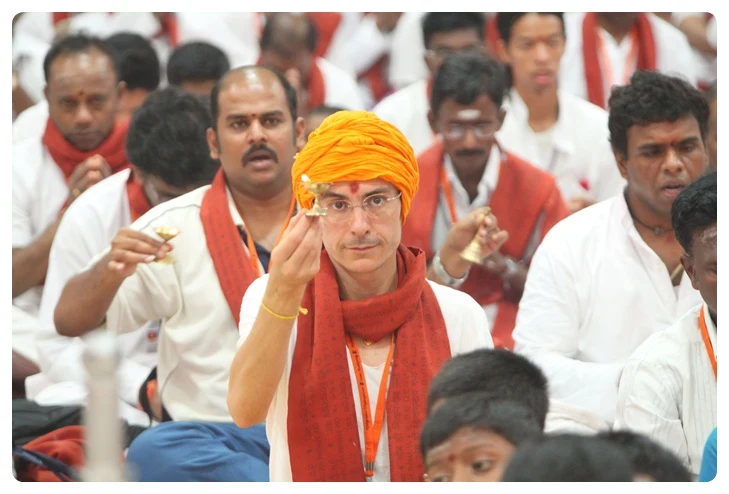
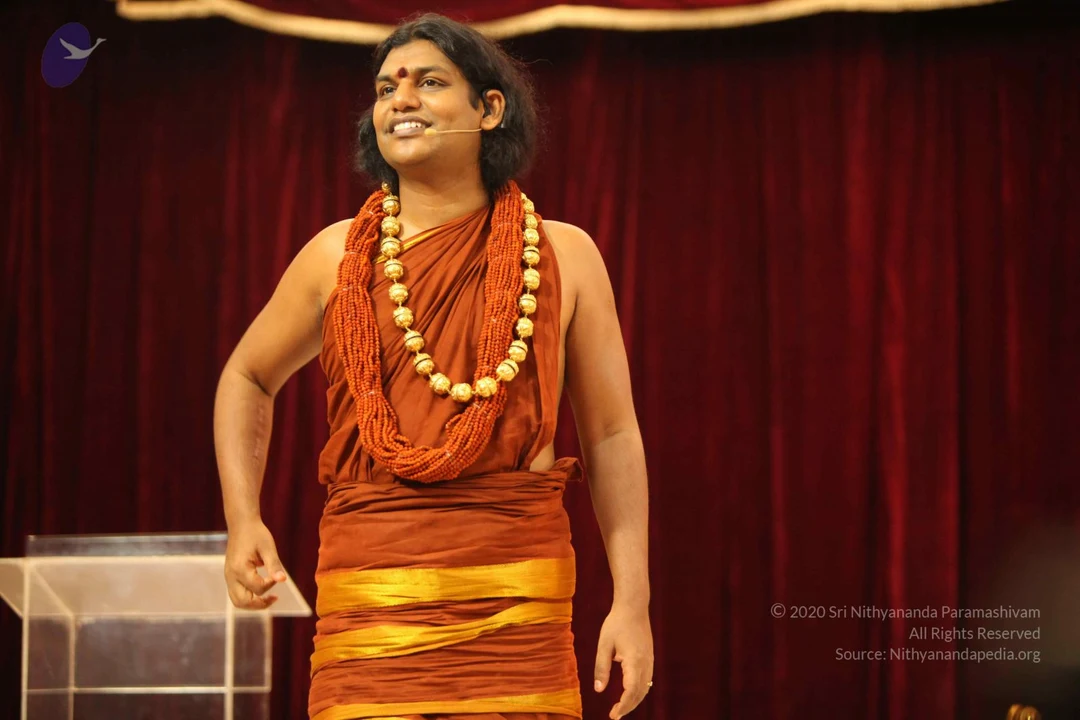
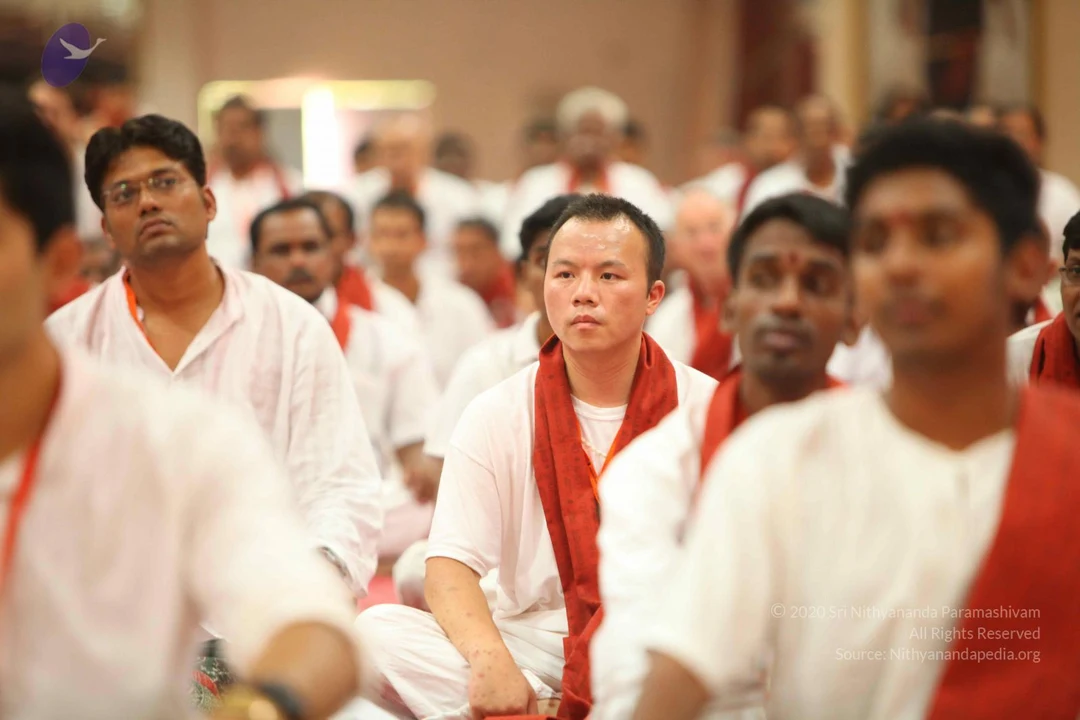
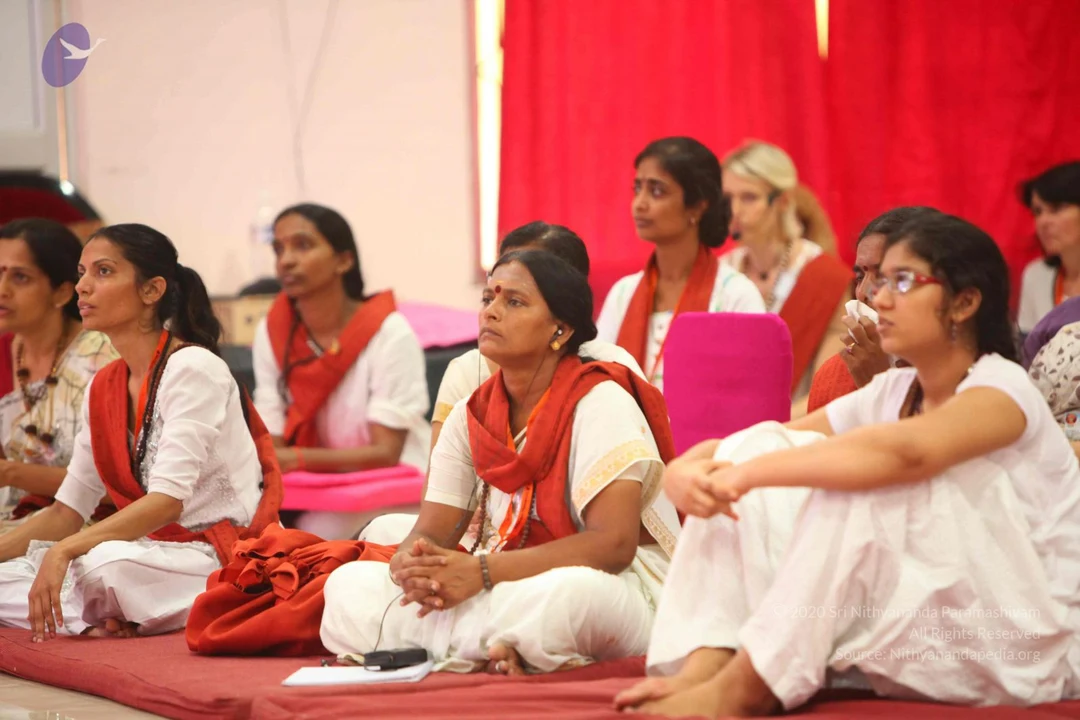
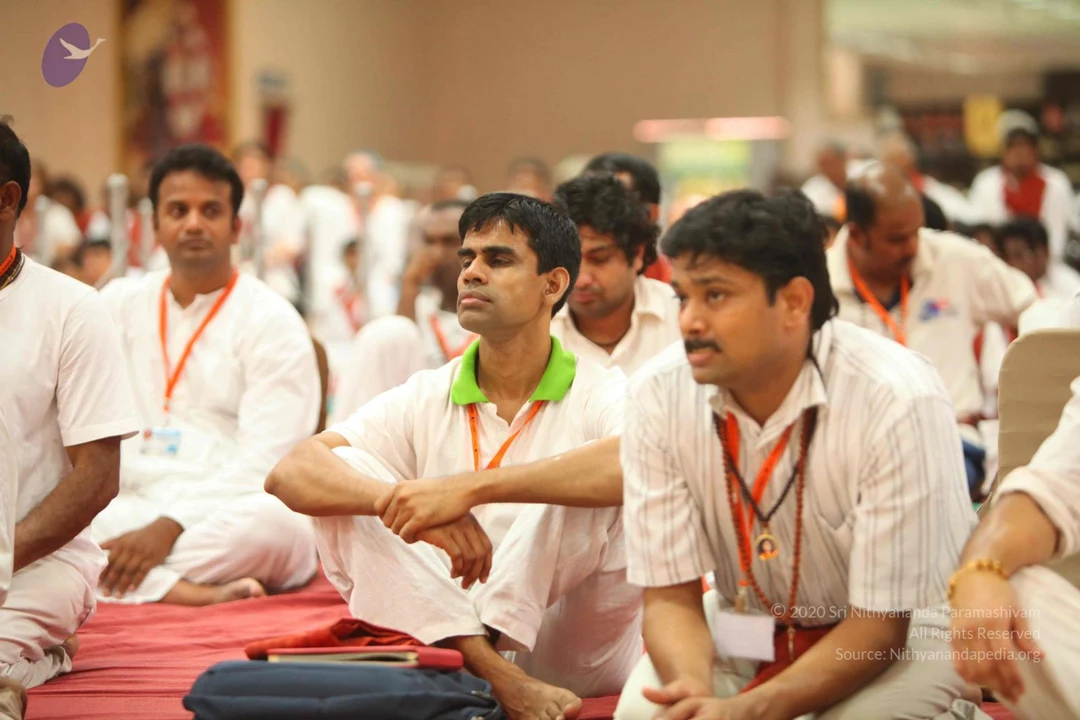
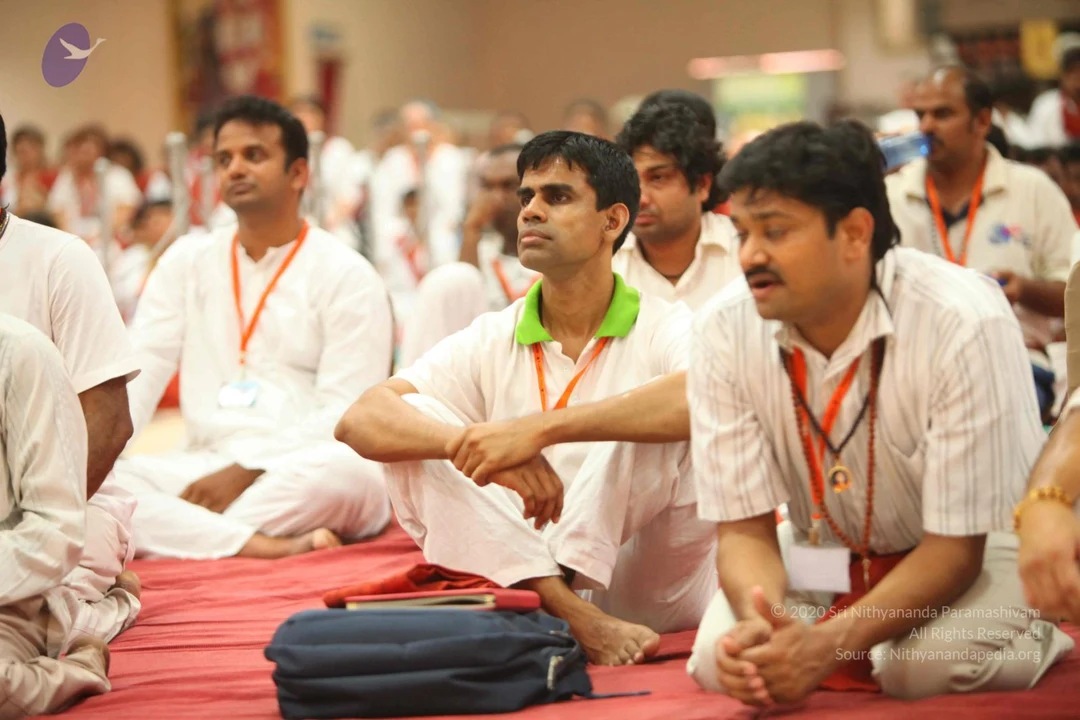
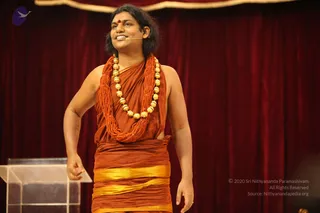
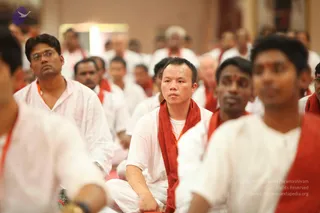
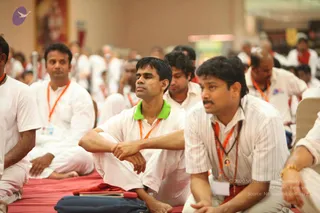
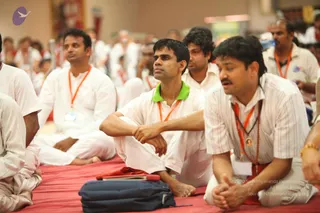
A photograph of a man standing on a stage in front of deep red velvet drapes, smiling and gazing to the side. He wears a rust-orange wrapped garment with a gold-bordered yellow sash at the waist and a bare shoulder, a red-orange bead mala layered with large gold beads around his neck, and a small red bindi on his forehead. A small head microphone is visible. A clear acrylic lectern stands at the left edge of the frame. The person appears to be a presenter giving a talk, with appearance cues of rudraksha-style red beads, saffron-orange clothing and a gold necklace, so this is a person depiction in person.A photograph of a seated congregation at a satsang in a bright hall with pale walls. Men in white kurta-style clothes wear red shawls and orange cords around their necks. In the centre, a man with short dark hair in a white shirt and red shawl sits looking forward, with other seated devotees in the foreground and background, some with shaved heads. A pale blurred figure in a white turban sits further back. No a person candidate is clearly identifiable from appearance in this frame.A photograph of a seated congregation at a satsang hall with pale walls and red-cushioned floor. In the foreground, a man in white kurta and orange lanyard sits cross-legged with hands folded, gazing forward. Beside him, men in white shirts and orange lanyards sit attentively, one in a green-collared white polo. Behind, more devotees in white and red shawls fill the rows, and a robed figure in orange and saffron stands near the top right. The scene conveys a disciplined, quiet gathering.Photograph of a satsang audience seated on red floor mats in front of a red curtain. Women in white clothes with red-orange shawls sit in rows, most looking forward attentively. A woman in the centre wears a red bindi, a red shawl and a beaded necklace; another at right has glasses and holds a small white item. A pink cushion sits at right. Some participants wear beaded malas. A small logo appears in the upper left corner.A photograph of a seated congregation at a satsang gathering on red floor mats. In the foreground, a man in a green-collared white kurta sits cross-legged with his eyes closed and hands resting on his knee, beside a man in a white striped shirt wearing orange lanyard and rudraksha mala, who listens attentively. Several other attendees in white kurtas and orange lanyards sit behind them, and a blue bag lies on the mat. Blurred figures and a warmly lit hall with a red banner fill the background.Photograph of devotees seated cross-legged on red mats at a satsang hall, many wearing white kurta-style clothing and orange lanyards. In the foreground, a man in a green-collared white polo sits with his arm resting on his knee and looks forward, beside a man in a striped white shirt with an orange lanyard, rudraksha mala and a name badge who speaks while gesturing. A navy bag and a red cloth lie on the mat in front.

RTP-2.Rudram-Chanting

29 photosSource gallery
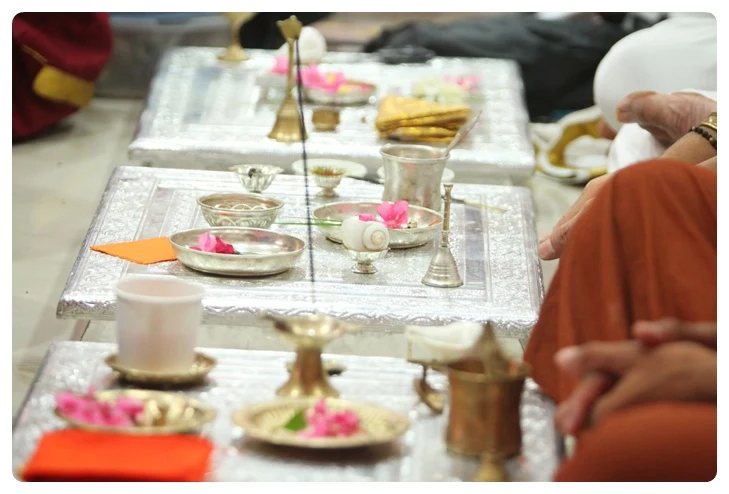
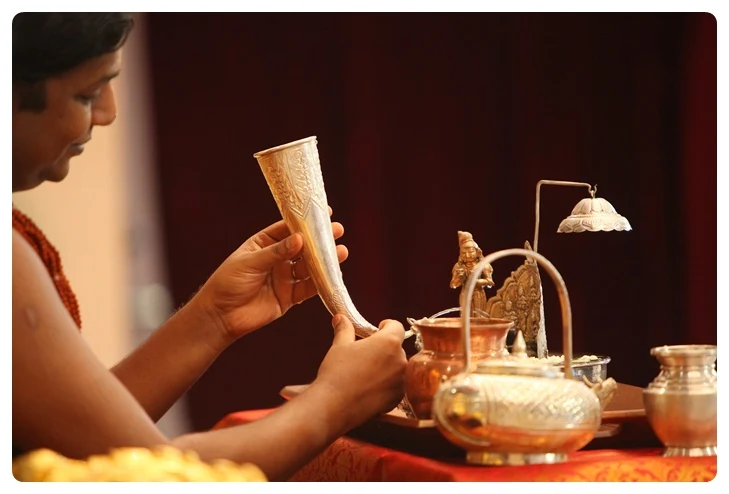
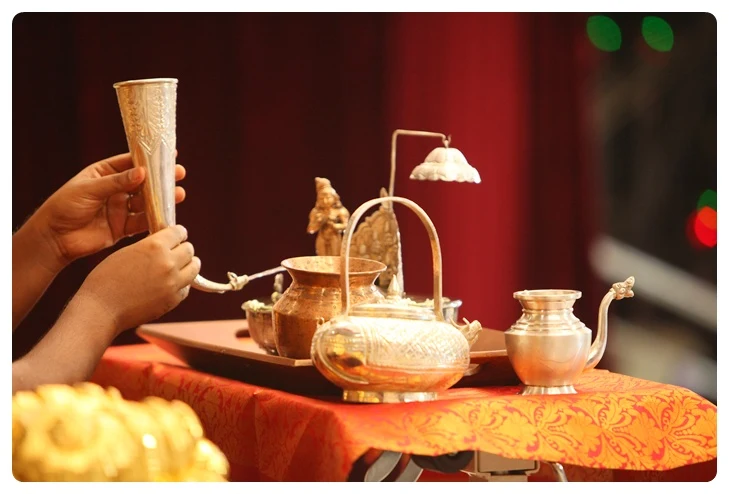
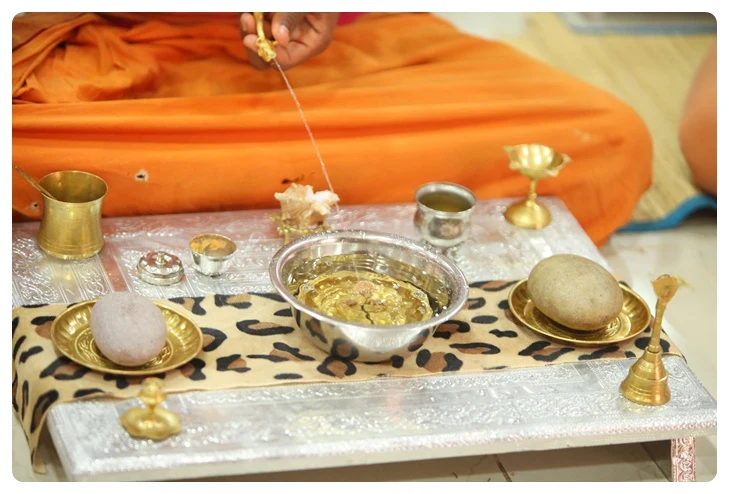
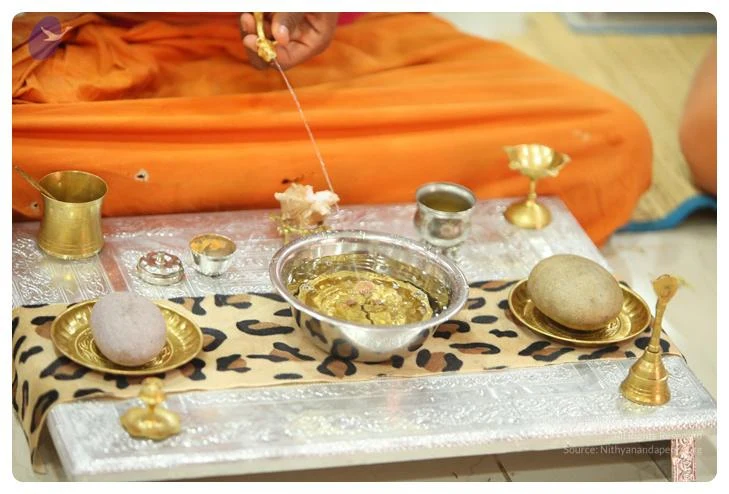
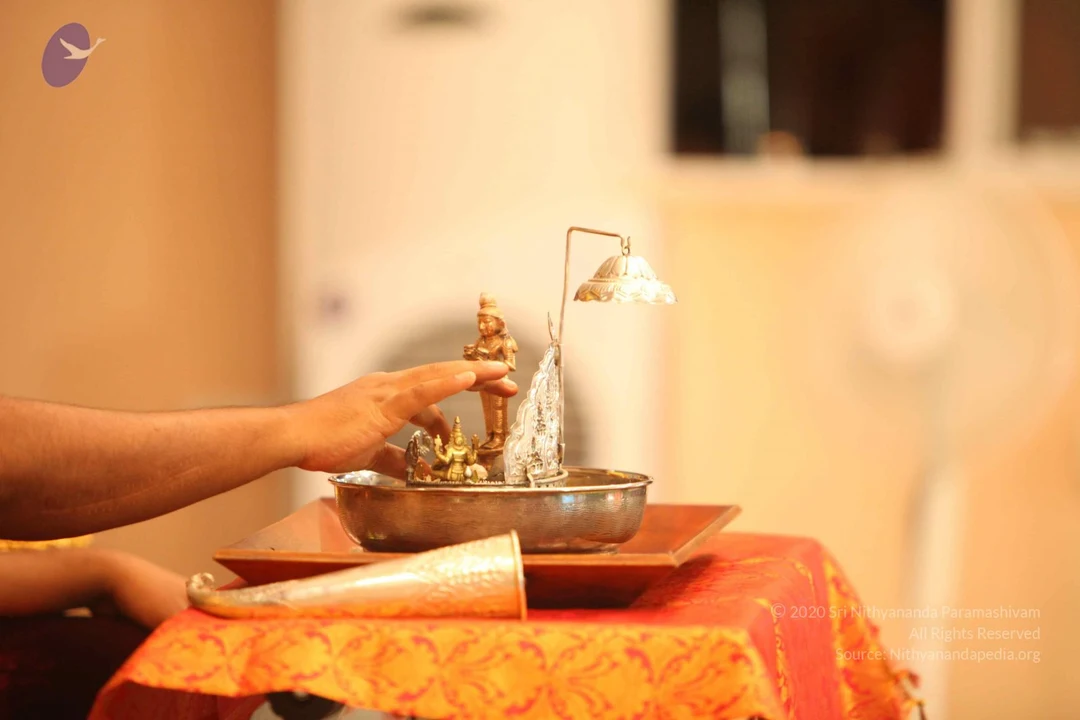
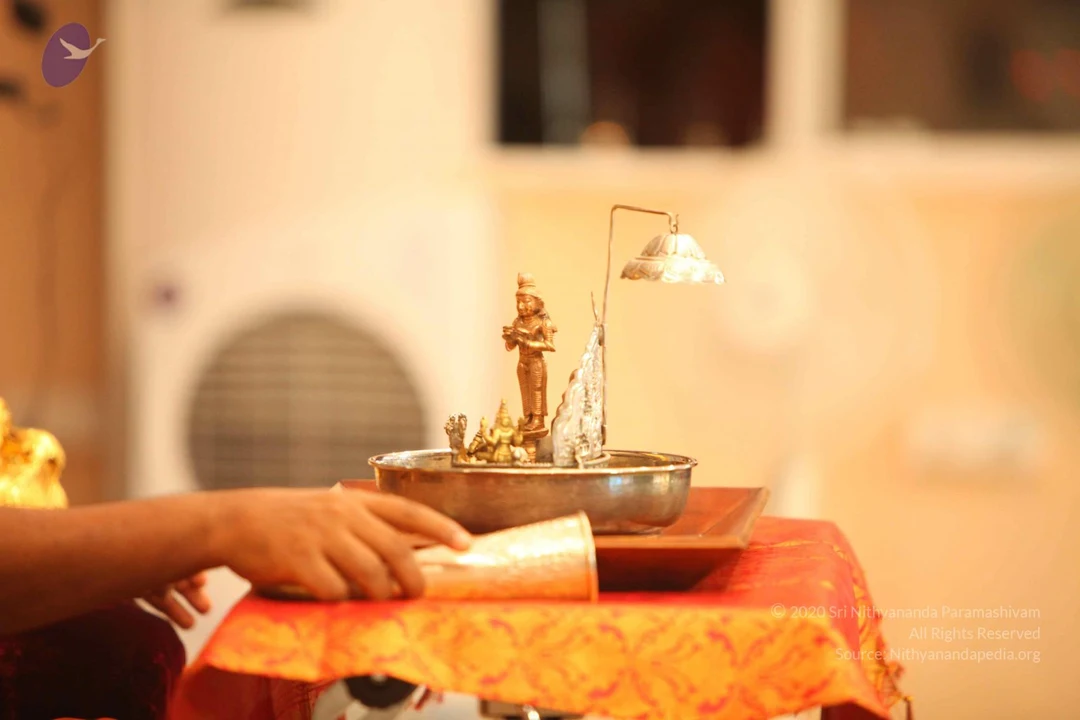
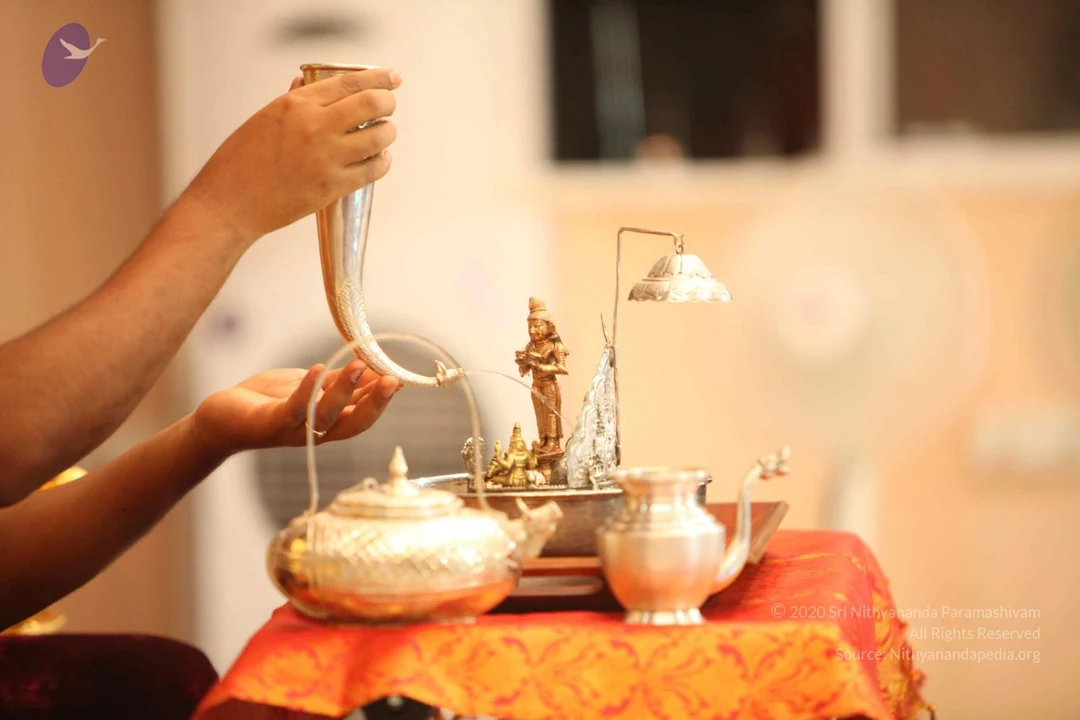
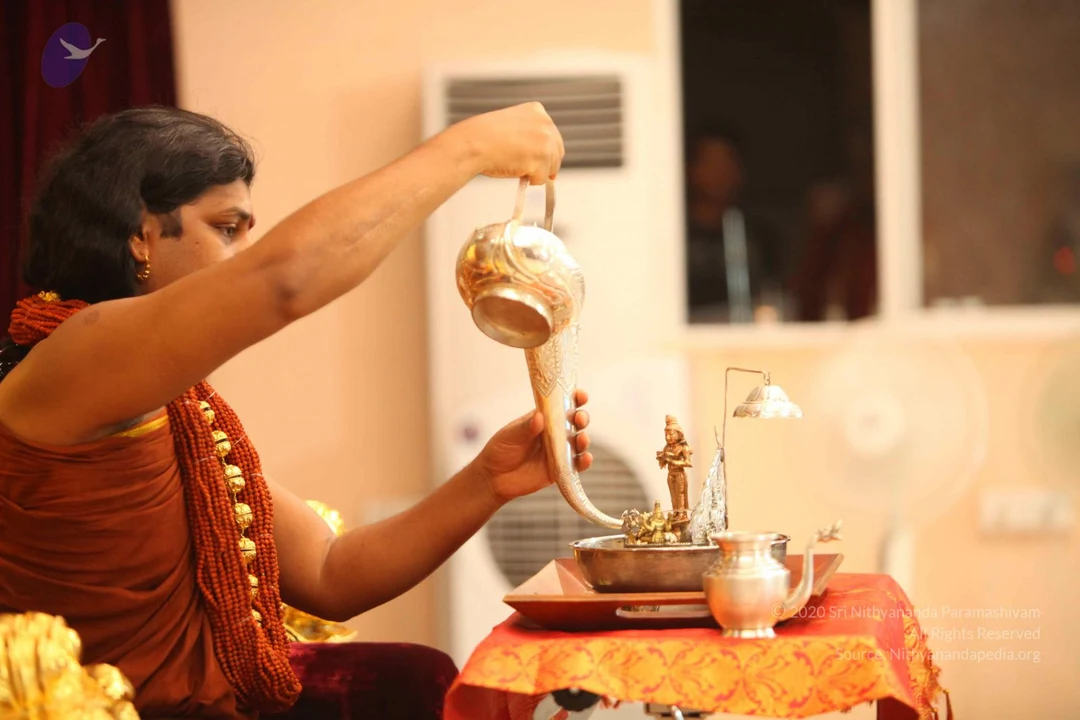
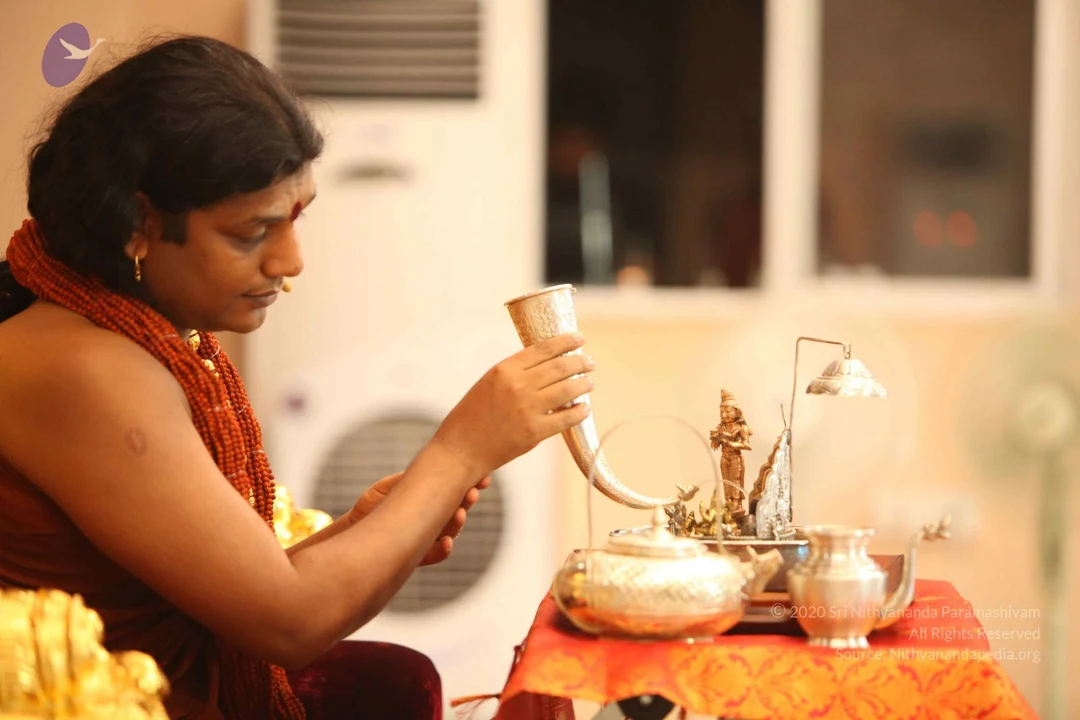
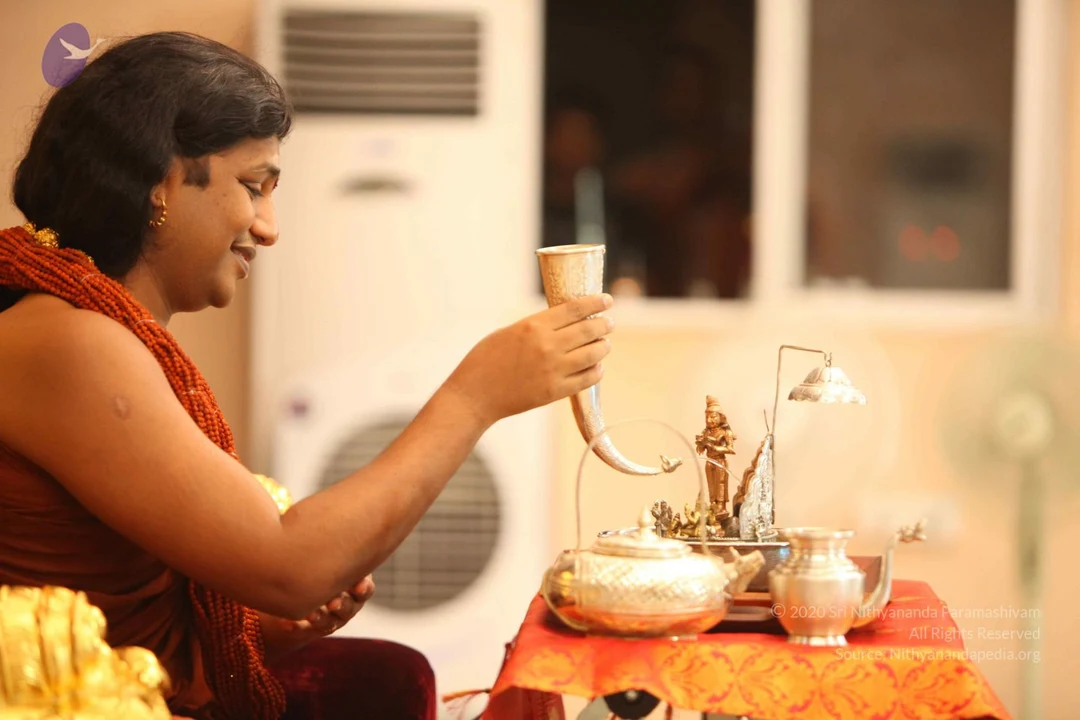
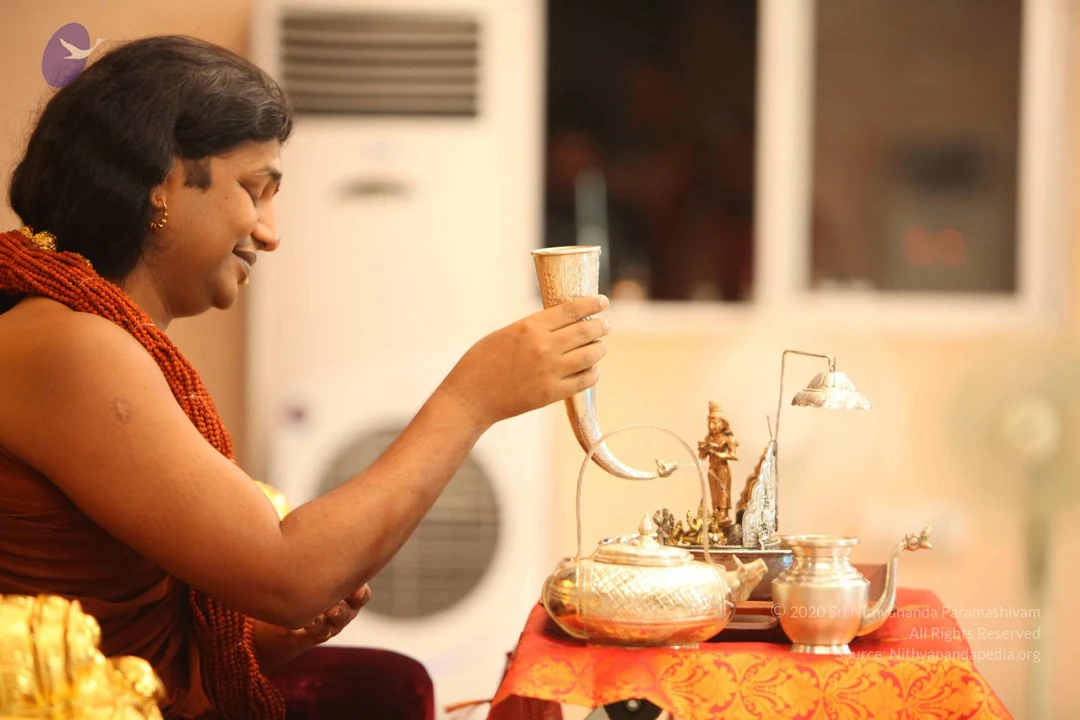
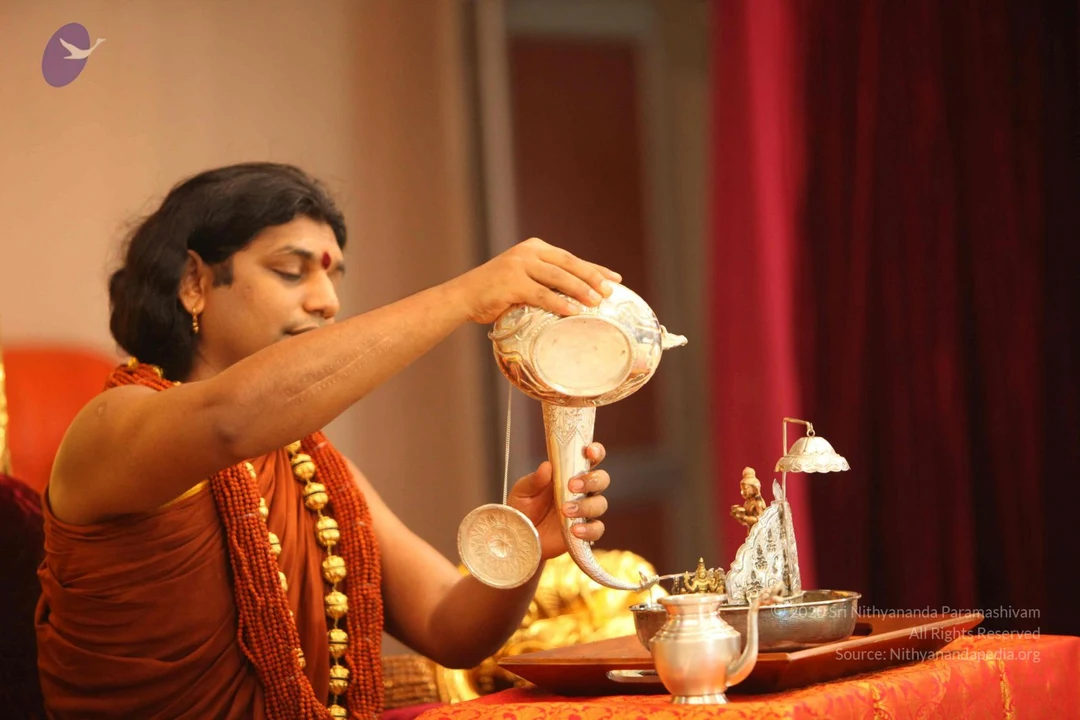
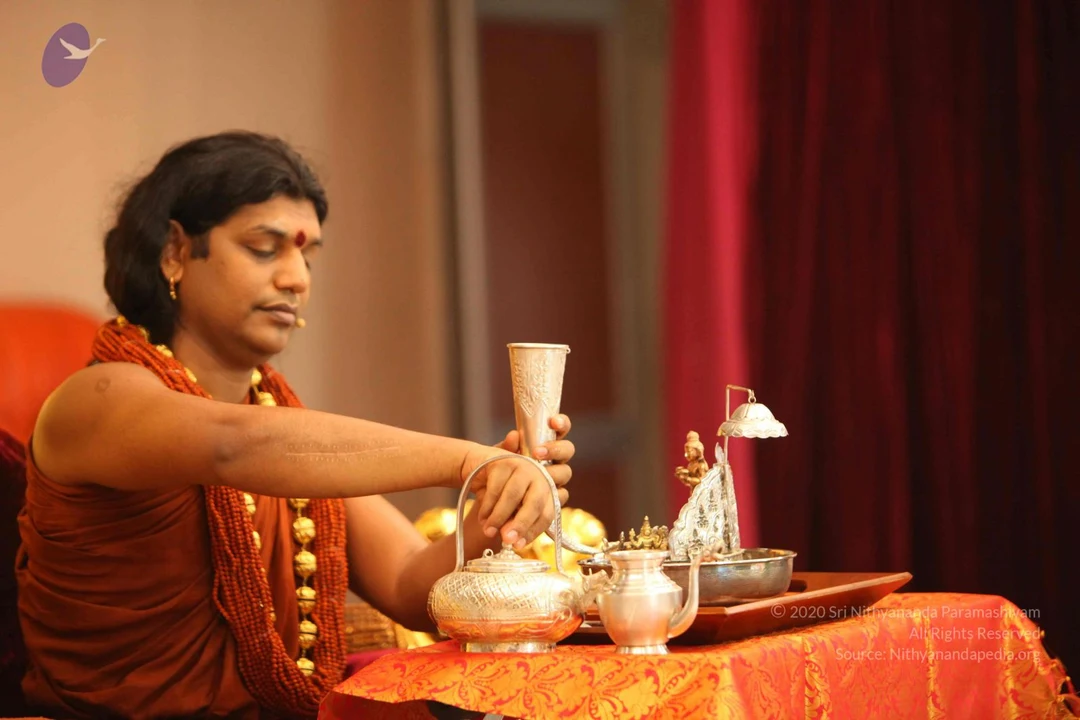
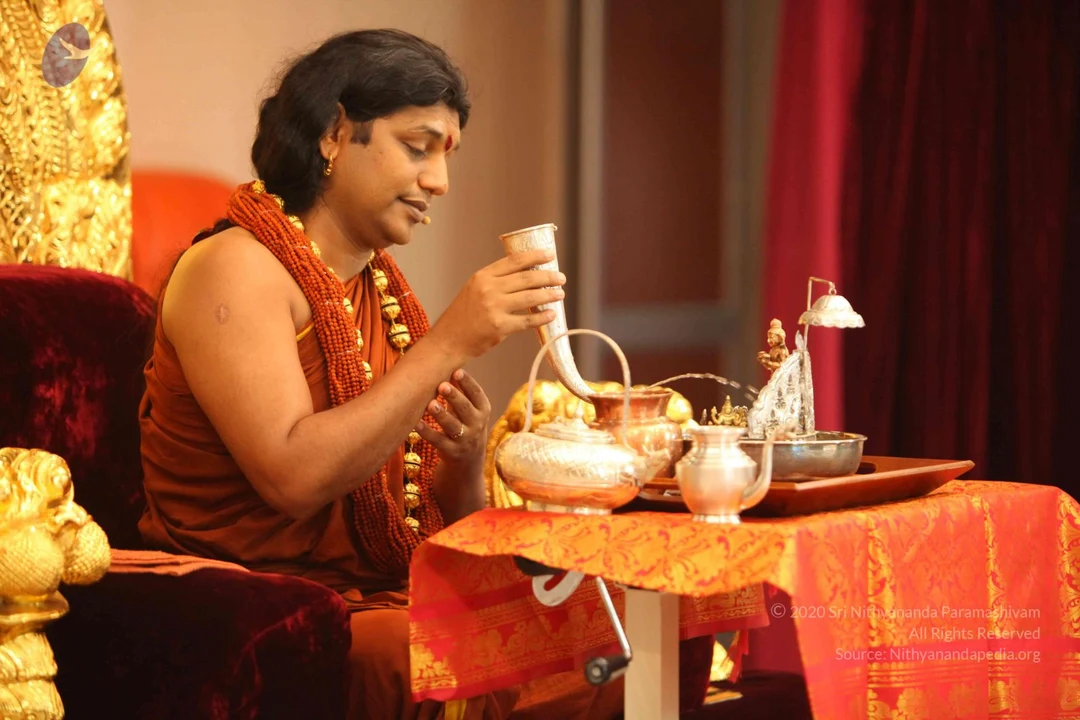
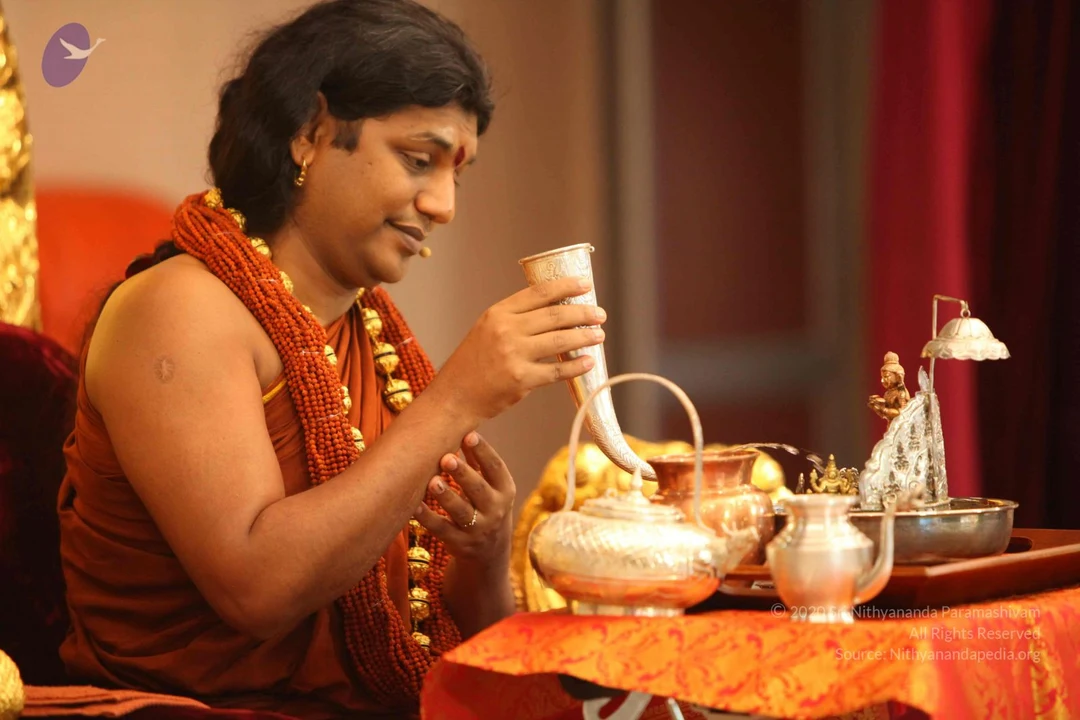
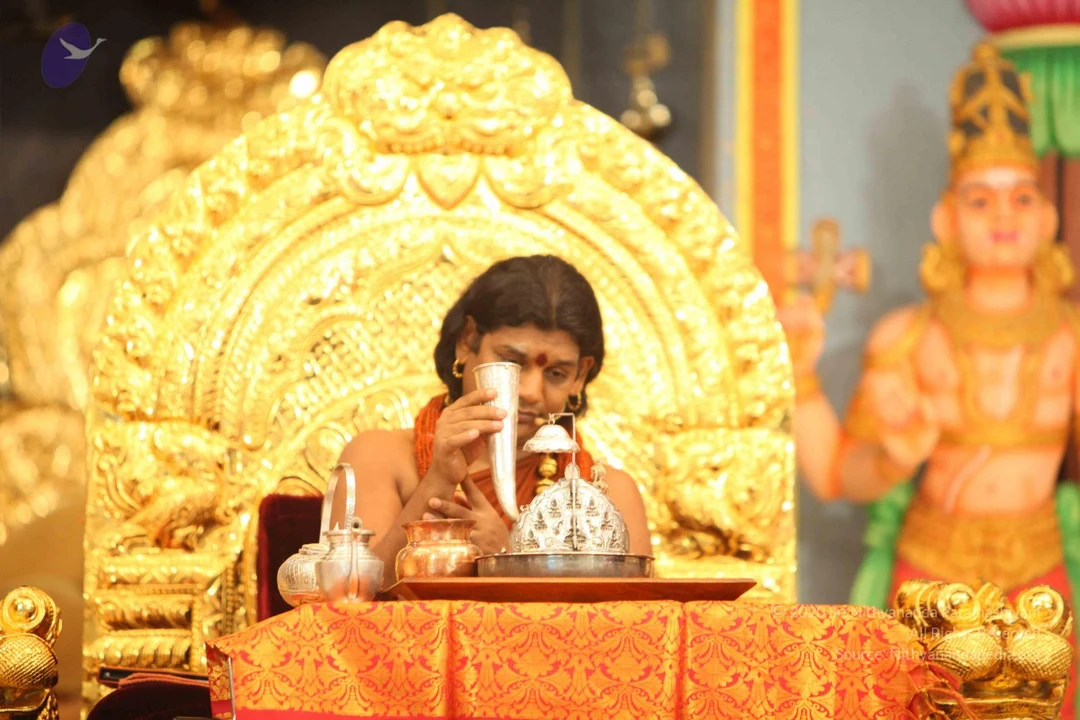
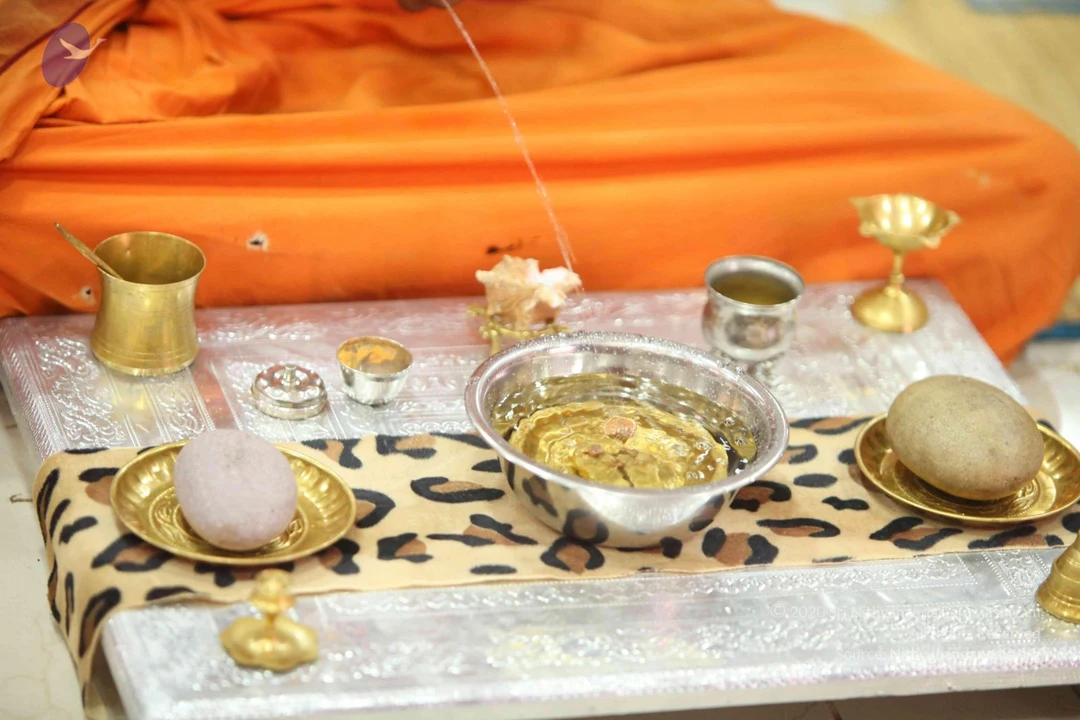
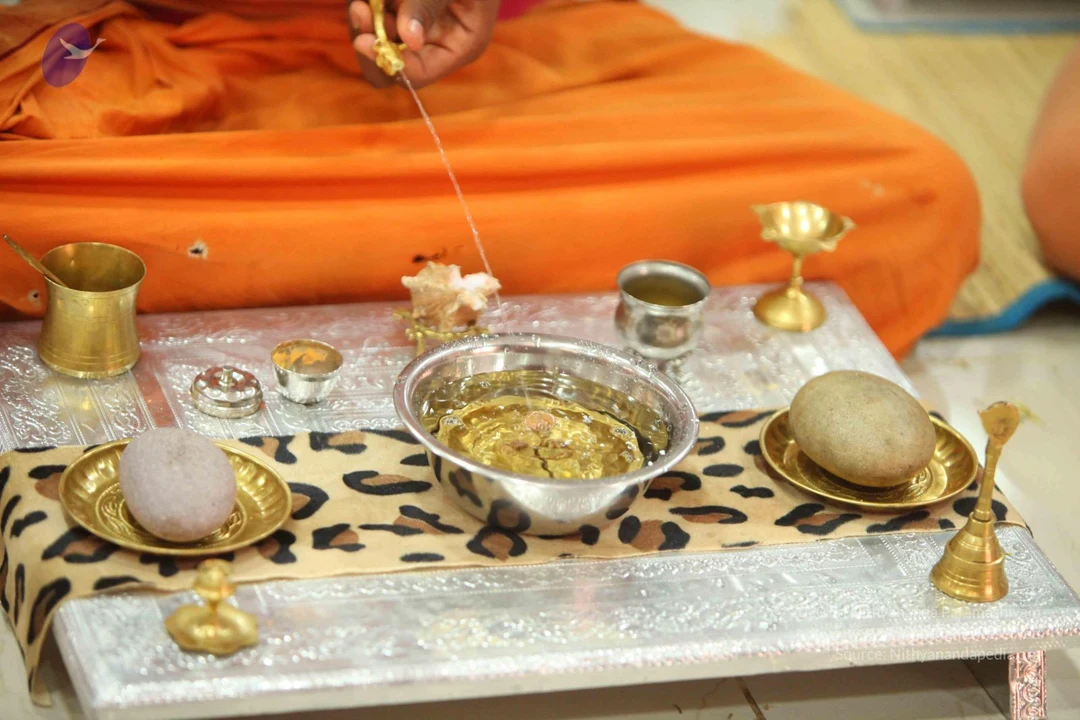
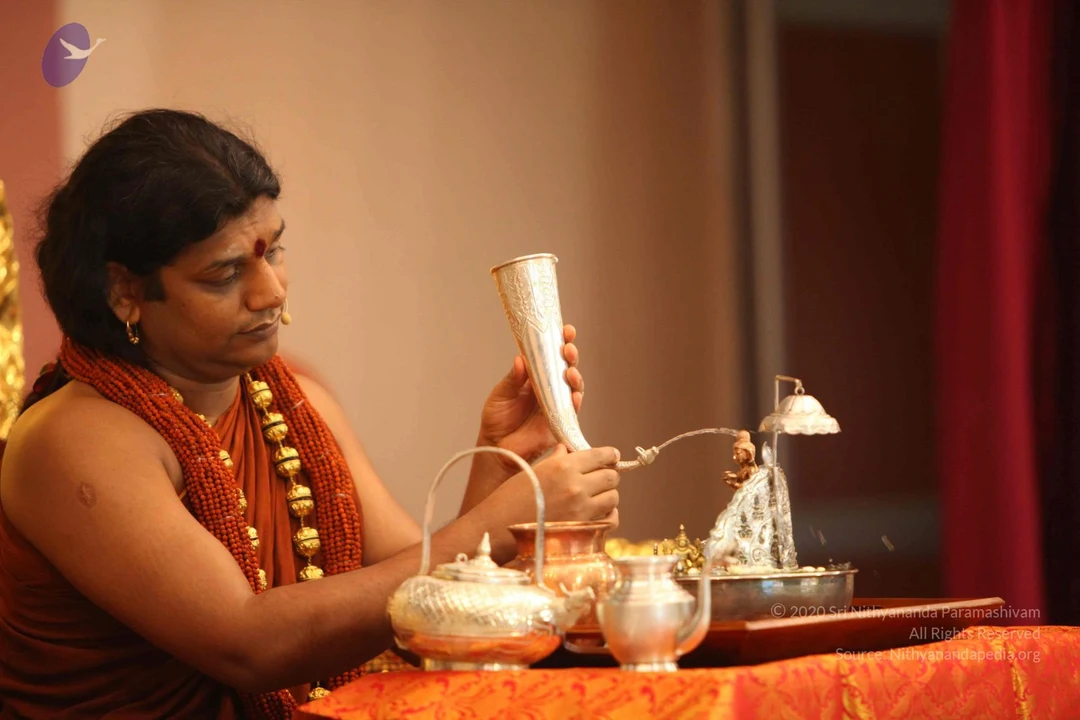
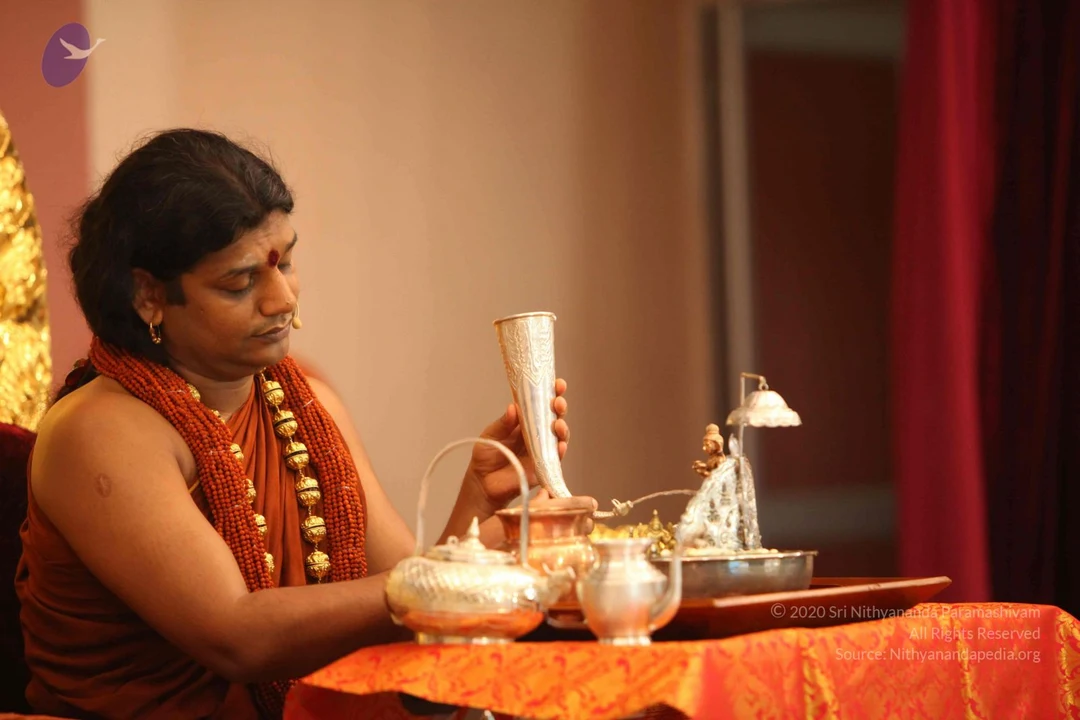
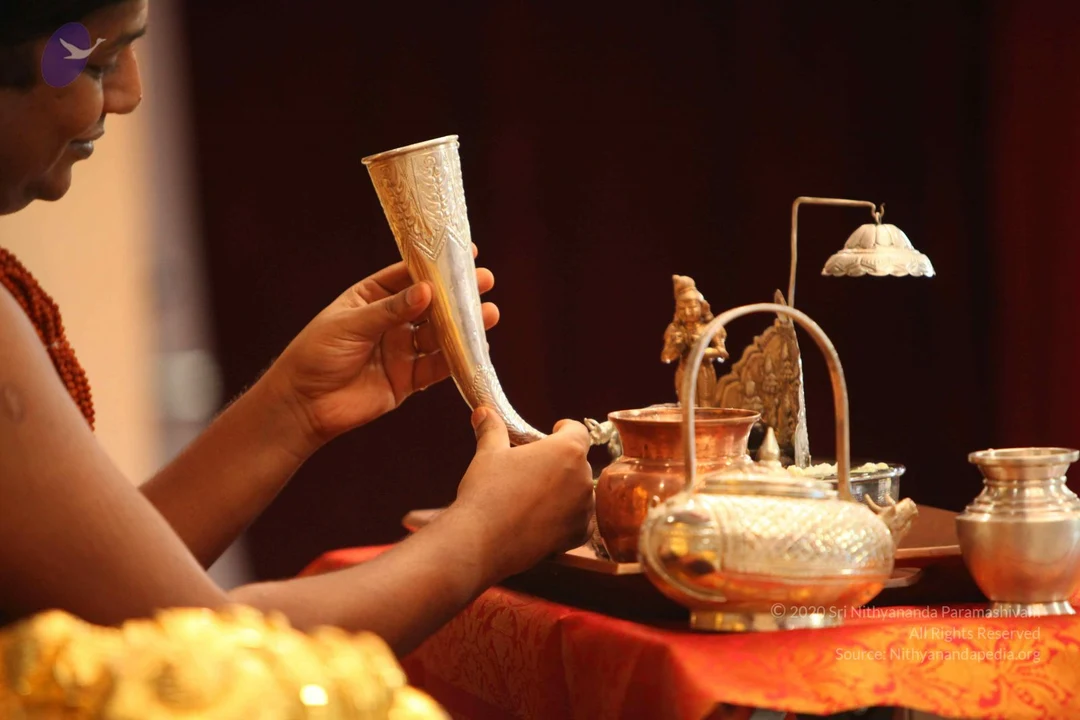
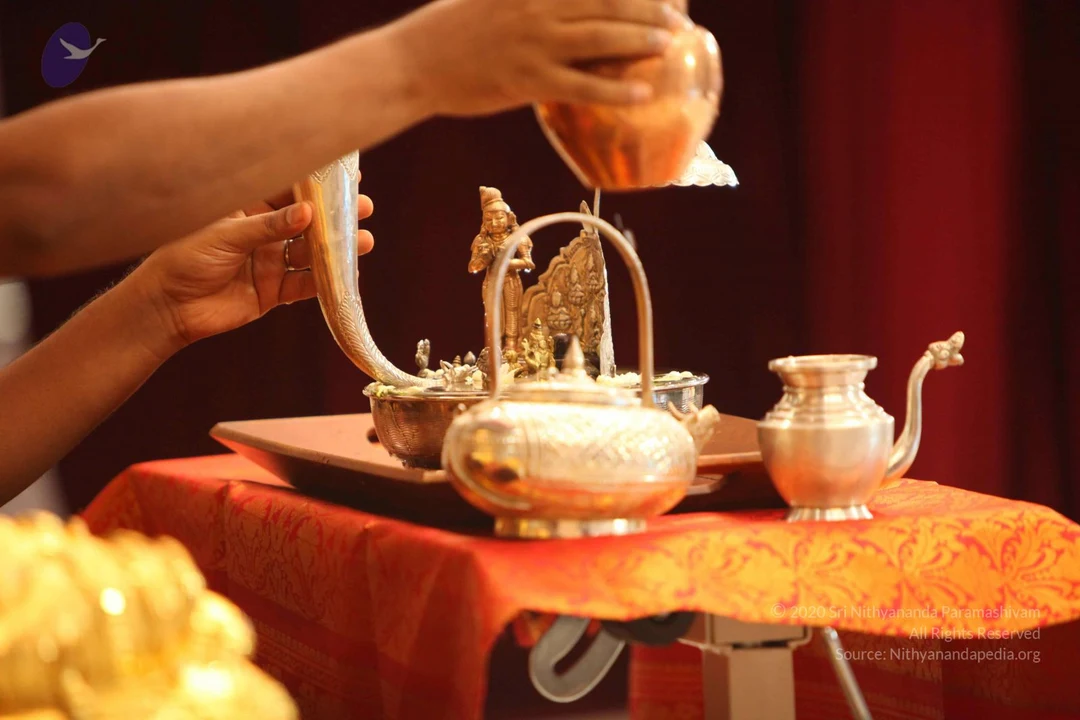
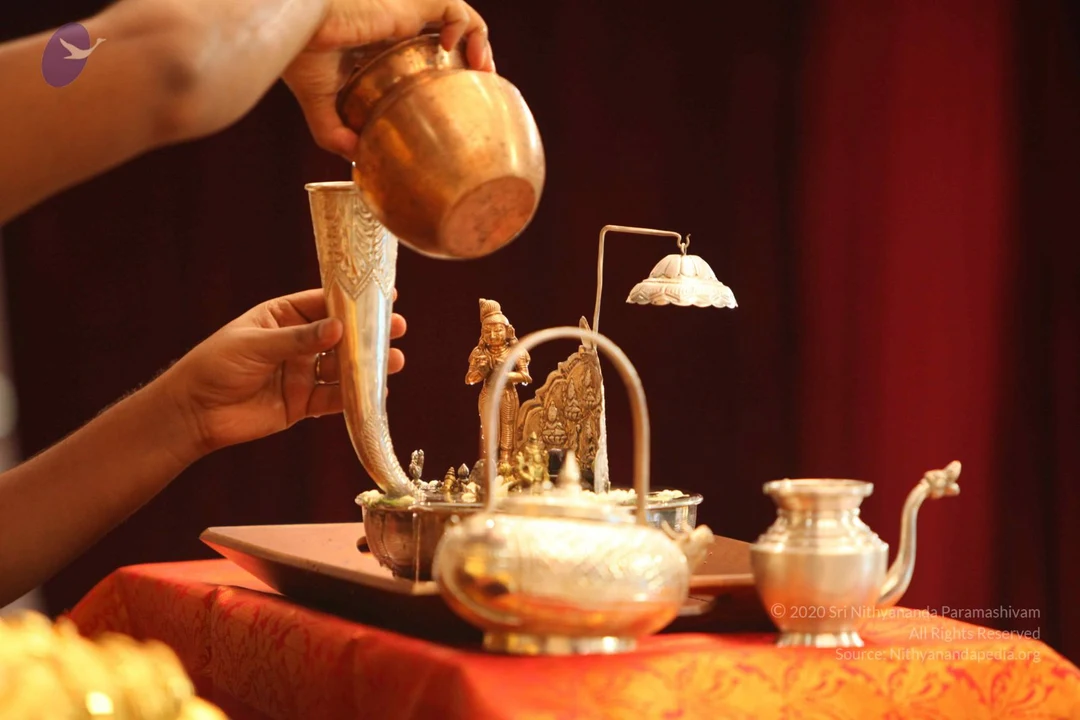
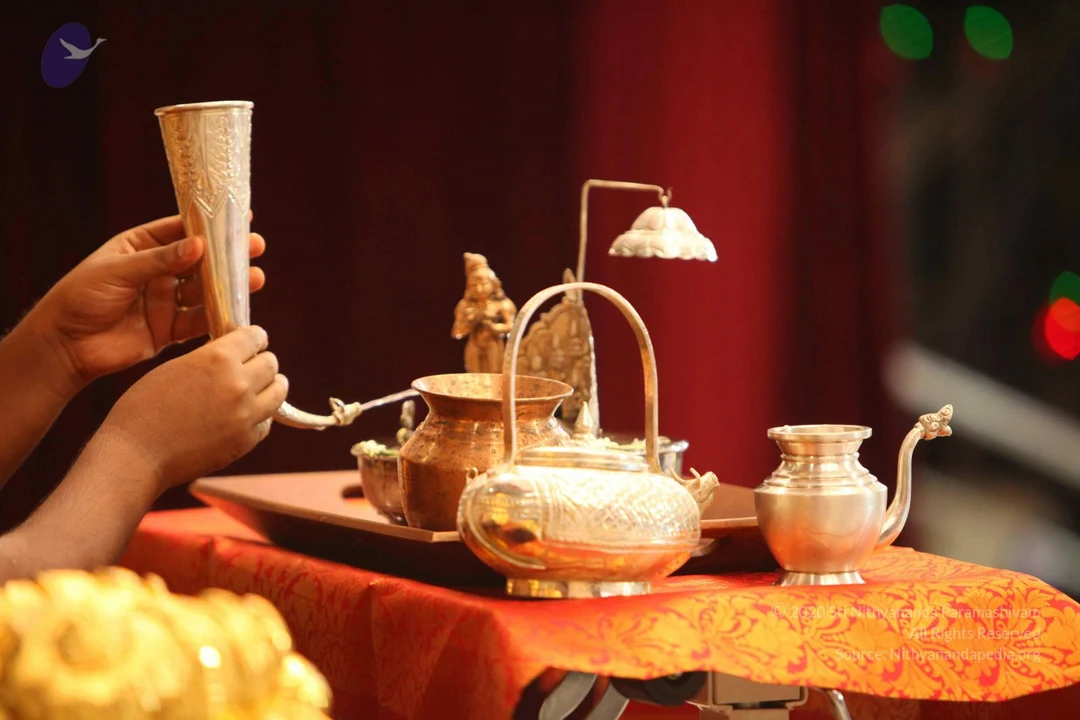
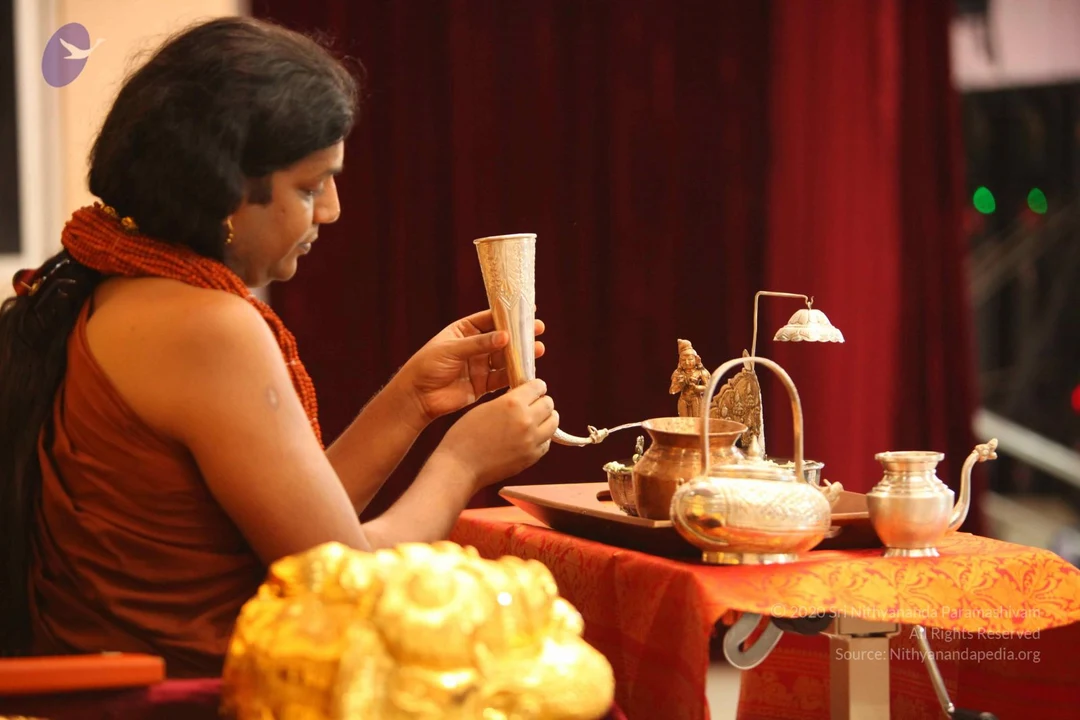
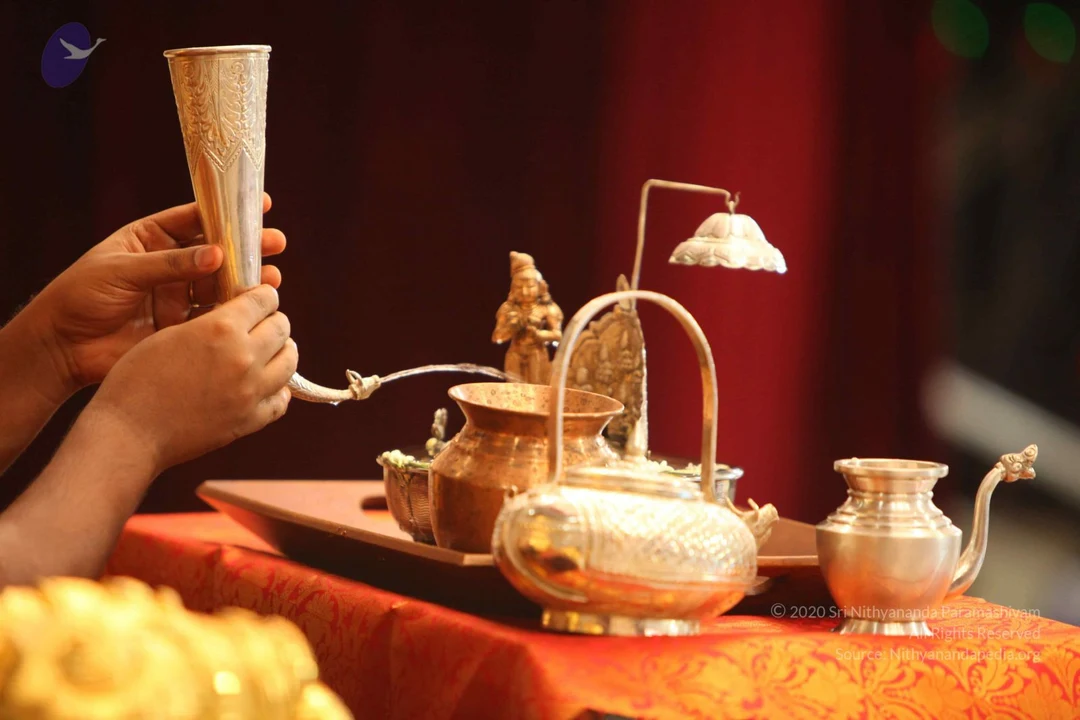
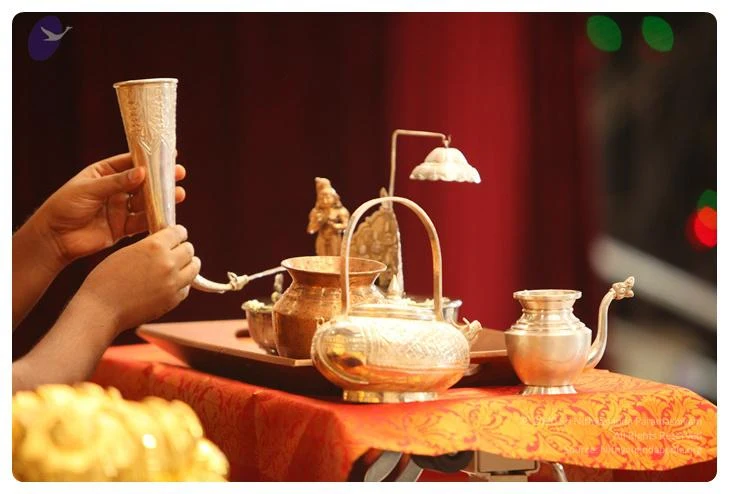
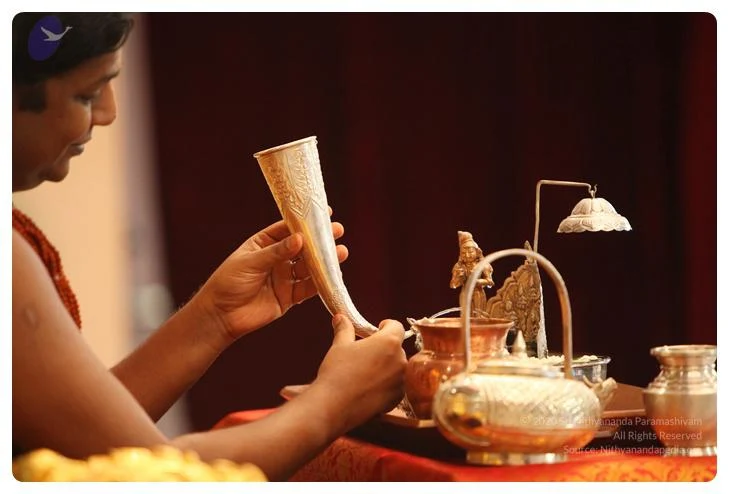
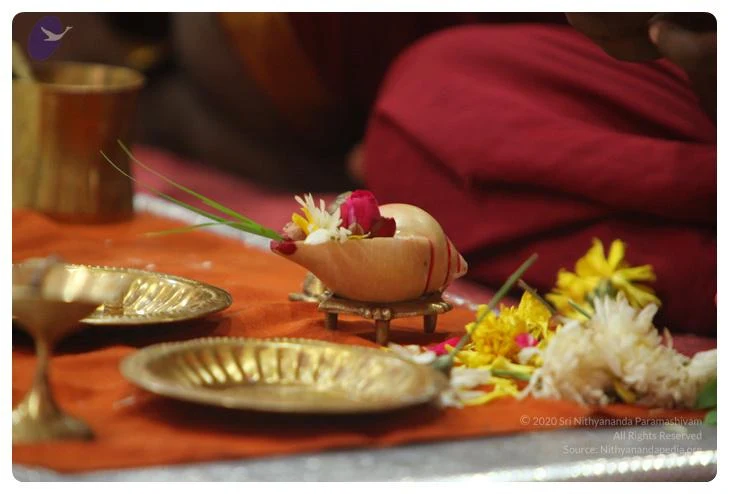
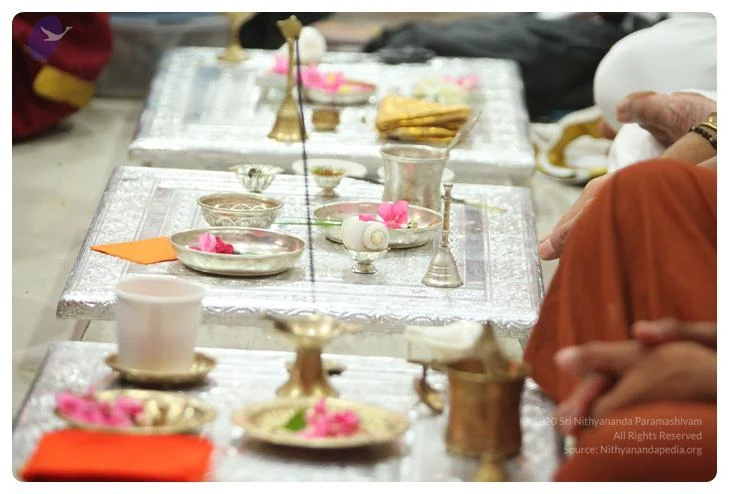
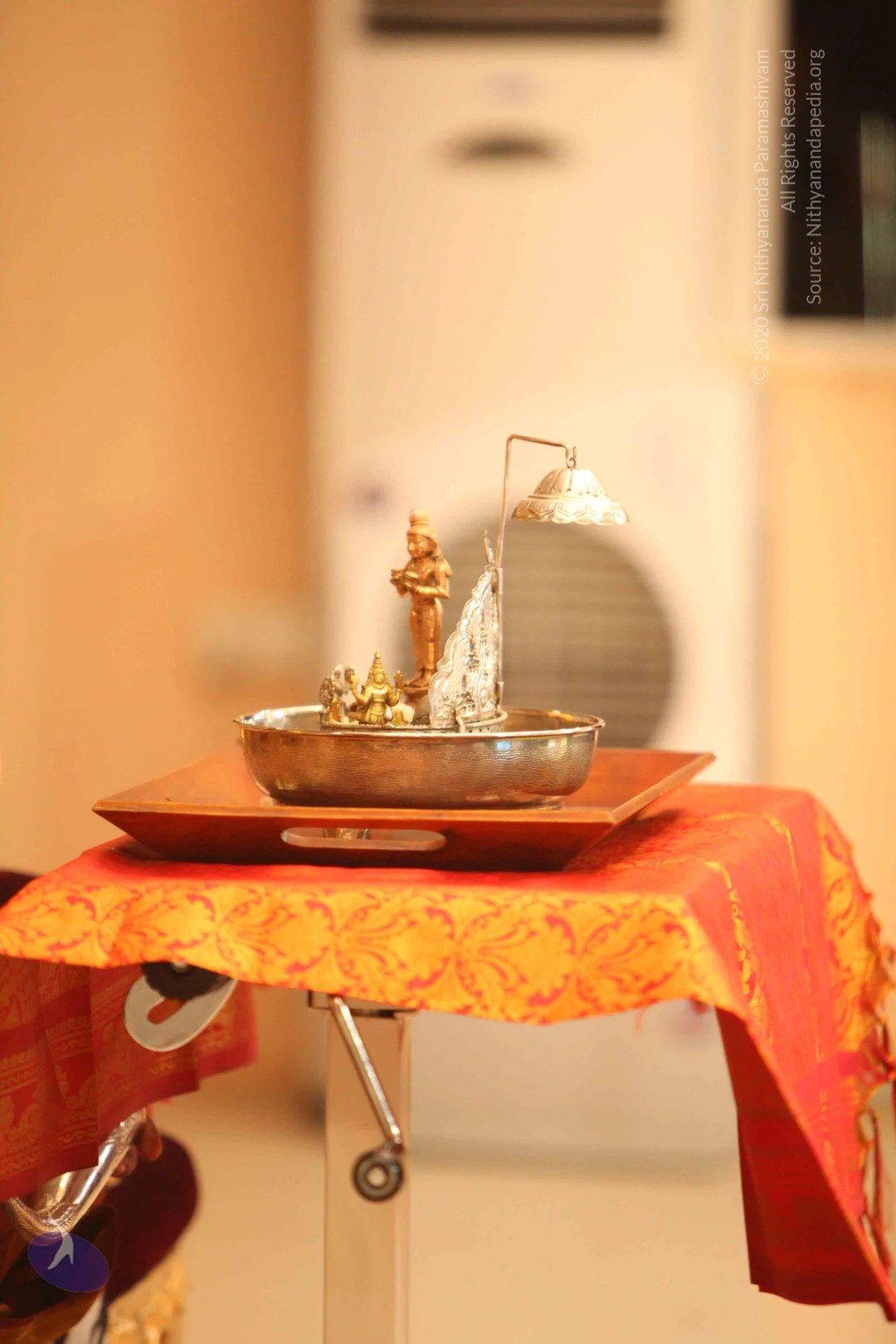
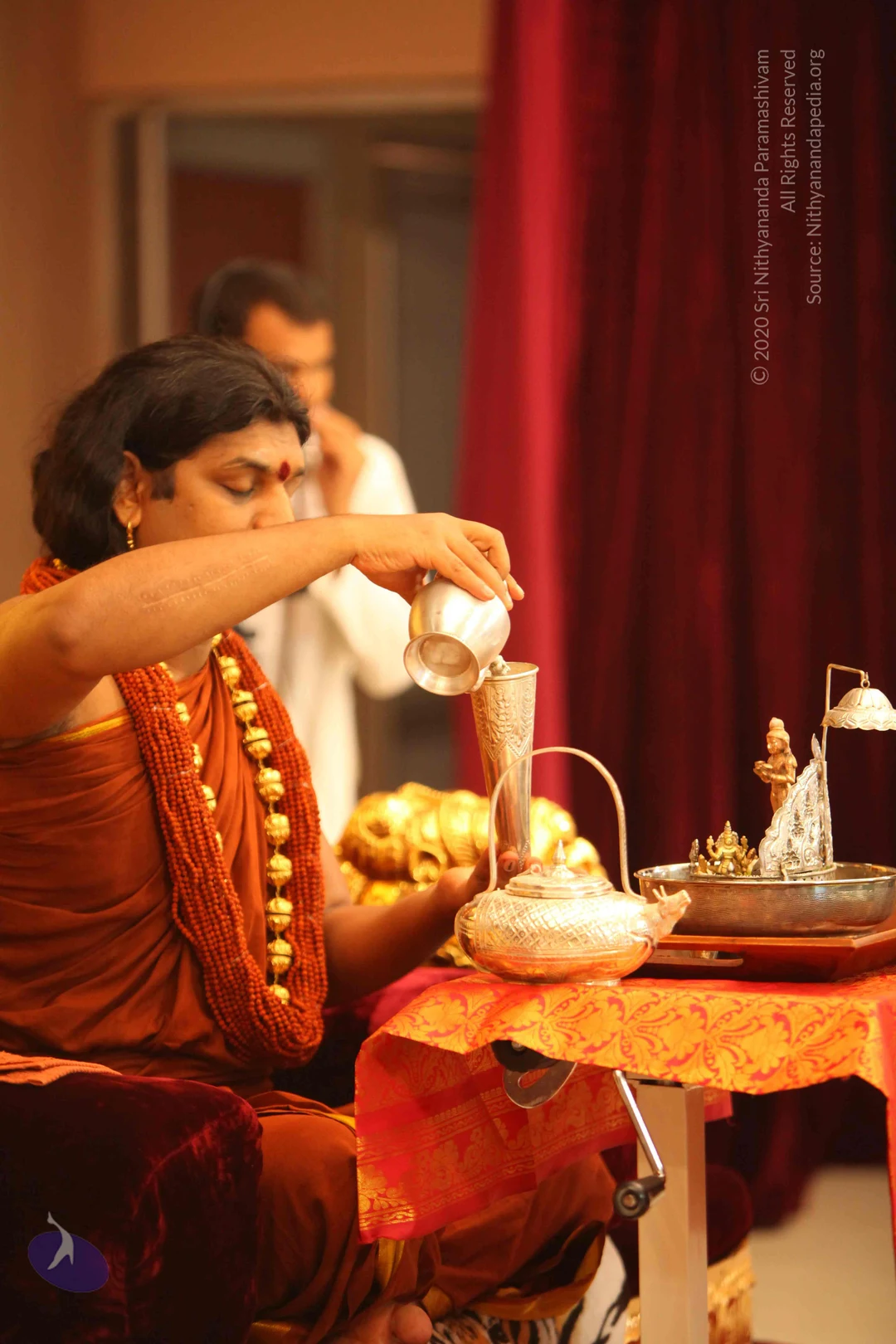
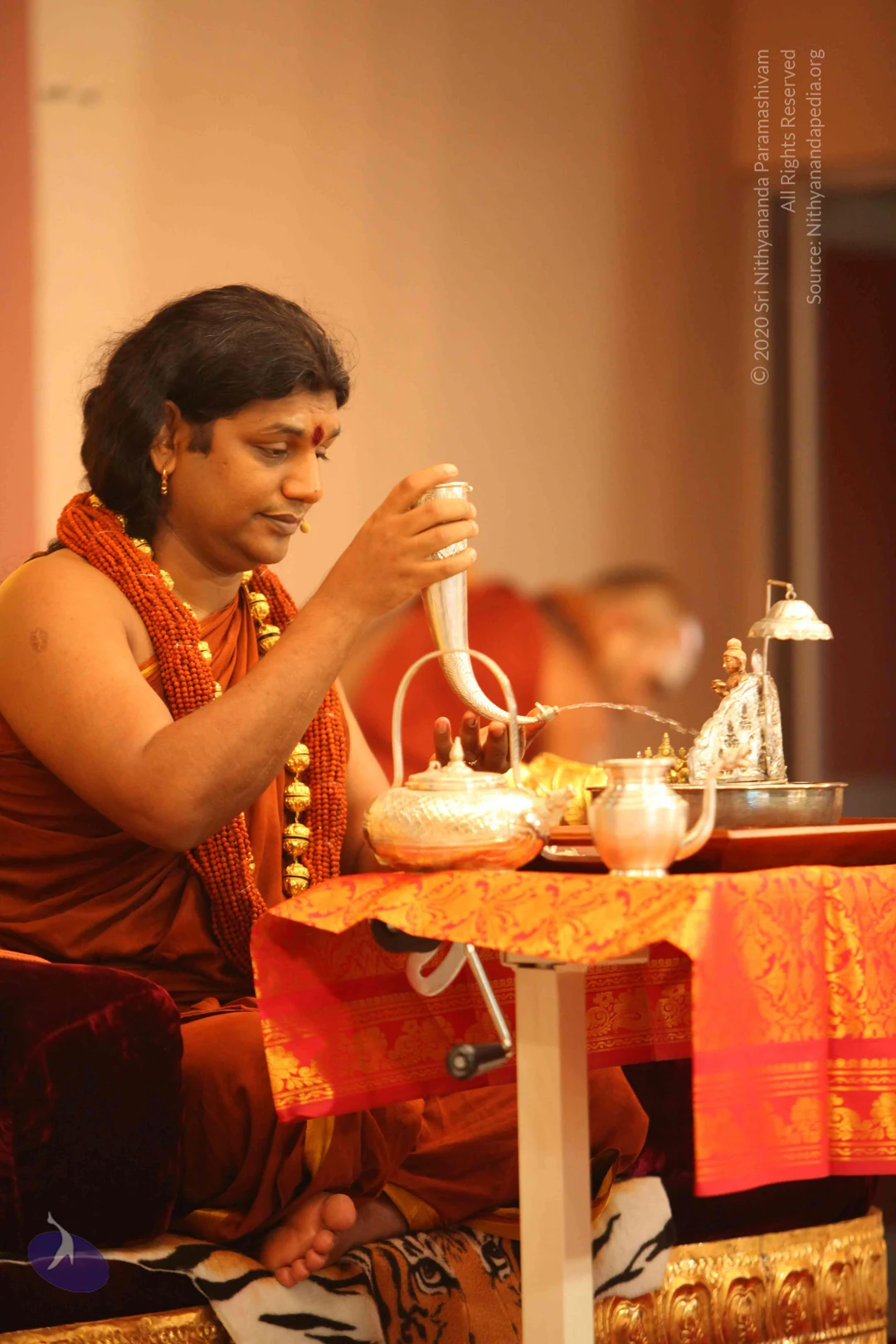
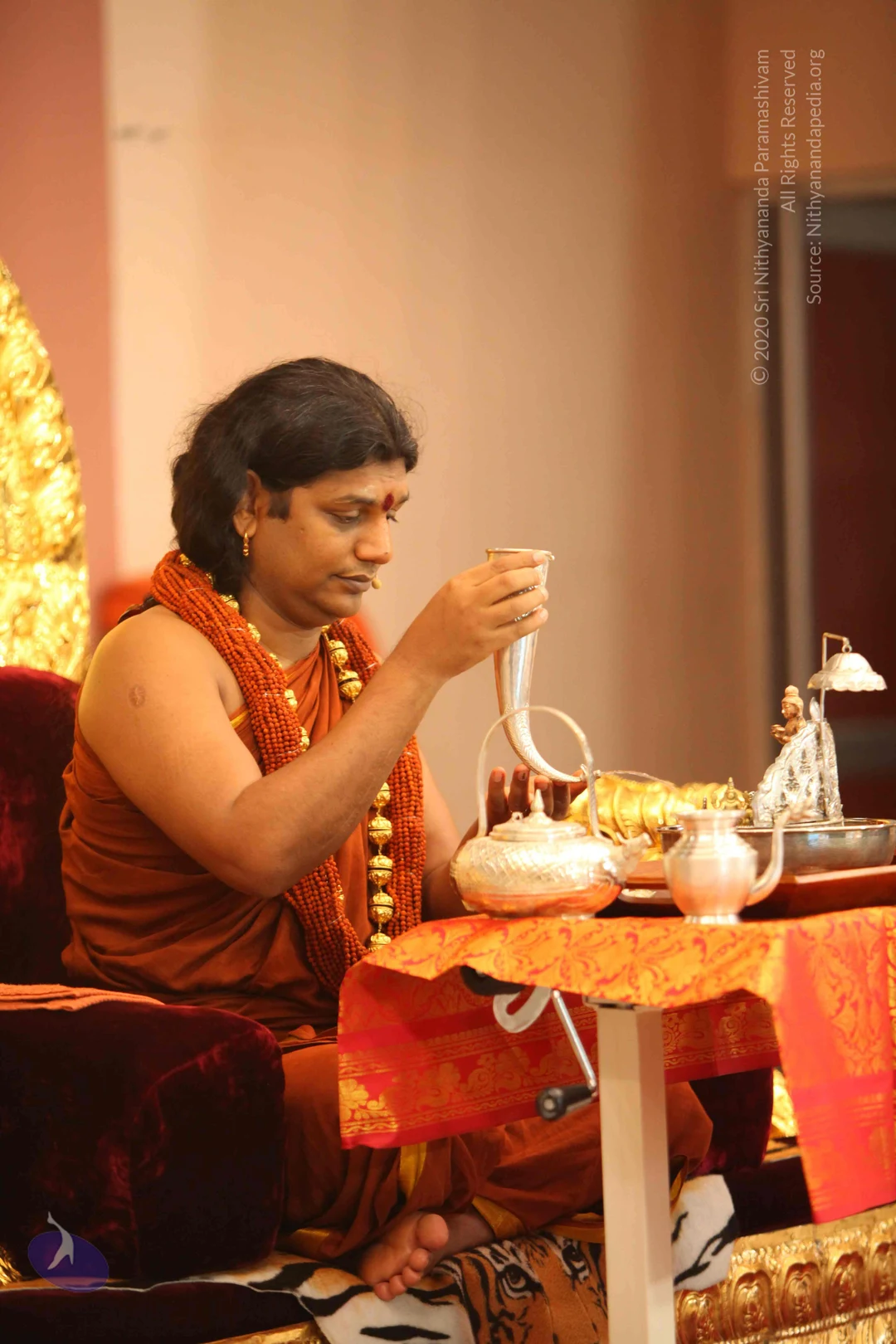
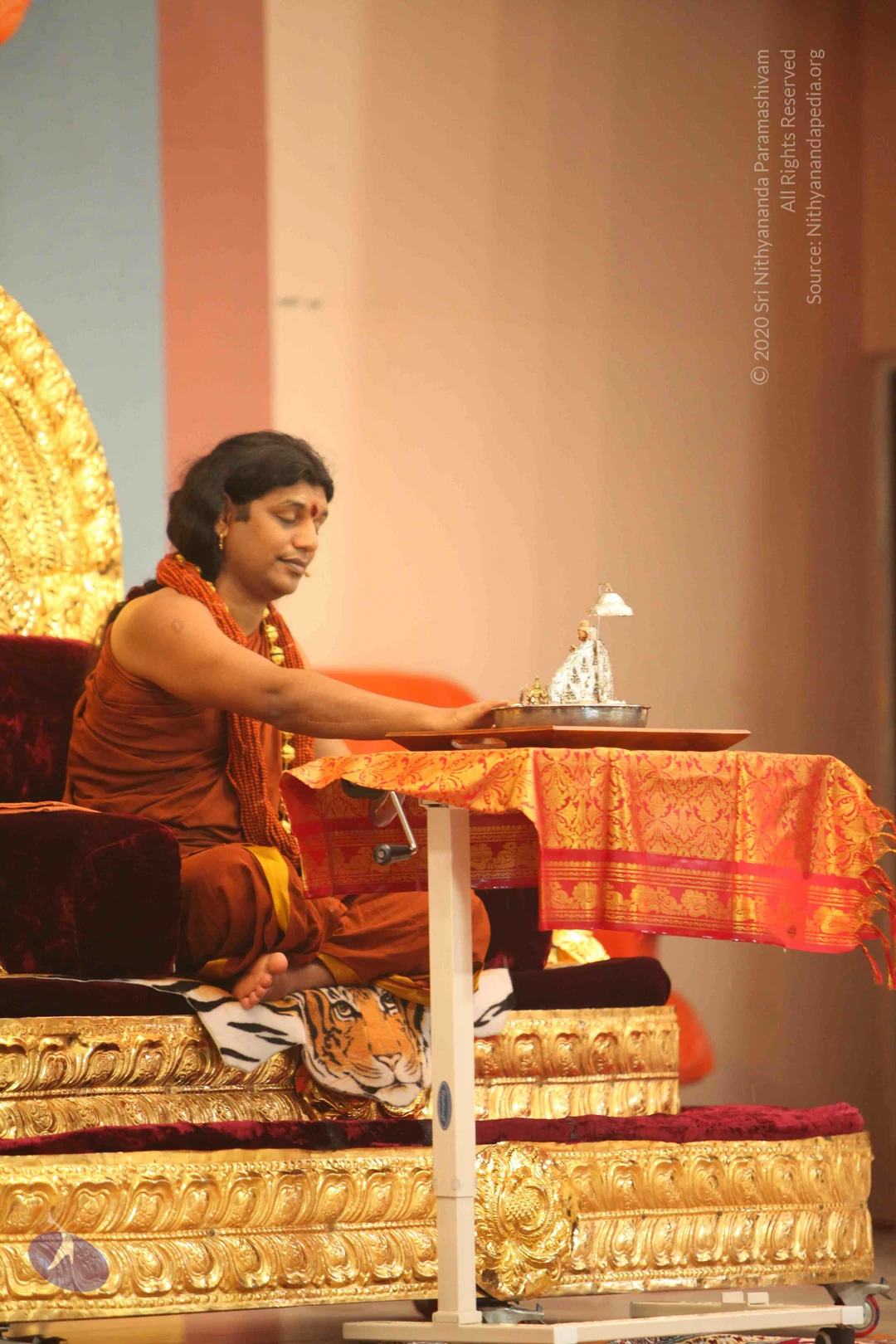
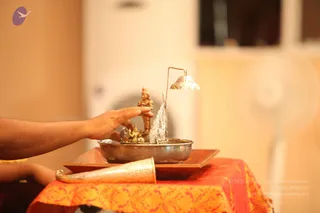
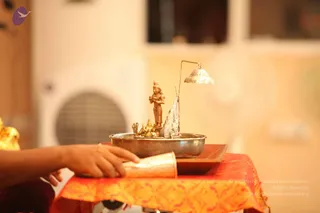
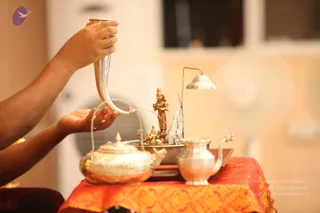
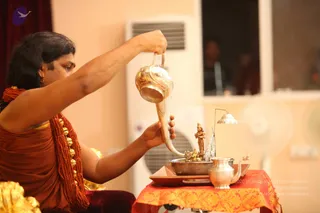
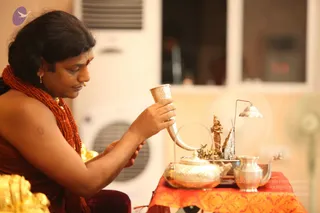
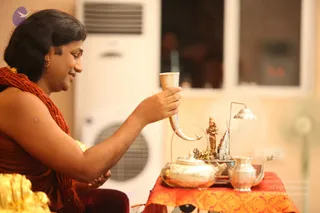
A close photograph of a ritual table draped in an orange and red patterned cloth. A hand. A tall silver lamp with a shaded bulb rises from the bowl. In front on the cloth lies a polished silver conical vessel. The background is a softly blurred warm-toned room with a window and a fan.A close photograph of a ritual table draped in a red and gold patterned cloth. In the foreground a person's hand rests near a brass cup. On the table sits a shallow silver-toned bowl holding a small brass standing figure of a deity murti, with a curved silver ornament rising behind it and smaller gold figurines at its base. A blurred gold-coloured figure appears at the left edge, and the background is a softly lit room with a white wall and window. The scene suggests a puja or abhishekam setup, with the lamp and offering items arranged on the altar.A photograph of a ritual abhishekam setting on a table draped with an orange and red patterned cloth. A pair of hands, one holding a tall silver conical vessel, pours liquid from it over a small brass murti group of a standing deity figure with a crown and seated figures, placed on a silver tray beside a silver umbrella-shaped canopy. In front stands a silver kettle-style pot with a lid and a second silver pot with a spout. The background is softly blurred with a warm interior wall and window. No face of any person is visible.A man in an orange-brown wrap and a red rudraksha mala with gold bead ornaments pours water from a silver vessel with a long spout over a small bronze deity murti set on a silver tray. A silver bowl, a silver pitcher and a red-and-gold cloth cover a side table. A man in dark clothing sits faintly in the background near an air conditioner. The scene resembles an abhishekam. The pouring man shows visible cues including long swept-back hair, a rudraksha mala and ornate gold ornaments, so the appearance-based label applies: Swamiji (probable), performing the abhishekam.A photograph of a man seated at a small altar draped with an orange and gold patterned cloth. He wears a dark maroon garment, a long multi-strand rust-orange rudraksha-style bead mala, a small red tilak on his forehead, and a gold earring. He holds a polished silver horn-shaped vessel, tilting it while looking down at the altar. On the table are a small brass deity murti, a silver lamp with a curved shade, a silver kalasha-style pot and a silver bowl. A window and air conditioner are behind him. a person is seated at the altar, performing a ritual with the silver vessel, with a copper-coloured mala and forehead mark.Photograph of a seated person in a satsang setting, raising a curved golden-rimmed horn vessel toward a small table draped with an orange and gold cloth. The person wears a rust-orange shawl over the shoulders and a long rust-red beaded mala, with gold earrings and a golden cloth on the lower left. On the table sit a small brass deity murti, a silver teapot-style vessel, a silver cup and a small brass lamp. A white wall-mounted air conditioner and a window with warm light are behind. Appearance cues include the rust-orange shawl, long red mala and gold ornaments, which are consistent with the page's a person label, so this is a probable match.

RTP-1-Morning-Message-8A-SNU

132 photosSource gallery
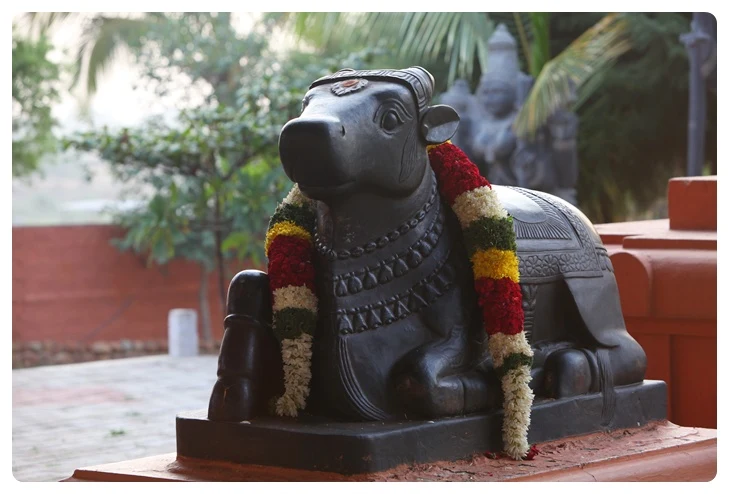
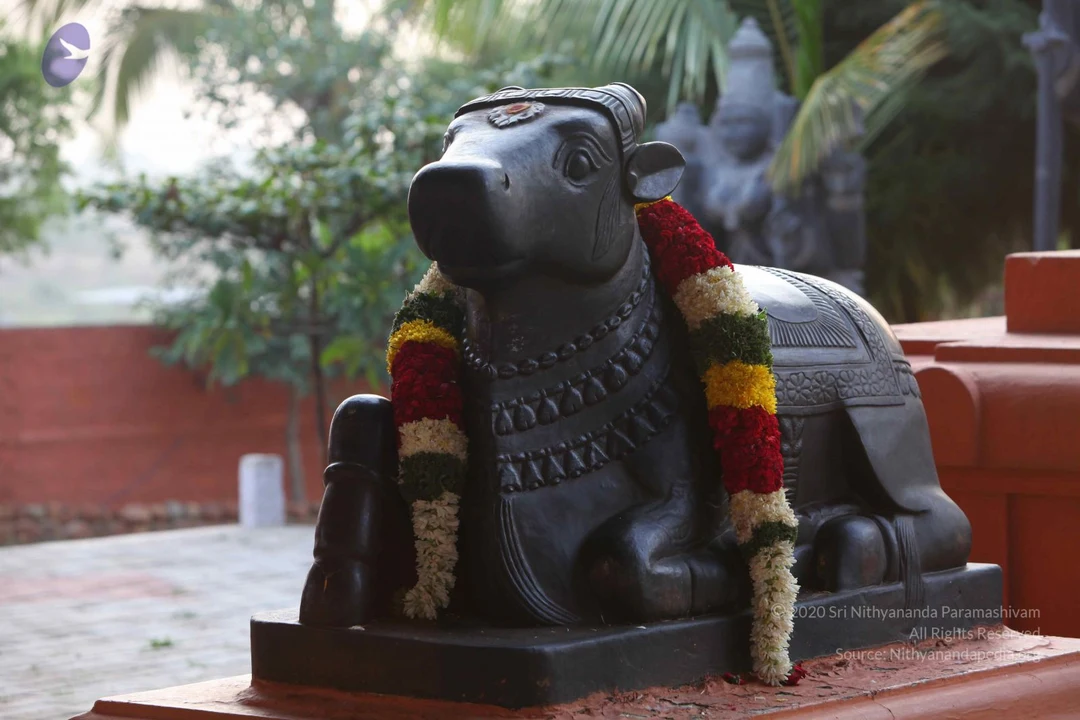
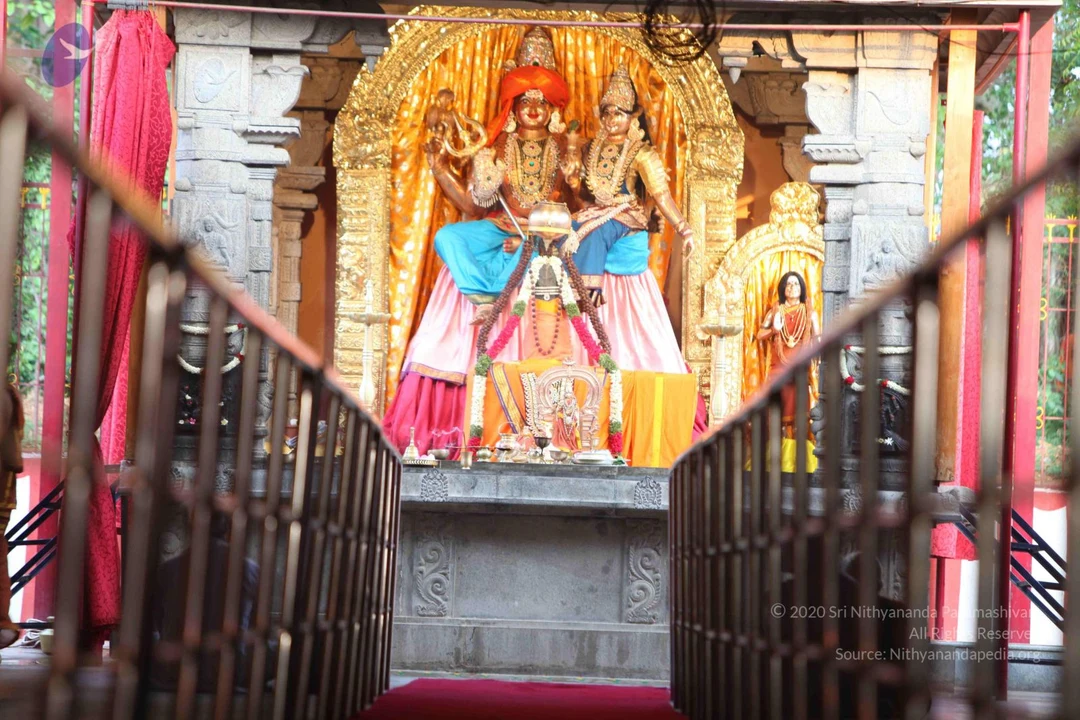
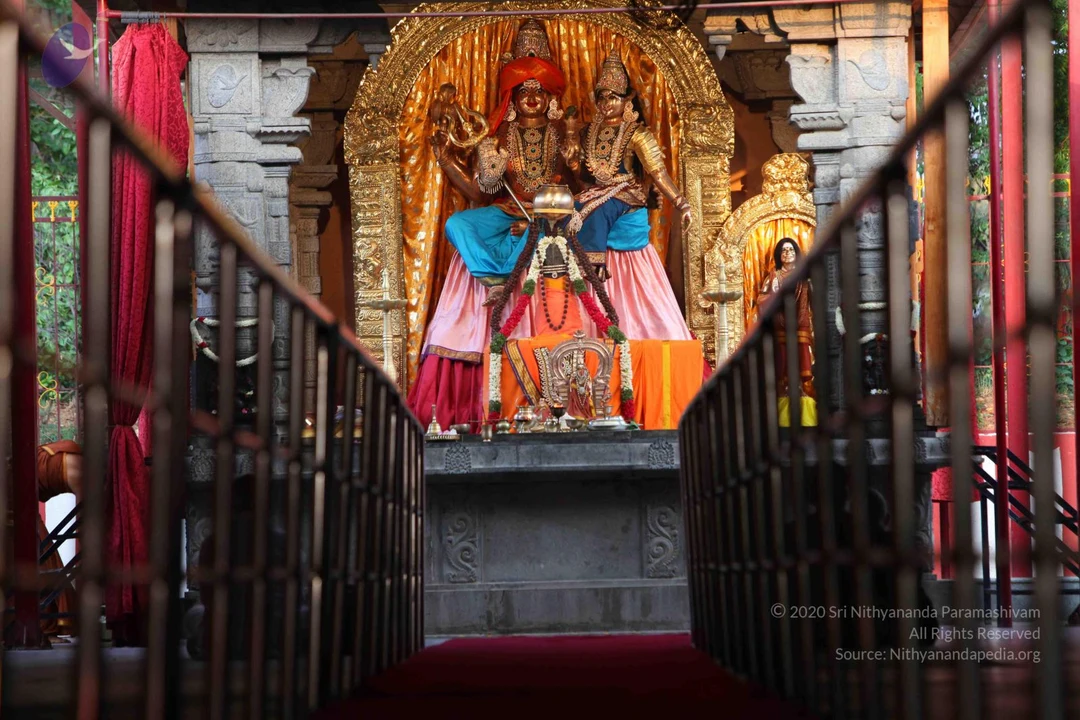
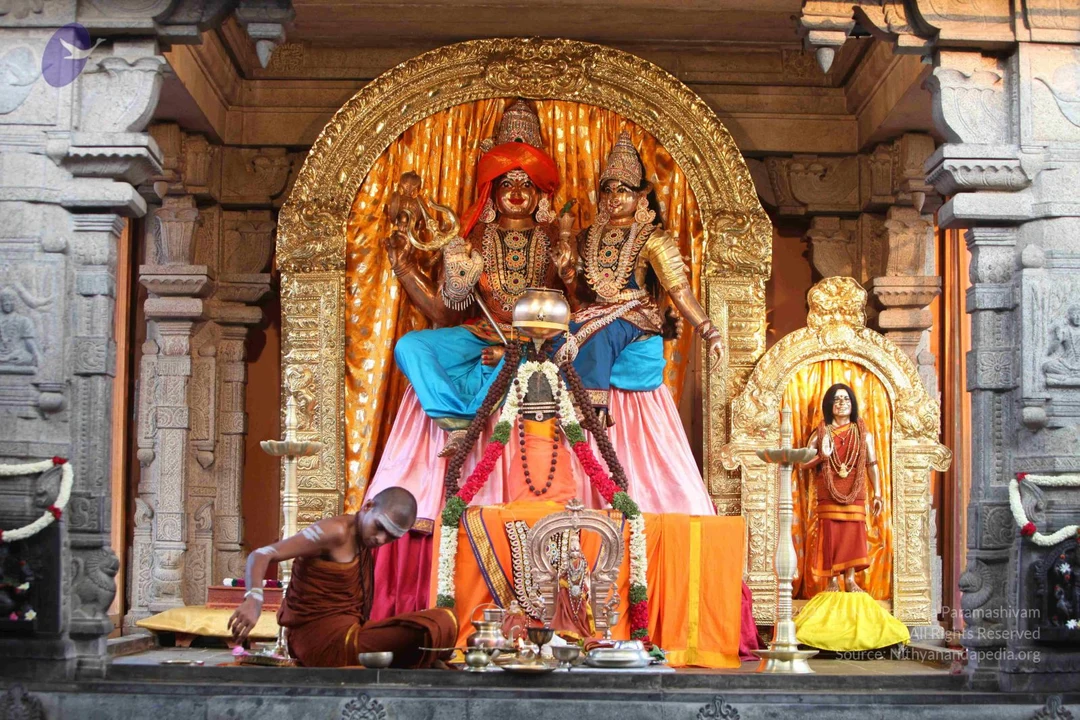
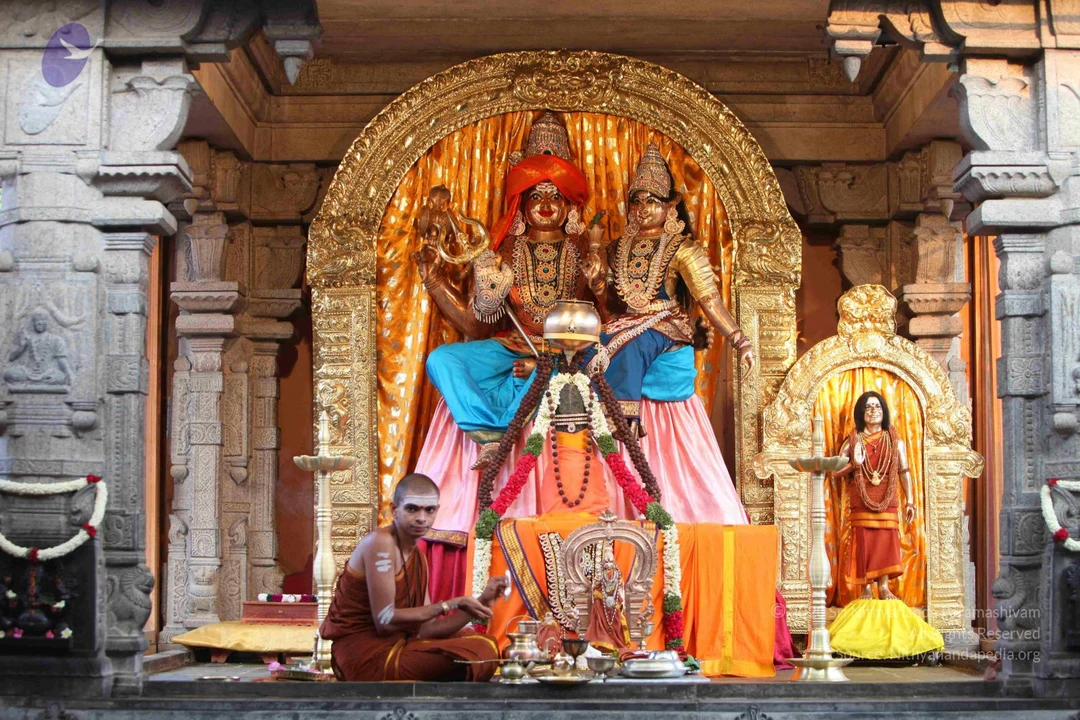
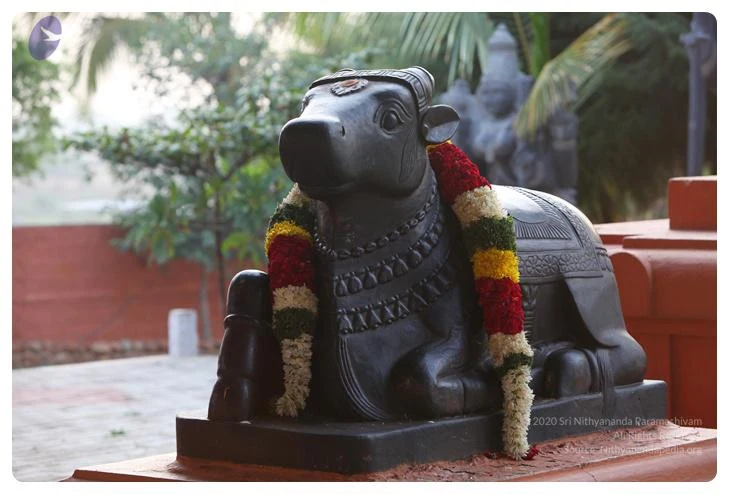
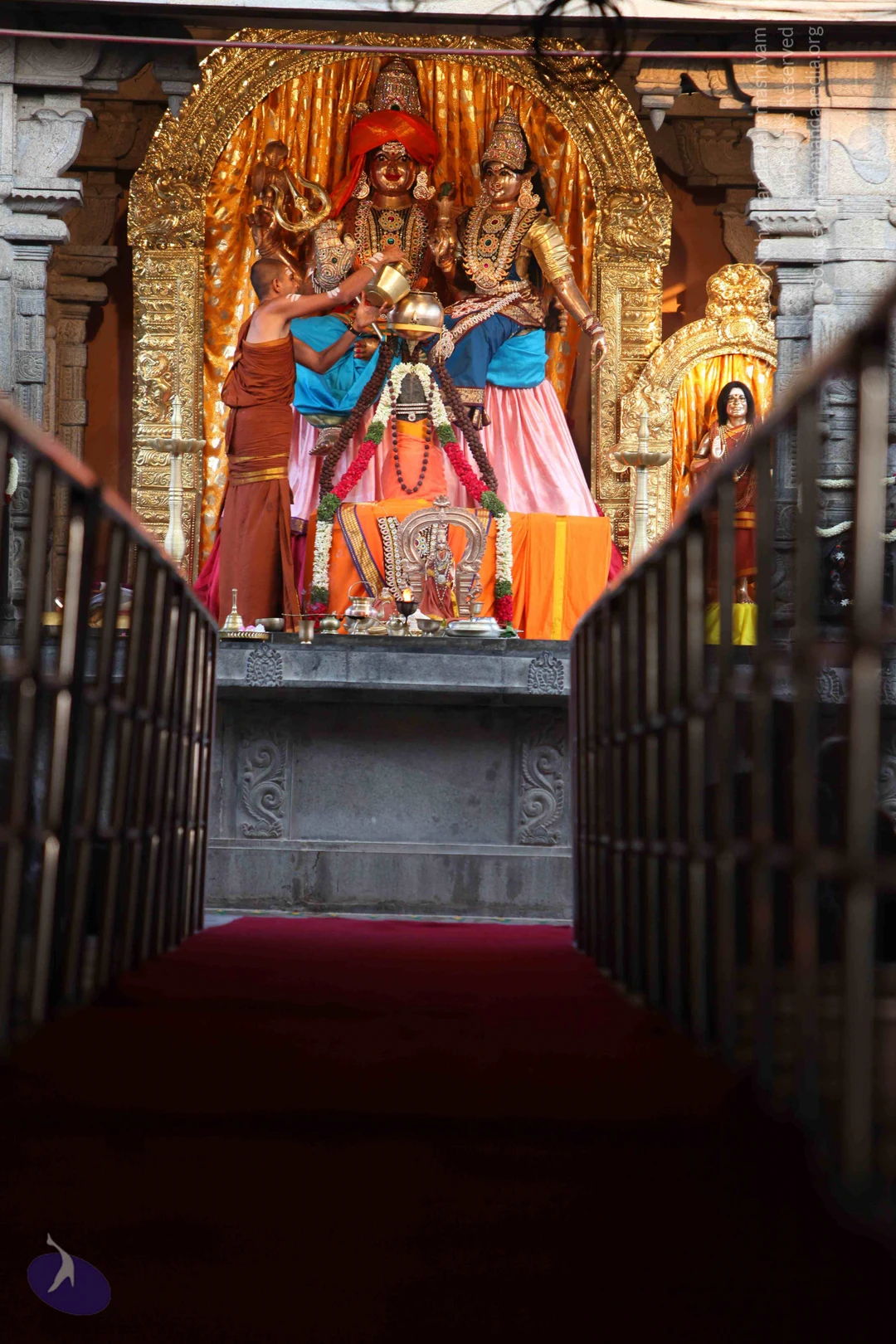
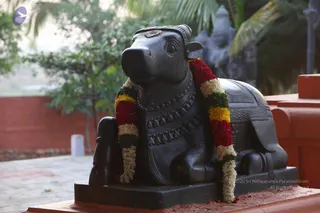
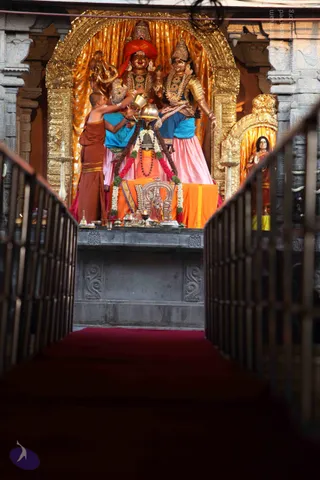
Close macro photograph of pale yellow-white frangipani (plumeria) flower buds on a branch with reddish stems and broad green leaves, set against a soft blurred dark green background. No people visible.A large black stone Nandi bull statue sits on a dark plinth outdoors, adorned with a garland of red, yellow, green and white flowers draped across its neck and shoulders. The bull wears a carved necklace and a forehead ornament with a central disc, and its saddle cloth is carved with patterned designs. Behind it, green trees, a red boundary wall and a grey stone deity figure are visible. No people are present.Photograph taken through a metal railing down a red-carpeted aisle toward a shrine. Two painted deity statues stand on a grey stone plinth under a gold-embroidered arch with orange drapery: the figure on the left wears an orange crown, gold jewellery and a rudraksha-style necklace and holds a trident-like staff, while the figure on the right wears a gold crown and blue-and-pink skirted garment. Garlands of white and pink flowers hang on the plinth, with brass oil lamps, a kalasha-like vessel and offerings in front. A smaller standing figure in orange robes stands at the right edge, and red pillars and a red curtain frame the scene. No physical people are visible in the shrine. Deity murti, shrine.A temple sanctum viewed down a narrow aisle lined with metal railings and a red carpet. At the far end, two large deity murtis stand on a grey stone pedestal, one in a red turban with rudraksha garlands and a raised hand, the other crowned and in blue and pink dress. Garlands of white and red flowers hang from the figures, a brass kalasha sits before them, and an orange cloth backdrop with gold arch framing surrounds the shrine. Red curtains hang at the left and a small attendant figure stands at the right. No living people are visible in the frame.A photograph of two ornately decorated metal murti of deities seated before a gold-and-orange draped backdrop framed by an elaborate gilded arch. The murti on the left has four arms, holds a trident, and wears a red turban and a large jewelled necklace; the murti on the right wears a tall jewelled crown, long necklaces, and a gold blouse. A small green parrot perches on the right-hand figure's raised hand, and a silver kalasha-like vessel sits in the foreground. Watermarked archive text appears at the lower right and is omitted.A shrine inside a granite temple shows two large painted deity murti seated on a raised platform under a gold-arched niche with orange drapery. The central figure wears a red turban and a gold crown with a trident-like emblem, holding a drum and a cup-shaped vessel; the consort figure wears a blue-green dress and a crown. Garlands of white jasmine and red flowers hang from the platform. In front, a shaven-headed priest in brown-orange robes with white markings kneels and tends brass puja vessels, a kalasha and lamps on an orange cloth. A standing figure in orange robes and a rudraksha mala stands at the right beside a lamp stand. Carved stone pillars frame the scene.

RTP-5-Akashic-Readings-Kalabhairava-Darshan

33 photosSource gallery
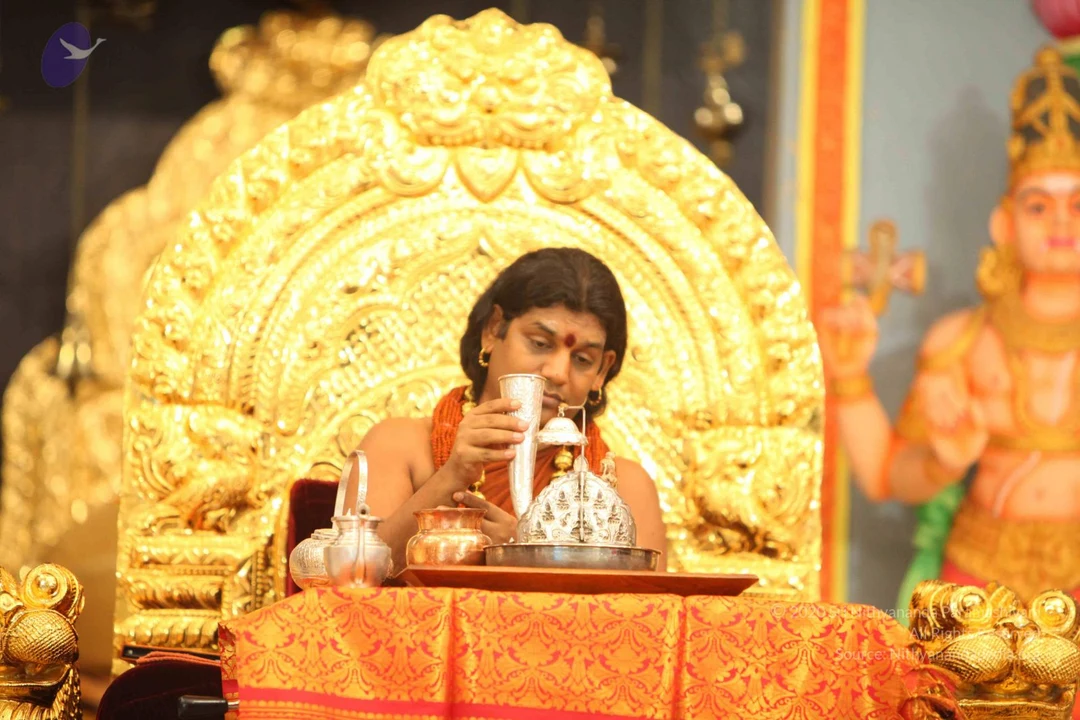
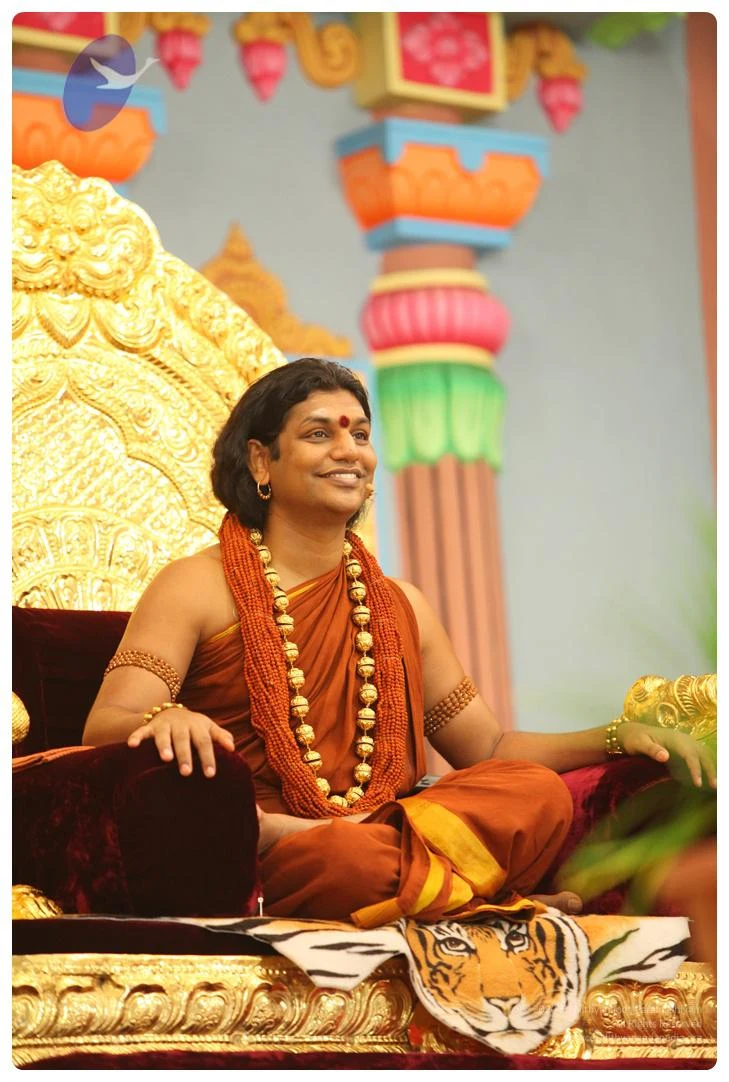
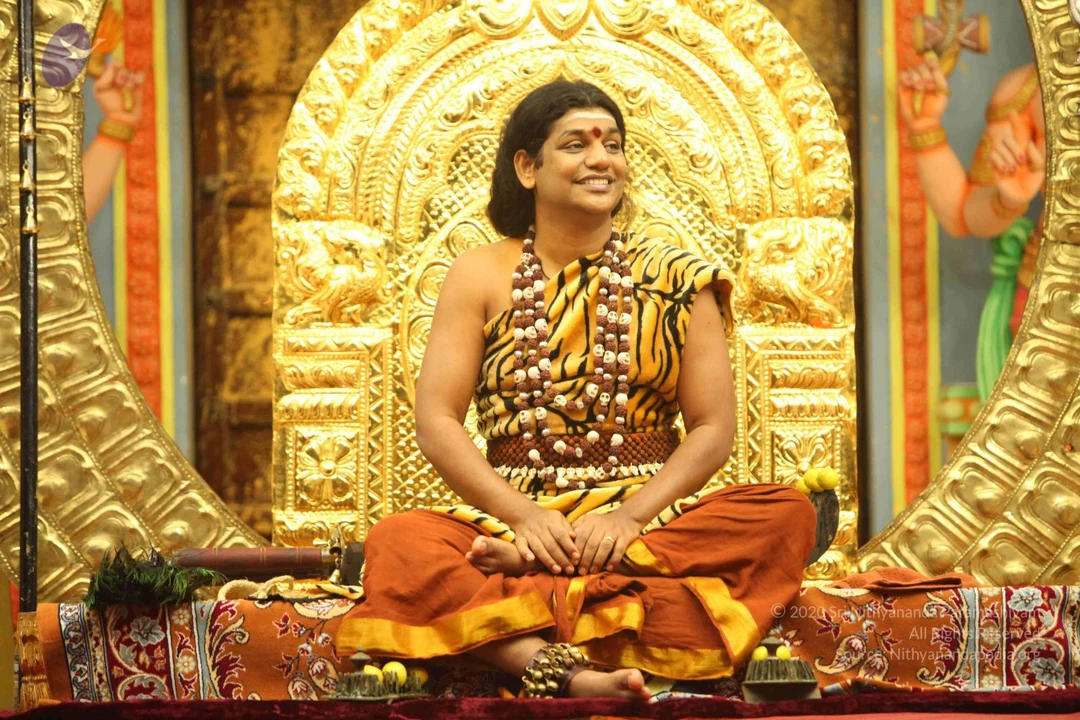
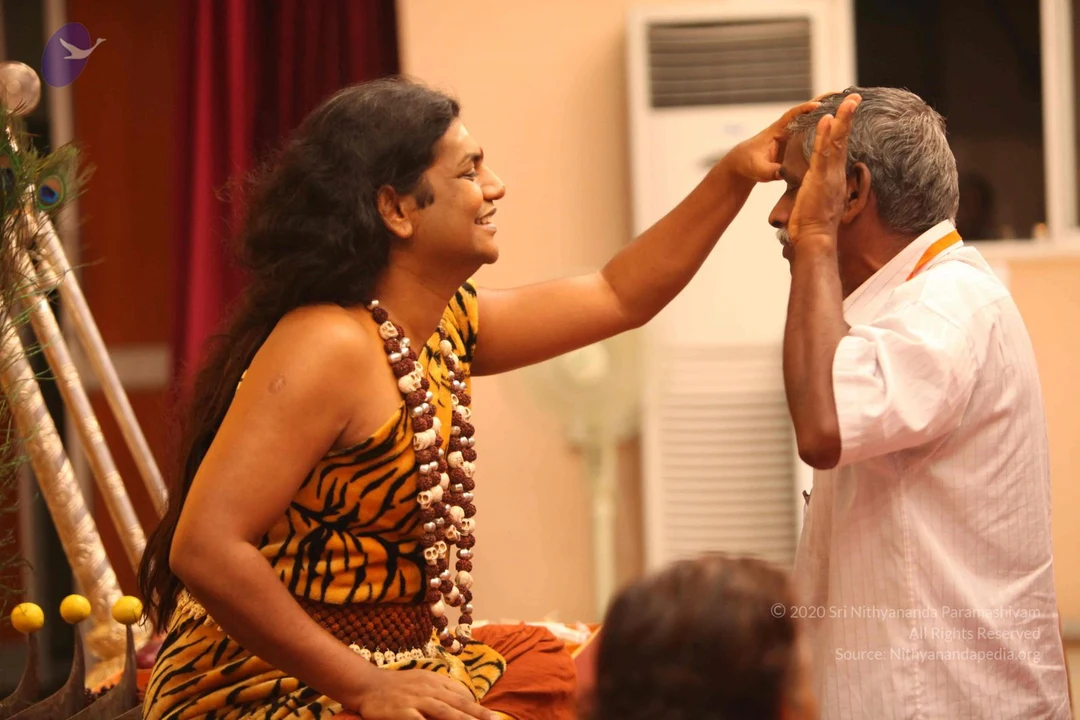
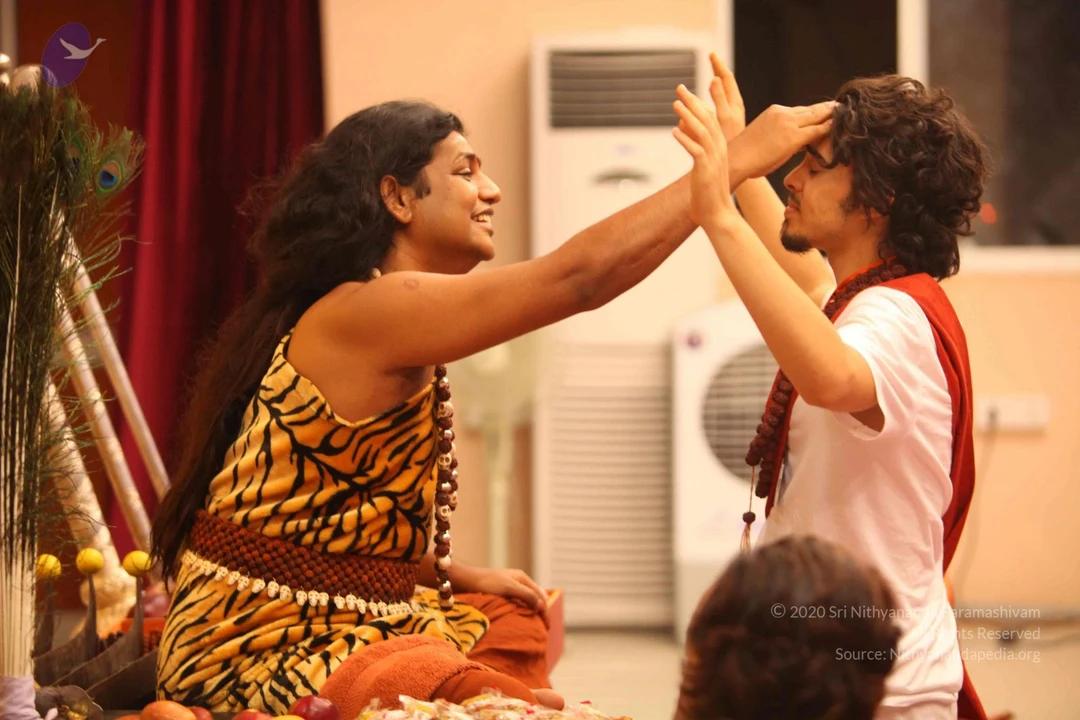
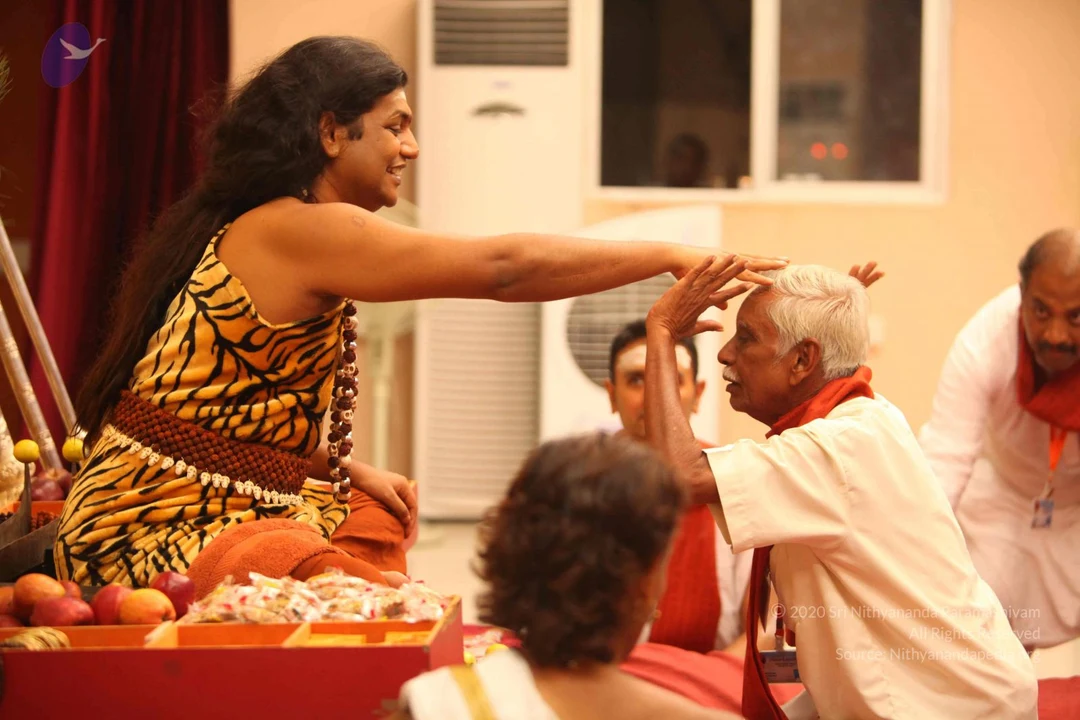
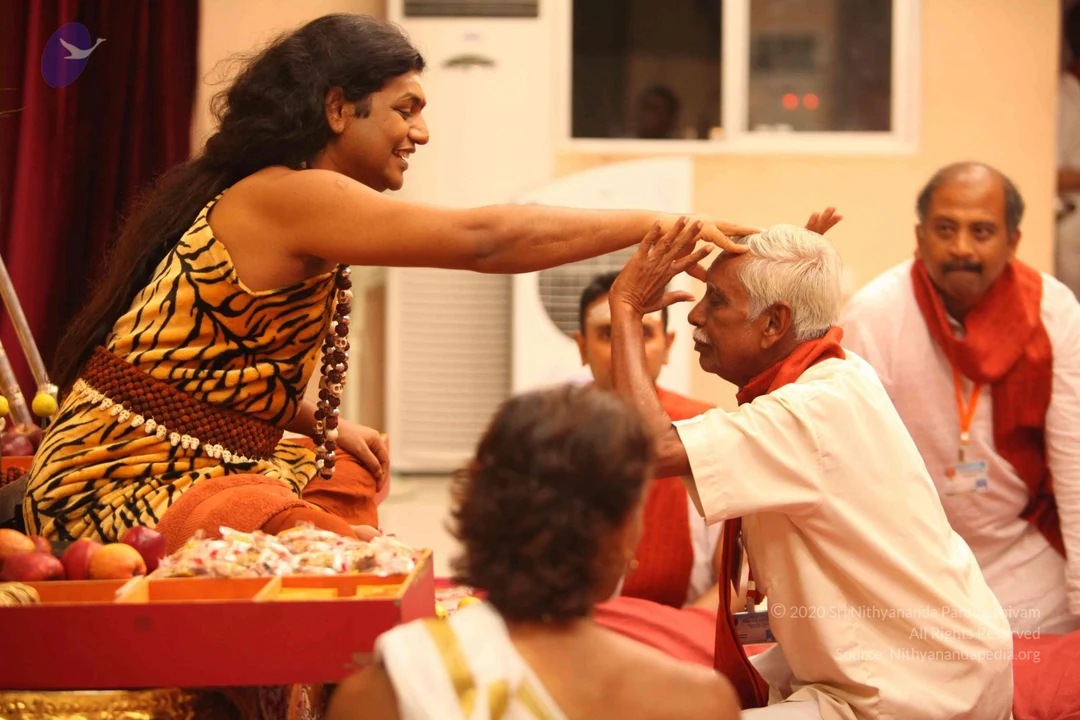
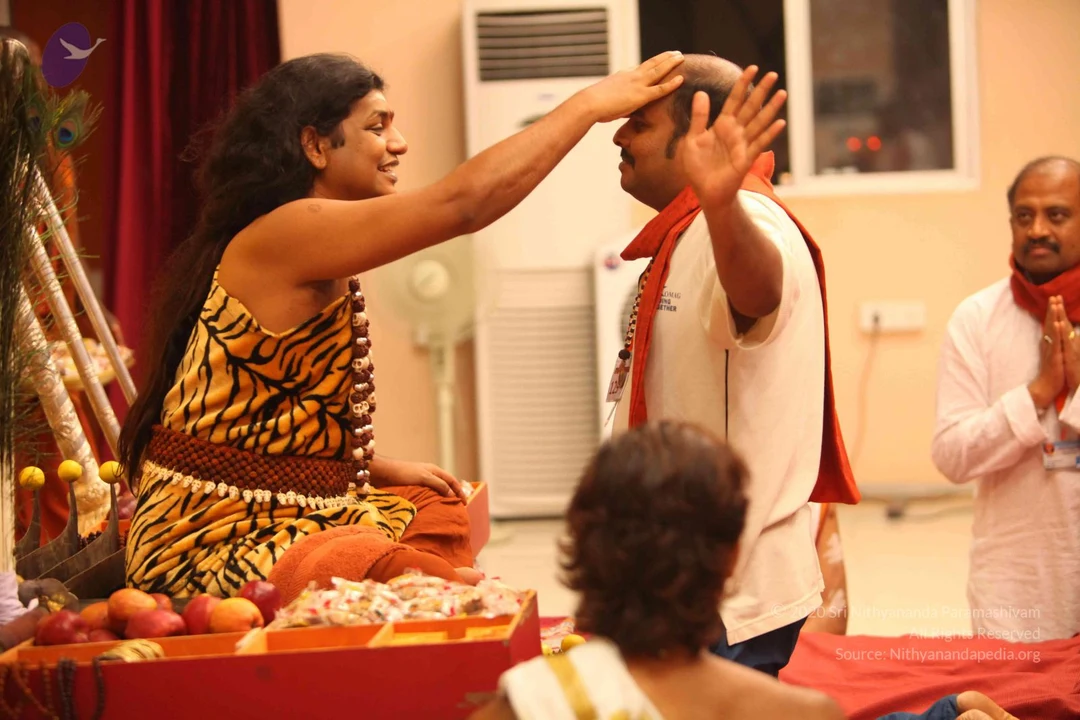
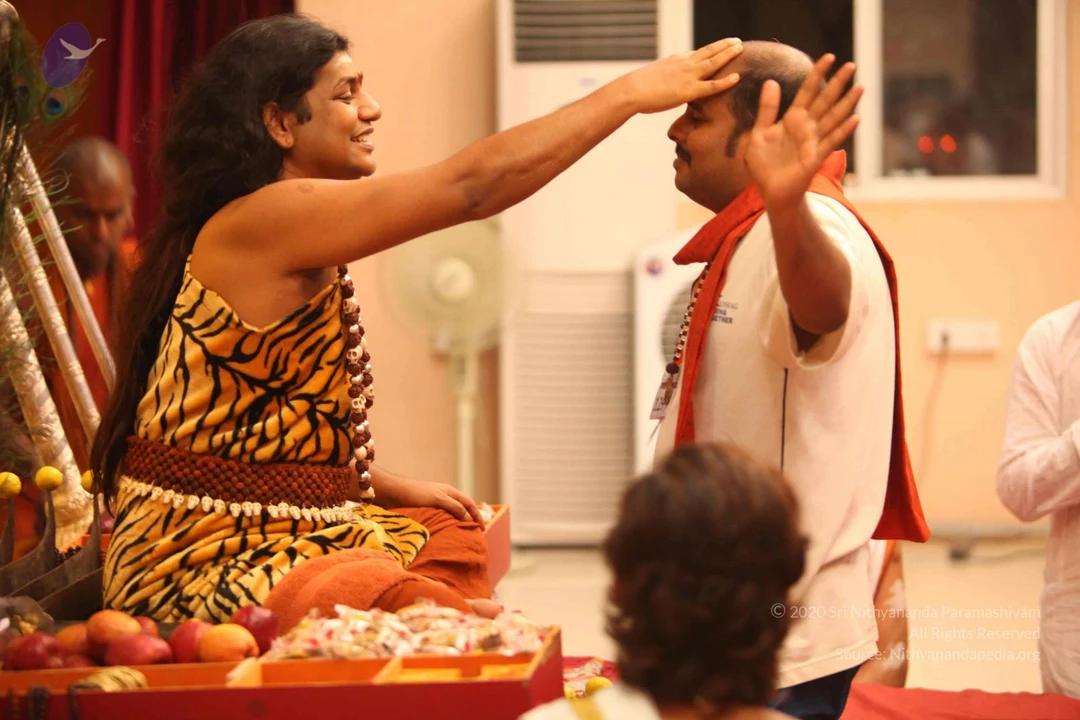
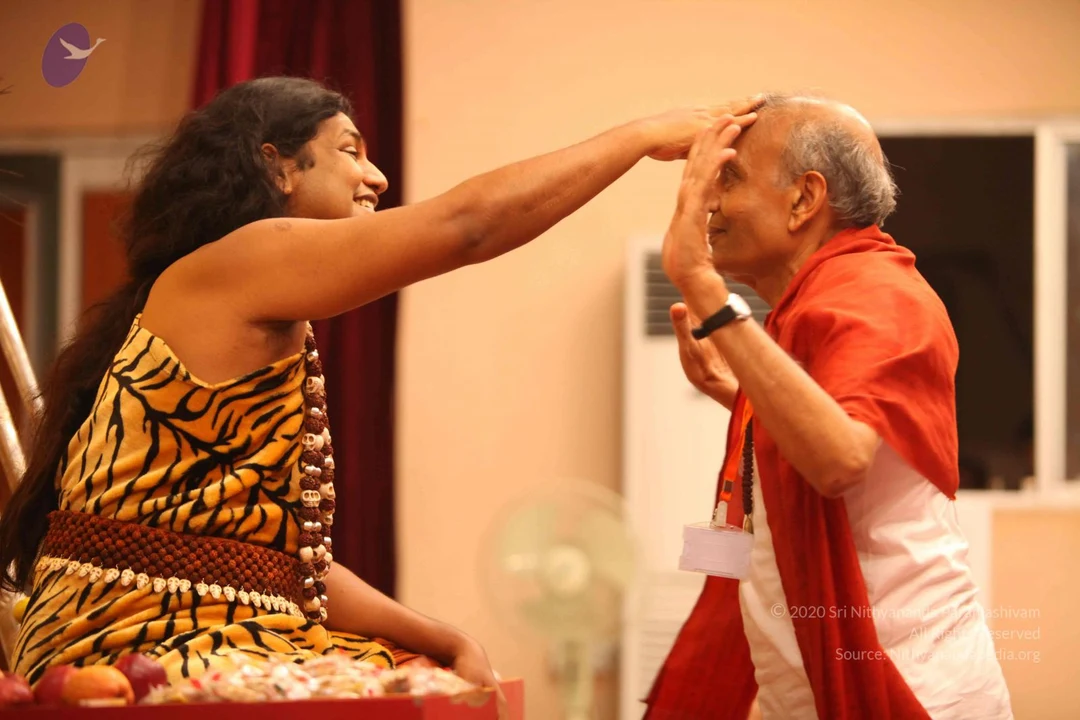
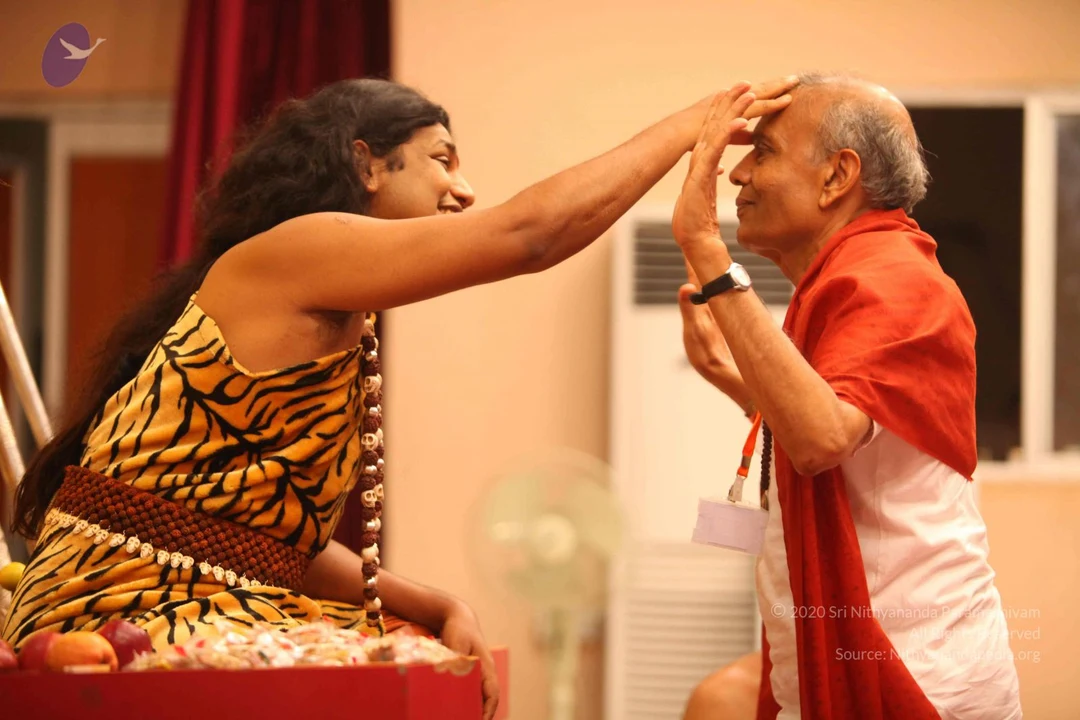
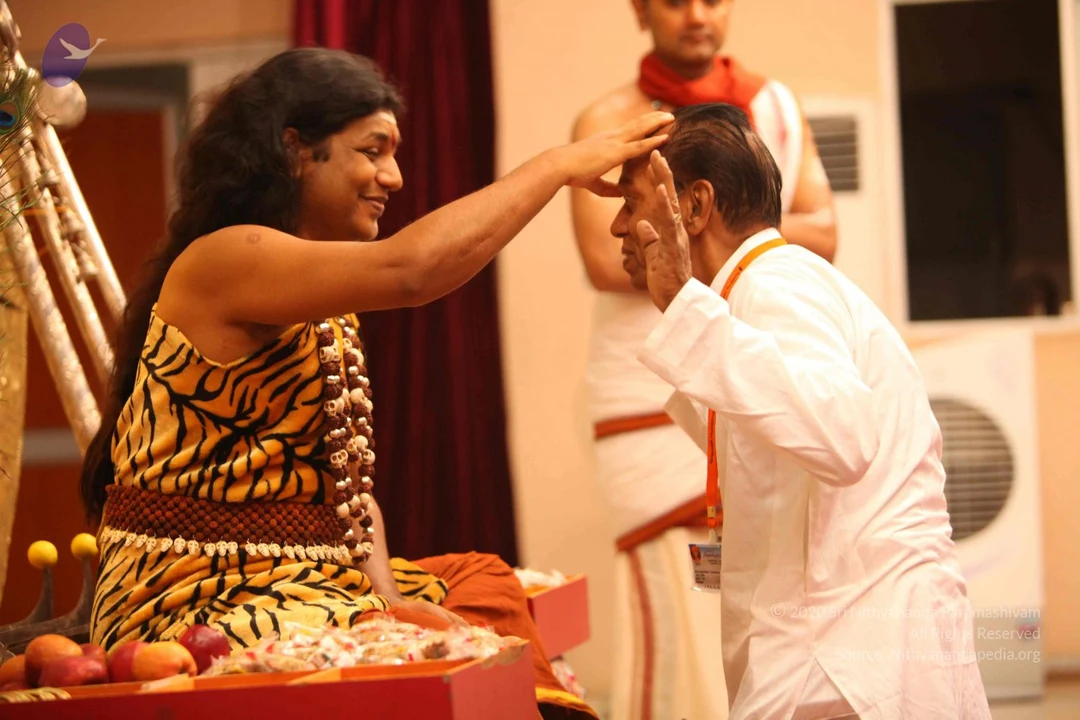
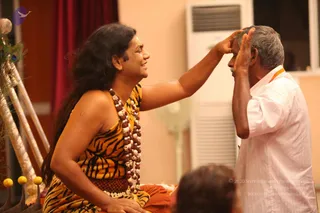
A man sits cross-legged on an ornate golden throne (peetha) framed by a gilded arched backdrop with carved lion figures. He wears a yellow and black tiger-striped sleeveless wrap, rust-orange dhoti with gold border, a long rudraksha mala with a ceremonial necklace, a wide beaded waist belt, and a red tilak on his forehead. He is smiling with hands resting on his knees. Swamiji (probable): long swept-back hair, rudraksha malas and saffron-orange ornate clothing with gold borders, seated on a throne, matching the page's indication of his presence. A painted deity figure with raised hands and a green garment appears at the right edge, with a decorated carpet and a small offering of fruit at the base.A seated man in a tiger-striped yellow and black shawl over orange cloth sits cross-legged on a richly patterned carpet in front of an ornate gold arched throne with carved lion figures. He wears multiple rudraksha mala necklaces, a waist band of beads, a red bindi and bangles, and smiles with hands resting on his knees. Behind him are painted deity figures with raised hands and a golden mirror-like frame. a person appears as the central figure, seated on the throne for satsang-style teaching.A photograph of a man seated cross-legged on an ornate golden throne with a carved gilded arch, in front of painted panels showing deity figures with raised hands. He wears a yellow and black tiger-striped garment over his torso, rust-orange cloth around his waist and legs, multiple strands of rudraksha beads and white beads, and a bronze-coloured bangle. A red tilak mark is on his forehead, and his dark hair is swept back. He smiles while looking to one side, with one hand resting on his knee and the other open. Ornamented red cushions and a dark feather-like object are at the lower edge.A seated man in a golden-throne setting smiles toward the side, sitting cross-legged on a red-and-floral patterned cushion before an ornate gold arched backdrop with carved lion-like figures. He wears an orange and yellow tiger-striped sleeveless garment, orange dhoti-style cloth, a long rudraksha mala and a bead belt, with a red tilak on his forehead and brass anklets. Shelves of oil lamps and a green leaf offering sit at the base, and carved gold pillars frame the scene. Swamiji (probable): long dark hair, saffron-and-yellow clothing and rudraksha malas mark him as the candidate, seated in a satsang-style discourse setting.A seated man sits cross-legged on a red and gold floral cushion on a raised dais, smiling and looking off to the side. He wears a tiger-striped yellow-and-black garment draped over one shoulder, orange-saffron lower cloth with a golden border, and a long layered necklace of rudraksha beads and white ceremonial beads, with a red bindi on his forehead. Behind him stands an ornate gold arched throne backdrop carved with lions, and gilded floral frames flank the scene; a carved deity figure with raised hands is visible at the left edge. Small brass lamps and a green leafy offering sit near his seat. a person: the seated man wears a tiger-striped garment, saffron lower cloth, rudraksha mala and gold ornaments in a throne setting, consistent with the page's reference to a person.A photograph of a long-haired person in an orange and black tiger-striped garment, wearing a rudraksha mala with skull-shaped beads and a rudraksha belt, placing both hands on the head of an older man in a white shirt with an orange lanyard. Both people are smiling. Behind them are a wall-mounted air conditioner, a red curtain, and a decorative stand with peacock feathers and yellow fruit on the left. The older man is bending slightly toward the seated figure, who is blessing him with a touch to his forehead. Another person's hair is partially visible at the bottom edge of the frame.

1-Morning-Message-8A-SNU

22 photosSource gallery
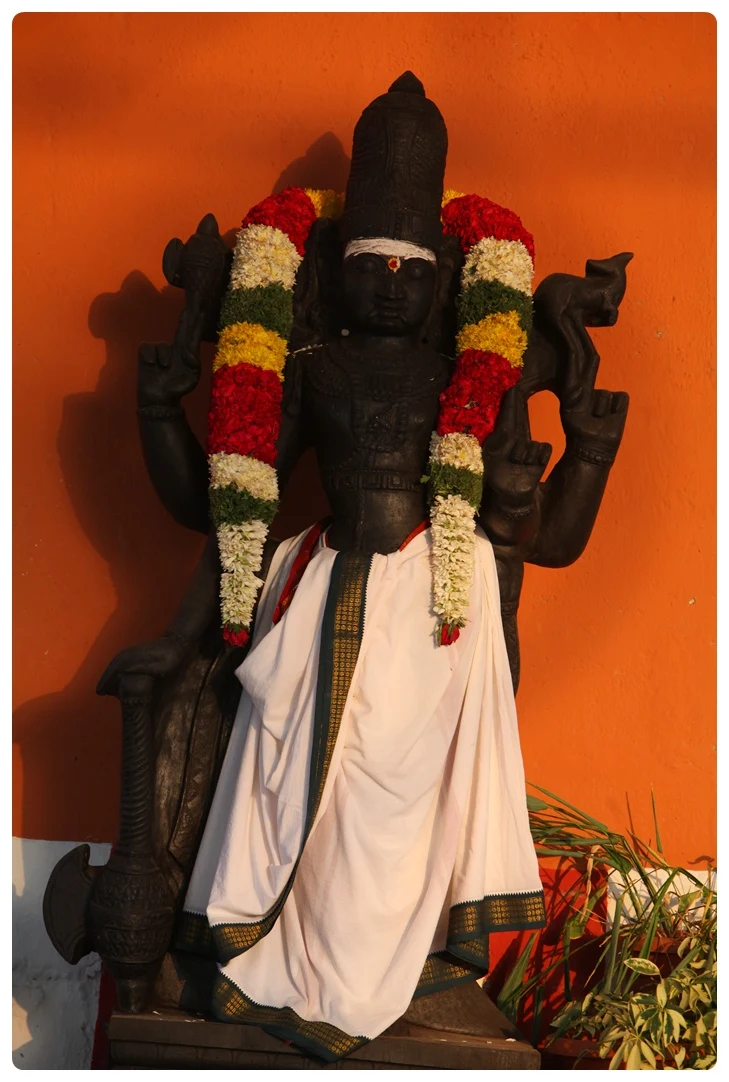
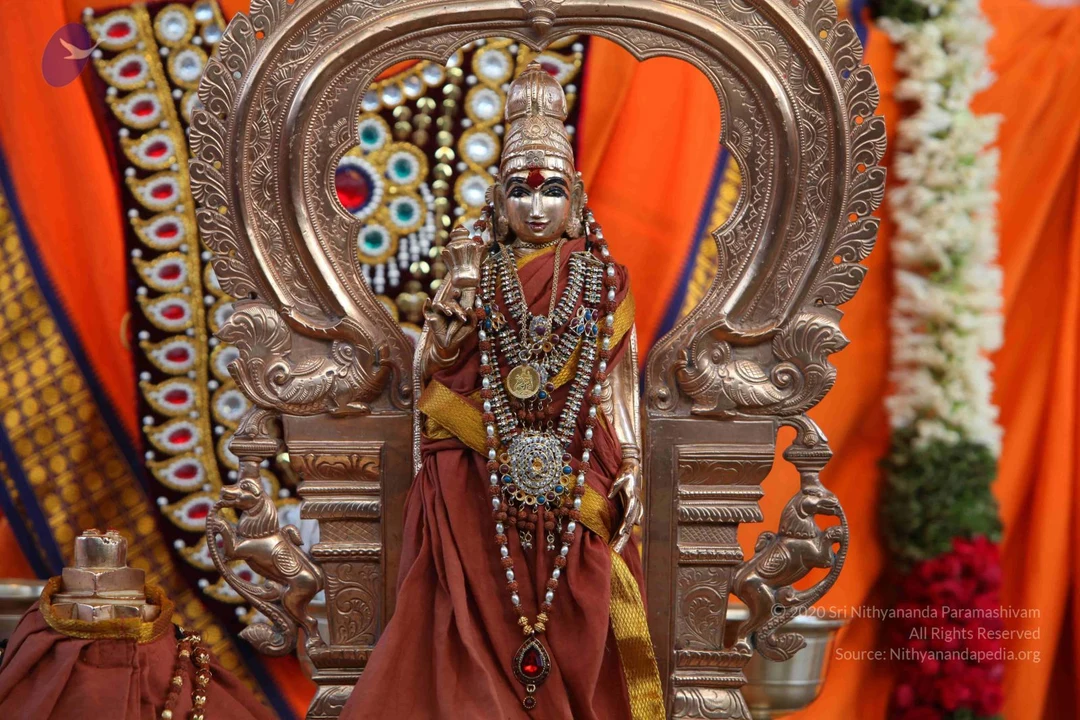
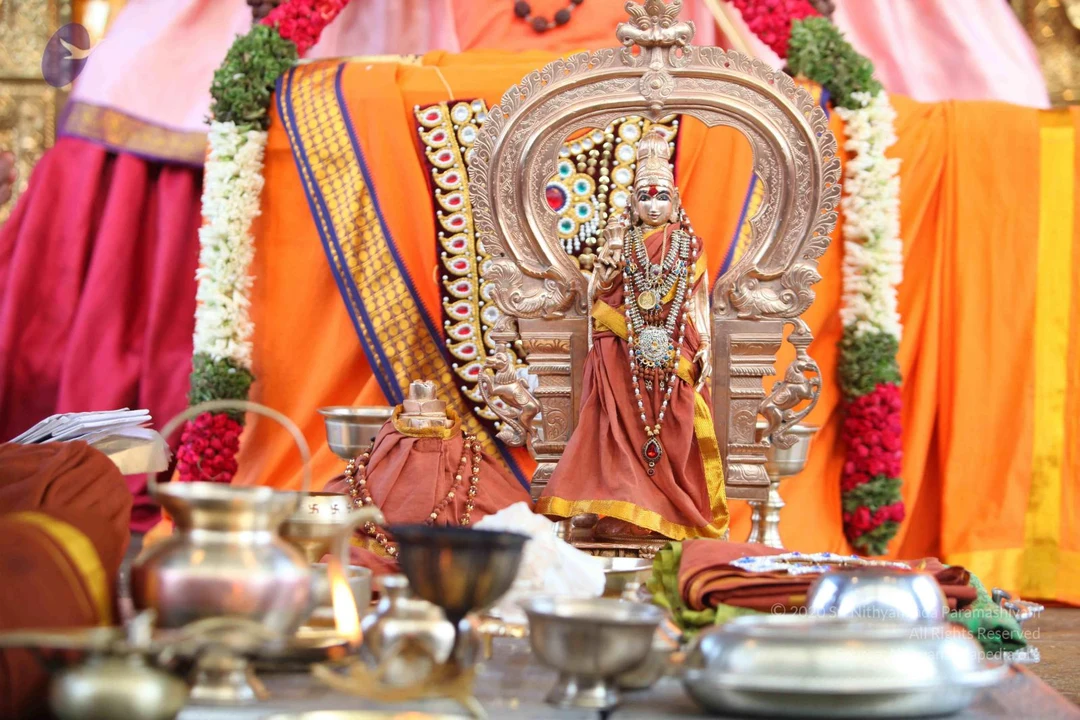
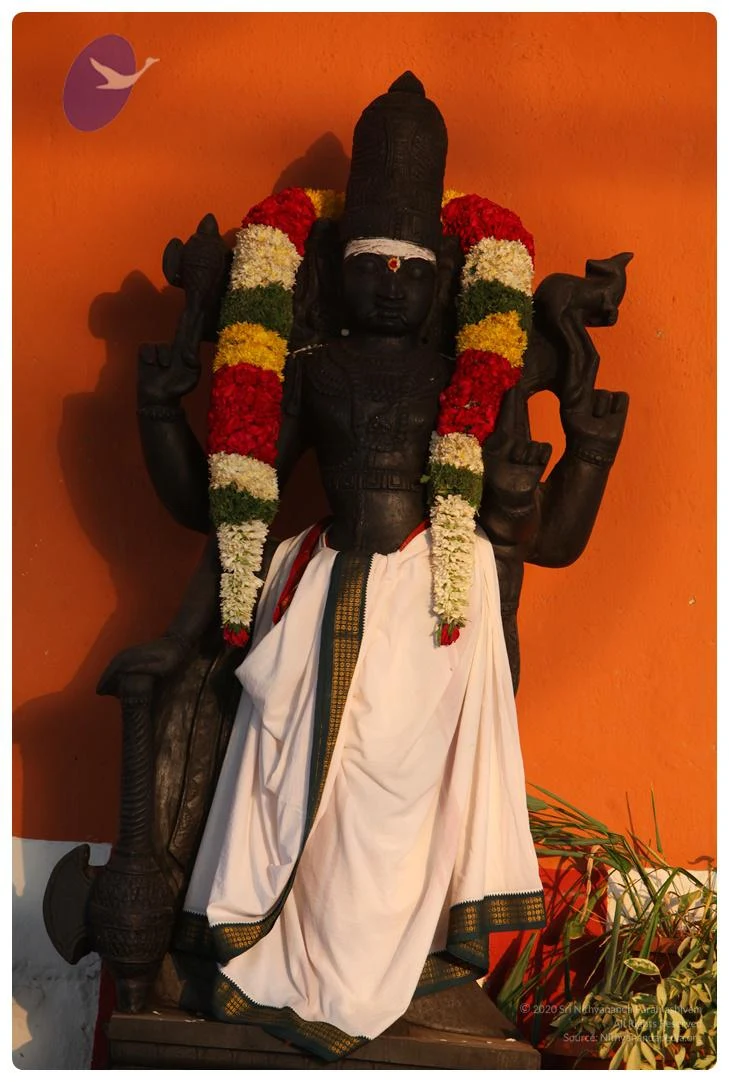
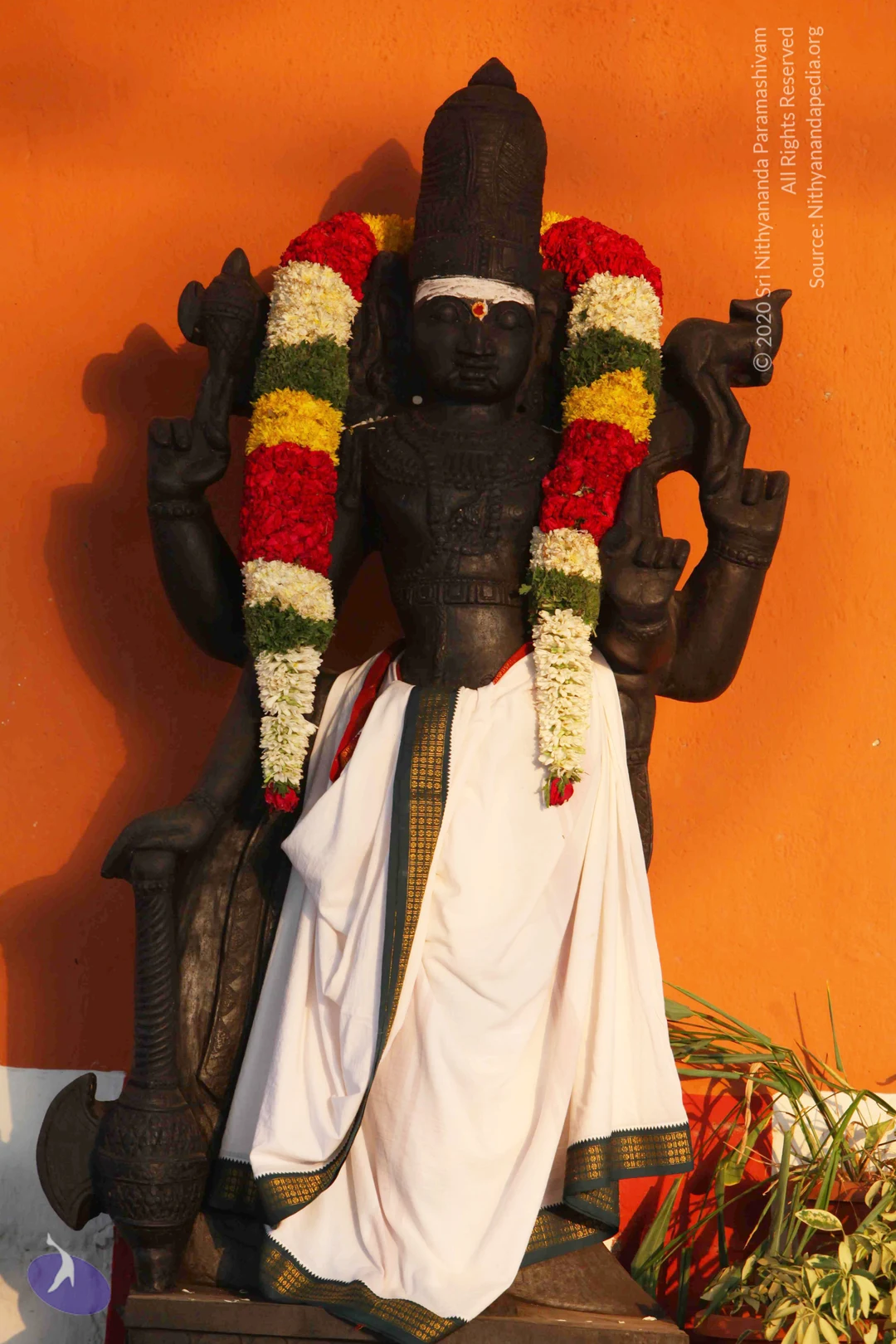
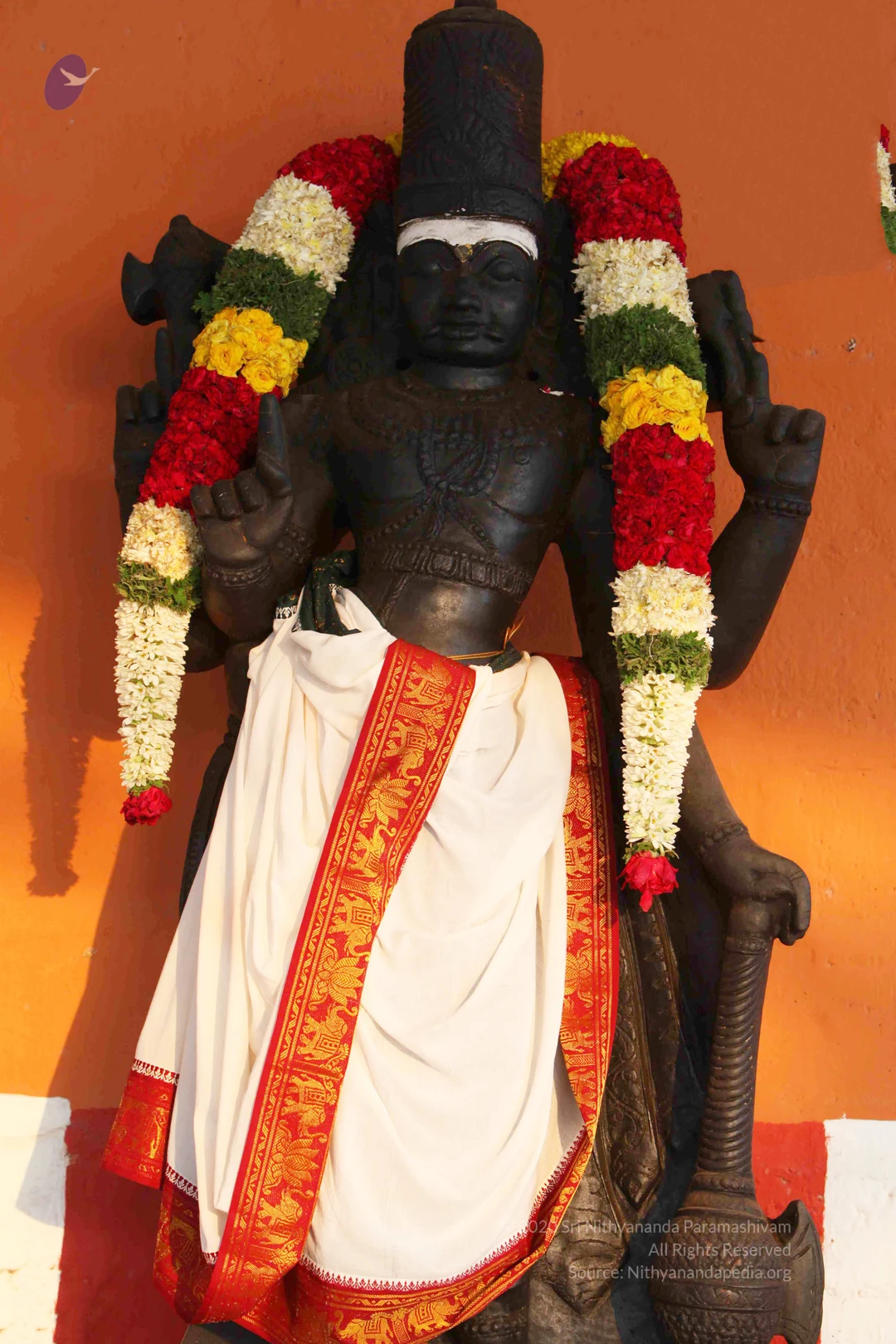
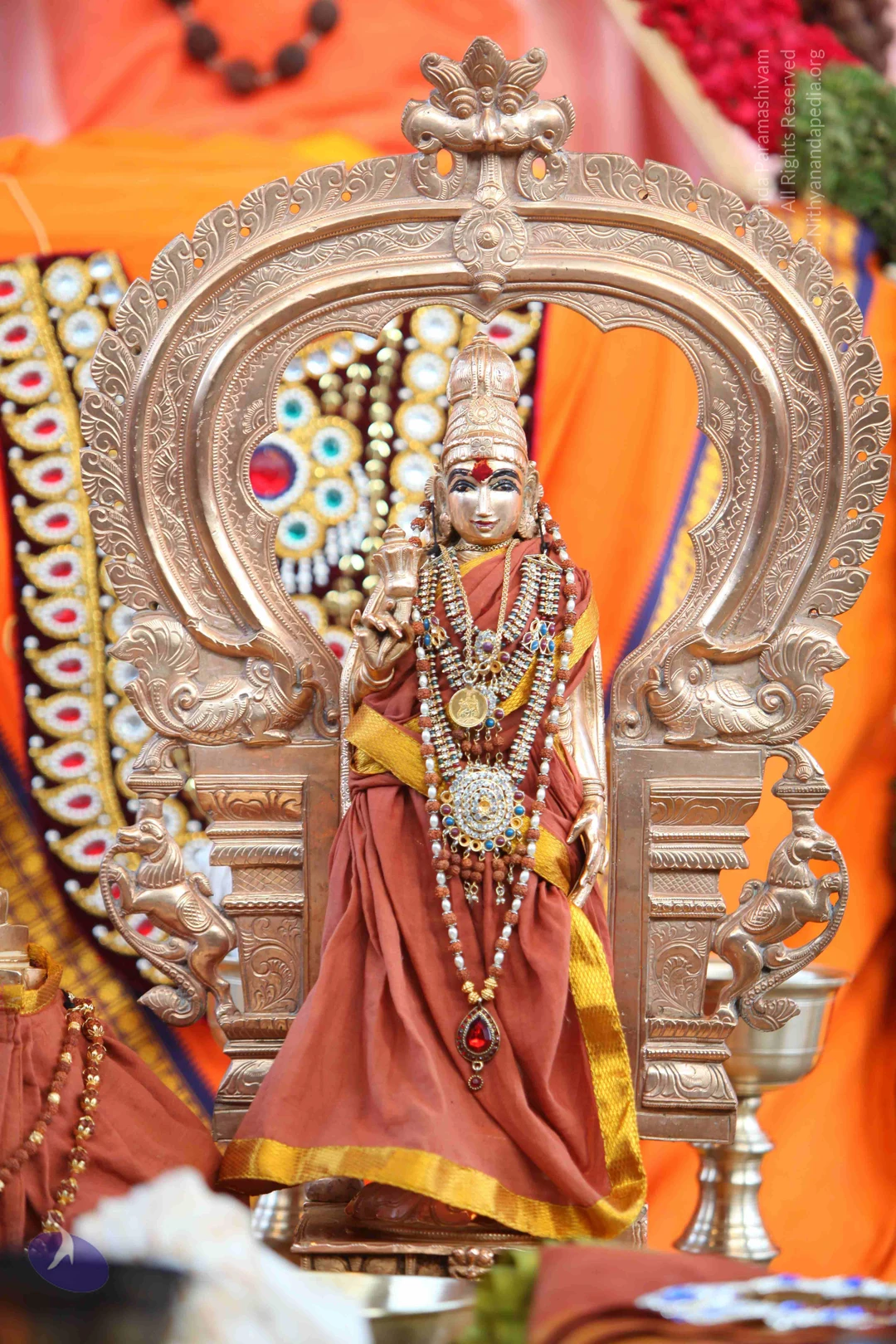
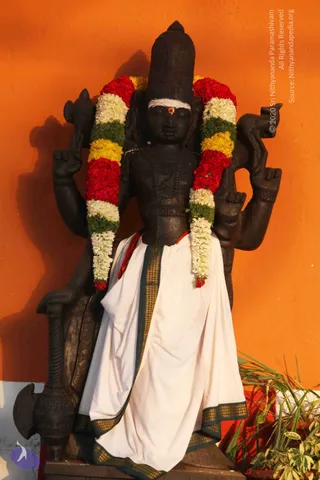
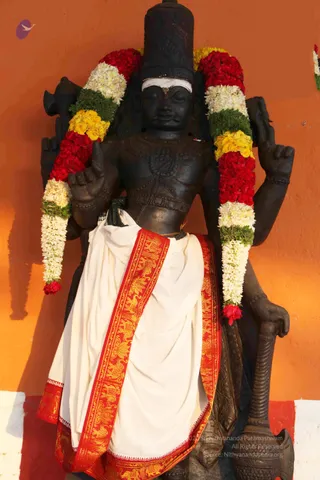
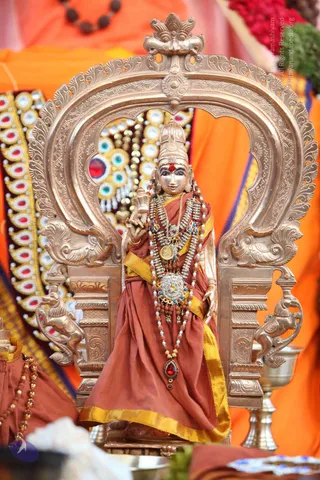
A dark stone or bronze-toned deity murti stands against a bright orange wall, showing a four-armed figure with a tall cylindrical crown and a red tilak with white vertical marks on the forehead. It wears a white dhoti with a dark green and gold-bordered edge and is draped with a garland of red, yellow, white and green flowers. Its raised hands hold ritual objects, and a potted plant with green leaves sits at lower right beside a stone pedestal. No physical people are visible.A dark stone statue of a deity murti stands against an orange wall, wearing a white dhoti with a red and gold patterned border. Long garlands of red roses, yellow flowers, white jasmine and green leaves hang over its shoulders. The statue has a tall cylindrical crown, a white tilak on the forehead, and multiple arms; one hand is raised in a blessing gesture and another rests near a long staff. No physical people are visible; the figure is a sculpture.A photograph down a temple aisle lined with metal railings and a red carpet toward a shrine. Large golden-toned deity murti with ornate crowns, jewelled necklaces and garlands stand on a raised platform beneath a gilded arch with golden drapery. A shaved-headed priest in an orange-brown robe pours water from a brass vessel over a shivalinga-shaped form at the base, which is draped in orange cloth and red-and-white flower garlands with rudraksha strands. Brass lamps and puja vessels sit on the altar. To the right, a smaller statue of a woman in orange sari holds her hands together. The priest is the only physical person visible; the figures on the shrine are statues.A photograph of a temple shrine with large gold-coloured statues of a seated deity pair set under an ornate golden arch and orange curtain. The central figure wears a red turban, jewelled necklaces and holds a trident; the consort beside him wears a crown, jewelled garlands and a blue and pink skirt. In front, a black lingam is draped with rudraksha beads and a white and red flower garland, topped by a silver kalasha. A priest with a shaved head, wearing a reddish-brown shawl and white tilak marks, kneels at the lower left, reaching toward the offerings. Brass vessels, a lamp, plates and a silver tray sit on the orange cloth-covered platform, and a small silver throne-like seat is visible.A silver-toned statue of a saint stands in a gilded shrine niche backed by orange and gold brocade curtains. The figure has long dark hair, a red tilak on the forehead, and wears rudraksha malas and layered gold bead necklaces with a gold pendant. A red-maroon garment with gold borders covers the body, and the raised right hand is shown in a blessing gesture. Ornate gold filigree frames the niche and a yellow cushion sits at the base. The image is a statue, not a living person, so it is a depiction; the statue is a depiction, and the page's claim is not visually confirmed for identity, leaving the figure uncertain.A metal deity murti stands within an ornate copper-toned arched throne frame with carved lion and peacock motifs. The figure wears a rust-red sari with a gold border, layered beaded necklaces, rudraksha strands, a pendant, and a jewelled crown. One hand is raised holding an object, and orange fabric with mirrored embroidery and a silver lamp stand sit behind it. No physical people are visible.

2-Rudram-Chanting

22 photosSource gallery
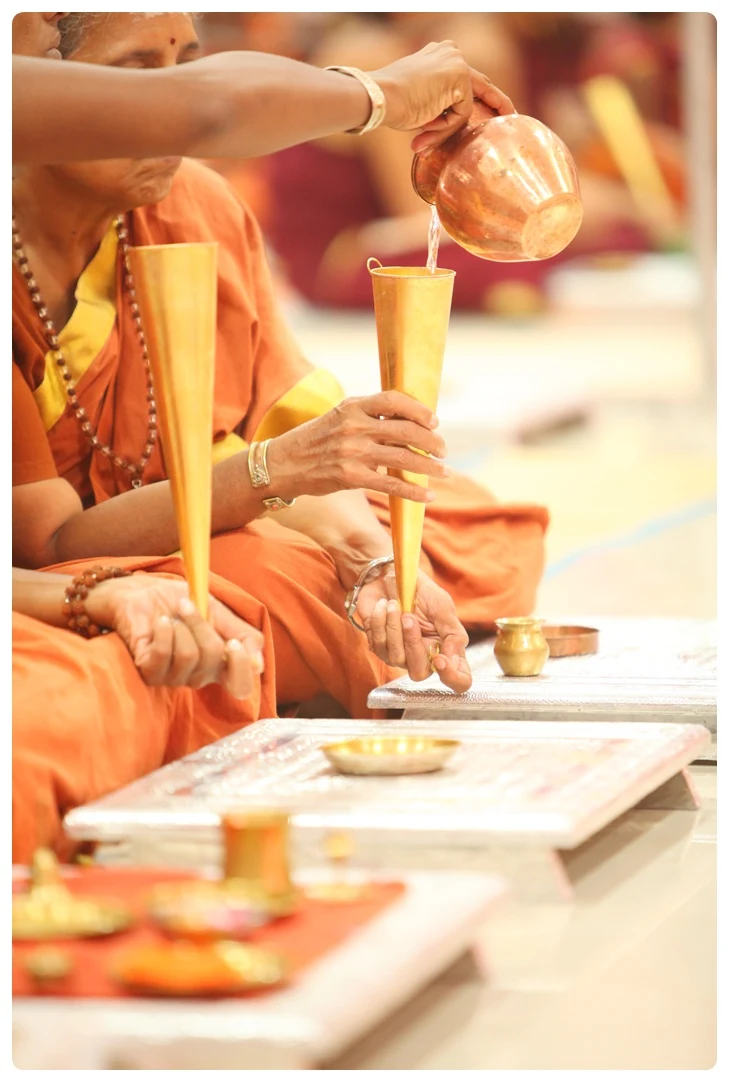
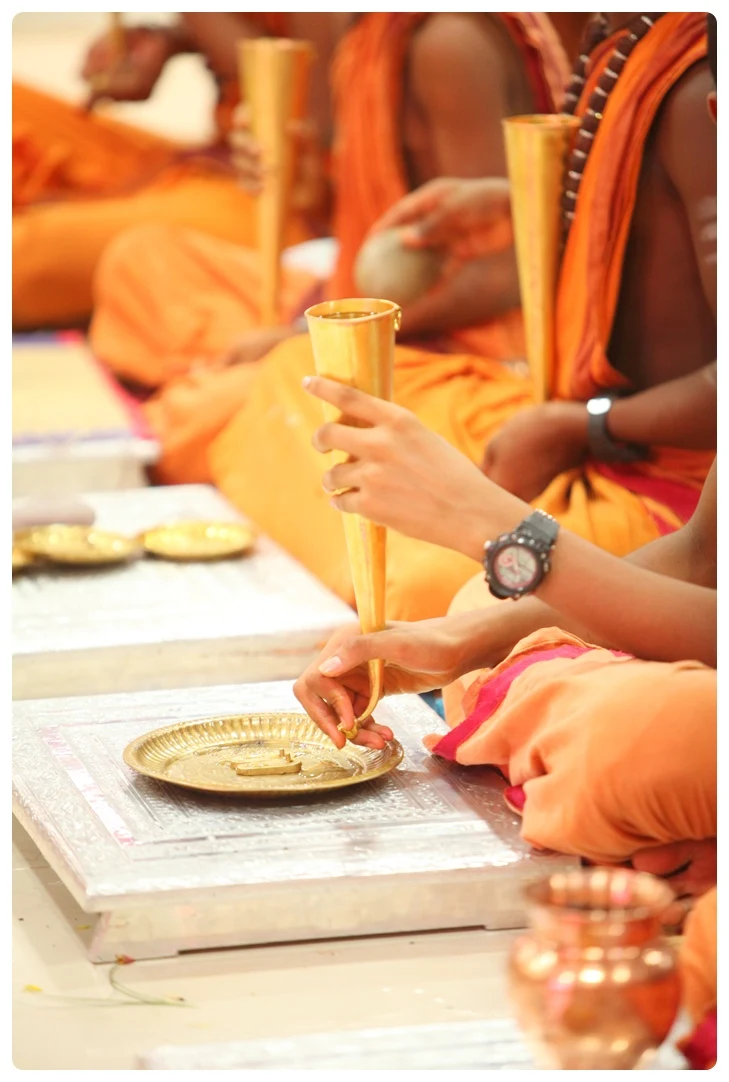
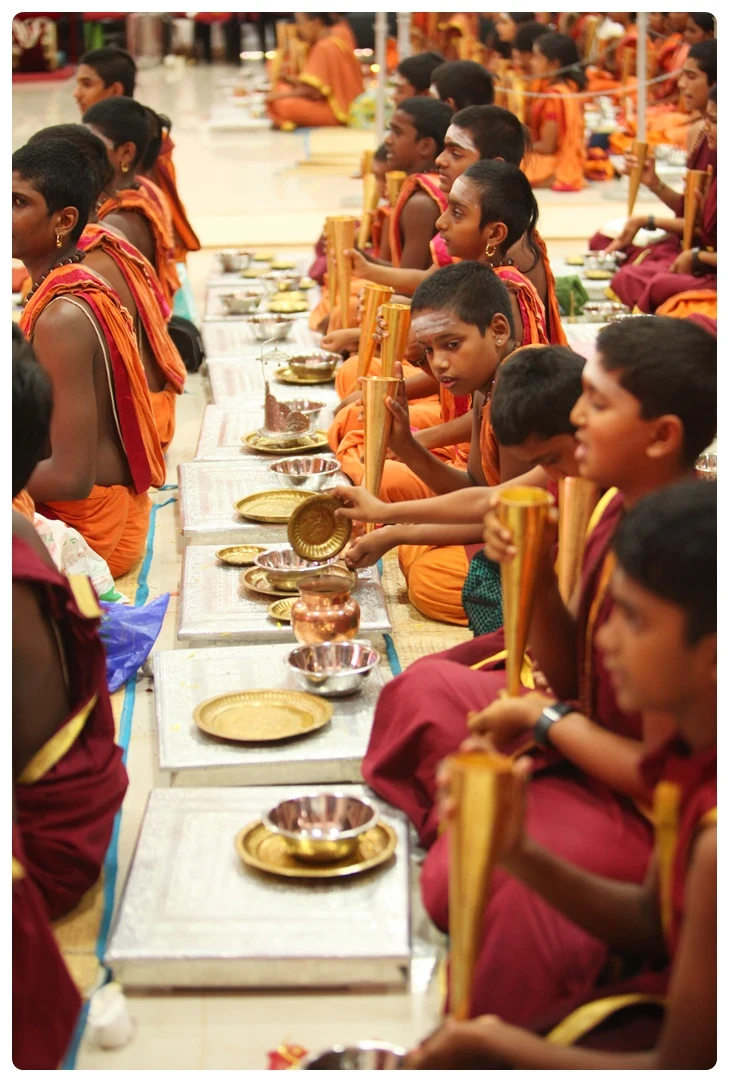
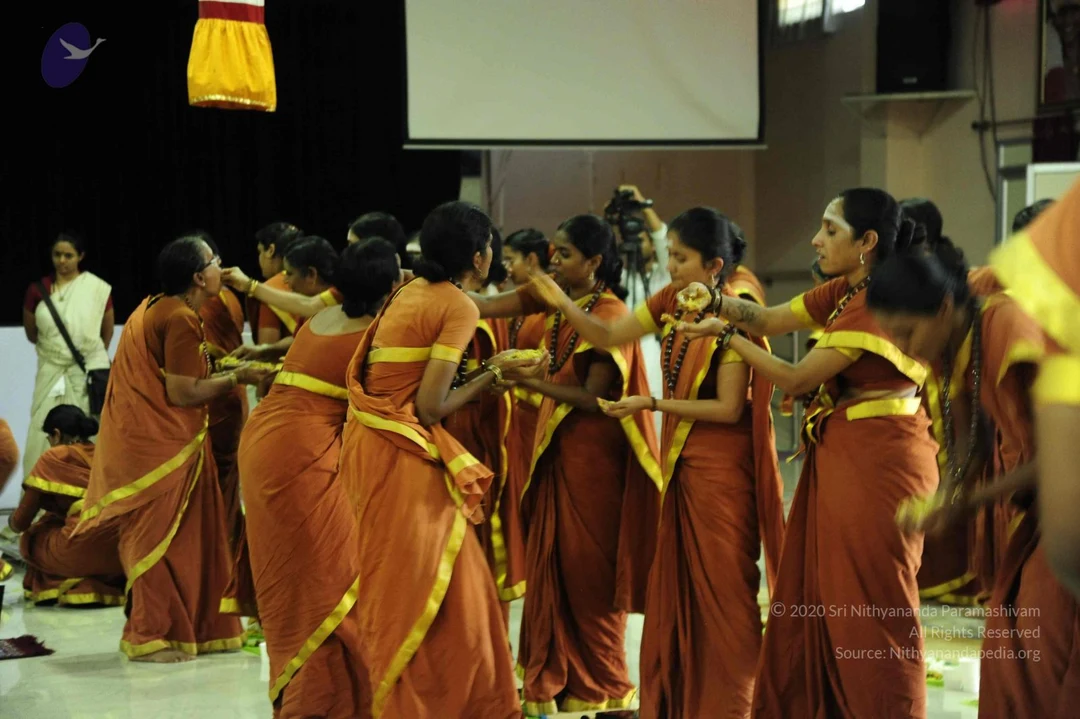
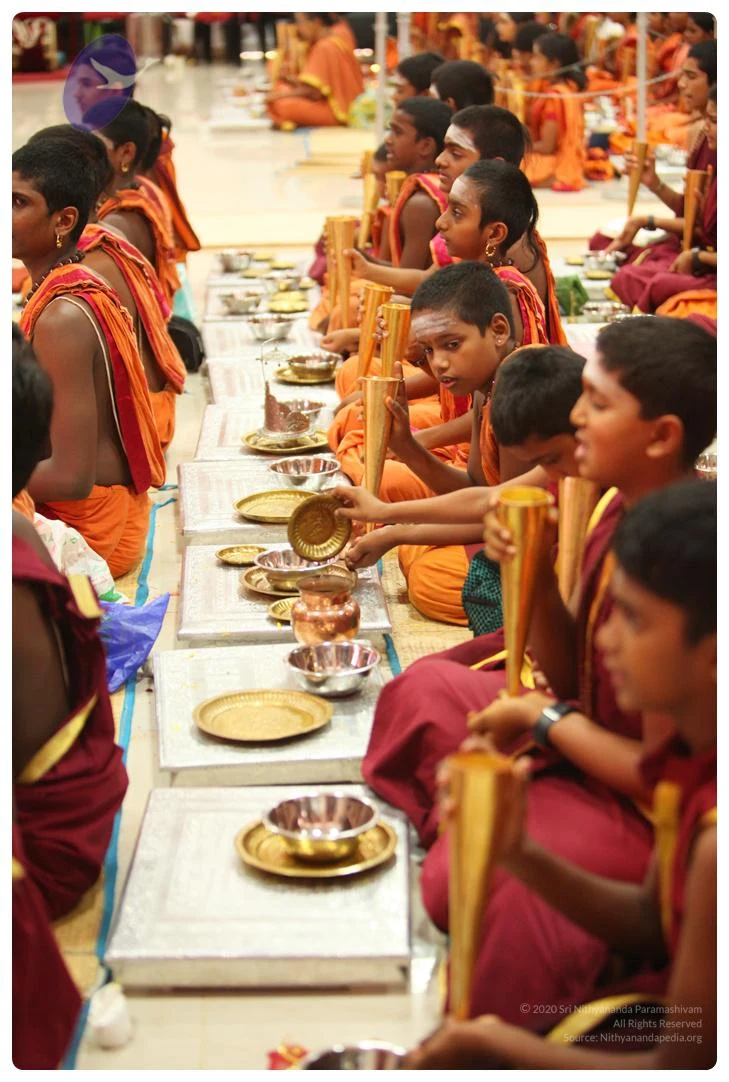
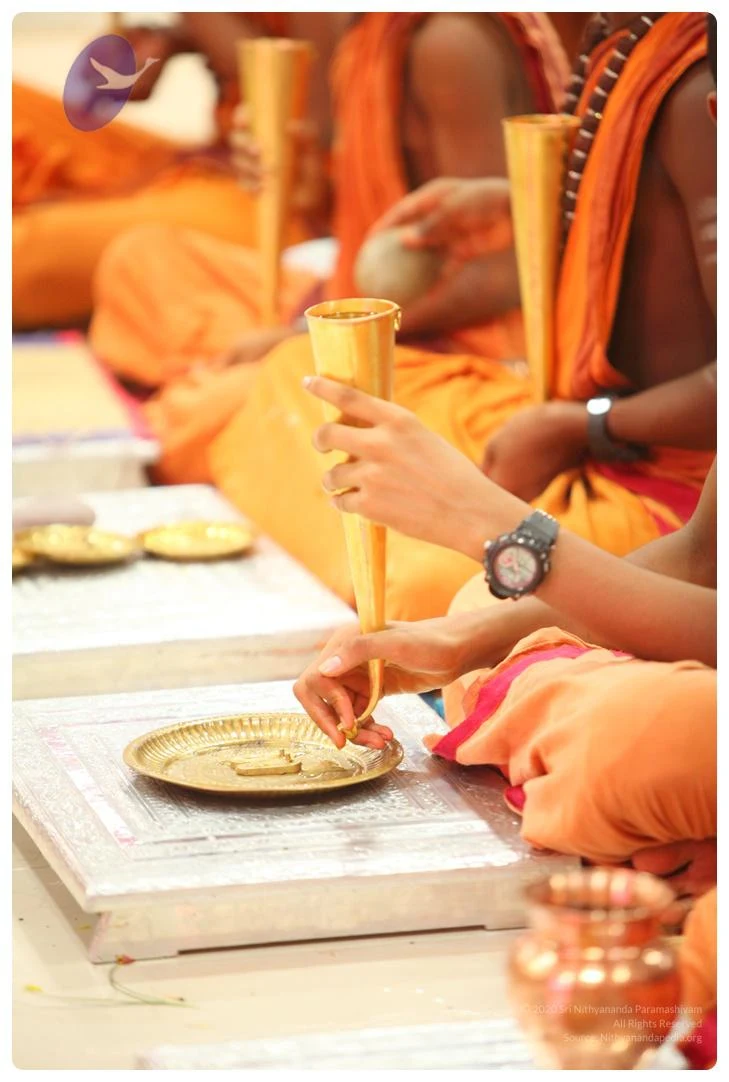
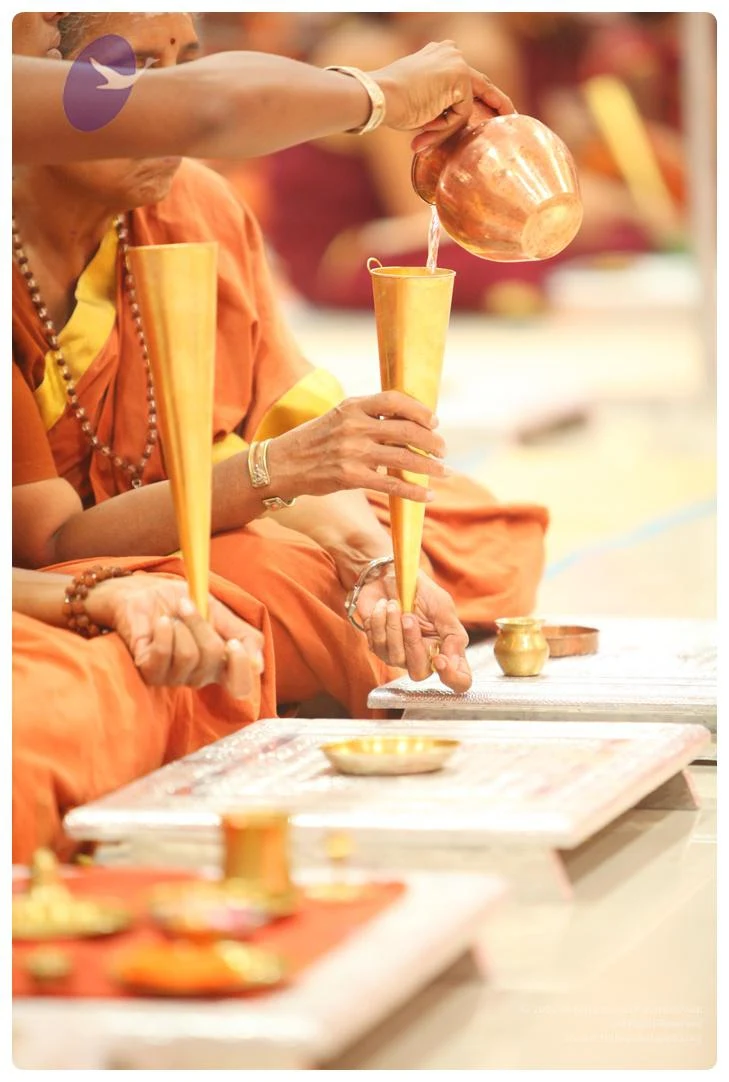
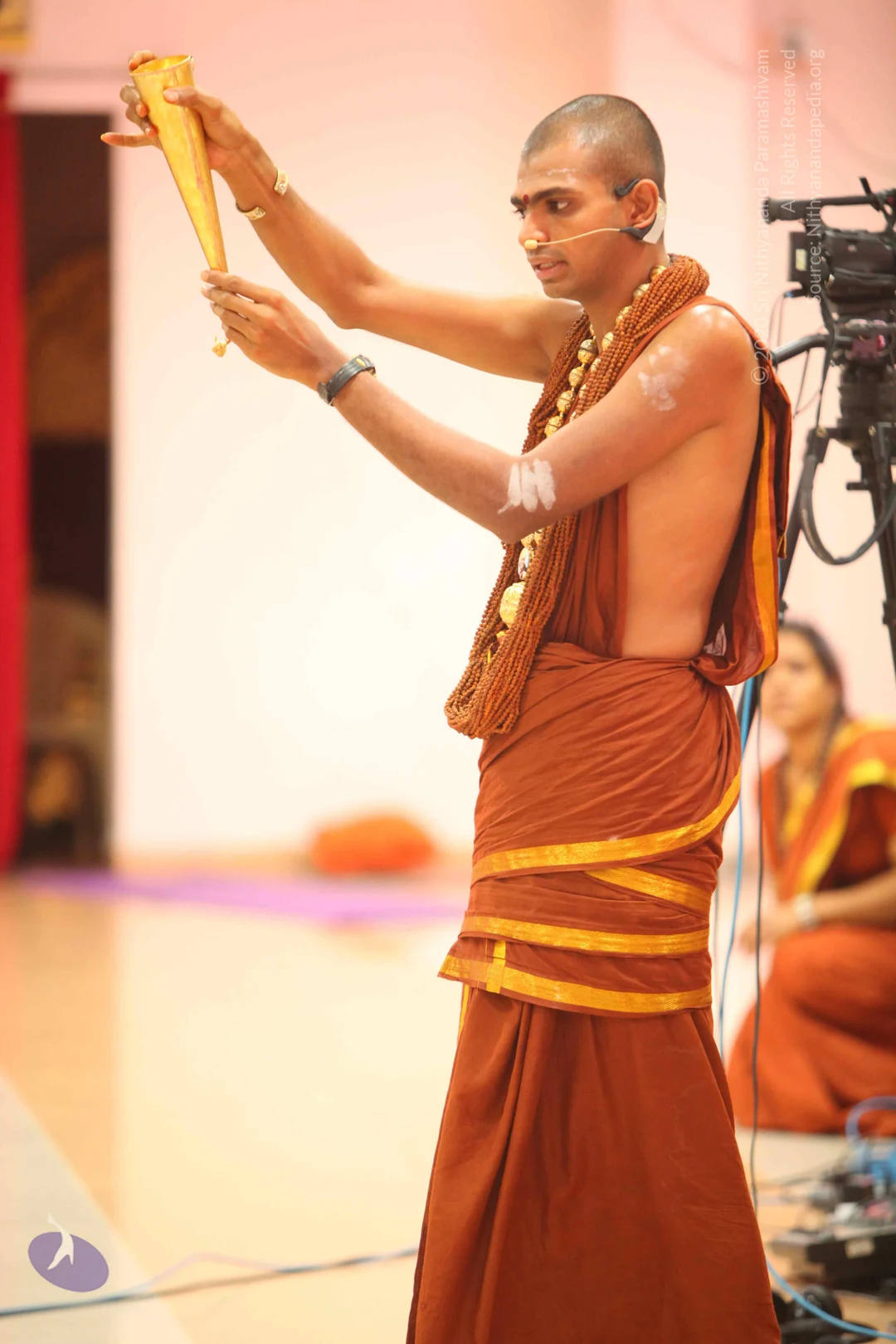
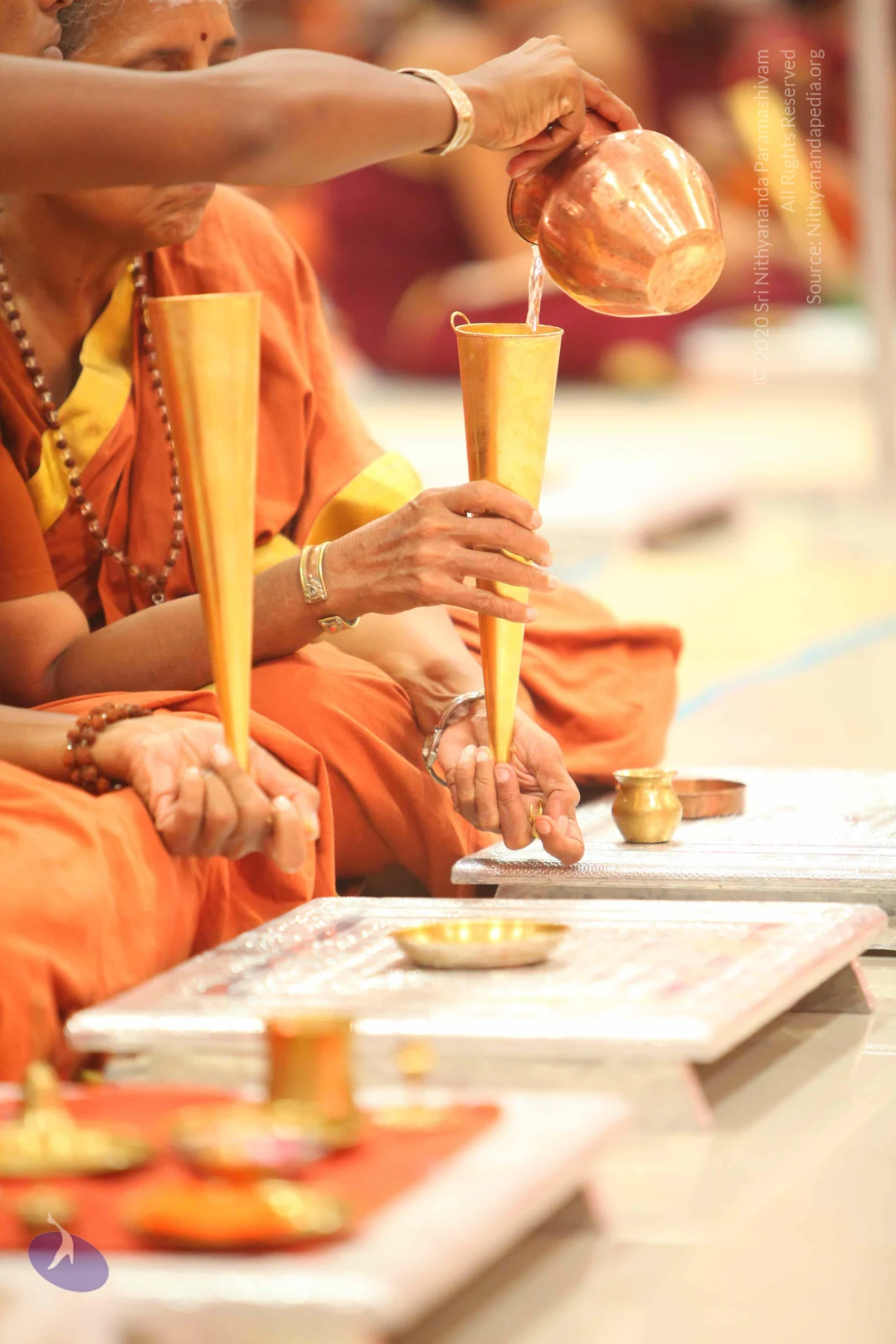
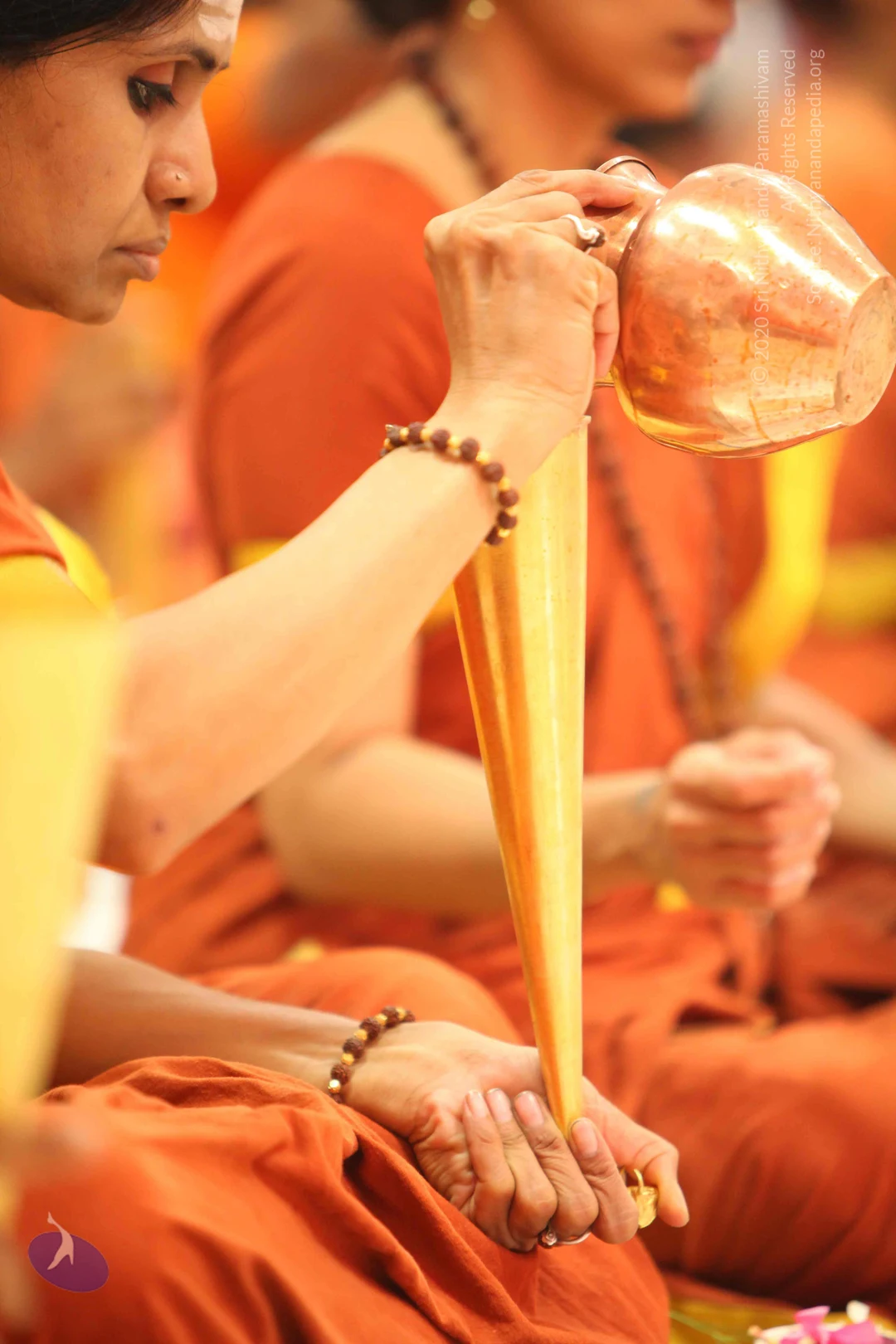
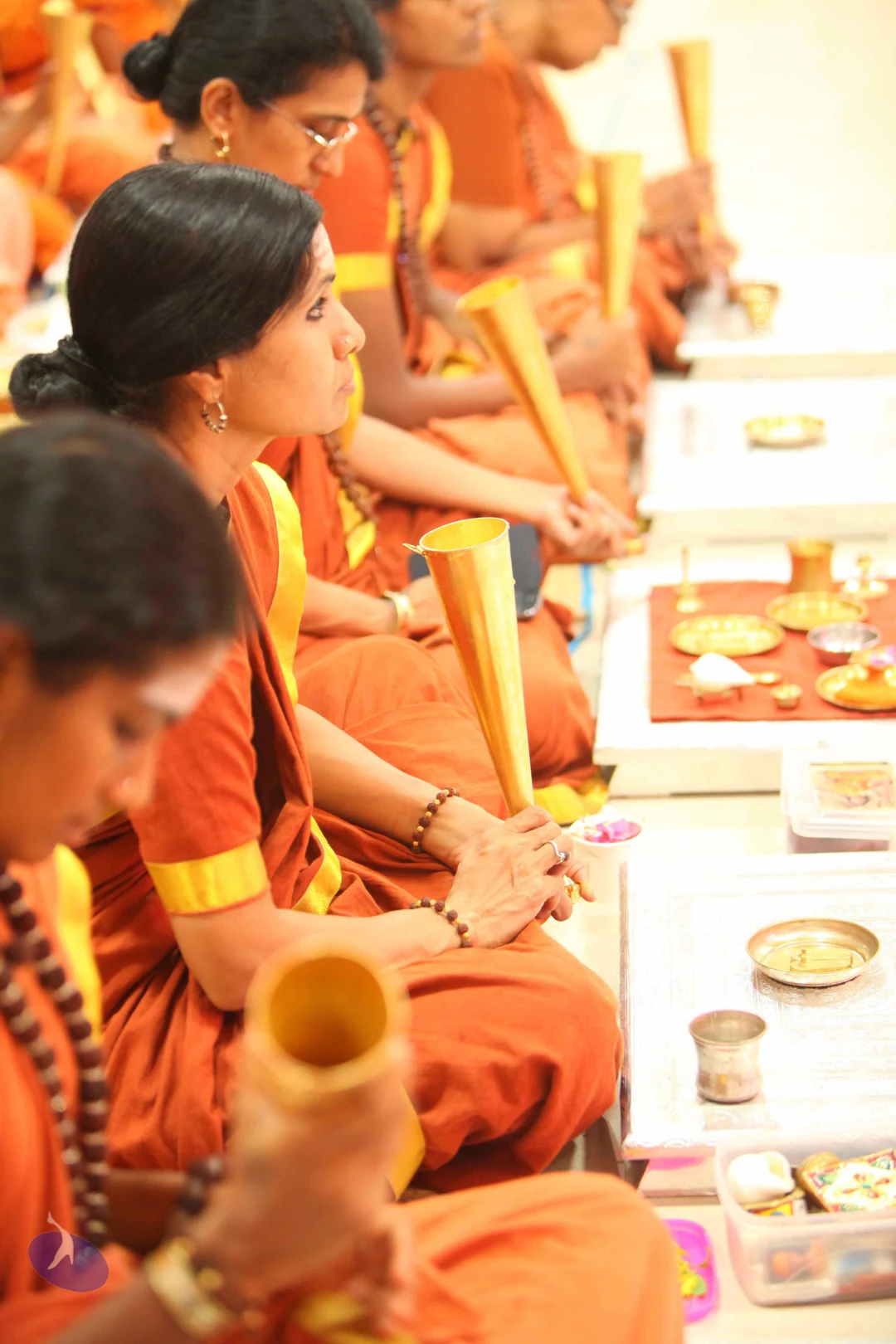
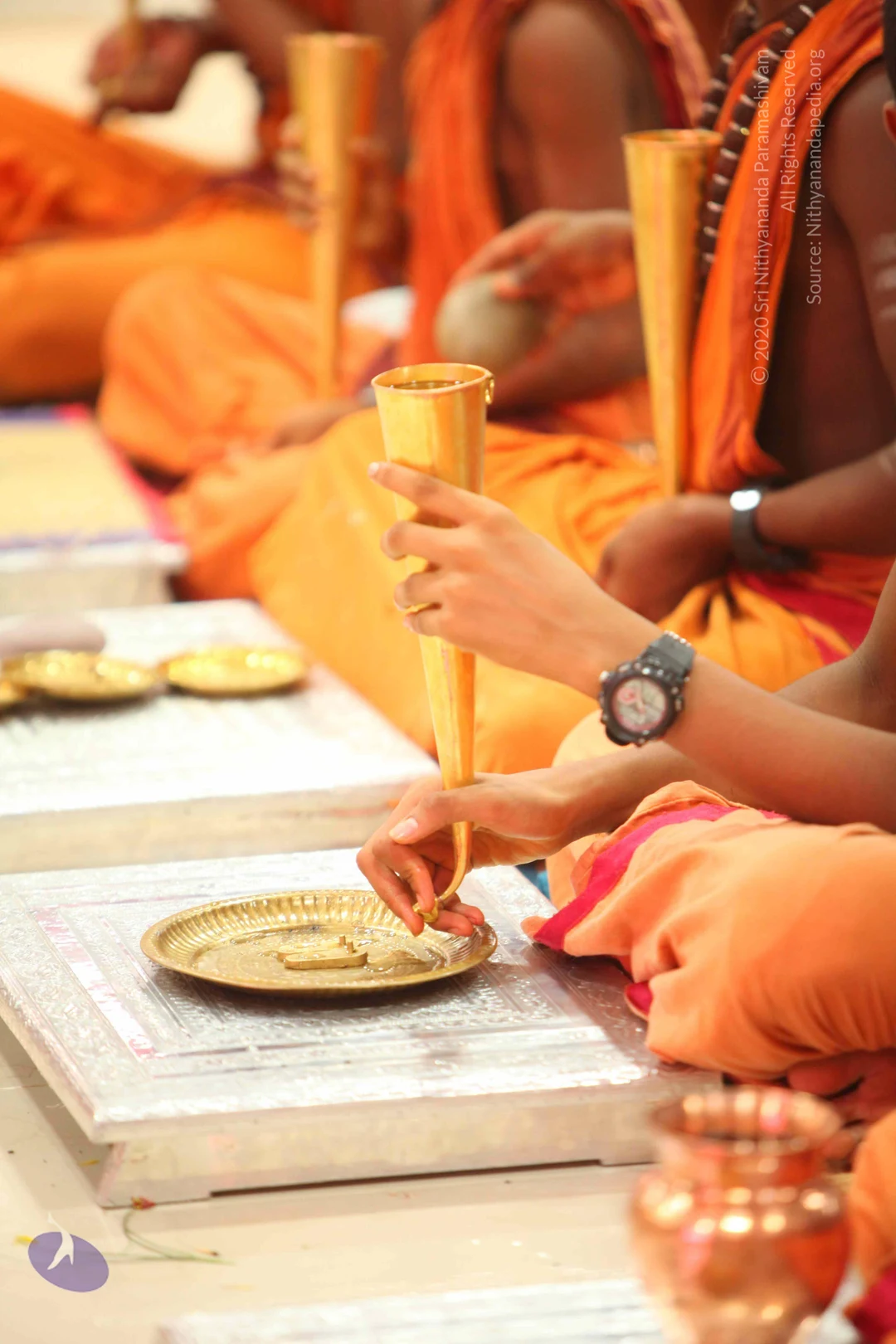
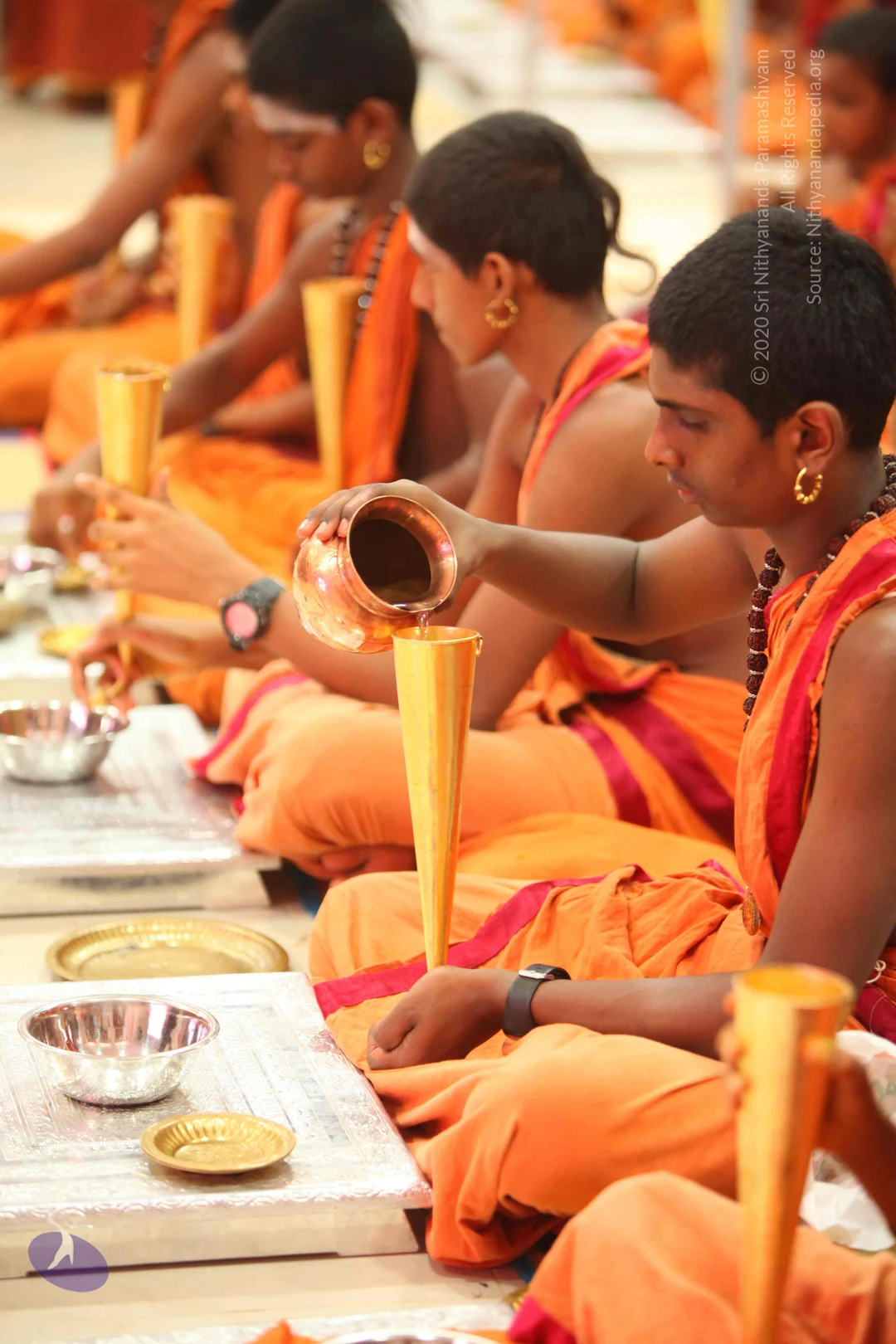
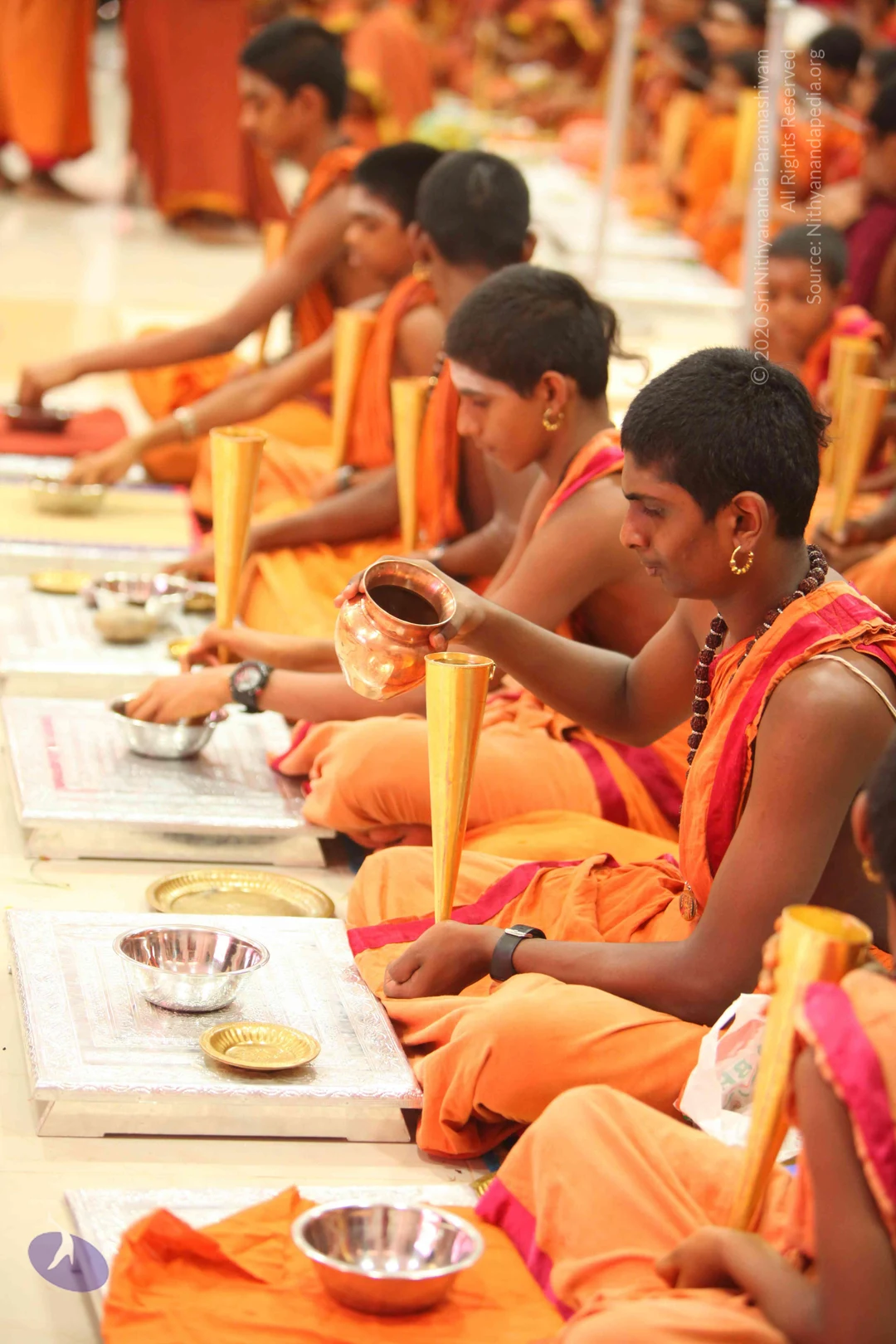
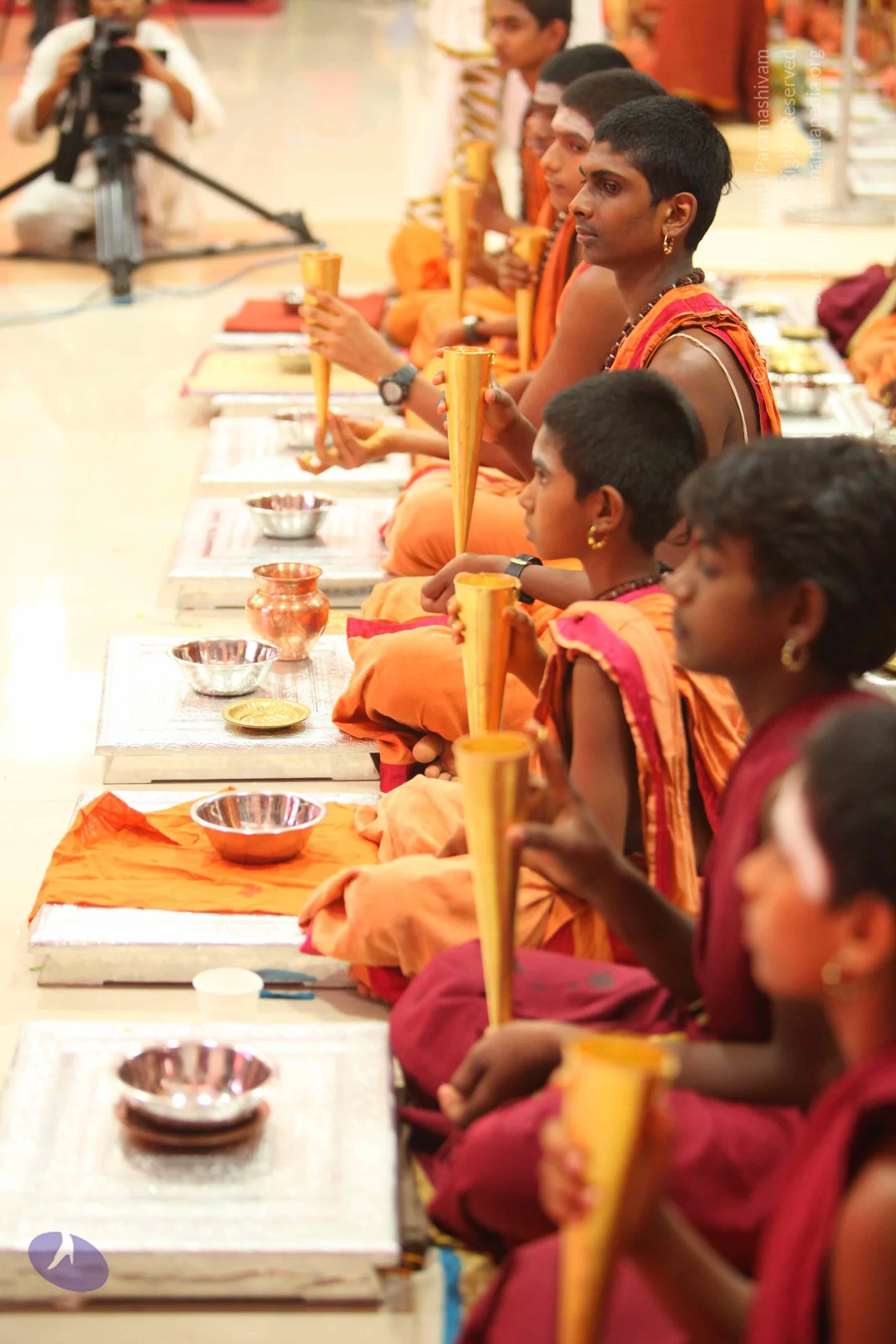
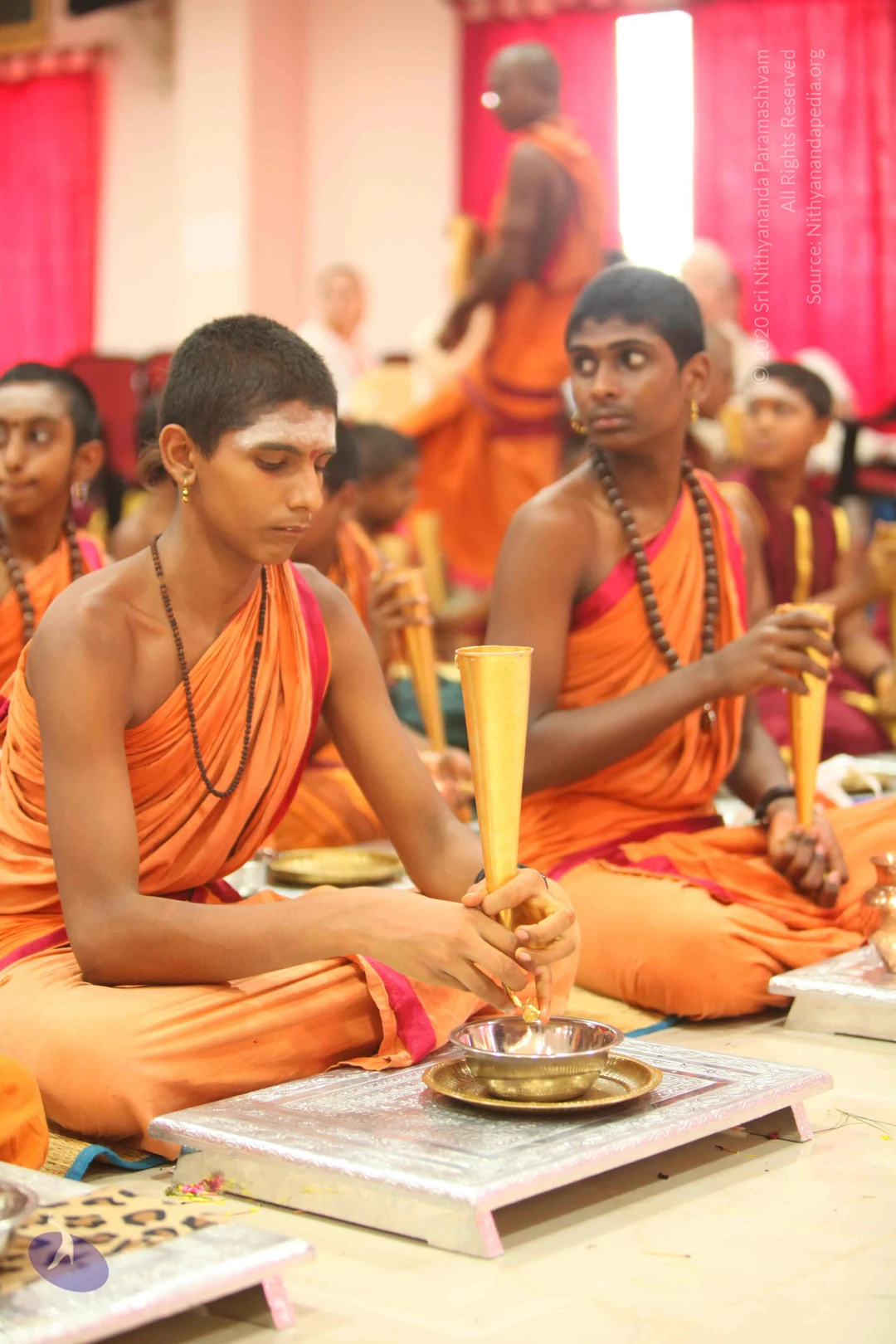
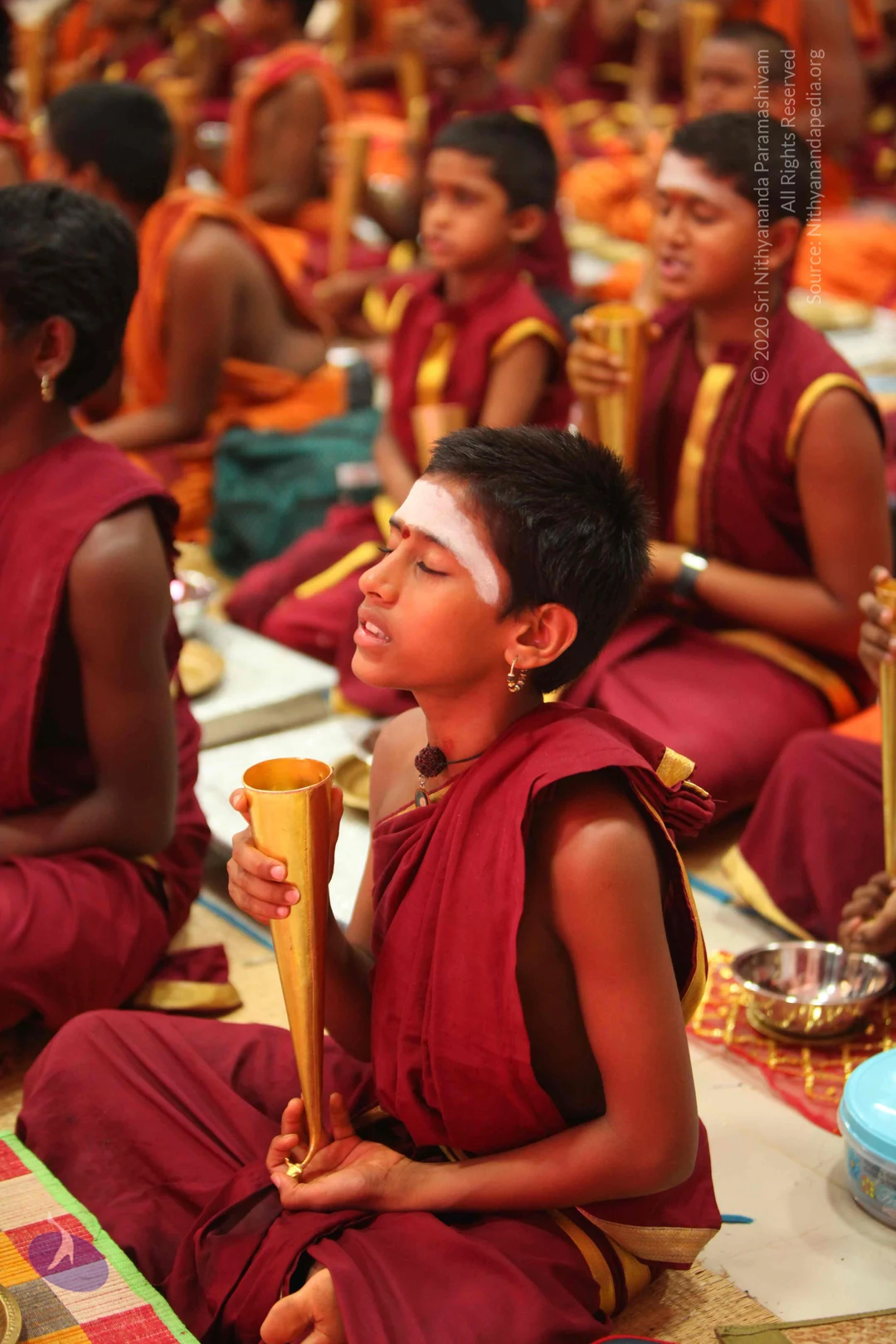
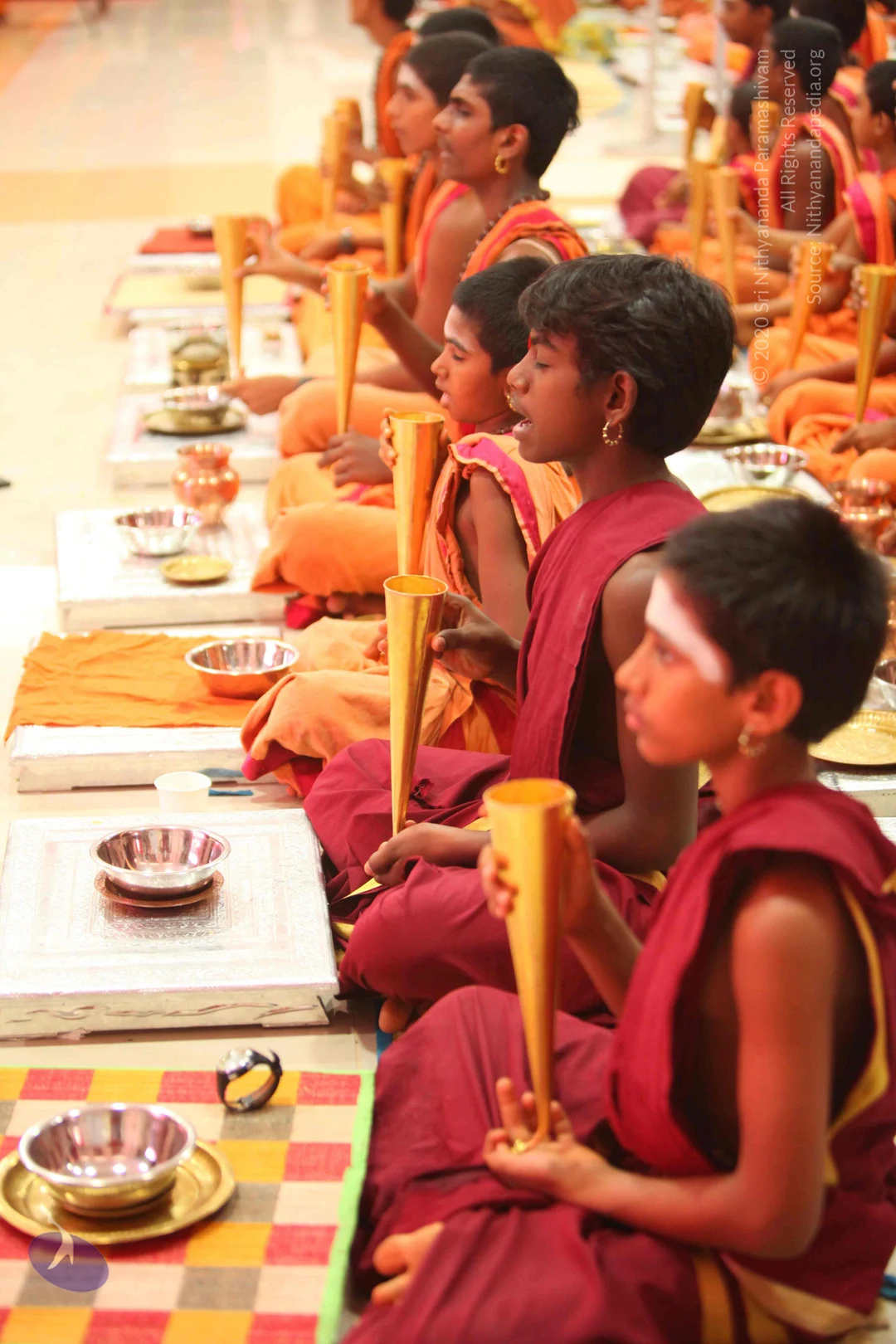
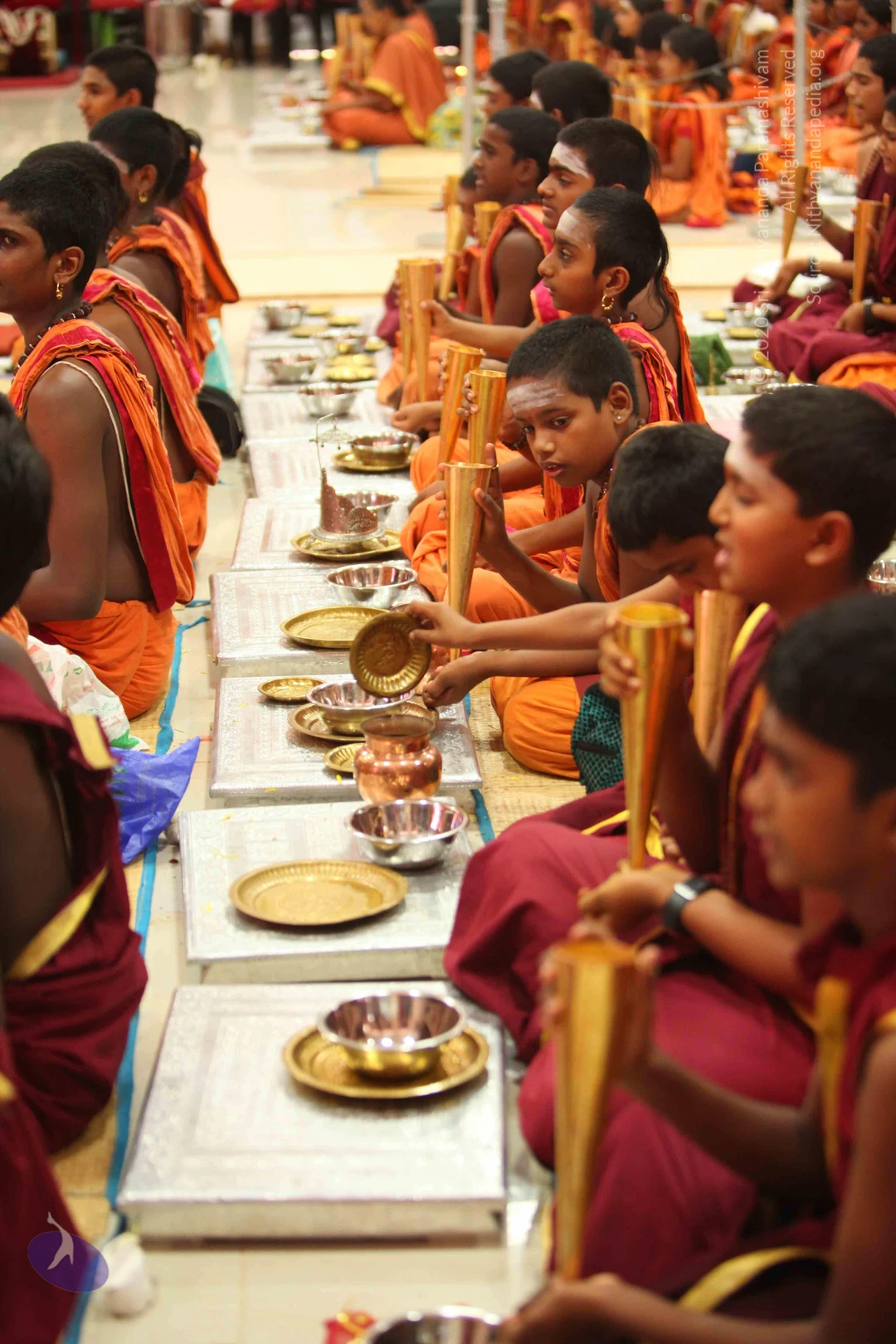
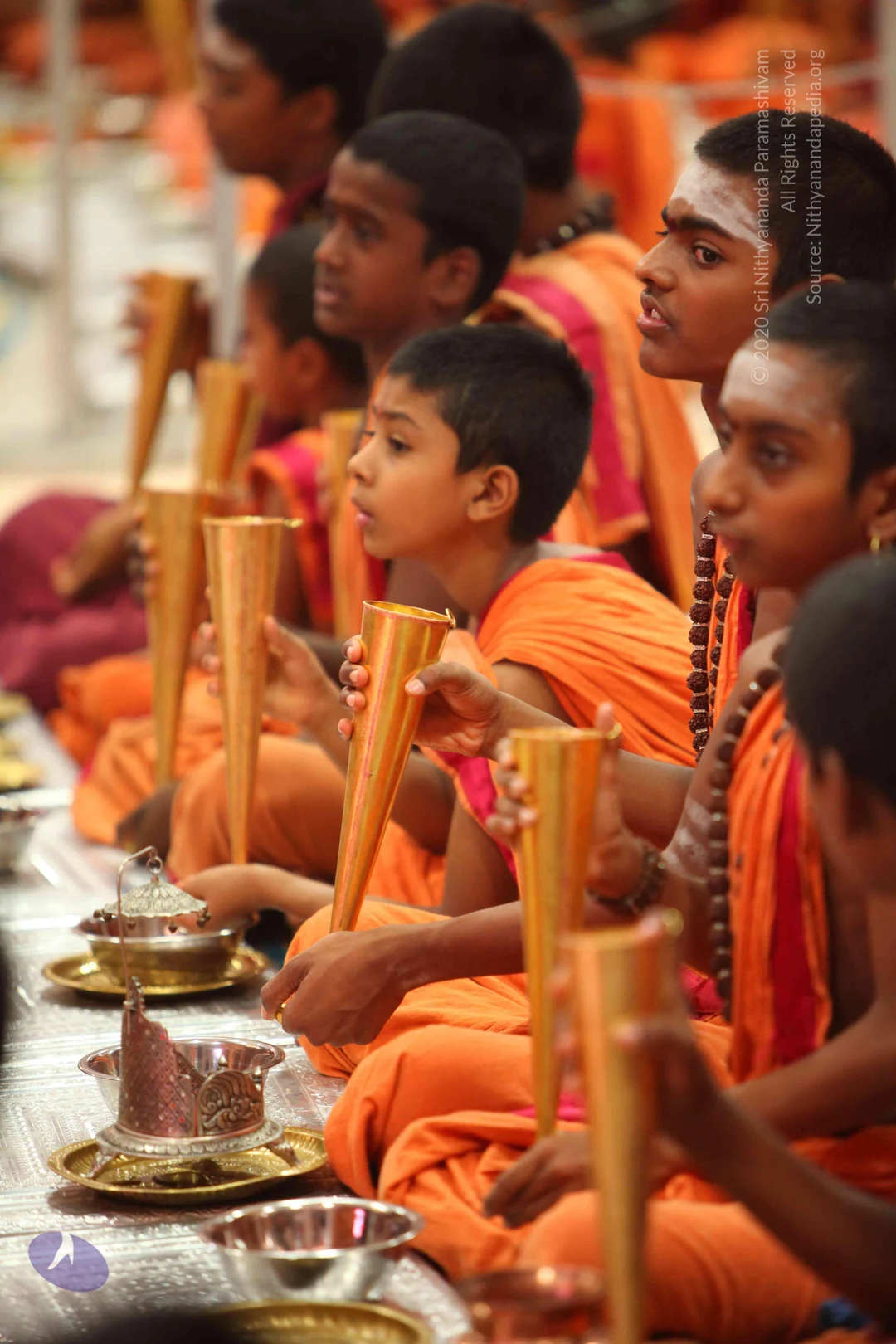
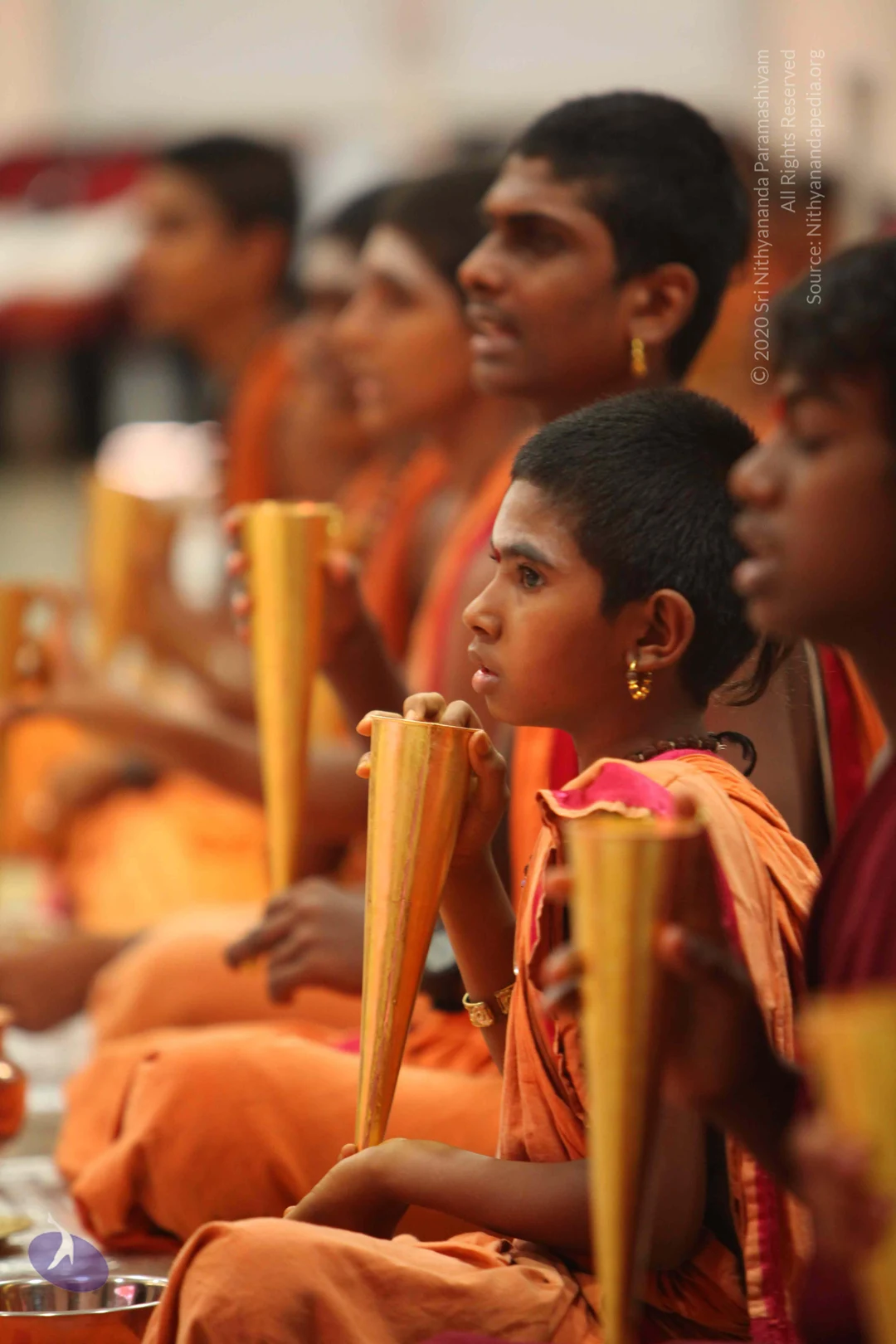
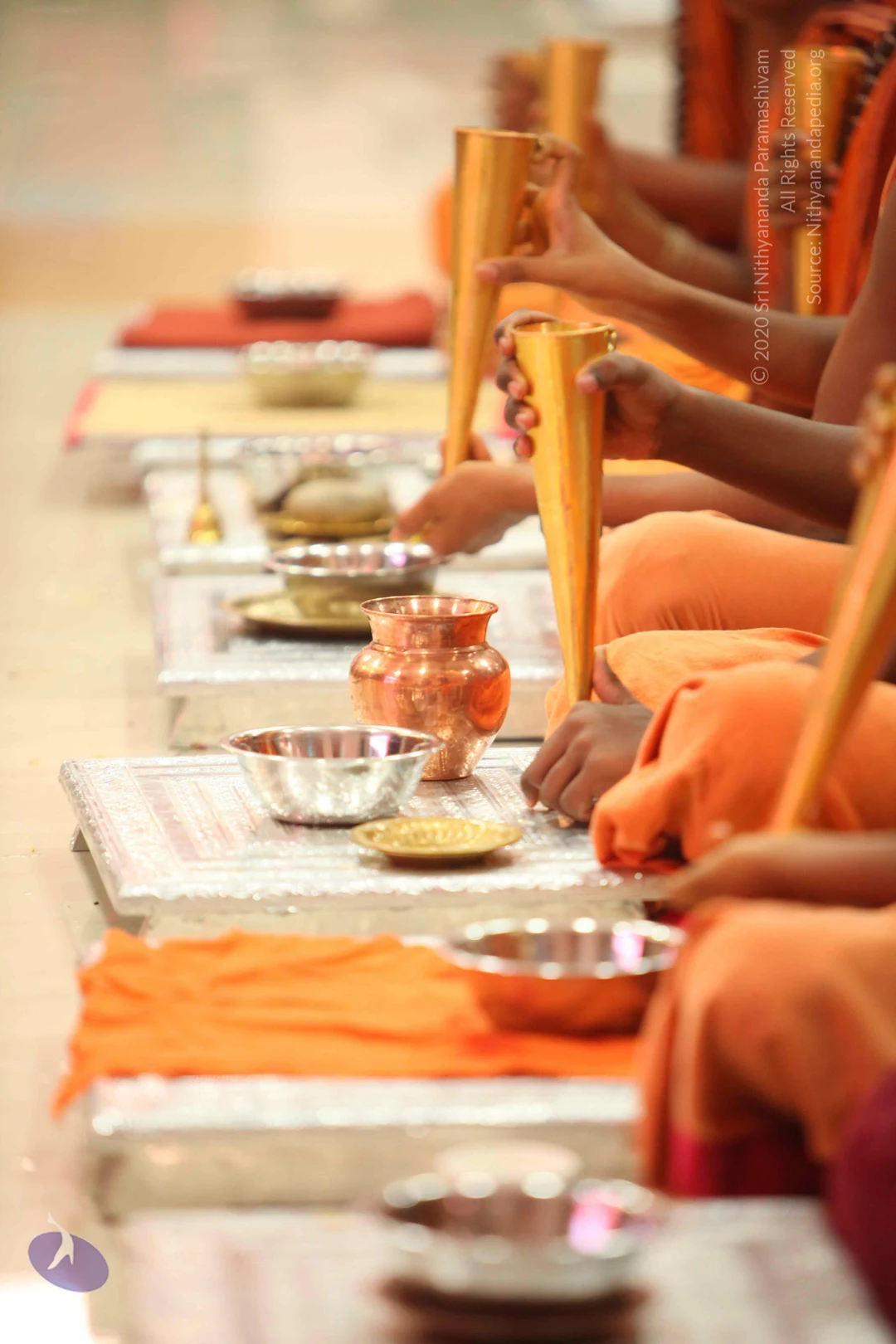
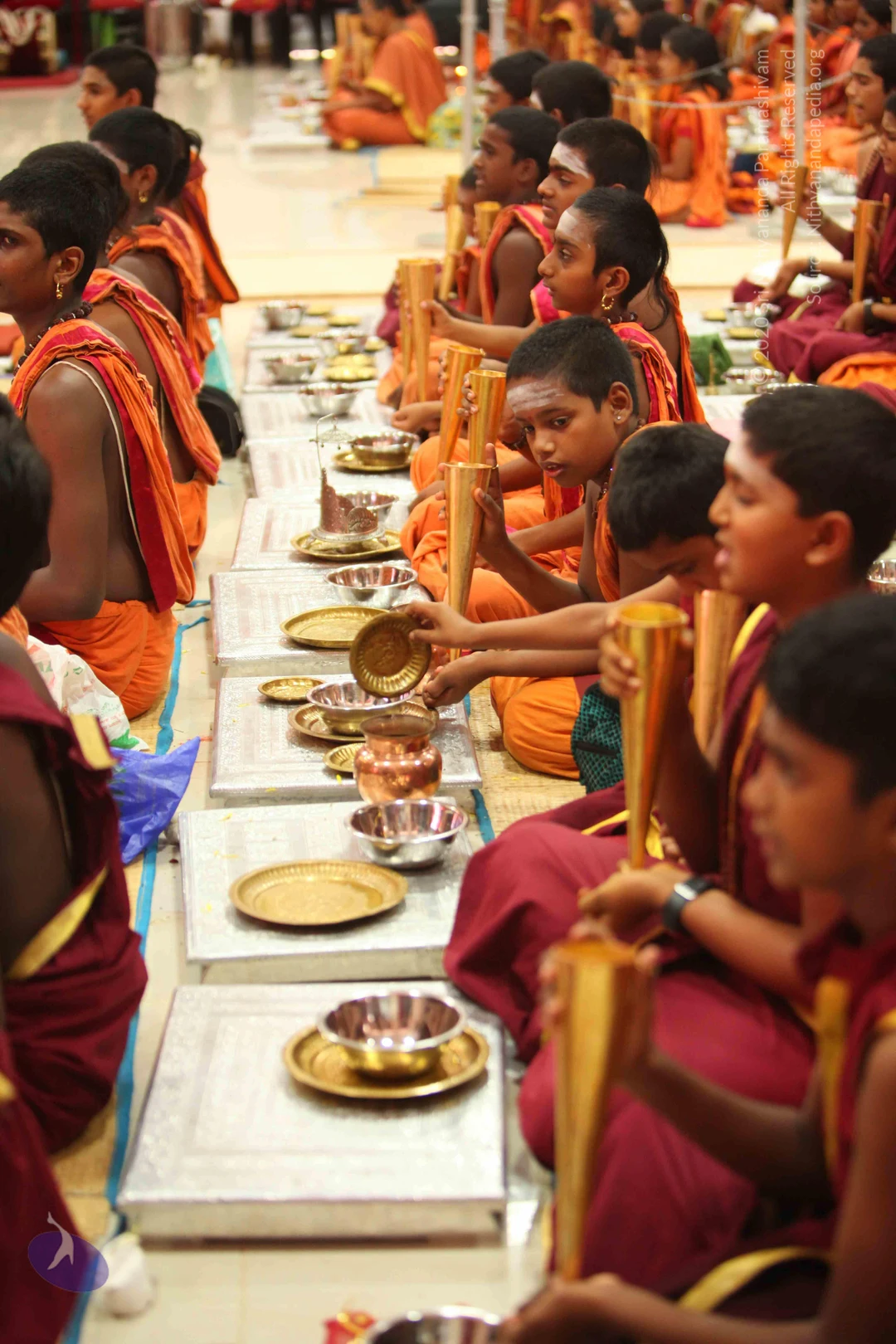
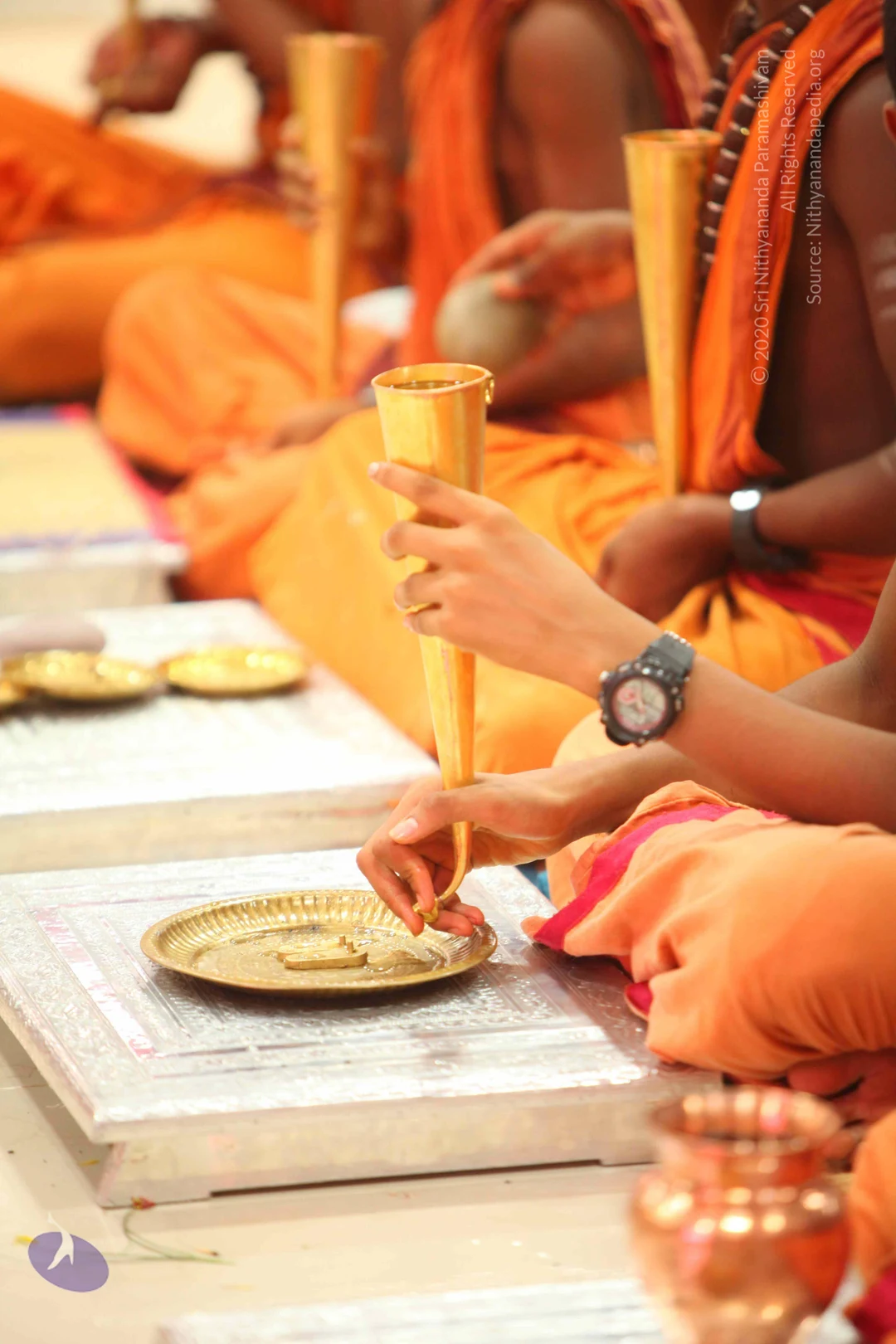
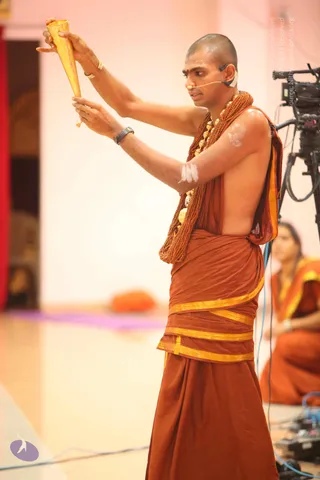
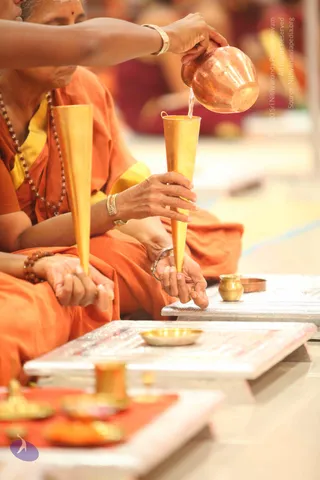
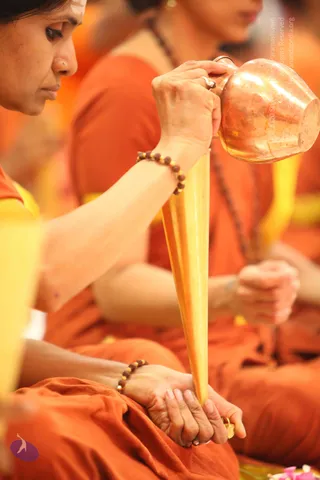
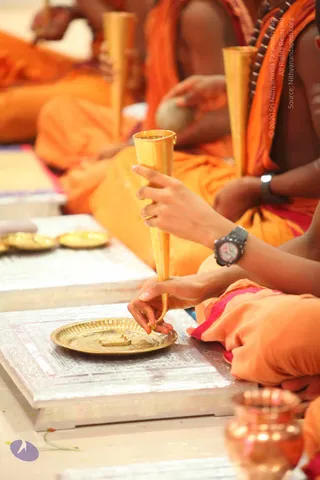
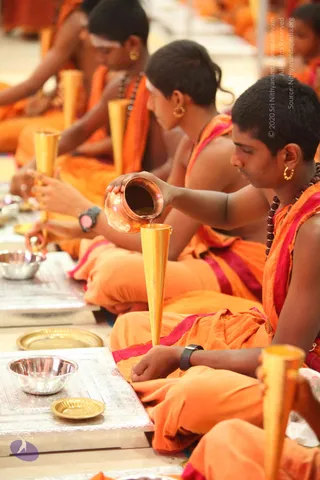
A shaven-headed man in rust-orange robes with gold-bordered wrap stands on a pale wooden floor holding a tapering golden cone-shaped vessel aloft in both hands, as in a ritual offering. He wears a rudraksha mala with gold beads, a wristwatch-style black band, a red bindi and white ash markings on his arms and chest, and a headset microphone. A seated woman in orange sari sits behind him, and a video camera on a tripod stands at right beside cables. Background shows a red curtain and a soft pink wall.Close photo of a ritual in progress: a figure in orange and yellow robes with a rudraksha mala sits cross-legged, a copper pot pouring water into a tall gold cone held by another person's hands. Silver trays hold small brass vessels and a gold bowl. Blurred orange-clad devotees sit in the background. The water appears to be an abhishekam or puja offering.A close photograph of a woman in an orange robe pouring water from a copper vessel through a long golden conical funnel held in her other hand, resting on her lap. She wears a rudraksha bracelet and rings, with a white forehead mark. Behind her, other people in orange and saffron robes sit in a row, one wearing a rudraksha mala, with pink flowers visible at the lower edge. The scene suggests a ritual pouring of sacred water.A row of women seated on the floor in orange saris with yellow borders, each holding a long golden conical horn to the mouth, apparently chanting Rudram. A woman in the foreground wears hoop earrings, a rudraksha bracelet and a tilak, and gazes to the side. Along the right, a low white altar holds a red cloth with brass plates, bowls and a small silver cup. Several women are visible in the frame, mostly partially cropped.A close photograph of several people seated on the floor in saffron-orange clothing, performing a ritual. In the foreground, a person's hands hold a long golden conical vessel, tilting it over a brass plate with a shallow pool of liquid and a small golden object. Another golden cone rests upright beside them, and a rudraksha mala is visible on a neighbouring robed person. Silver-coloured mats and a small copper vessel sit nearby. A wristwatch is visible on the foreground wrist. The scene suggests an abhishekam or puja, with liquid being poured over a murti-like offering.A row of young men and women in orange sannyasi-style robes with pink-red borders sit cross-legged on the floor, performing a ritual pouring. In the foreground a young man with short hair, a gold hoop earring and a rudraksha mala pours liquid from a copper vessel into a tall golden funnel-shaped cup. Silver bowls, a silver tray and small gold plates sit on the floor beside them, and similar golden cups are held by others down the line. The scene resembles an abhishekam or puja offering.

4-Maheshwara-Puja
18 photosSource gallery
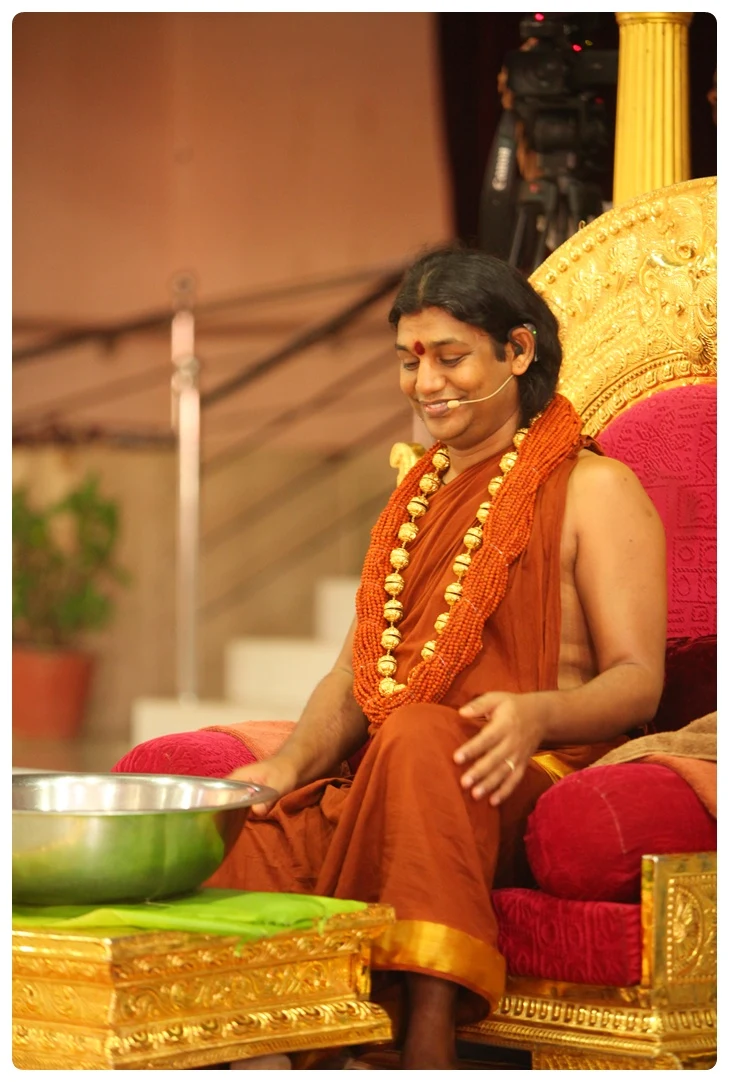
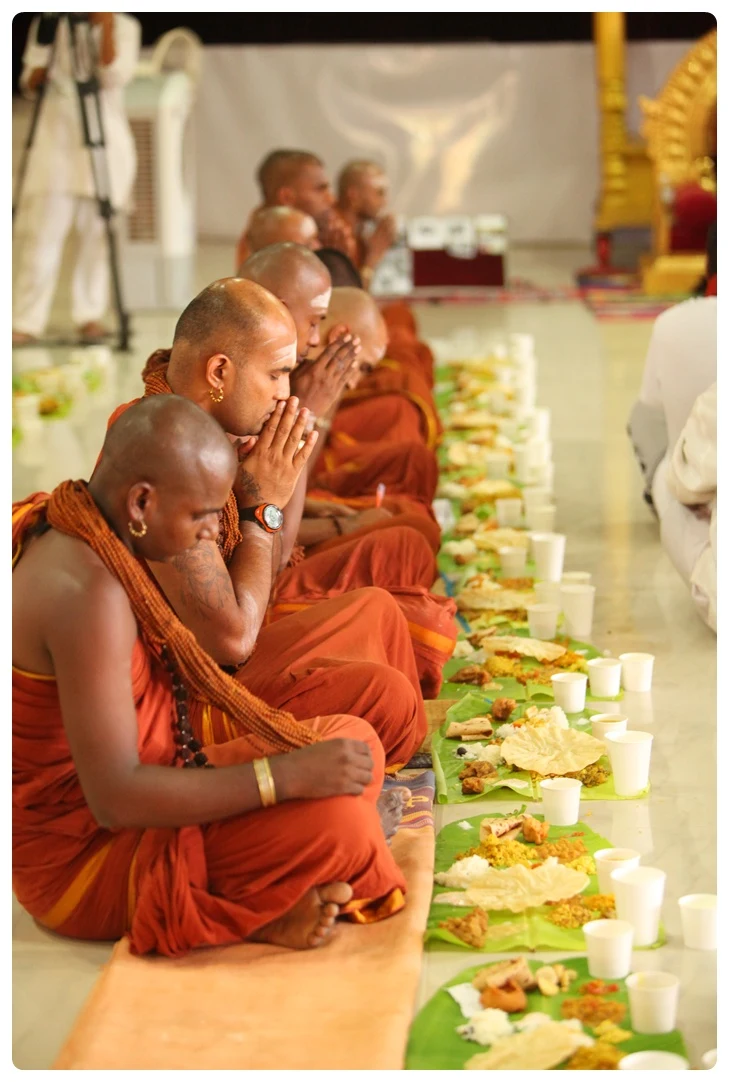
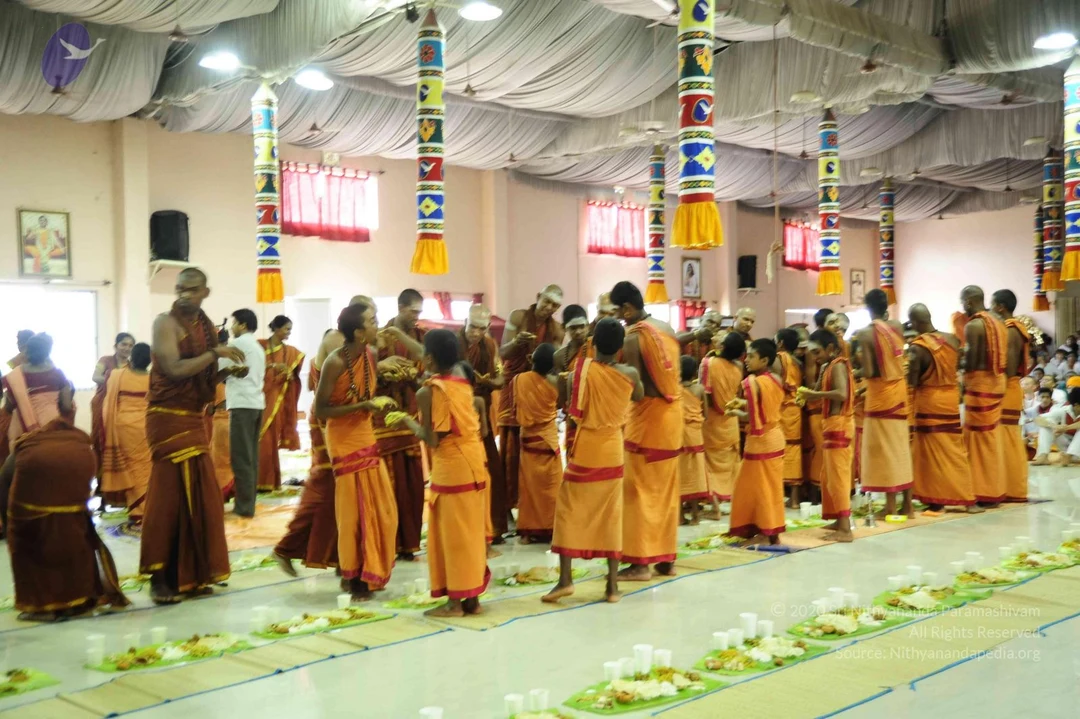
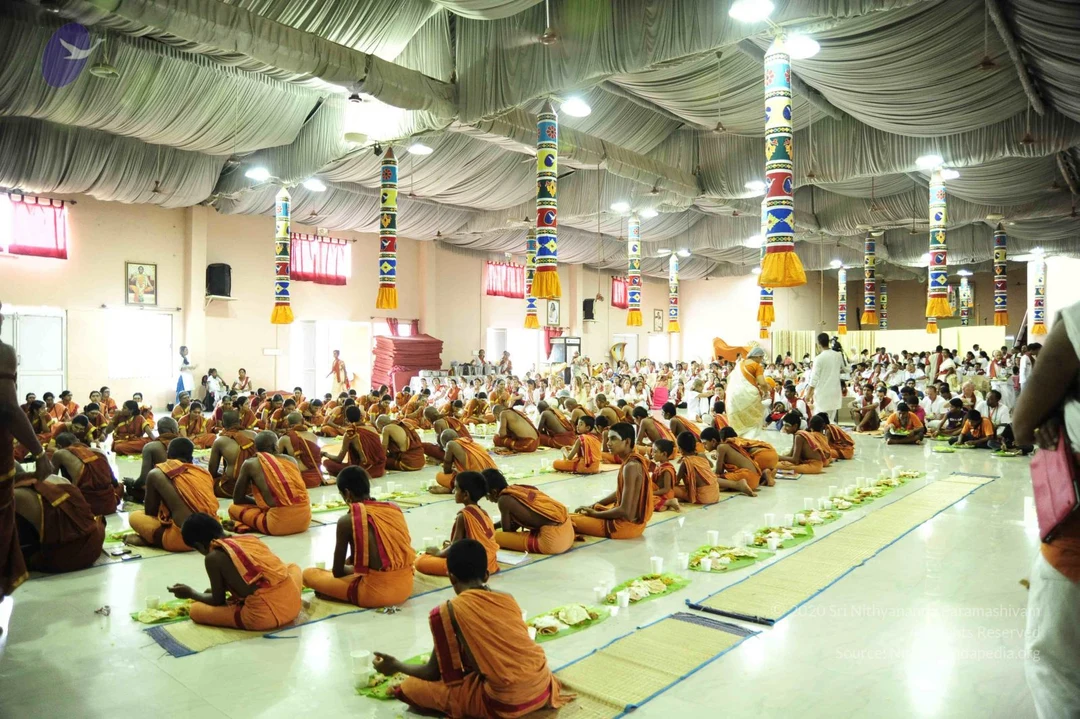
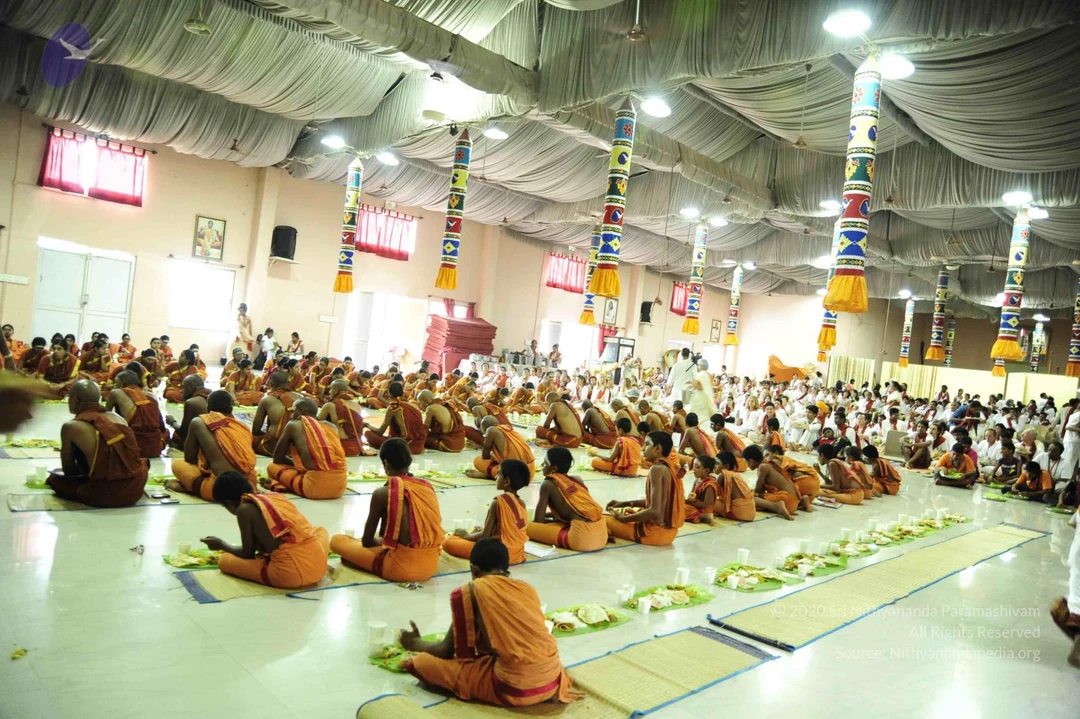
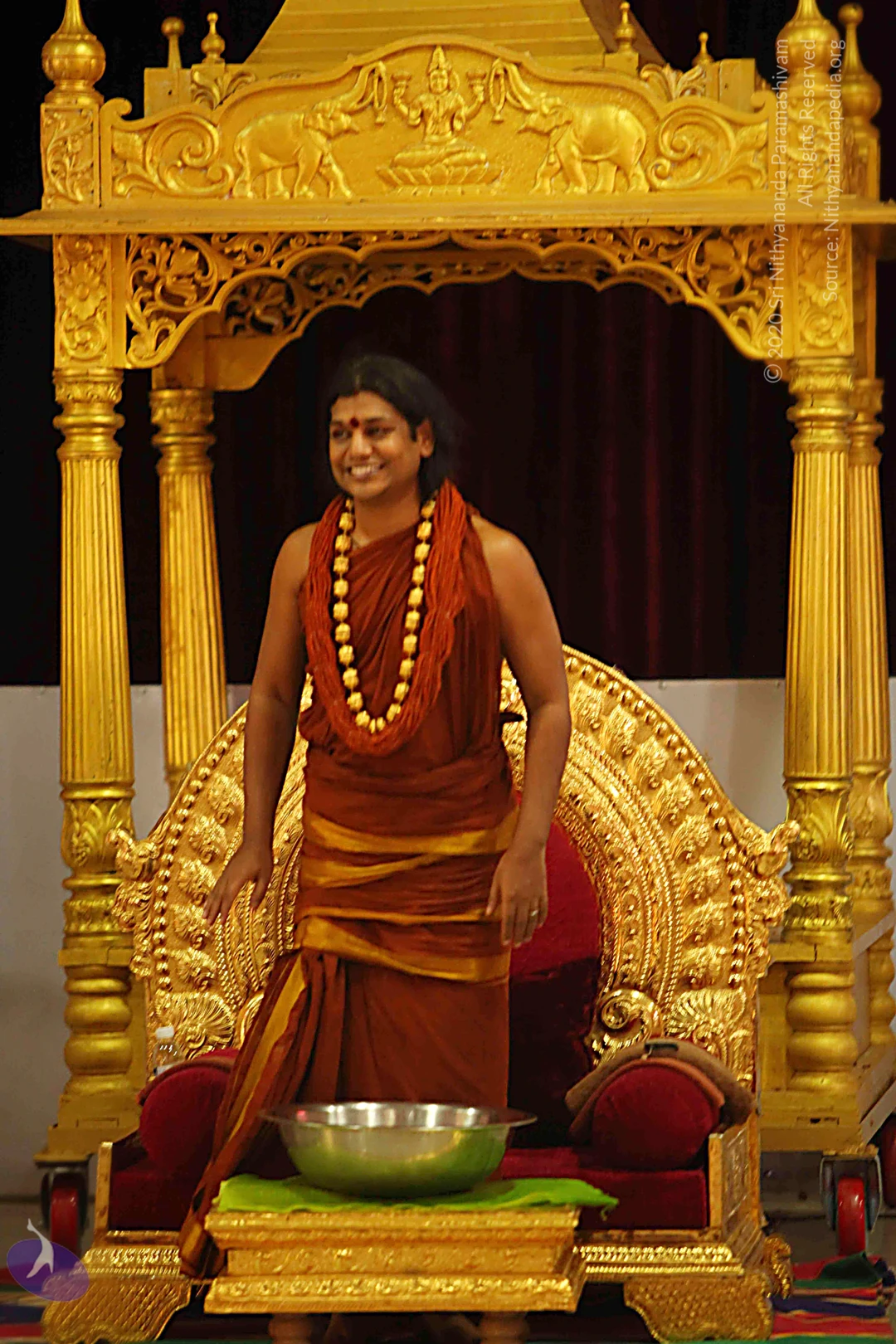
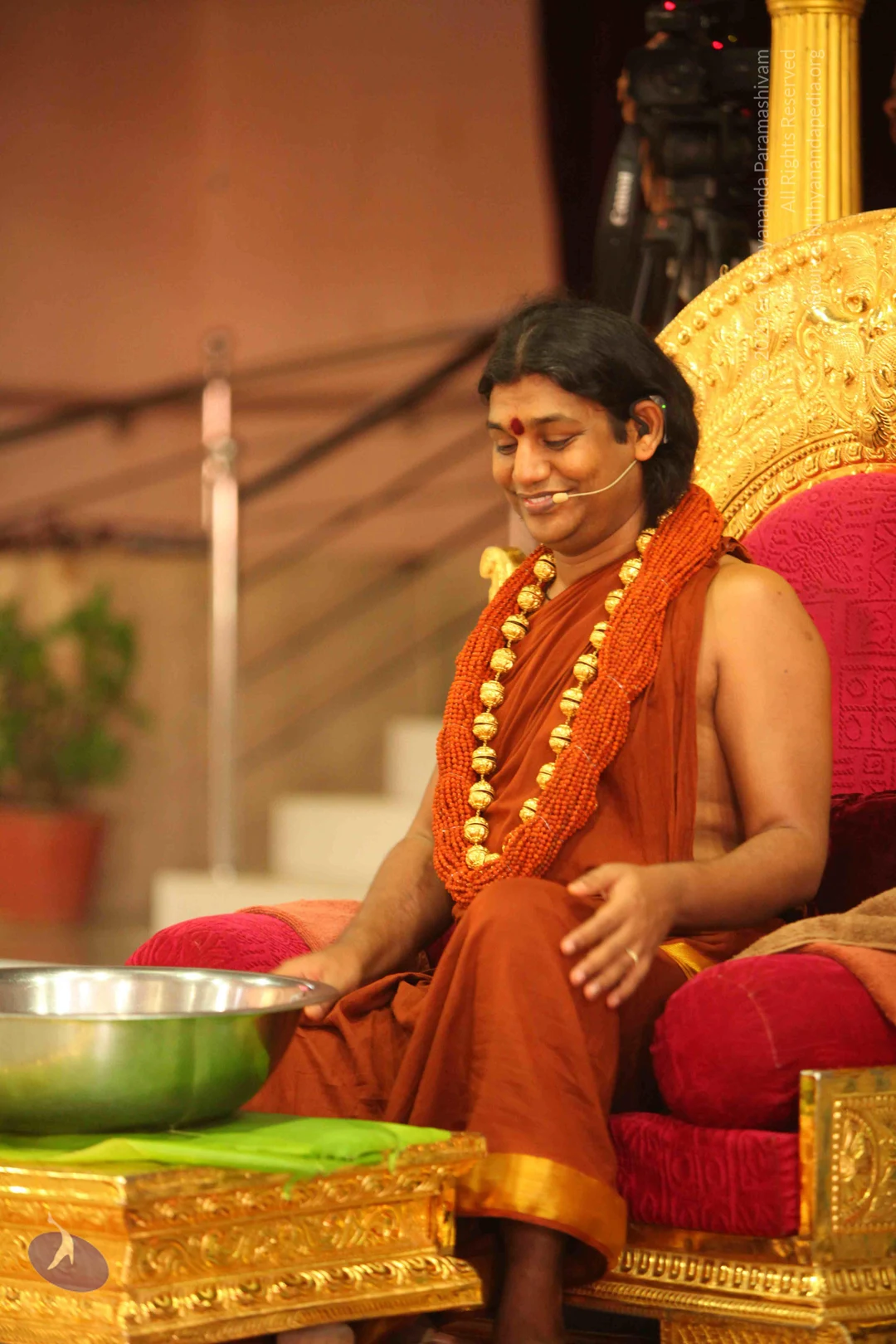
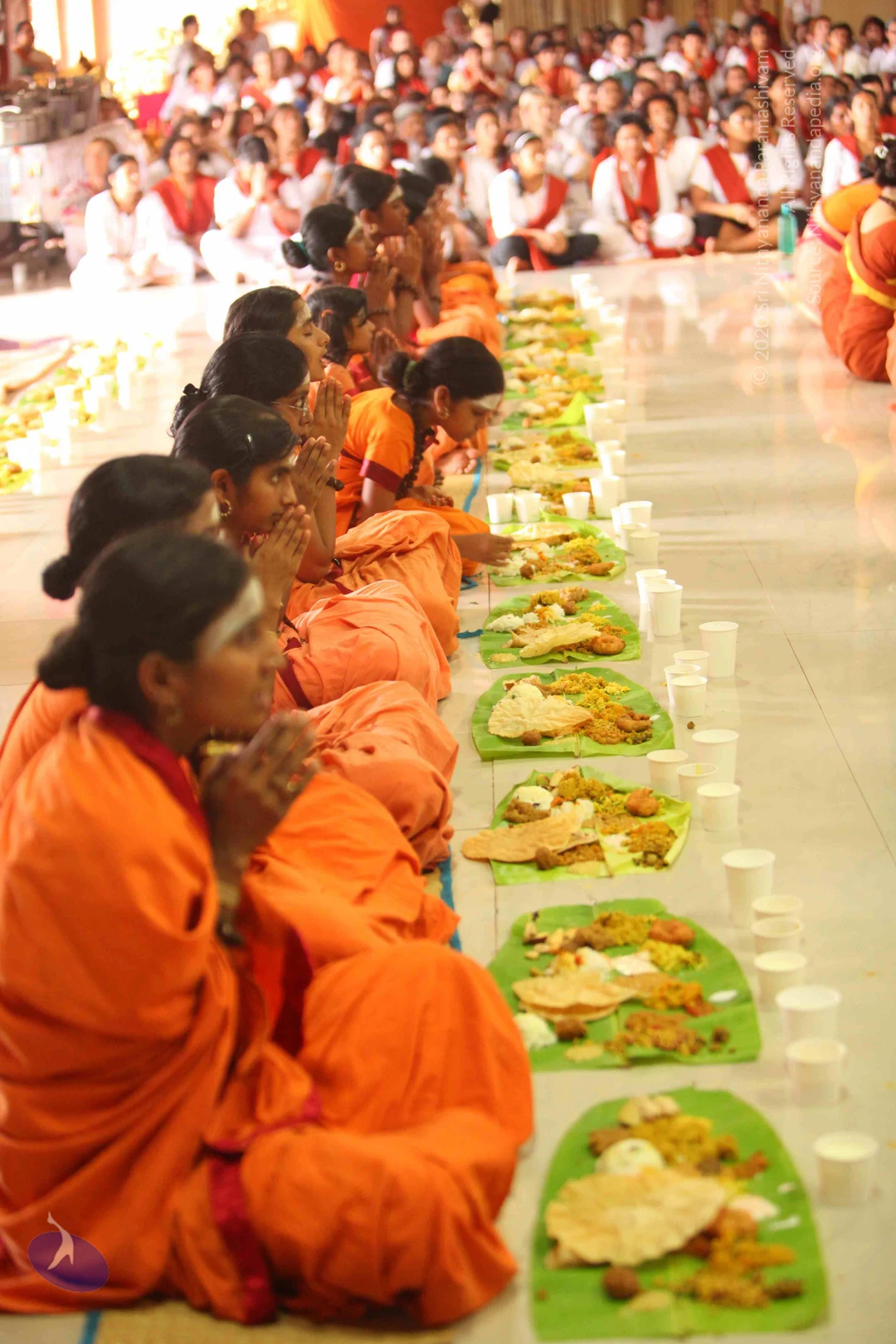
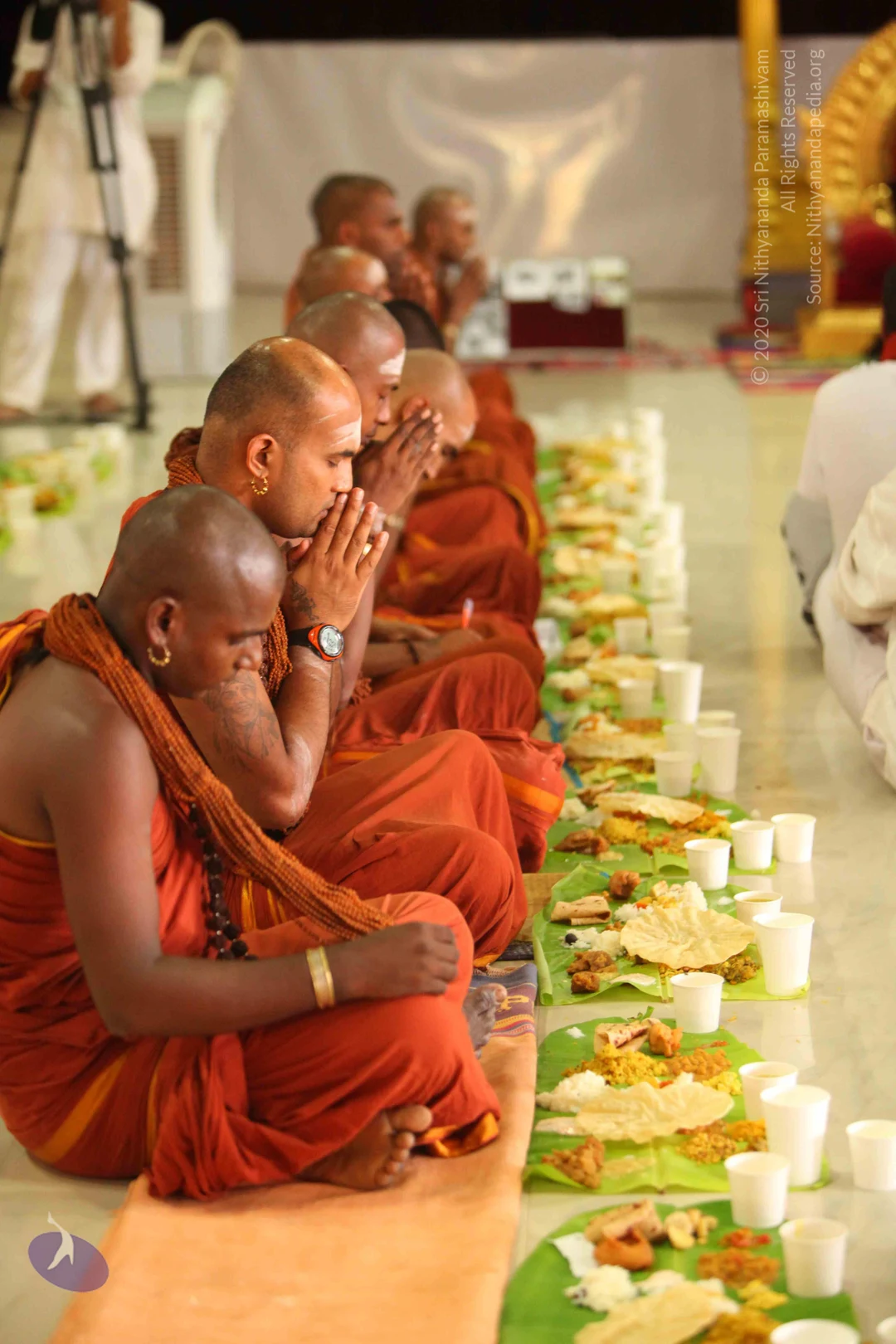
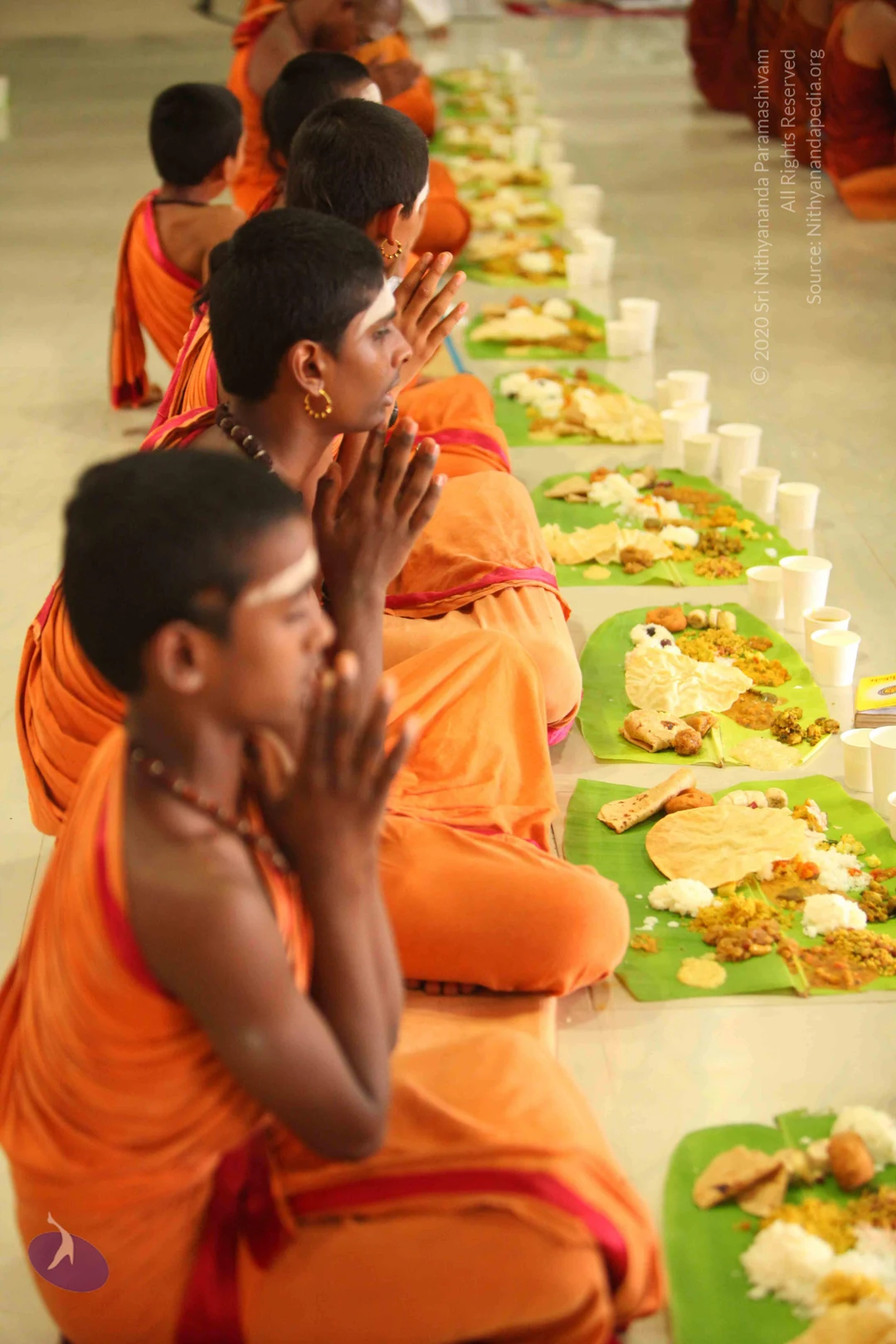
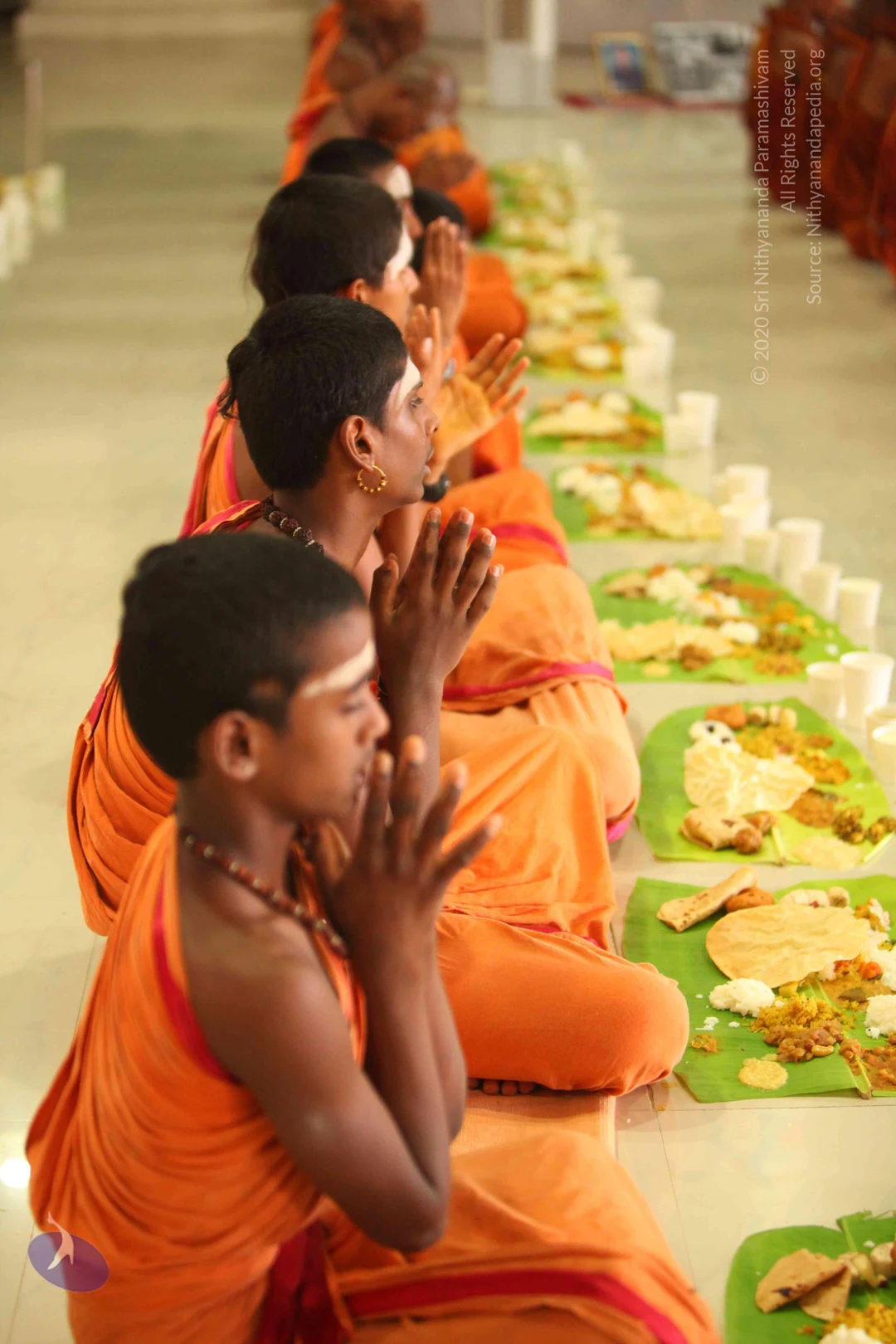
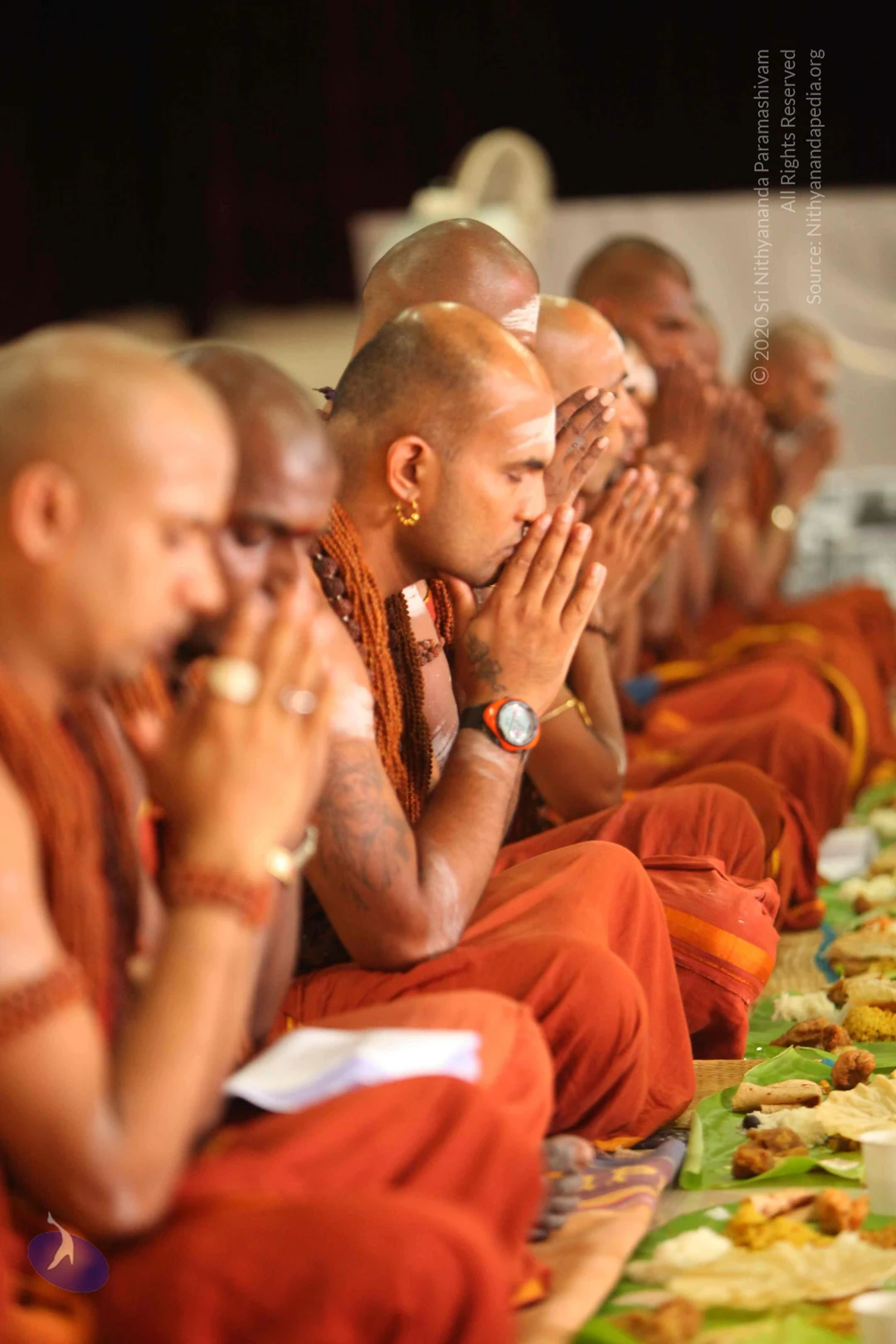
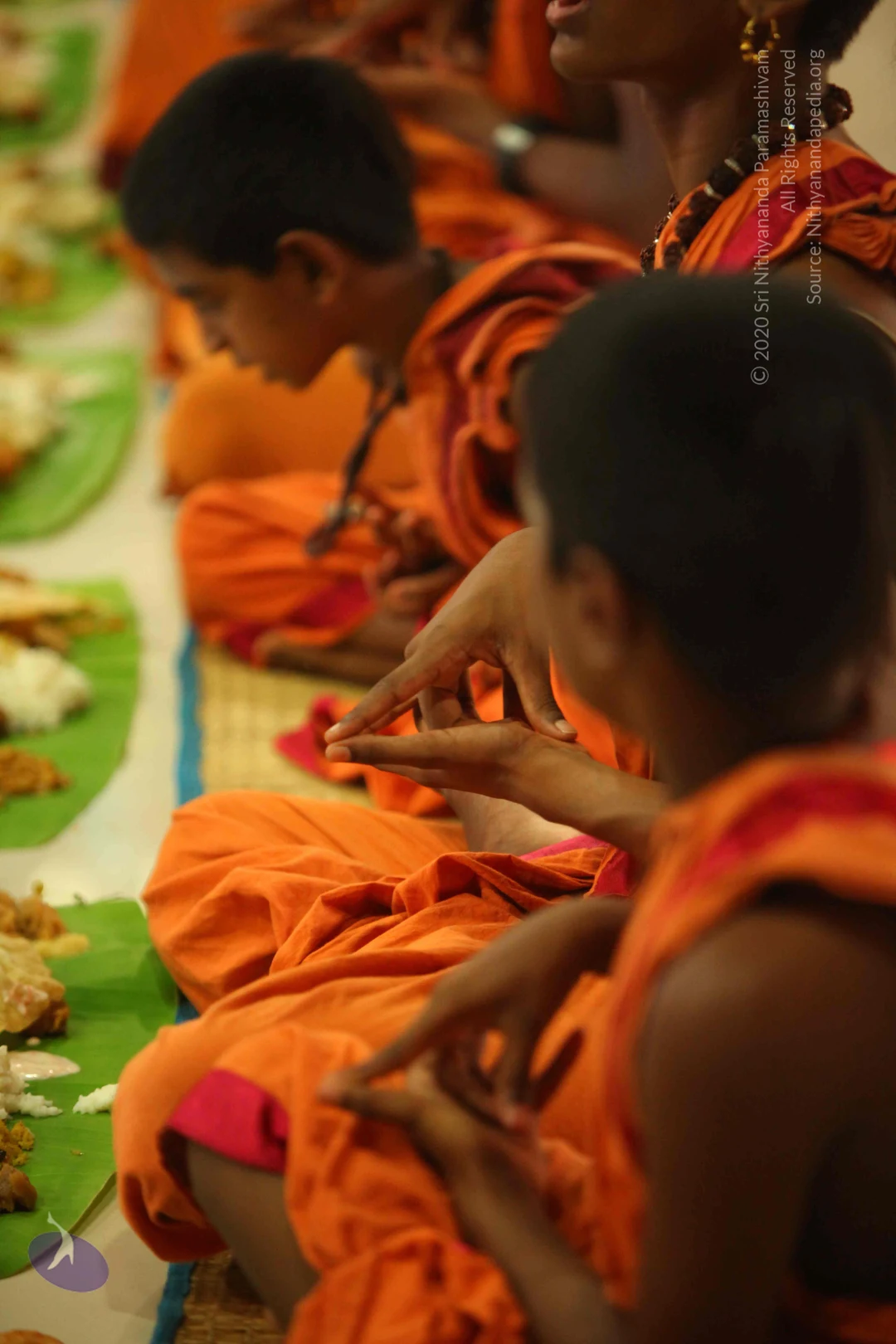
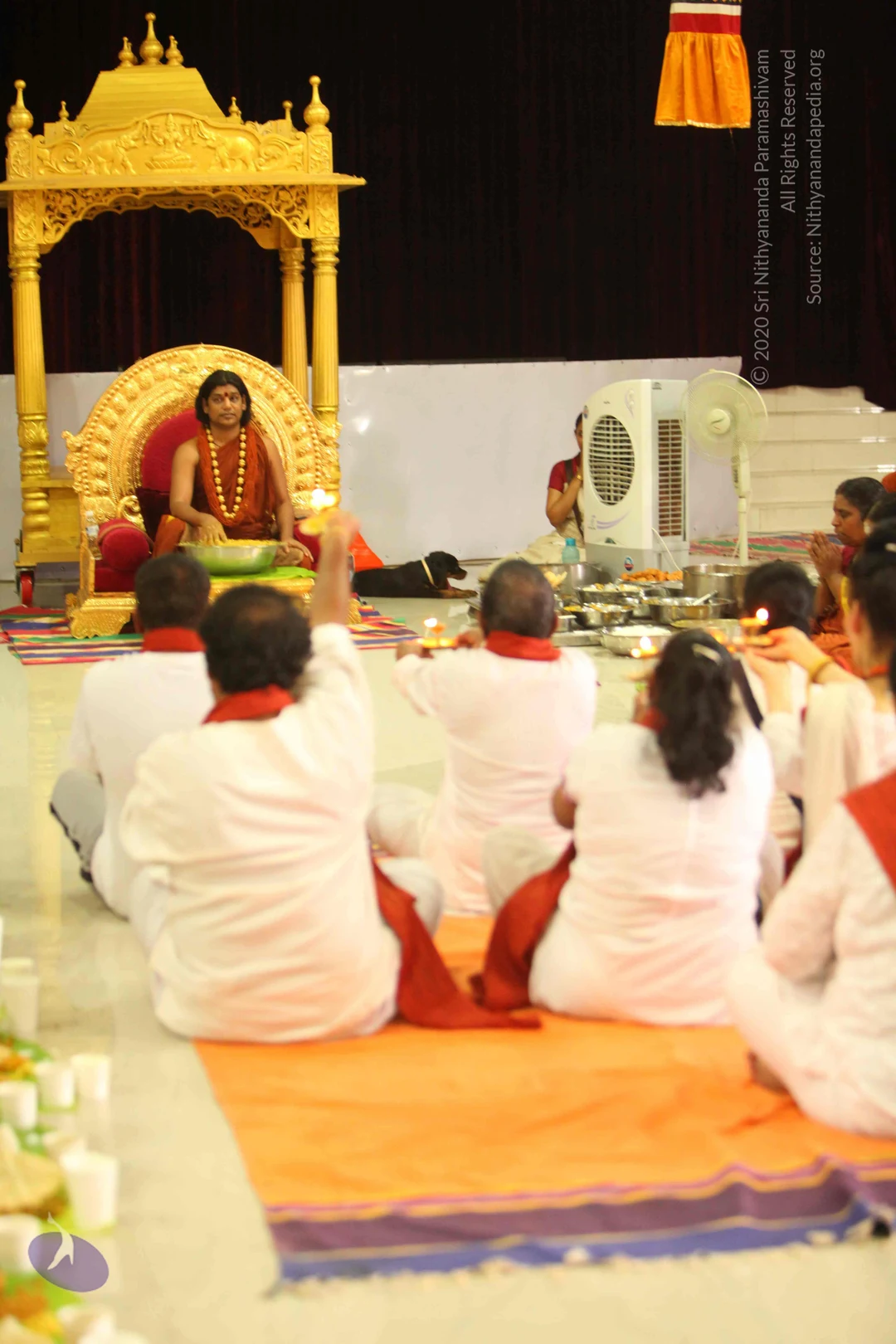
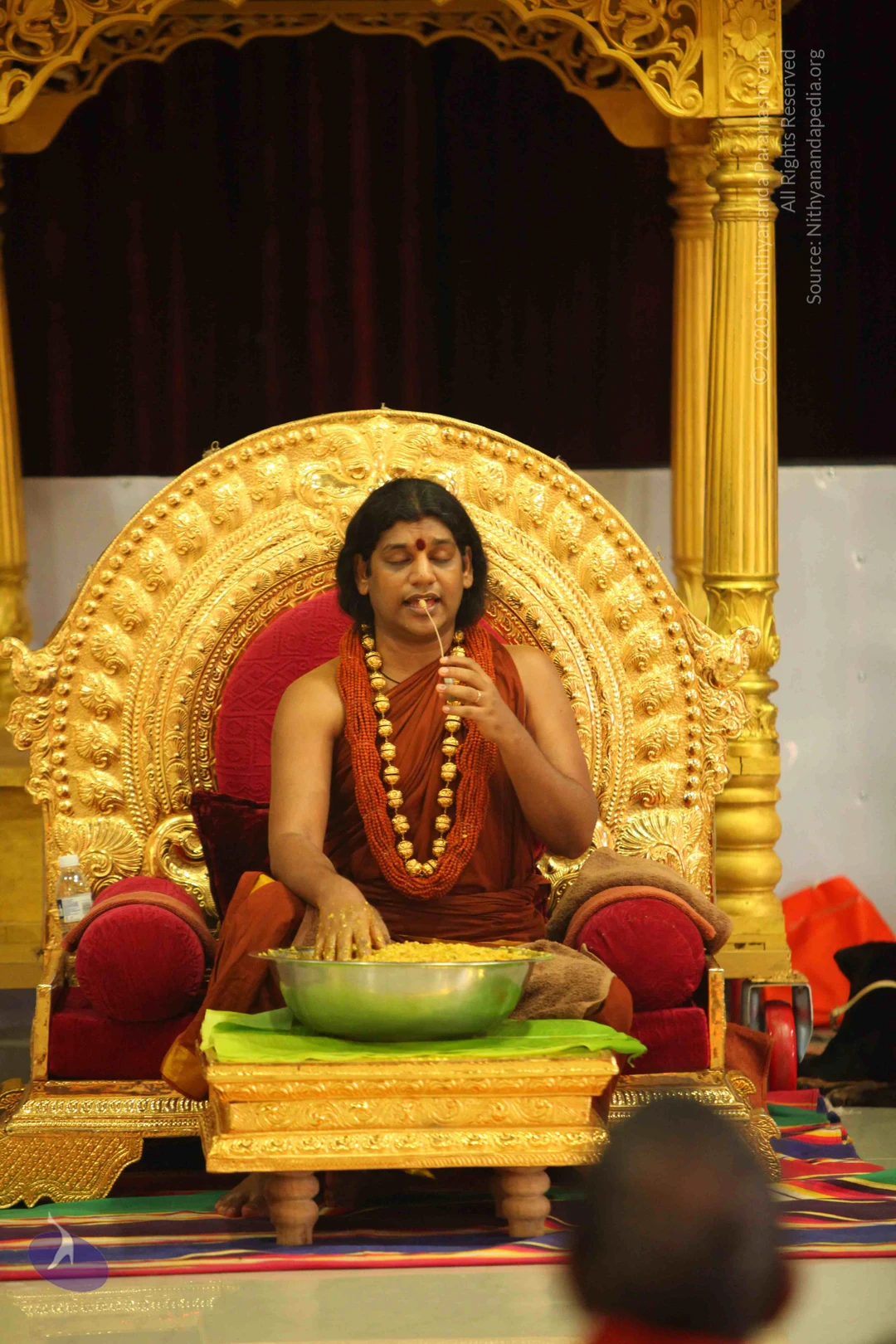
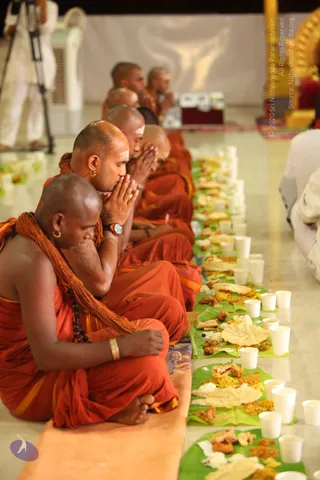
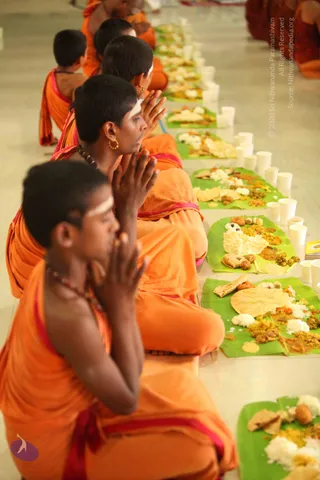
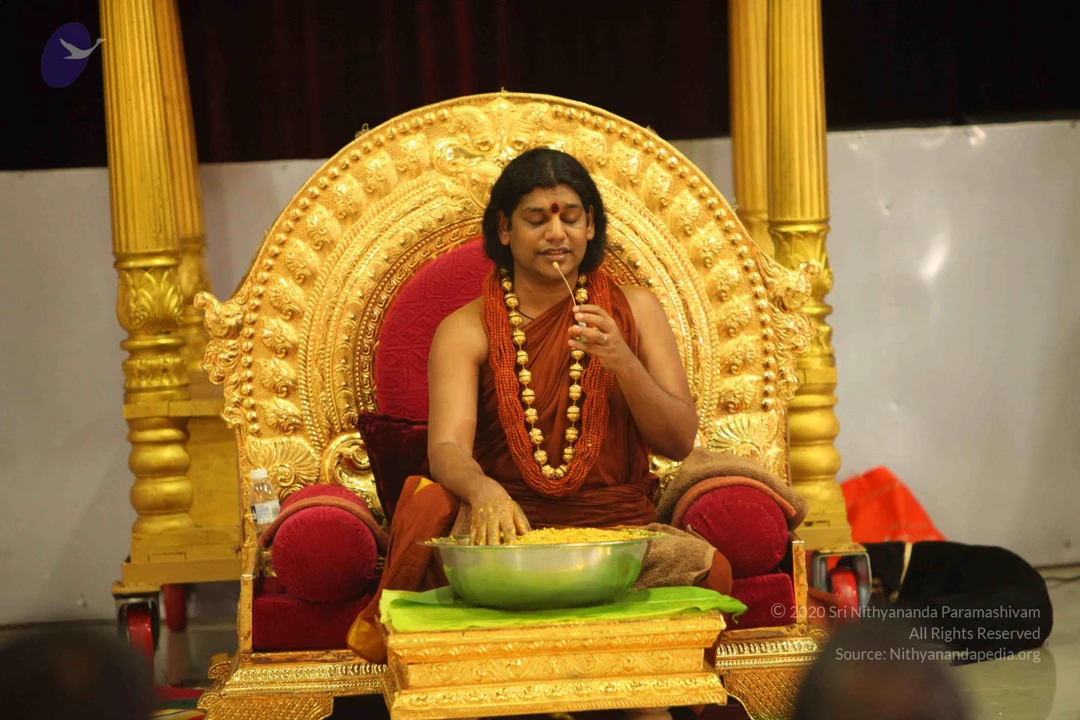
A person in rust-orange robes stands beside an ornate gold throne-canopy (peetha) with carved elephants and a deity figure on its top panel. The person wears a long rudraksha mala with golden beads, a red bindi, and an orange shawl, and smiles while one hand rests on the gold chair. A steel bowl sits on a green cloth on the raised platform. Red velvet cushions and a dark red curtain form the backdrop.A man seated on an ornate gold-carved throne with red velvet cushions, wearing an orange-saffron cloth draped over his shoulder and bare-chested, with a long coral-red and gold bead garland around his neck and a red tilak on his forehead. He wears a small headset microphone and smiles while looking down, one hand resting on his knee and the other near a polished metal bowl on a gold-edged stand draped with green cloth. A video camera on a tripod is visible in the background. The appearance and throne match the page's description of a satsang with a person, who is seated in person.A long row of women in orange saffron robes sits cross-legged on a white marble floor, hands pressed in namaskar, facing a line of green banana leaf plates heaped with rice, flatbread, fried snacks and sweets, with small white paper cups beside each leaf. Behind them a large seated crowd in white and red-trimmed clothing fills the hall, and an ornate golden shrine area glows at the upper left. The scene suggests a communal annadan style meal offered with prayer.Photo of saffron-robed sannyasi monks seated cross-legged in a long row on a marble floor, hands pressed together in anjali mudra with eyes lowered, in front of rows of green banana-leaf meal plates laden with rice, papadum-like crisps, fried snacks and sweets, each plate beside small white paper cups. Foreground monk wears an orange cloth draped over the shoulder, a dark rudraksha mala, a gold bangle and a wristwatch. Other monks have shaved heads and white tilak marks. Partly visible at the right are people in white clothing and a tripod-mounted camera at the upper left. A golden throne appears at the top right.A long row of seated young men in saffron-orange robes with red borders sits on a pale floor before rows of banana-leaf meals. Foreground figures press their palms together in prayer, one with a white vertical forehead mark and gold earring, another wearing a rudraksha mala. Each leaf holds rice, papadum-like flatbread, sweets, vegetable curries and small paper cups of drink. The scene looks like a communal annadan meal in a hall. Seven or more people are visible.A row of young men in saffron-orange robes with red edges sits cross-legged on a pale floor, hands pressed together in anjali mudra, faces turned to the front. Their shaved heads bear white tilak marks, and one wears gold hoop earrings and a rudraksha mala. In front of each sits a green banana leaf laden with rice, pappadam, vegetables and sweets, with small white cups or lamps lined along the right. The scene appears to be a meal offering or annadan before devotees. No clearly identifiable a person is visible.
5-Akashic-Readings-Kalabhairava-Darshan
8 photosSource gallery
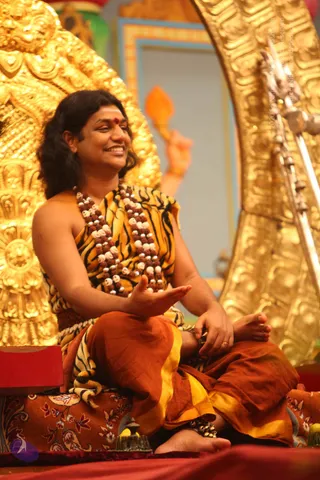
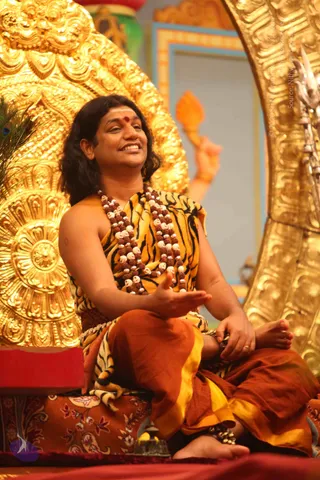
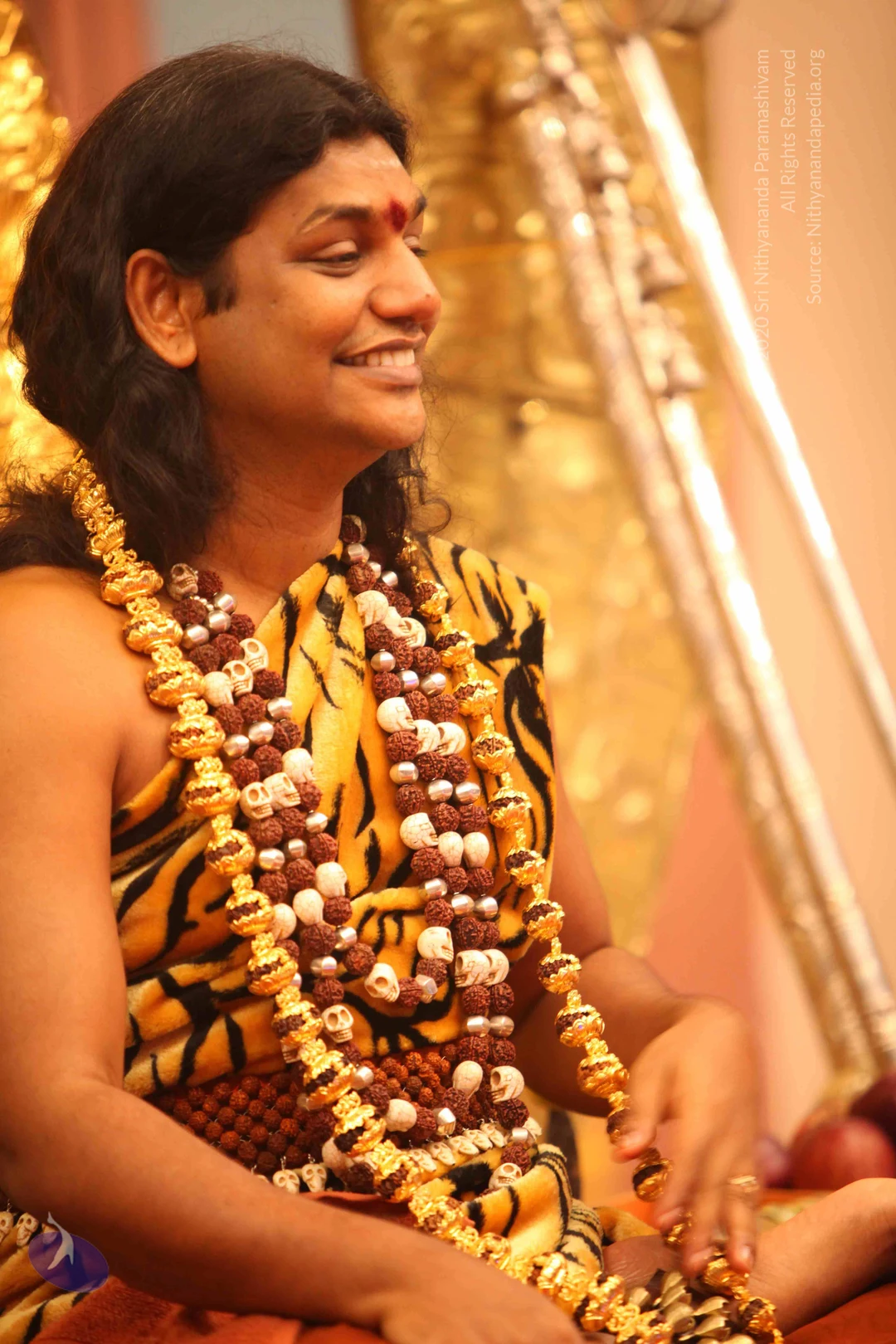
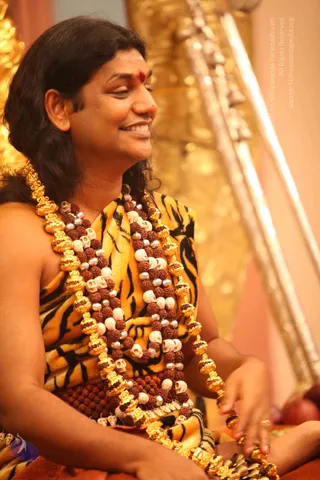
A photograph of a seated man on an ornate golden throne-like seat with carved gold panels, smiling and gesturing with his right hand open. He has long, dark, swept-back hair, a red bindi on his forehead, and wears a tiger-striped saffron-and-black shawl over his bare shoulders, with dark rudraksha and white bead malas around his neck, and rust-orange dhoti-style cloth on his legs with ankle bells. Behind him is a gold kalasha-like finial and a silver trident-shaped staff to the right. A small oil lamp sits on the floor at the lower edge.A man with long, swept-back dark hair sits cross-legged on a red-draped dais in front of an ornate gold throne with carved backrest. He wears a yellow and black tiger-striped shawl over his bare shoulder, a rust-orange lower garment with yellow border, and multiple strands of rudraksha and white bead malas. A red bindi marks his forehead. He smiles and gestures with his open left hand while speaking. Behind him stand a golden ceremonial fan and a silver trident, and a peacock feather is visible at the left edge. Swamiji (probable): long hair, tiger-striped shawl and rudraksha malas, seated as the speaker in a satsang setting.A smiling man with long dark hair sits cross-legged on an orange and red floral-patterned cushion in front of a gilded golden throne-back. He wears a tiger-striped yellow and black wrap over his bare shoulder, an orange-brown dhoti, a multi-strand rudraksha and white bead mala with a red kumkum tilak on his forehead, and bells on his ankles and wrists. A silver trident with bells stands beside the throne, and a small brass lamp with yellow fruit sits at the lower right. The scene is a seated teaching setting with a red cloth in the foreground. The man appears to be a person, with long swept hair, rudraksha malas and ornate saffron-toned clothing, seated on a ceremonial throne.A photograph of a smiling man with long dark hair seated cross-legged on a red cushion before an ornate gold throne with repoussé floral and lion motifs. He wears a red tilak dot on his forehead, a yellow-and-black tiger-striped shawl, orange-red dhoti with gold border, multiple strands of rudraksha and white beaded malas, and heavy gold necklaces. He holds a small stick or incense-like object in one hand, and a peacock-feather fan stands at left. Brass lamps with lemons rest on the cushions. a person by visible cues: long swept hair, ceremonial gold necklaces, rudraksha malas and saffron-orange clothing, seated as a teacher on the throne.A seated man with long dark hair and a red bindi smiles and looks to his side. He wears a yellow and black tiger-striped garment over one shoulder, layered with long necklaces of rudraksha beads, white skull beads, silver beads and ornate gold beads. He rests his hand on a gold-decorated mala near a gold-toned backdrop and a silver pole.A seated man in a satsang setting sits cross-legged on a red cushioned dais in front of a large ornate gold throne-back. He wears a tiger-striped saffron and yellow wrap over bare shoulders, rust-orange and yellow dhoti, layered rudraksha and white bead malas, a thick gold necklace, and bells at his ankles and wrist. He holds a small stick or pen while smiling and speaking. A standing orange-skinned deity figure with gold ornaments stands to the right, and a peacock-feather fan is at the left edge. Brass oil lamps with yellow fruit sit on the dais. a person by appearance cues: long swept hair, saffron ornate clothing and rudraksha malas, seated as the teacher at a satsang.

May 20 2013

1 photoView all
A bar chart titled IA MAY 2013 HEALTH RECOVERIES, drawn as orange vertical bars with percentage labels above each bar (values around 80-93%) and category names along the horizontal axis. Nothing in the image shows a person, ritual or event; it is a statistical graphic with no physical people.