Skip to content
Sunday

19 May 2013

What is Inner Awakening Level - 1

Dated photos
843
Source pages
1
Media
3
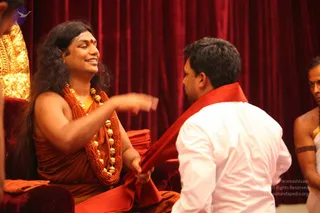
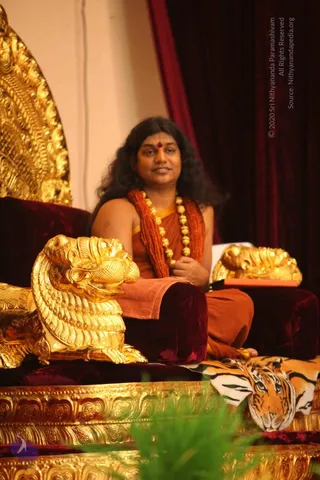
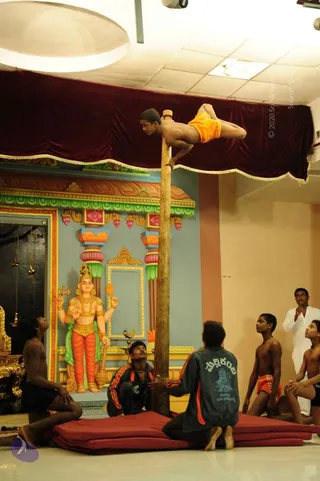
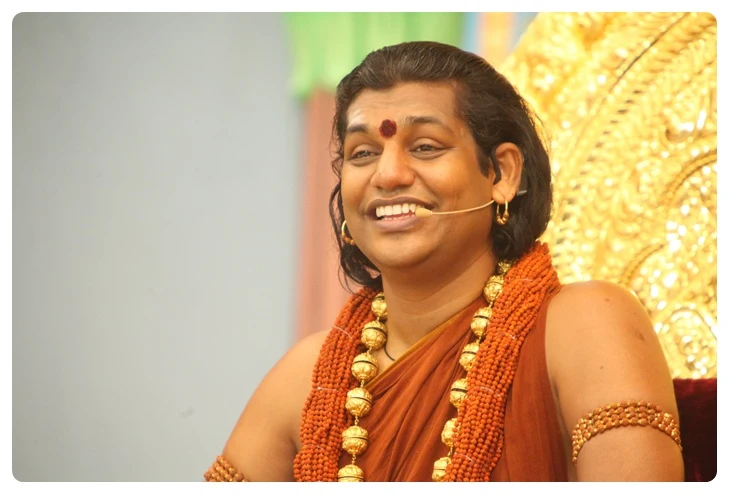
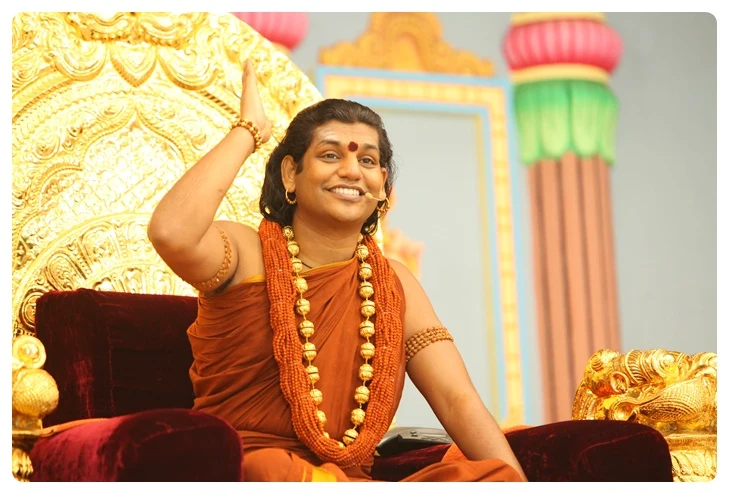
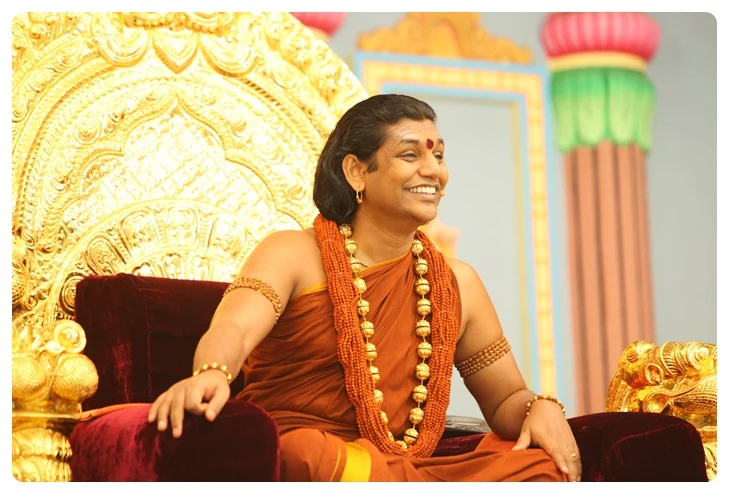
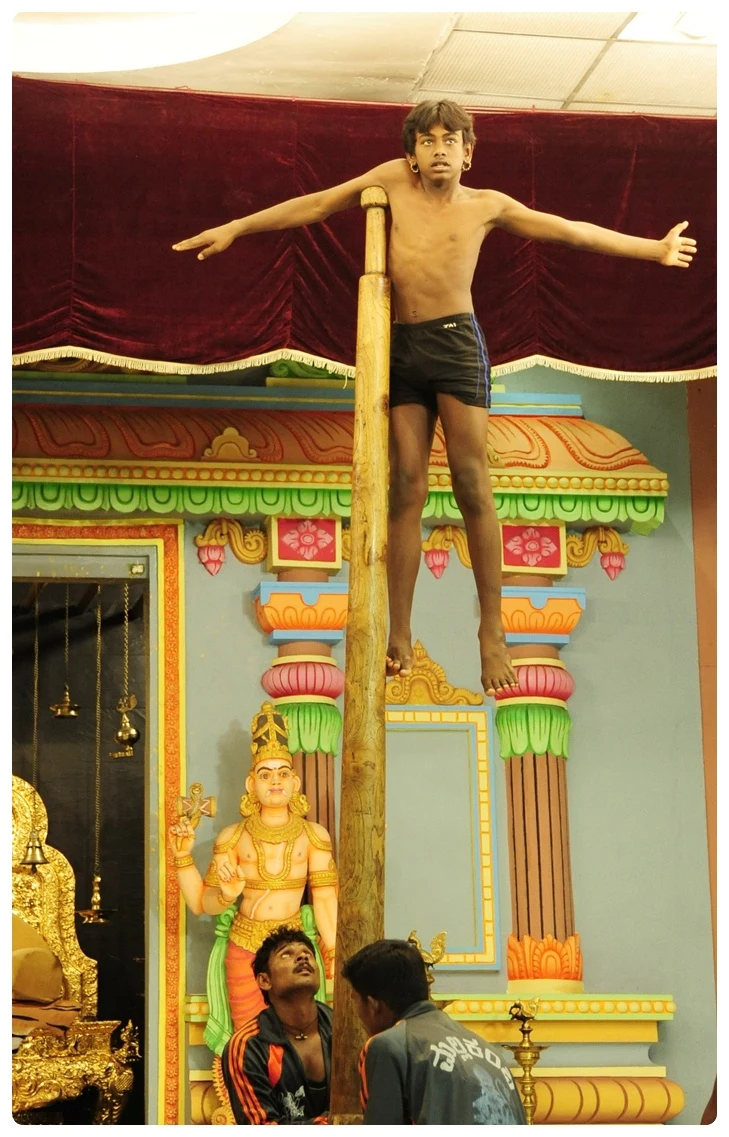
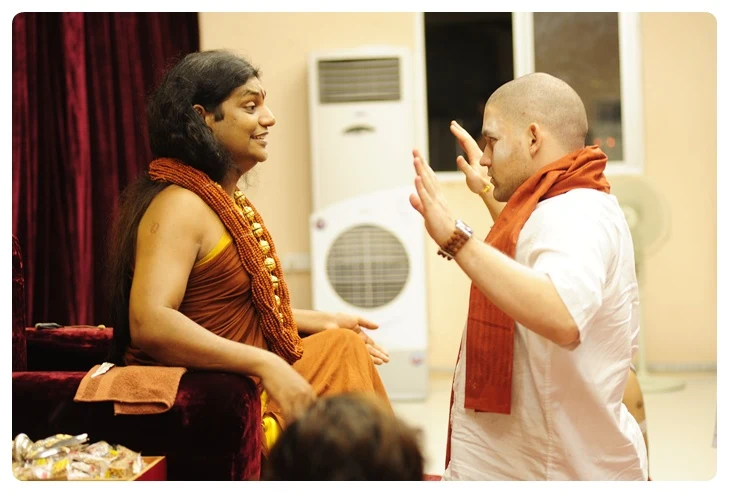
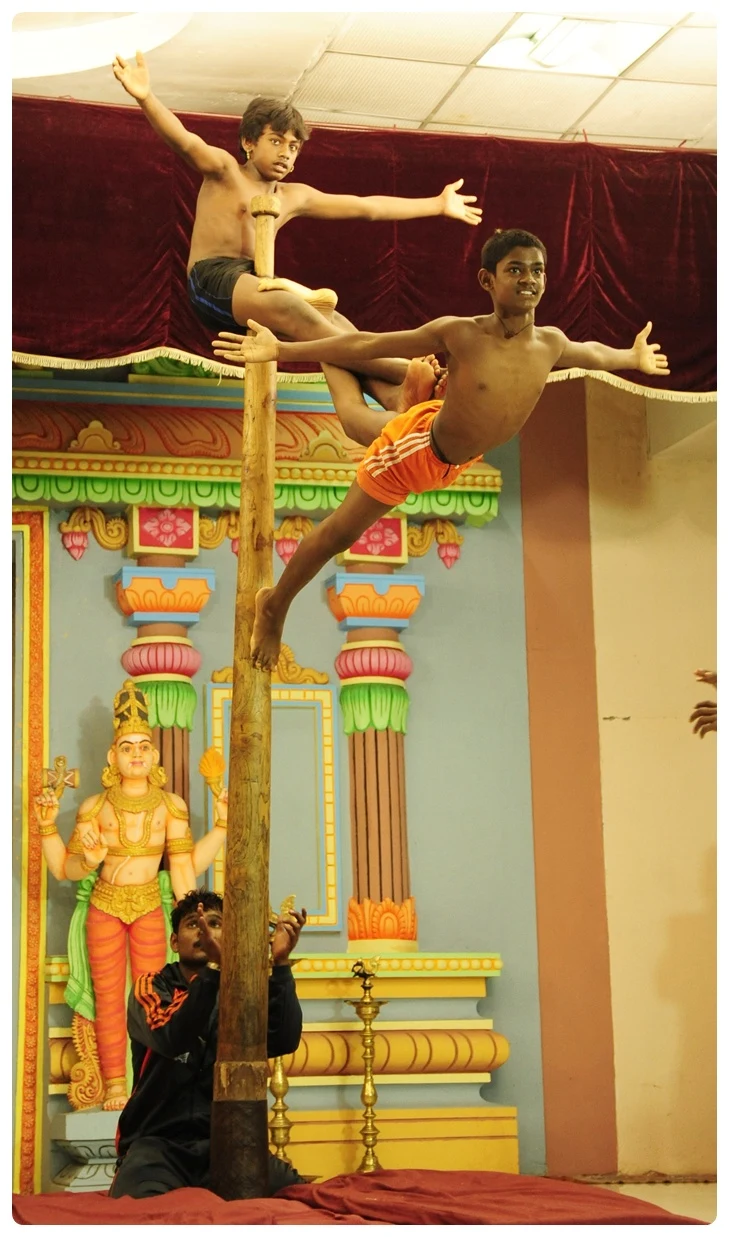
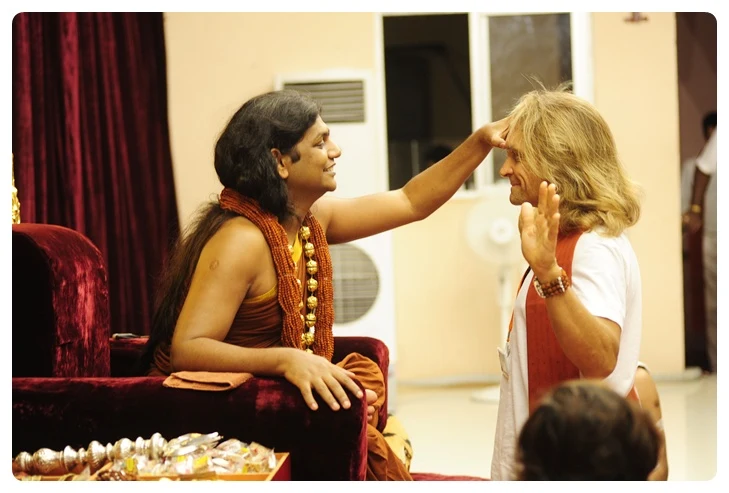
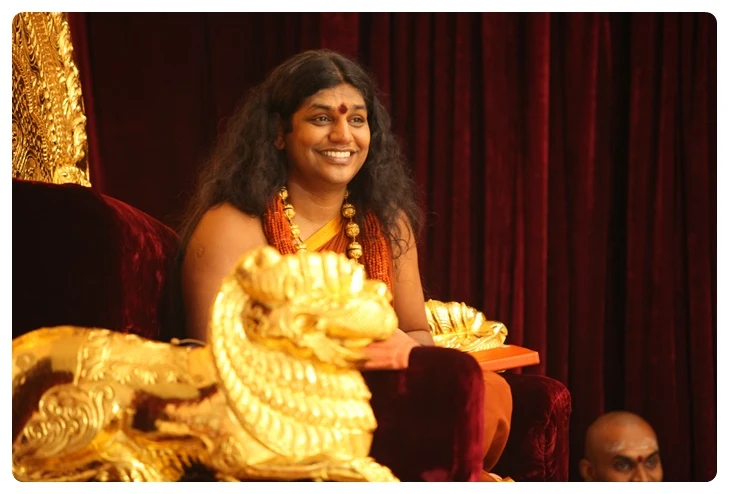
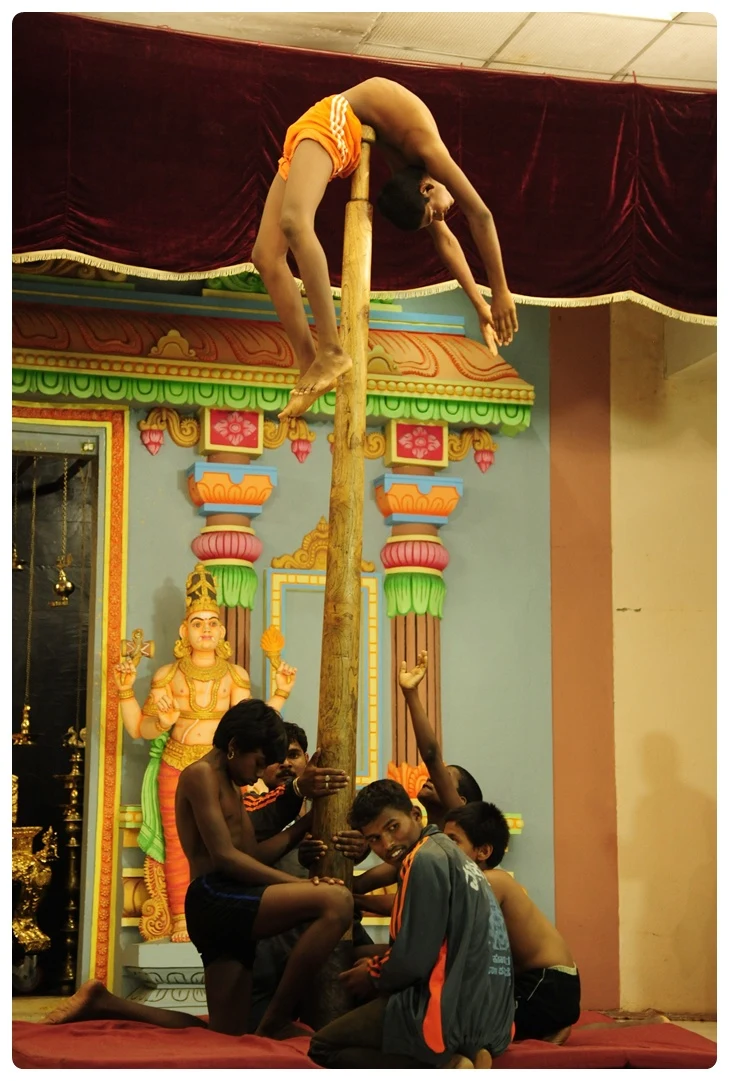
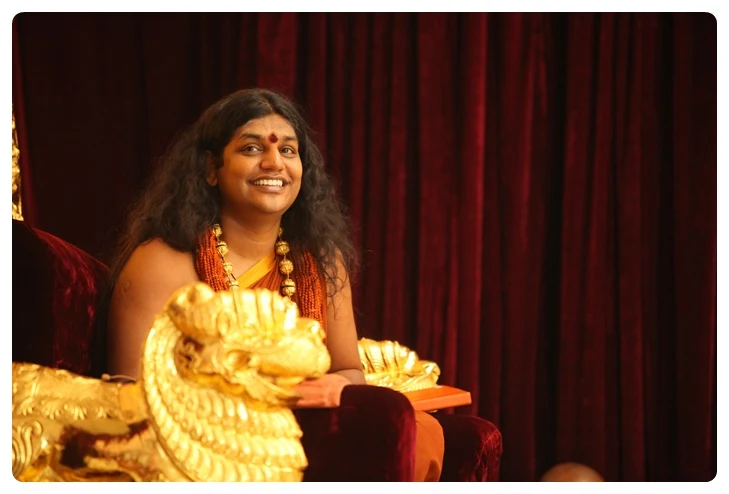
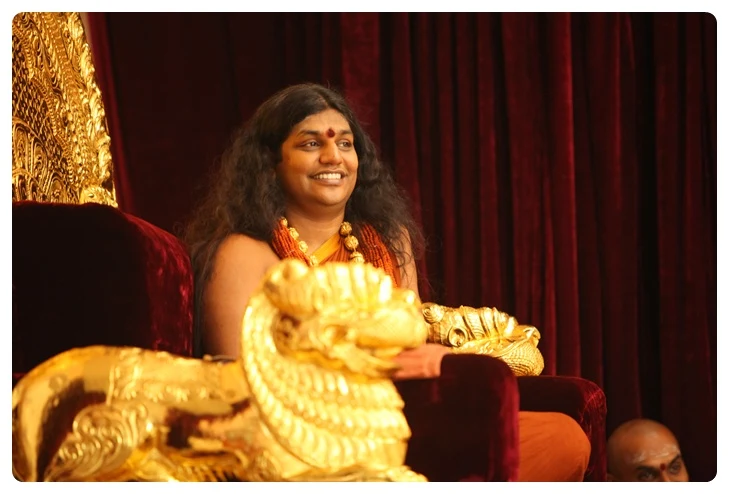
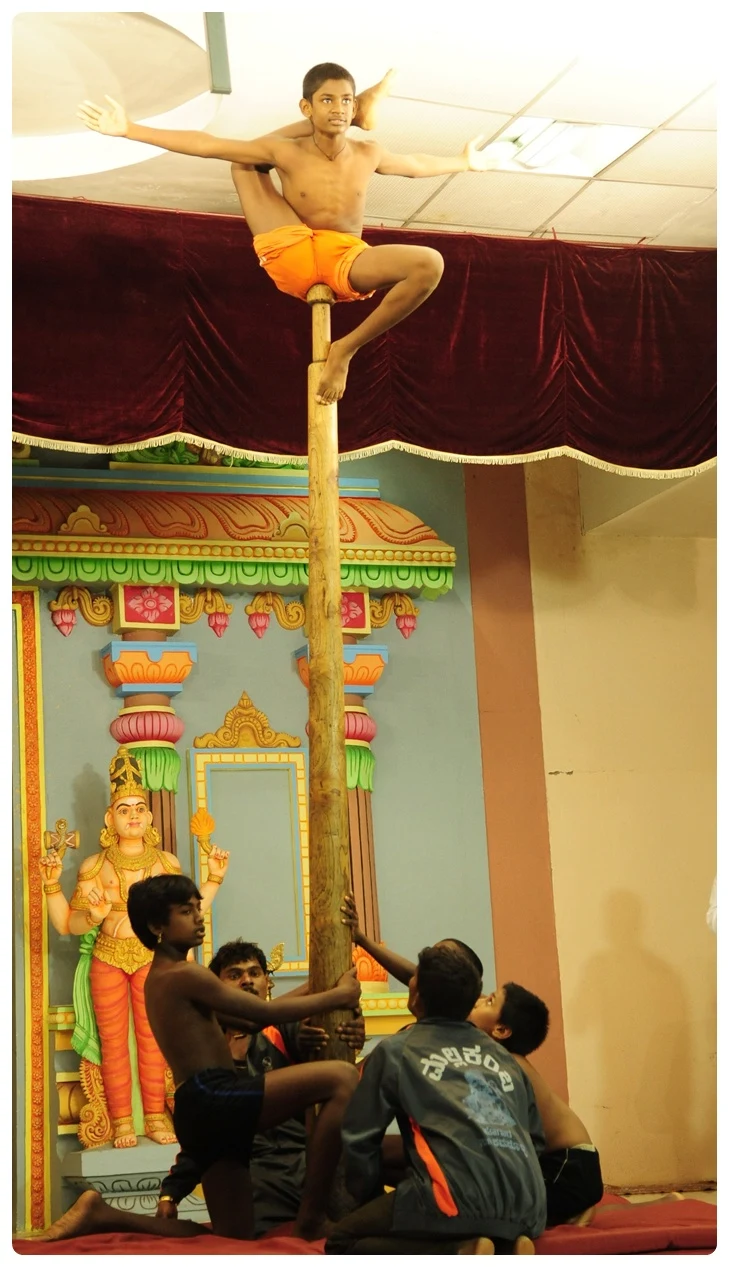
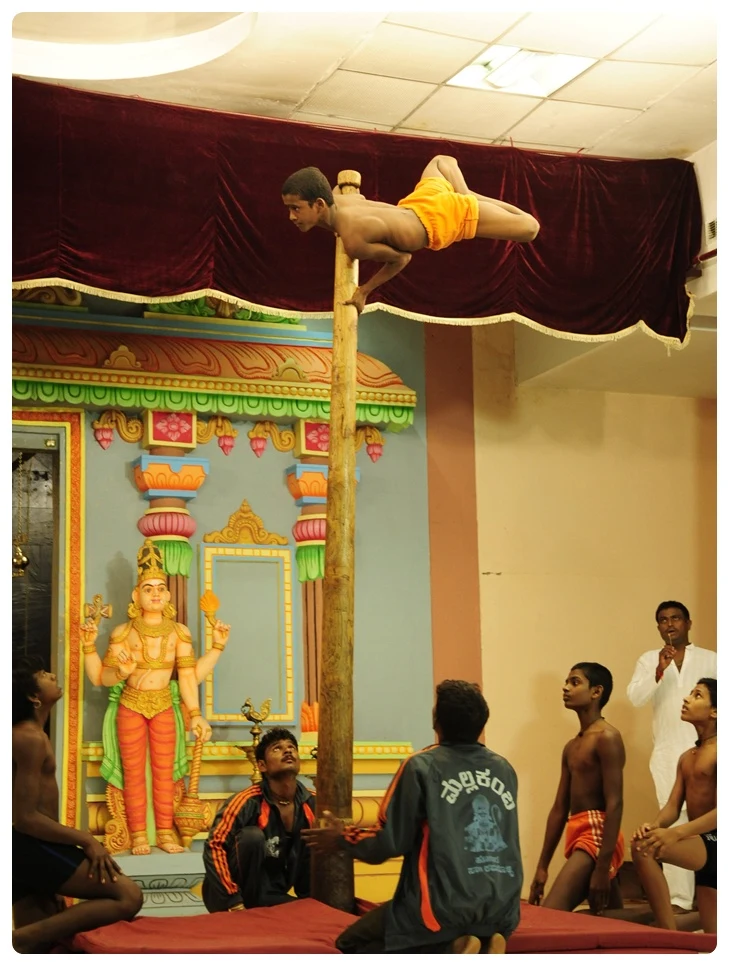
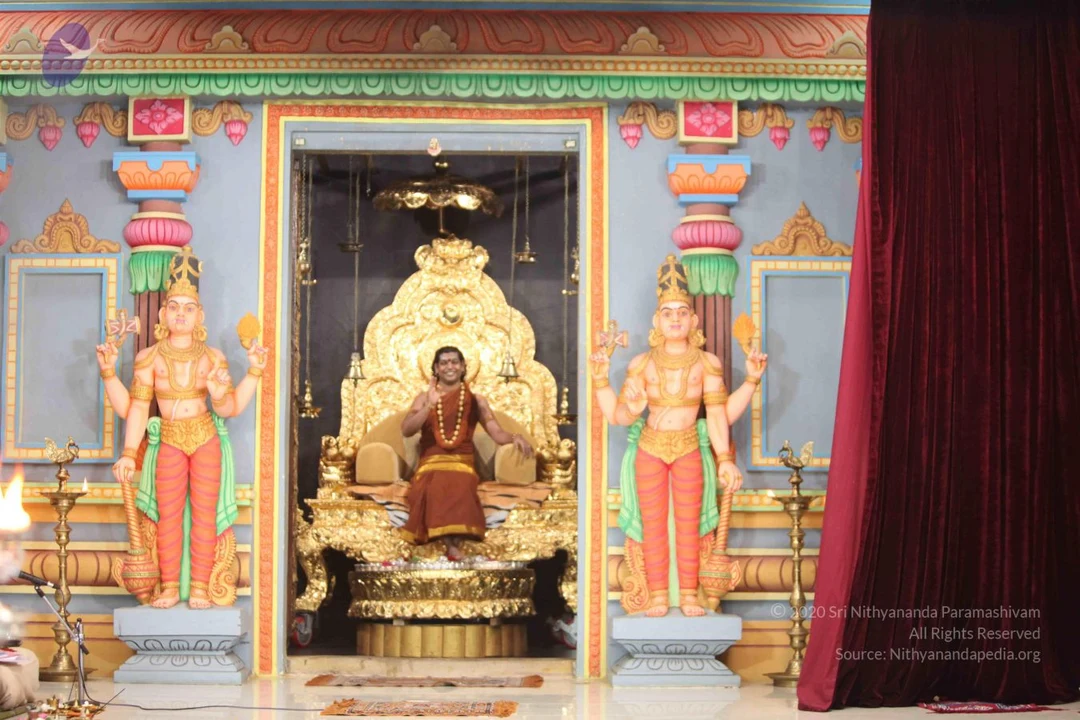
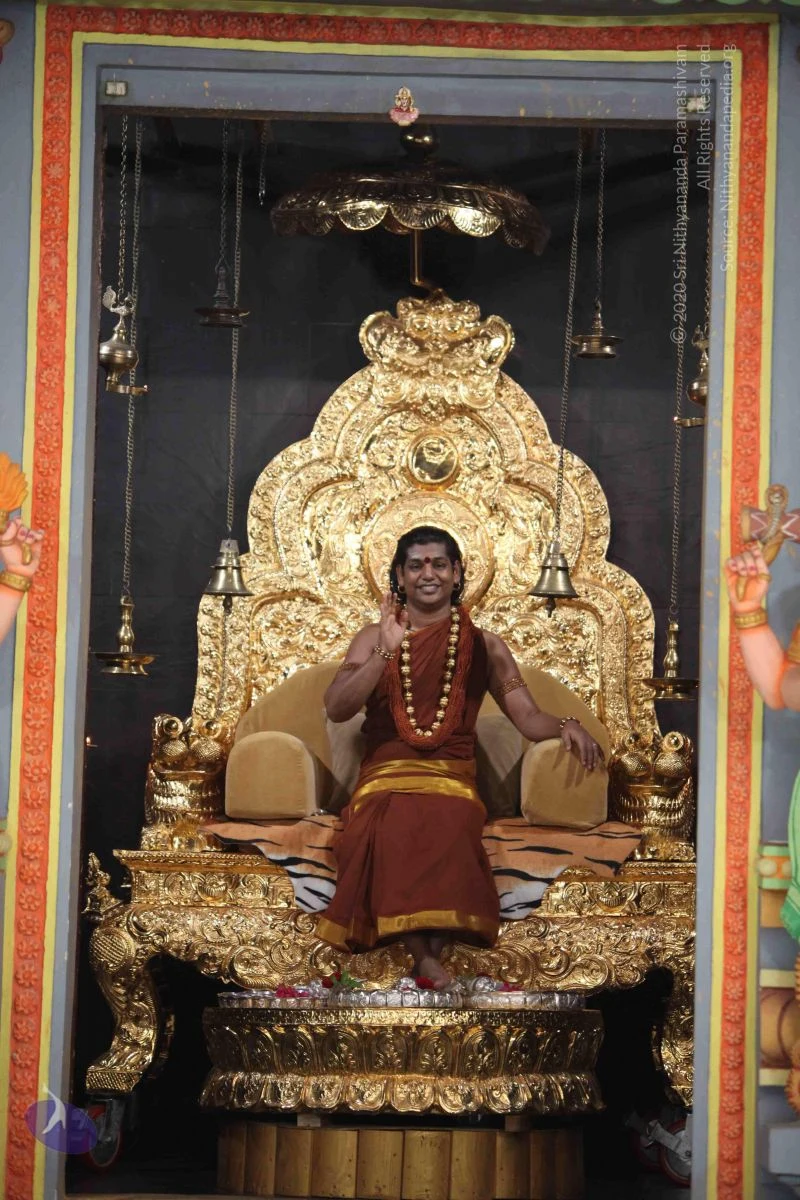
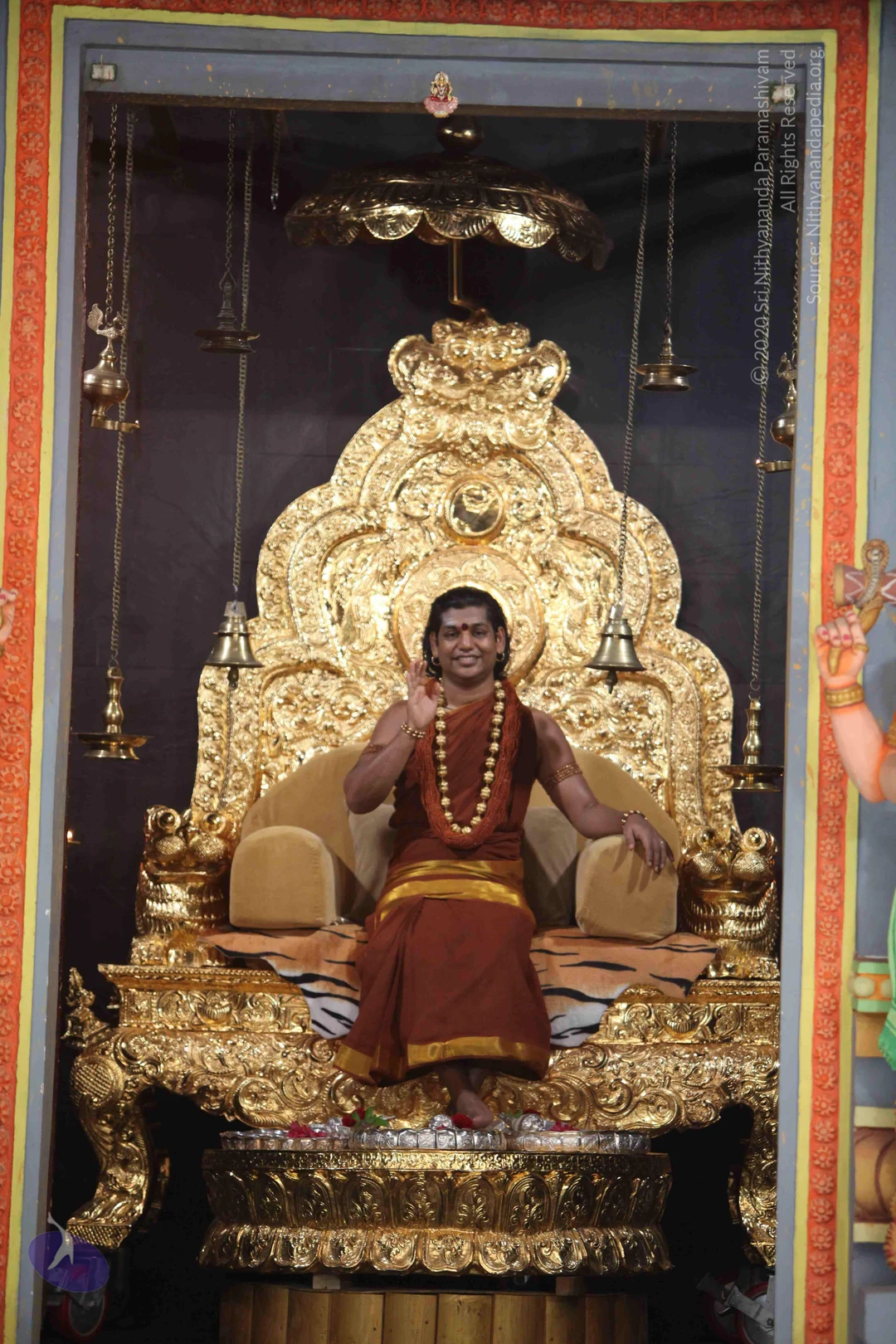
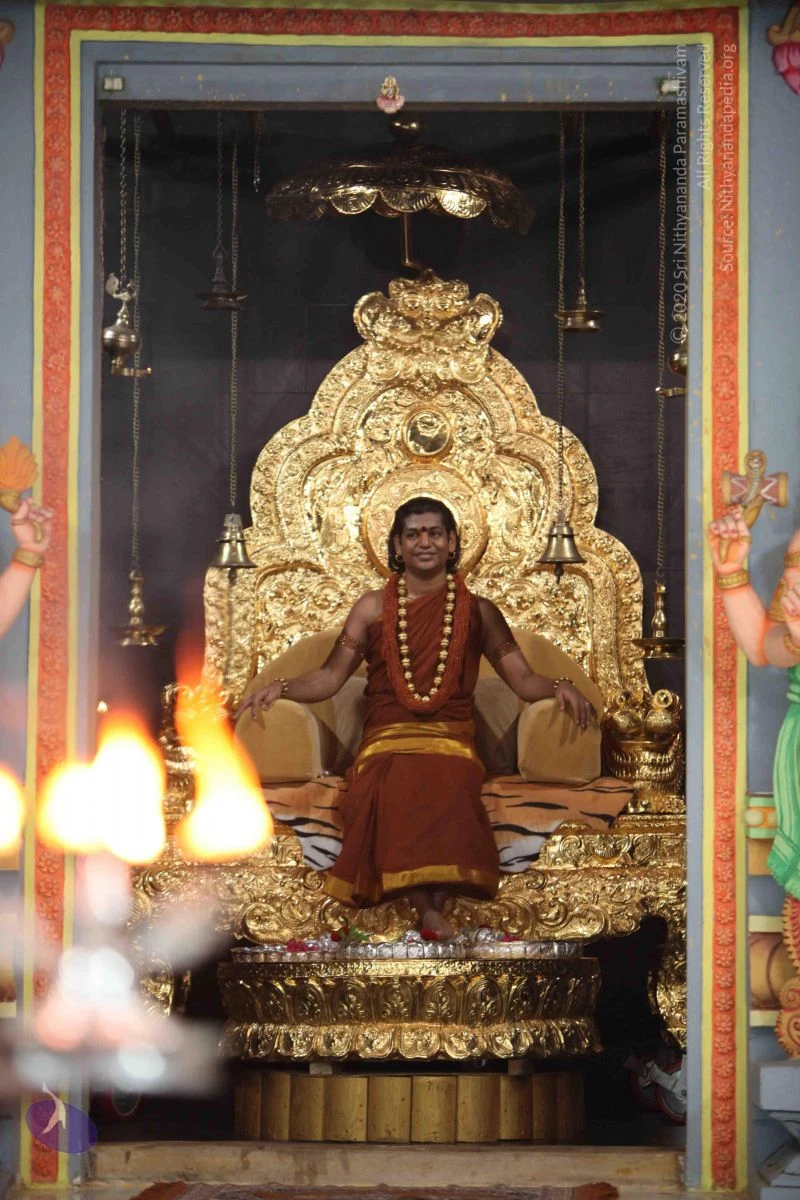
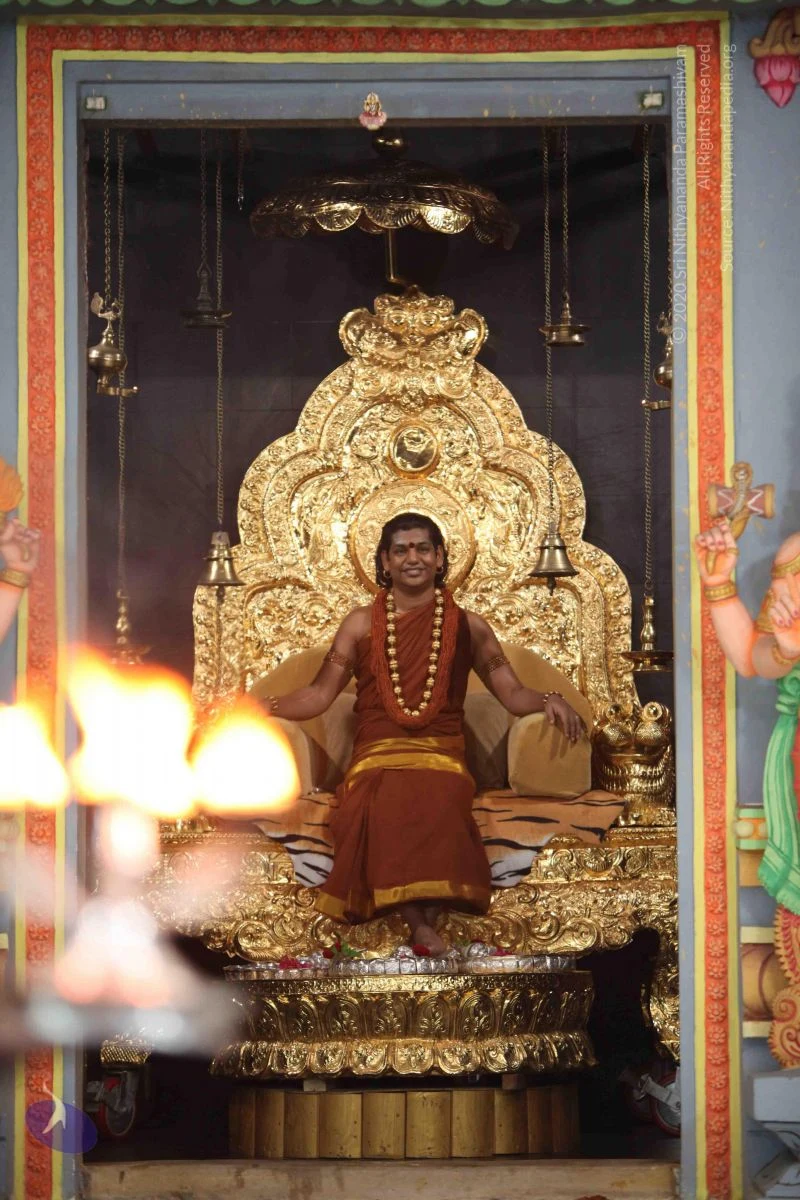
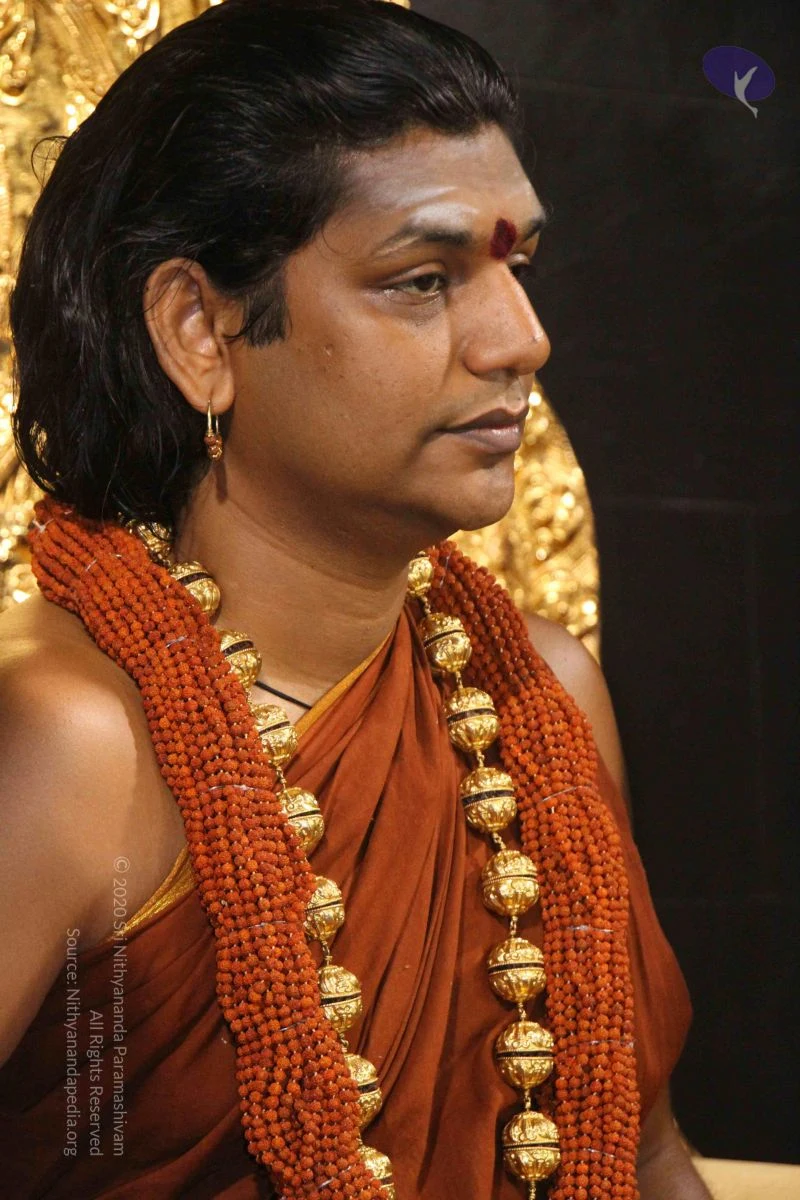
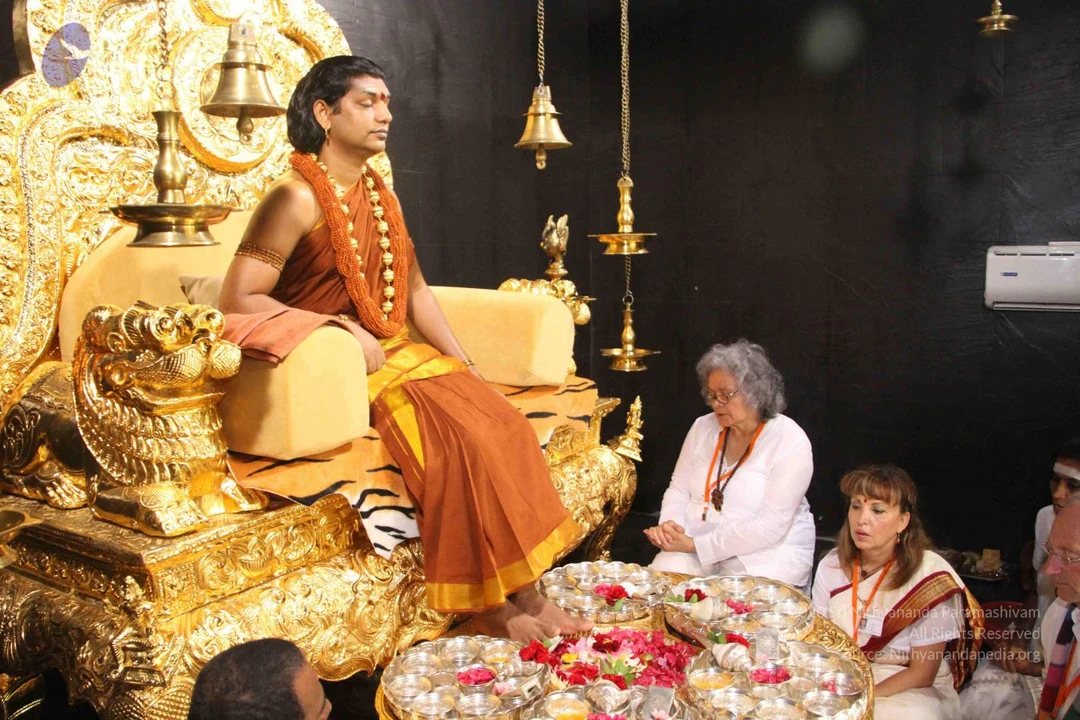
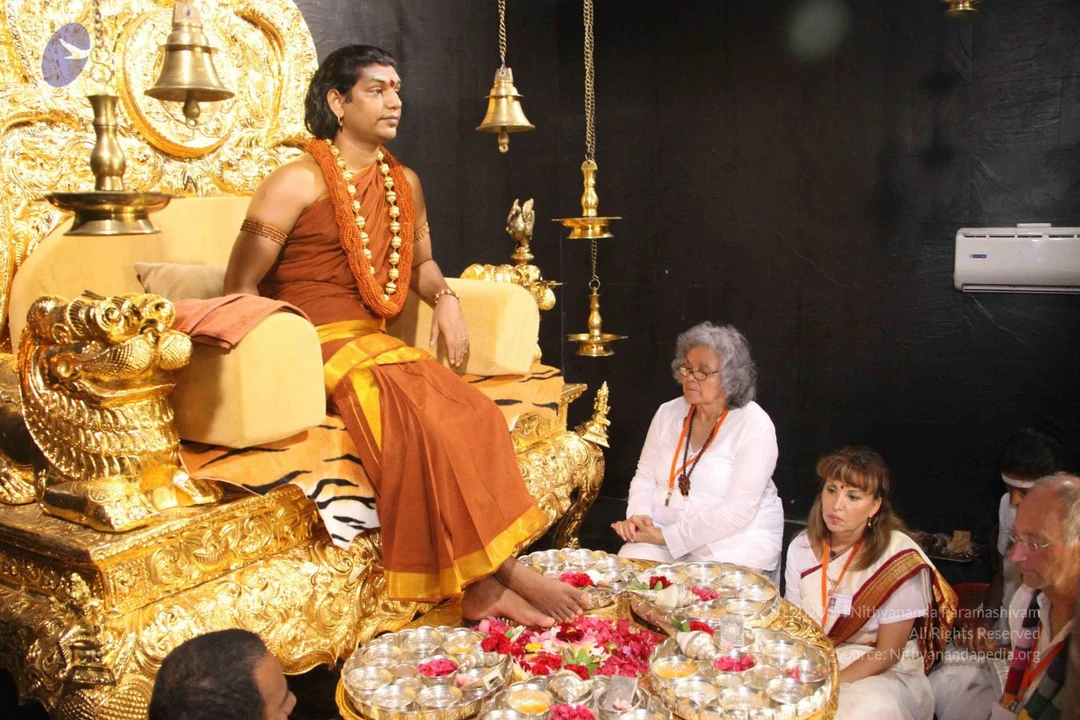
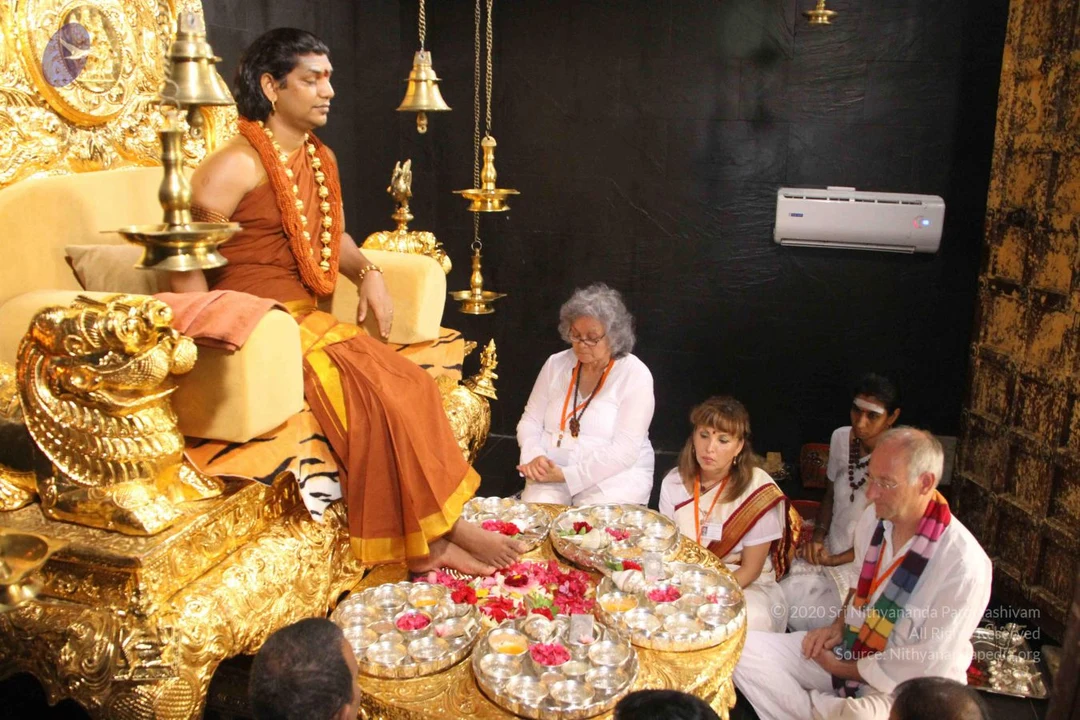
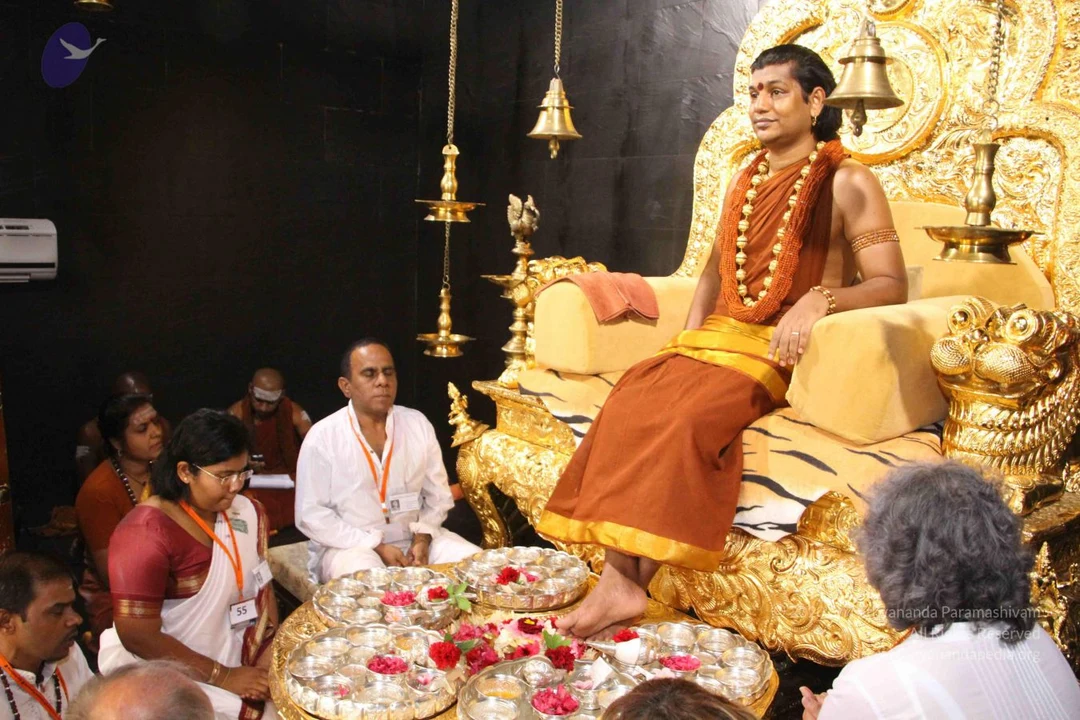
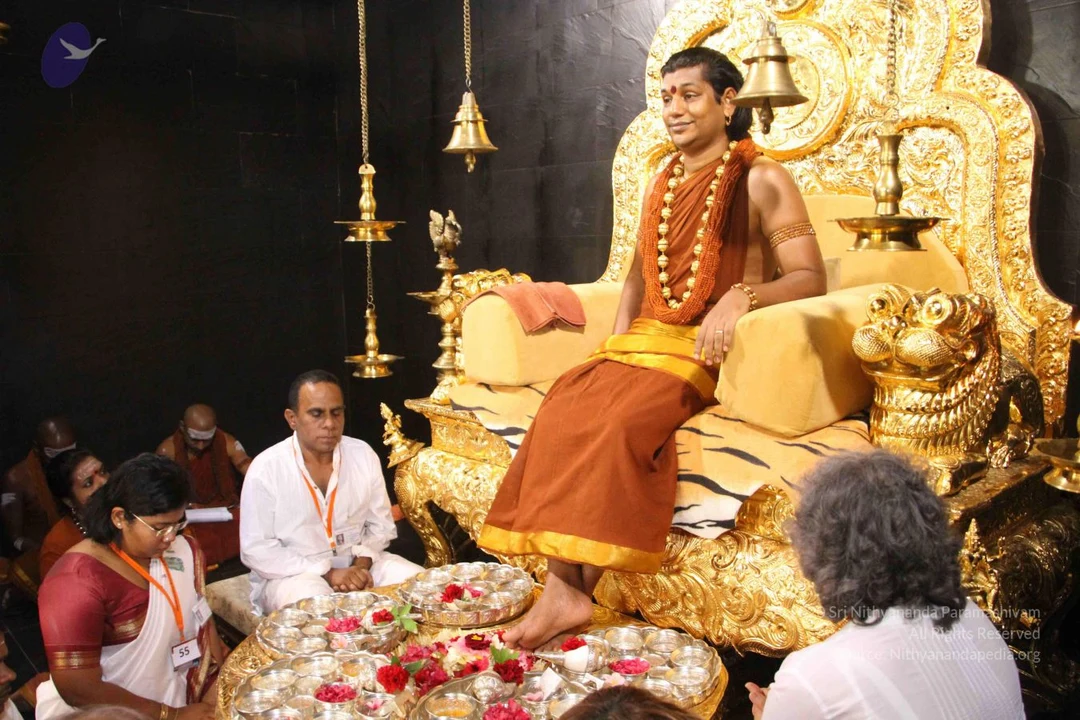
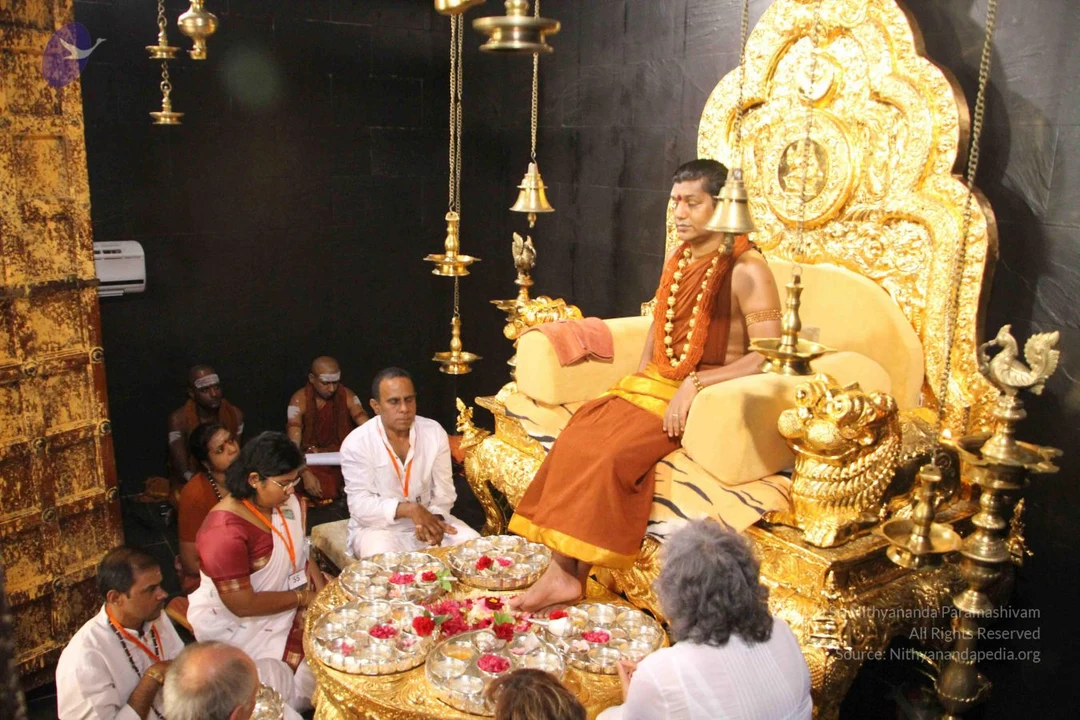
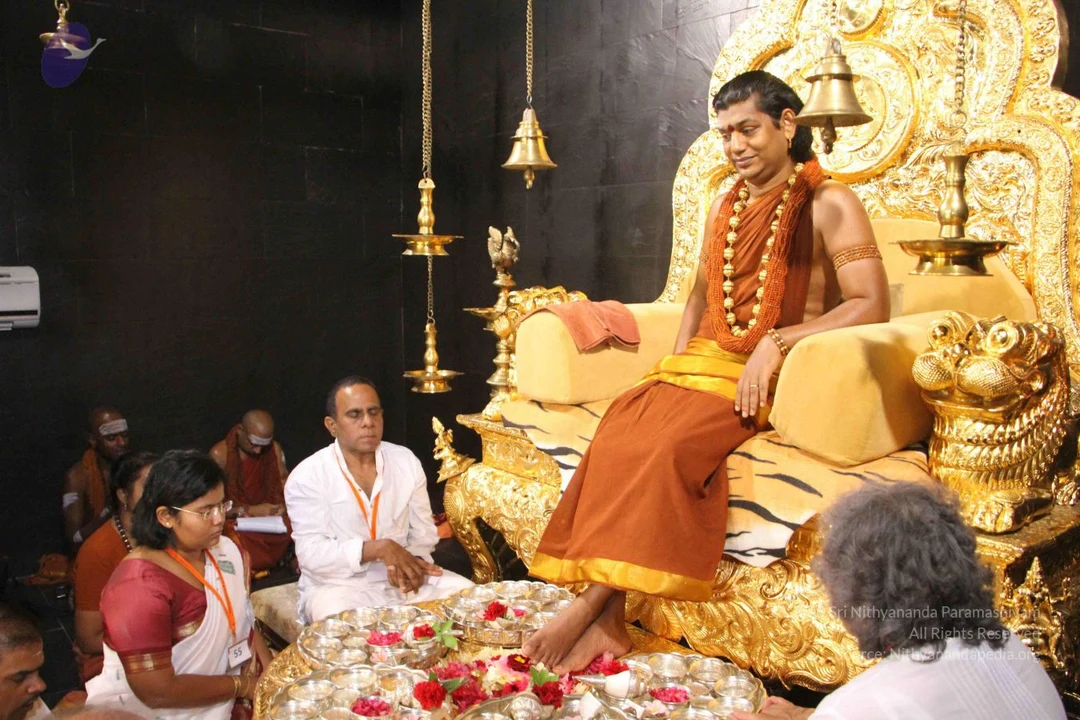
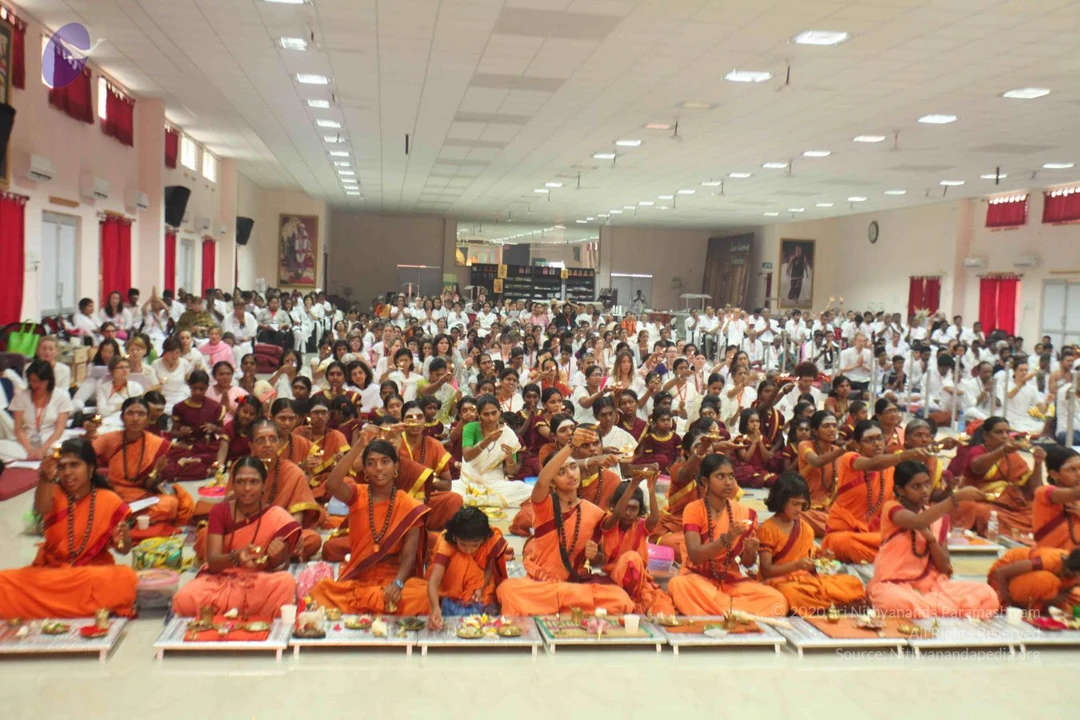
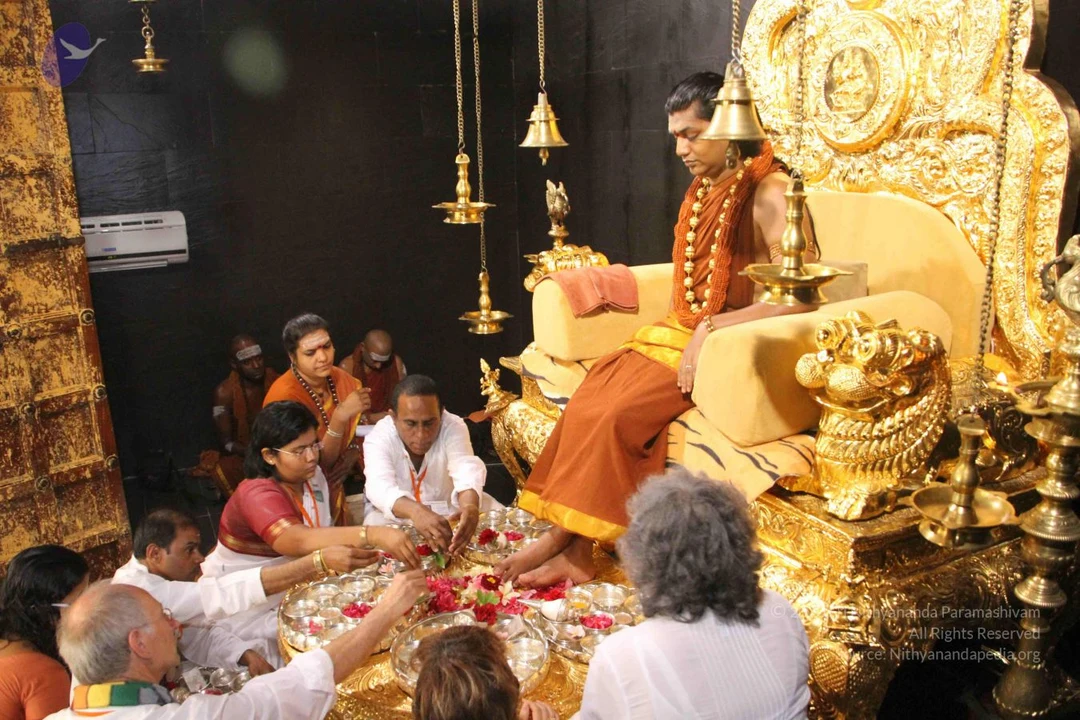
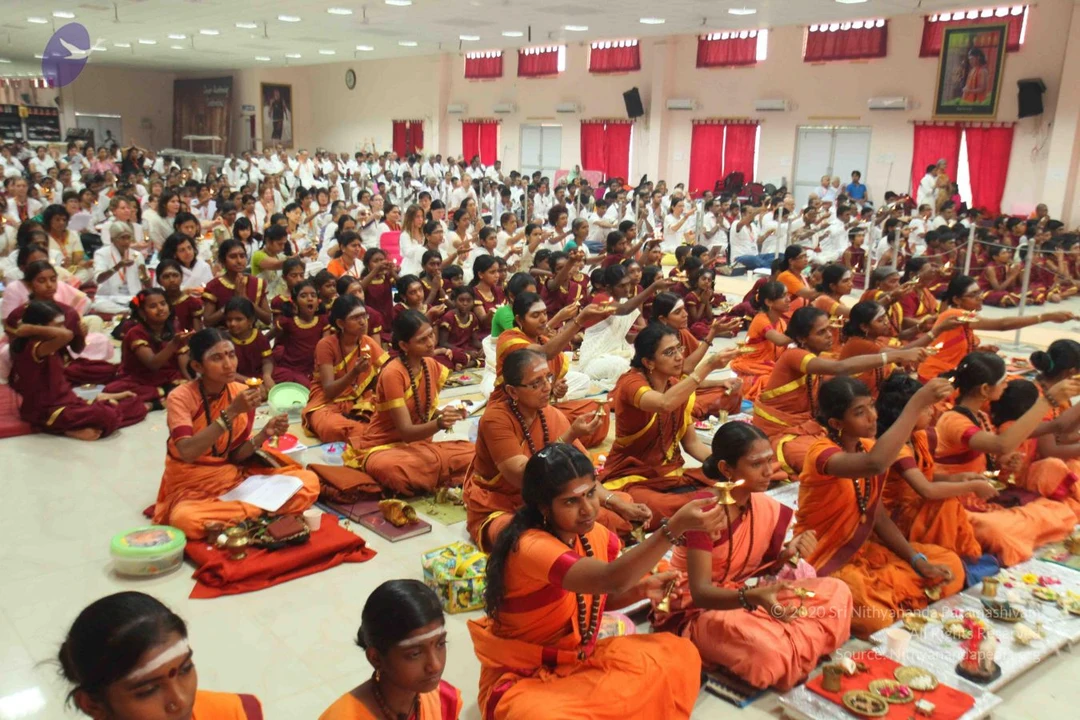
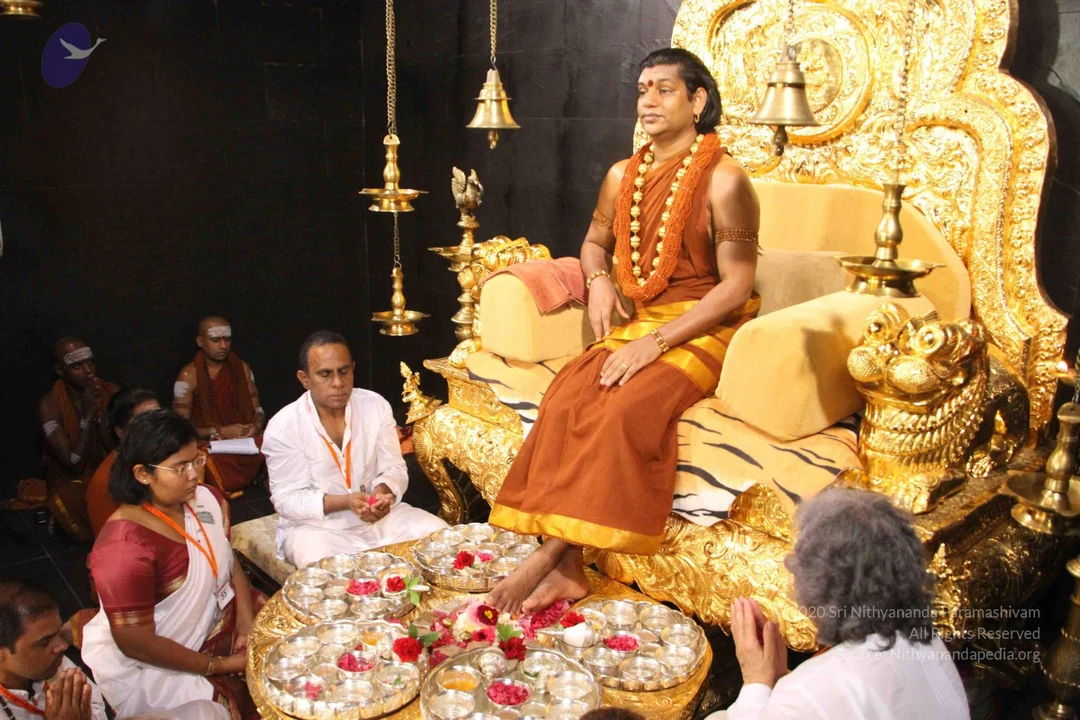
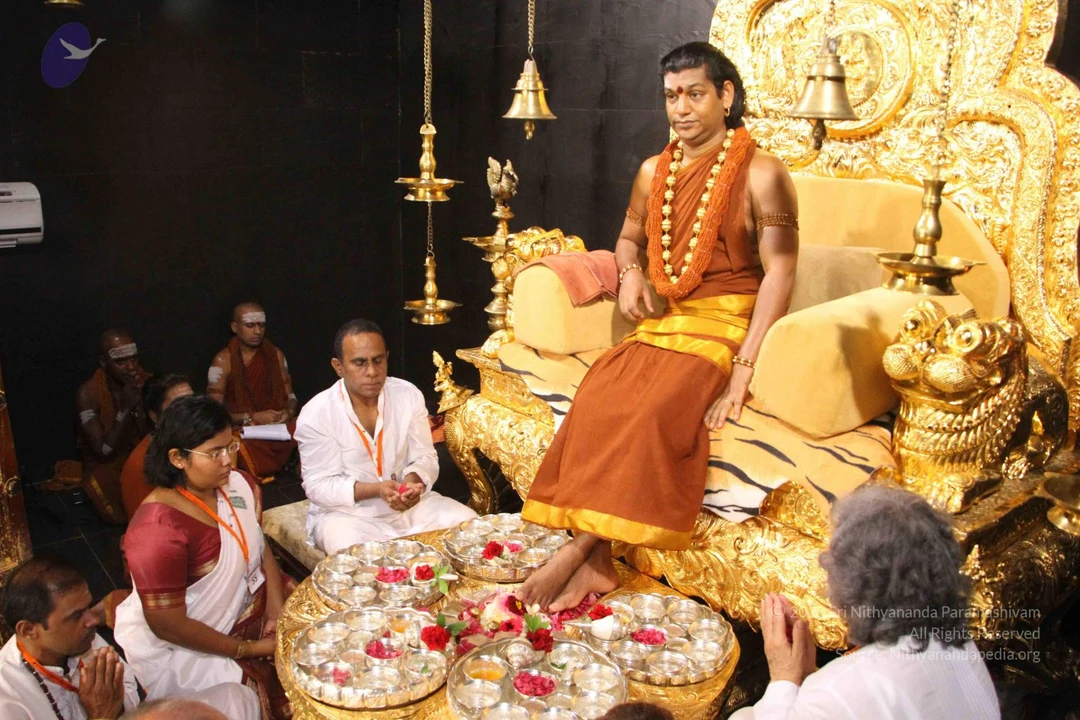
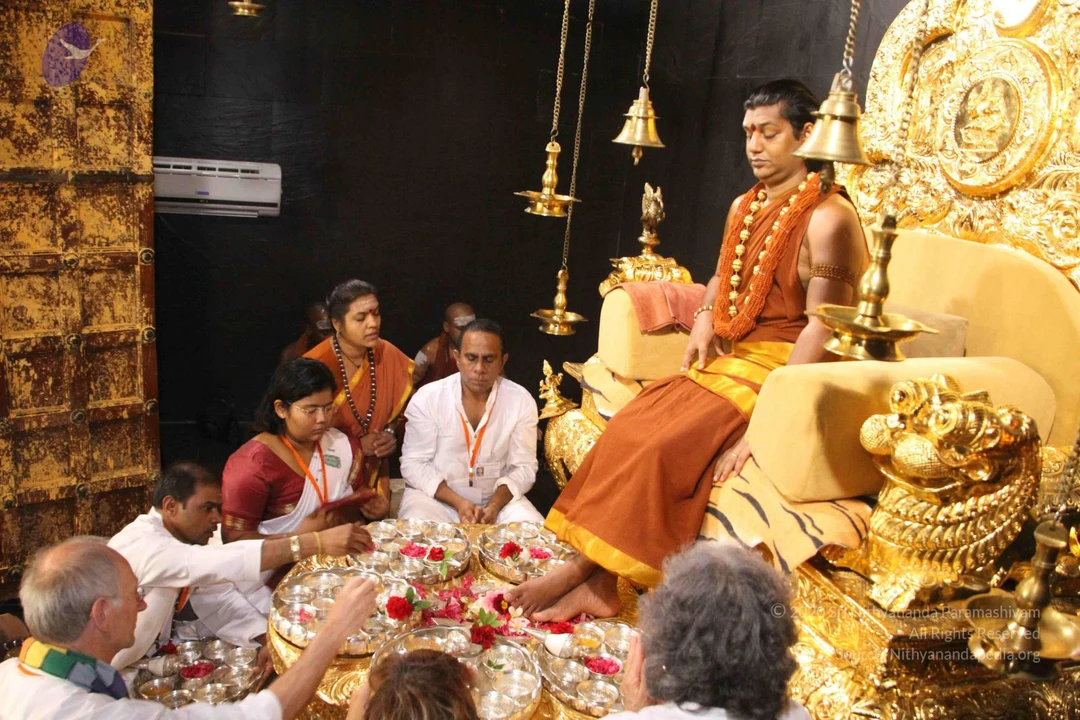
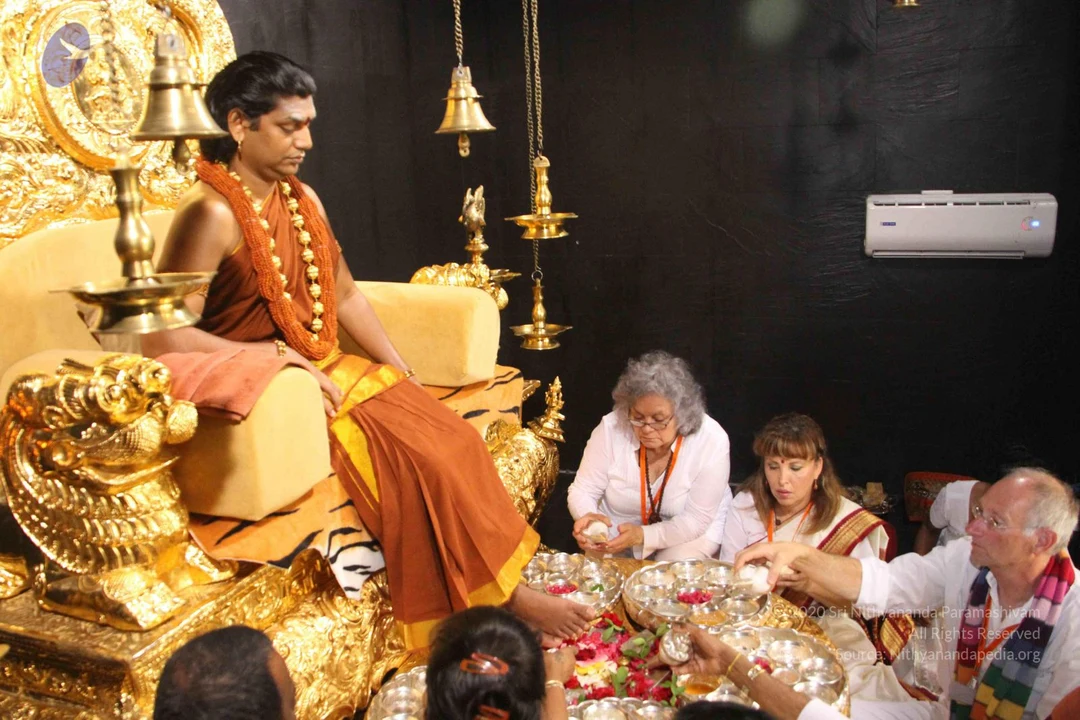
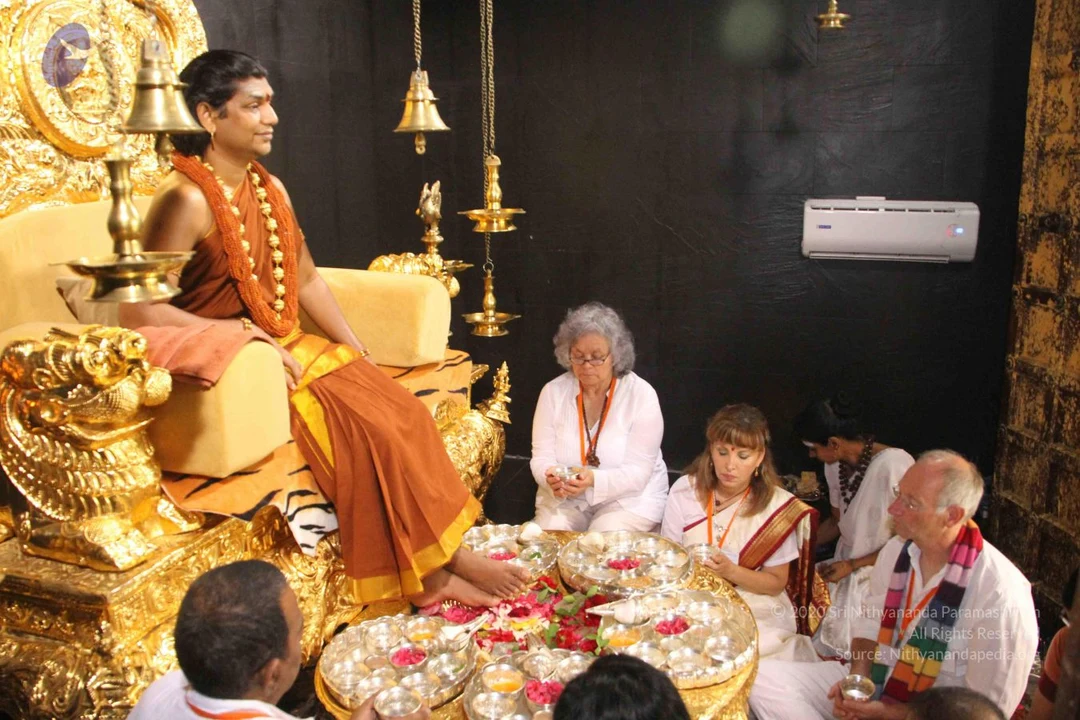
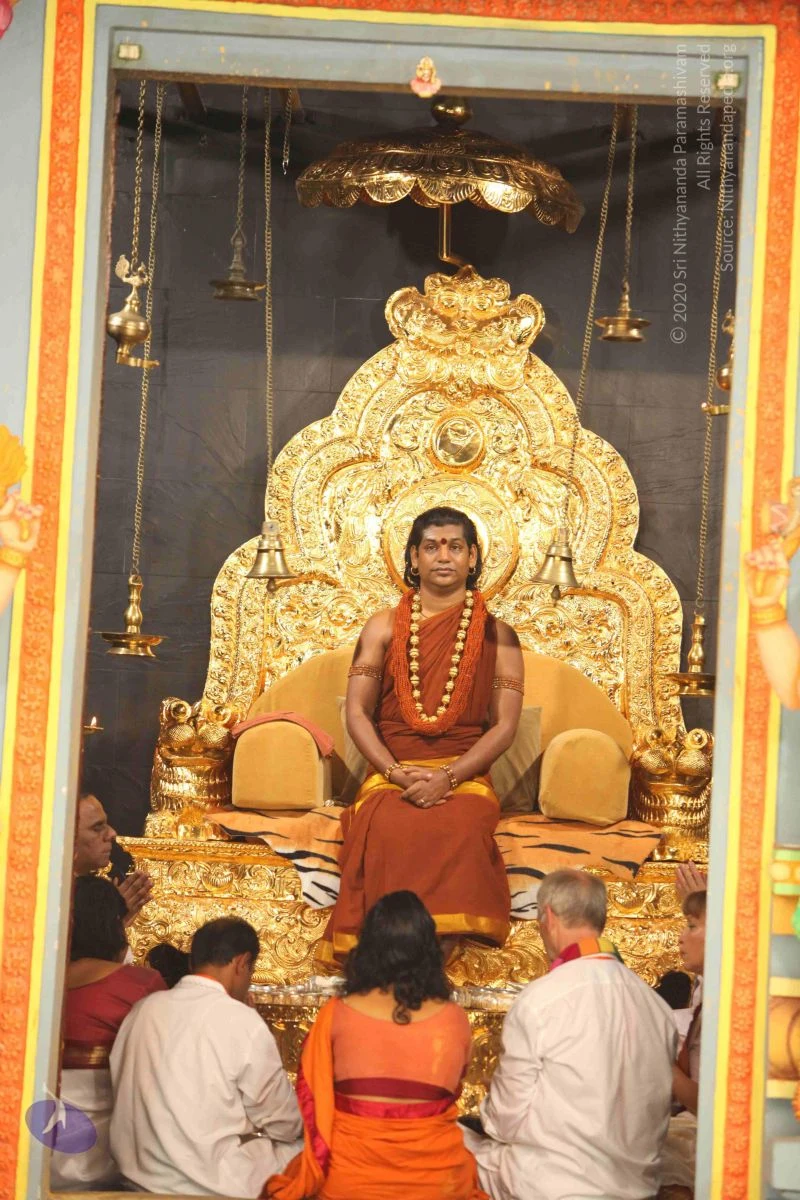
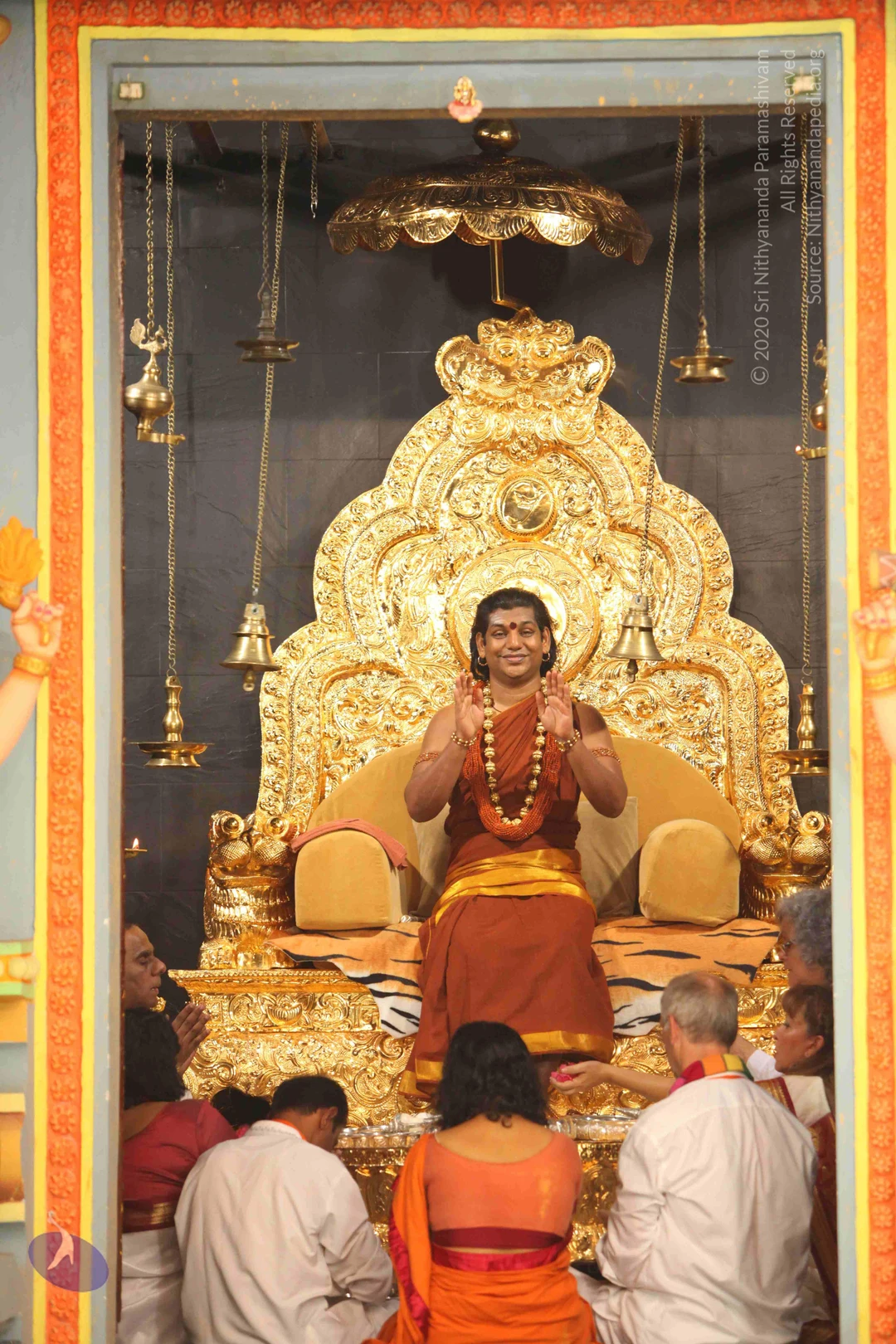
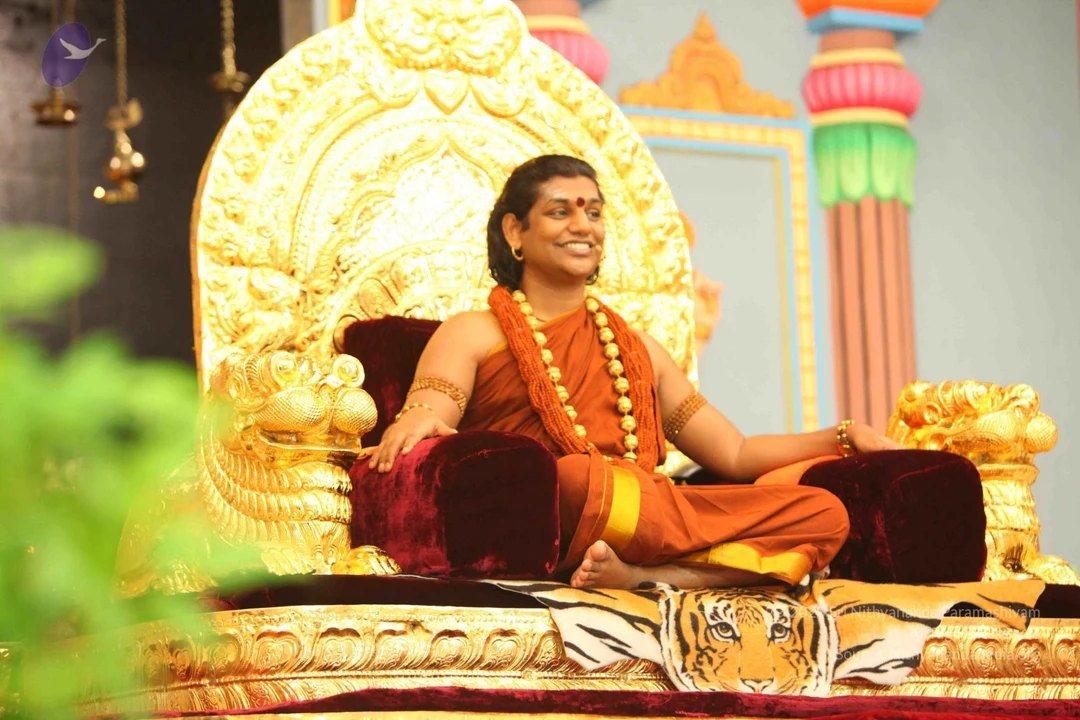
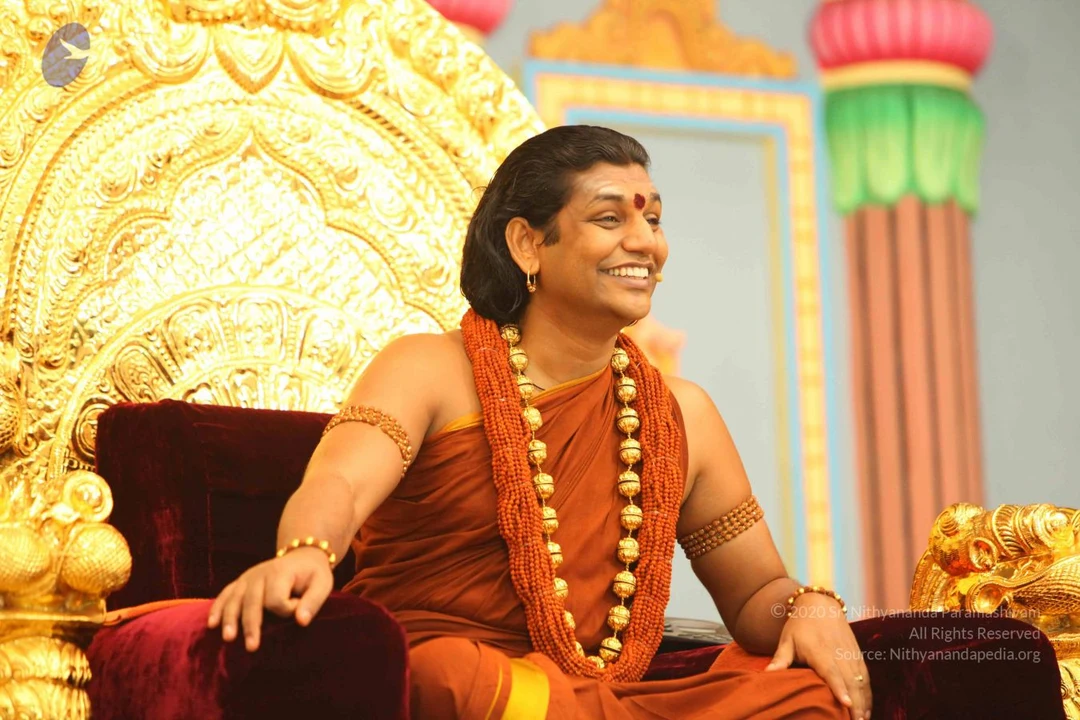
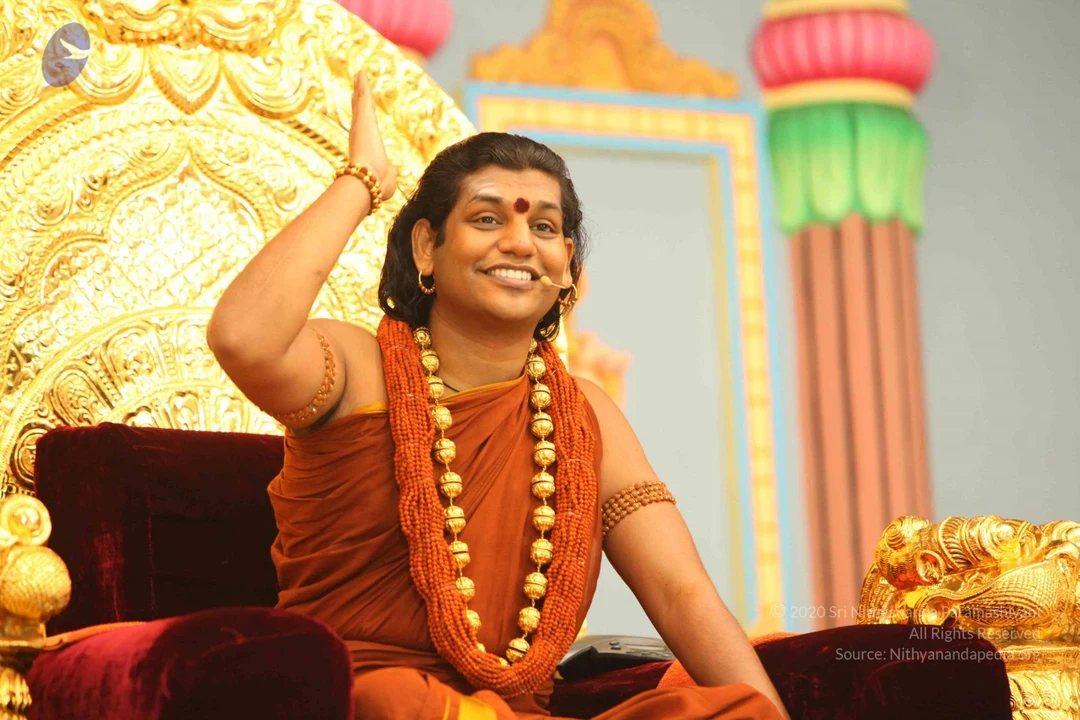
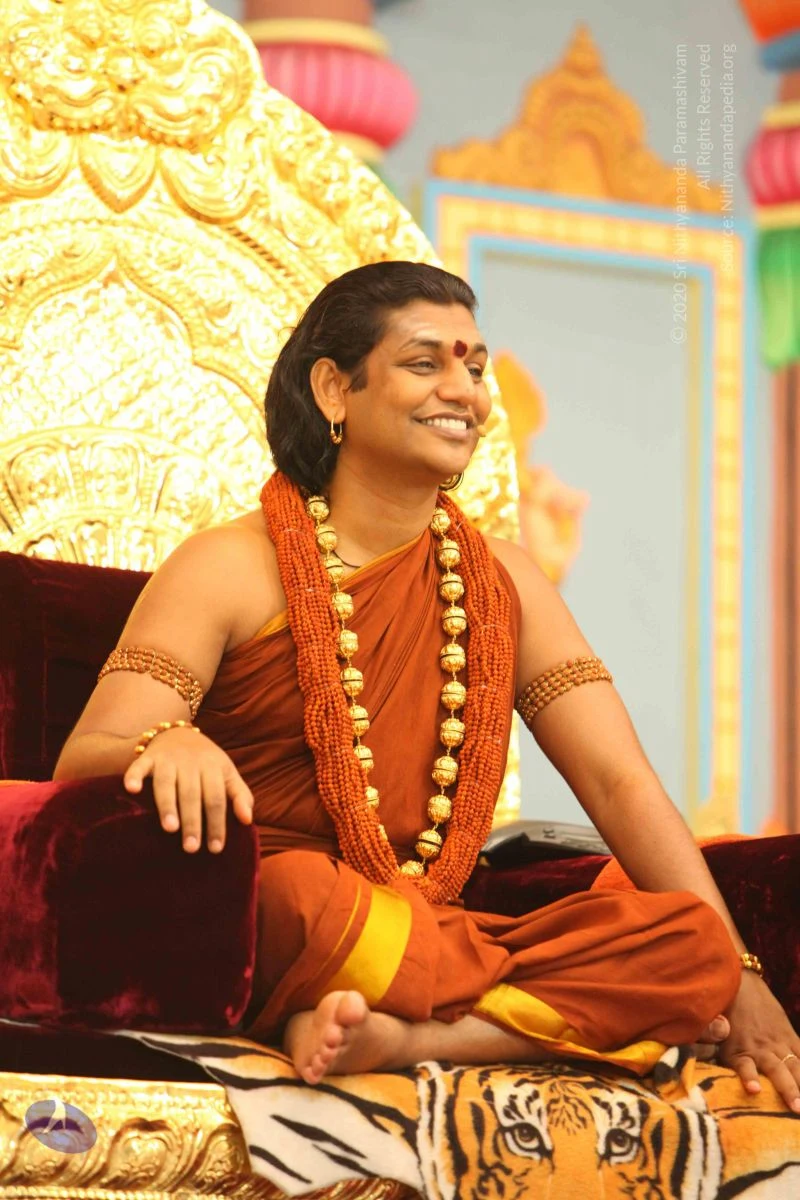
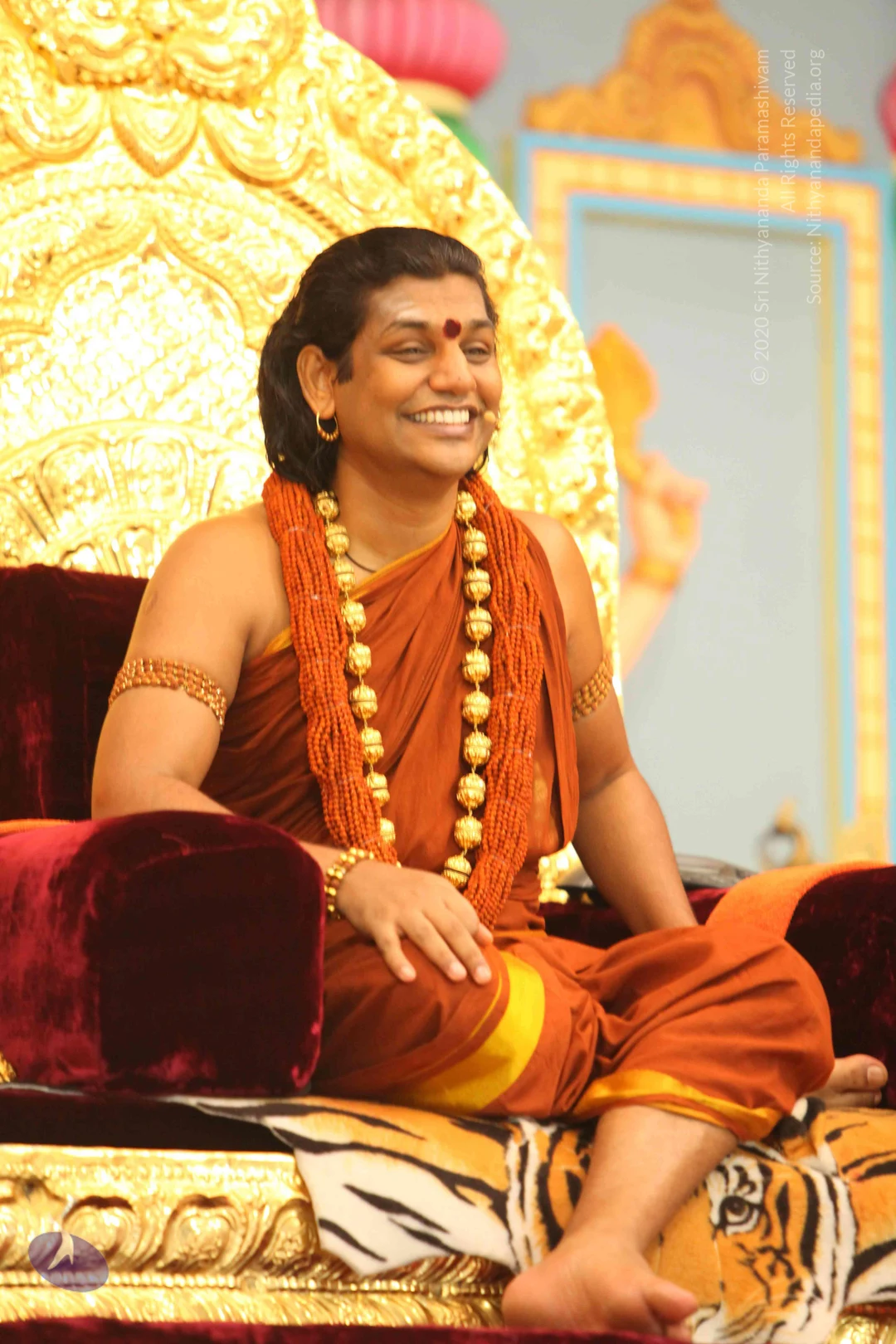
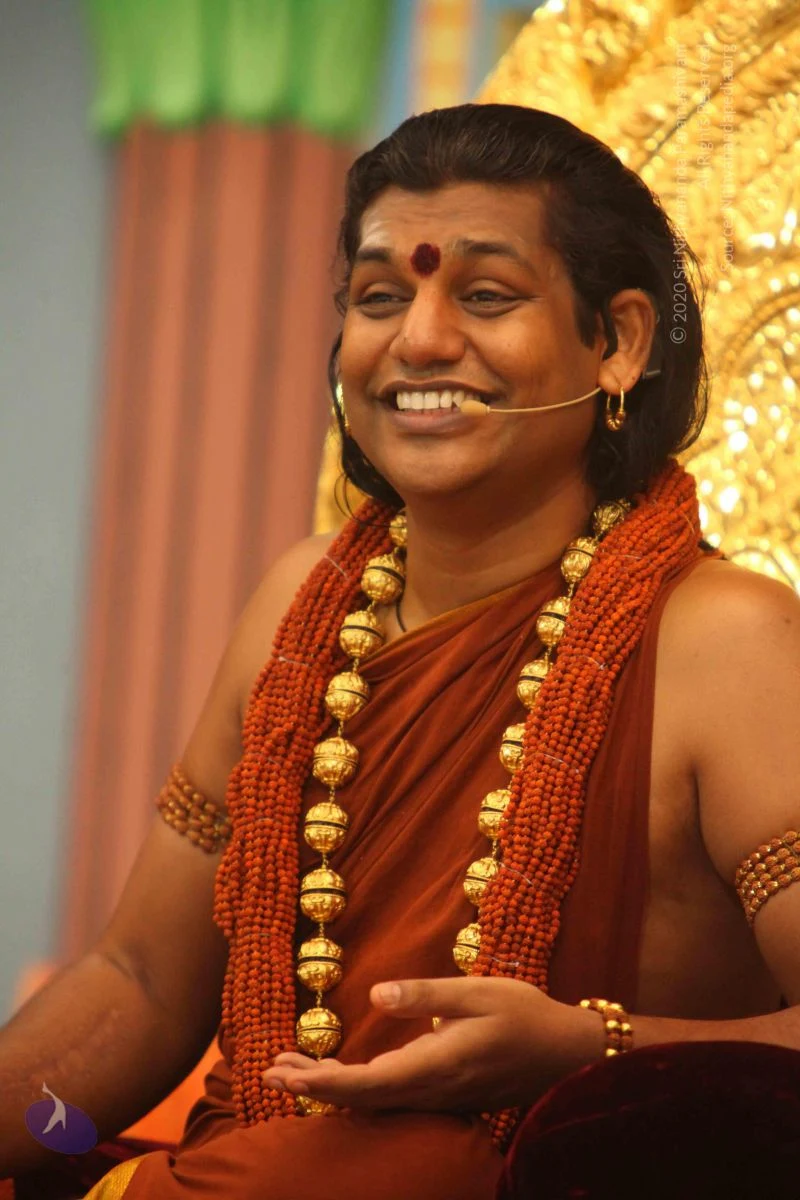
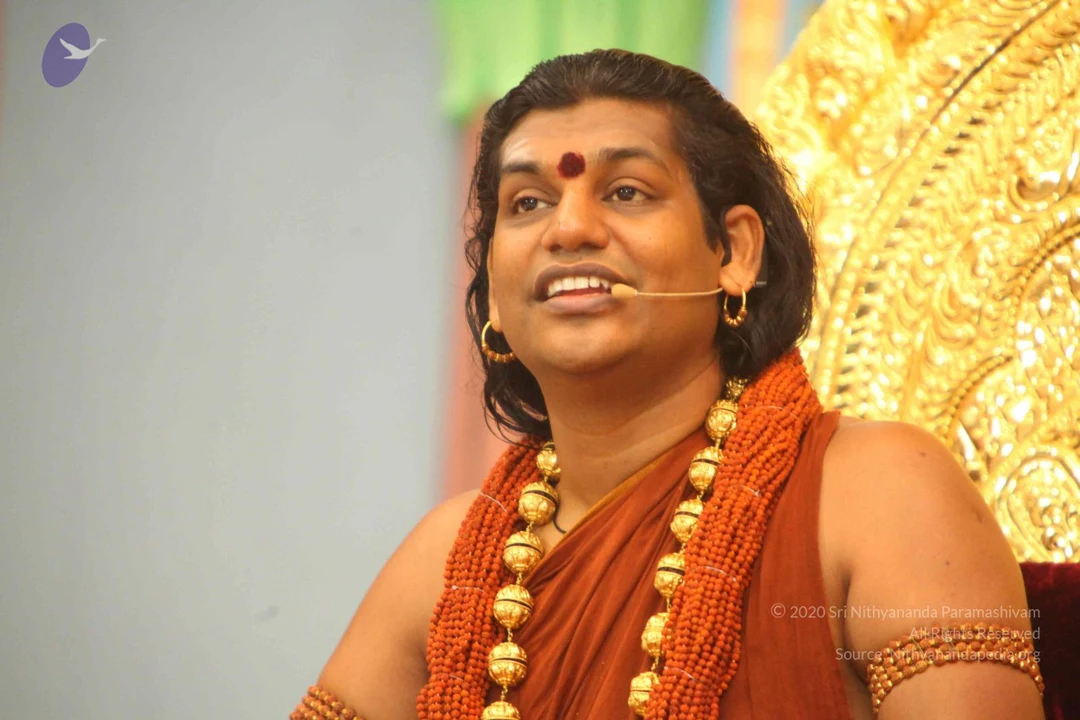
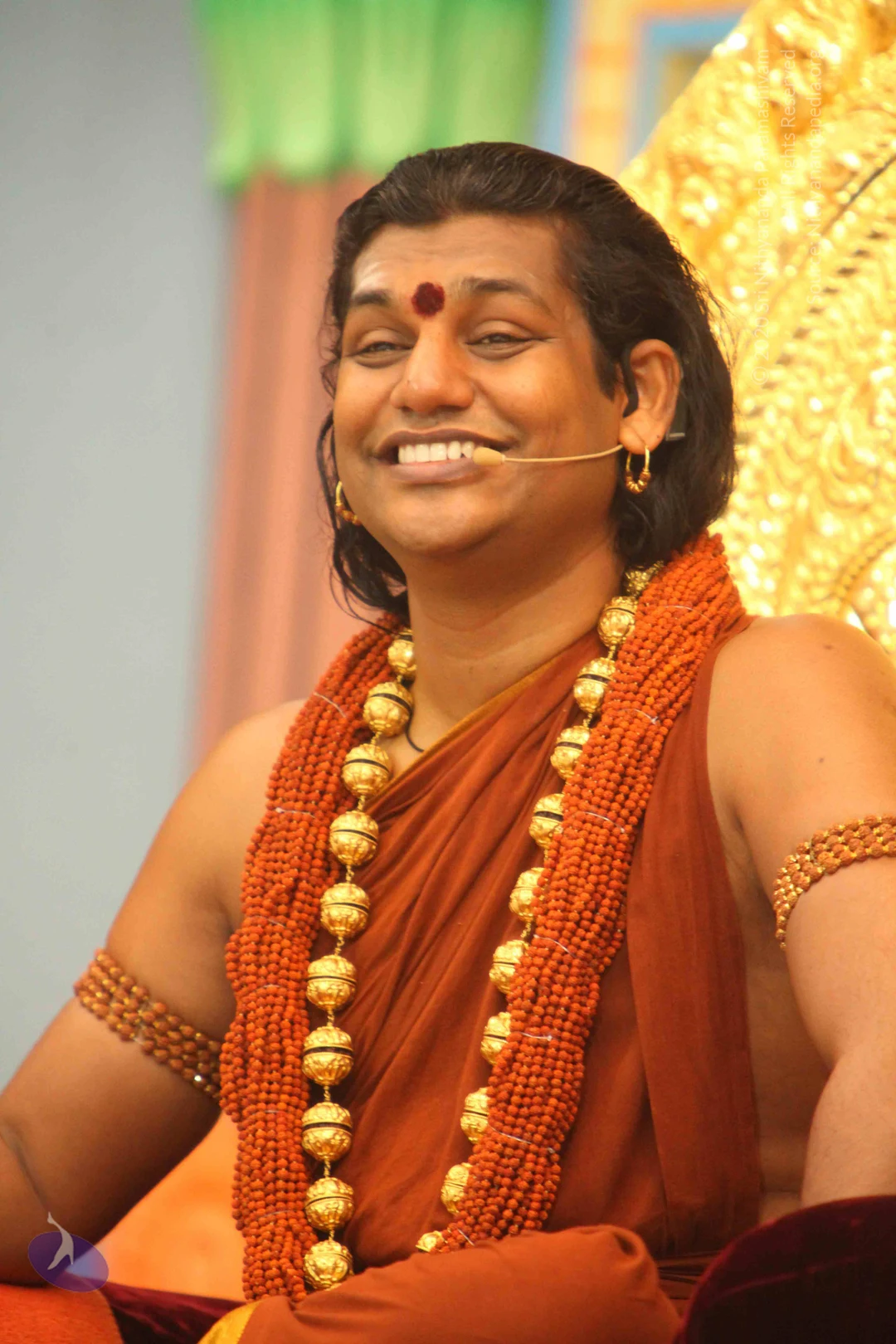
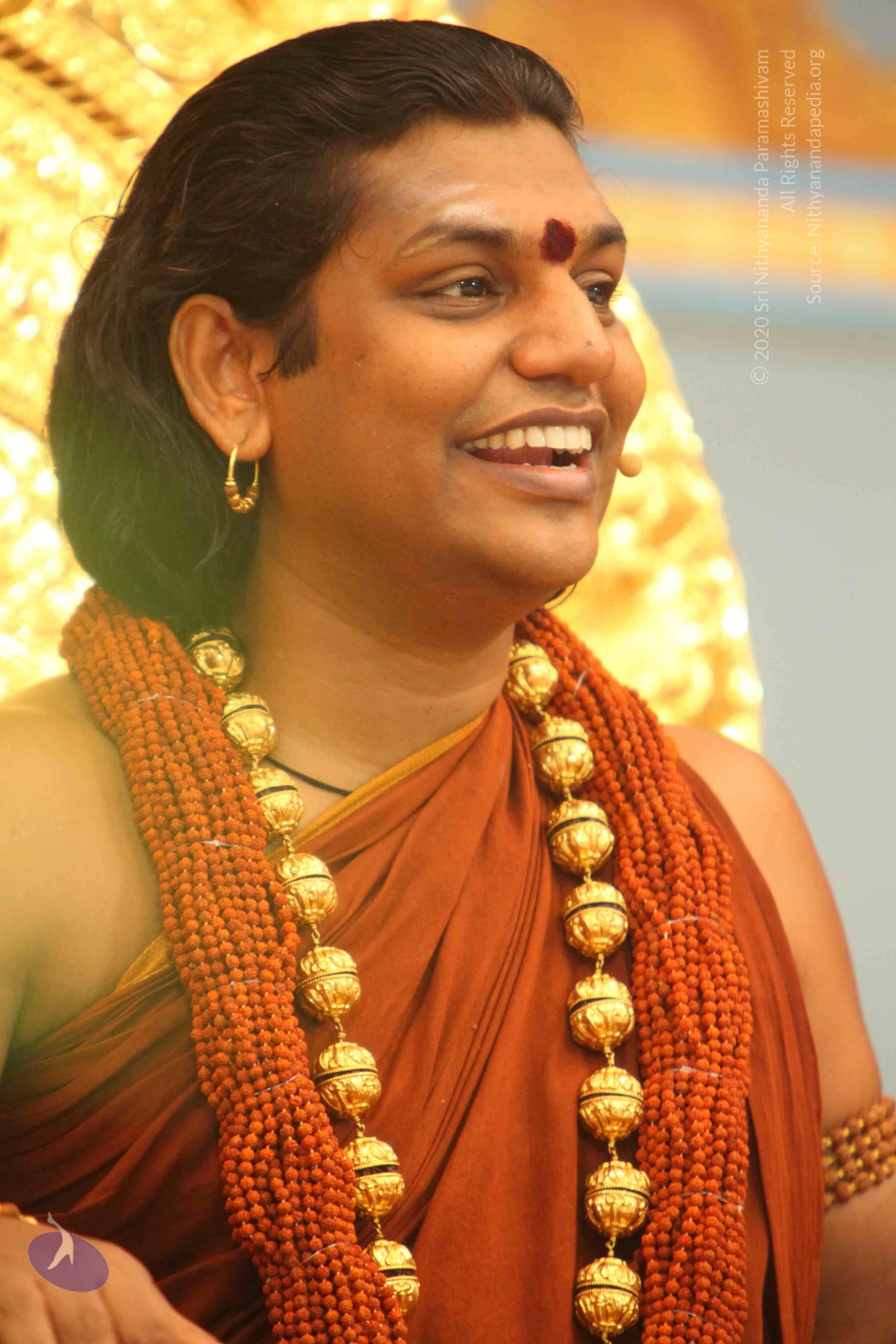
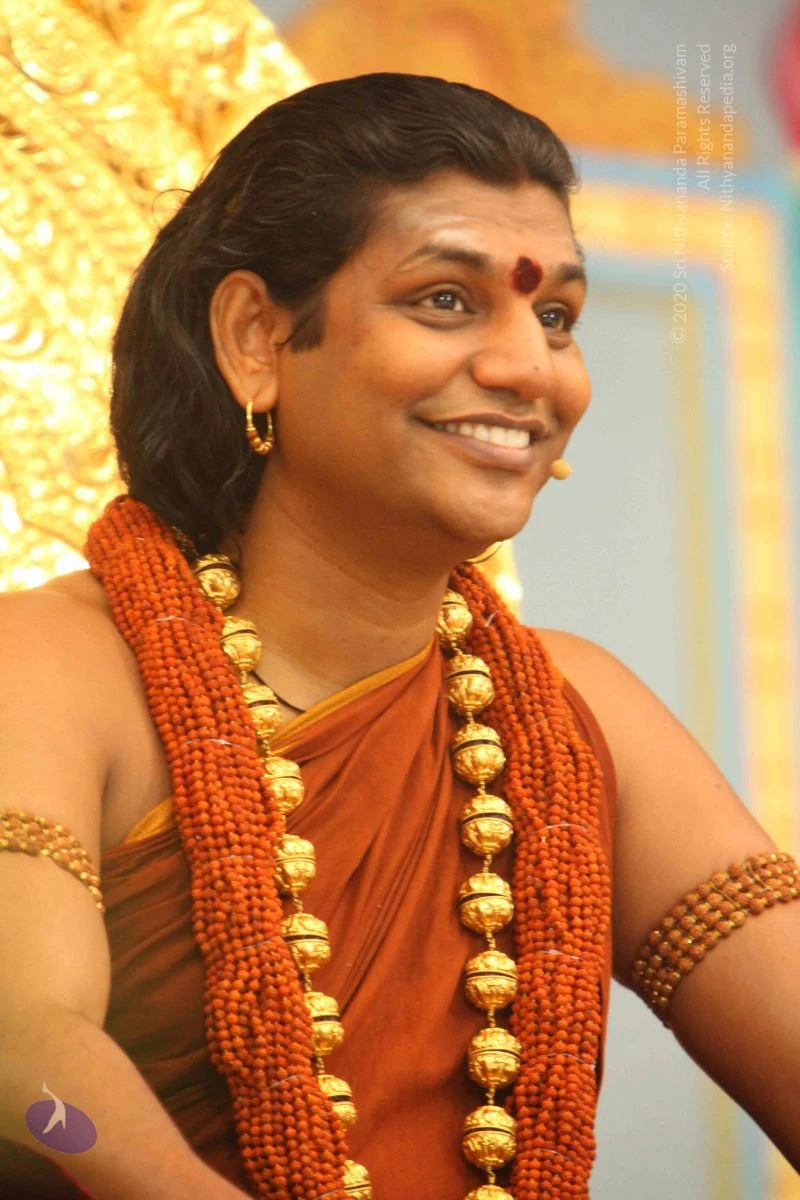
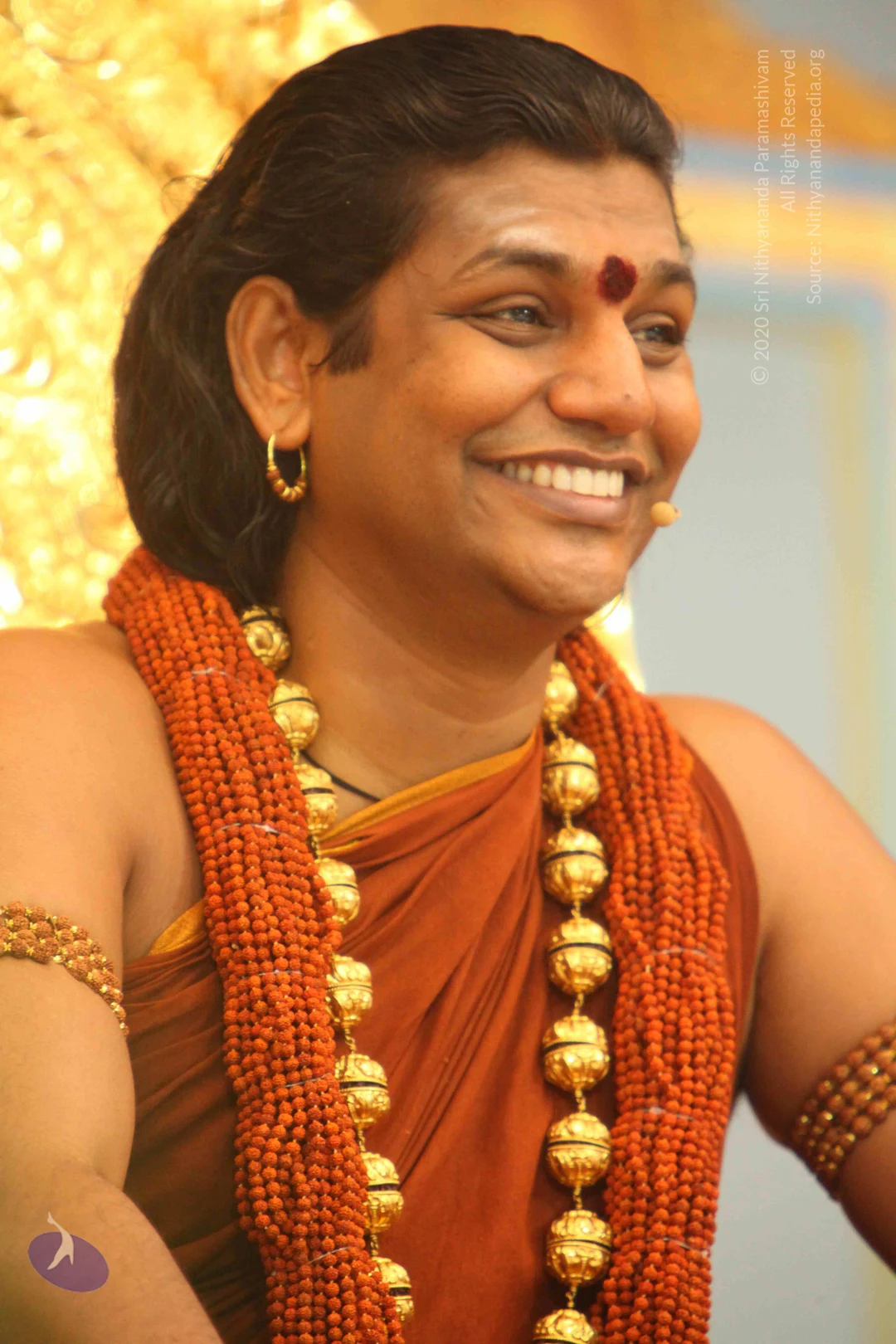
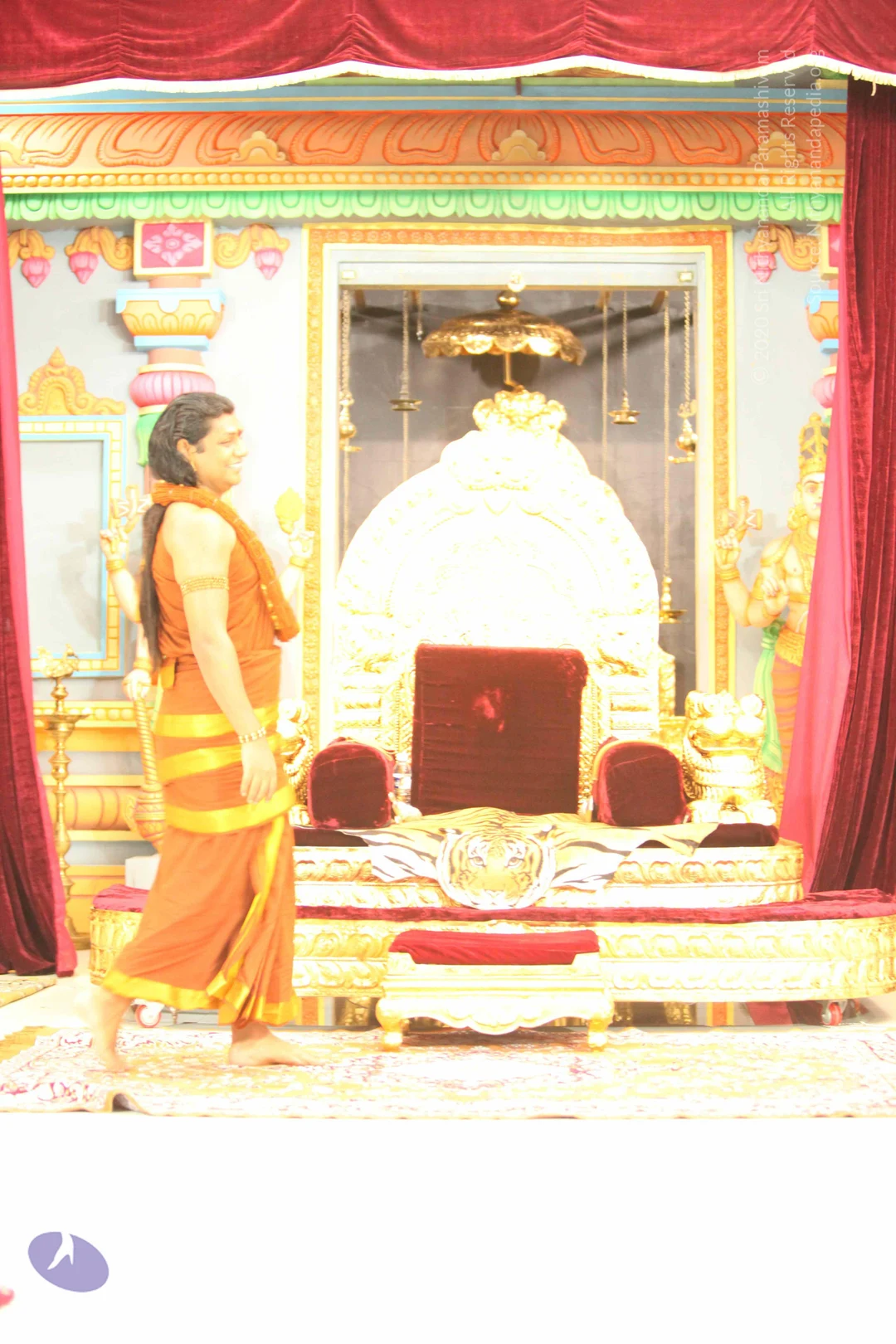
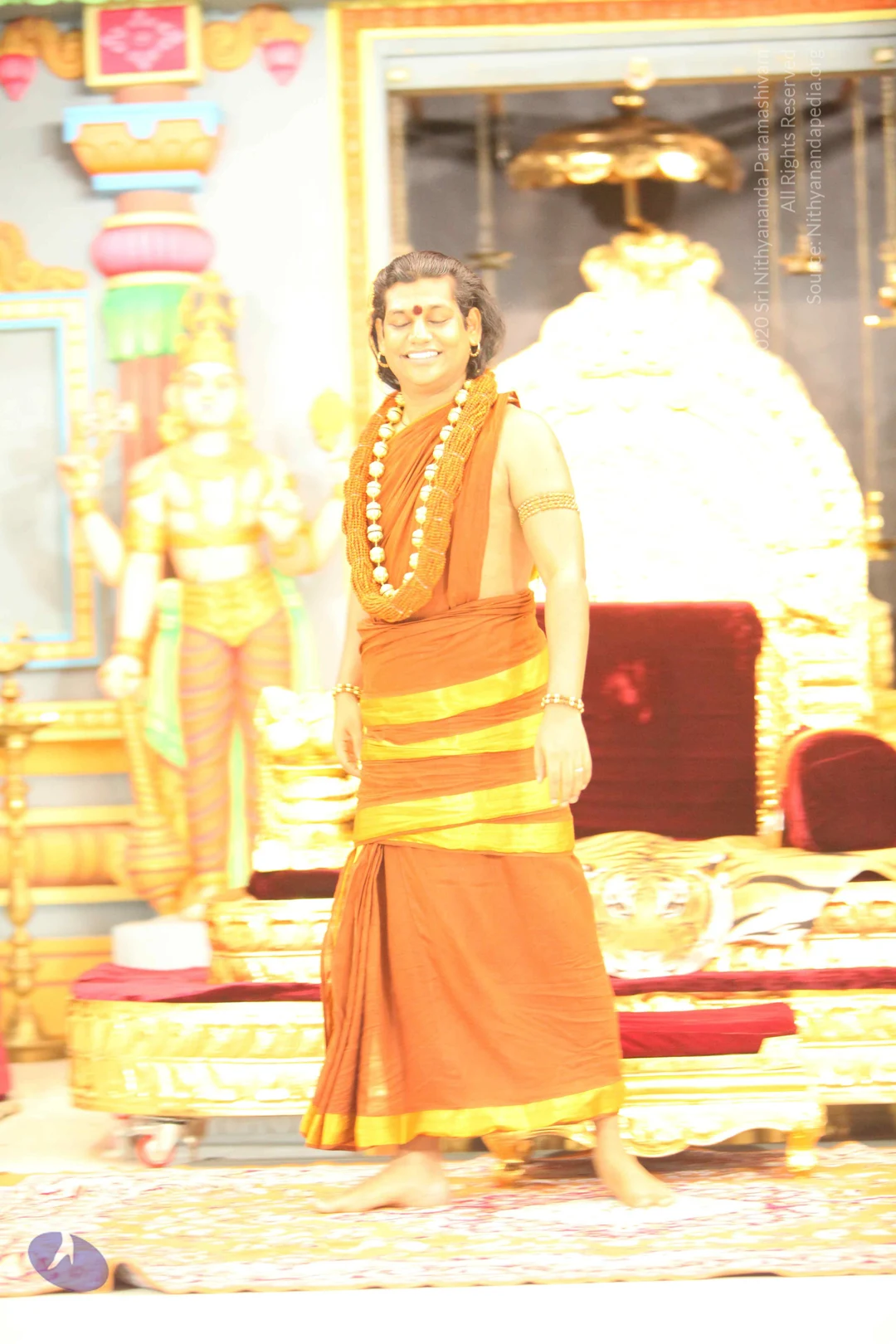
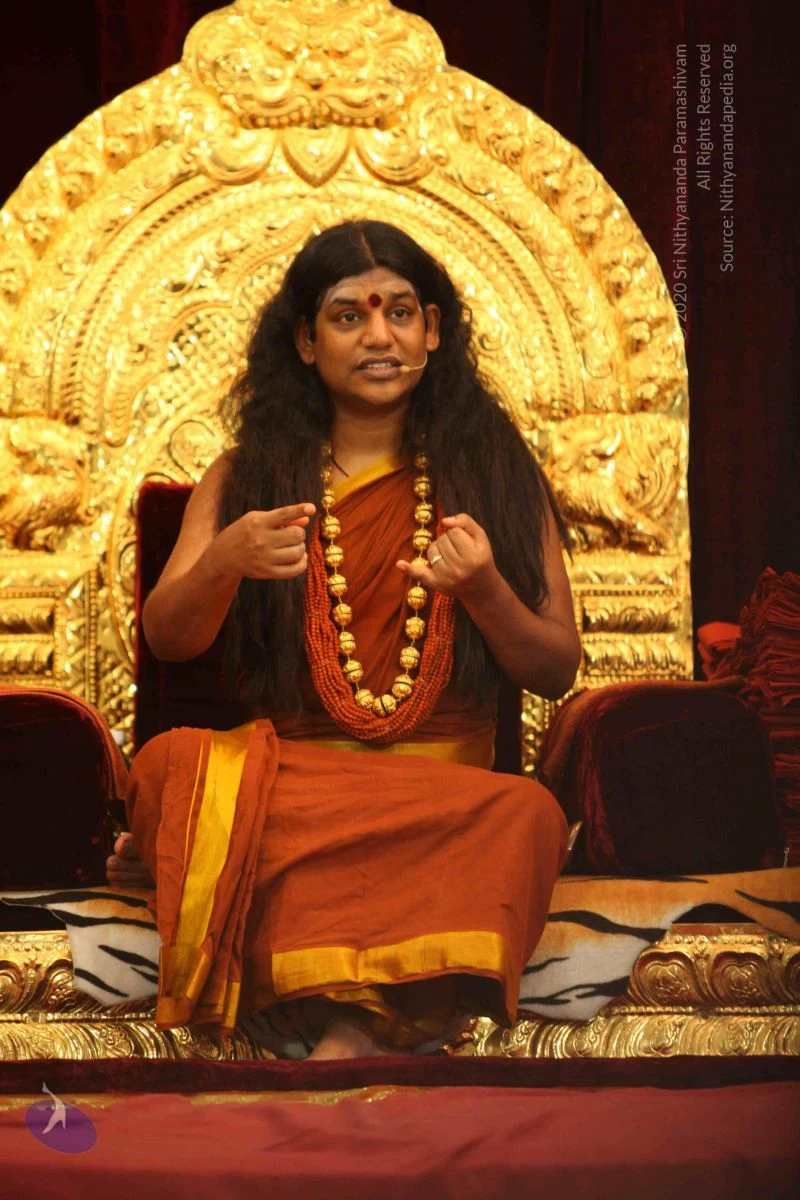
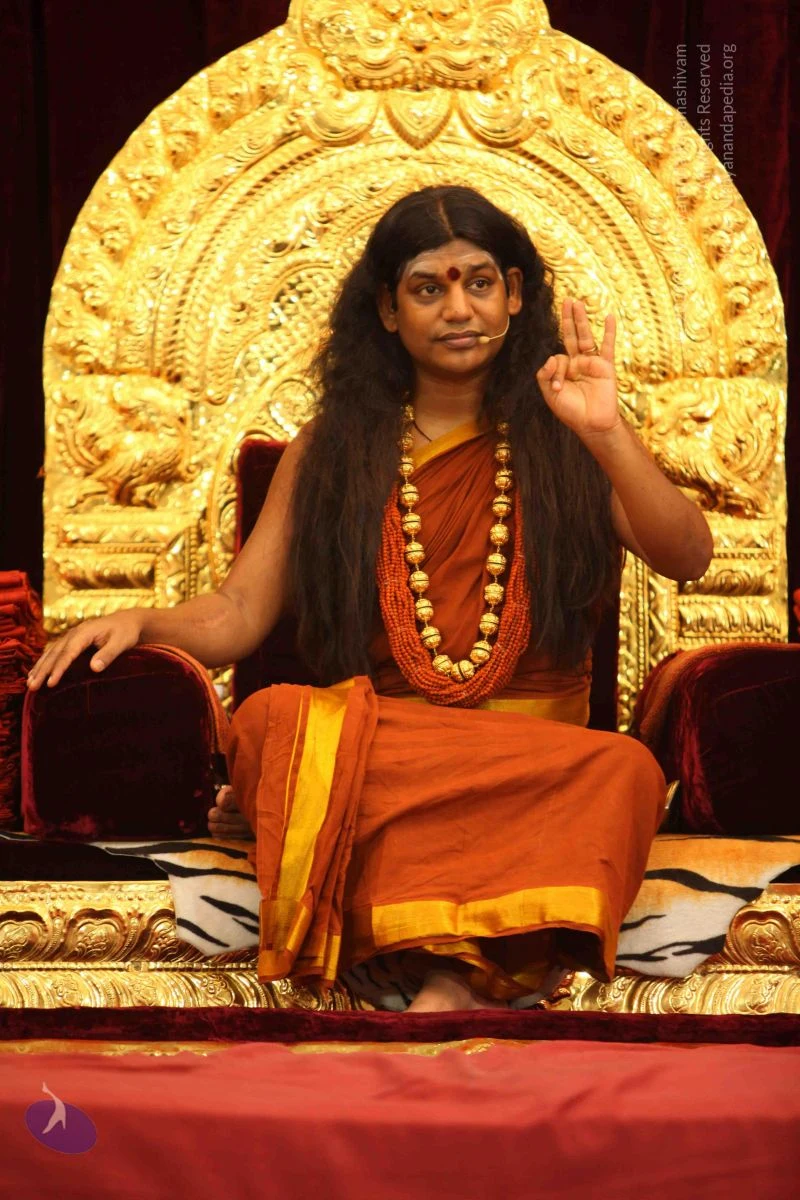
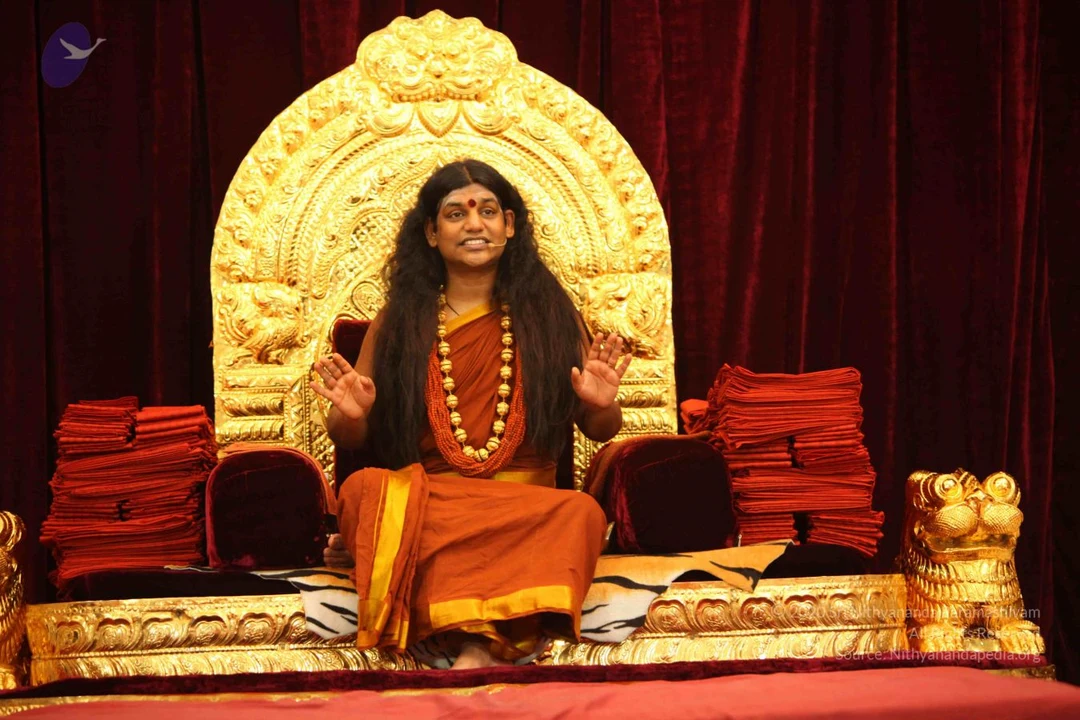
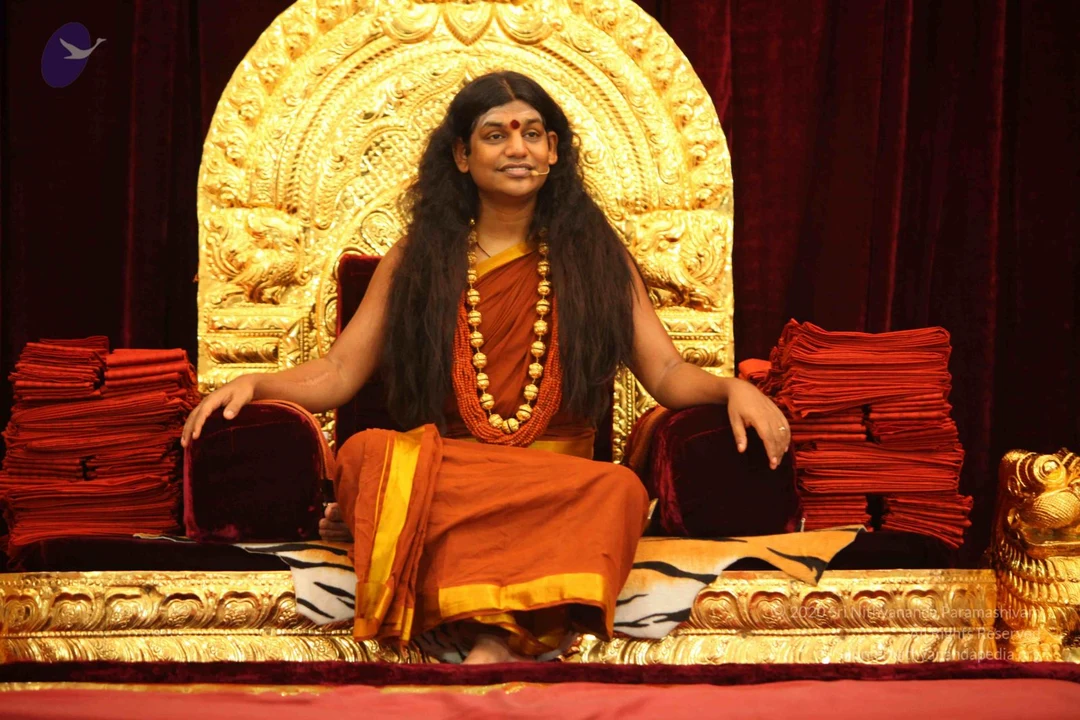
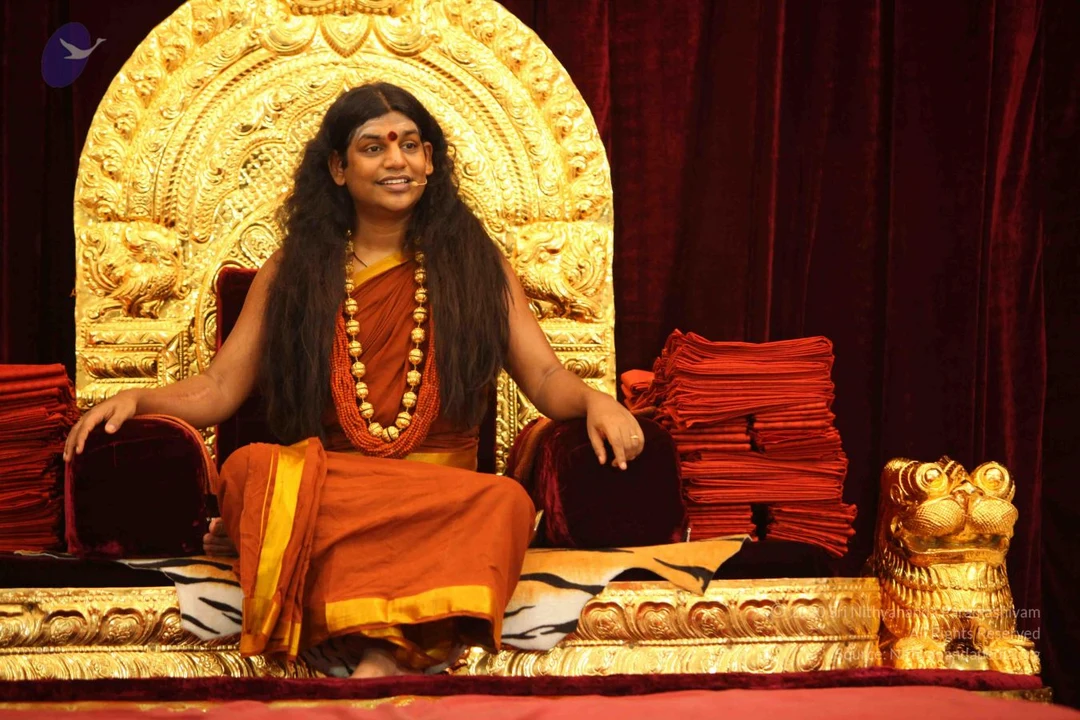
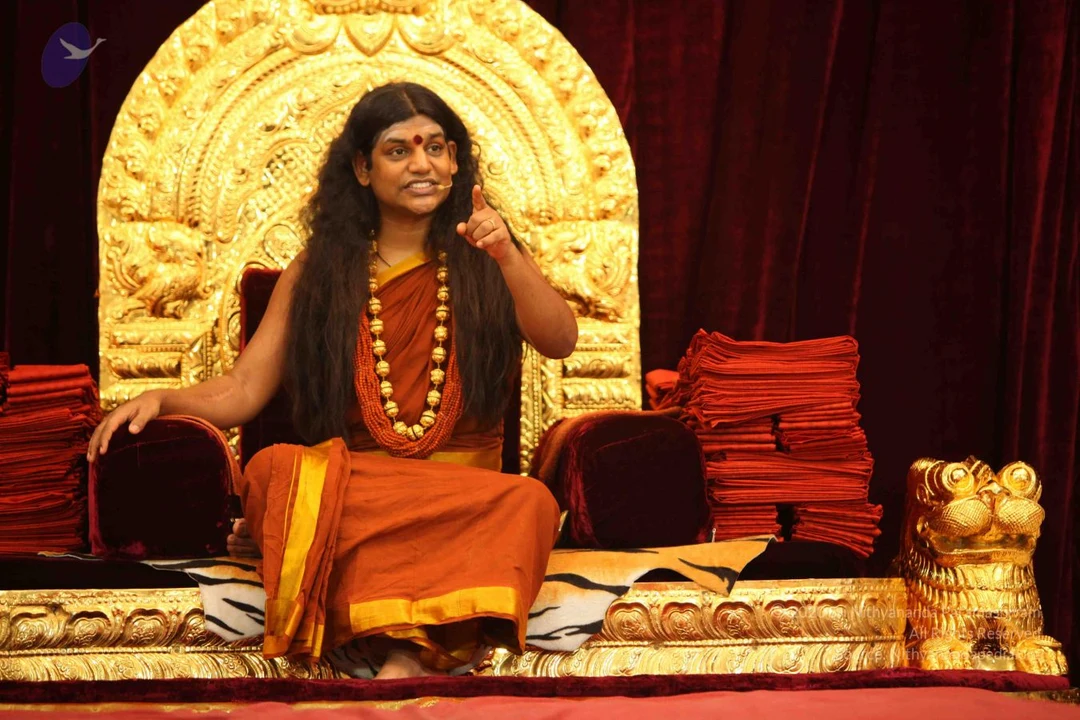
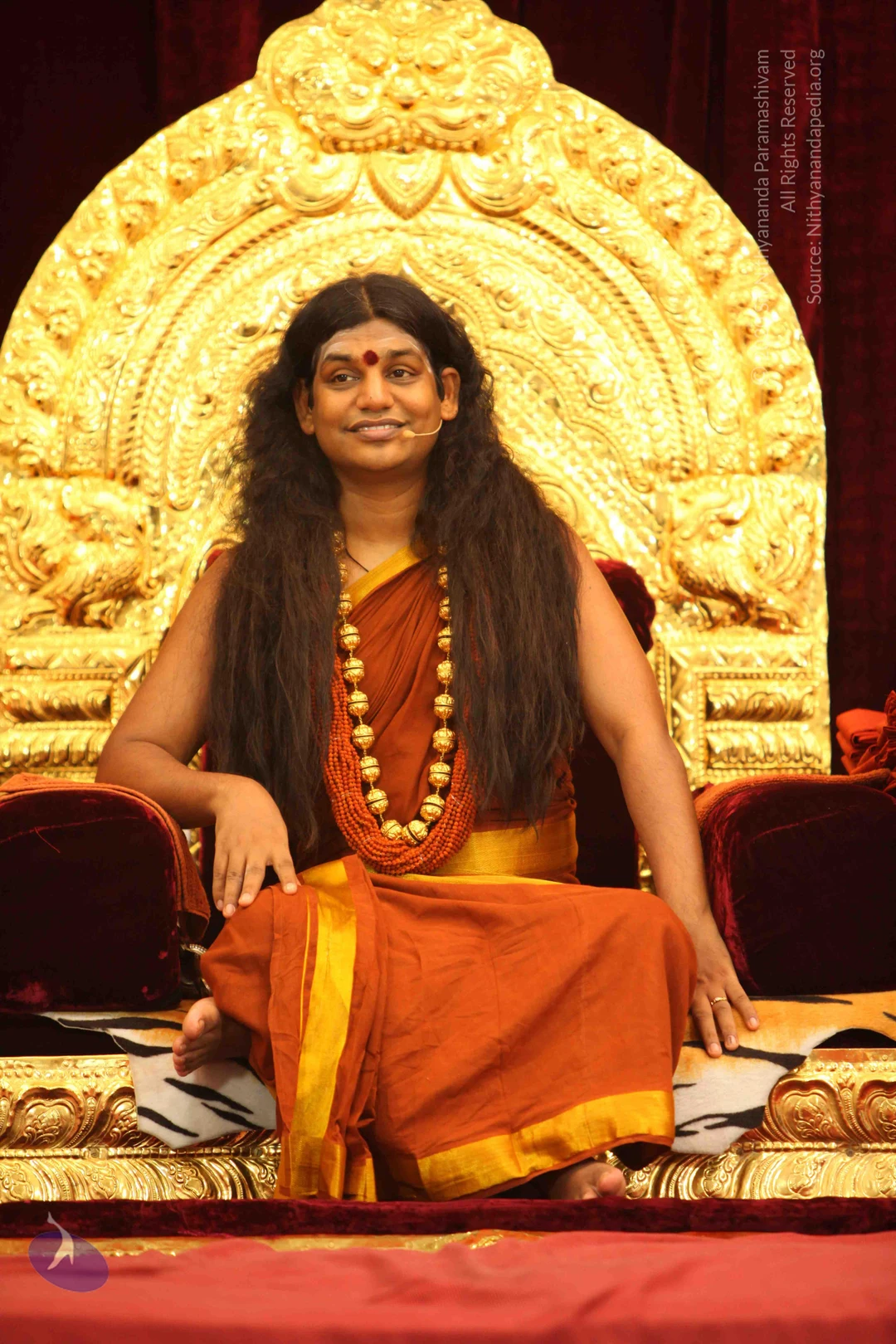
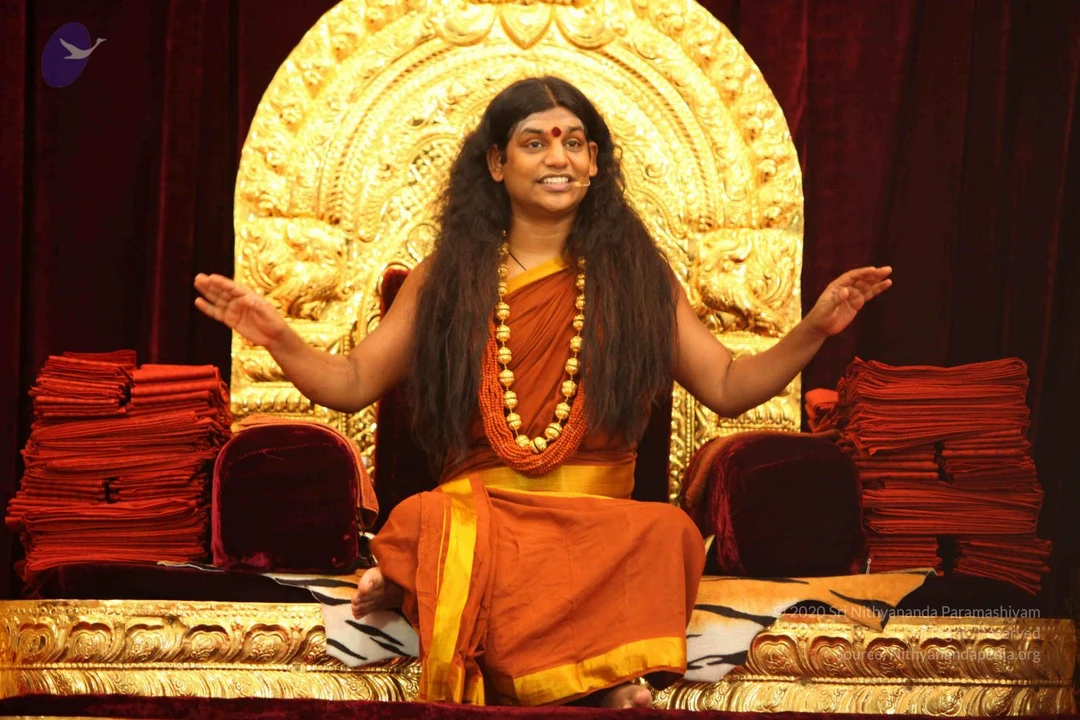
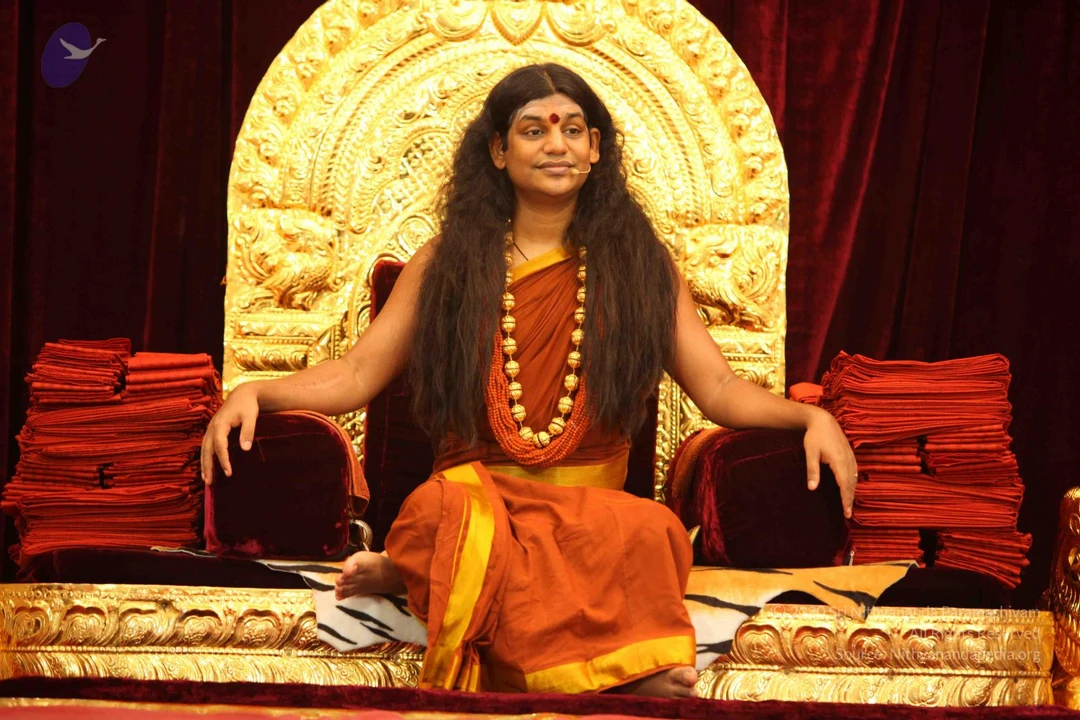
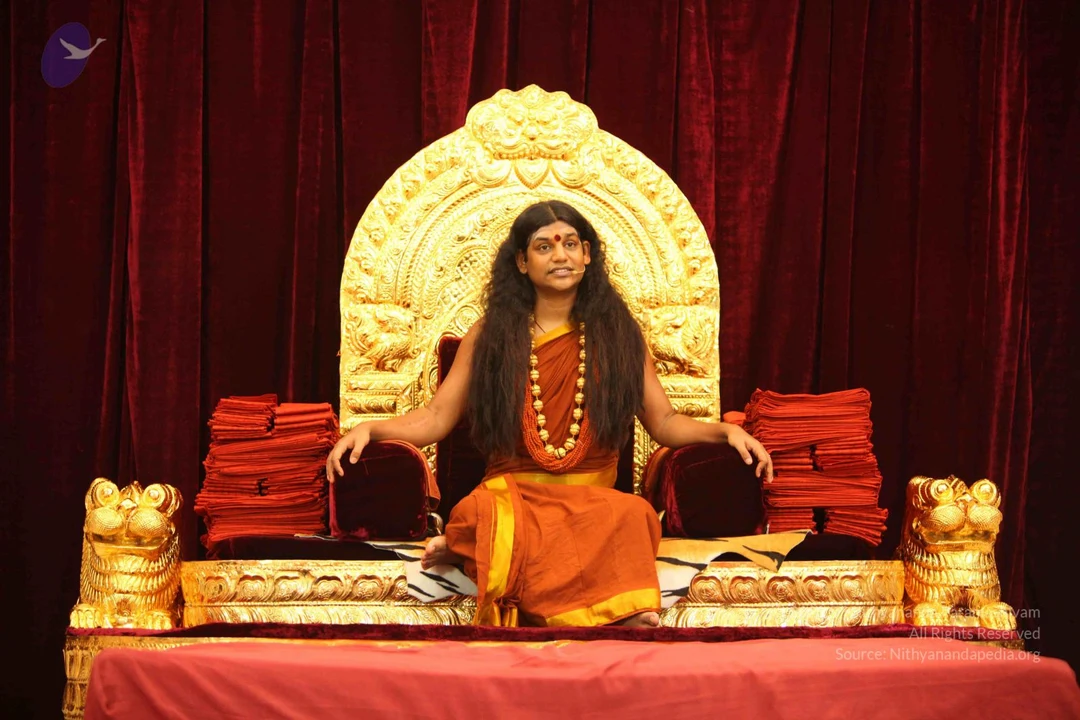
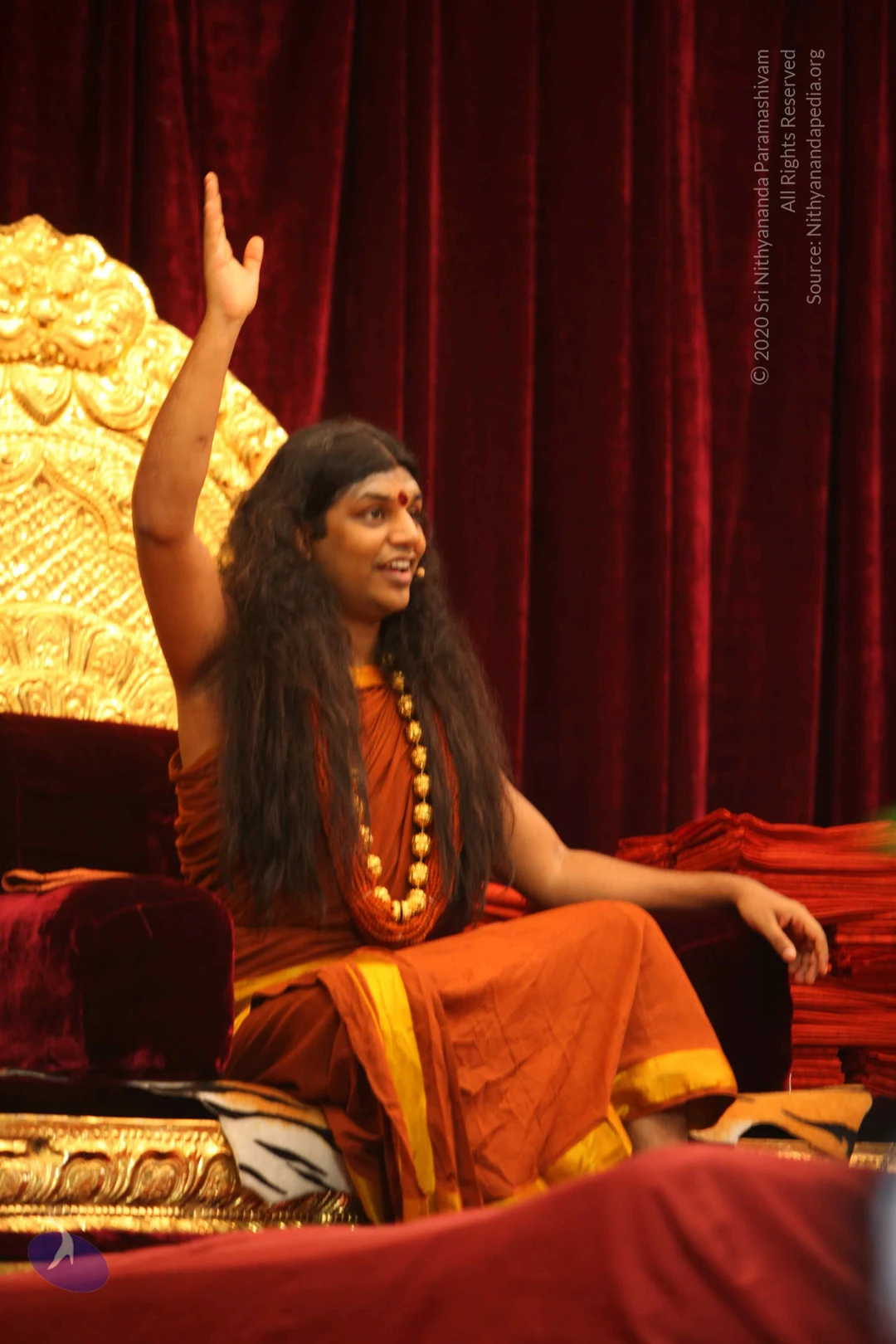
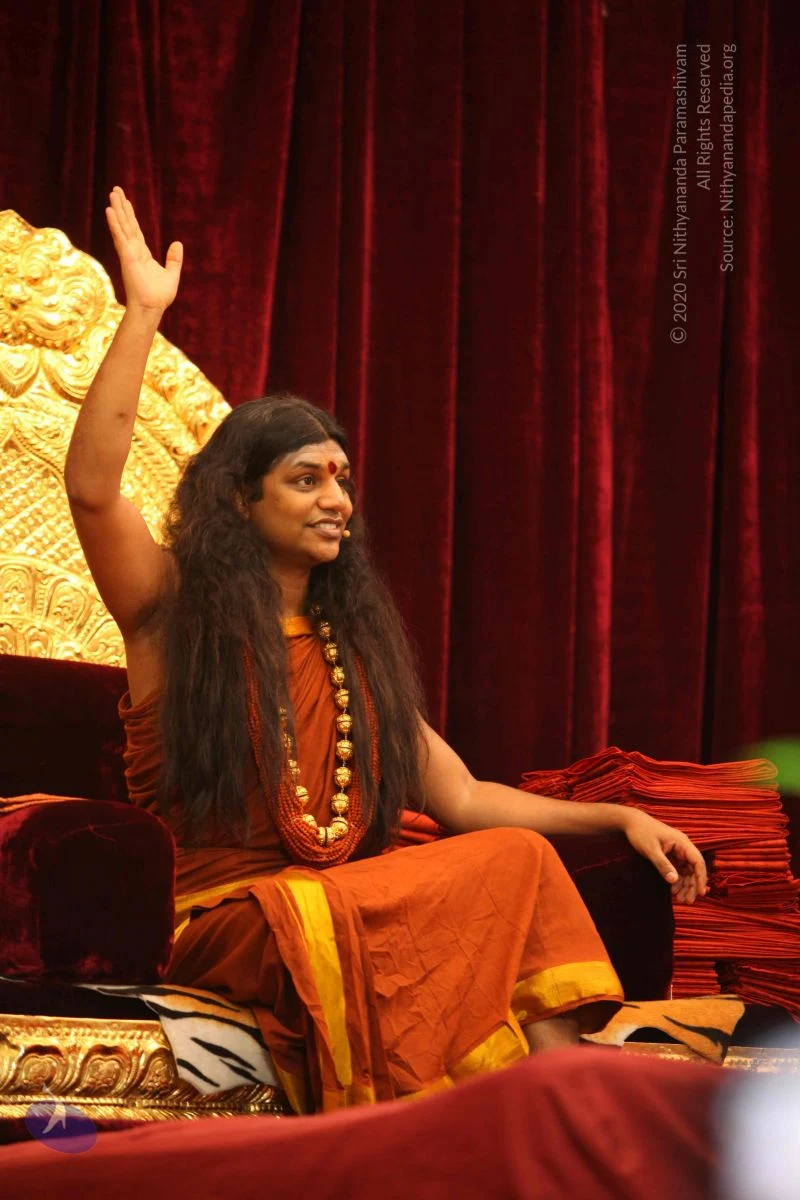
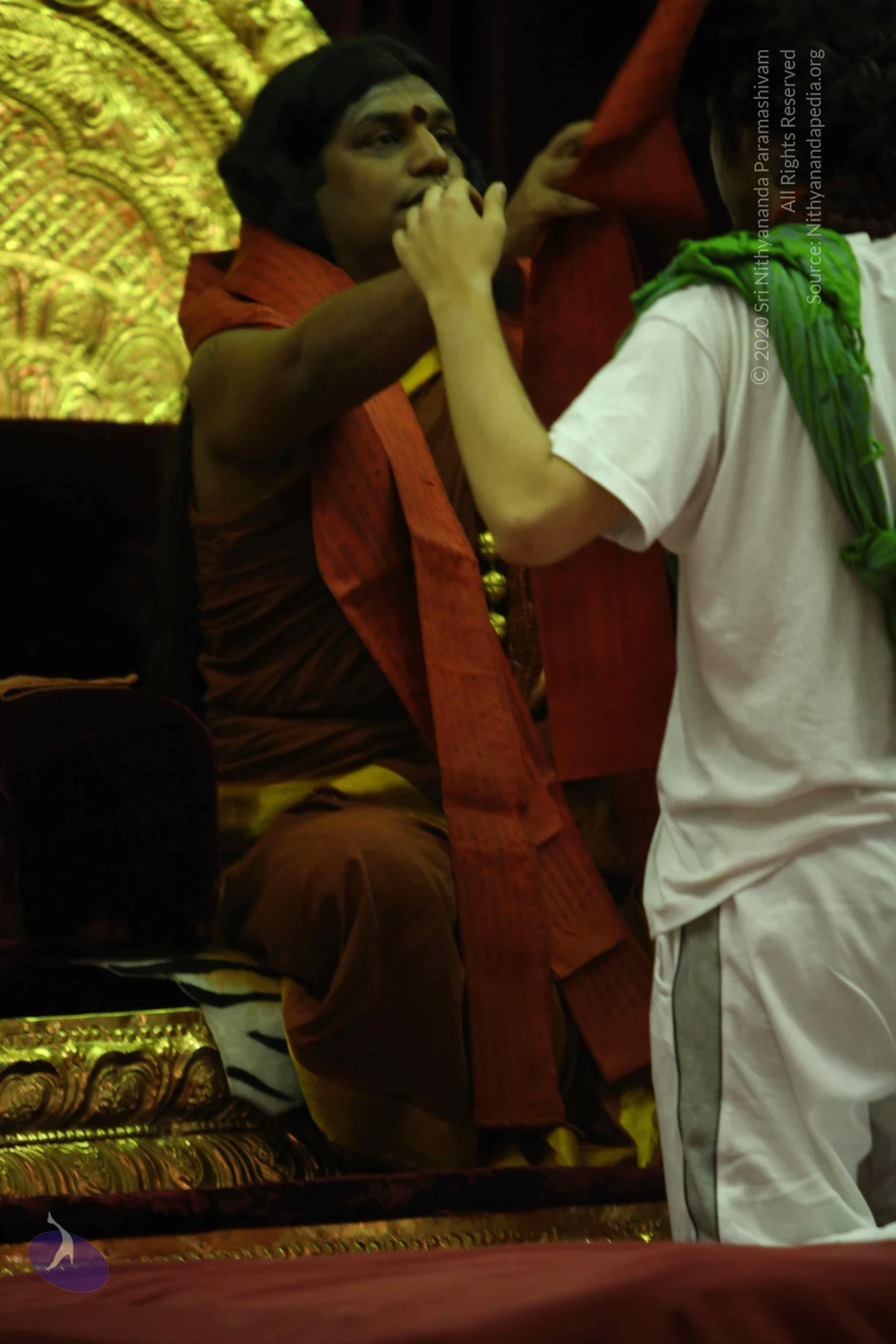
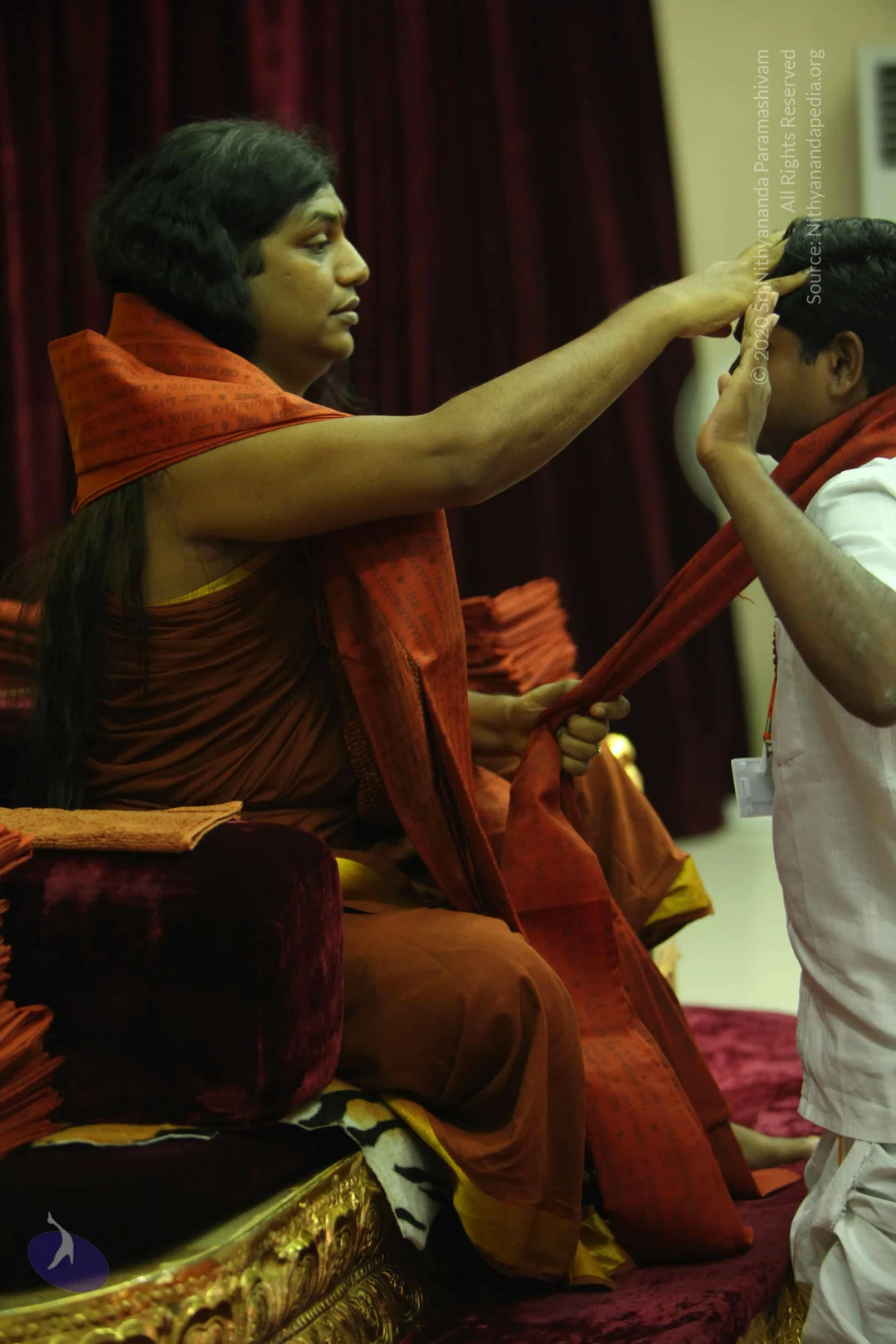
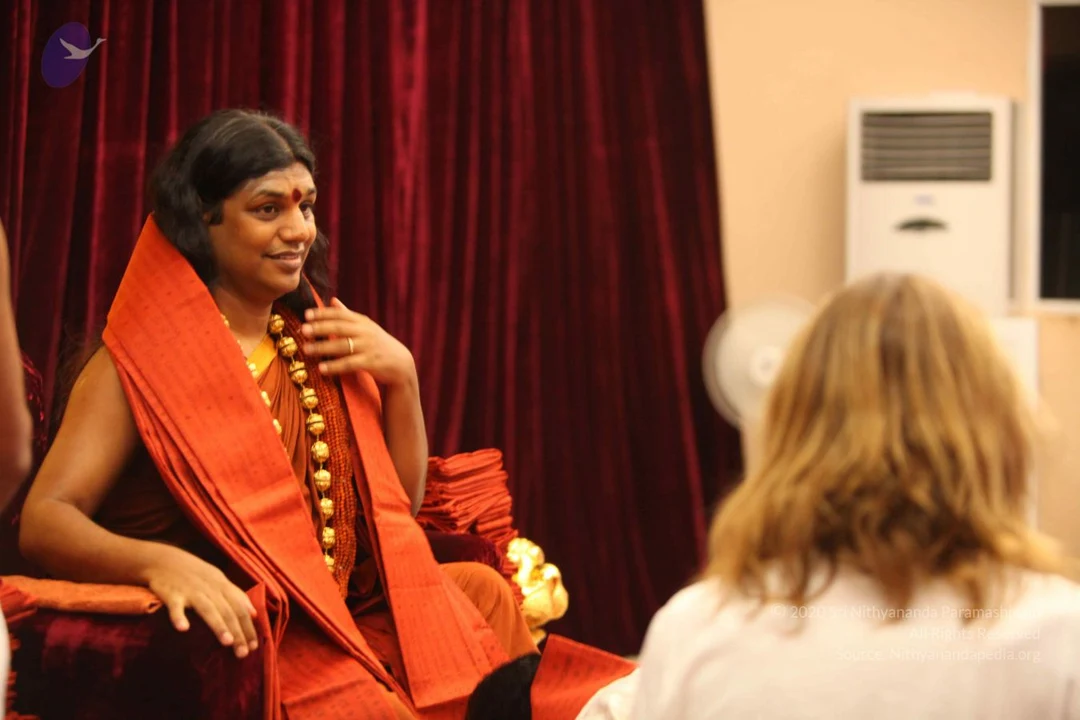
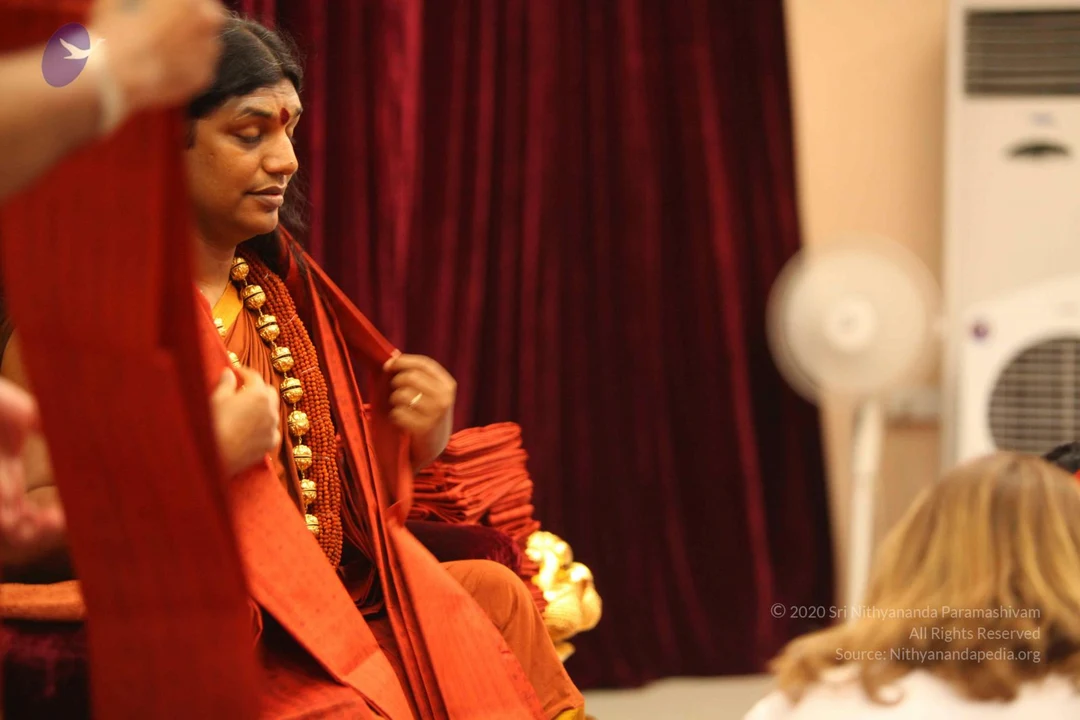
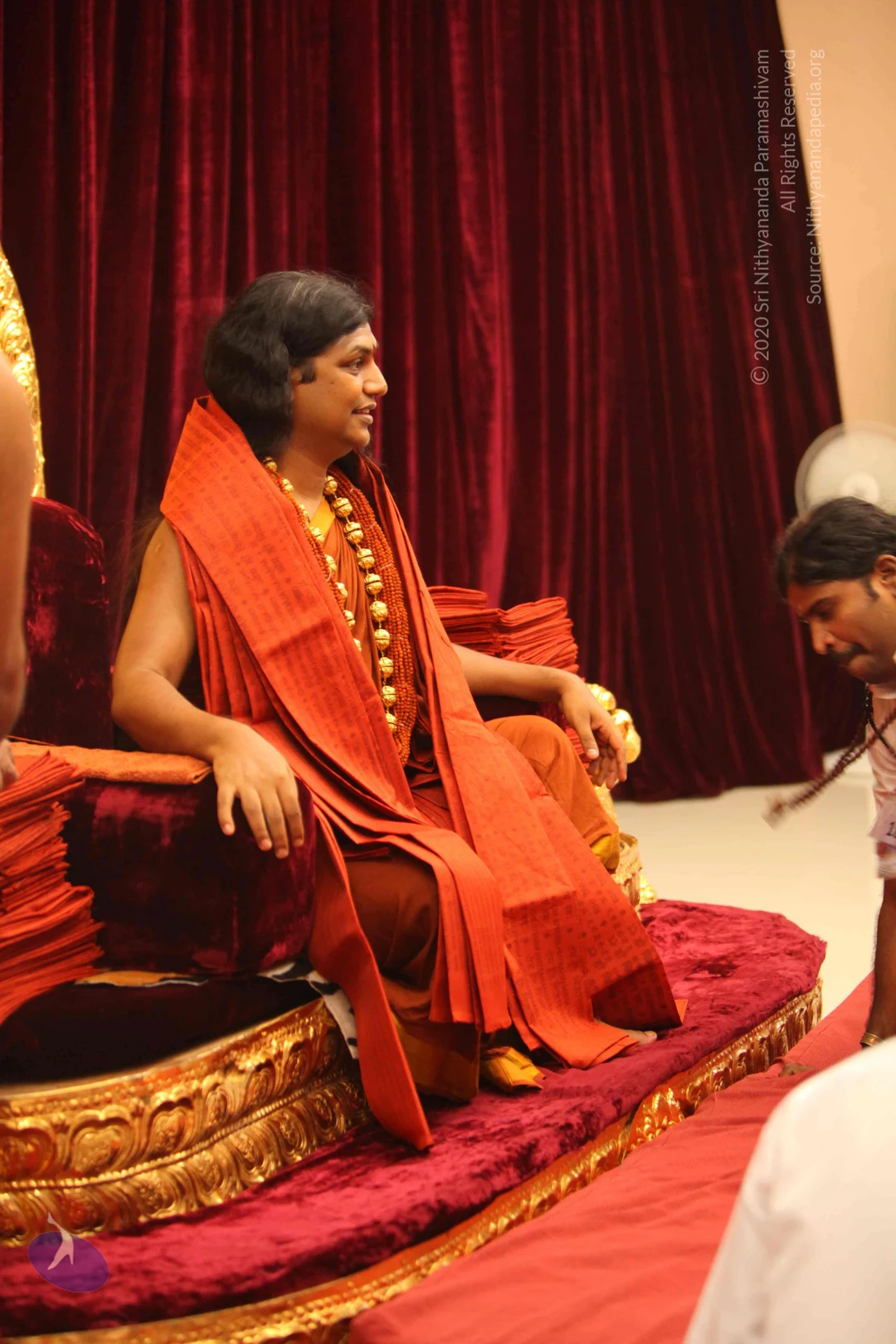
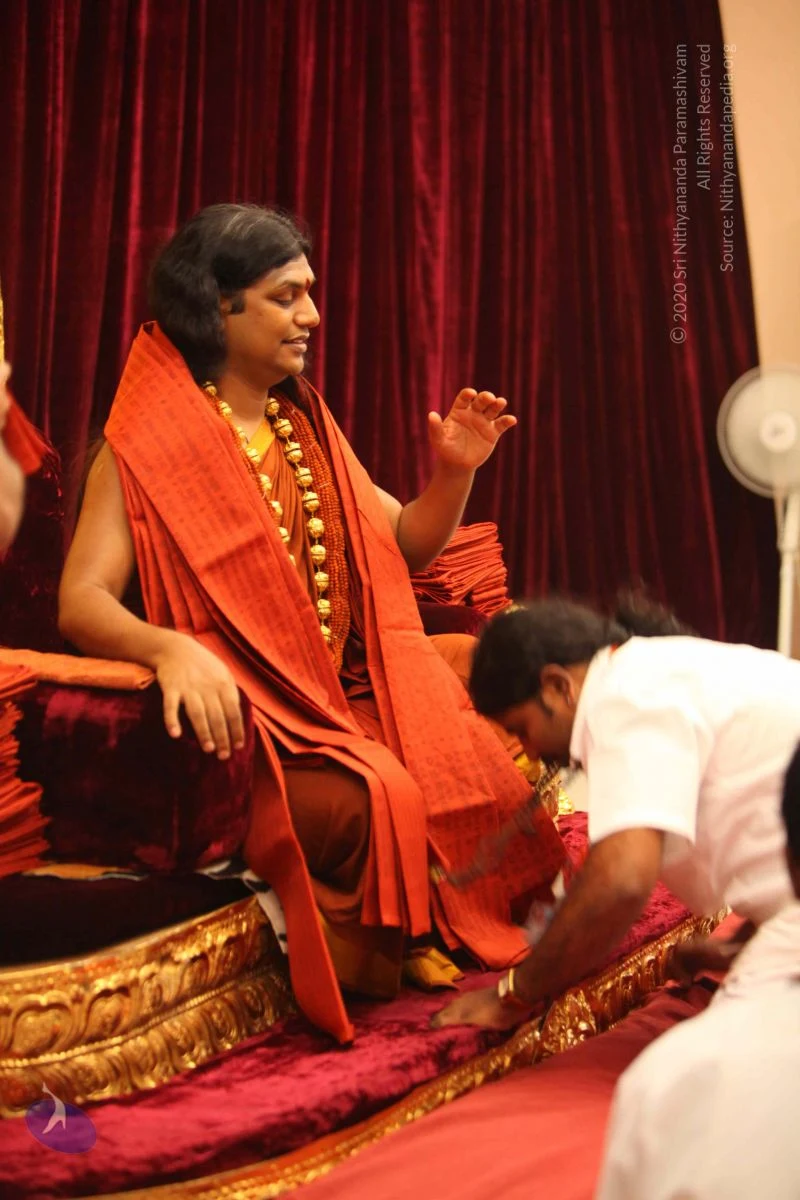
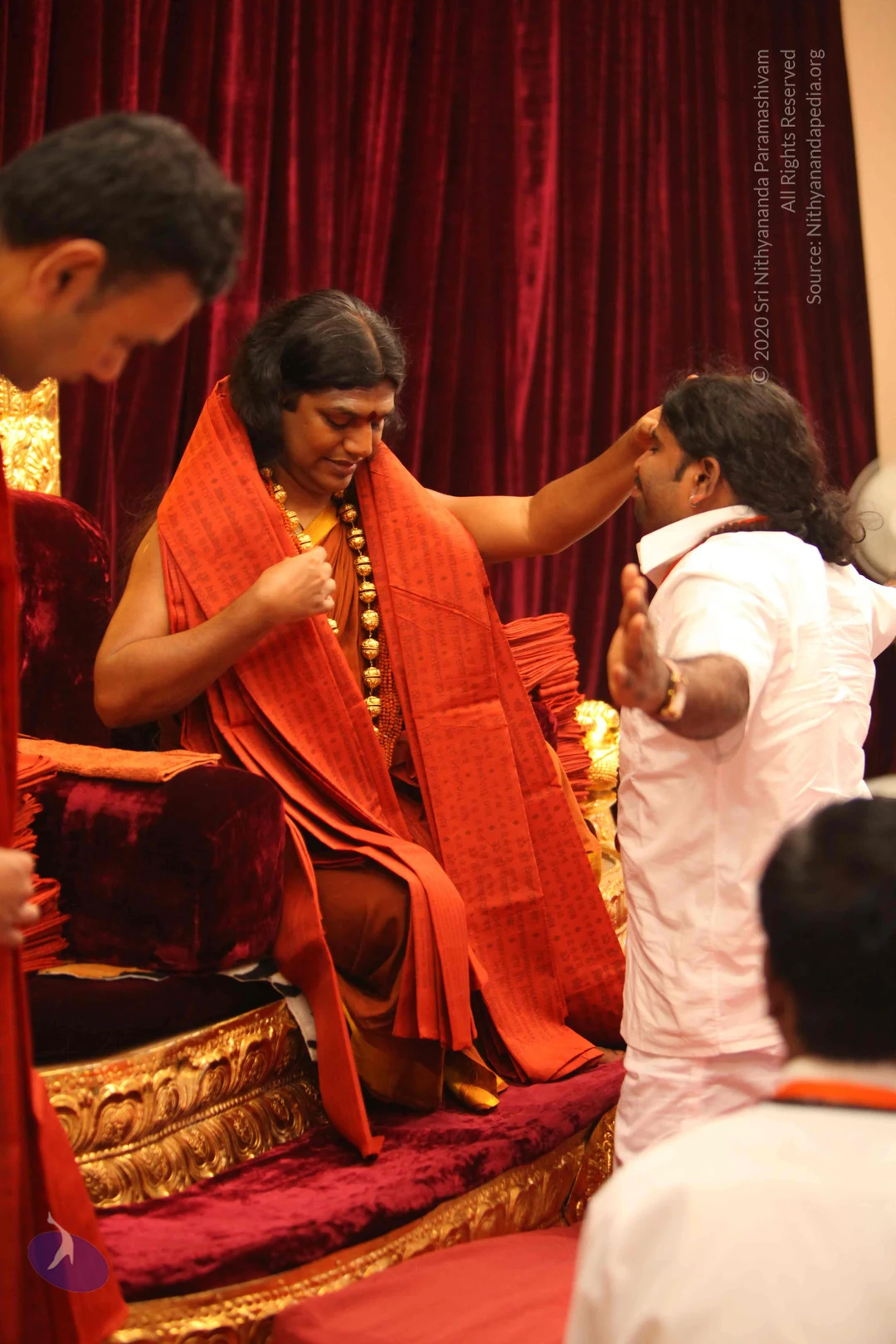
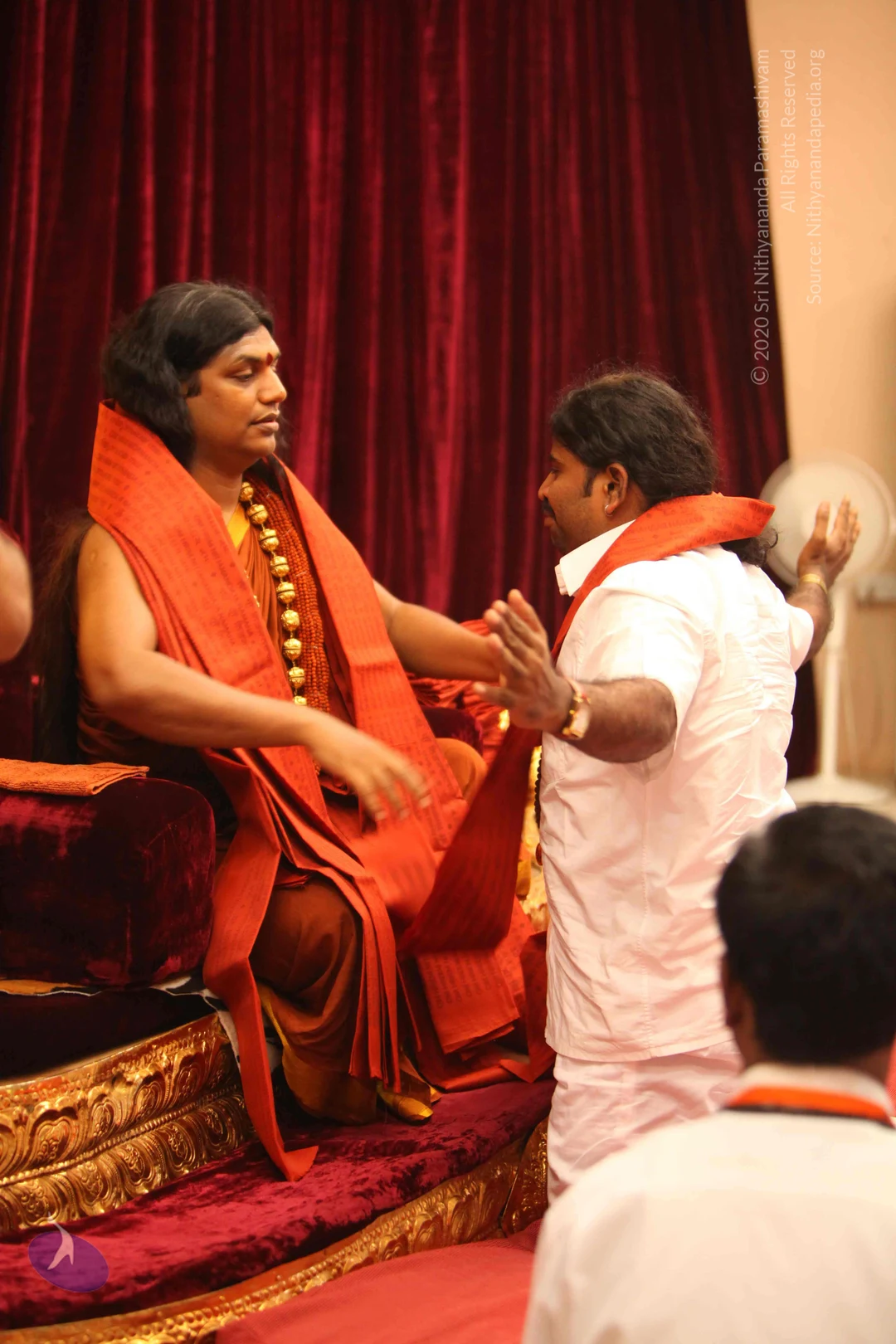
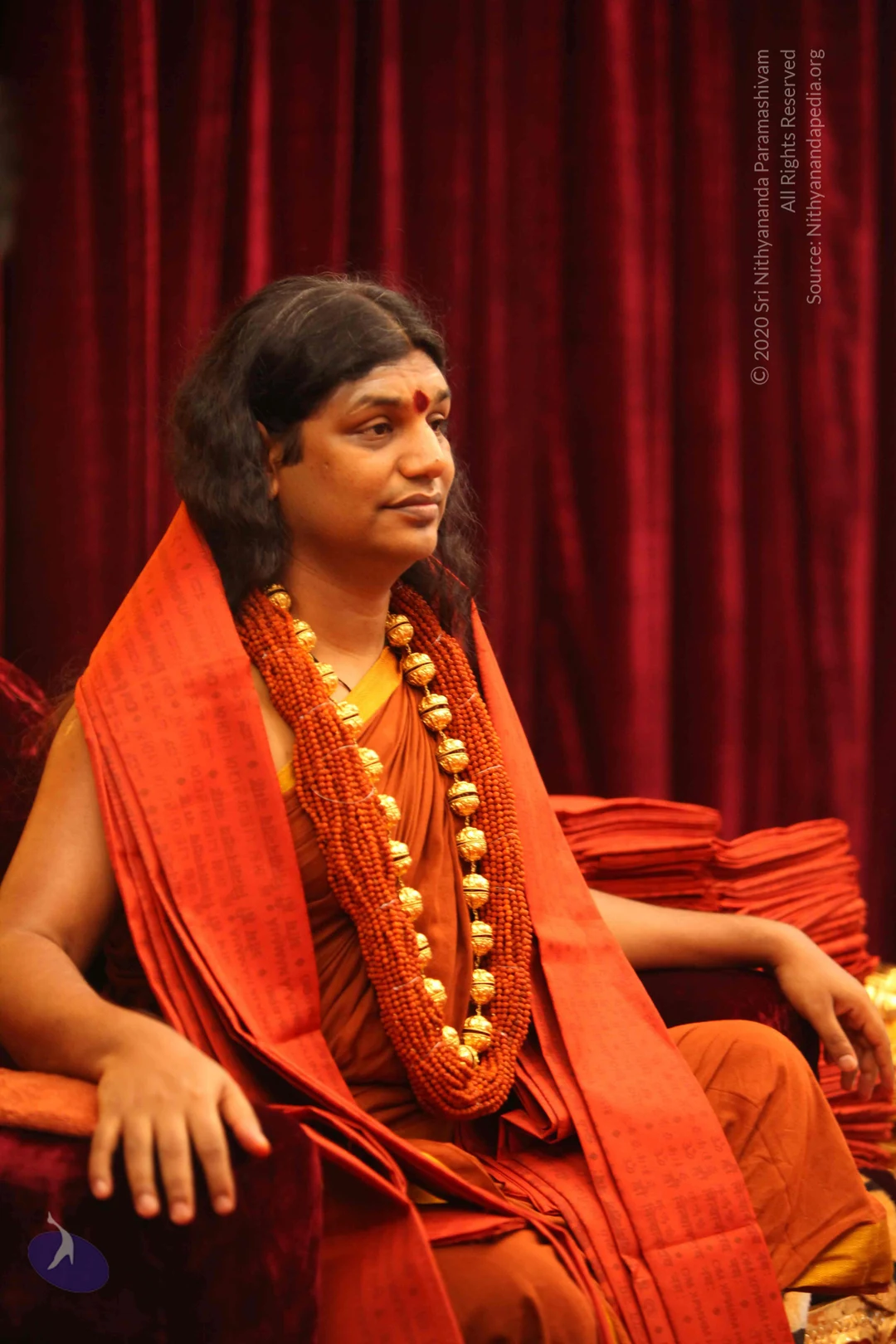
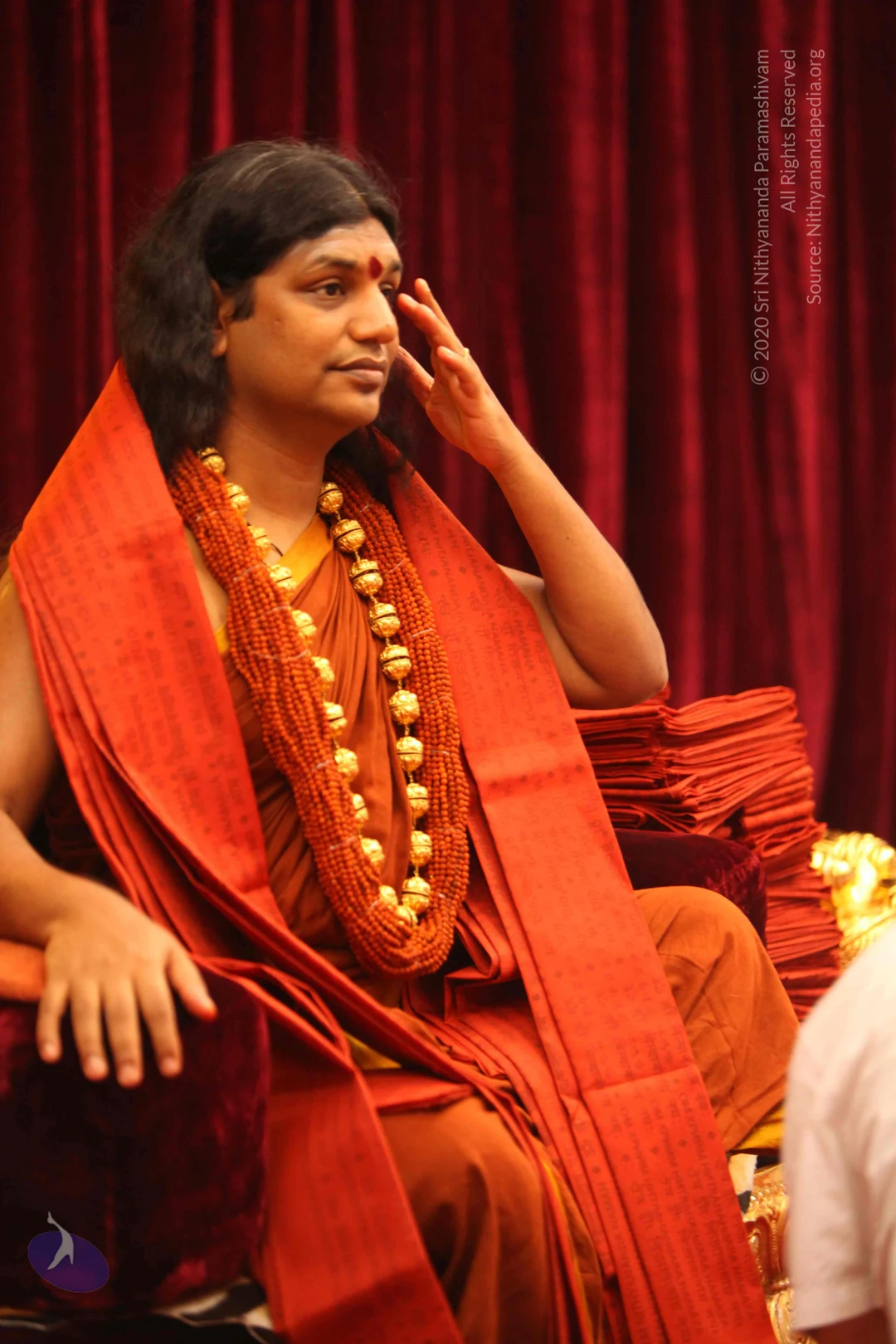
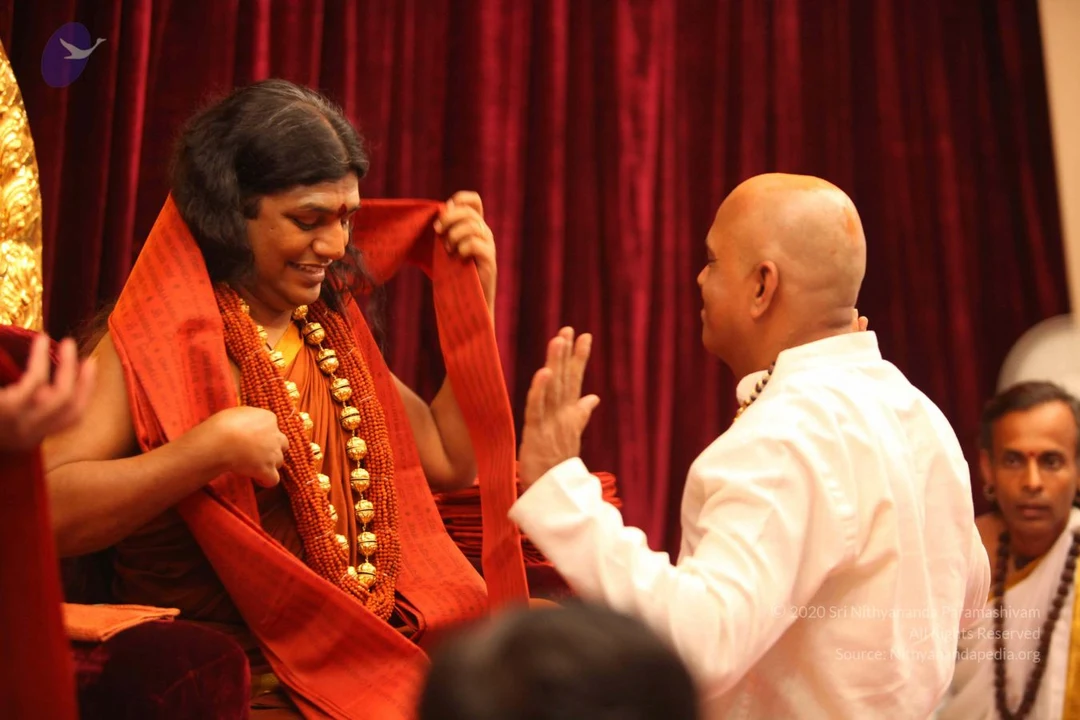
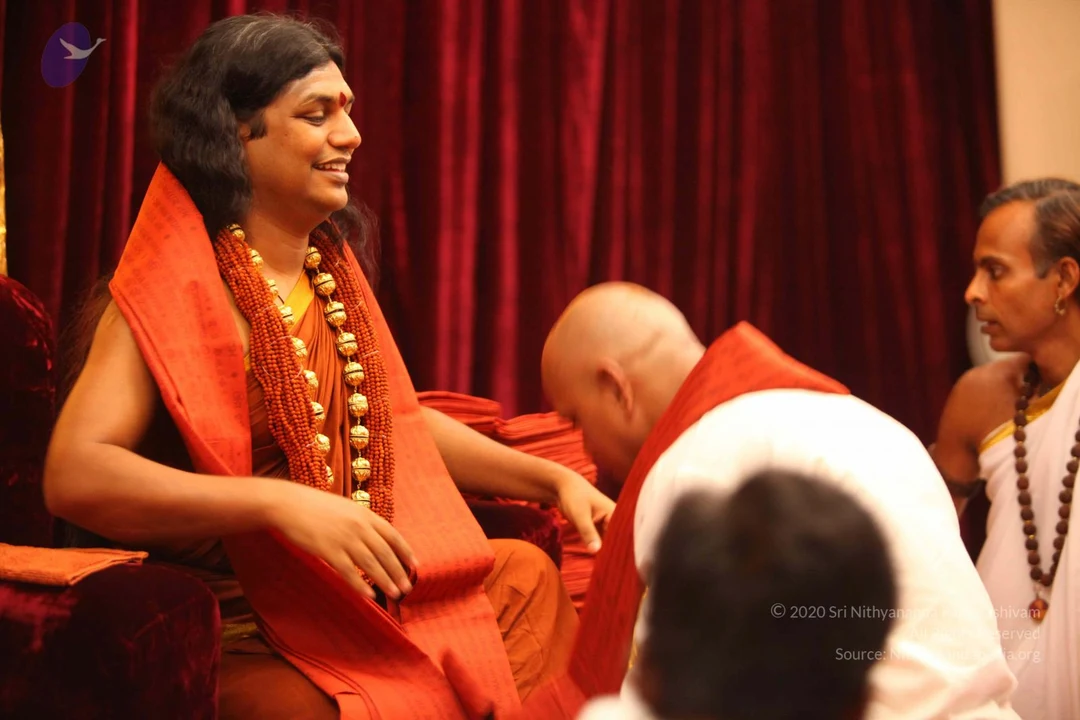
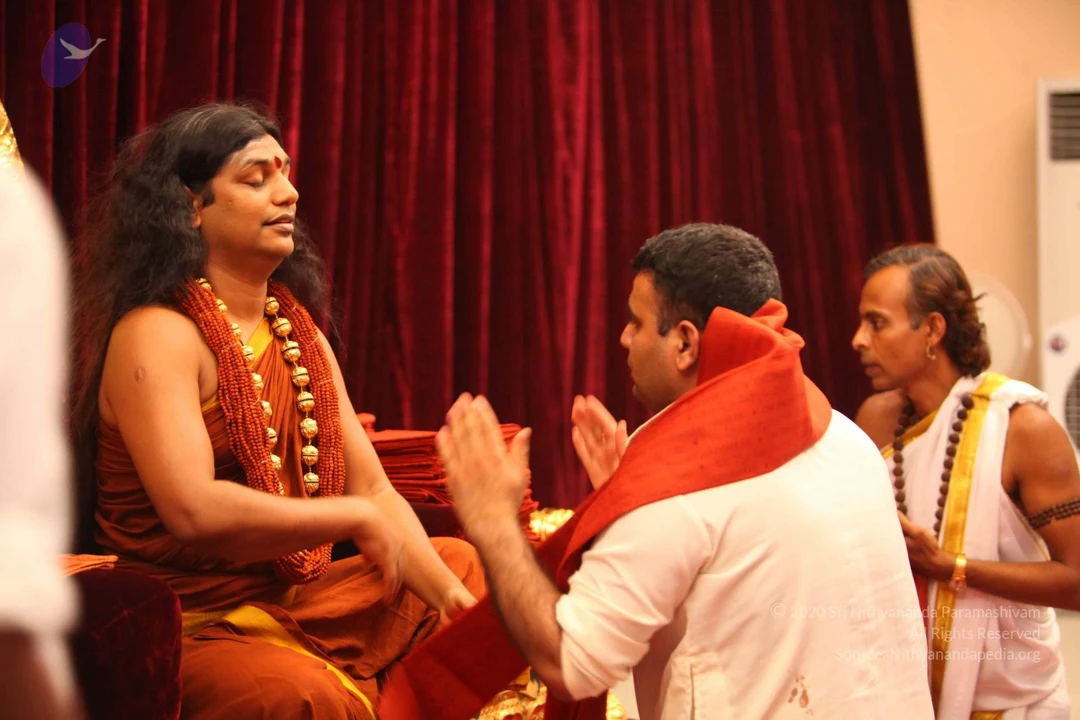
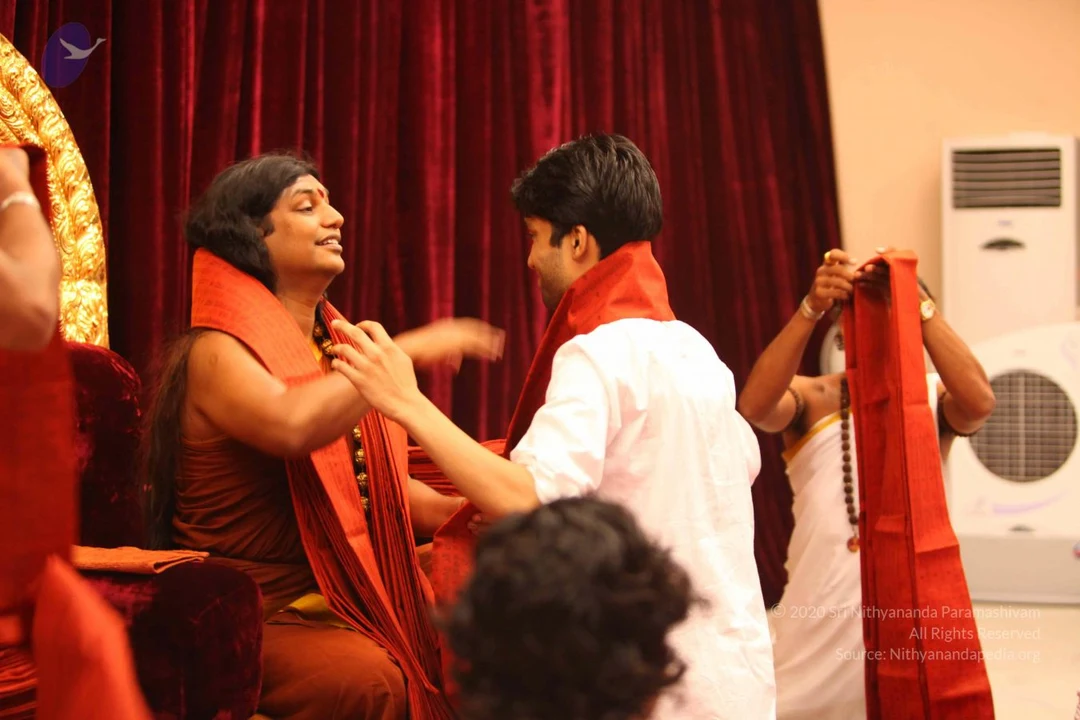
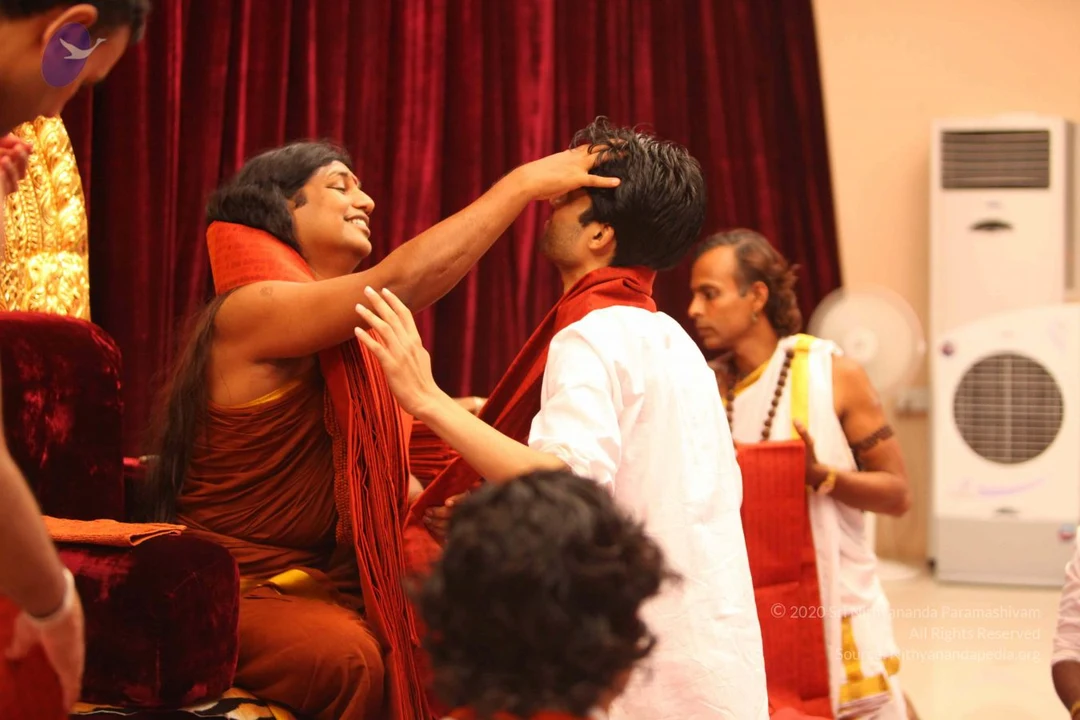
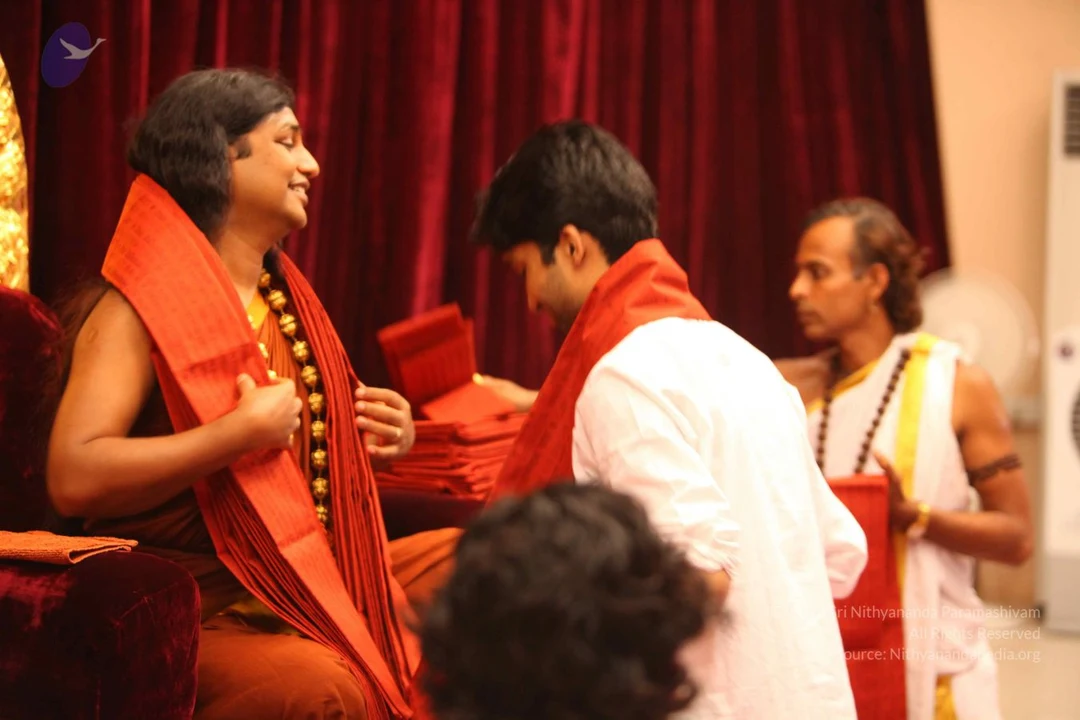
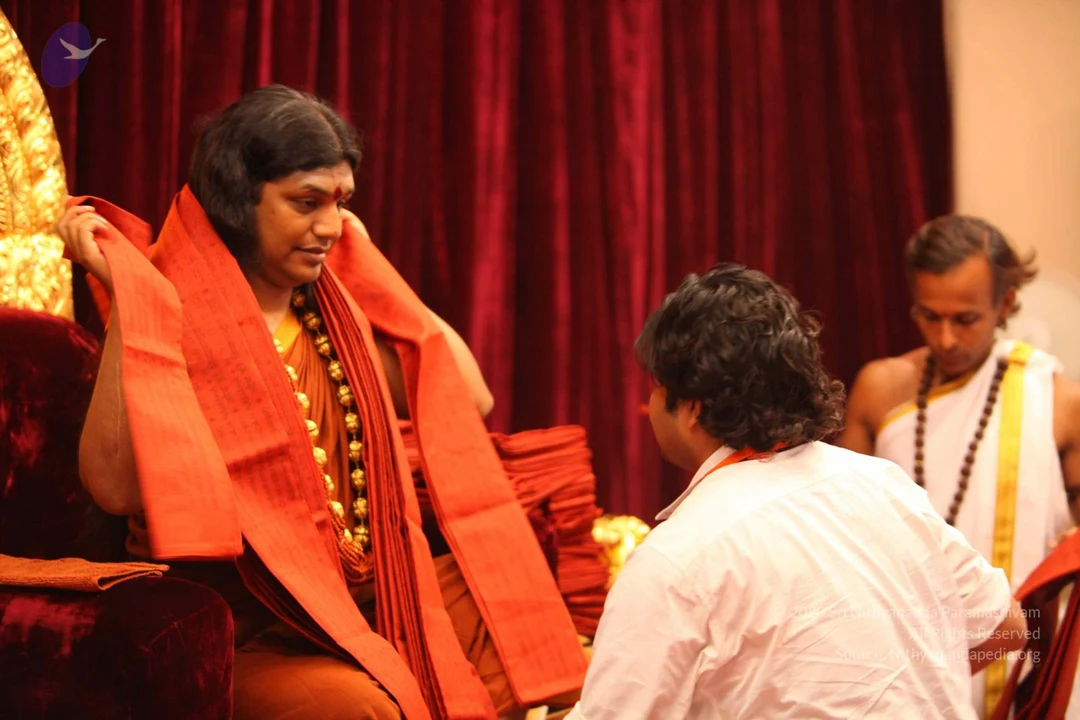
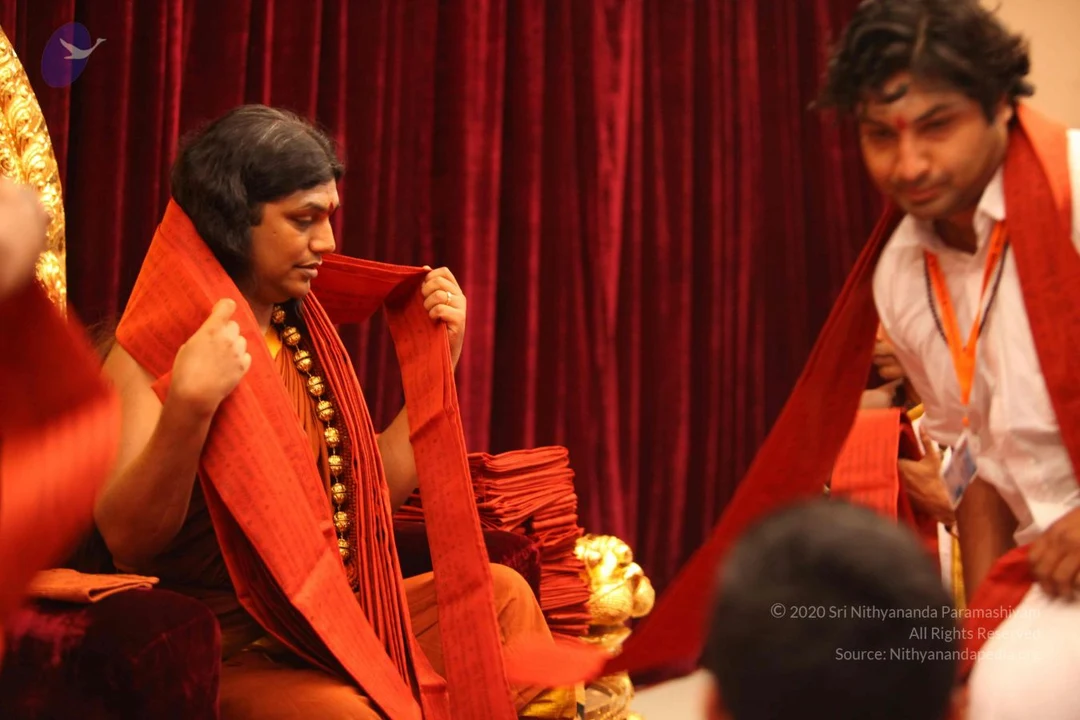
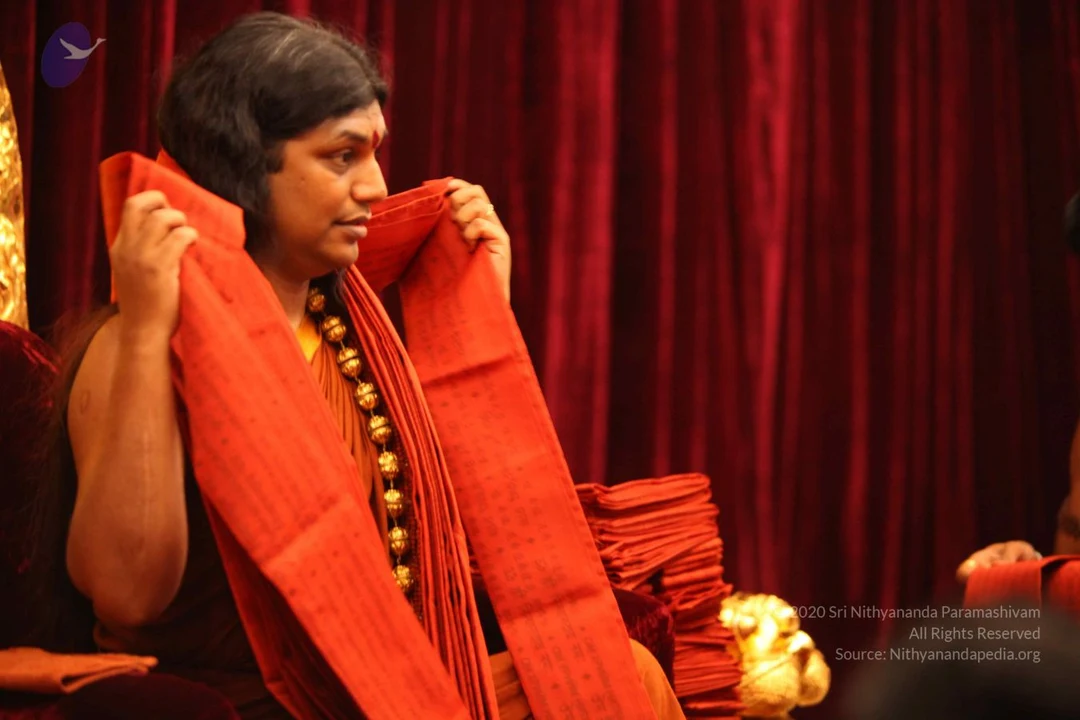
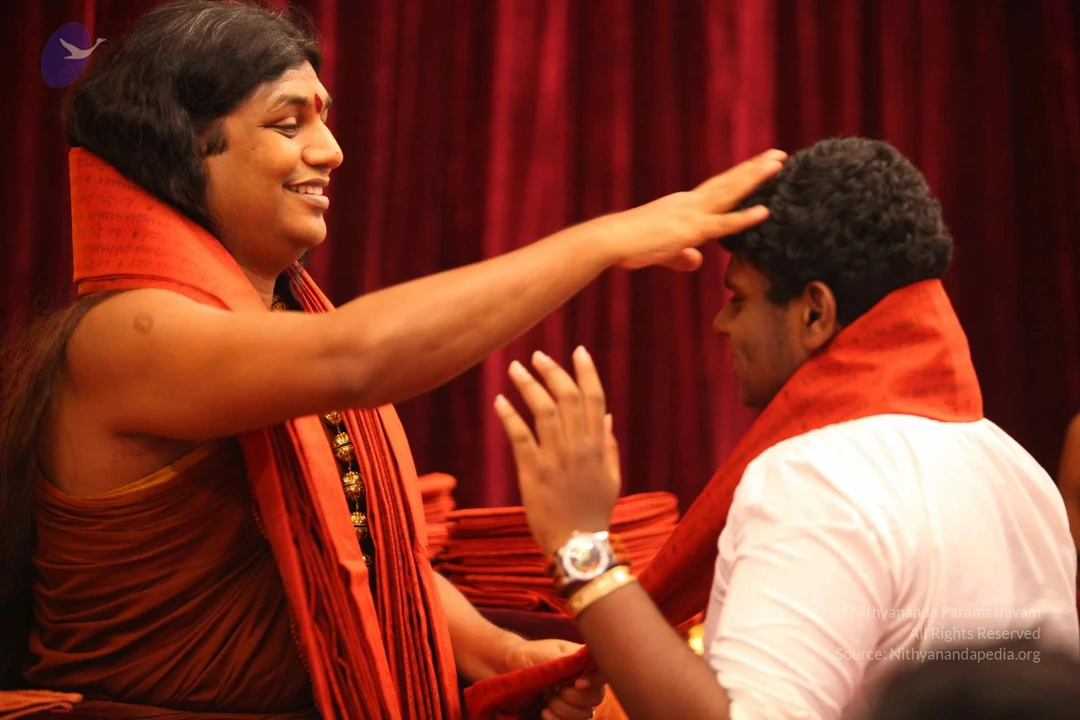
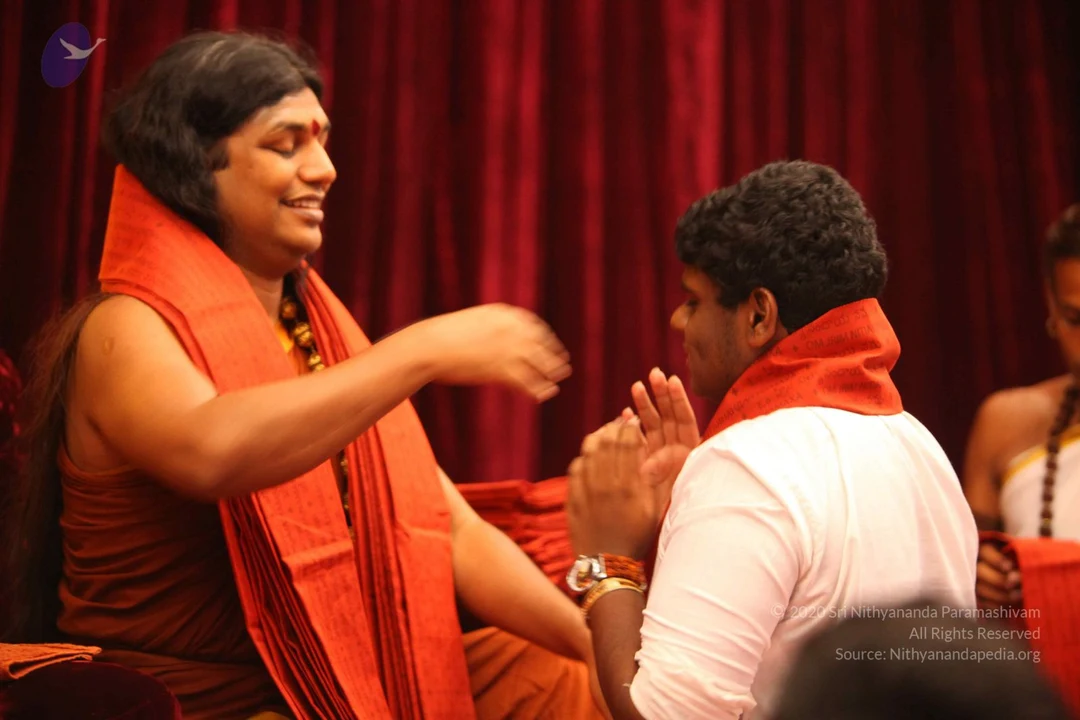
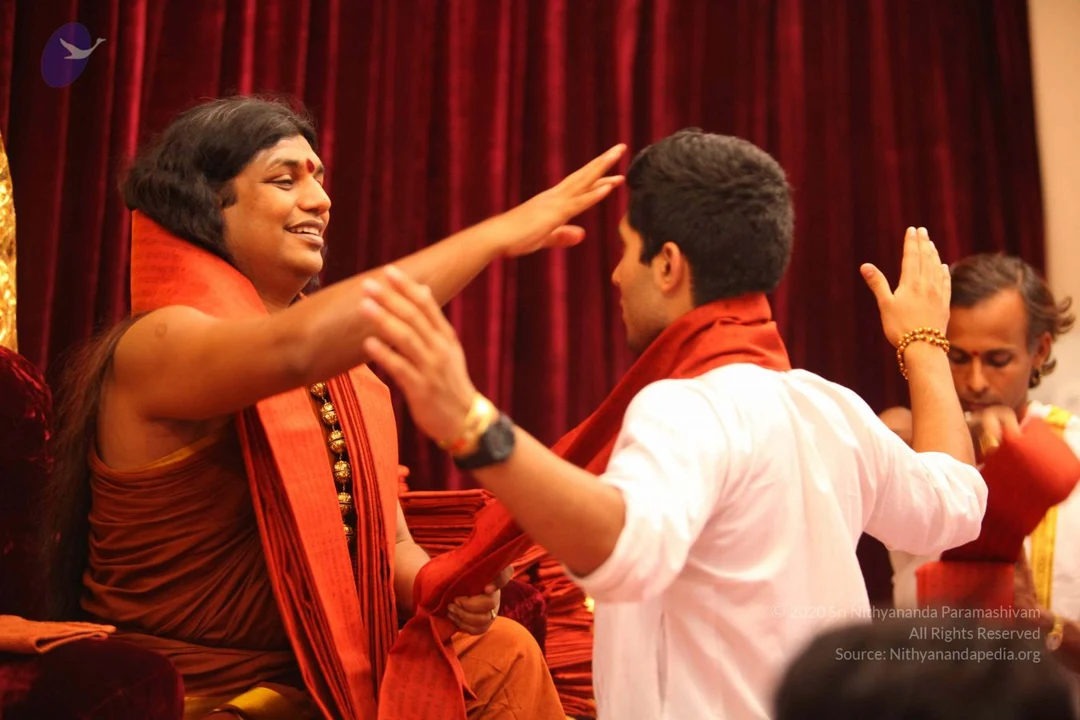
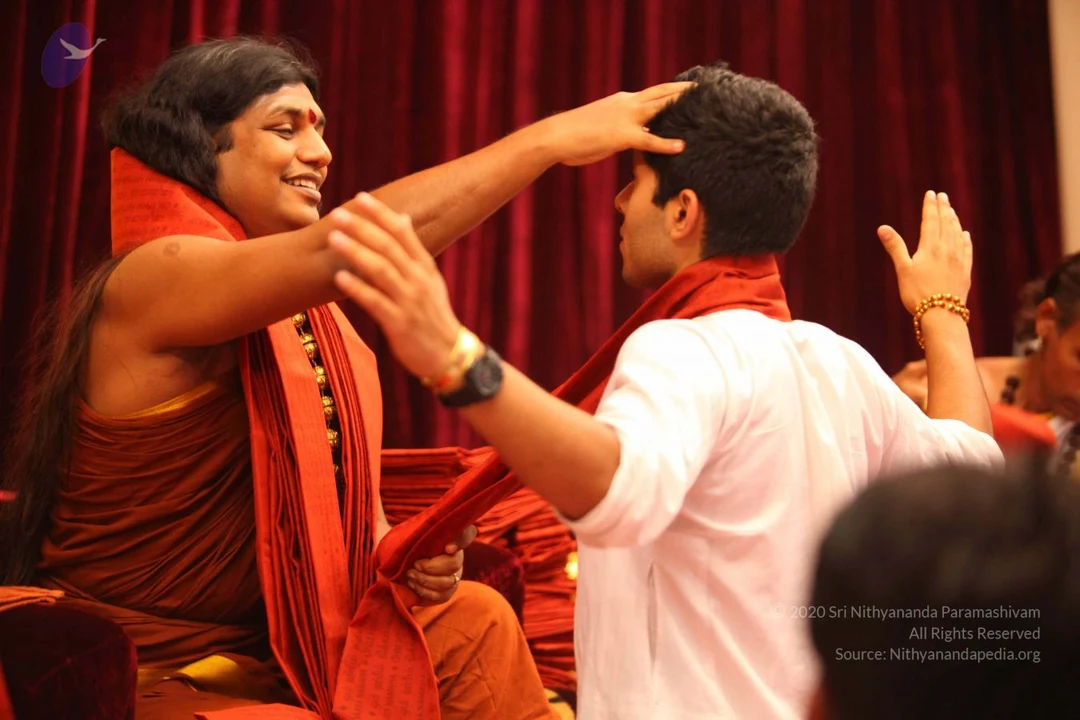
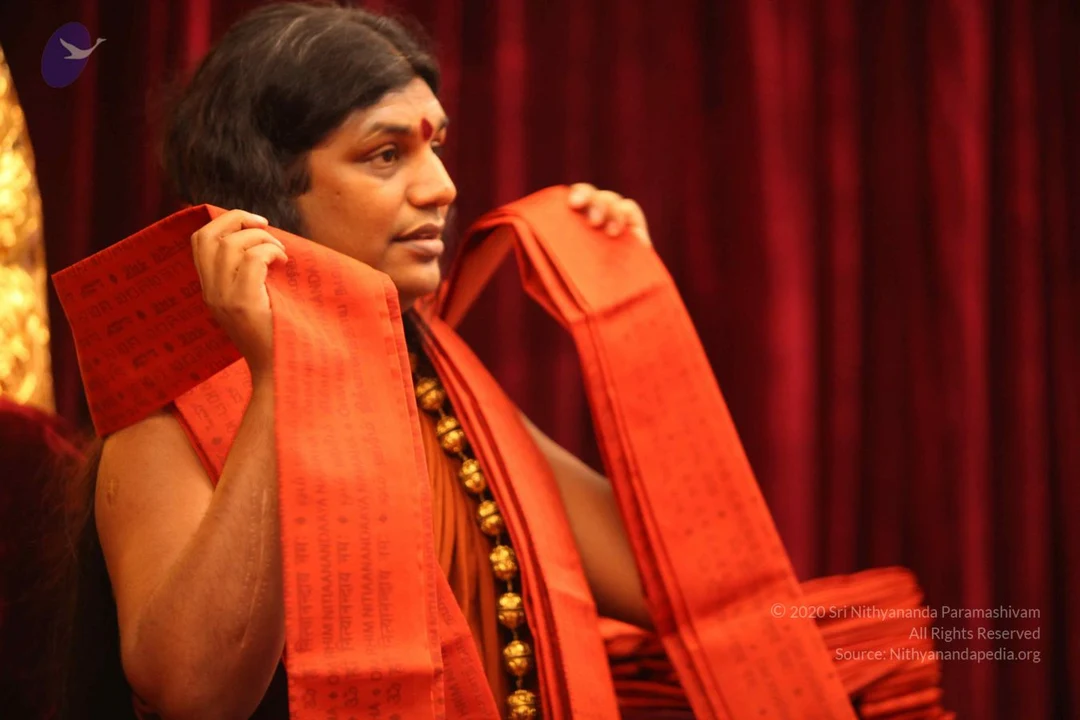
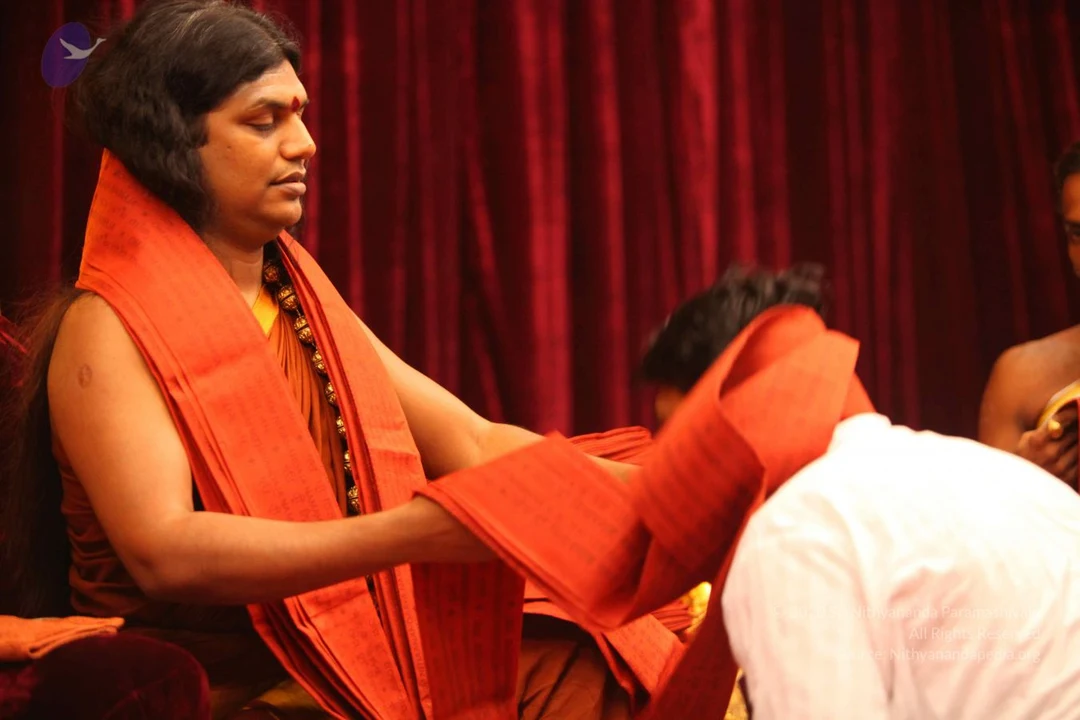
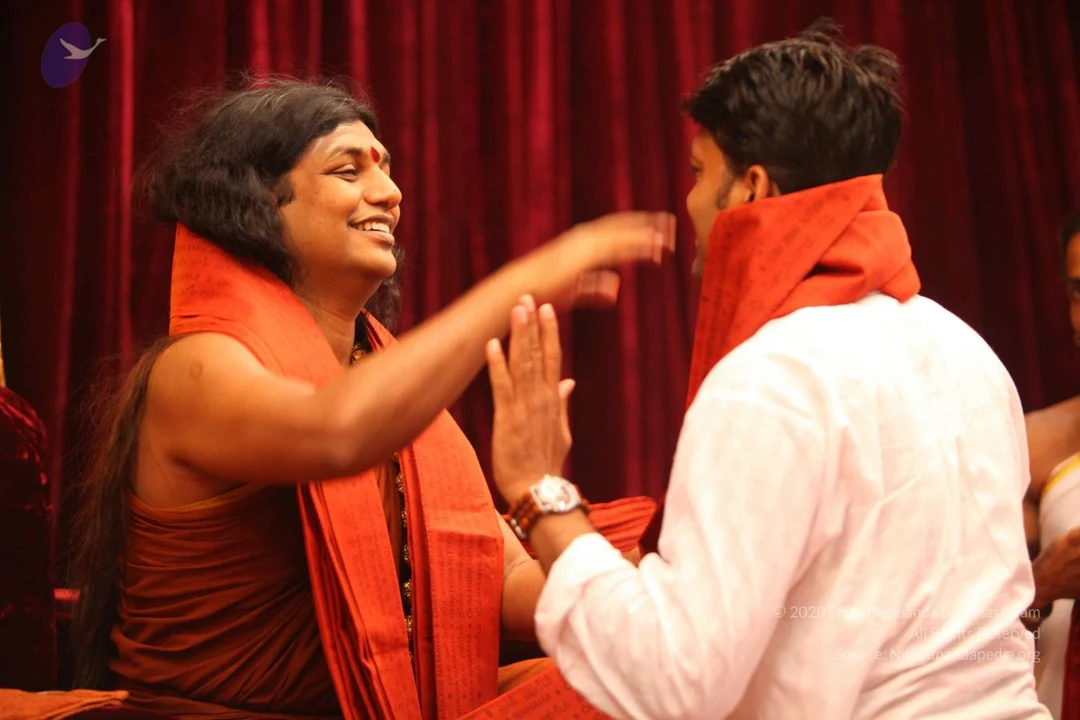
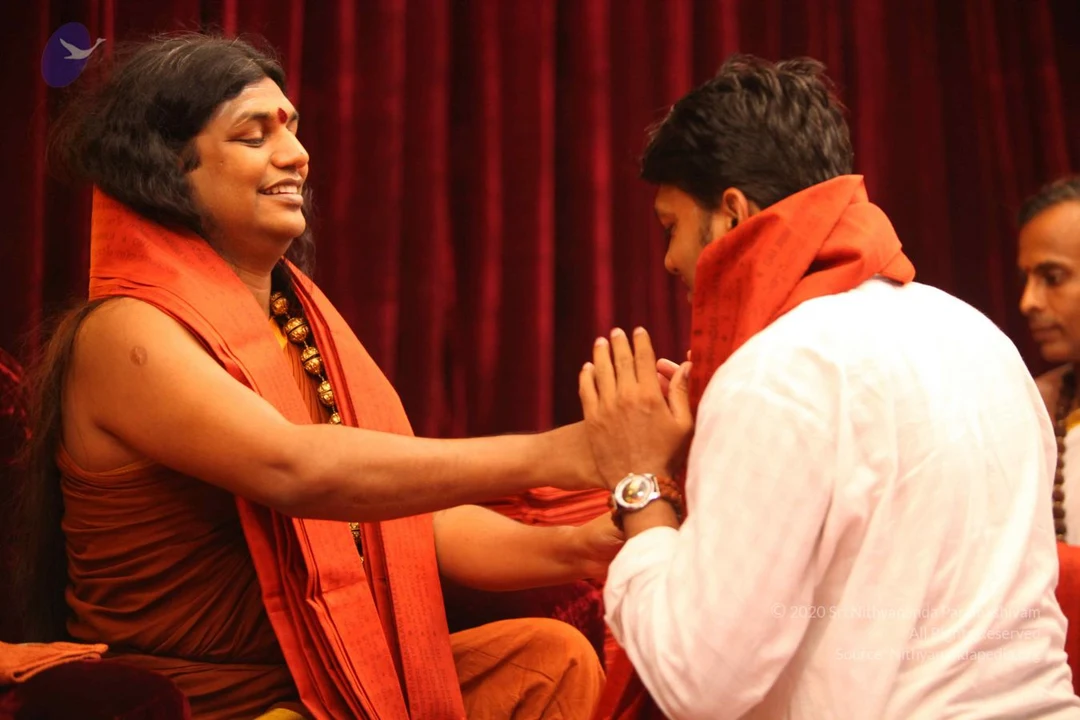
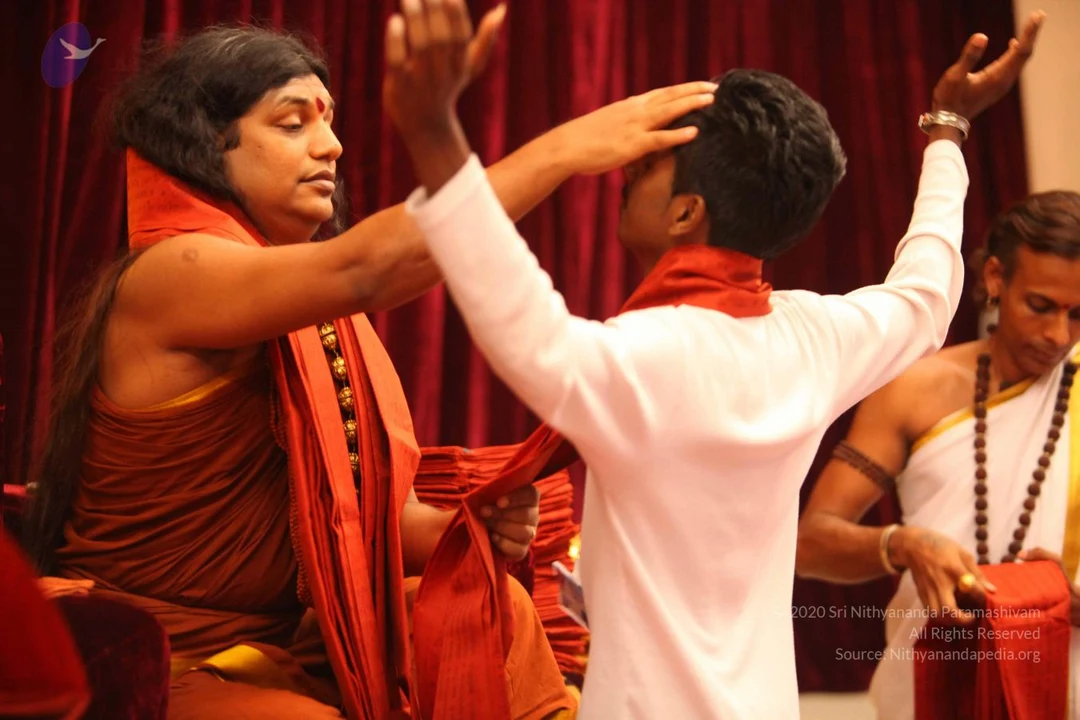
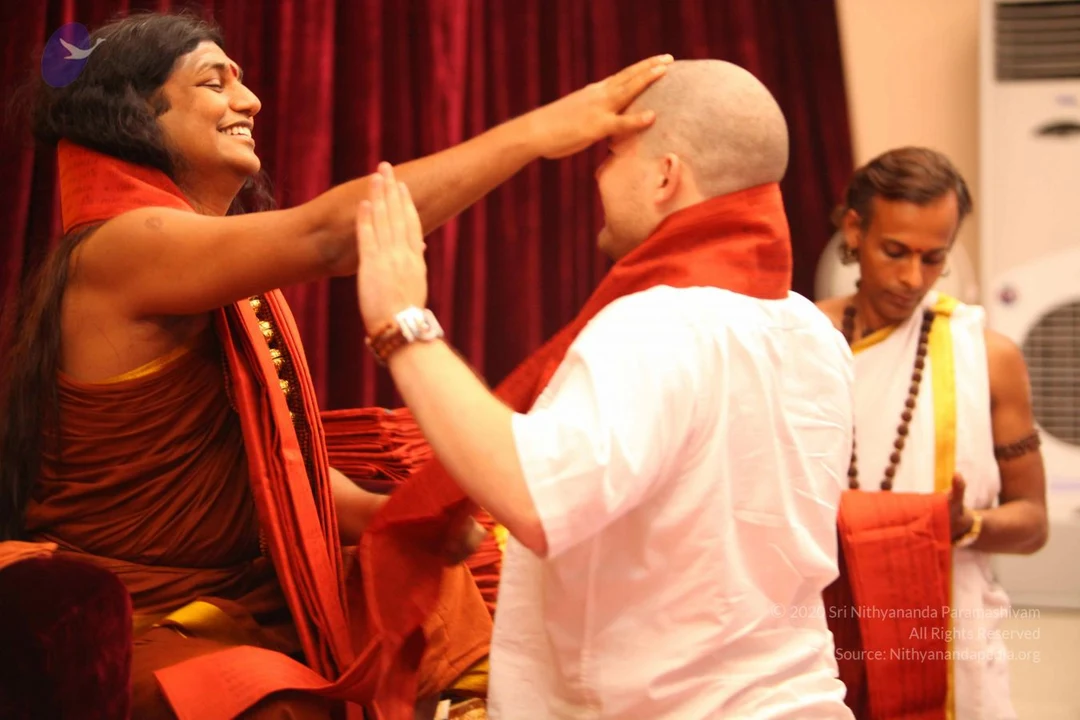
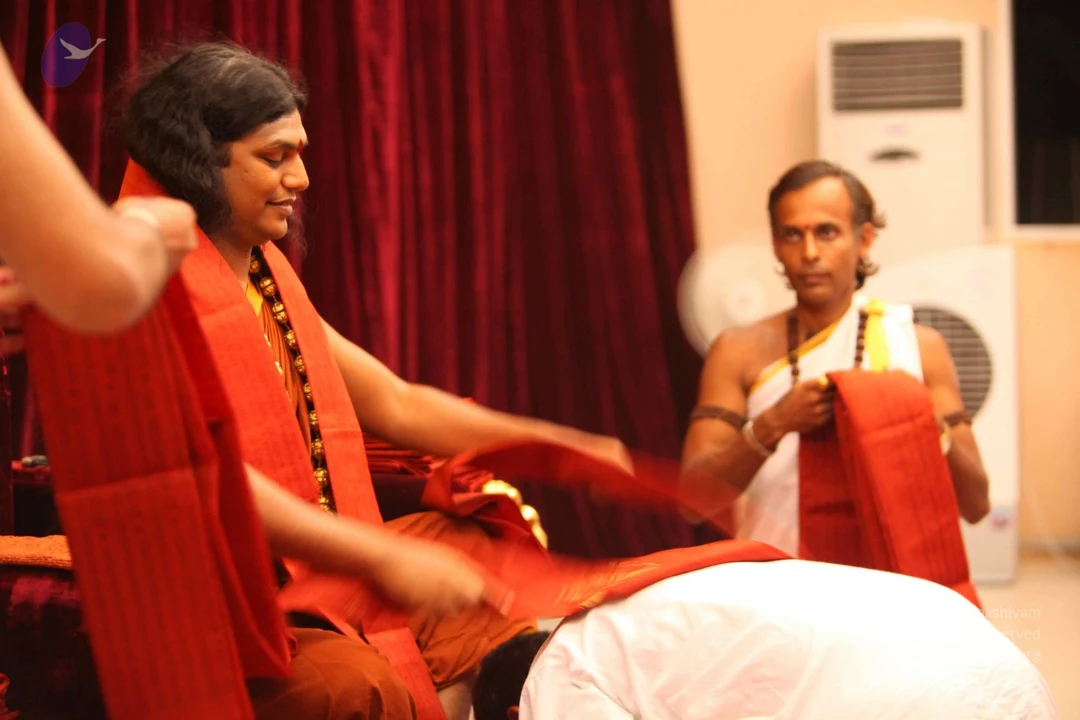
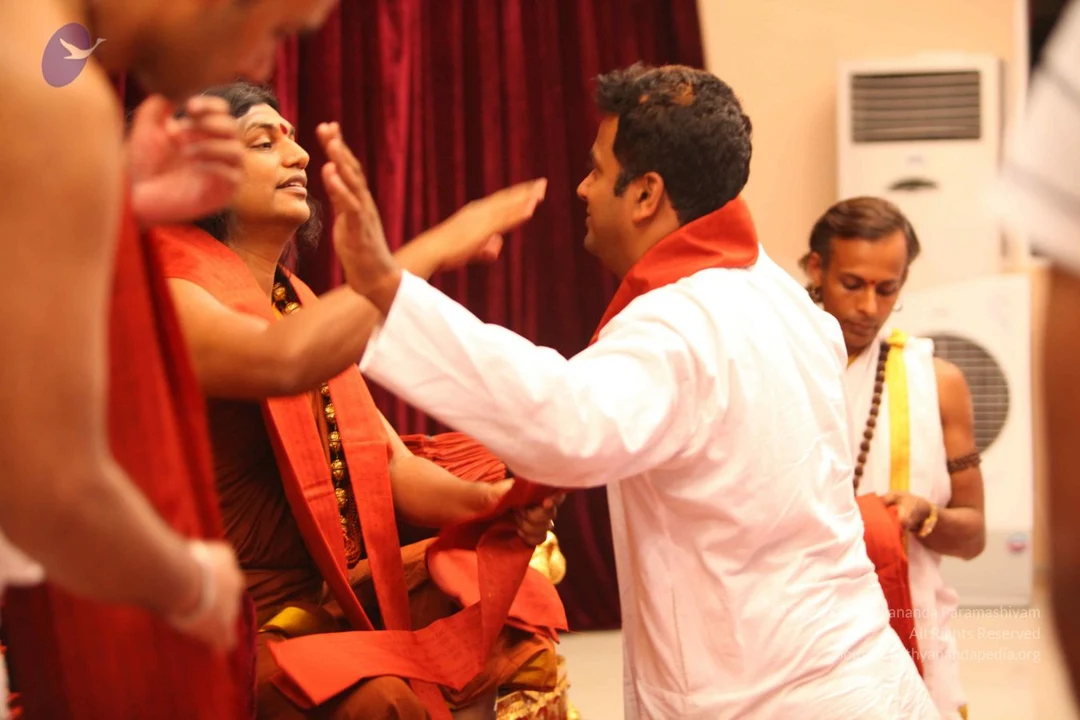
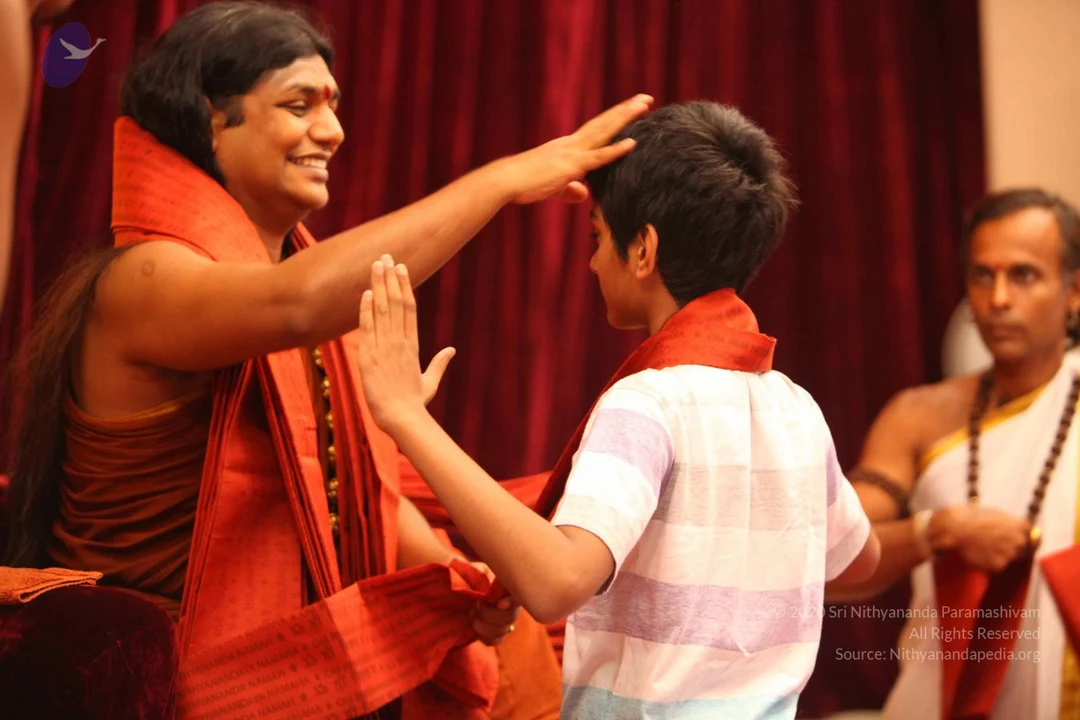
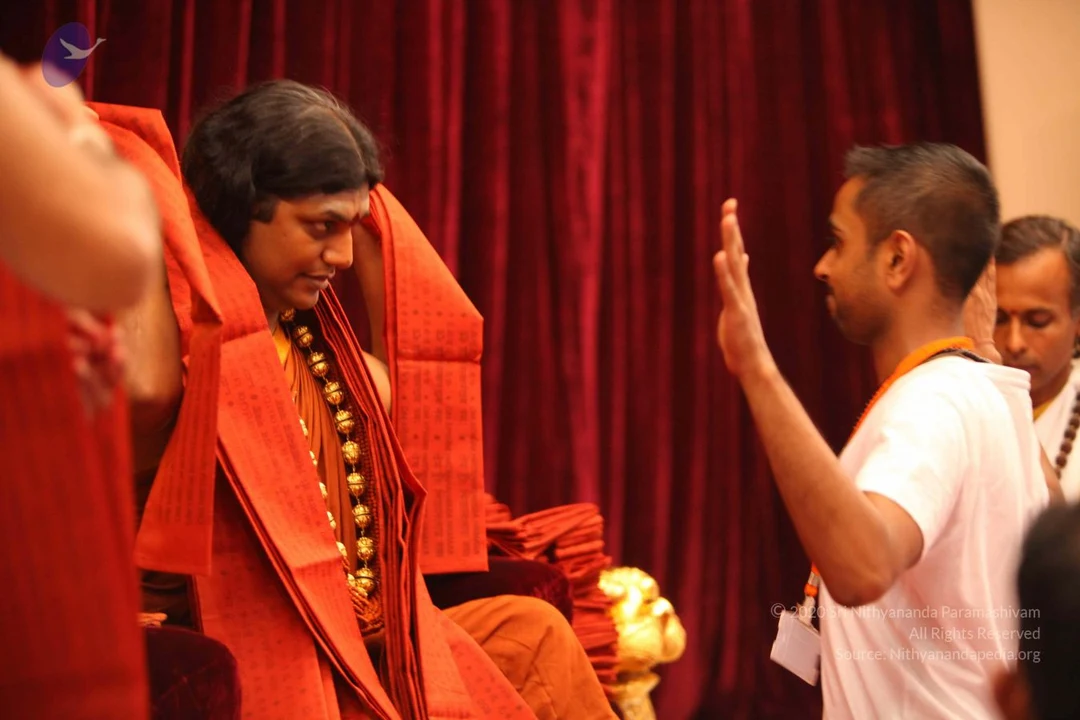
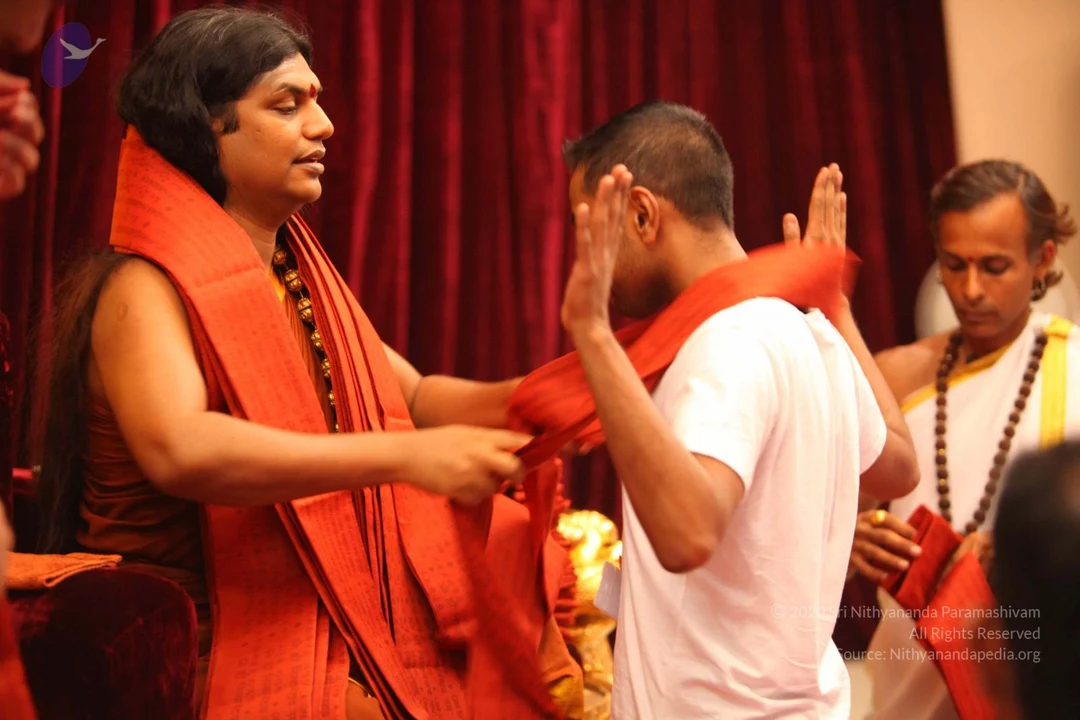
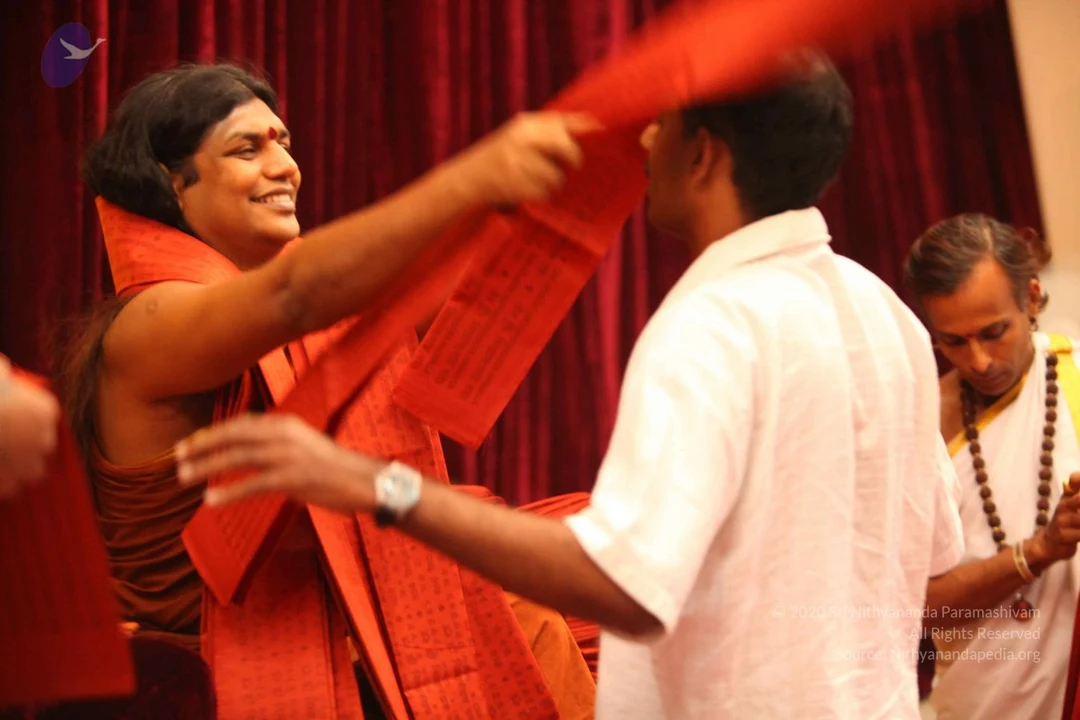
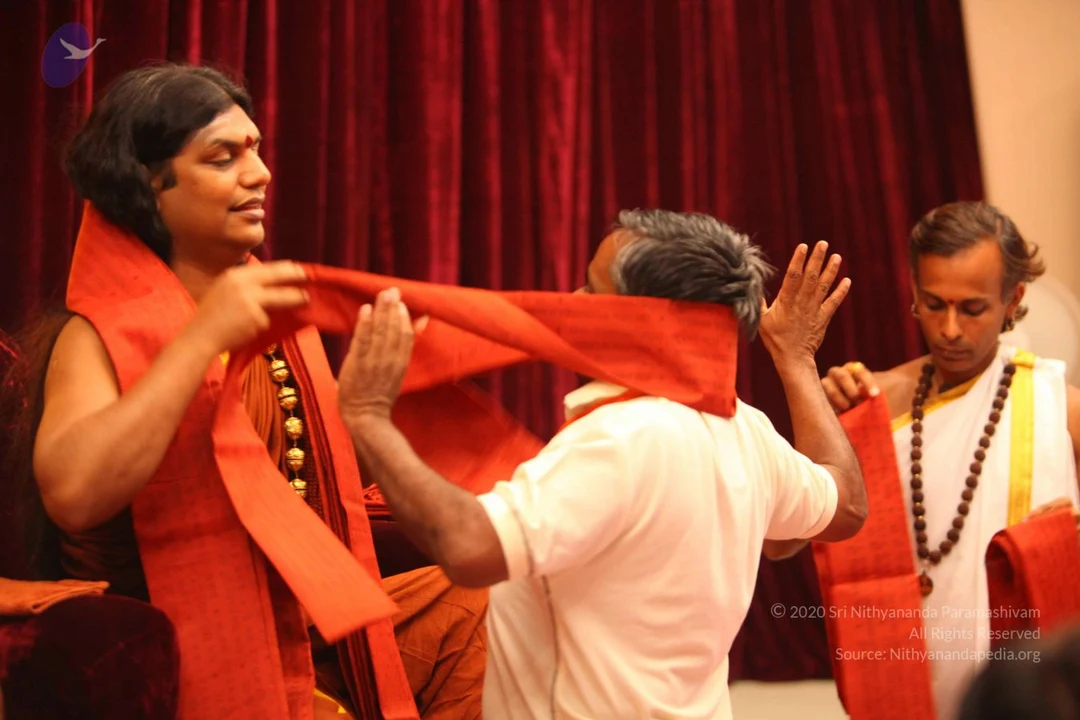
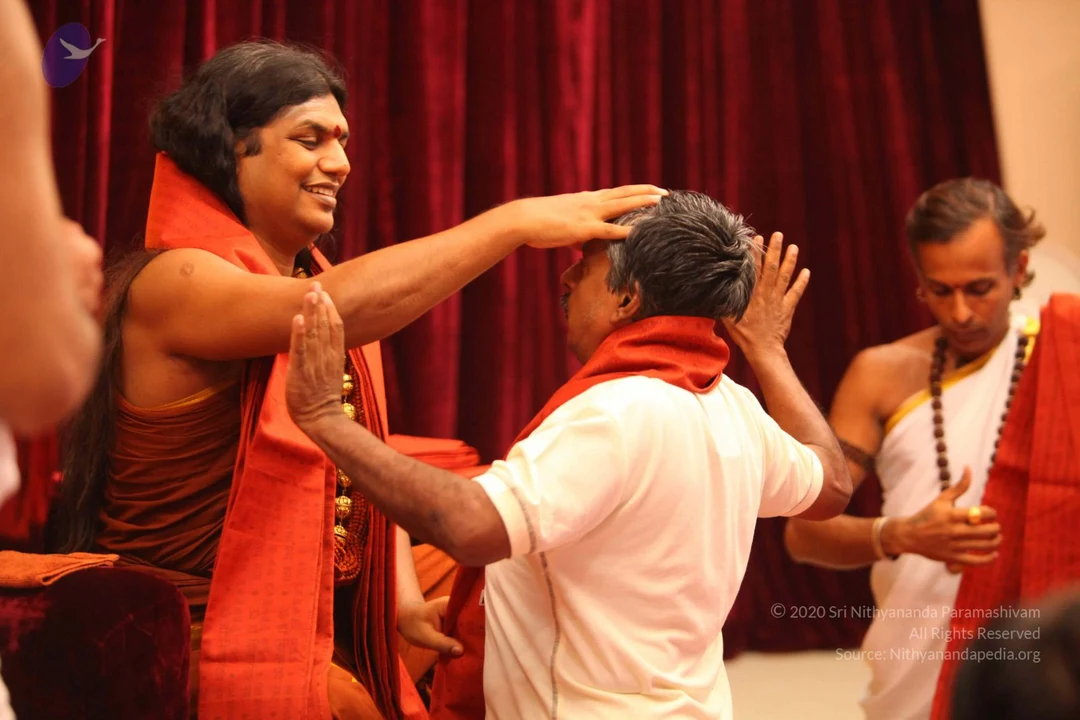
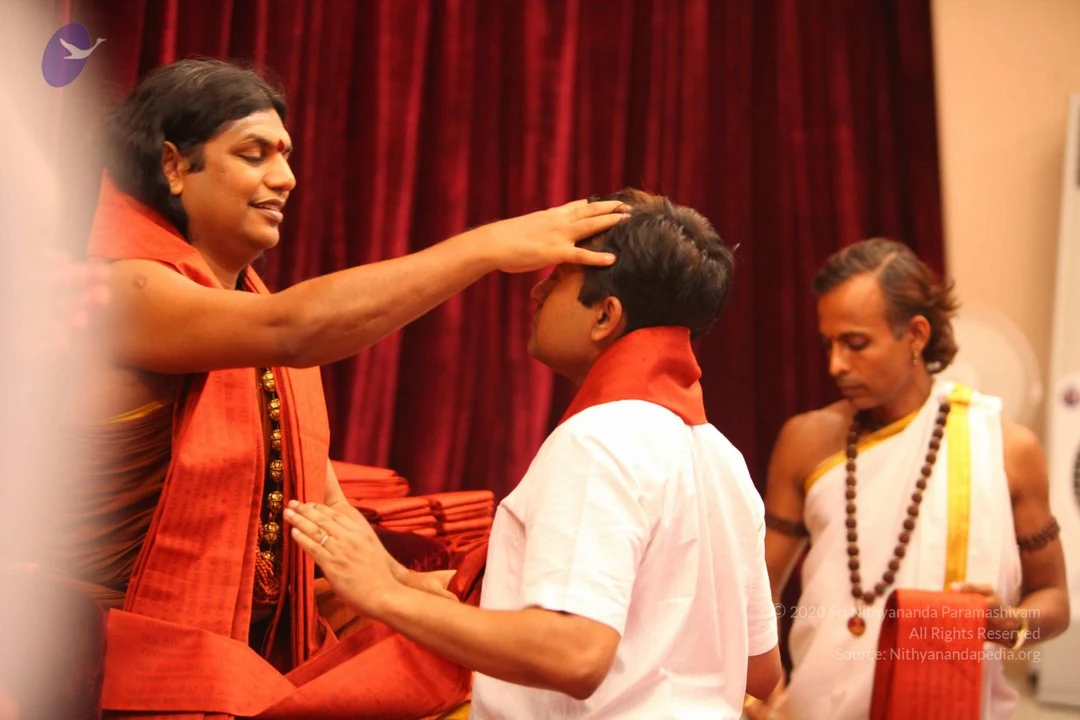
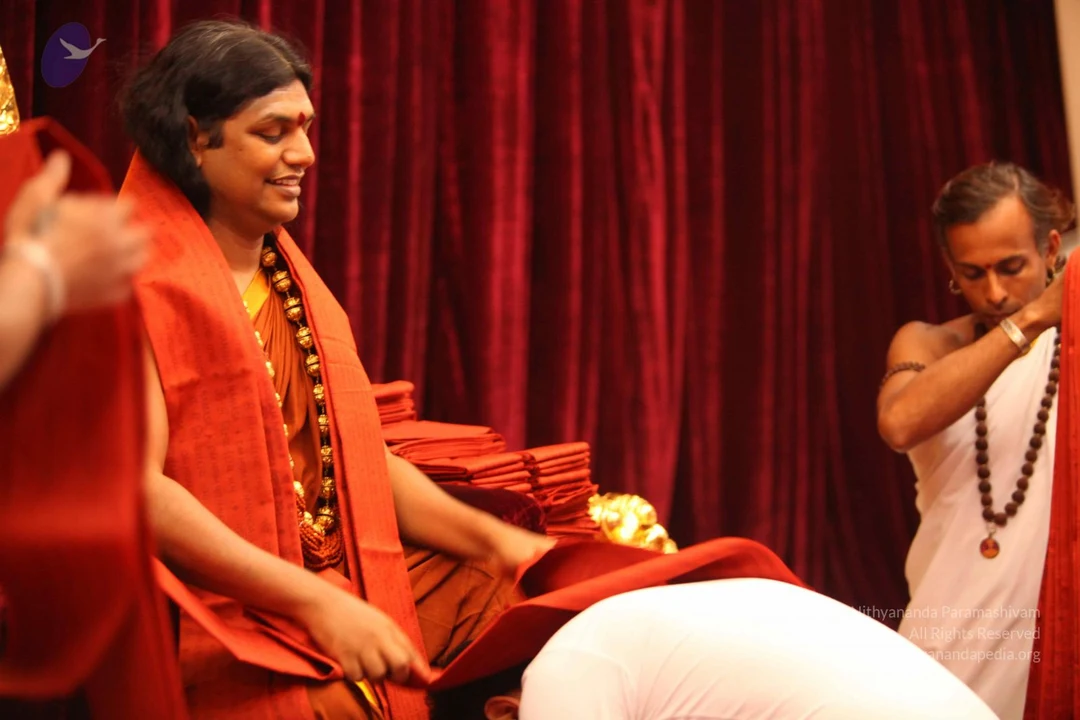
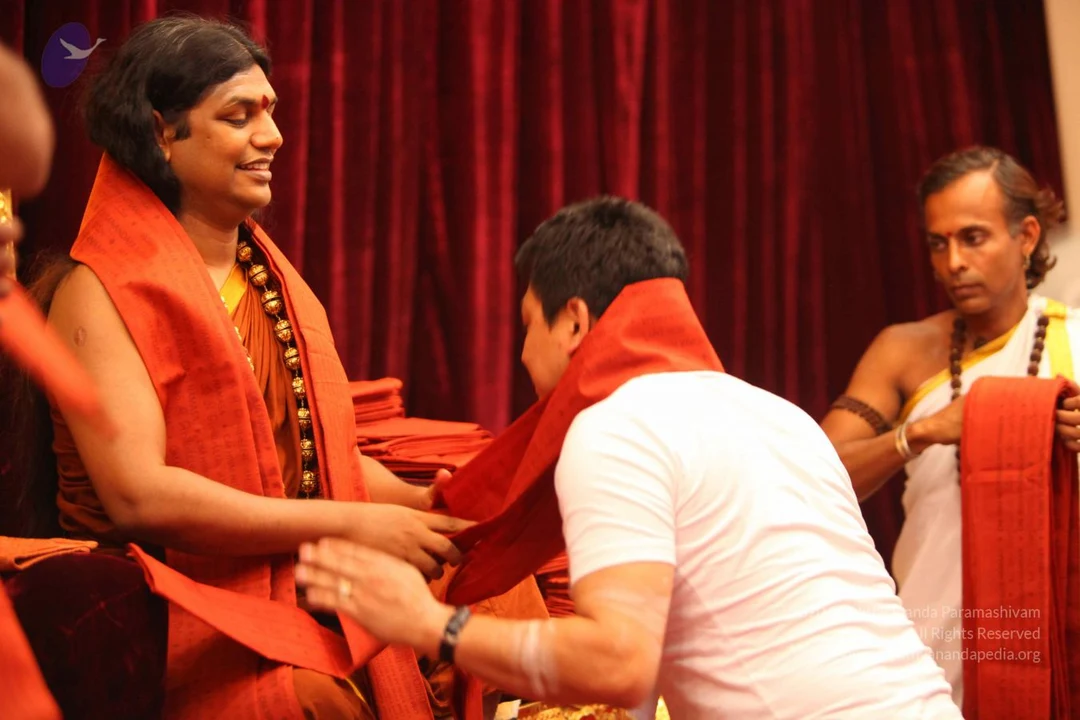
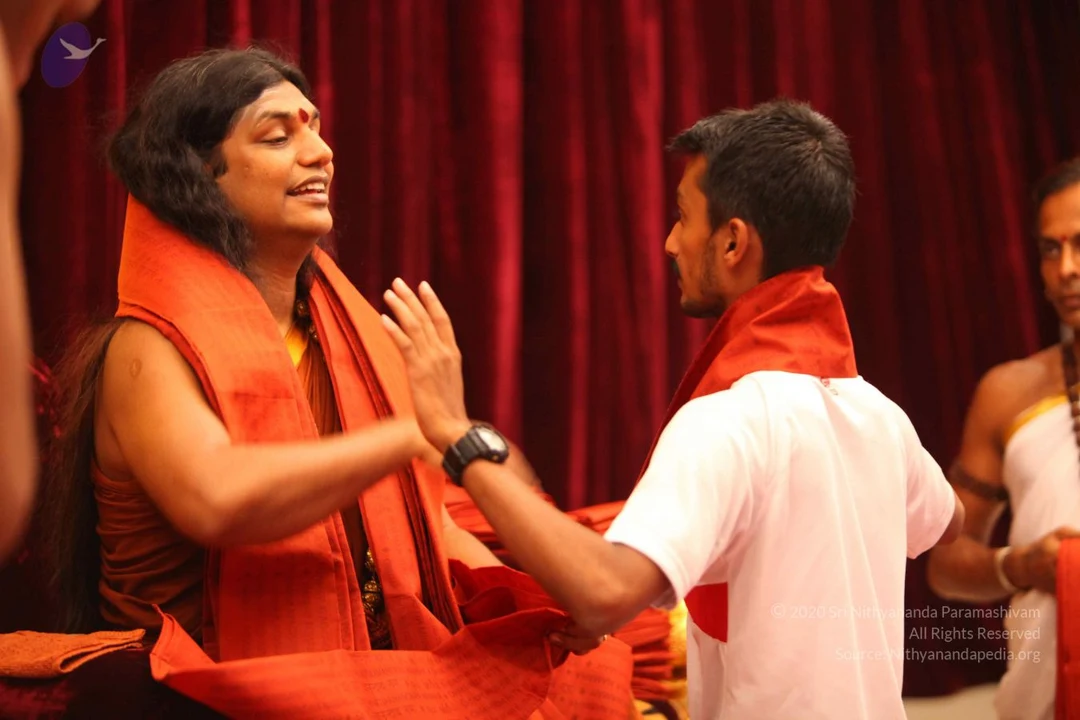
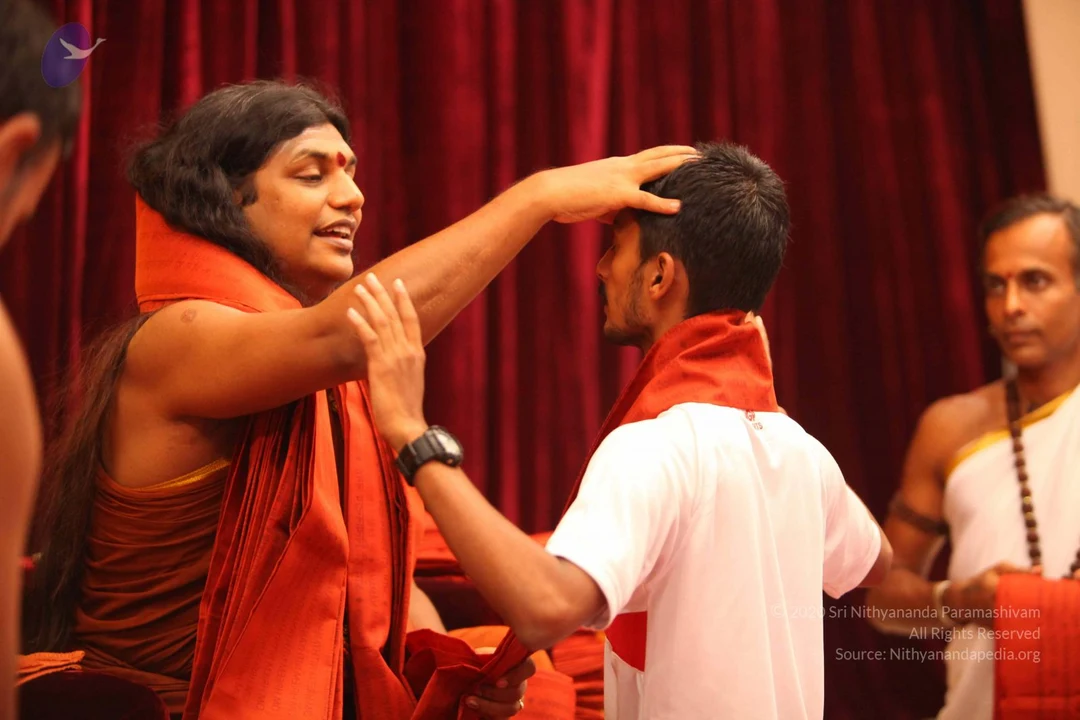
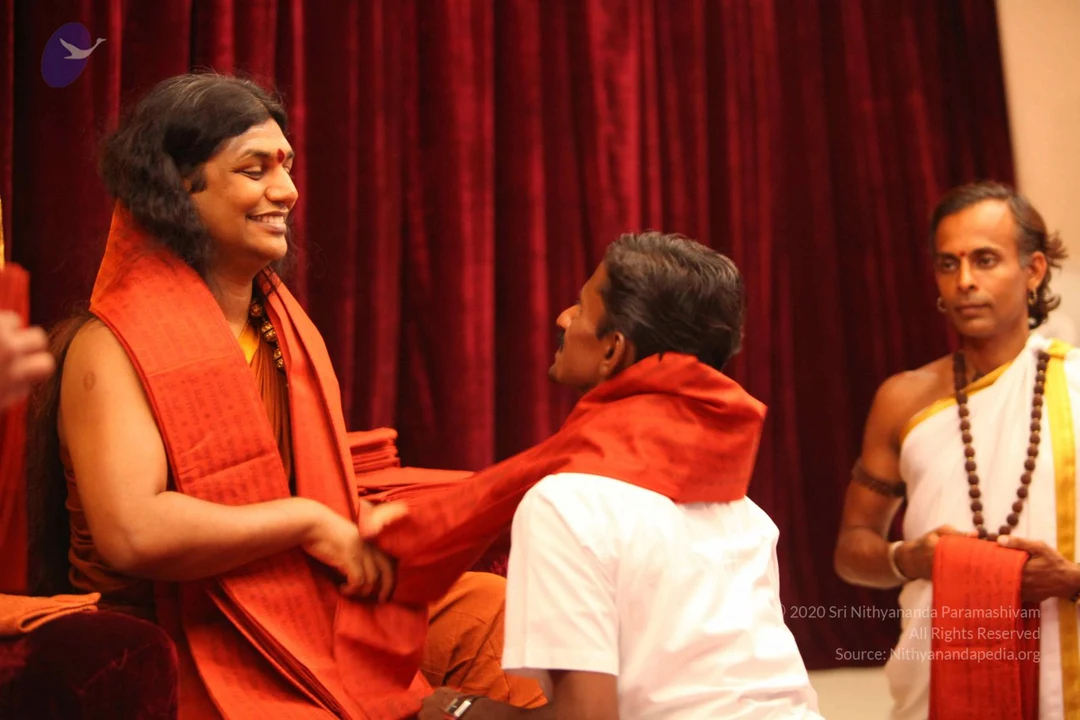
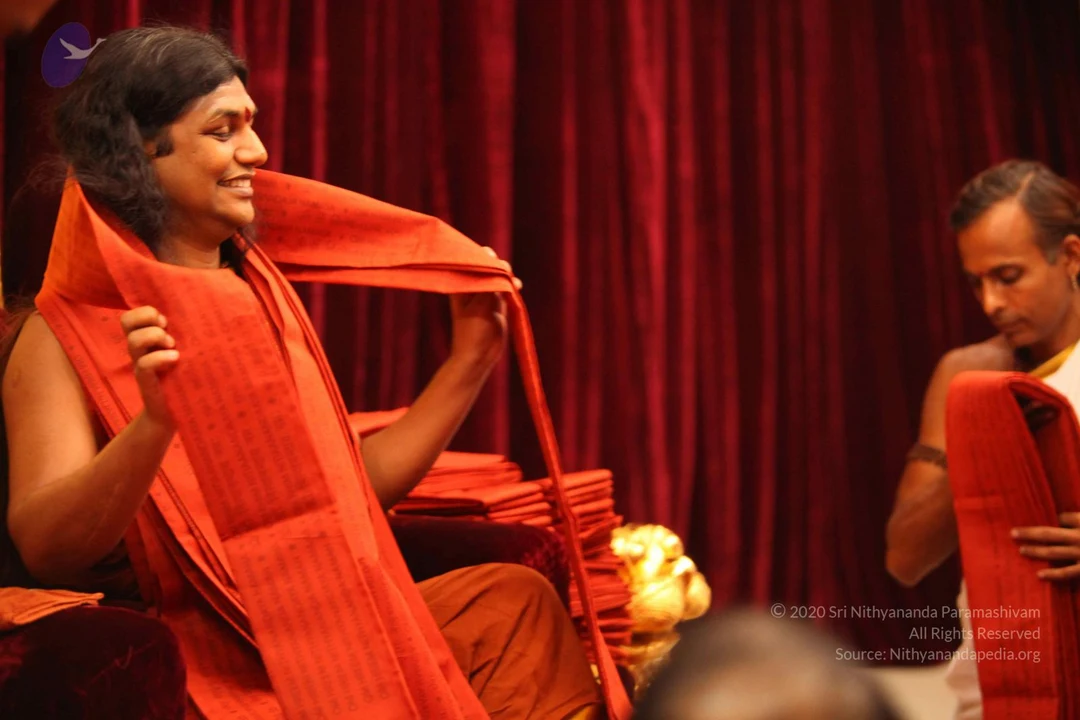
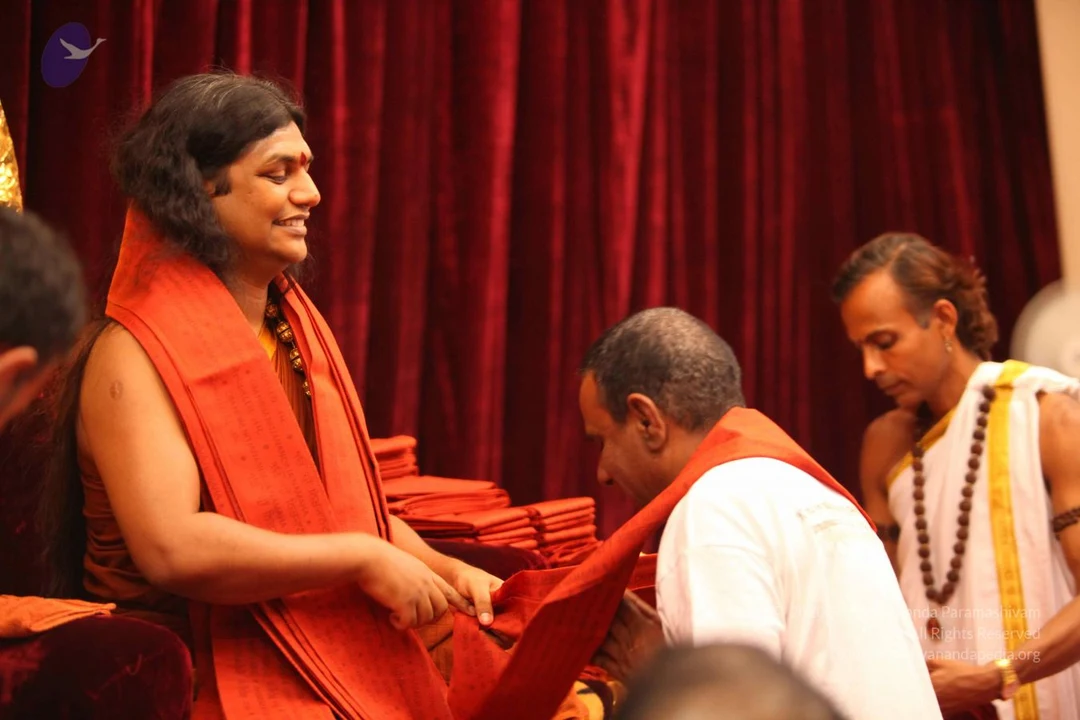
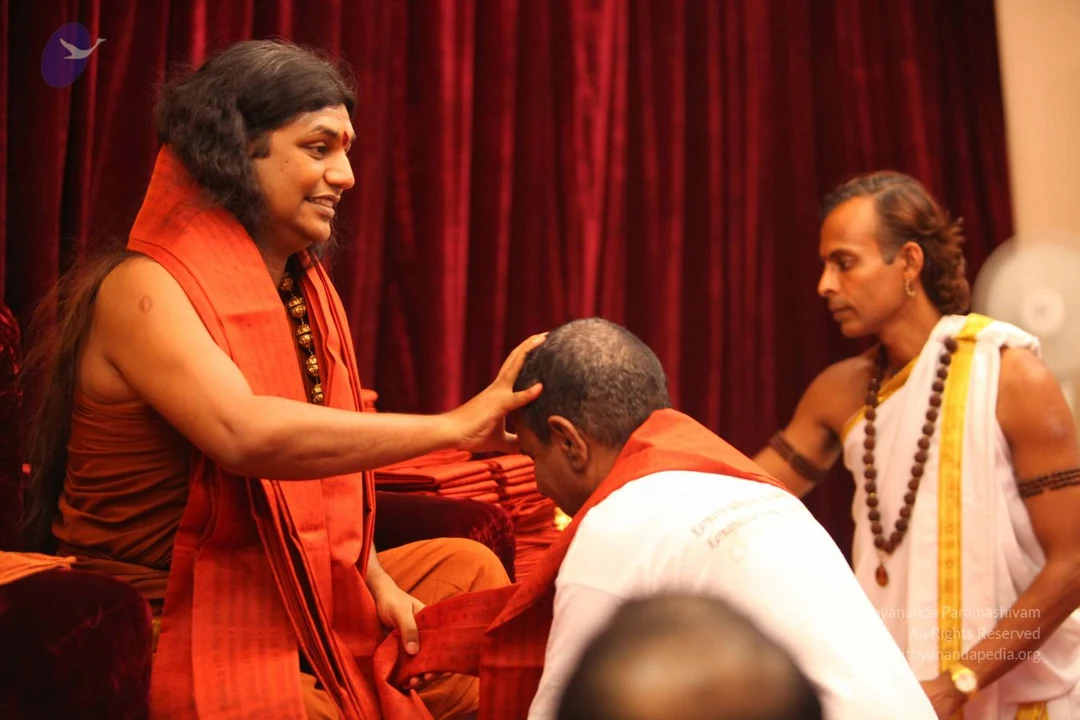
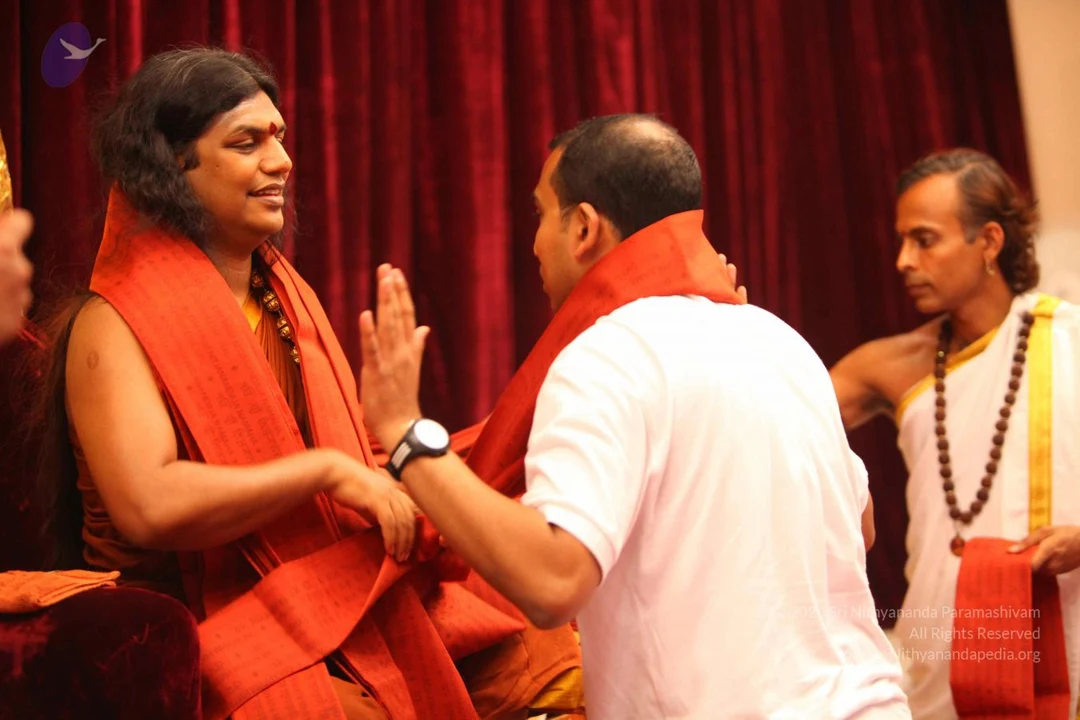
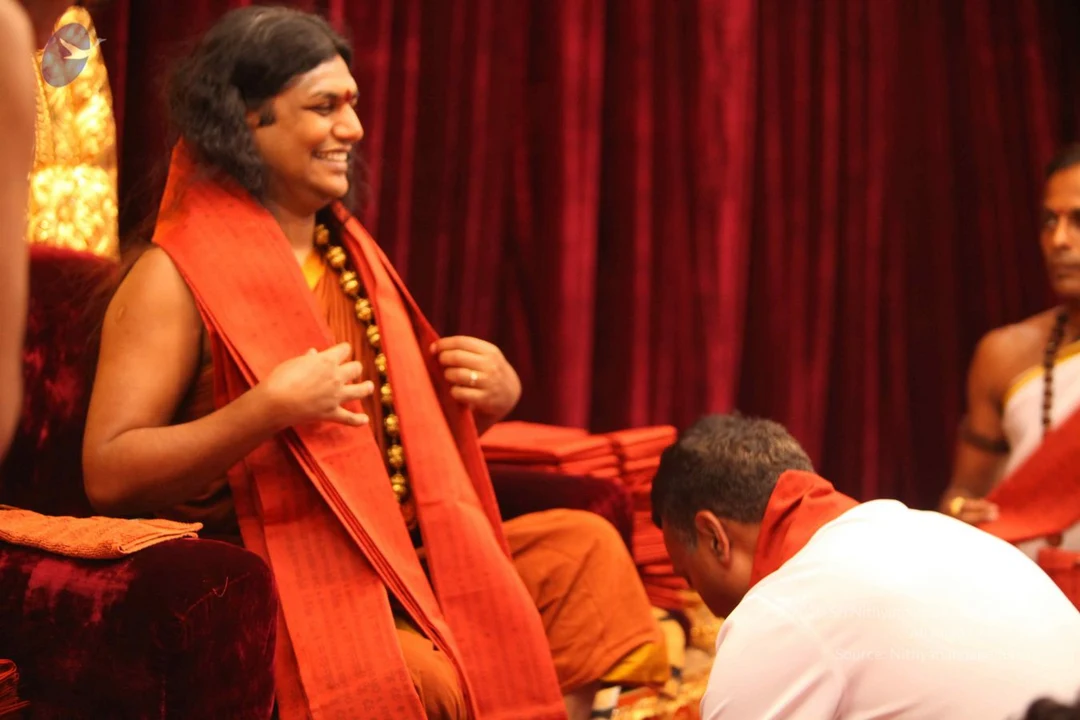
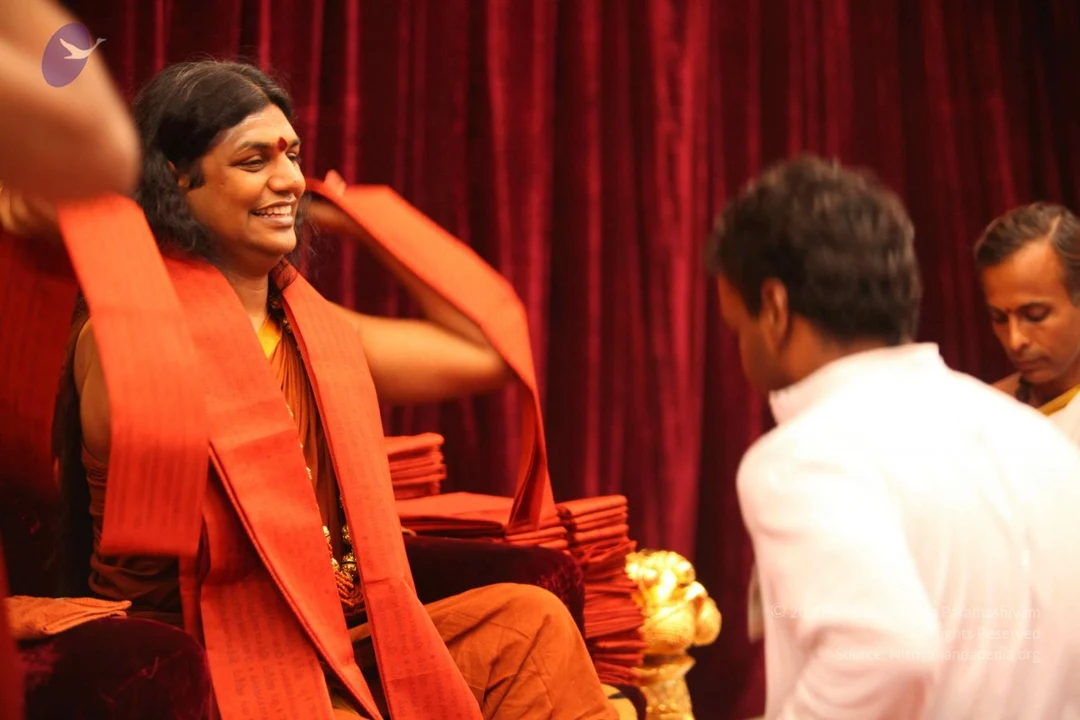
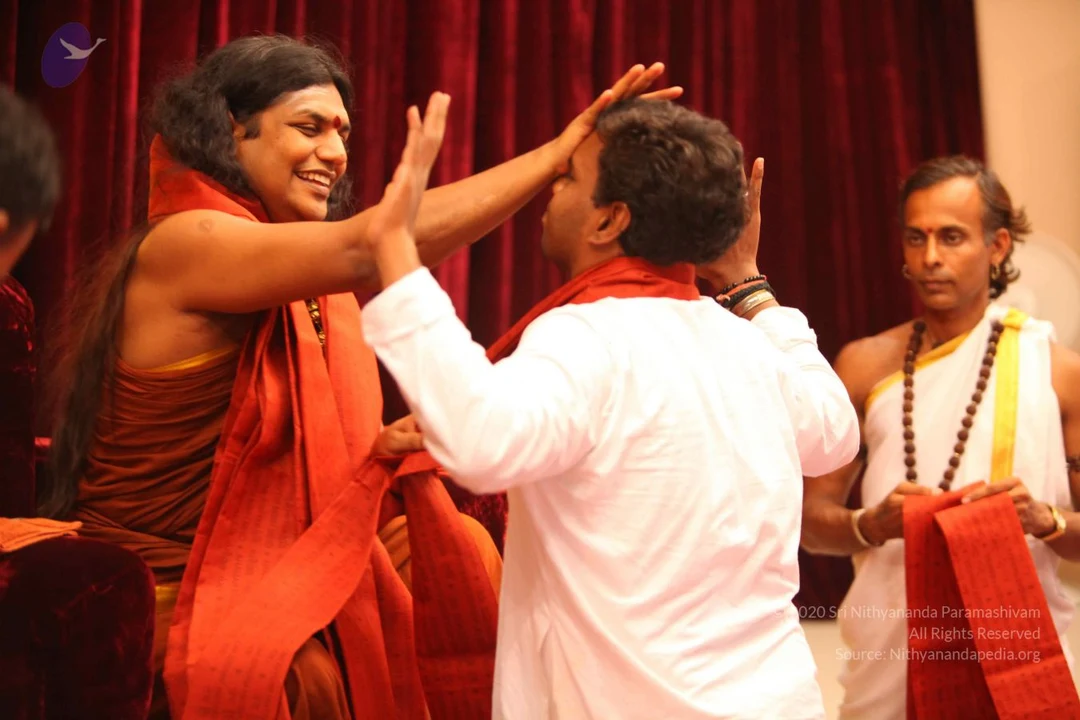
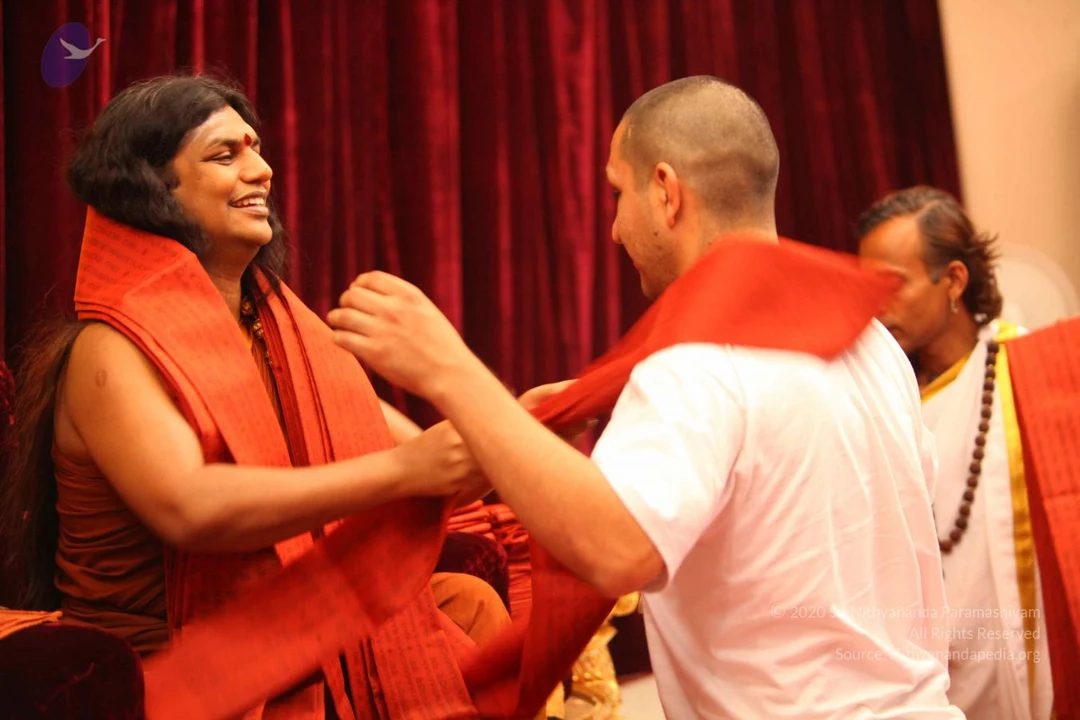
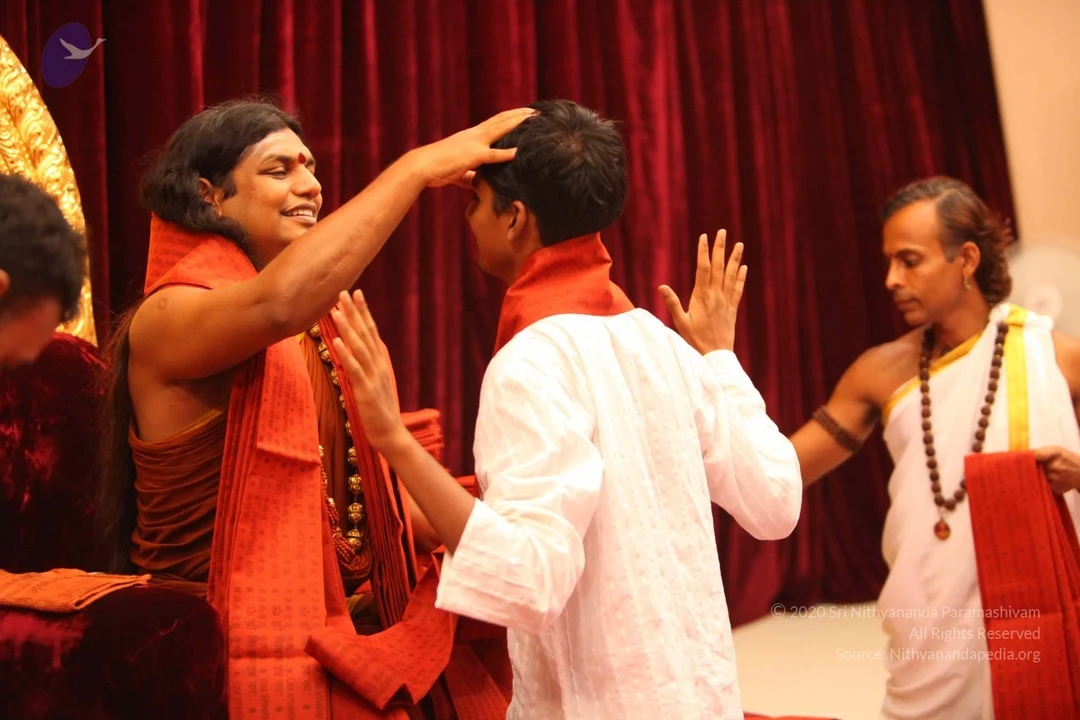
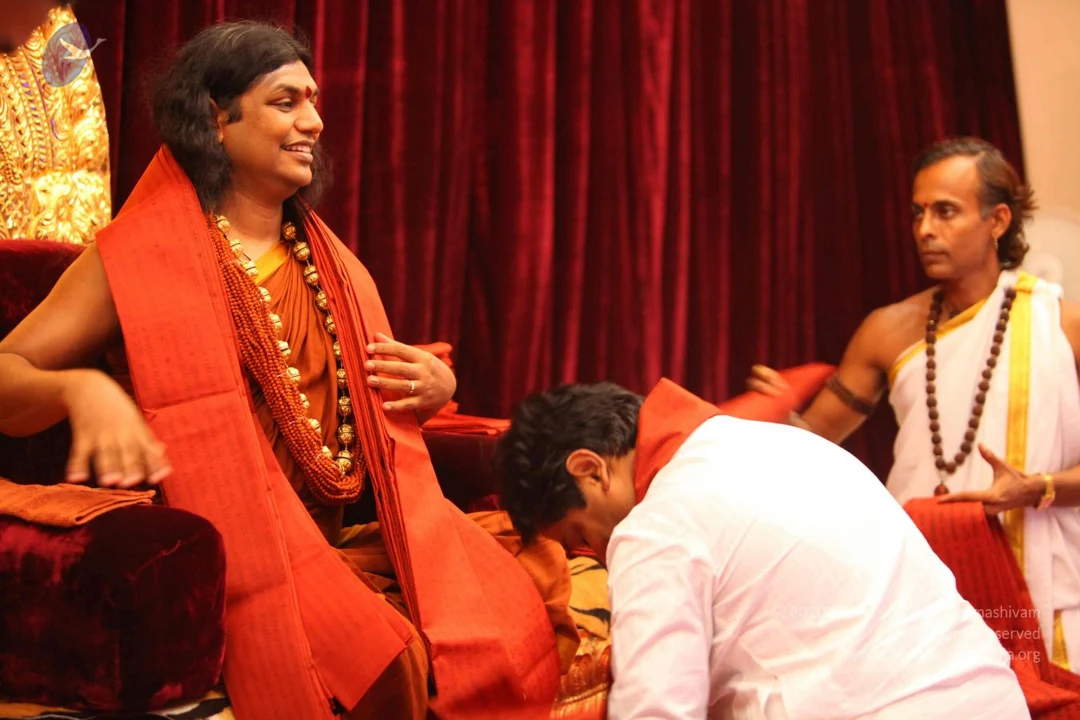
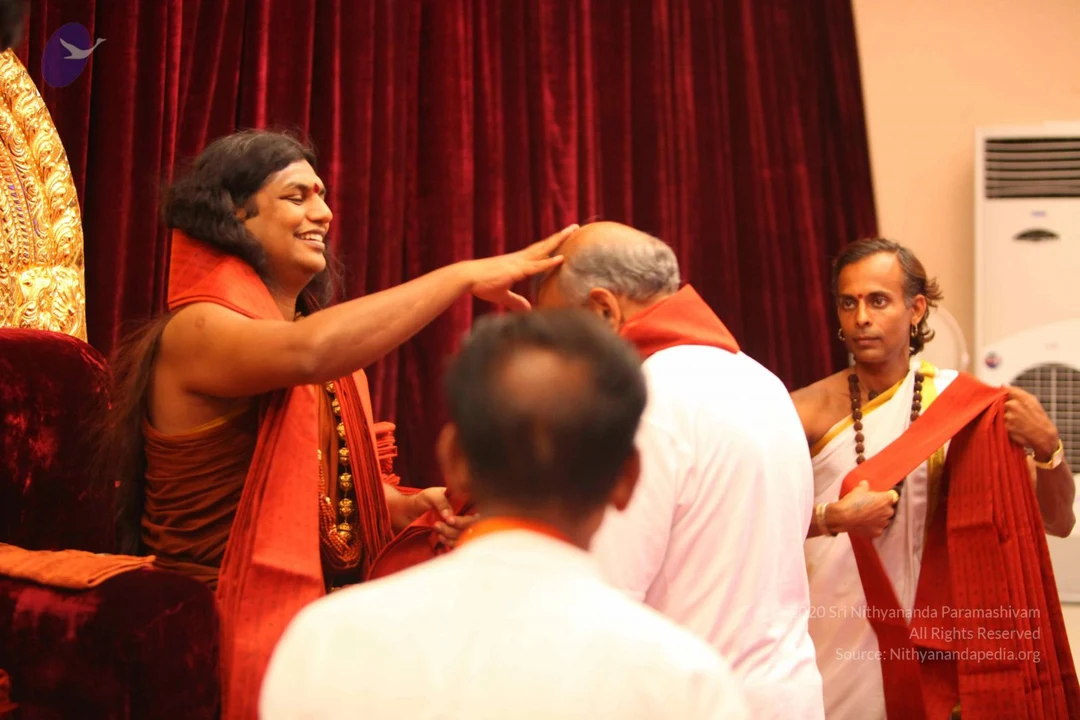
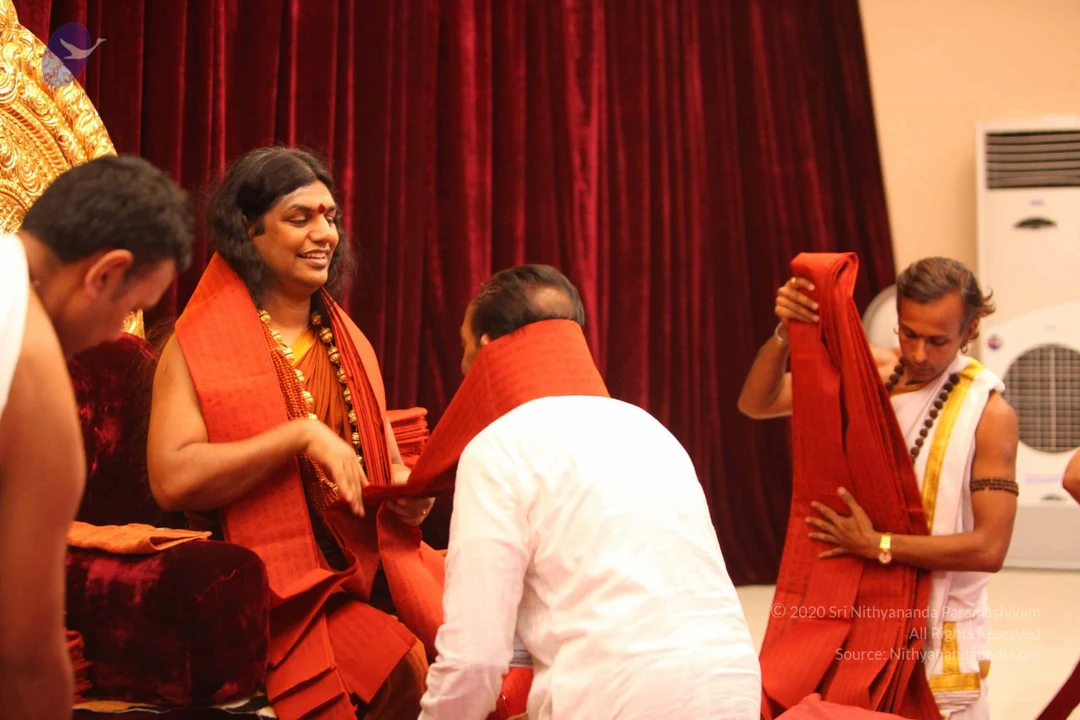
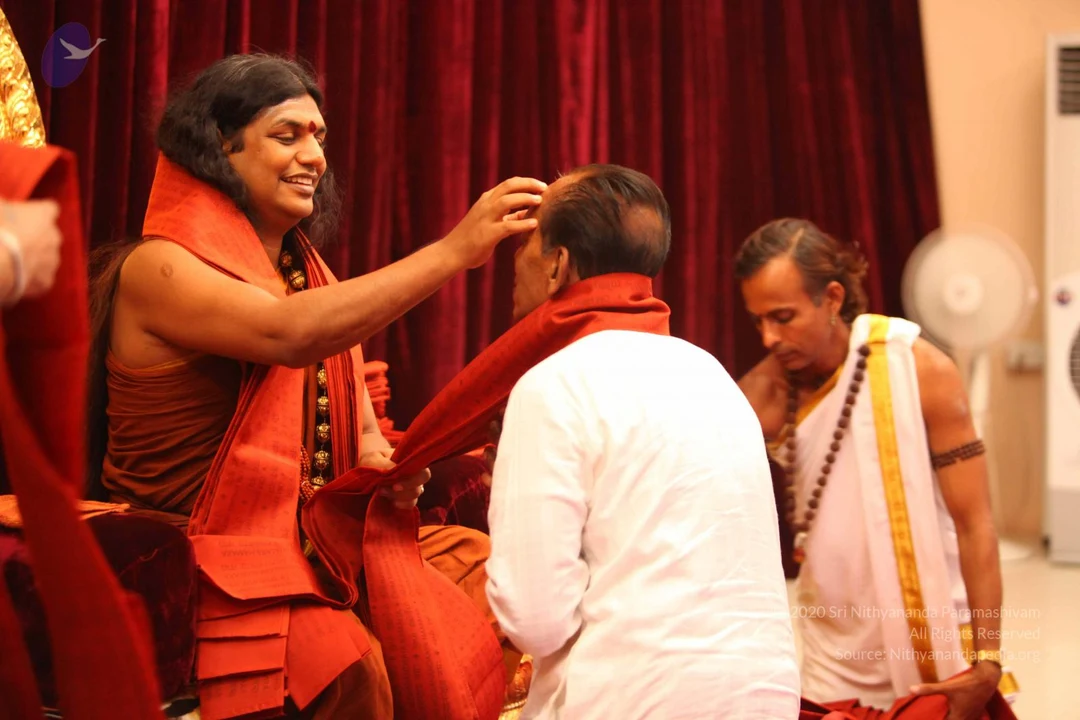
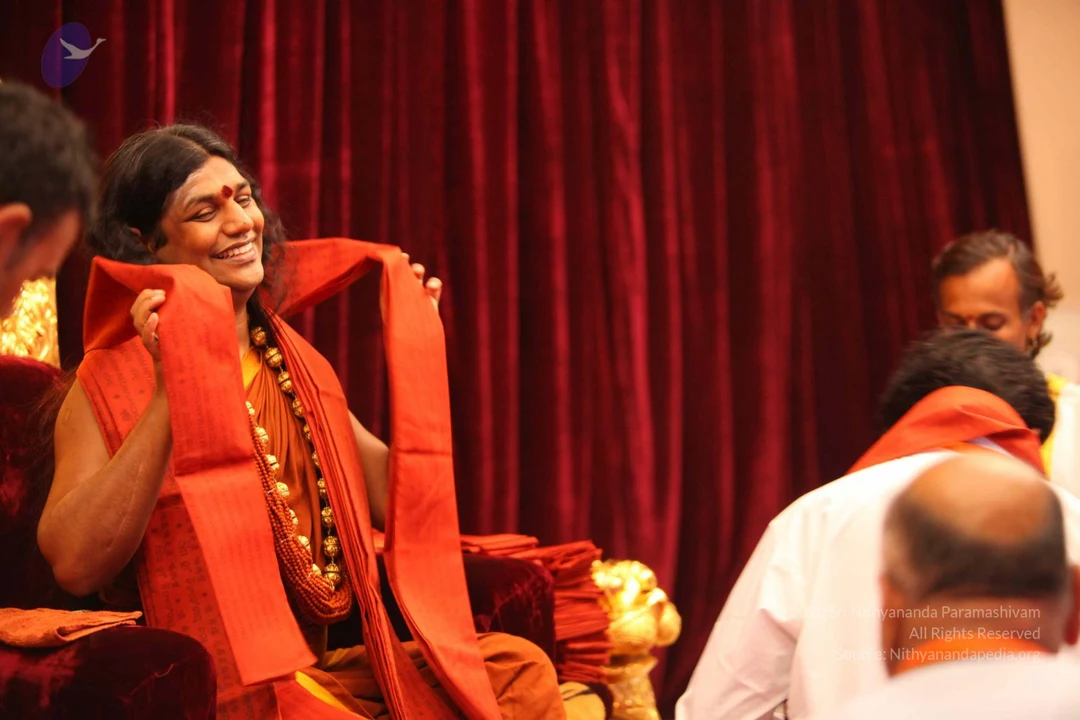
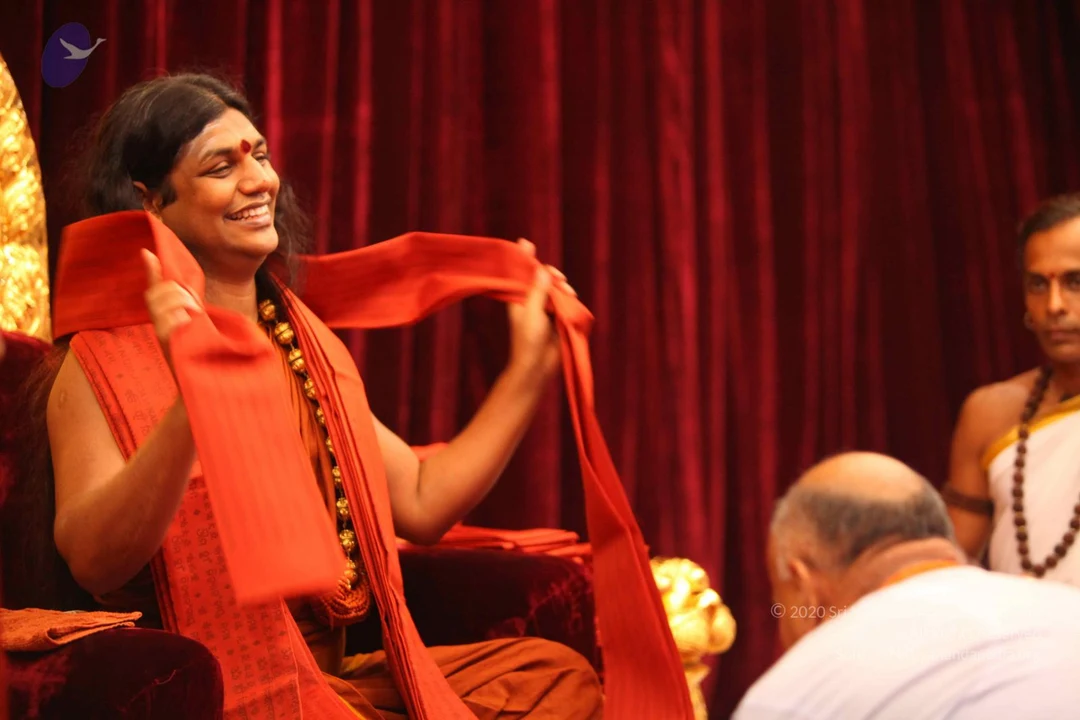
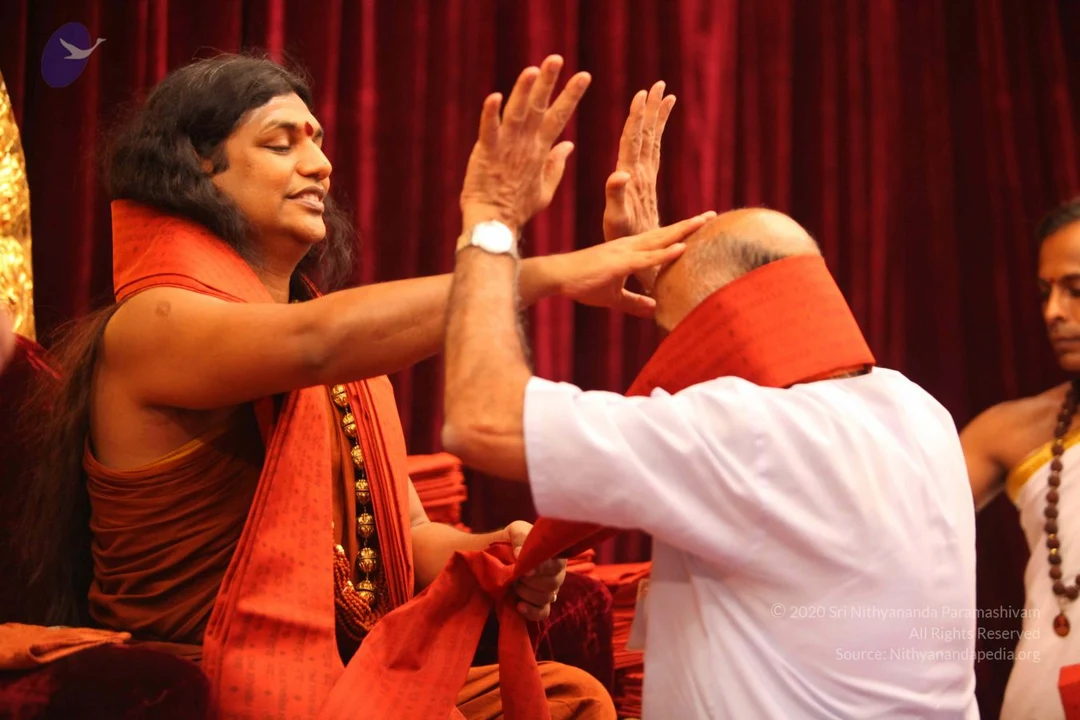
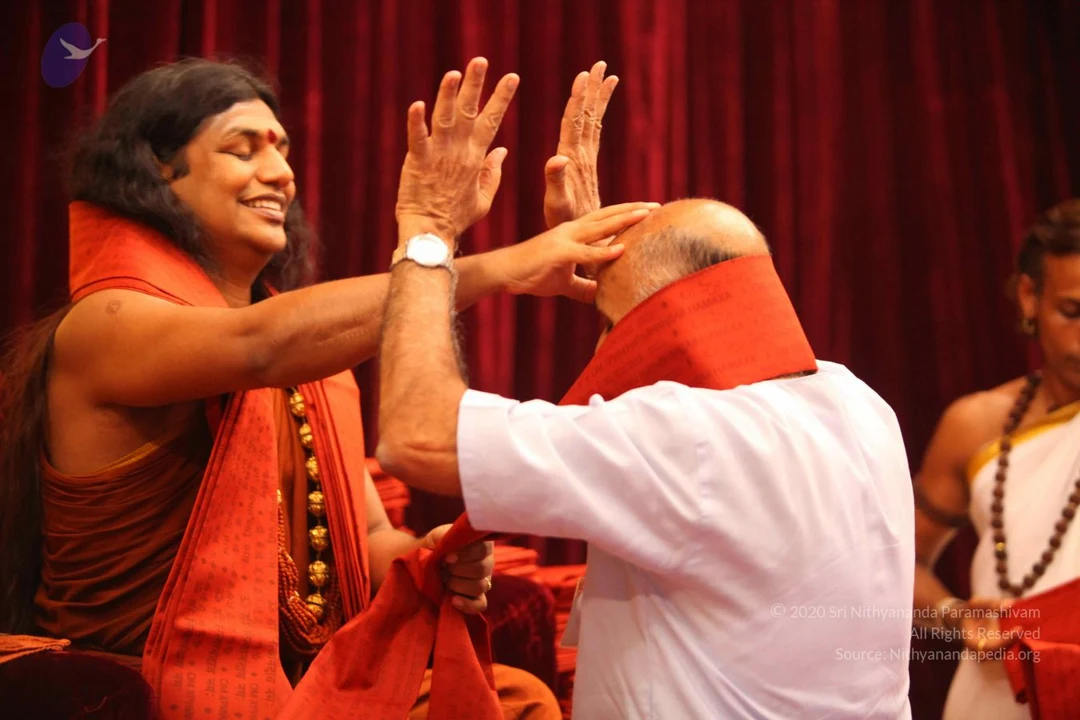
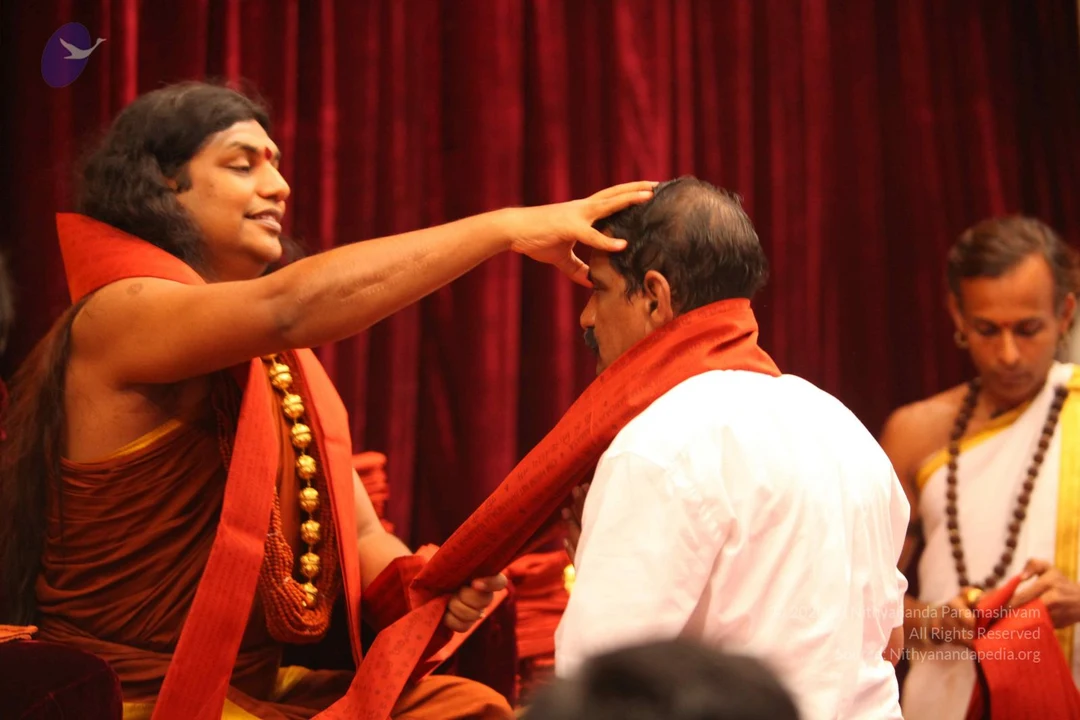
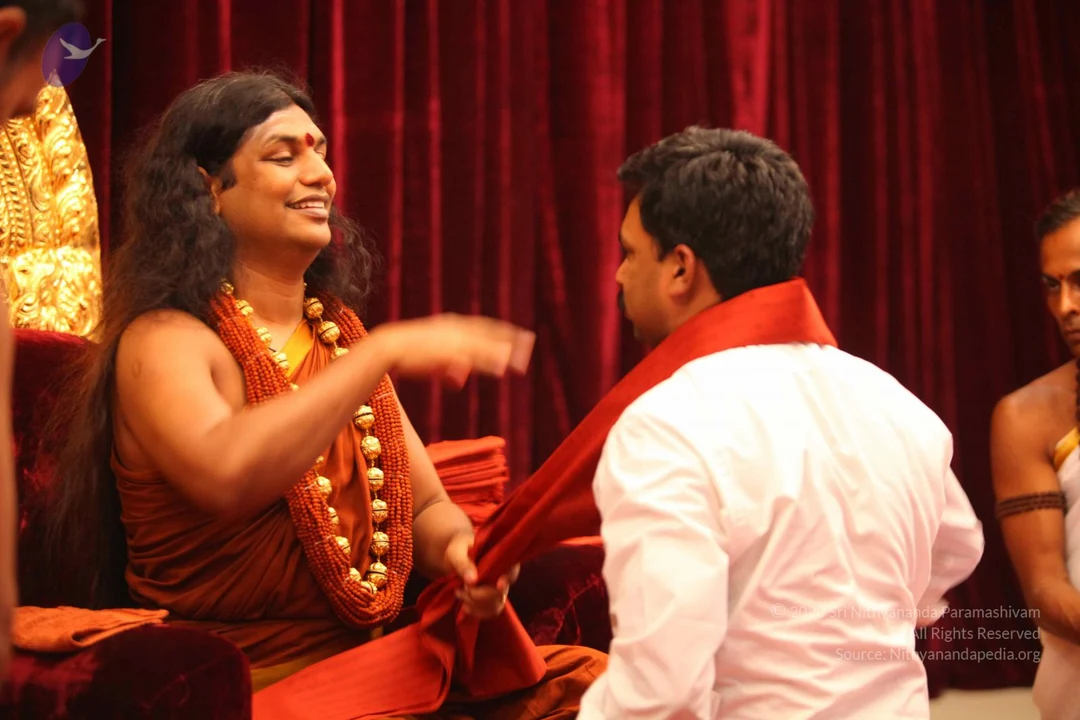
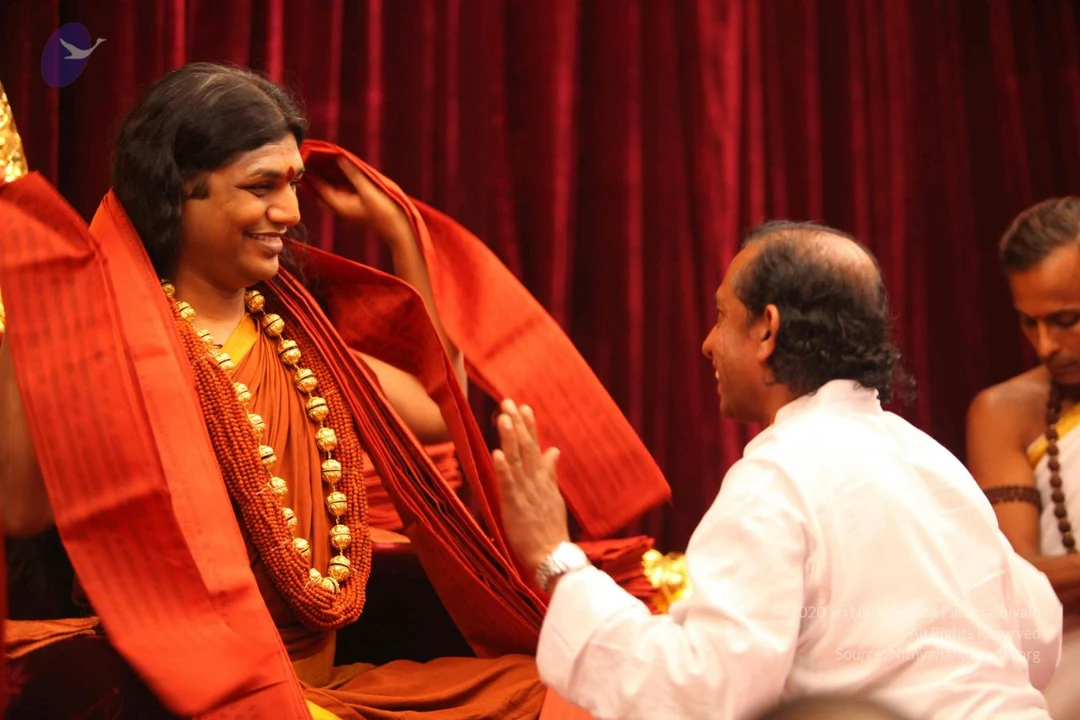
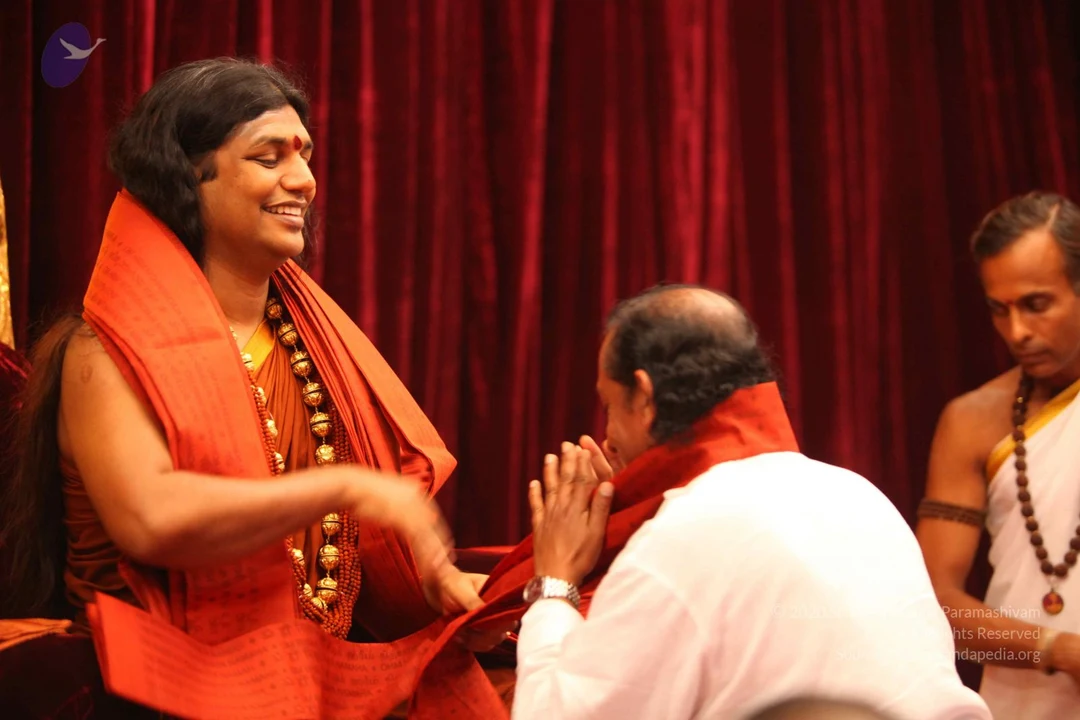
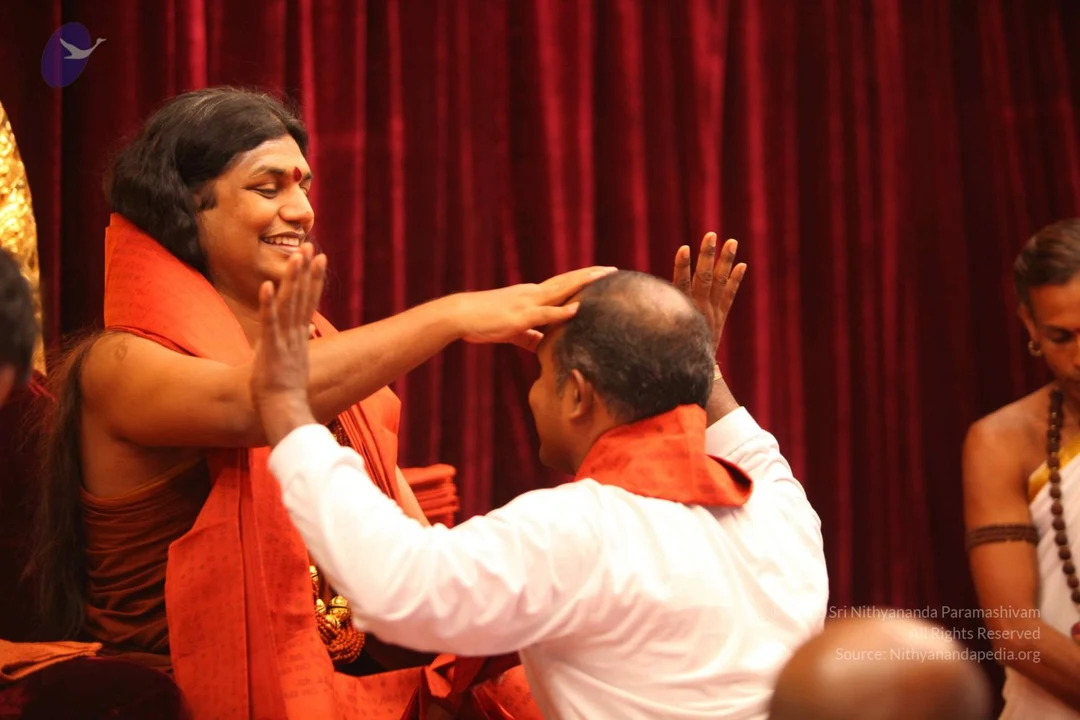
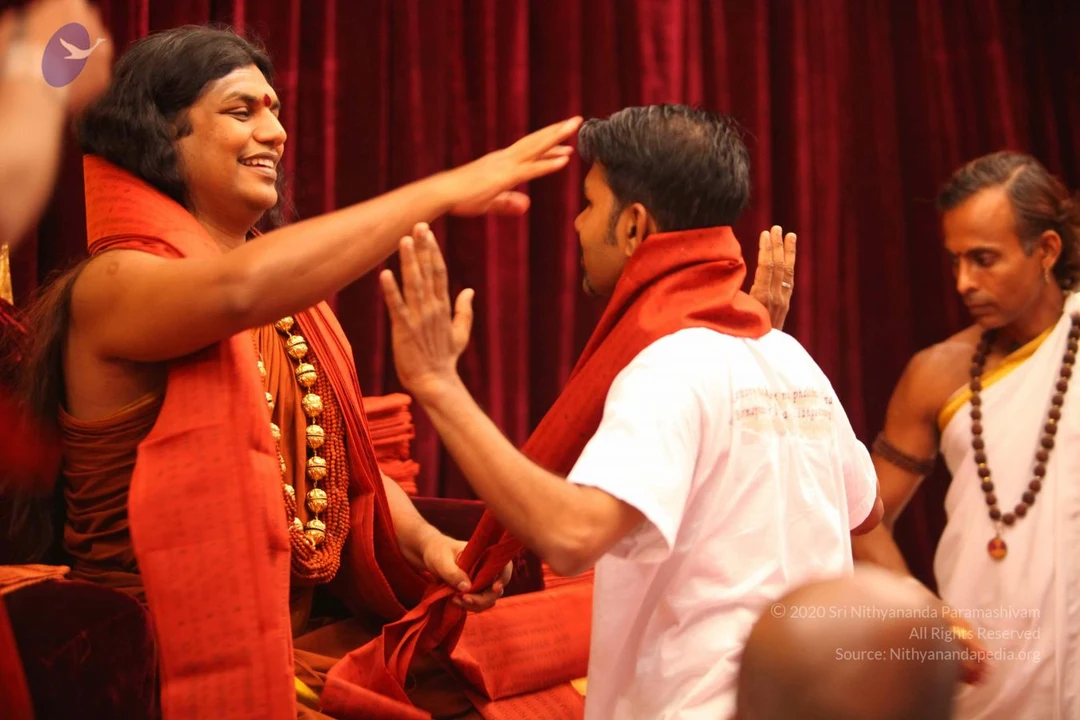
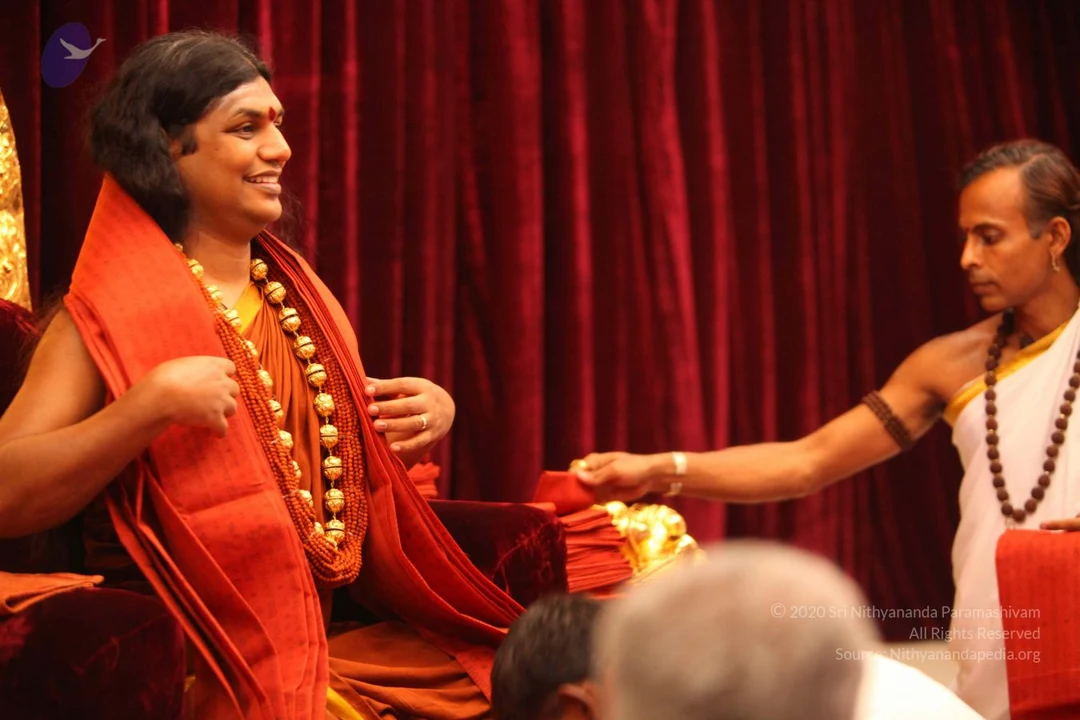
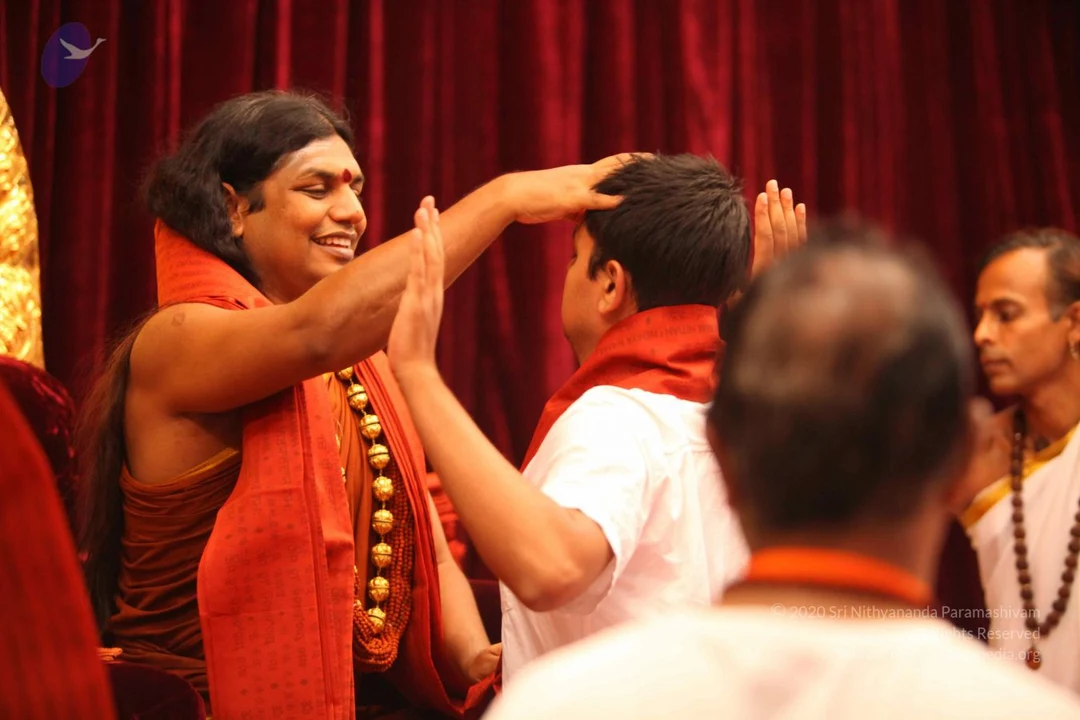
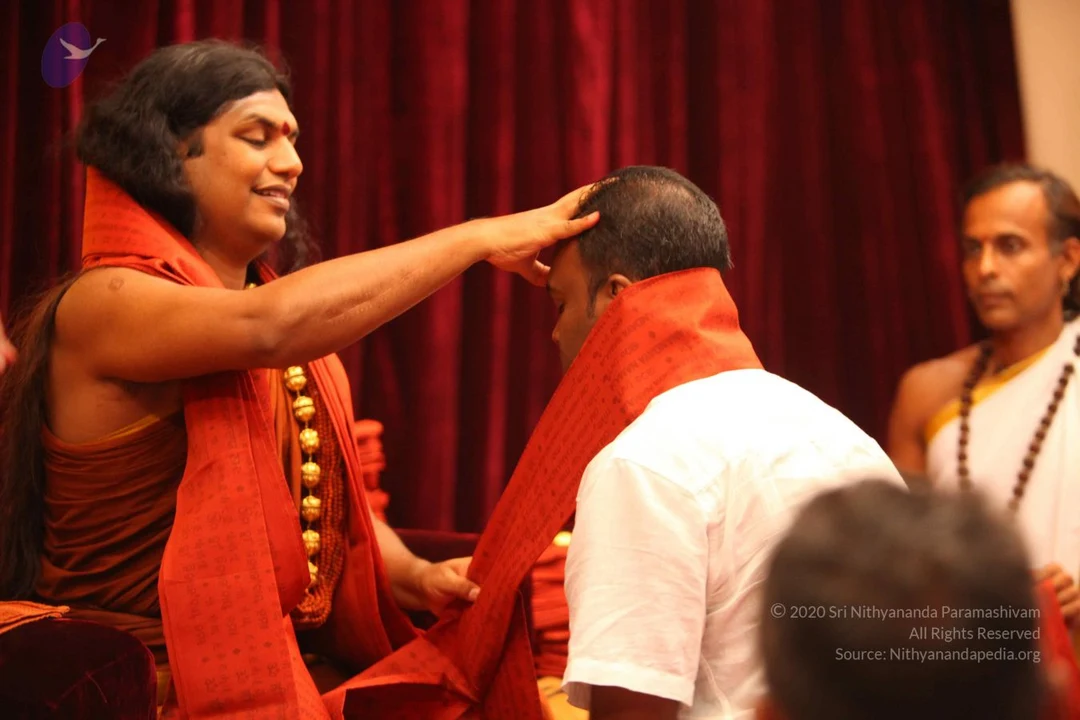
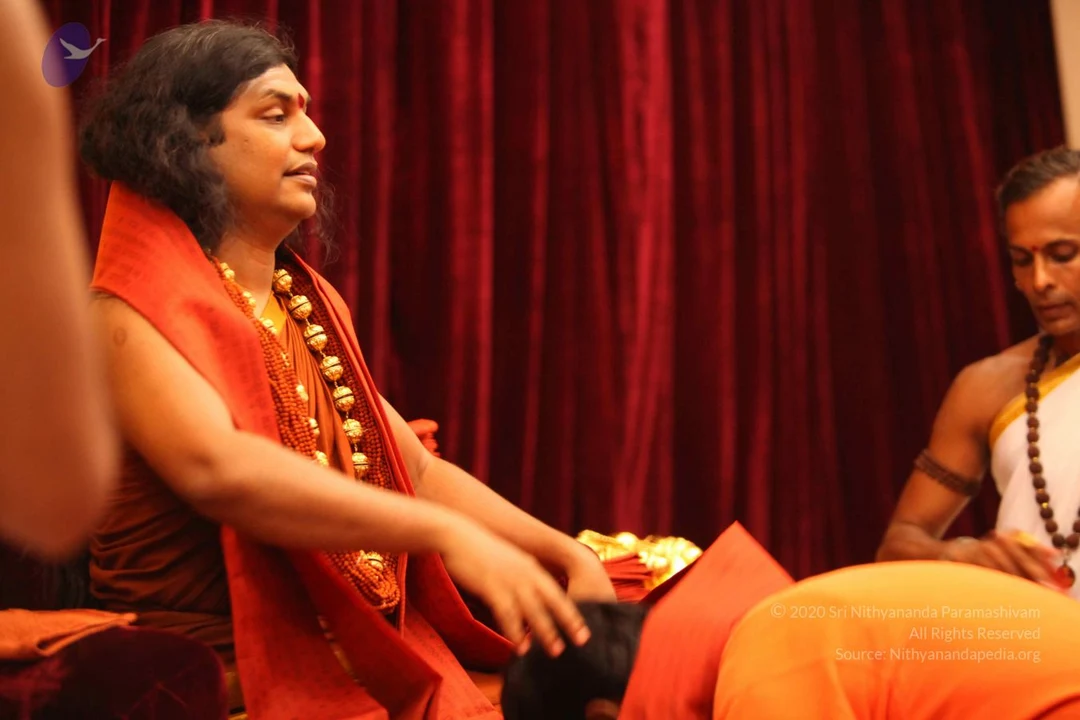
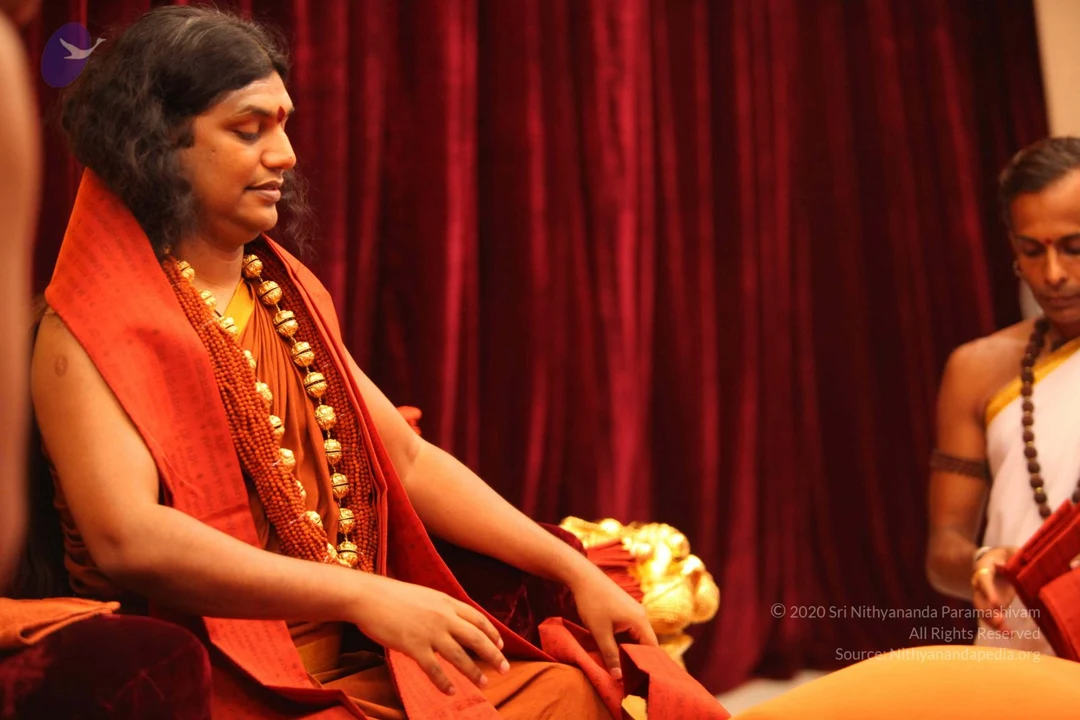
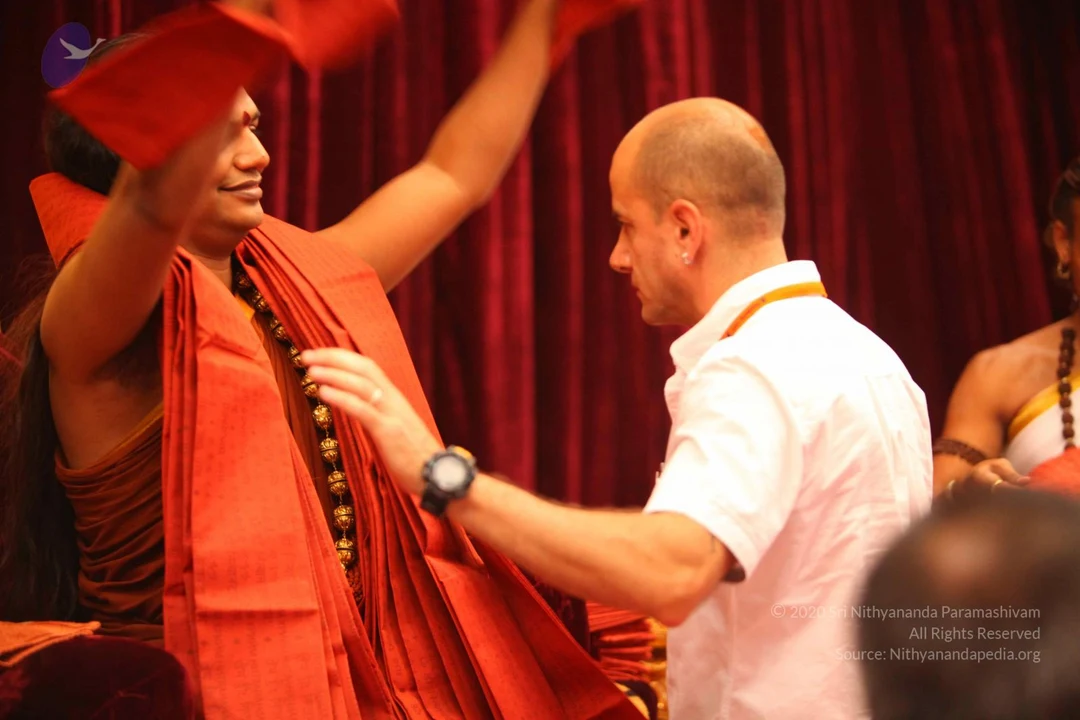
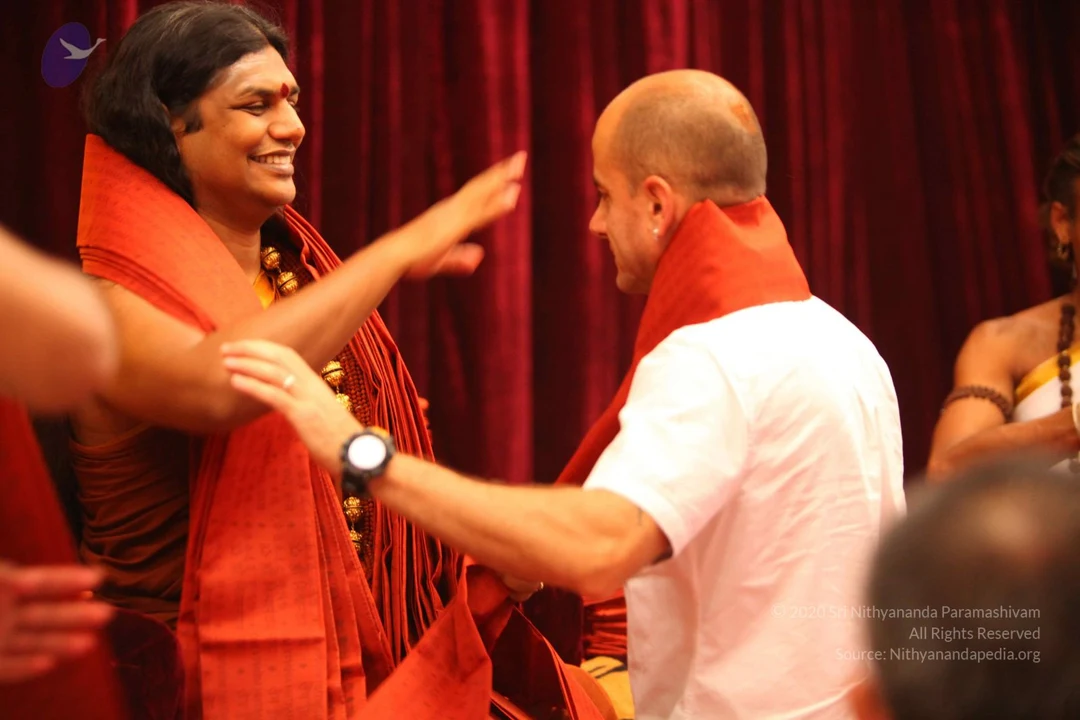
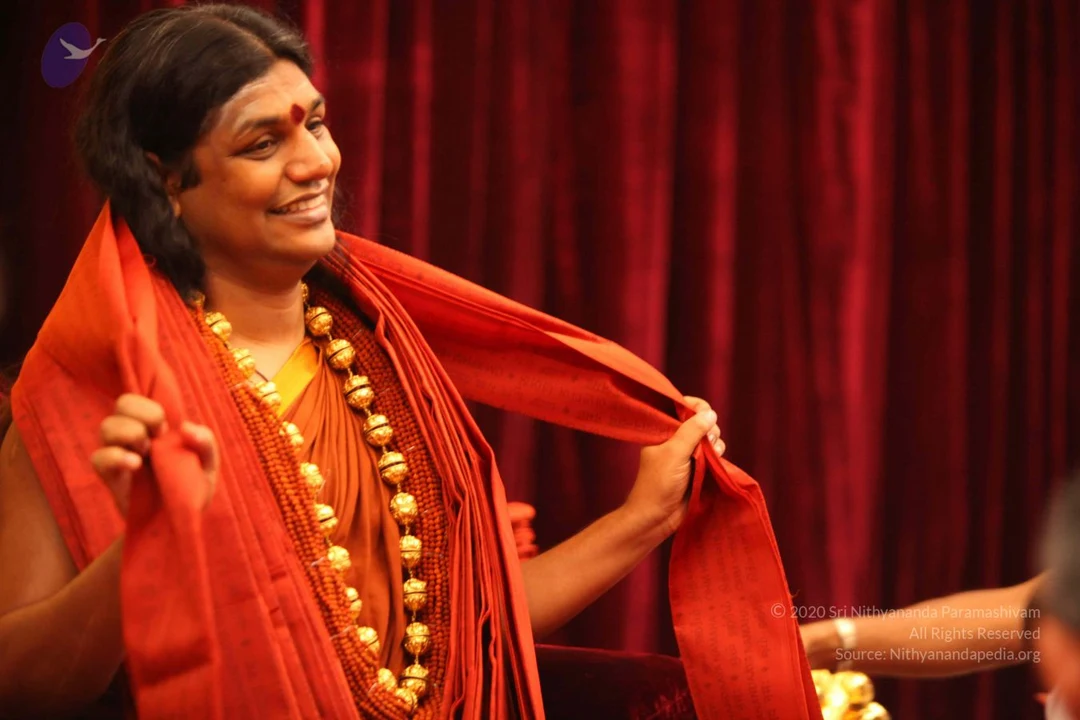
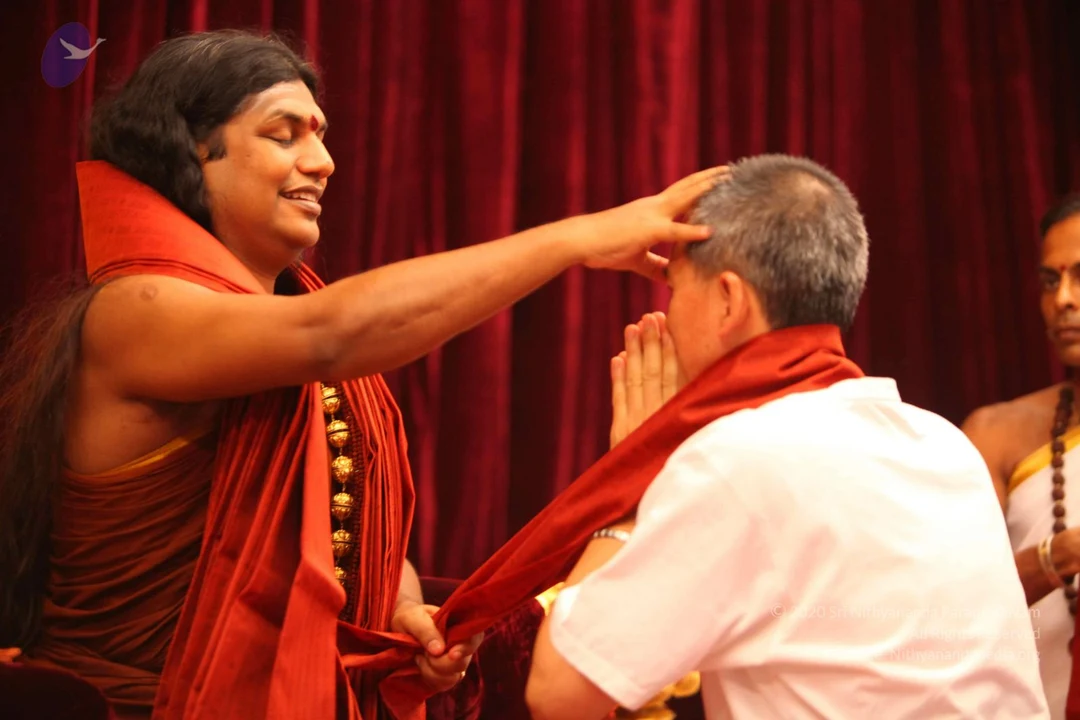
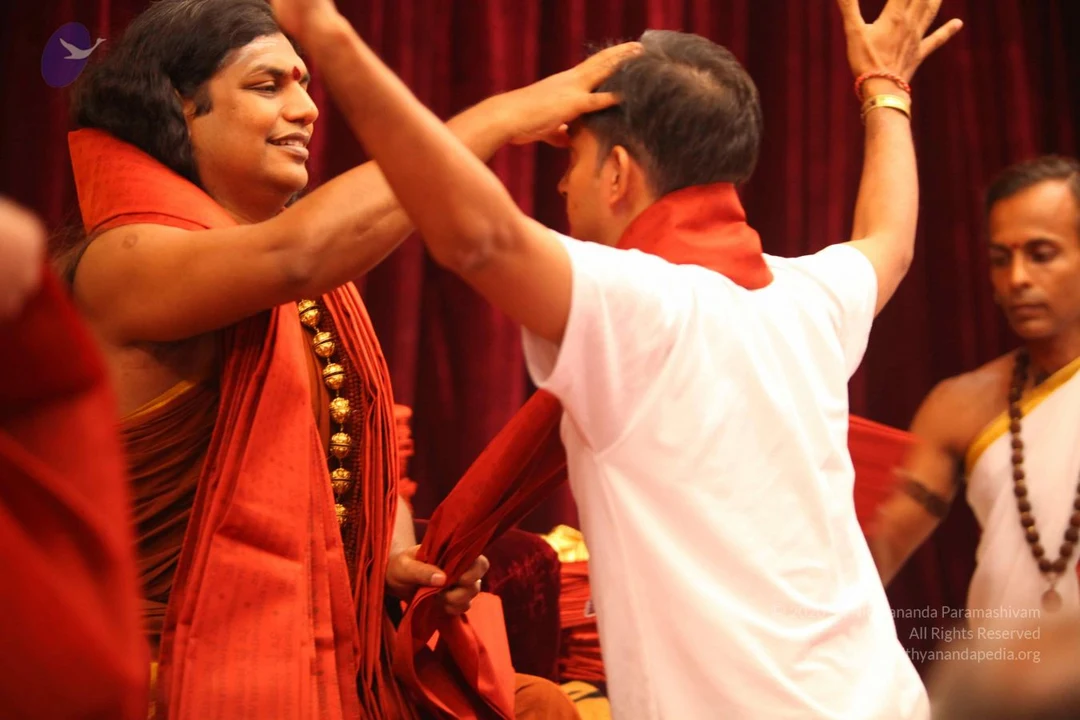
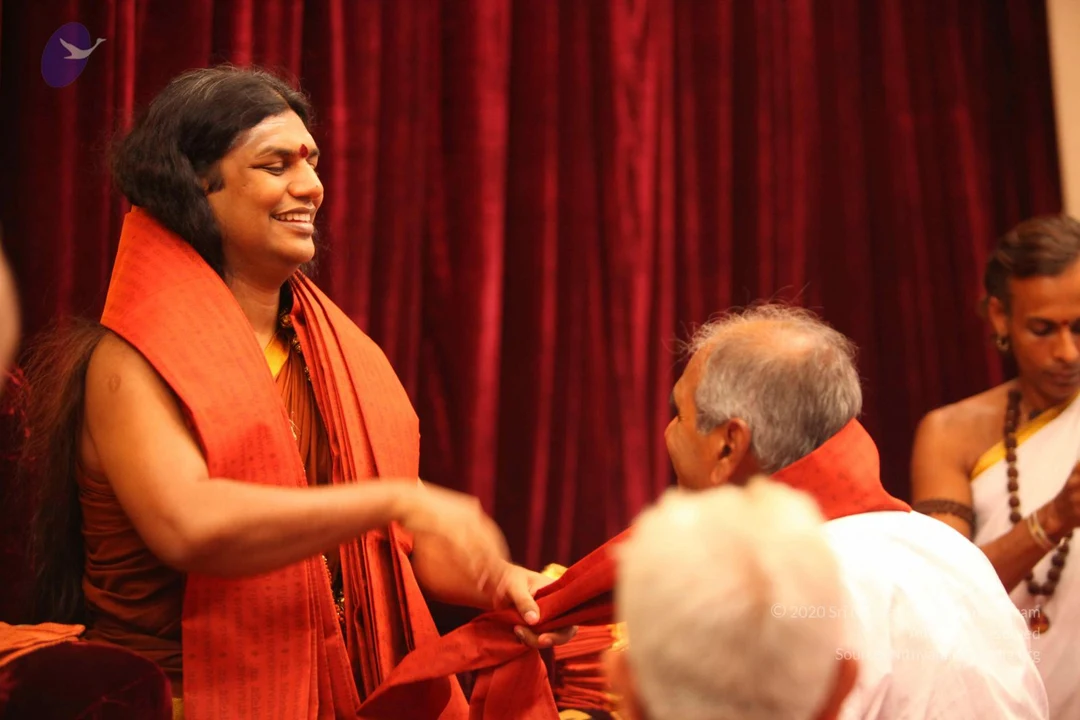
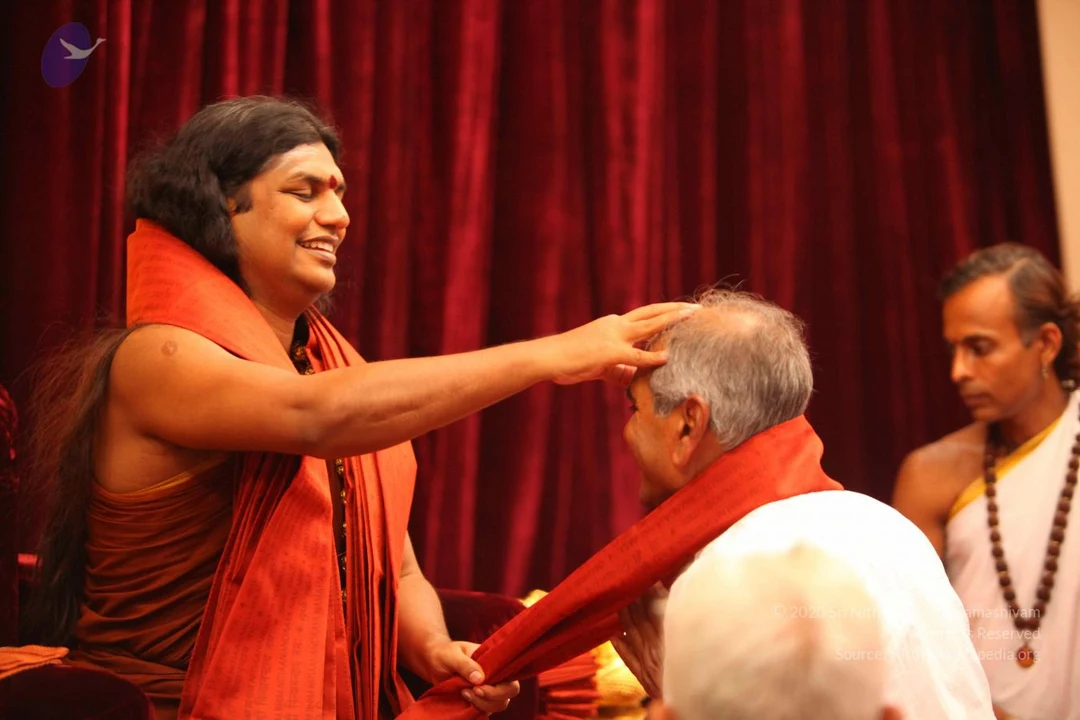
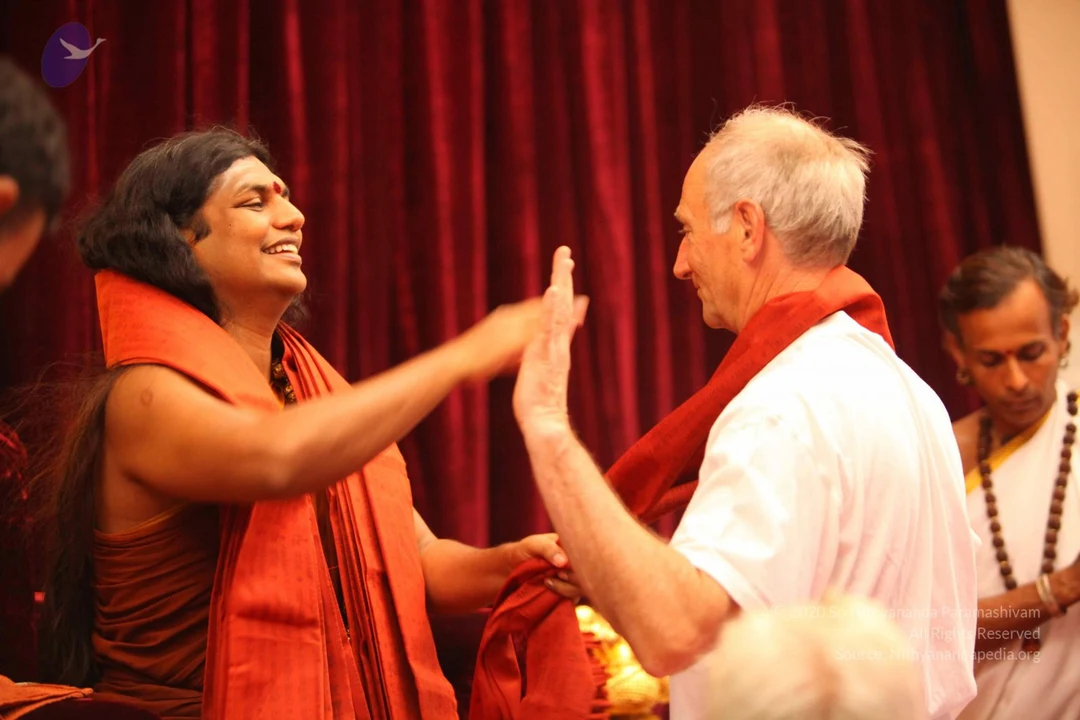
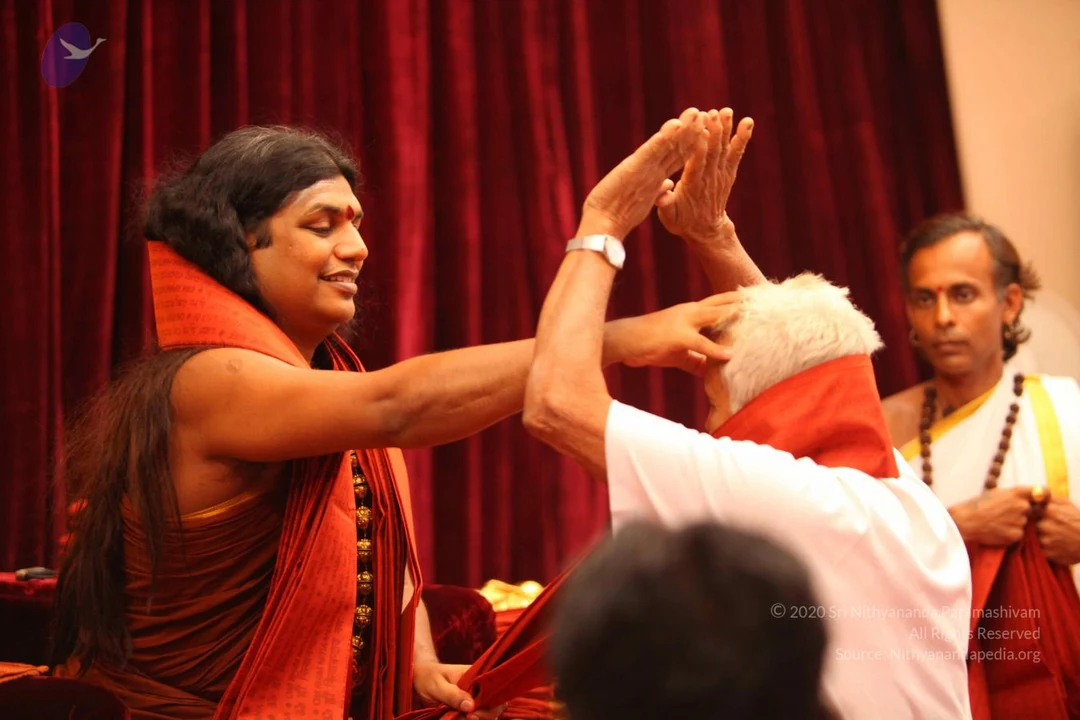
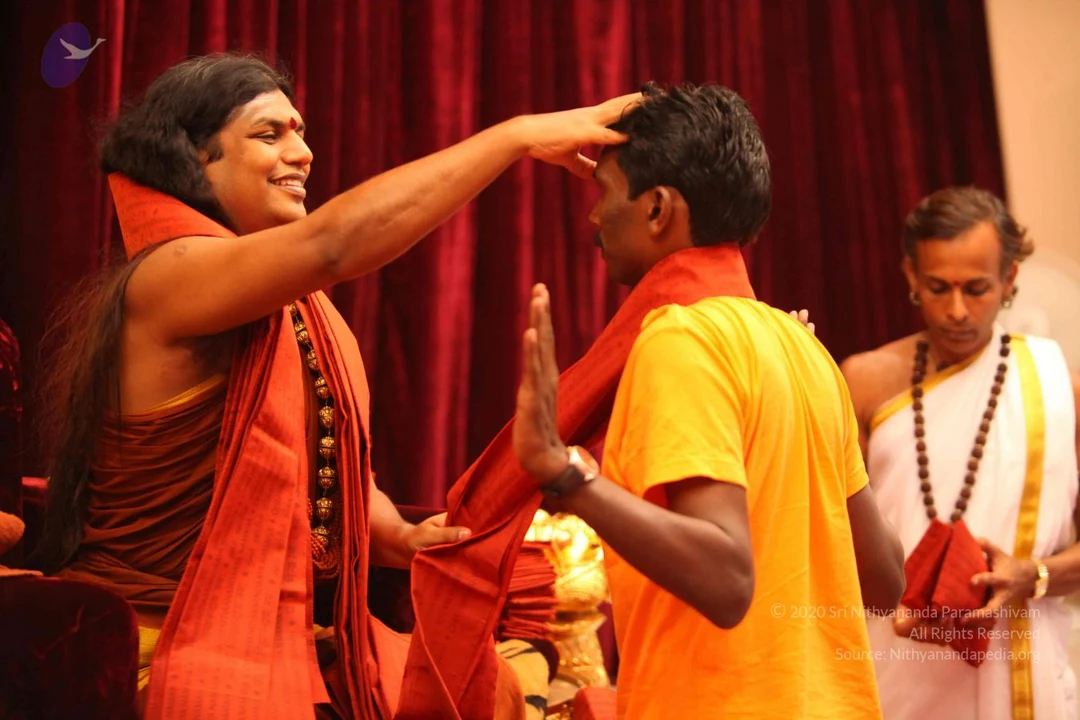
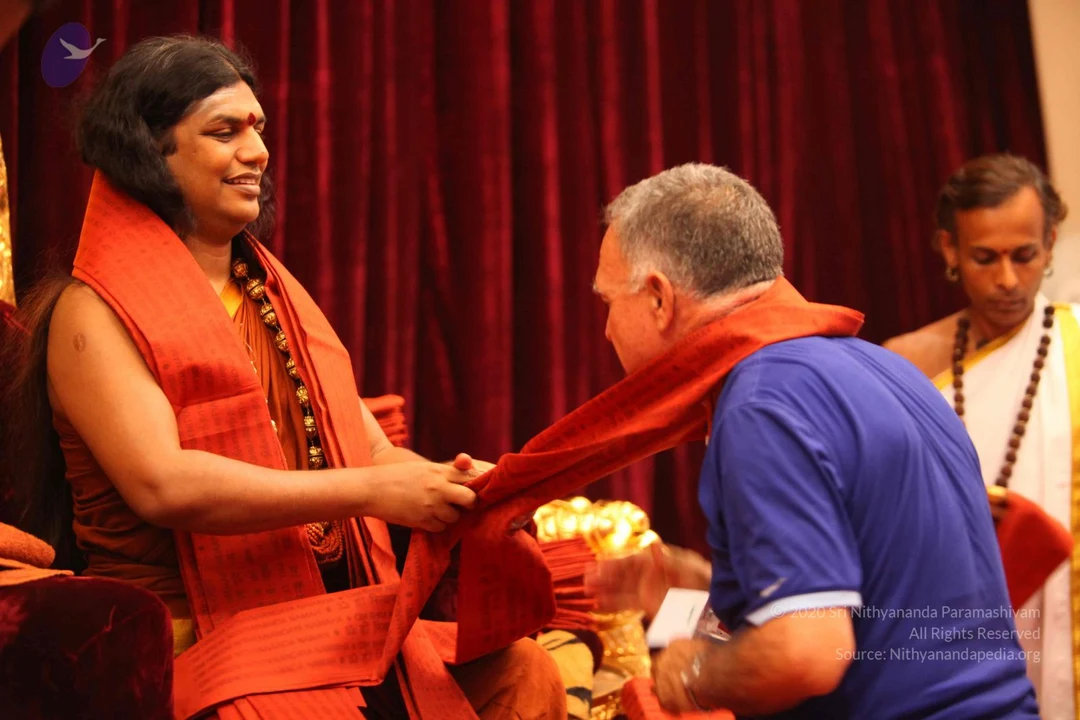
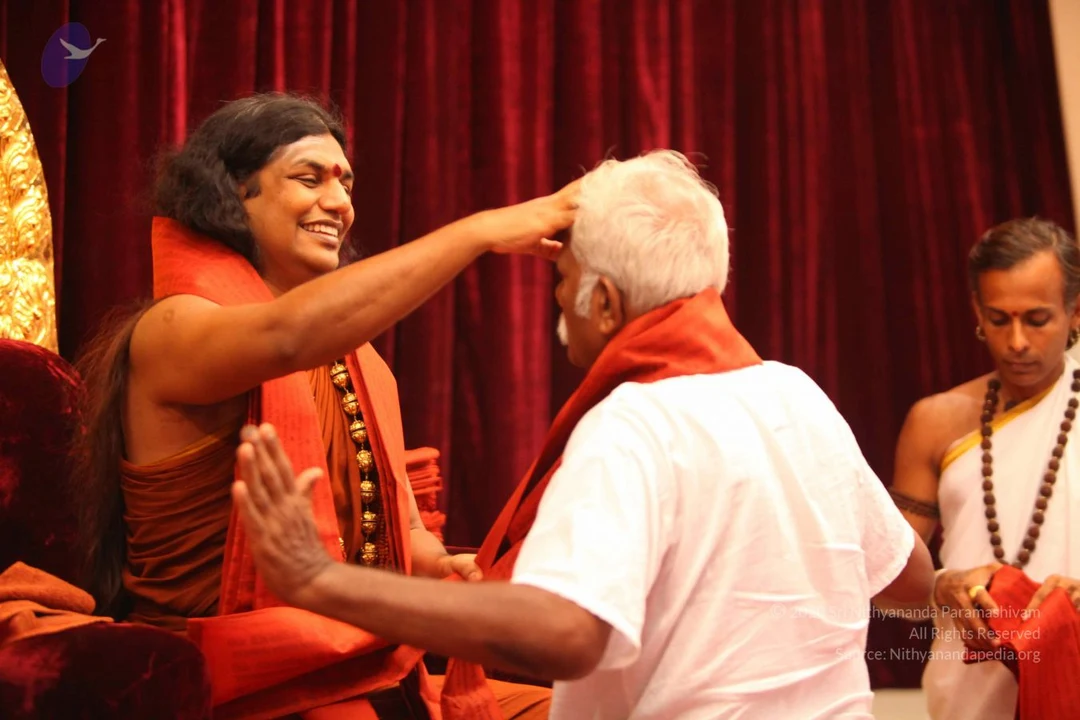
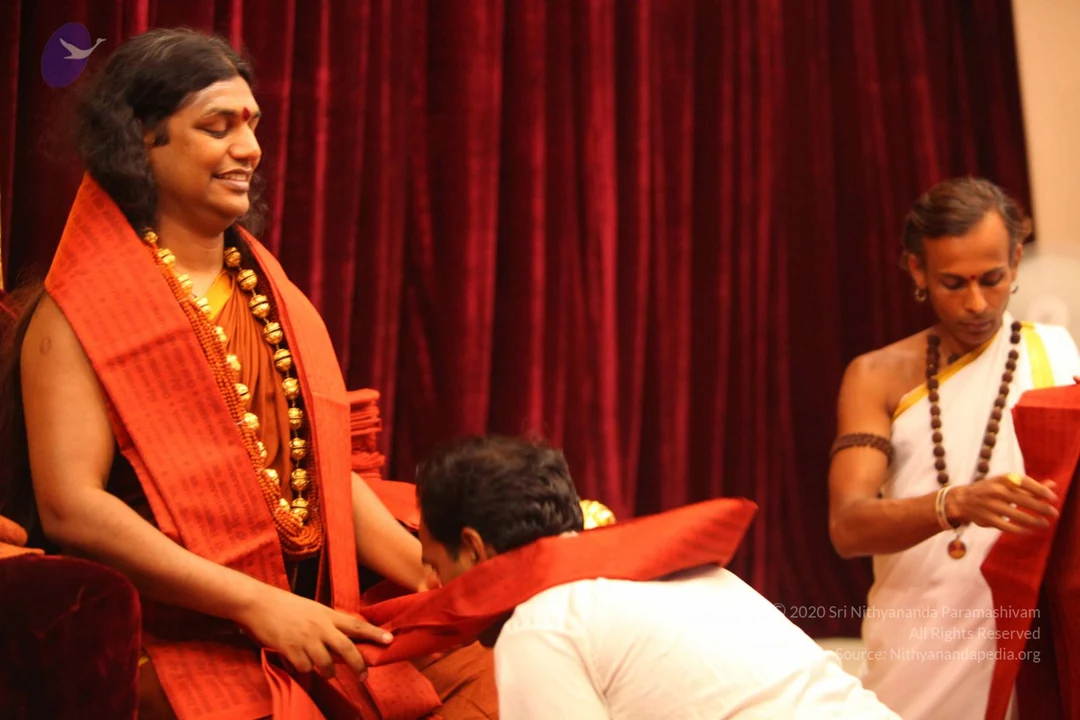
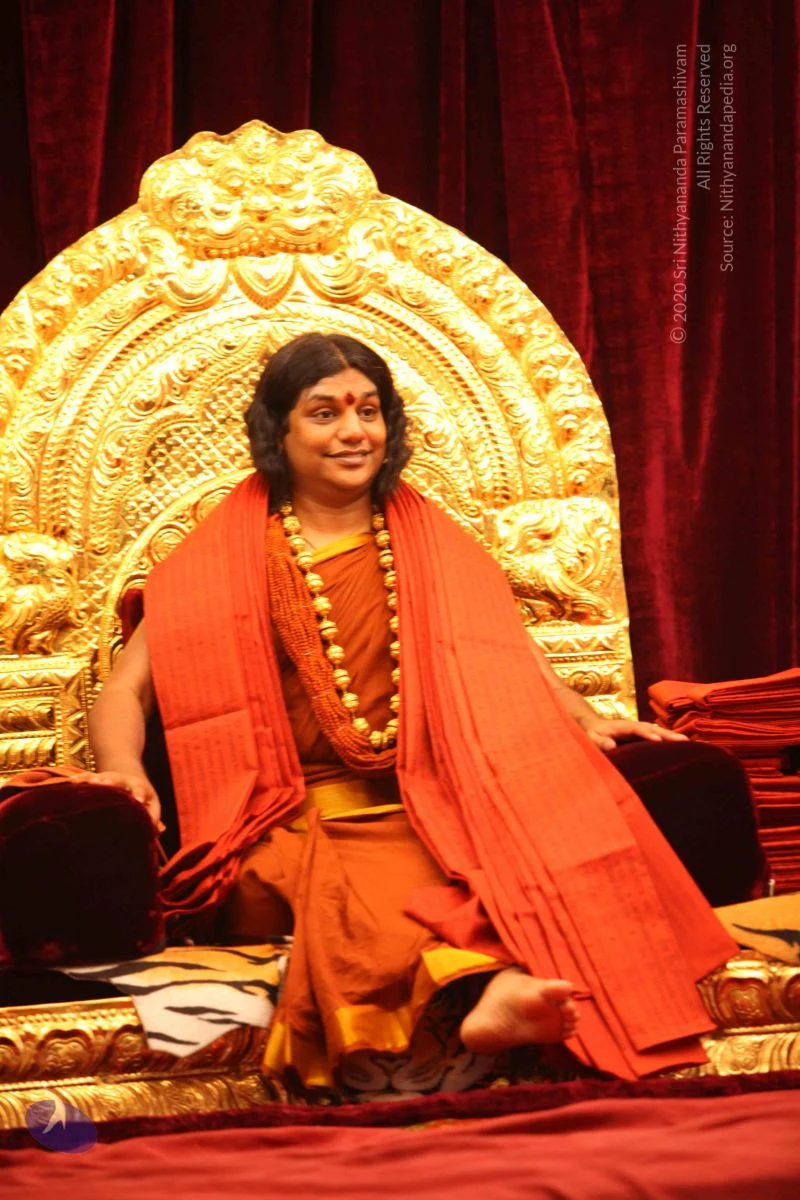
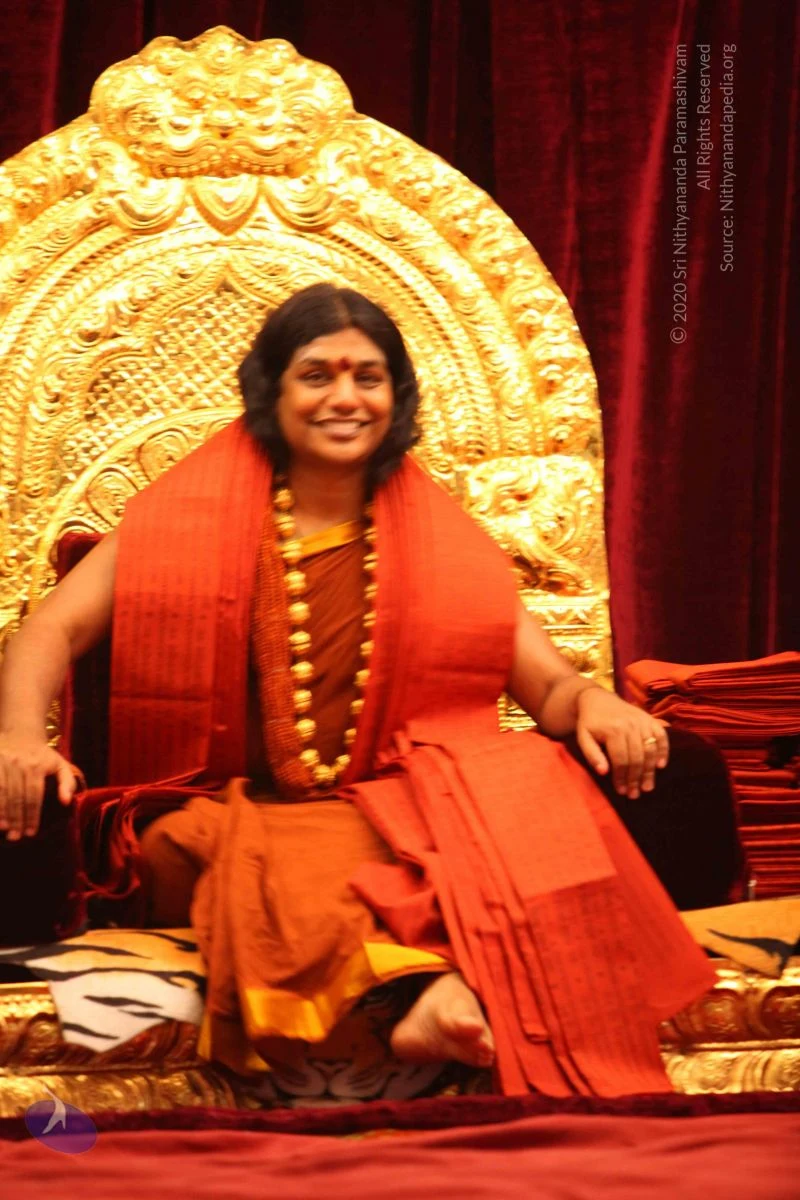
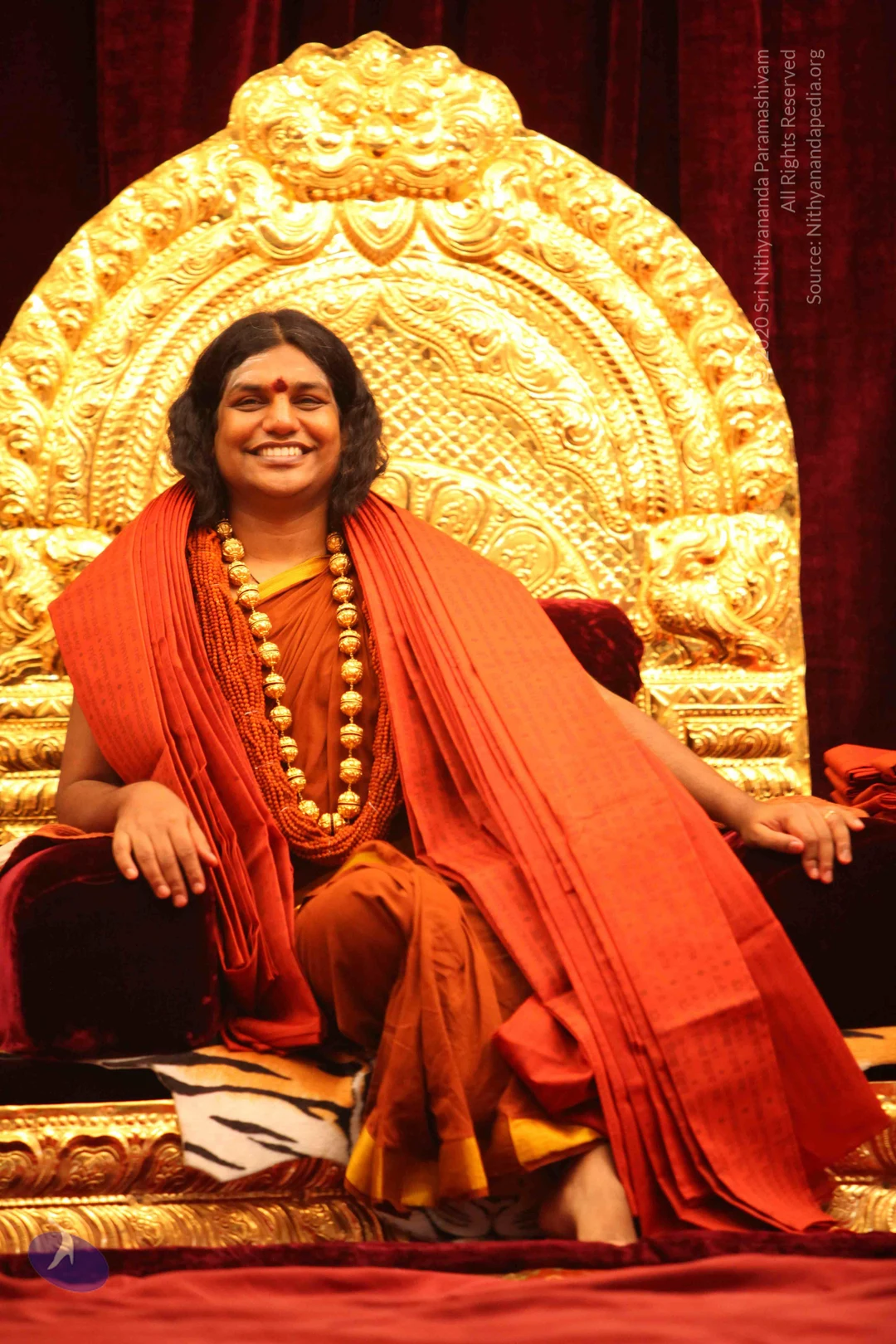
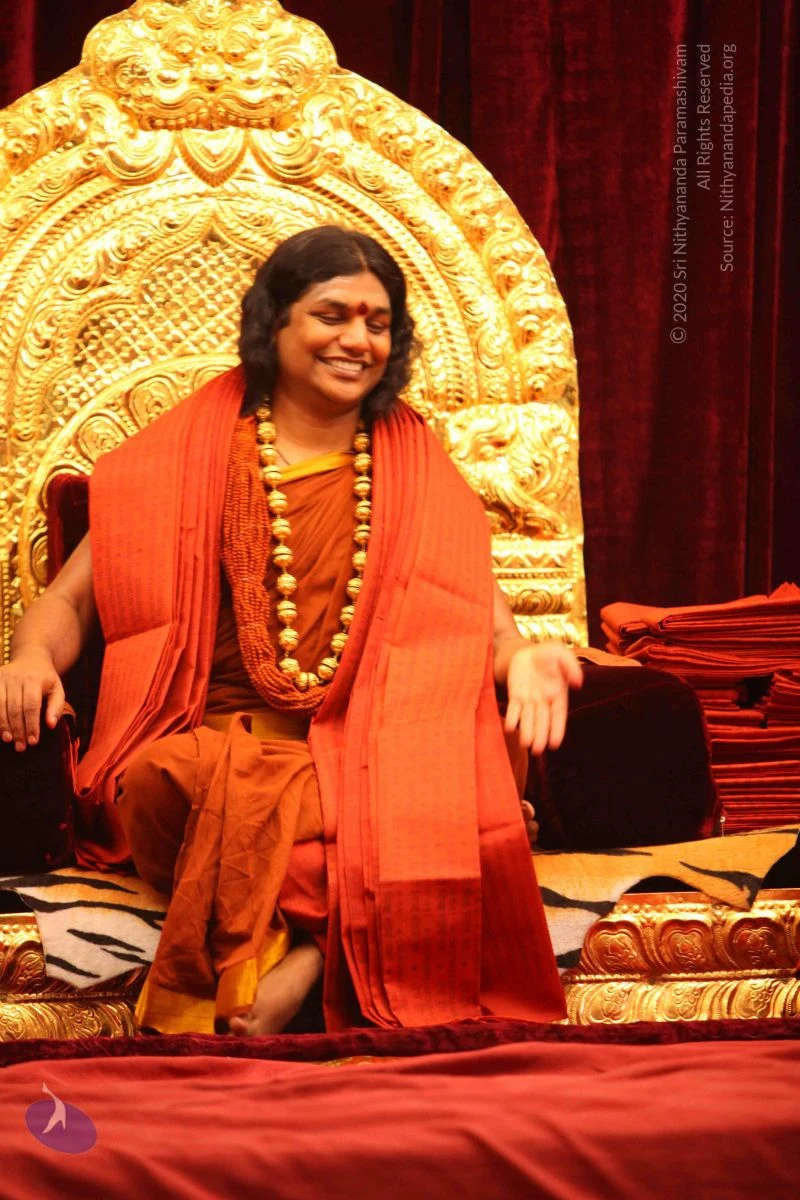
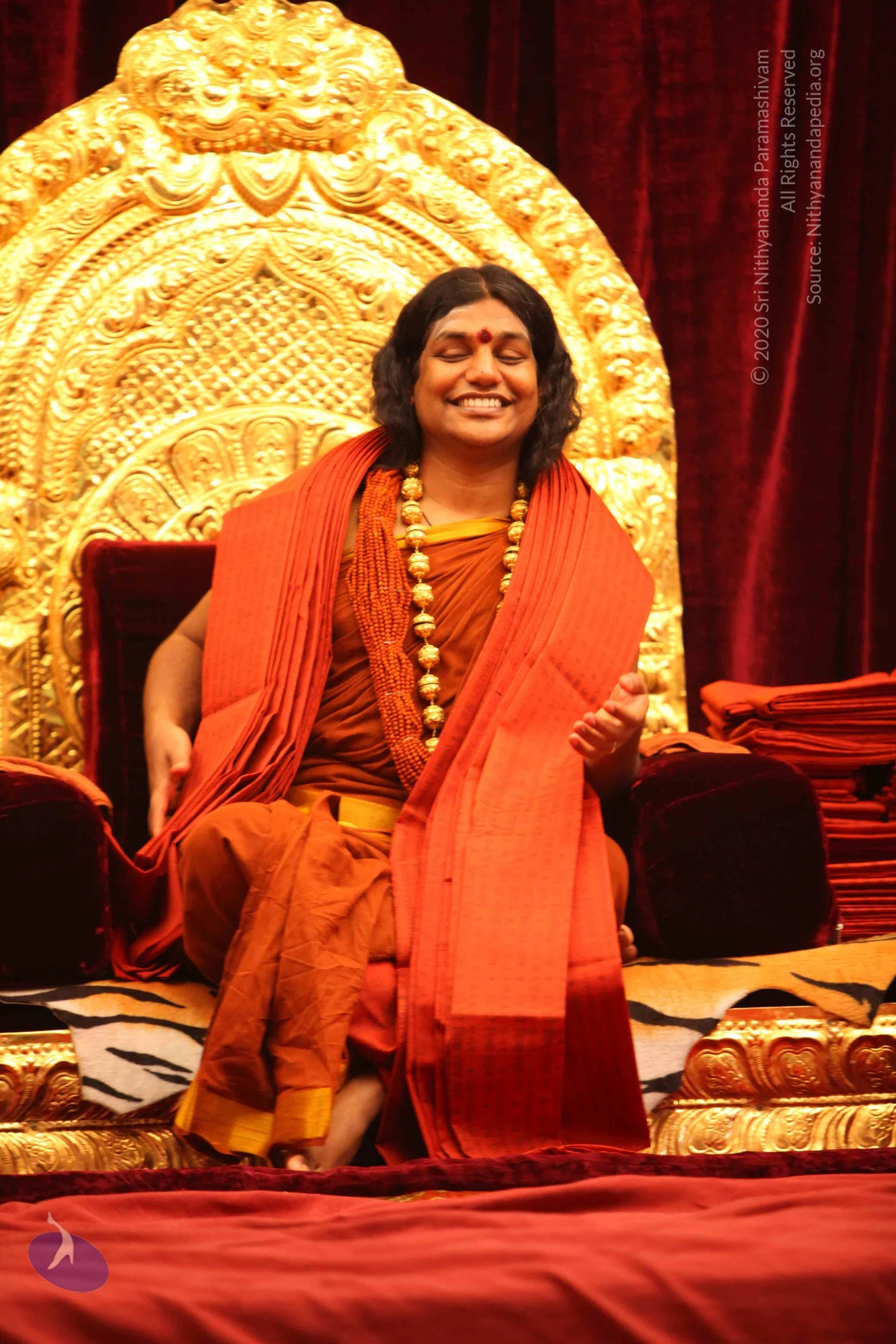
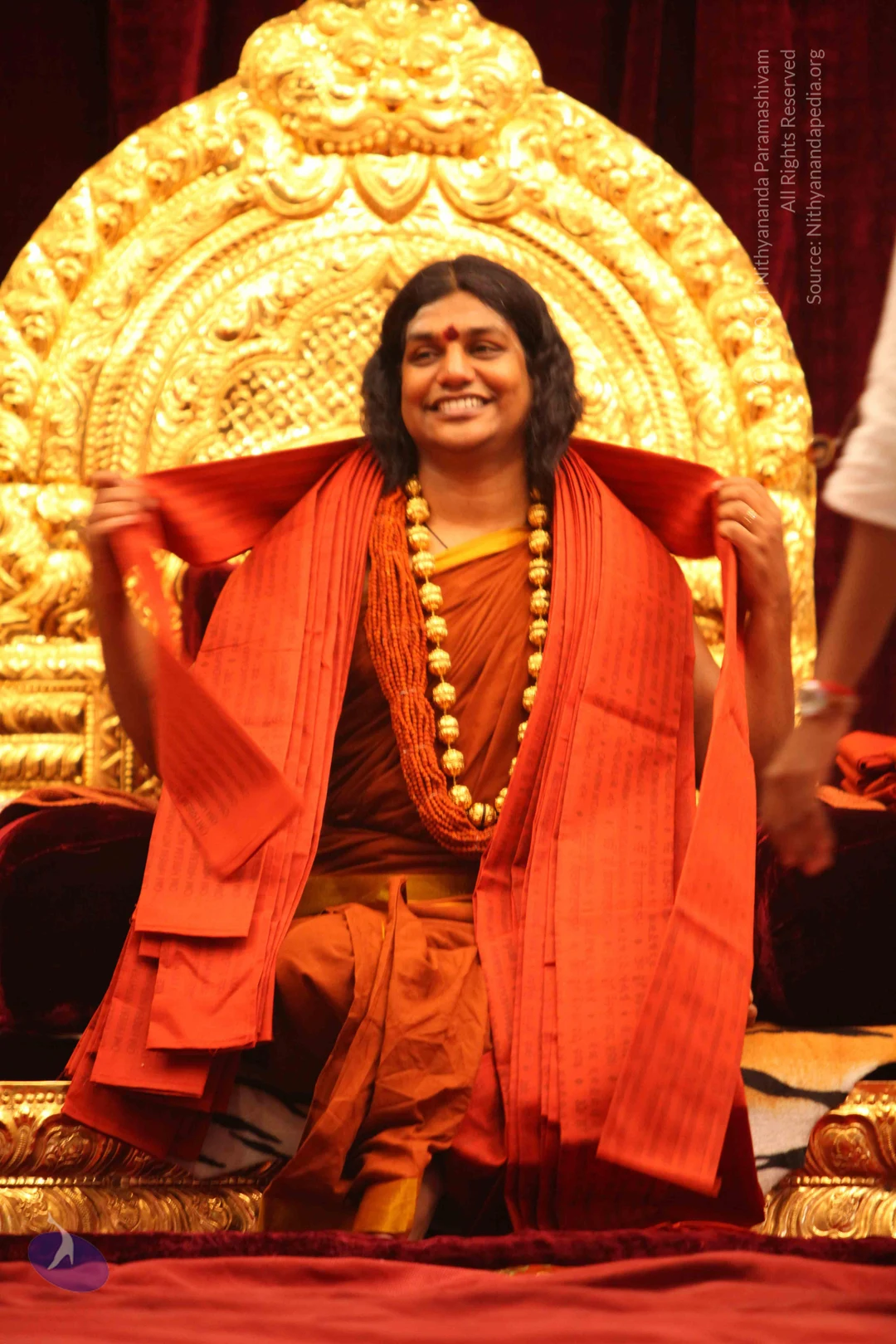
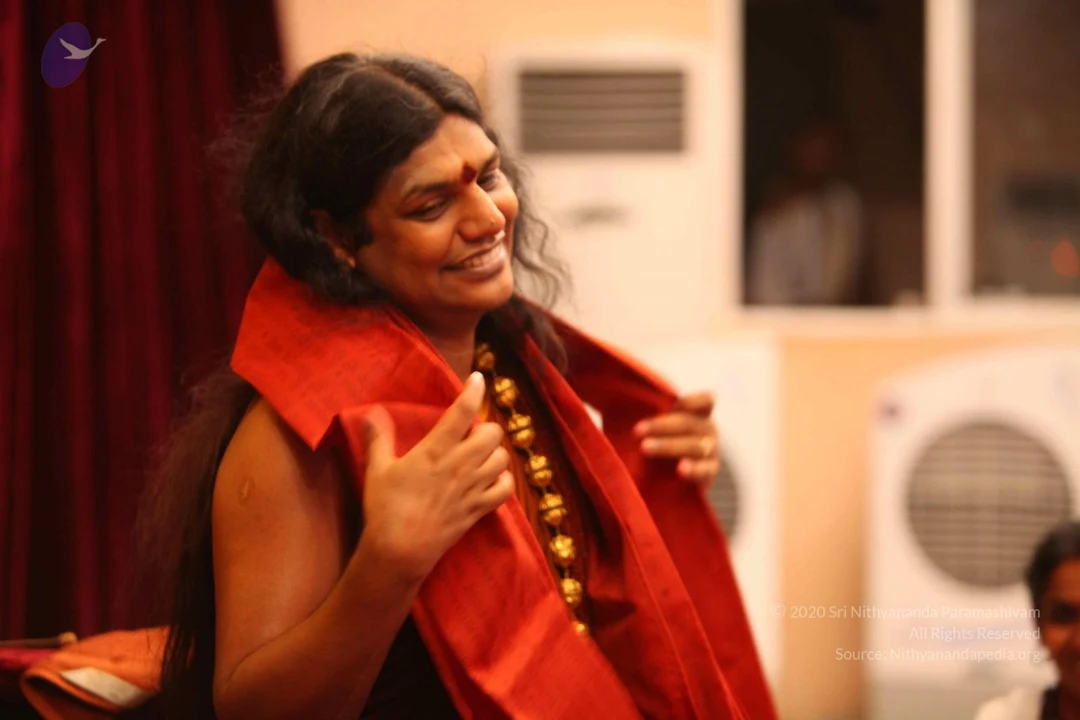
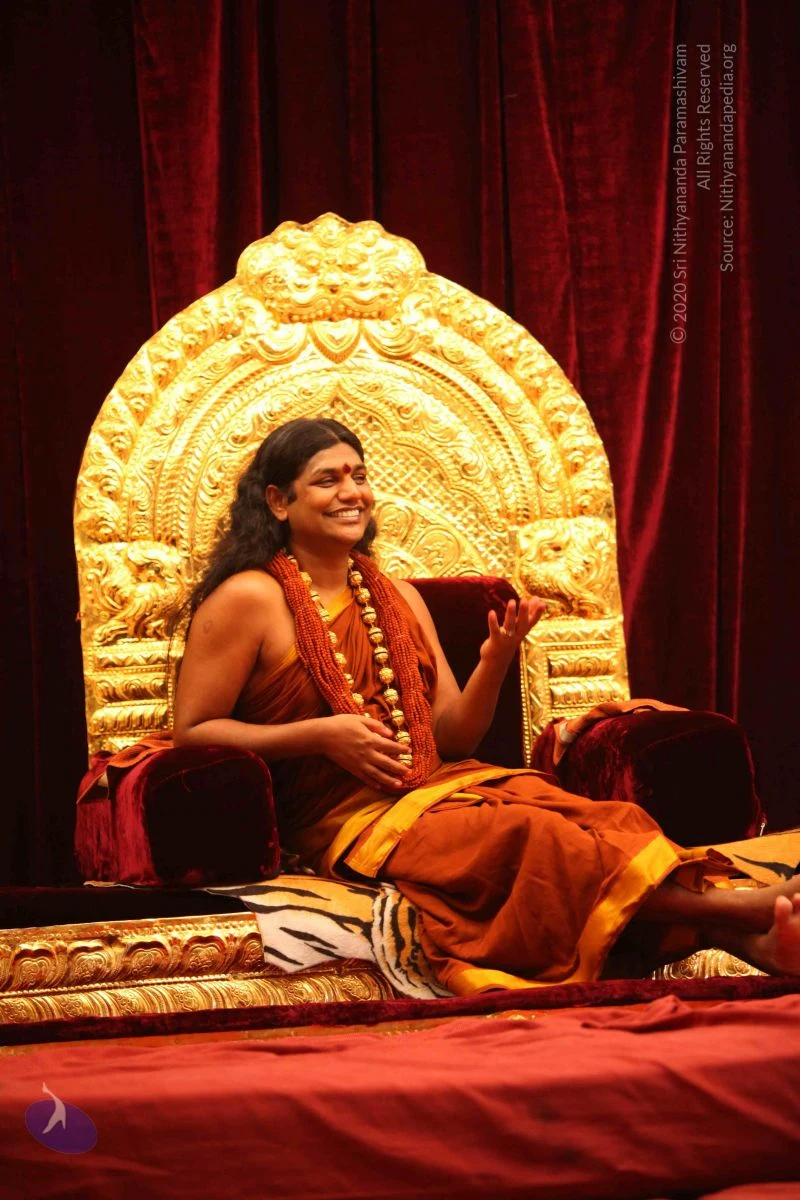
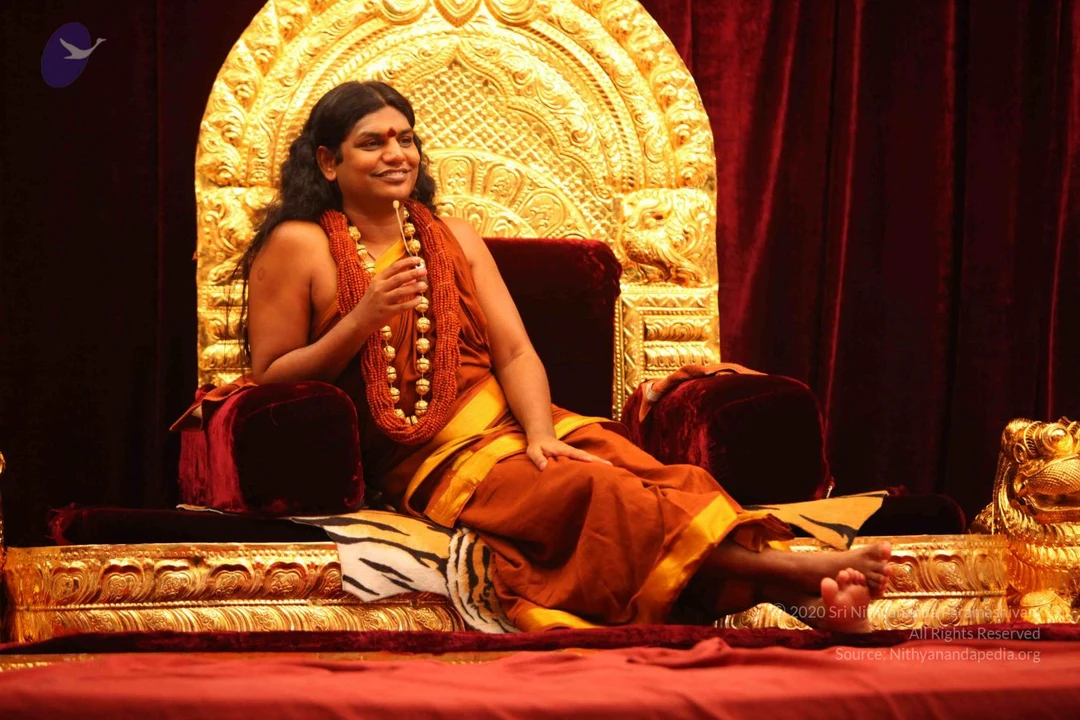
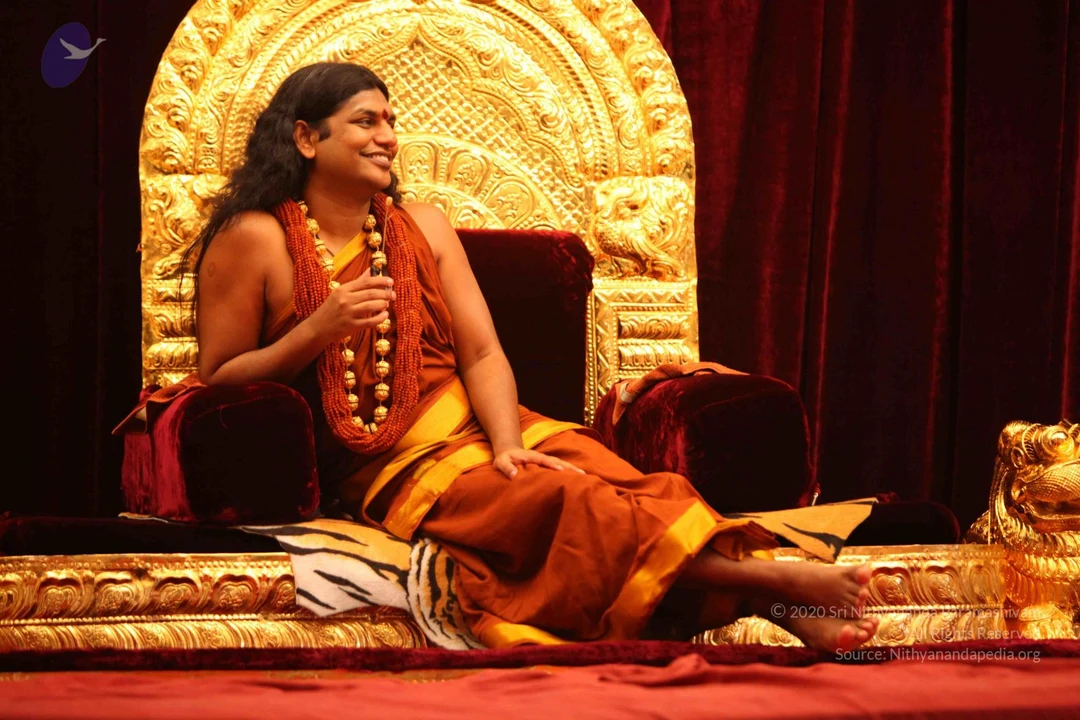
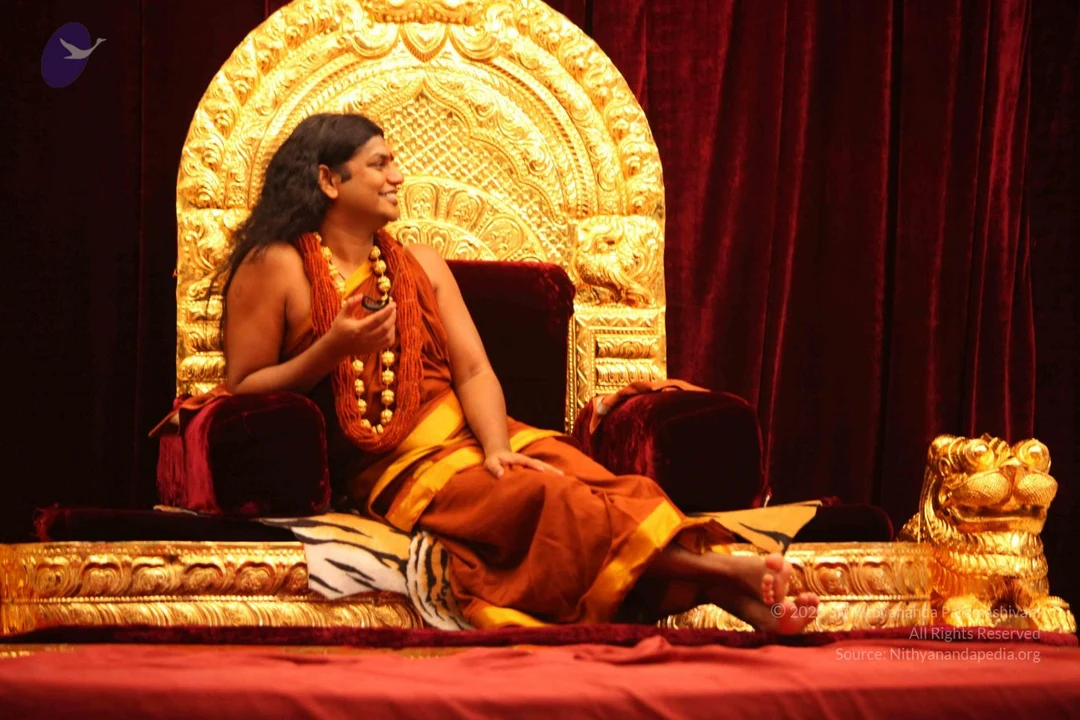
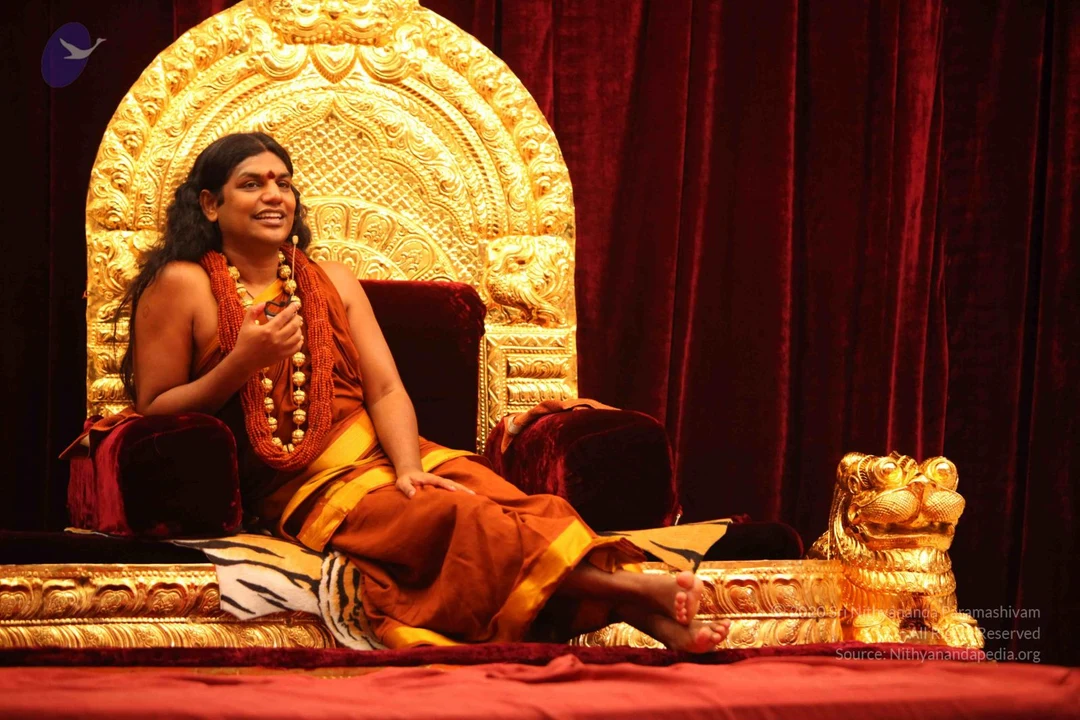
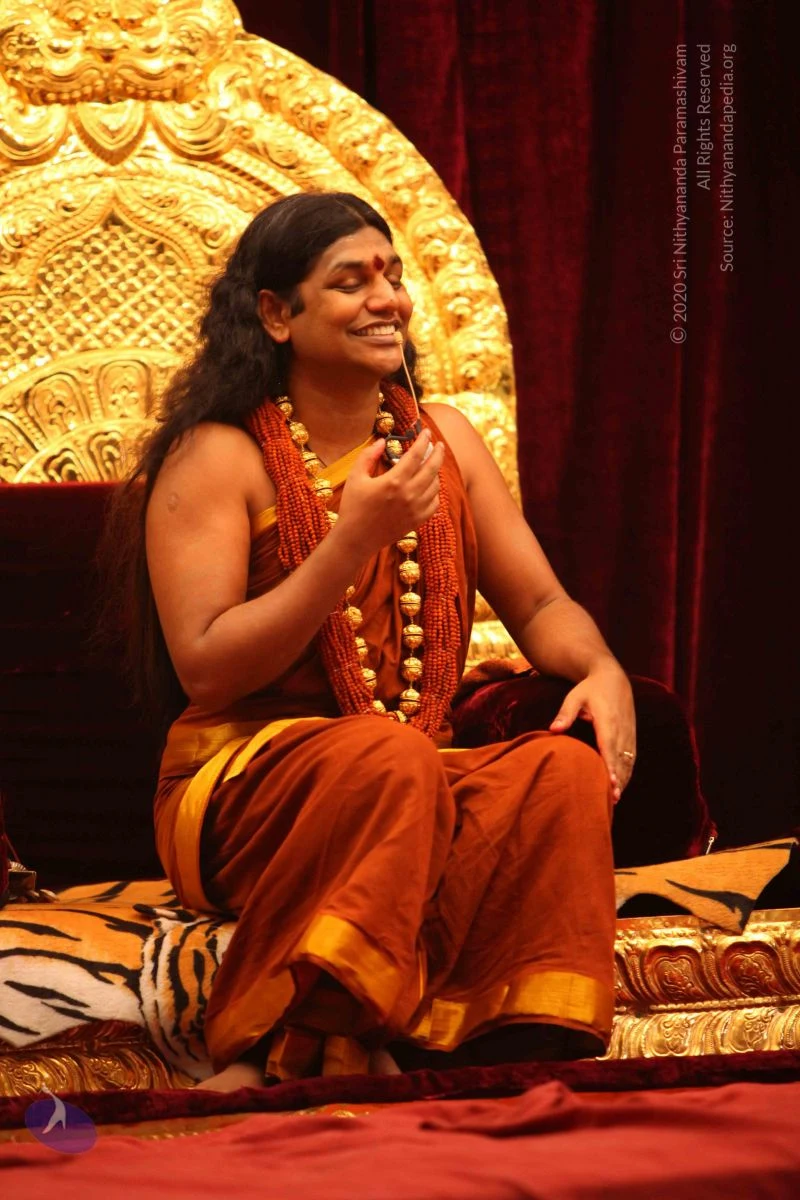
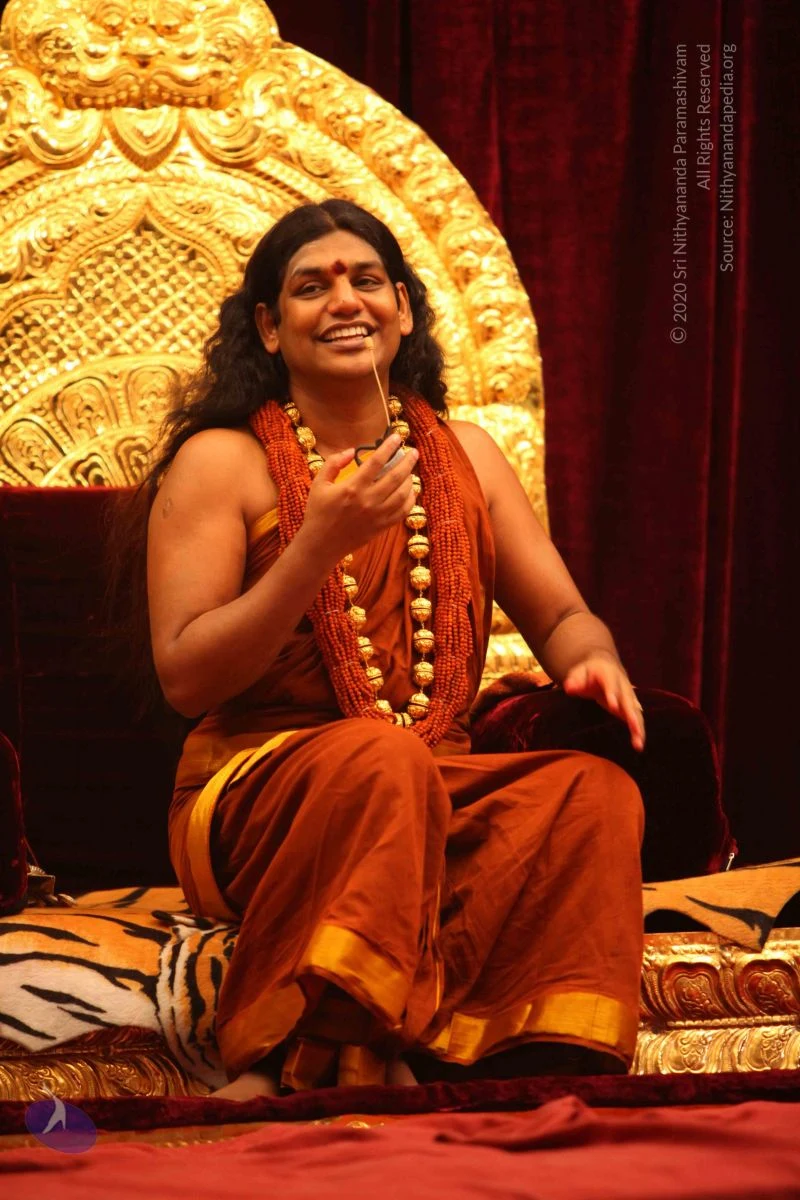
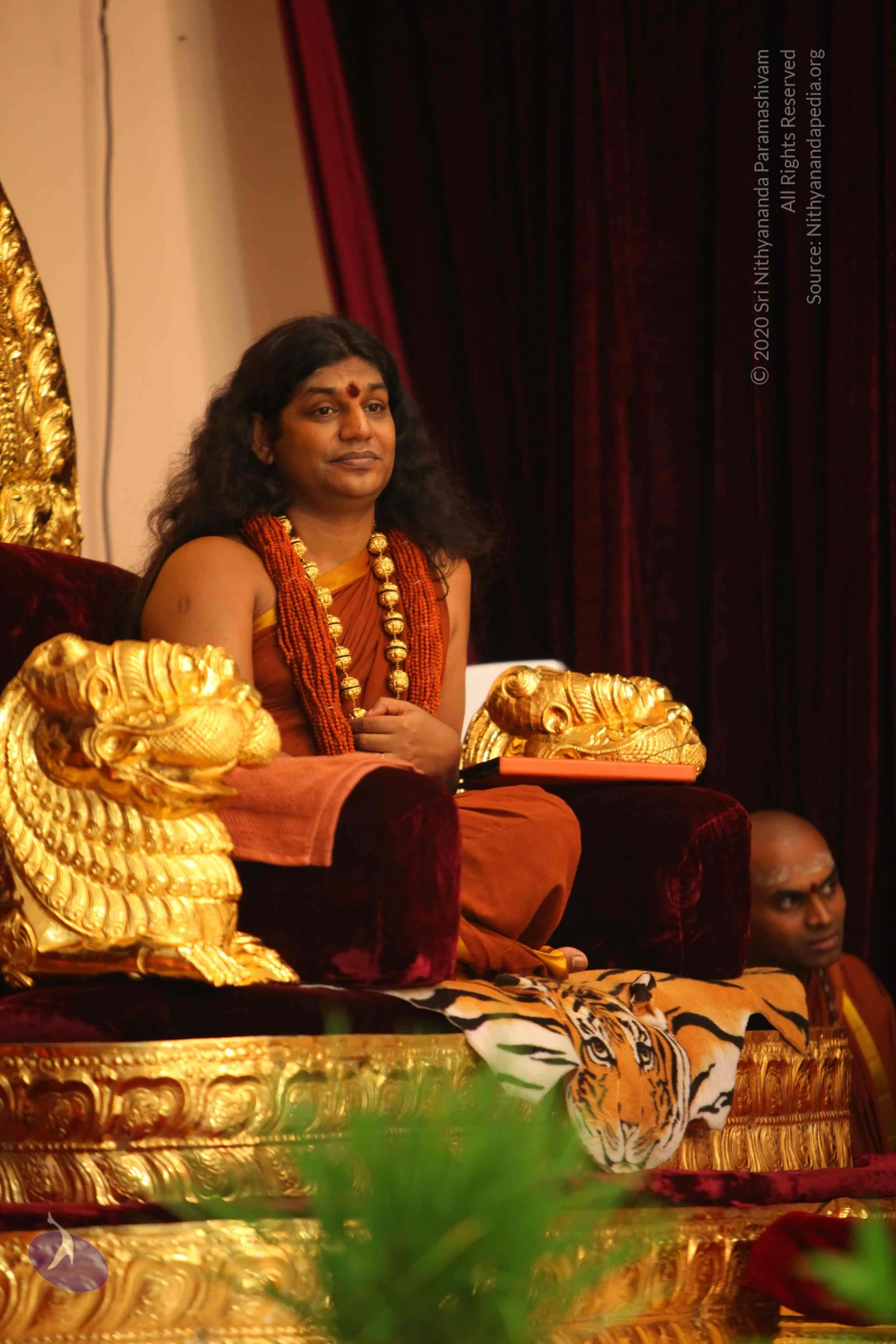
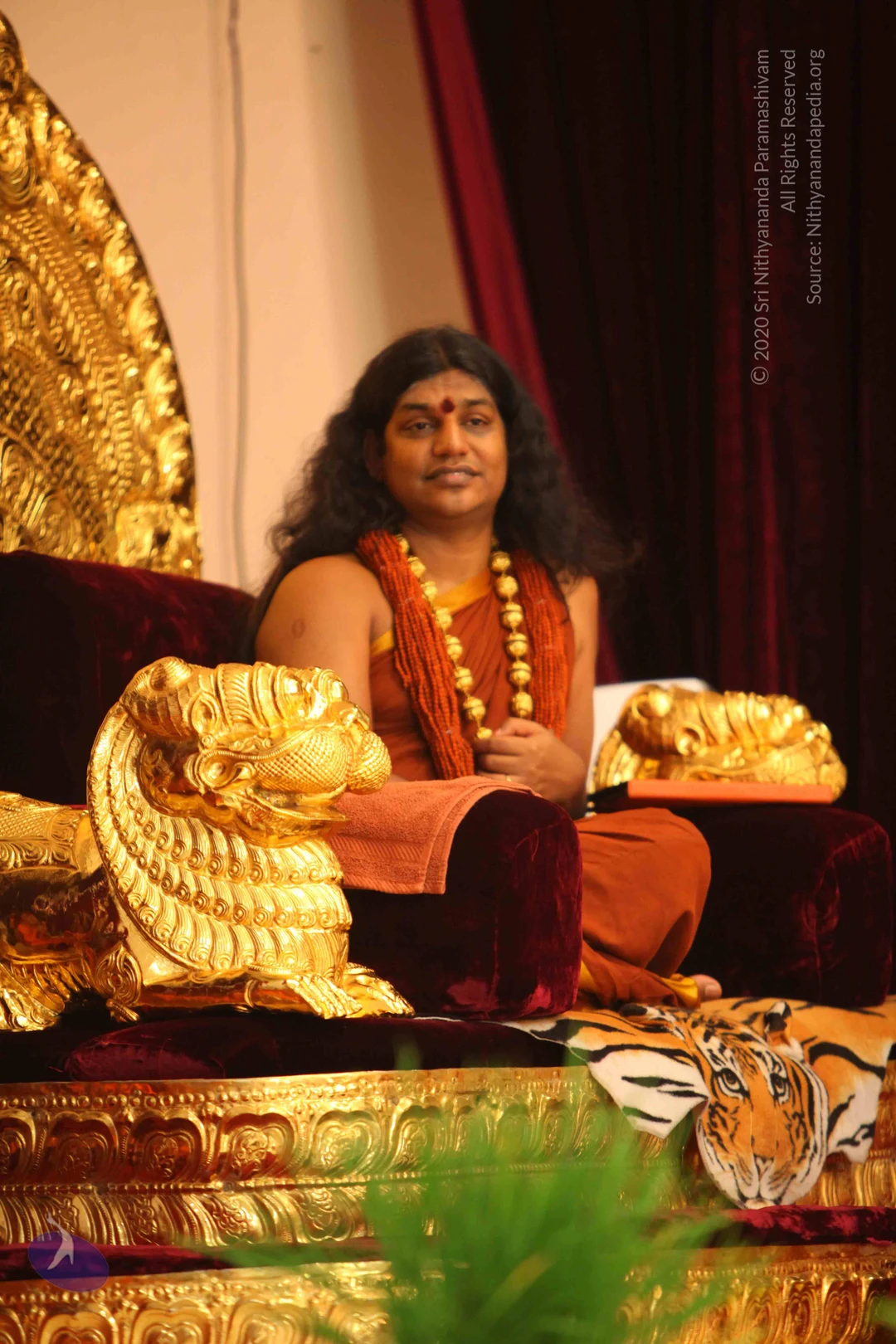
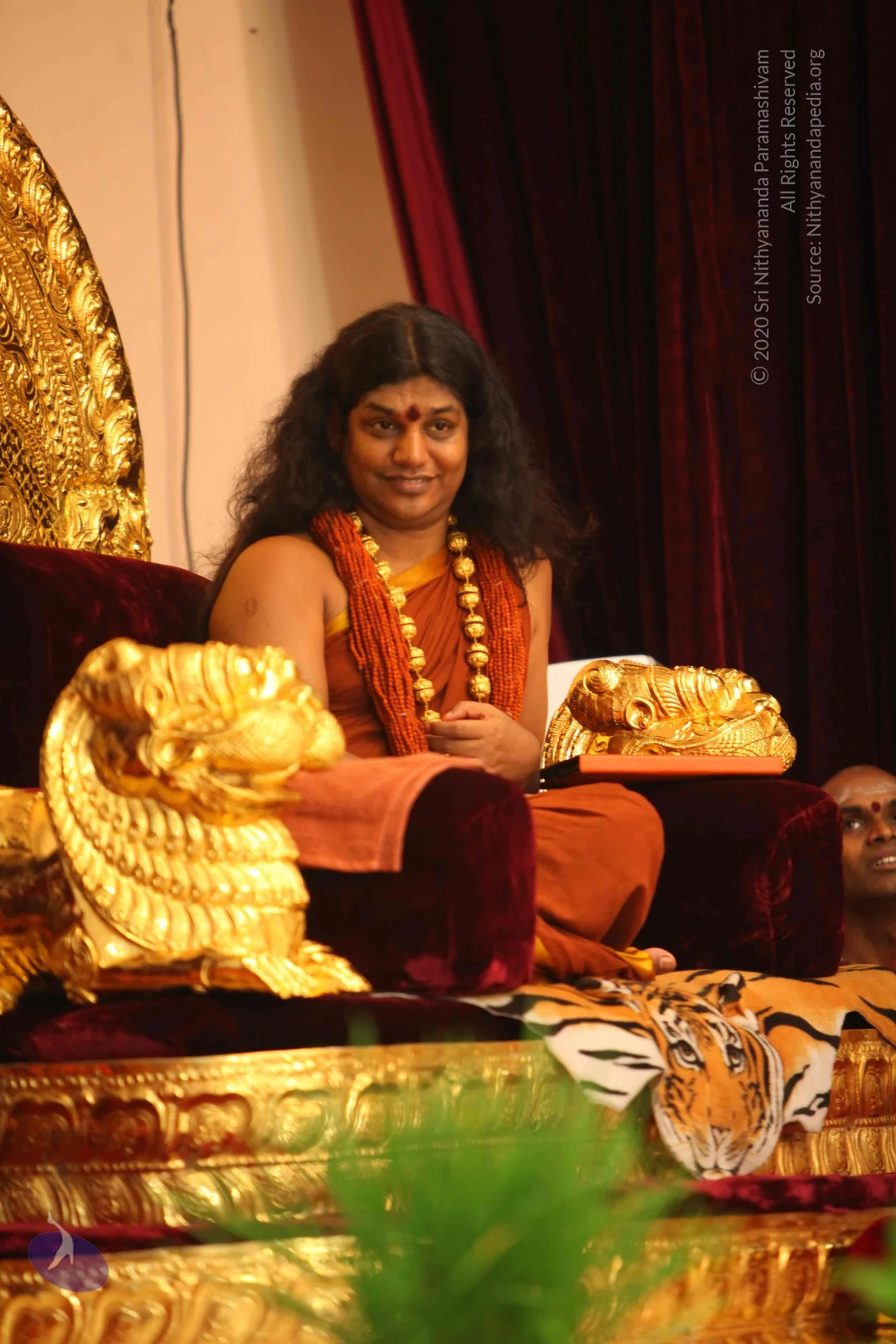
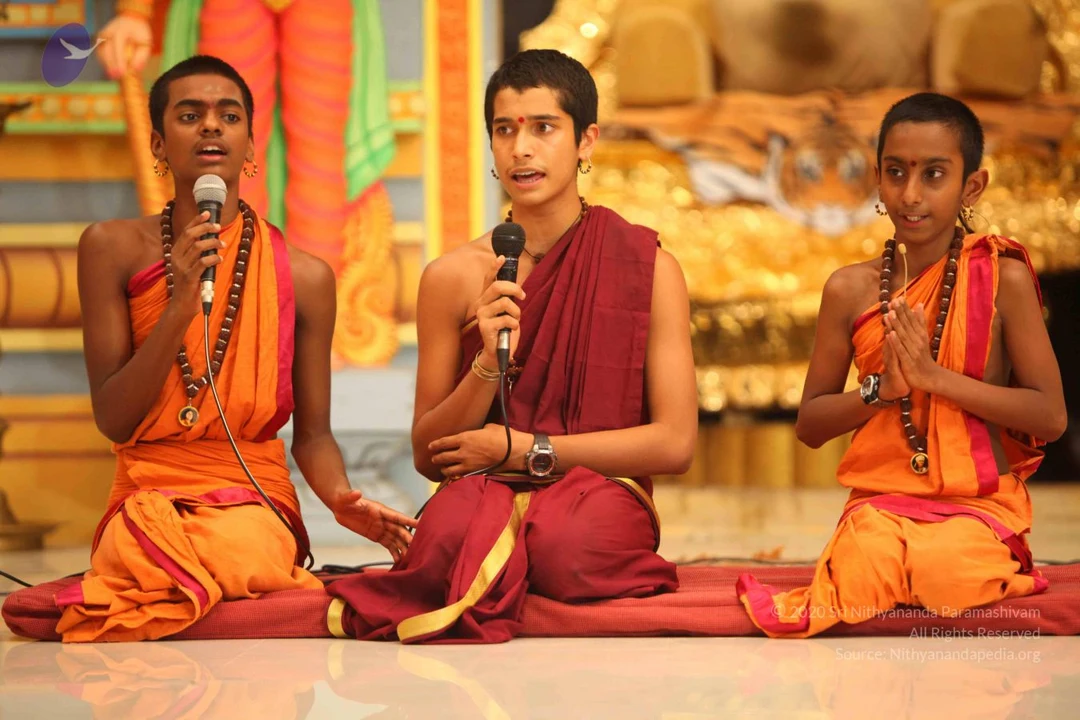
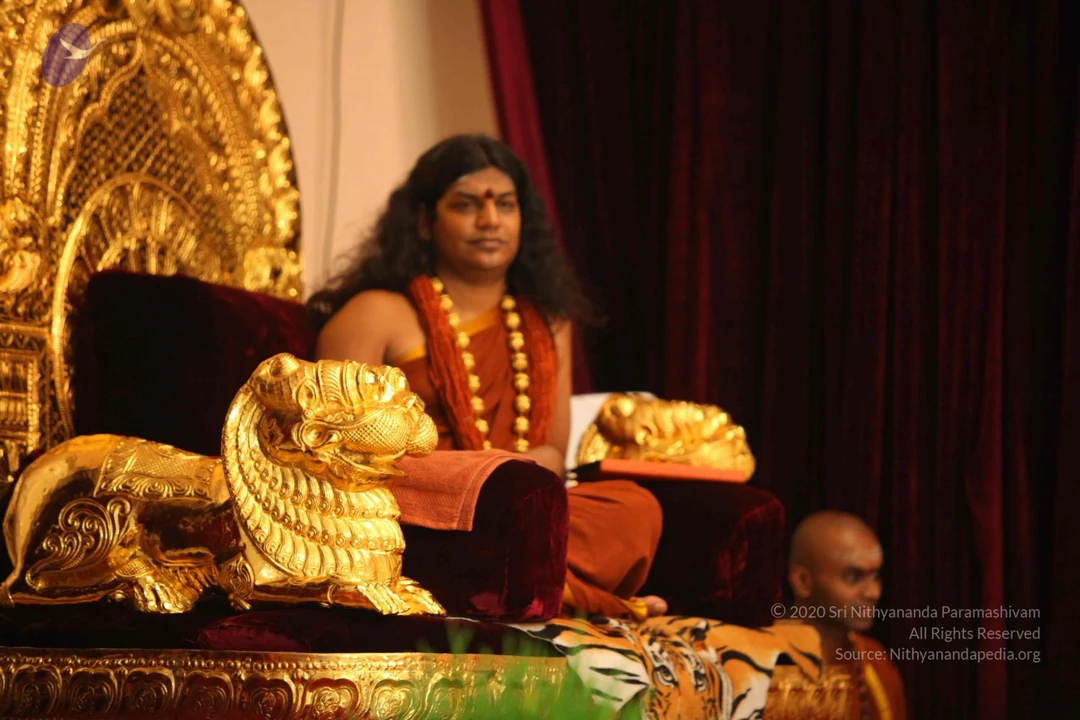
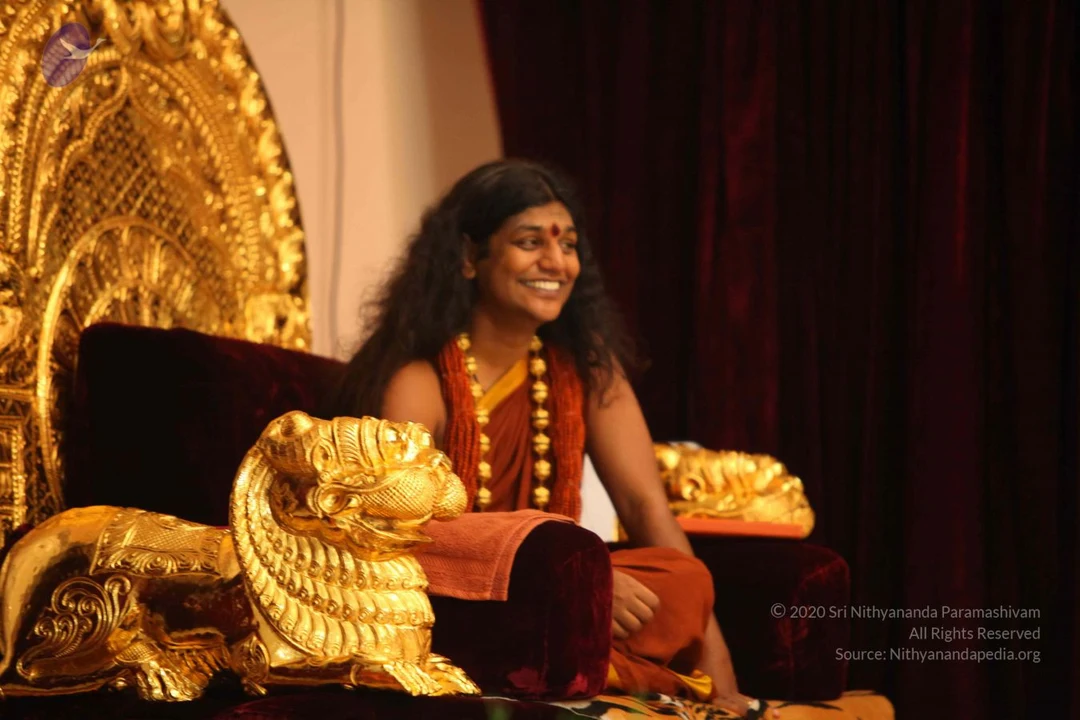
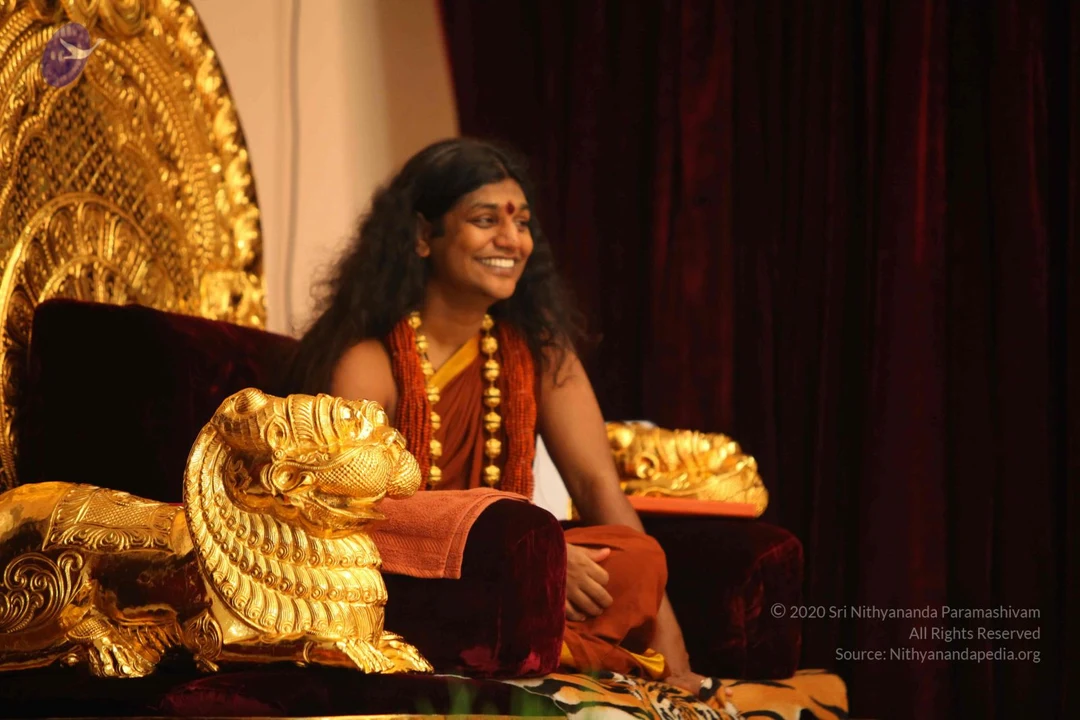
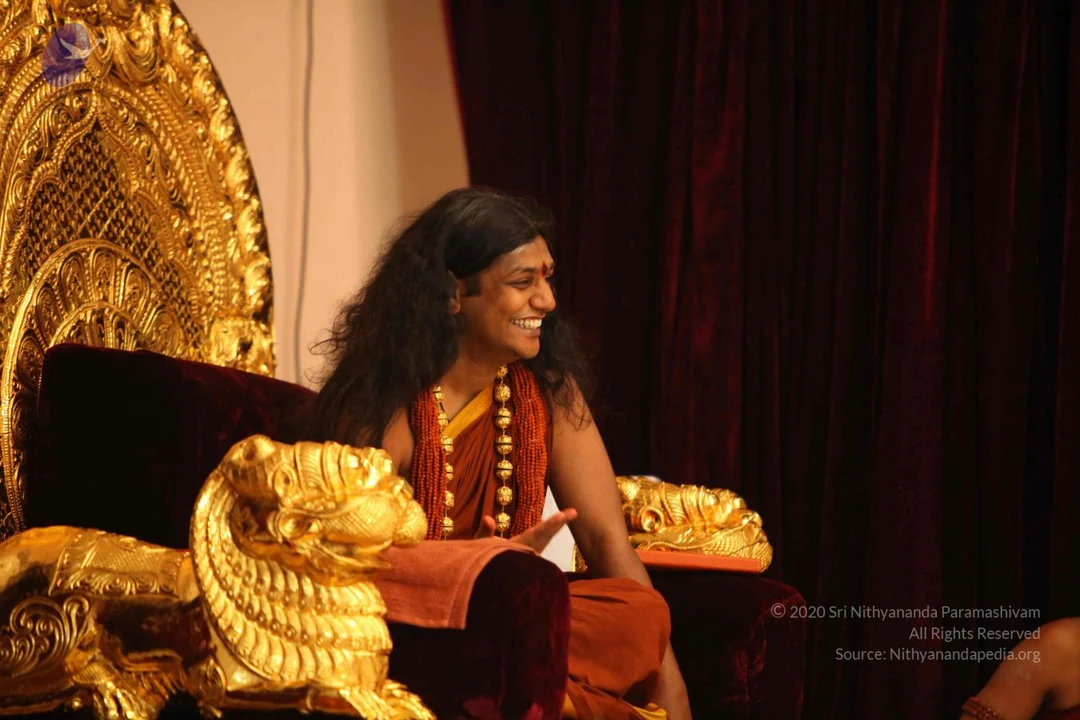
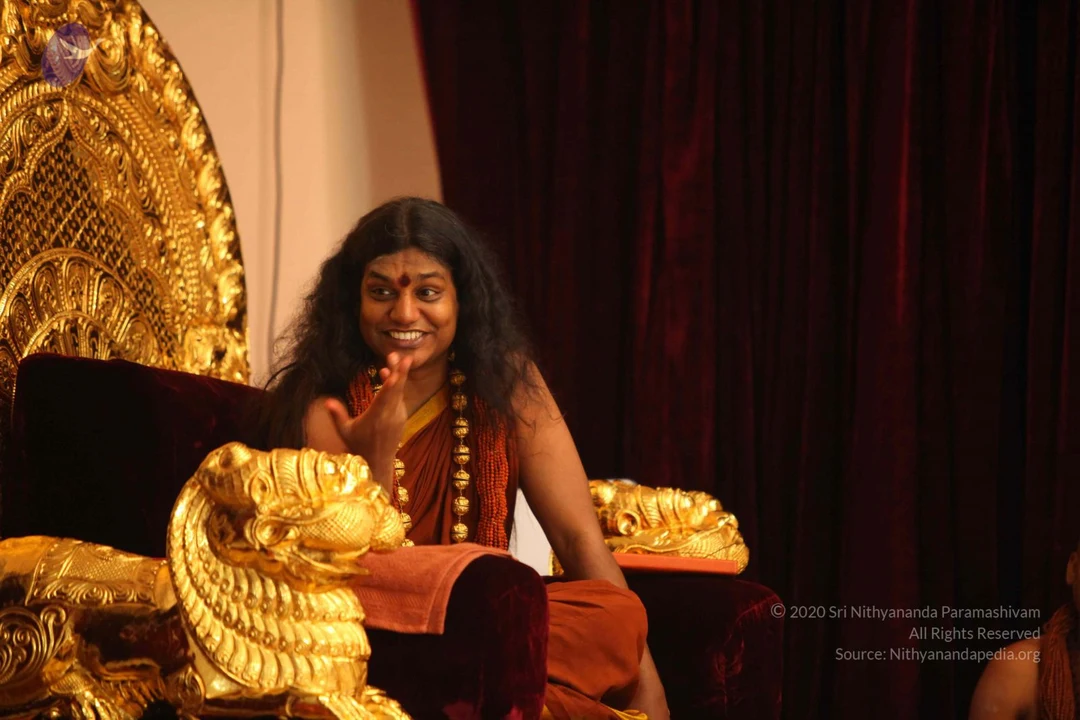
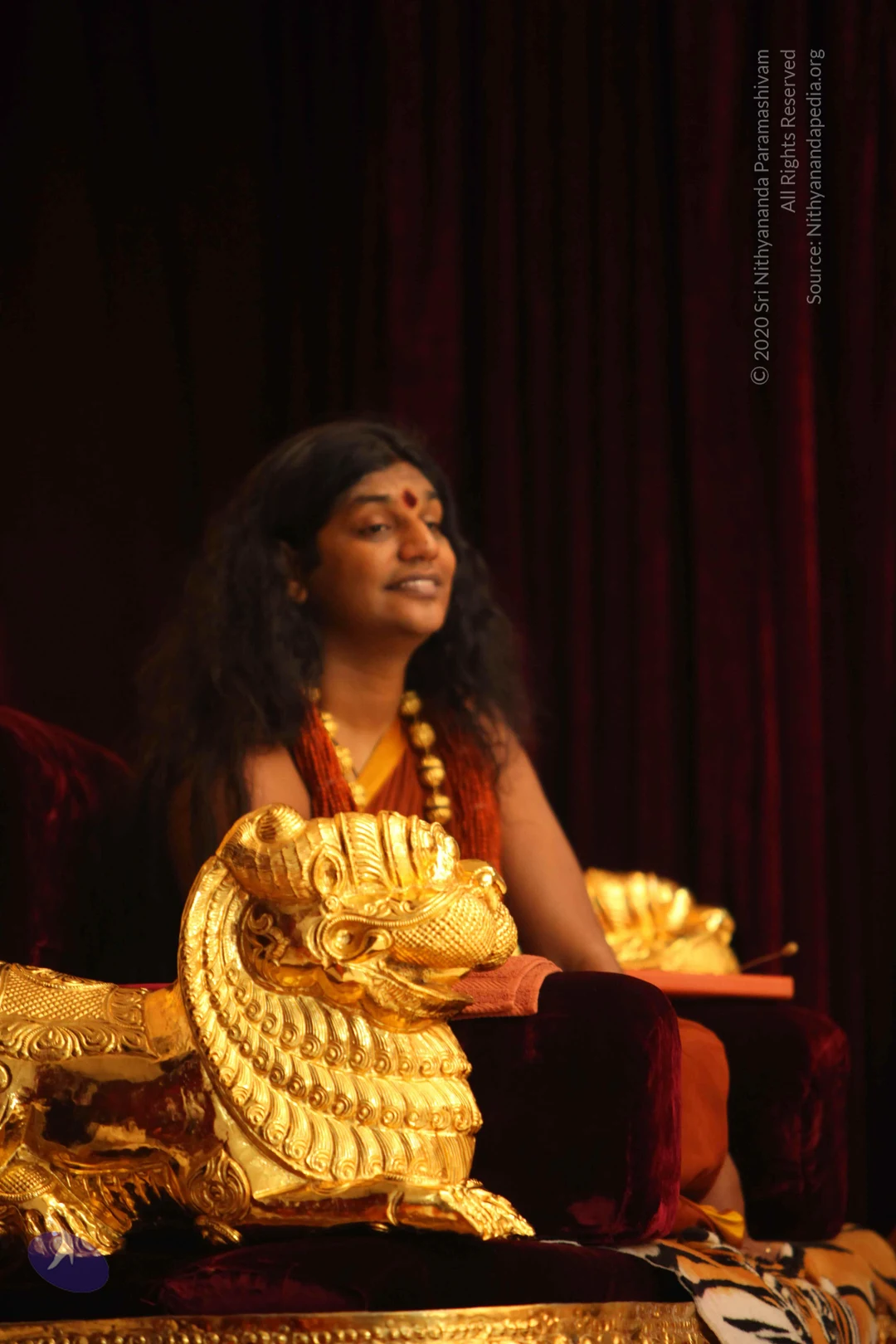
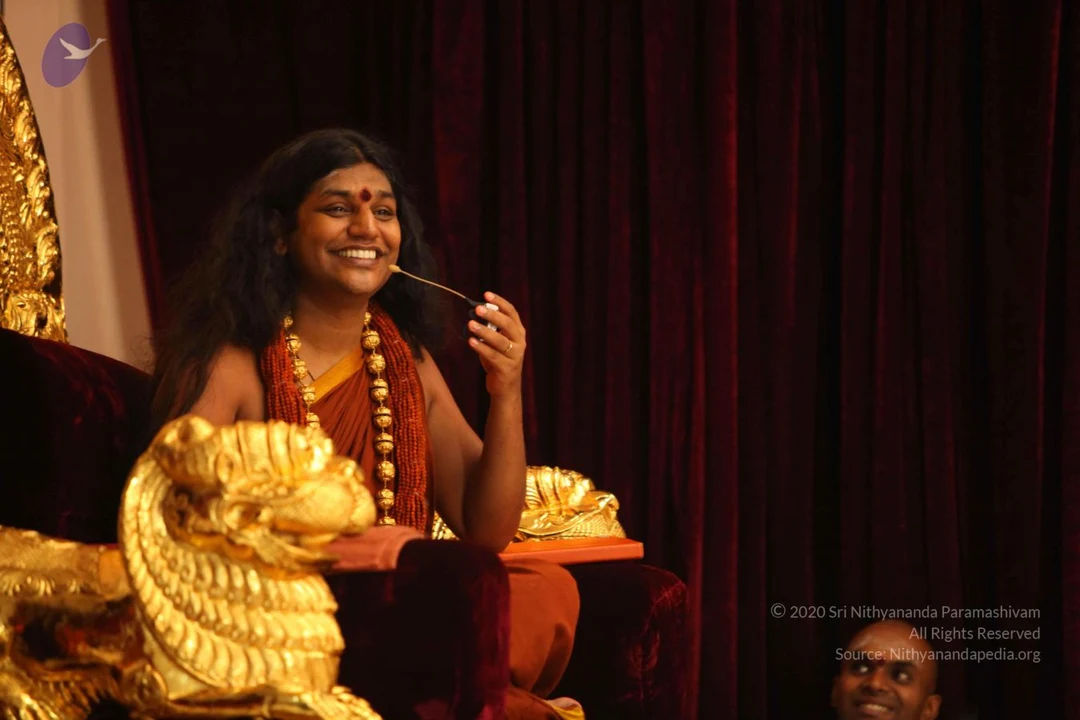
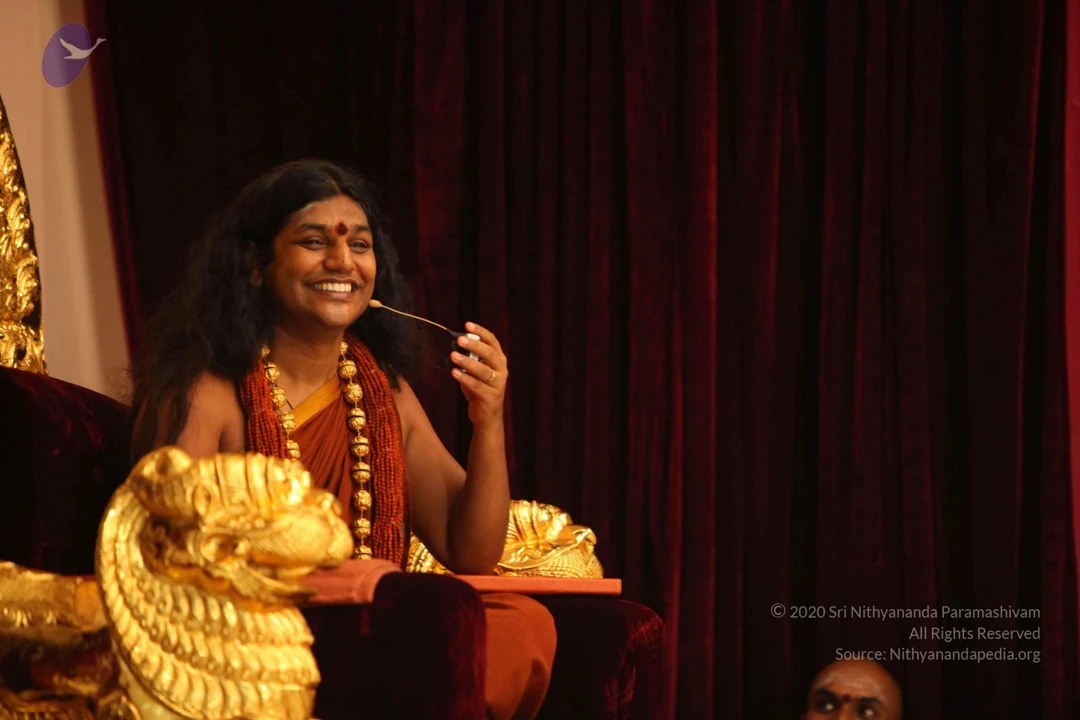
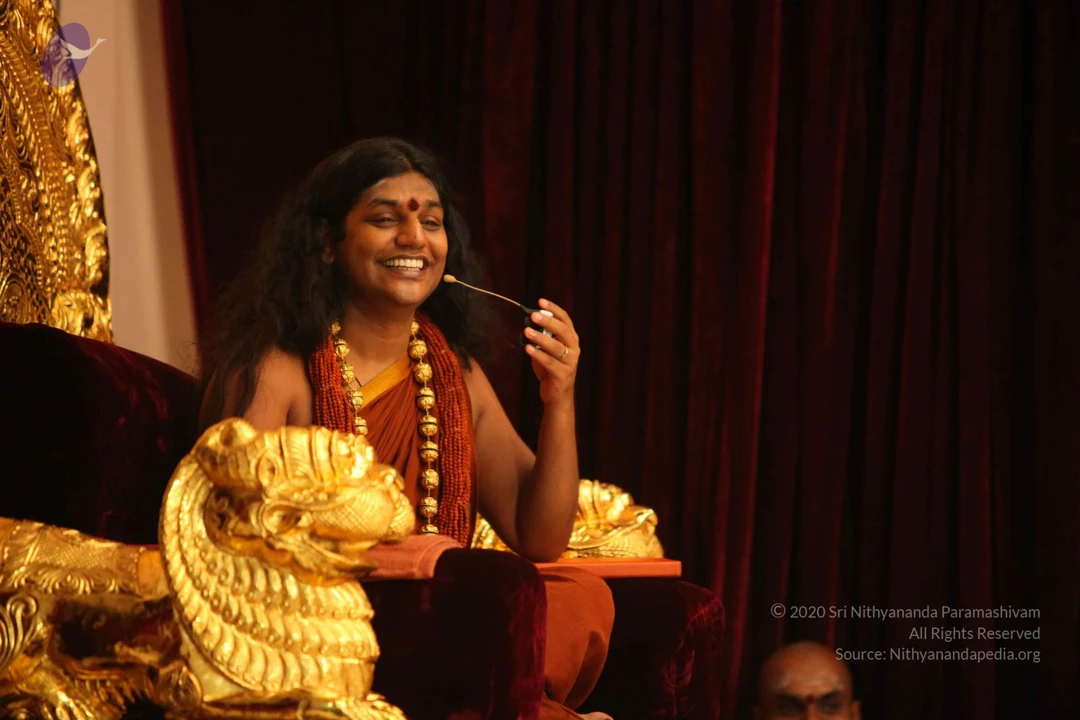
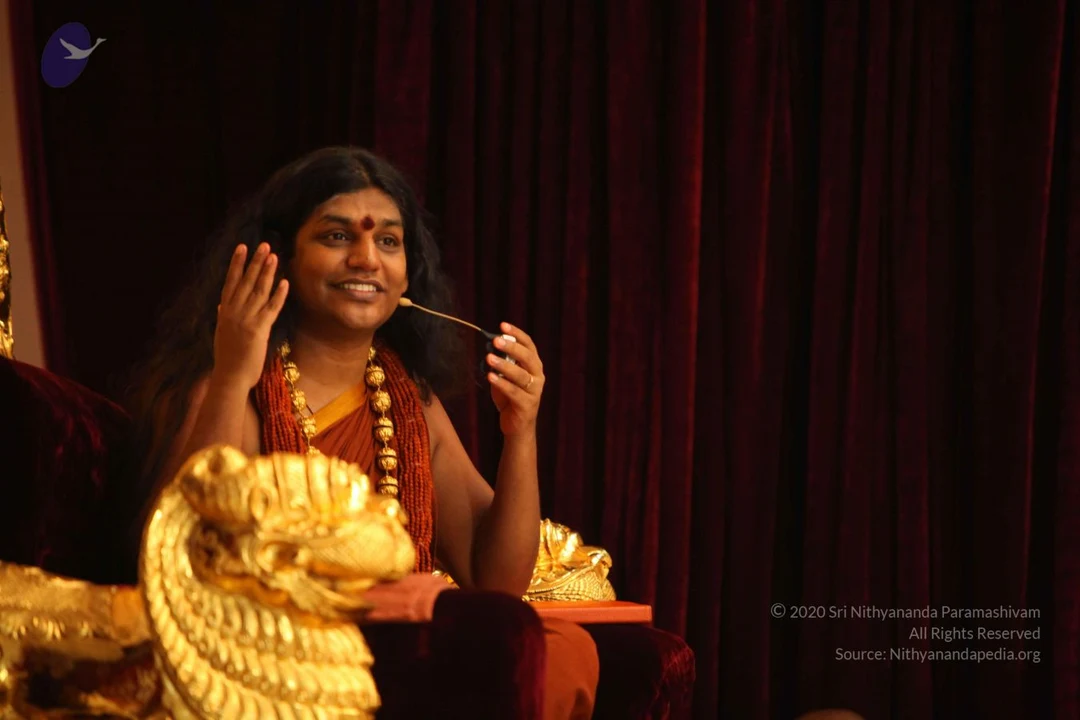
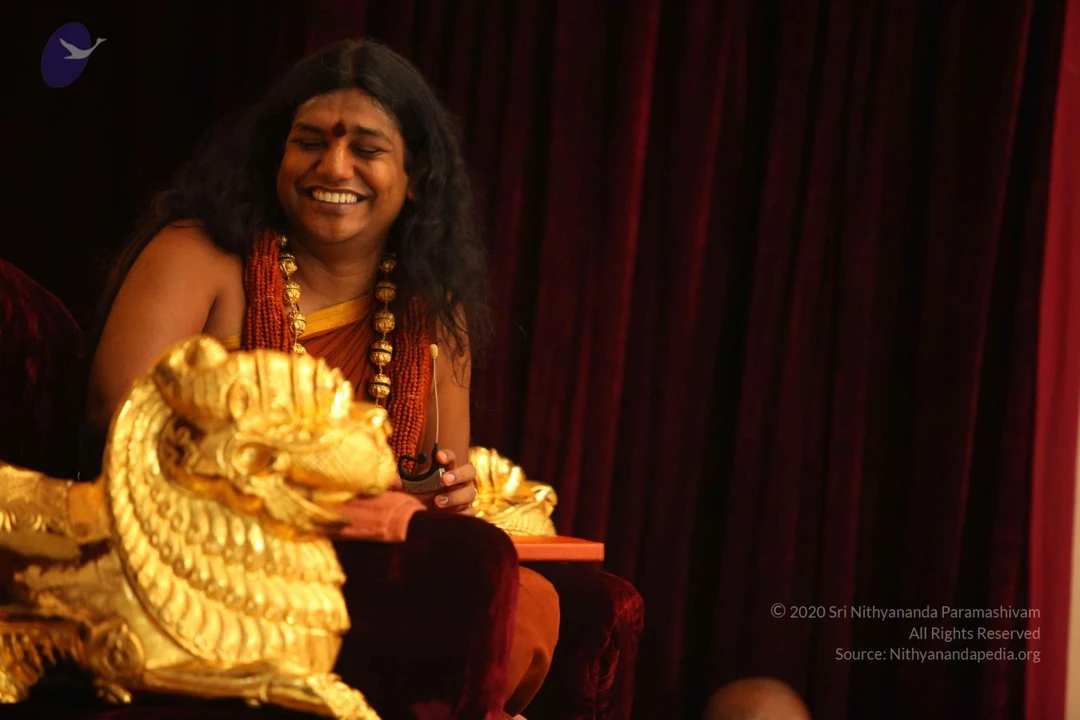
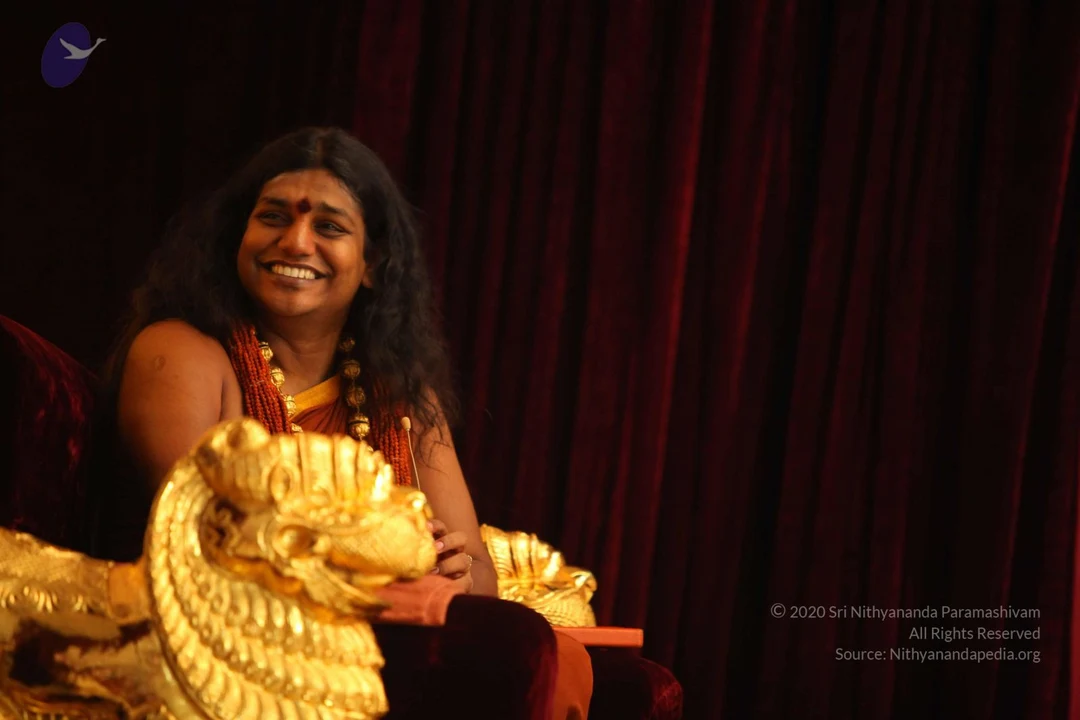
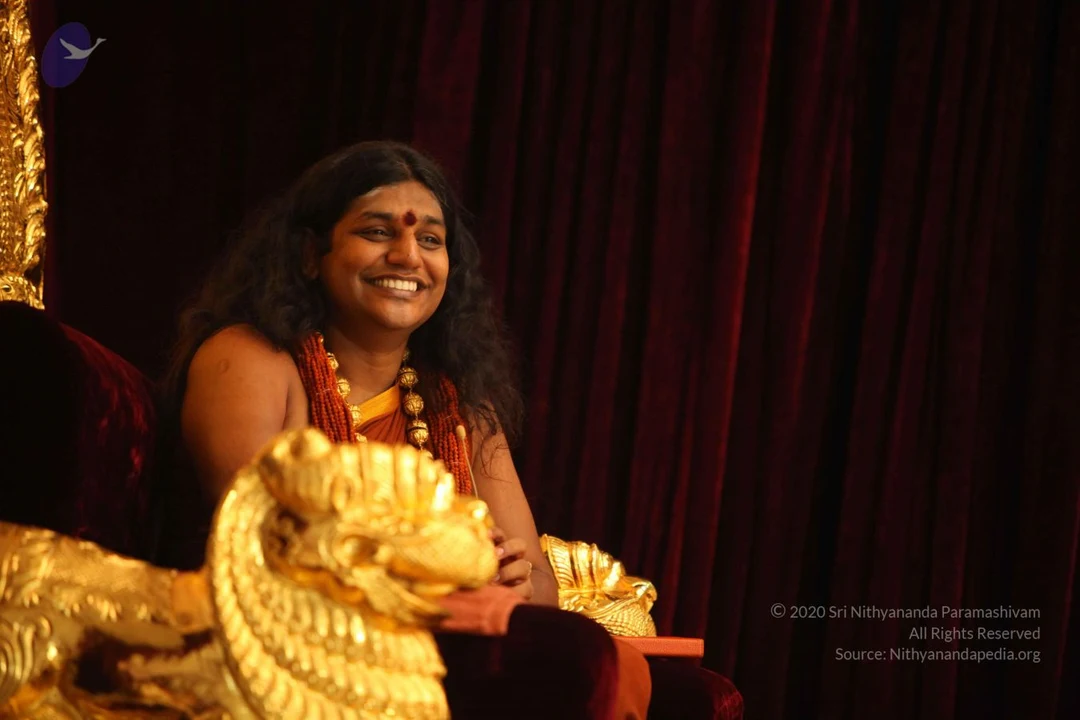
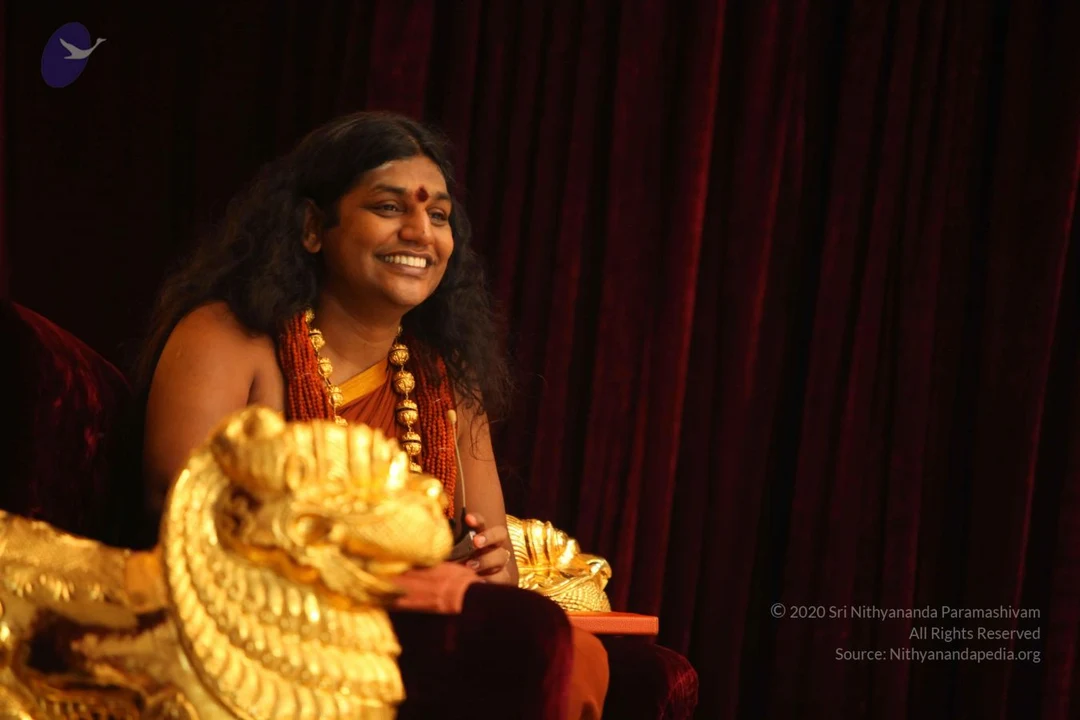
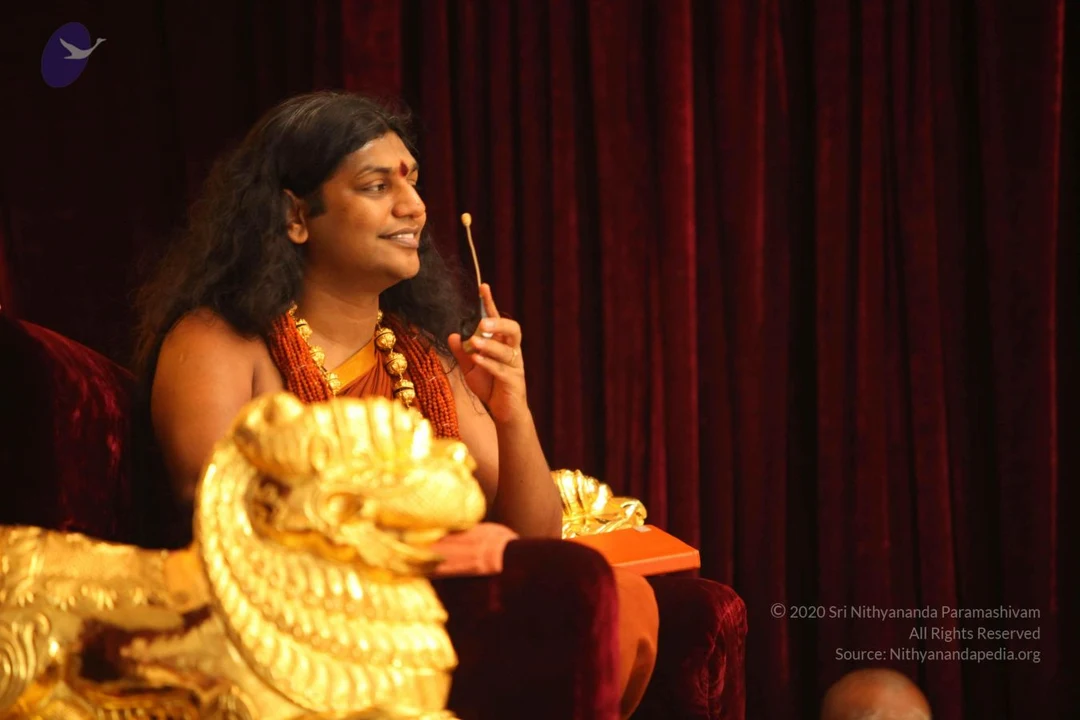
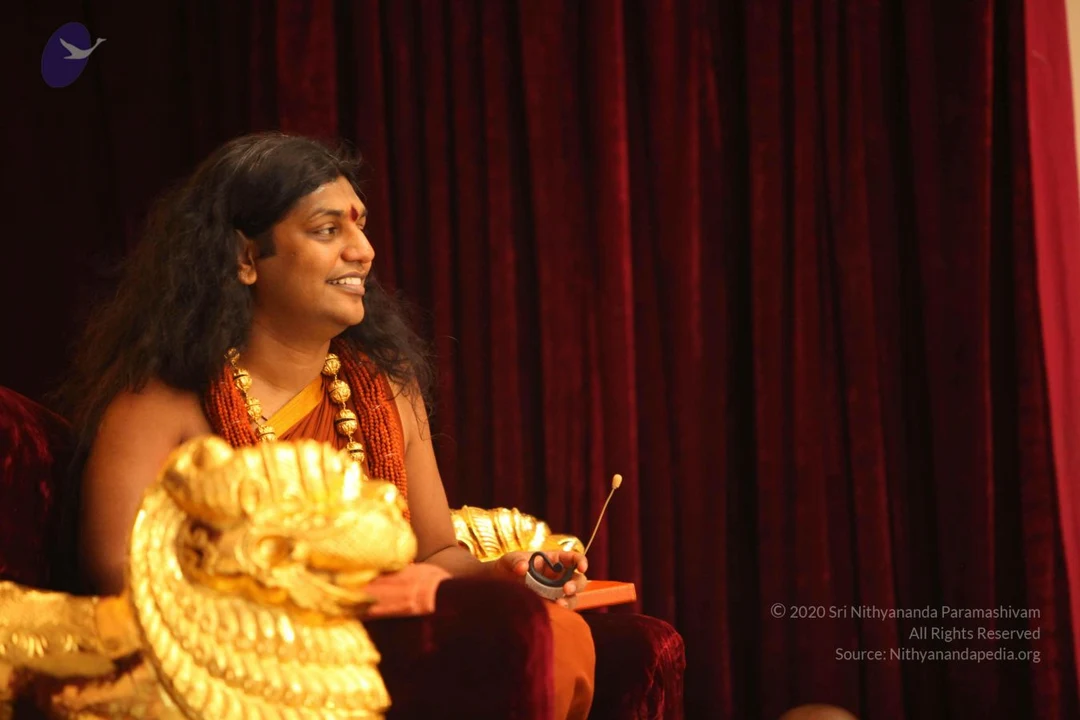
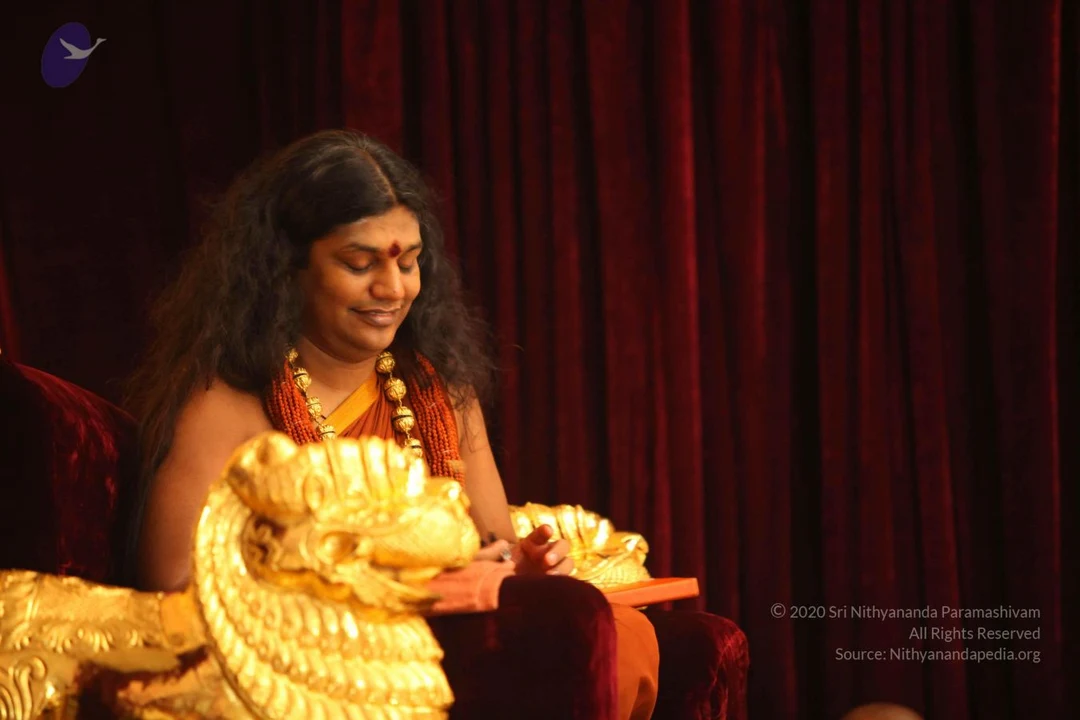
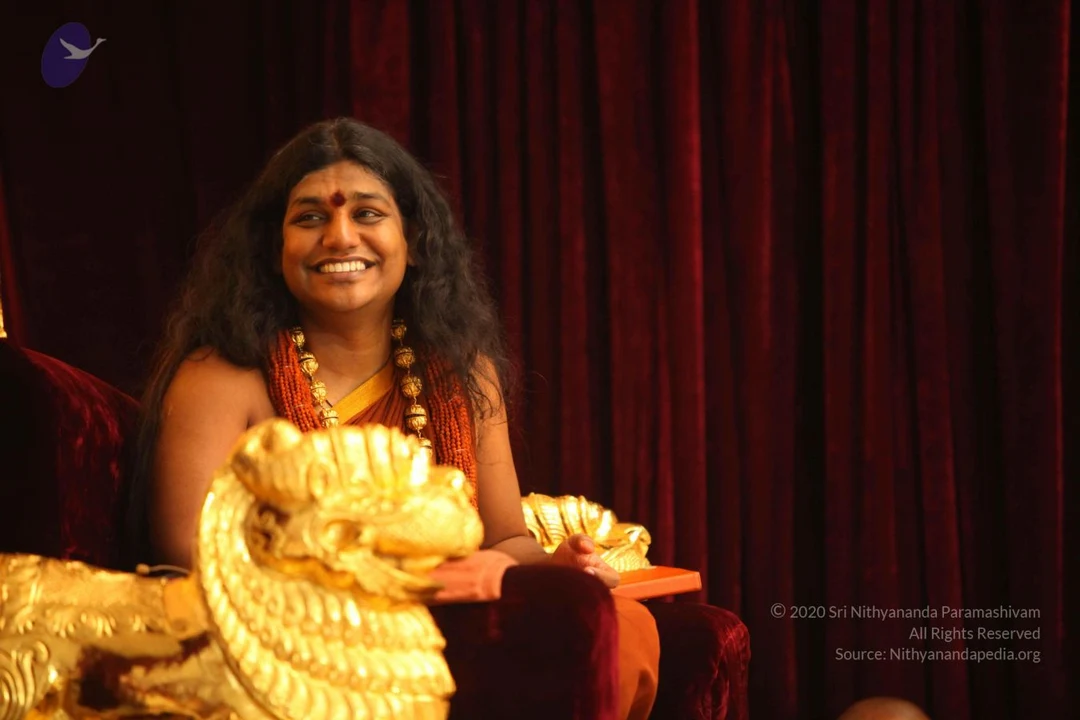
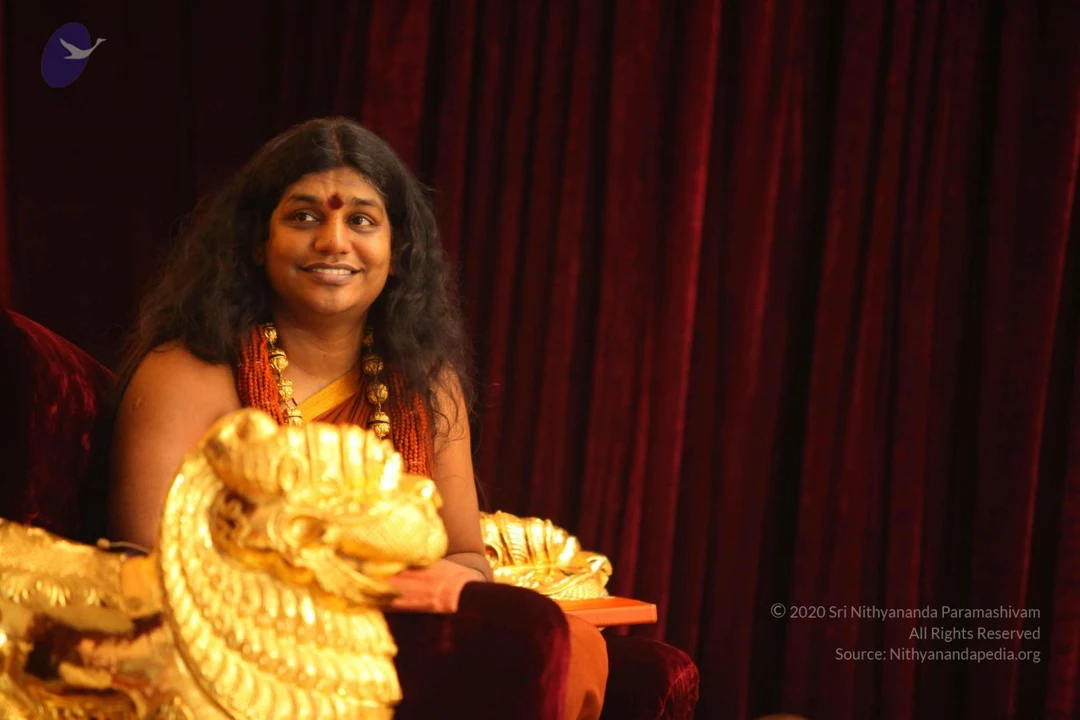
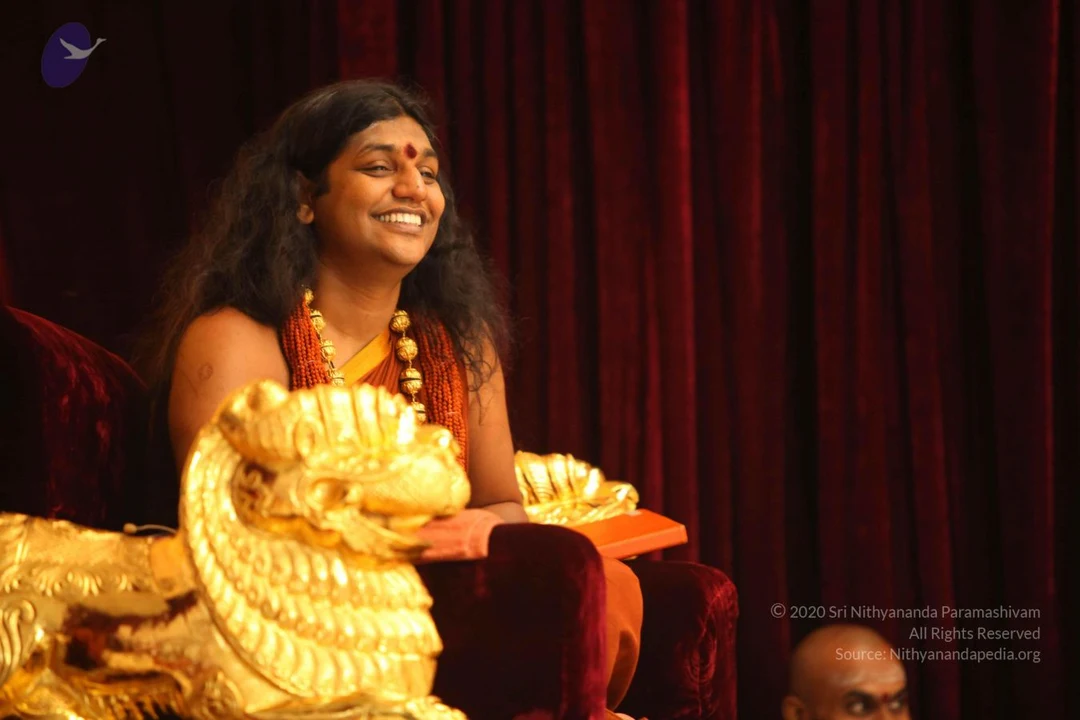
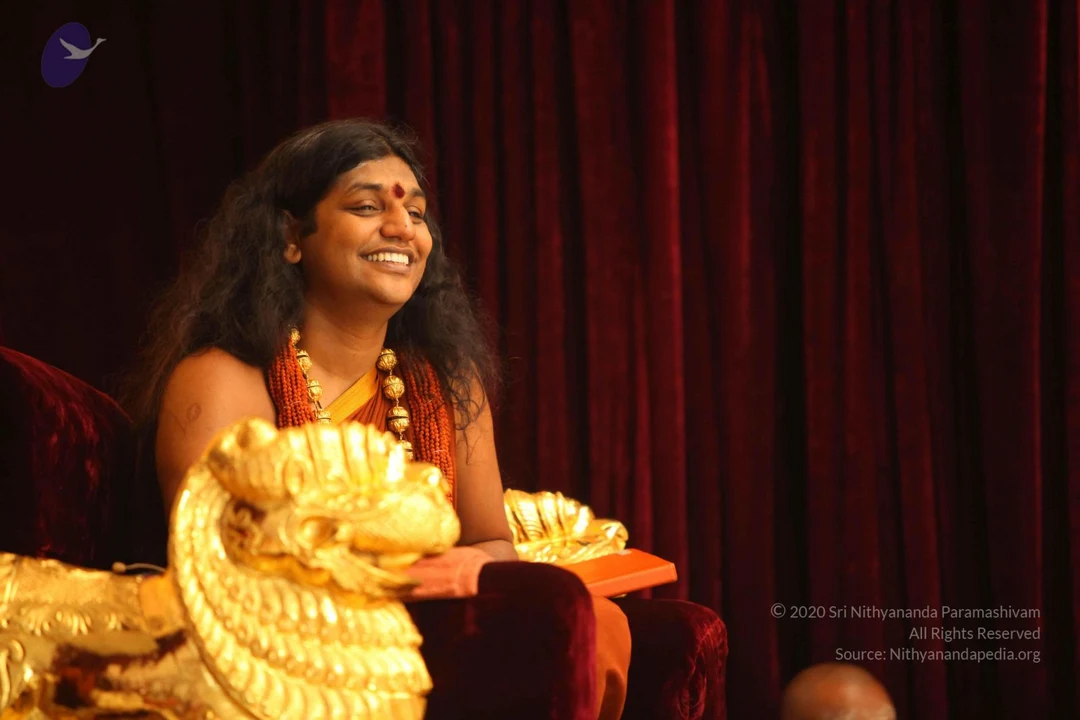
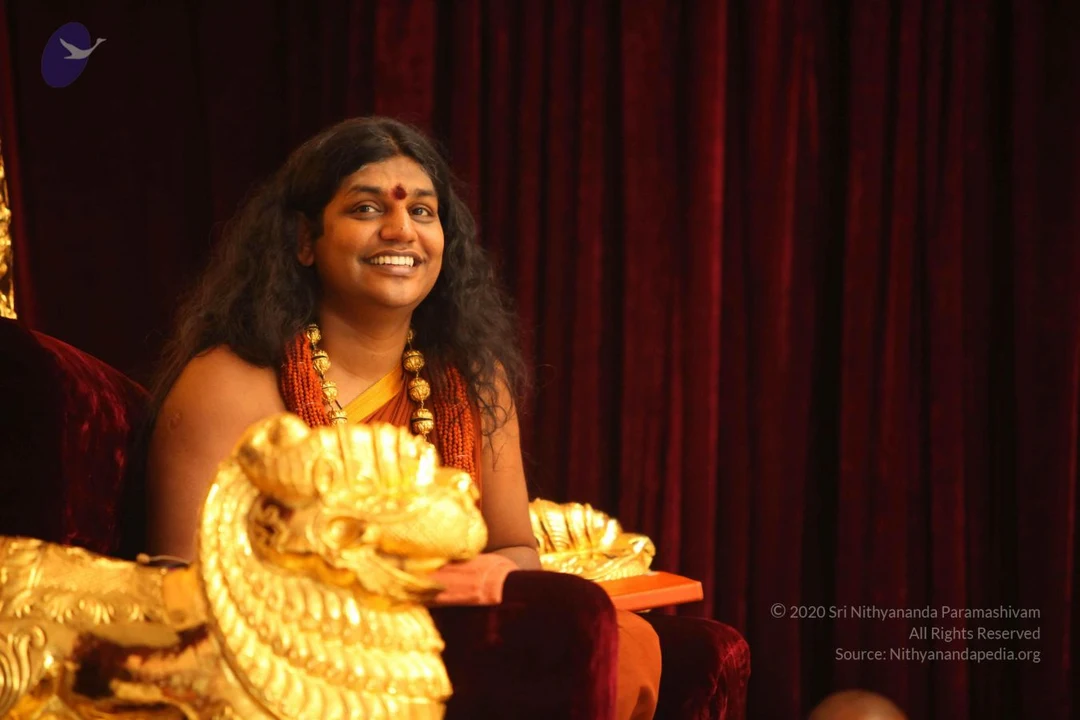
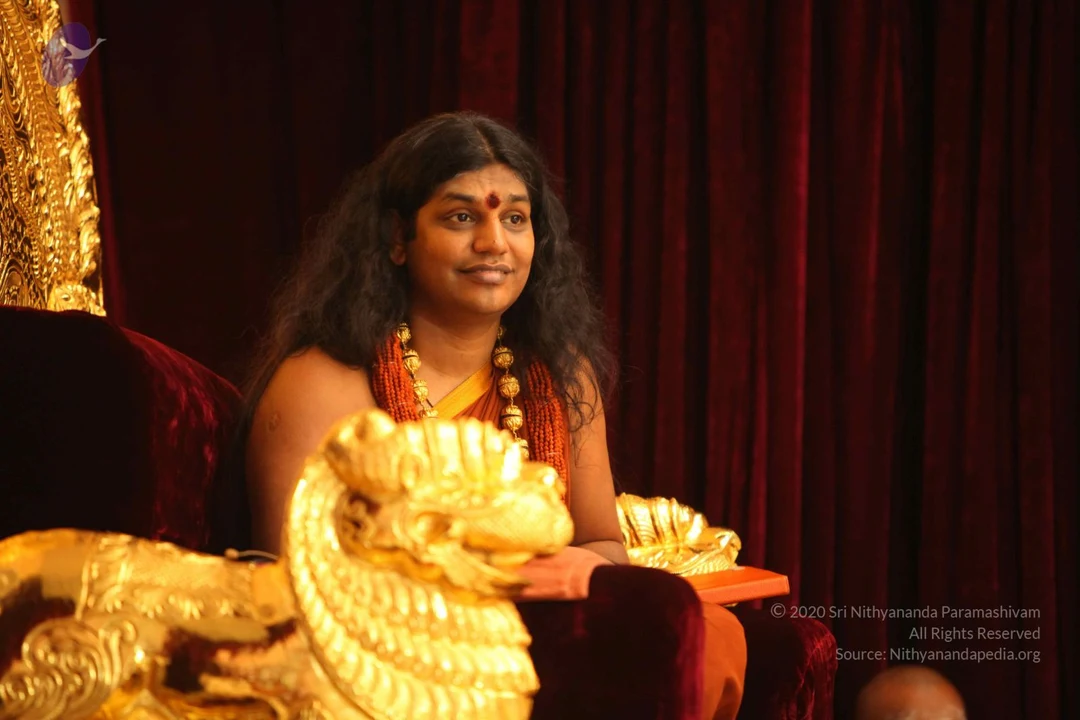
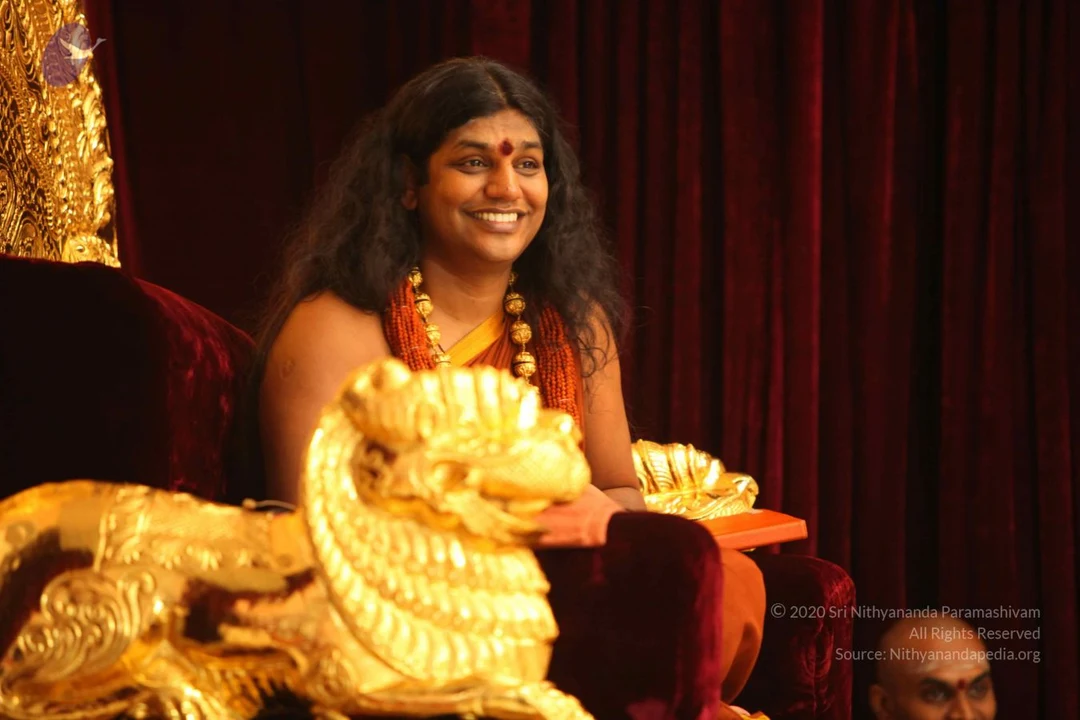
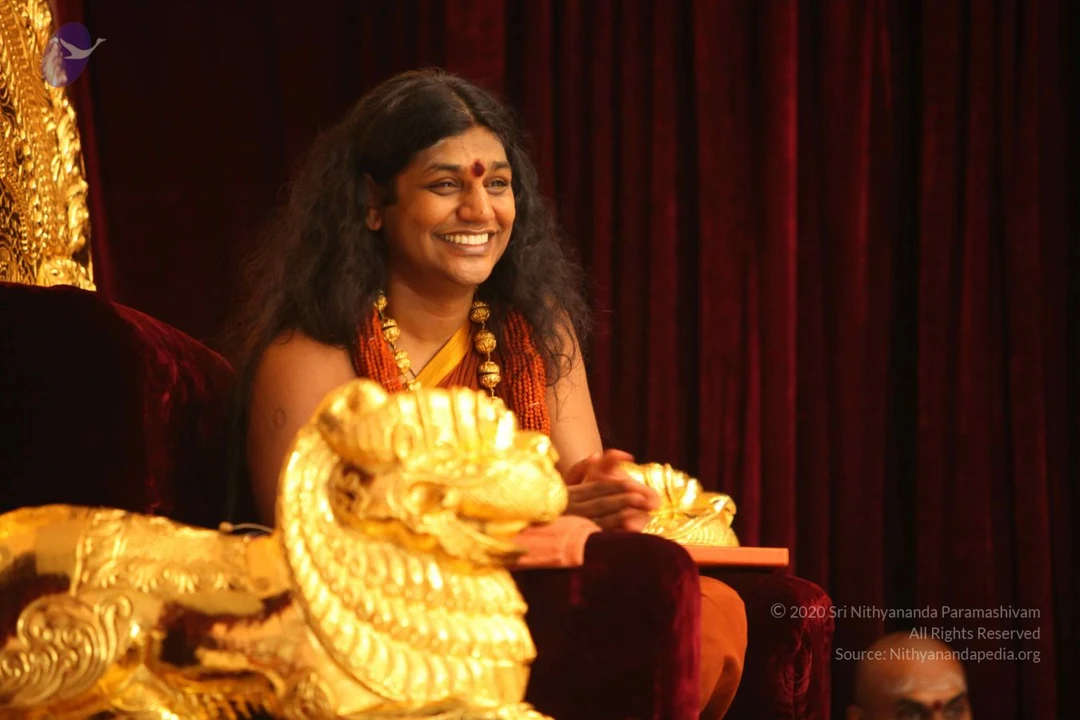
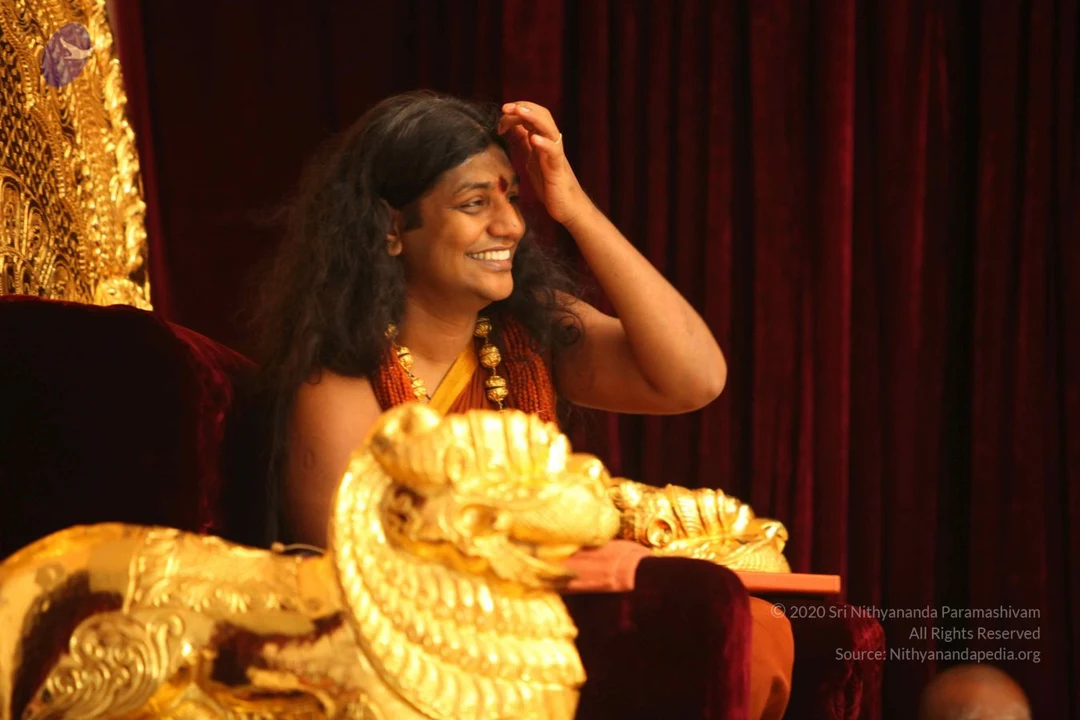
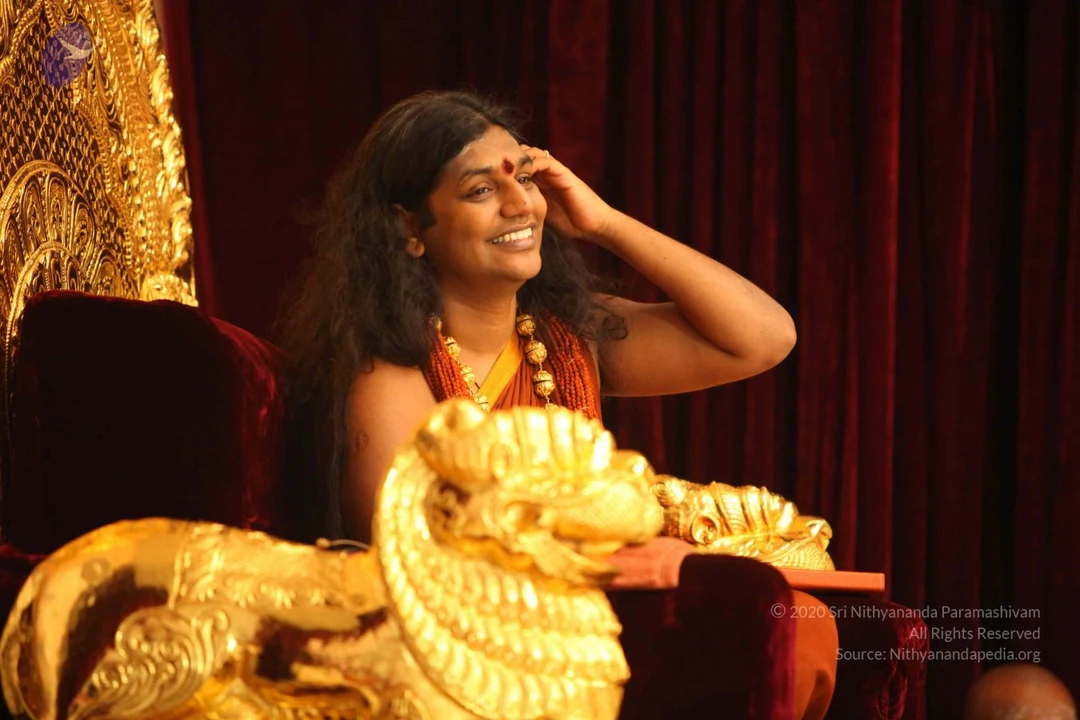
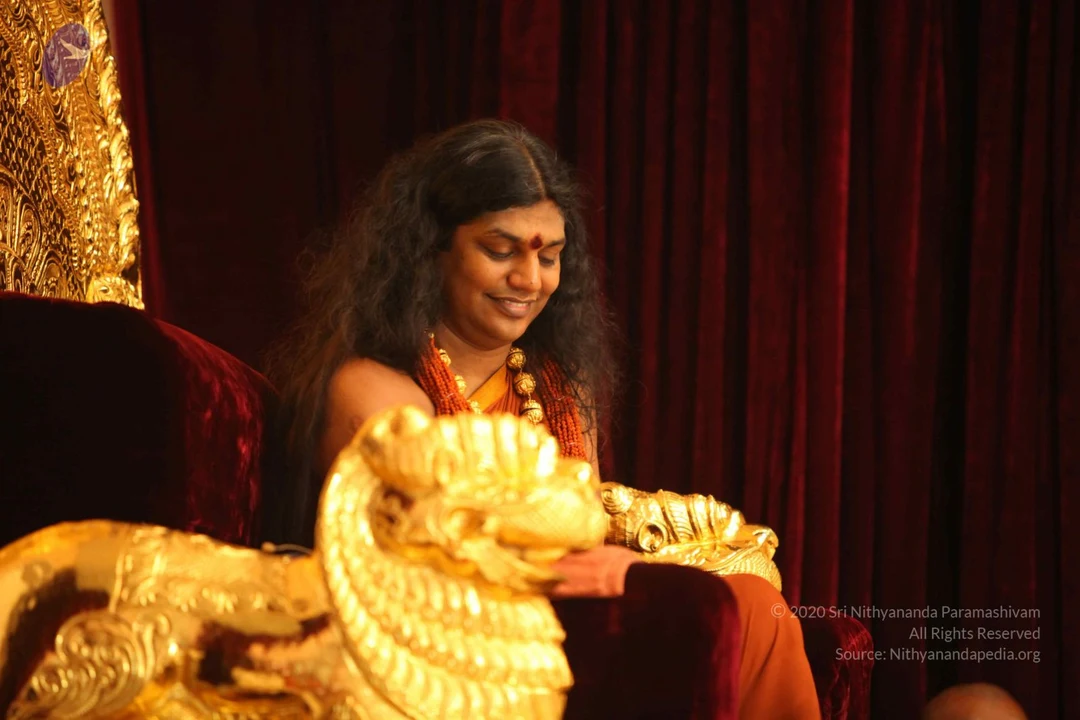
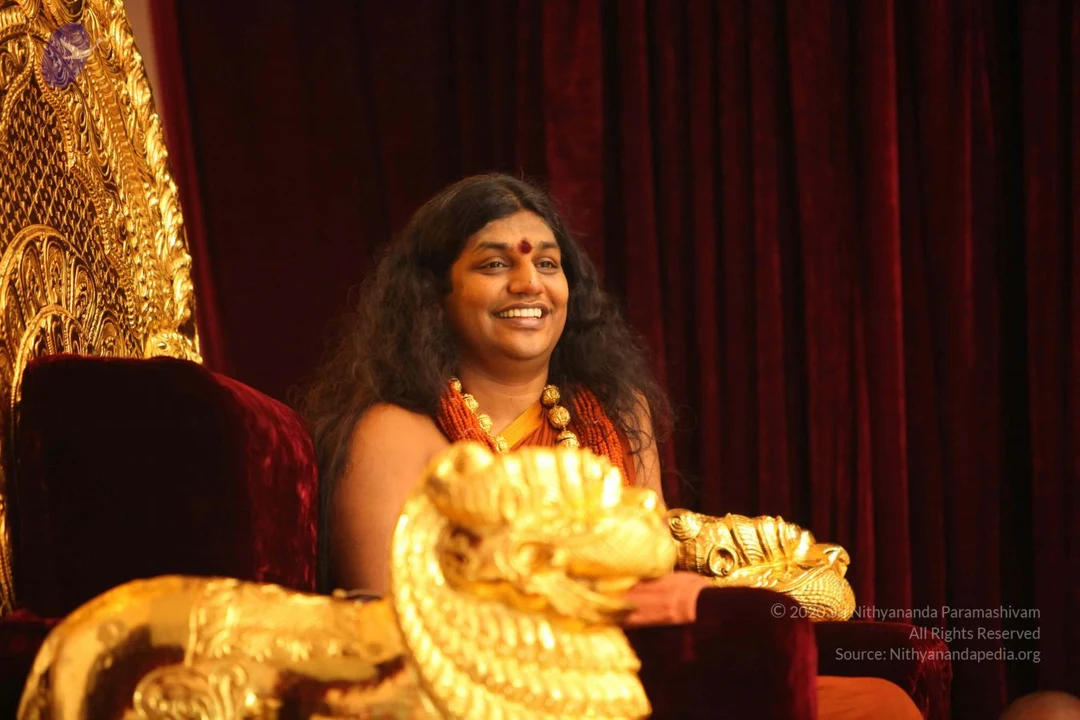
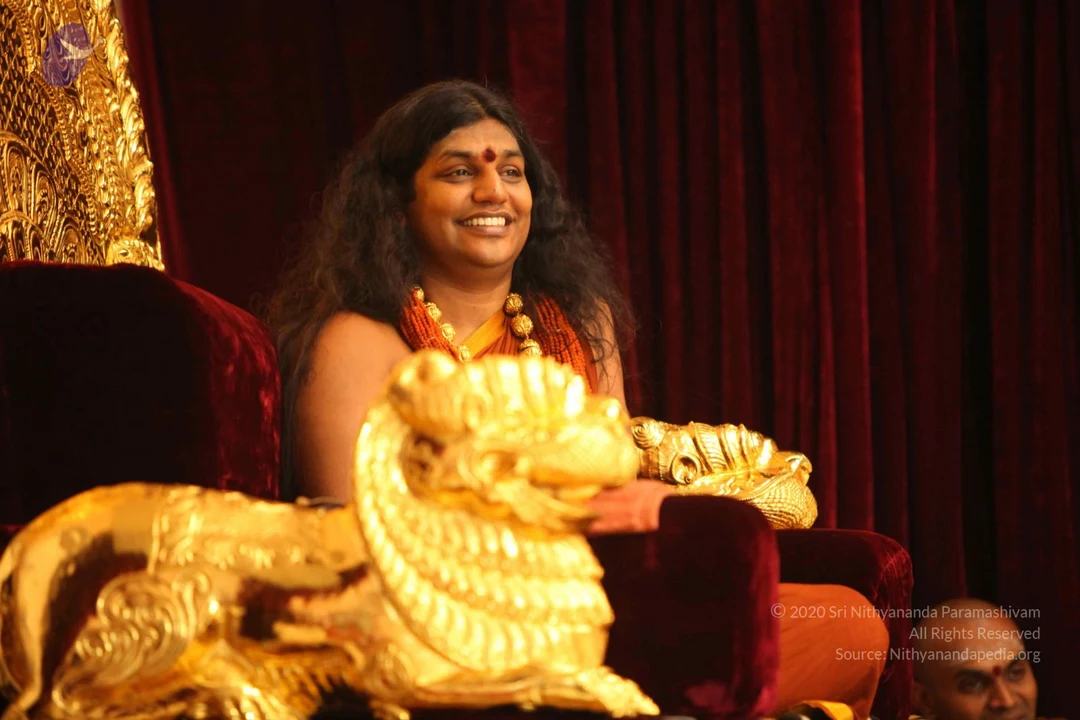
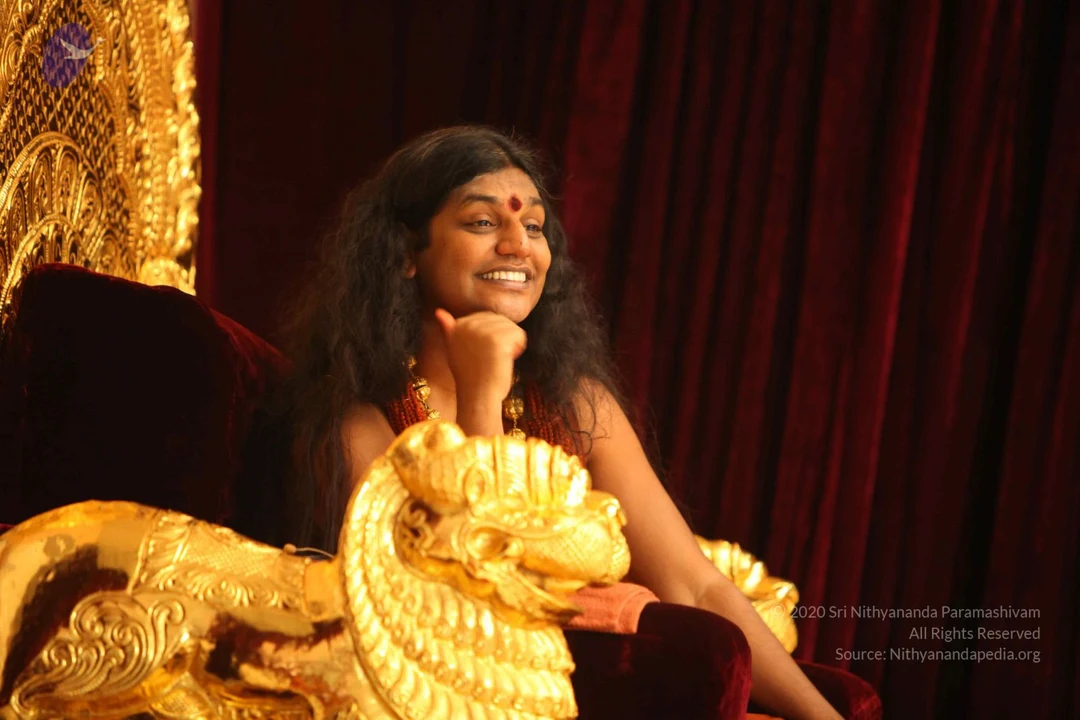
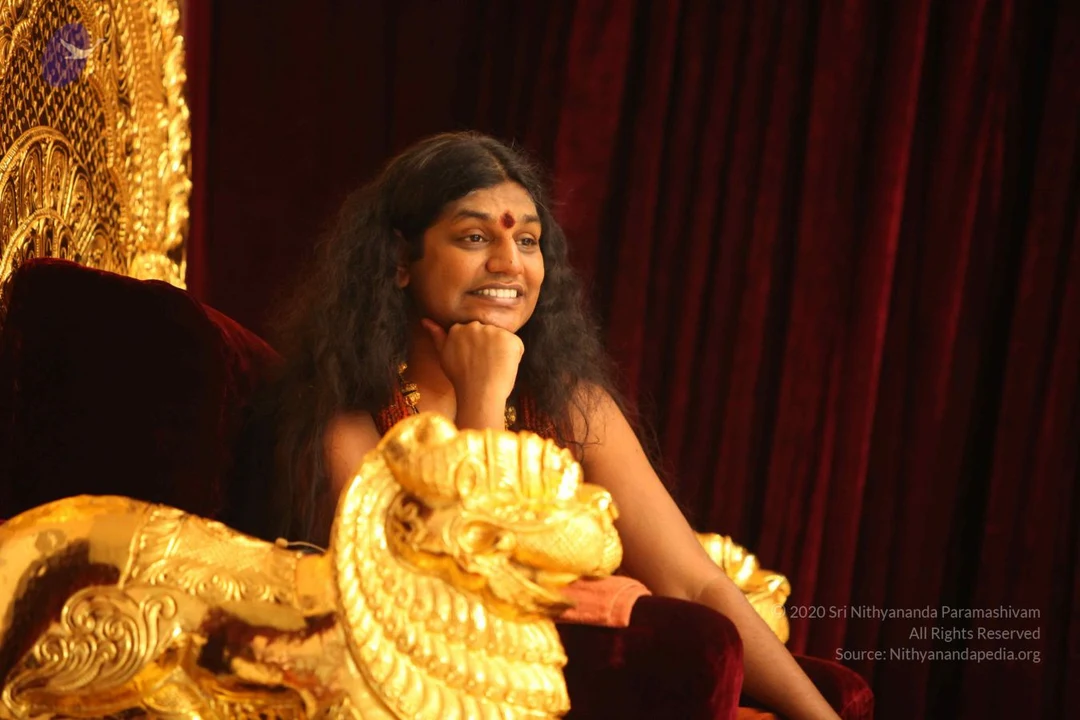
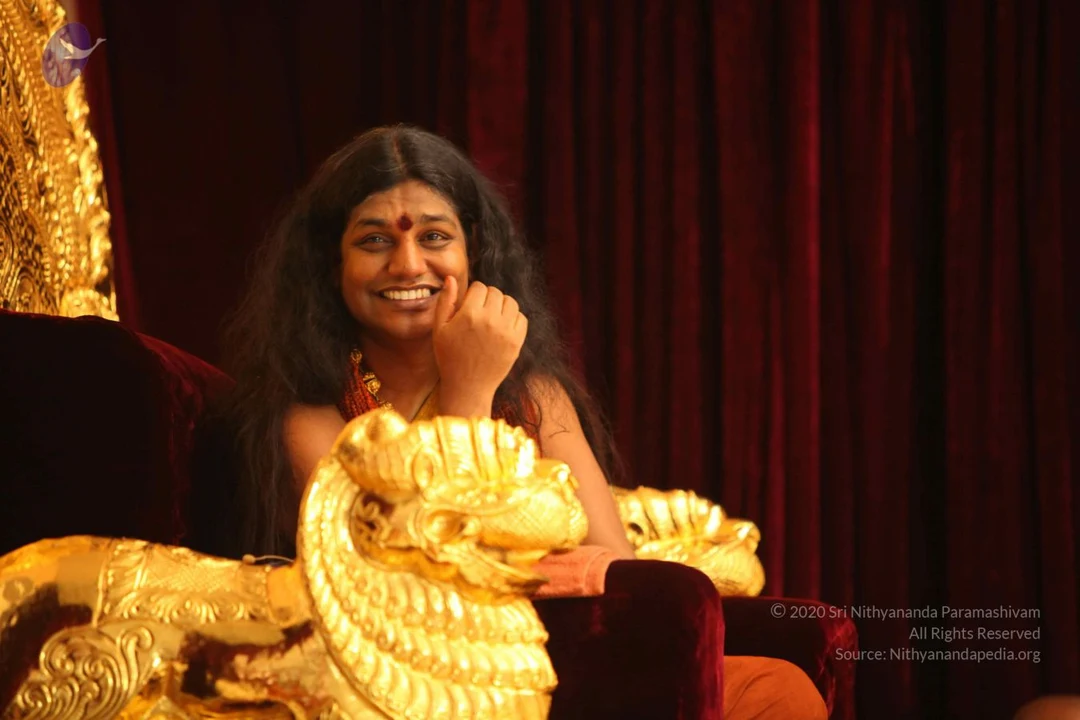
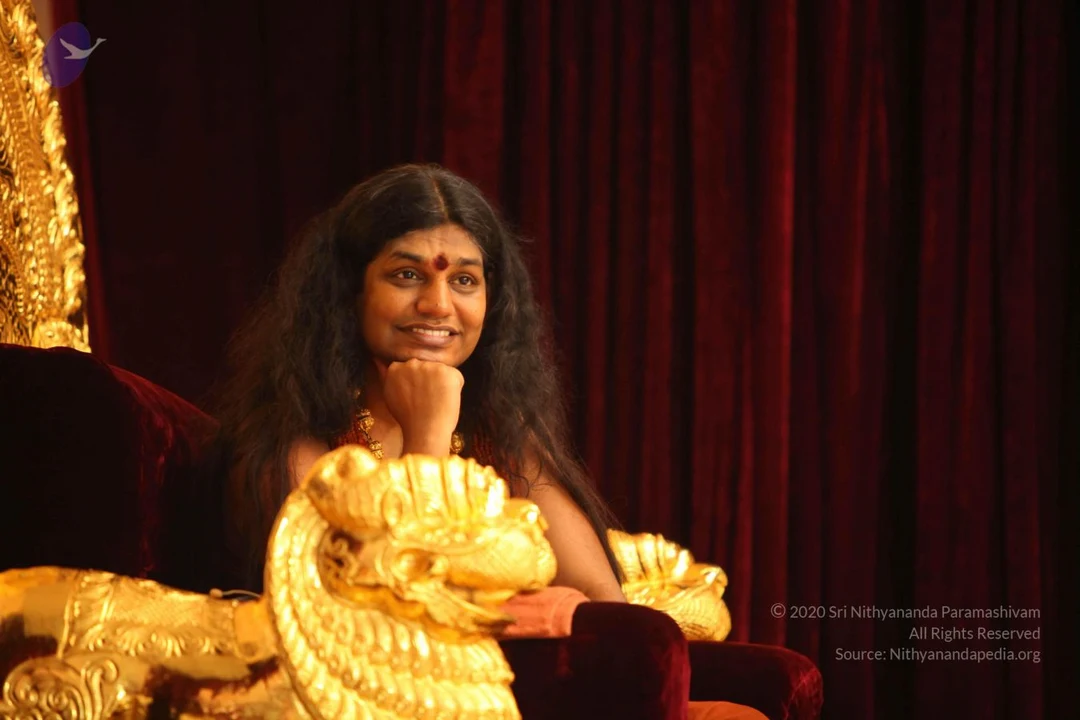
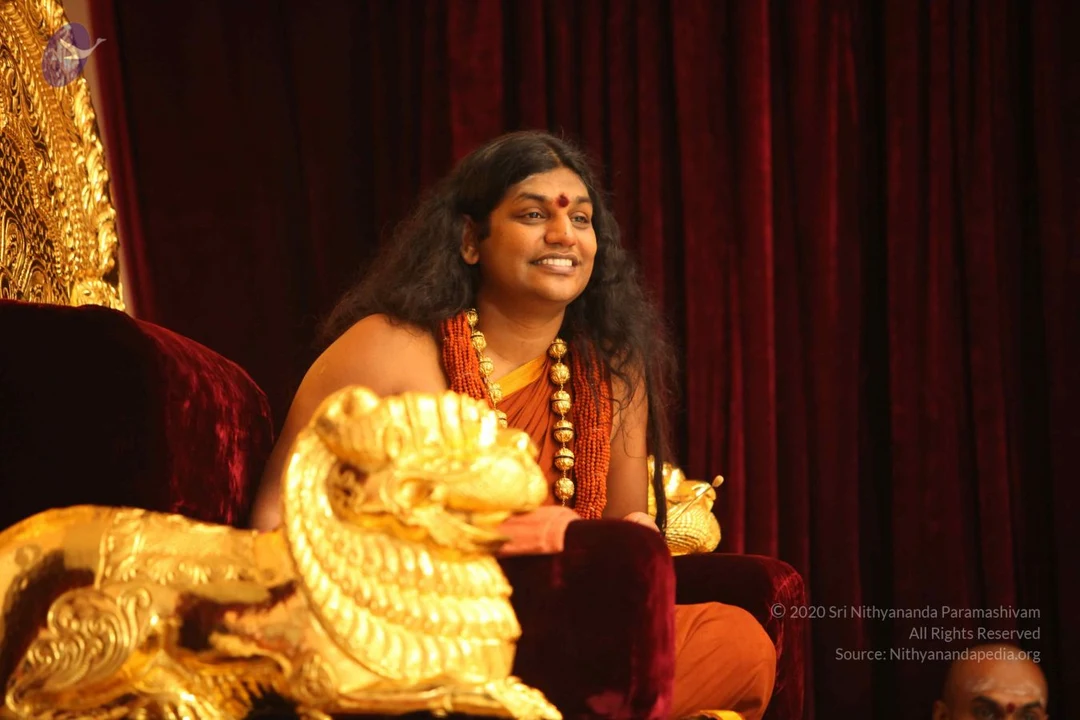
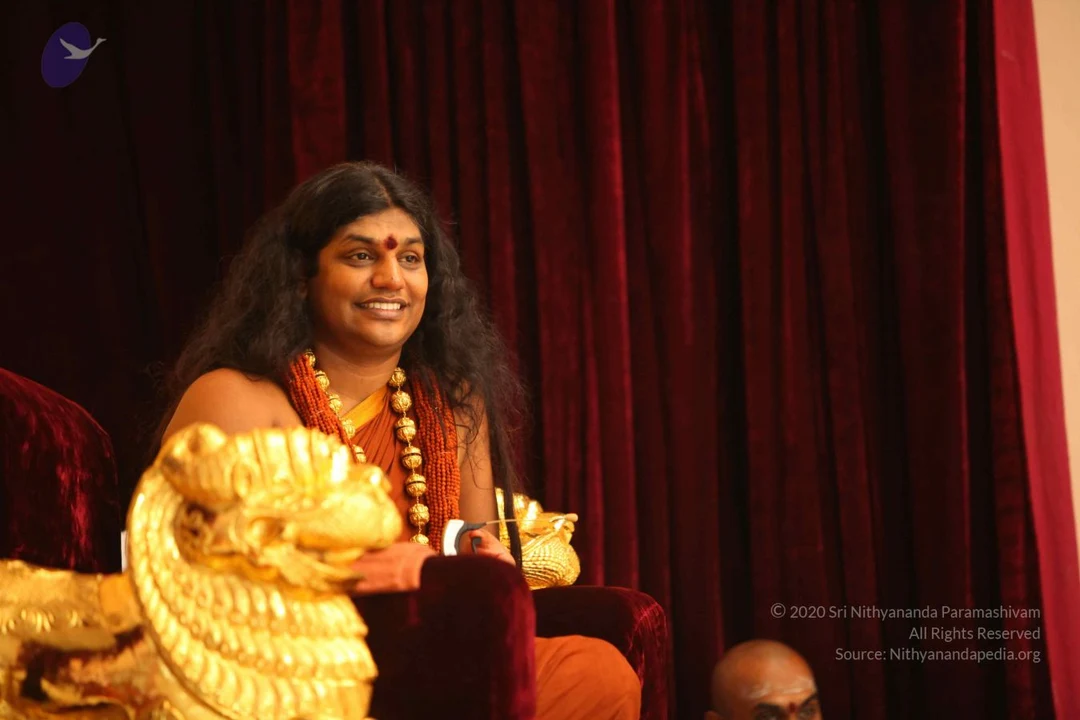
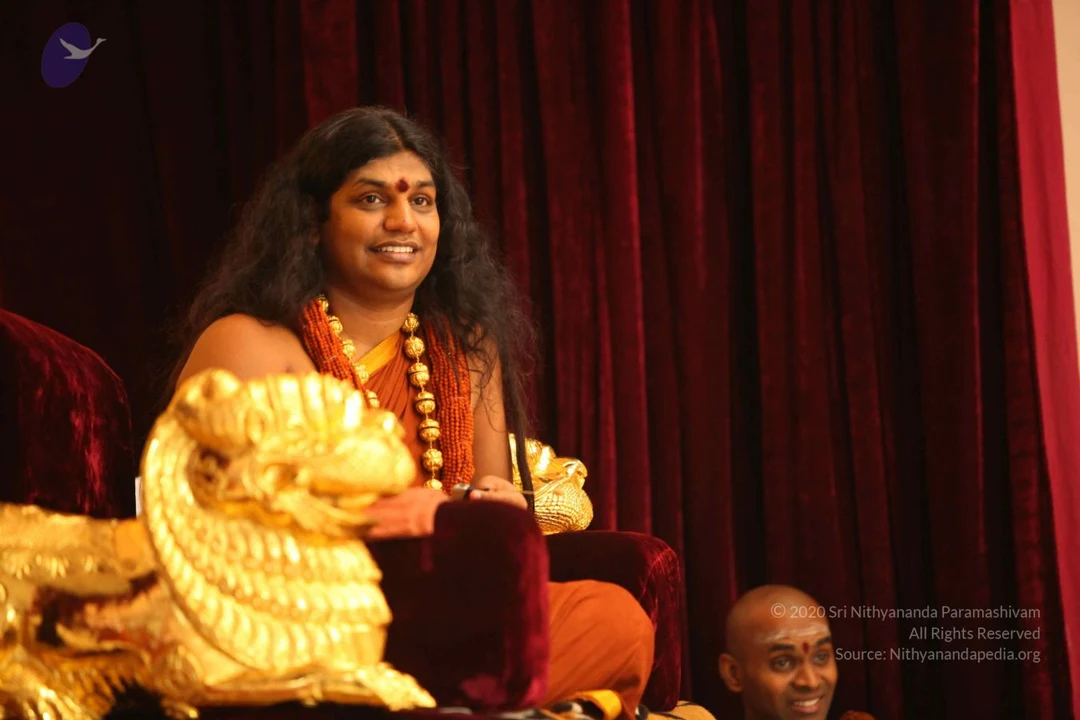
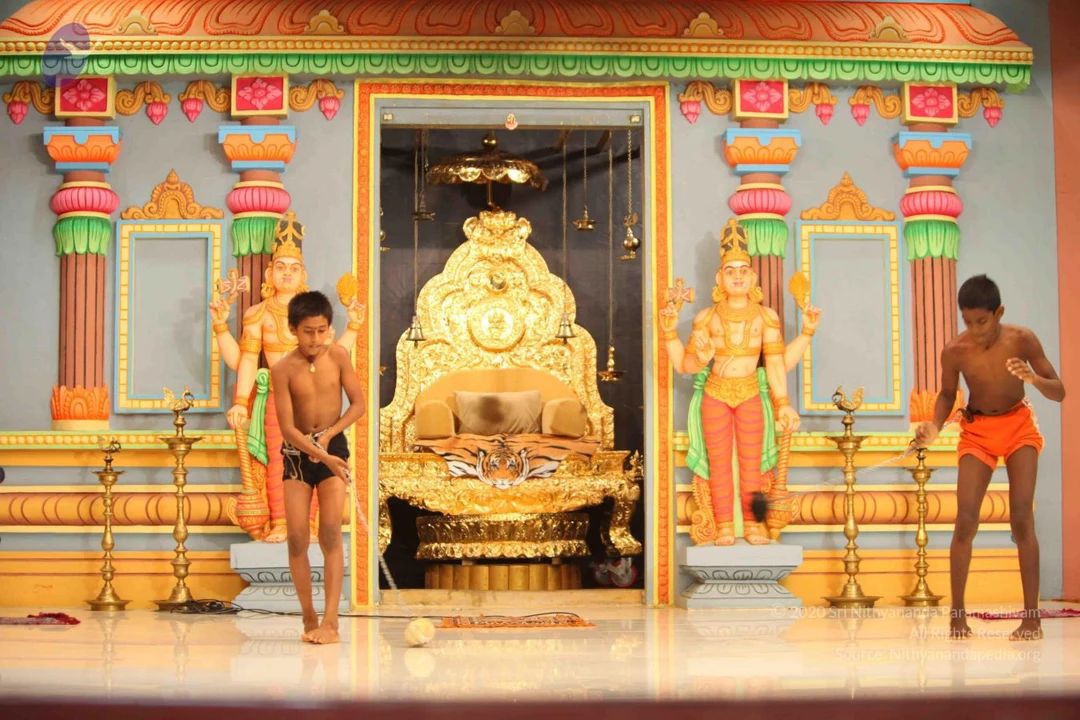
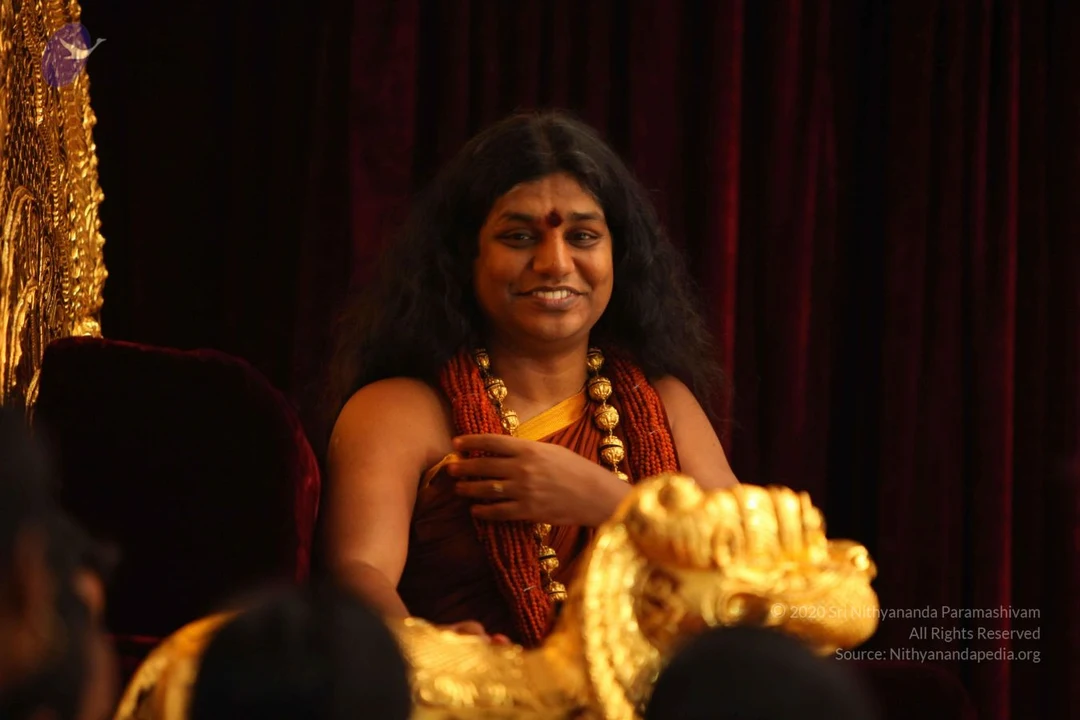
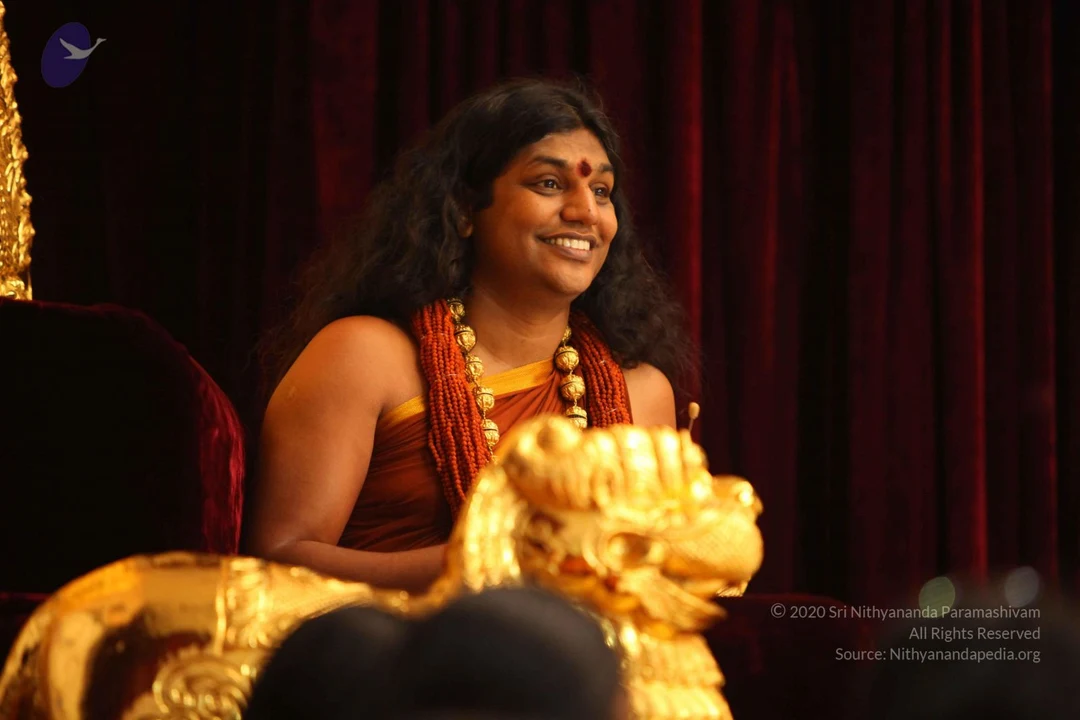
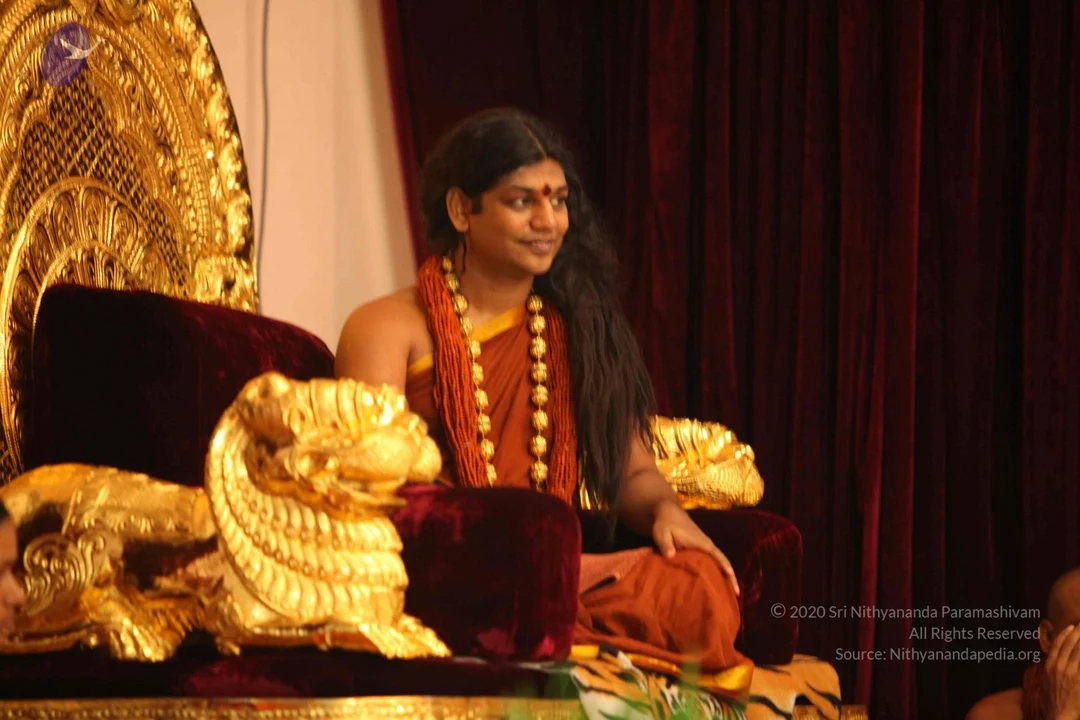
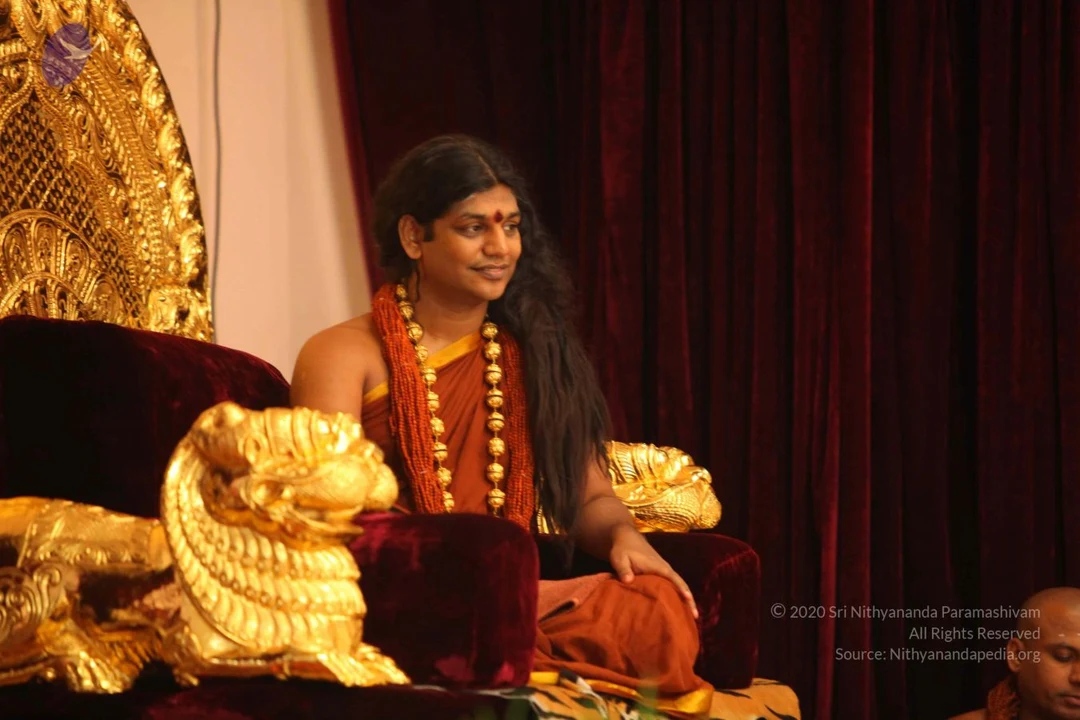
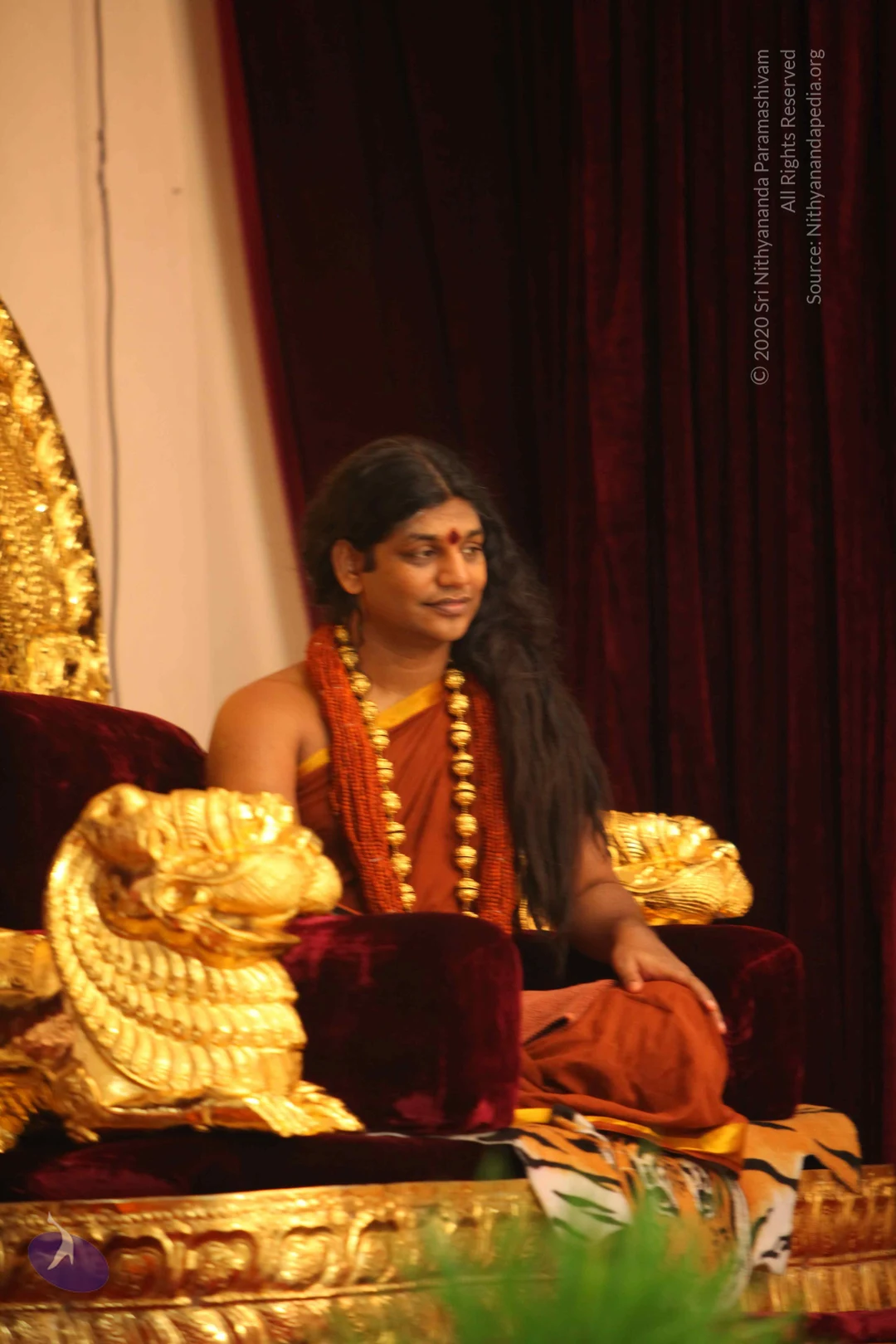
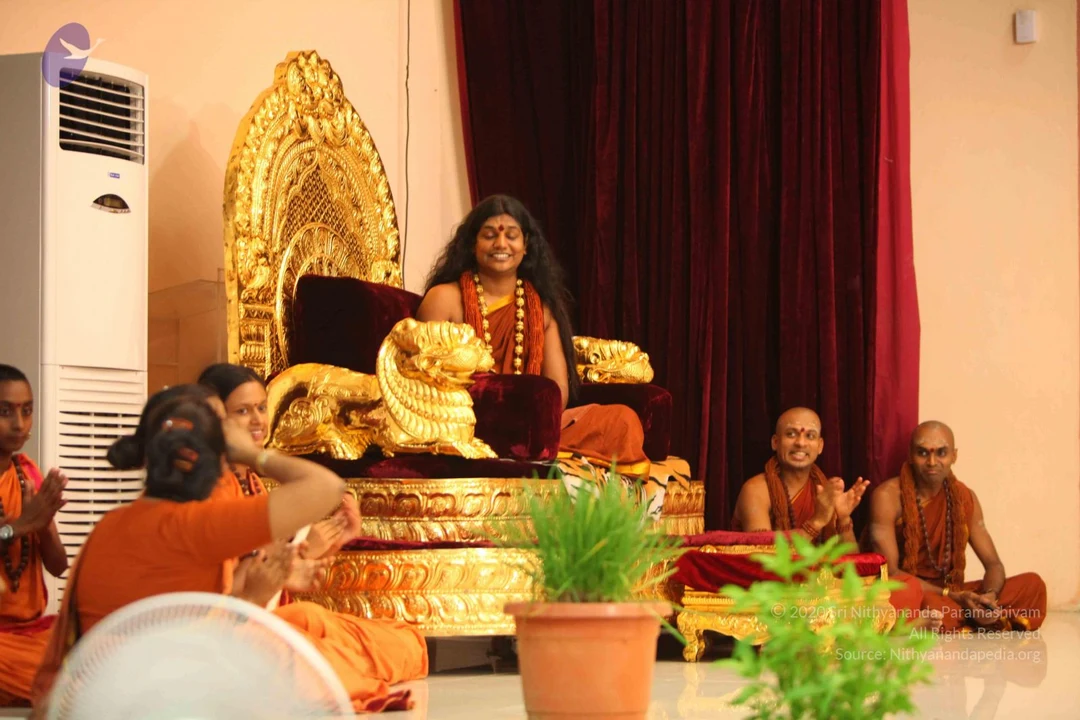
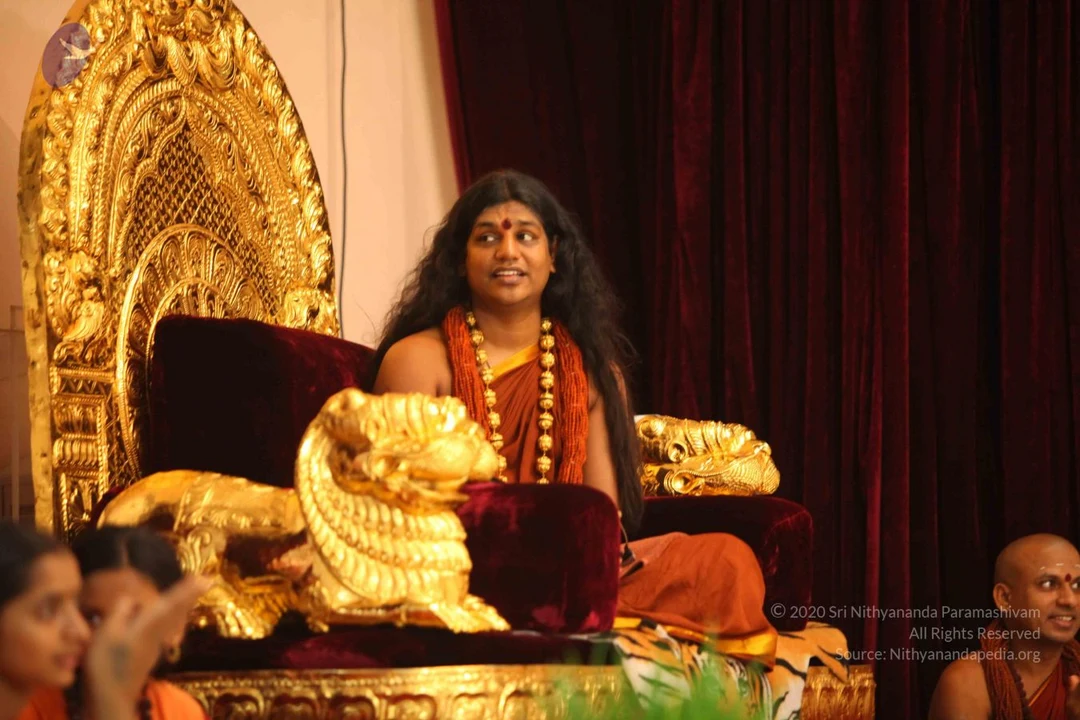
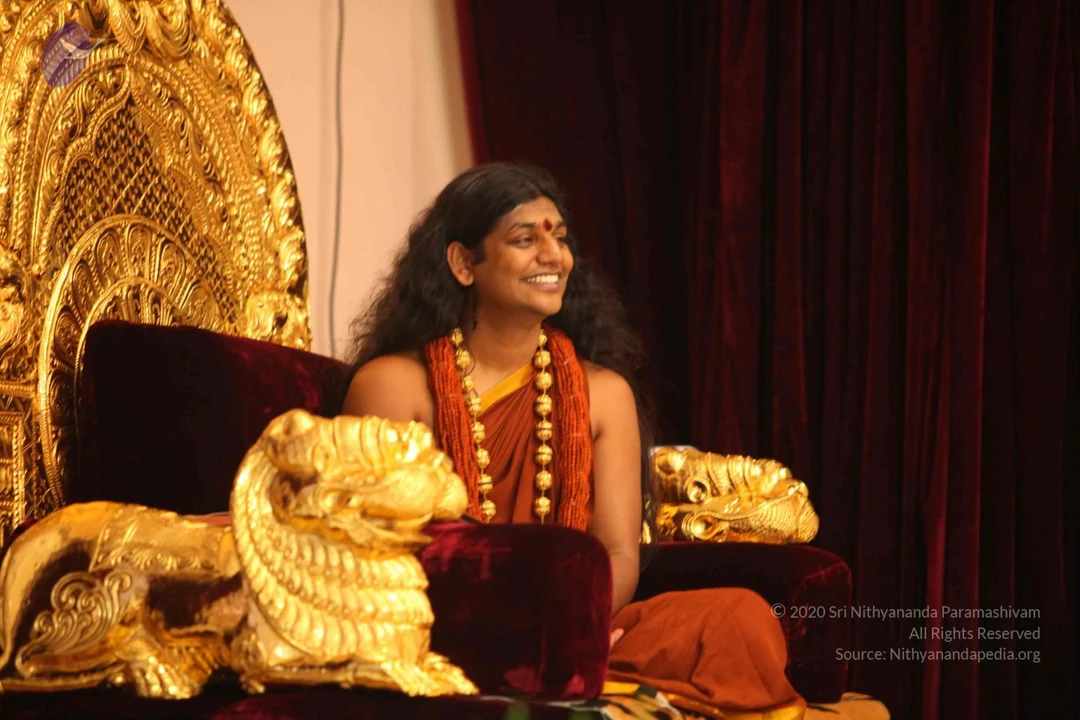
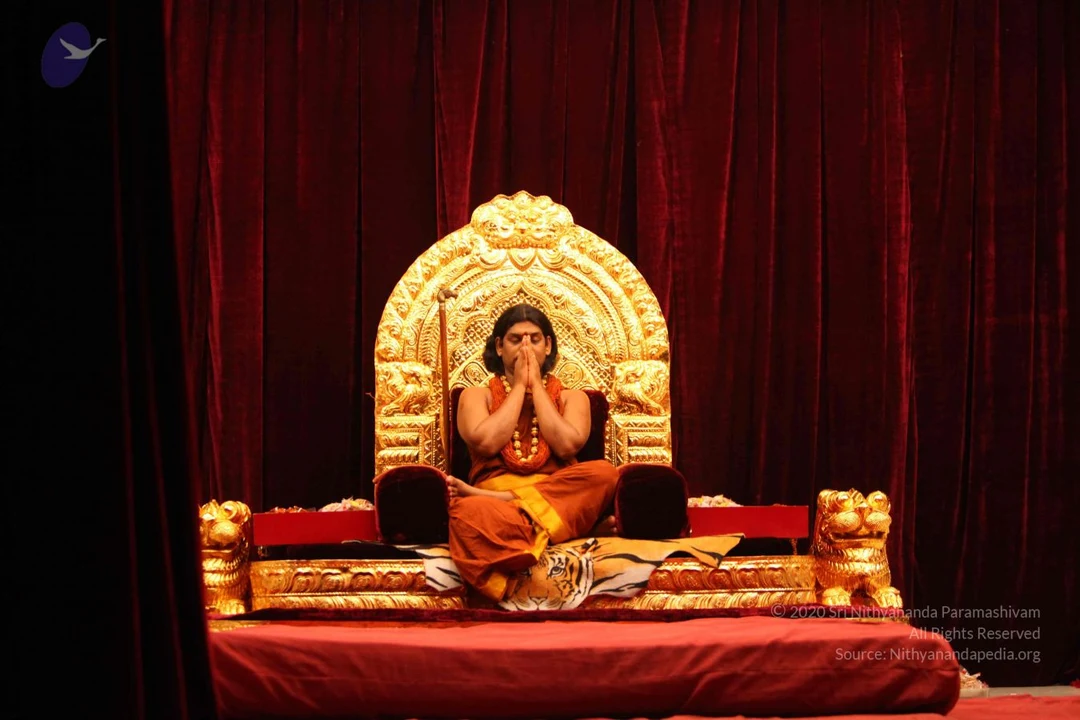
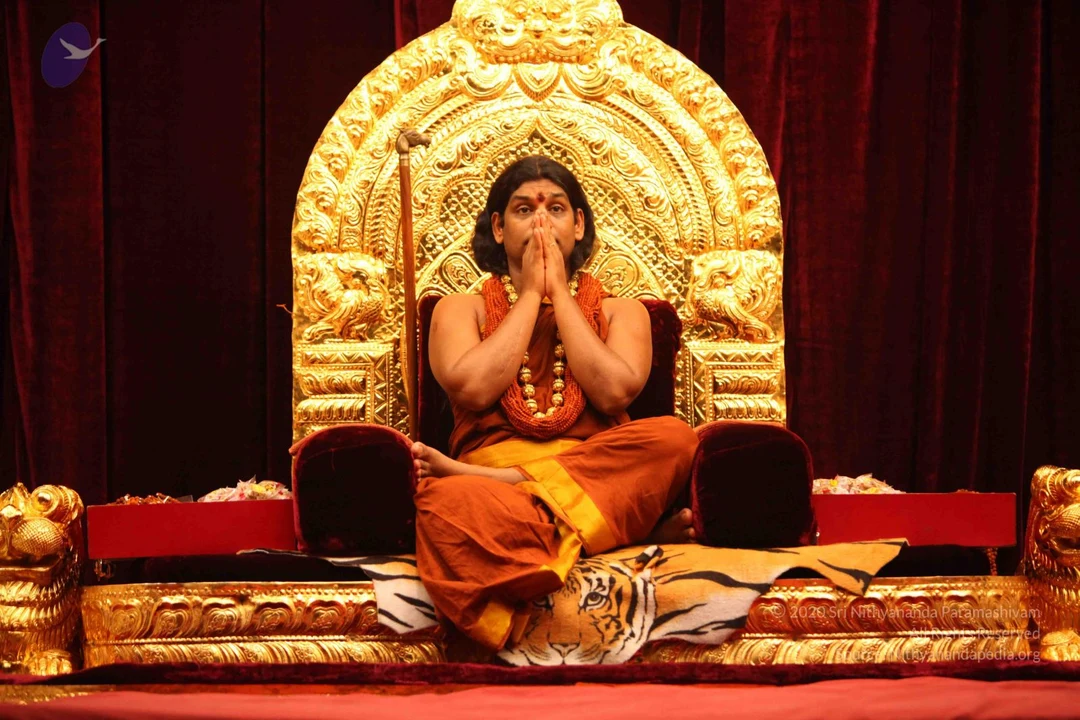
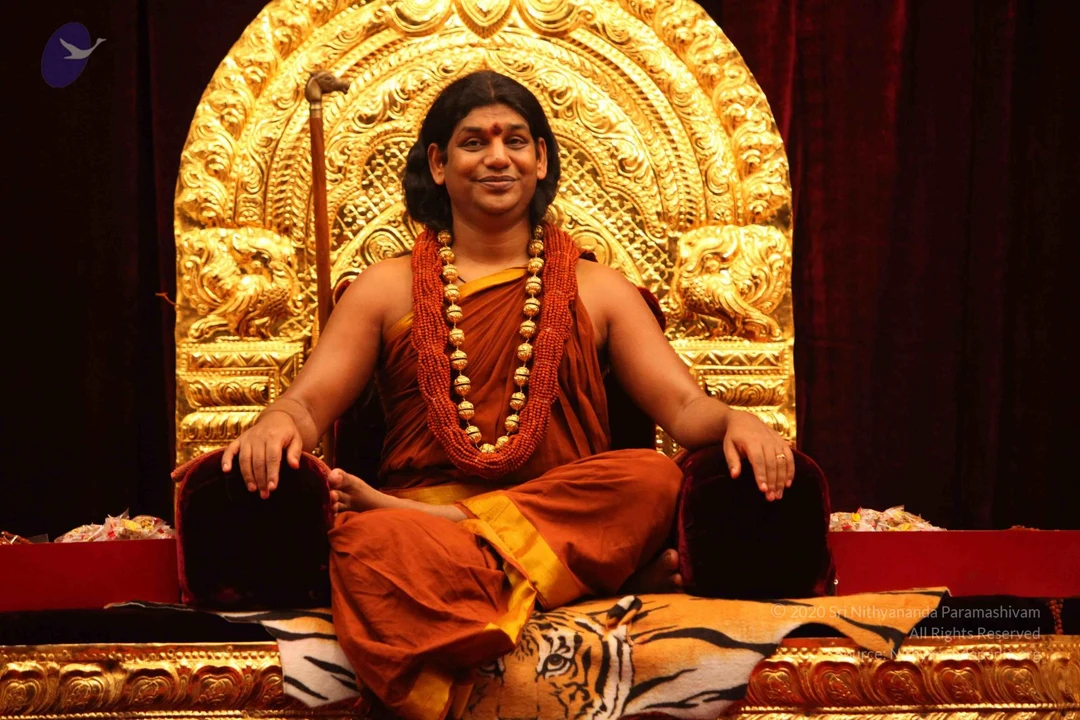
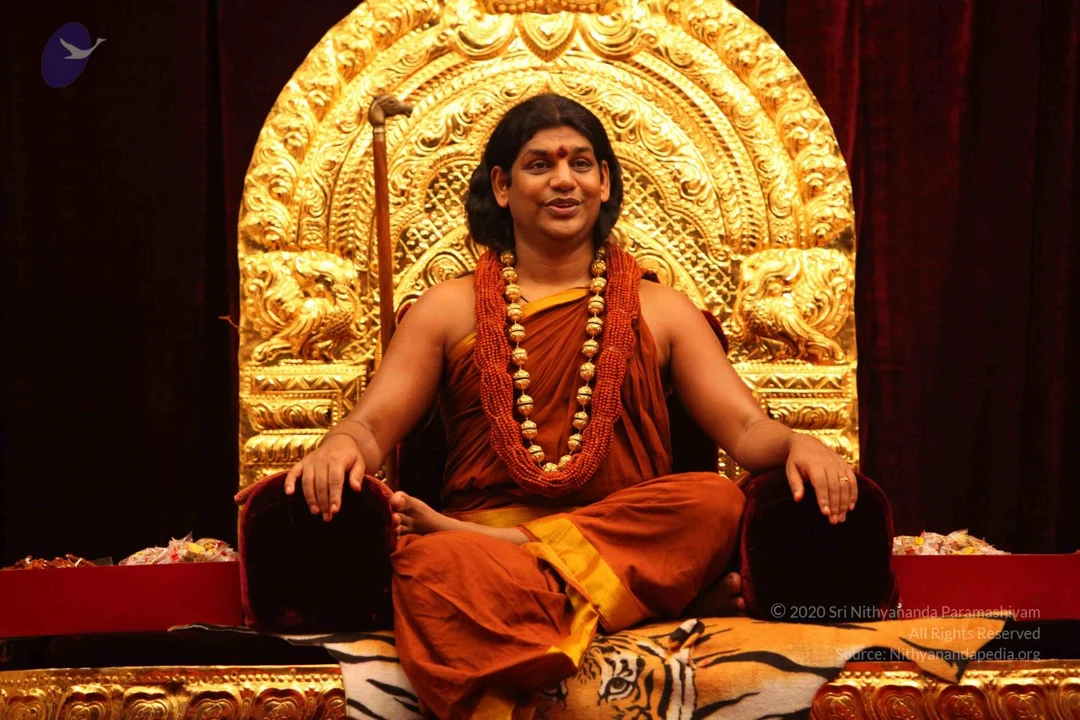
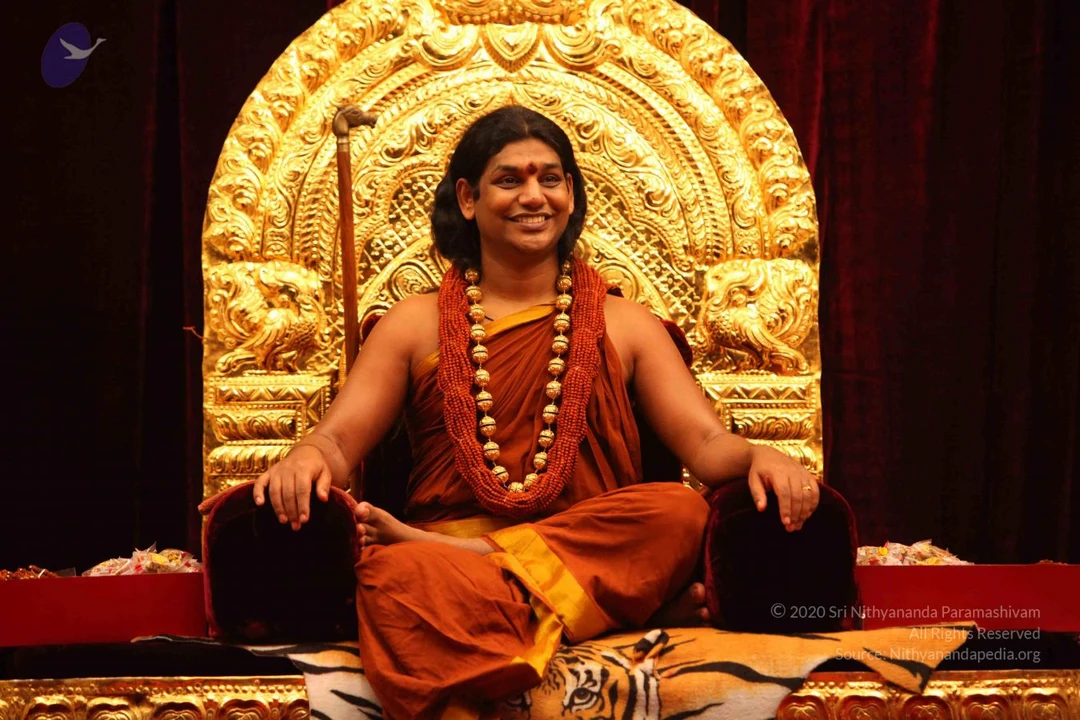
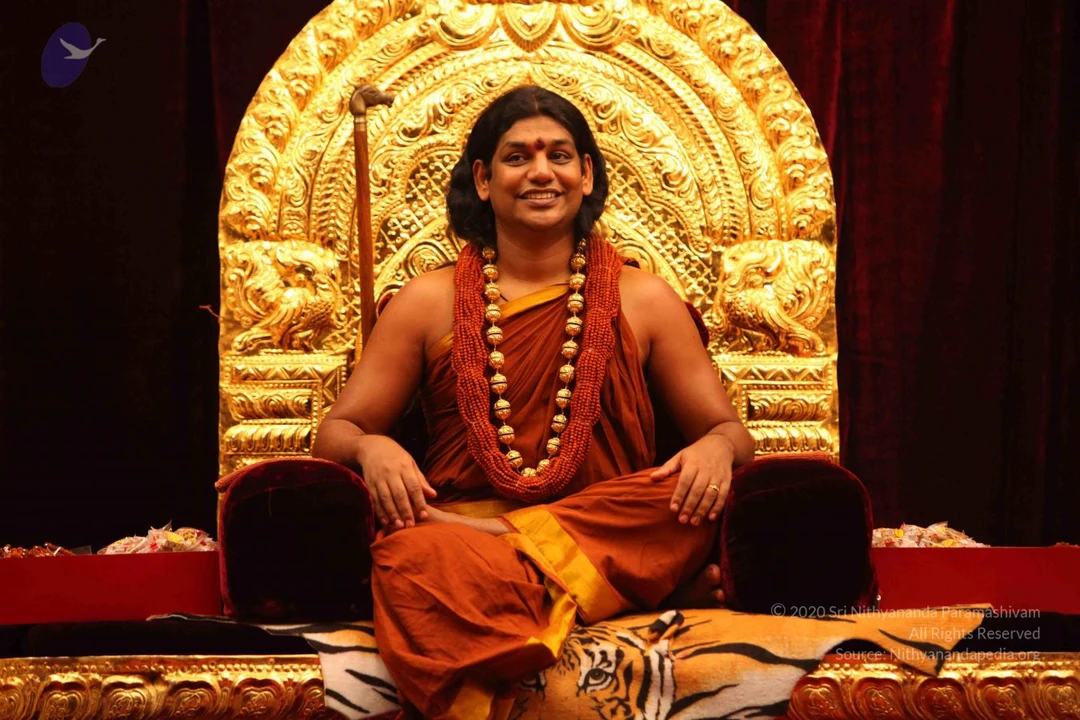
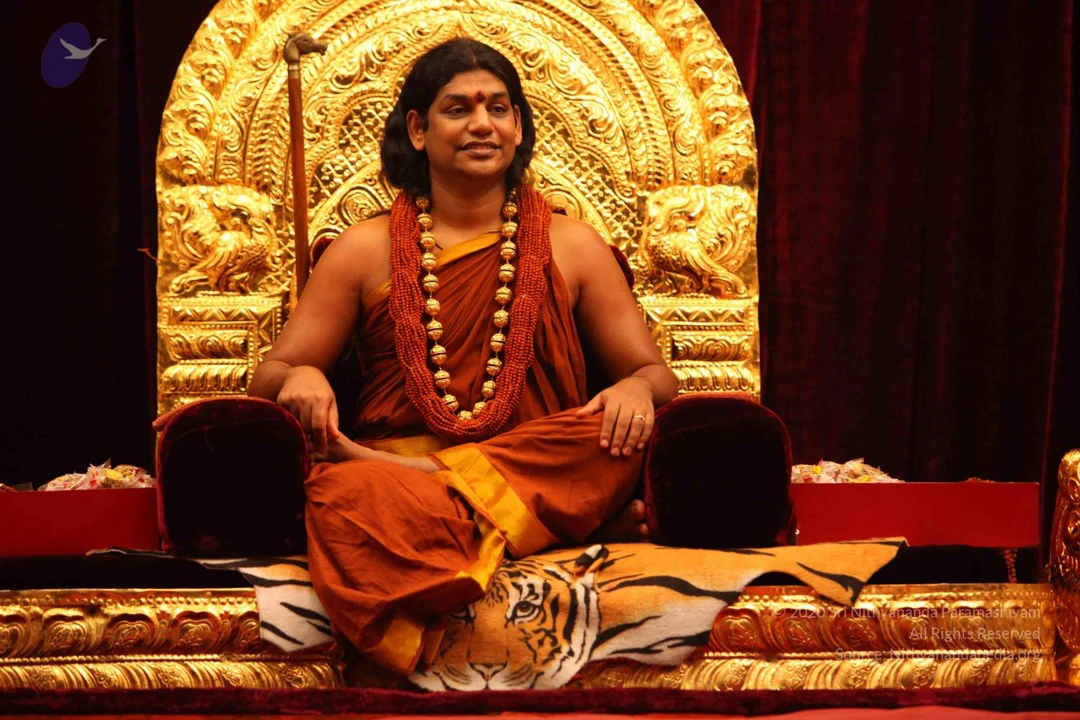
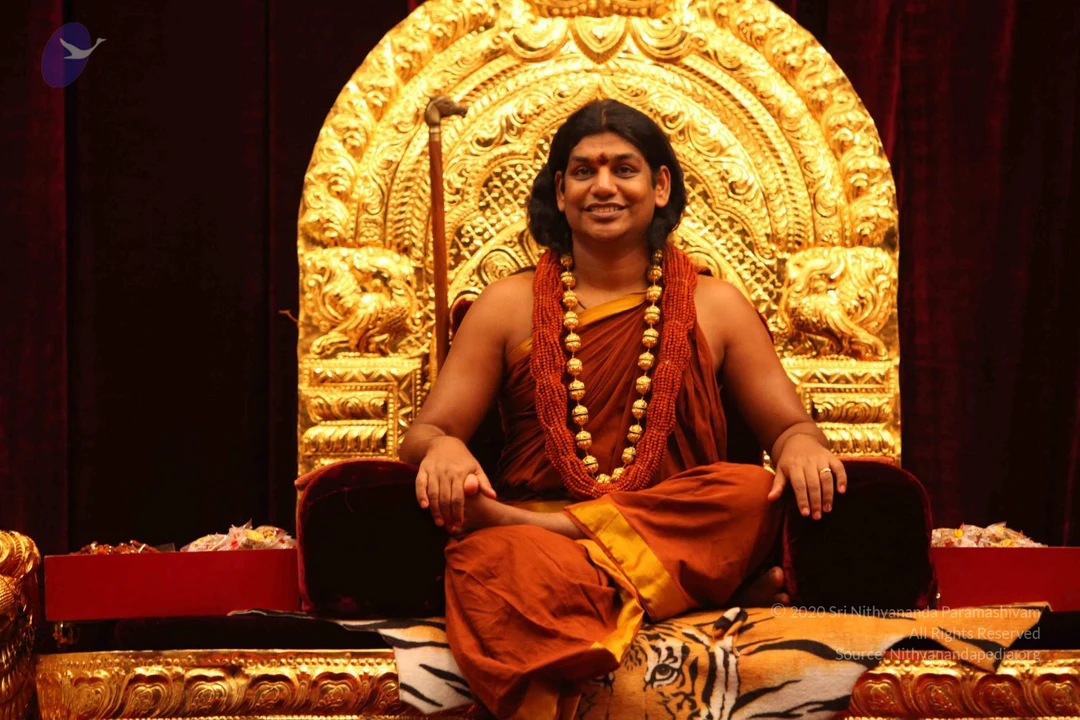
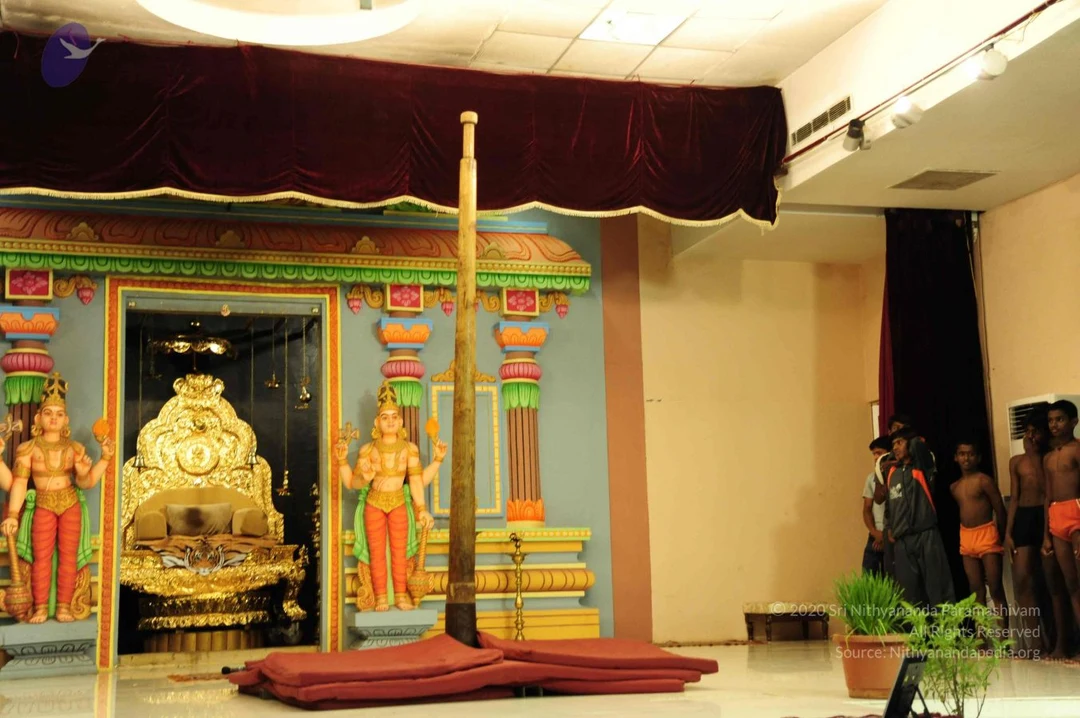
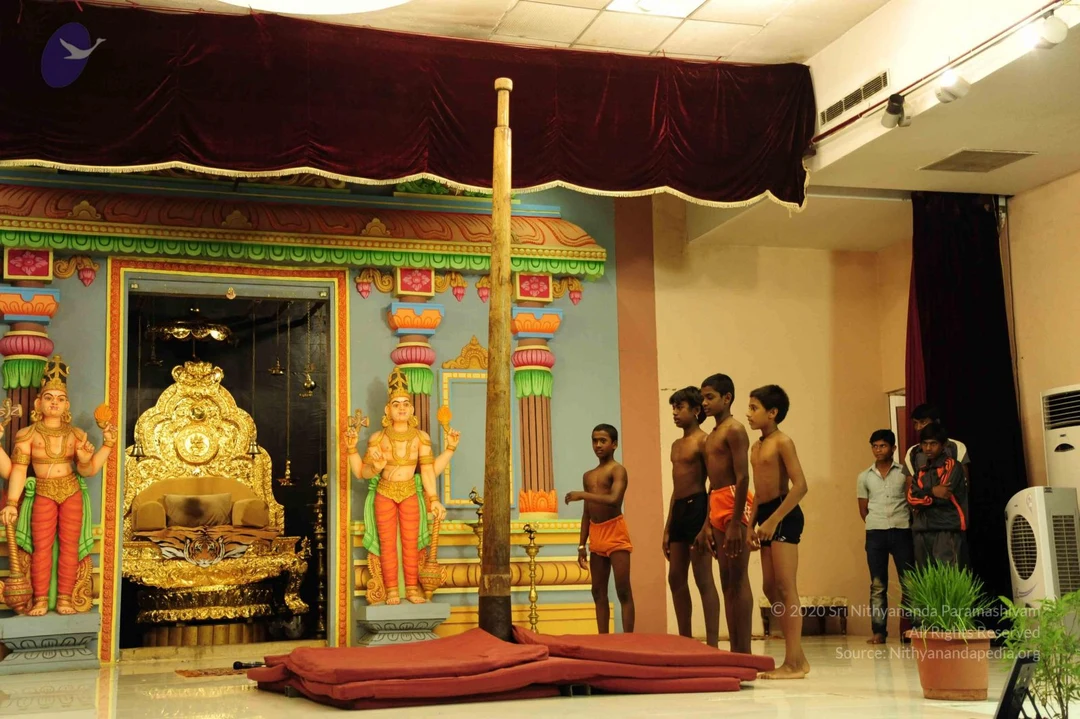
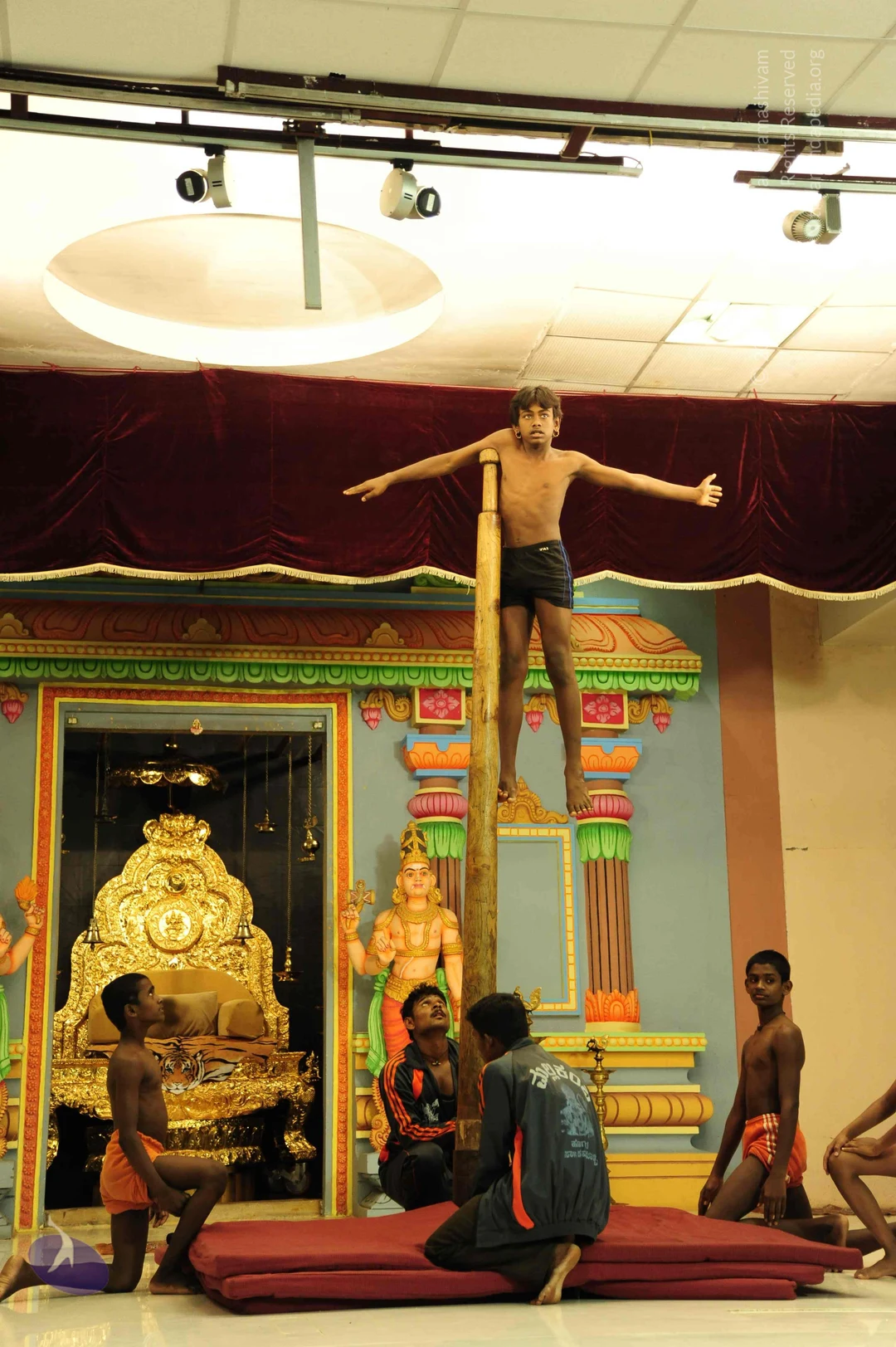
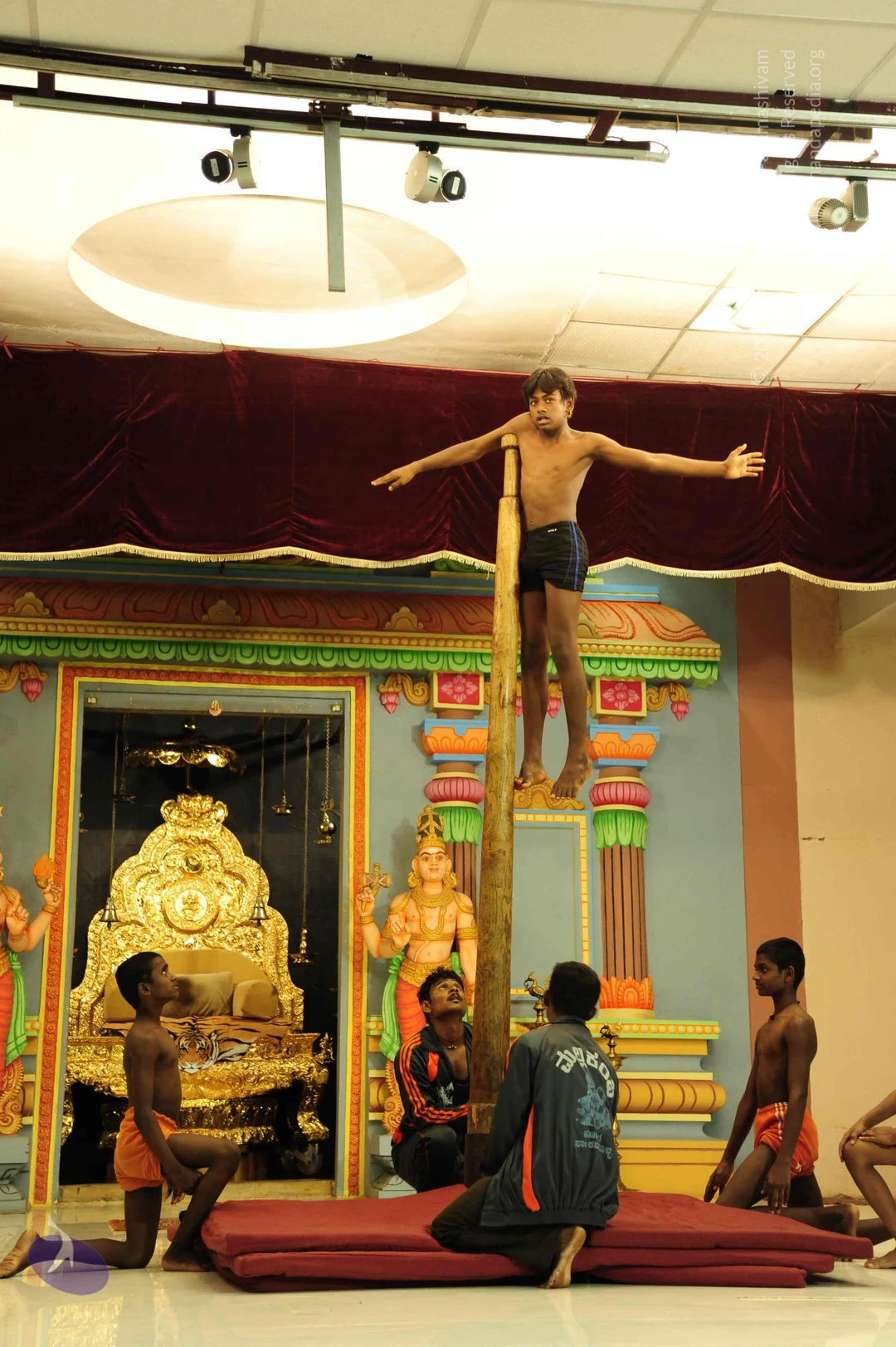
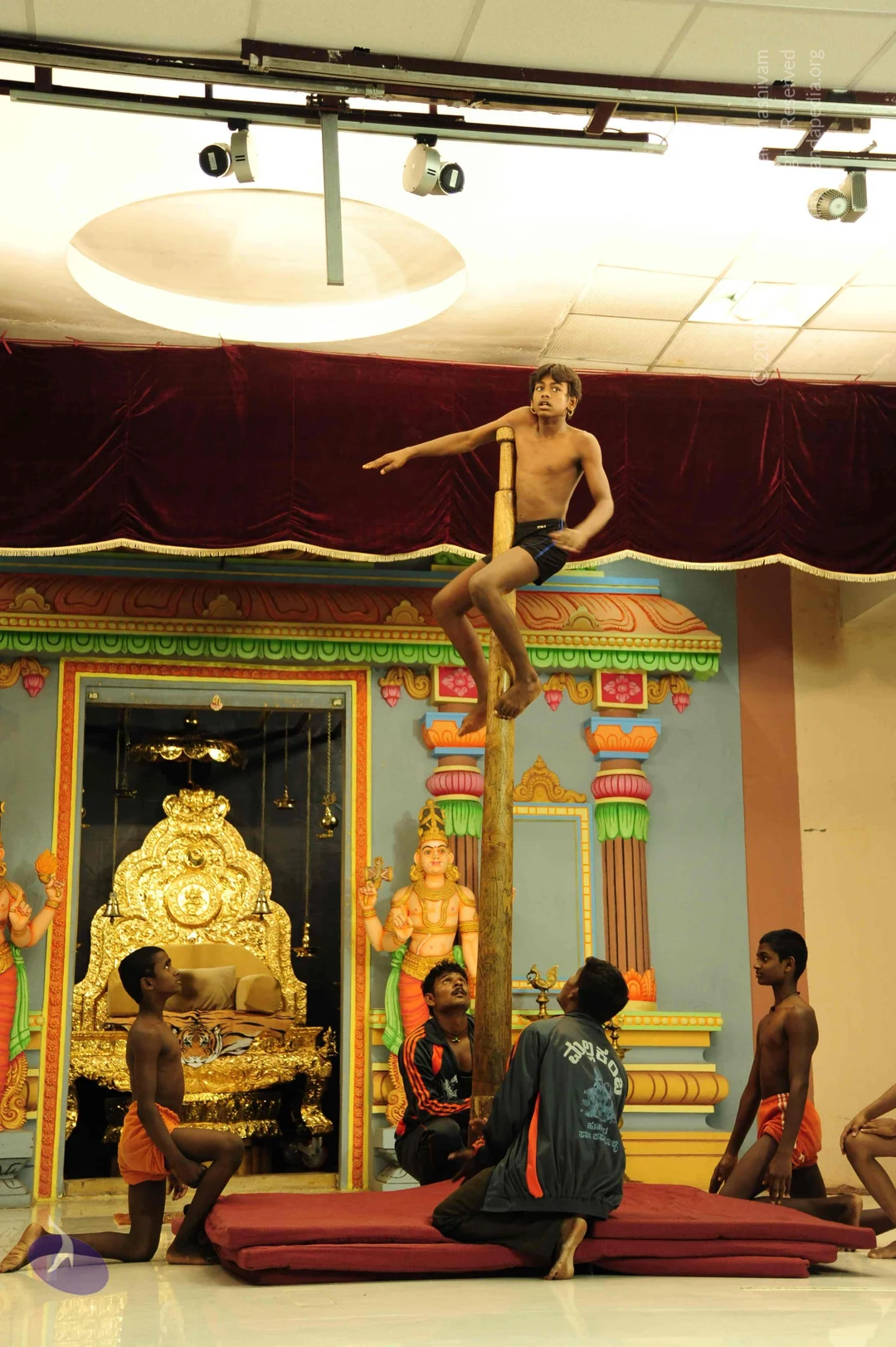
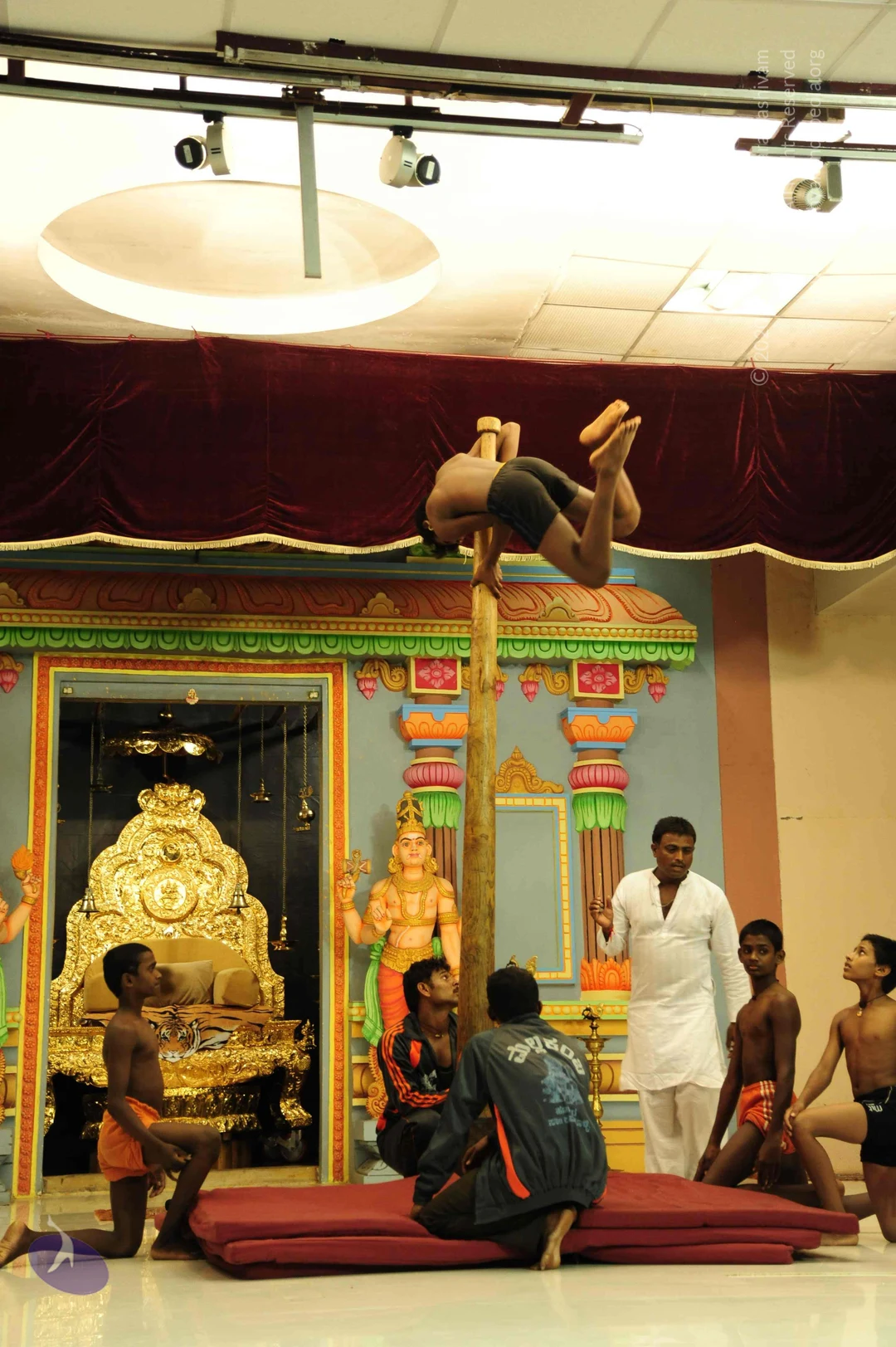
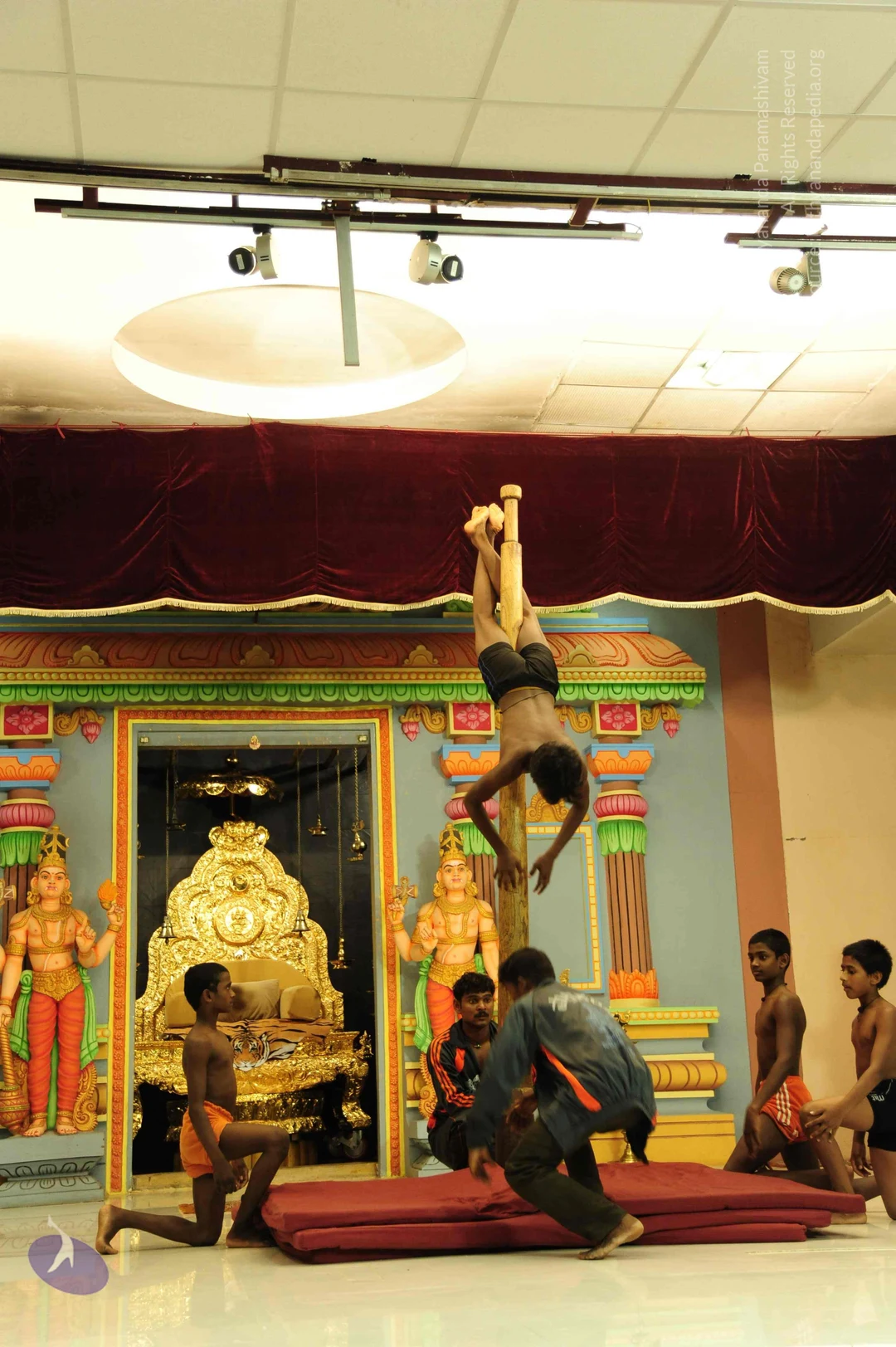
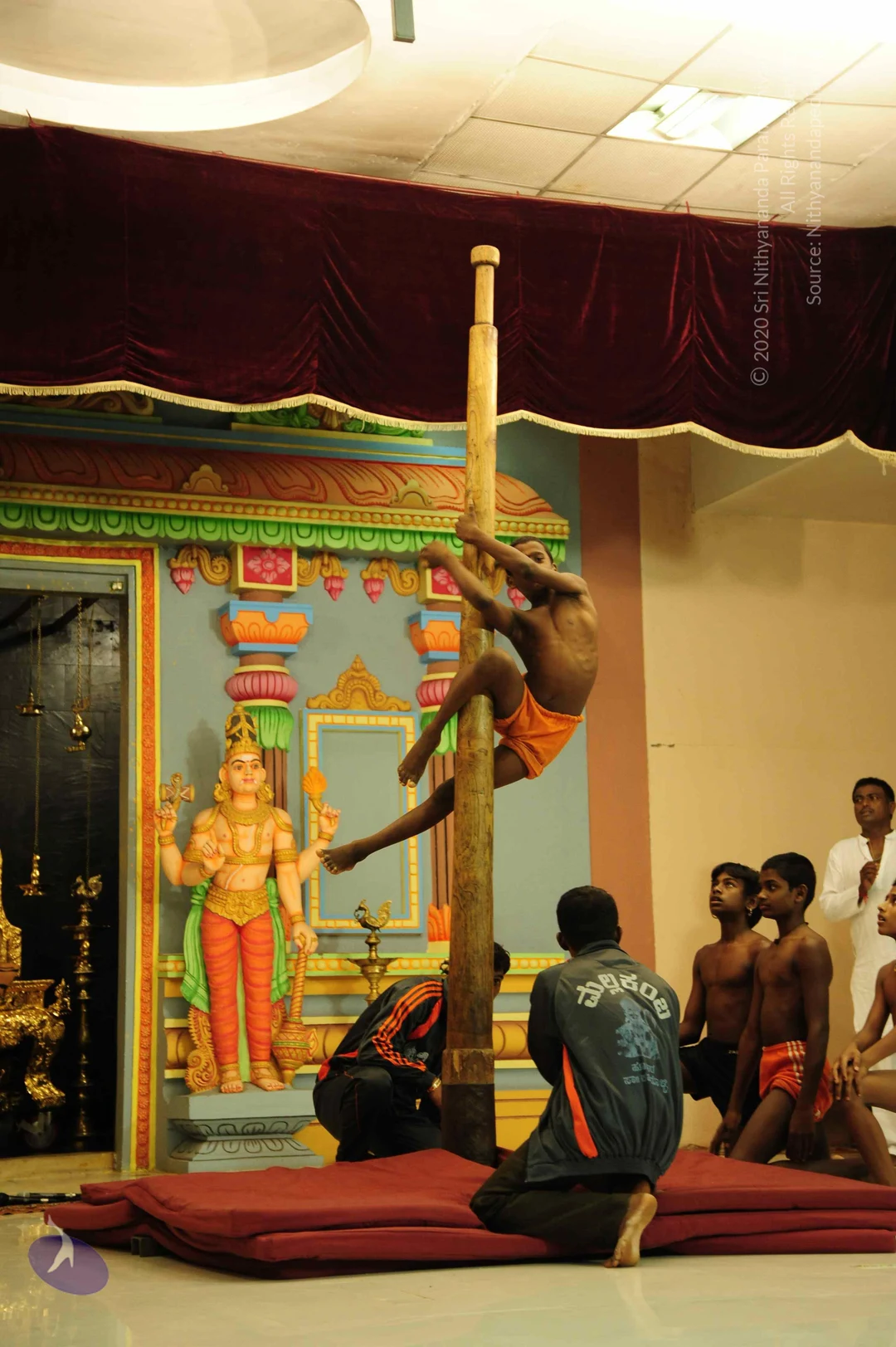
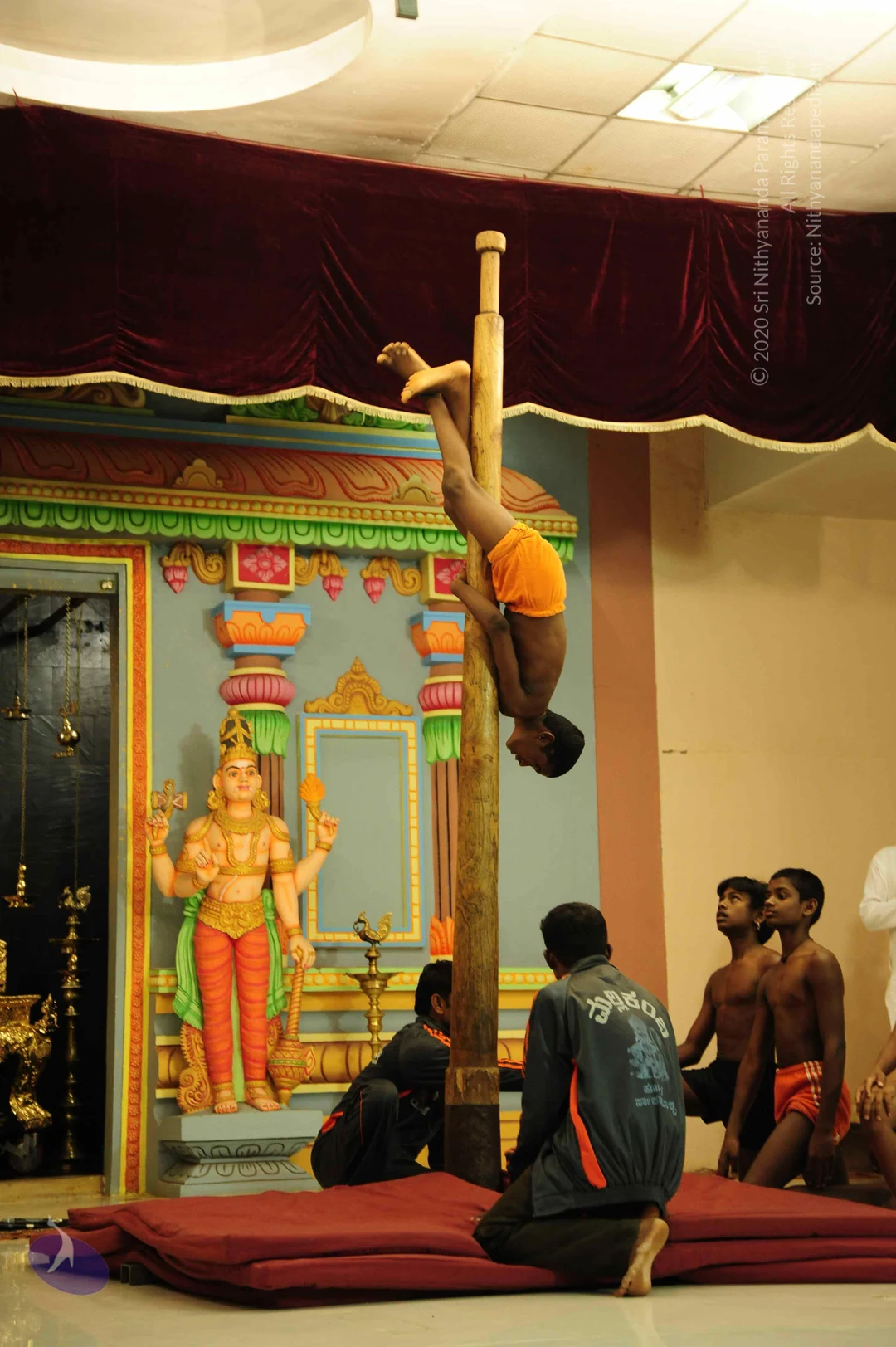
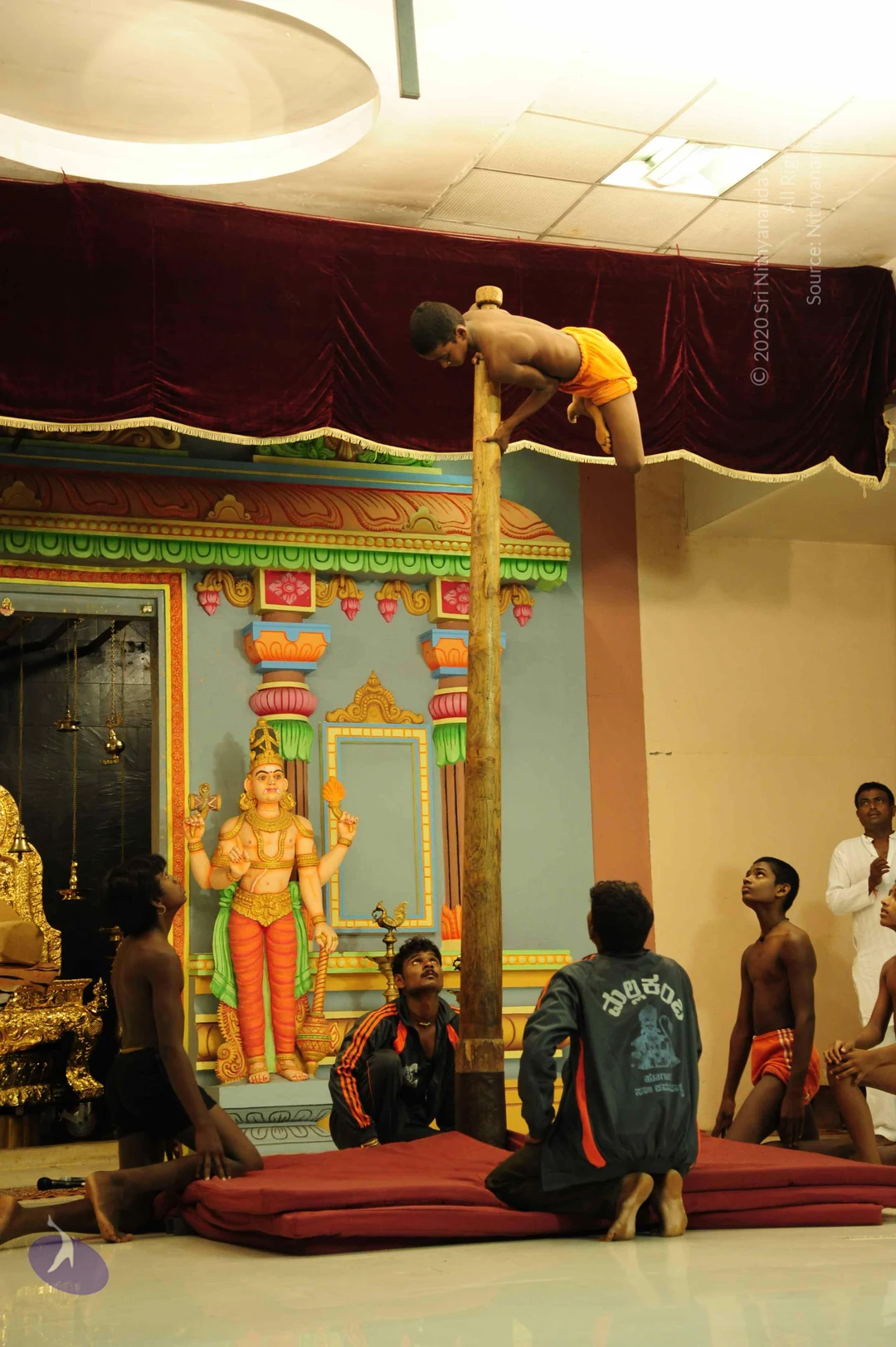
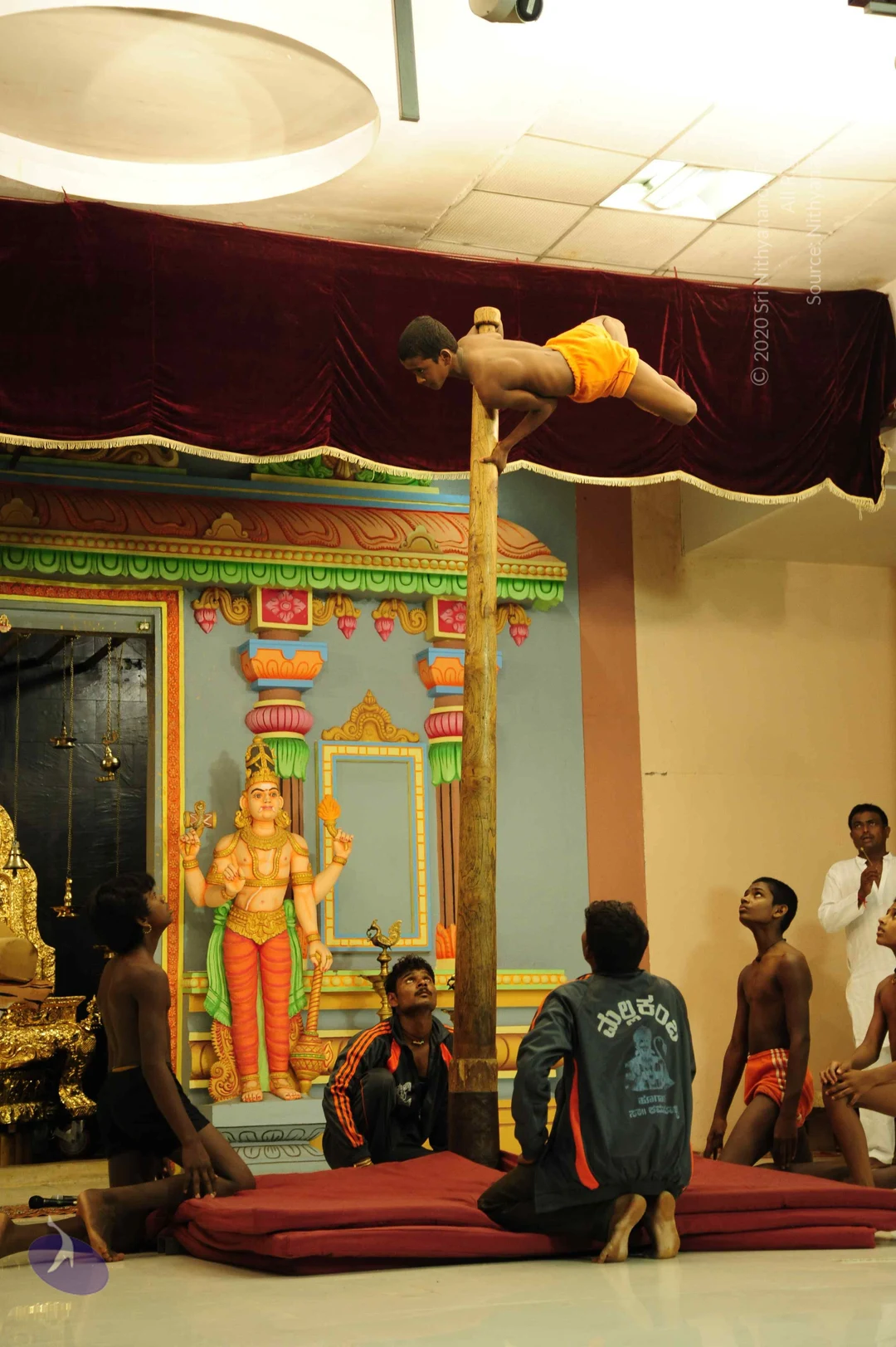
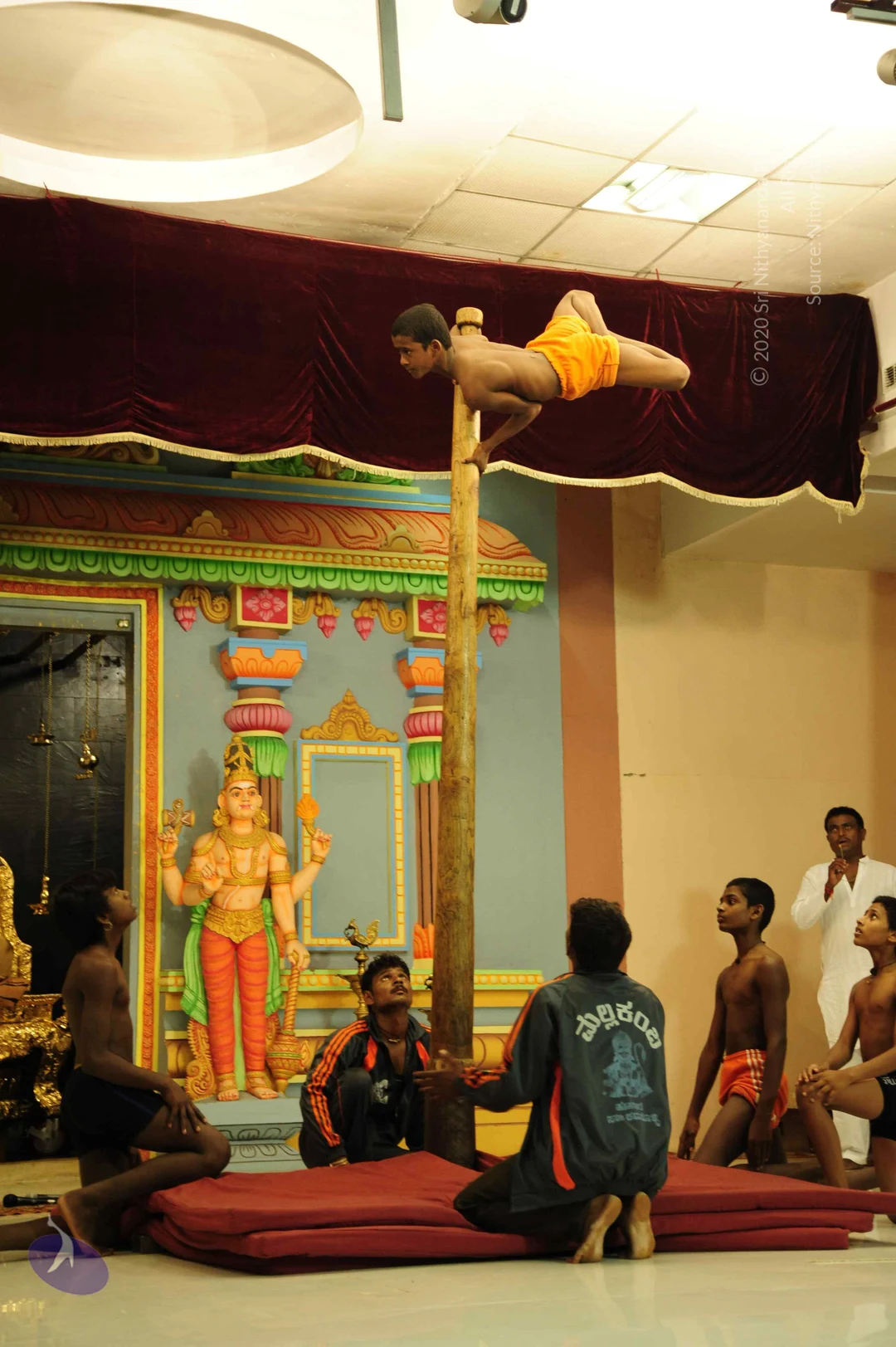
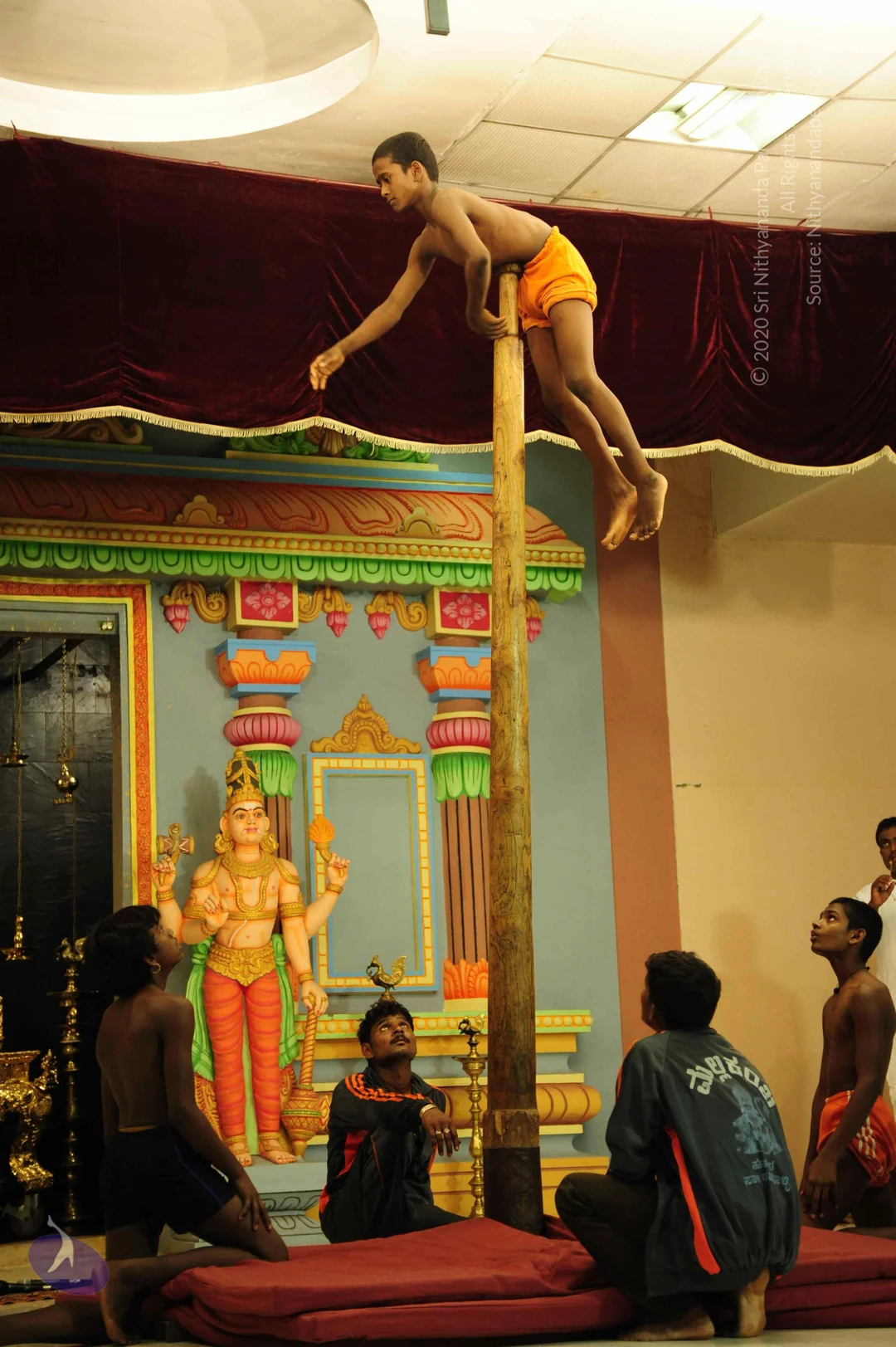
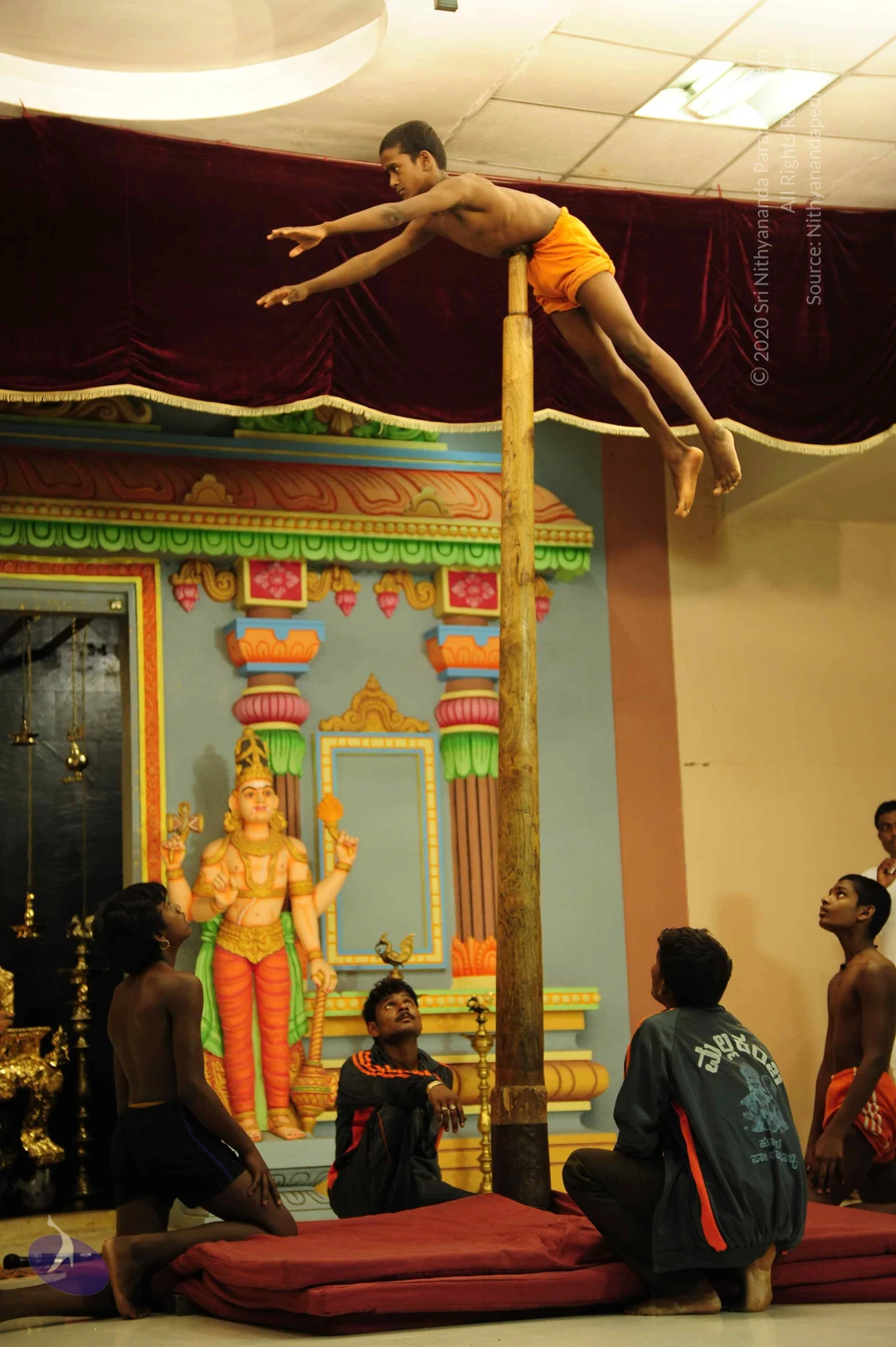
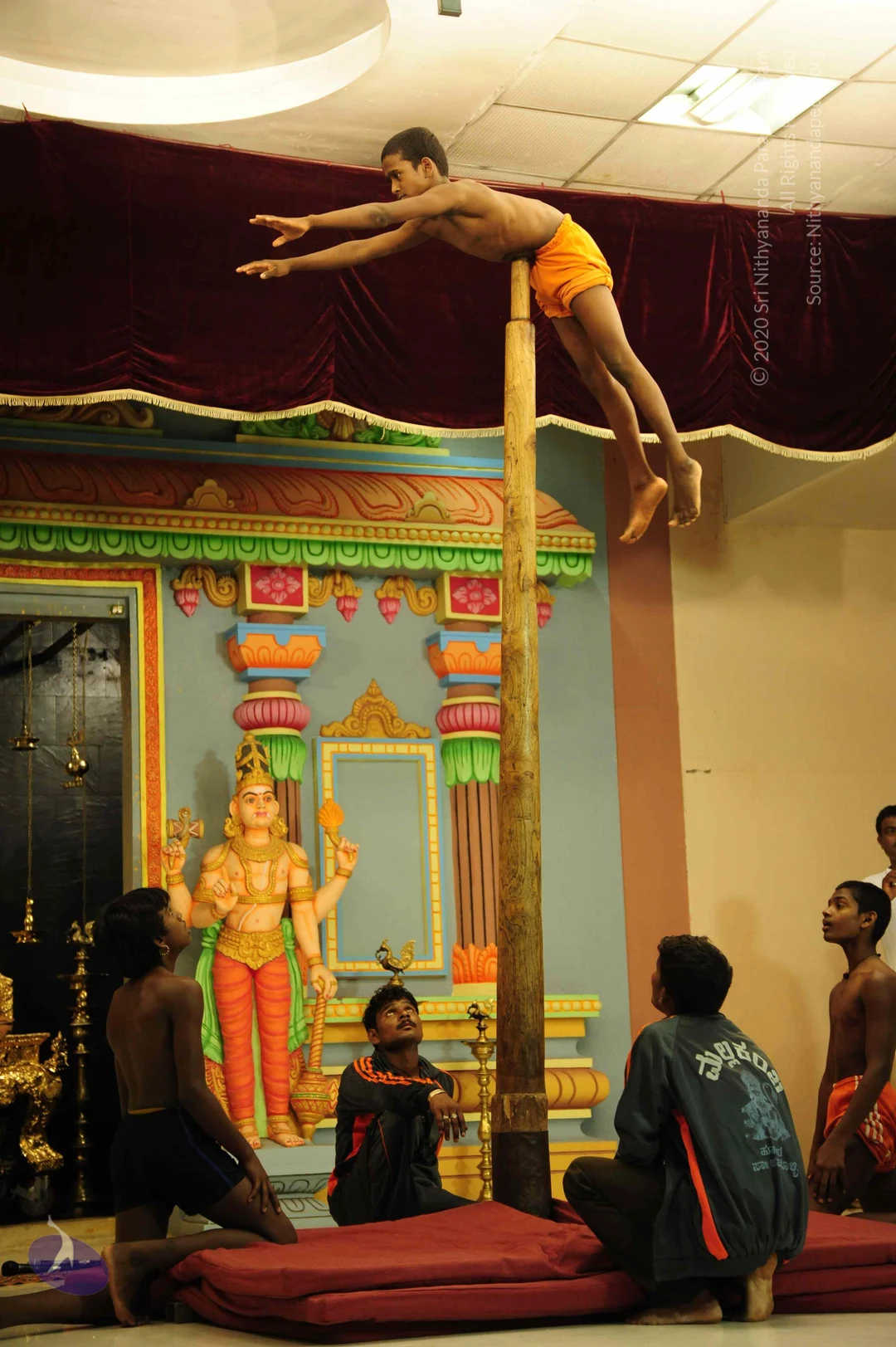
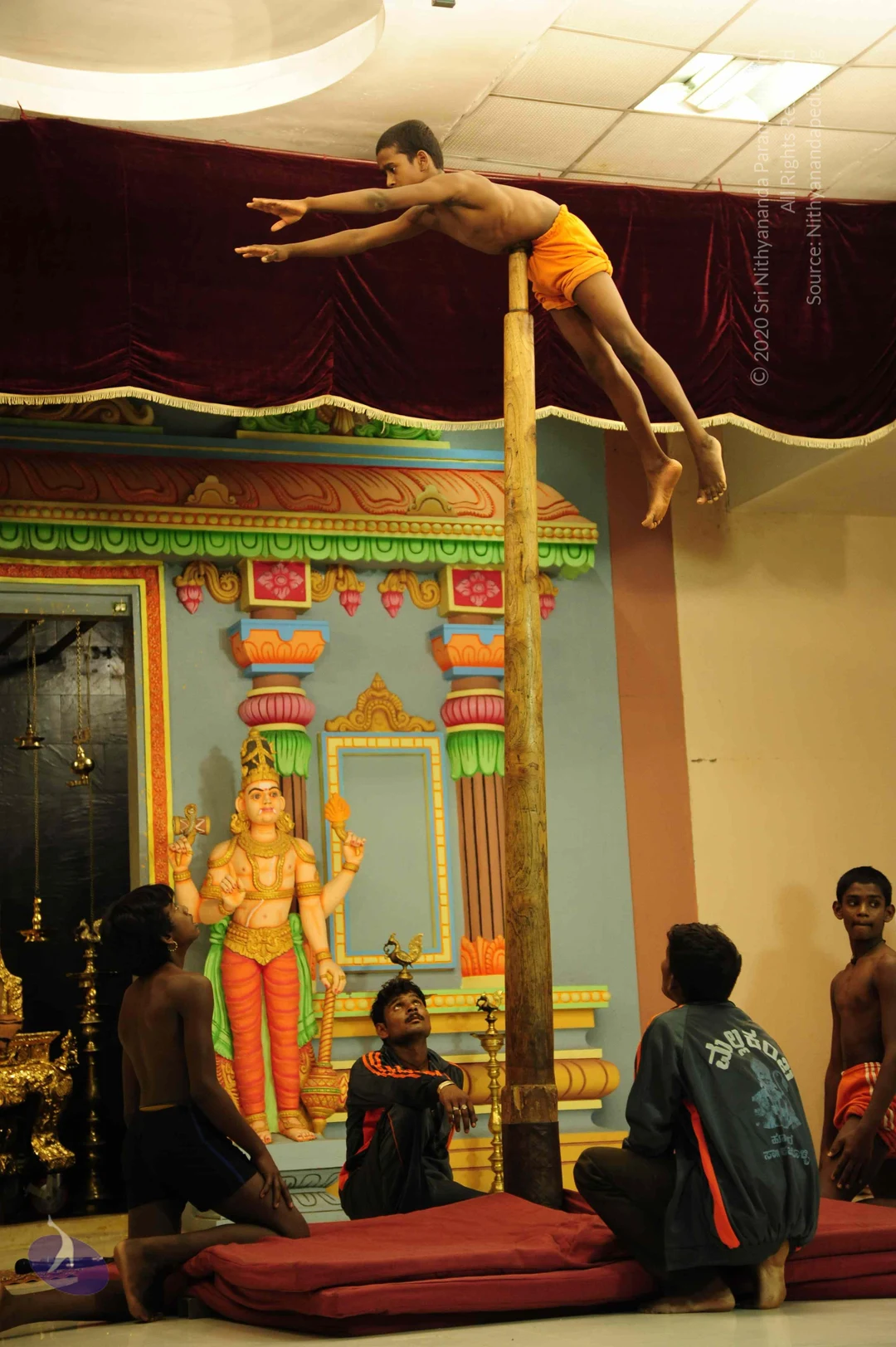
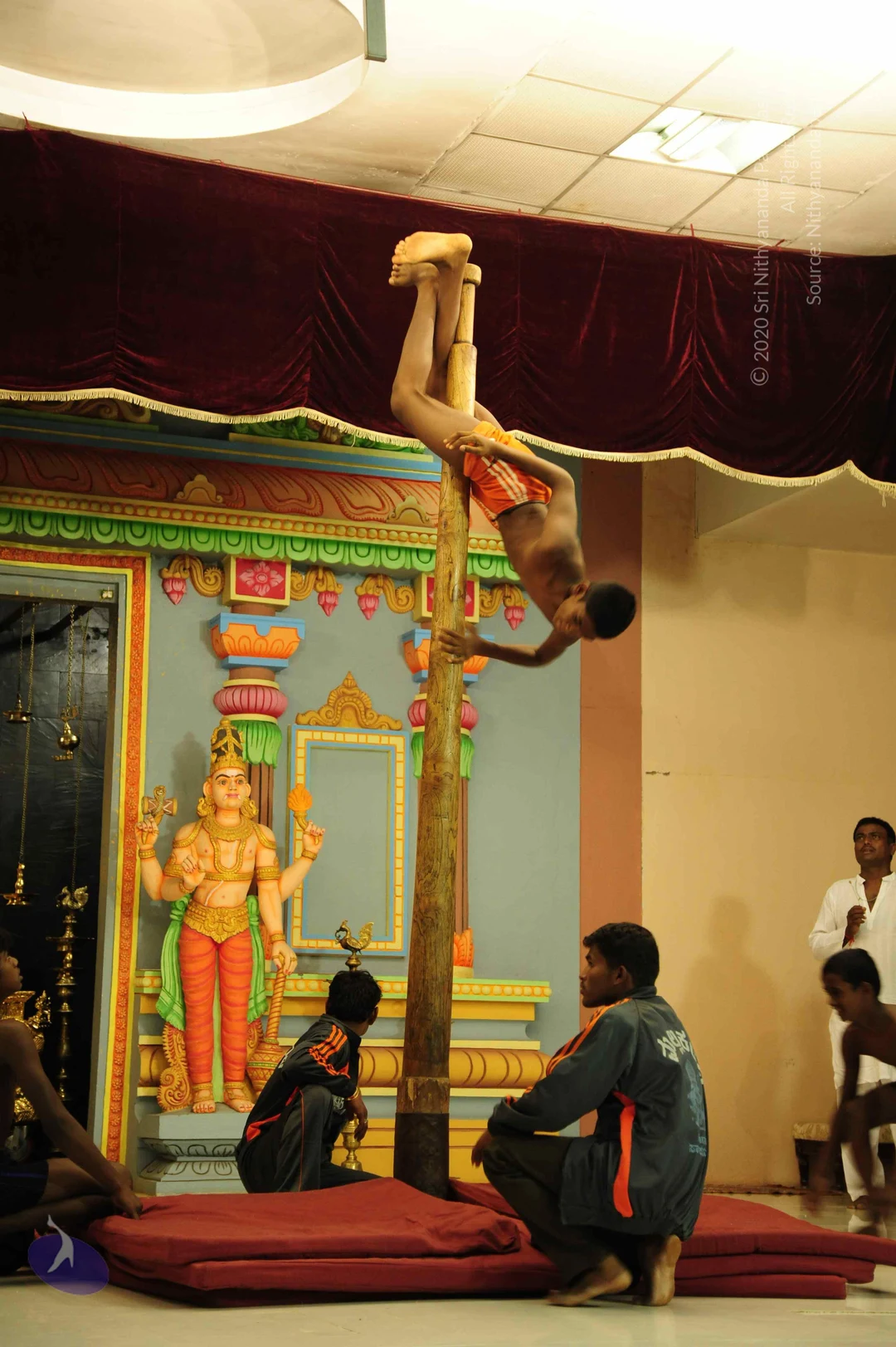
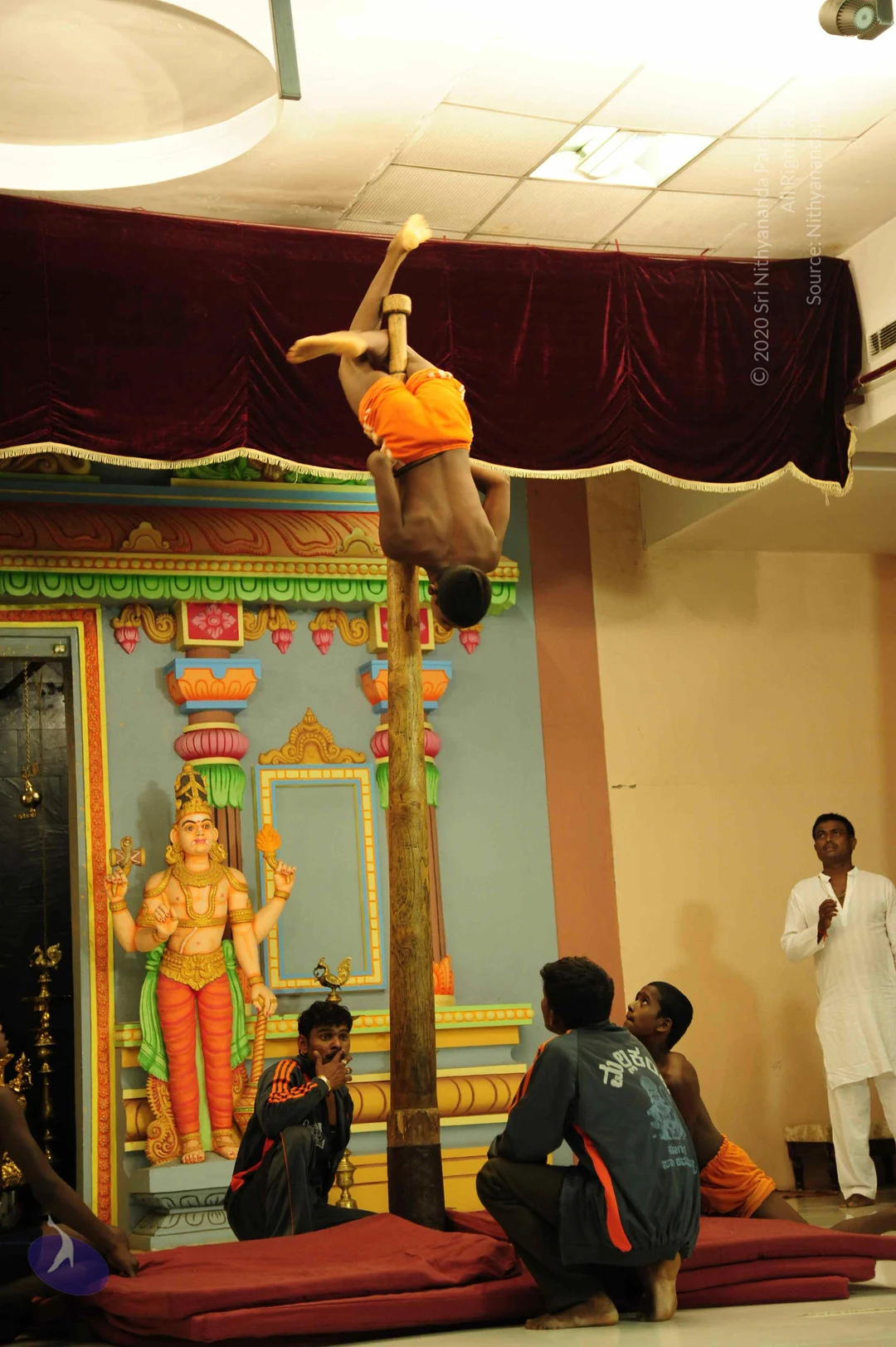
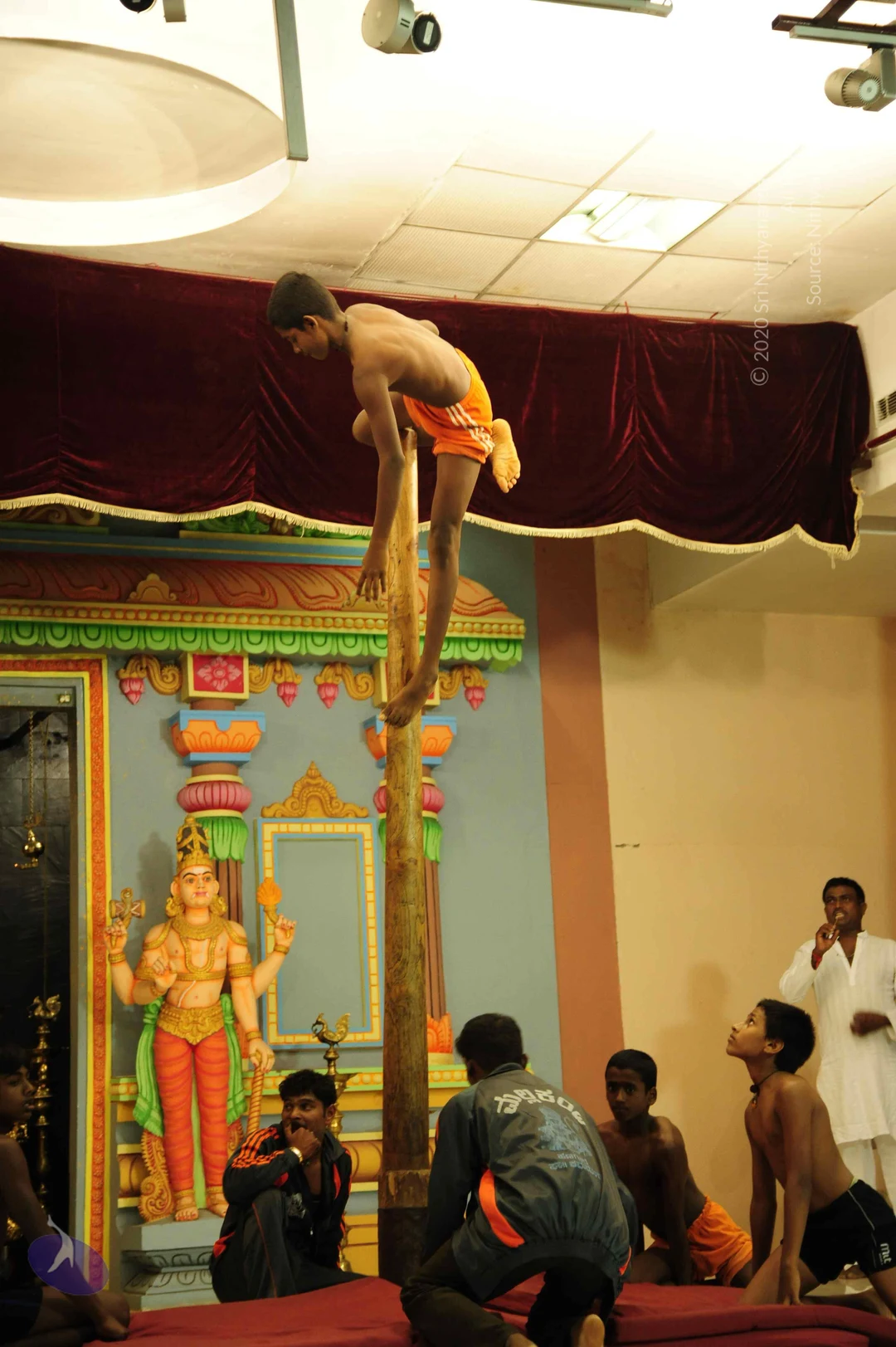
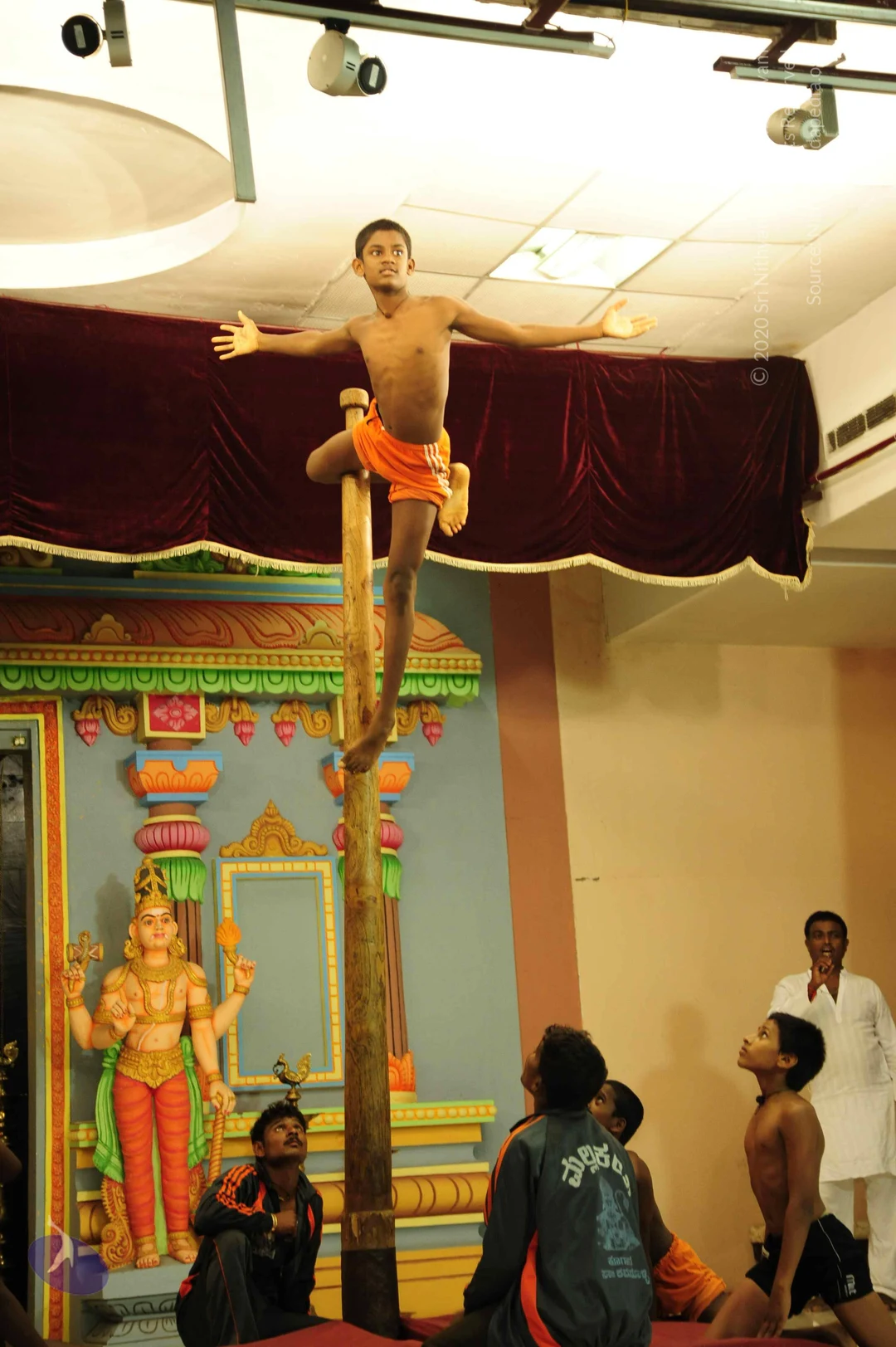
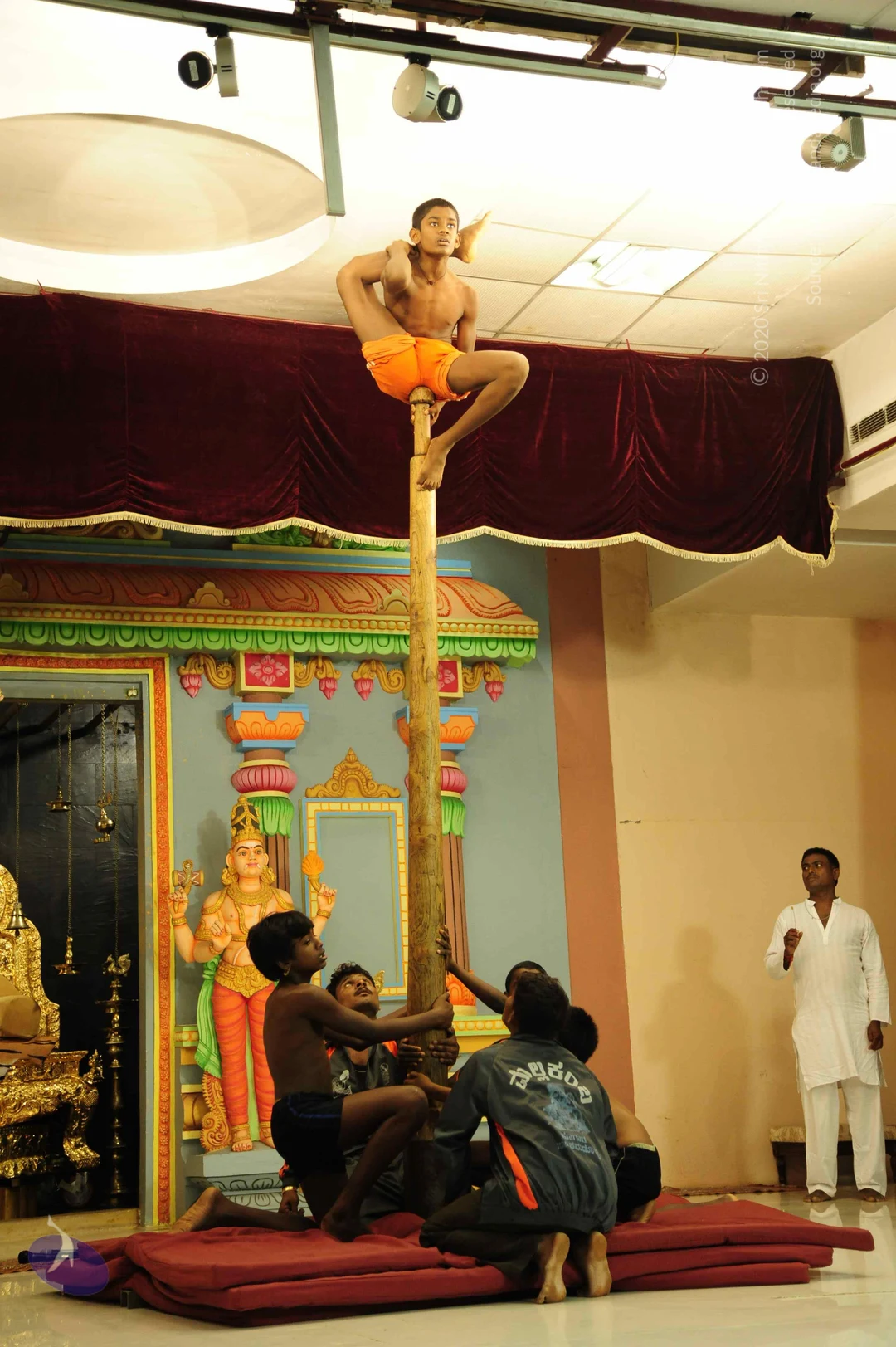
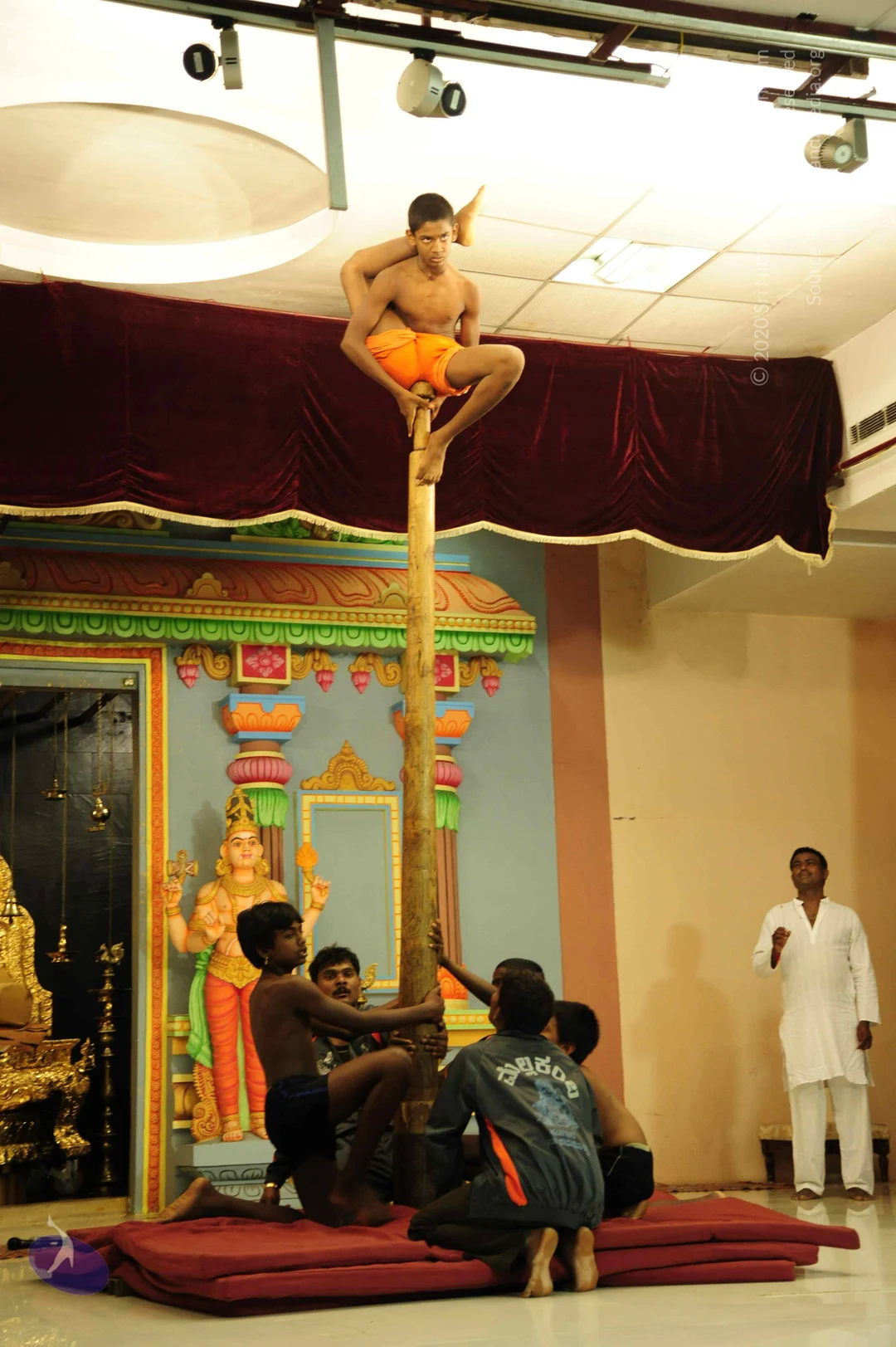
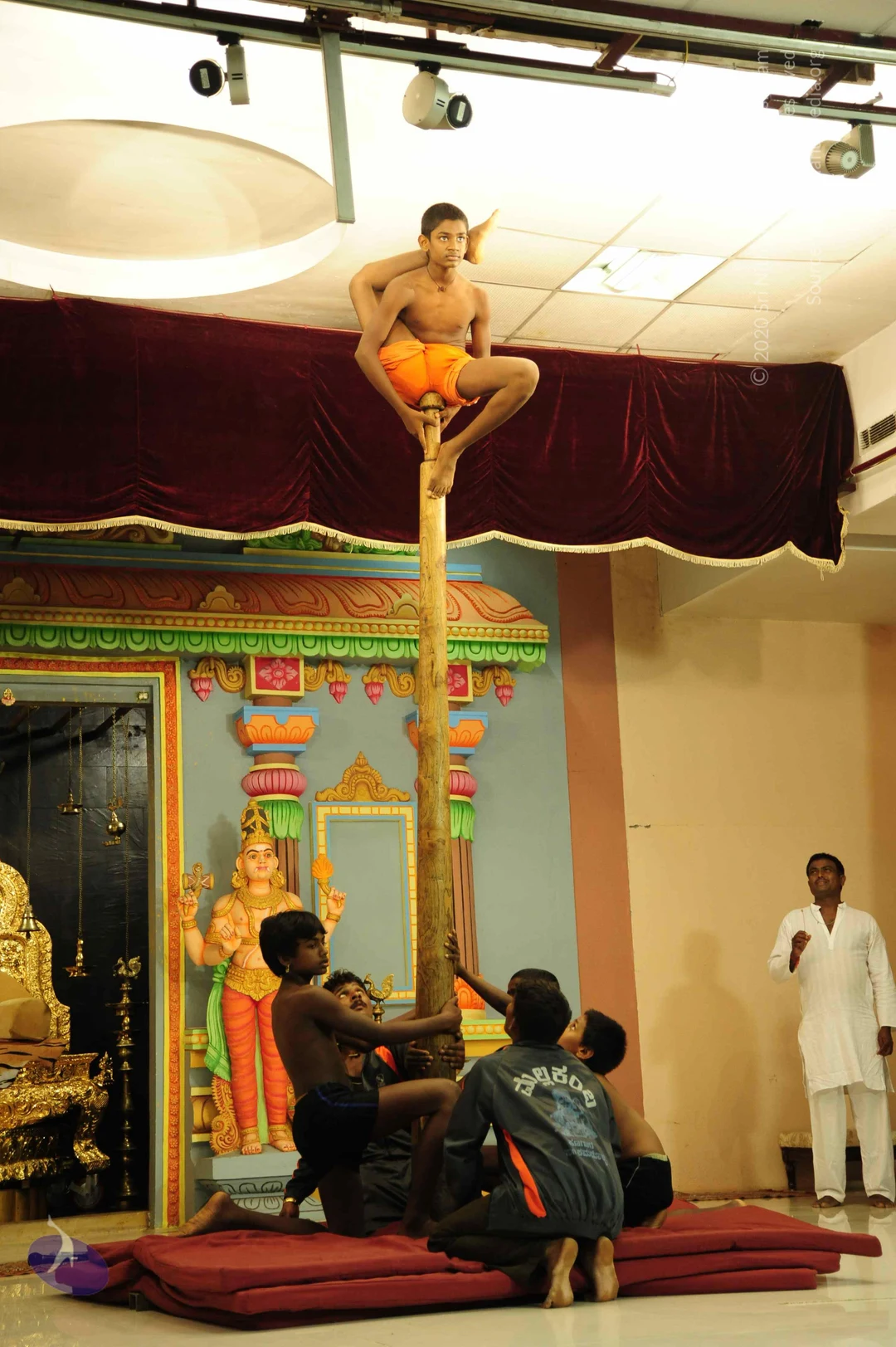
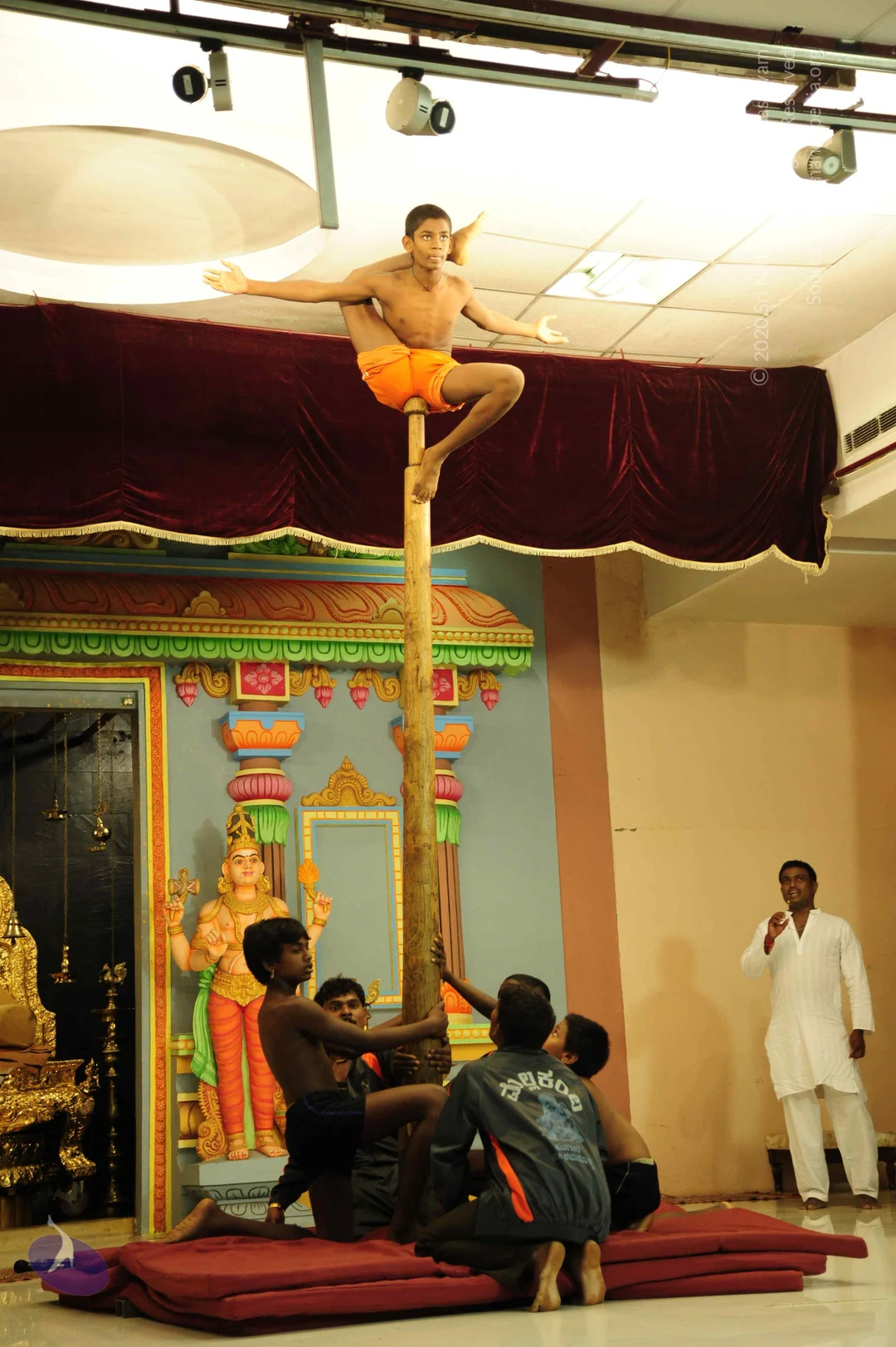
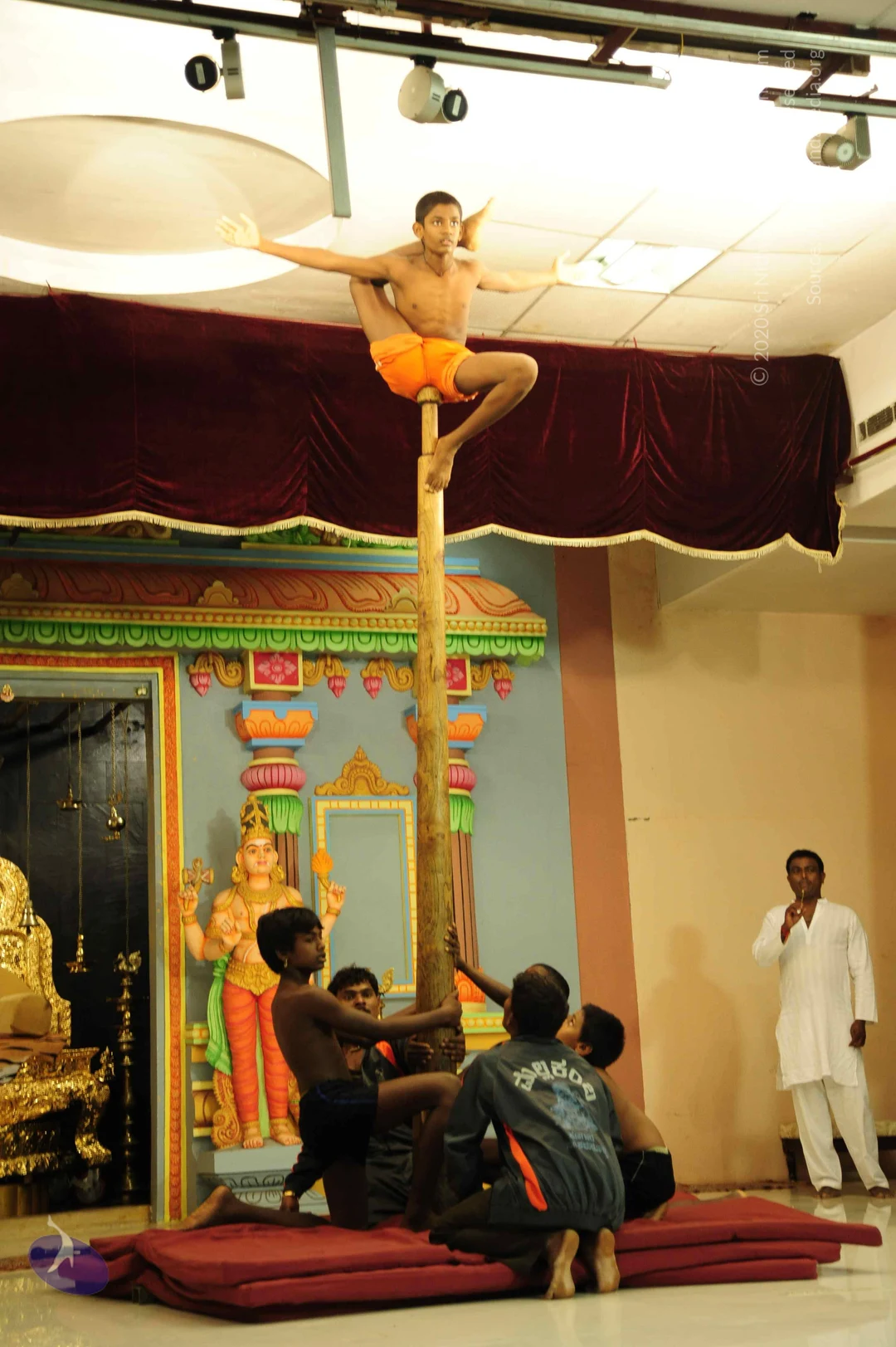
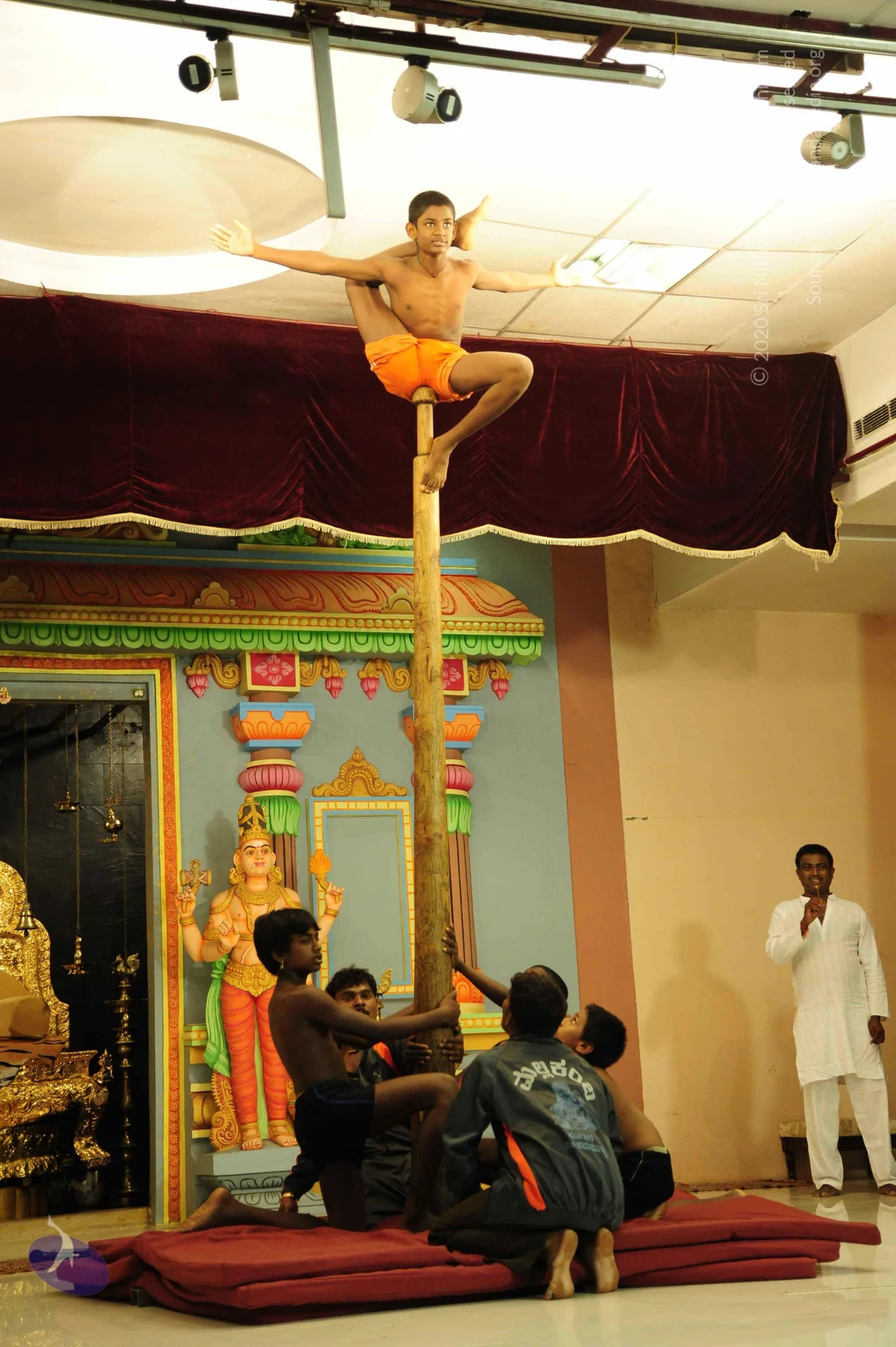
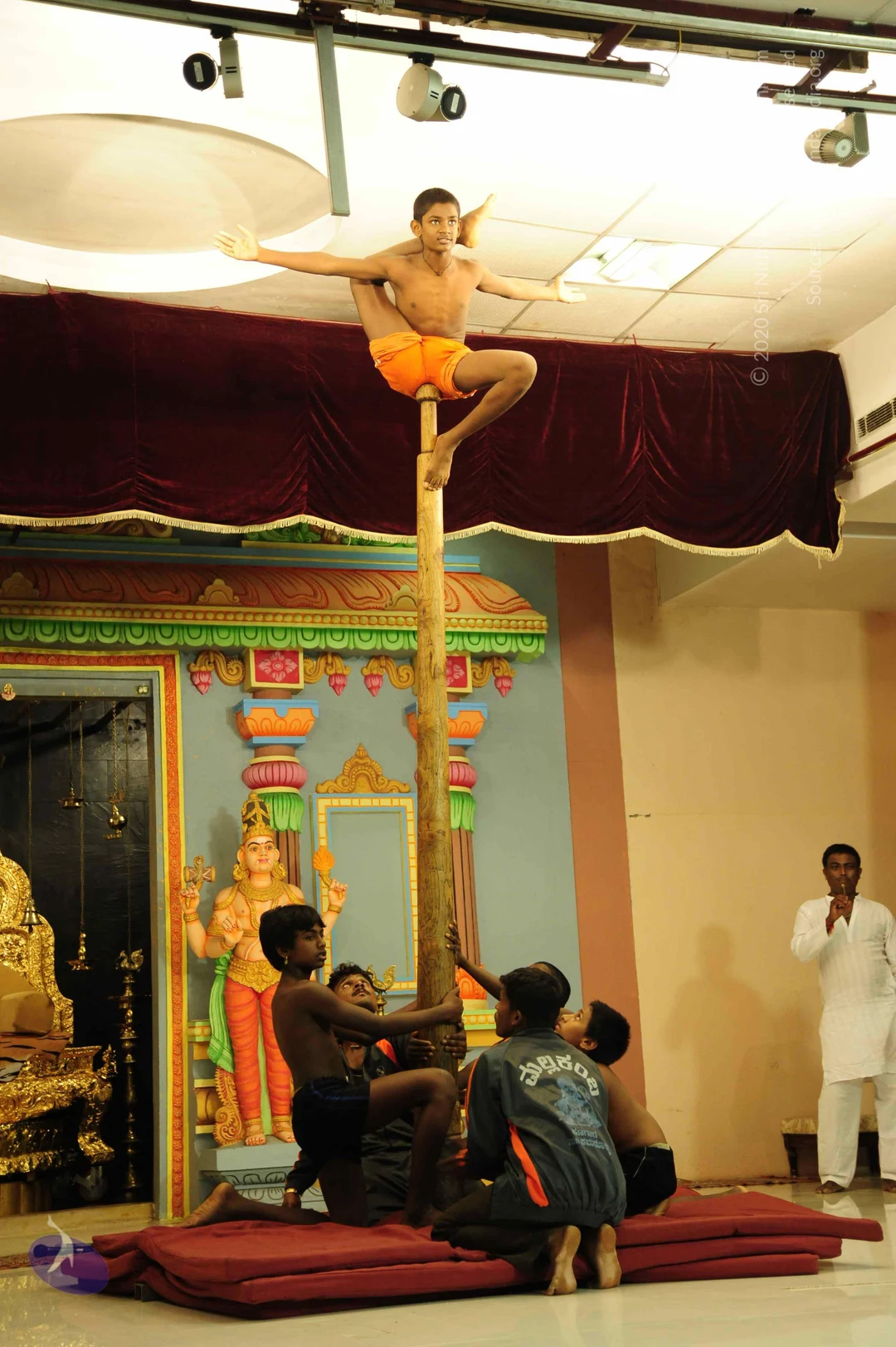
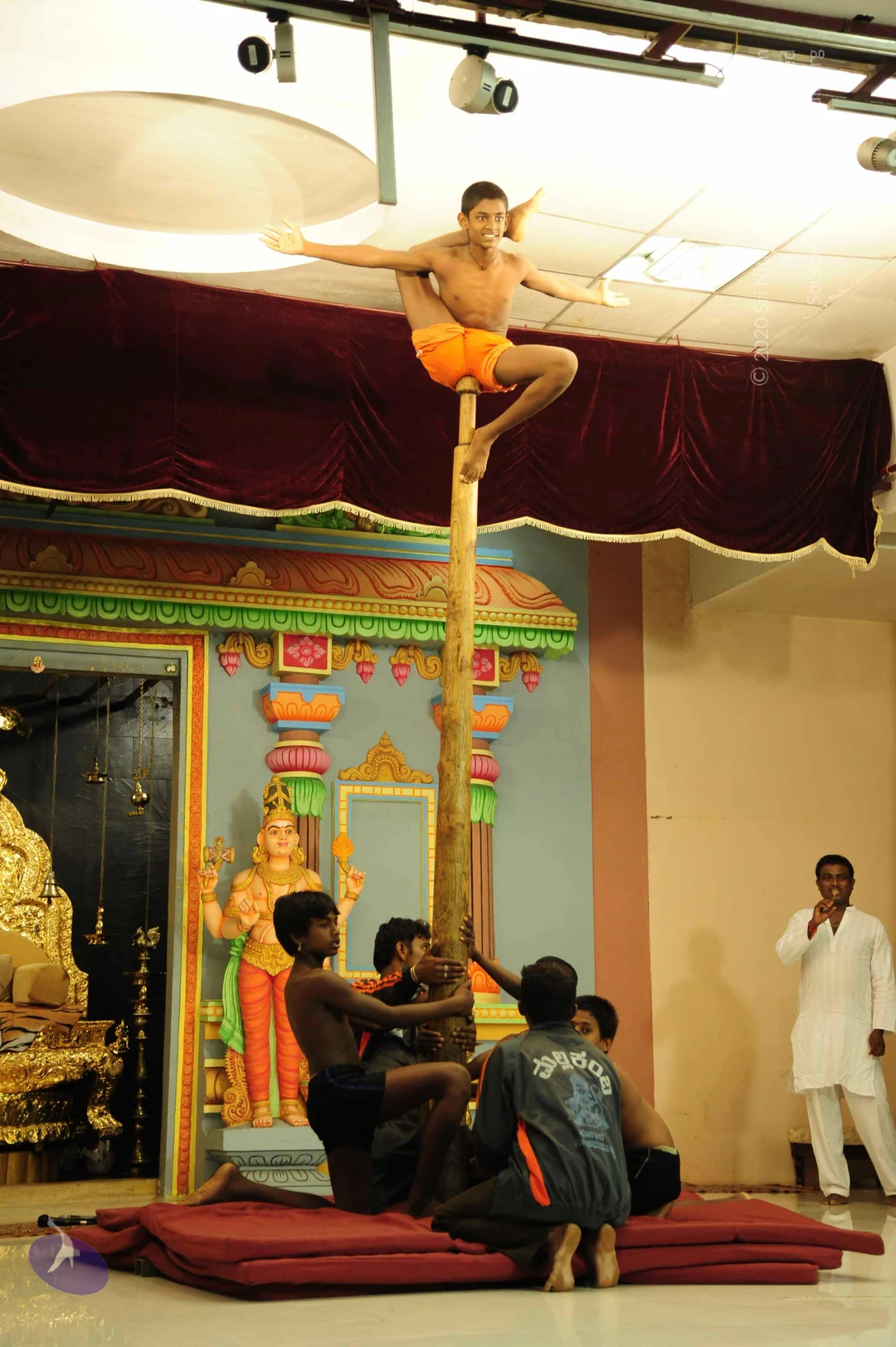
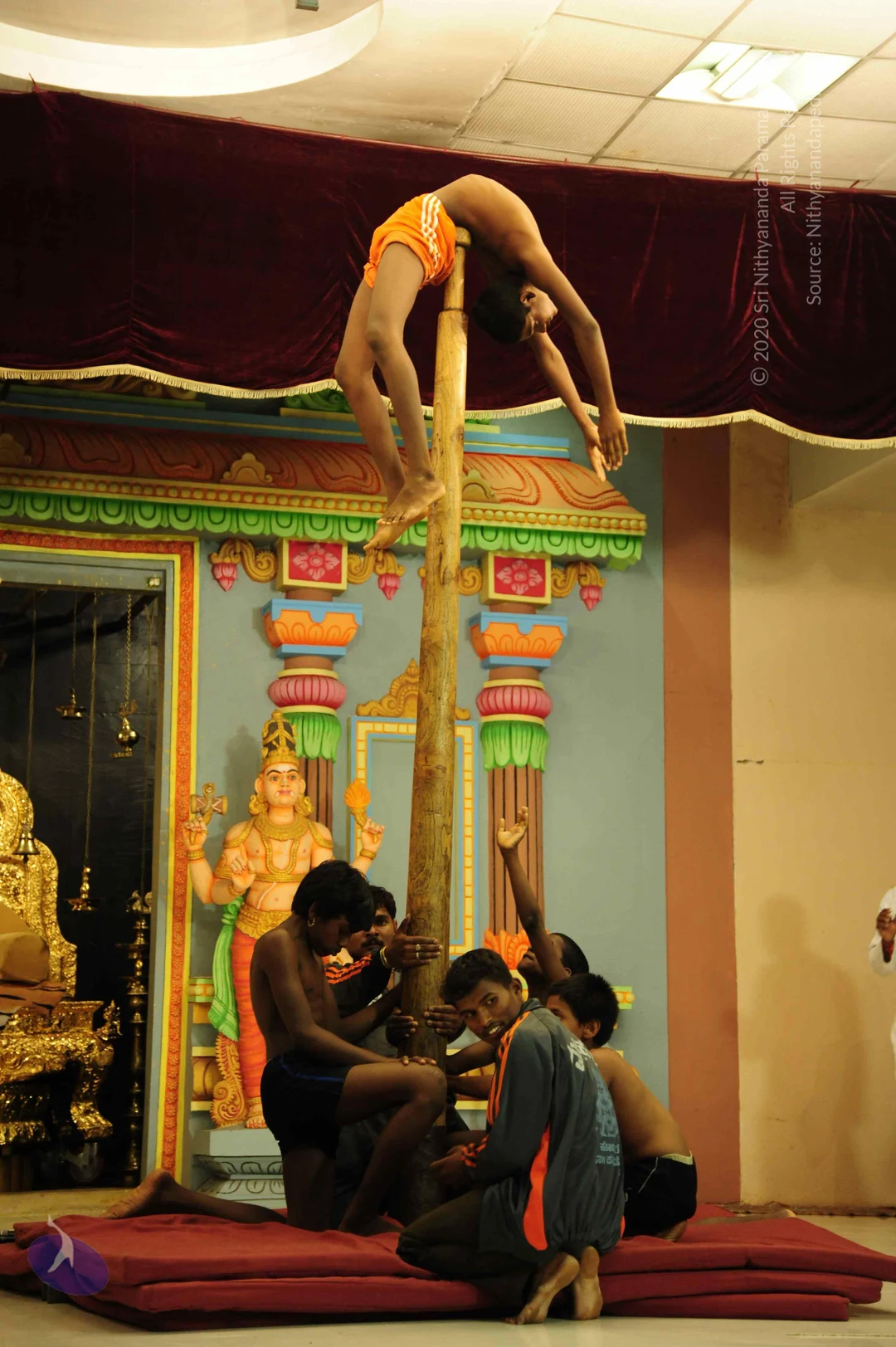
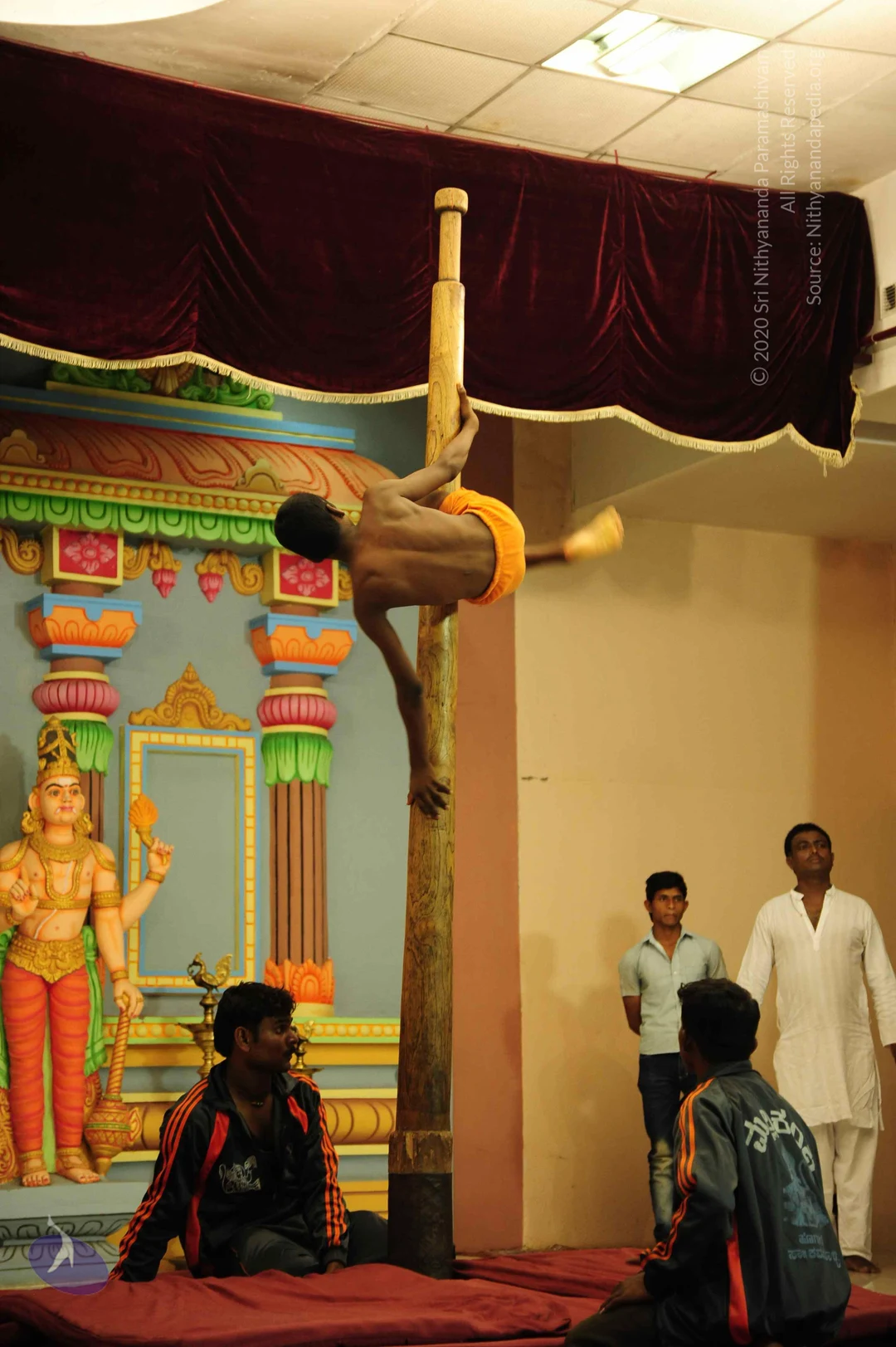
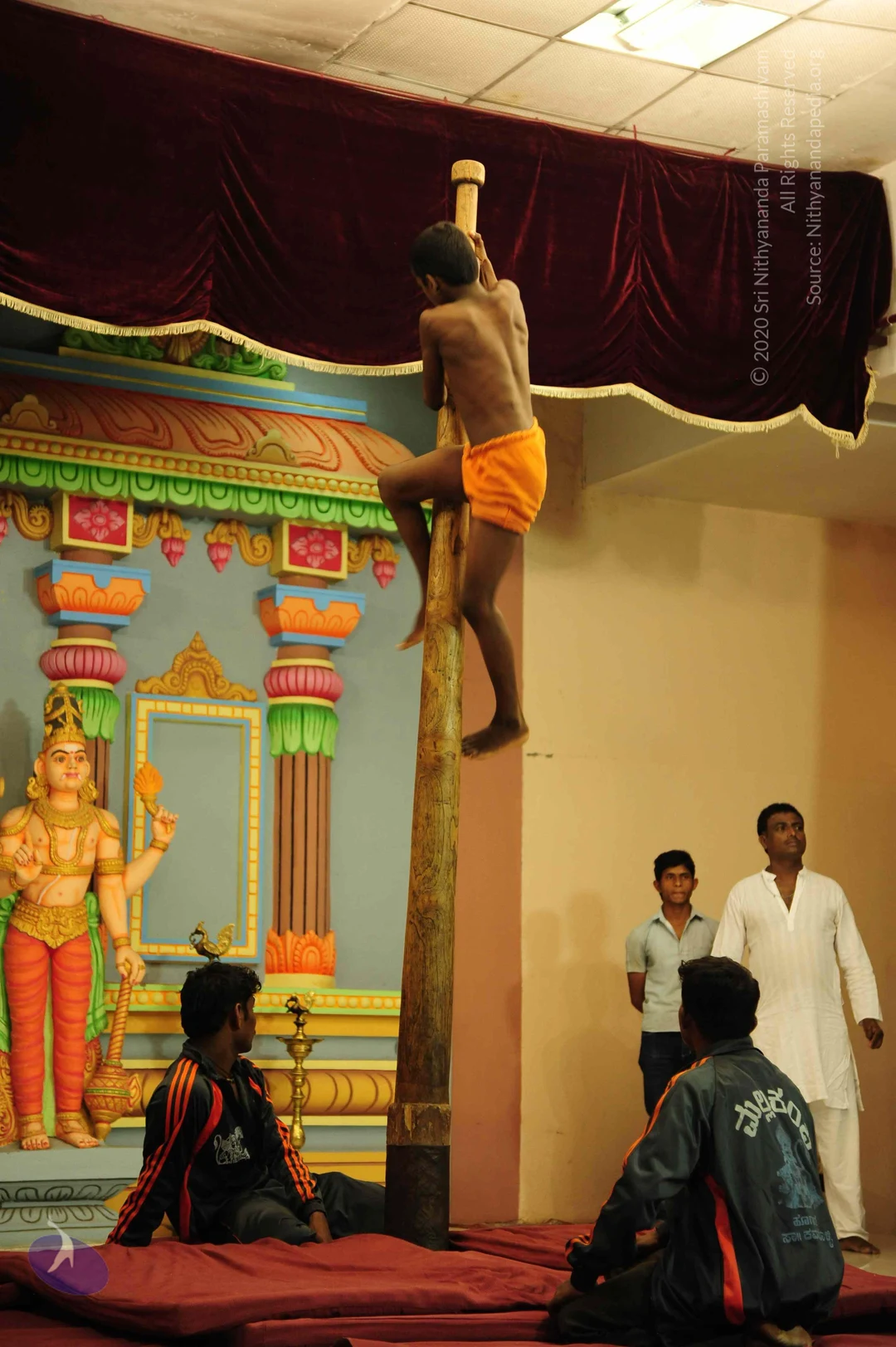
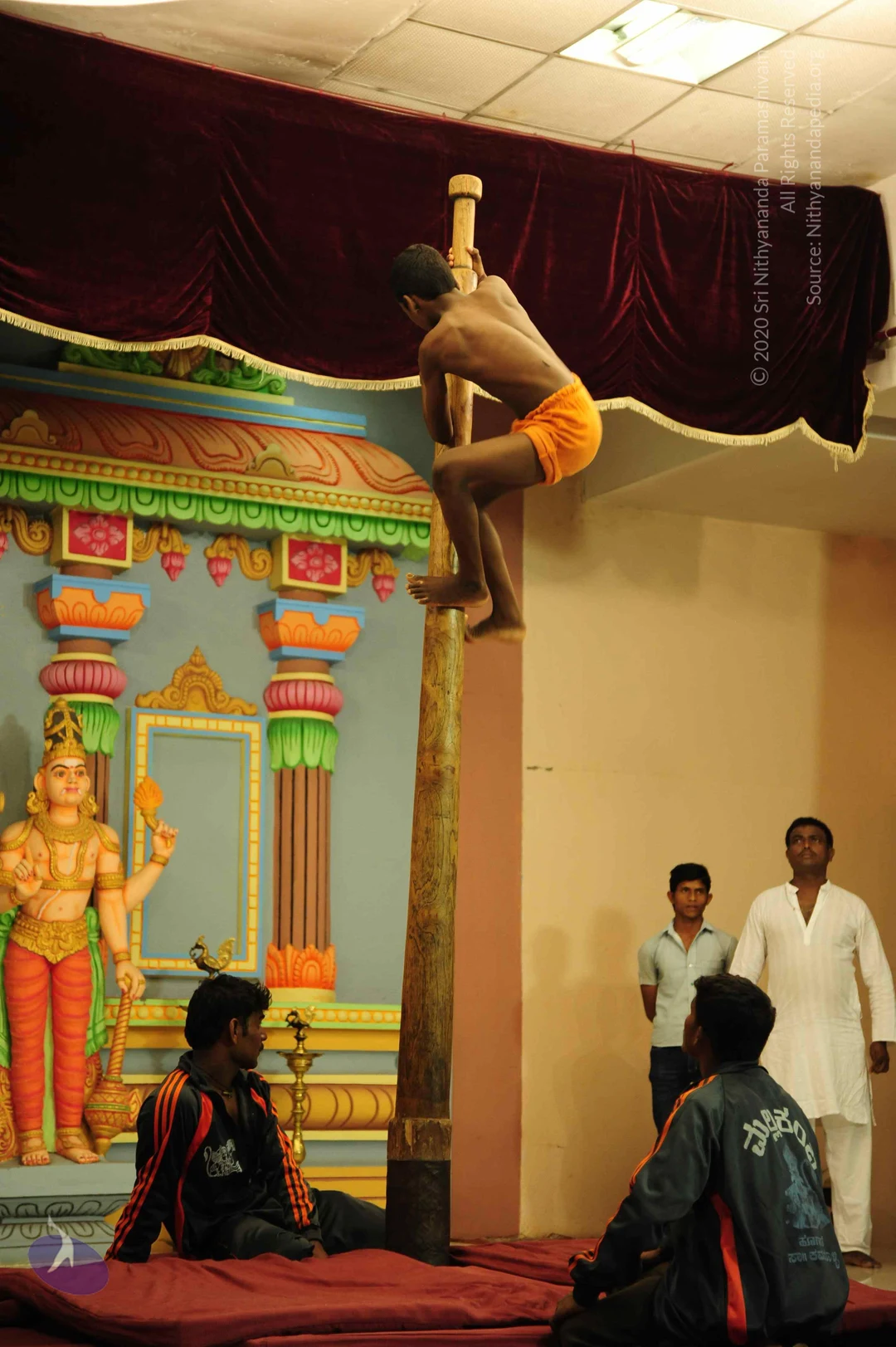
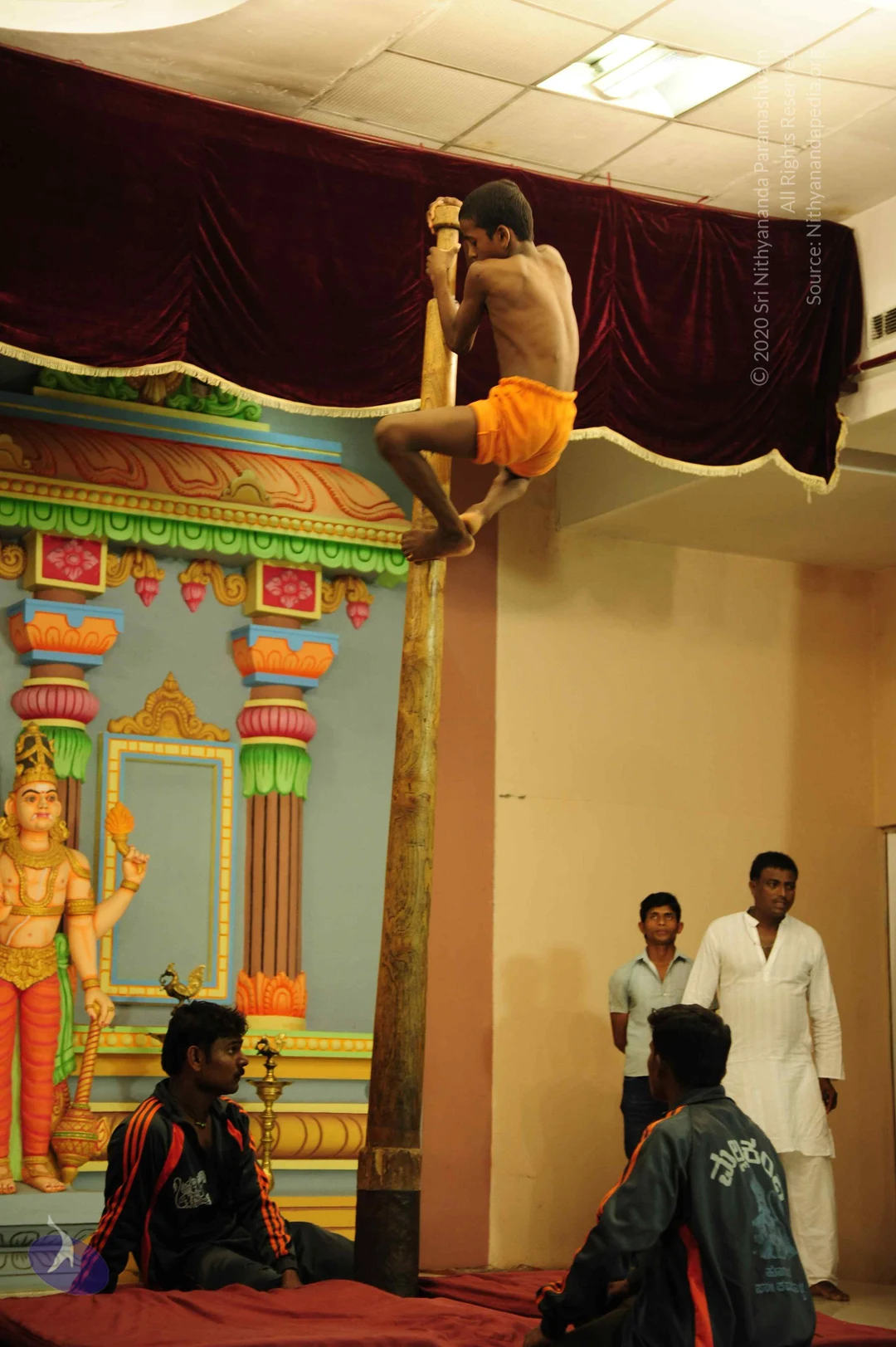
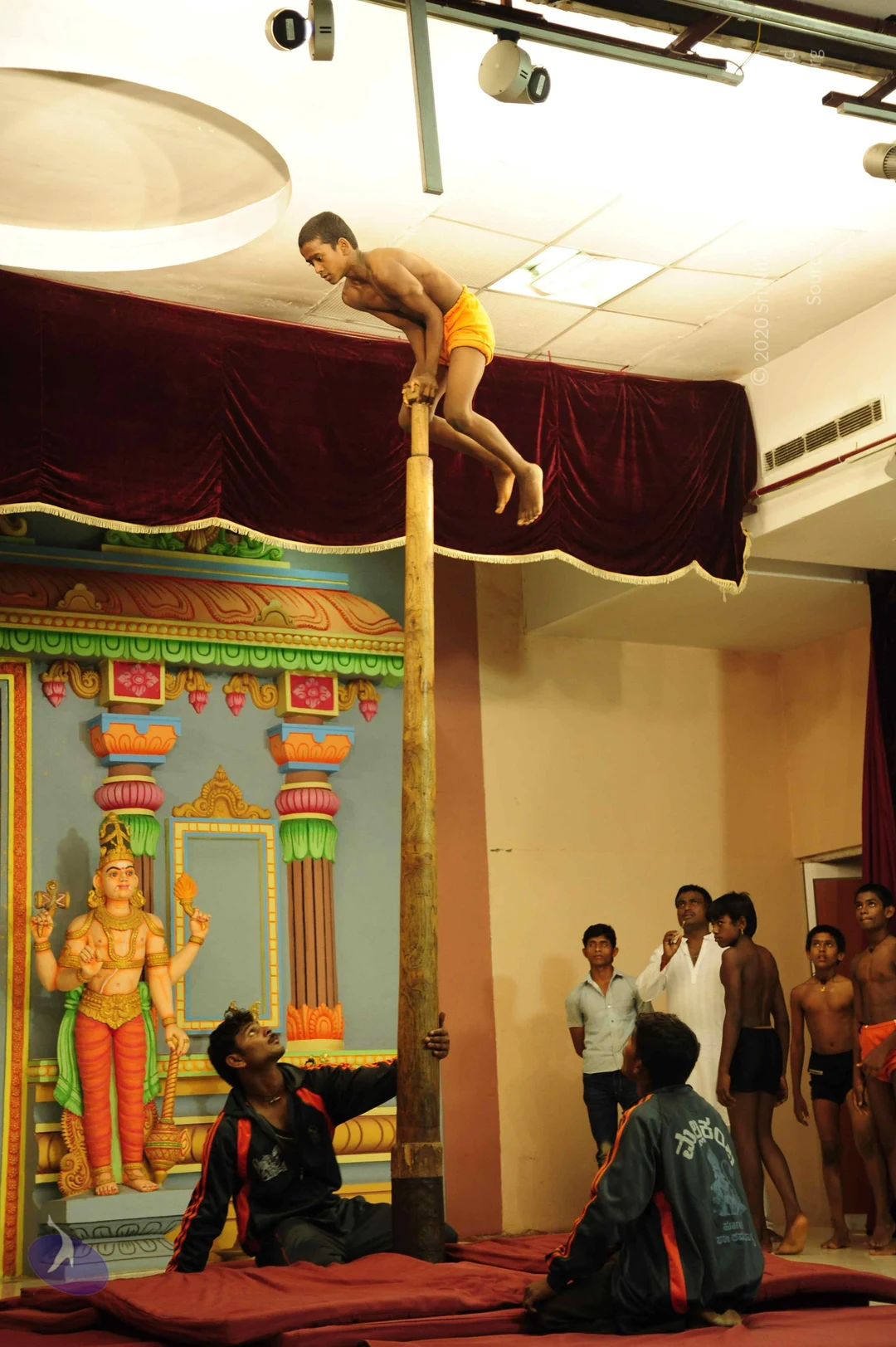
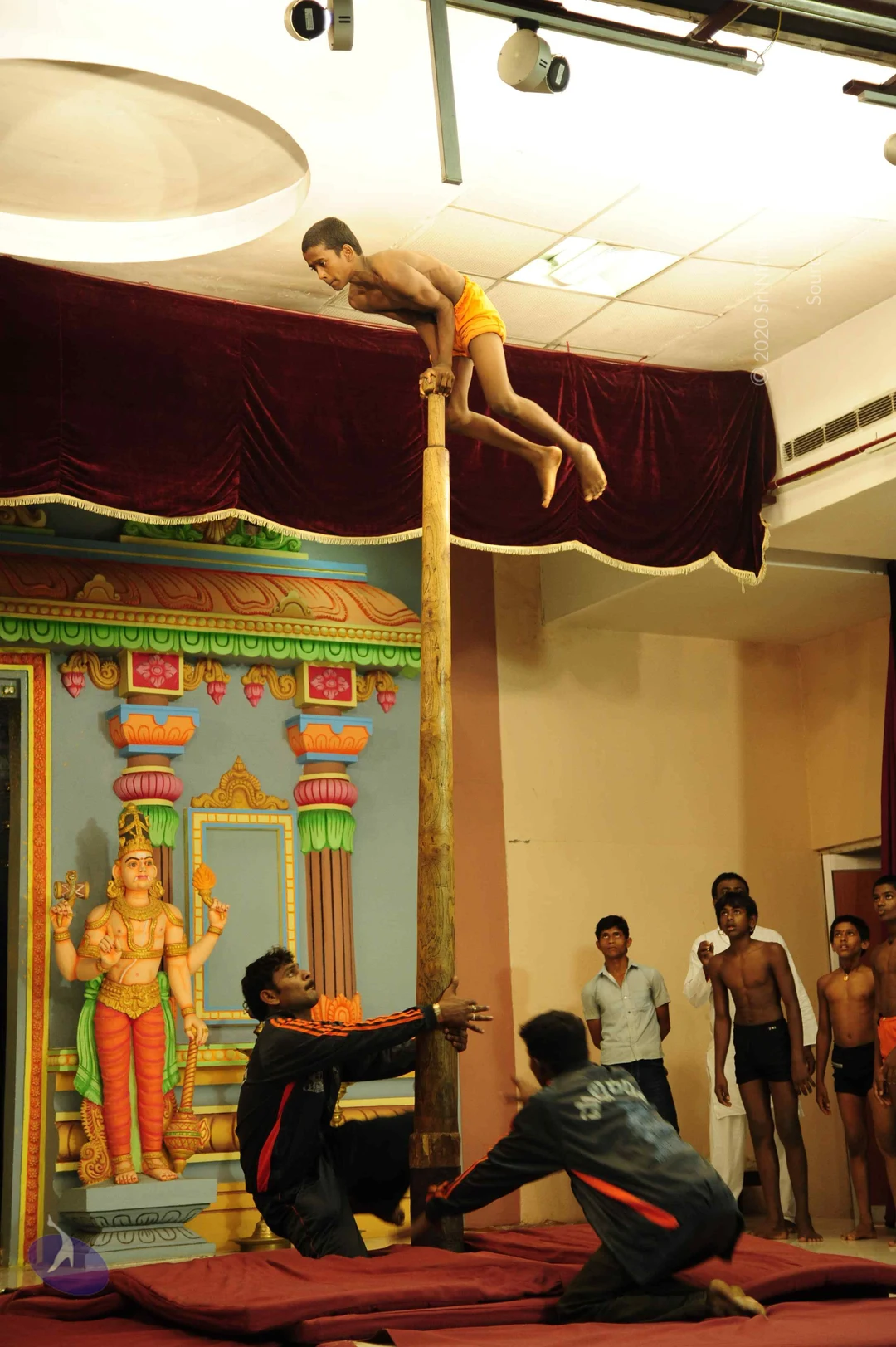
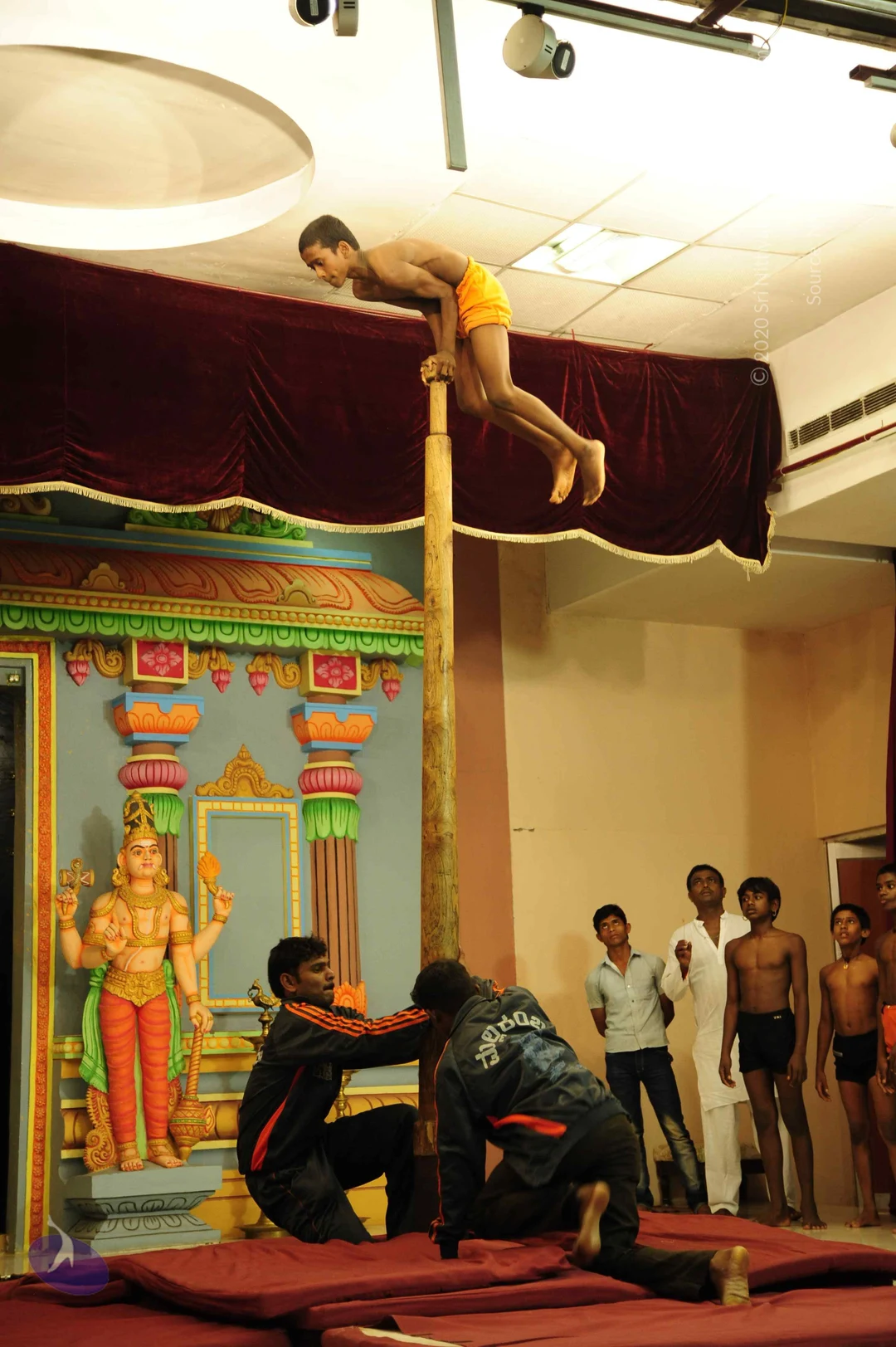
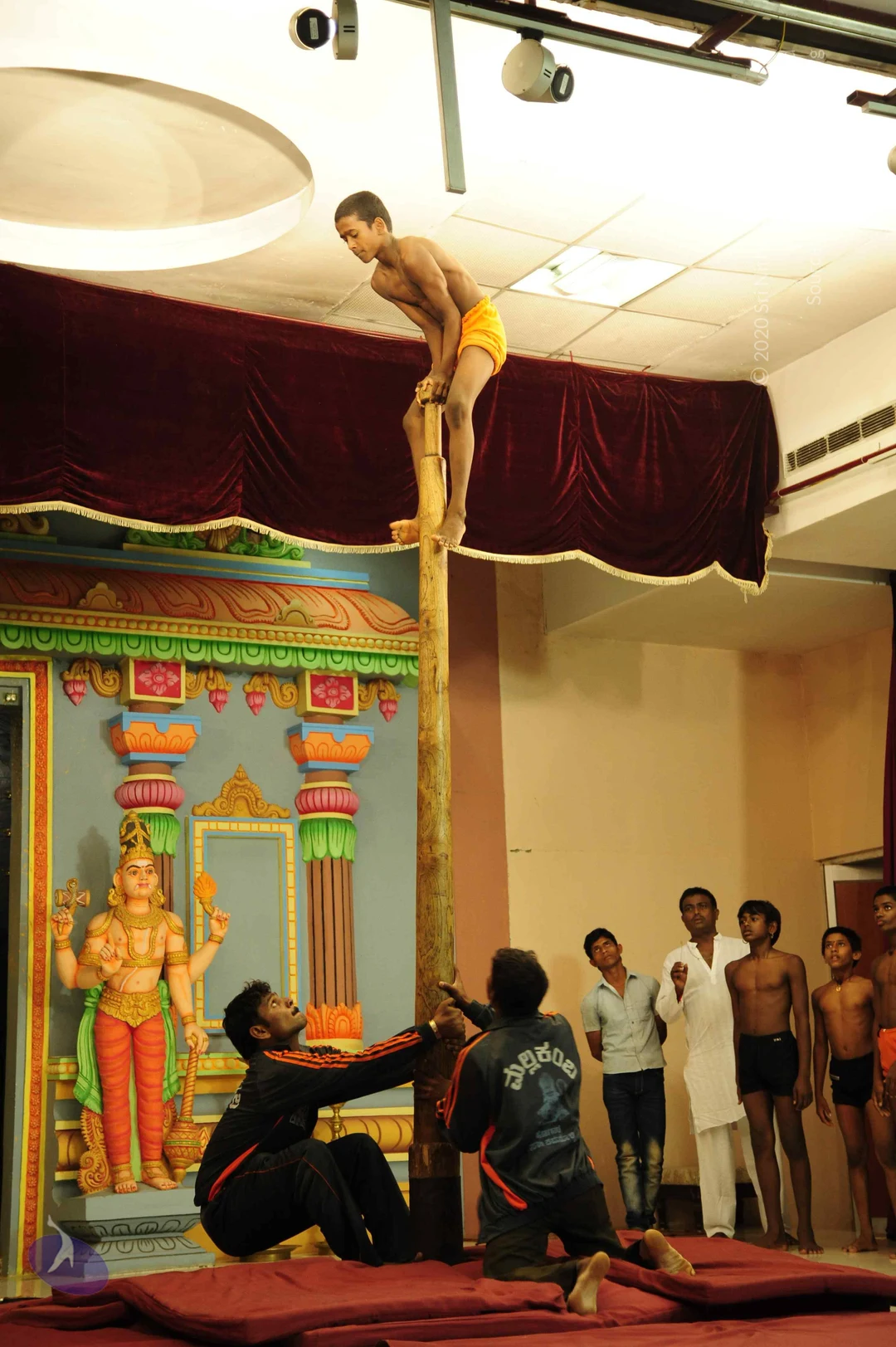
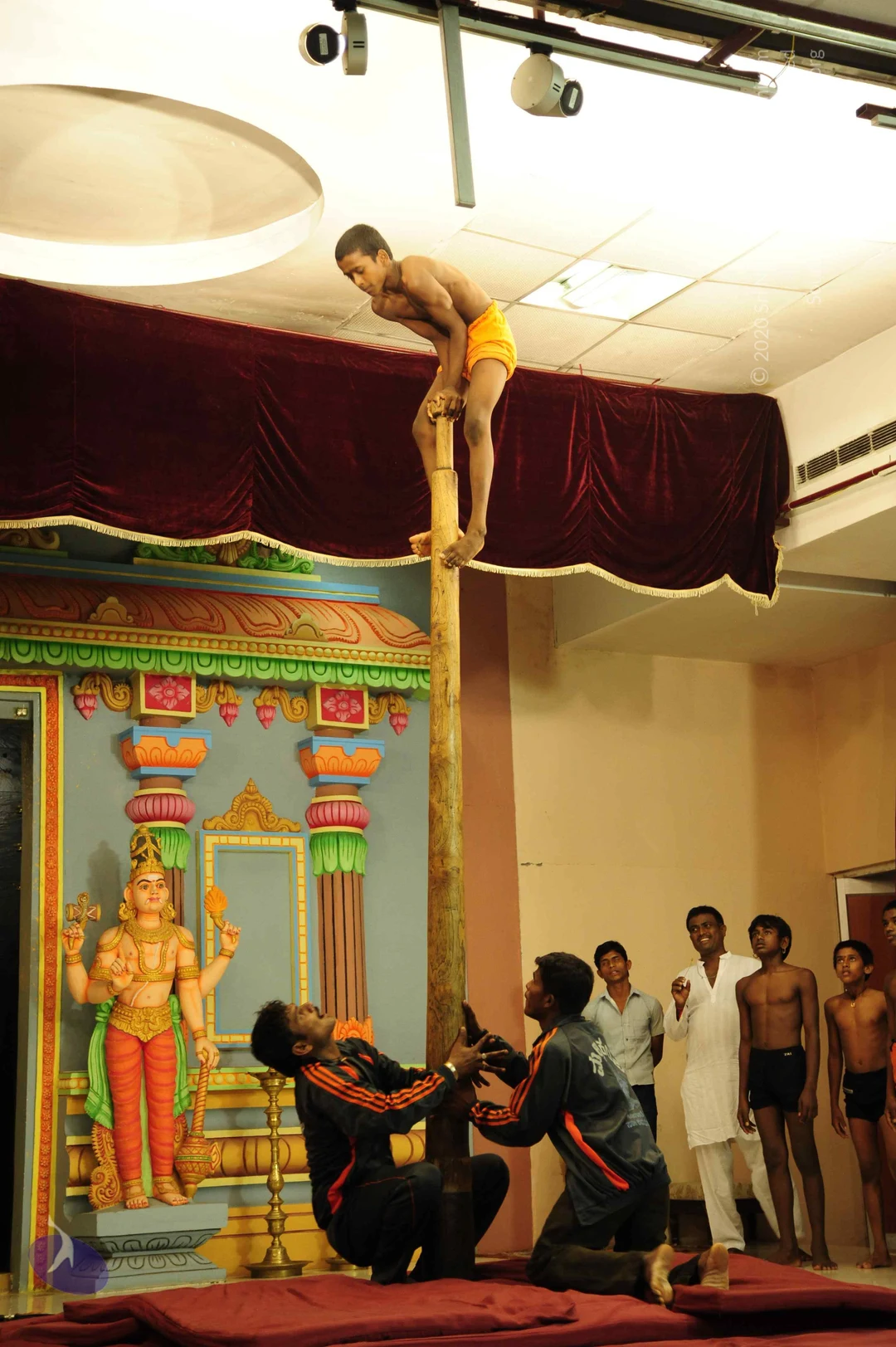
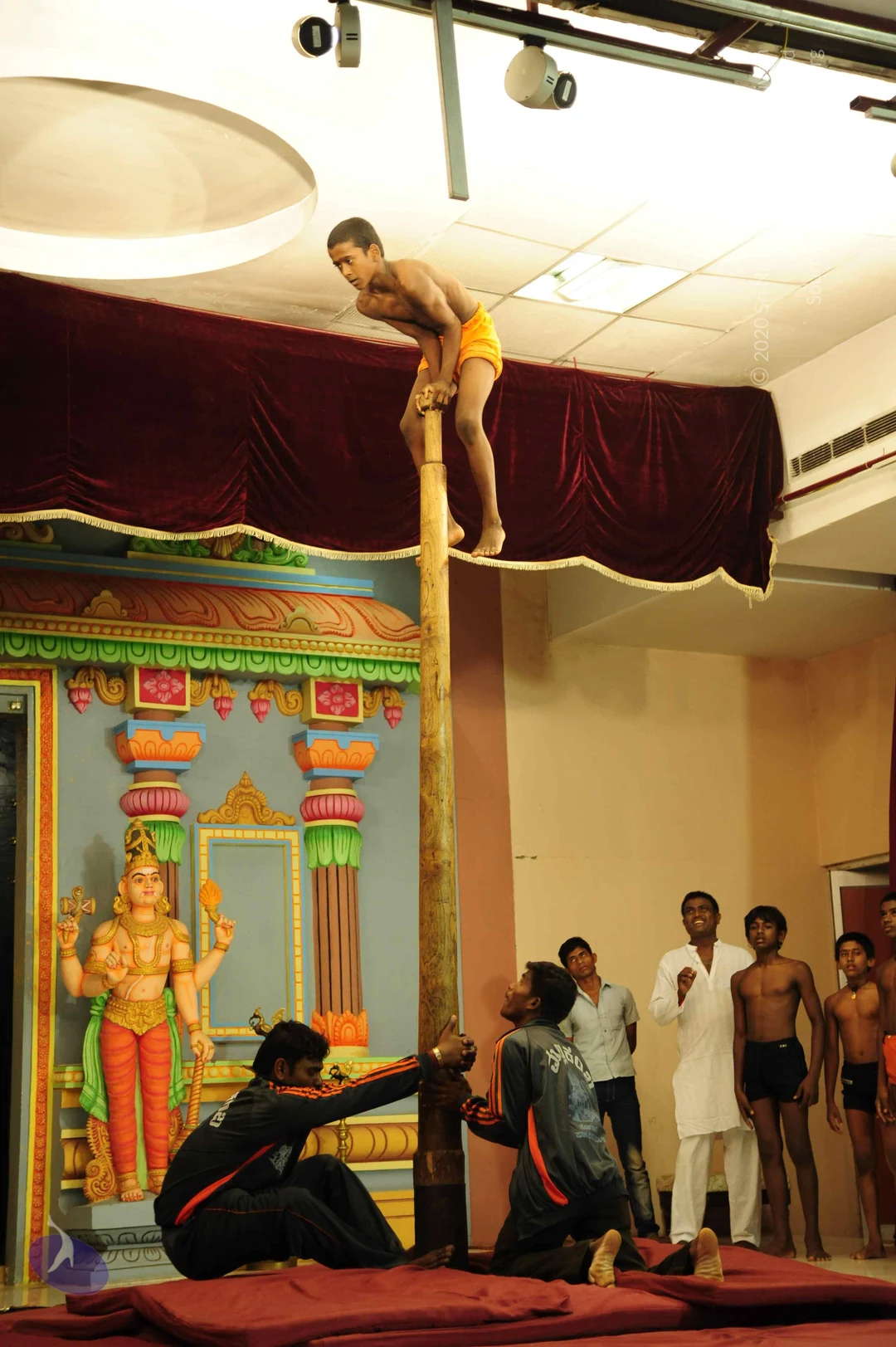
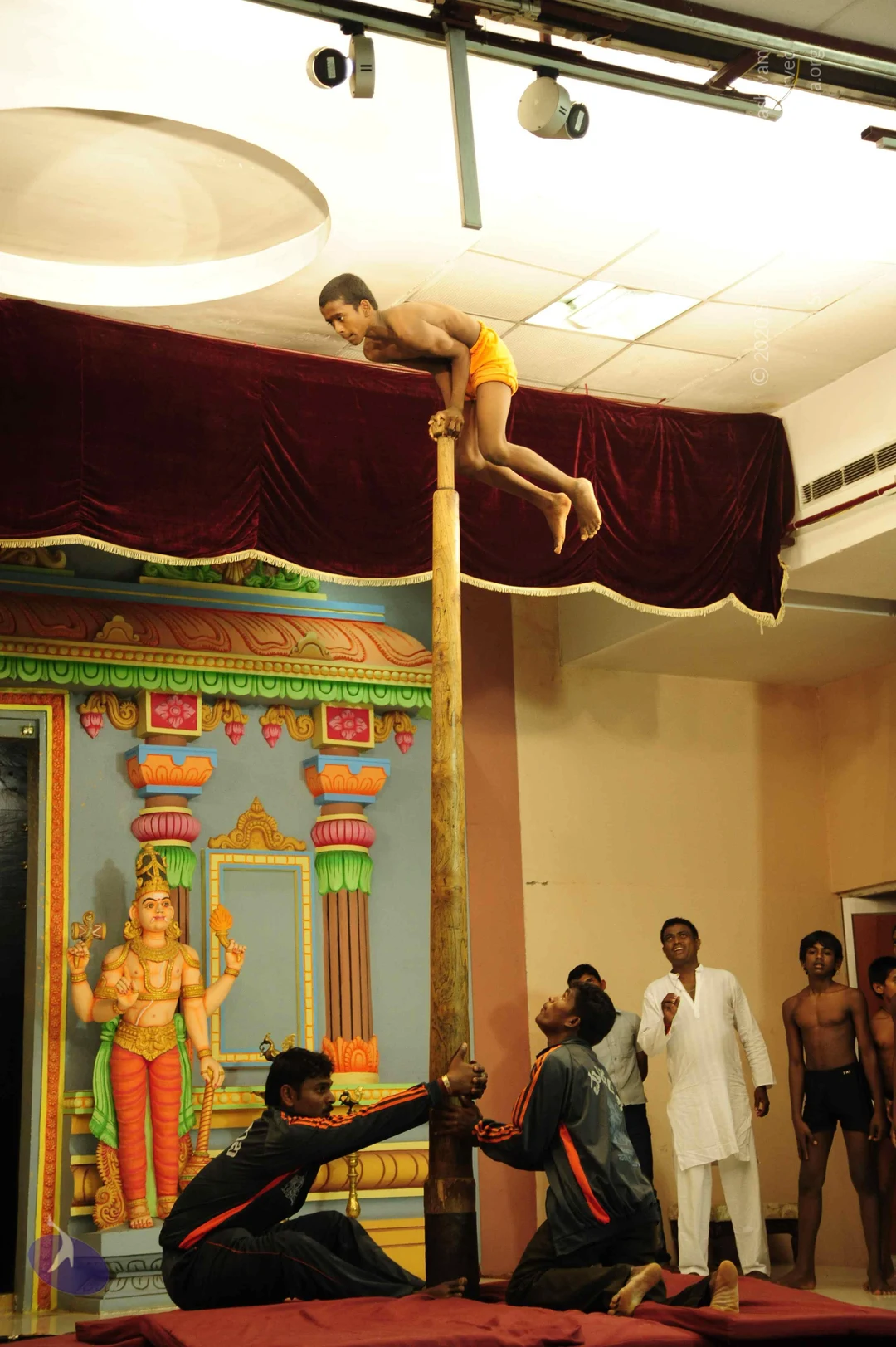
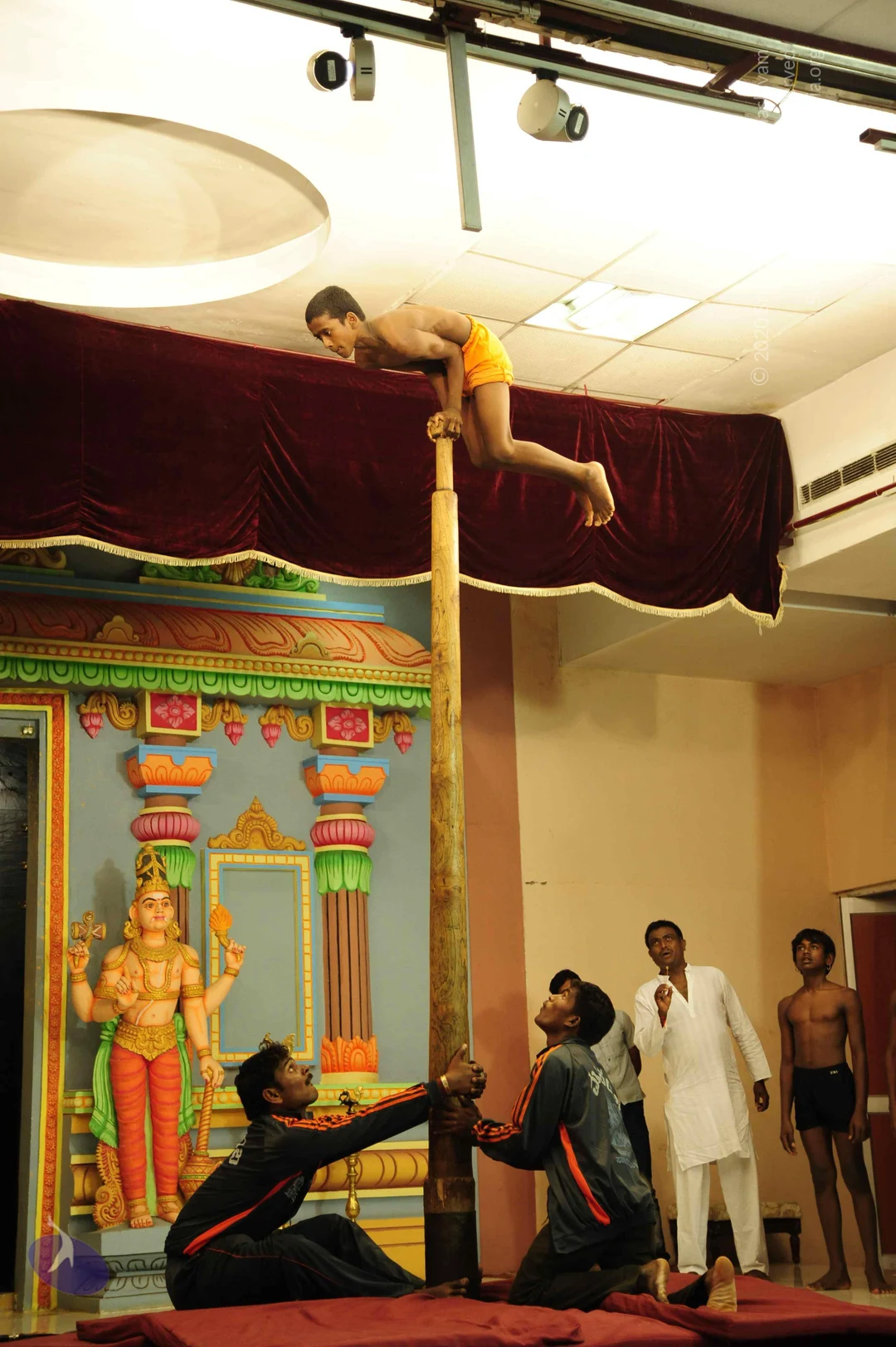
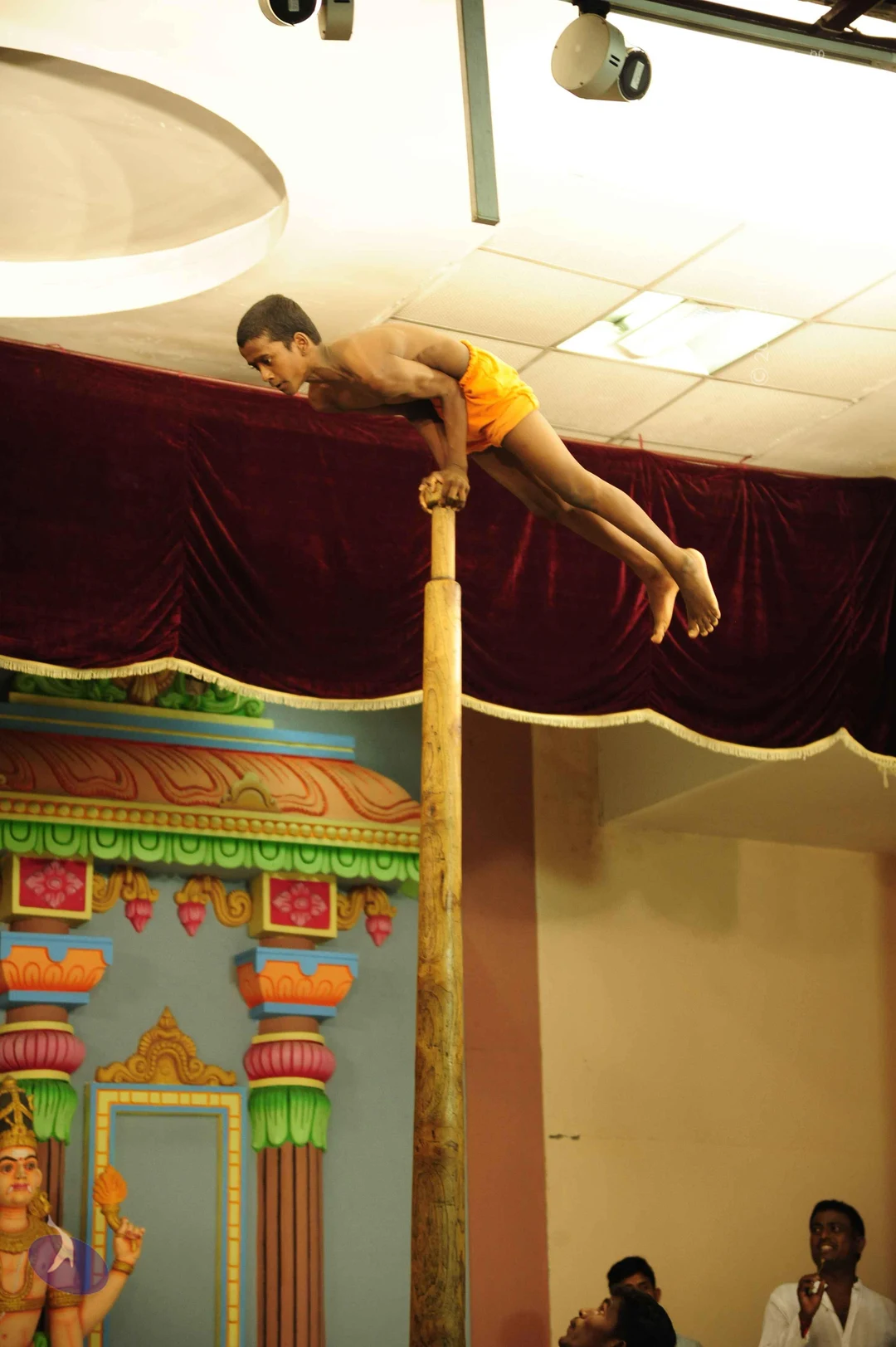
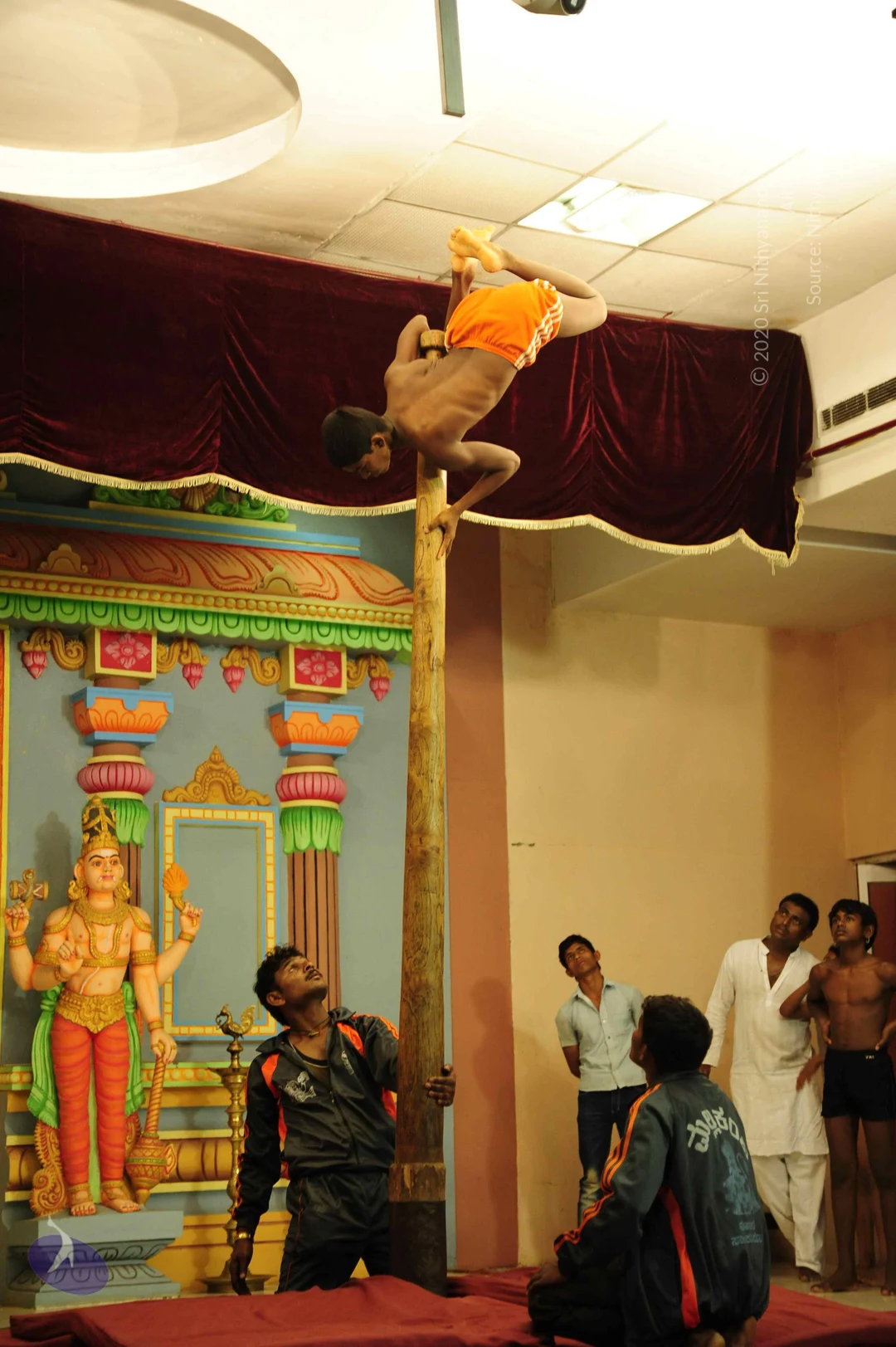
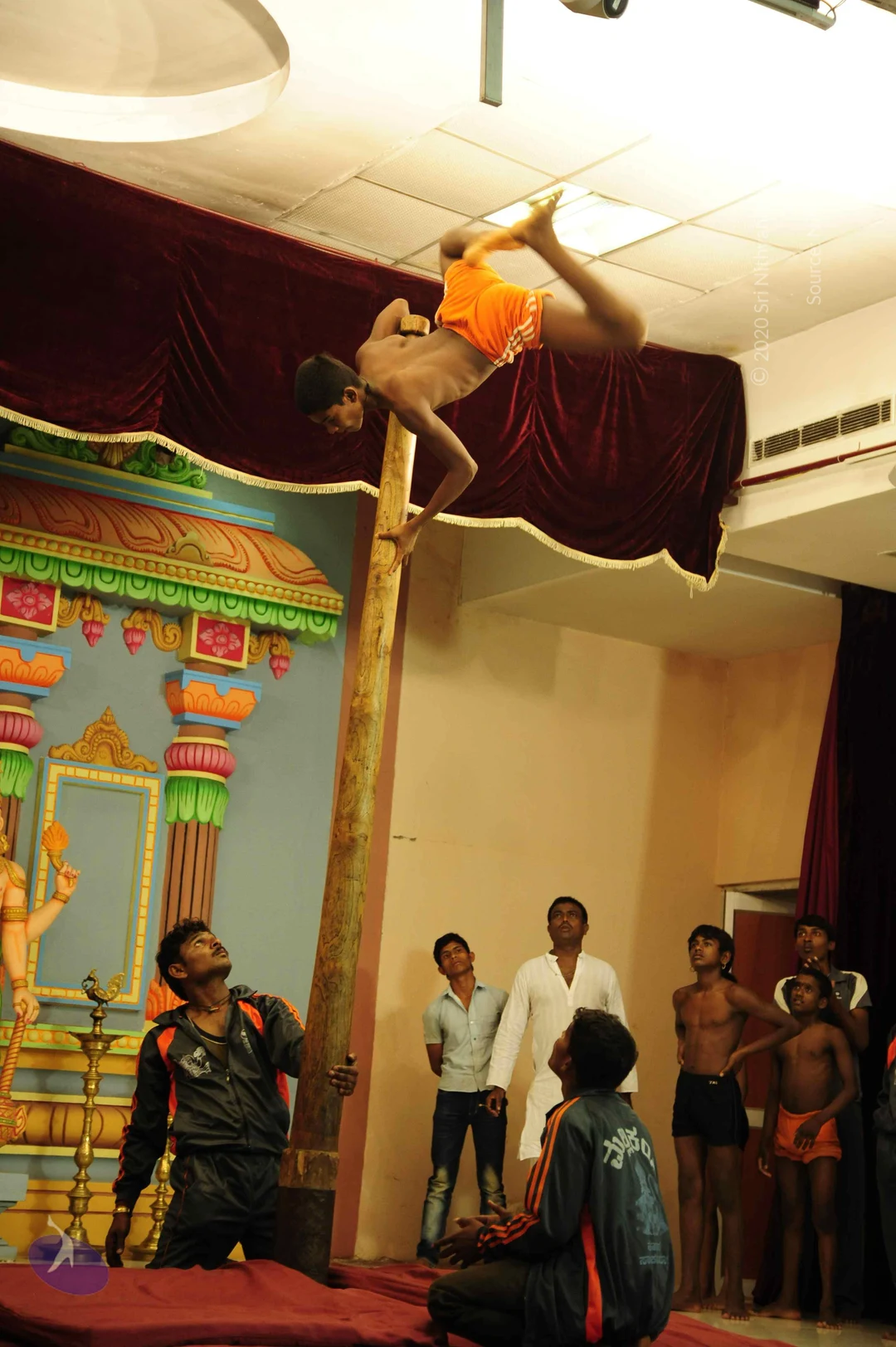
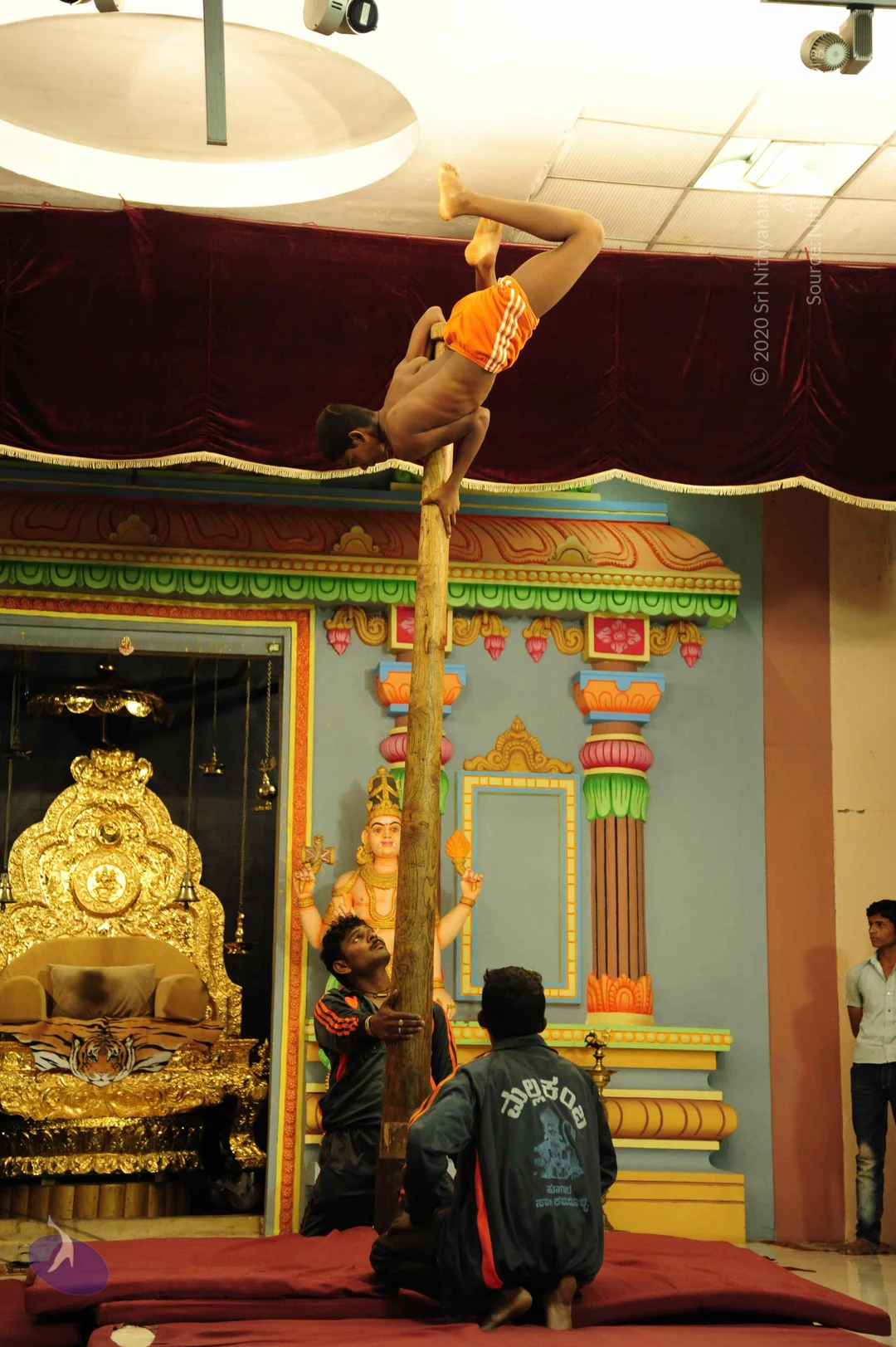
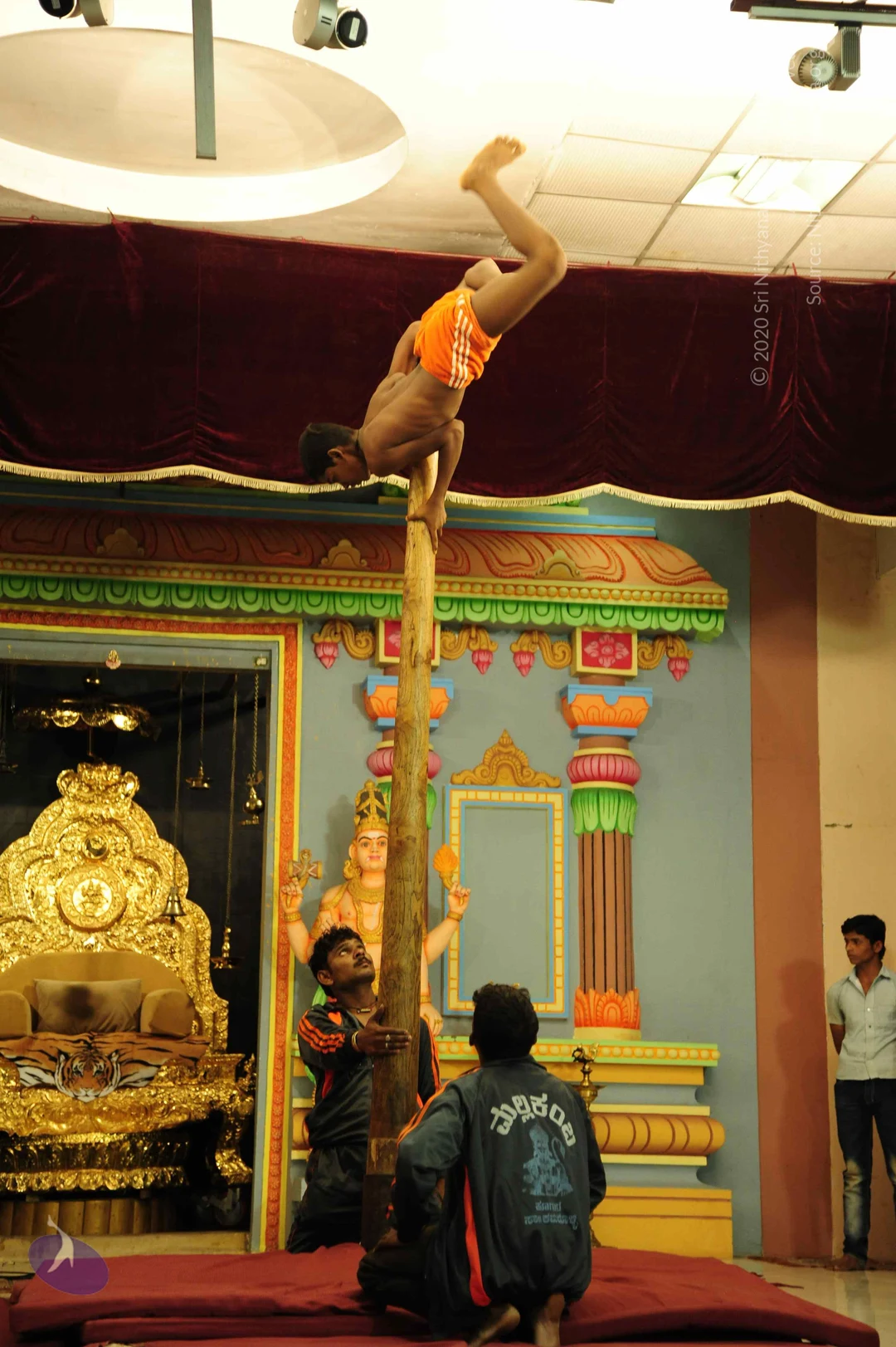
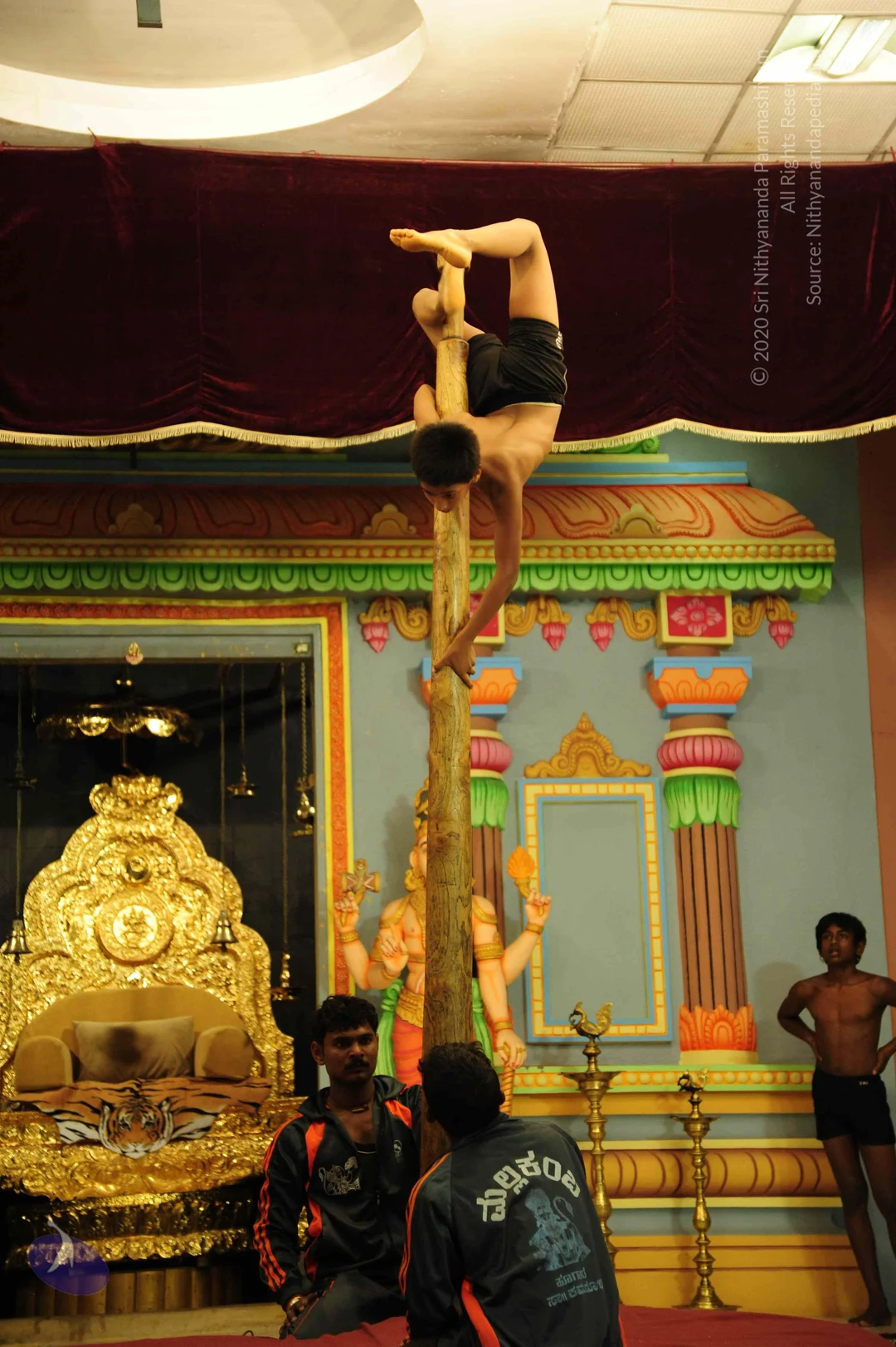
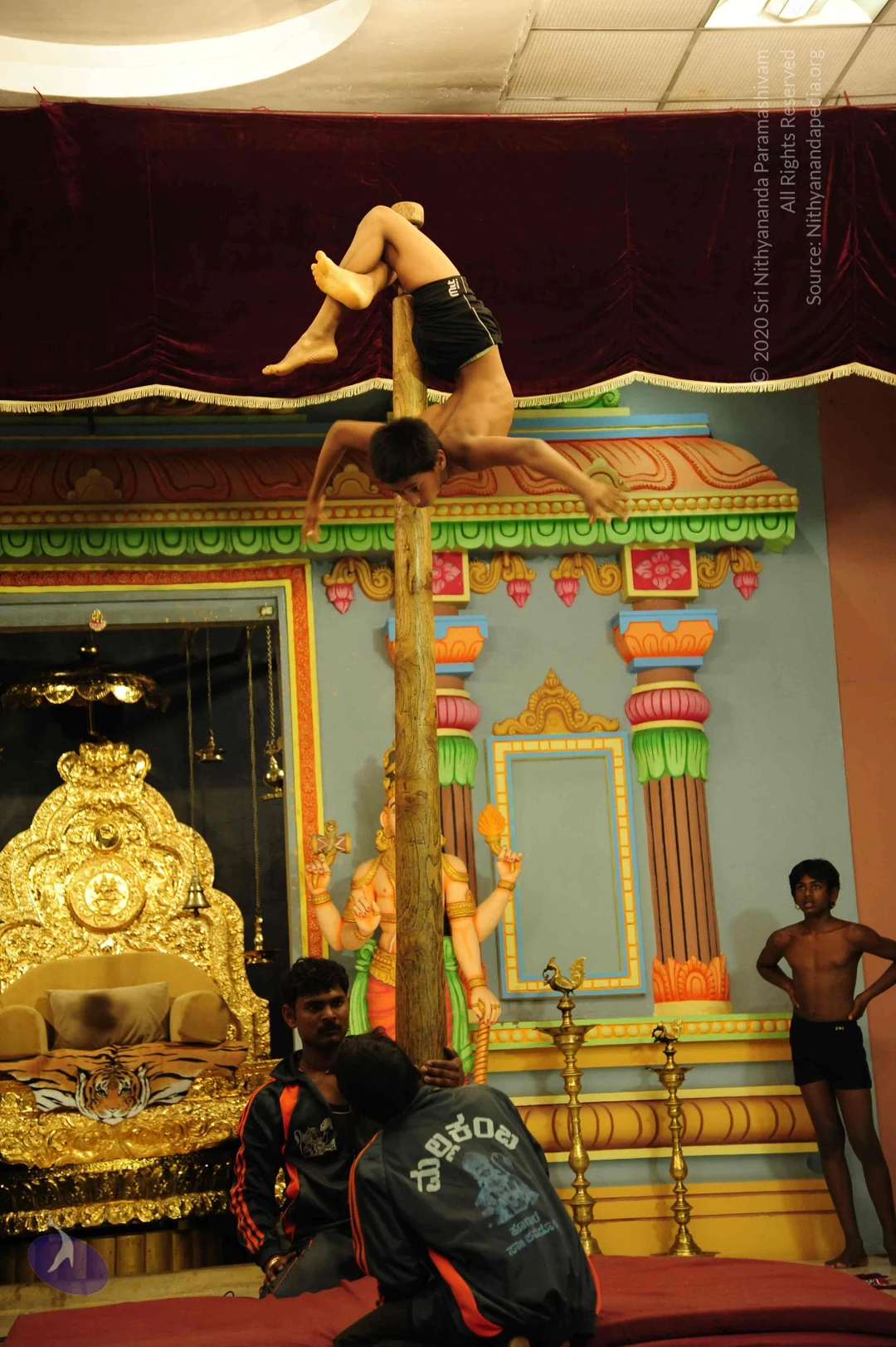
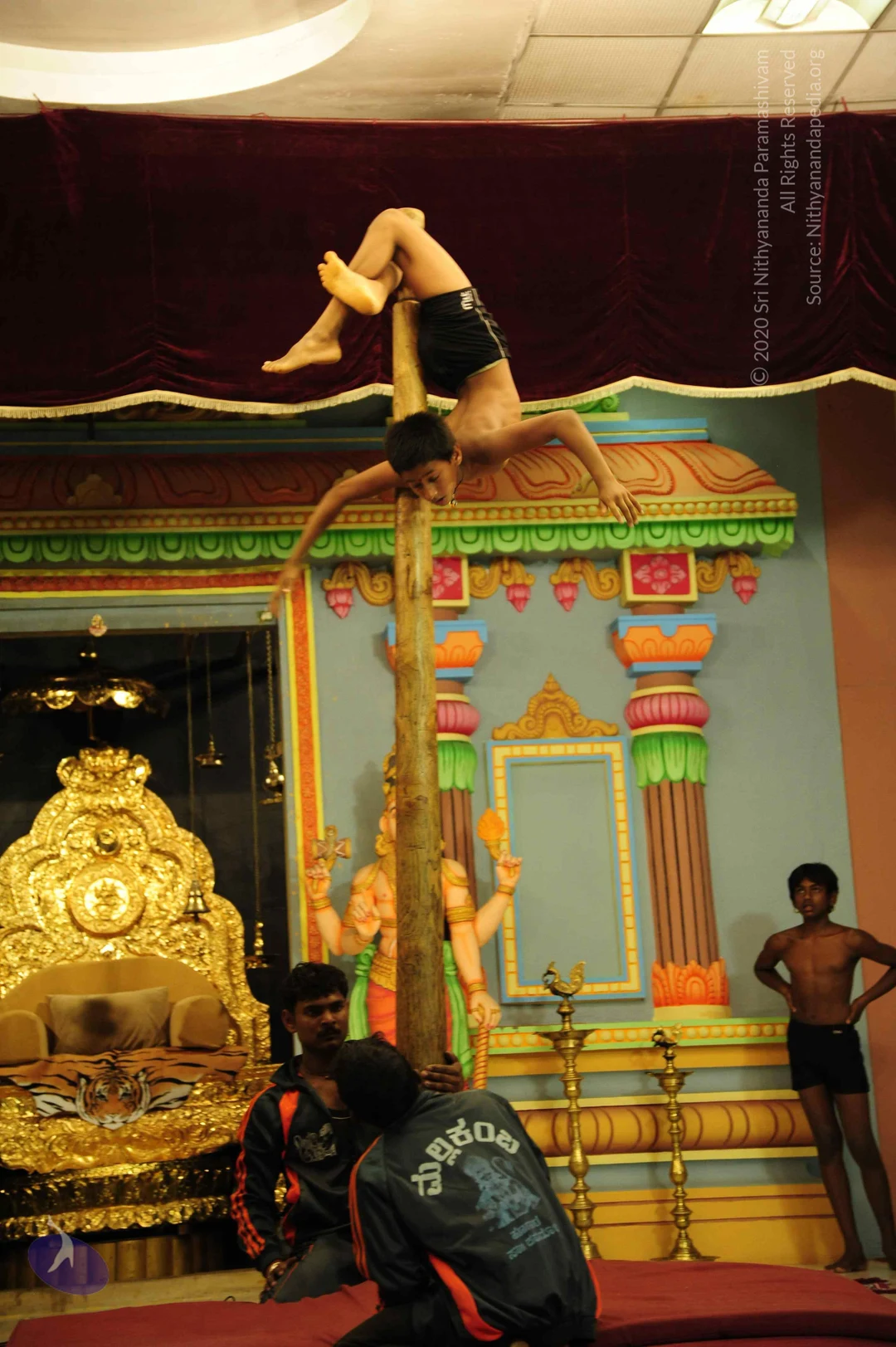
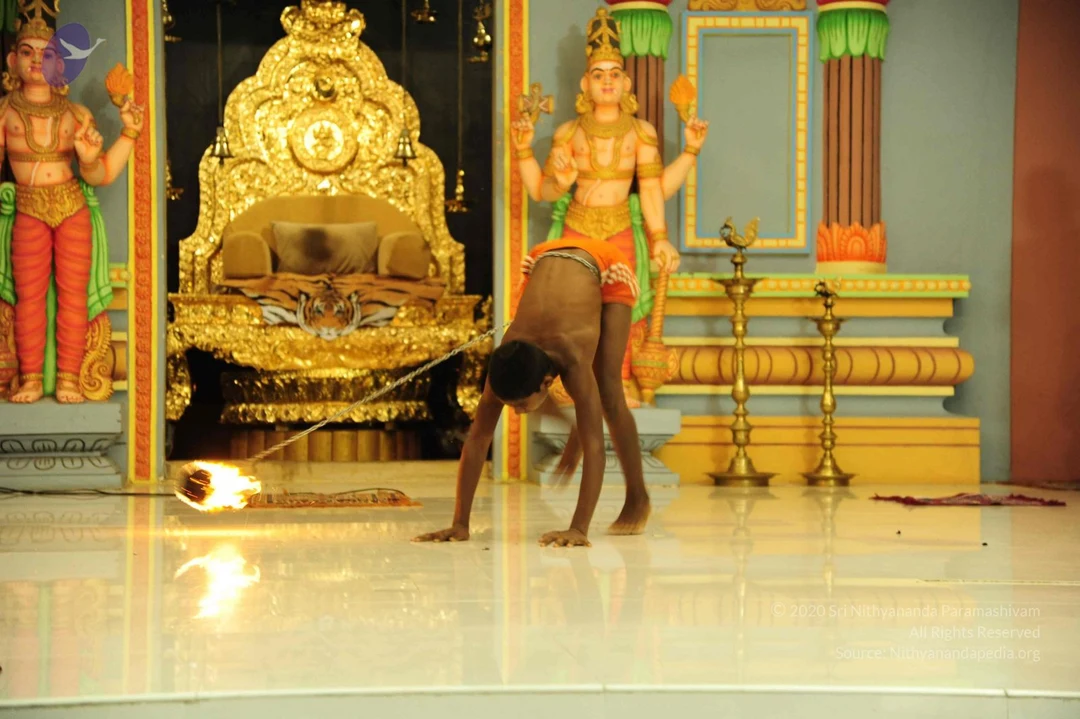
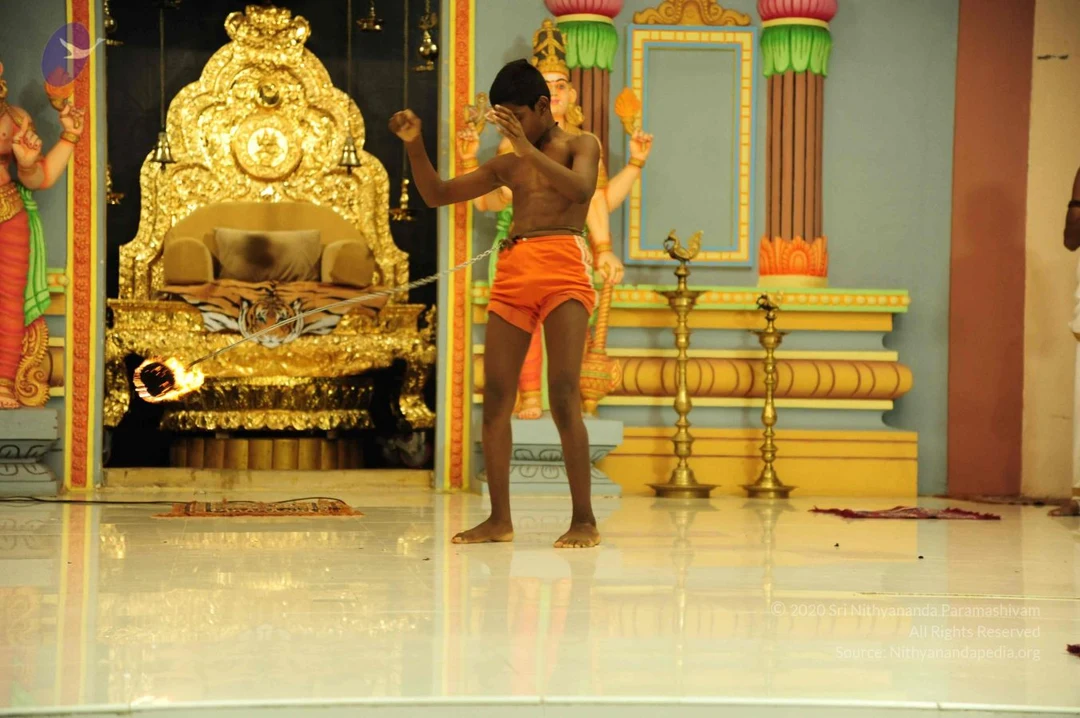
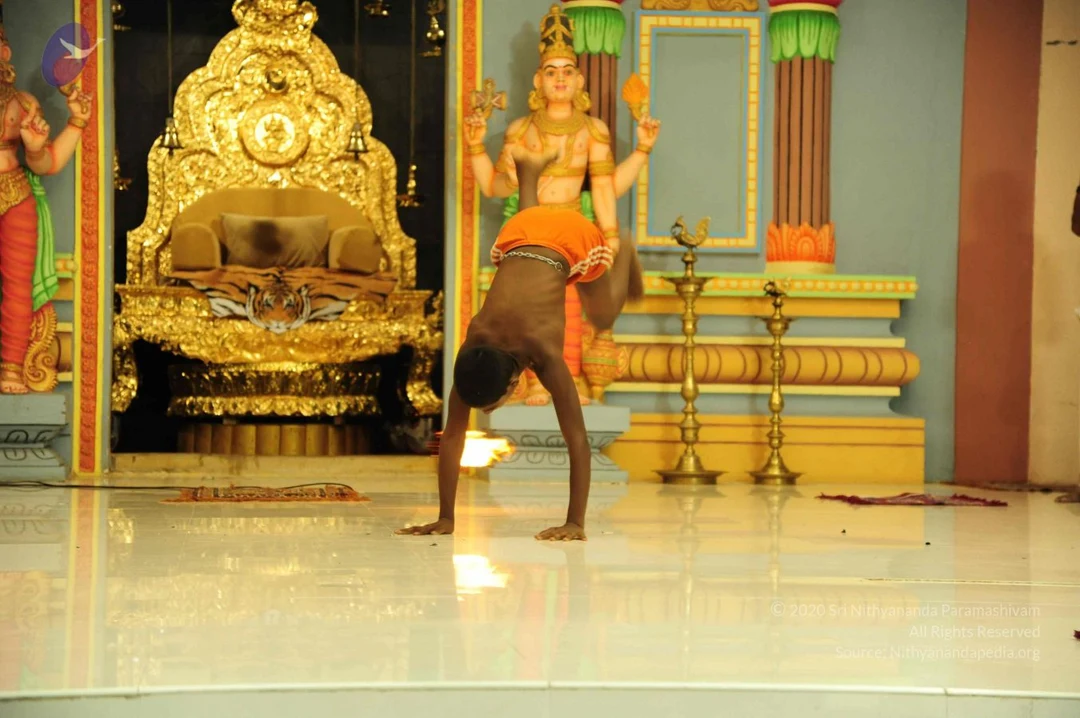
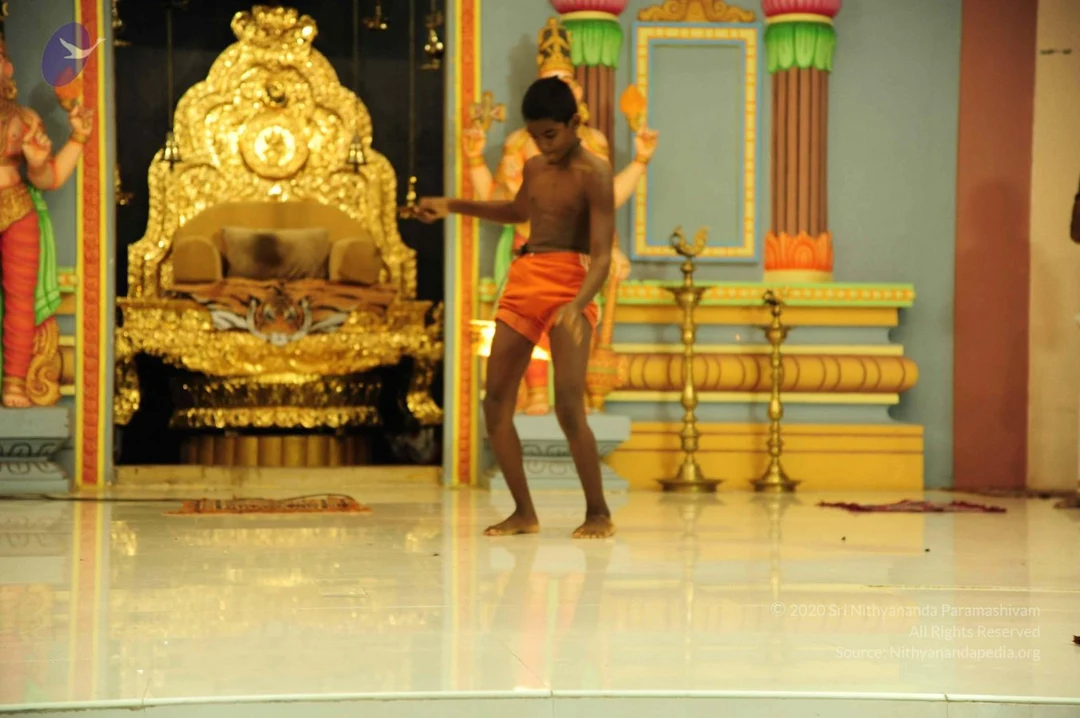
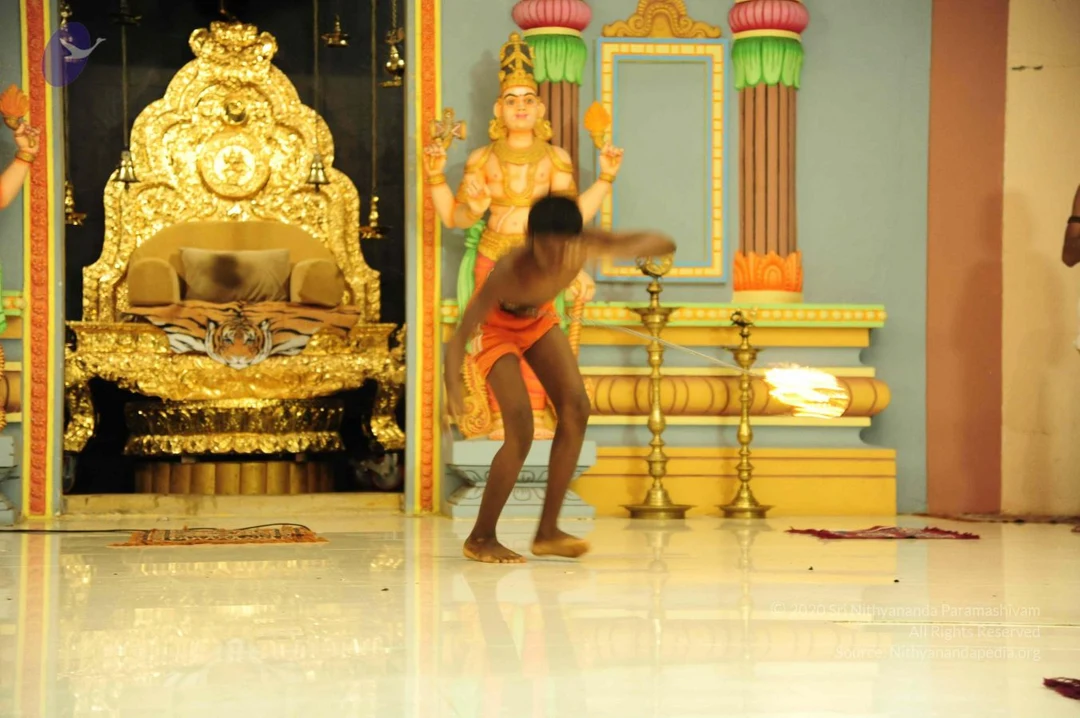
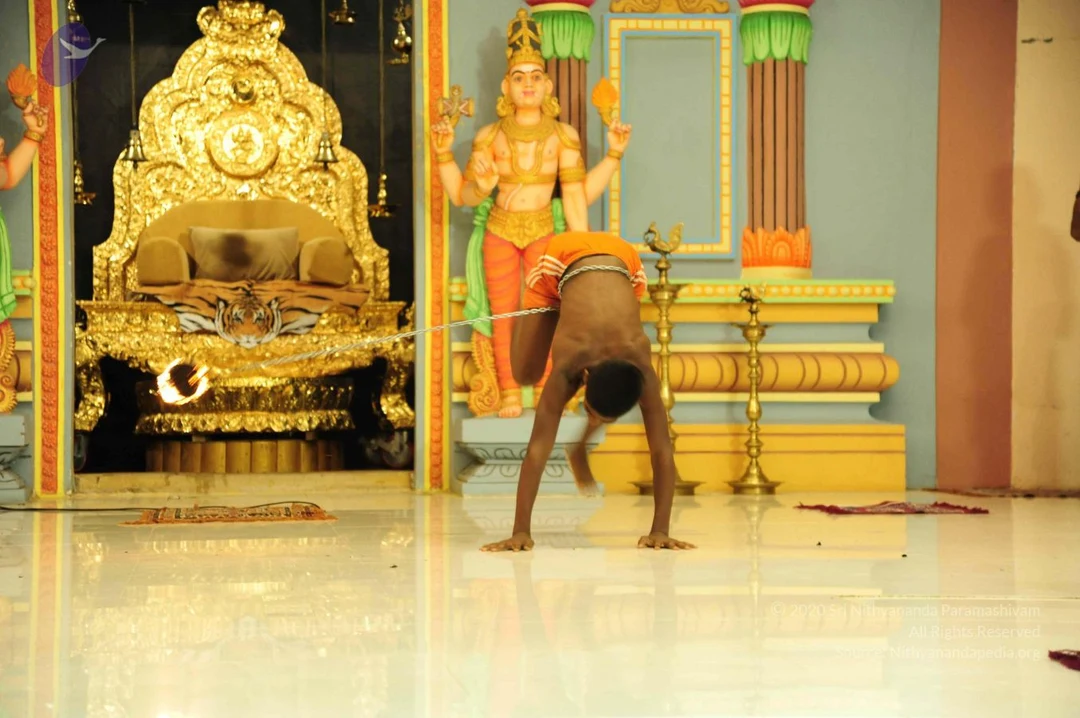
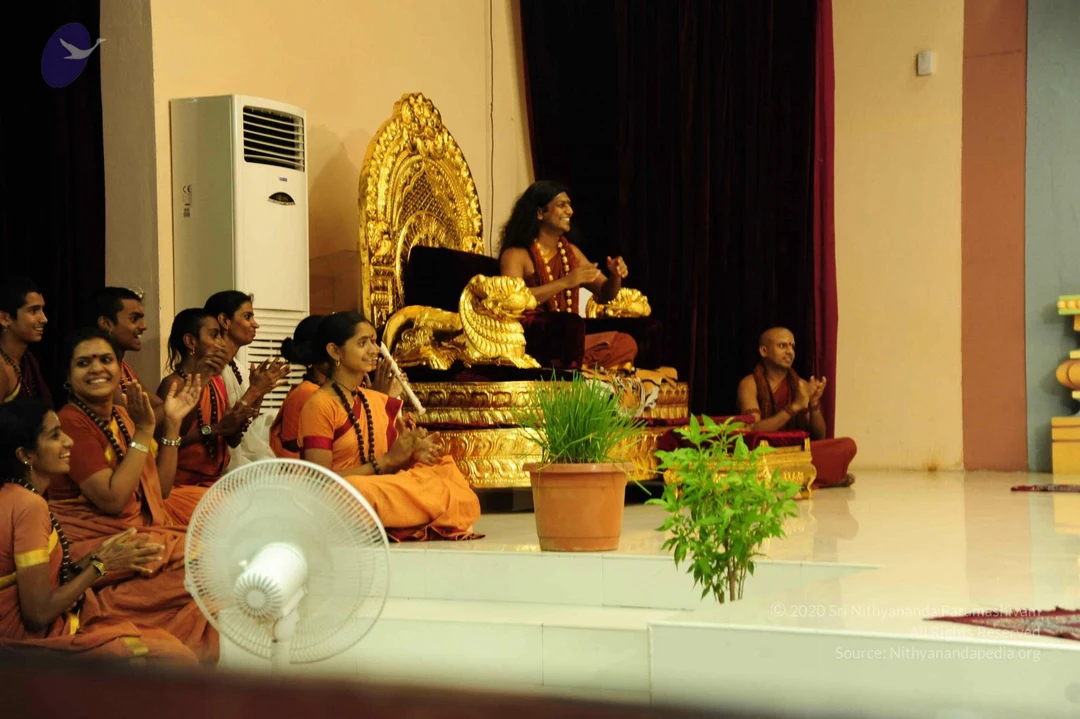
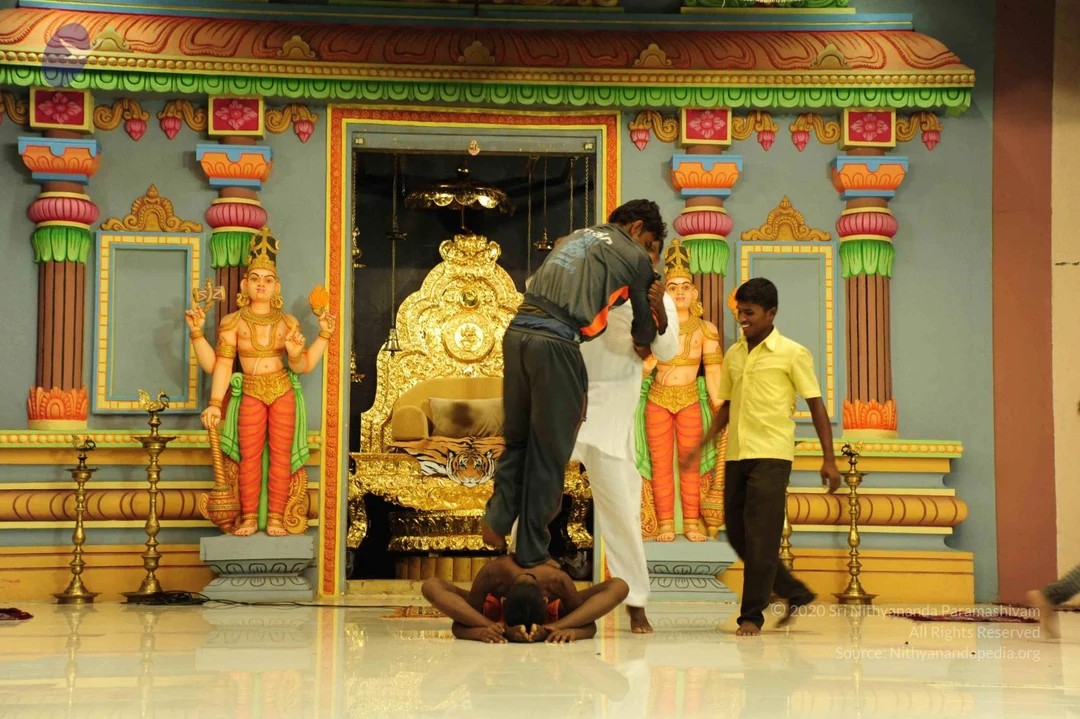
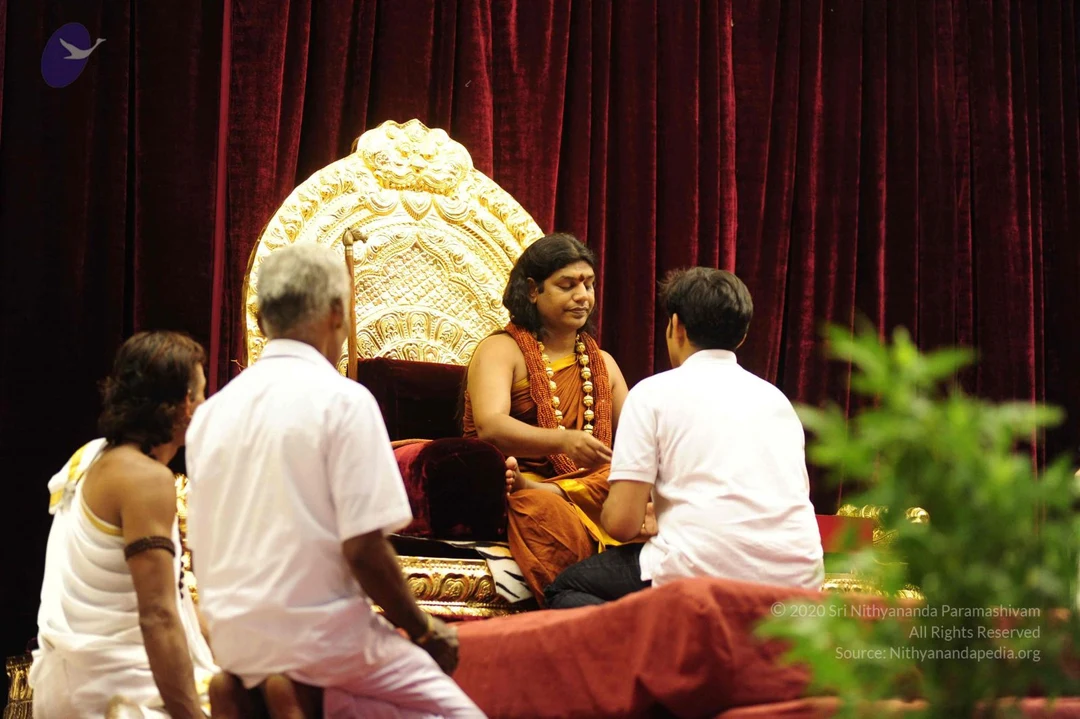
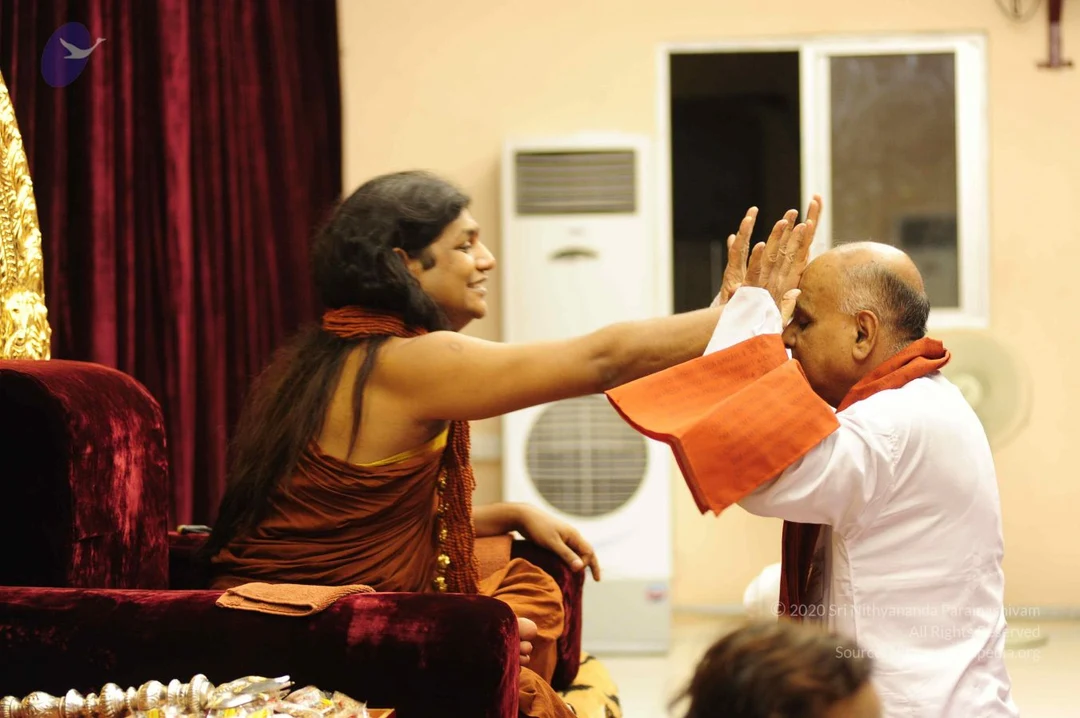
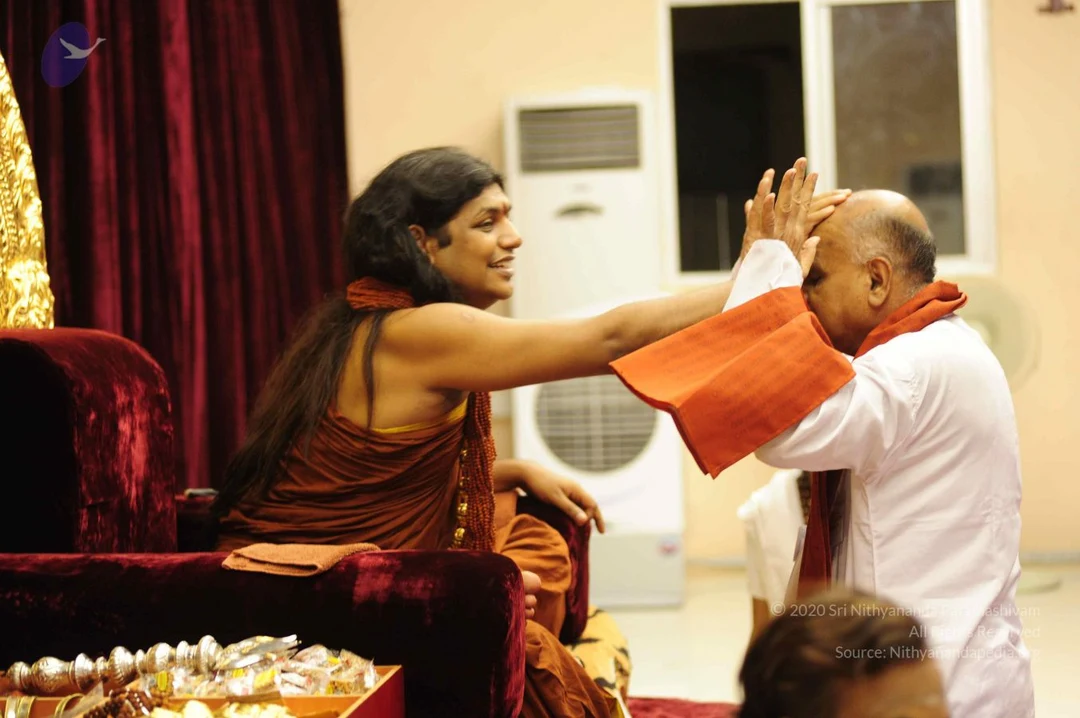
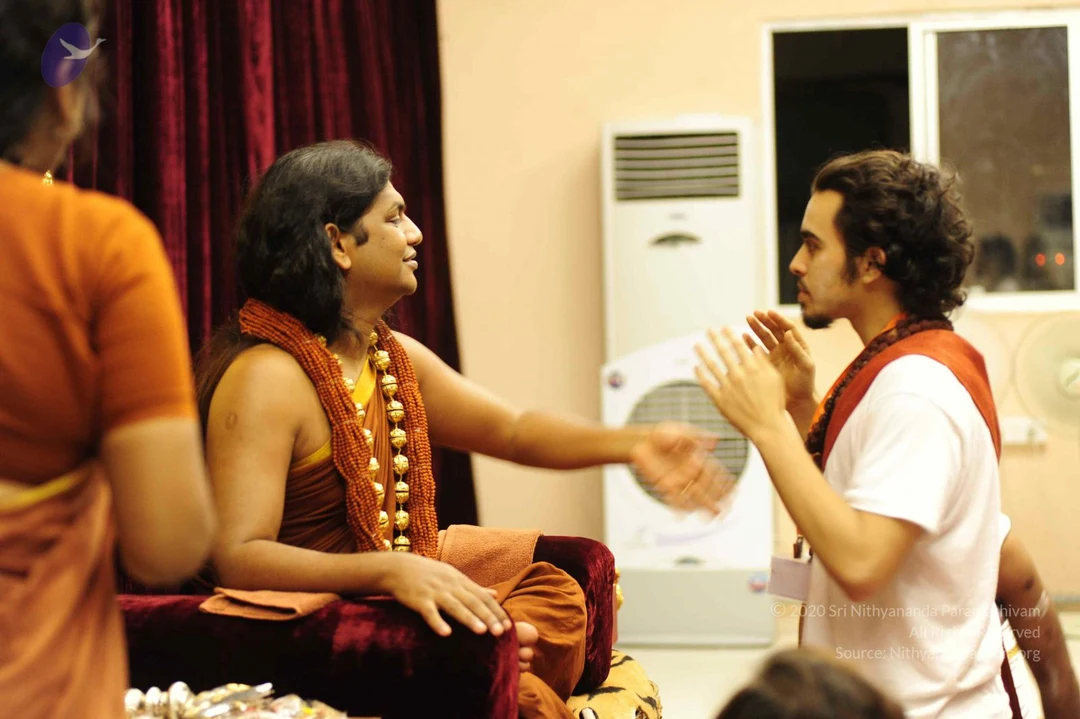
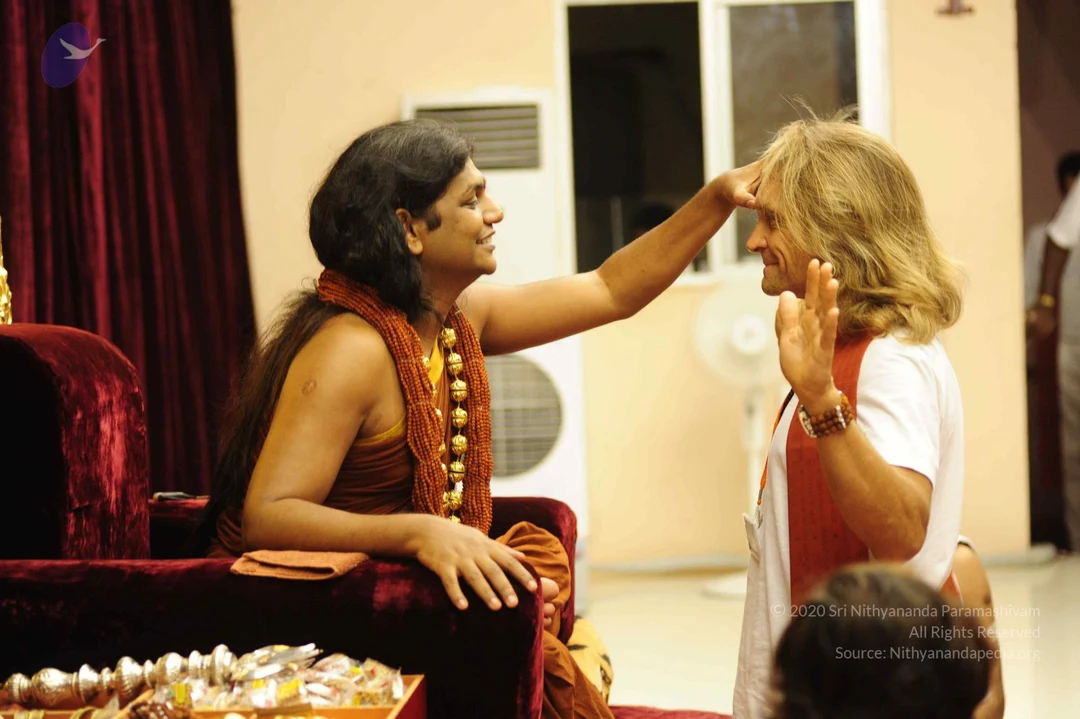
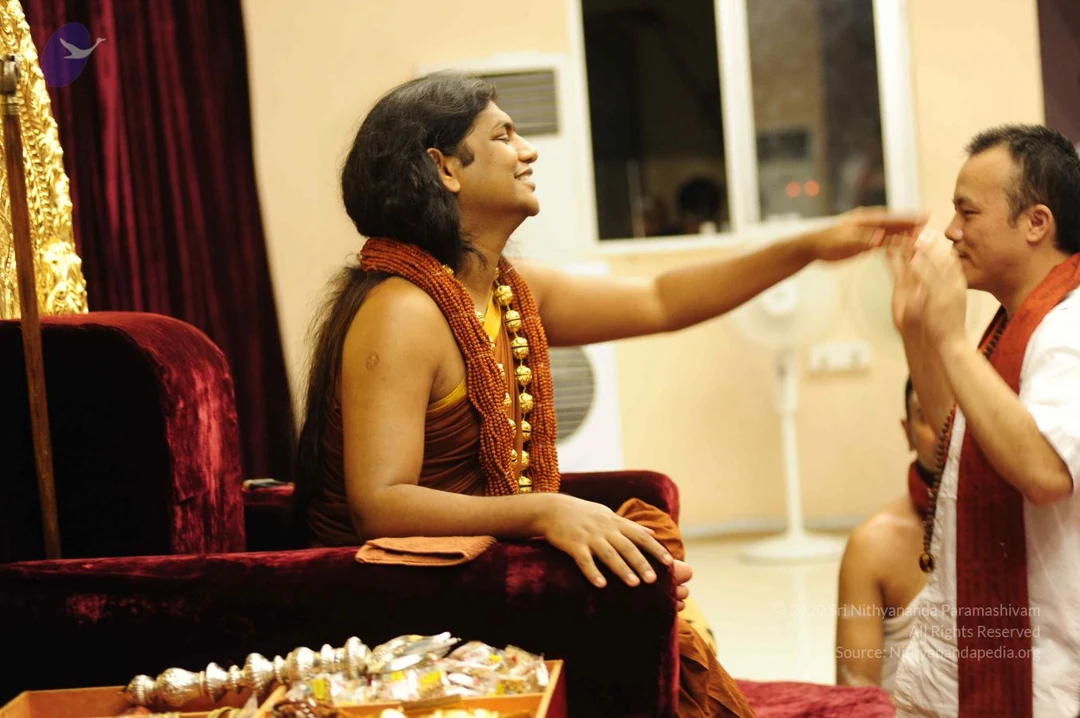
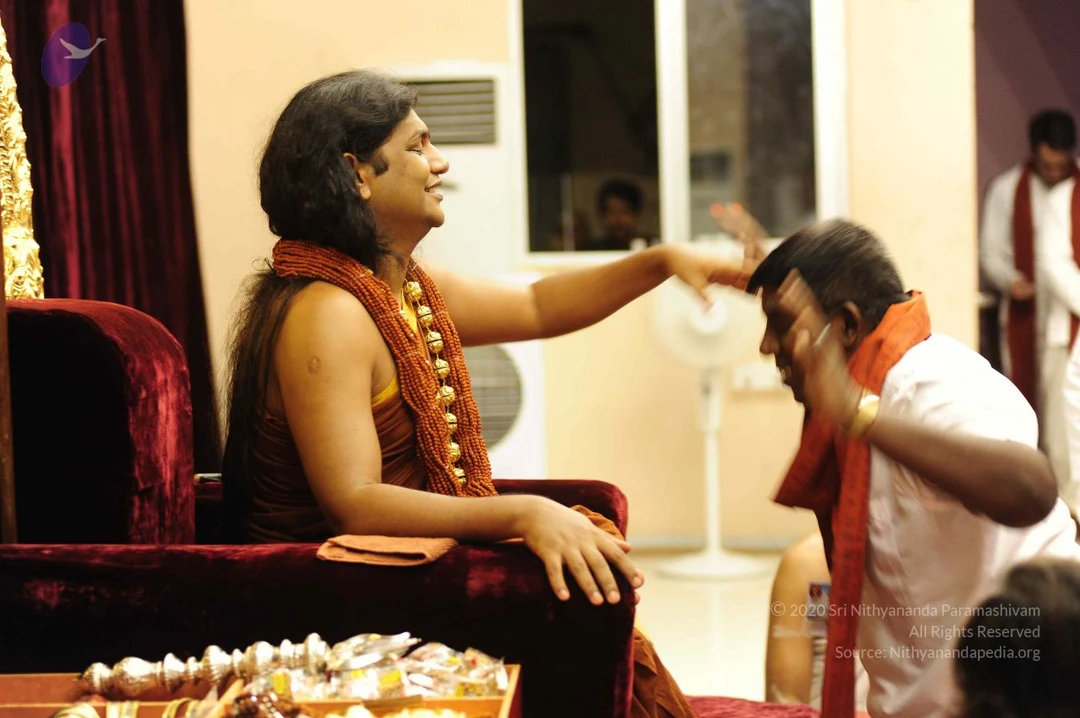
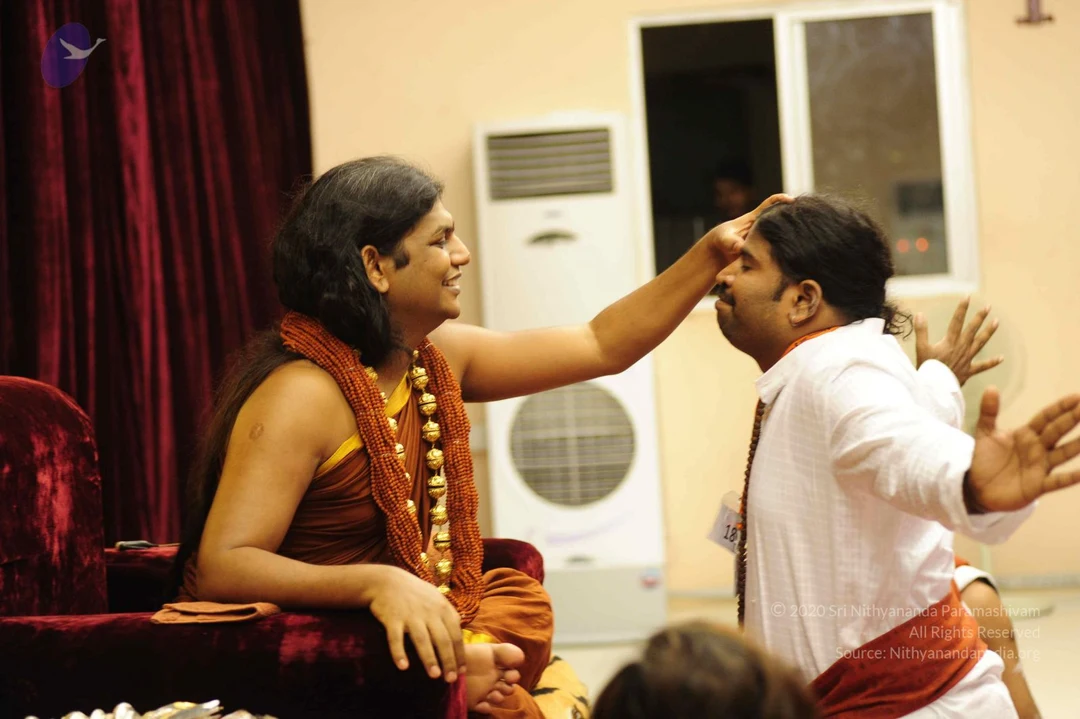
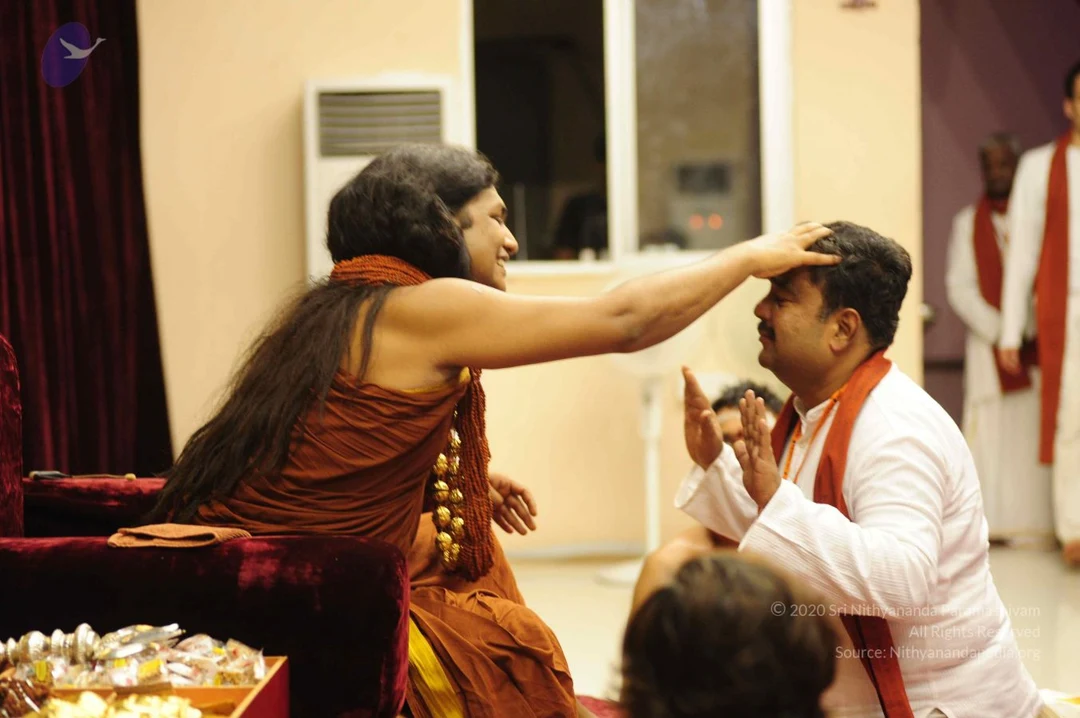
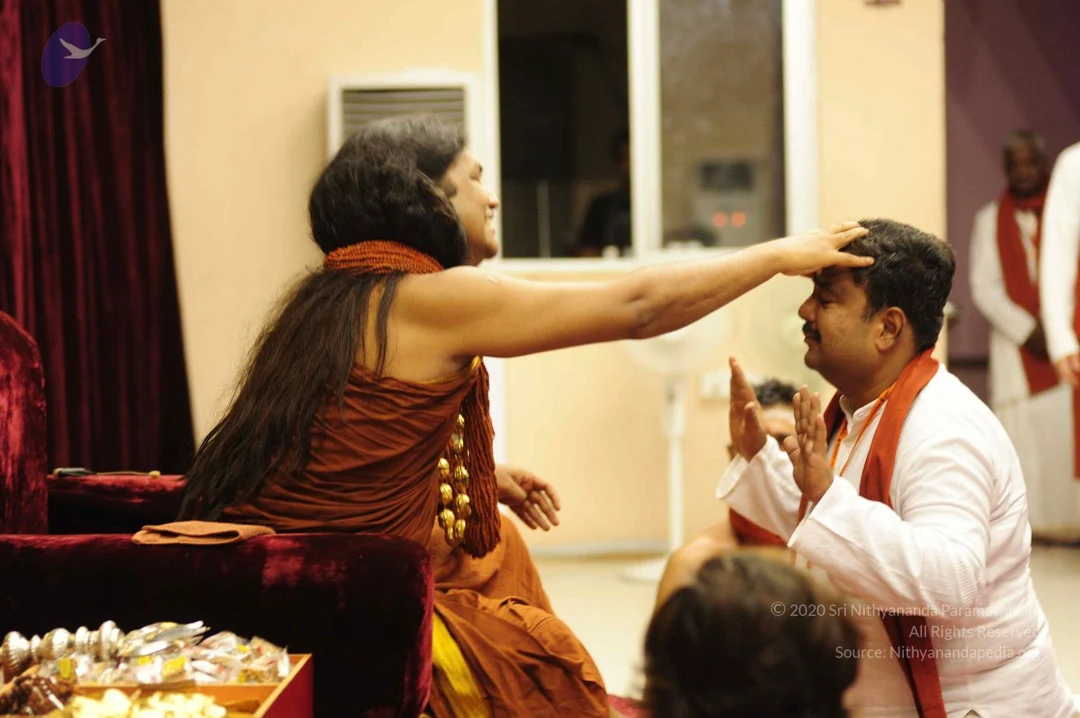
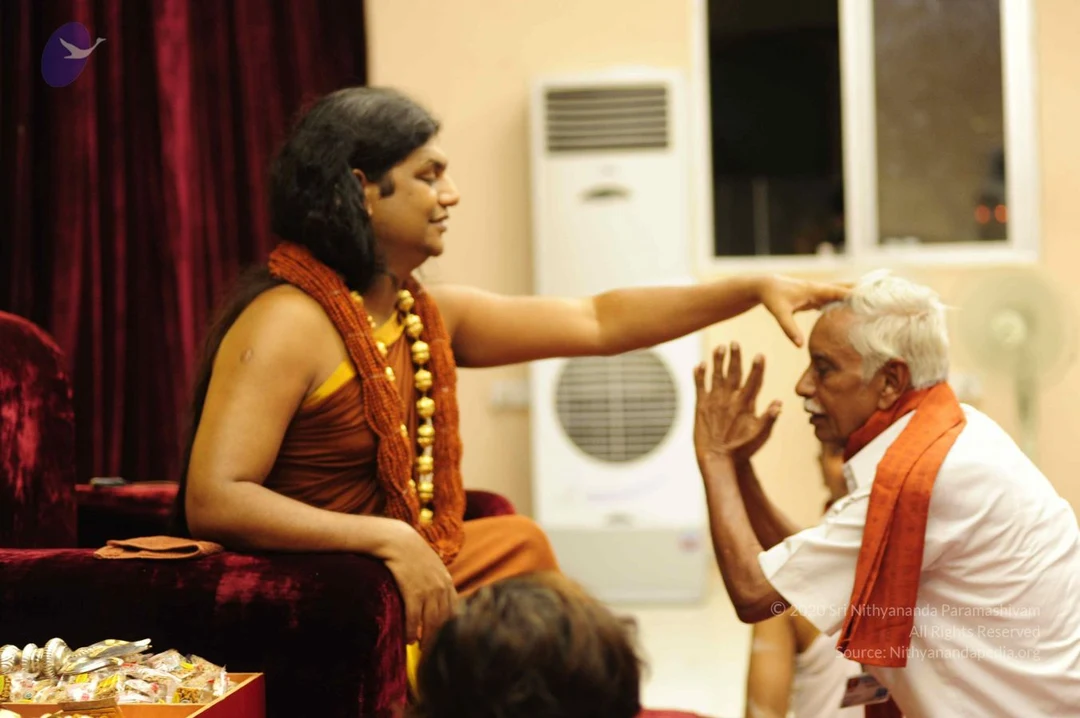
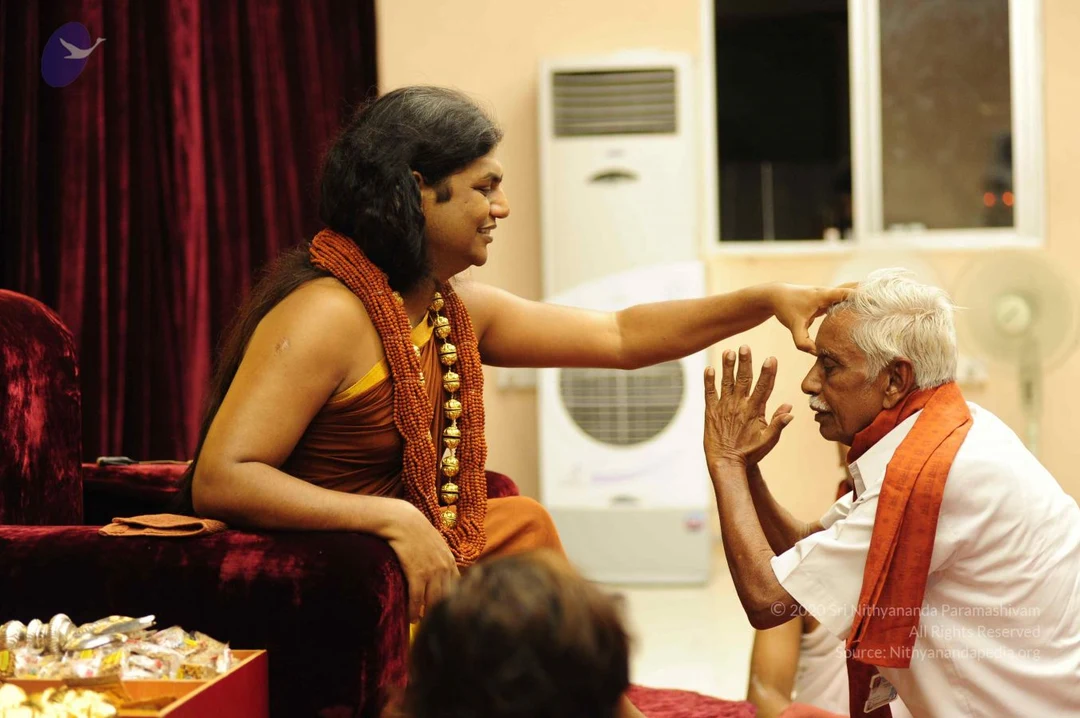
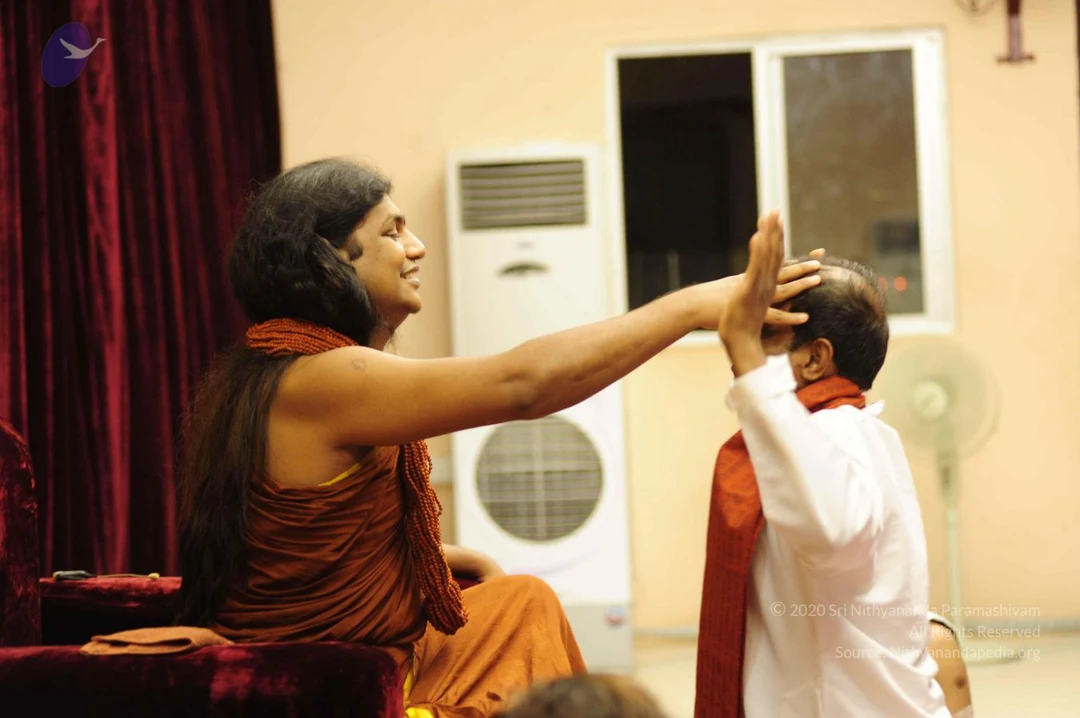
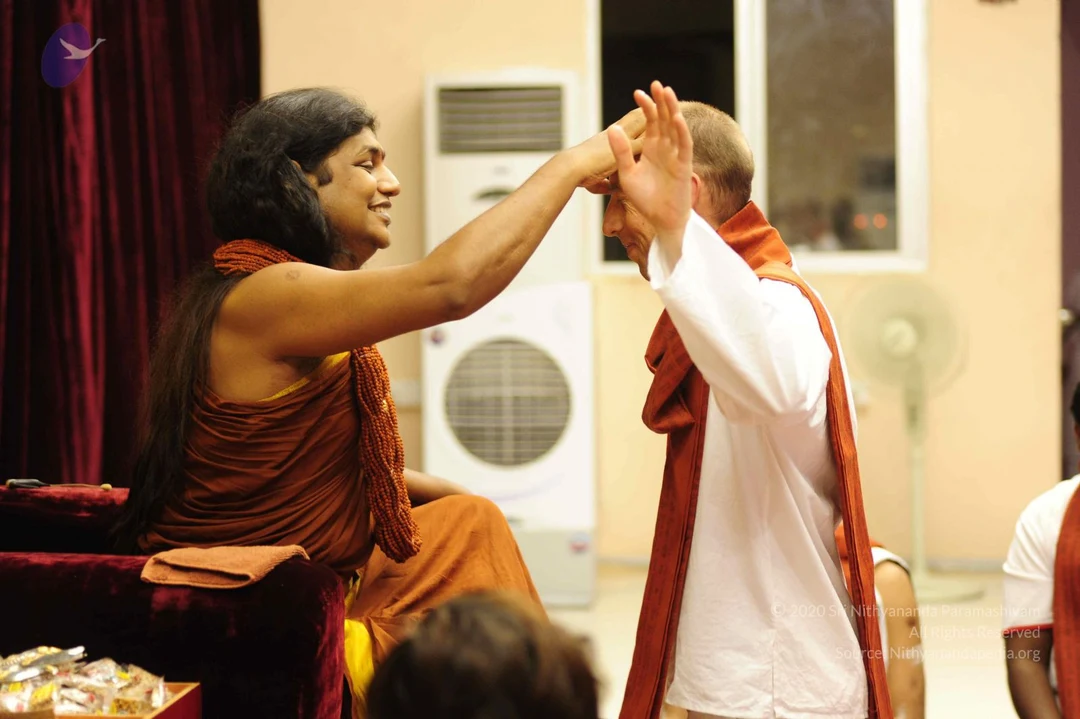
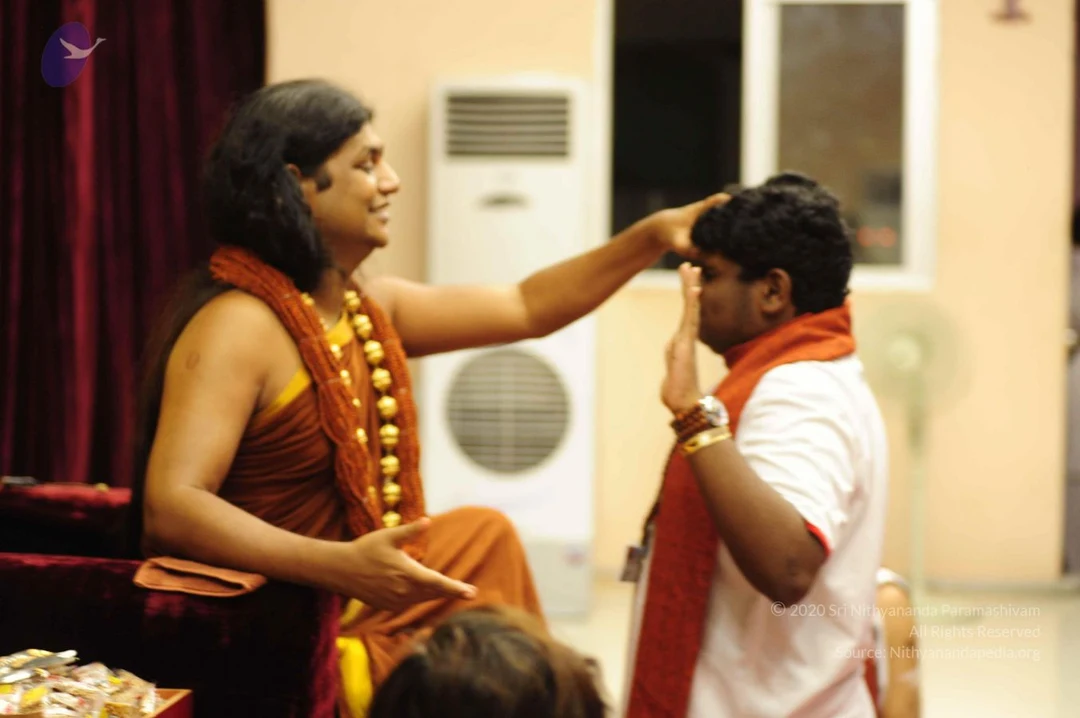
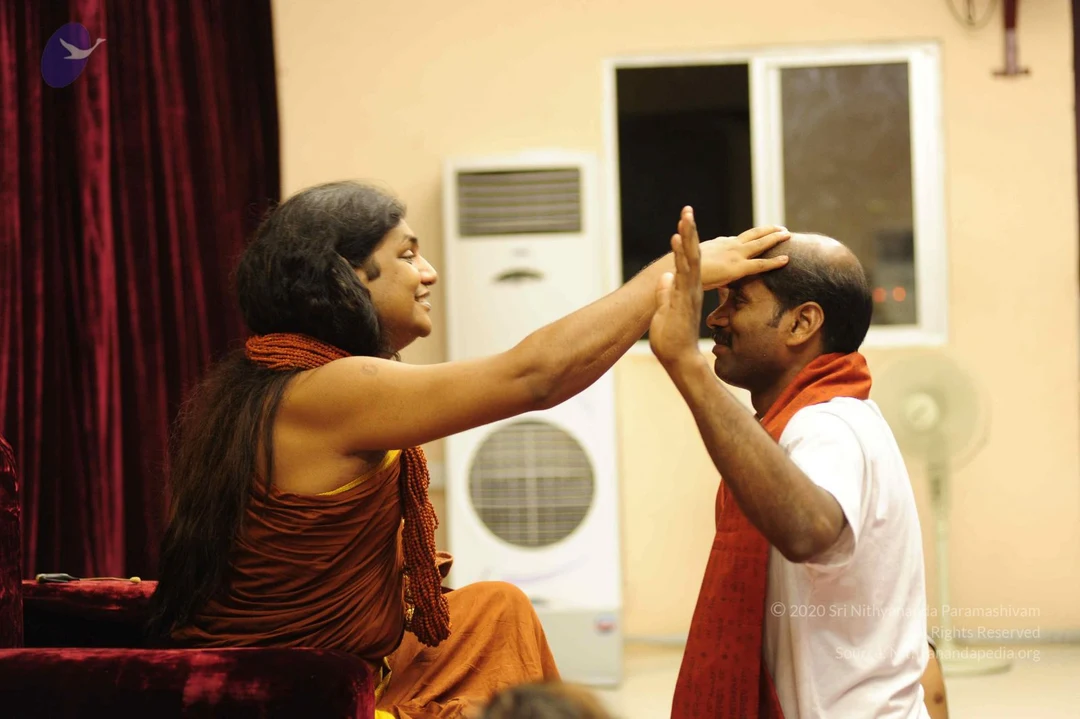
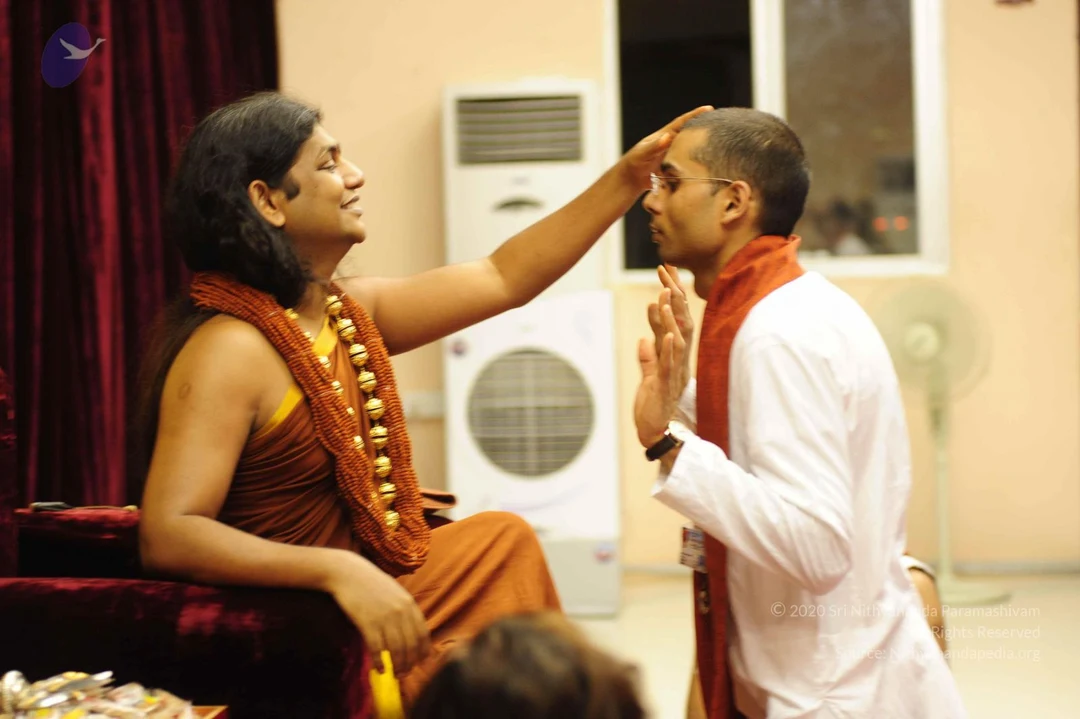
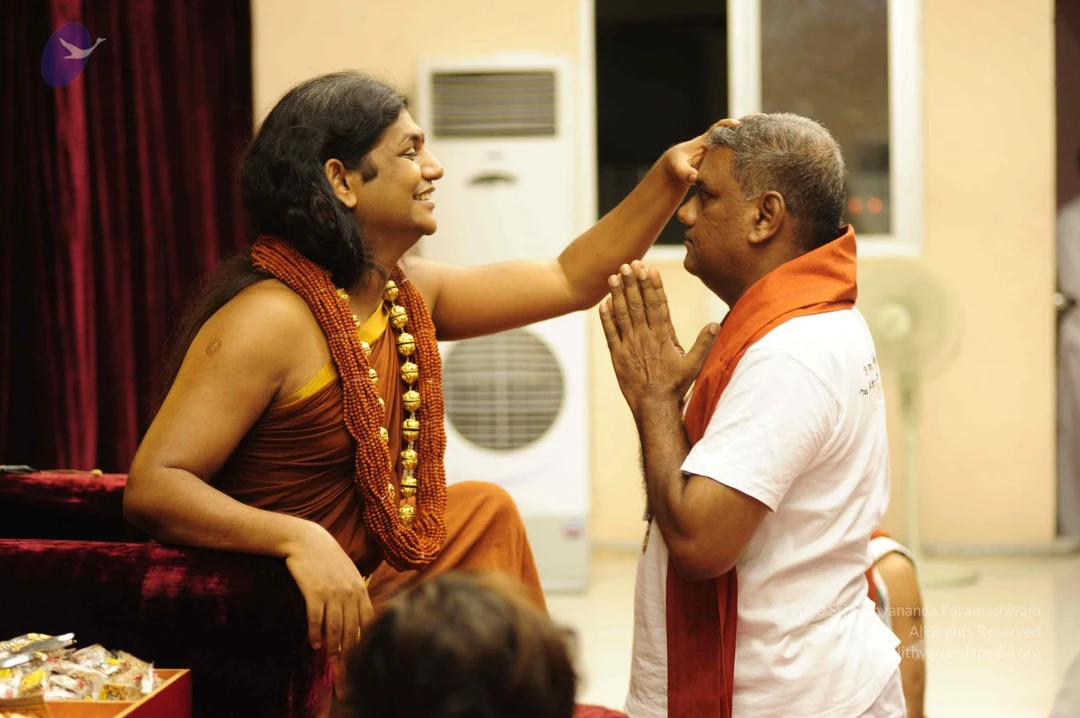
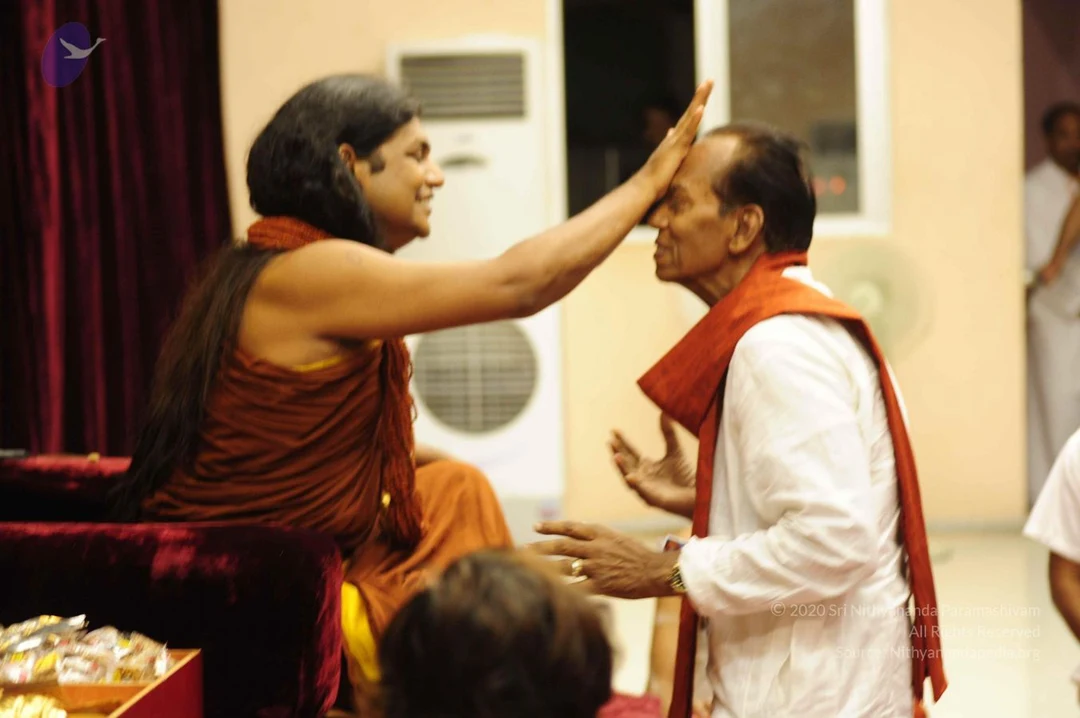
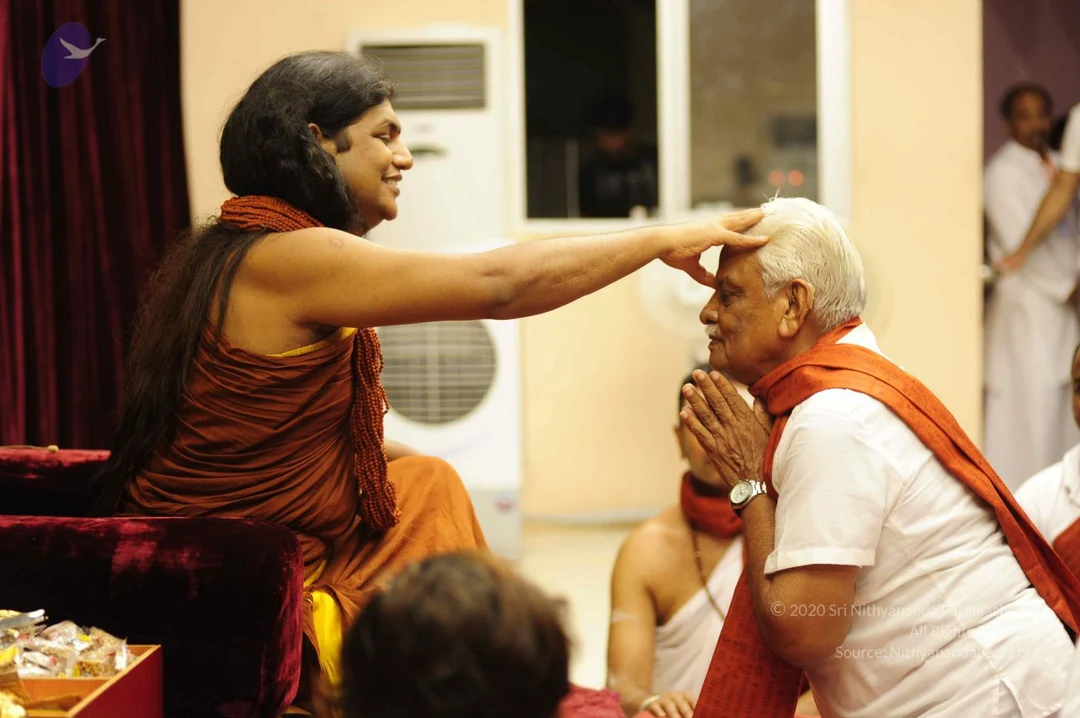
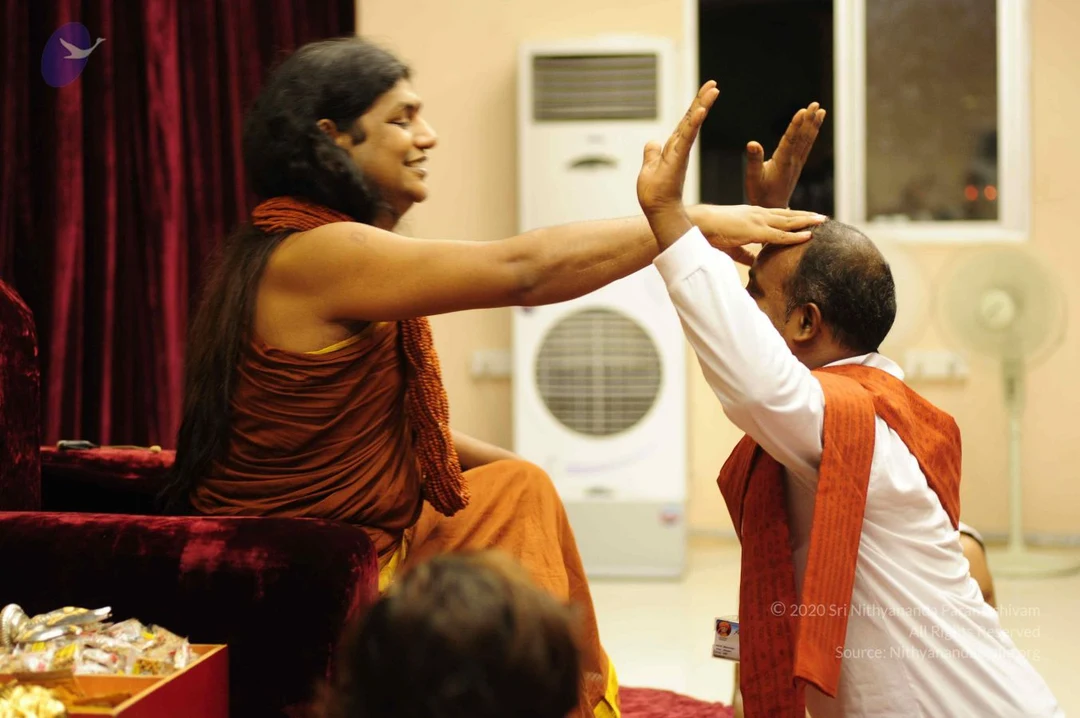
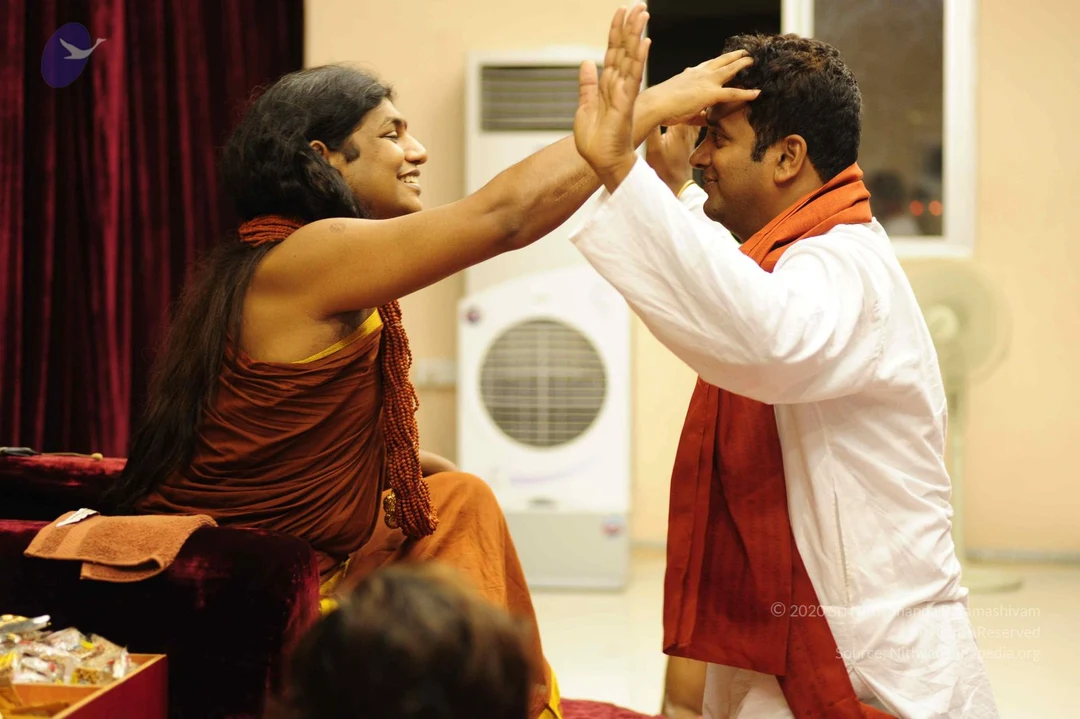
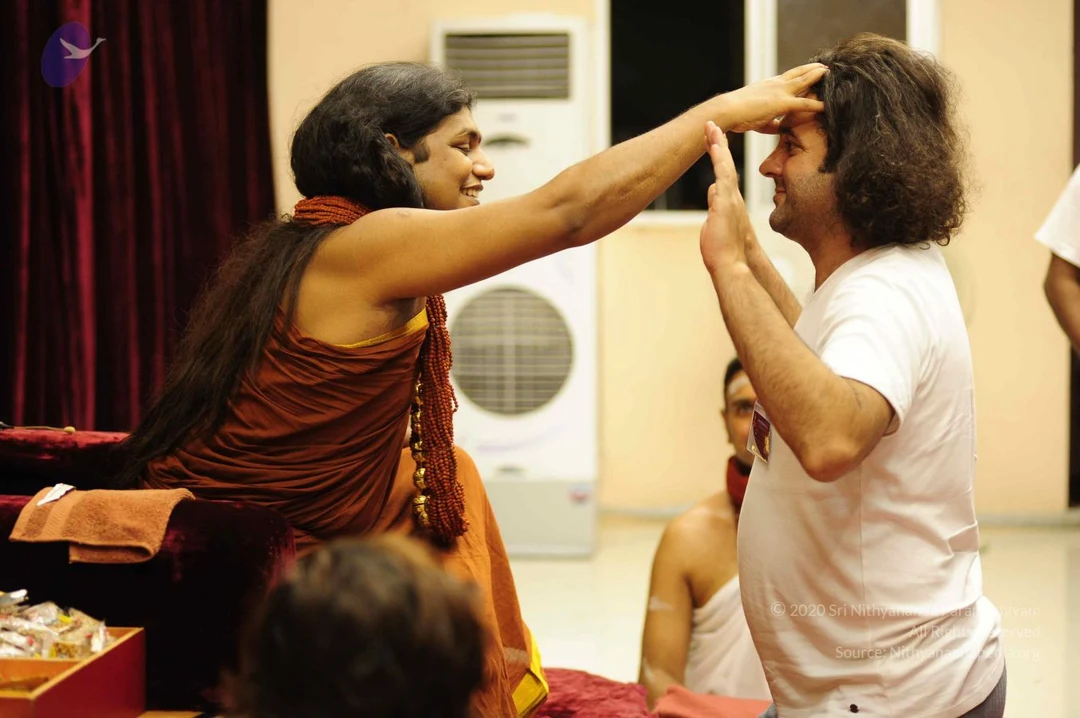
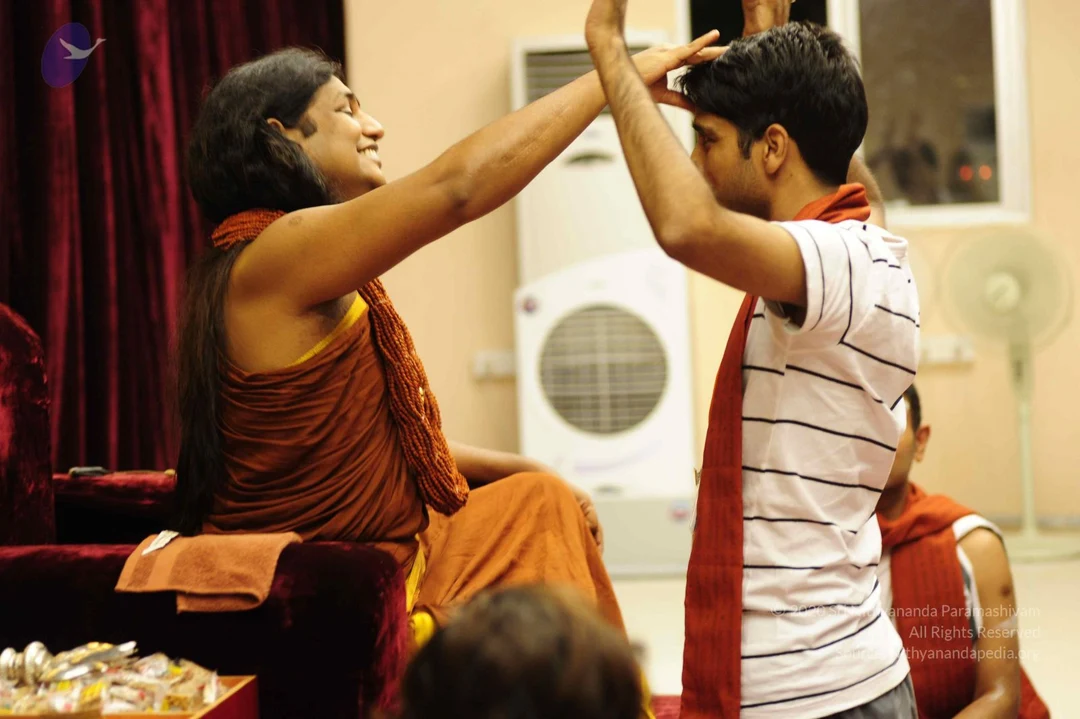
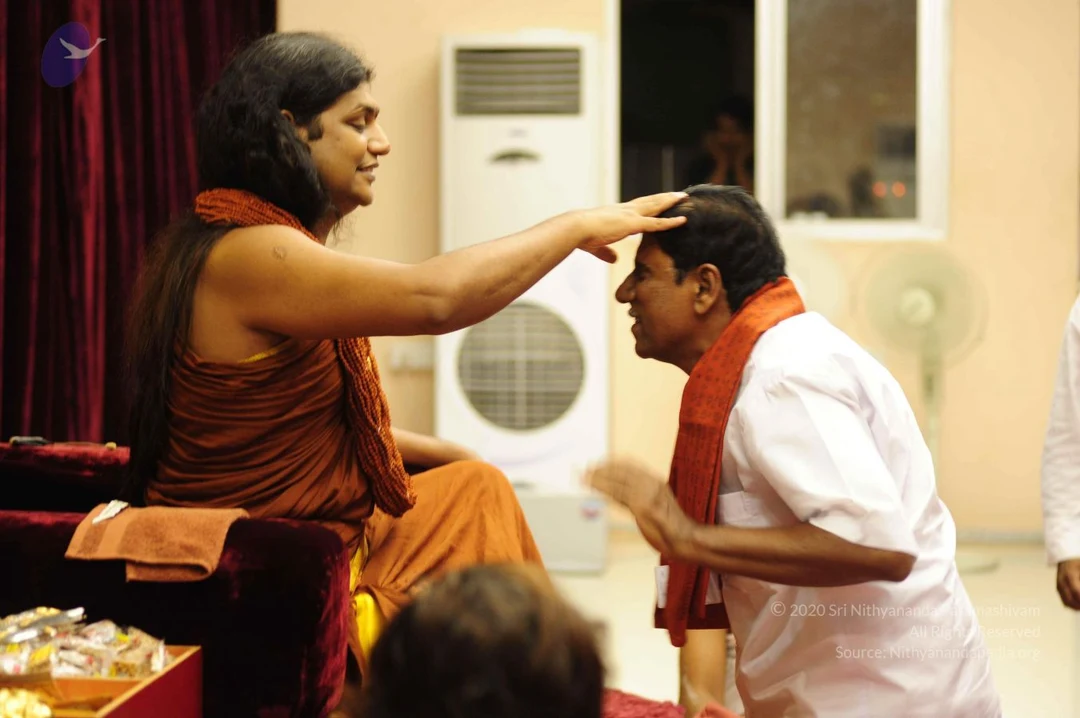
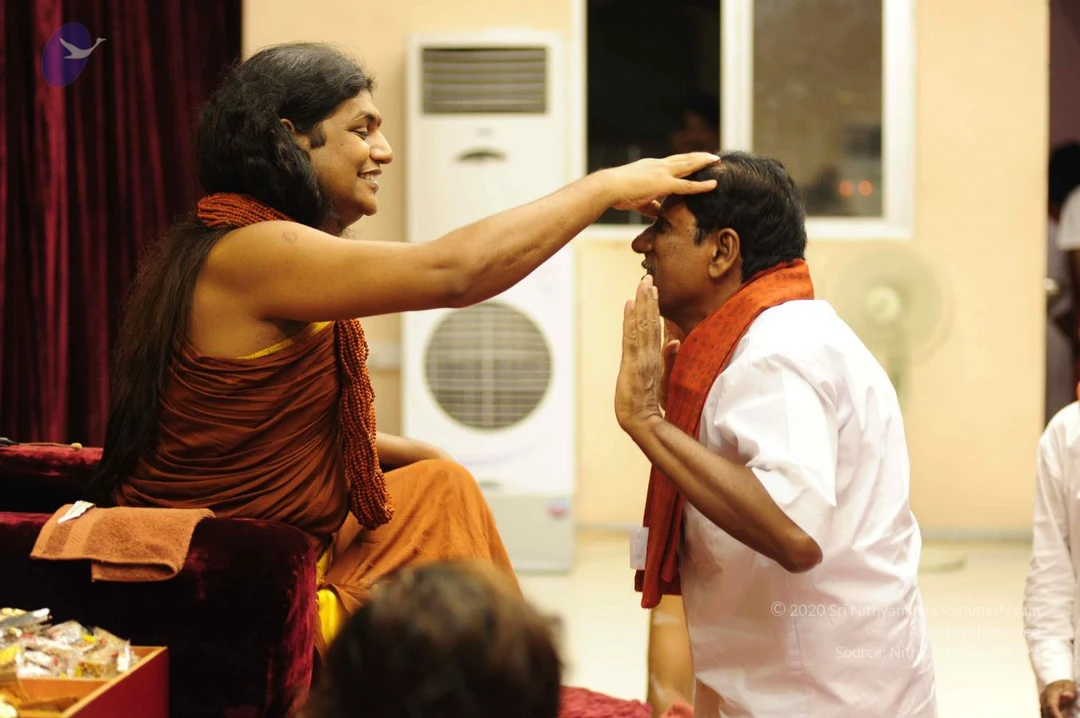
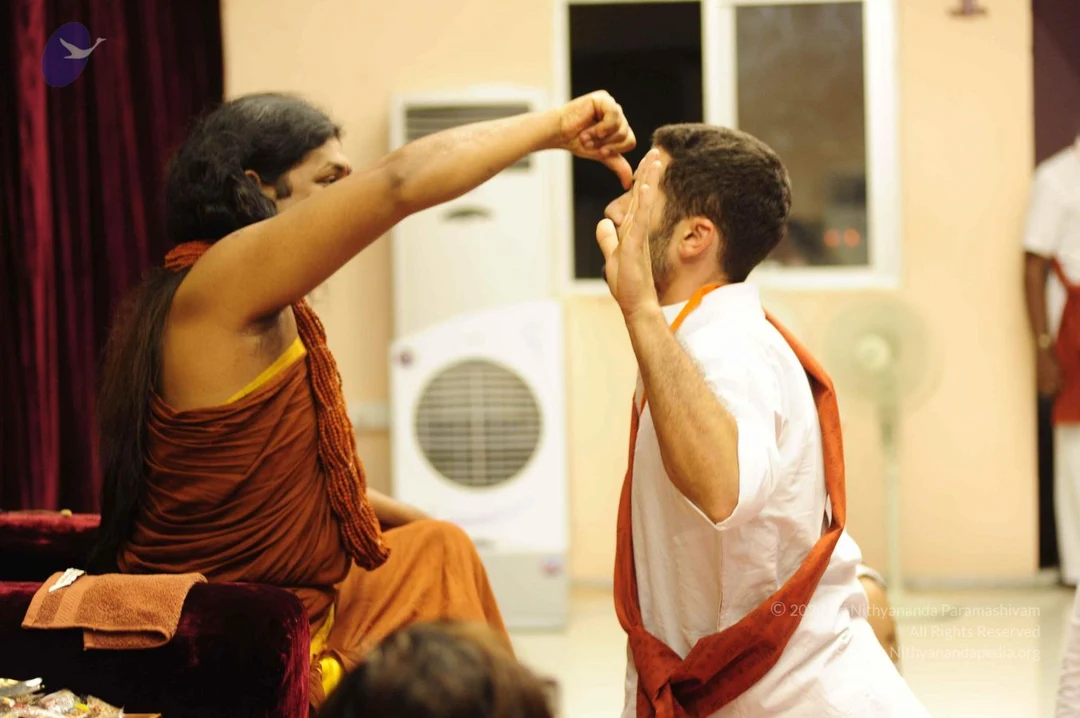
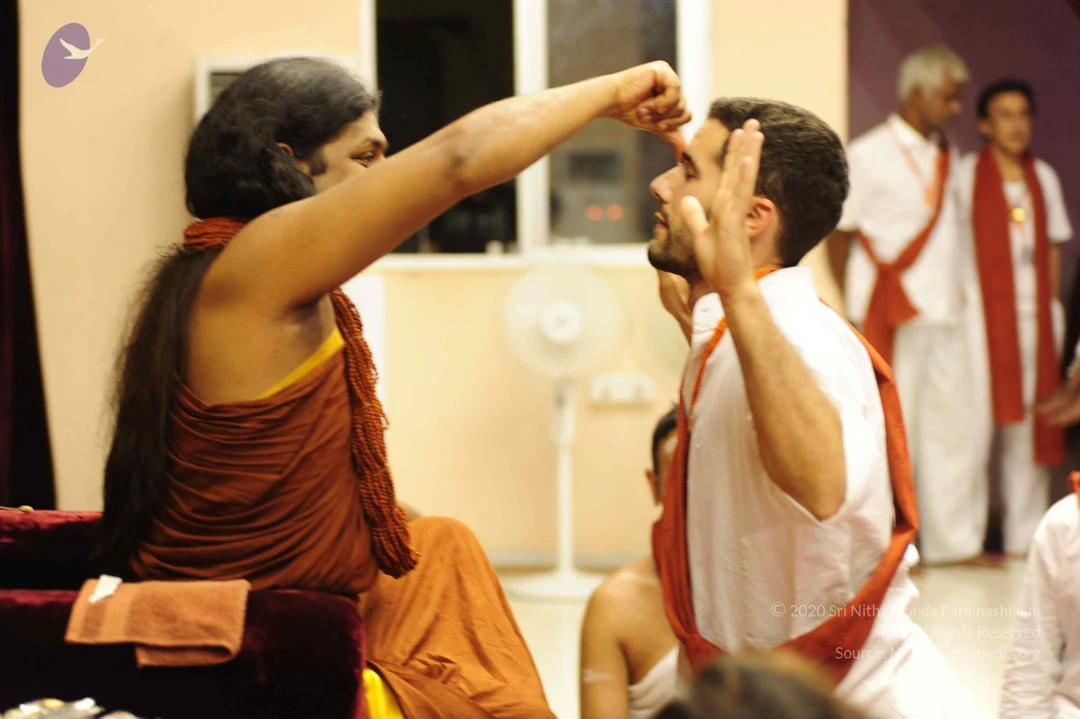
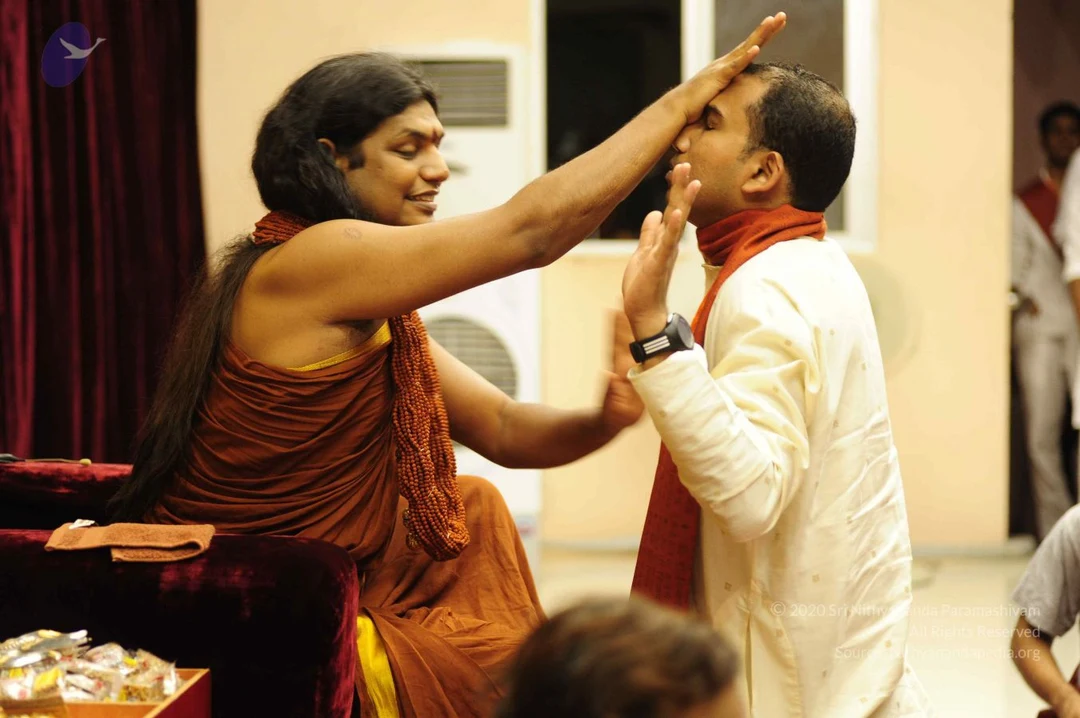
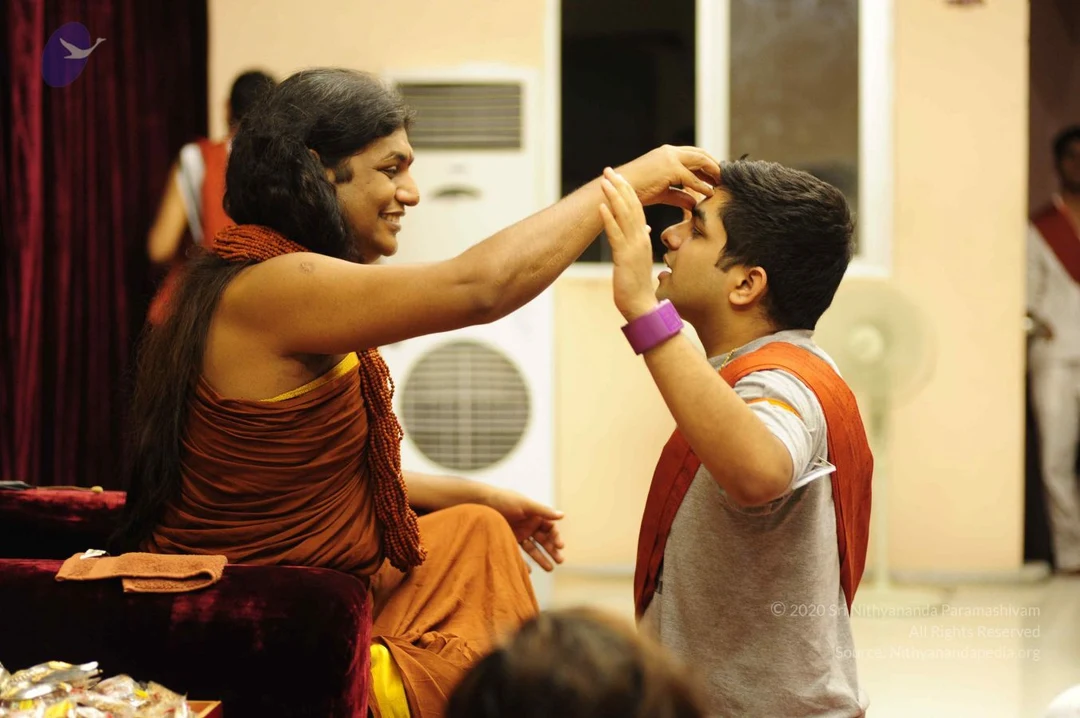
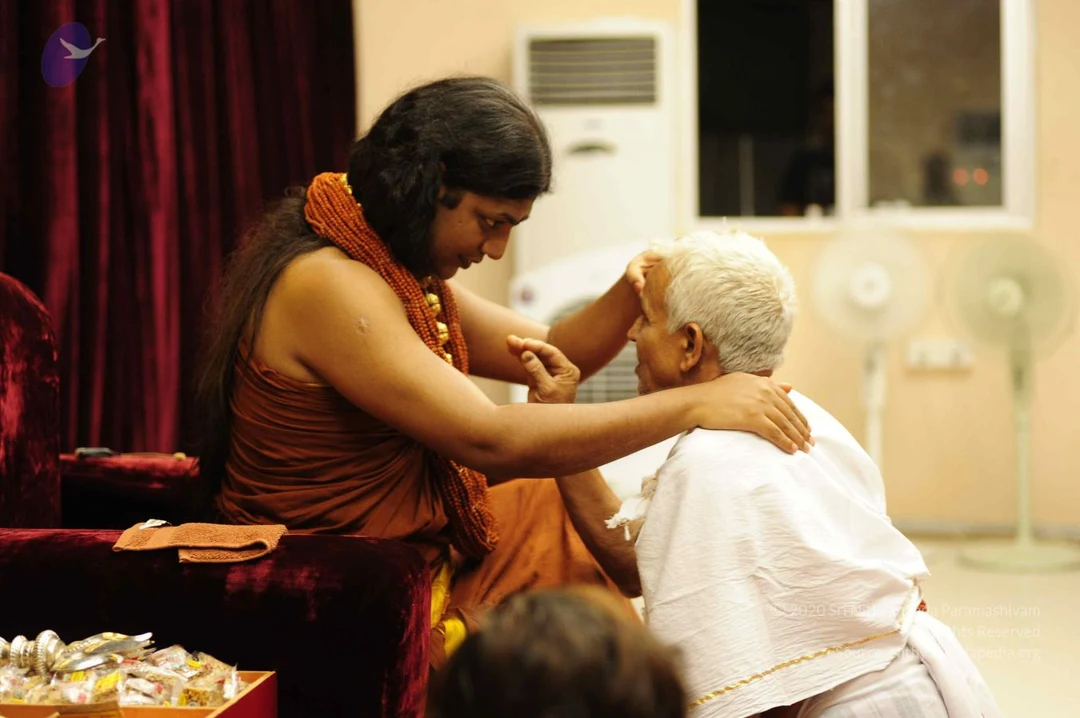
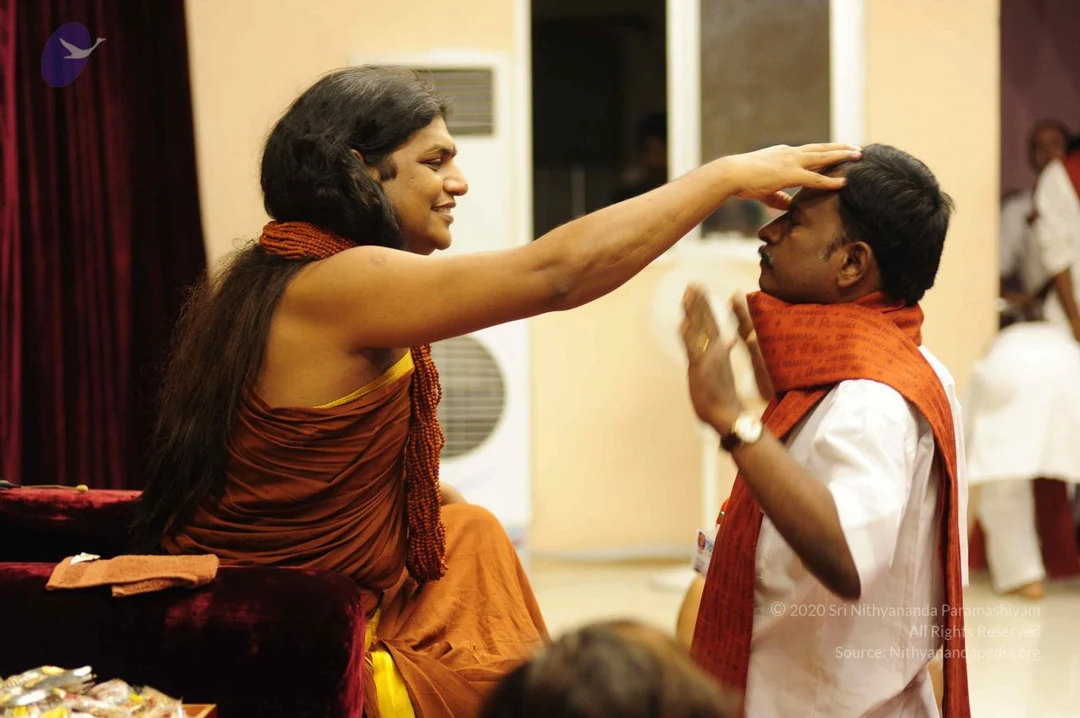
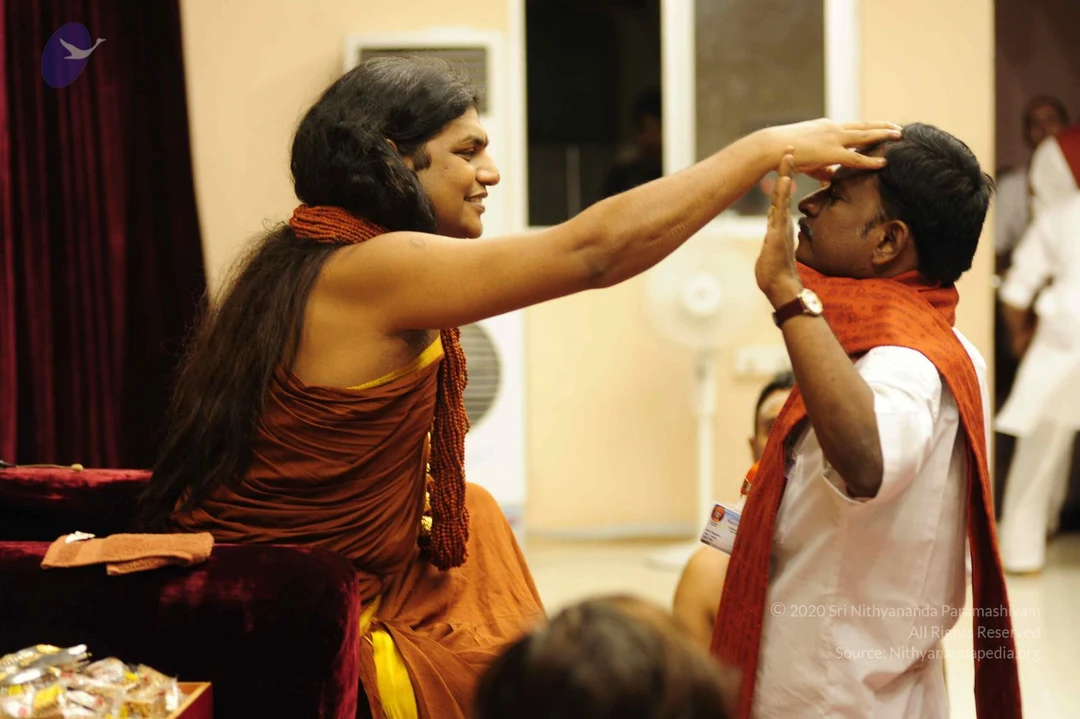
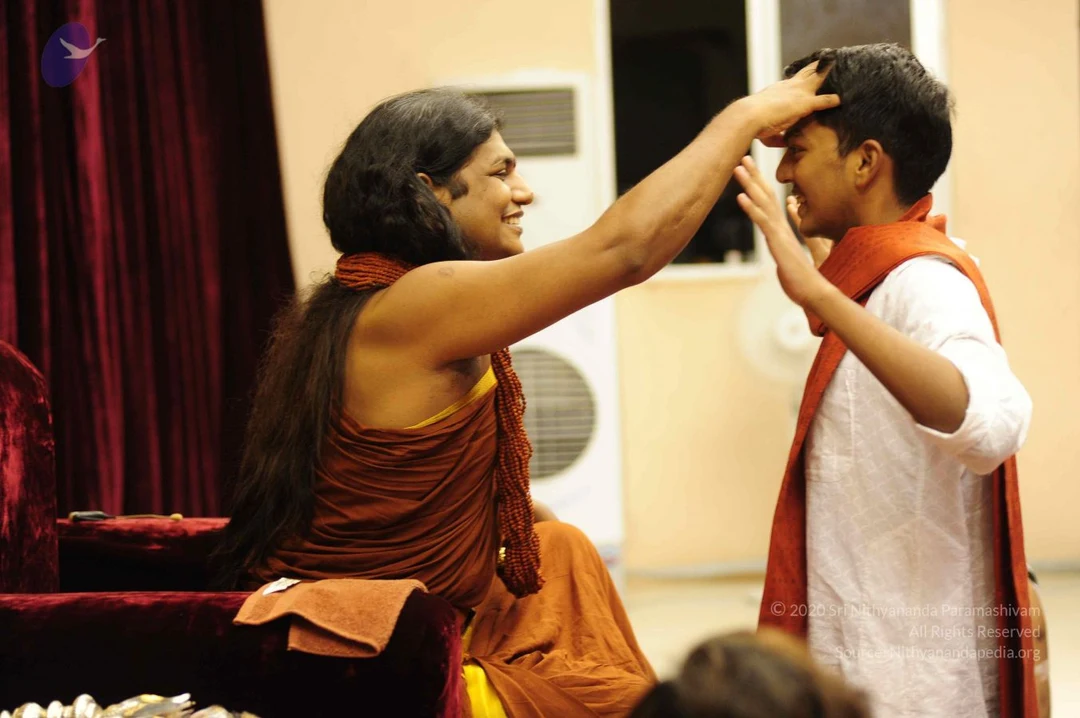
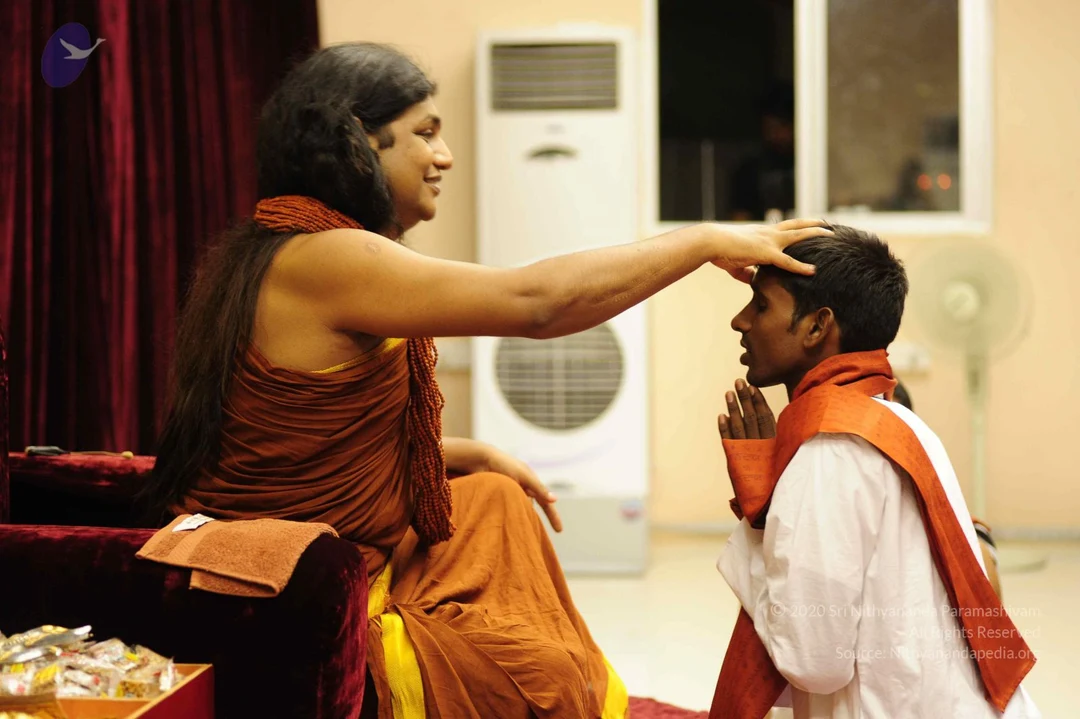
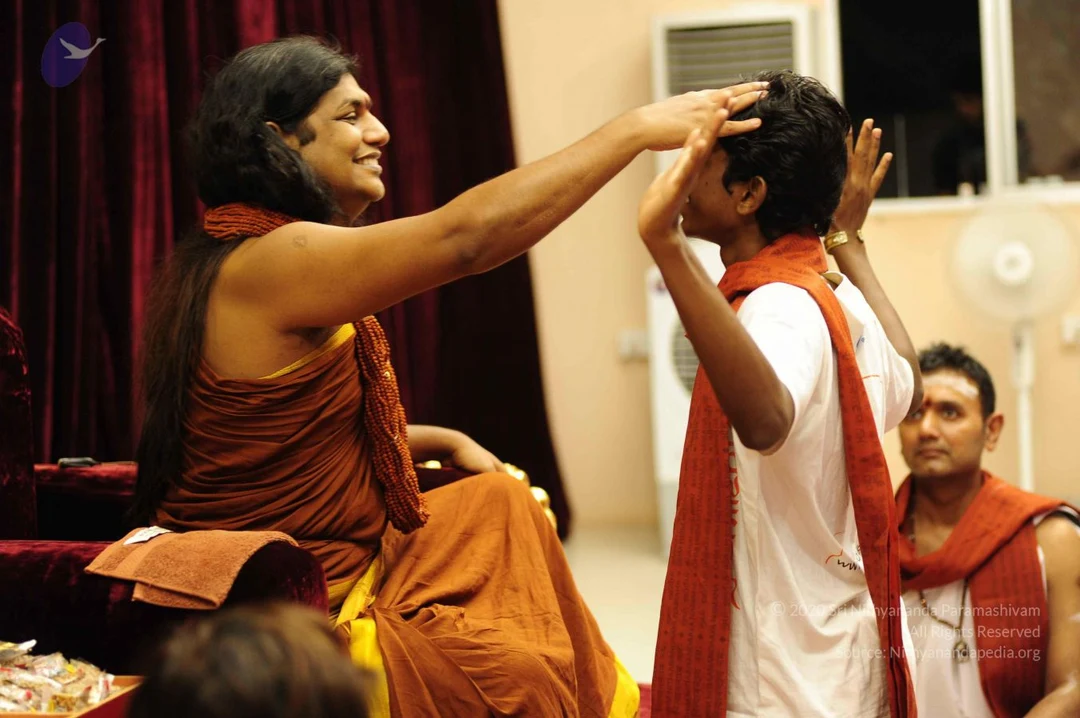
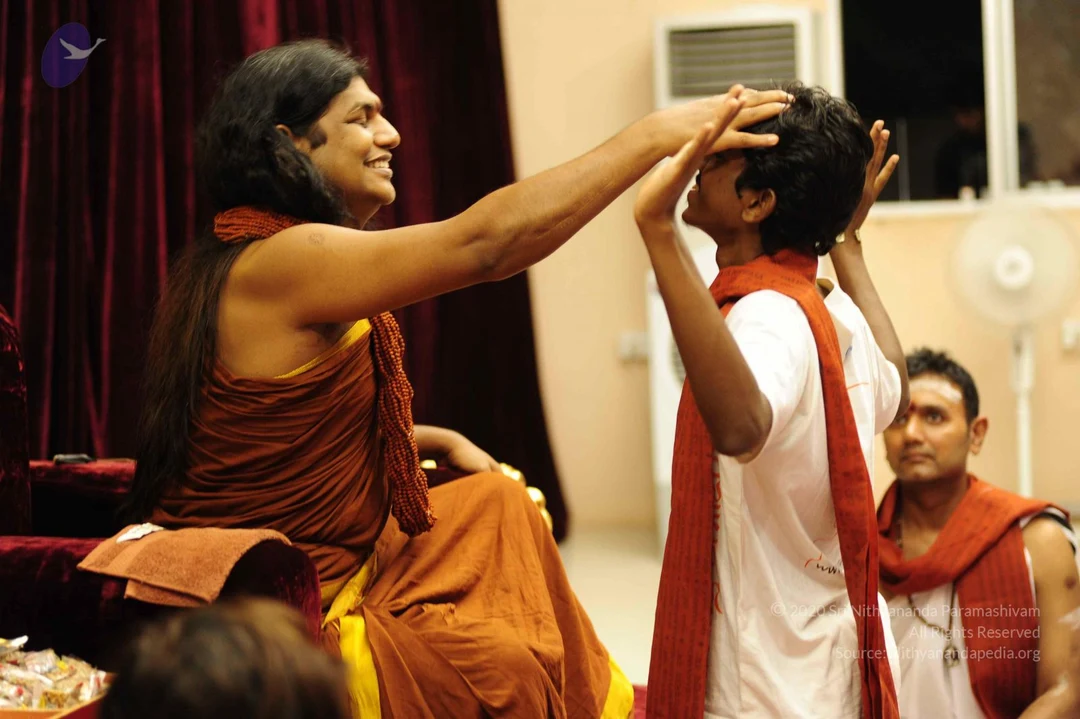
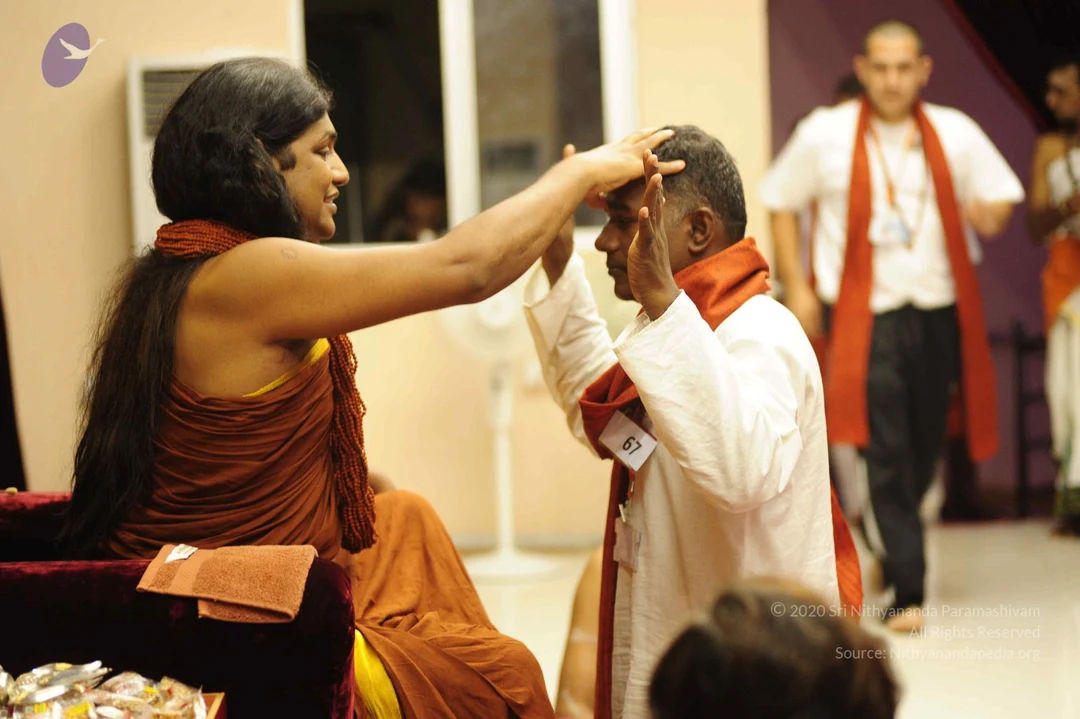
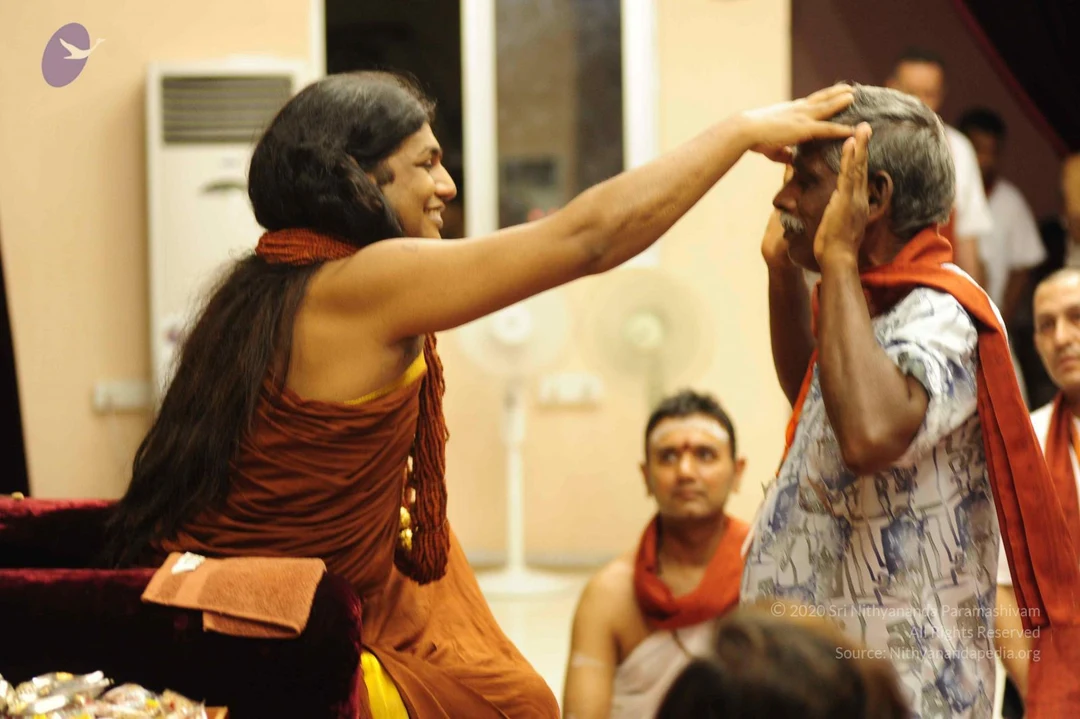
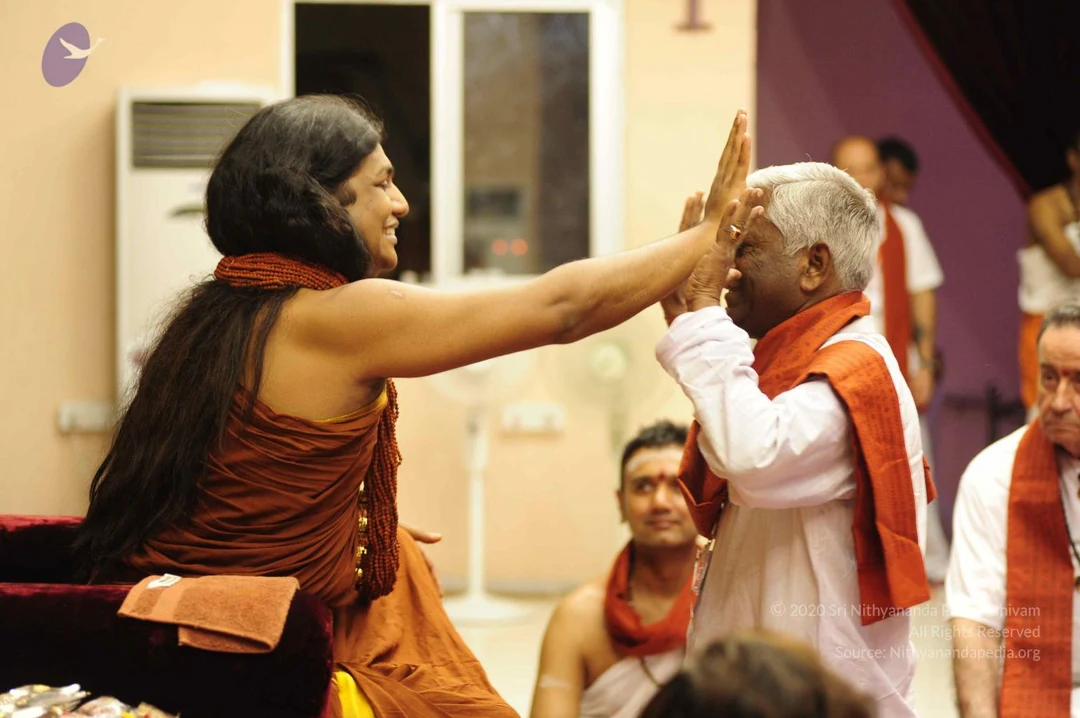
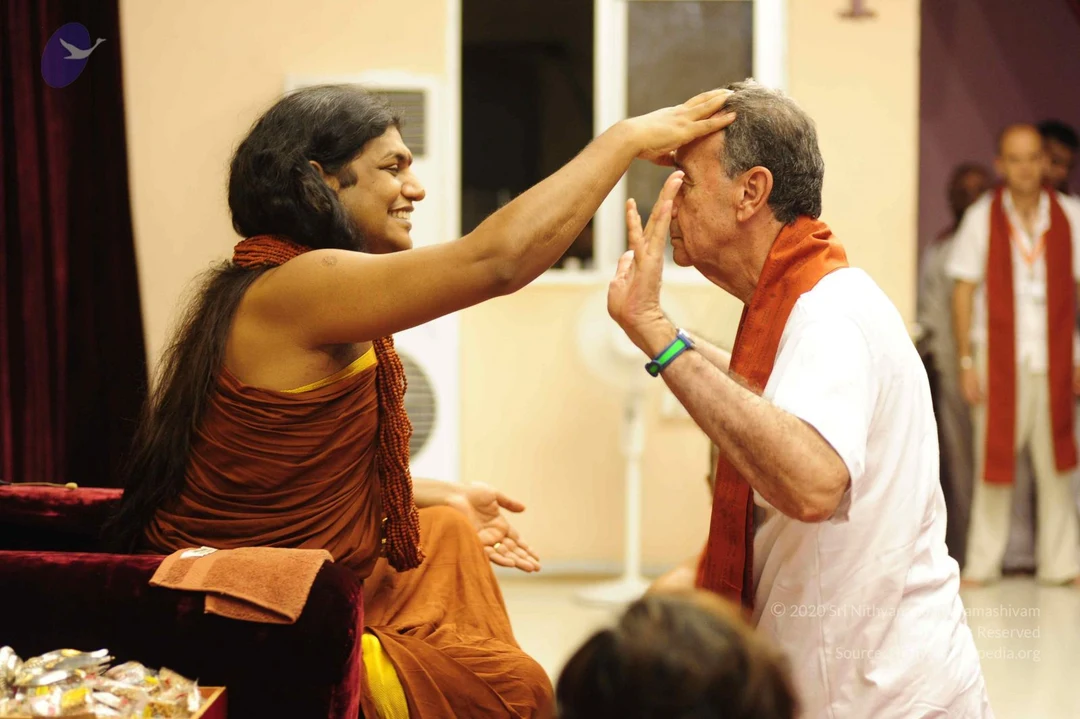
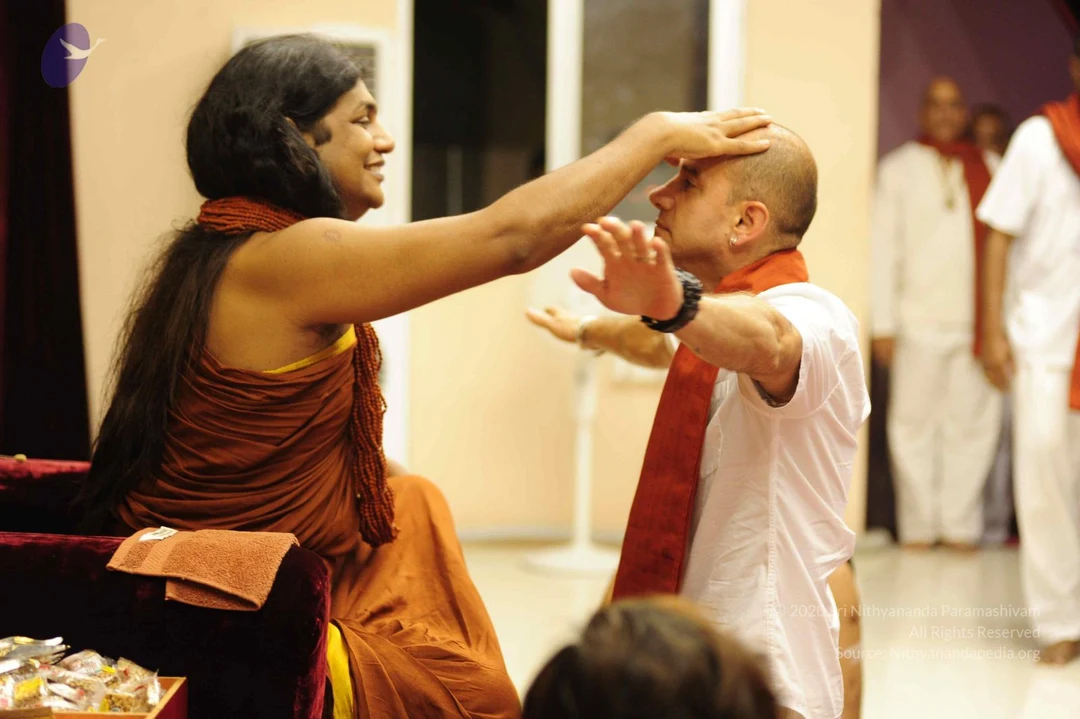
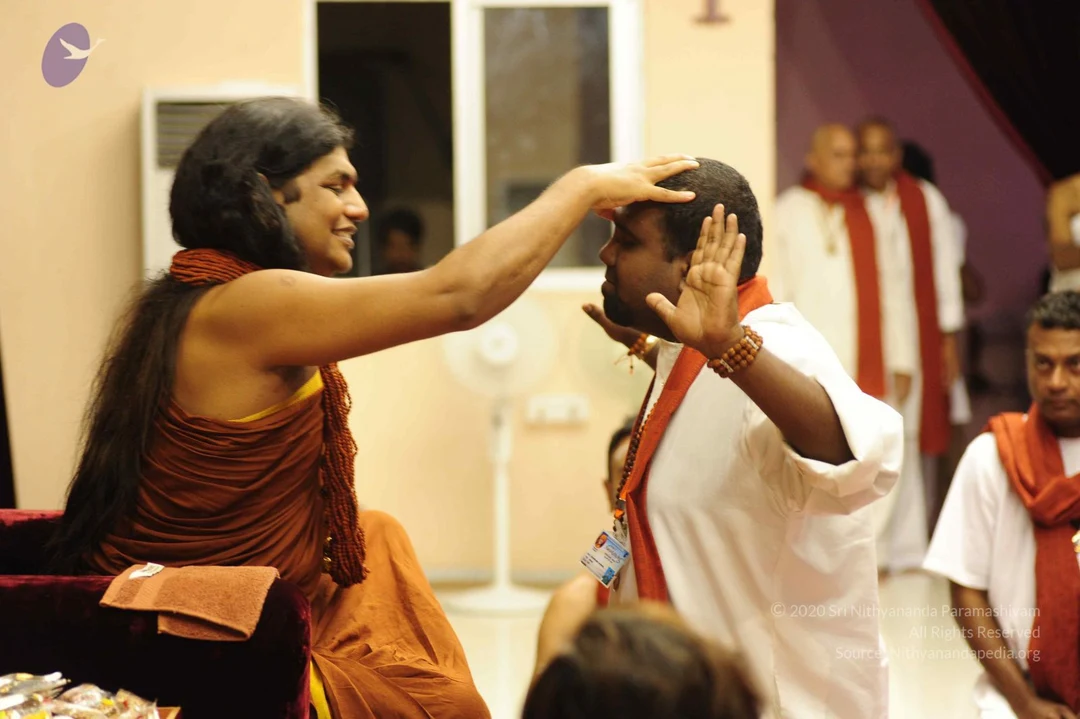
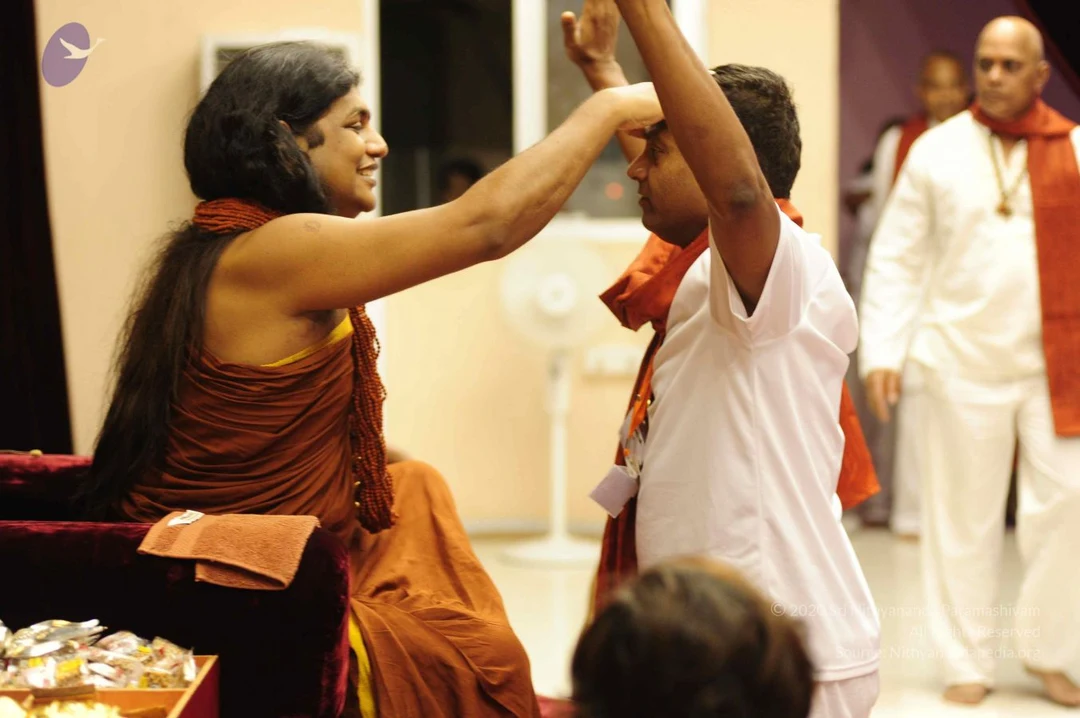
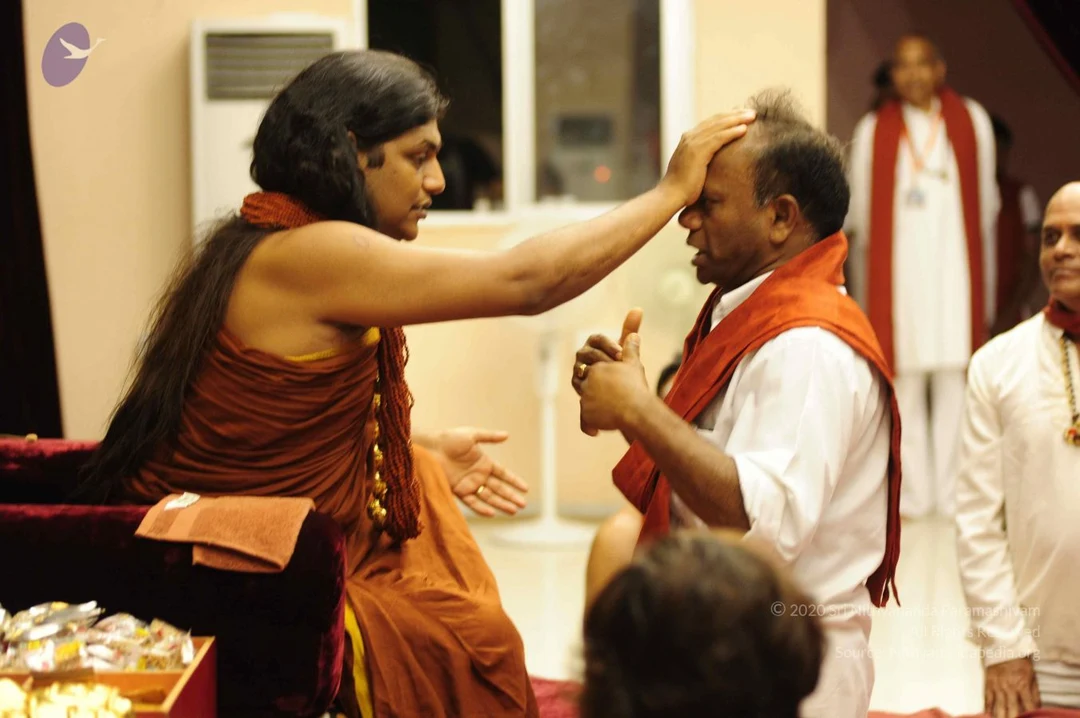
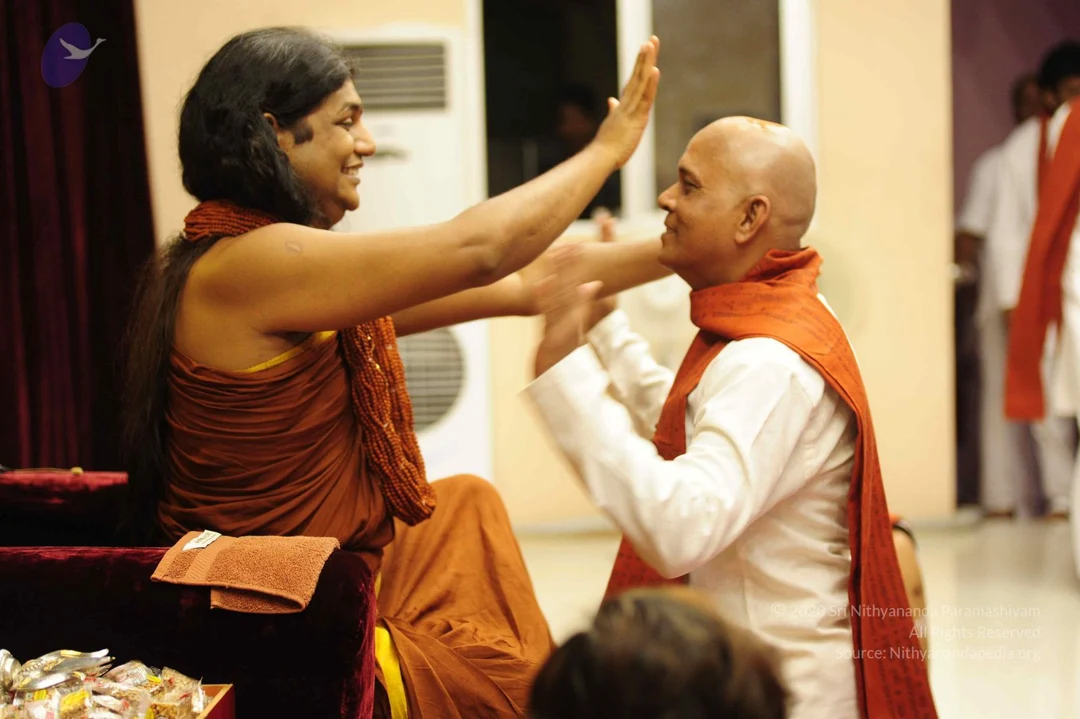
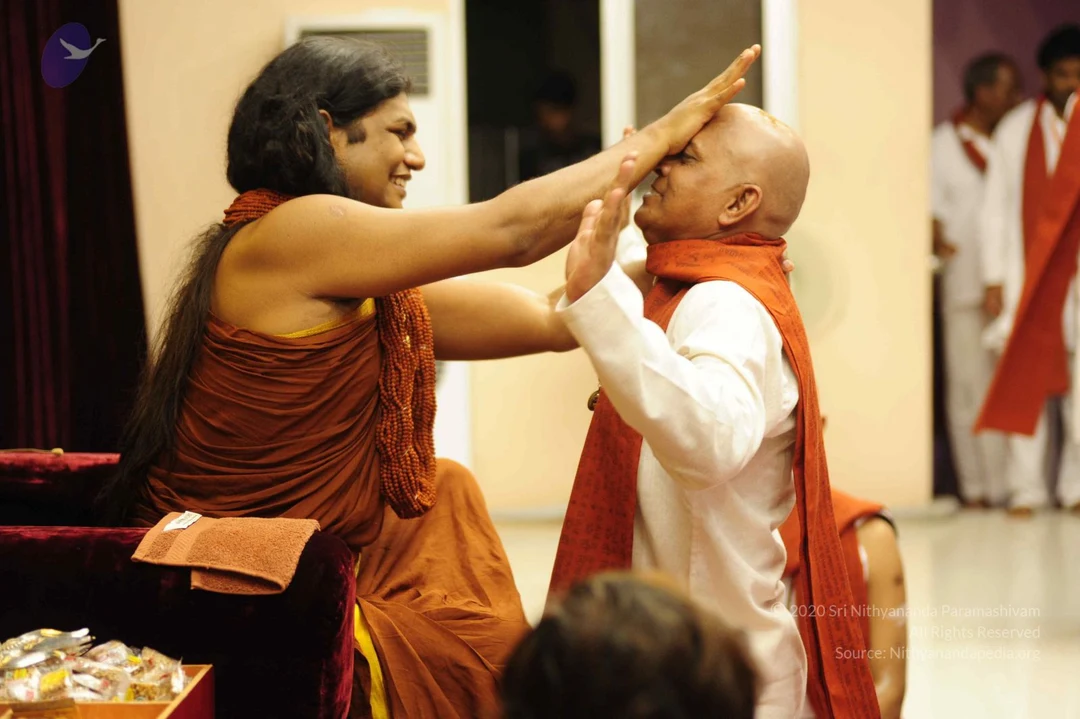
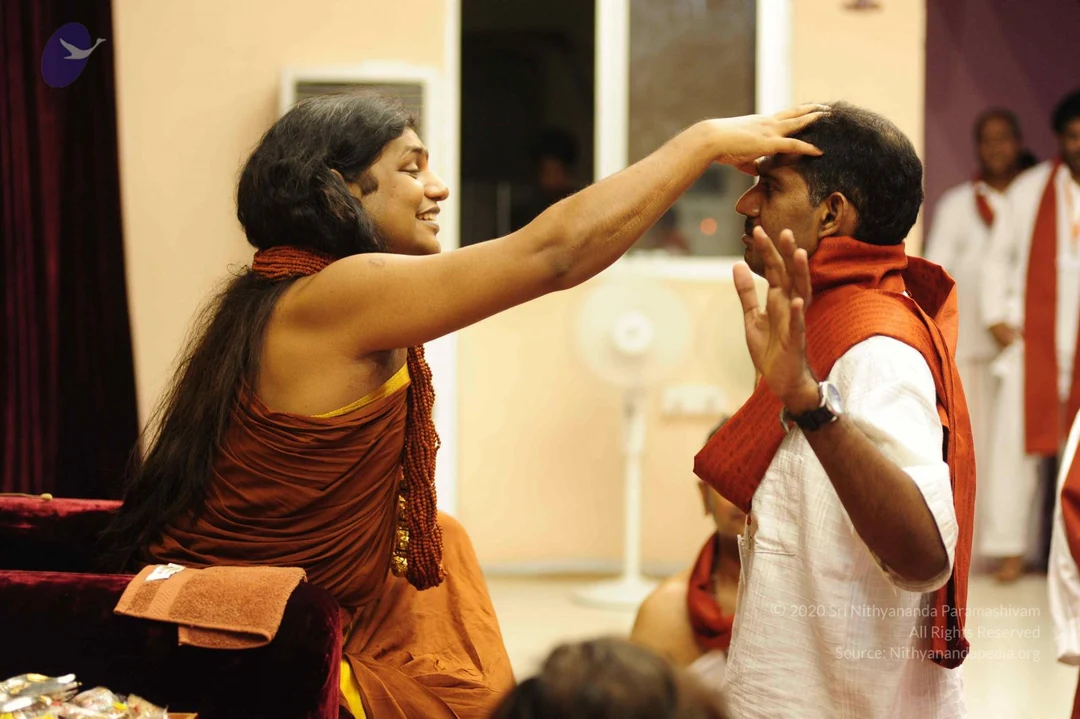
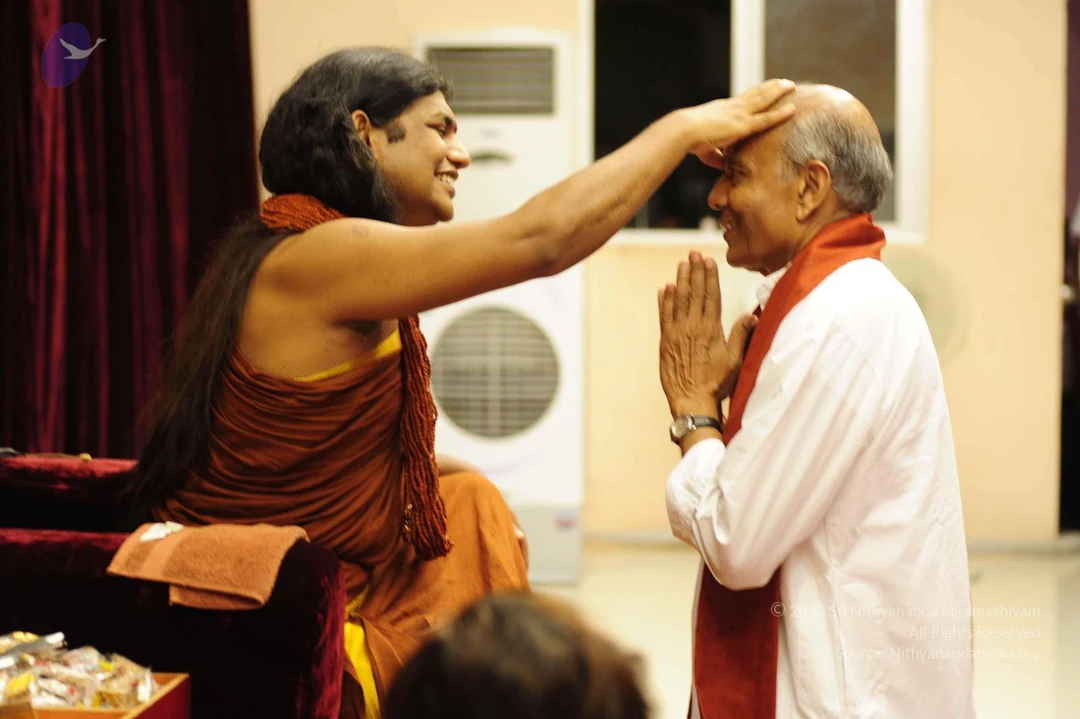
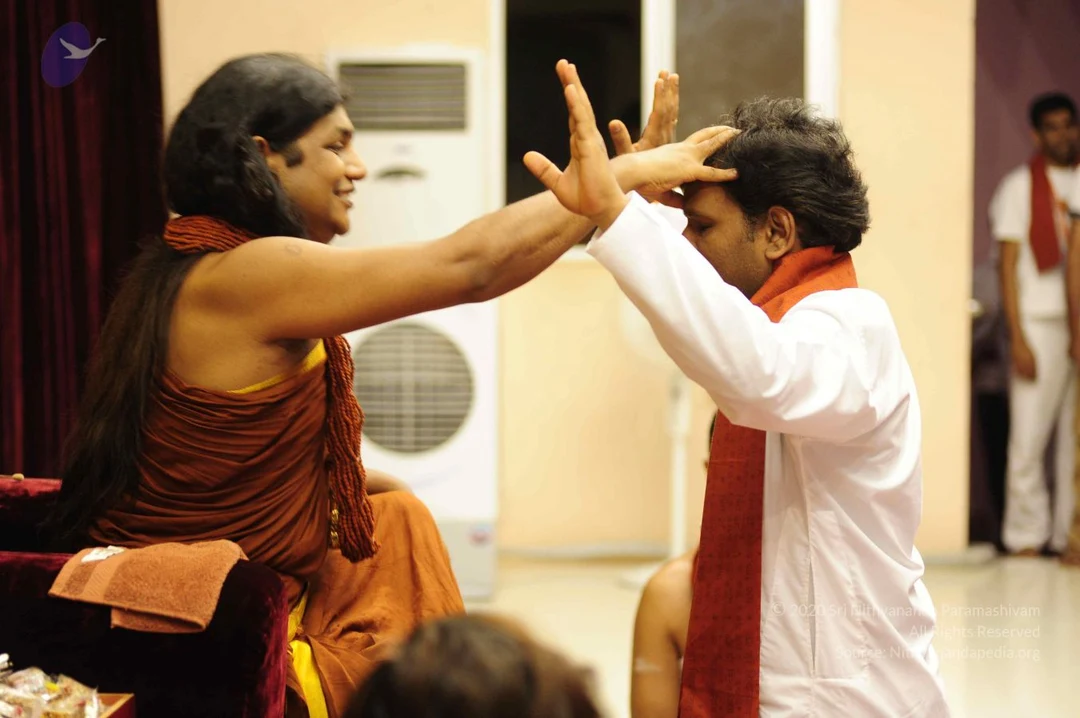
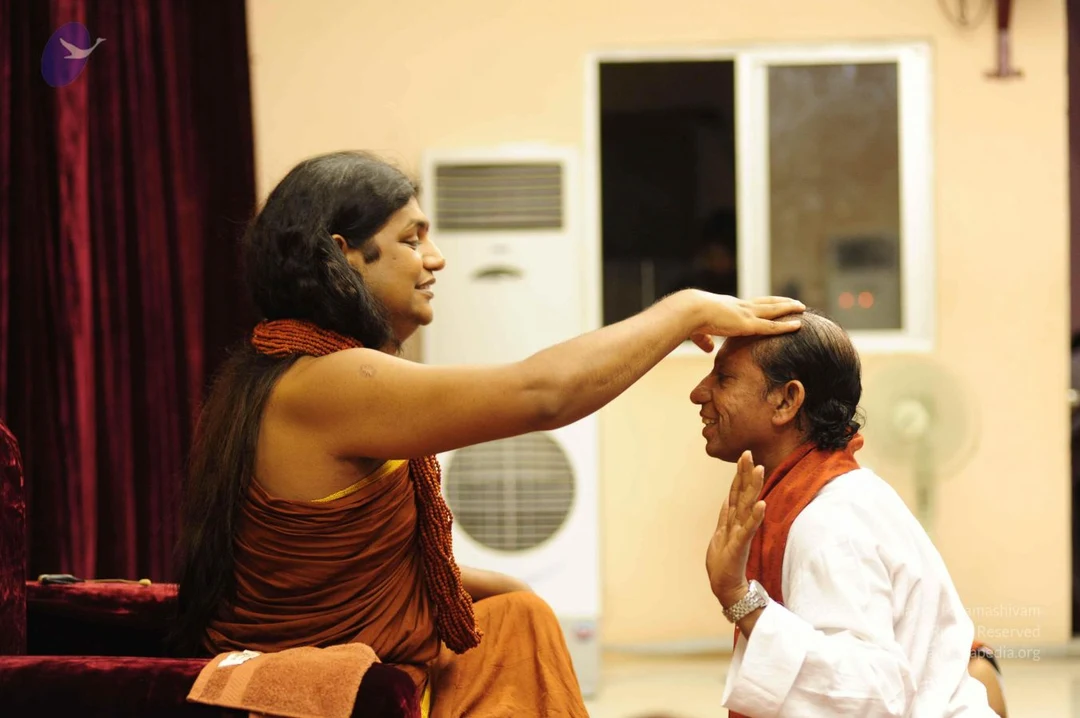
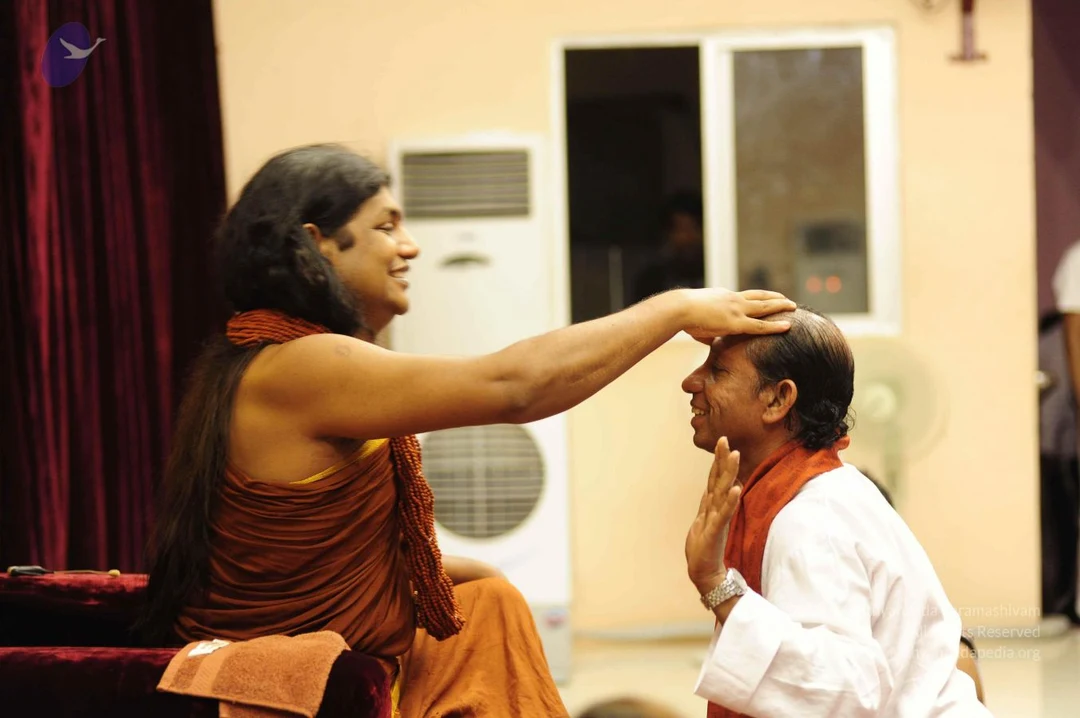
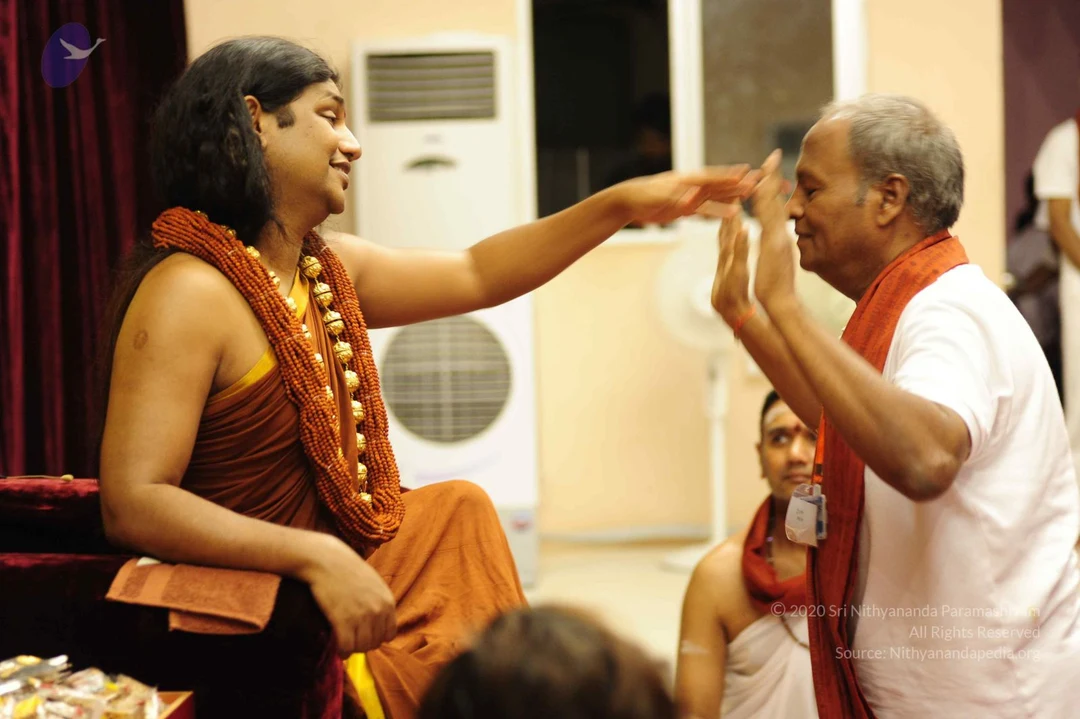
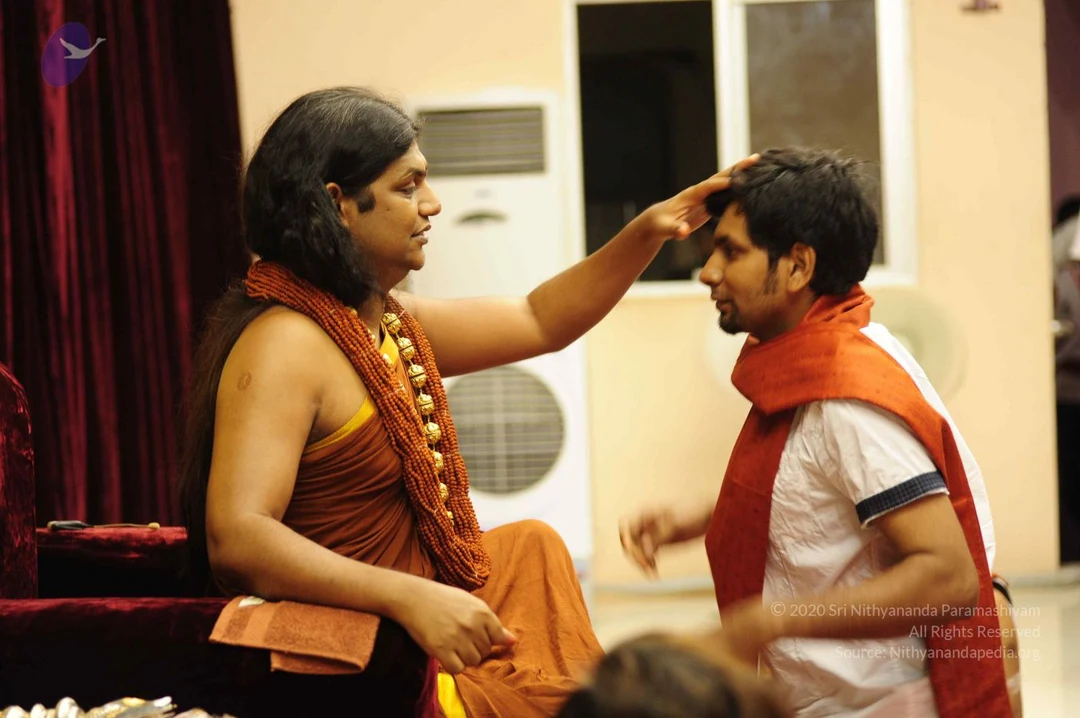
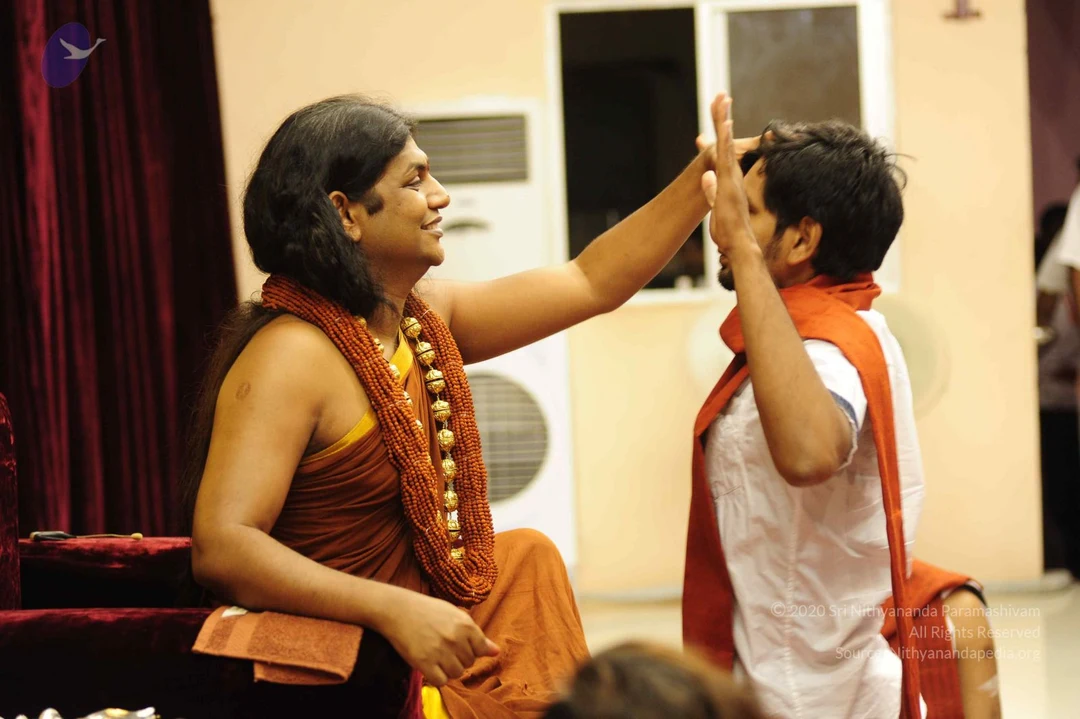
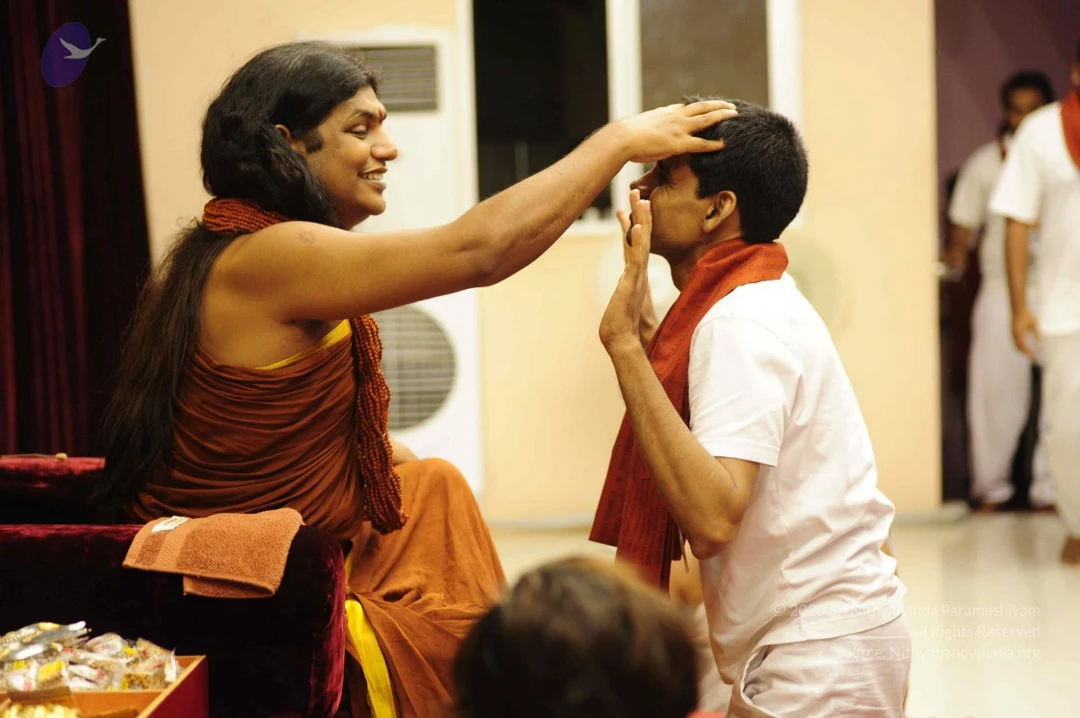
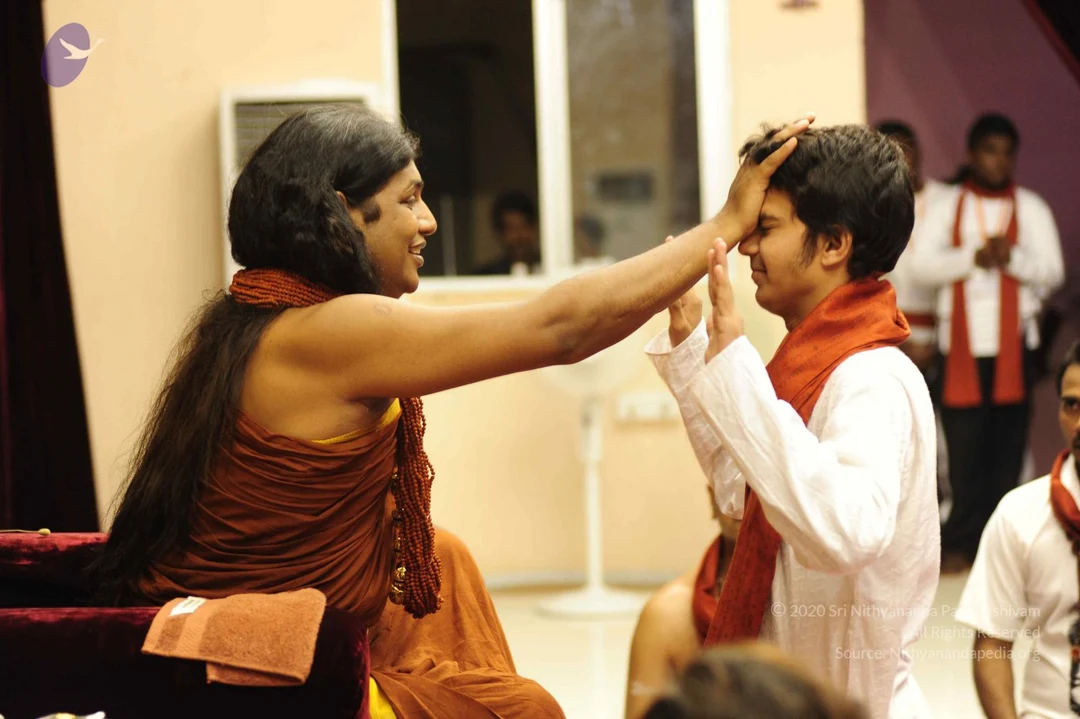
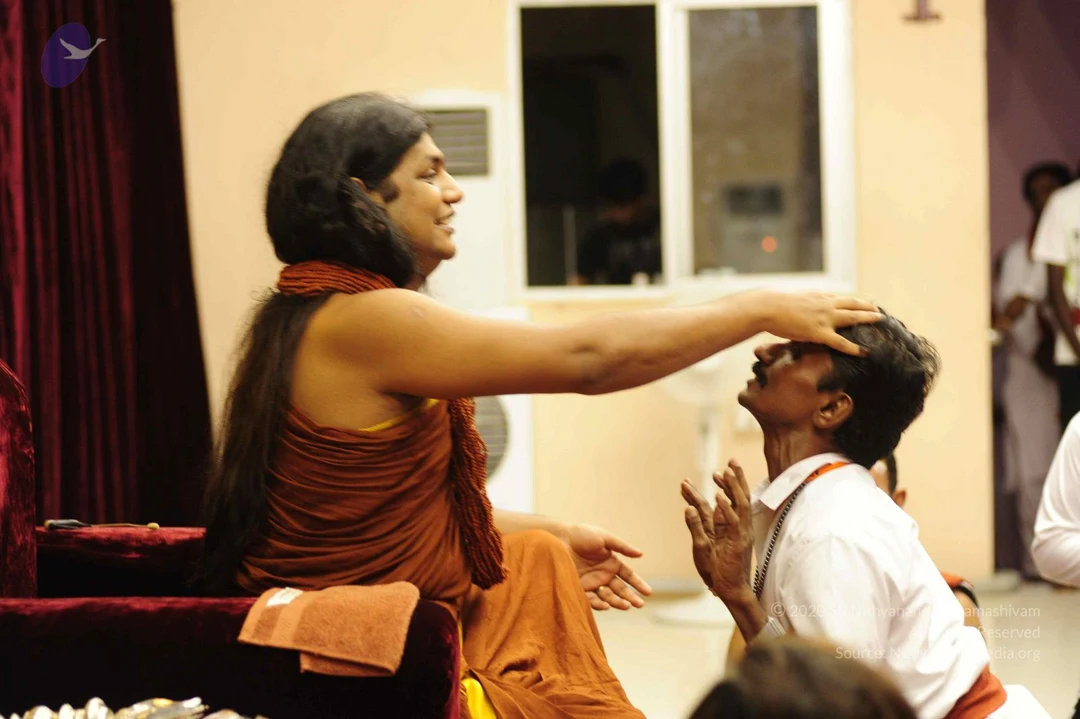
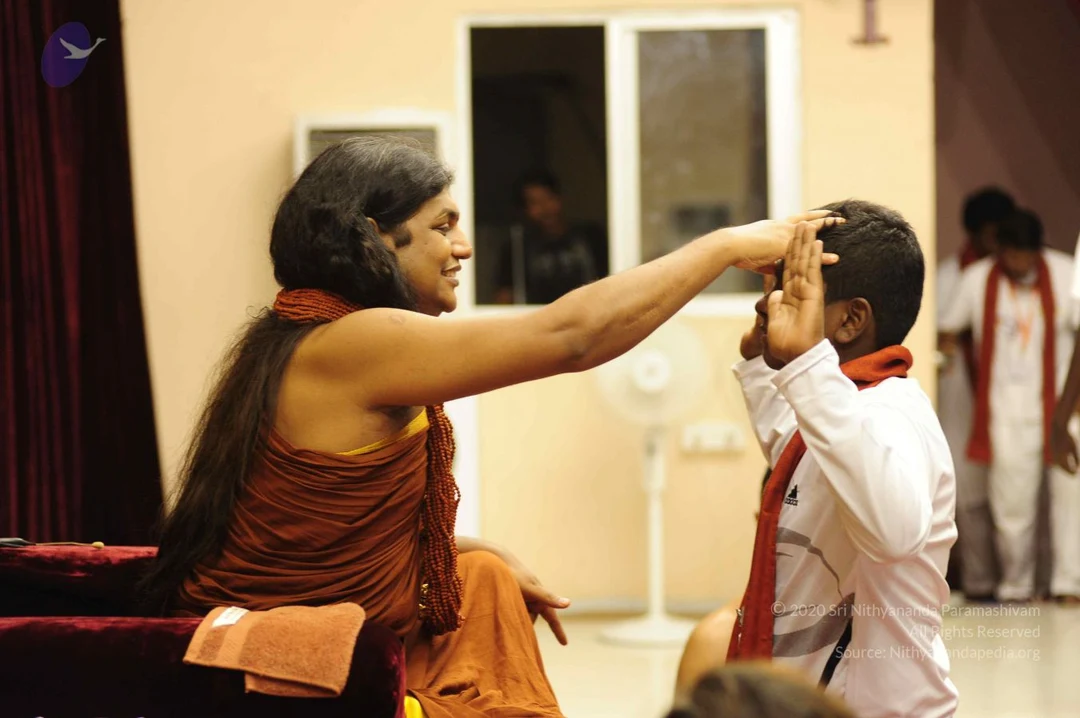
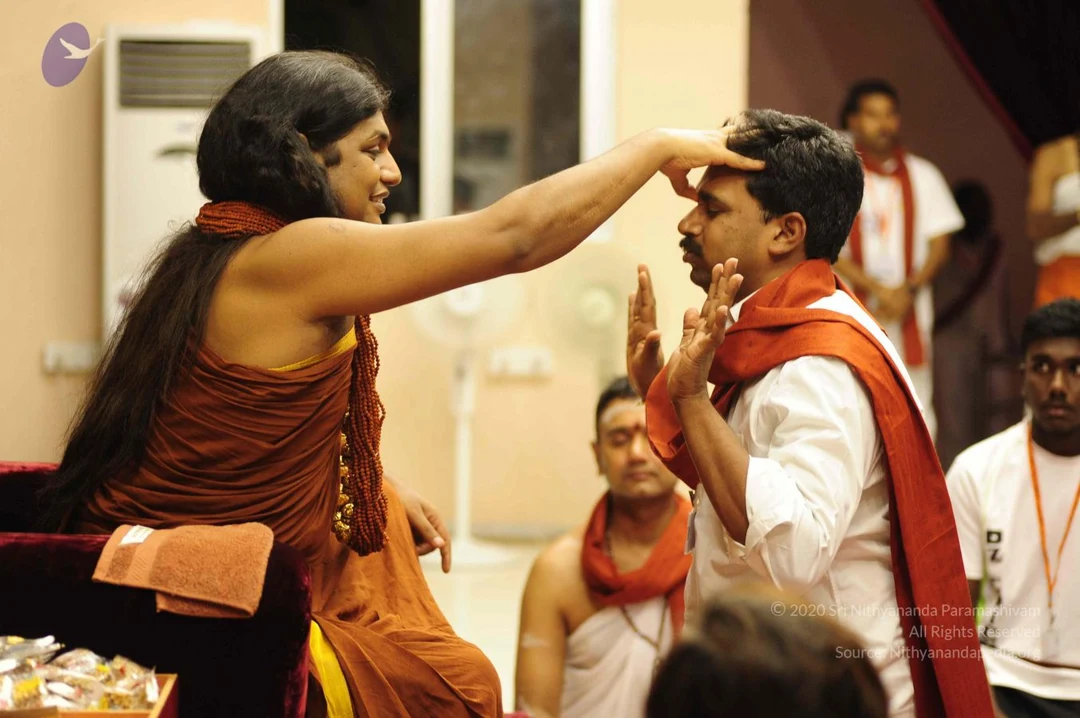
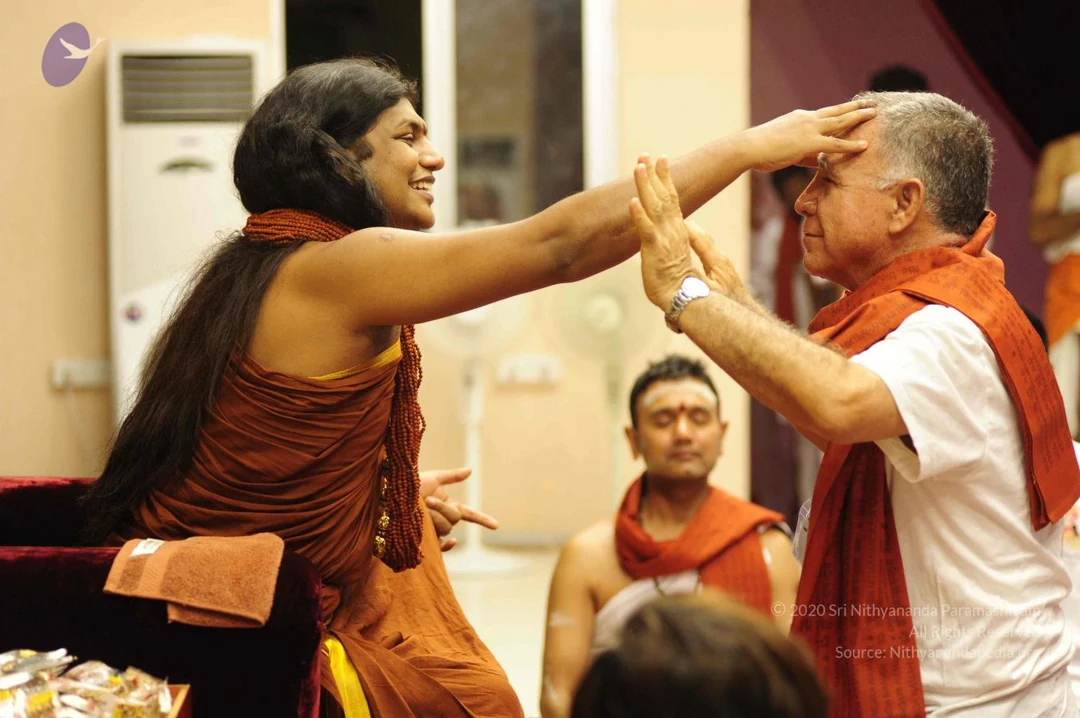
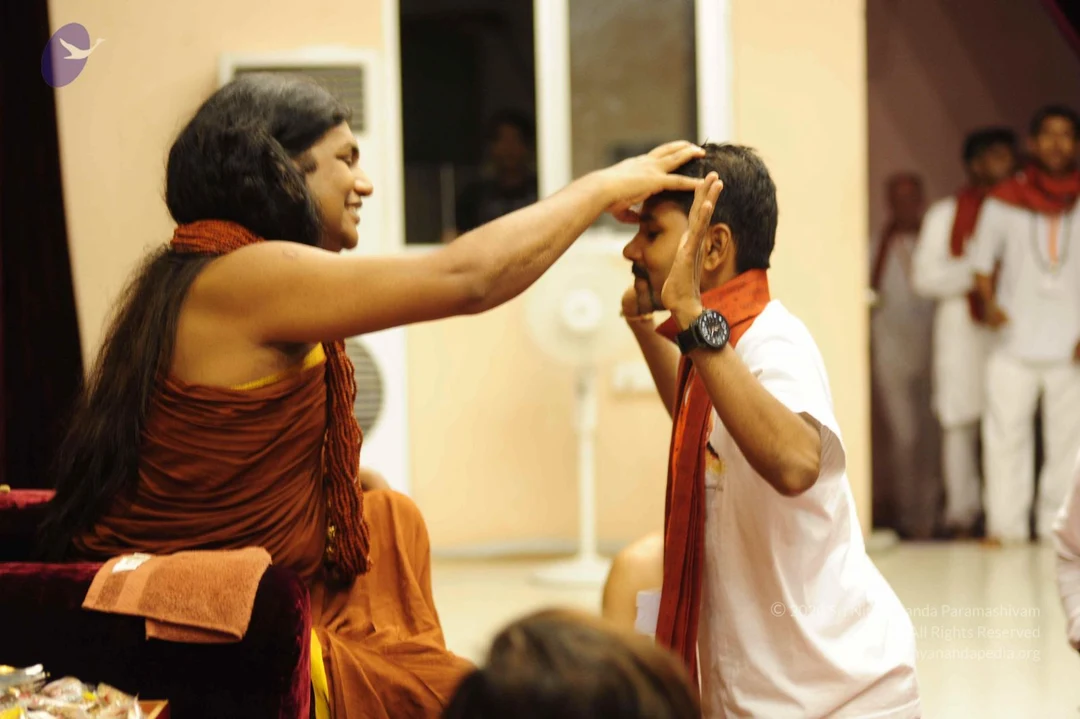
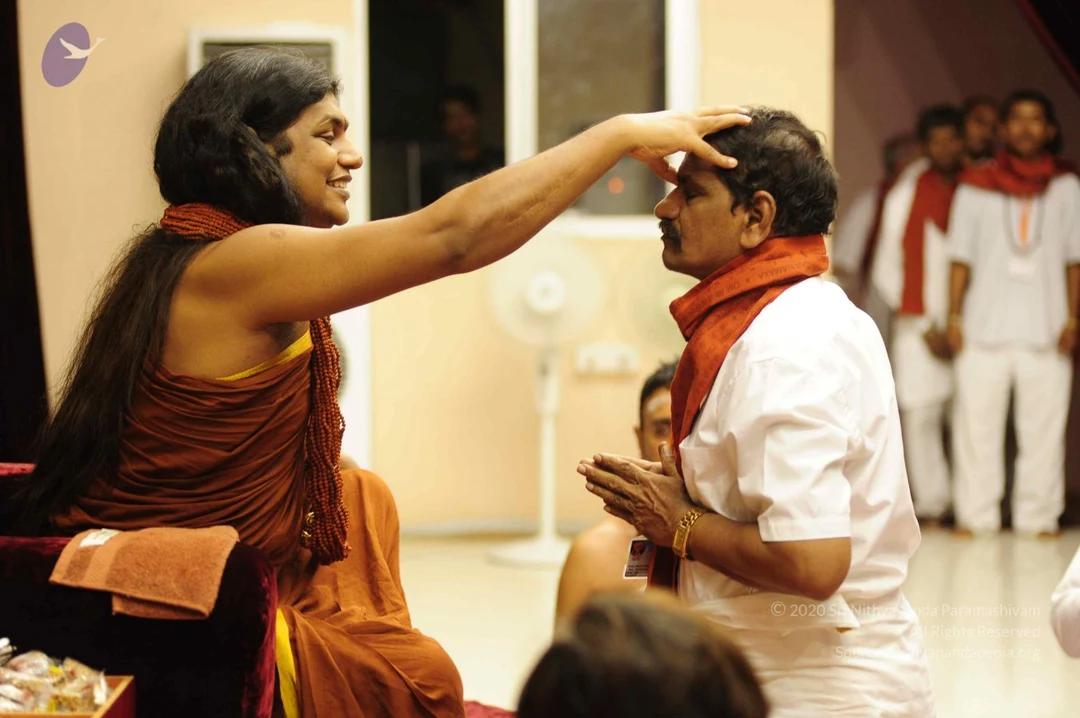
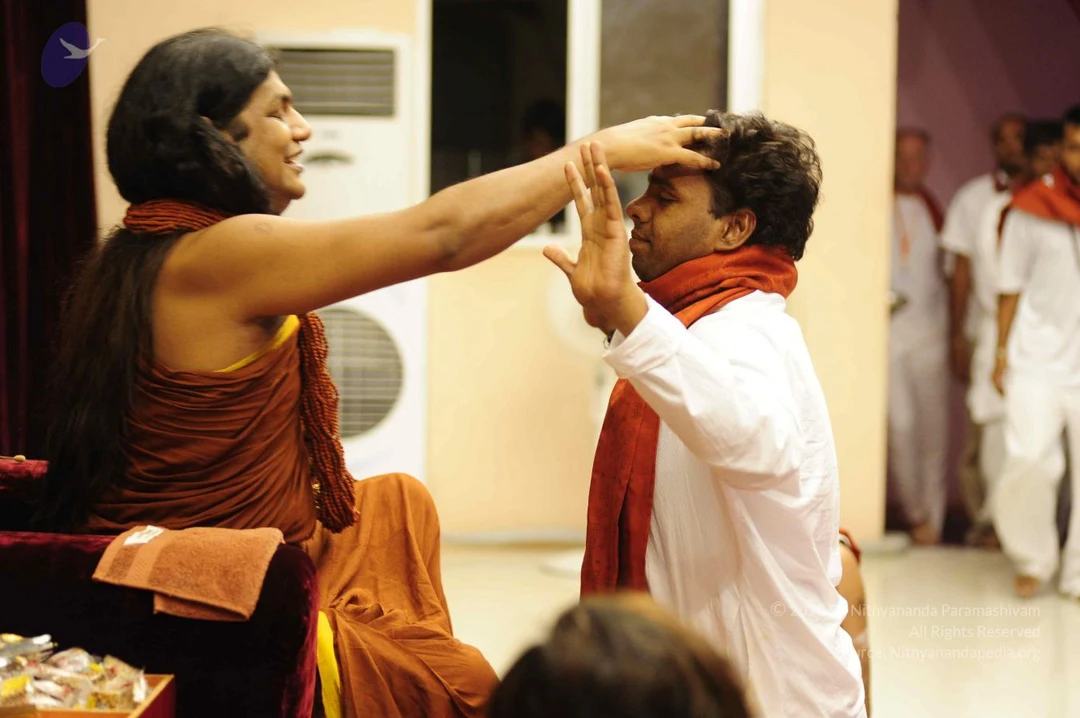
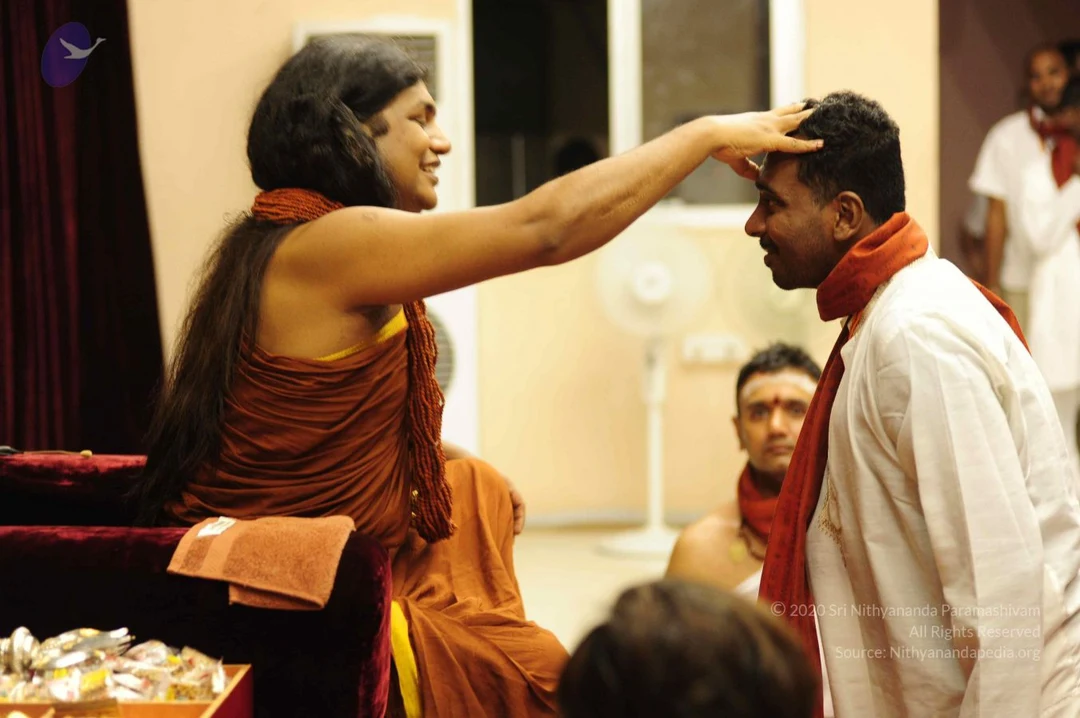
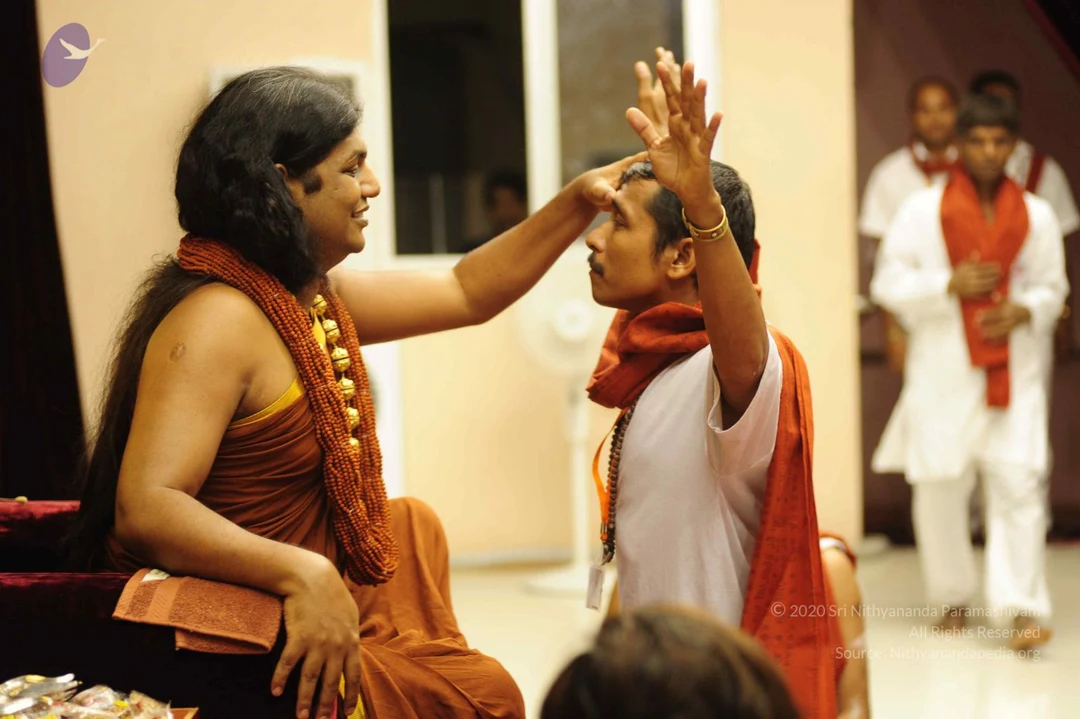
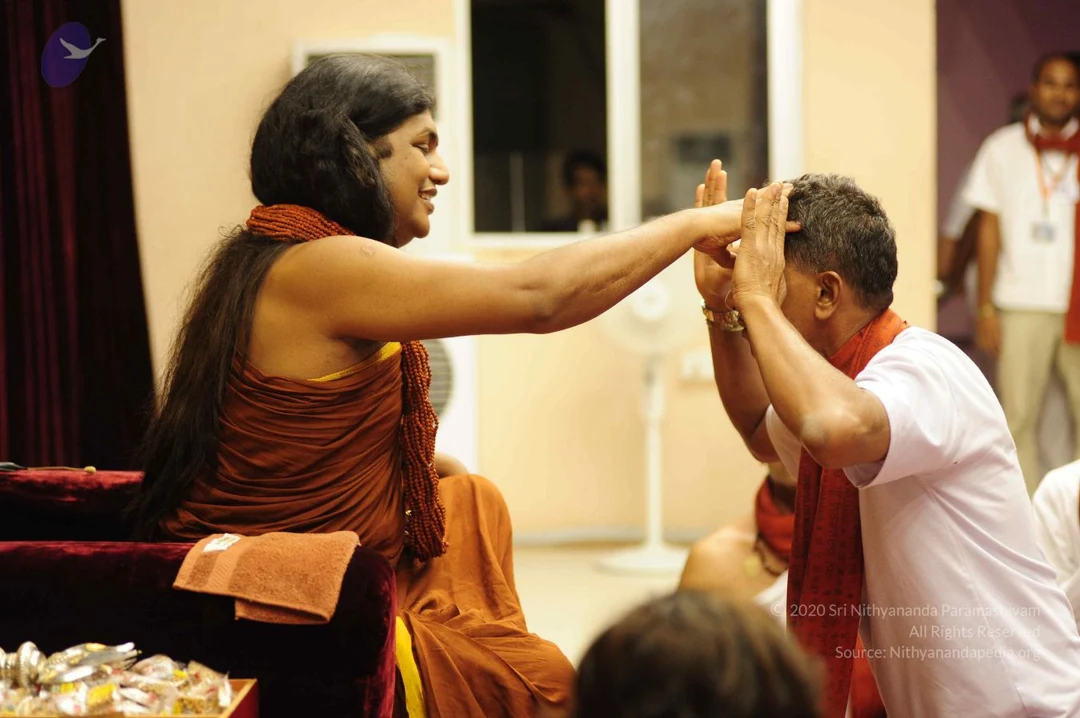
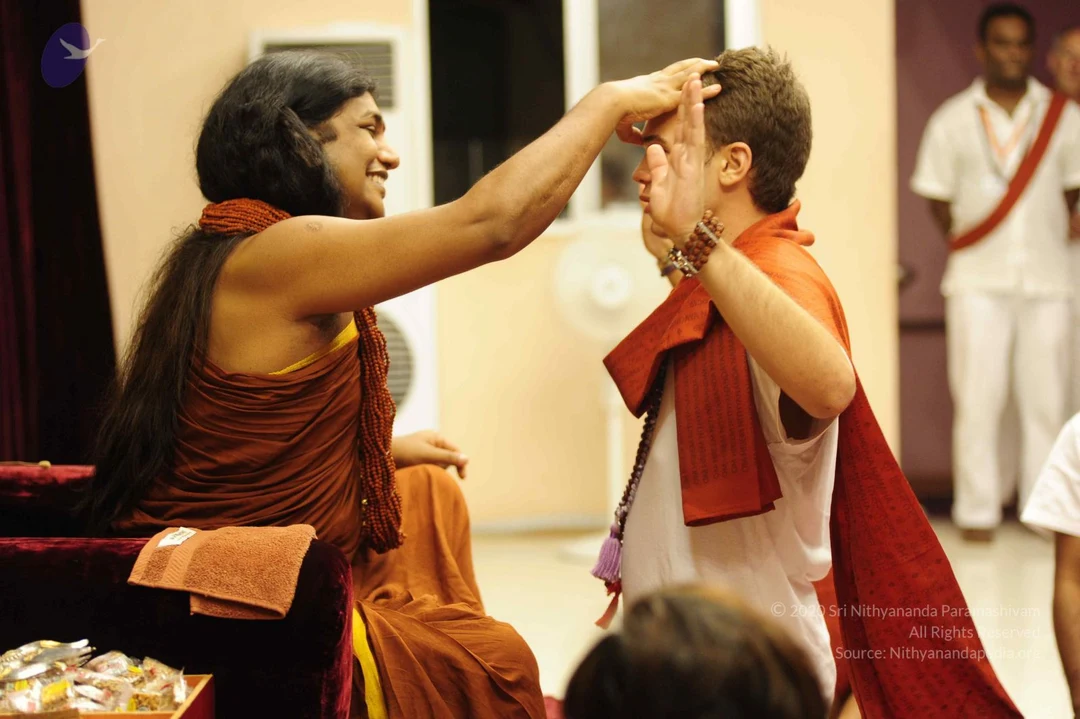
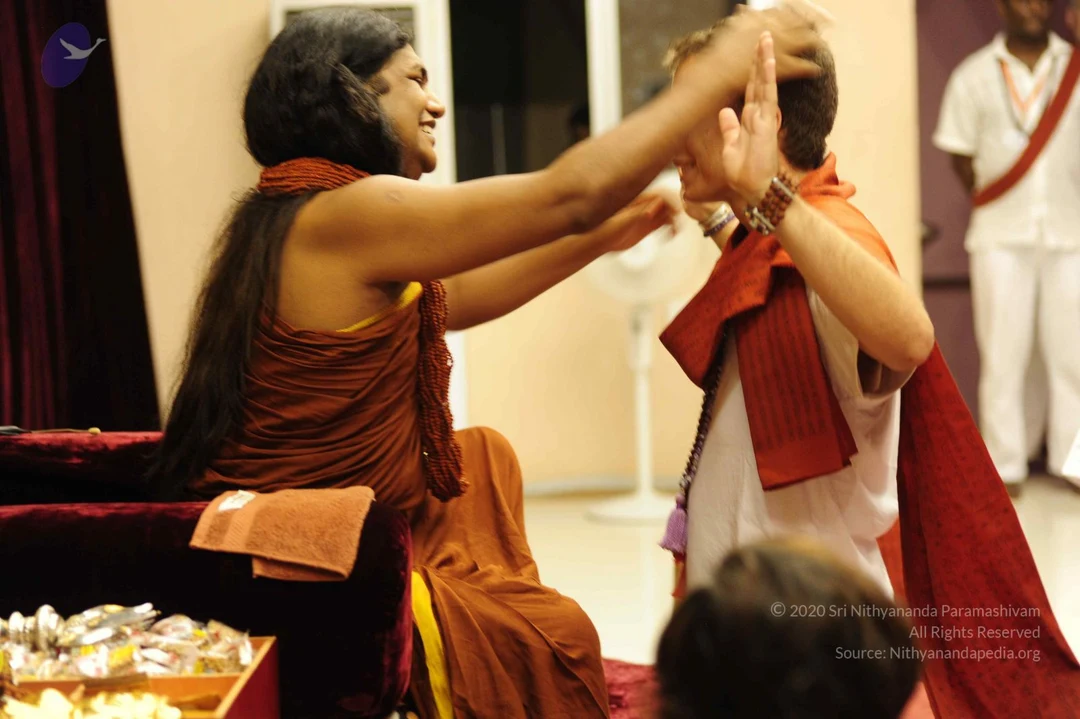
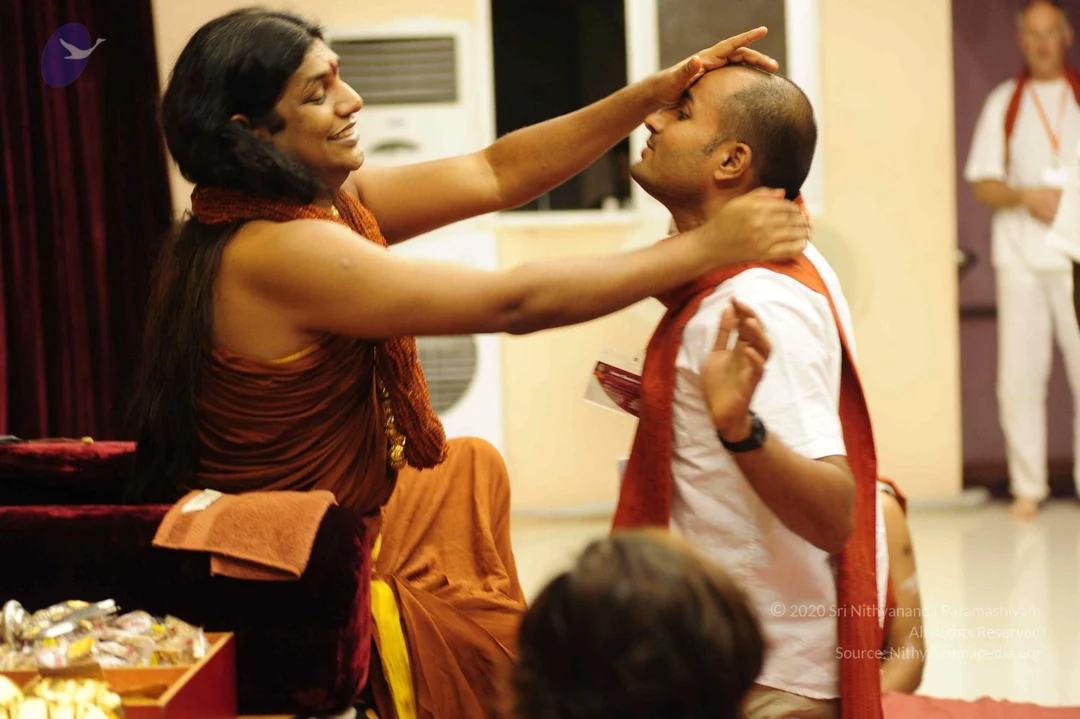
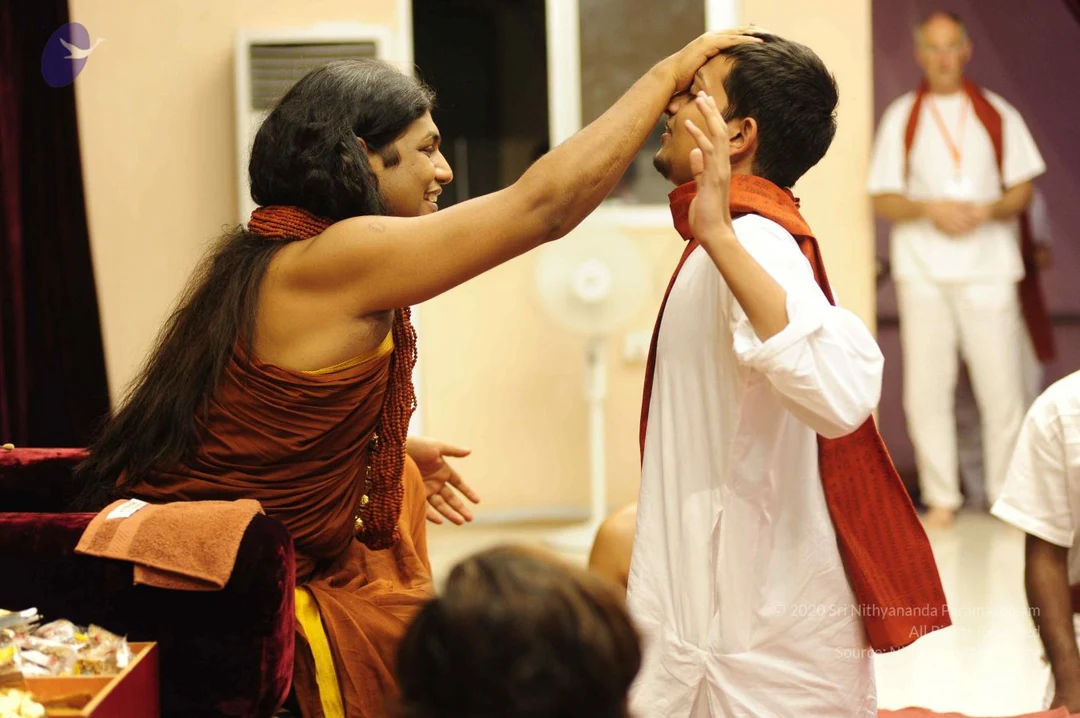
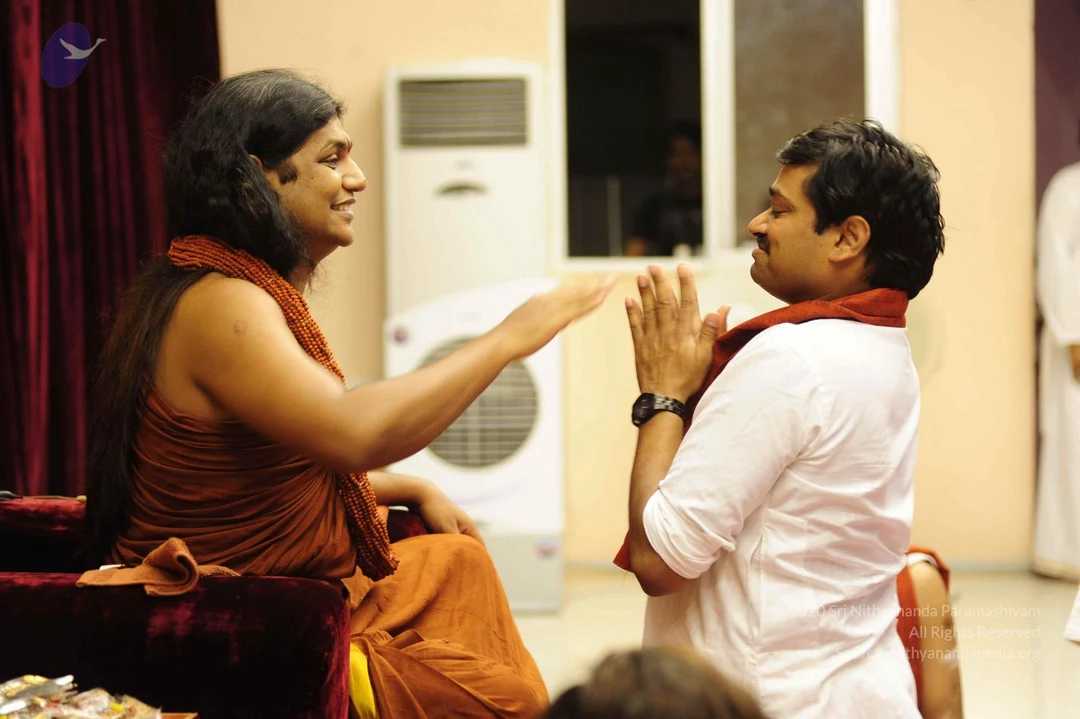
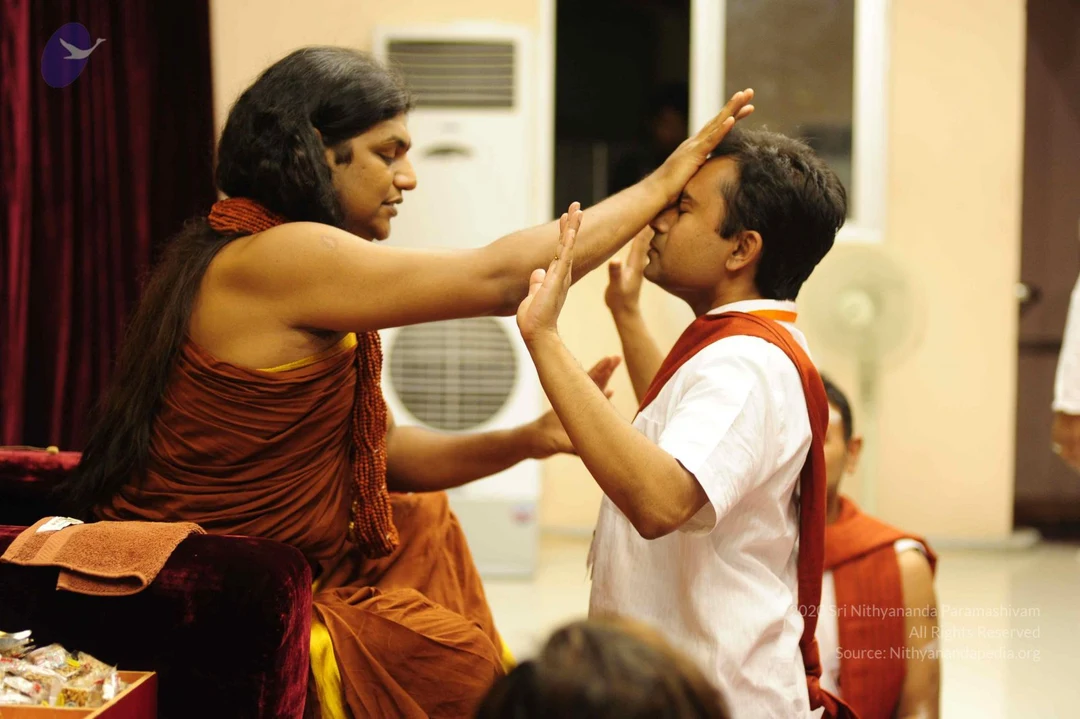
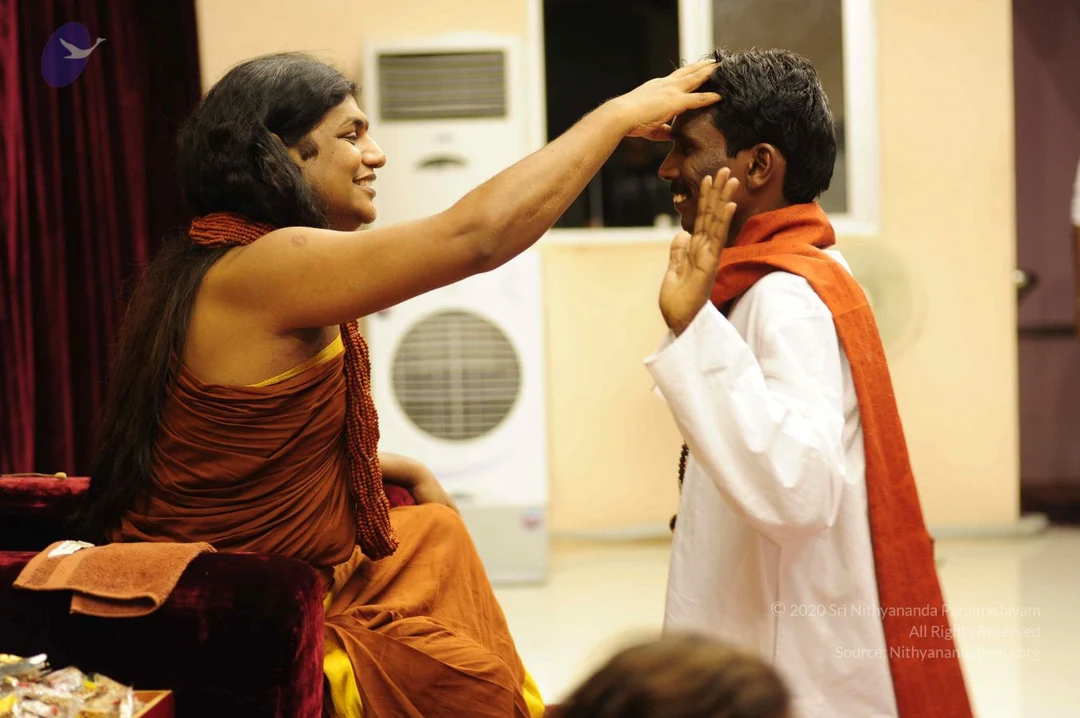
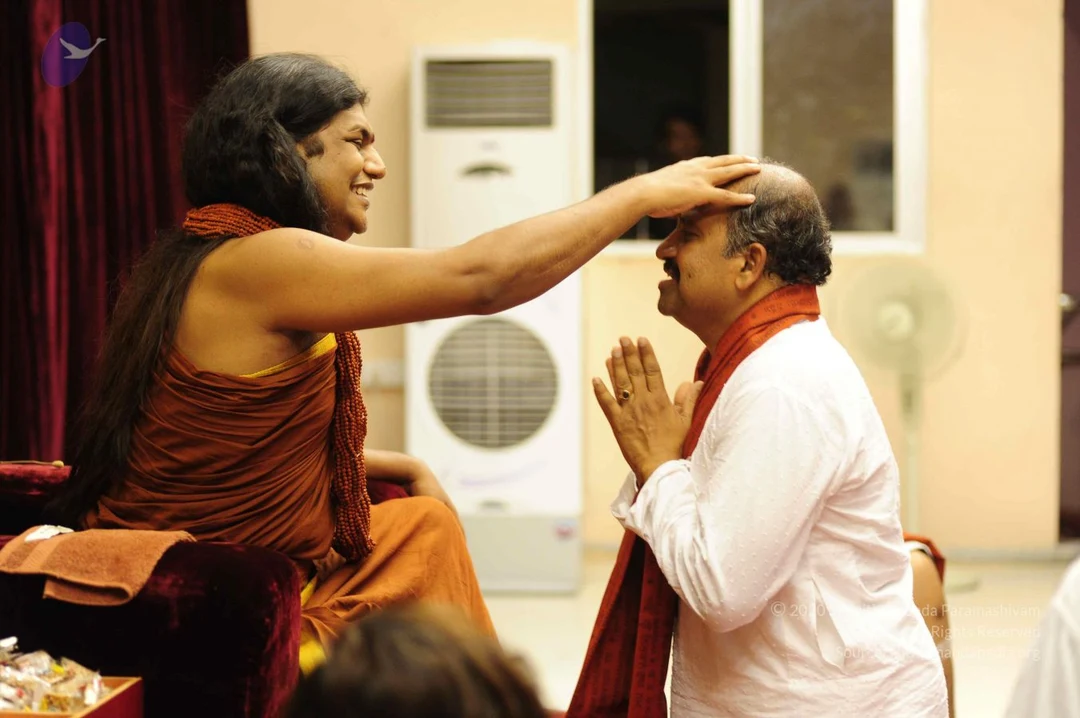
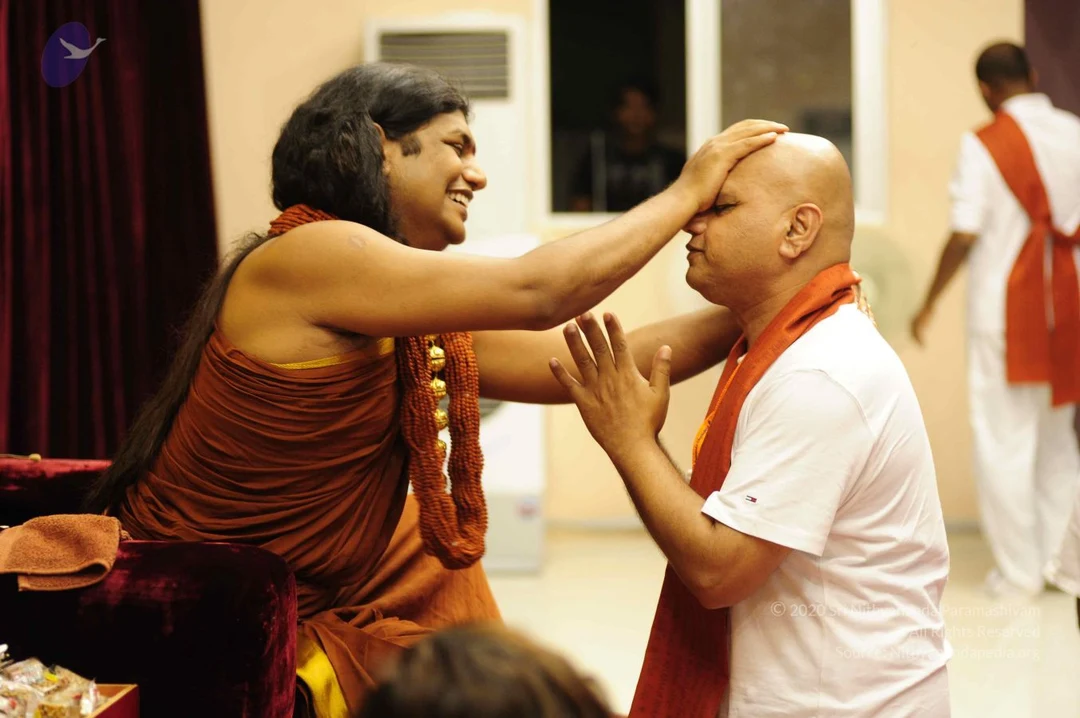
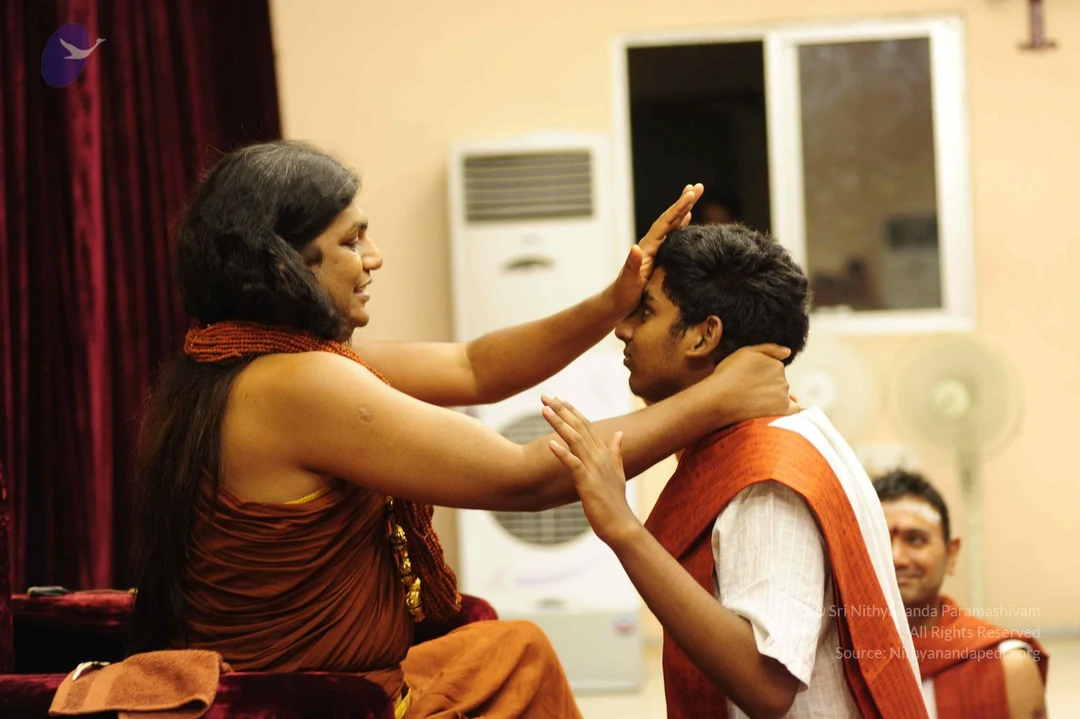
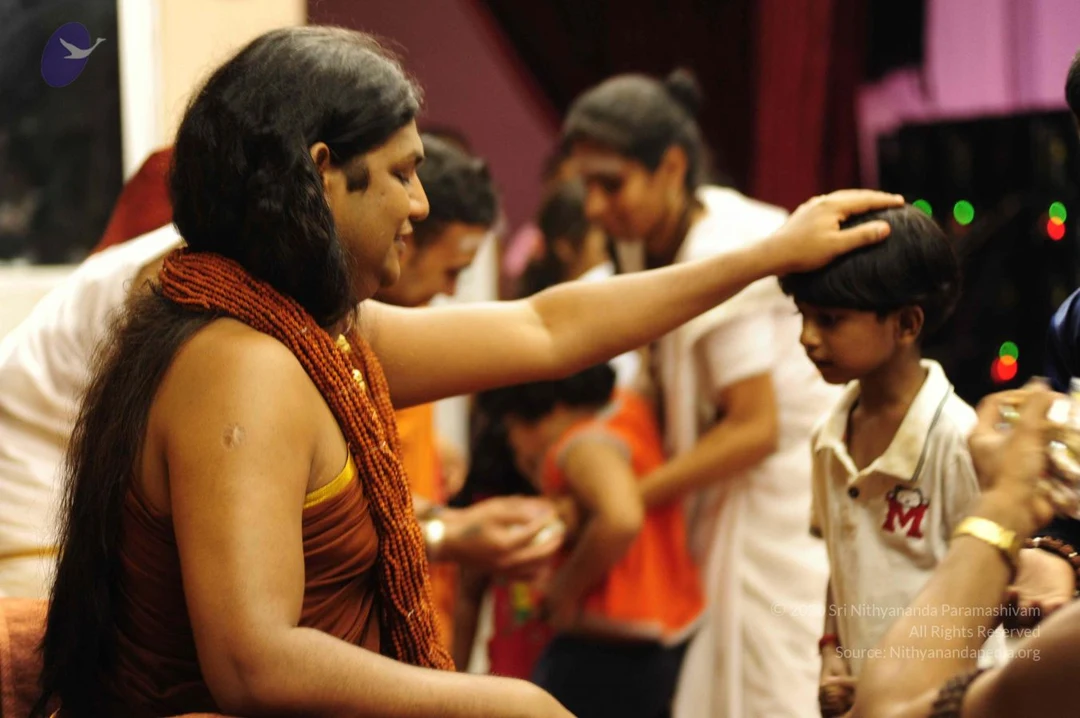
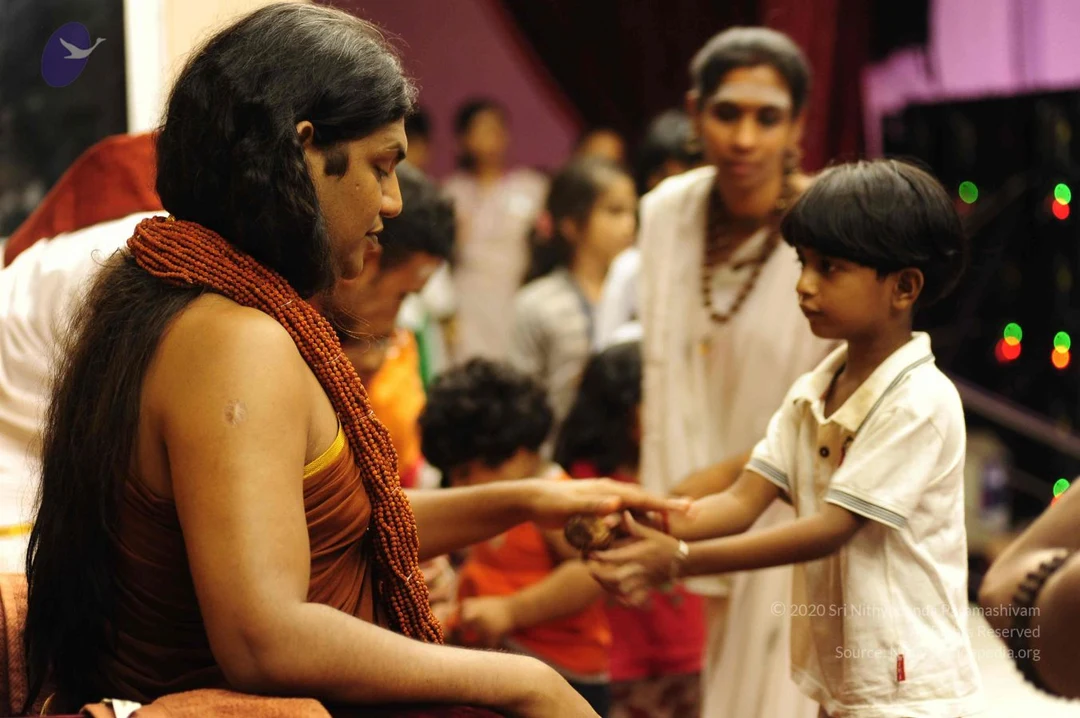
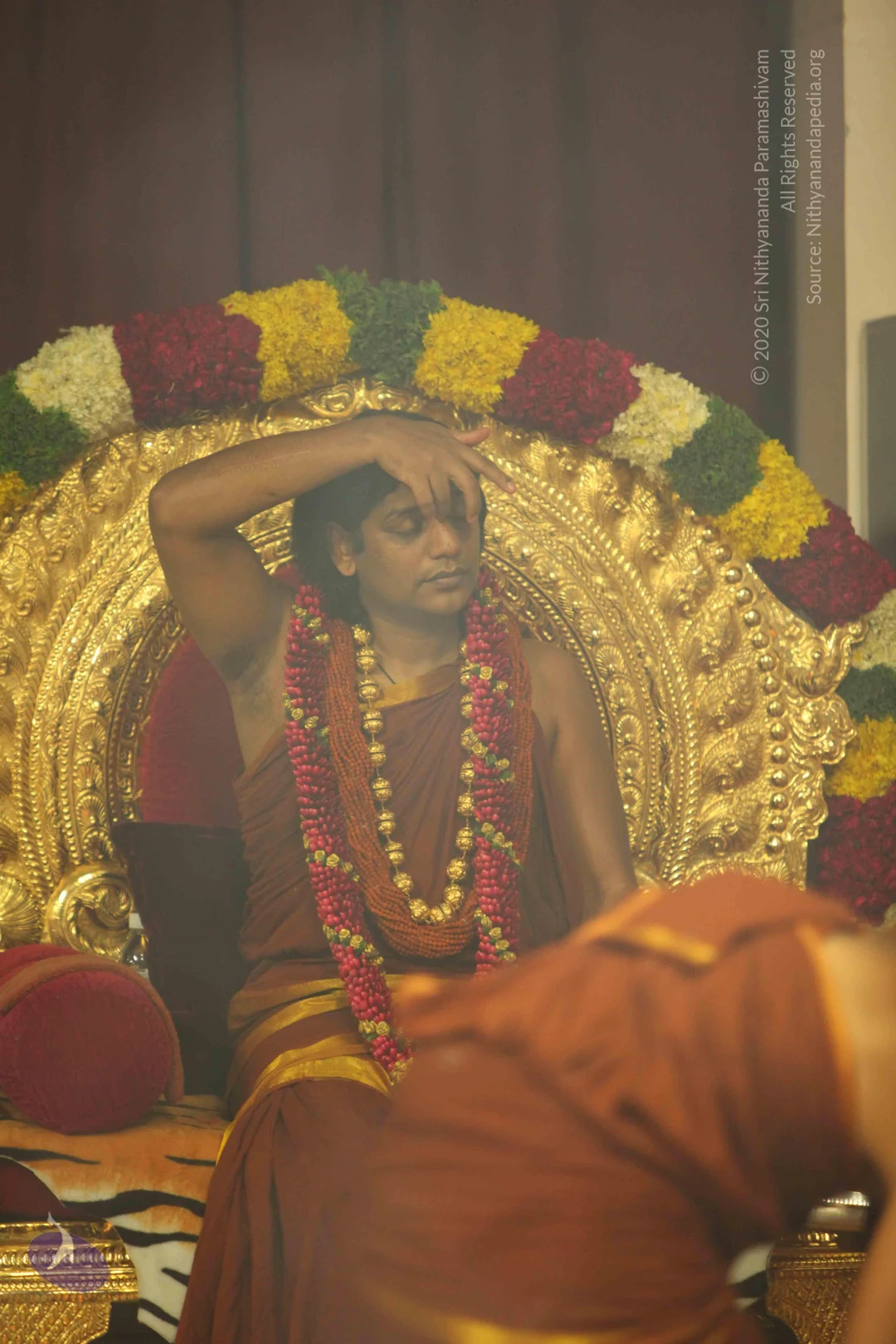
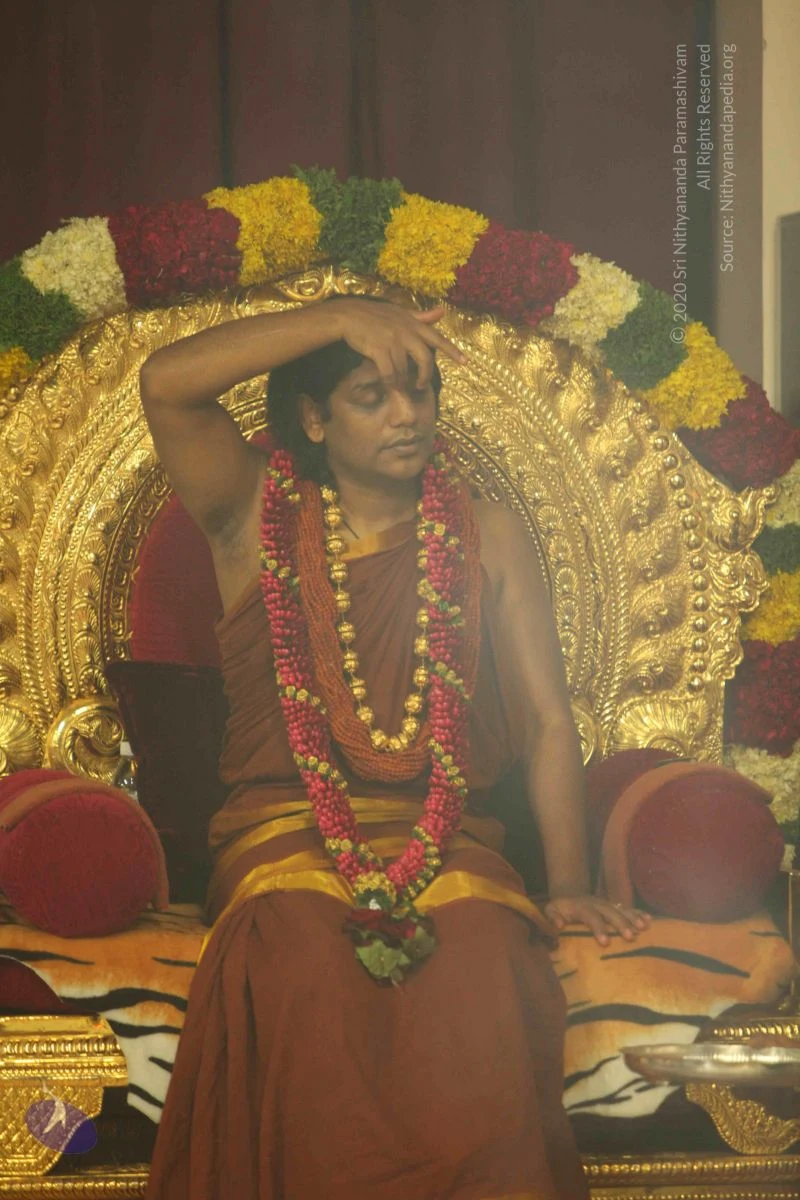
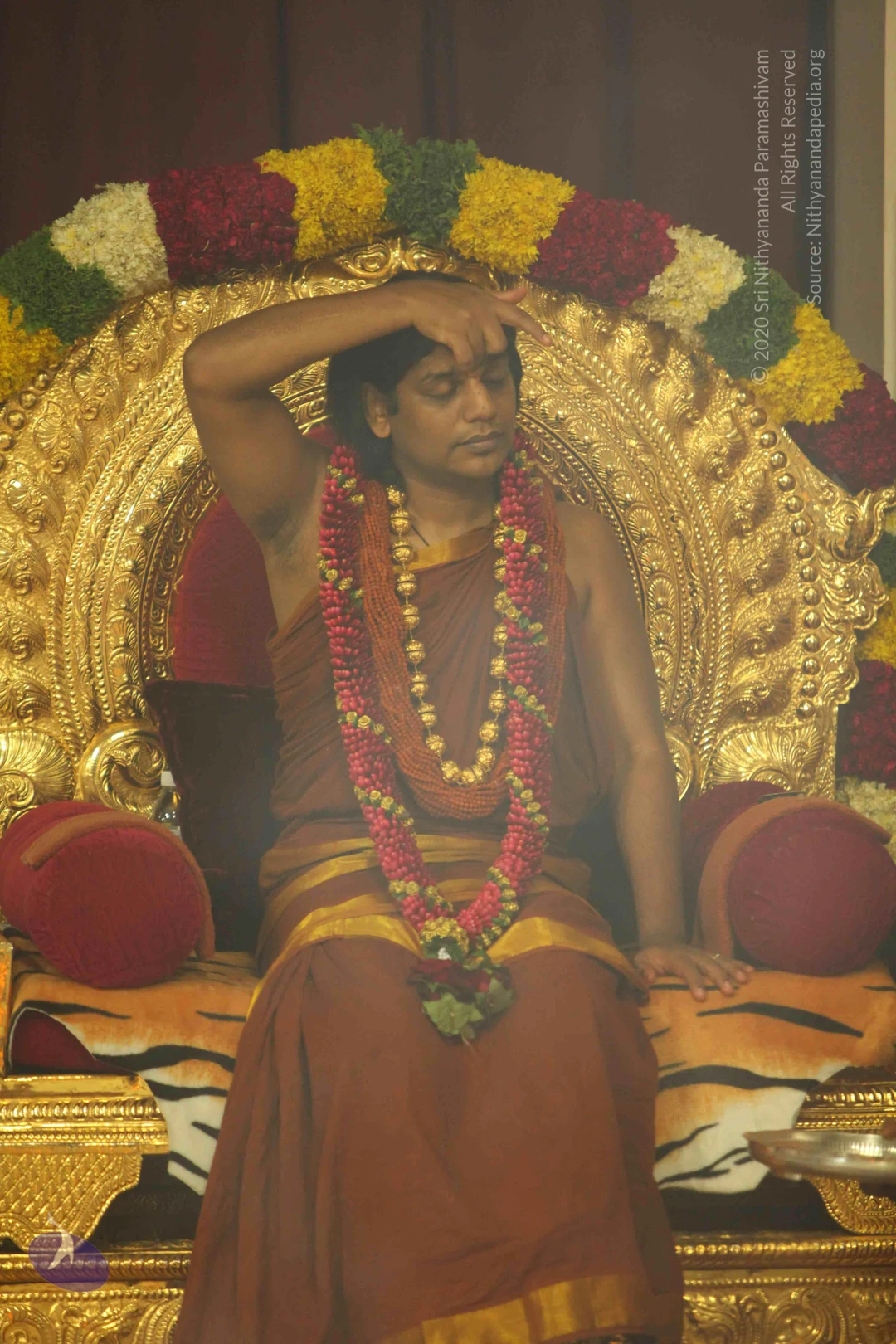
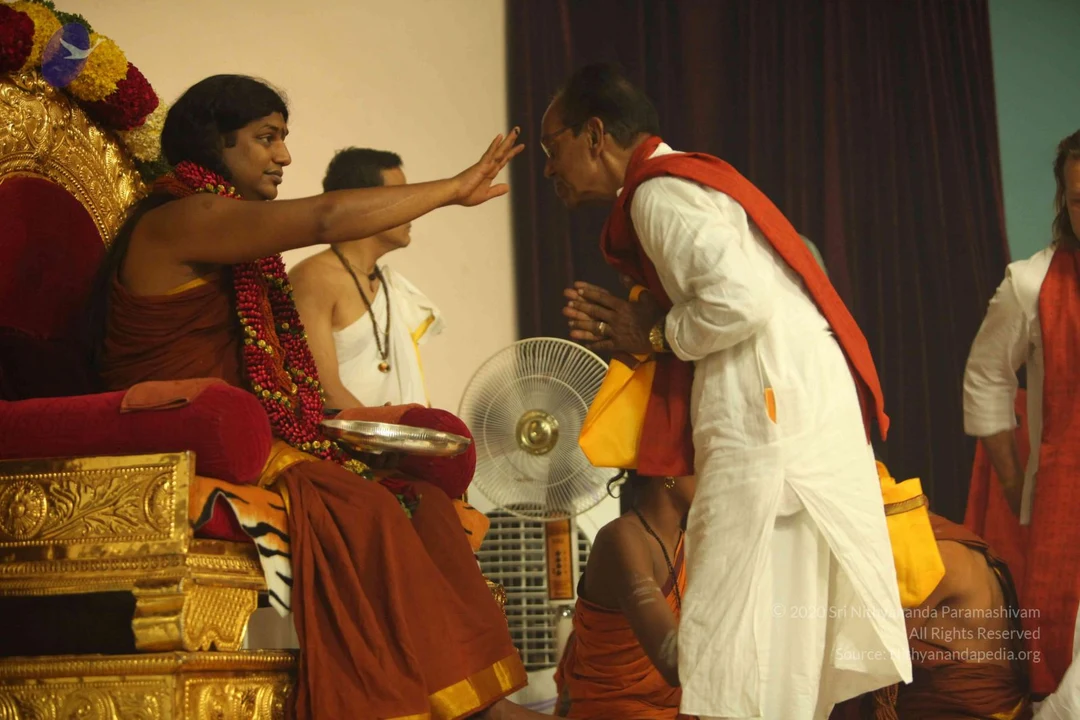
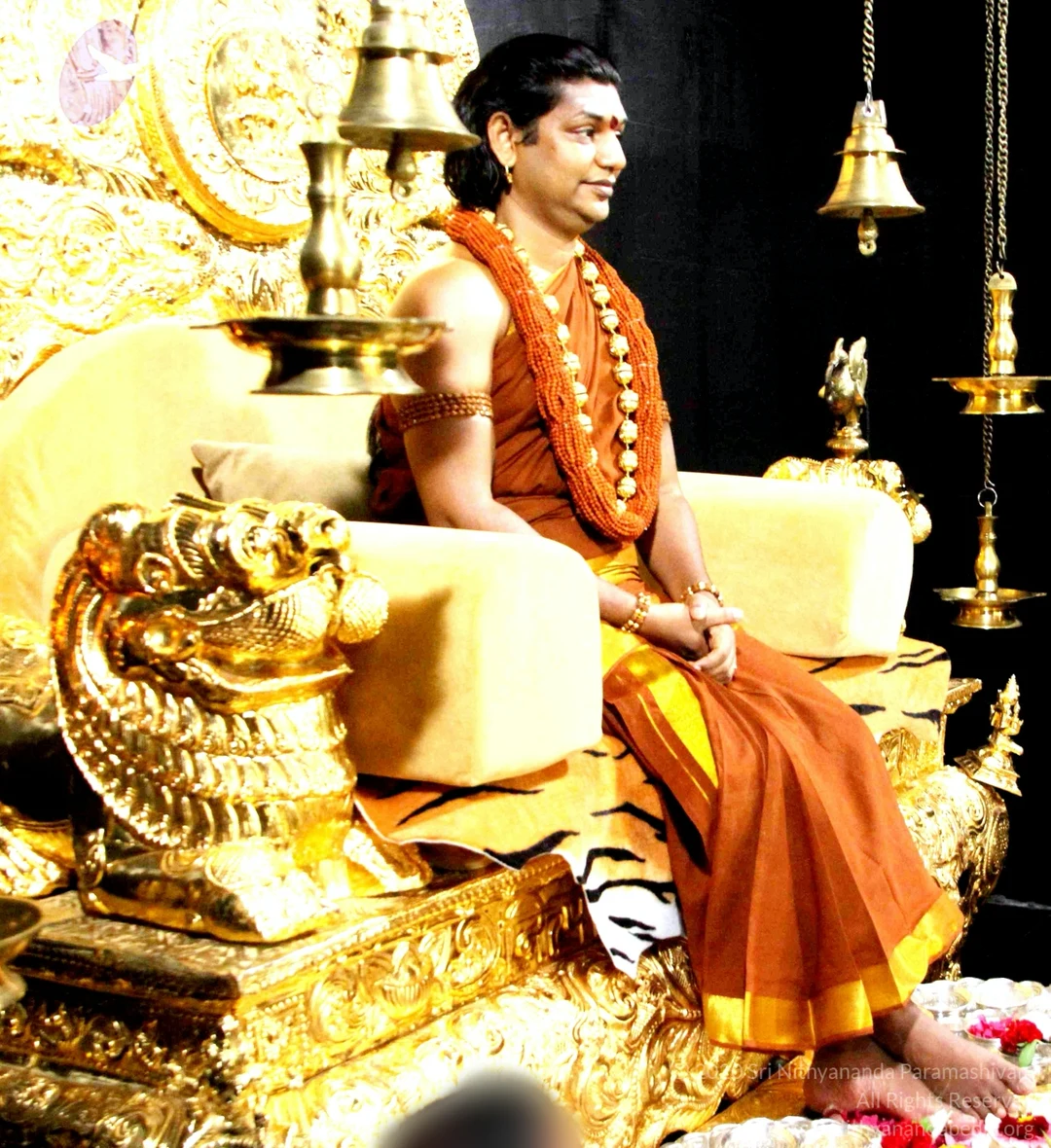
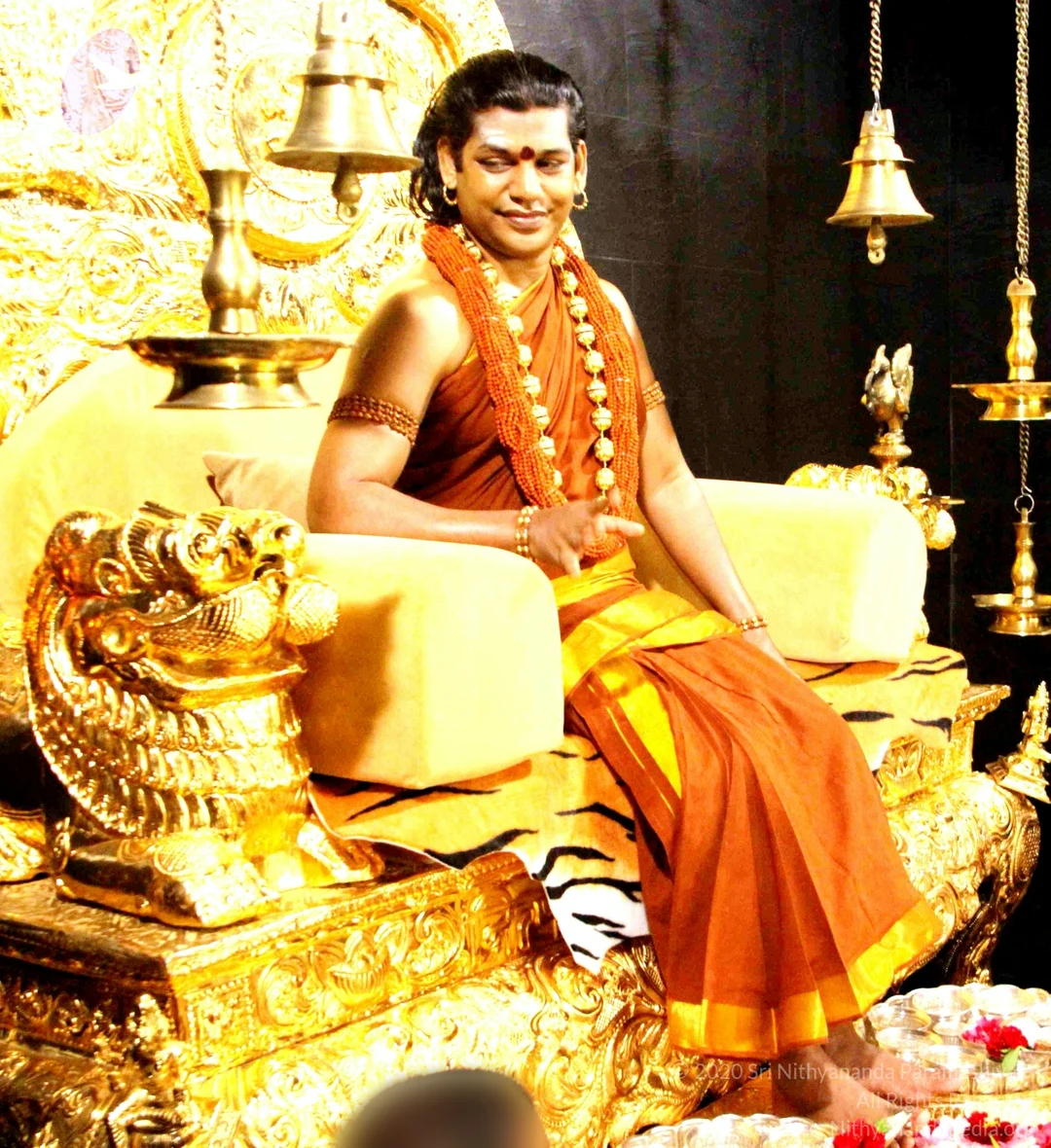
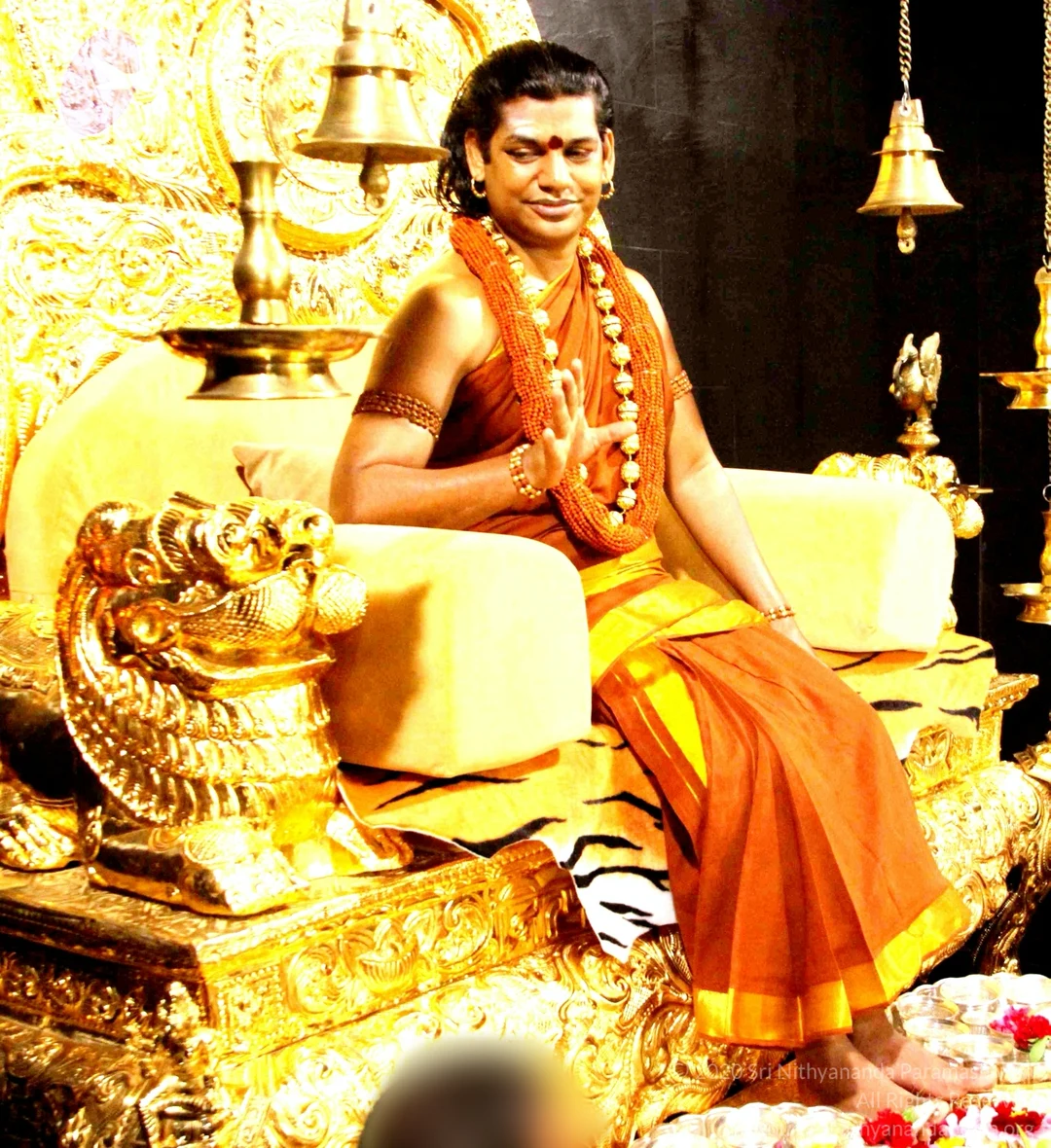
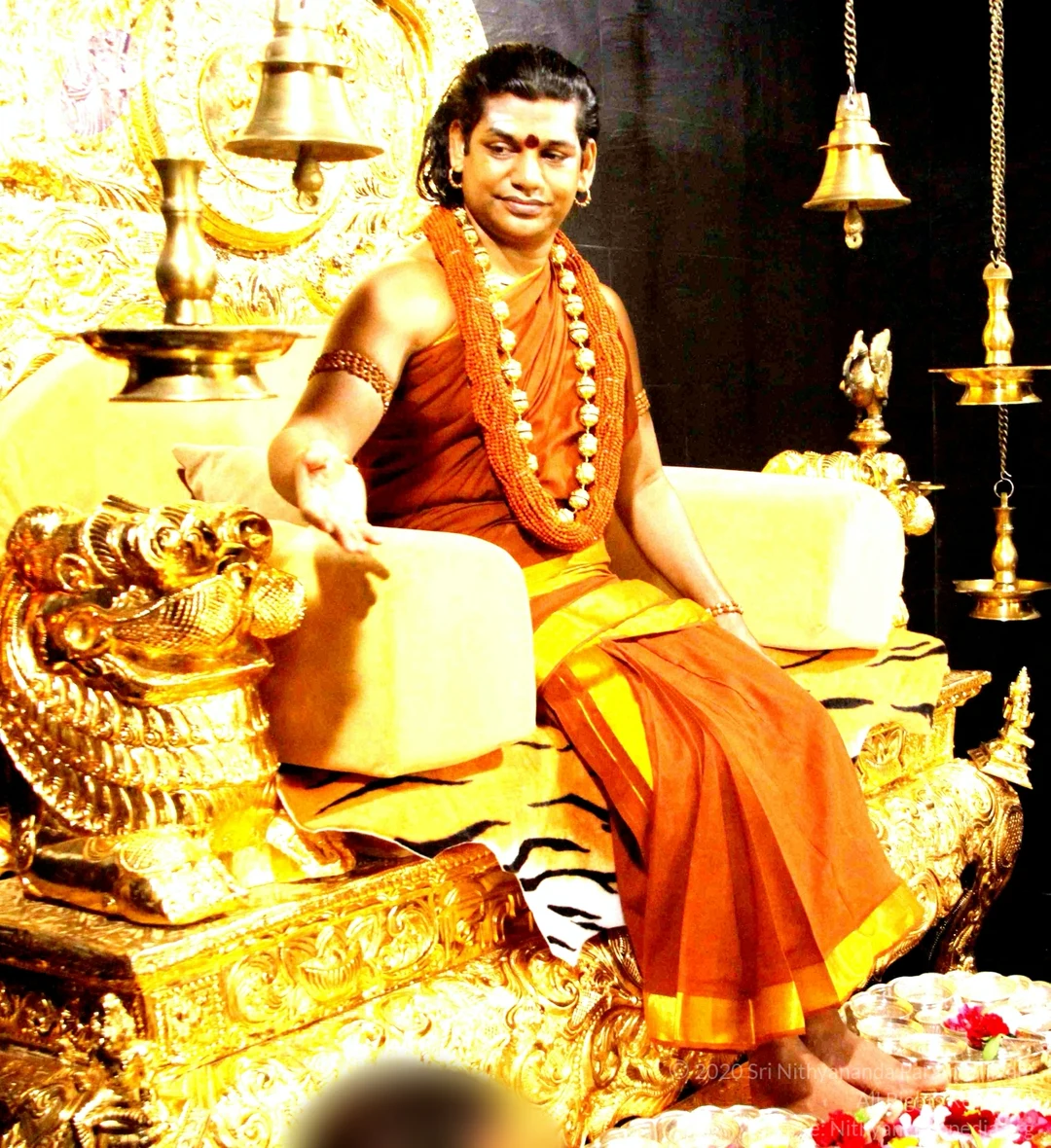
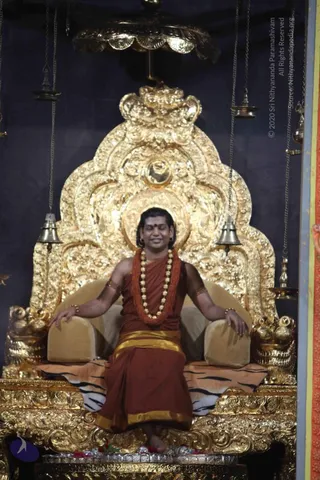
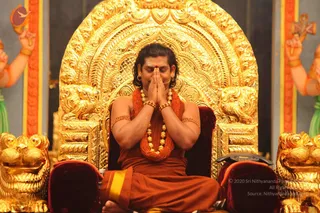
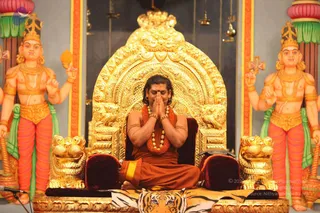
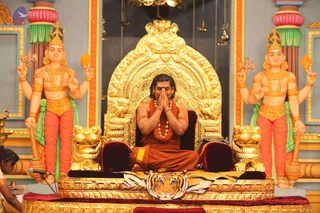
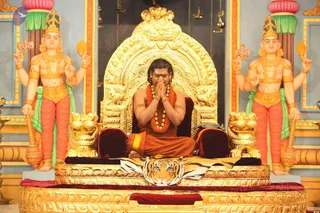
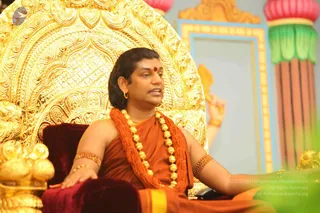
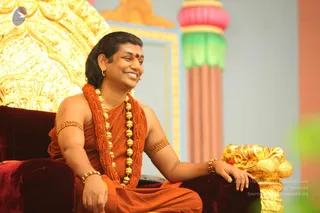
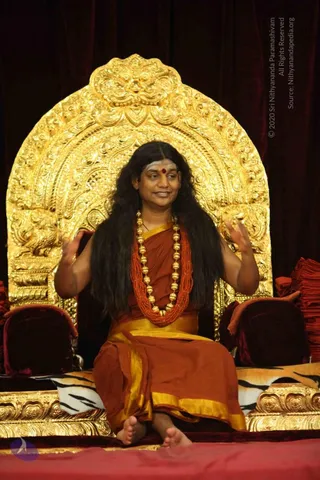
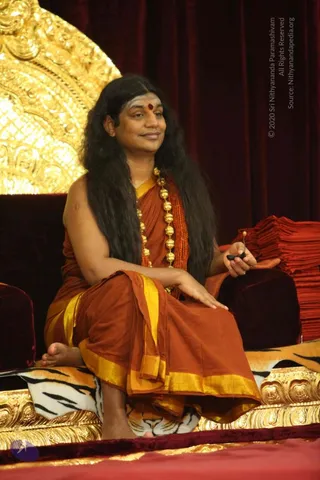
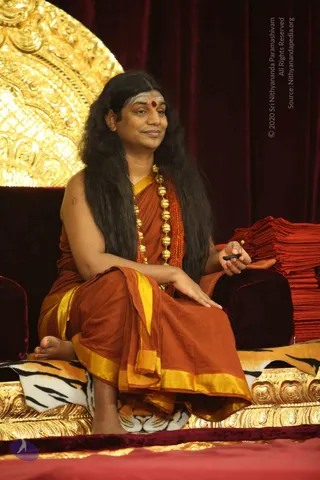
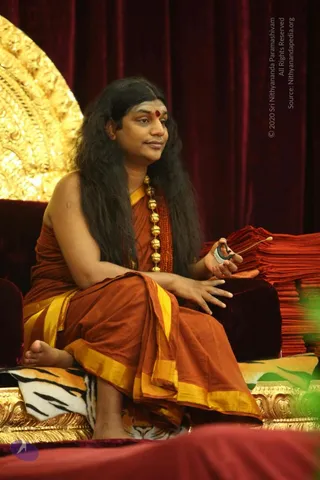
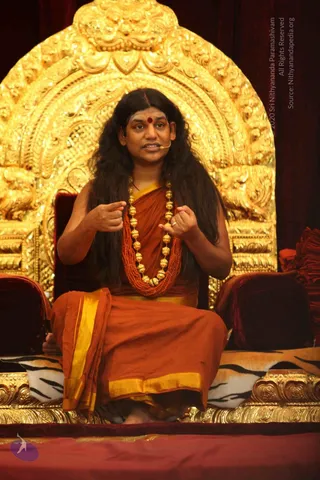
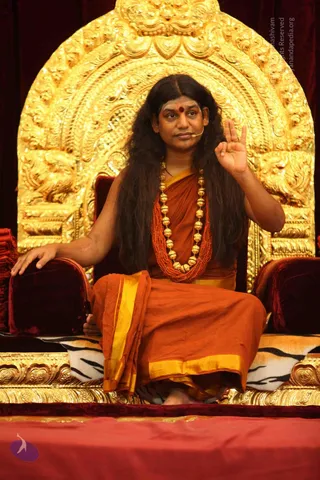
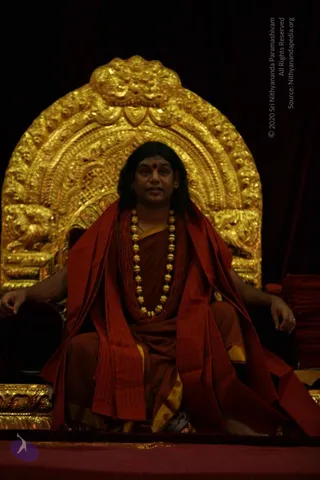
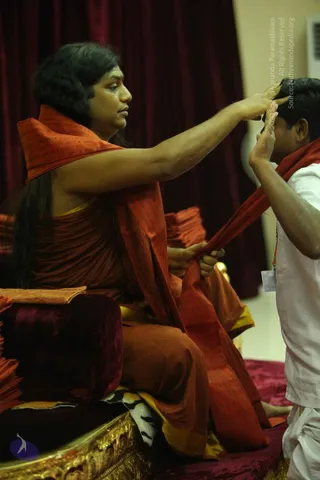
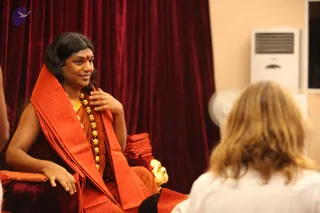
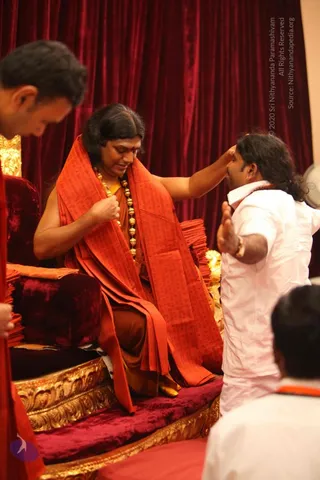
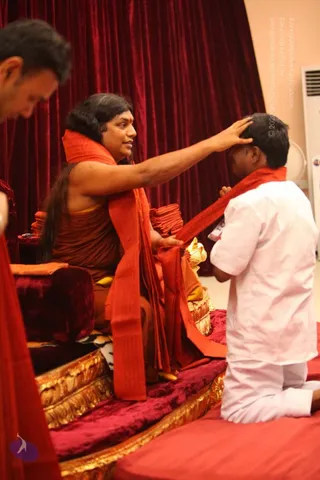
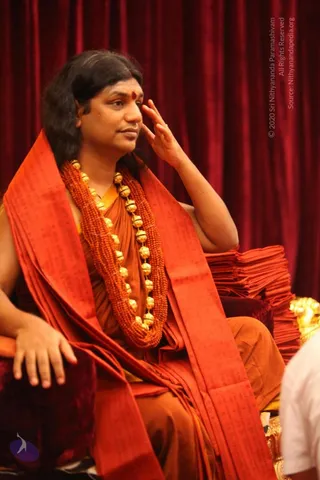
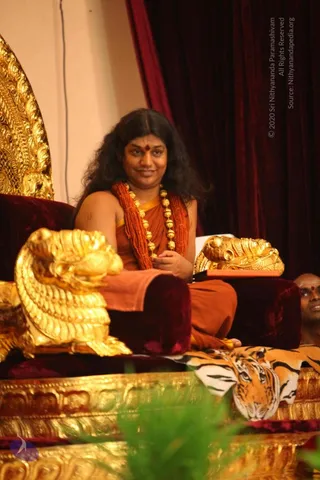
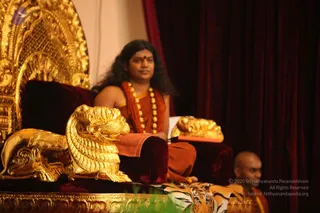
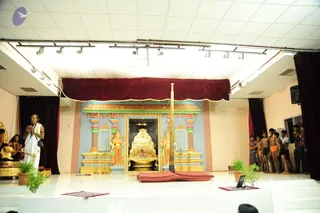
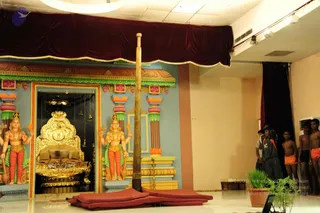
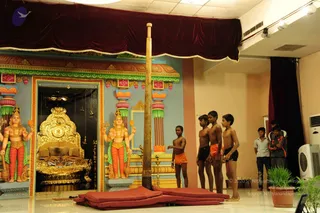
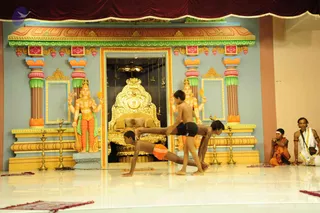
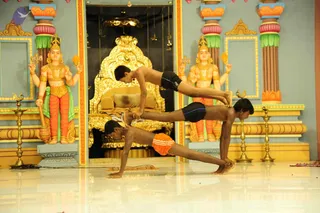
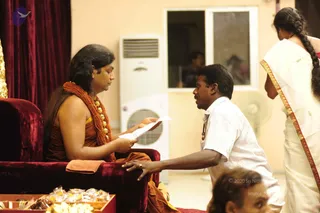
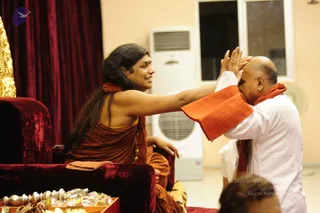
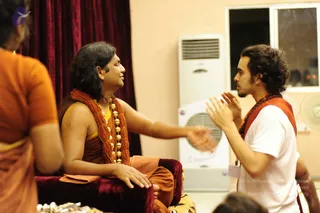
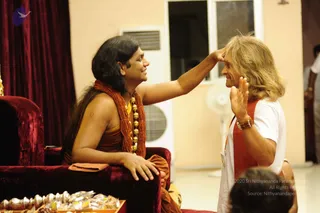
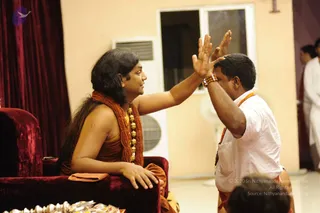
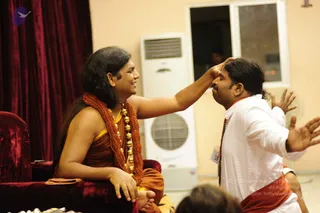
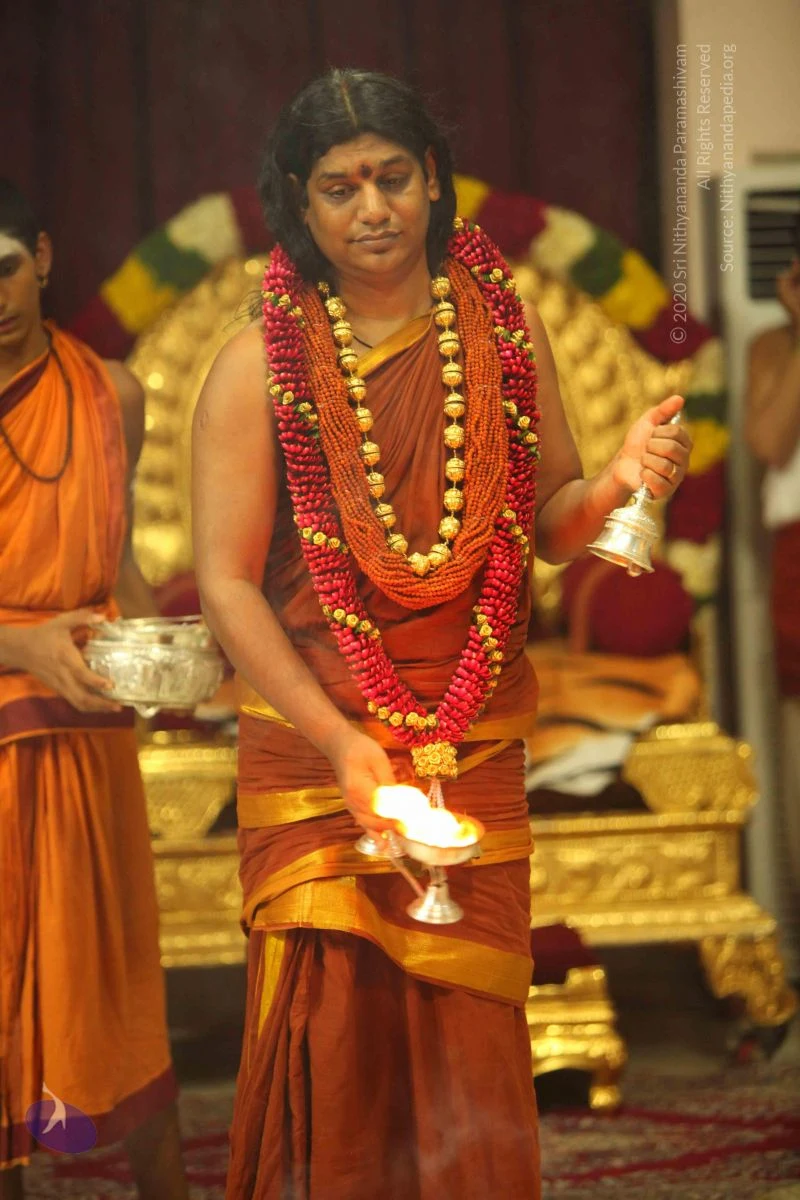
A seated figure with long dark hair, a red bindi and a saffron-orange wrap, wearing a multi-strand rudraksha mala with gold beads, smiles and gestures with his right hand toward a kneeling man in a white shirt and white dhoti. The kneeling man has a red-orange shawl draped over his shoulders and holds the saffron cloth of the seated figure. Red velvet drapes and a gold-carved throne form the backdrop. A man in a white garment with a red bindi and an armband sits at the right edge. The seated figure has long swept hair, distinctive saffron clothing and a rudraksha mala, which are appearance cues for the a person label. The page also places him at this event.A seated figure on an ornate golden throne with carved gilded lion-head armrests and a tiger-skin cloth draped over the platform. The person has long, dark, swept-back hair, wears a red bindi, a saffron-orange robe, and layered orange rudraksha beads with a gold bead necklace. Behind the throne hang deep red velvet curtains and a golden arched backrest. Swamiji (probable): the long hair, saffron robe, rudraksha malas, gold necklace and throne are the qualifying cues, and the person is physically present in the photograph.A young shirtless male performer in orange shorts balances horizontally on the top of a tall wooden pole inside a temple-style hall, his body extended in a stretched pose. Around the pole, several shirtless young men in orange and black shorts or dark tracksuits kneel and stand on red floor mats, watching and steadying the pole. A man in a white shirt and white dhoti stands at the right. Behind them a painted, multicoloured deity murti with four arms, a gold crown and orange dhoti stands beside a sanctum entrance hung with brass lamps. Maroon velvet drapery with gold fringe covers the upper wall and a gold throne-like chair is at the far left.

May 19 2013

Original wiki page
Contents

Title:

What is Inner Awakening Level - 1

Description:

In today’s morning satsang, Paramahamsa Nithyananda answers questions on his new programs. He explains Inner Awakening On and enPregnancy Care. He also instructs on how to maintain relationships with detractors of His teachings. We don’t want to give up on them, but we don’t want to entertain abuse so we should very strongly reply when bad things are spoken, so they will be silenced. Nithyananda also responds to the dilemma of how to tell our loved ones that we want sannyas, monastic life. This was Buddha’s quandary exactly. Nithyananda points out that we cannot hold ourselves back just to comfort the inauthenticity of others. No one will reach enlightenment if everyone resists: we should lead them forward. Finally, he reminds us to always look for a way to answer “Yes” to any question, no matter how impossible it may seem. When we take responsibility for every situation, we find the solution for it.

Link to Video:

VideoAudio

Transcript:

What is Inner Awakening Level -1

Part -1

I welcome you all with my love and respects. I welcome all the devotees, disciples, samagees, satsunges, sitting with us around the world. Today also I’ll continue to answer your questions and enlighten each one of you how to live the 4 principles. Before entering into the Satsang, I wanted to offer my heartfelt condolences to Ahobila Jeer Mahadesika MahaSwami of Srirangam. Swamji left the body today morning to the divine abode of Vaikuntha. A great sadhu. Very humble person. Learned sadhu. I have very sweet memories with him for his moral support, strength which he offered to us. While I did pada yatra all over south India, from kanyakumari to Bangalore, he personally accompanied me. Two full days he walked with me. And...Sadhu who feels so much for the suppressed class of Hindus. True to Ramanaja’s philosophy, he served the suppressed class and communities of Hindus. He was working sincerely, authentically to bring them back to the Hindu Tradition and the spiritual lifestyle. Such a simple sadhu. He was. His age was twice than mine but he did not his age or his post did not stop him recognizing me and revering me. Respecting me. So much of respect, reverence he showered on me. Today we got the information that he left the body. We offer our prayers to Ranganatha. Let him reside in Sameepya mukti. Let Ahobila Mutt Jeer mahadesika swami reside in Sameepya mukti in Vaikuntha. I also offer my prayers to Ranganatha. All his disciples and his followers and poorvashram family people. All of them. Let them all have the courage and energy to face the situation and come out of this sadness. A great sadhu. He was sick in deathbed. Today morning he left the body. I offer my condolences, prayers. We’ll enter into the Satsang now. Please put the questions.

Q: Today we have questions about the Inner Awakening Level II program. The first question is will the program be a daytime program or nighttime for the US participants? What is the time for the program in Pacific Standard time?

A: The program will be in nighttime for the US for all 10 days. The timing in Pacific Standard Time is 9:30 pm to 9:30 am Pacific Standard Time. In Indian Standard Time it will be morning til night. I can only say that 9:30 pm we will start. I don’t know what time we will end. Usually ending we can’t keep the time. If I give time I have to be integrated to it so beginning will be 9:30 pm Pacific Standard Time and it will end around 9:30 am Pacific Standard Time. It’ll be daytime in India and nighttime for America. Next question.

Ma Maneesha: I beg your pardon these questions are pertaining to the Inner Awakening Level 1 program not Level 2. These questions are regarding Inner Awakening Level 1 program.

Q: The second question is will the root pattern analysis be as effective as when it is done in the direct presence of Swamiji?

A: Please understand there are some things which will be very effective only in my presence. There are some things which can be done even without physical presence. Healer’s initiation. Still I have not found the method and I can’t initiate remote through 2 way video conferencing. Initiating you into Ananda Ghanda or the space of possibility. I don’t think I can do or it will be that effective through 2 way video conferencing but root pattern analysis and finding the root pattern can be done through 2 way video conferencing also. So I am very responsible when I make programs through 2 way video conferencing. I make sure the quality of the program is not compromised and it is not reduced. Only then I allow the 2 way video conferencing as a method, way to conduct the program. But anyway, please be very clear I am a responsible teacher. I will not compromise on the experience of the classes. And I also don’t need to restrict my presence to my 6 feet body. It is only center of my presence not end of my presence.

Q: The next question is who will be working directly with the participants on root pattern analyses?

A: I will be directly working. Only when it comes some debates, arguments which you will not do with me. I’ll have acharyas. Ma Maneesha or some other 1 or 2 teachers will be helping me. But otherwise the program itself will be directly conducted by me. Next.

Q: The next question. Swamiji has said 21 days is needed for transformation. Will significant transformation occur in 10 days?

A: As you yourself put the word, significant transformation will occur. 21 days will be best but there are so many people not able to do this.Taking off 21 days. I don’t want them to miss the transformation possibility. That is why the program for 10 days.

Q: The next question is Inner Awakening Level 1 a requirement for Inner Awakening Level 2 in the future? What will be the additional material covered in Inner Awakening Level 2 since 10 days of the program is already covered in Inner Awakening Level 1.

A: Please understand. I’m an ocean. I have not opened up everything in the Inner Awakening because of lack of time, lack of time. If you think that everything is told in the Inner Awakening Level 1 or Level 2 itself, it is wrong. All I wanted to you to understand, the Inner Awakening Level 2 will become more intense. More stronger spiritual experience than as it is now. It will be leading you to the deeper and deeper levels of your being. Please understand. Any conflict you have means either you don’t have right knowledge or you don’t know the right method to apply the knowledge. That’s all. If you are having even a single thought, conflicting thought, still the right knowledge is not given to you and the right method to apply the knowledge is not given to you. So til you are enlightened, it is my responsibility to go on expanding, expanding, expanding, and making you enlightened. So understand. So after the August Inner Awakening, I am going to make IA level 1 as a mandatory for Level 2. Til August Inner Awakening you can come directly also to IA Level 2. I’ll be conducting even this initial preliminary subjects. But after August, I’m going to make IA Level 1 as a mandatory for you to come to IA Level 2 so that in IA Level 2, I guarantee you space of positivity, possibility, leadership and enlightenment.

Q: The next question: What benefits can participants in IA level 1expect as compared to IA Level 2?

A: The question: What benefits can participants in IA Level 1 expect as compared to IA Level 2? Understand first thing in IA Level 1, I guarantee you will have completion with you and with others. You will learn the 4 Tattvas. You will be initiated into Swapoornatva self completion. Discovering your root pattern. Completion with others. All these 3 will happen. Completion with yourself and others will happen in Inner Awakening Level 1. Please understand 1 more thing. Finding a root pattern and completing with this with it literally gives you the new birth. That will happen in that Inner Awakening Level 1. In Inner Awakening Level 2, directly I will be introducing you to the space of positivity, possibility, leadership, and enlightenment.

Q: The next question is will the content of IA Level 1 be repeated in IA level 2? Is IA level 1 like a preparation for IA level 2?

A: Til August Inner Awakening, I’ll keep IA Level 2 as a program where even Level 1 but without level 1 you can come. Please listen. Til August Inner Awakening, even without level 1 you can come. But after the August Inner Awakening, the content will be different. You have to go through the Level 1 and then come to the Level 2. Til August Inner Awakening, I’ll keep the Level 2 as it is now the 21 day program as it is. You will have the whole material the whole introduction and the sessions content of level 1 Level 2 put together. After August Inner Awakening, Level 1 material will not be repeated. Level 1 processes will not be repeated in the Level 2. It will be totally different.

Q: The next question is what is the difference between IA Level 1 and IA Level 2 in terms of my effort and progress towards enlightenment?

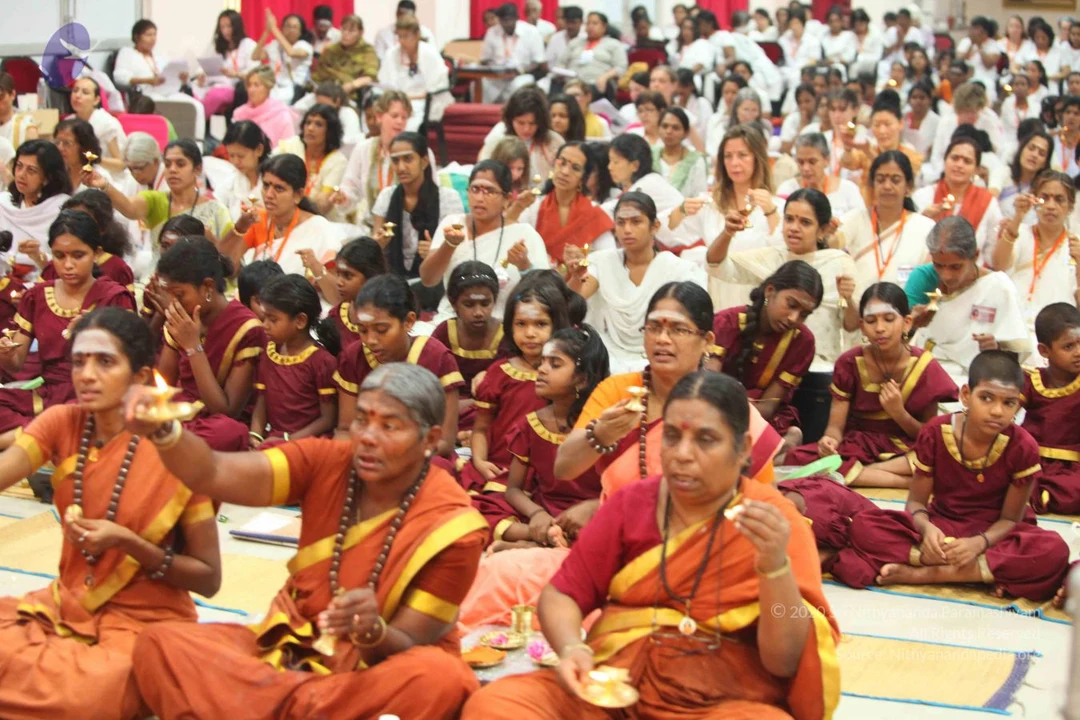
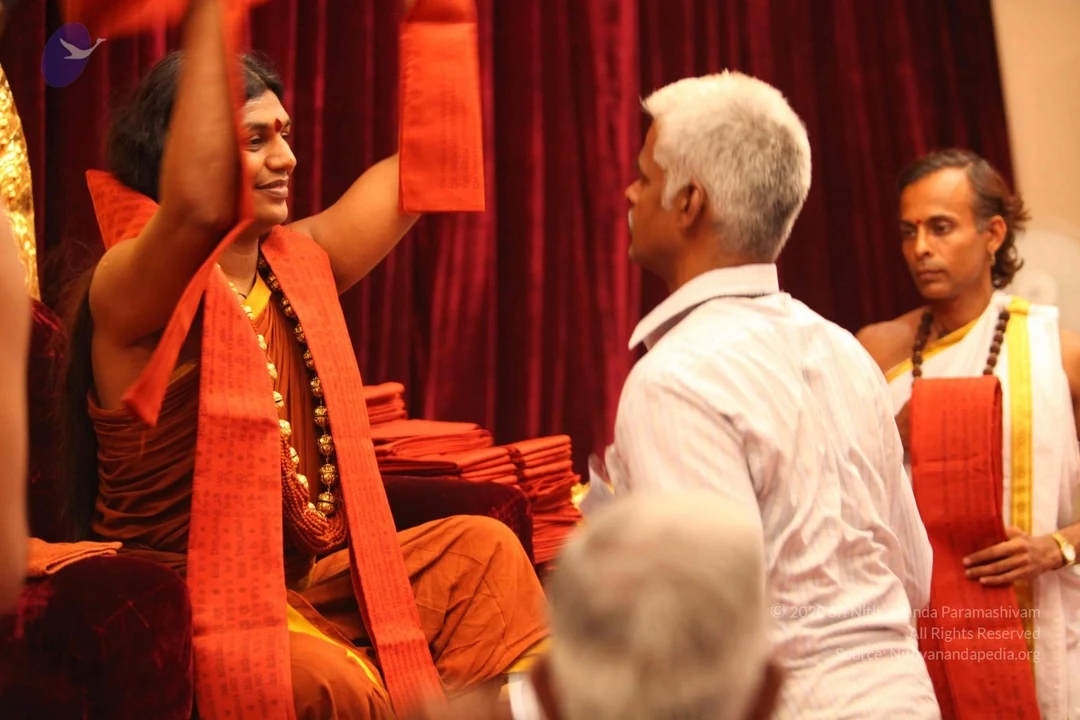
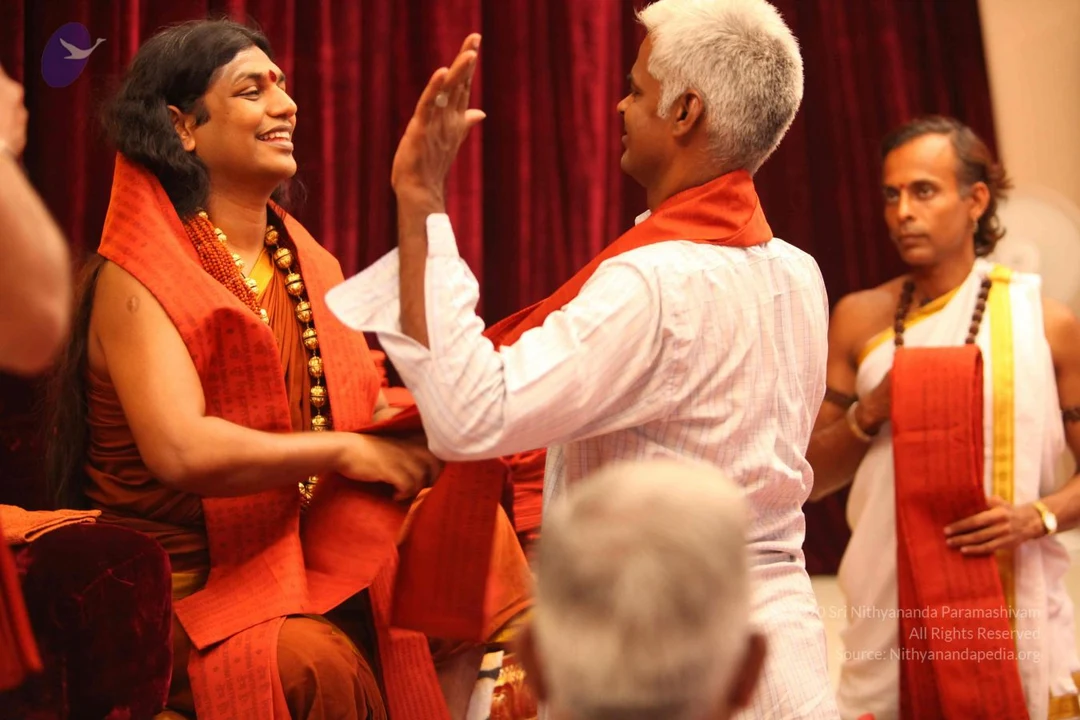
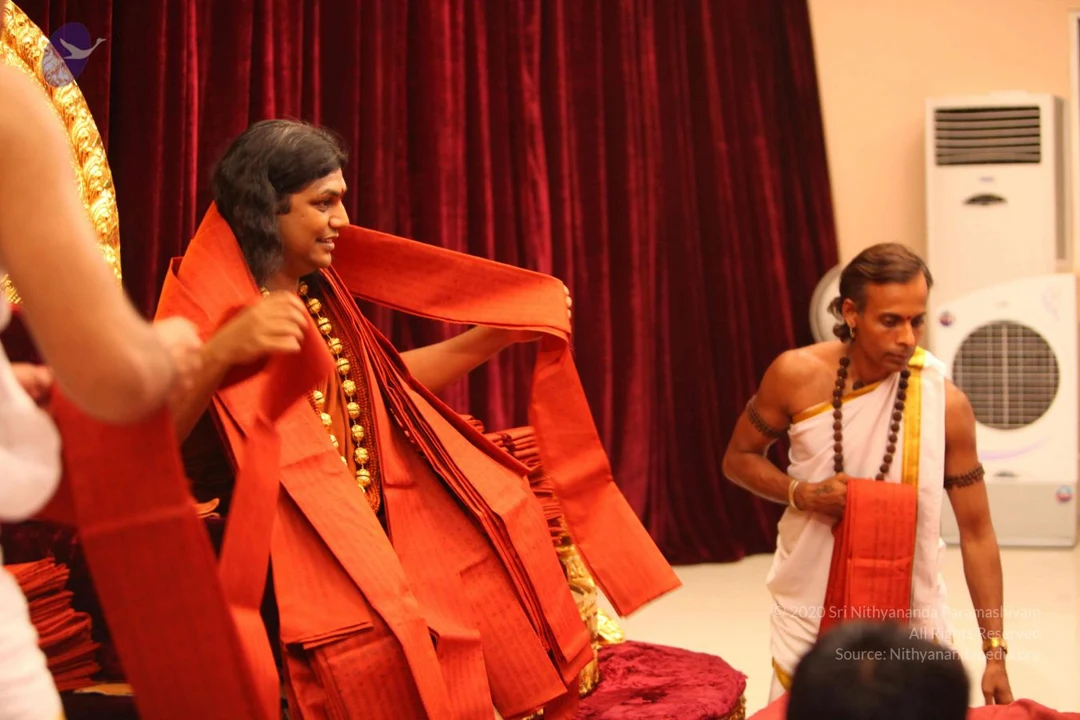
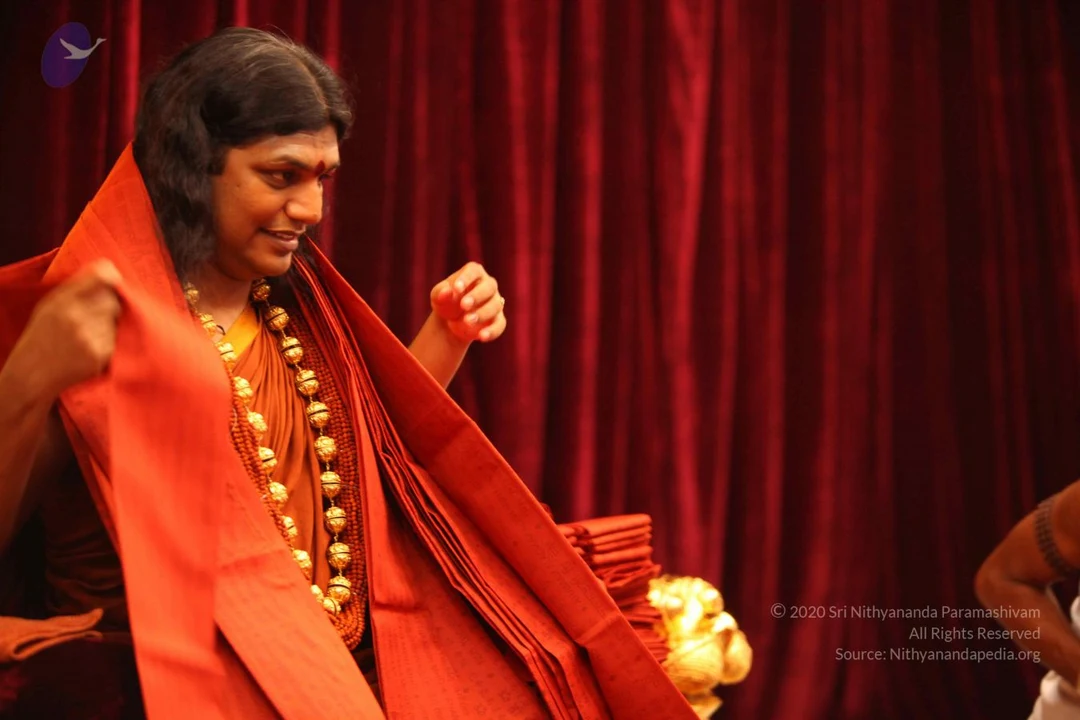
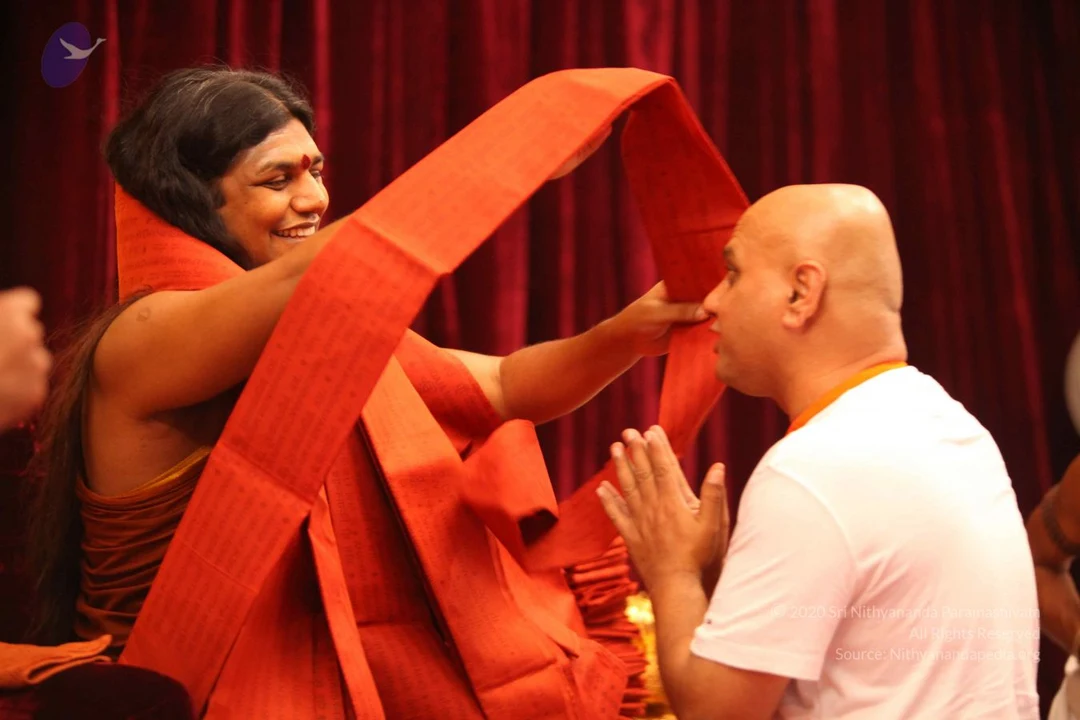
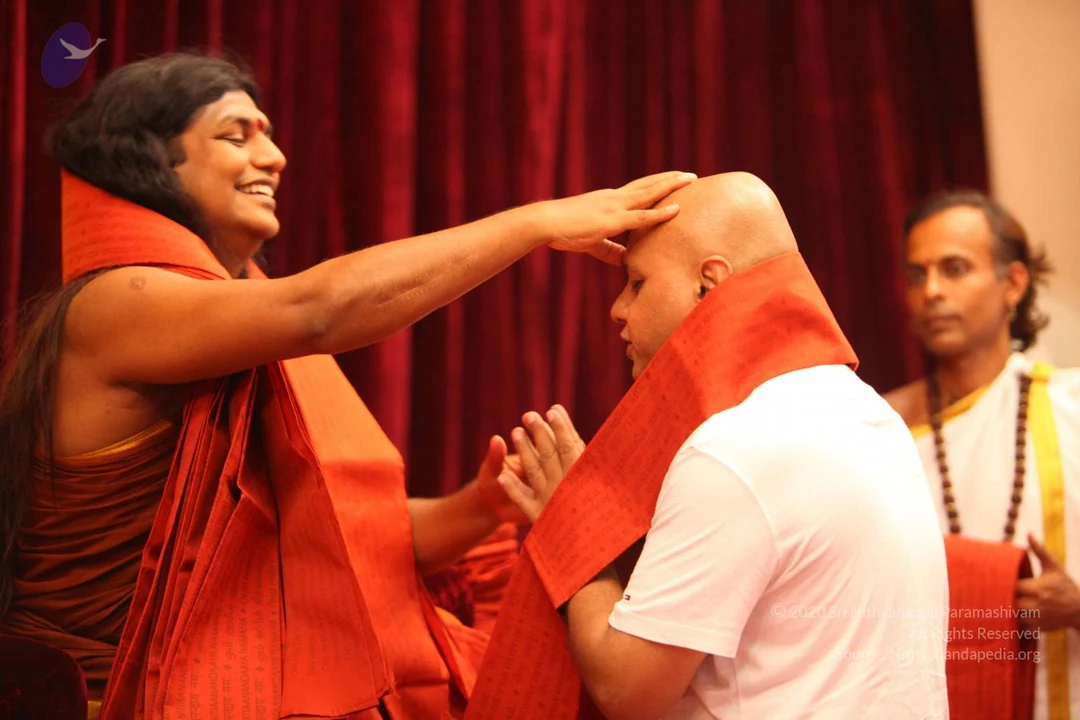
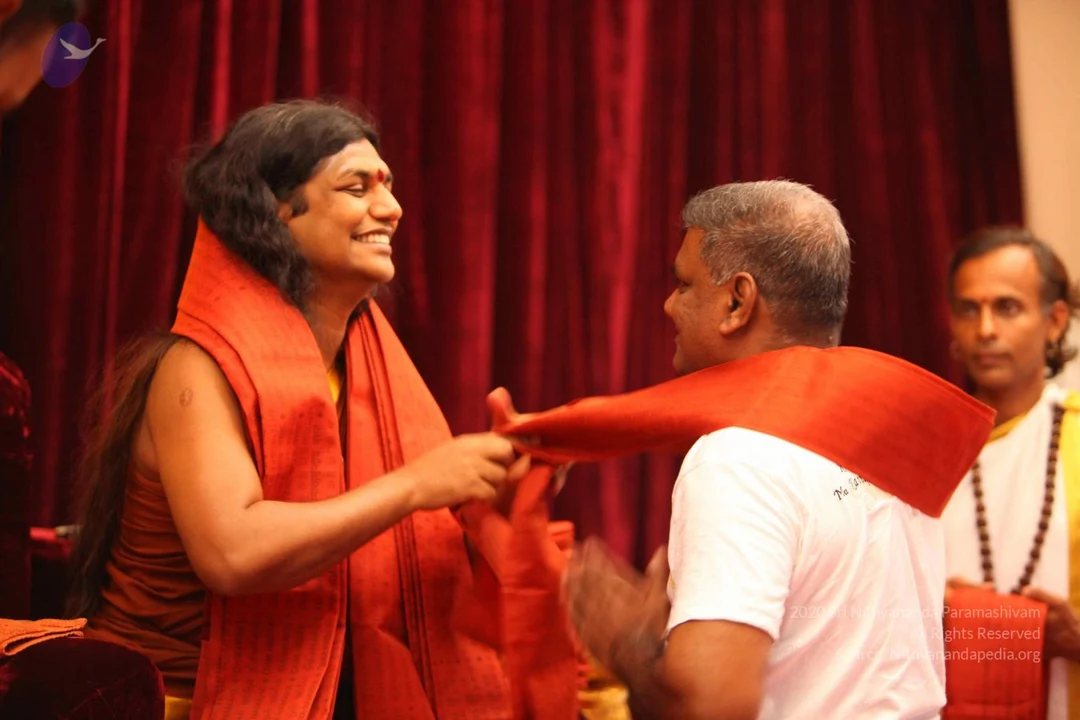
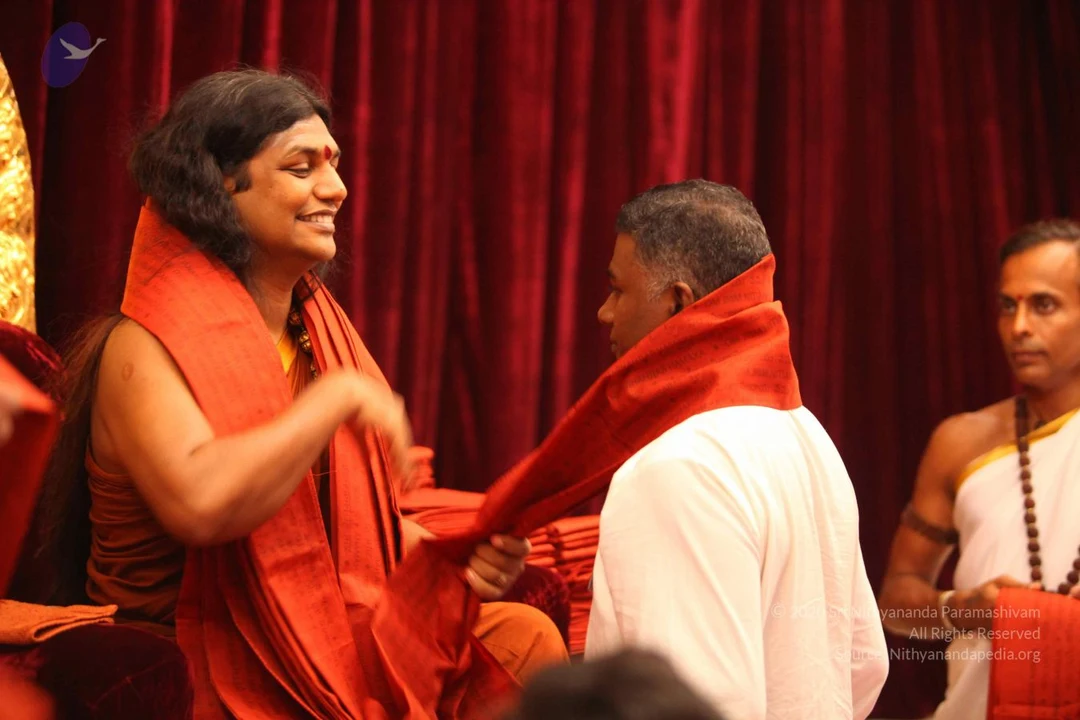
A: Please understand. By constantly the more and more time you spend with me the more and more time I spend with you, the more and more I make the process of your enlightenment easy for you. That’s all. It is just more and more time it is spent. More and more intelligence is shared. Energy is shared. Energy darshans happen. More and more you will experience the enlightenment. The more deeper the space of positivity, possibility, leadership, and enlightenment. Today you are going to have 2 energy darshans. Unclutching initiation one darshan where you will be given the tattva vastra. And then, regular energy darshan in the evening. Today you will be given temporary sanyaas. For next 10 days, you glimpse the sanyaas life. You glimpse the 5 vows of sanyaas as a possibility in your inner space. So from today actually we enter into the second level of Inner Awakening. Where we are going to work on the space of positivity, possibility, leadership, and enlightenment. We are going to work on creating the right space from today. Experientially, you will see what space you create becomes reality outside.

Part 2

How many of you earlier itself were creating a space for Sannyas inside? Raise your hand.

All your space only made yesterday’s Sannyas Webinar.

Understand. And, I was thinking I may initiate 100 people this Guru Poornima, into Sannyas. Now, I can see very clearly at least 250 people I am going to initiate into Sannyas this Guru Poornima.

Next Question.

Q: The next question is, will Swamiji be conducting all the sessions of Inner Awakening Level 1 via the 2-way video conferencing? Will I get the benefit of all the initiations via the 2-way video conferencing?

Swamiji: Yes. First thing: I will be literally conducting all the sessions, other than the few sessions where the debates and the arguments are required, where the interaction is required. Other than those few sessions, I will be conducting all the sessions personally and all the benefits of all the initiations will happen via 2-way also equally. Nothing less than the people who are attending physically.

Next question.

Question: The next question is, I don’t have all the money and time to attend Inner Awakening level 2 rightaway. Should I wait for the right time and do Inner Awakening level 2 or do you advice that I do Inner Awakening level 1 now, and postpone Inner Awakening level 2?

Swamiji: I tell you. Attend the Inner Awakening level 1; then your pattern of postponing will drop. You will be in the next Inner Awakening level 2. Okay?

So, be very clear. Inner Awakening level 1 will remove your postponing procrastination pattern and remove the poverty pattern. You will attract wealth and time. You will manifest Inner Awakening level 2 immediately within few months.

Yes.

Next question.

Question: The next question is from Inner Awakening ID no. 255, Ramesh, who is asking, ‘Dear Swamiji, how and when can we introduce the four tattvas to our kids between the age group of 2 years and 7 years?

Swamiji: Ramesh, 255. Please be seated.

He is asking – how and when can we introduce the four tattvas to our kids between age group of 2 and 7..

Understand, the kids should be introduced to the four tattvas before they start their root patterns, before the accident of powerlessness is experienced by them, they should know about 4 tattvas, so that they never get into the root pattern at all.

Ramakrishna says beautifully, there is a bird called Paramahamsa. It flies high above the sky. All the birds, if they have habit of flying at 100 feet, this Paramahamsa flies around 8000 or 9000 feet high.

You may think, how can a bird fly that high! Whether you call it as mythical or whatever, but there is a faith about this Paramahamsa, and one more thing.. All birds create nests to protect them from the rain. Paramahamsas fly above the cloud and protect themselves from the rain. So, this Paramahamsas.. they will lay the egg from above in the sky. The egg, half-way it will hatch and three-fourth way, the chicken will have the wings, the bird will have wings and before even it hits the ground, it will just start flying back towards its mother.

Same way, all our kids are Paramahamsas. Only when the root pattern starts, they hit the ground. If you teach them the four tattvas, before even they hit the ground, they will fly back to the original Paramahamsa. Help the kids by teaching four tattvas to them before even the root pattern starts in them. If you can’t teach, bring them to eN-Genius, I‘ll teach! I’ll take the responsibility.

If you have done the program, if you are initiated into the tattvas, you can start teaching to the kids in a very simple way, these four principles. I am also coming up with more and more books and visual material for teaching the kids about the four tattvas. Soon, I will have the play cards, coloring books, the different different different methodology to teach four tattvas to gurukul kids; and I am also planning to have a webinar for kids, inviting them and introducing Krama Brahmacharya to them. The webinar will be for parents and kids, both; answering different questions of Krama Brahmacharya by the Krama Brahmacharis and Brahmacharinis. It will be conducted by the Krama Brahmacharis and Brahmacharinis. They will be answering your questions and I tell you, I assure you guys, it will be more interesting than the webinar conducted by my Swamis and Swaminis. That much I can assure. It will be more inspiring and impressive than the webinar conducted by my Swamis and Swaminis.

So, understand.. Introducing four tattvas to the kids before they start growing the root pattern, is the best way, like Ramakrishna says – making them Paramahamsas. They will just fly back to the original space and live an enlightened life. They will be the greatest blessing for you and to the world. No, I can see very clearly, there are different levels of people who take Sannyas – one, the kids who never started having root patterns; when they take Sannyas, they radiate. Not only Sannyas, even in their life, they will be such a successful enlightened being. And then, the people who have seen all the wealth and seen enough of the West and East, the outer world luxury and the inner world possibility – they taking Sannyas. That is why you see so many Malaysians come for Sannyas. Malaysia is the country where everything of the West and everything of the East, both are available. All the best things of the East – still the family tradition, Indian traditions, spiritual tradition, all the teachings, everything is available and all the infrastructure of the West is available. They have seen everything – dating, boyfriends, girlfriends, everything they saw. They are done with it. That is why yesterday, in the hundred applications, around 40 are from Malaysia. Around 40 are from Malaysia. They have finished seeing everything. Now it is time to explore the inner world possibilities. I also wanted to tell you, you need not wait till your child is 2 years old. When you are carrying your child, enroll into eN-pregnancy care program. Right from the womb, your child will be initiated into the four tattvas. And now, it is conducted by my disciple doctors. Very soon, it will be conducted by my Sannyasini doctors. Now, the eN-pregnancy care is running conducted by my disciple doctors. Very soon, it will be conducted by Sannyasini doctors. See, I tell you, even planning for your pregnancy, do it with the guidance of four tattvas.

10-20 min

Both of you practice Integrity, Authenticity, Responsibility, Enriching for 3 months authentically. After that plan for pregnancy, so that you bring enlightened beings, Incarnations to planet earth. I have reports from my eN-pregnancy care team that the children are born smiling in chin mudra when parents have taken the eN-pregnancy program. So I tell you, this pregnancy care program is such powerful program even before they assume the body, their bio memory, muscle memory everything is initiated into 4 tattvas. Once I have some of the doctors taking sannyas, I also commit with you guys I will build the child delivery hospital here. We will have a cosmic airport here. For the divine souls to land. It is not only they were waiting to take sannyas, even I was waiting personally for them to take sannyas. Because I was waiting when to build the hospital. See now people have given enough money to build the hospital, but I need people to take care, run it. Hospital is not a building; it is the people to make the hospital a hospital. So soon you can expect cosmic airport happening in Bidadi. Write to, if you want to know more details write to [email protected].

Question: Next question. The next question this is the devotee who is asking can you please share the dates of the Inner awakening level 1 program.

Swamiji: The first inner awakening level 1 program is going to happen June 8th to June 17th, the next month. June 8th to June 17th . It will happen in bidadi physically and through 2-way video conferencing also.

Question: Next question. The next question is from Inner awakening id no. 8 Mathur, who is asking swamiji not giving on people how does this tie with what we learnt few days back about not being in the presence of the people when they are being critical of Swamiji and the sangha. Should we continue that relationship?

Swamiji: First thing, please understand, Mathur nice question! ‘Swamiji not giving up on people how does this tie with what we learnt few days back about not being in the presence of the people when they are being critical of swamiji and sangha should we continue that relationship. Please listen don’t give up on them but don’t allow them to be critical about swami or sangha if they utter one world give a long explanation they will be simply shut. Continue to have the relationship so that the time that they spend with you they will not criticize me and the sangha. They will be keeping quiet. Understand what I am saying. If you give a strong answers, they will simply keep quiet. You don’t need to give up on them; give them strong answers logical answers. Integrated, authentic answers, then naturally either they will be convinced cleared or at least they will stop criticizing. They will stop abusing. So don’t give up on them. So don’t give up on them, but give a strong reply. Strong means, really really strong reply. Next.

Question: The next question is again on the similar lines id no. 91 claries lan, who is saying - dear swamiji, can you please explain the actions you would take to not giving up on people who are physically and emotionally abusing you?

Swamiji: Claries lan id no. 91. ‘Can you please explain the actions you would take to not giving up on people who are physically and emotionally abusing you’.

Don’t you see my whole life is that only. My whole life is that only. Continuously working, working, working. Even when kalabairava says there is no prayachita for the Guru droha, when they come and tell me ‘oh I abused you, how can I come out of this karma?’, I tell them ‘take the responsibility, I will support you to come out of the karma.’

Understand, continuously teaching, raising their consciousness to go through even if there is some karma comes due to the abusal of Guru, so that they will not fall into the rut of karma, they will be out of that karma and live Enlightened life. Sometimes, when you get the bad karma due to the bad action, you get so depressed and you will give up on you, and continue to do more bad actions. At least I take care that does not happen. That they are protected and raised, they go through that process and they are raised. And there are 100’s of things which I continue to do. I can say that whole life whatever I am doing is nothing but the actions not to give up on people.

Next.

The next question is from id no. 260 Ansuman singh who is saying, ‘dear swamiji what happens in the inner space of an incardination when he meets his detractor’s how can we take responsibility for enriching the detractors of swamiji and change the reality how they peruse you?’

Swamiji: Ansuhman, in the inner space of an incarnation there is nothing happens he continues to be in the space of joy, peace, bliss and enlightenment. In his inner space nothing happens! You should ask what happens to the inner space of the detractors when they meet an incarnation!

They shiver, terrorized, literally devastated. So you are asking - how can I take the responsibility of enriching even the detractors of Swamiji and change the reality of how they perceive you. Take the responsibility of reaching out to them and making them understand the power of your responsibility. Your authenticity, your integrity can make them look their inauthenticity, their lack of integrity and their irresponsibility. Next.

The next question is from id no. 88..

Swamiji: Before that we have a picture of a recent en-pregnancy care baby who was born and as you can see smiling at birth. See the child was smiling at birth without crying, after the mother went through the en-pregnancy program. Immediately after birth.. this picture is immediately after birth. See the smile of the mother and the child. Unheard of the baby can smile after the birth without crying! Beautiful!

Question: The next question from the inner awakening id no. 88 Camas he is asking what is the difference of getting enlightenment when we are alive v/s when we are dead?

Swamiji: Camas no.88 she is asking it is like what is the difference between enlighten when you are alive v/s when we are dead. What is the difference between drinking the nectar now drinking the nectar after when you are dead, in heaven? It is nothing but postponing. Why do you want to wait till you die and reach the heaven? The supply is available now, the world does not know still it is the secret. Come on start drinking now… here I am - the wholesale agent it is available here. When it is available here, why are you waiting for it, for drinking the nectar till death and then going to heaven and then you will have it. No. Enlightenment can be lived here now while you are in the body, while you are in the body.

Next.

20 min to end

Question: Next question is from ID # 45 Ananda France.

I am that kind of person, who doesn’t give up on anyone and wants everyone to be happy, to evolve and be fulfilled.I am thinking of being a Sanyasini and see that some people in my life would feel that I am giving up on them when I take this decision. My question is how to reach the true compassion – being able to what is completely right for me and others and how to solve this paradox that I am not giving up when others think I do and find the words to convey this to them?

Swamiji: Ananda France, You are exactly in the position Buddha was in. Can you say Buddha gave up on Yashodhara and Rahul? LISTEN!

This giving up has to be understood. Very deeply. You dn’t need to satisfy their in-authenticity in the name of not giving up on them. Sometime you associate their inauthenticity as them because they also see themselves so strongly with their inauthenticity. For Yashodhara, if Buddha would have stayed with her and ruled the kingdom, not even the kingdom, it’s a small zameen. When you study history and geography properly, then you understand those days 54 deshas. All 54 deshas are nothing, not even one desha was bigger than one city of modern day. Whole population. See the while population of Madurai was only 1 crore when Meenakshi was ruling. The whole Pandya kingdom population. 1 crore – it means what? Less than Chennai, Chennai population. So you need to know, Yashodhara would have been very happy, if Buddha stayed back and ruled that small zameen. But would that have been authenticity of Buddha. NO.NO. I tell you, you need to see, you should not give up on people’s authenticity side. Not that you will give up on you because of their in authenticity side. If Buddha stayed back for the sake of yashodhara not to give up on Yashodhara as Yashodhara feels, Rahul as Rahul feels, he would have given up on himself. And I tell you the life would have been a big fight and mess. Buddha would have been cursing Yasodhara and Rahul for destroying his life and making their life also hell.

How many of you cognize what I am saying?

I am seeing a unique kind of a silence on every being due to the fear of facing their own in- authenticity. Actually, whatever was shared in the Sannyas webinar, it is not that I am attesting everything all the ideas, but I allowed all those words to be uttered to face your own in- authenticity. LISTEN!

All the people who asked Sannyas yesterday, all the 100 I am not going to give. But whoever asked already took the courage to face their inauthenticities. Now, even if they don’t take Sannyas, I tell you, I guarantee, they will be at least 10 times more in their plane of authenticity than others who did not say….... I tell you, even if all the 310 of you would have said yes, it is not that I will give the Kavi immediately. No. Be very clear, I will take my own time and I have a big, my spy wing.. Kalabhairava site assistants , and security wing, Kalabhairava, Veerabhara. They will make sure you don’t get the train and the flight ticket. UNDERSTAND. If you are not qualified, they make sure you miss the flight! Just from Hyderabad you can’t come here. I tell you. So, it is not that even if you want, you get it immediately. But if you want, only one thing will happen - Sannyas is like pure integrity, authenticity, responsibility and enriching. Eveything which is stopping you being authentic, all your inauthenticity patterns, you would have faced. You will be standing frightened in front of your inauthenticity. You will be shaken standing in front of your inauthenticities. So whoever jumped saying ‘Yes’ for sanyas, it is not that all of you are going to get it immediately or all of you are not going to get it immediately. It is based on your ability to take your responsibility and your integrity, authenticity and responsibility and the way you are able to complete with all the commitments and your capability to take the responsibility. Based on that, you will receive. That is different. But when you took the jump, you will face all your inauthenticities, all your inauthenticities. Few people told me, No Swamiji, I did not take it that seriously yesterday, that’s why I kept quiet. Otherwise I was waiting to jump. If you are not taking seriously means, what do you mean? Then 11 sanyasis and me are all sitting and playing a game or what there!? So, Ananda France, you are exactly in the same space as Buddha, when he was in the space of Siddartha. Now you know what to do. If you want to become Buddha, do what Buddha did. I will not give you ‘if not’ or other option!

Question: Next question is from IA# 170 Vasanthi. Who is saying I am very clear to practice the 4 Tattvas and enrich my students in our study area. I would like to know how this enriching can help me in raising my consciousness in the spiritual plane also?

Swamiji: It’s a beautiful question.

First thing. Take the training for en-Vidyalaya teacher. We have the training available, so take the training start teaching enriching kids in the 4 Tattvas. I tell you. When you enrich the kids with 4 Tattvas, you will see the amount of their authenticity, you will feel shy and you will know how you are in-authentic, feeling shy will make you authentic. Who ever sees my Gurukul kids will become authentic, just because of the strength of the Gurukul kids. When you enrich kids with integrity, authenticity, responsibility and enriching you will again and again talking about it, you will be living it, you will be practicing it. I tell you, the amount of time, energy, and time you take, it cannot happen, it cannot happen, same only it takes to for you to repeat, it will happen, it will happen, I am doing it. Both are one and the same. You want you need same amount of energy only for both. Because you are habituated to say no, you think that is the easiest path, which is wrong. Which is not right? Getting it. How many of you are getting it. Yes. So, your attitude of not going to happen or going to happen, is one and the same. It needs only same amount of energy. Move to the space of possibility. Yes. Yes. Yes..from impossibility. While you teach the kids, you will easily see how the kids will move to the space of possibility so easily and simply you will also move to the space of possibility that easily.

Photos From The Day:
Link to Video:

Tags:

Paramahamsa Nithyananda, Inner Awakening One, enPregnancy Care, relationship, entertain, love, Buddha, comfort, enlightenment, lead, answer, responsibility.

Photos Of The Day:

PADA-POOJA
NITHYA-SATSANG

SARVA-DARSHAN

TEMPLE

INNER-AWAKENING-SESSION-UNCLUTCING-INITIATION-BY-HDH

DARSHAN-AND-INITIATION-INTO-UNCLUTCHING

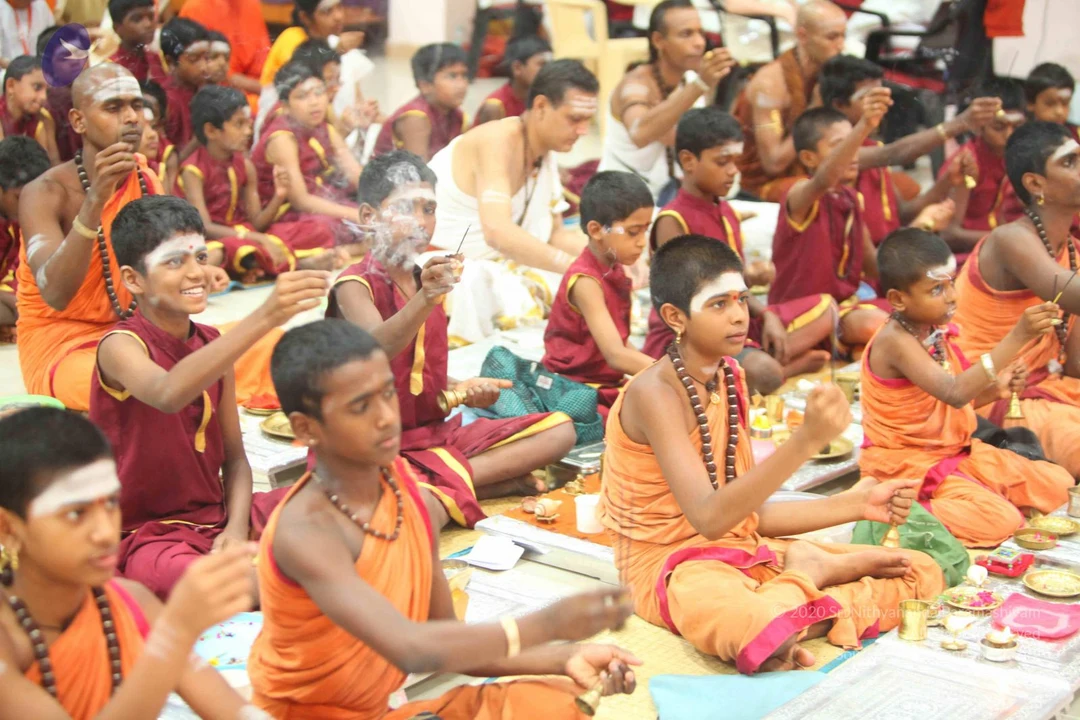
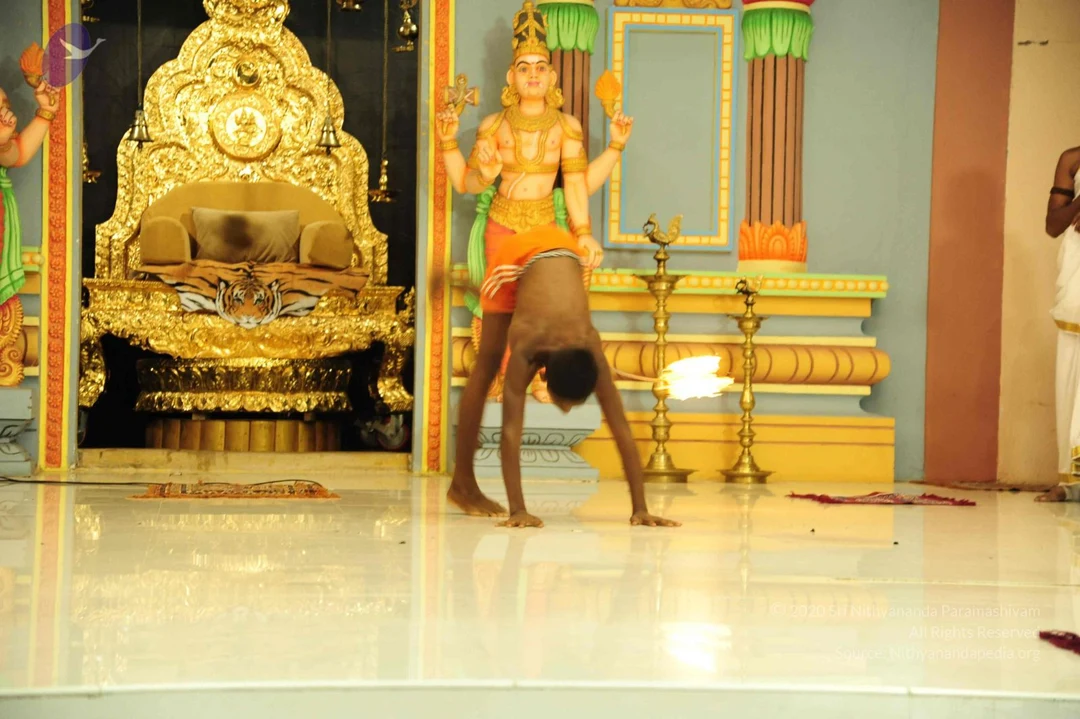
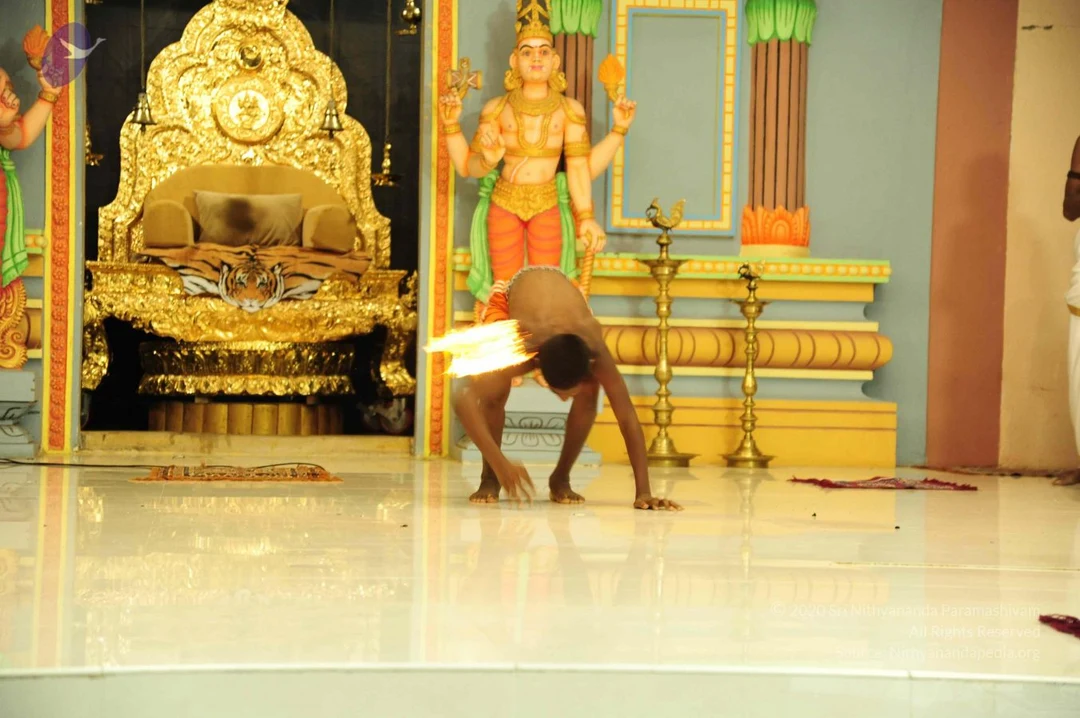
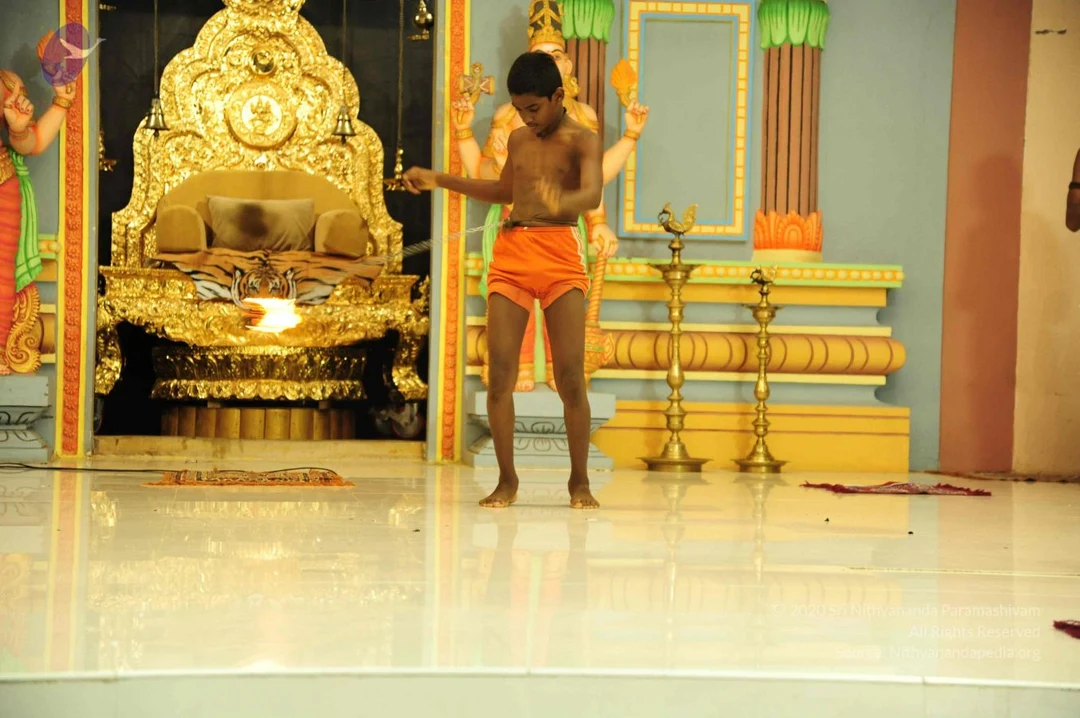
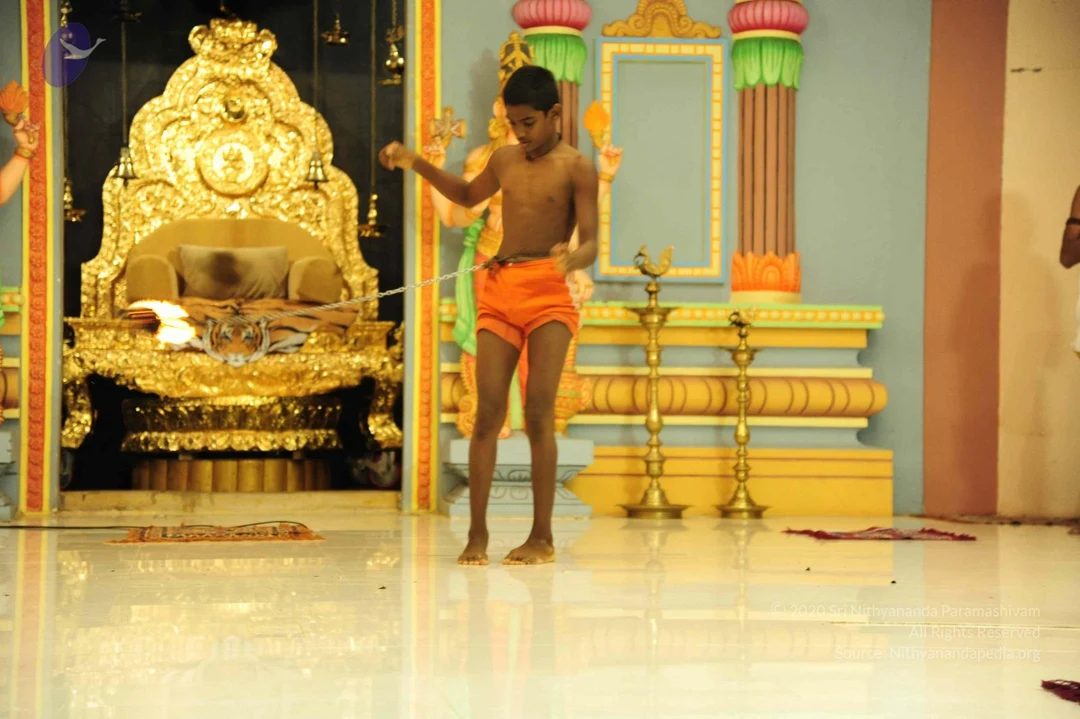
GURUKUL-KIDS-POWER-DEMO

SHIVASTHAMBA-YOGA-BY-GURUKUL-BALASANTS

YOGA-BY-GURUKUL-BALASANTS

DARSHAN

NAVAGRAHA-HOMA

KALPATARU-PROGRAM

1-Pada-Puja-Morning-Message

Photos from this day

View all 843 photos

PADA-POOJA
36 photosSource gallery
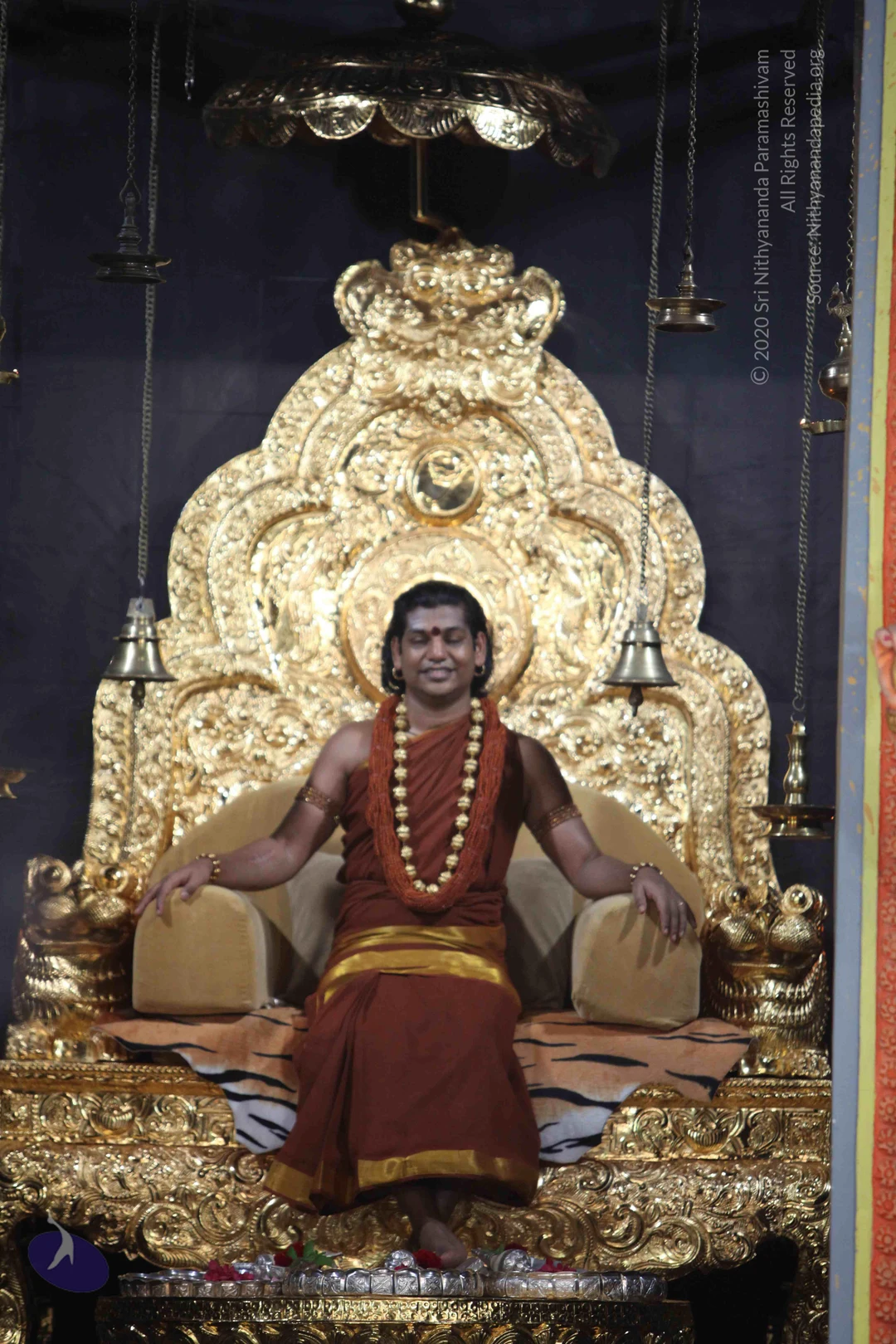
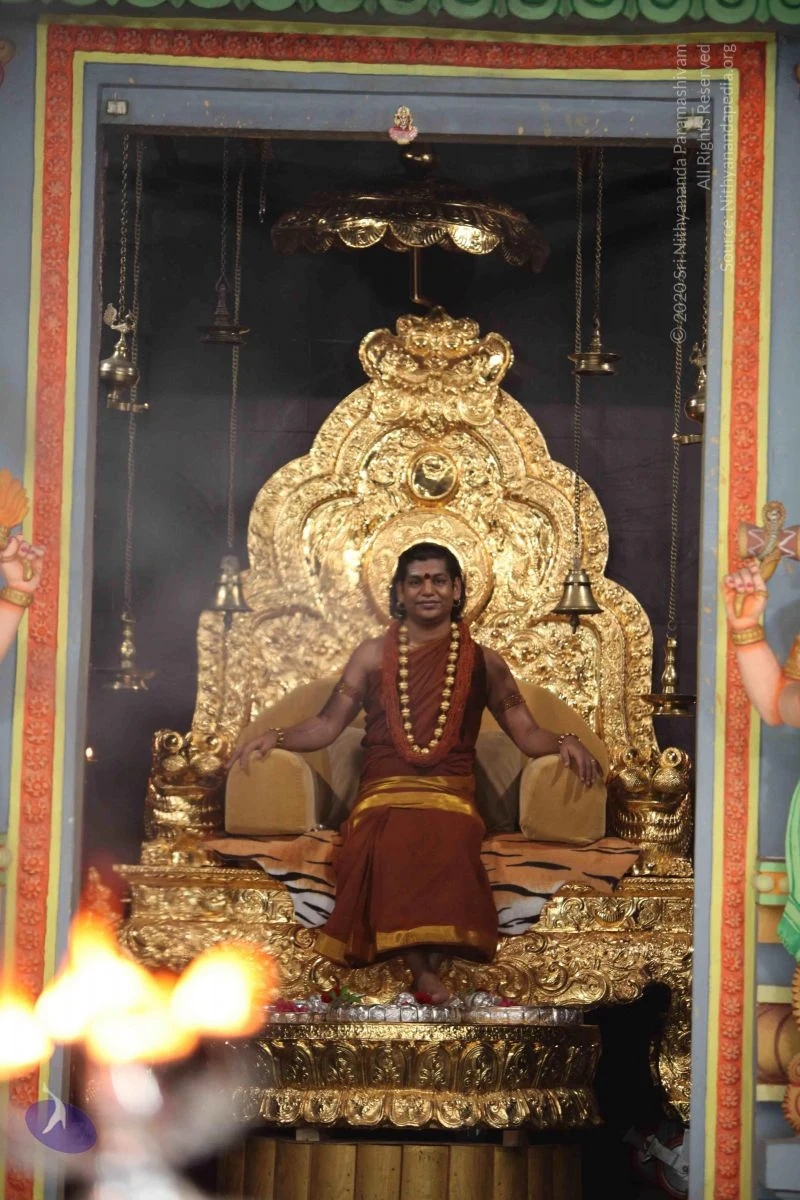
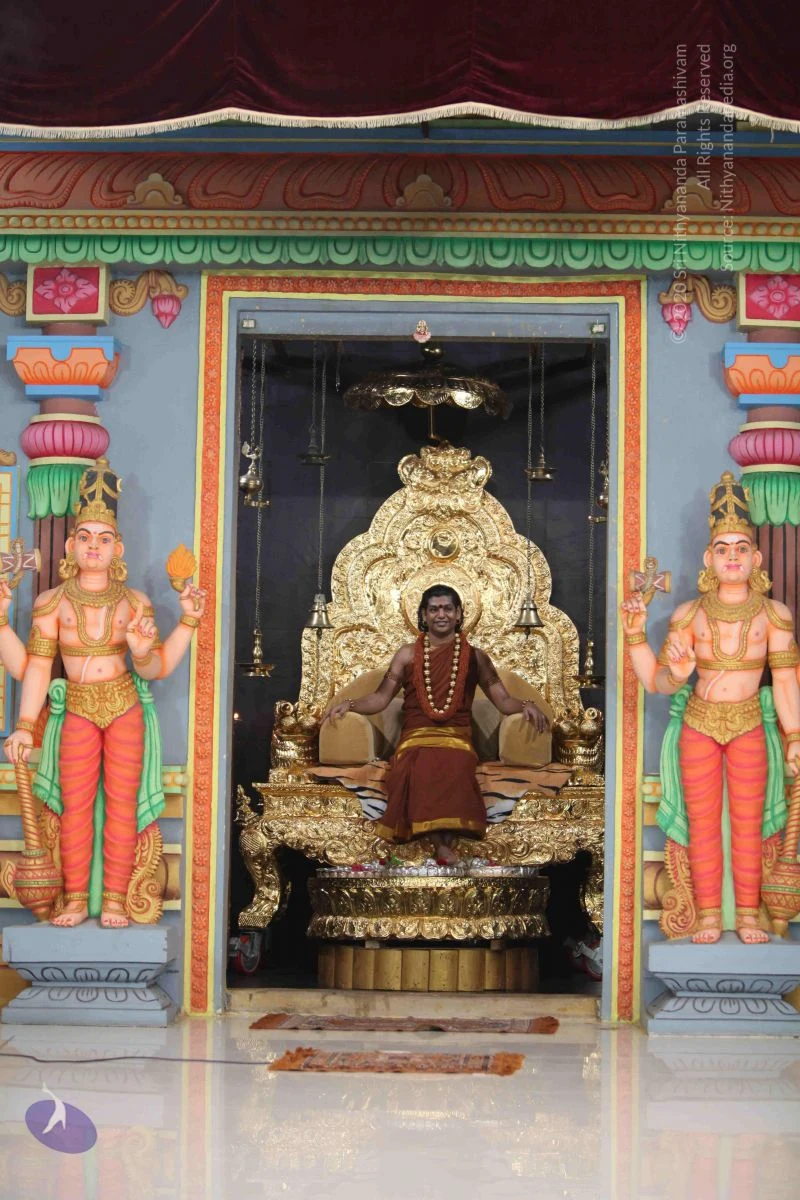
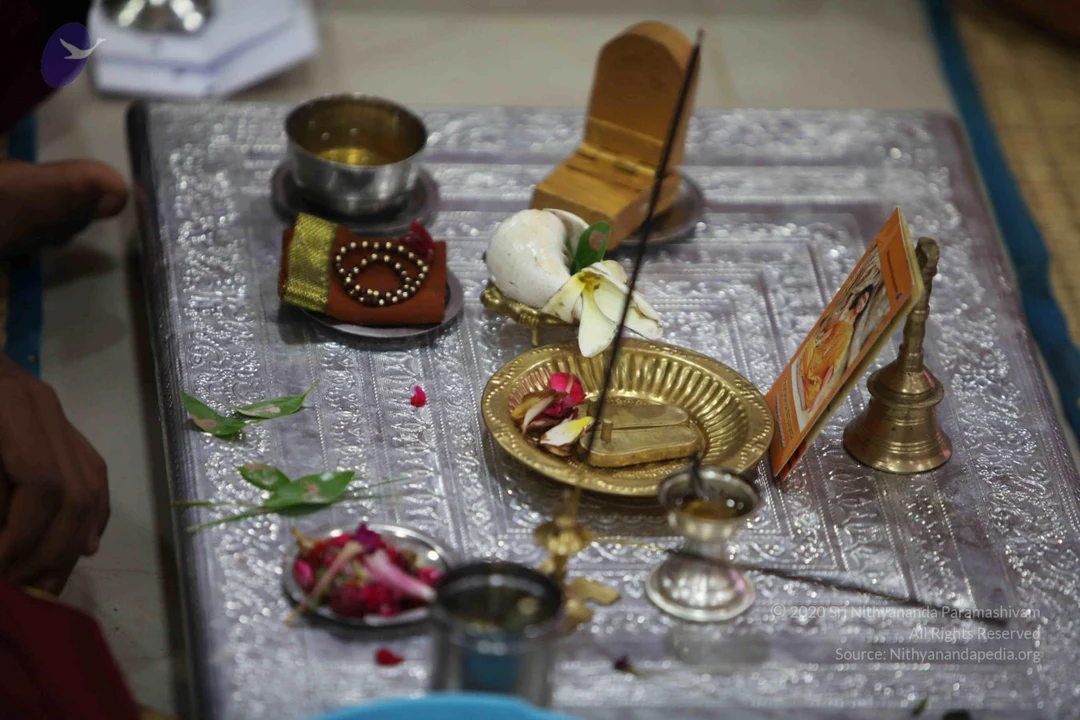
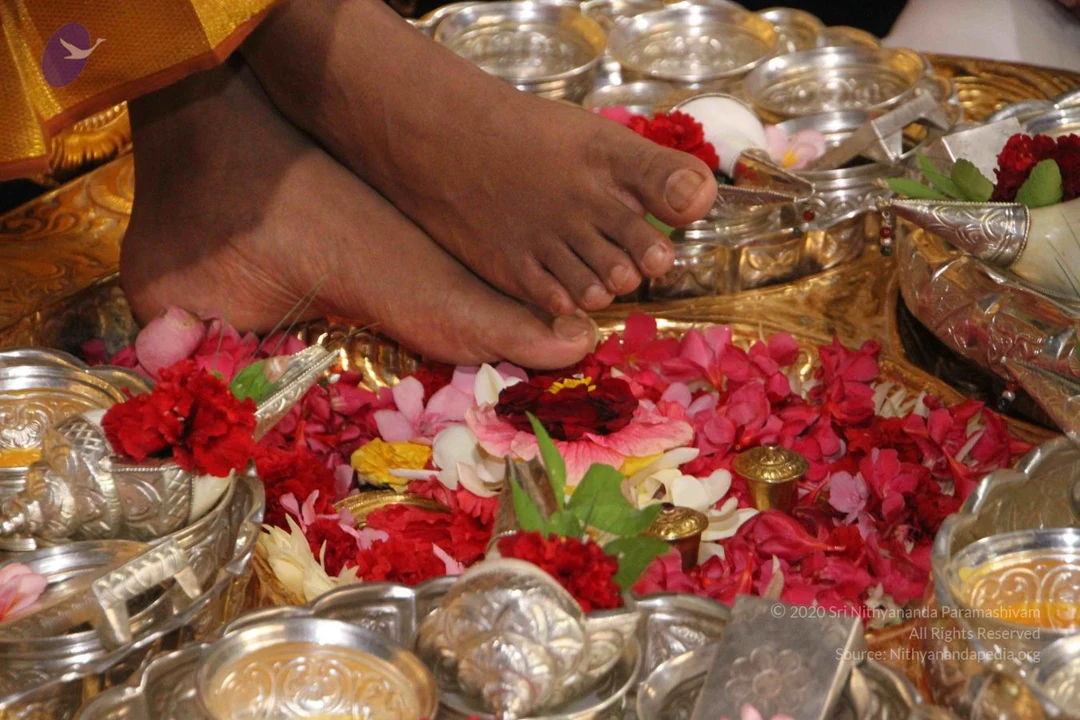
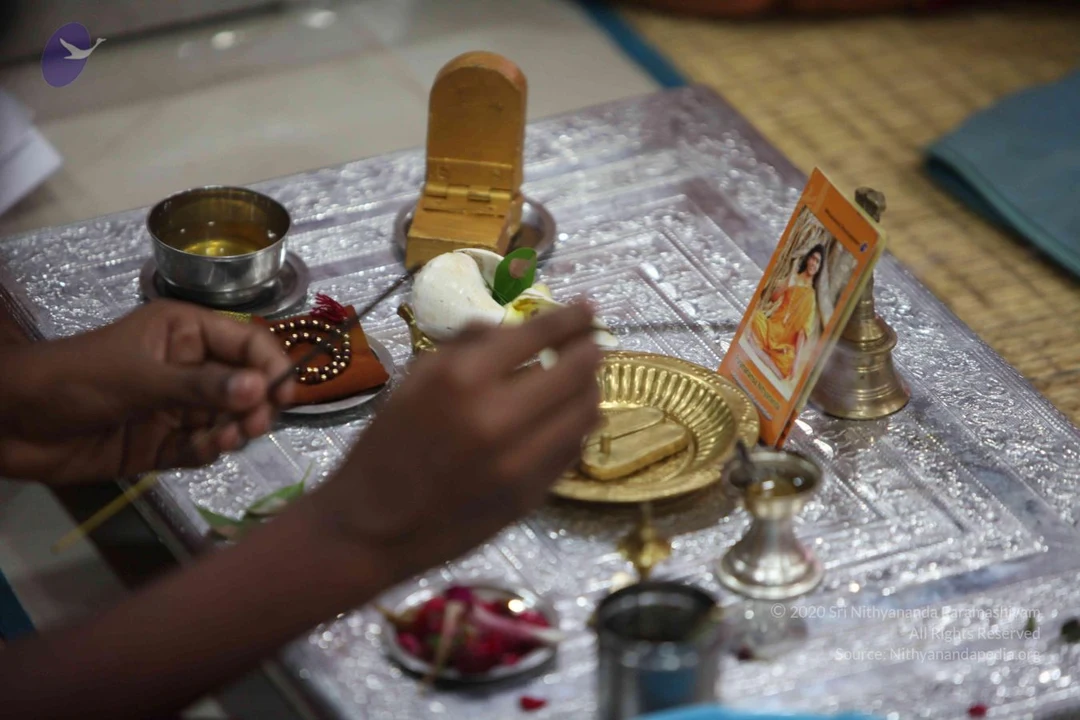
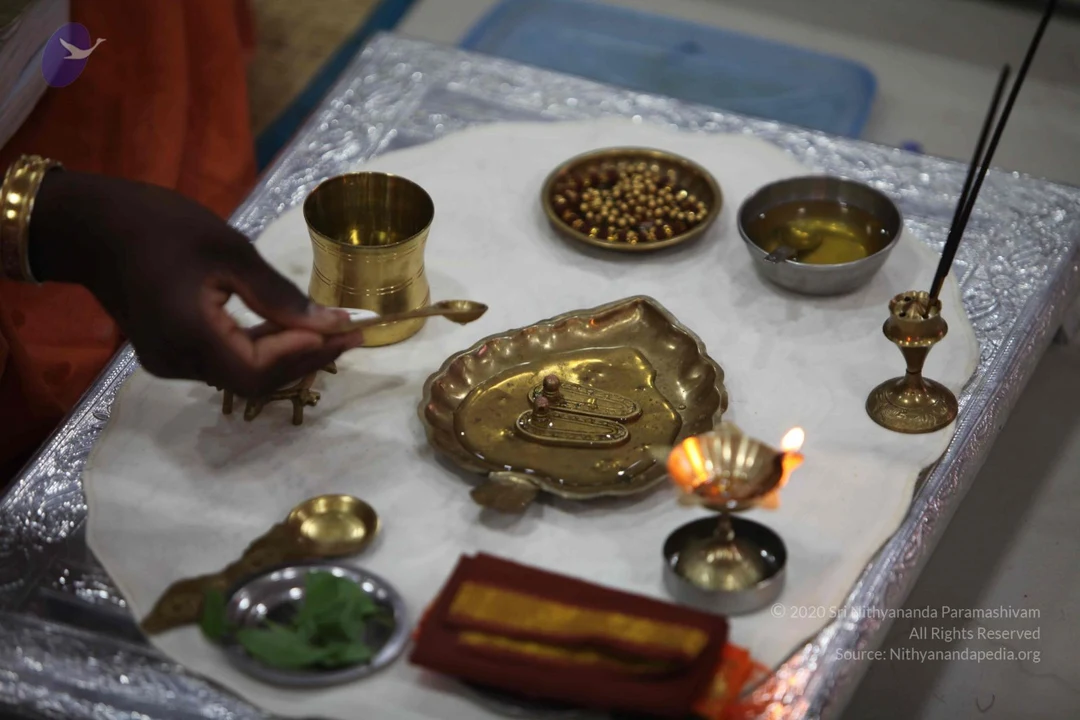
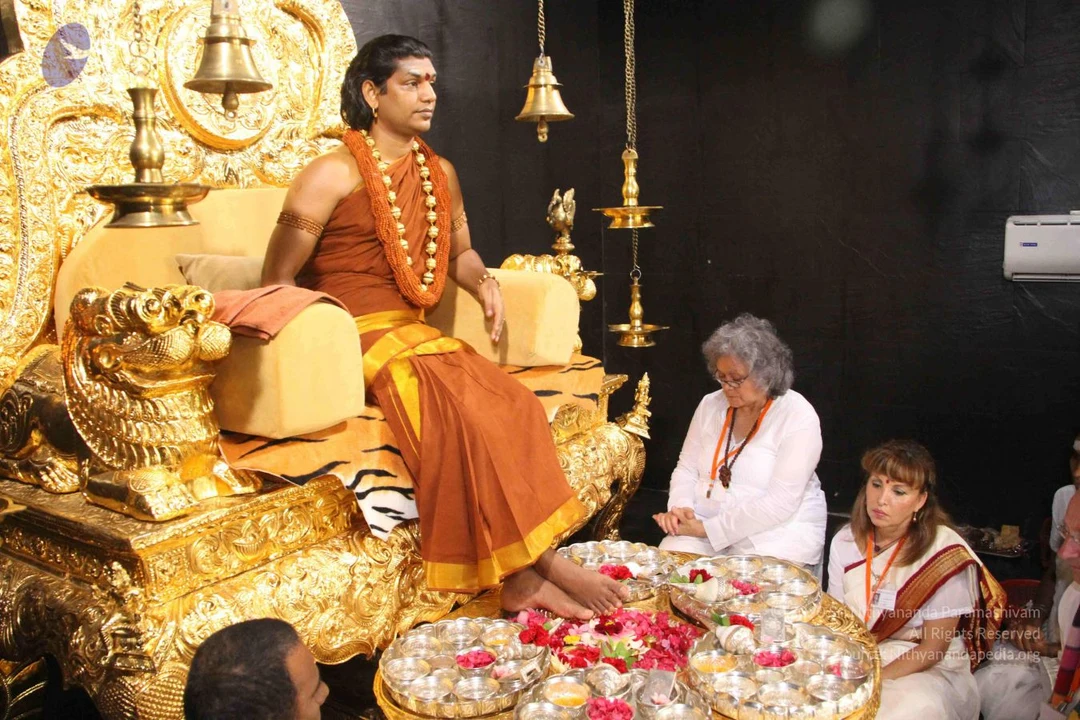
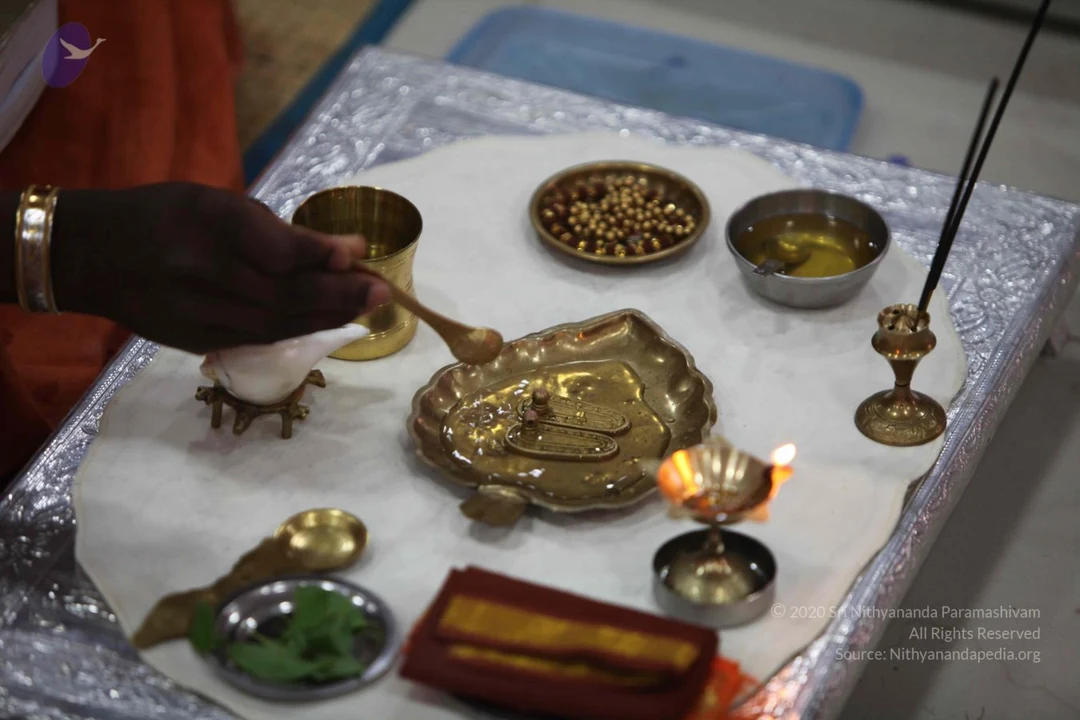
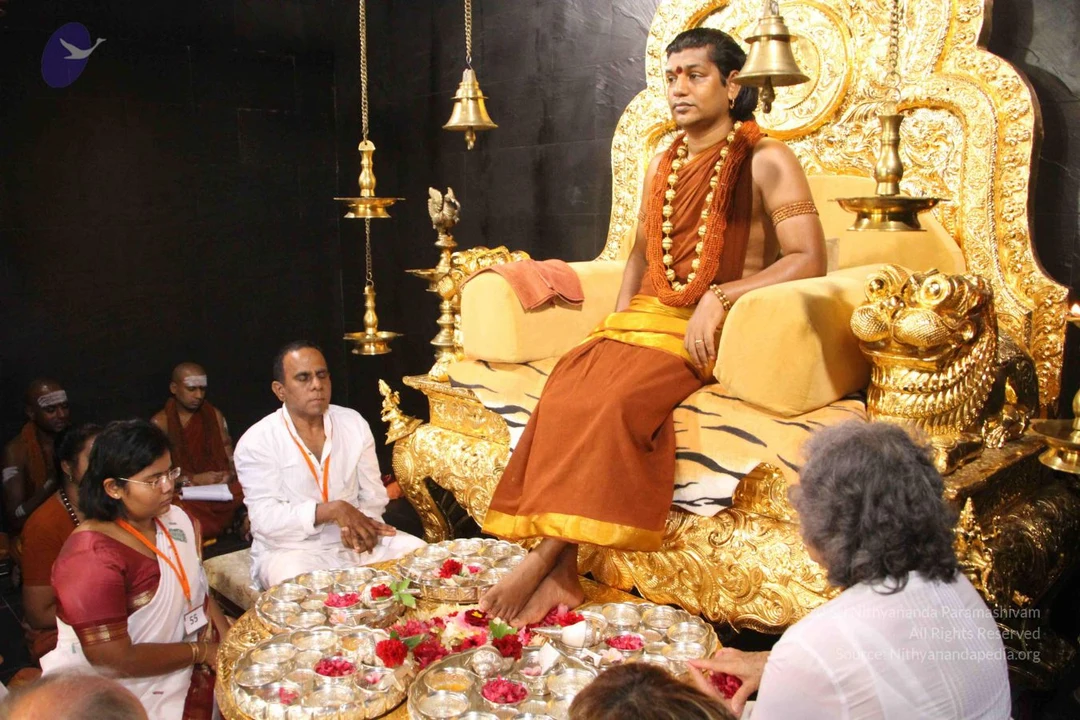
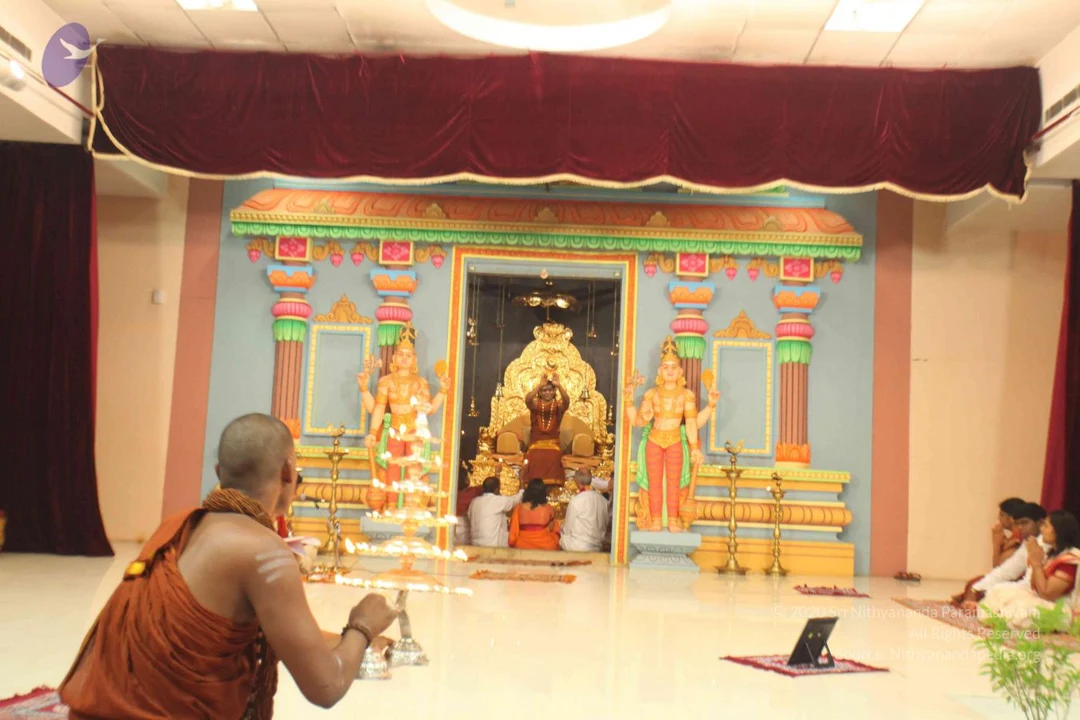
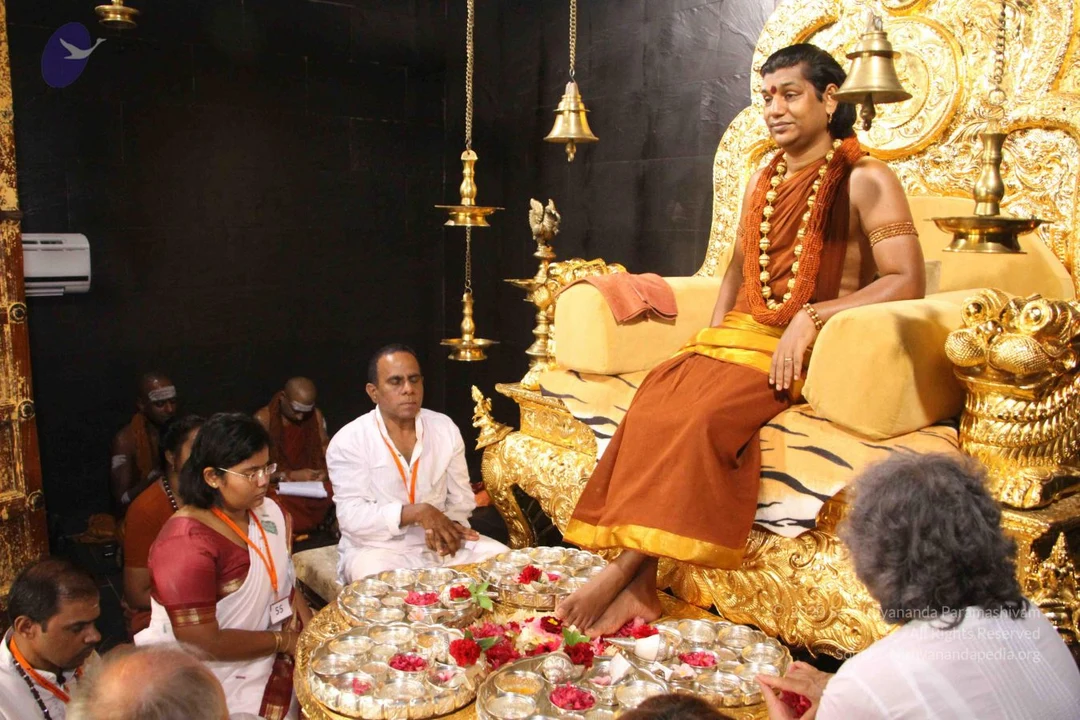
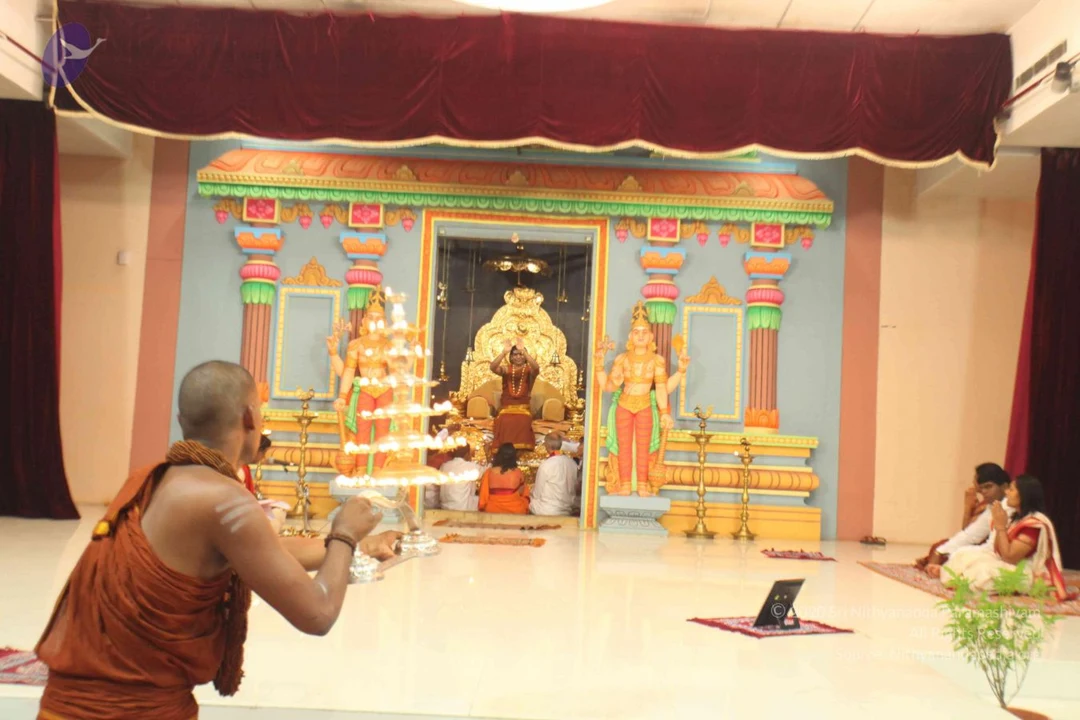
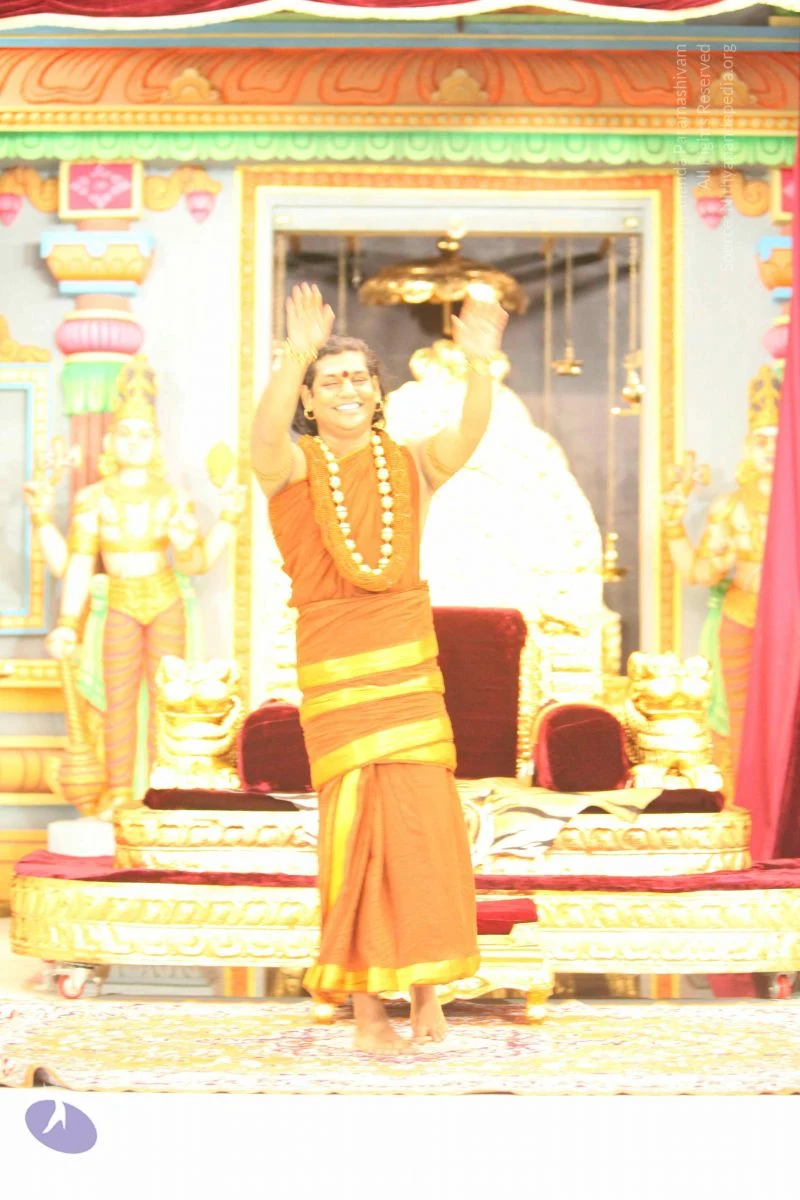
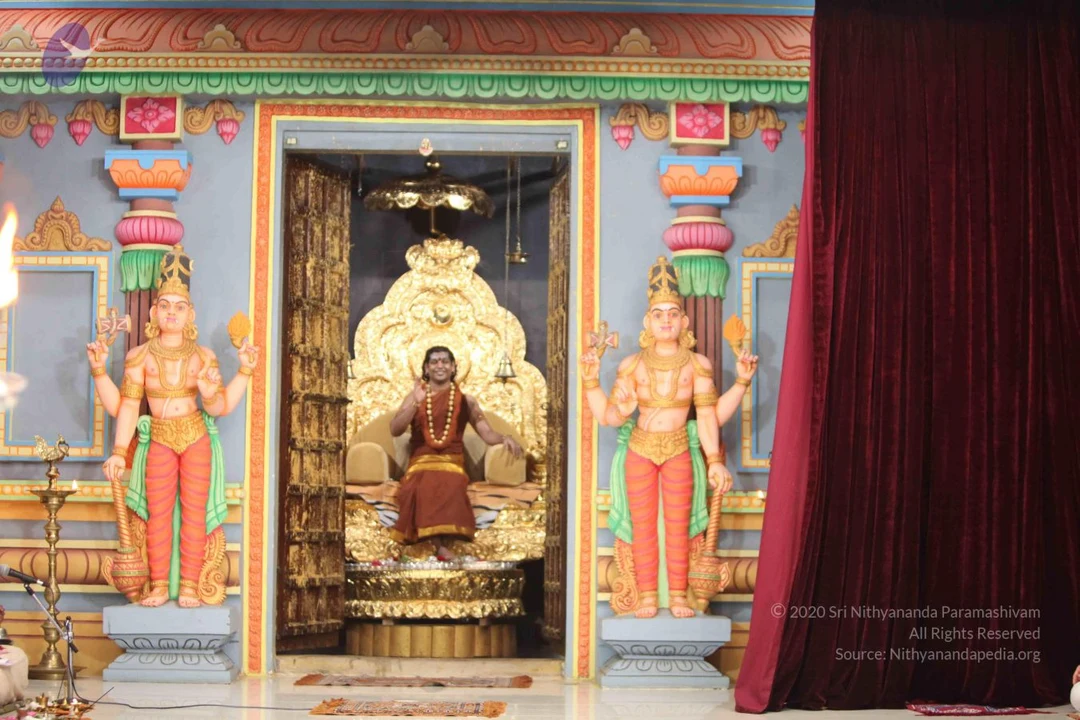
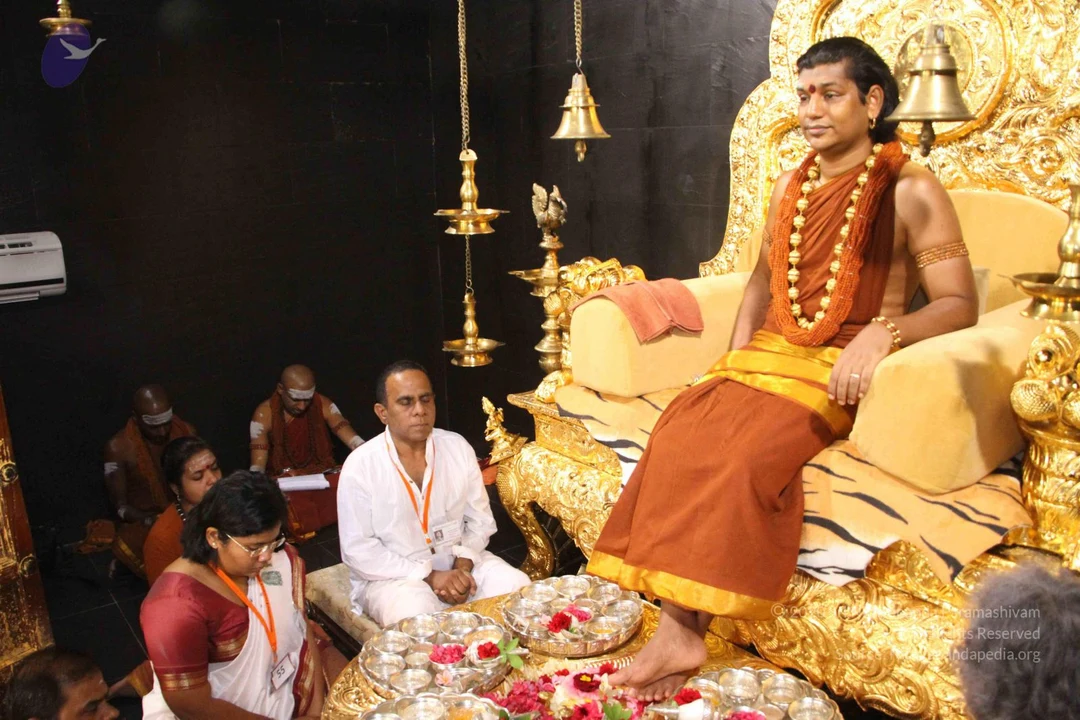
A seated man in a rust-orange robe with a red rudraksha mala sits on an ornate gold throne (peetha) inside a decorated shrine-like hall. He raises his hands in a teaching gesture. Flanking him are two large painted deity murti figures with multiple arms, crowns, gold jewellery and green sashes, holding ritual objects. Brass oil lamps stand on both sides, and a red velvet curtain hangs at right. A microphone is at lower left.A man seated on an ornate gilded throne with a golden arched back, carved lions at the armrests, and a gold canopy above, draped with brass bells and hanging oil lamps. He wears a rust-red robe with a gold border, a long rudraksha mala with gold beads around his neck, gold bangles, a red bindi, and his long hair falls to his shoulders. He raises one hand in blessing and sits on a tiger-skin cloth; small flower petals and offerings rest on the gilded platform below. a person: the swept hair, saffron-red robe, rudraksha mala and ceremonial throne are the qualifying cues, so this seated figure on the throne is a candidate.A seated man in rust-orange robes with a gold-bordered wrap sits on an ornate gold throne with a large gold repoussé backrest and a tiger-striped cushion. He wears a long rudraksha mala and a gold beaded necklace, gold armlets and bangles, and has a red vertical forehead mark and long swept-back hair. His eyes are closed and his hands rest on the armrests. Hanging brass lamps and bells surround the throne, and a silver tray with red flowers sits below. Swamiji (probable) is seated in darshan on the throne, identified by the distinctive long hair, rudraksha mala, ceremonial gold necklace and saffron robes.A close view of a silver-covered puja tray with a brass plate holding white and pink flowers and an incense stick in a holder. Nearby sit a brass bell, a small brass oil lamp, a brass cup, a rudraksha mala on a red-and-gold cloth, a small wooden incense stand, a folded offering of green leaves, rose petals, and a framed card showing a saffron-clad figure. No people are visible in the scene apart from a hand at the left edge. The setup suggests a puja arrangement prepared for ritual worship.Close view of a pair of bare feet stepping onto a golden tray filled with red, pink and white flower petals and a few yellow blossoms. Surrounding the tray are polished silver and gold bowls, small brass cups and silver vessels holding water, and a few green leaves are scattered among the flowers. The feet are ceremonial foot-washing offerings, and the wearer's gold-bordered garment edge is visible at the top left. No face is shown.A ritual puja arrangement on a silver-patterned tray in the foreground. Two hands, one holding a small incense or ritual stick near a brass and wooden dish with a red-and-gold ornament, make offerings. A golden wooden shrine-like stand sits at the back, beside a small brass bowl of liquid, a white cloth-wrapped offering, a brass plate with a sweet, and a brass bell on the right. A small orange-framed card showing a woman in yellow robes stands on the right. Scattered red flower petals lie on the tray and cloth. No full faces are visible; the scene shows only hands and objects. The printed orange card depicts a robed figure, not a physical person present.
NITHYA-SATSANG
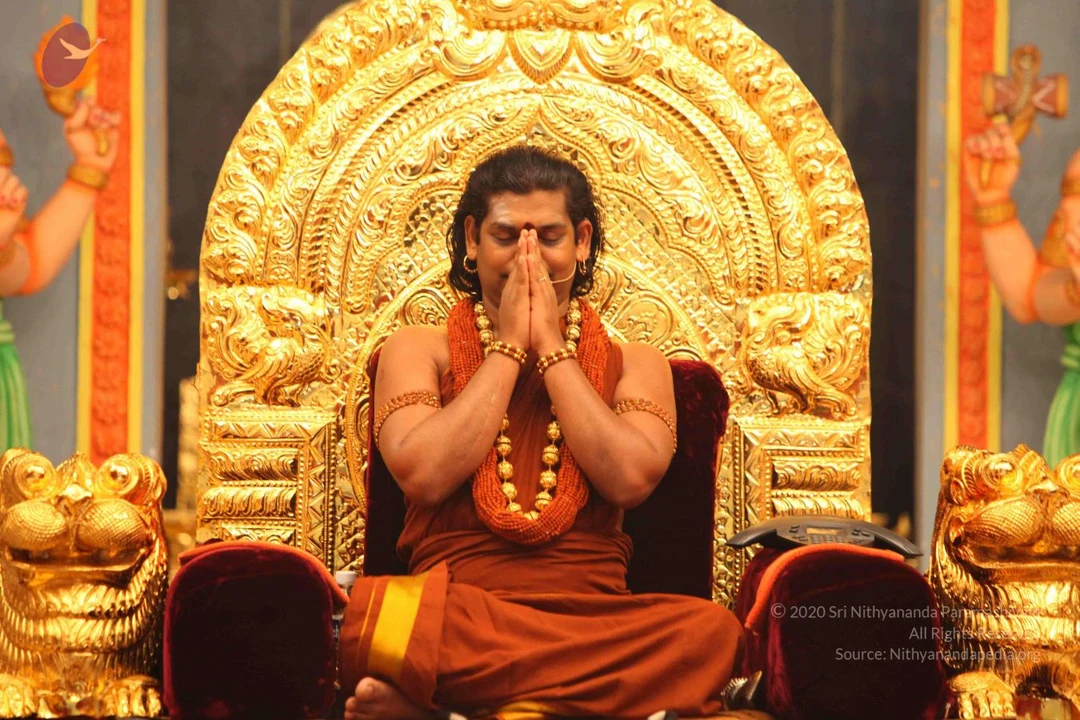
25 photosSource gallery
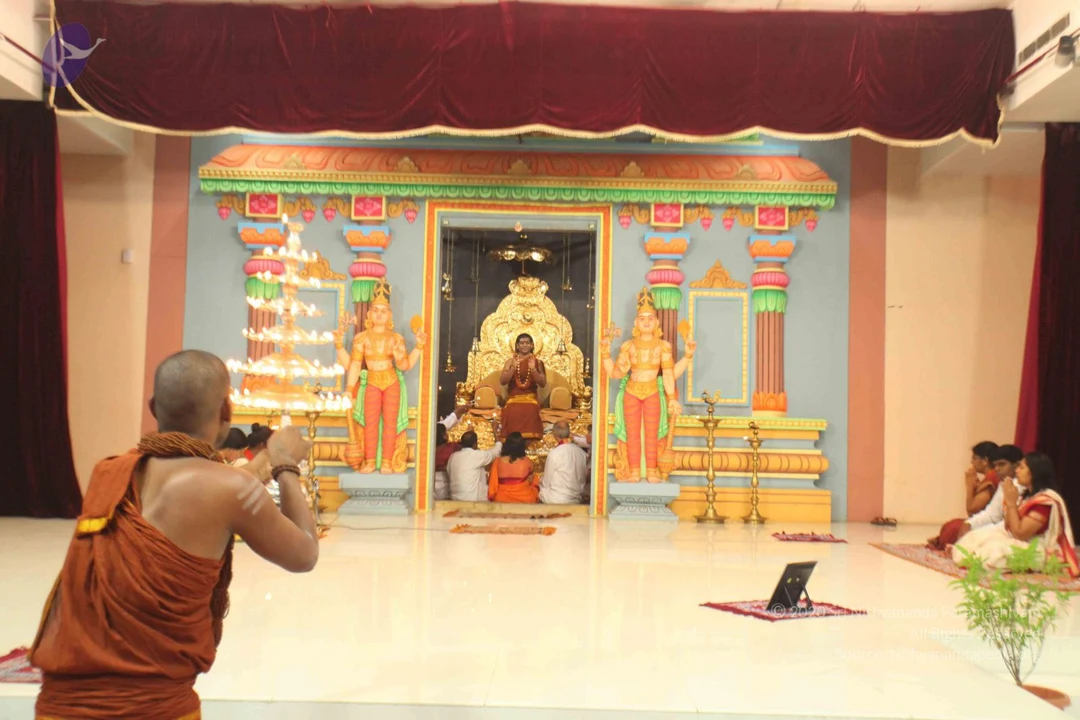
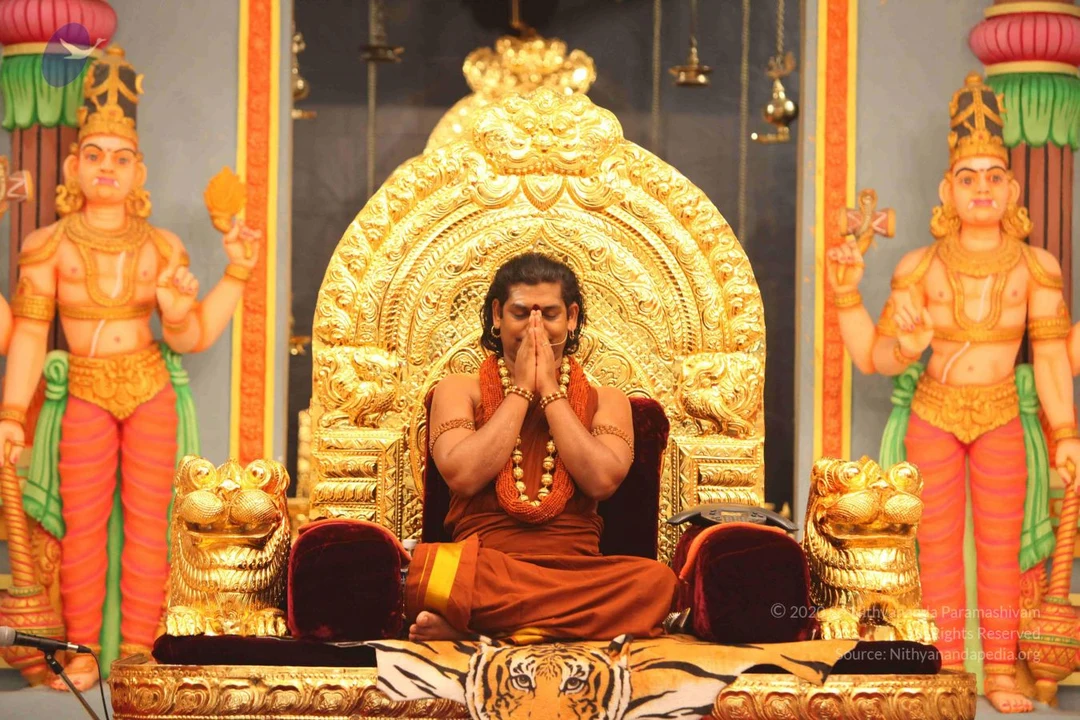
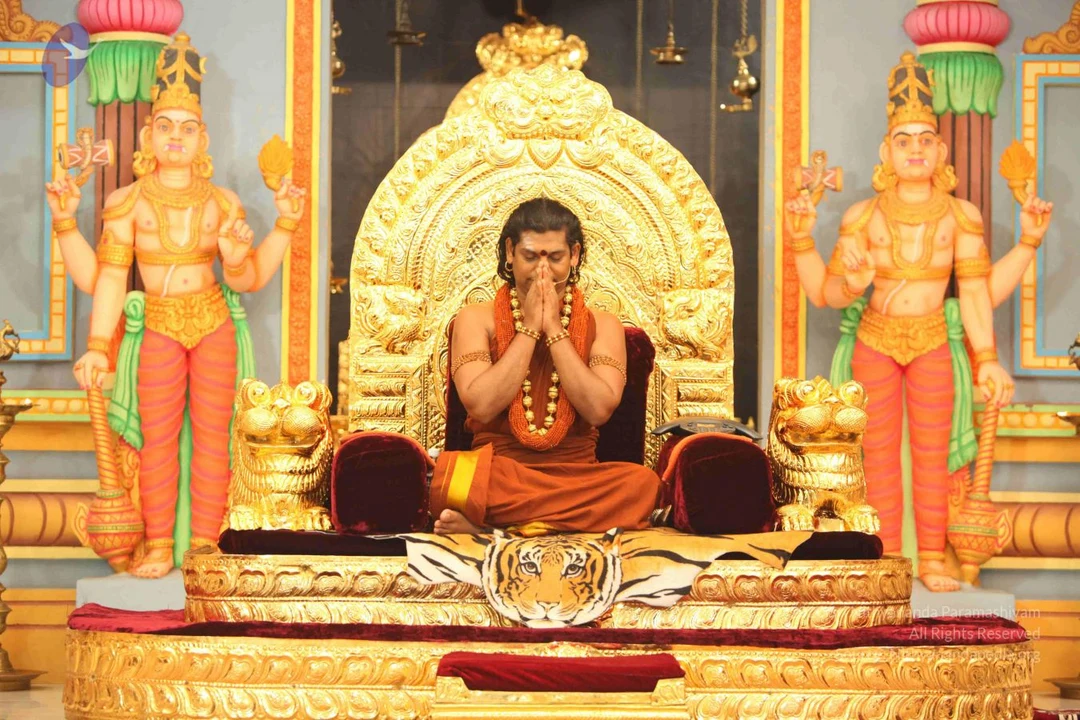
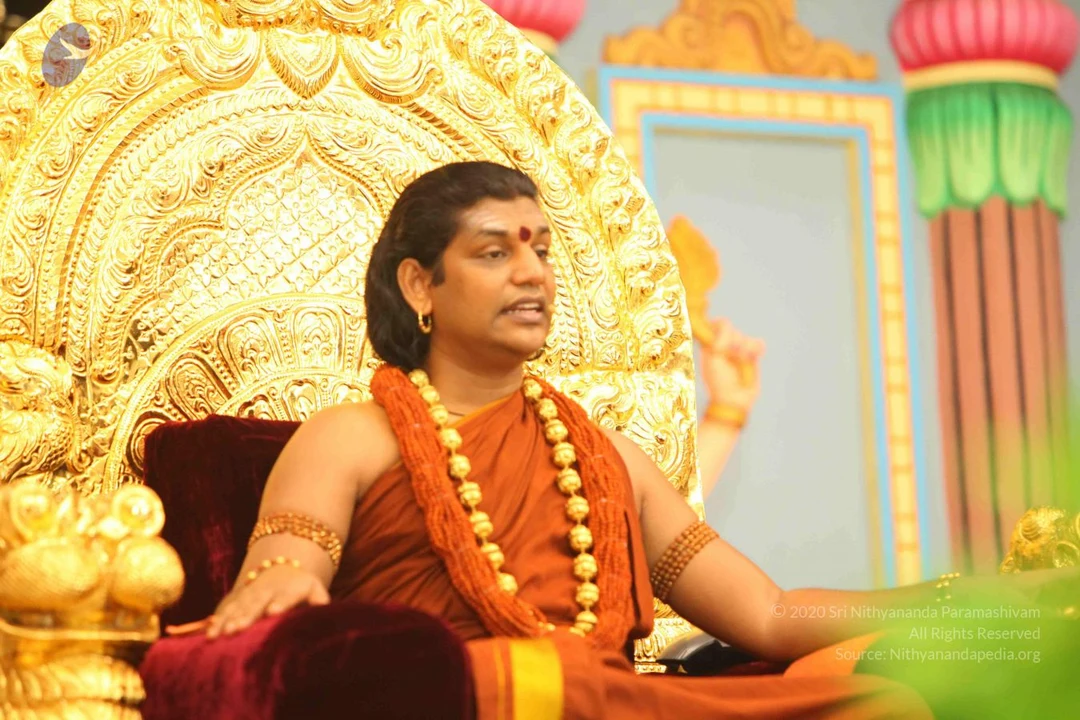
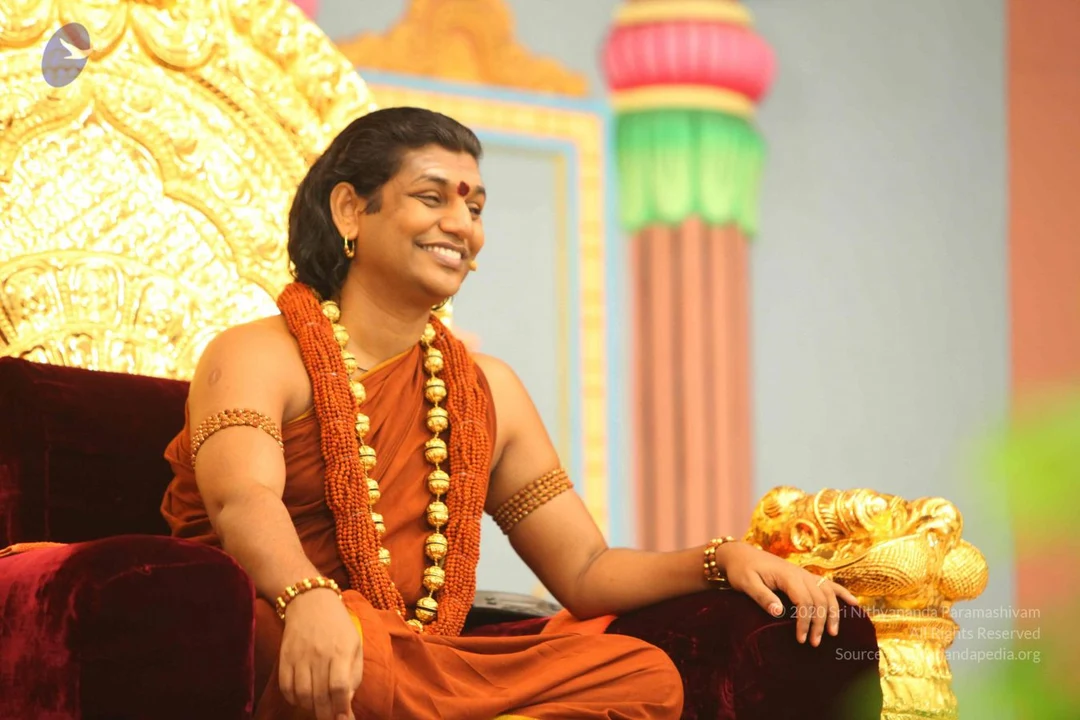
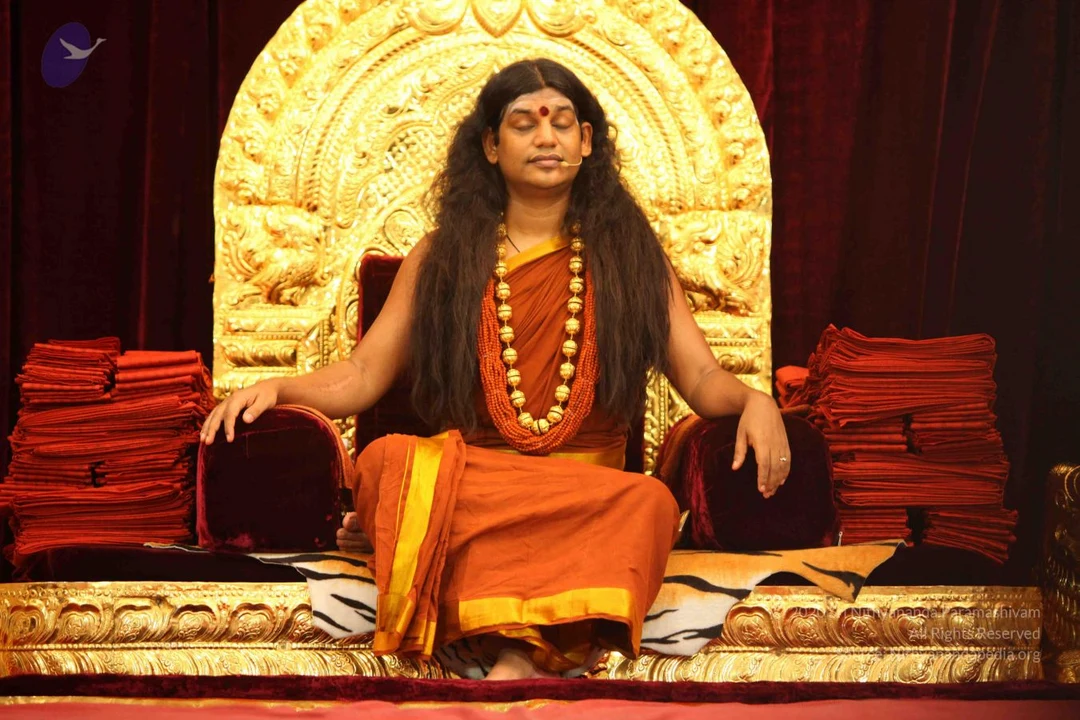
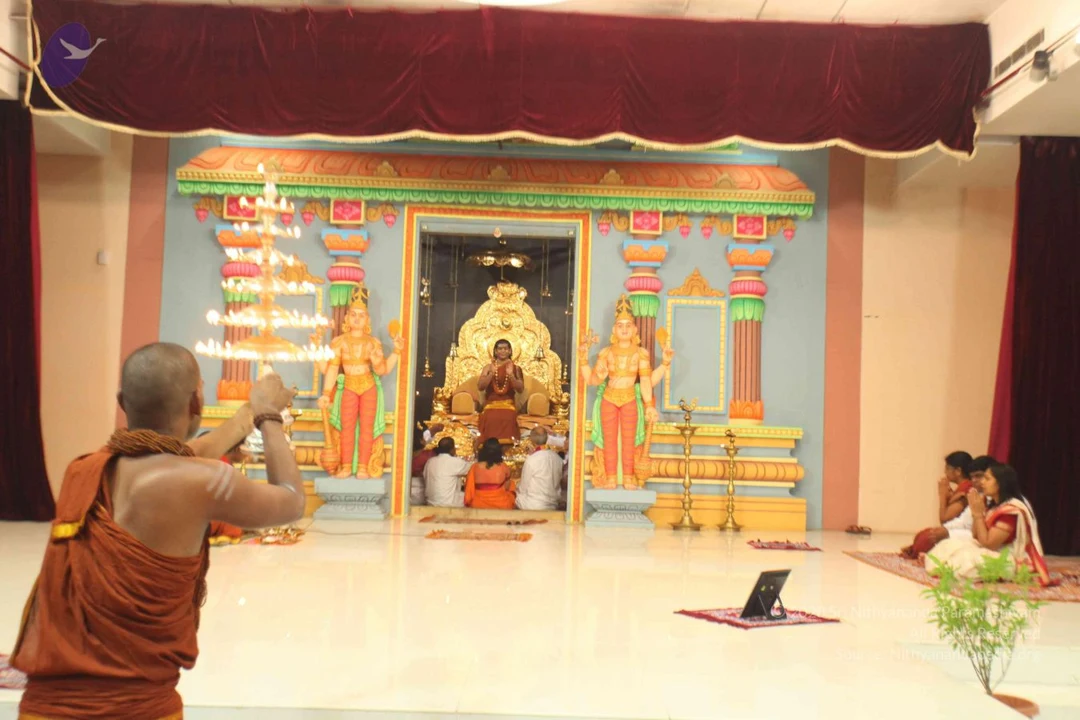
A man sits cross-legged on an ornate gold throne with a carved arched back and carved lion-head armrests in gold. He has his palms pressed together in namaskar with eyes closed. He wears a saffron-orange robe with a yellow-gold border, a long rust-red rudraksha mala around his neck, and gold bangles and armbands. A small red bindi is on his forehead. Gold statues of deities with raised arms stand on either side in green and orange. The photo is watermarked with the archive copyright.A man seated cross-legged on an ornate gold throne with a carved arched backrest, palms pressed together in namaste with eyes closed. He wears an orange-saffron cloth, a red rudraksha-style mala and a strand of gold beads around his neck, and his hair is long and swept back. The throne rests on a tiger-skin cushion with golden lion-head armrests. Flanking him are two large painted deity statues with multiple arms, gold crowns, gold jewellery and pink-and-green dhotis. Hanging bells and a lamp appear at the top, and a microphone stands at the lower left.A seated man in saffron-orange robes with a red shawl and rudraksha mala necklaces sits with palms pressed together in namaste on an ornate gold throne with lion-head armrests and a tiger-skin cloth. Two gold-and-orange deity statues with multiple arms and crowns flank the throne, holding lotus-like objects. Hanging brass lamps and a microphone stand are visible. Swamiji (probable): long swept-back hair, saffron robes and rudraksha malas on the central throne-seated figure, giving the satsang setting.A seated figure in saffron-orange robes with long swept-back hair, rudraksha malas and gold necklaces sits with palms pressed together in namaskar on an ornate golden throne with lion-head armrests, draped with a tiger skin. Two large gilded standing figures with multiple arms flank the throne against a colourful temple-style backdrop with pink and green pillars and hanging brass lamps.A photograph of a man seated on an ornate gold throne with a carved, repoussé backrest and a deep red velvet seat cushion. He wears an orange-saffron robe draped over one shoulder with an orange wrap, a long ornate gold necklace of beads and a rudraksha mala, gold armbands and gold bangles, and a red bindi on his forehead. He is speaking with his hands resting on the armrest. Behind him are pink and green lotus-topped pillars and a painted blue and yellow panel.A smiling man in orange saffron robes sits on a deep red velvet throne with a golden carved armrest shaped like a lion's head. He wears a long orange-beaded mala with gold bead spacers around his neck, gold bangles on his wrists, an upper-arm band, and a small red bindi on his forehead. His long dark hair is swept back, and he gazes off to one side with his hand resting on the armrest. Behind him rises an ornate gilded backdrop and a red, green and pink columned pillar against a pale blue wall. One person is visible, appearing to be a seated speaker or honoured guest at a satsang setting.

SARVA-DARSHAN
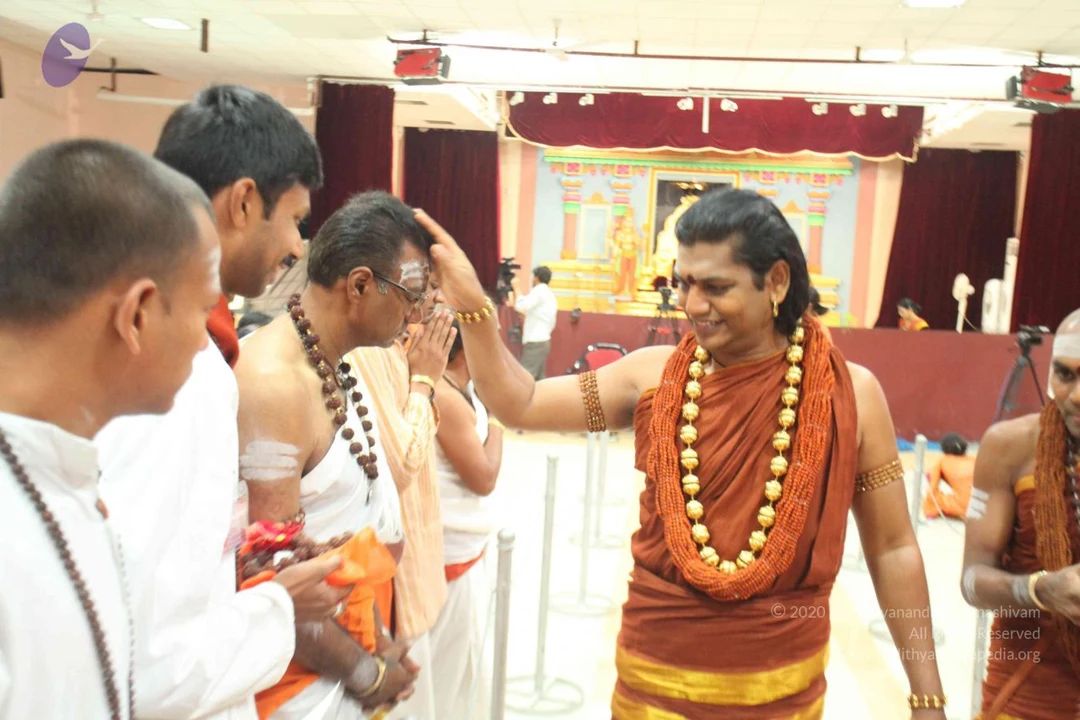
13 photosSource gallery
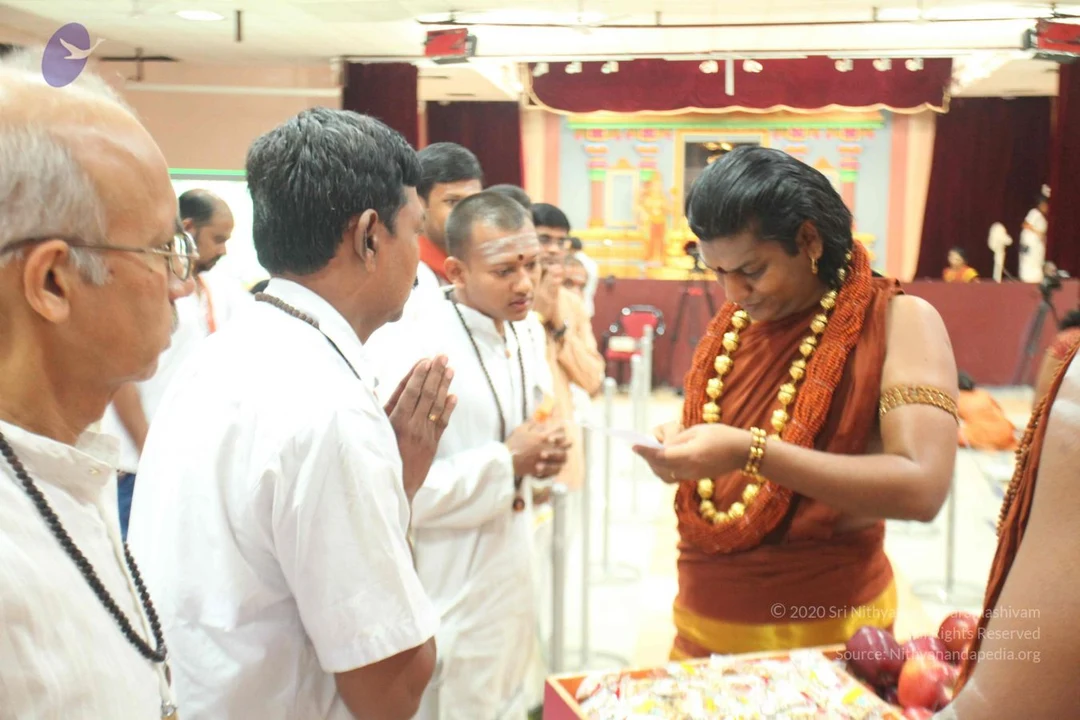
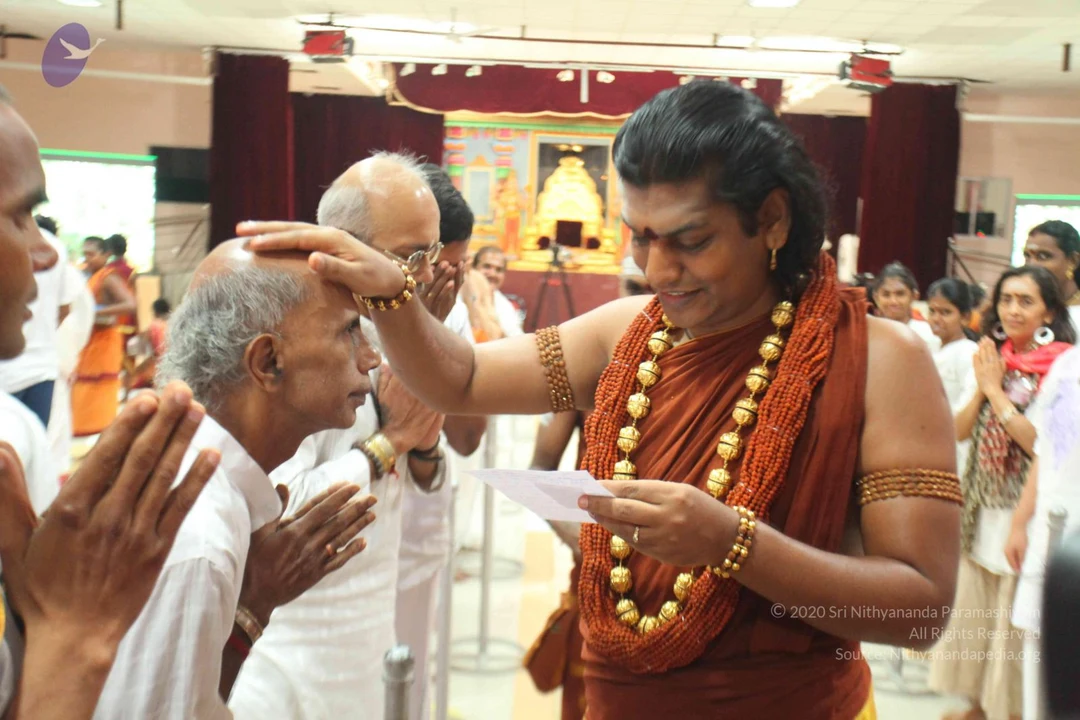
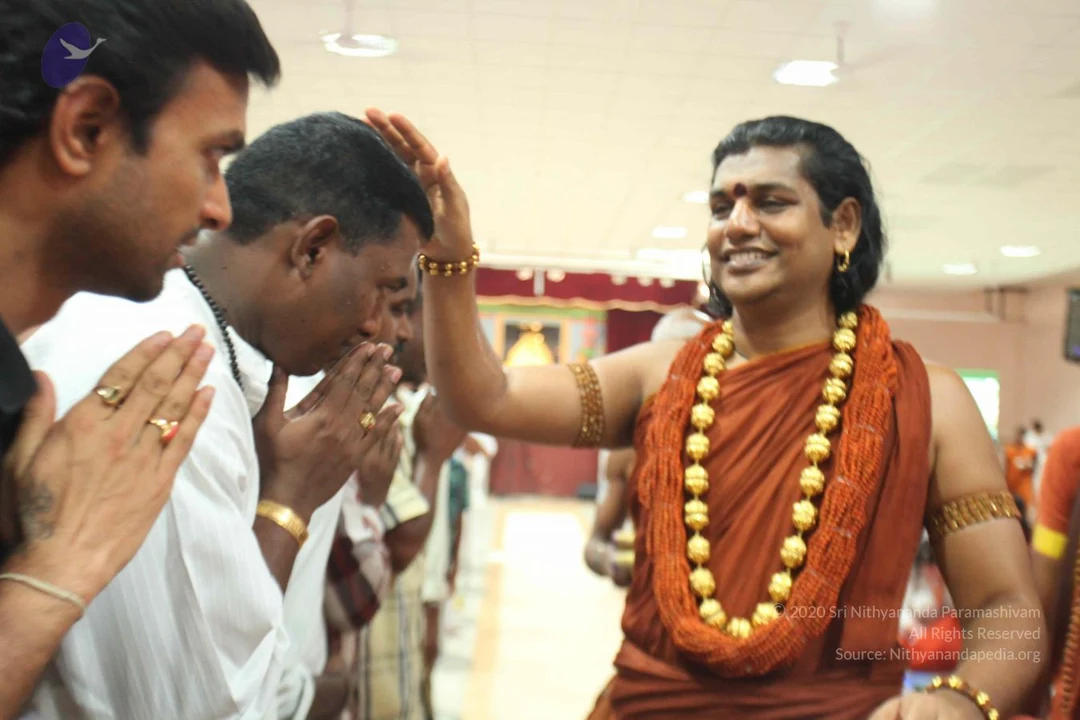
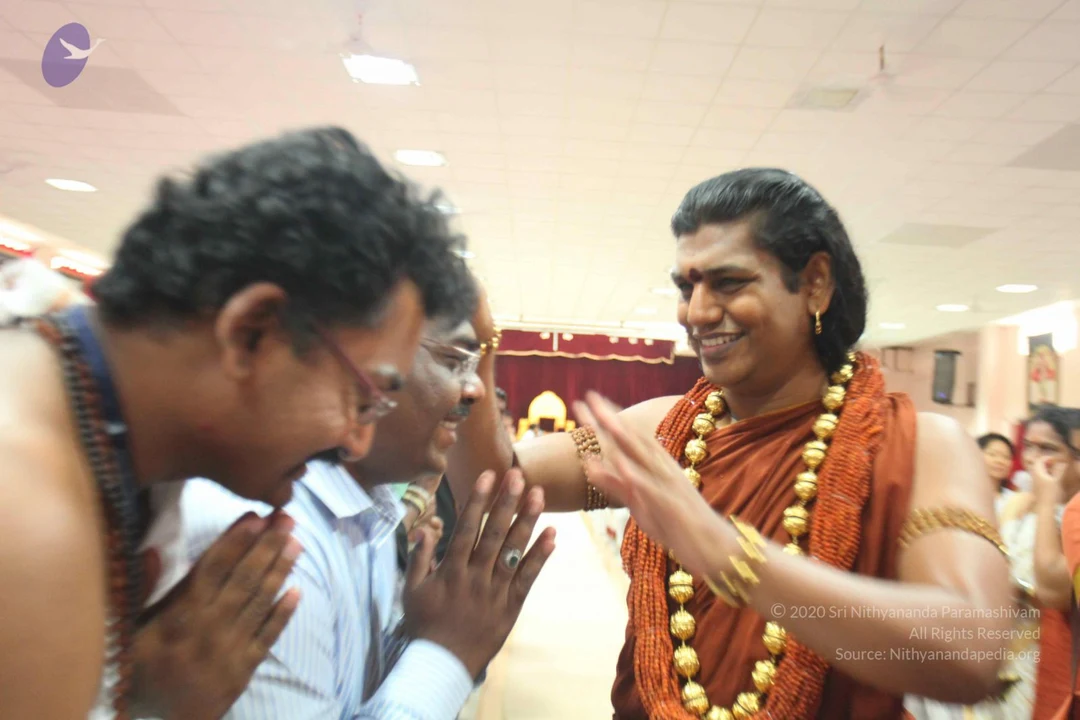
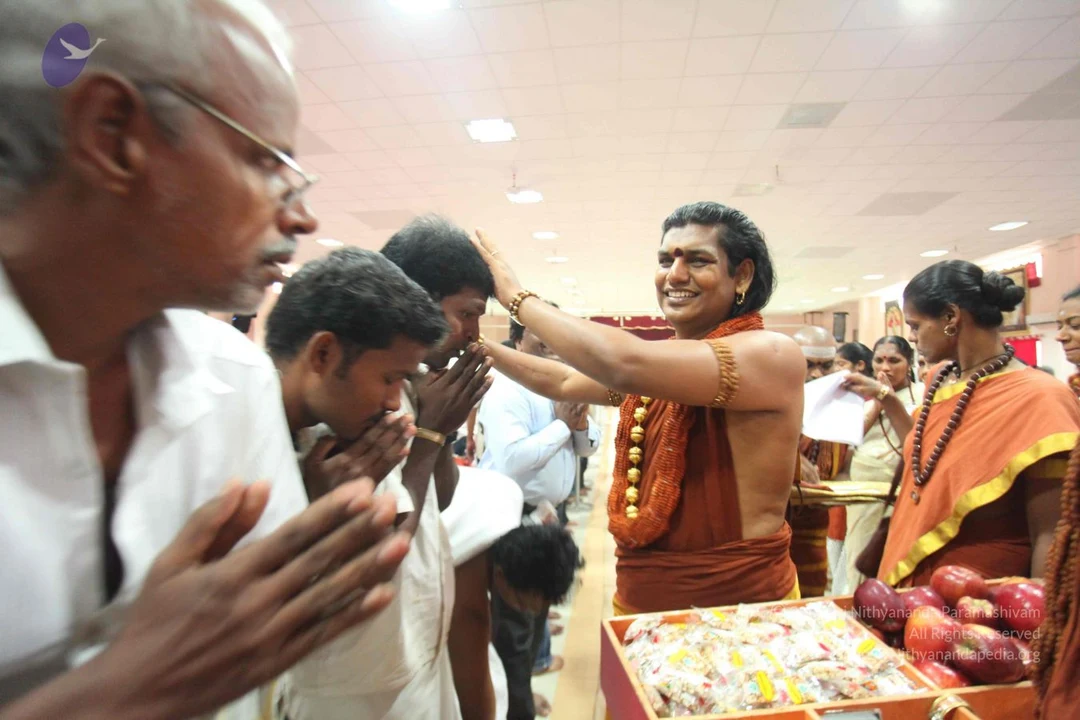
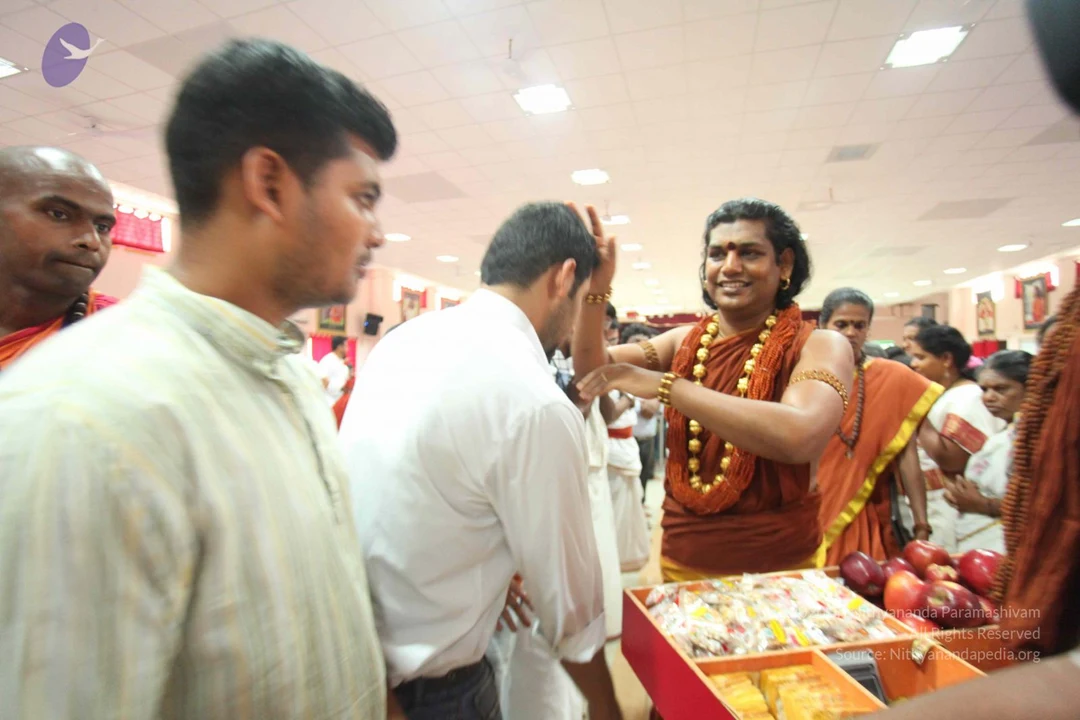
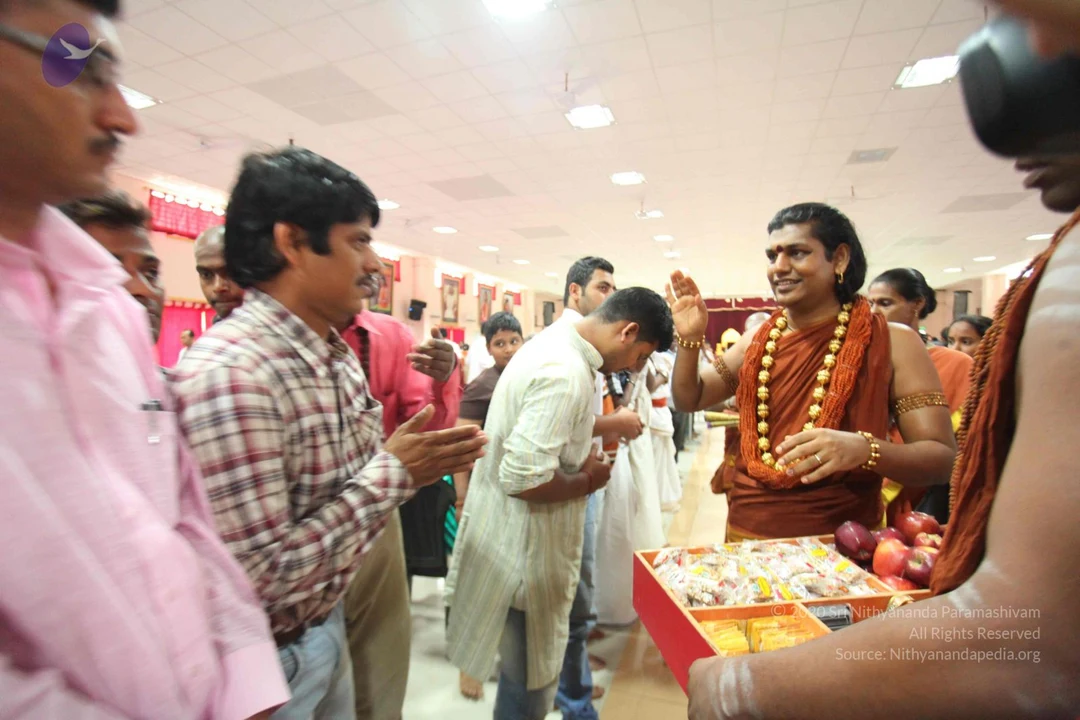
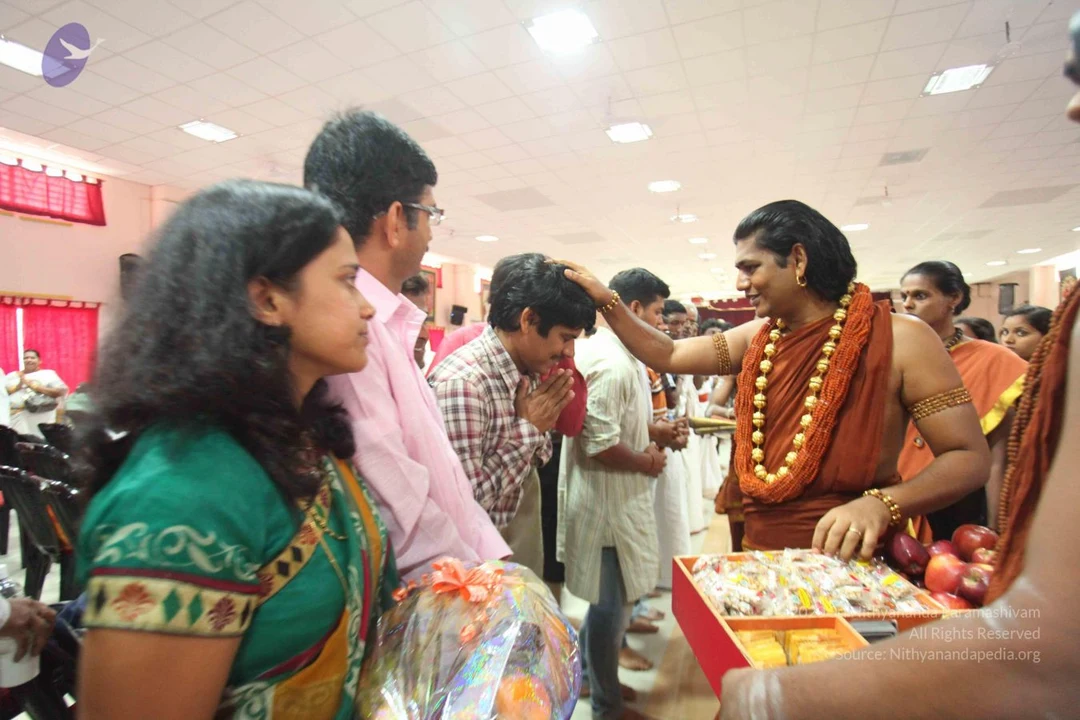
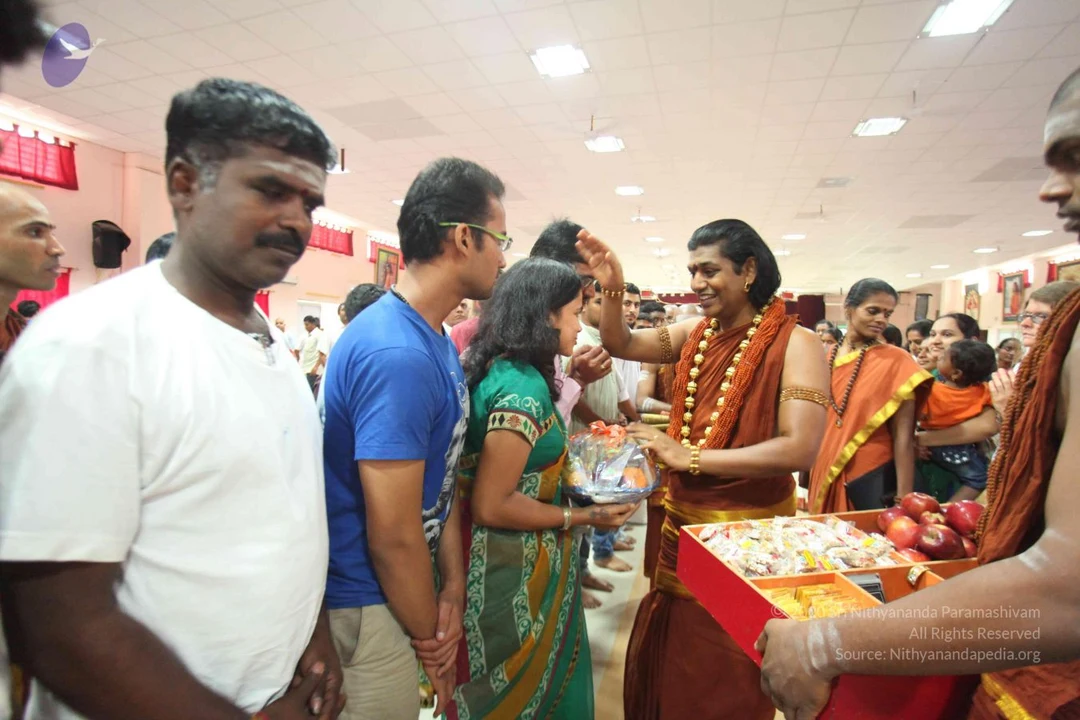
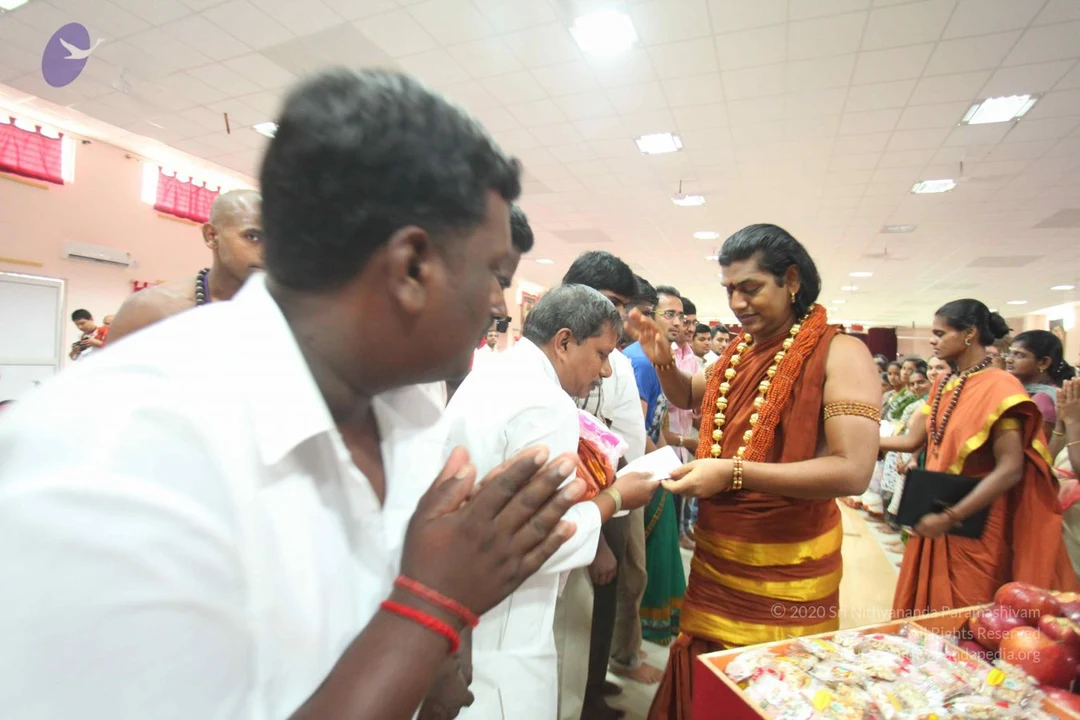
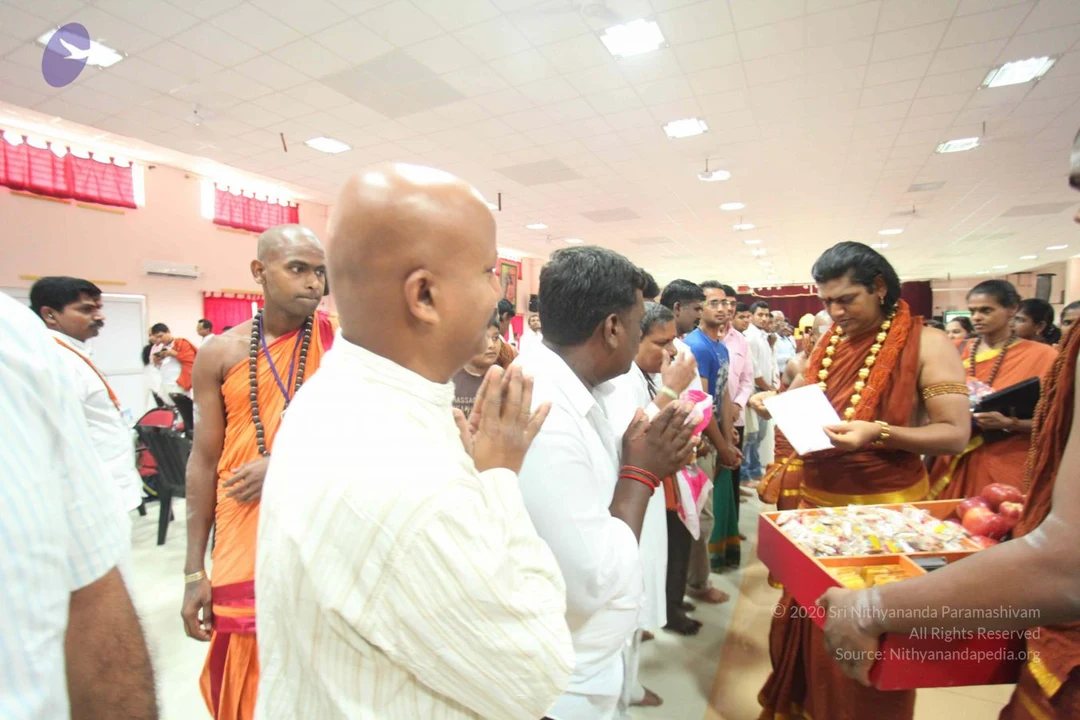
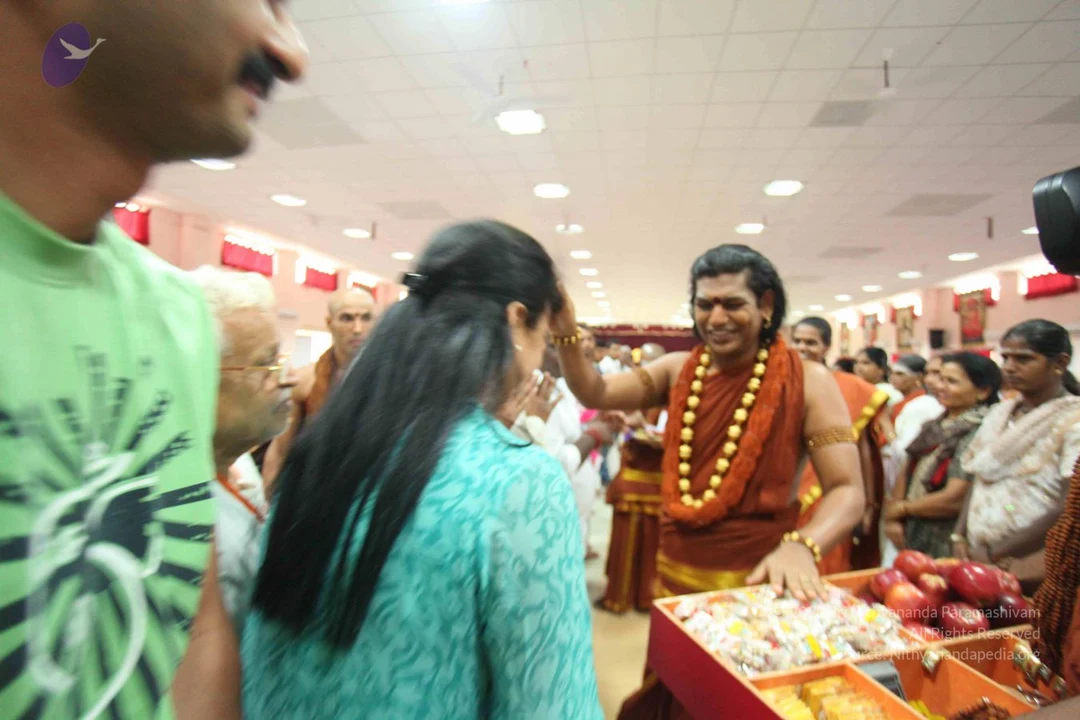
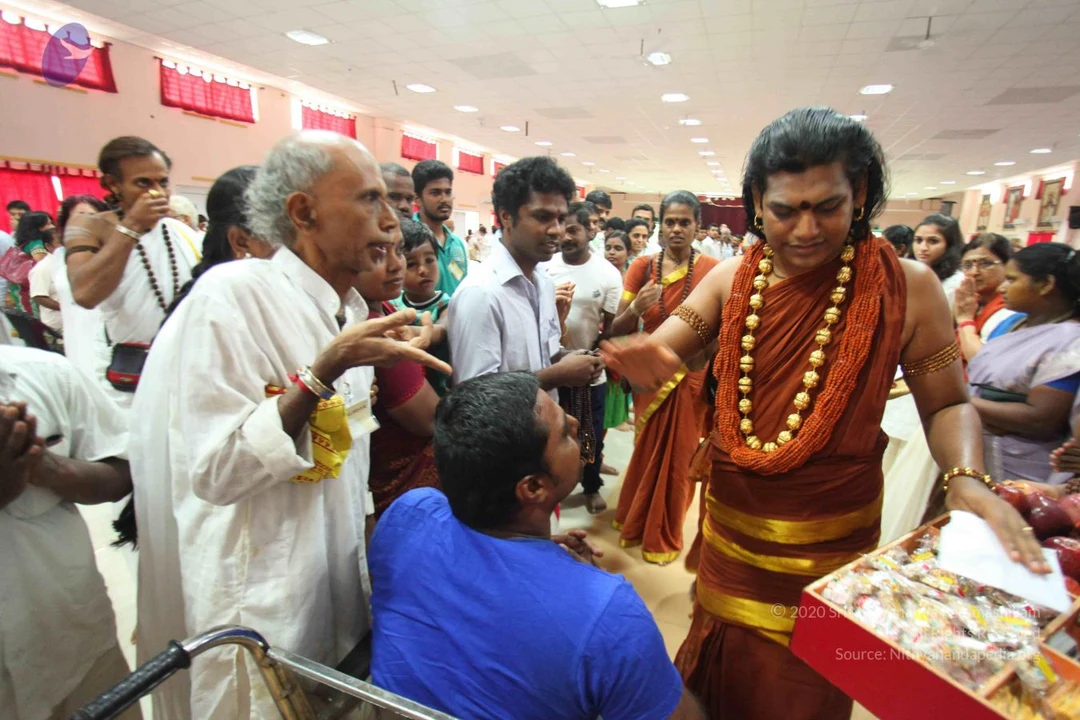
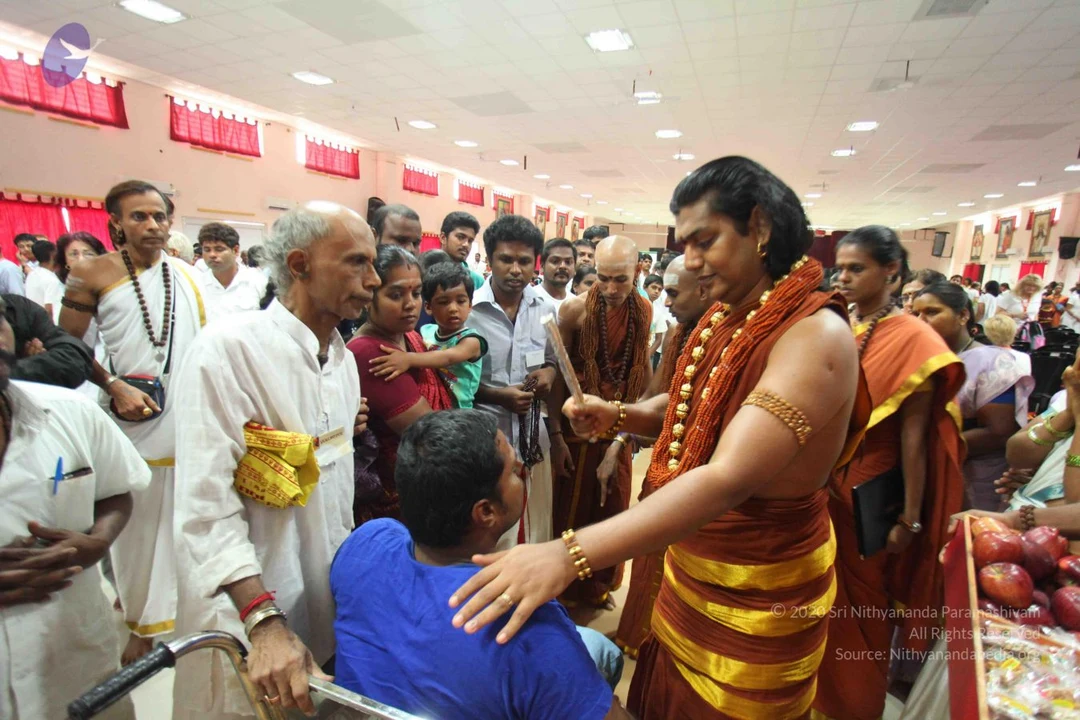
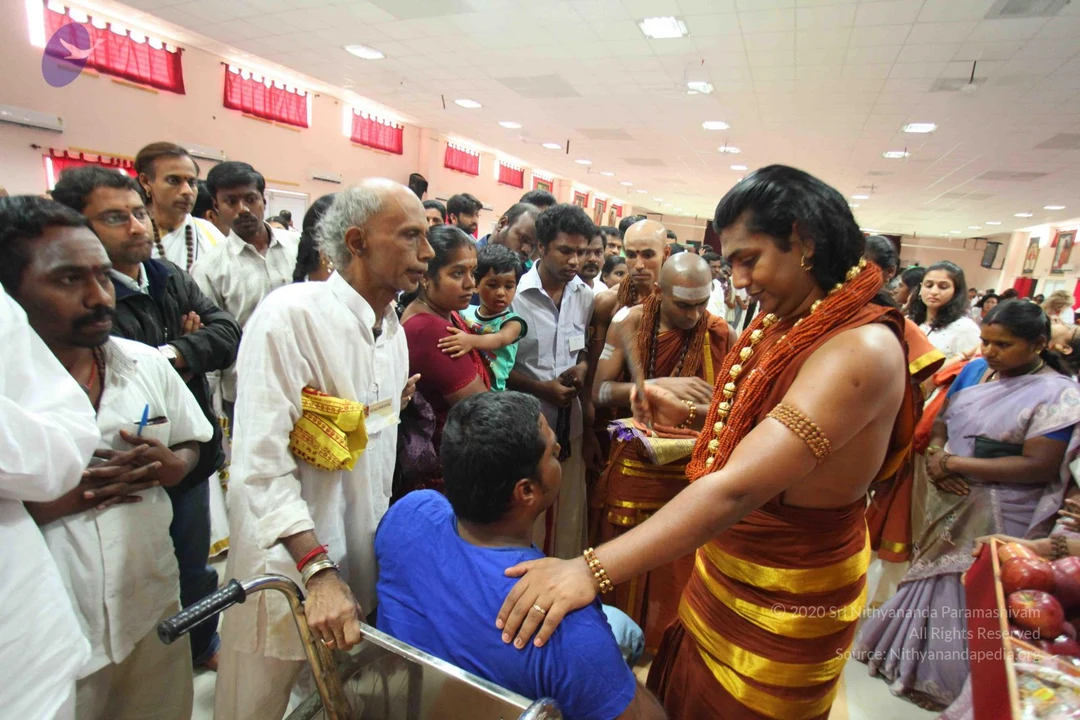
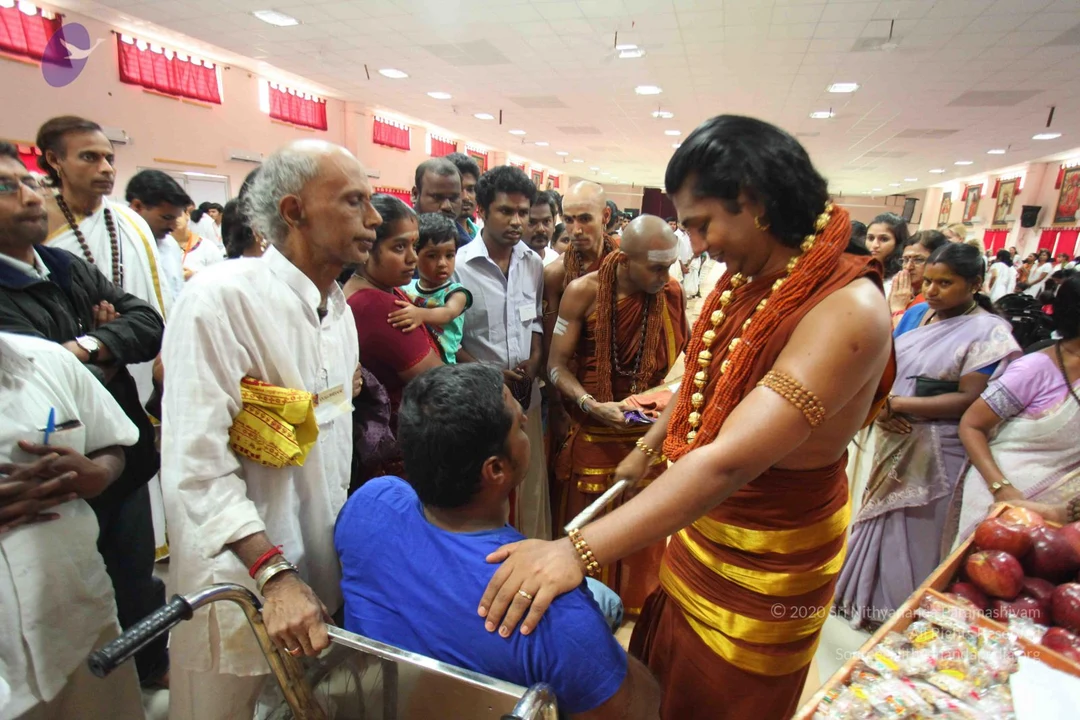
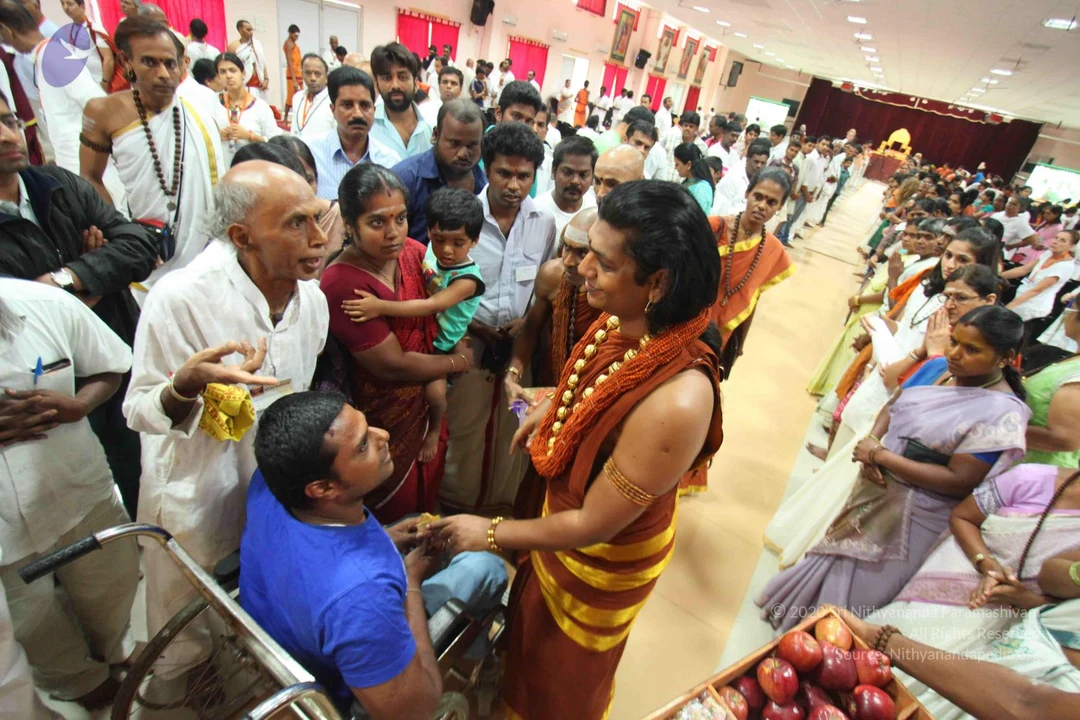
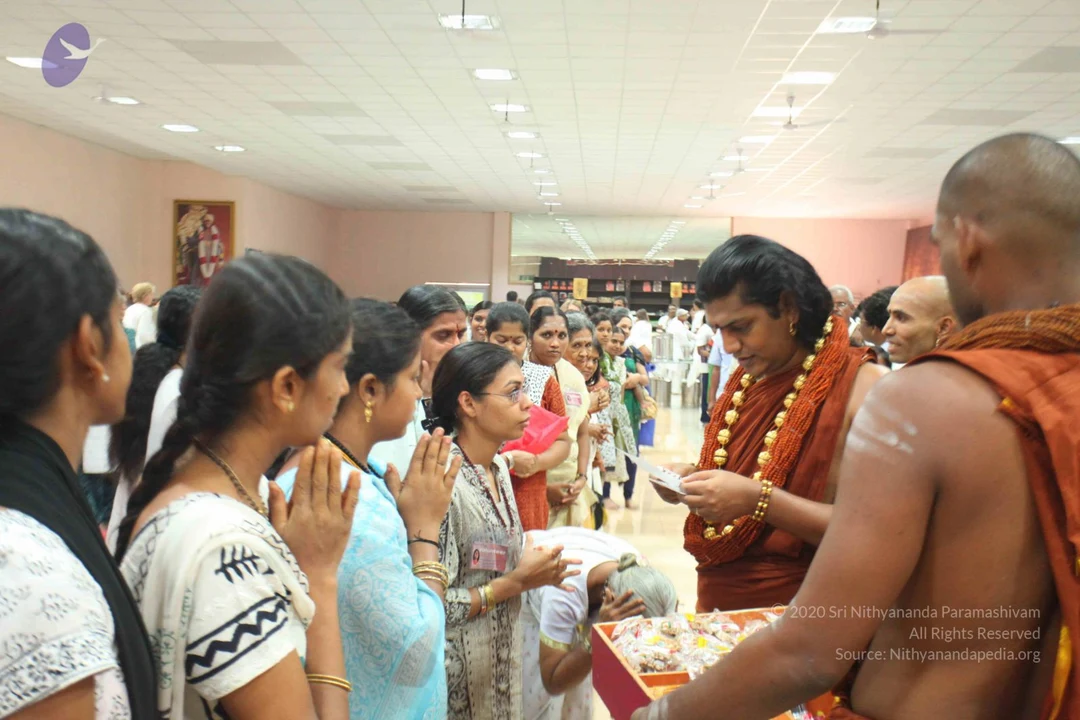
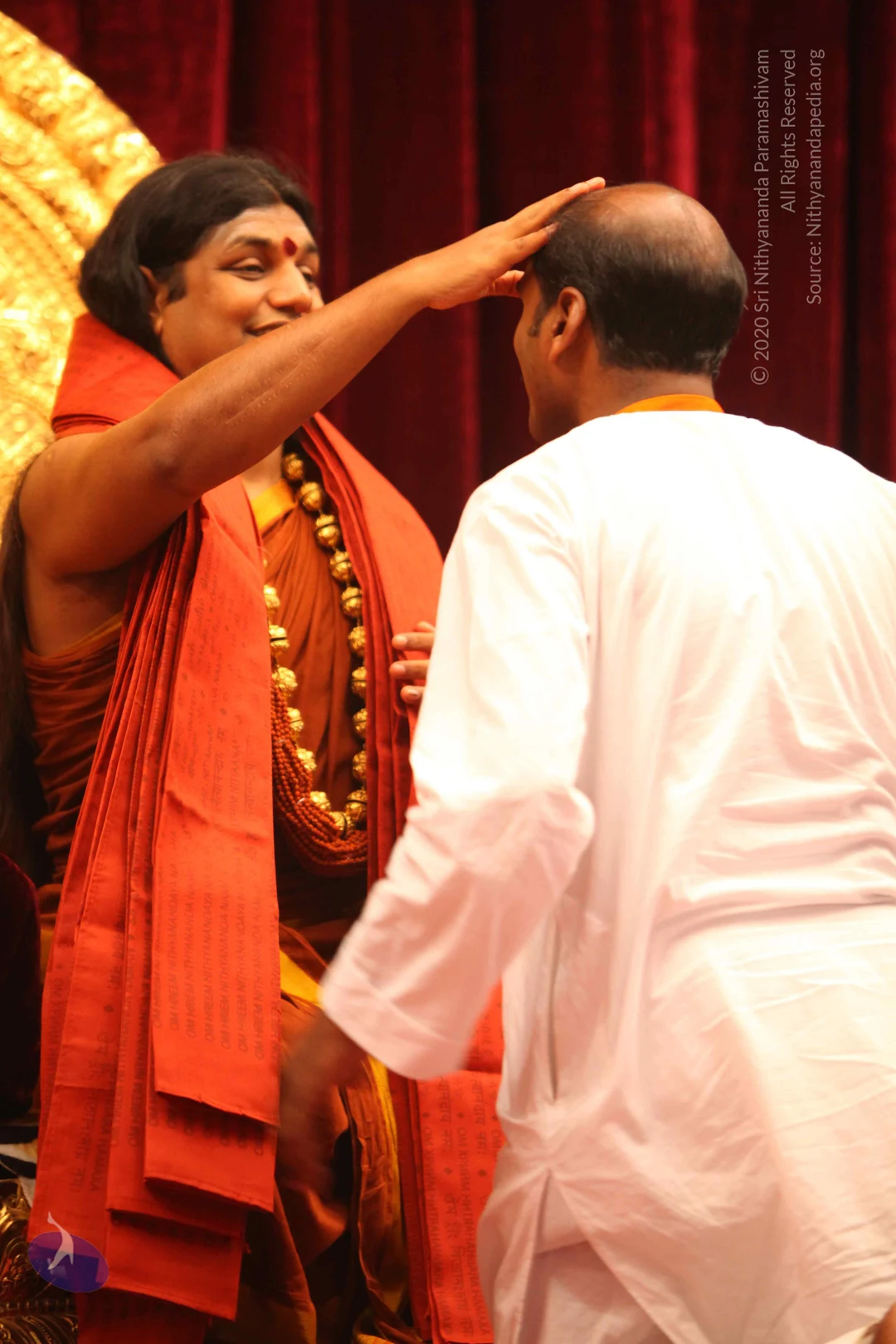
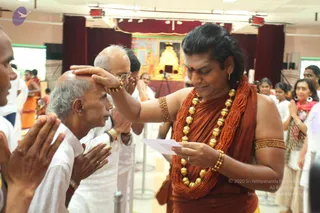
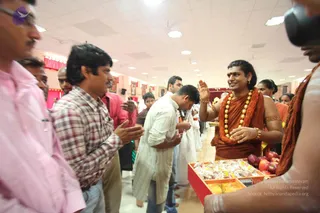
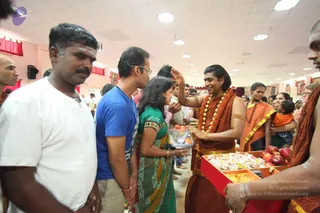
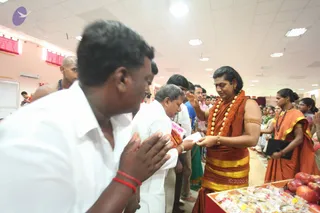
A man in a saffron-orange robe and a long rudraksha-style mala of red beads with gold beads stands at right, holding a folded white paper in one hand while placing his other hand on the head of a bald, white-clad elderly devotee who bends forward with palms pressed together. Gold bangles adorn his arms and a red tilak marks his forehead; his hair is swept back. Behind them, other white-clad devotees stand with hands folded, a saffron-robed attendant is visible at left, and a gilded deity murti with a red canopy and maroon drapes forms the backdrop of the hall. a person (in_person cues: long swept-back hair, saffron robe, ornate gold and bead necklace) performing a blessing on the devotee.A photo taken at an indoor hall with a white ceiling and fluorescent lights. A man with long swept-back dark hair, a red bindi, gold hoop earring, gold-bead and rudraksha necklaces, bangles and an orange-saffron shawl smiles and gestures with an open hand toward a visitor. a person, a devotee in a white shirt with folded hands, leans in with a smile, and another man with folded palms stands beside him, with a red curtain and a lit gold altar in the background.A photograph inside a hall with white ceiling lights and a red-draped backdrop. A man in an orange-saffron robe with a gold-bead garland, rudraksha-style red-and-gold bindi, gold bangles and an armlet raises his hand in greeting beside a red tray of sweets and fruit with apples. Several men in pink and checked shirts and a man in a white kurta bow or stand around him, and a person in a saffron shawl stands at the right edge. Probable Swamiji is present with long swept-back hair, saffron garments and a gold necklace, consistent with the page's satsang reference.A photo inside a bright hall with white ceiling panels and red curtains. A bare-headed priest-like figure in saffron-orange robes, a red-orange rudraksha mala and a long gold necklace, with gold armlets and bracelets, places his hand on the head of a kneeling-bowing man in a checked shirt, who has his palms pressed together in namaste. A woman in a green saree with a gold border stands in the foreground, and other devotees in white and pastel clothes stand in line behind. A red tray holds sweets and apples, and a wrapped gift basket sits at the front.A photograph inside a bright hall with a white ceiling and red curtains on the walls. A man with long swept-back dark hair, wearing an orange-saffron dhoti and shawl with a rudraksha mala and gold ceremonial necklaces and a gold armband, raises his hand in blessing toward a young woman in a green and gold sari who holds a wrapped offering. Beside him a devotee in a saffron garment holds an open red box of fruit and sweets, including apples and packets of confectionery. Several devotees stand in line, including a man in a white shirt, a man in a blue t-shirt with glasses, and women in saris, and a child is held in the background. Framed pictures hang on the walls behind the crowd.A photograph in a bright hall with pink walls and fluorescent ceiling lights. A bare-chested man with long swept-back hair, wearing an orange-saffron shawl with a gold-yellow border, multiple rudraksha-style beaded necklaces and gold bangles, stands at right, handing a small white envelope to a man in a white shirt who presses his palms together in greeting. Another man in white stands at left, also with palms joined, and other attendees stand behind. Near the foreground, an open box holds packets and apples. A woman in an orange sari with dark beaded necklaces stands at far right holding a black folder. Several people in the background wear white and orange. The swamiji cue combines the swept-back hair, saffron shawl and beaded necklaces, so the figure is described as a probable Swamiji in person receiving or giving a donation.

TEMPLE
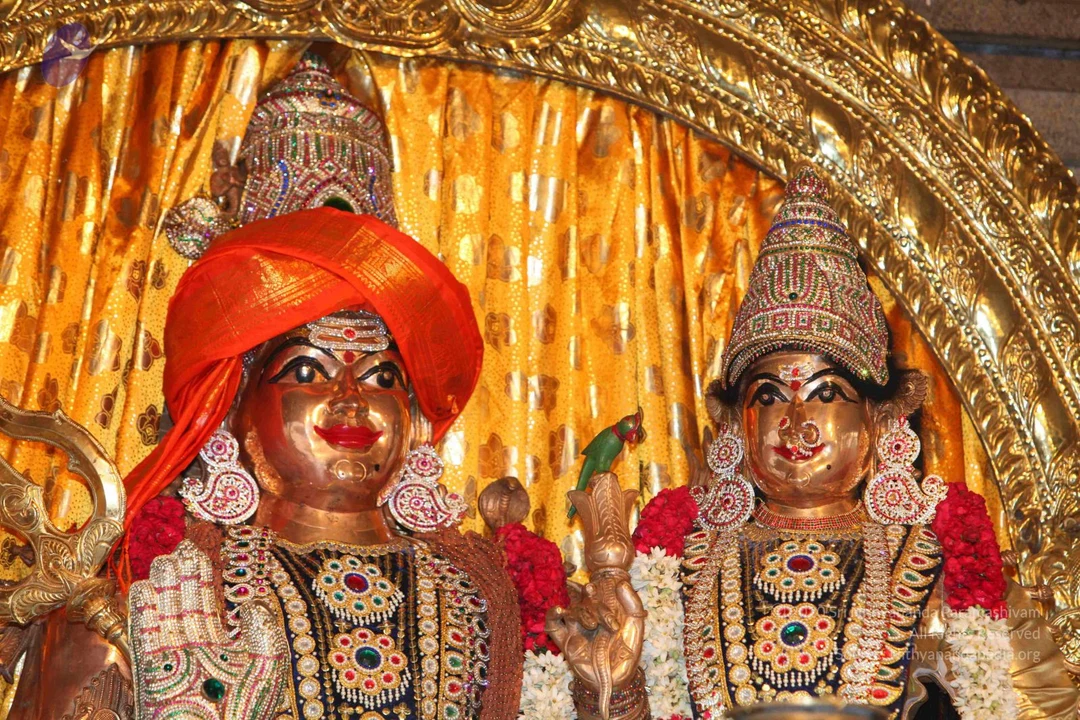
45 photosSource gallery
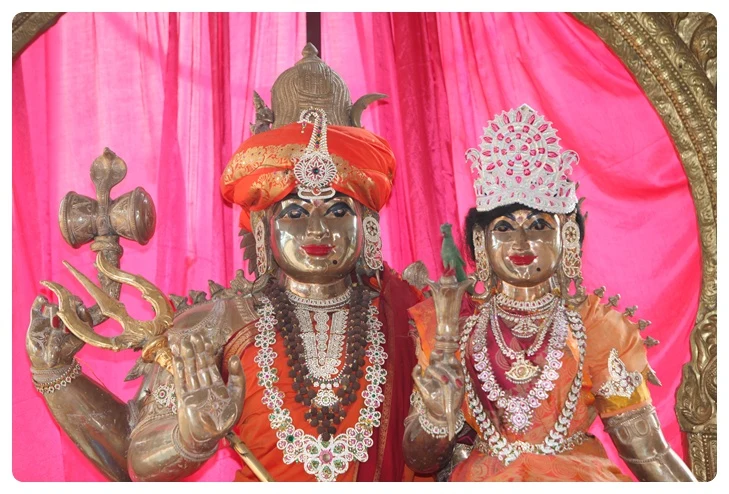
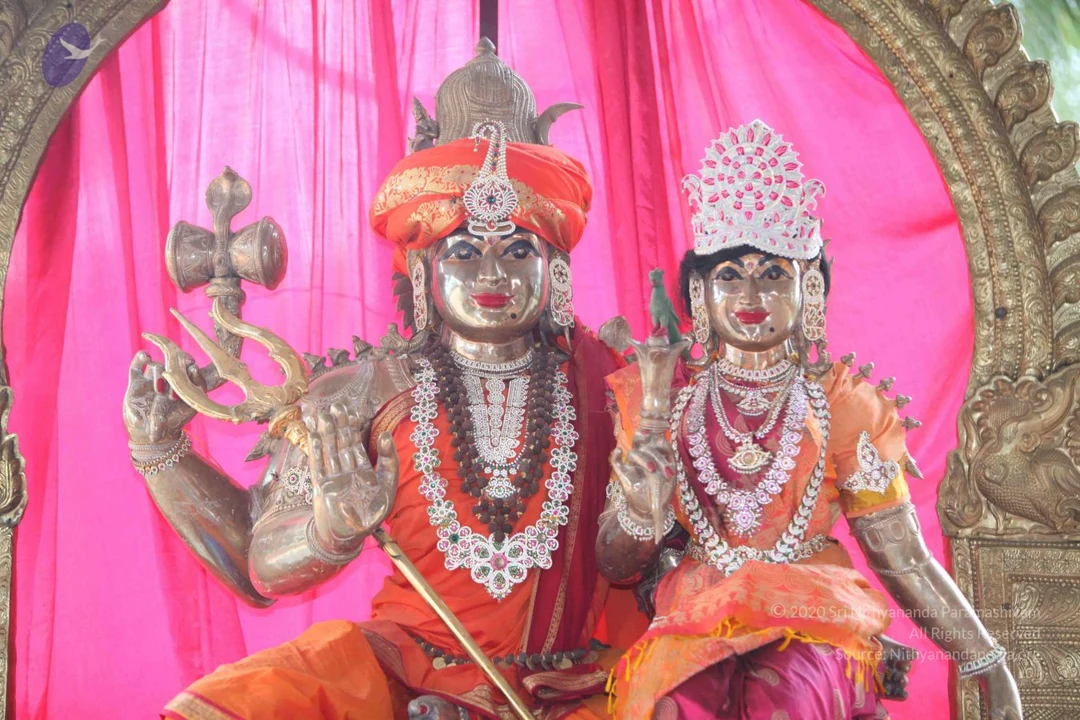
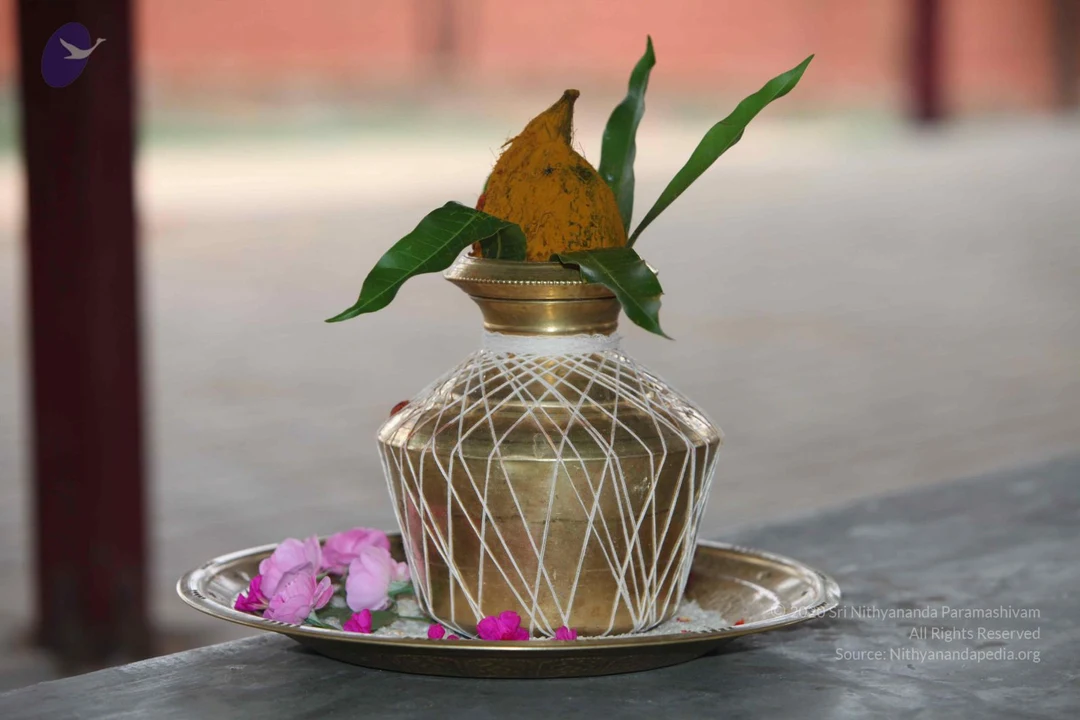
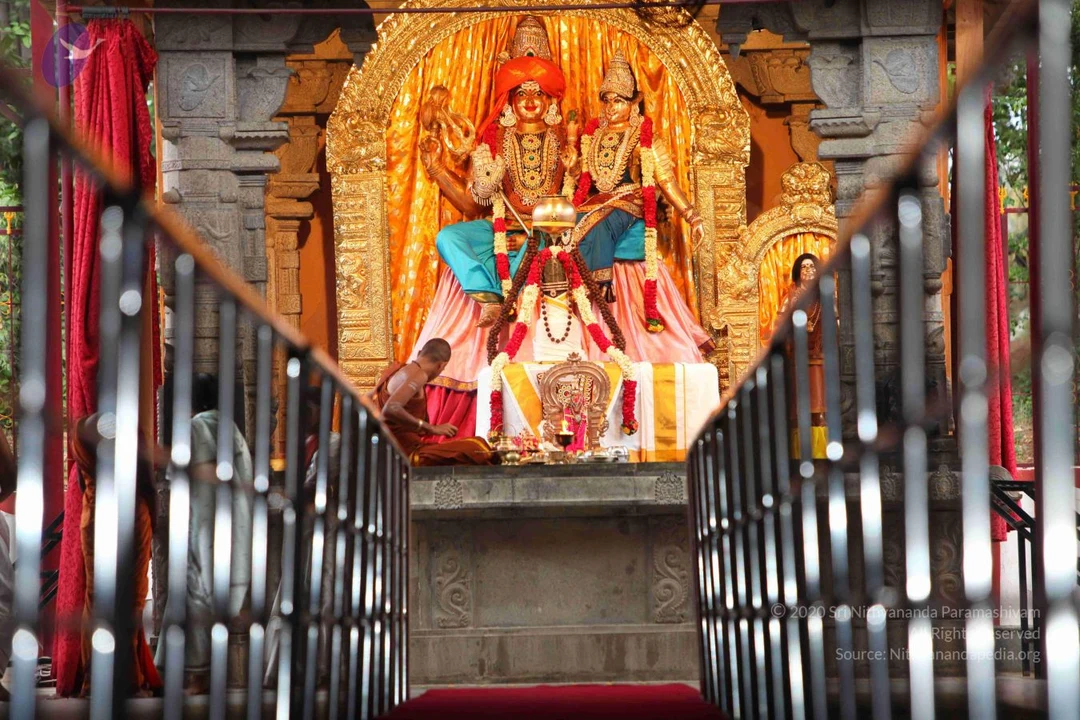
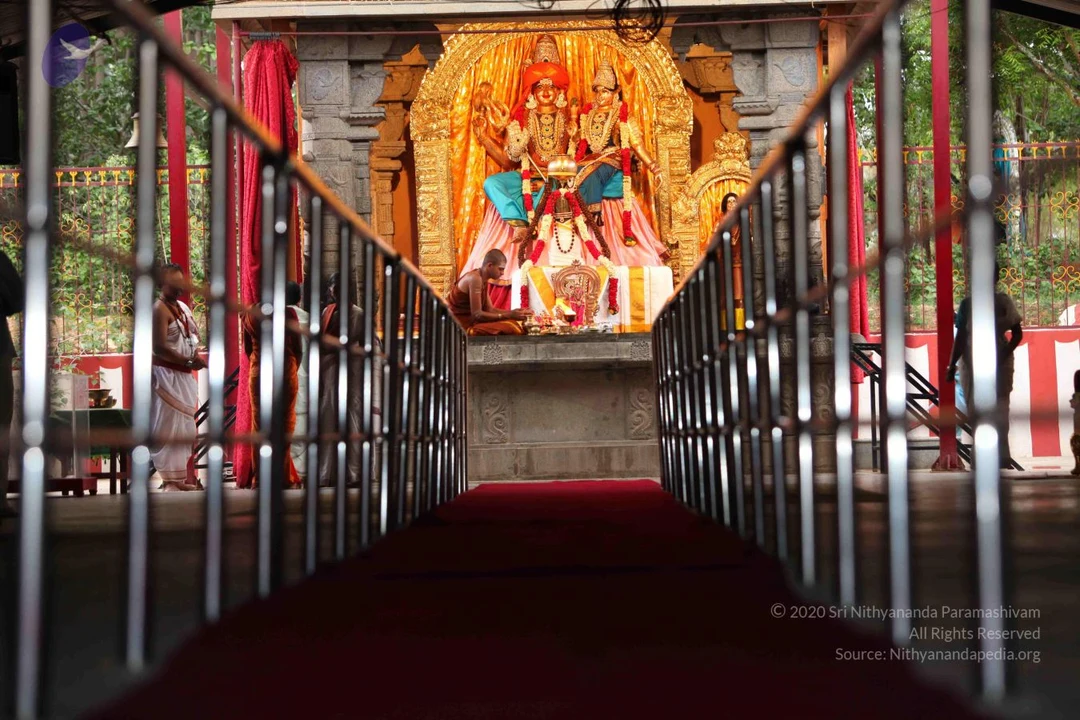
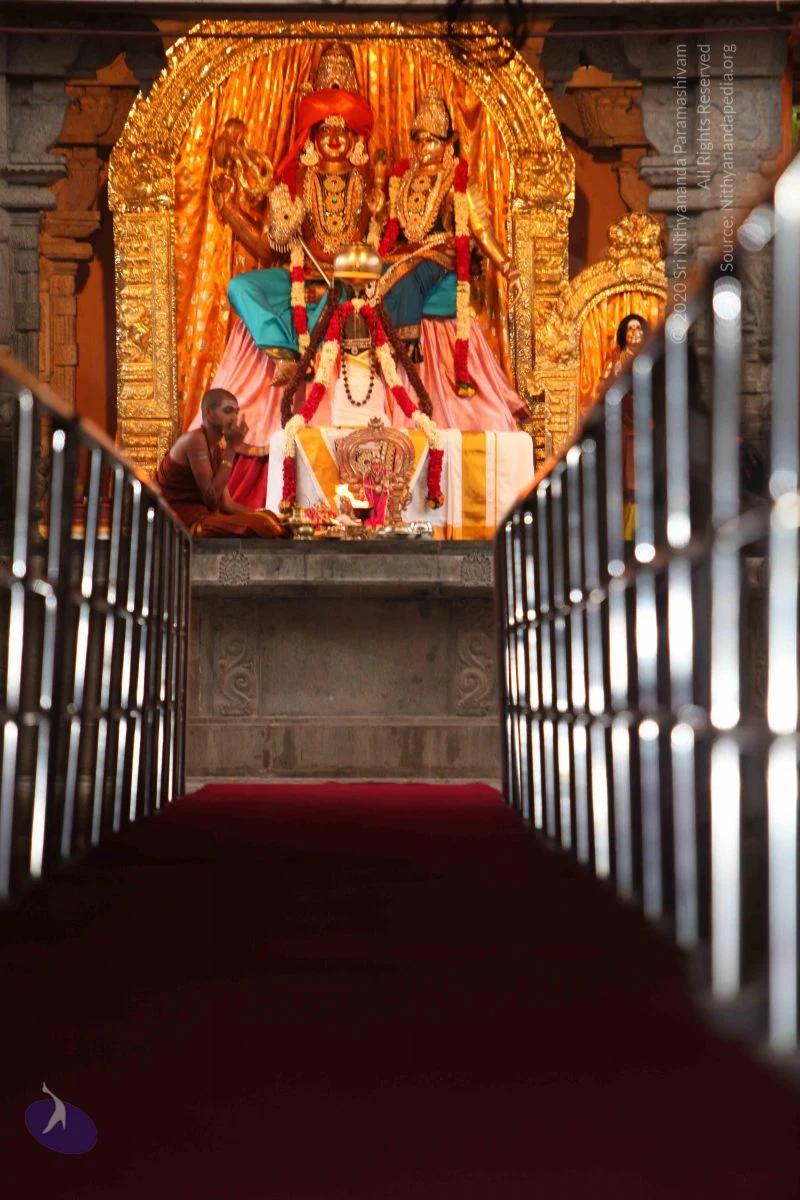
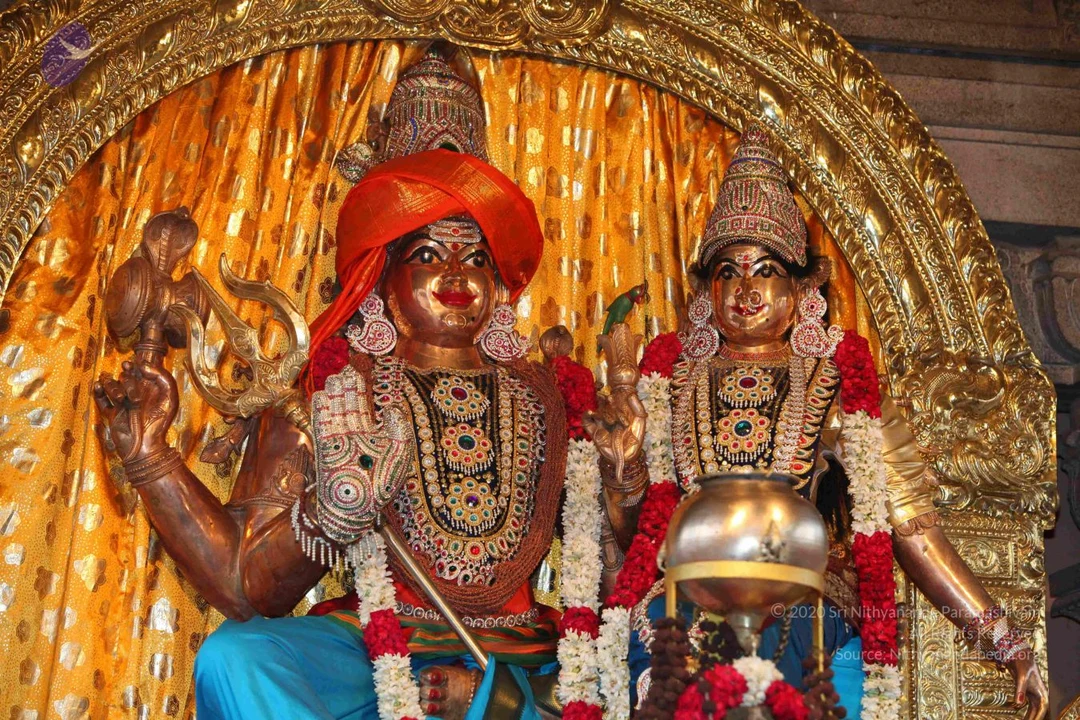
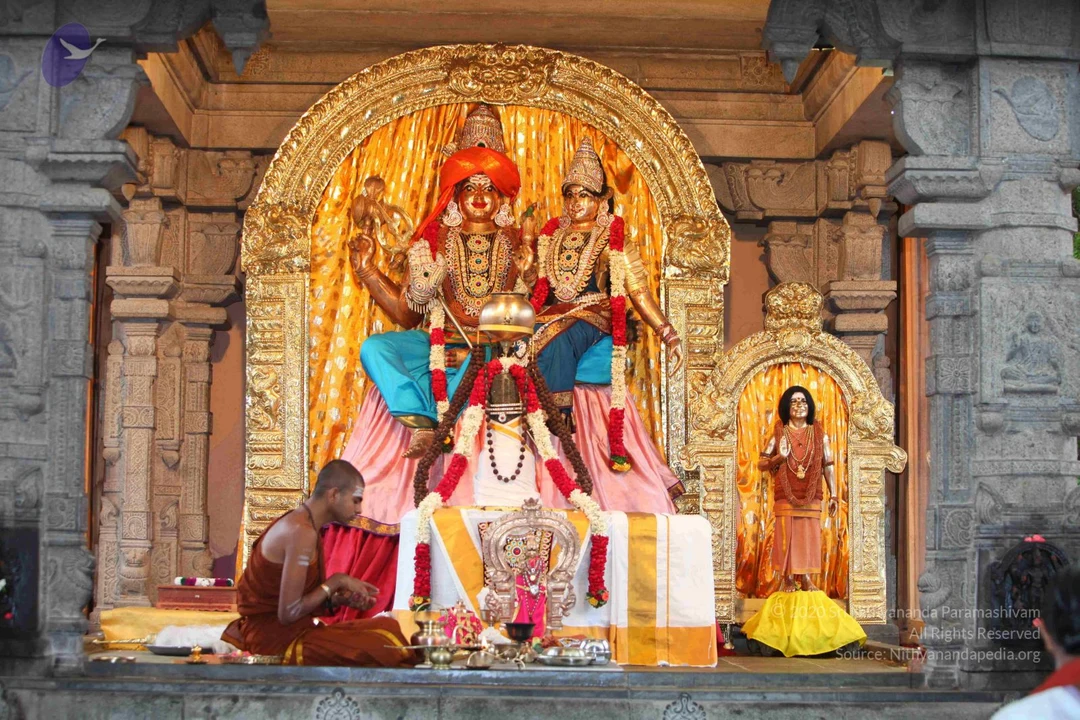
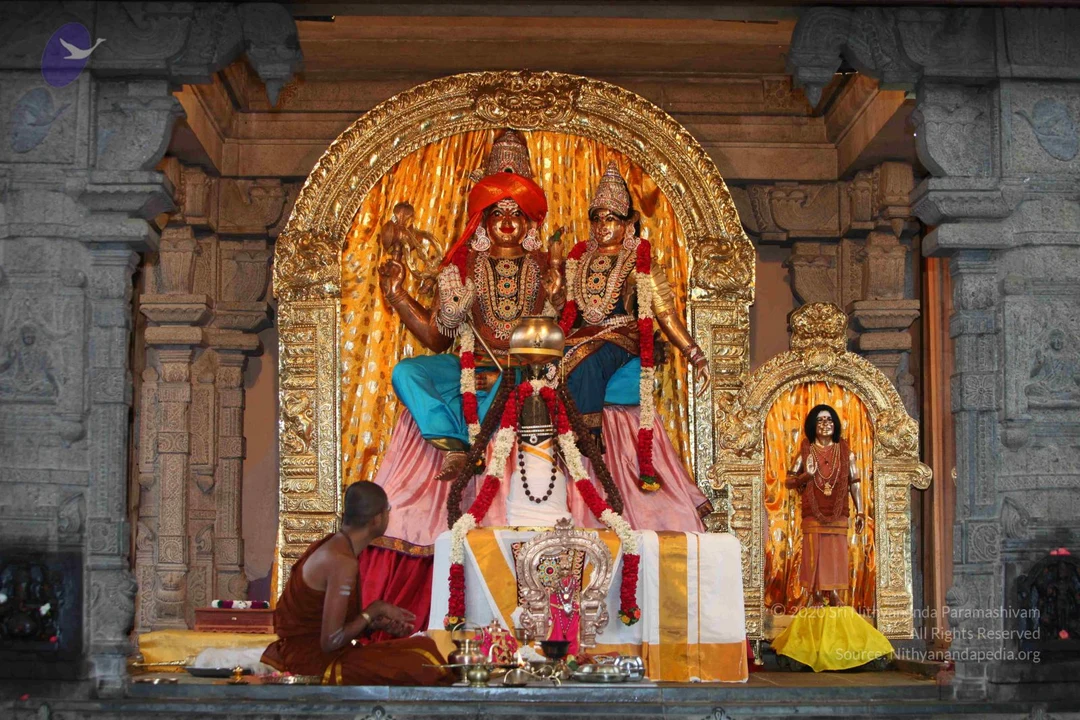
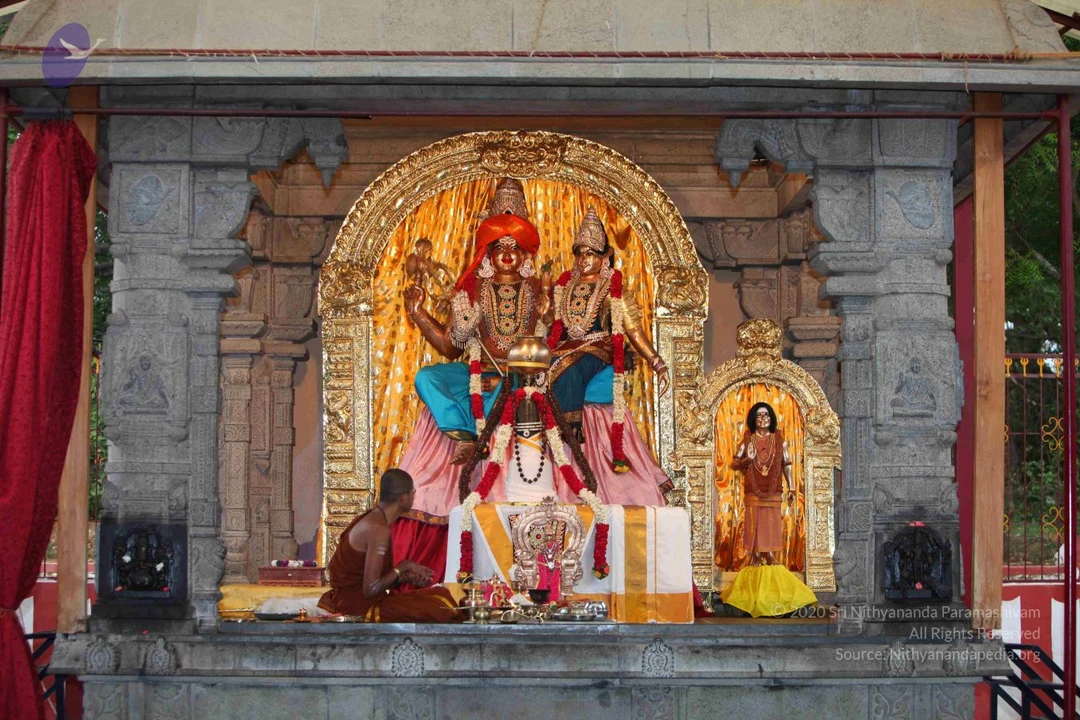
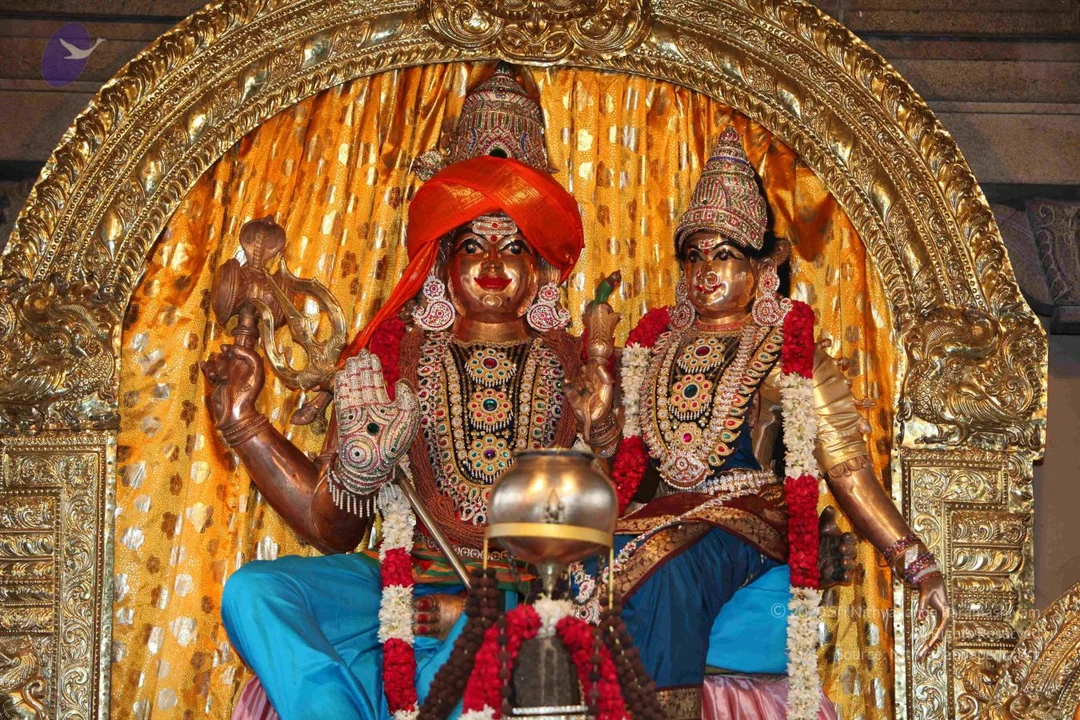
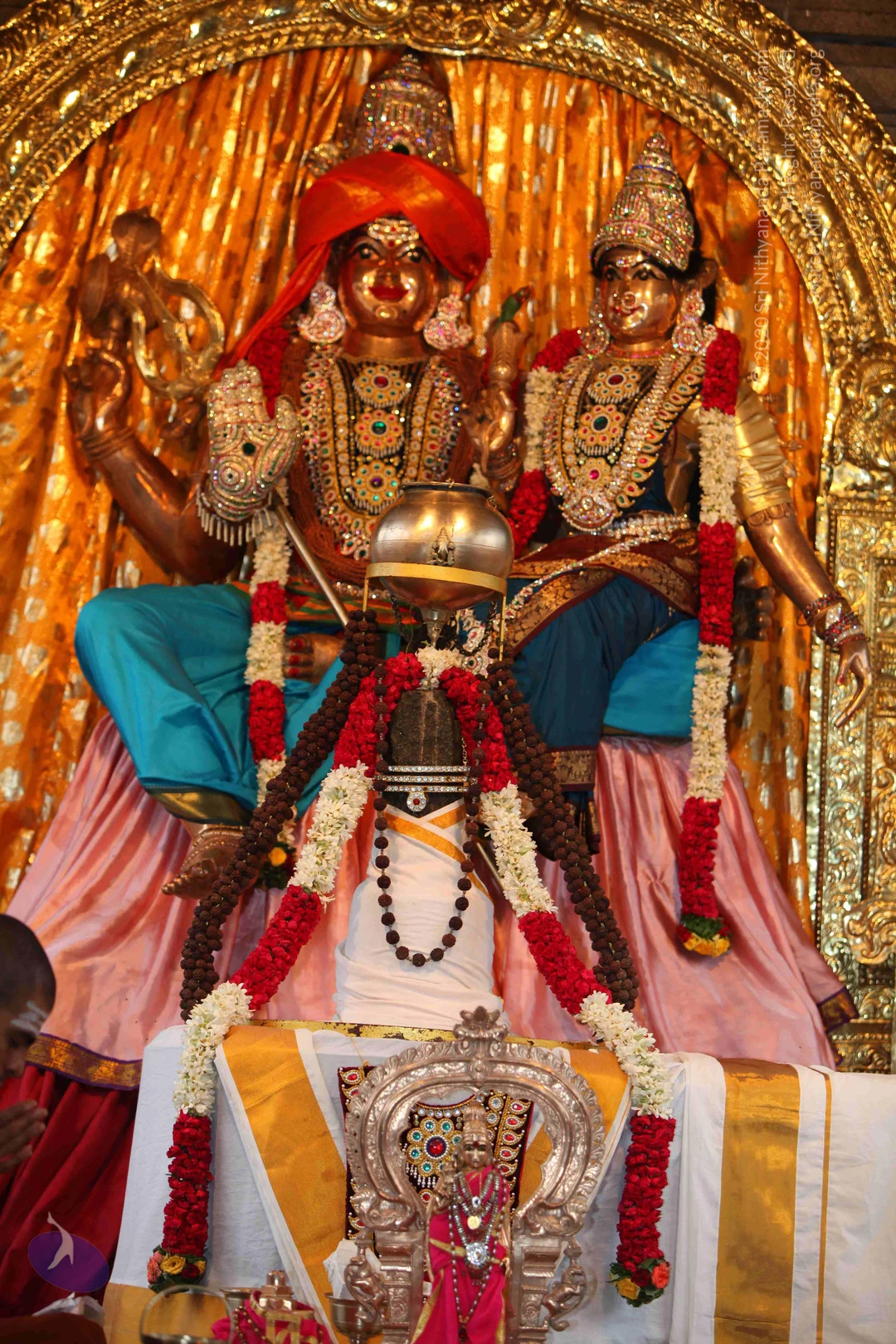
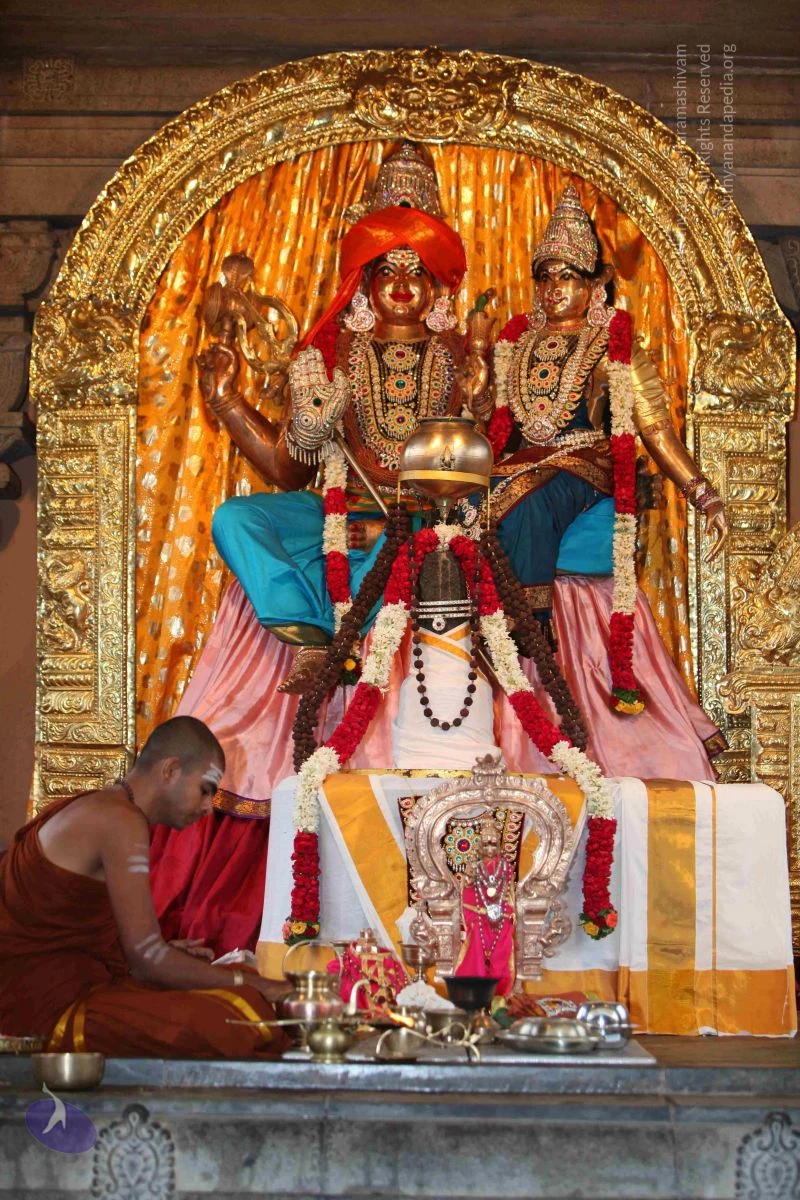
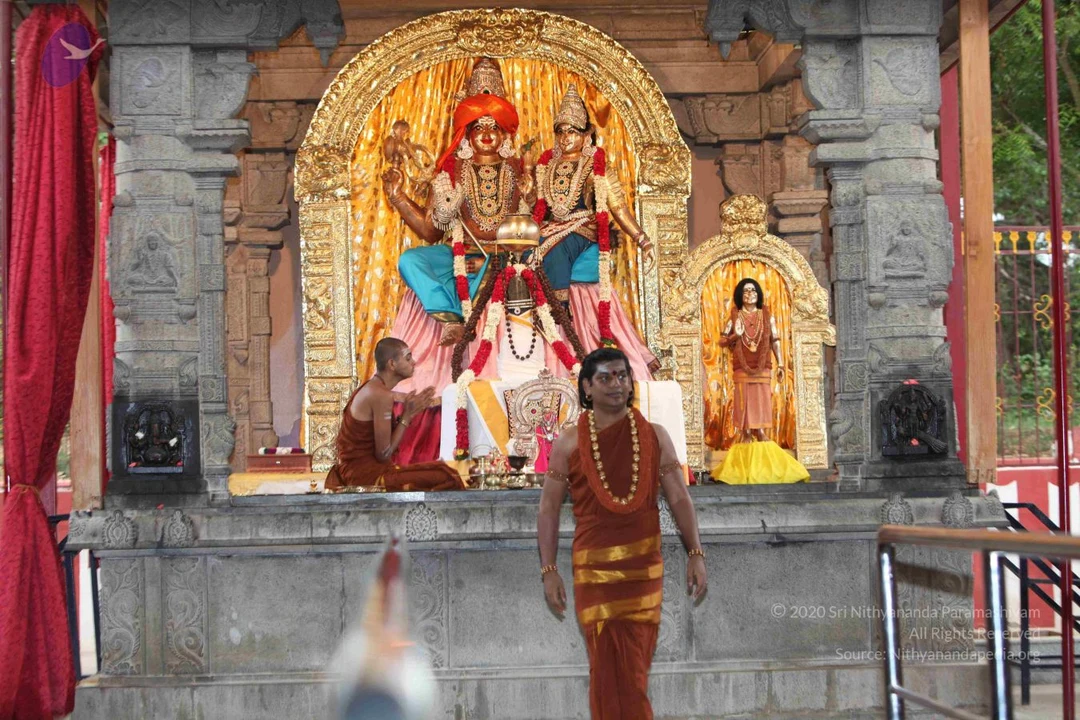
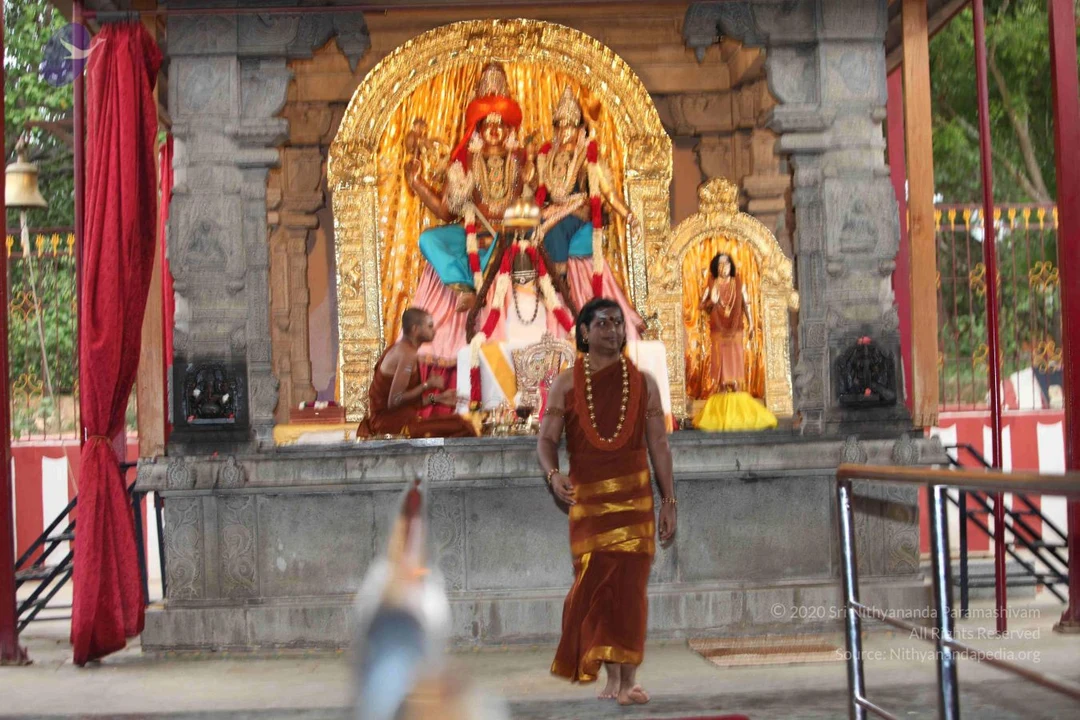
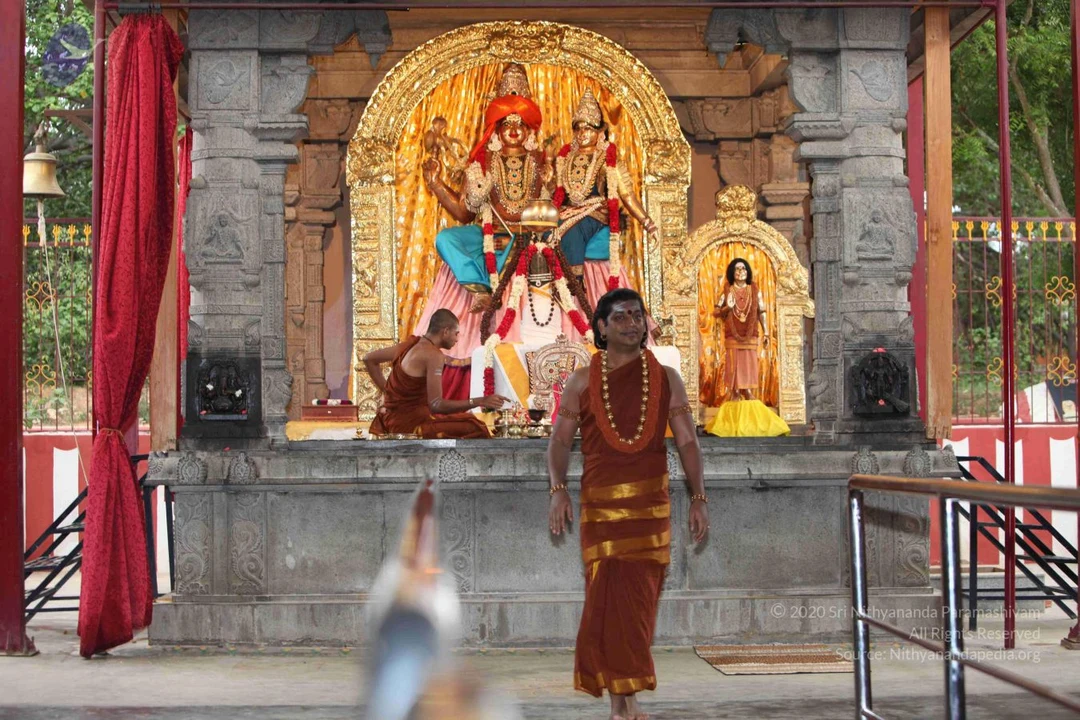
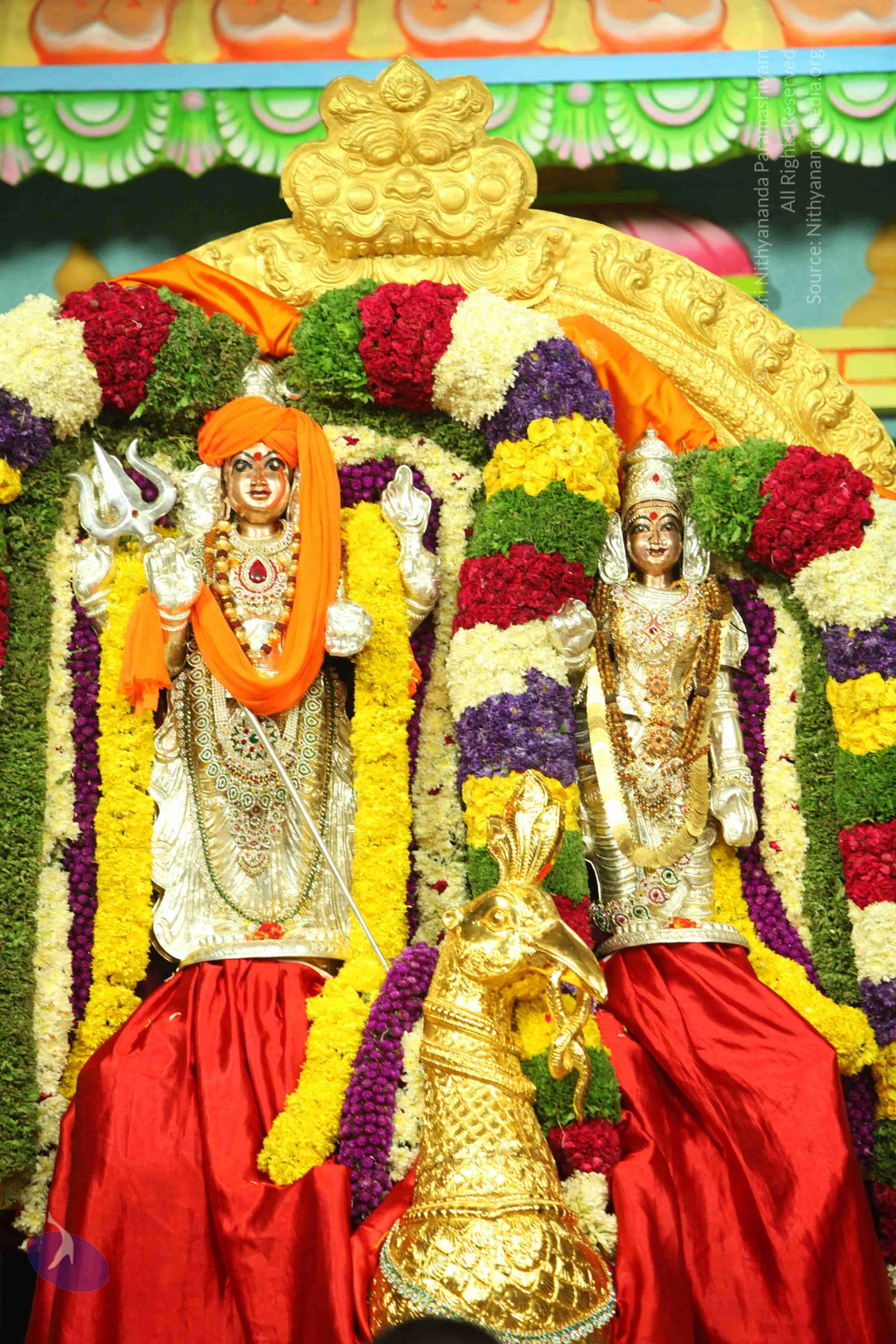
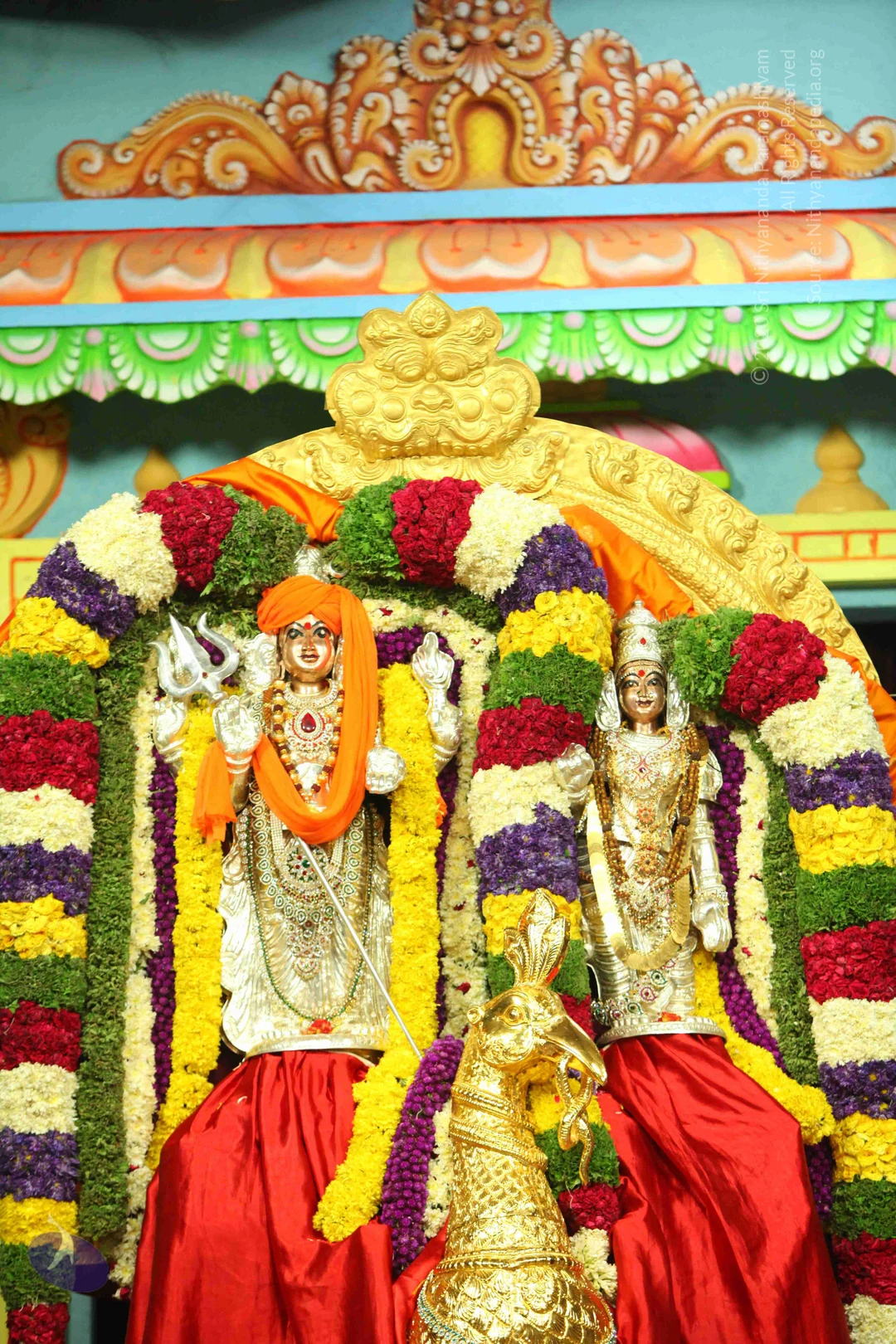
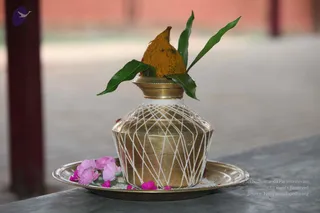
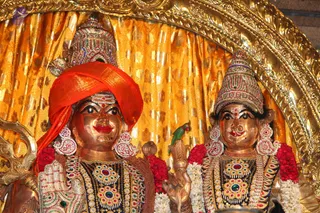
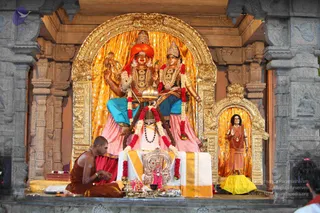
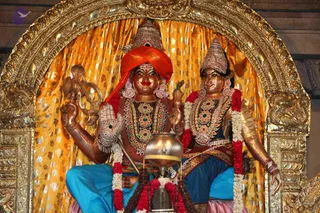
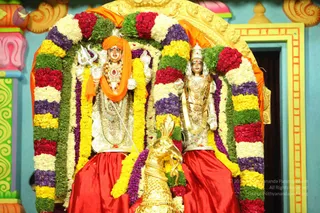
A brass kalasha water pot with a coconut and mango leaves on top sits on a brass plate scattered with pink flowers, on a stone surface. Its sides are wrapped in white thread lattice. The background is a blurred red wall and pillar. No people or a person are visible; the image shows a ritual kalasha setup.Two golden metal murti statues of deities stand side by side in front of a shimmering gold brocade backdrop with an ornate gilded arch. The figure on the left wears an orange-red turban, gold necklaces and a trident-like ceremonial staff, with a green parrot perched near the centre. The figure on the right wears a tall jewelled crown, a dark embroidered garment with multicolour gemstone necklaces and red and white flower garlands draped across the lower frame. These are statues, not living people.A temple shrine with two large painted deity statues, one with an orange turban and multiple arms and the other in a crown with a red-and-gold garland, seated on a pedestal decorated with marigold garlands and a rudraksha mala. A kalasha stands on a sivalinga-like base at centre. A small white-clad statue of a sannyasi with a saffron shawl and rudraksha necklace stands in a side niche with an arch. At lower left a seated priest in saffron robes performs puja beside brass lamps and offering plates. The shrine has golden arches and carved grey stone pillars.A temple shrine dominated by a large statue pair of deities seated on a raised platform under a gilded arch with orange and gold drapery. The seated figure on the left wears a red turban and crown with blue trousers, and the figure on the right wears a tall crown and pink skirt; both have garlands of red and white flowers and ornate necklaces. A central lingam sits on a white cloth with a kalasha above it. A priest in saffron-orange robes sits at the lower left facing the shrine, with puja vessels and oil lamps before him. A smaller standing statue in a niche at right wears a red-brown garment and rudraksha-style beads. The carved grey stone walls frame the scene.A temple shrine with a stone arch framed in gold, draped with gold-yellow cloth. Two large deity murtis stand side by side, one with a red-orange turban and the other with a tall crown, both adorned with gold jewellery, beaded necklaces and red-and-white garlands. A sannyasi-style figure stands at the right in orange-saffron robes beside a smaller shrine niche. In front, a seated priest in orange-saffron cloth performs puja at a silver-and-gold altar with a lingam, brass lamps, a kalasha-like vessel, flower garlands and a white-and-gold cloth. A red curtain hangs at left.Two ornate metal murti statues seated side by side on a throne-like seat before a gold brocade backdrop with a gilded arch frame. The figure on the left has a bright orange turban, a red-and-gold jeweled necklace, and holds a trident-like implement with one hand; the figure on the right wears a tall jeweled crown, multi-coloured jeweled necklaces, and red and white garlands. Both have blue lower garments. A brass kalasha pot sits in front with rudraksha malas and garlands below it.

INNER-AWAKENING-SESSION-UNCLUTCING-INITIATION-BY-HDH
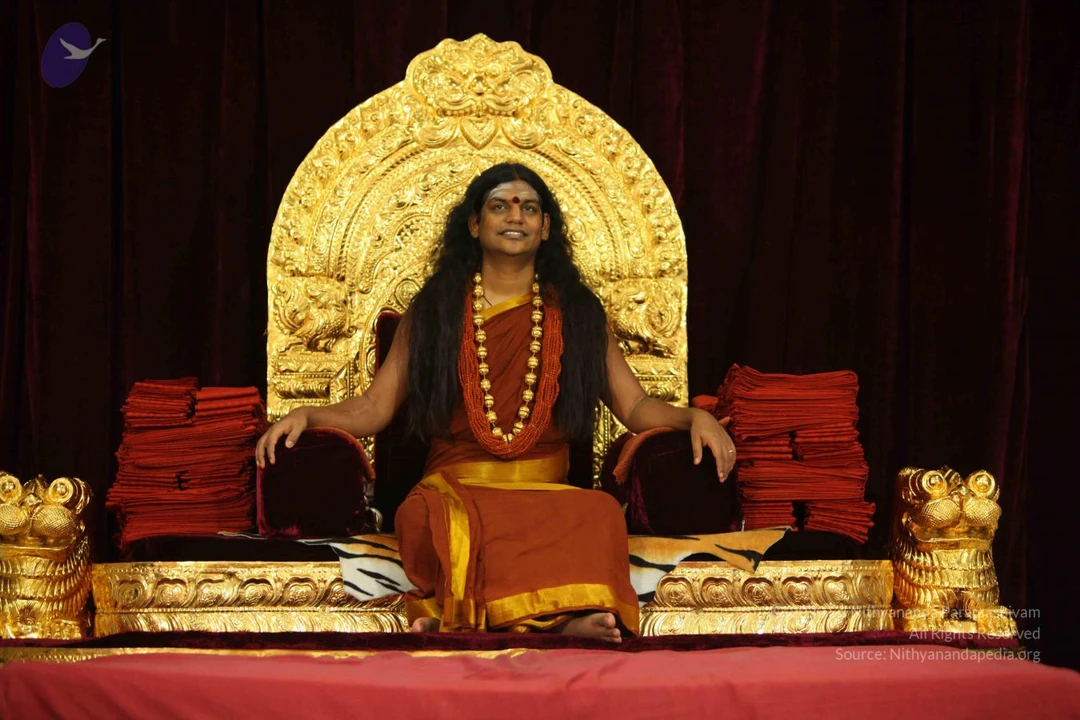
14 photosSource gallery
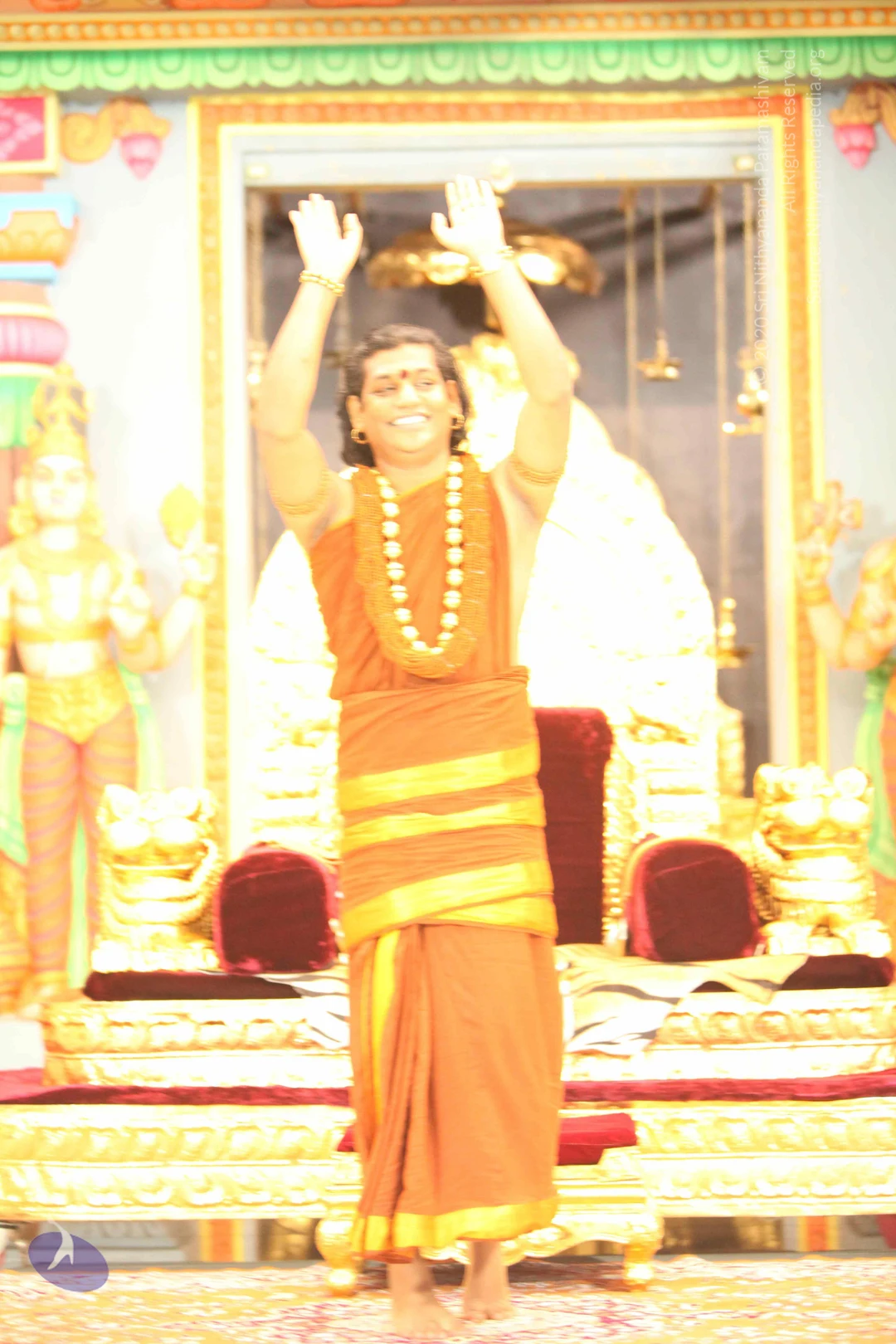
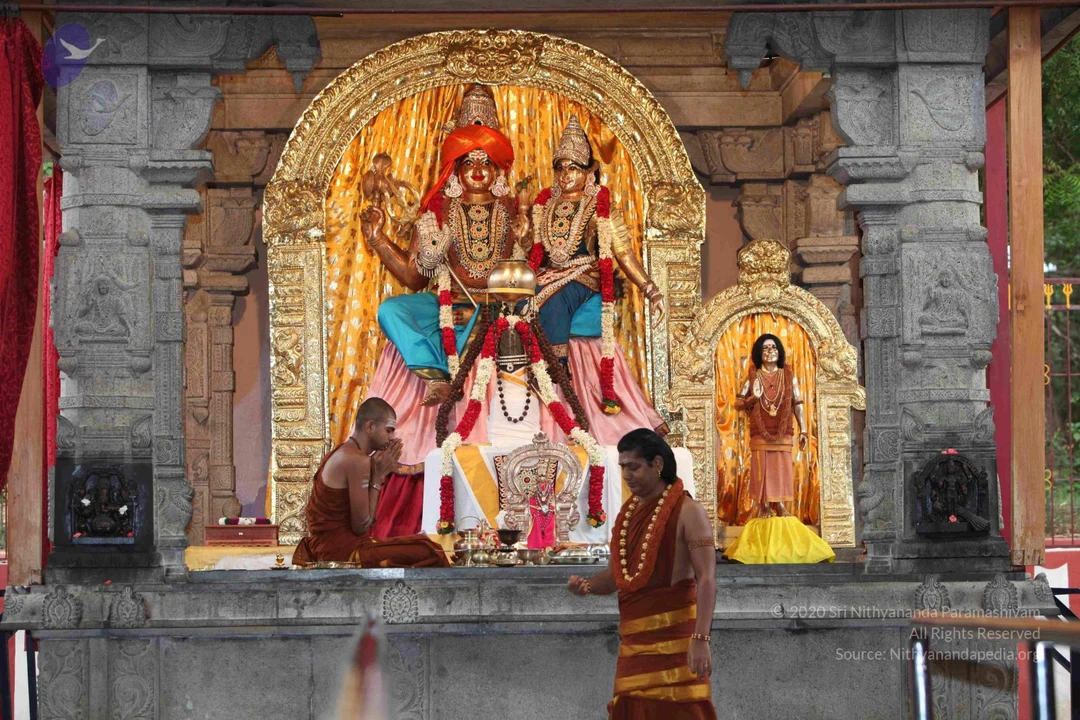
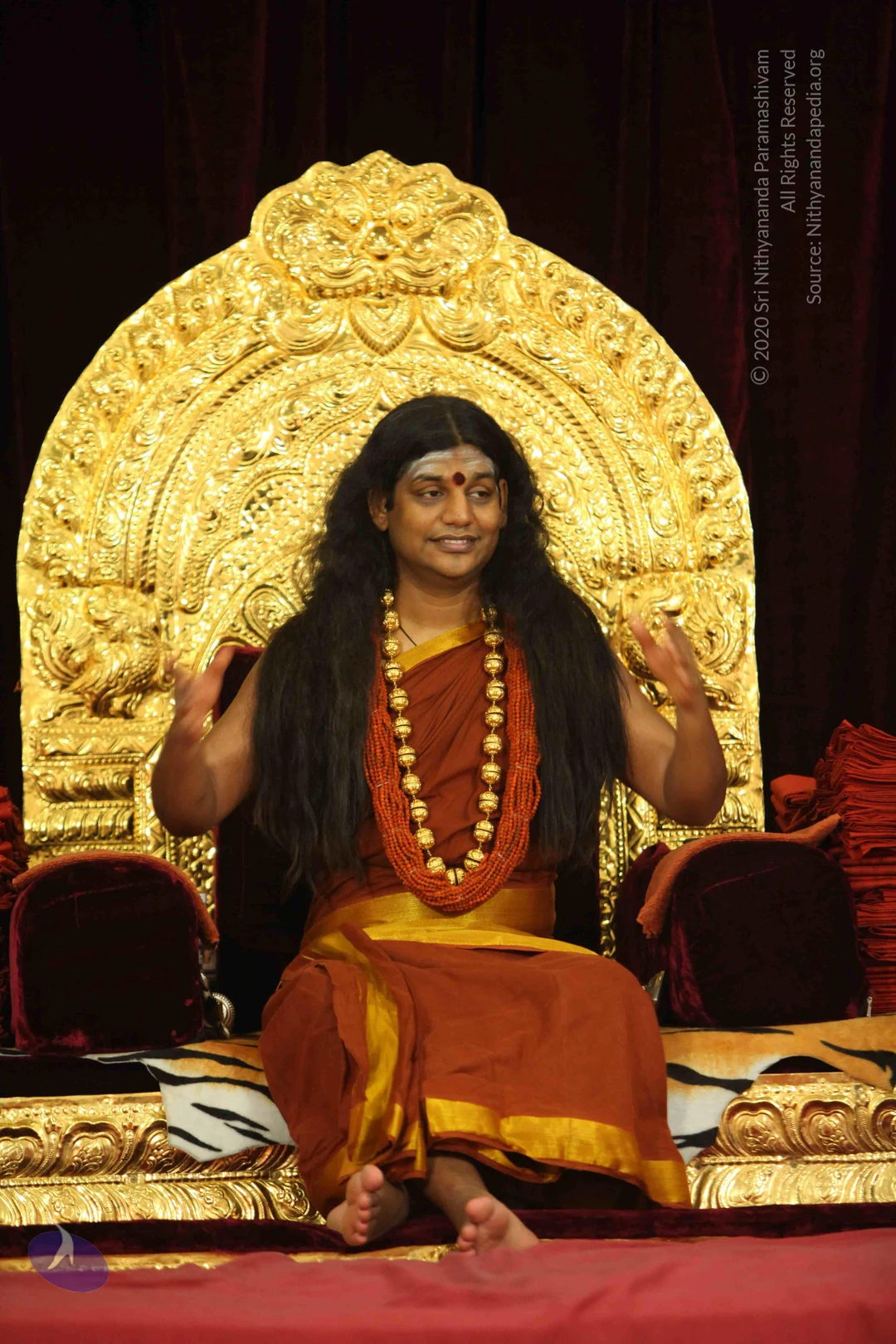
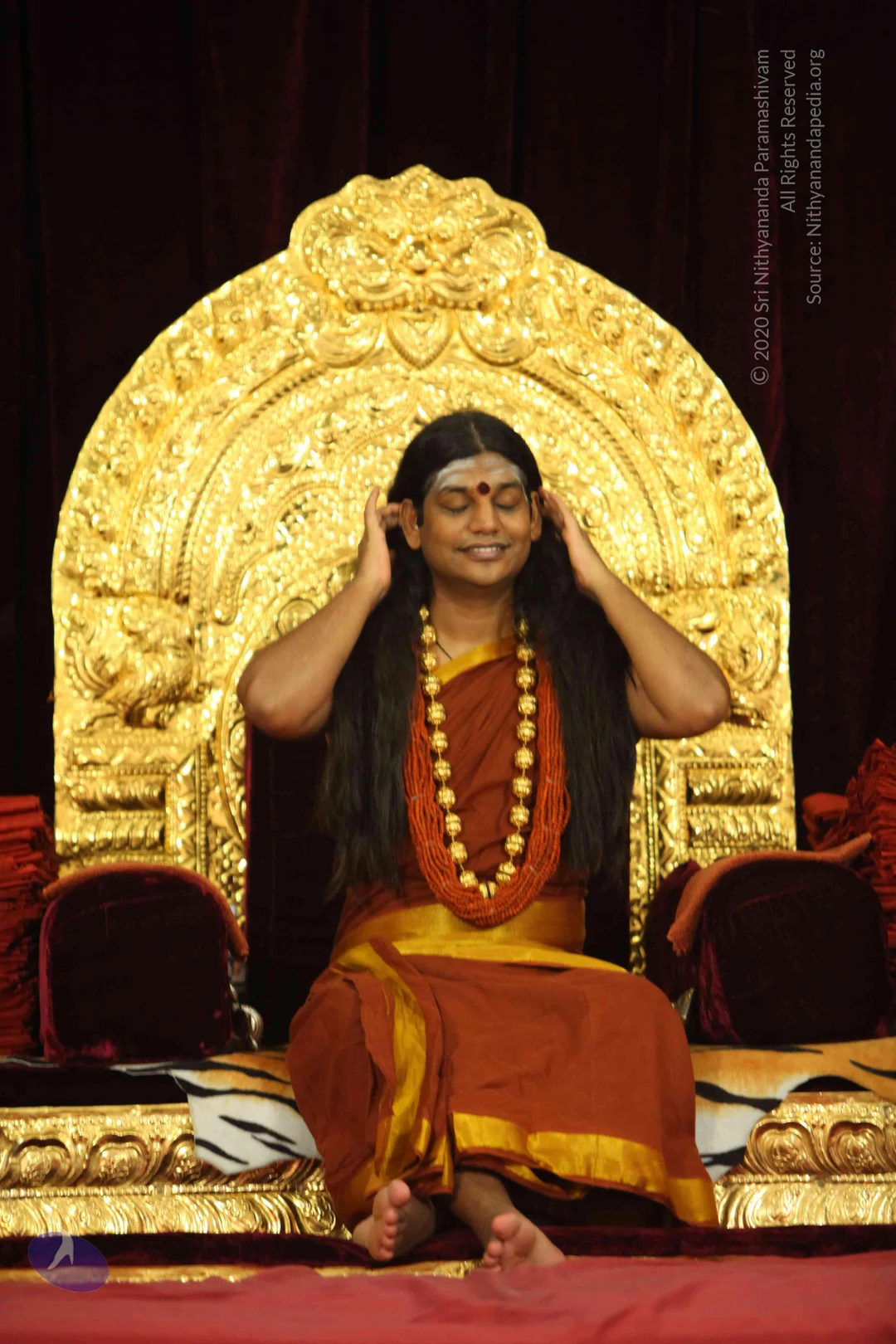
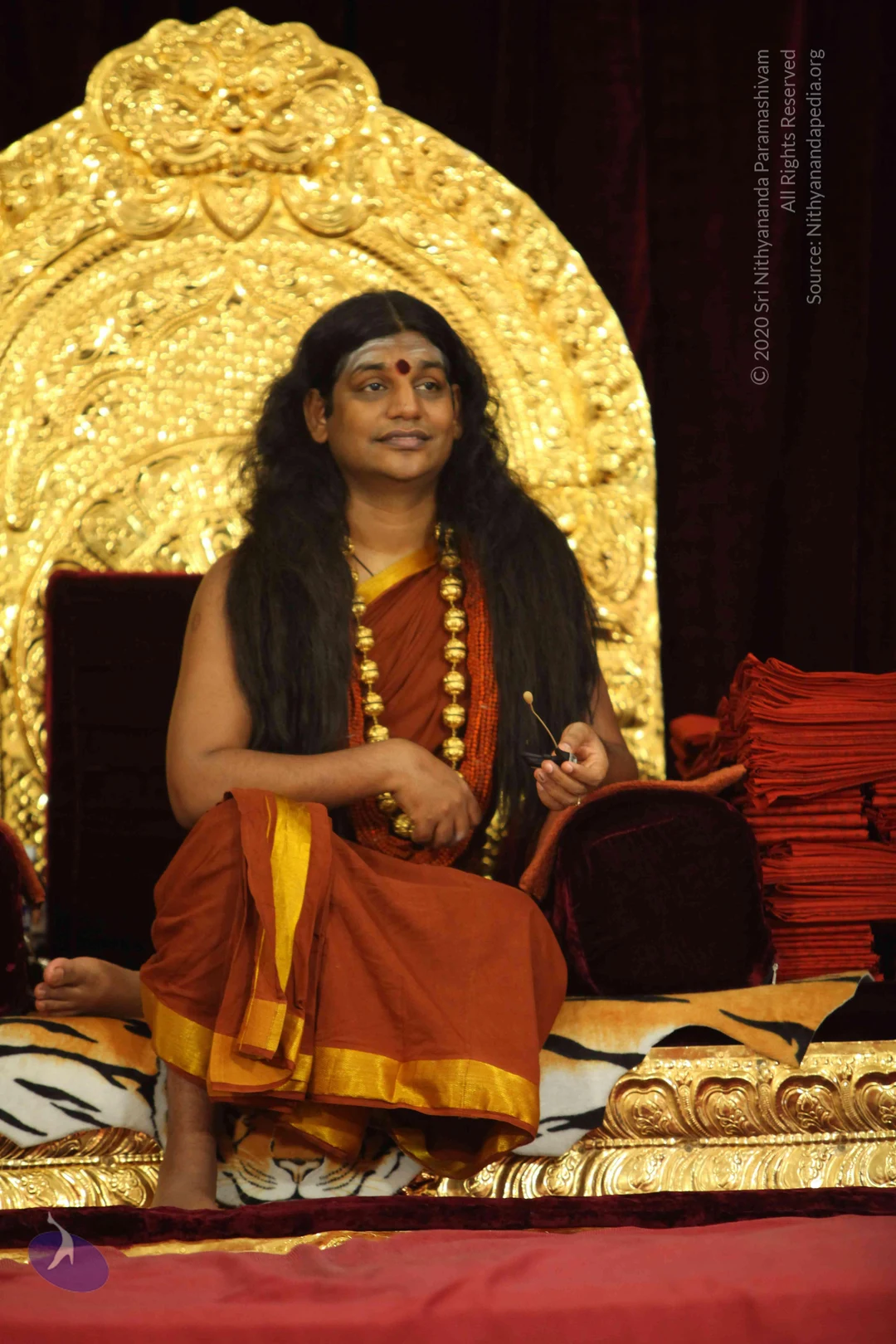
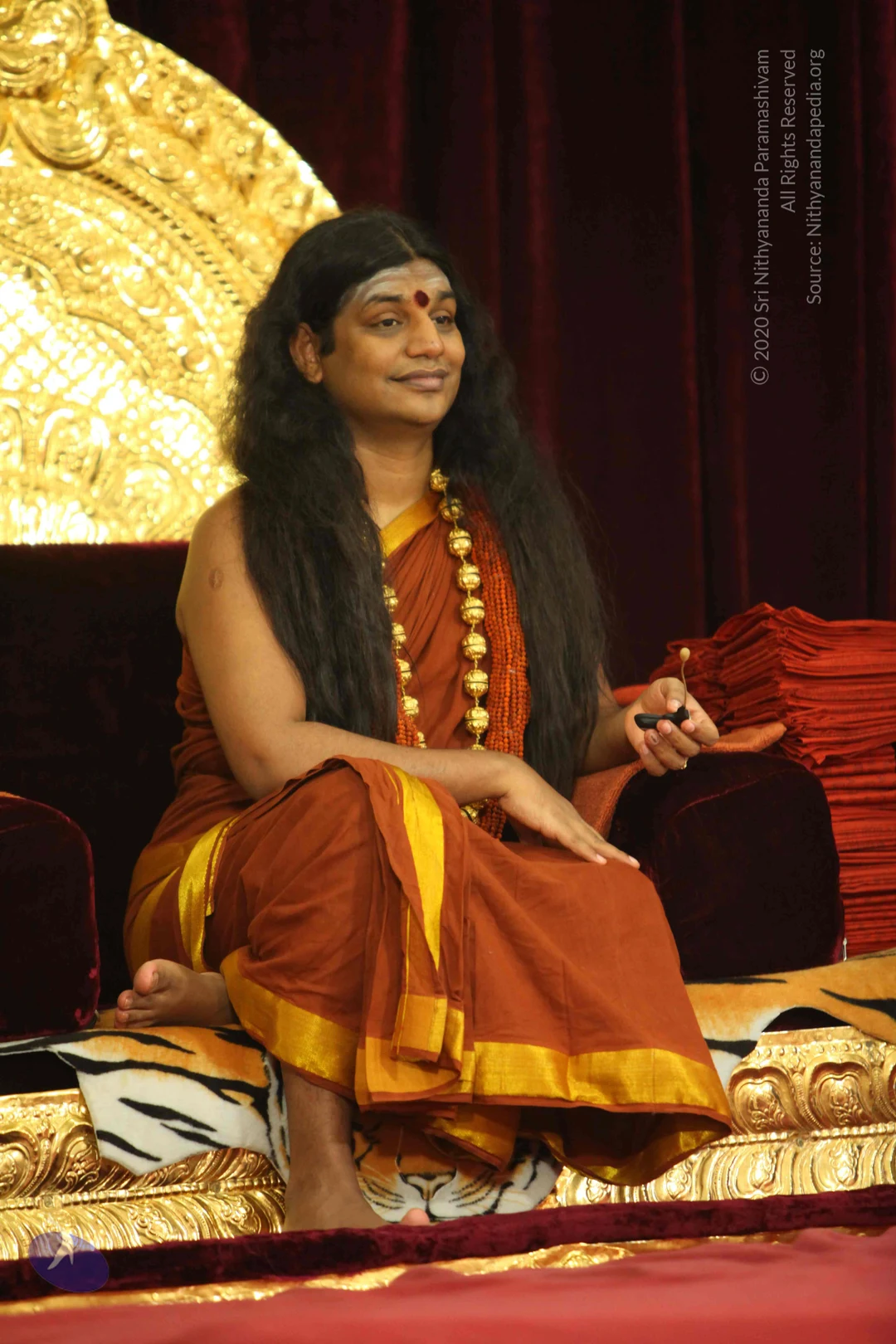
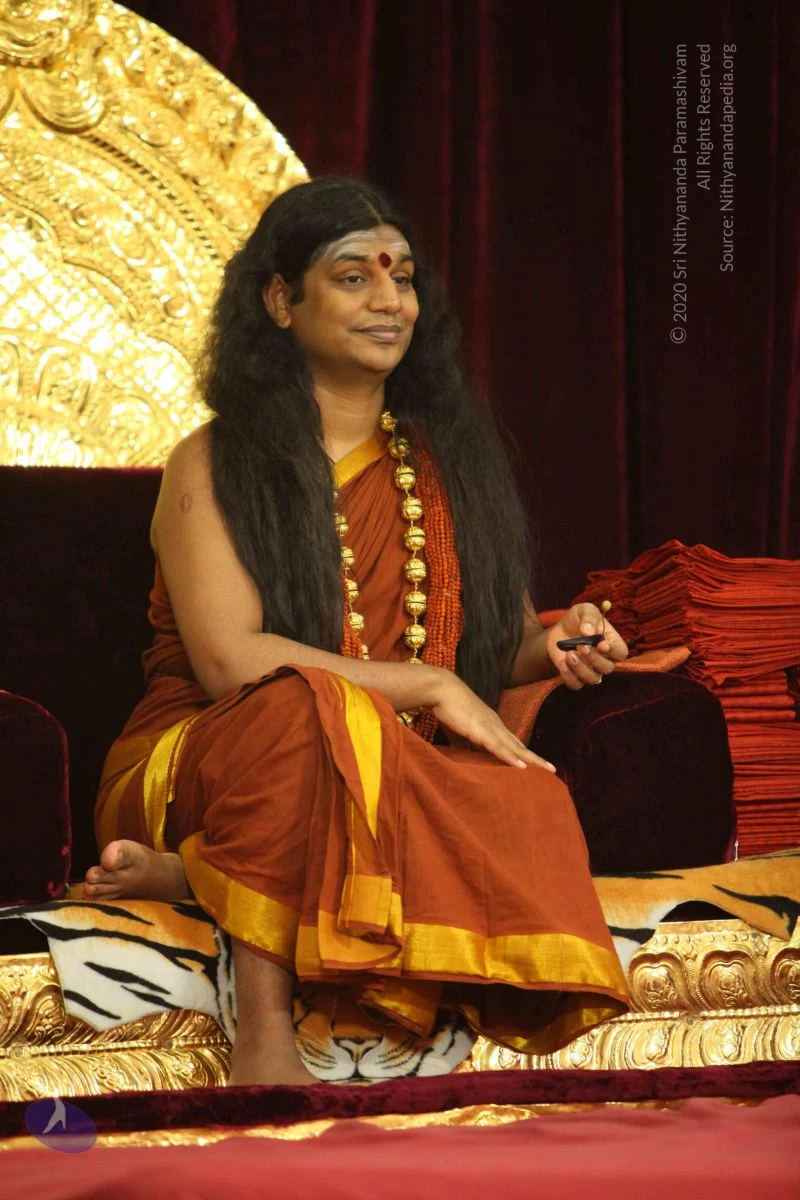
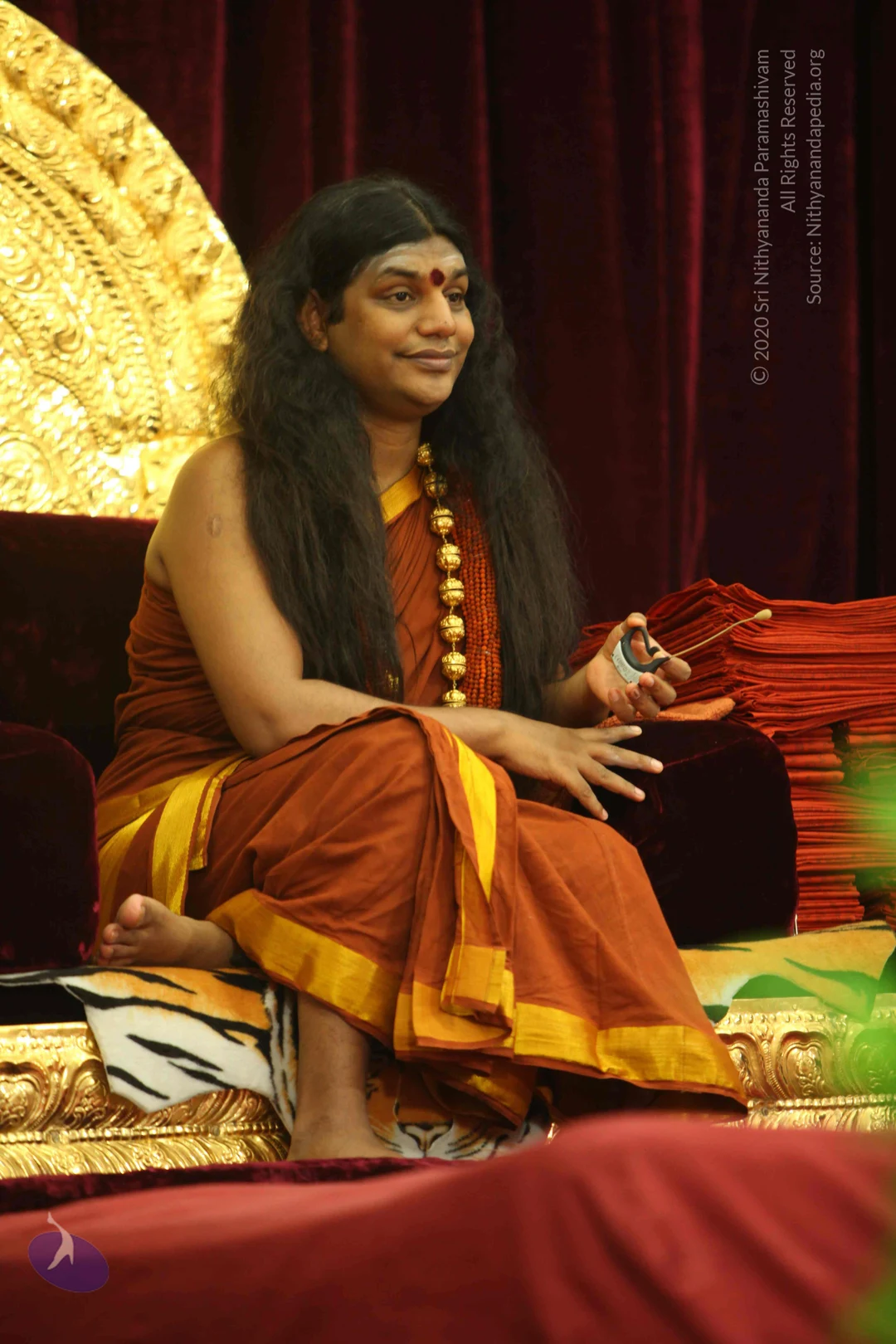
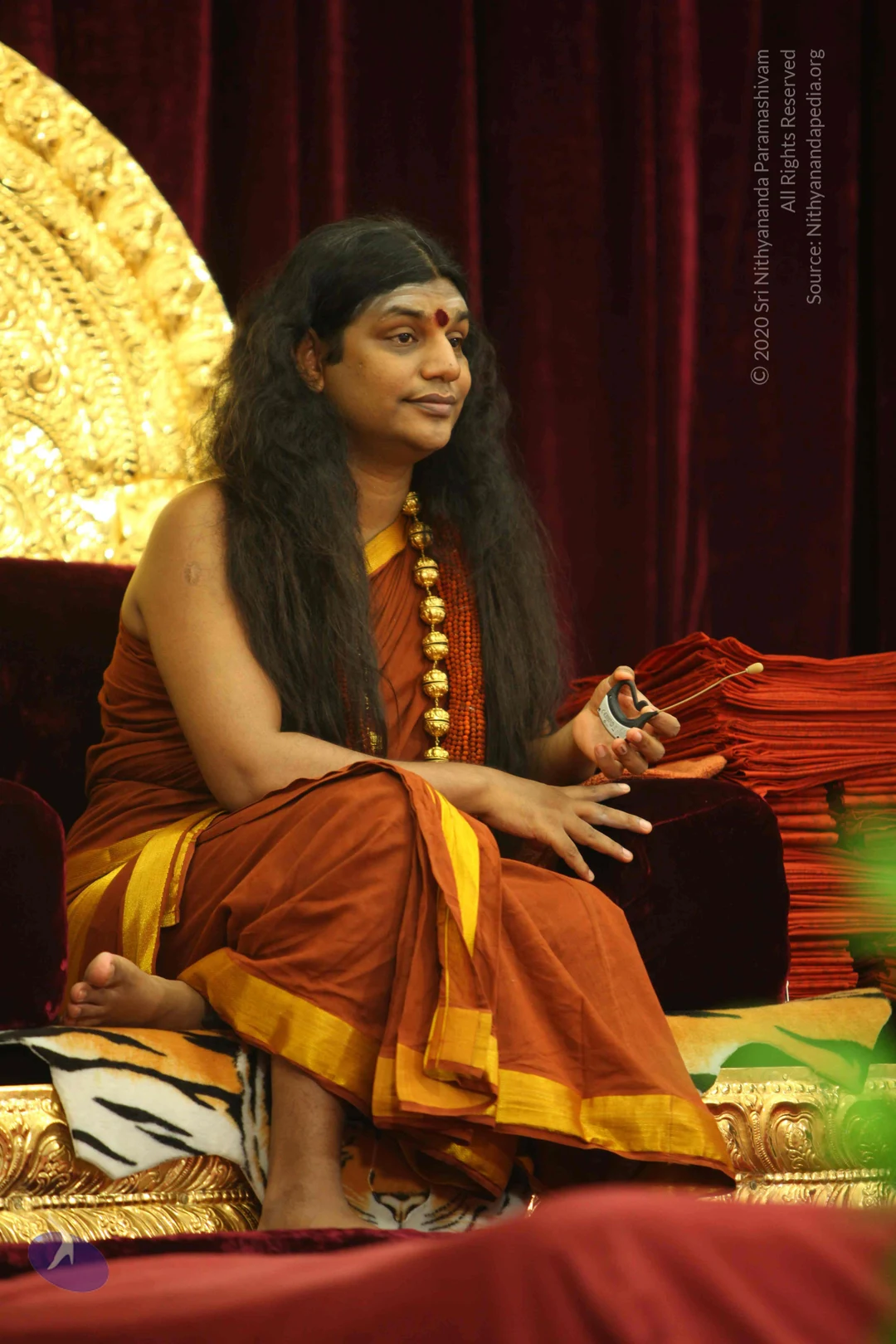
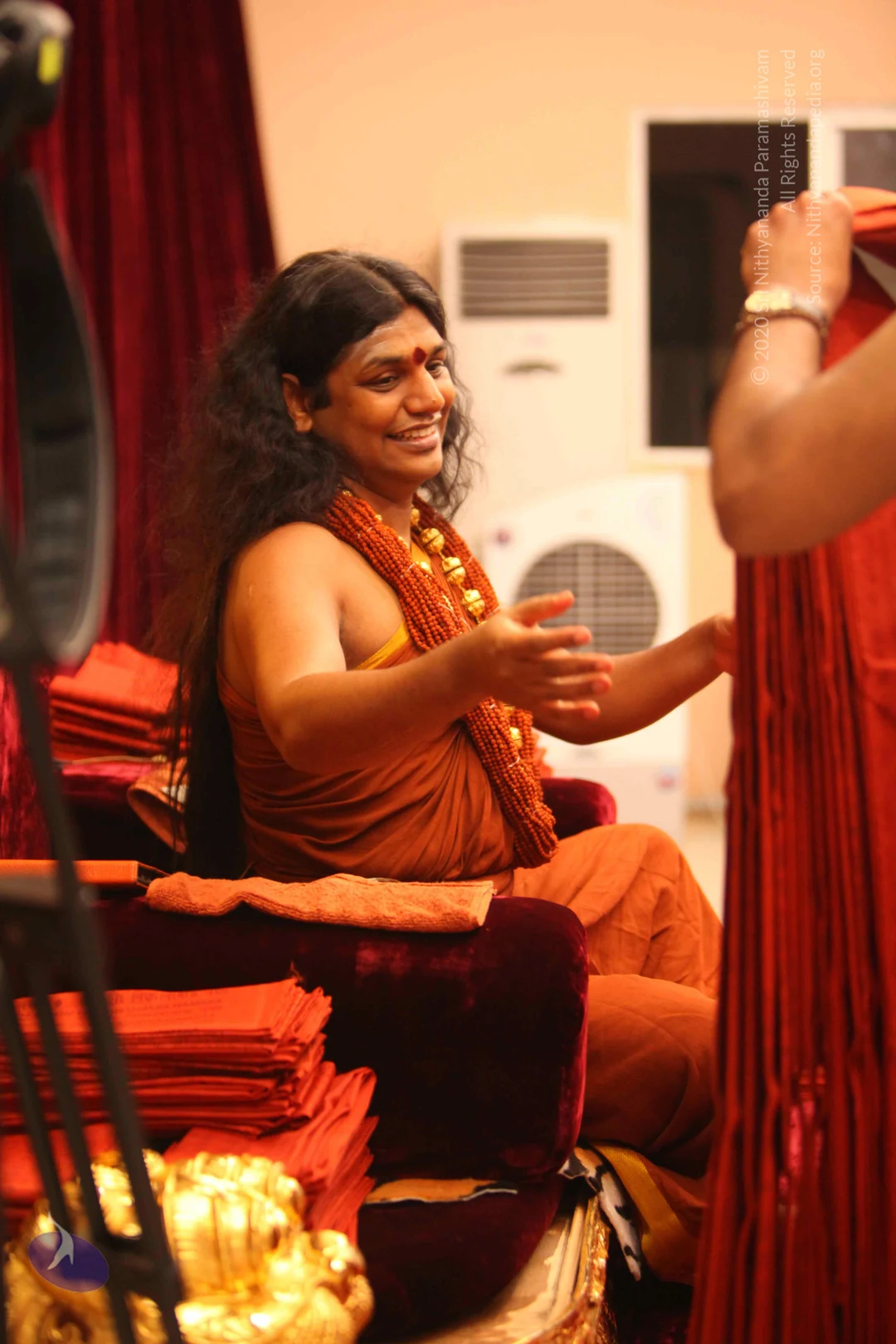
A seated man on an ornate gold throne with a carved arched back and tiger-skin-covered platform gestures with both raised hands during a talk. He has long dark hair swept back, a red bindi and white marks on his forehead, a saffron-orange shawl with gold border, and a multi-strand rust-red rudraksha mala with large gold beads. Red velvet cushions and a red carpet surround the throne, with stacked orange cloth at the right edge and dark draped curtains behind.A photograph of a seated person on a golden throne with an ornate gold carved backrest and a tiger-striped cloth draped over the platform. The person has long, swept-back dark hair, a red bindi and tilak, wears rust-orange robes with gold-bordered cloth, and a multi-strand orange rudraksha mala with a large ceremonial gold bead necklace. He sits cross-legged and barefoot, holding a small object in one hand, with red velvet cushions and stacked red cloth behind him. This appearance-based label is Swamiji (probable), based on long hair, saffron clothing, rudraksha mala and ceremonial gold necklace.A photograph of a long-haired man seated cross-legged on an ornate golden throne draped with a tiger-striped cloth, in front of deep maroon velvet drapery and a large gold embossed backdrop. He wears an orange-saffron dhoti-style garment with gold border, a red bindi on his forehead, a red rudraksha mala and a heavy gold bead necklace, and holds a small black device in one hand. A stack of folded red cloths sits beside him. Swamiji (probable) based on long swept-back hair, saffron ornate clothing, rudraksha mala and gold necklace, seated on a throne.A seated man with long, loose dark hair wears an orange-brown sannyasi-style wrap with gold-bordered edges and a multi-strand gold bead necklace over red rudraksha-style beads. A red bindi marks his forehead. He sits on a red velvet throne-like seat with a tiger-striped cloth draped over it, holding a small wireless microphone in his right hand while gesturing with his left. Behind him stand a gold ornate arch and deep red velvet drapes, with stacked red cloths at the right. Swamiji (probable): long swept-back hair, saffron-orange clothing, rudraksha beads and gold necklace, seated on a ceremonial throne, consistent with a satsang discourse.A seated person in an orange-saffron robe with a yellow-gold border sits cross-legged on an ornate gold throne with a carved arched back and lion-like finials, draped with a tiger-stripe cloth. The person has long dark hair, a red bindi, and wears a thick multi-strand rudraksha-style mala of orange beads with gold bead accents. They speak into a small head microphone with both hands gesturing in front of the chest. Probable Swamiji: long swept-back hair, saffron-orange clothing and beaded mala, seated on a golden throne. Dark red drapes and a red cloth edge the stage. The stage is a lectern-free satsang setting.A seated figure sits on an ornate gilded throne with a carved arched back and lion-like reliefs, draped with a tiger-striped cloth. He wears a saffron/orange robe with gold borders, a long ornate gold-bead necklace over an orange rudraksha-style mala, and has long swept-back dark hair with a red bindi on the forehead. He raises one hand in a gesture while speaking into a small headset microphone. The background is deep red drapery. Swamiji (probable): long hair, saffron robe, ornate gold necklace and mala cues, seated on a throne, consistent with the page's reference to a satsang discourse.

DARSHAN-AND-INITIATION-INTO-UNCLUTCHING
93 photosSource gallery
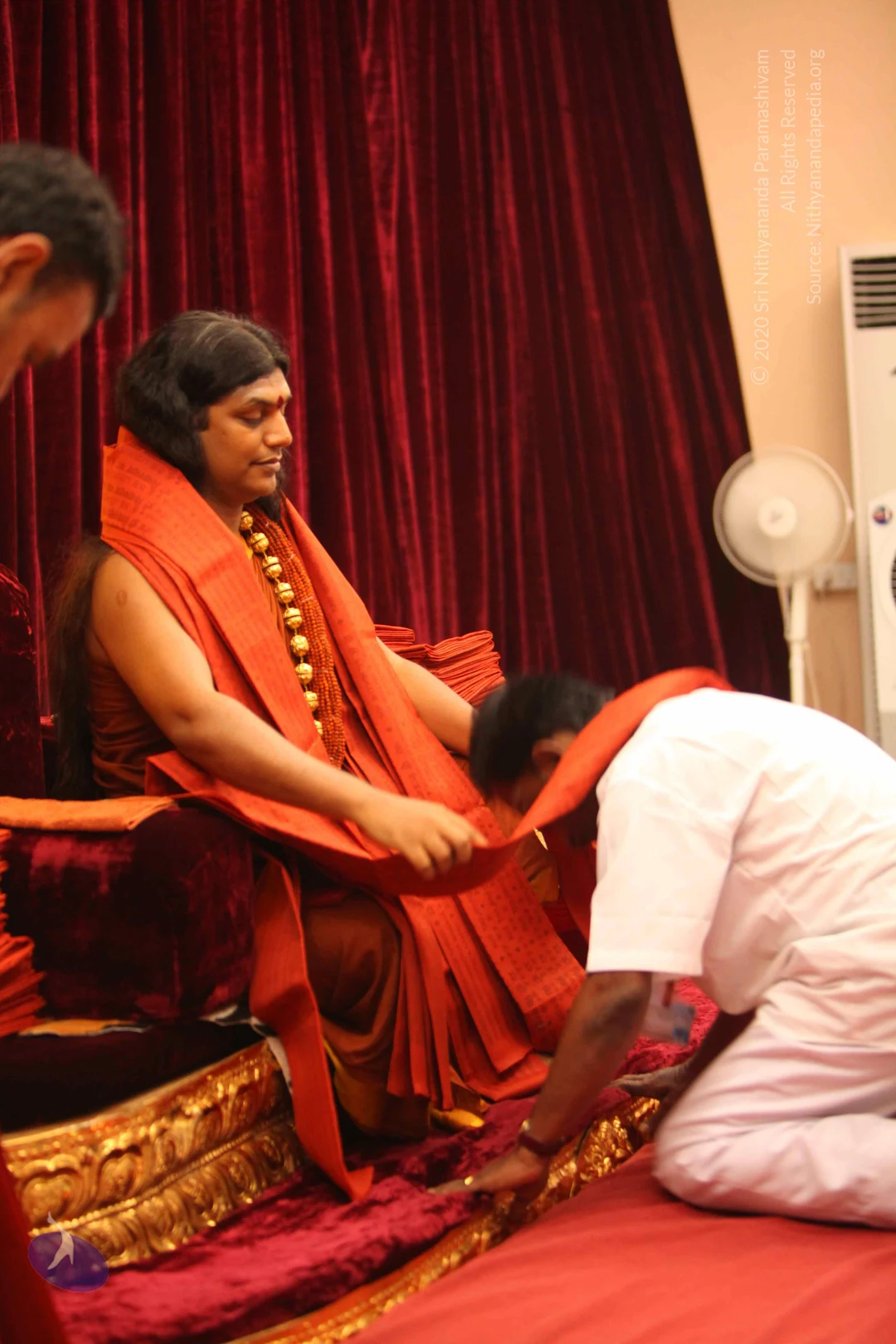
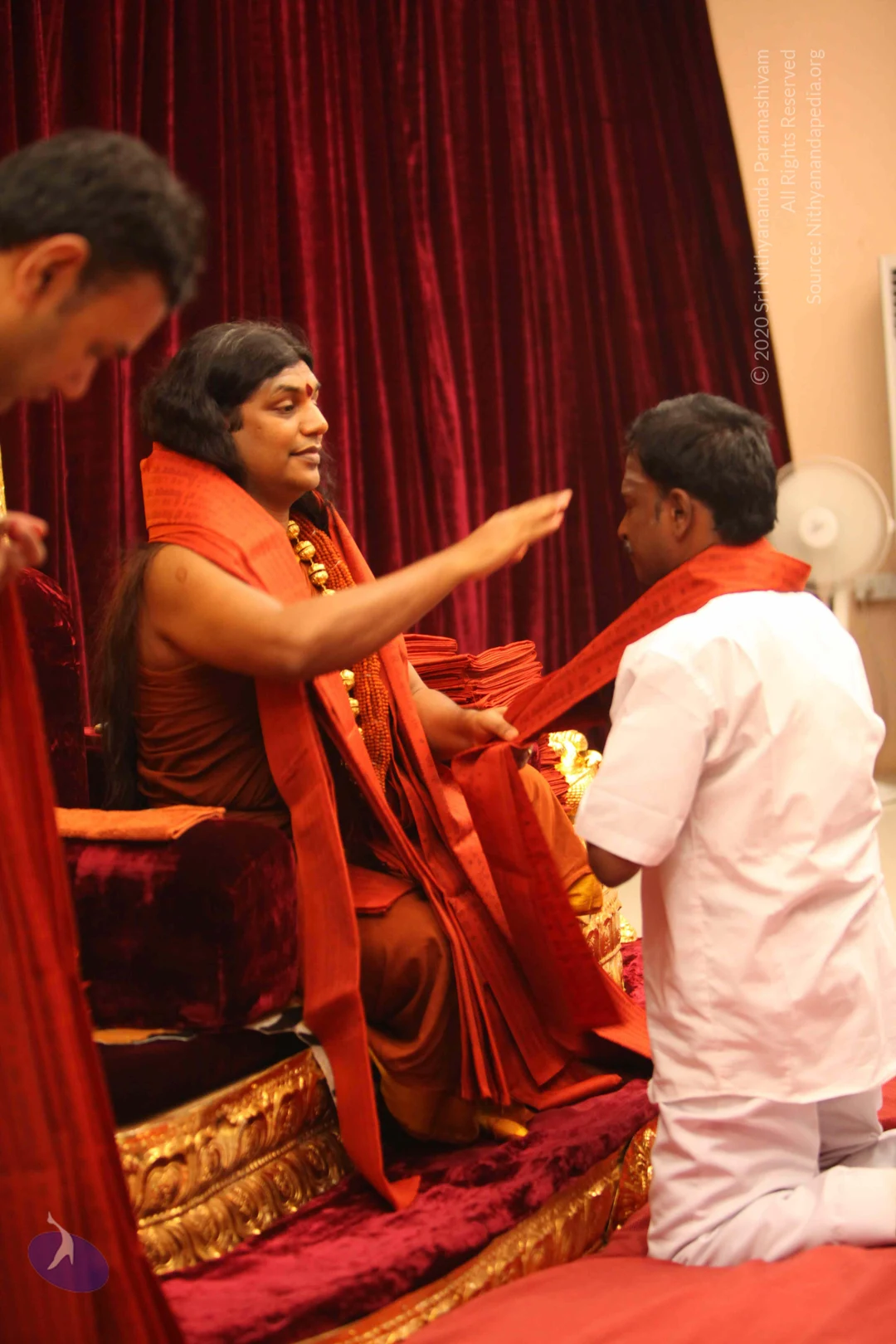
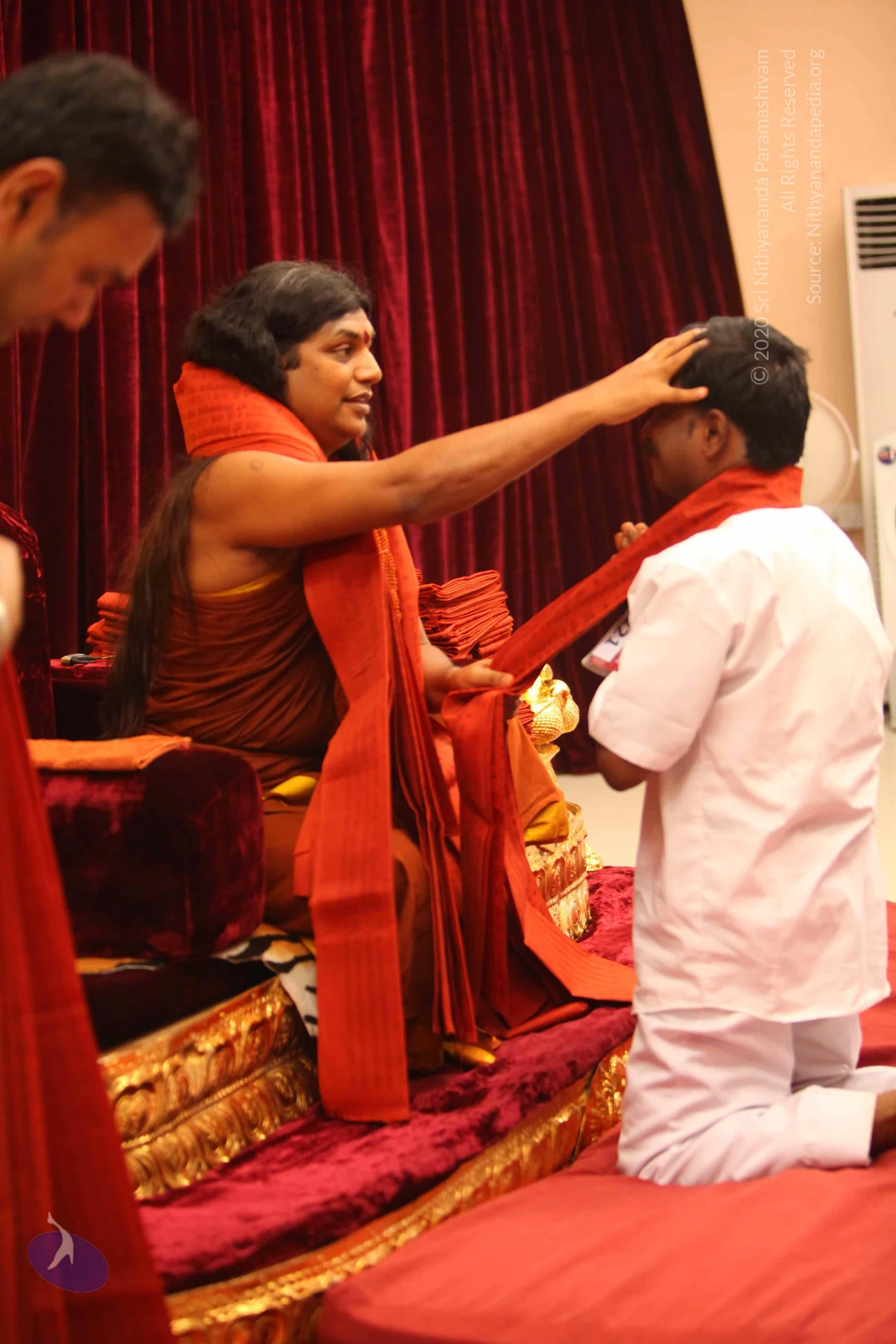
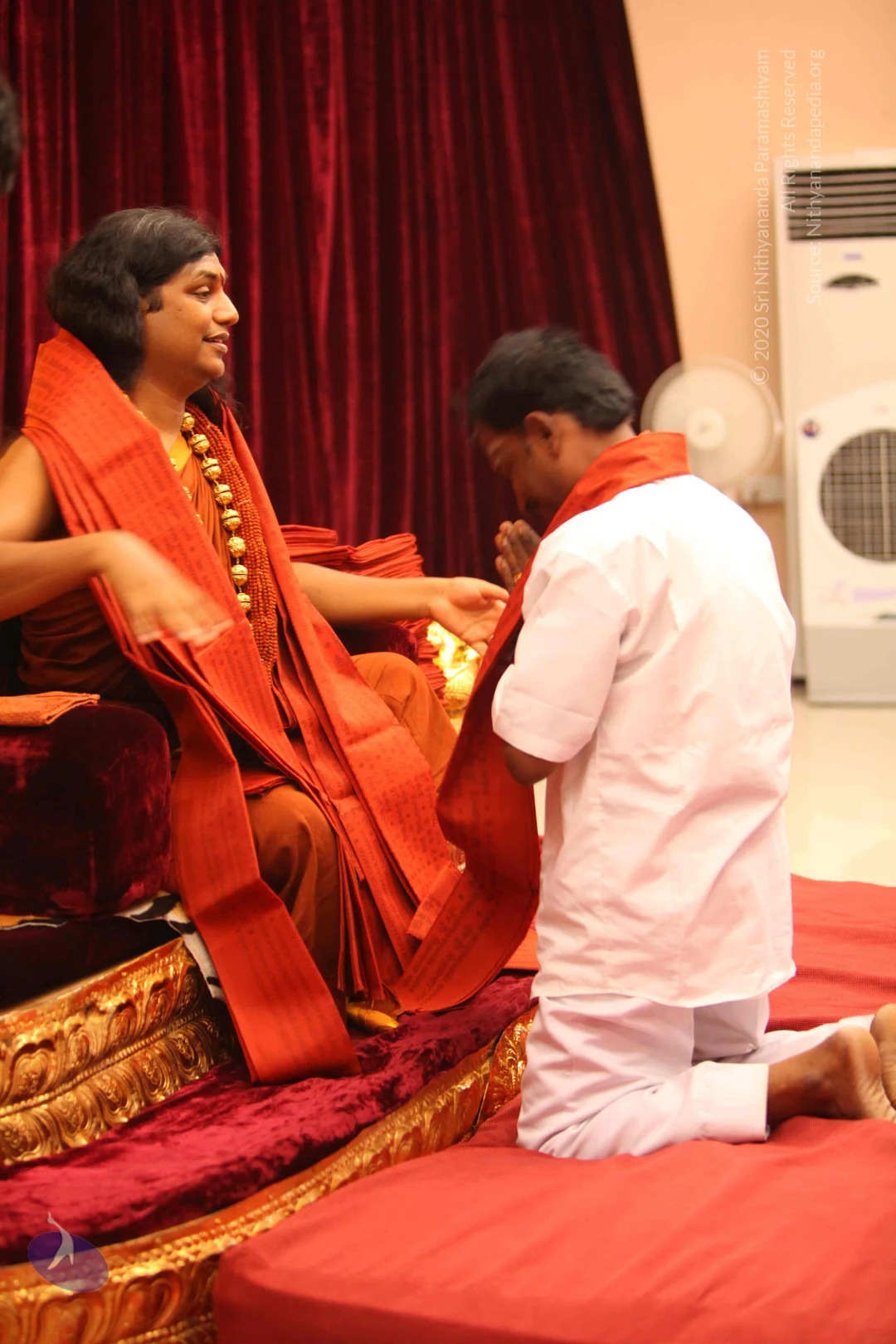
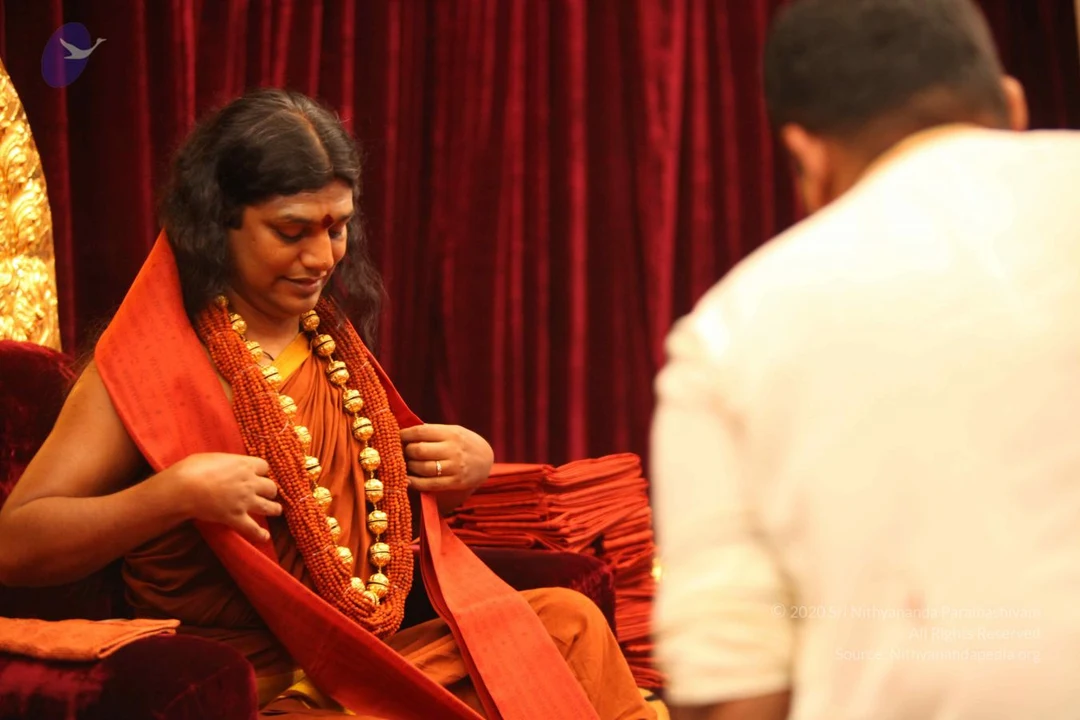
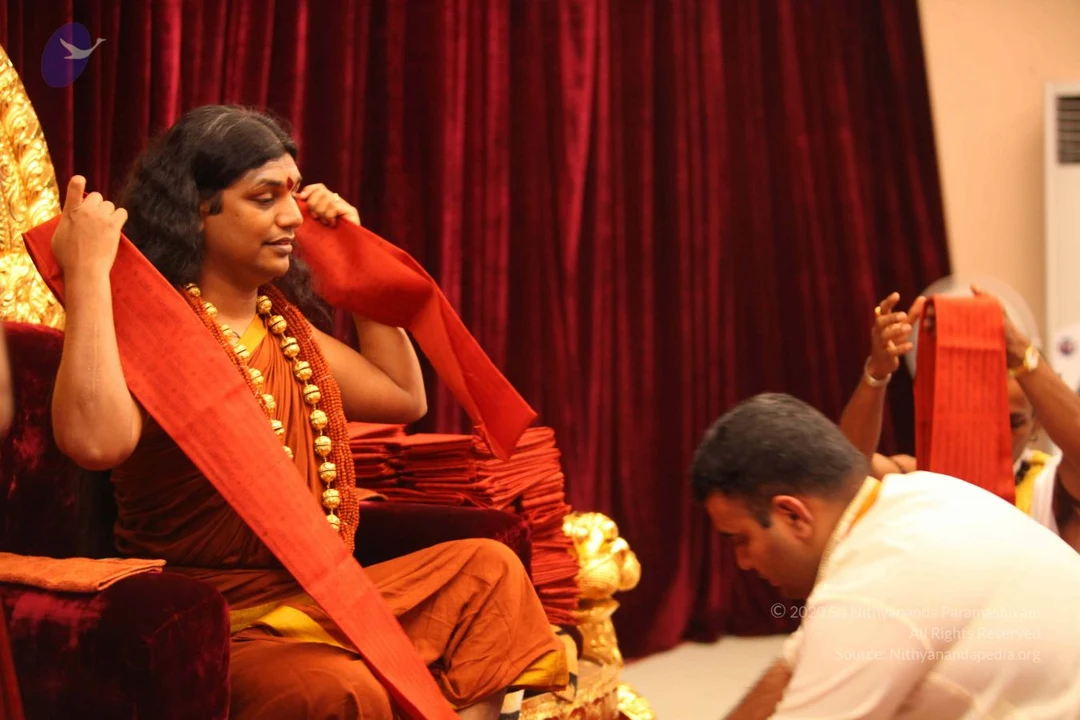
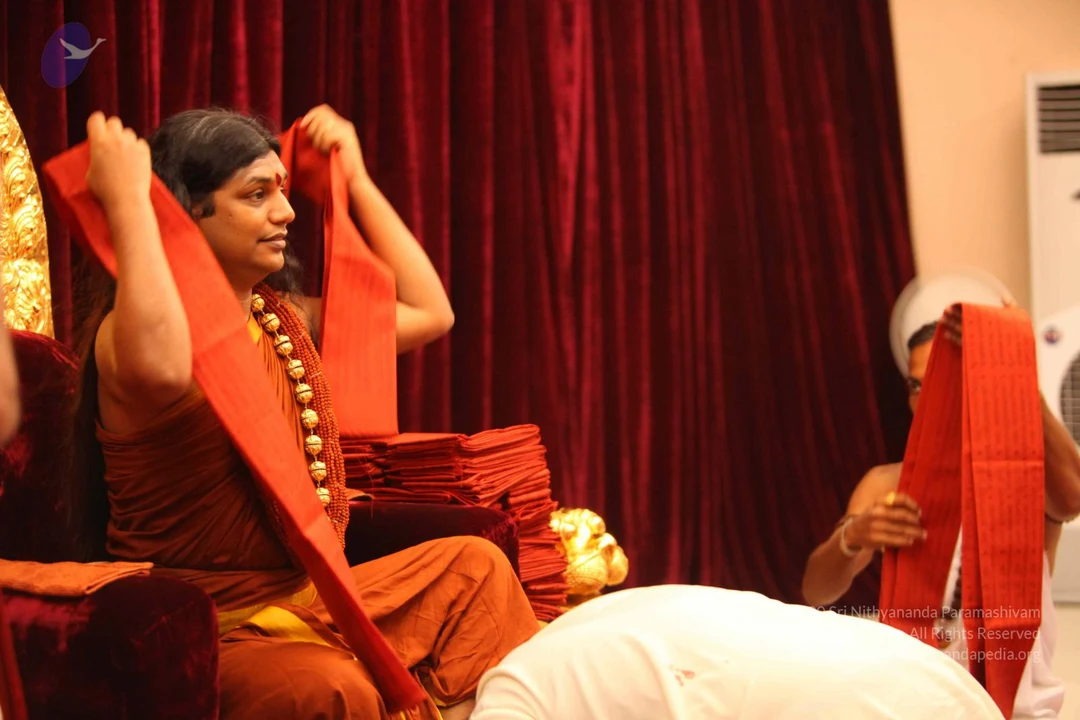
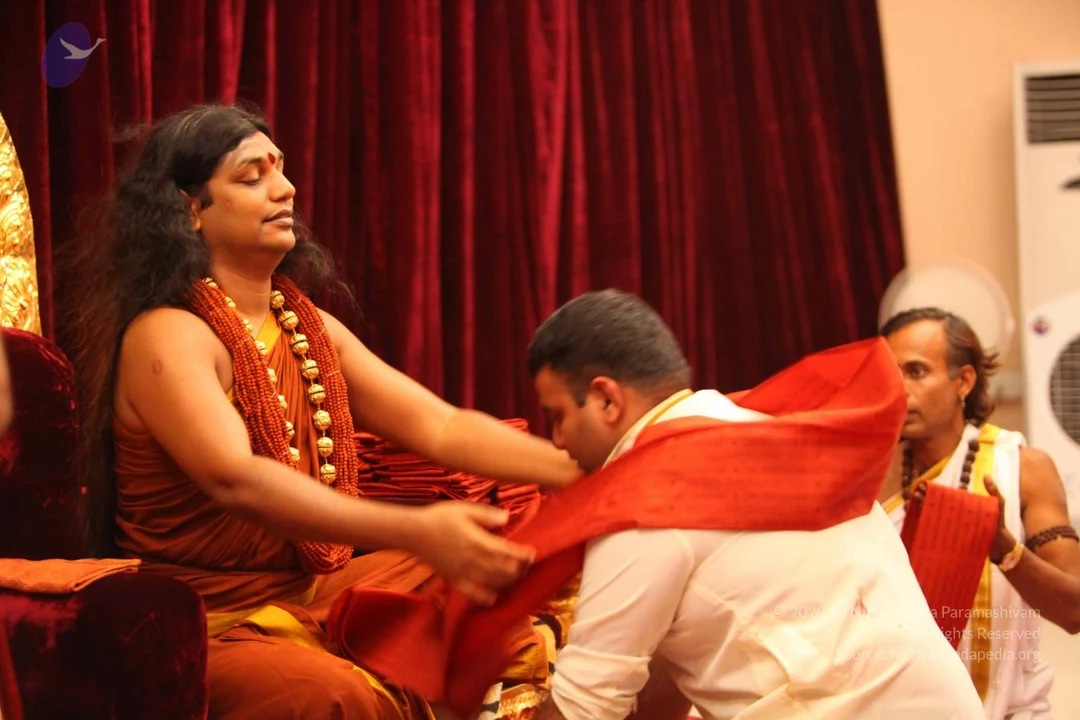
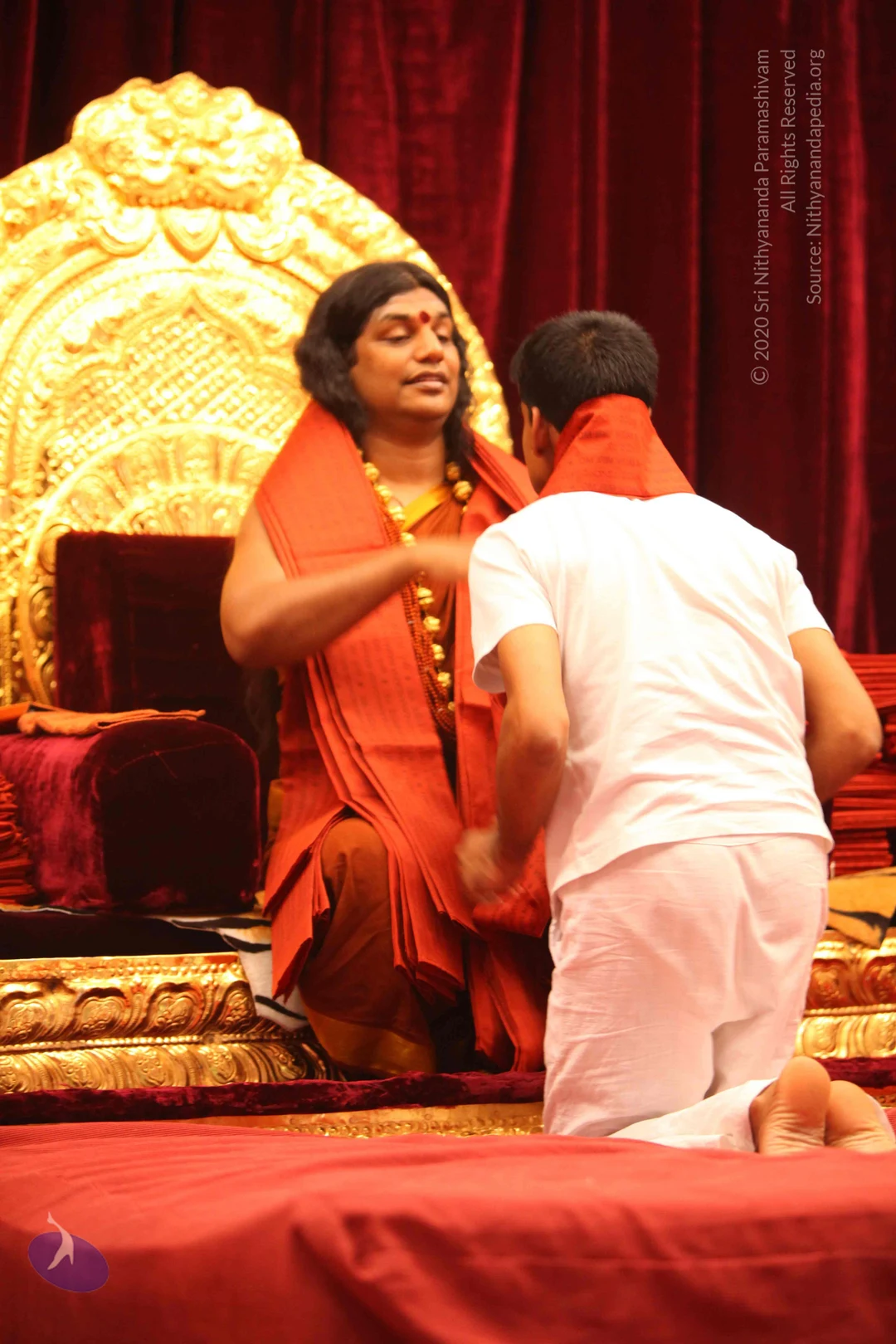
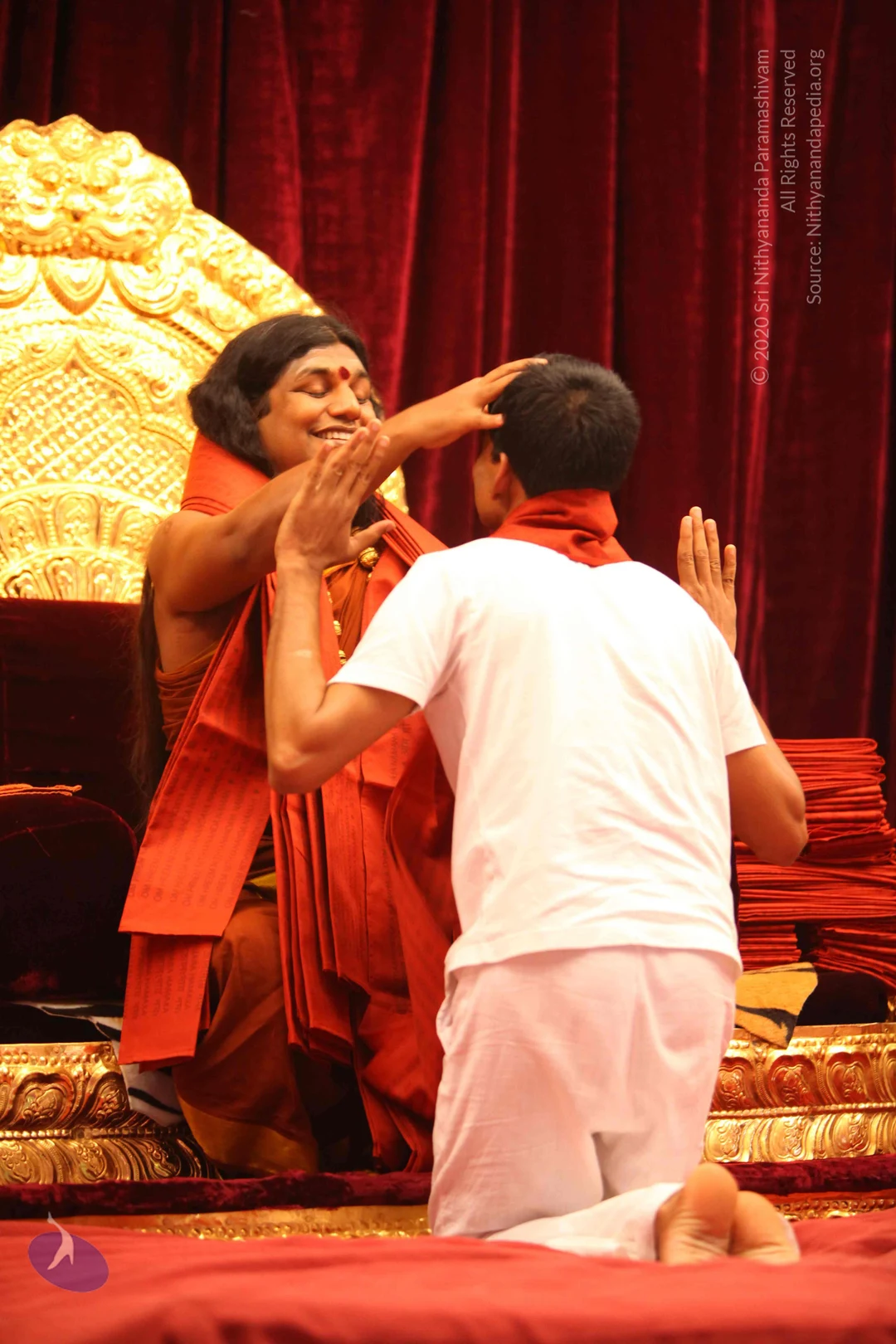
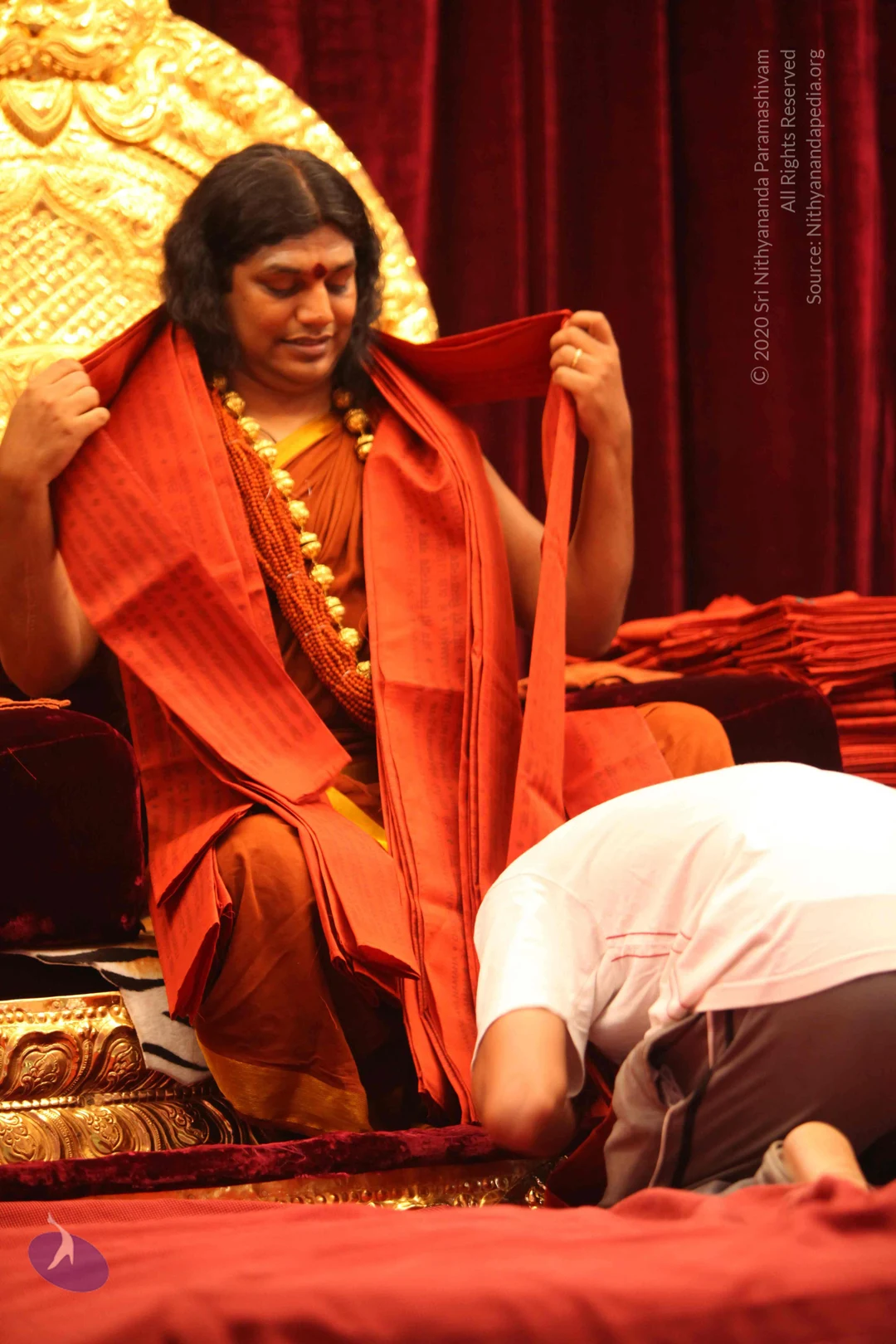
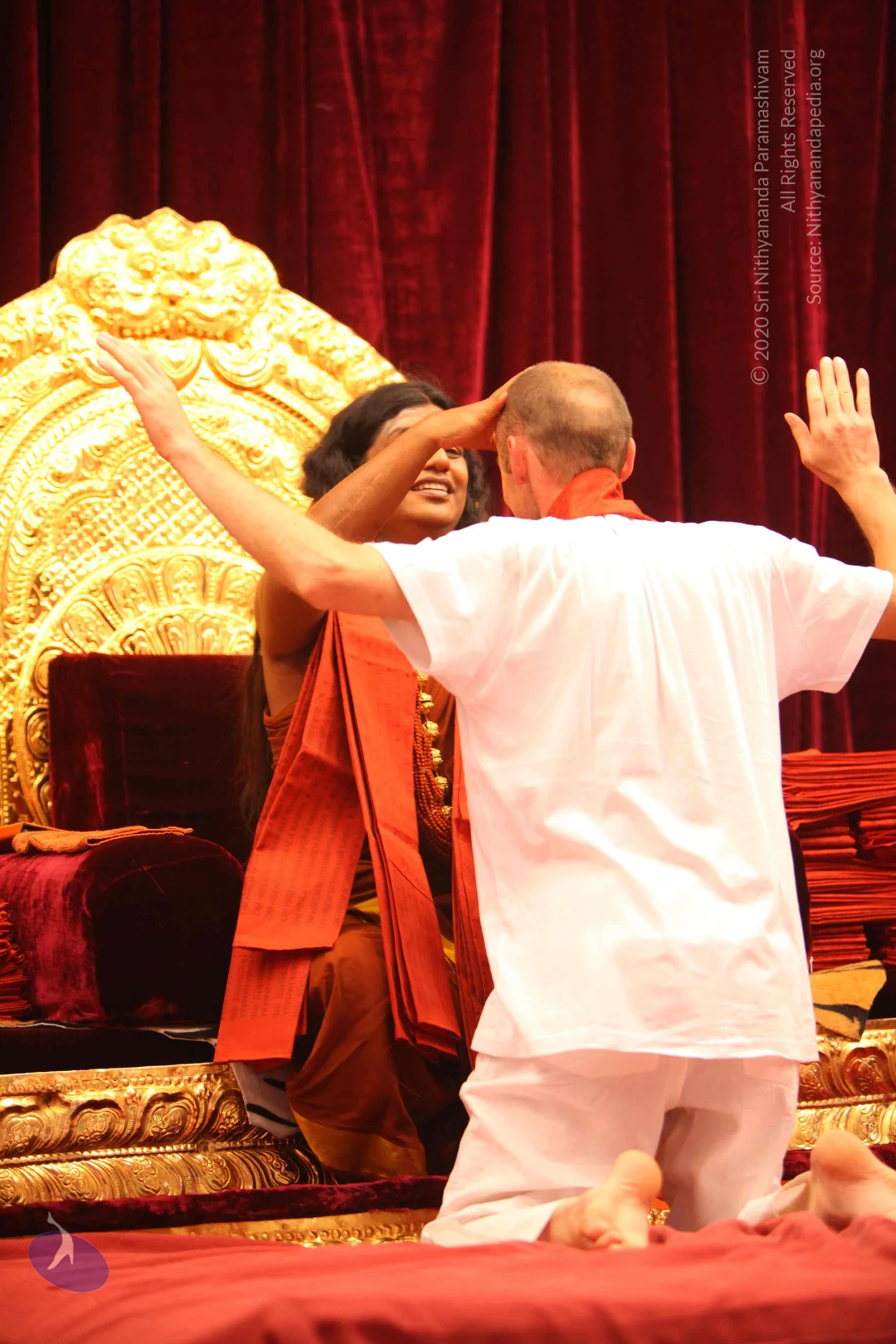
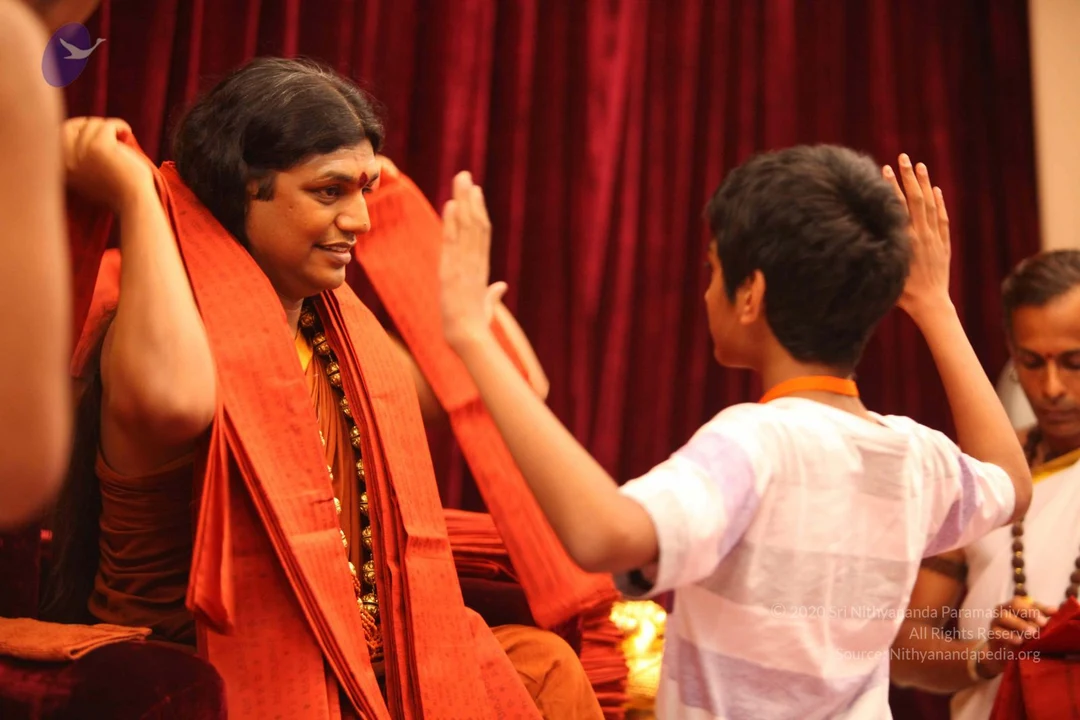
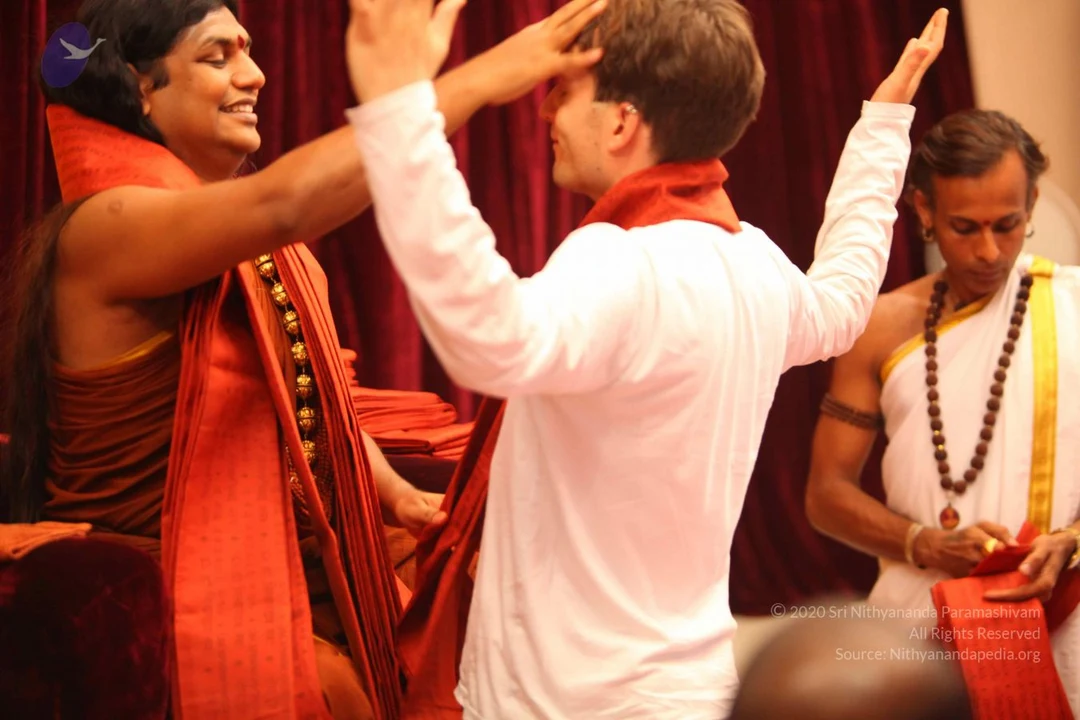
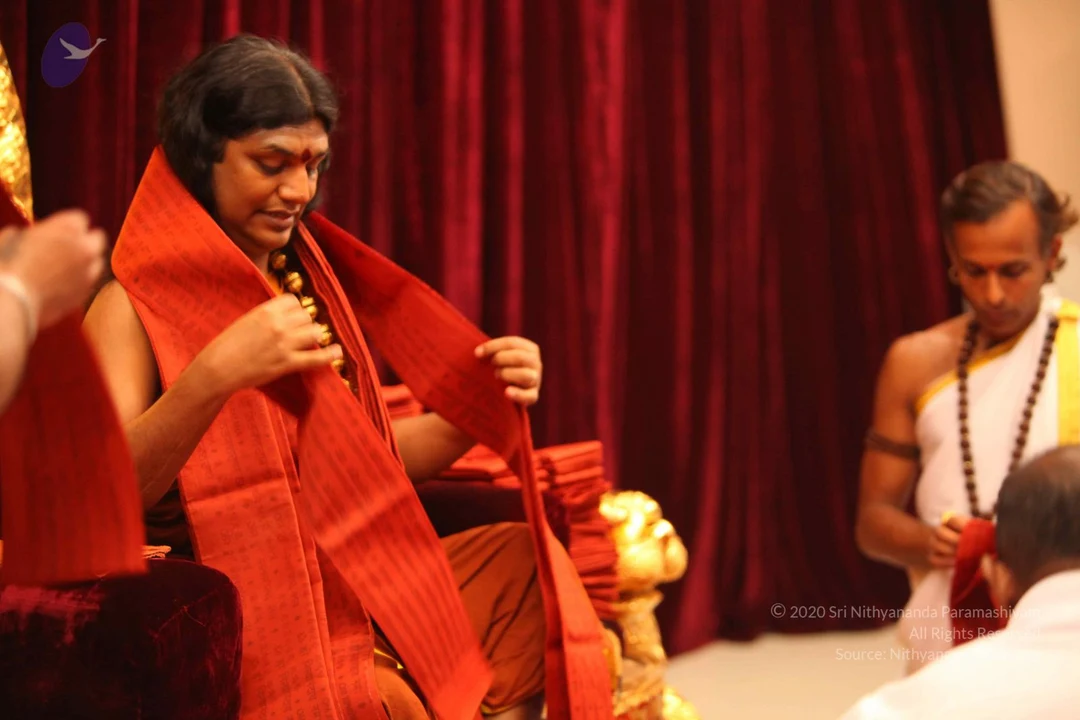
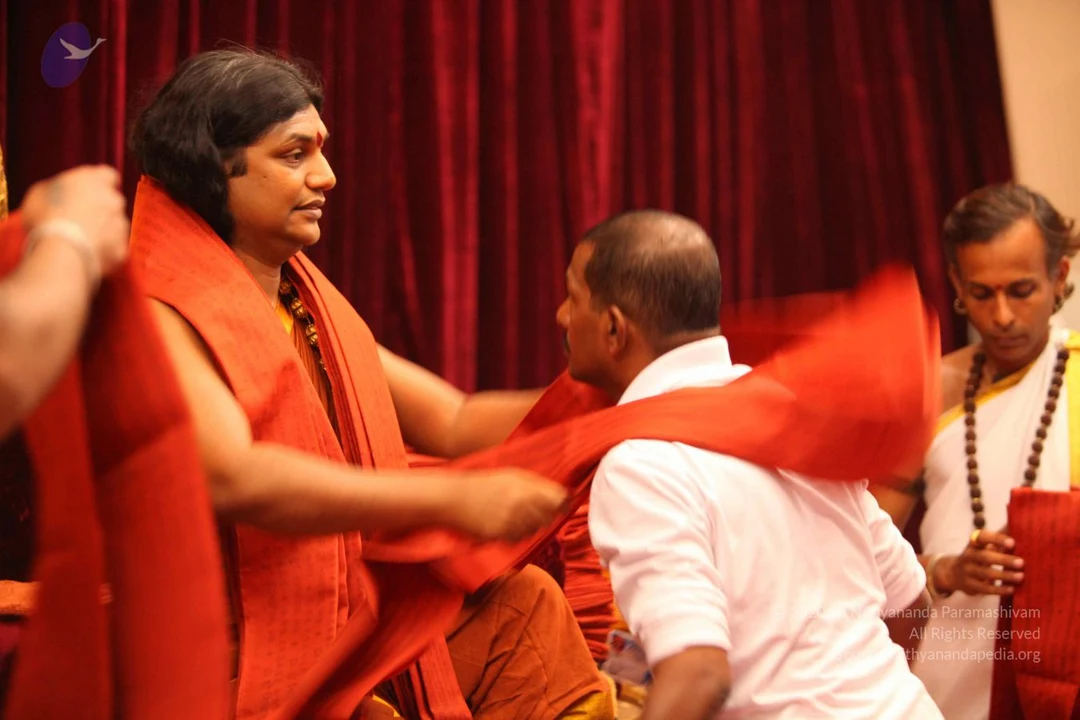
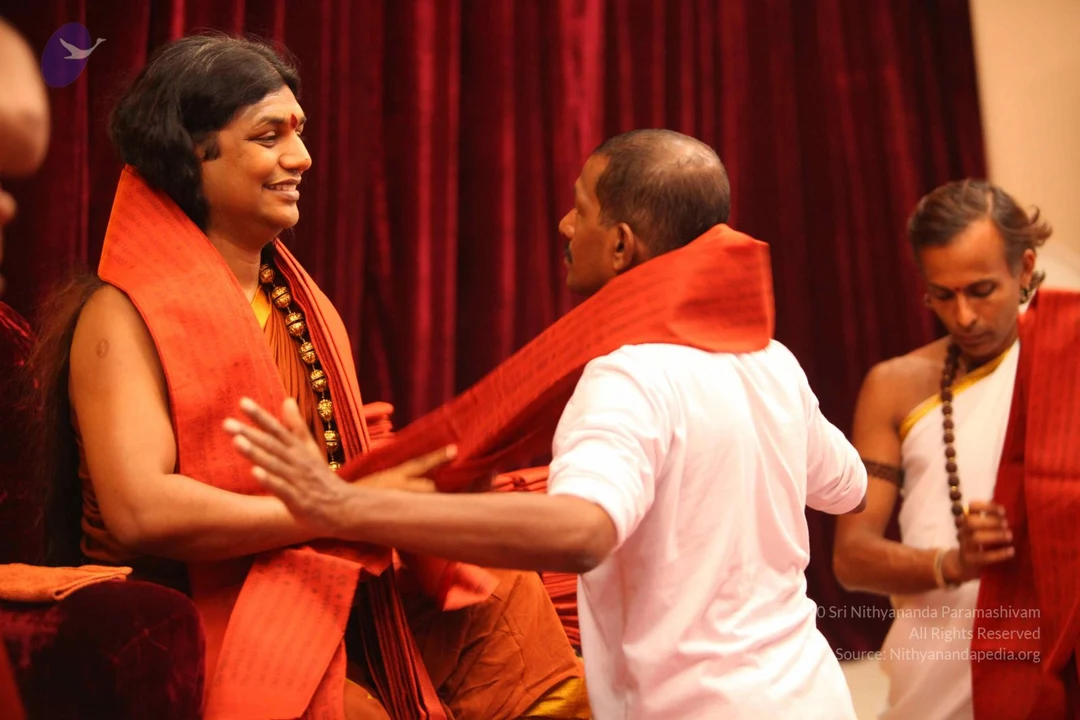
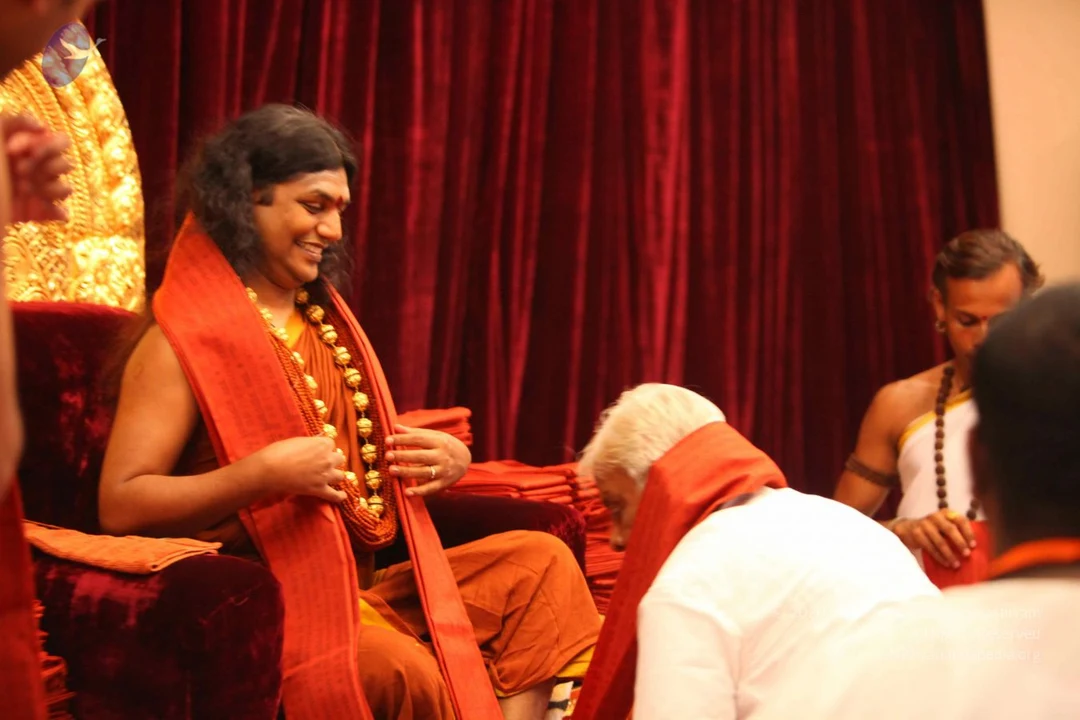
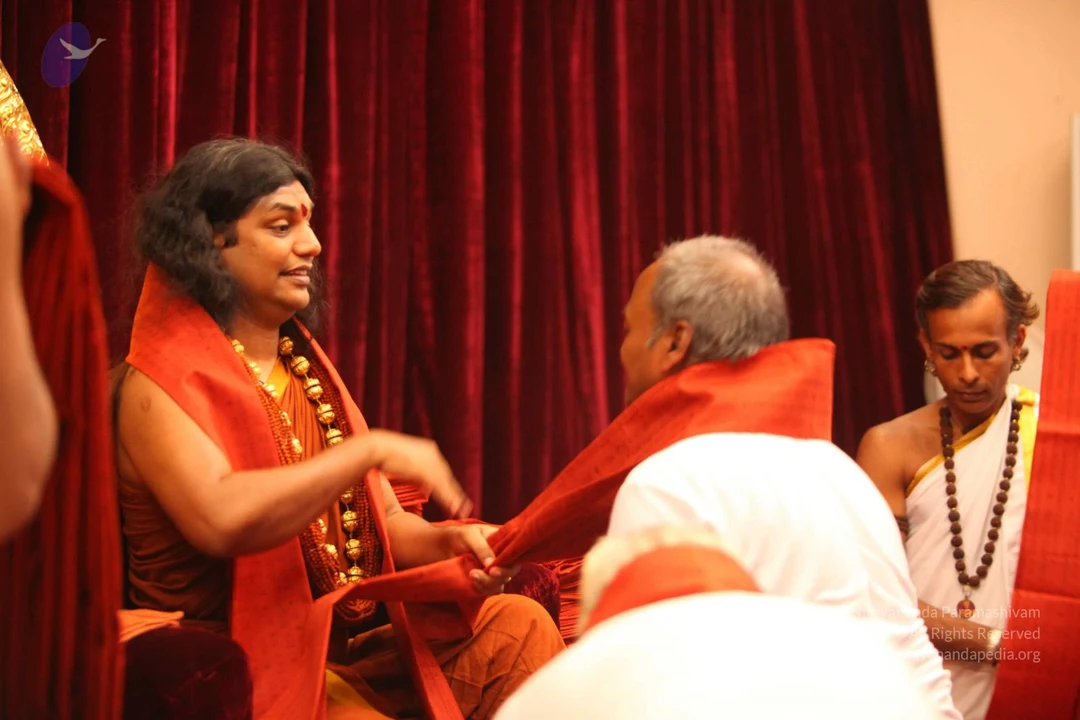
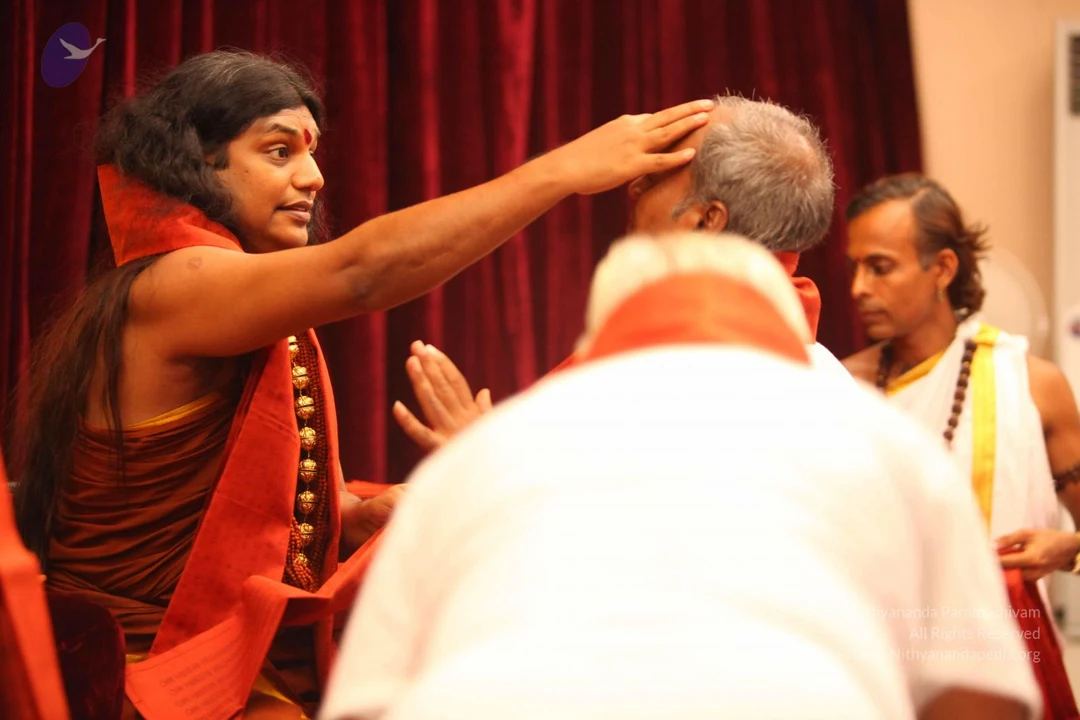
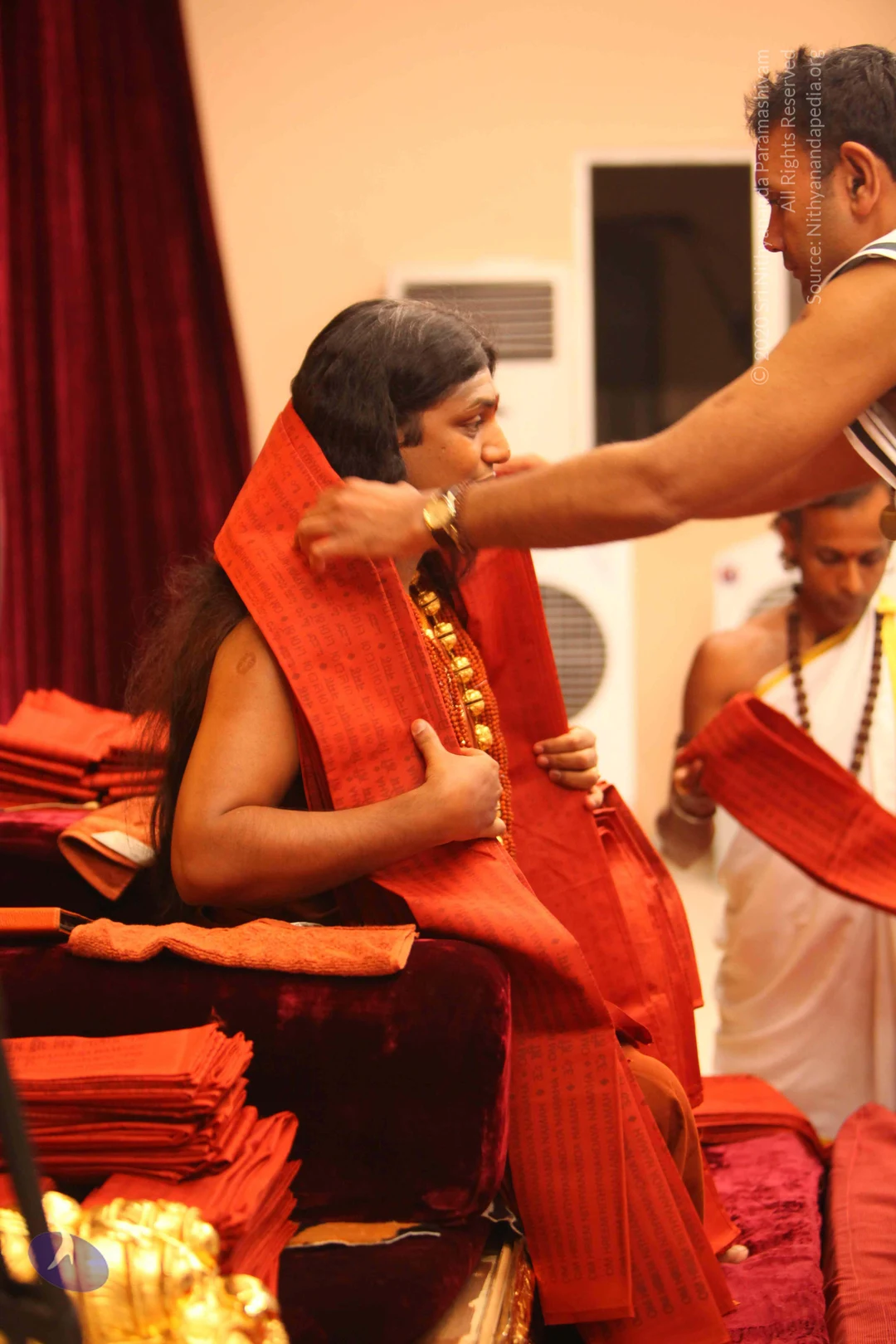
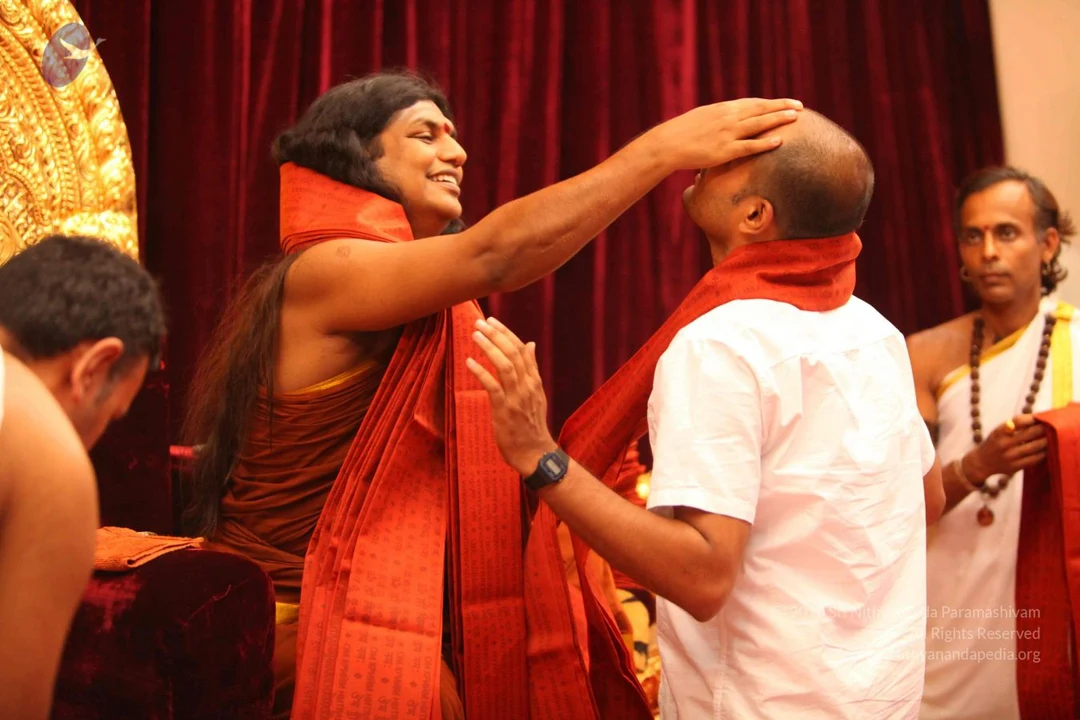
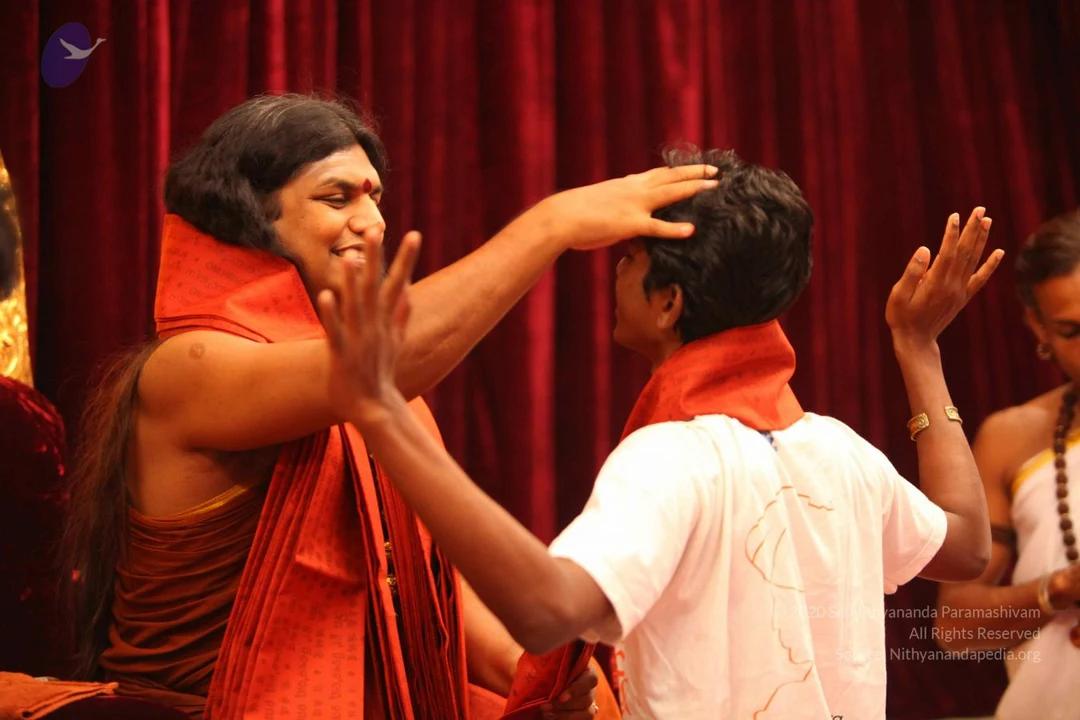
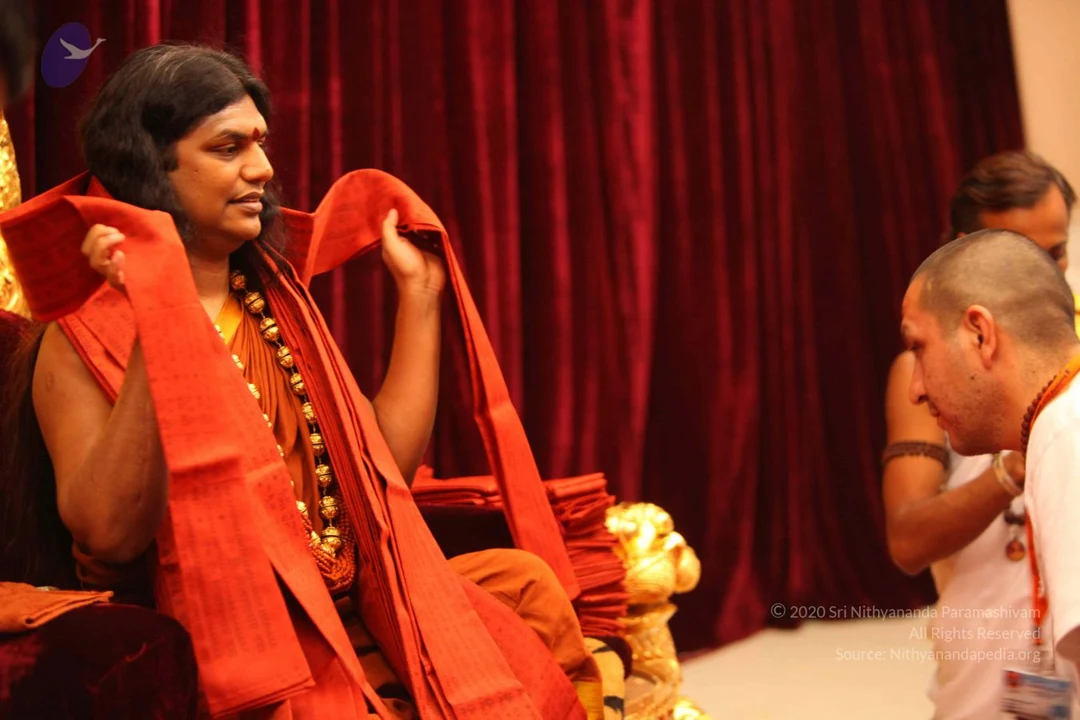
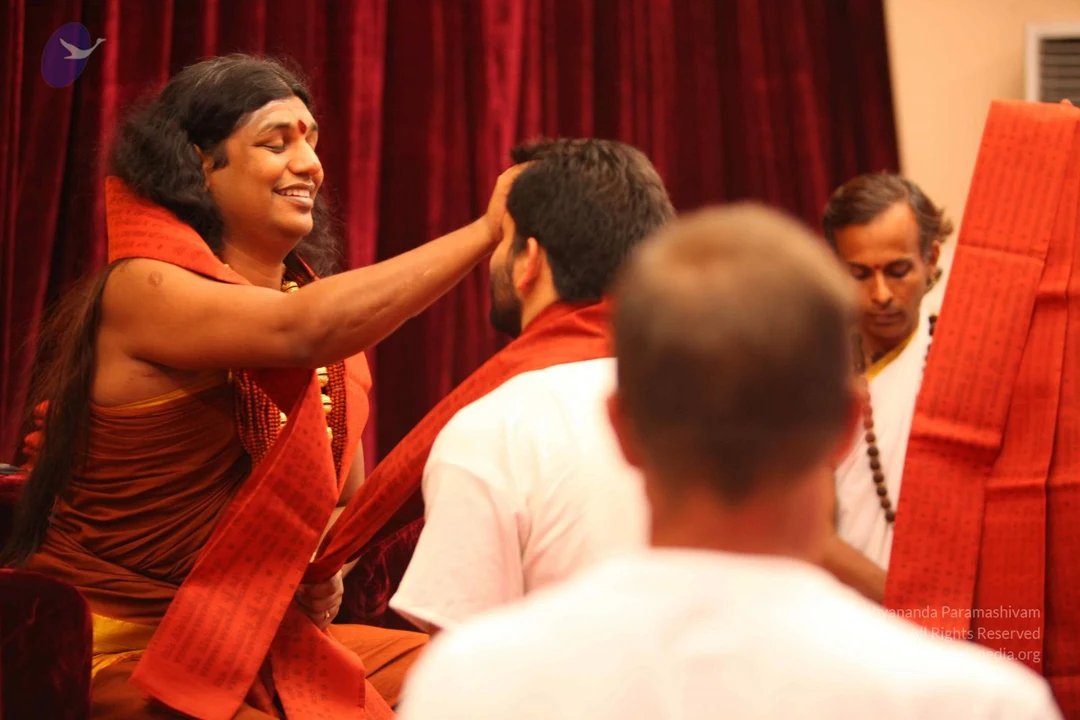
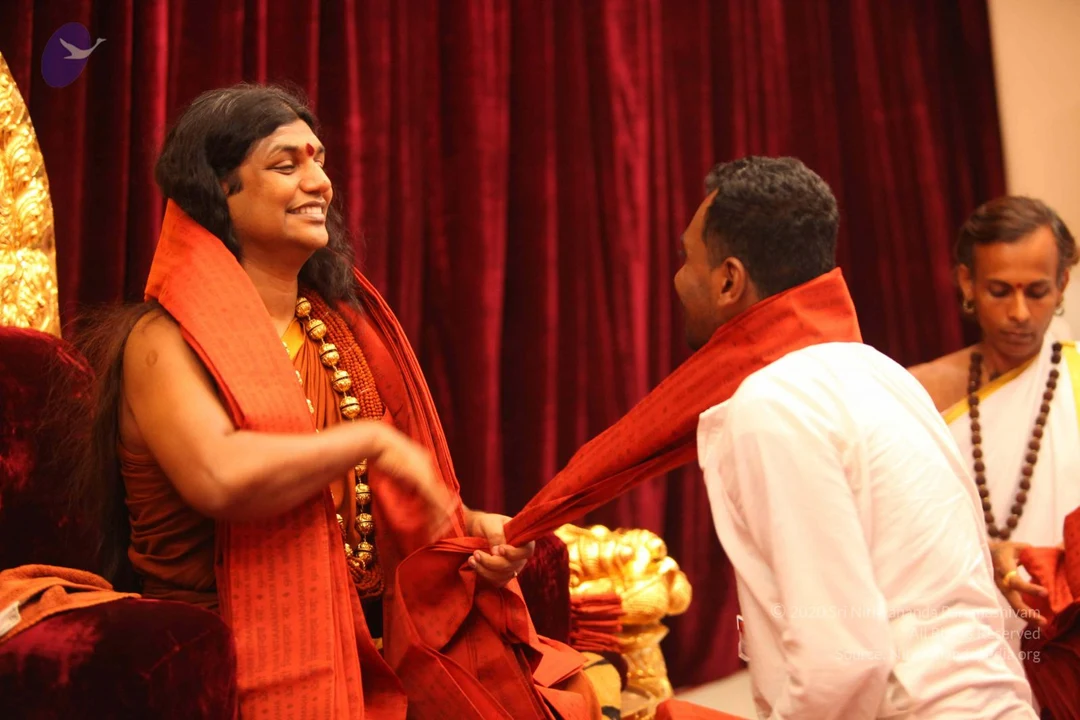
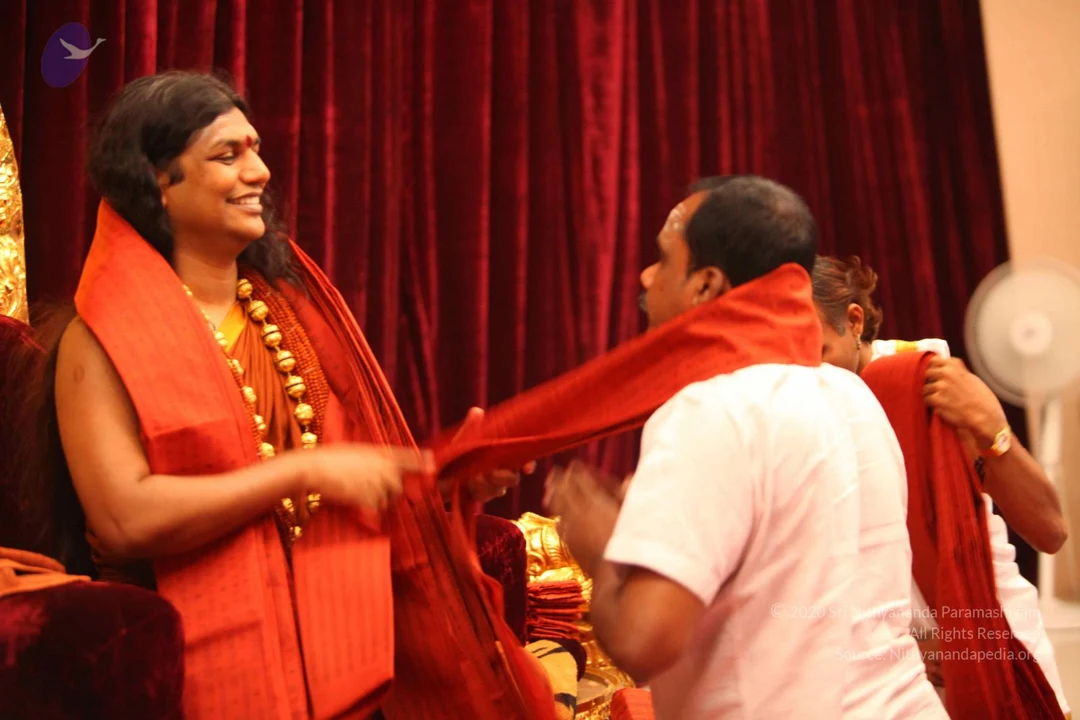
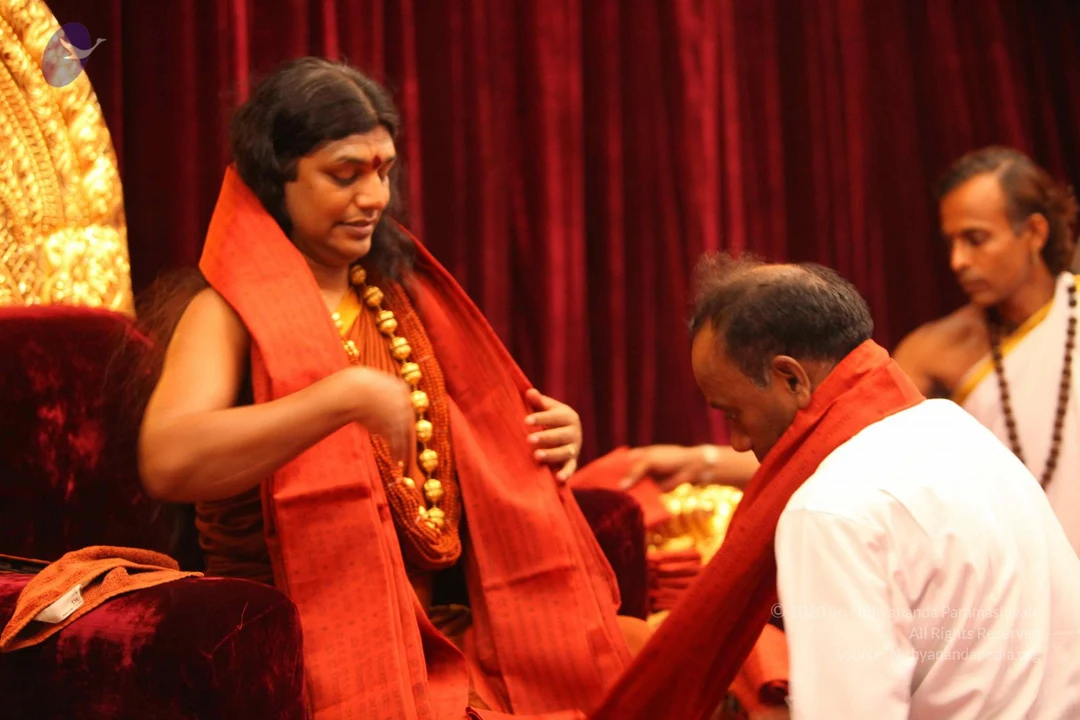
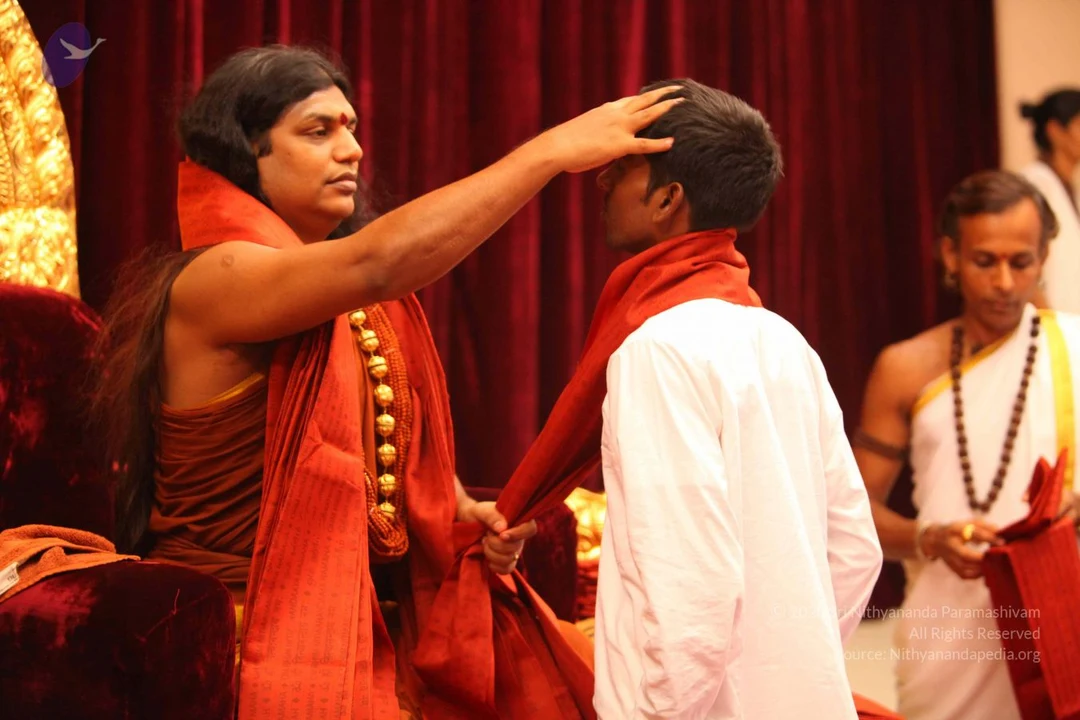
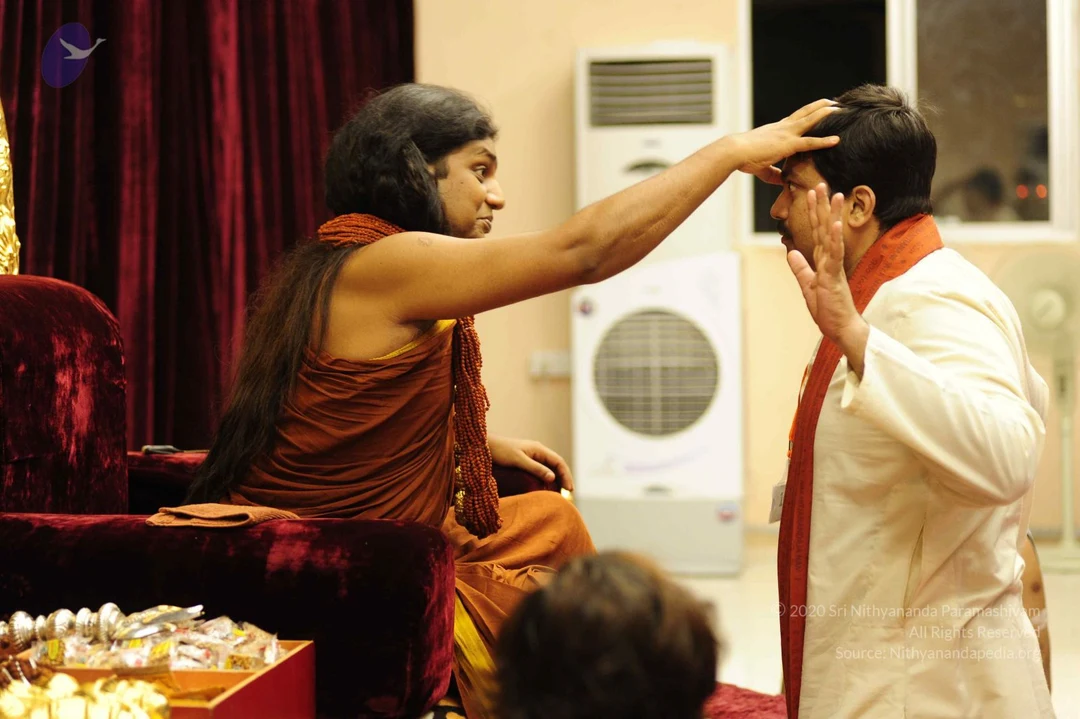
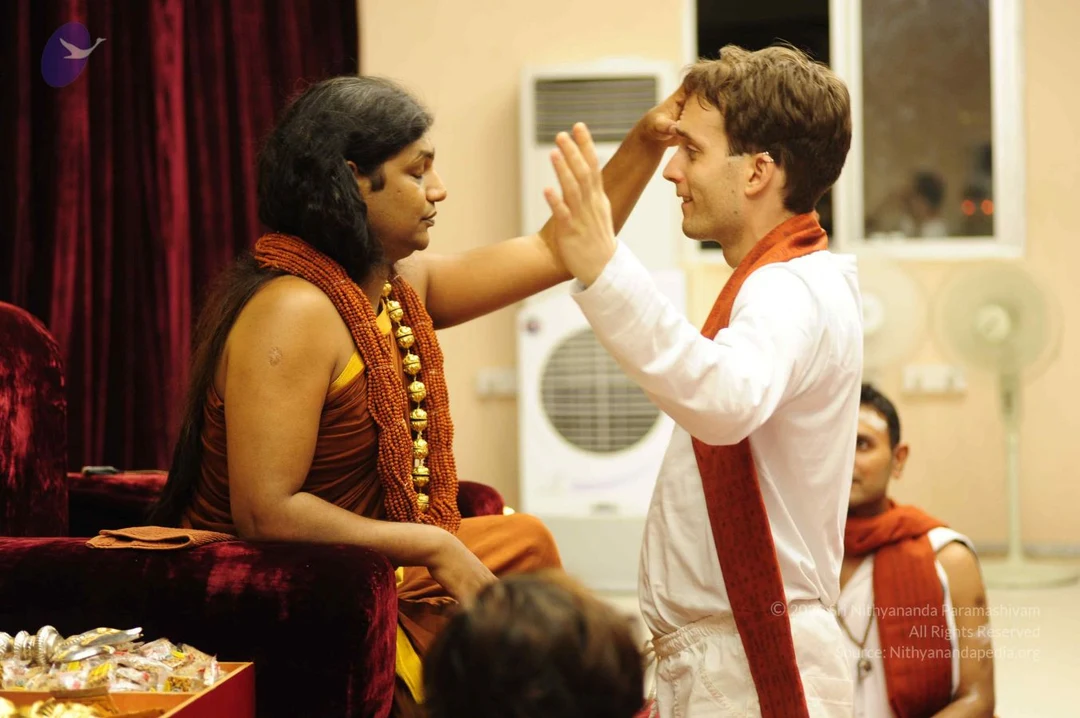
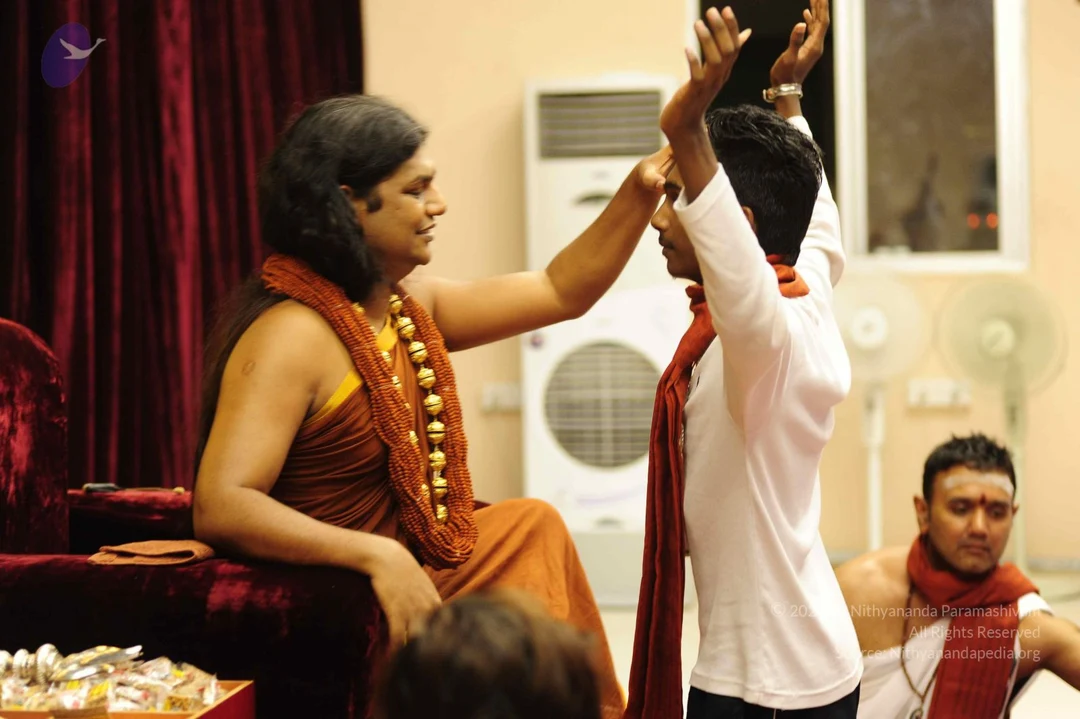
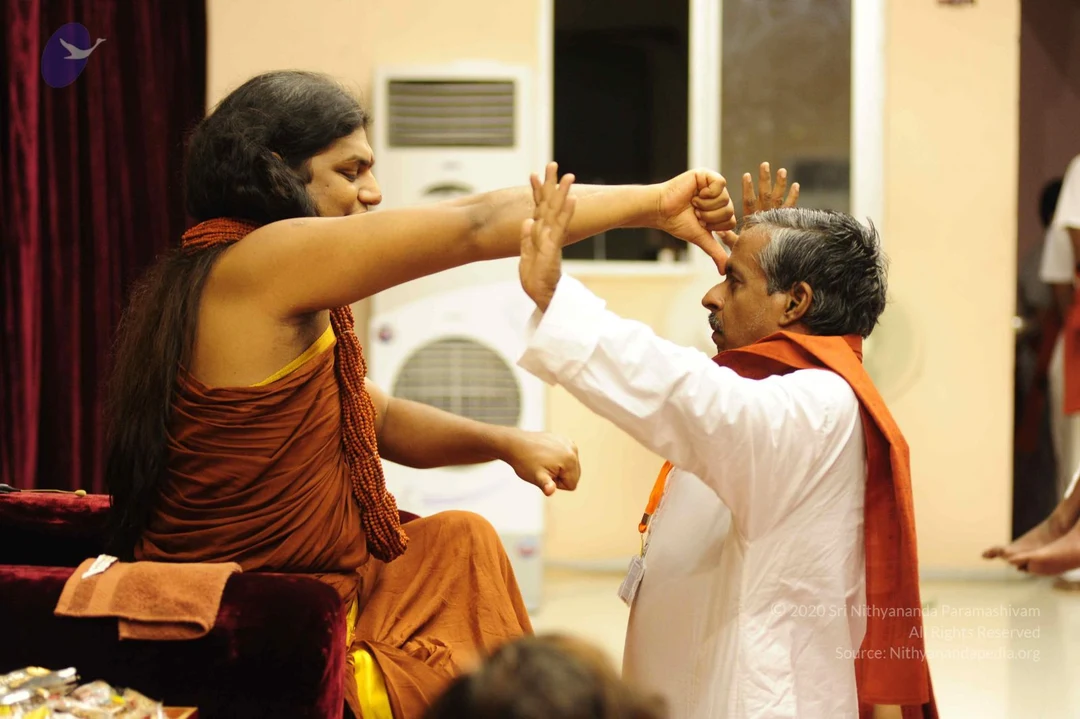
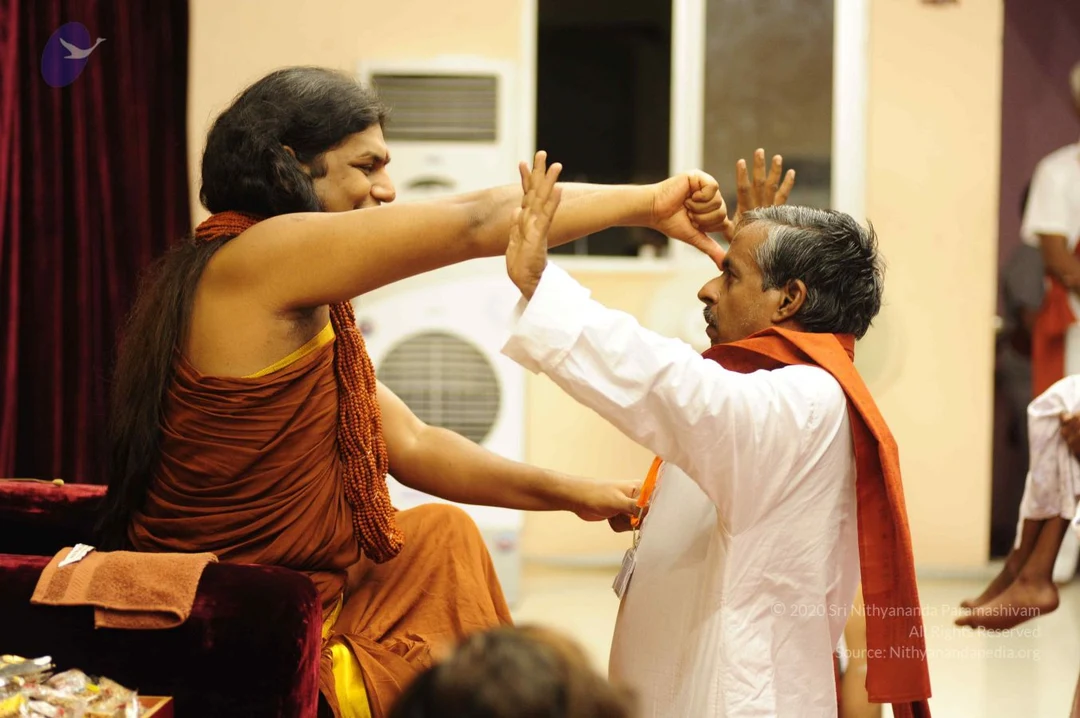
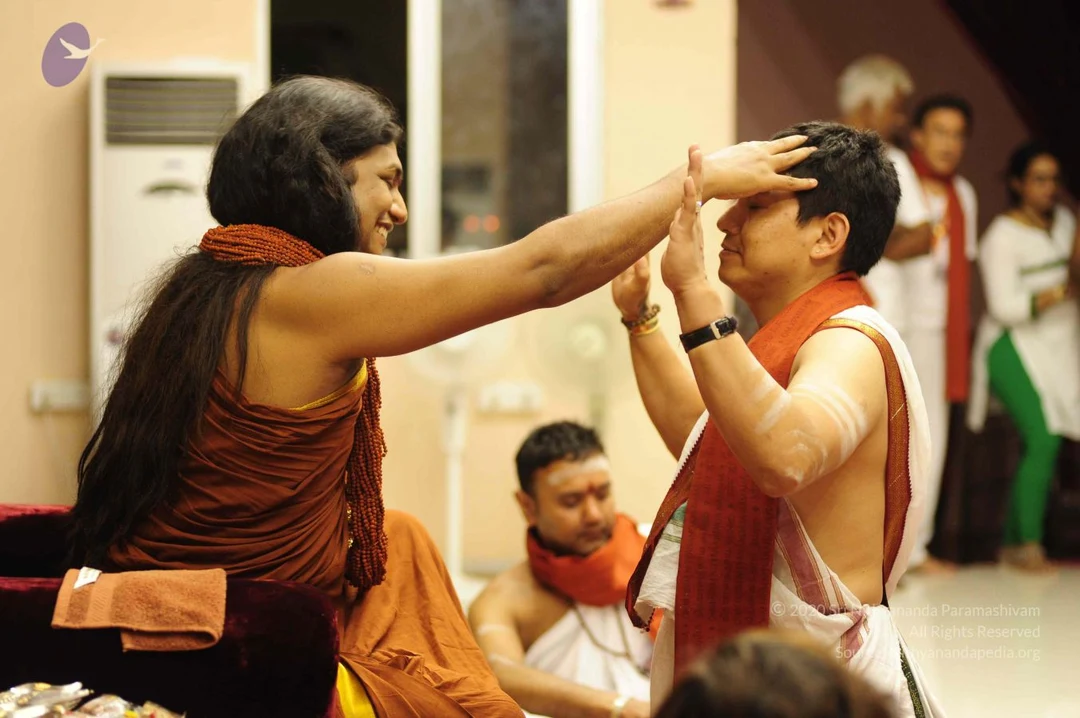
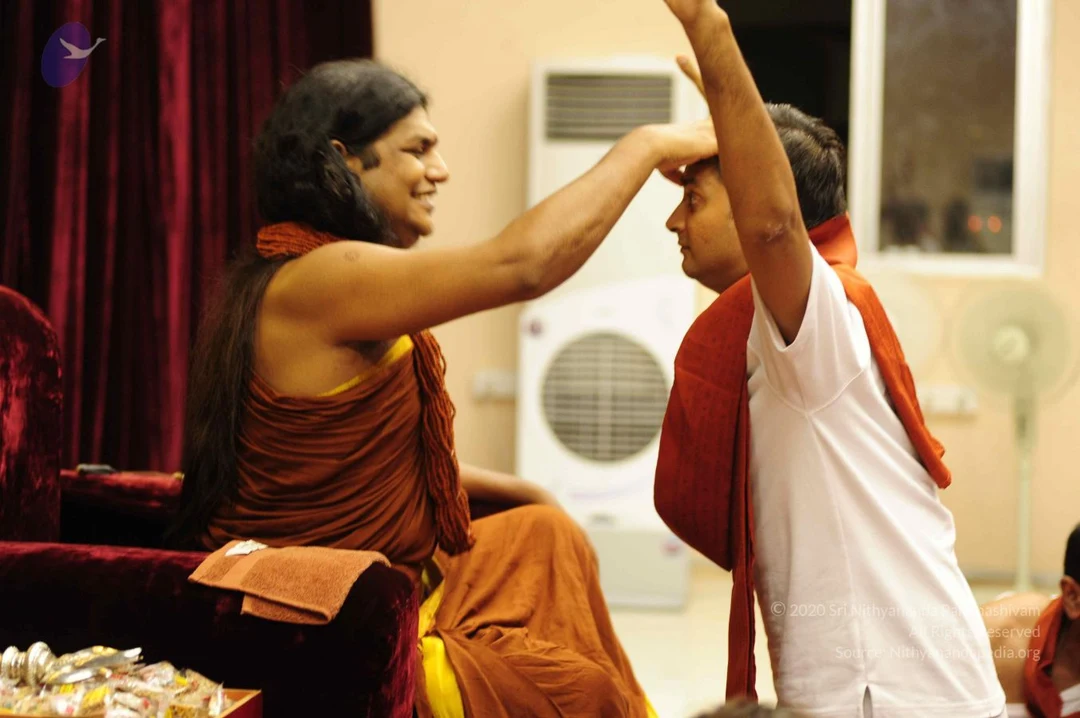
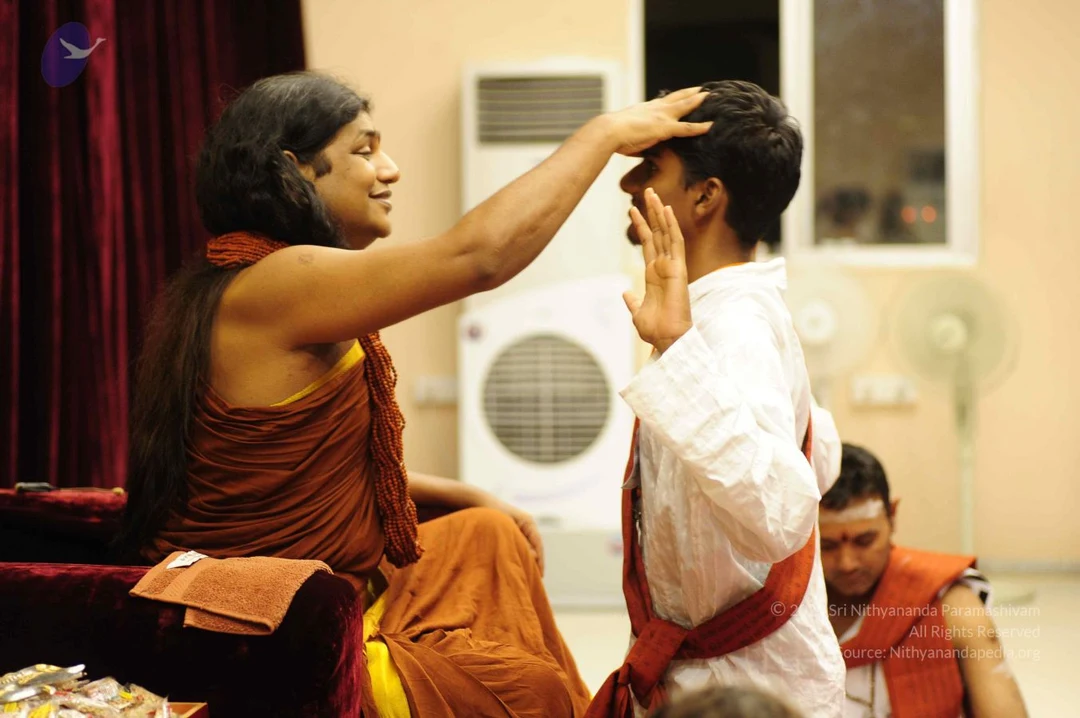
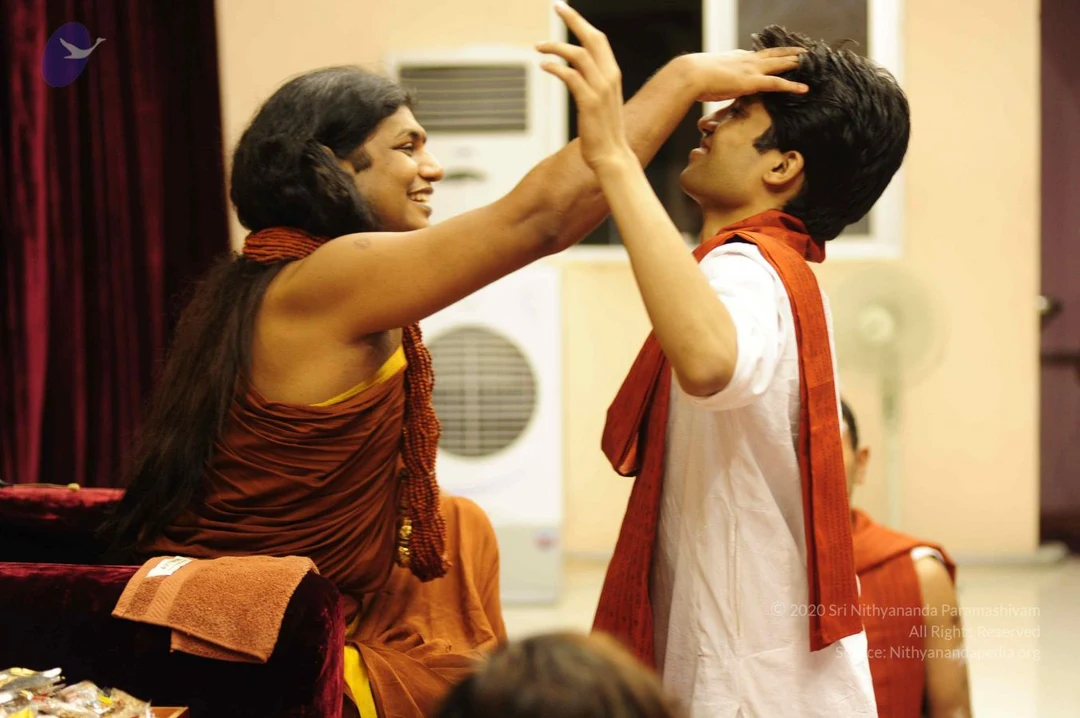
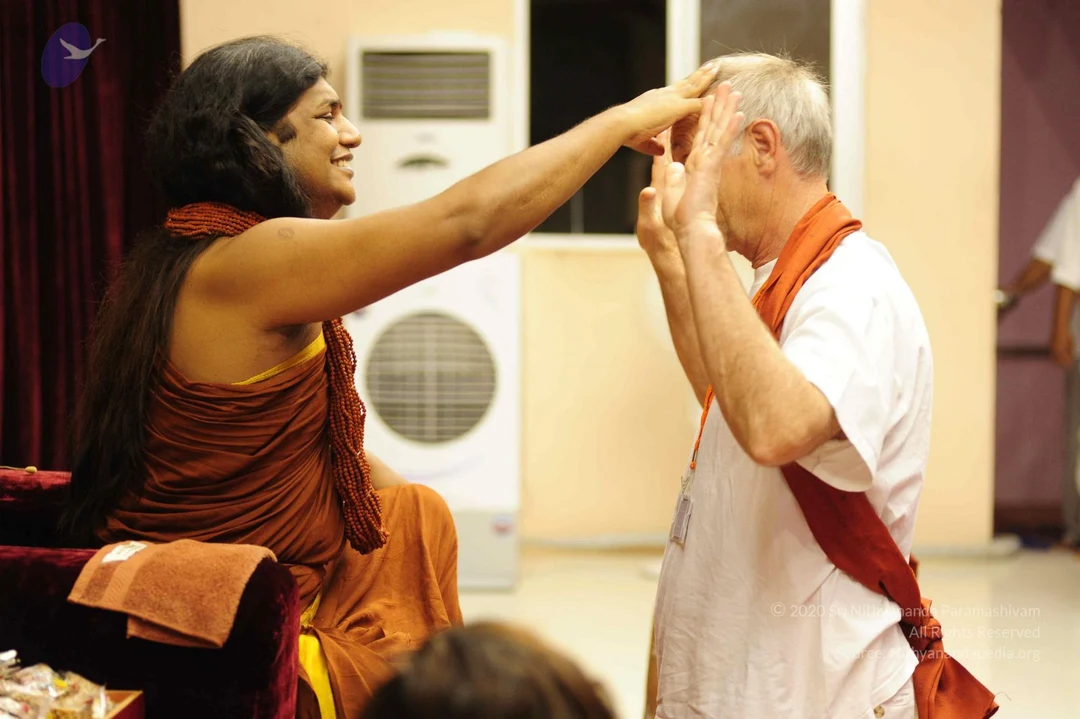
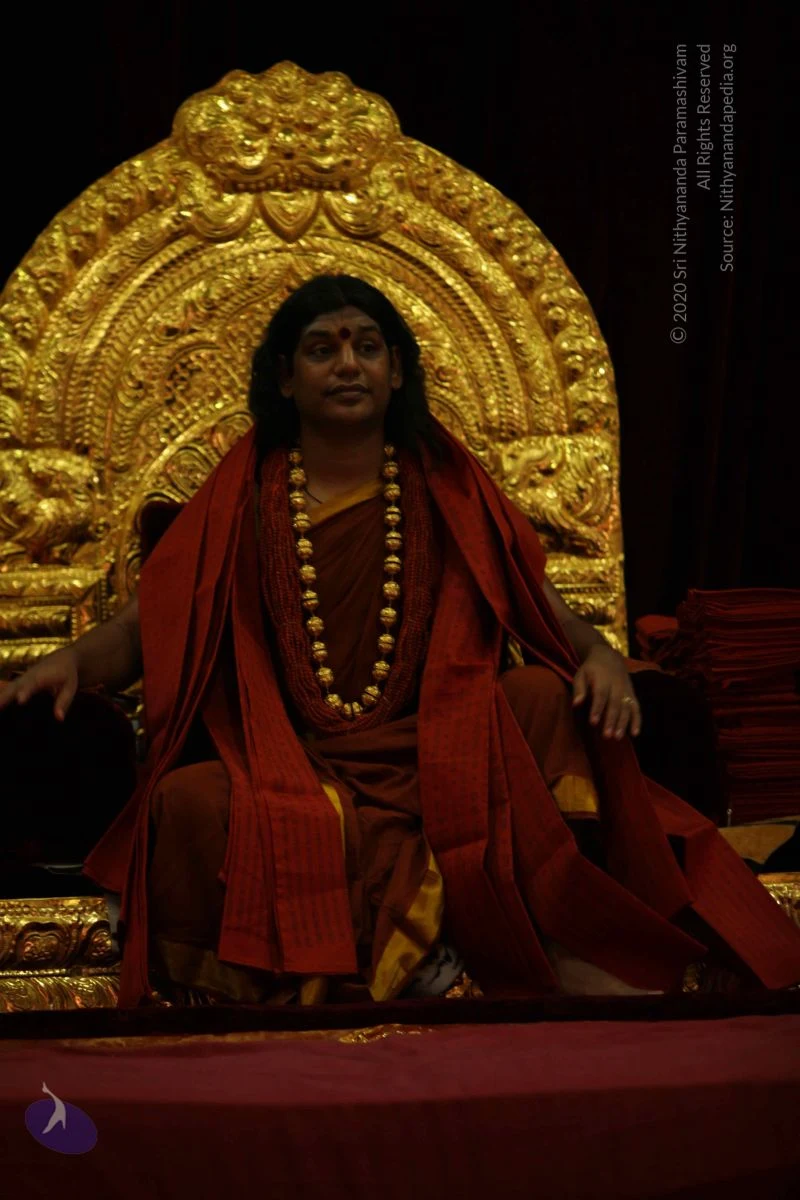
A seated figure sits centrally on an ornate gilded throne with a large arched golden back carved with floral and animal motifs. He wears a red-orange shawl draped over his shoulders and body, a rust-red robe beneath, and a thick red rudraksha mala with a long strand of gold beads around his neck. He has long dark hair and a red bindi on his forehead, with his hands resting on the armrests. The throne sits on a red-draped dais in a dark hall. Appearance-based candidate: Swamiji (probable), seated in a teaching posture with long hair, rudraksha mala and gold necklace.A photograph of a seated figure with long dark hair wearing an orange-red shawl printed with small text and a rust-coloured garment, placing a hand on the crown of a man's head. The man, in a white kurta with a white identification badge, leans forward with his hands folded near his face. Behind them hang deep maroon velvet drapes, and a golden-edged throne with a maroon cushion is visible. Stacks of folded orange-red cloth sit in the background.A seated man with long, swept-back dark hair, wearing an orange-red shawl over a saffron garment, a red tilak on his forehead, and a long beaded necklace with gold-toned beads, sits on a red velvet-upholstered chair with a hand raised near his chest and a slight smile. Behind him hangs a deep red velvet curtain and an air conditioning unit is mounted on a pale wall. In the foreground at right, a person with long wavy blonde hair in a white top sits with their back to the camera, facing him. Swamiji (probable): the seated man's long swept-back hair, saffron-orange shawl and ornate beaded necklace are the cues, and he is presented as the teacher in a satsang setting.A photograph in a ceremonial hall with red velvet drapery and gilded furniture. A seated figure with swept-back dark hair, a red bindi and a gold bead necklace wears an orange-red shawl over orange garments, sits on a gold-framed throne with a red velvet cushion, and is being honoured. A man in a white shirt and white dhoti stands before the throne, his right hand touching the seated figure's forehead while his left hand is raised. A younger man in a white shirt and a rudraksha mala stands at the left edge, and another person's head is visible in the lower right corner. The scene shows a blessing or greeting ritual. The page attributes the event to a person, but the seated figure's appearance is not sufficiently distinctive to confirm an identity.A photograph of a seated, long-haired man in a saffron-orange robe and orange shawl with a red bindi, placing one hand on the crown of a kneeling devotee's head while holding a long orange shawl draped over the devotee's shoulders. The devotee wears a white kurta and white pants and kneels on a red cushion. Behind them hang deep red velvet drapes, a gold-trimmed red throne with an ornate gold base, and a folded stack of orange cloths. A man in dark clothing stands at the left edge, partly cut off. The seated figure matches Swamiji (probable) by long swept-back hair, saffron robes, orange shawl and throne, and is conferring a blessing on the kneeling devotee.A seated man in orange-saffron robes sits on a red velvet throne-style chair in front of deep red velvet drapery. He has long, swept-back dark hair, a red bindi on his forehead, and wears a red-orange shawl printed with text, layered over an orange garment. A thick multi-strand rudraksha mala with ornate gold beads hangs around his neck. His right hand is raised beside his face while his left rests on the armrest. A stack of folded red cloths lies beside the chair, and a partly visible person in white sits at the right edge. a person is seated, presenting as a teacher in satsang.

GURUKUL-KIDS-POWER-DEMO
44 photosSource gallery
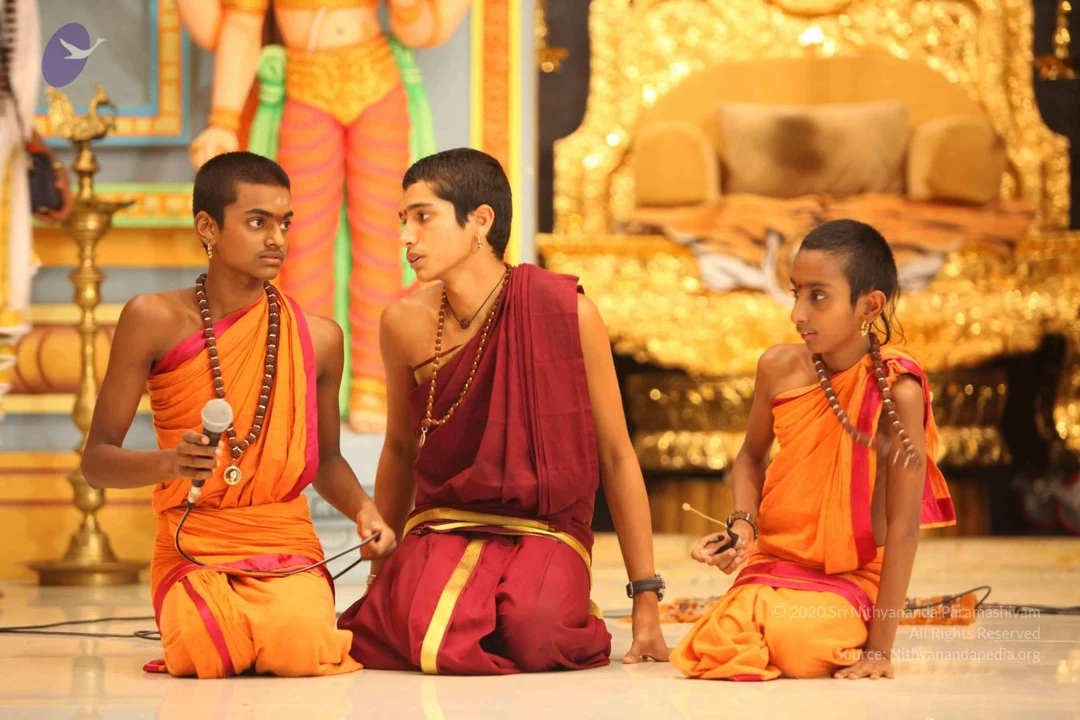
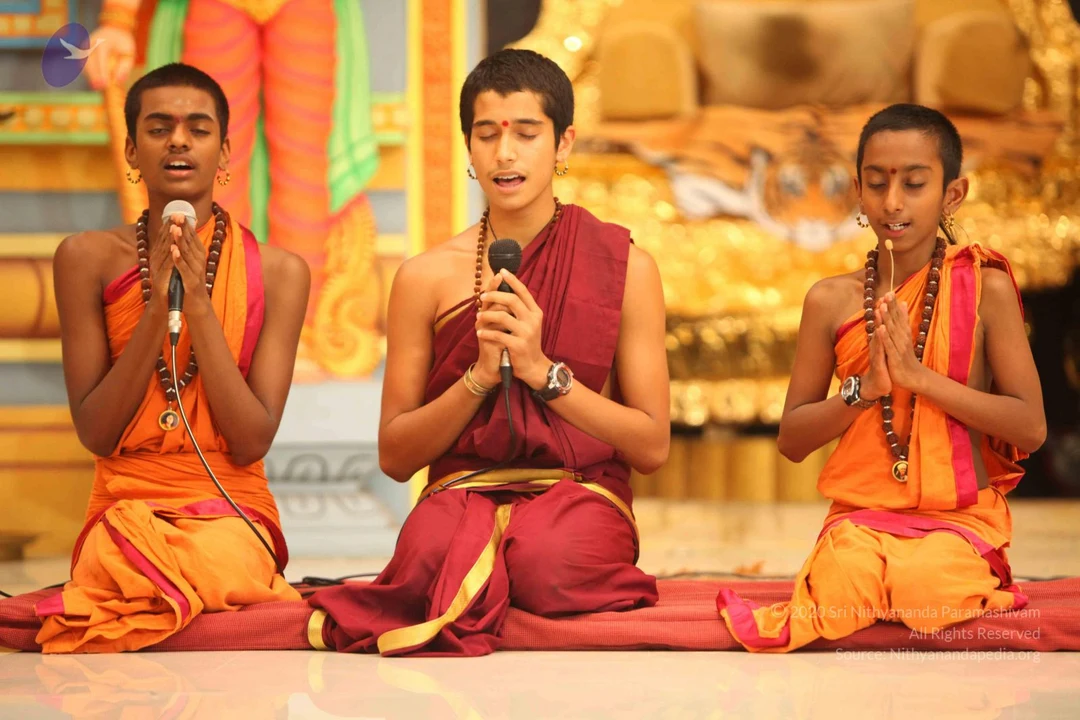
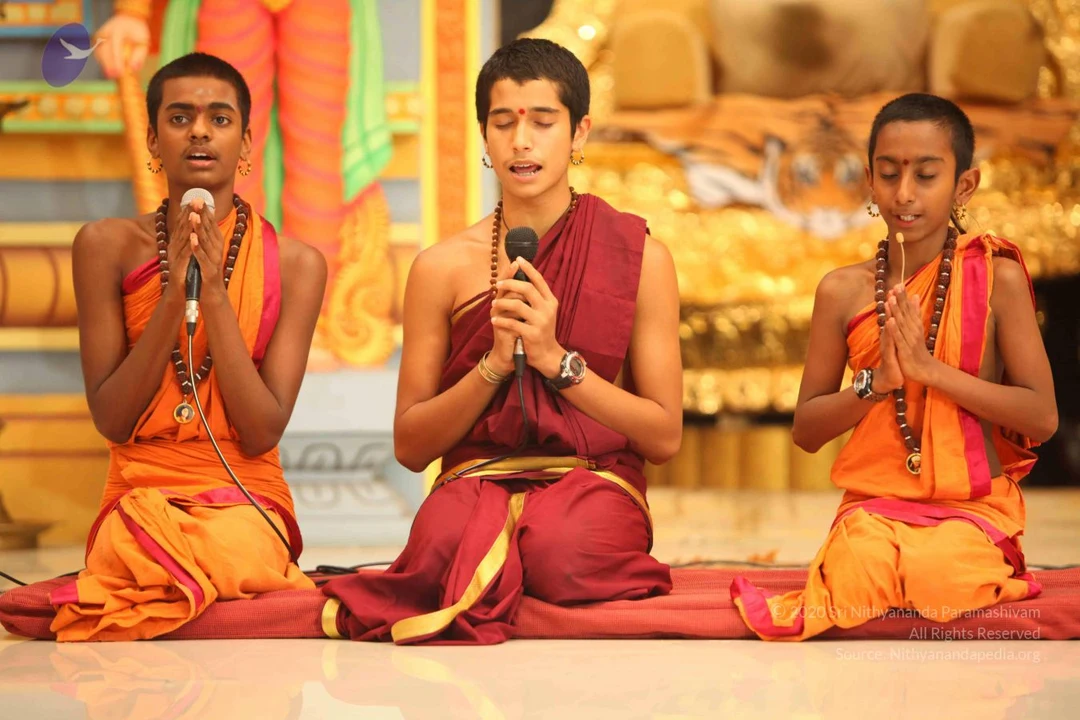
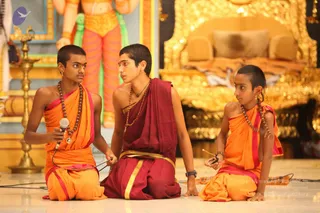
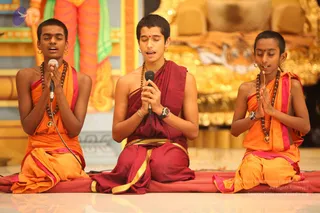
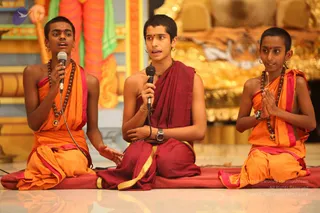
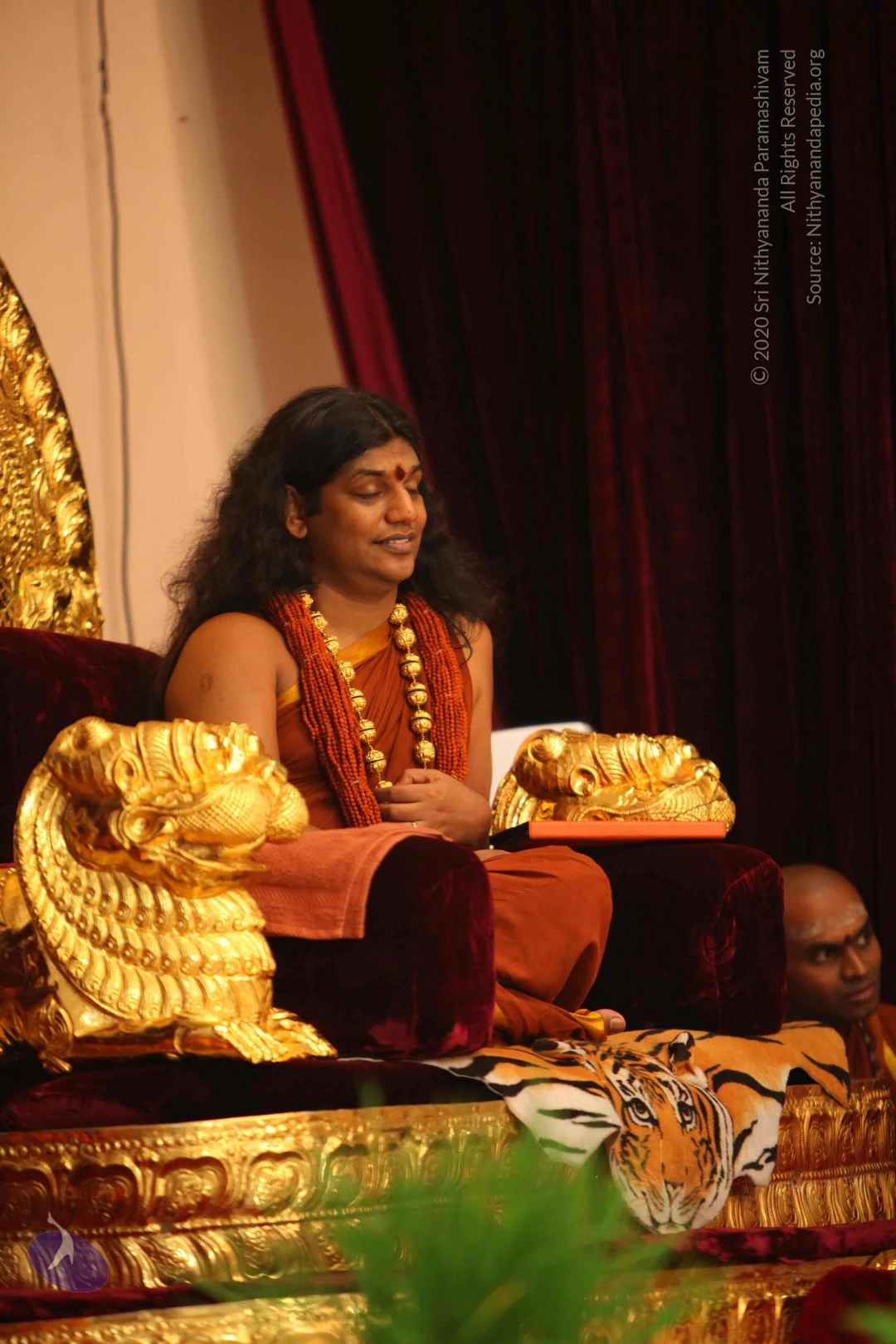
A seated figure on an ornate golden throne with carved gilded lion-head armrests and a tiger-skin cloth draped over the platform. The person has long, dark, swept-back hair, wears a red bindi, a saffron-orange robe, and layered orange rudraksha beads with a gold bead necklace. Behind the throne hang deep red velvet curtains and a golden arched backrest. Swamiji (probable): the long hair, saffron robe, rudraksha malas, gold necklace and throne are the qualifying cues, and the person is physically present in the photograph.A seated man with long dark wavy hair and a red bindi sits on an ornate maroon throne with gold-carved lion-head armrests and a gold-framed back, wearing an orange-saffron robe, a thick multi-strand rudraksha mala and a heavy gold bead necklace, with a golden shawl draped over one arm. A tiger-skin cloth covers the dais edge, and a second man in a shaved head and red tilak is partly visible at the right edge. Maroon velvet drapes hang behind. The seated man has distinctive long hair, saffron robe, rudraksha and gold necklace, consistent with the appearance-based label Swamiji (probable) on a throne with a satsang setting.Three young sannyasi-clad boys sit cross-legged on a glossy white floor in front of a golden throne and a painted deity figure with orange and green garments. The boy on the left wears orange robes with pink borders, a rudraksha mala and a handheld microphone with a cable. The boy in the centre wears maroon robes with a gold waistband, a rudraksha mala and a pendant, and looks toward the left boy. The boy on the right wears orange robes with pink trim, a rudraksha mala and holds a small microphone. Behind them, a brass oil lamp stands at left and an ornate gold throne with cushions fills the background.Three young male devotees sit cross-legged on a red mat, chanting into handheld microphones with palms pressed together in anjali. The boy on the left and the boy on the right wear orange and saffron robes with pink borders and rudraksha malas; the boy in the centre wears a maroon robe with gold trim, a rudraksha mala, a red tilak on his forehead and a wristwatch. Behind them, a large painted deity figure in orange and green stands beside a golden throne-like seat with gilded cushions.Three young monks sit cross-legged on red mats in front of a golden backdrop and painted deity panels. The left monk wears orange robes and rudraksha beads, holding a microphone with his right hand. The centre monk wears maroon robes with a gold border, a red bindi, a wristwatch, and speaks into a microphone. The right monk in orange robes and rudraksha beads presses his palms together in anjali. Behind them stands a painted deity figure in red and green, and a gold-cloth covered seat with a tiger-print pattern.A photo of a seated figure on an ornate gilded throne with lion-head armrests and a deep red velvet cushion, in front of dark red drapes. A long-haired person in an orange-red wrap, with a red-and-gold beaded necklace, rudraksha-style red sash and a red bindi, sits upright and looks ahead. A tiger-striped cloth covers the platform, and a shaven-headed person in orange sits at the lower right edge. Golden lion sculptures flank the foreground. Swamiji (probable) is seated on the throne, the person with long hair, orange wrap, ornate gold necklace and red bindi; the other person is a devotee in orange.

SHIVASTHAMBA-YOGA-BY-GURUKUL-BALASANTS

93 photosSource gallery
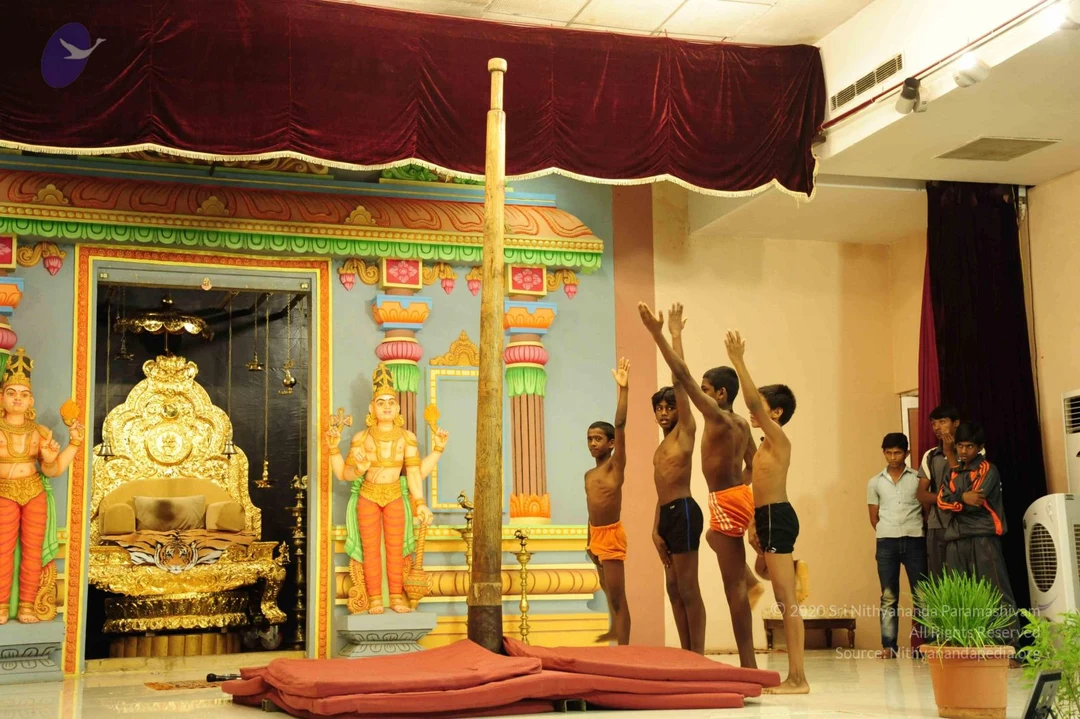
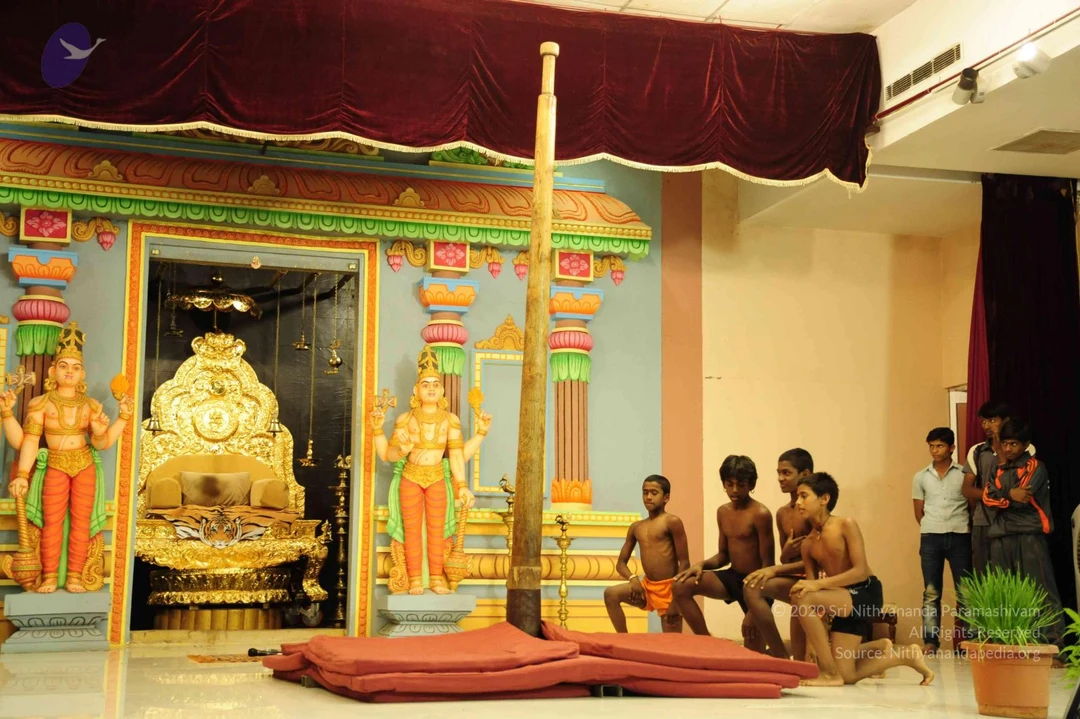
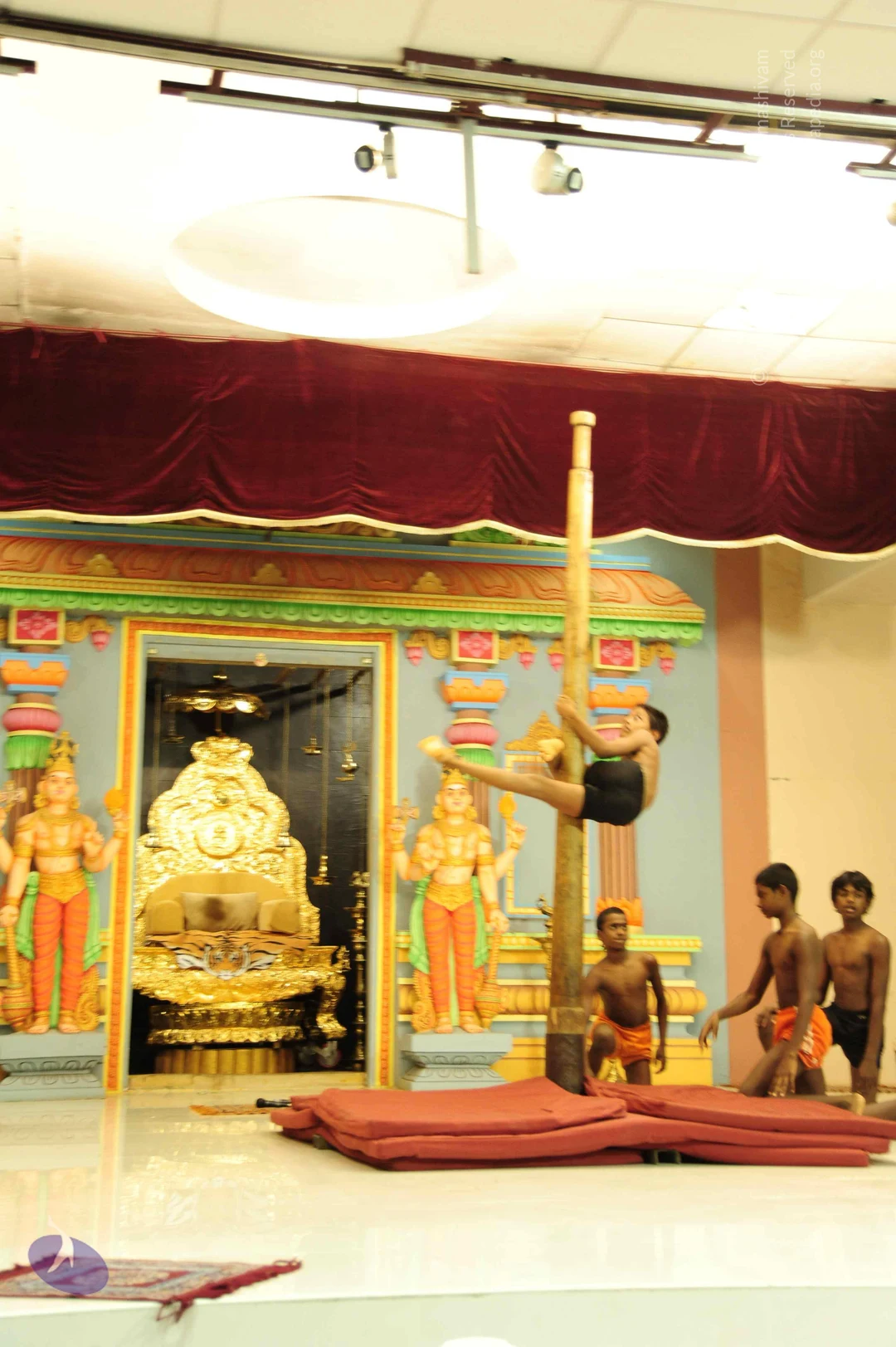
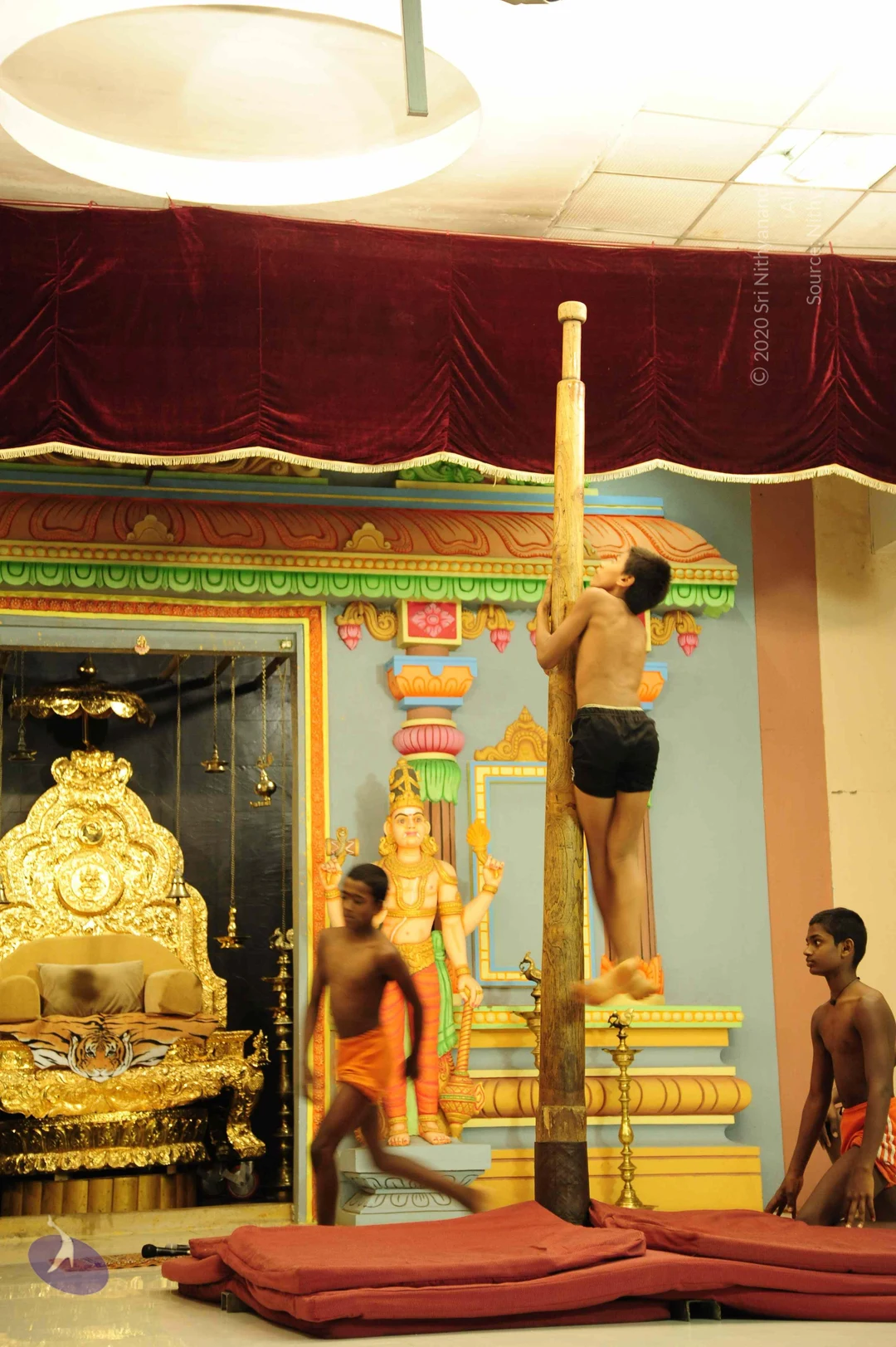
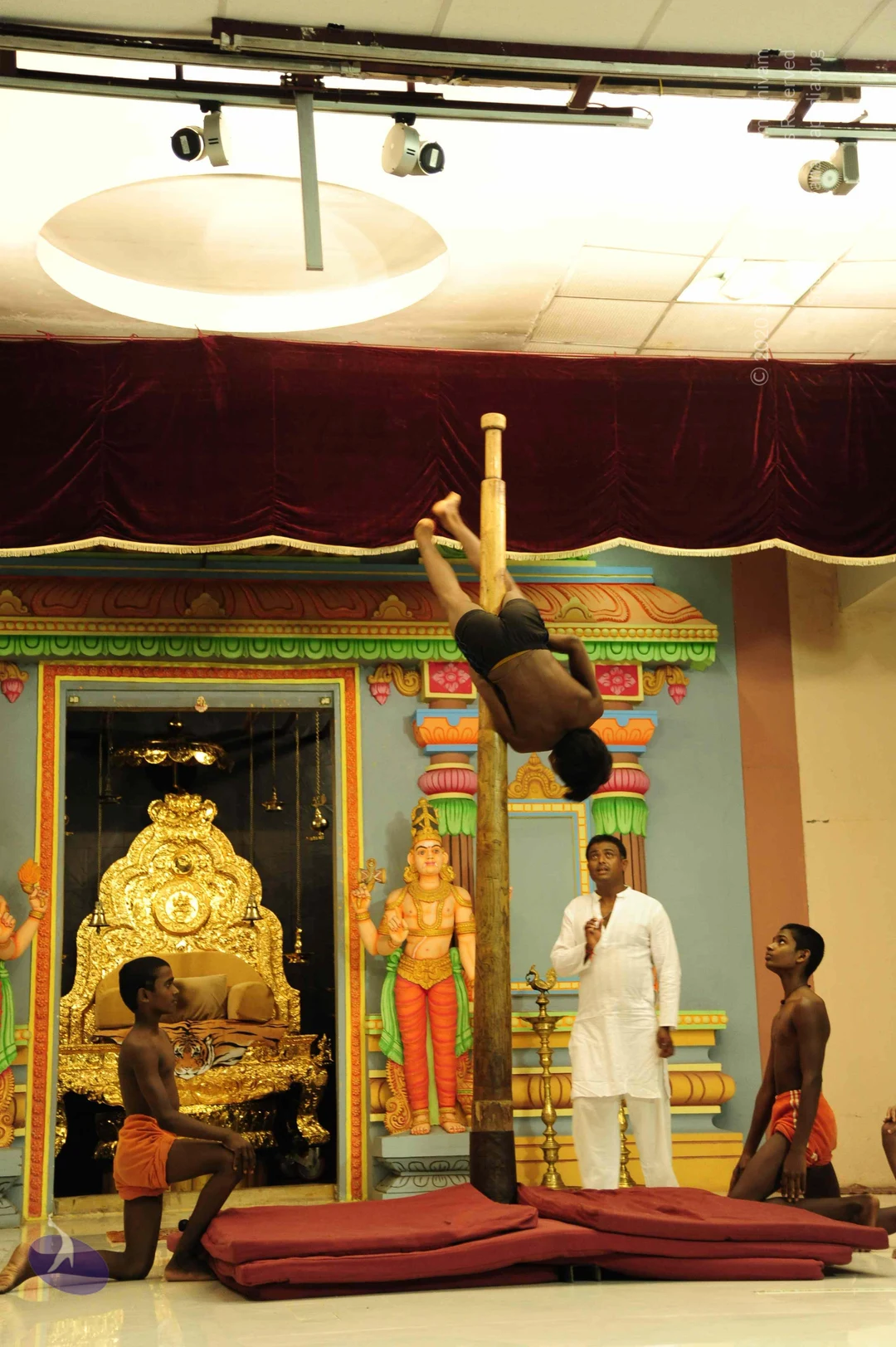
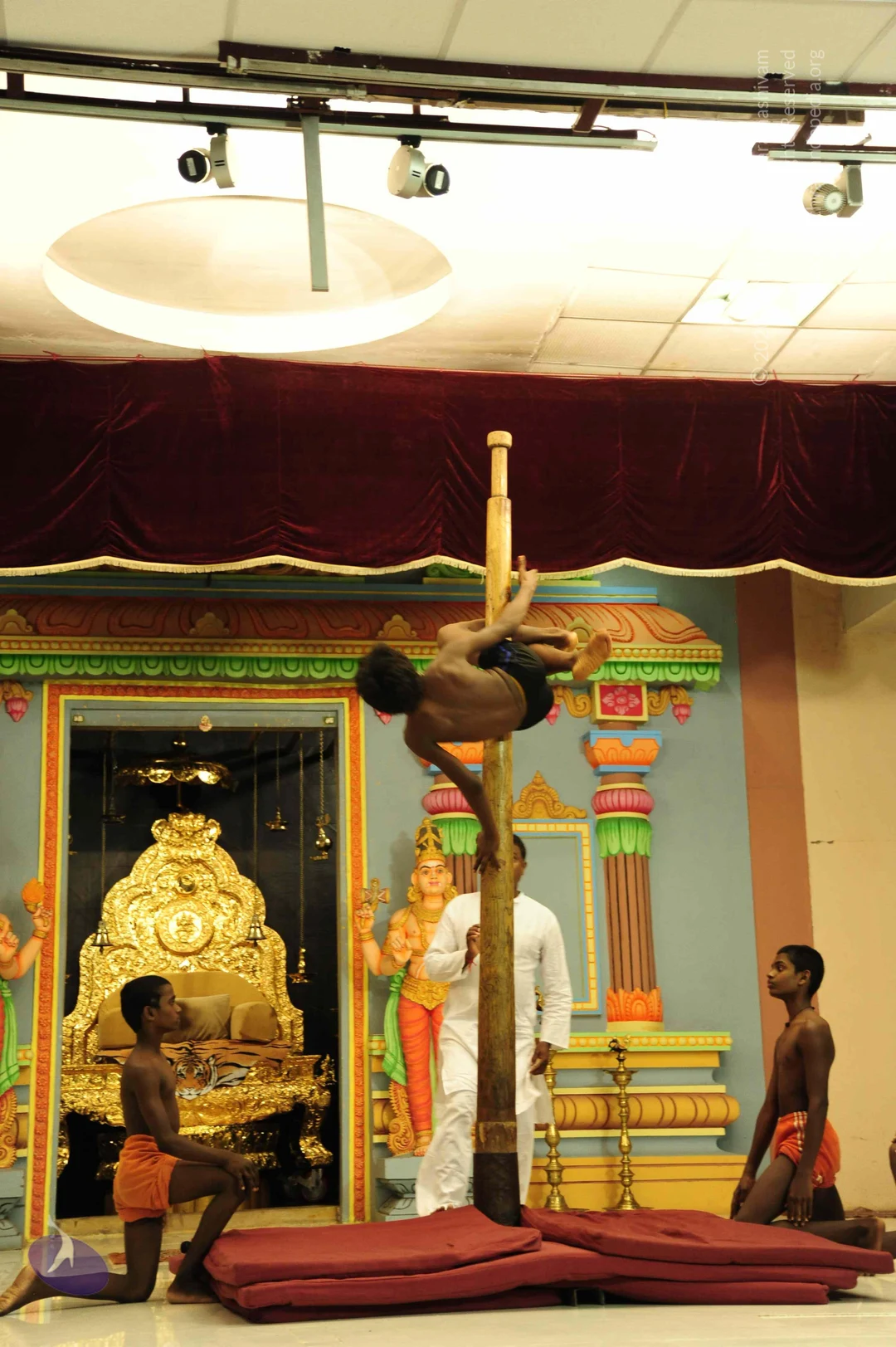
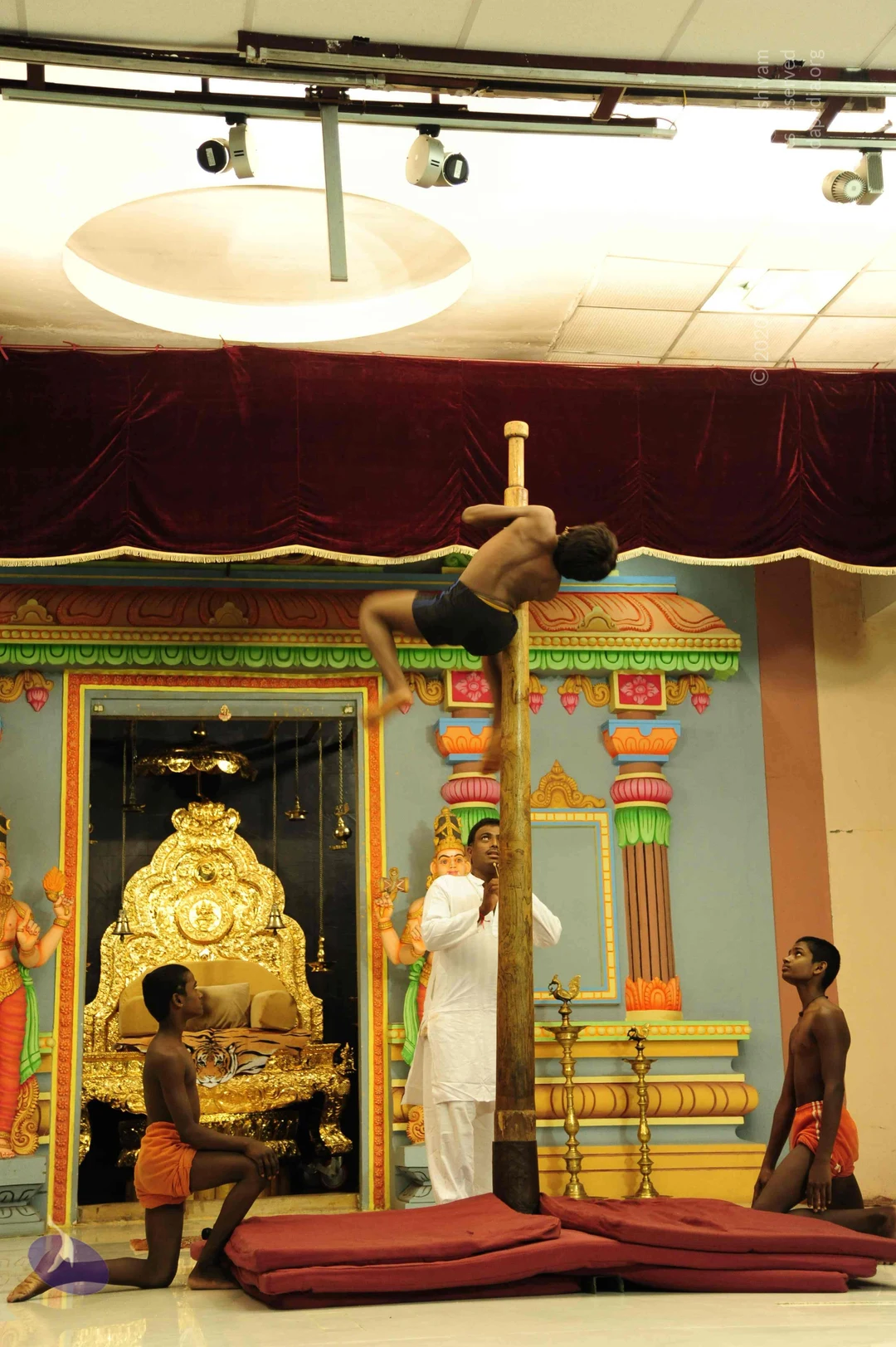
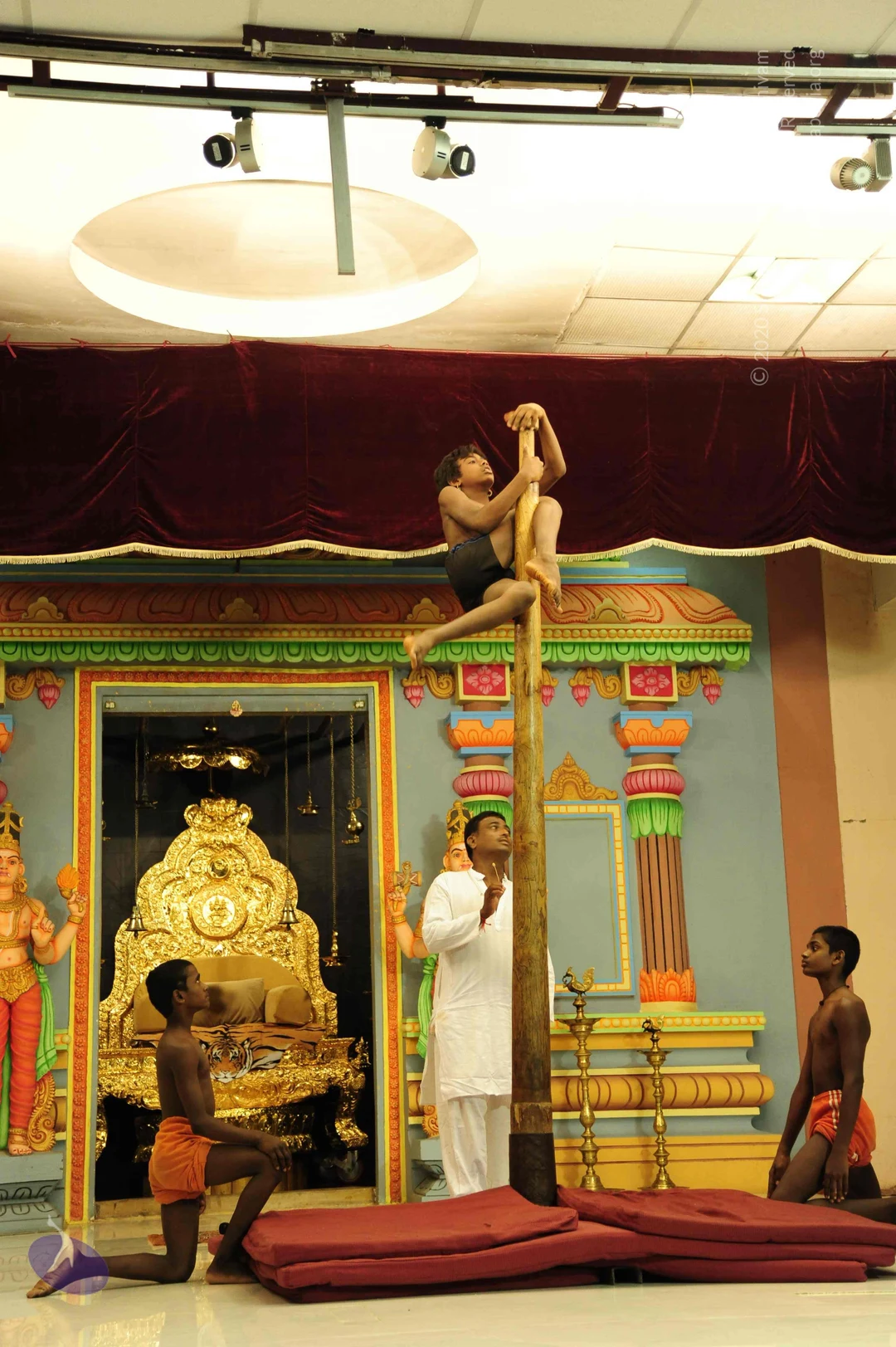
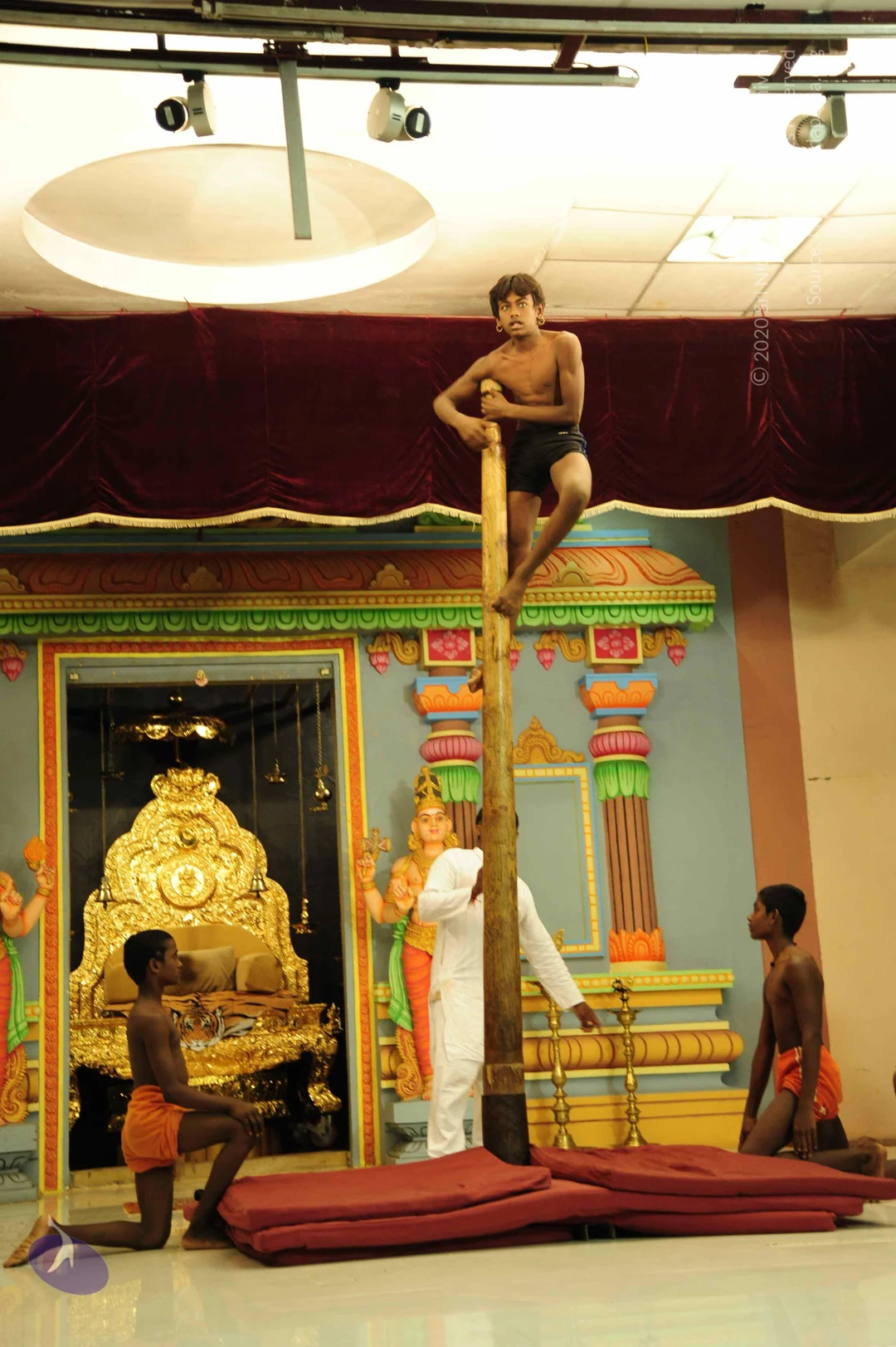
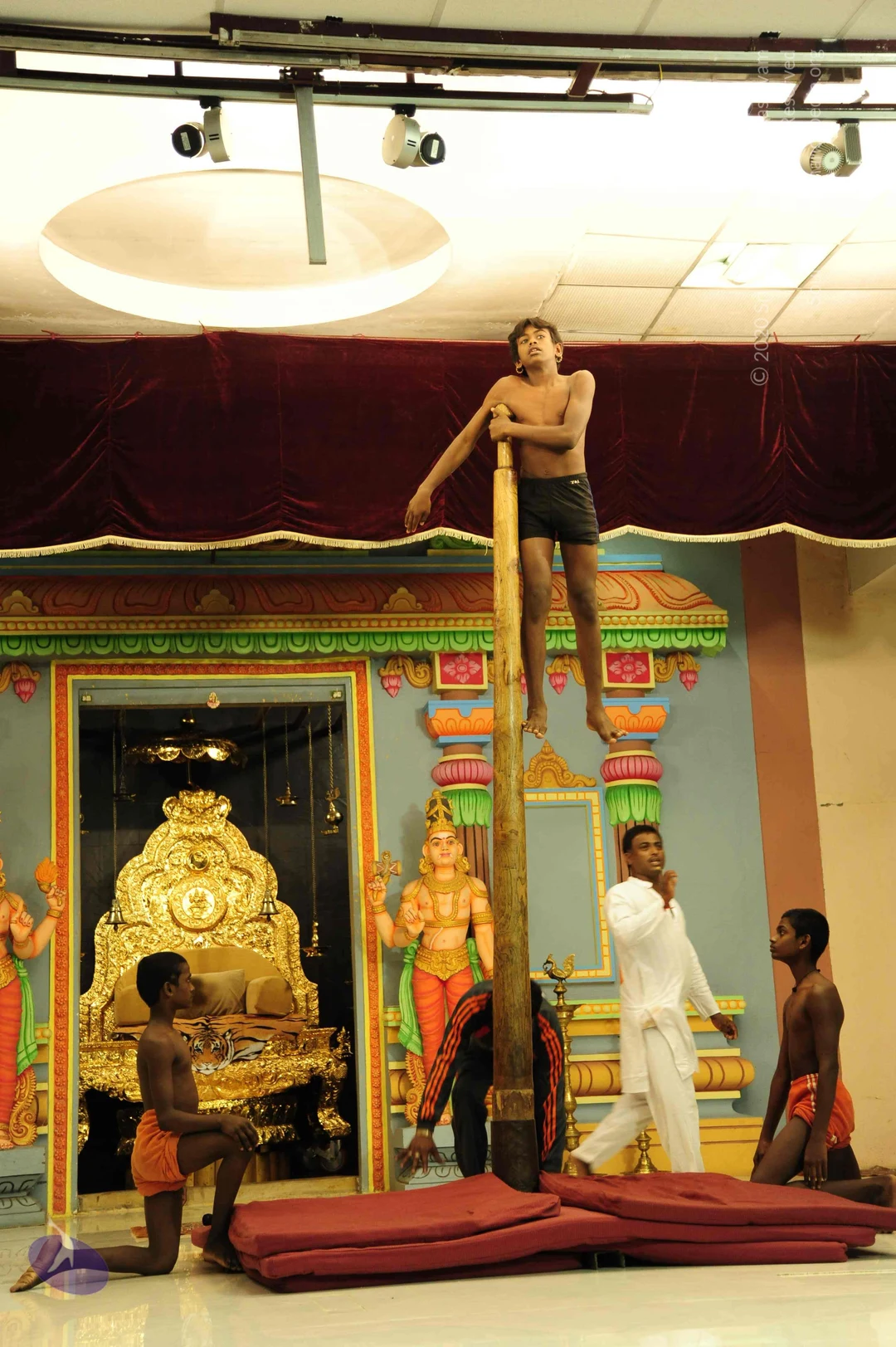
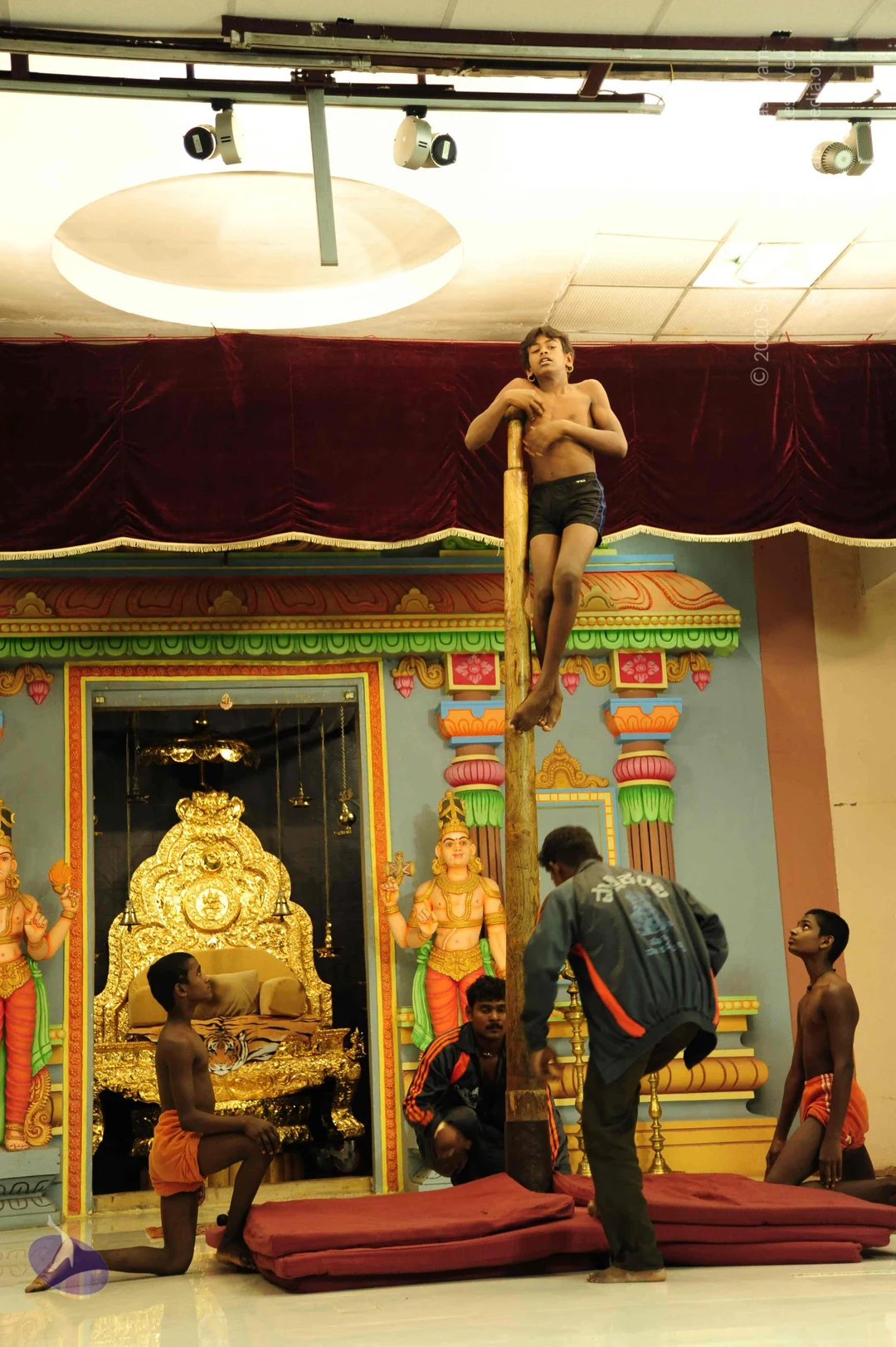
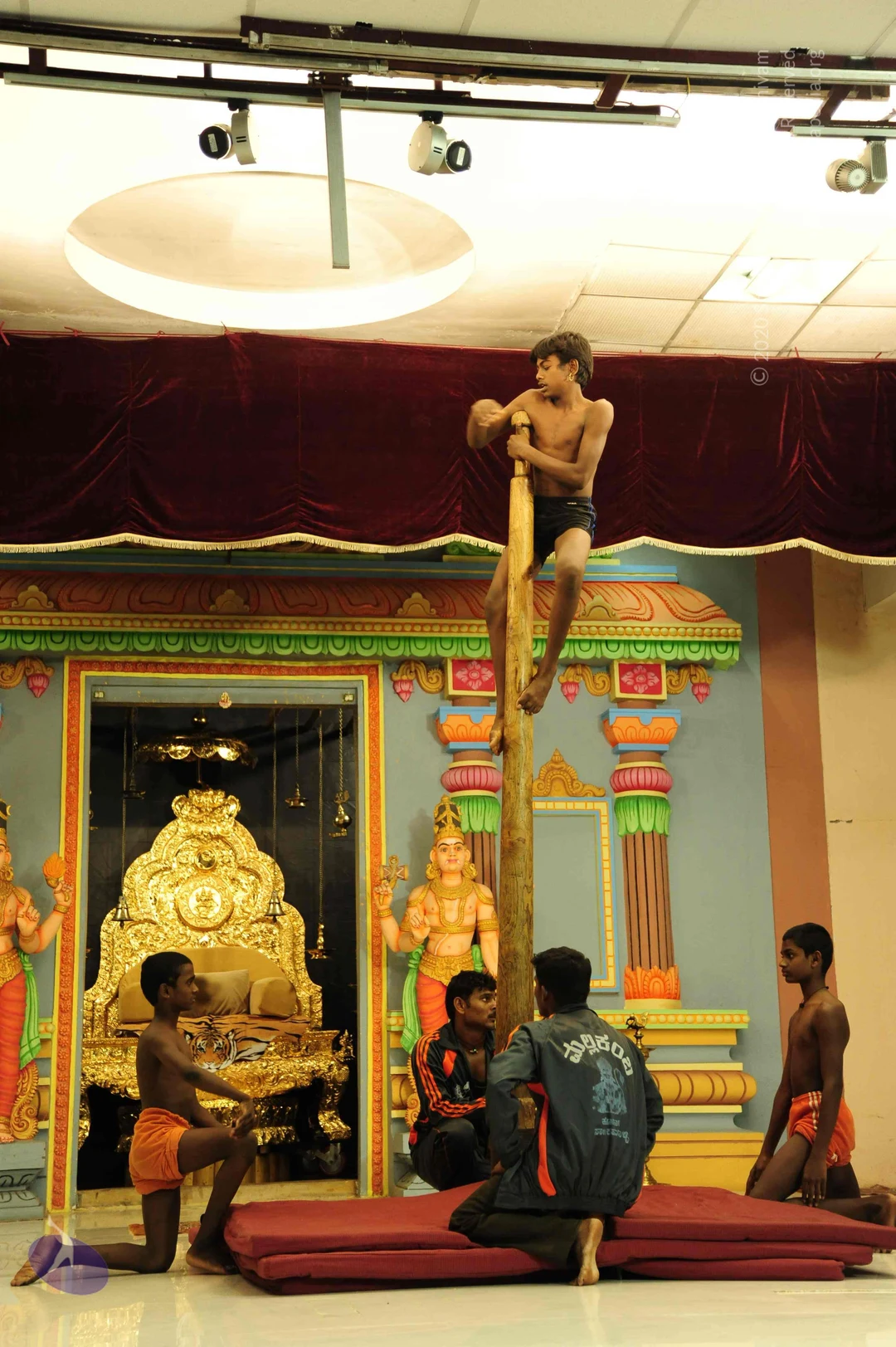
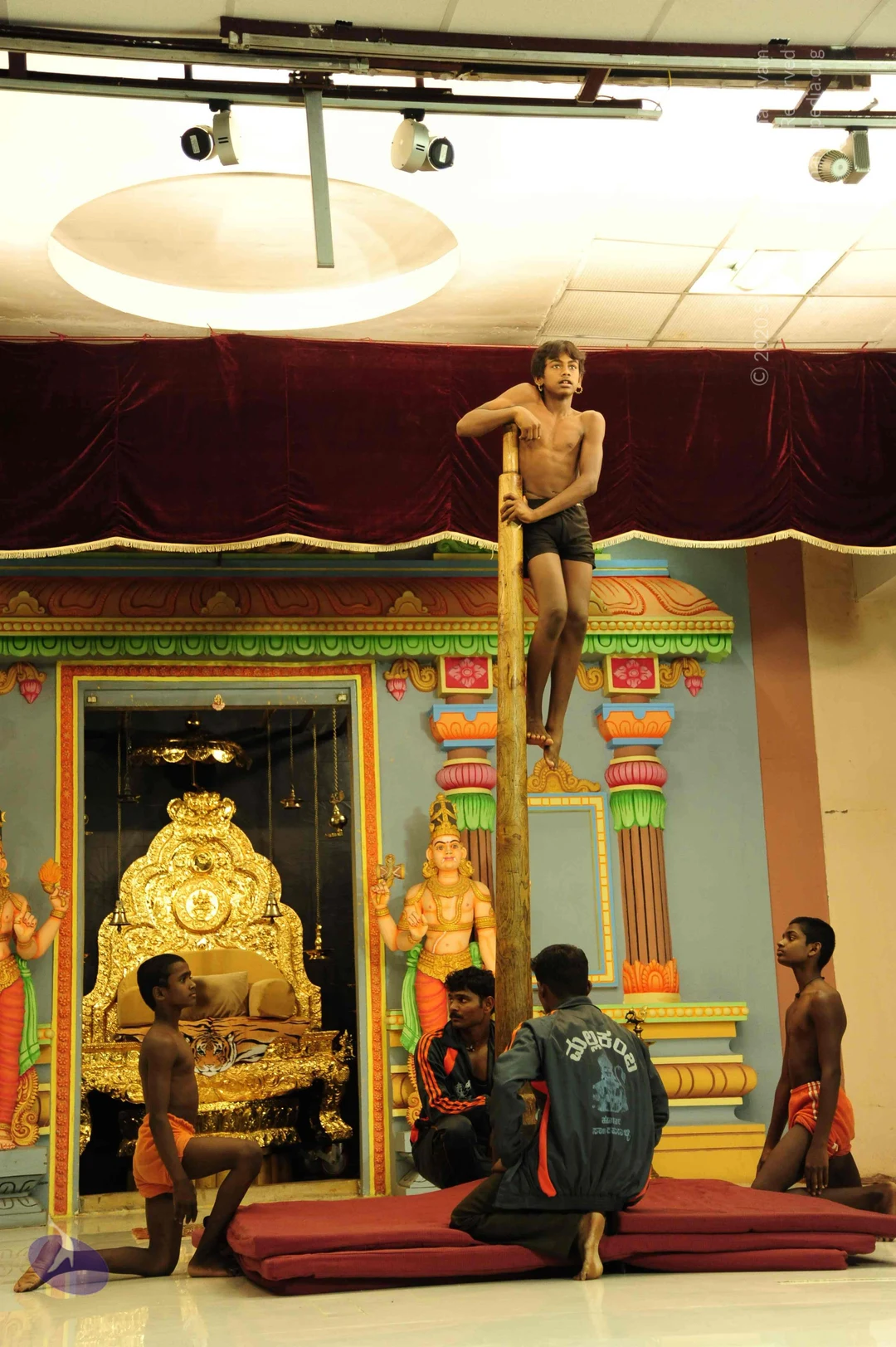
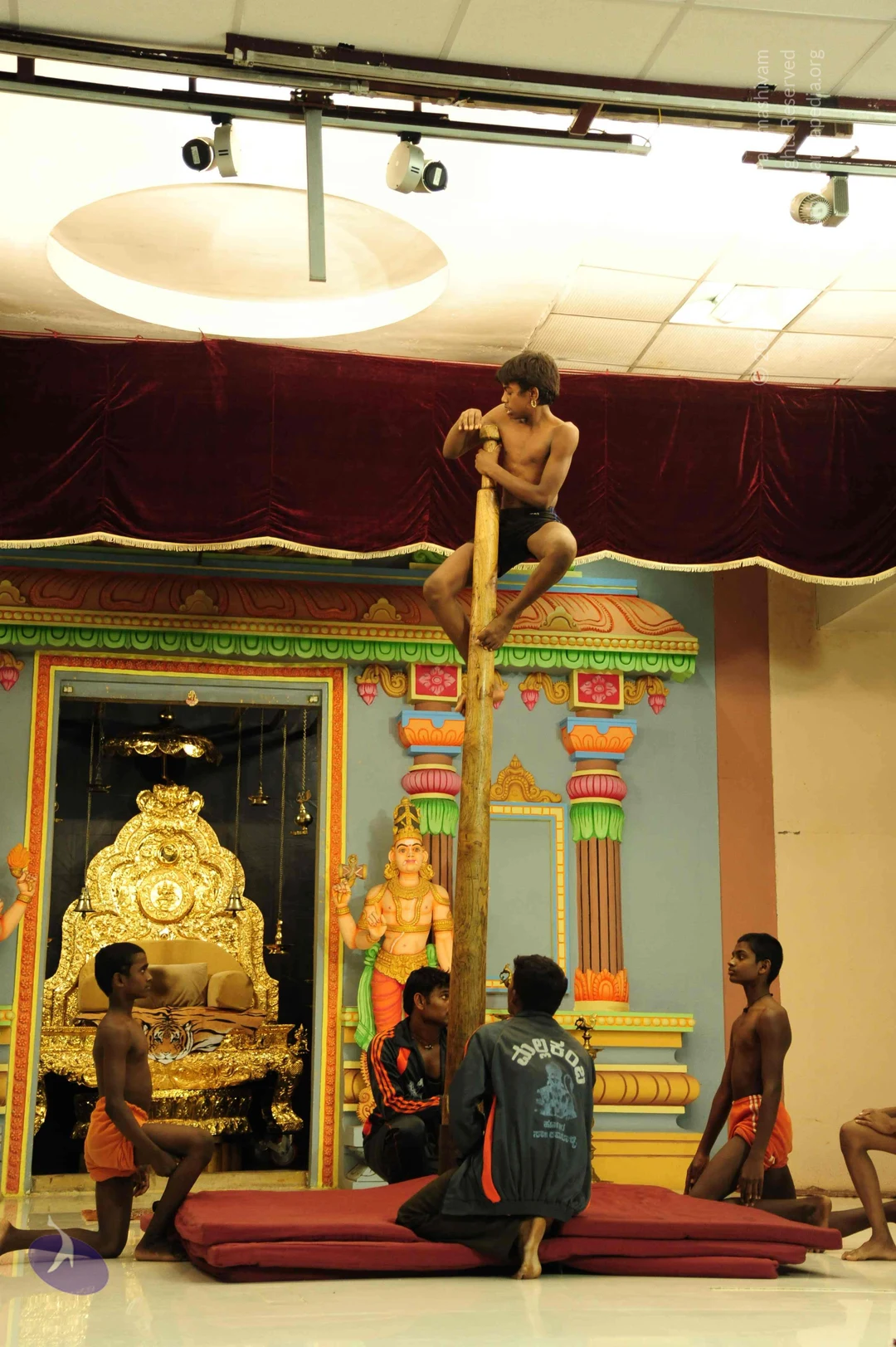
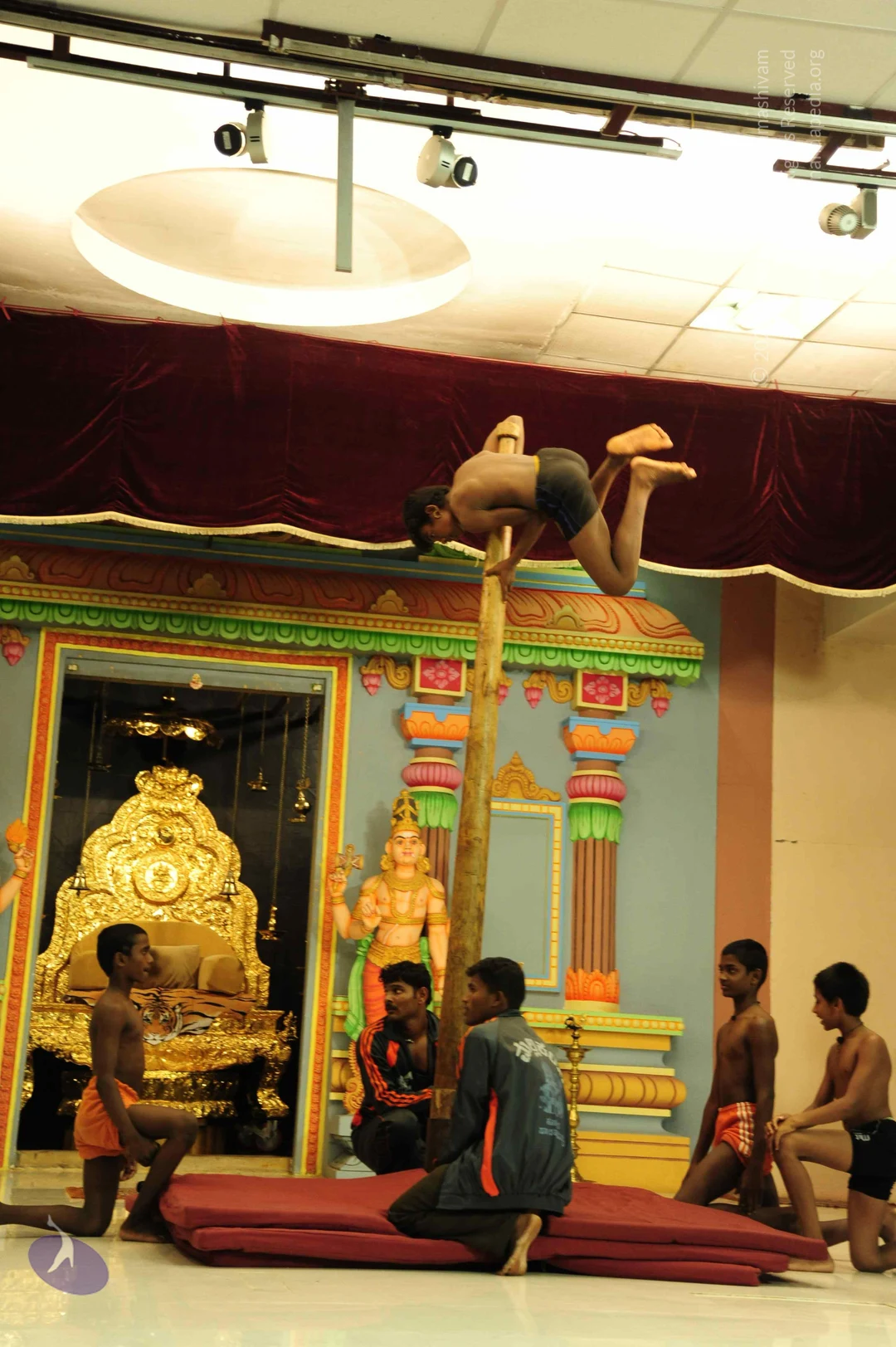
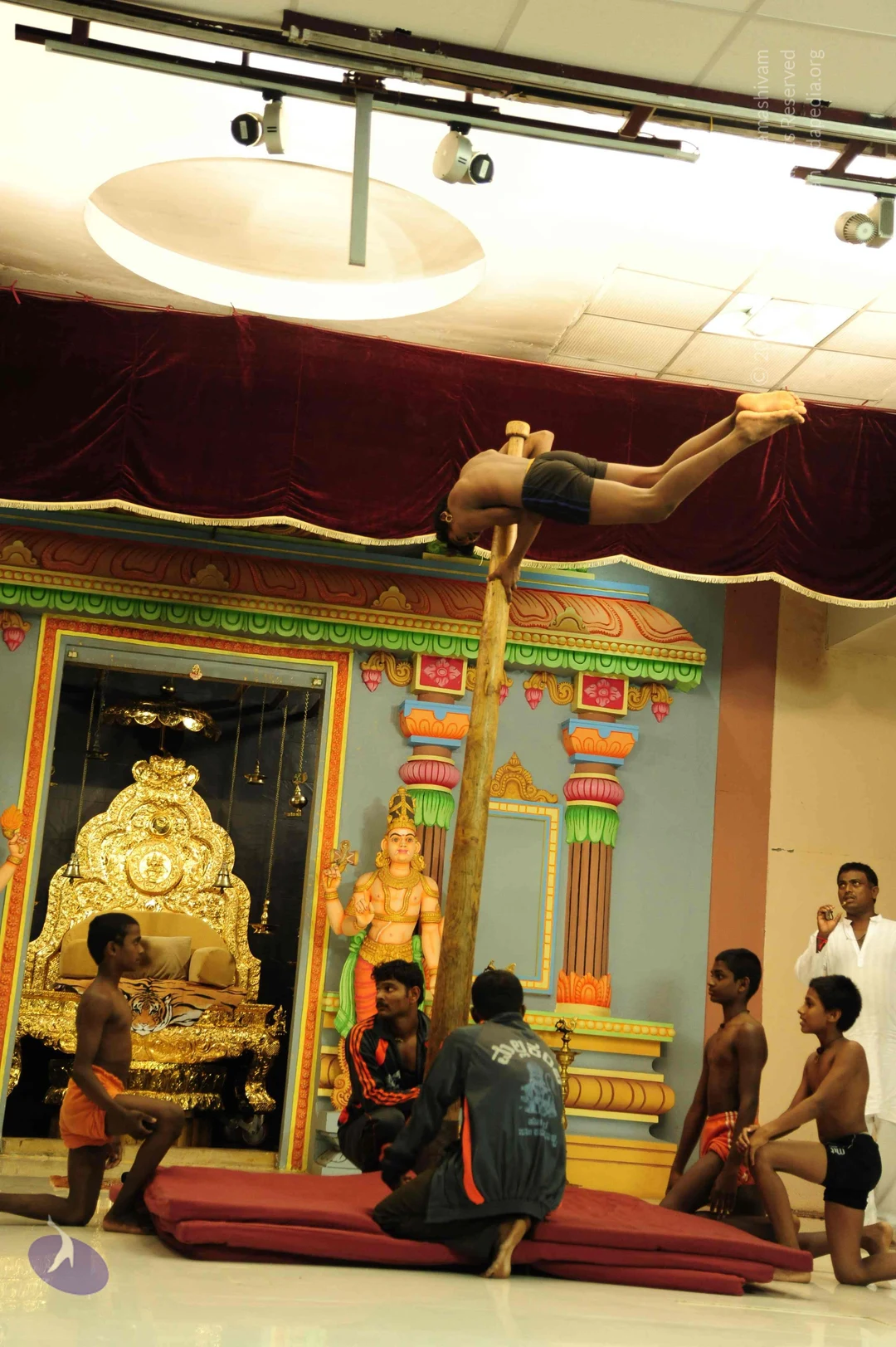
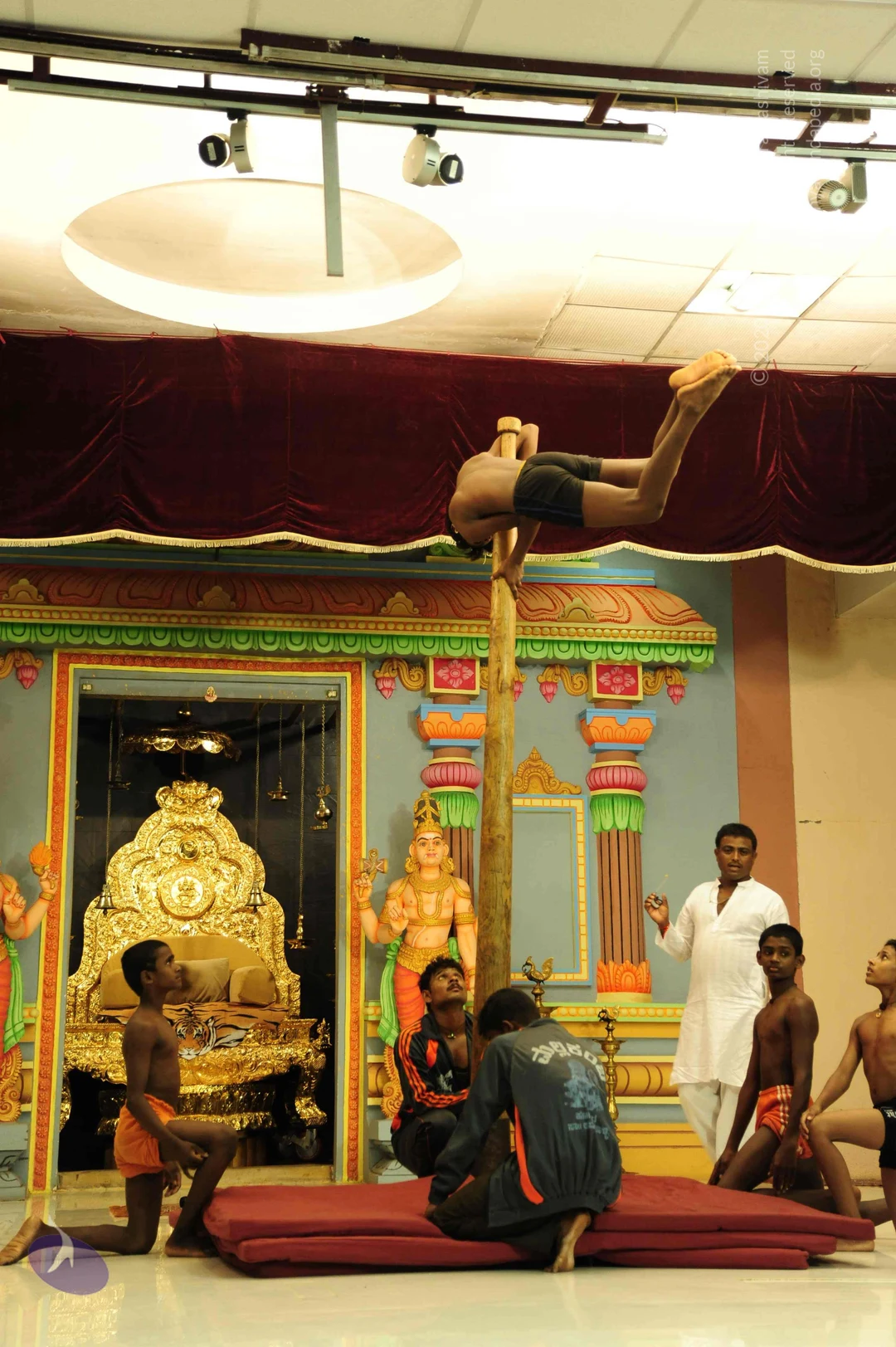
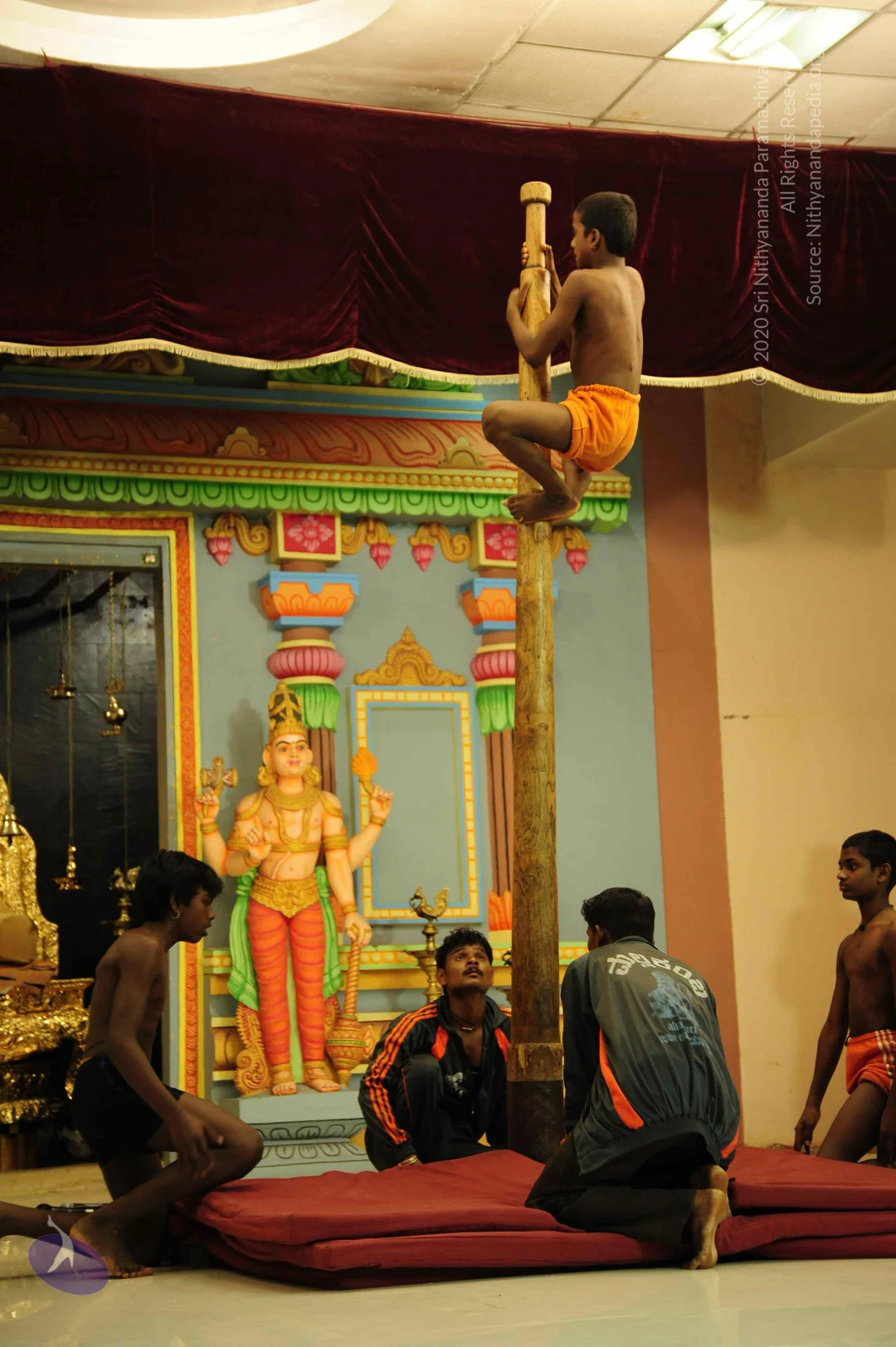
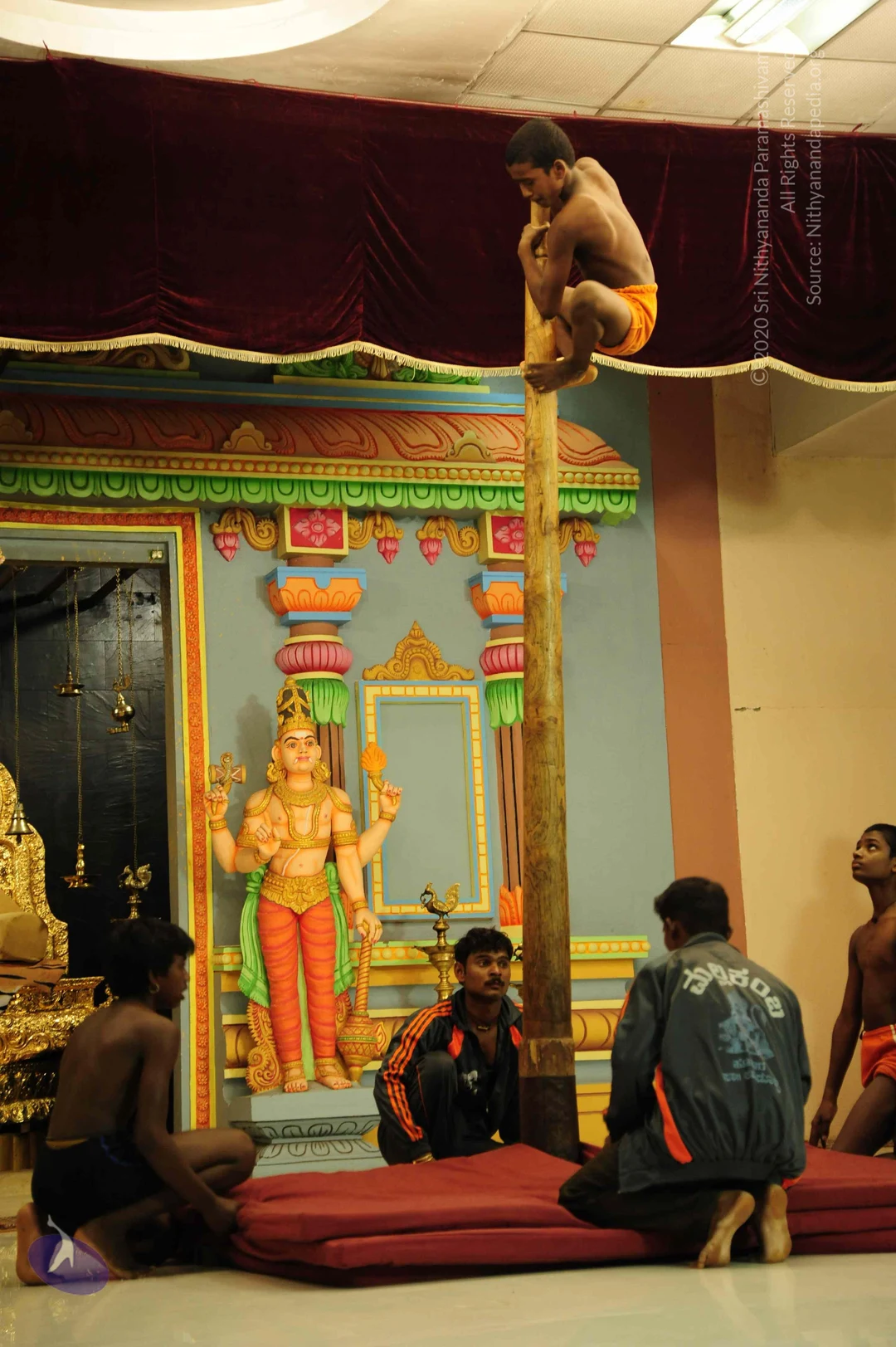
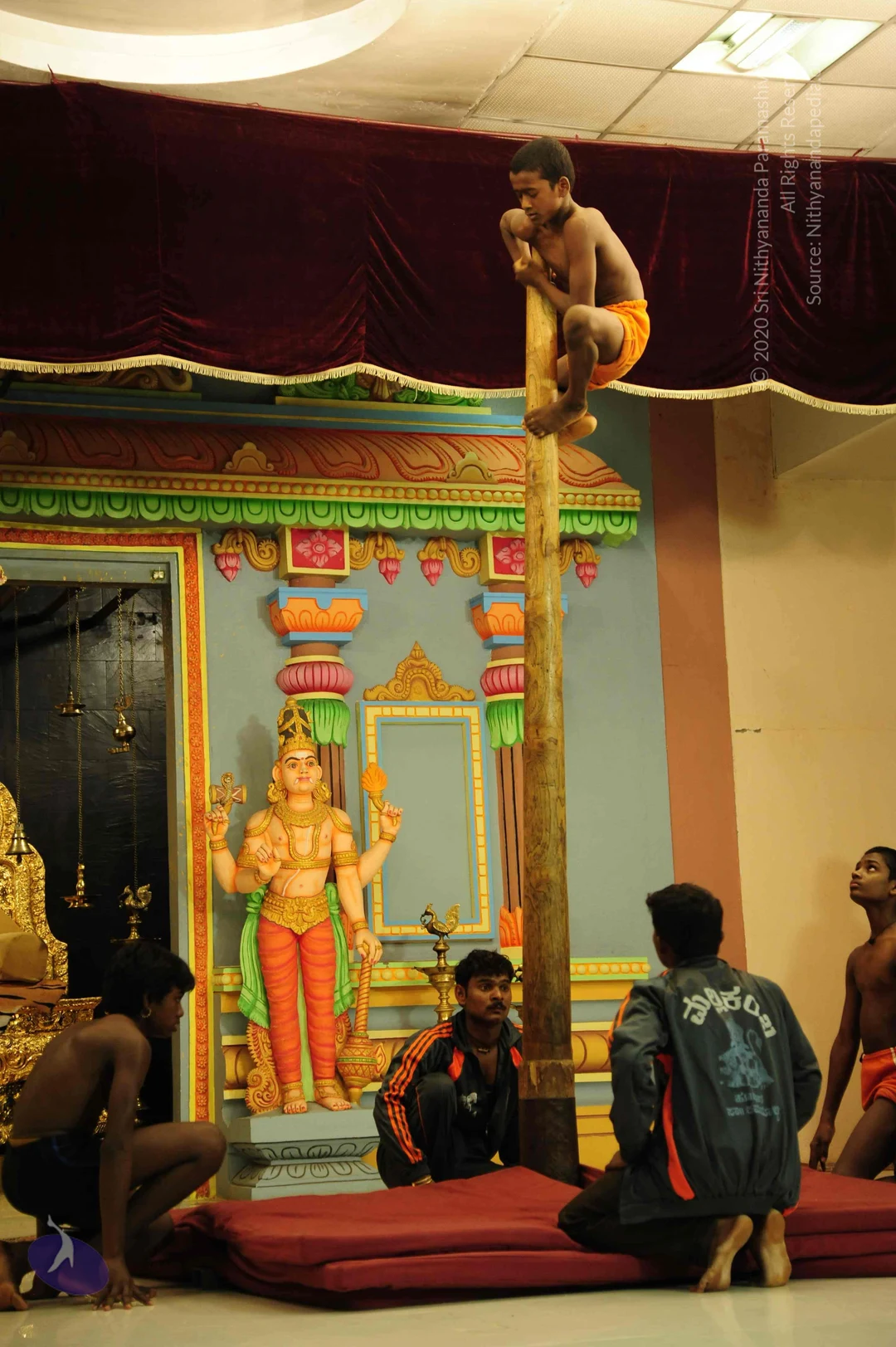
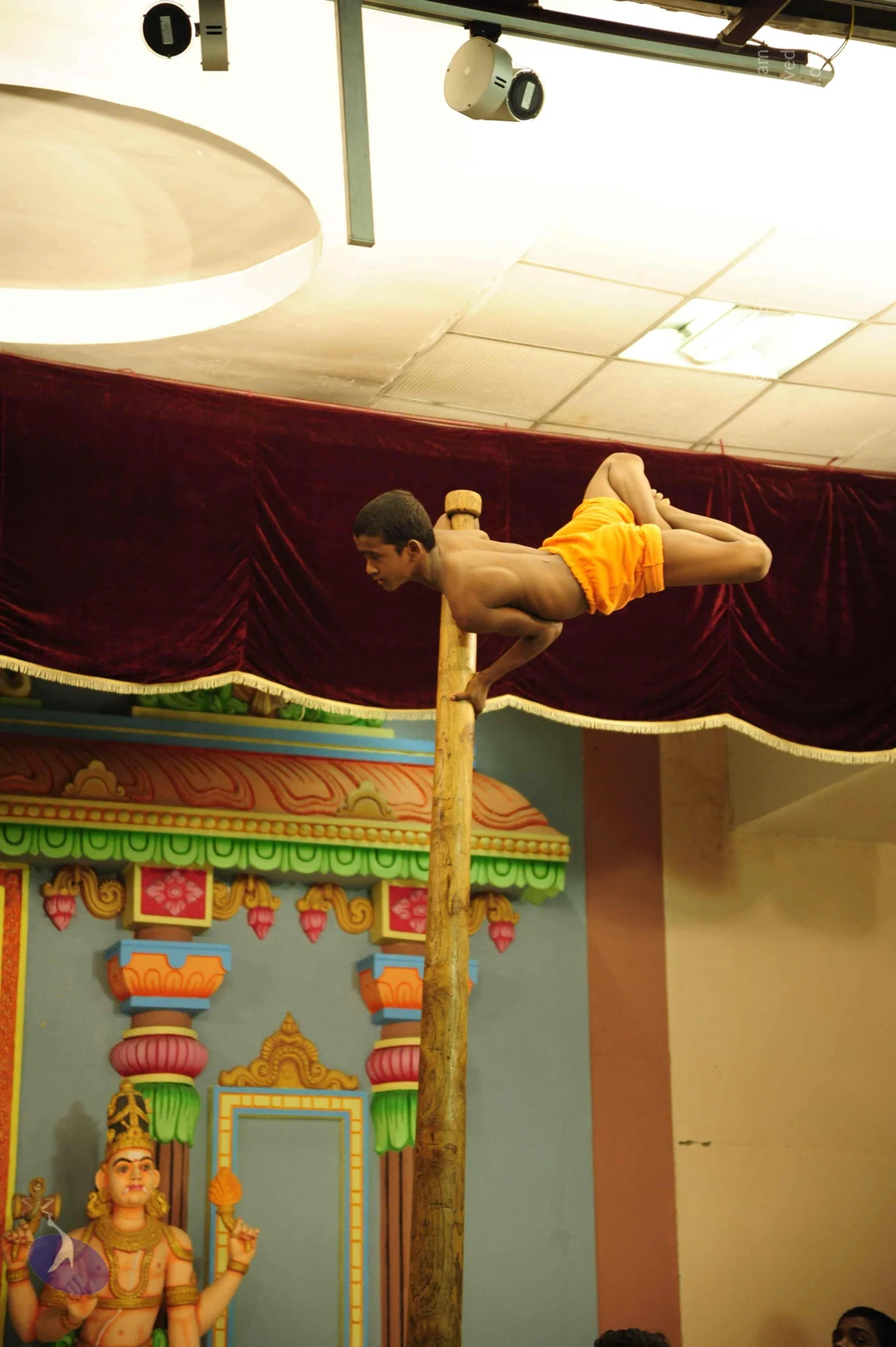
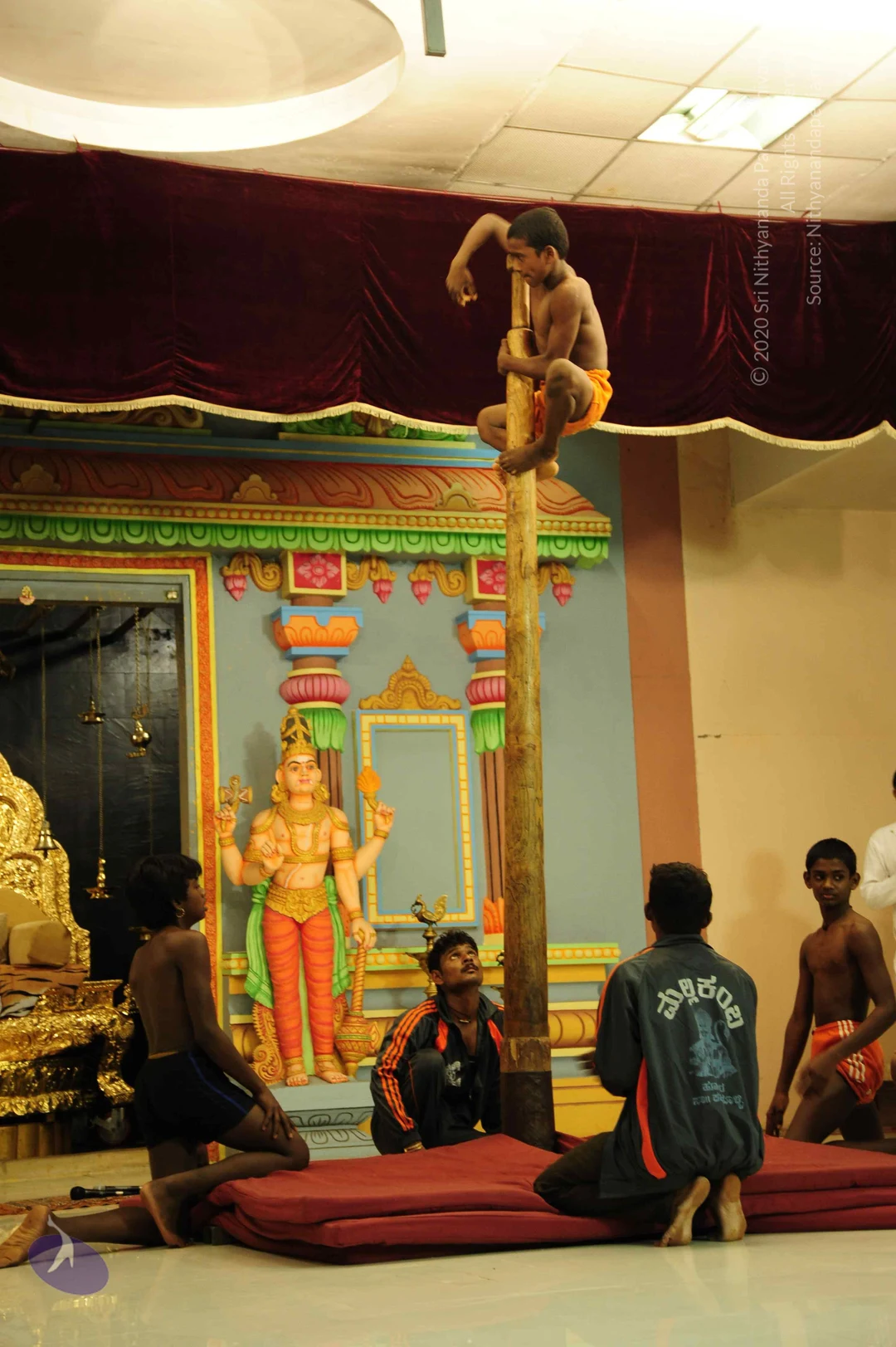
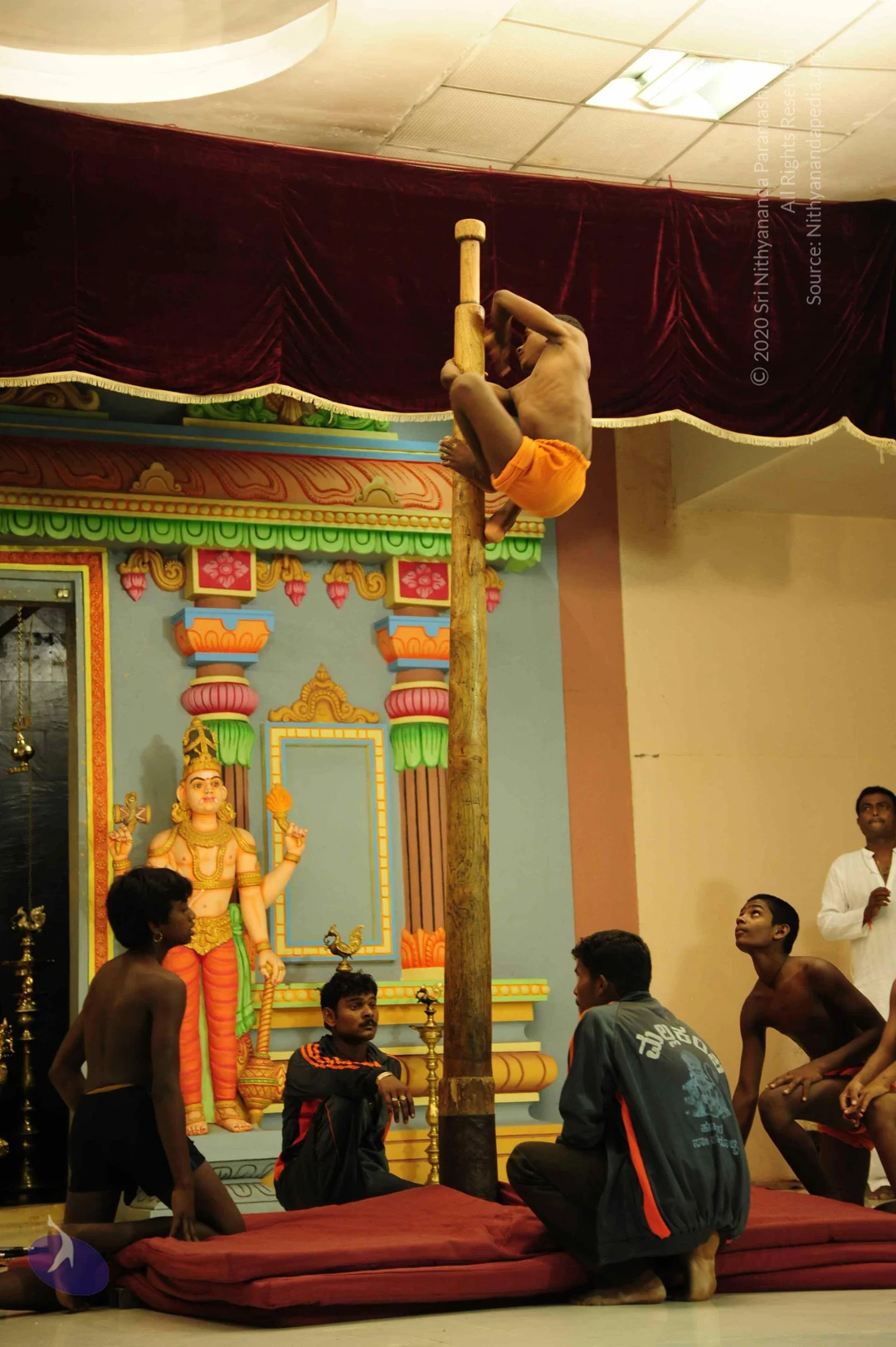
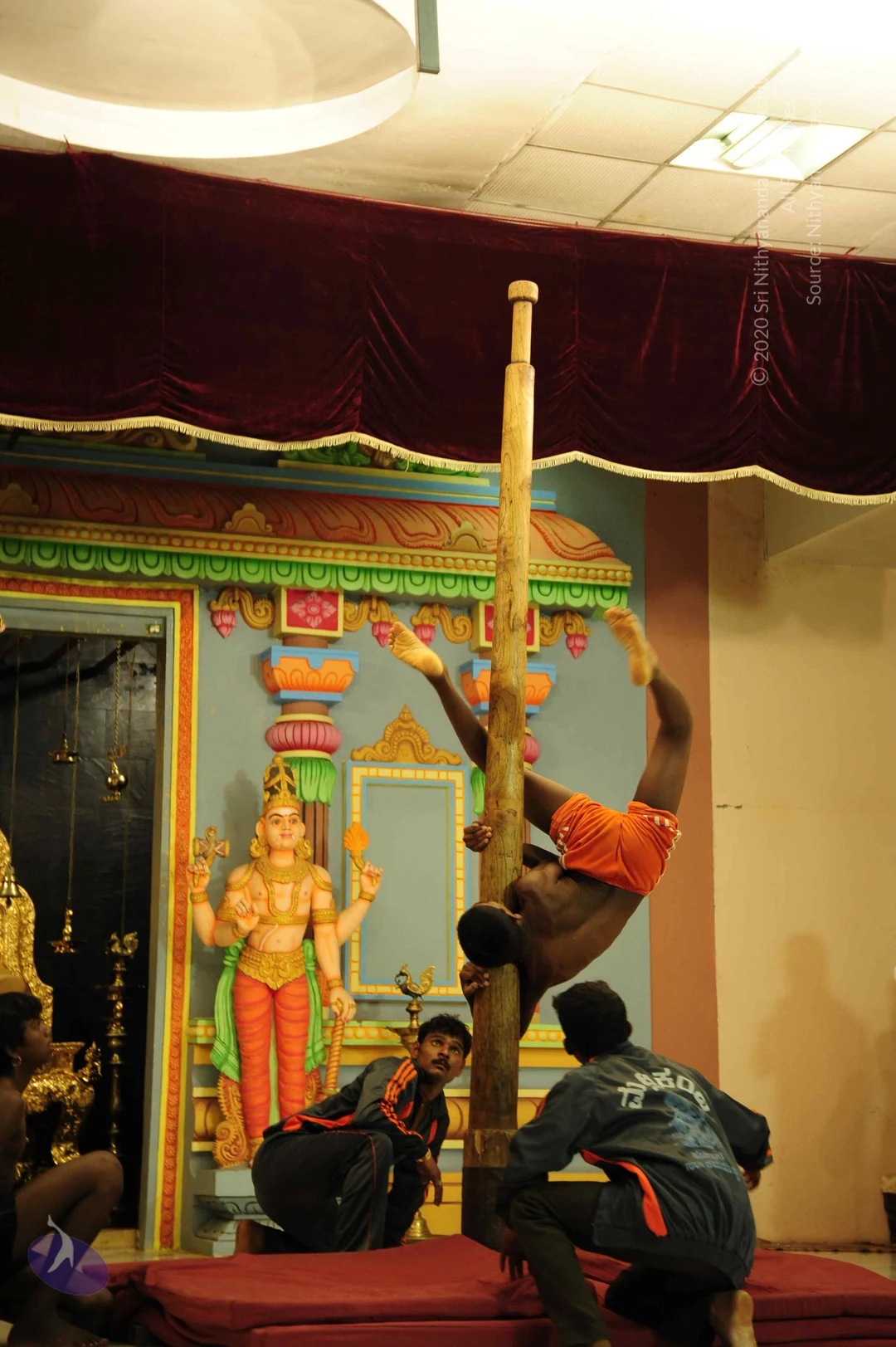
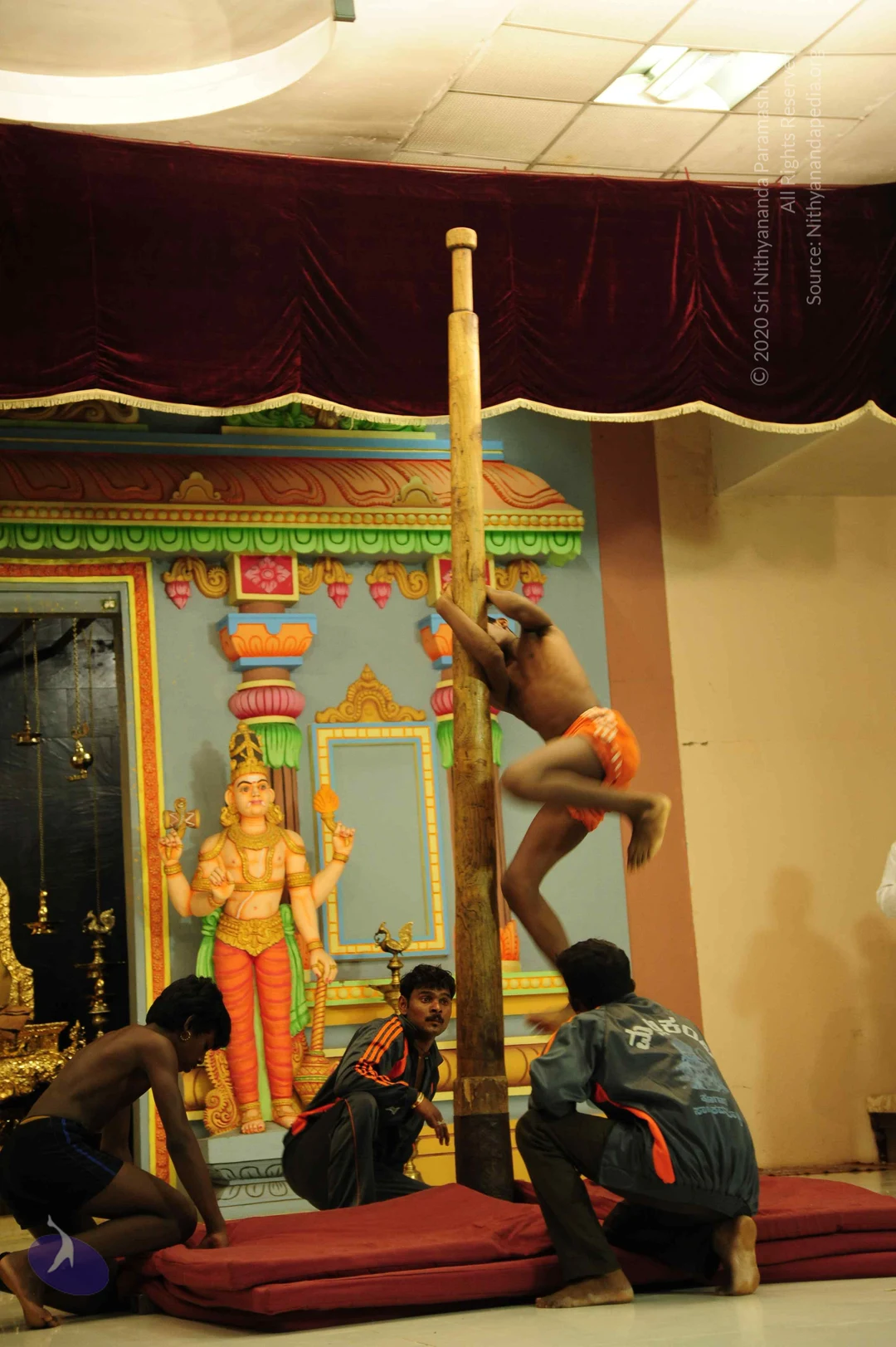
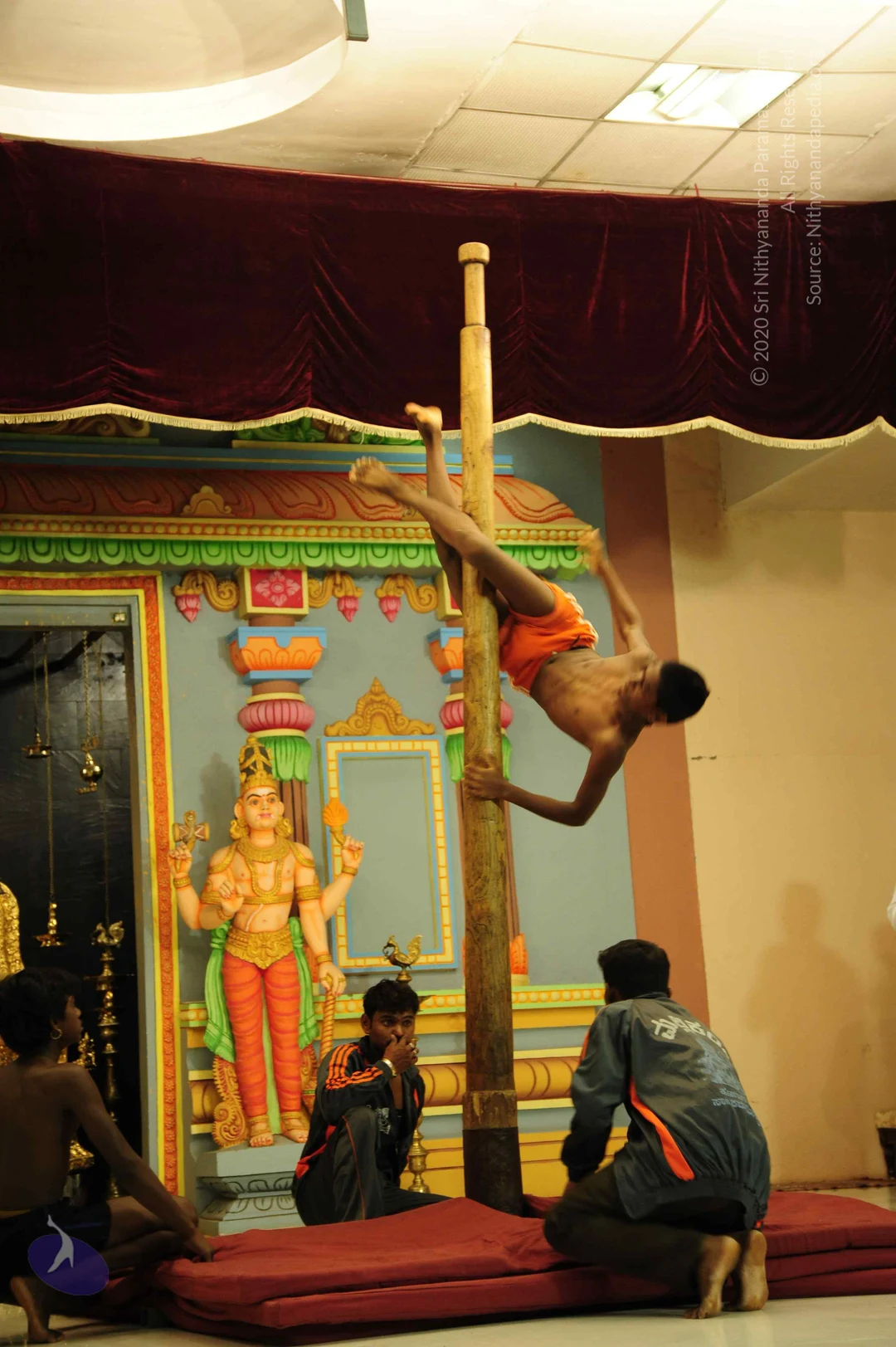
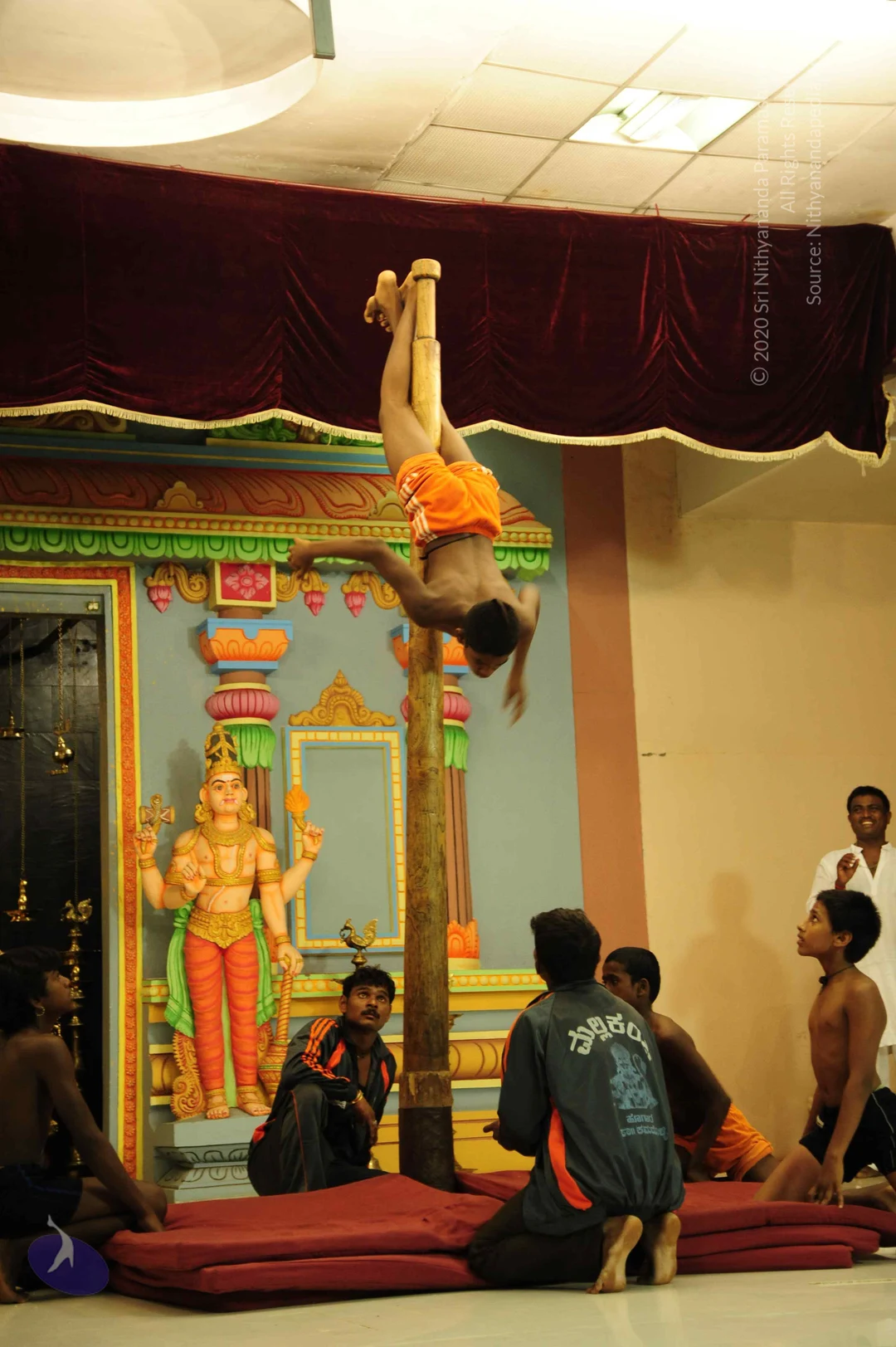
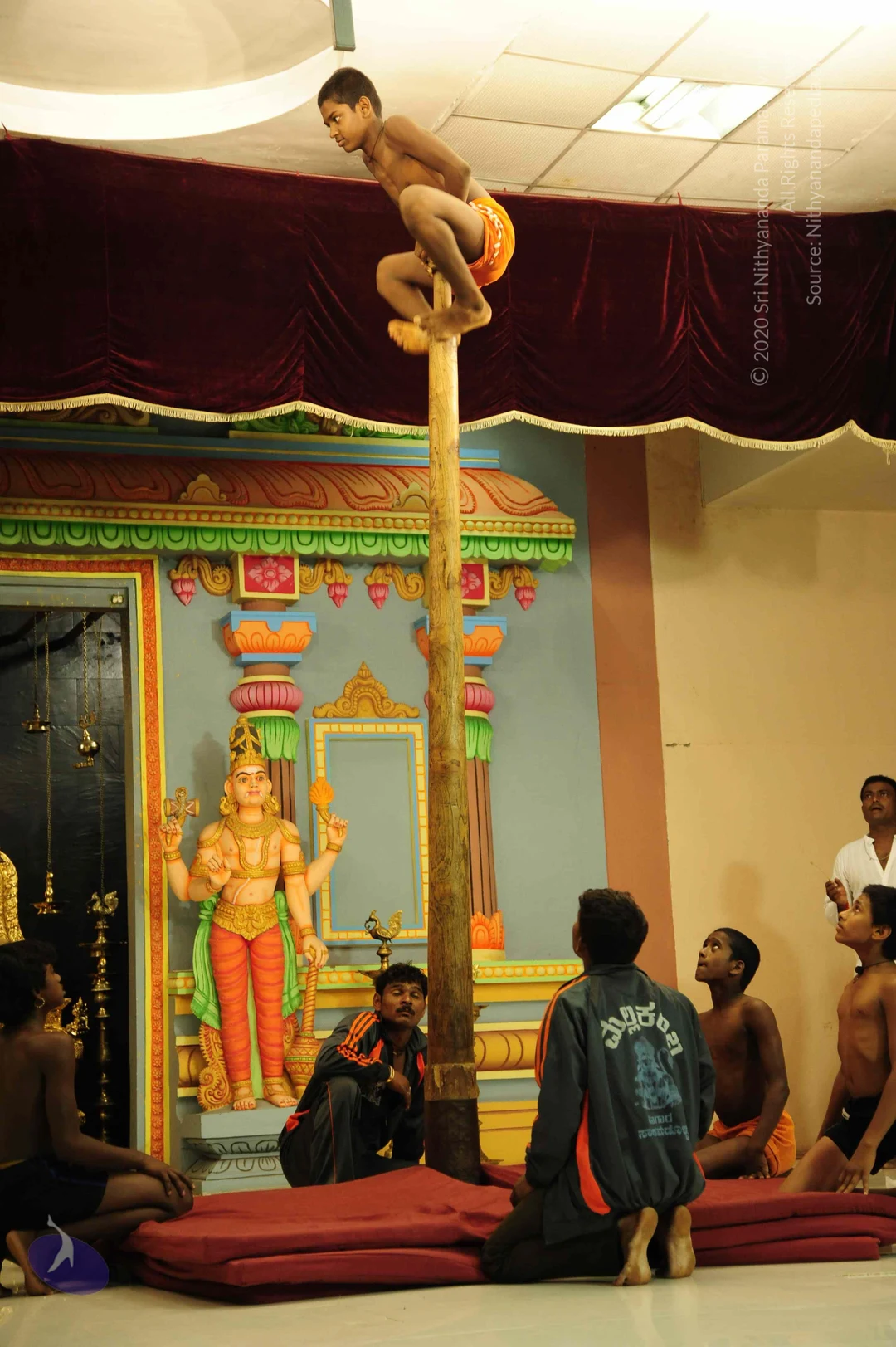
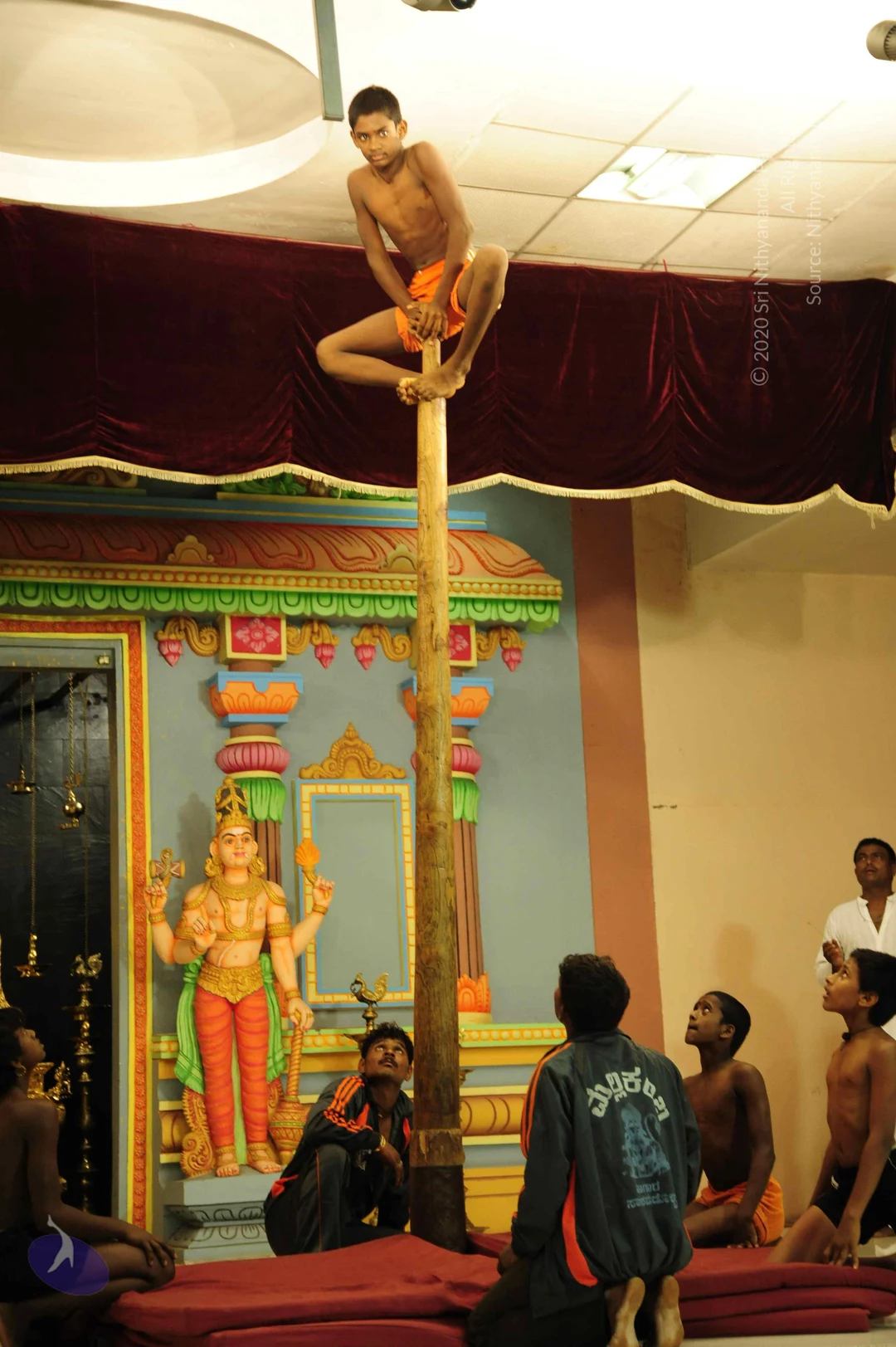
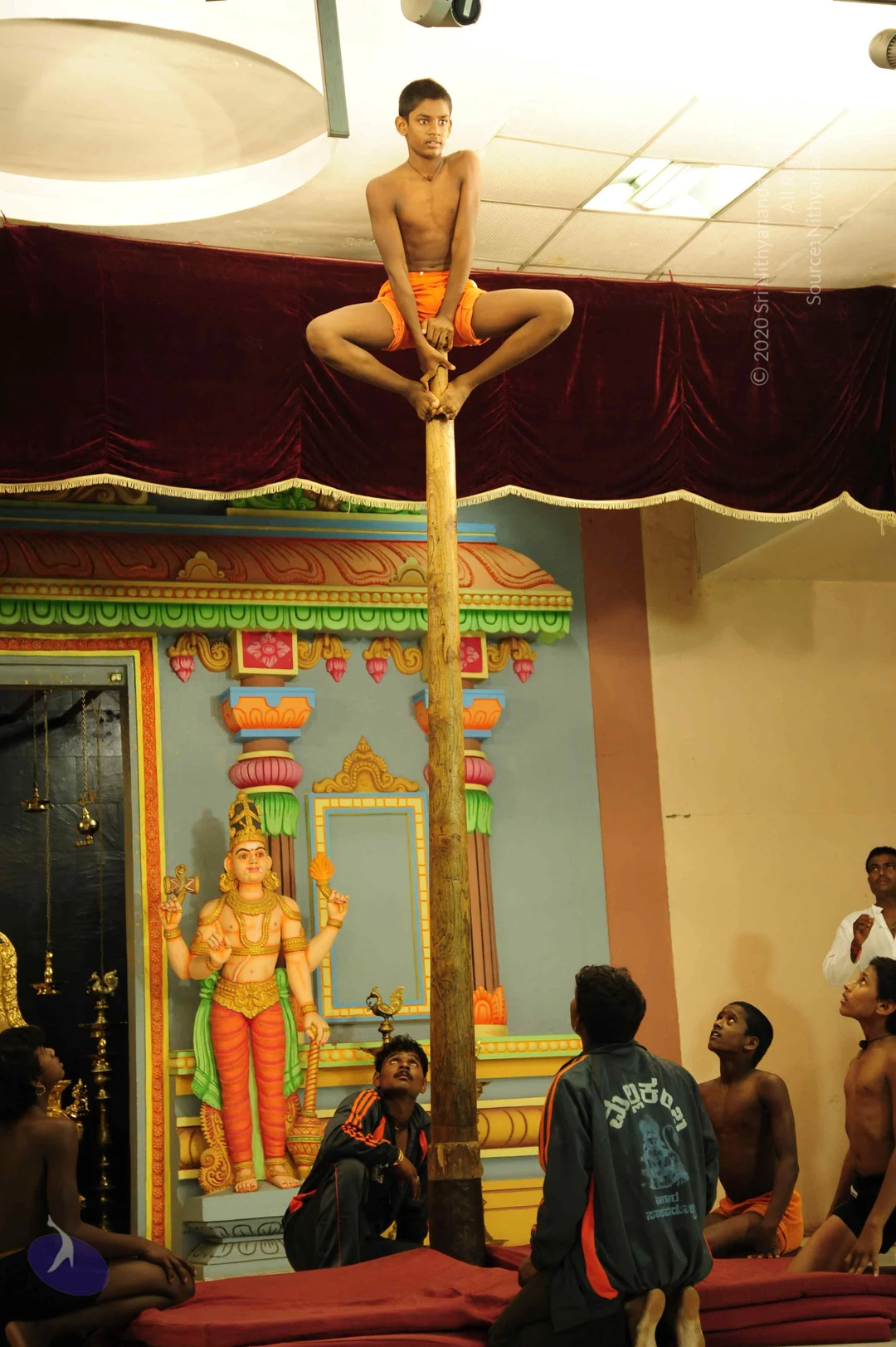
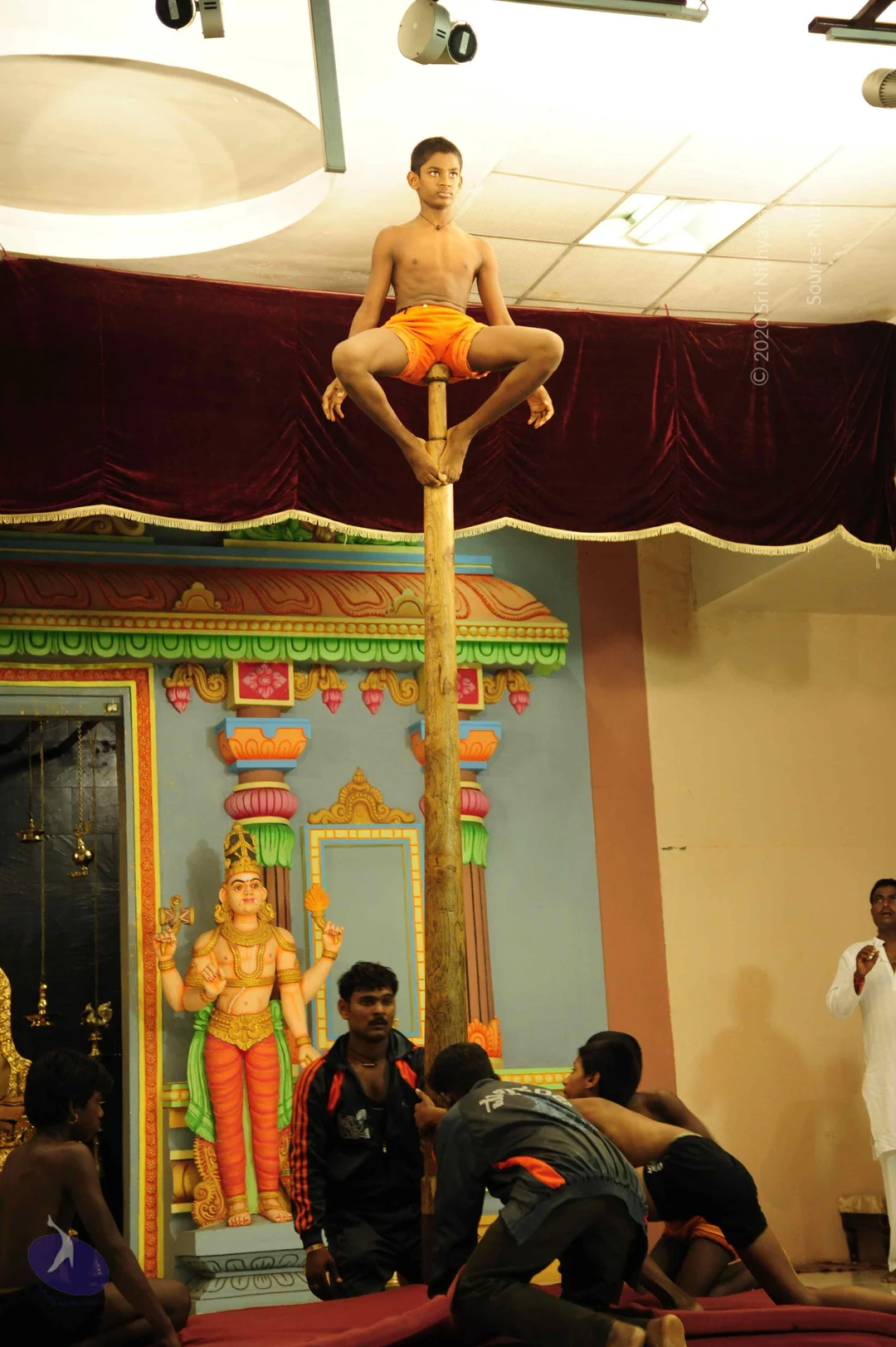
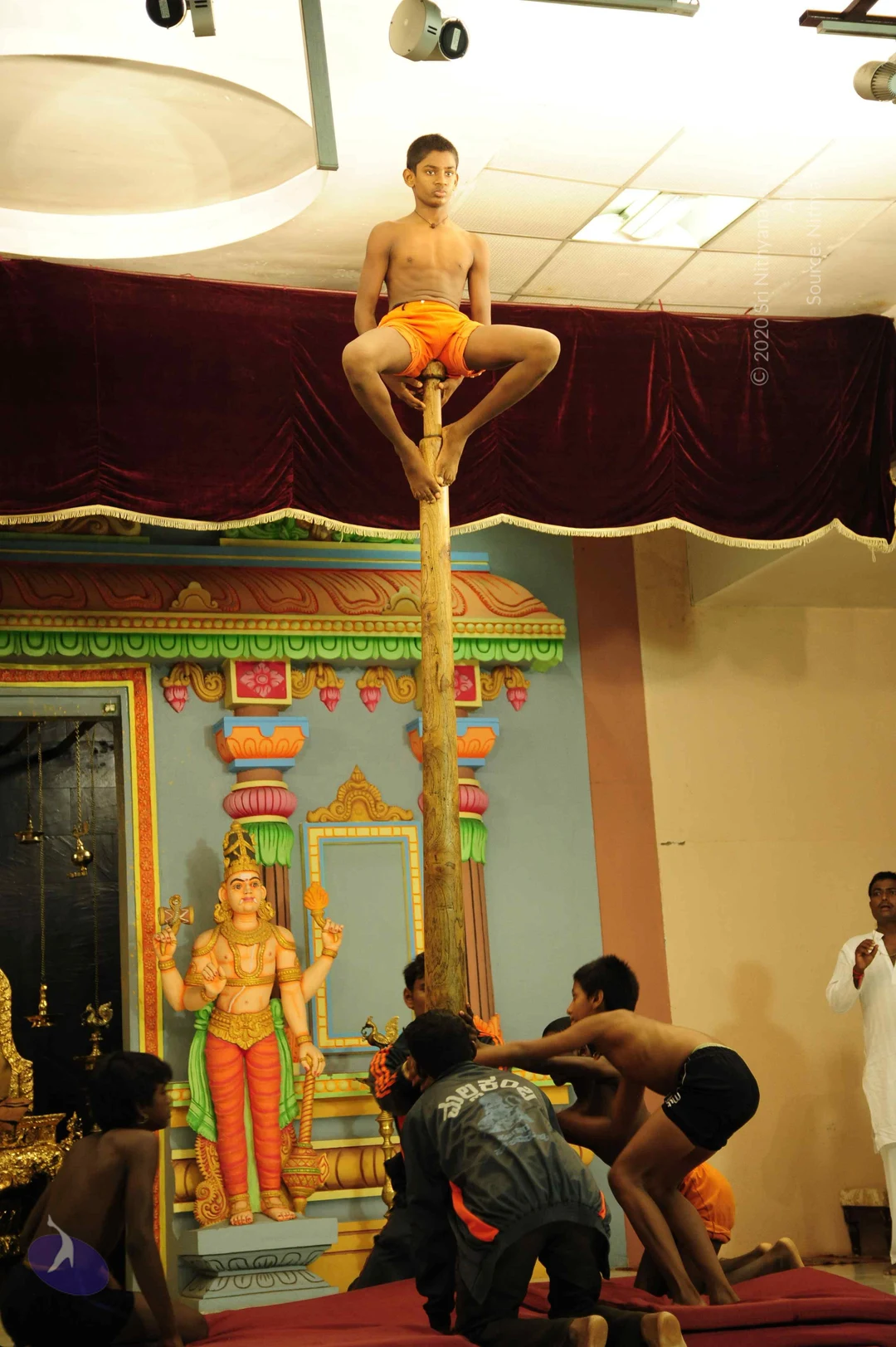
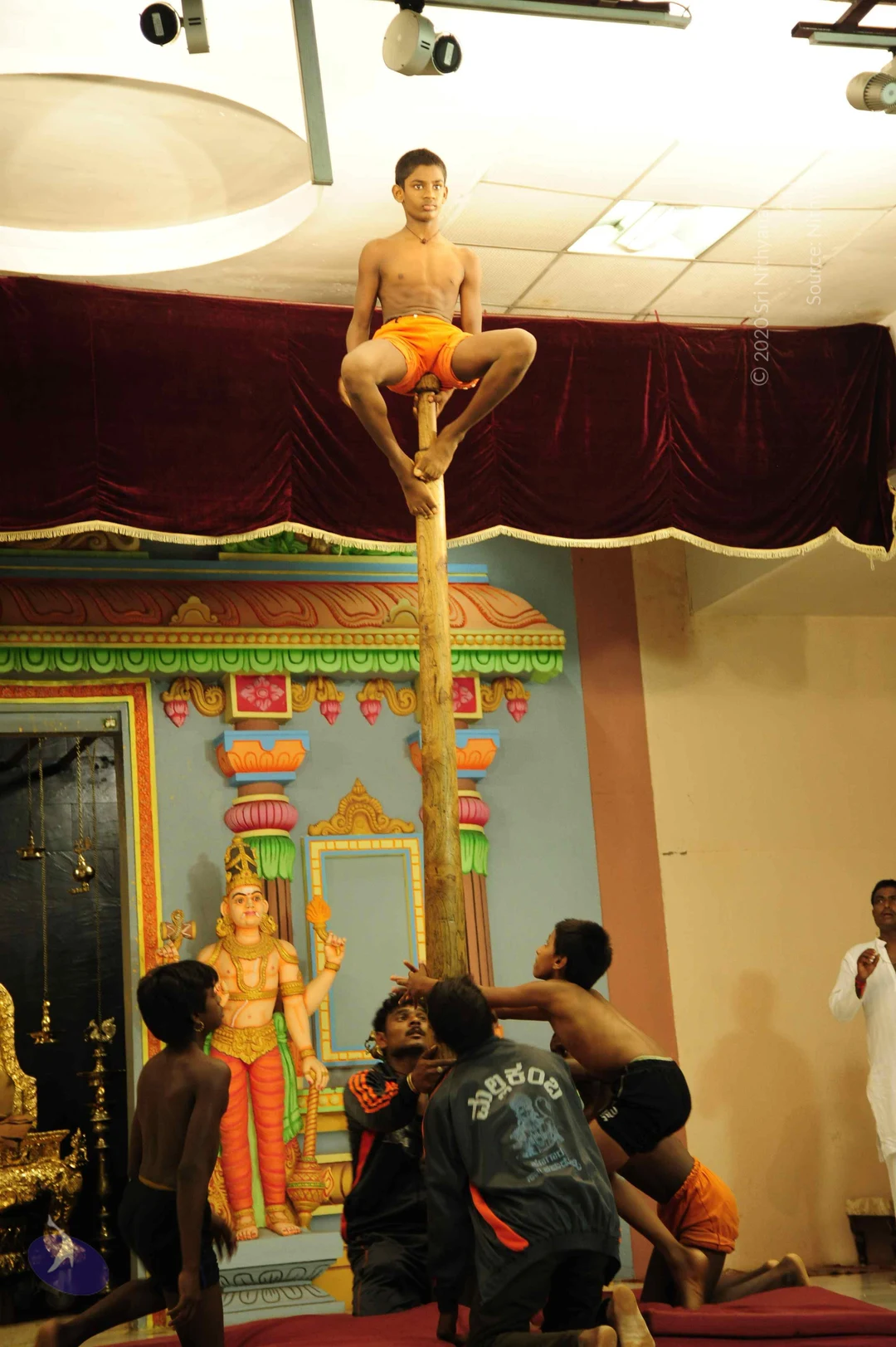
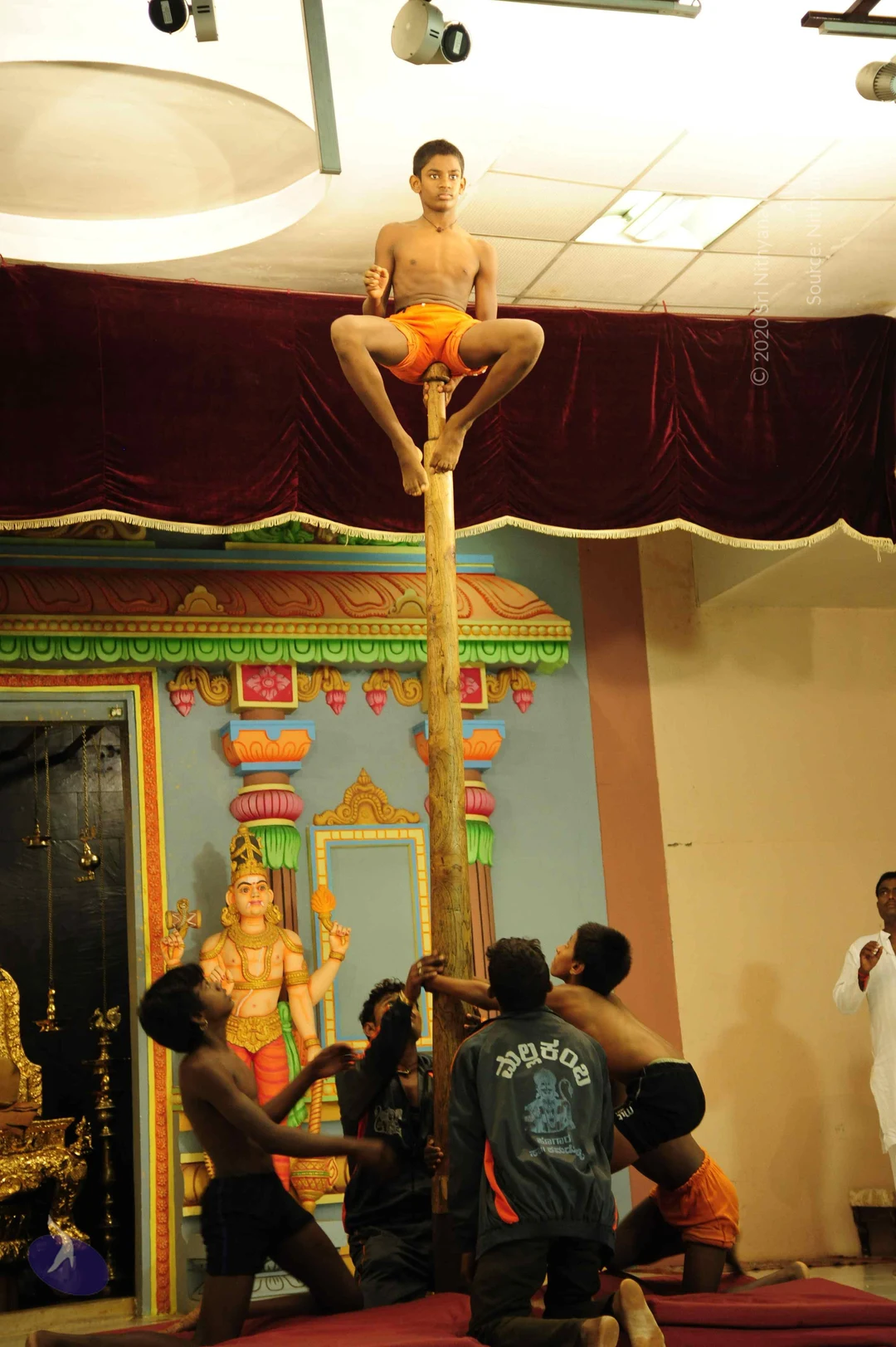
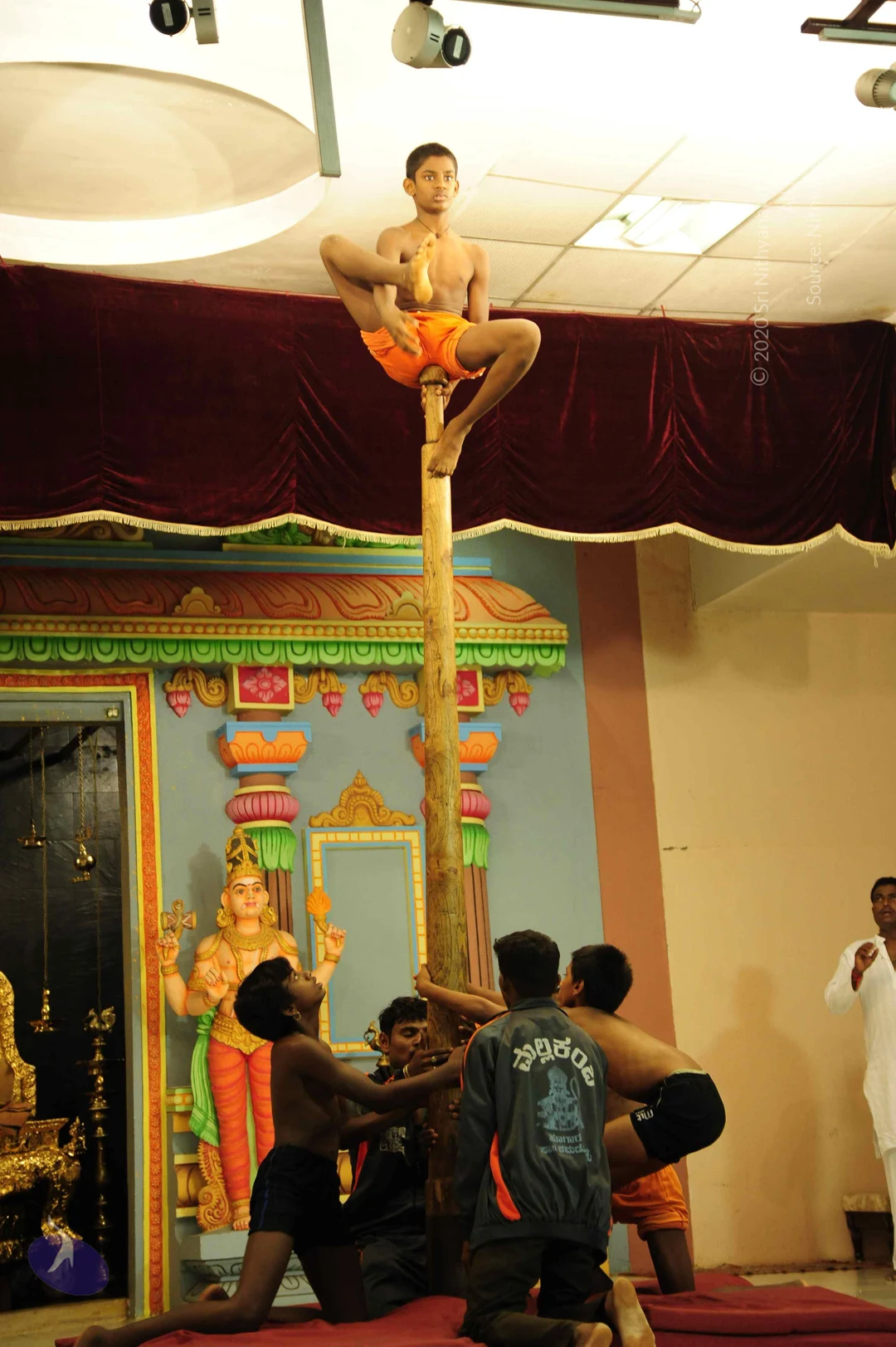
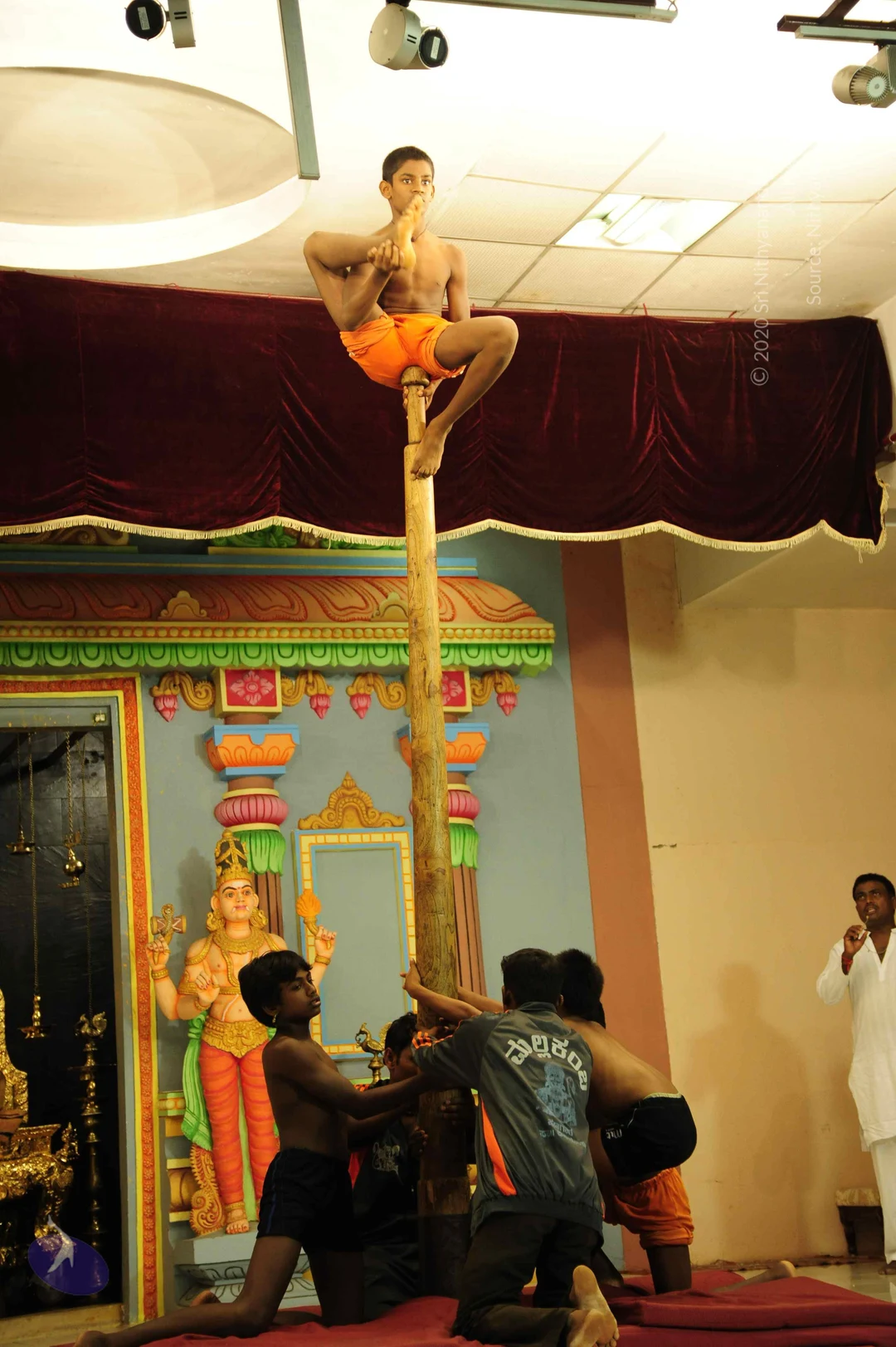
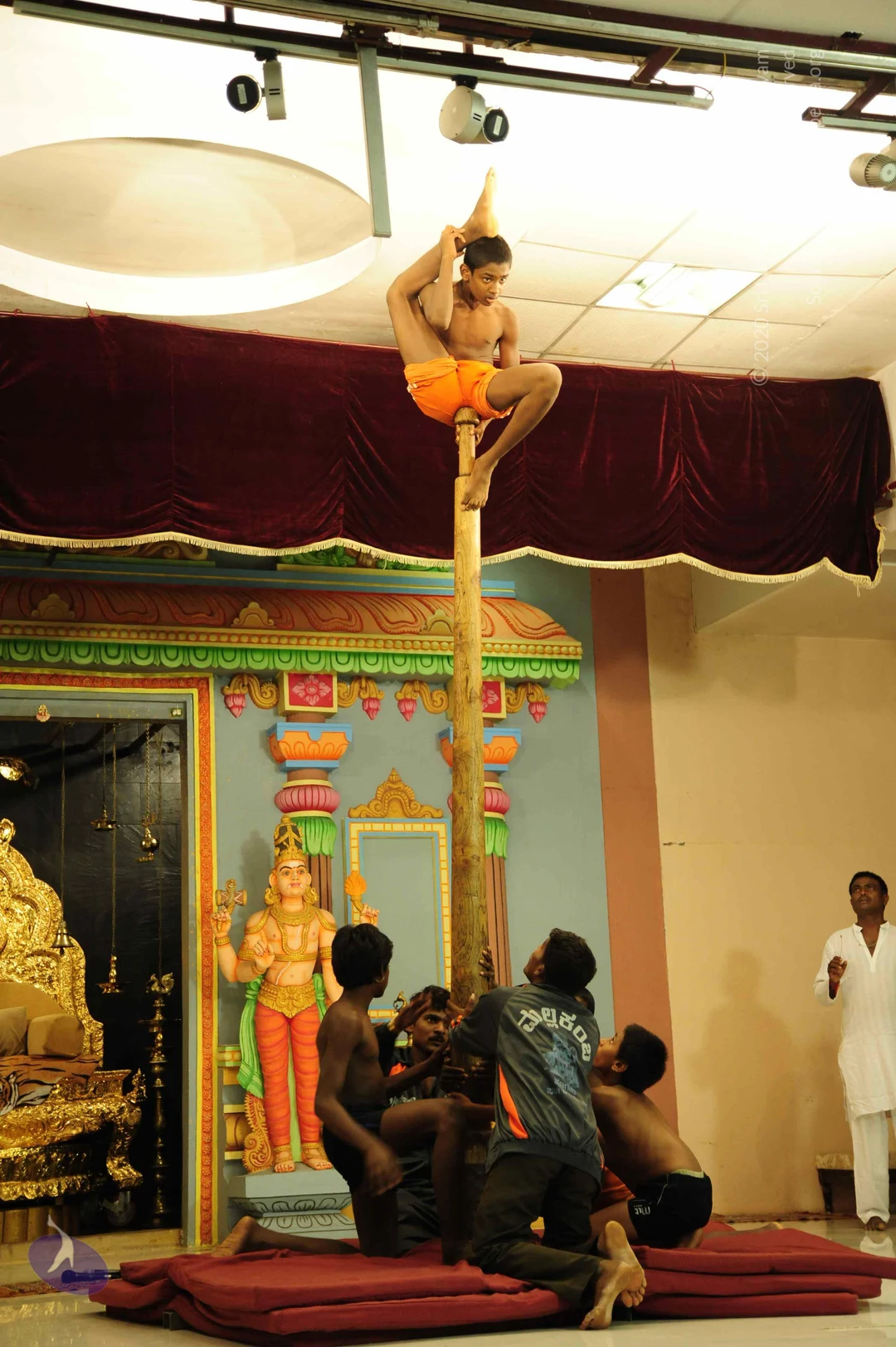
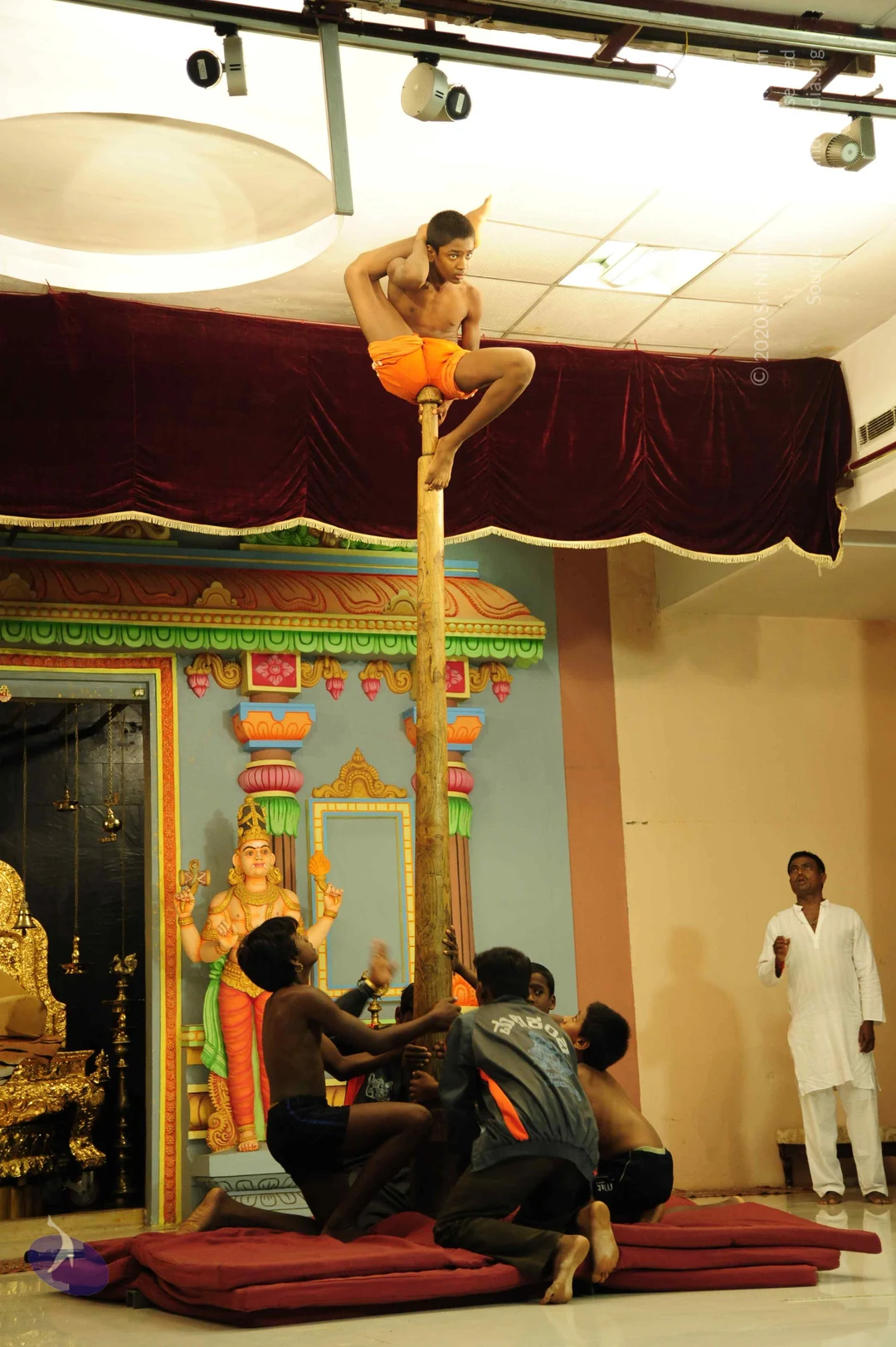
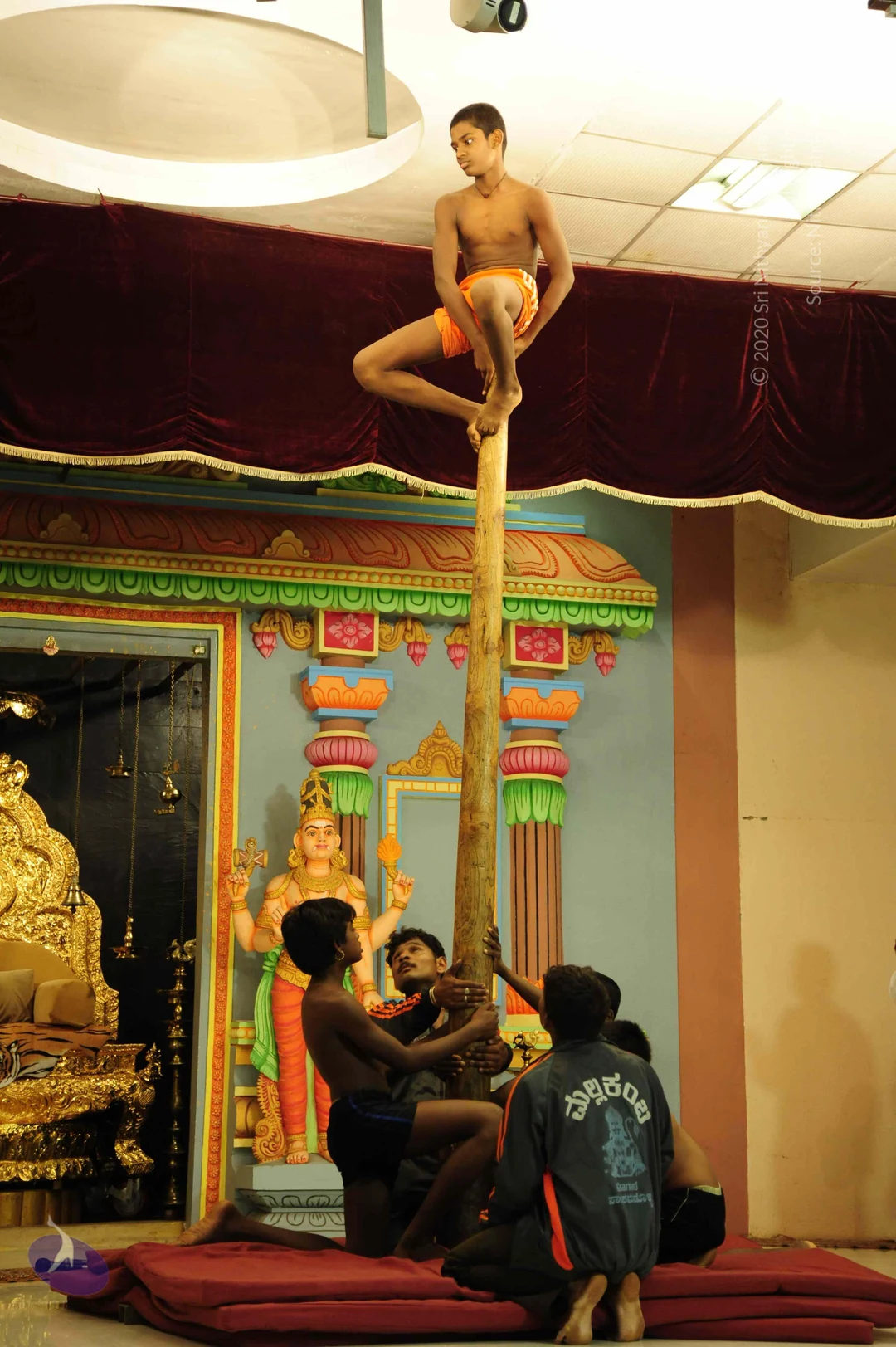
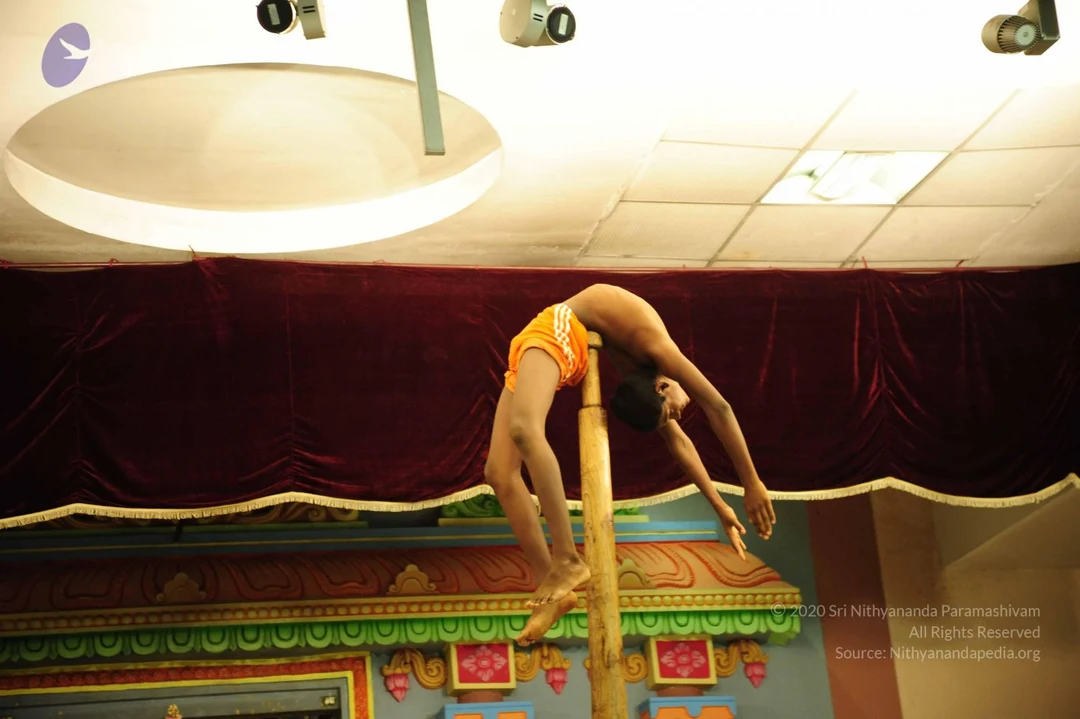
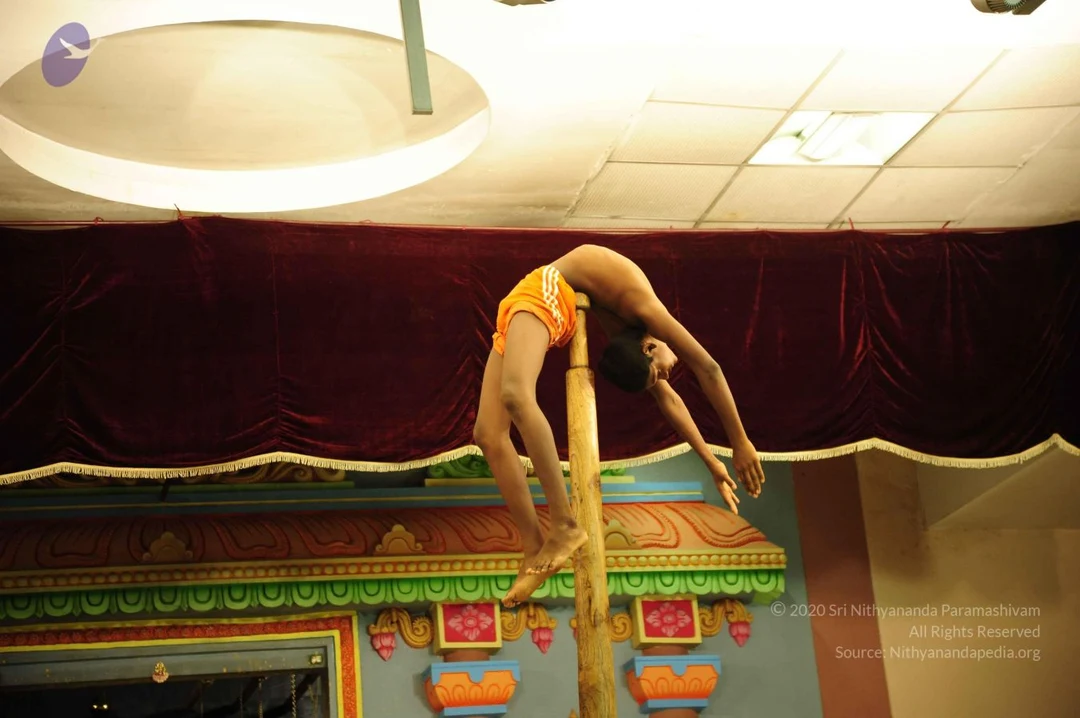
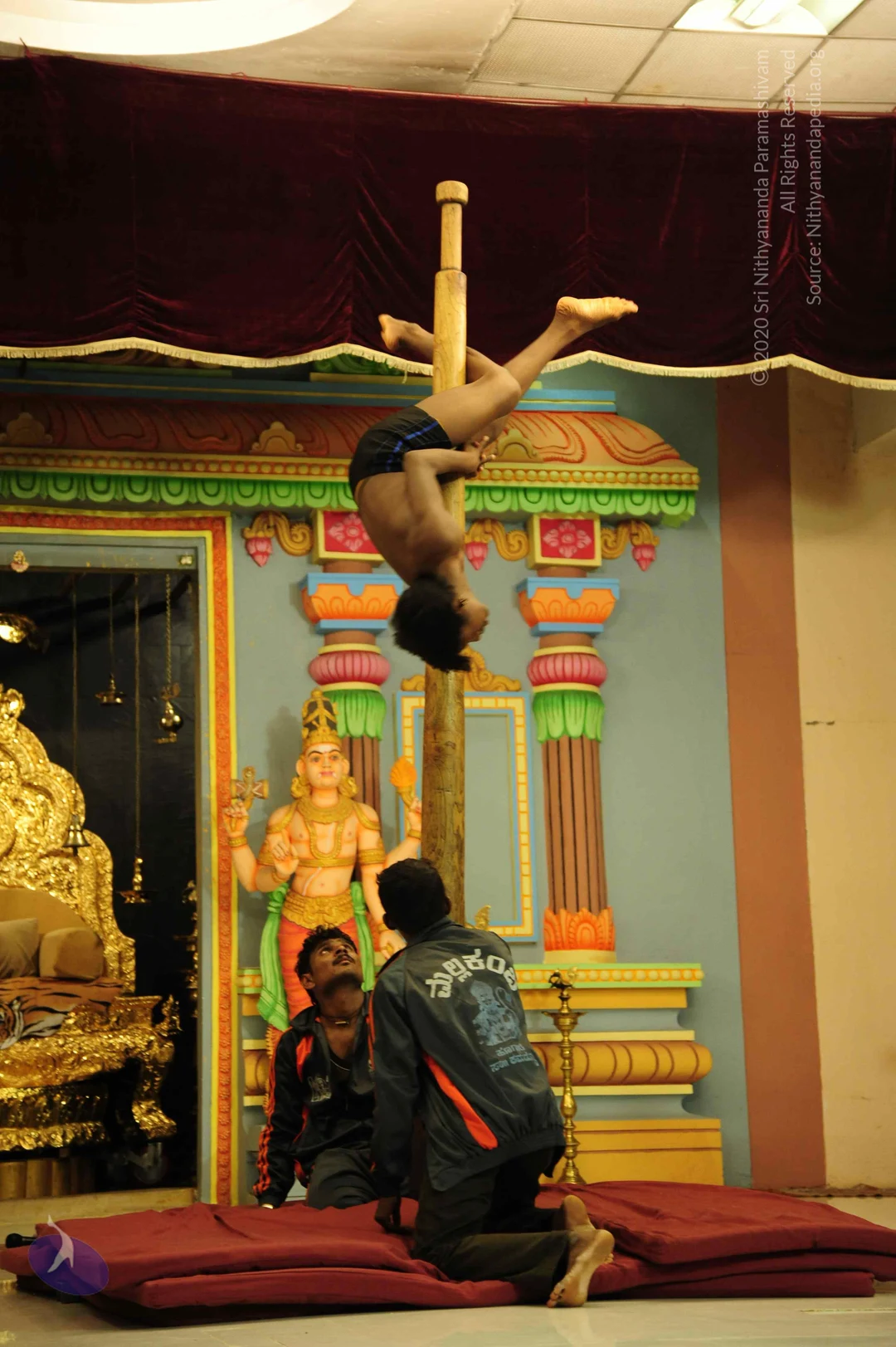
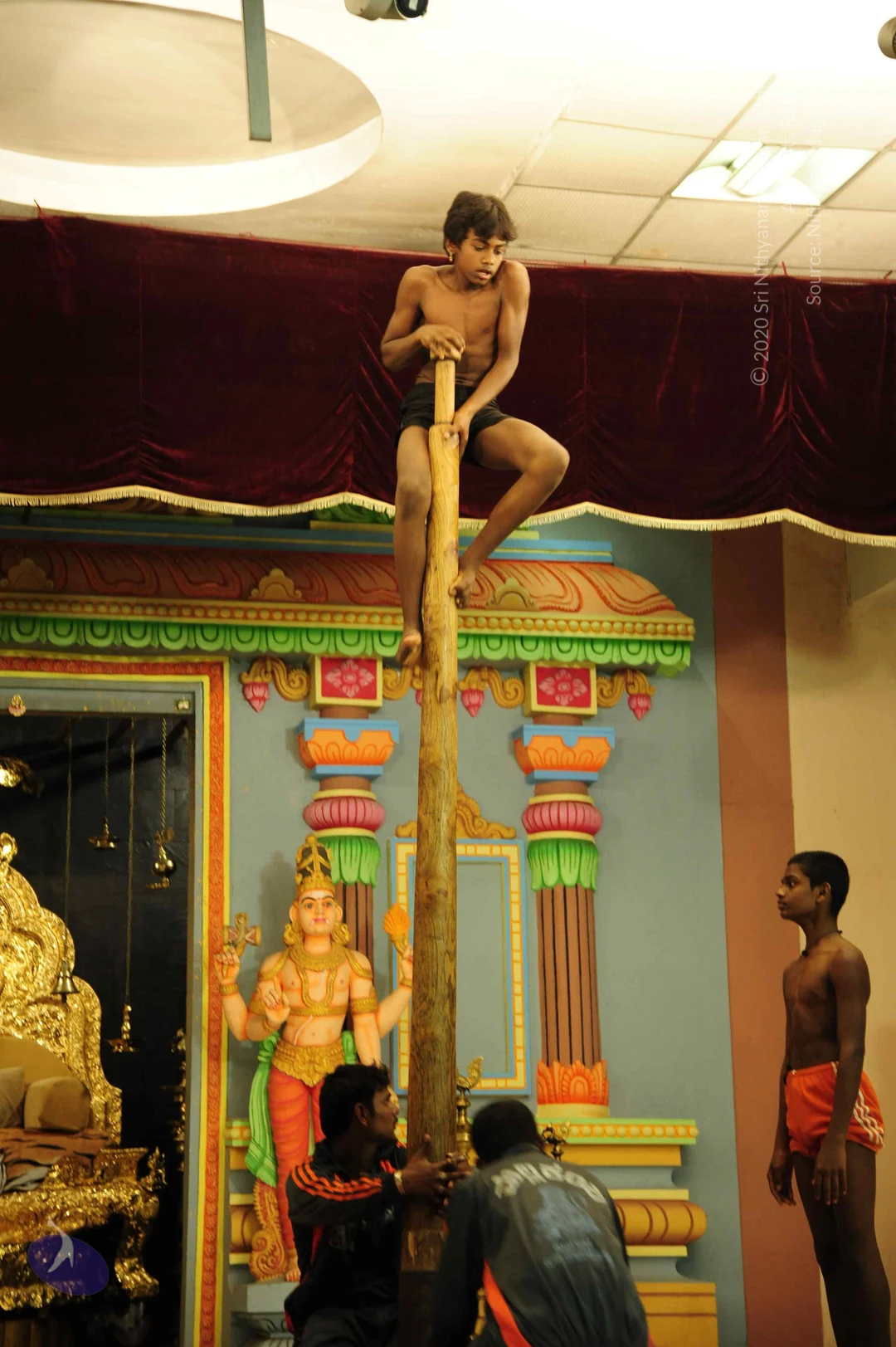
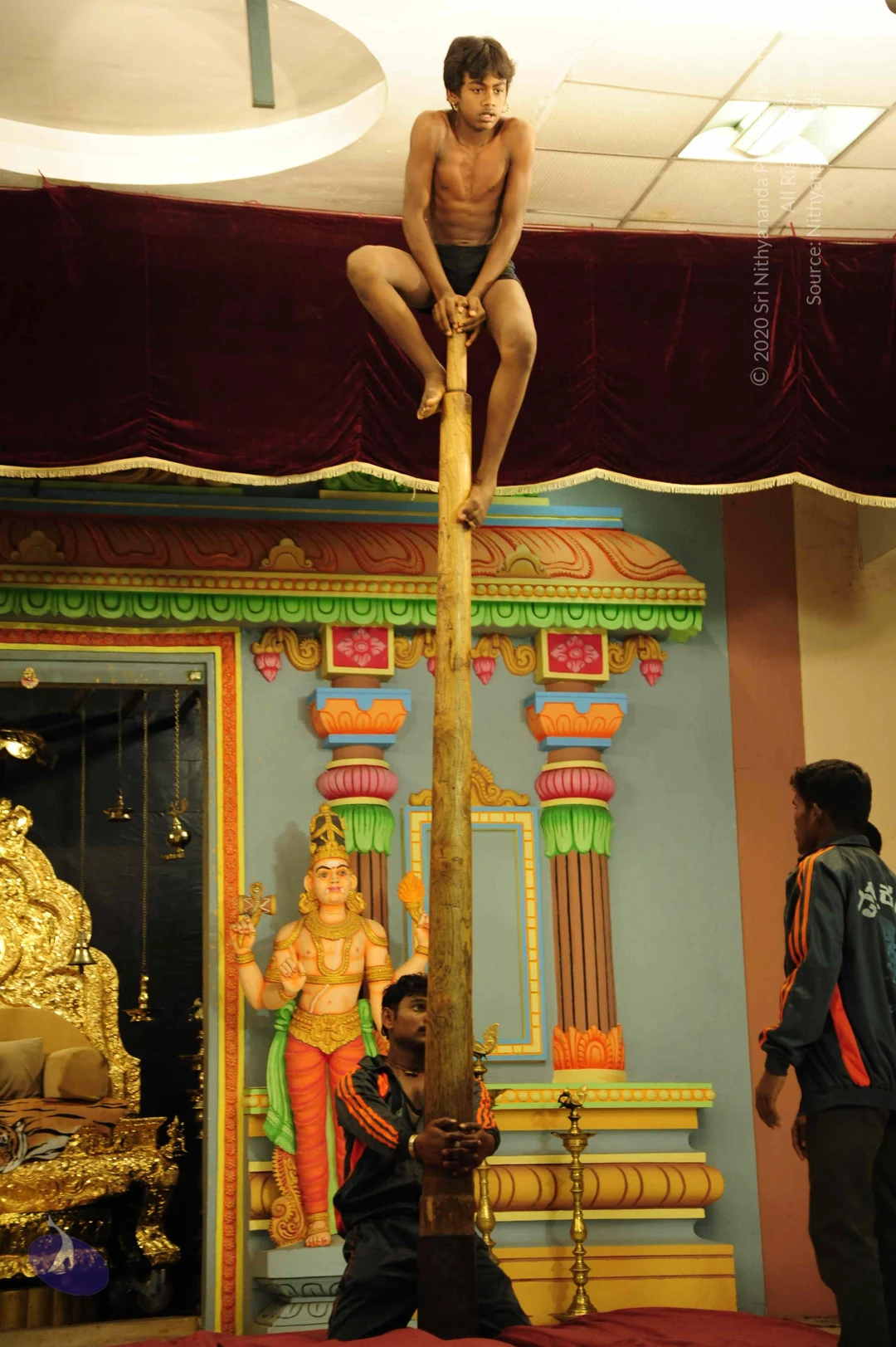
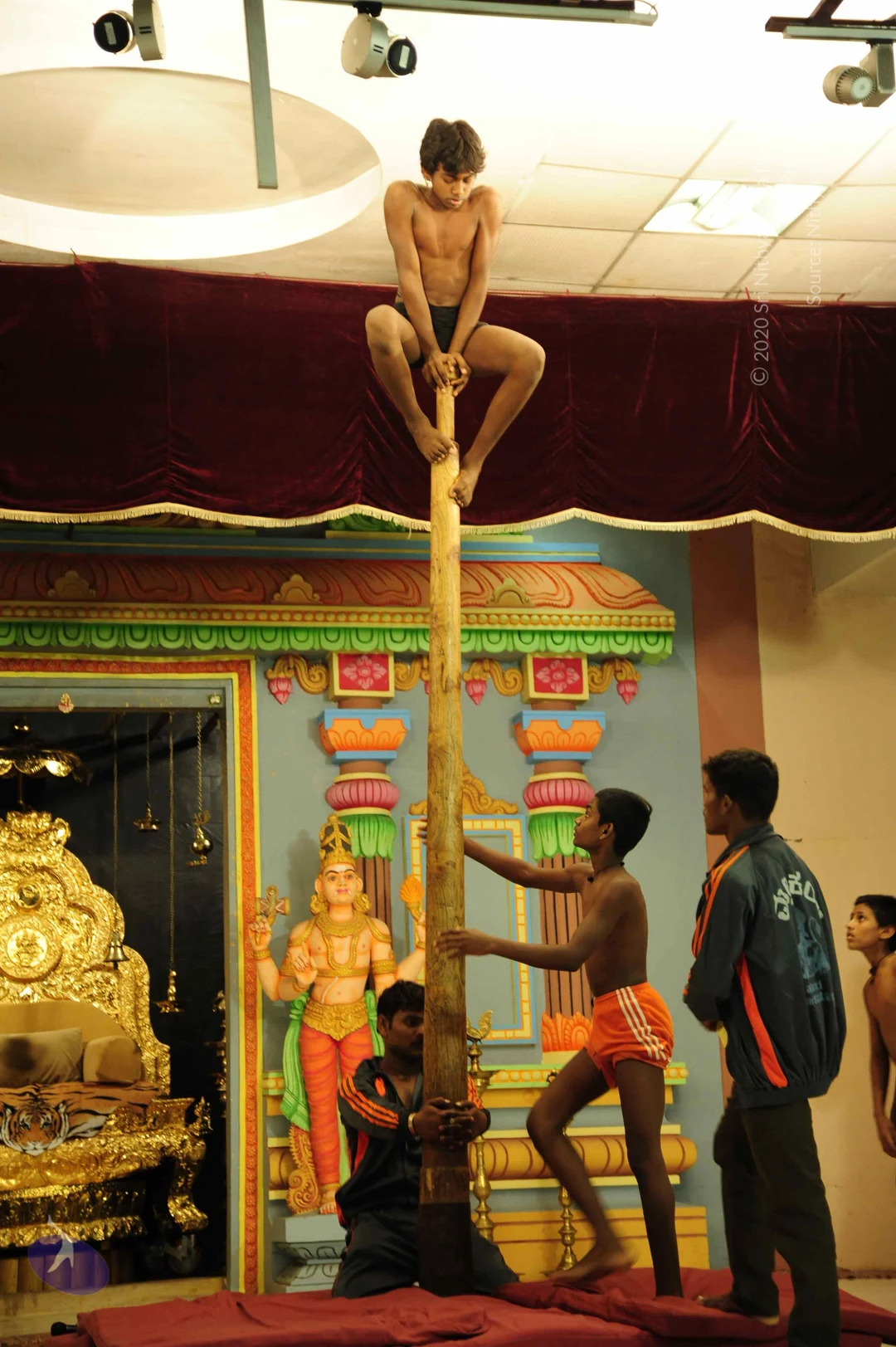
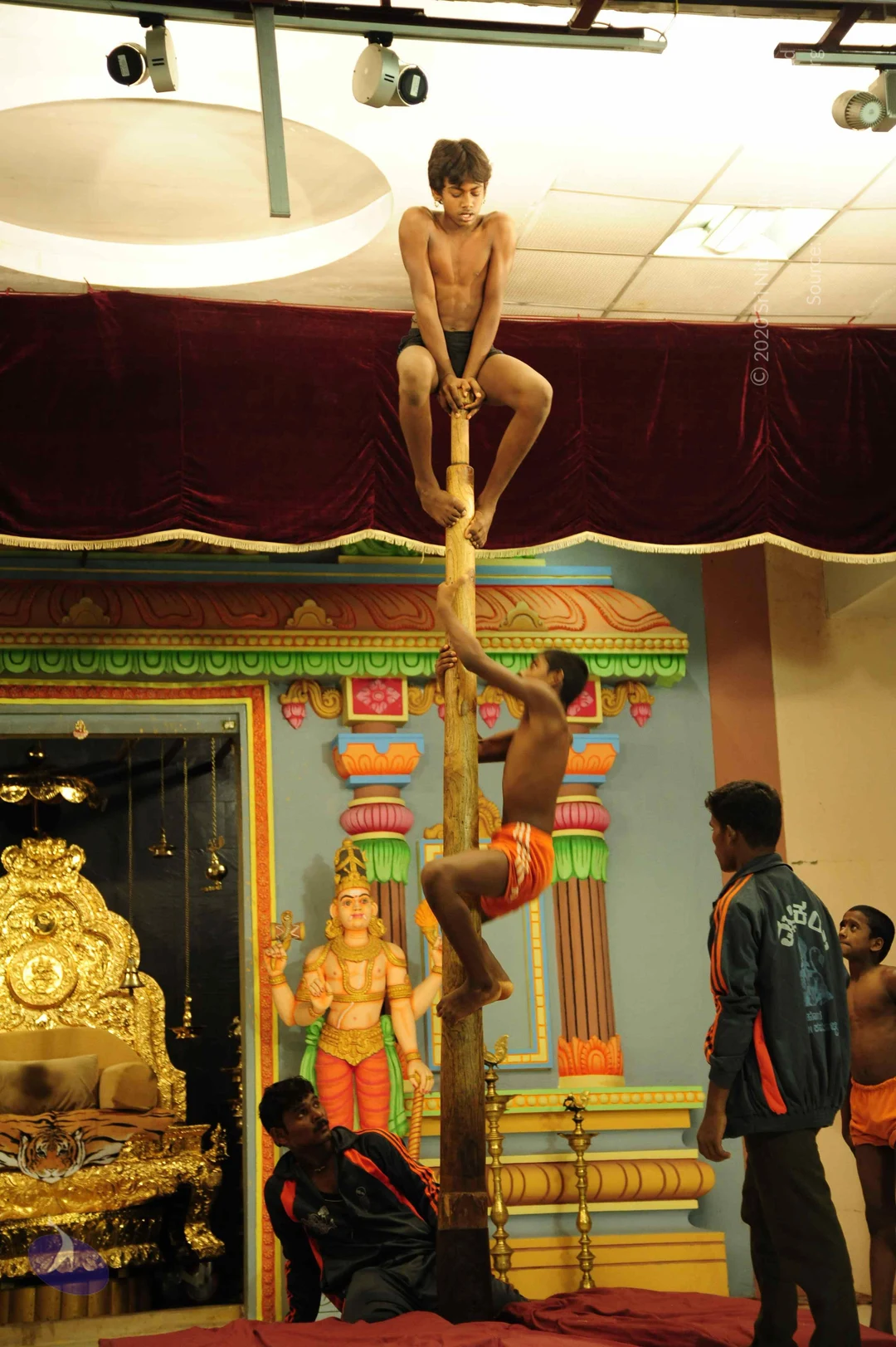
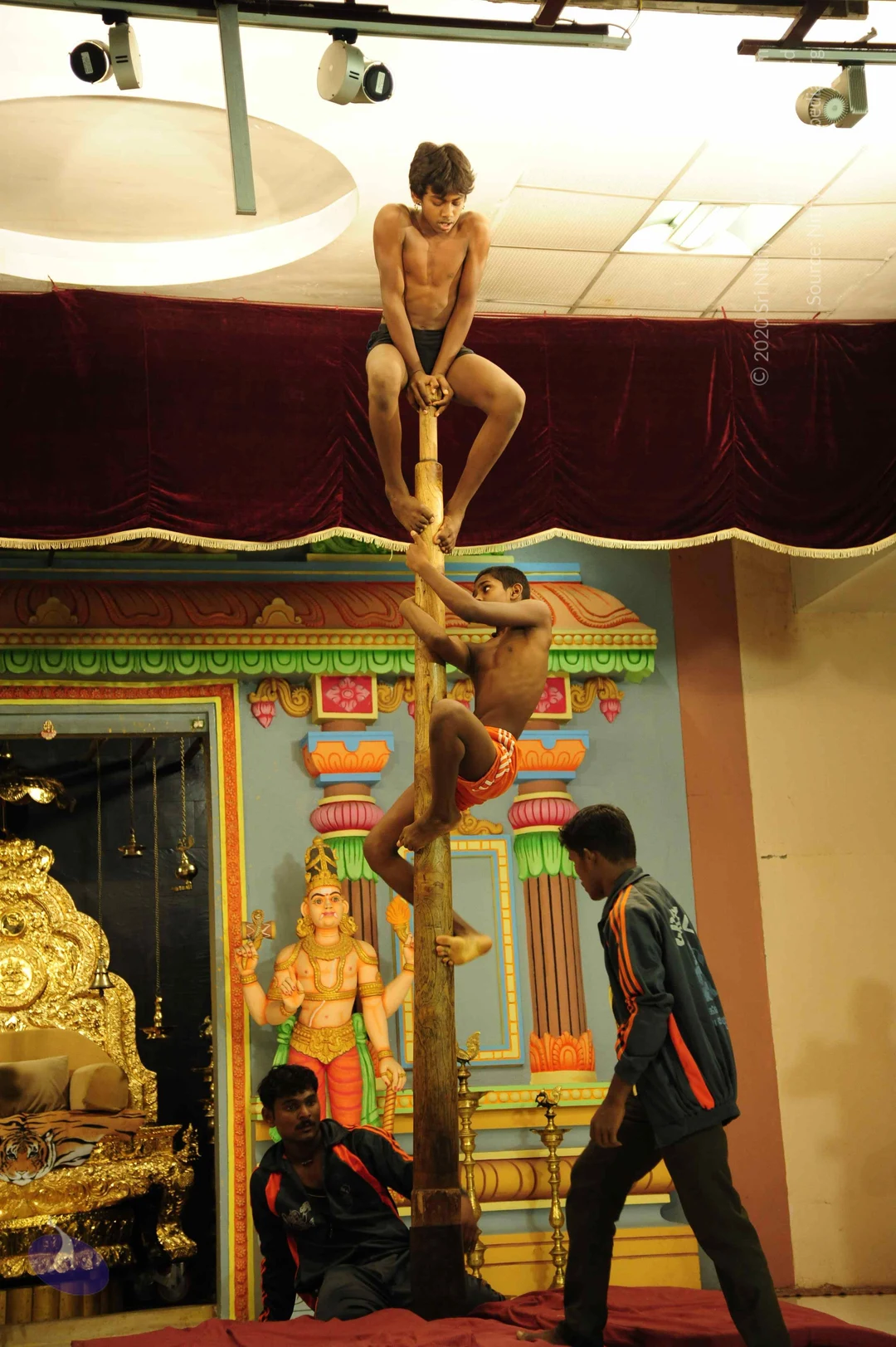
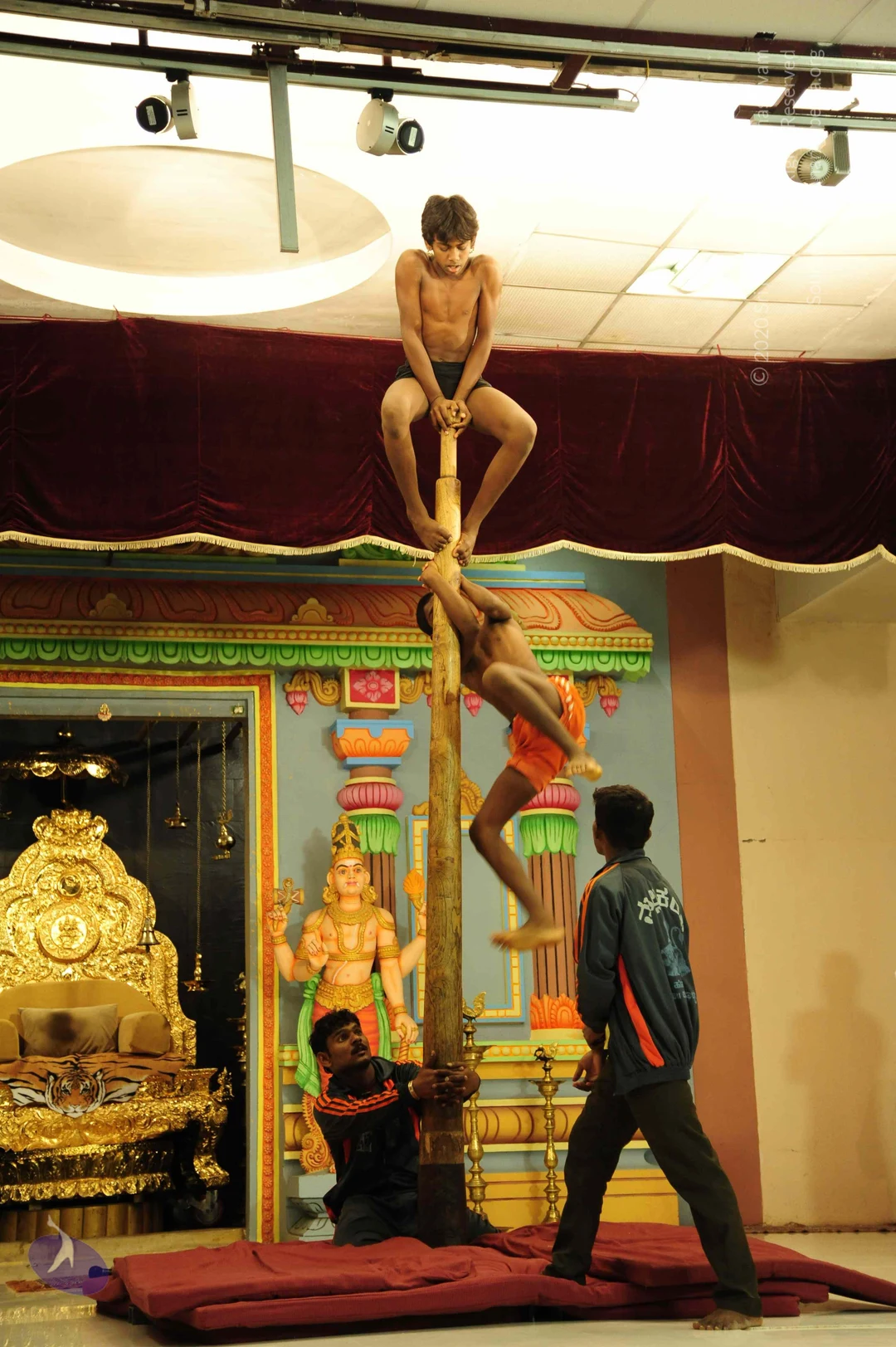
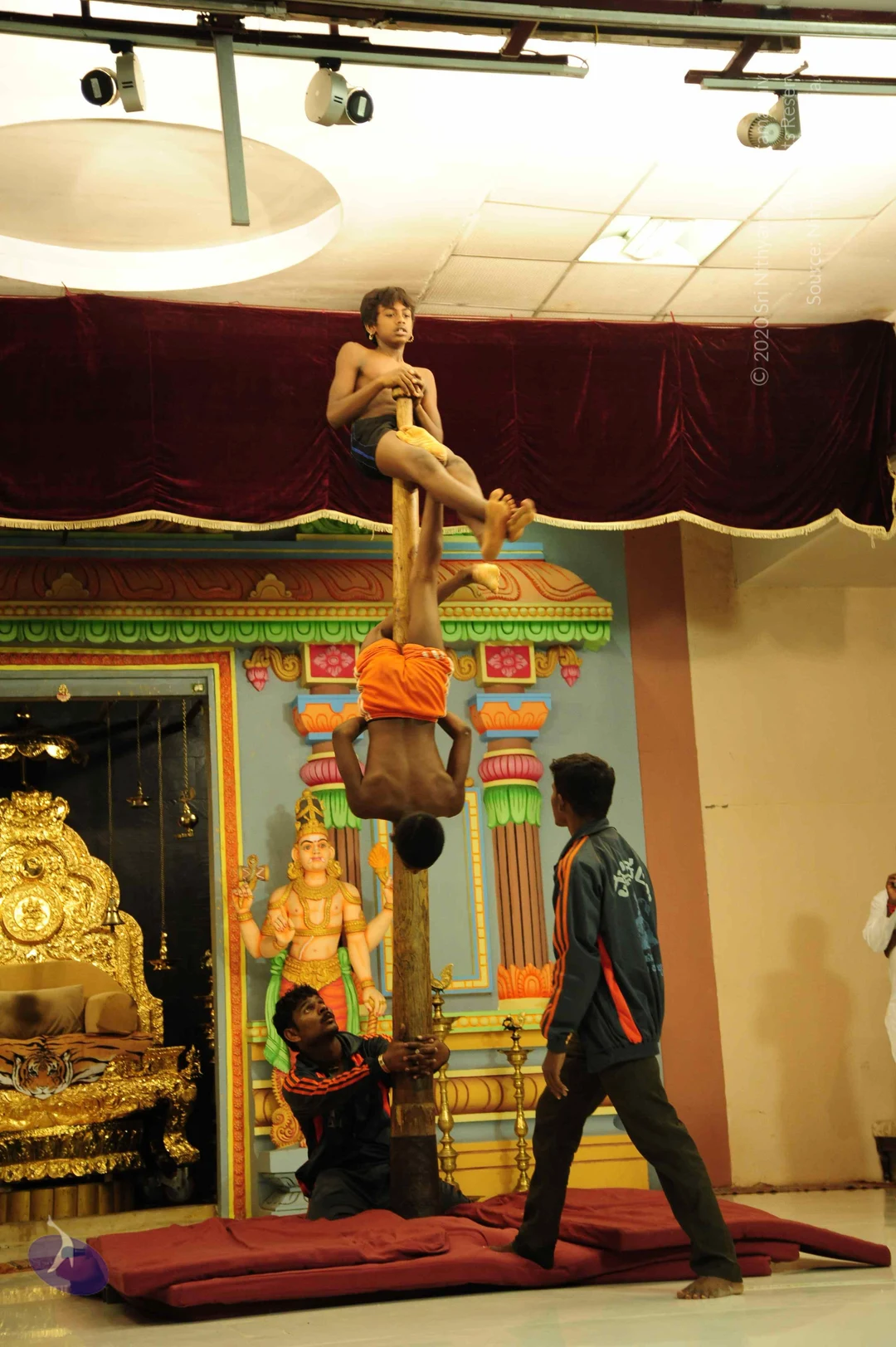
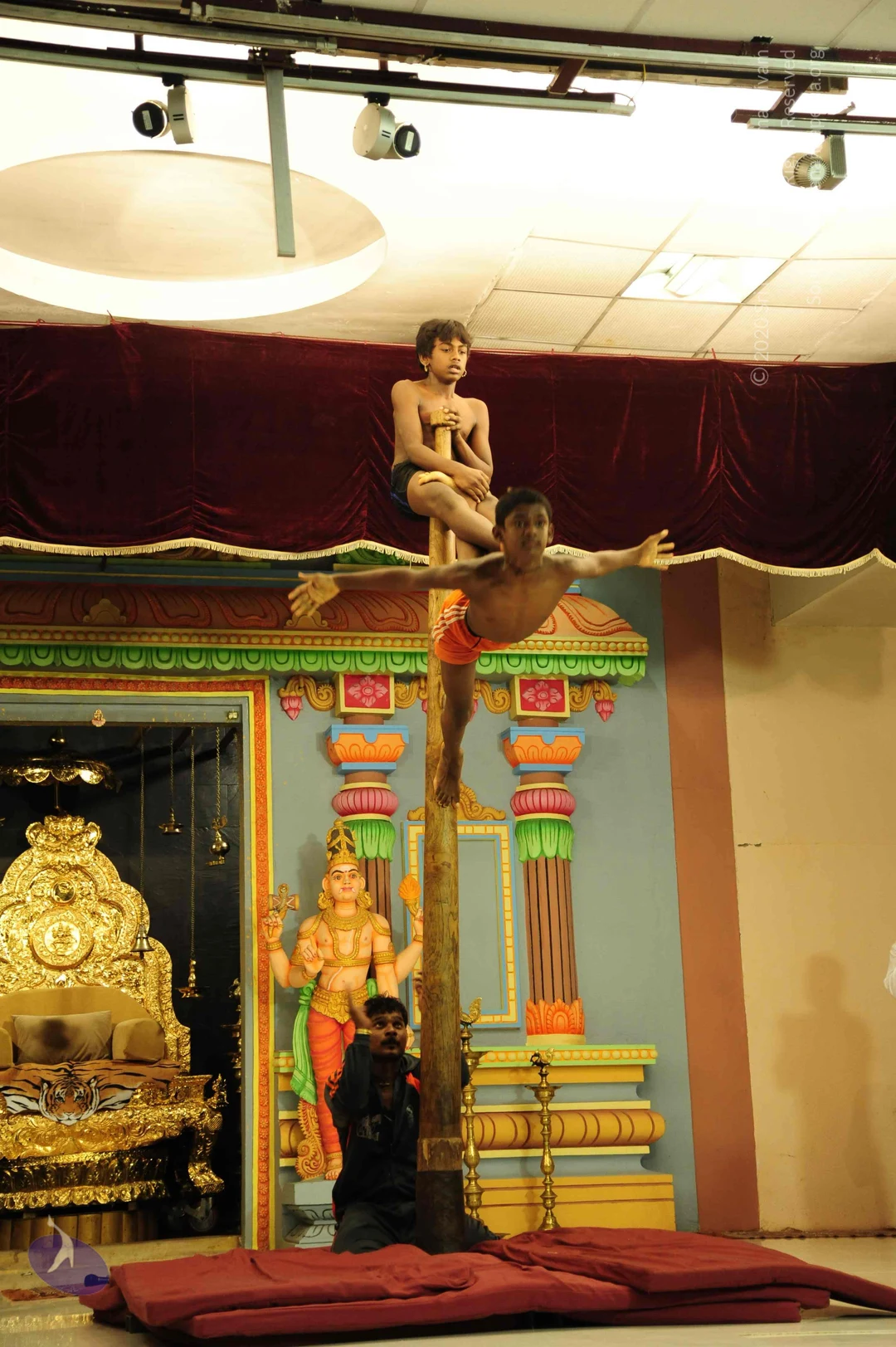
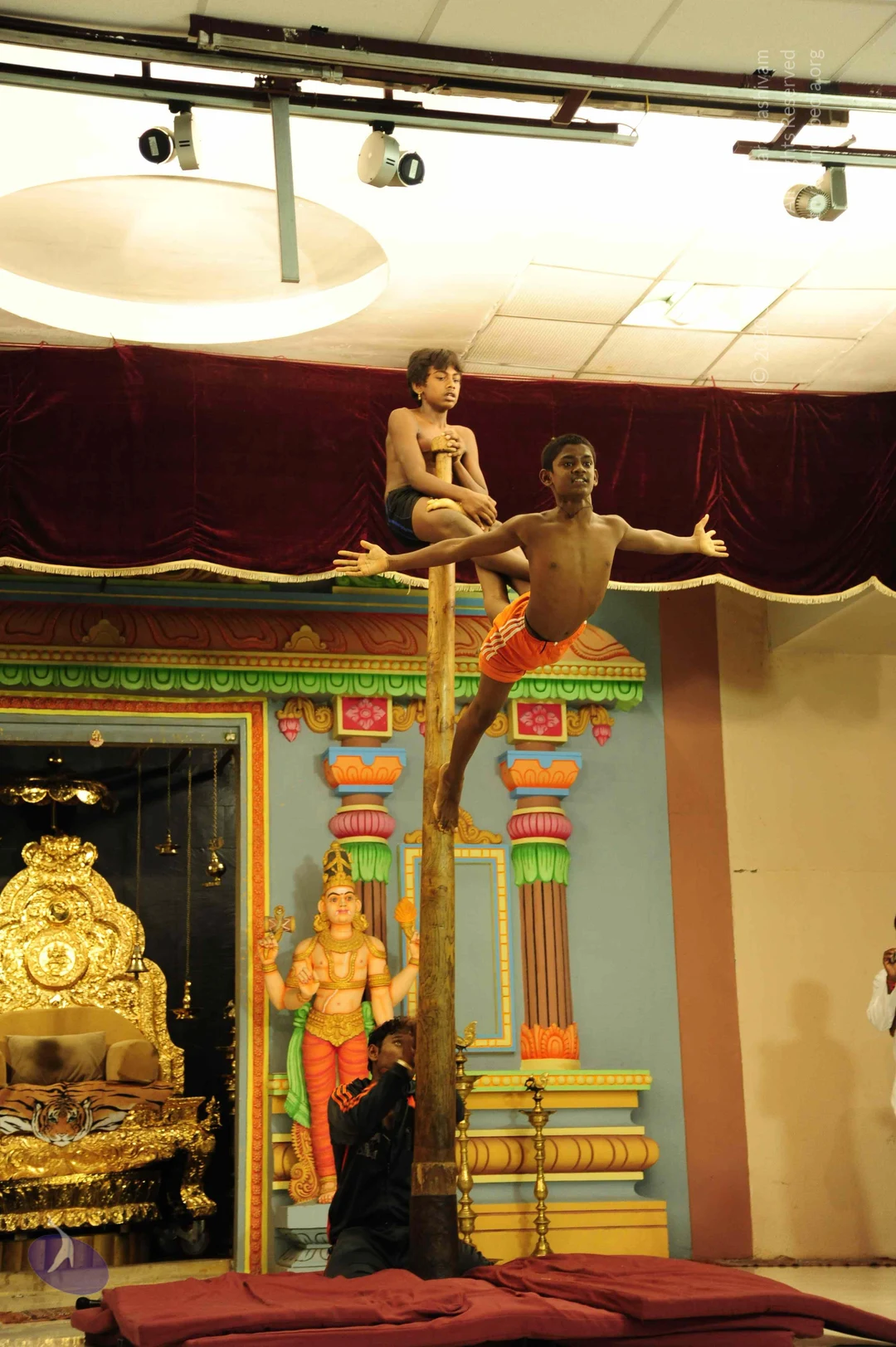
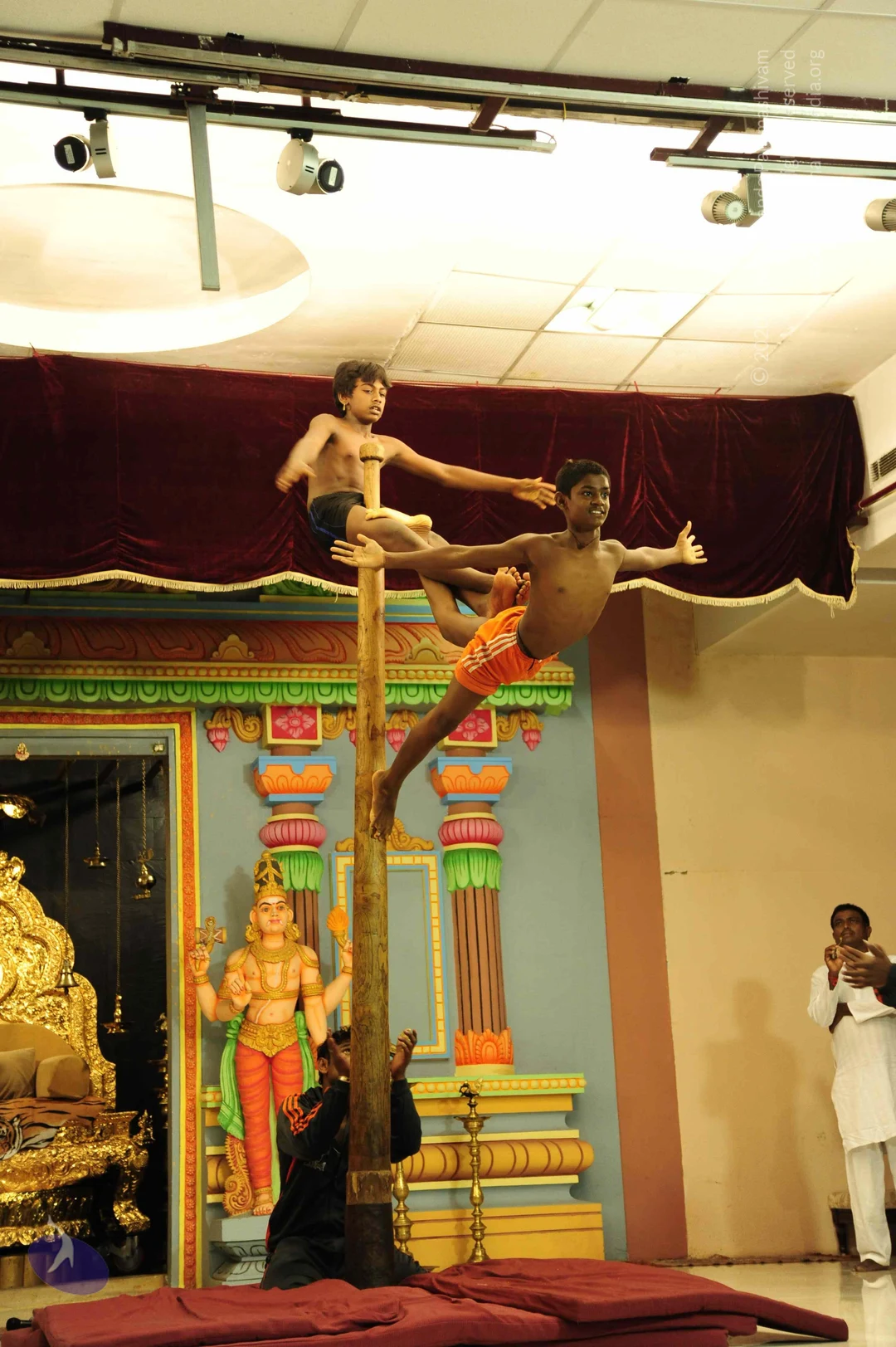
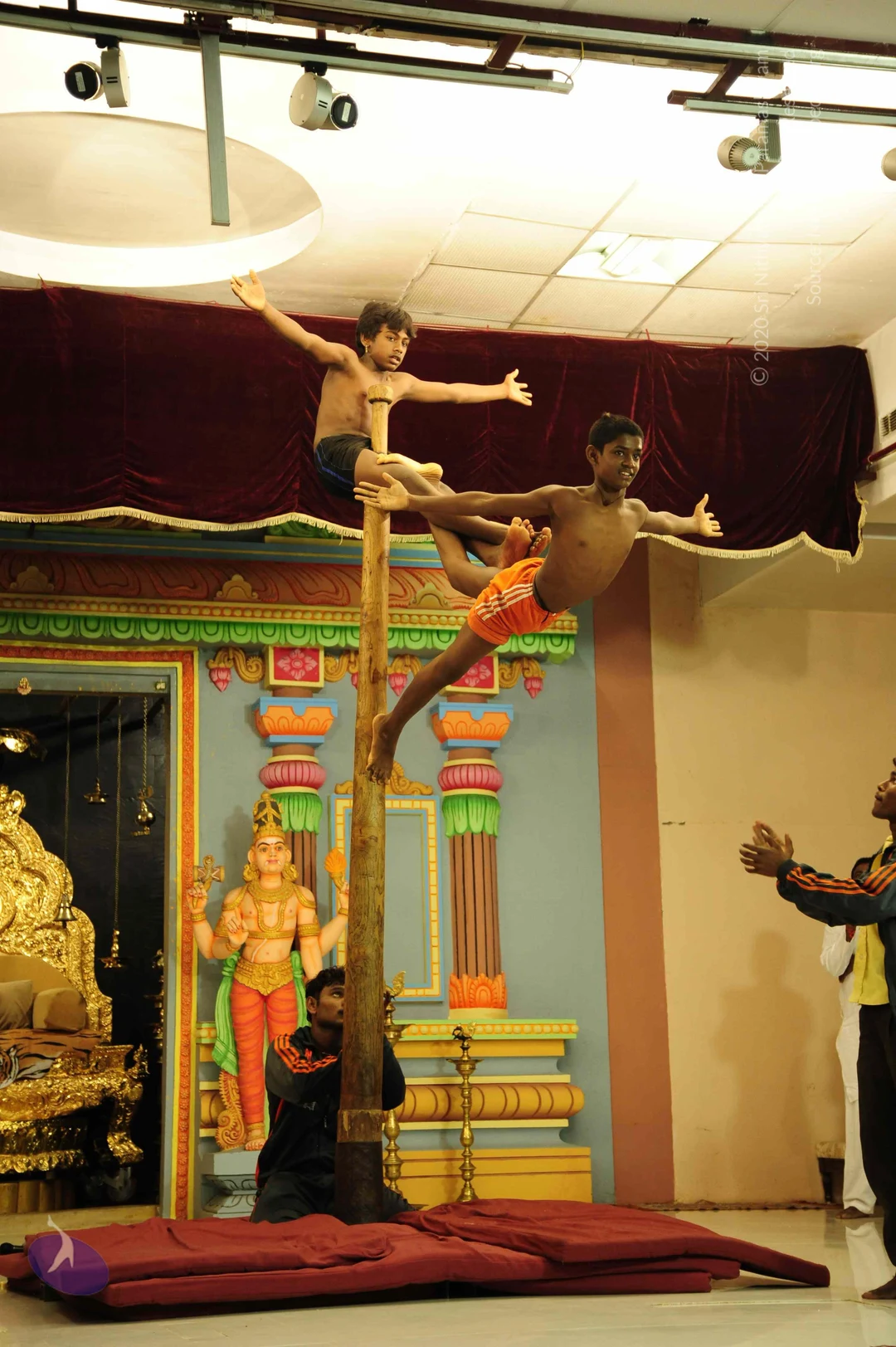
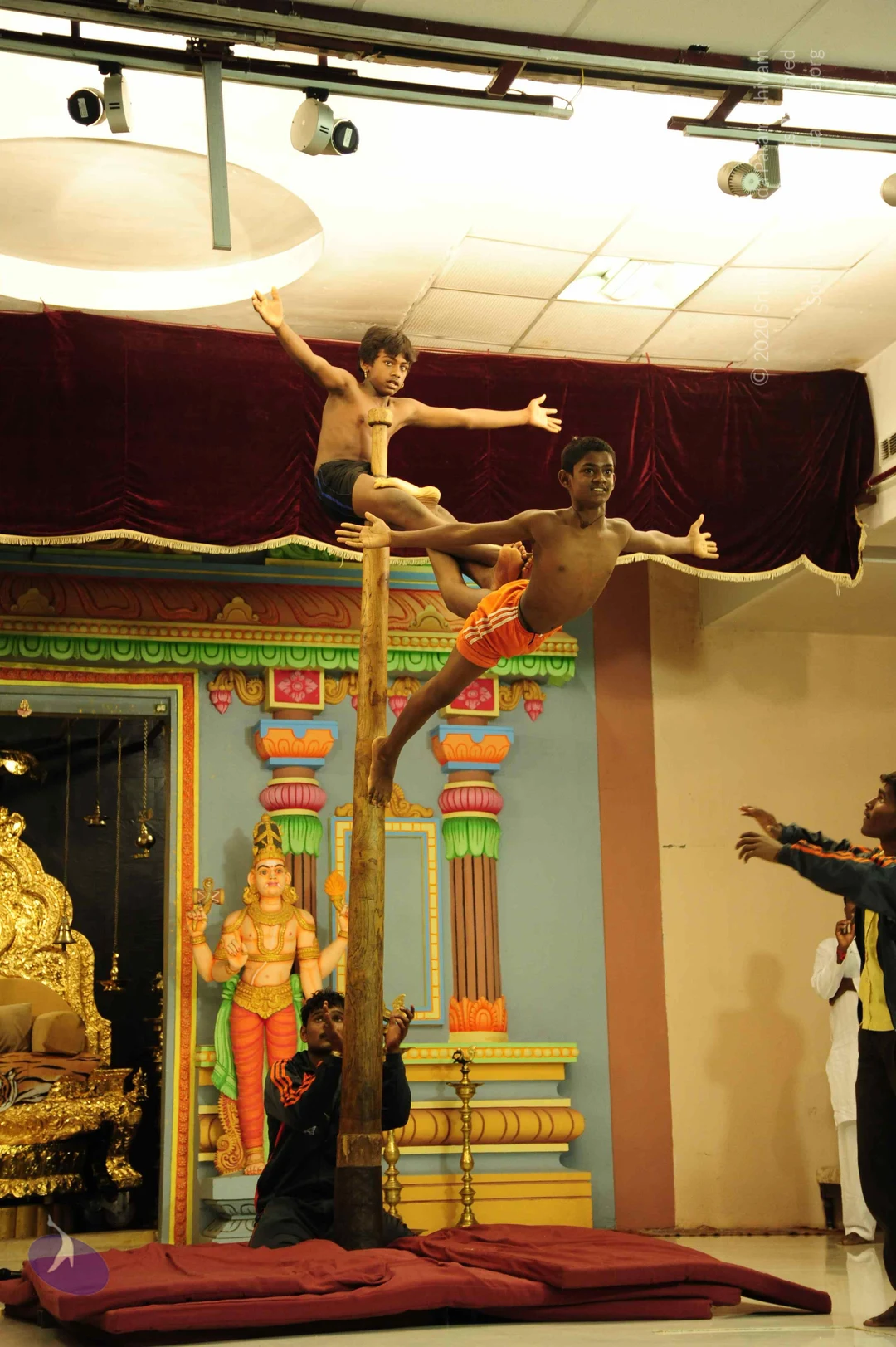
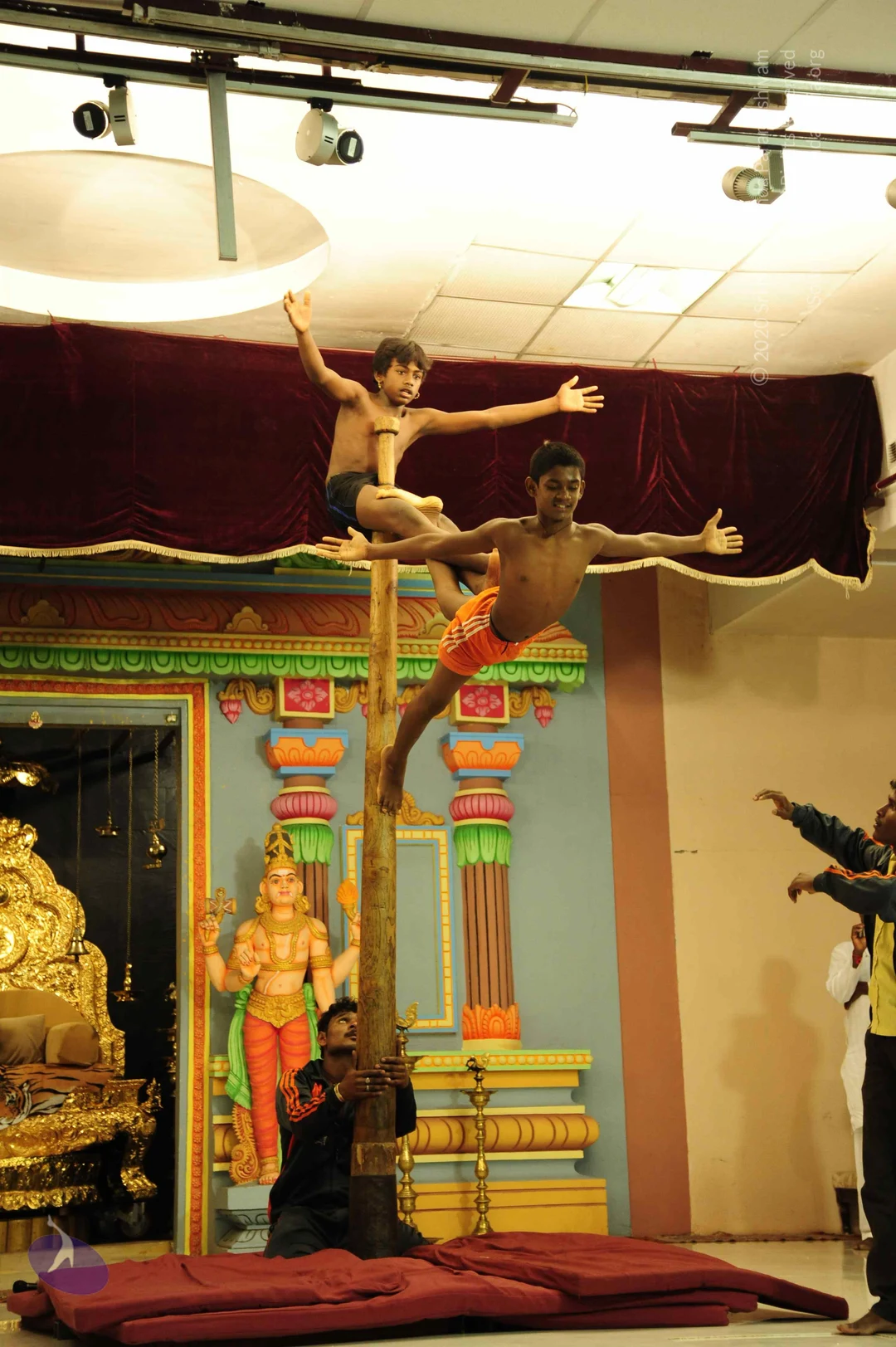
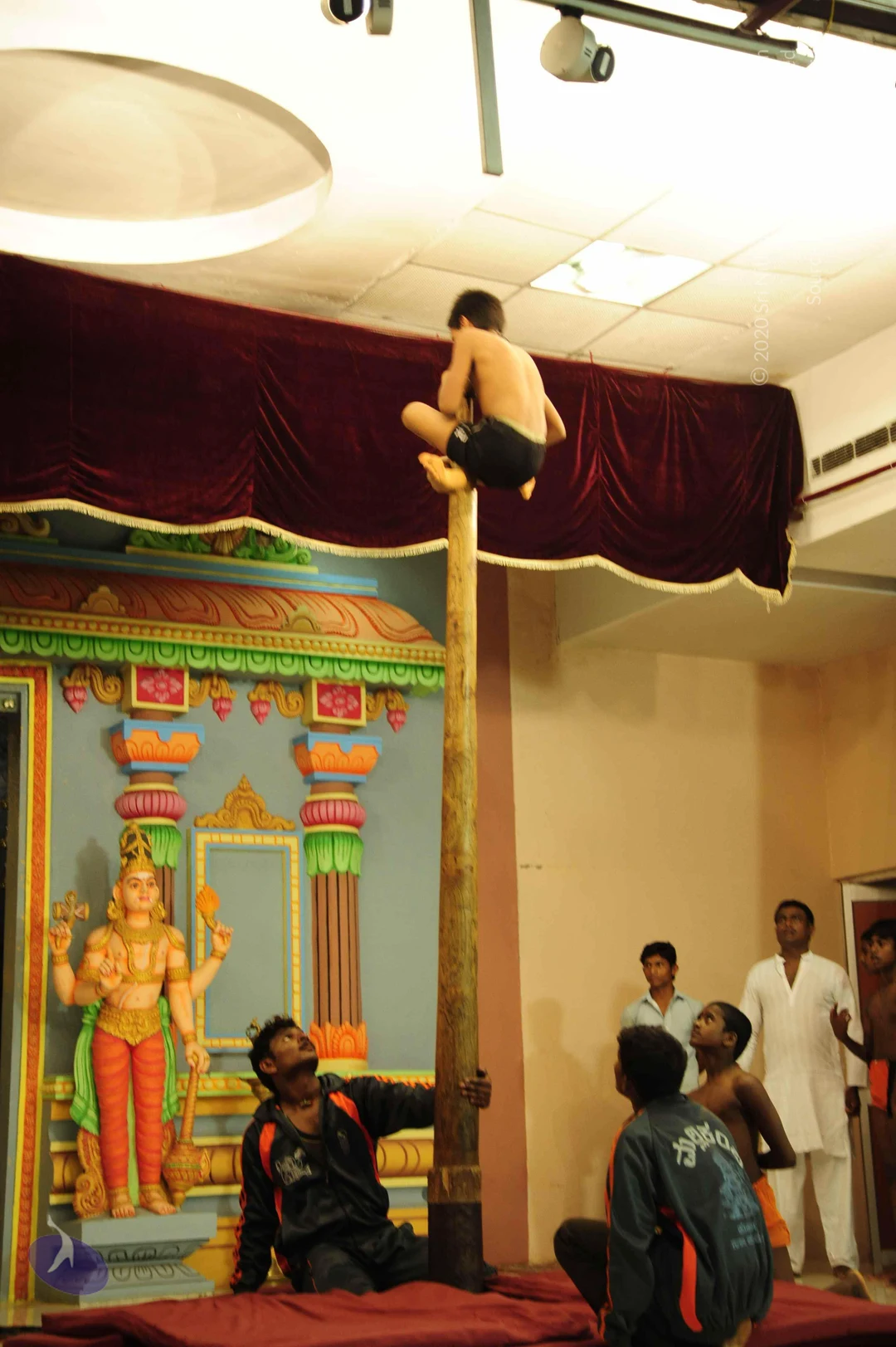
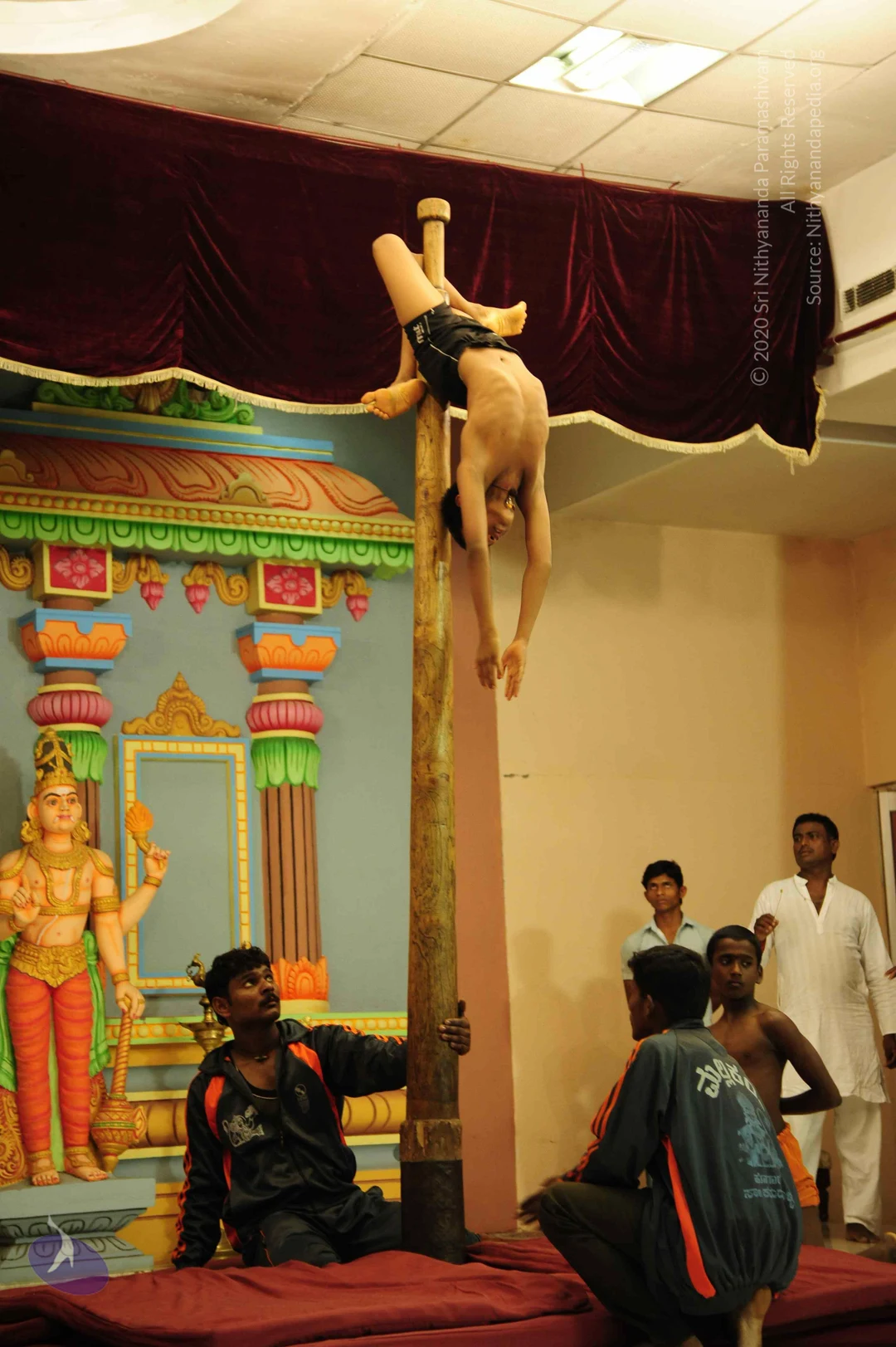
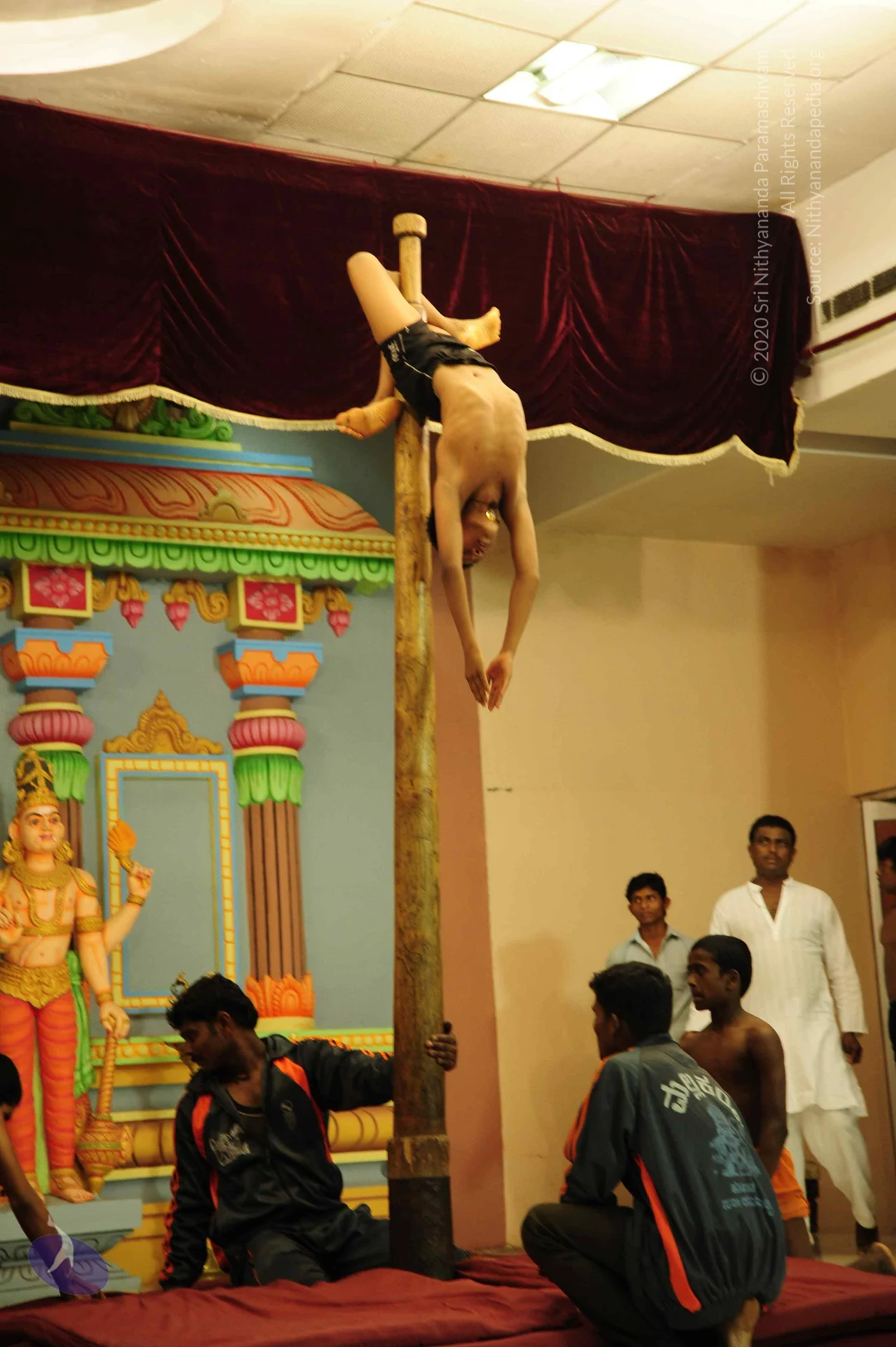
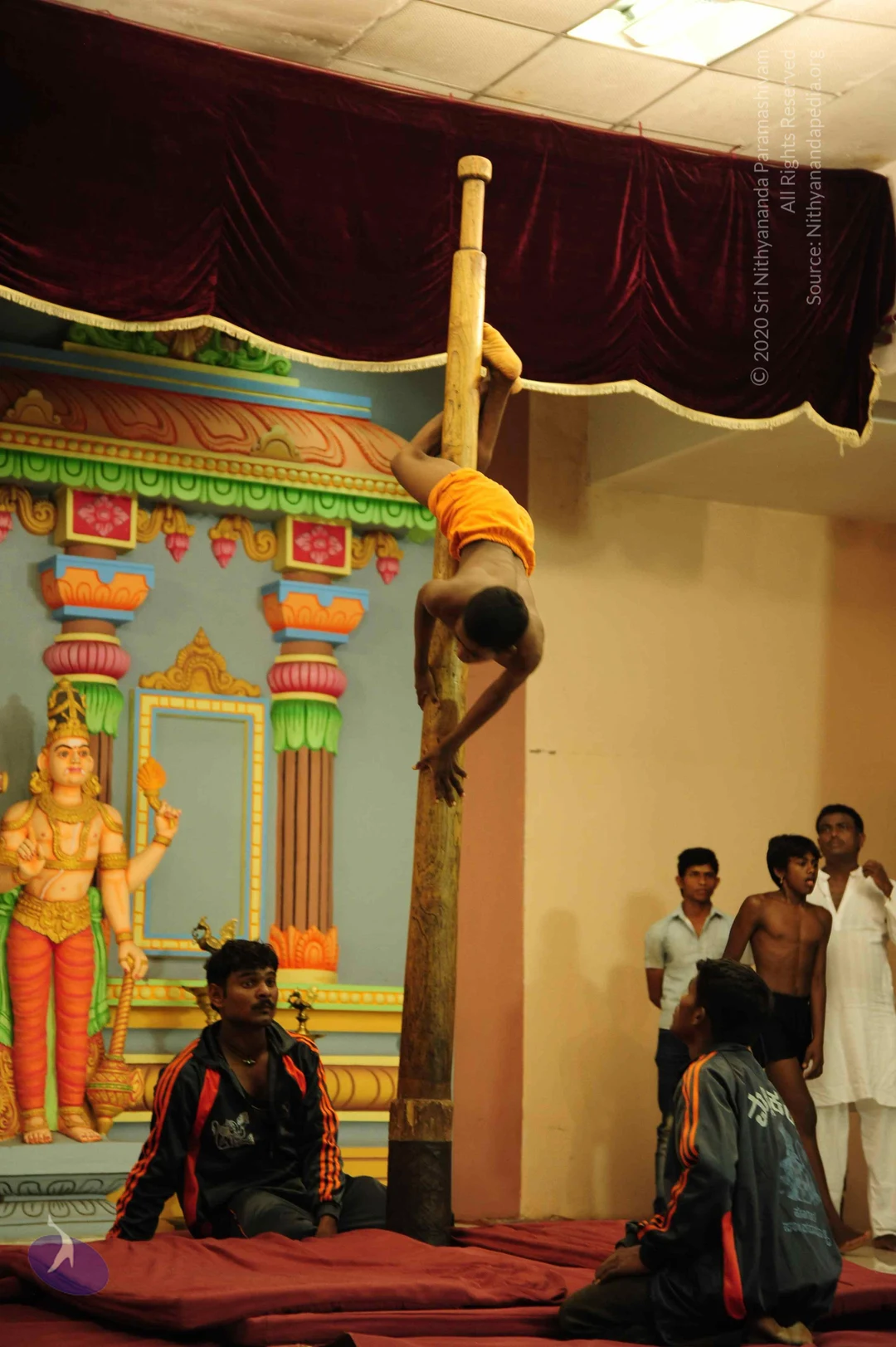
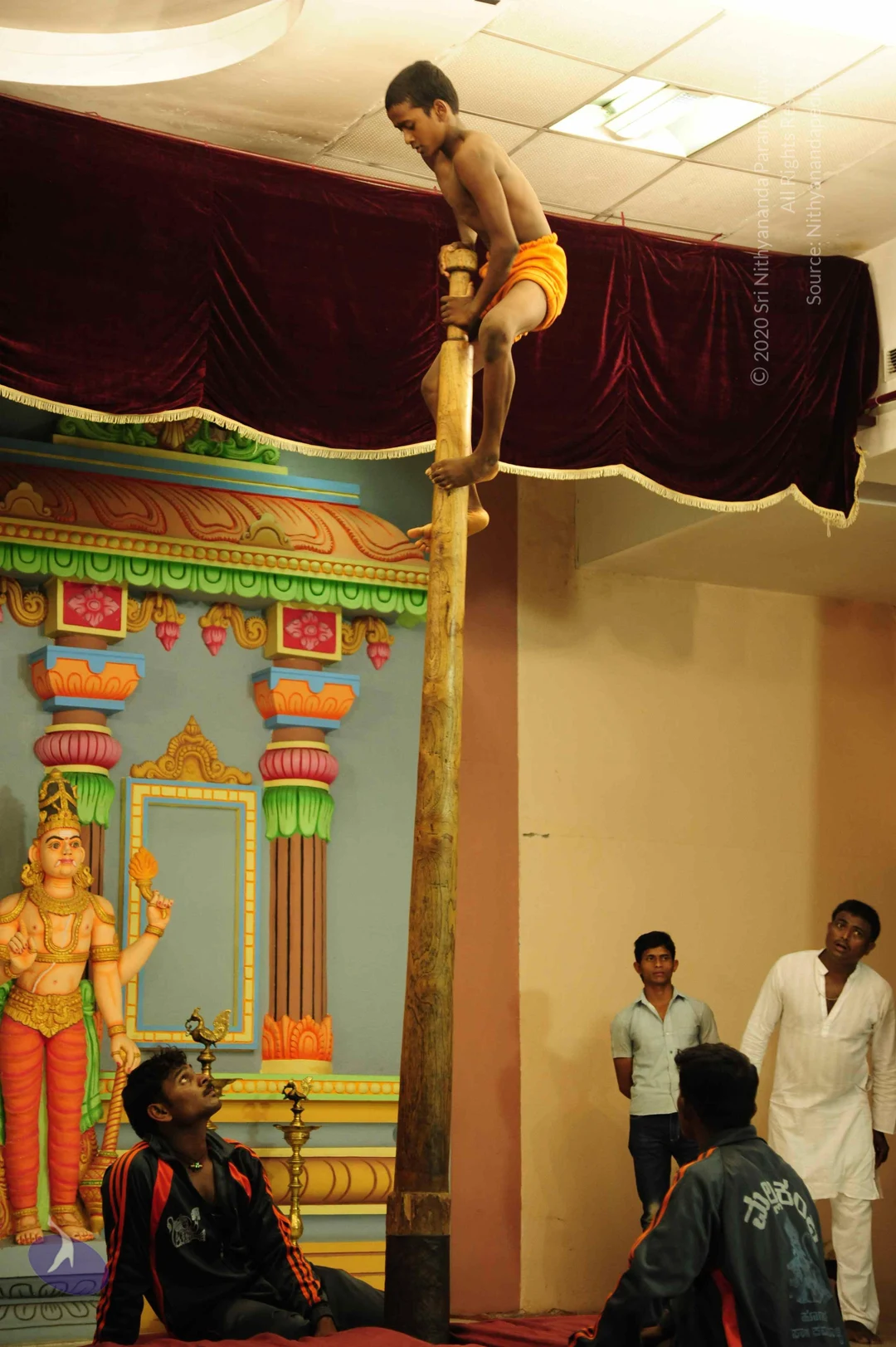
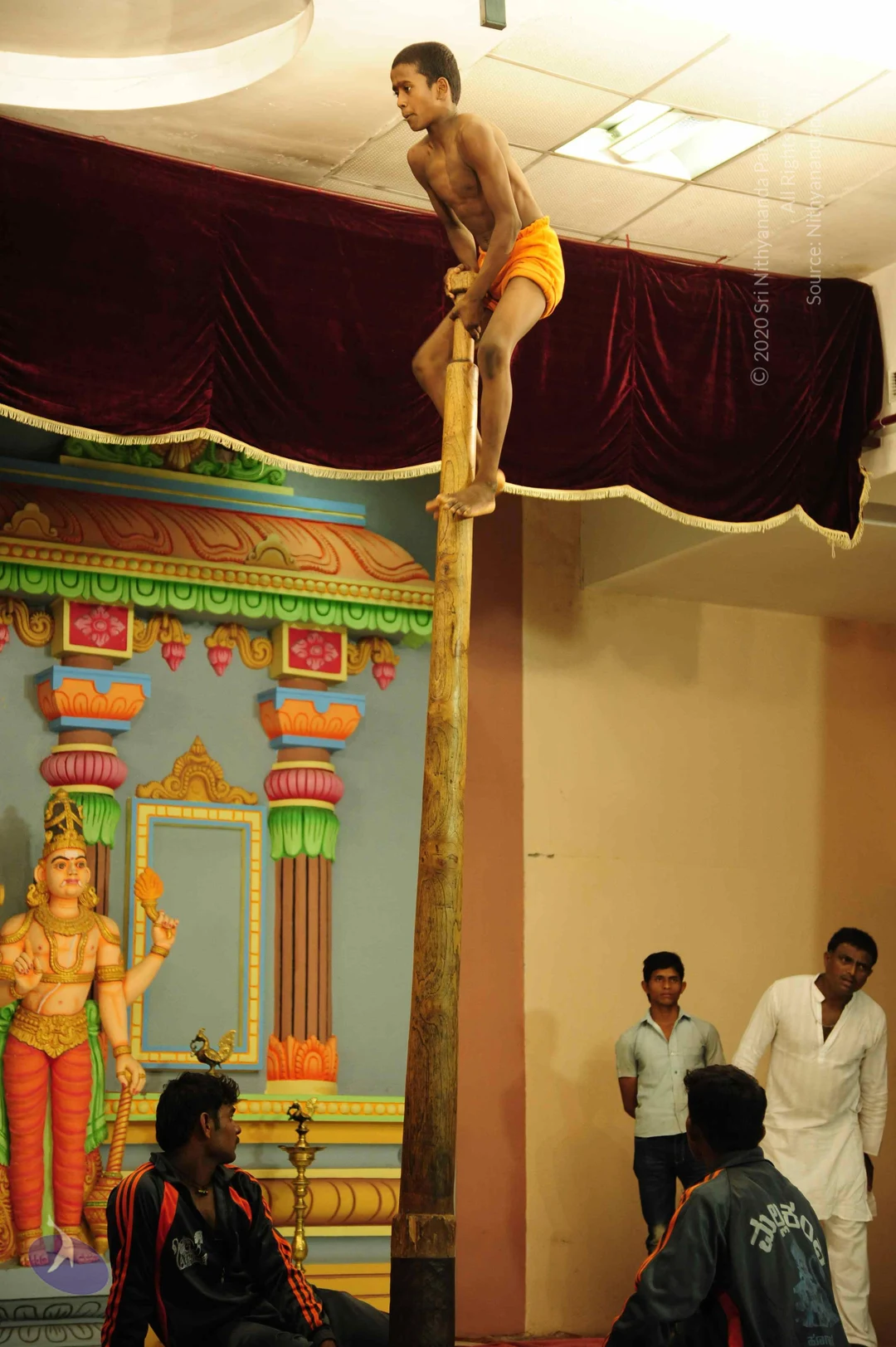
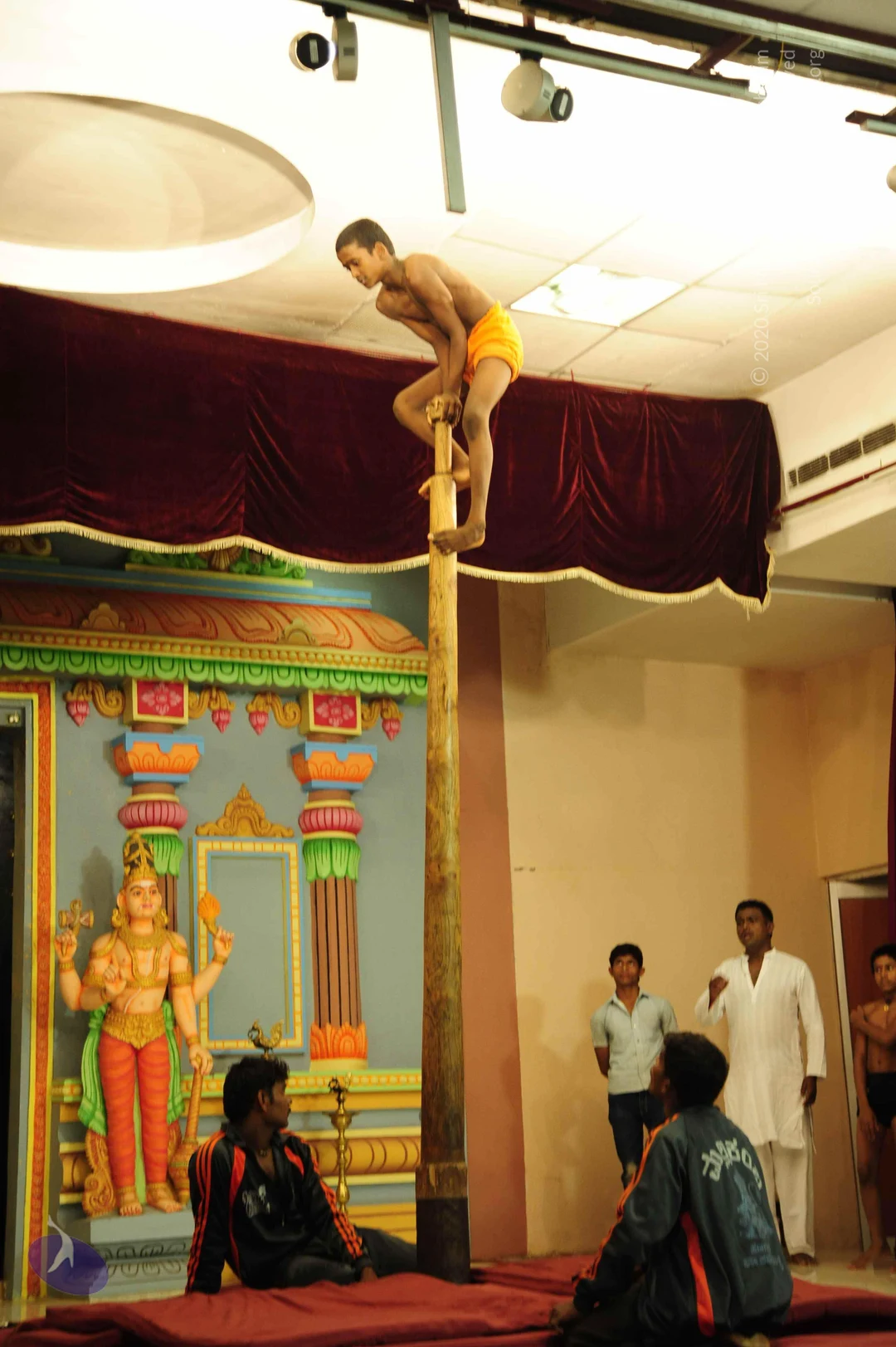
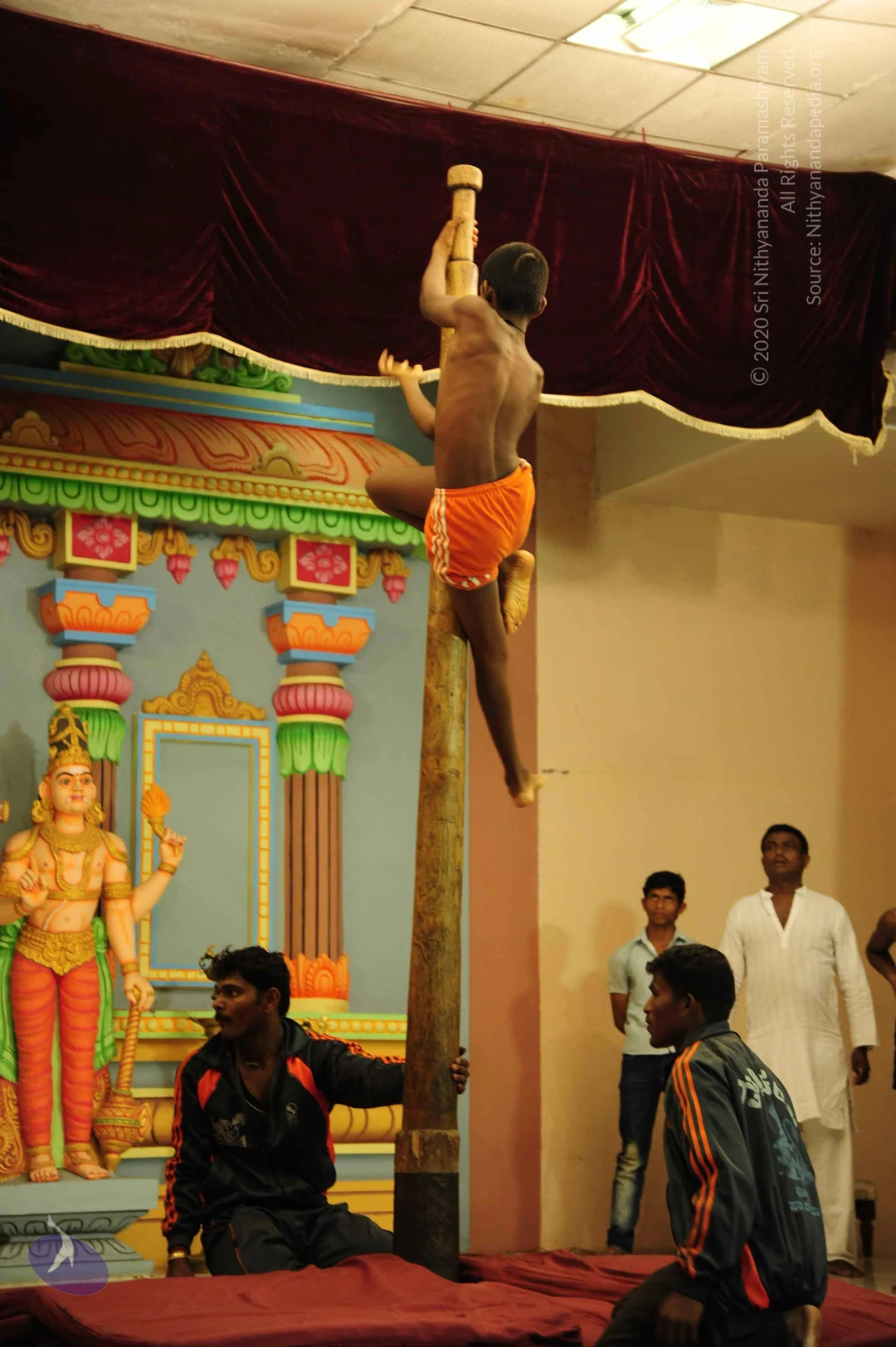
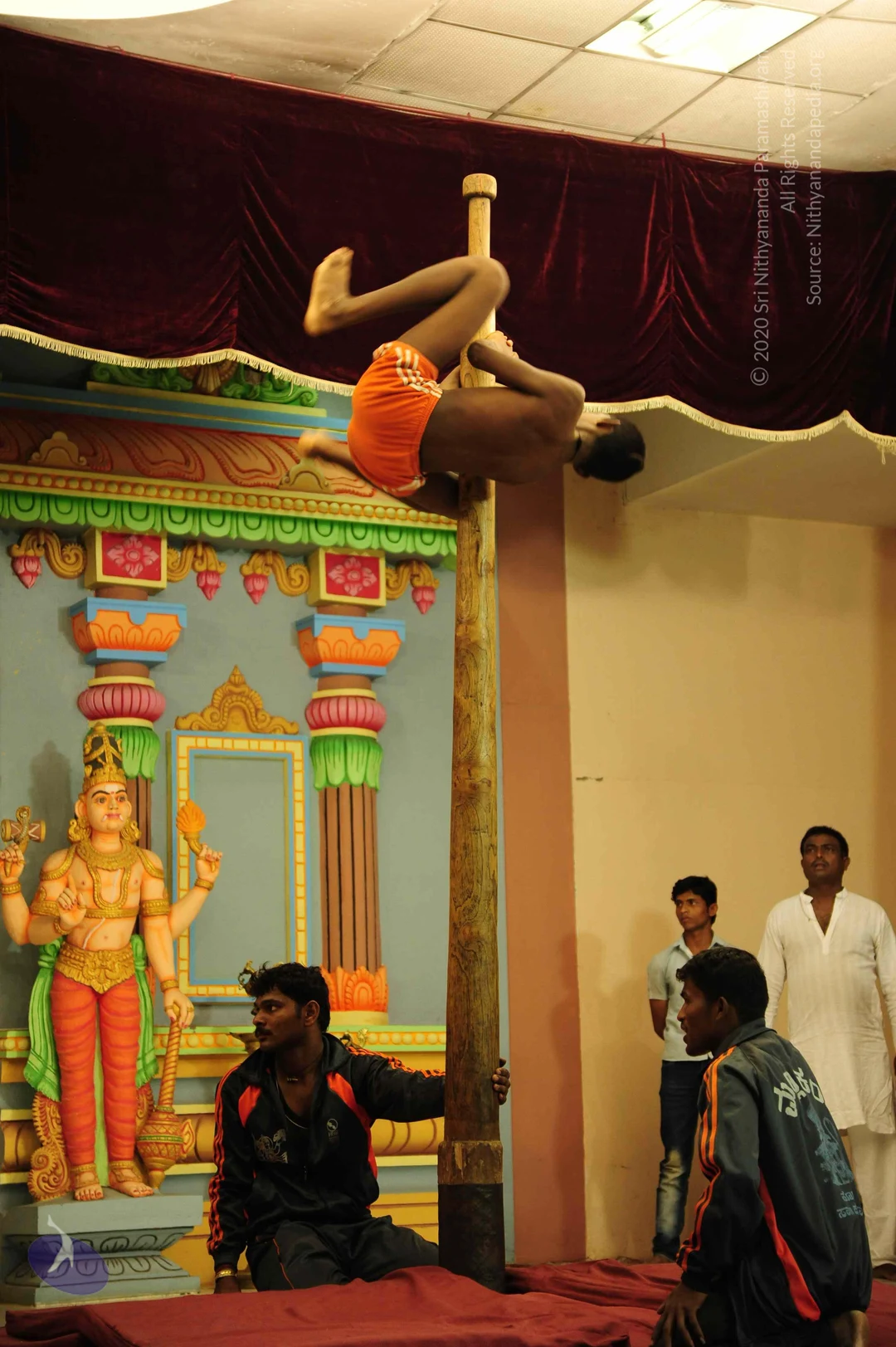
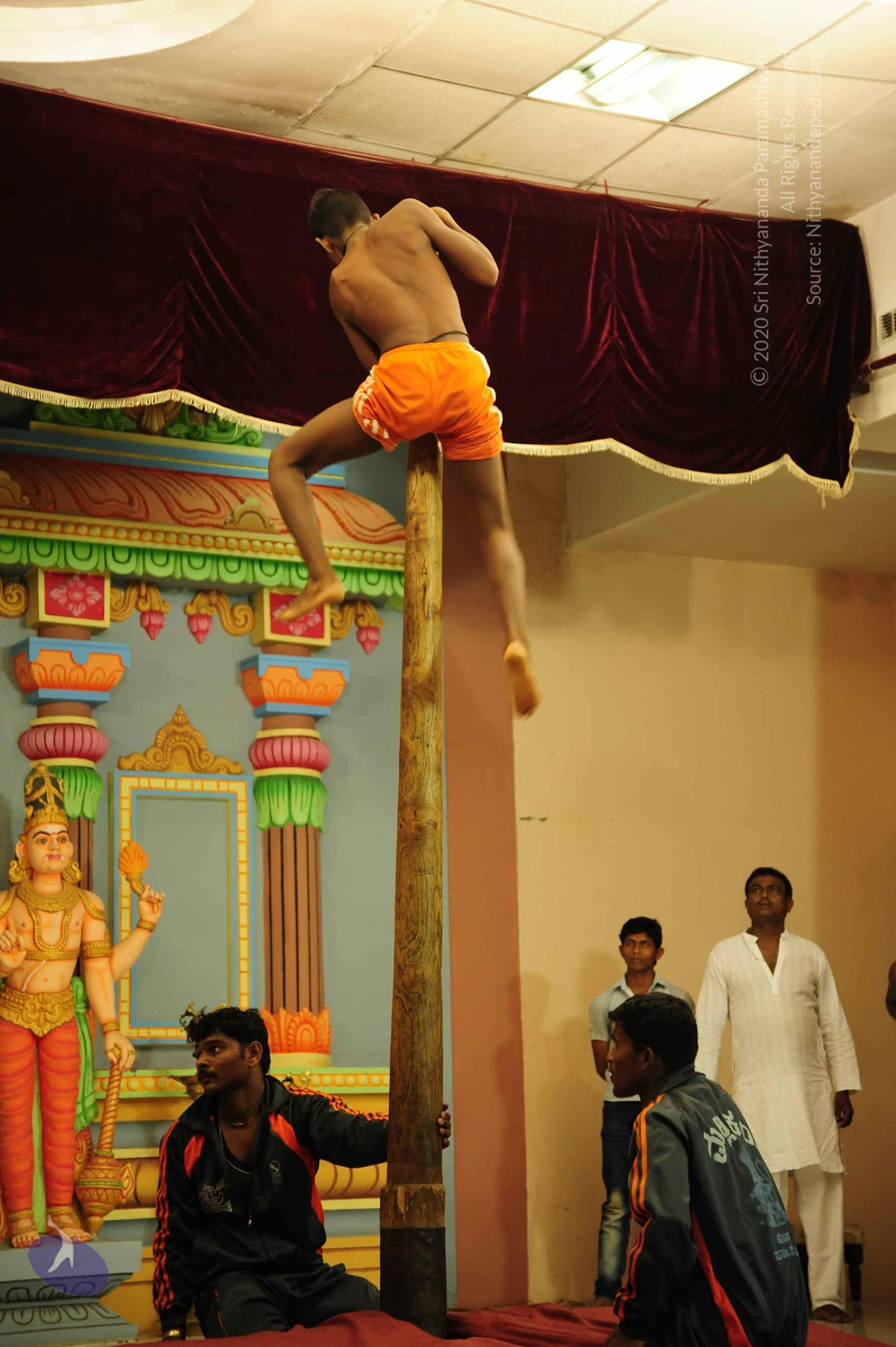
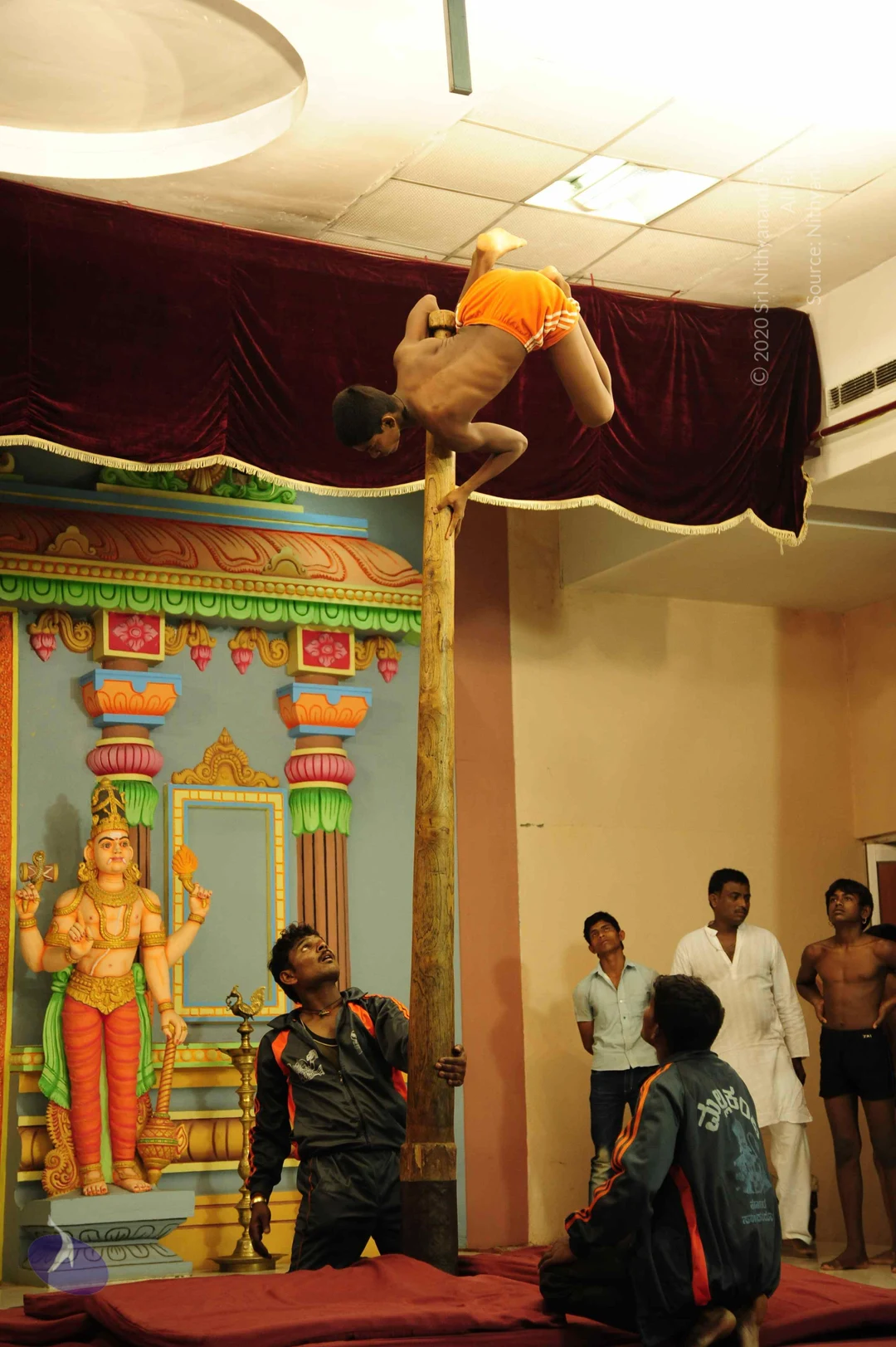
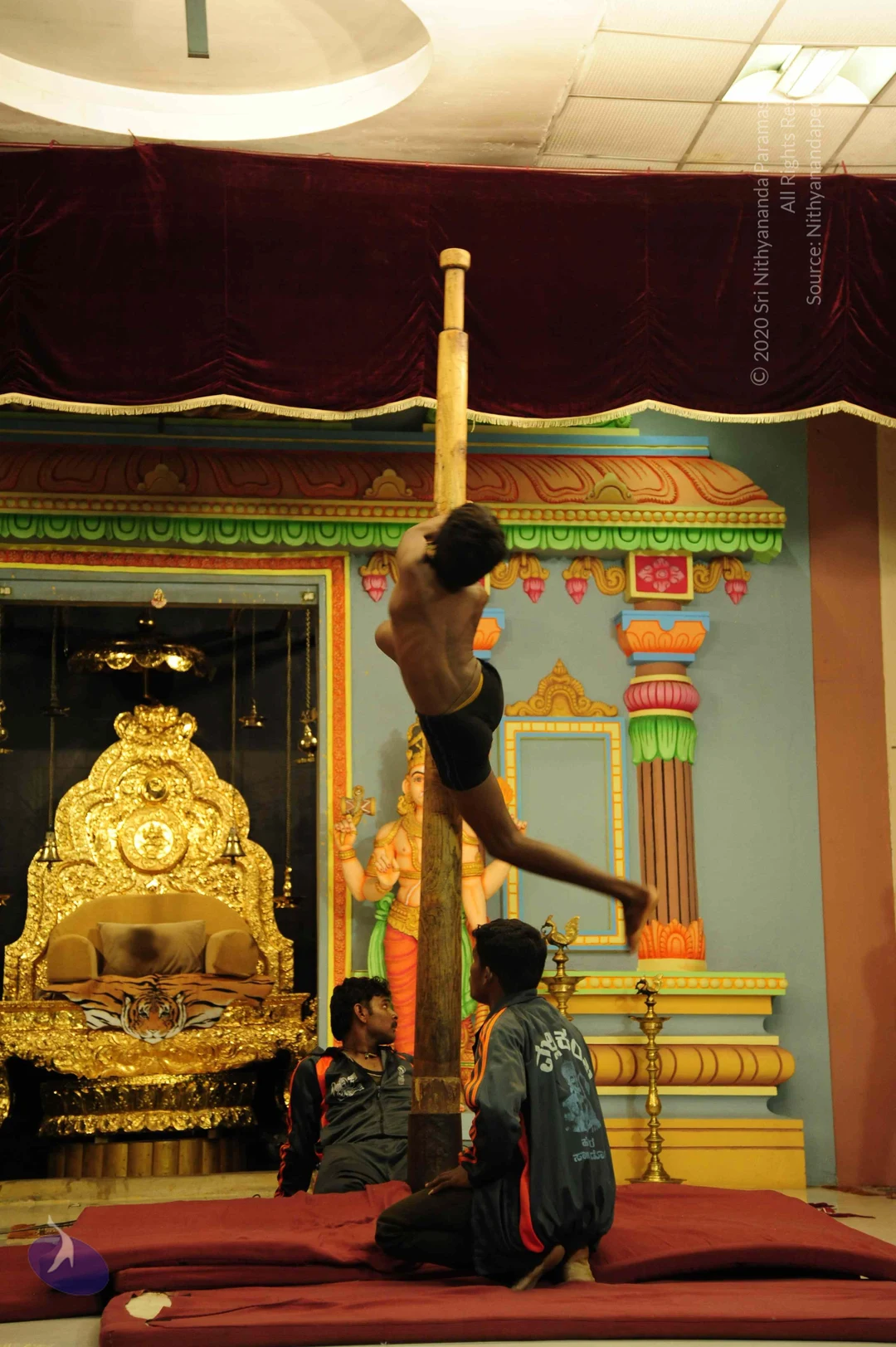
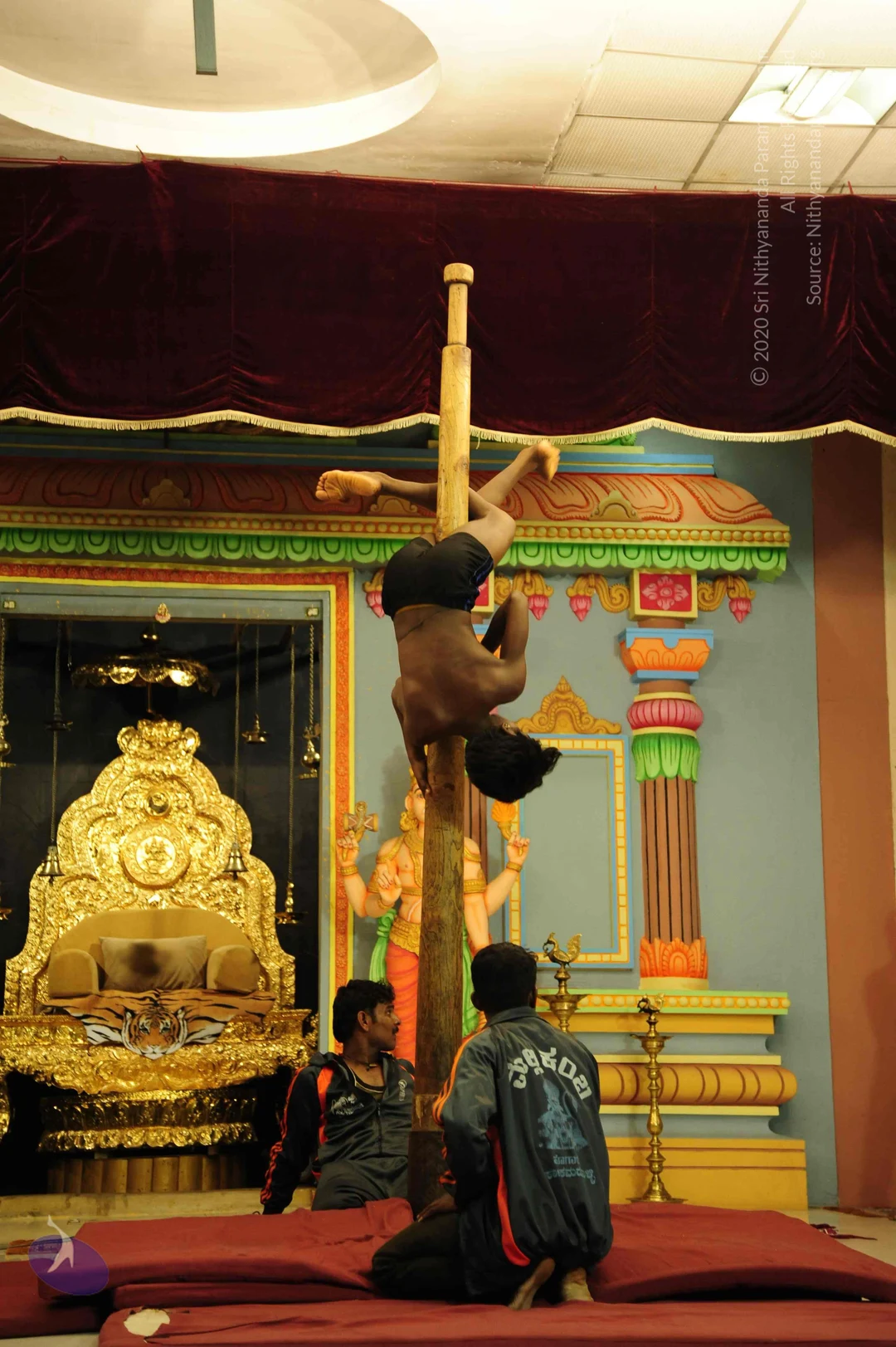
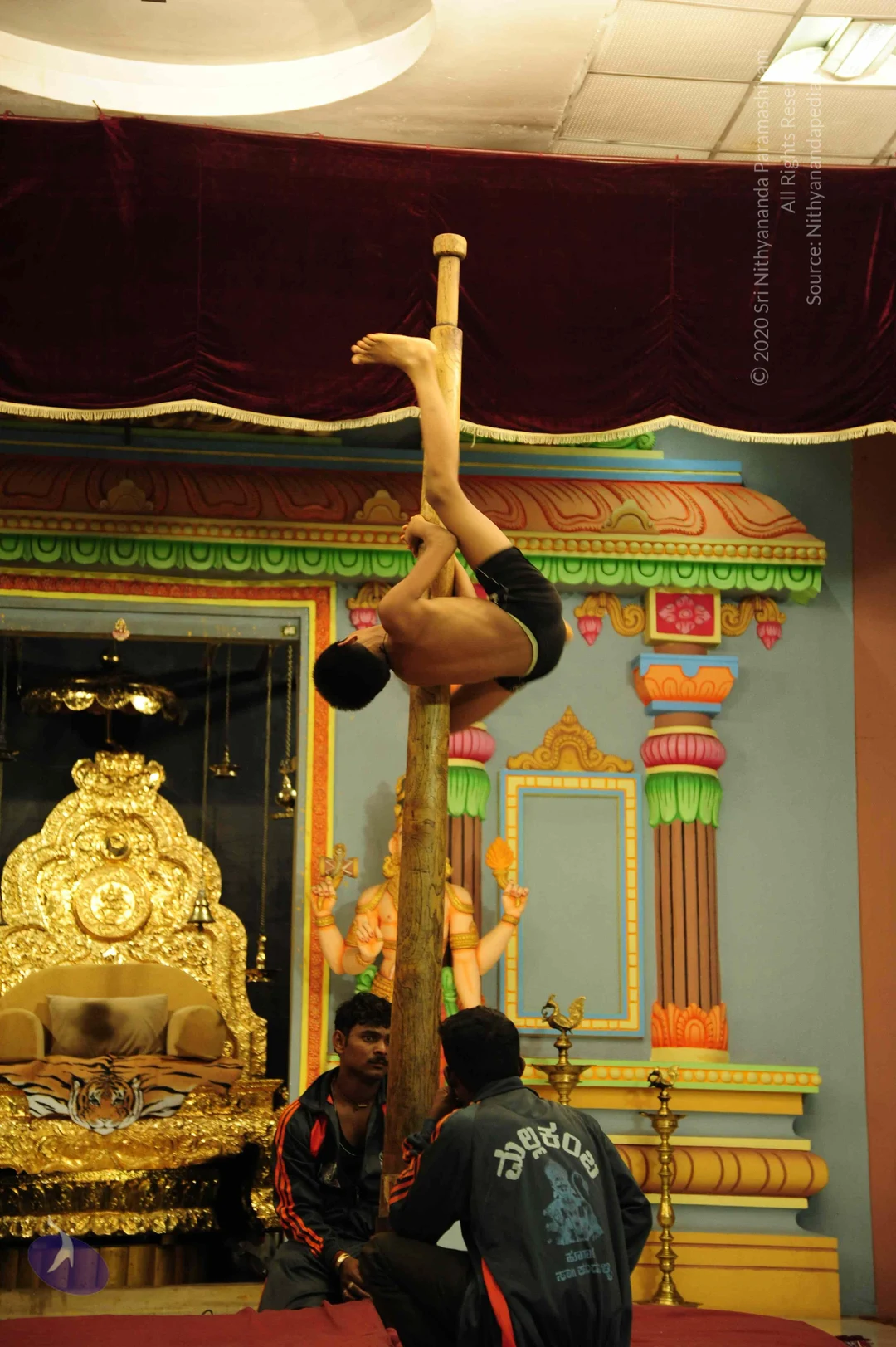
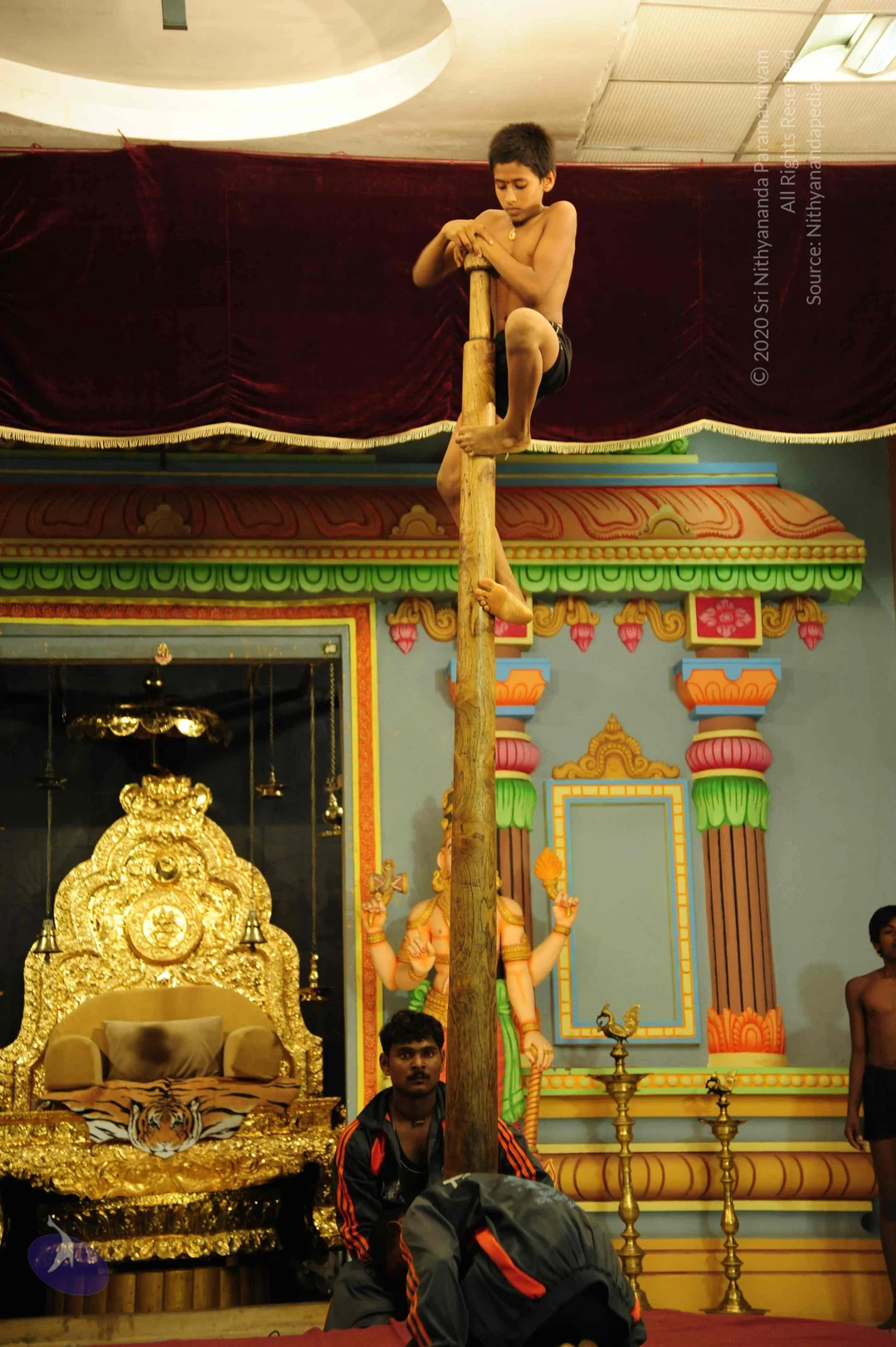
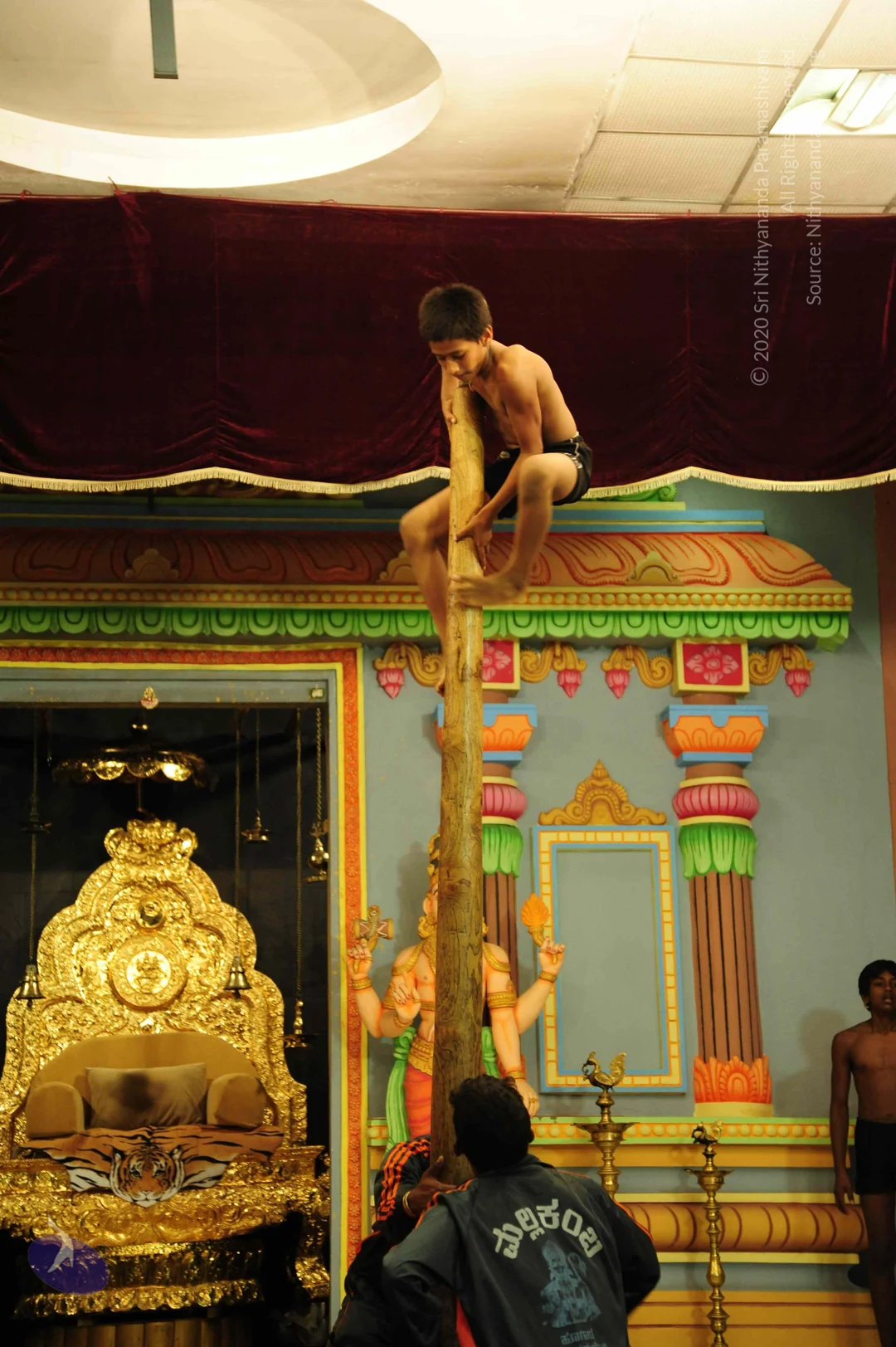
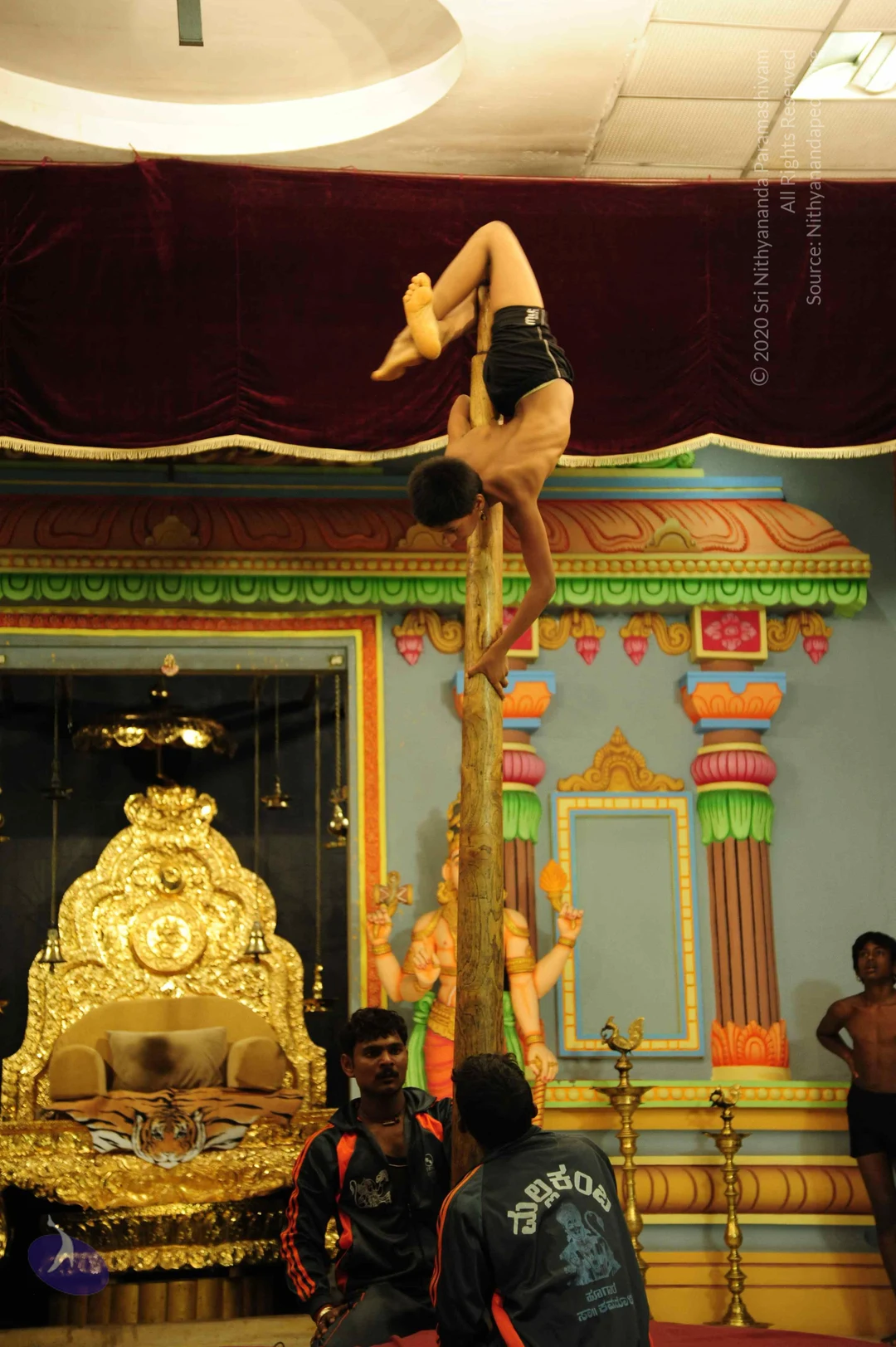
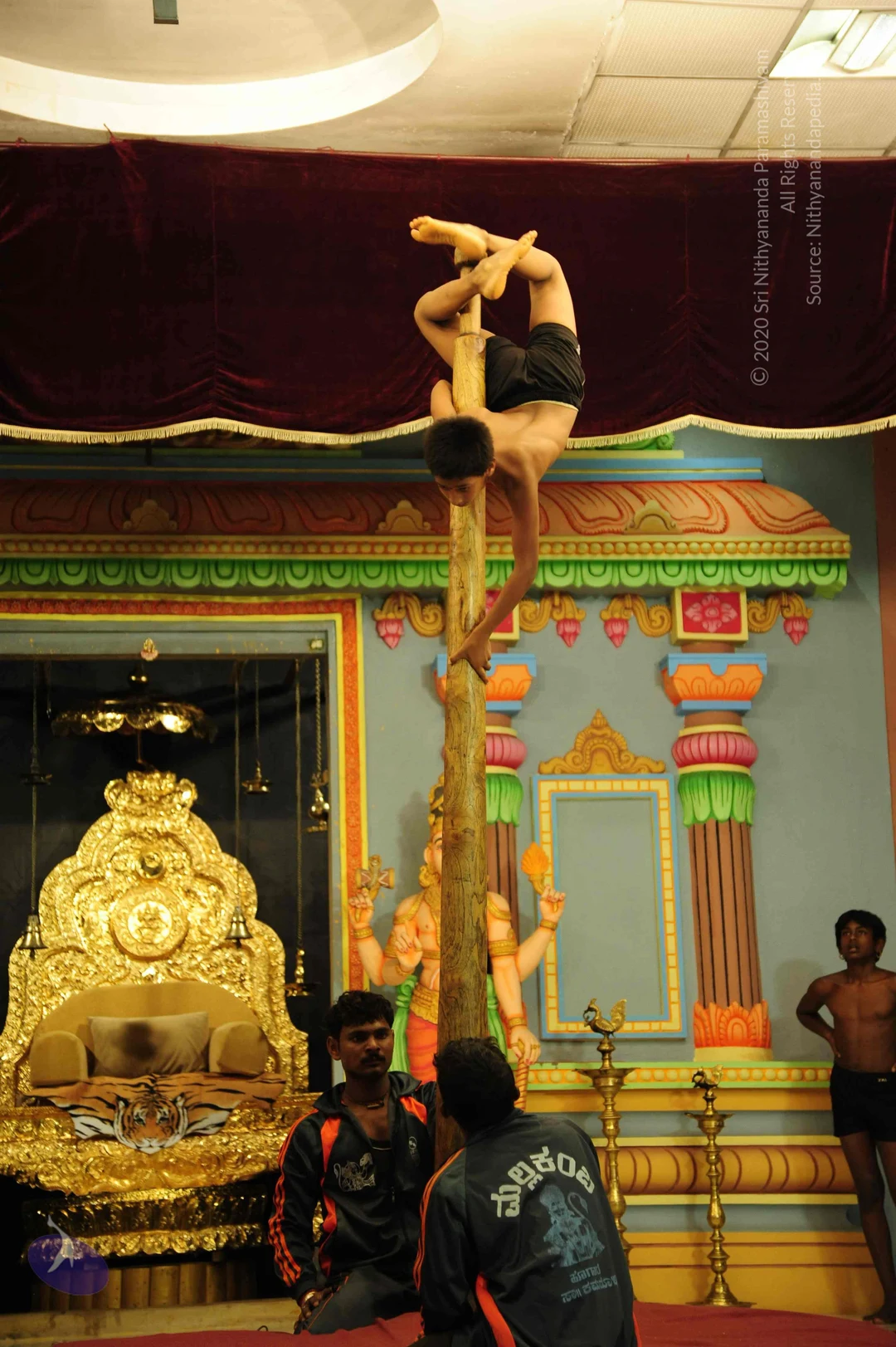
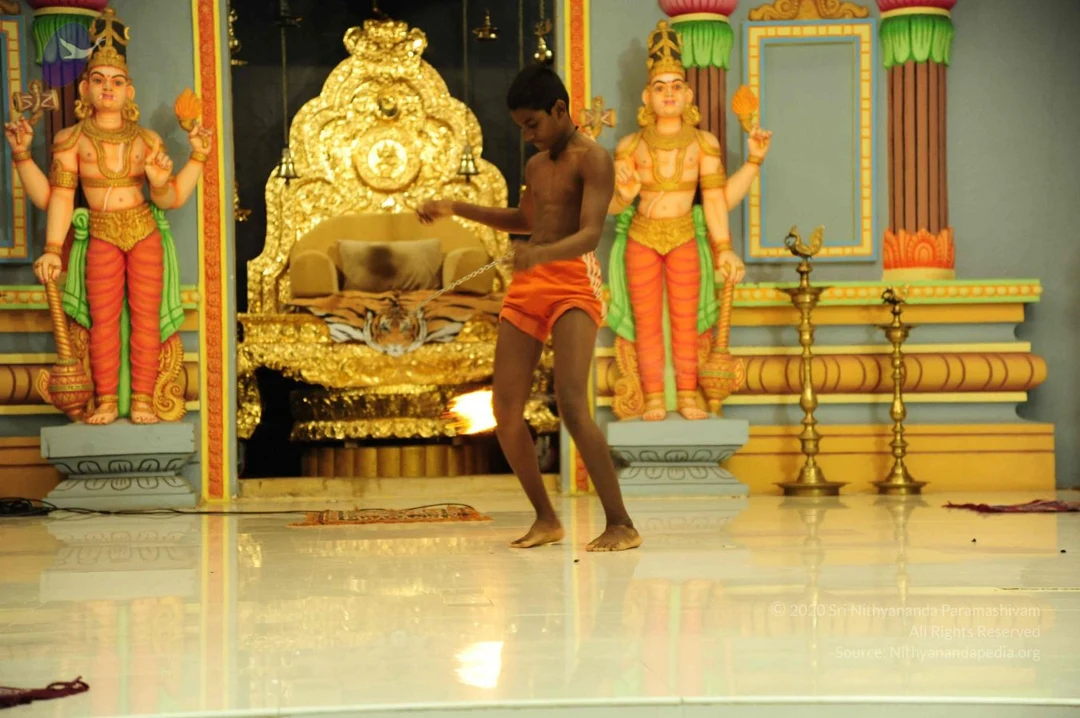
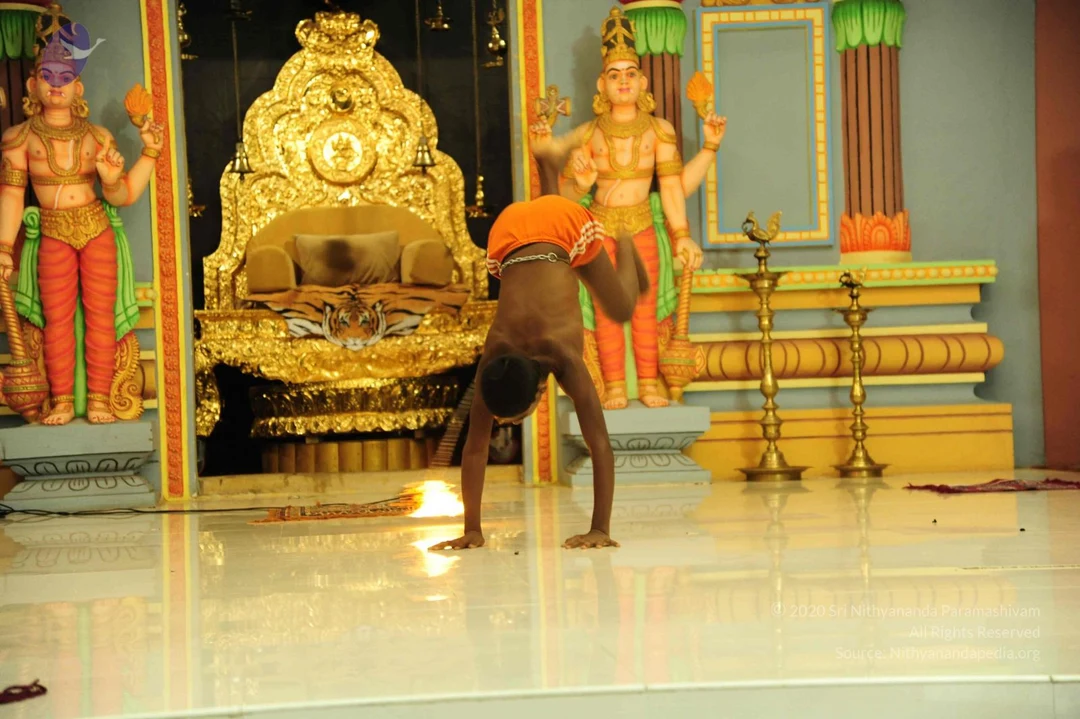
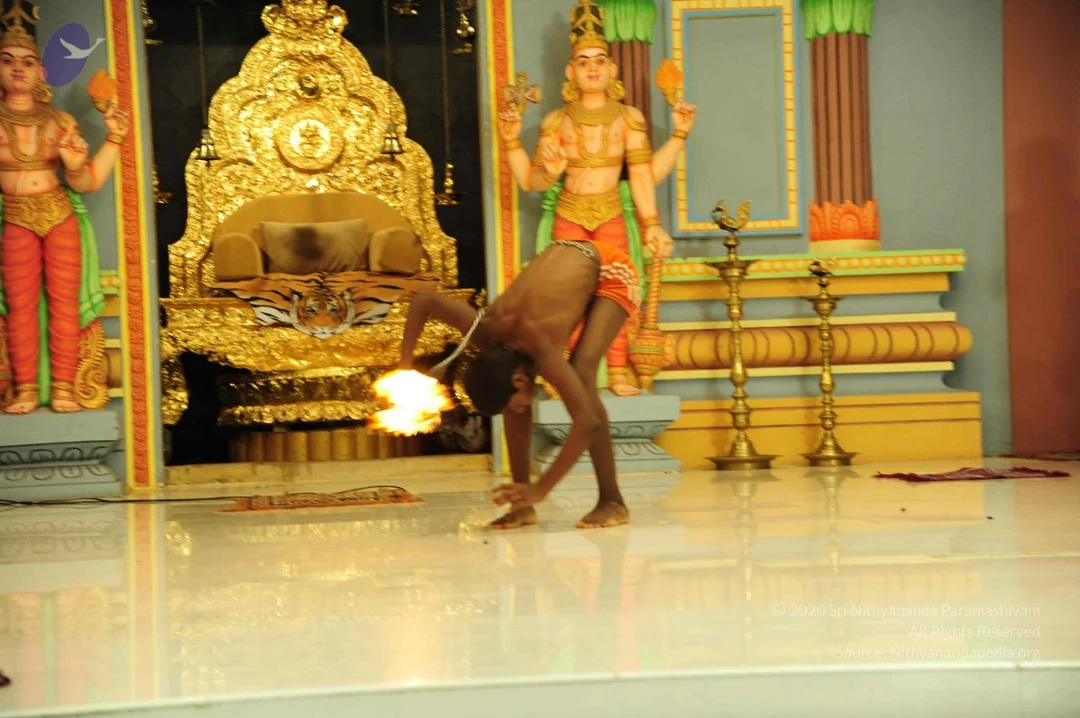
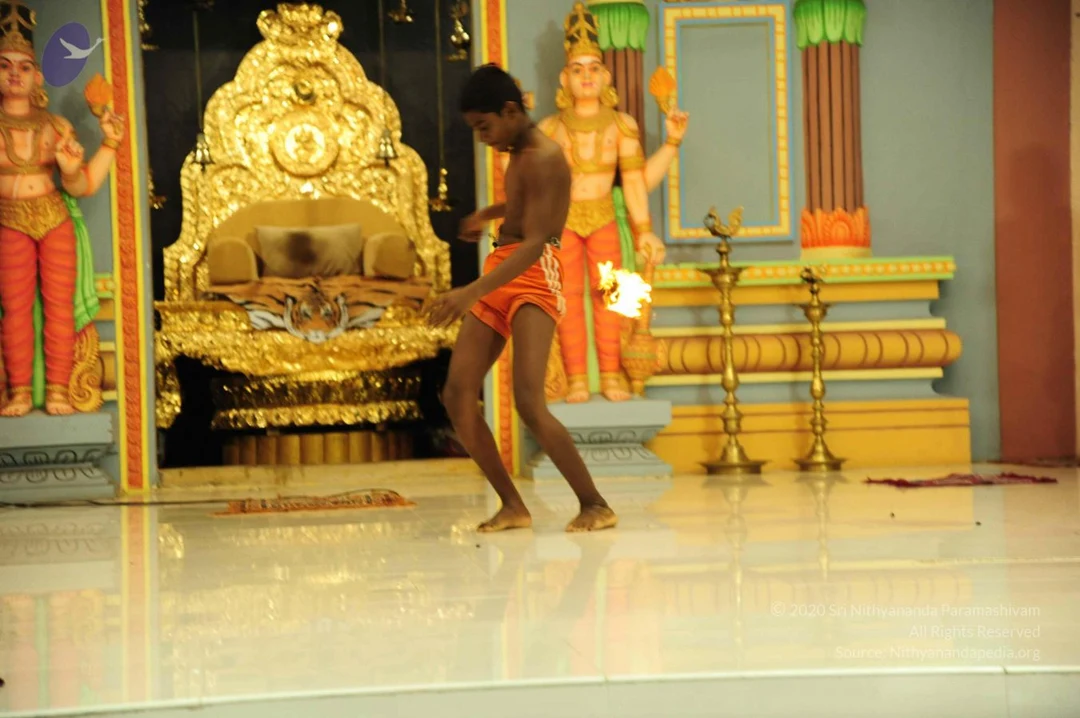
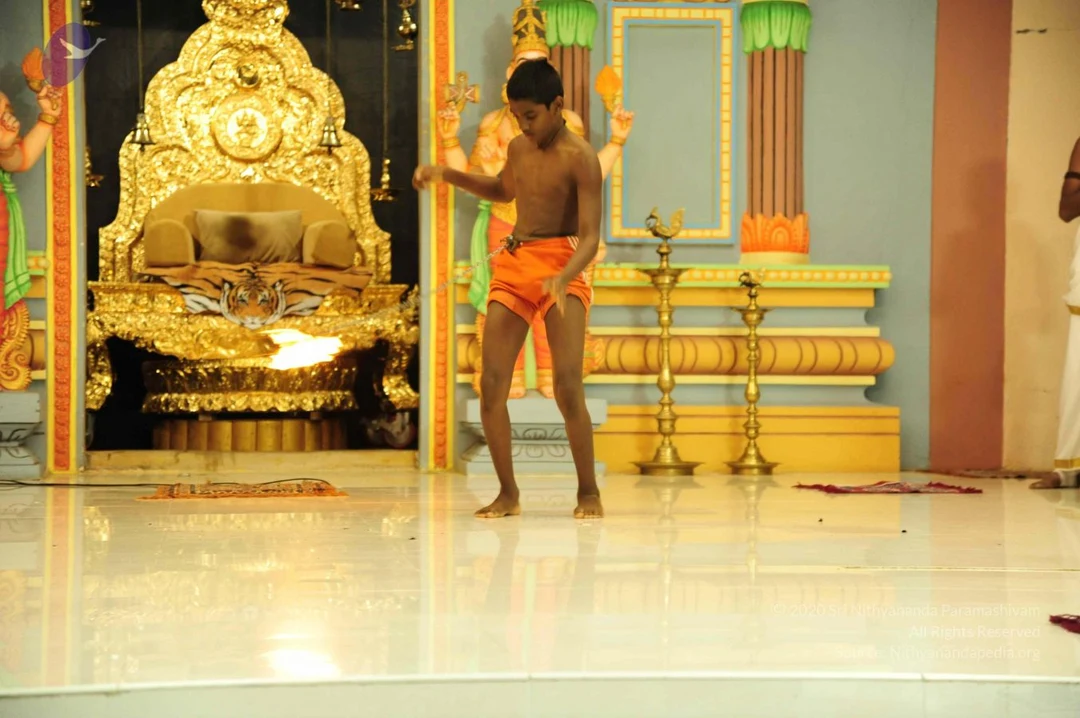
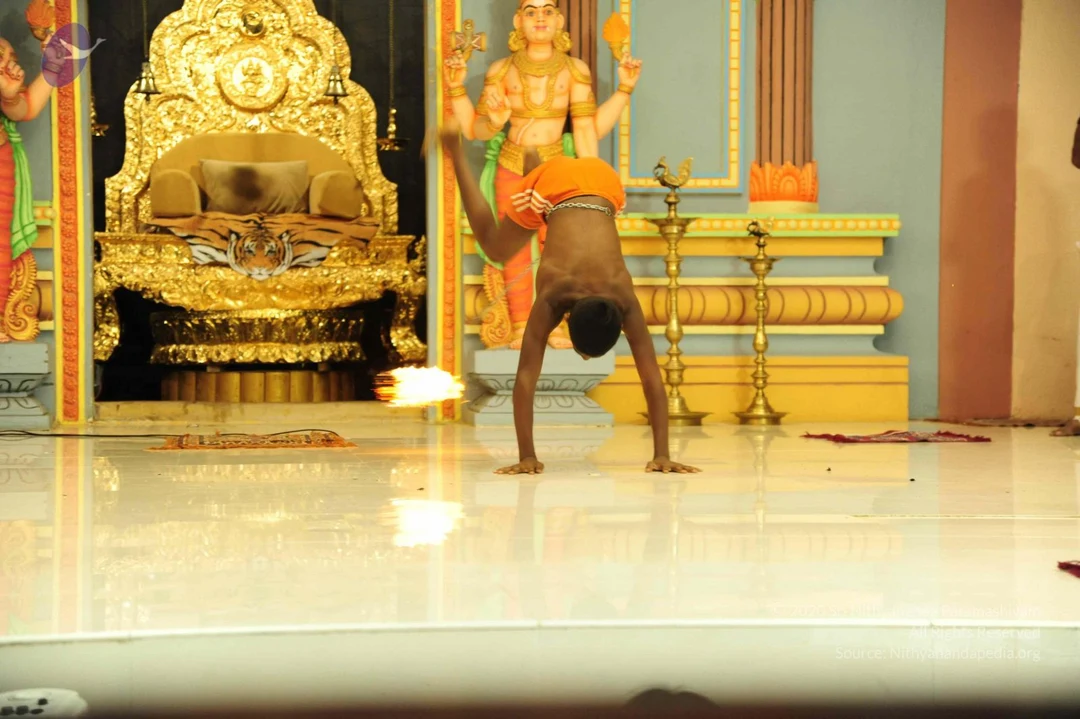
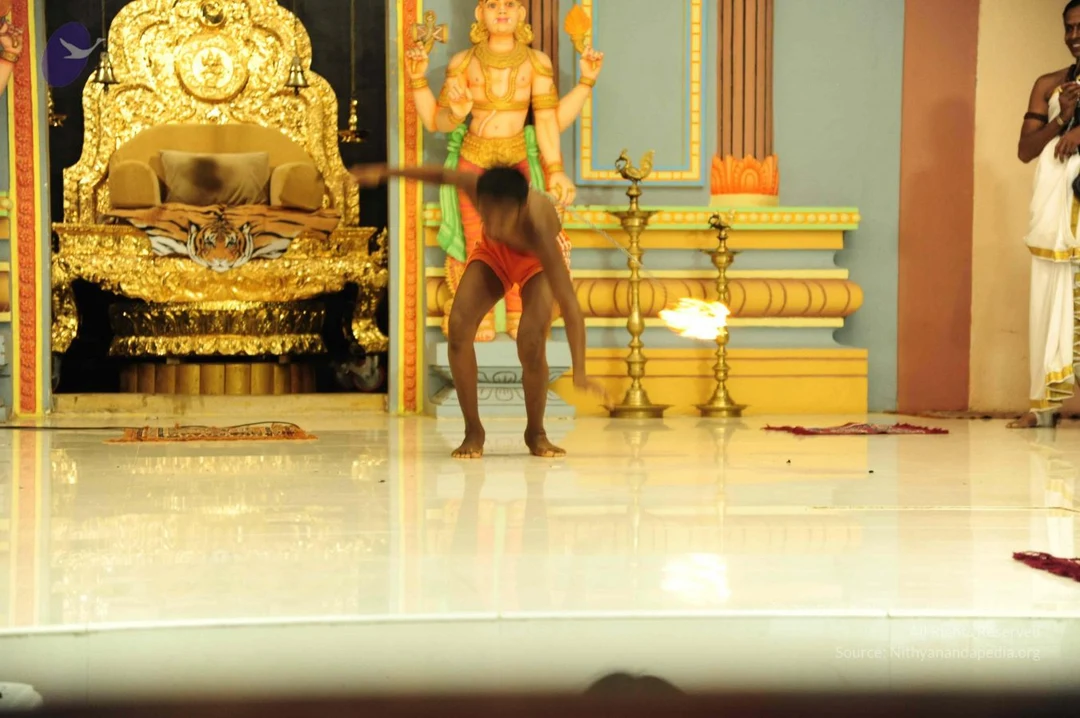
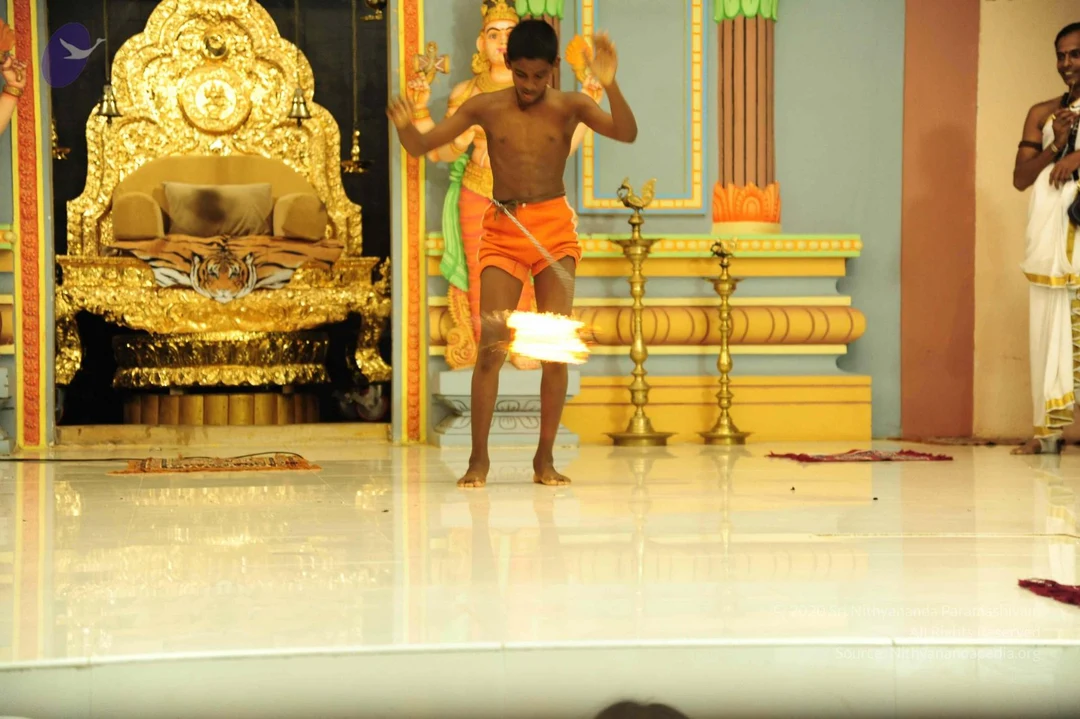
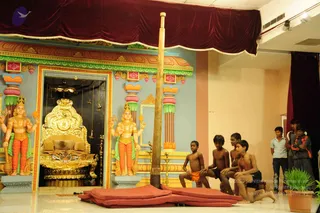
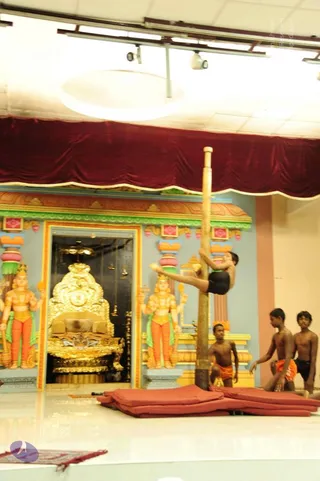
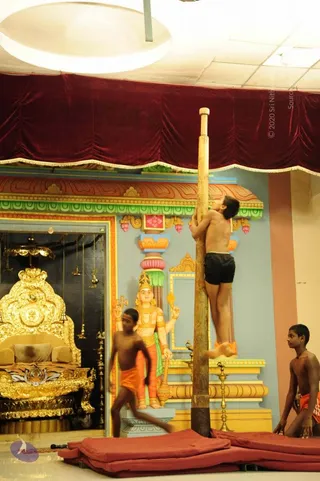
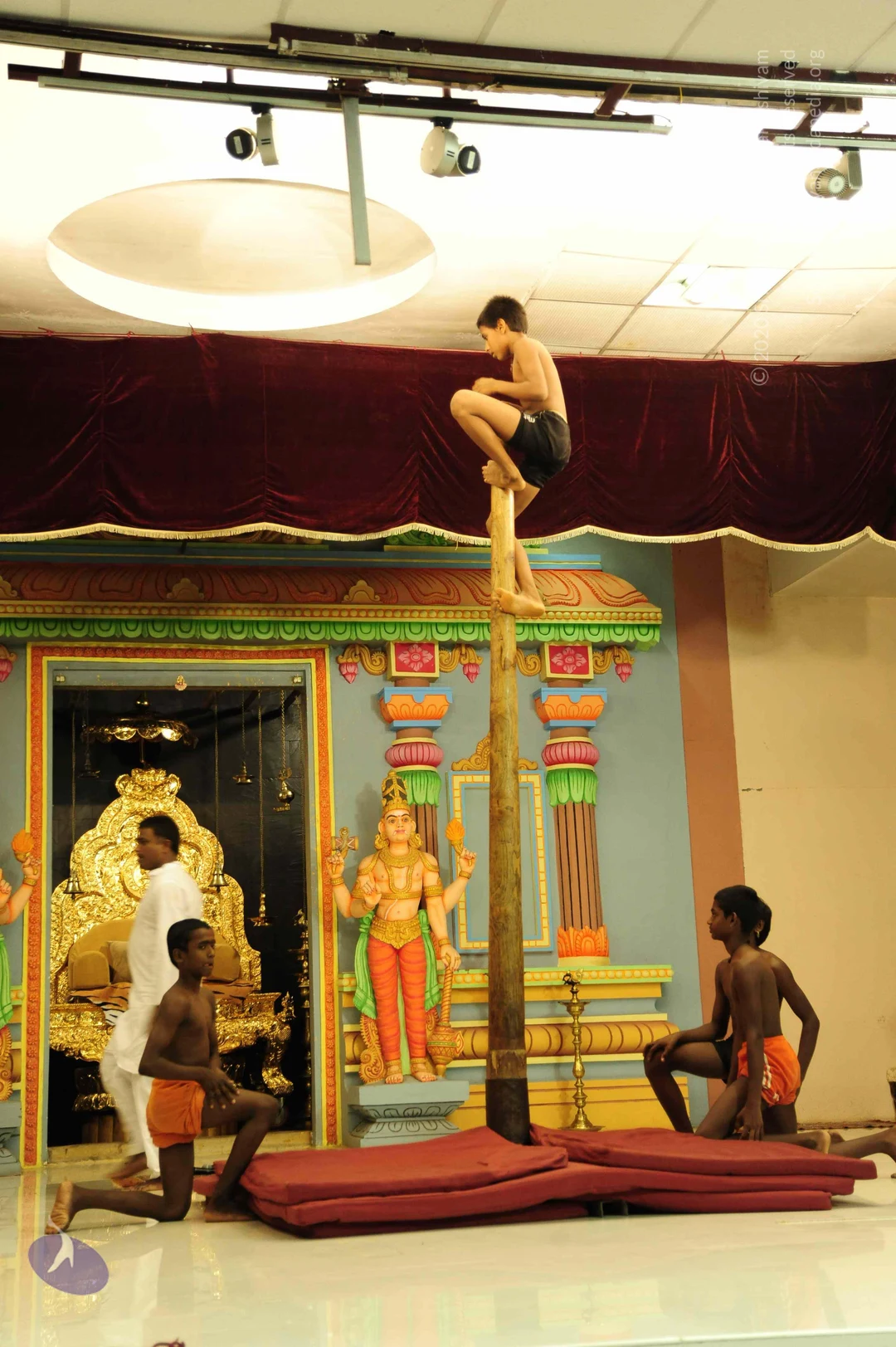
A wide view of a stage set with a gold throne-like seat flanked by two painted deity murti figures, behind a maroon velvet valance and tall pillars with gold and red decoration. A standing man in white dhoti and white shawl, hands folded in namaskar, stands at left beside a seated person and a gold-coloured seat. At right, a line of young boys in orange shorts and bare chests stand near the wall. Brass oil lamps, potted plants and red floor cushions sit on the platform. Several seated audience members are visible at the bottom edge.Interior hall with a painted backdrop of two colourful standing deity murtis flanking an ornate gold throne with cushions and a dark velvet canopy above. A tall wooden pole stands in the centre on a floor with red cushions. On the right, several young boys in orange waist cloths and bare chests stand near a curtain, along with a few others in dark clothing. Potted plants sit at the front right corner.A photograph of an indoor hall with a golden ornate throne in front of a painted wall decorated with two tall, multi-armed deity statues in orange dhotis and green sashes. A tall wooden pole stands upright on red cushions, and four shirtless boys in orange and black shorts stand beside it, with two more people in casual clothes at the right edge. A deep red velvet valance hangs above, and an air conditioner is visible on the right. No person is clearly identifiable as a person in this image.A temple-style hall with a golden ornate throne (peetha) set in a shrine niche, flanked by two painted dvarapala guardian figures with four arms, orange and green dhotis and crowns. A tall wooden pole stands upright on red cushions on the floor. Four bare-chested boys in orange and black shorts crouch and kneel at the base of the pole, while a few older youths in casual clothes stand watching at the right. Hanging brass bells and a lamp hang within the niche, with a potted plant at the lower right and a maroon velvet valance above.Photograph of a stage performance in a colourfully decorated hall. A shirtless boy in black shorts is mid-air, gripping a tall wooden pole and extending one leg, performing a pole gymnastics feat. Three other shirtless boys in orange dhoti-style cloth stand and kneel by the base of the pole, one watching closely. Red padded mats lie on the floor beneath. Behind them stands a golden ornate throne with a cushion, flanked by two painted multi-armed deity murti in orange and green dhotis holding staffs, under a maroon velvet valance with painted pillars in pink, green and blue. No a person candidate is visible on the throne.Boys perform a pole-climbing exercise in a temple-style hall. A shirtless boy in black shorts shimmies up a tall wooden pole, while another boy in orange shorts runs past in motion blur and a third shirtless boy in orange waistcloth crouches at the base beside red floor mats. Behind them stands a painted deity murti with four arms, holding a trident-like staff and a lotus-topped sceptre, flanked by painted pillars with lotus motifs. To the left, an ornate gold throne with a tiger-skin draped cushion sits beneath a gold canopy, with hanging bells and brass lamps nearby. Red velvet drapery frames the upper wall.

YOGA-BY-GURUKUL-BALASANTS
11 photosSource gallery
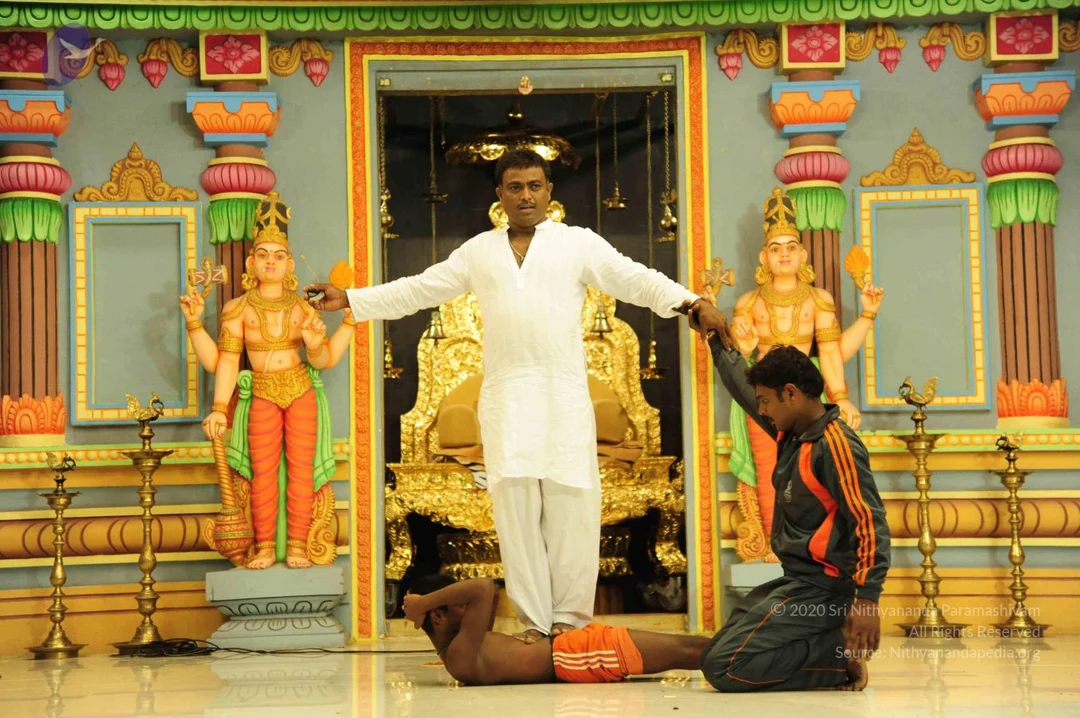
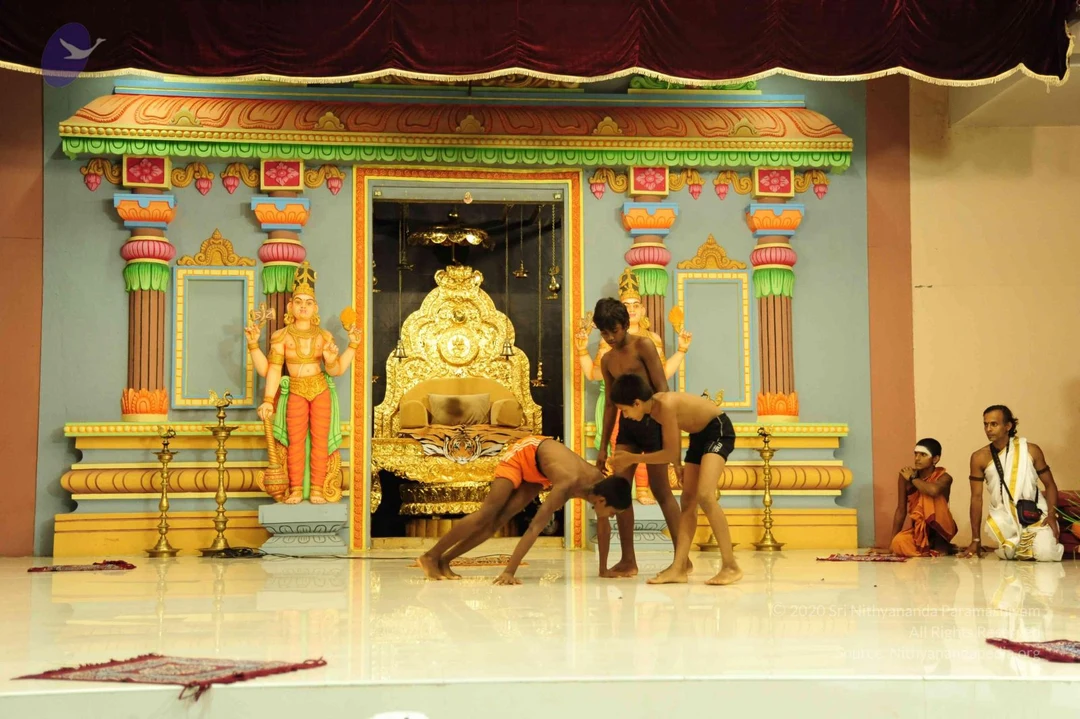
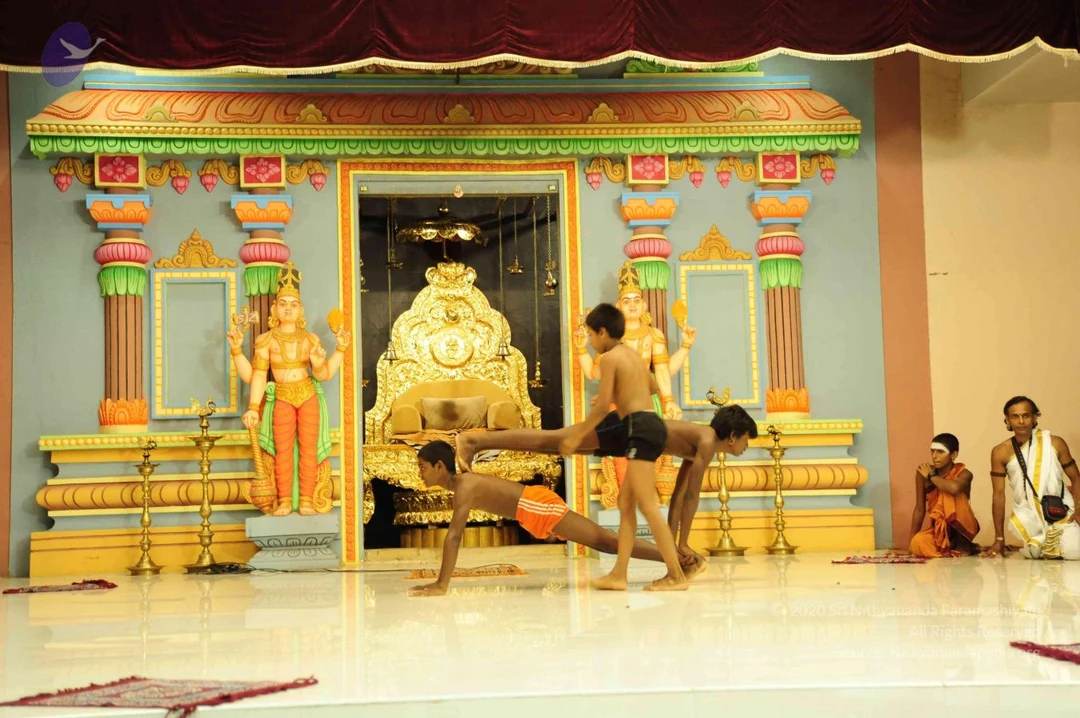
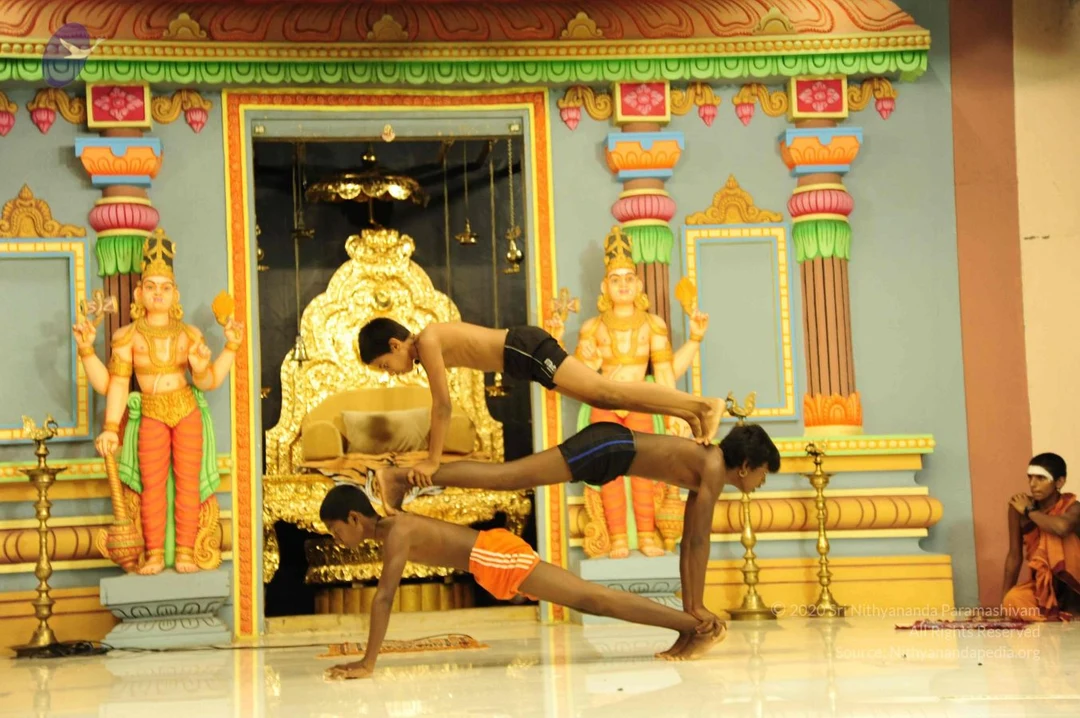
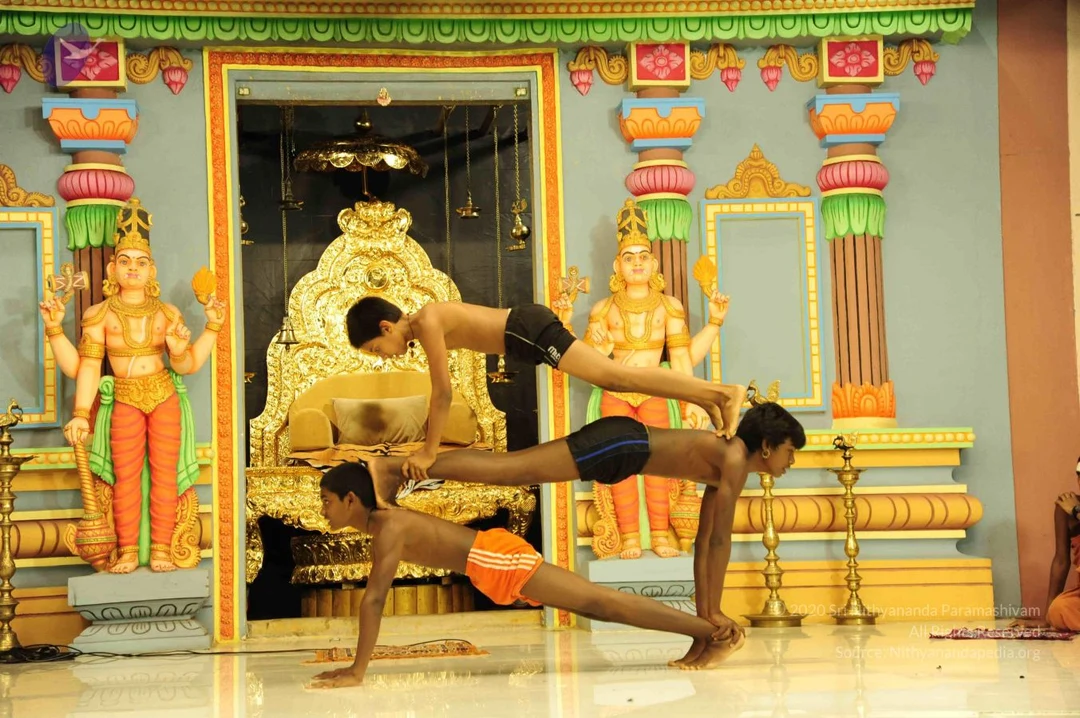
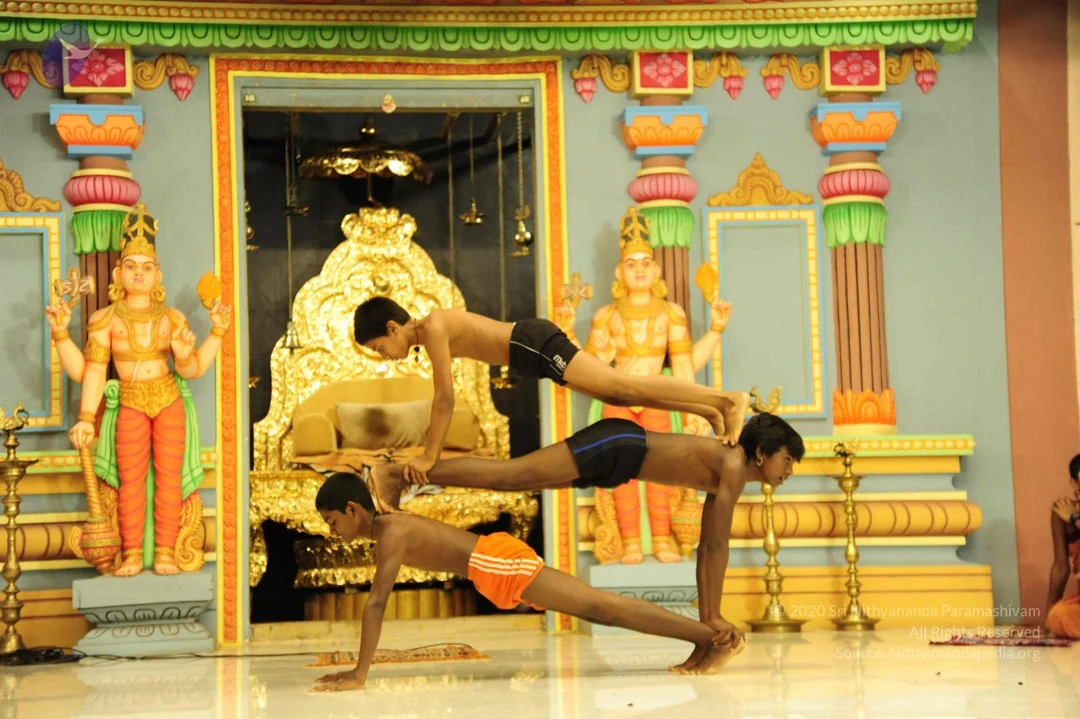
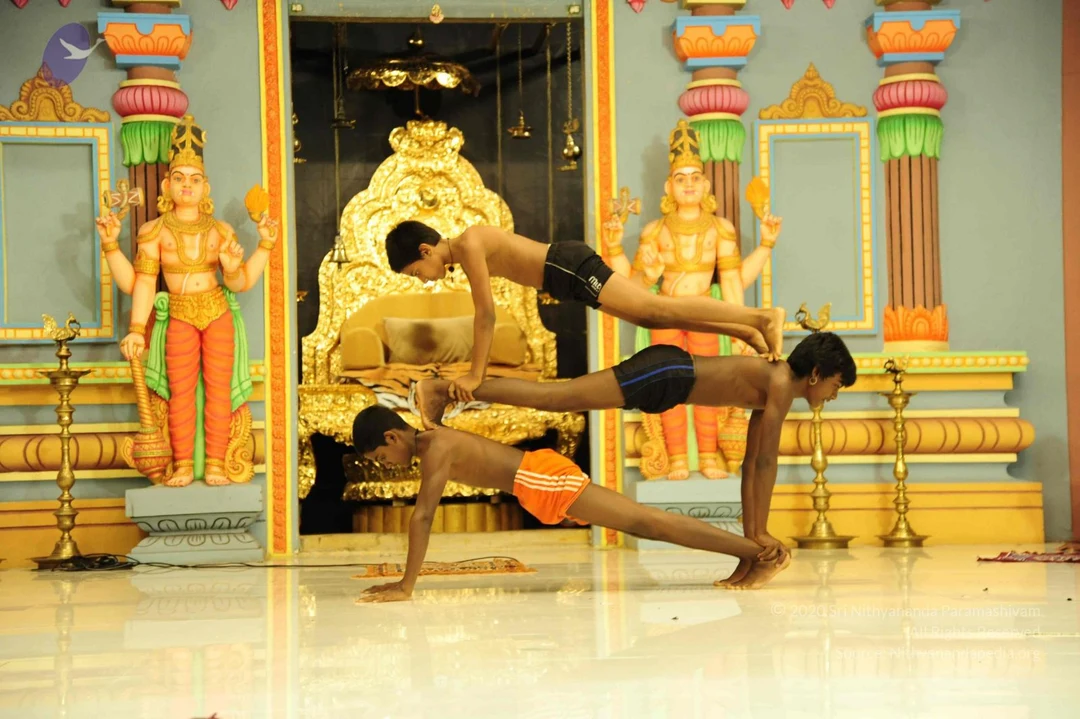
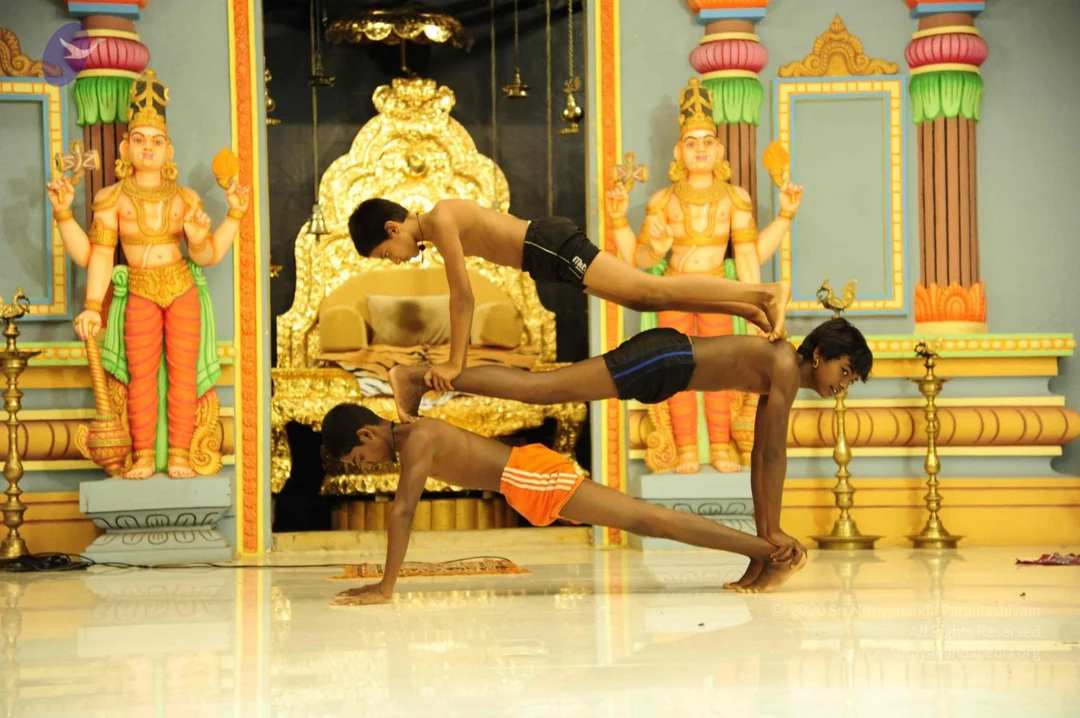
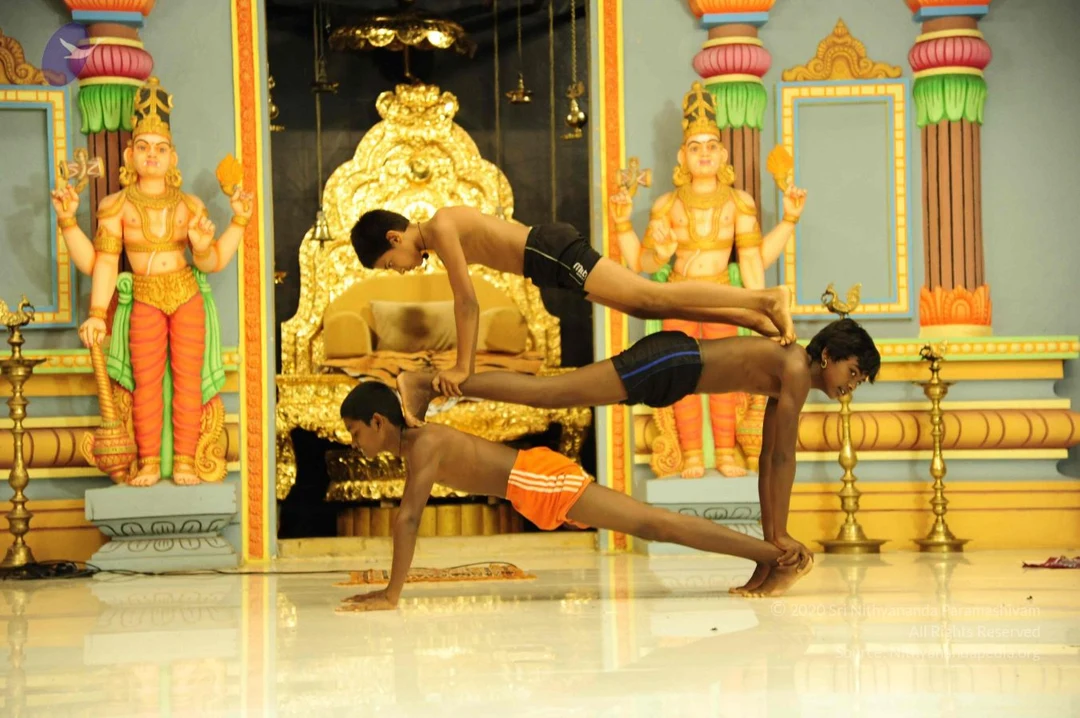
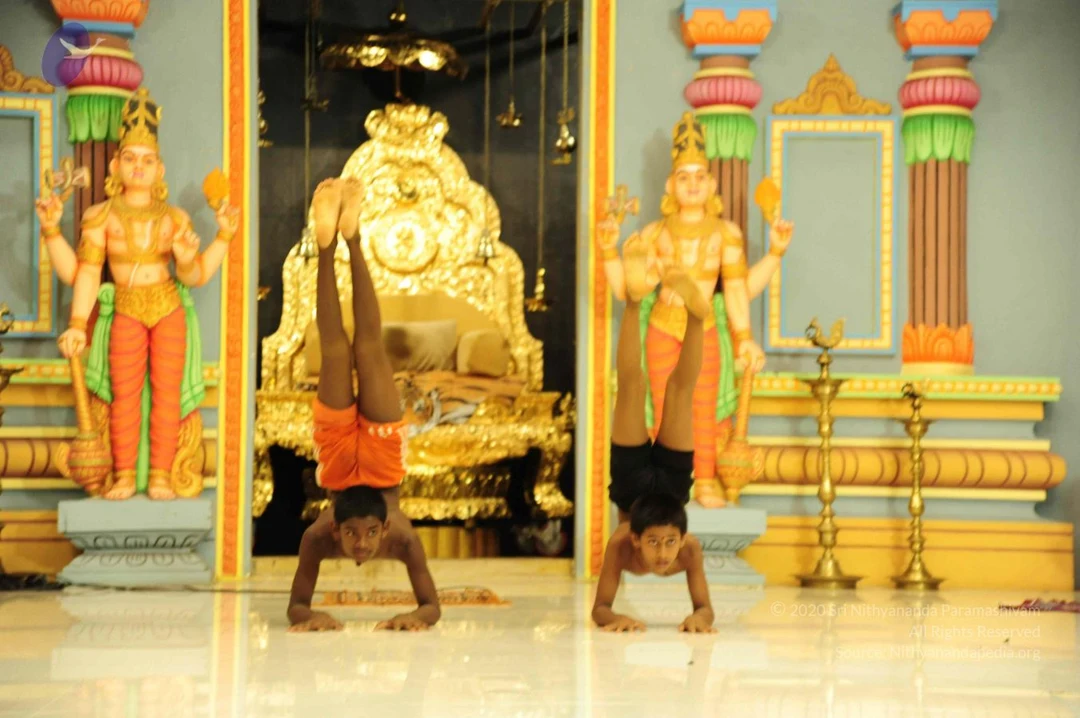
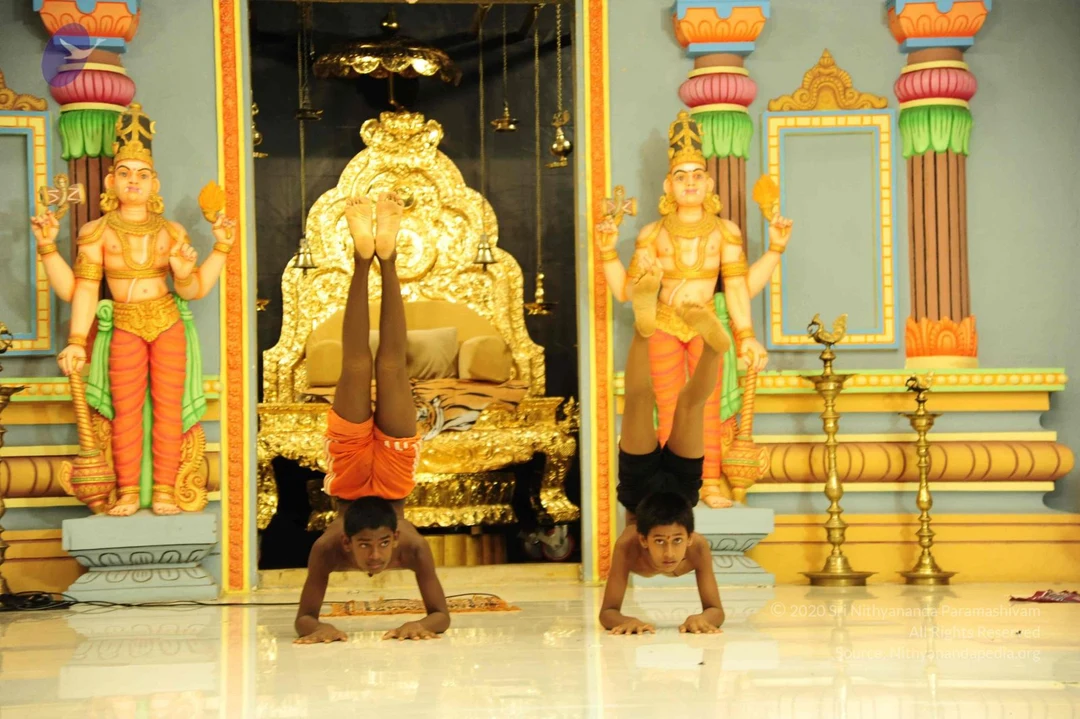
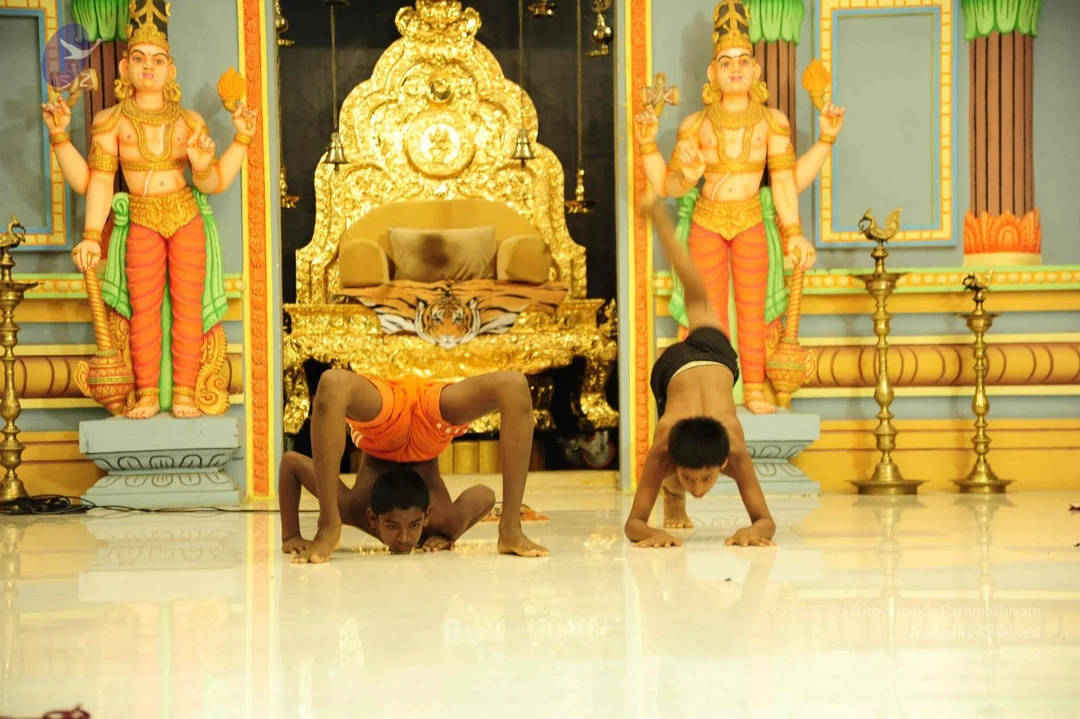
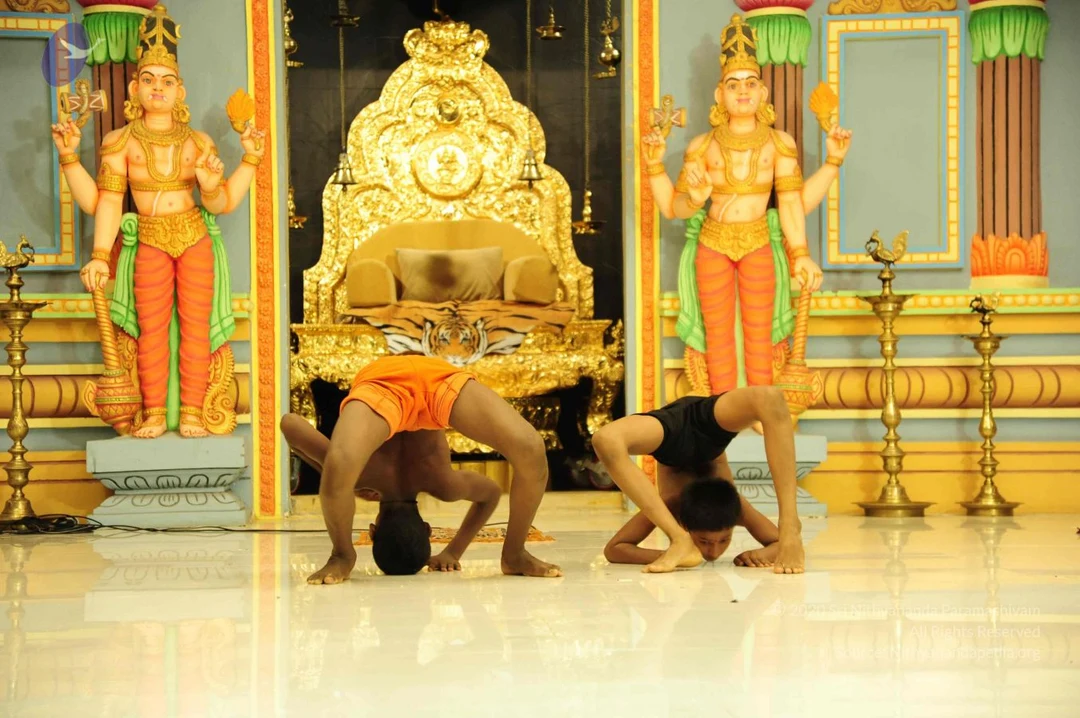
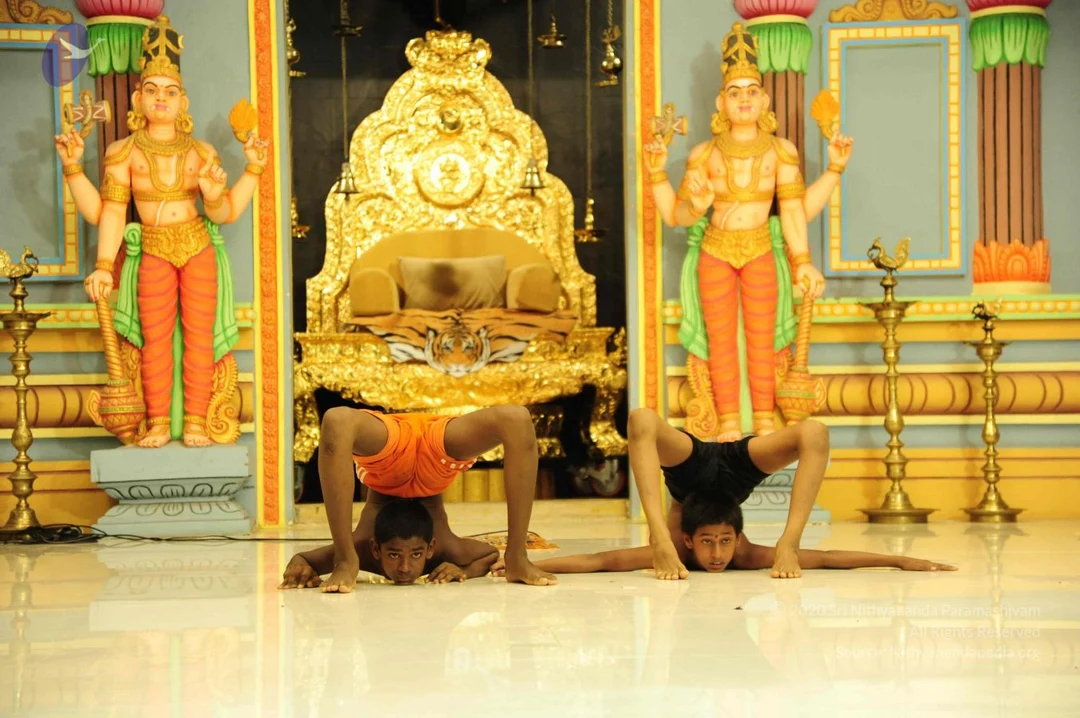
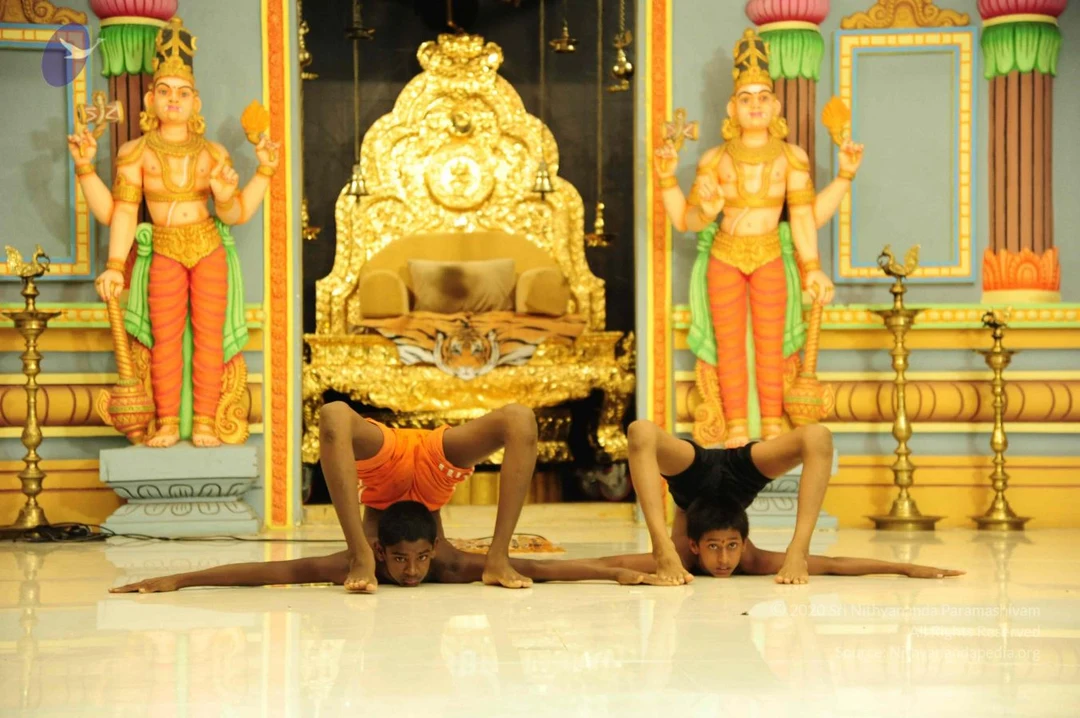
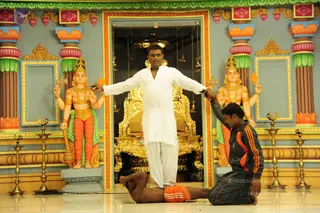
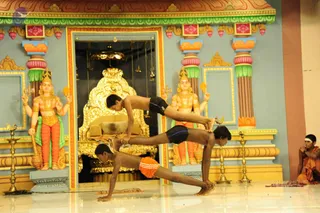
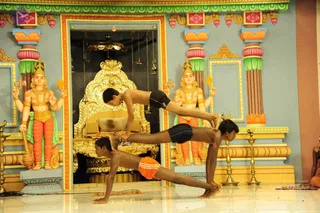
A photograph inside a temple-style hall with painted pillars and two painted deity statues flanking a golden throne and a hanging brass lamp. A man in white kurta and white dhoti stands with arms outstretched, holding the hands of a kneeling man in a dark tracksuit with orange stripes. A third man in orange shorts lies prone on the polished floor beneath them. Brass oil lamps stand along the base of the walls. The throne is empty and the scene appears to be a demonstration of a physical or energy practice rather than a formal puja. No clearly identifiable candidate for a person is visible in the foreground figures.Two shirtless boys in dark and orange shorts perform a balancing martial-arts or kalari-style stance on a polished white stage in front of an ornate golden throne (peetha) framed by colourful painted pillars and two painted standing deity murti figures holding attributes. Brass oil lamps stand on either side. Two seated men at the right edge watch: one in an orange robe with a shaved head, the other in white dhoti and shirt with a shoulder bag. Red and maroon drapery hangs above the stage.Photograph of two young boys performing an acrobatic stacked pose in a temple hall. The boy on the bottom, in an orange shorts, is in a hand-and-toe bridge position supporting a second boy in black shorts whose body is held horizontally above, with a third boy in black shorts arched on top. Behind them stands a gilded throne with cushions and hanging brass bells, flanked by painted deity statues with multiple arms holding objects and brass oil lamps on the floor. At the right edge a seated man in orange robes and a white headband watches. The walls are painted in blue, green, pink and yellow with ornate pillars and a gold-patterned ceiling.Two young male performers in shorts, one in orange and one in black, are doing an acrobatic yoga or gymnastic pose on a polished floor in a temple-style hall. The upper boy balances in a backbend with his feet resting on the lower boy's back. Behind them stands an ornate golden throne-like seat with a golden canopy and hanging bells, flanked by two tall painted murti figures of four-armed deities with gold crowns, rudraksha-style necklaces, orange dhoti and green sashes, holding ritual objects. Brass oil lamps stand at the sides, and a seated person in orange is partly visible at the far right edge.Three young boys perform an acrobatic yoga or gymnastic display in a temple-style hall. The boy in the foreground supports himself on his hands, one leg lifted, while the boy above balances on his back with arms outstretched, and a third boy in black shorts is in a bent forward posture. Behind them stands a large golden throne with cushions, flanked by two colourfully painted deity statues with multiple arms, crowns and green-and-orange dhotis. Brass oil lamps stand on the glossy white floor, and hanging gold bells and lamps dangle above the throne. A small partially visible figure sits at the far right edge.Three shirtless young boys perform a stacked acrobatic or yoga-style pose on a polished white marble floor in a temple hall. The lowest boy in an orange shorts braces on his hands and knees, a second boy in black shorts balances across his back, and a third boy in black shorts arches above with his feet on the second boy's back. In the background a golden ornate throne with cushions stands between two painted statues of deities with multiple arms, crowns and gold jewellery, both in orange and green dhoti. Brass oil lamps stand on either side of the floor, and a gold-framed doorway hangs with bells. The setting is a Hindu temple-style stage.

DARSHAN
71 photosSource gallery
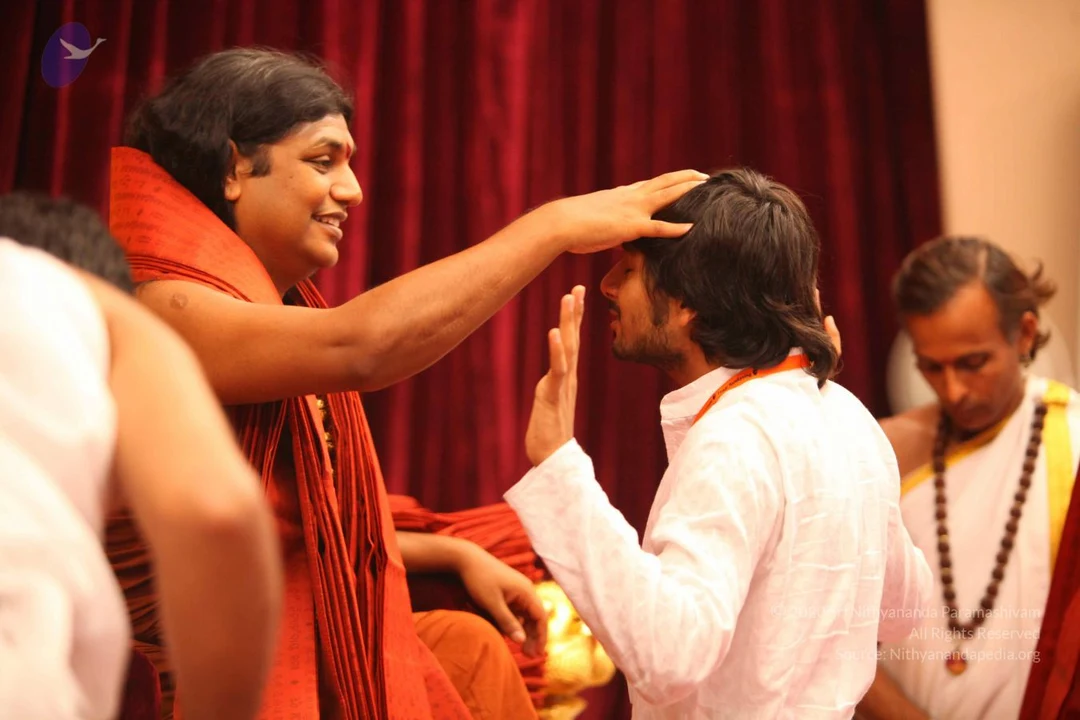
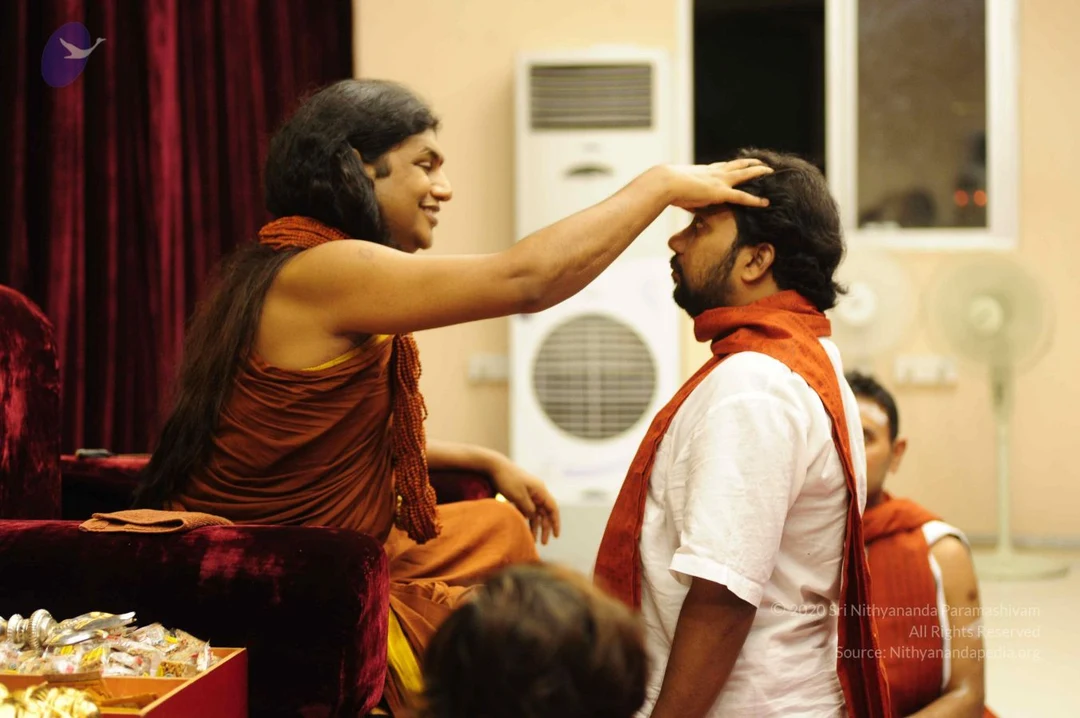
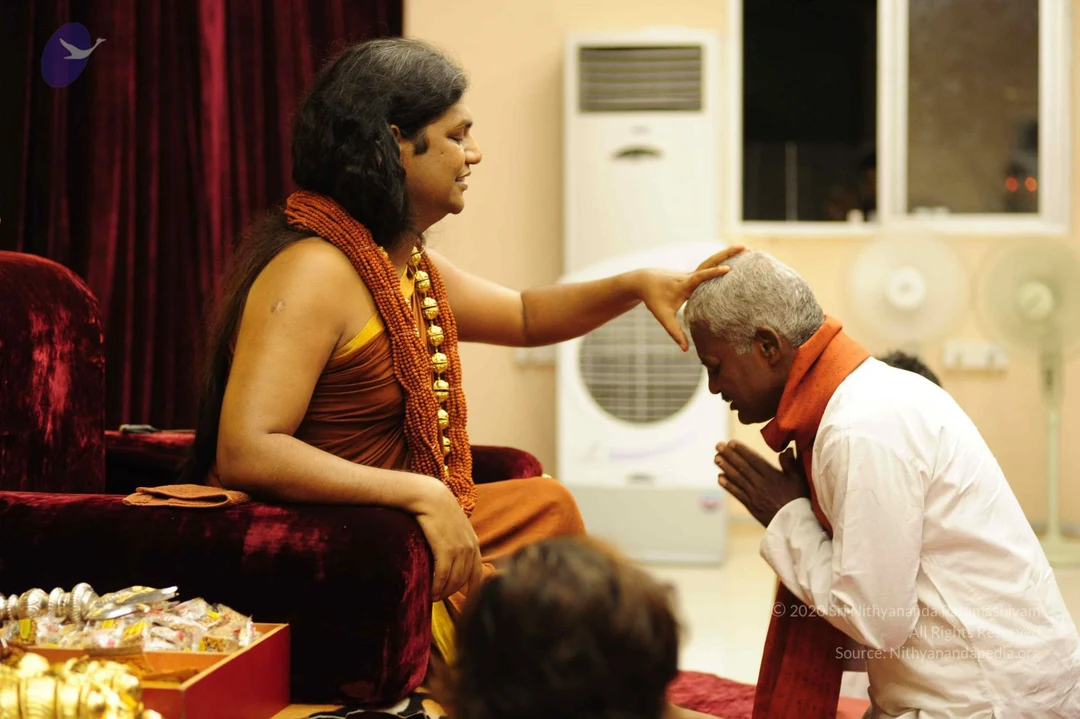
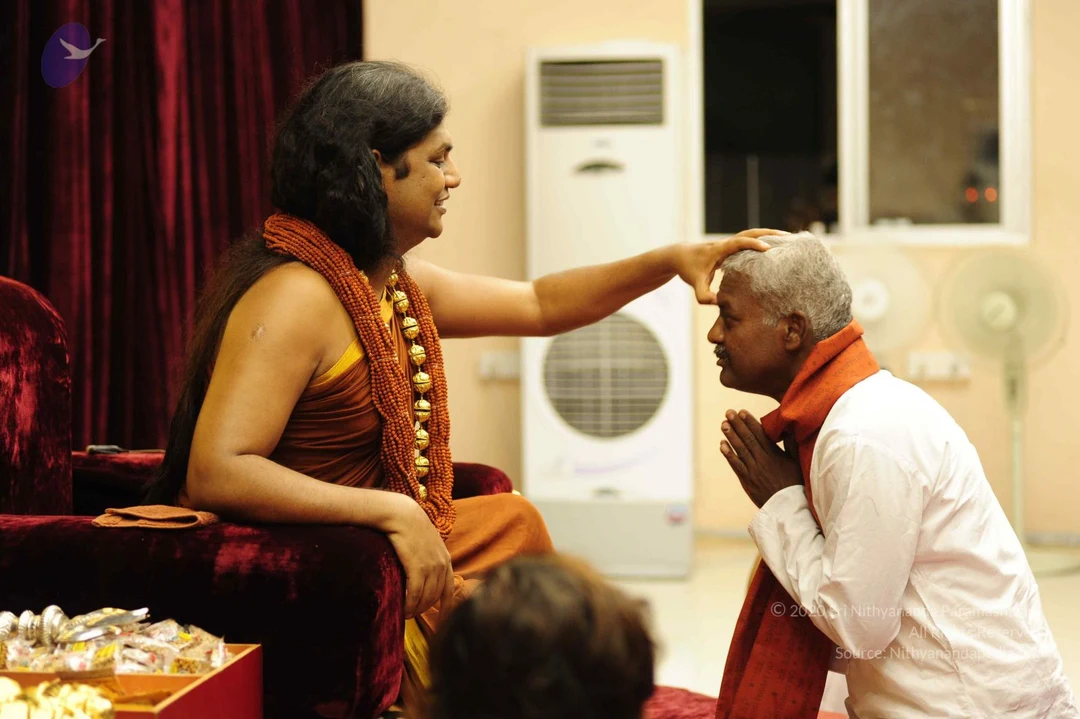
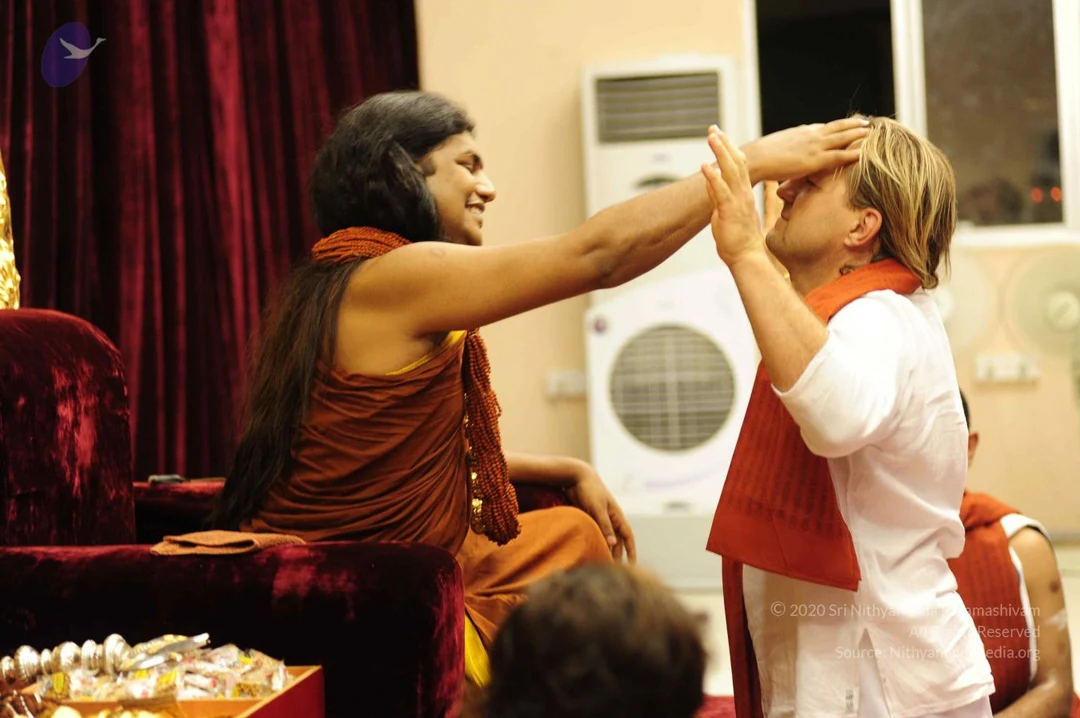
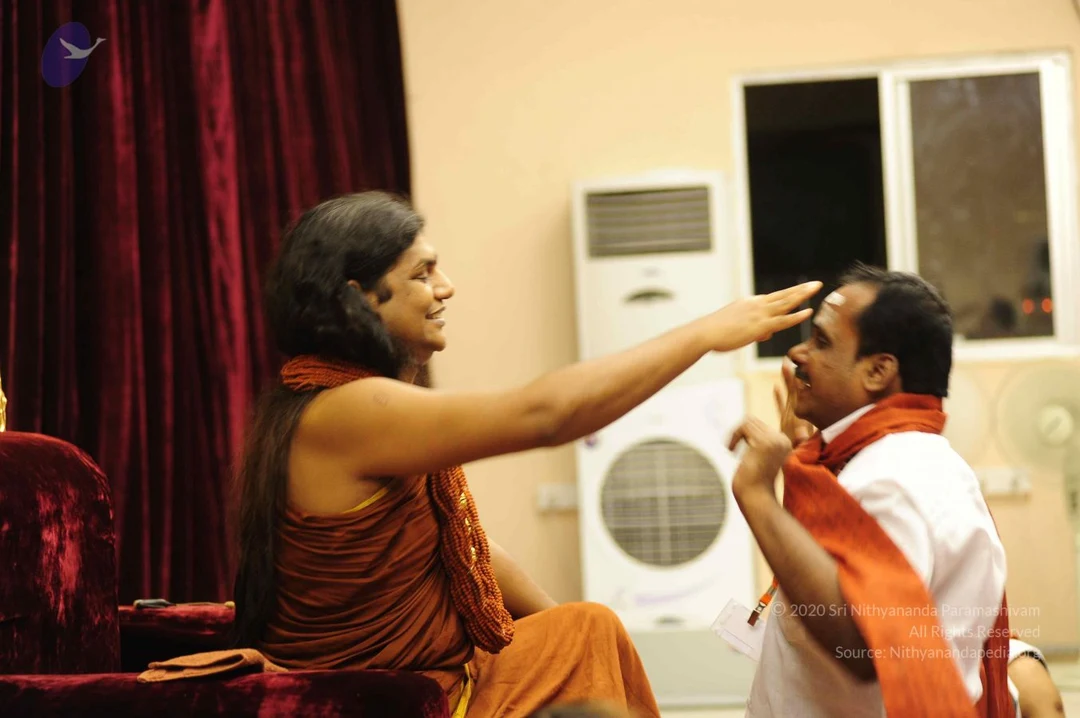
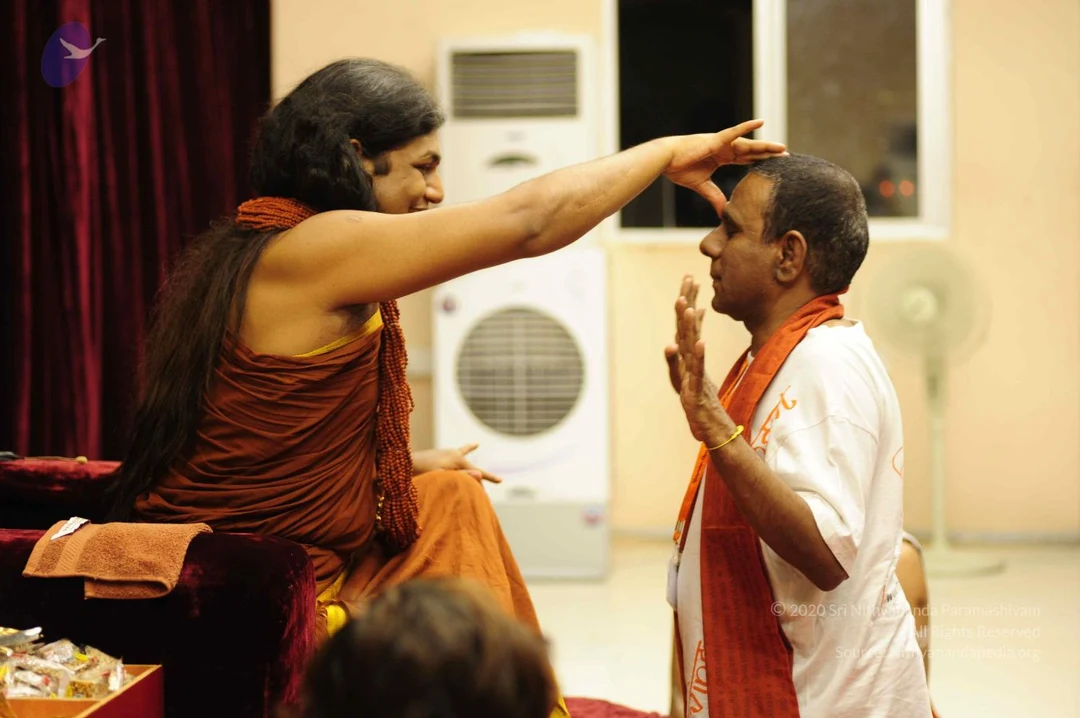
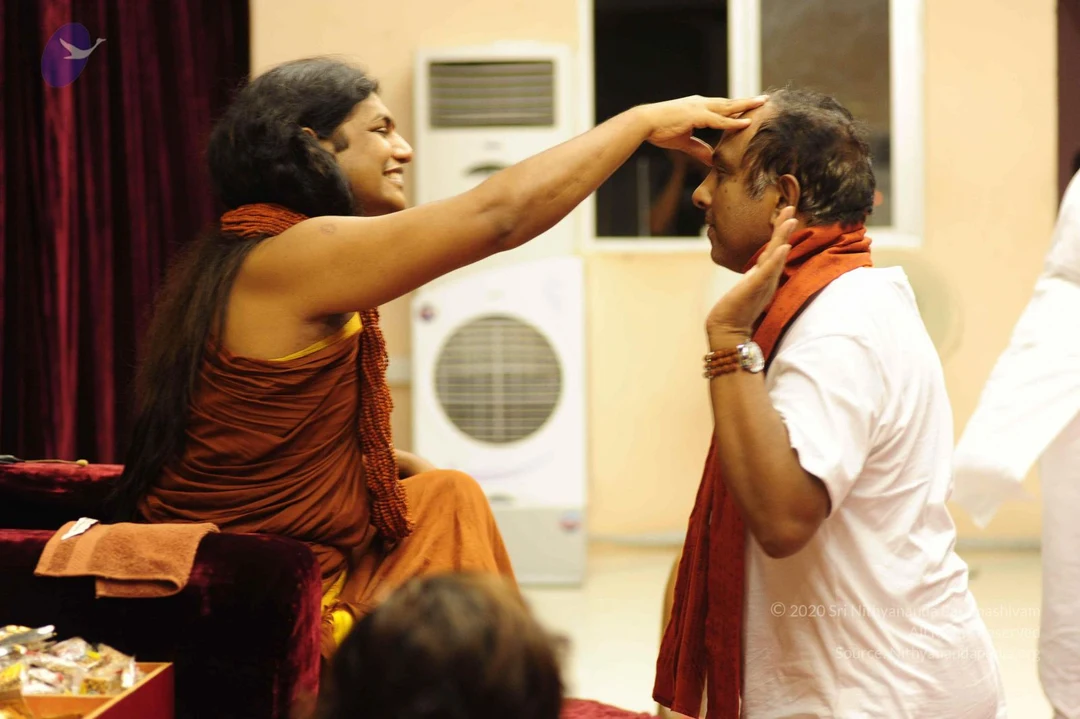
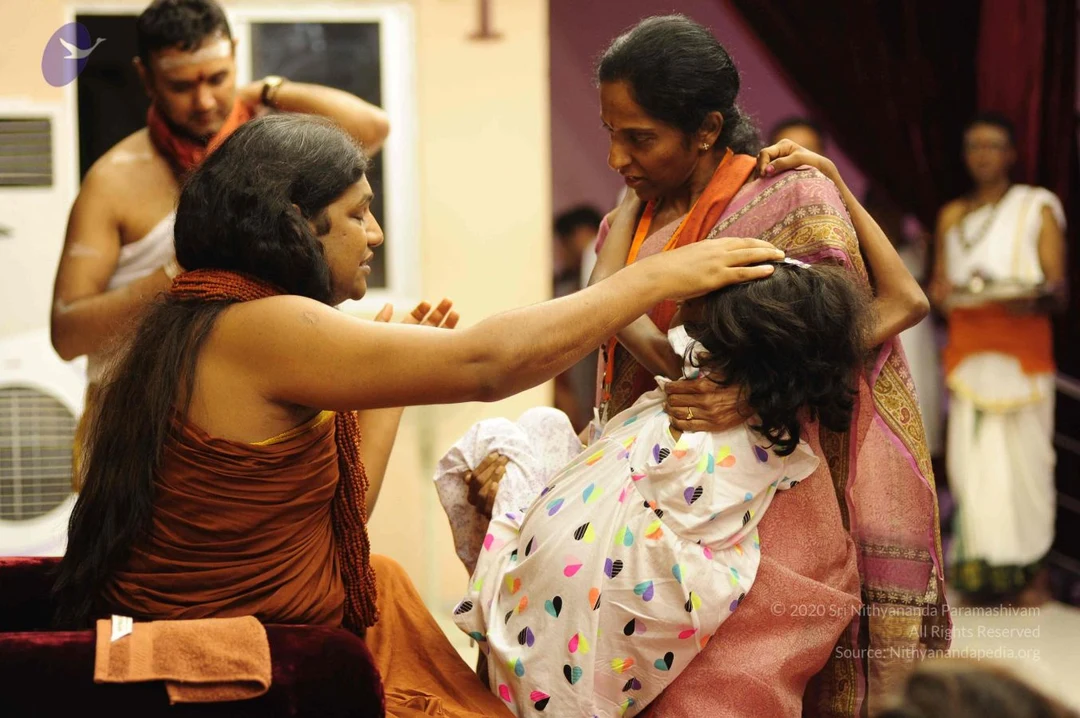
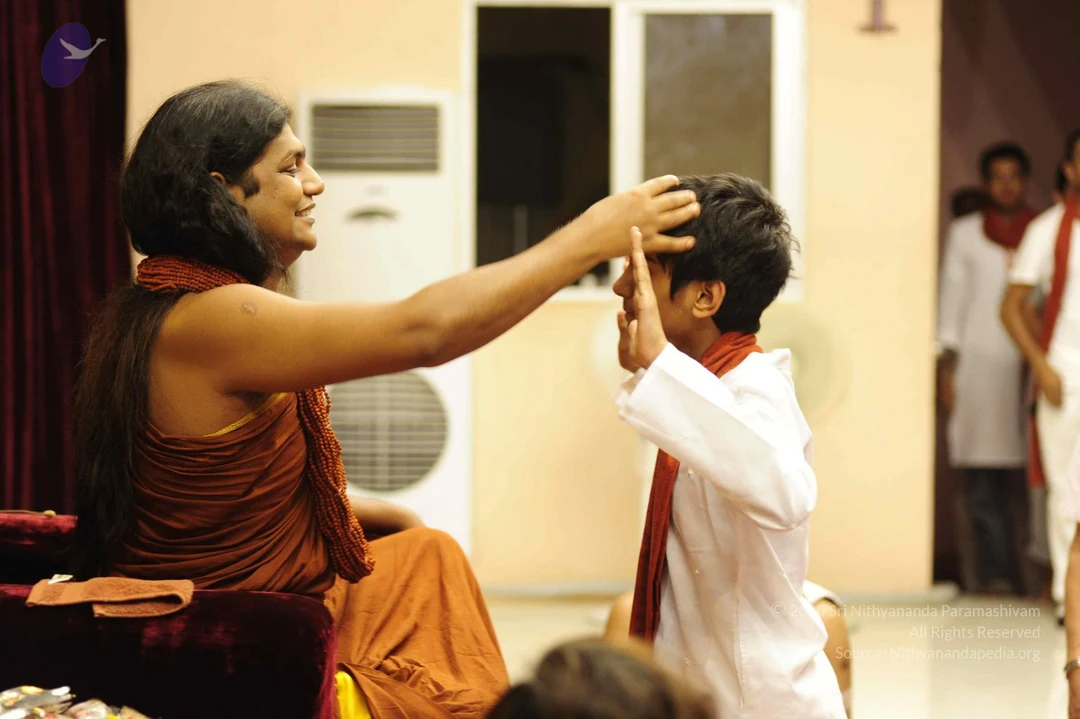
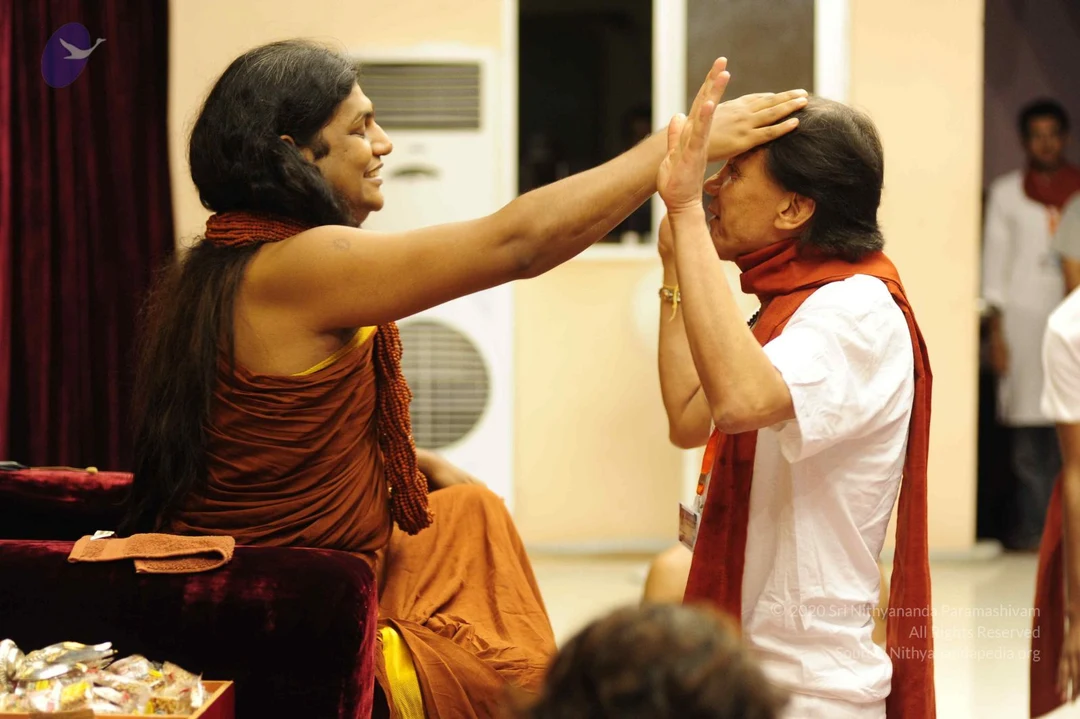
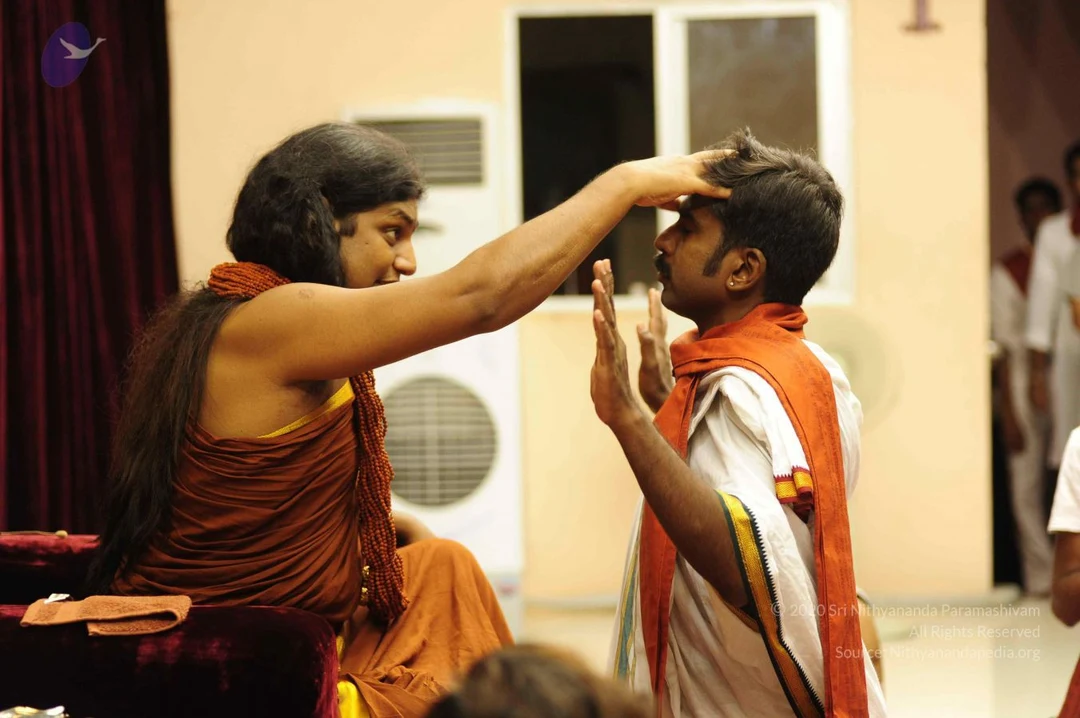
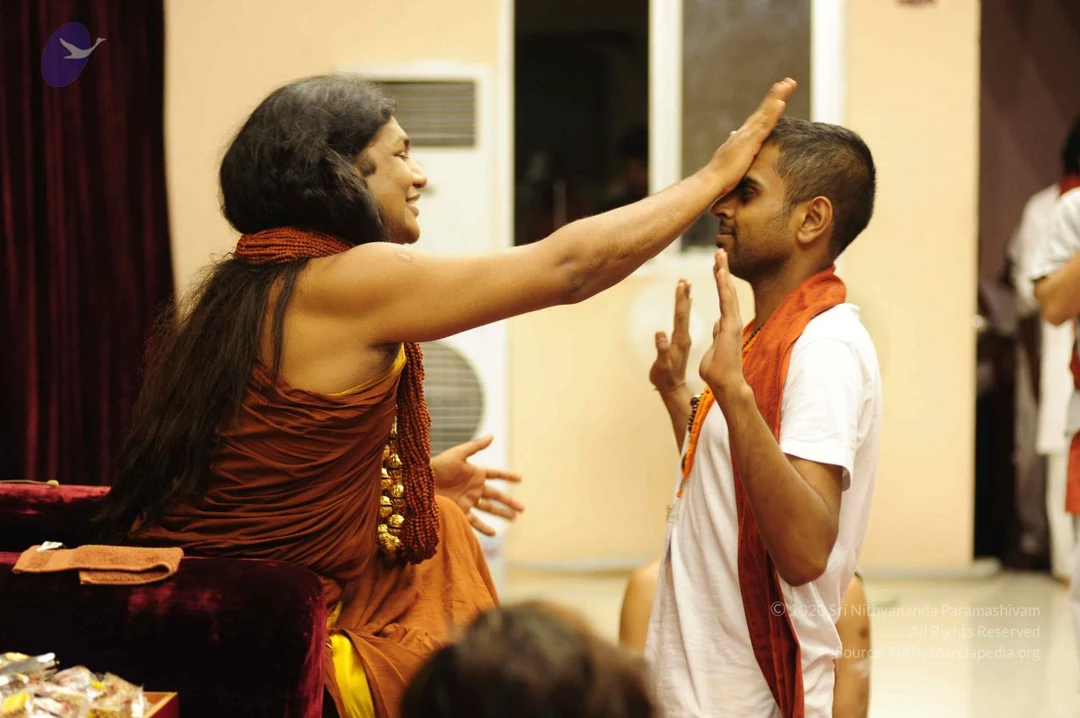
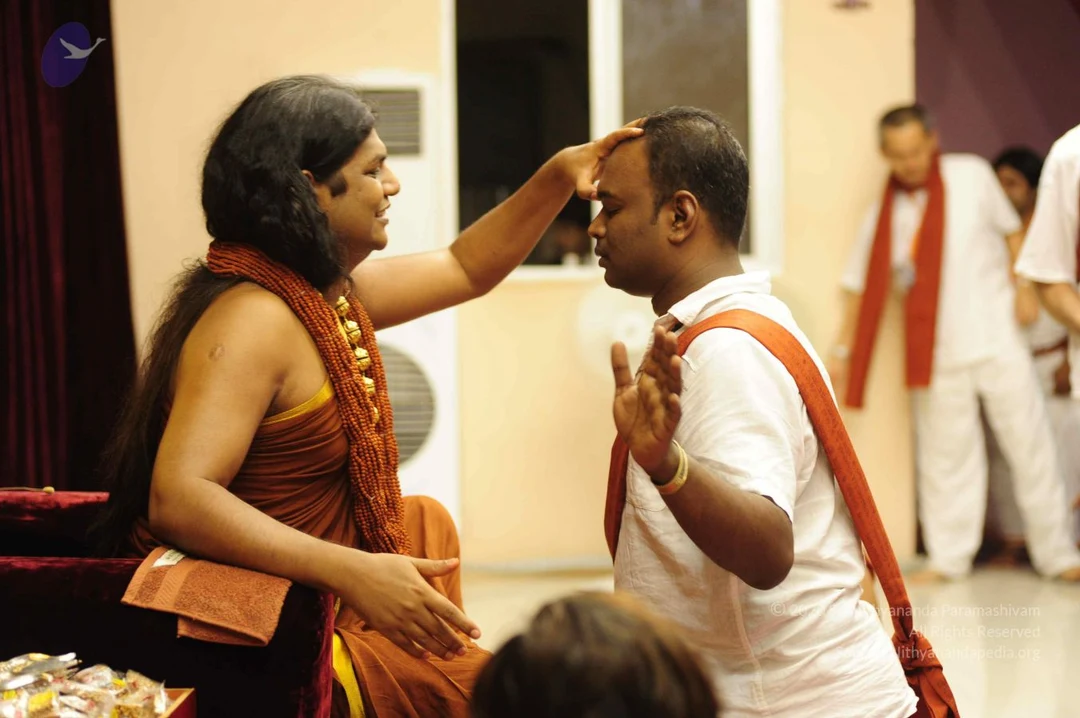
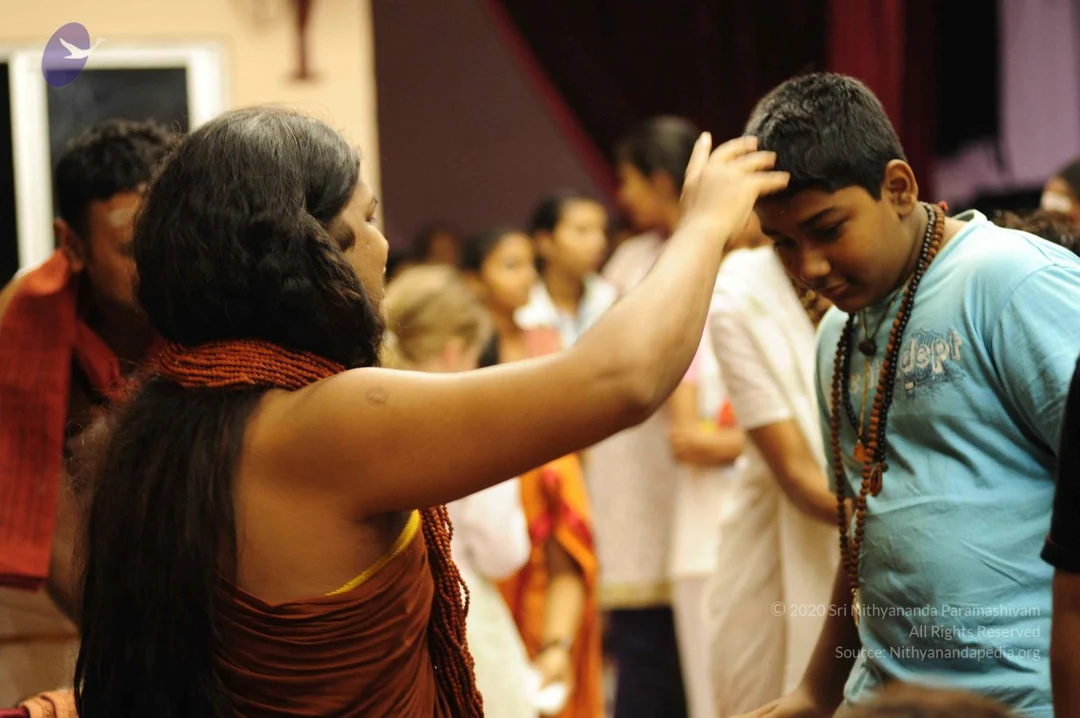
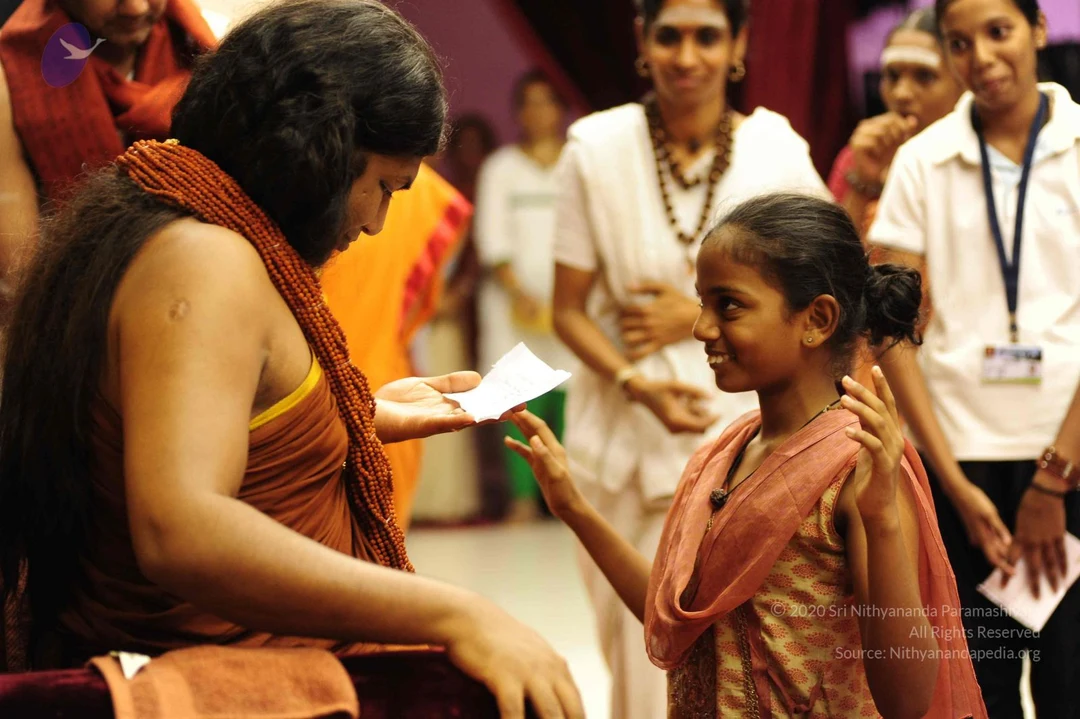
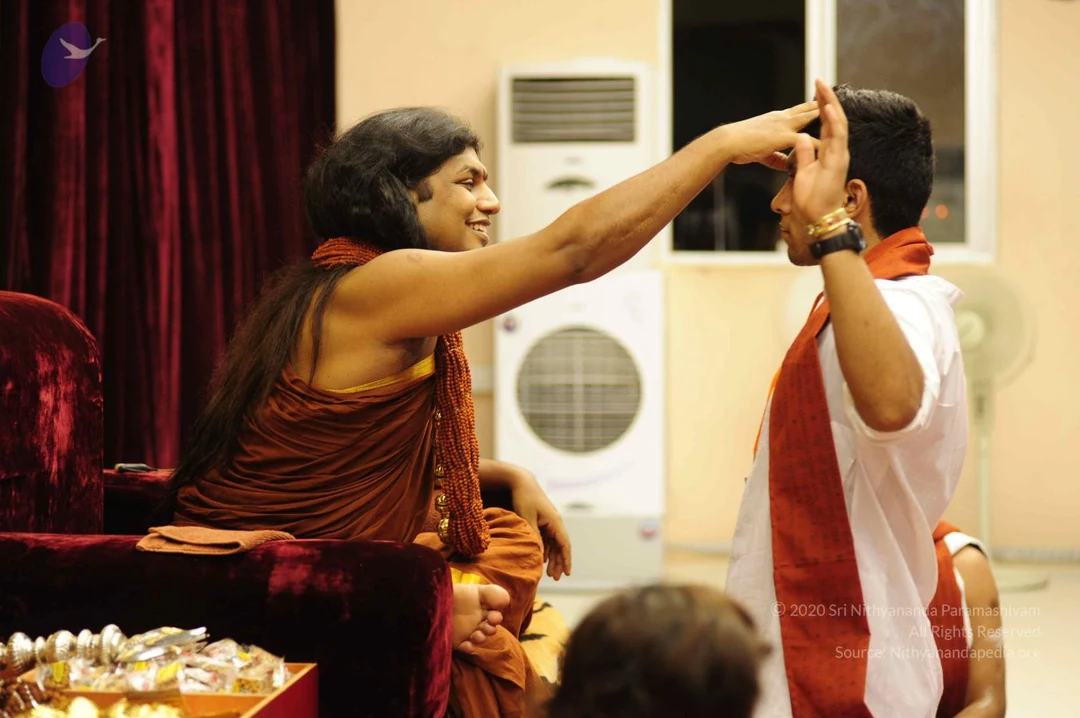
A seated figure in long dark hair and an orange-brown garment wears a long rudraksha mala and a gold ceremonial necklace, holding a sheet of paper and reading it on a red velvet throne. A kneeling man in a white shirt with a rudraksha mala extends his hand toward the paper while a woman in a white sari with a red border stands at right. A small tray of wrapped sweets, a folded orange towel and a white air conditioner appear in the room.A seated figure with long dark hair and a rust-brown wrap, wearing a rudraksha mala and a gold necklace, reaches forward with both palms pressed to the head of a bald, older man in a white shirt with an orange-saffron shawl draped over his shoulders, who bows forward with hands raised. The seated figure sits on a deep red velvet throne-style chair beside a gold-painted panel and red curtain. A tray with silver ritual vessels and offerings sits in the foreground, with a white air conditioner unit on the wall behind. Two or three other people are partially visible at the lower edge, including the top of a head. a person: the seated figure has long swept-back hair, a rudraksha mala and ceremonial gold necklace, and is seated on a throne, consistent with the page's listing of a person at this event.Indoor satsang scene in a room with a maroon velvet curtain and a white floor-standing air conditioner behind. A man with long dark hair, wearing an orange-brown cloth, a long orange-red rudraksha mala and a gold-beaded necklace, sits on a maroon velvet seat extending his right hand toward a younger man in a white t-shirt with an orange-red shawl and a rudraksha mala. The younger man kneels with palms pressed together and fingers raised in a gesture of reverent address. A woman in an orange sari stands at the left edge, and a partly visible head appears at the bottom. The seated man has the appearance of Swamiji (probable), based on long swept-back hair, rudraksha mala and saffron-toned clothing, and is shown in his role as the teacher giving satsang.A seated man with long dark hair and an orange-brown garment, wearing a rudraksha mala with gold beads, sits on a red velvet throne-like seat and reaches up to touch the forehead of a standing man with long light blond hair. The blond man wears a white t-shirt and an orange-red shawl, with a wristwatch and a name badge on his chest. Behind them are a cream wall, an air conditioner unit, a red curtain and a tray of silver and gold ritual objects with small packets, in an indoor satsang or darshan setting. Swamiji (probable): the seated man has long swept-back hair, a rudraksha mala and gold ceremonial beads.A photograph in a hall with a deep red velvet throne-style seat at left. A long-haired man in an orange-brown wrap and layered rudraksha mala with ornate gold beads sits on the throne, hands extended toward a kneeling devotee. The devotee wears a white shirt, white dhoti-style cloth and orange-brown sash, with a rudraksha mala, and presses his palms together to the forehead of the seated figure in a blessing gesture. A cream wall, an air conditioner, a red curtain and a few white-clad people stand in the background, with a small brass tray of offerings at the bottom edge. Appearance-based candidate matches the Swamiji cues of long hair, saffron-orange wrap and ornate gold necklace, so this is a probable in-person presence.A photograph of a seated figure with long dark hair, wearing an orange-brown saffron wrap, yellow inner cloth, and multiple strands of rudraksha beads with gold ceremonial ornaments, reaching out to touch the forehead of a kneeling man in a white kurta with a red-bordered cloth and a rudraksha mala. The seated figure rests on a red velvet throne-like chair in a room with cream walls, a red curtain, and a white floor-standing air conditioner. Another person's hand is raised at the right edge and a head is visible at the bottom.

NAVAGRAHA-HOMA
44 photosSource gallery
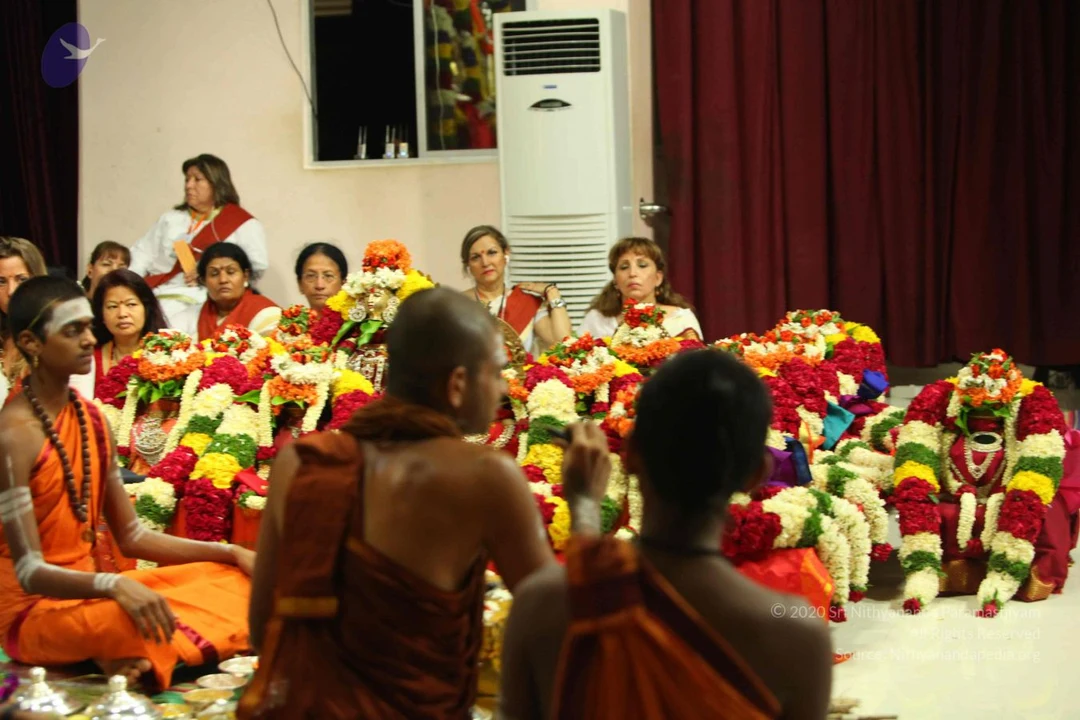
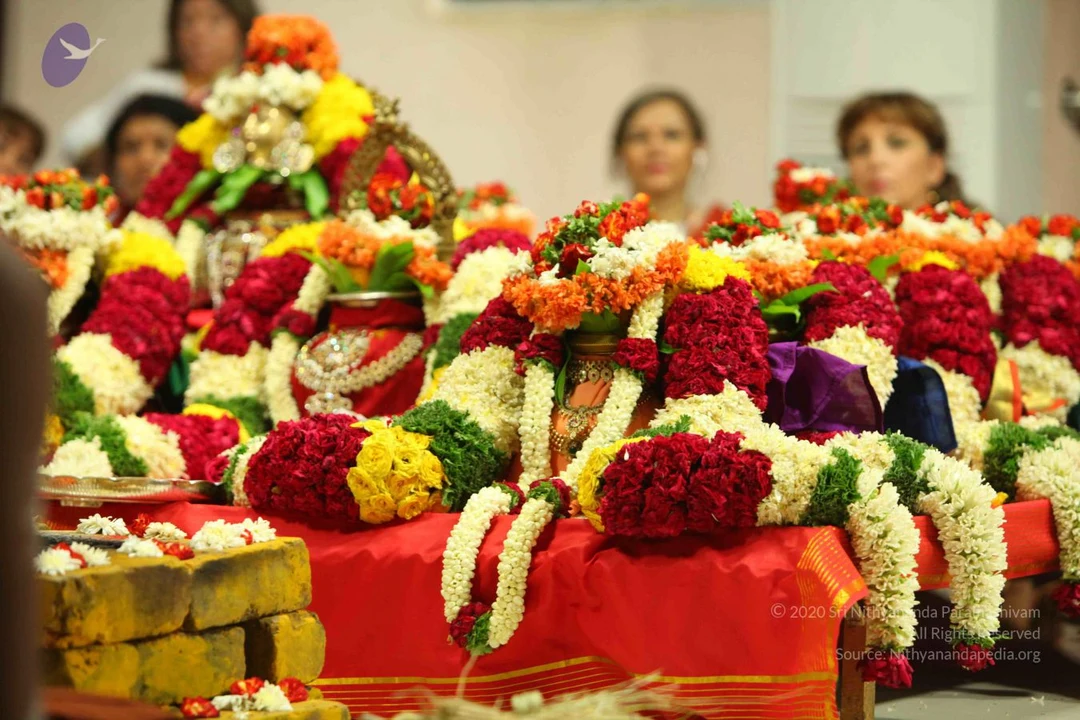
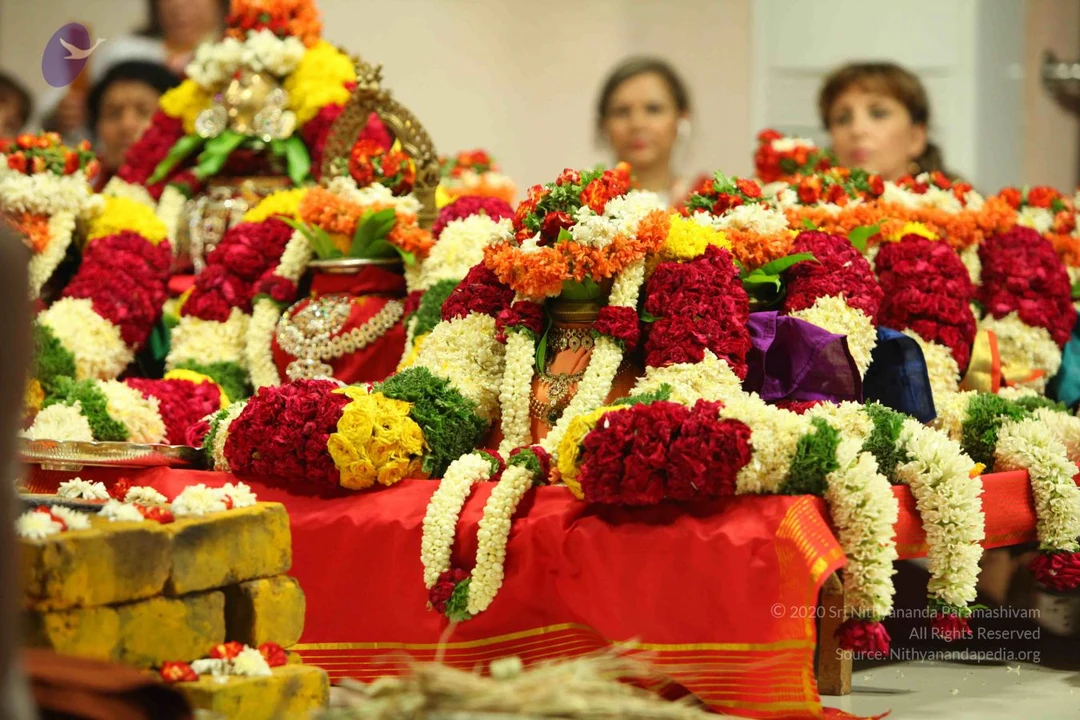
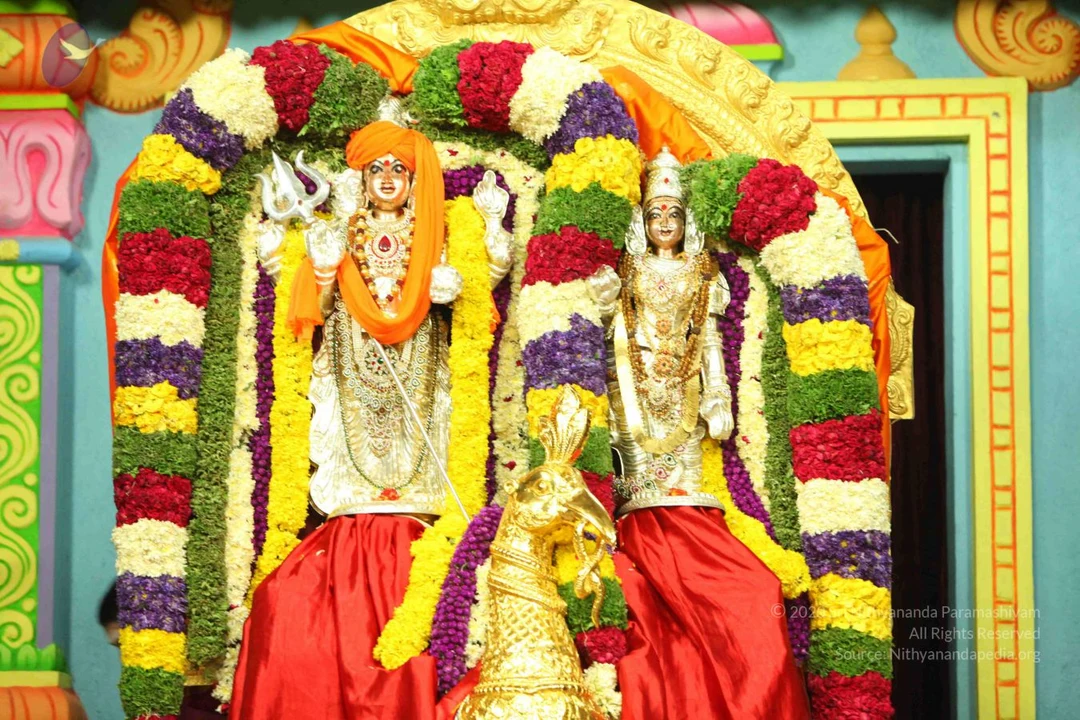
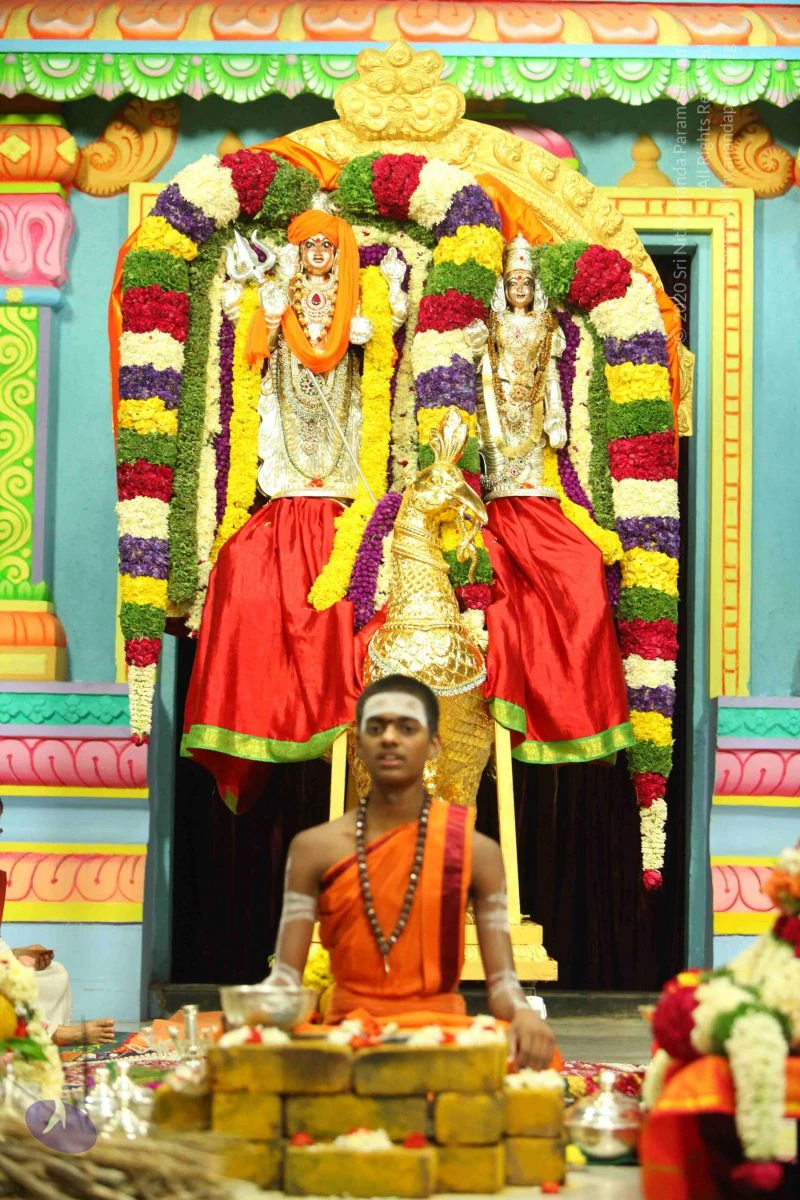
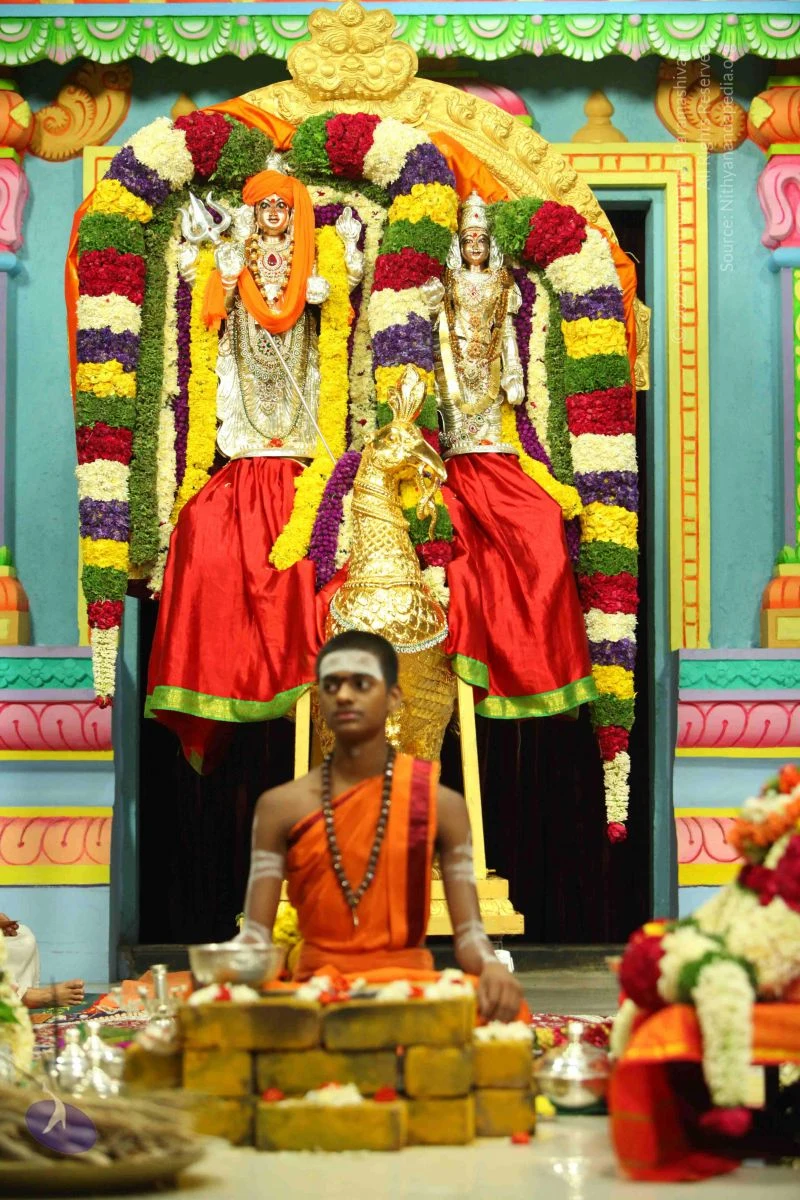
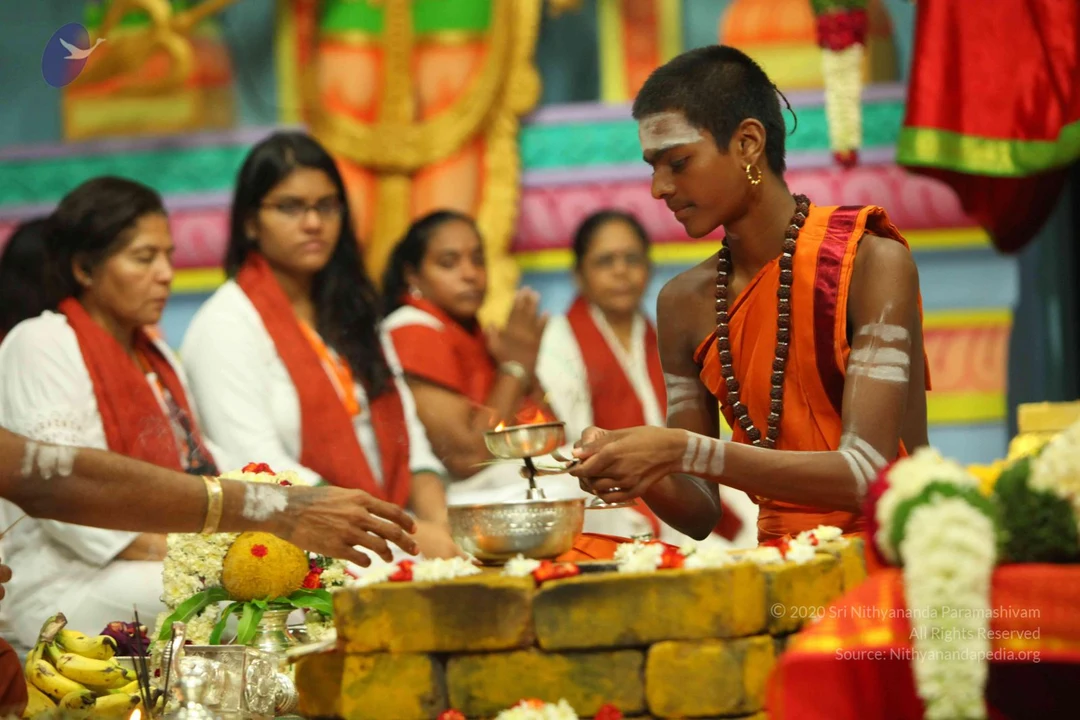
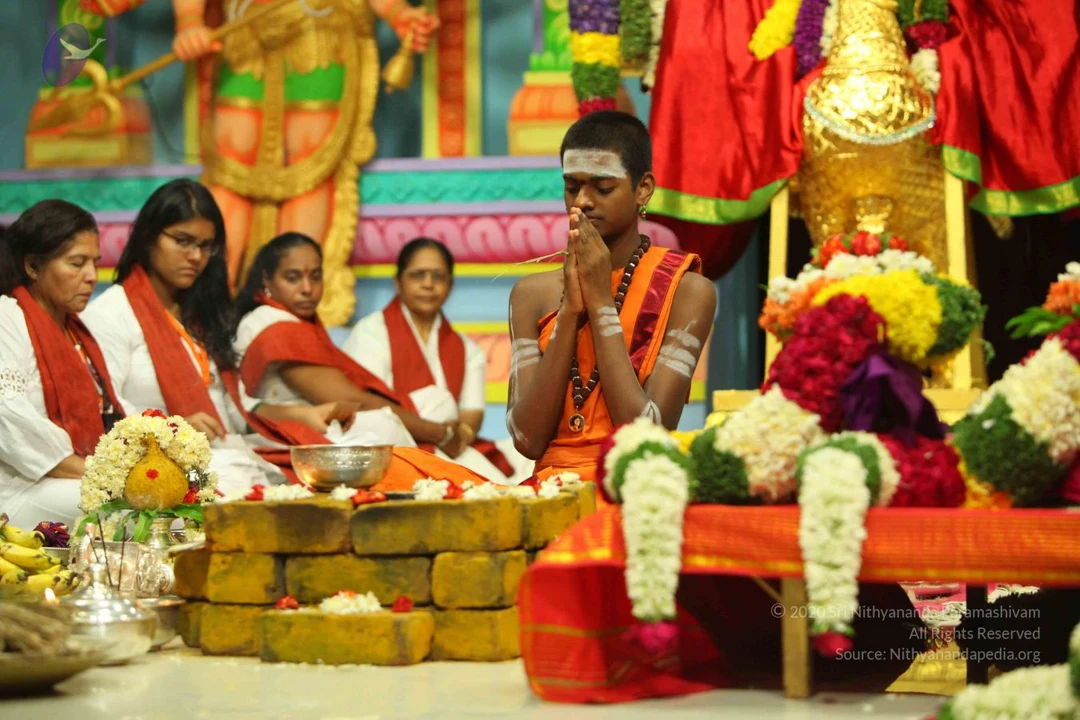
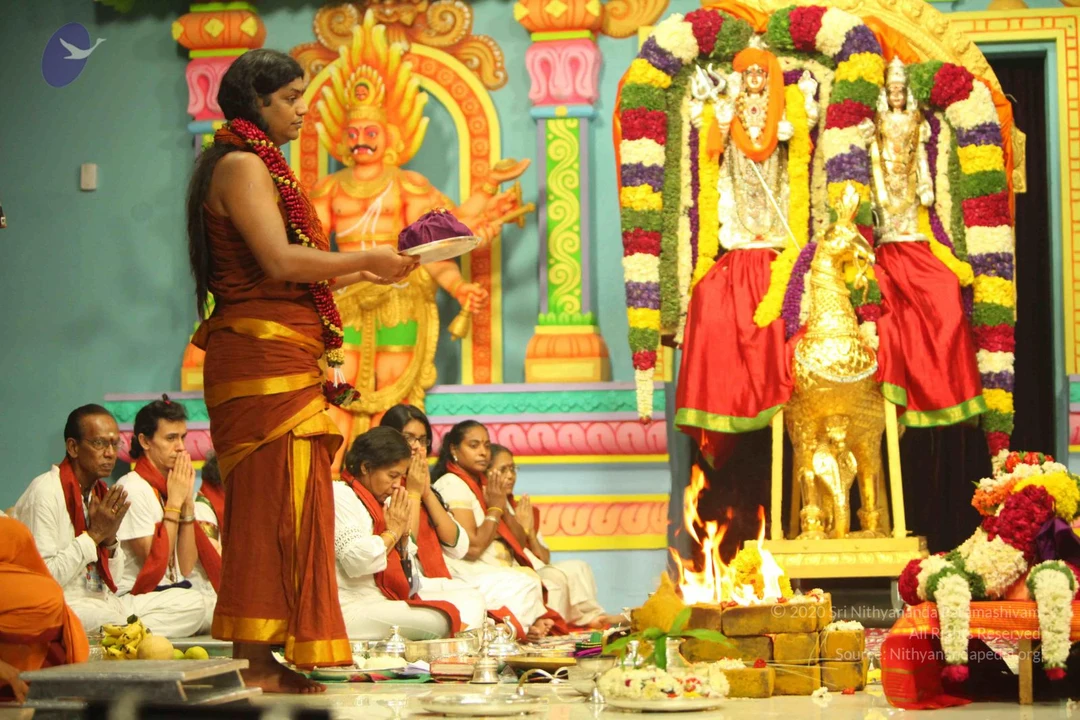
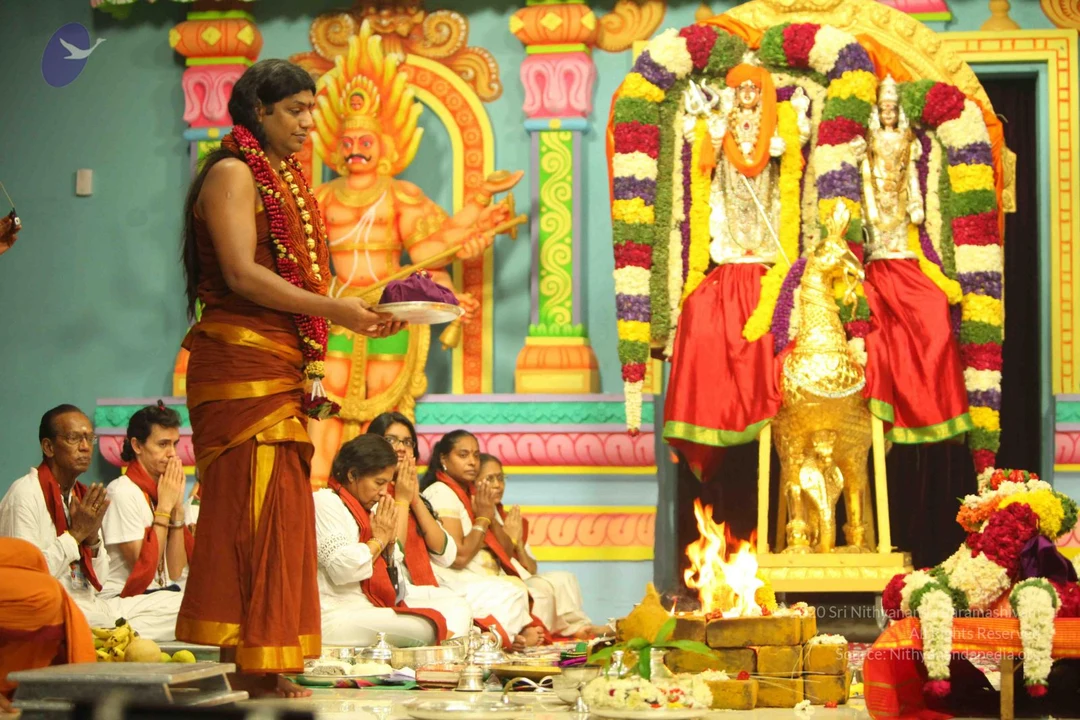
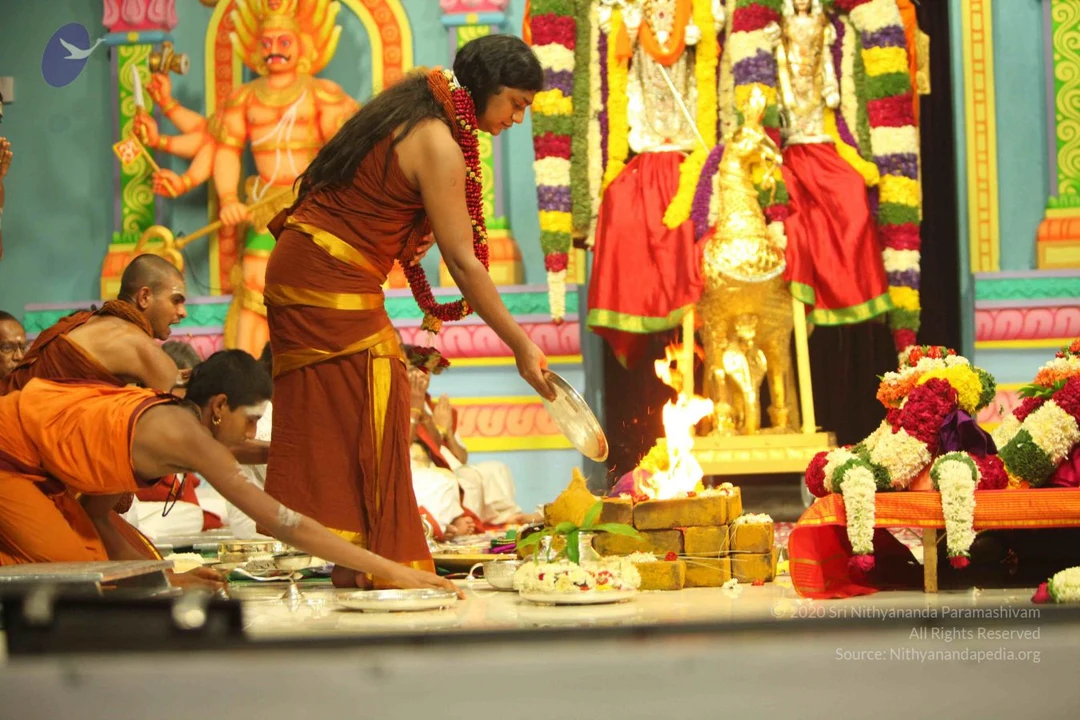
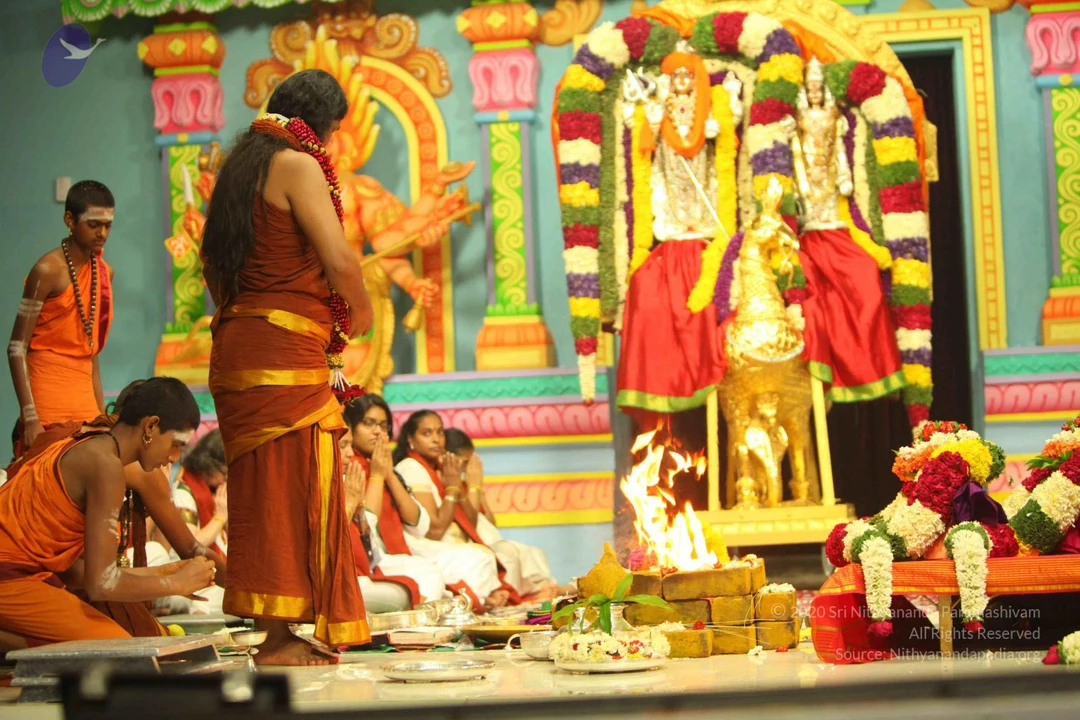
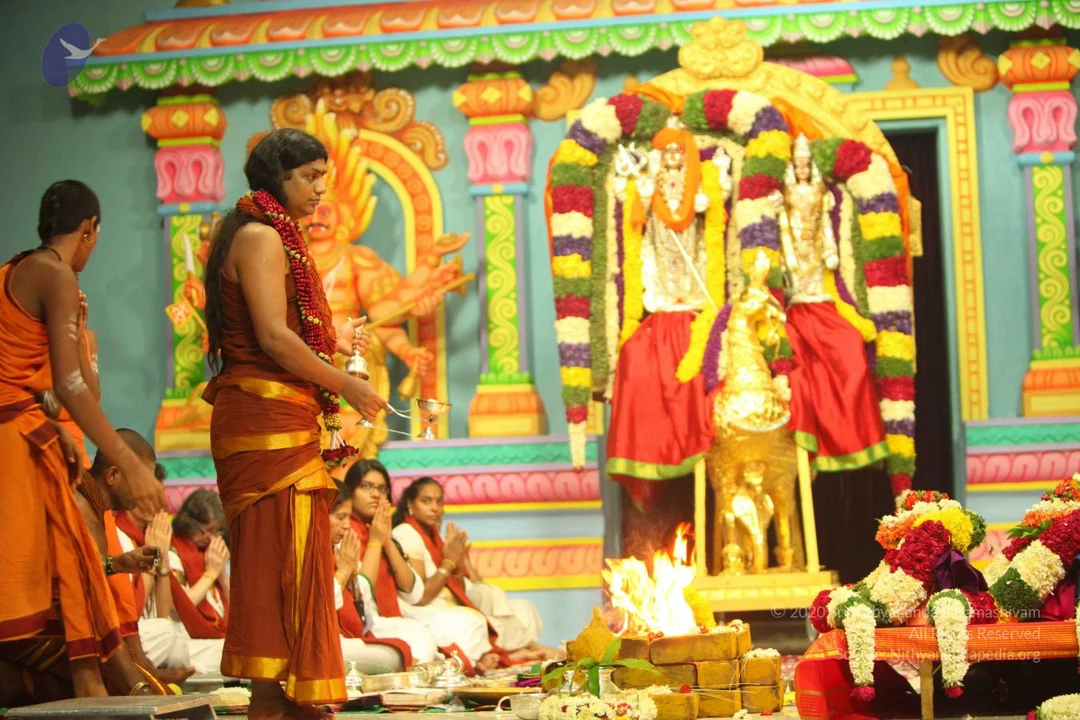
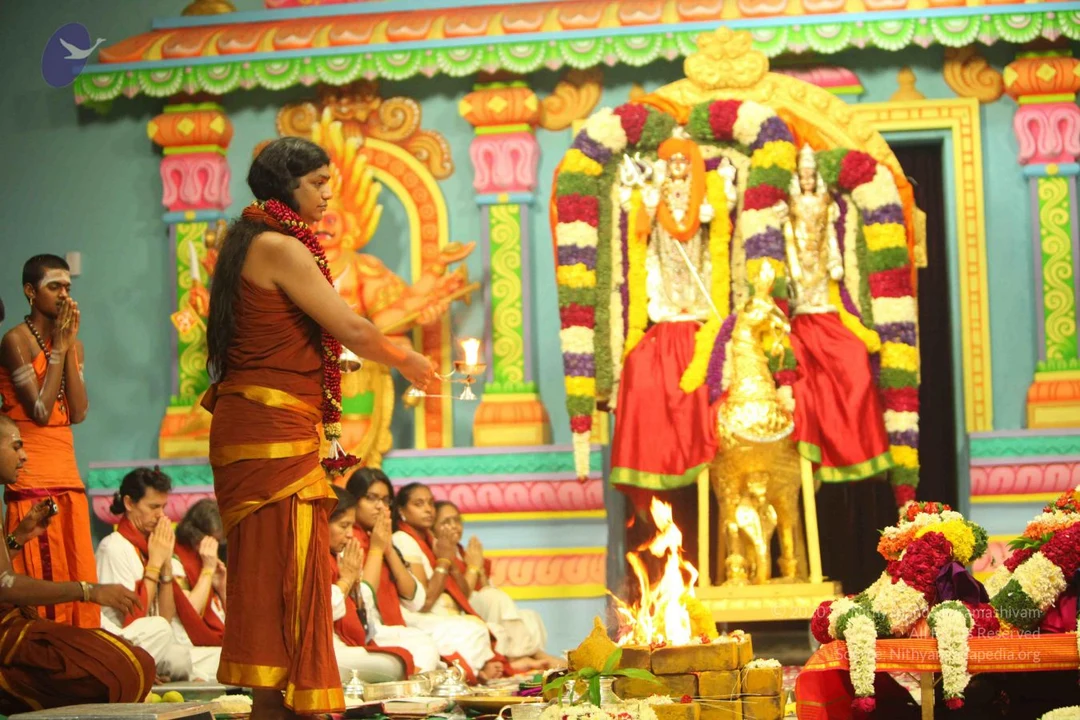
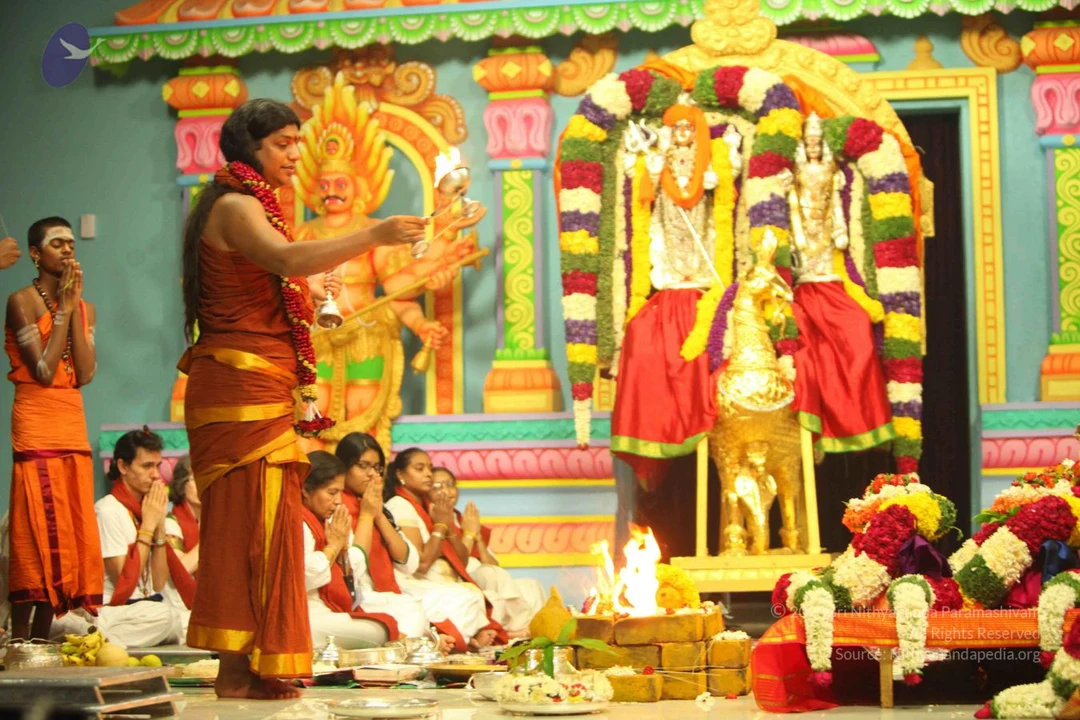
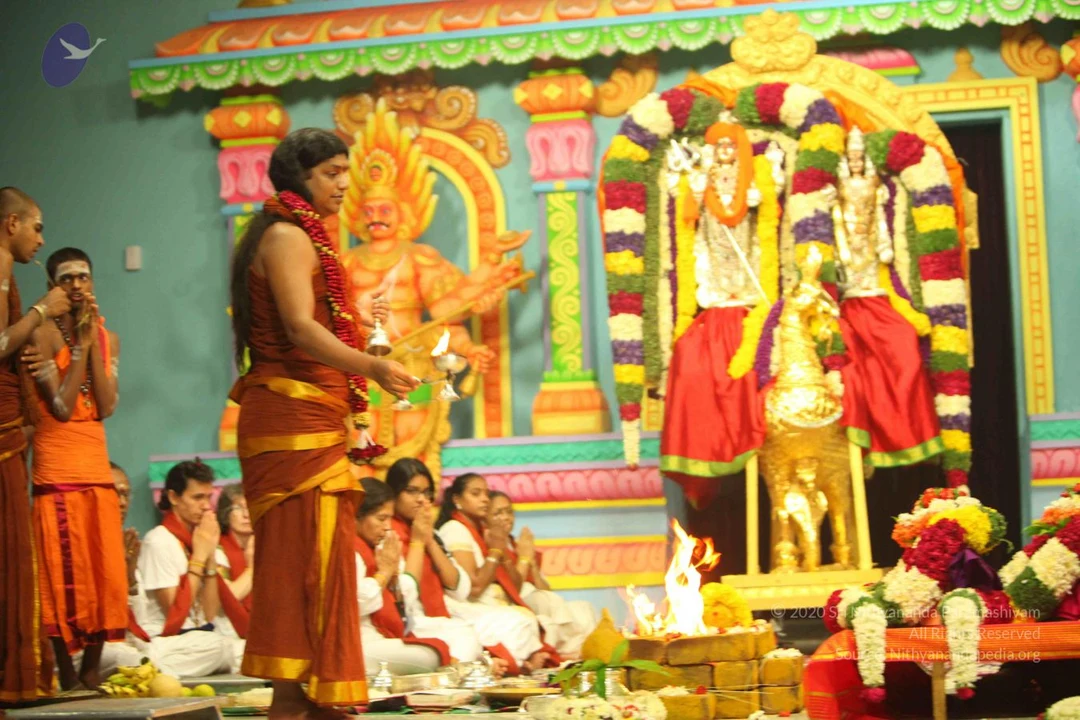
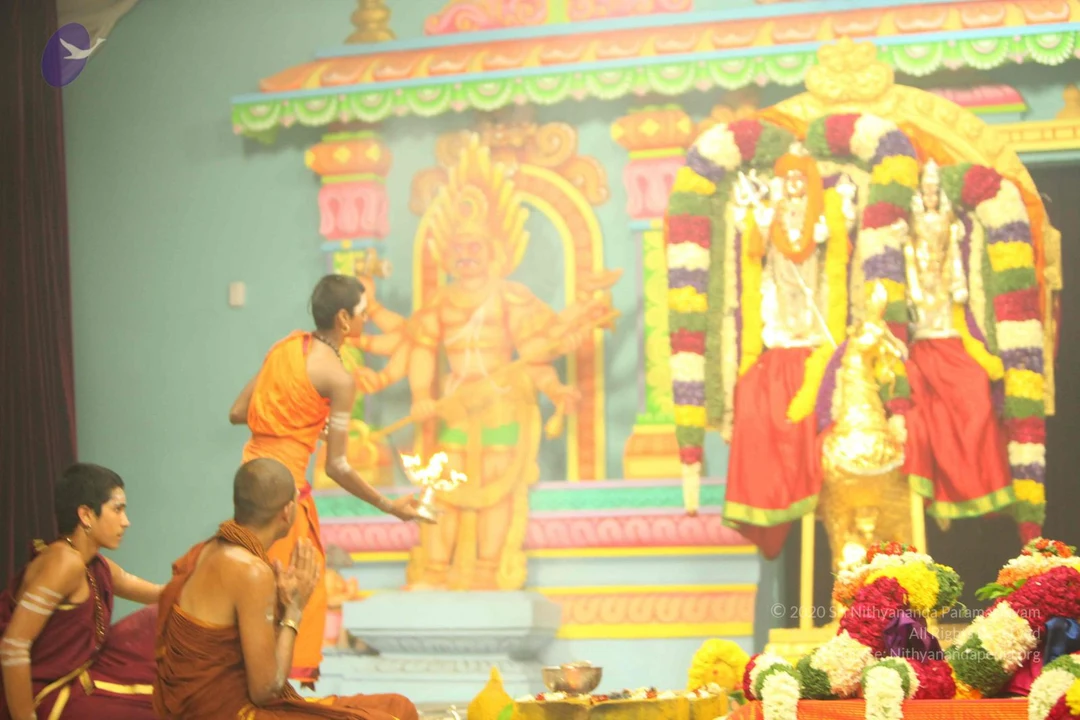
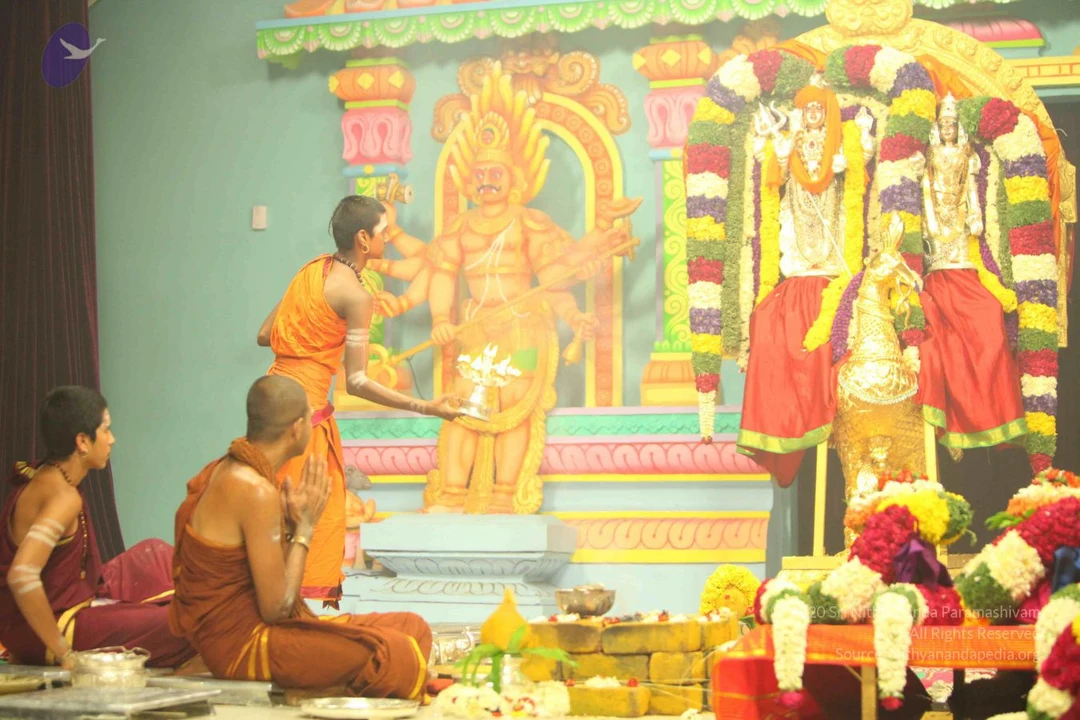
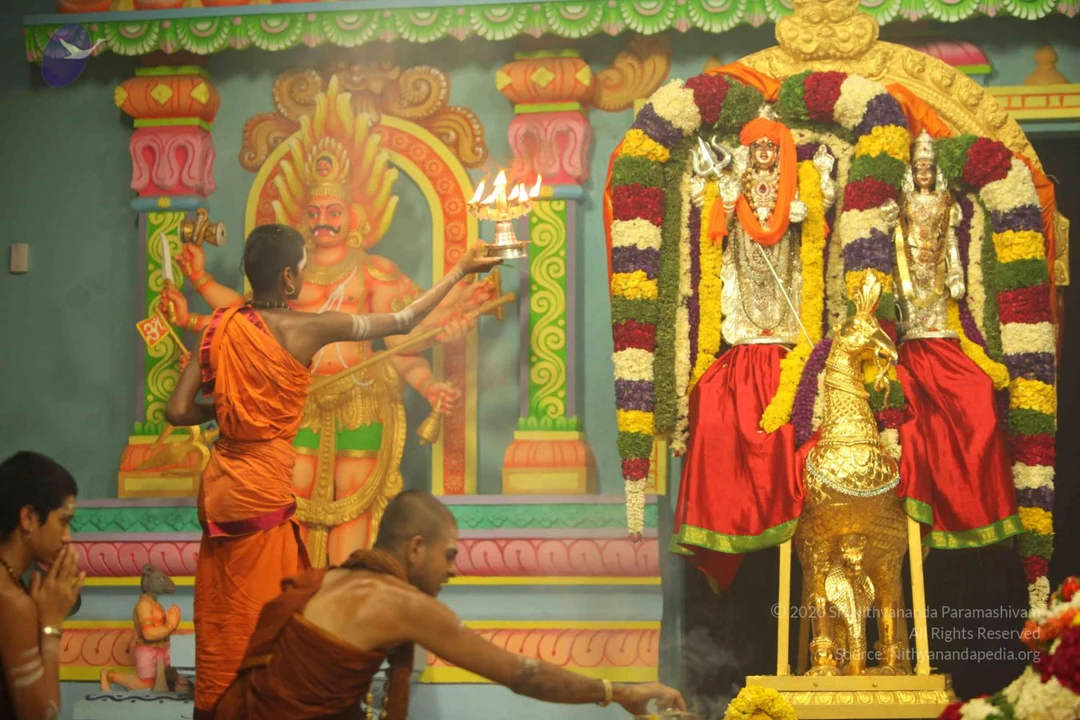
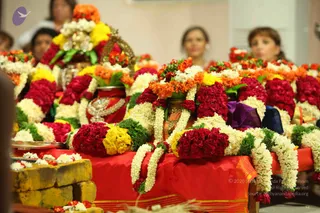
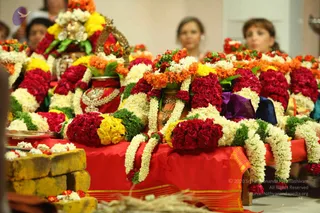
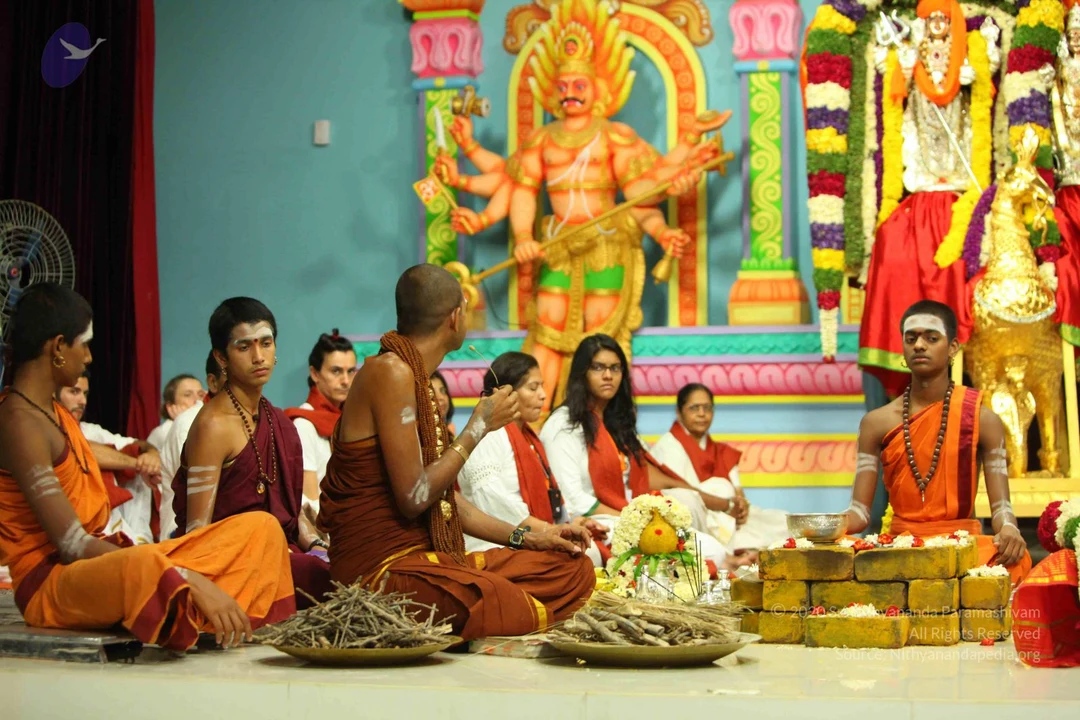
A ceremonial puja in a hall with maroon curtains and a white air conditioner. Several deity murtis are decorated with thick garlands of red, orange, yellow and white flowers and sit on a raised floor. In the foreground a shaved-headed young man with white vibhuti markings and a rudraksha mala wears orange robes and sits cross-legged beside a bare-backed priest in orange cloth and a younger attendant. Women devotees in white and red saris sit in rows behind the murtis, and a woman in white plays a small instrument at the back. Brass plates and offering bowls rest on the floor.A photograph of a ritual table draped in red cloth, laden with heaped garlands of red roses, yellow marigolds and white jasmine strands, with a brass kalasha-style pot and a decorated metal vessel among them. Yellow turmeric-coloured blocks sit at the left edge with scattered flower petals. Blurred women seated in the background, one wearing dark clothing and earrings, face the offerings.Close view of a ritual altar draped in red cloth, heaped with red roses, yellow marigolds, orange flowers and white jasmine garlands with green leaves. A decorated brass or copper kalasha-style vessel with a red-and-gold cloth sits at centre beside a deity murti adorned with garlands. Yellow brick blocks and scattered petals sit in the foreground. Two women's faces appear blurred in the background, and a purple cloth lies at right. No a person candidate is clearly visible.Photograph of a decorated shrine with two silver-finished deity murtis standing on red cloth bases, framed by a floral arch of red, yellow, purple, white and green garlands. The left figure wears an orange turban and orange shawl, holds a trident and ornate gold jewellery, and has a rudraksha-style bead necklace; the right figure wears a tall crown and heavy jewellery. A golden bull figure stands in front. Bright painted pillars frame the arch.A young priest in saffron-orange robes and a rudraksha mala sits cross-legged before a brick homa fire pit, with a bowl of offerings and marigold petals nearby. Behind him, a colourful temple shrine with a golden arch is draped in thick garlands of red, yellow, purple and green flowers. Two deity murti stand within, one in a saffron headcloth holding a trident, the other wearing a crown and red silk; a golden bull sits between them. The sanctum is painted turquoise, pink and yellow.A young priest in saffron-orange dhoti and shawl, wearing a rudraksha mala and white ash lines on his forehead and arms, sits cross-legged before a brick-built yagna/homa platform with a brass bowl and offerings of flowers. Behind him stands a shrine with two deity murtis in silver and gold ornaments, draped in a heavy garland of red, yellow, white, purple and green flowers, with a golden peacock/bird vahana beside them. Colourful painted pillars frame the shrine and a bouquet of marigolds sits at the right edge. The image shows a temple ritual setting with no visible camera-facing event crowd.
KALPATARU-PROGRAM
11 photosSource gallery
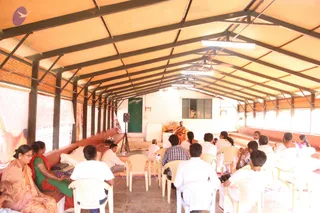
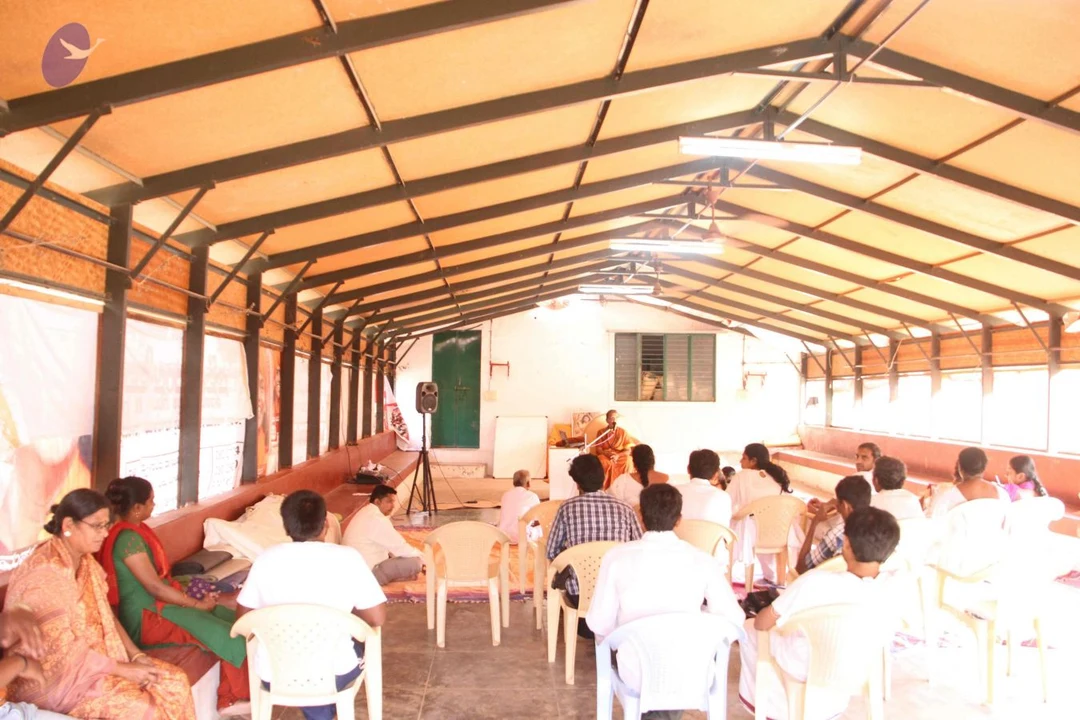
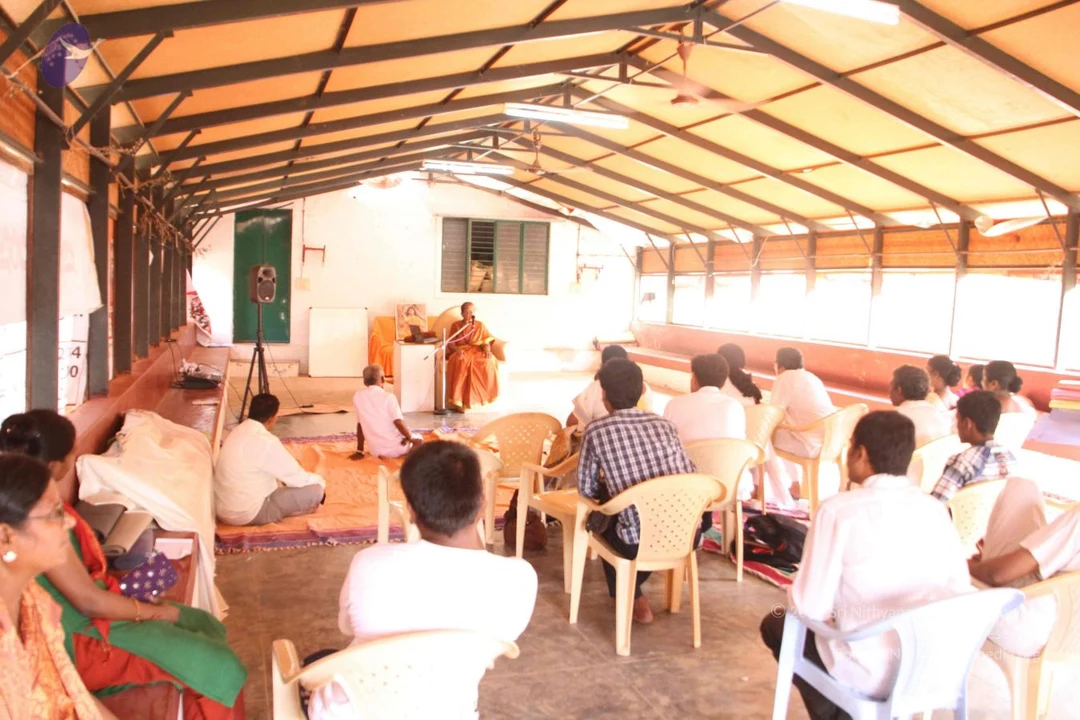
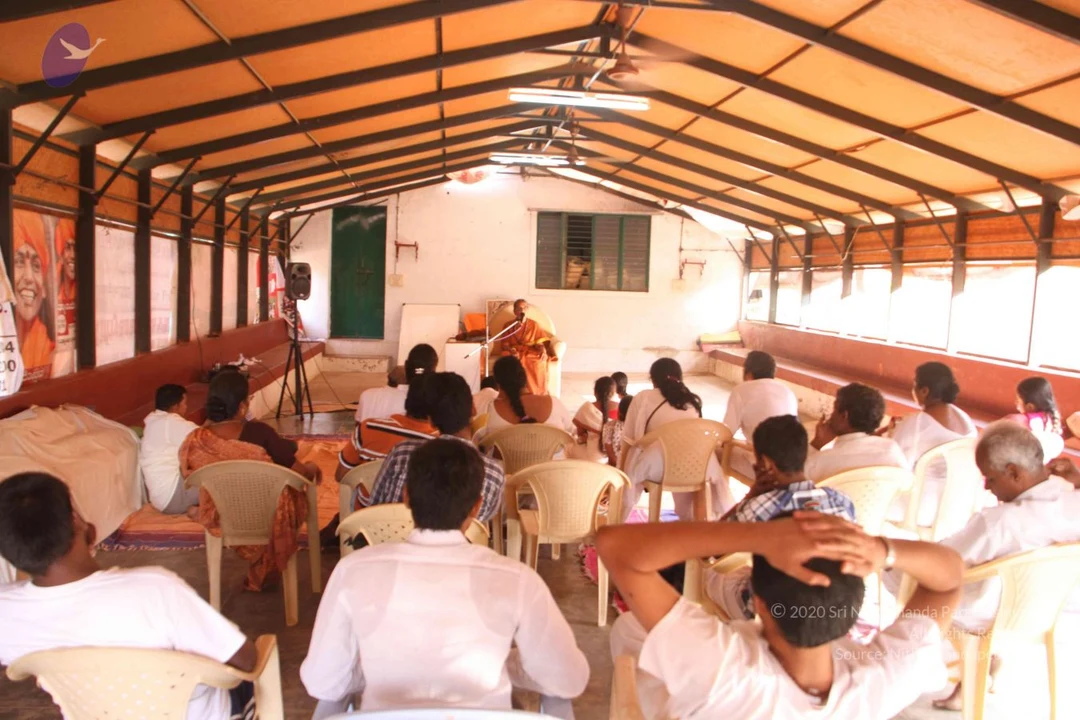
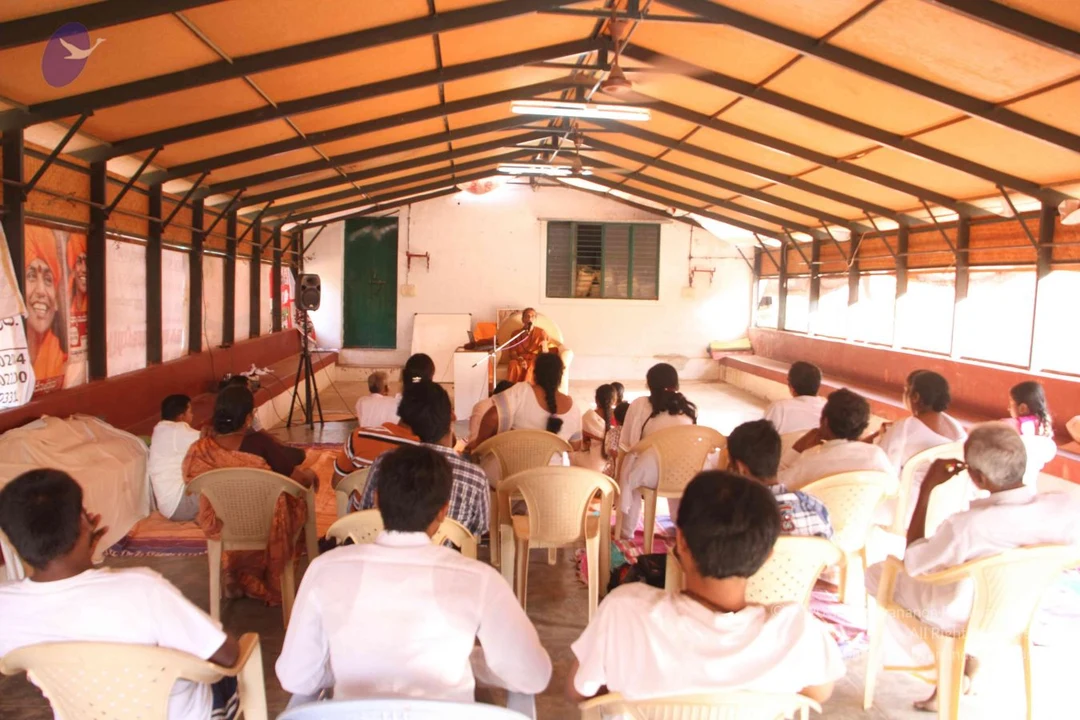
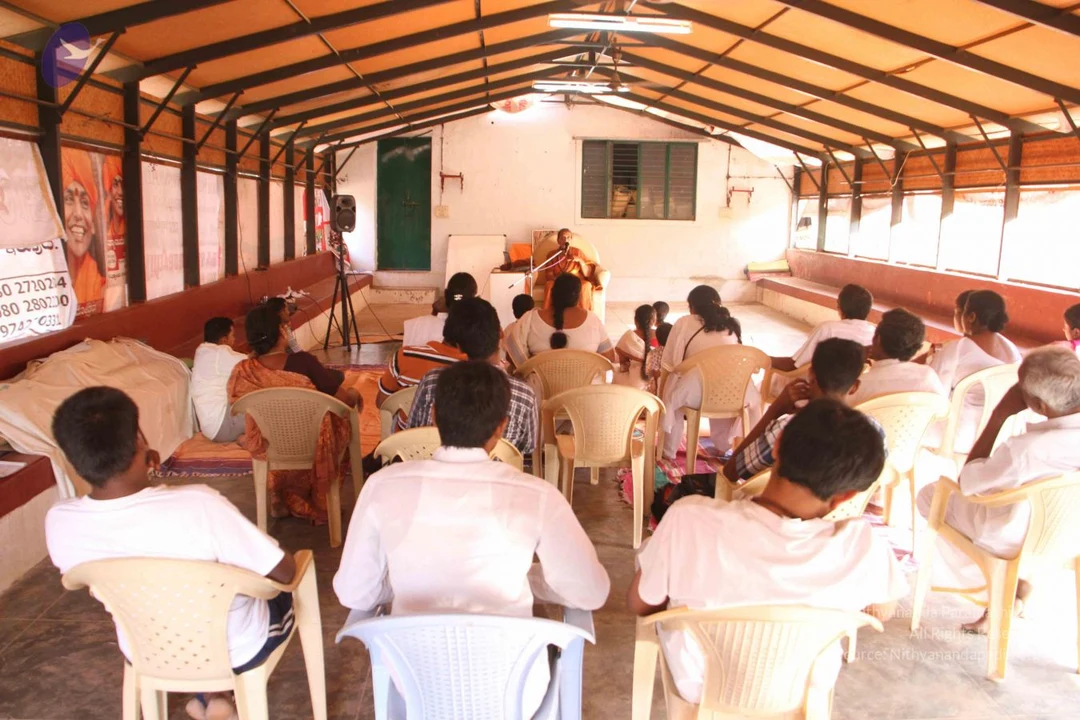
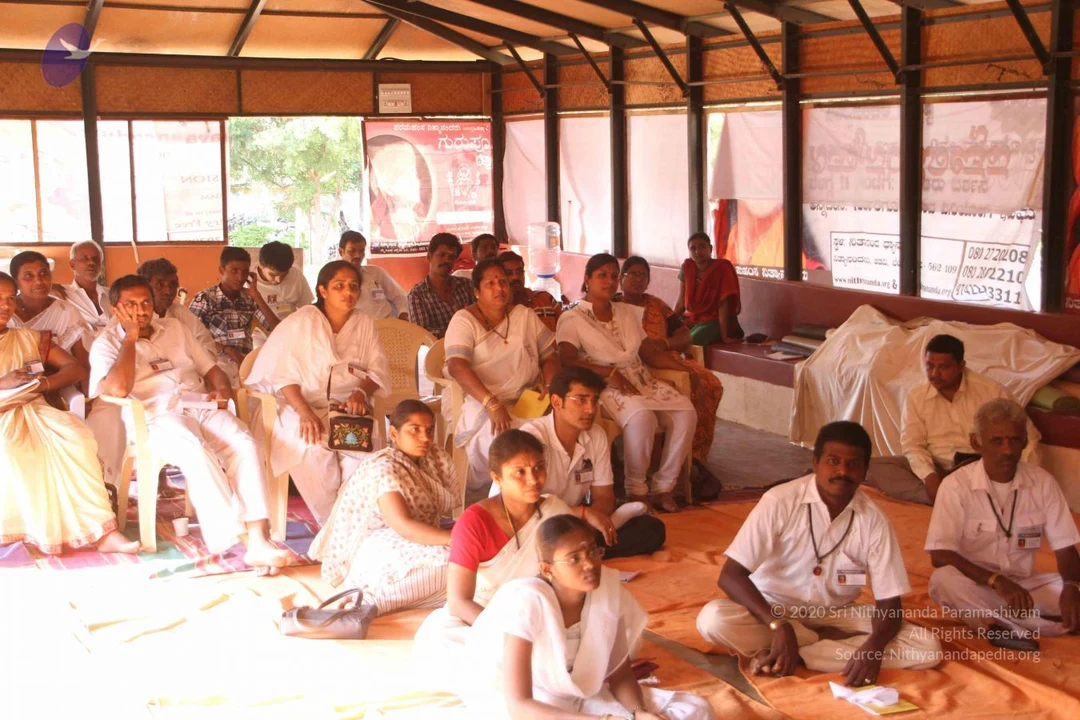
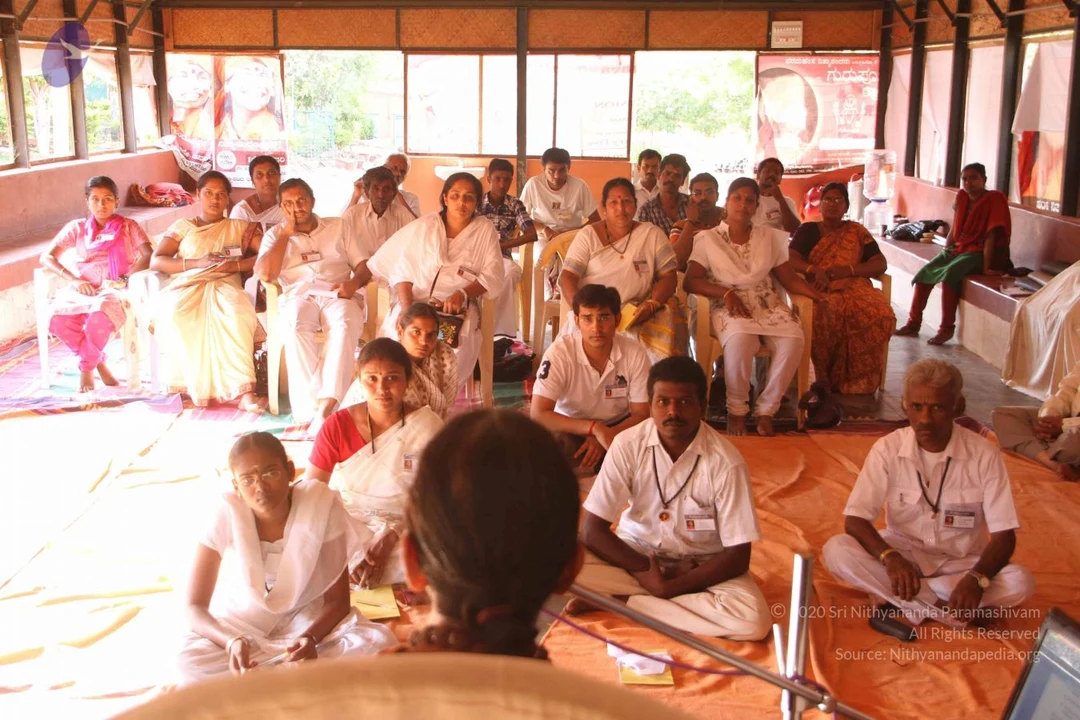
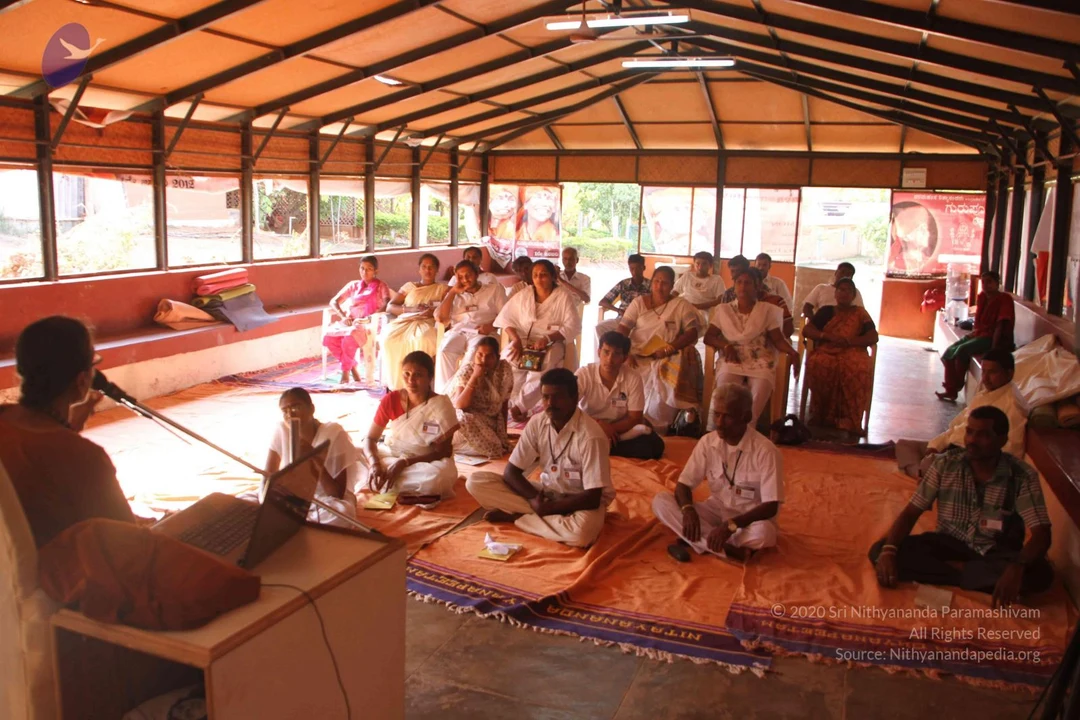
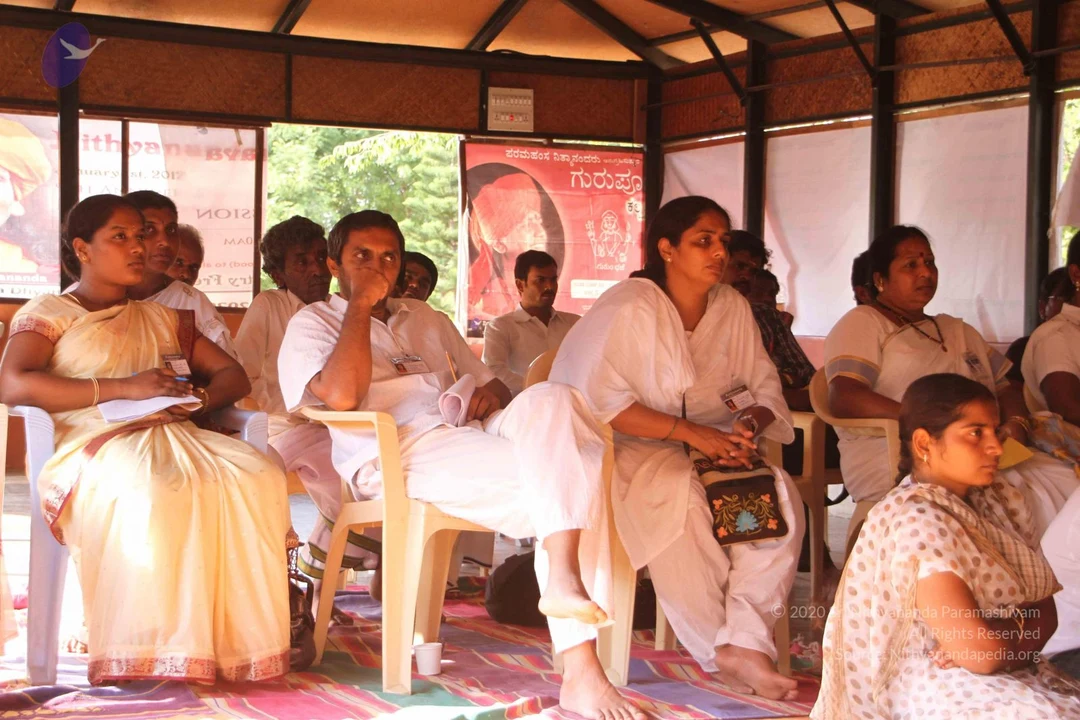
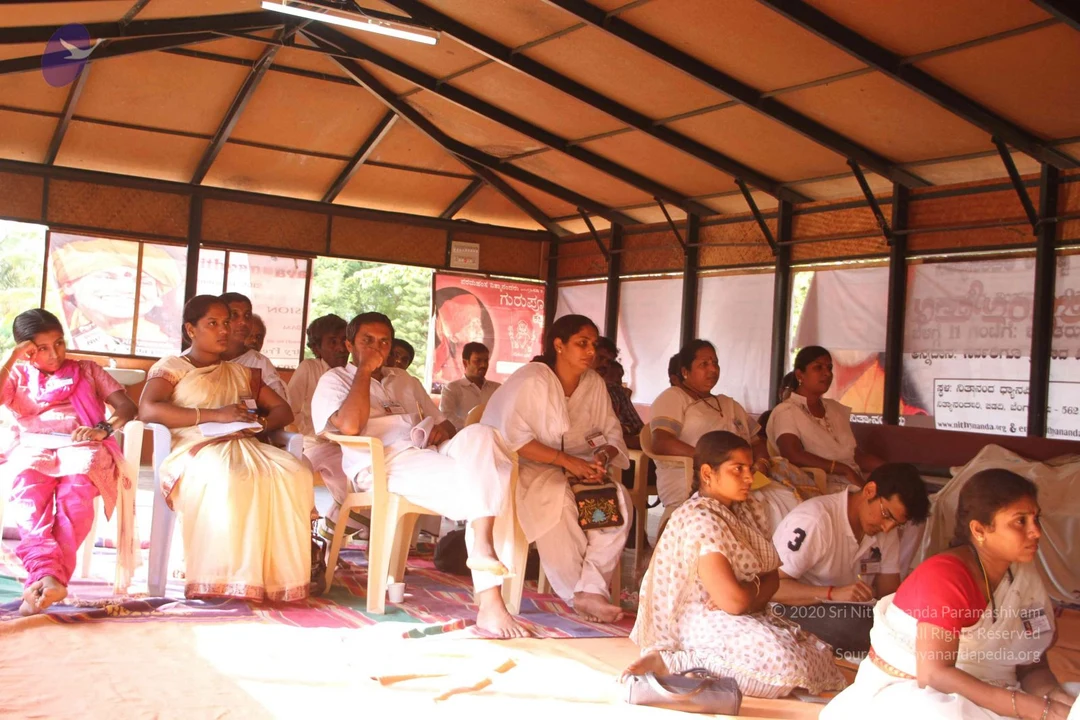
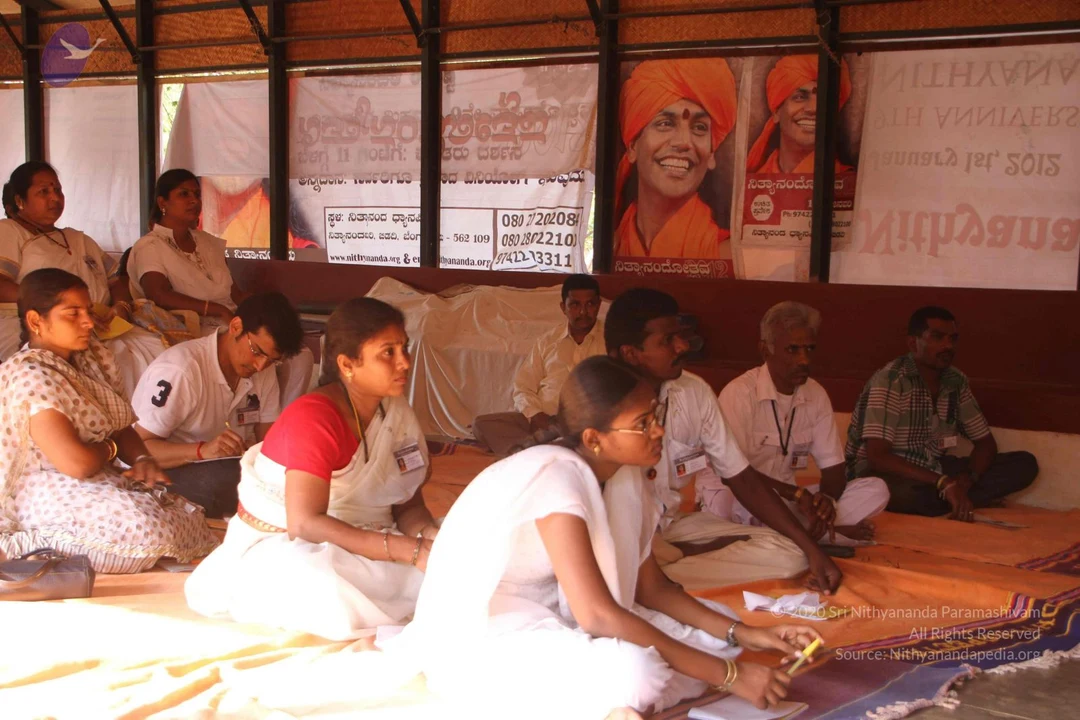
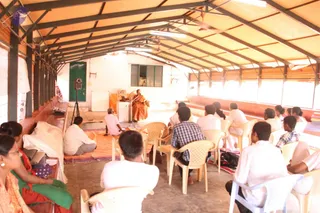
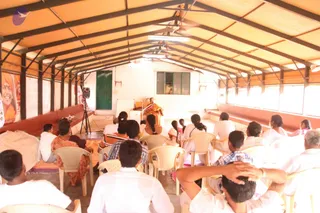
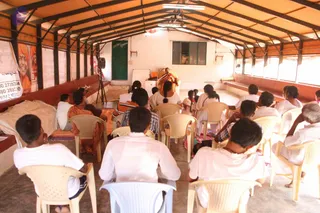
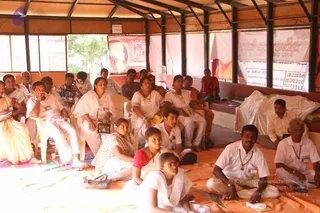
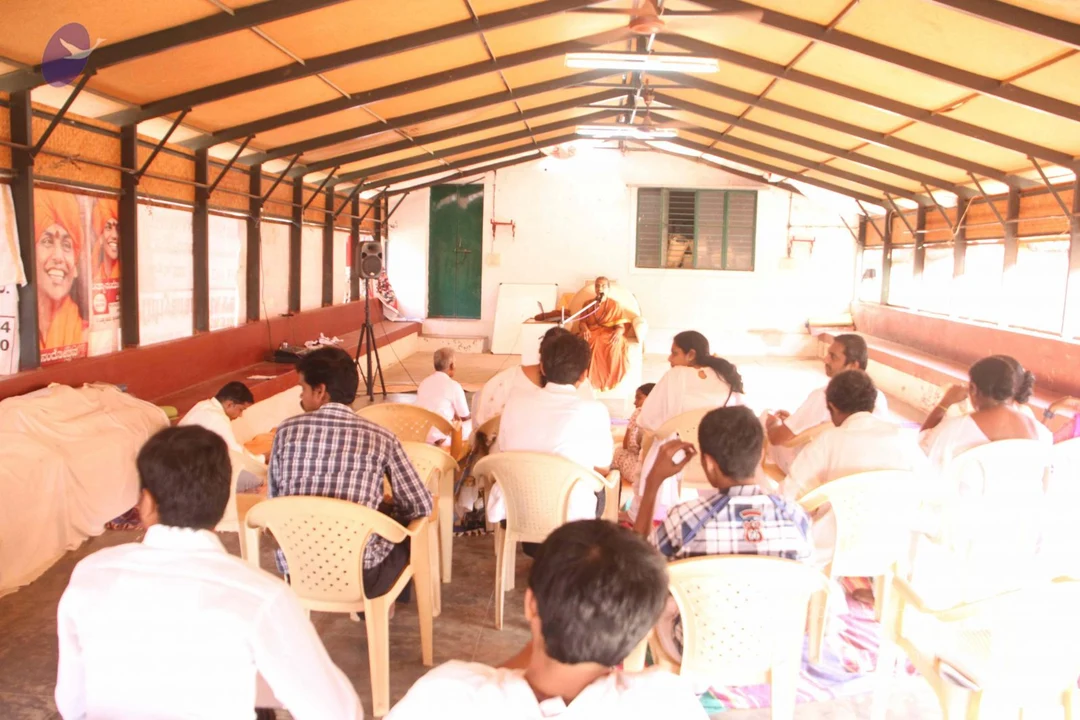
A covered outdoor satsang hall with a tiled roof and ceiling fans, where people sit on white plastic chairs facing a raised platform. A figure in saffron-orange robes sits centrally on a white seat at the front, with a microphone stand and speaker nearby. Seated devotees wear white shirts, checked shirts and white saris, and a small child sits among them. On the left wall hang large orange-robed portraits and banners. The scene resembles a teaching session.A satsang hall with a long open-sided tent-like roof of beige fabric and metal beams. Rows of white plastic chairs face a seated teacher at the far end, wearing saffron-orange robes, sitting before a white wall with a green door and a small window. Several devotees sit on the chairs in white shirts and dhotis or light clothing, while women in orange, red and green saris sit on a raised bench at left. A microphone stand and speaker stand near the front, with a white board nearby.A satsang discourse held in an open-sided hall with an orange-tiled roof and exposed metal beams. A figure in an orange-saffron robe stands at a lectern at the front, speaking to the audience. Seated devotees fill white plastic chairs in rows, many in white shirts and one in a blue checked shirt, with a woman in a green saree at left. A man in white sits cross-legged on an orange cloth at the side near a speaker stand. A small framed portrait hangs on the back wall beside a white cabinet, and a tripod-mounted camera stands at left.A photo taken from the back of a covered open-sided hall during a satsang. Rows of people sit on white plastic chairs facing a small raised stage at the far end. A saffron-robed figure stands at the stage with a microphone, while a wall banner on the left shows a printed portrait in orange clothing. Several attendees wear white shirts and kurtas; one woman wears an orange sari. A speaker stands on a tripod at the left, and fluorescent tube lights hang from the metal roof beams. Copyright text is printed in the lower right corner of the image.A photo of a satsang in a covered open-sided hall with a corrugated orange roof and a white wall. Many people sit on white and yellow plastic chairs facing a small platform at the far end. Most attendees are seen from behind, wearing white shirts and dhotis or light clothes, with children among them. At the front, a figure in orange robes with a microphone stands near a low table, apparently addressing the gathering. A banner with a smiling orange-clad figure and phone numbers hangs on the left wall, and a microphone stand and speaker are visible near the front.A photograph of a seated congregation in an open-sided pavilion with a tan woven roof and orange floor cloth. Many devotees sit on the floor and on white plastic chairs, mostly in white clothing, with some women in saris and salwar and a few in red or patterned tops. A large framed portrait hangs on a pole near the entrance, and a banner beside it carries Kannada script. Several attendees look toward the front of the hall, and a water dispenser and a lowered tarpaulin are visible at the right. No individual can be identified in the scene, and the portrait is a printed image rather than a physical presence.