Skip to content
Friday

21 November 2014

Experiential Logic Vs Exponential Logic

Dated photos
162
Source pages
1
Media
2
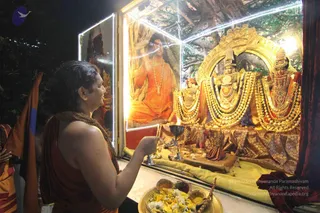
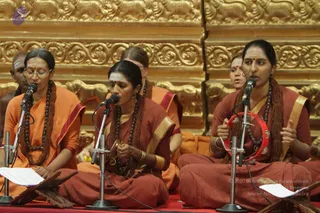
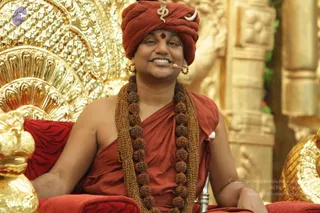
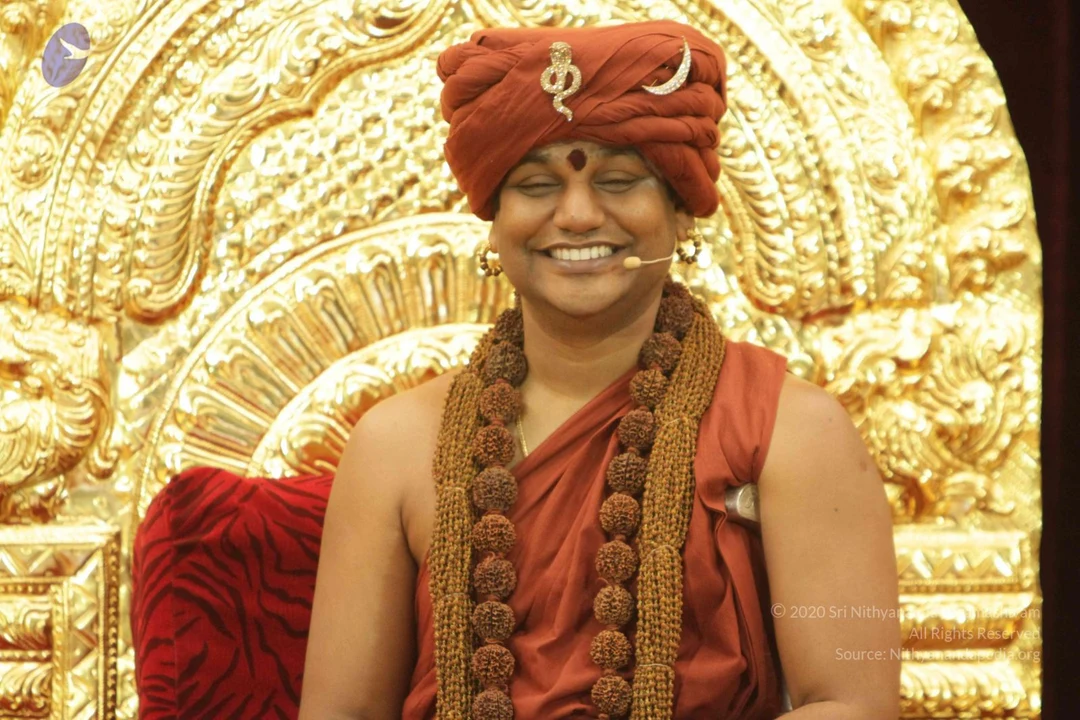
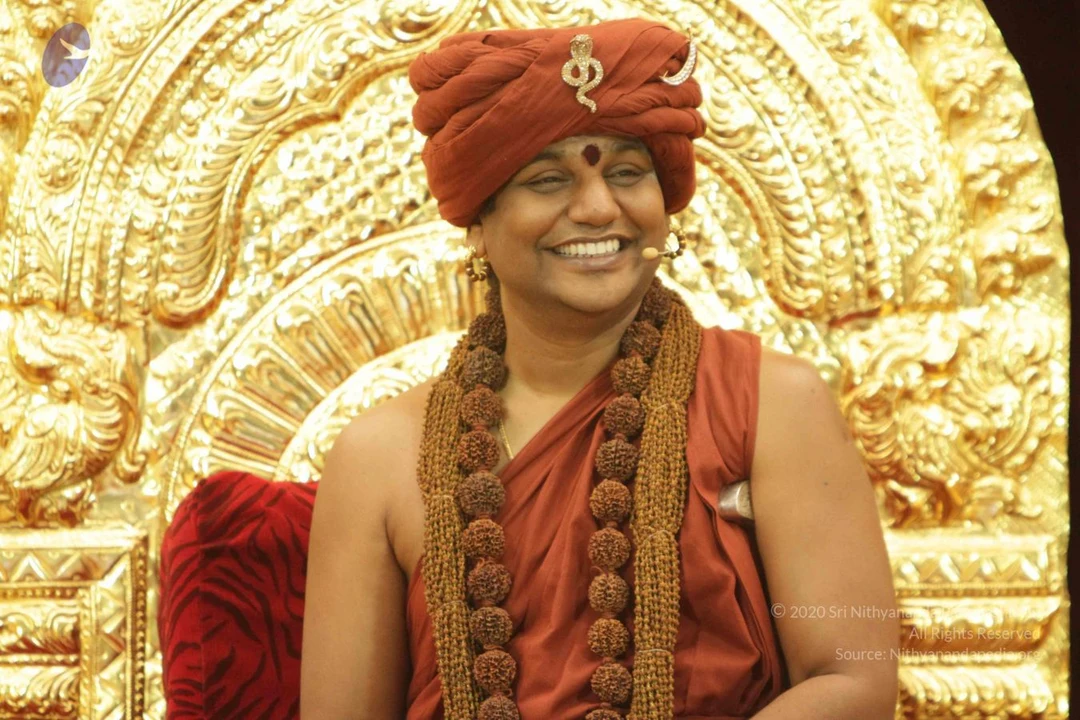
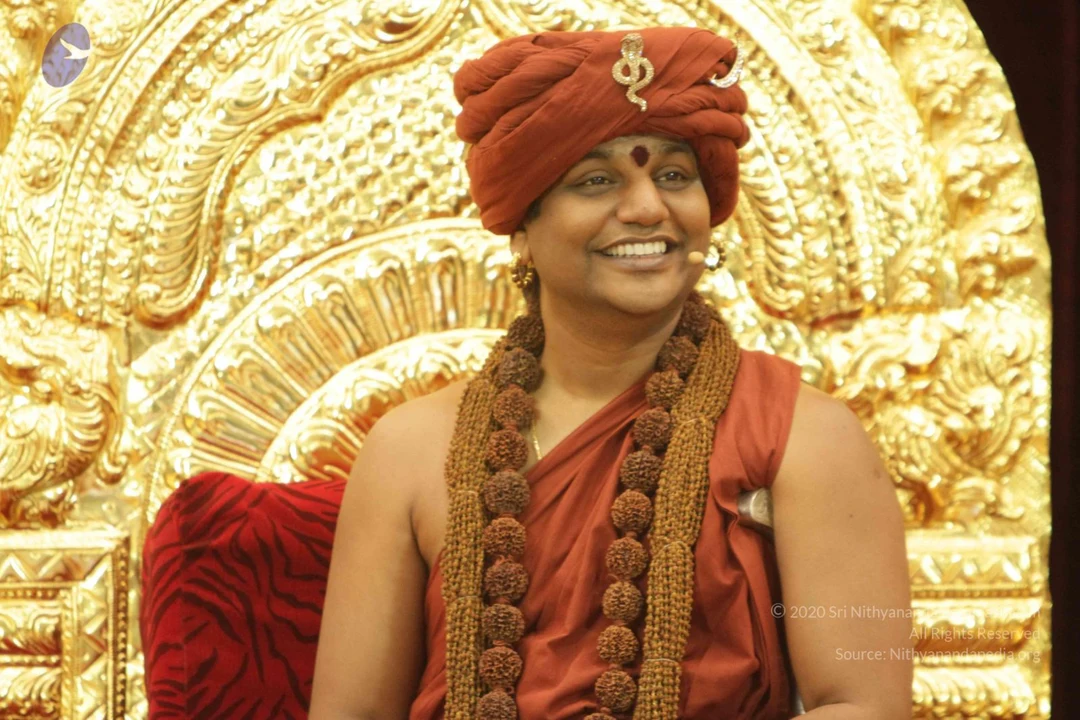
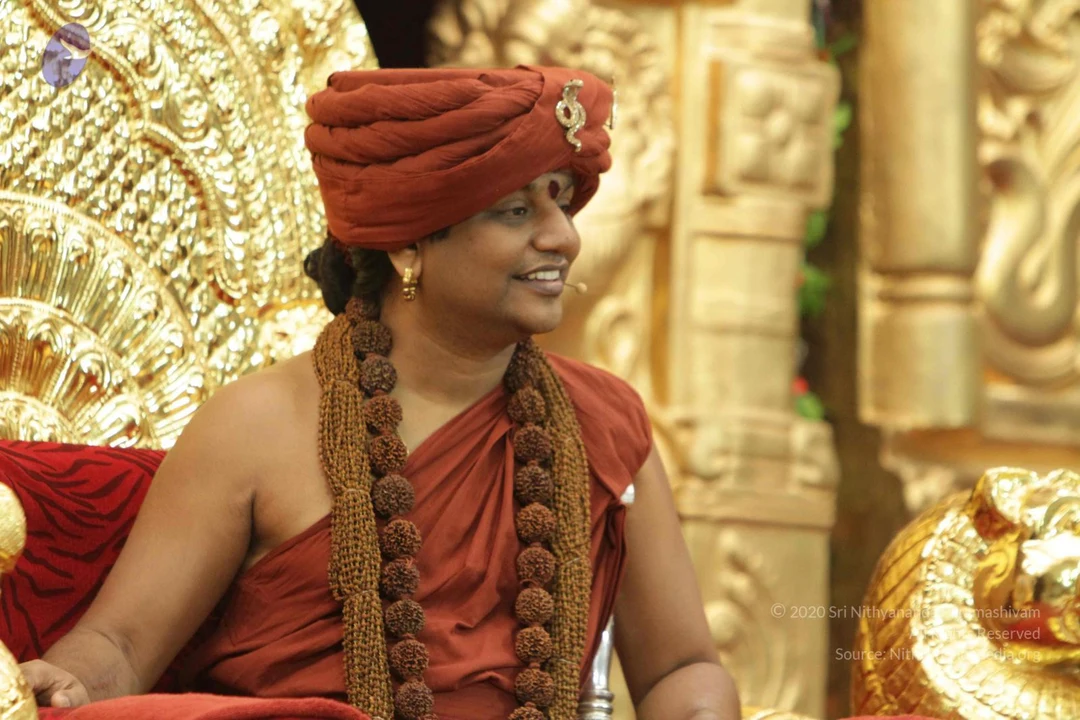
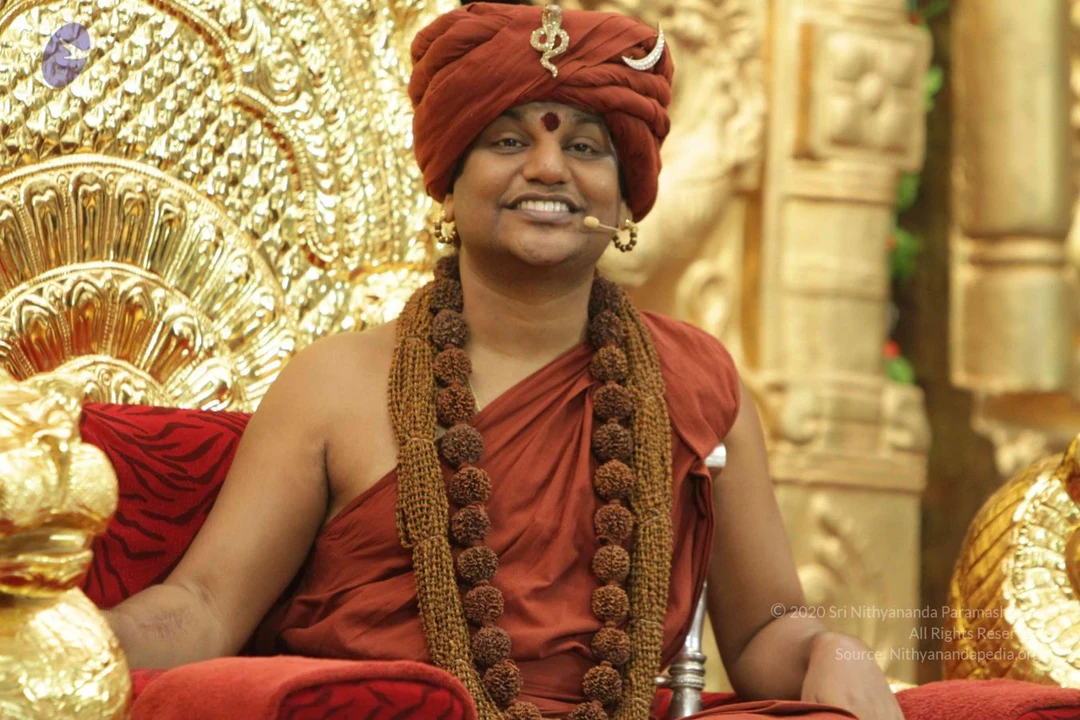
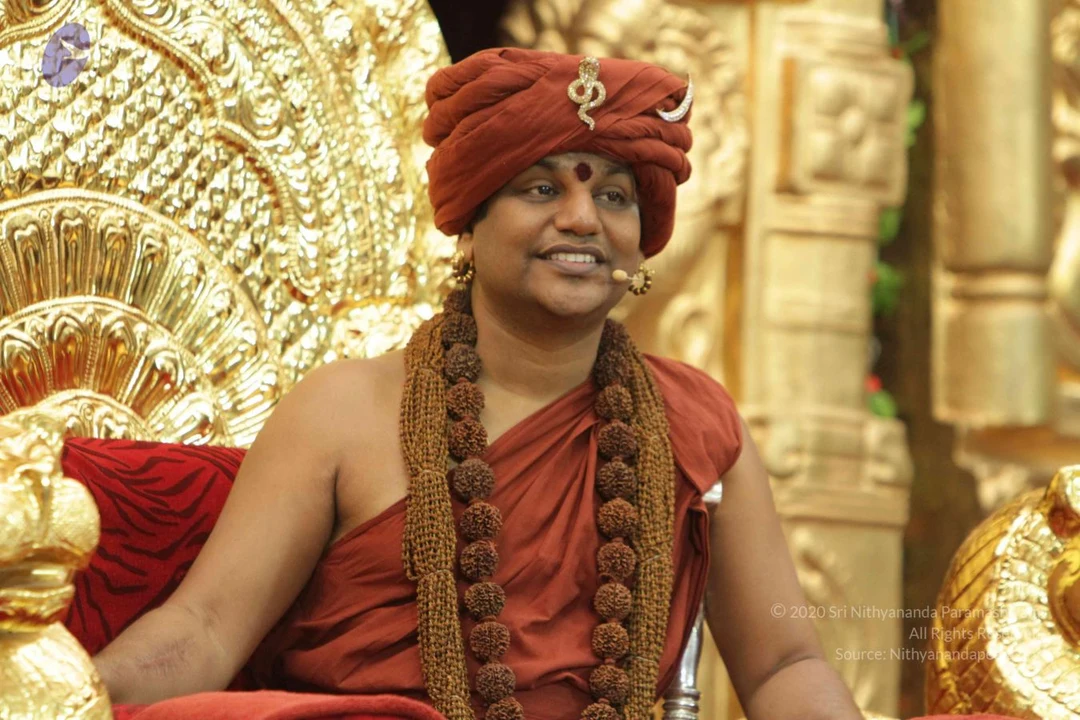
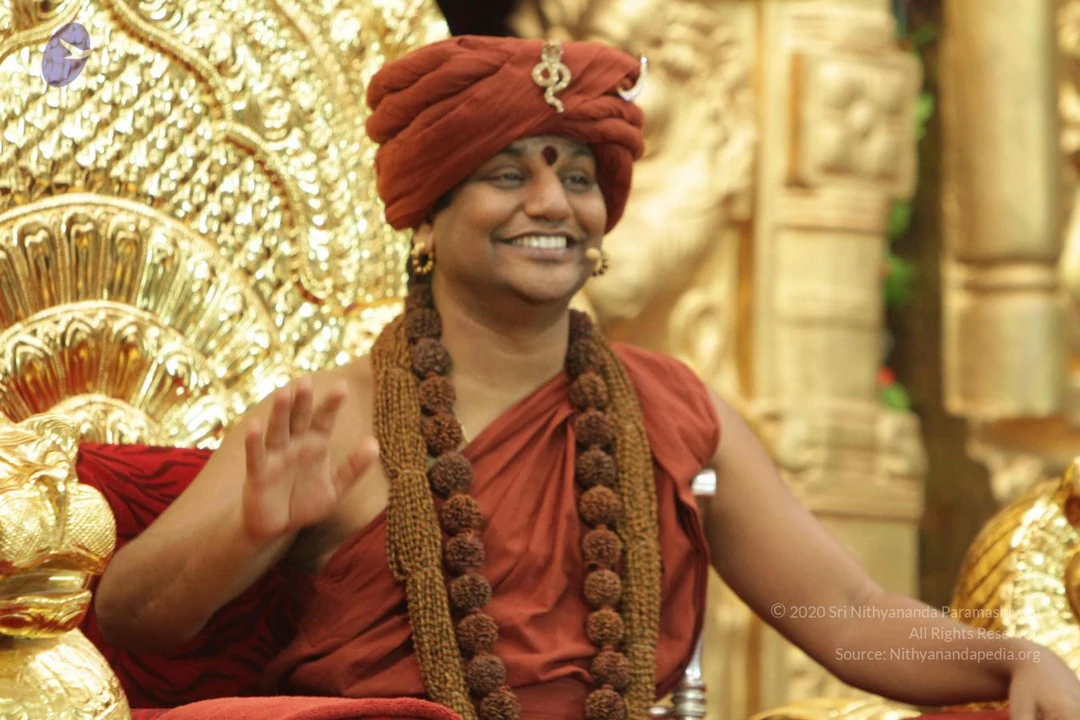
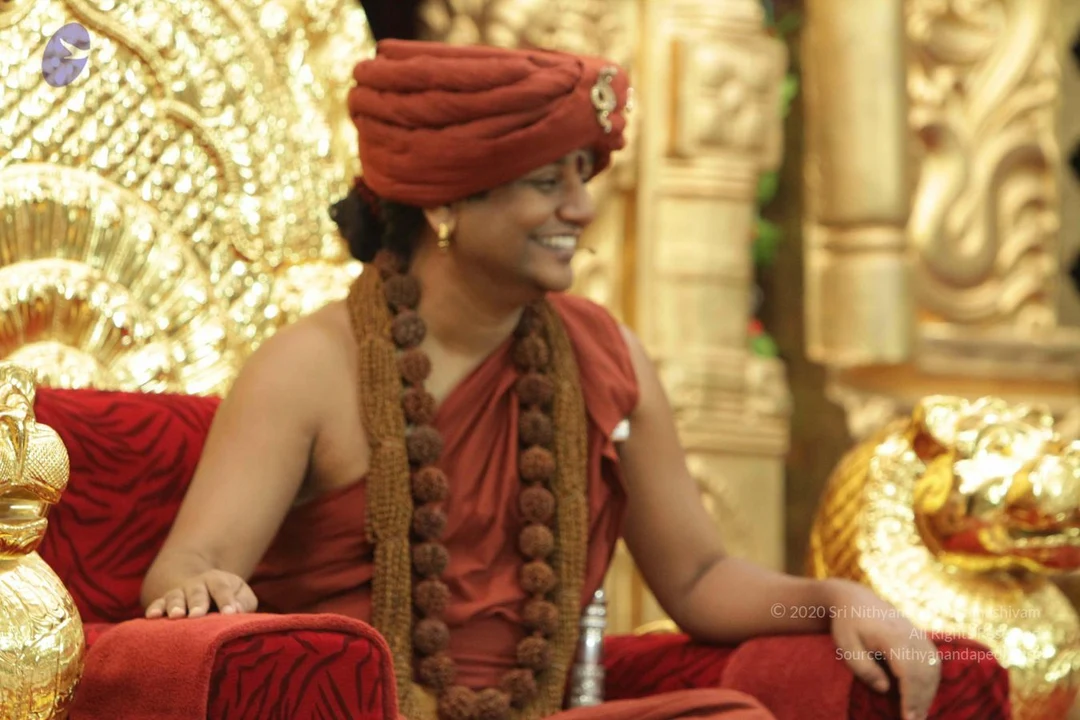
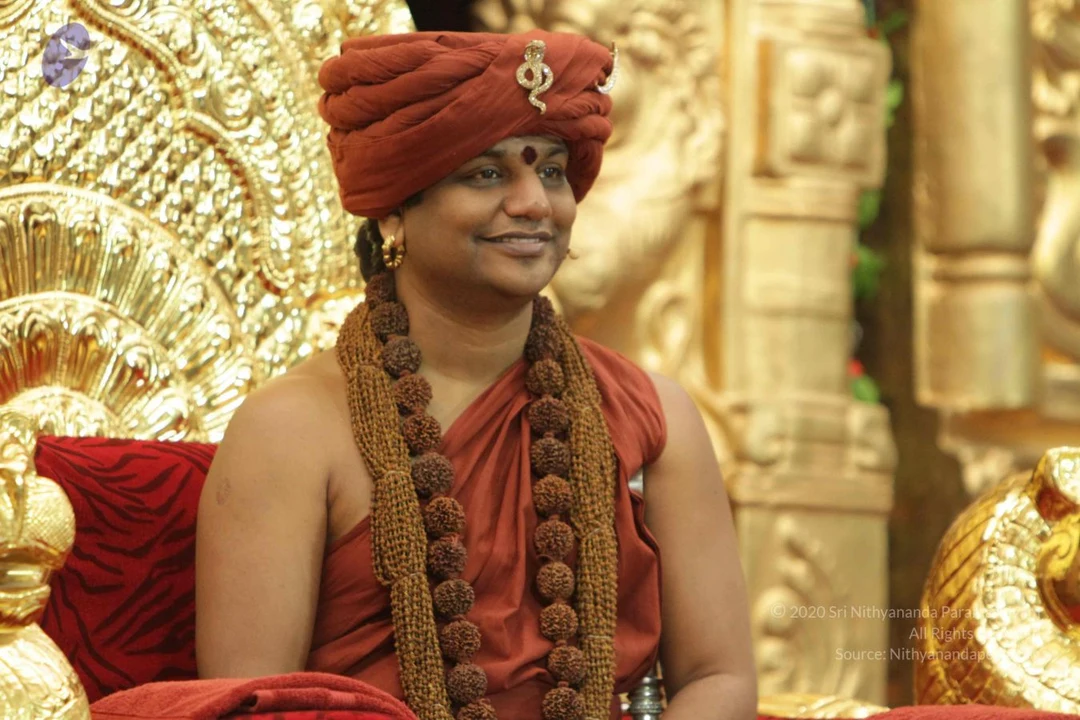
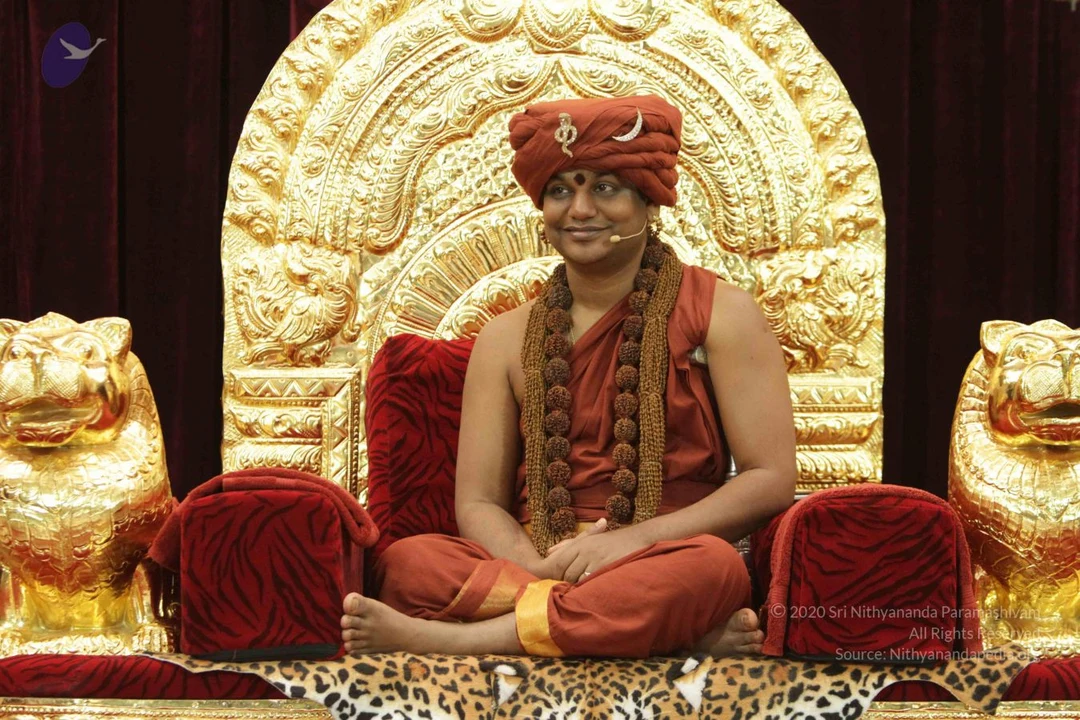
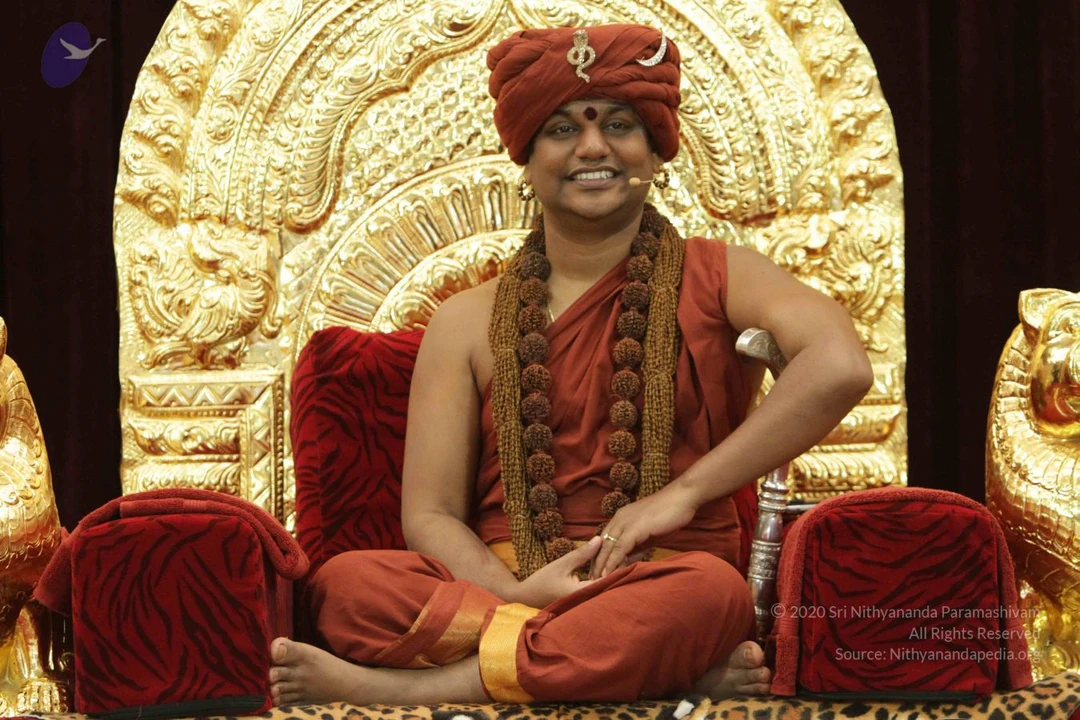
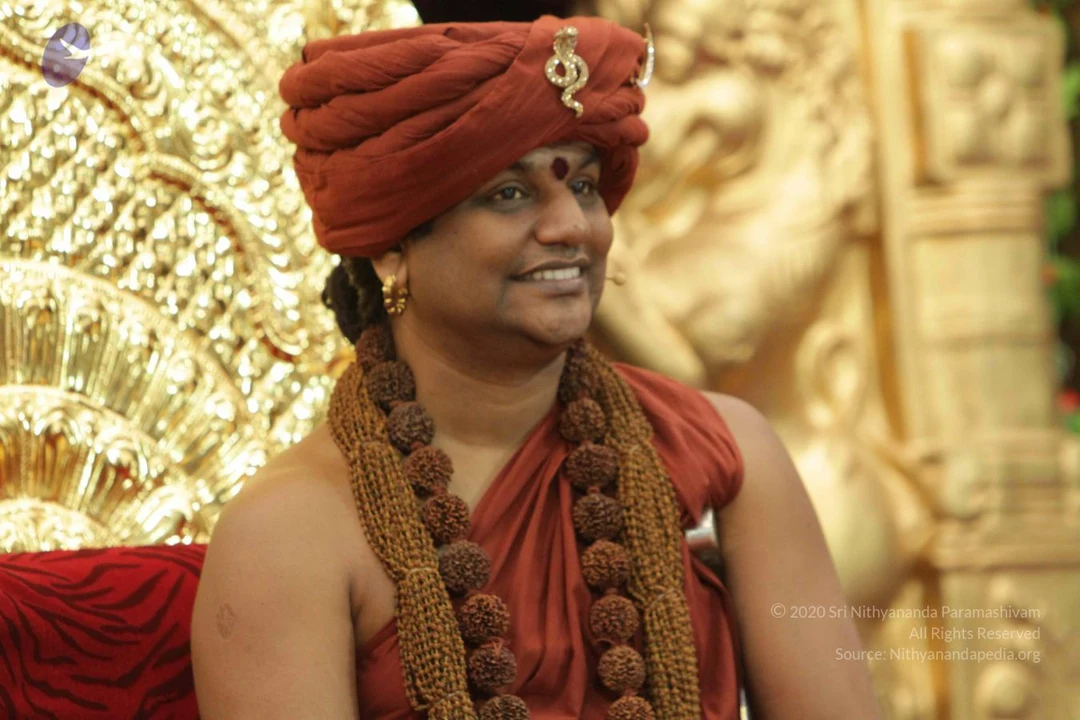
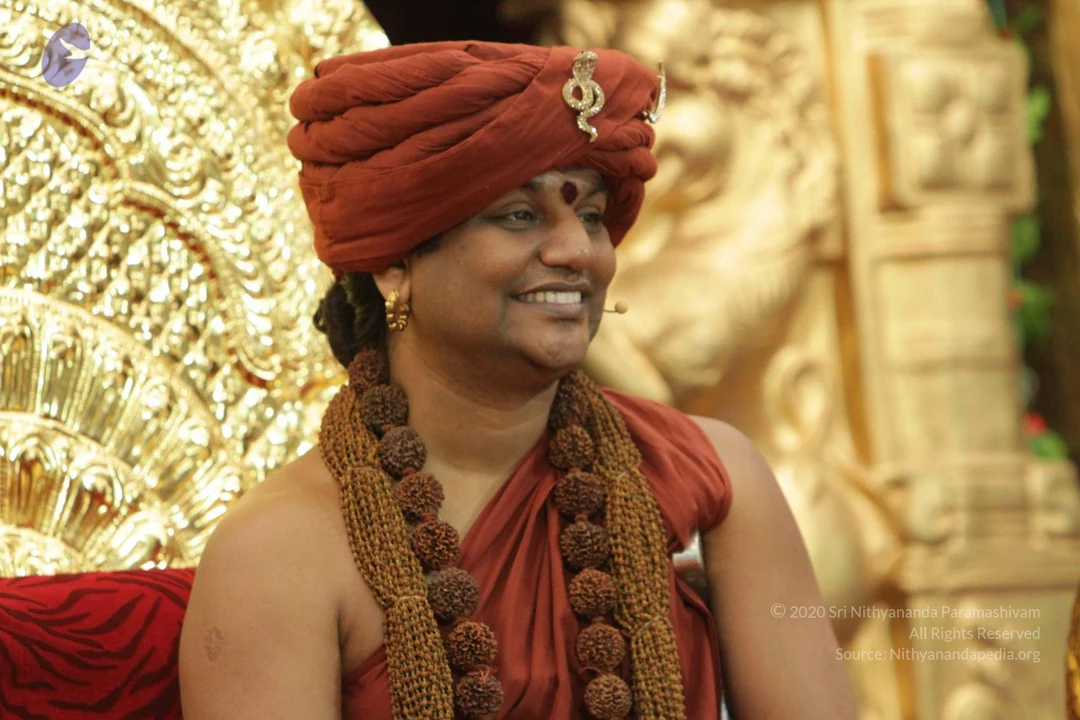
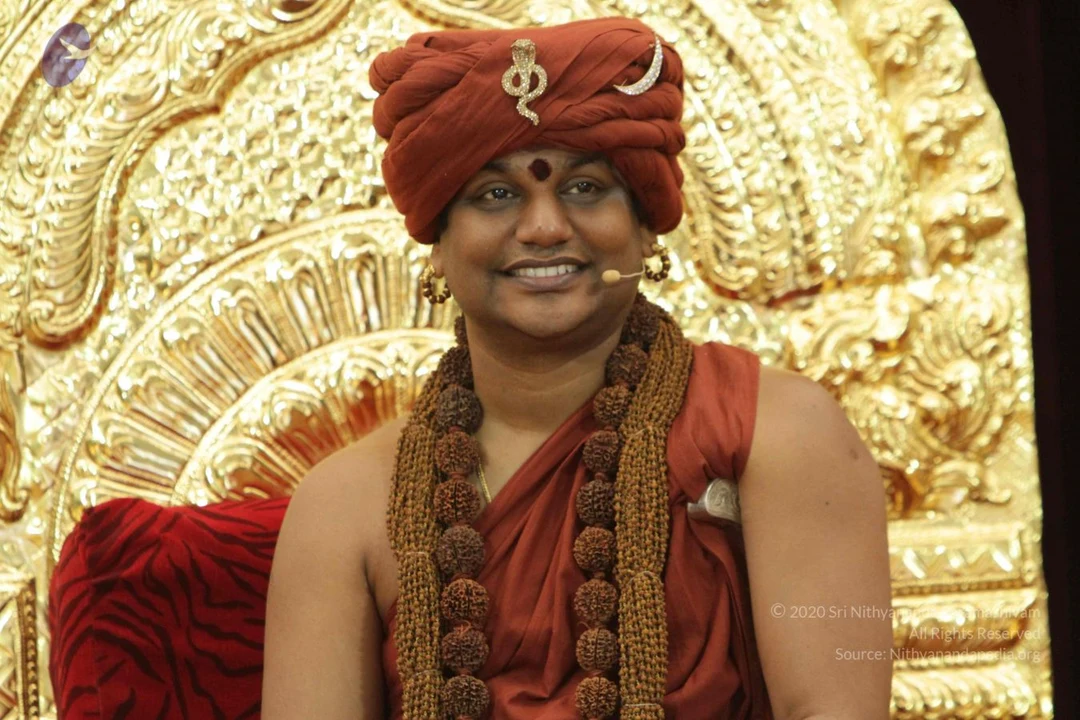
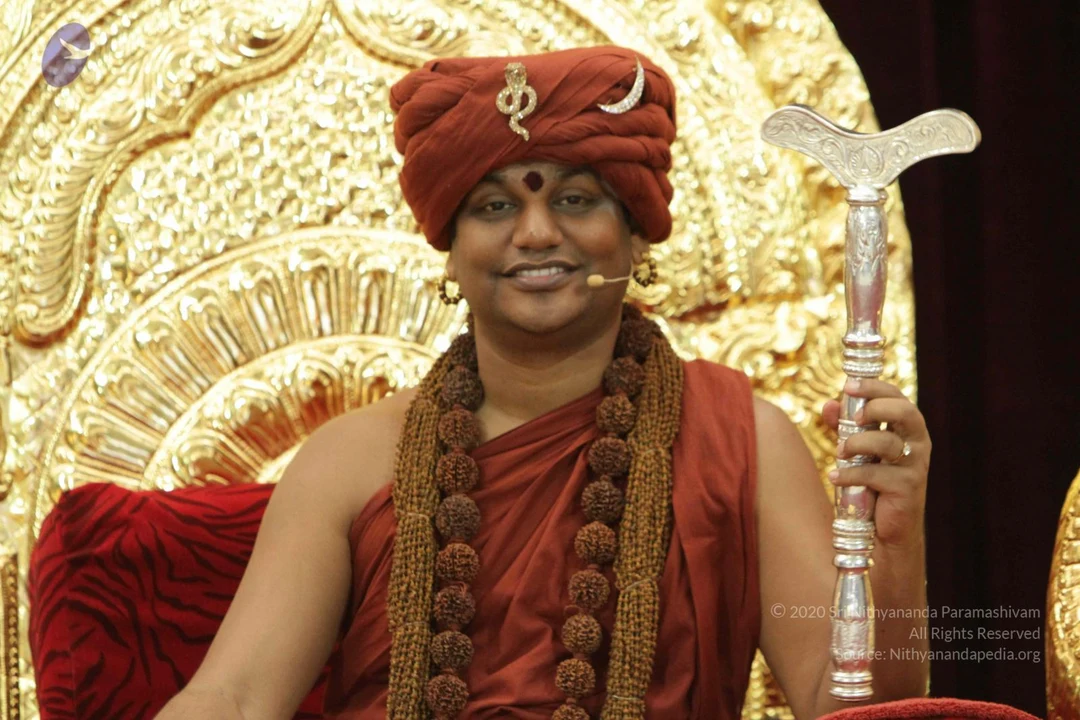
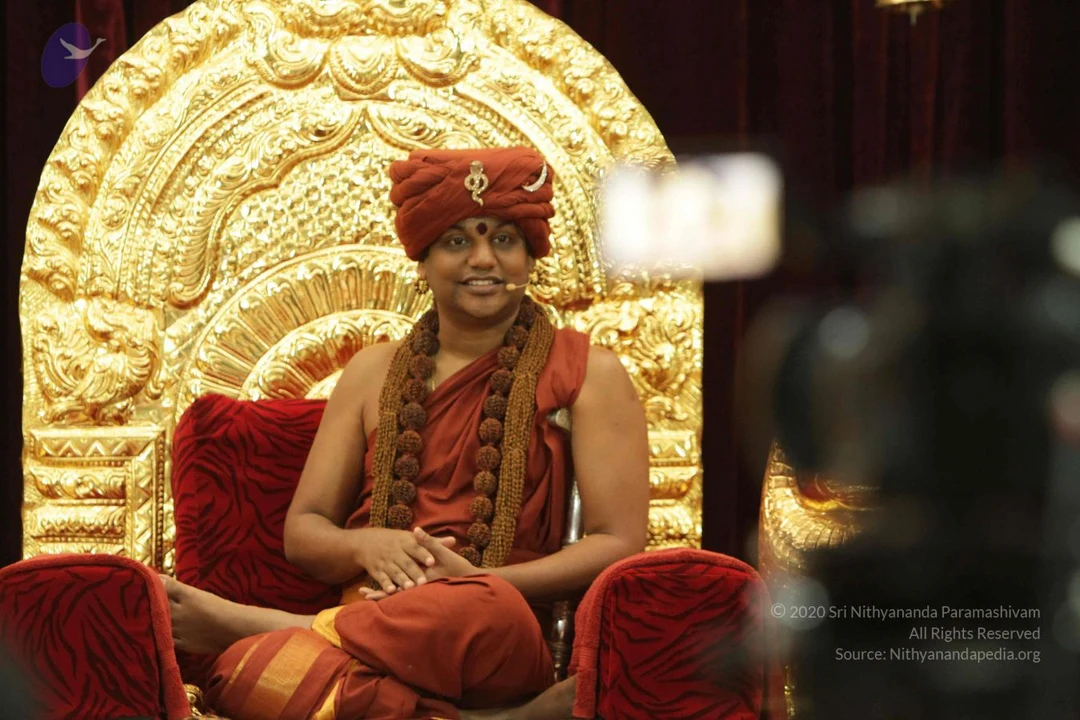
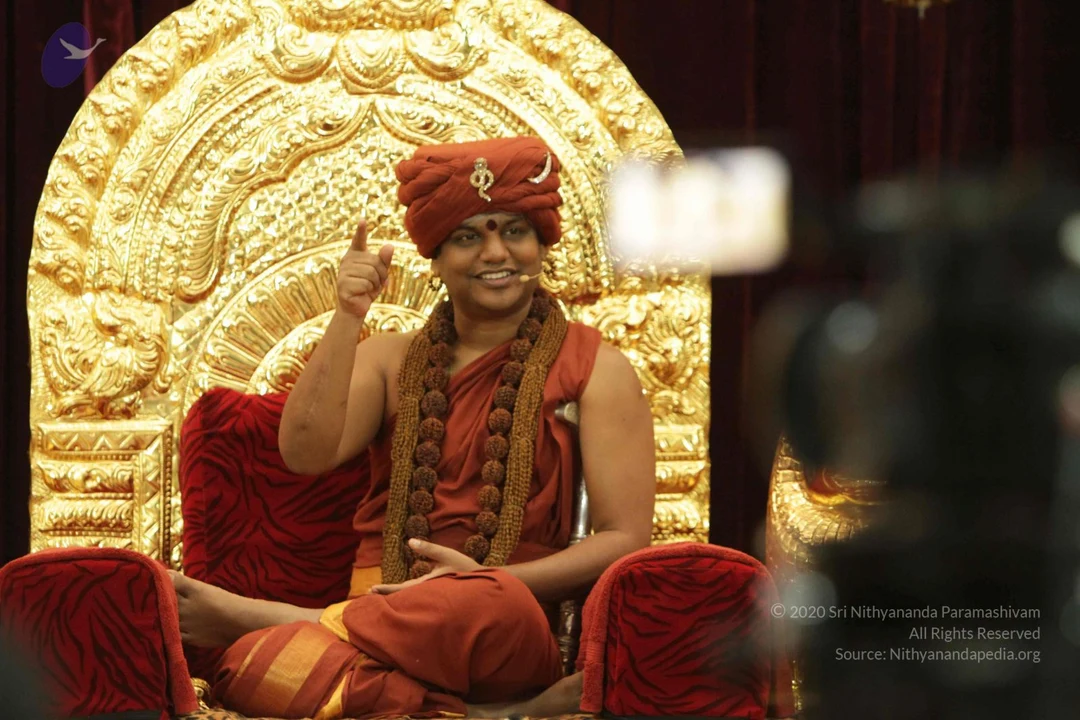
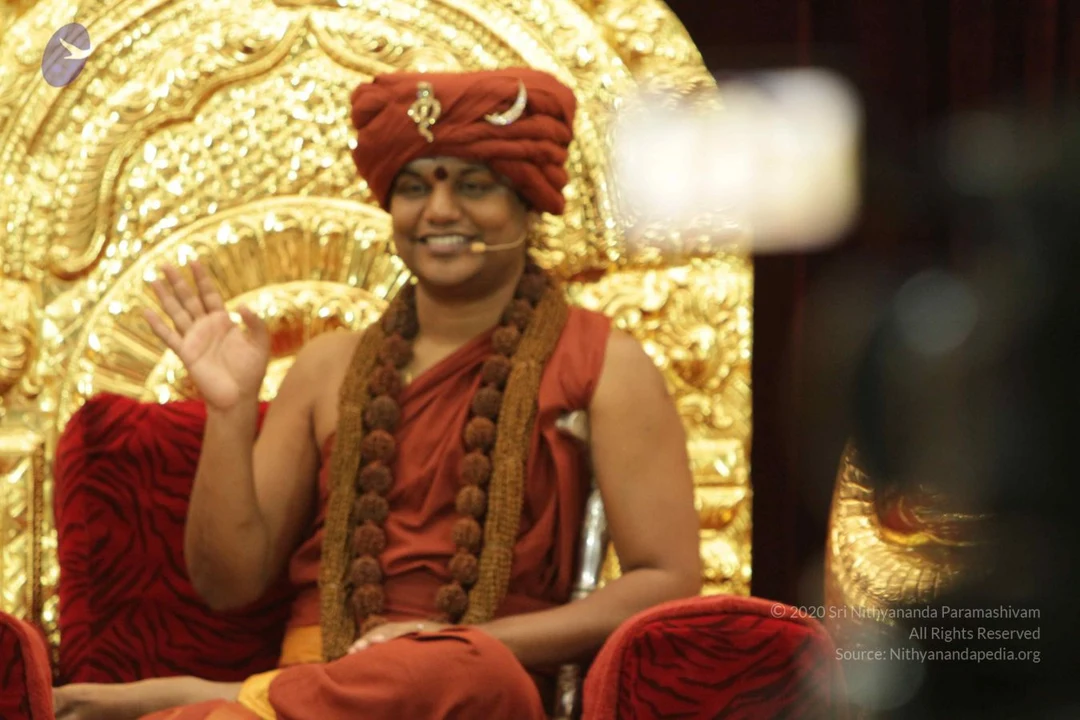
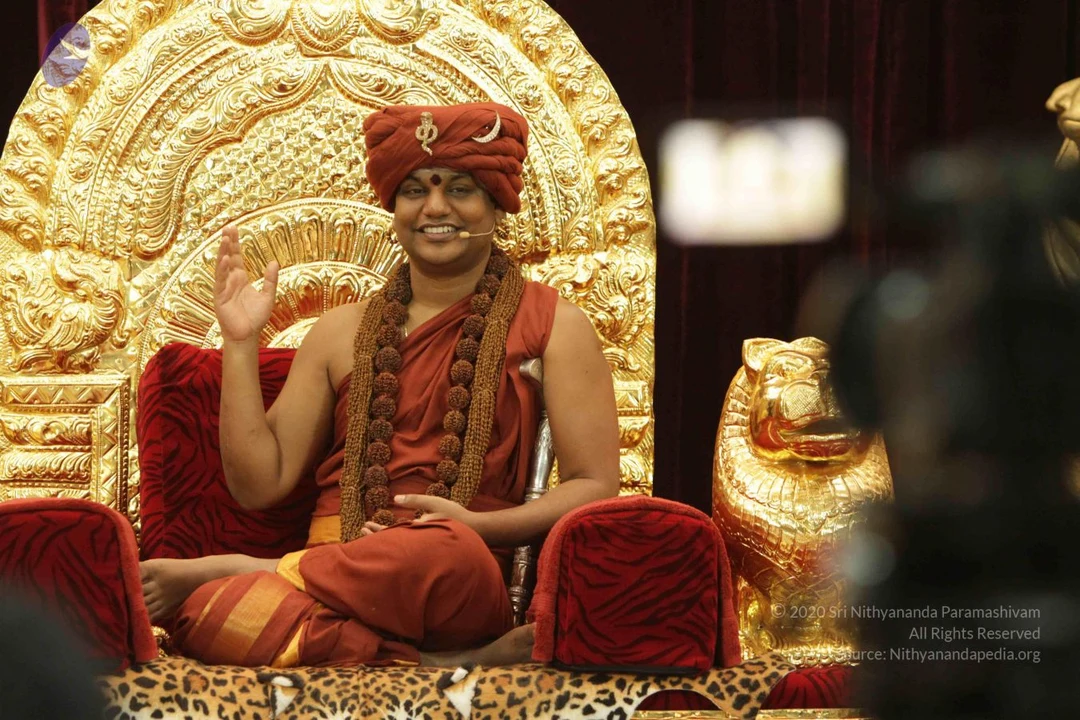
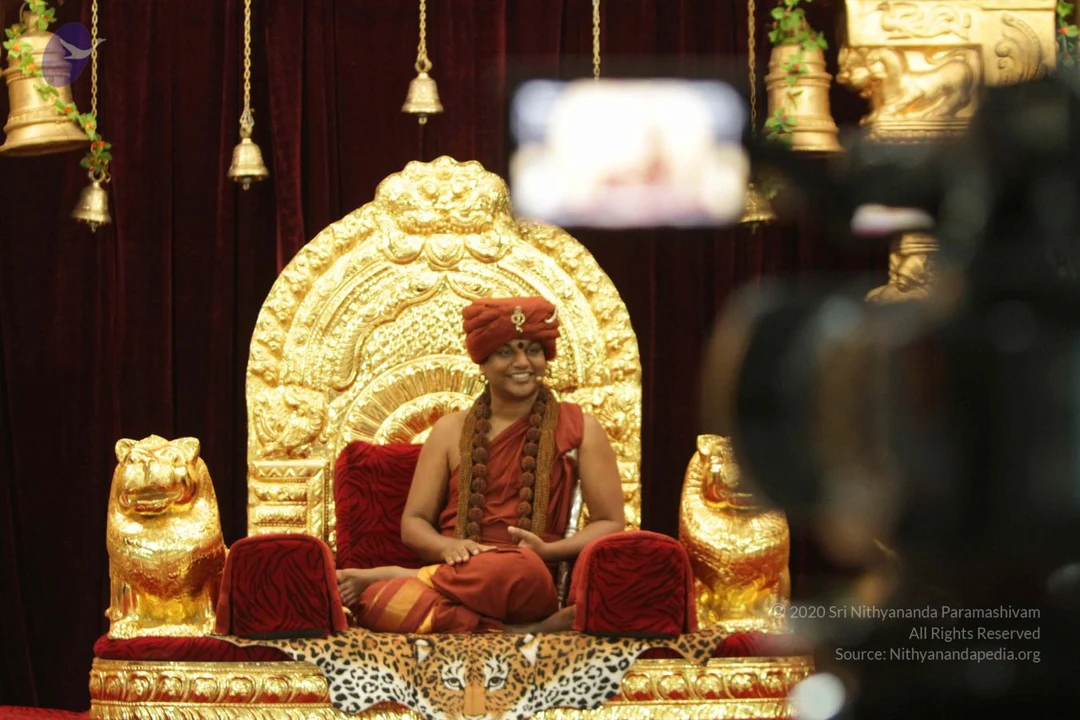
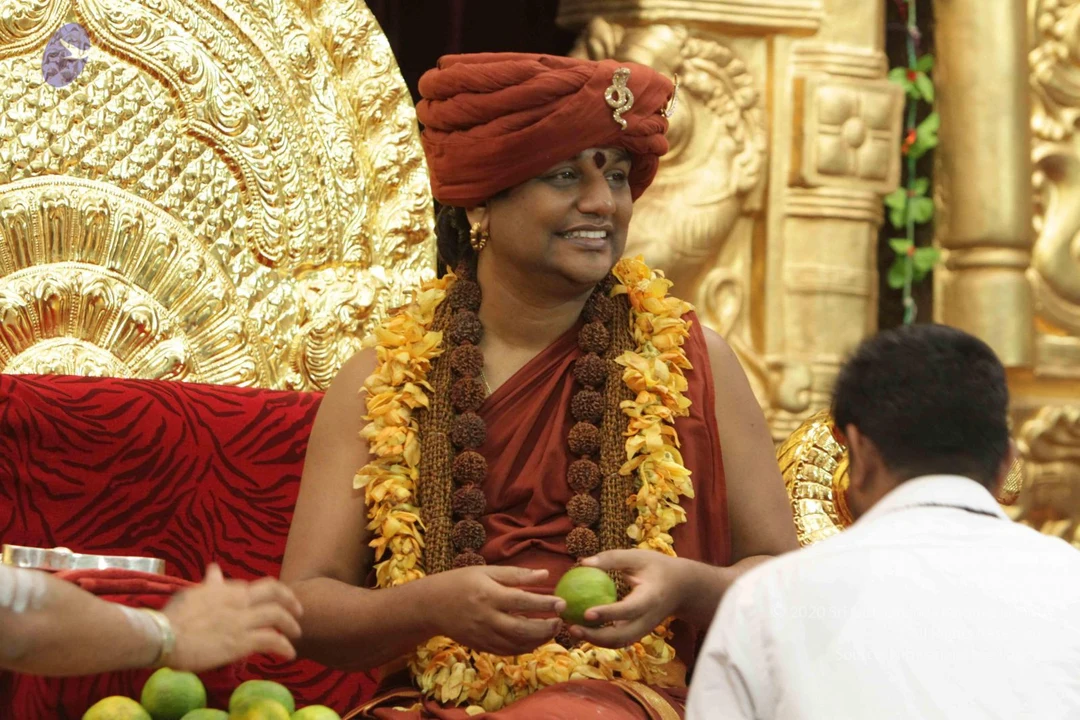
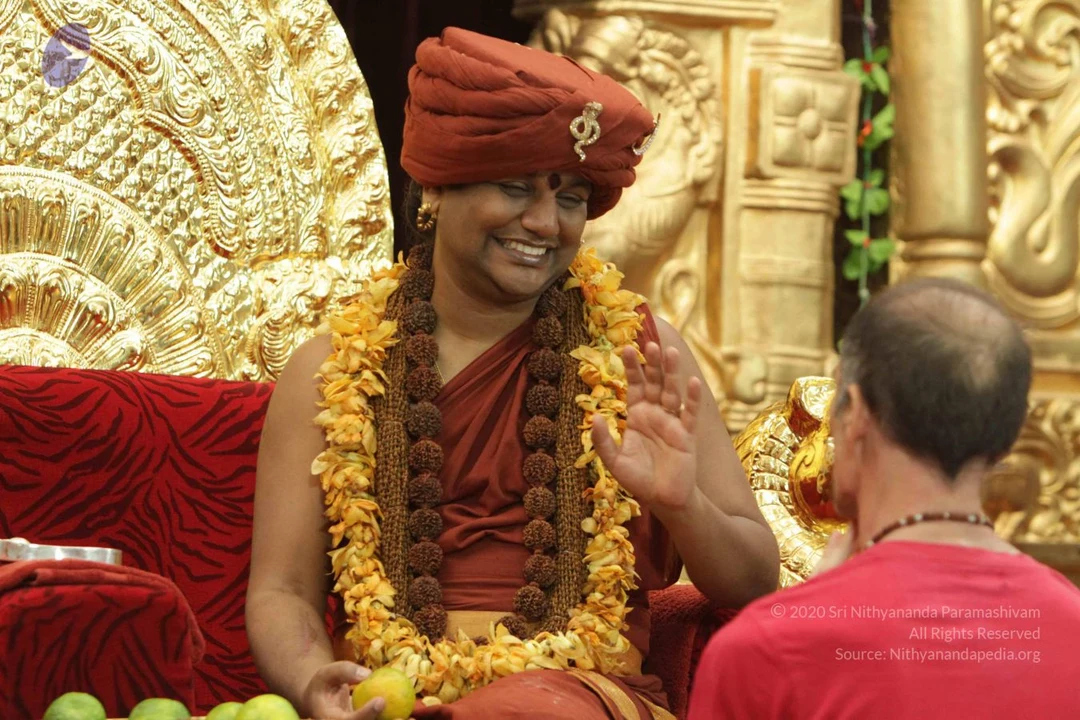
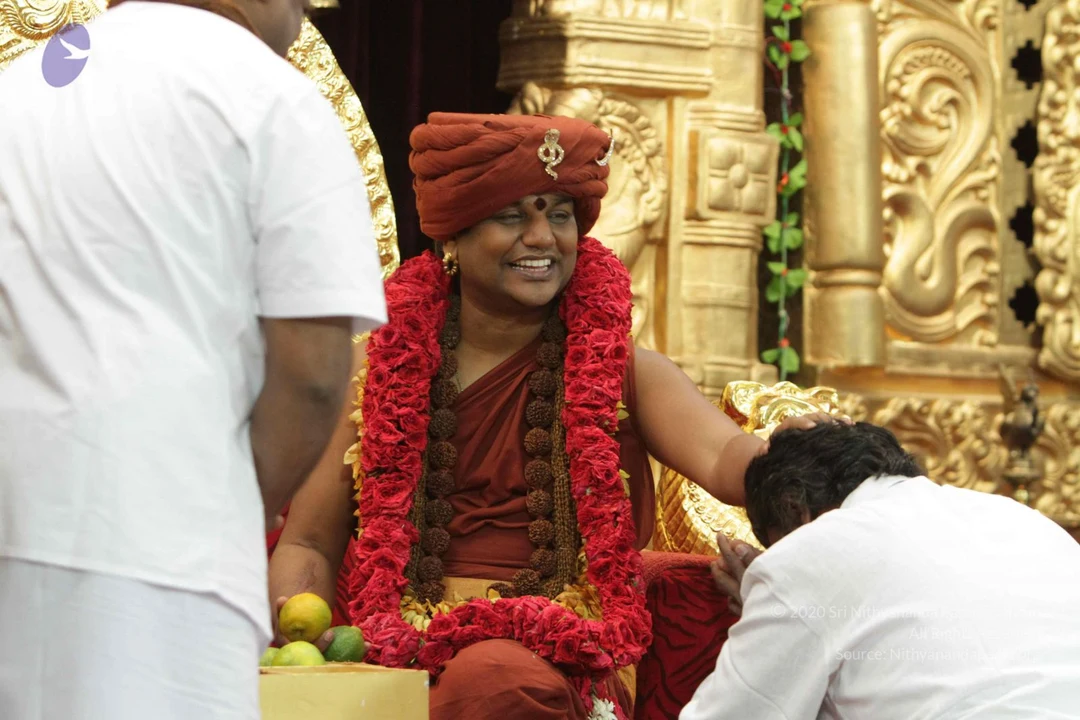
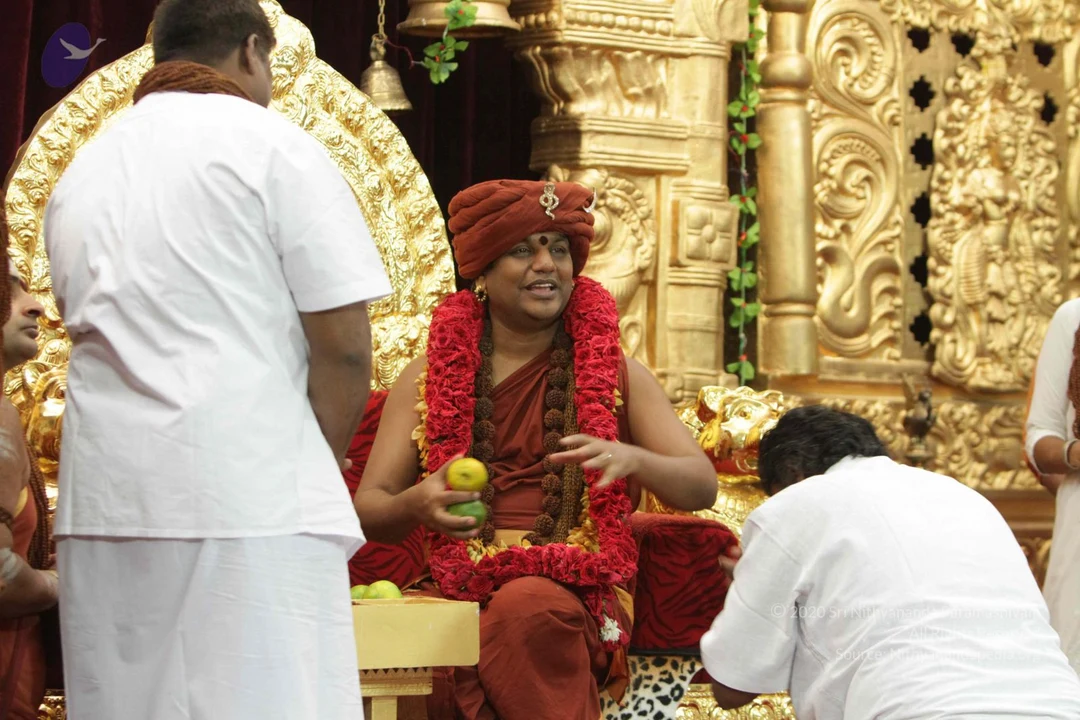
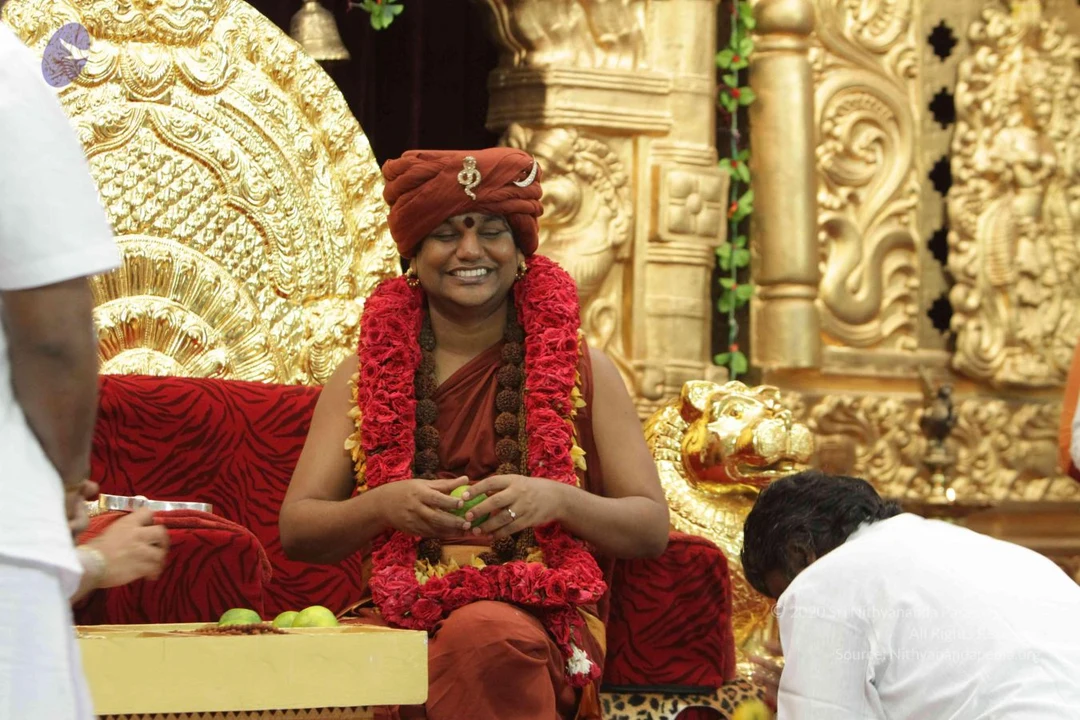
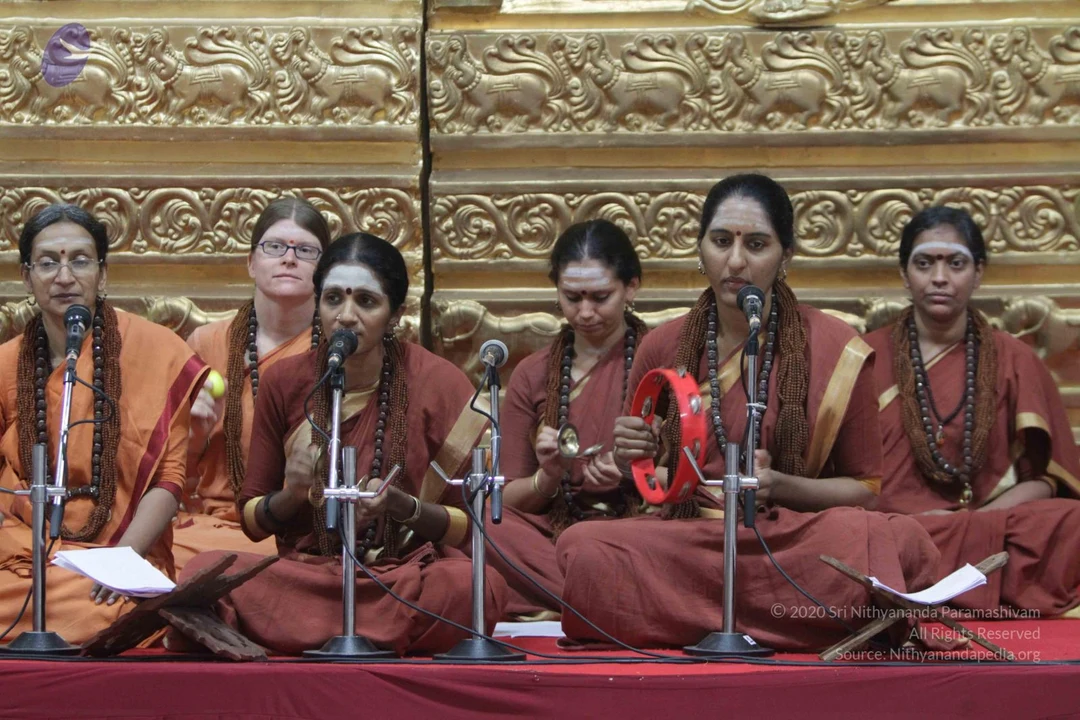
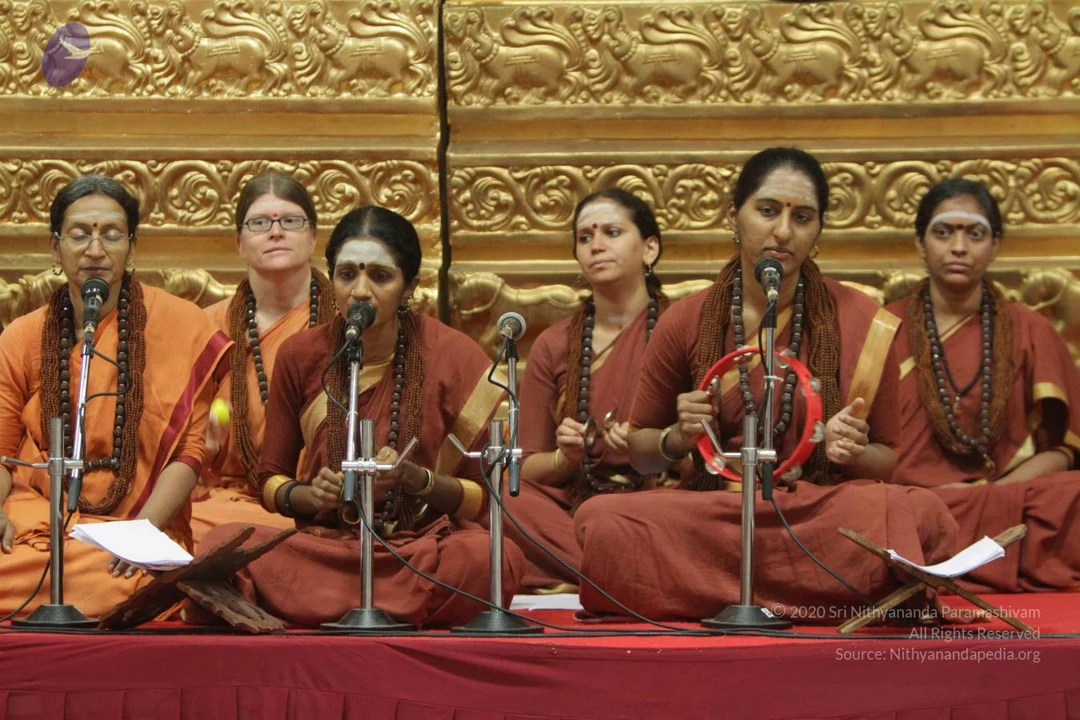
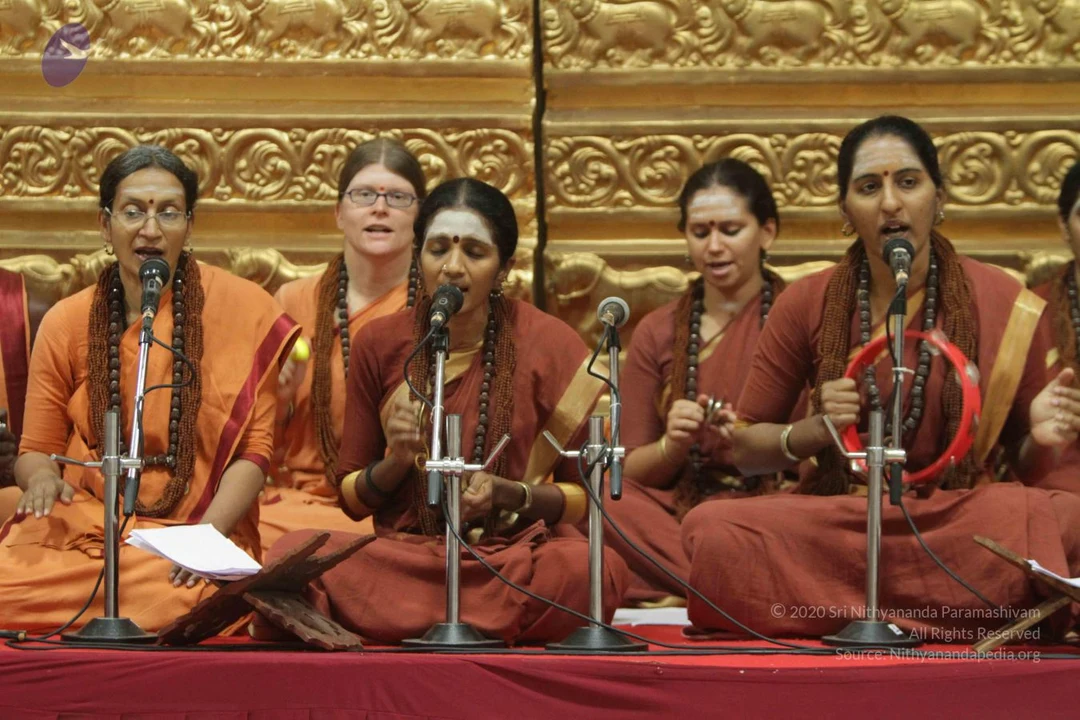
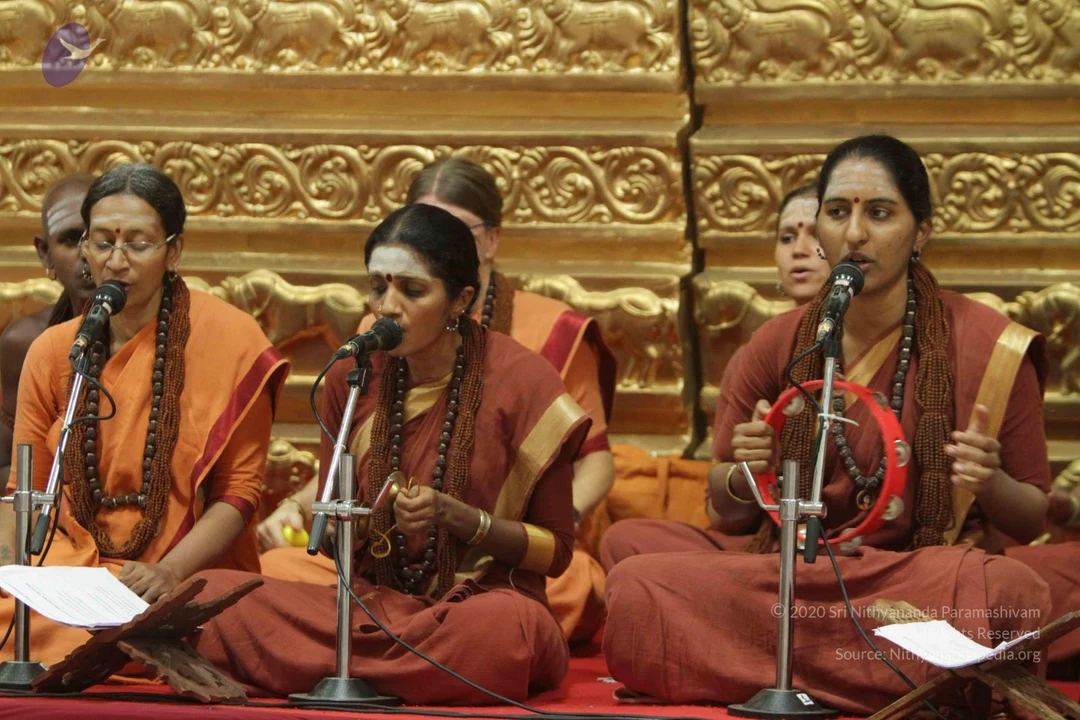
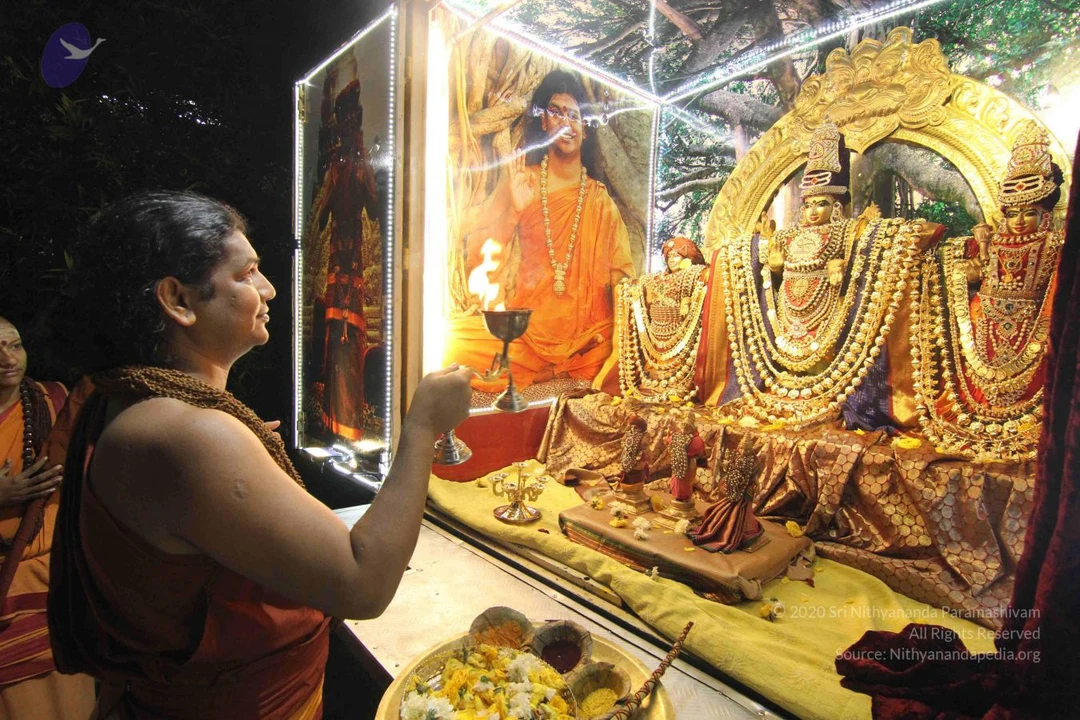
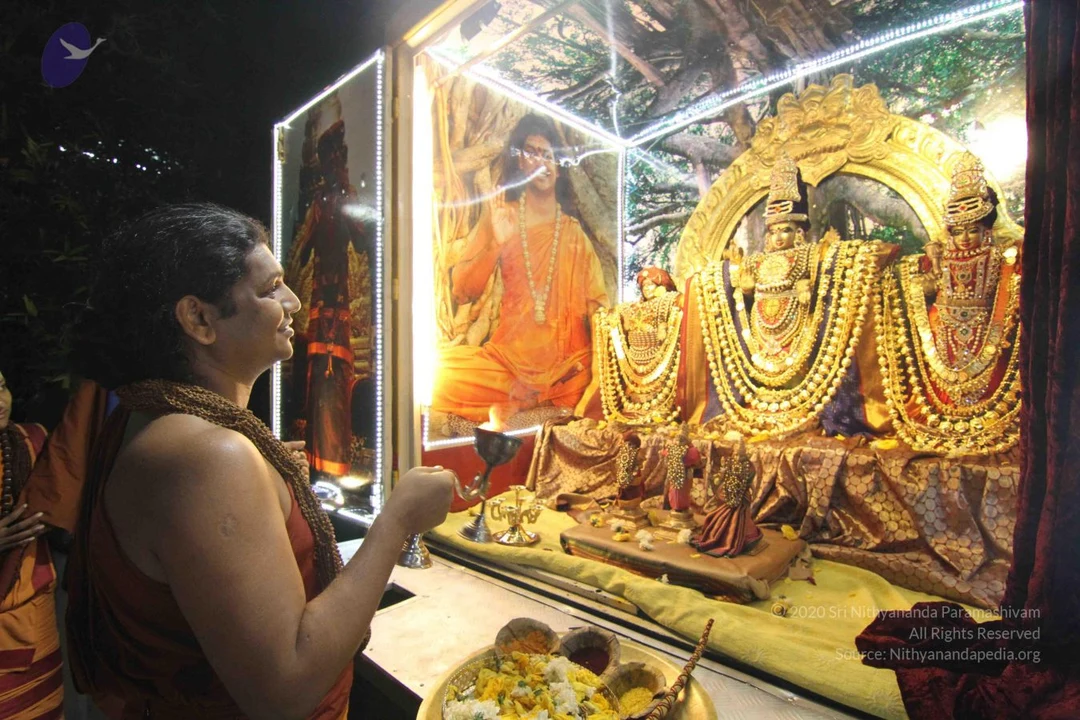
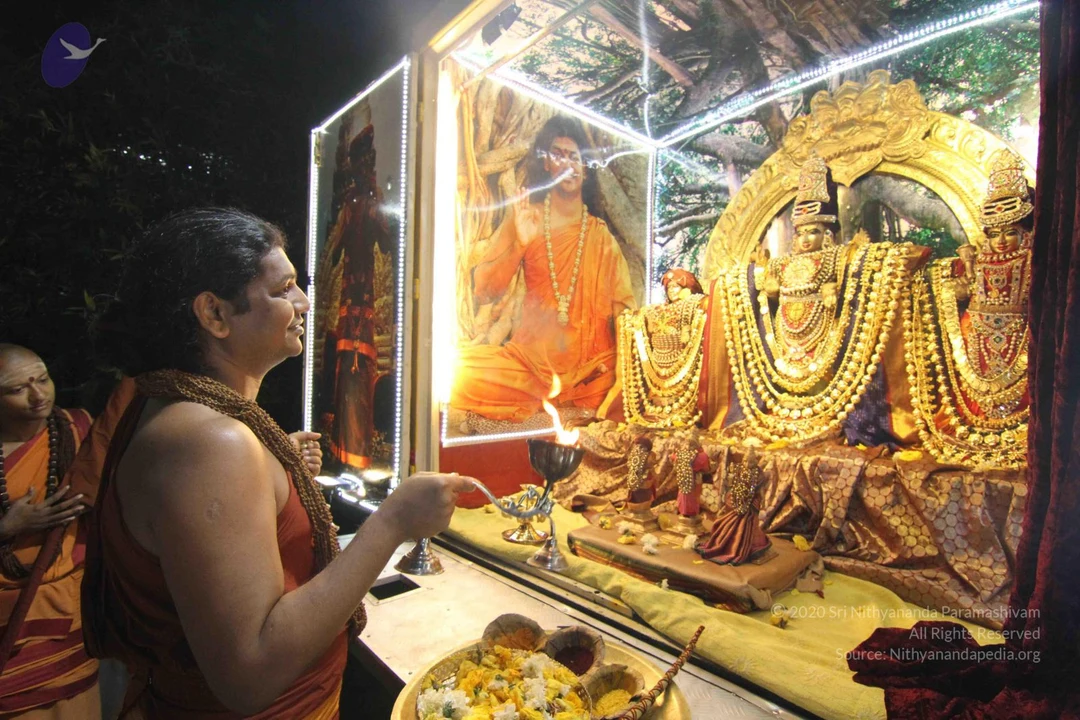
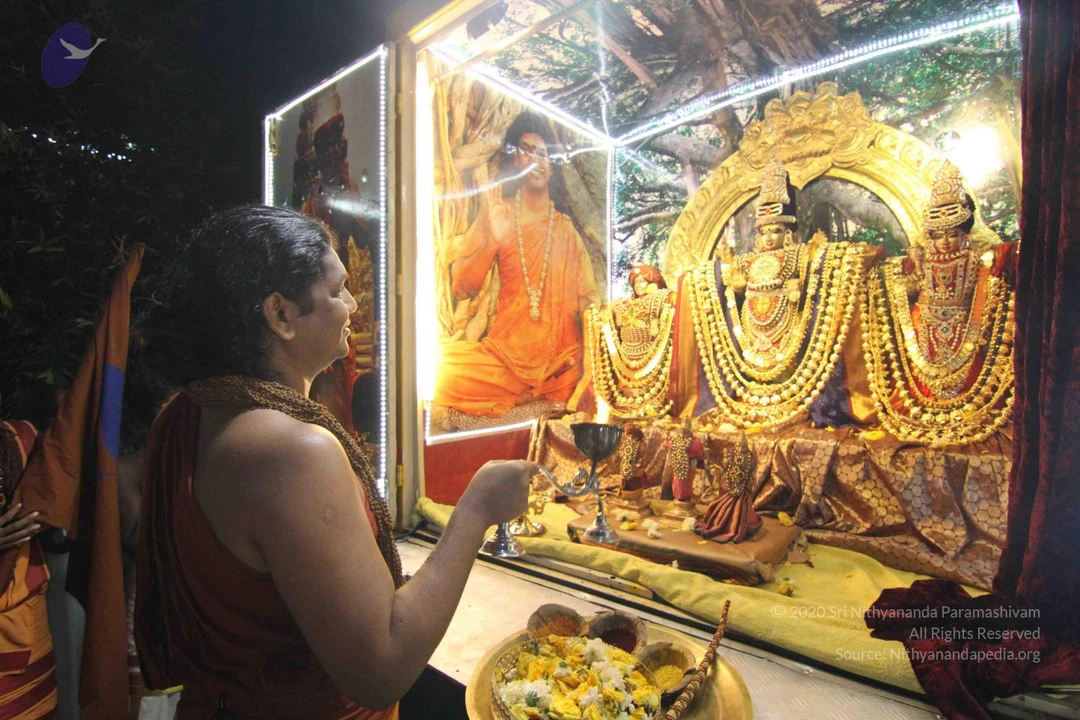
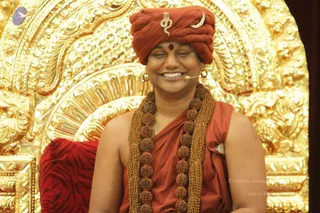
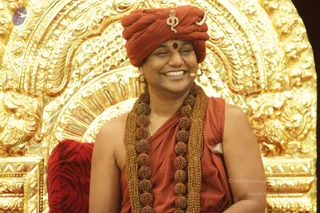
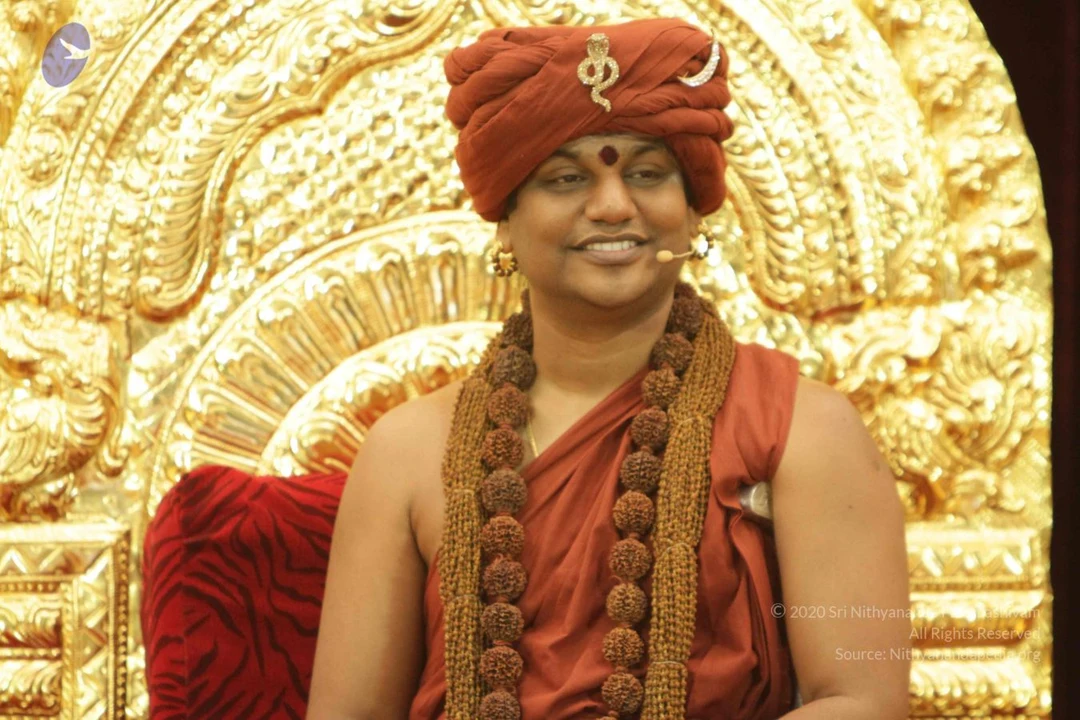
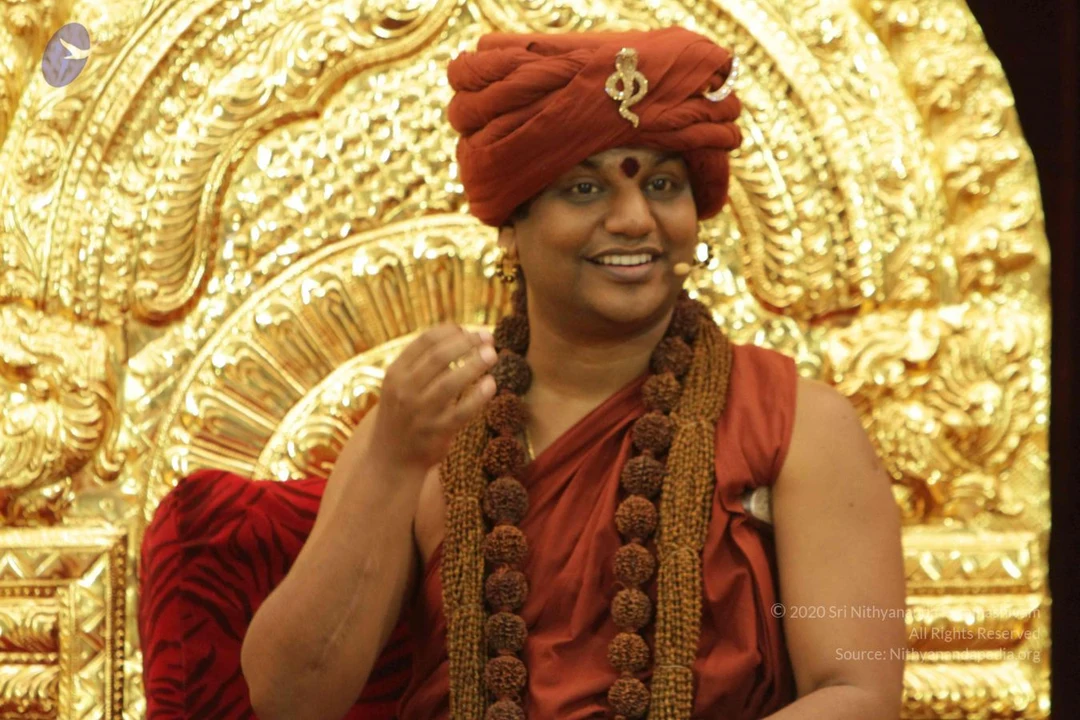
A photograph of a night-time ritual at an outdoor shrine lit by white LED strips. A bare-shouldered man in a rust-brown cloth stands at left, holding a small silver vessel toward an altar, with a brass plate of white and yellow flowers at the bottom. Behind the altar, a large framed photograph shows a smiling man with long dark hair in an orange robe with a rudraksha mala, seated under a banyan-like tree. The altar holds a golden-framed deity murti of a crowned couple decorated with gold necklaces and garlands, with brass vessels and a red-and-gold draped cloth below. Orange and saffron fabric hangs at the left edge.Three women sit cross-legged on a red floor cloth in front of a gold-toned carved backdrop, singing at microphones on stands with paper song sheets on wooden book rests. The woman on the left wears an orange sari with a red border and dark rudraksha mala beads with a large central bead, and red-framed glasses. The woman in the centre wears a rust-red sari with a gold border, a rudraksha mala, gold bangles and a white forehead mark, and sings while her hands rest near her lap. The woman on the right wears a rust sari with a gold border and a rudraksha mala, and plays a red tambourine-style hand drum. Behind them sit other devotees in orange and saffron clothes, and a shaved-headed man in orange with a white forehead mark. Golden carved animal reliefs decorate the walls. This looks like devotional group singing.A smiling man sits on an ornate golden throne with a gold filigree backrest and red upholstered cushions. He wears a red-orange turban with a gold ornament pinned at the front and a small red dot on his forehead, a red-orange saffron-coloured robe draped over one shoulder, and a long rudraksha mala with a braided gold-toned cord. A small microphone clips near his mouth and he has gold earrings. Swamiji (probable): the sitter has a red-orange turban, saffron robe, rudraksha mala and ceremonial gold ornaments, and is seated on a golden throne, appearing to be a teaching setting. One person is visible.

November 21 2014

Original wiki page
Contents

Title

Experiential Logic Vs Exponential Logic

Description:

In today’s (21st November, 2014) morning Satsang, Paramahamsa Nithyananda shares: Understand these two logics – experiential logic and exponential logic. You will understand how you are missing some of the greatest experiences of life by getting caught in a blind logic. It is like, instead of cooling glass (dark glasses), you are wearing just two black stones fixed in a frame and say, “The whole world has become dark!” Who is responsible? So, if you are using exponential logic for experiential matters and go on saying, “Experience is not happening”, then who is responsible?

Link to Video:

VideoAudio

Transcript:

Nithyanandeshwara Samaarambhaam Nithyanandeshwari Madhyamaam | Asmath Aachaarya Paryanthaam Vandhey Guru Paramparaam ||

I welcome all the devotees, disciples, samajis, satsanghis, Shrimahants, Mahants, Thanedars, Kotharis, sitting with us all over the world through Nithyananda TV and Sadhna TV, two-way video-conferencing having Nayana Deeksha all over the world.

Cities sitting with us in two-way video-conferencing: Oklahoma, Houston, Toronto, Los Angeles Temple, Hyderabad-Gupta Kashi, Seattle, Scottsdale-Arizona, Varanasi, Pudukottai, Ohio, Surrey-Canada, Jorpati-Nepal, Colombo, Kuala Lumpur, Warrington, Guadeloupe, Singapore, Oman, Rajapalayam, Los Angeles-Hollywood, Grasse-France, Austin, Hong Kong.....and some more.......

I welcome all of you with my love and respects.

I have something important to tell; that is why I have not read out all the cities’ names fully. It is just too overflowing! Today it was overflowing so much! Usually, when I sit for Puja and offer the flowers and fall into Samadhi, that’s the time this downloading happens. Today the downloading was too much! Even eyes became watery and started getting wet!

Listen! Just listen to these two words:

· The Logic of experience; one word. We will call it ‘Experiential Logic’.

· The second word: Logic of calculation; whether multiplying, subtracting, adding, deleting. The ‘Logic of Calculation’. We will call that.....I will give a new name – ‘Exponential Logic’. Just by multiplying or subtracting exponentially, logic applied, used the exponential levels.

Understand these two logics; you will understand how you are missing some of the greatest experience of life by getting caught in a blind logic. It is like, instead of cooling glass (dark glasses), you are wearing complete no glass, just two black stones fixed in a frame! If you get two black stones fixed in a frame and wearing it and thinking it is a cooling class and saying that whole world has become dark, who is responsible? So, if you are using exponential logic for experiential matters and go on claiming, ‘Experience is not happening!’, who is responsible?

So listen! Listen! This, today’s one satsangh alone is enough to give you the experience and cognition and clarity, Shivoham!

Listen! Listen sincerely! The Nakkeeran, Nakkeeran is the only guy seems to have argued with Mahadeva, knowing the guy who is standing in front of him is Mahadeva! I tell you, then they both must have had some sweet relationship. I am giving you the insider’s secret. Otherwise, you will not have guts to argue. ‘Even if I argue, whatever is said and done, end of the day he will not forsake me, he will not give up on me. I am Avimuktha.’ The guy must have had that kind of a confidence that he is Avimuktha, because, earlier many times Nakkeeran was saved by Subrahmanya from demons, devils, rakshasi, one rakshasi. So there are lot of confidence in Nakkeeran that he is Avimuktha, never forsaken. Otherwise, he will not have guts to argue with Mahadeva knowing that Mahadeva only has come! You need to have a story line.

Once there was a king who had a doubt whether women have a natural smell in their hair or it is because of the perfumes and flowers. And the king said, ‘Whoever clarifies my doubt, I will give thousand gold coins.’ Like those days’ million dollar kind of a lottery.

One priest of Sundareshwaras Temple...... In the Sundareshwaras Temple priest community, that Bhattar community, Bhattar, Deekshithar, all of them have a tradition: unless you are married, you can’t perform the rituals. You need to be married to perform the rituals. Even now the Deekshithars’ families, at the age of fifteen, fourteen the boys get married; because, unless you are married, you can’t do the puja. It is a tradition.

So, this priest wants to get married, because he can start the ritual. But he need money. He went and asked Sundareshwara.

Sundareshwara is a living god, please understand. He was never a dead statue. He was a living god; just continuously responding to people and came down in human form again and again and again. Came down, coming down, again yet to come down! He is a living swaroopa!

The priest goes to him and asks, ‘Give me money.’

Mahadeva gives a verse, says , ‘This verse will clarify the doubt of the king. Go and give it to him and take the thousand gold coins.’ He wants to do some leela. Otherwise he could have directly given thousand gold coin. Why he should tell take this and go to the king and take it? Anyhow...!

The song exactly actually means that women have a natural smell in their hair. That is the Mahadeva’s song, the meaning of Mahadeva’s song.

So, this guy goes to king, and king was very happy with this song and he was about to give the money, the thousand gold coins.

Then Nakkeeran jumps into the scene and stops. ‘No!’ And then he says, ‘No, this song is not the truth!’

Then the priest goes and cries to Mahadeva, ‘What is this? You should not have done this to me. At least if you have not given the song, I would not have suffered all the defamation and disrespect.’

Mahadeva, ever compassionate, he himself assumes the human form, picks up the palm leaf on which he wrote the song, in the form (in the guise) of a poet comes down, come to the court directly and argues with Nakkeera.

Two things you need to understand. In that whole argument, I will try to describe some of the few important points in that argument. First thing, Nakkeera is highly integrated, understand. He is highly integrated. He is so clear that women’s hair has no natural smell. I don’t know whether ‘smell’ is the right word. ‘Fragrance’! No natural fragrance! The argument starts. You need to look into this whole scene to understand some of the things. Mahadeva himself says women have, their hair has natural fragrance. And here is Nakkeera who is so highly integrated, says, ‘No!’ What is actual truth? Why this conflict? No one has solved this mystery, understand. First time, I am revealing and solving this mystery!

Listen! High intellectual beings lose the smelling sense. The high, linguistic, logical, please understand, poets are not always heart-centred. When they are centred on the content of the poem, the romance, love, joy, they are heart-centred. When they are centred on the verbatical, the verbal beauty of the poem, they become logical-centred, understand? When the concentration is on the verbalization, putting the beautiful, best, organized, arranged, rhythmic words, it is more an intellectual jugglery - organizing of different words.

Listen! Poetry is a very complex art. For example, painting - You can be just soaked in the emotion, in the heart; for your hand to do the painting, you don’t need the support of intellect. Carving - You can just be soaked in that experience. For your hand to carve you don’t need the intellectual support. Dancing - you can just be soaked in that emotion, heart. For your body to jump and demonstrate the whole emotion, you don’t need intellectual support. But for poetry, you can’t be soaked in that emotion; you need intellectual support also. You need to pick up the right words, organize it in the rhythmic way, present it in a very grammatical, grammatically, perfect way - The dramatic and grammatic, both perfection. The dramatic perfection which is emotion based, grammatic perfection which is intellectual based, both need to be happening in poetry.

Nakkeera was just one percent more grammatic than dramatic. He missed! He was little more bent on organizing the words than being established in the heart. Who will correct him? Only he has to correct. There is nobody who can argue with him in the whole world other than Mahadeva. So, he comes down. That is why exactly touching the point of smell, understand?

If you are a poet, still you have a high sense of smell, be very clear, you are more centred on the heart. You being a poet will do more good to you, and you are real poet. Any poet who loses the sense of smell, means, he has become more grammatic than dramatic. His verses are more verbal jugglery than expression of emotion. You lost Kavithva in your Kavi identity. You lost poetry in your poet identity. Highly intellectual, verbal people, the first thing they lose in their life is the smelling sense. The first drying up happens due to the over-eating of brain. Please understand, brain overheats yourself, when your brain over-eats you, the first draining, drying up happens in your system is, sense of smell is lost. Nakkeera lost that. That is why he can’t catch the subtle sense of the fragrance, subtle fragrance of women’s hair....women hair.

We do not have a reference whether Nakkeera was married or not, but surely he had mother, and he was not away from the city. He was in the city, he had mother, and so many women are around him. Surely he would have had the opportunity to come near the hair. That, no doubt! But, unfortunately, because he lost the sense of smell, he never experienced the fragrance.

And, the next important thing, that is what is directly relevant to today’s satsang: He is not stopping with experiential logic. ‘See, I would have smelled some ten or twenty women in my life....only twenty, thirty women, the possibility for going near their hair and smelling would have happened in my life. I had opportunity may be twenty thirty, then why should I not tell directly that as far as I know my experience goes women do not have natural fragrance in their hair?’ That is experiential logic. But, because his head has eaten more part of himself, his being, he applies exponential logic. He says, ‘Not only any women of the human Planet, even the other planets, or the Saraswathi herself, or, ultimately, the Devi, who sits left to Mahadeva himself!’ Has he (Nakkeeran) smelled her (Devi’s) hair? Has he smelled Saraswathi’s hair? That is where he misses the experience. Sometime, you stick to exponential logic and miss Mahadeva standing and pointing experiential logic to you. Mahadeva, again and again, comes to you as Guru and points out experiential logic, and you go on hold on to exponential logic and argue with him! Like, I have ten-thousand Nandis! I can really be proud! Not arrogance or pride. ‘Proud’ word is also wrong word may be. I can really ‘celebrate’! Surely I have many more people dedicated like Nandi. Mahadeva had only one Nandi; I have so many Nandis! He had only few bhoothas; I have so many bhoothas! And, same way, I want to tell you, he had only one Nakkeera; I have so many Nakkeeras around me! So many people arguing with me!

For all my Nakkeeras, I want to tell you guys only one thing, when Mahadeva came, till this scene of Nakkeera saying women have no natural fragrance, is okay; but, when Mahadeva asked the question, next level, the moment he uttered the word ‘all women’, Nakkeera should have backed out. He should have said, ‘No, I can only talk from the experiential logic. I cannot make that into exponential logic.’ He would have immediately had enlightenment! His heart and head, his head and heart would have been balanced. His more grammaticness would have come down and balanced; he would have been balanced between grammatic and dramatic. When there is no balance between dramatic and grammatic, life becomes traumatic! It becomes a trauma! Saraswathi, who is sitting in his tongue, he goes to the extent of saying even for that Saraswathi there is no natural fragrance in her hair! Understand, because your logic has helped you in many places in your life, don’t think it can be a help forever. Because a boat helped you to cross the river which is really dangerous, do not think the boat can help you ever for travelling in your life.

A guy saw the dangerous river, but fortunately had the boat, and with the help he crossed the river. After crossing, he started carrying the boat on his head.

Somebody asked, ‘Why?’

‘No, it helped me to cross the river. Now it will help me to cross the land.’

You are a fool if you think just because it has helped you to cross the river, it will help you to cross the land also. Same way, Logic - Because the logic has helped you many times in your life.... Especially Nakkeera’s, all the glory is nothing but his logic. Just the way he is able to organize the words got him the position of the Chief Poet. And the Chief Poet was more respected in Pandya Kingdom, than the king himself! Even king was expected to be poet, not just administrator. Because the logic has helped him, got so many wonderful things in his life, he unfortunately, unconsciously, arrogantly jumped into exponential logic by turning a blind eye to experiential logic. That is why he missed something even when Mahadeva came down to give him! And then he goes to the stupid level of saying, ‘Even if you are Mahadeva, what you said is wrong!’ That is pfffftttt! I think Nakkeera lost his sense. He lost even that, that space of Avimuktha, never forsaken. Yes, you will never be forsaken as long as you maintain the umbilical cord. Even if you pull the cord out, how do you think you will never be forsaken? Because, only through that cord you are protected! When you pull the cord out, you tell Mahadeva, ‘No, no need, don’t help me. Don’t interfere in my life. Don’t interfere with me.’

Listen! In your life, so many times, you are playing with exponential logic, instead of looking at experiential logic. One of the unfortunate thing, whenever you have pain and suffering, you will always feel your whole life is going to be like that, because, with the pain and suffering, the exponential logic works more. That gets more strengthened. With the joy, experiential logic gets more strengthened, understand? This whole story of Nakkeera is all about exponential logic and experiential logic. Mahadeva speaks from experiential logic. Nakkeera spoke from exponential logic. Nakkeera is highly integrated, but not authentic. When he uttered the word, ‘Women do not have natural fragrance’, he is integrated. When he uttered the word, ‘All women......’ he became inauthentic.

Now, I want you to look in and do acid wash of your belief systems, whatever belief system you carry about you. For example, morning four o’clock you will be tired, sleepy, not feeling like waking up and doing yoga. If it was your experience for one day, you will make that into exponential and start believing forever! ‘Morning four o’clock I cannot do anything. By morning four o’clock I will be tired and no yoga.’ Same way, Satsang, ‘I don’t understand much, Swamiji speaks in English and that also in some level English.’ One day if you make that as experience, you do not just hold on, ‘Today I don’t understand, may be in next few days I may understand.’ You don’t keep that opening left for life to happen. You burn the whole land with exponential logic. So, the possibility never grows, understand.

A burnt land, unless it is ploughed again, no seed will grow. ‘Burnt land’ means, literally brick, the surface has become like a brick. On brick no seed will grow, unless it is ploughed again, and it becomes loose, or few rain. Please listen, when you burn your future with your exponential logic, the possibility seed never grows, enlightenment fruit never happens. Yes, no doubt, till yesterday you did not experience Shivoham. Yes, no doubt, till today, when Mahadeva gave the initiation of Shivoham, it came inside went this side (went in one ear and came out through the other), and sometimes did not even come inside, took diversion and went that side (over the head). Yes, no doubt! But, you don’t have to make that experience into exponential logic like ‘Oh, forever it is going to be like this only. So nothing to be done. Just give up. Eat, drink, be merry.’ But the funny thing is, just by eating and drinking if you can in be merry, I have no problem; be. You will not be! Because the second day you will think, ‘Oh, today I got to eat and drink. Tomorrow if I don’t get what will happen? Let me take it from others.’ And that will create conflicts! Just eat, drink and be merry. If you can, great! But you won’t! So, ‘Eat, drink, be merry’ is a illogical statement promoted by materialistic people. ‘Be merry’ never happens! It is like ‘happily married ever after’!

See, there are Maha Vaakyas: ‘Prajnaanam Brahma’! ‘Aham Brahmasmi’! ‘Tat Twam Asi’! Eternal truths! ‘Shivoham’! Now I am giving the new Maha Vaakya: ‘Nithyanandoham’! All these are eternal truths. Same way, there are some statements, eternal lies: ‘Happily married ever after’! Happiness can be brought into the marriage when you have a beautiful image about the other person, means beautiful idea about the other person and life. I am not saying happiness and marriage don’t go together; I am saying it doesn’t go together ‘naturally’. It has to be done ‘consciously’.

In that way, even sannyas and enlightenment does not go hand in hand together ‘naturally’. Just because you are a sannyasi, you cannot be called enlightened. Even that way, enlightenment has to be built even in sannyas. Of course, for my sannyasis I have given a boon and commitment, ‘When you guys leave the body, I will liberate you.’ That is totally different! Once I have given sannyas, I cannot forsake anybody. I don’t want to tell more secrets, but the truth is I cannot forsake them. Once sannyas is given in front of the Agni, the Viraja Homa Agni, the commitment, the declaration is done, I declare you as Swami so and so....over!

Listen! Whether it is building happiness in marriage, or bliss in sannyas, you have to build it; you have to make it happen. You can’t say ‘naturally’. Just like these few statements – ‘happily married ever after’ – these are all eternal false!

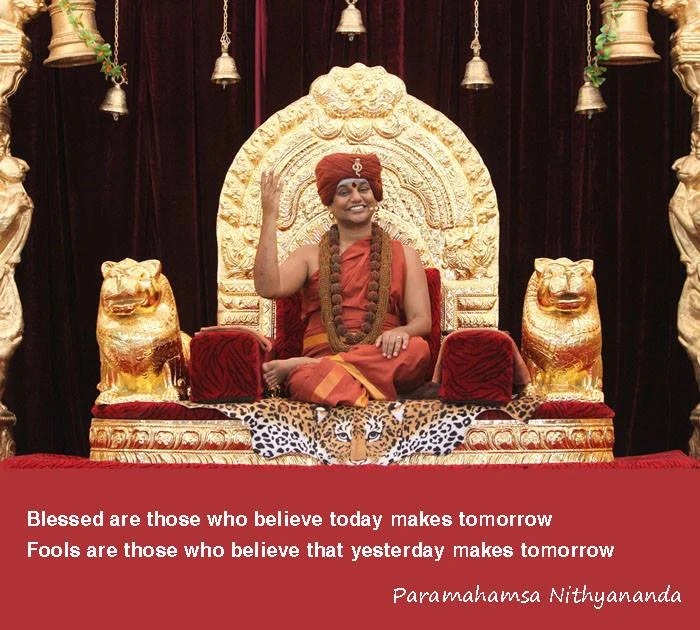
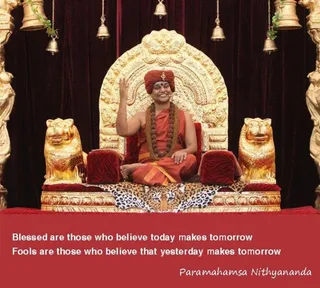
Listen! Listen! Measuring your life with exponential logic is what I call ‘illusion’. Because I did not experience Shivoham yesterday, tomorrow also I may not, is ‘illusion’. Yesterday does not make tomorrow. Whoever believes yesterday makes tomorrow is not living. They are called ‘dumbos’! Whoever makes today, whoever understands today makes tomorrow, only they live. Blessed are those who believe, cognize, today makes tomorrow. Fools are those who believe yesterday makes tomorrow. Let experiential logic be alive in you more and more for your cognition and running the life, not exponential logic. Not exponential logic, but experiential logic. With experiential logic, you will always remember the possibility; you give the space for more and more possibility. Till yesterday it did not grow does not mean tomorrow it will not grow. Shivoham can happen even today, even tomorrow, even next moment. Keeping the possibility alive, listen, keeping the possibility alive is what I call ‘being a seeker’.

I am defining who is seeker. Seeker is not the man..... In the modern day, being seeker is a fashion. Pick up your handbag, and without losing the lipstick touch up, go to the nearest big Guru and shake your handbag, and do some social service. In-between between when it sweats wipe it with a tissue touch-up, between make a few phone calls to people and say, ‘I am doing service. Do you want to listen to my Guru? He is giving satsang: ‘Love is giving. Karma is giving’.’ Then coming out and having some friends to catch up, ‘See, I am a seeker for last thirty-five years!’ They don’t even know this is defamation for their Guru! No, if you tell you are a seeker for thirty-five years, it is a defamation for your Guru!

I am defining being a seeker. Listen! Whoever moves in his life with cognition of experiential logic, keeps the possibility open, alive, in his beliefs about himself and life, he is a seeker. Keep your possibility alive. Only then you are a seeker. I am neither a Guru who makes you seek for years and years nor the Guru who promises everything quicker. No! There are ‘quicker’ Gurus where you can just go in the internet, ‘tak tak’, swipe your credit card, enlightenment parcelled! In eBay, you receive the enlightenment! I am neither the Quicker Guru nor the Seeker Guru.

Keep your possibility open. Keep your possibility alive. And, I tell you and I am really telling you, life simply flowers into Shivoham when you keep the possibility alive. Move with experiential logic, not exponential logic.

Essence of today’s satsangh, the punchline for Facebook Status for all of you today:

Move the life in the space of experiential logic, not in the space of exponential logic. May be, in the outer world, exponential logic will be useful for something, but that does not mean that is the complete life solution. Brick can be used to build buildings, not for breakfast! Gas cylinder is useful for cooking; that does not mean you will make your body into gas cylinder. Yes, you need to carry the gas cylinder wherever you go, but not inside the body; outside, separately. HAHAHAHAHAHAHA!

I bless you all! Let you all radiate with Integrity, Authenticity, Responsibility, Enriching and Causing eternal bliss, Nithyananda! Thank you!

</gallery>

Photos From The Day

Nithya Satsang and Darshan
Sri Nithyanandeshwara Temple

Sacred Arts

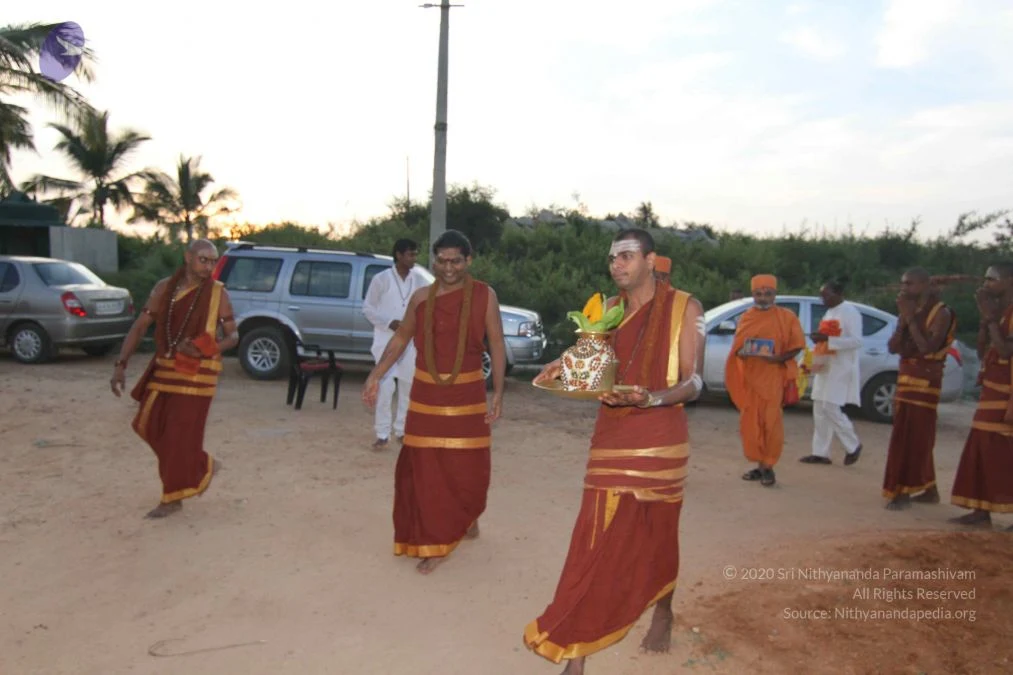
Sri Nithyanandeshwara & Nithyanandeshwari  procession

Photos Of The Day:

FB-photo-of-the-day

1-Satsang

2-Bidadi-Deities

3-Sacred-Arts

Photos from this day

View all 162 photos

Nithya Satsang and Darshan
50 photosSource gallery
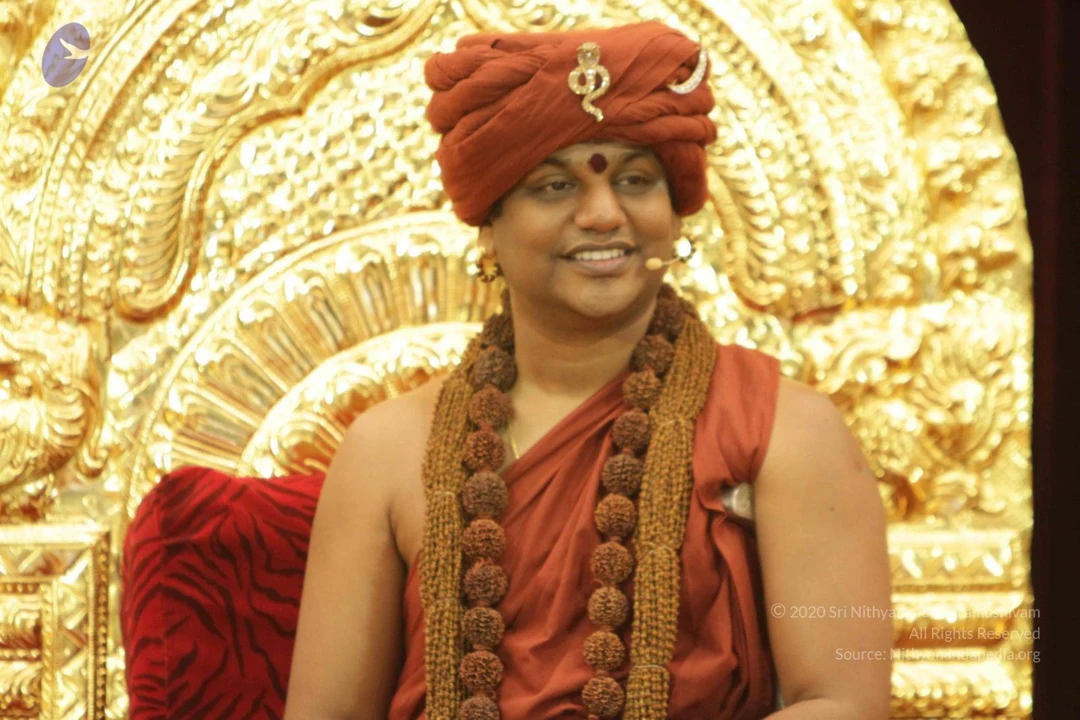
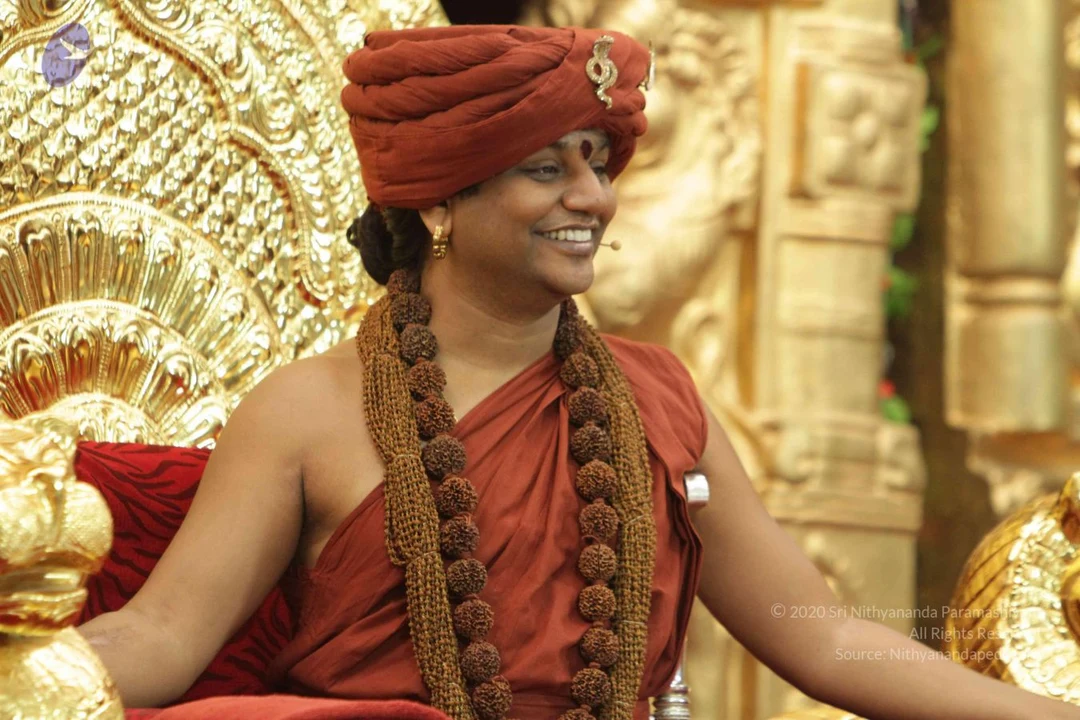
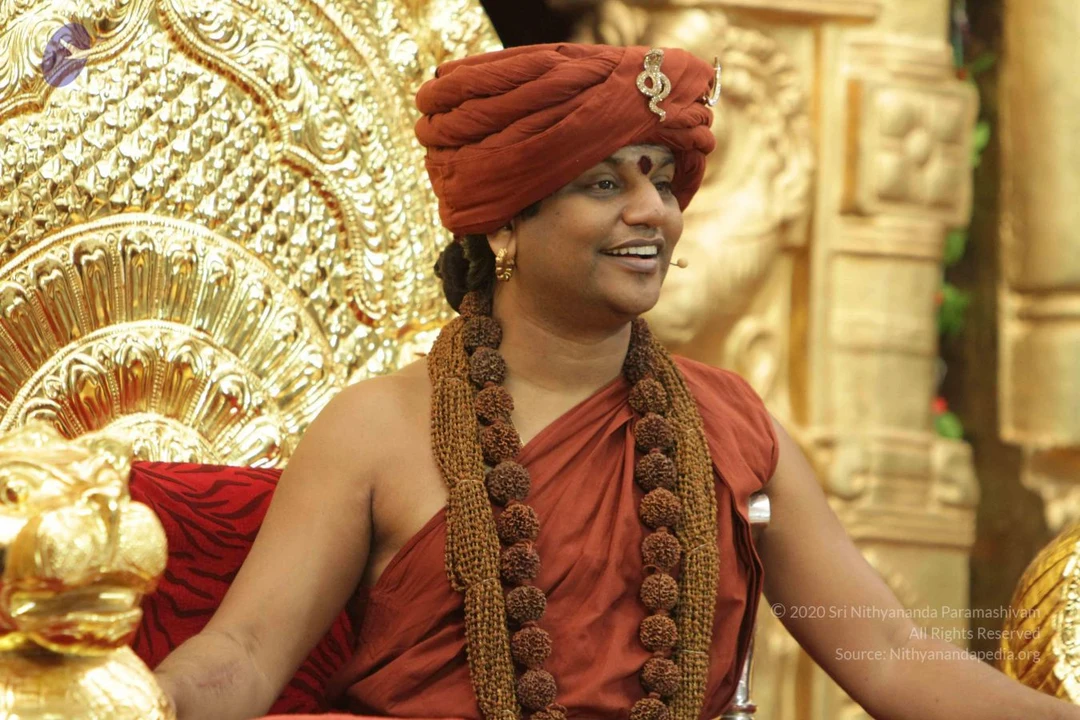
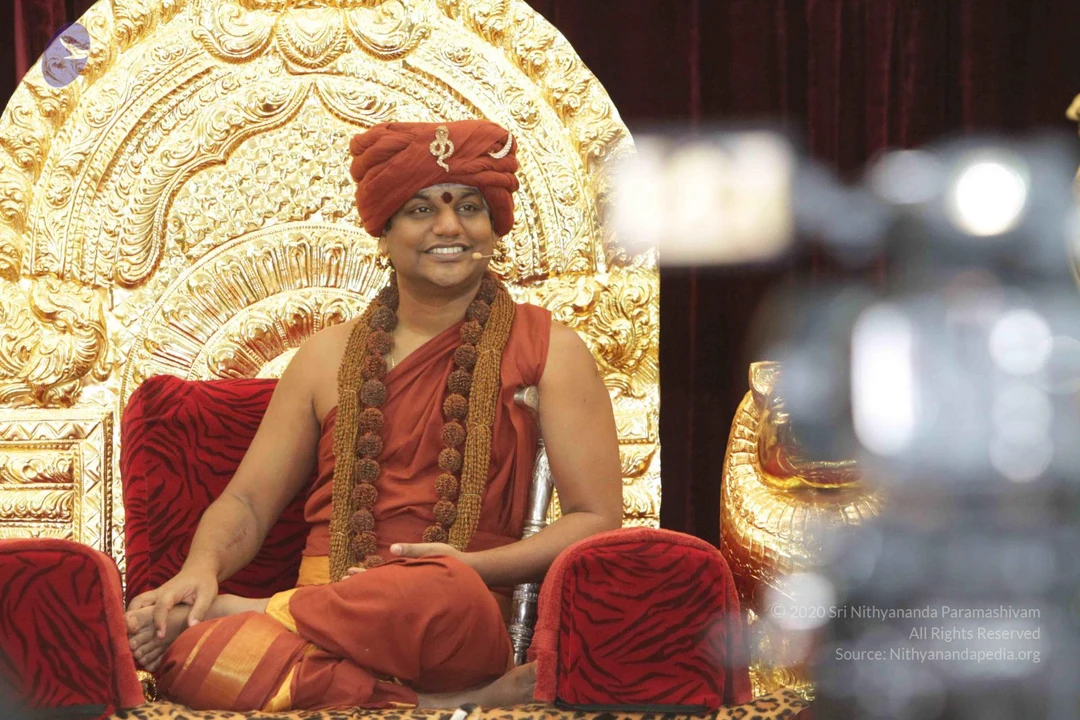
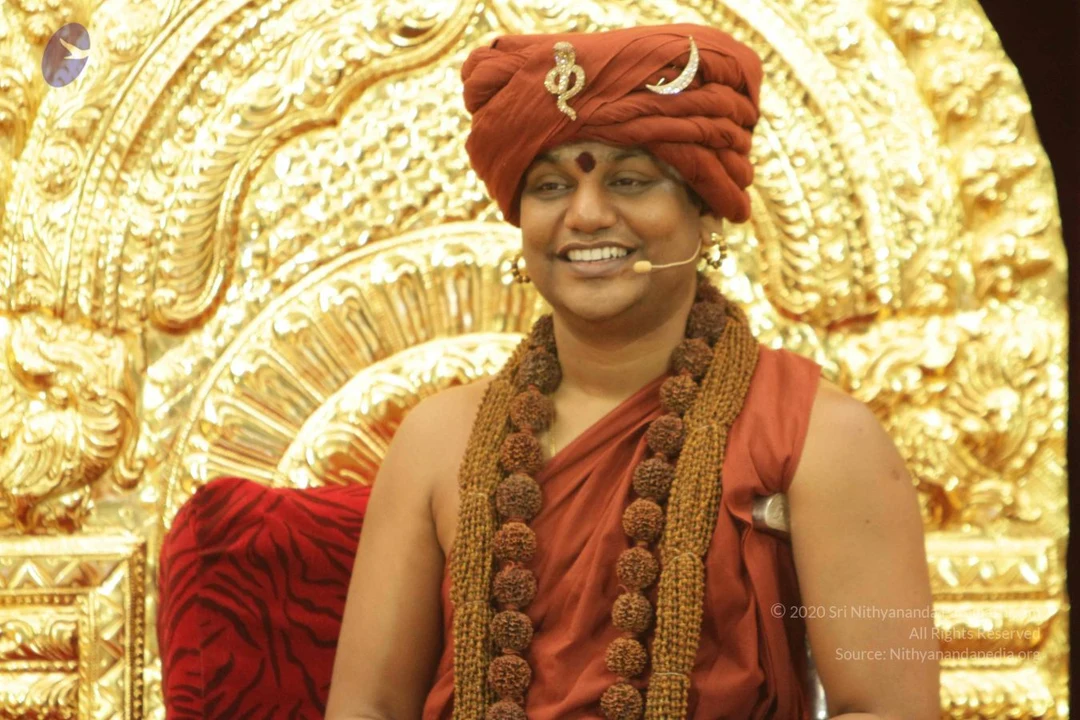
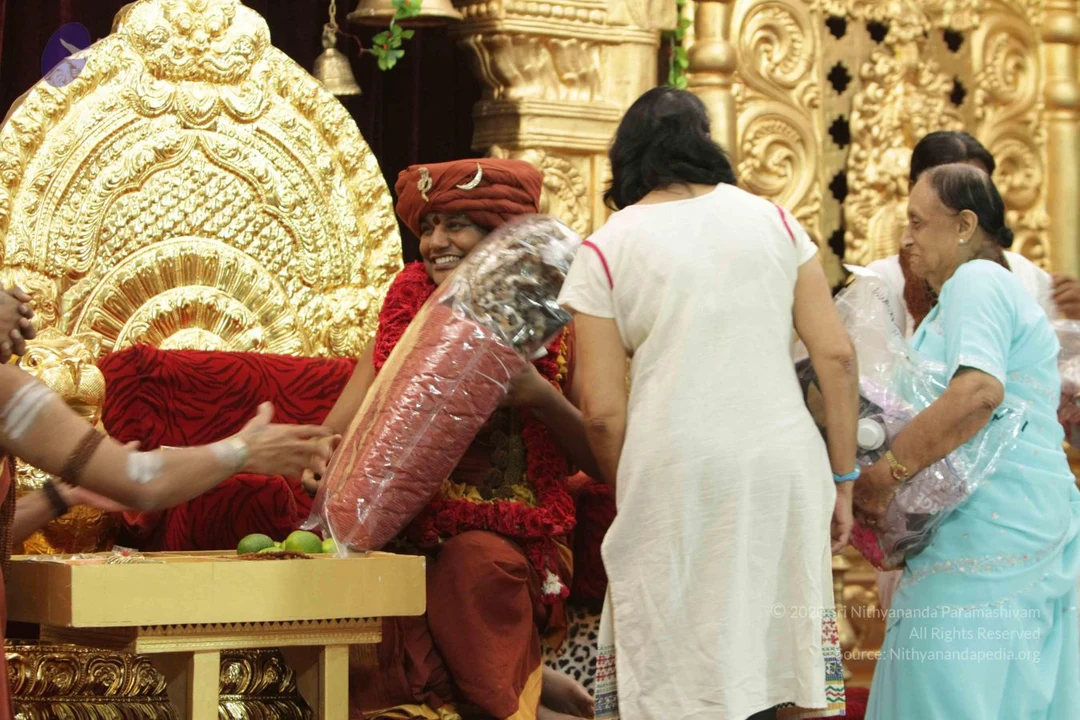
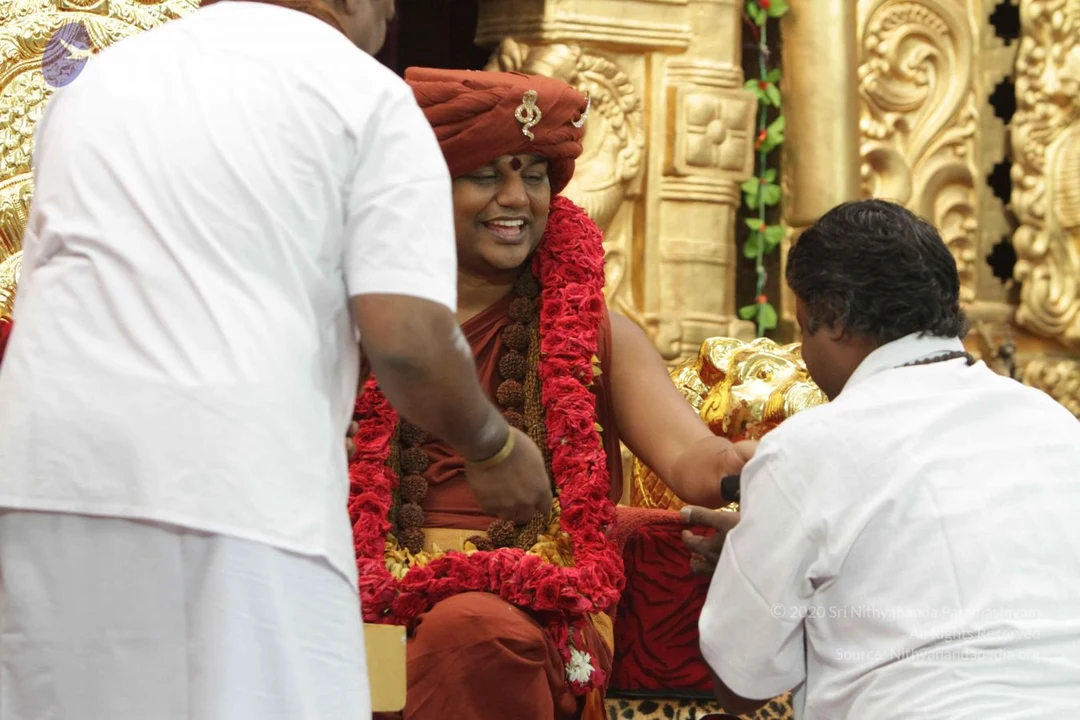
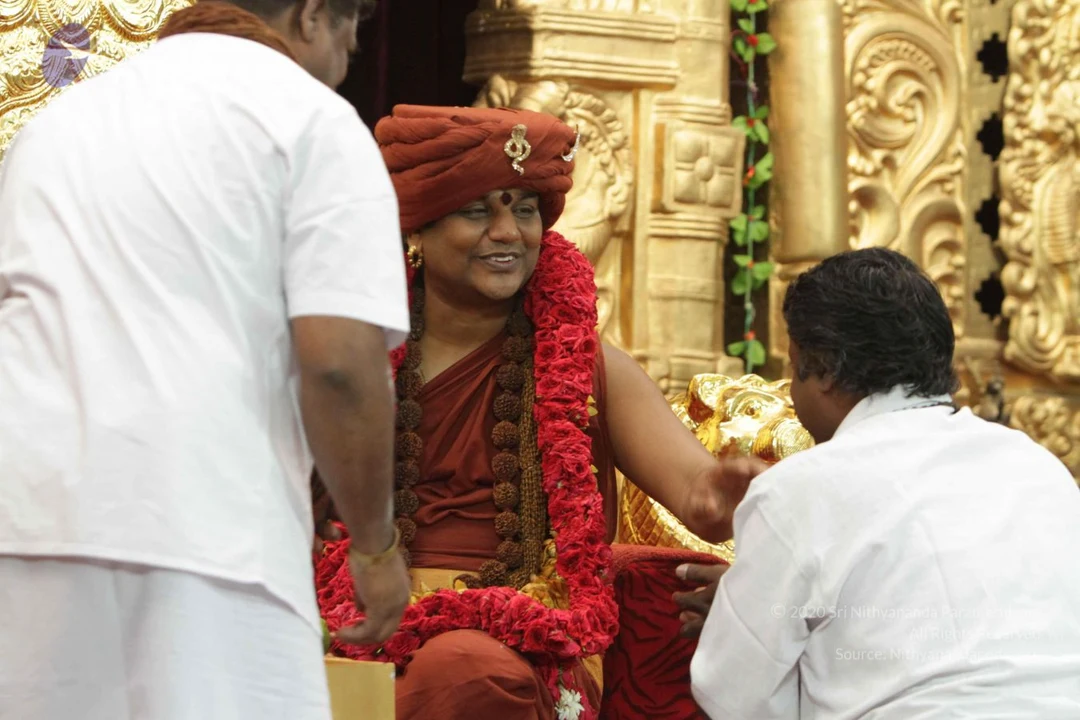
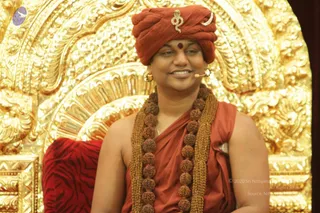
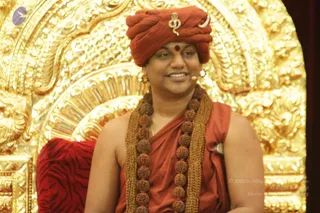
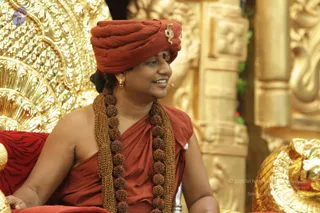
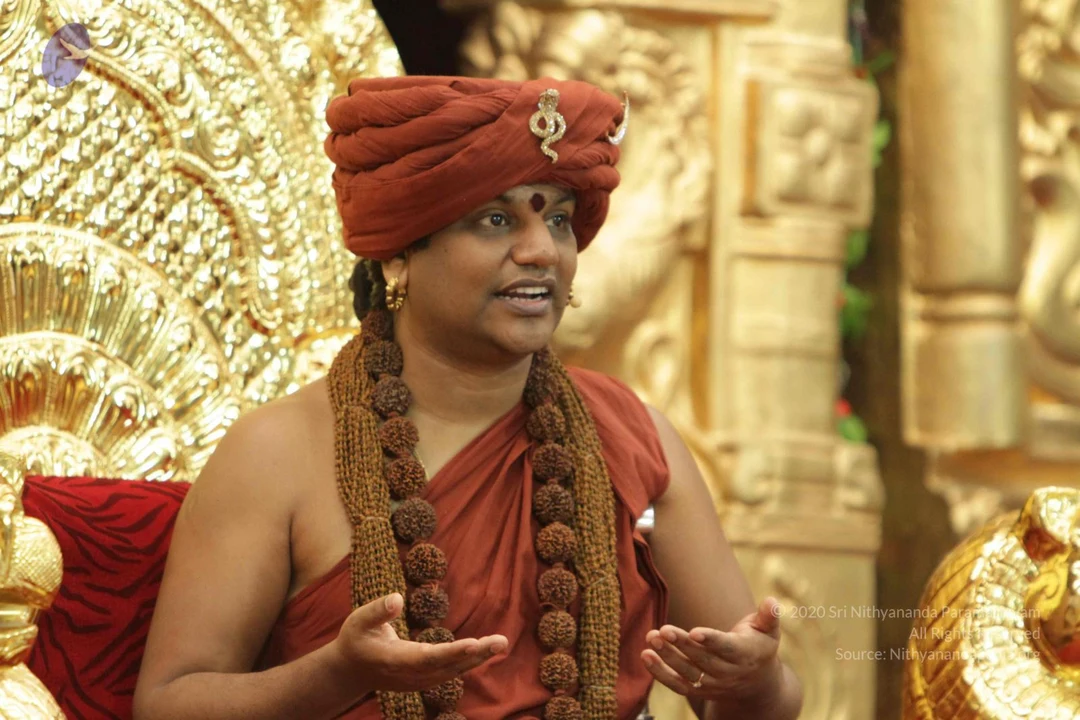
A smiling man sits on an ornate golden throne with a red tiger-striped cushion, wearing an orange-red turban with a gold snake and crescent emblem, a red dot on his forehead, gold earrings, and a microphone clipped near his face. He wears a saffron-orange shawl over his shoulders and a long layered rudraksha mala with brown seed beads. Swamiji (probable) by appearance cues: swept turban, saffron clothing and rudraksha malas, consistent with the page's satsang context.A smiling man seated on a red and black tiger-striped cushion before an ornate gold-leaf throne with carved floral and scroll patterns. He wears a rust-orange turban with a gold snake-and-crescent ornament and a red bindi, a small headset microphone, and an orange-red sleeveless robe over one shoulder. Multiple rudraksha mala strands with gold-coloured beads hang across his chest. Several rudraksha malas and a crown-like turban with ceremonial gold ornaments and long ear cues are visible, making this an appearance-based probable Swamiji (probable) seated as a speaker during a satsang. One person is physically present. A small circular logo appears at the upper left, and a copyright line appears at the lower right.A smiling man with closed eyes sits on an ornate gold throne with carved gold filigree behind him and a red tiger-striped cushion at his side. He wears a saffron-orange turban with a gold emblem and crescent, a red dot on his forehead, gold earrings, and a saffron-orange robe over a bare shoulder. A long double strand of rudraksha beads with gold-coloured cords hangs around his neck. A small headset microphone is clipped near his mouth. Swamiji (probable): saffron turban, rudraksha malas and ceremonial gold ornaments.A smiling man sits in front of an ornate gold repoussé backdrop, wearing a saffron-orange turban with a gold cobra ornament and a red bindi. He wears a saffron-orange robe over his shoulder and a long double strand of rudraksha beads with gold-tone tassels around his neck. A small microphone is clipped near his face. Behind him is a red-and-black zebra-pattern cushion on a gold throne. Swamiji (probable): long-hair-free, saffron turban, rudraksha mala and ornate clothing mark a.Swamiji (probable) sits smiling on an ornate golden throne with carved gilded backrest, wearing an orange-red turban with a gold serpent crest and red bindi. He wears an orange-red shawl over a bare upper body, long rudraksha mala necklaces with gold-toned beads, and small gold earrings, with a small microphone clipped near his ear. A red tiger-striped cushion is visible on the left.A photograph of a smiling man seated on an ornate gold throne with carved gold panels behind him. He wears a deep red-orange turban with a small gold ornament at the front and a red bindi, a red-orange robe draped over one shoulder, and a long double strand of rudraksha beads with gold-coloured cords across his chest. A small microphone is clipped near his face. Swamiji (probable): the cues are the long rudraksha malas, the saffron-orange turban and robe, and the ceremonial throne, consistent with a satsang discourse seat.

Sri Nithyanandeshwara Temple

14 photosSource gallery
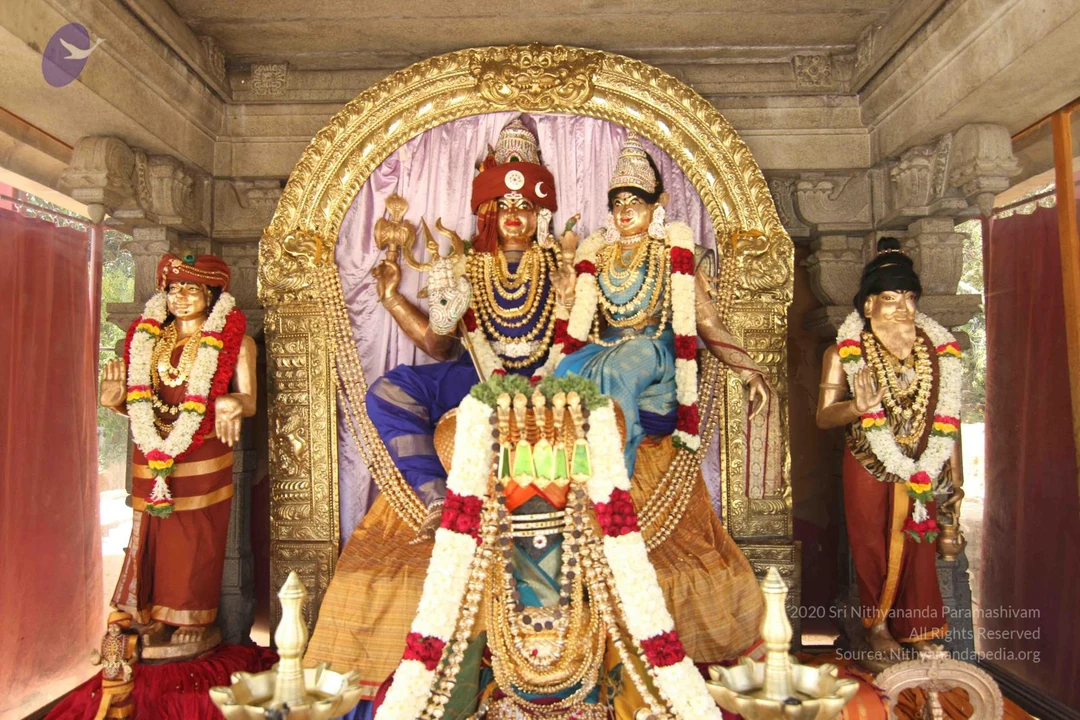
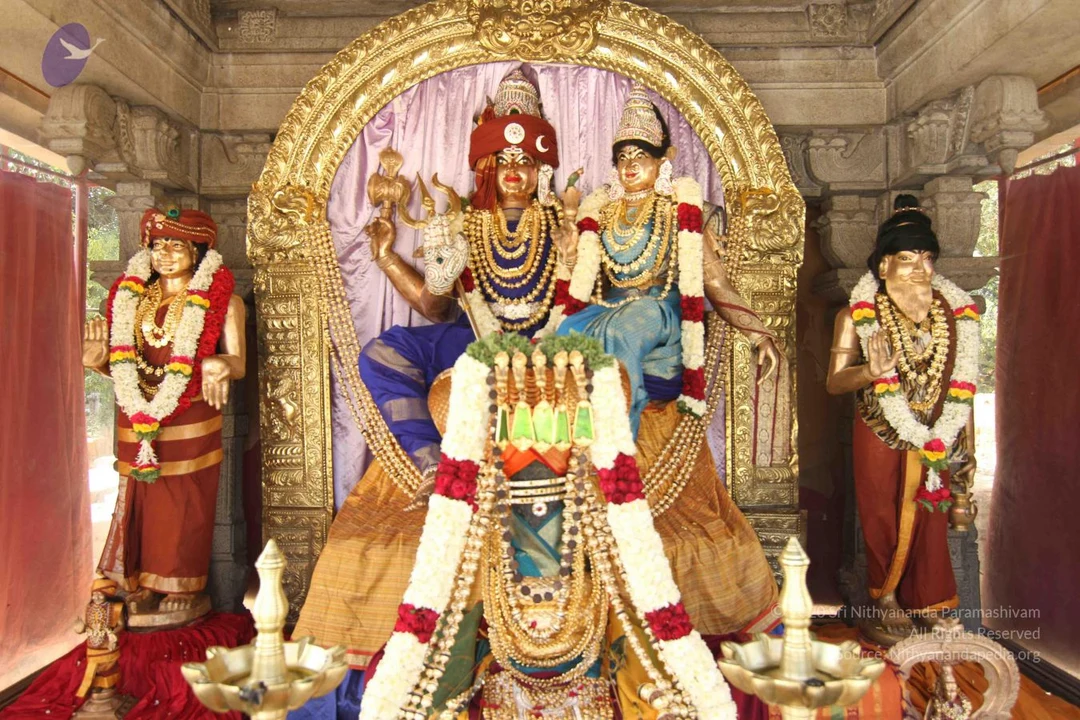
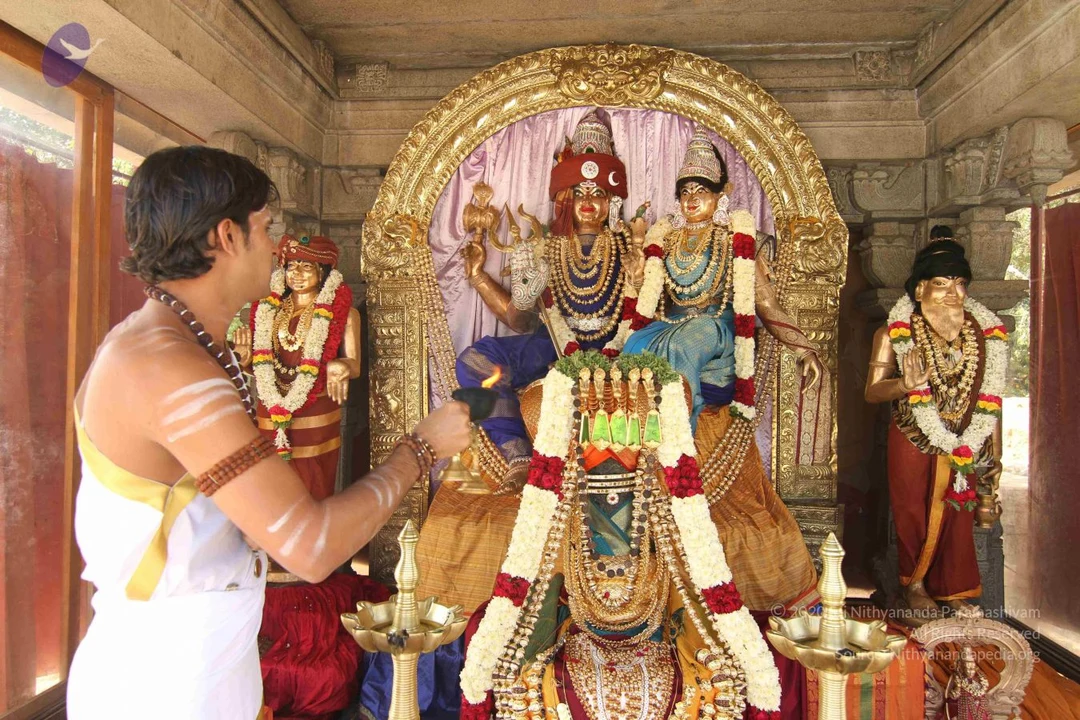
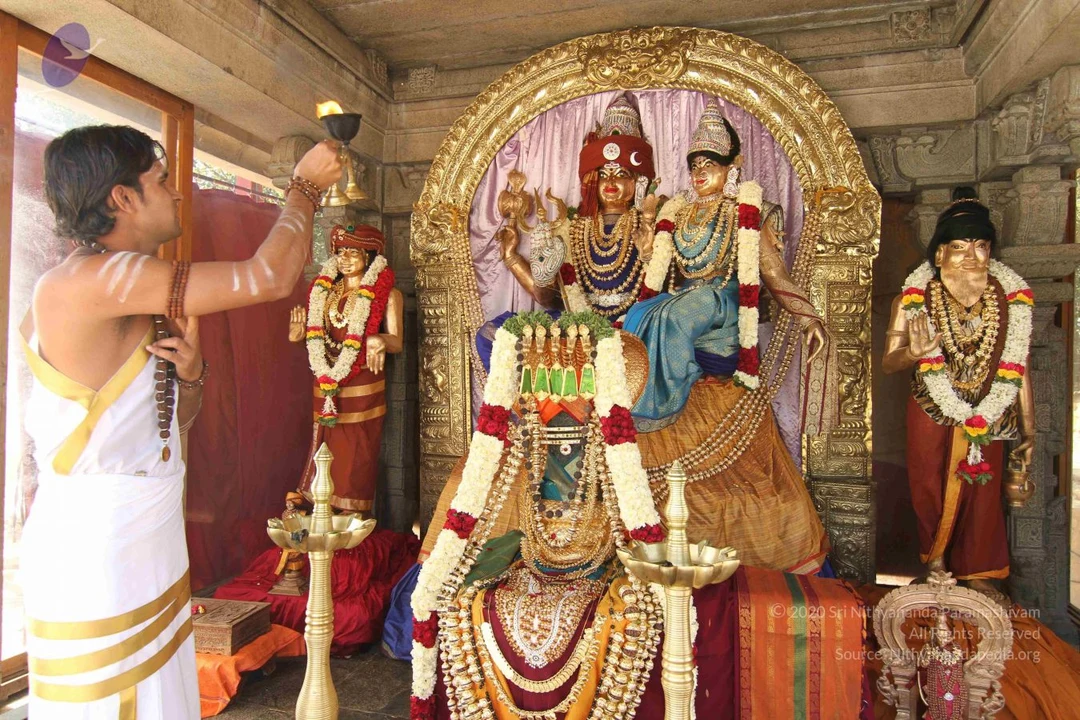
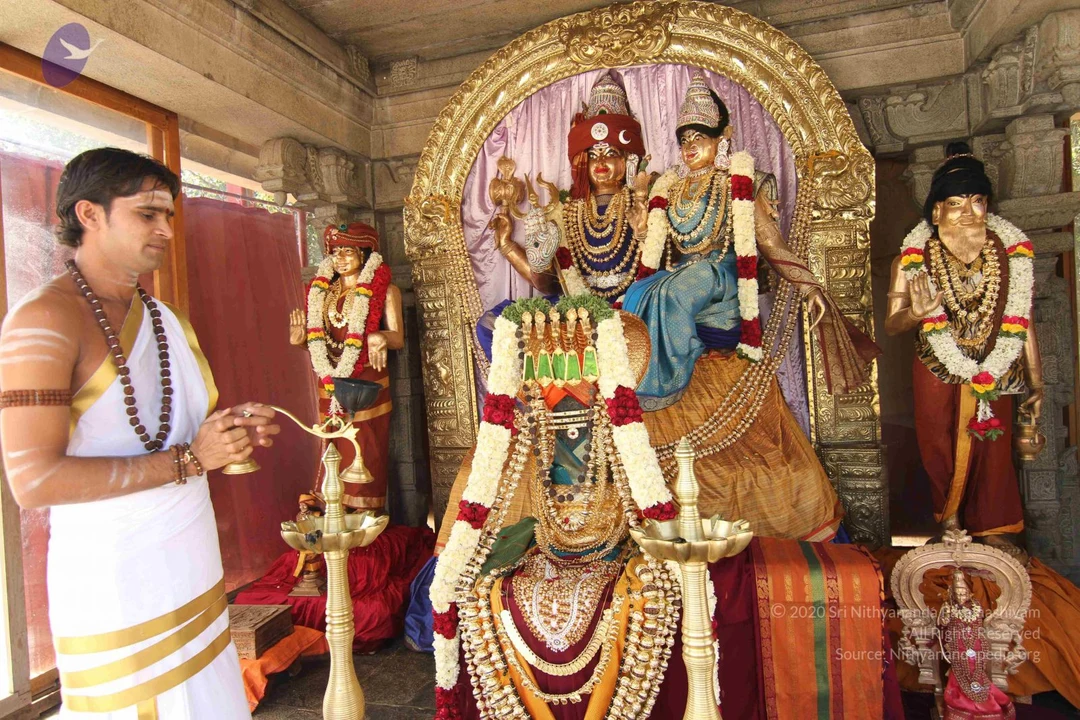
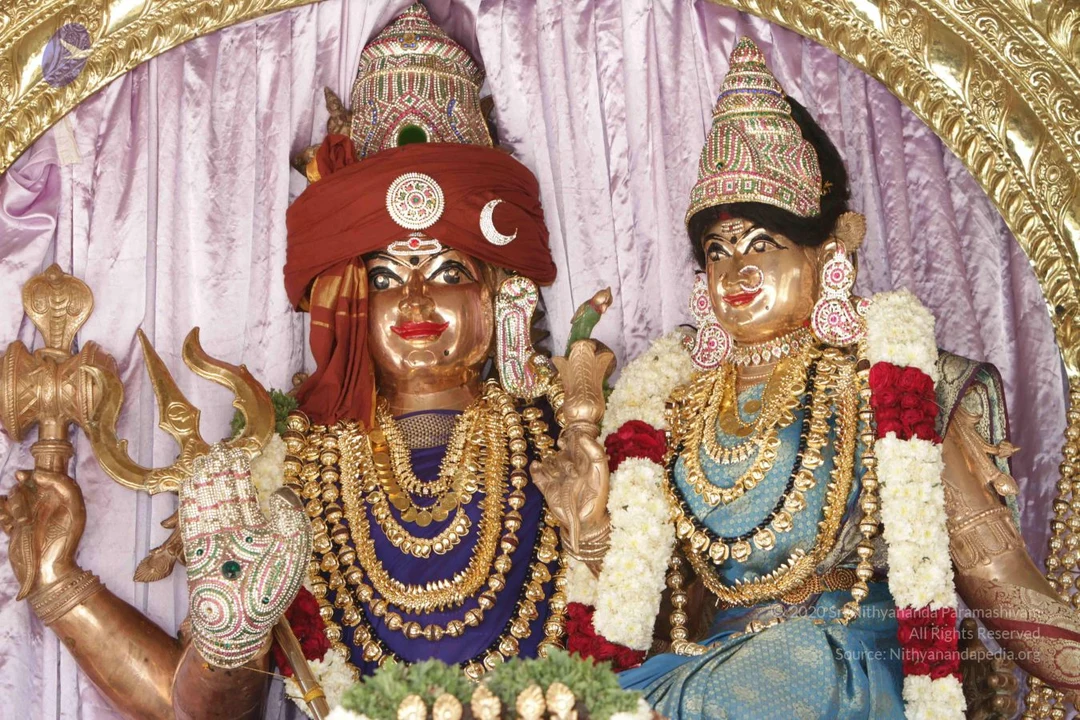
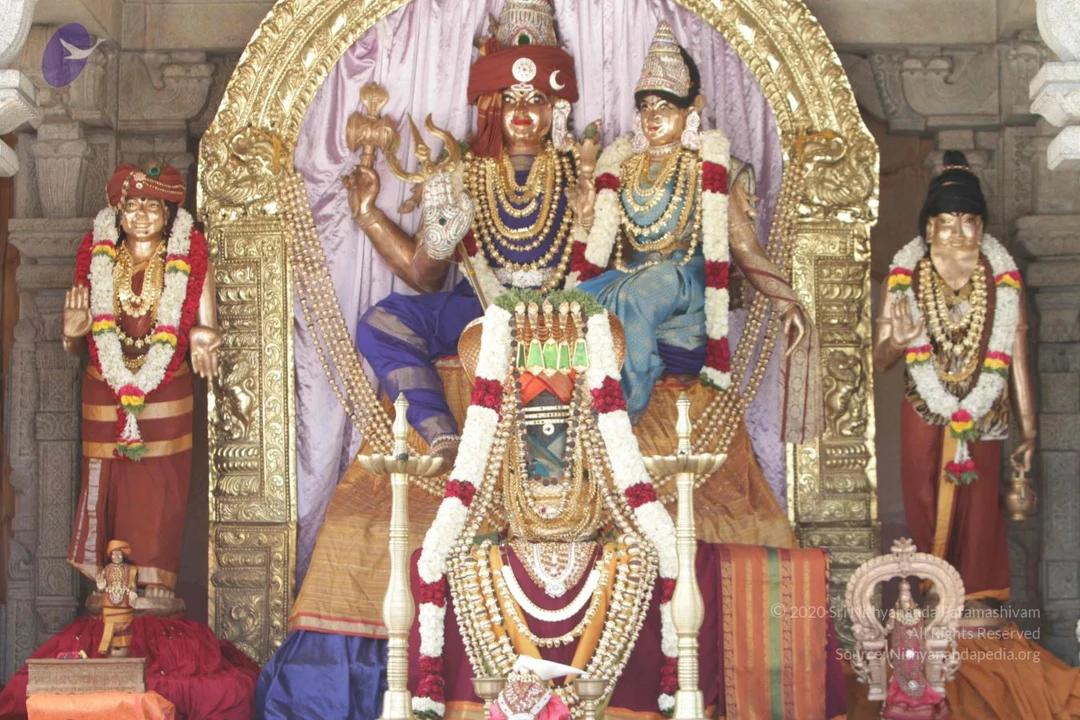
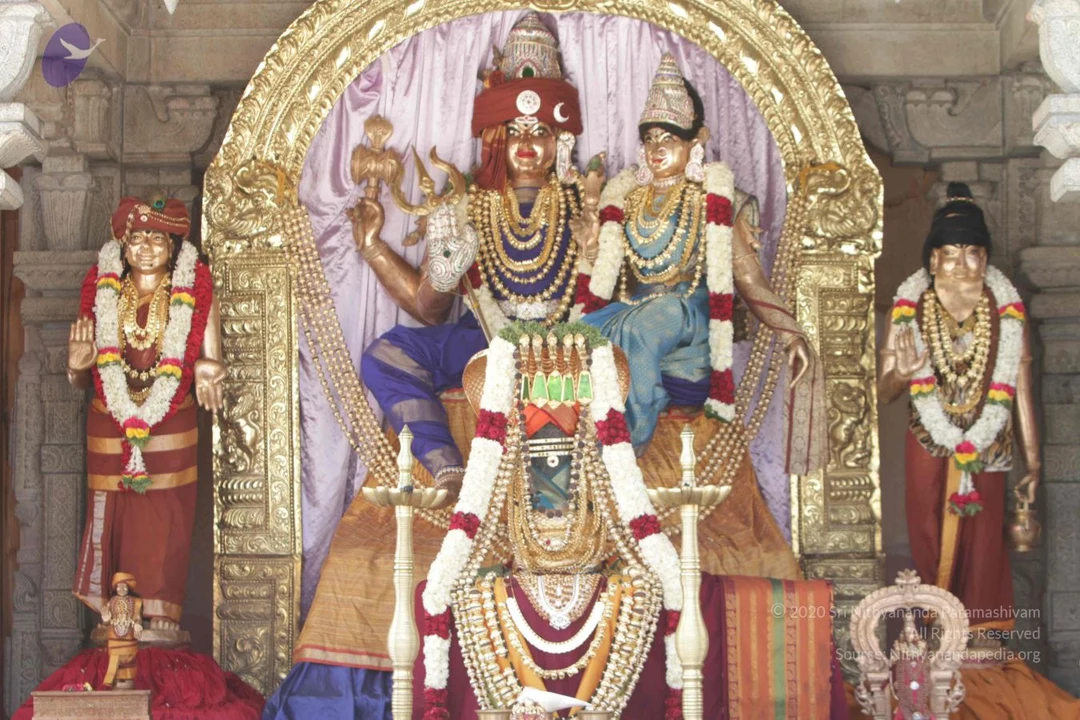
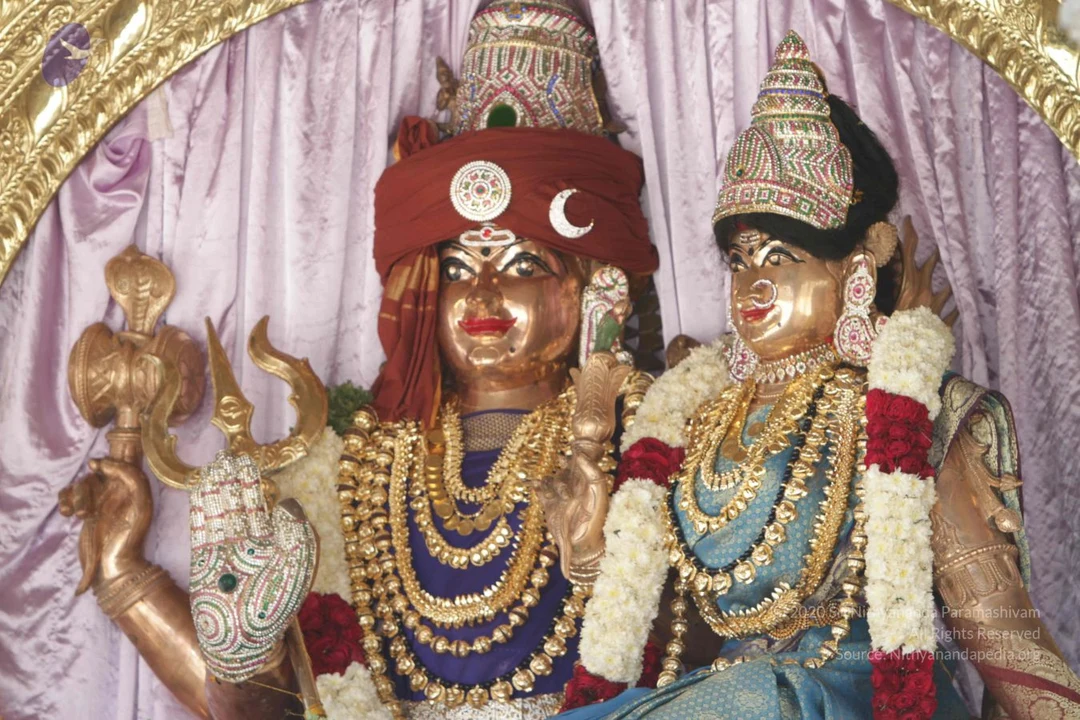
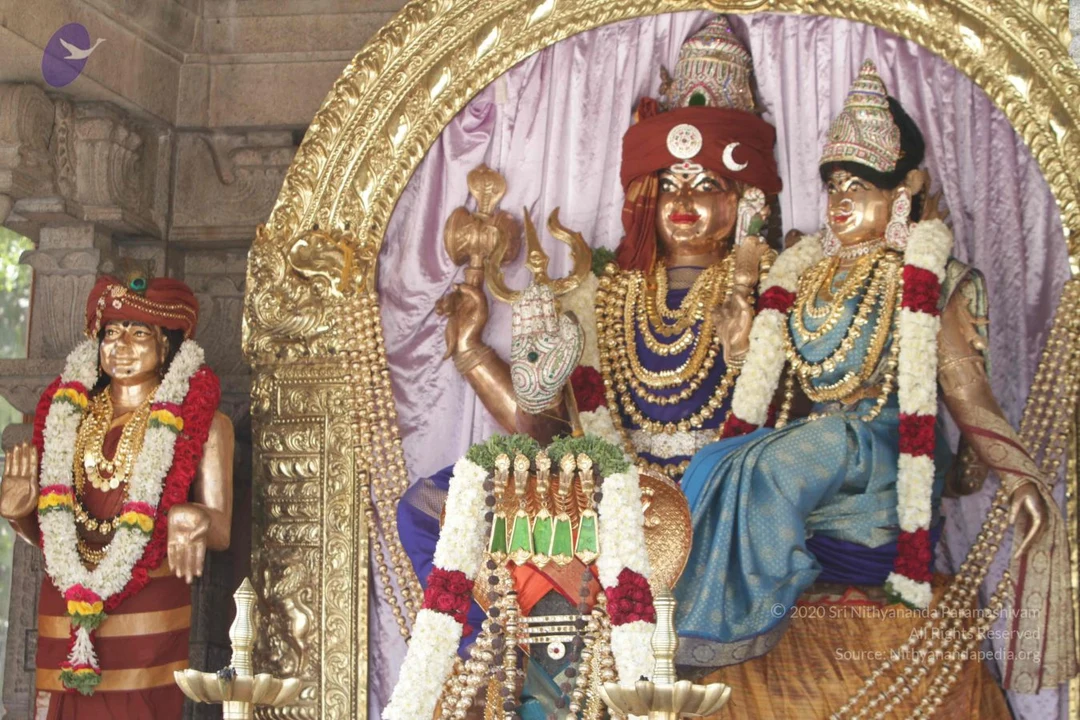
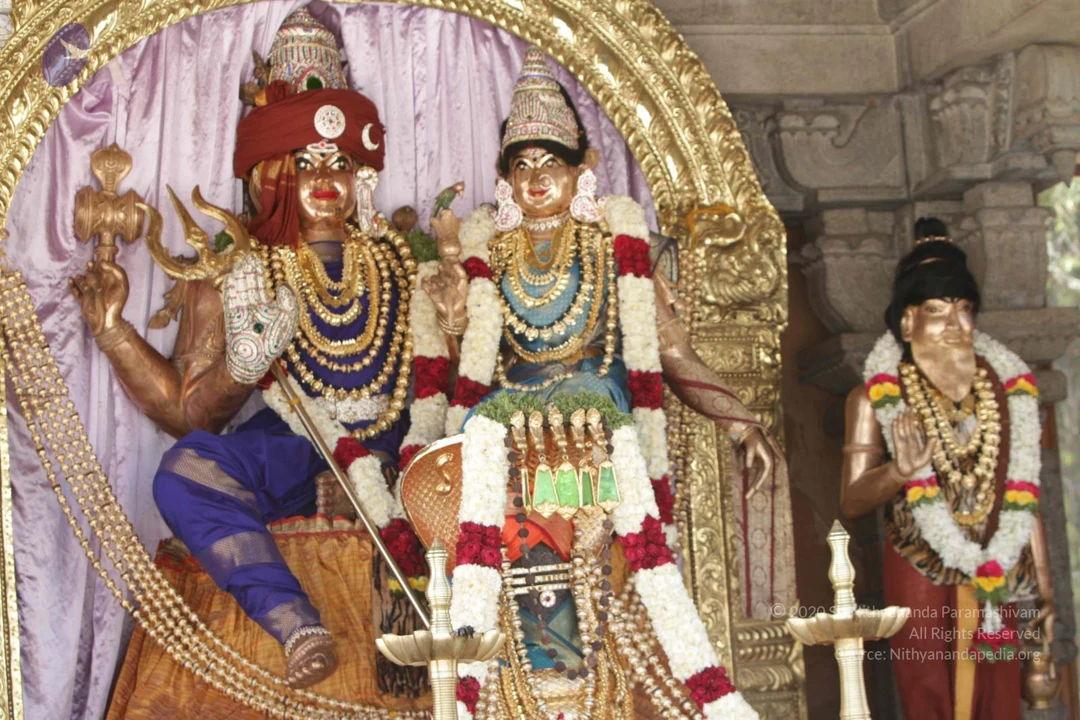
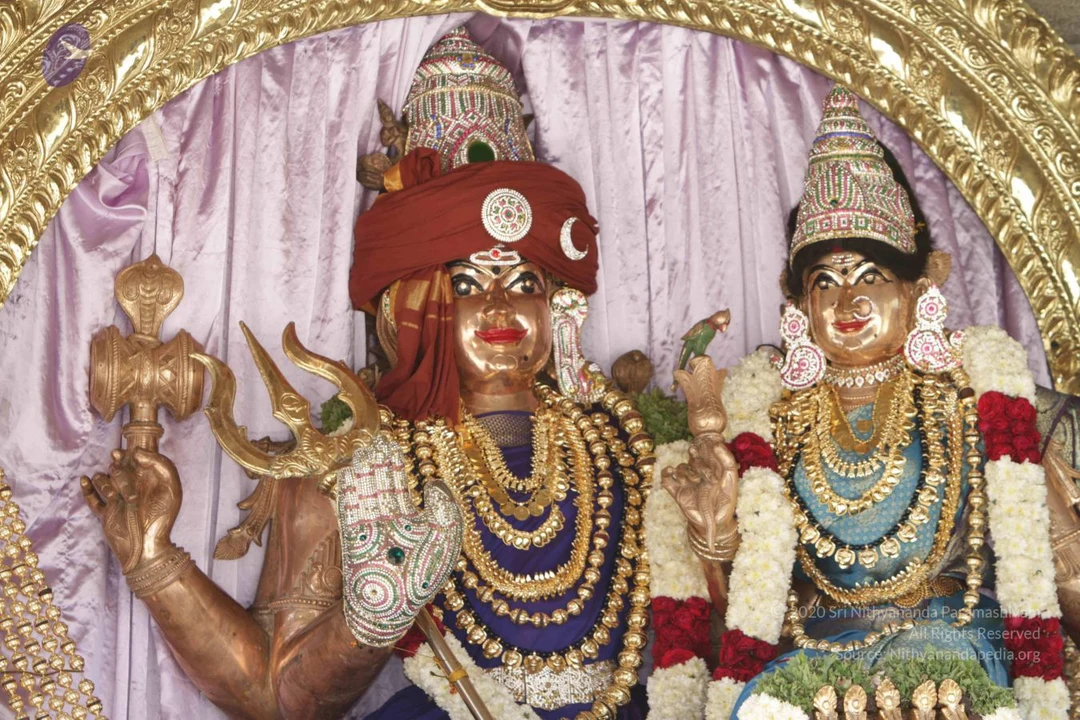
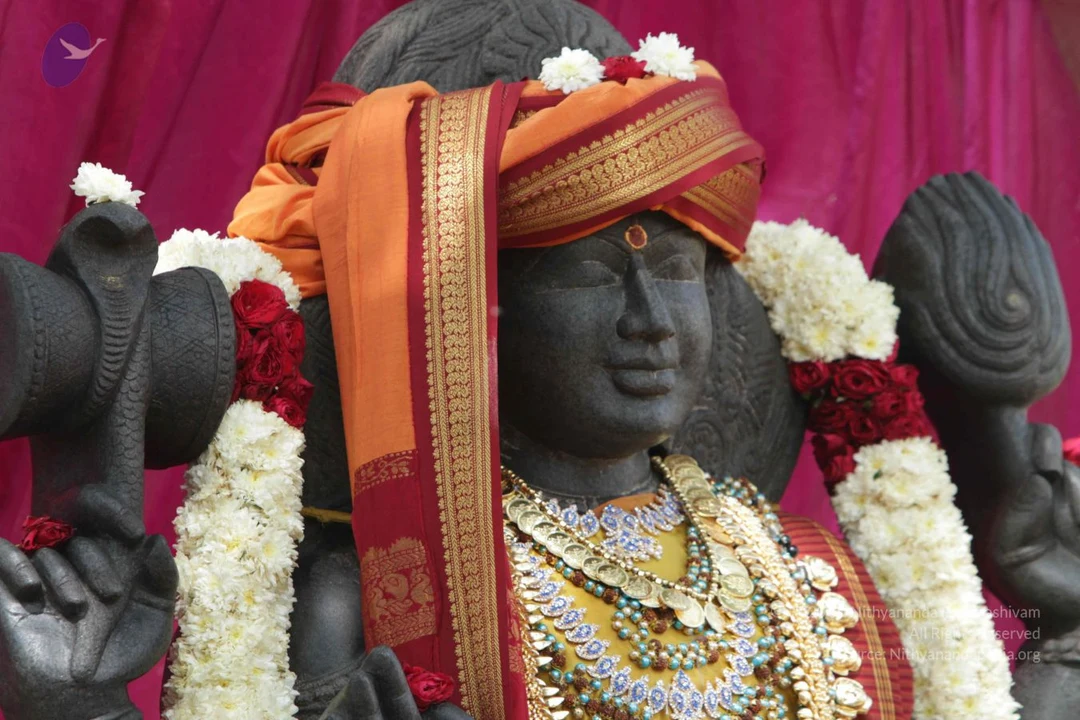
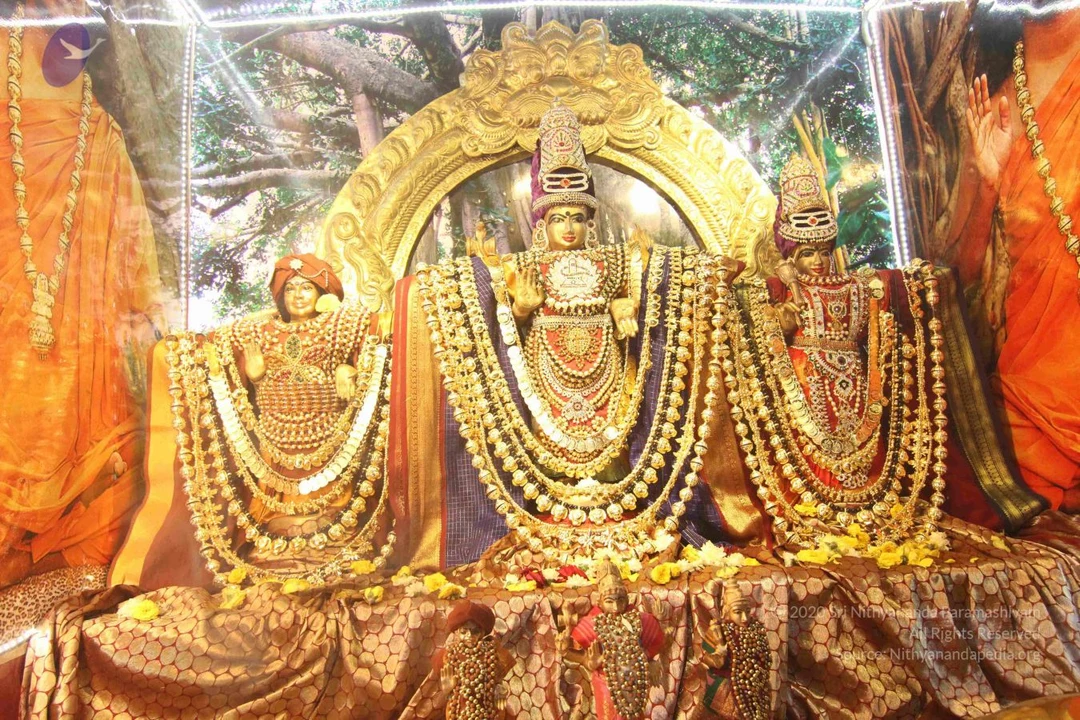
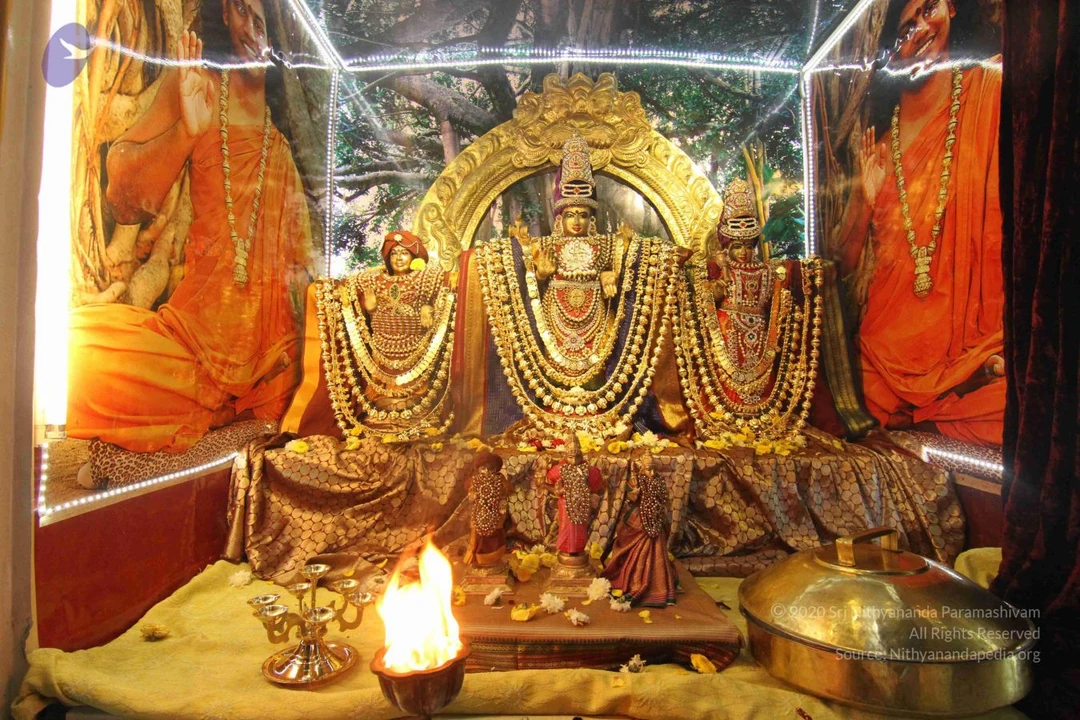
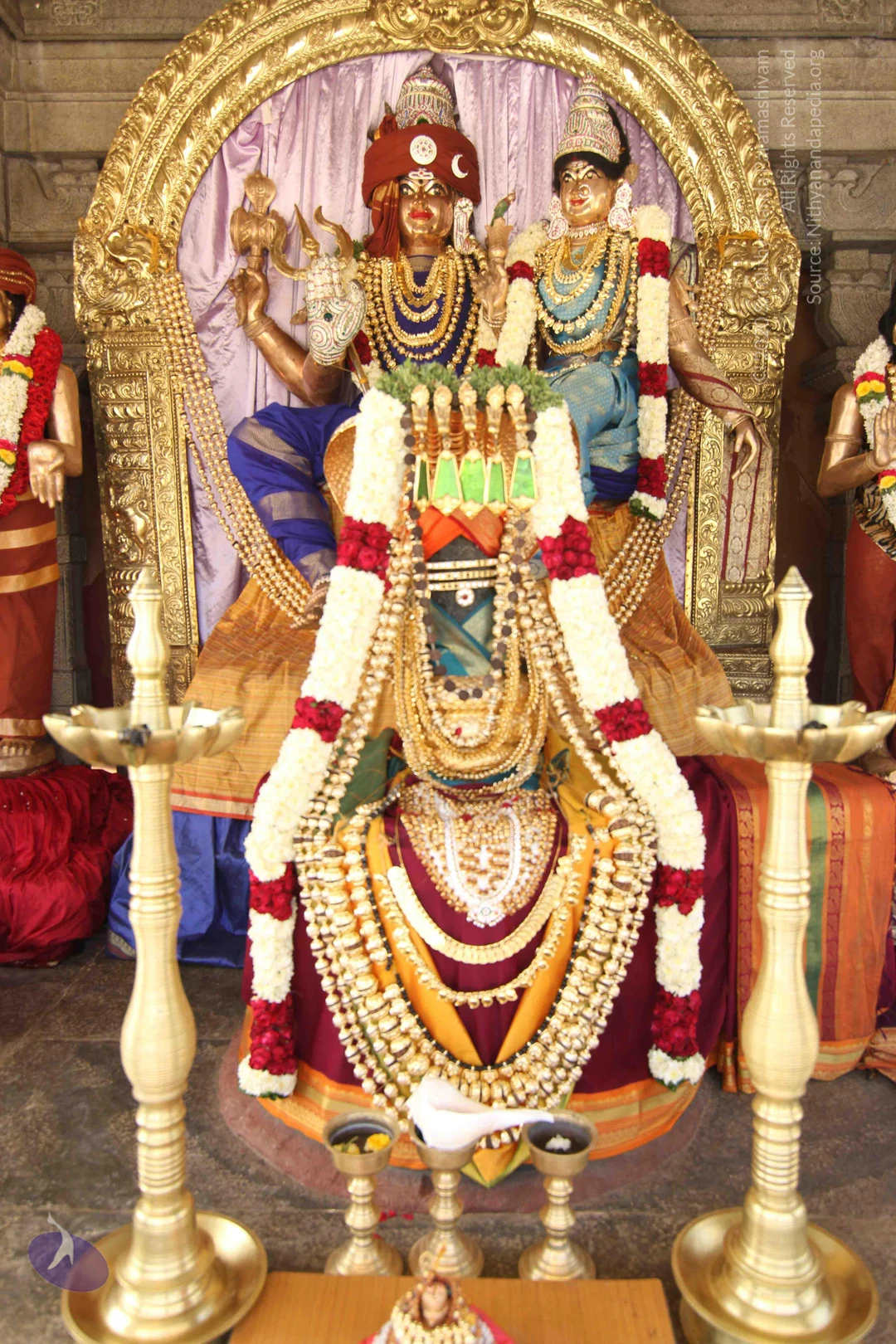
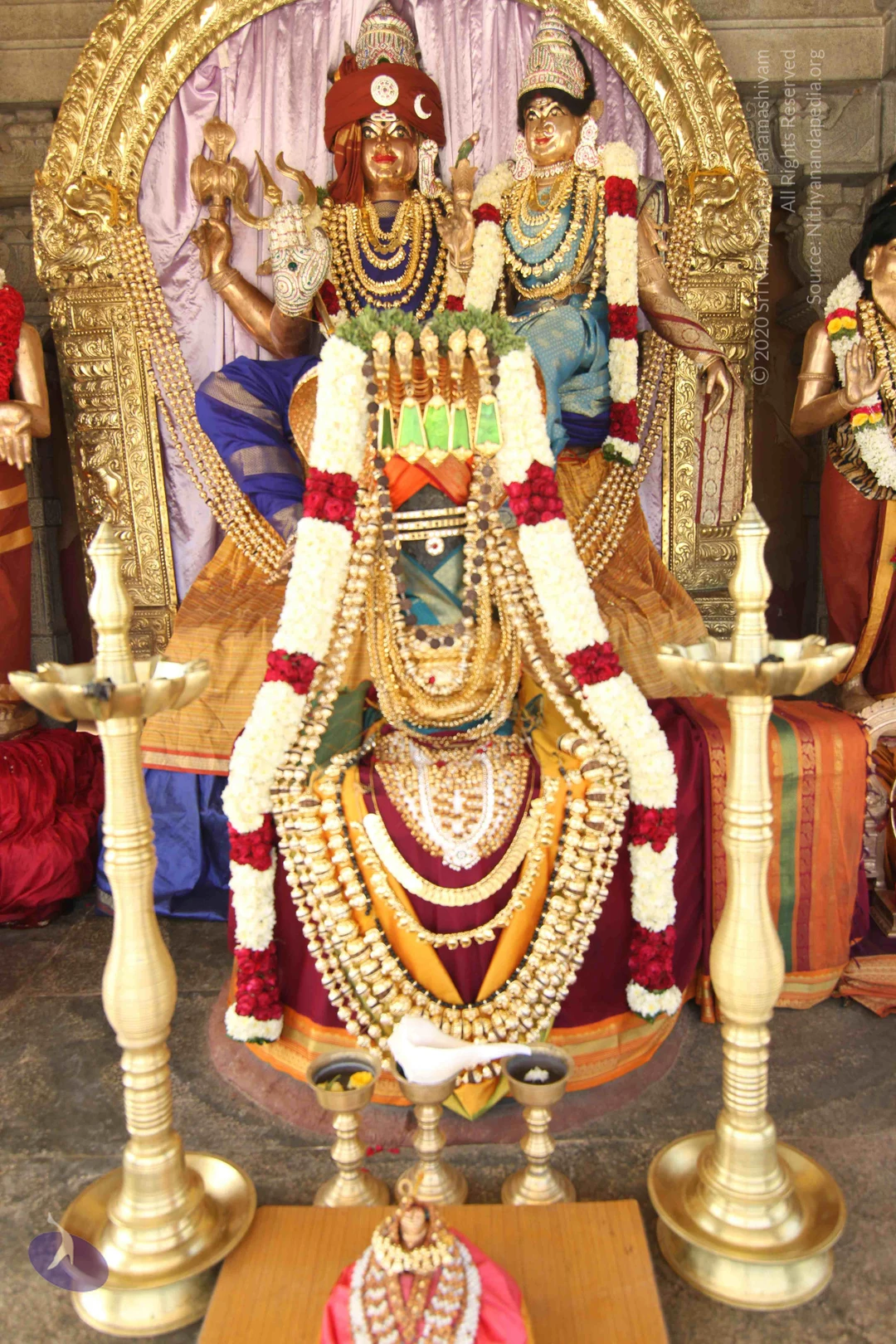
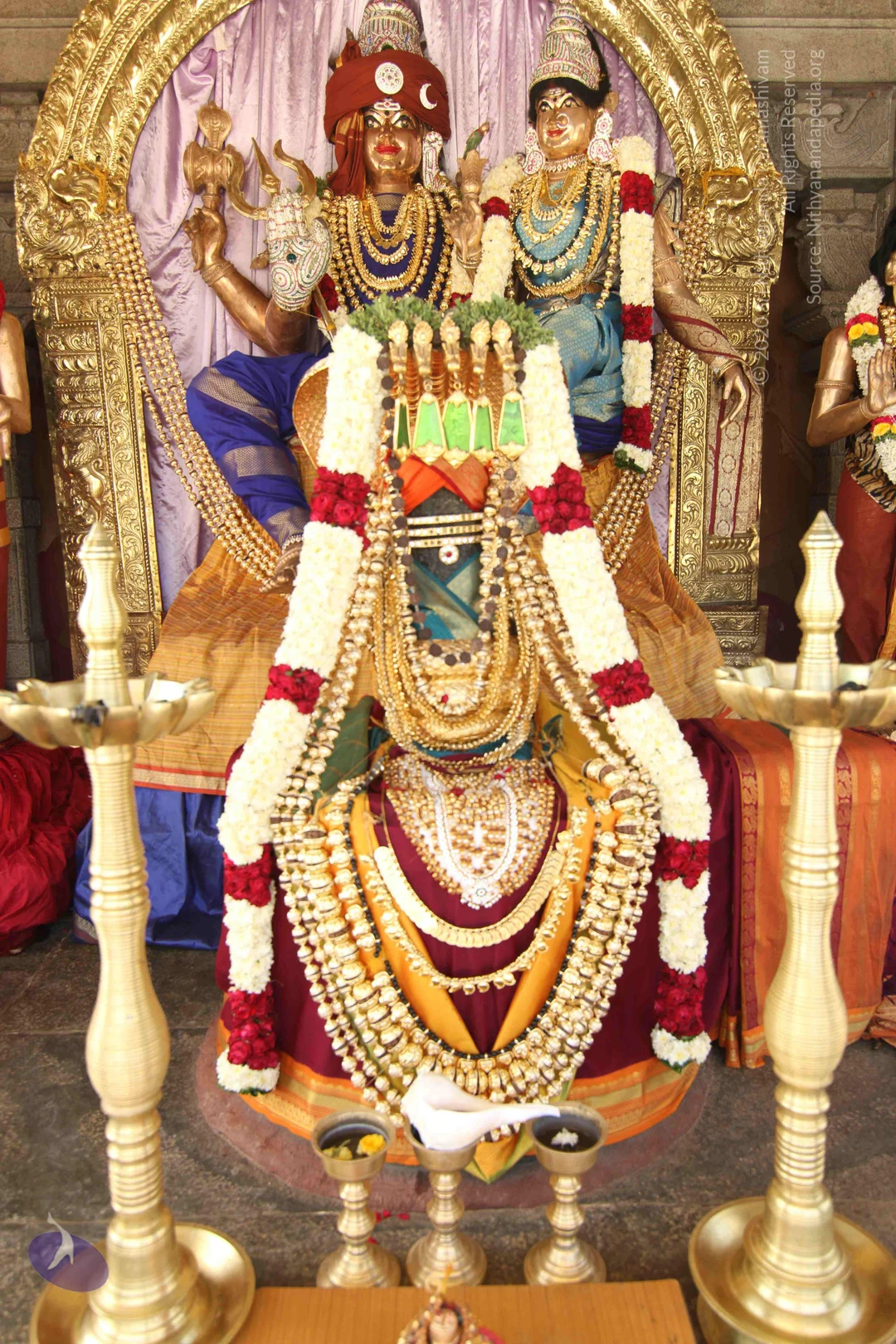
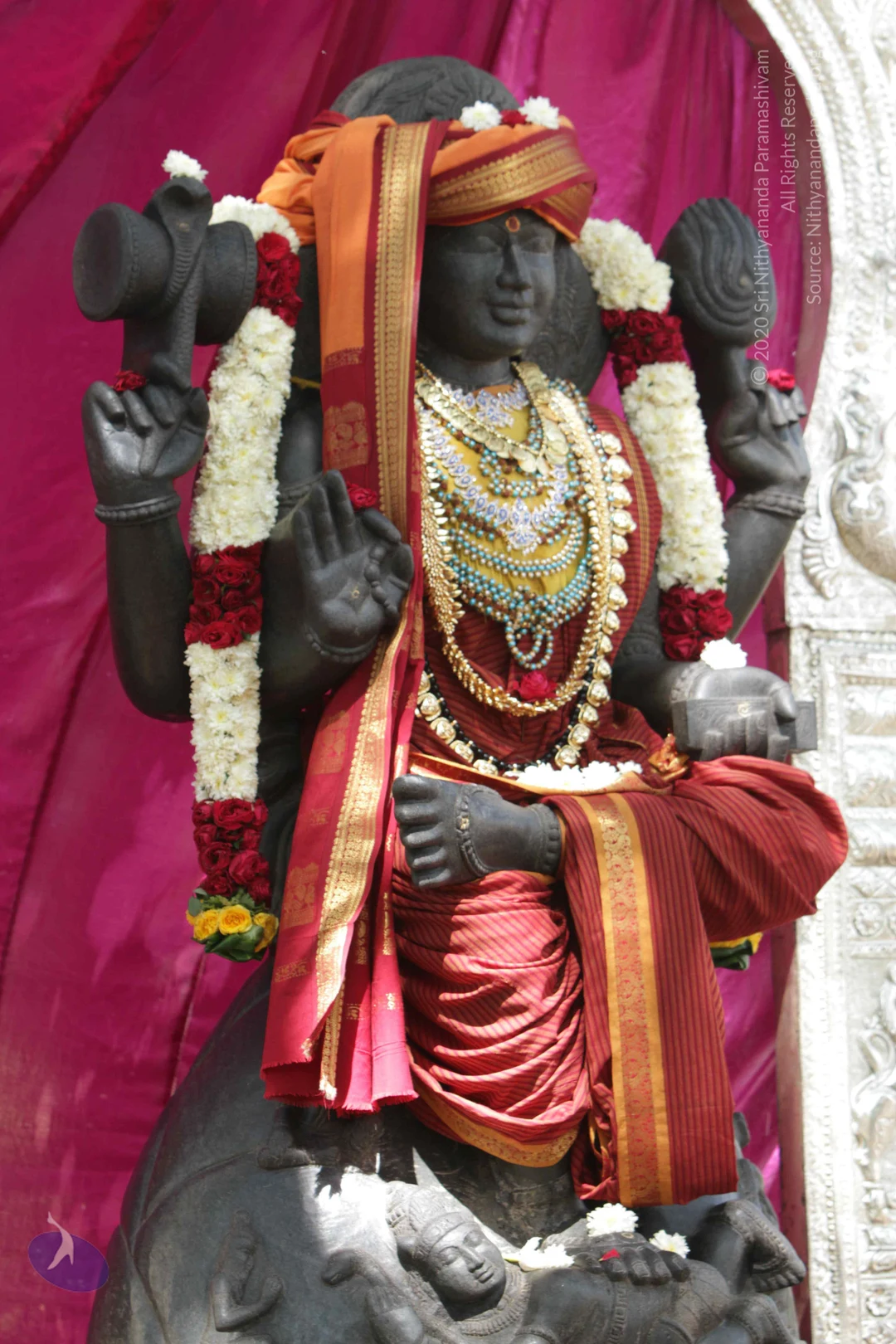
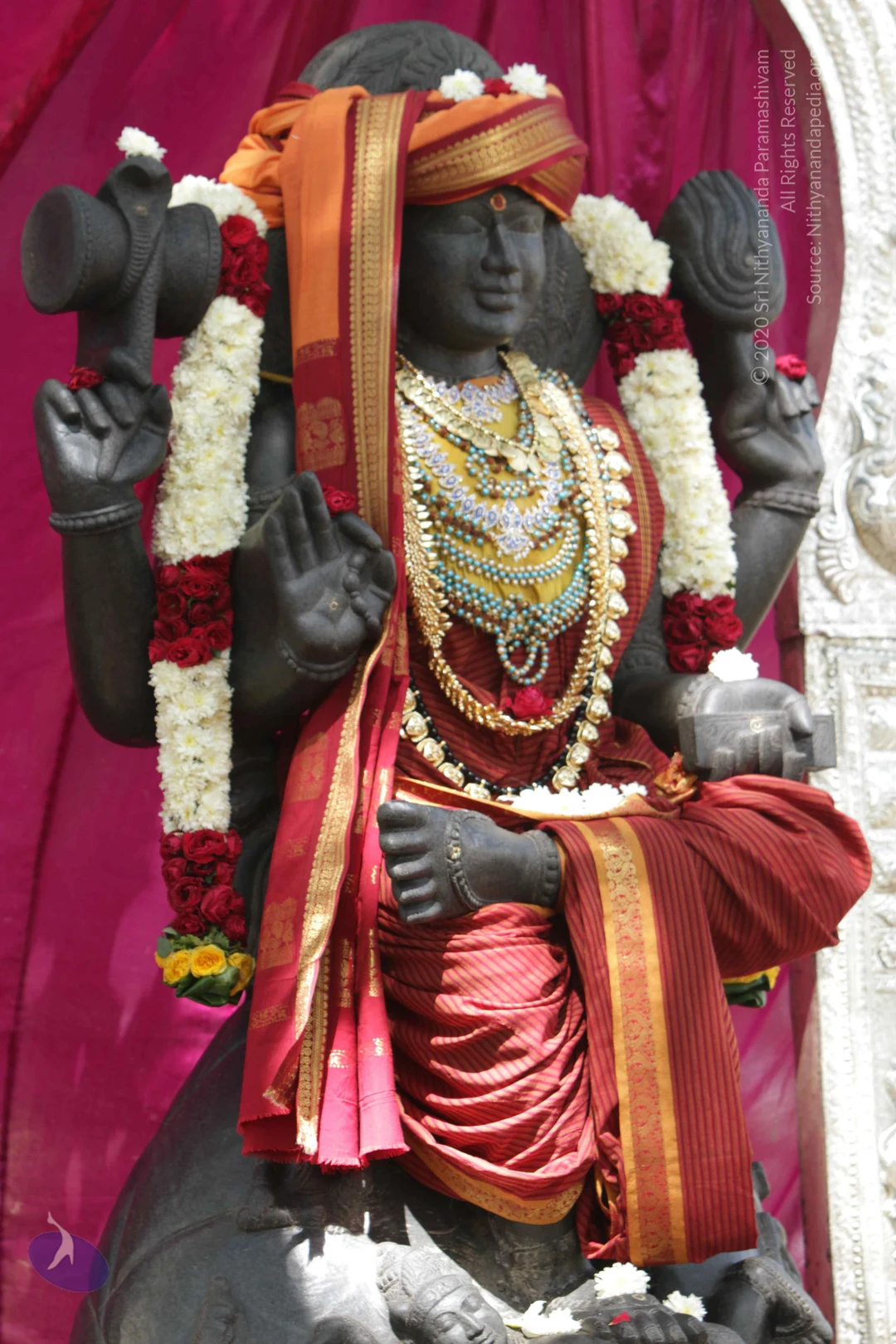
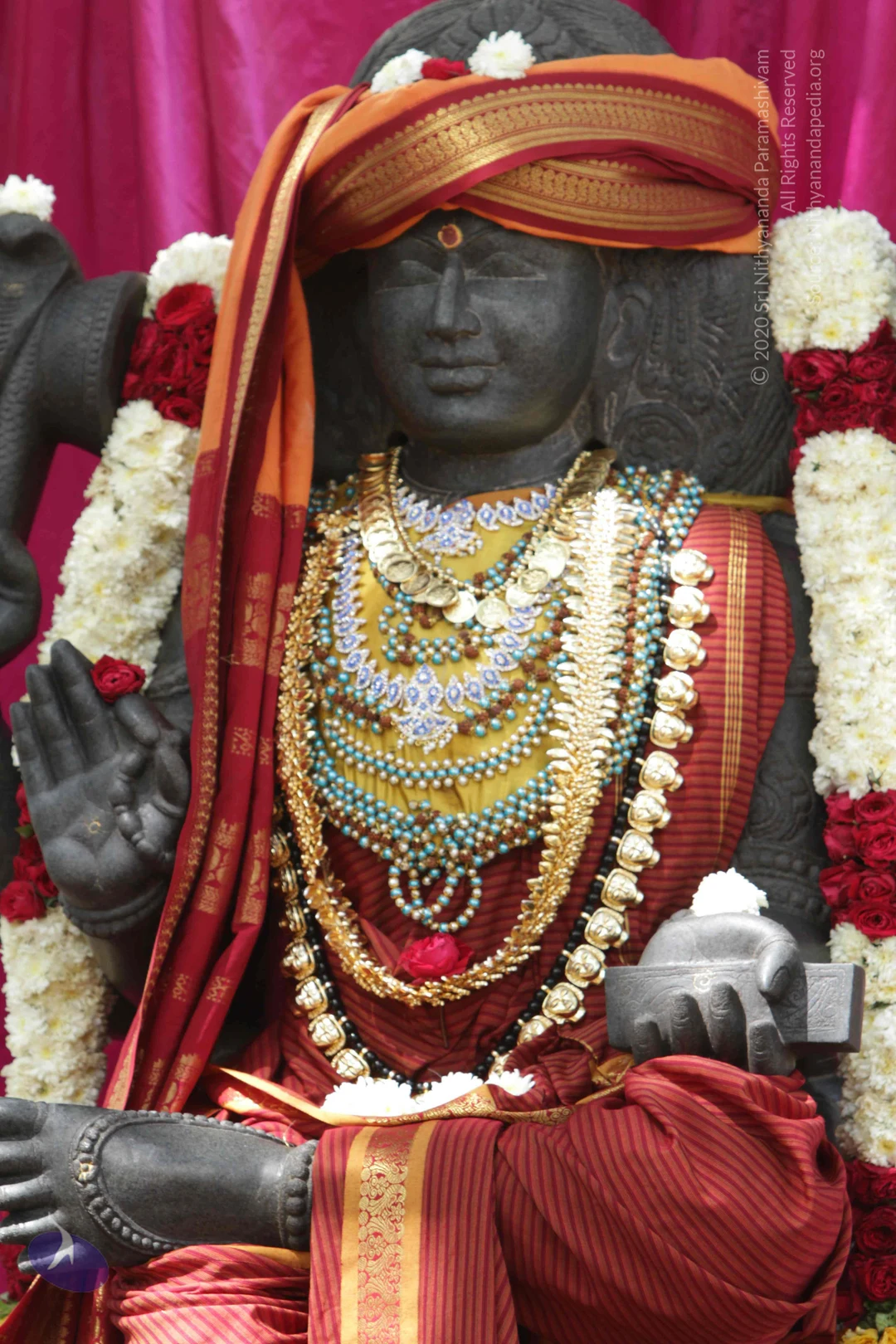
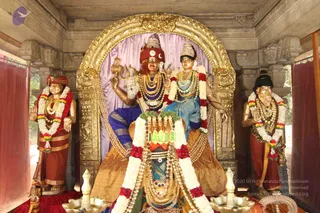
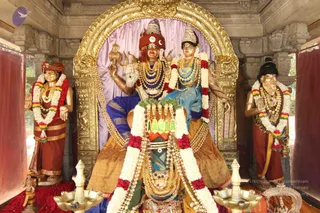
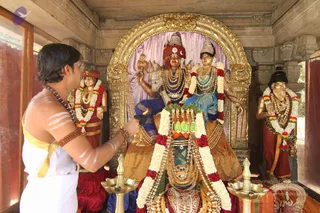
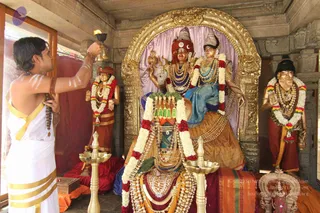
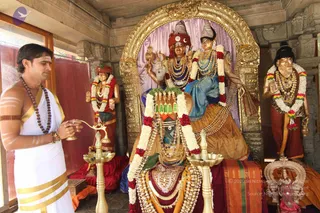
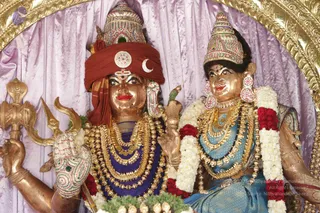
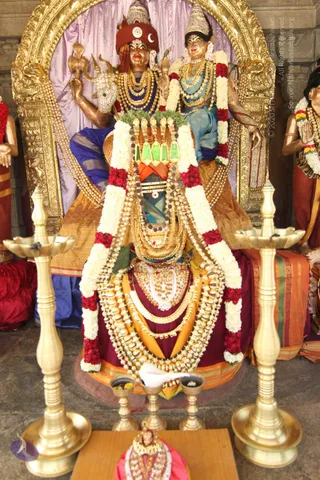
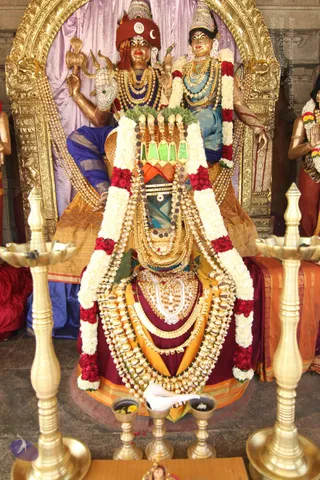
A decorated temple shrine with a golden arched frame and a lilac drape behind the central figures. Two large statues of a deity pair sit enthroned at centre: the male figure holds a trident and wears a red crown with a crescent, with dense gold and multi-coloured bead necklaces, while the female figure wears a blue and gold sari and a tall crown. Both are garlanded with white flowers and red roses. Two smaller statues stand at either side, adorned with garlands and gold necklaces, one wearing a red headdress. Brass oil lamps sit at the base, and a flower and leaf-decorated offering stands in front. Only statues are present; no physical people are visible.A photograph of a shrine showing a deity murti seated under a golden arch draped with lavender cloth. The central figure wears a red crown and holds a trident, with rudraksha and gold necklaces; a consort figure beside him wears a tall gold crown and layered gold and beaded necklaces. Two standing attendant statues flank them, one in red-brown dhoti with white and red garlands, the other in dark-brown dress with white garlands. In front, a large floral garland and a decorated vessel with green-tipped offerings sit before two brass oil lamps. No living people are visible.A shirtless priest in a white dhoti with a yellow border stands at left, holding a lit oil lamp toward a shrine. Sacred ash stripes mark his chest and arms, and a rudraksha mala hangs on his neck. Inside an ornate golden arch, a Shiva-Parvati style pair of deity murtis sits on a raised peetha, decorated with white and red flower garlands and layered gold and beaded necklaces. A small figure in red holds a trident, and attendant statues in red garments with garlands stand on each side. Brass oil lamps flank the altar, and the setting is a temple sanctum with draped pink and red cloth.A photograph inside a temple shrine showing a priest in a white dhoti with gold borders and bare upper body, holding a lit oil lamp aloft with his right hand while facing the deities. He wears a rudraksha mala and white sacred markings on his arms. Before him stands a gilded arch framing a deity murti pair: a seated form in a red crown and blue garment with a trident, alongside a companion figure in a tall crown and blue sari. Garlands of white and red flowers hang on the murtis and on two standing attendant figures in red-brown dhotis. Brass oil lamps and a decorated kalasha-like offering stand in front, with a pale lilac backdrop behind the deities.Photograph inside a temple shrine of a standing priest in white dhoti with gold border and bare upper torso, marked with white body paint, wearing a rudraksha mala and beaded bracelets, holding a small brass bell or lamp vessel before the altar. Behind him, a seated pair of deity murtis with gold crowns and layered gold necklaces, one holding a conch-like object, are garlanded with white and red flowers. A golden arched frame surrounds them, flanked by two standing gilded murtis with garlands and gold necklaces. Two brass oil lamps stand in front of a large decorated deity murti draped in orange and gold cloth with green-tipped flower garlands. Lit lamps and a purple curtain complete the scene. No physical people beyond the priest.Two gilded deity murti, a male figure and a female figure, seated side by side before a lavender draped backdrop framed by a gold arch. The male murti wears a red turban with a crescent moon emblem and a trident-like staff in one hand, a deep blue garment and layered gold necklaces. The female murti wears a jeweled crown, blue and gold sari with gold necklaces and large earrings. Both are garlanded with white jasmine and red flowers, and fresh green leaves and offerings lie at the base.

Sacred Arts

47 photosSource gallery
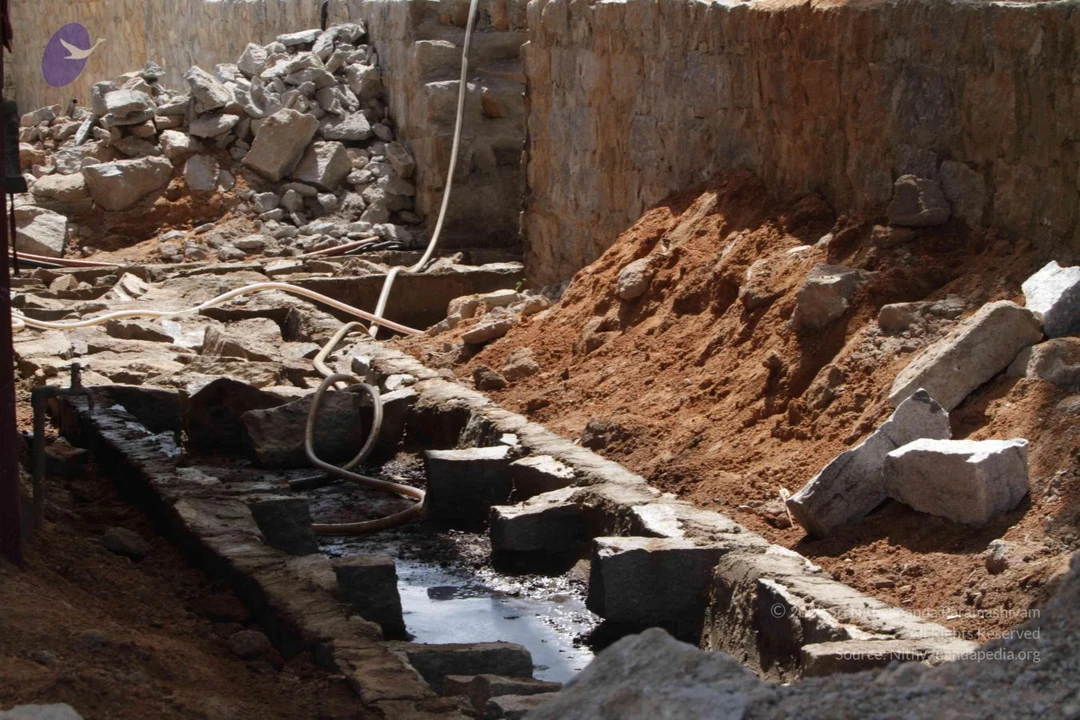
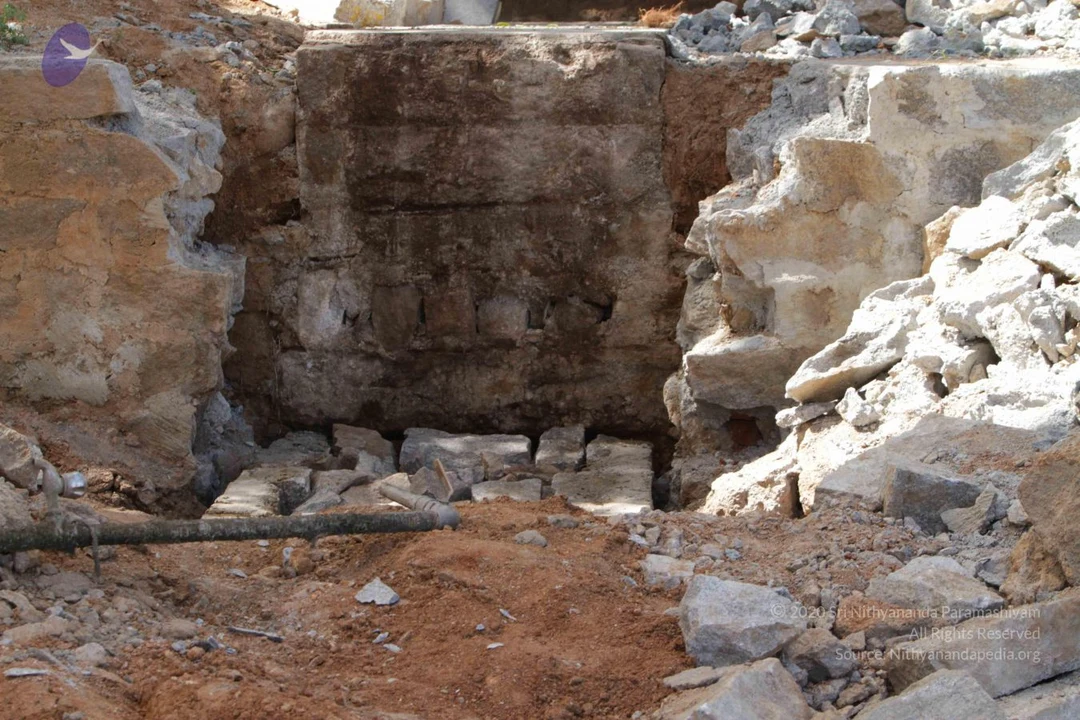
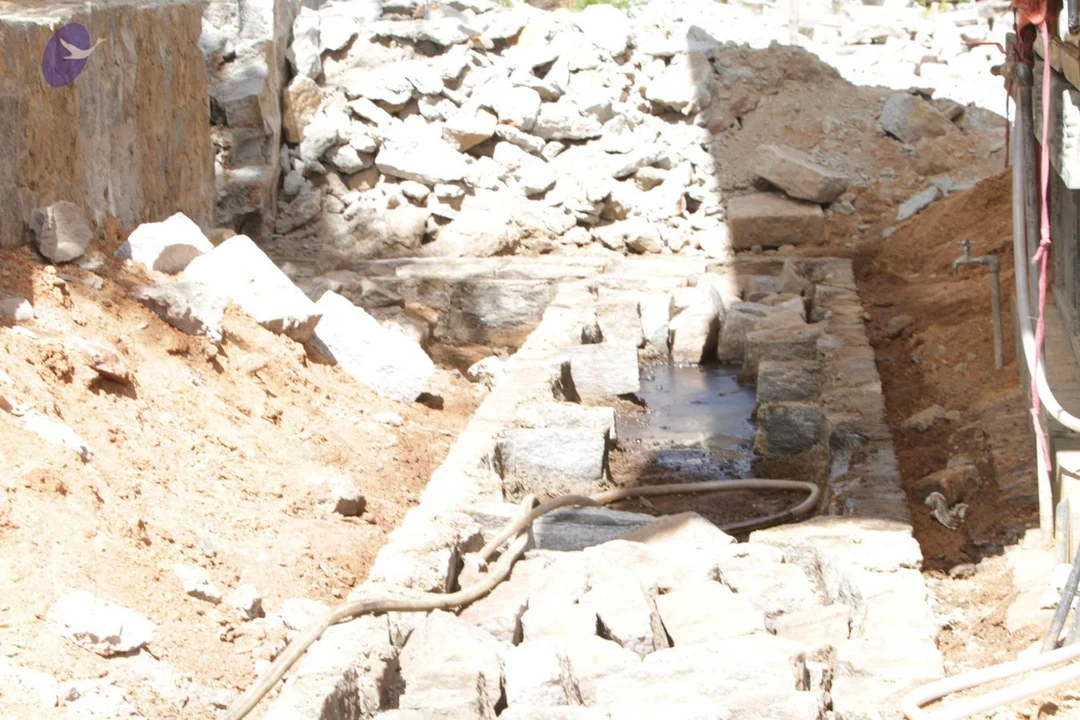
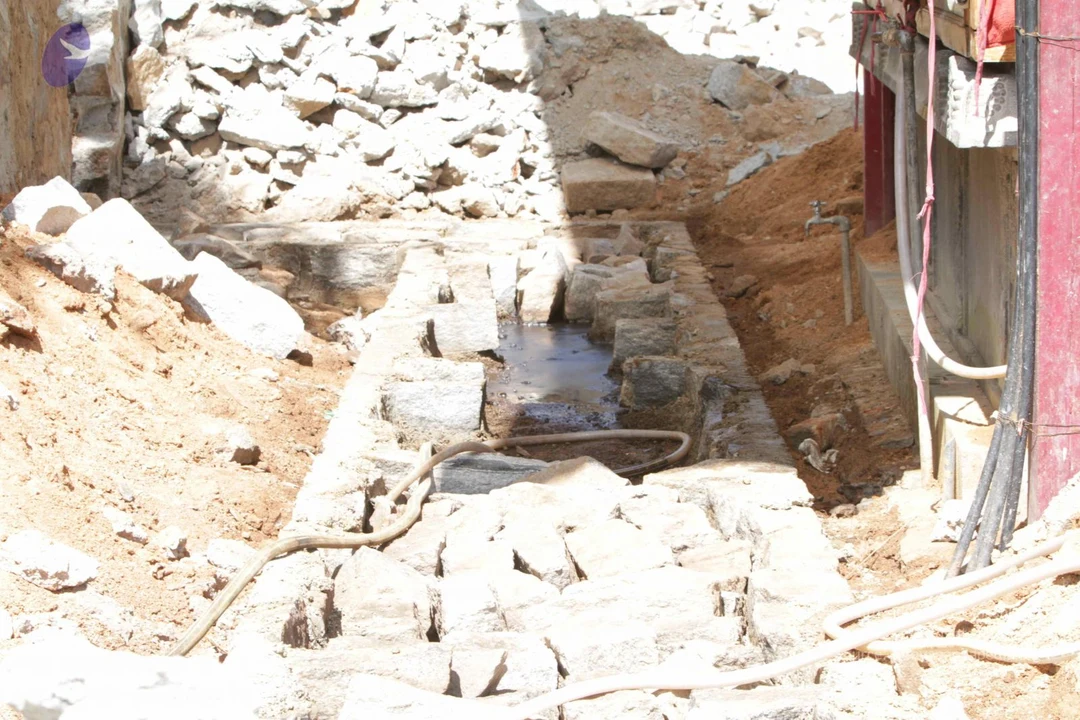
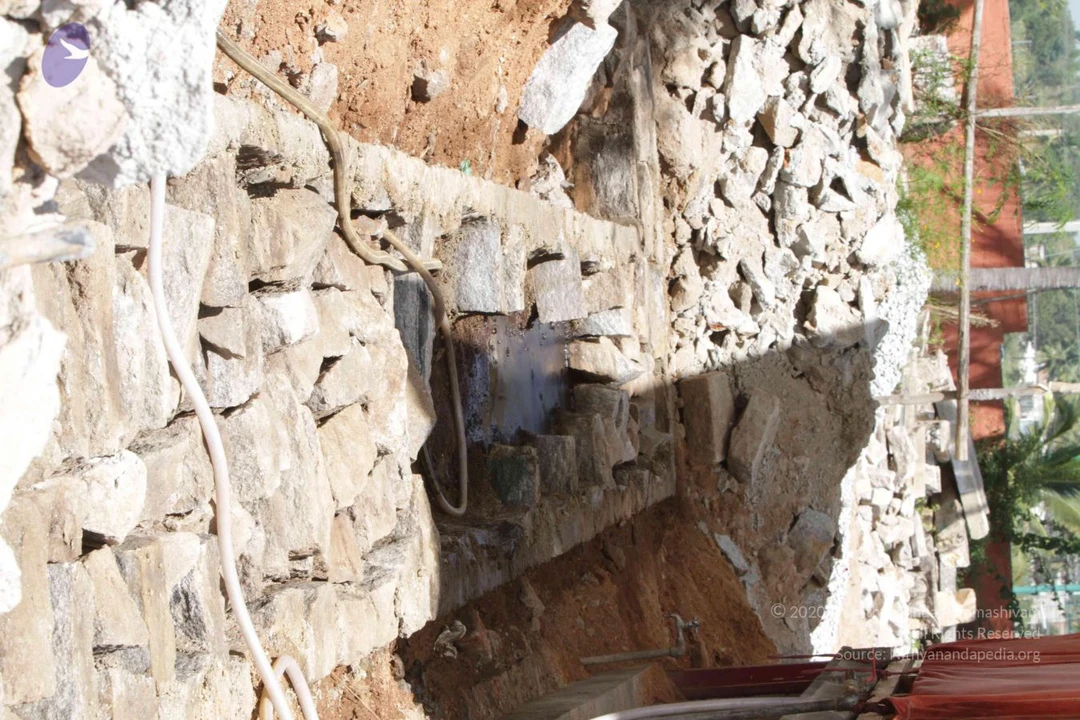
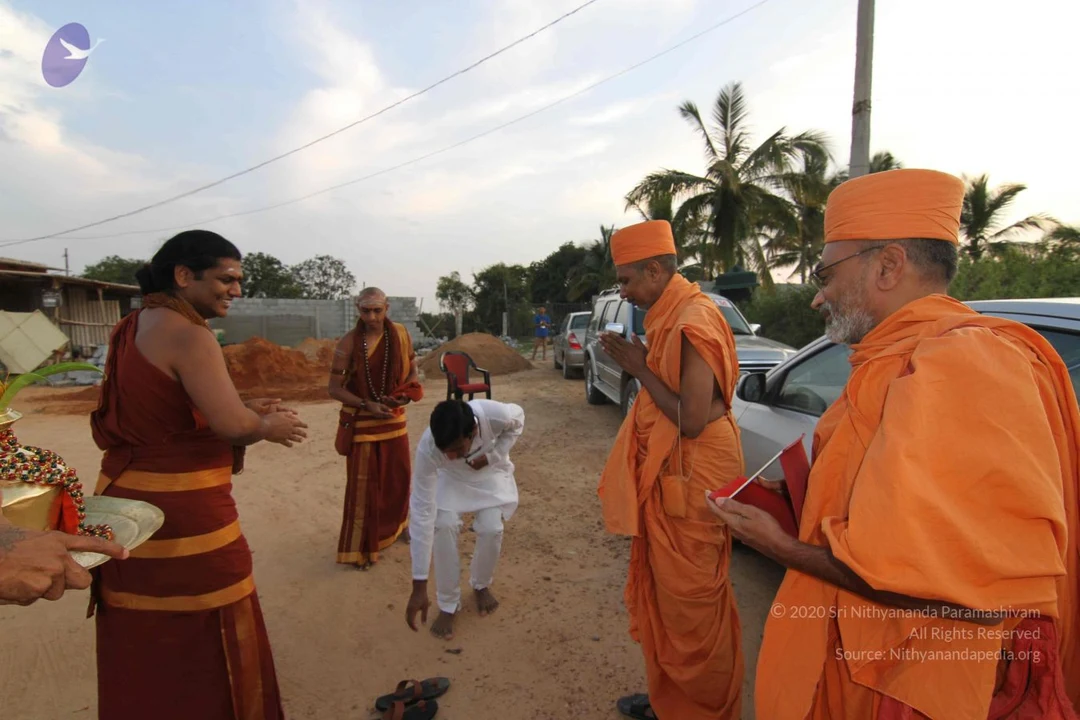
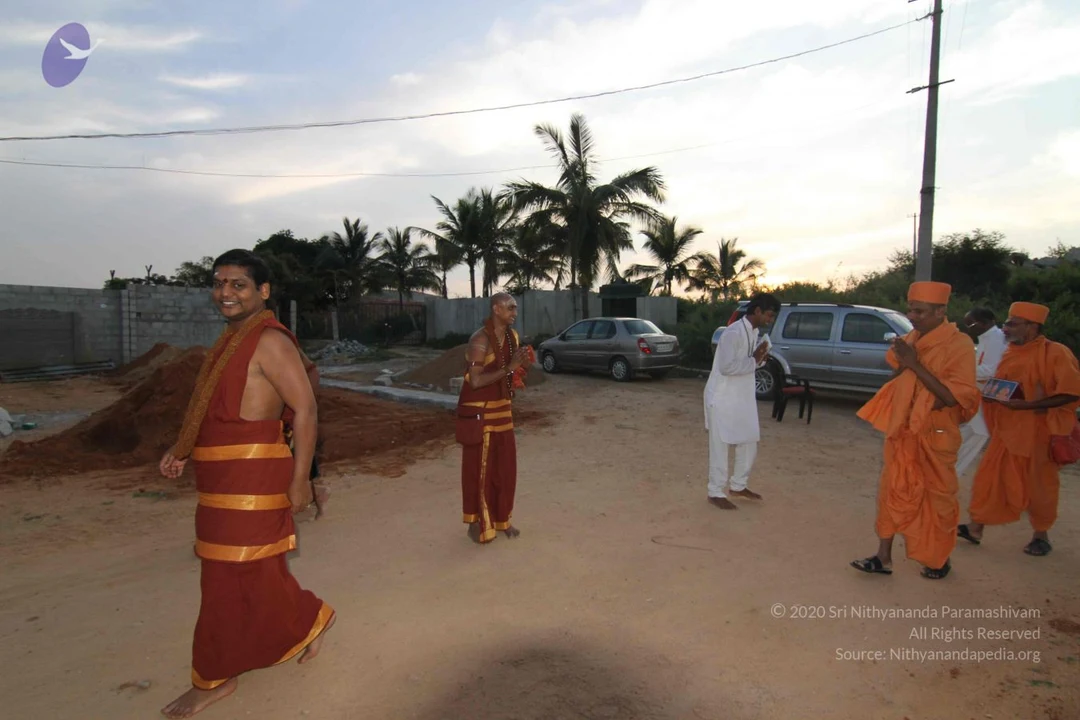
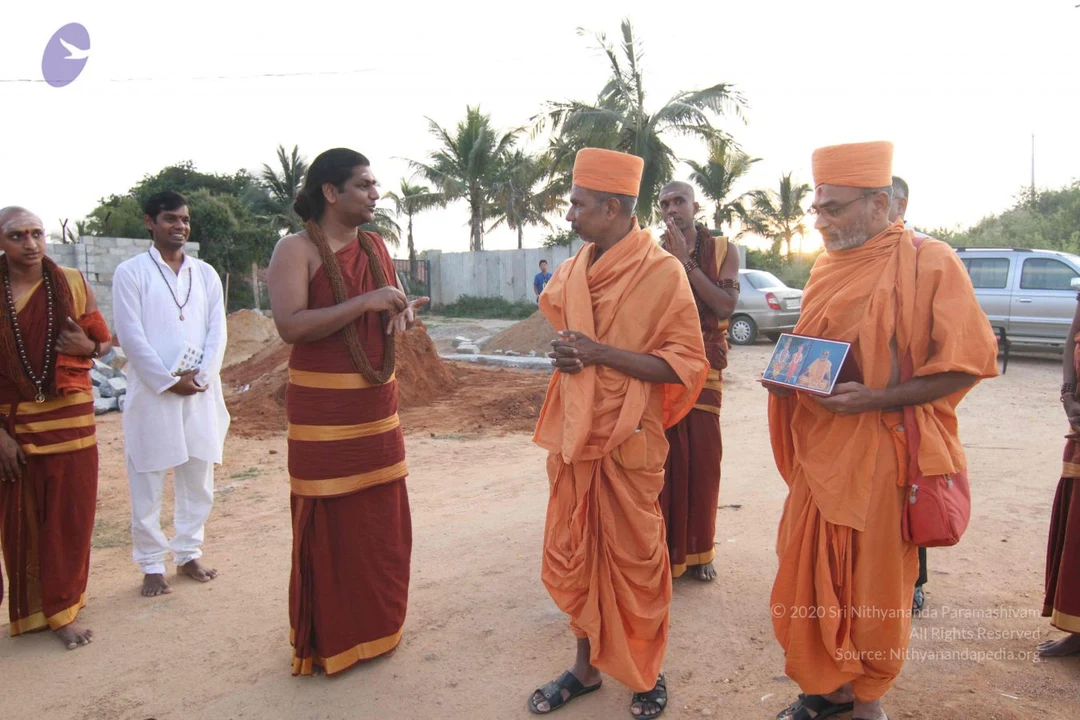
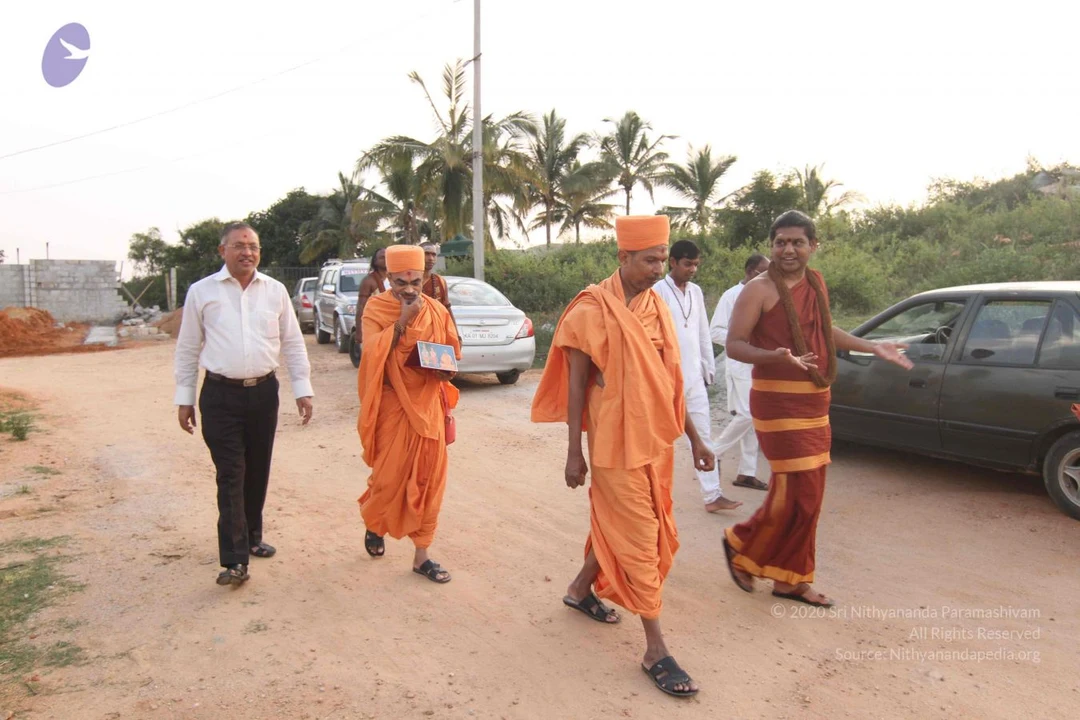
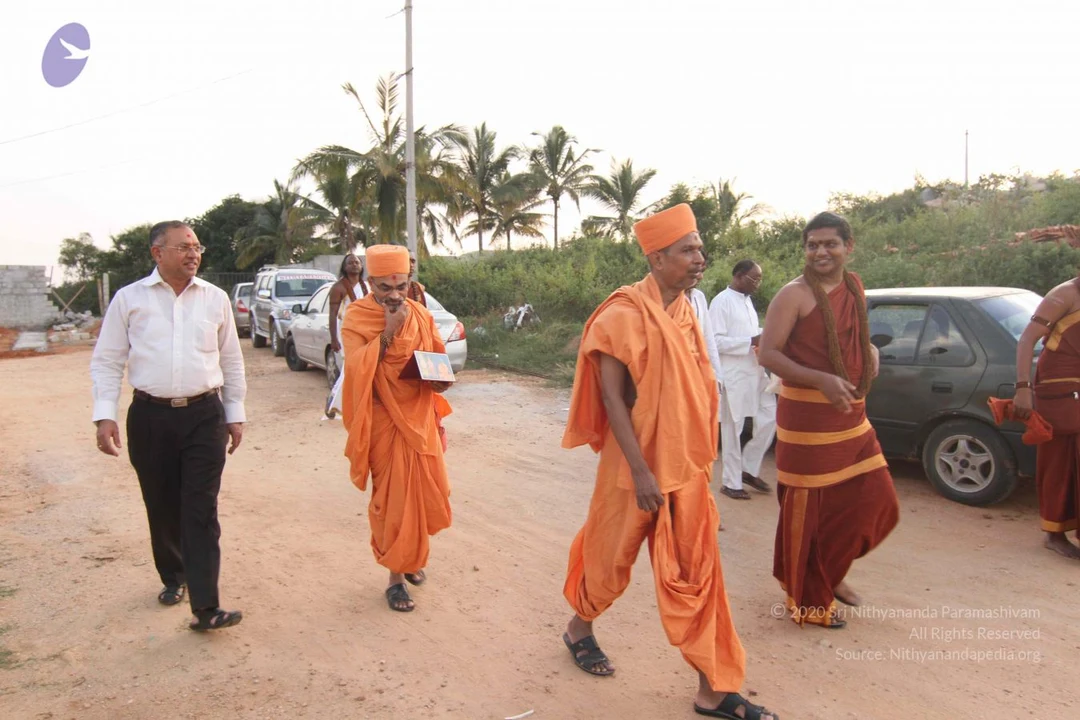
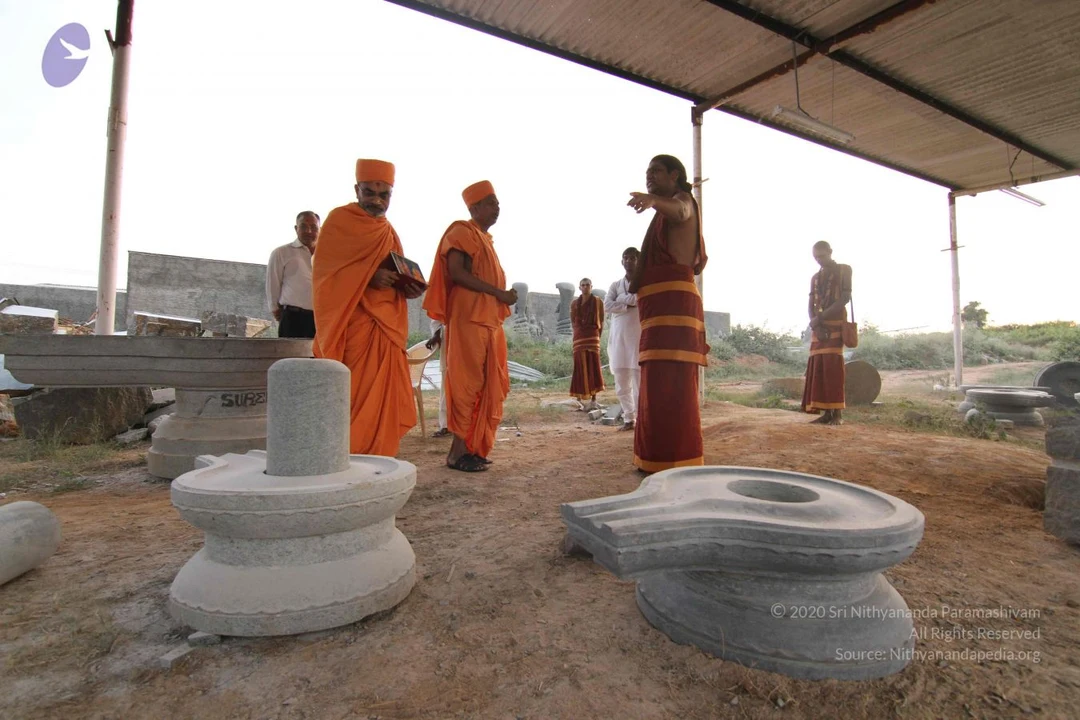
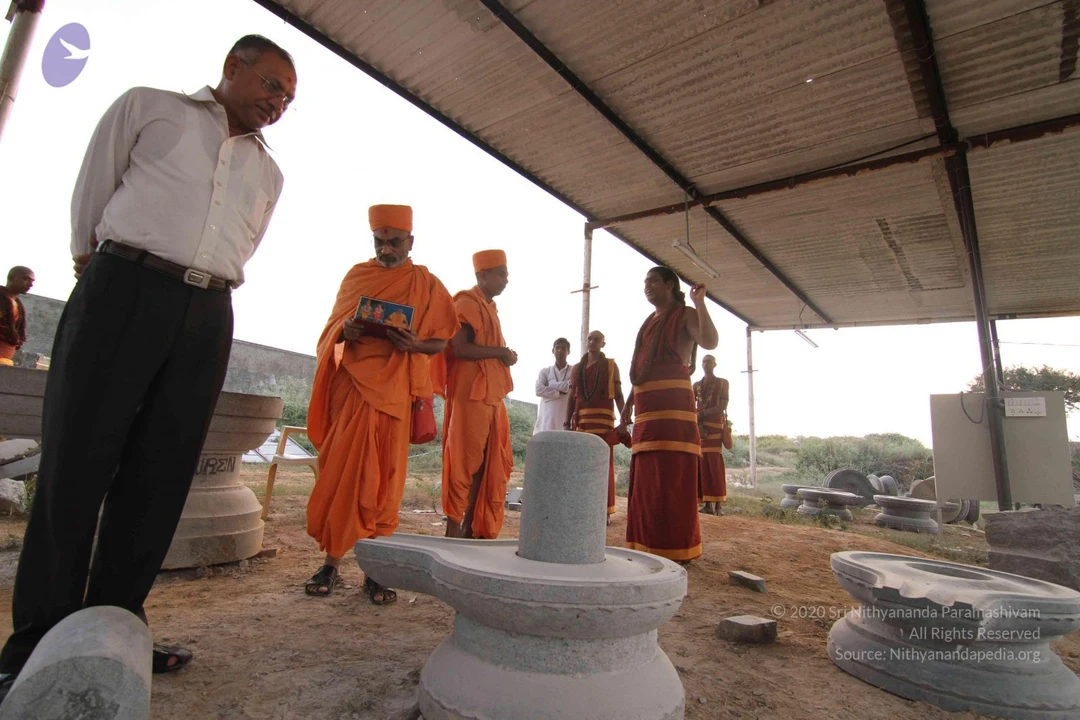
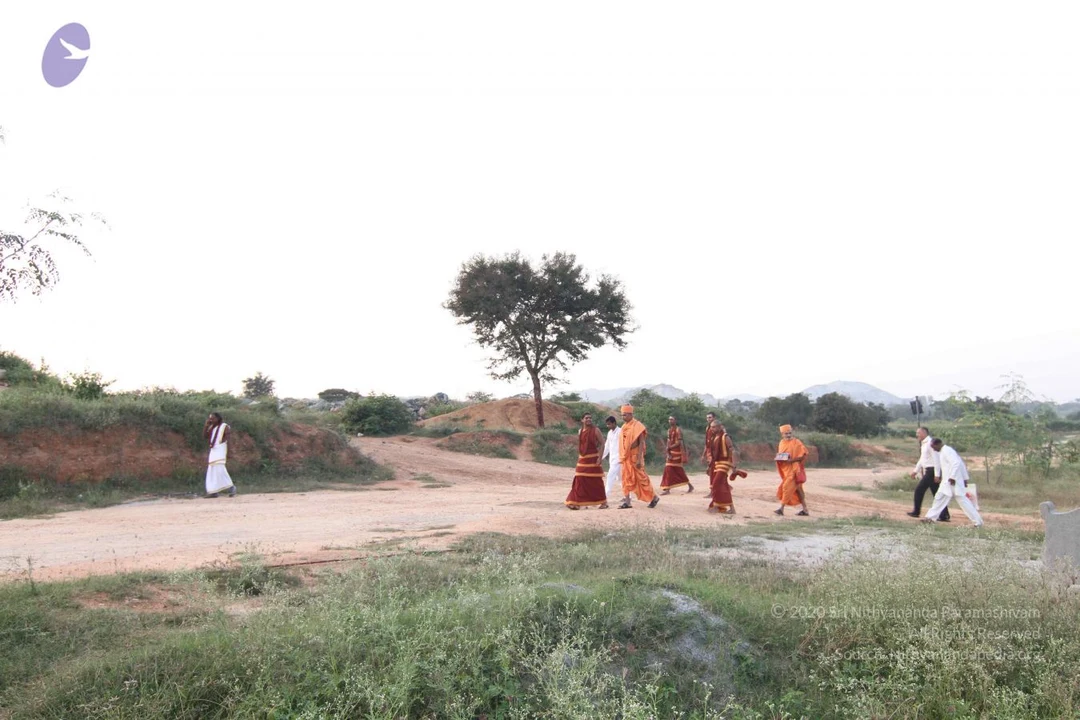
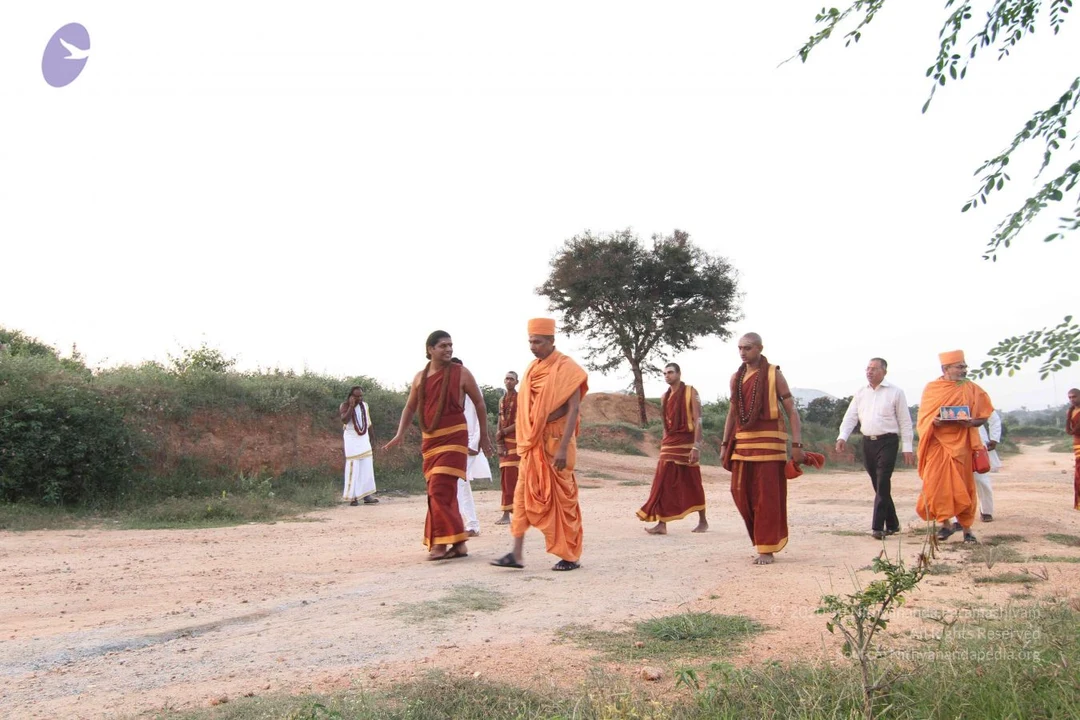
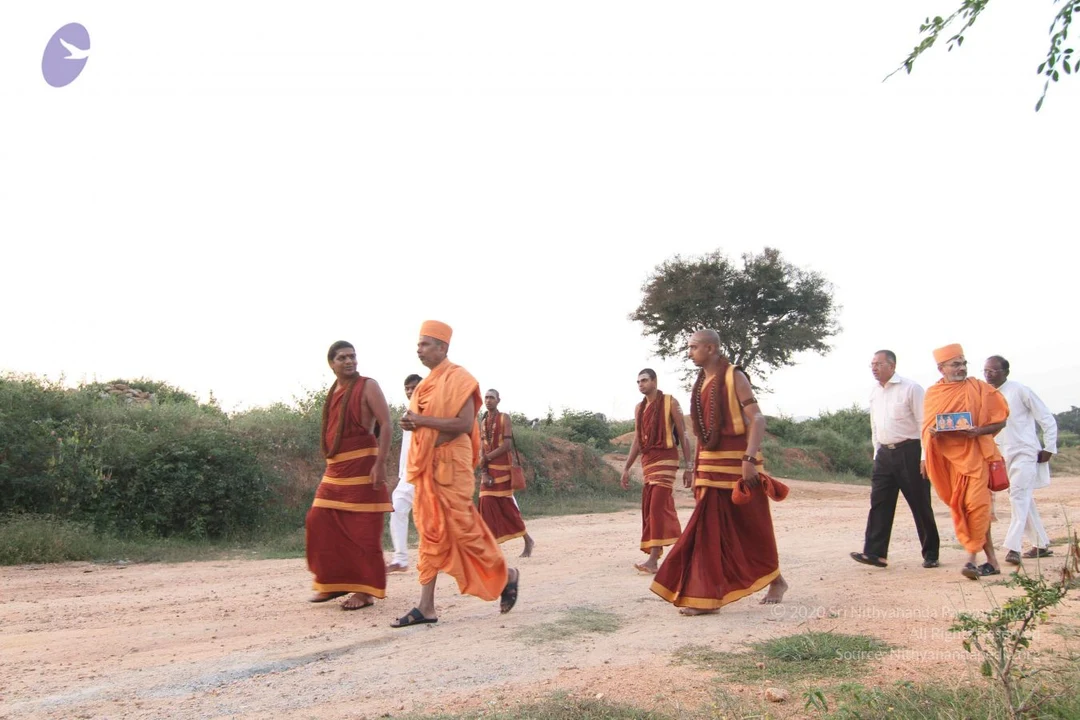
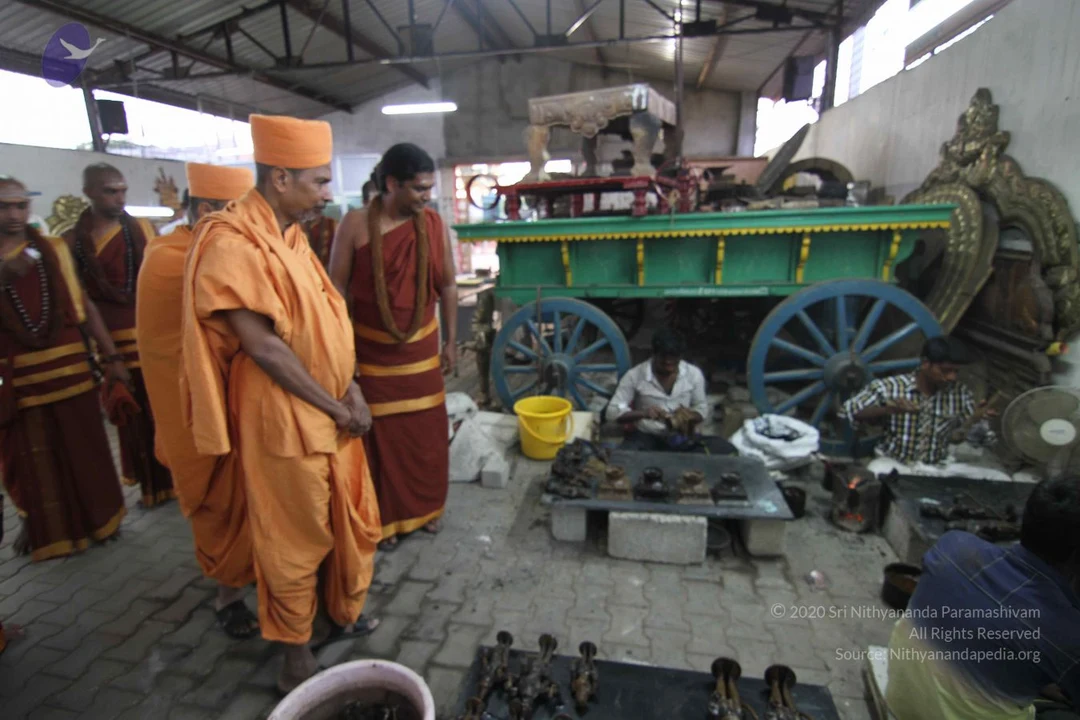
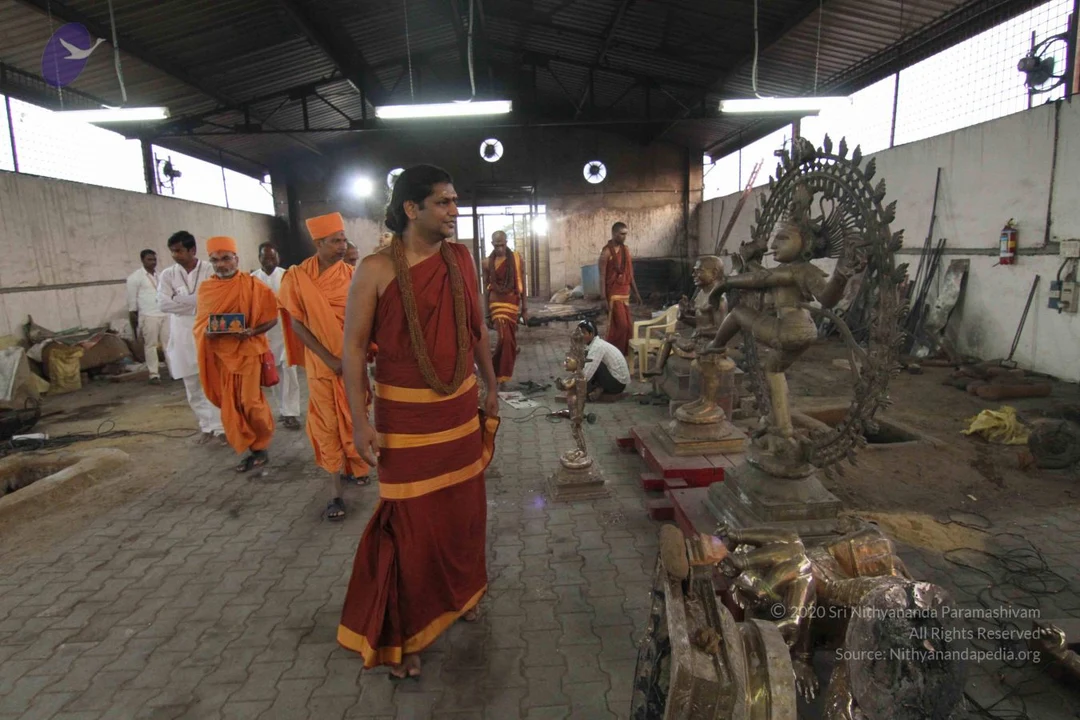
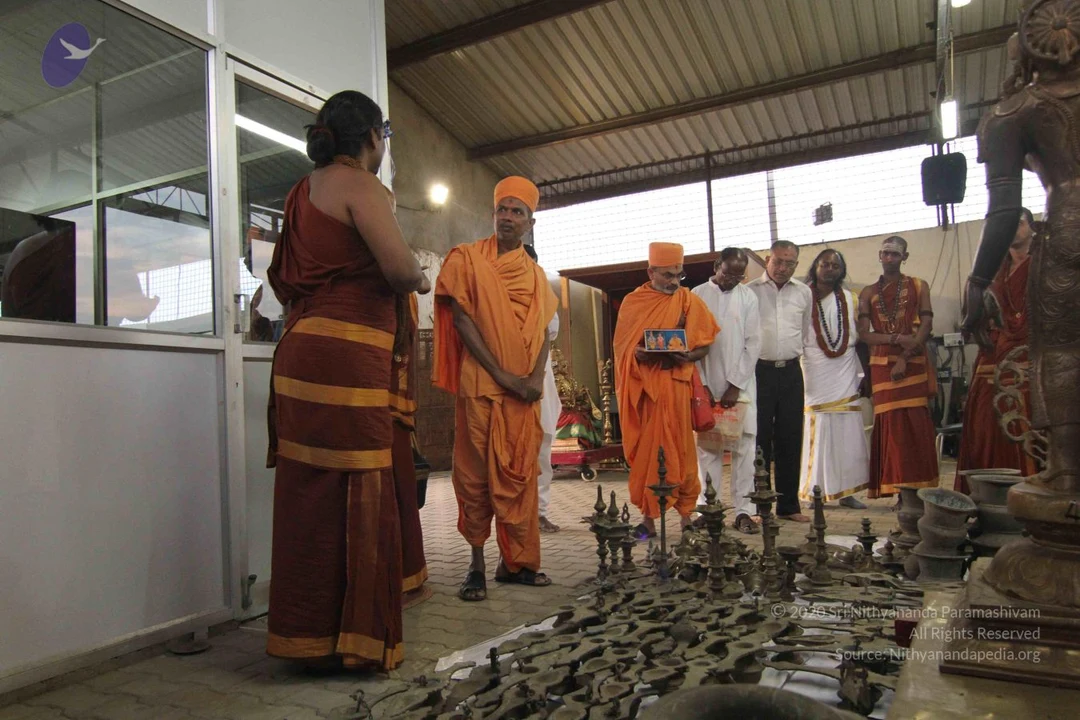
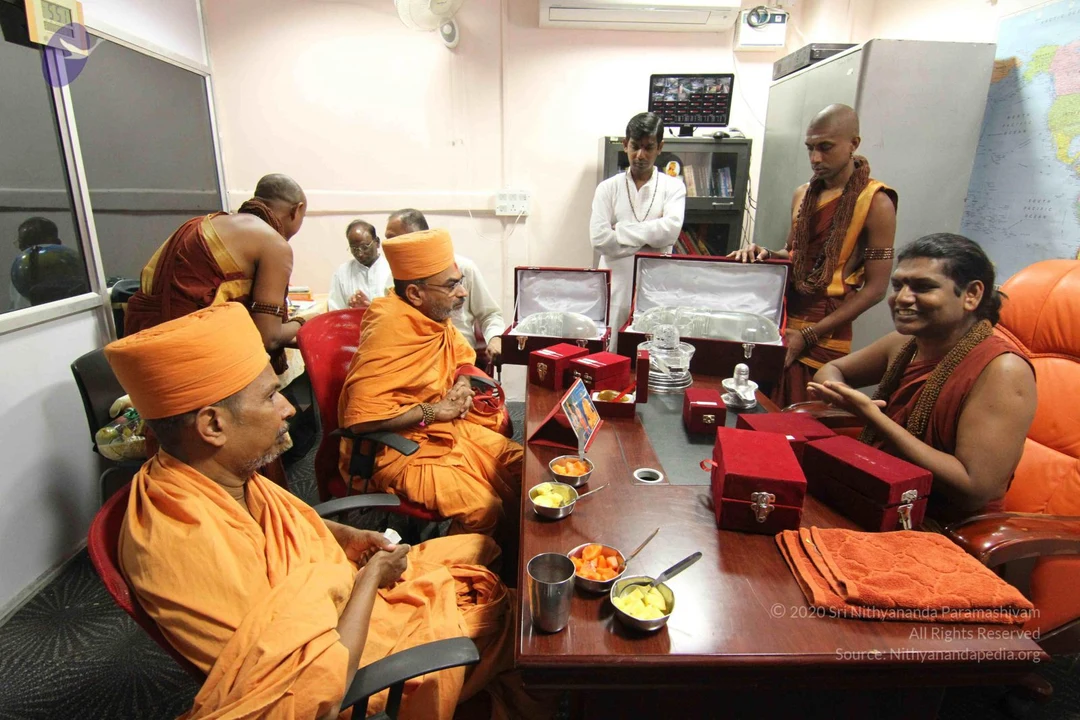
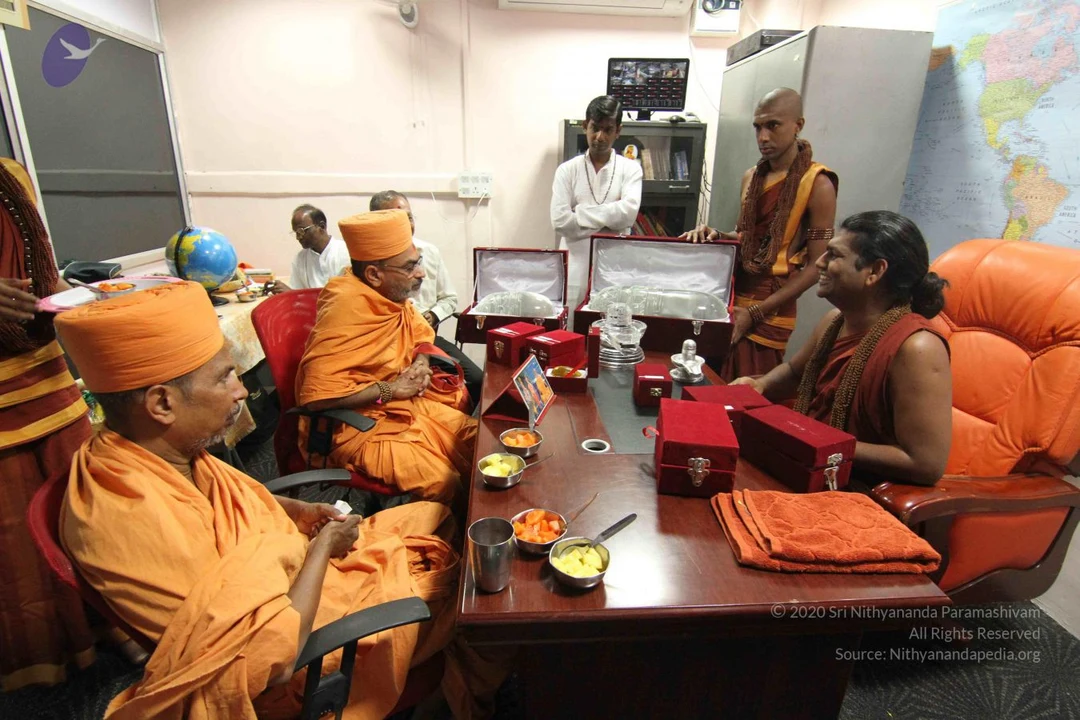
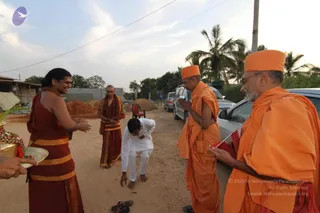
A photograph of an excavation site between high tan stone walls. In the foreground a shallow stone-lined channel holds dark standing water, with cut granite blocks lining its edges and a flexible white hose running across the ground. Reddish-brown earth is heaped on the right beside scattered pale dressed stones, and a rubble pile of broken stones sits at the upper left. No people are visible, and the scene appears to show construction or restoration work on stone structures.A photograph of an excavation site showing a weathered stone wall of dressed masonry rising from a trench cut into reddish-brown soil. Broken concrete and pale rubble lie heaped on the right, with a black pipe running across the foreground and a row of flat stone slabs at the base of the wall. No people, deities or ritual activity are visible.A photograph of an outdoor construction or excavation site showing a stone-lined rectangular channel or tank partly filled with still water. Large rough-cut granite blocks line the sides and base, while loose rubble, broken rocks and reddish-brown earth surround it. A black hose snakes across the lower foreground toward the water, and a small metal tap sticks out of the stonework on the right beside a pipe with red binding. No people, deities or ritual activity are visible; the scene looks like ongoing masonry or landscaping work at an ashram grounds.A dusty construction site shows a shallow stone-lined channel or trench with rough granite blocks and a thin strip of standing water. Rubble and loose stones pile up on the left and behind, with sandy red-brown earth on the right. A grey hose snakes across the foreground, and a tap with a pipe sits beside a red-painted wall on the right. No people, deities, or ritual activity are visible.A rotated photograph of a construction site showing a stone retaining wall built from rough-cut grey granite blocks. Excavated reddish-brown soil lies behind and beside the wall, with loose rubble stones scattered on the right. A white plastic water pipe runs along the wall face, and a red metal frame or tarpaulin edge appears at the bottom. Green trees and a red-painted building are visible at the upper right edge. No people are visible in the scene.Outdoor photo on a dirt road beside a construction site with a pile of red earth, palm trees and parked cars. A man in a rust-red and gold-bordered dhoti and shawl stands at left with palms pressed together, smiling, next to a brass plate of flowers and offerings. Beside him an older man in a red-and-gold dhoti with a rudraksha mala holds a red cloth. A man in white kurta and white dhoti bows deeply with his hands on the ground. Two saffron-robed sannyasis stand at right, one with folded hands and one holding a red book, with a silver car behind them.

Sri Nithyanandeshwara & Nithyanandeshwari  procession

23 photosSource gallery
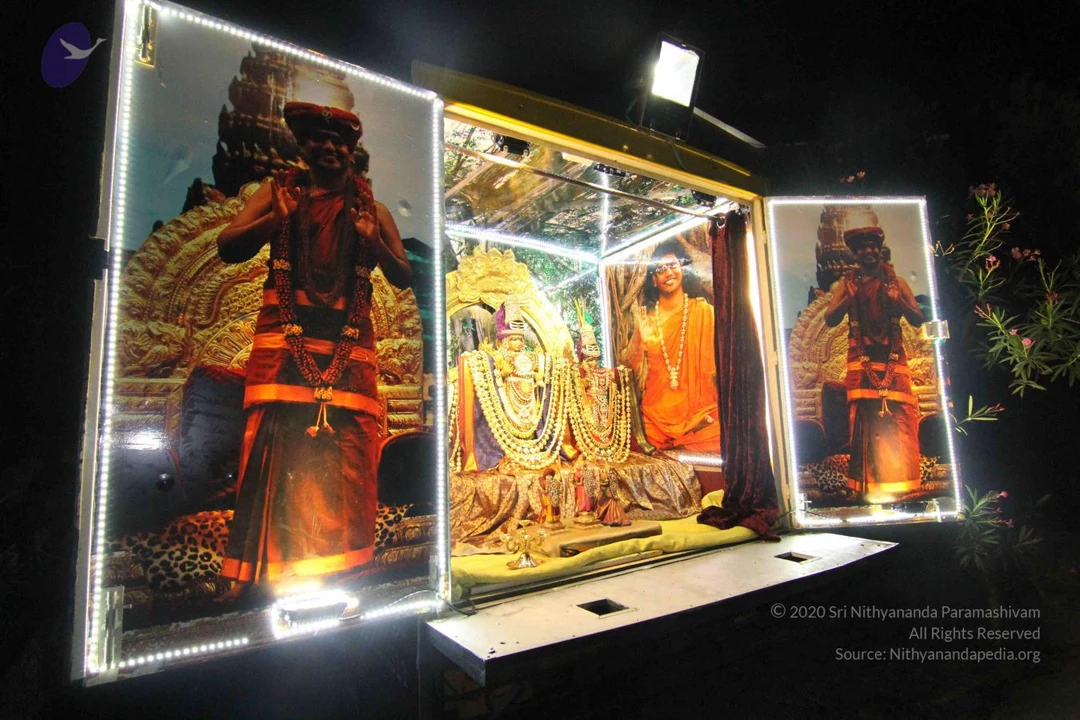
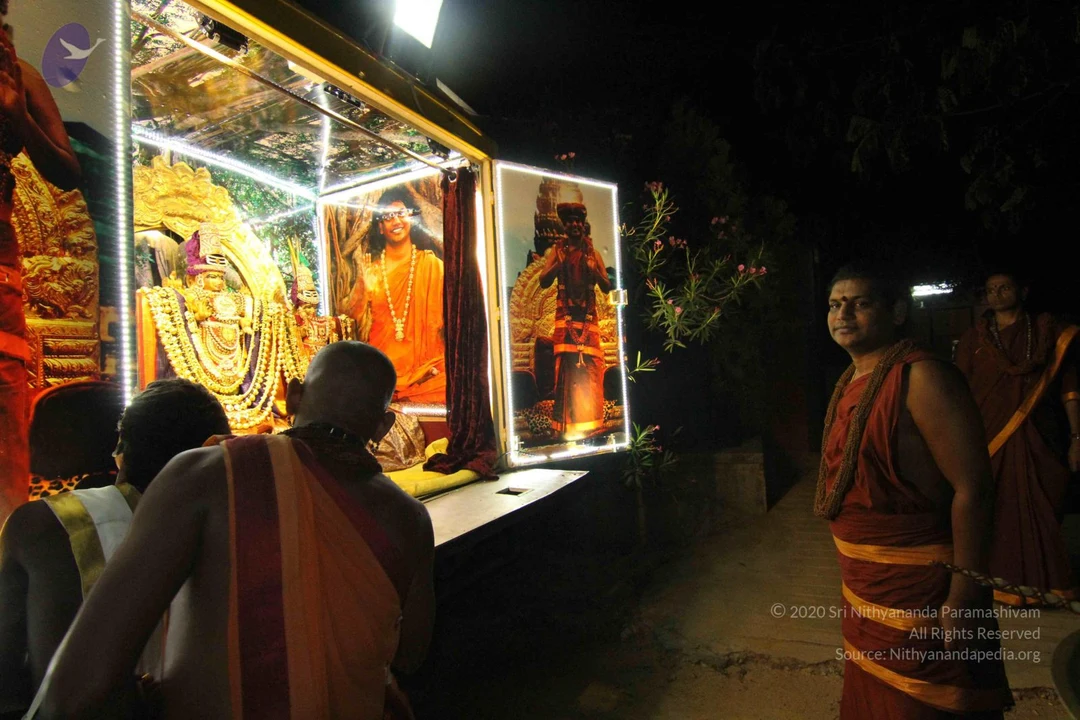
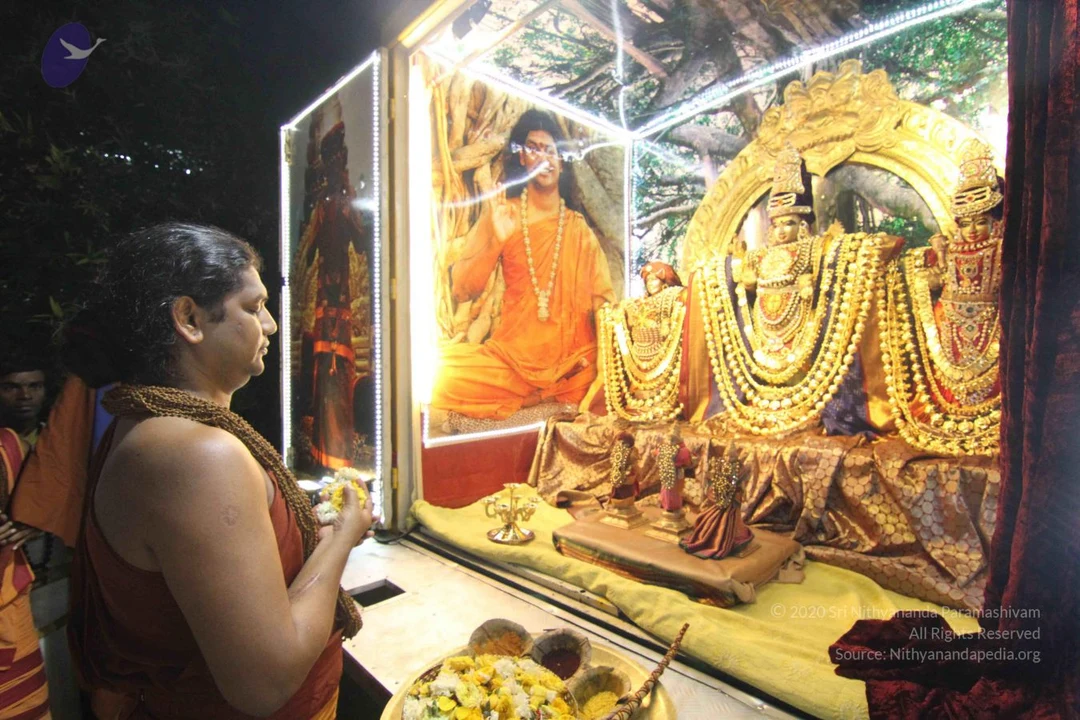
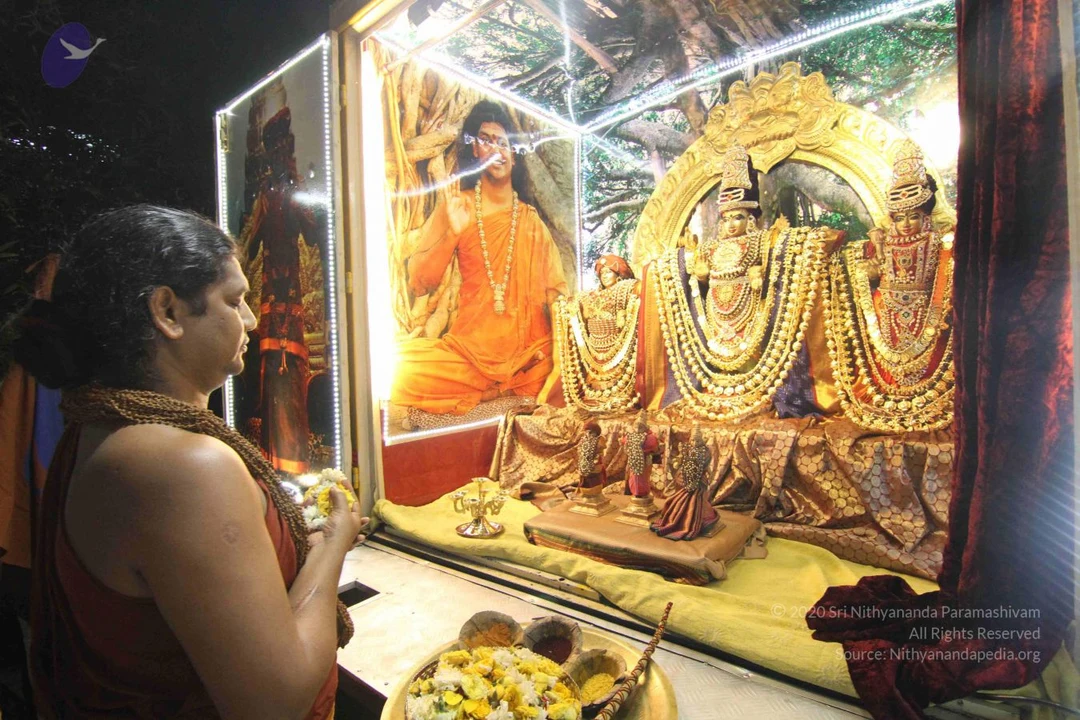
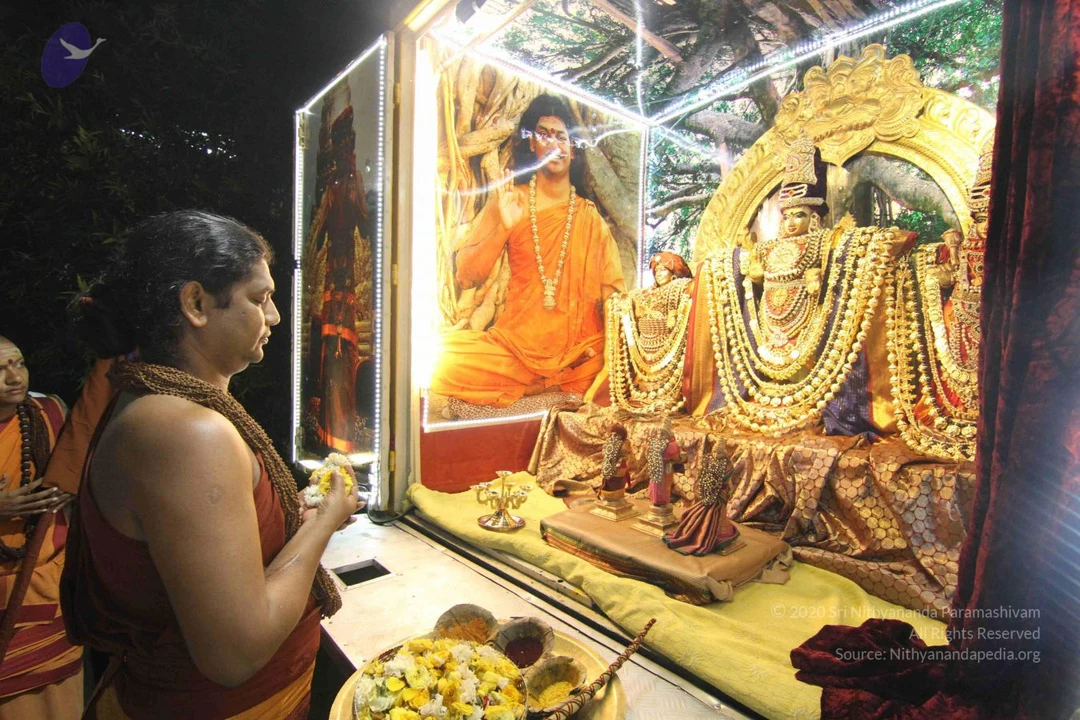
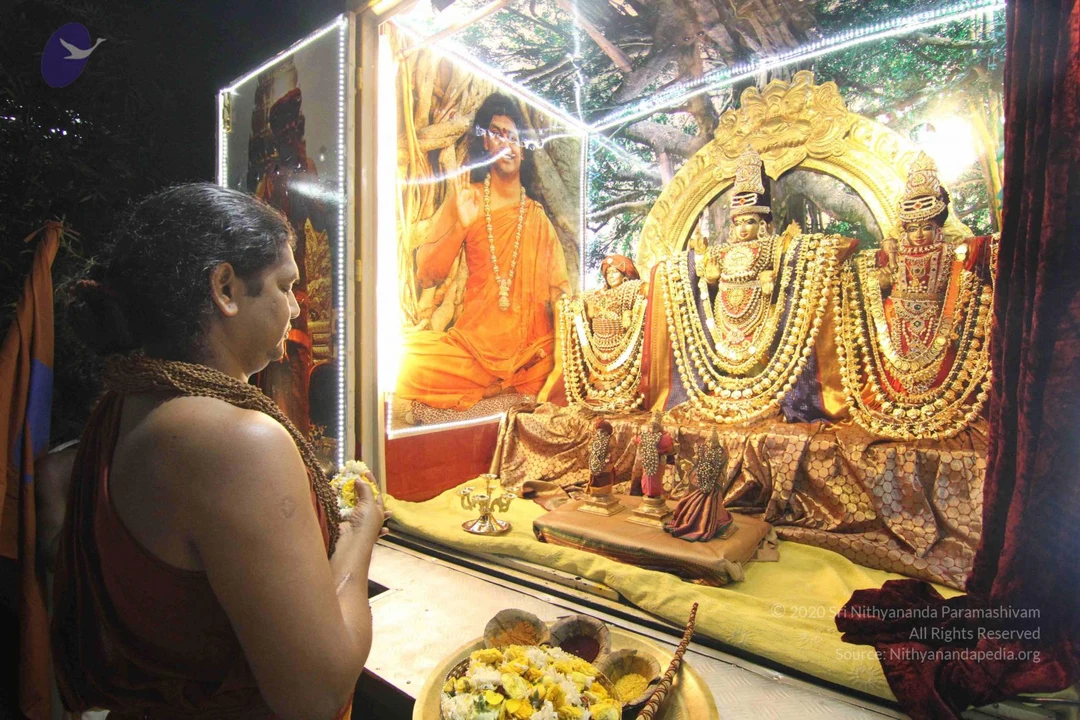
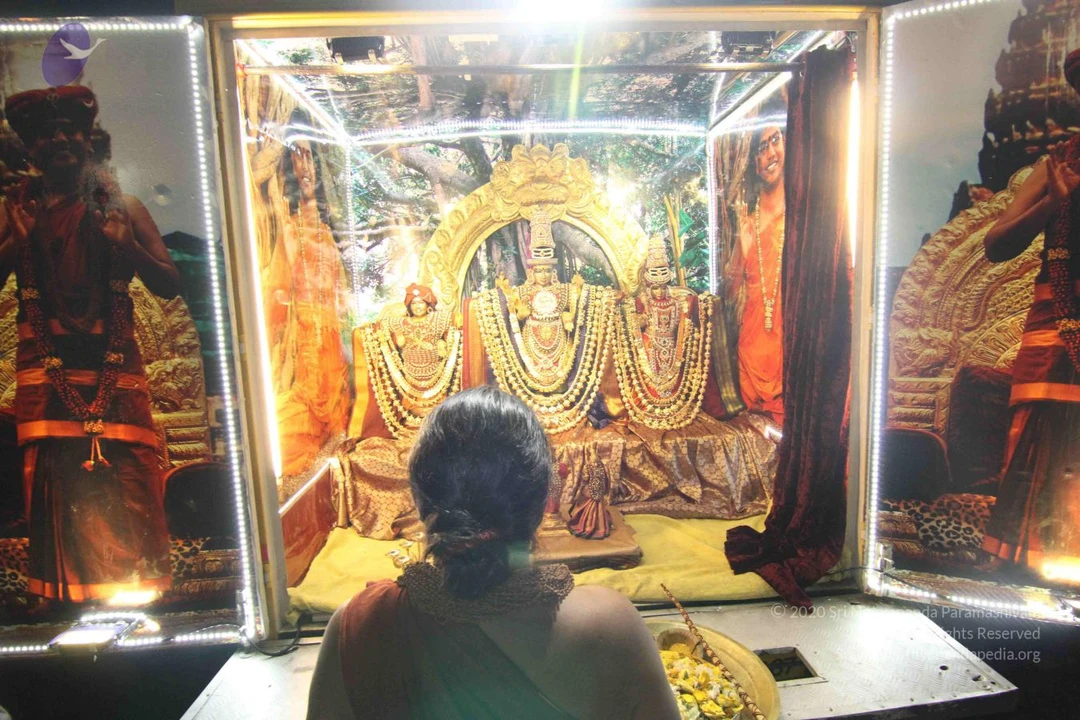
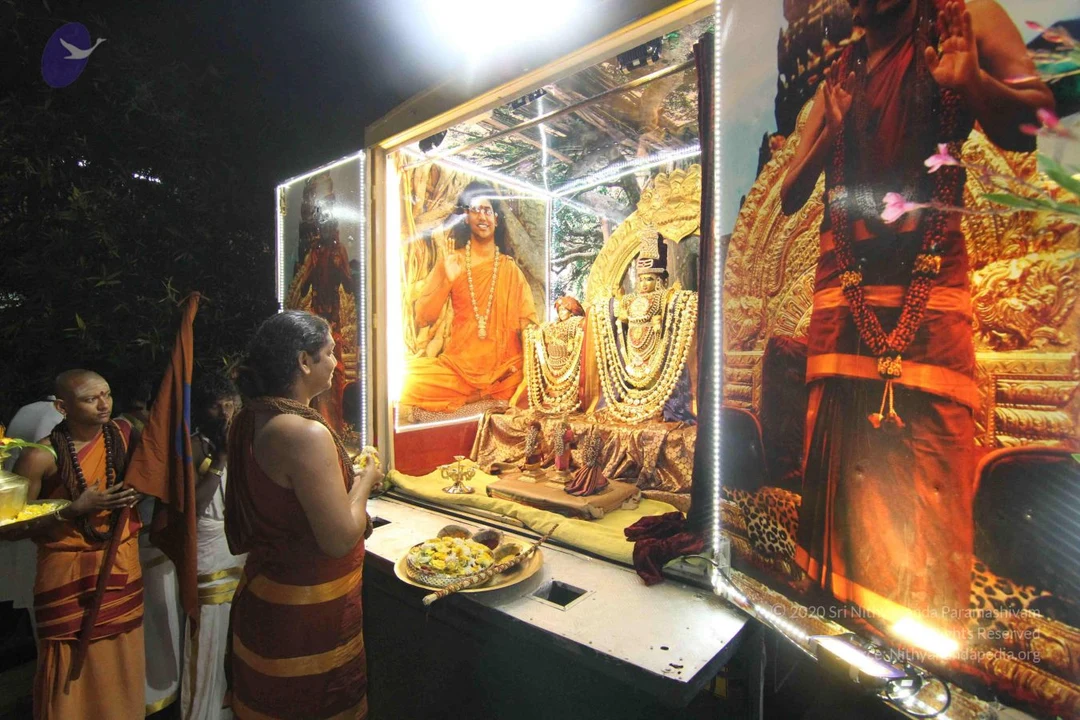
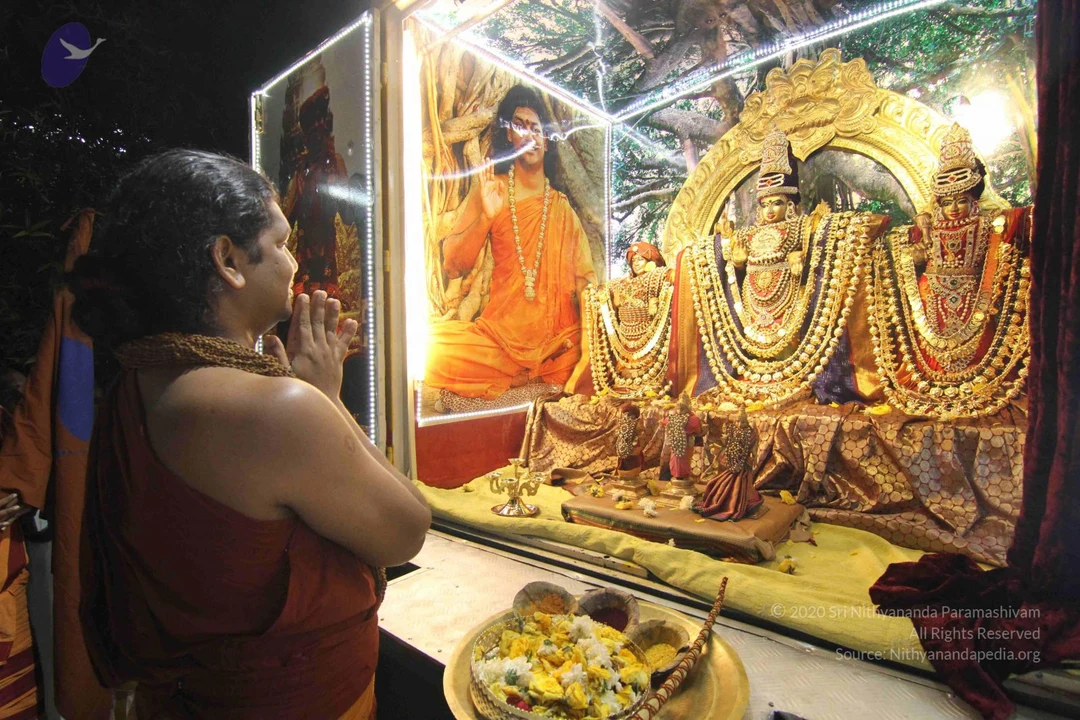
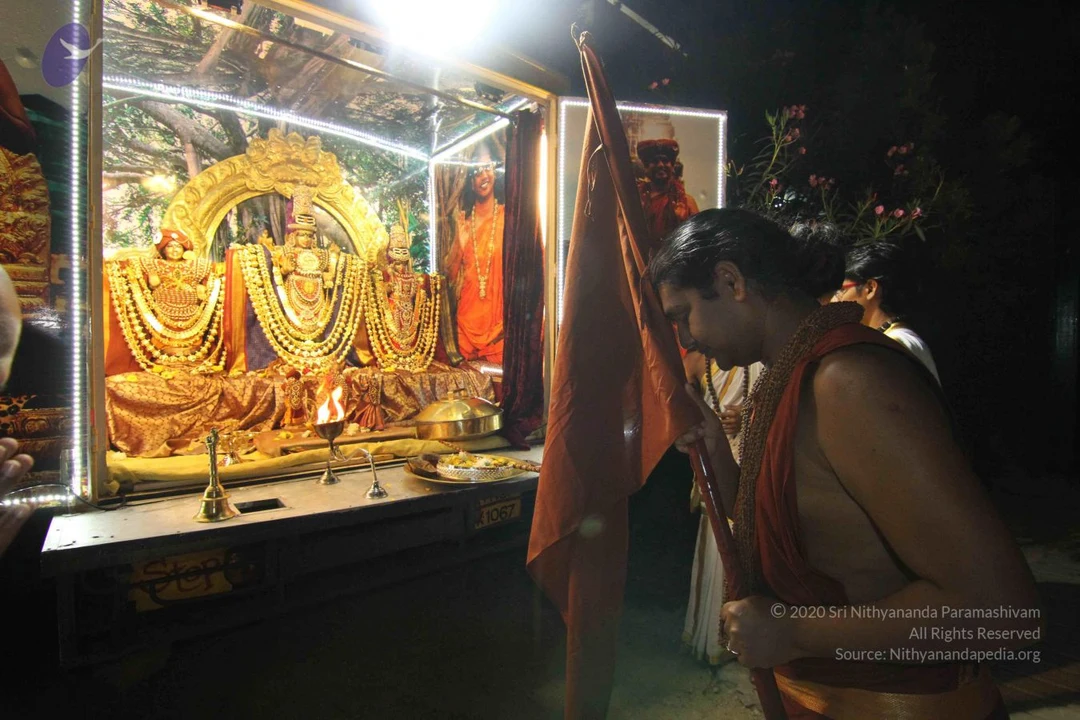
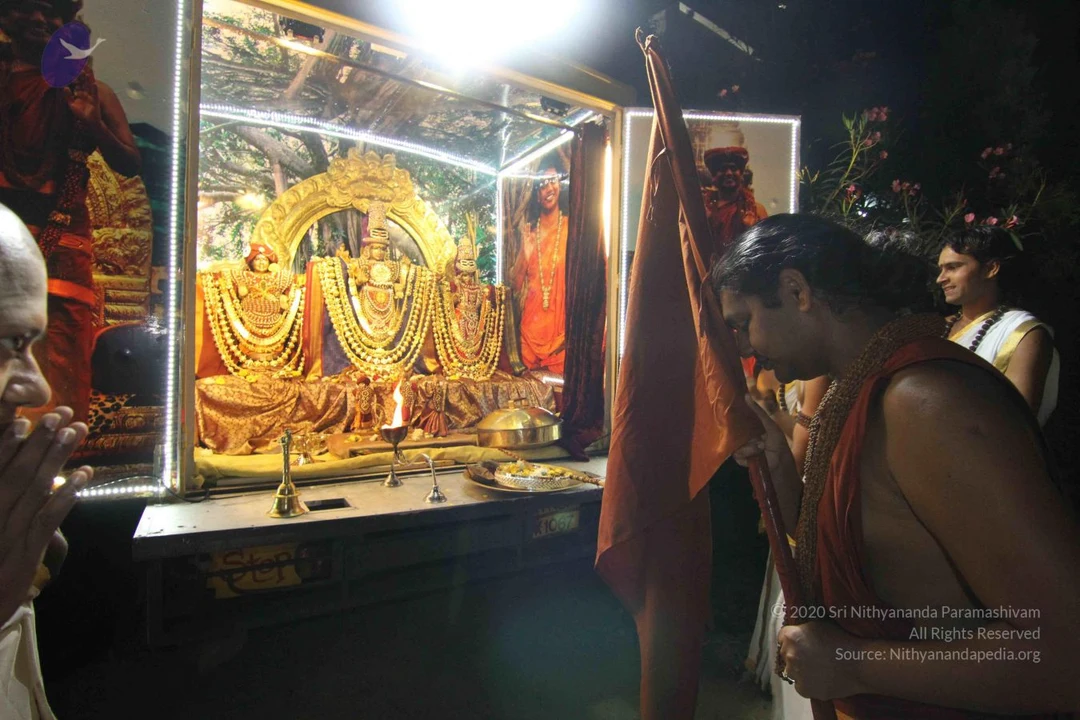
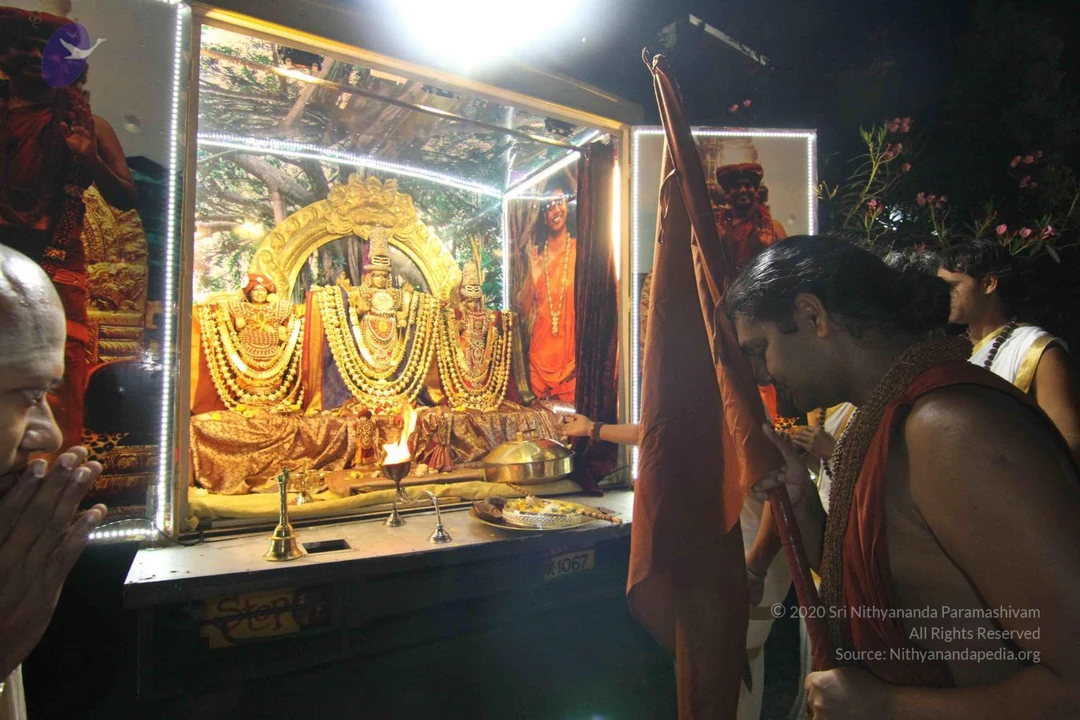
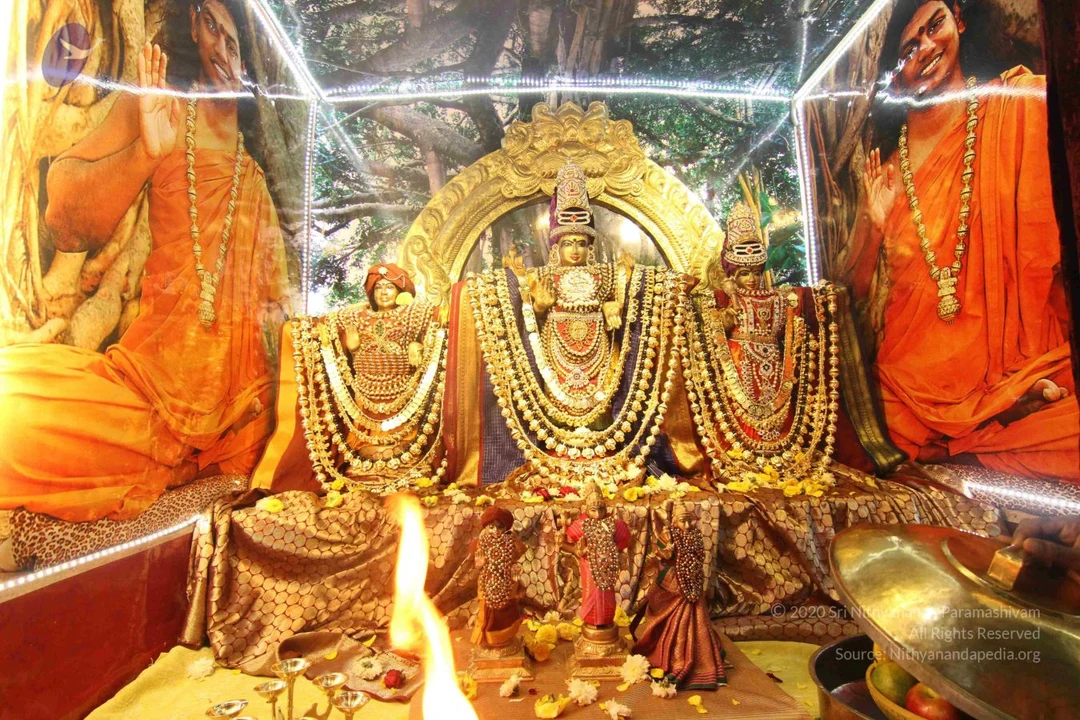
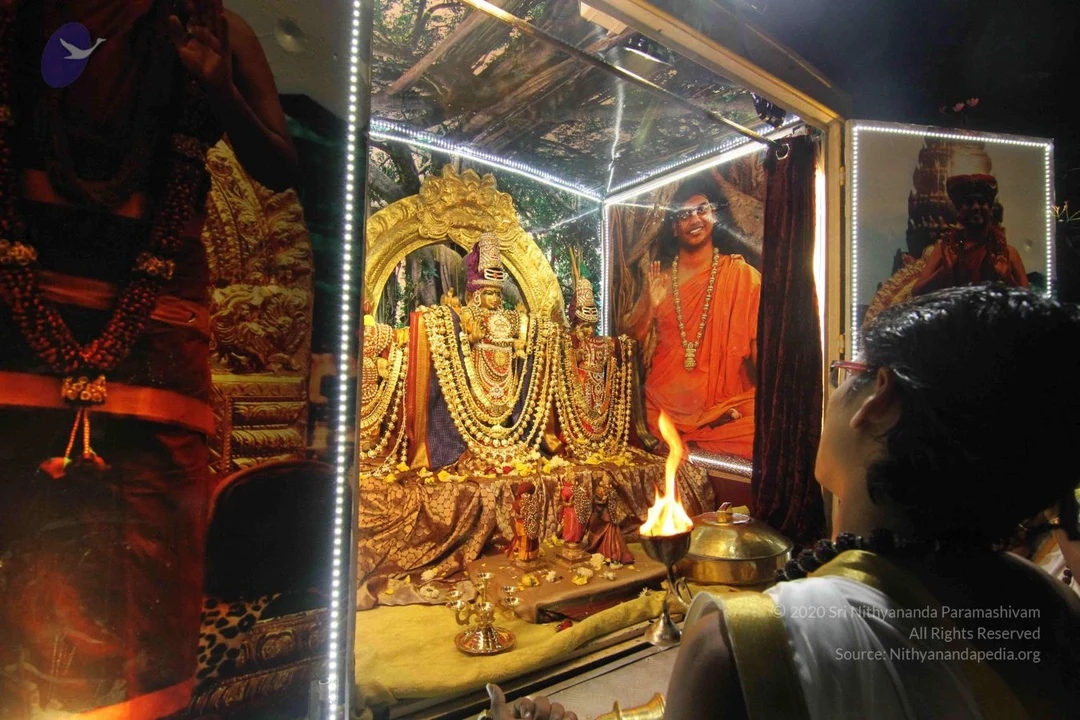
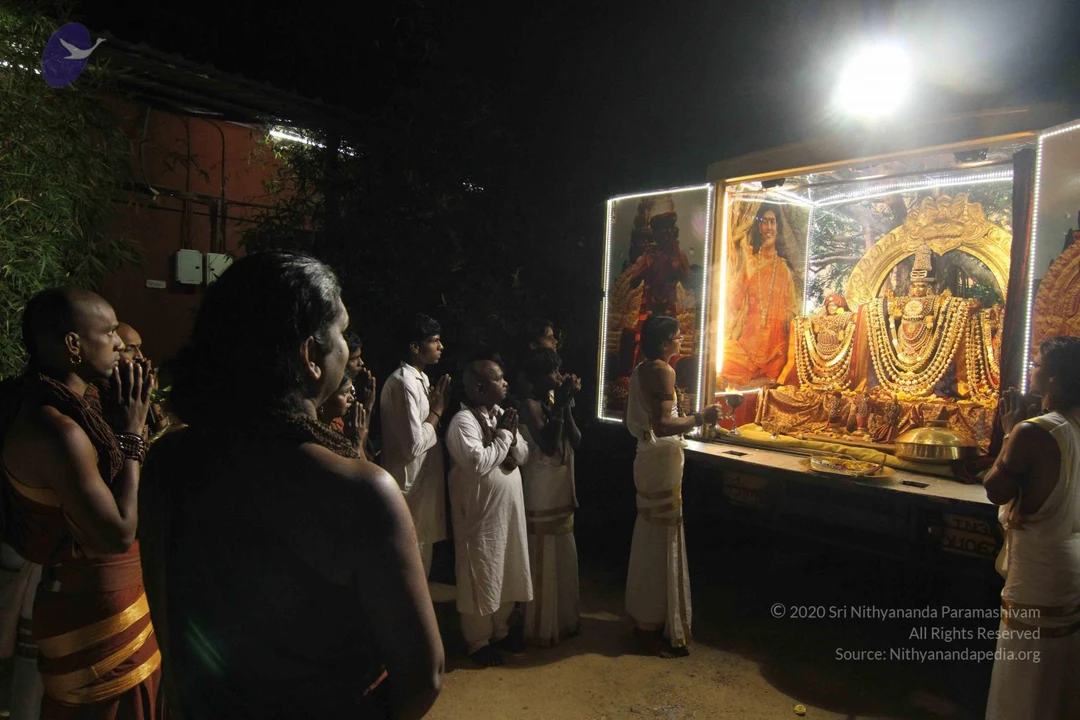
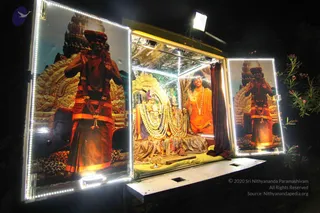
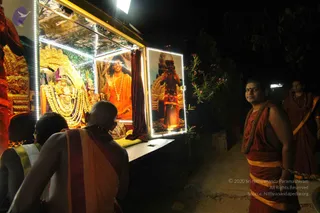
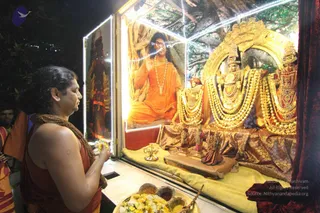
Night photograph of an illuminated, mirrored display case on a vehicle or stand. Inside stands a deity murti dressed in gold and pearl garlands, seated before a gold-embroidered backdrop. Behind it a robed figure in orange and saffron clothing with a long beaded necklace stands in the case. Two side panels hold large printed portraits of a man in a red turban and saffron dhoti with a red-and-white garland, hands raised in a mudra, with a golden throne and leopard-skin cushion behind him. Illuminated white light strips frame the panels, and flowering pink plants sit at the right edge against a dark background.Night-time photograph outdoors beside a lit glass display case mounted on a vehicle or stand. Inside the case, a gilded deity murti with a golden crown and heavy garlands sits beside a large framed photograph of a seated man in saffron robes with a long beaded mala and a crown-like headpiece, labelled on the sign as a portrait of Paramahamsa Nithyananda. A second framed photograph on the right shows a standing figure in red-and-orange robes with a tall headdress. Three people in saffron and red robes stand or kneel in the foreground; a man in front with a shaved head faces the case with folded hands, while a man in red robes with a shawl and sacred thread stands at right looking toward the camera. Pink flowers and dark foliage surround the scene.A night-time photograph of a devotee in a rust-orange garment and brown rudraksha-style beaded necklace, shown in profile and holding a bunch of yellow flowers before a glass-fronted shrine. Inside the shrine, a painted portrait shows a robed figure in saffron/orange with a long mala, seated before a banyan tree, beside a gold-framed deity murti with gold garlands and crowns, and decorated with gold ornaments. Brass lamps, a small offering stand and a silver tray hold yellow marigold flowers, kumkum and vibhuti. A lit white border frames the shrine, and a dark red curtain hangs at right.A night-time photograph of a devotee in a rust-red dhoti and bare-shouldered wrap, with a rudraksha-style mala, standing before a glass-fronted shrine lit by white LED strips. Inside the shrine a large framed portrait shows a man in orange robes and beads, seated and raising one hand, labelled as a depiction rather than a present person. Beside it stand two deity murti adorned with heavy gold necklaces and crowns, with a golden arch behind them and a brocade cloth on the altar. The devotee holds yellow flower garlands and a brass tray of marigolds and small oil lamps is in the foreground.A night-time outdoor photo of a devotee in a red-brown dhoti with a rudraksha mala draped over his shoulders, holding a bundle of flower petals and standing before an illuminated shrine. Inside the lit glass case, a large framed picture shows a seated figure in orange robes with an orange shawl, a long rudraksha-style mala and a raised hand, set against a banyan tree. Beside it stands a golden deity murti adorned with heavy gold and garland necklaces, flanked by smaller figures. Brass oil lamp and a brass plate of marigold petals, kumkum and offerings lie on the ledge in front, with a yellow-green cloth beneath. A second devotee in orange clothing stands at the left edge.A photograph inside a lit shrine. A priest in a reddish-brown dhoti with a rudraksha mala around his neck stands with his back to the camera, holding a small garland of yellow flowers. Before him are two gold-adorned deity murti wearing layered gold garlands and crowns, with a framed portrait behind them showing a smiling figure in orange robes with a rudraksha mala, seated under a large banyan tree backdrop. A brass plate in the foreground holds yellow flowers and small bowls of kumkum and turmeric. A brass lamp stands on the altar cloth. Several mala-adorned figures are arranged on the altar cloth.
FB-photo-of-the-day

1 photoSource gallery
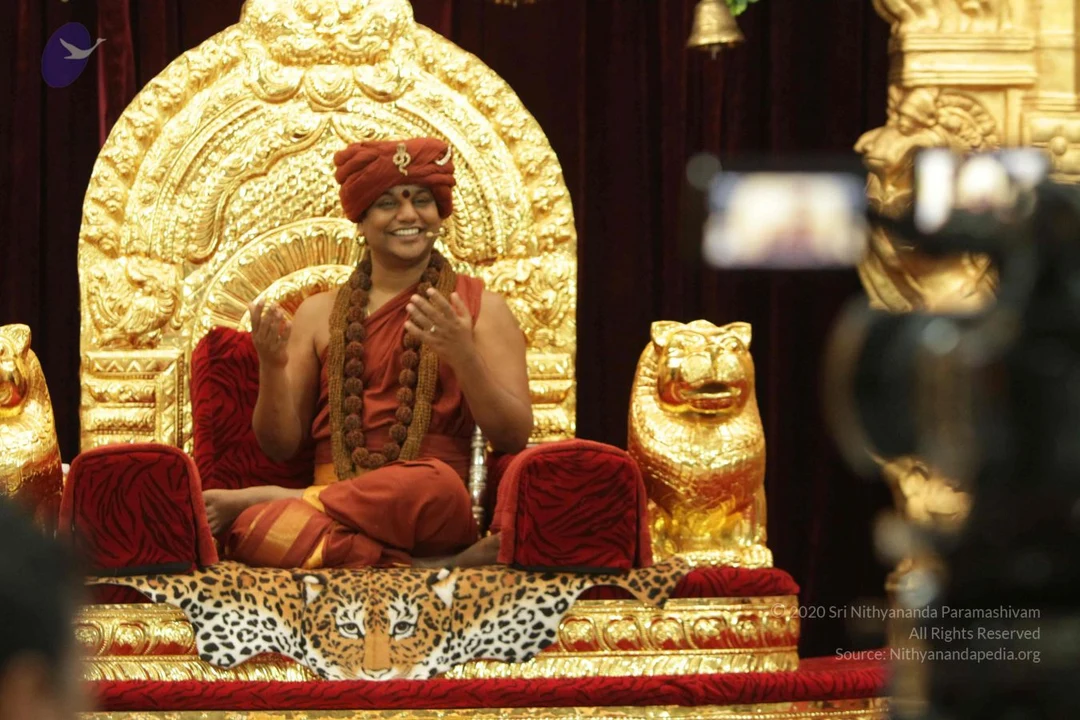
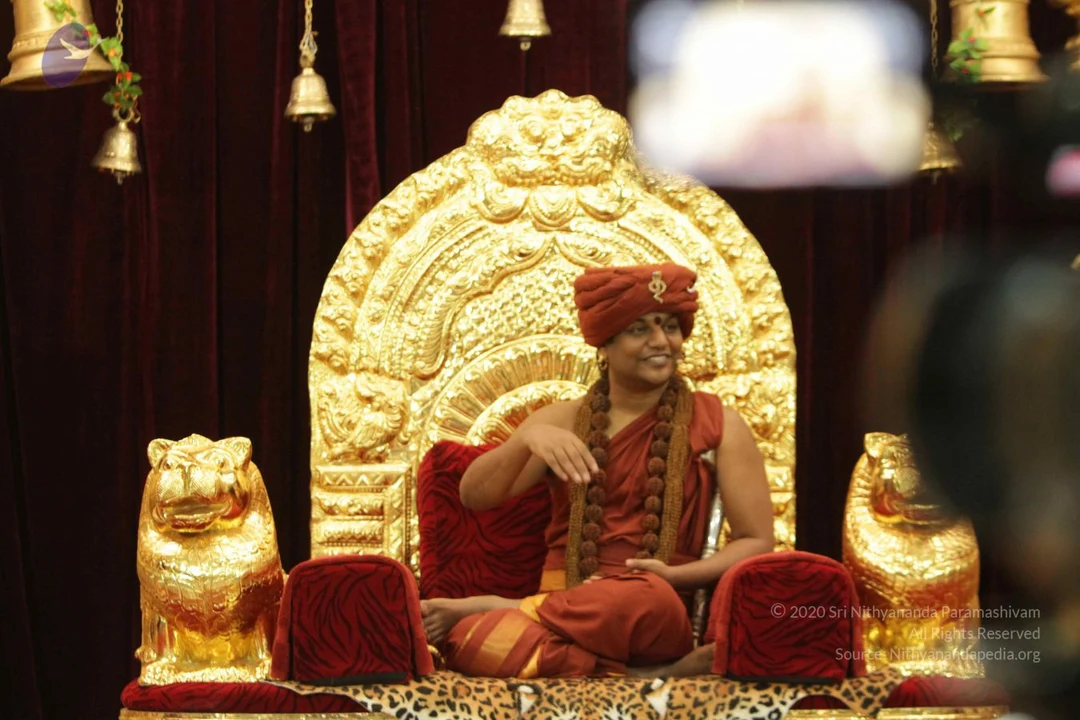
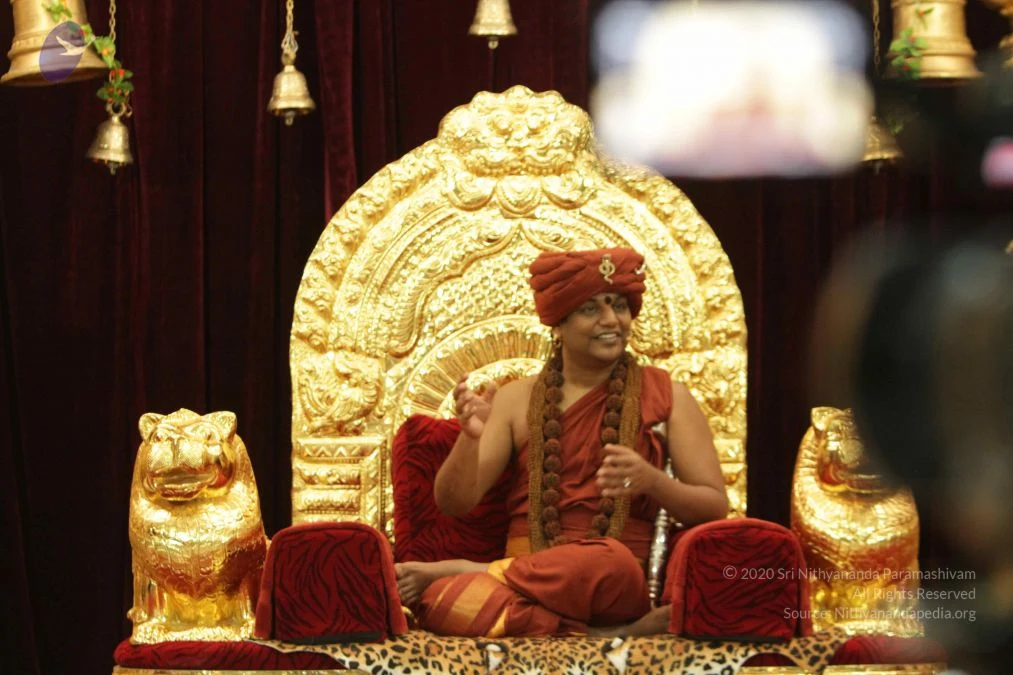
A graphic quote card with a red footer banner. A seated man in orange robes and an orange turban with a red tilak sits on an ornate gold throne flanked by two golden lion figures, with a leopard skin draped below, against dark red drapery and hanging brass bells. He raises one hand, wears a rudraksha mala, and smiles. The red banner carries a white quote and an attribution line.

1-Satsang

7 photosSource gallery
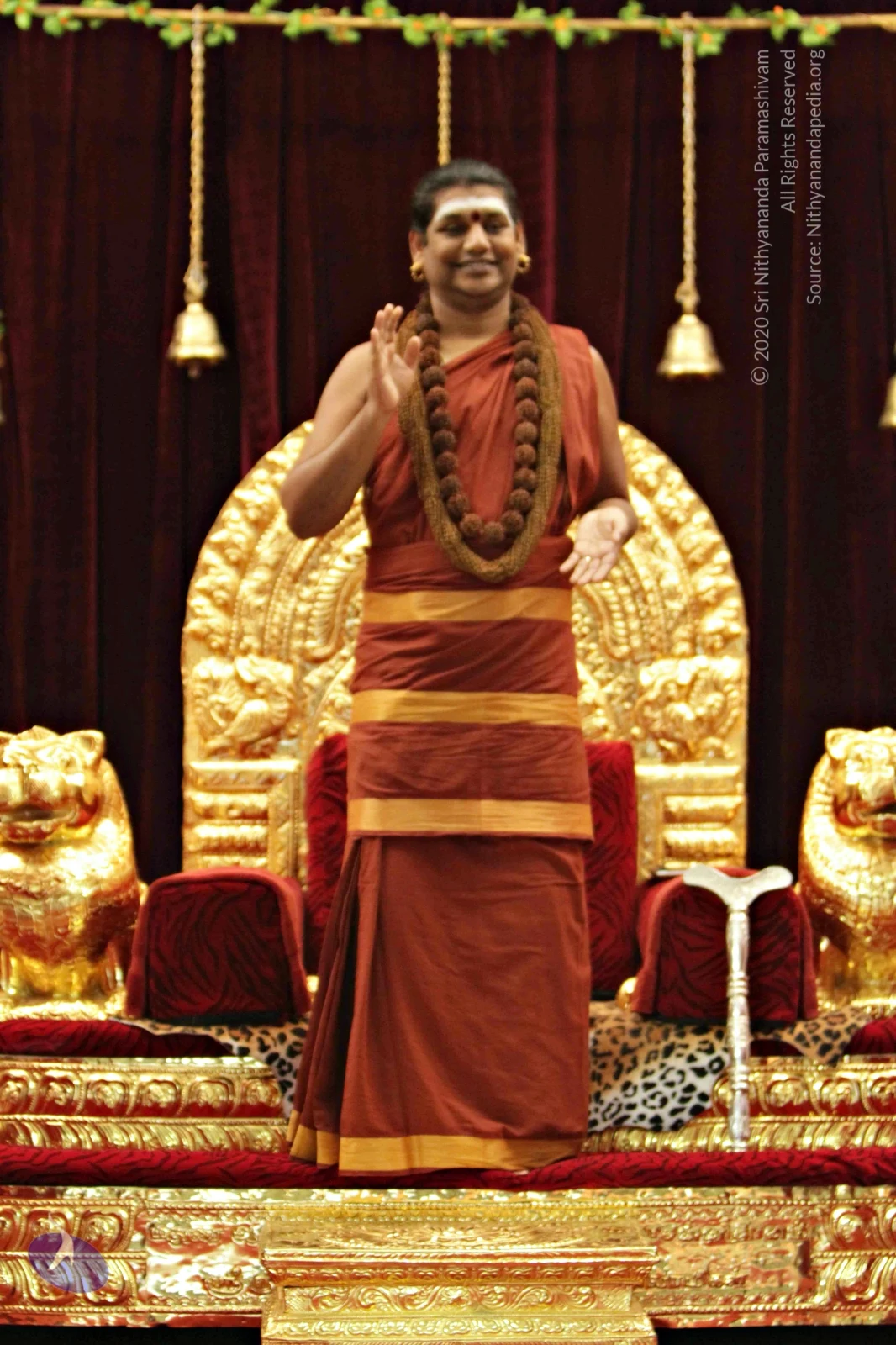
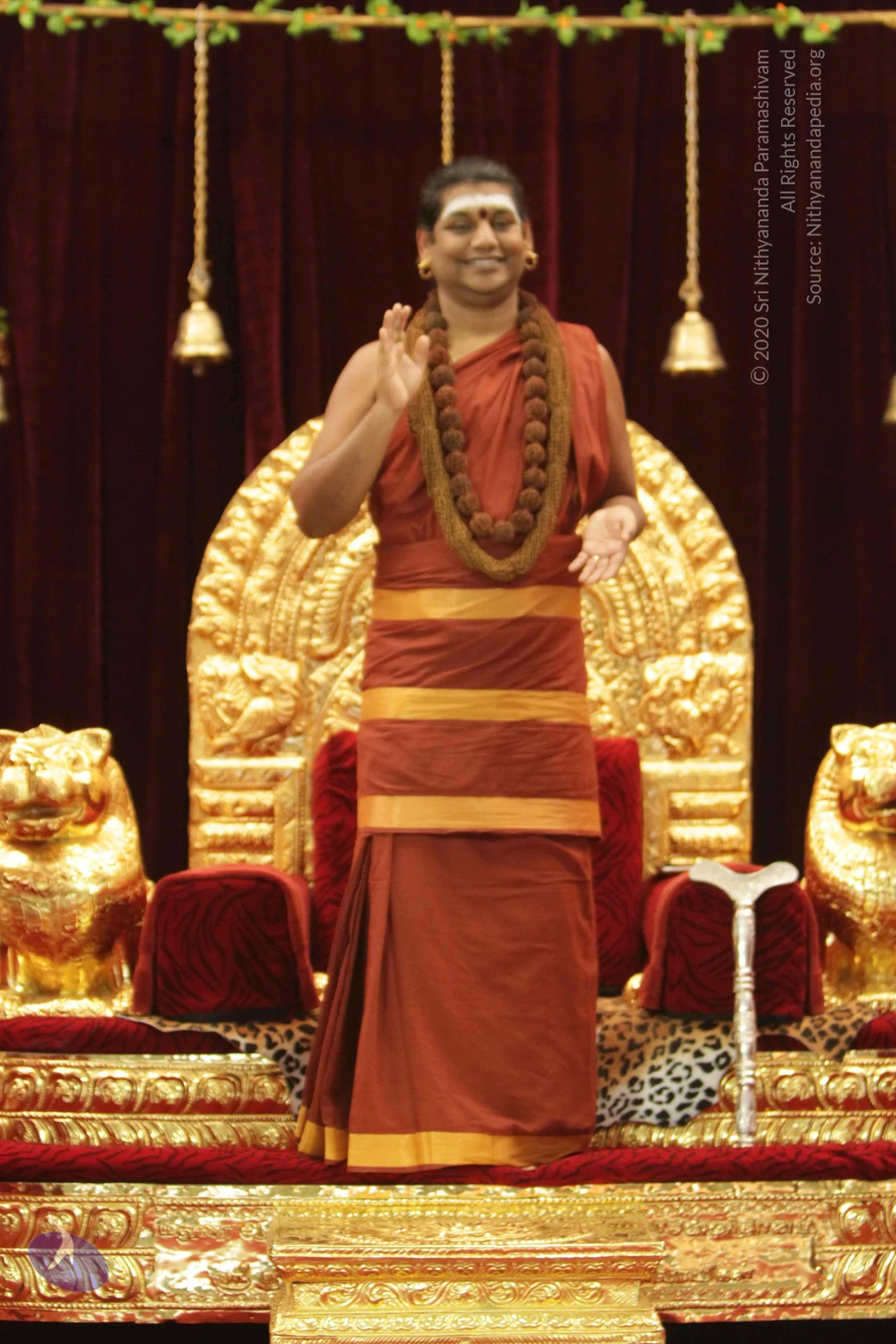
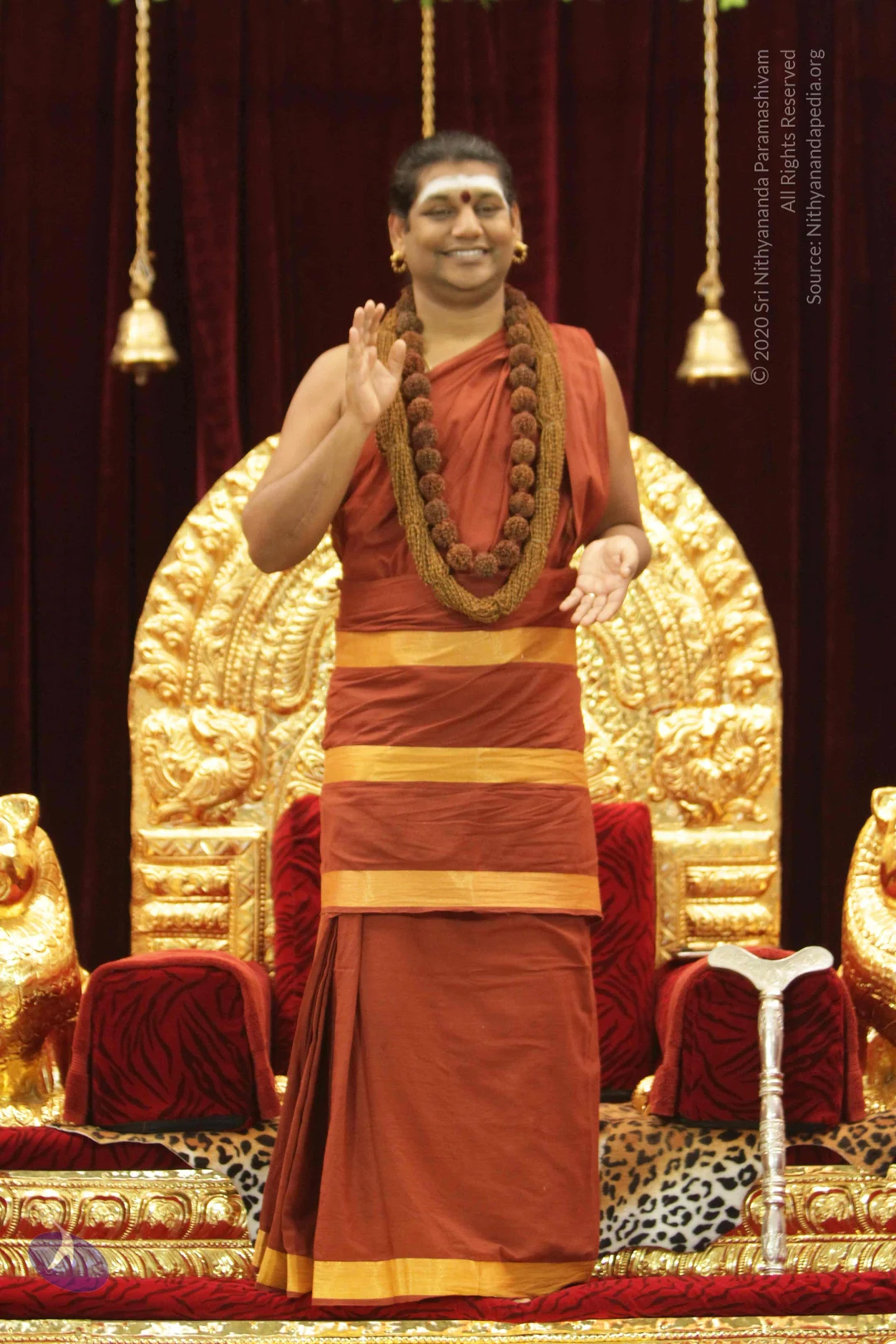
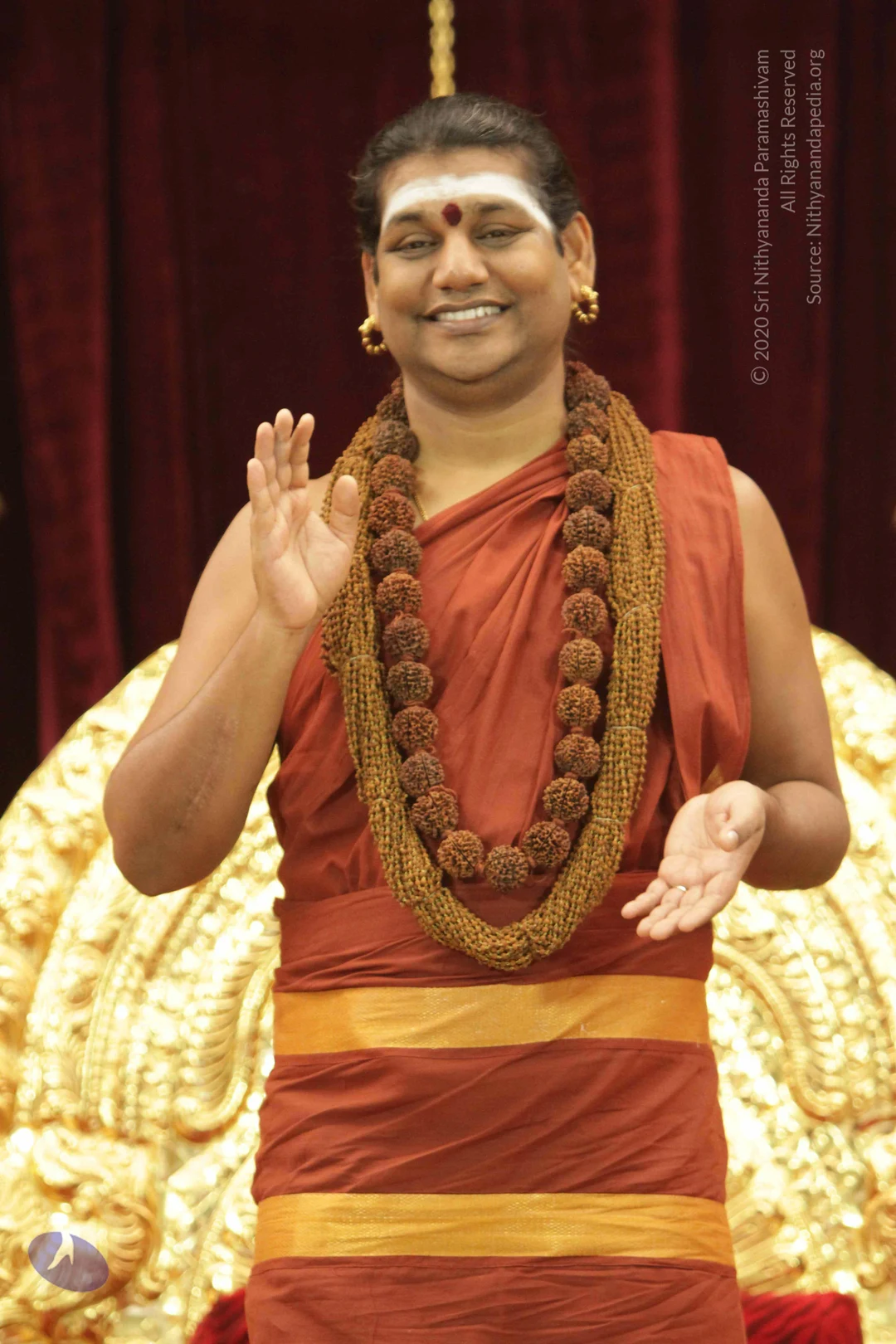
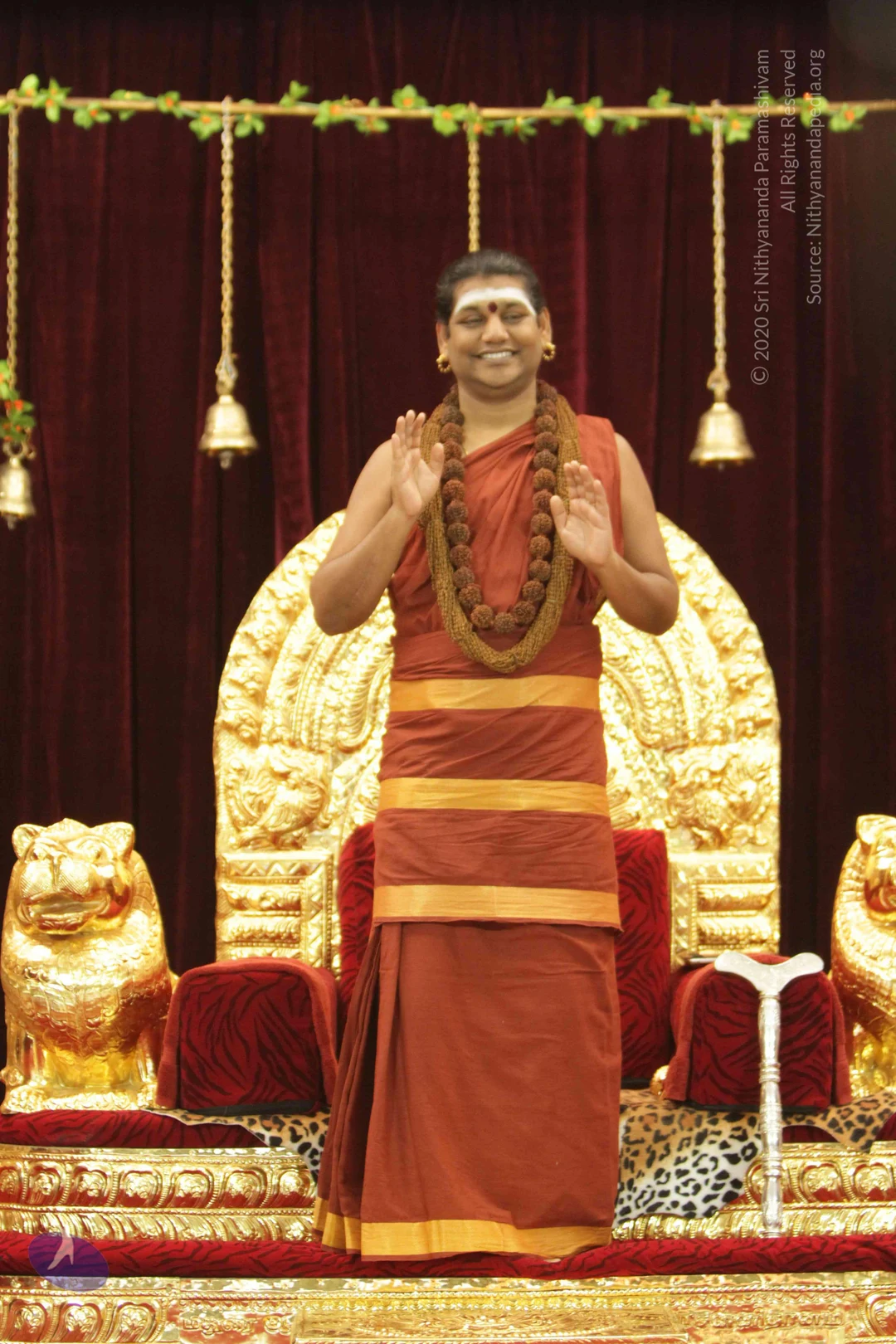
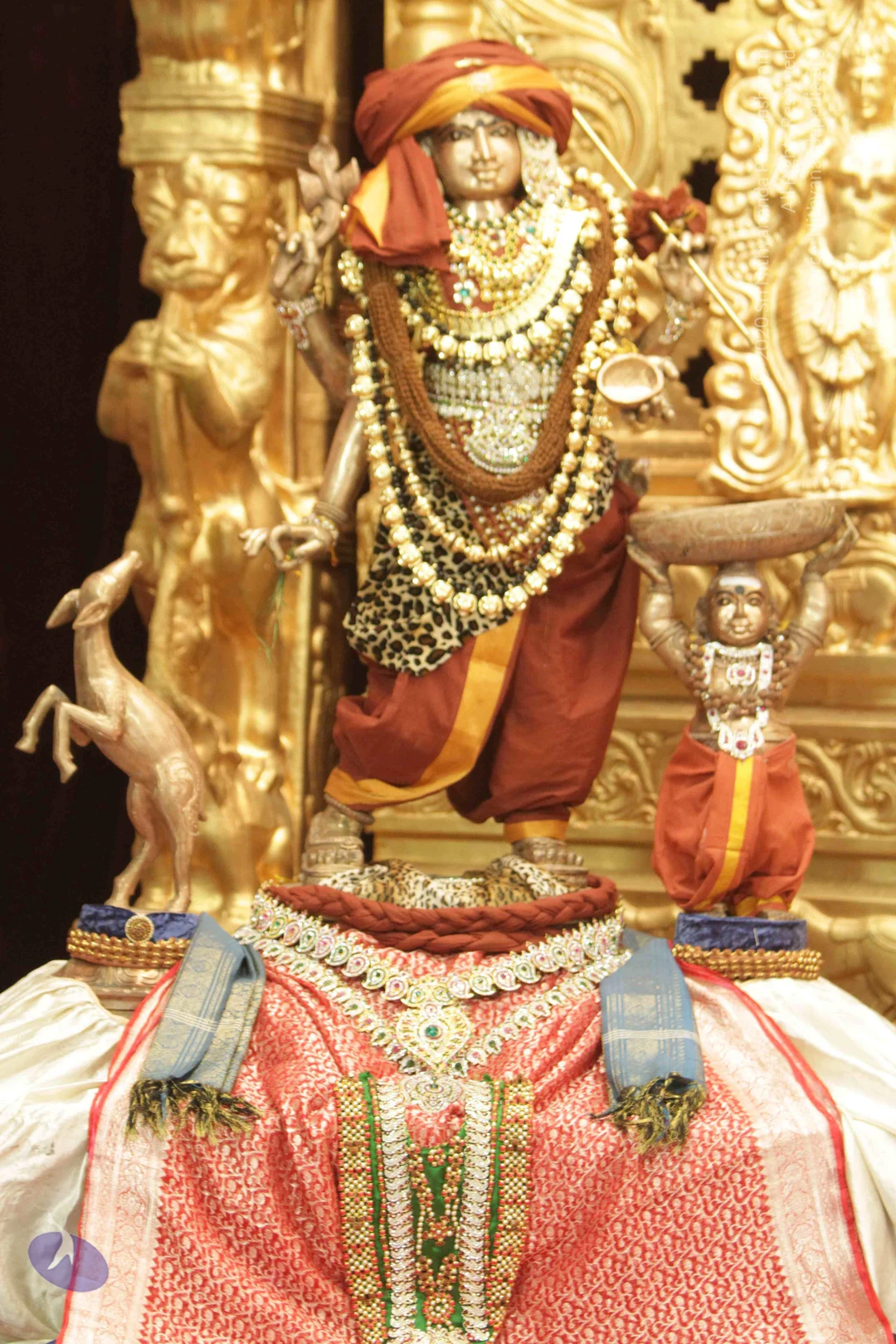
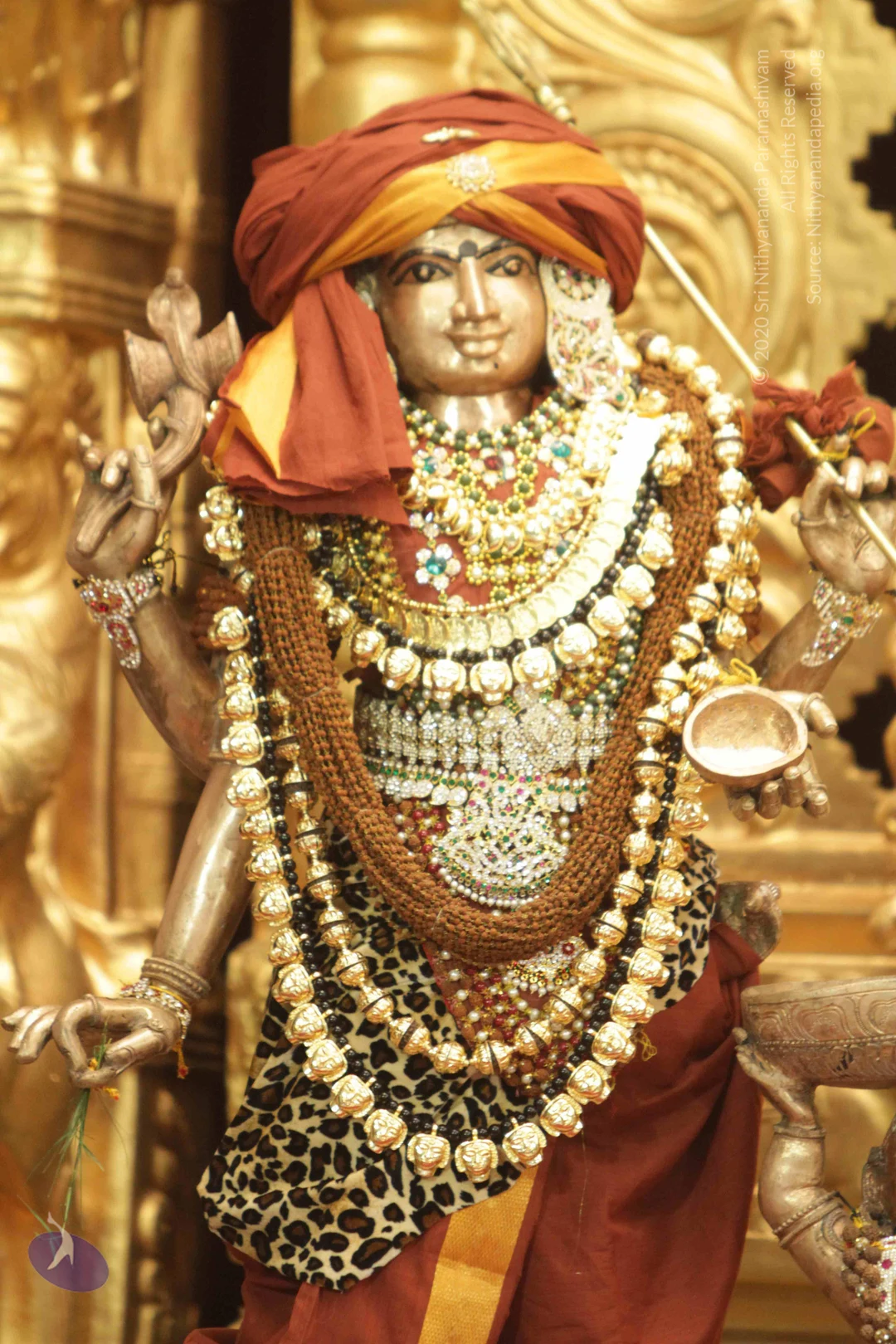
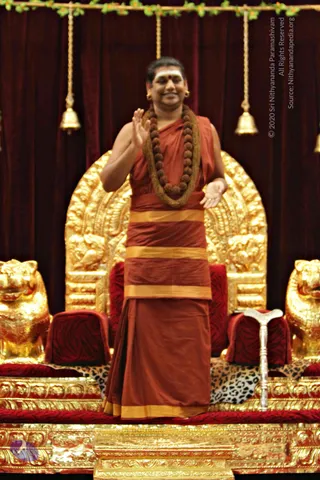
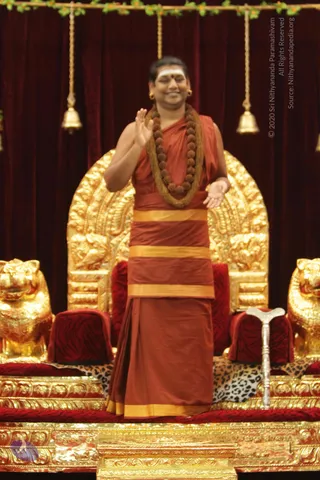
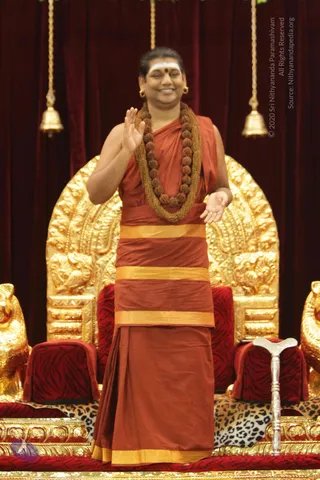
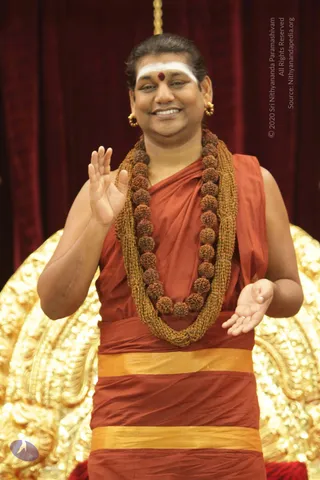
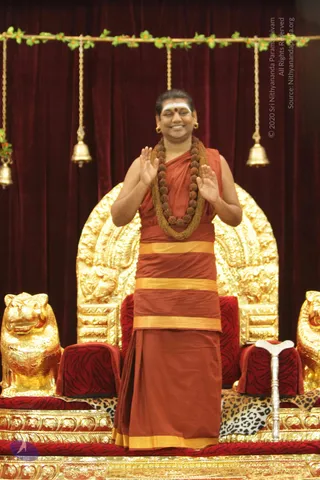
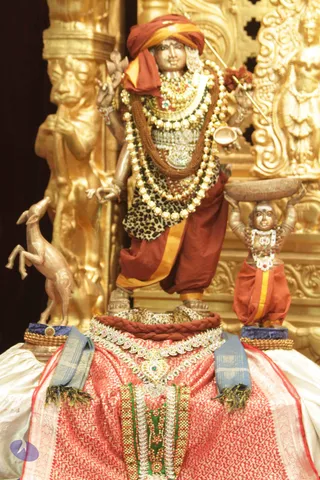
A standing man in a rust-red and saffron-orange sleeveless robe with gold-striped borders and a wide gold-banded waist sash, wearing a long rudraksha mala and gold earrings, with white and red forehead markings, raises one hand in greeting while smiling. Behind him is an ornate gold throne with carved backrest, flanked by gold lion figures and red-upholstered seats, with hanging gold bells and a garland-draped rod above. The setting is a stage-like ceremonial dais.A standing man in rust-red robes with a gold-banded waist wrap stands before an ornate gold throne with carved lion-shaped armrests and red velvet cushions. He wears a long rudraksha mala with a white vibhuti line on his forehead and a red bindi, and raises one hand in blessing. Hanging gold bells and a flower garland decorate the red velvet backdrop. a person is shown here by appearance cues: a rudraksha mala, ceremonial gold earrings, and ochre-saffron robes, while the throne setting alone is not conclusive.A smiling man stands in front of an ornate gold throne with a deep red velvet backdrop and hanging brass bells. He wears a rust-red sannyasi robe with gold-bordered wrap and a long rudraksha mala with a golden-brown cord, plus a white vertical tilak and red bindi on his forehead and gold earrings. His right hand is raised in a gesture while his left hand is open at his side. Gold lion-form armrests and a silver staff rest beside the throne on a leopard-print cloth. Probable Swamiji is shown in appearance-based terms: swept-back hair, rudraksha mala, saffron-red robe and ceremonial gold ornaments, standing as a speaker before the throne.A photograph of a smiling man in a rust-orange robe with a gold-striped sash, wearing a long rudraksha mala with multiple strands and gold earrings. He has a white tilak with a red dot on his forehead and raises one hand in a blessing gesture while the other hand is open at his side. Behind him is a gold ornate carved throne against a deep red velvet drape. a person appears to be the person pictured, based on the rudraksha mala, saffron robe, gold ornaments and throne setting.A smiling man with eyes closed stands before an ornate gold throne with carved lion-shaped armrests and red tiger-striped cushions, against deep red velvet drapes hung with brass bells and green-and-orange flower garlands. He wears a rust-red robe with gold borders, a saffron-gold waist band, a long rudraksha mala around his neck, gold earrings, and a white forehead marking with a red dot, and he holds both palms raised in front of his chest in a welcoming gesture. A silver staff leans against the right side of the throne. Swamiji (probable): the figure has long swept-back hair, a rudraksha mala and ceremonial gold ornaments, and the page indicates he is at this satsang.A silver-toned deity murti stands on a red and gold draped pedestal against an ornate gilded backdrop with carved golden pillars. The figure wears a red and yellow turban, layered pearl and gold necklaces, a leopard-print garment, and a red and yellow dhoti. One hand holds a small bowl and another a staff, and a silver deer stands to the left. A small attendant figure to the right balances a bowl overhead on its raised hands, wearing red-yellow dhoti and beaded necklaces. The base is draped in red brocade with blue and gold borders and jeweled pendants. No physical people are visible.

2-Bidadi-Deities

17 photosSource gallery
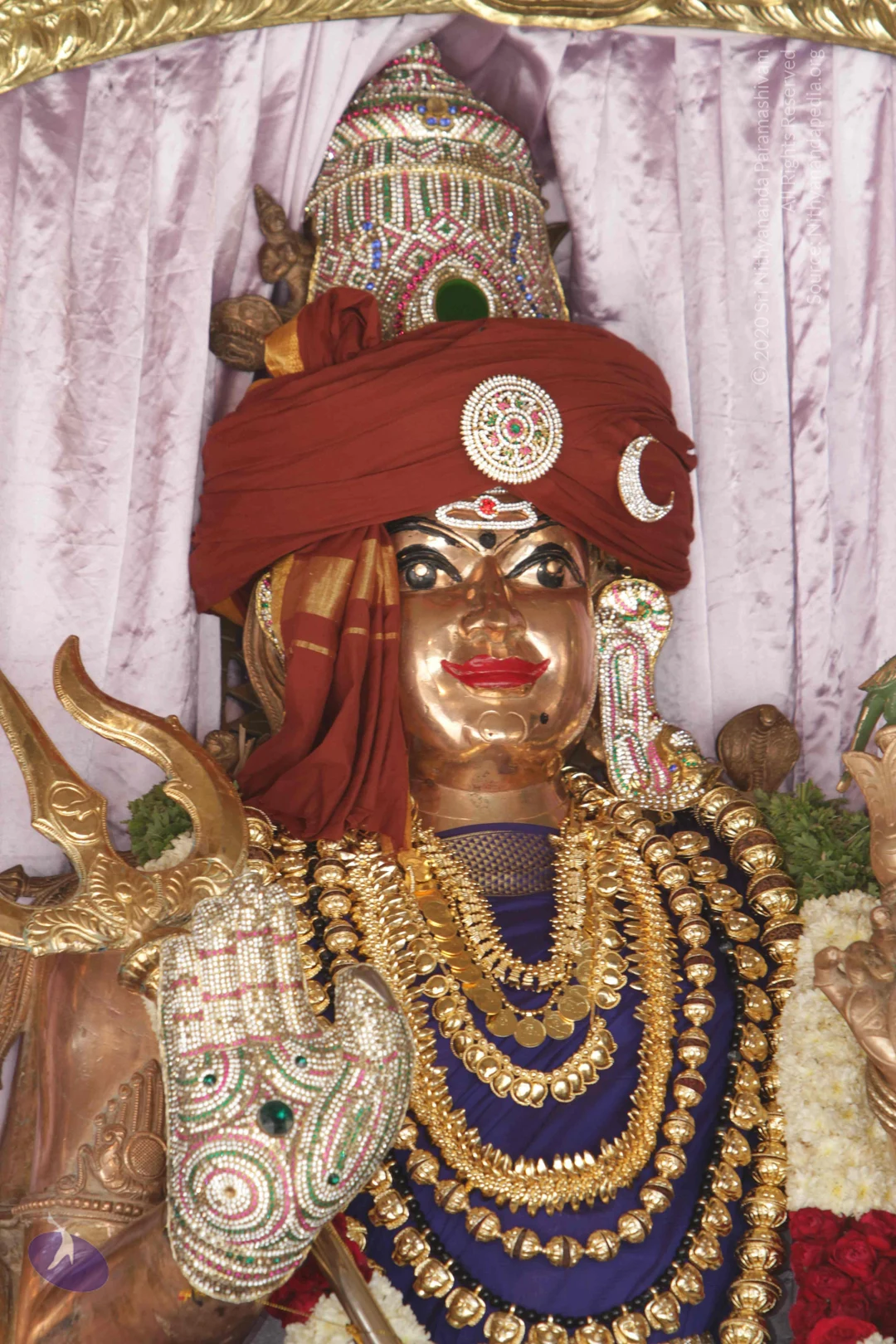
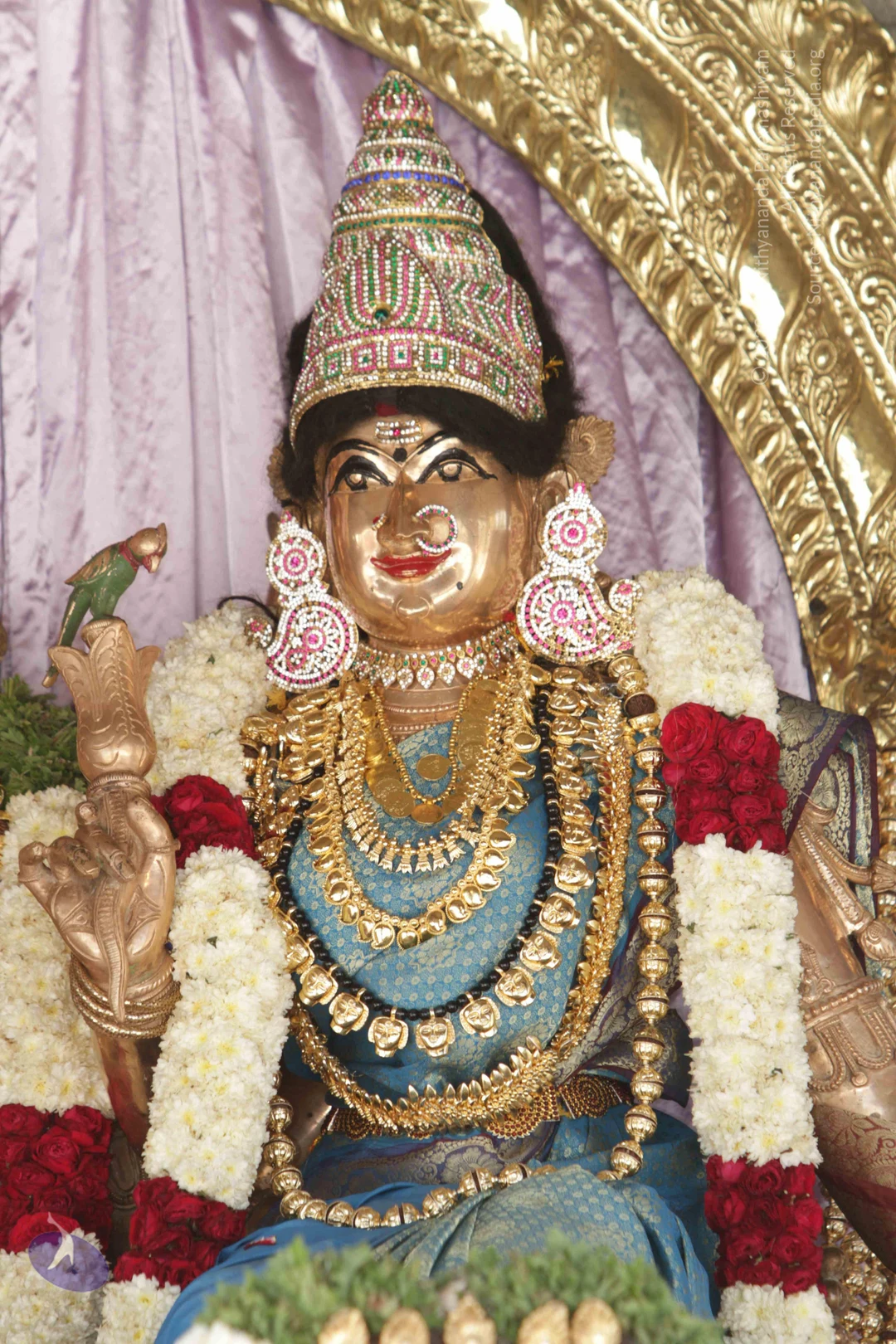
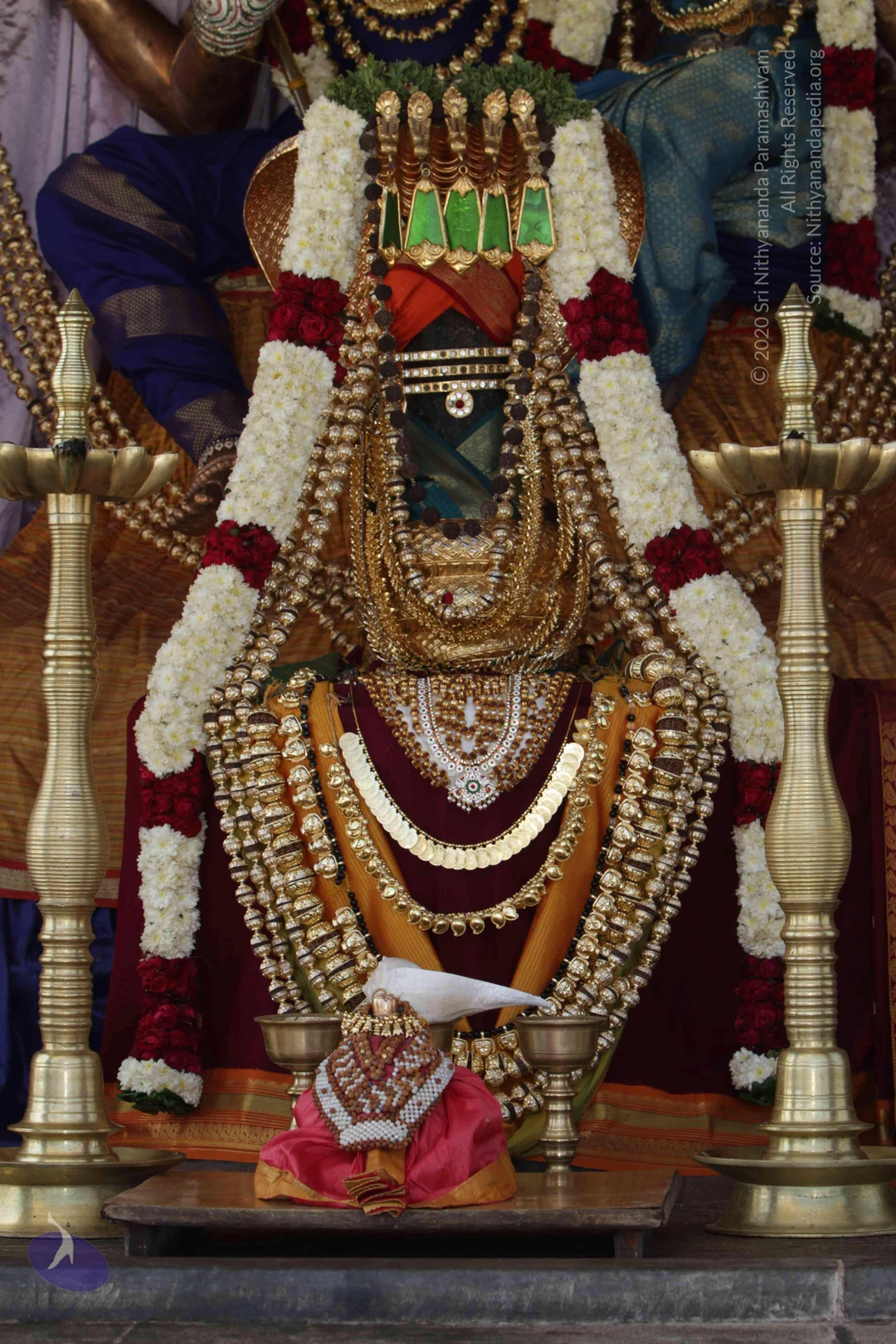
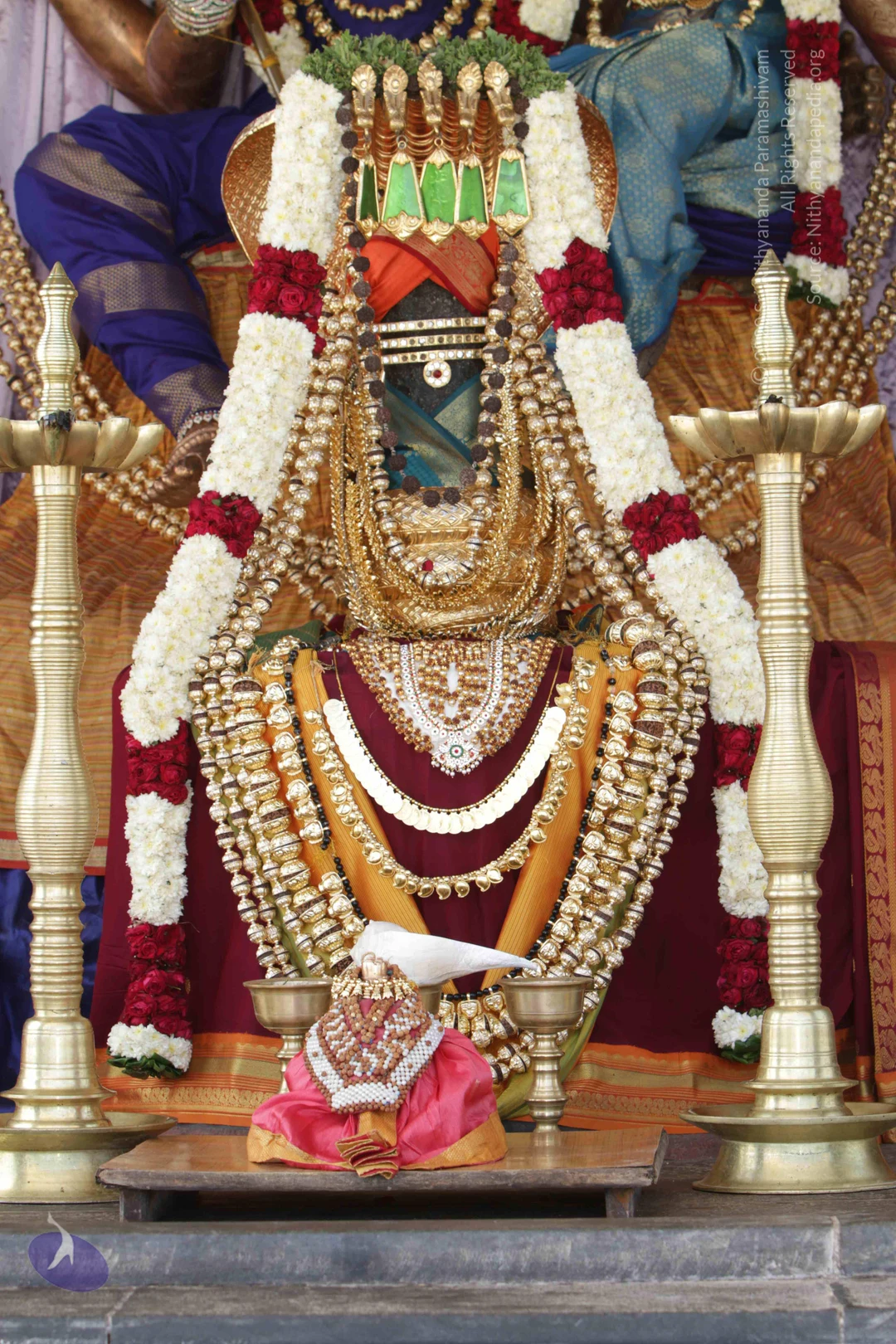
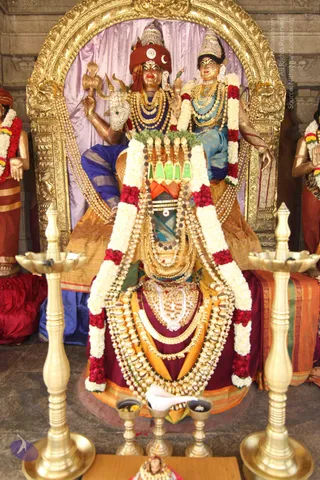
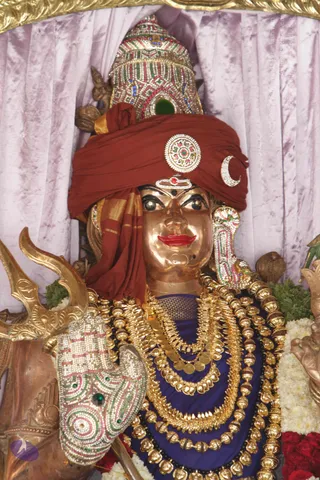
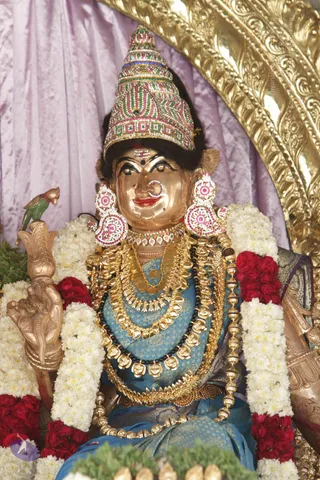
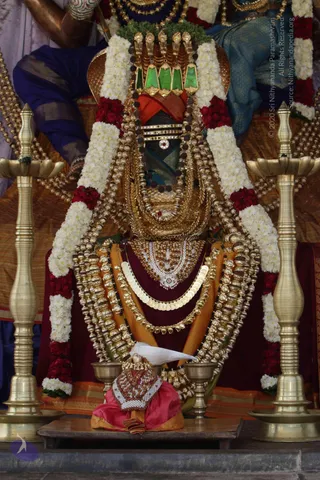
A decorated Shiva lingam is the central focus, draped in heavy gold necklaces, white and red flower garlands, and a tall crown-like ornament, set before a golden arched frame. Behind it, gilded statues of Shiva holding a trident and Parvati wearing a blue sari and gold jewelry sit on a lavender cloth backdrop. Two tall brass oil lamps stand on either side, and small brass cups of offerings sit at the base, indicating a puja or abhishekam setting in a temple. Other gilded figures in red and gold dress flank the scene. No living people are visible.A photograph of a temple shrine dominated by a large golden-adorned deity murti seated before a gilded arch with lavender drapery. Two larger metal figures stand behind: the left one wears a red turban with a crescent emblem, holds a trident, and wears heavy gold necklaces; the right one wears a tall gold crown, blue sari-like garment and gold jewellery, holding a garland. Both are gilded idols, not living people. The central figure is draped in layered gold necklaces, white and red flower garlands, rudraksha-like beads and a green-and-gold headdress. Two tall brass oil lamps (dipa stands) flank the shrine, with three brass cups holding offerings and a small figure on a wooden platform in front.A decorated shrine scene showing a ceremonial Shiva lingam dressed in heavy gold ornaments, white and red flower garlands, and a green-tipped gold crown, placed before a golden arched frame. Behind it stand two gilded deity murti figures: one with a red turban and crescent ornament holding a trident, the other in a blue-green sari with gold jewellery. Brass standing oil lamps flank the lingam, and small brass bowls with flowers and offerings sit at its base. No living people are visible.A close-up photograph of a metal murti, a copper-toned statue of a deity with a red turban topped by a jeweled crown ornament decorated with white beads, green and red stones, and a crescent moon. The face has red lips and painted eyes. It wears layered gold necklaces with coin pendants, a blue garment, and a beaded, jewel-encrusted raised hand holding a trident, with a lilac draped curtain behind and white and red flower garlands at its base. The statue is a depiction, not a living person.A close photograph of a gilded metal deity murti, a goddess figure seated against a lilac draped cloth and an ornate gold arch. The murti wears a tall jewelled crown set with red, green and white stones, large pink and white paisley earrings, a nose ring, and many layered gold necklaces over a teal blue silk sari. White jasmine garlands and red rose garlands drape its shoulders, and a small green parrot sits on its raised hand holding a lotus-like stem. Fresh green leaves appear in the foreground.A photograph of a richly adorned deity murti seated frontally at a shrine. The figure wears heavy gold necklaces and layered gold chains, a gold mukut-style crown with five green-tipped ornaments, and a red-and-orange cloth wrapped around the head, with a dark face-covering plate ornamented with red and white stones. Garlands of white flowers and red roses hang on both sides, and a white conch shell, rudraksha and white bead necklaces, and a small red cloth sit in front on a wooden platform. Two tall brass lamp stands with oil lamps flank the figure, and small brass bowls rest near the base. No people are visible in the frame; the blurred background shows other decorated figures in blue and teal.

3-Sacred-Arts
3 photosSource gallery
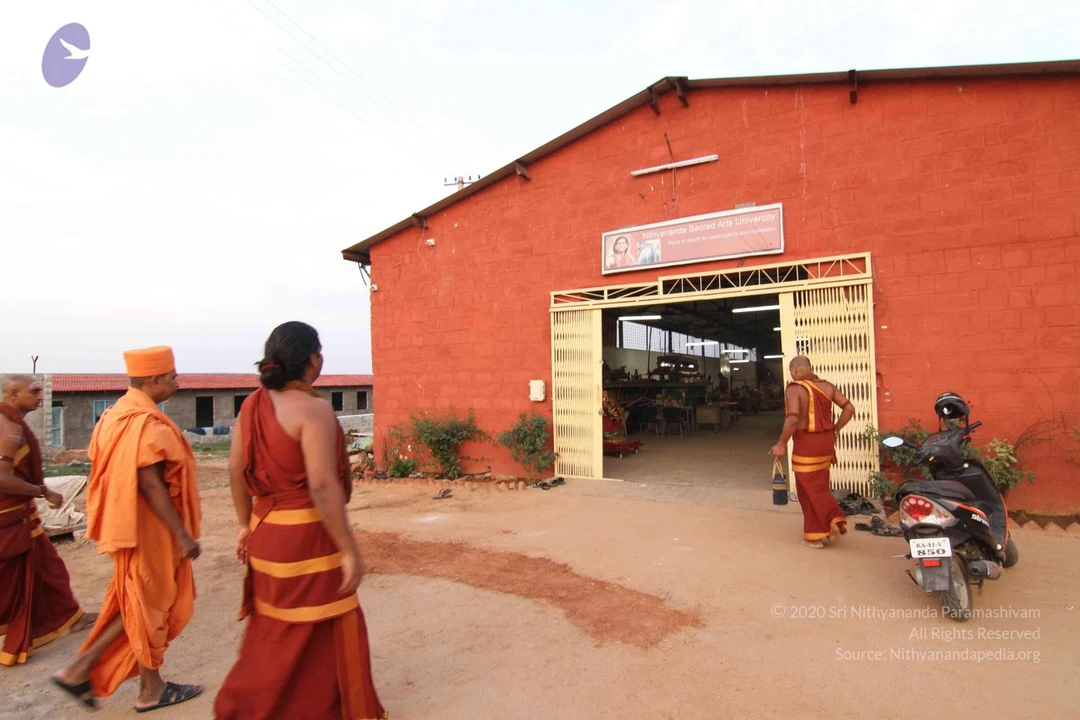
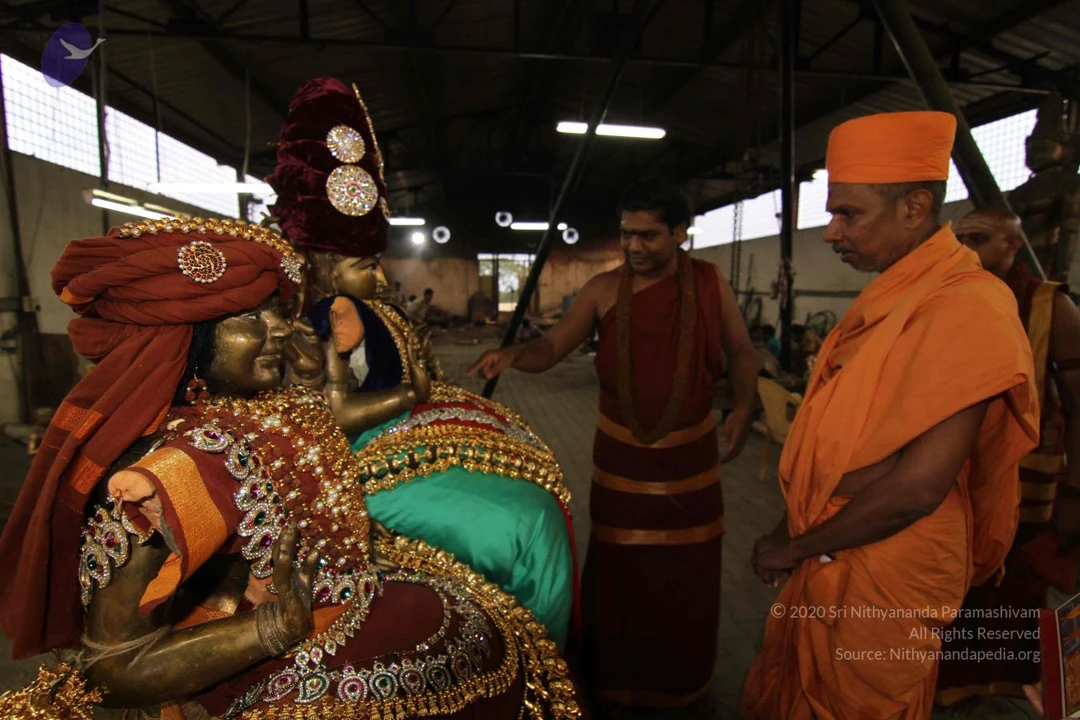
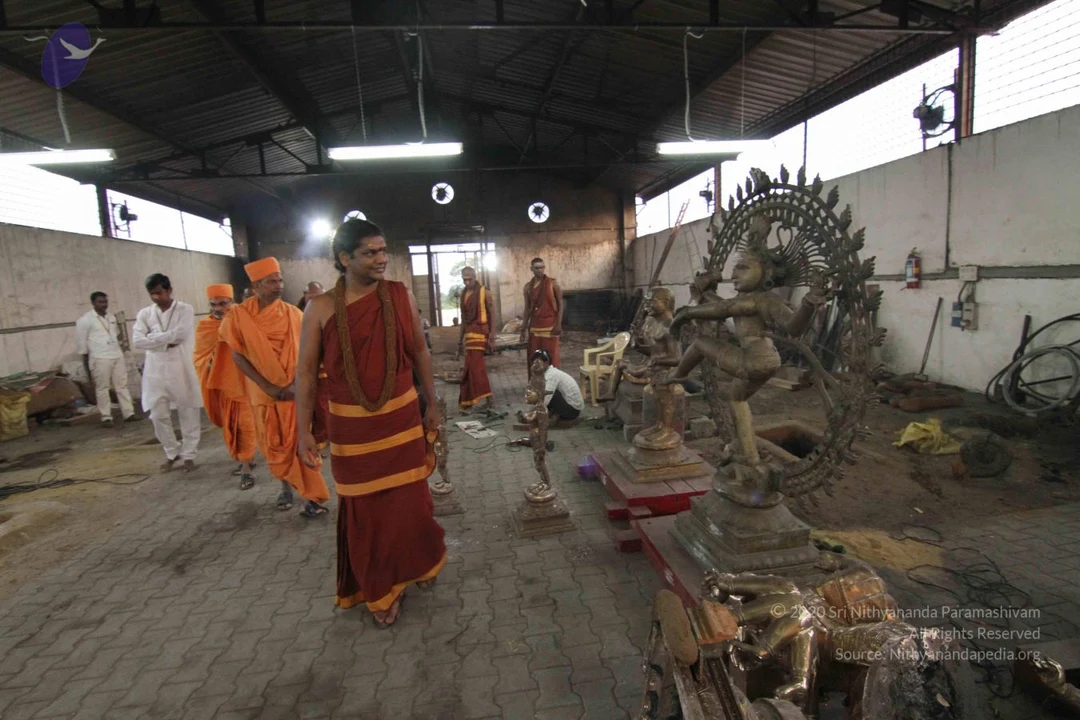
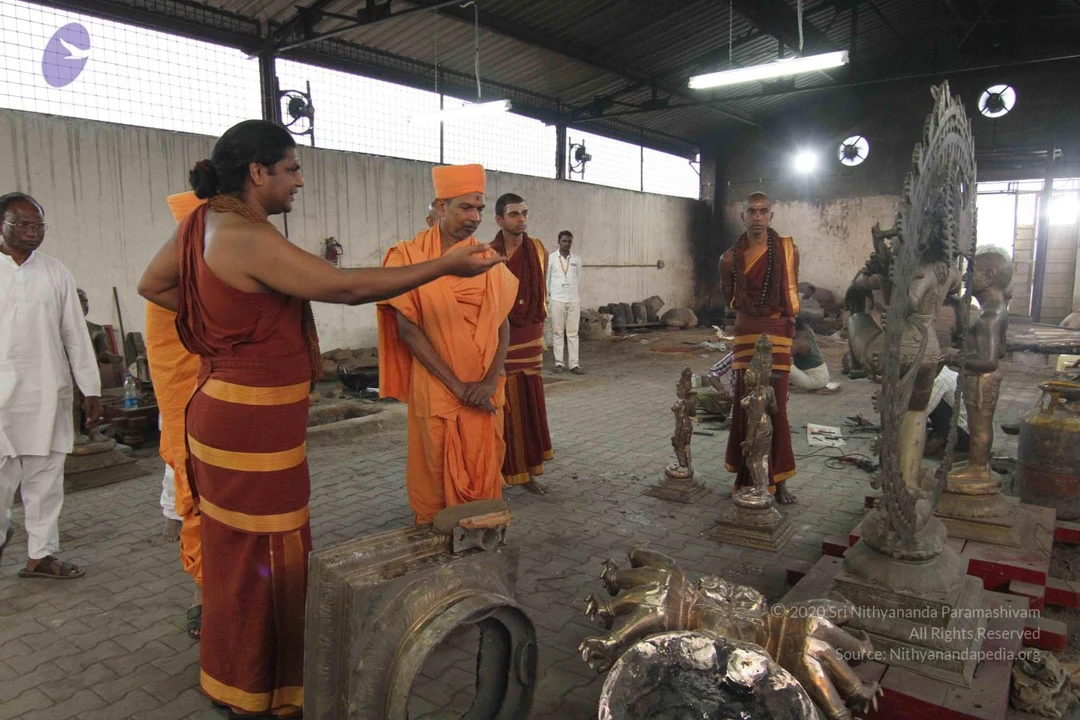
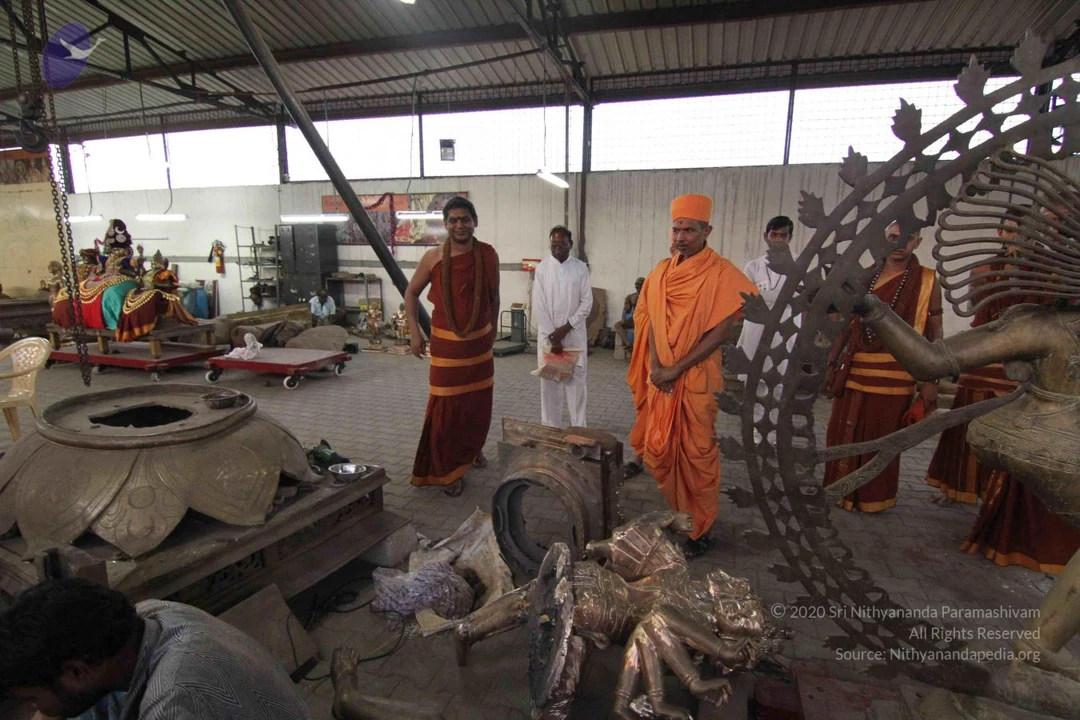
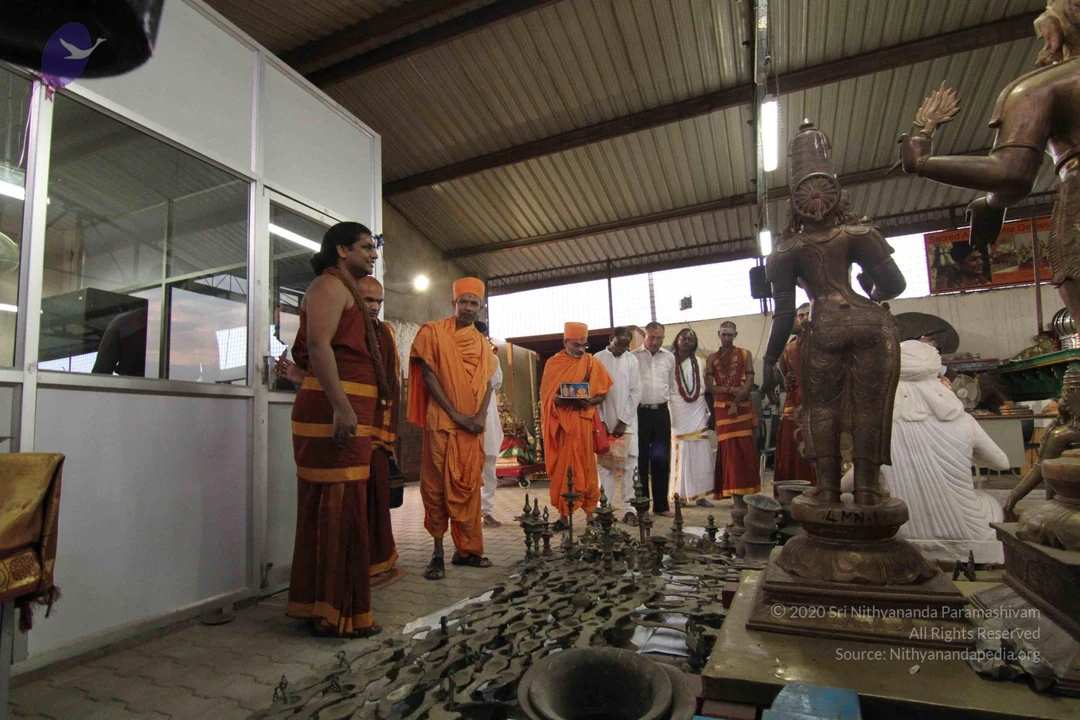
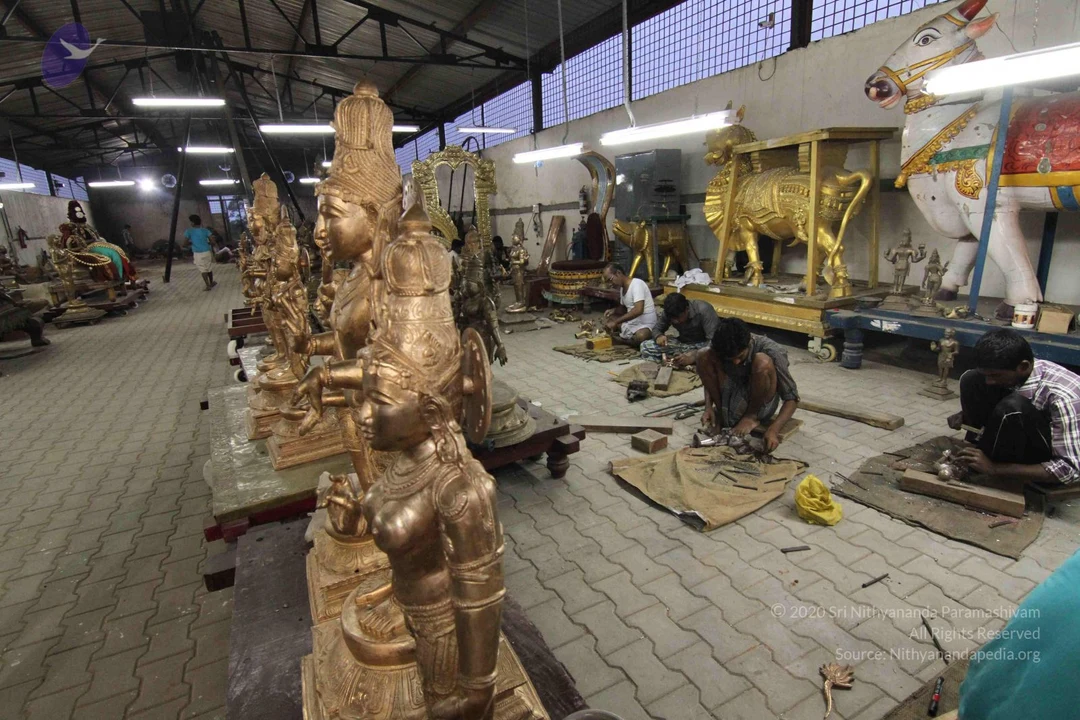
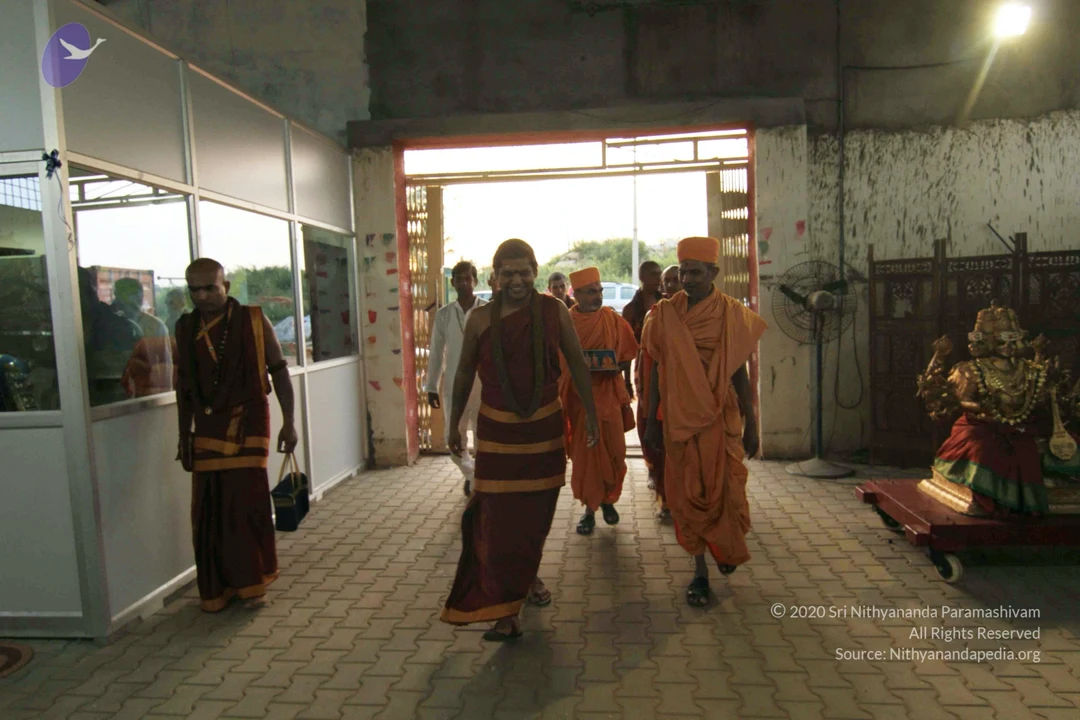
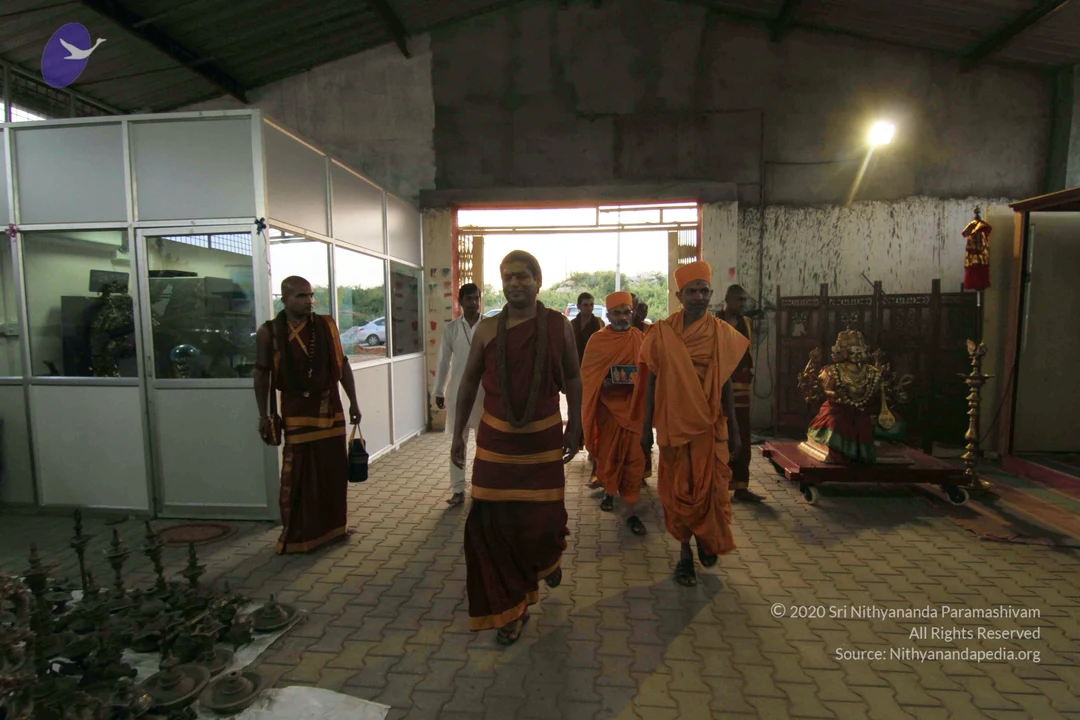
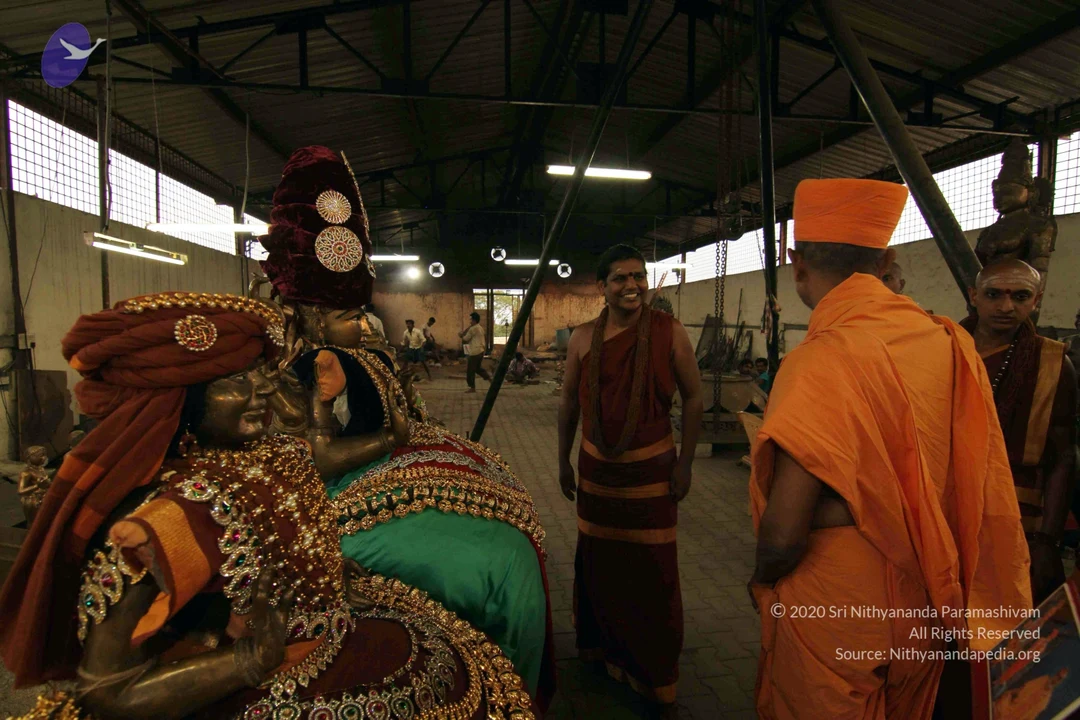
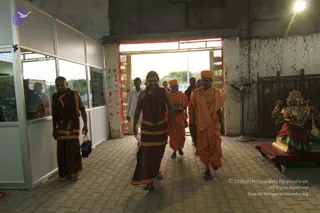
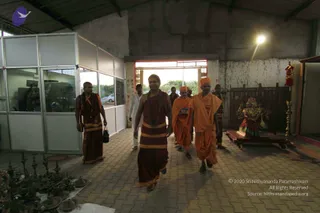
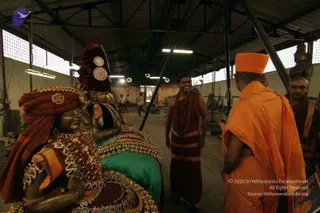
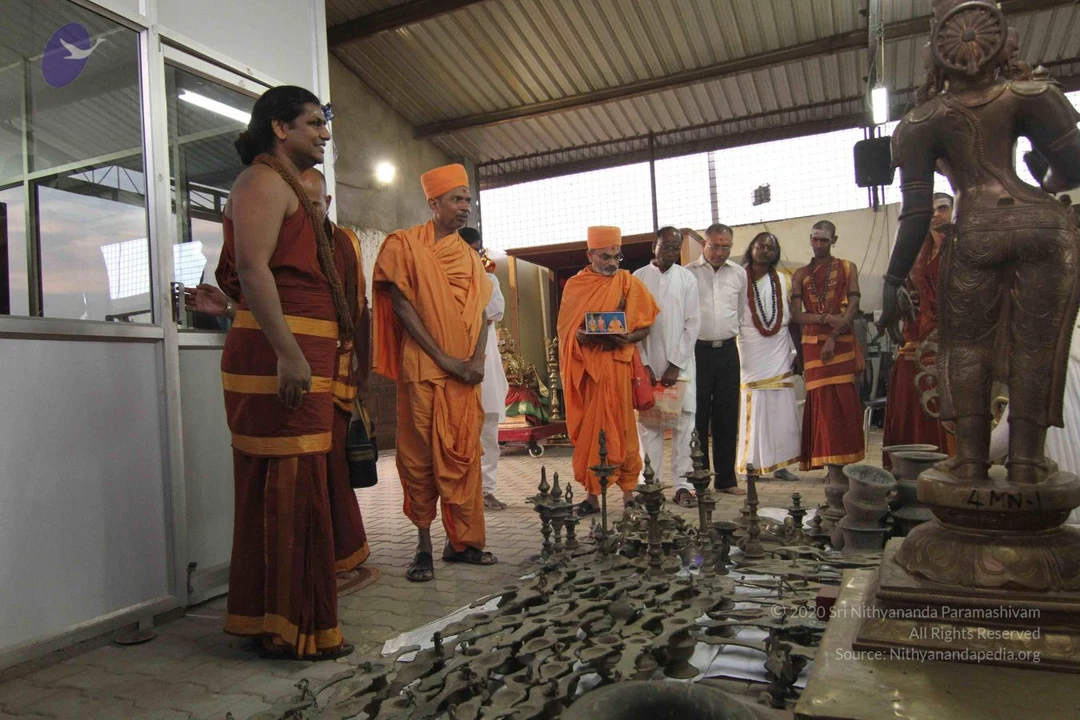
A photograph of a procession walking through a tiled courtyard toward an open doorway with a bright exterior behind it. In the centre, a man in a maroon dhoti with yellow borders and a maroon shawl, wearing a rudraksha-style mala, walks forward and smiles. Behind him, several men in saffron-orange robes and orange head cloths follow, one carrying a small tray. On the left, a bald man in a maroon dhoti with a black bag walks alongside. On the right, a saffron-robed man with an orange head cloth and a shawl walks past a ceremonial deity murti with a garland on a red-cushioned trolley. A white-clad man stands near the doorway, and a standing fan and a carved wooden screen complete the setting.A photograph of a covered courtyard with a patterned brick floor and a bright lamp on the wall. Several men walk toward the camera in a line. The central figure wears a maroon dhoti and shawl with gold borders and a dark rudraksha-style mala. Two men behind him wear saffron robes and saffron head coverings. Another man in a white shirt stands at the left, and a man in maroon with a bag walks at the far left. Along the left foreground are rows of brass oil lamps on a white cloth. At the right stands a wooden cabinet beside a gilded deity murti with a brass lamp, and a red-and-gold figure hangs near the top right. Doorways open onto a parked car and greenery.A workshop interior with a corrugated roof, metal beams and fluorescent lights, where large seated deity statues are being finished. Two prominent statues in the foreground wear ornate jewelled gold and red garments, one with a maroon crown with gold medallions and a red turban-style headpiece. Standing among them, a smiling man in a rust-and-gold dhoti-style garment stands beside a man in a bright orange robe and orange turban. Another man in orange and gold stands at the right, and figures work in the background.