Skip to content
Thursday

10 July 2014

Let Possibility Be Your Wealth

Dated photos
483
Source pages
1
Media
2
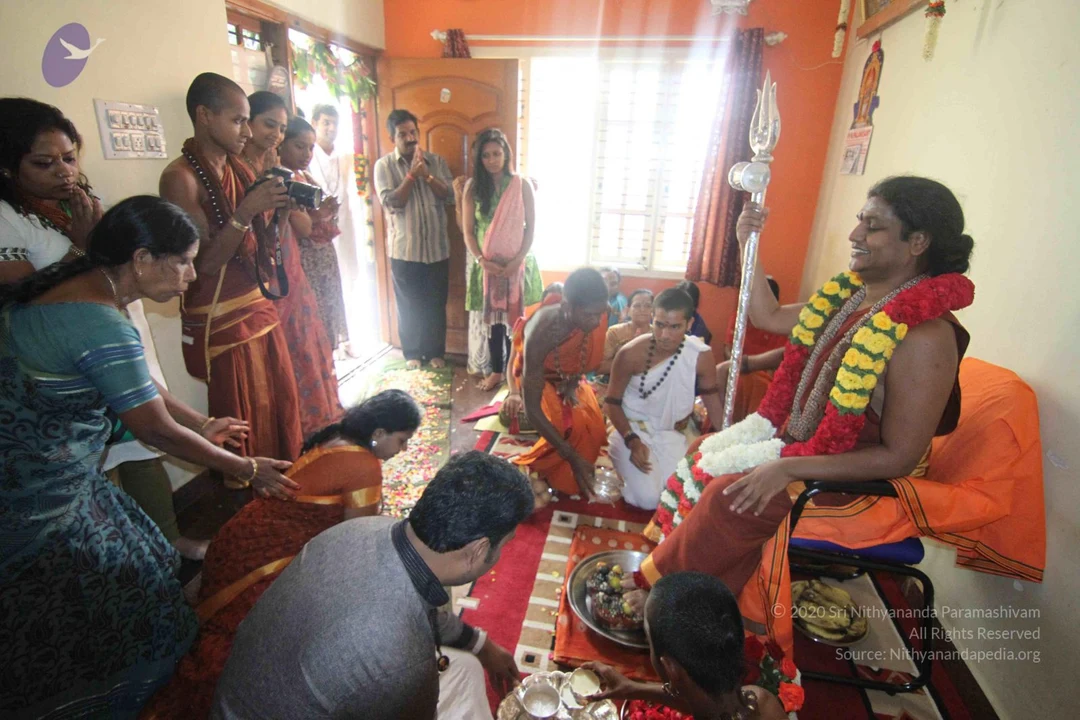
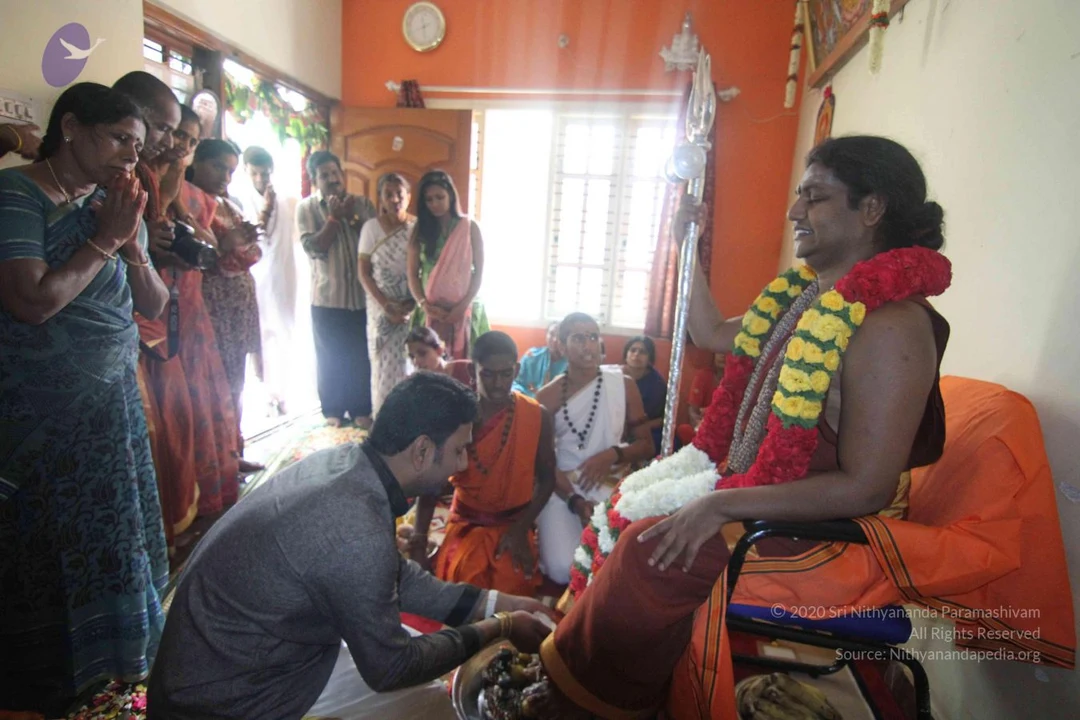
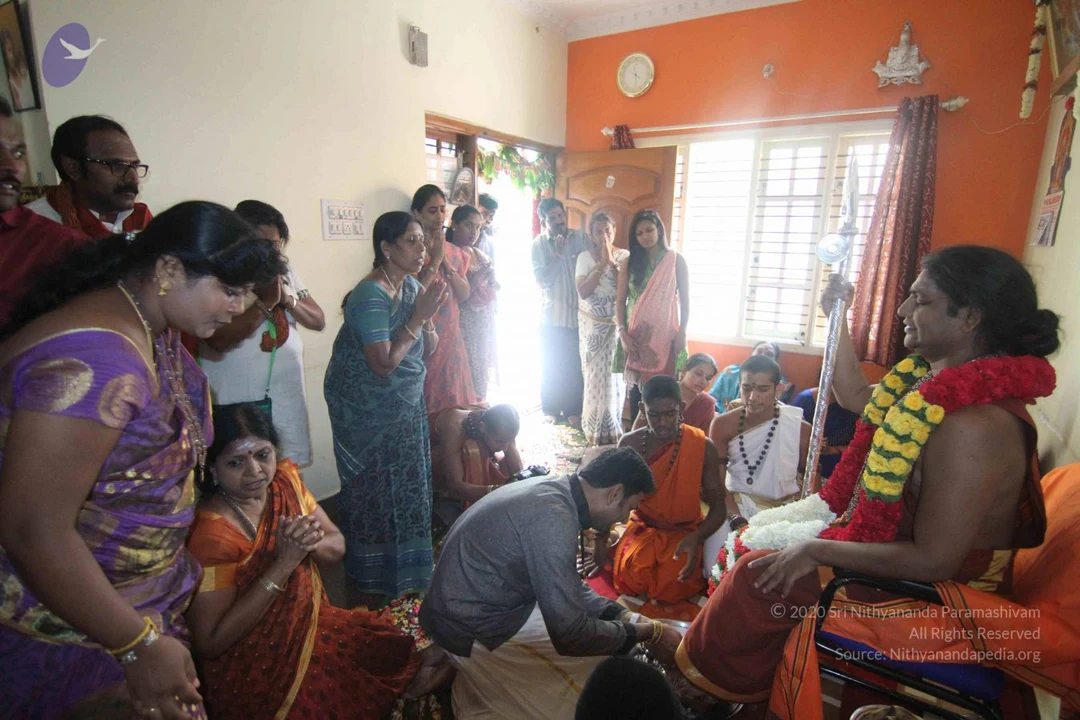
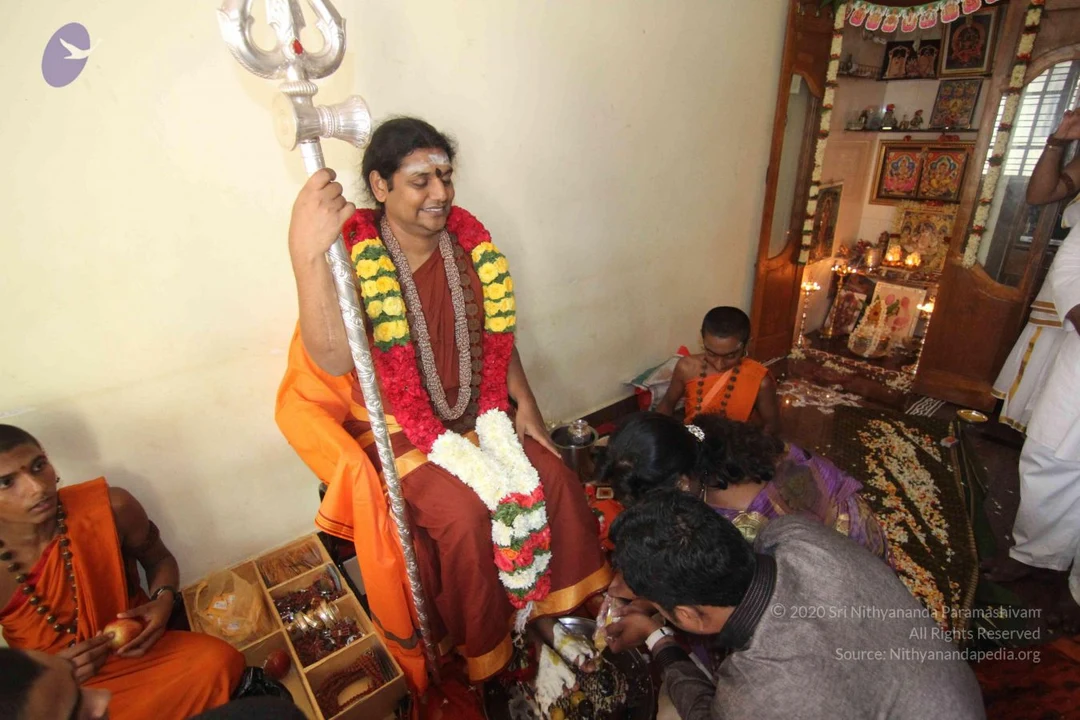
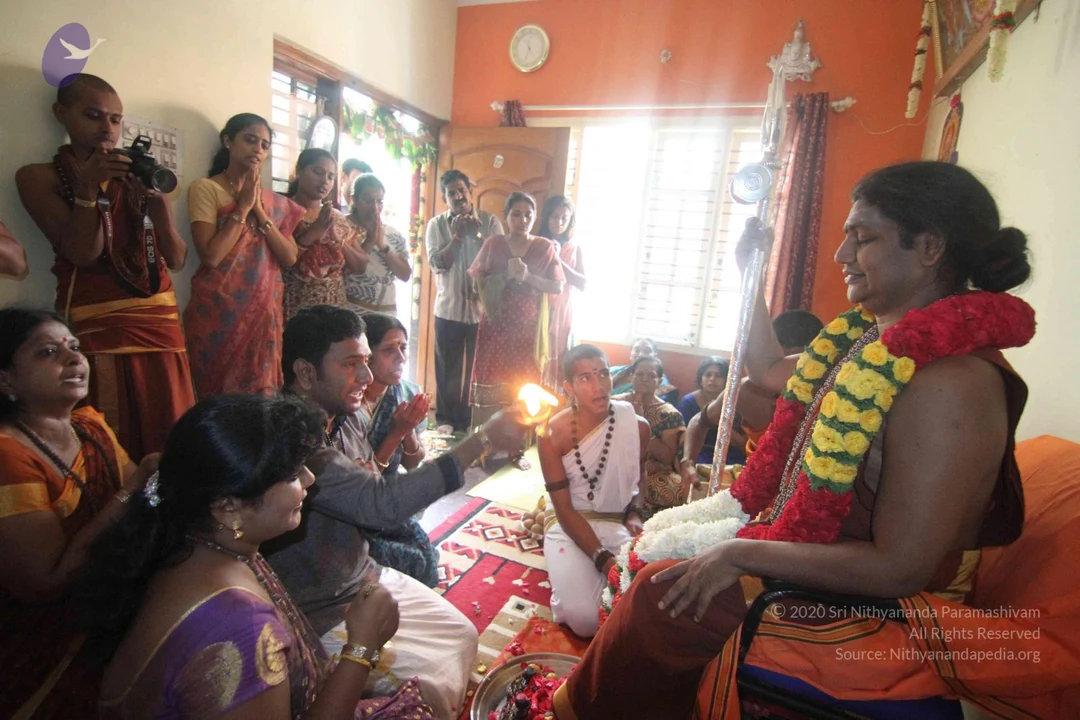
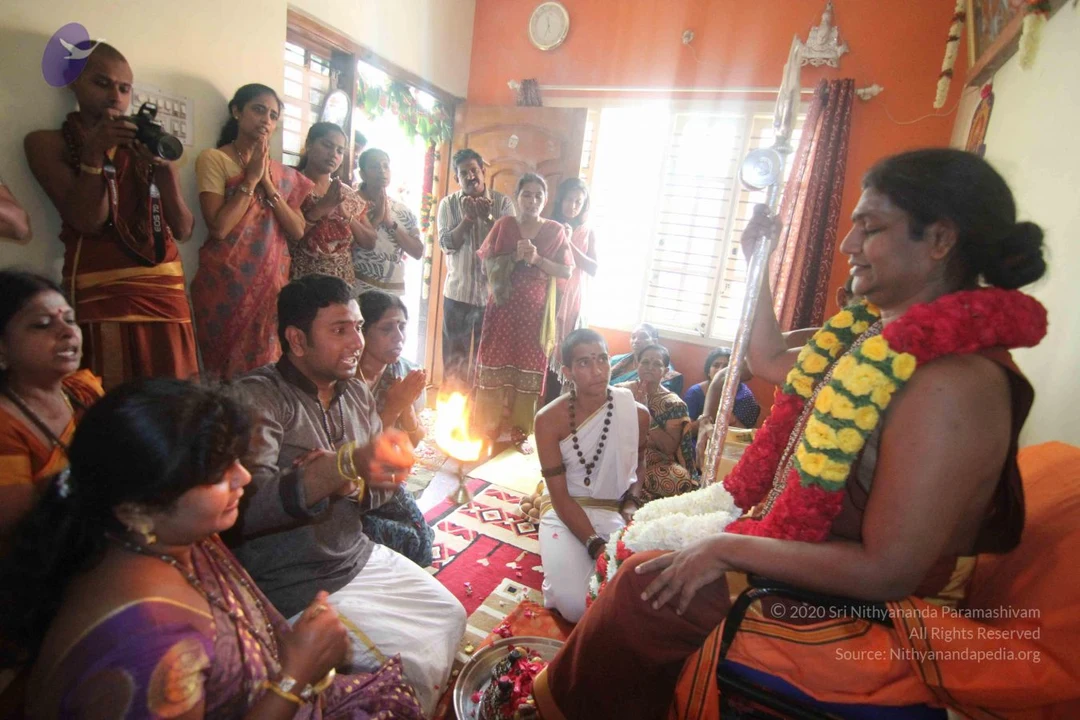
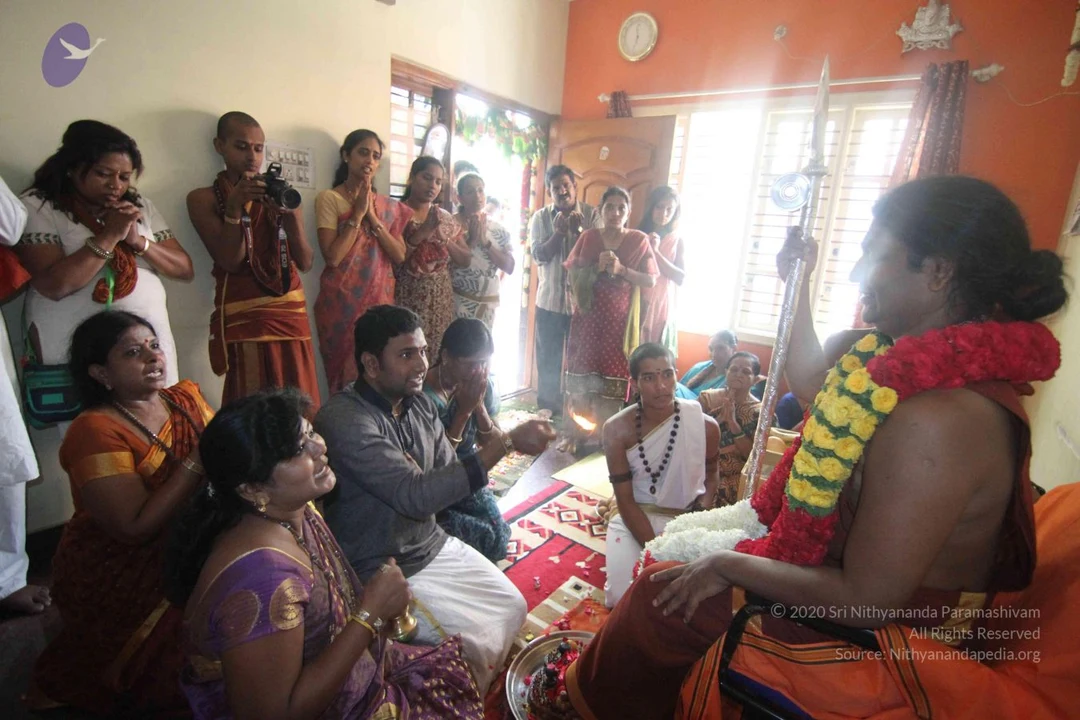
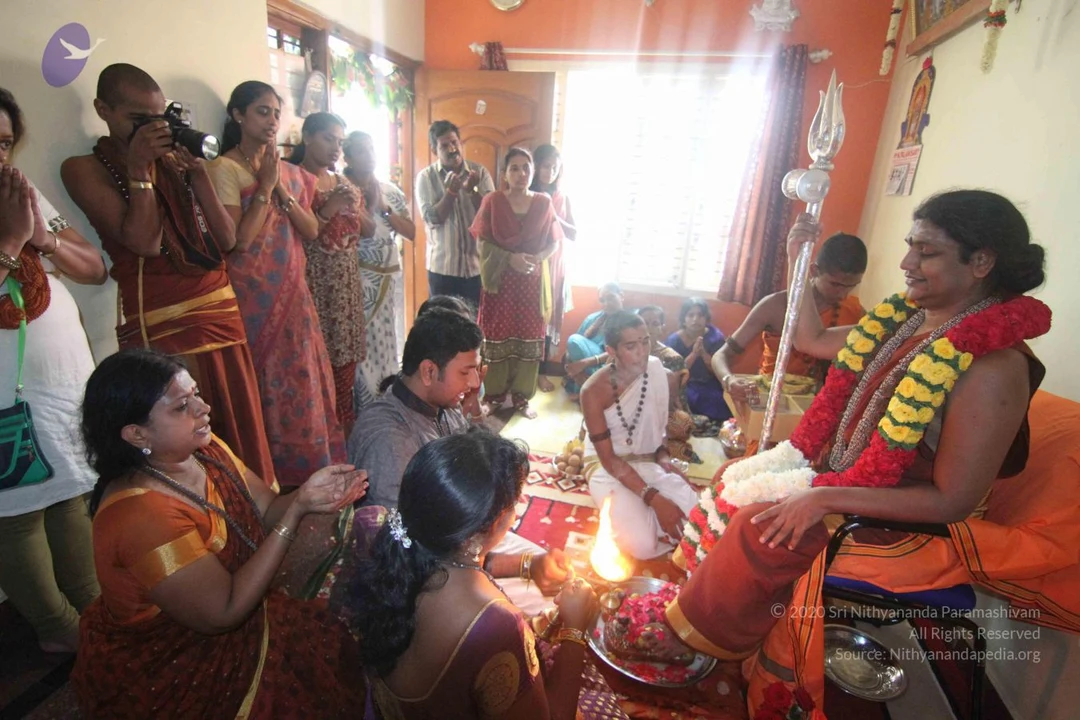
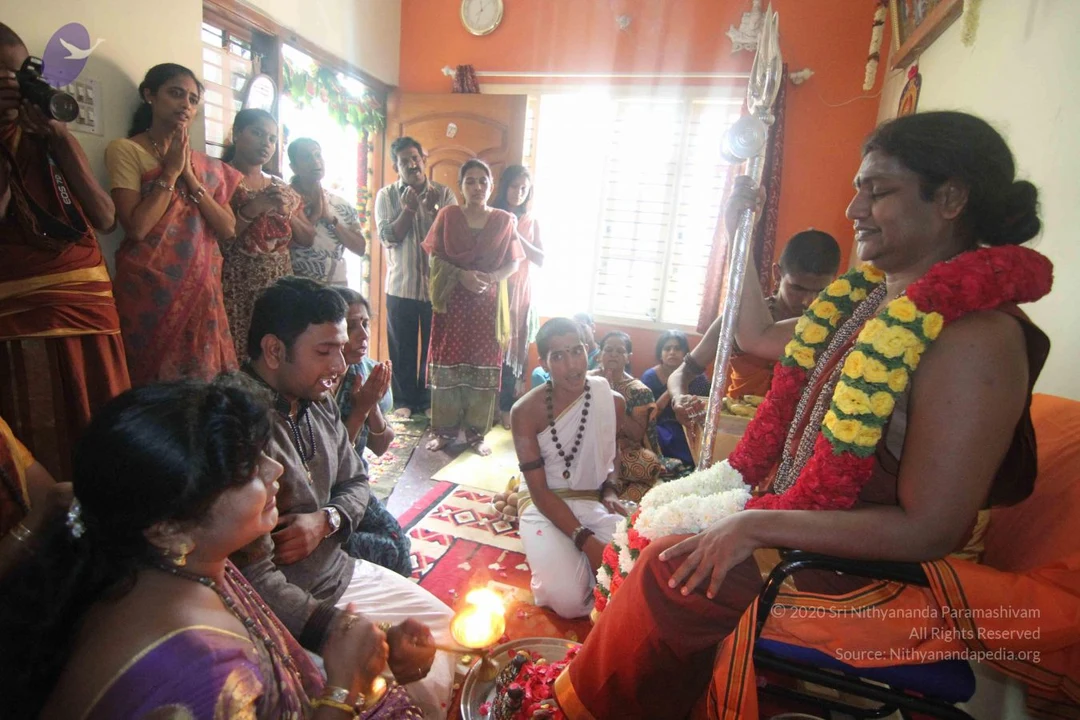
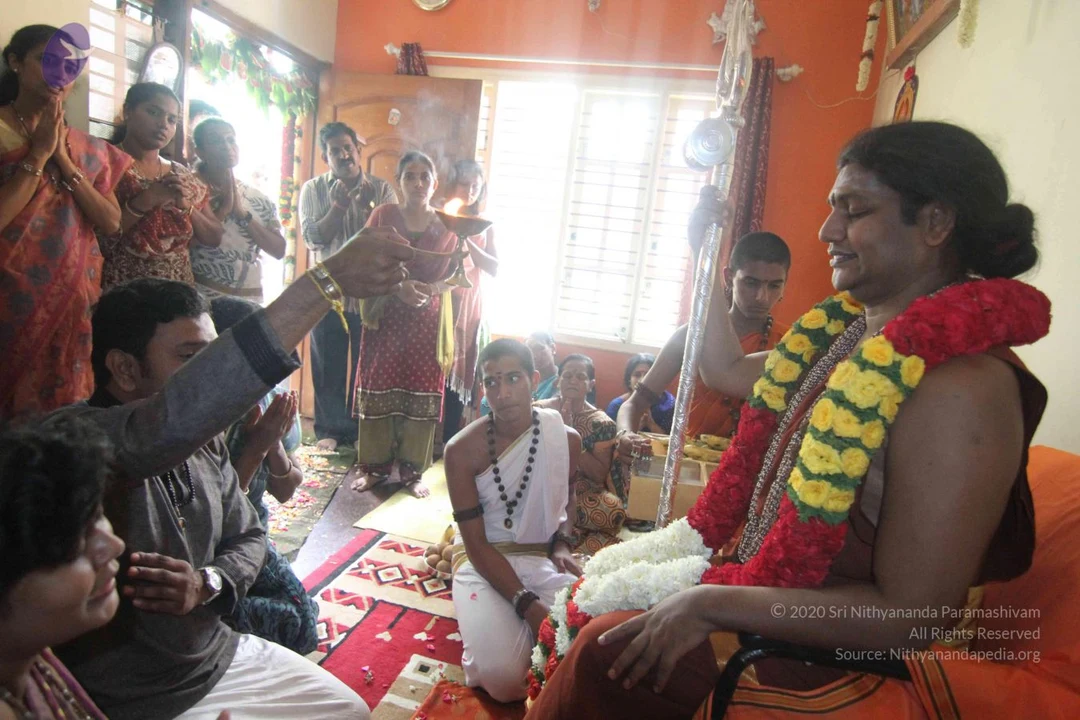
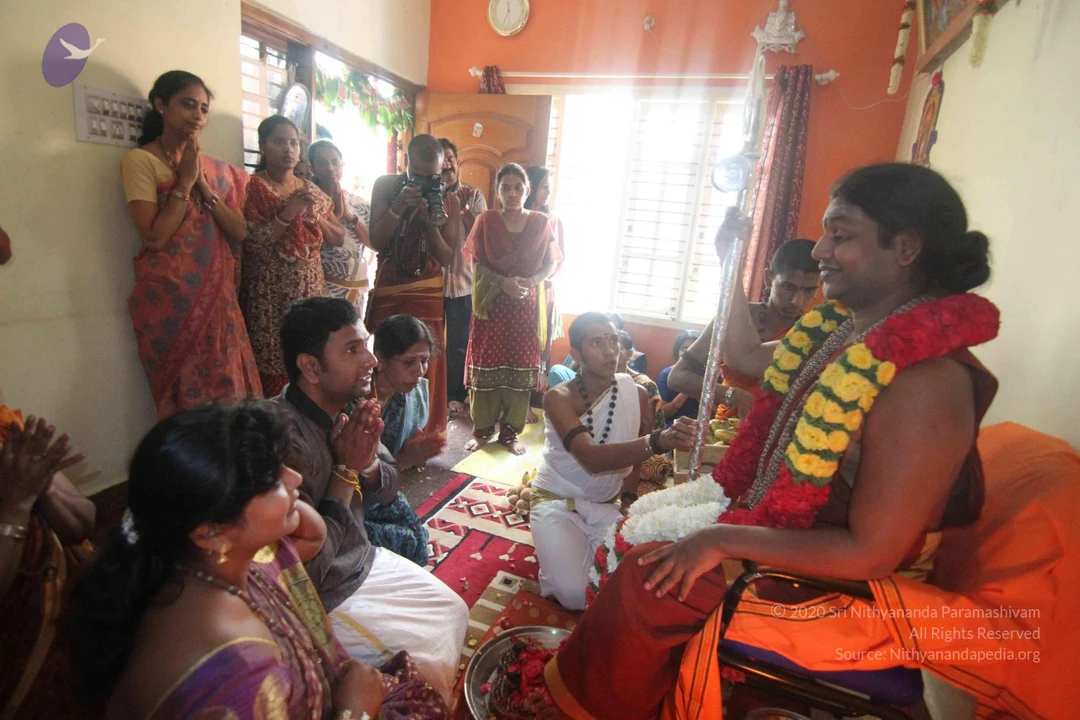
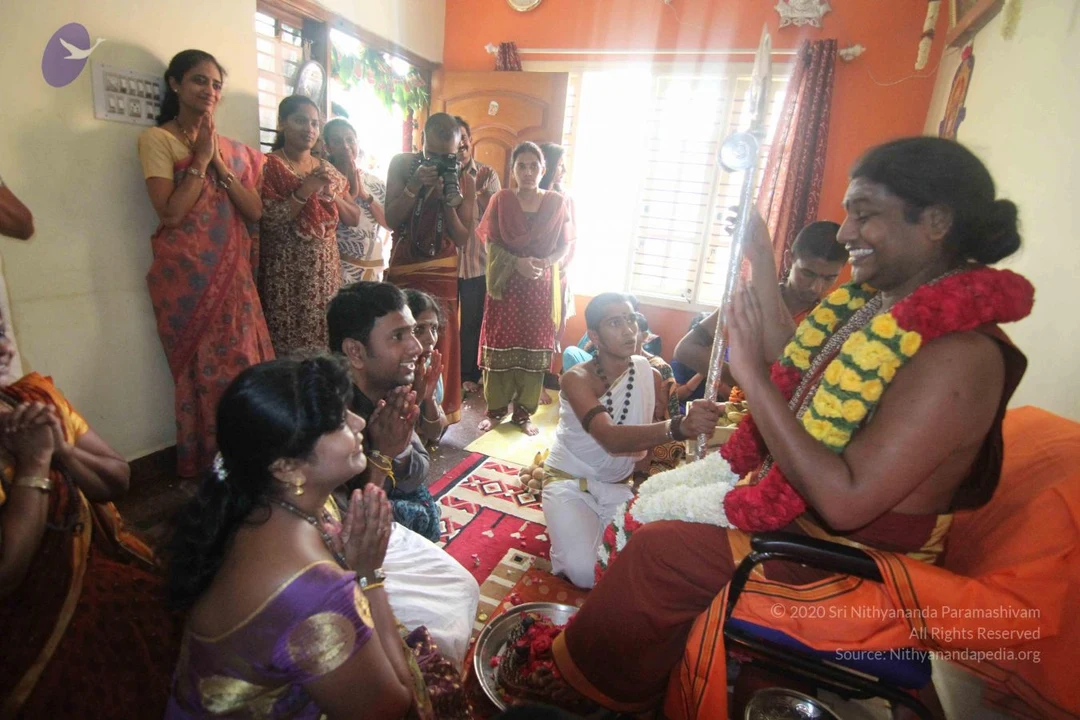
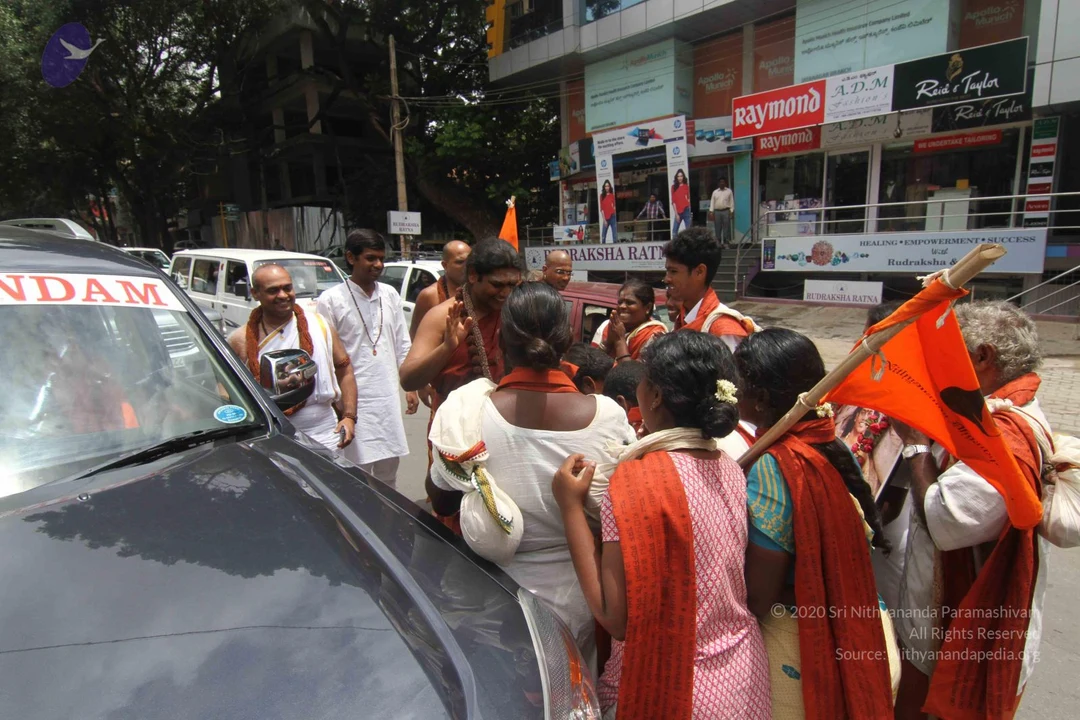
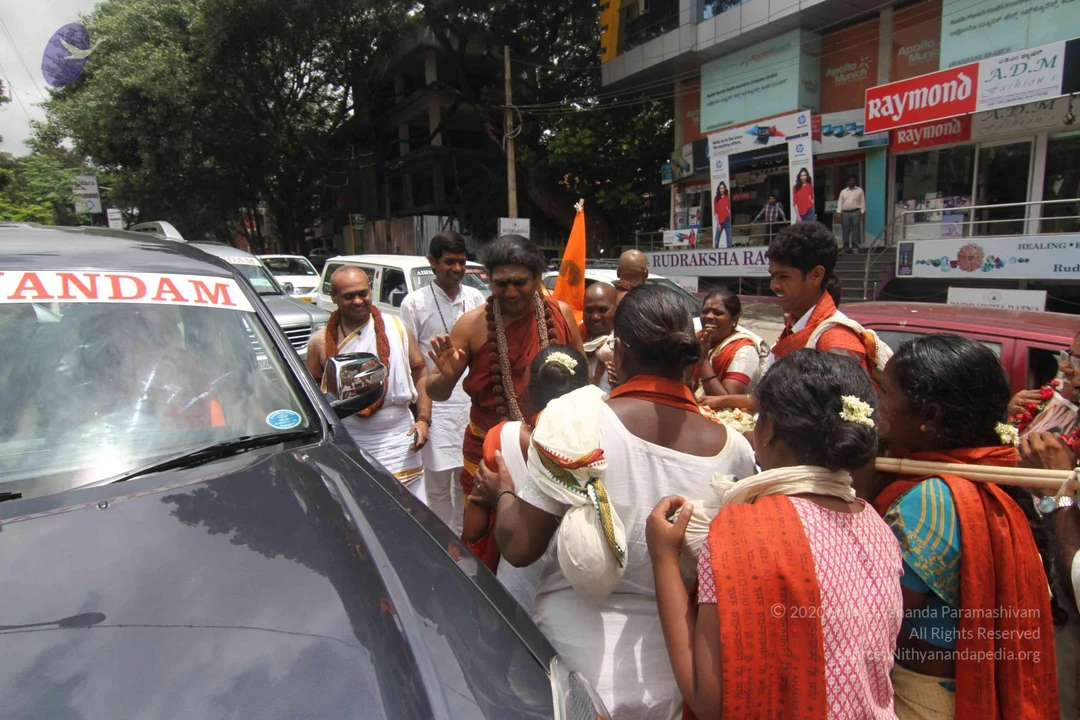
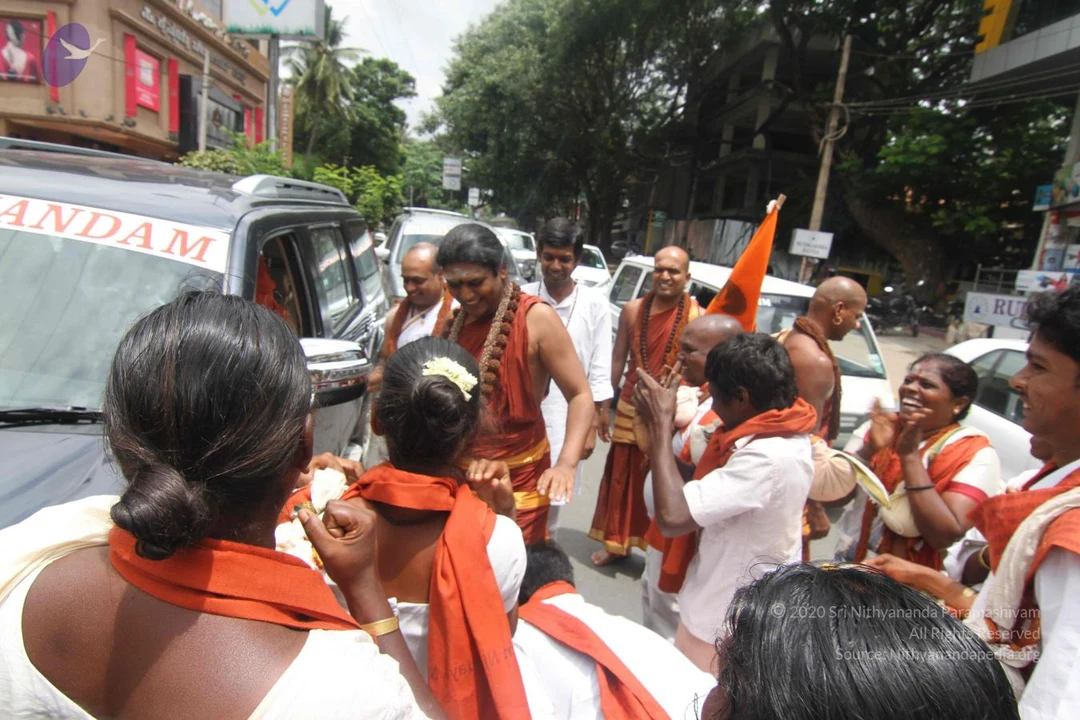
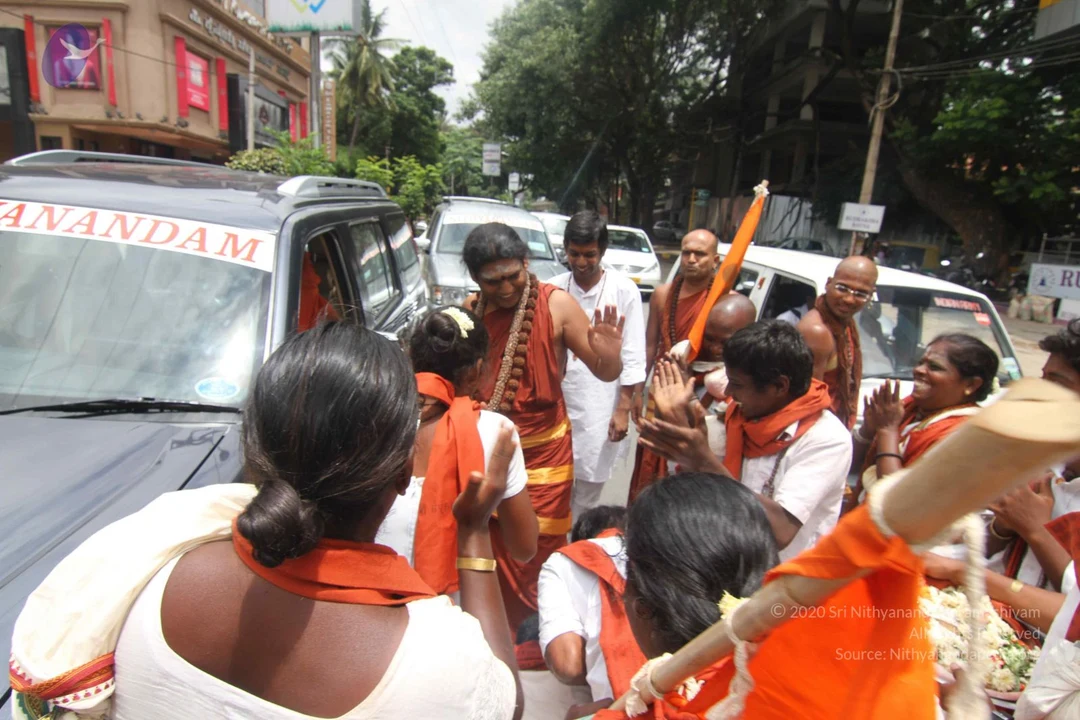
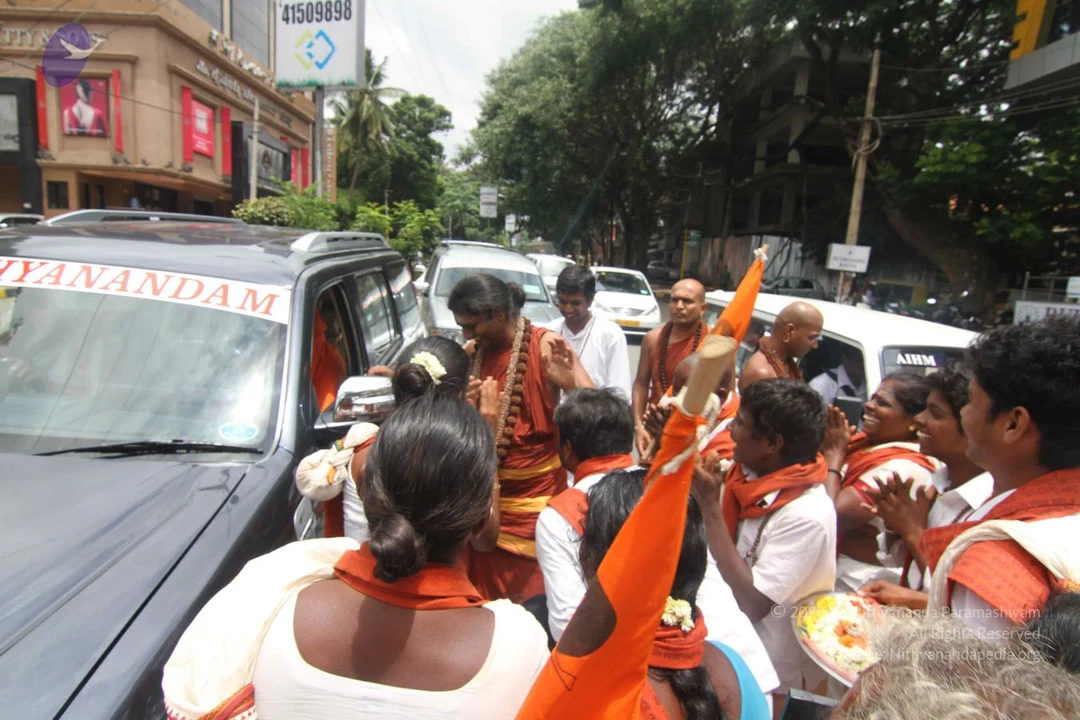
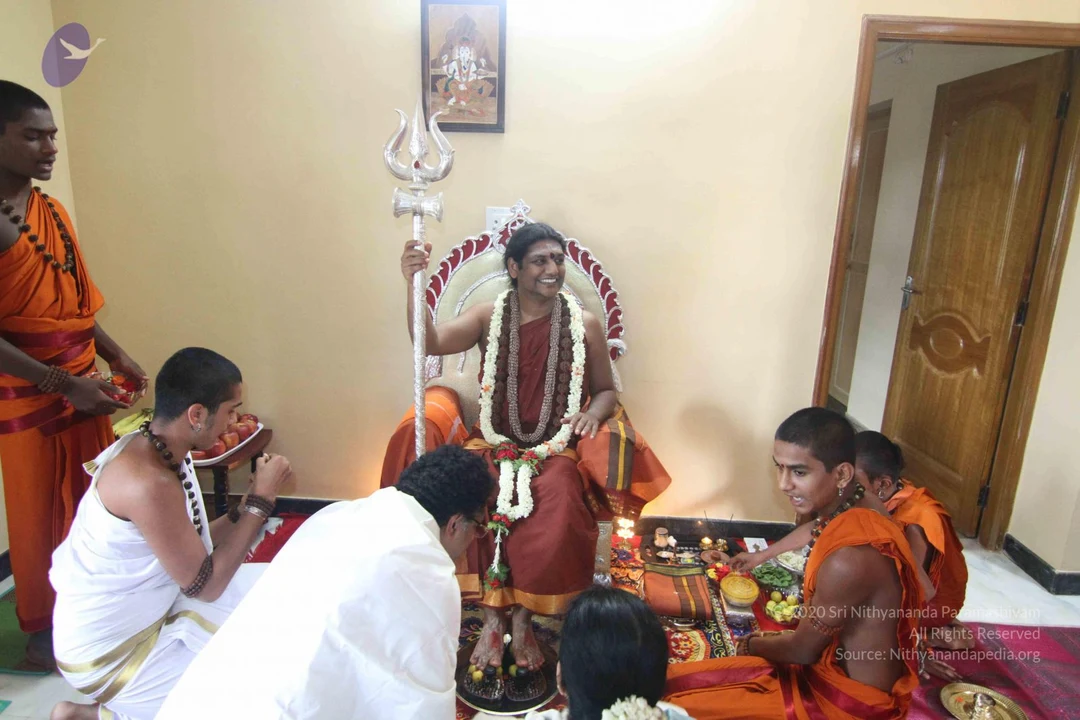
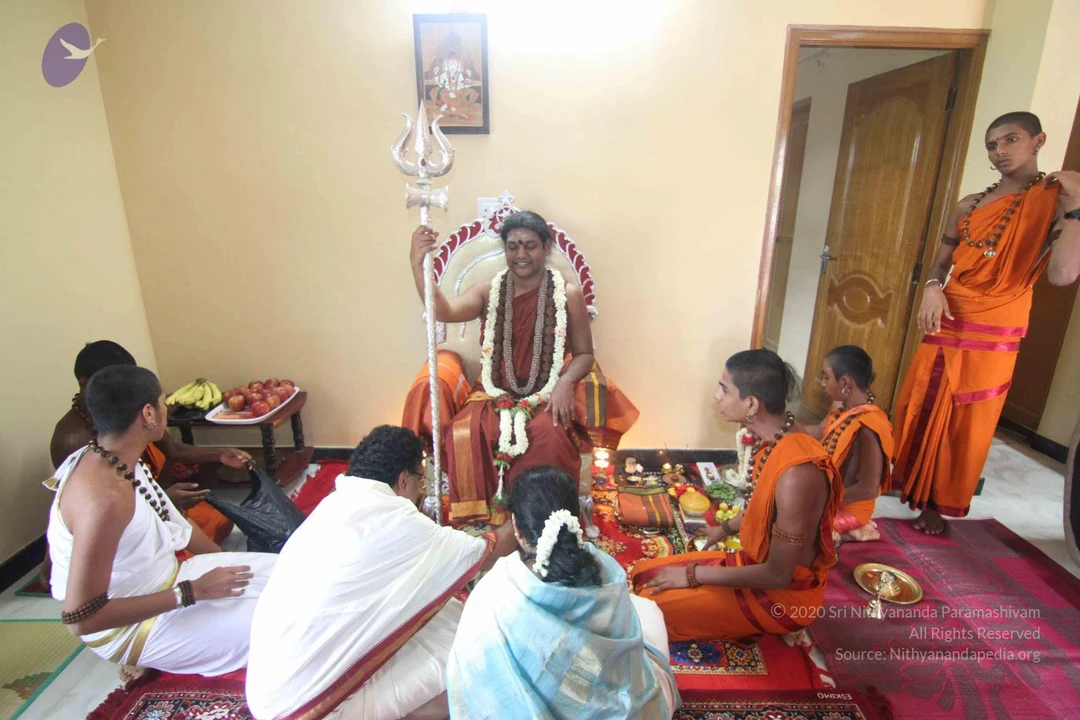
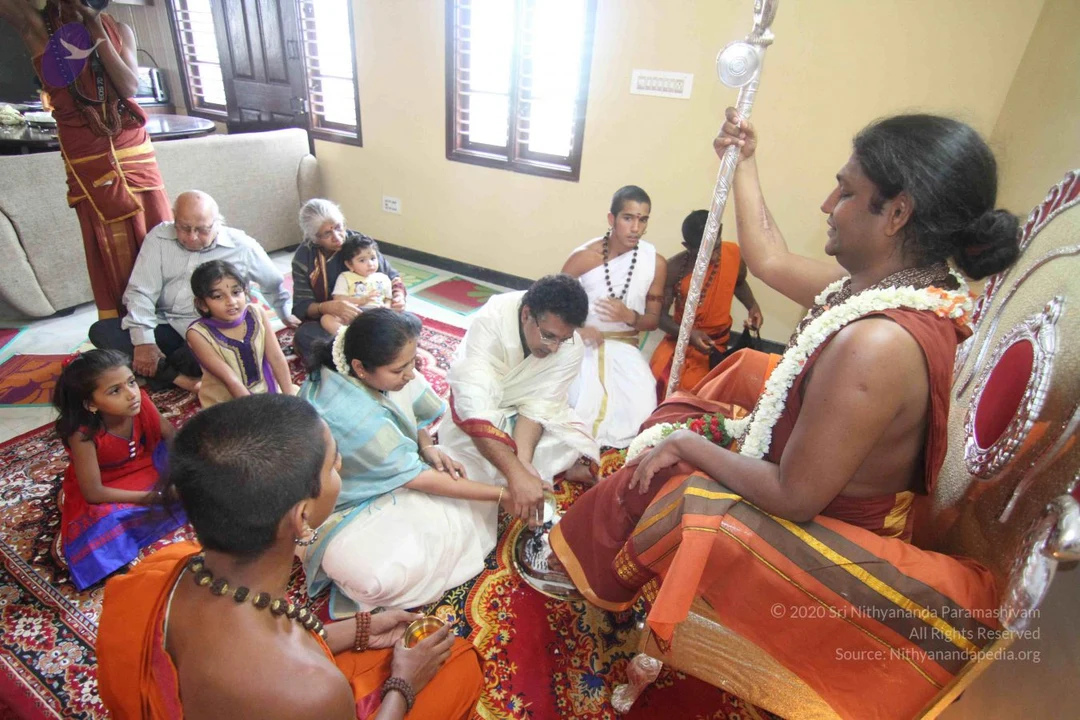
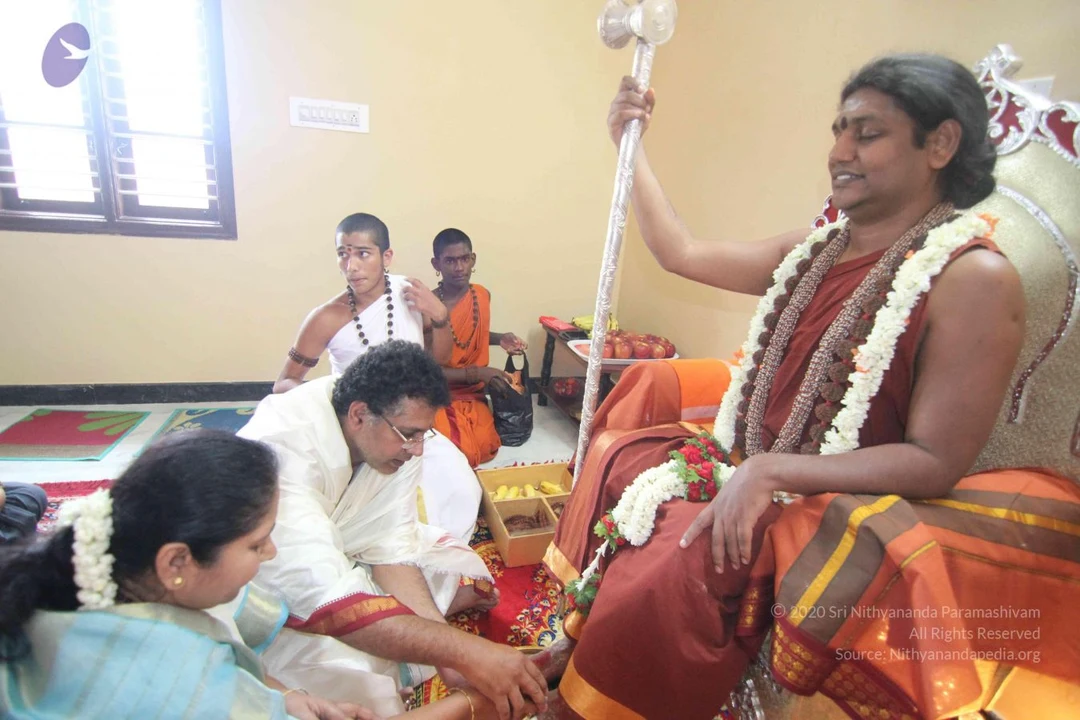
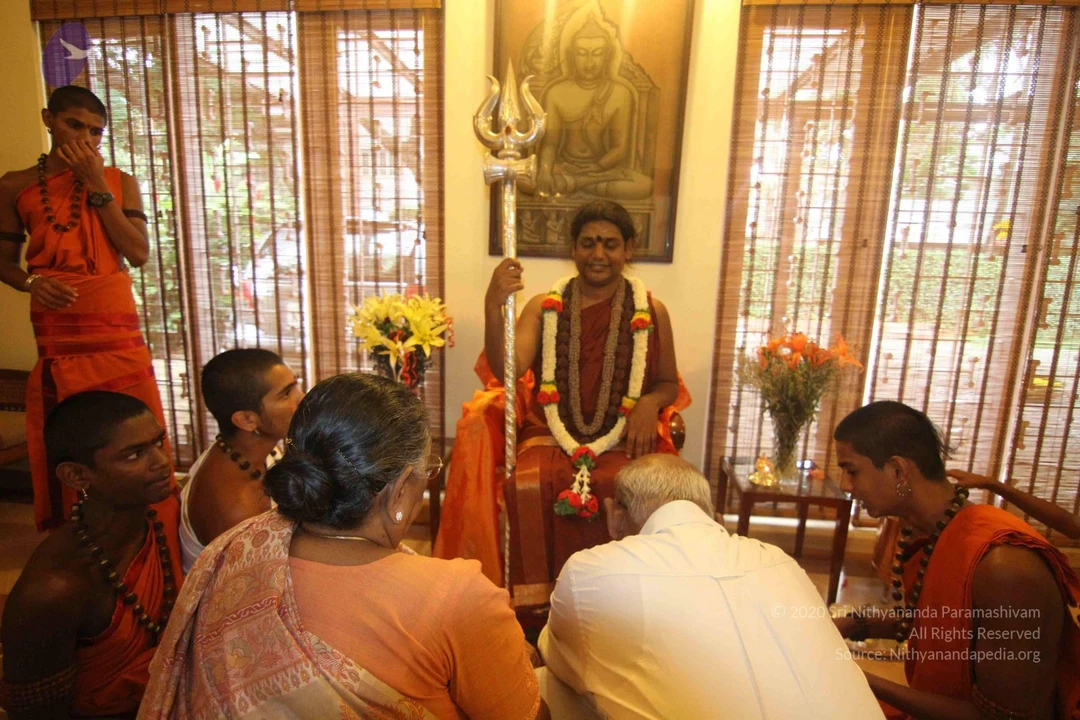
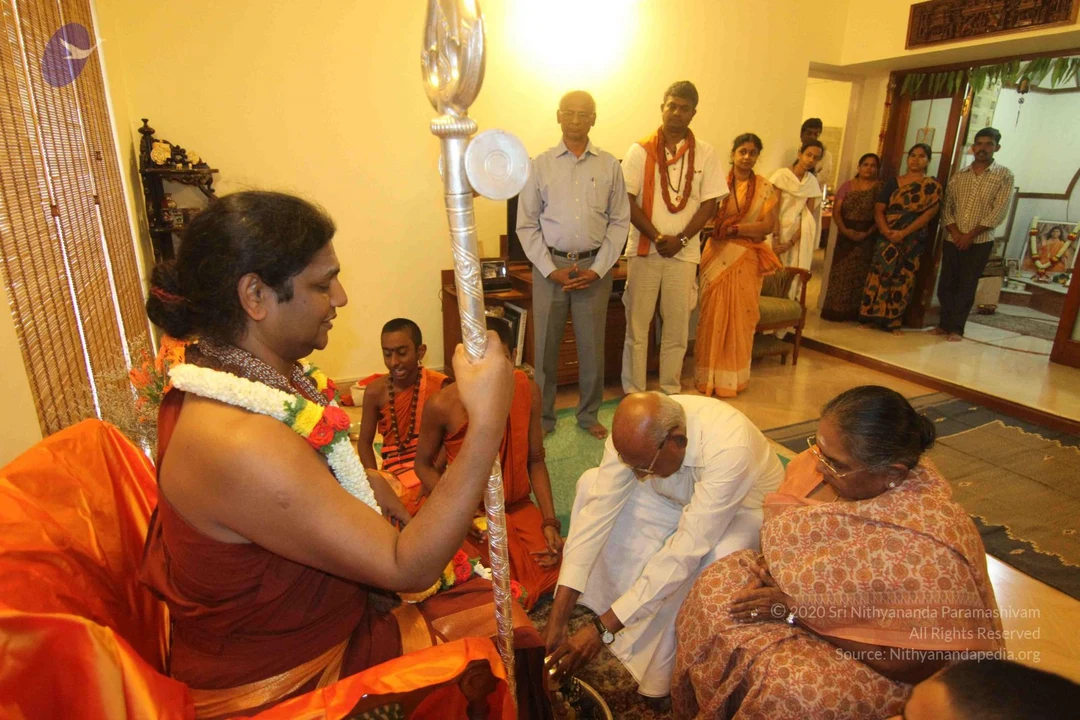
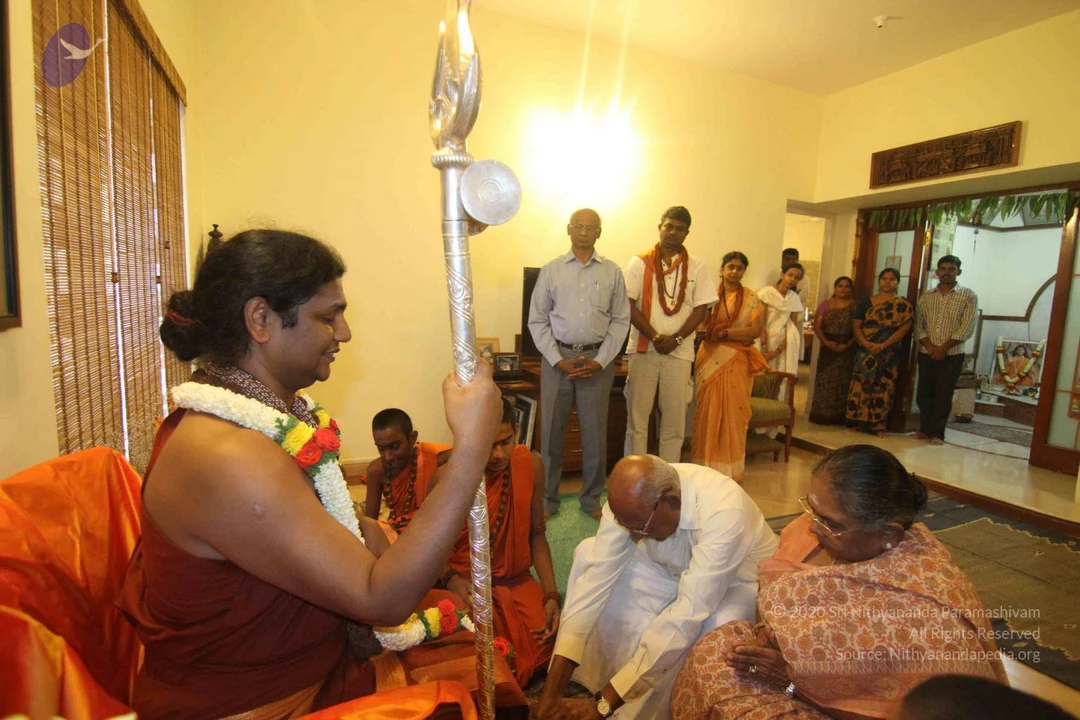
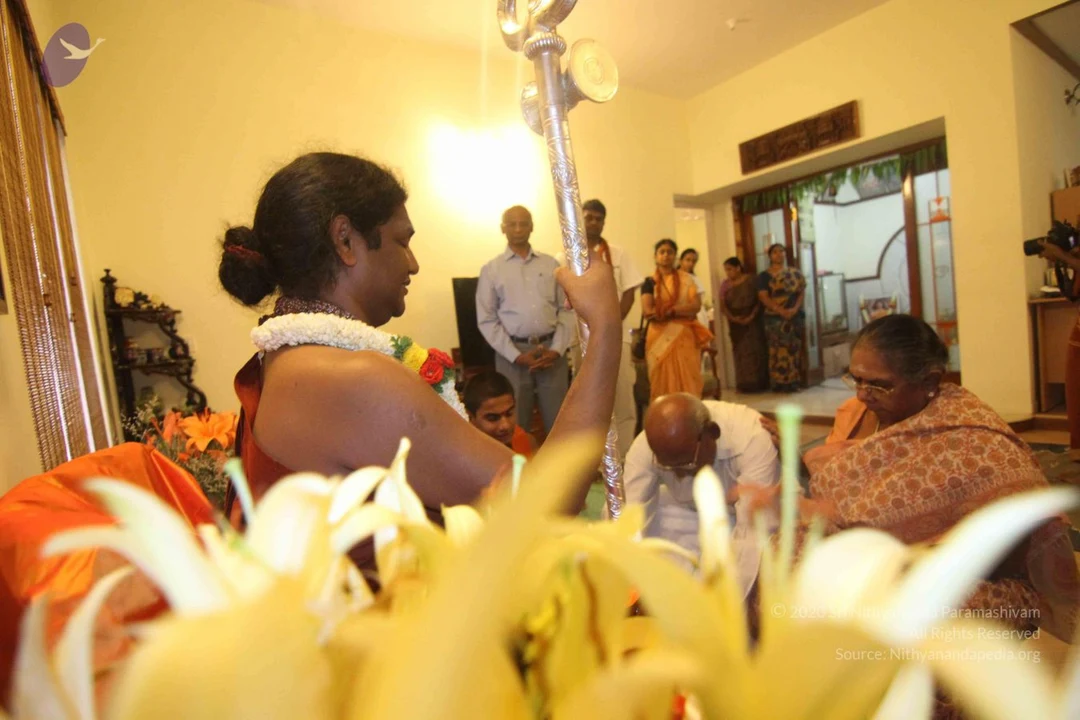
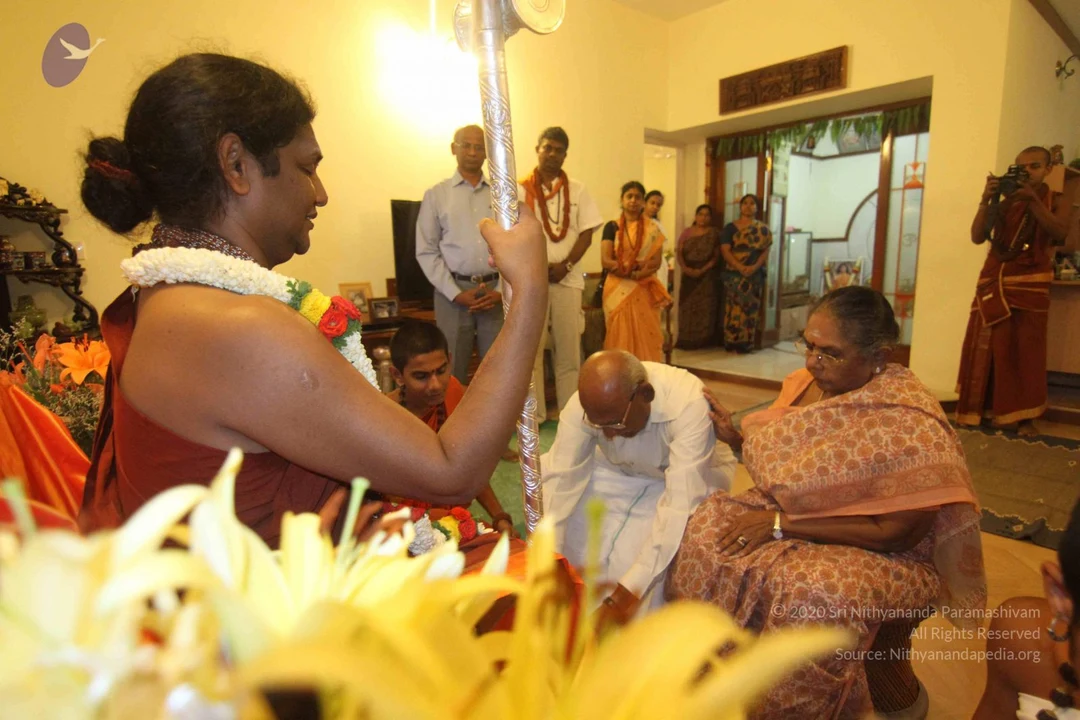
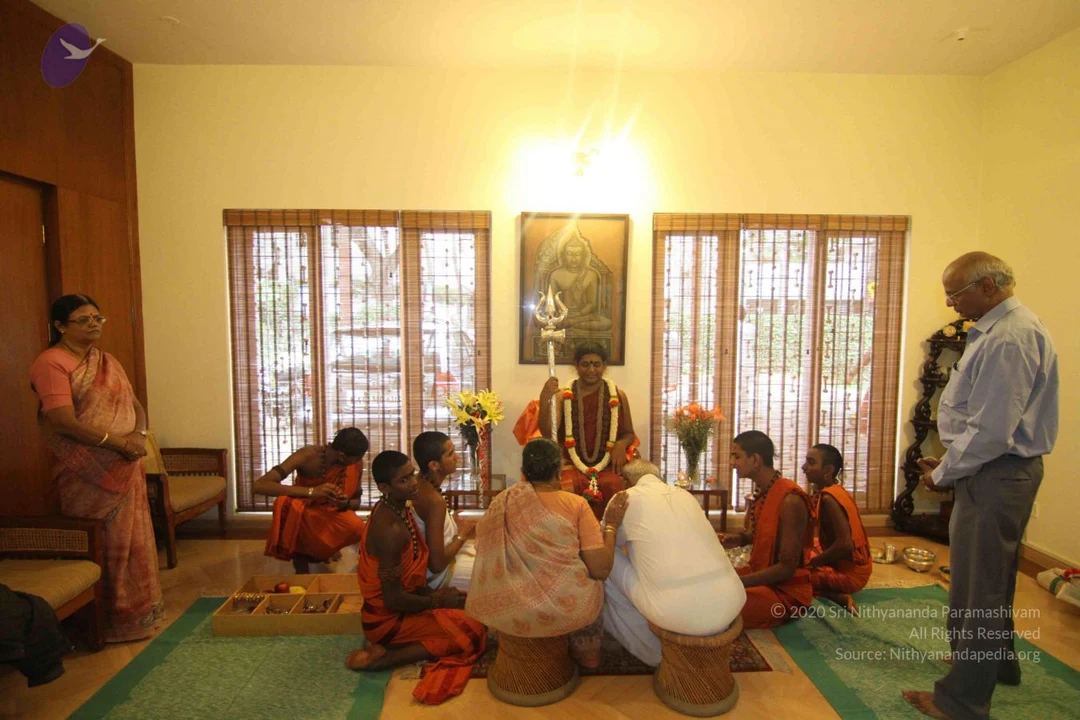
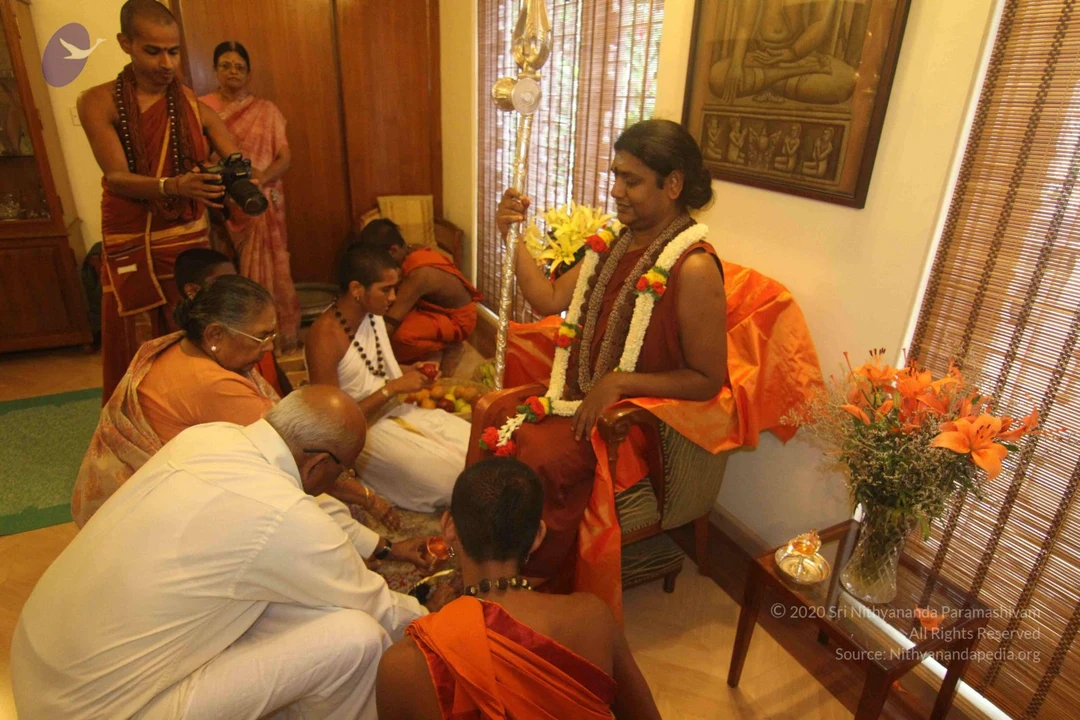
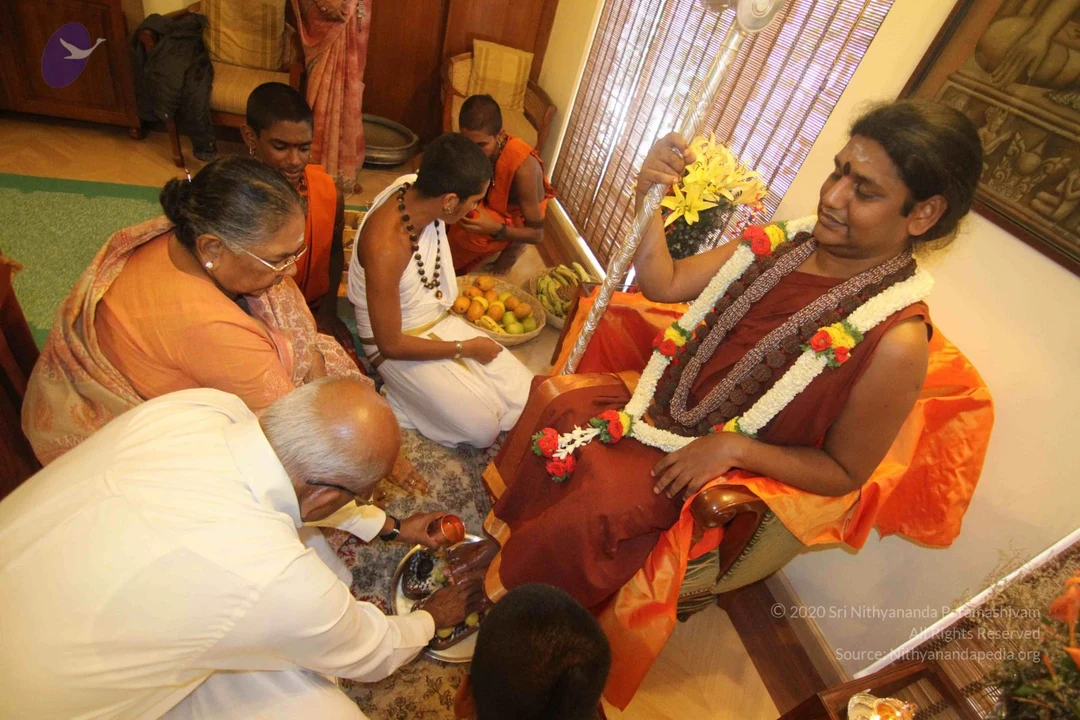
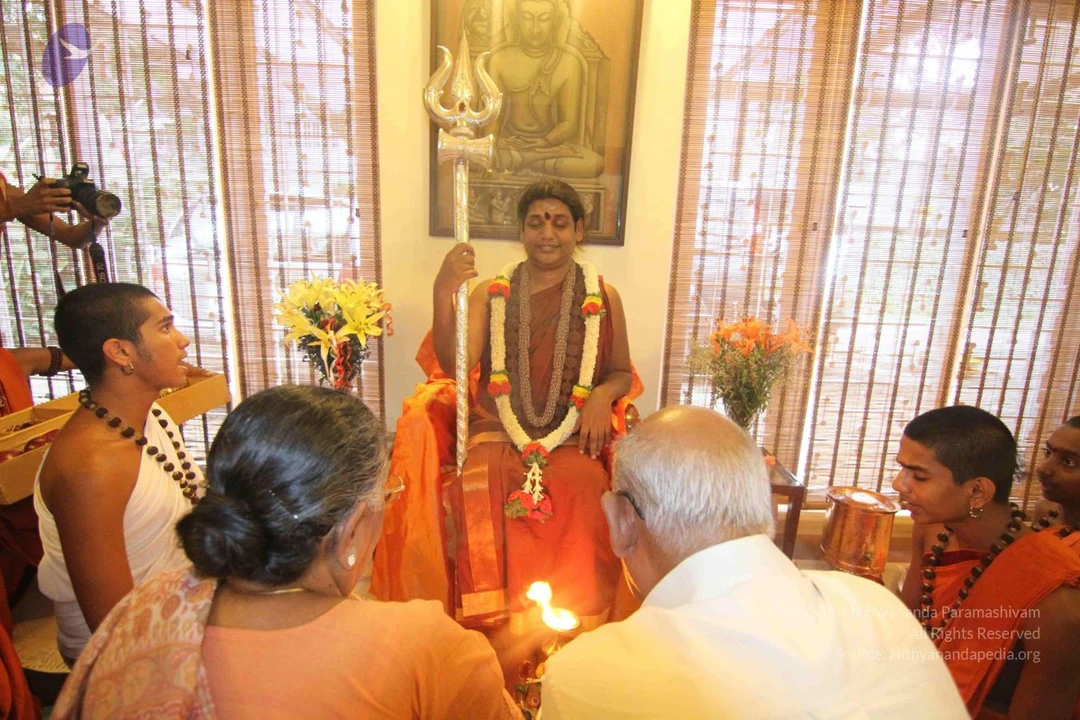
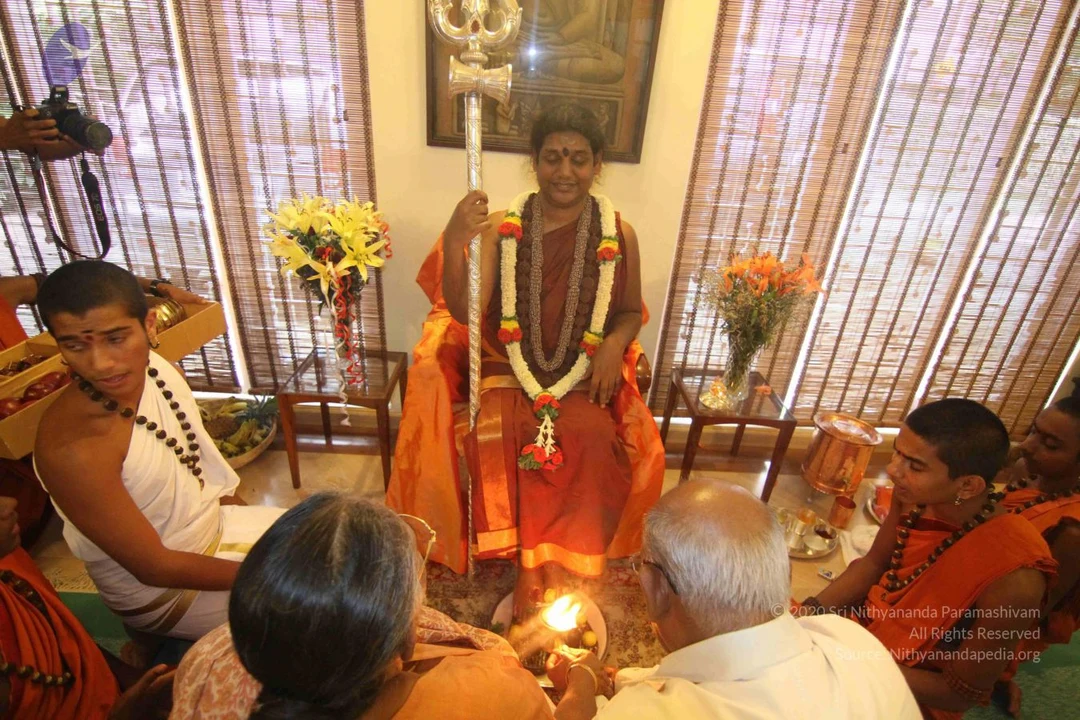
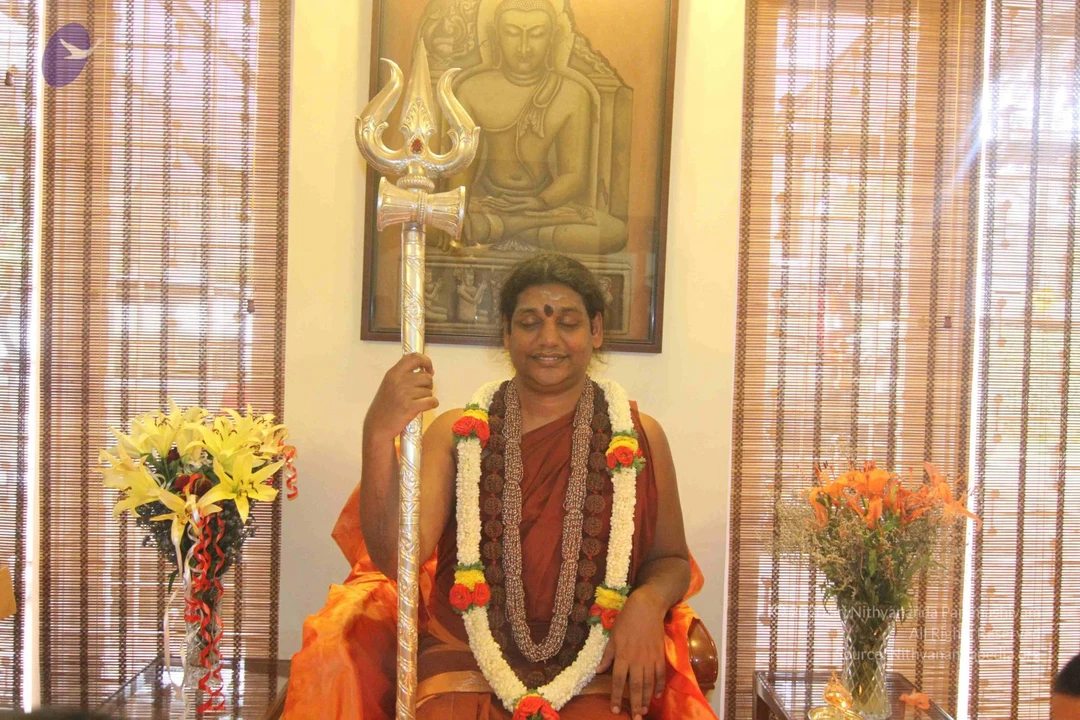
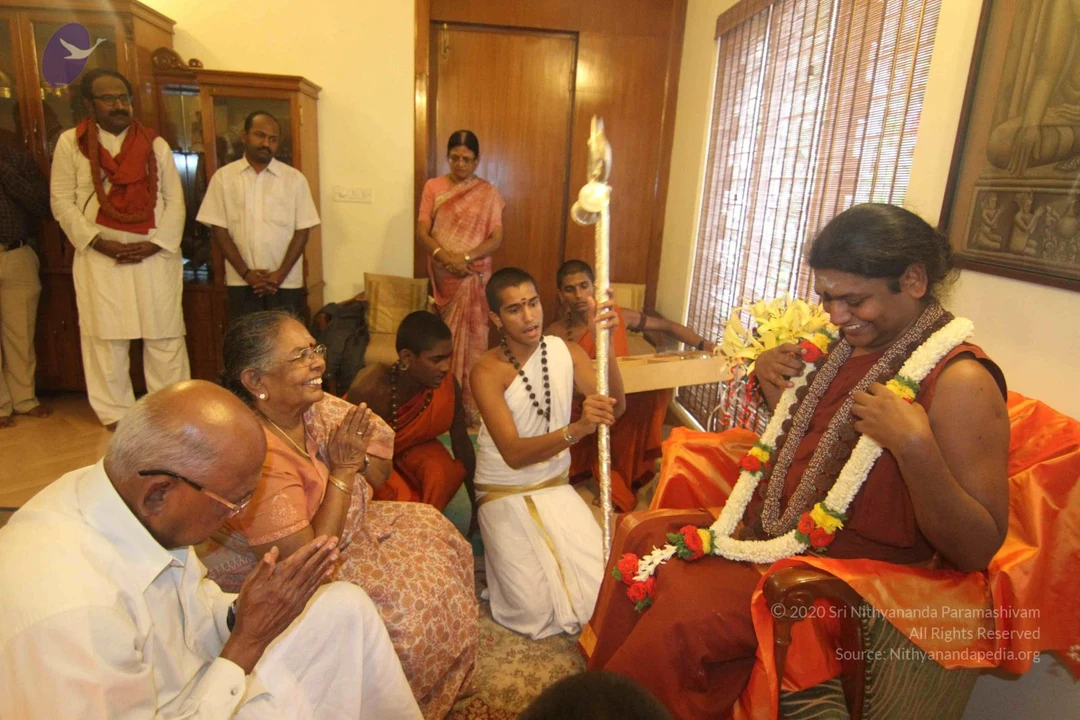
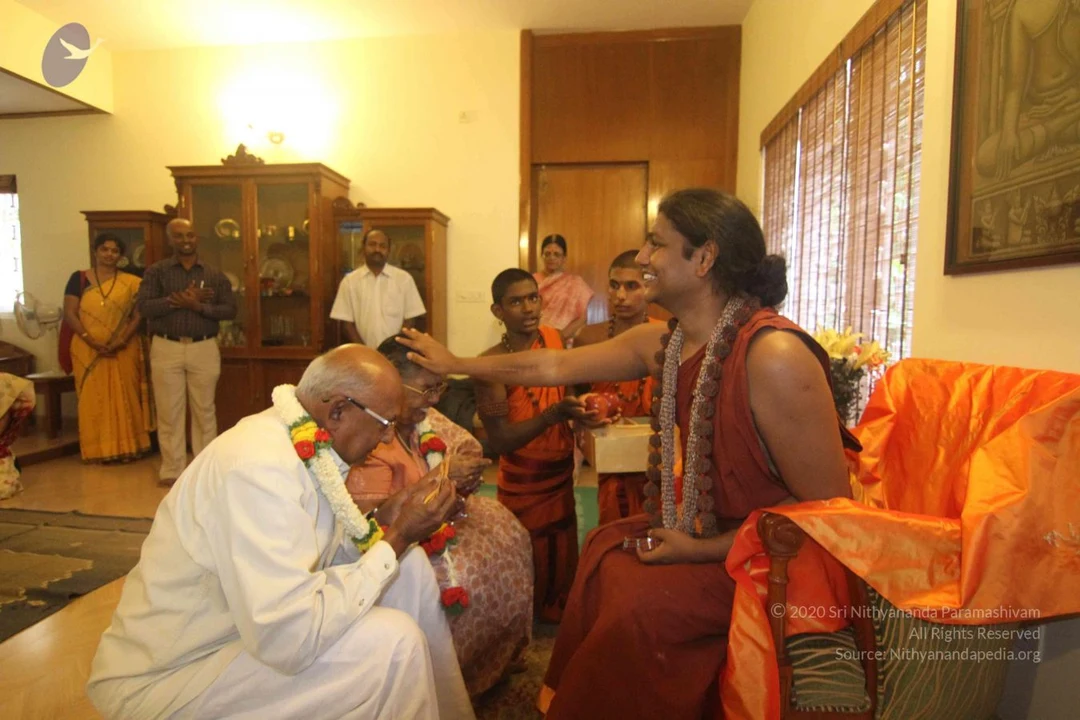
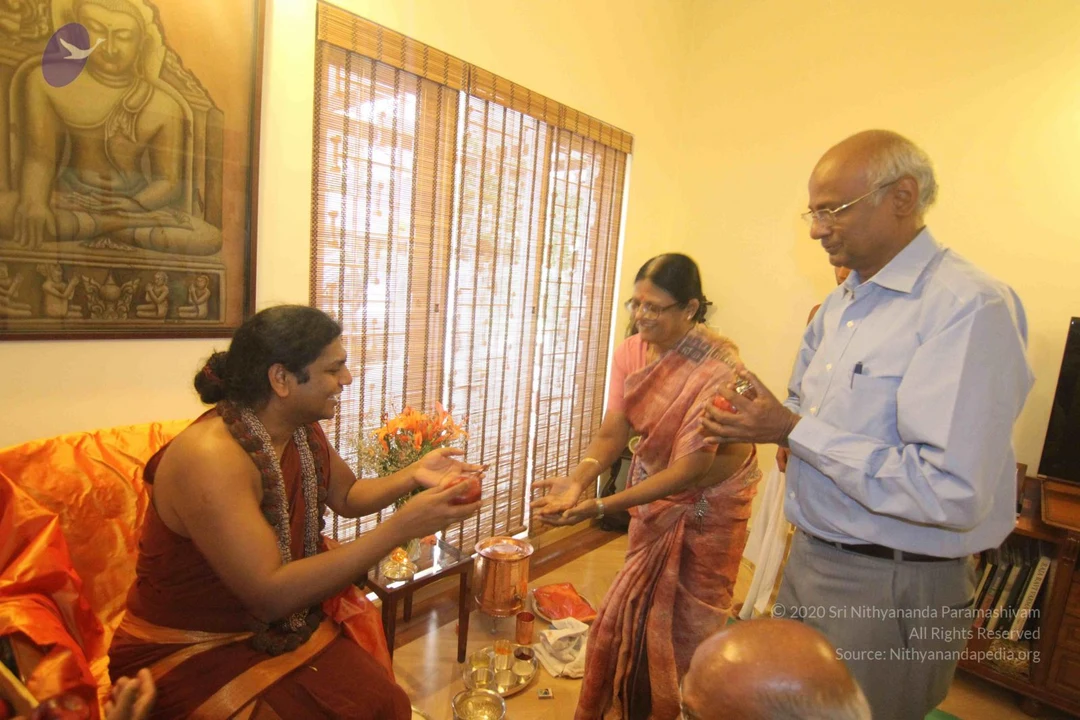
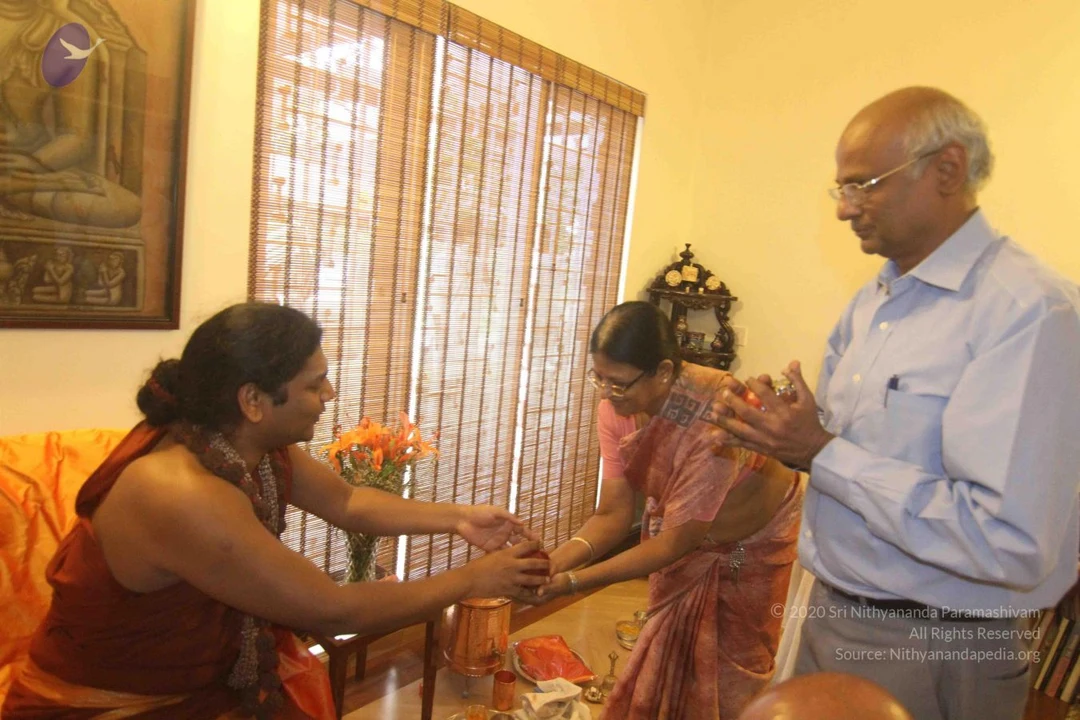
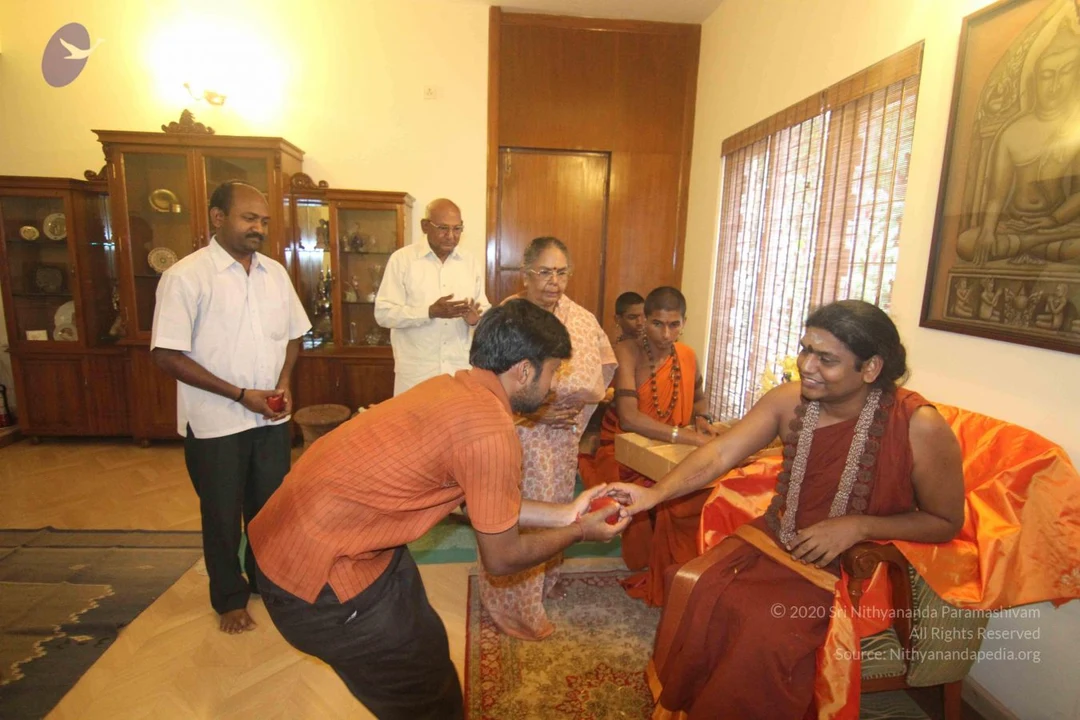
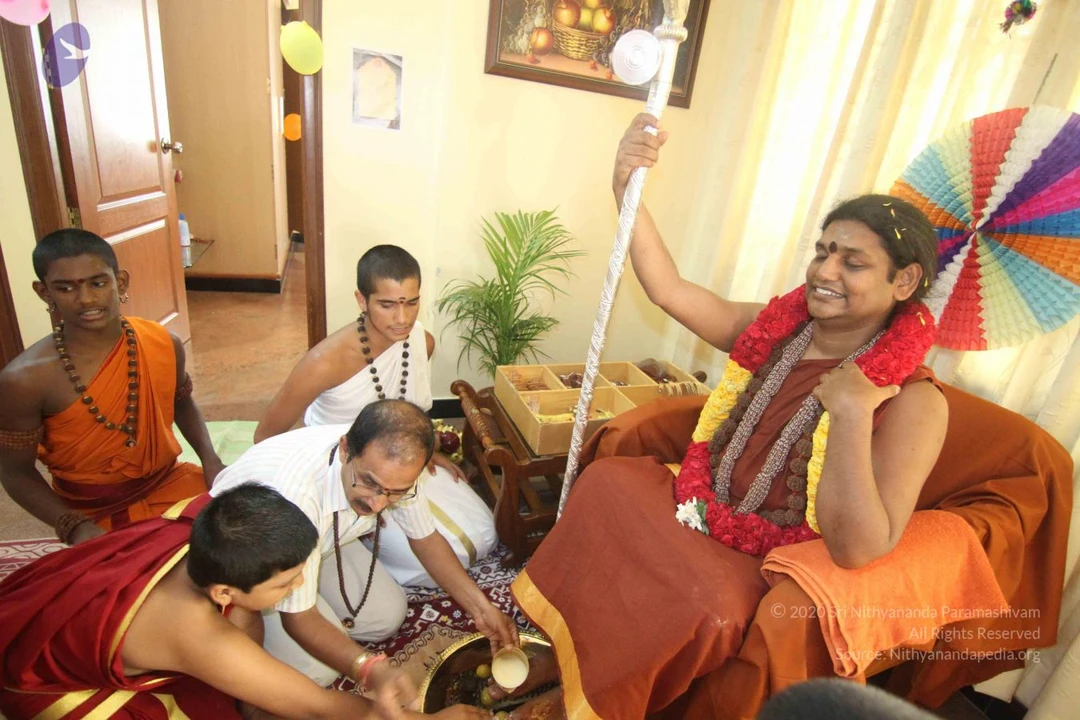
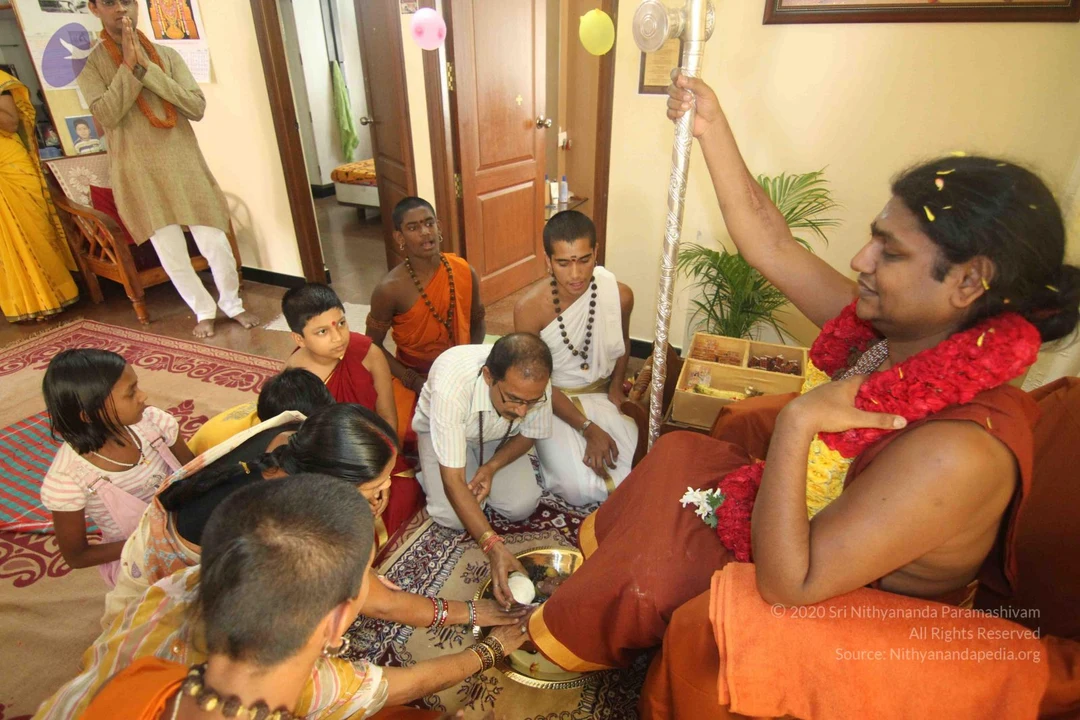
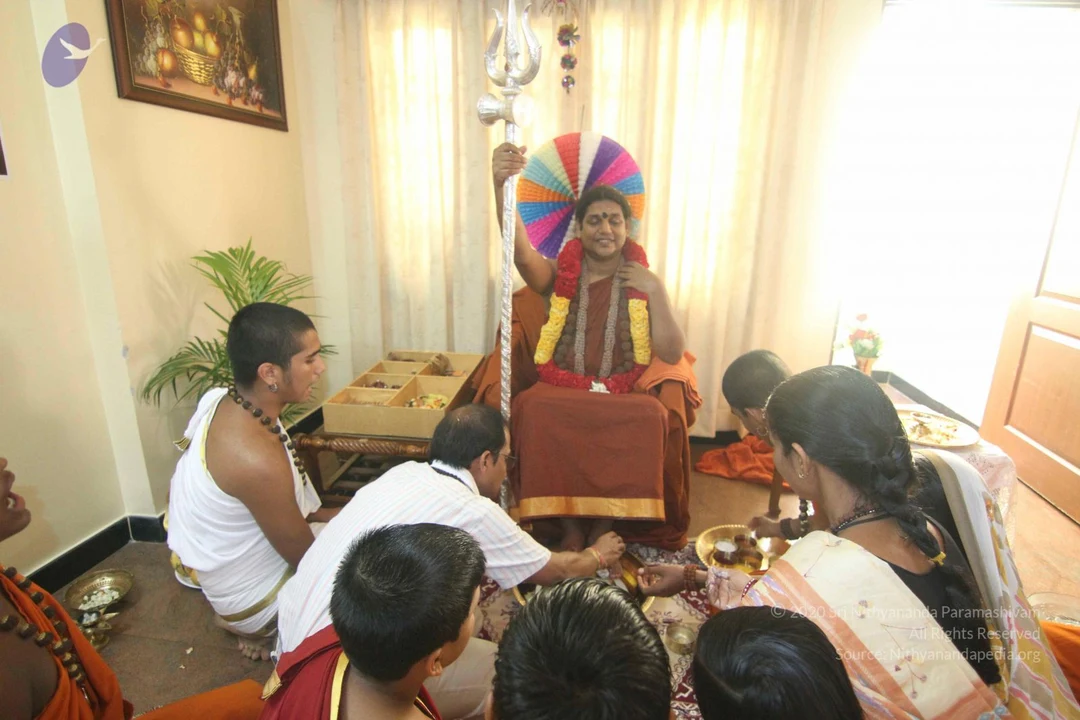
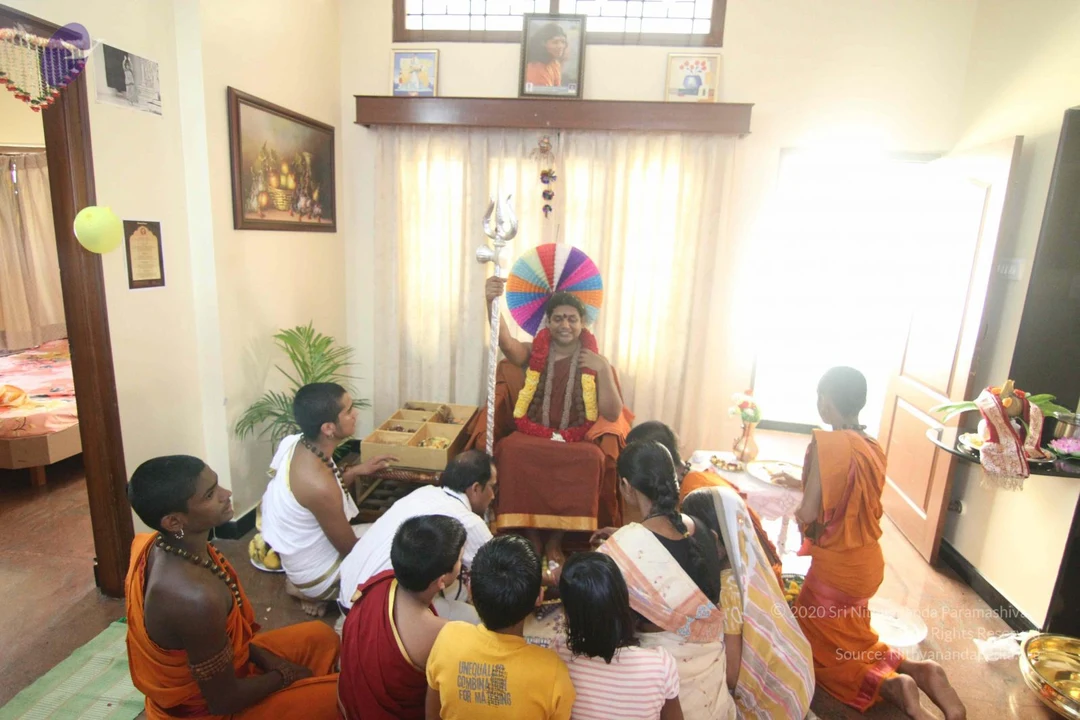
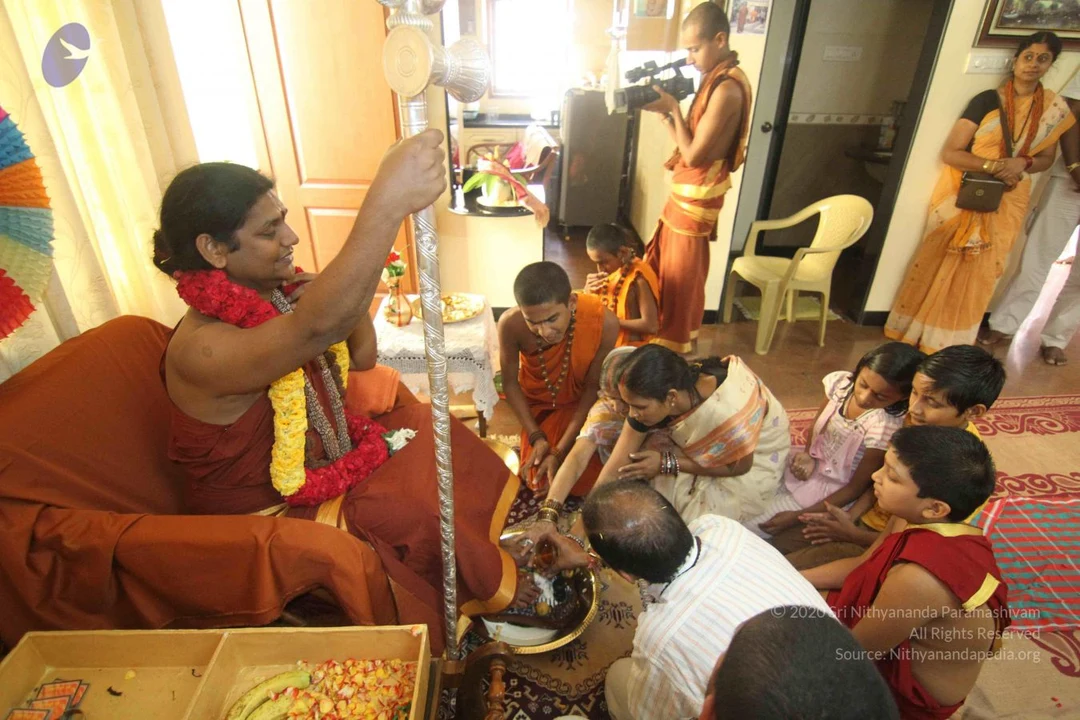
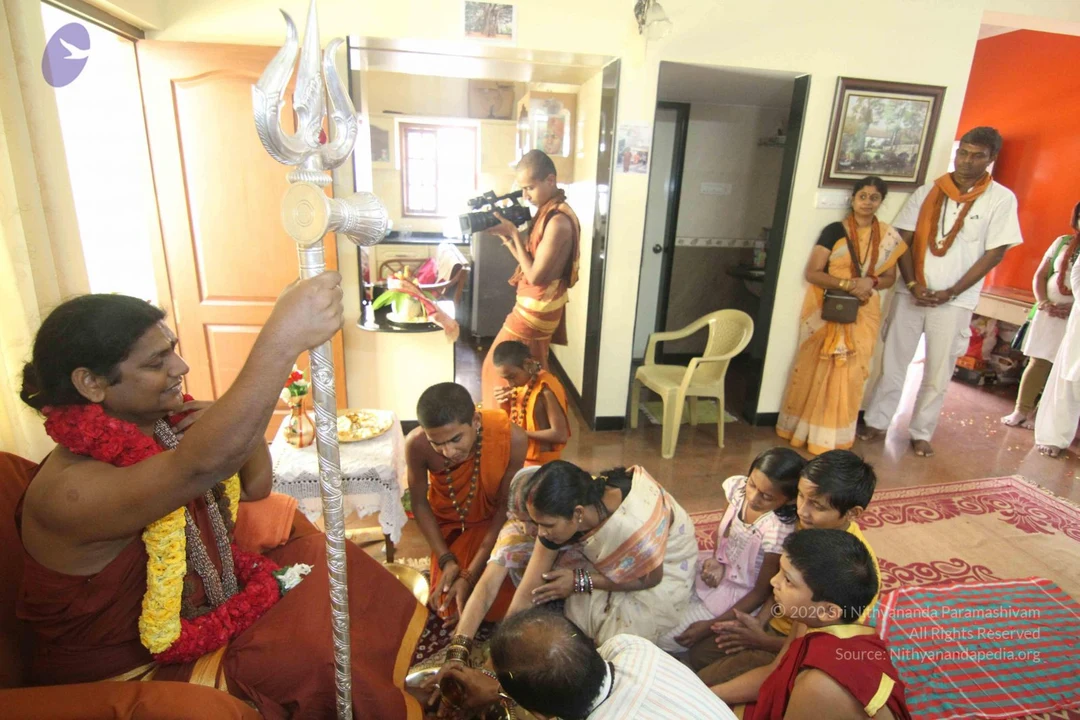
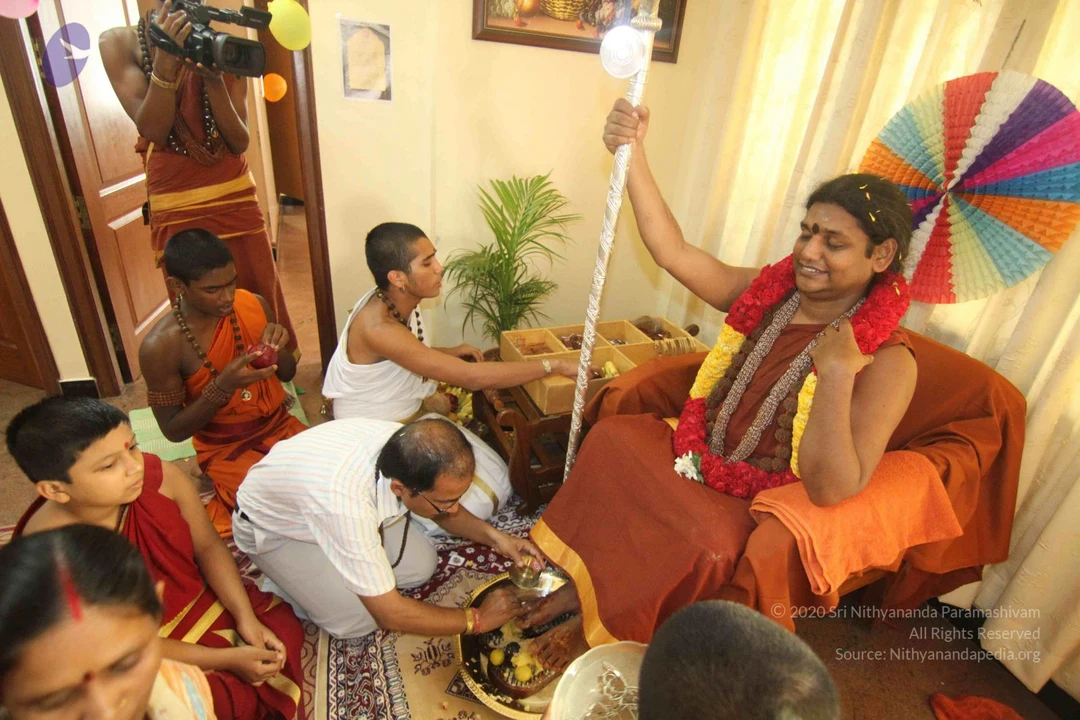
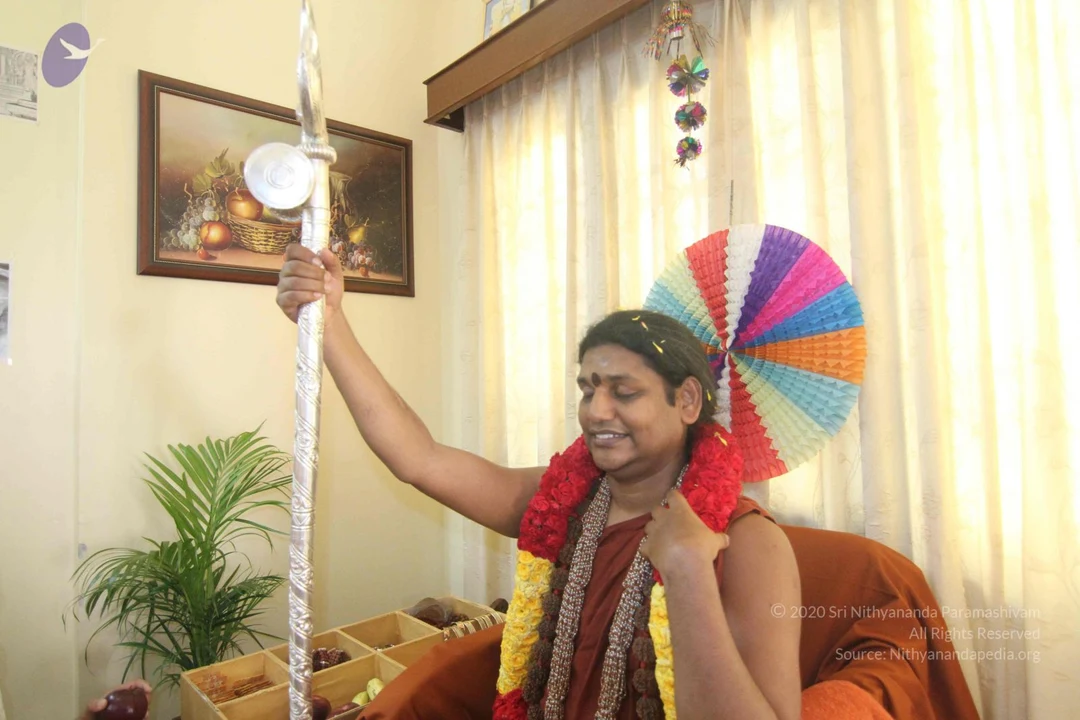
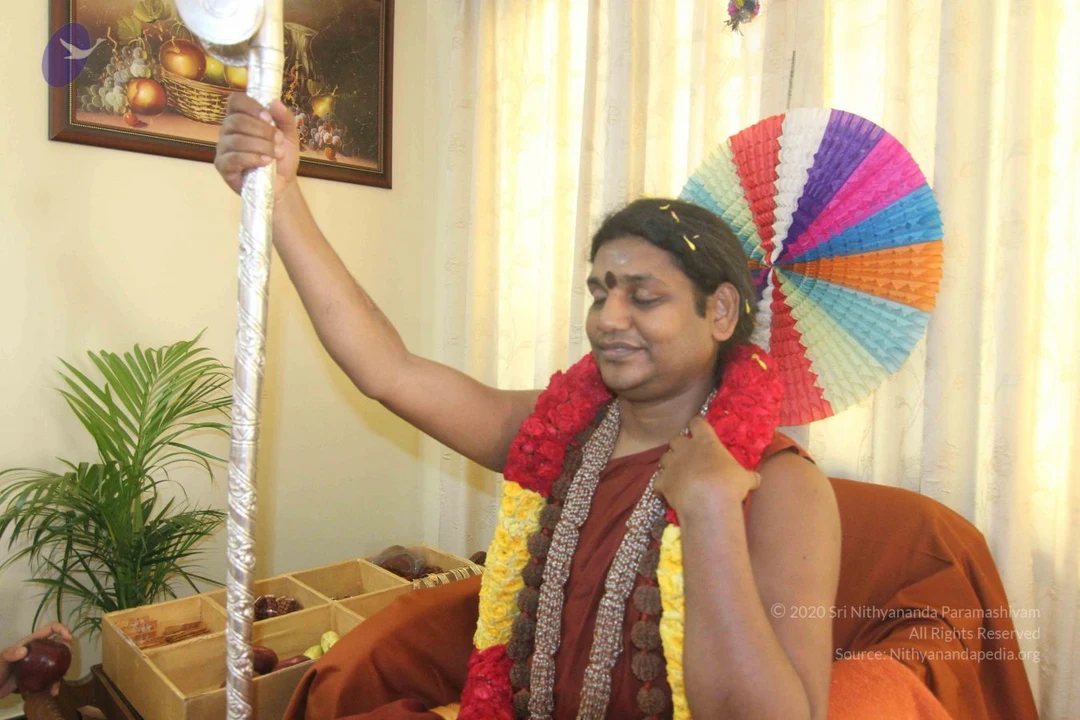
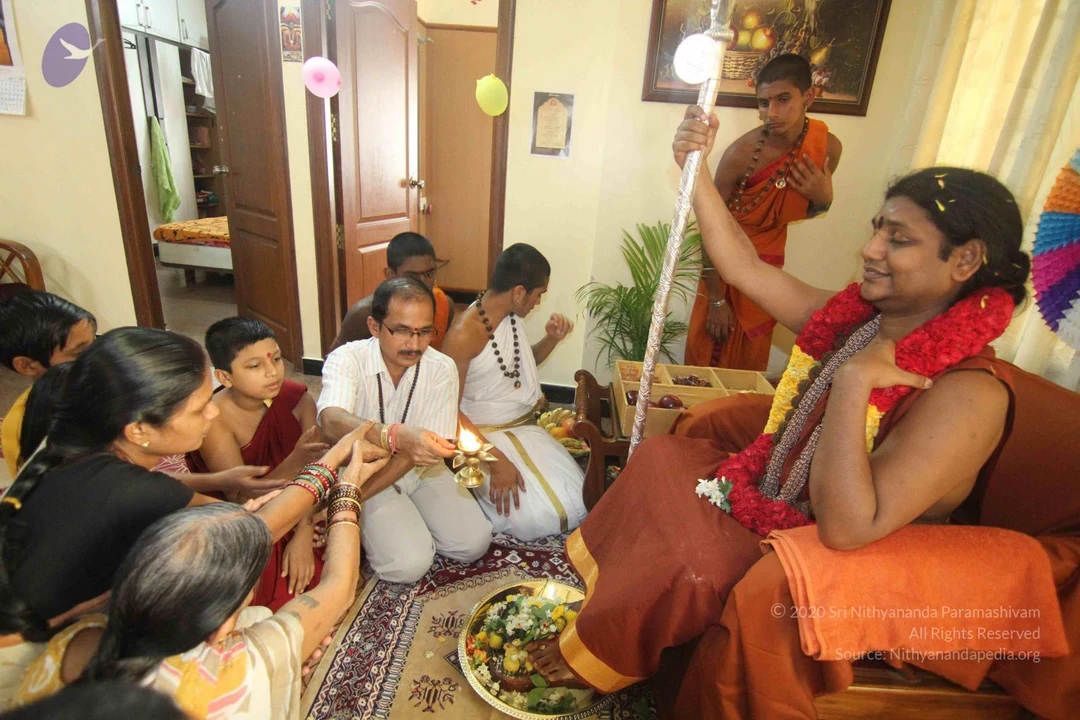
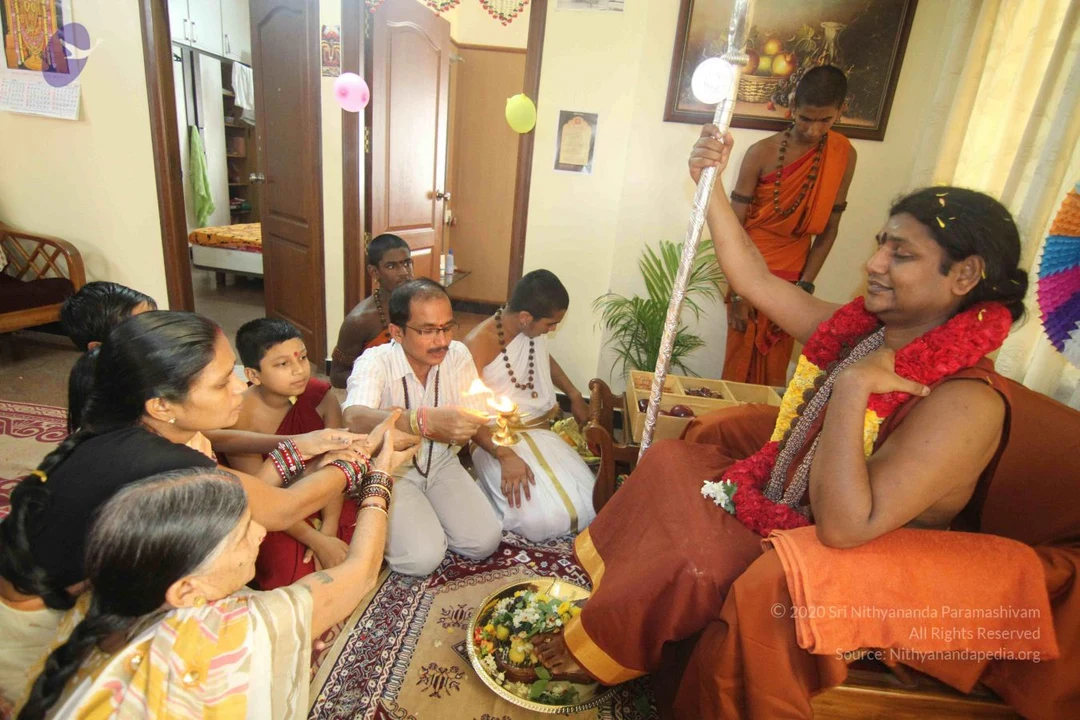
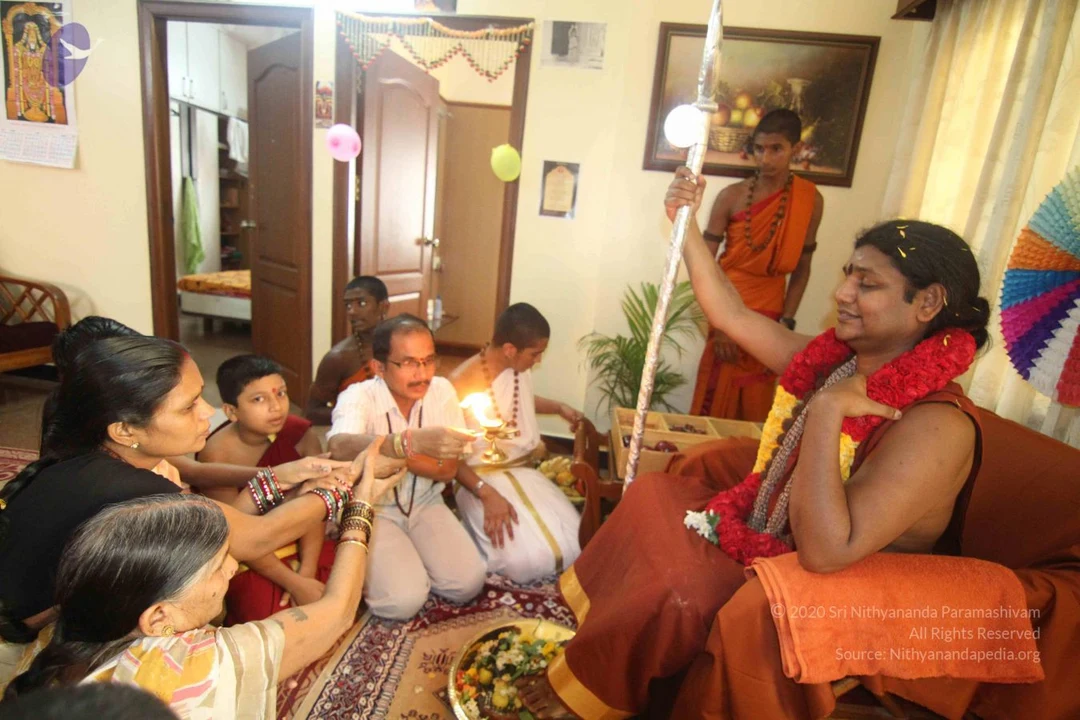
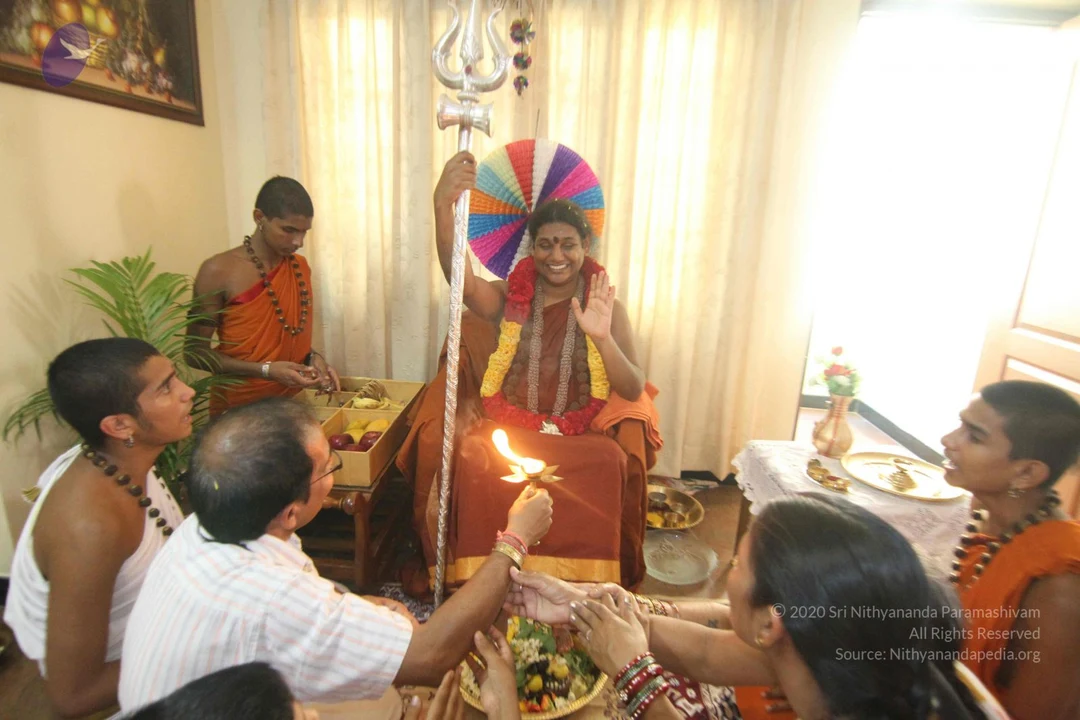
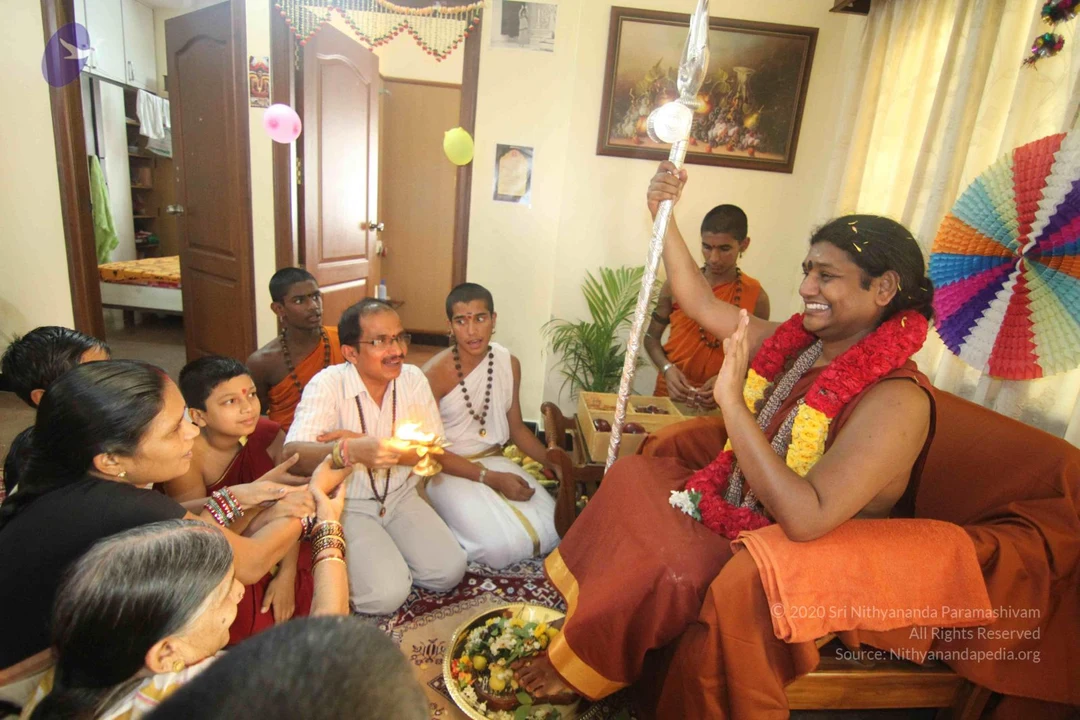
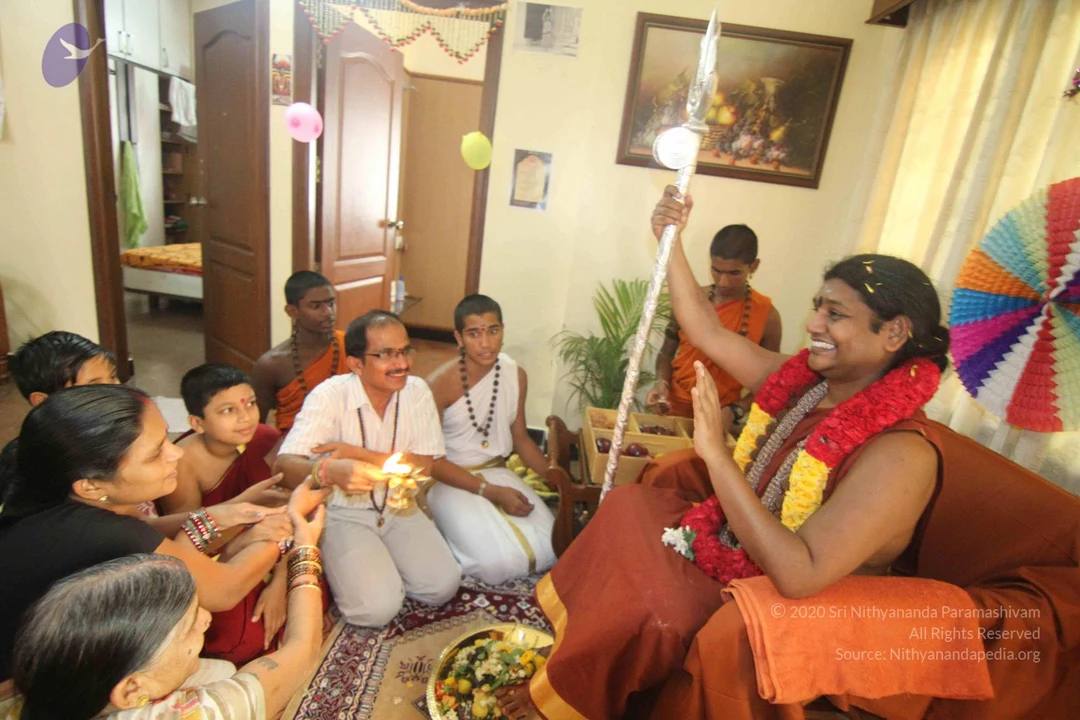
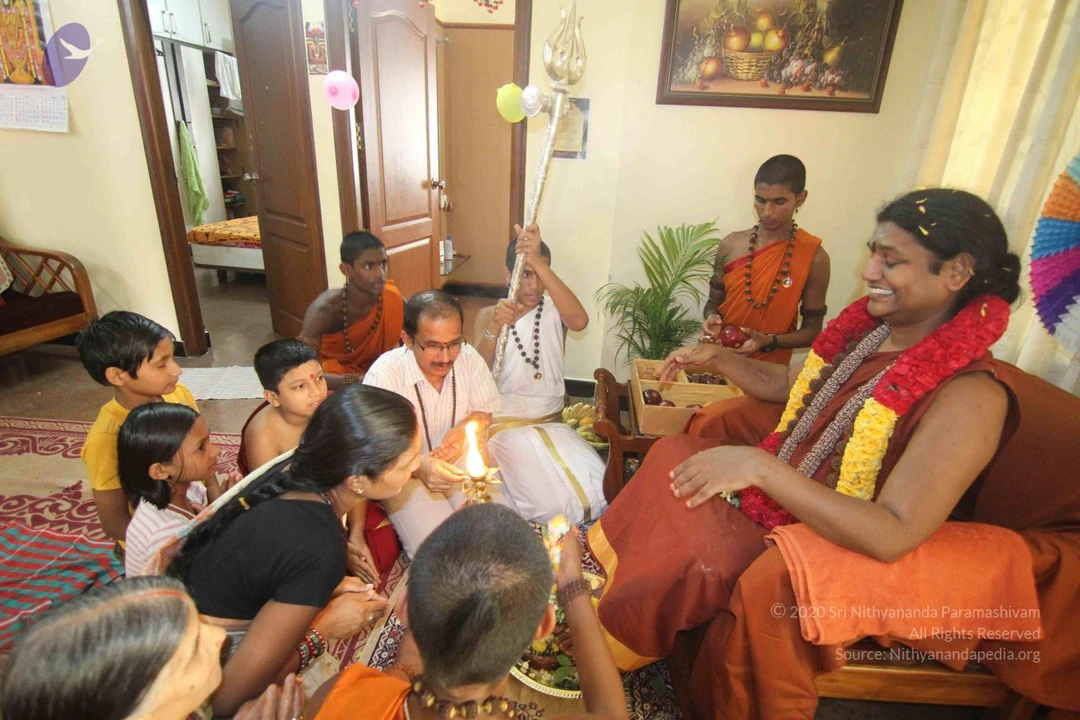
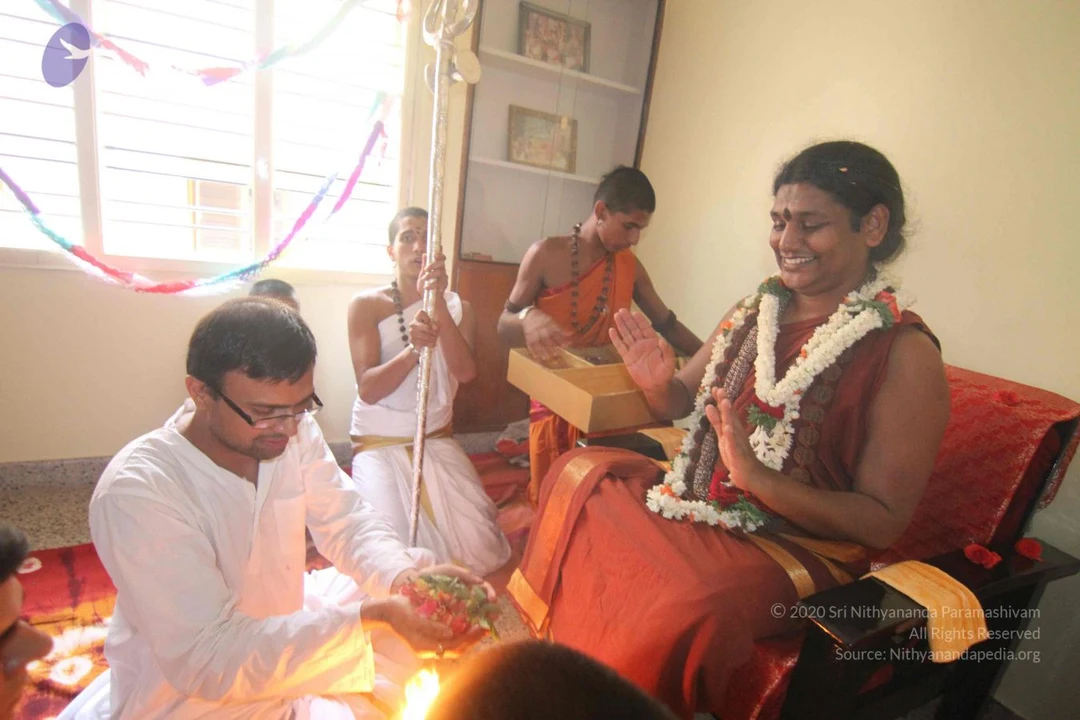
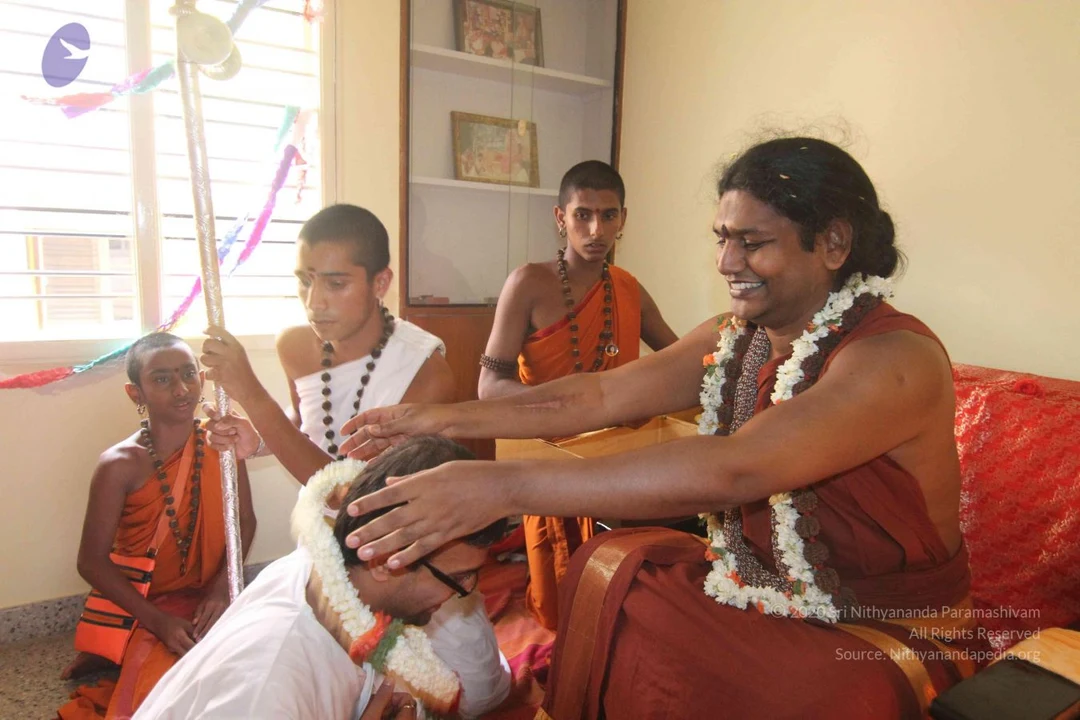
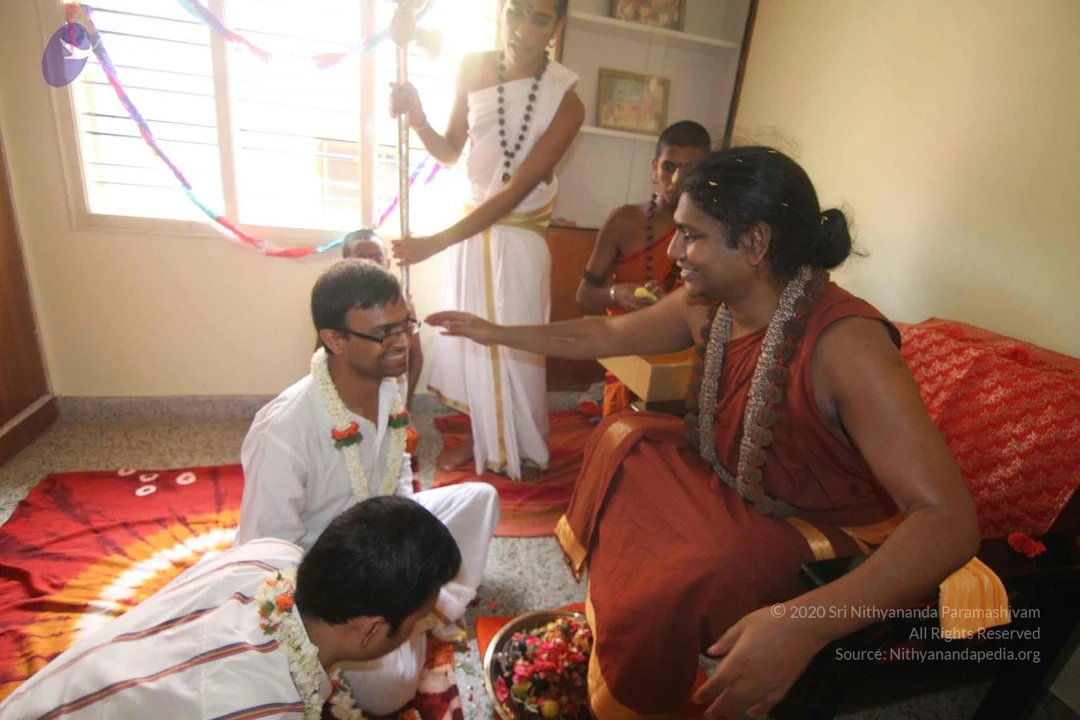
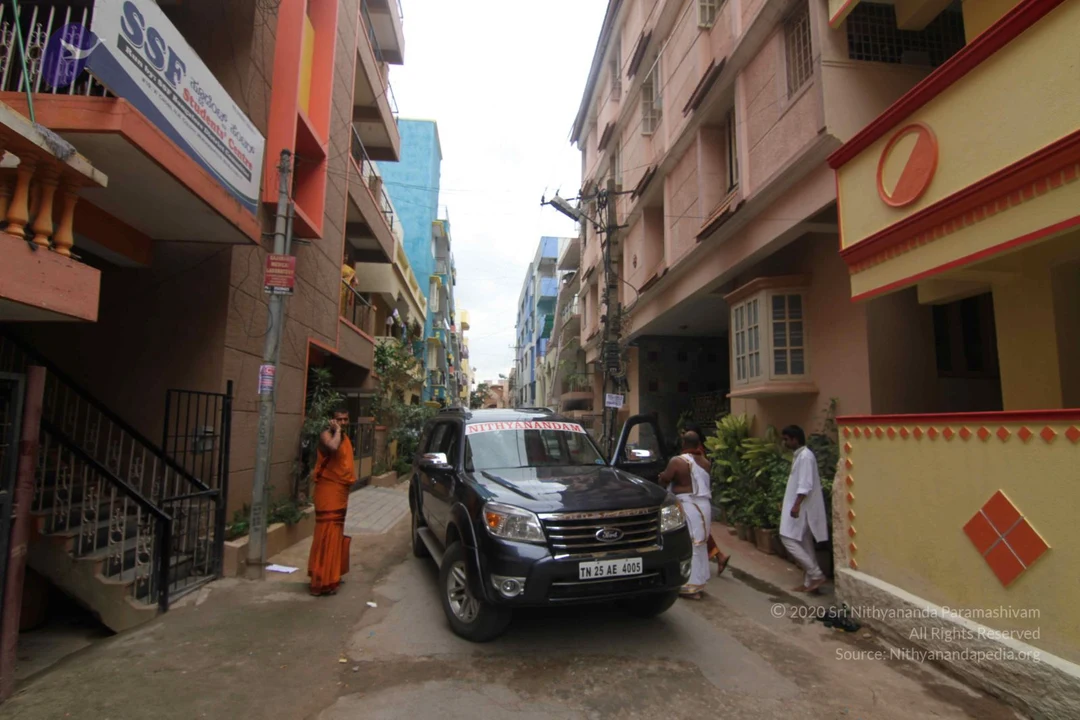
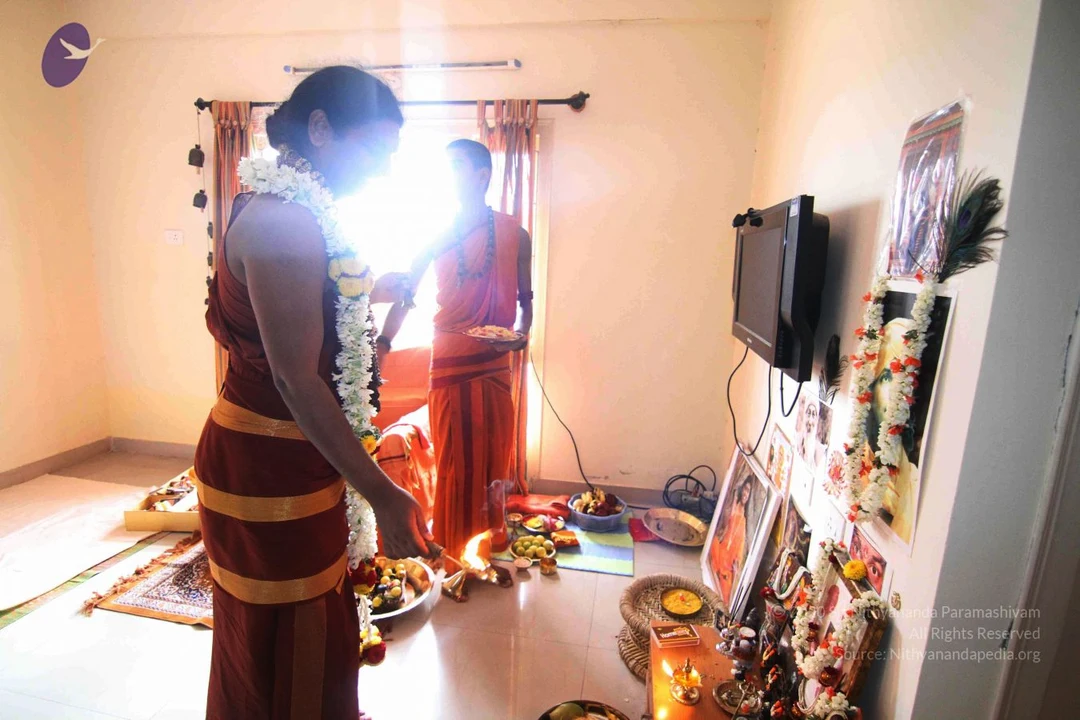
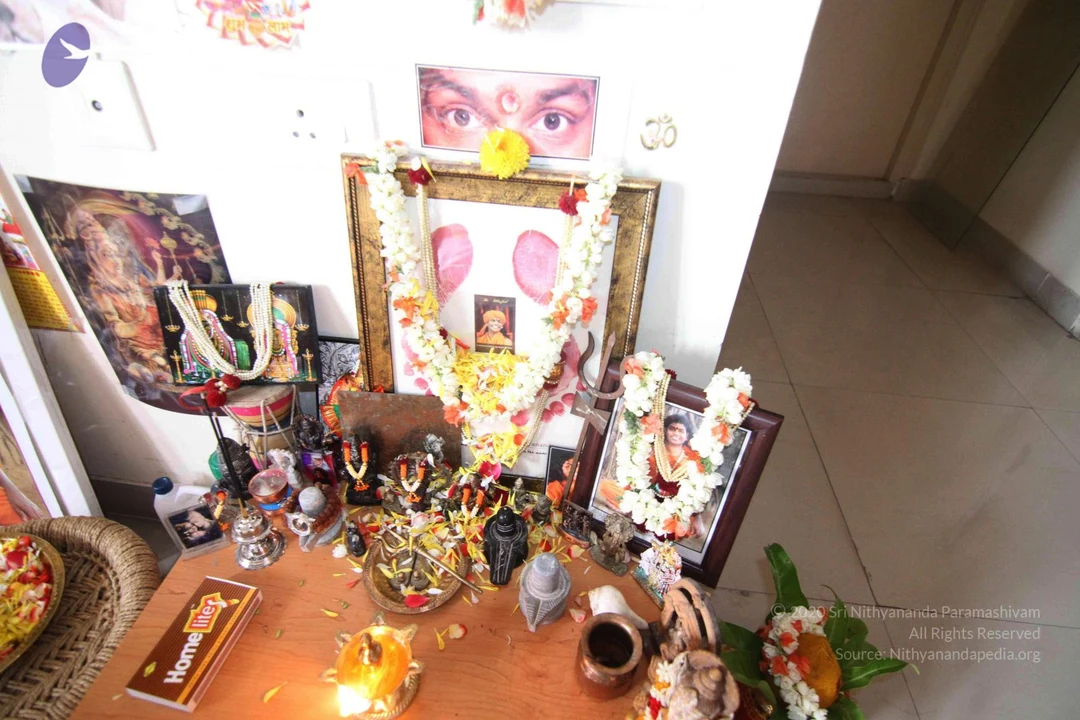
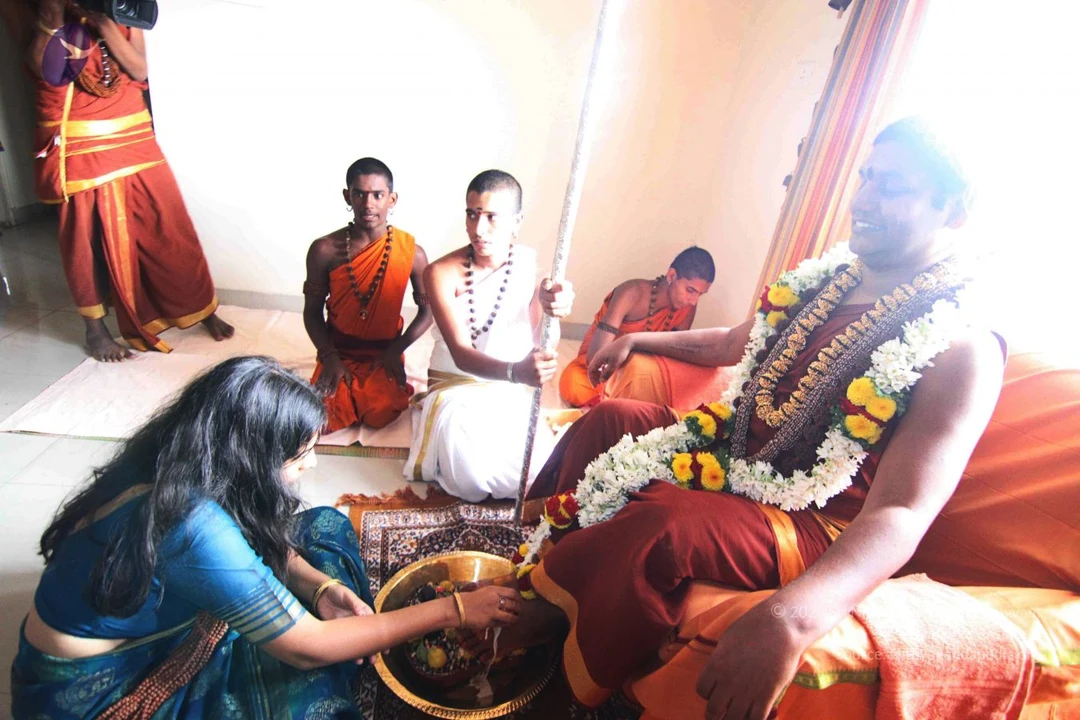
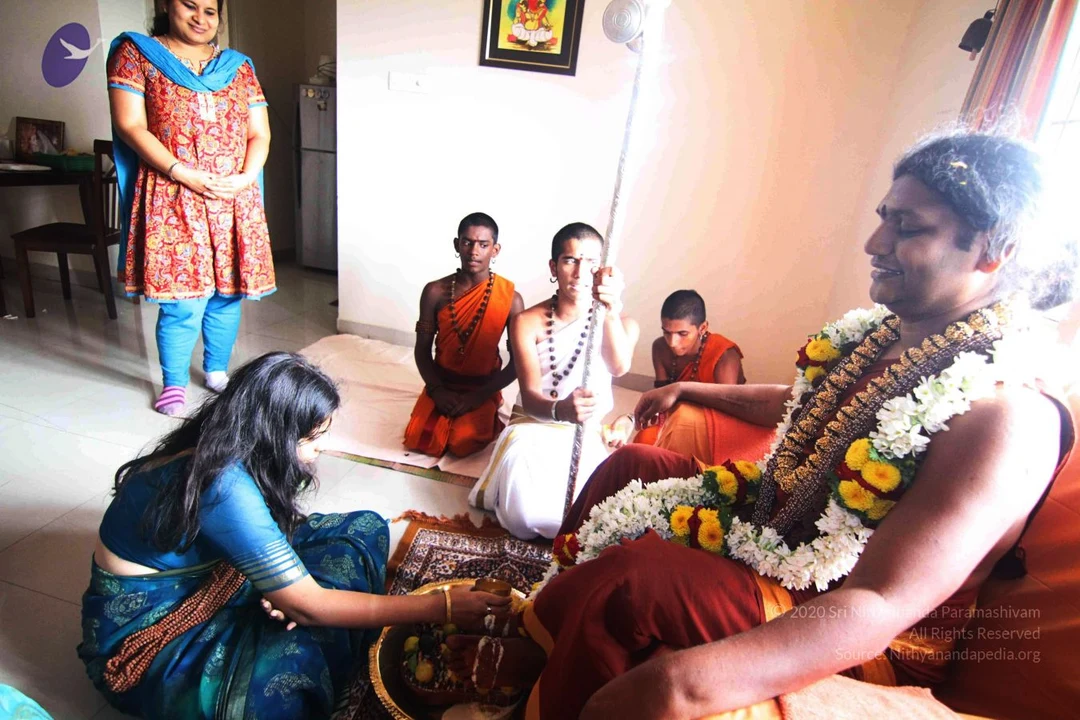
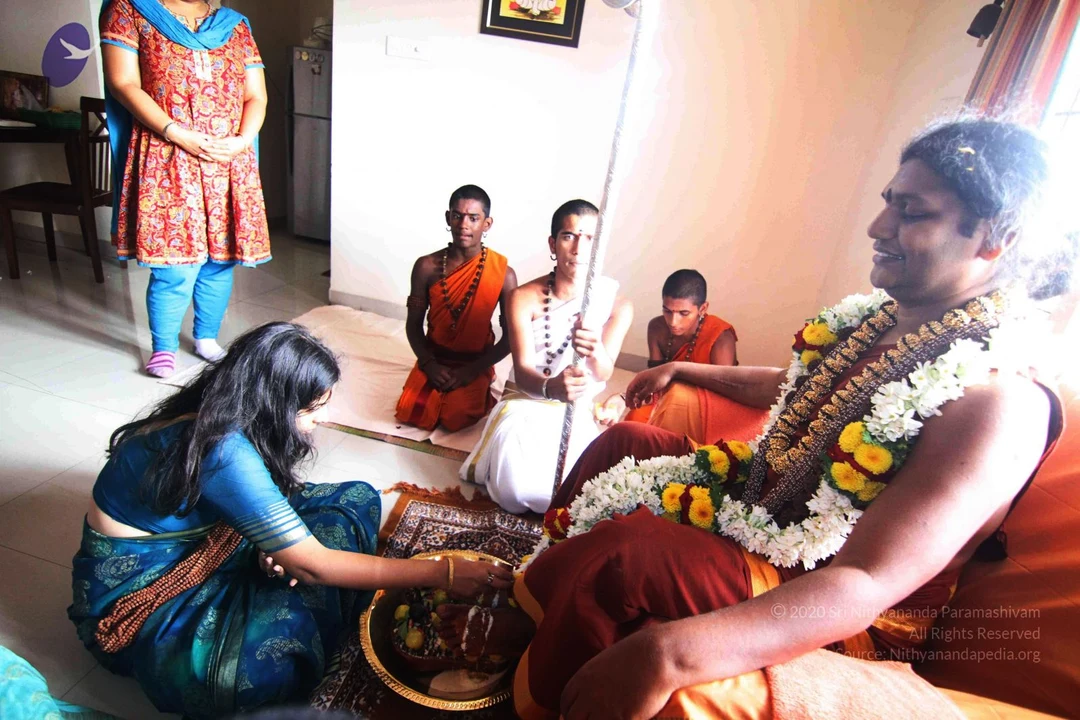
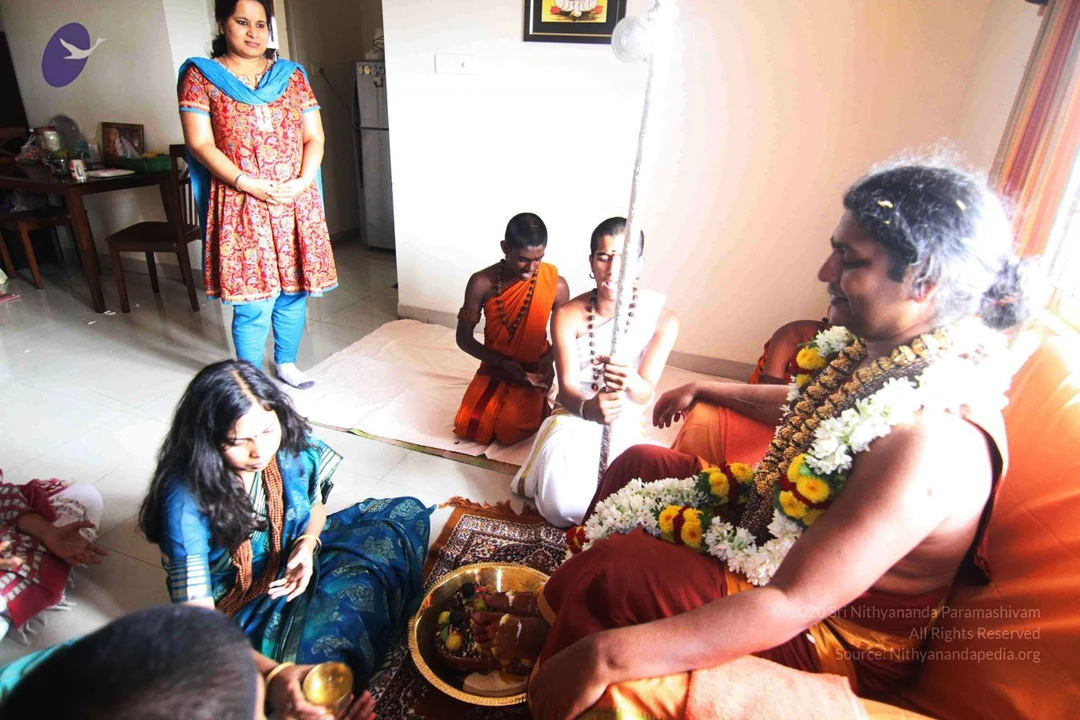
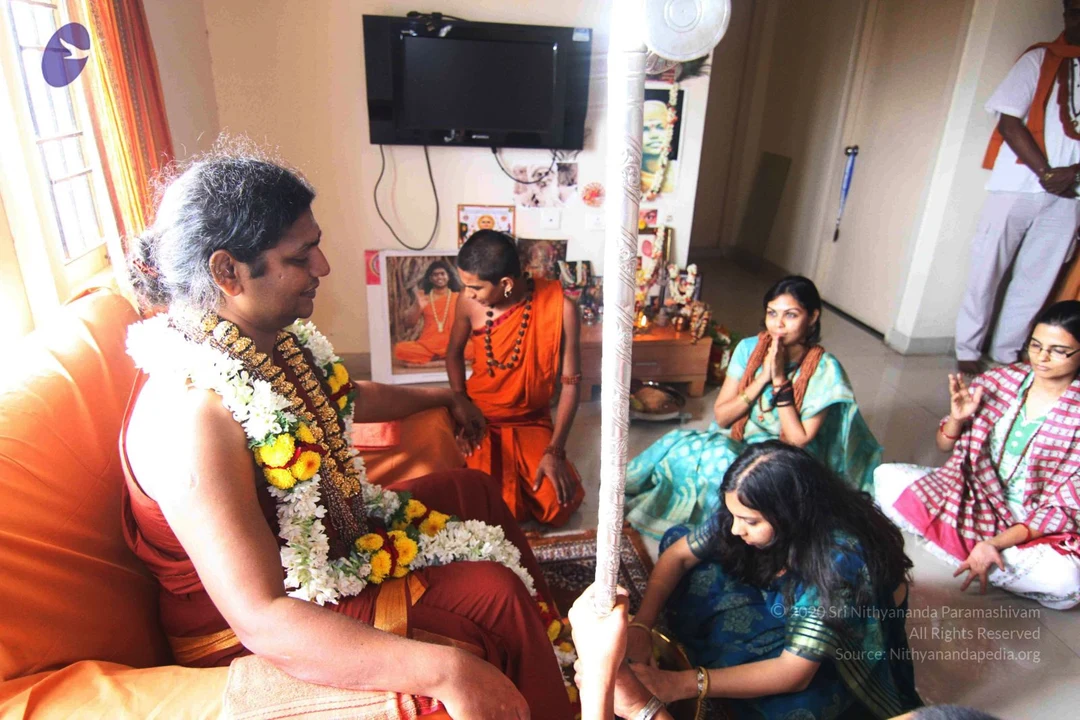
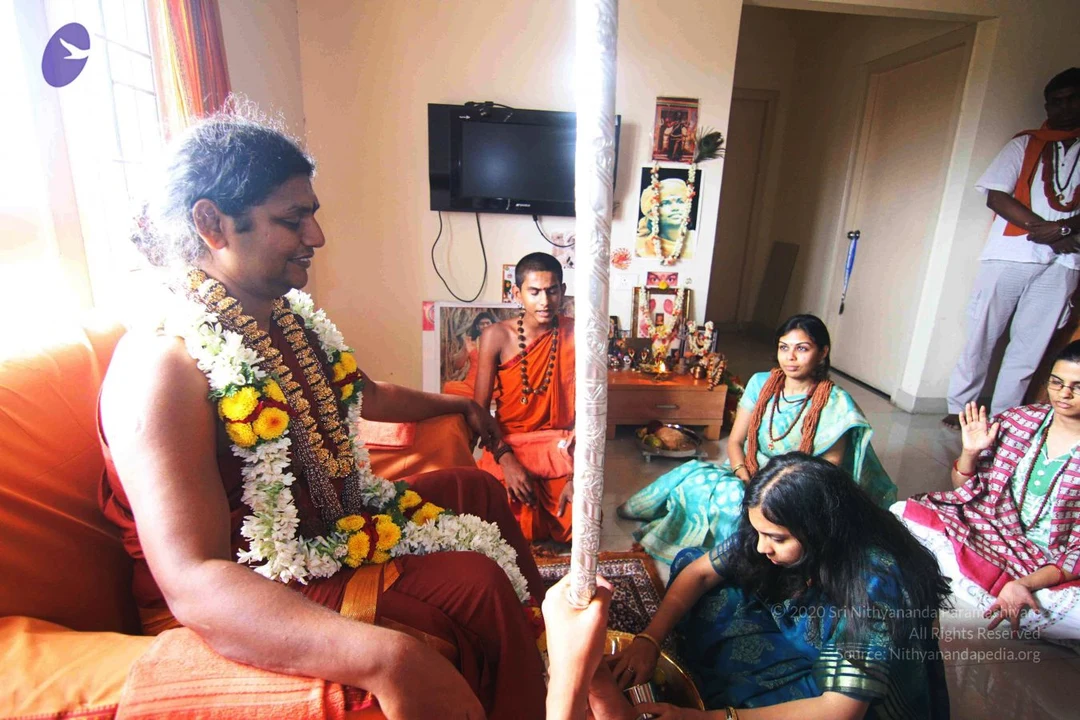
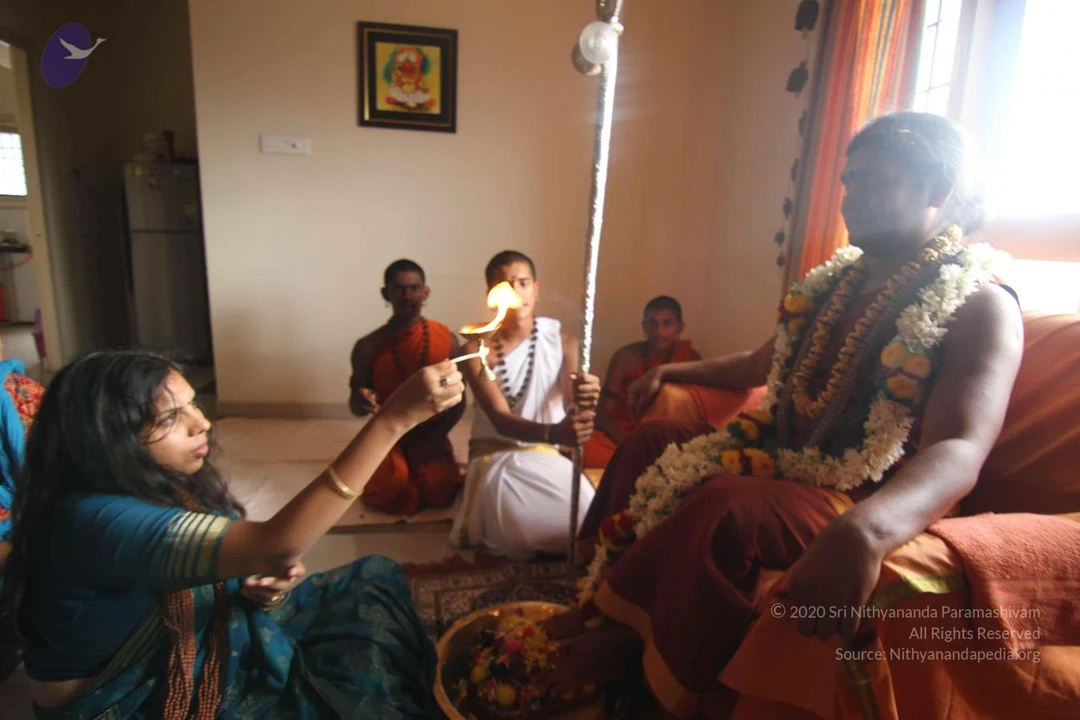
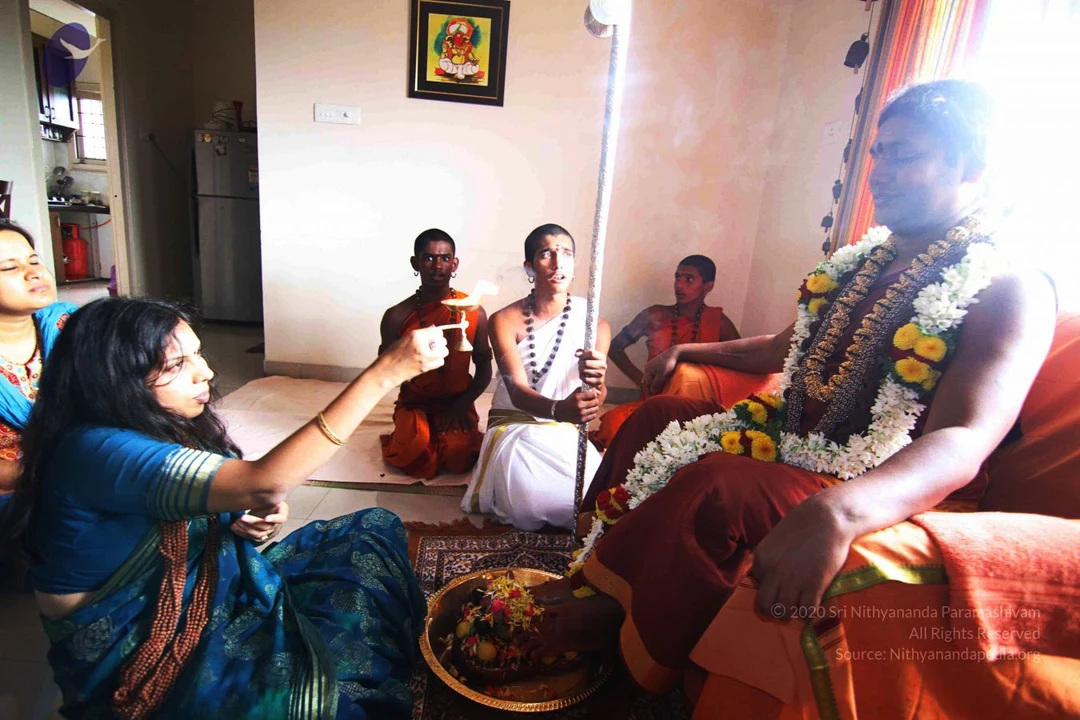
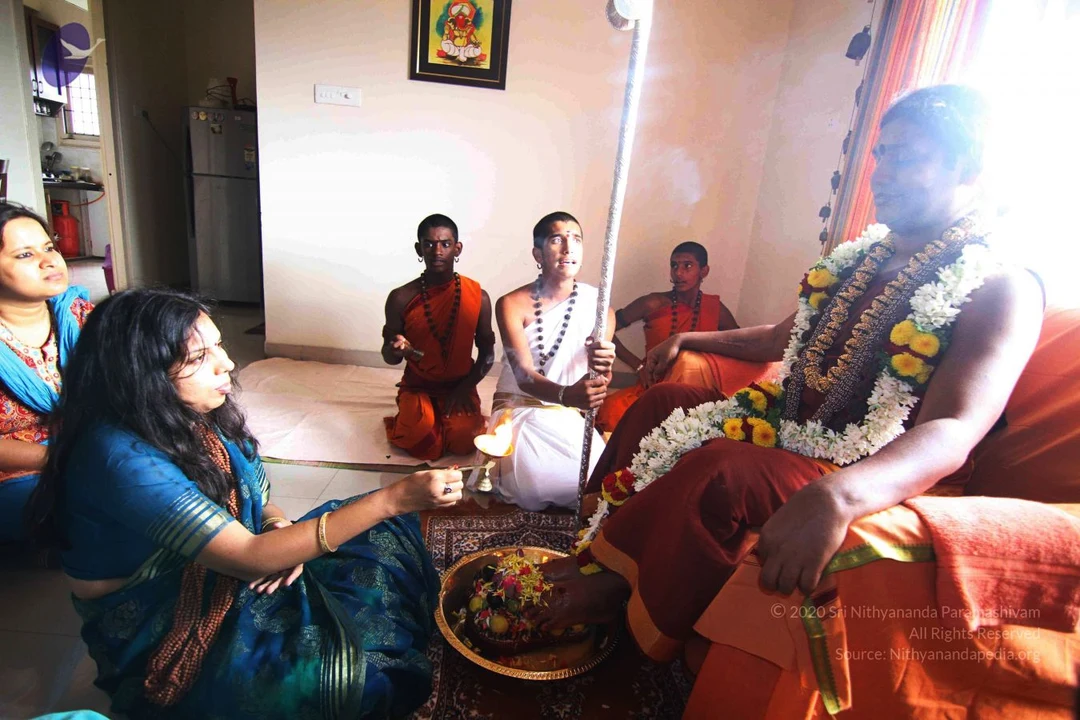
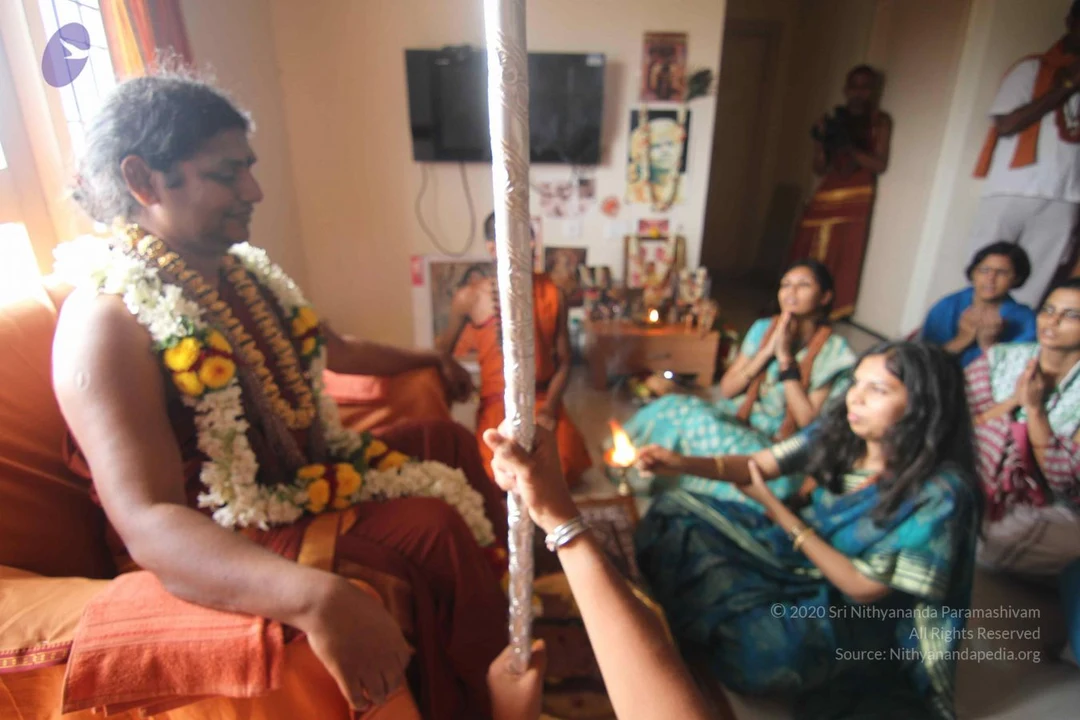
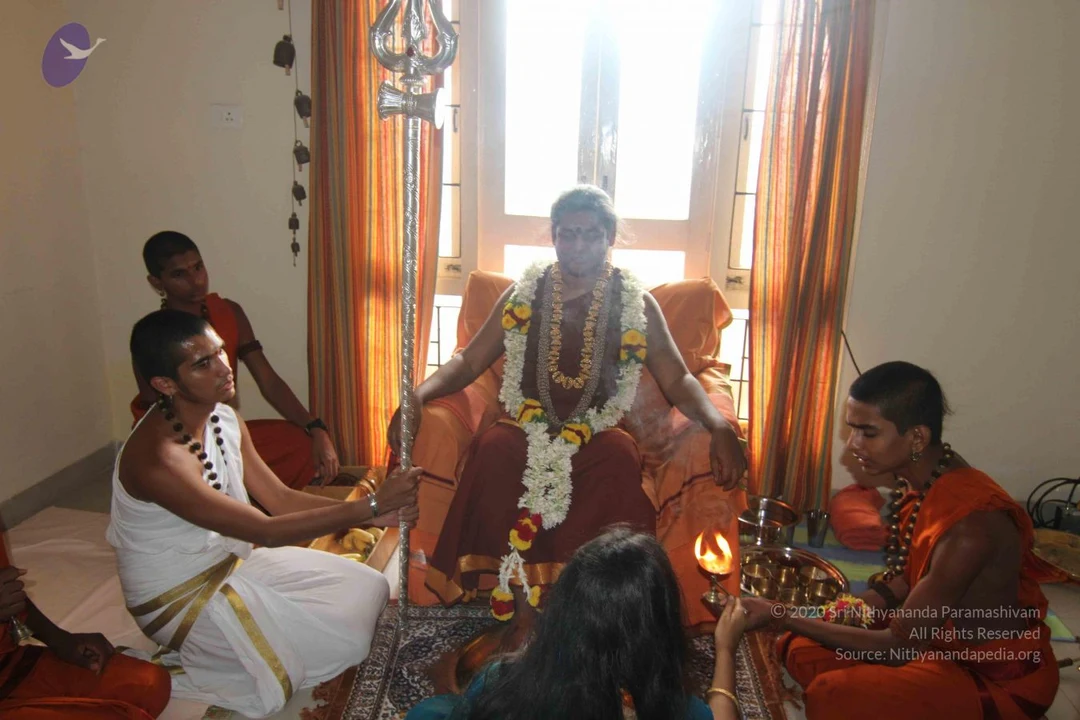
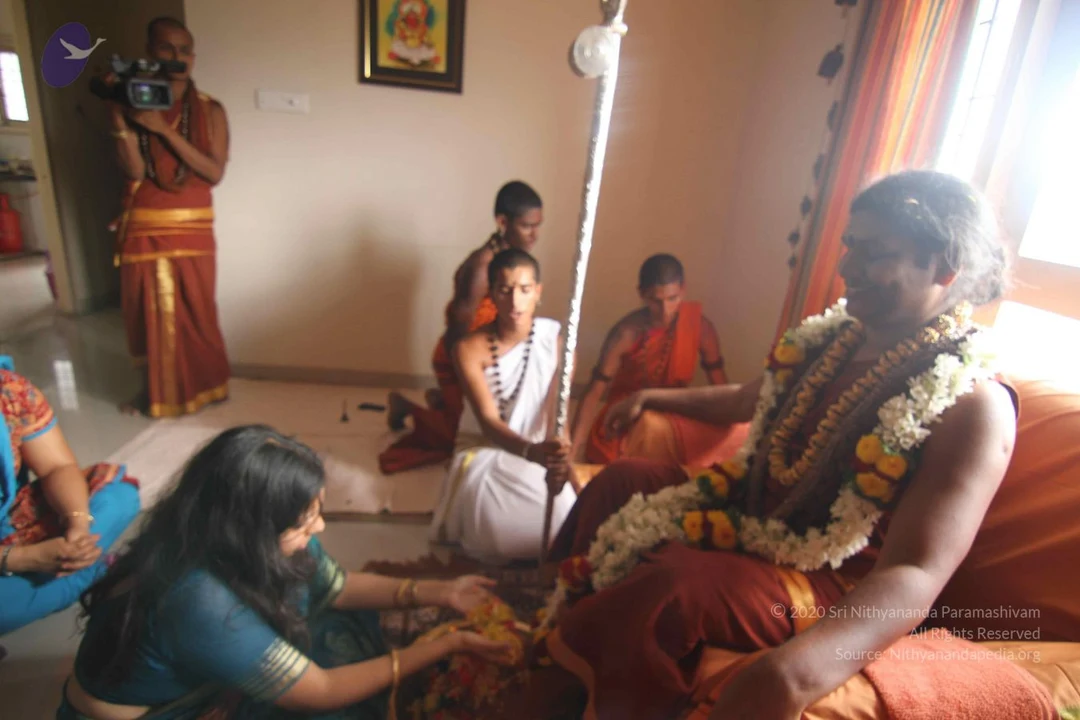
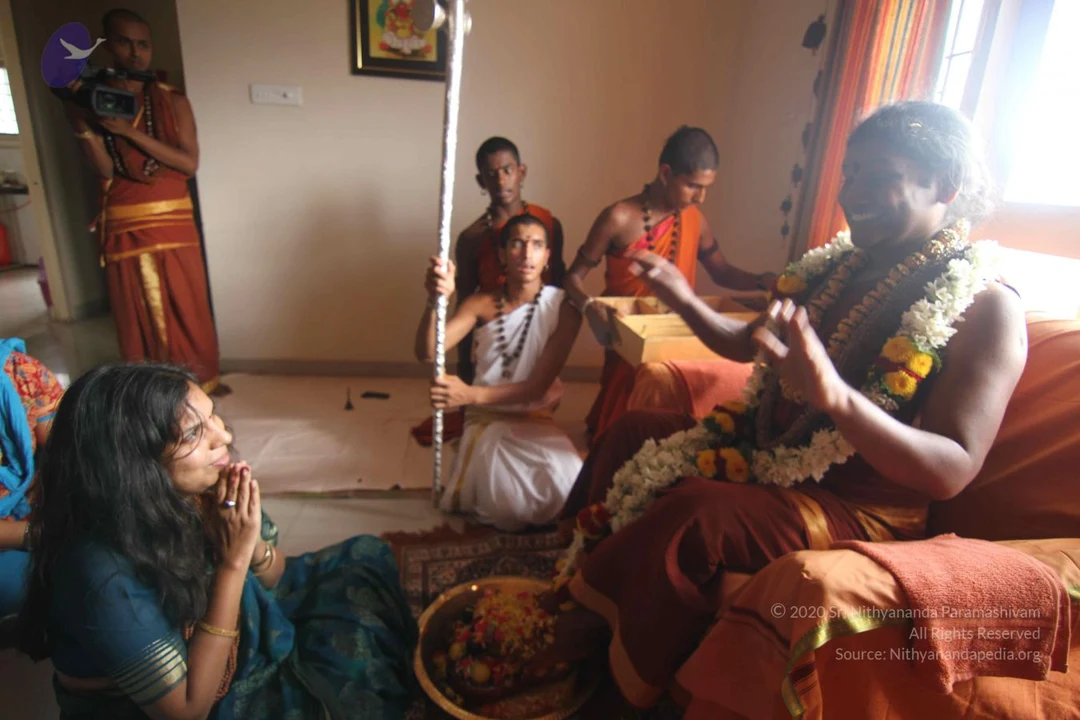
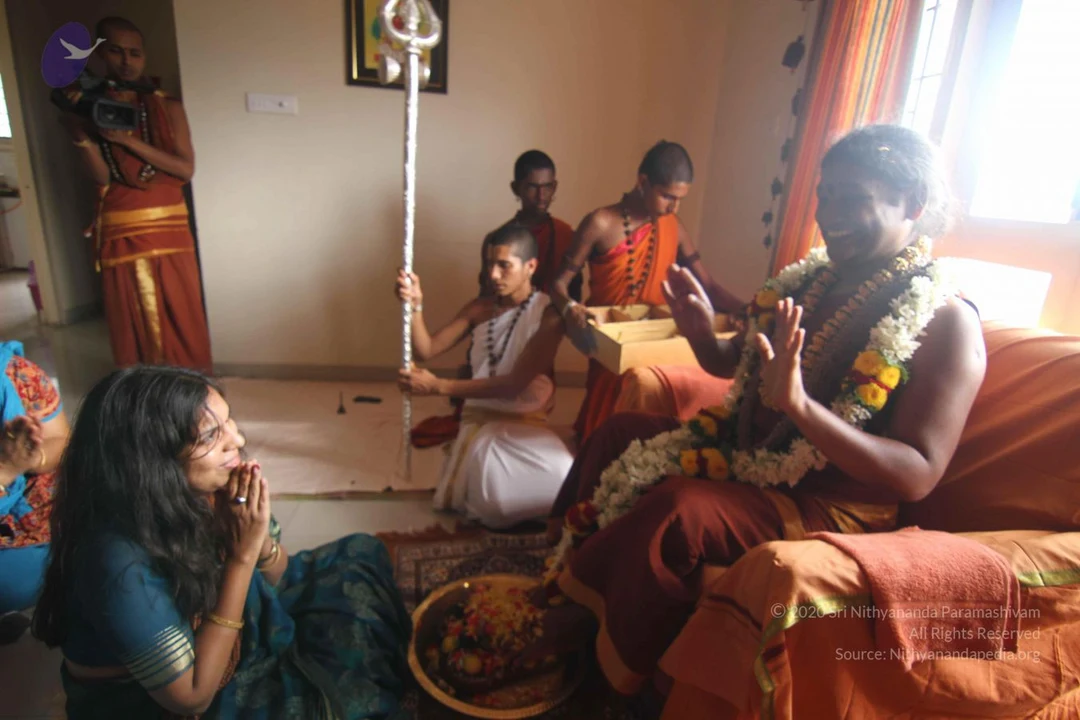
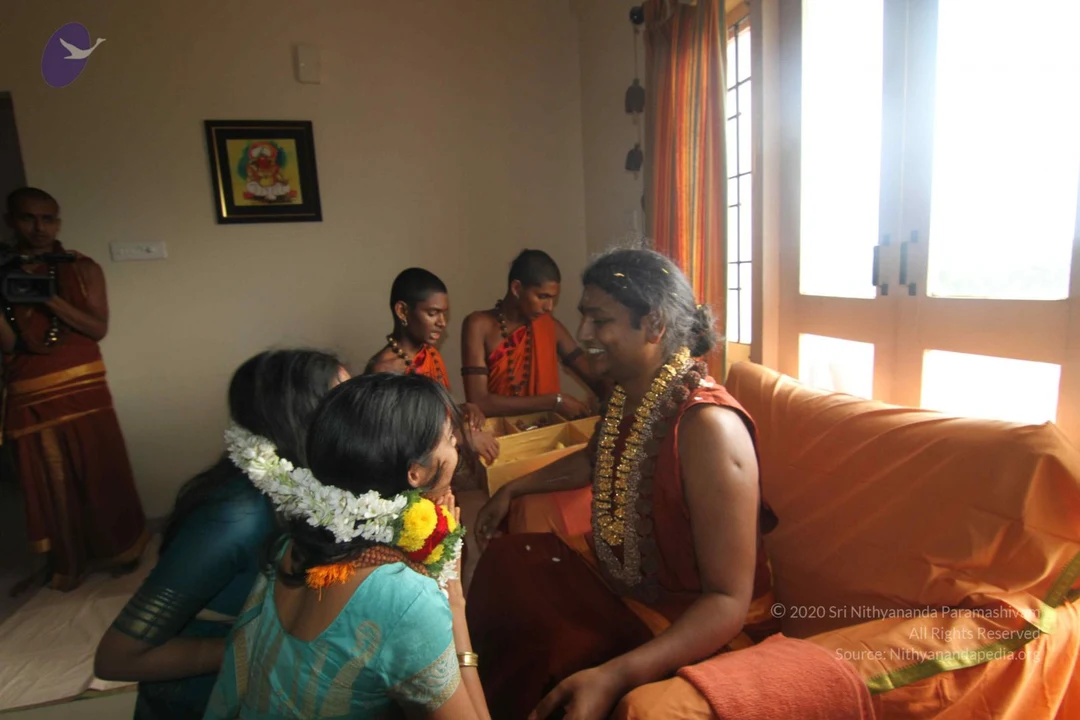
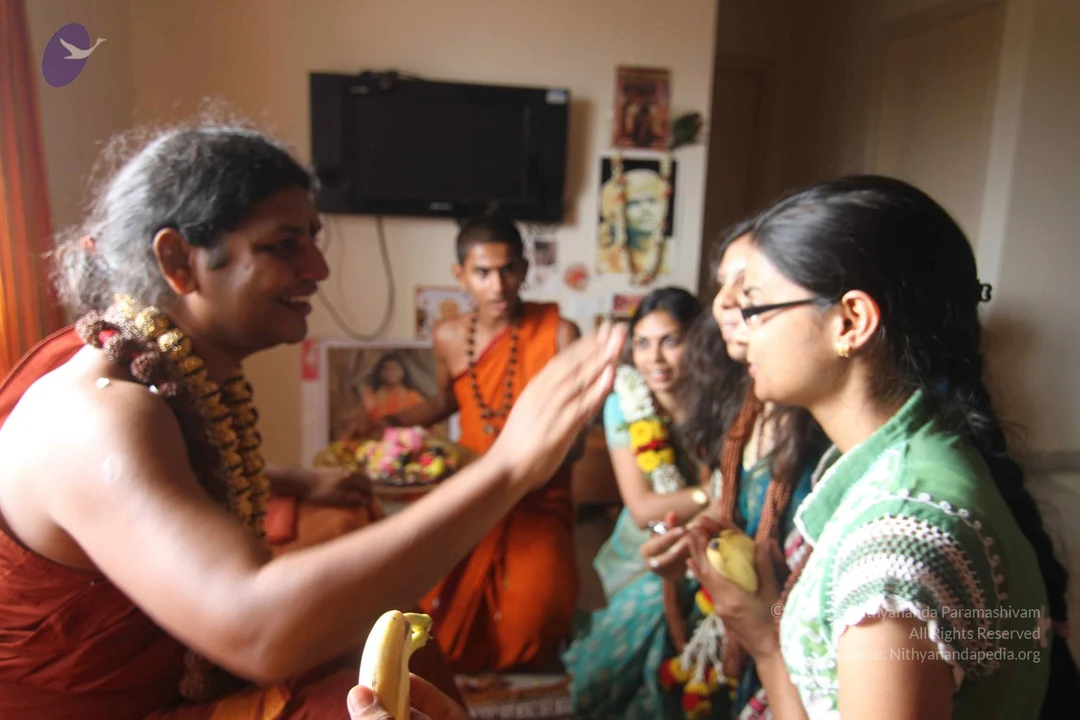
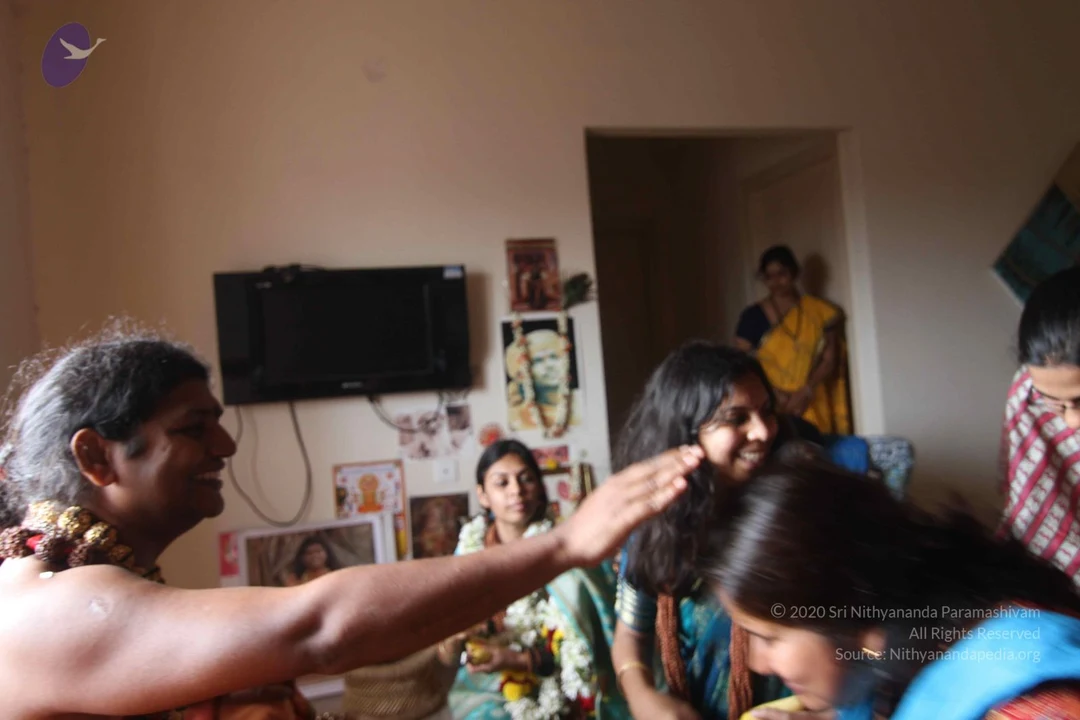
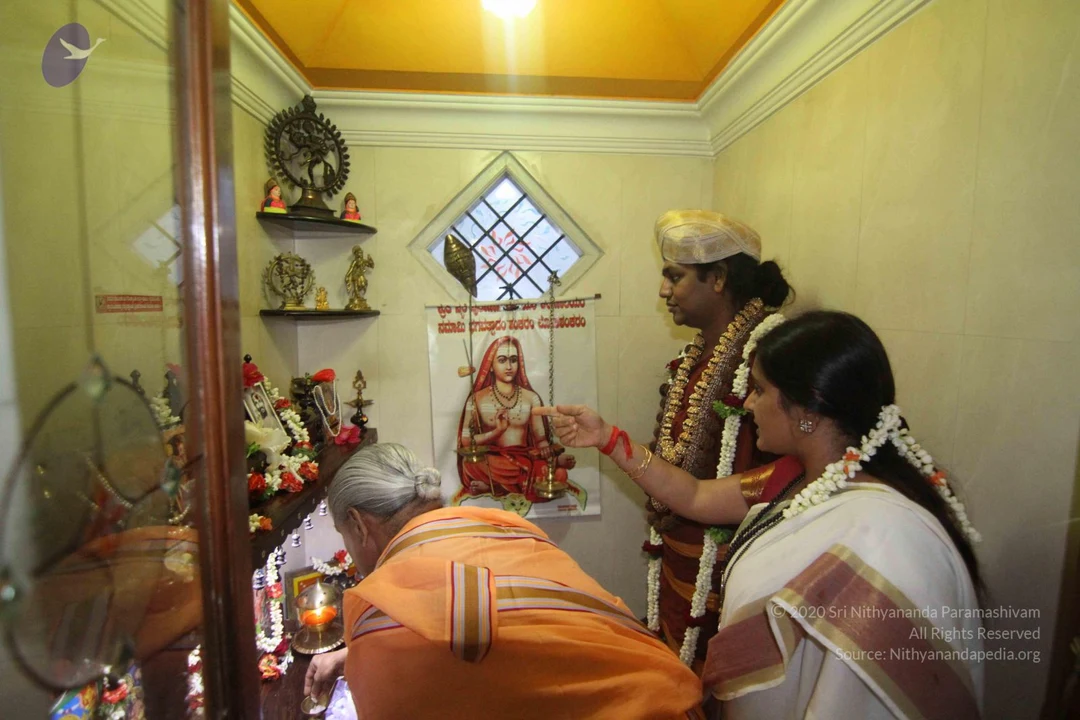
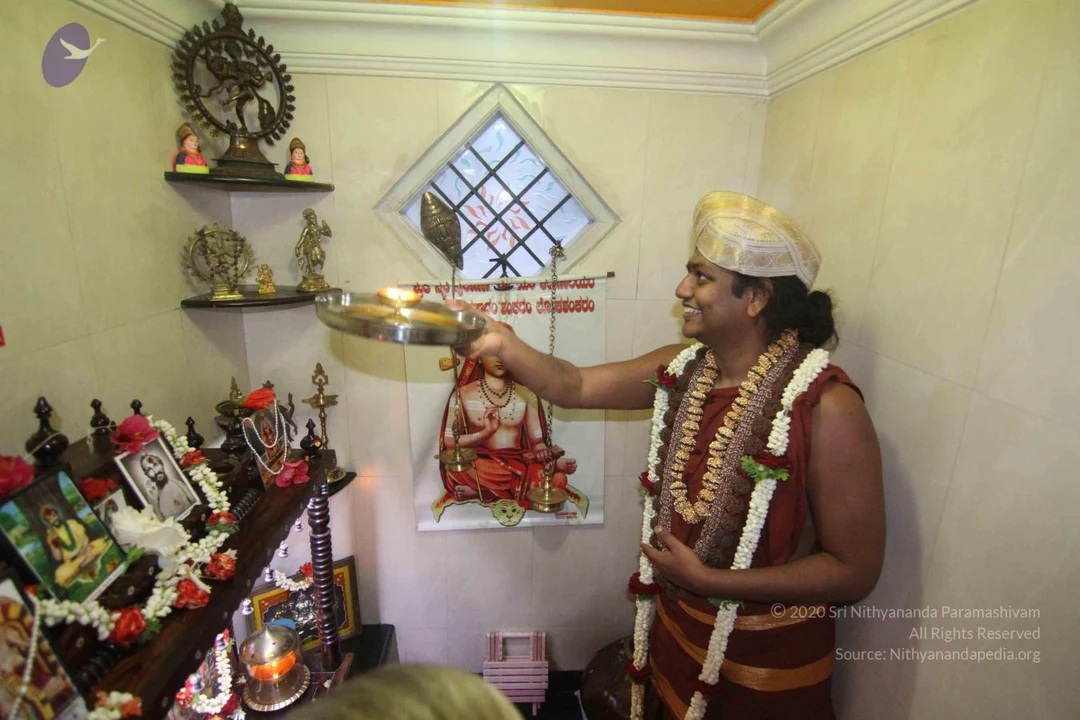
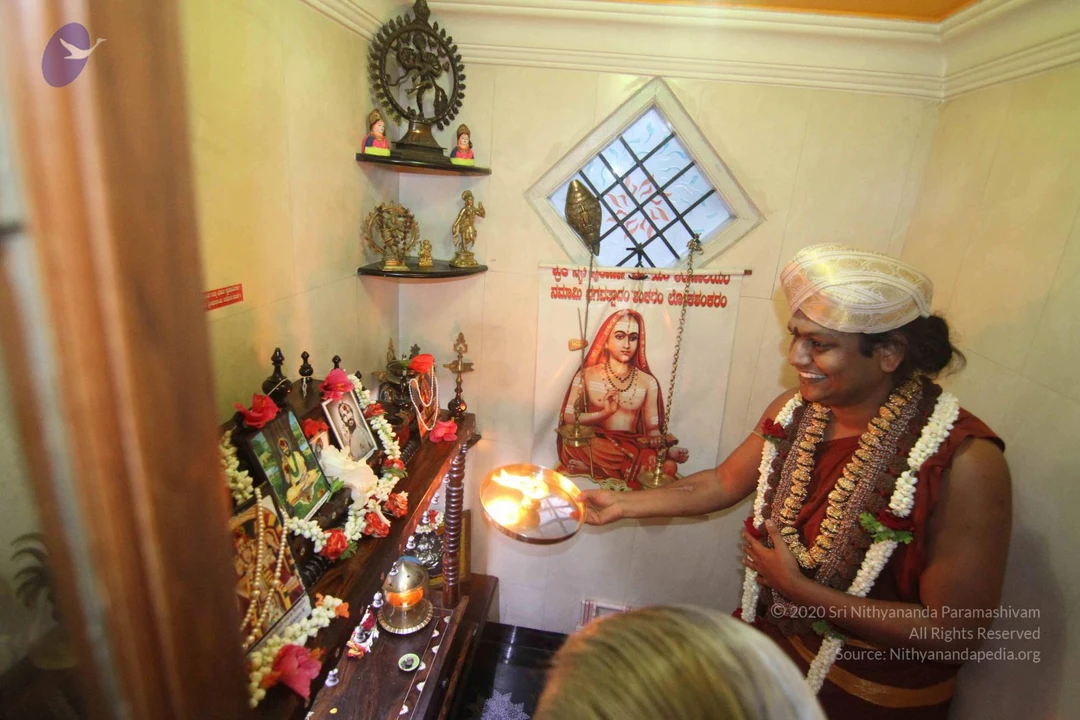
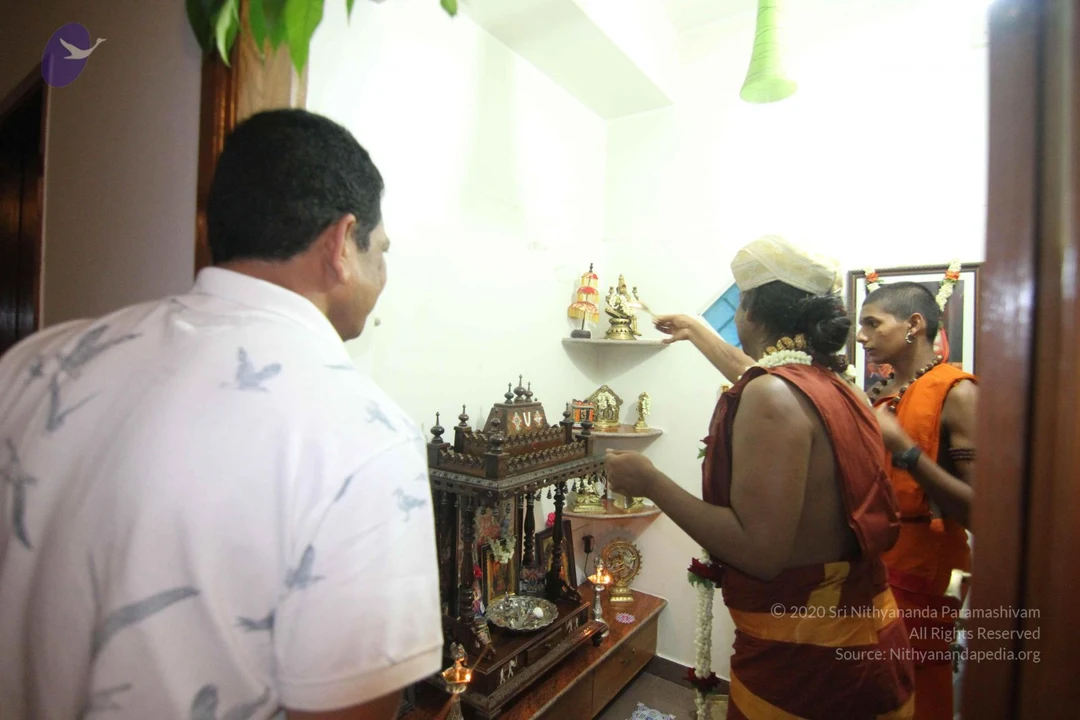
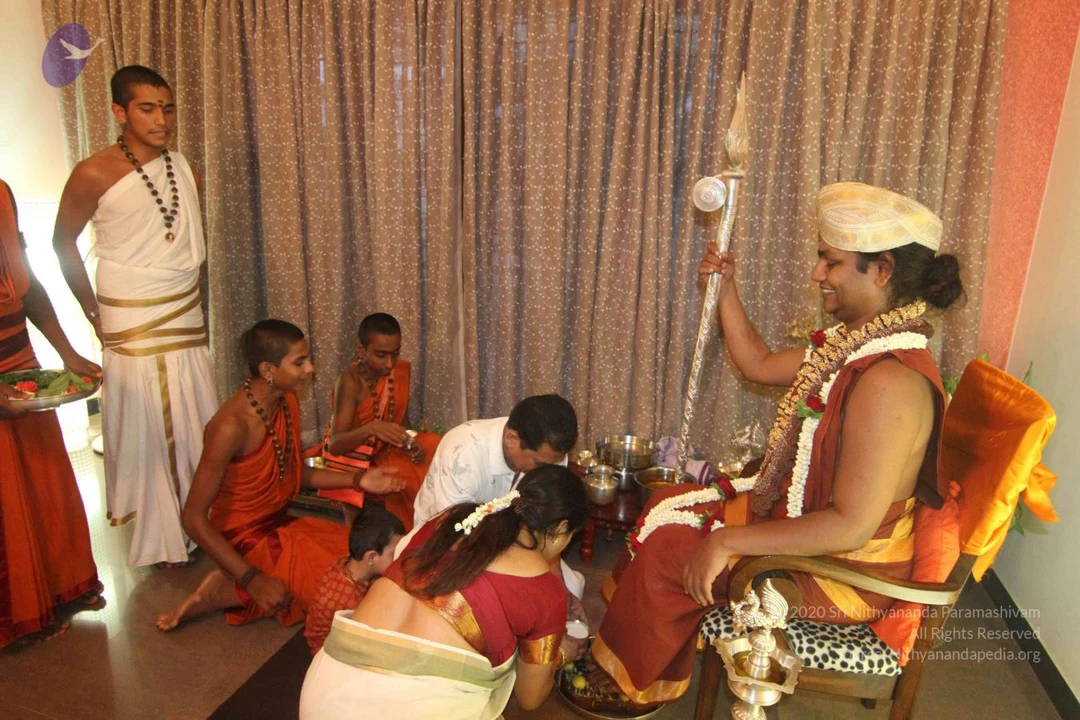
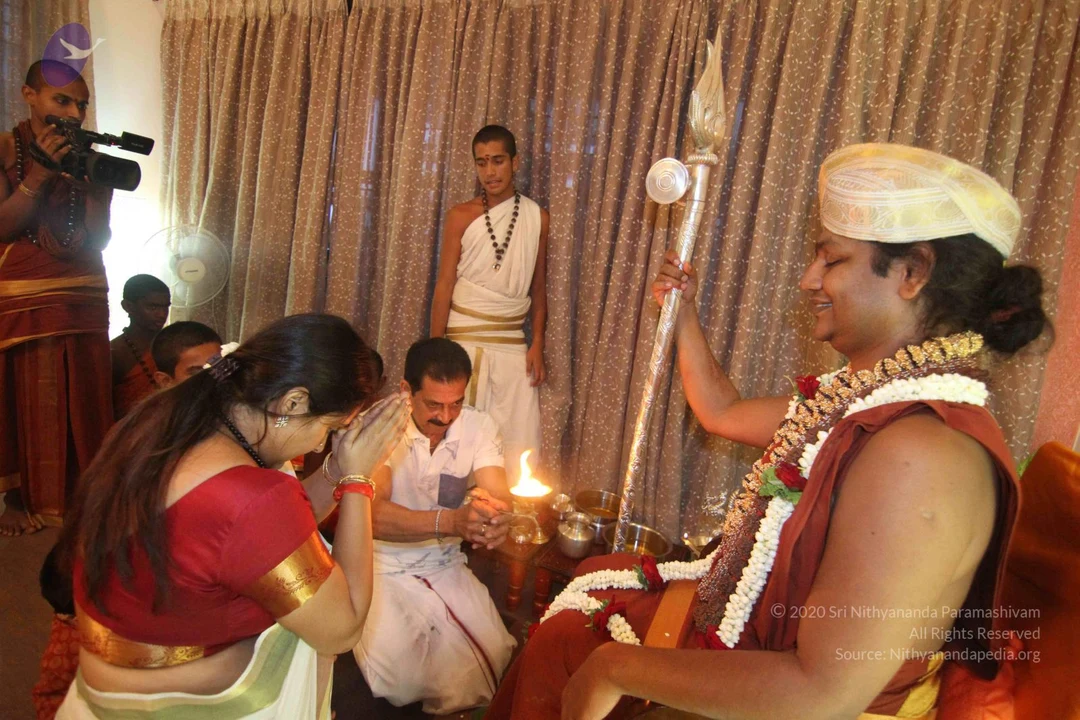
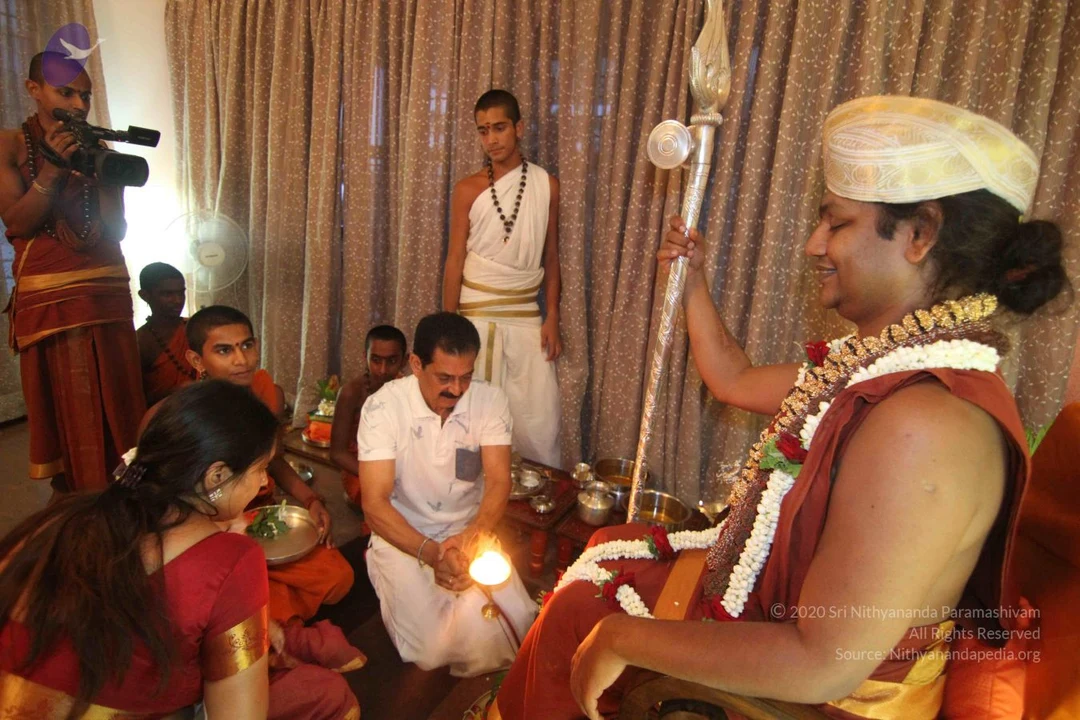
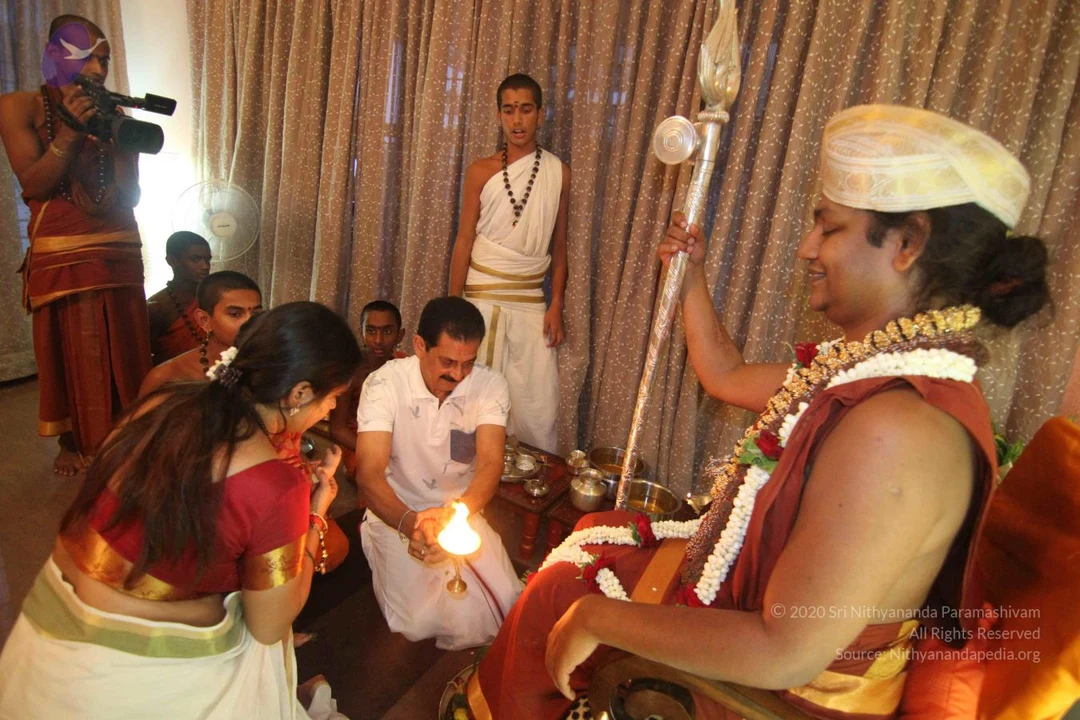
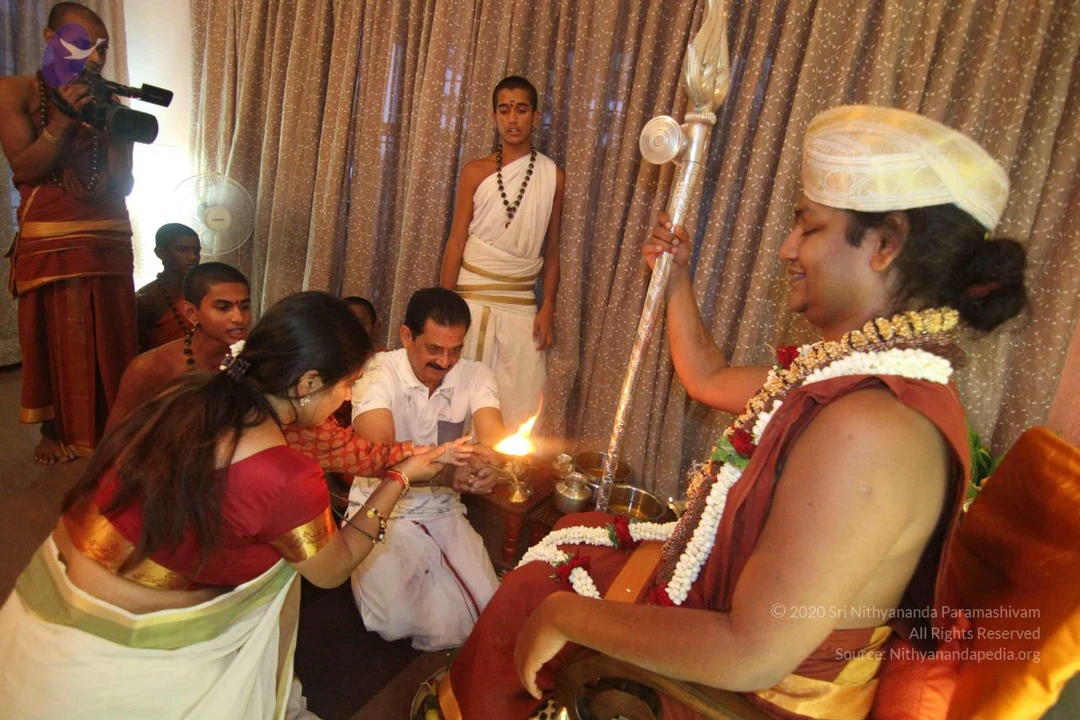
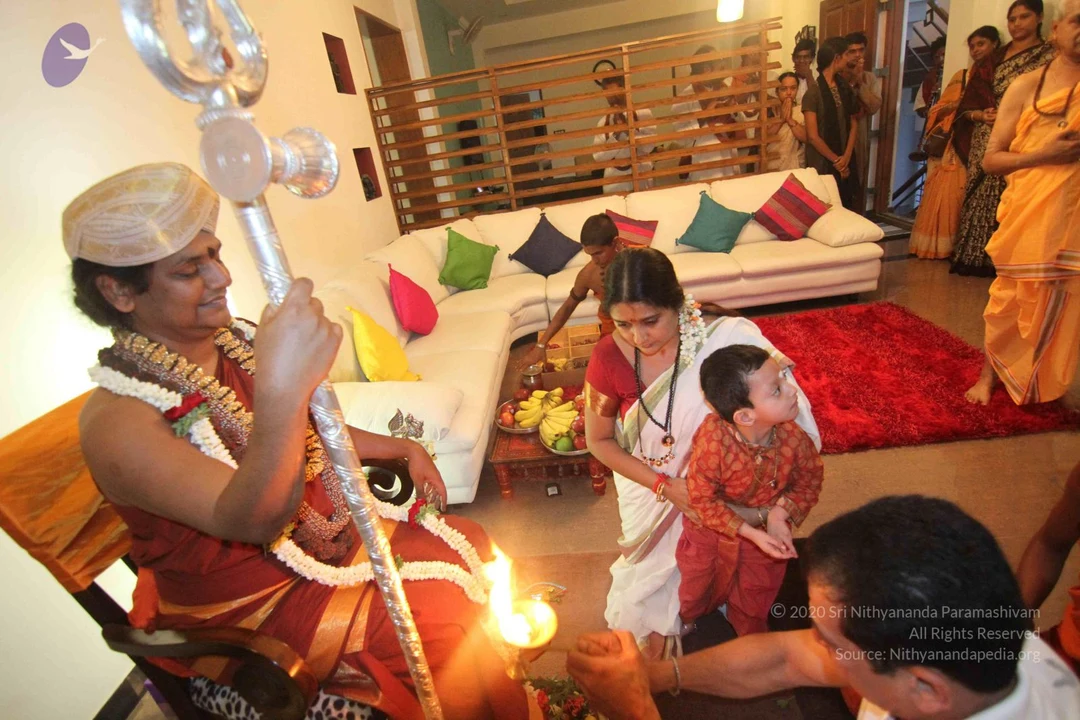
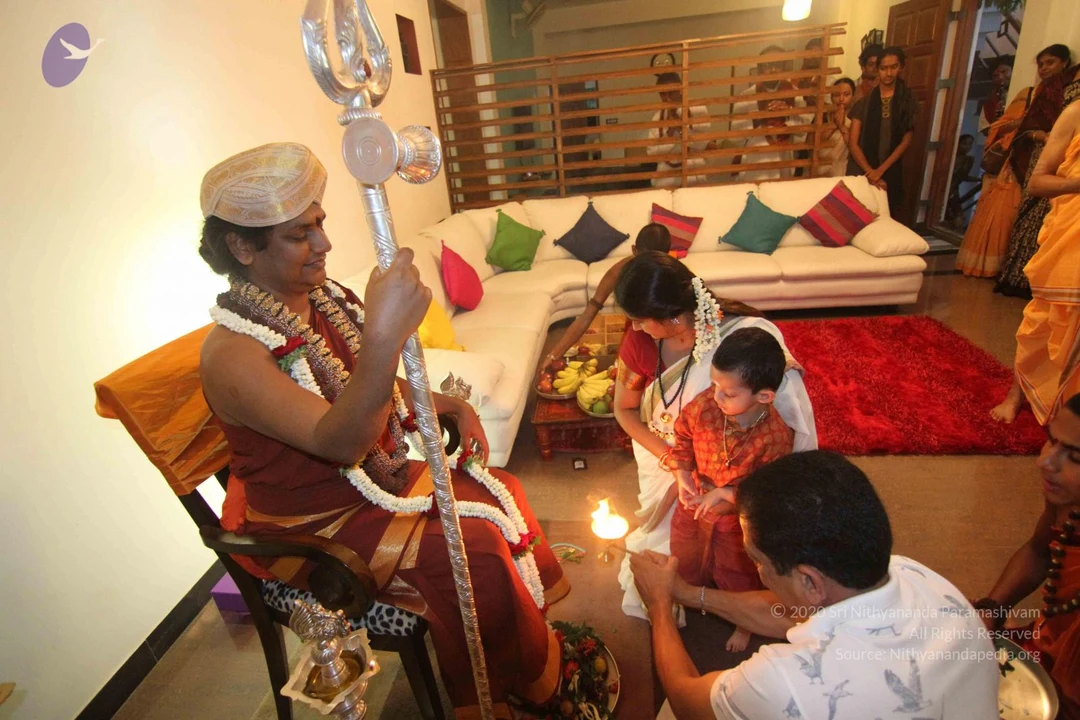
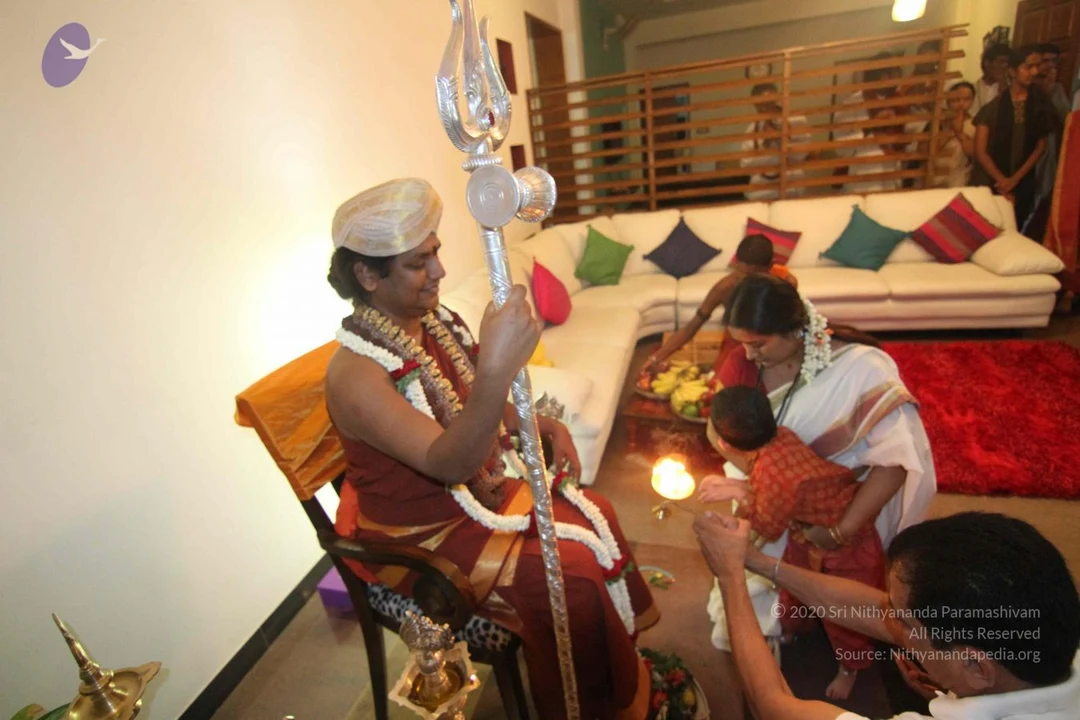
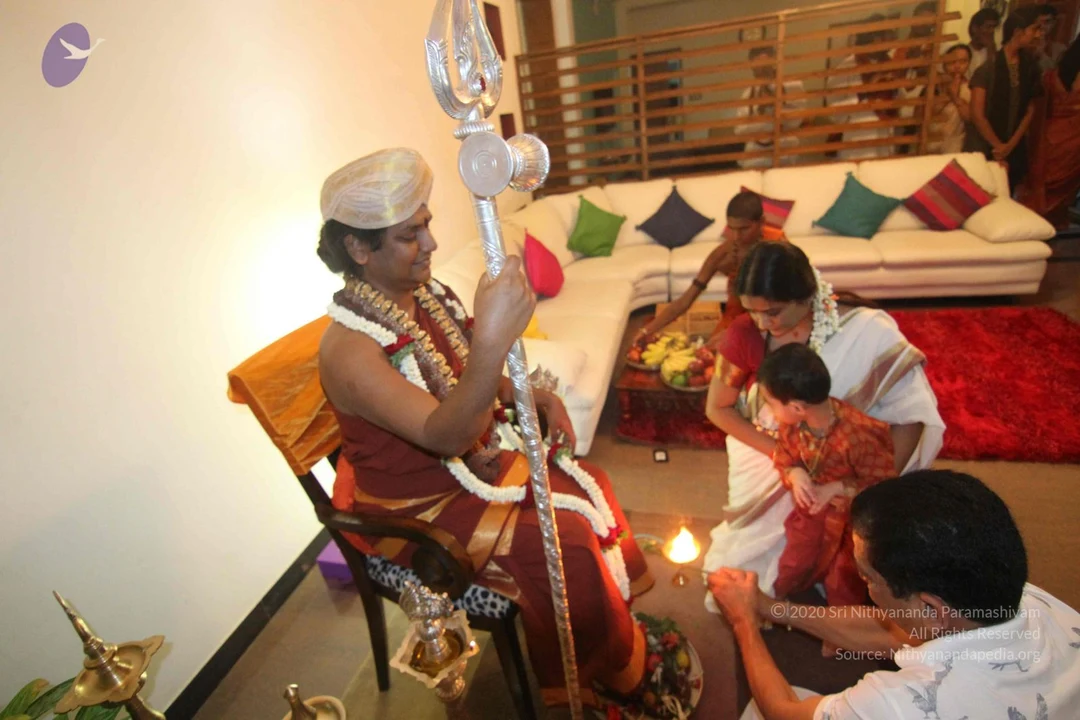
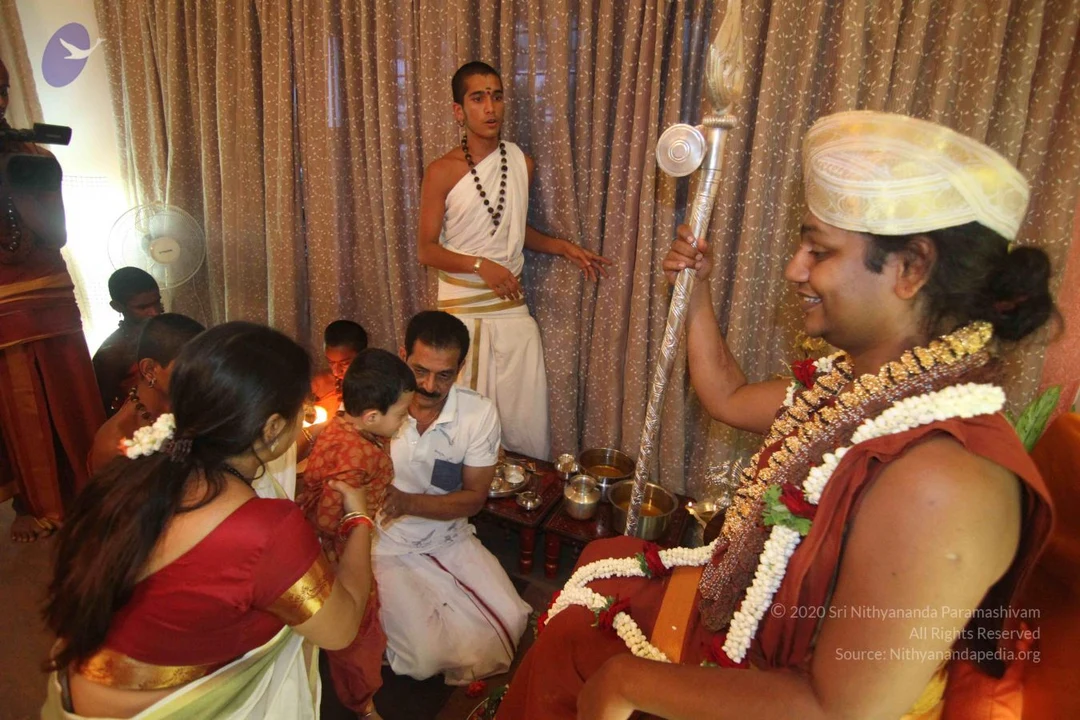
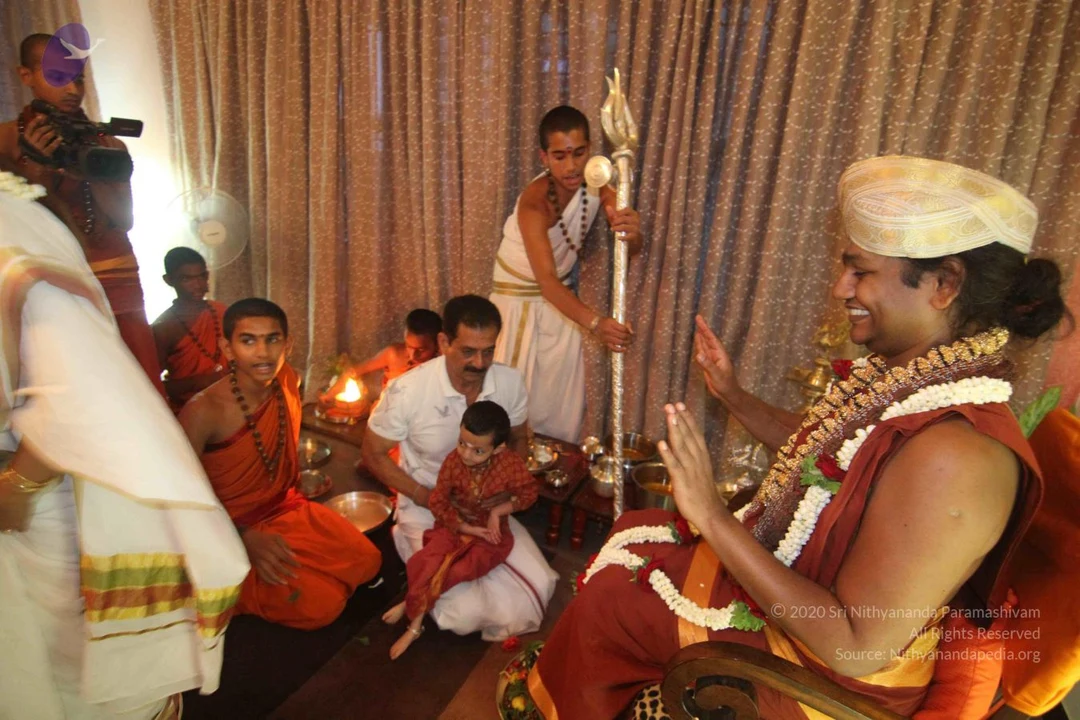
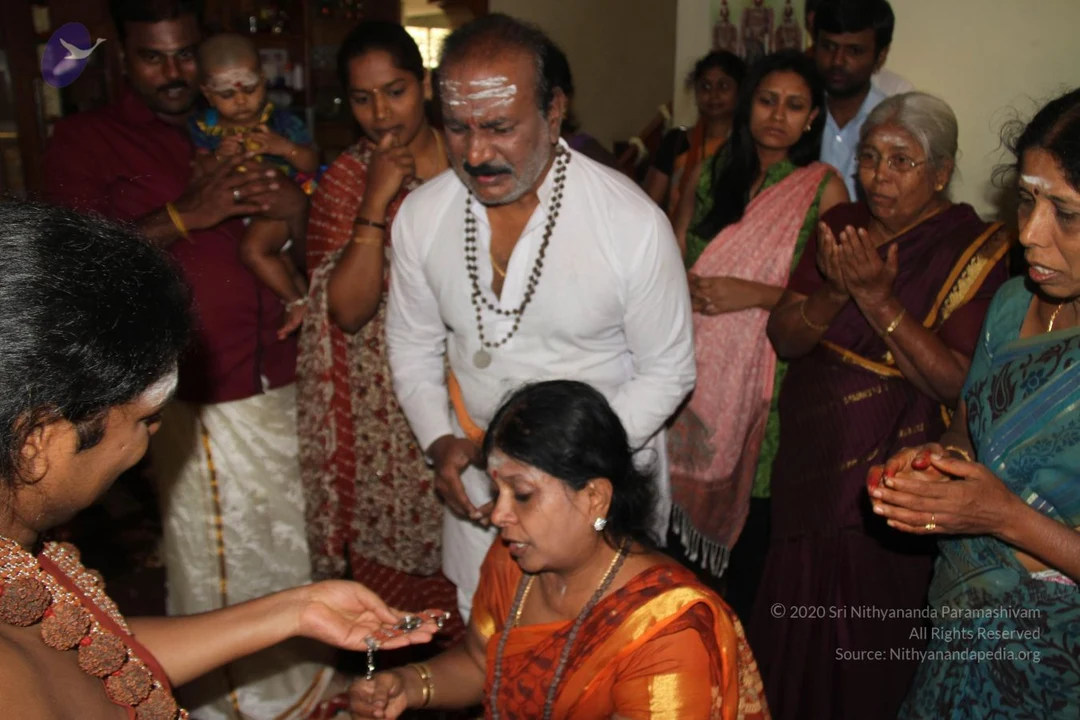
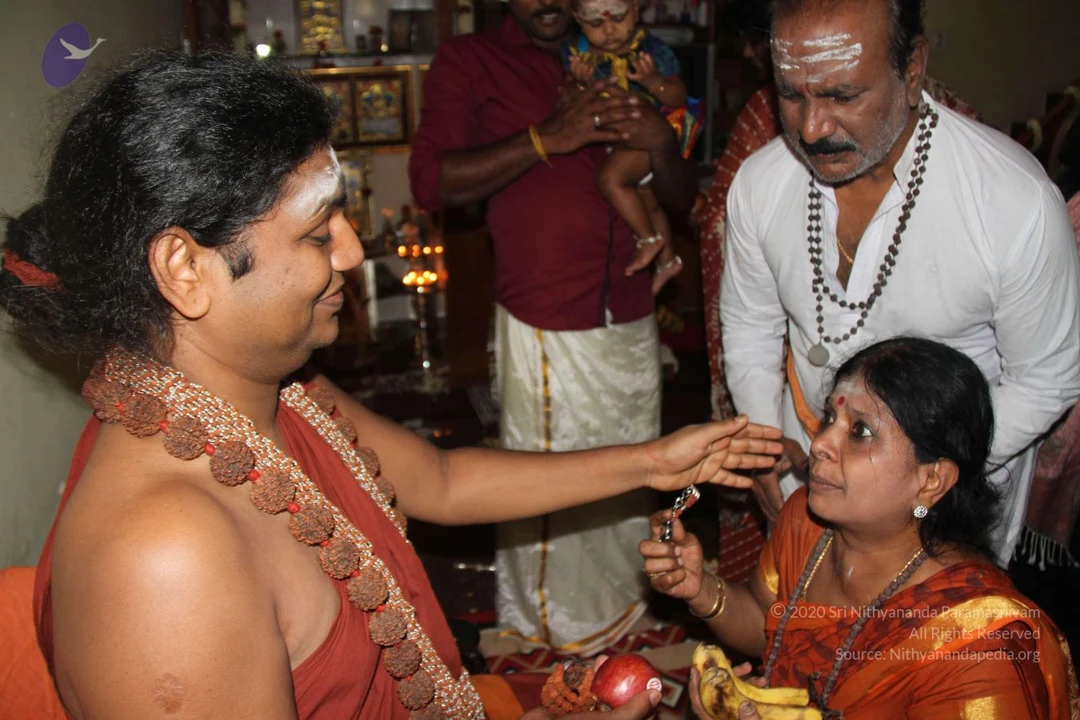
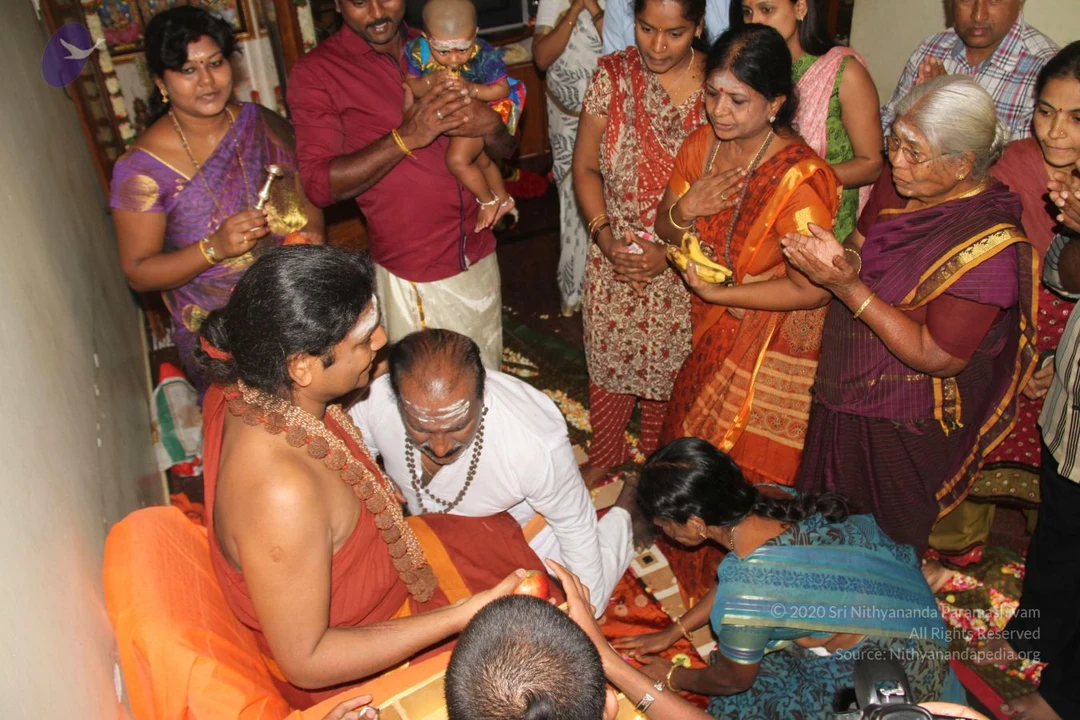
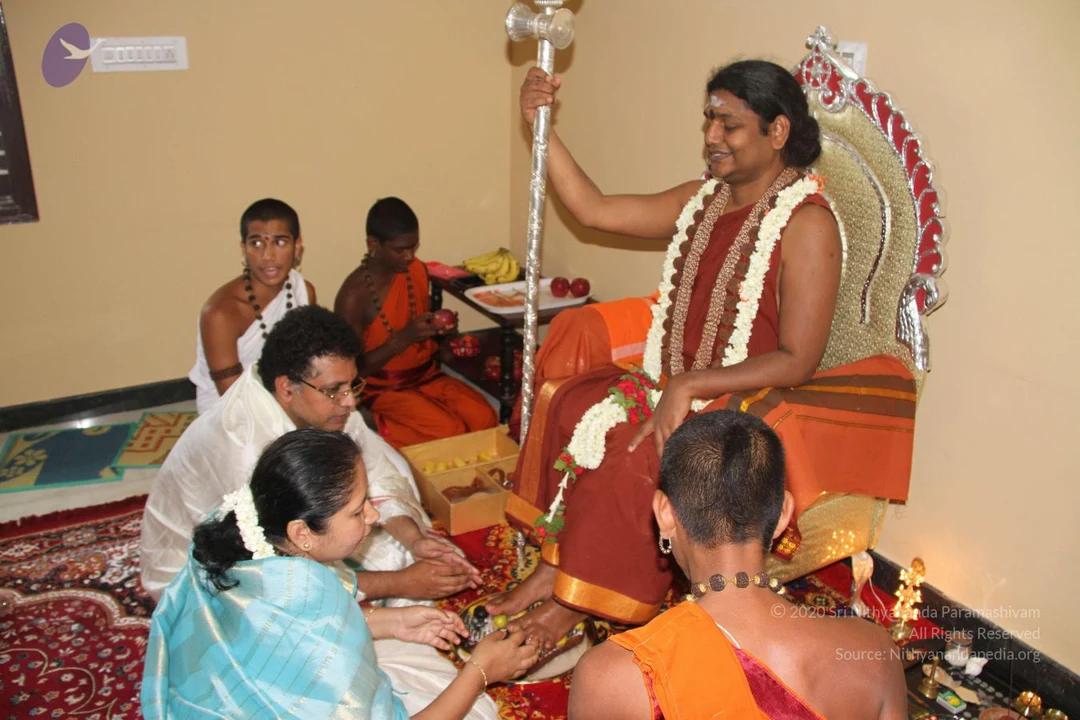
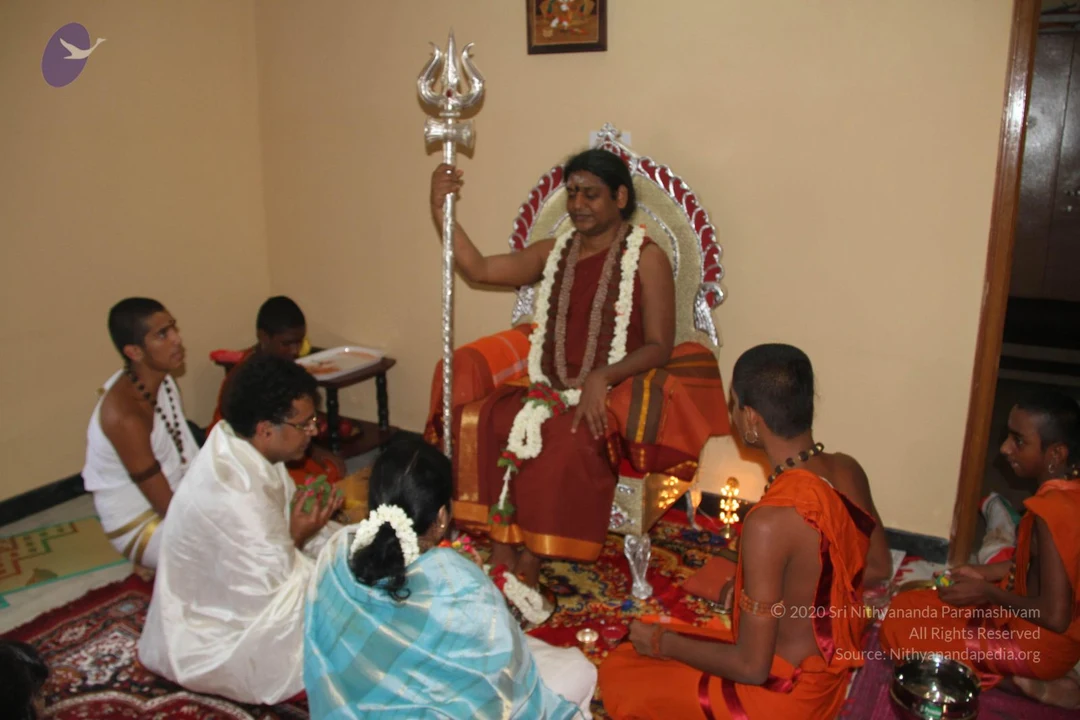
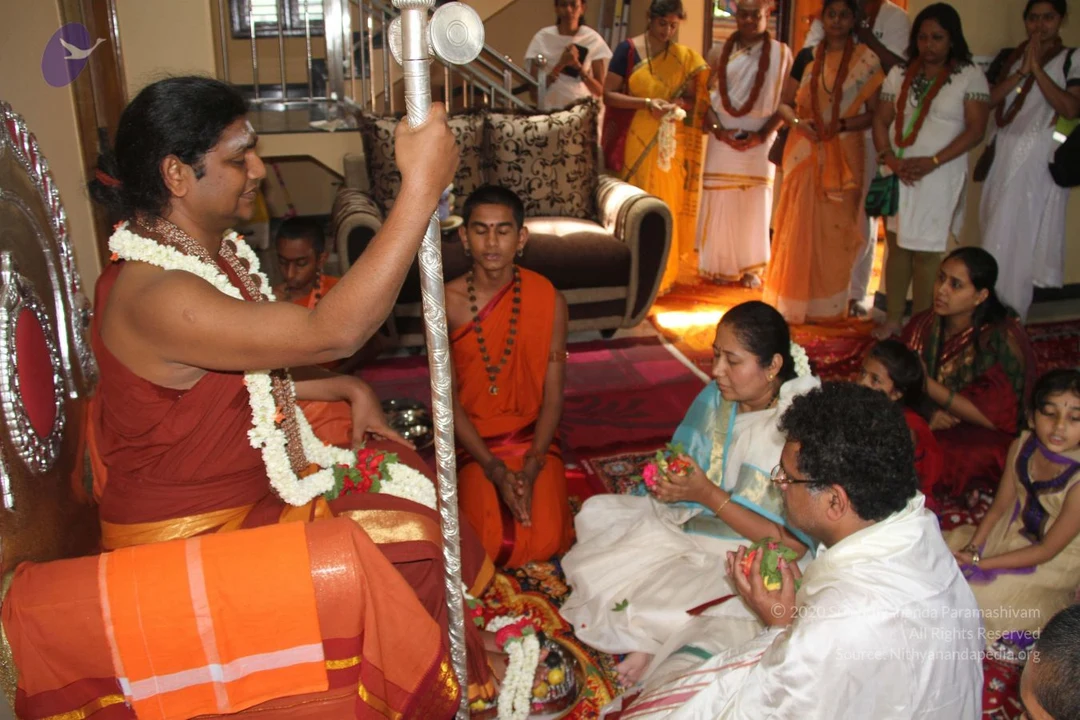
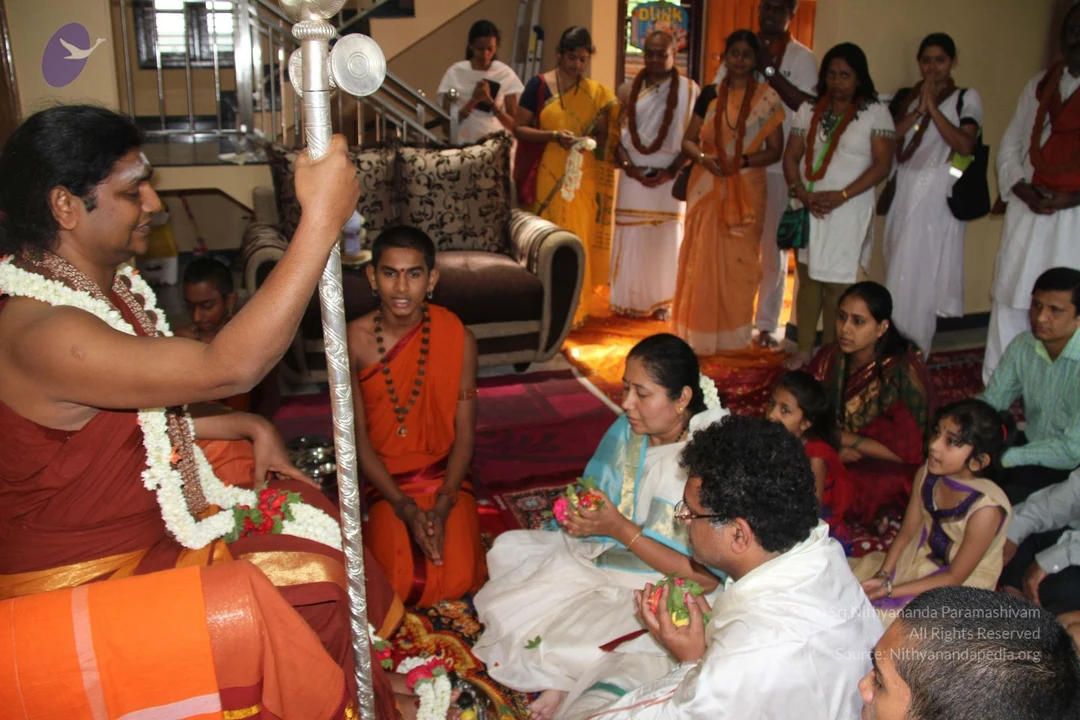
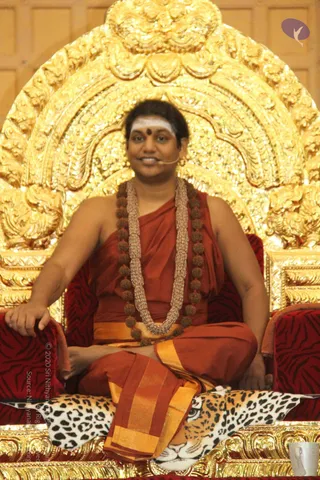
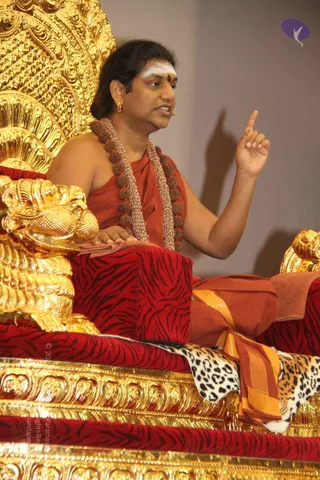
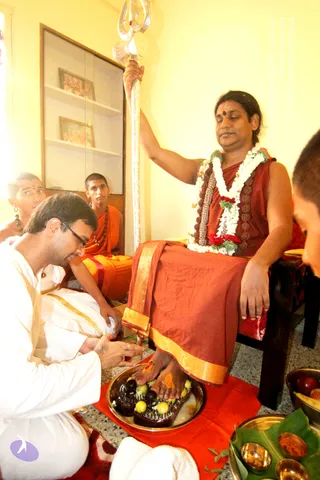
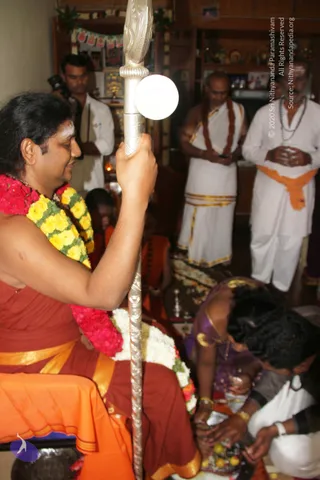
A street scene in front of a multi-storey shop front with signage for Raymond, Reid & Taylor, Apollo Munich and Rudraksha Ratna. Several people in saffron and orange shawls and white dhotis stand beside a dark car with a white 'NDAM' placard on its windscreen. A man in the centre wears an orange shawl and a rudraksha-style necklace and gestures with raised hands, while women in orange shawls and a girl in a pink top gather around the car. A bald man on the right holds an orange flag on a pole printed with a figure. Trees and parked vehicles fill the background.A photograph of a seated man in an orange-red robe and a cream turban, with a long silver staff topped by a ornament raised in his right hand, receiving padapuja in a room with beige curtains. He wears long garlands of white flowers and a beaded necklace, and sits on a wooden chair with a leopard-print cushion. Before him a woman in a red blouse and white sari with flowers in her hair kneels and washes his feet from a metal vessel, while a man in a white shirt bends forward beside her. Three young men in orange robes sit or stand nearby; one standing holds a tray of green leaves and fruit. A brass oil lamp and brass pots sit on a low table. Three people are visible in the seated group plus the standing attendants, so the count is in the 2-5 range.A seated man on the right wears a rust-red and orange robe with a white flower garland of marigolds and a dark beaded necklace, sitting on an orange cushion. A woman in a blue saree kneels at a brass basin, pouring or washing his foot with water and offerings. Behind them, young men in orange robes and rudraksha malas sit on a white cloth, one in white dhoti holding a tall silver staff. A cameraman in orange stands at the upper left. The setting is a bright room with a striped curtain. The seated man is not clearly identifiable as a person from appearance, so no identification is made.

July 10 2014

Original wiki page
Contents

Title:

Let Possibility Be Your Wealth

Description:

In today’s morning Satsang, Paramahamsa Nithyananda spoke briefly about the value of Nithya Keerthana to powerfully activate all our dimensions and awaken the Kundalini Shakthi and encouraged all Temples and centers to have a Nithya Keerthana group. Then he went on to speak about Karma and Blind-spots. He clearly explained how thinking a blind spot is inability is karma and knowing that the blind-spot is a choice is completion. The possibility you carry is your Lakshmi, the completion you carry is your Saraswathi and your willingness to make it happen is your Durga.

Link to Video:

VideoAudio

Transcript:

Nithyanandeshwara Samaarambhaam Nithyanandeshwari Madhyamaam | Asmath Aachaarya Paryanthaam Vandhey Guru Paramparaam ||

I welcome all the devotees, disciples, Kotharis, Thanedars, Mahants, Shrimahants, samajis, satsanghis sitting with us all over the world through Nithyananda TV, Sadhna TV, two-way video-conferencing having Nayana Deeksha.

Cities sitting with us having Nayana Deeksha through two-way video-conferencing: Dakota Dunes, Houston-Kalahasti, Hyderabad-Gupta Kashi, Los Angeles-Arunachalam, Seattle-Chidambaram, San Jose-Madurai, Toronto-Kailasam, Singapore-Singapuram, Ohio-Prayag, Guadeloupe-Rameshwaram, Oklahoma-Somanatham, Phoenix-Kanchipuram, Kula Lumpur-Palani, Jorpati-Nepal, Austin-Texas.......

I welcome all of you with my love and blessings.

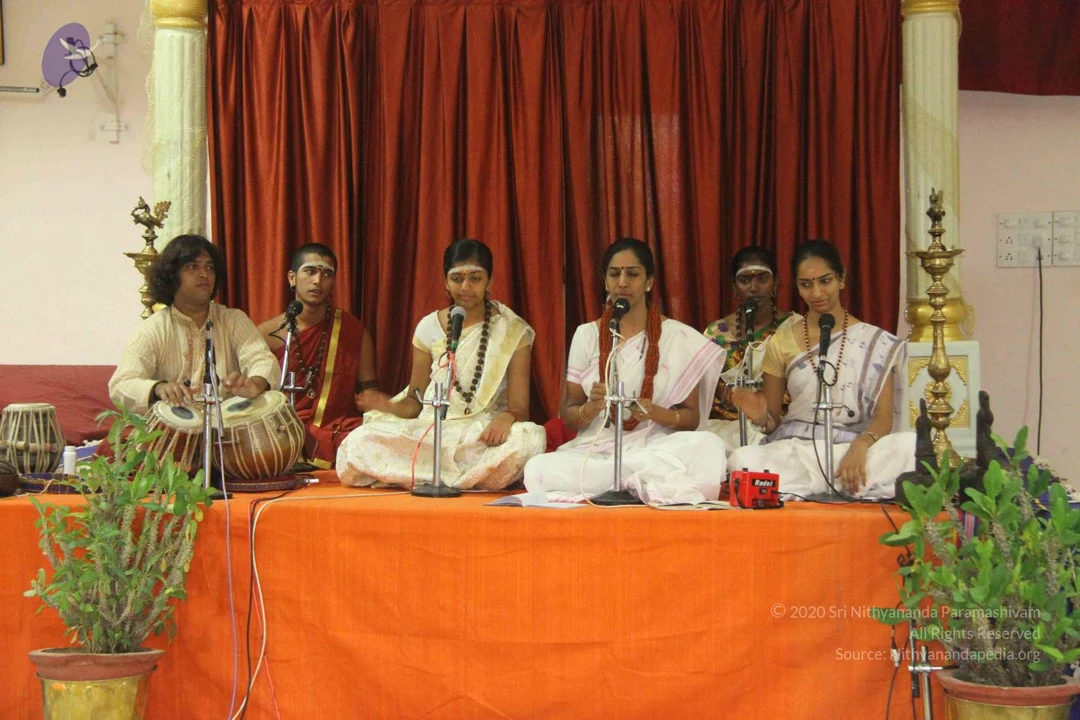
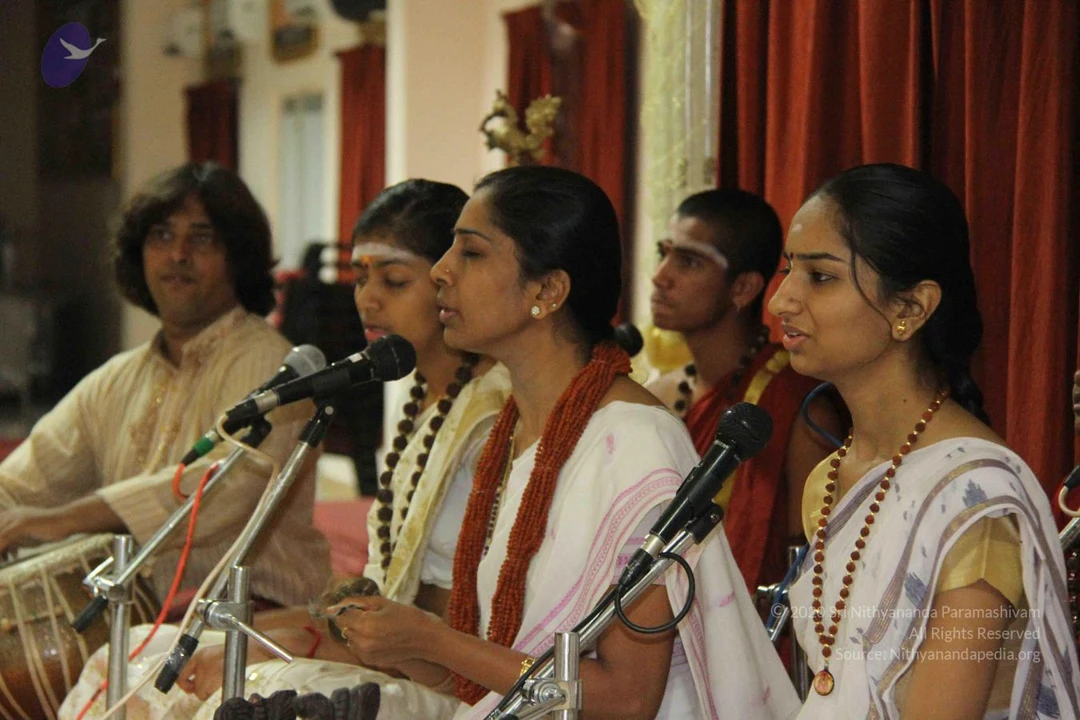
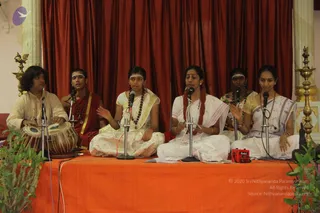
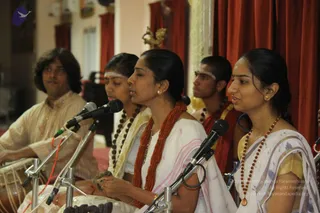
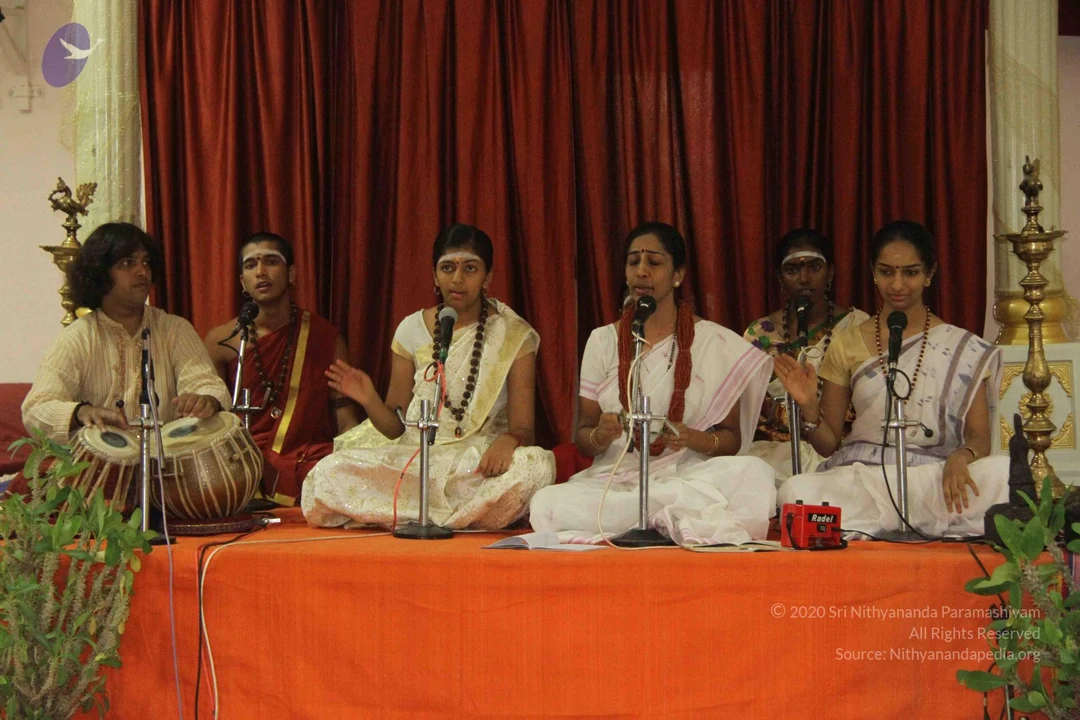
Thanks for the Kirtan team. Such wonderful kirtan in the morning! I am so happy that one of the important spiritual practices of Hinduism is added into our Sangha daily routine. I wanted all the components of the Vedic tradition to be made available here. We start our day with Nithya Yoga, then Nithya Kriya, then Nithya Puja, then chanting – Nithya Paaraayana, then now added Nithya Kirtanam, and Nithya Satsang. Every day, in the temple, Nithya Homa goes on. All the main aspects of Hinduism, Vedic tradition, should be made available in our Sangha. I am so happy it is happening. I also wanted all over the world all the ashrams and centres to develop your own Nithya Kirtan team, team of devotees, disciples who can sing well, do Nithya Kirtan every day. Let the Nithya Kirtan become a practice in our life.

As I said already, from Jnana Sambandhar to Ramakrishna, all the great incarnations have agreed and accepted the power of Kirtan. They all promoted Kirtan so much. This is one of the direct ways to blow away all the incompletions, clear all the incompletions away. That is one of the beautiful, most beautiful spiritual practices. See, Poornathwa Kriya, Completion process uses your intellectual abilities to awaken your consciousness; it pushes your intellectual buttons rightly and awakens your emotional capability, conscious capabilities, Kundalini Shakthi. Nithya Kirtan pushes the right emotional buttons and awakens your Kundalini Shakthi, your consciousness. I tell you, the Kundalini awakened, energy released, consciousness raised is ten times more if your emotional button is pushed than your intellectual button getting pushed! In the intellectual button, you have to be all alone, sitting and drilling. In the emotional button, the whole life supports you, all your dimensions and energies support you.

It is time one of the important aspects is added to the sangha, added to our every-day life, added to our spiritual practice, added to our spiritual sadhana to awaken our inner potential energy and Kundalini Shakthi. Nithya Yoga, Nithya Kriya, Nithya Puja, Nithya Kirtanam, Nithya Paaraayana, Nithya Satsang, and Nithya Homa, Nithya Annadhaana, all the aspects of Vedic tradition should be practiced and made available to the whole world. We should enrich the world with all the major aspects of Hindu tradition, the Vedic tradition.

Today, as part of the Satsangh subject, I will say a few words about Karma. This is one of the most talked-about subjects. I have also talked about this subject, Karma, many times, from many aspects, from many dimensions. Now I wanted to talk about Karma from the angle of blind spots.

Please listen! Anything which you don’t understand in life, where your logic is not ready to penetrate, be very clear, it is simple incompletion which your logic does not want to see. Listen! Anything in your life which you don’t understand, which you are not able to grasp, is the incompletion which you don’t want to look into. Your consciousness by its nature, its swabhaava, is “Swayam Prakaasha”, by its nature, self-effulgent, “Swayam Prakaasha”, self-shining. So, there is no such thing which you cannot understand in life. Whether it is which graha (planet) moving where, which star moving in which direction, or how to use your remote control and operate the TV in front of you, or the various aspects of the electronic gadget which you newly bought, anything, please understand, anything, your logic is “Swayam Prakaasha” to locate, to look. Whether understanding a Law book, or understanding a musical instrument, or understanding some truths about Botany or Biology or Zoology, understand, the truth is, your consciousness is self-effulgent, “Swayam Prakaasha”. This is the principle I am directly applying and proving in our Gurukul, don’t you see?

None of our Bala Sants had training or coaching in any field. None of their teachers know more than what they know. That much I can guarantee. None of their teachers know more than what they know. But they go on excelling in so many things, and they will go on excelling in so many things. This will be the new brand of education in the world, Nithyananda brand of education where the basic principle is not you need to be told or educated, but you need to look in or concentrate your self-effulgence, your “Swayam Prakaasha”. If you are not able to understand something, it is your own incompletions, you don’t want to look in. Understand that at least. At least know the right reasons for your powerlessness. You can complete and get out of it.

Your ignorance is not inability; it is your decision not to look into that truth. Please understand, never label your ignorance as your inability. No! Every problem, you should do a right post-mortem, so that you can avoid it the next time. Every accident, we should do the right post-mortem, so that we can develop a system to avoid that later. Don’t say, ‘Oh, after all he is dead. What is there? Leave it!’ No! Do post-mortem and learn the lessons. Same way, every problem you have, do post-mortem and have the right intelligence. Do post-mortem and have the right intelligence. Do post-mortem and have the right intelligence.

Your ignorance is not your inability; it is your decision not to look in, your incompletion, your decision not to look in. Understand, your decision not to look in is your ignorance. I wanted to repeat it. Your ignorance is your choice. At least have the right understanding about your wrong understanding. If you have the right understanding about your wrong understanding, you can complete it. Why you don’t want to look into something is second; but know very clearly, your ignorance is the area you don’t want to look in, not your inability to look in. Please understand, when you understand there is no zone you don’t want to look in, there is no incompletion, your pure self-effulgence is fully alive and ready to look into anything and understand anything, no incompletion stops you, you are “Sarvajna”. Understand, “Sarvajna” does not mean he KNOWS everything; it means he CAN know everything! Understand the difference. This is one of the biggest confusions Hindus go on entertaining, infused by the stupid western intellectuals.

We have so many Sarvajnas who existed in our tradition, all-knowers. They established so many Sarvajna Peethas. Western intellectuals always questioned, ‘If your ancestors were all-knowers, Sarvajnas, why they didn’t invent train?’ So many questions they ask. First thing you should know, it is not that they have not invented; it is that they have not patented, that is all! Second thing you need to know, you should understand the context properly, the meaning of the word “all-knower” properly. It means, they can know anything they want.

When Ubhaya Bharati asked Shankaracharya about the secrets, knowledge about physical relationship, he didn’t immediately have that knowledge, but he could straight get it. He could send one ray of his energy into somebody’s body and see the whole action, science, what happens in and out, and was able to explain the whole thing to Ubhaya Bharati. Understand, it means being a celibate by birth, but not out of any incompletion towards sex. He is simply able to look in! It means, he does not have any incompletion. He has not become a celibate because of any incompletion. He has not become a celibate because of any incompletion. HAHAHAHA! That is the beauty of brahmacharya in Vedic tradition....brahmacharya in Vedic tradition. If he has become a brahmachari, celibate, due to some incompletions with sex, he cannot straight look into that science and answer Ubhaya Bharati’s questions. The moment Ubhaya Bharati saw Shankara, the motherliness in her was awakened. Like Meenakshi, representative of Meenakshi, the Pandya queen, Mangayarkarasi, when she saw Jnana Sambandhar, immediately she felt the motherliness. Mangayarkarasi was basically from the Chola Kingdom. She was married to the Pandya King. Ubhaya Bharati, even though she felt that motherliness, she somehow wanted to win against Shankara for the sake of her husband. The moment she put the question, simply Shankara was able to look in, see Kashi Raja’s body. He sent one ray of himself into Kashi Raja’s body.

Understand, the pure consciousness, when you don’t have incompletions and want to look into, you can just look into any one person’s brain, or look through any body. Usually, that is what I do. If I want to have knowledge about any subject, I will pick up that book, just concentrate on the knowledge of that author, the thought-trend of that author, download it and absorb, and throw the rest. Not for pride, even now I tell you, I challenge, get me any book in the world, whether it is about Astrology, Astronomy, Gemmology, Zoology, Botany, Biology, Law, anything, in a few hours I will give you the essence, the thought-trend of the whole book! Because, in Vedic tradition, when you don’t have incompletions, you can look into anything, you can know anything.

Not having incompletions to know anything is what we call “Sarvajna”. I will make Sarvajnas out of my kids! No, really! I am making this huge library just for my kids. Actually, I don’t want to teach anything in the Gurukul other than language. Just teach them language by the age of six, seven, and leave them in the library. Let them master the science of knowing anything they want. They just need the consciousness without any incompletions. Means, the idea, ‘I can know this’ should be developed in them, that is all. I tell you, fortunately I never went to school and learned these teachers’ incompletions and stupid mentality. Stupid fellows go on teaching impossibility to kids. Means, by making it so difficult, saying that you have to read line by line, and after that do this, this, this, this, memorise, and saying that memorising is difficult....! Making it like a monster! Just because they have to have power over the kids, they exploit the kids by teaching the kids that knowledge is difficult. I will show the world that knowledge is just like breathing, as easy as breathing! But these stupid teachers made even breathing as difficult! They have not left anything easy! Like pharmaceutical companies and doctors made health as difficult as possible! These psychologists’, psychoanalysts’ associations go on discovering, every fourteen days, fifteen days, one disease they discover just to have more and more people covered under their fold. Same way, stupid so-called teachers go on making knowledge as difficult as possible. I will produce Sarvajnas out of my gurukul kids and teach the world how simple knowledge is!

Still when I remember, my eyes become watery. These village men and women who are my gurus, both my gurus – Yogananda Puri and Vibhootananda Puri – what an extraordinary intelligence they were having! From the beginning, they were so clear. See, by being around them, automatically I picked up this attitude of “anything I want to know I can know, anything I wanted to do I can do”. This was not taught systematically to me, please understand. Like how in our ashram if you live, you will simply get the confidence to do Completion and Nirahara Samyama because every other person will be doing Nirahara Samyama, every other person will be sitting and doing Completion. You will not have neck pain to wear this big mala, because every other person will be wearing! Just things are in the air! See, there are some things which are not taught; you pick it up from the air. With both my gurus, it was so amazing, just in their air I picked up, in their presence I picked up that if you want to know anything you can know simply, if you want to do something you can do simply! I never knew, whether it is swimming or climbing a hill or anything, human-beings need to be taught! I always thought, if you want just jump and do it! Not just this swimming and trekking, but everything.

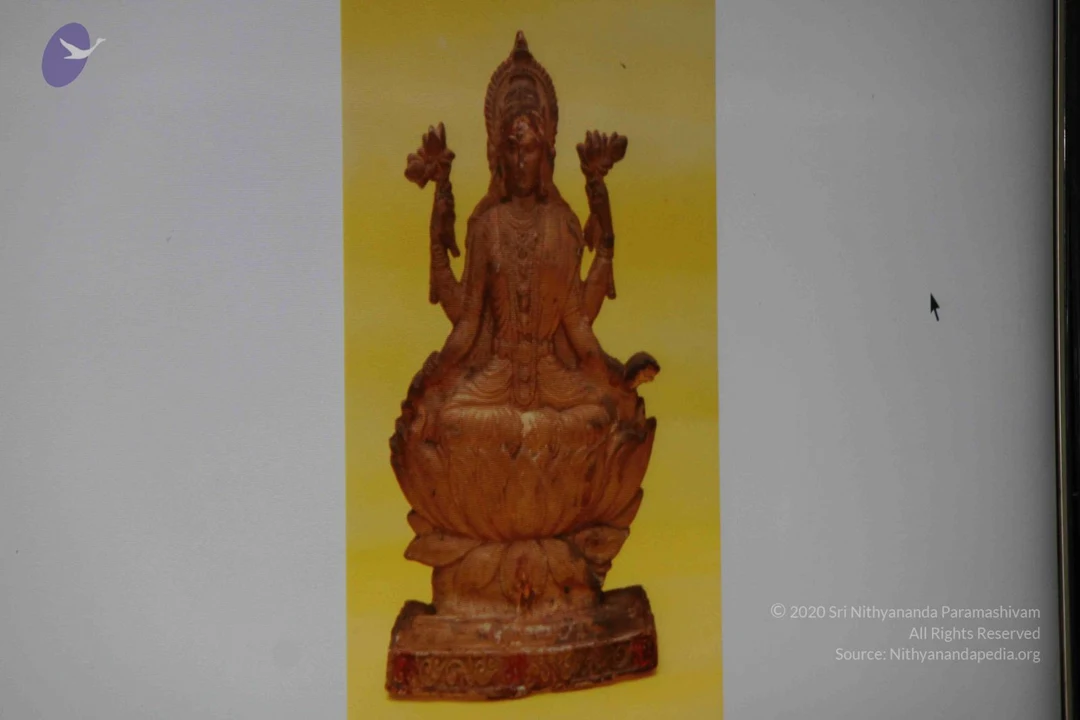
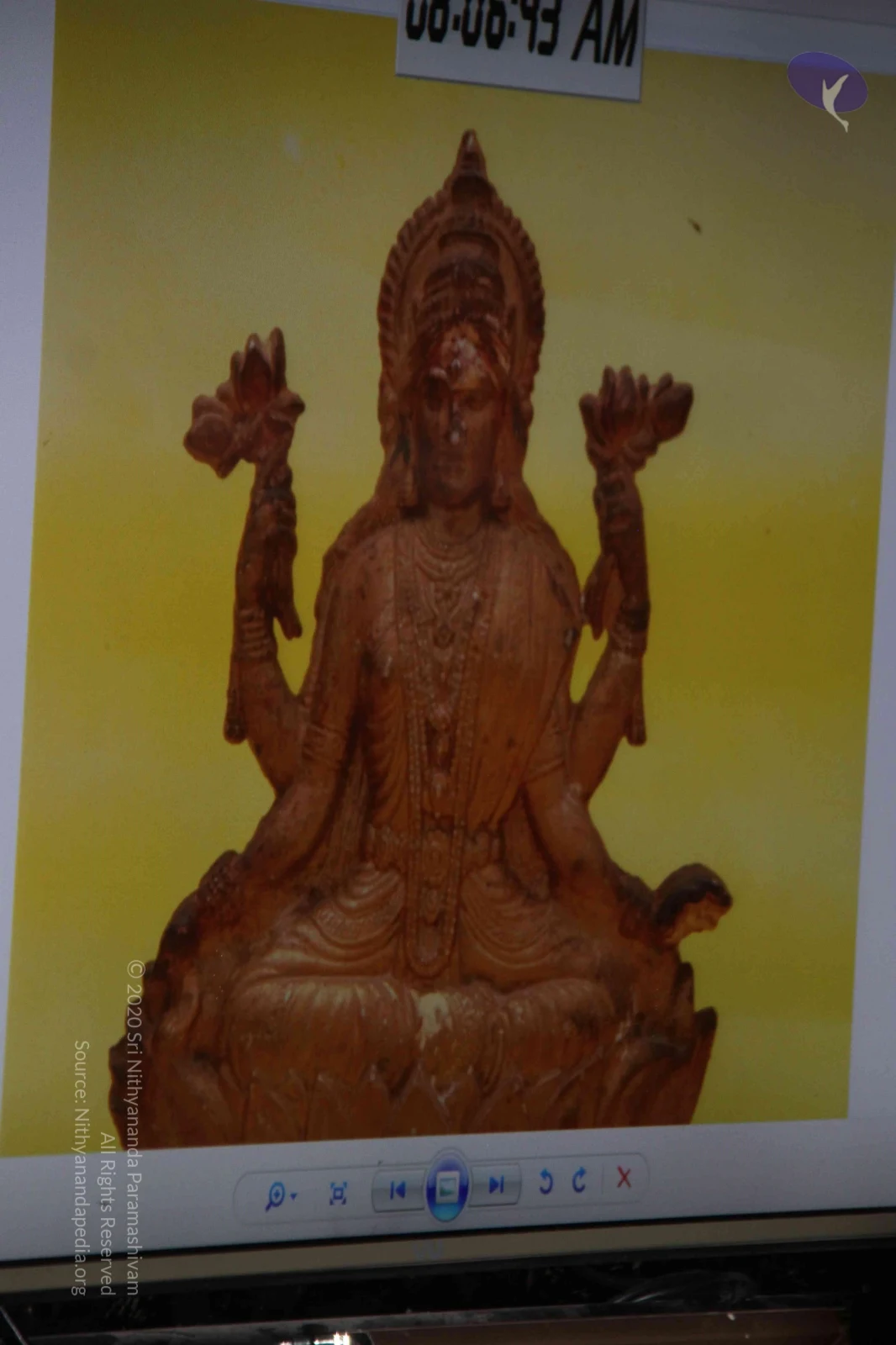
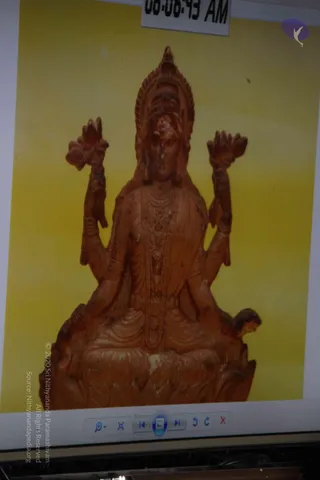
I still remember one day I went to Mataji Vibhootananda Puri and told her, ‘In the temple such a beautiful deity is there! It is so nice! I want like that!’ She said, ‘You make it!’ I did not even ask how. And, immediately, from my neighbour I got one mould of Lakshmi and made a clay mould out of it. I didn’t get any other metal other than a few aluminium plates from my mother. I asked her, ‘Give me some waste metal.’ She did not know what for I am asking. She had some four-five aluminium plates. She said, ‘This is useless. Take it.’ She thought I am going to give it to some sadhus for begging. So she said, ‘Take this.’ I immediately brought that and melted and poured the mould and made the deity. Still we have the deity that was done by me personally by my own hand. And then, after the mould, I cleared it and I myself carved it. I was hardly a twelve-year-old boy! I did not even have a second thought! When I made it and took it to my guru, she said, ‘This is your Lakshmi!’ This ability to look into anything, and the space of Completion to look into anything, and no incompletion about anything, simply possibility! Everything is doable....and do it! Not only doable, do it!

Blind spots are not inabilities; they are choices. Thinking that blind spot is inability is “Karma”. Understanding it is a choice is “freedom from Karma”. Don’t even know about inability and possibility, and simply you are living, making everything possible, is “Vikarma”. I neither knew it is difficult for some people, easy for some people; I simply did it like breathing, like living. Still we have that Lakshmi deity with us. When I went and told, ‘That deity is so beautiful! I want like that one deity!’, she neither discouraged me nor she started explaining how to get it. She said, ‘Make it! You can!’

I tell you, having the clarity, having the clarity that anything is possible, no blind spot is our inability, it is only our choice, is “Sarvajnatwa”. Have this clarity: anything is possible and everything is possible. Understand, you are nothing but a bunch of your patterns. You can work and remove those patterns. Your strong belief about yourself – ‘I cannot do anything’ – all that are just patterns. Mostly you do not even have the patterns of ‘I cannot do’, but ‘I do not want to do’, your violence towards yourself and life. Mostly, I can tell you, it is your violence that you do not want to do. Complete with that and get rid of it. Life will celebrate you. Life will shower on you. If not, go through what you have to go through! What to do? The deity photo is available now. You can see. Have a look at the deity which I made by melting a few aluminium plates in the house. This is when I inaugurated Nithyananda Sacred Arts University! HAHAHAHAHAHA! This day was the inauguration of the Nithyananda Sacred Arts University! What an auspicious inauguration by making Lakshmi first! Anyhow.....

Understand, the possibility you carry is your Lakshmi! The possibility you carry is your Lakshmi. The decision not to have incompletions, understand, anything and everything you carry is your Saraswathi. Making it happen is your Durga. That is all is life!

With this, I bless you all!

Bidadi is getting ready for Guru Poornima. I welcome all of you to be here for Guru Poornima.

And, after long years, almost two-hundred-and-fifty years, the temple is getting reconstructed. How many times we will organize, never happened! We will organize, it will never happen! Finally, Kalpavruksha, Banyan Tree has given permission and work is happening beautifully. Beautiful stone temple, the construction is happening. The Swayambhu Nithyanandeshwara’s home is getting rebuilt. There was a temple earlier. In course of time it just got sunk into the sand. But the main deity and Garbhamandir was alive. Now we are rebuilding it properly. It is a huge golden temple. It will be one of its kind. Once completed, the whole temple will be the world’s largest Shiva temple. And the main part of the temple, the Garbhagriha inside, and Mukha Mandapa, Ardha Mandapa, Maha Mandapa, Vasantha Mandapa, all that will be gold coated. Done in stone and gold coated; that will be the uniqueness of our temple. Gold is directly coated on the stone. And gold layers and lacquer coating. First golden temple for Mahadeva, Shiva! First golden temple for Mahadeva! Mahadeva had golden temples earlier. Tanjore was golden temple. But, unfortunately, during the invasions, the gold was stripped off. The whole Tanjore tower was gold covered. You can even now see the holes of how they have fixed the gold sheets. They were stripped by the invaders, Muslim invaders. Mahadeva had golden temples earlier, but now, in the modern era, this will be the first golden temple for Mahadeva. Usually kings build, or rishis build, devas build. Now, for Himself, He Himself is building for Himself! This time if you come for Guru Poornima to Bidadi, you can see the stone work going on, carving, all the final finishing. As per the Construction Department, they are claiming that they will complete the temple within four months, because most of the parts are ready. It is now only the assembling. That is great! That is good news! But we were collecting material for almost the last six years. Six years we were collecting material! Now we are able to make it happen. Beautiful!

With this, I bless you all! Let you all radiate with Integrity, Authenticity, Responsibility, Enriching and Causing eternal bliss, Nithyananda! Thank you!

Tags:

Paramahamsa Nithyananda, Nithya Keerthana, powerfully activate, all our dimensions, Kundalini shakthi, Karma, Blind-spots, choice, completion, possibility, Lakshmi, saraswathi, willingness, make it happen, Durga.

Photos Of The Day:

Paduka Puja
Nithya Kirtans
Nithya Satsang

darshan

Pada-Pooja-Home-Visit

Nithya-Satsang

Paduka-Puja

Paduka-Puja_Photo_1000_IMG_9739_CMP_WM

Home-Visit-Pada-Puja

Photos from this day

View all 483 photos

Paduka Puja

14 photosSource gallery
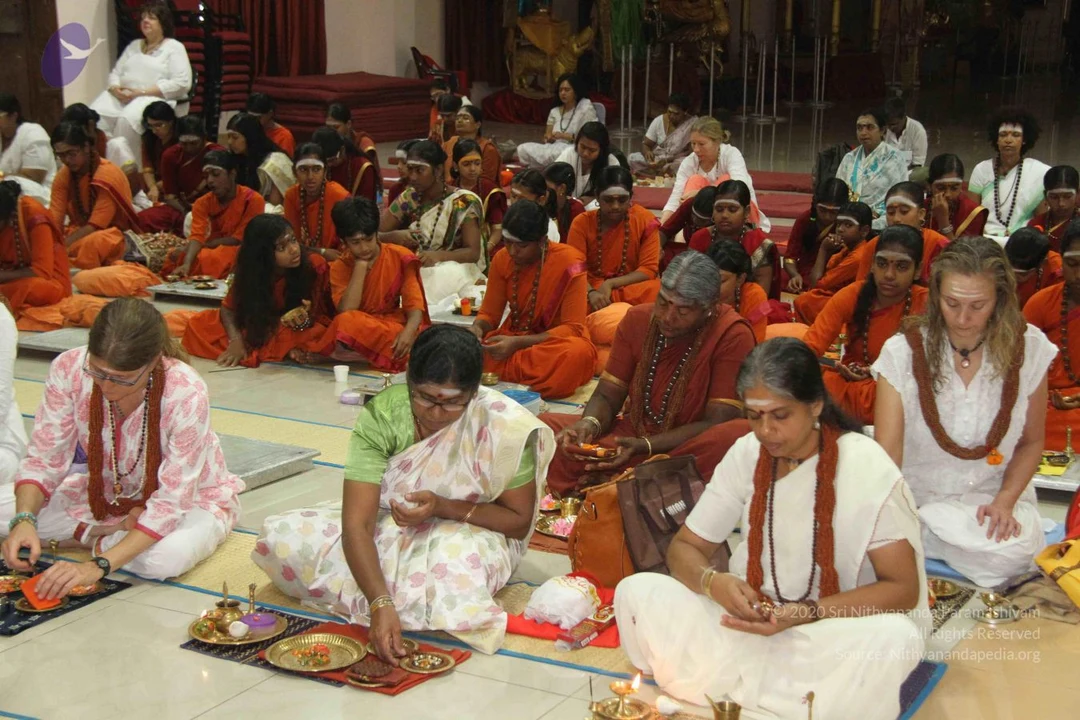
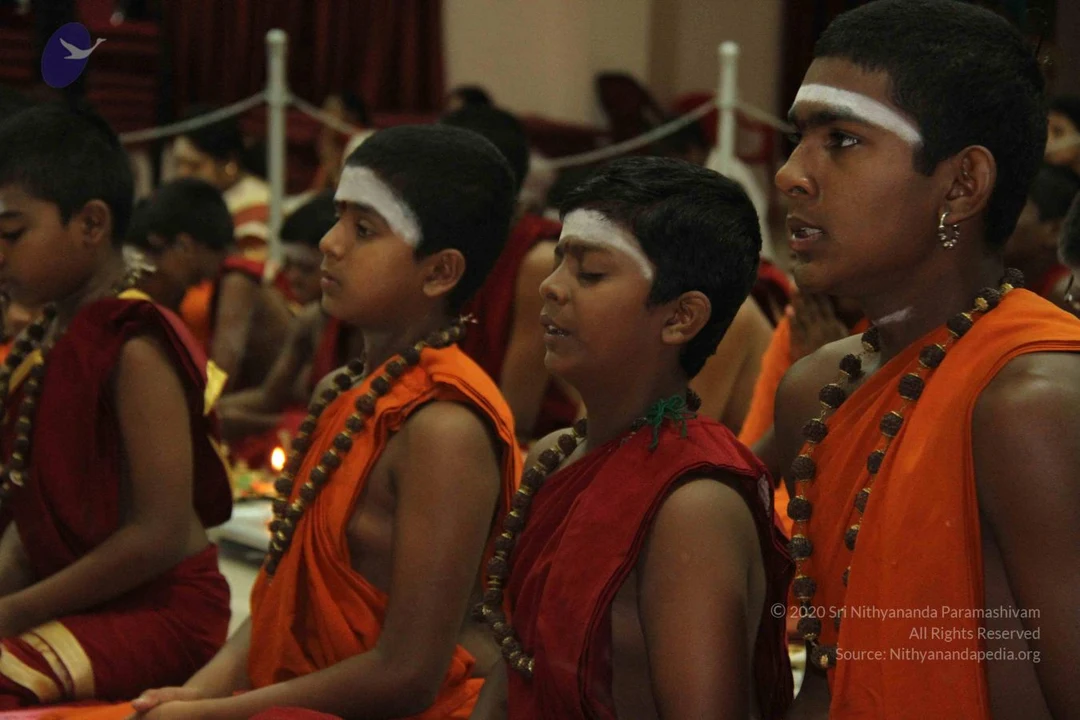
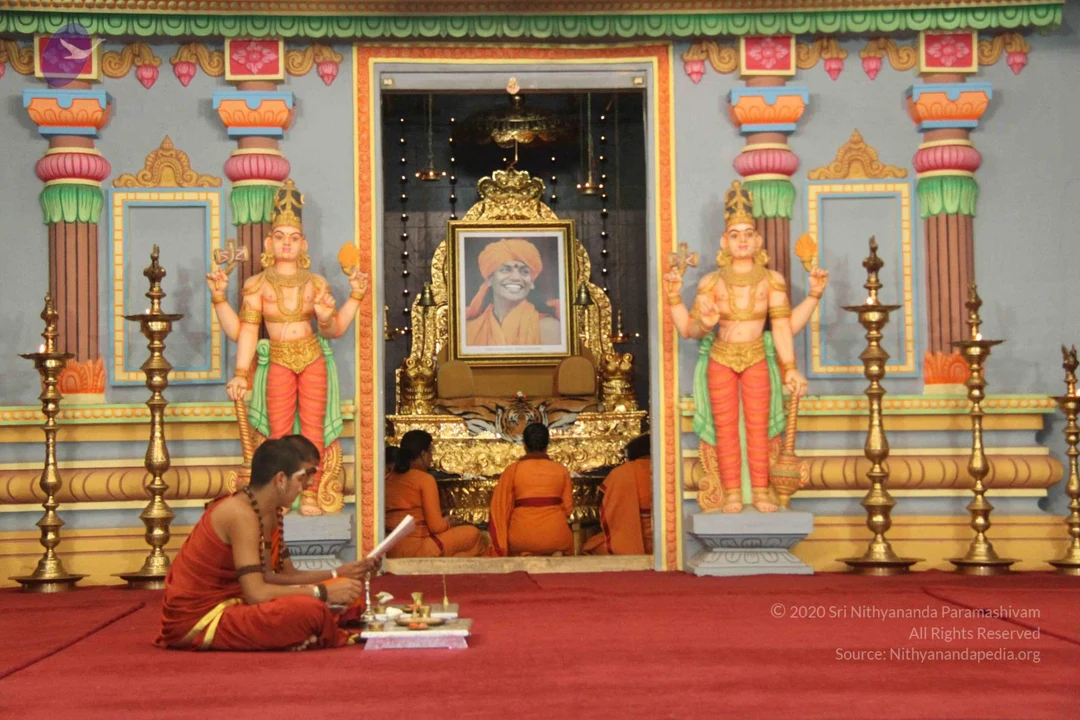
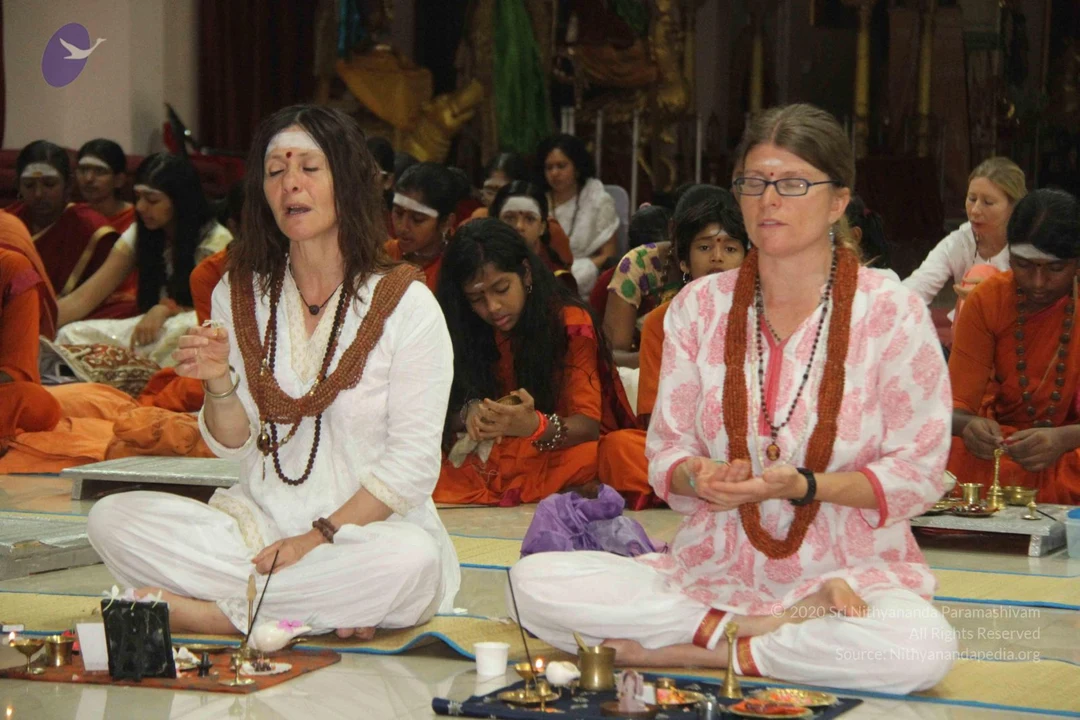
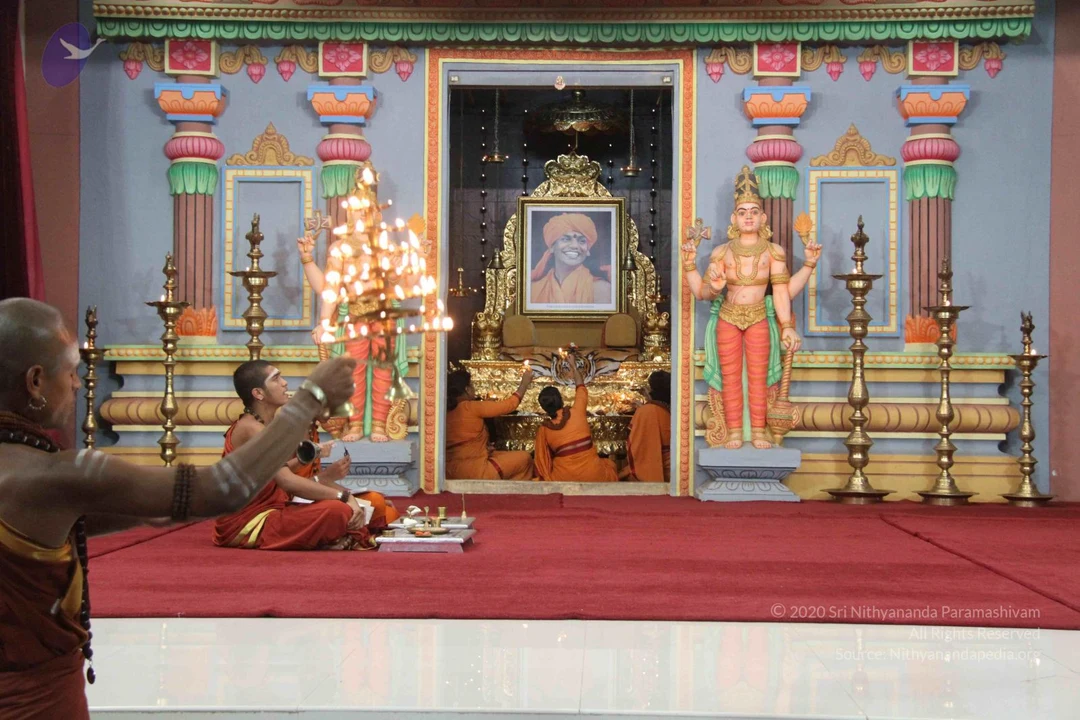
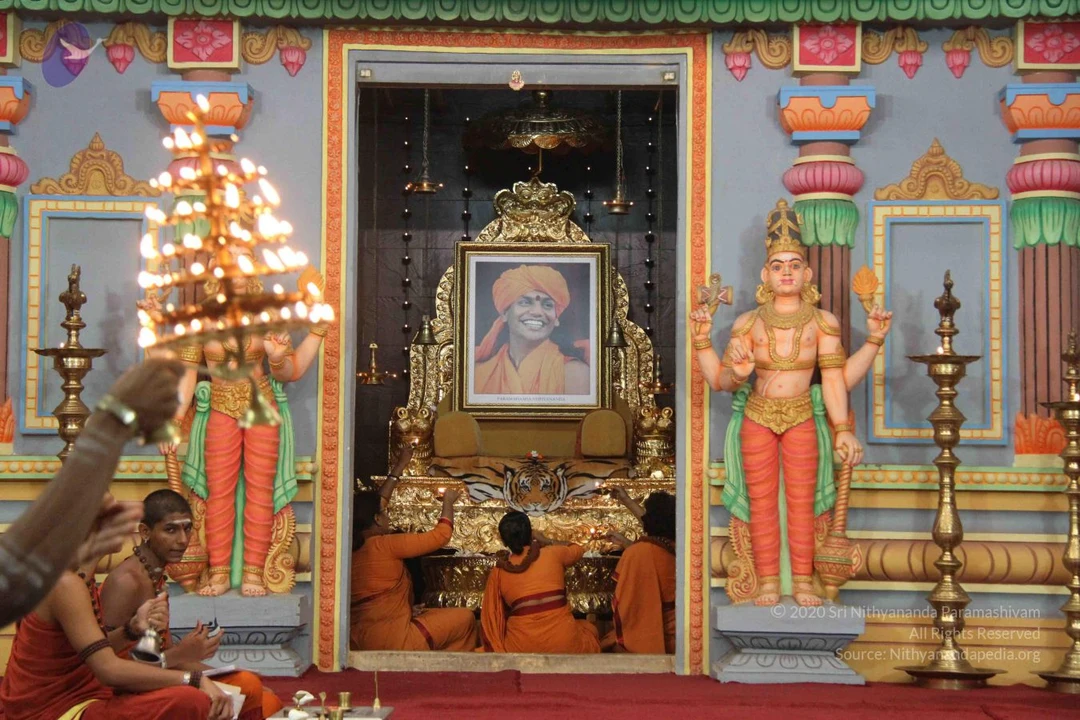
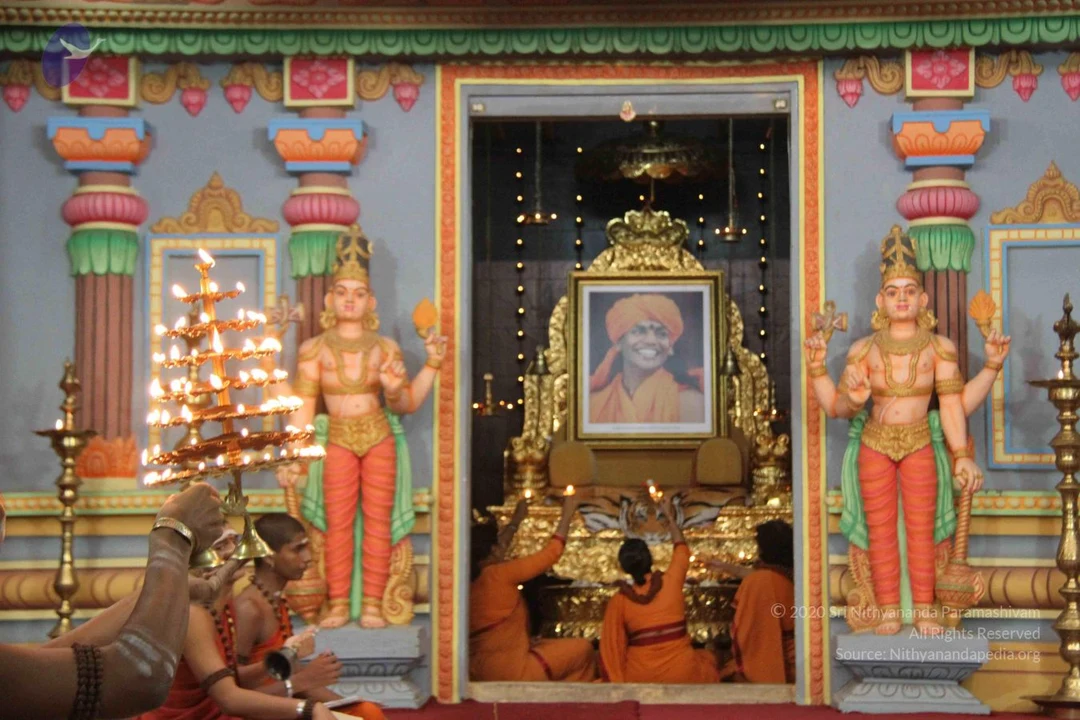
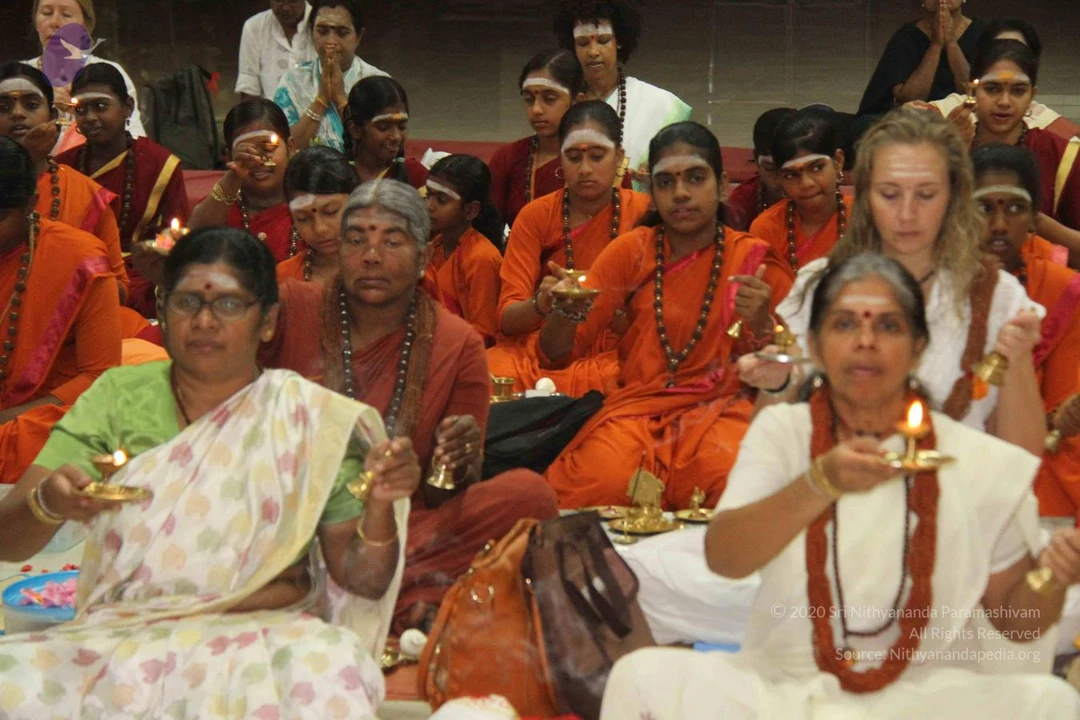
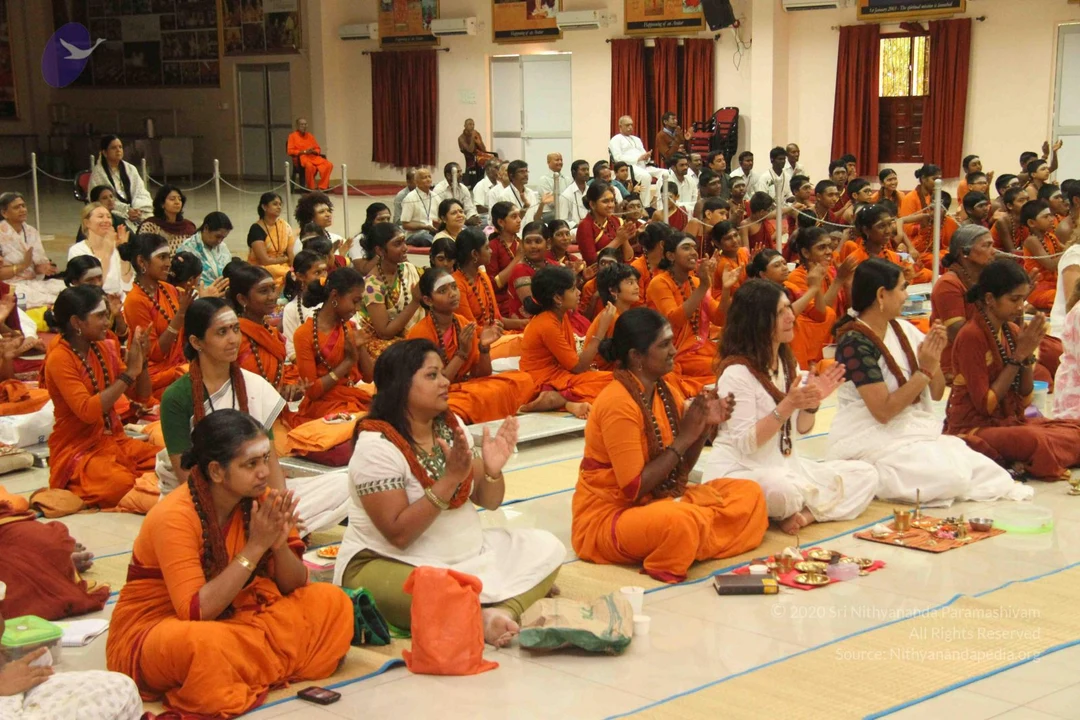
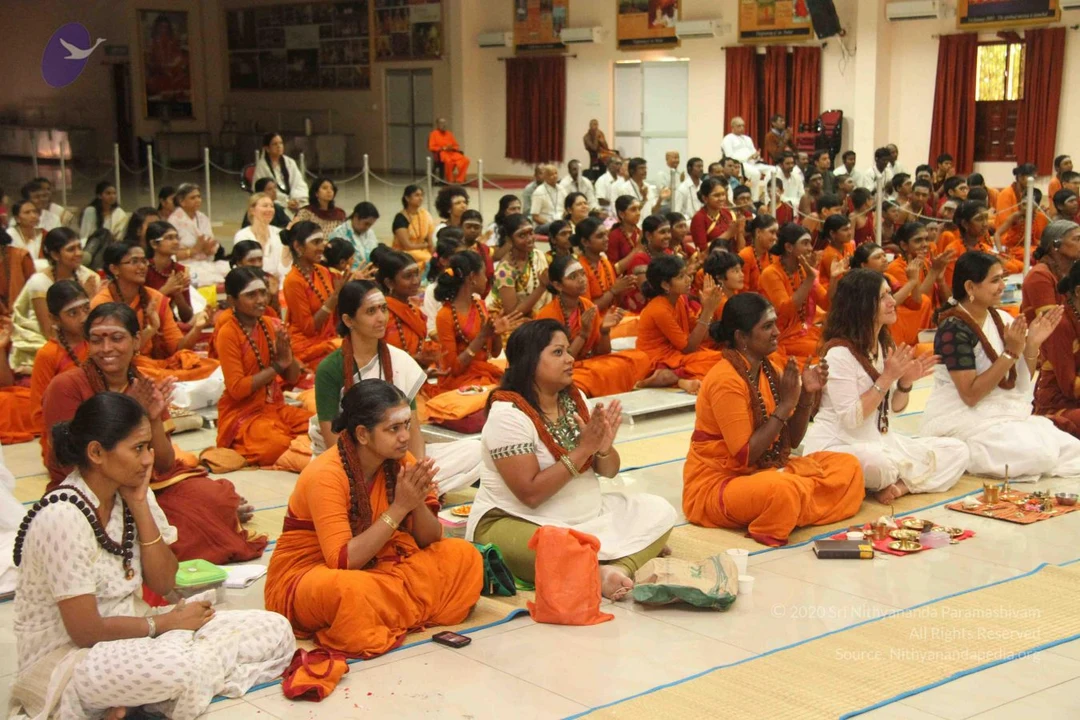
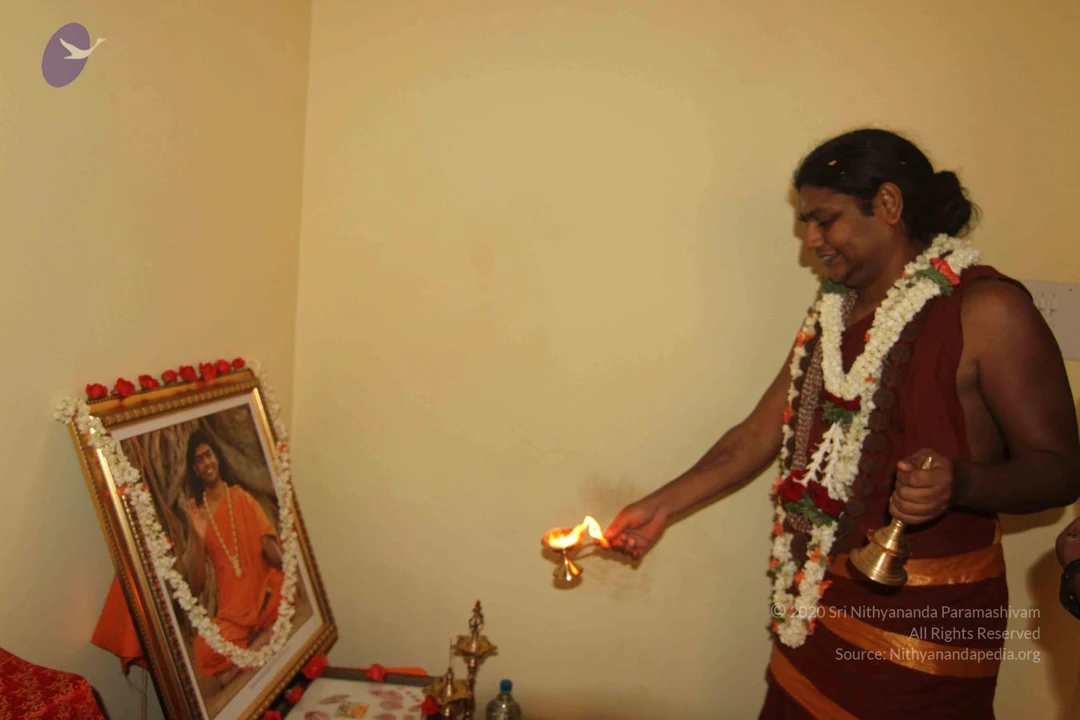
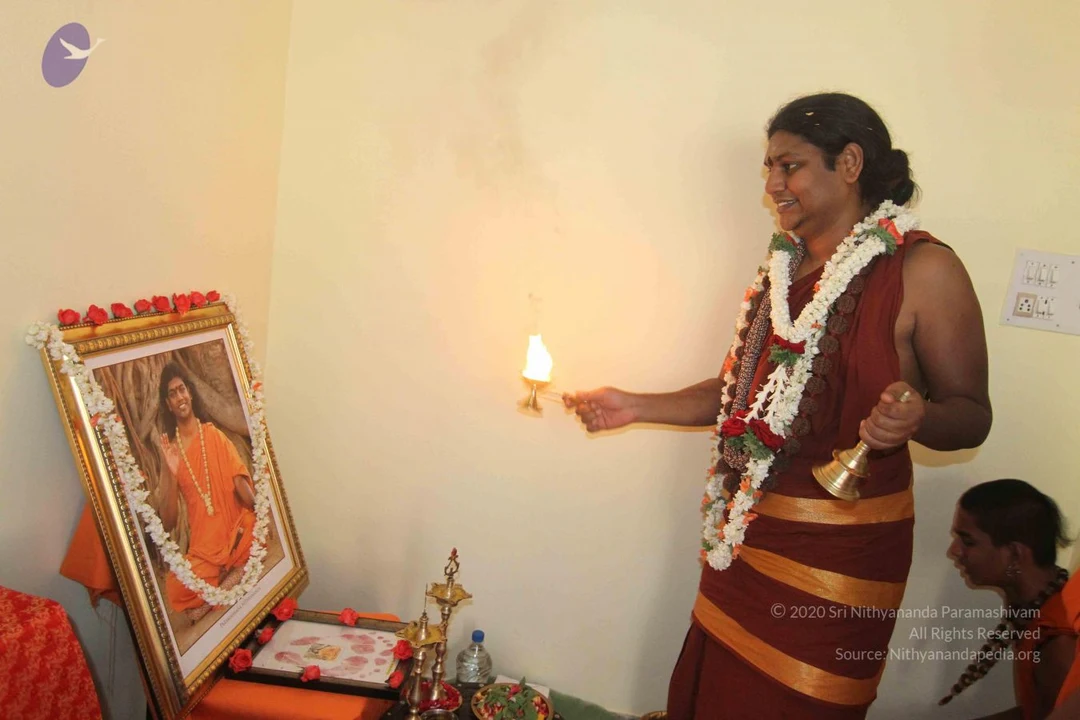
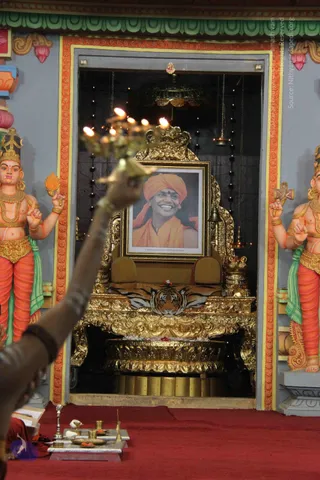
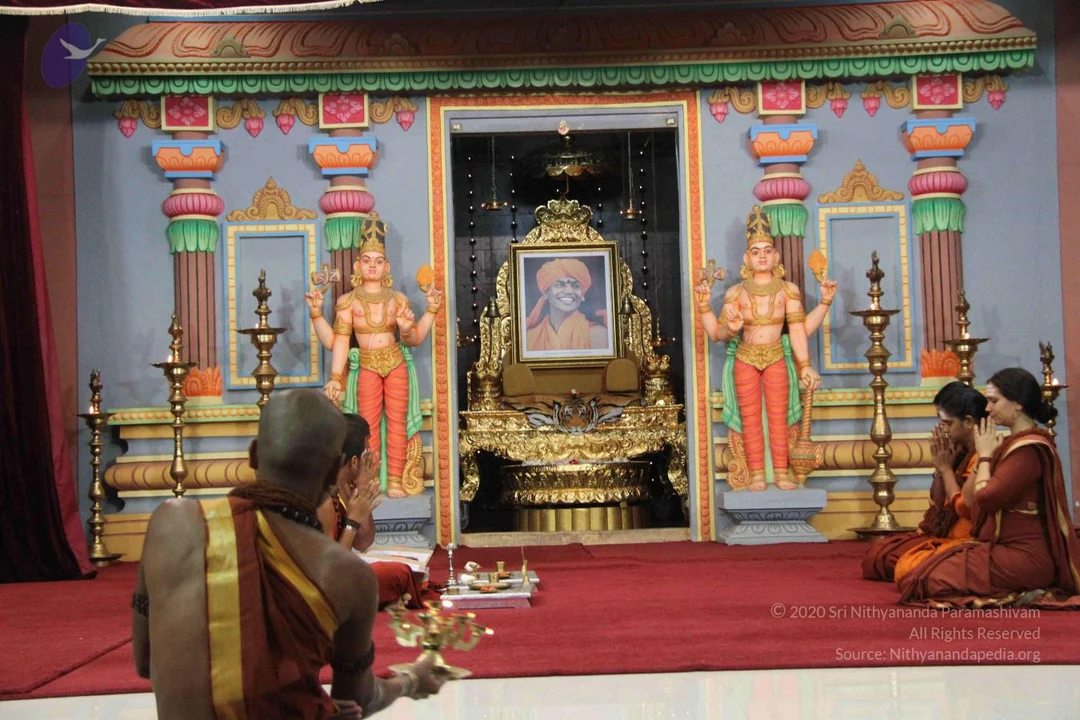
A photograph of a temple-style stage with painted pillars in green, pink and orange. Two painted deity murti figures with multiple arms and crowns stand either side of a golden throne-like peetha. A framed portrait of a smiling man in an orange turban and saffron robe rests on the throne, and the empty golden seat sits beneath it. Three people kneel or sit on a red carpet at the front, facing the throne with hands in anjali. Brass oil lamps and a brass kalasha-style vessel with puja items are placed on the carpet and along the stage, with a small brass oil lamp in the foreground.Photograph of a temple shrine set between two painted statues of guardian deities with raised arms, wearing gold crowns, gold jewelry and orange and green garments. At the centre, a framed portrait of a smiling man in an orange turban and saffron robe is placed on a golden throne-like seat draped with a tiger-skin cloth. Brass oil lamps with lit flames sit in the foreground, and hanging lamps and strings of beads decorate the background. A printed caption on the portrait frame reads Paramahamsa Nithyananda. Partially visible heads of a few seated devotees appear at the lower left and right edges.A photograph of aarti being offered before a framed portrait of a smiling man in an orange-saffron turban and orange robe, set on a gilded ornate throne-like frame with a golden crown finial. A brass multi-wick oil lamp with several lit flames is held up by a visible hand in the foreground, with smoke rising. Behind the portrait is a dark shrine doorway strung with small warm lights, flanked by painted pillars and colourful deity murti figures with raised hands in red, orange and green. Only the offering hand and the partial head of the person holding the lamp are visible.A seated group of devotees in a temple hall performs a ritual with brass plates and oil lamps on the floor. Many participants wear saffron-orange robes and red-orange shawls with rudraksha malas, and some have white and orange marks on their foreheads. Women in white, pink and green saris sit among them, and a woman in a white dress with a red-brown beaded mala sits at right. Several people hold small offerings or lamps over the plates. A woman in white sits front right with a mala, and an older woman in a red-brown sari holds a lamp at centre. Ornate gold and red furnishings and a carved deity murti are visible in the background.Several young boys seated closely together in a hall, chanting with eyes closed. They wear saffron-orange and deep maroon-red cloth draped over bare shoulders, with rudraksha mala beads around their necks and white vertical tilak marks on their foreheads. A small oil lamp flame glows at left near a ritual setup, and red curtains and white pillars line the background. The boy at right in orange cloth wears a small stud earring. Several more seated devotees fill the rows behind them.Inside a temple hall with painted pillars and a red carpet, a framed portrait on a gold throne-like seat shows a smiling man in orange-saffron turban and robes, labelled by the page as Swamiji; the portrait is a depiction, not a physical person. Two large painted standing deity murti with four arms and gold crowns flank the throne, holding ritual objects. In front, a seated priest in orange-red robes with a rudraksha mala and white markings reads from a paper, with brass lamps and offerings on a tray, while several orange-robed devotees sit near the throne.

Nithya Kirtans

7 photosSource gallery
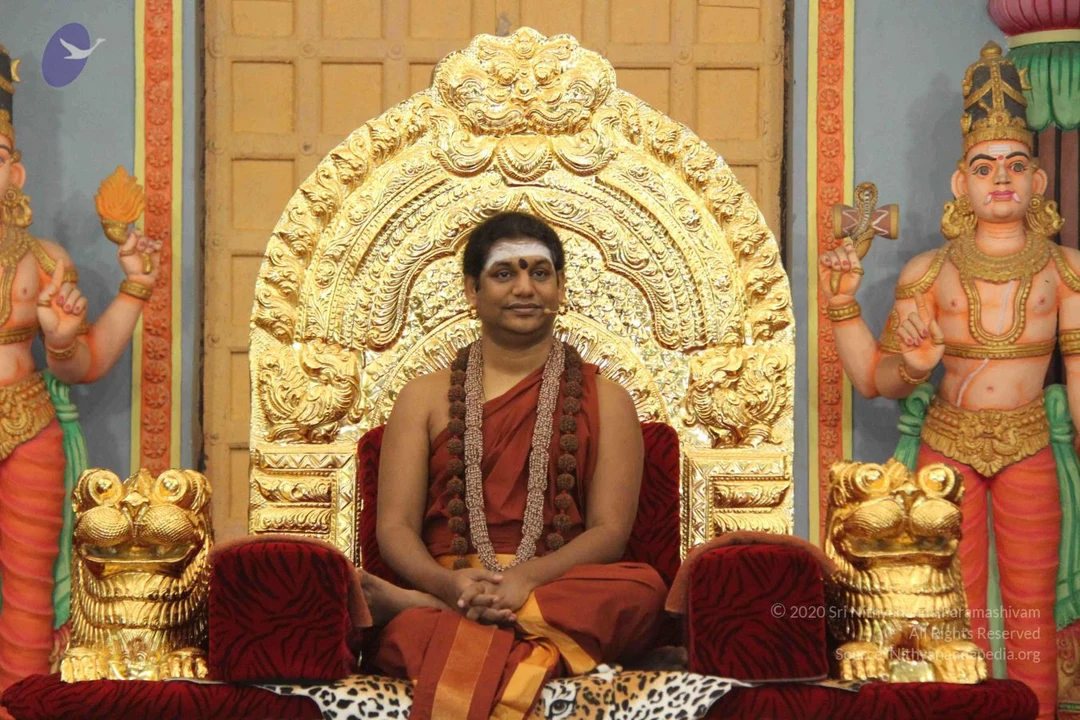
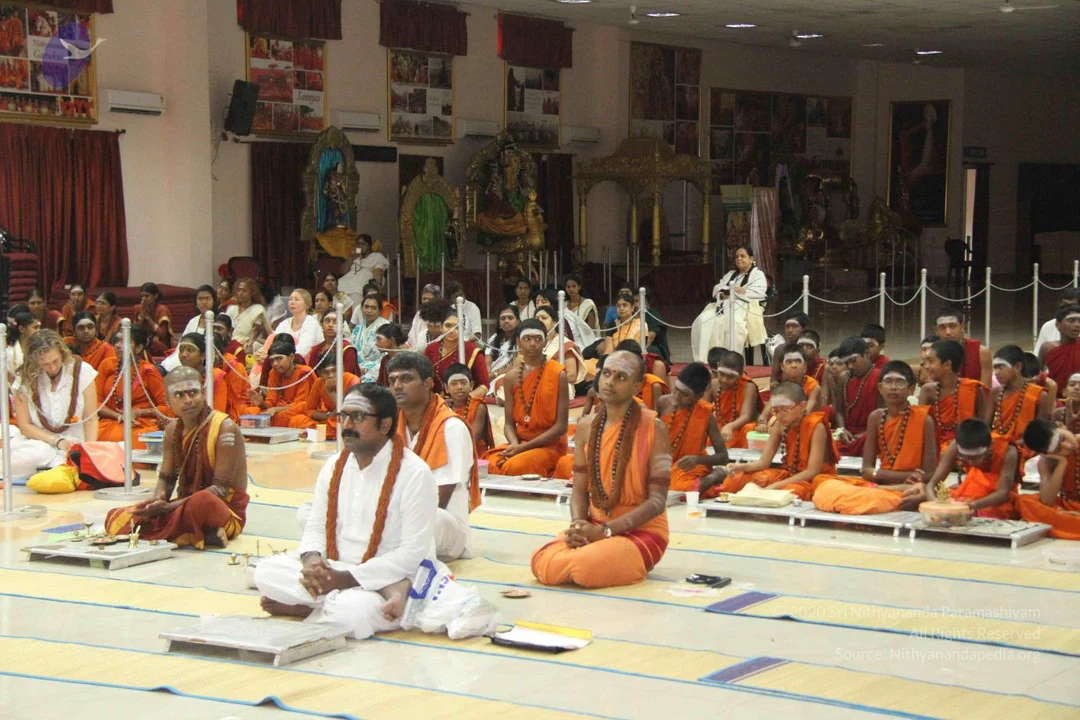
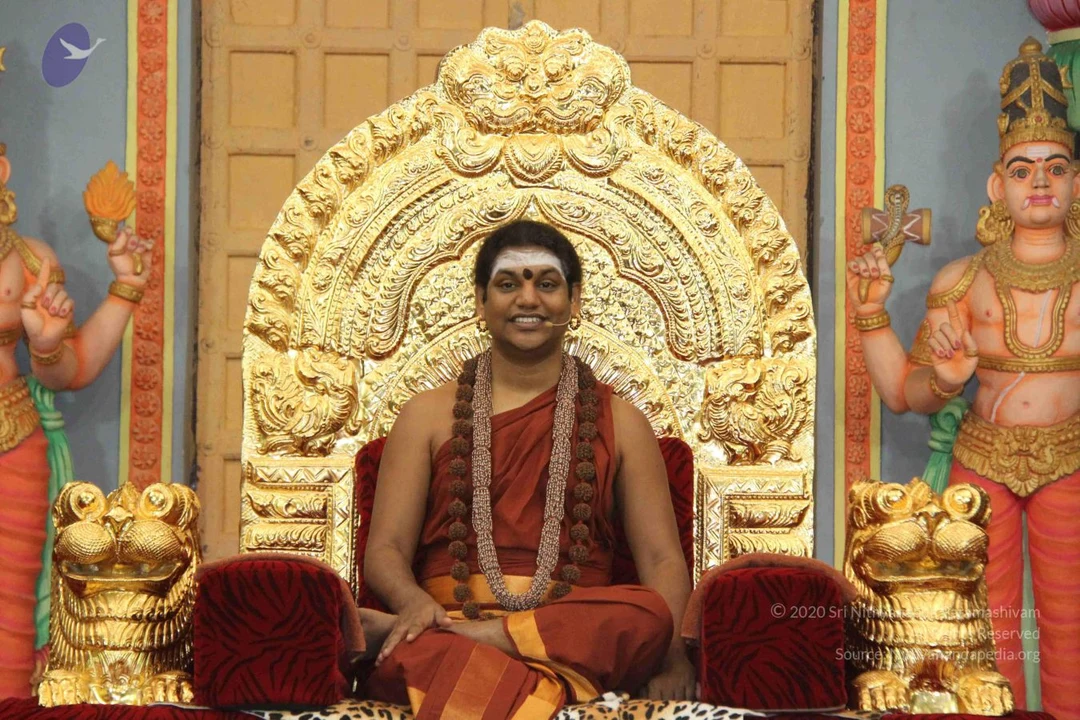
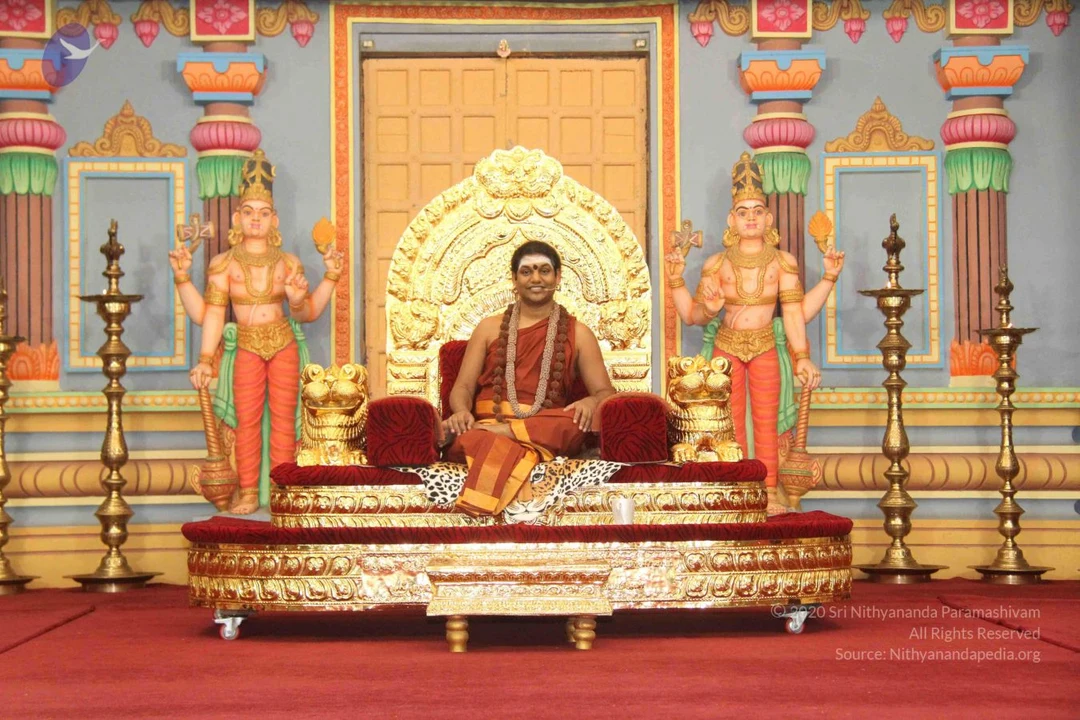
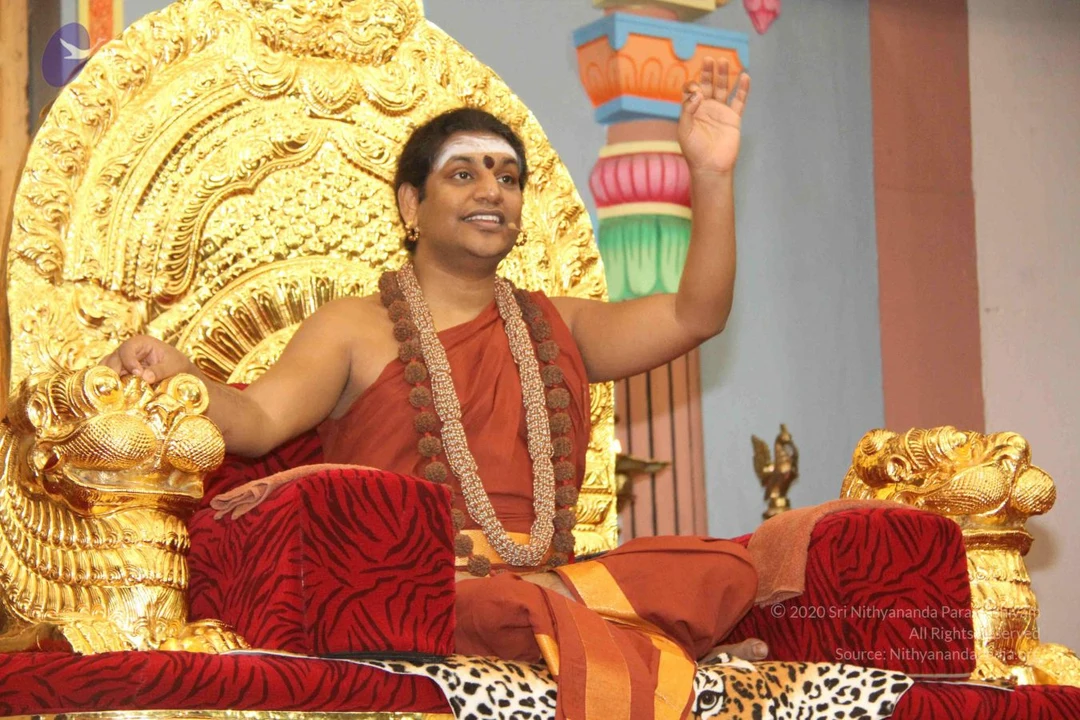
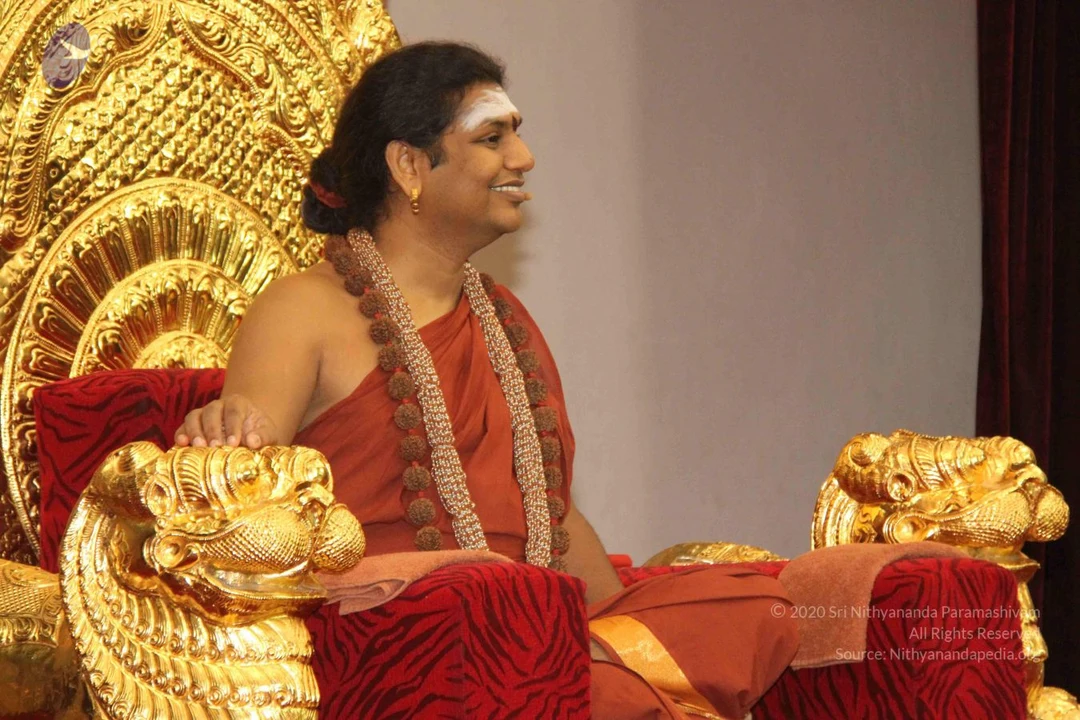
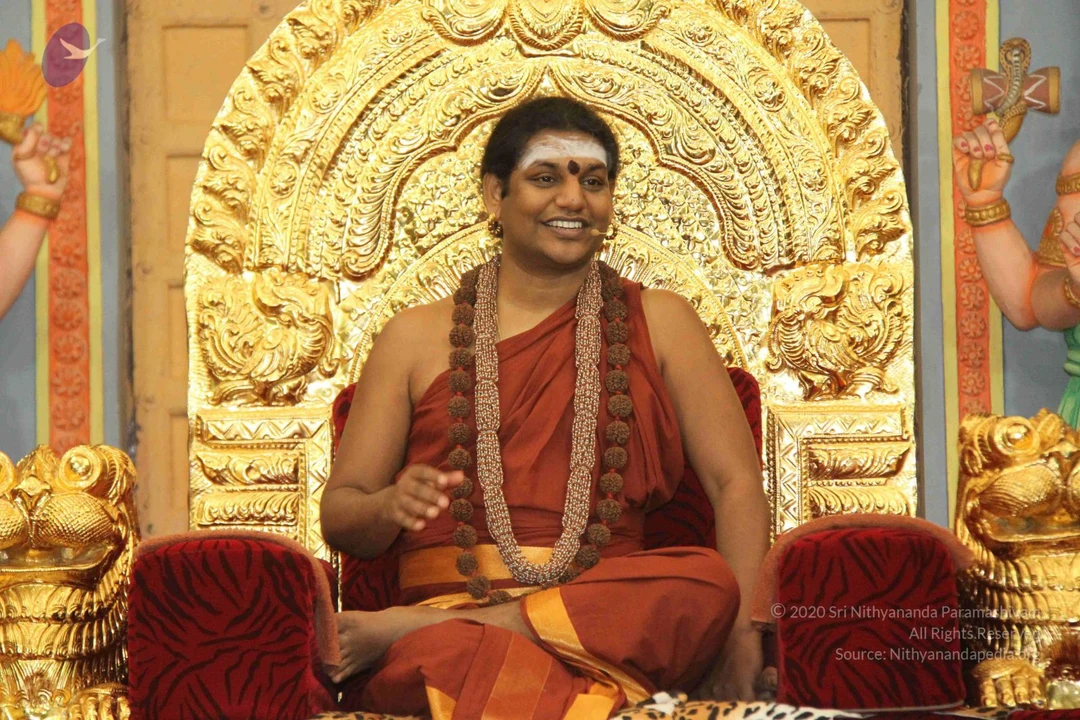
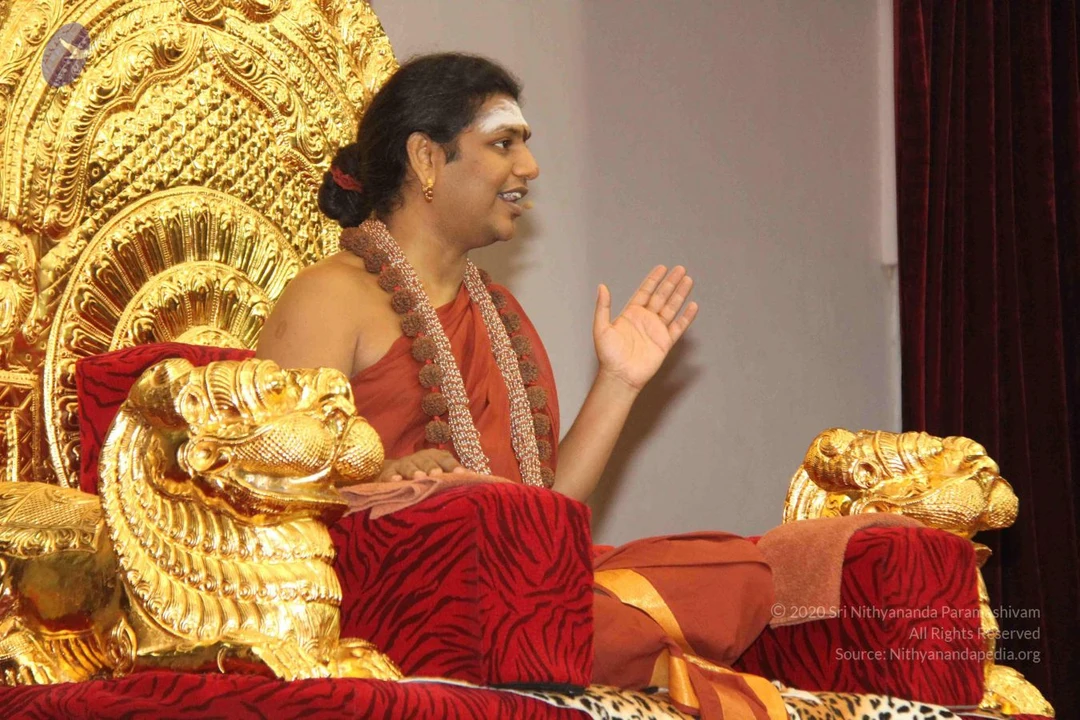
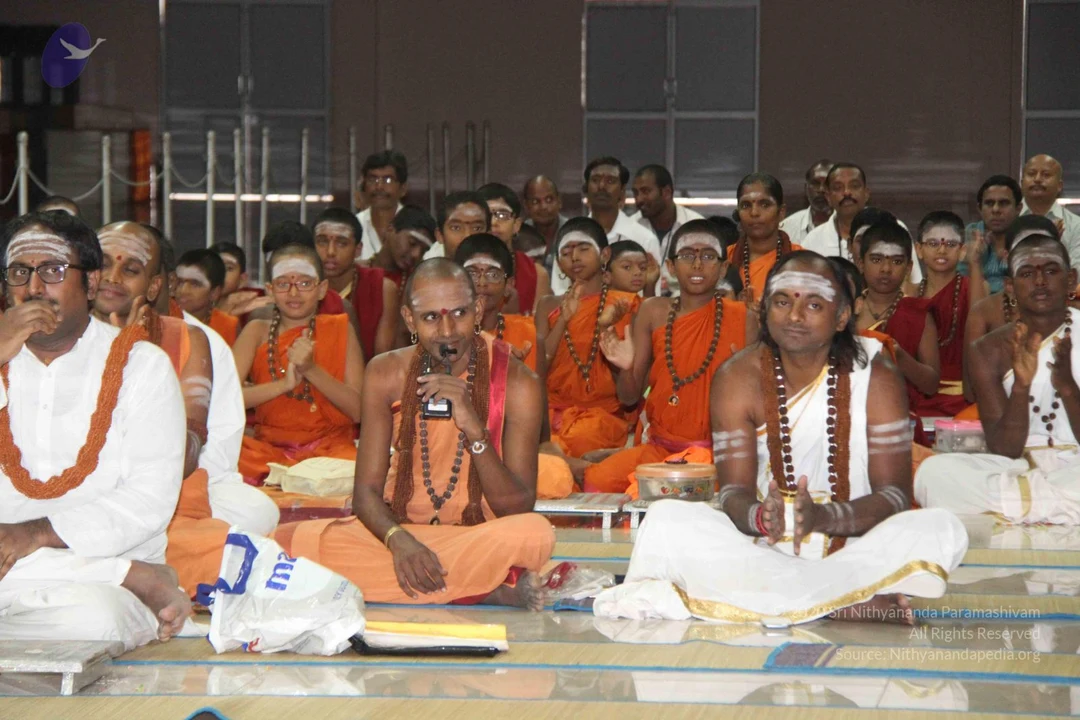
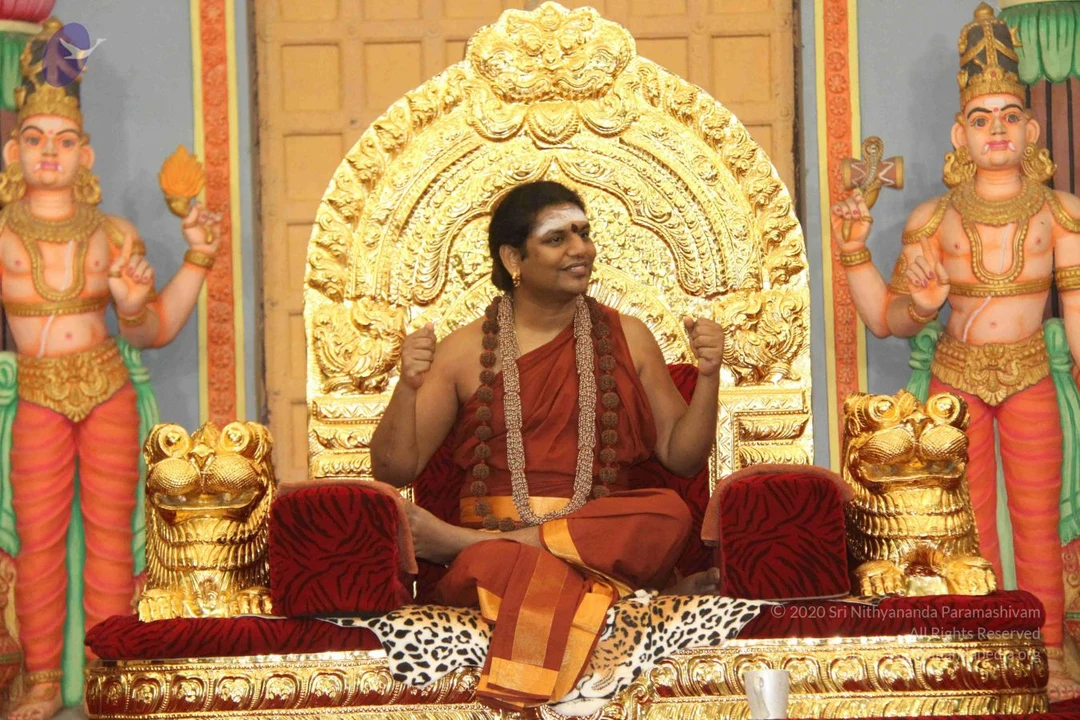
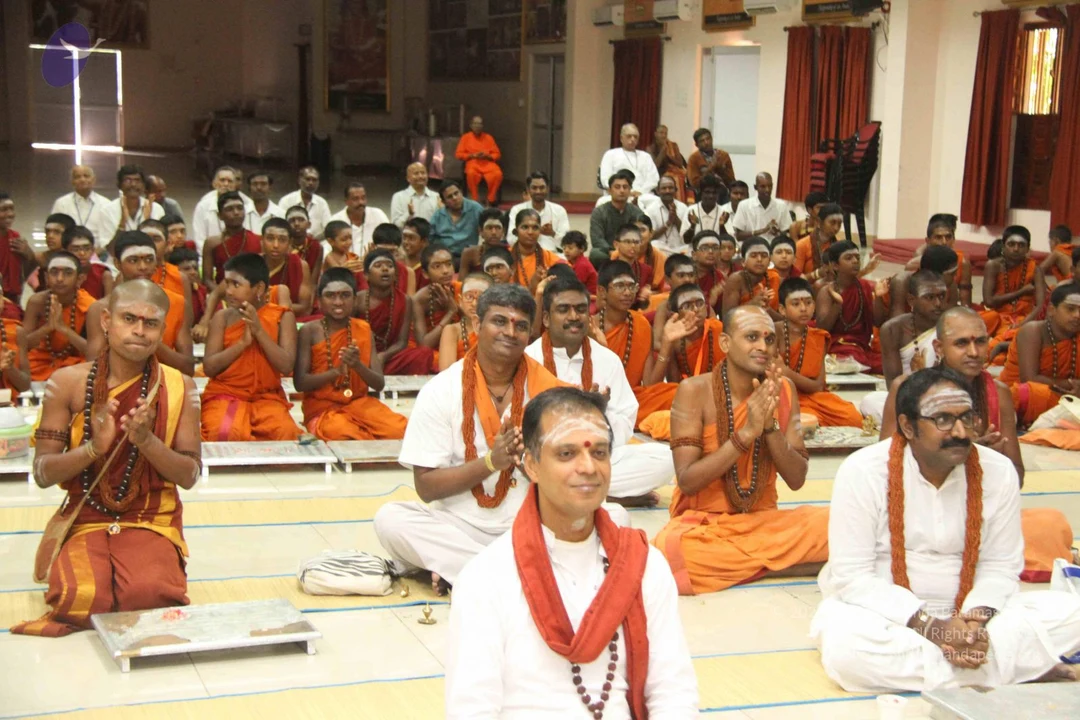
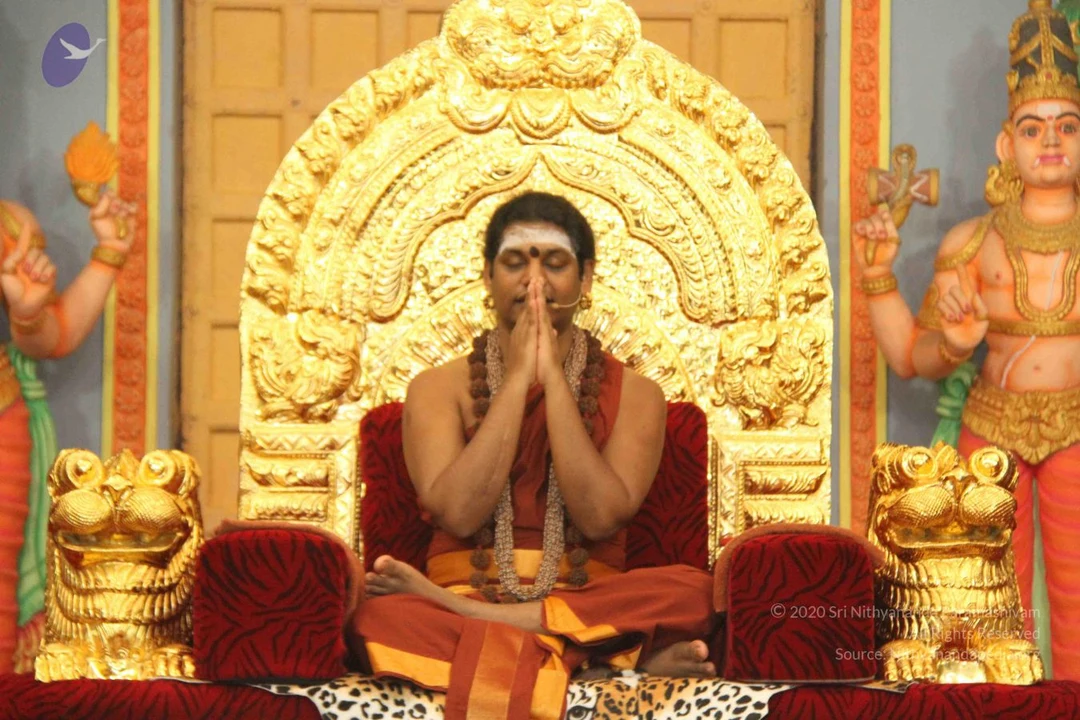
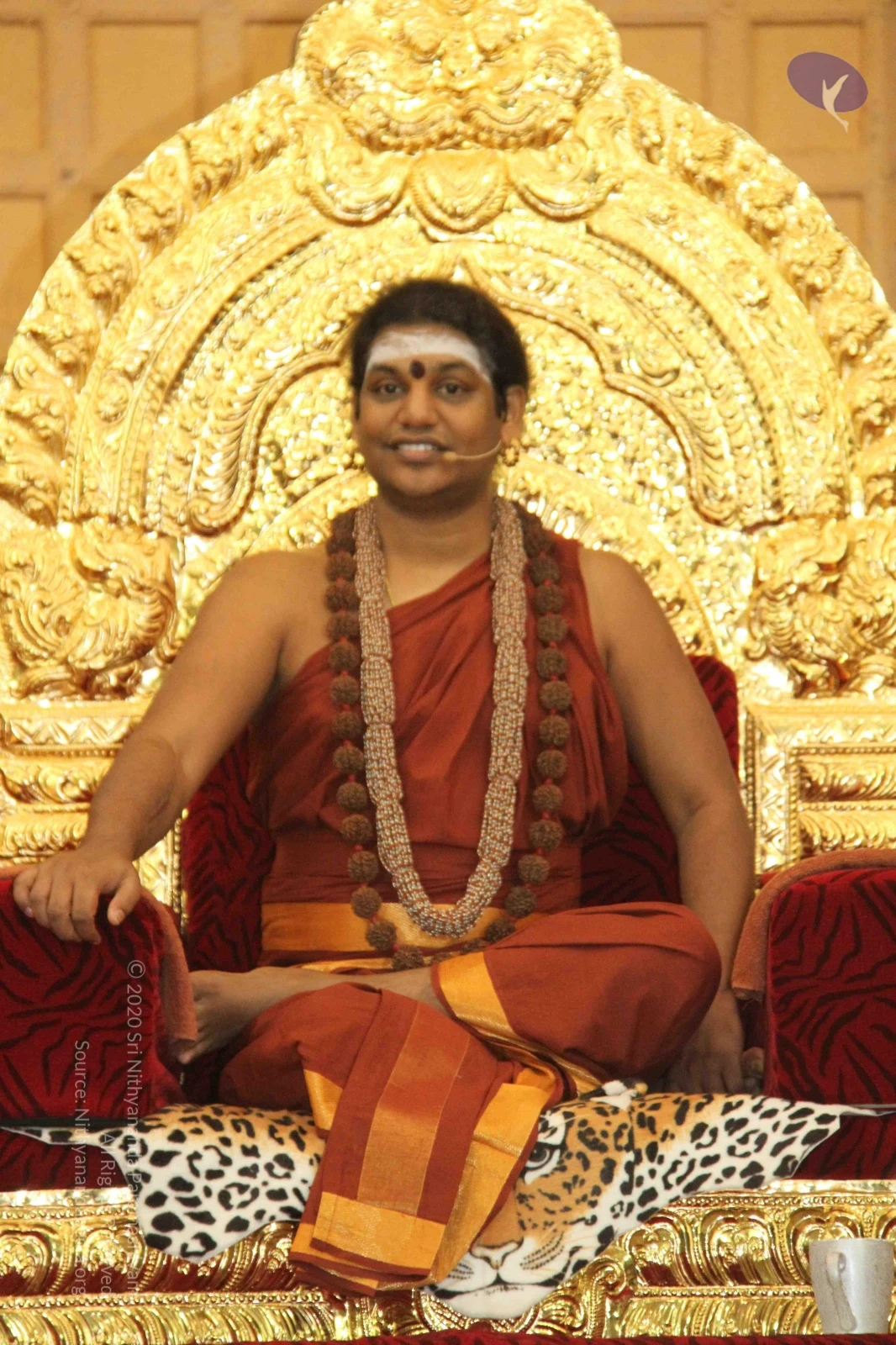
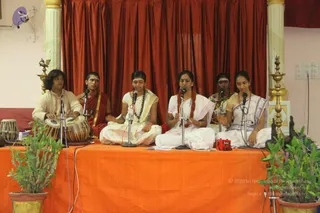
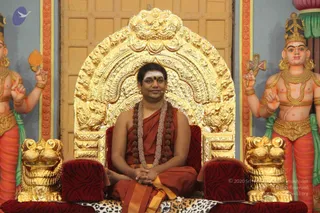
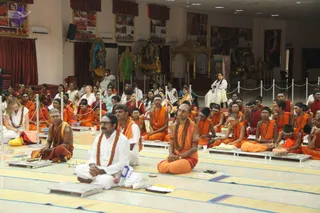
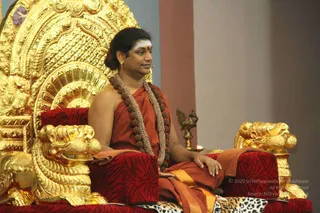
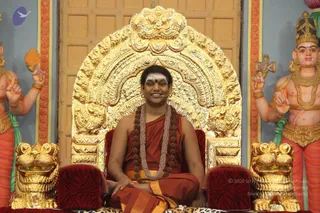
A photograph of a Nithya Keerthana devotional singing group performing on an orange-draped stage before a deep red curtain. Six people sit cross-legged behind microphones: a man at left plays a pair of tabla drums, a young man in a red and gold-bordered dhoti and sash sits beside him, and four women wear white and cream saris with gold and red borders, one with rudraksha beads and a red mala. Brass lamps stand at both sides of the stage and potted plants frame the foreground. A red Radel amplifier sits on the stage.A photograph of a devotional music performance on a stage draped with orange cloth and deep red curtains, with brass oil lamps and potted plants at the sides. Six people sit cross-legged behind microphones. On the far left a young man in cream kurta plays a tabla. Next to him a man in a red and gold shawl sits with a rudraksha mala. Three women in white and cream saris sit at the centre and right, one with a long red garland, another with a beaded necklace. A woman at the back right in a green and floral top also sits behind a microphone. Foreground potted plants frame the stage.A seated man in saffron-orange robes sits cross-legged on an ornate gold throne with a tall arched back carved with floral and scroll motifs, set on red velvet cushions with gold lion-head armrests. He wears a rudraksha mala and a white-and-gold beaded necklace, with a white sandalwood mark and red bindi on his forehead. He sits with hands clasped in his lap. Flanking him are two large painted deity statues with golden crowns, jewelry and red-and-green dhoti, one raising a flame and the other holding a trident. A leopard-print cloth lies beneath the throne and a wooden door stands behind. This is a satsang-style seated discourse setting. Appearance-based label: a person, seated on the throne with rudraksha mala and saffron robes.A photograph of a group singing devotional music at microphones in a hall with red curtains. A man at left in cream kurta plays a tabla drum. Four women and a young man sit together; the central woman wears a white sari with a long red coral-bead mala and a small bindi, and the woman at right wears a white sari with a rudraksha mala. The young man in red-orange cloth has a white tilak. No swami is visible, so no candidate is identified. Six physical people are visible.A large hall with cream walls and framed pictures holds a seated congregation on striped mats during a satsang. In the foreground, a man in white dhoti and shawl with an orange scarf sits beside saffron-clad sannyasis with white forehead markings and rudraksha malas. Behind them, rows of young boys and men in orange robes sit before small plates and offerings. A woman in white sits on a raised area at the back, and a deity murti and a golden canopy stand in the background near a dark red curtain.A man seated on an ornate gilded throne with lion-head armrests and red tiger-striped cushions, wearing a rust-orange draped garment and a long rudraksha mala with a gold-beaded necklace, a white tilak on his forehead and a small gold earring. He sits cross-legged with his right hand resting on his knee, gazing to the side. Behind him a small brass oil lamp burns. The appearance matches the a person cues of ornate saffron clothing, rudraksha mala and ceremonial gold necklace, shown in a seated satsang setting.

Nithya Satsang
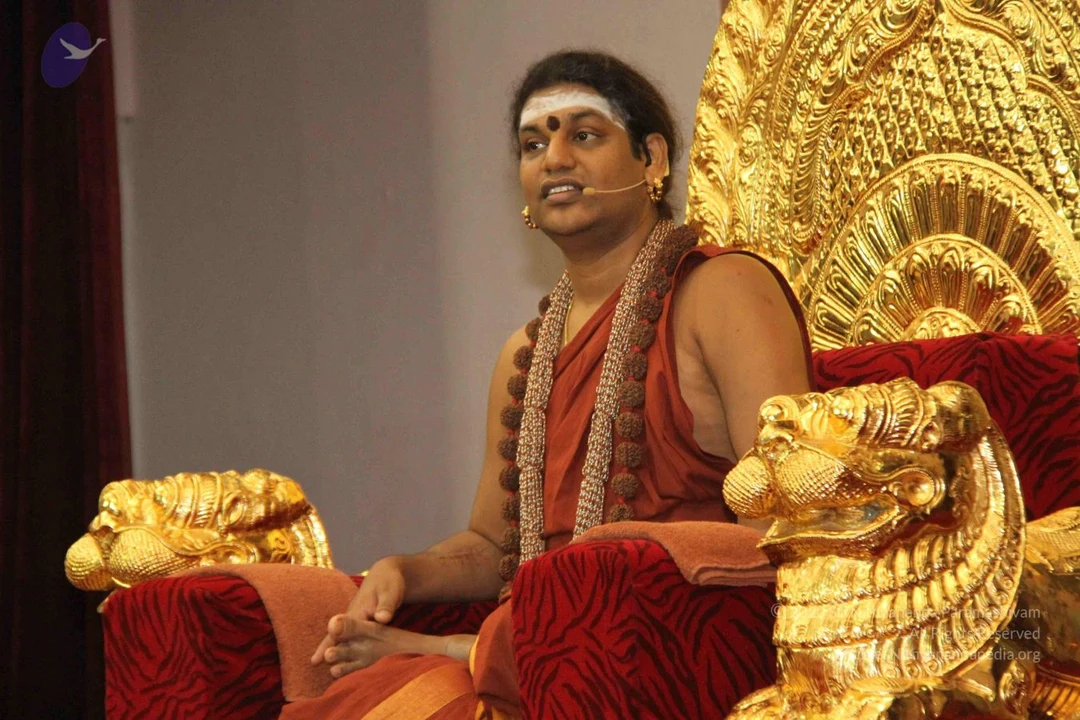
44 photosSource gallery
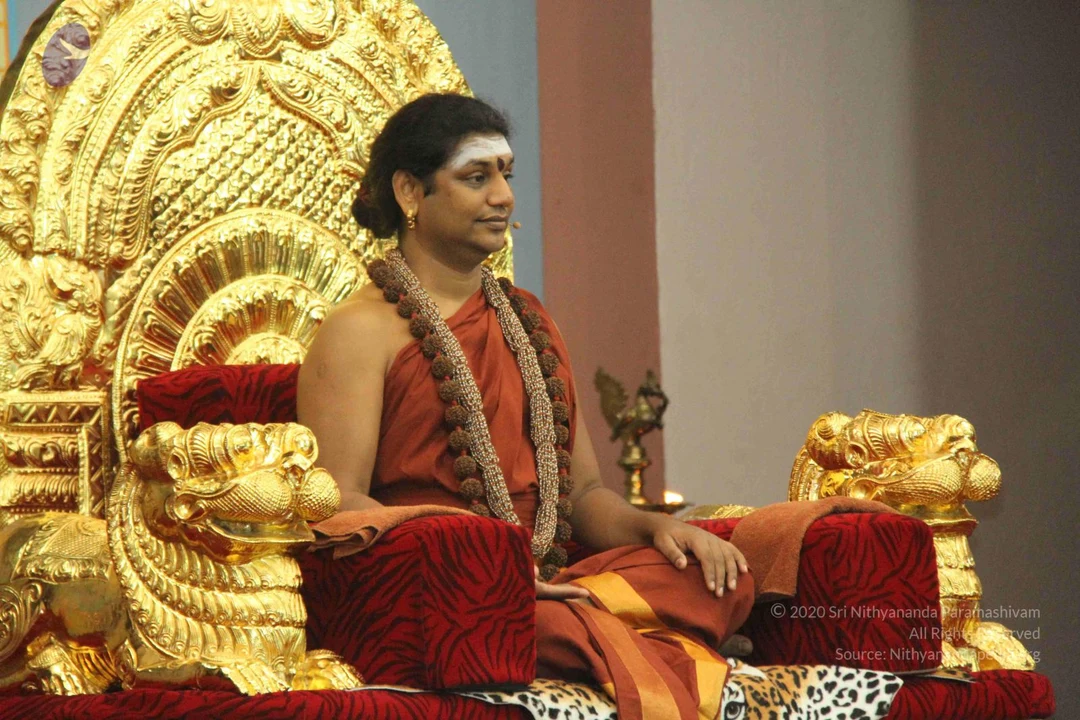
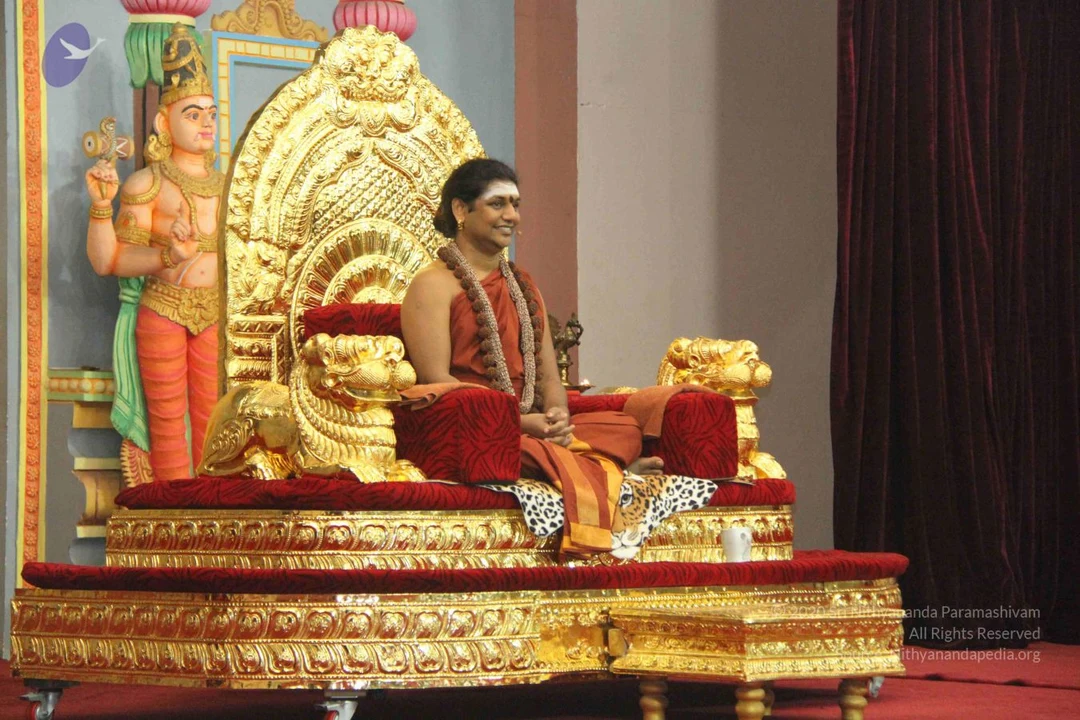
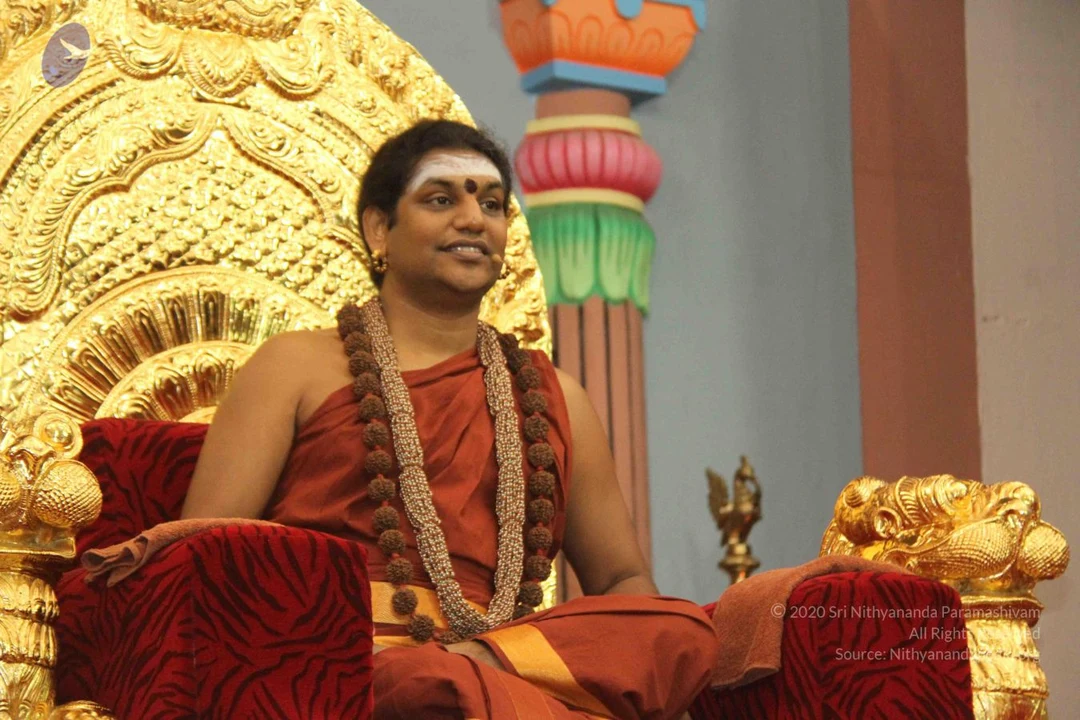
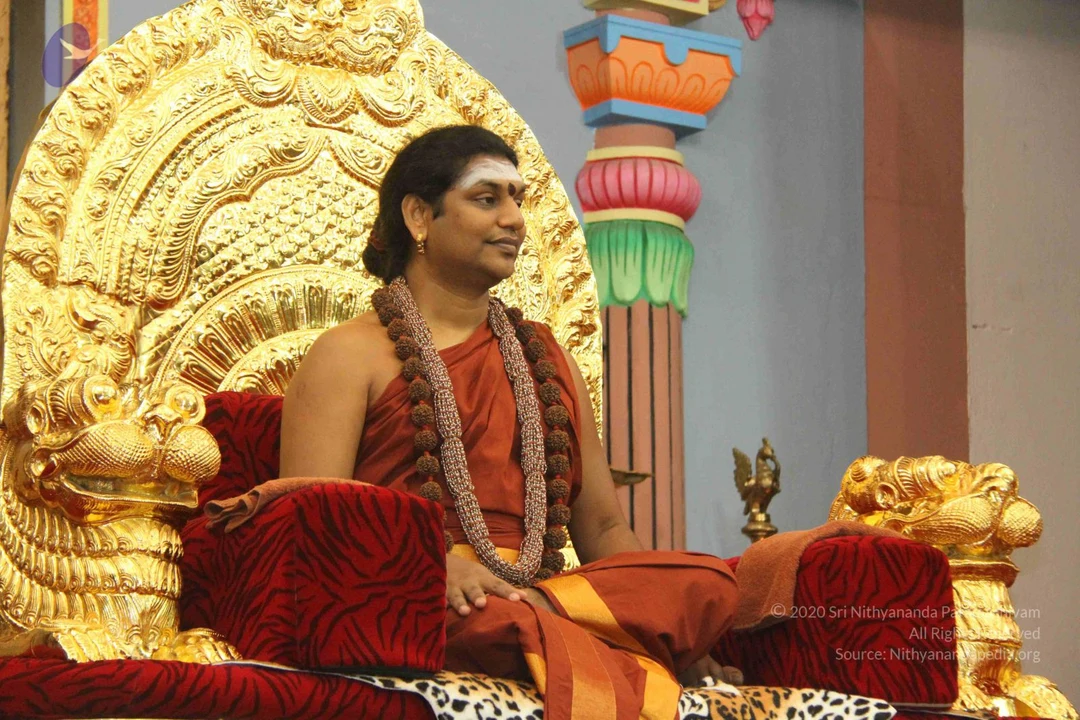
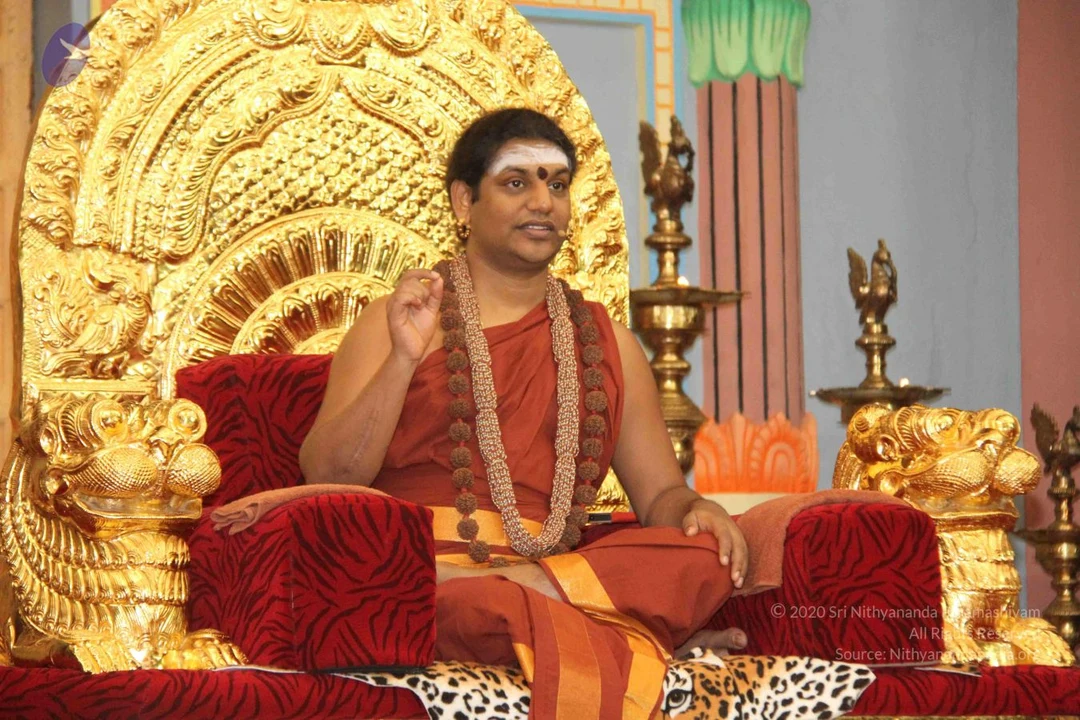
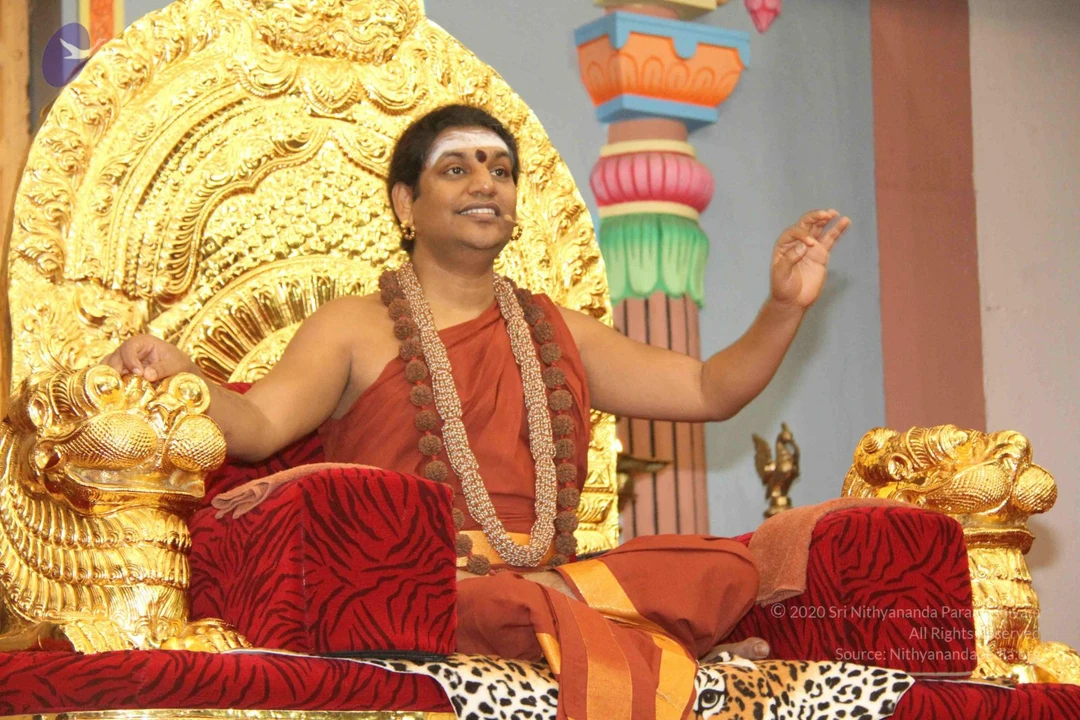
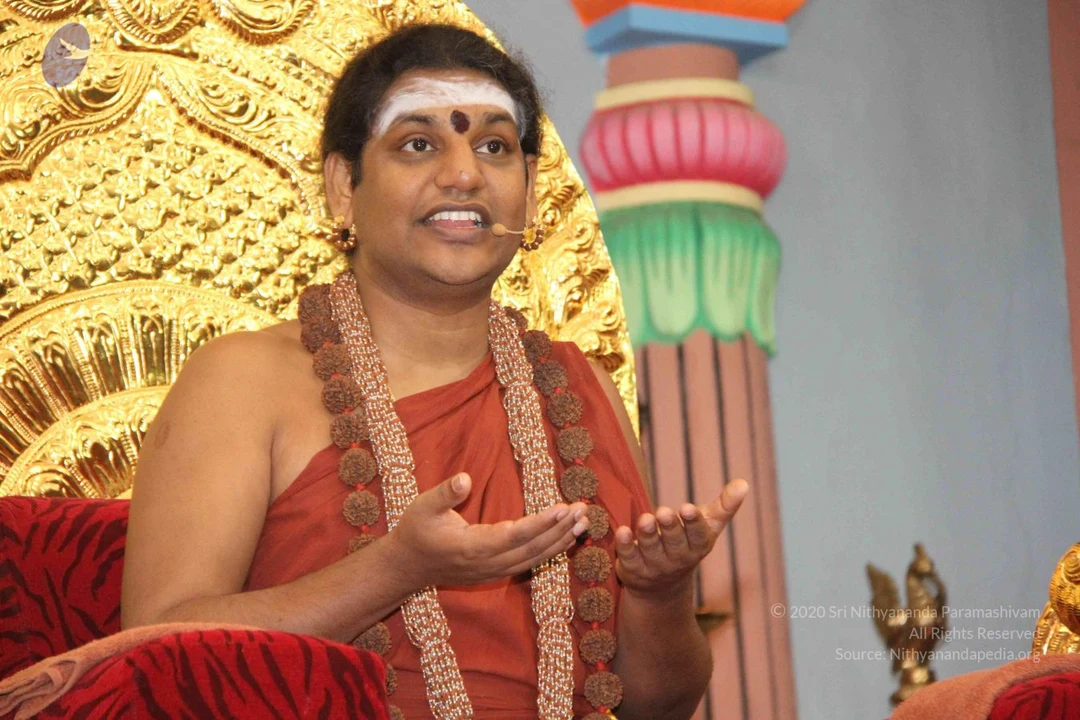
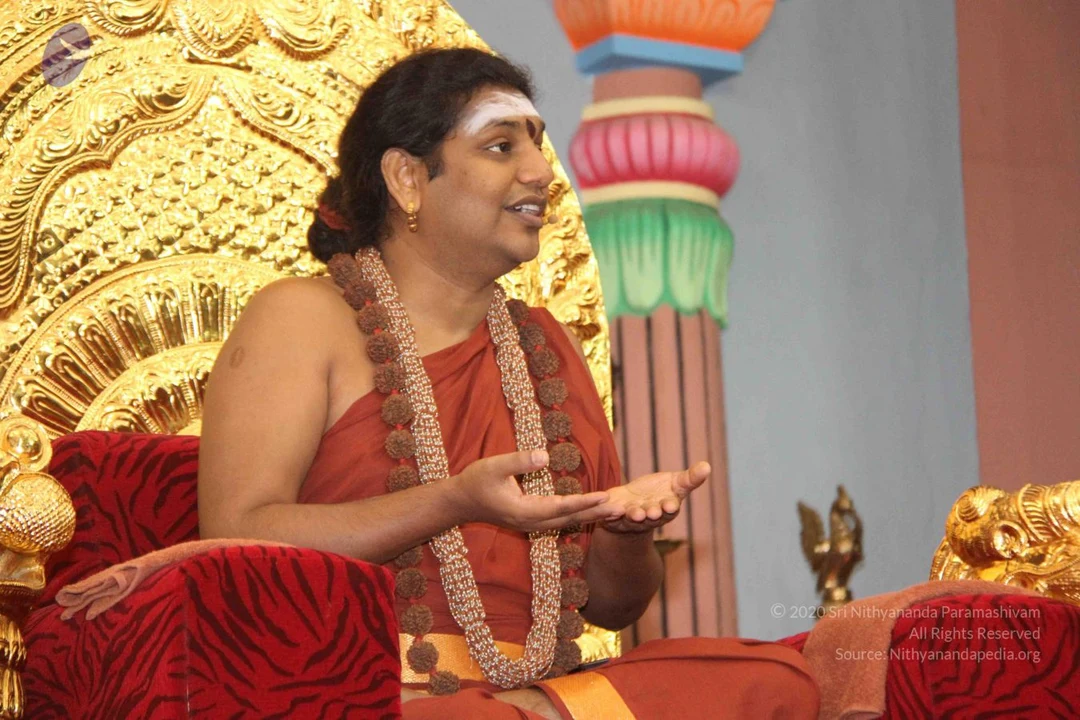
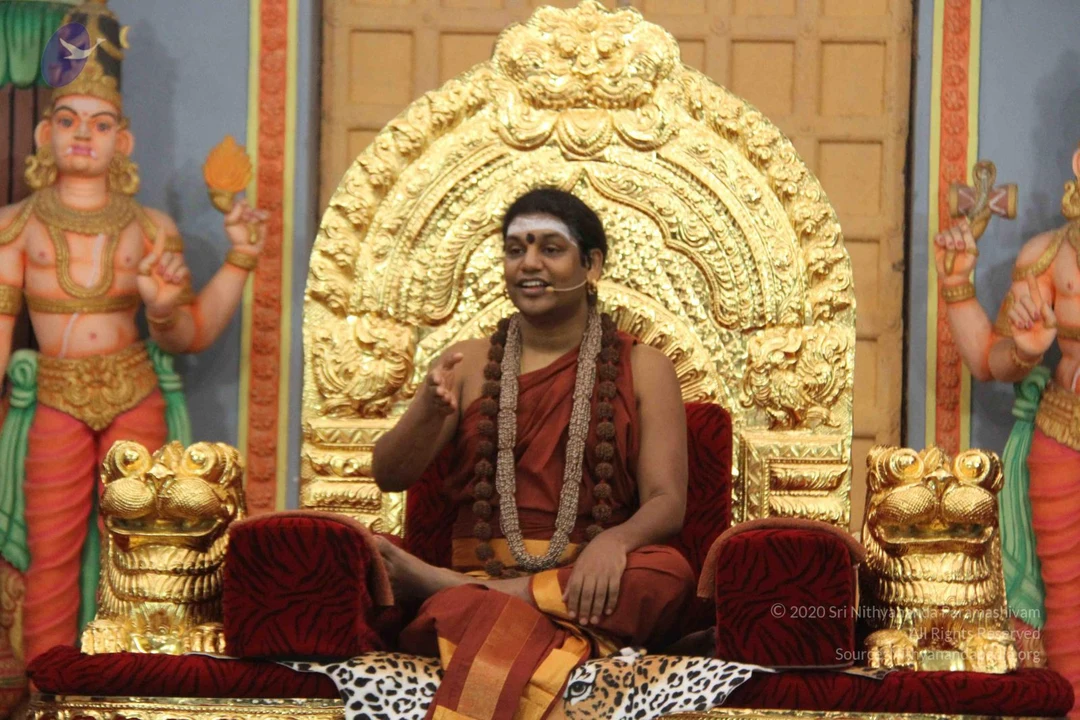
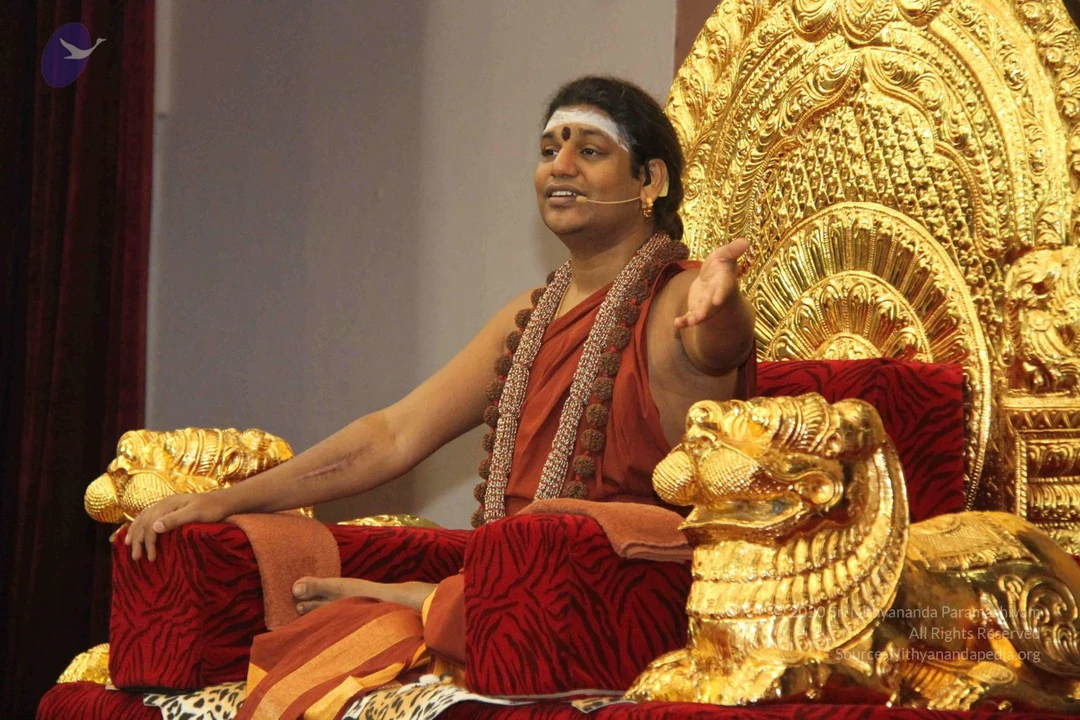
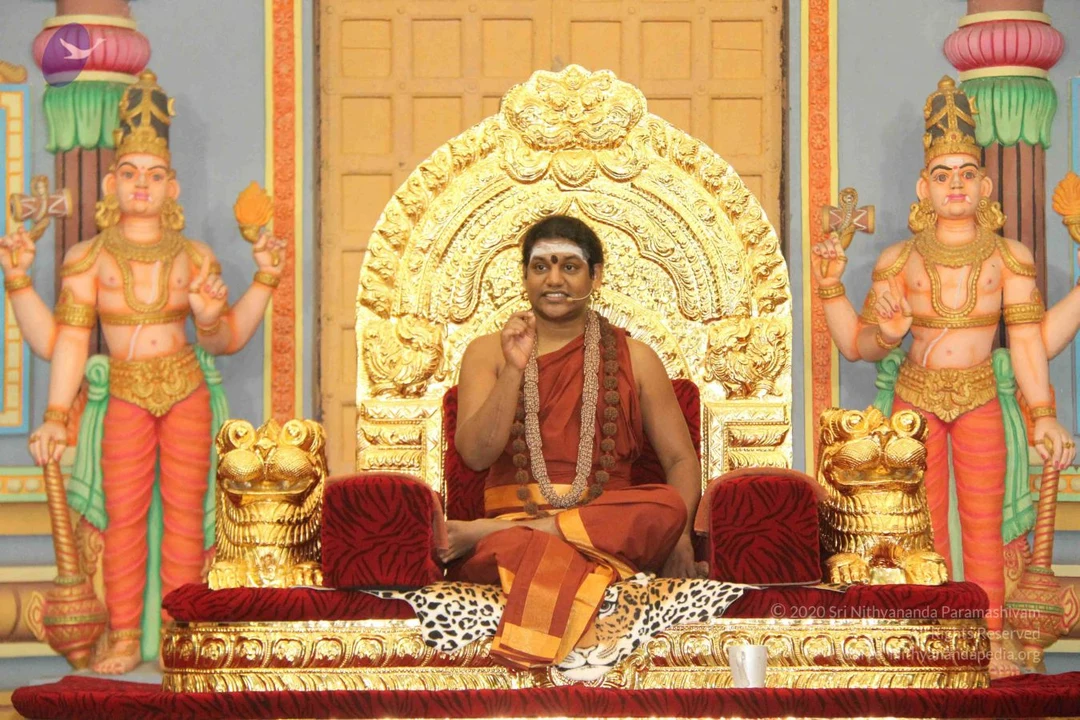
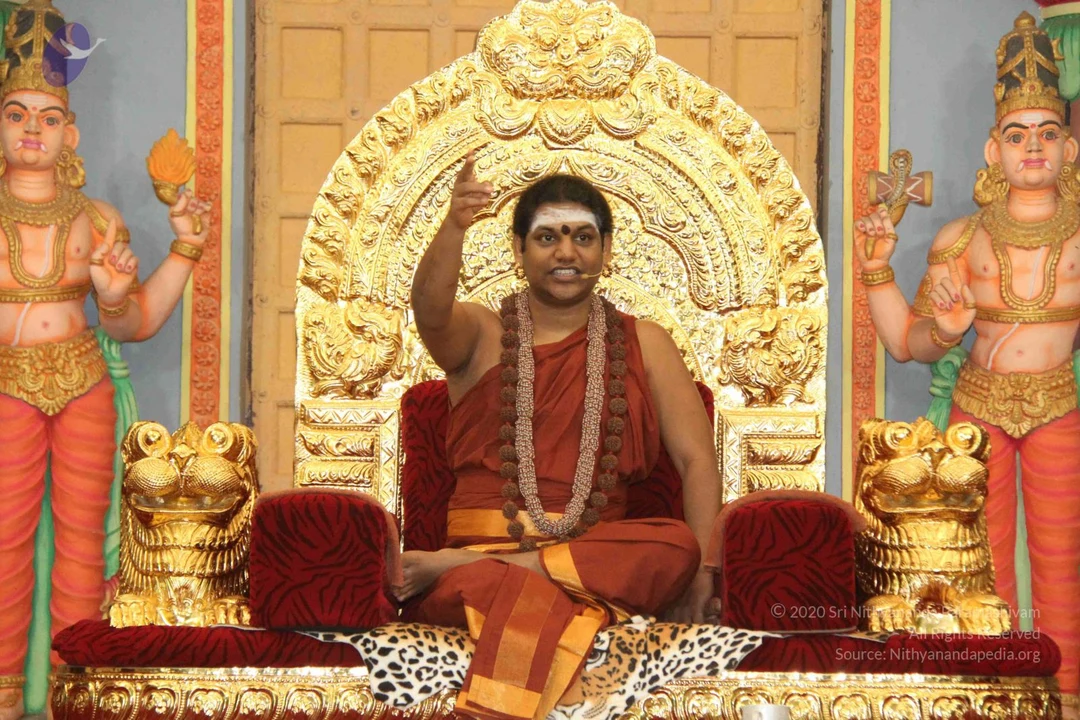
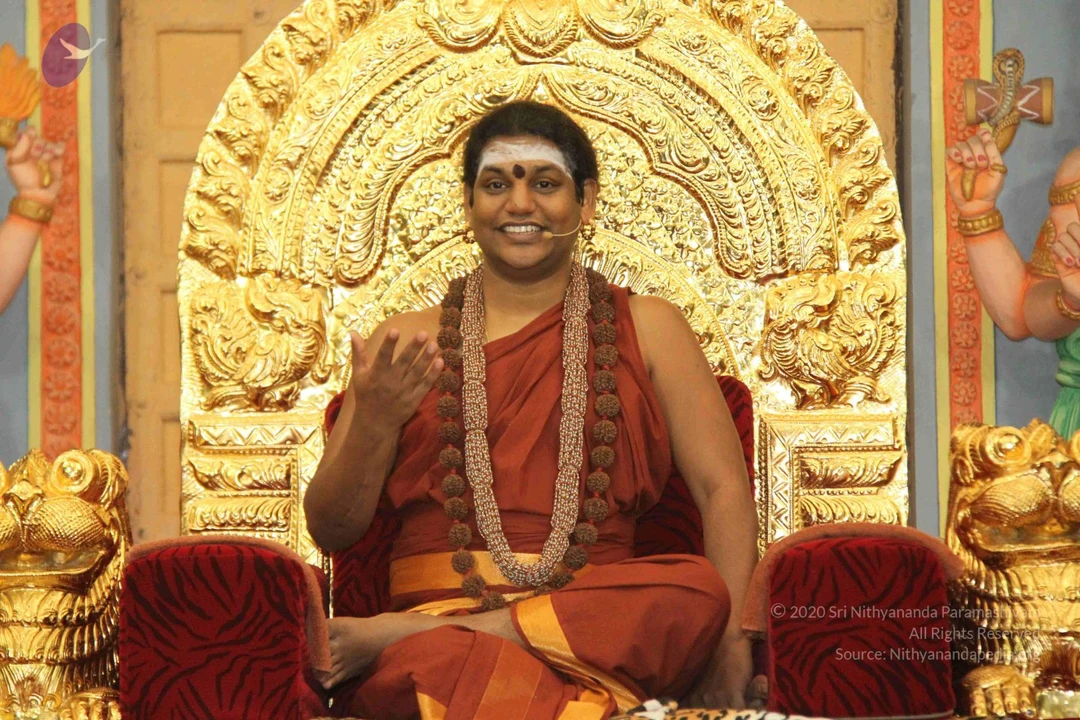
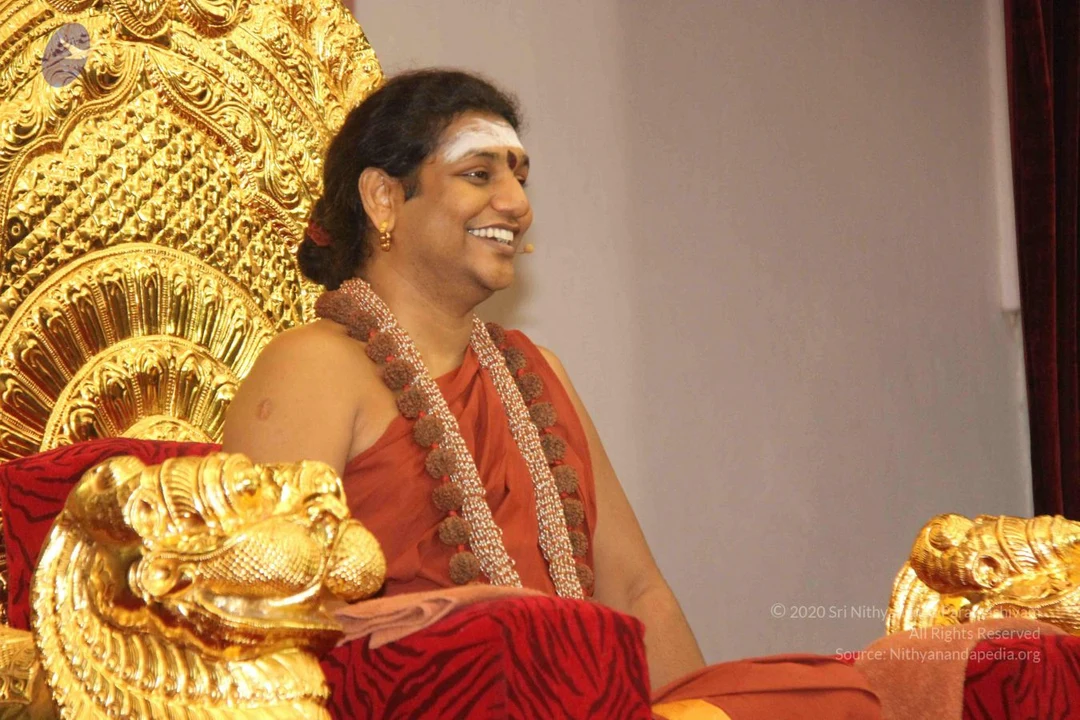
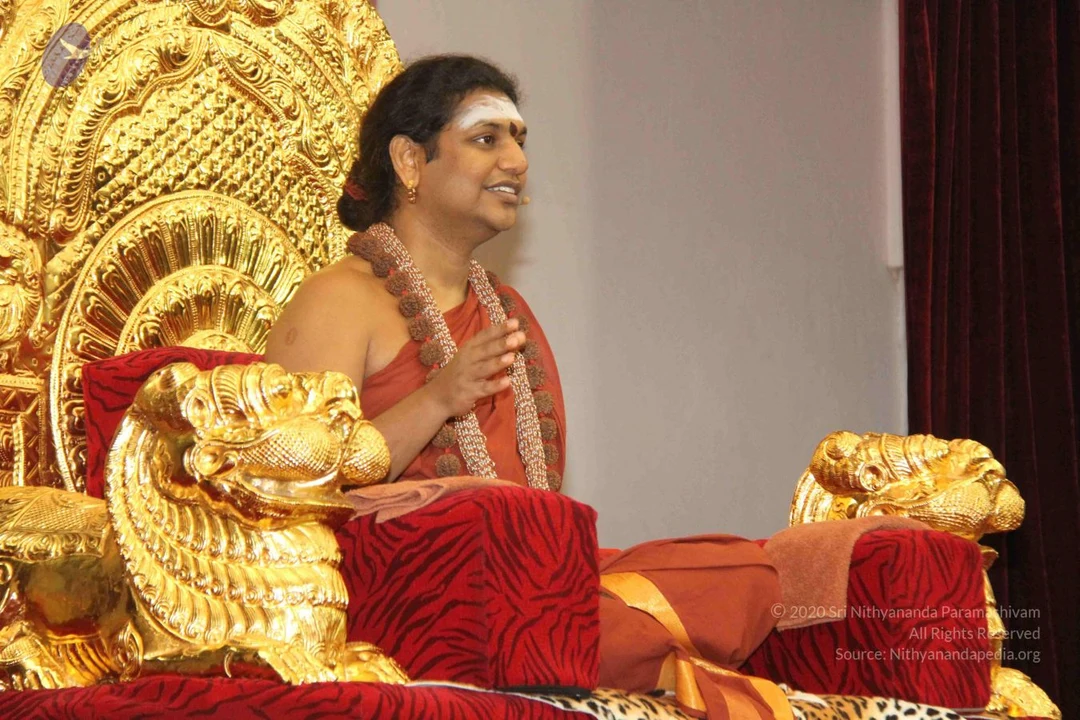
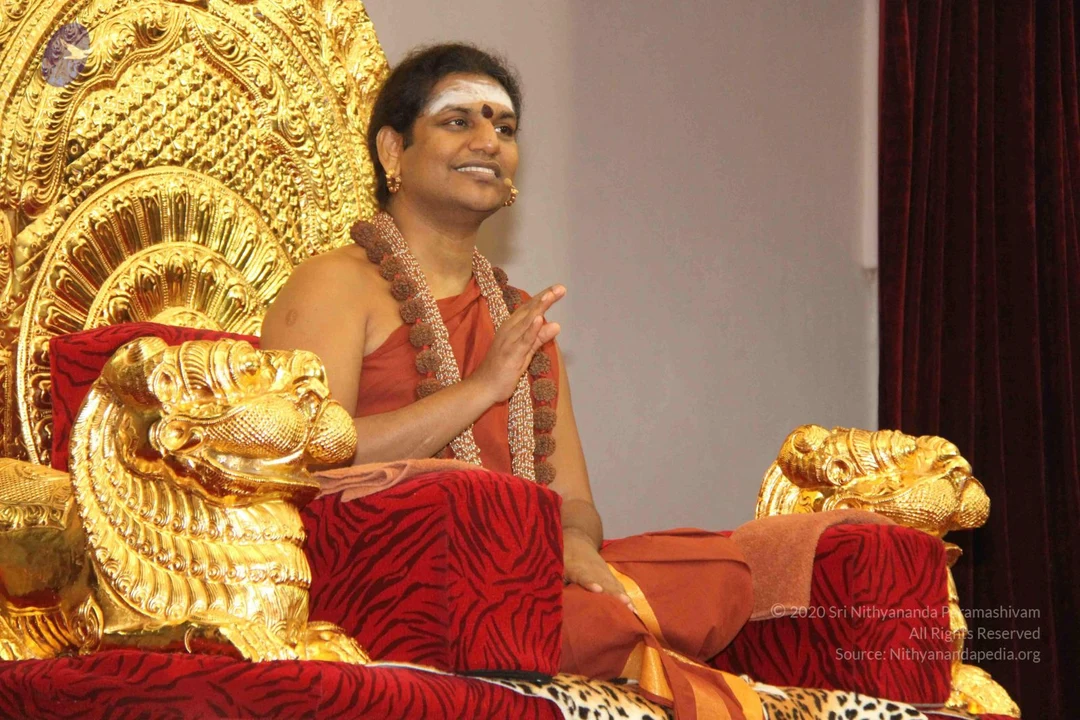
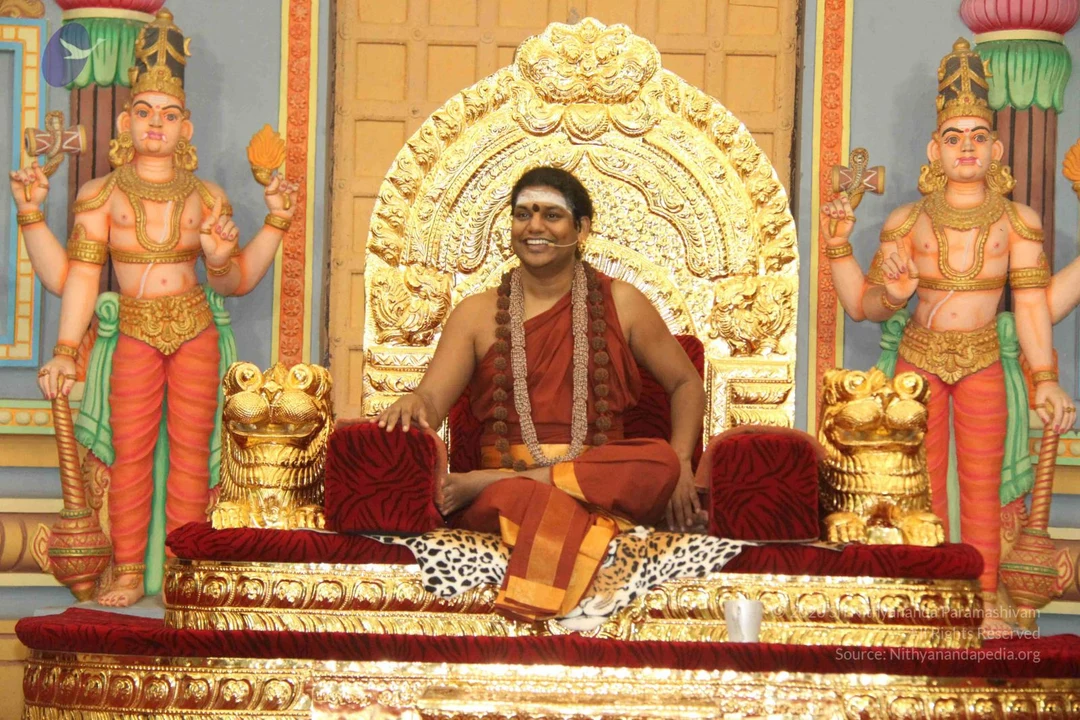
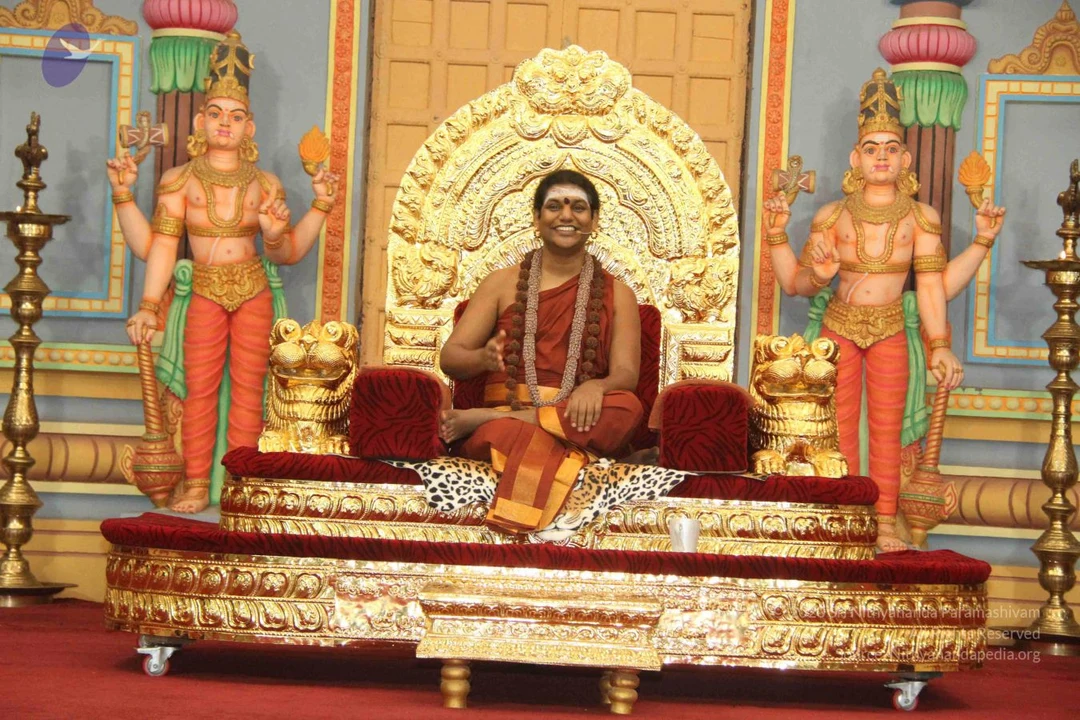
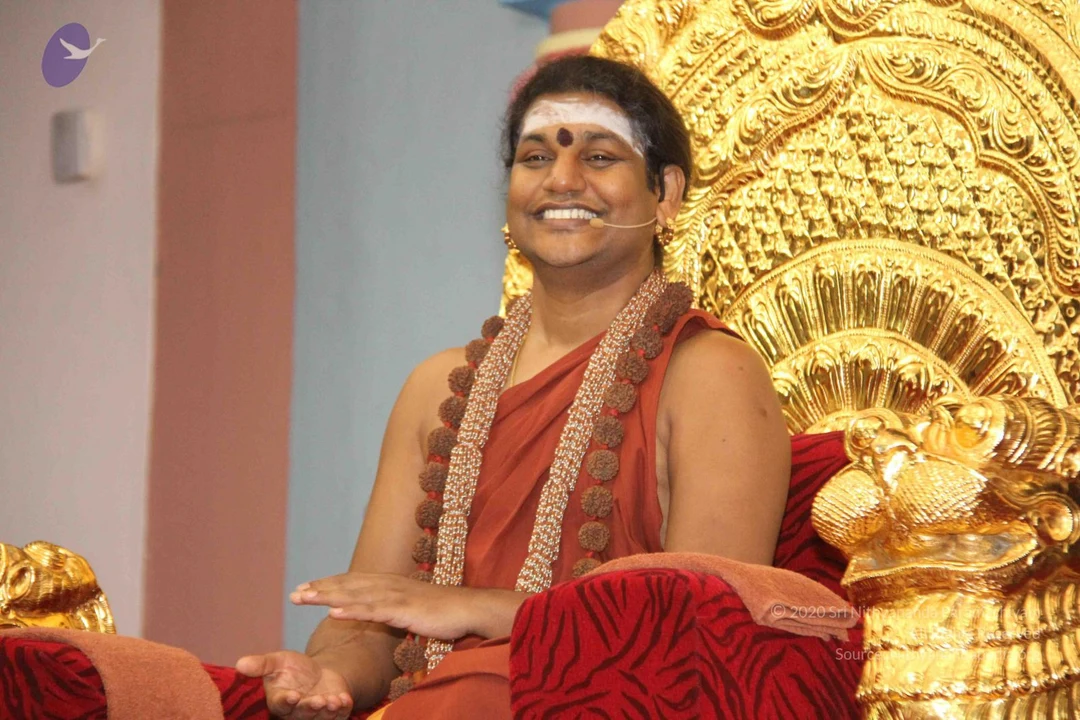
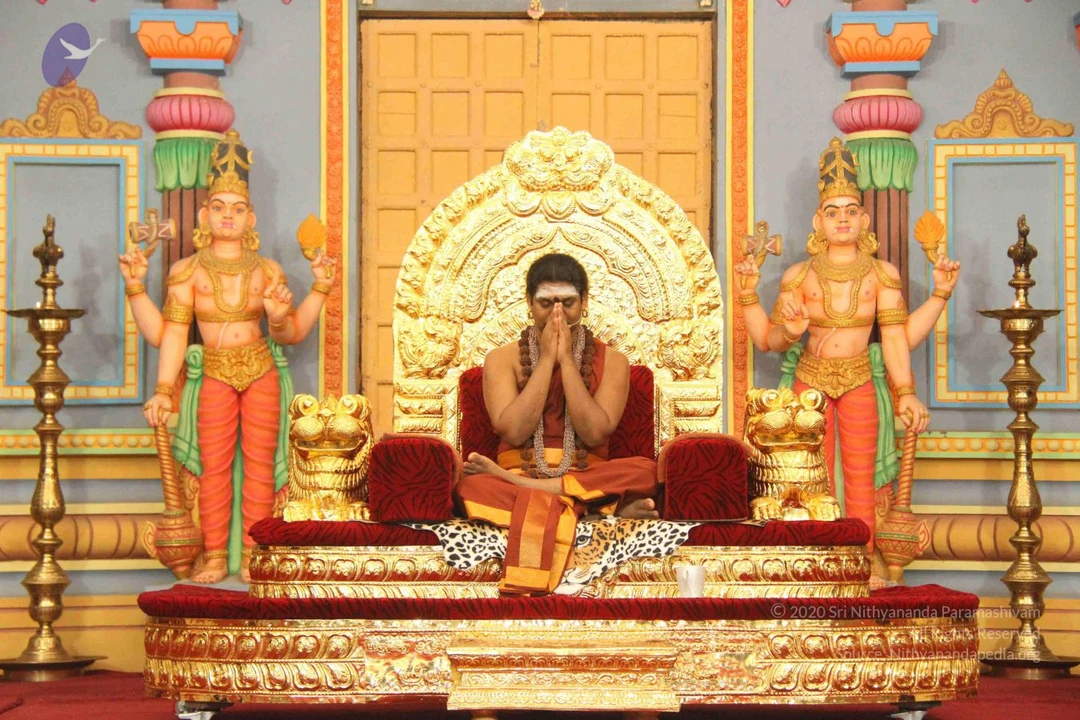
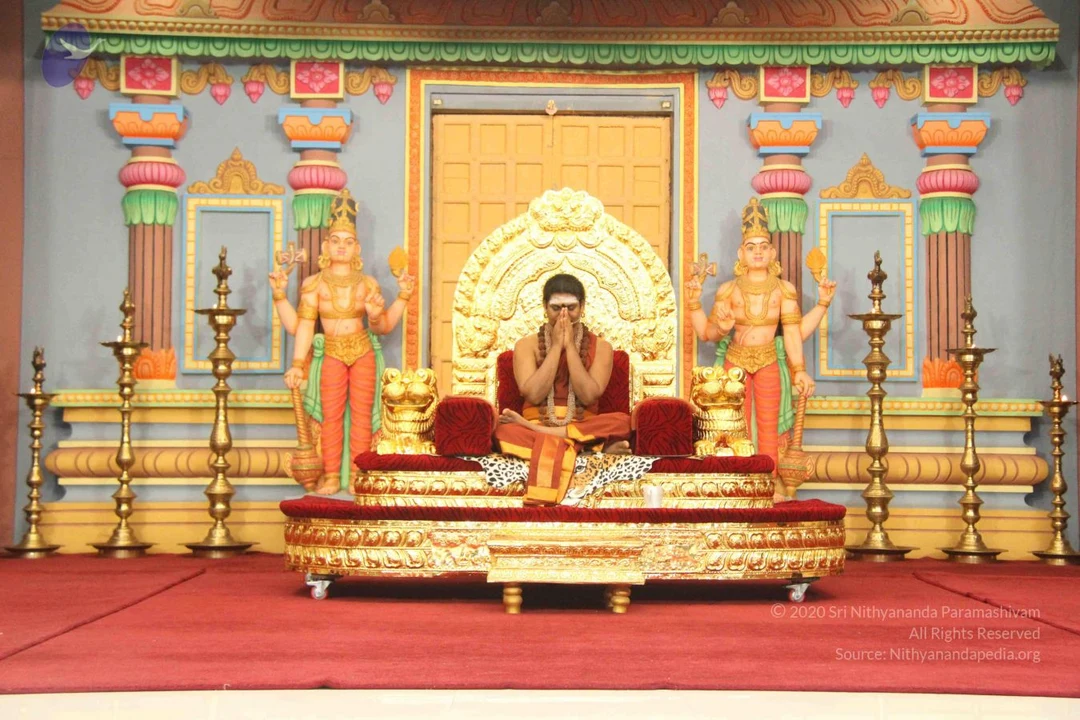
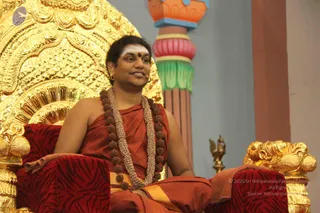
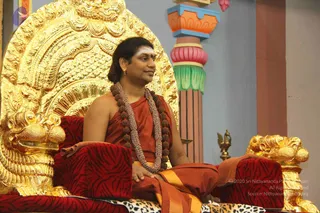
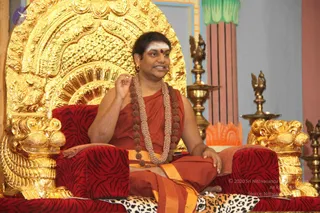
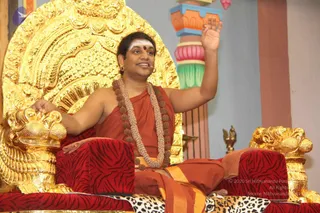
A photograph of a seated man in saffron-orange ceremonial robes on an ornate gold throne with red velvet cushions, animal-head carved armrests and a gold backrest. He wears a long rudraksha mala with a gold-toned bead necklace, a white vertical forehead mark with a red dot, and gold earrings, and he rests his hands on his lap while smiling and looking to the side. Behind him stand a pink, green and gold decorated pillar and a small brass bird figure on a stand.A photograph of a man seated on an ornate gilded throne with a high carved back and red striped cushions, resting on a leopard-print cloth. He wears a rust-orange robe draped over one shoulder, a long necklace of dark rudraksha beads and a lighter bead mala, and has a white vertical tilak on his forehead. His hands rest on his lap. Behind him are pillars painted in pink, orange and green lotus-style bands and a small brass bird ornament.A man in saffron-orange robes sits cross-legged on an ornate gold throne with a large gilded arched backrest and carved lion-shaped armrests draped with red tiger-striped cushions. He wears a long rudraksha mala and a silver ceremonial necklace, with a white tilak and red bindi on his forehead. Two painted deity statues flank the throne, one on each side, with gold jewellery and raised hands. a person is seated in the centre, smiling. The photo is credited as , with a source lineA seated man in saffron-orange robes and a long rudraksha mala with a ceremonial gold necklace sits on an ornate gold-and-red throne with lion-head armrests and a leopard-print cloth, in a temple-style hall. Two painted standing deity murtis with four arms flank him, holding ritual implements, and tall brass lamps stand on a red carpet. The man's long swept-back hair and saffron clothing match the Swamiji (probable) presentation, and he is shown in a throne setting. Ornate gold arch and wooden doors form the background.A seated man in saffron-orange robes speaks while seated on an ornate golden throne with a tall carved gilded backrest and red tiger-striped cushions, with a leopard-print cloth draped at the base. He wears a rudraksha mala and a layered gold-and-beaded necklace, a white tripundra on his forehead with a red dot, and gold earrings. His right hand is raised in a gesture while the left rests on his knee. Brass oil lamps and a brass bird-topped lamp stand beside the throne against a pale green and blue backdrop. a person: the saffron robes, rudraksha mala, ceremonial necklace and tripundra are consistent with the page's claim, and he is seated on a throne as a discourse speaker.A man seated on an ornate gold throne with carved lion-head armrests and a golden back panel, draped in red-orange cloth with a red-and-gold striped lower garment. He wears a rudraksha mala with a long ceremonial gold necklace, a white vertical forehead mark with a red bindi, and gold earrings. His left arm is raised in a gesture while his right hand rests on the armrest. Red tiger-striped cushions and a leopard-print mat sit beneath him. Behind him are a colourful pillar and a small gold figure. a person is shown in an in-person satsang setting, with a microphone visible near his face. Text overlay on the photo reads a copyright notice.

darshan

5 photosSource gallery
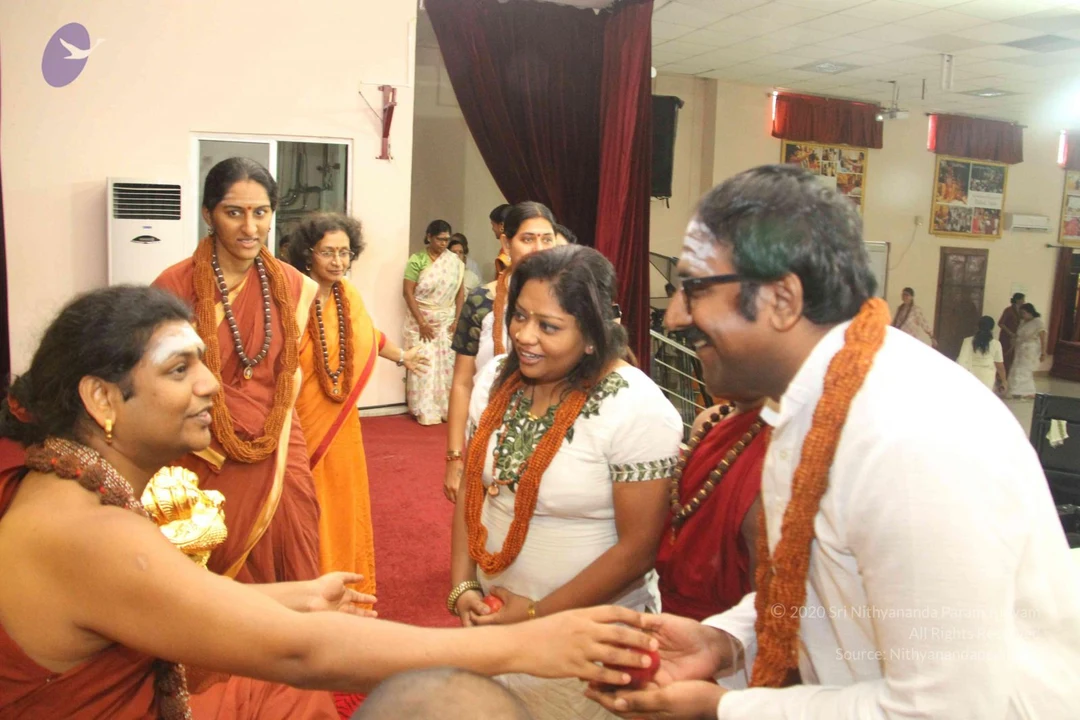
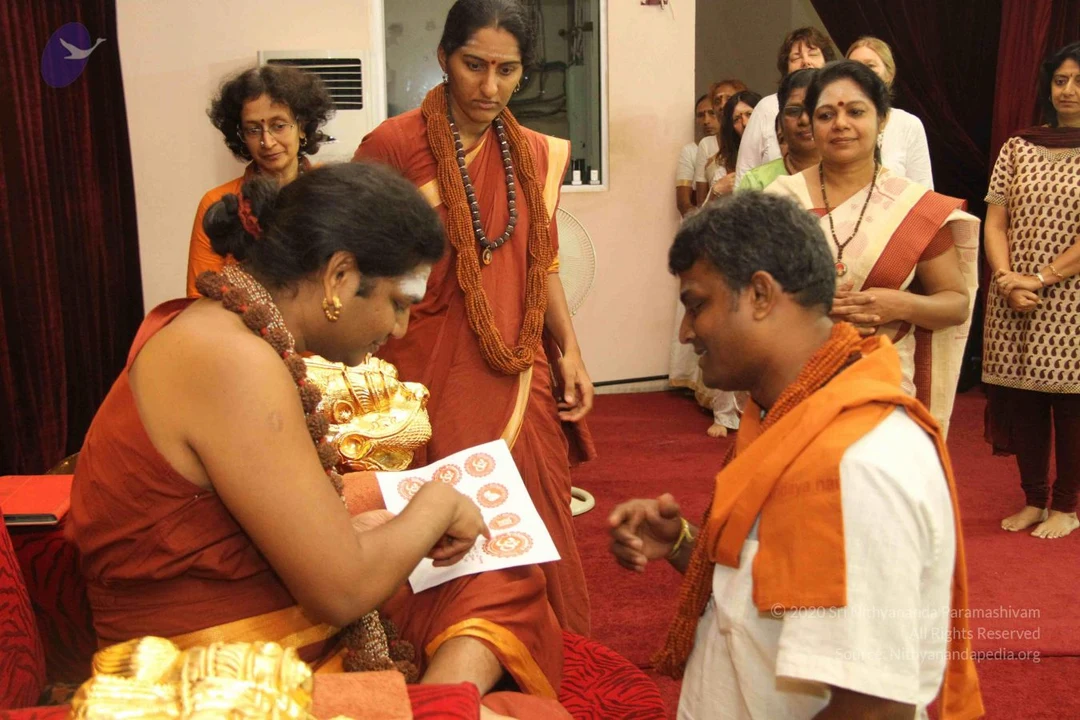
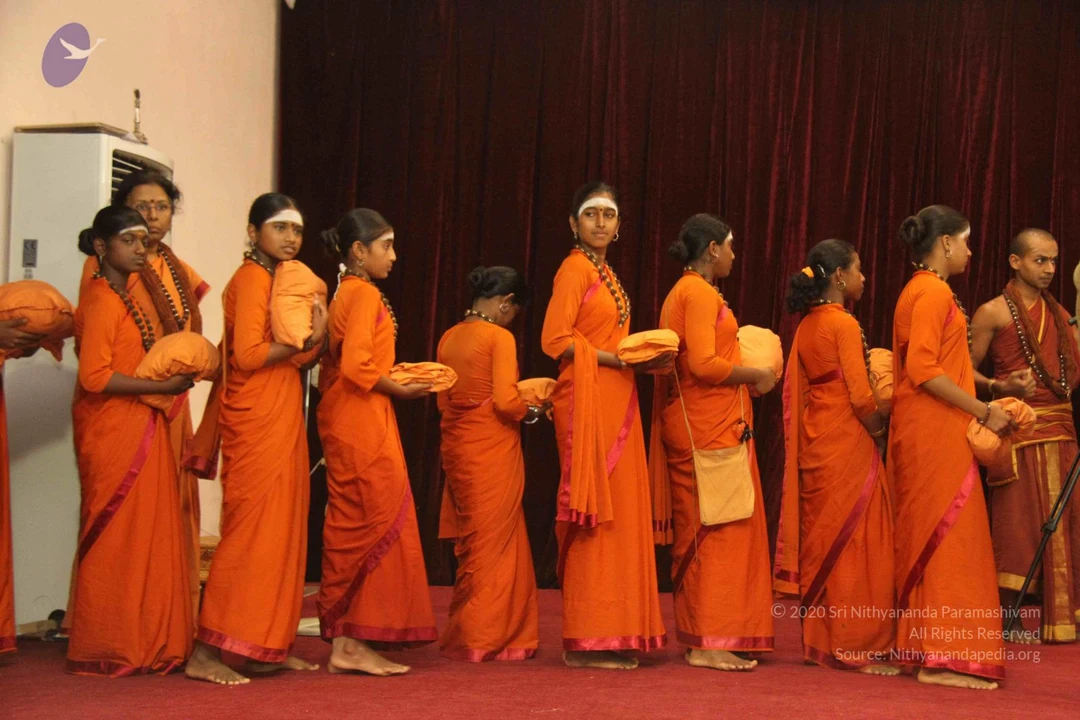
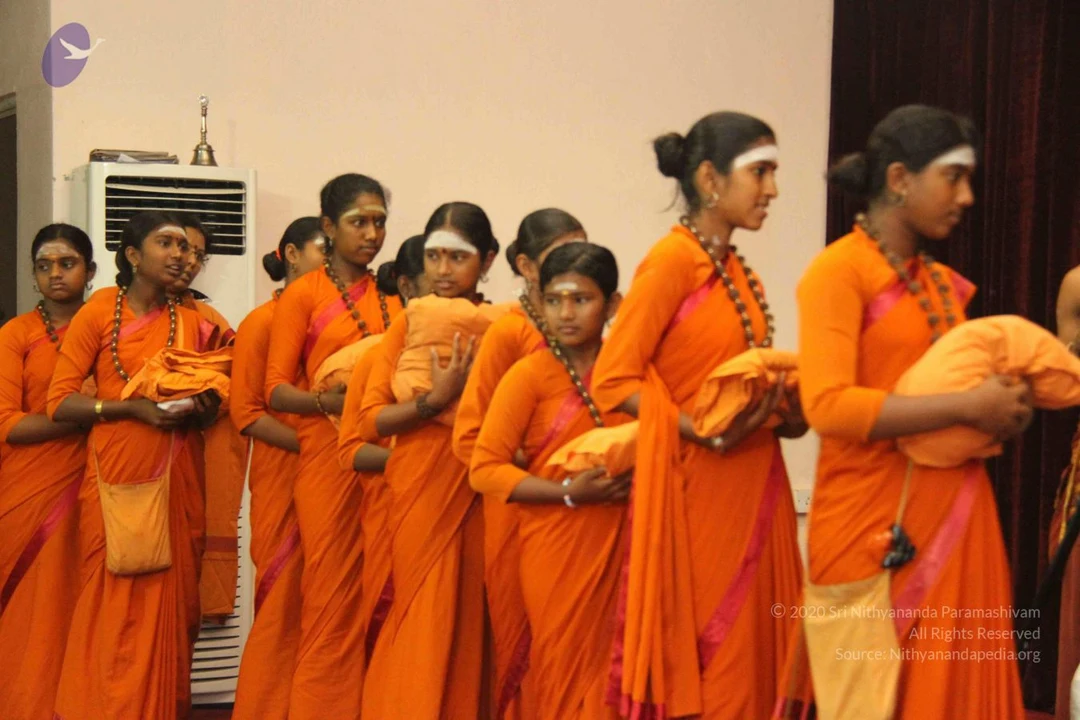
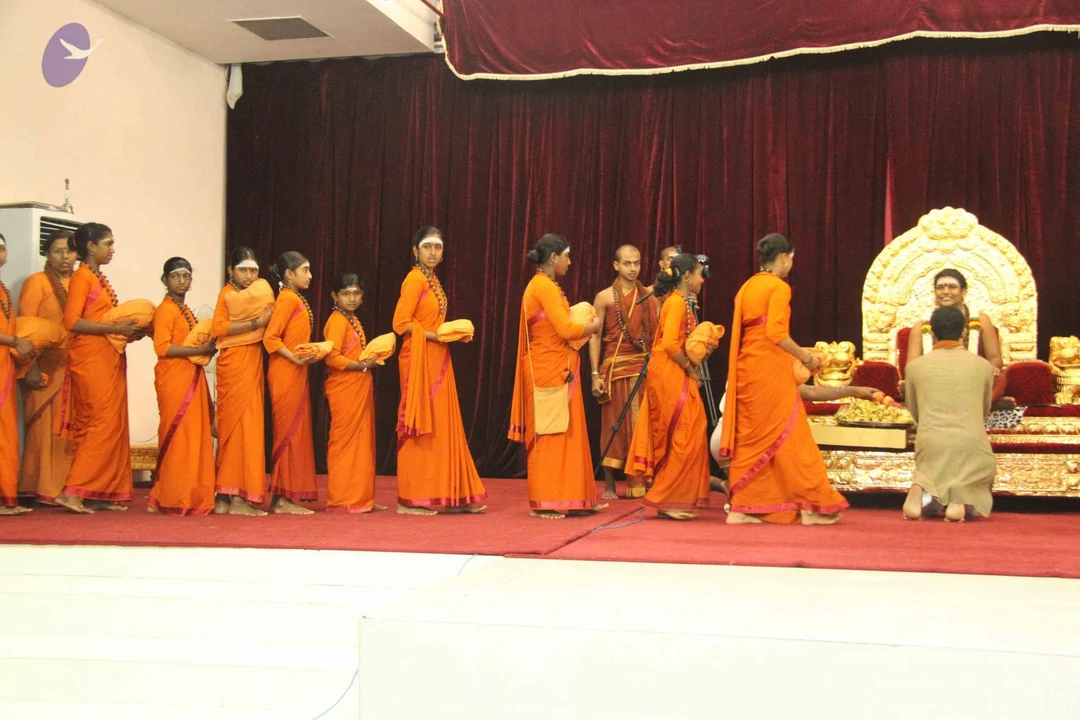
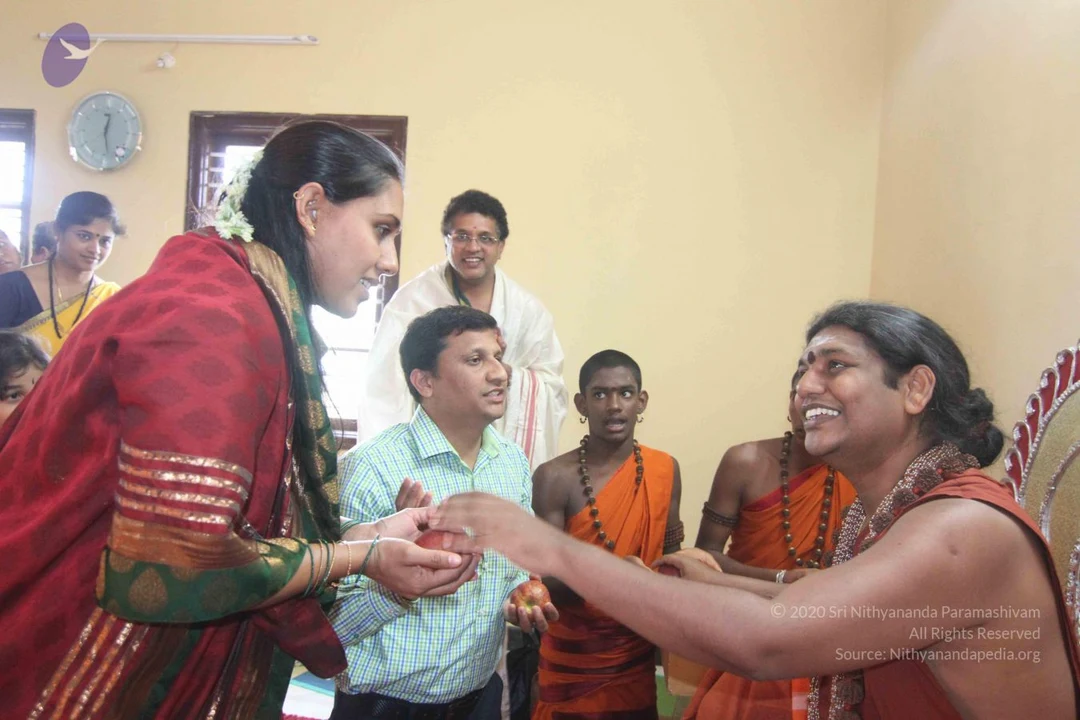
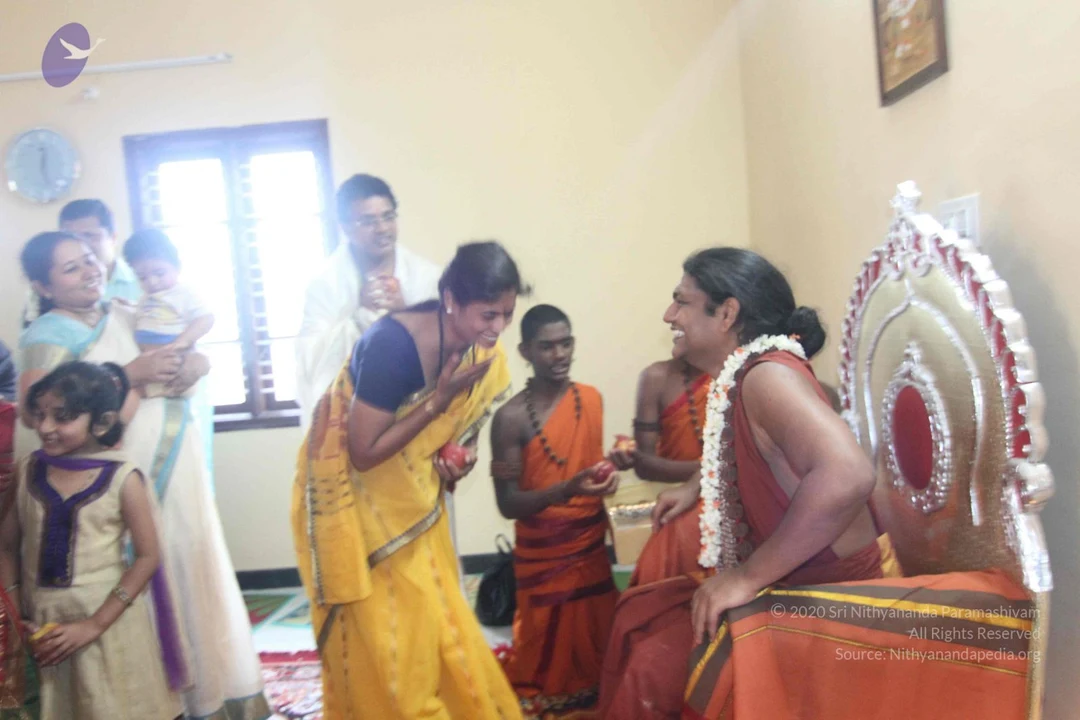
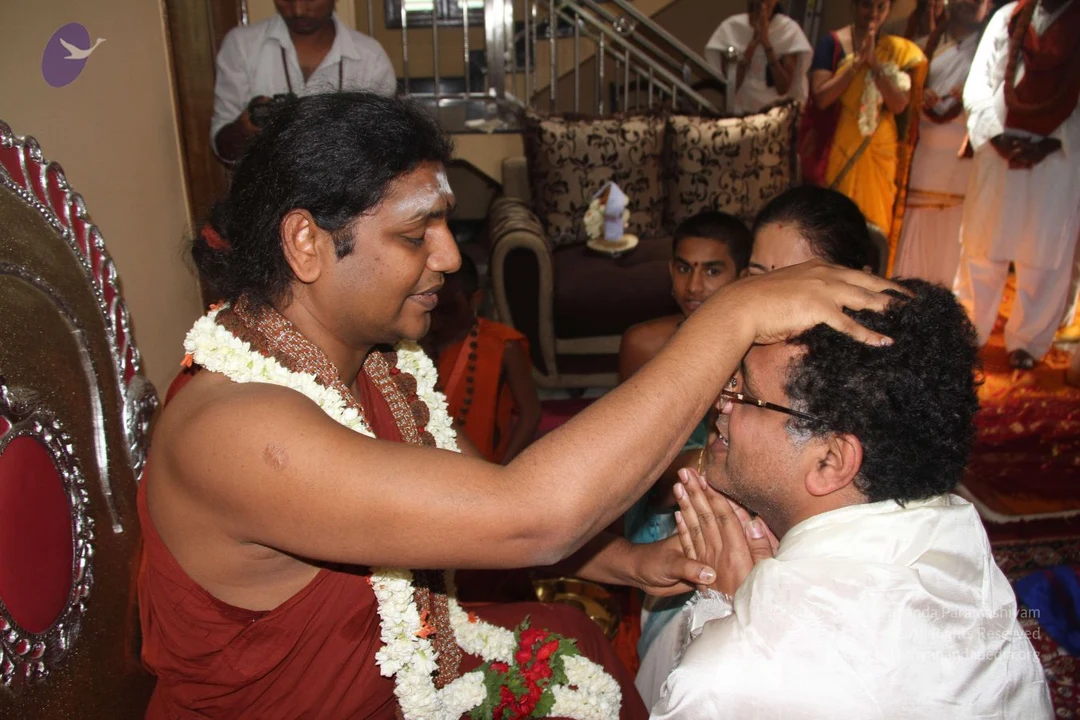
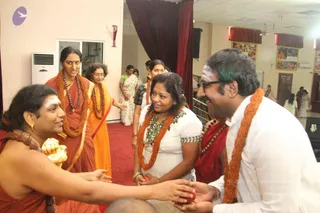
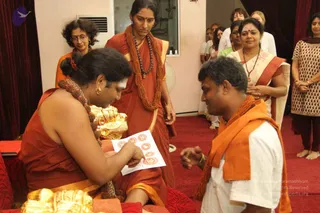
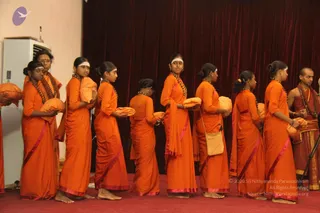
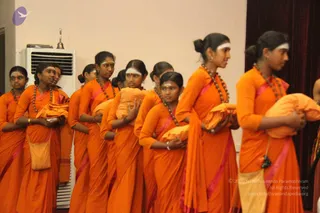
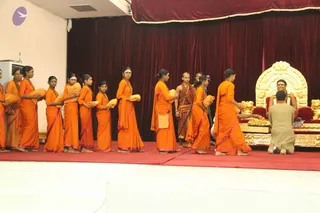
Indoor photo of a satsang-style gathering in a hall with a red carpet, cream walls, red curtains and framed photographs on the wall. In the foreground at left, a man with a shaved-head style, white tilak and rudraksha-style orange-and-red garments and a golden ceremonial object in his hand reaches out to a devotee. Opposite him, a smiling man in white with orange beaded garland and a red-and-white garment extends his hands, holding a small red object. A woman in white with an orange beaded garland and a patterned blouse stands beside him. Behind them, a woman in orange robes and rudraksha mala stands, and others in saris and orange clothing move through the room. Several people are visible.A seated figure in saffron-orange robes with a white tilak on the forehead, hair pinned up and a rudraksha mala, sits on a red carpet holding a printed sheet of red and orange circular yantra designs. A kneeling man in an orange shawl over white clothes and a beaded necklace leans forward to receive the sheet. A golden ornamental object sits beside the seated figure. Behind them a woman in a saffron sari and beaded mala stands, and several women in white and cream saris and kurtas watch from the back of a red-curtained room.A line of young women in matching saffron-orange saris with pink borders stands on a red carpeted stage before dark maroon velvet drapes. Several wear rudraksha malas and white forehead bands, and most hold orange cloth bundles or bags. A white floor-standing cooler sits at left. A man at far right with a shaved head wears an orange wrap and a rudraksha mala. Their bare feet and orderly stance suggest a ceremonial procession or rehearsal.A photograph of a line of young women in matching saffron-orange sarees with pink borders, standing in a hall with pale pink walls. Many wear rudraksha malas, white forehead markings and hair in buns. Several hold folded orange cloth bundles against their bodies. A white floor-standing air conditioner and a brass bell are visible on the left, and a dark maroon curtain hangs on the right.A line of women in saffron-orange saris with pink borders and rudraksha necklaces walks across a red-carpeted stage in front of maroon velvet drapes. Several carry small golden-yellow bundles or cloths toward an ornate gold throne with red cushions on the right. A man in a tan kurta kneels at the throne's edge facing the stage, and a bald man in a brown dhoti stands among the women at centre. The scene suggests a ceremonial offering procession during satsang.

Pada-Pooja-Home-Visit

397 photosSource gallery
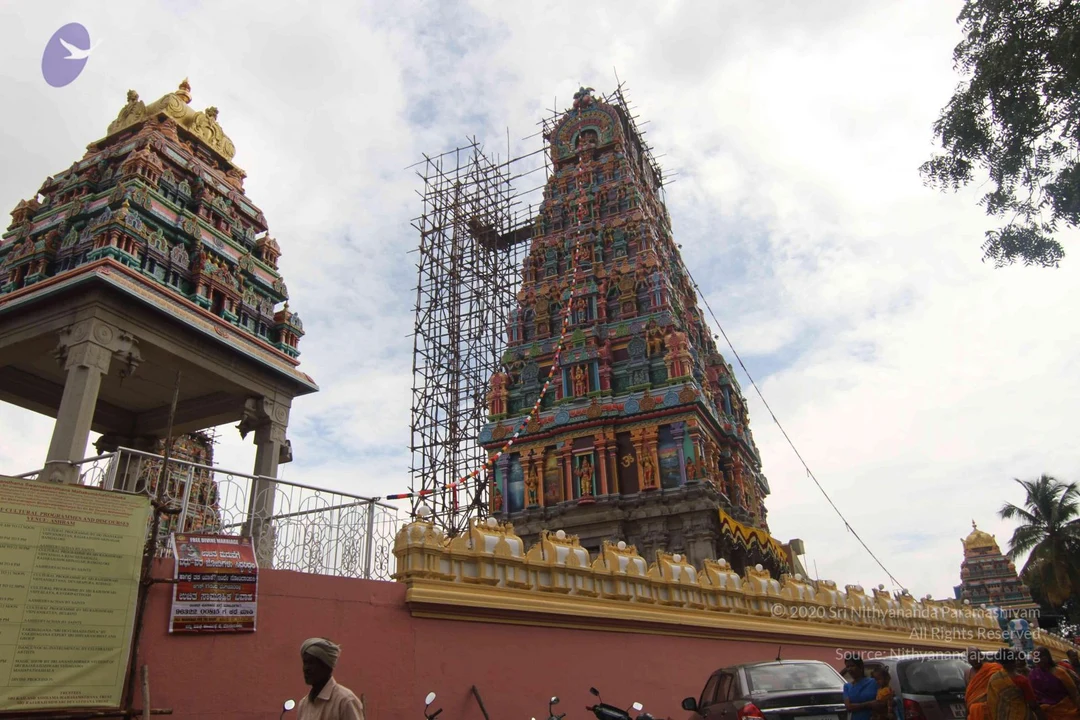
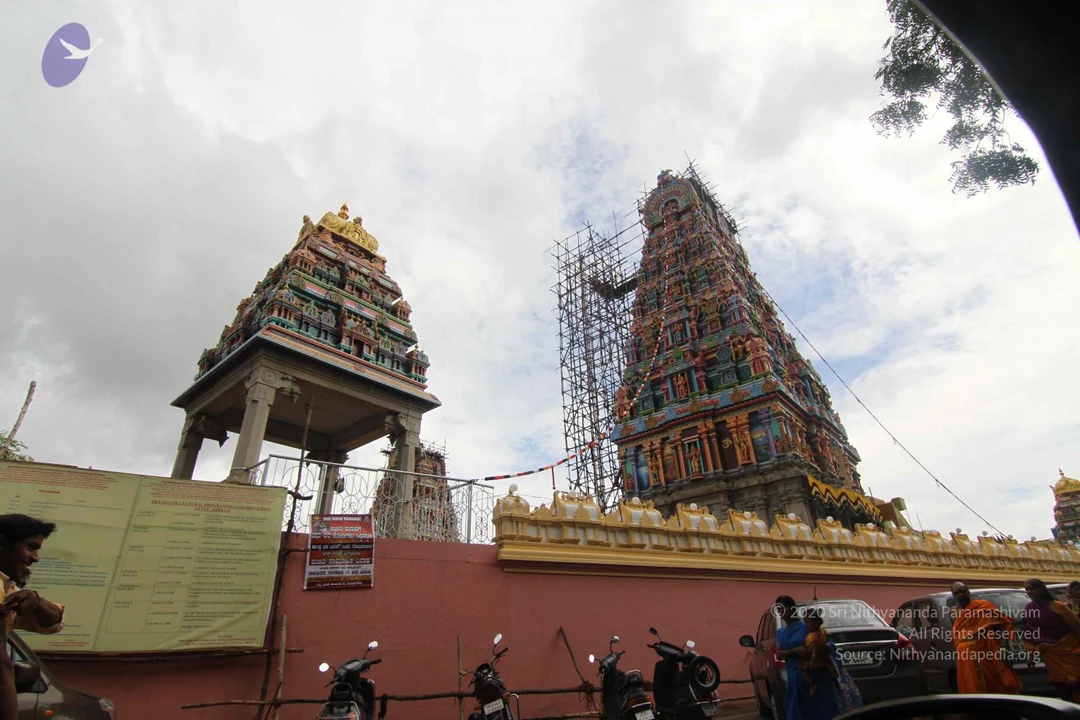
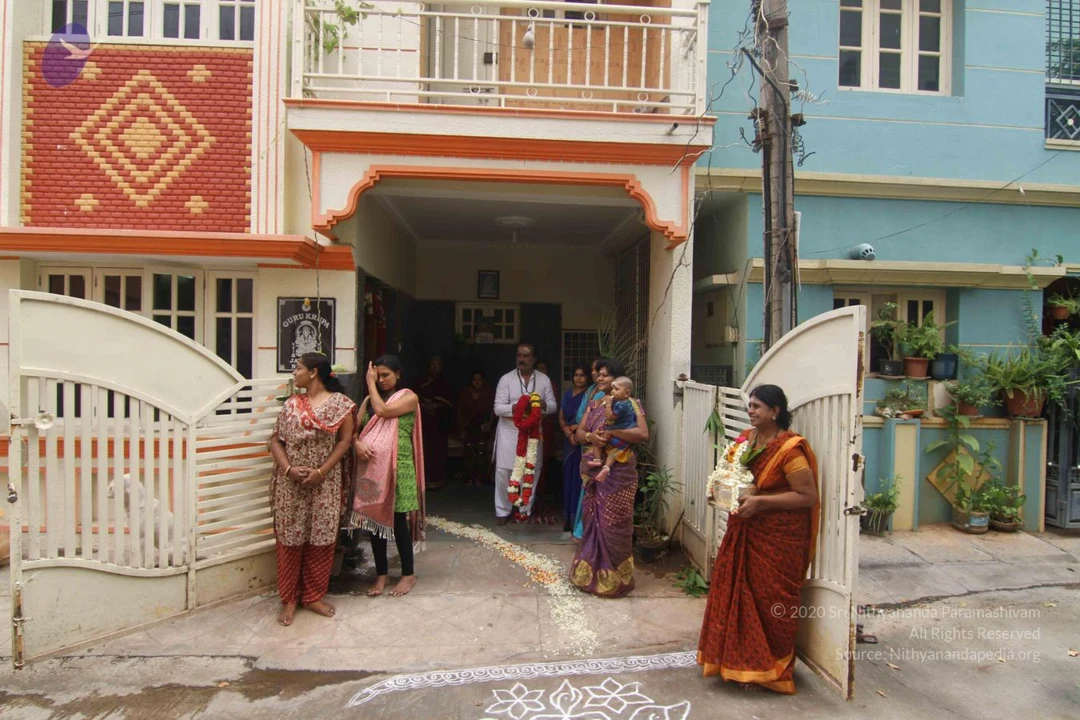
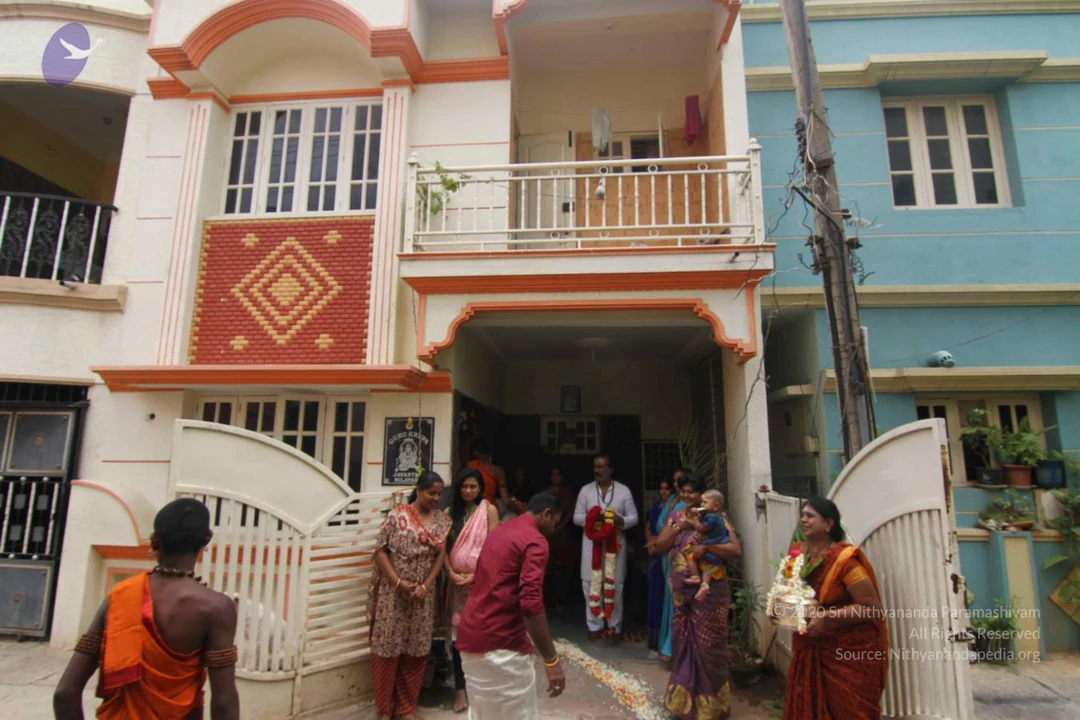
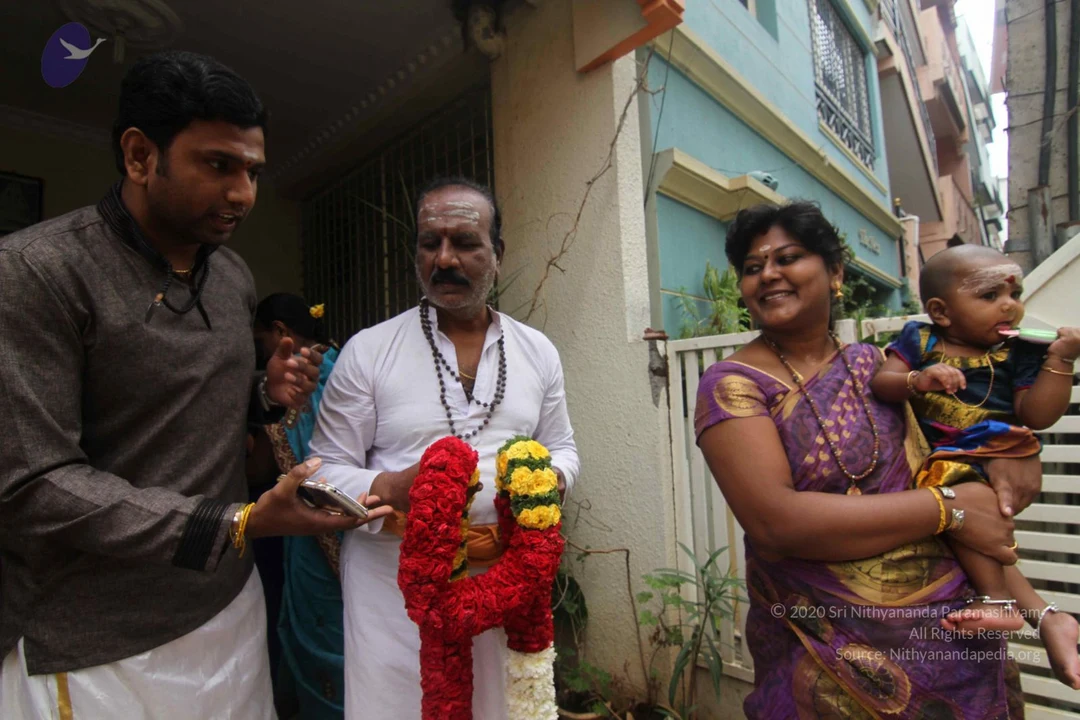
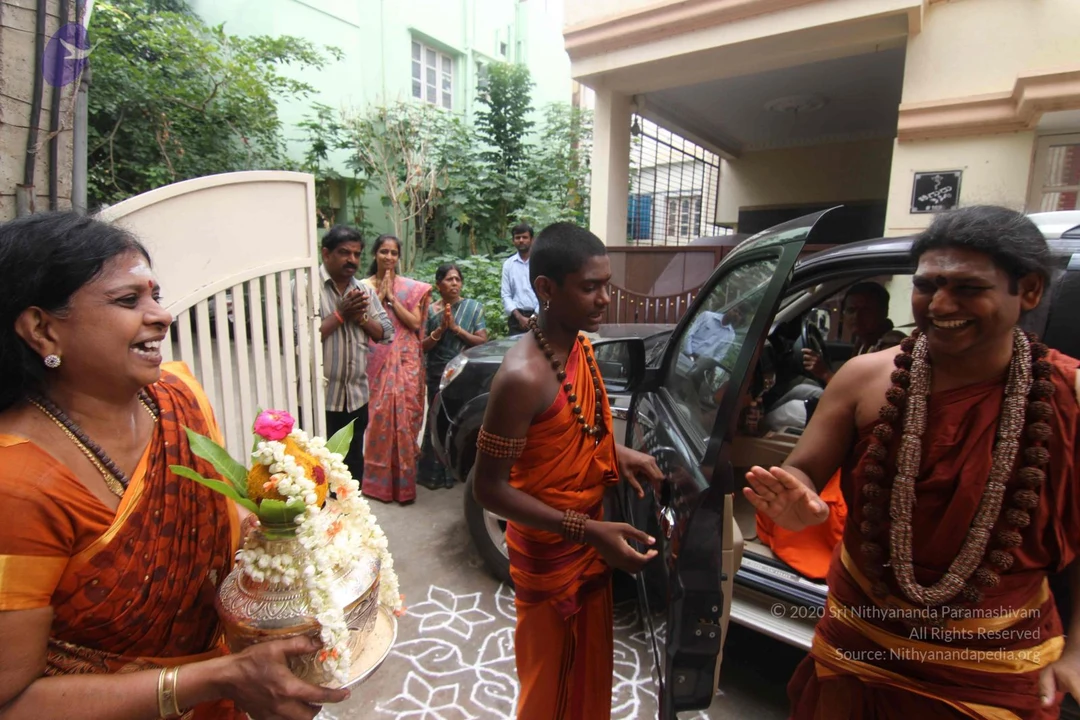
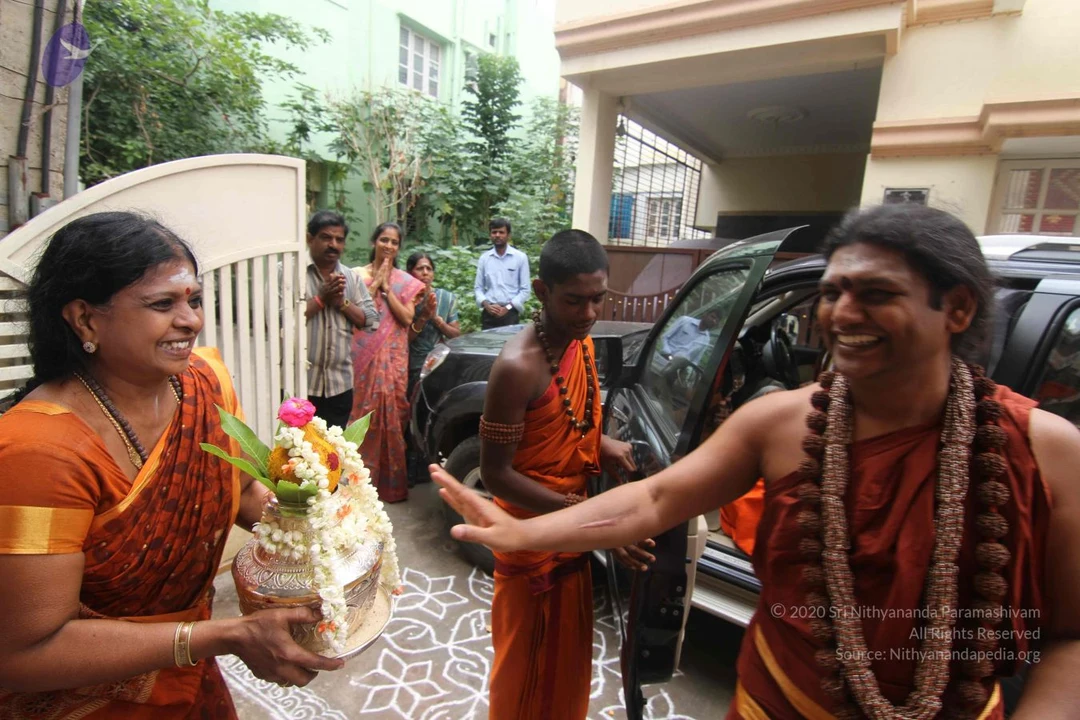
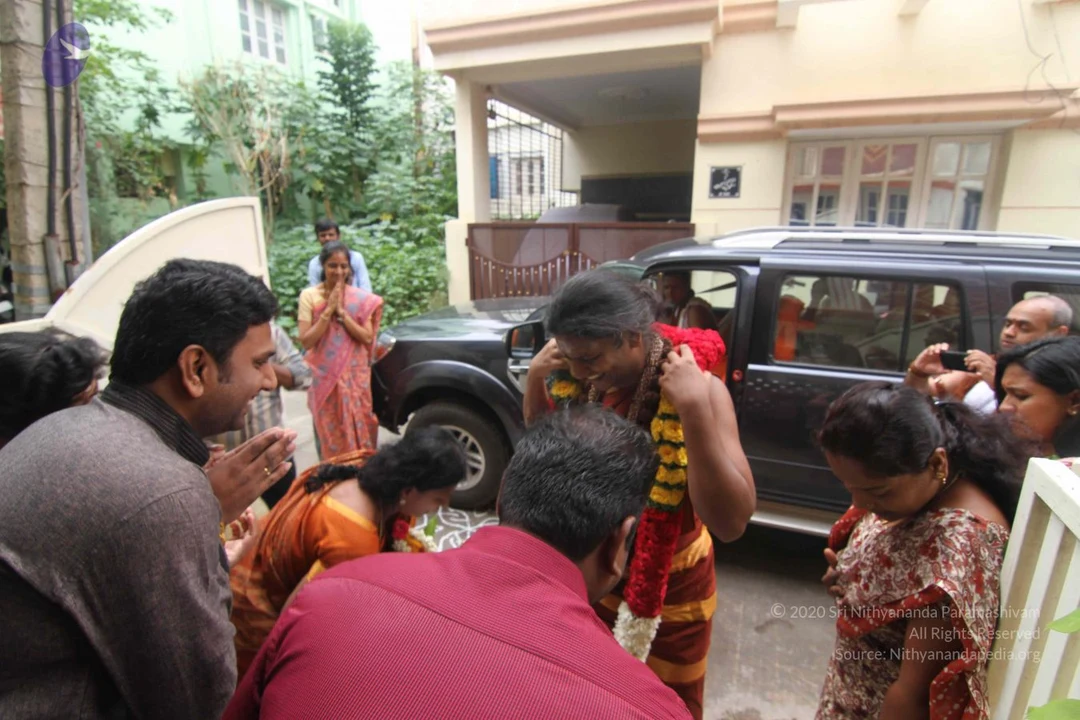
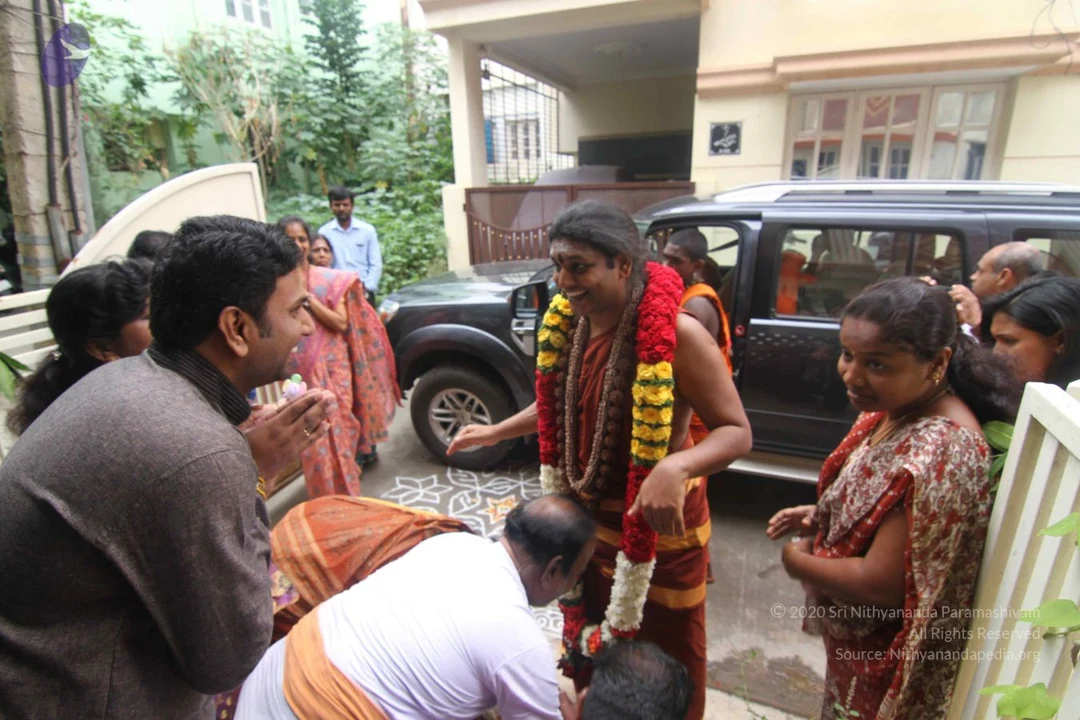
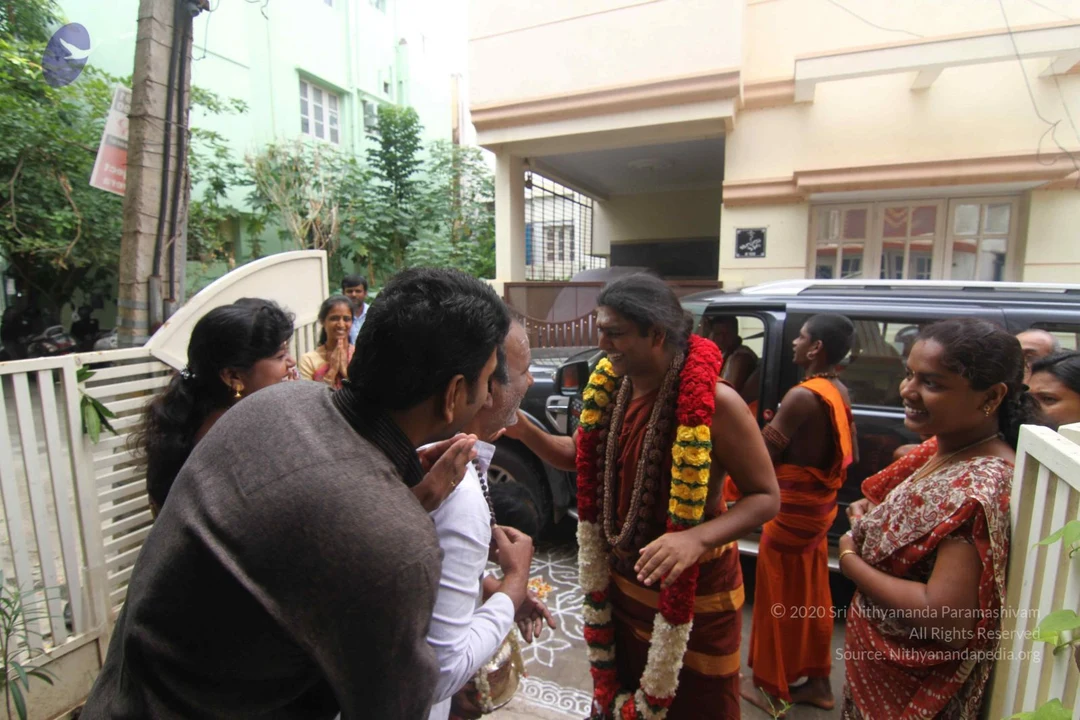
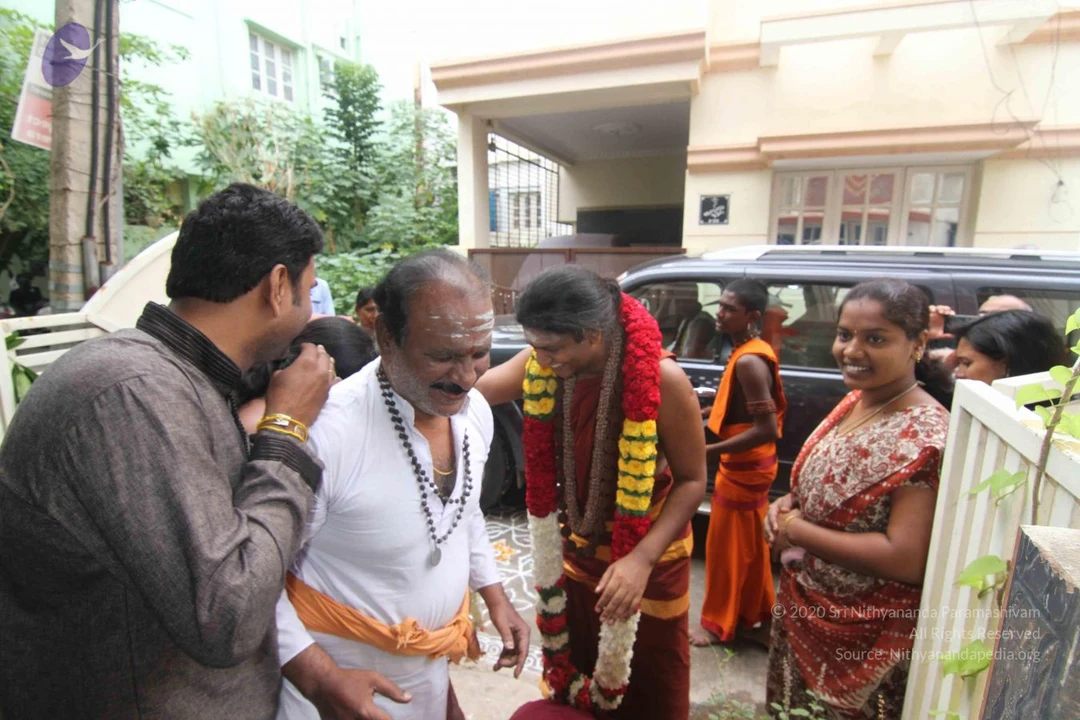
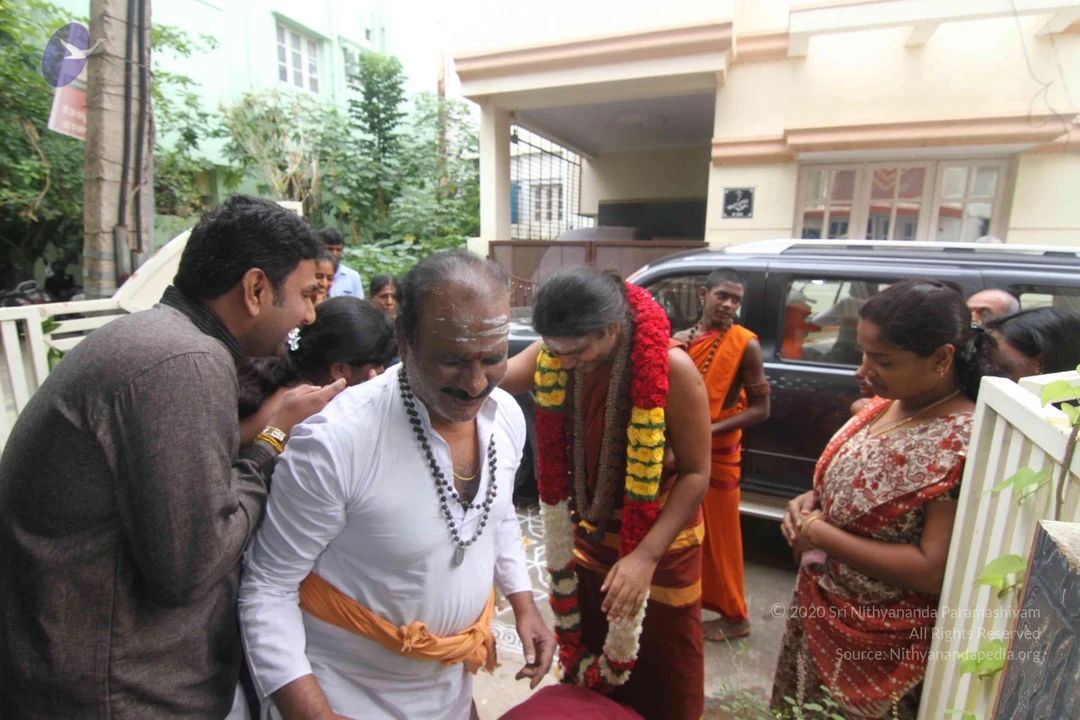
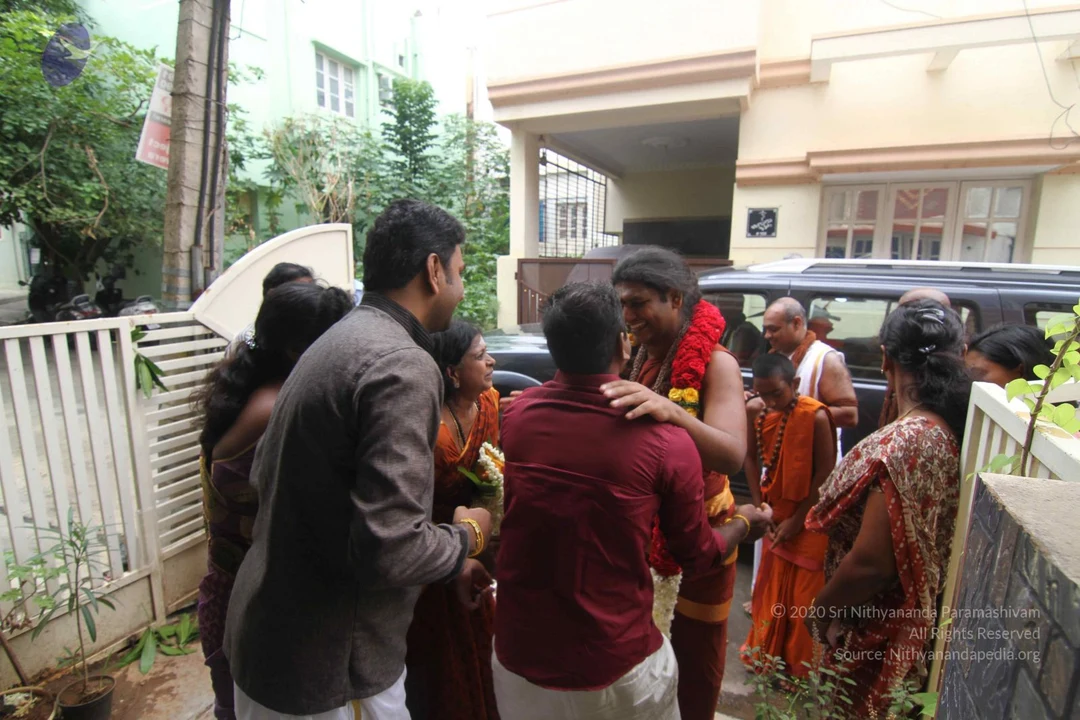
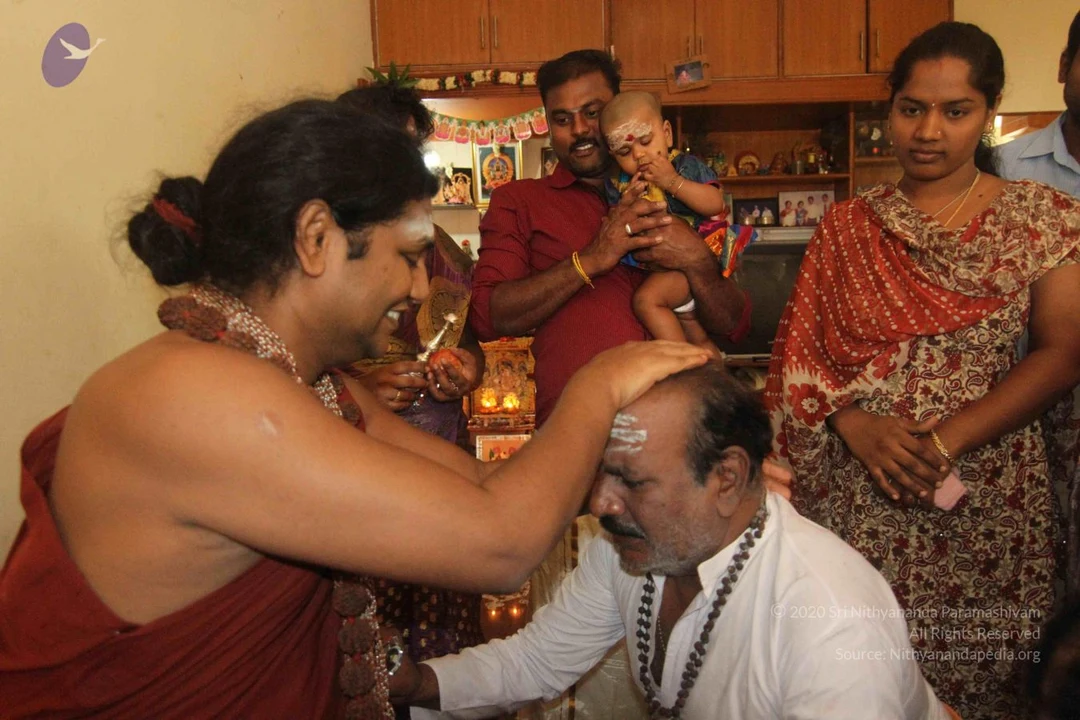
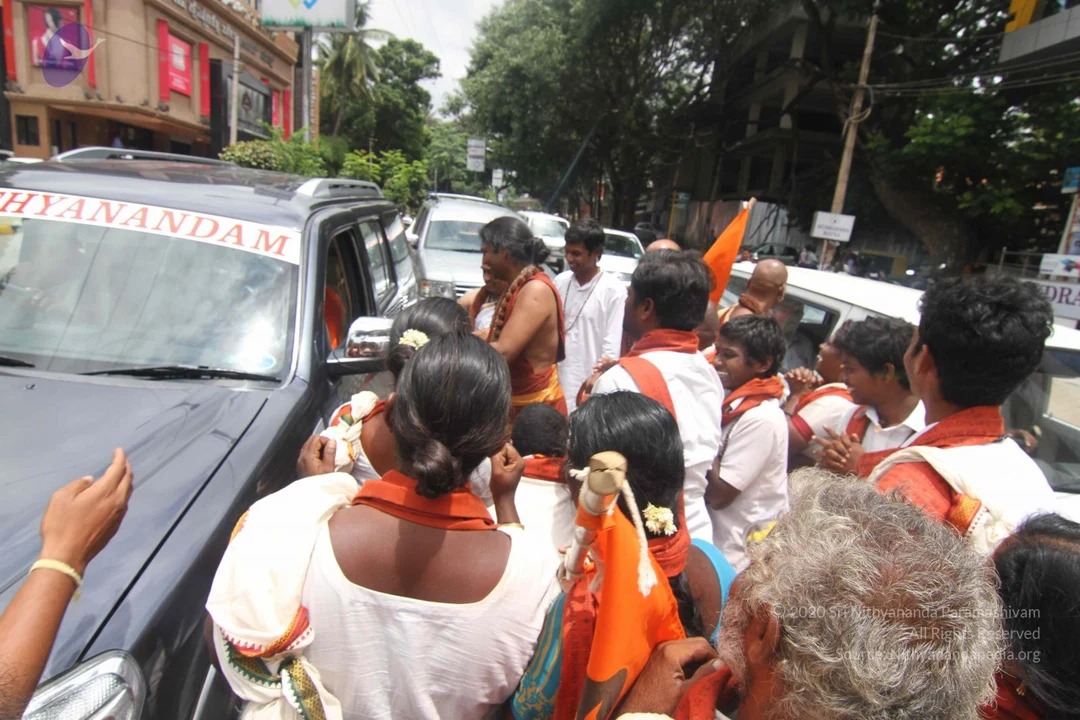
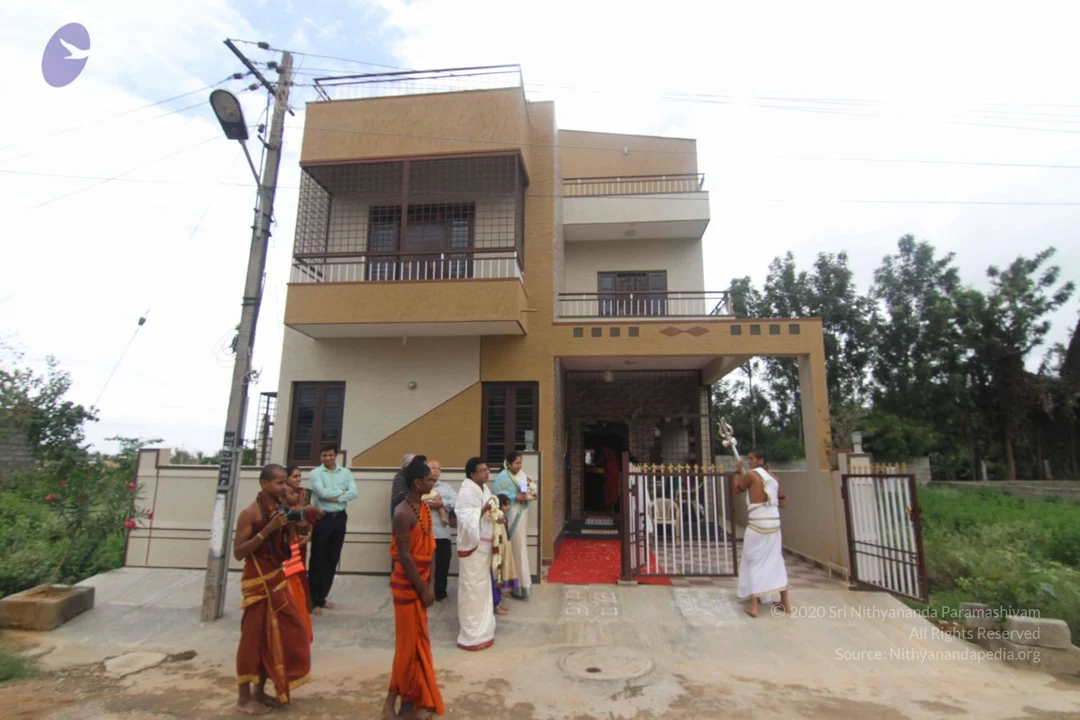
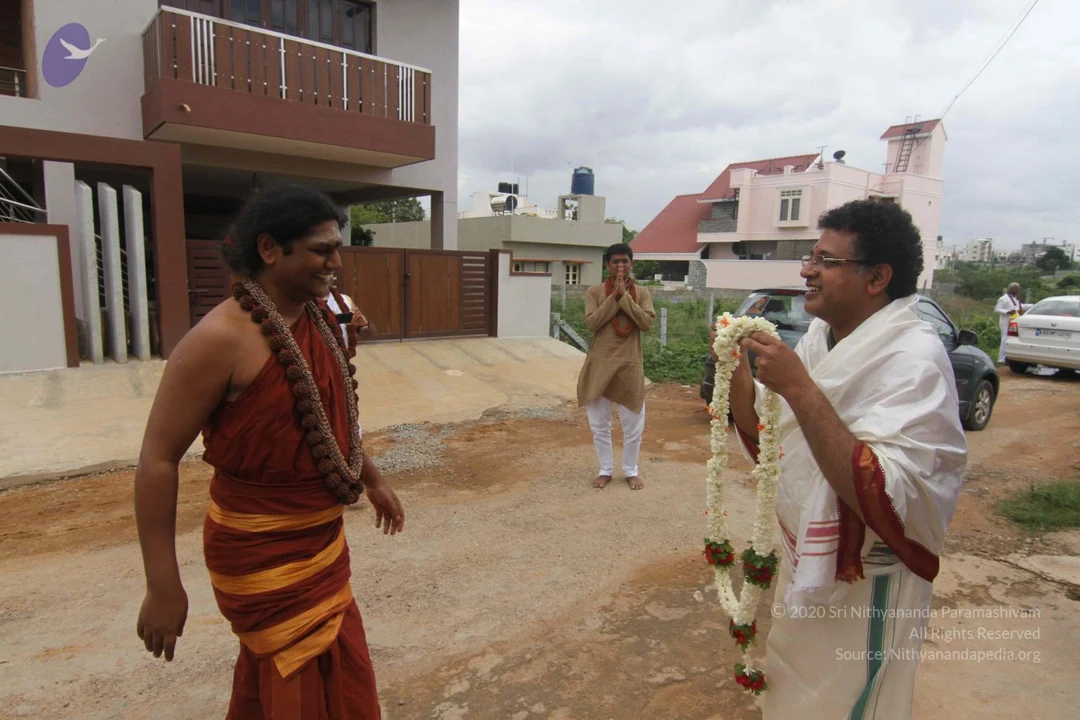
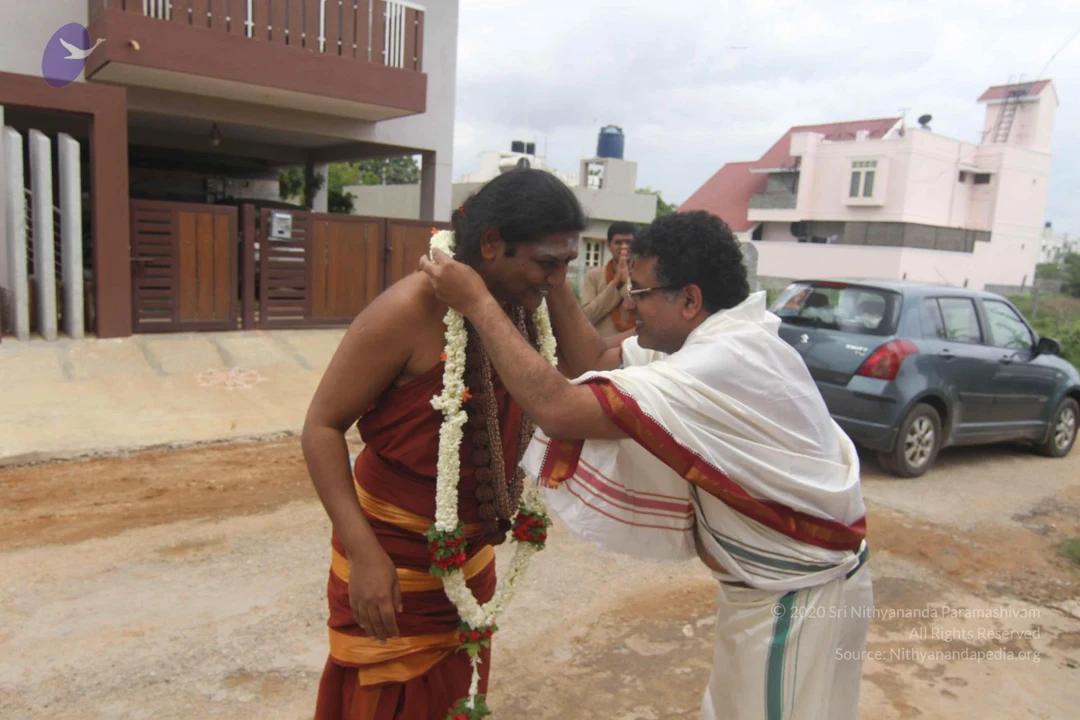
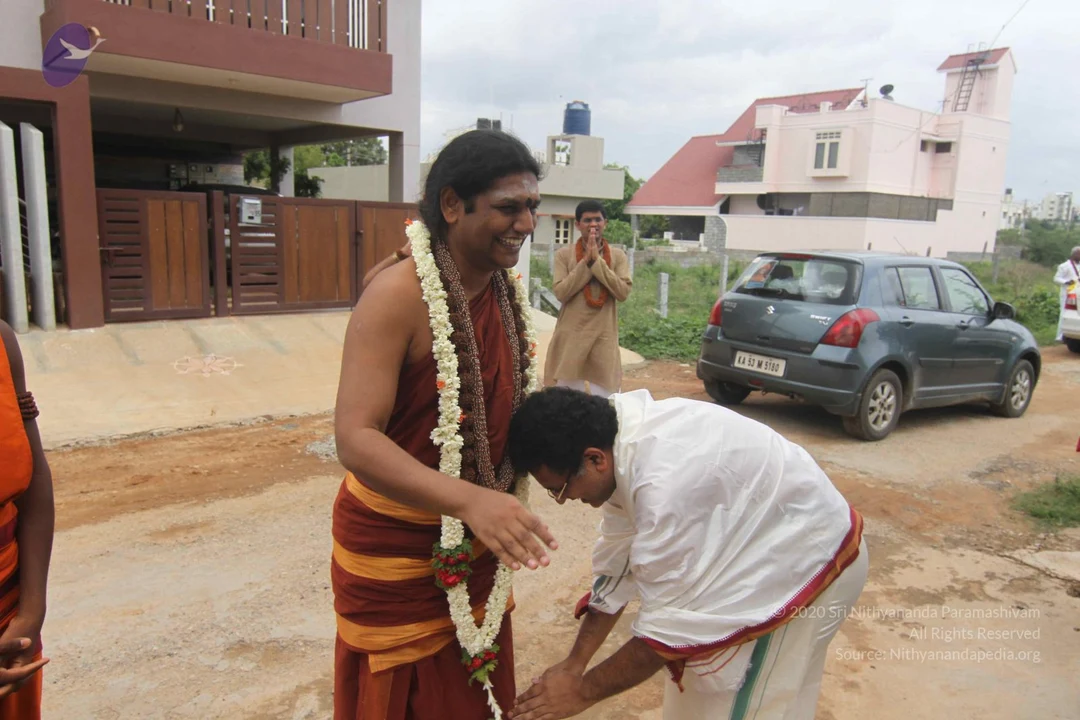
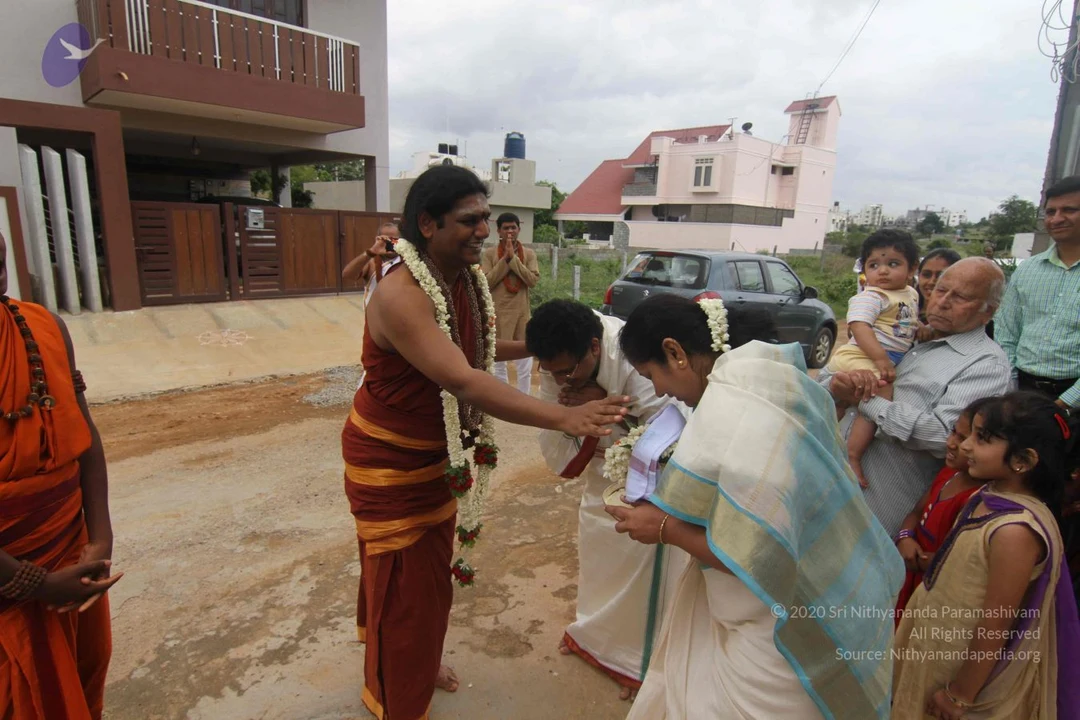
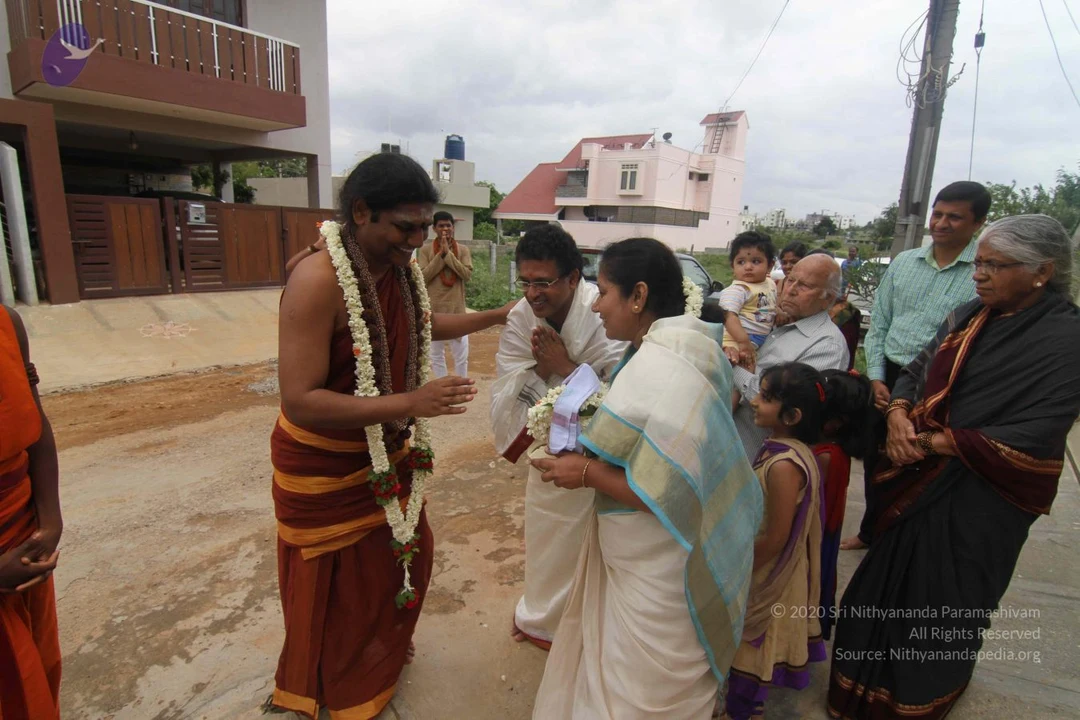
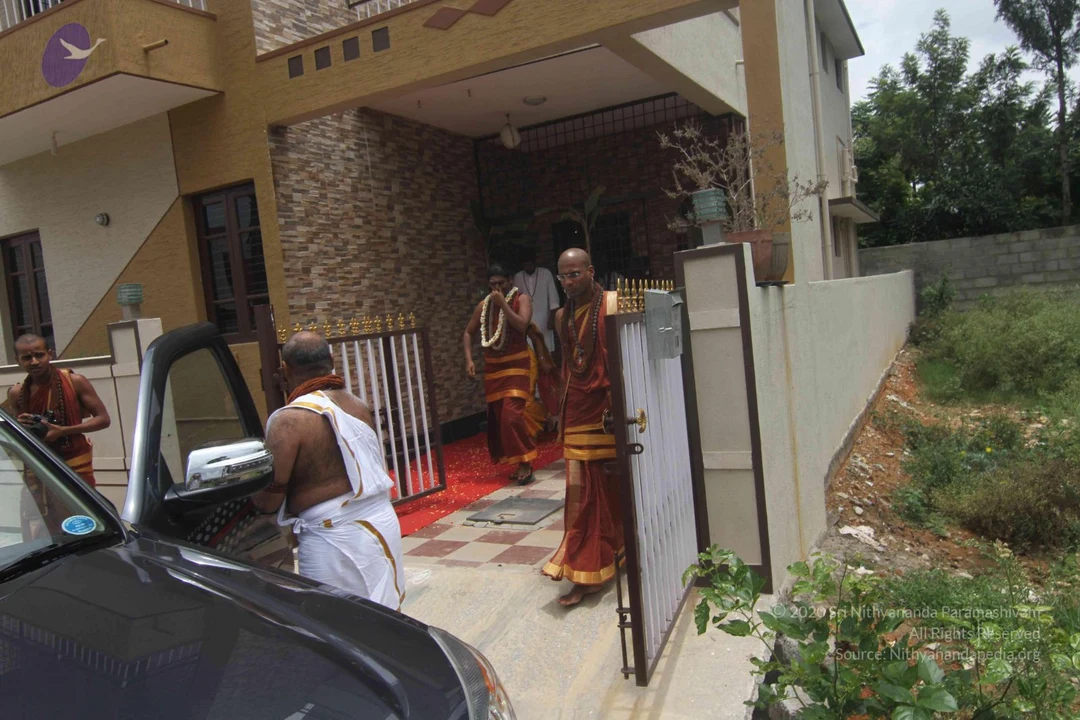
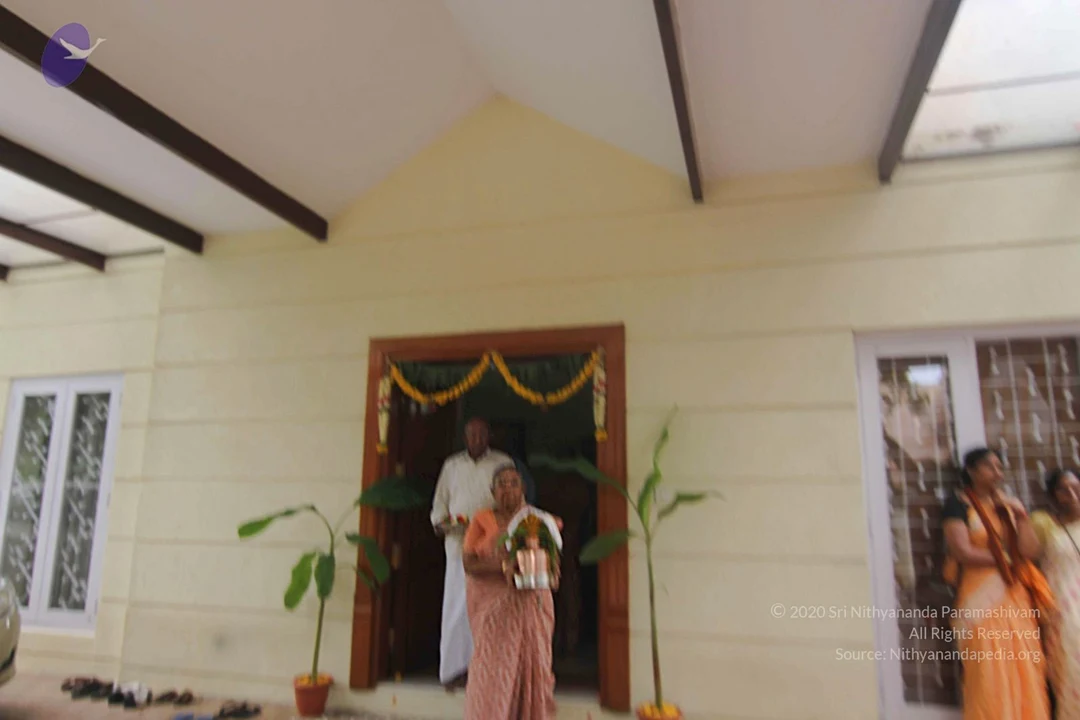
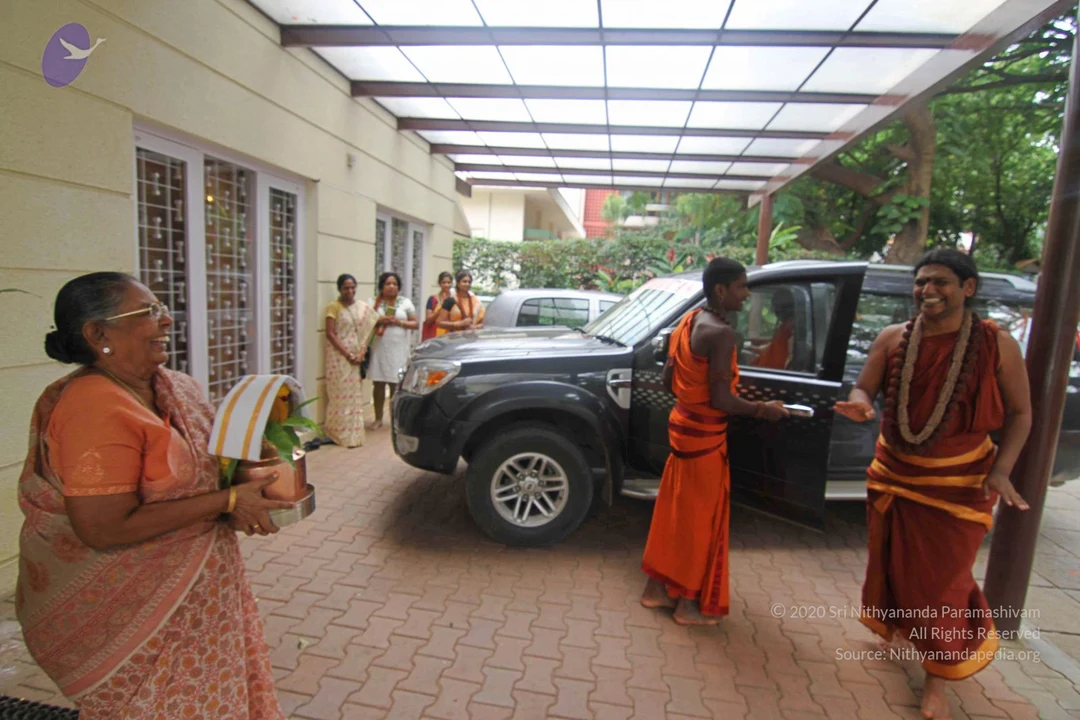
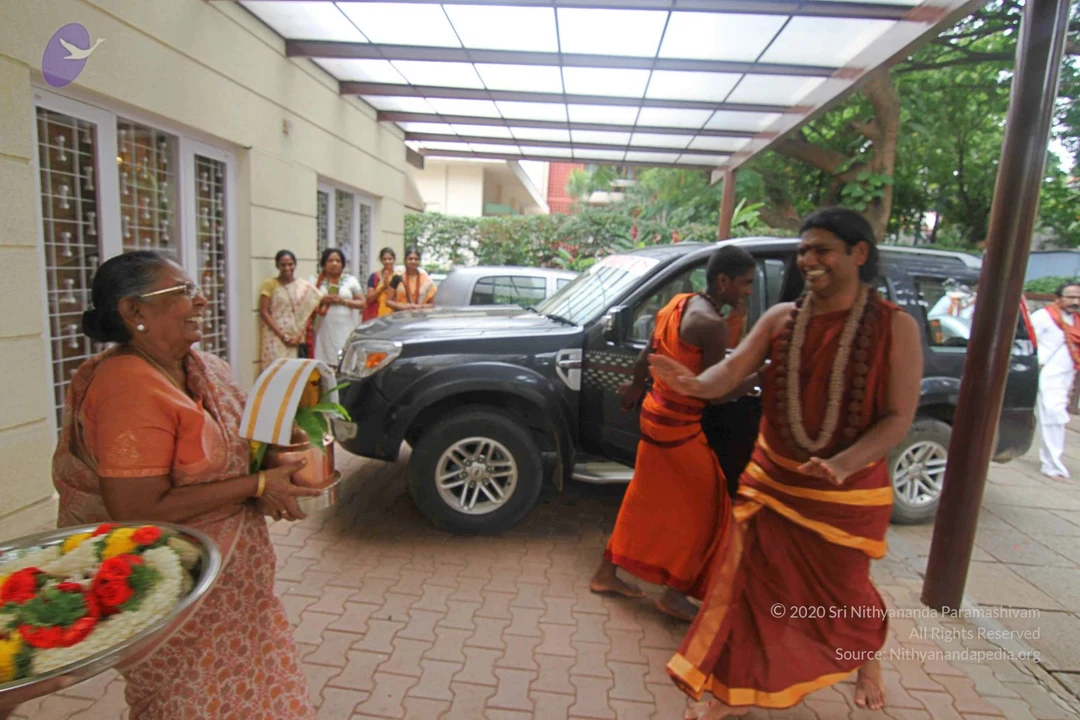
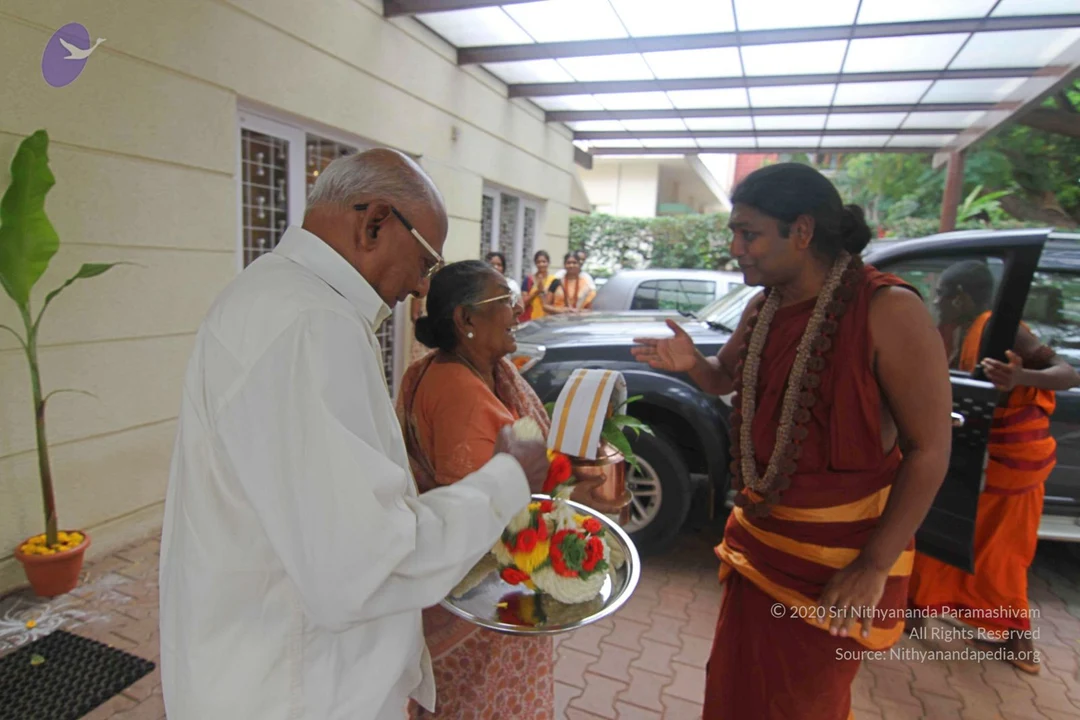
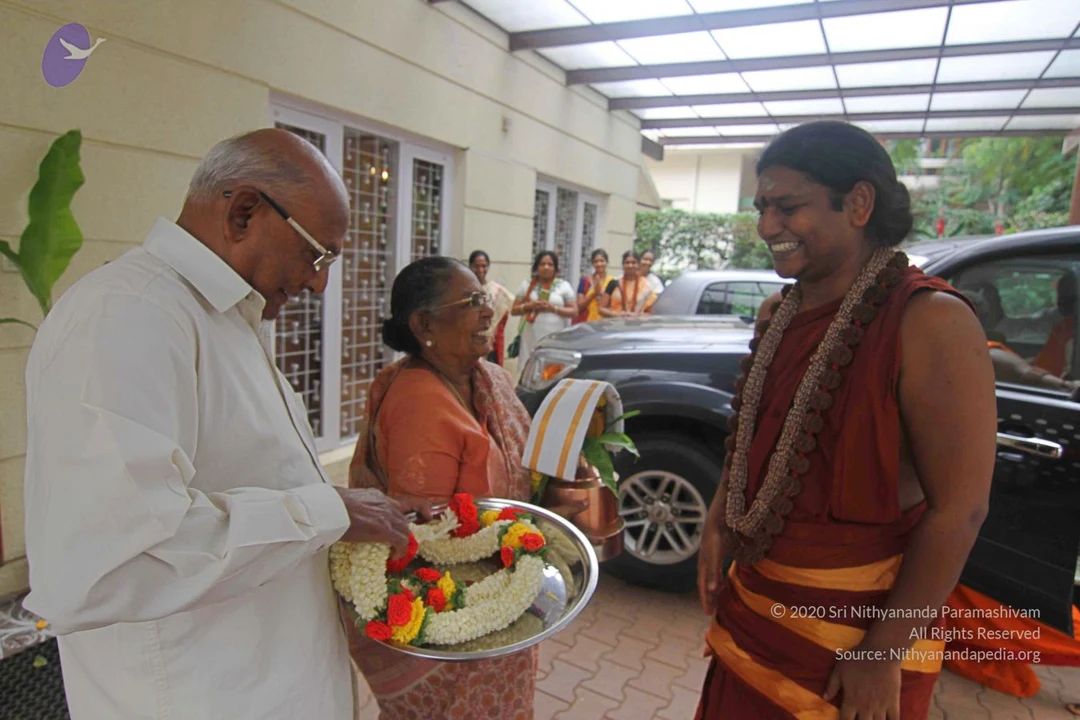
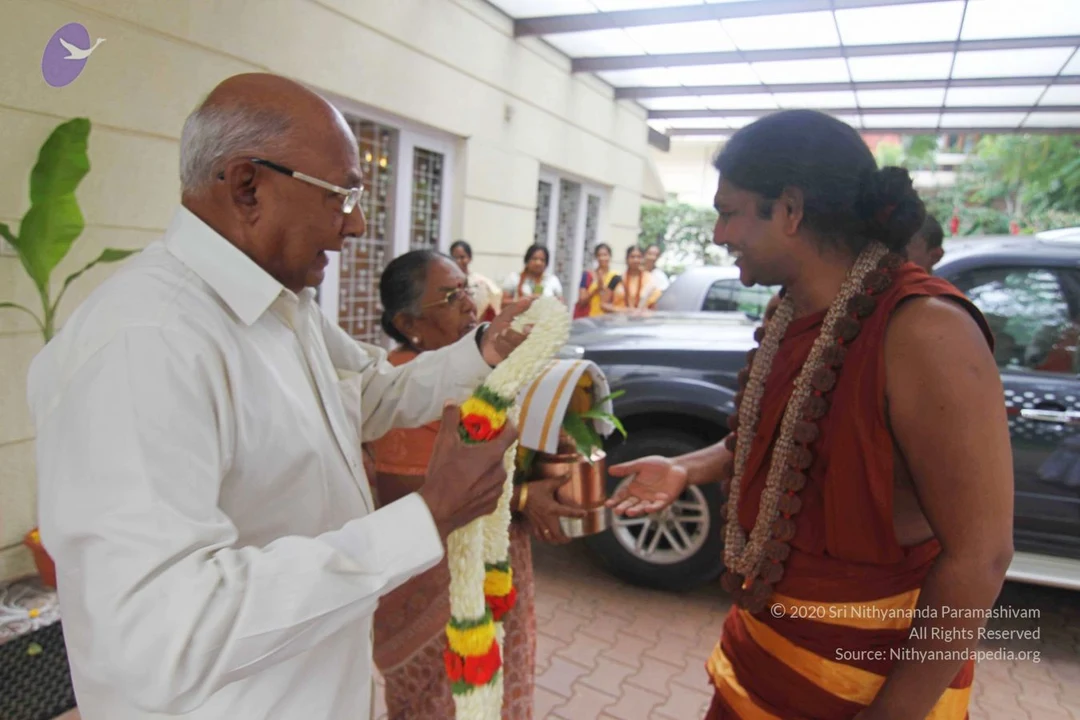
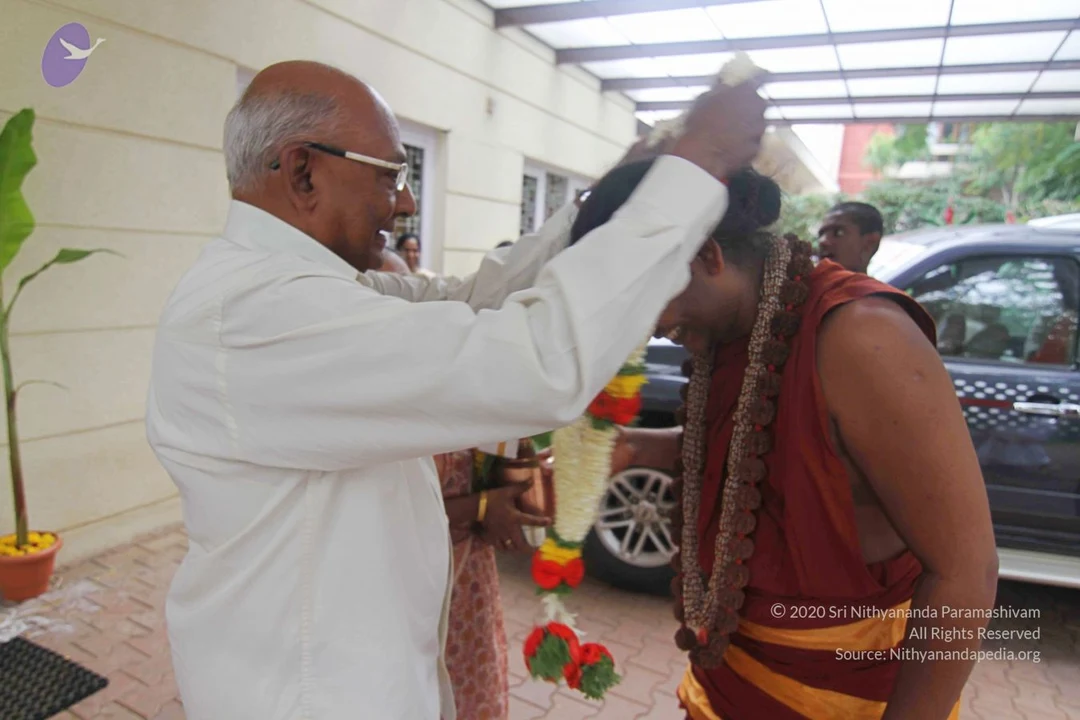
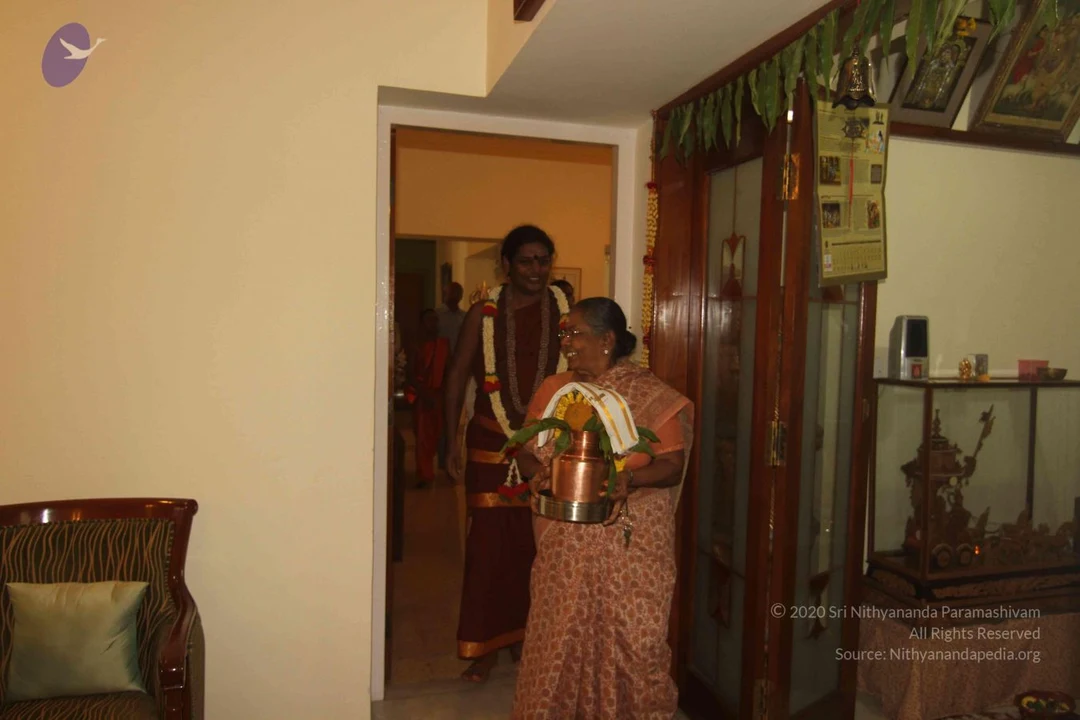
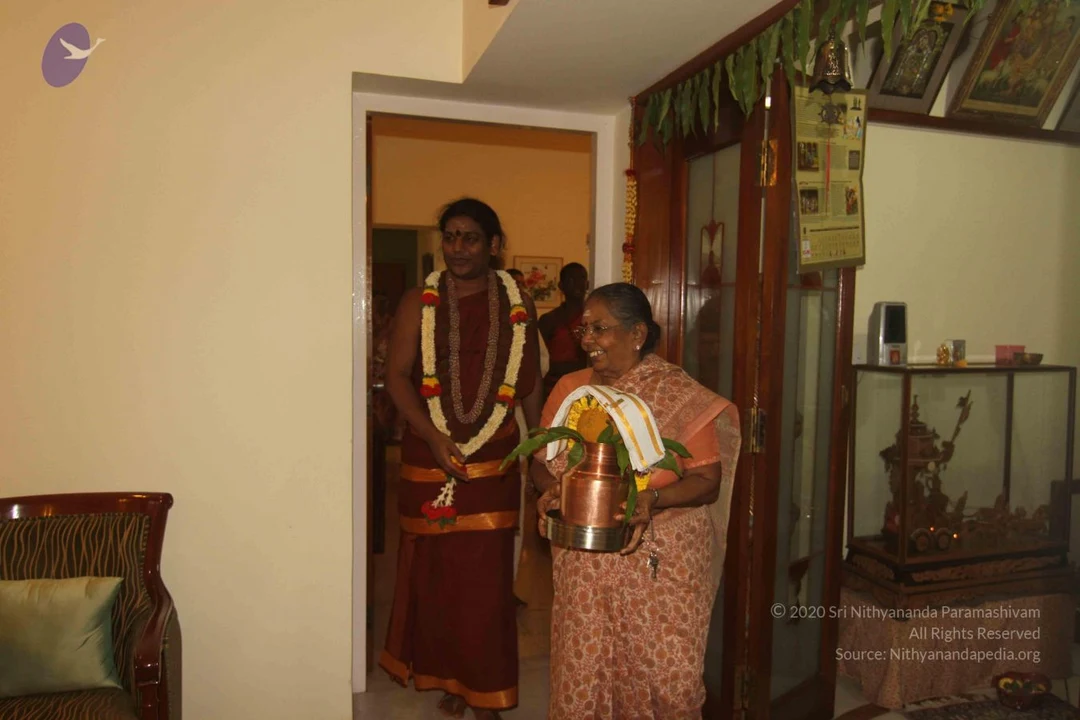
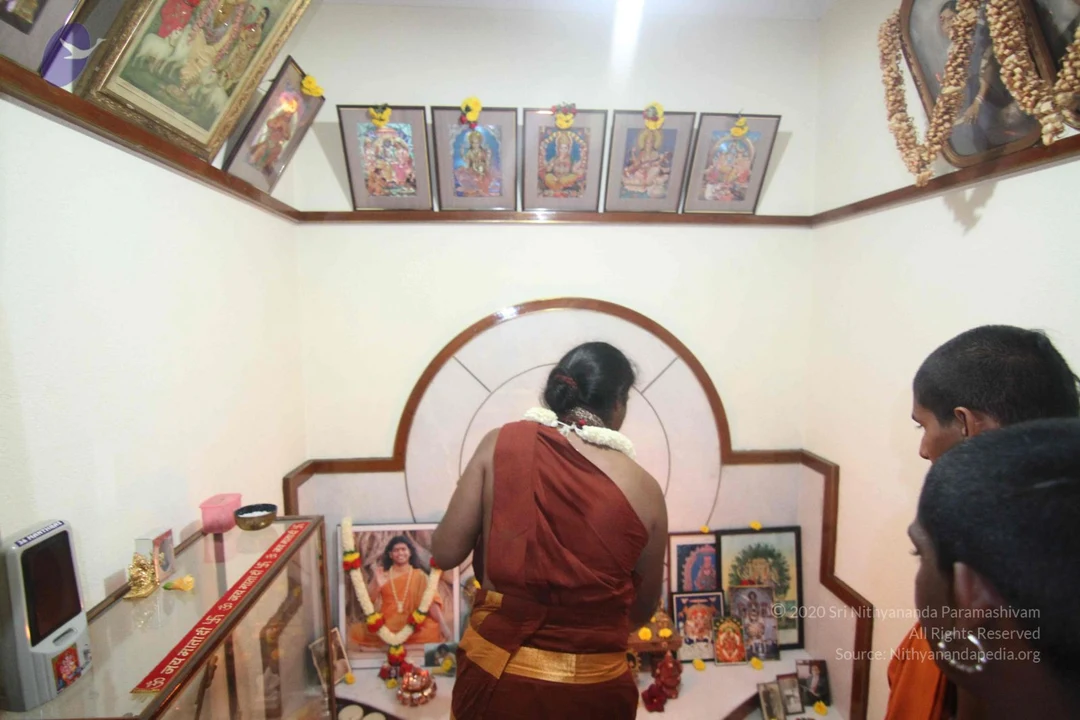
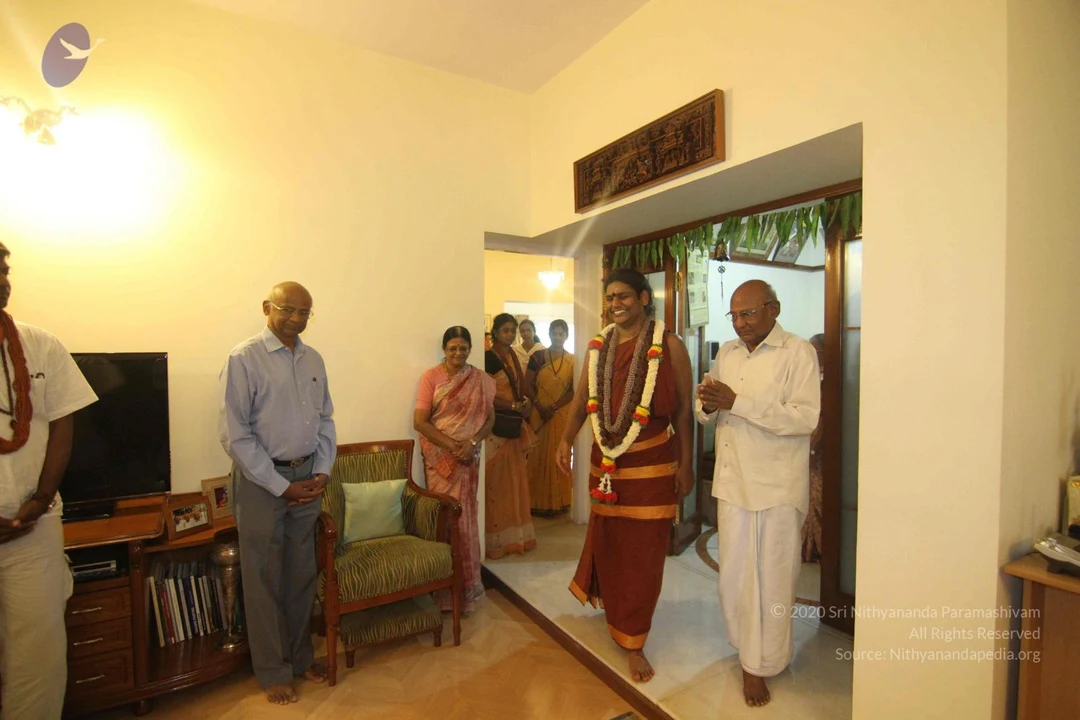
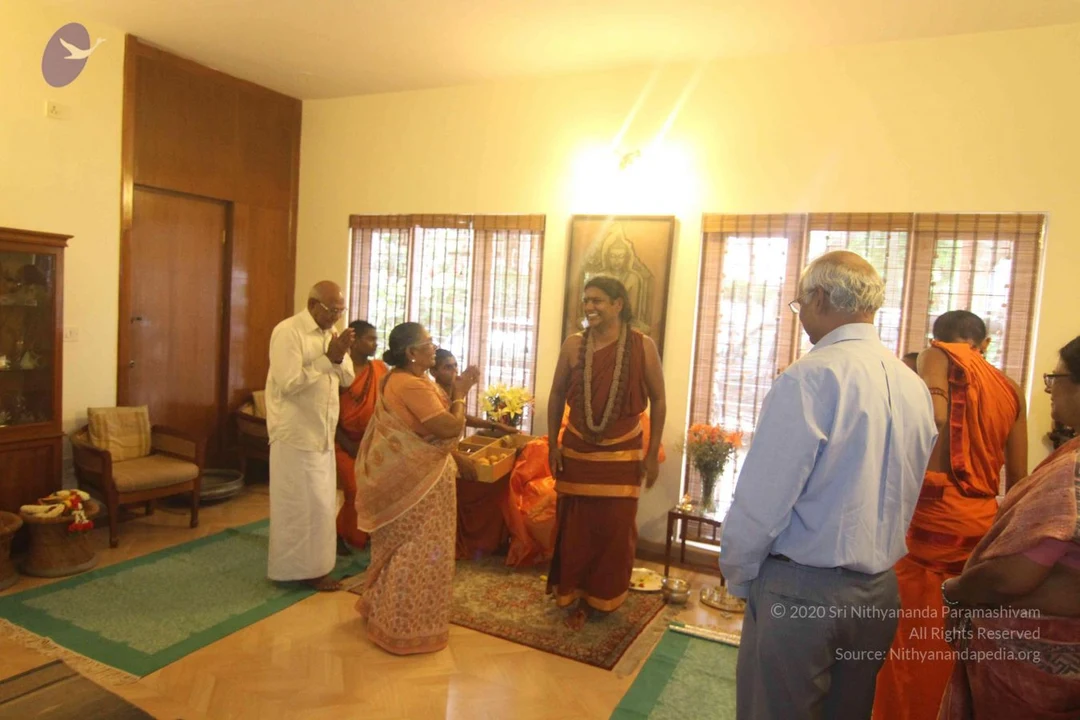
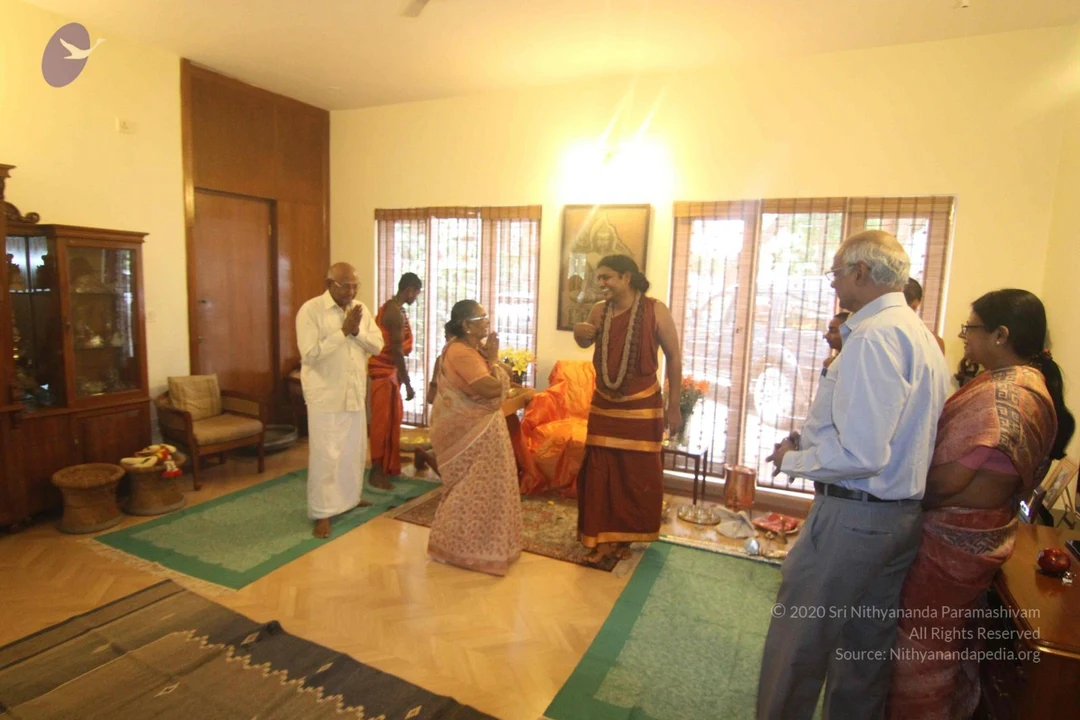
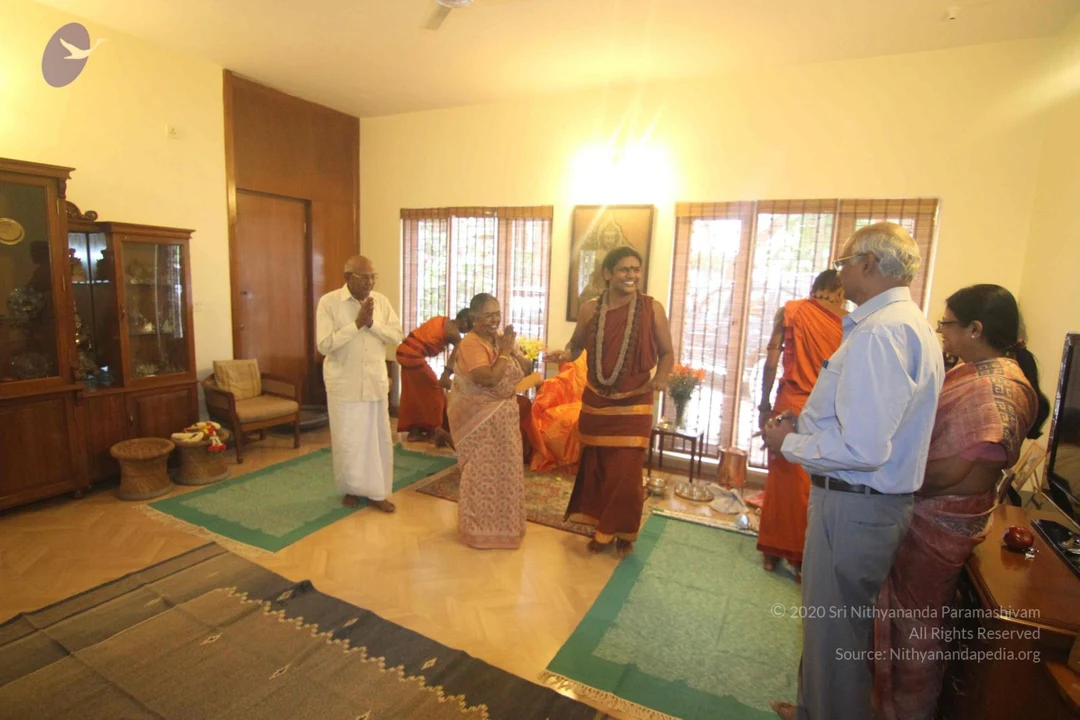
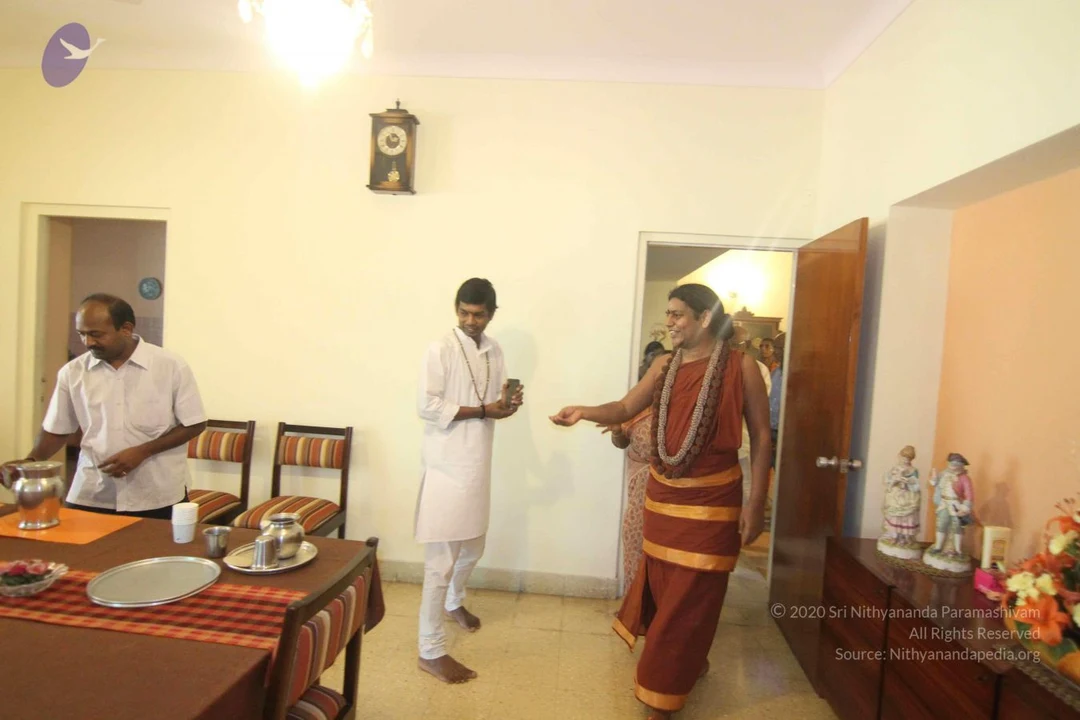
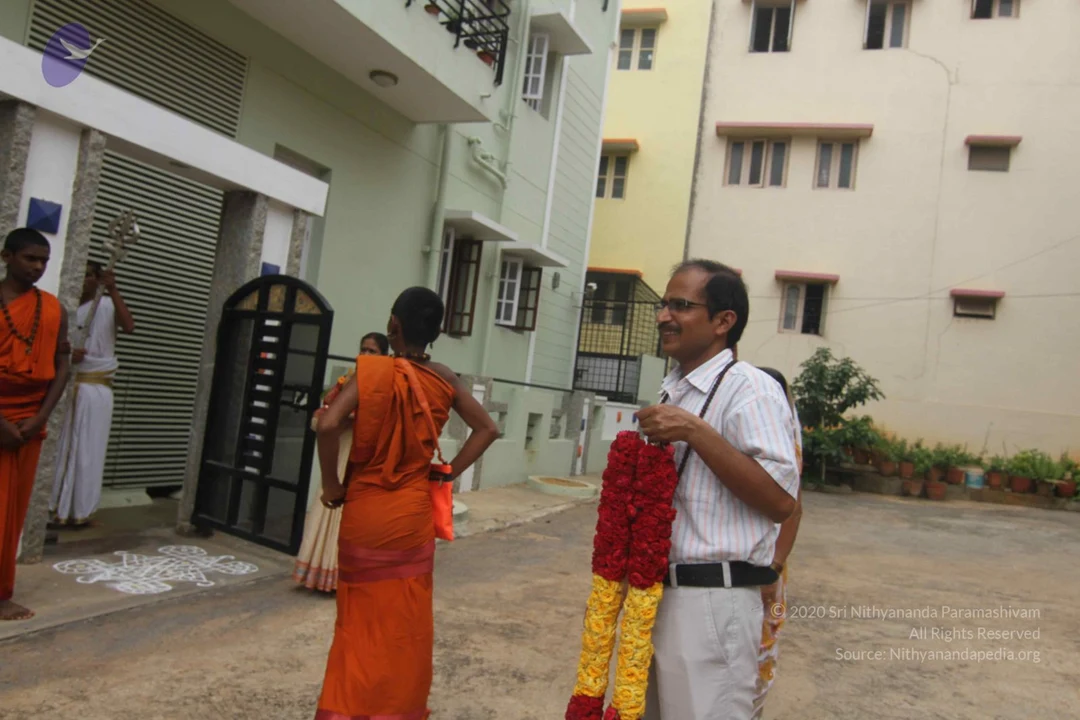
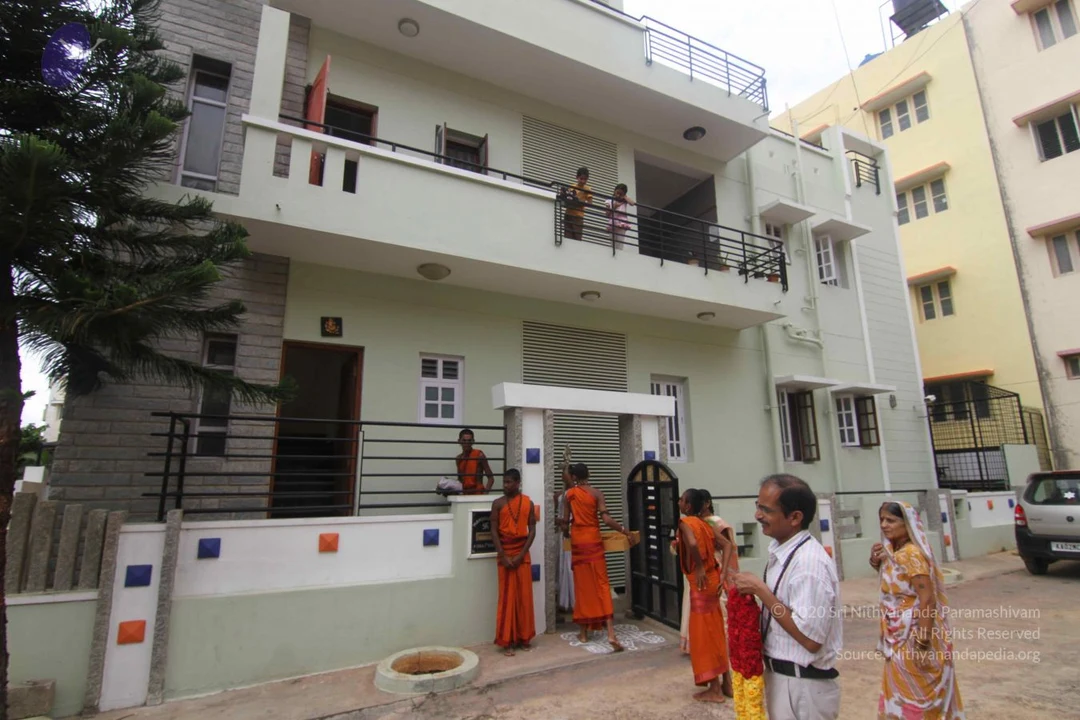
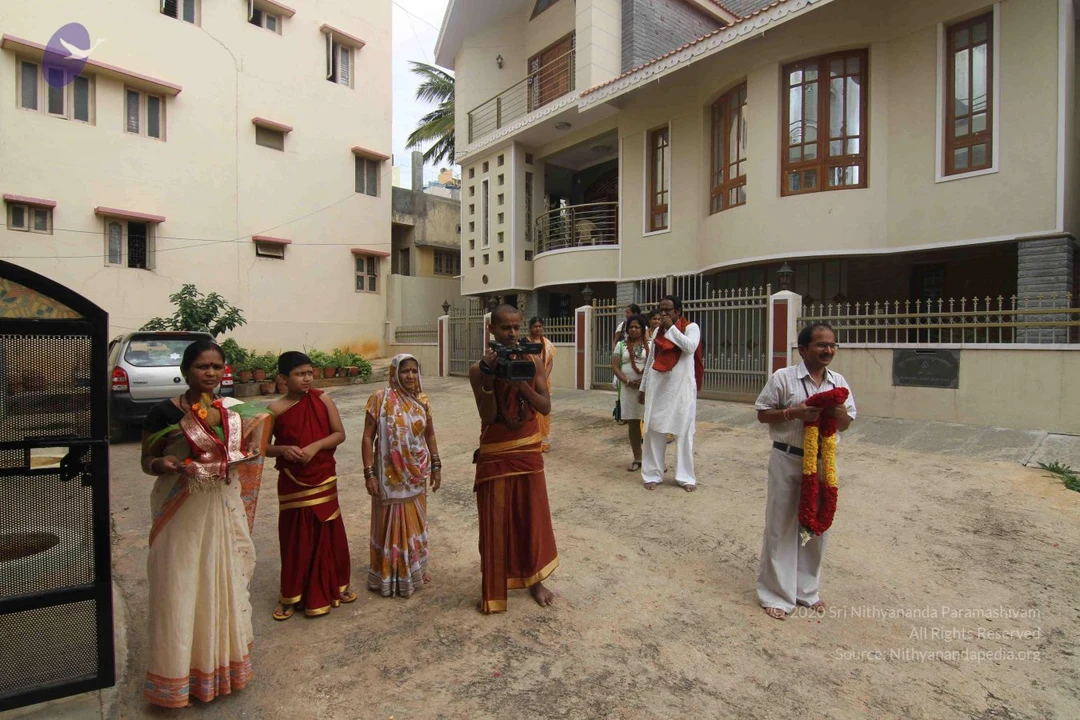
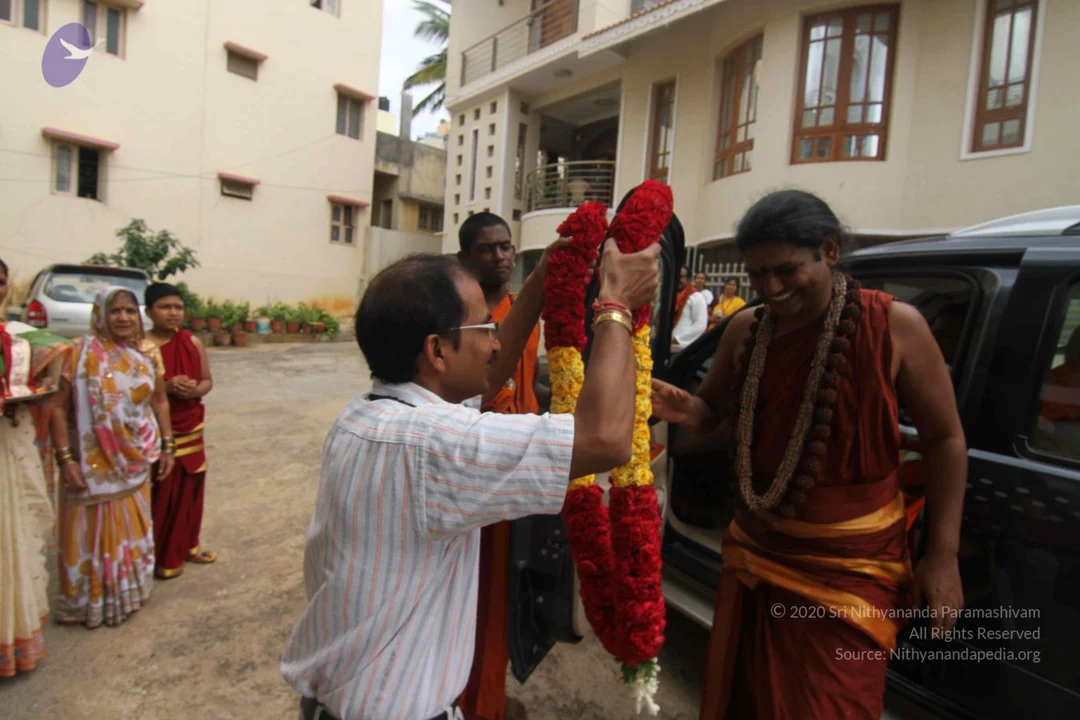
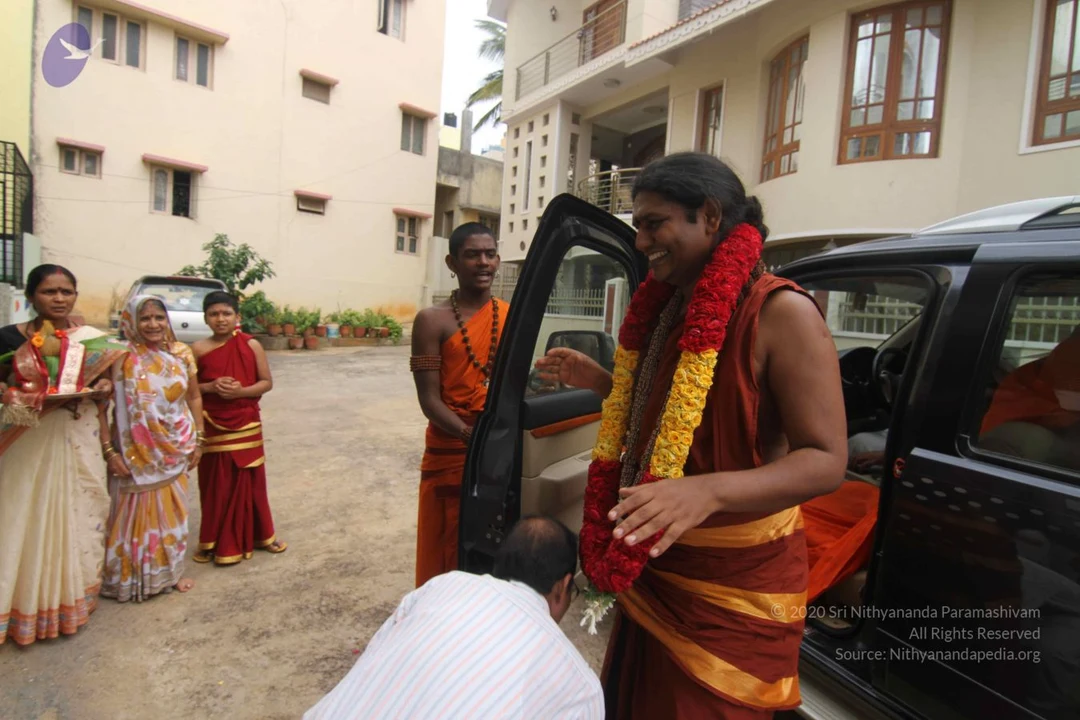
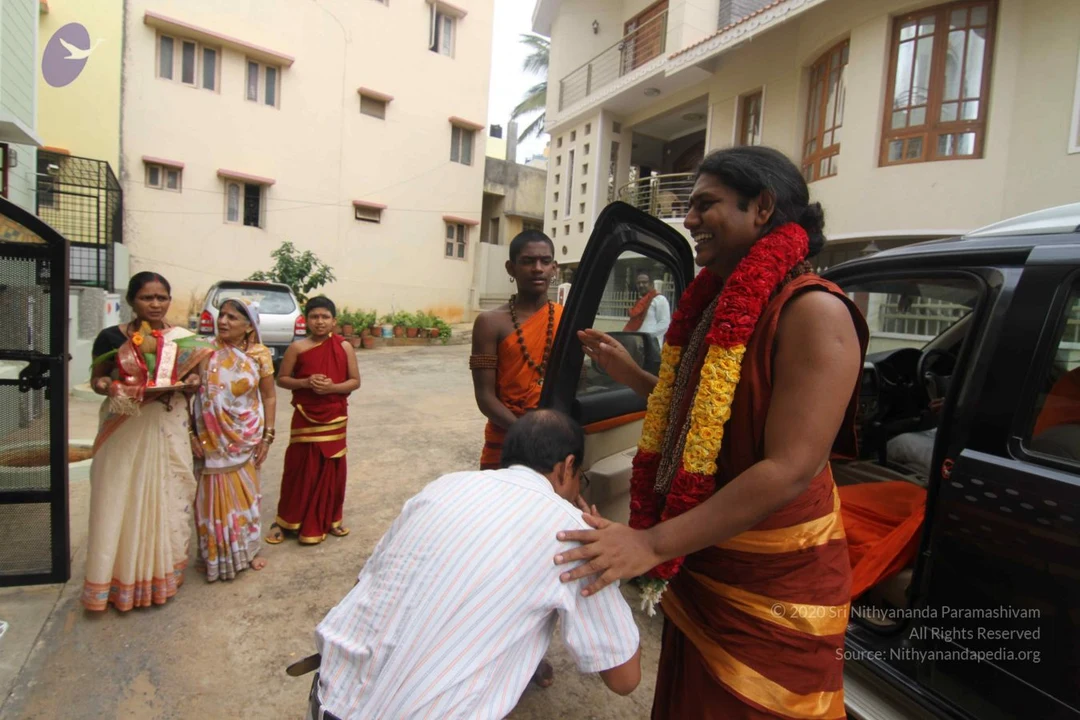
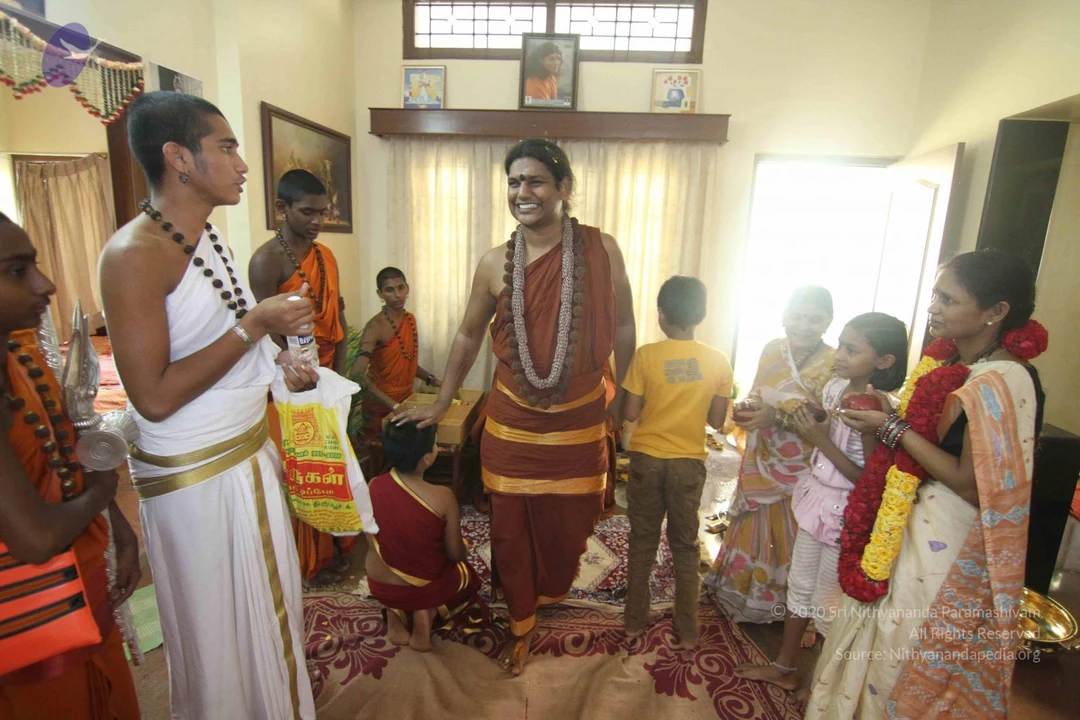
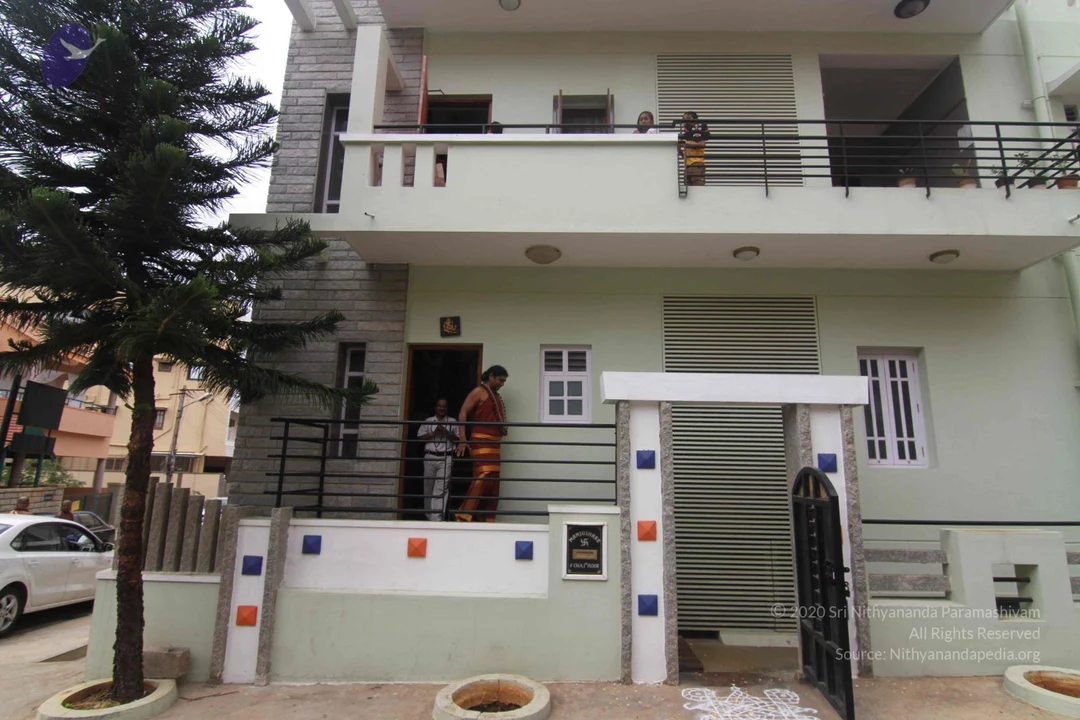
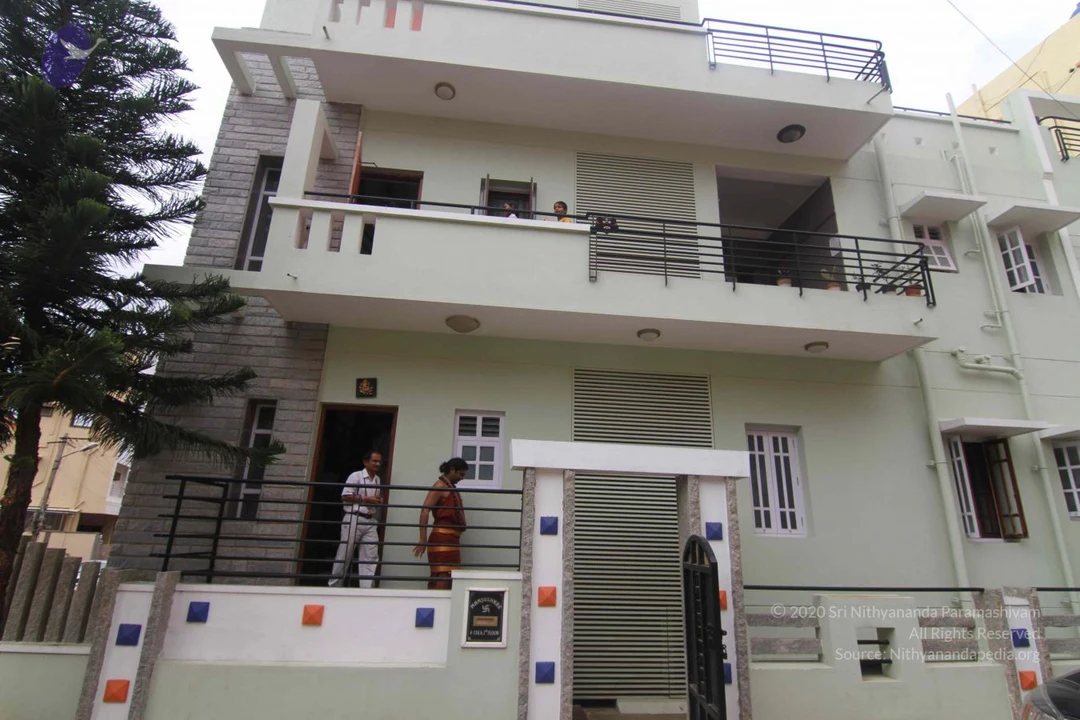
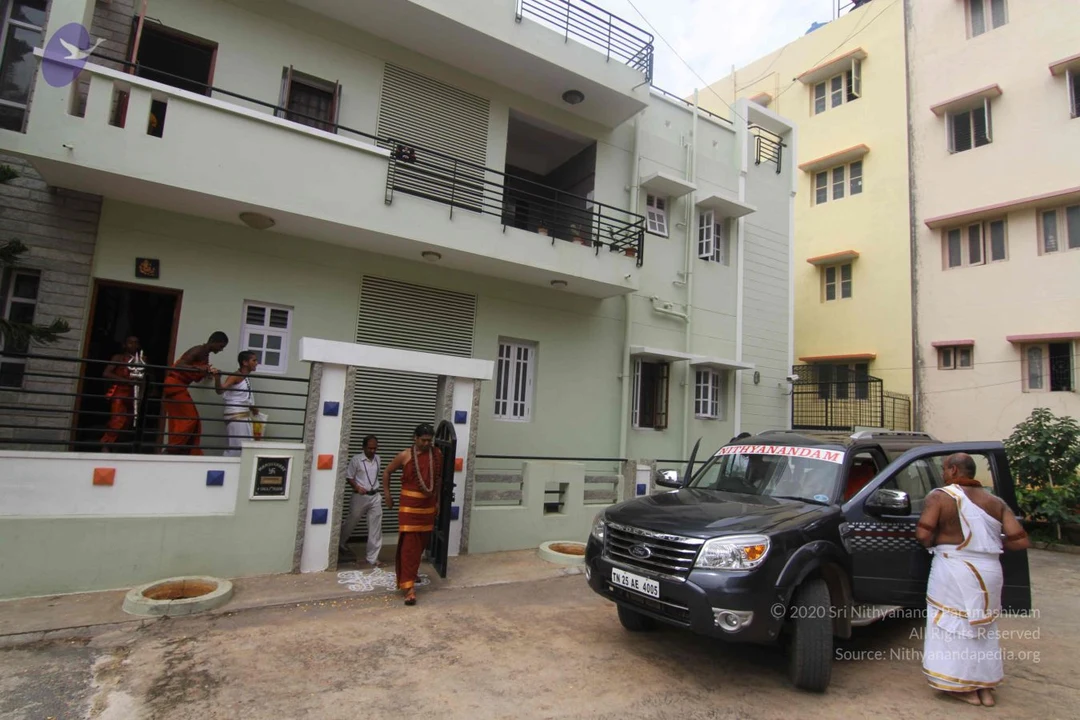
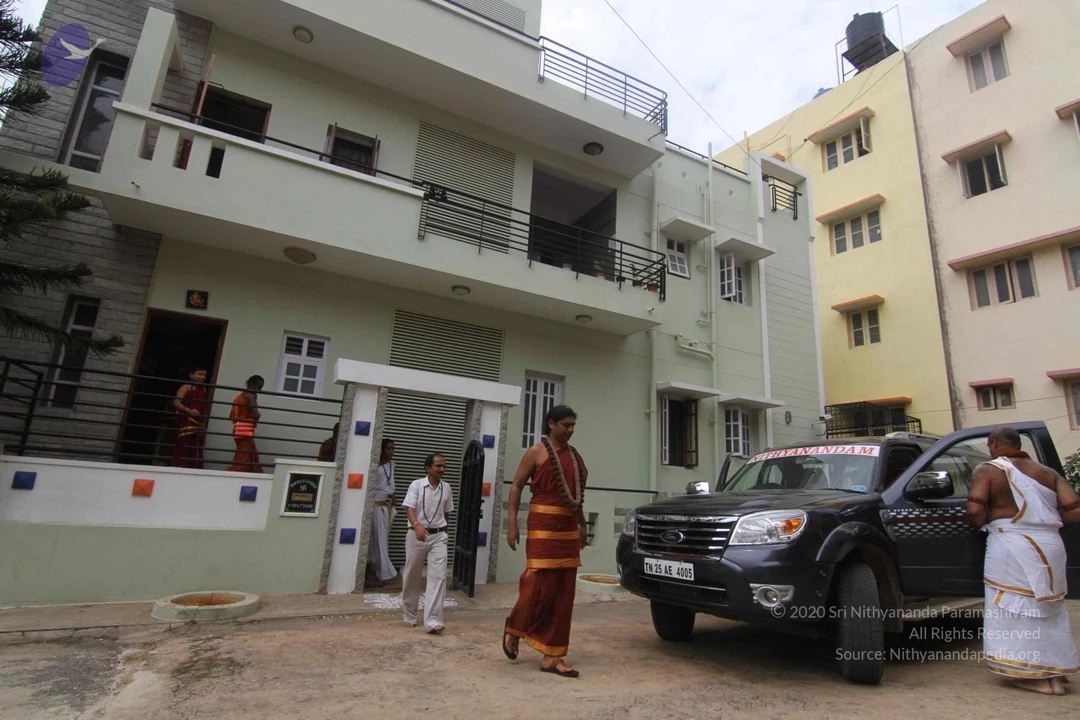
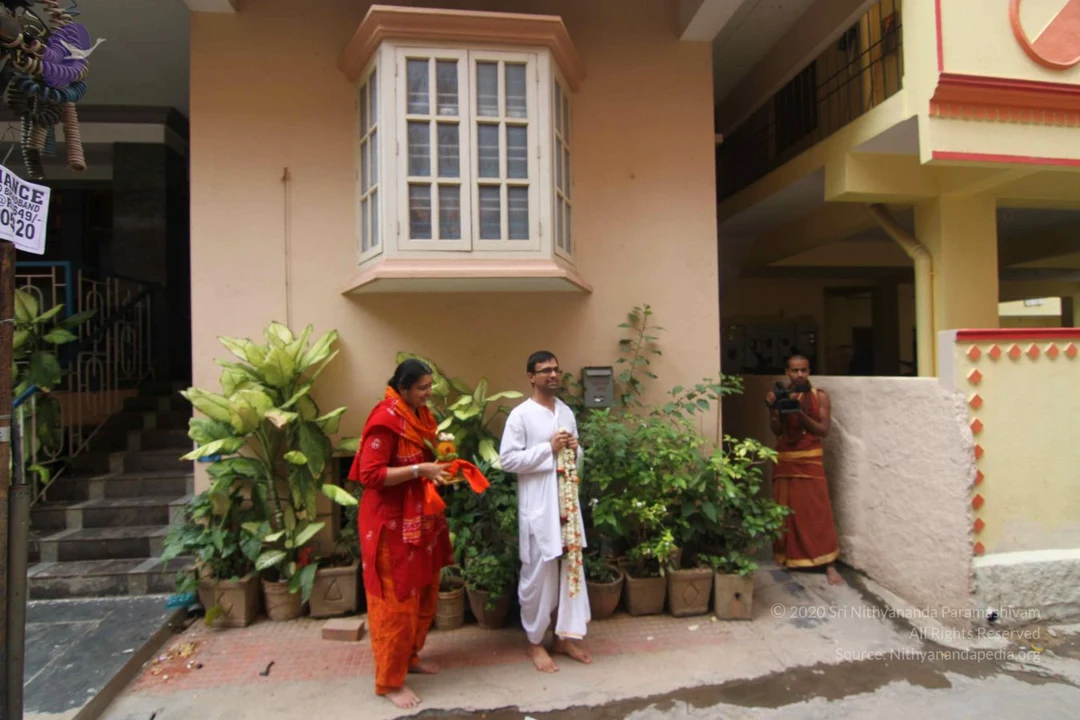
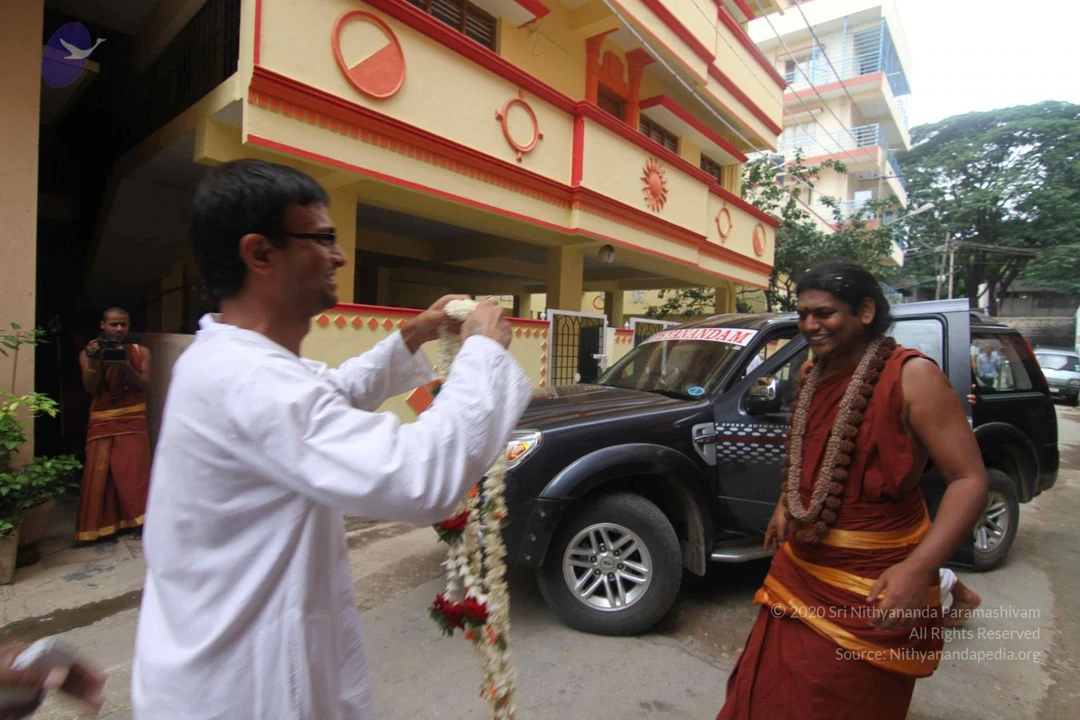
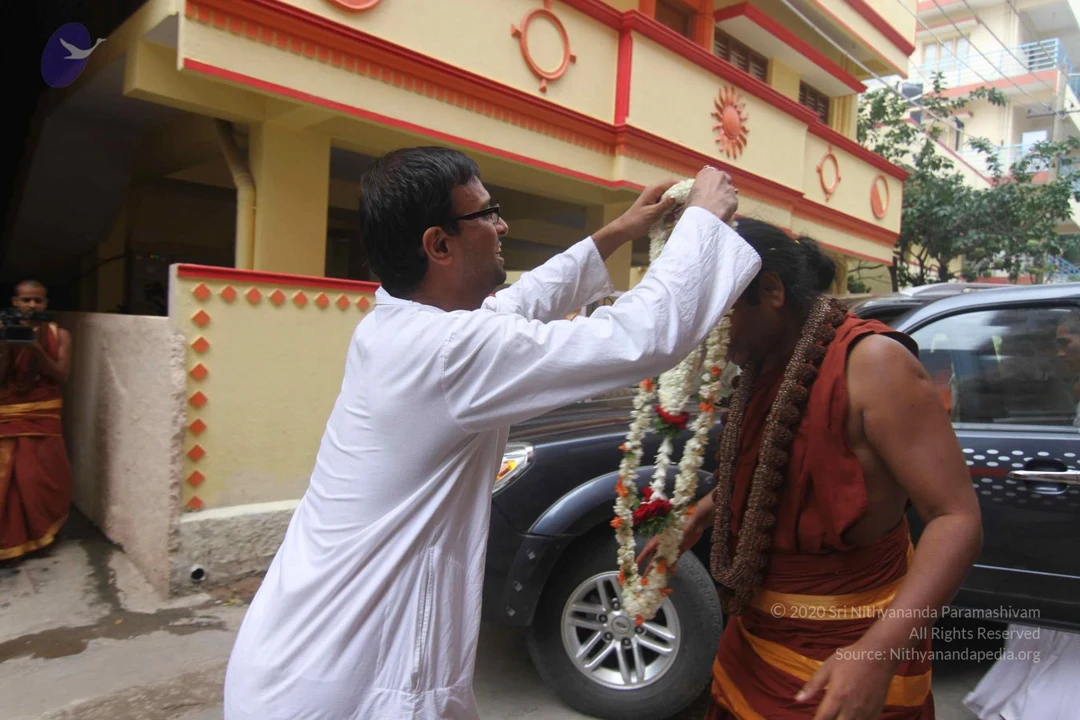
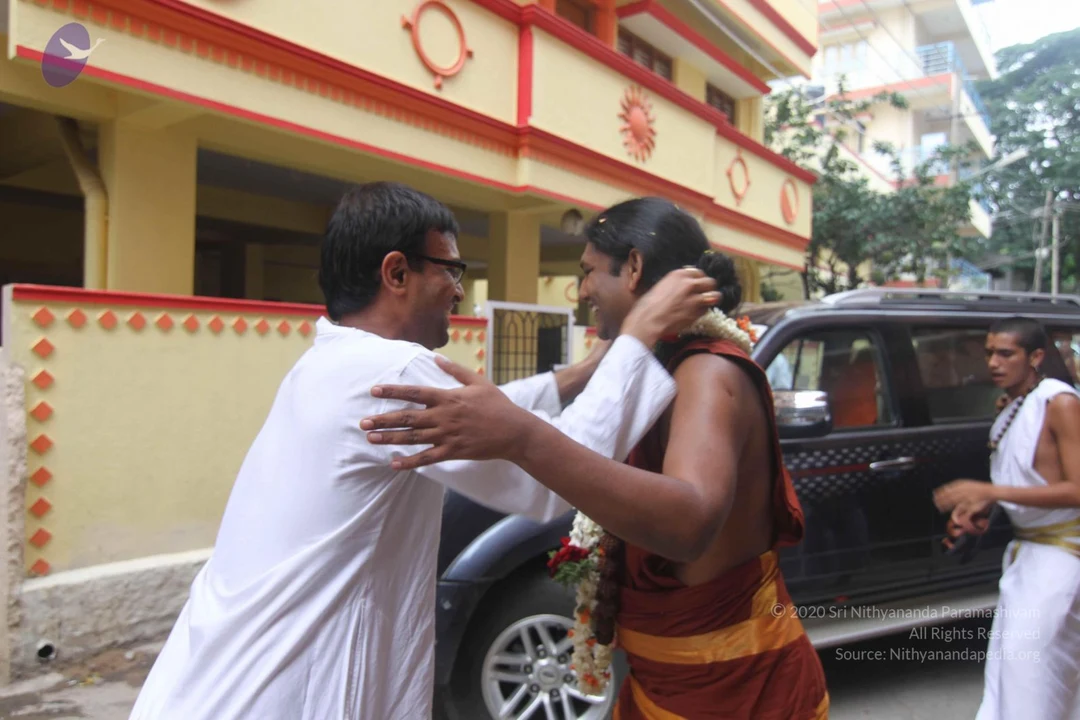
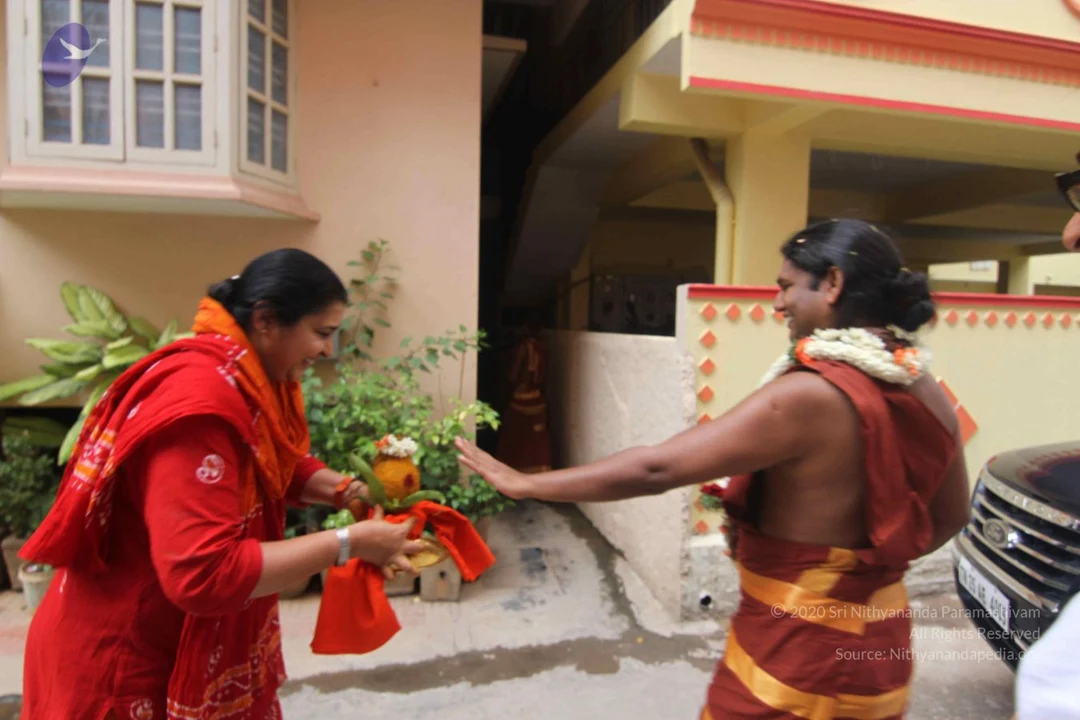
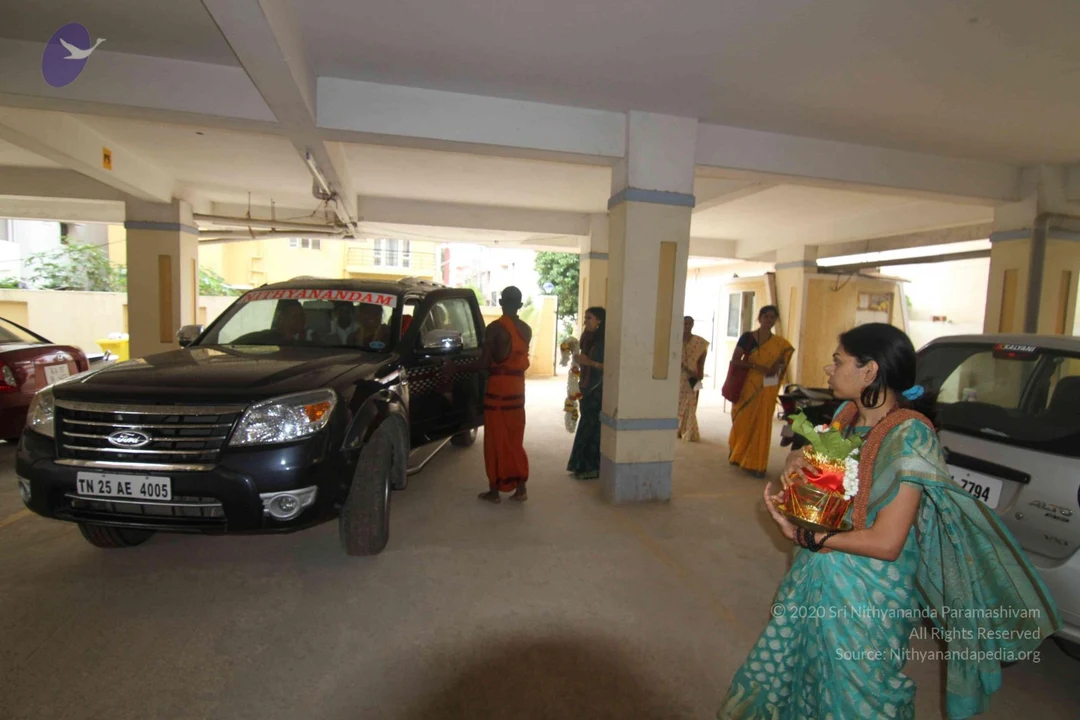
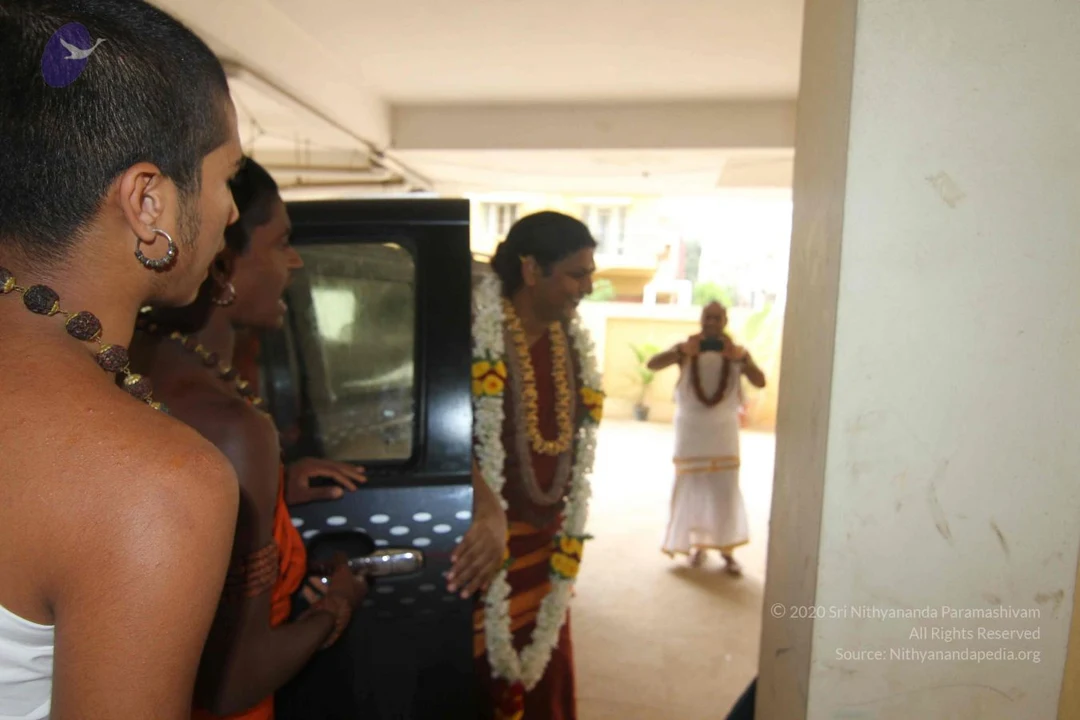
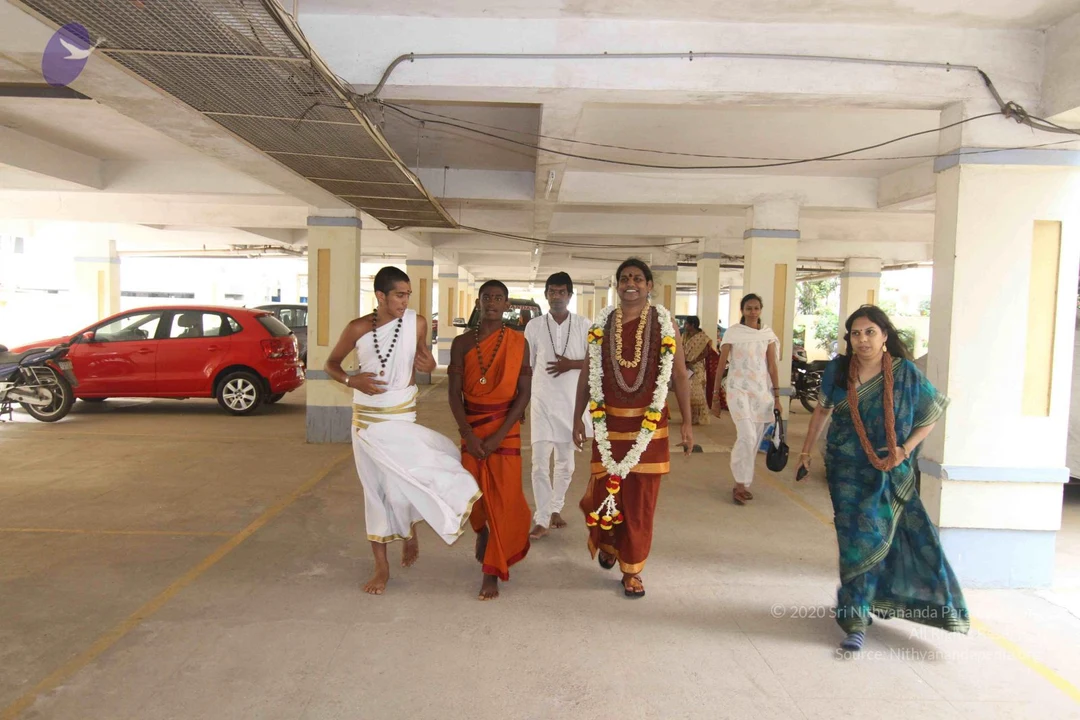
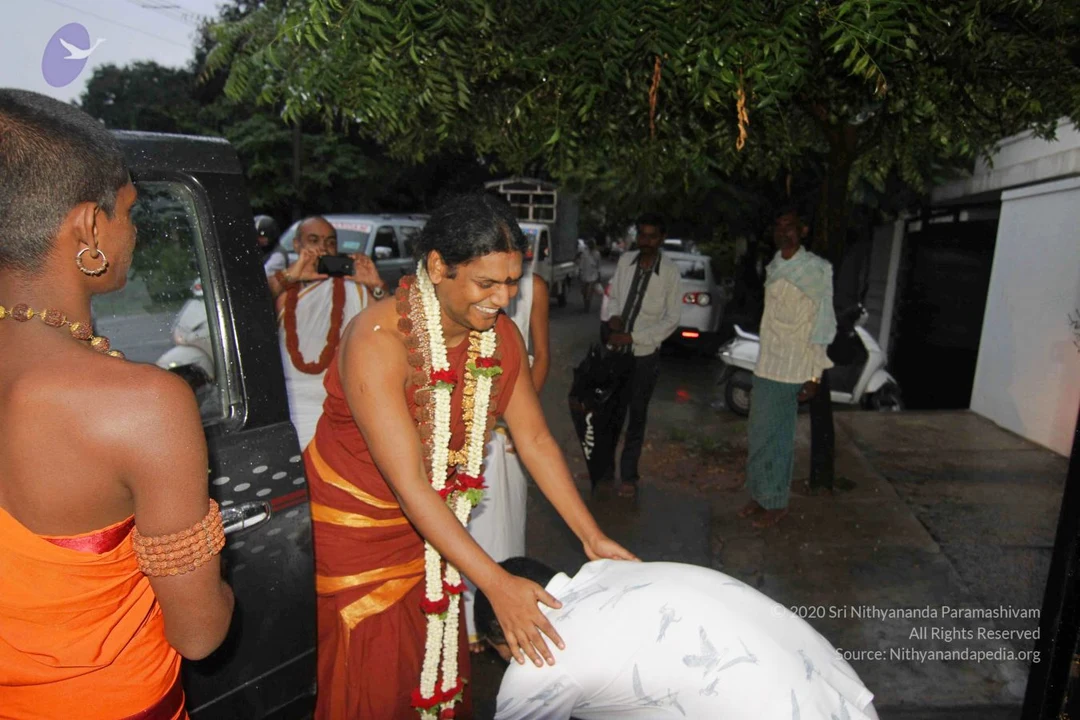
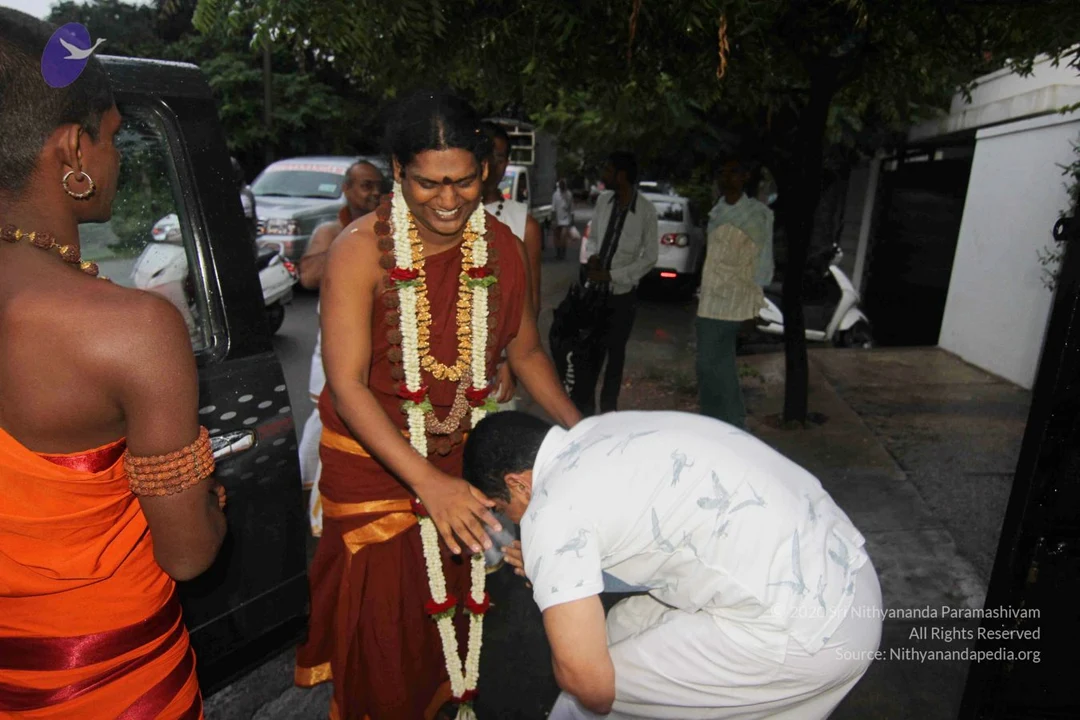
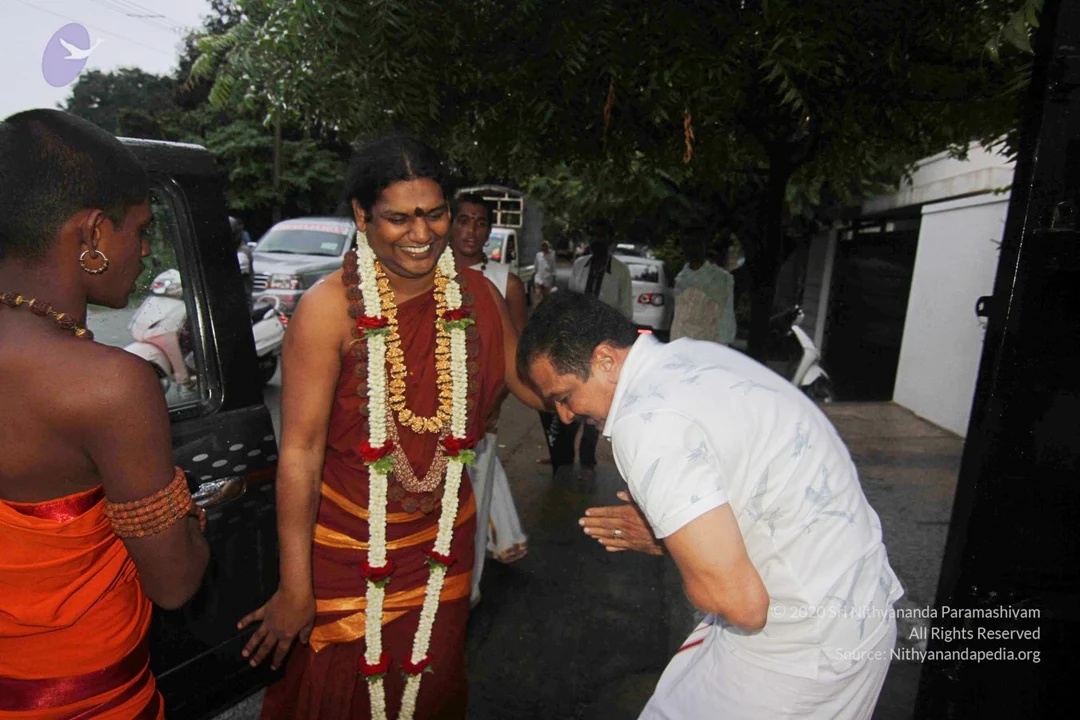
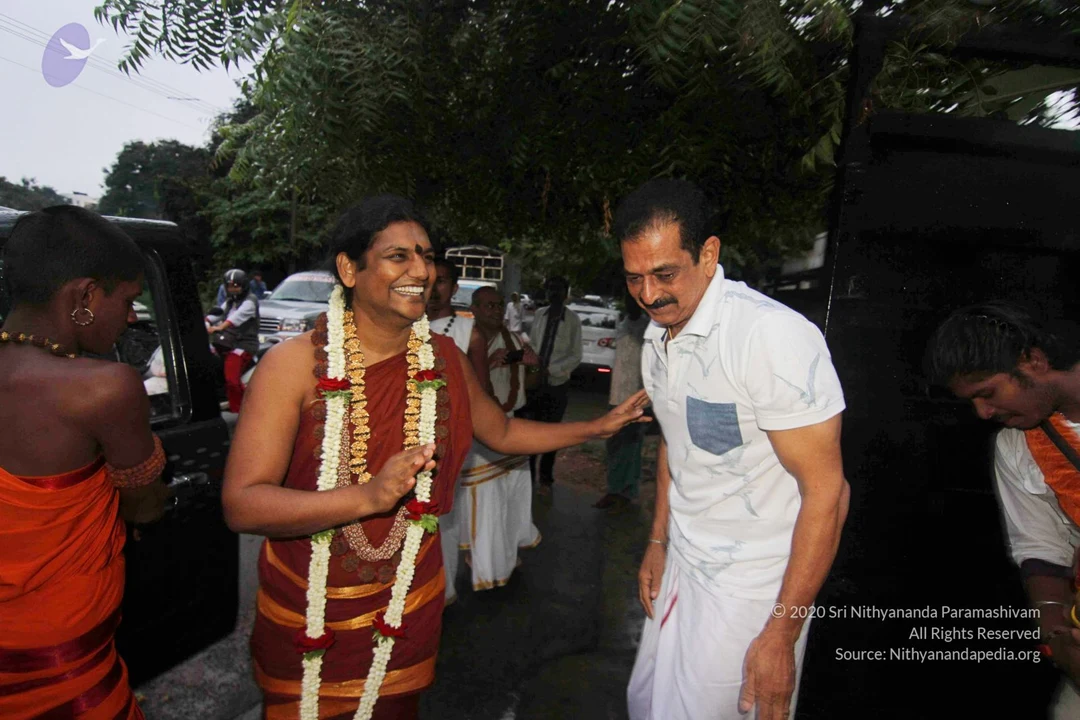
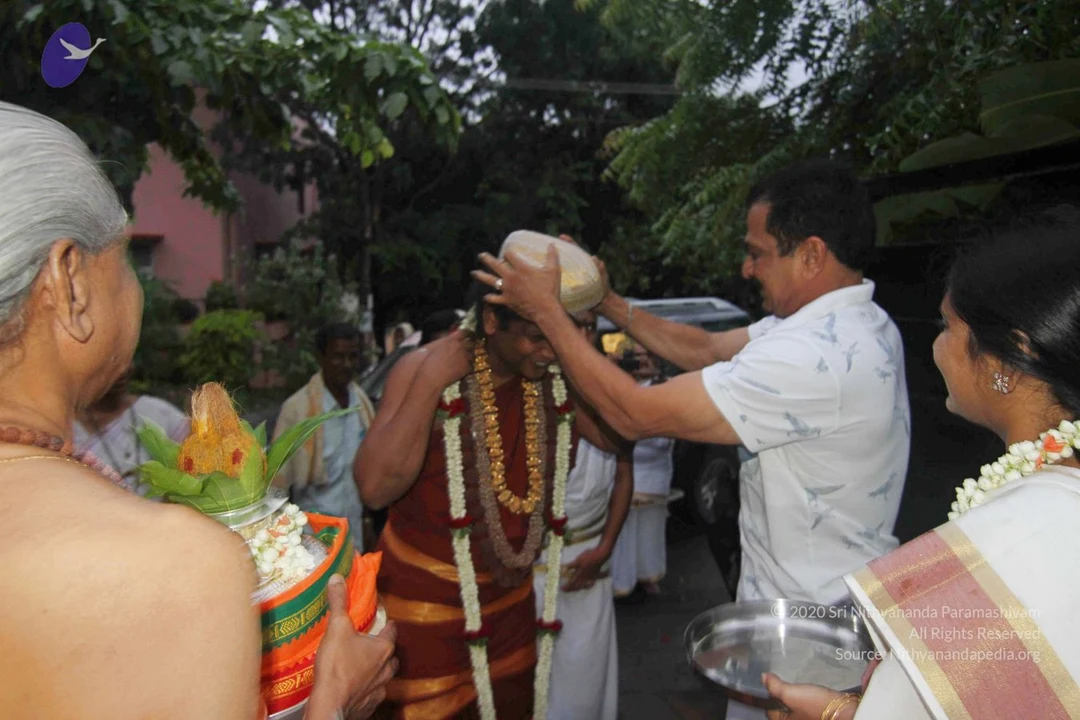
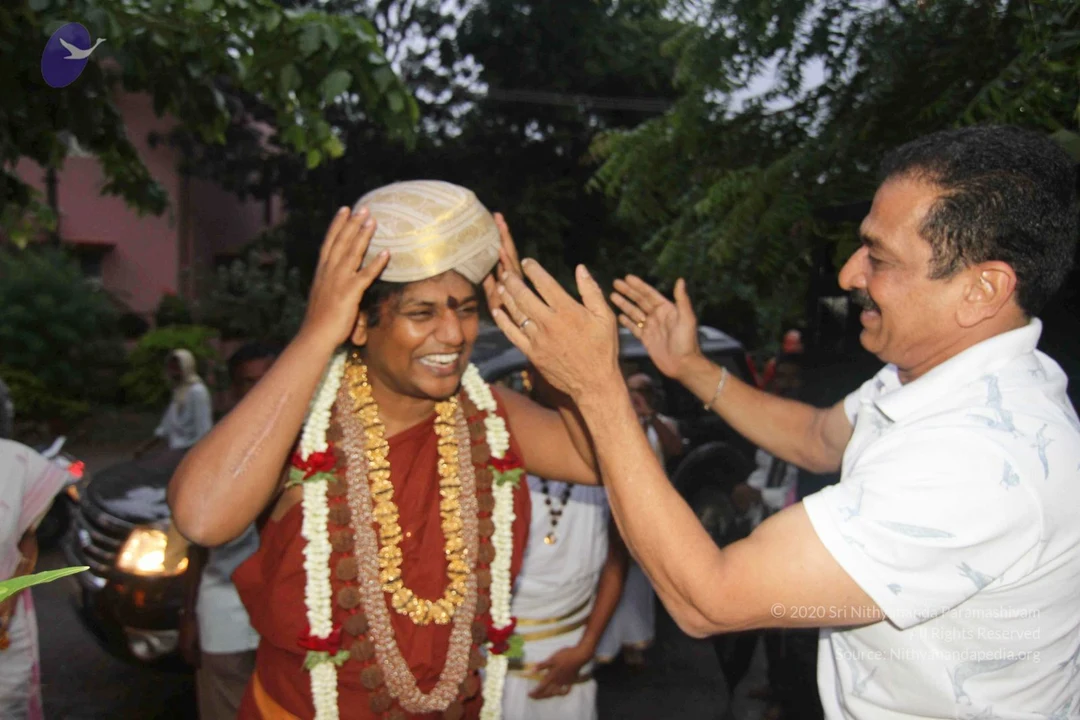
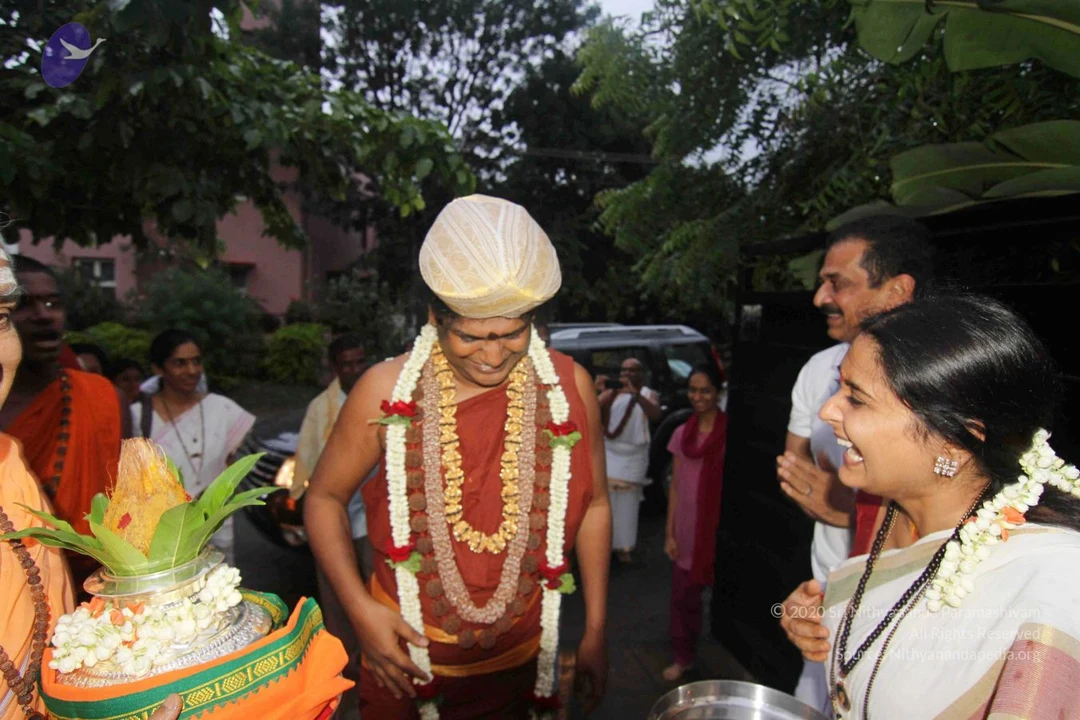
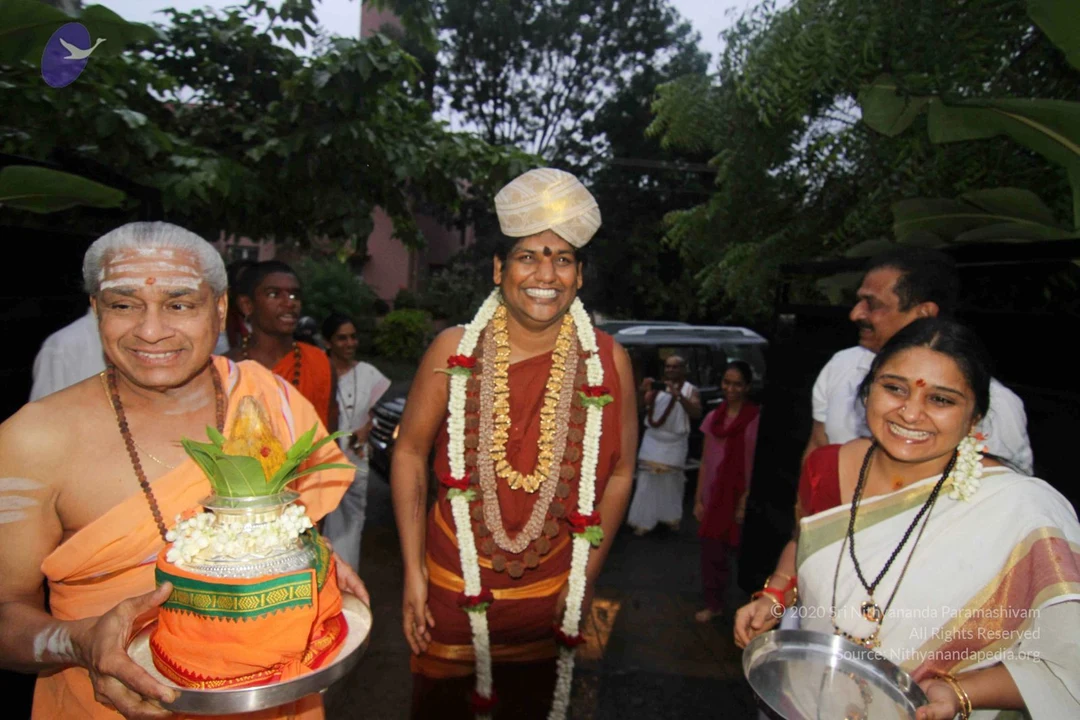
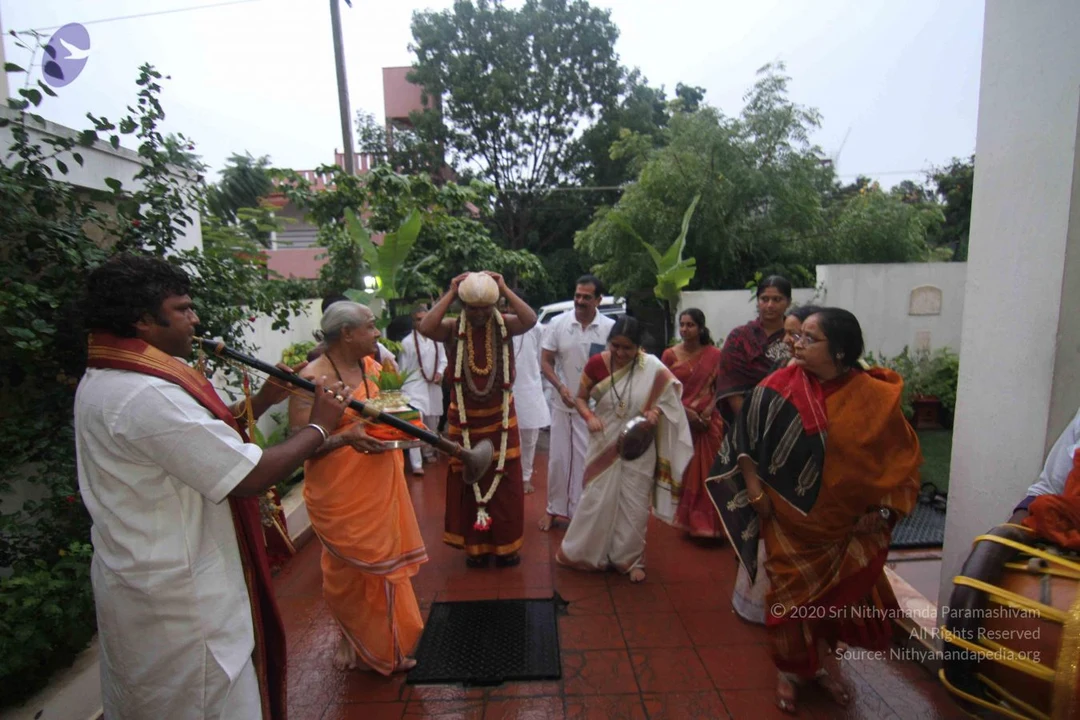
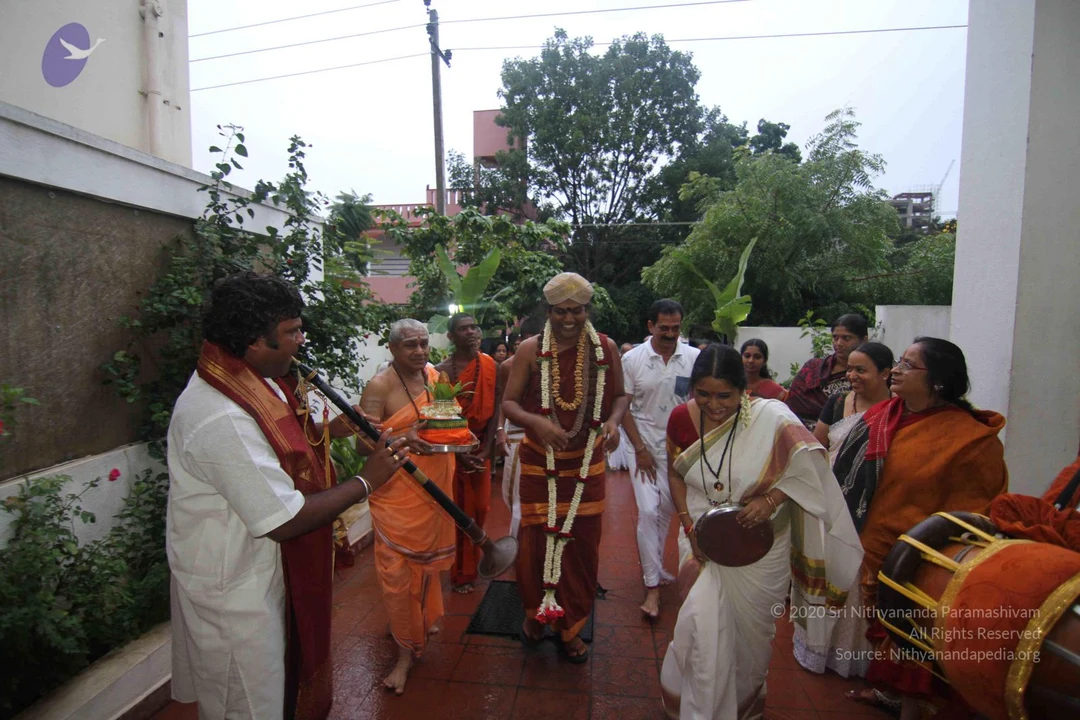
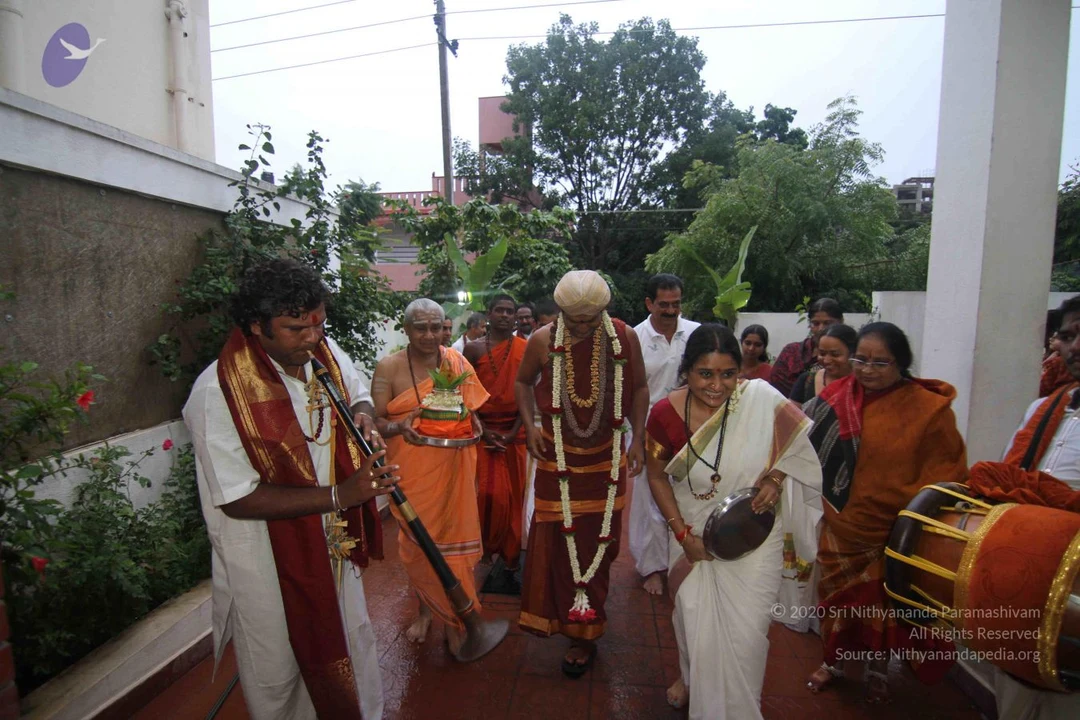
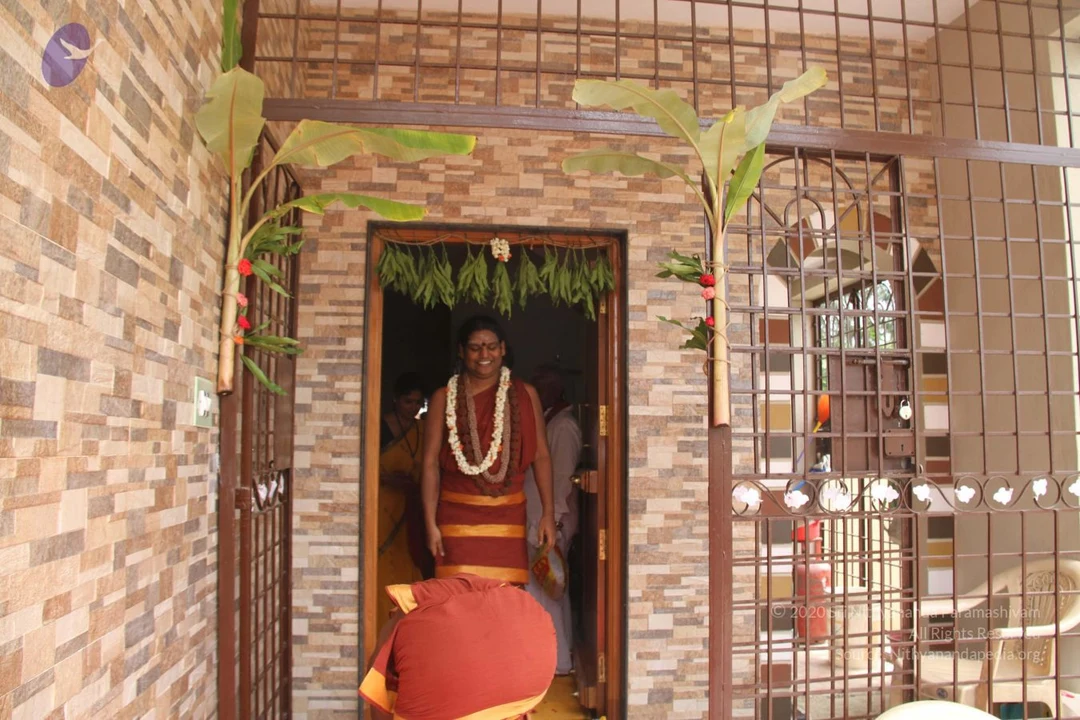
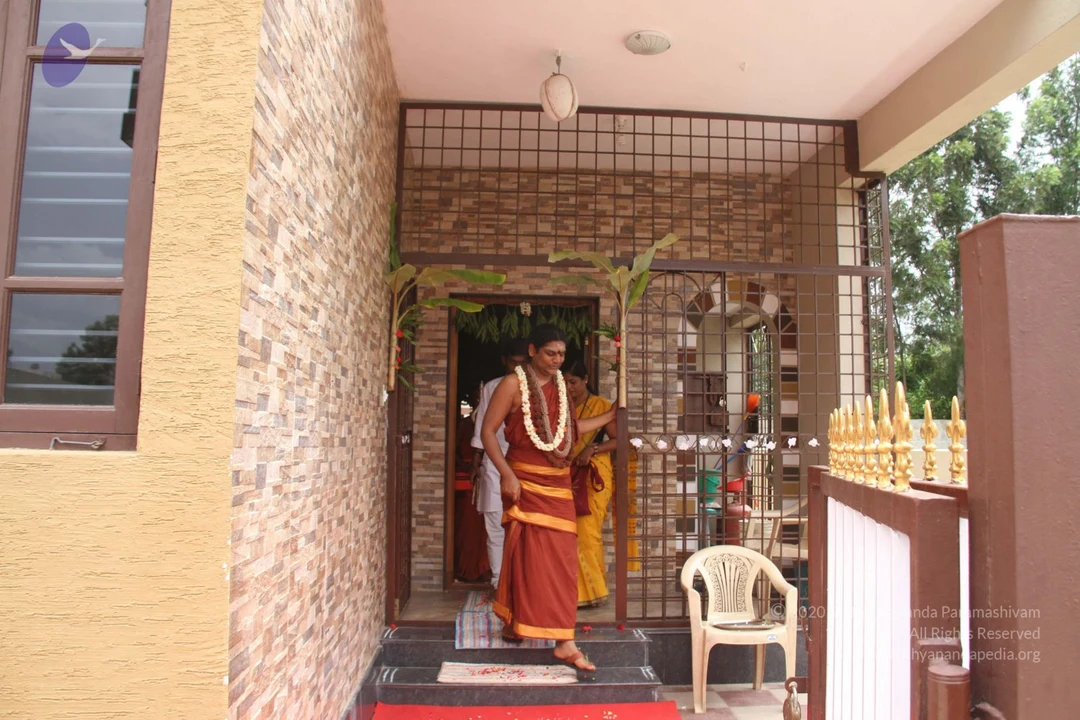
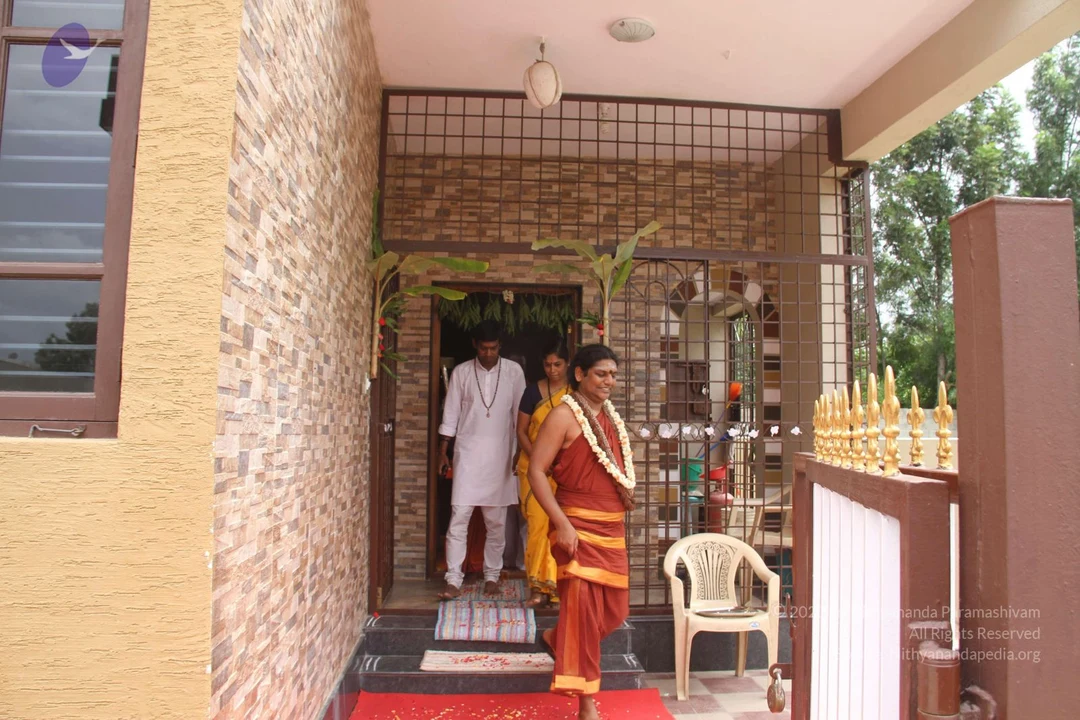
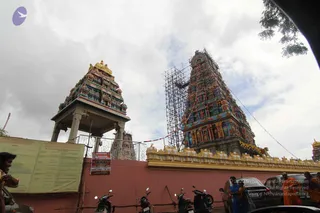
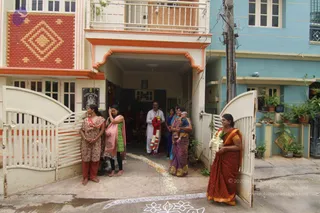
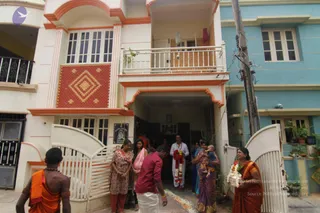
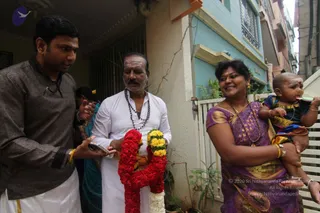
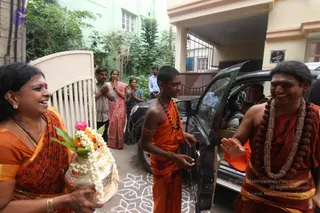
A photograph of a tall, brightly painted South Indian temple gopuram covered in colourful sculpted deities in red, green, blue and yellow, wrapped in bamboo scaffolding for repair. A smaller gopuram with a golden finial stands at left, and a red compound wall topped with gold-painted ornamental parapet runs along the street. Parked cars and motorbikes sit in the foreground. A man in a white turban and white clothes walks near the wall, and several women in orange and saffron saris stand at right near the gate. A green signboard at left lists cultural programmes and discourses, and a small red-and-white notice is posted on the wall.Exterior view of a South Indian Hindu temple with two tall colourful gopuram towers painted in red, green, blue and yellow with rows of sculpted deity figures. The taller gopuram on the right is wrapped in bamboo scaffolding for repair. A gold-topped small gopuram stands at left above a pillared pavilion. A pink boundary wall with a gold-trimmed parapet runs along the street, with parked motorcycles and cars in front. Two men in orange and saffron robes stand at right near the wall, and a woman in blue sari and a man in white shirt appear at left edge. Overcast sky.A residential street entrance in a yellow-and-red painted house with a white gate and an arched doorway. A man in a white kurta holds a red and white flower garland and stands at the threshold, with women in saris and salwar kameez gathered outside. One woman in an orange sari holds a tray with a garland and another woman in purple holds a baby. A white-and-colored floor rangoli with flower motifs is laid on the ground, and a framed portrait sign reading Guru Purnima is visible on the wall beside the doorway. Modern blue houses and potted plants frame the scene.A photograph of a two-storey white and orange house entrance with a balcony and a red diamond-patterned tile panel, with a small framed sign reading KAILASA beside the doorway. In the foreground, a bare-chested young man in an orange cloth stands at left, a woman in a floral kurta and another in a pink sari stand near the gate, and a man in a maroon shirt and white dhoti bends to scatter flower petals on the ground. A man in white clothes with a garland stands in the doorway, and women in saris, one in purple and one in orange-red, hold a baby and a plate of flowers. Flower petals are strewn along the path.Outdoor street photo in front of a pale blue residential building with a white metal gate. A man in a grey shirt and white dhoti stands at left holding a phone and looking down. In the centre, a man in a white kurta and dhoti wears a rudraksha mala and holds a large red and yellow marigold garland. At right, a smiling woman in a purple and gold silk saree and gold jewellery holds a young child in a blue outfit with a sacred ash mark on the forehead, who holds a green item. a person candidate not visibly identifiable with sufficient cues.Outdoor arrival scene at a residential gate with a white kolam rangoli on the ground. A woman in an orange sari with a red bindi holds a silver kalasha decorated with white jasmine garlands and a pink flower, smiling. A young boy in orange cloth wears wooden bead malas and bangles and opens a black car door. A man in orange robes with a large rudraksha mala and a gold-coloured garland smiles and gestures toward the car. Several onlookers in the background stand with palms together in namaste, including a woman in a pink sari and a man in a striped shirt, in front of green foliage and a cream building.

Nithya-Satsang
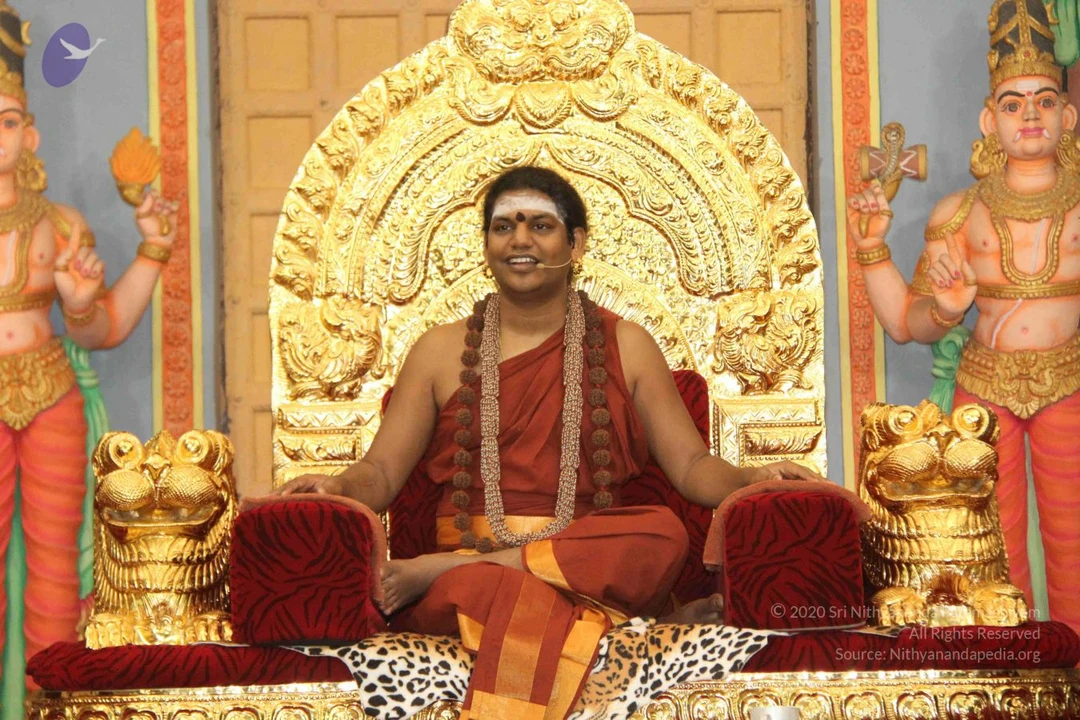
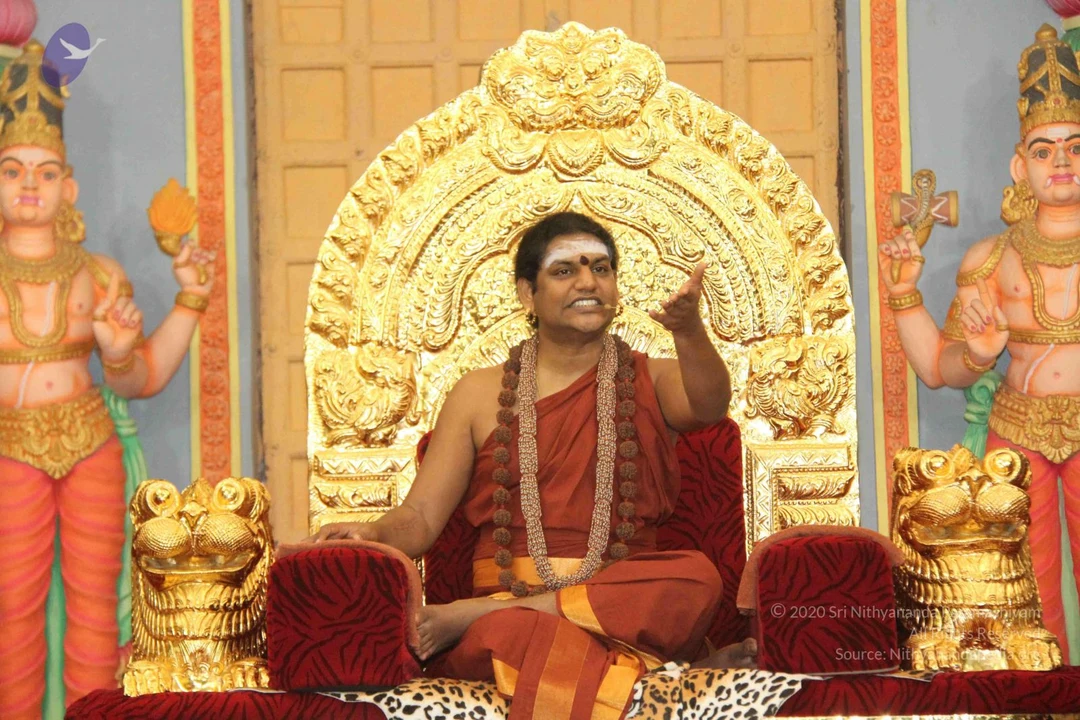
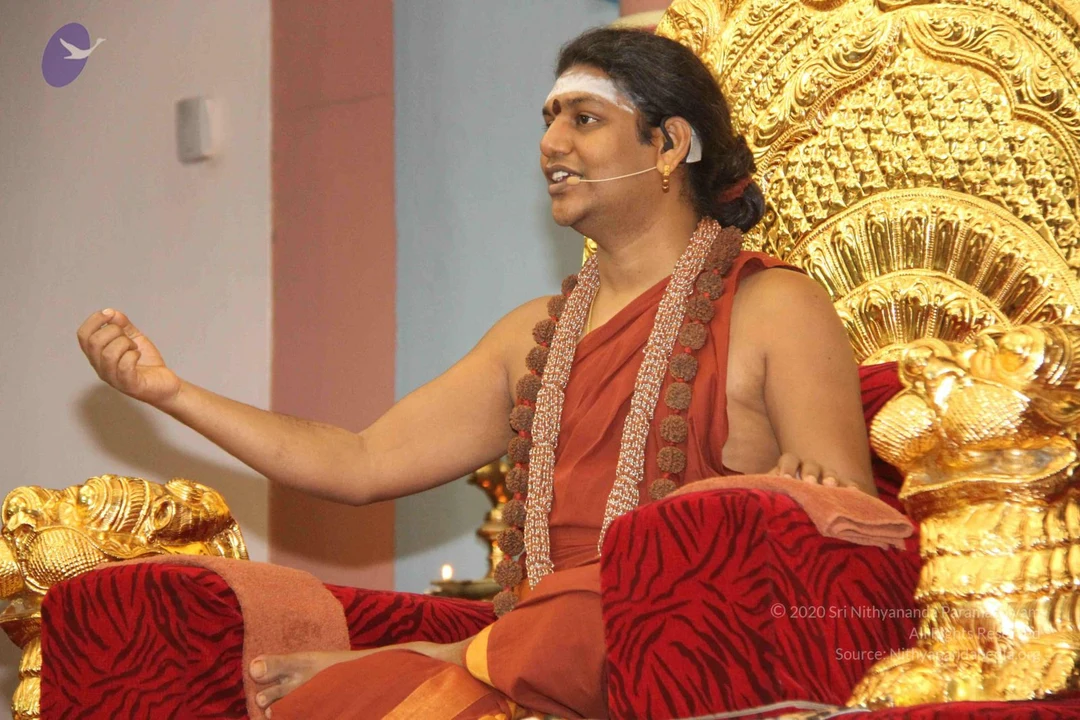
5 photosSource gallery
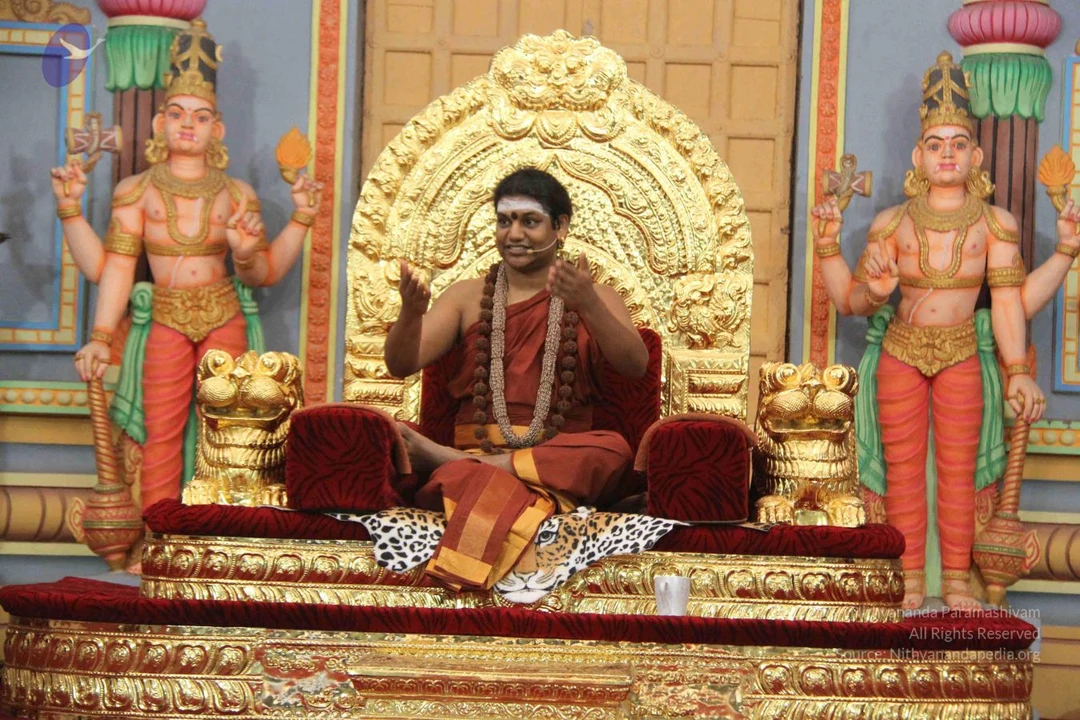
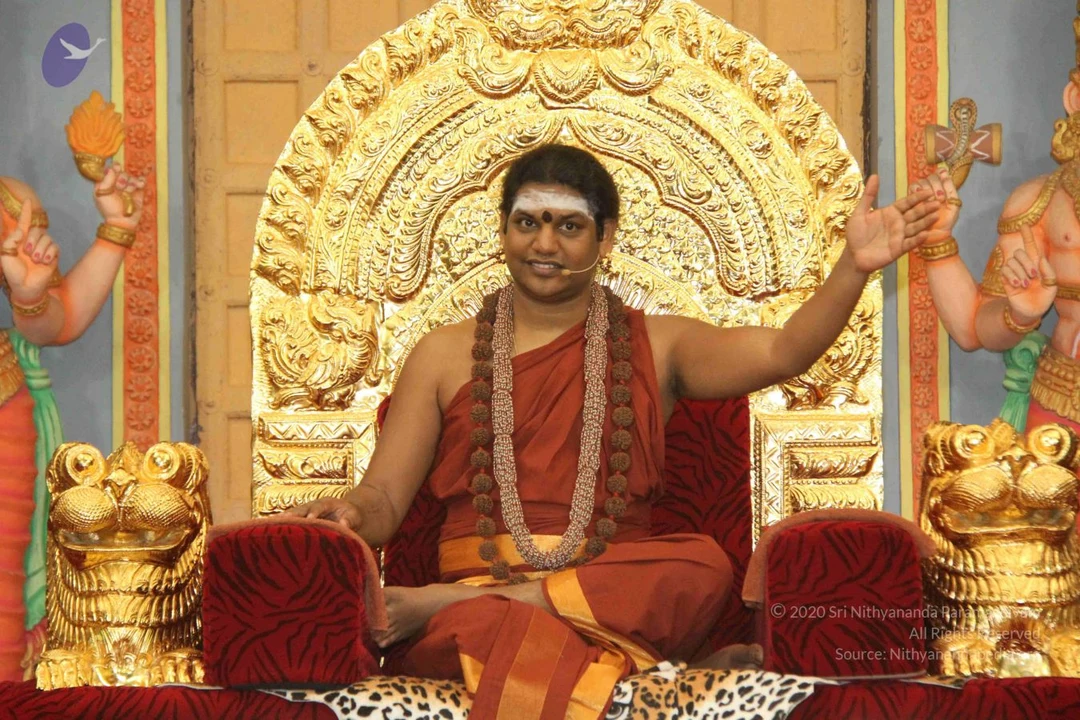
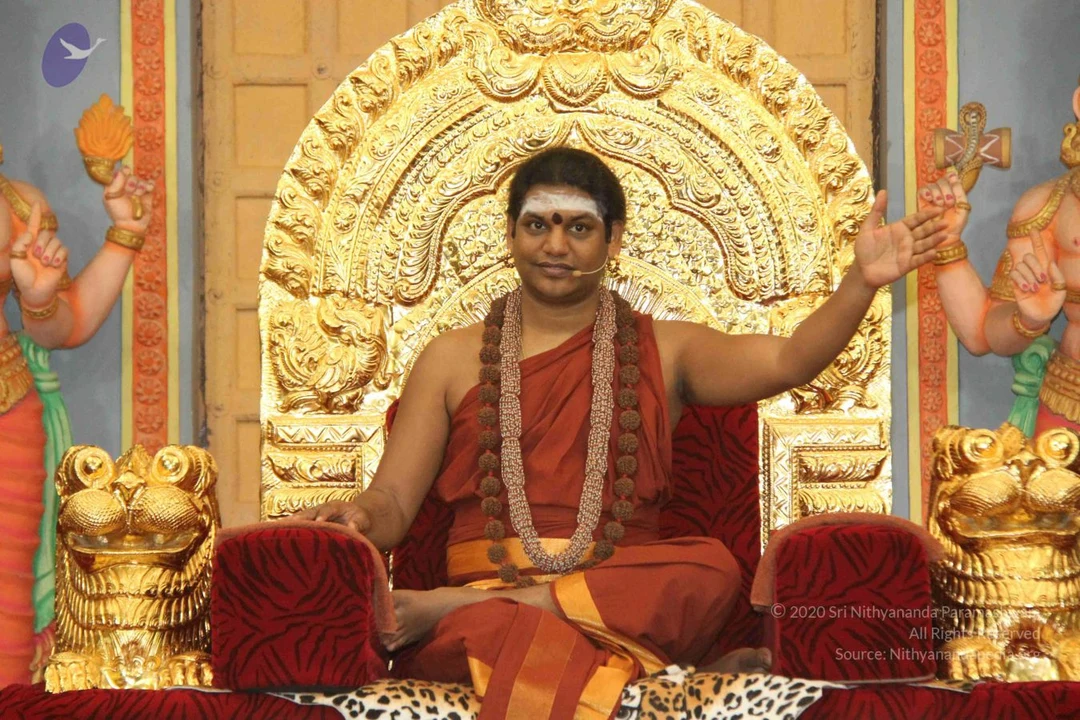
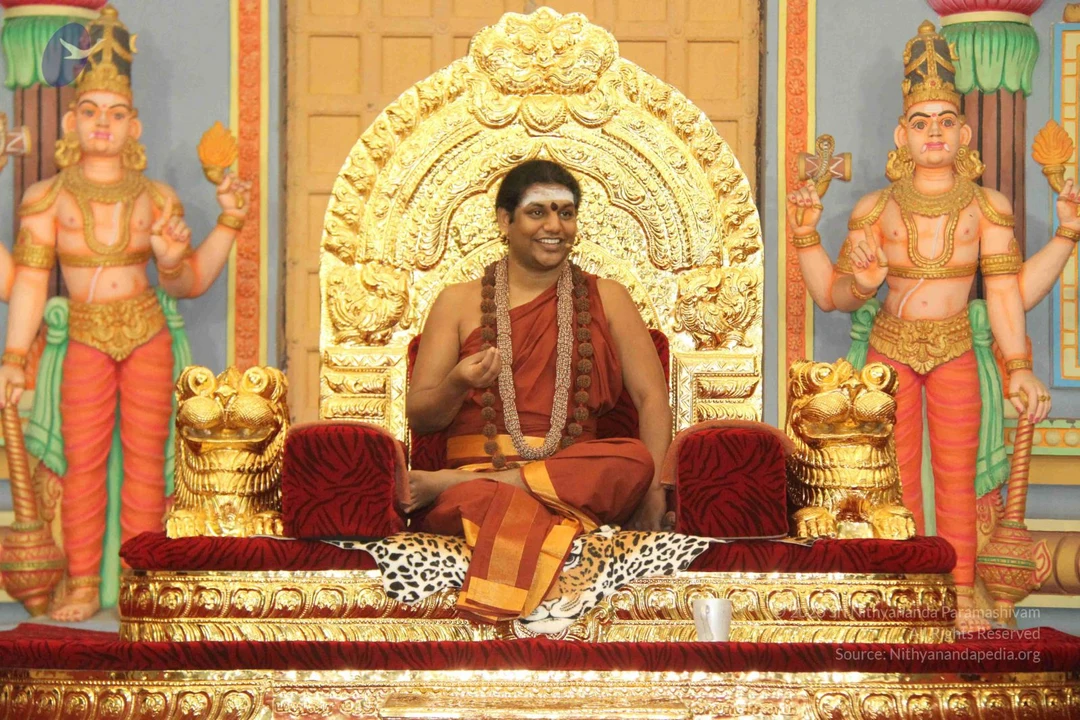
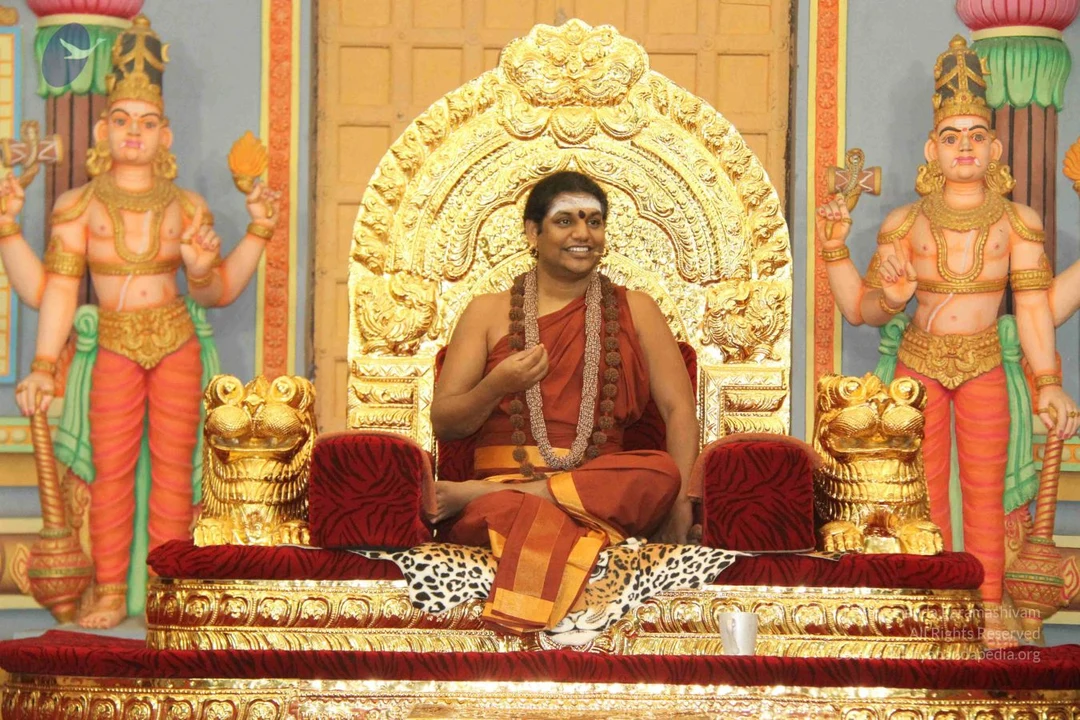
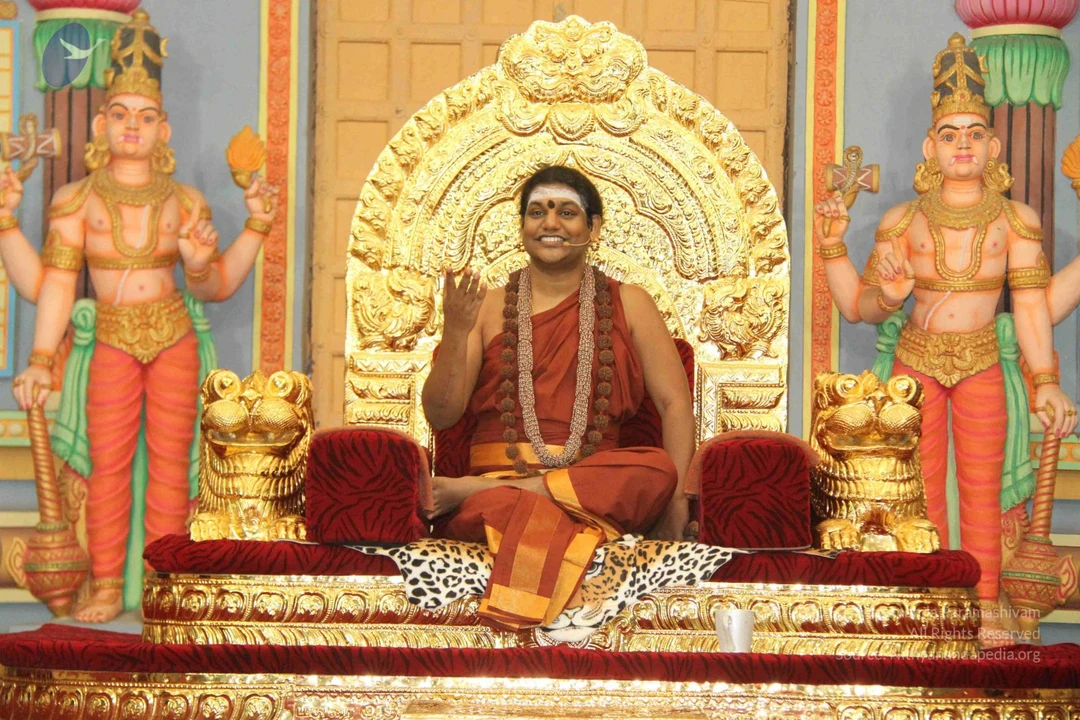
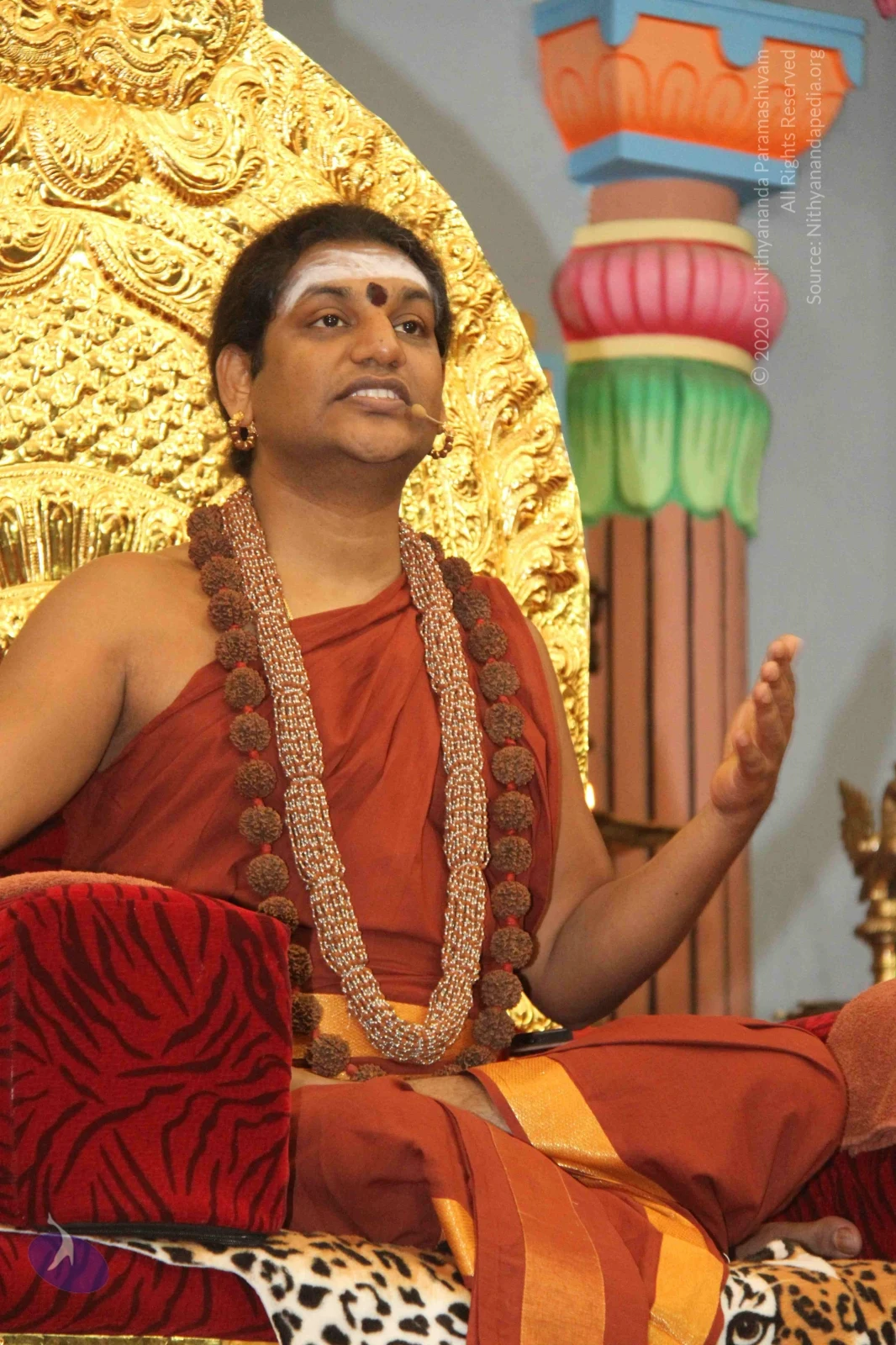
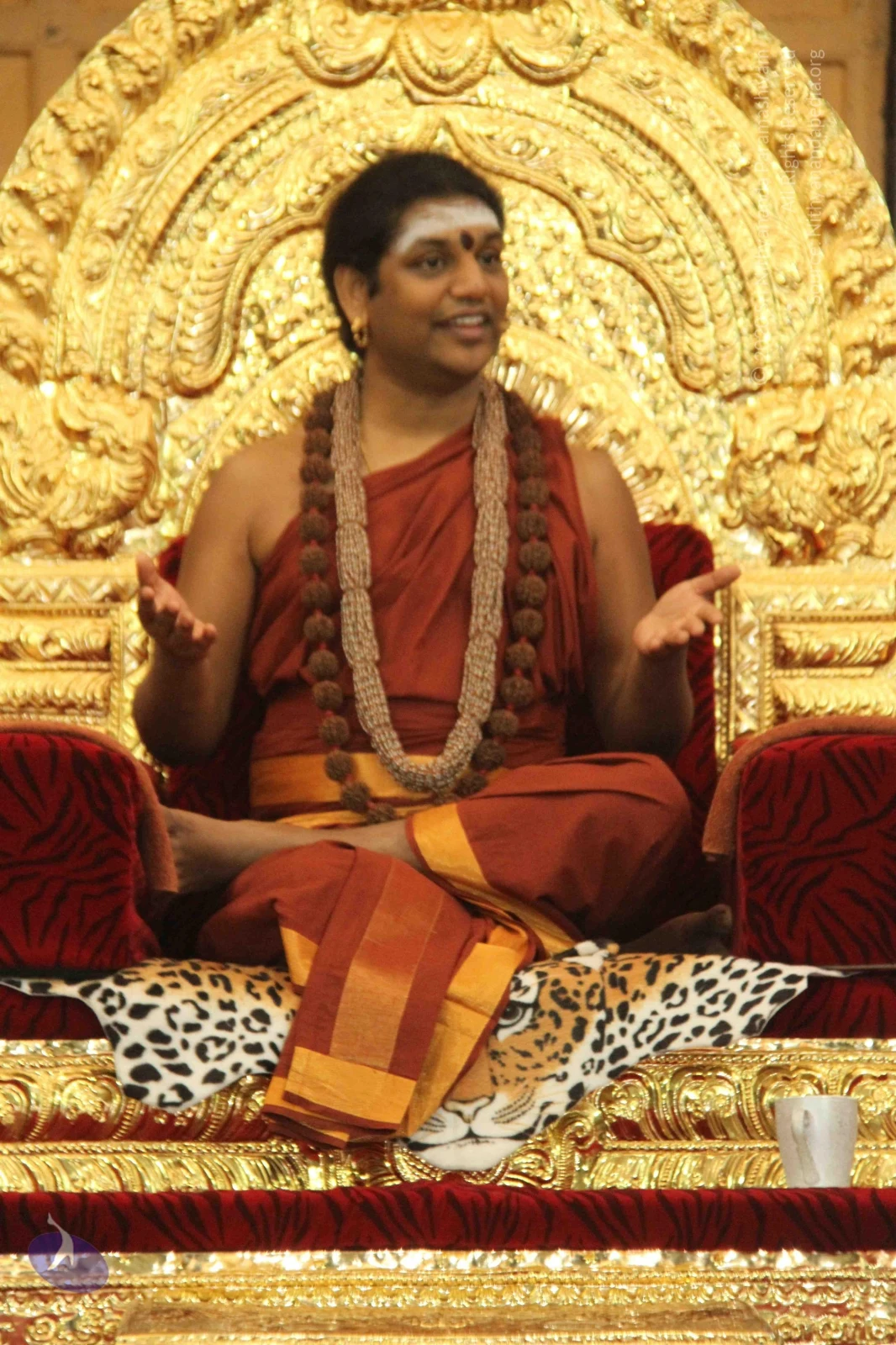
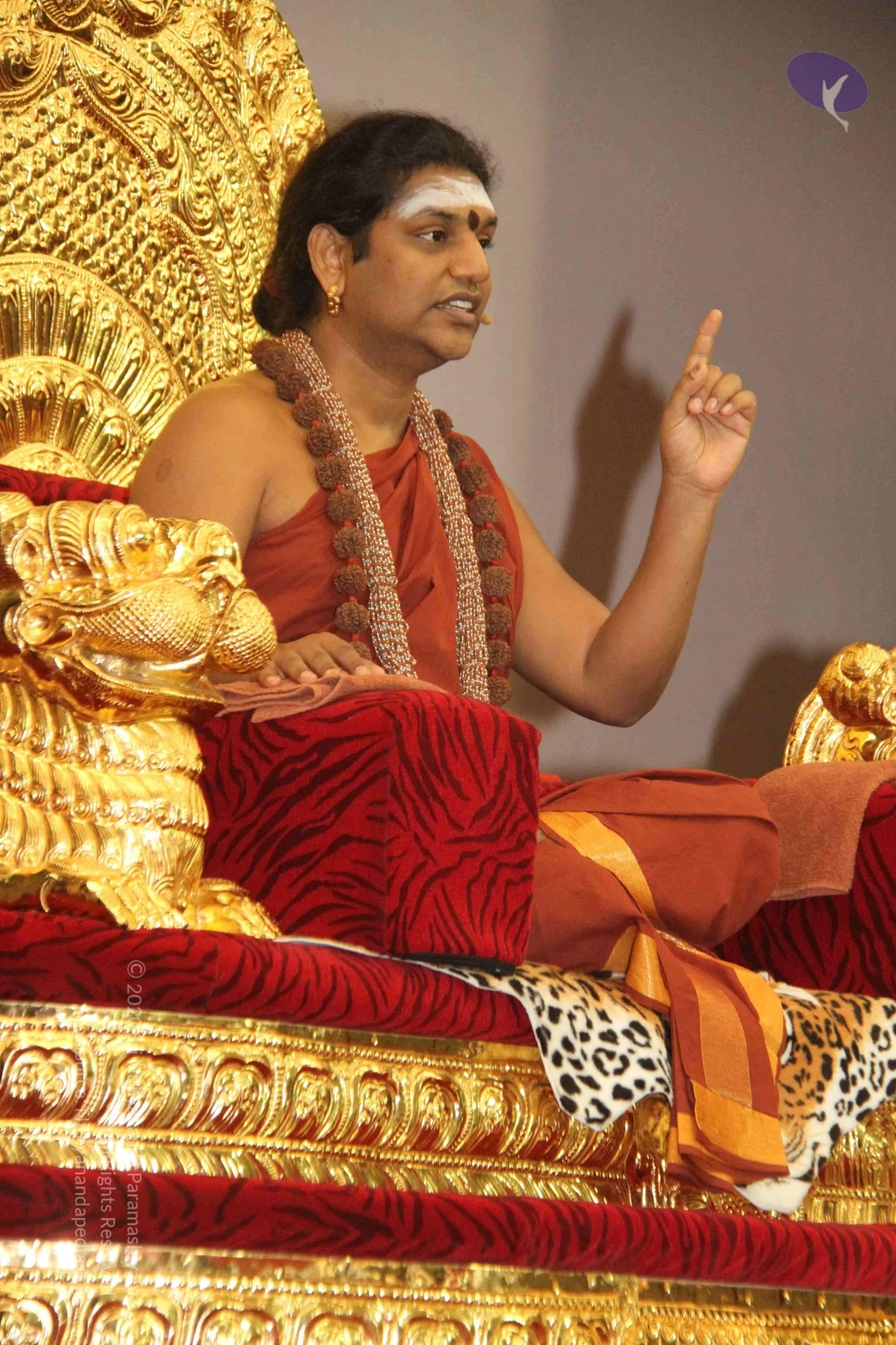
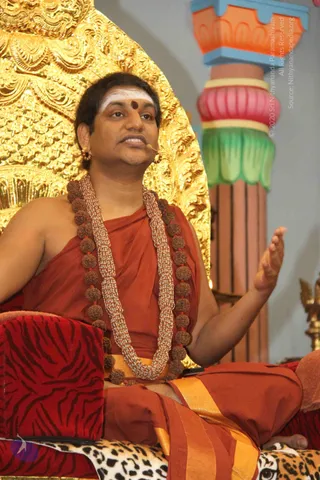
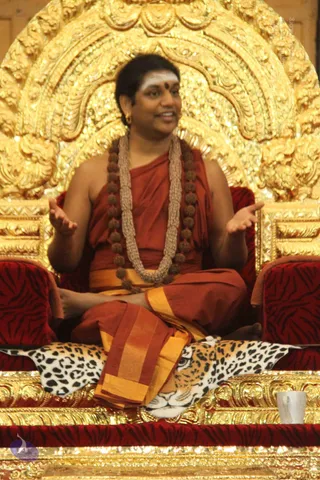
A seated man in saffron-orange robes speaks while gesturing with his right hand. He wears a long rudraksha mala with a silver-toned beaded necklace, a white tilak with a red bindi on his forehead, and small gold earrings with a small microphone at his cheek. He sits on a red and leopard-print cushion before an ornate gold throne-back with carved floral motifs. A pastel pillar with orange, pink and green bands stands behind him. a person seated in ceremonial dress, delivering a satsang discourse.A photograph of a seated figure on an ornate gold throne with red velvet cushions and a leopard-print cloth draped over the seat. The person wears a rust-orange robe with a gold-bordered dhoti, a long rudraksha mala with dark beads and a white beaded garland, and gold earrings. White and red markings are on the forehead. Both hands are open in an explaining gesture while speaking. A white cup sits on the throne's lower ledge.A seated man sits cross-legged on an ornate gold throne with a tall, richly carved arched back. He wears a rust-red and saffron-bordered robe, a long strand of rudraksha beads with a ceremonial beaded necklace, and a head-mounted microphone. A white vertical tilak and red bindi mark his forehead. A leopard-print cloth covers the red velvet seat, and a white cup sits at the lower right. The figure is a probable Swamiji by appearance cues: swept-back hair, saffron-orange clothing, rudraksha malas and ceremonial necklace, seated on a throne.A man seated on an ornate gilded throne with a carved golden lion-head armrest, draped in red-orange cloth and a leopard-print cloth on the seat, wearing a long rudraksha mala with silver beads and a white horizontal forehead mark with a red dot. He raises his index finger while speaking into a headset microphone, with a golden backrest behind him. Appearance-based label: a person, as a seated speaker with rudraksha mala, saffron-orange clothing and a ceremonial throne.A photograph of a screen showing a carved wooden figure of a four-armed deity seated on a lotus base against a yellow background. The figure wears a tall crown, a layered necklace and a draped garment, holding lotus buds in its raised hands. A small figure appears at the lower right of the base. The screen shows a viewer toolbar and a timestamp reading 08:08:43 AM. Only the depicted statue is present; there are no physical people in the scene.
Home-Visit-Pada-Puja

10 photosSource gallery
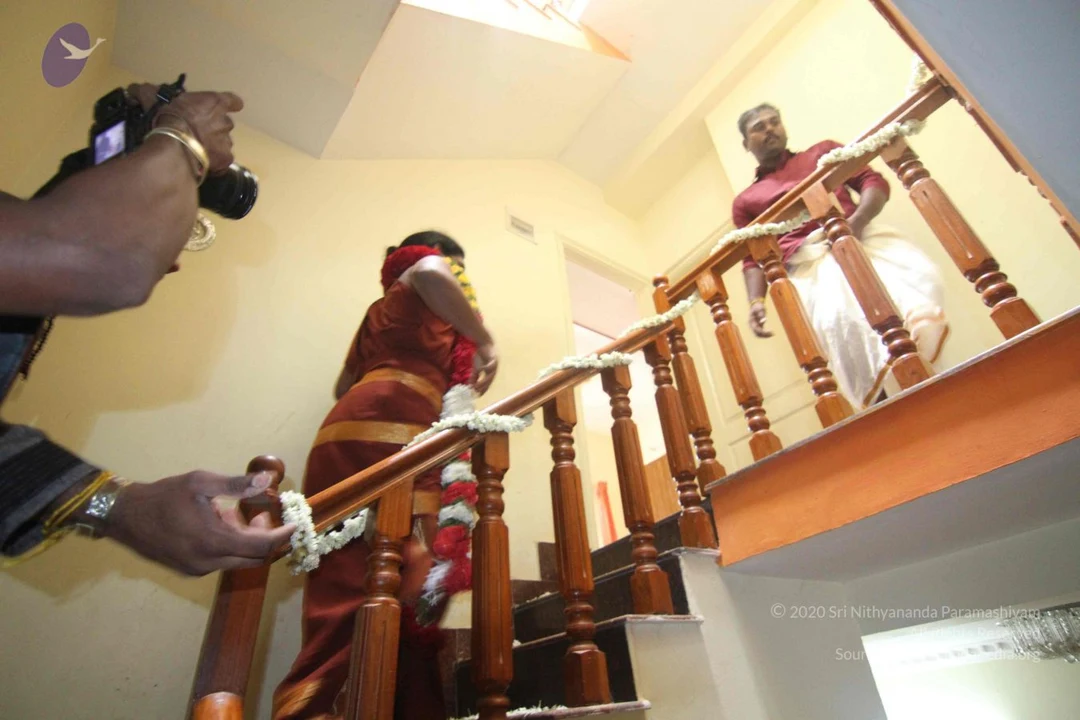
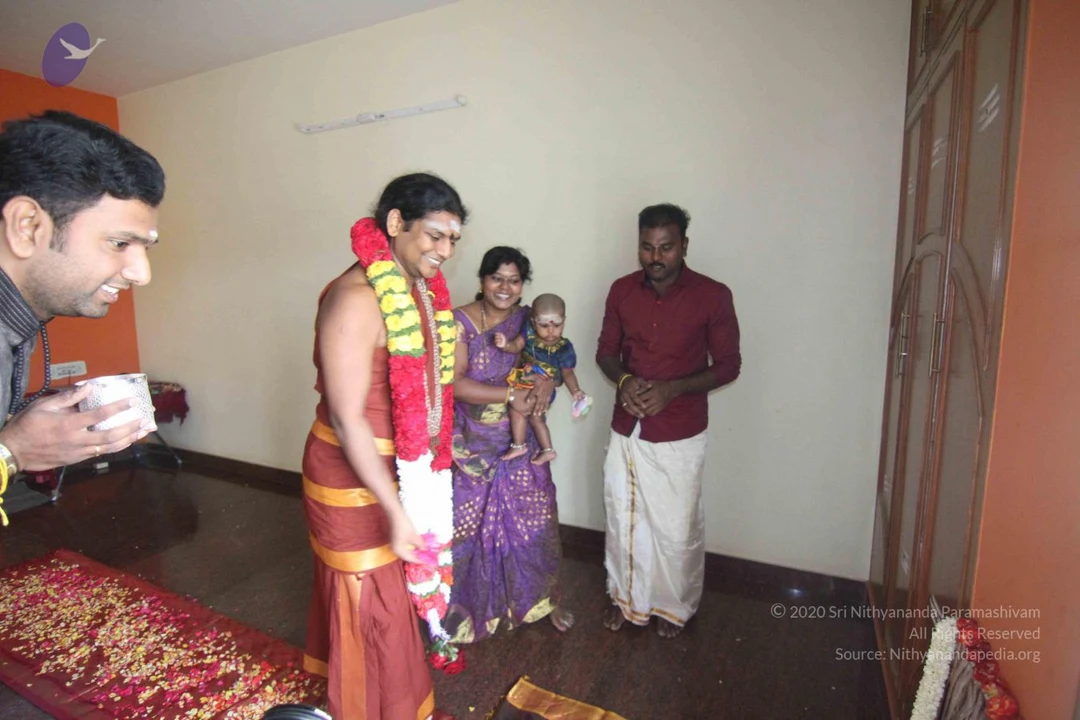
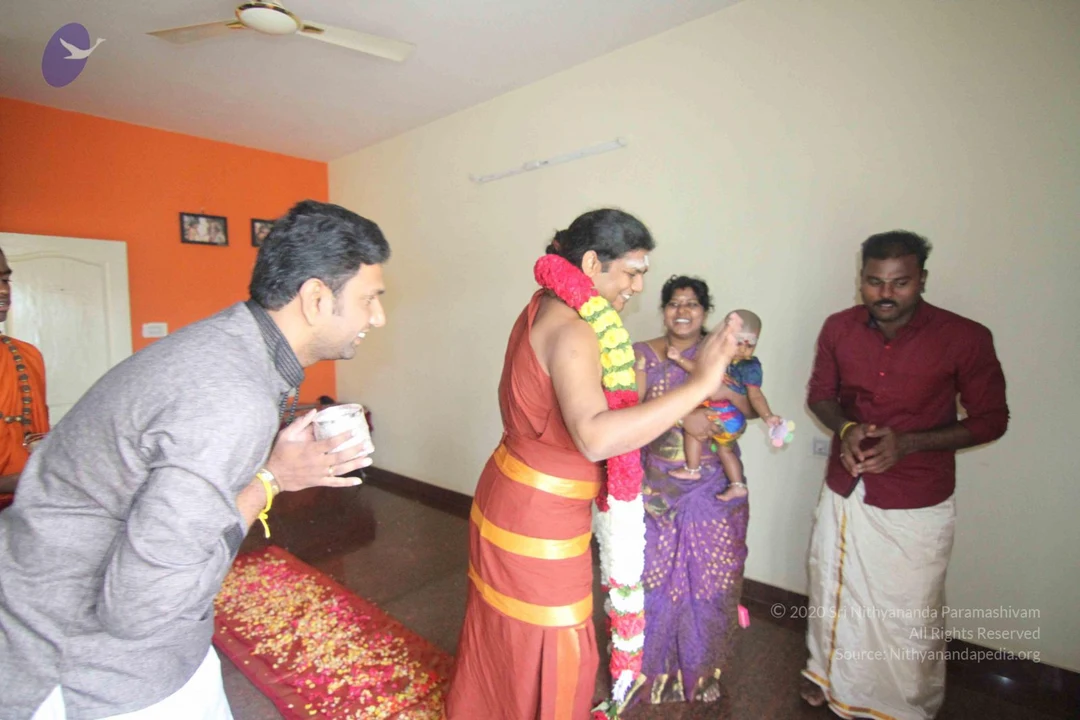
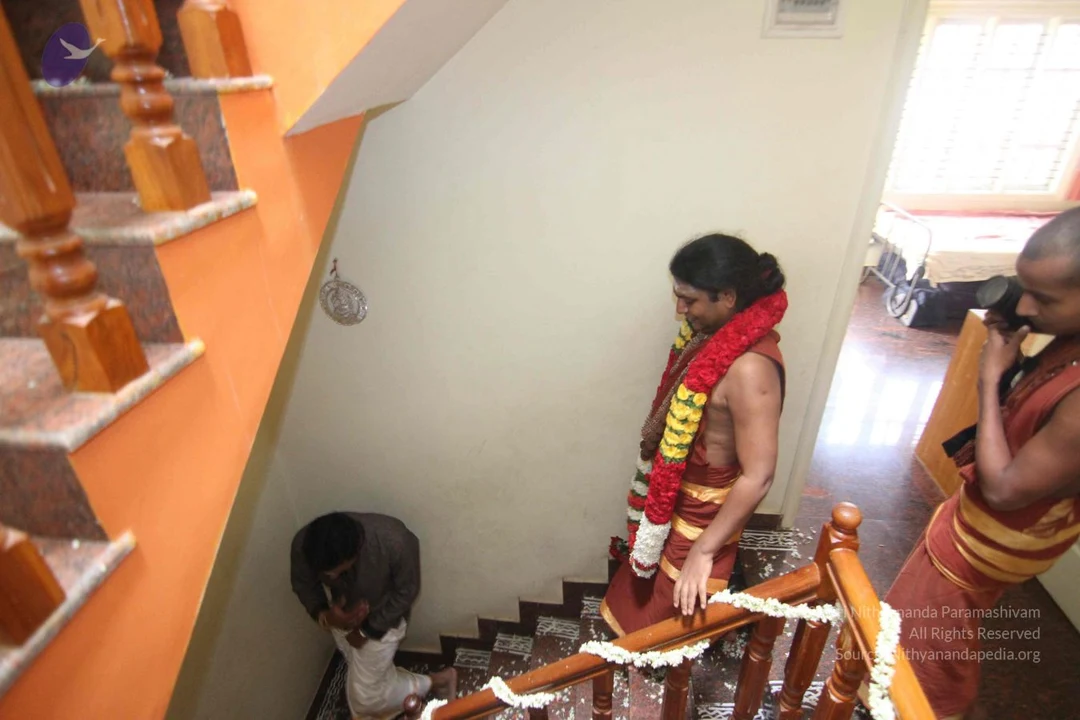
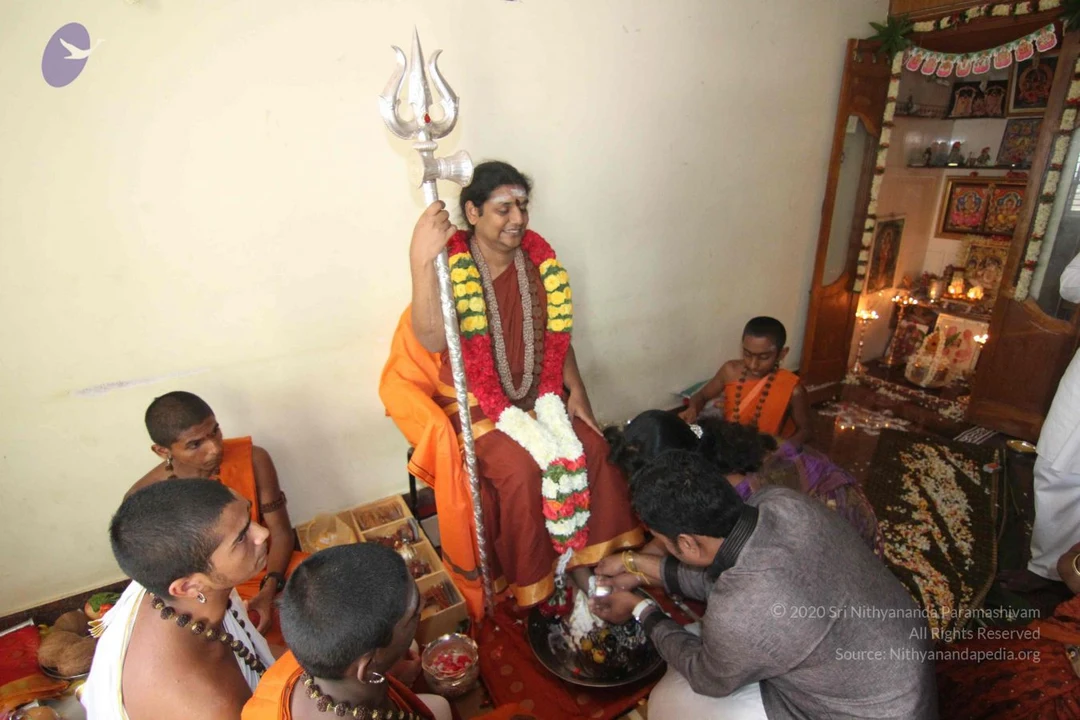
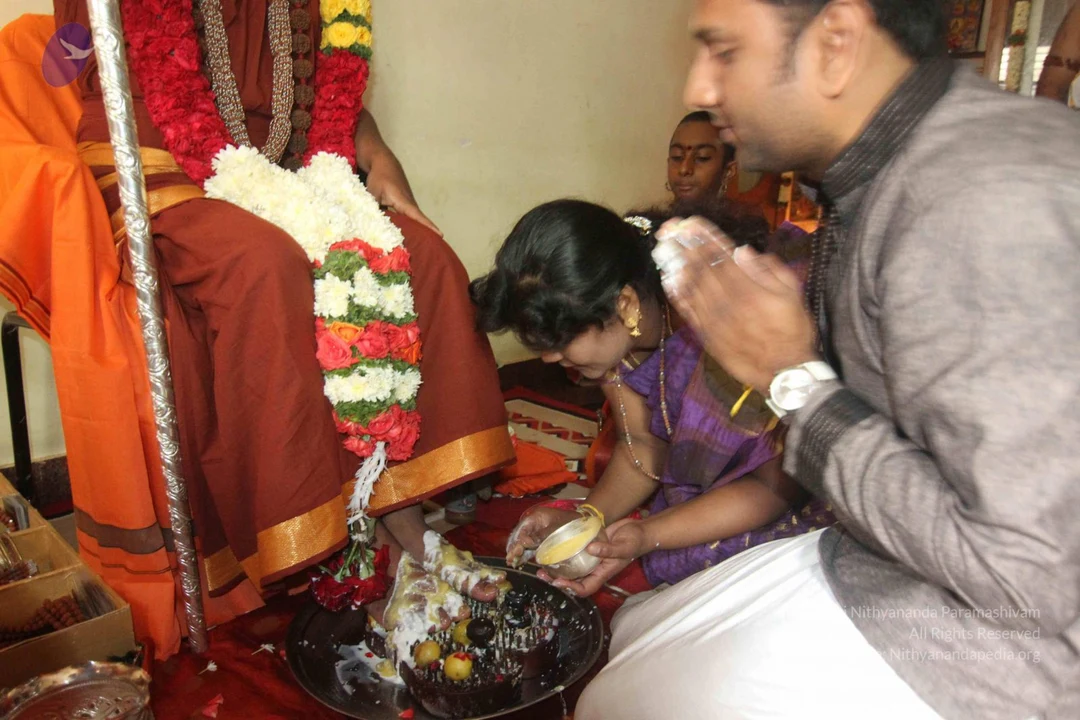
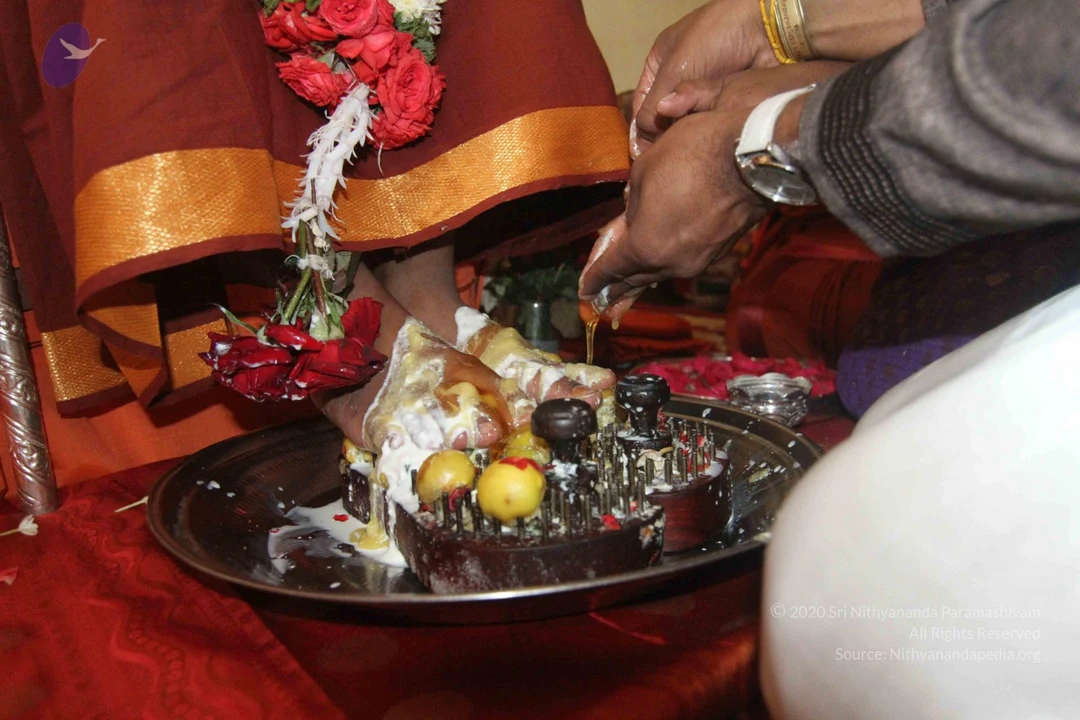
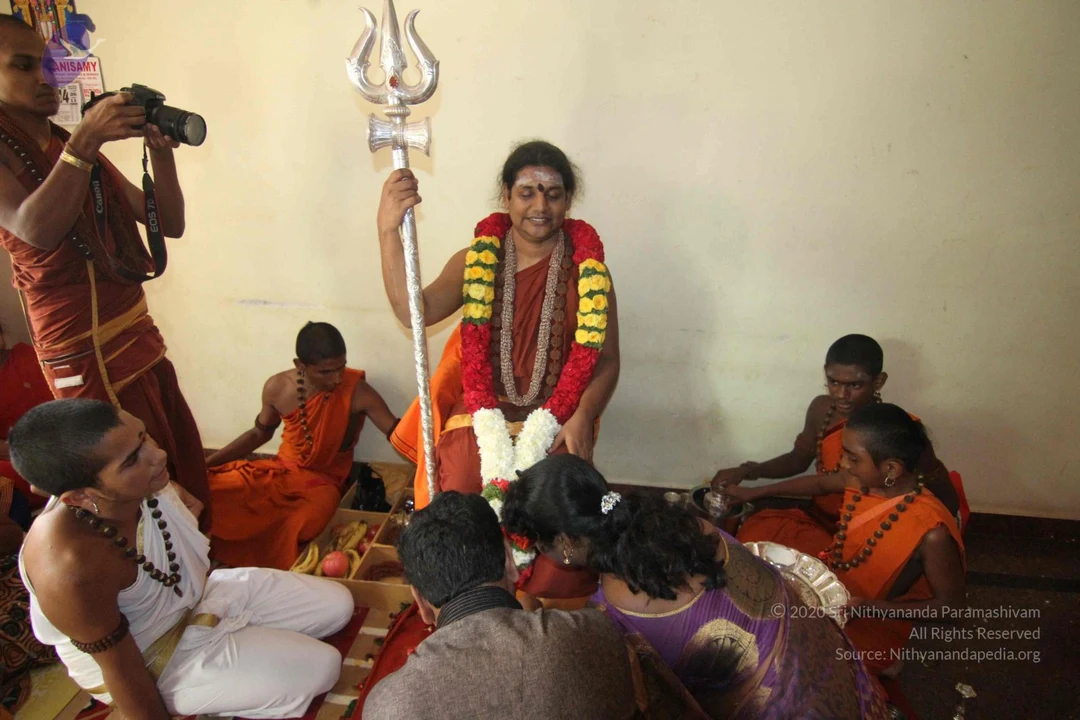
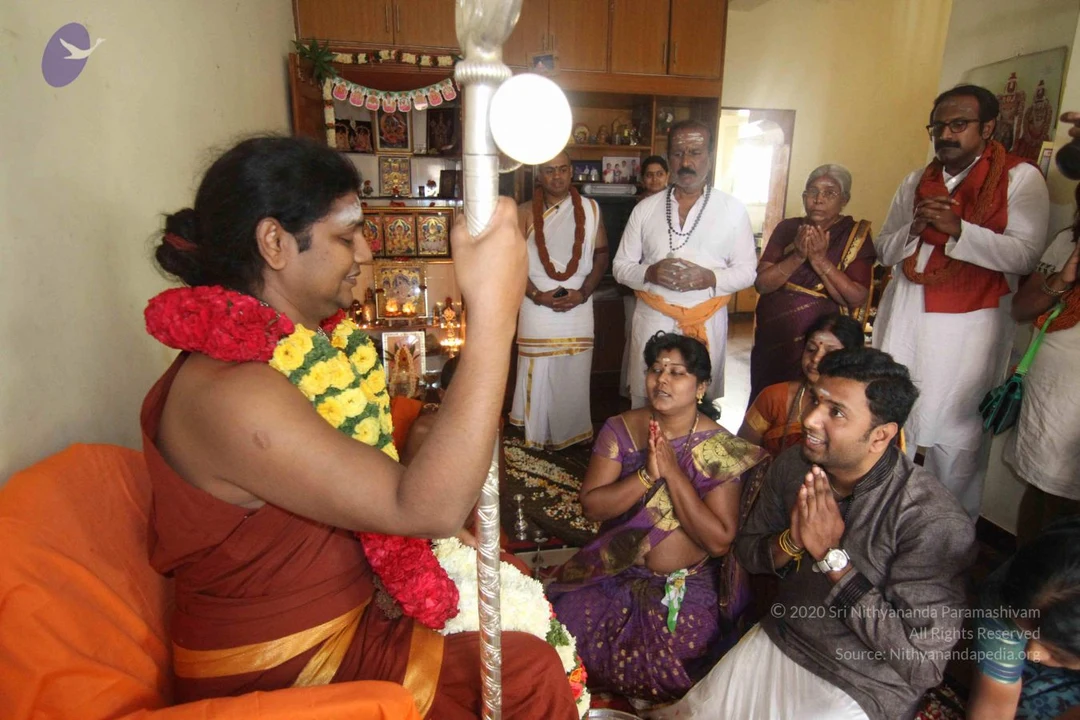
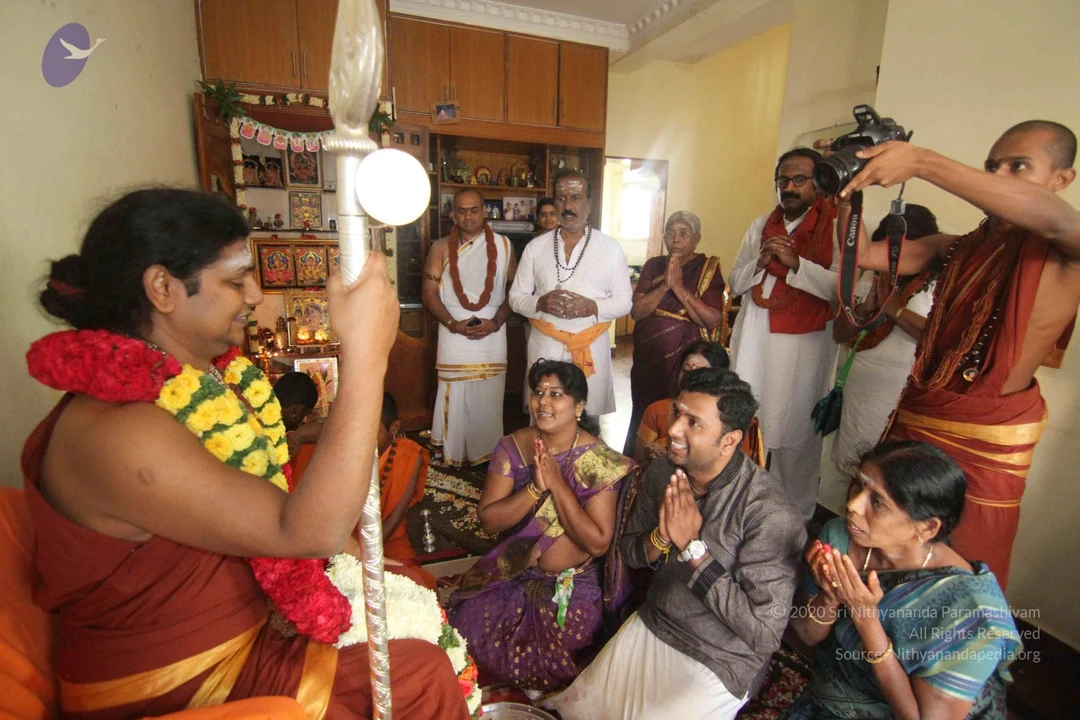
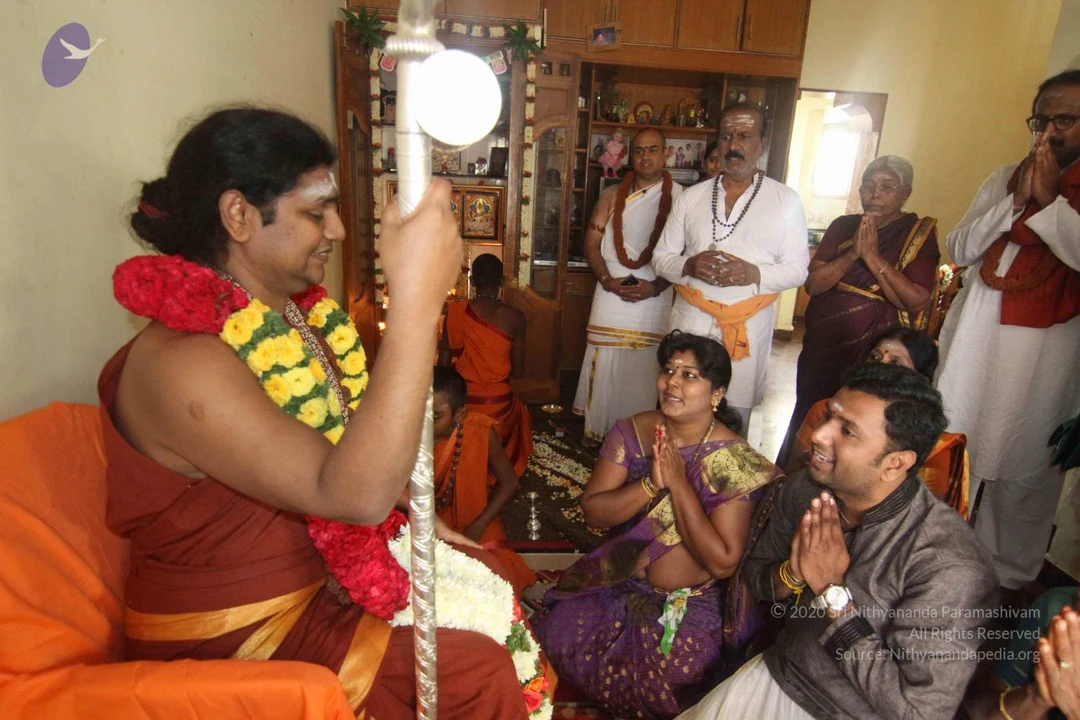
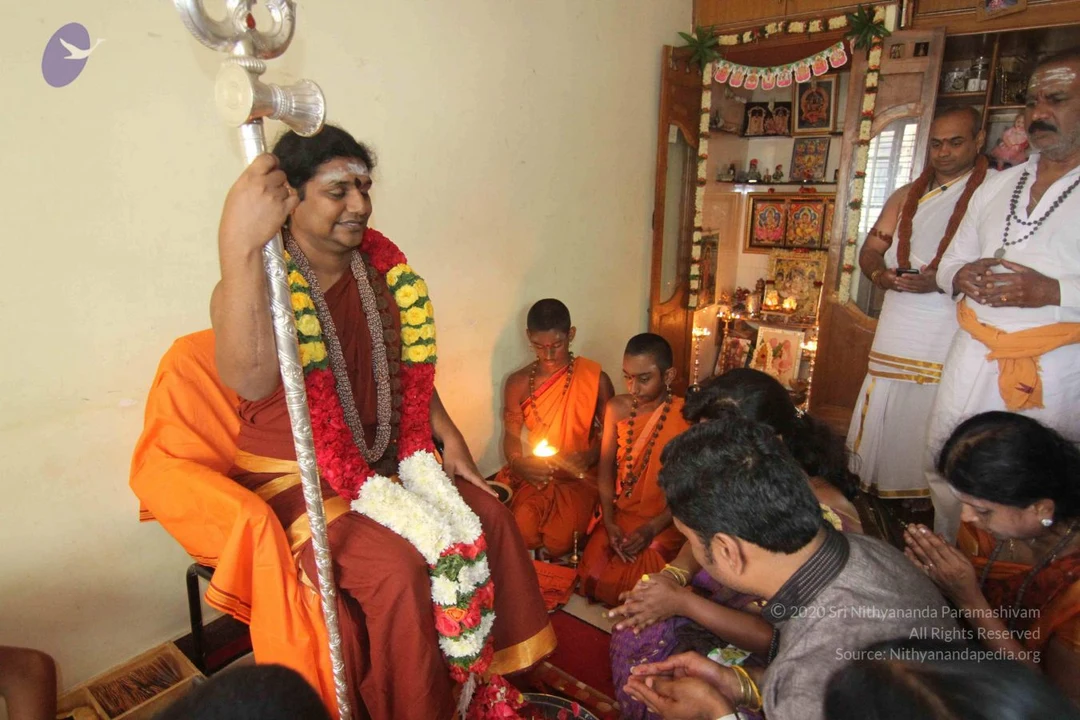
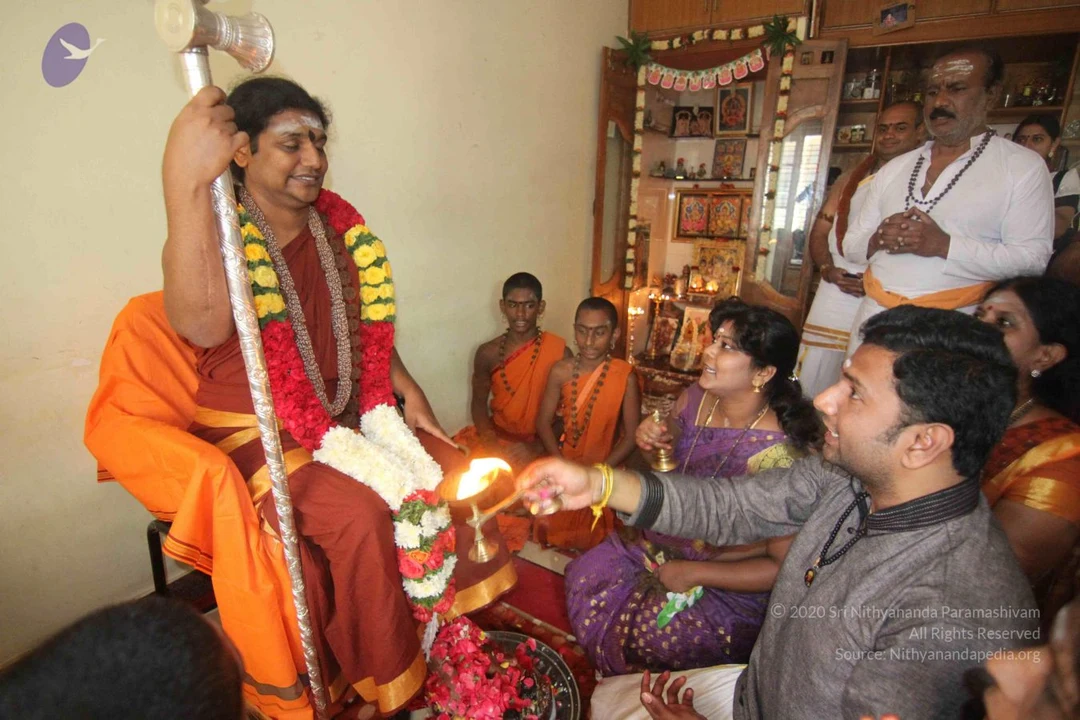
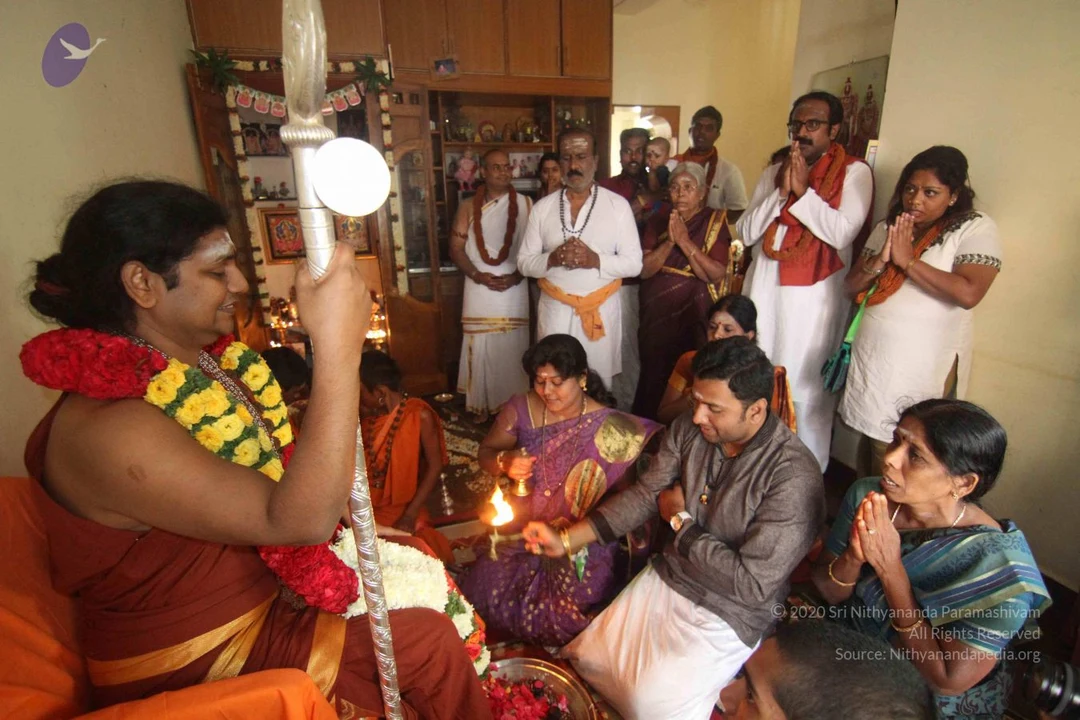
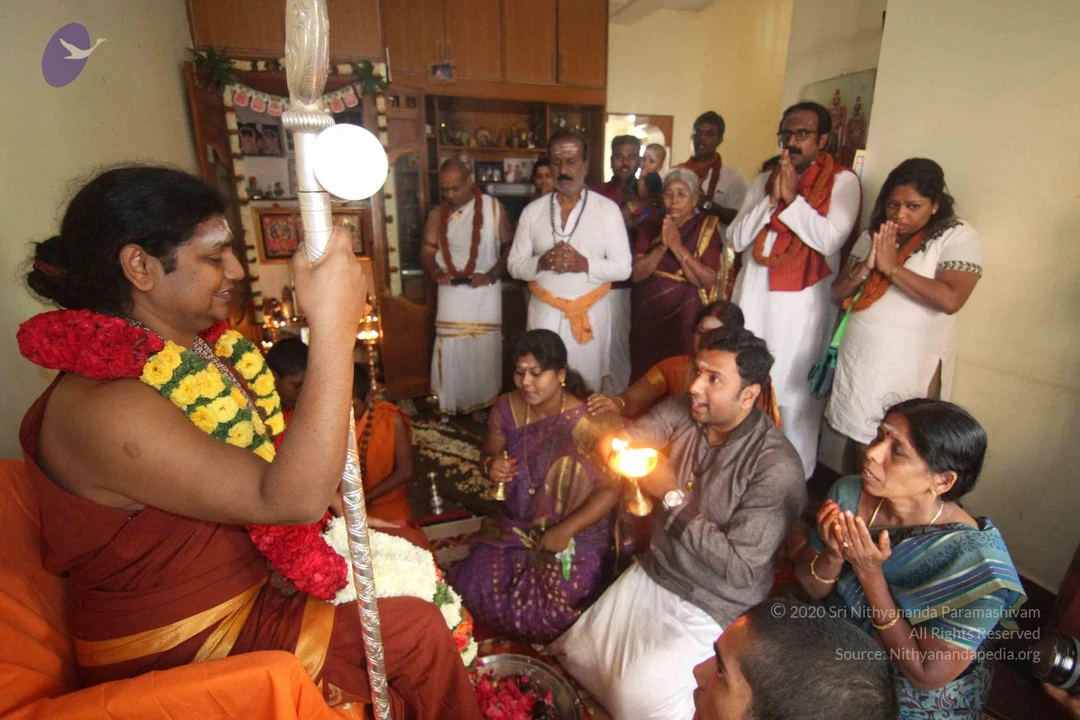
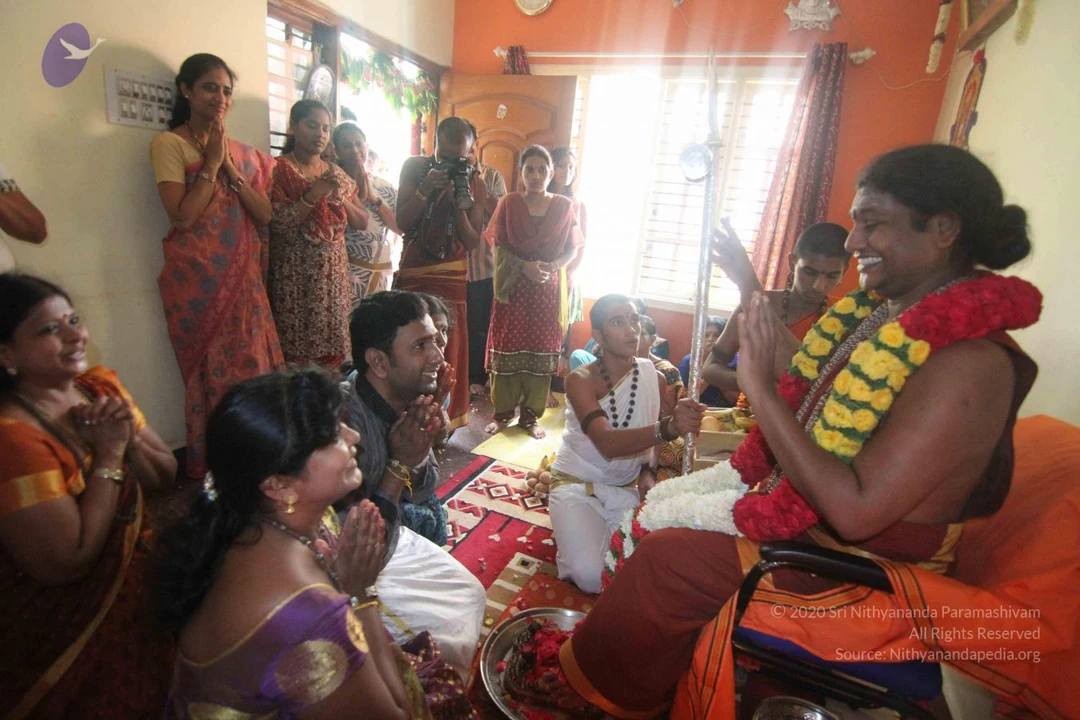
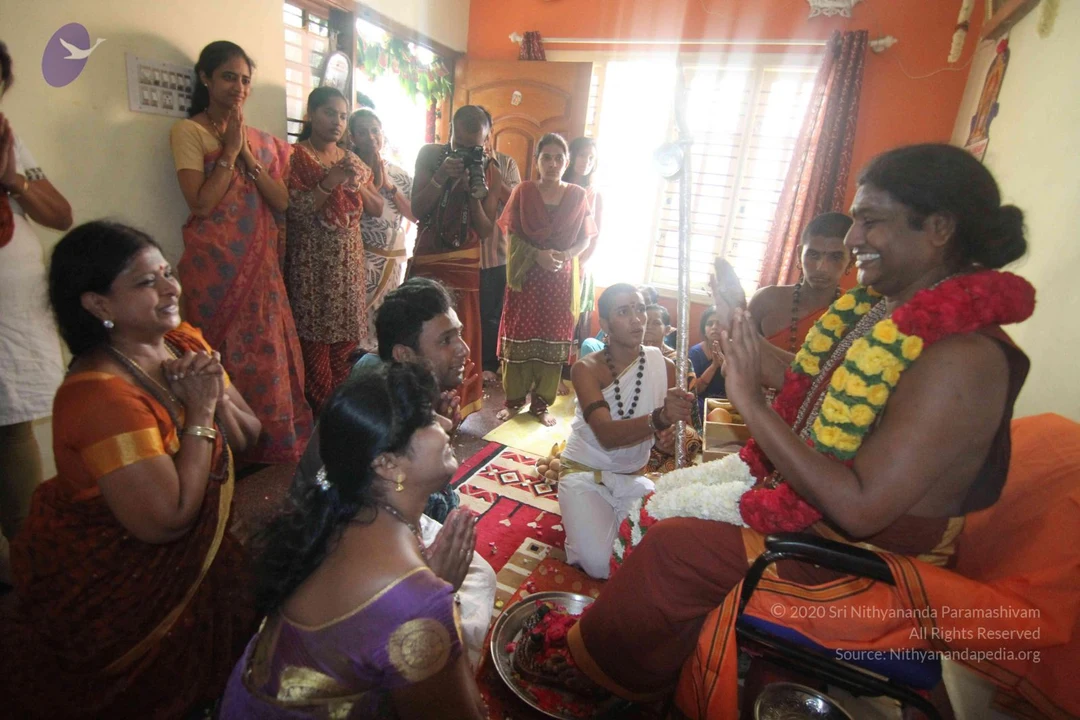
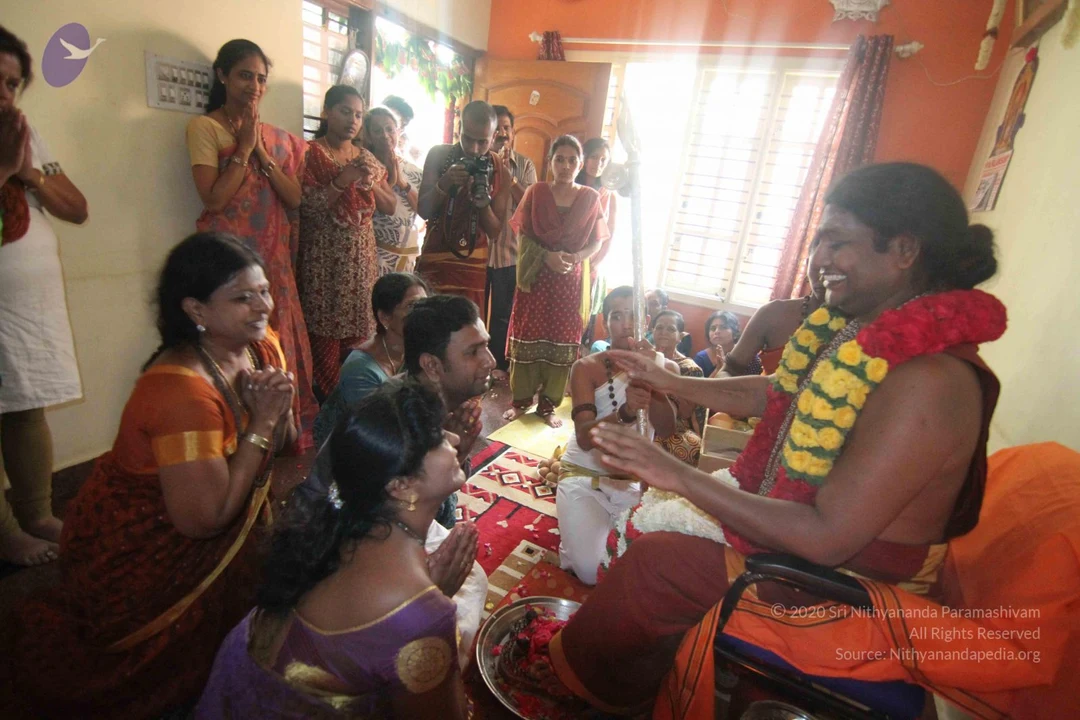
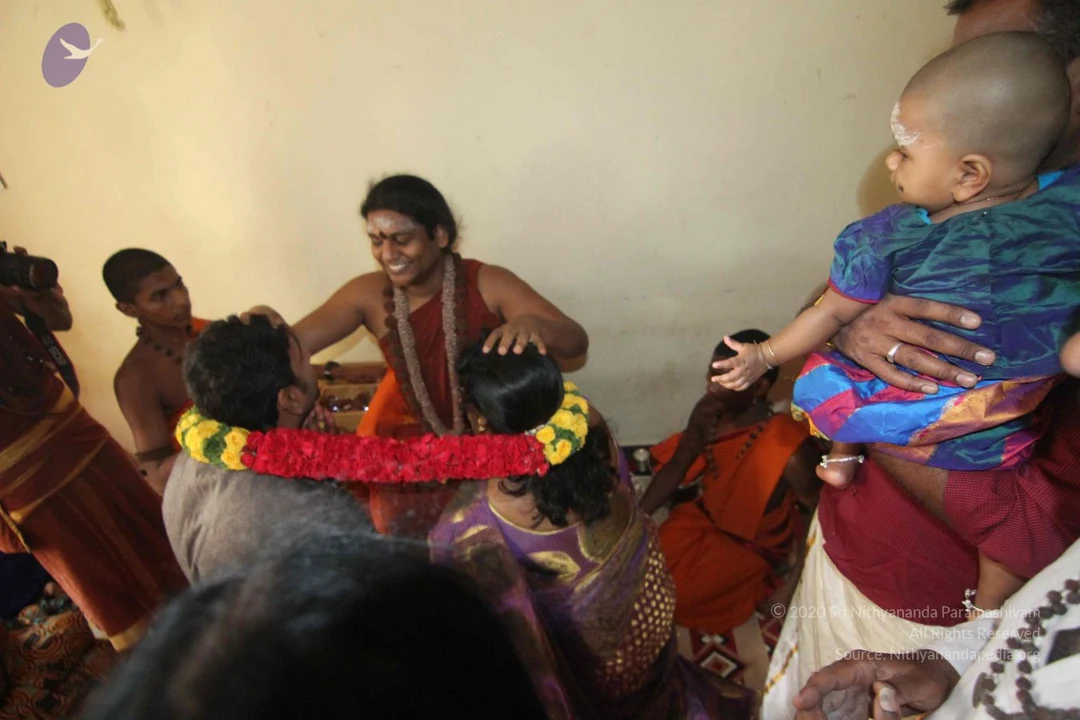
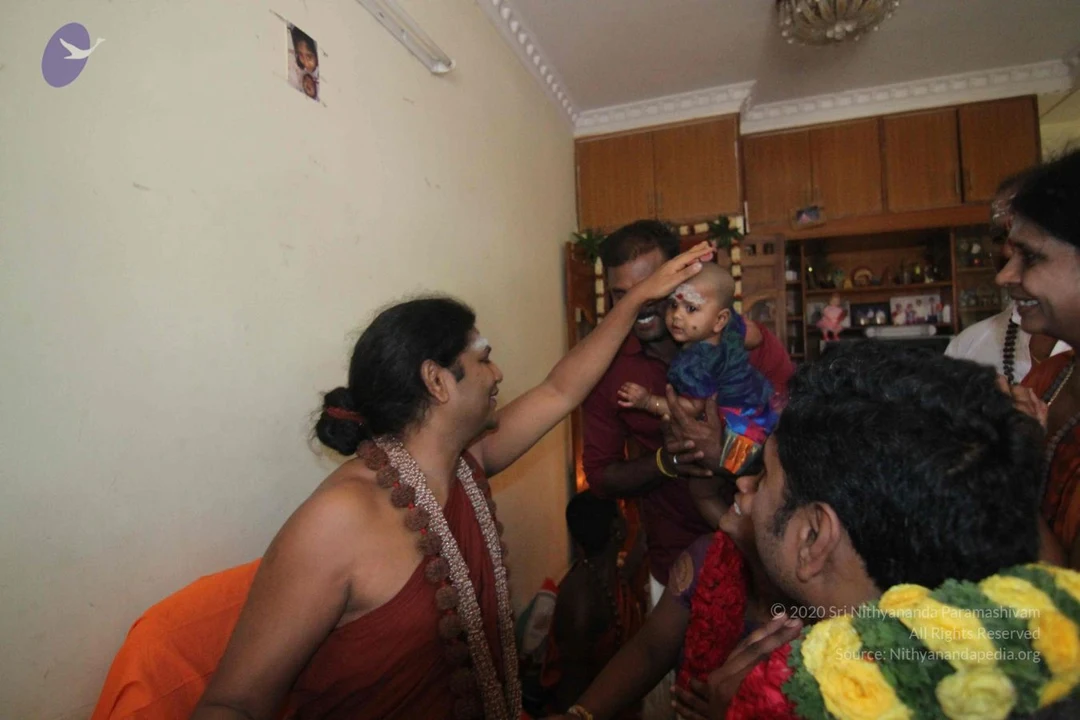
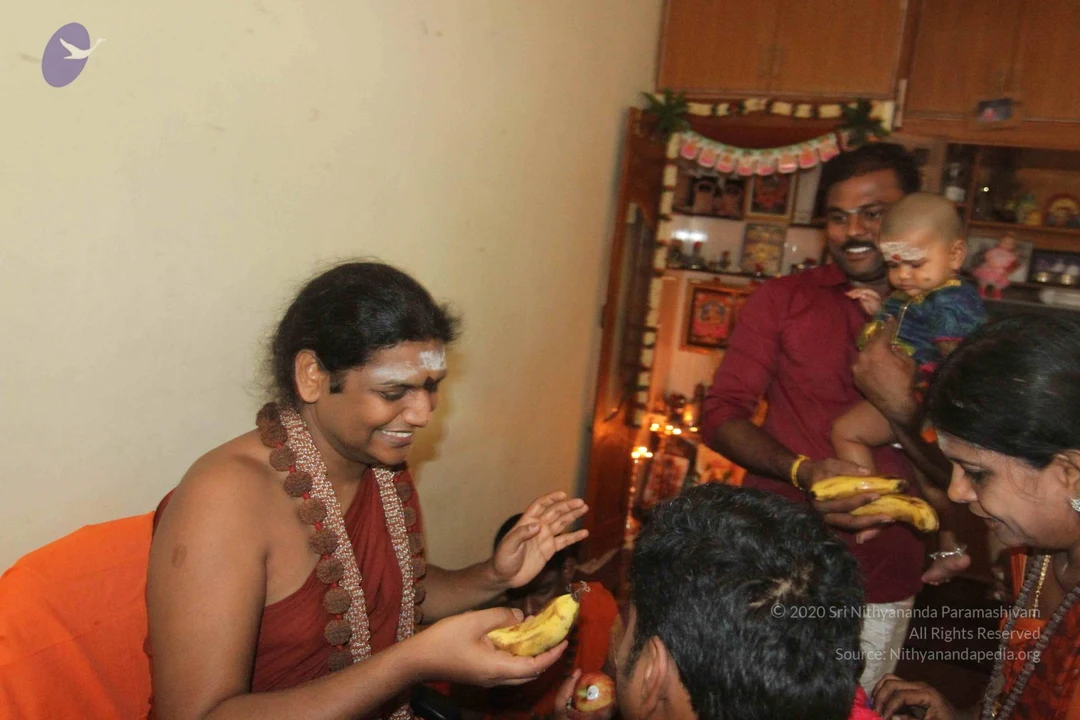
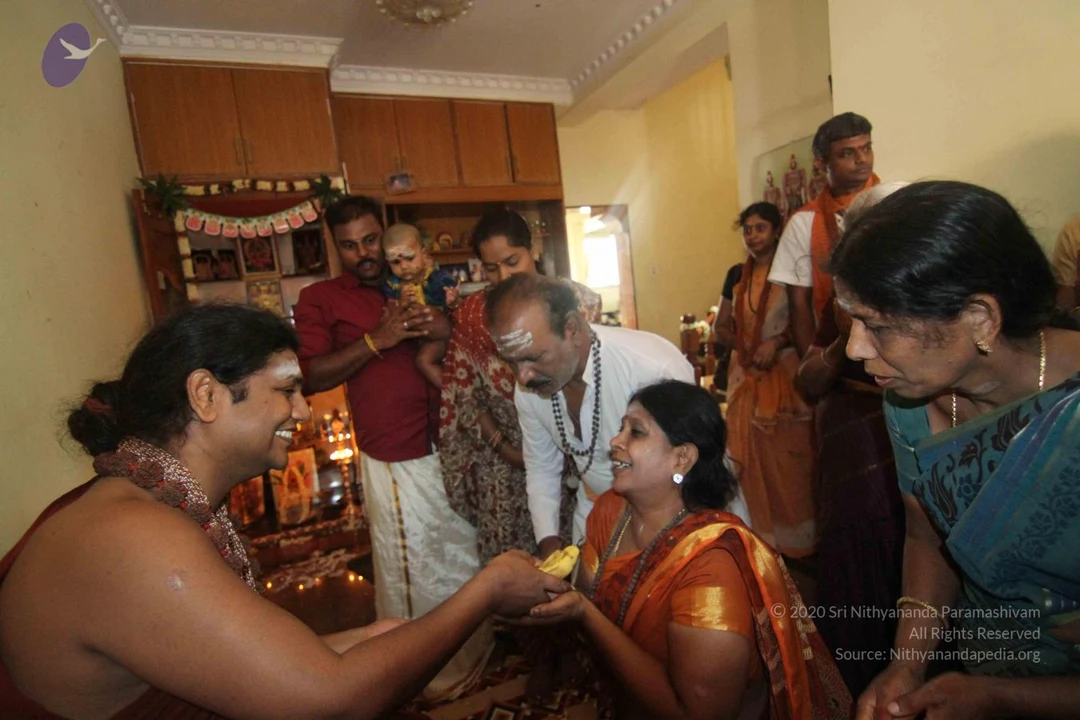
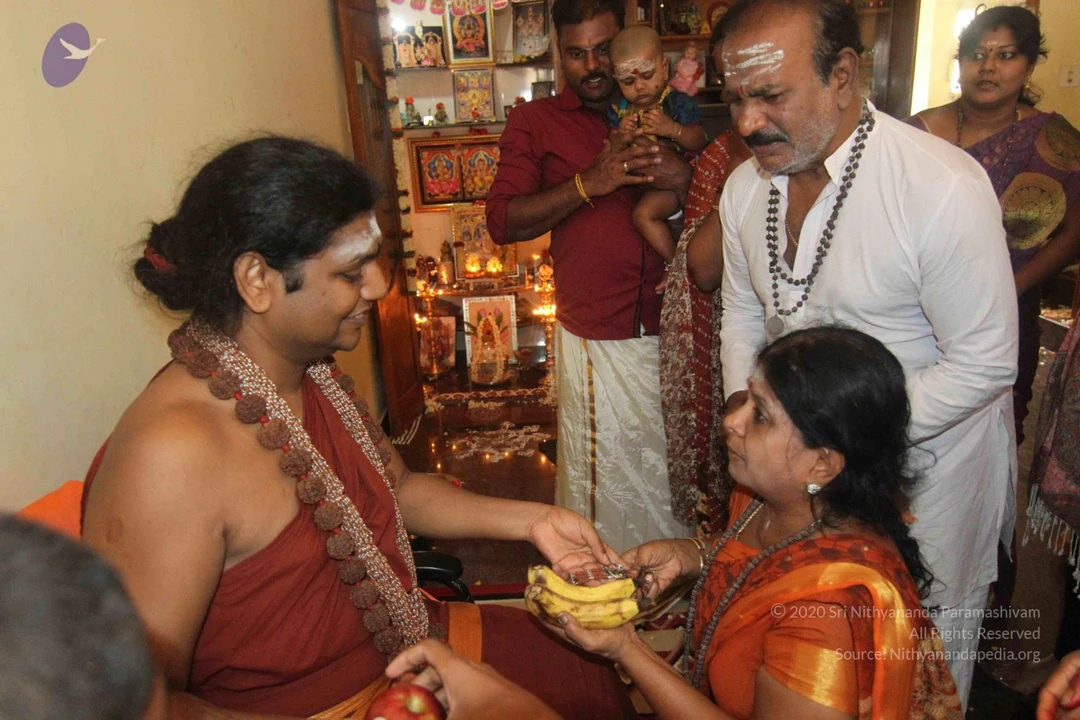
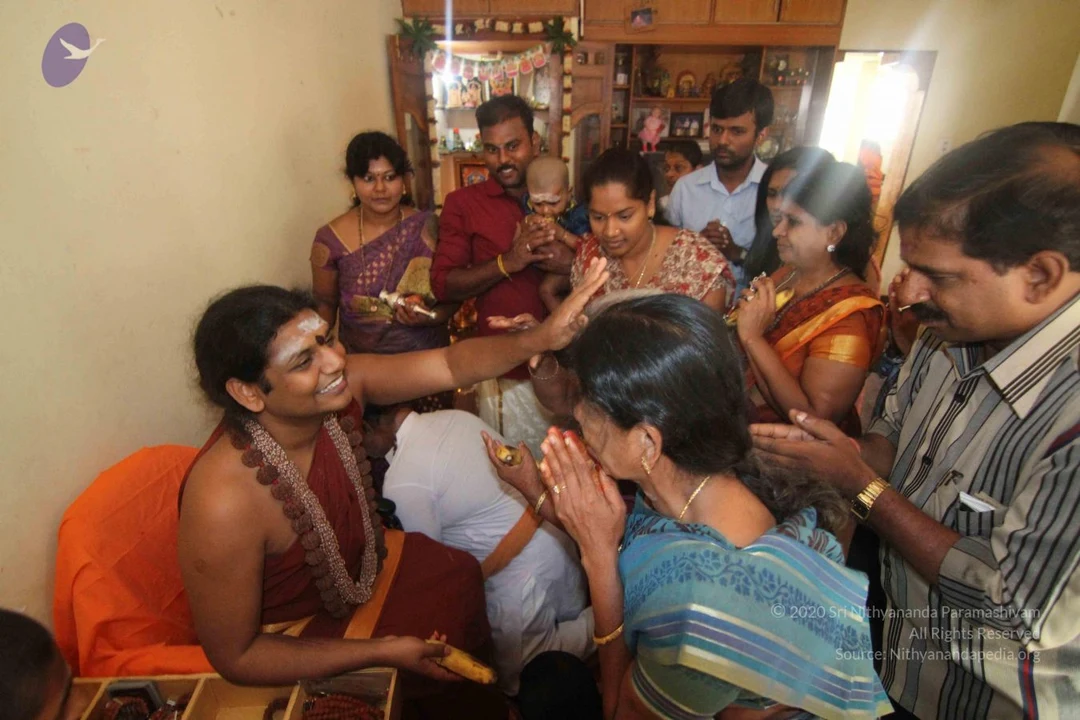
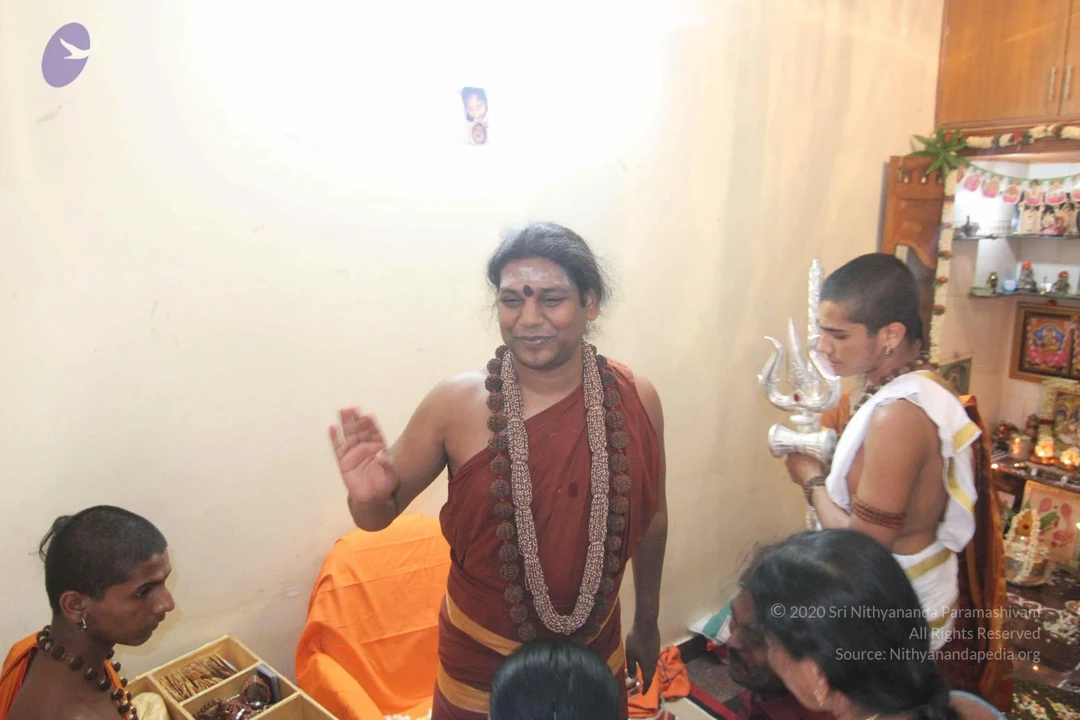
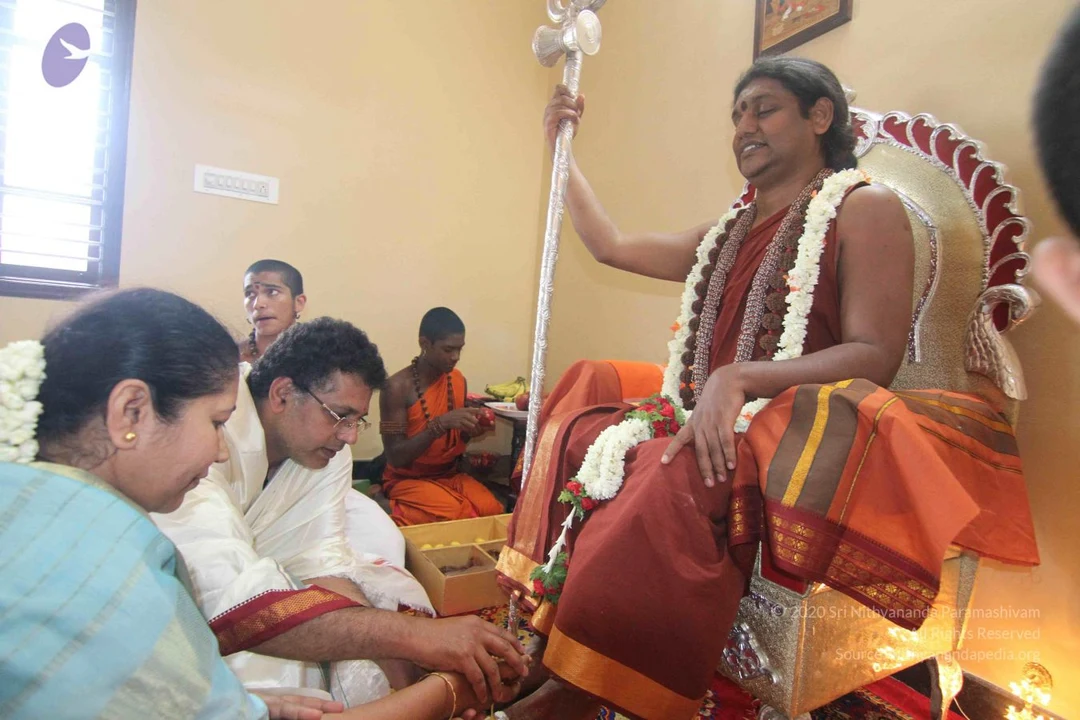
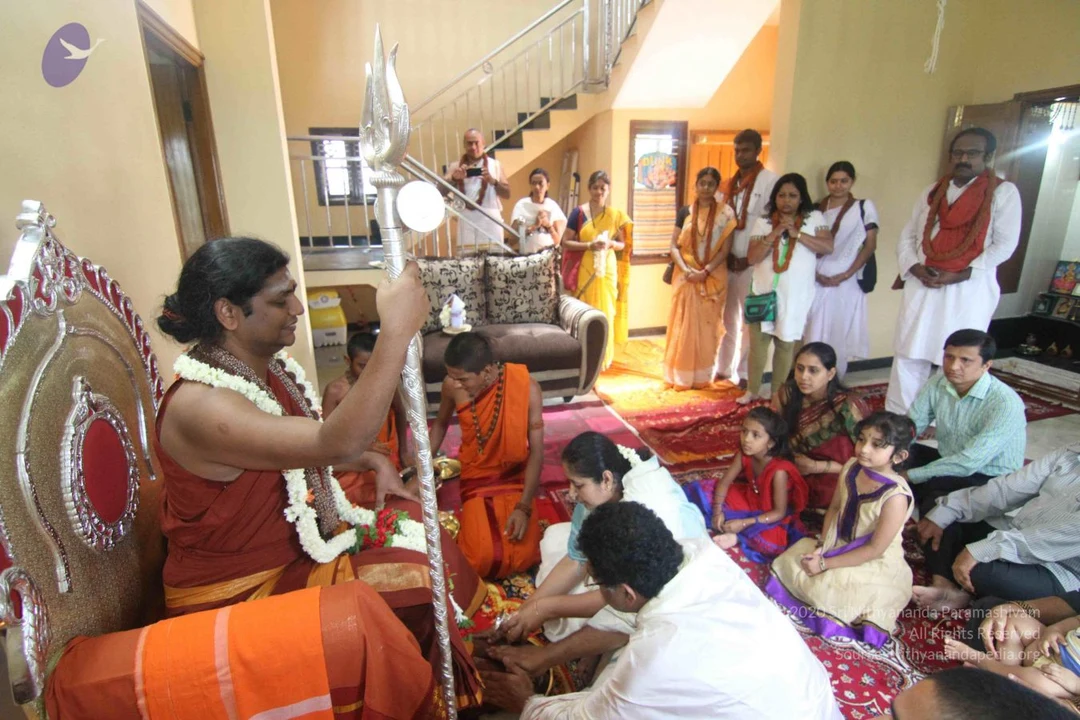
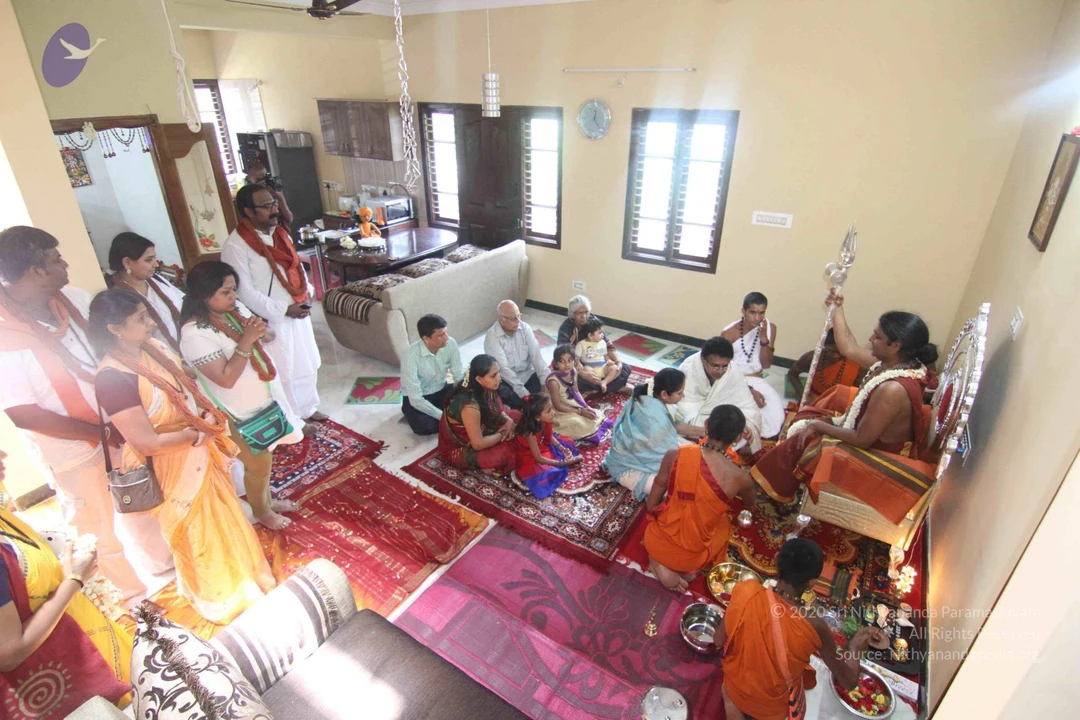
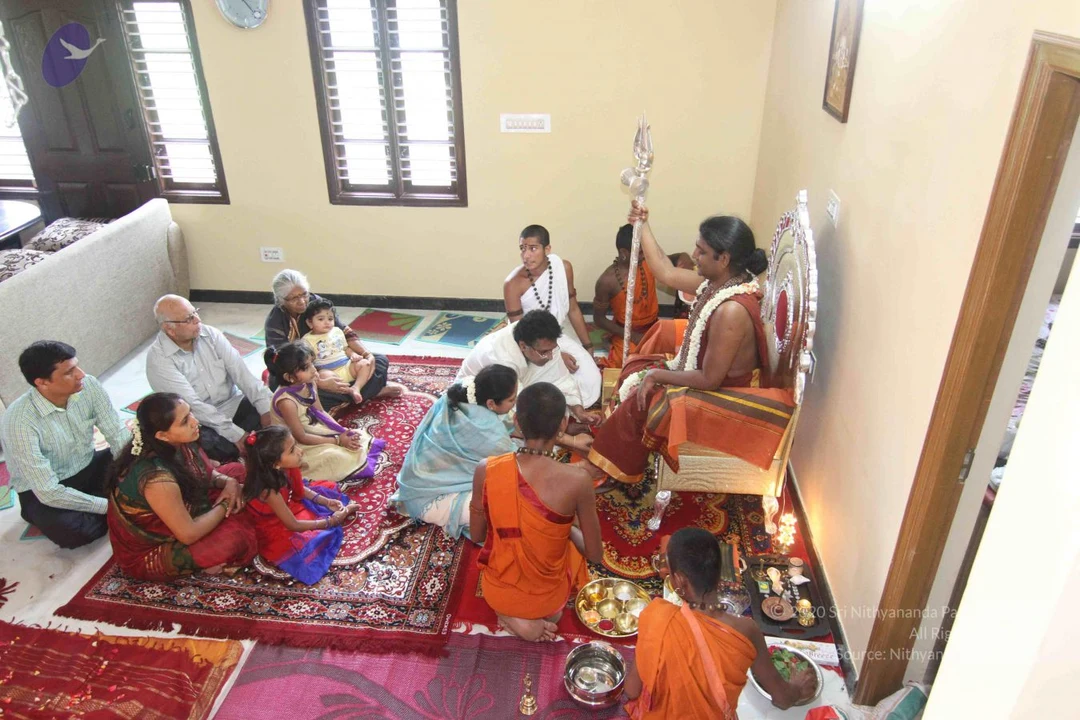
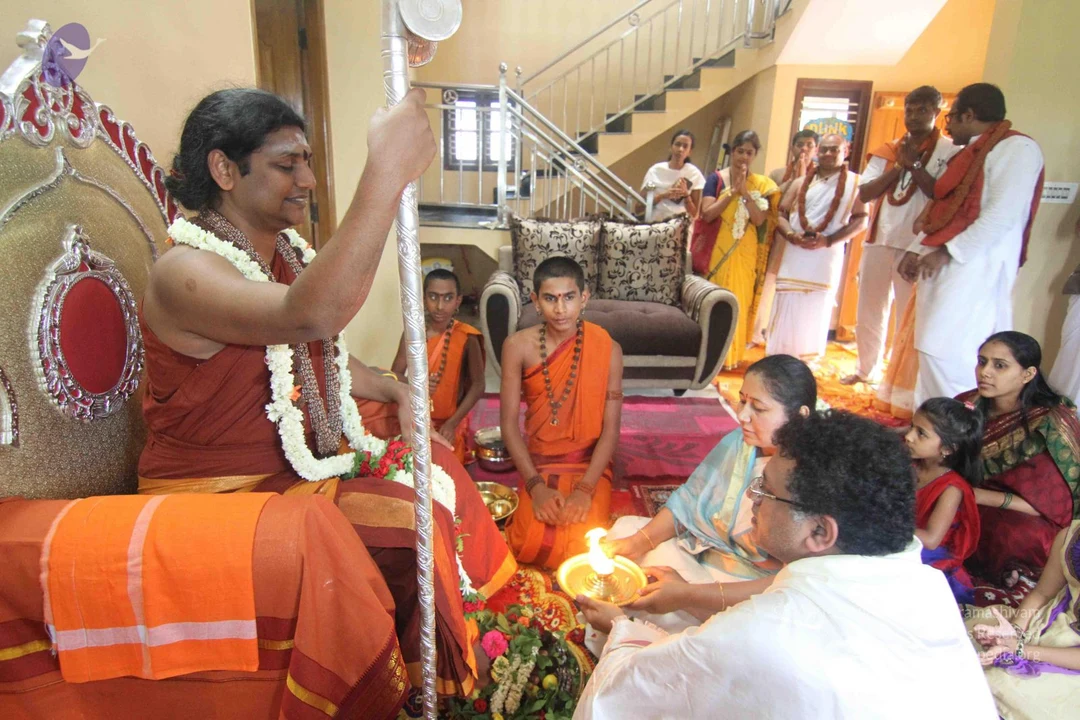
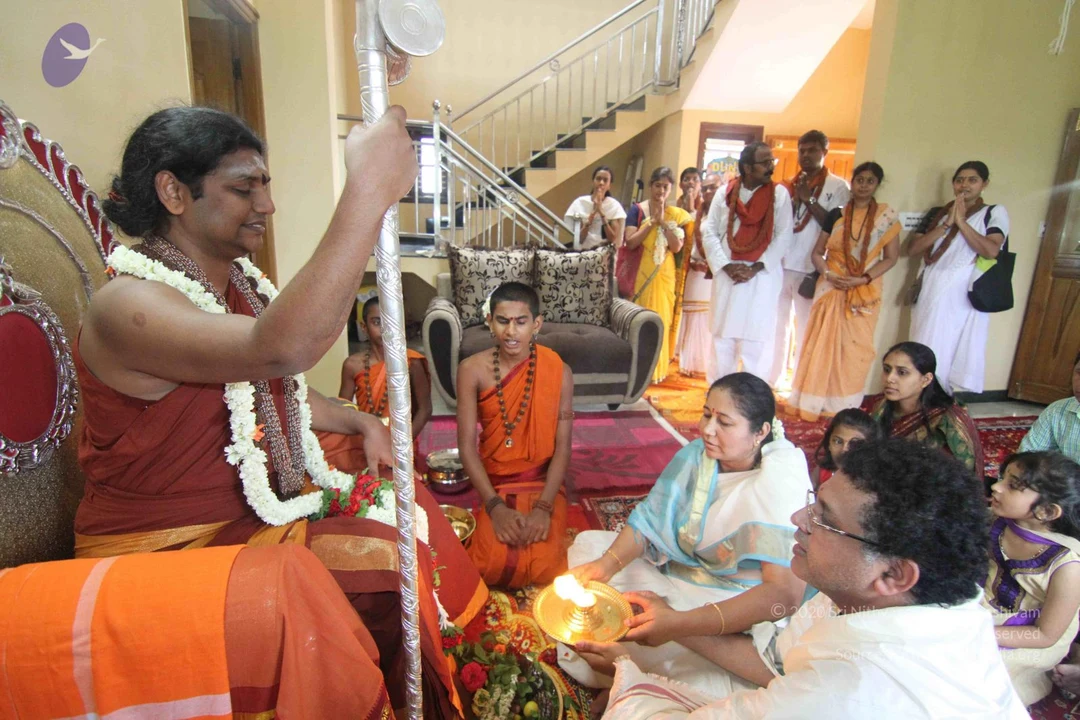
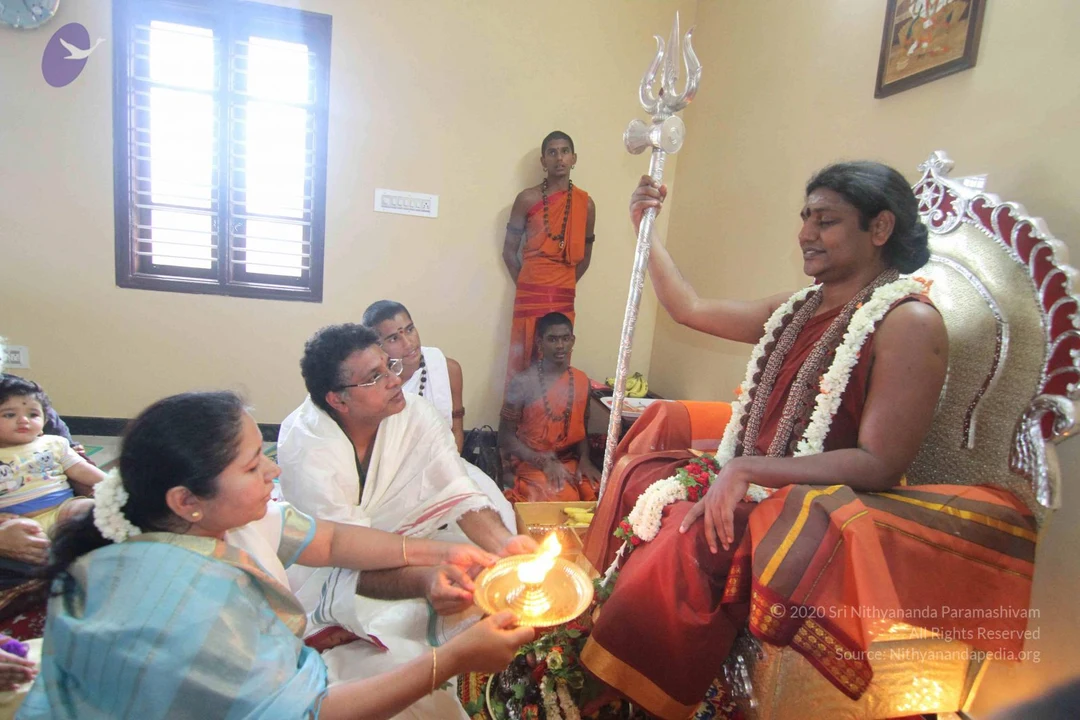
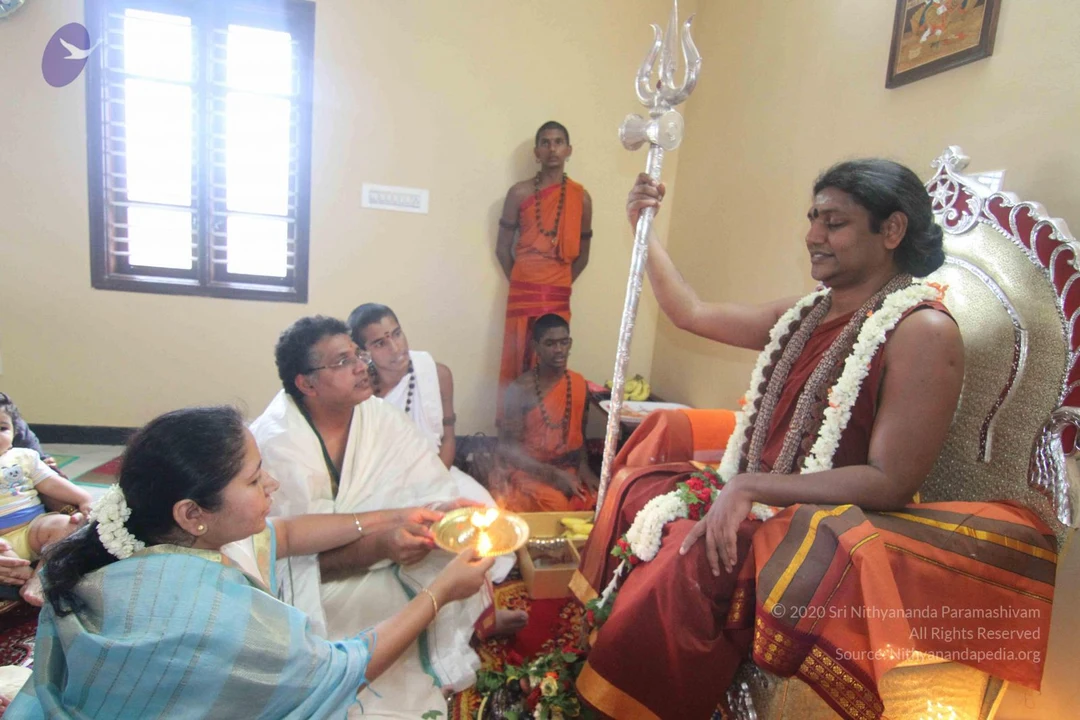
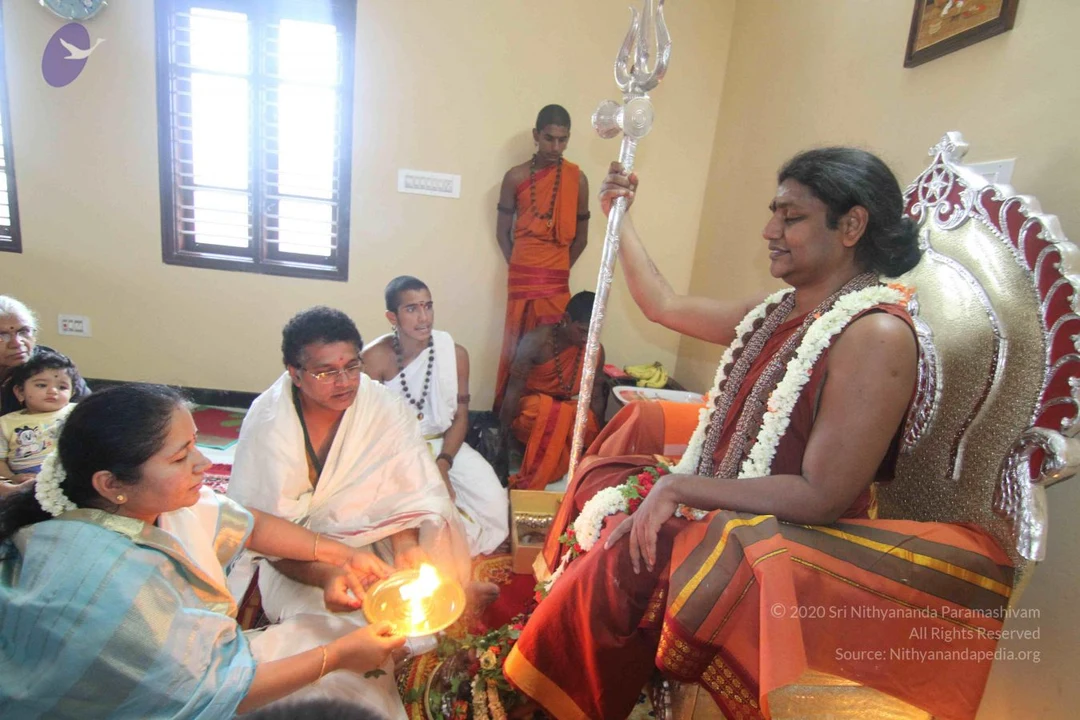
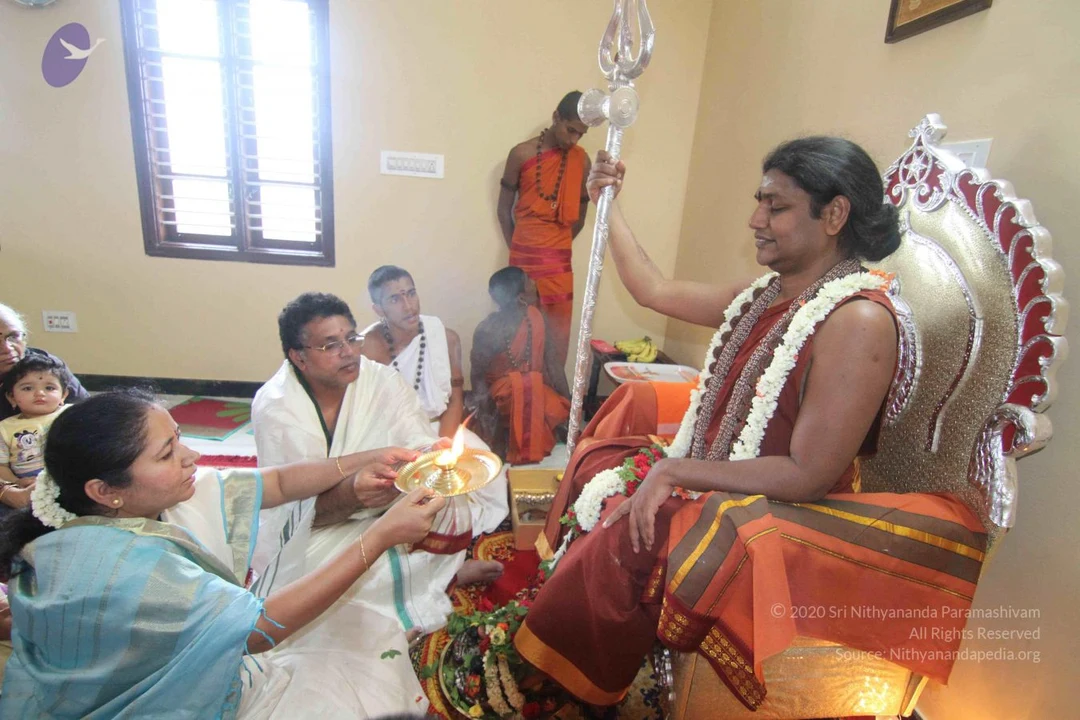
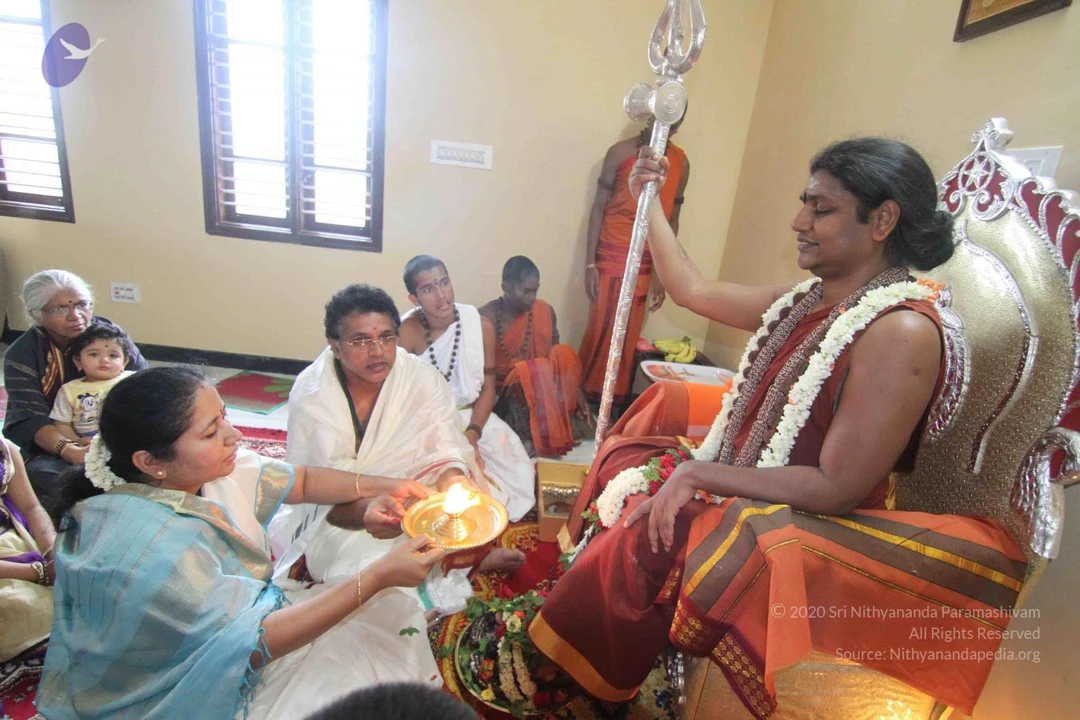
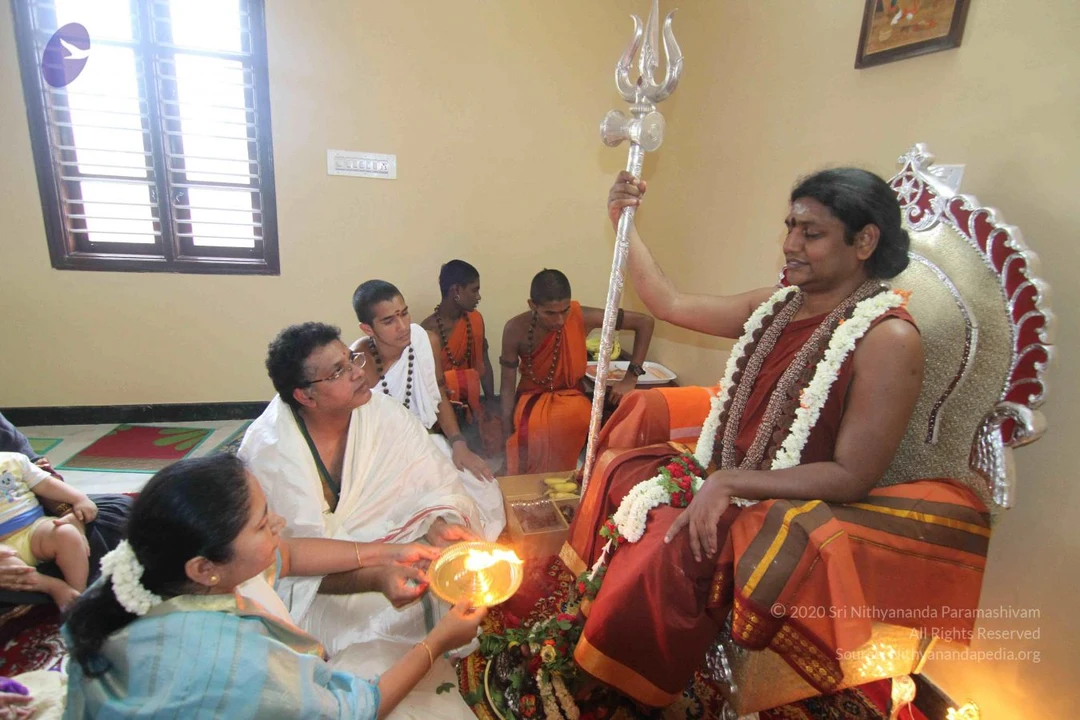
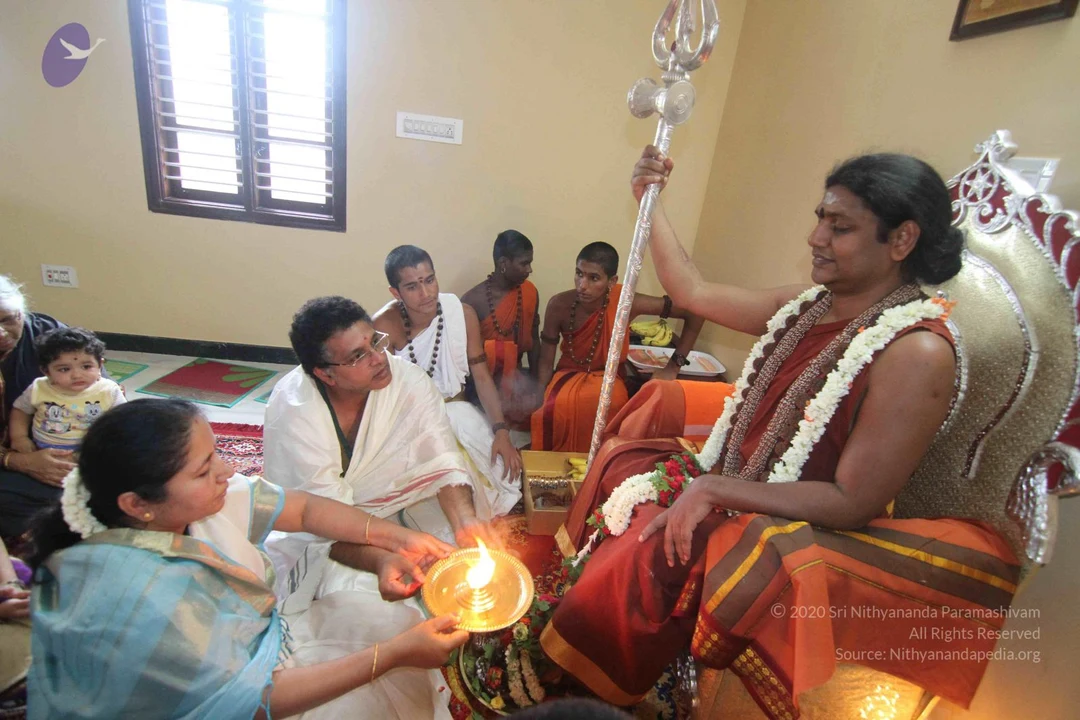
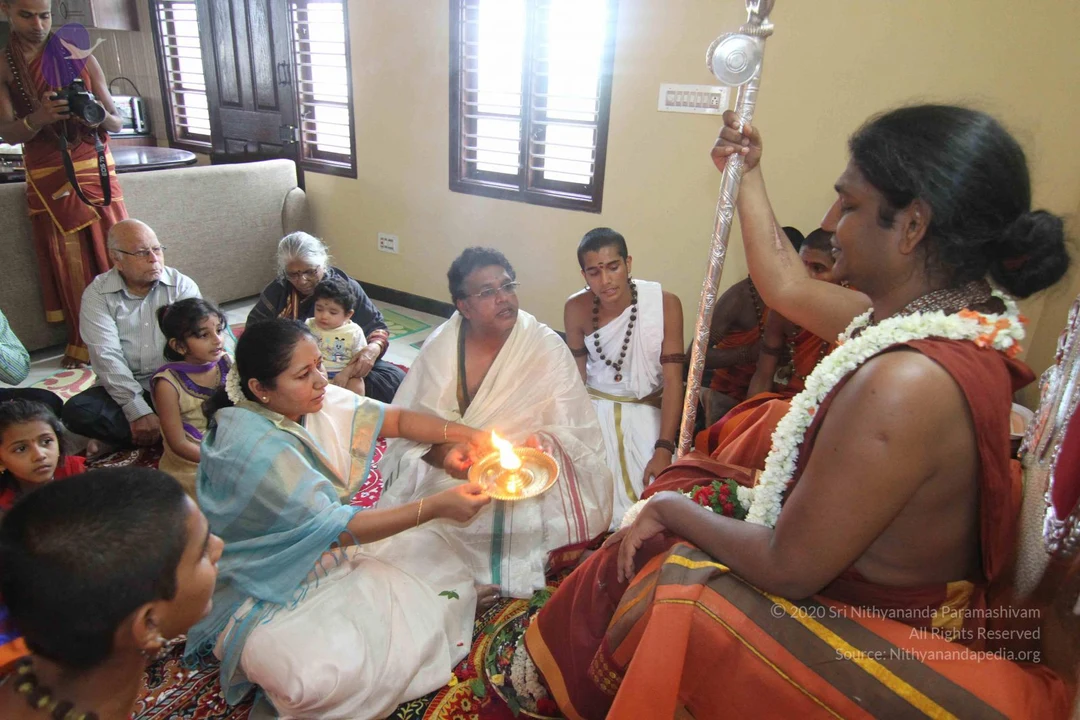
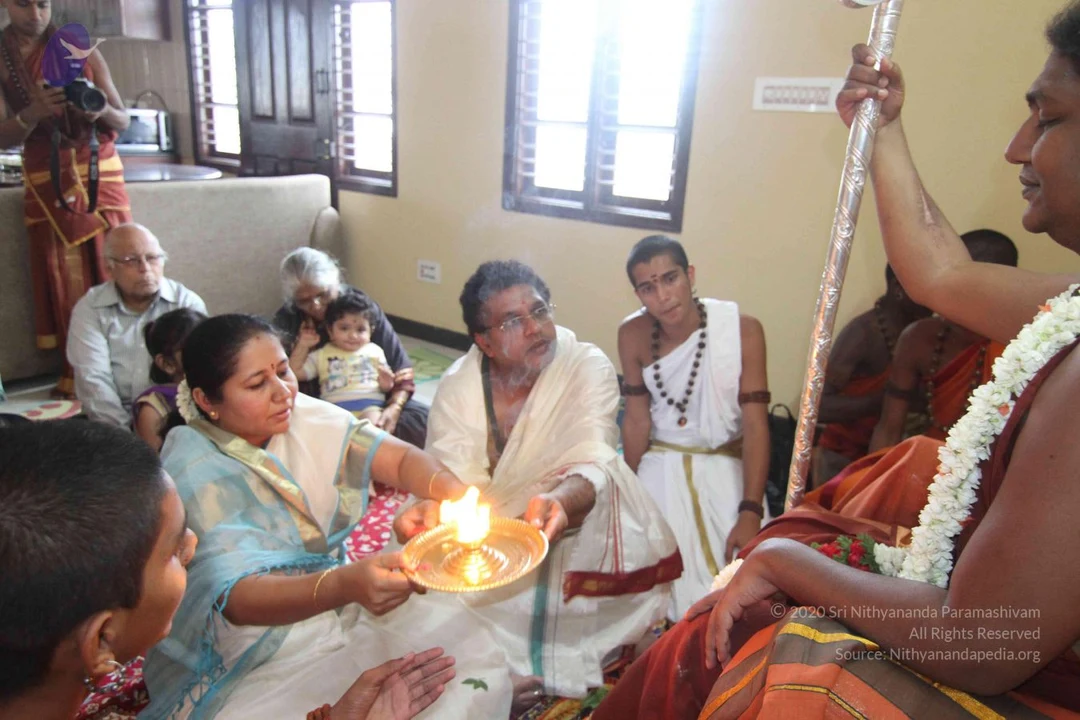
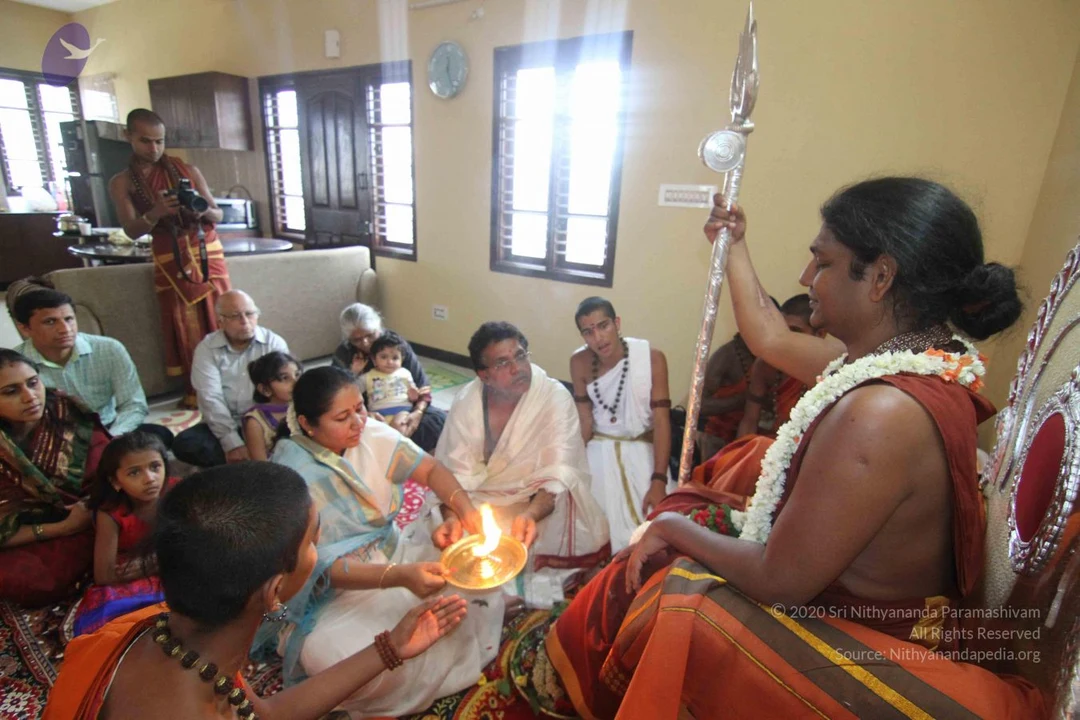
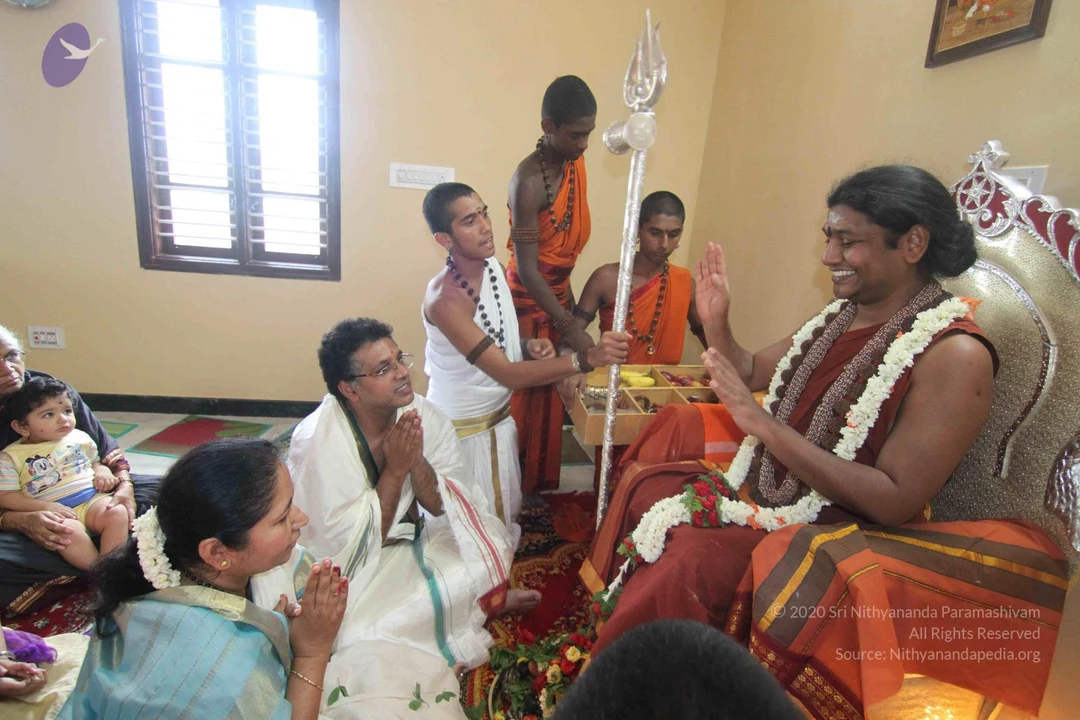
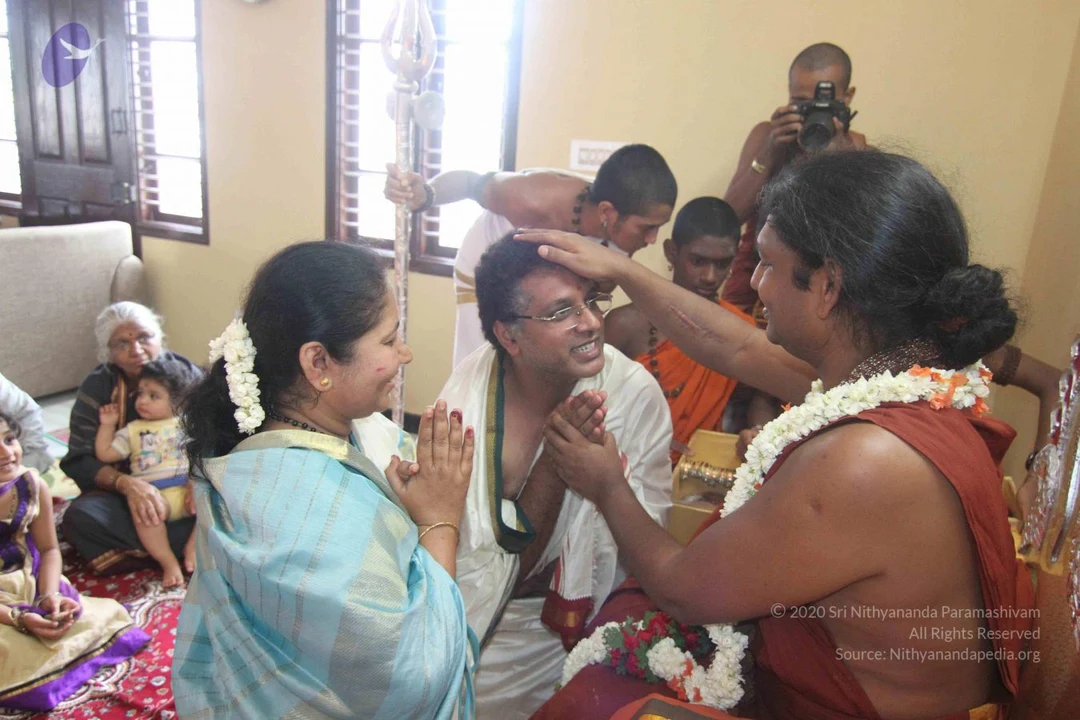
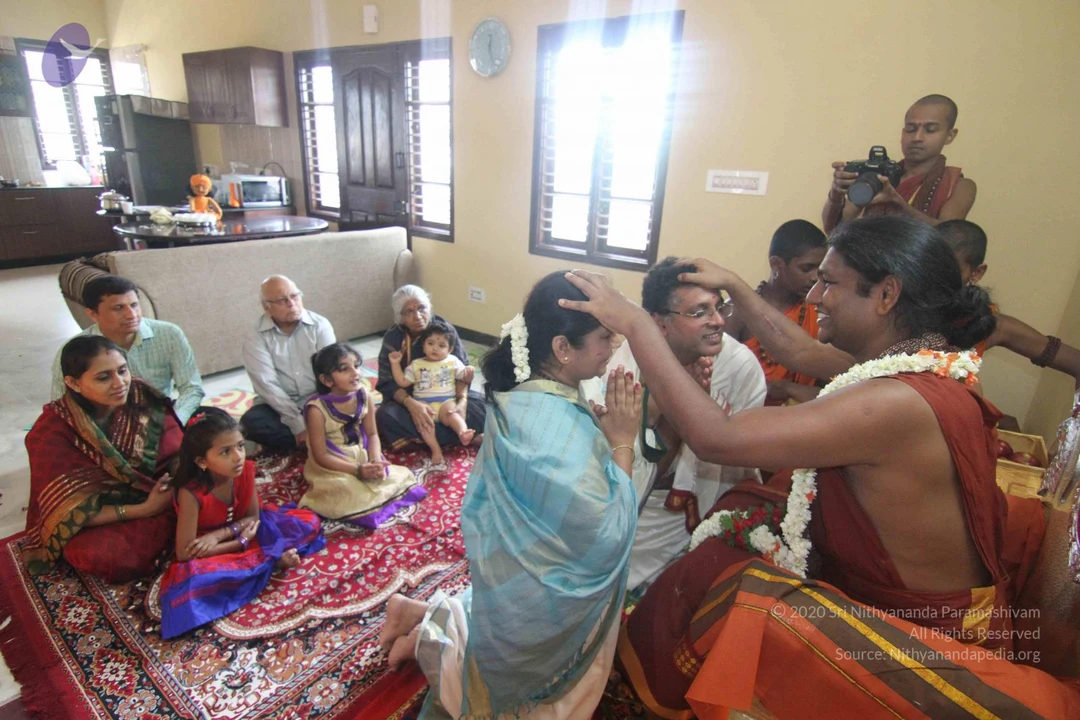
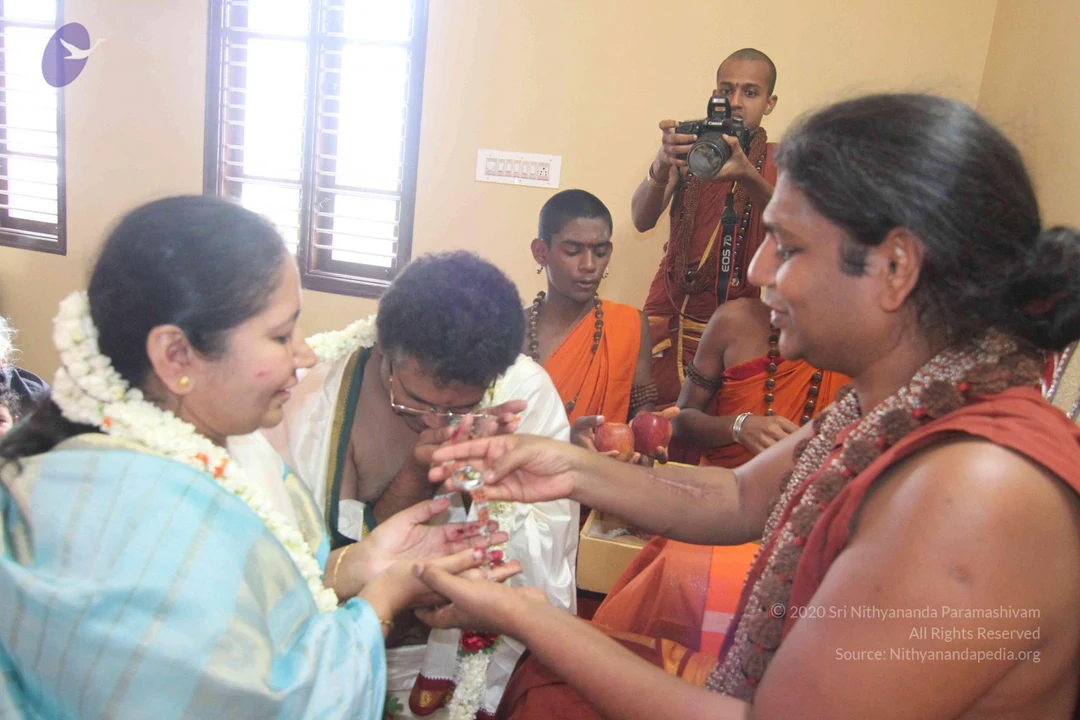
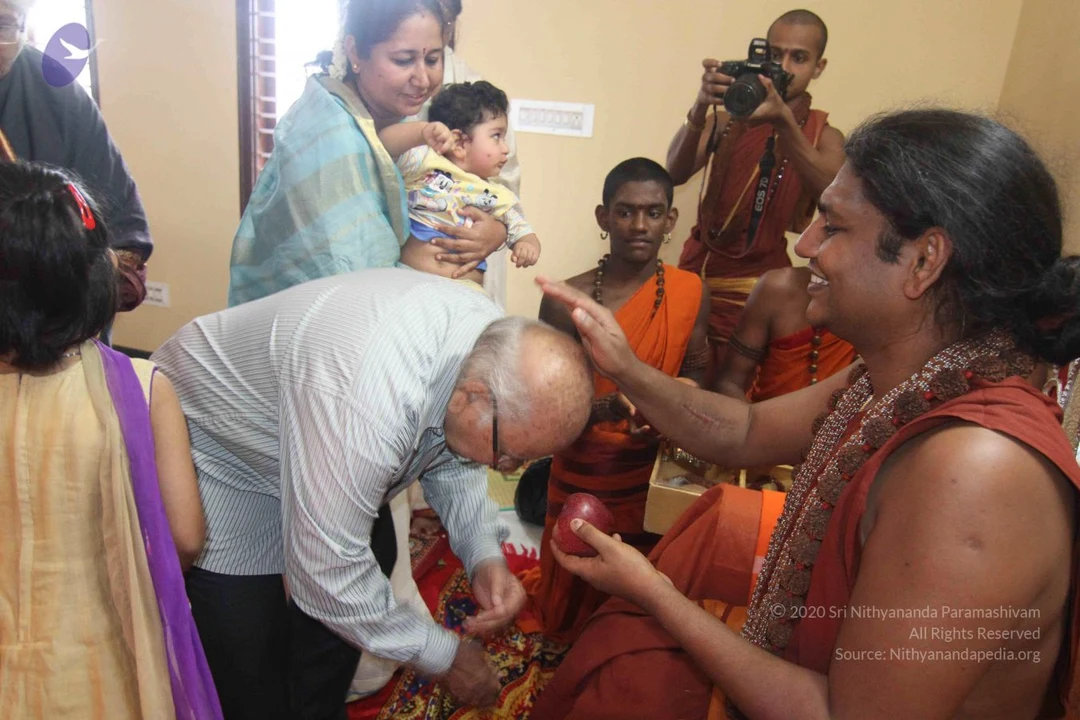
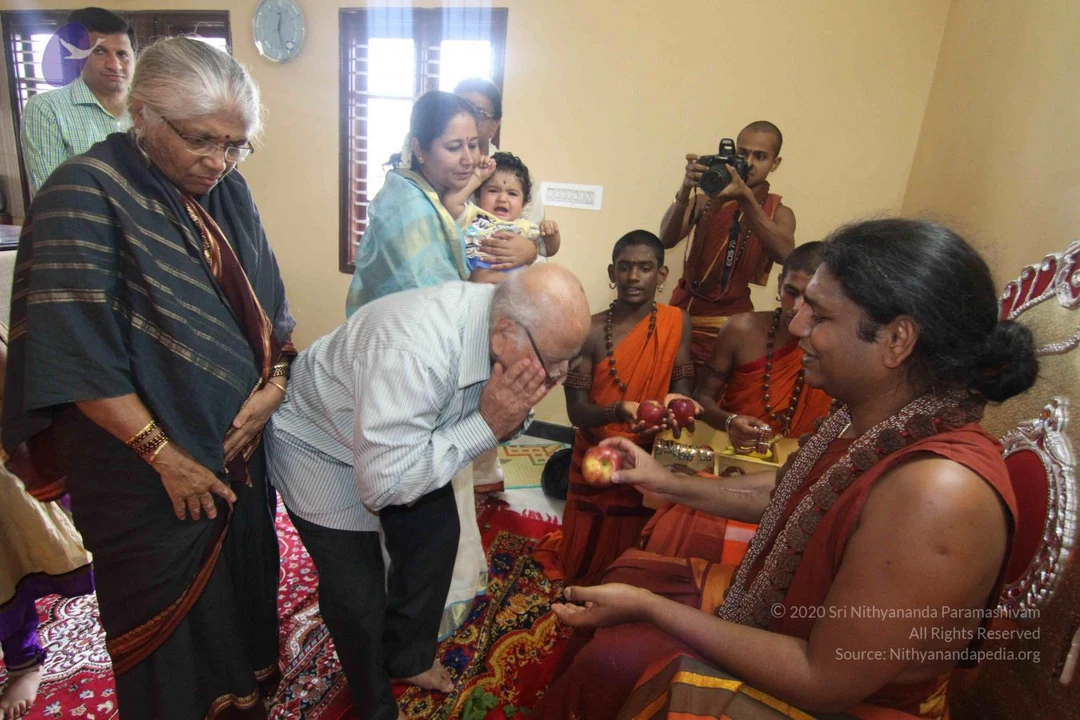
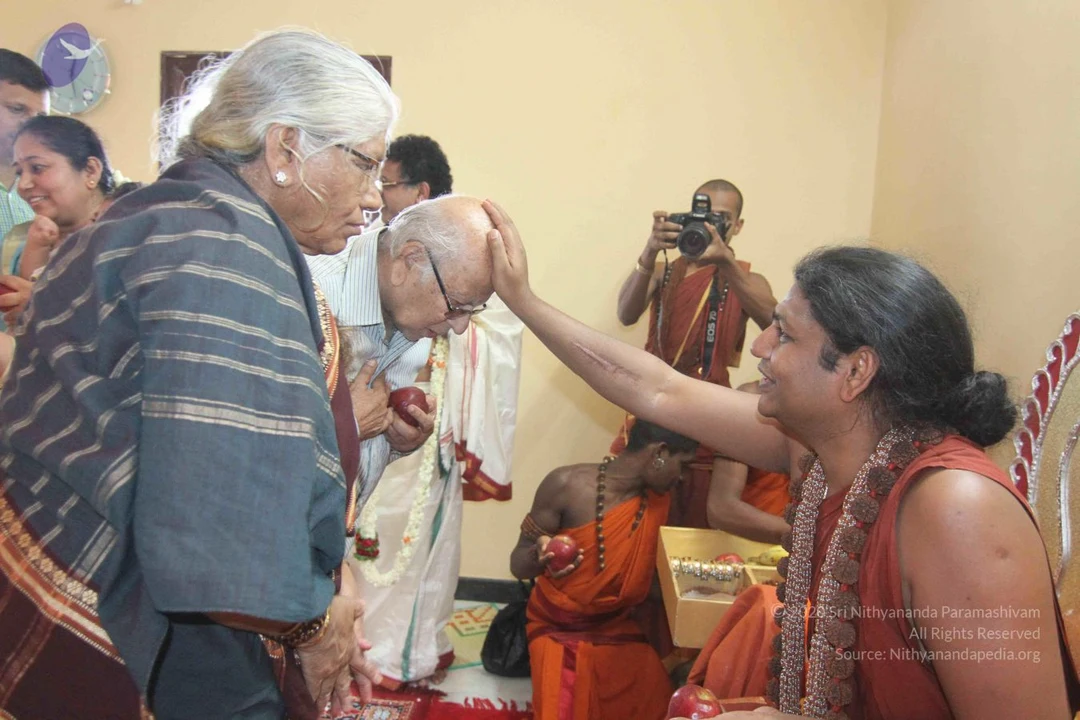
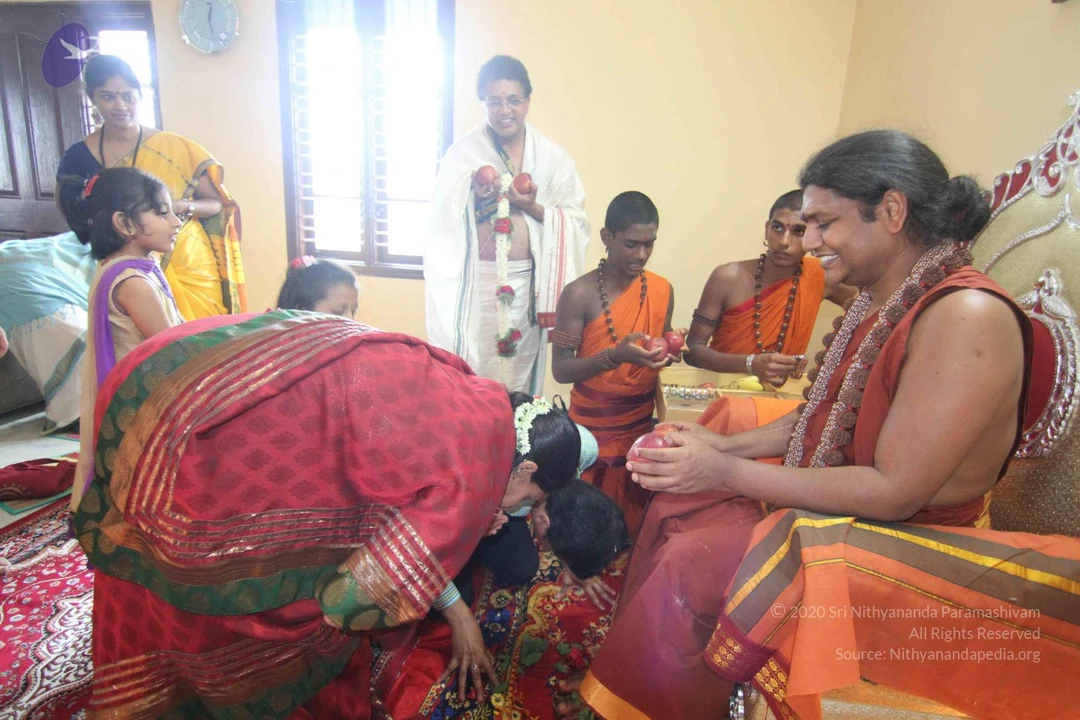
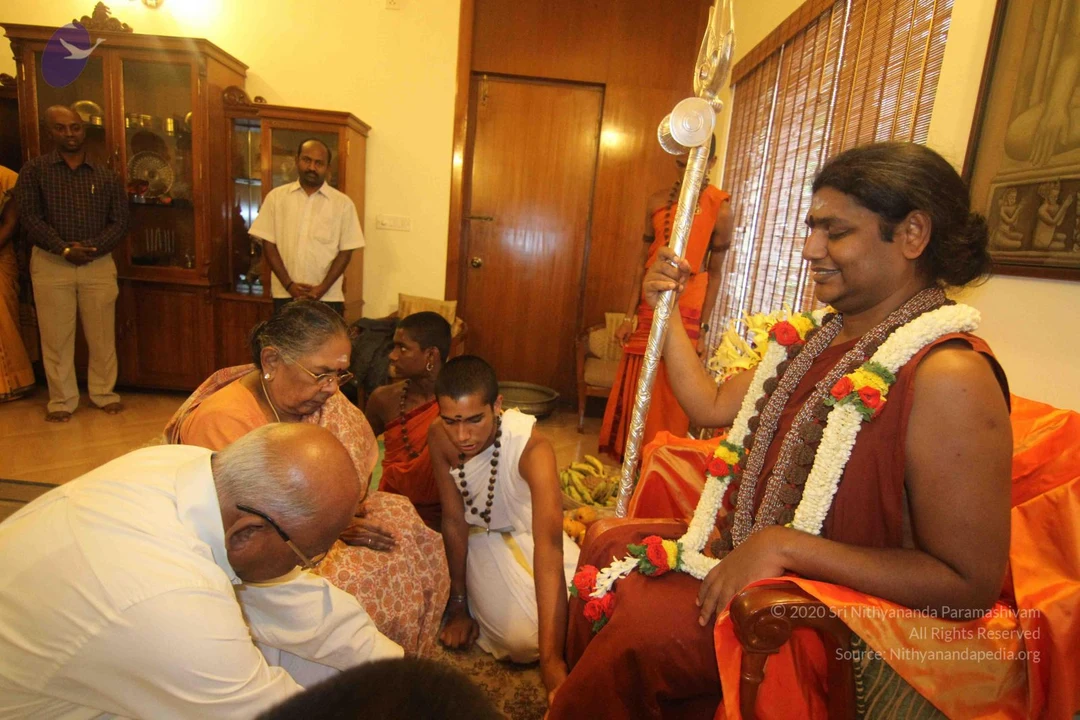
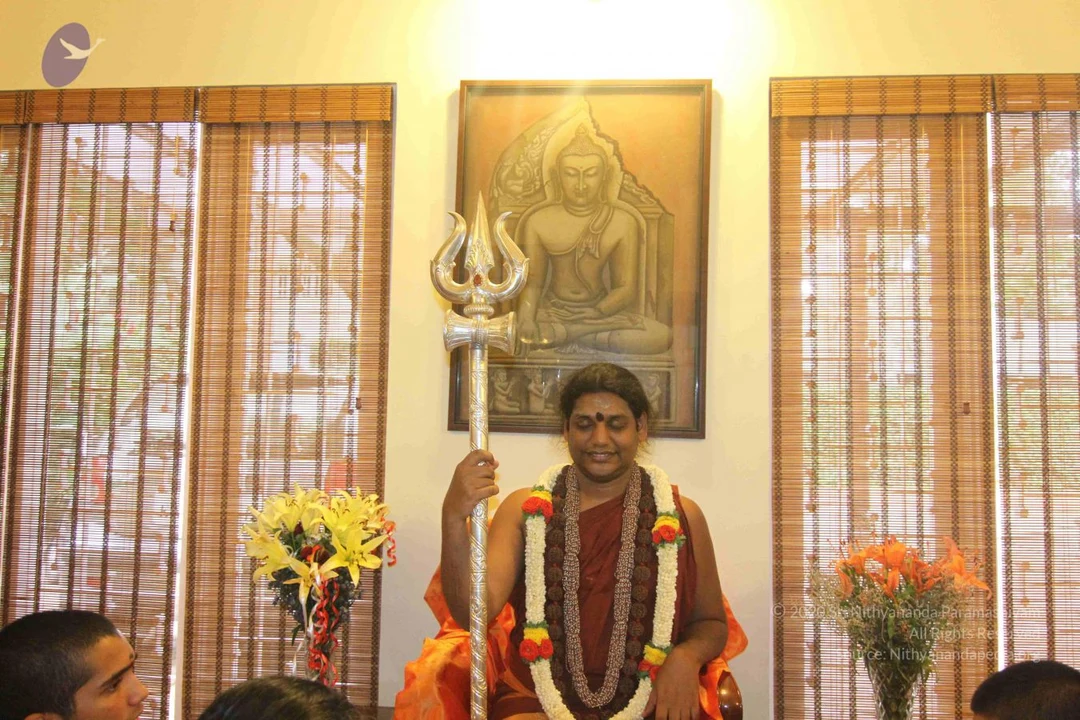
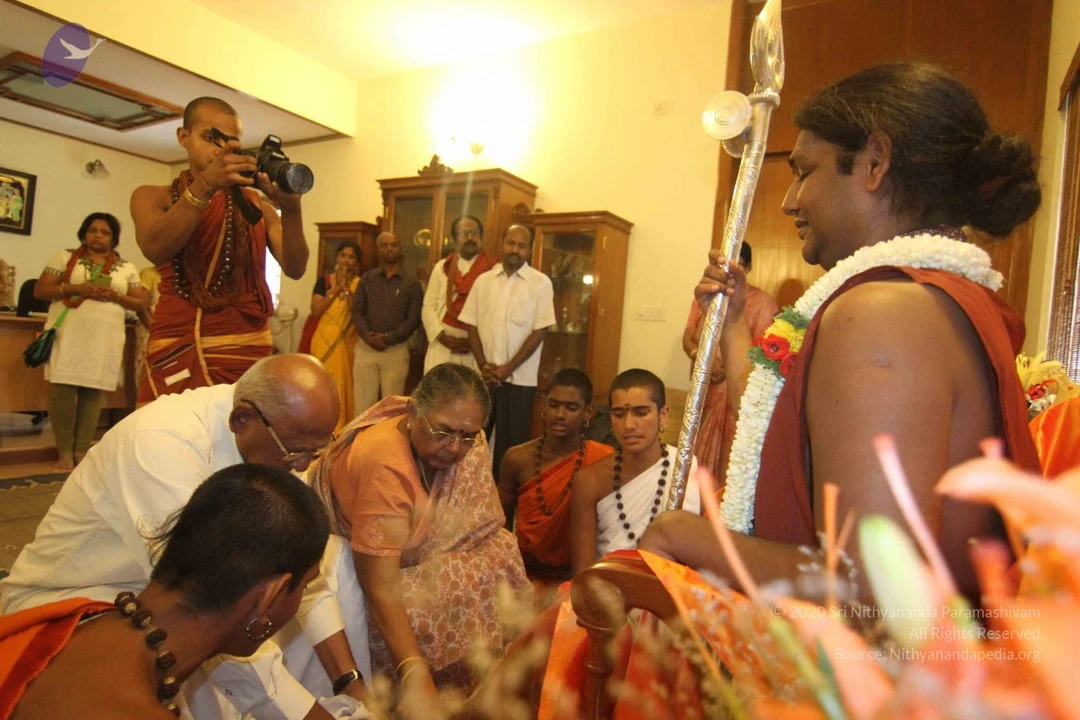
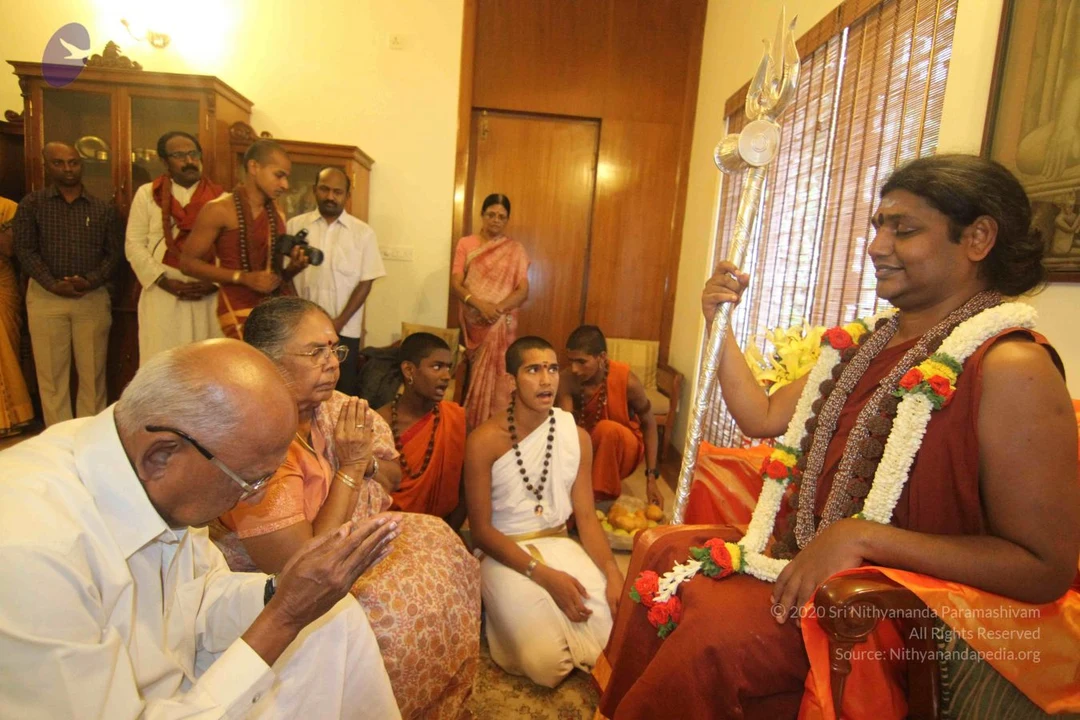
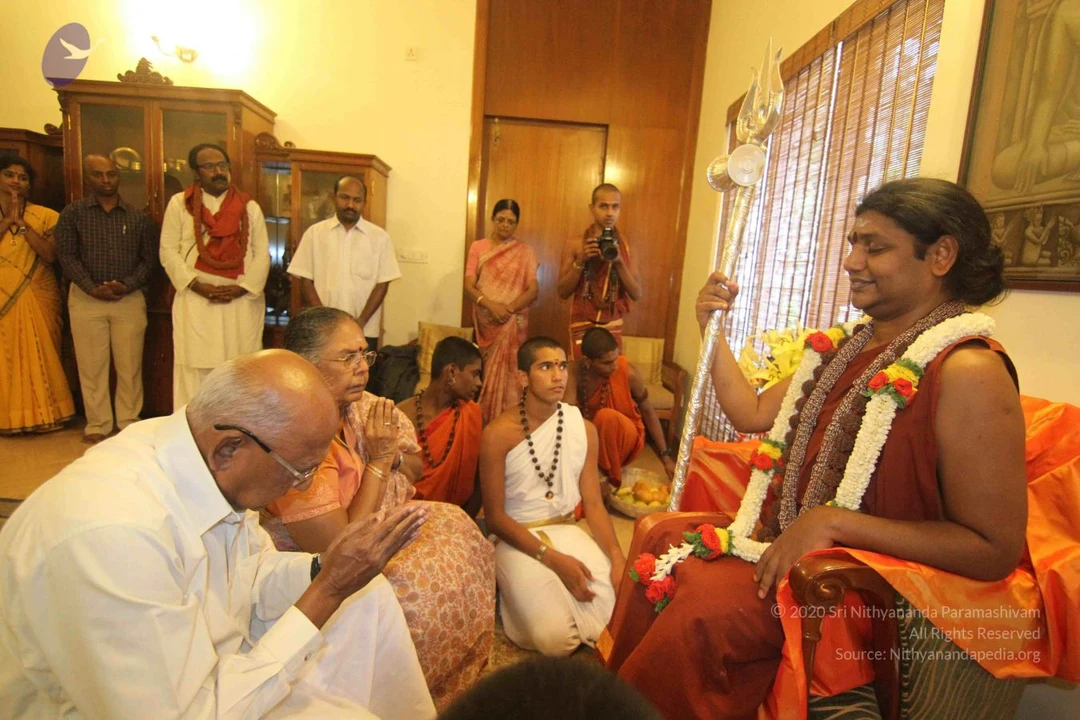
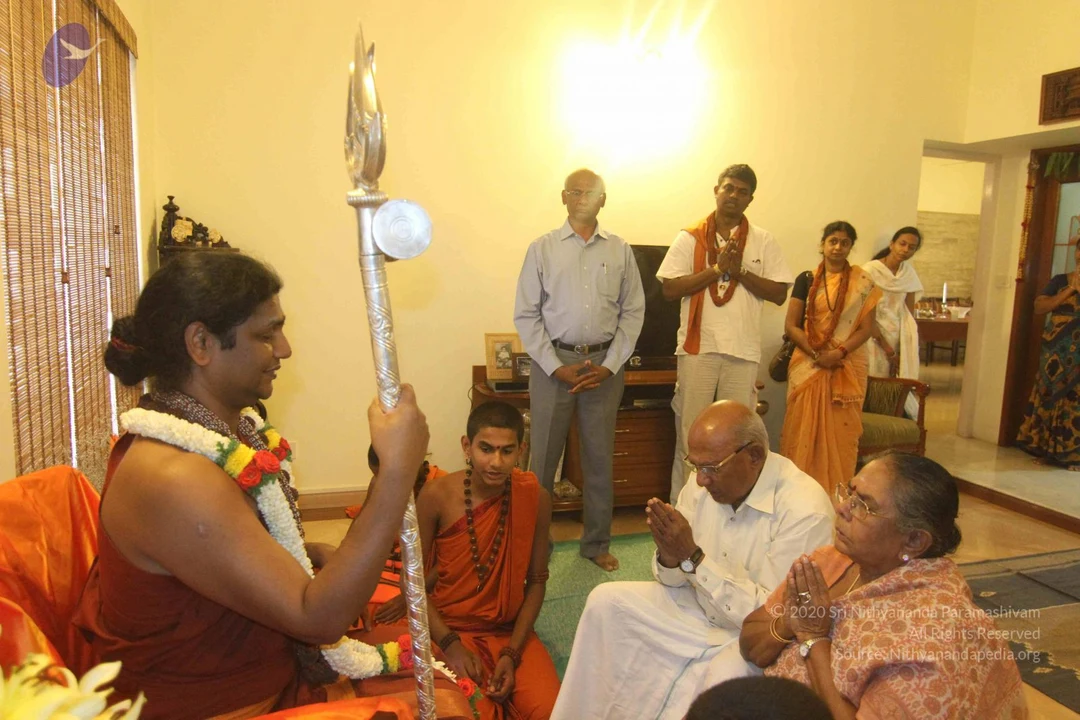
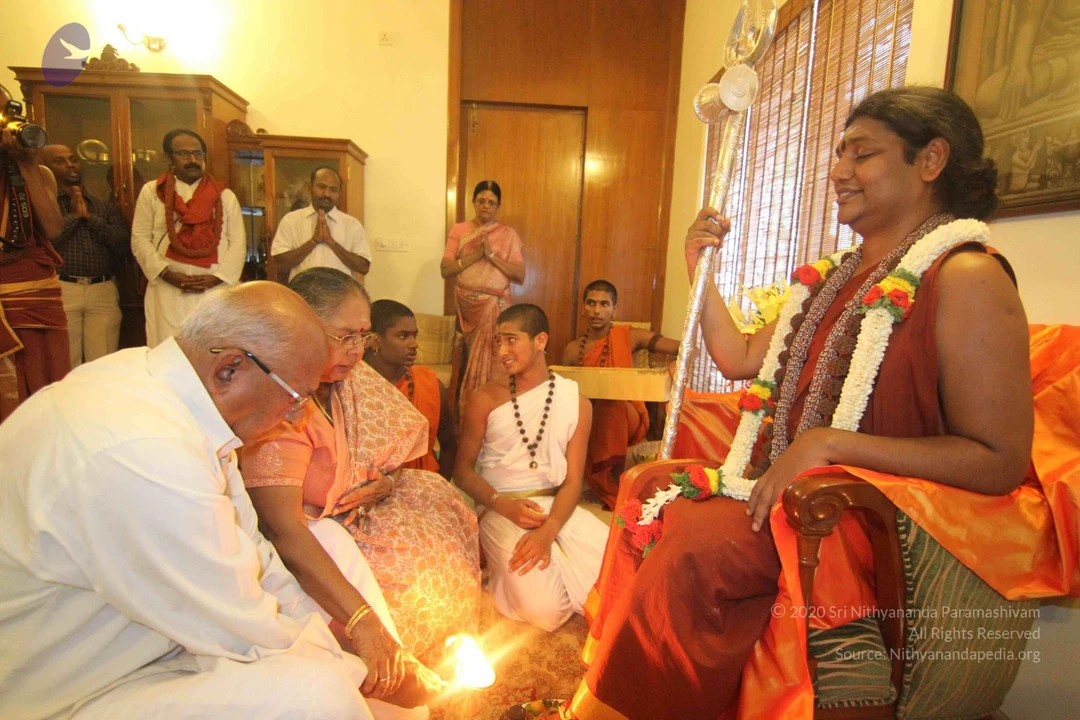
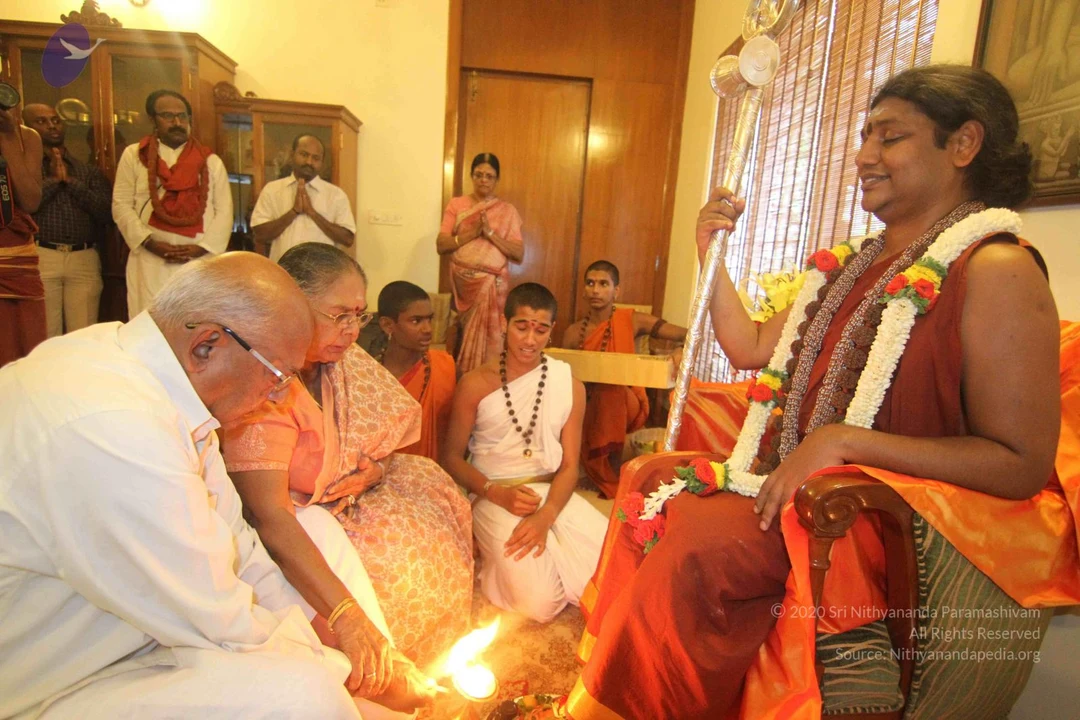
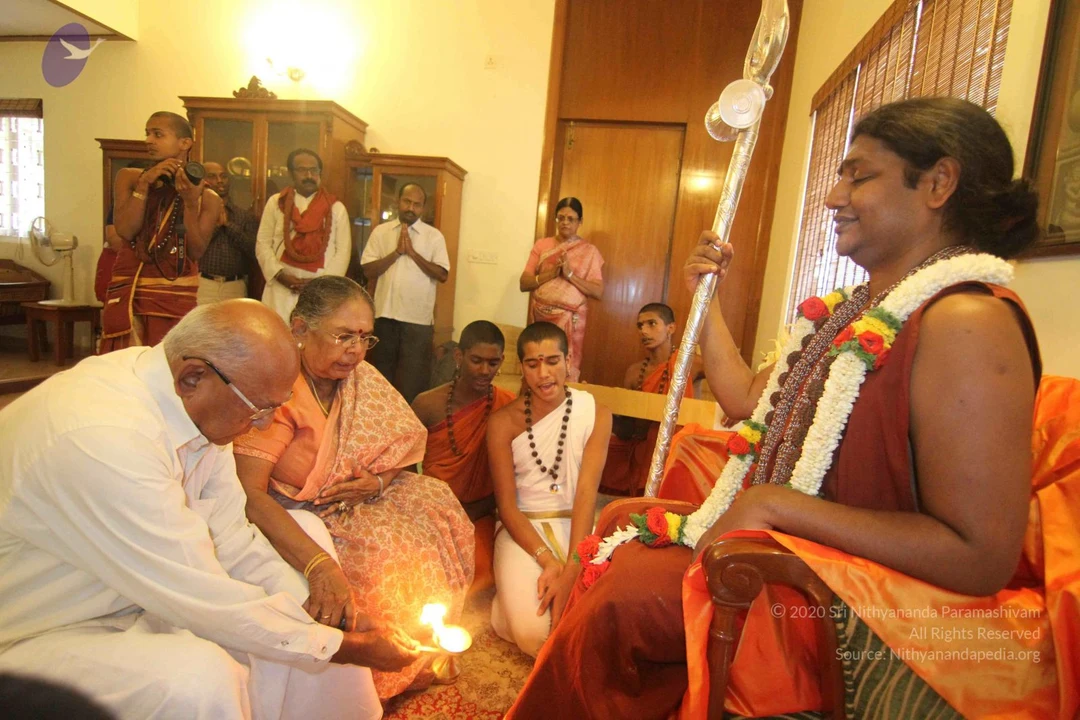
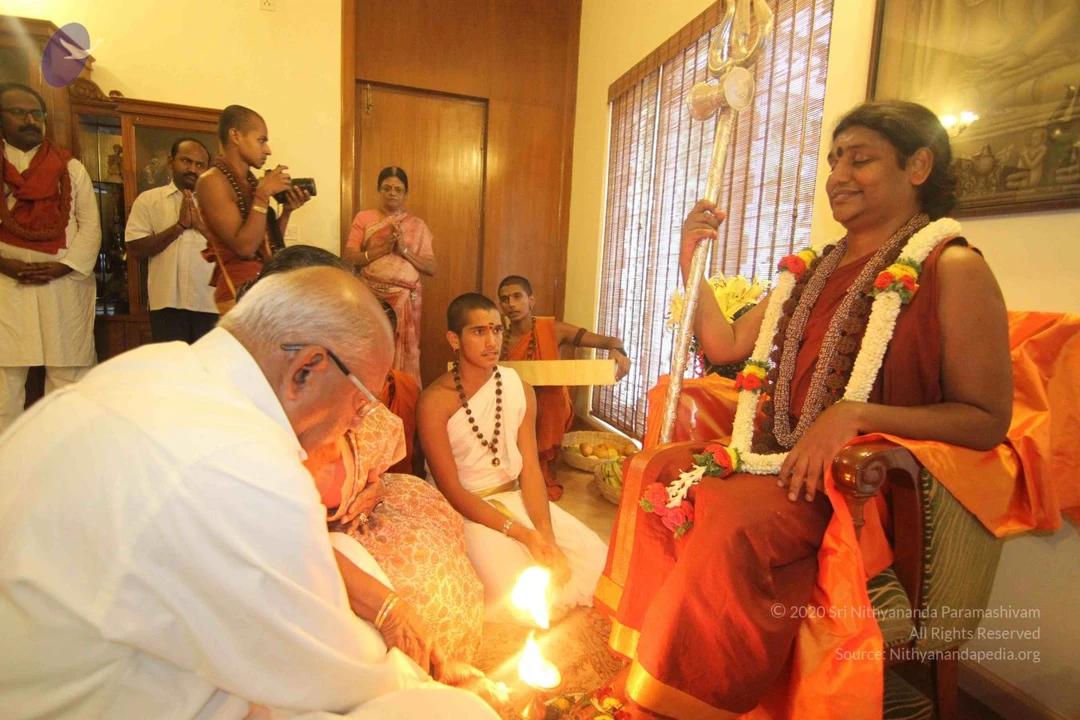
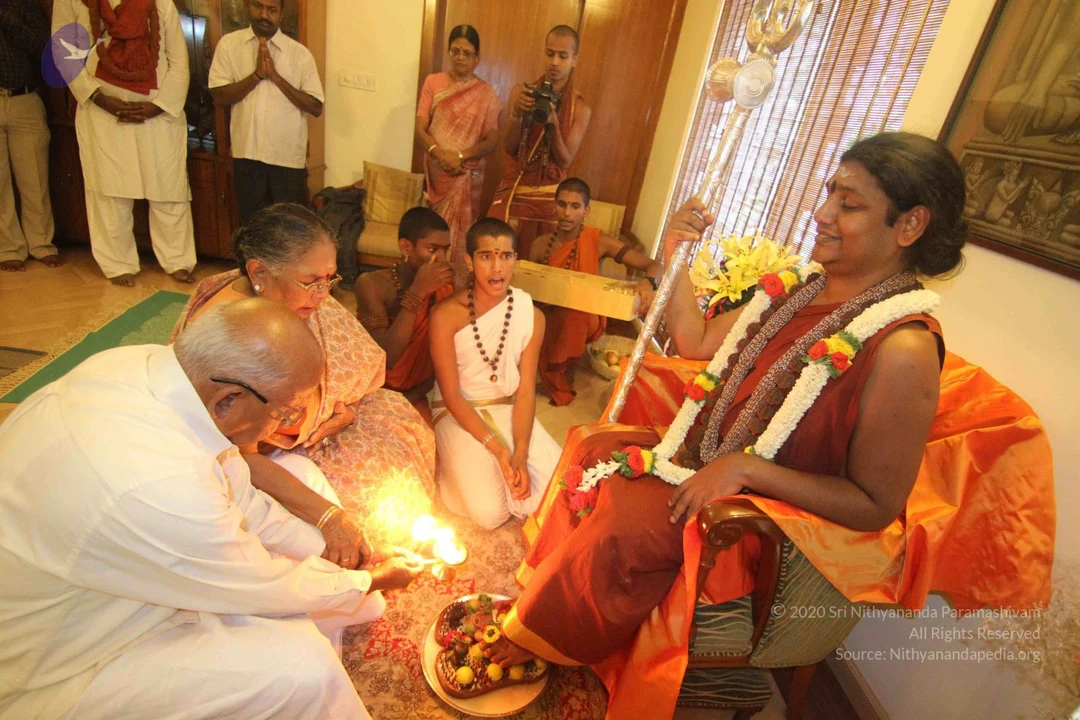
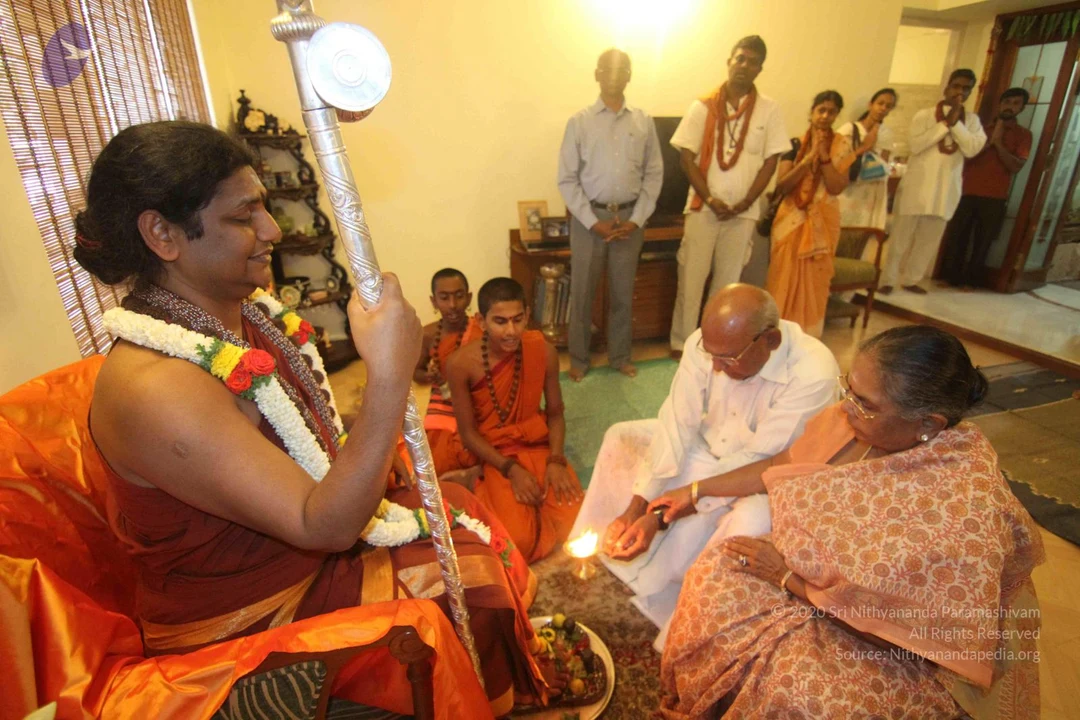
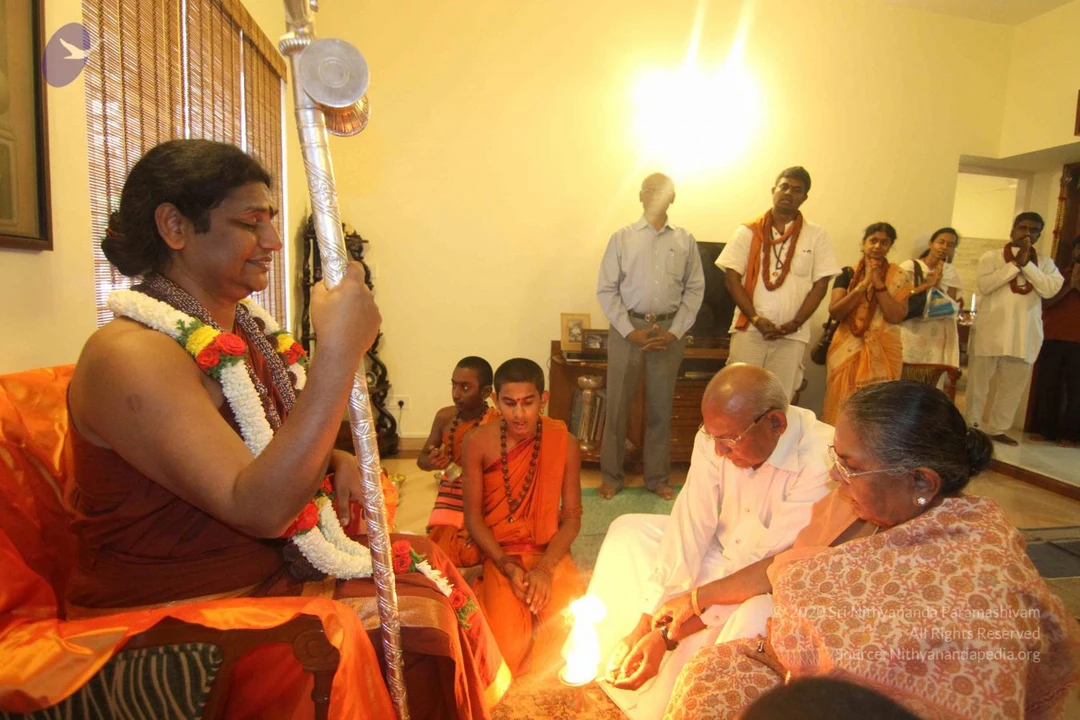
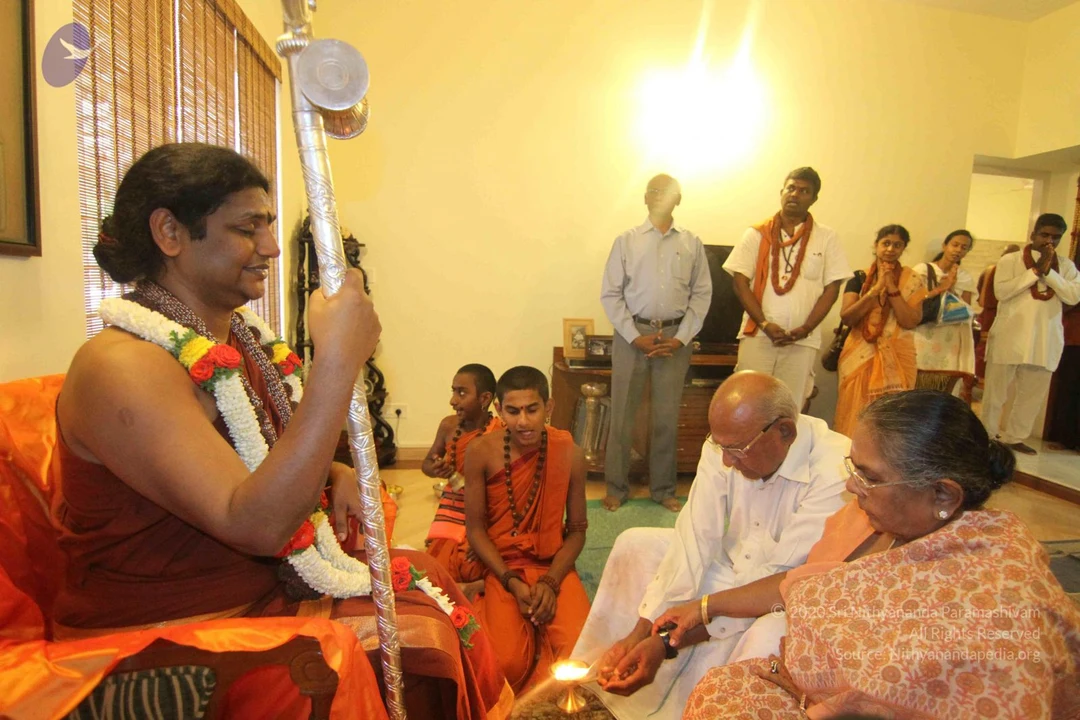
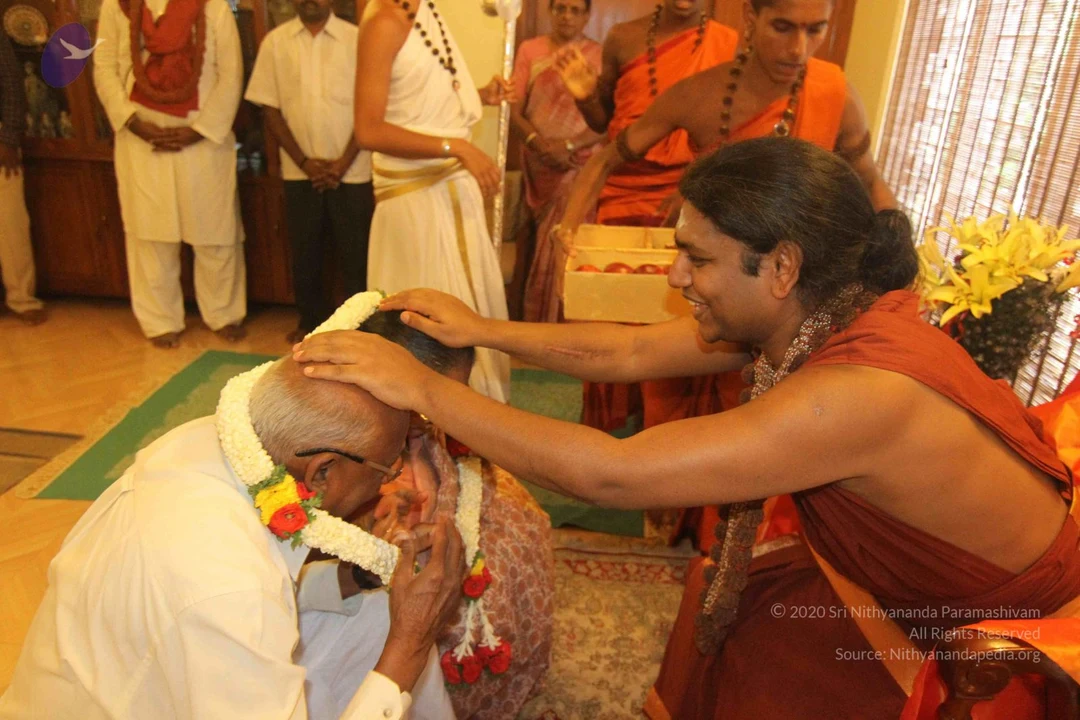
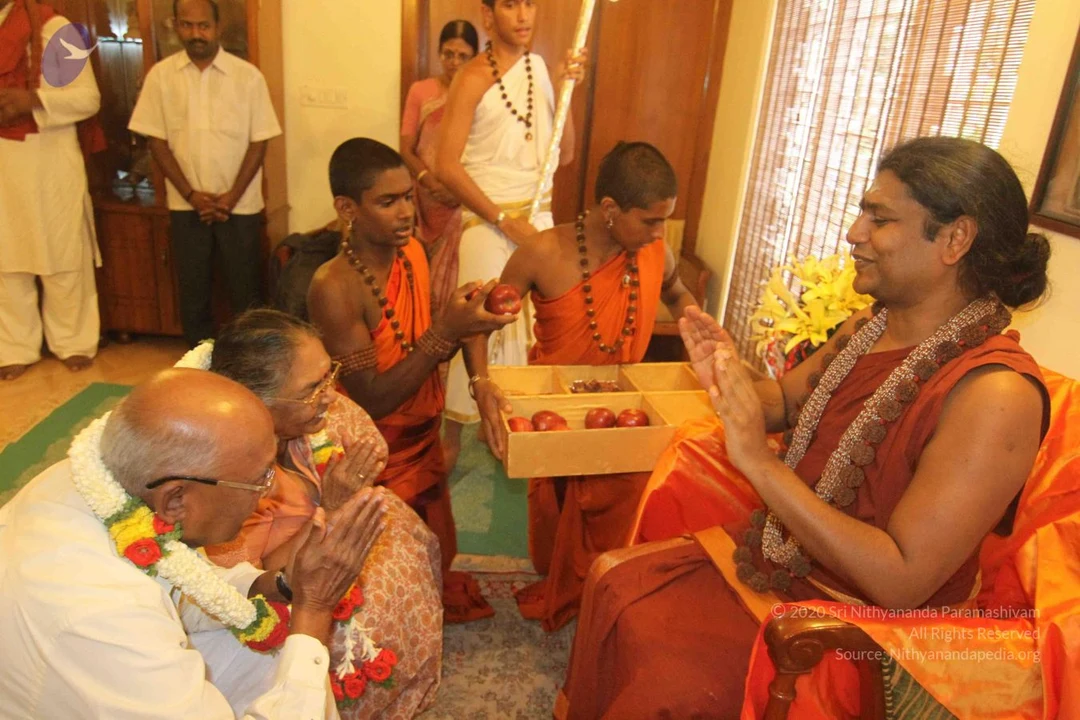
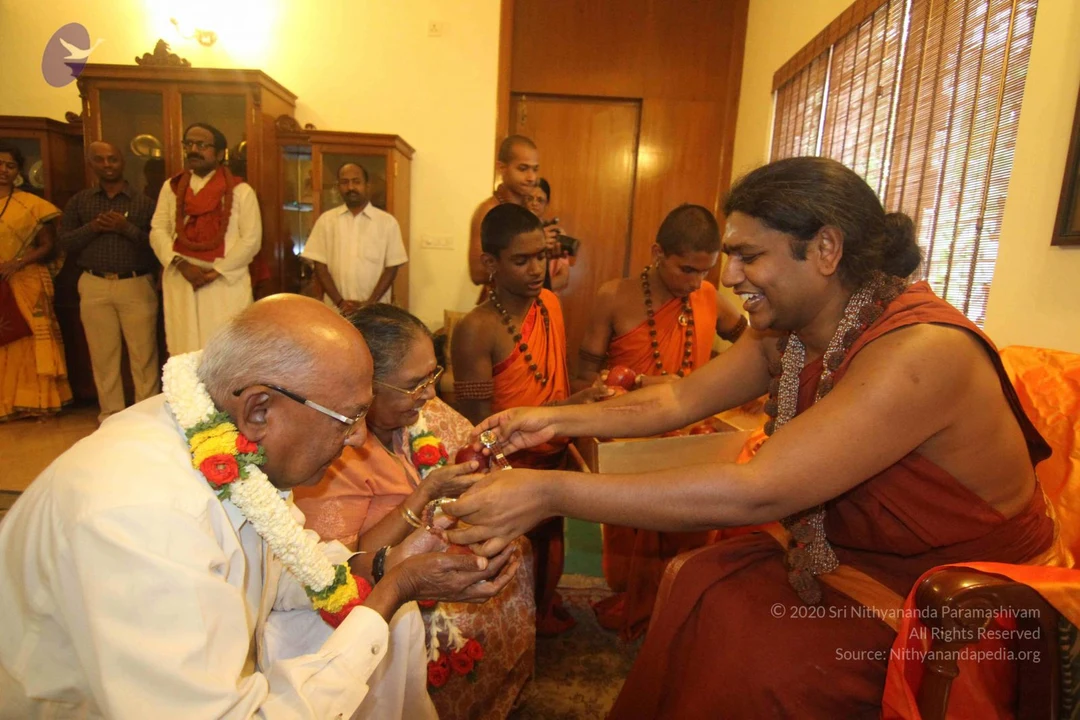
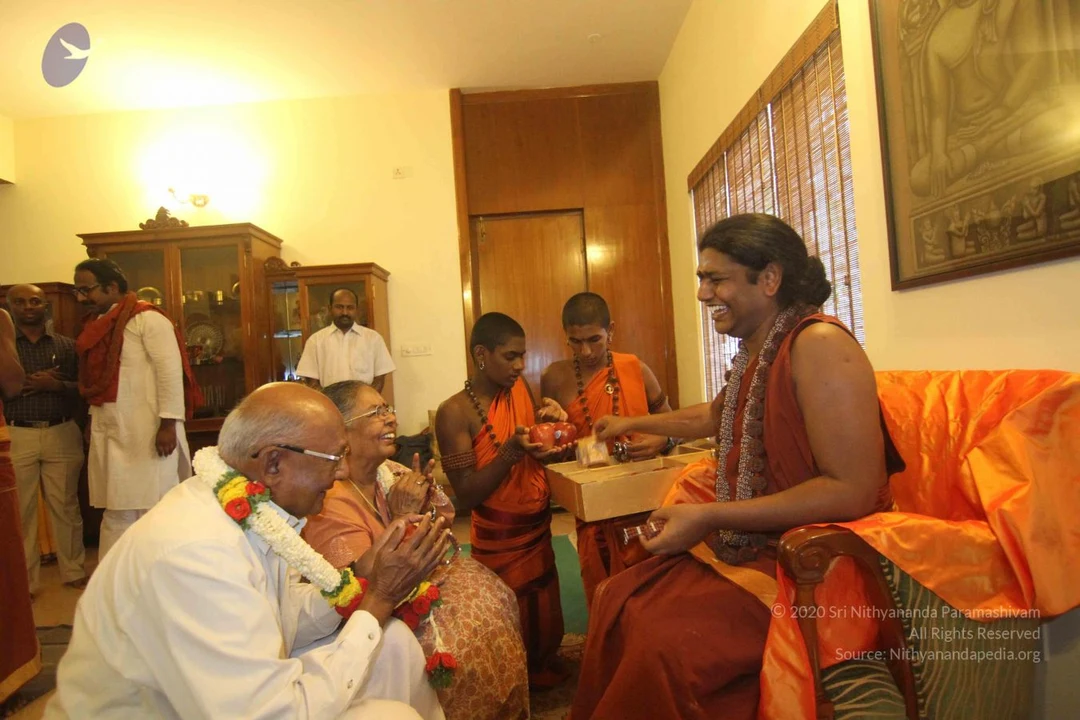
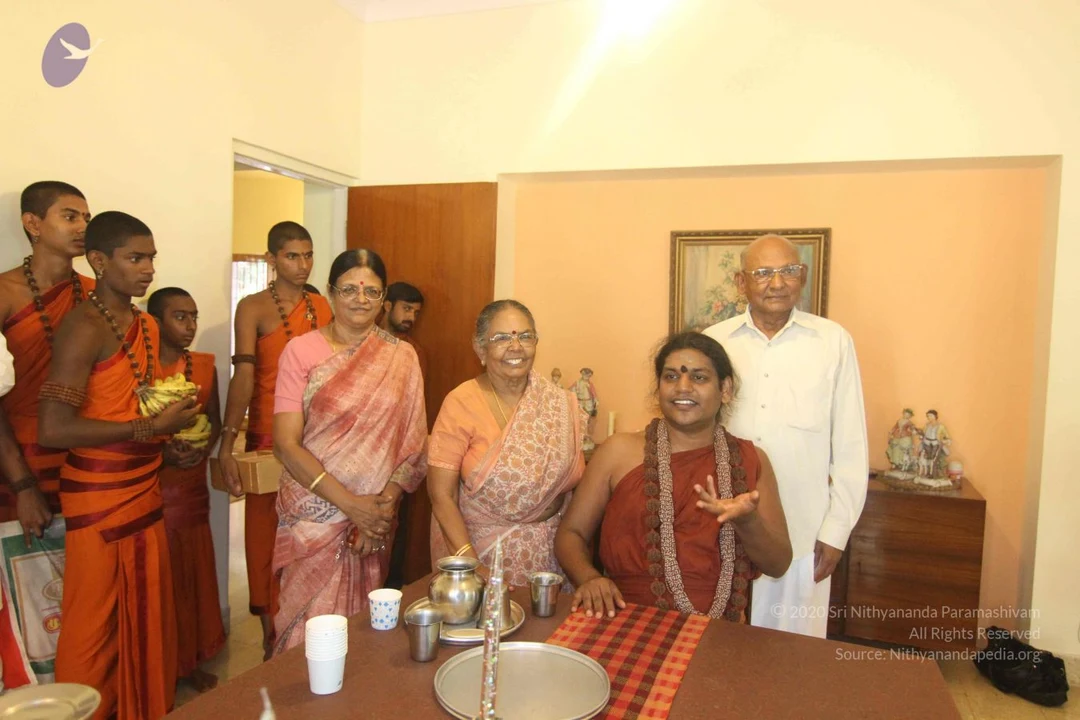
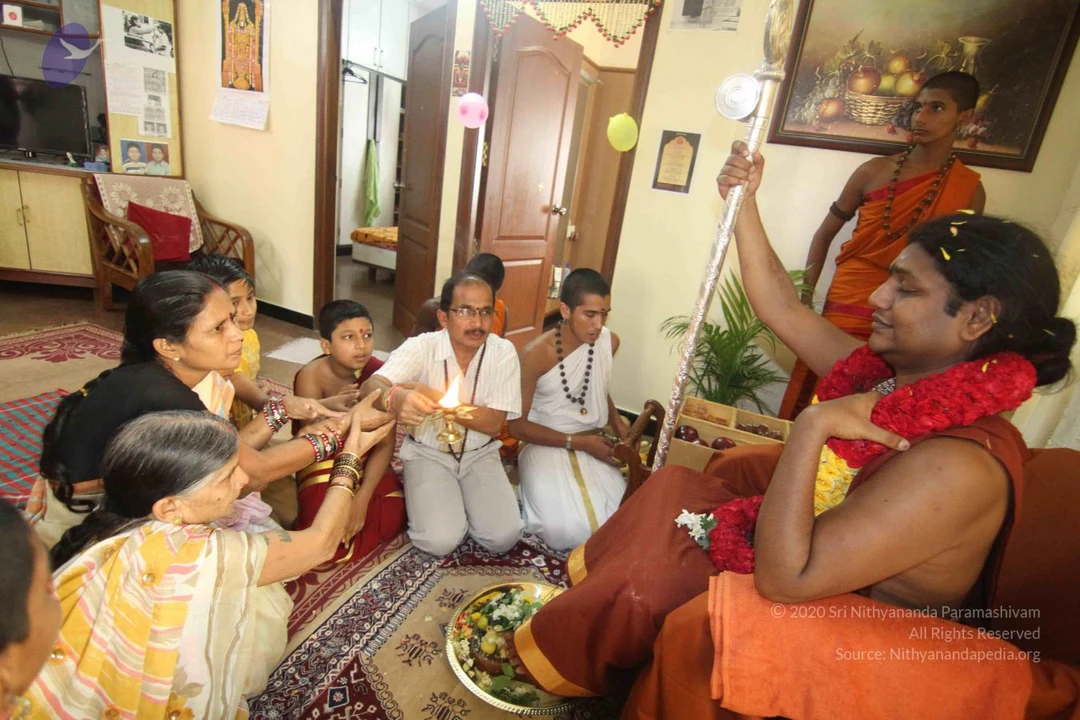
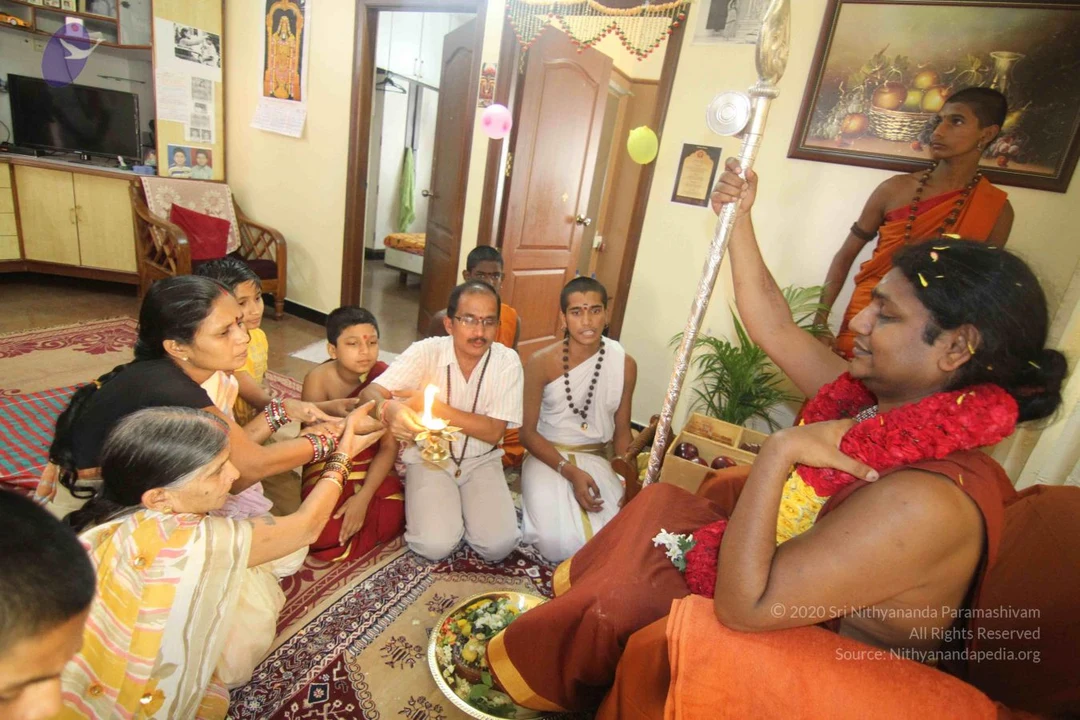
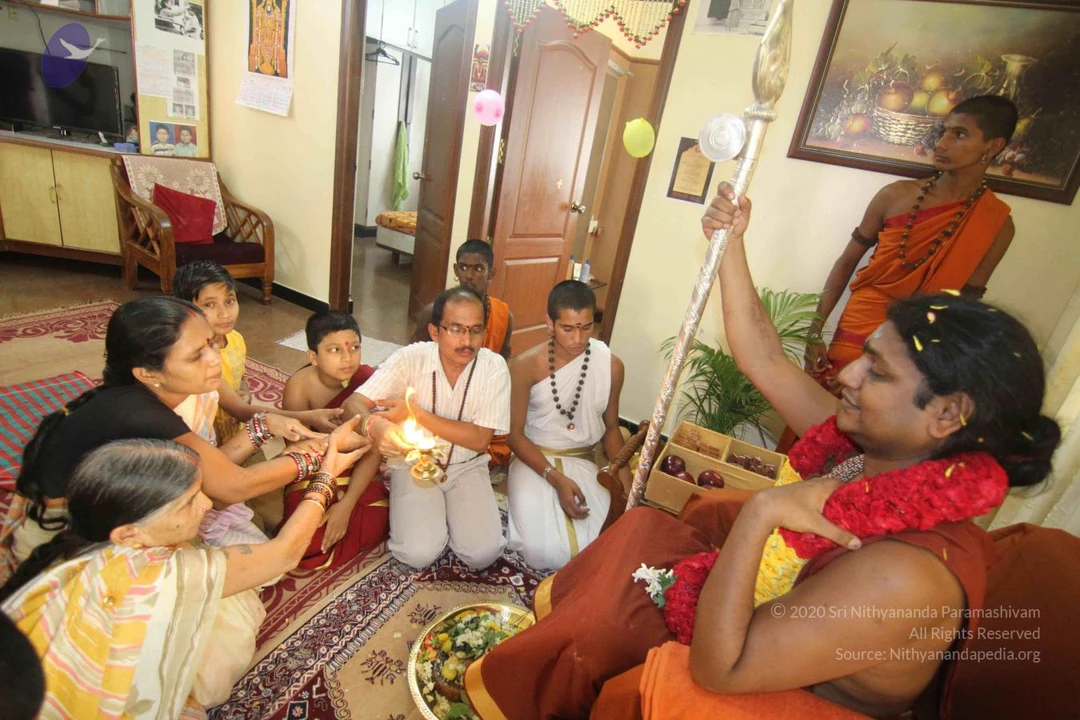
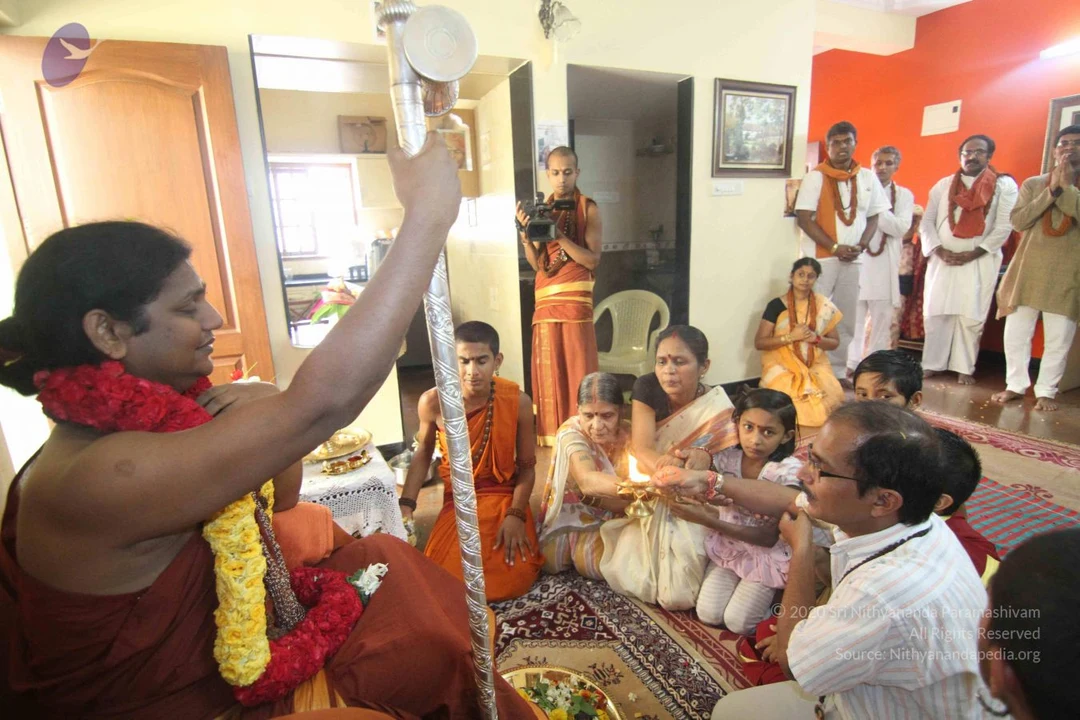
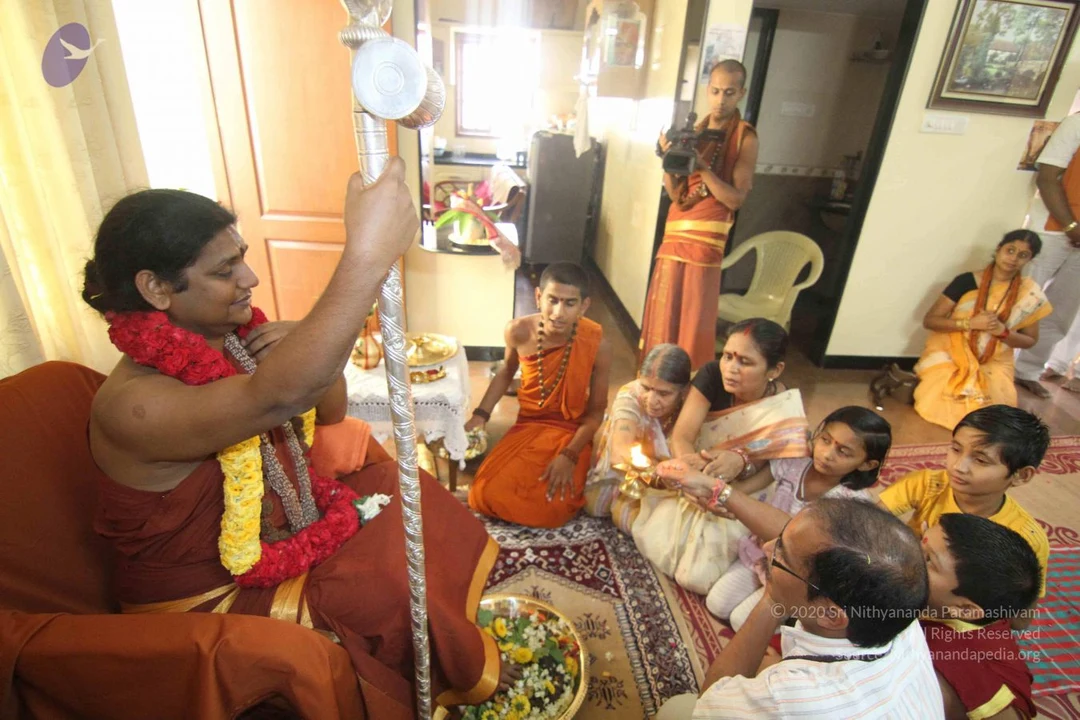
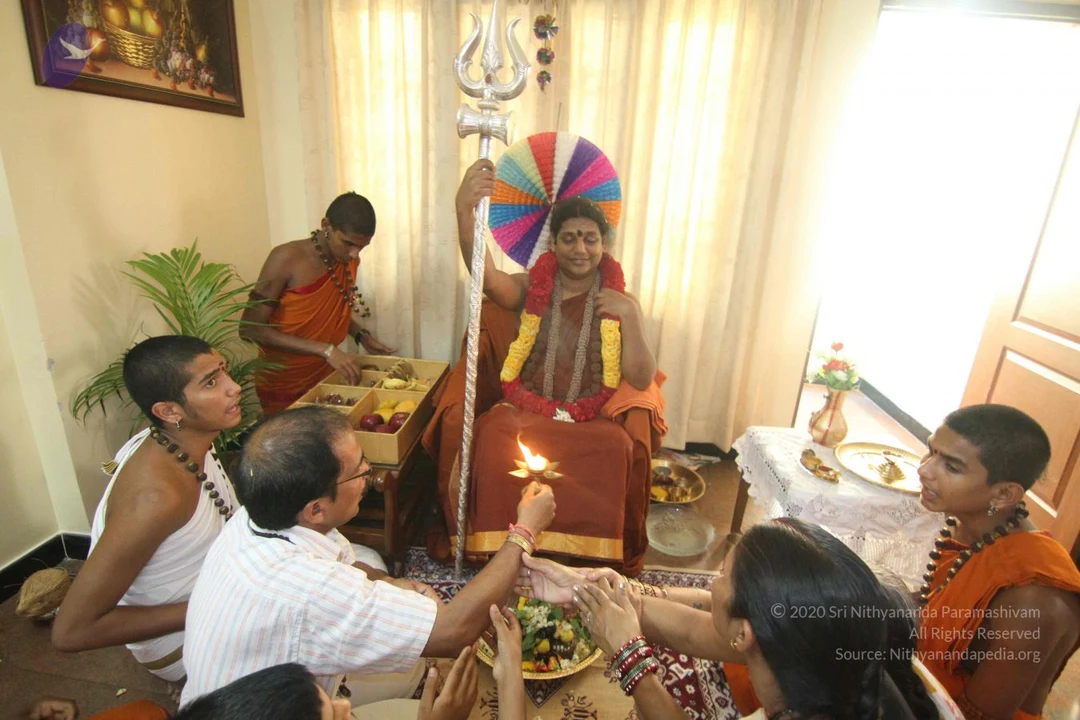
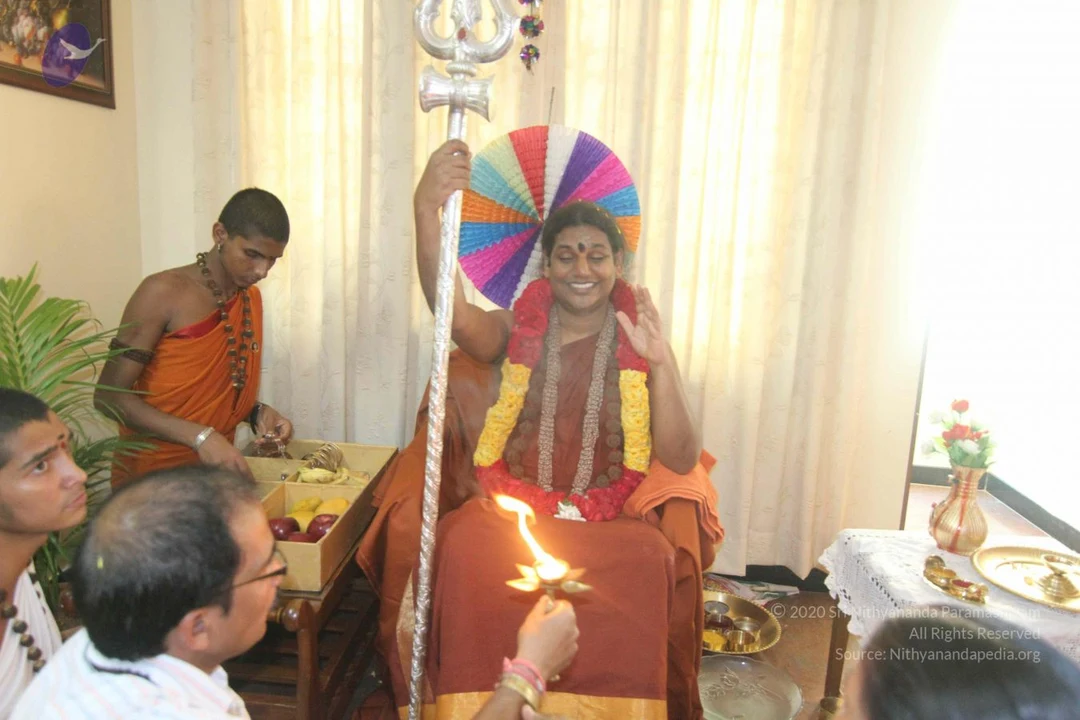
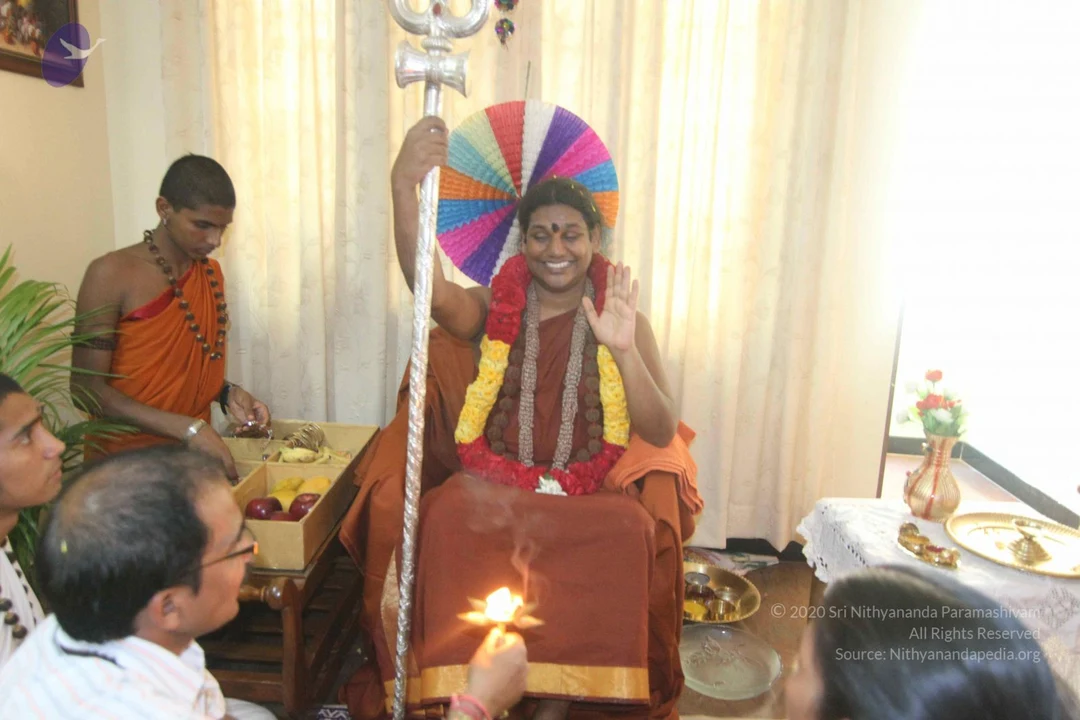
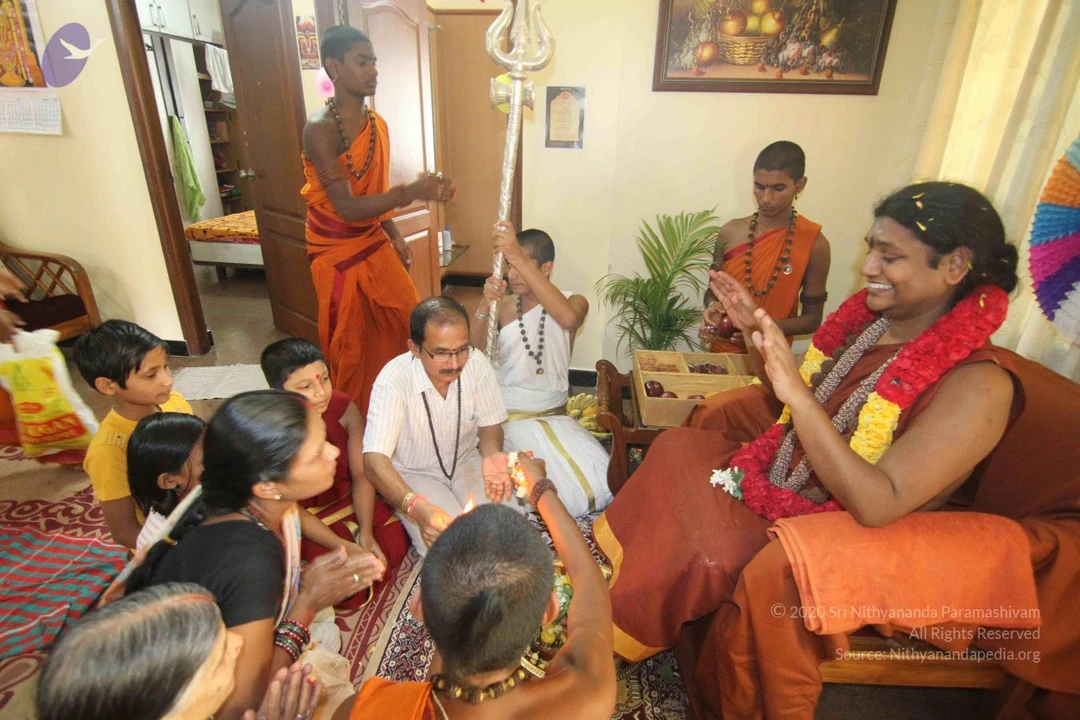
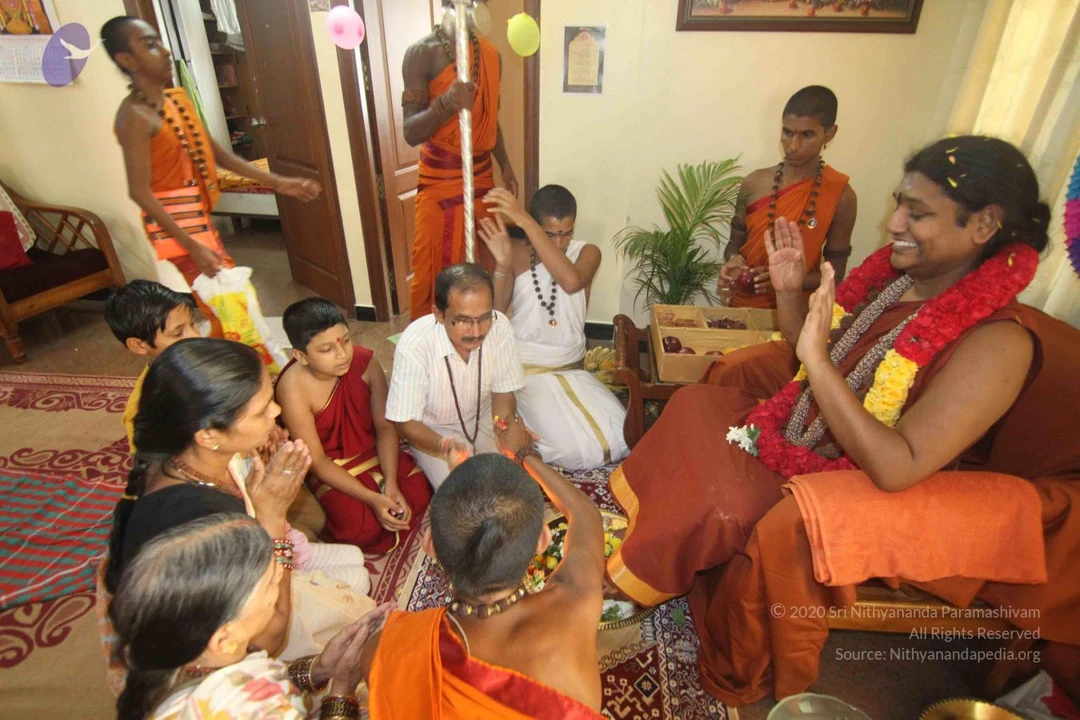
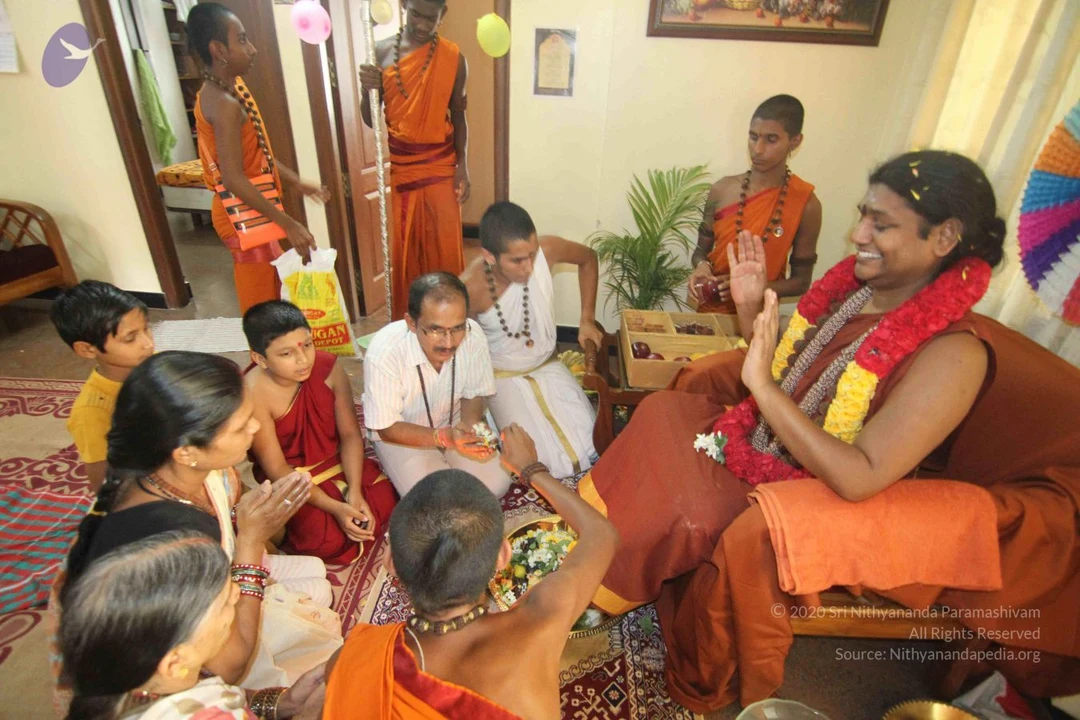
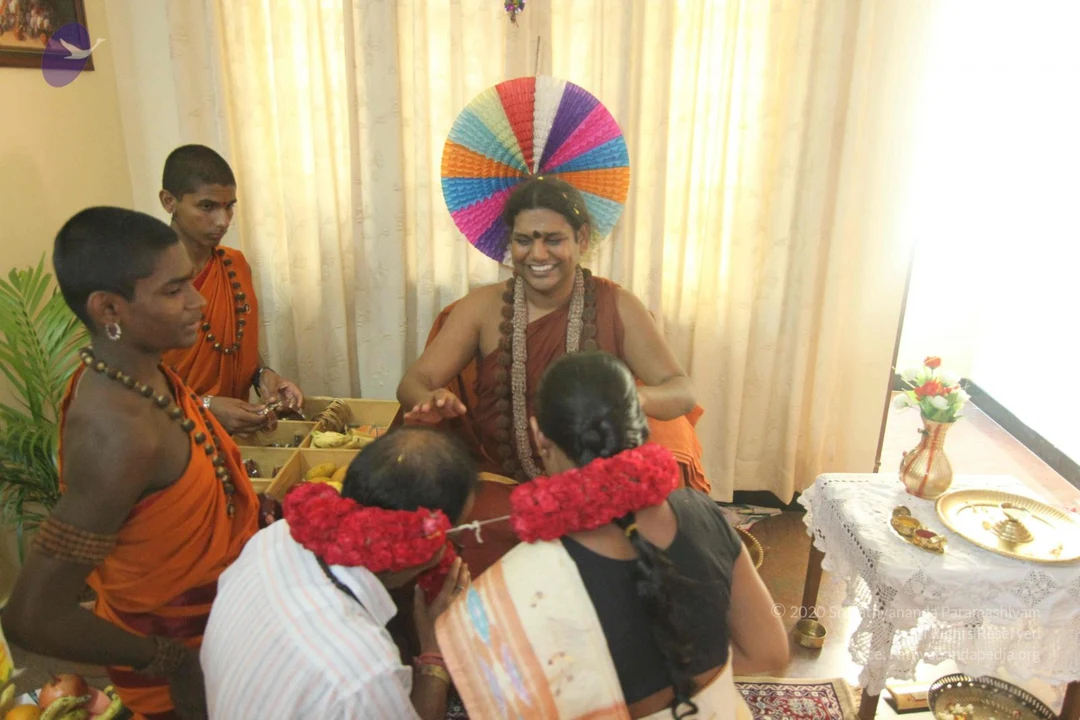
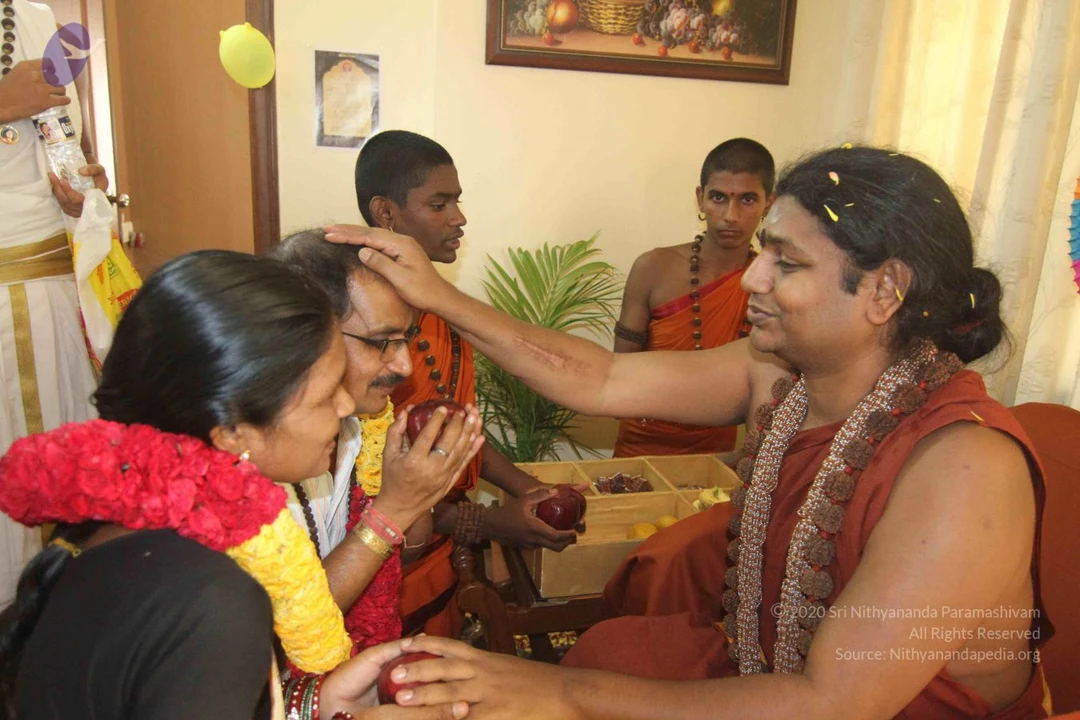
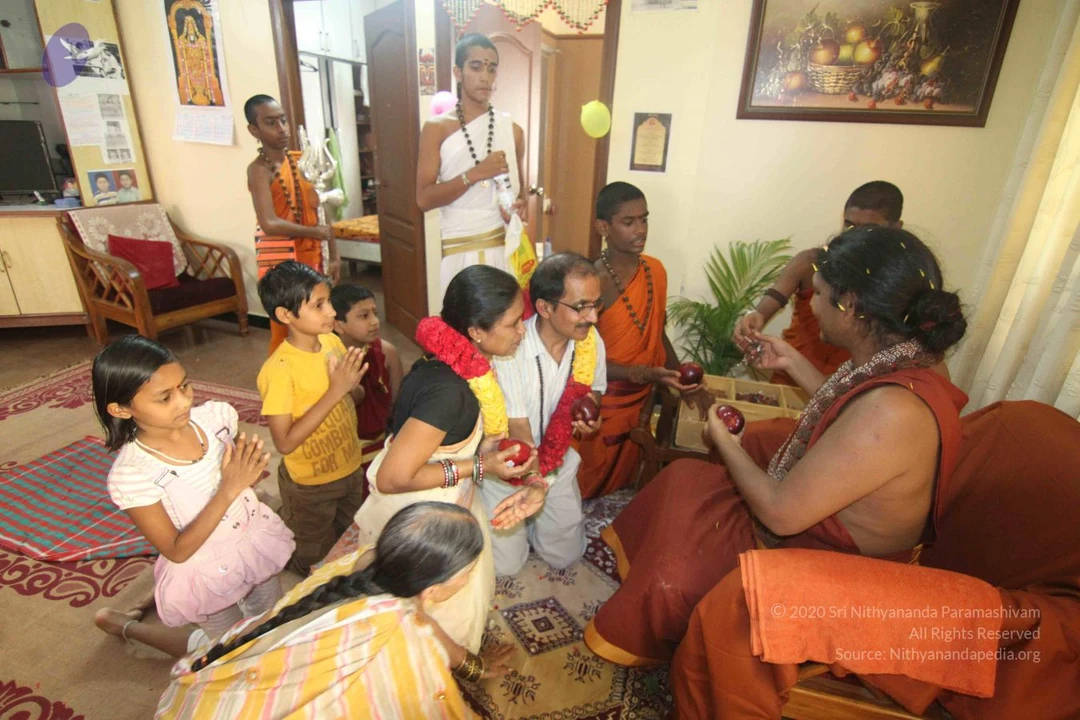
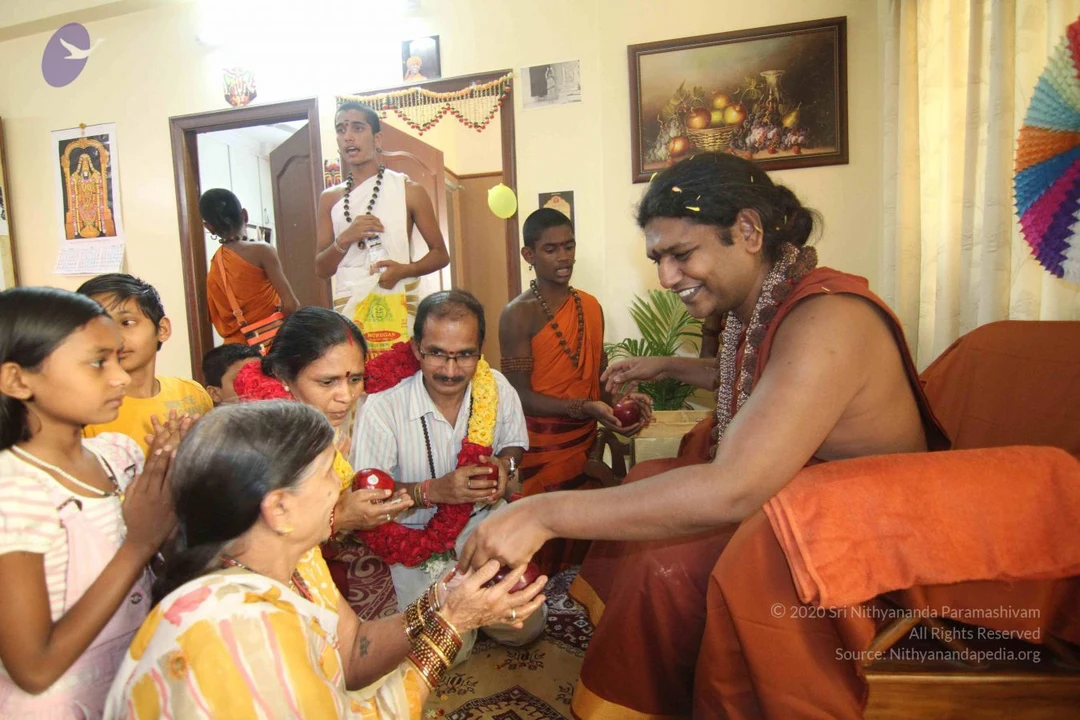
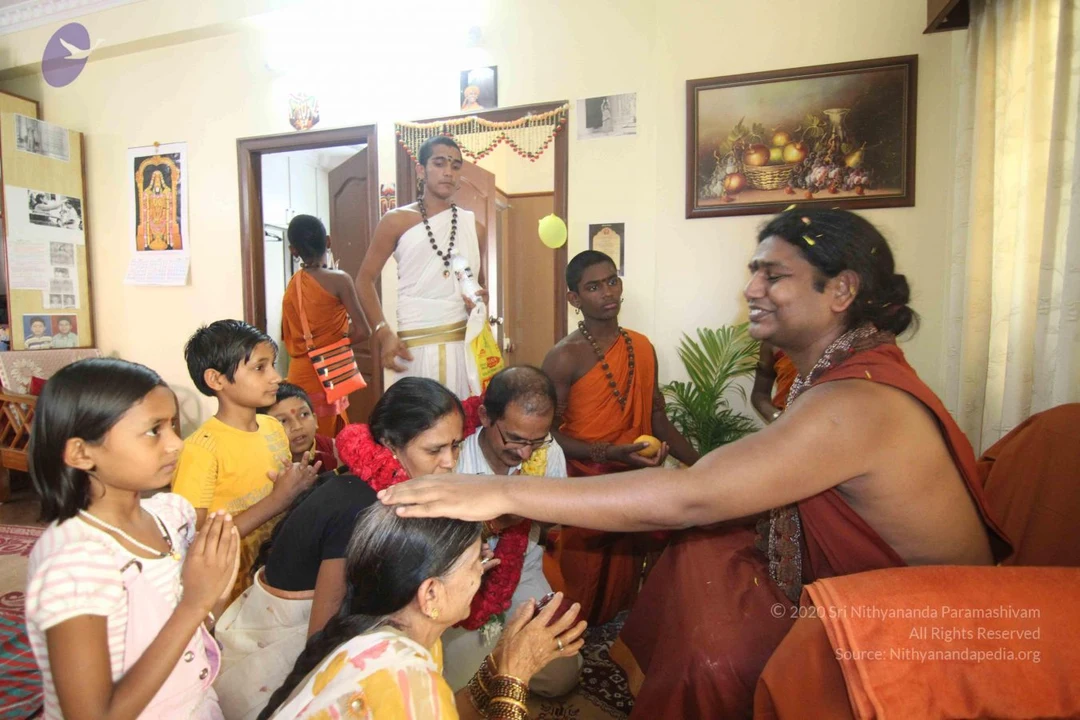
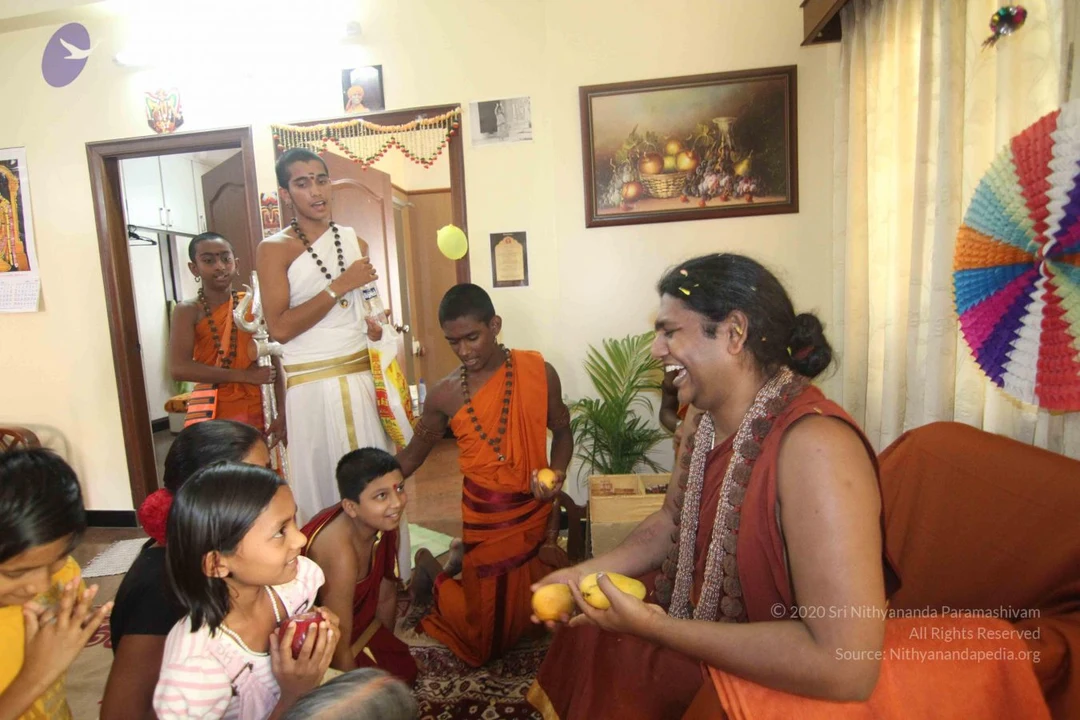
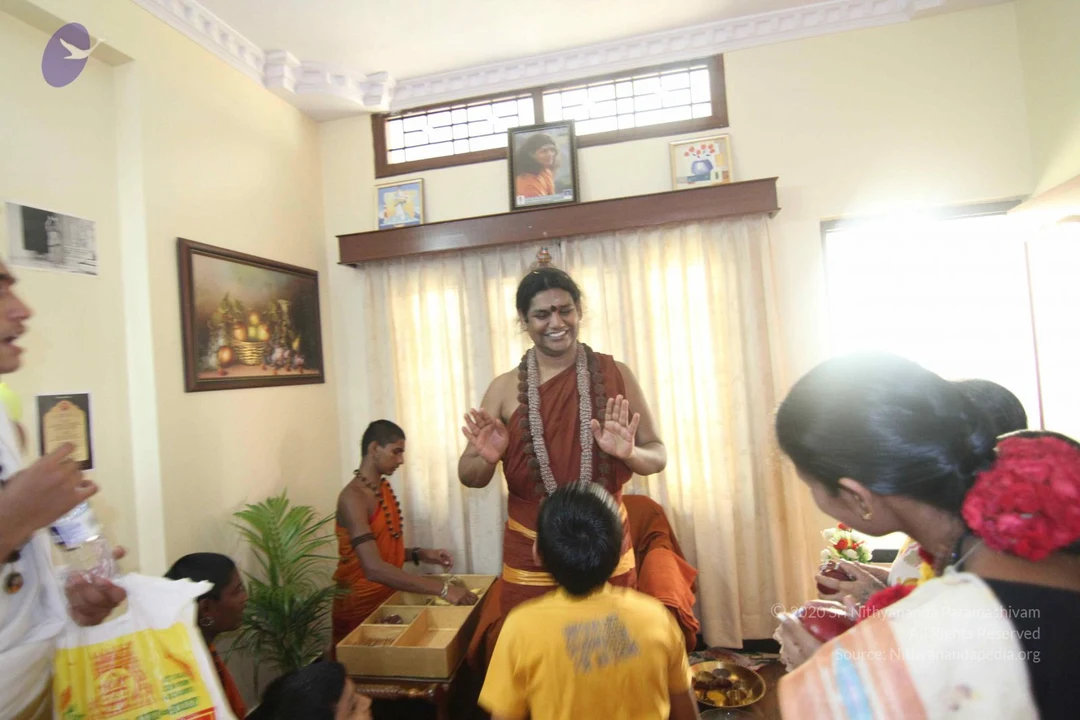
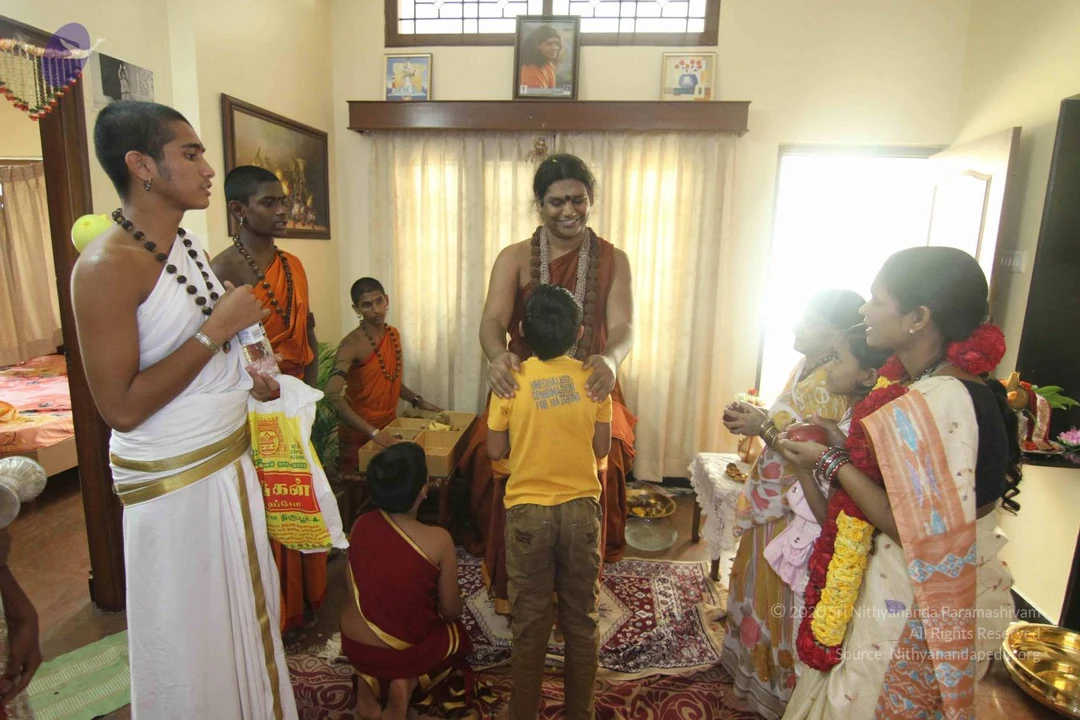
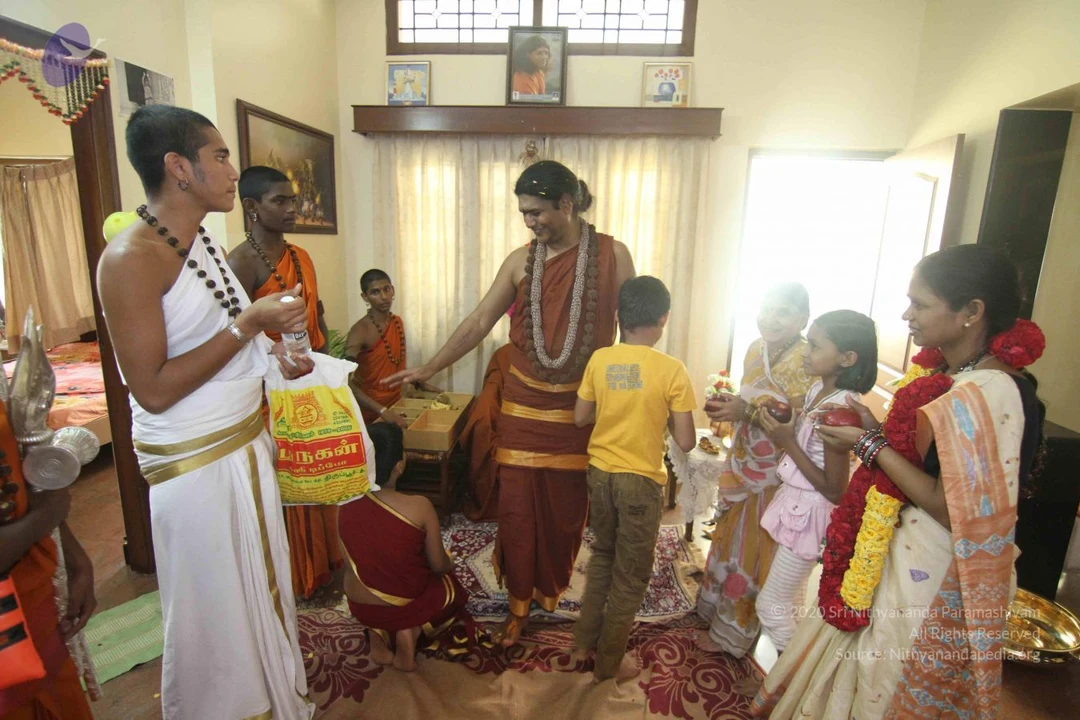
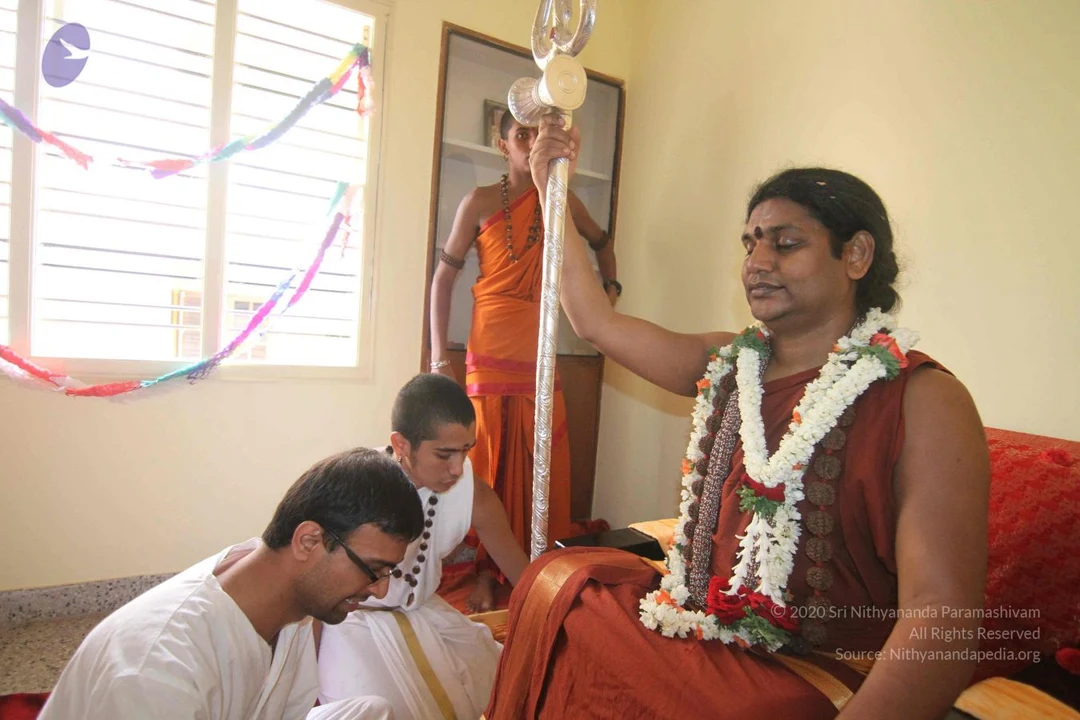
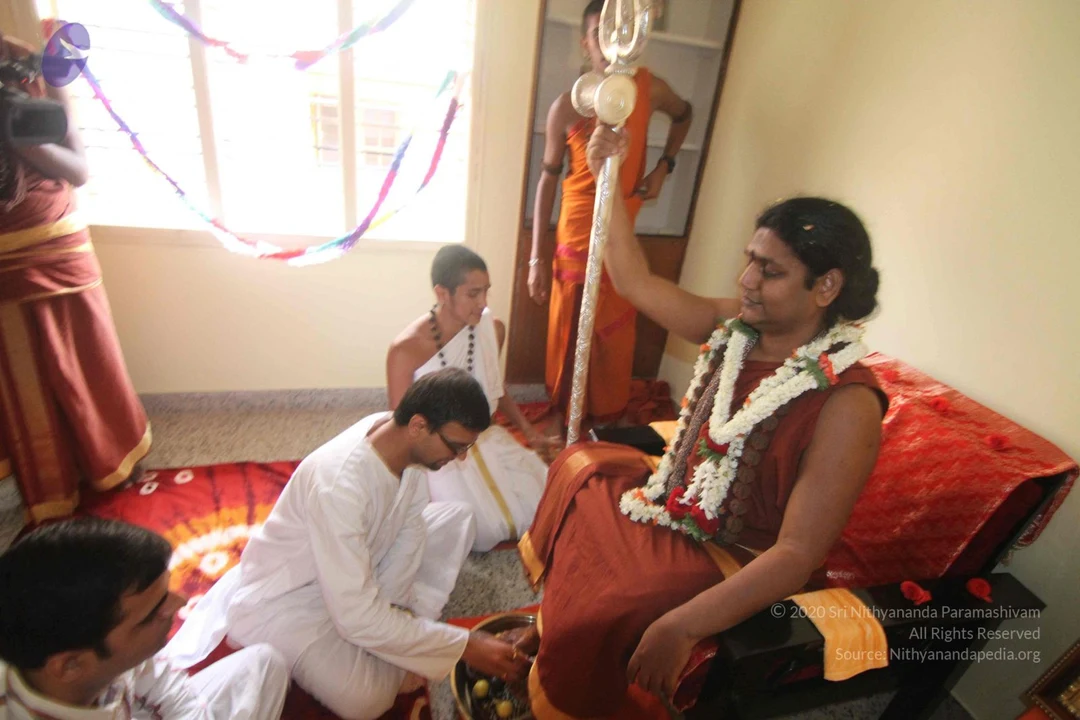
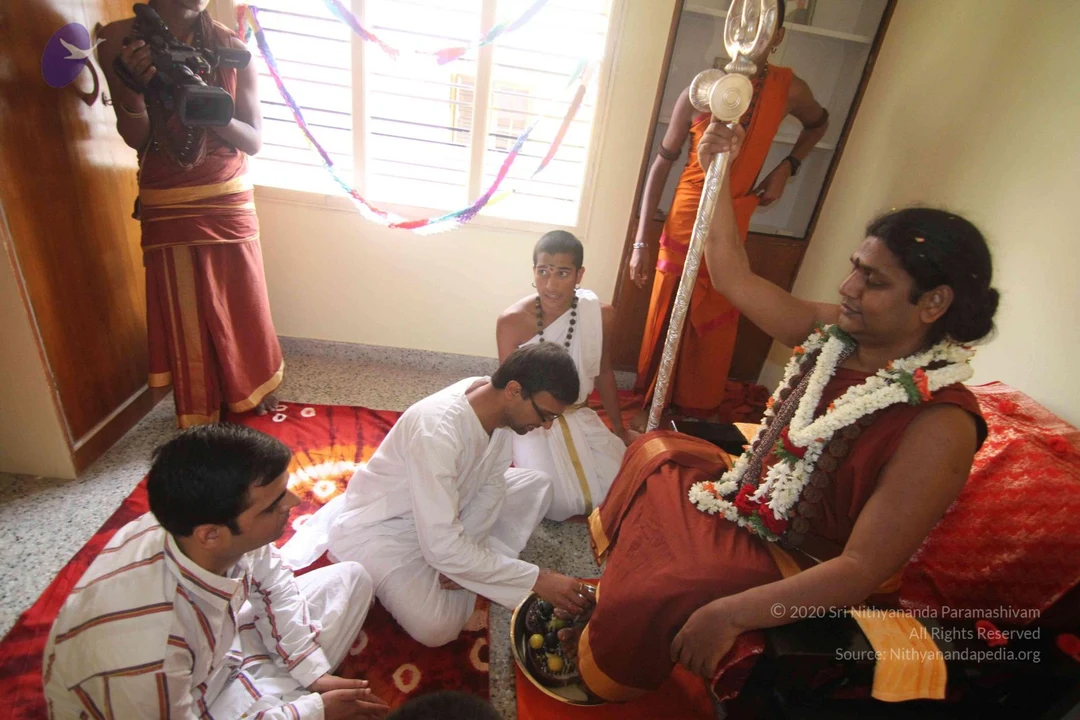
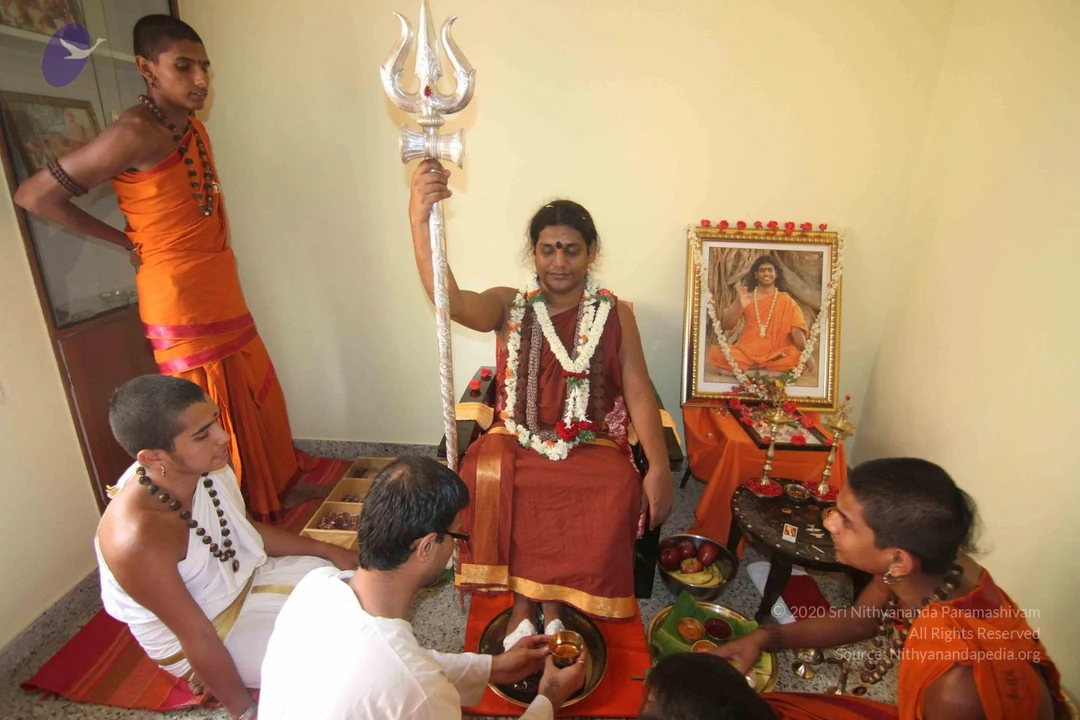
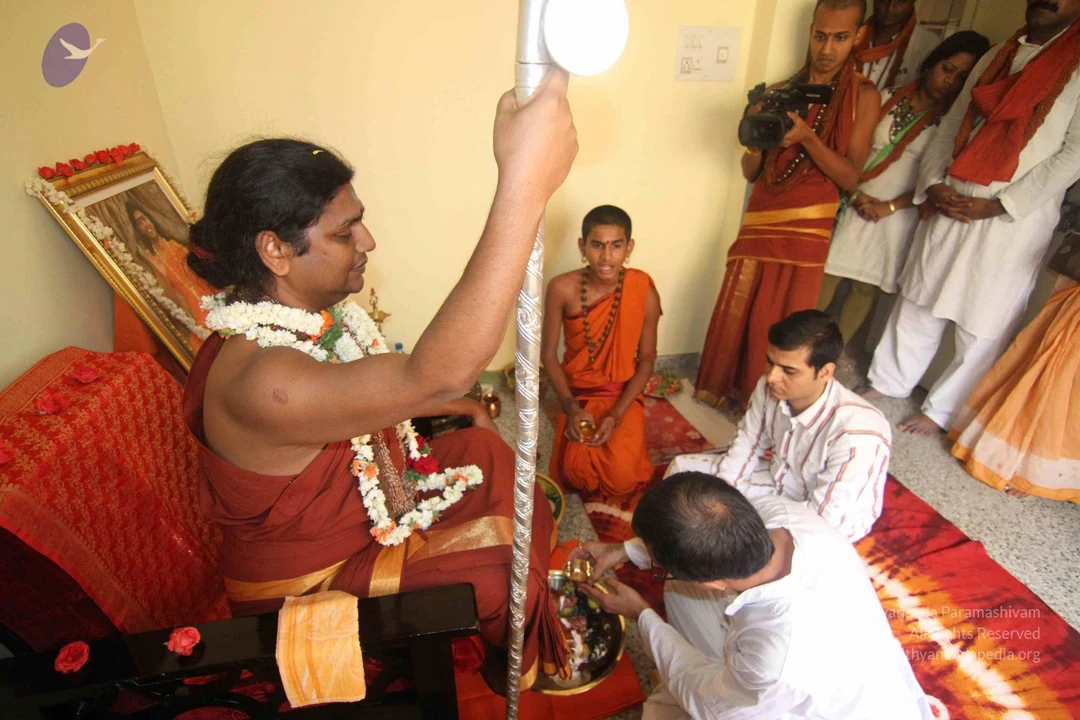
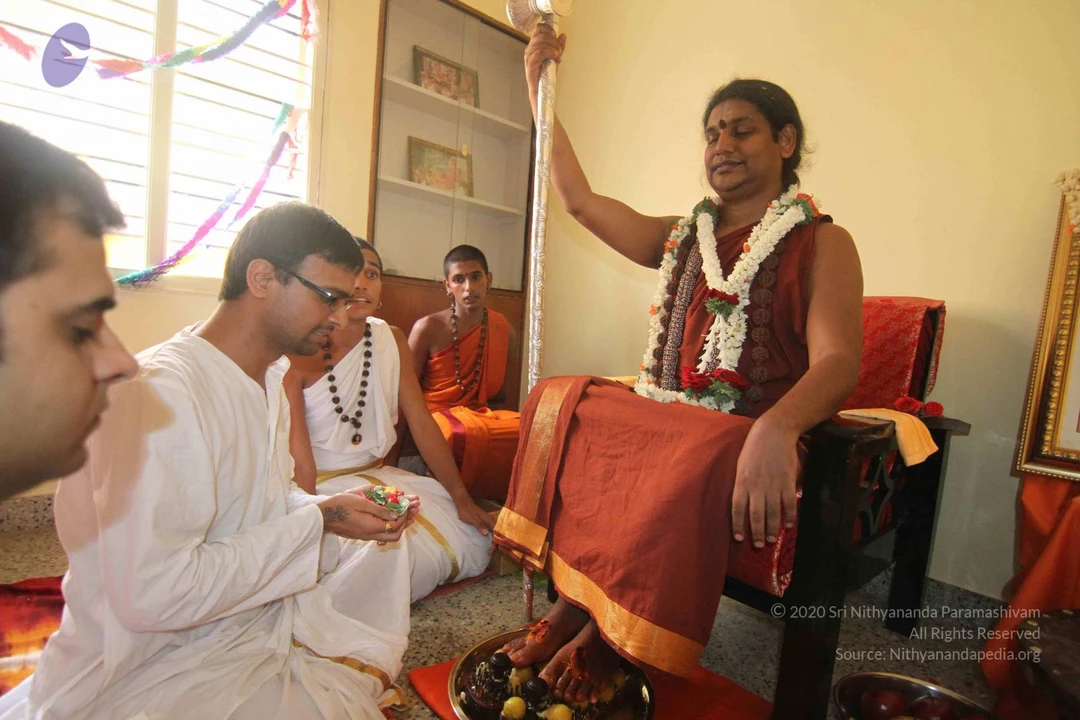
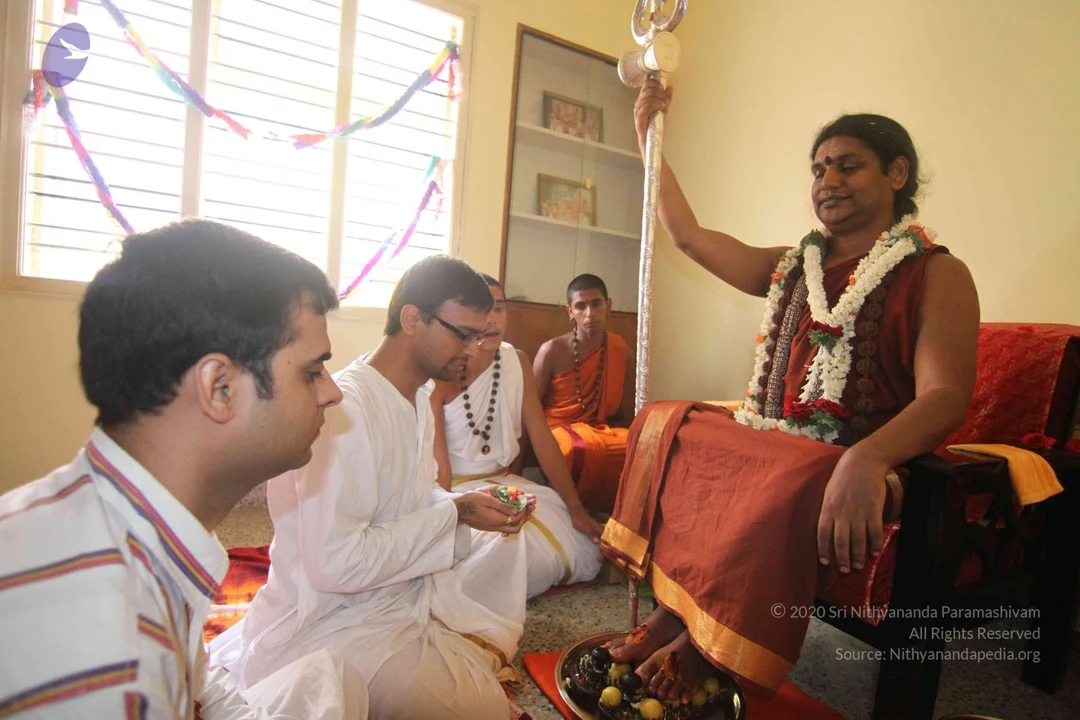
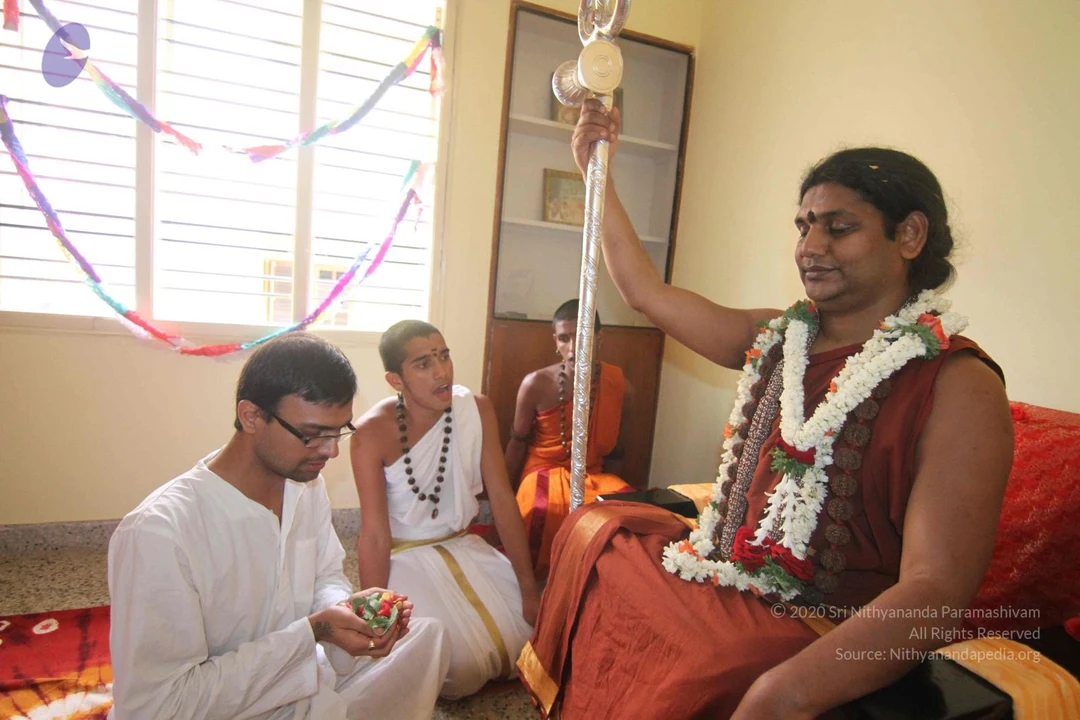
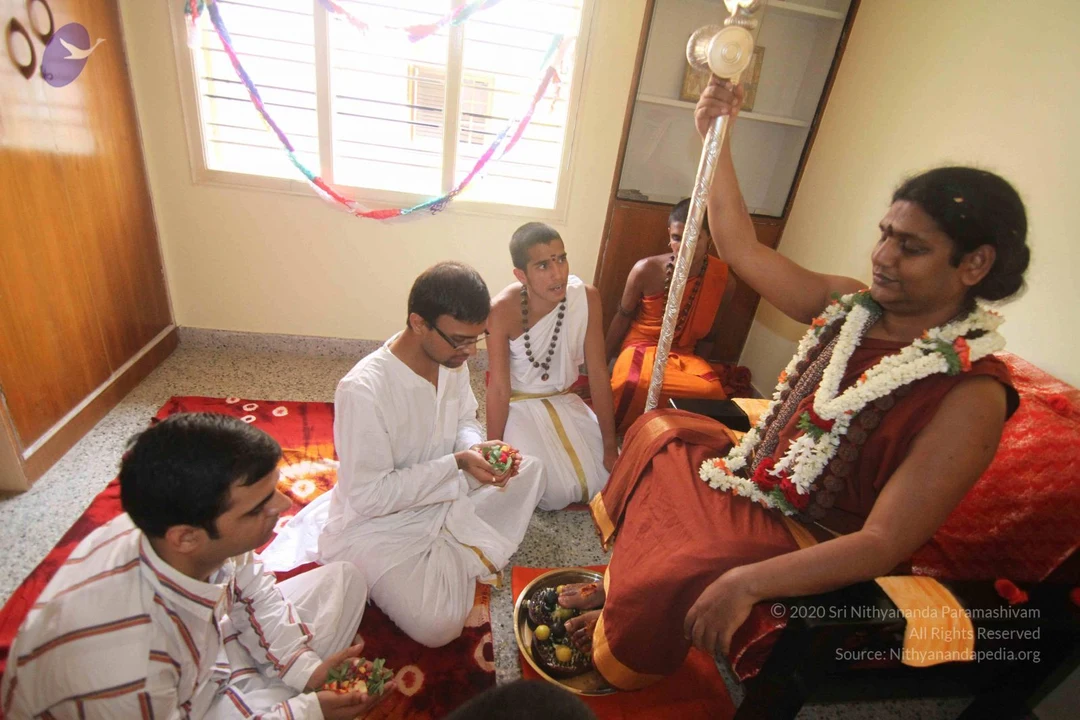
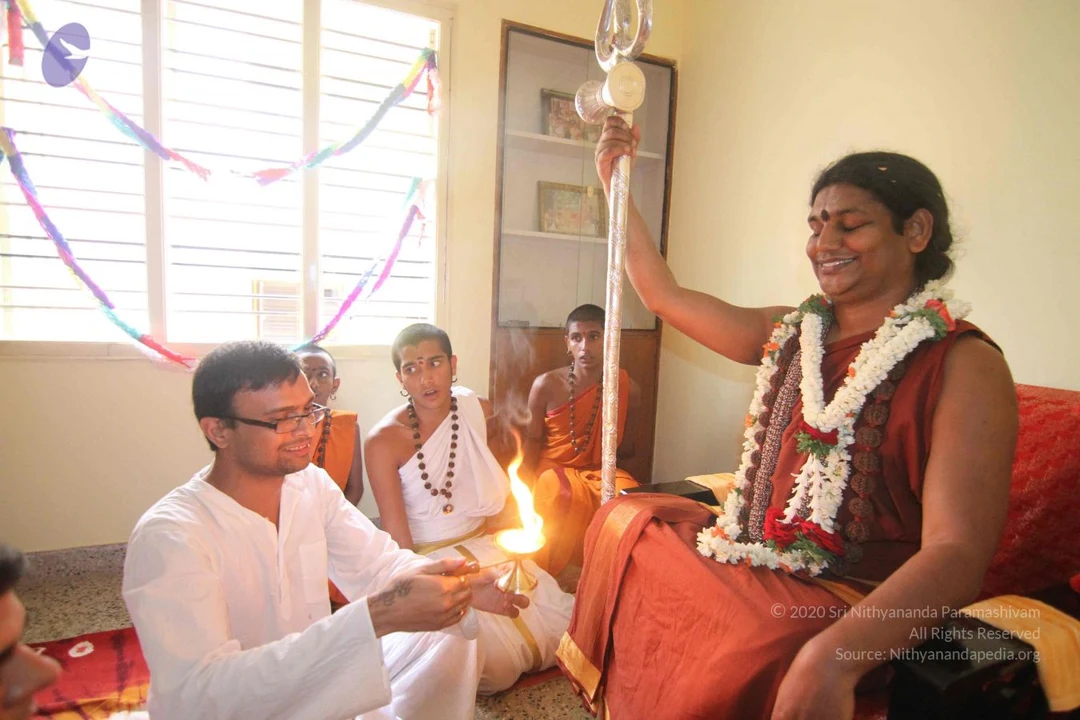
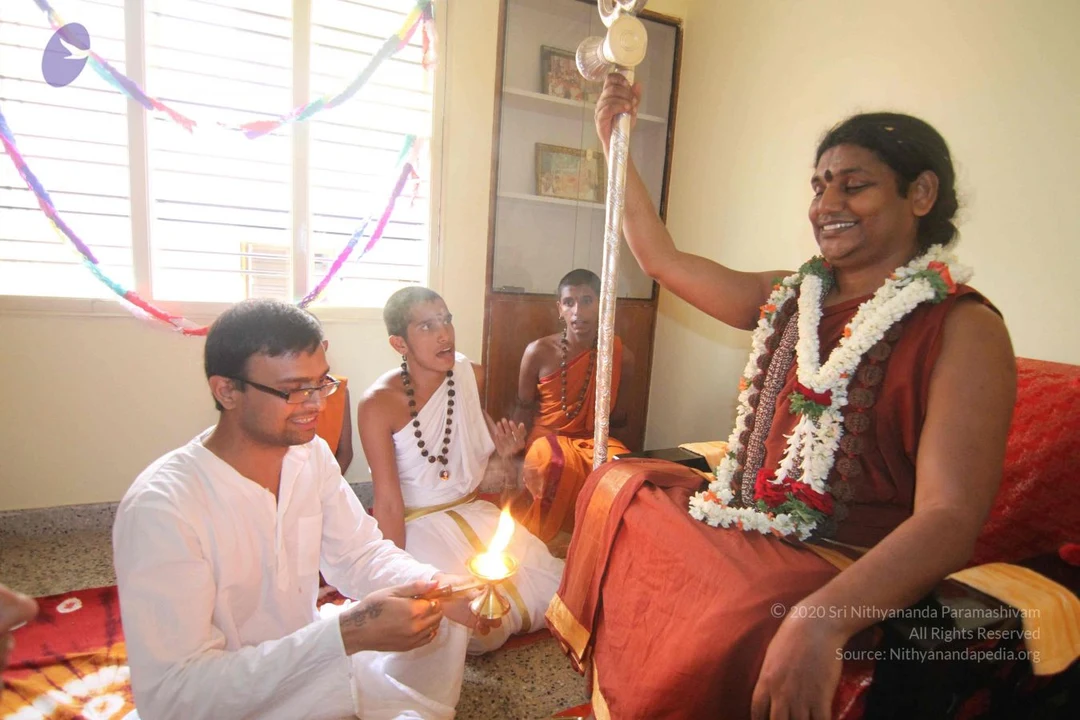
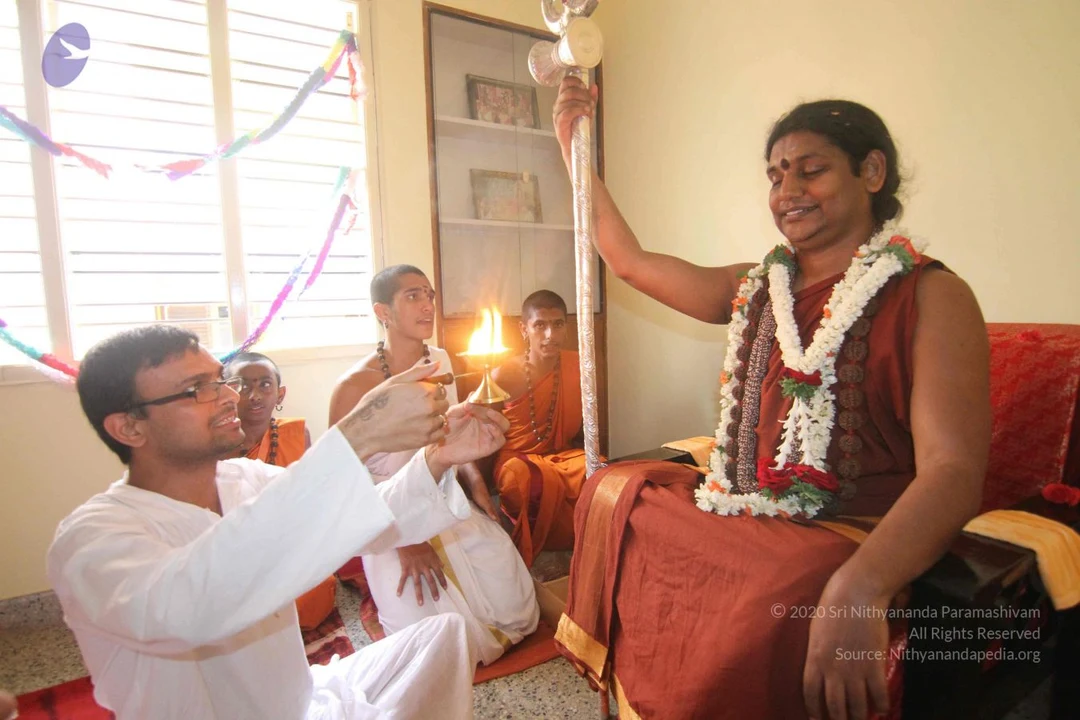
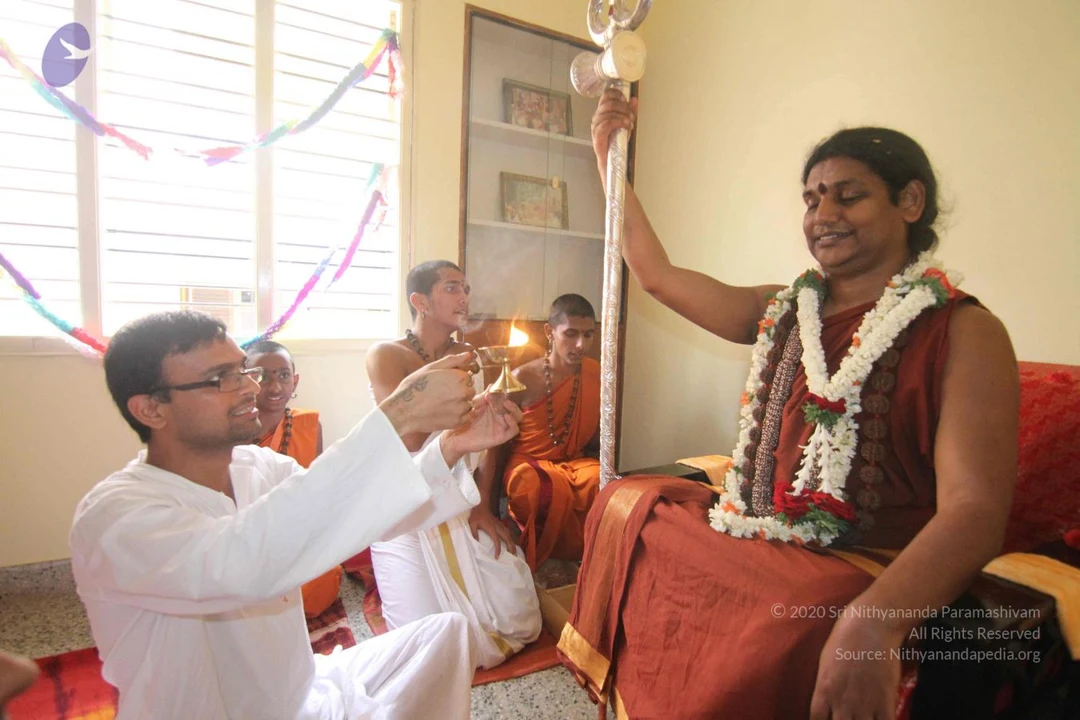
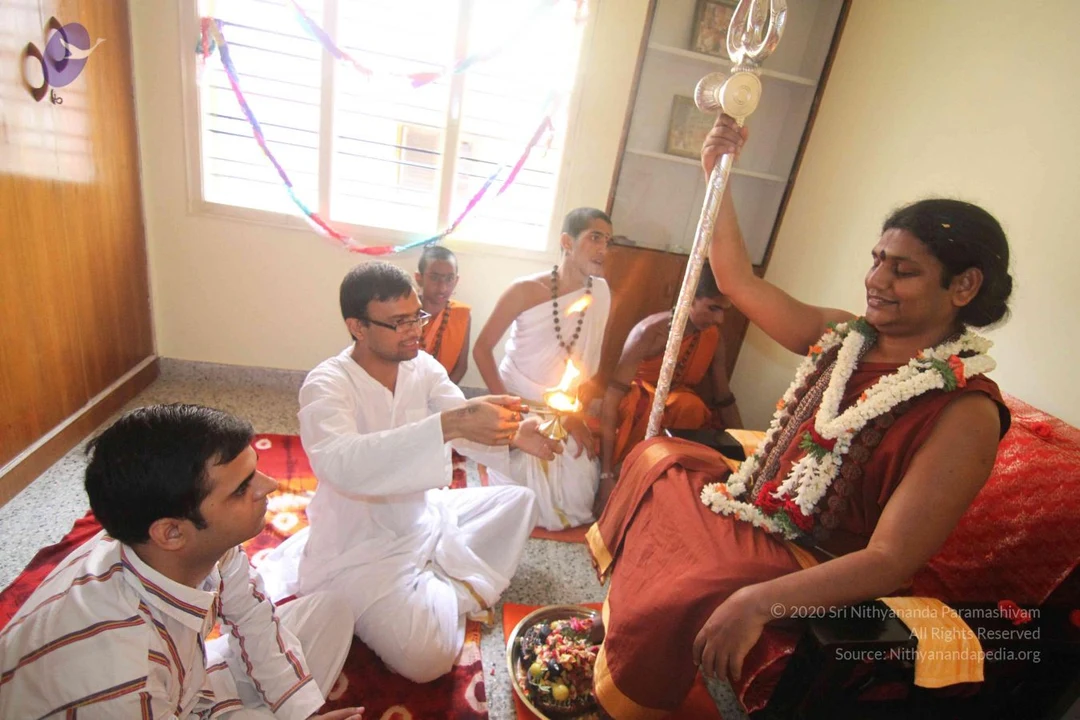
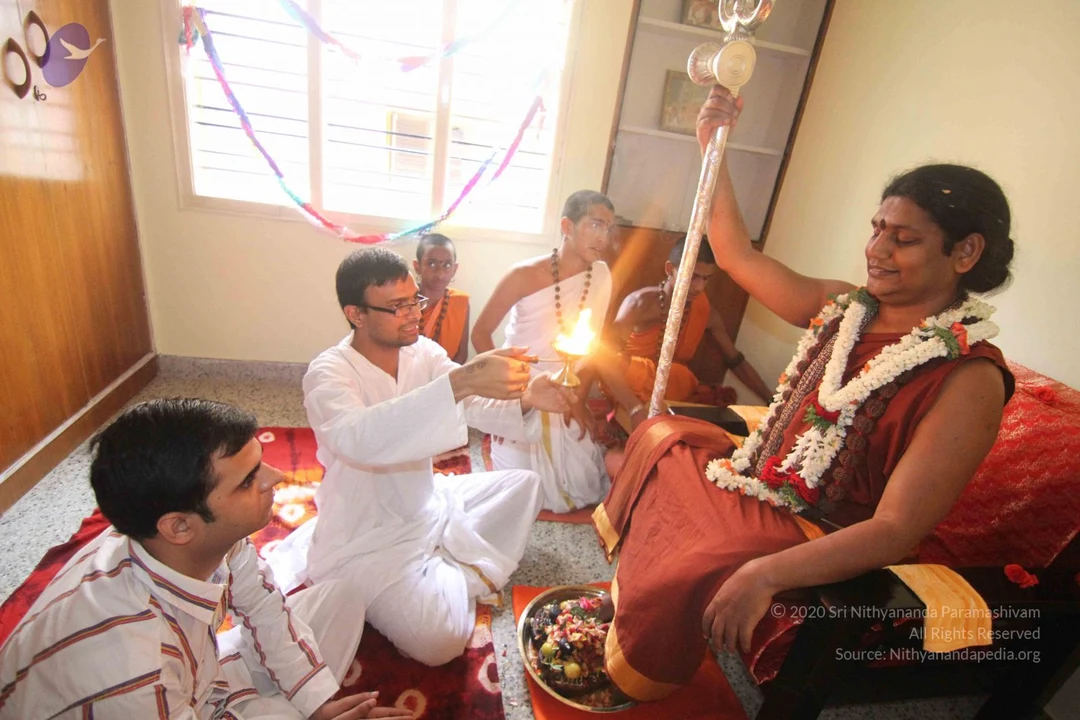
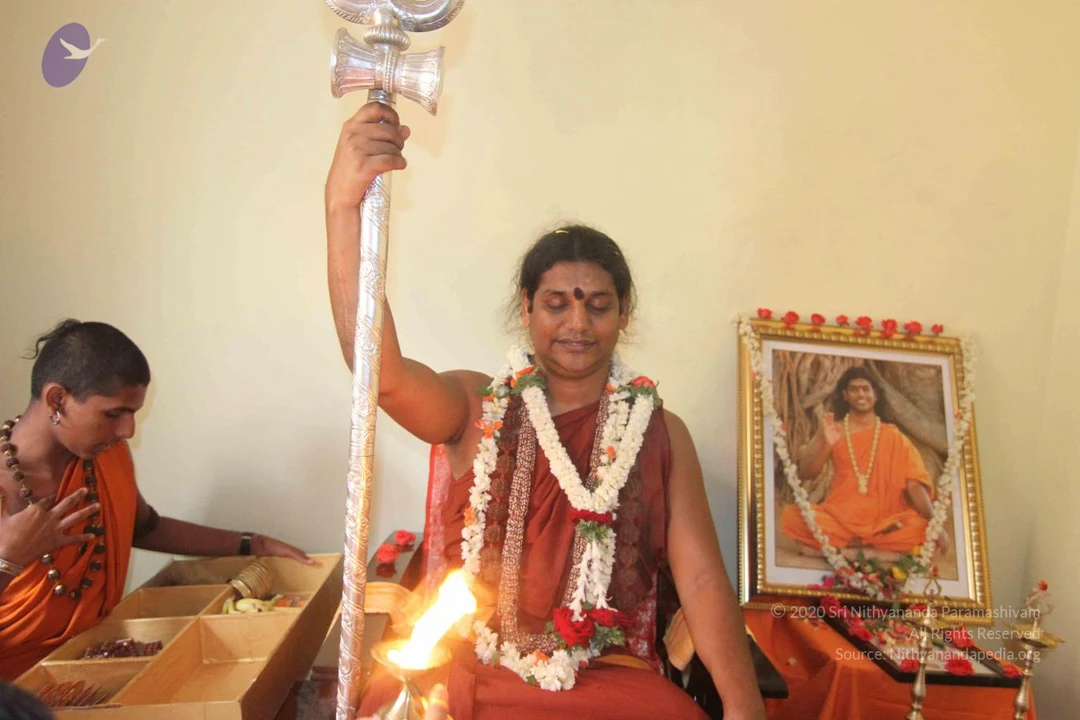
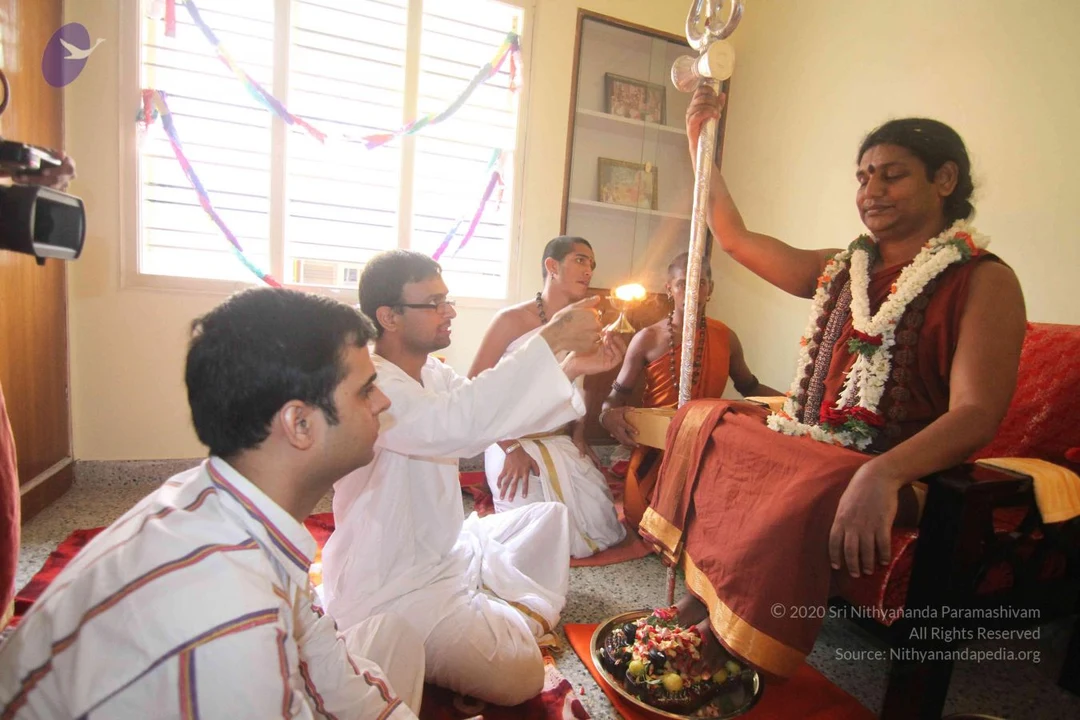
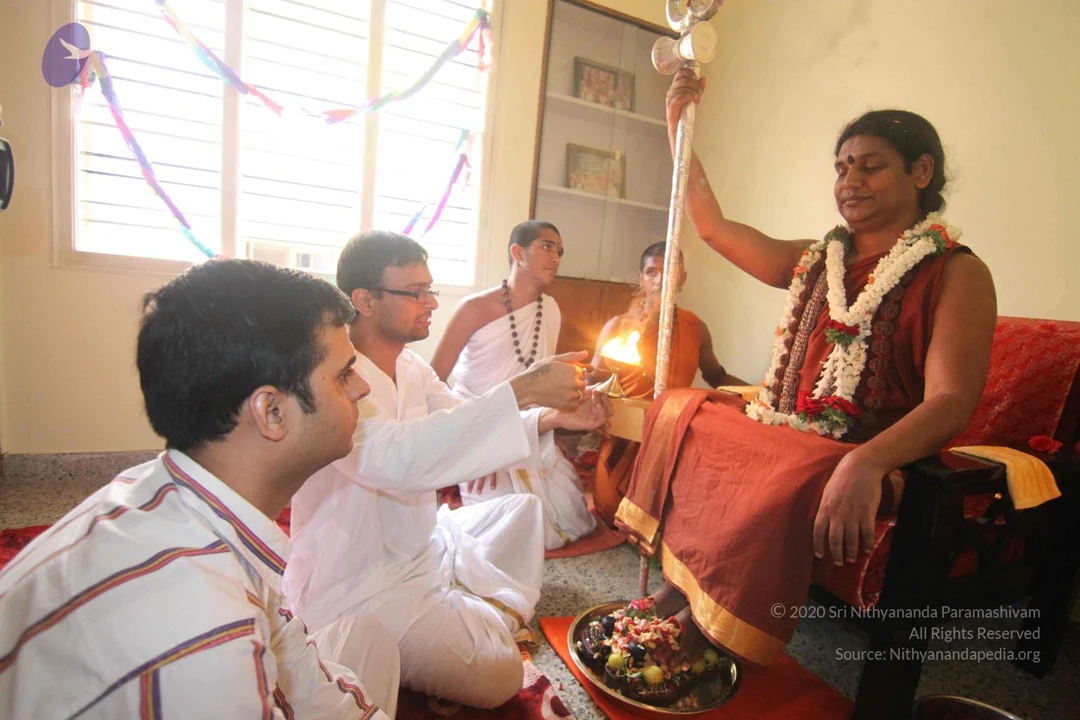
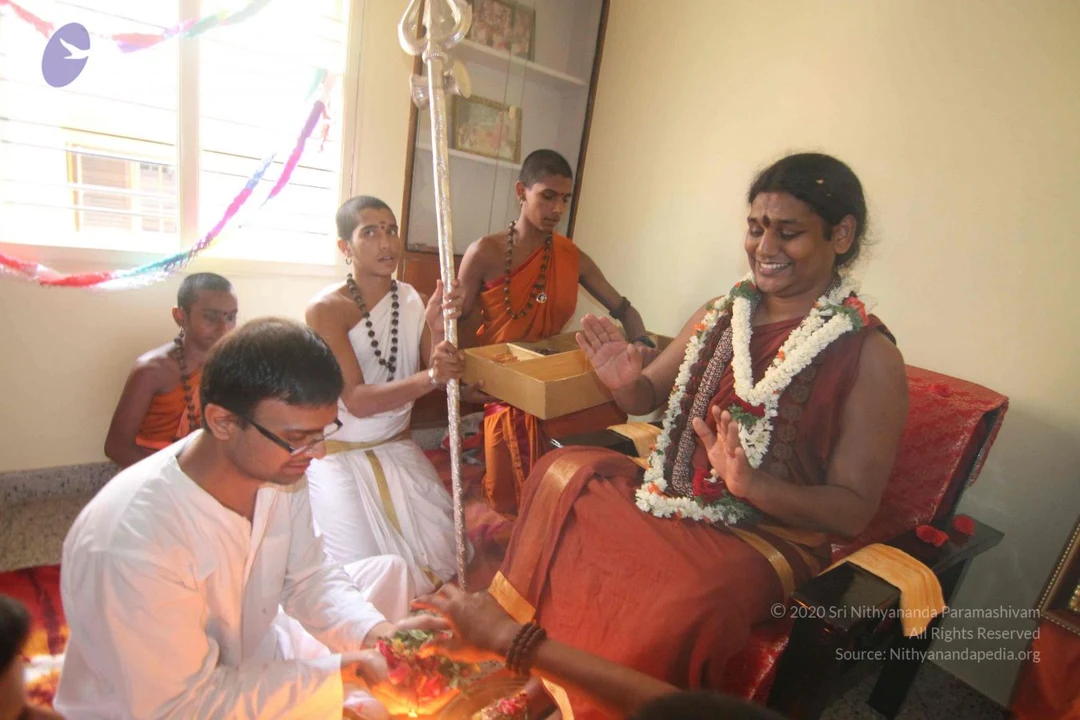
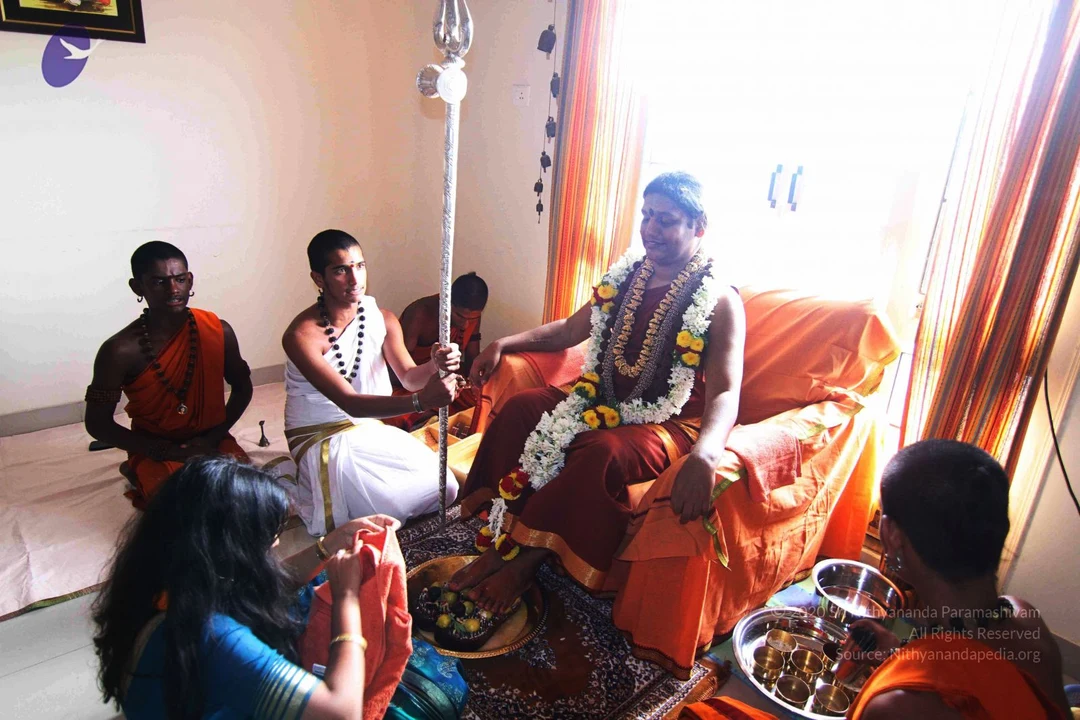
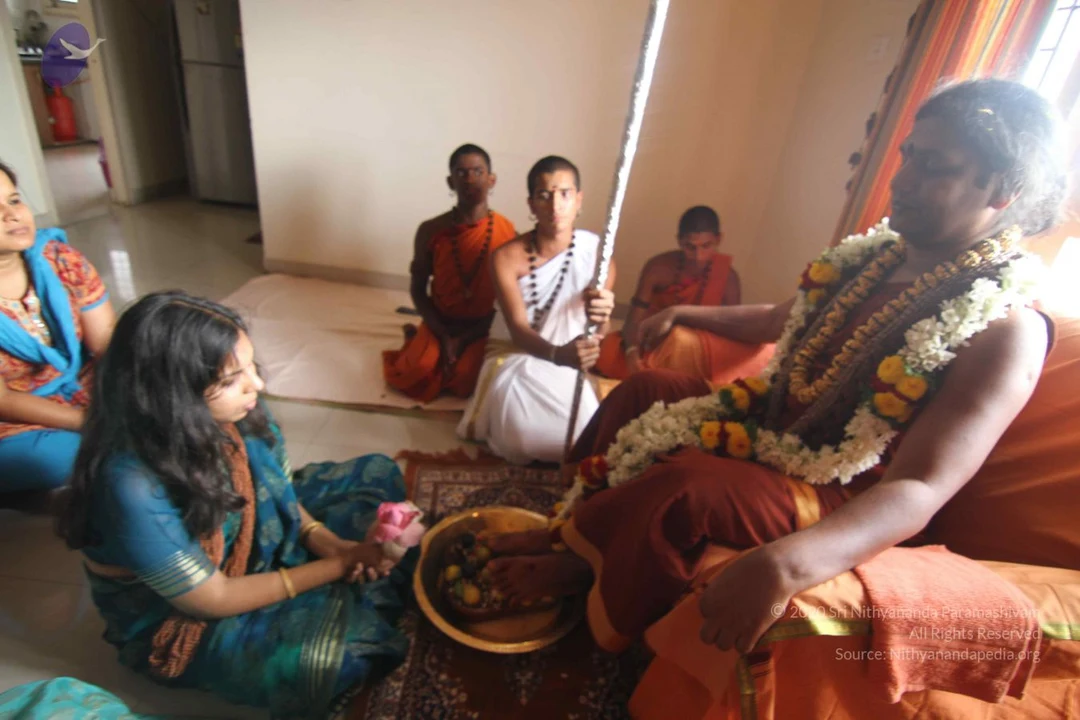
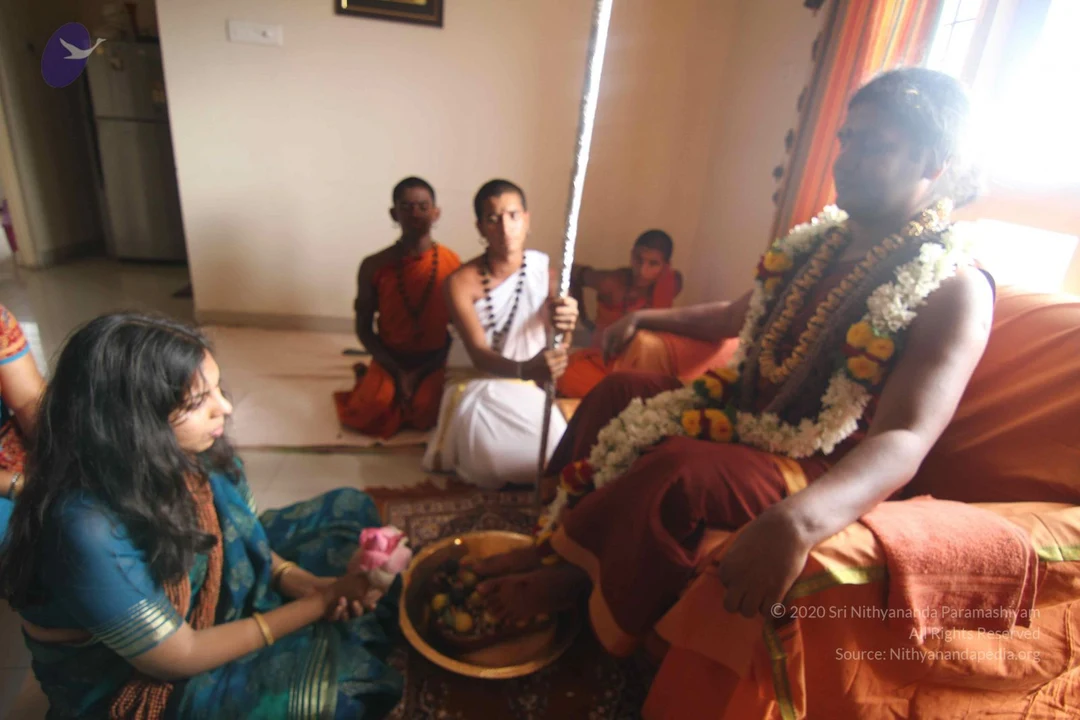
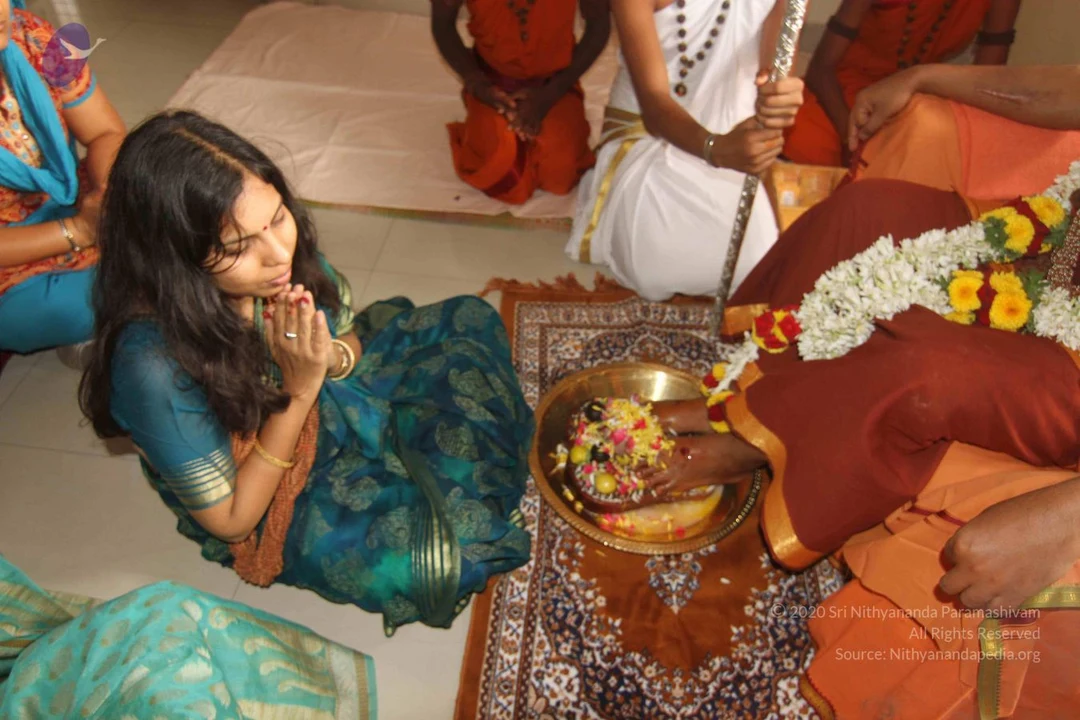
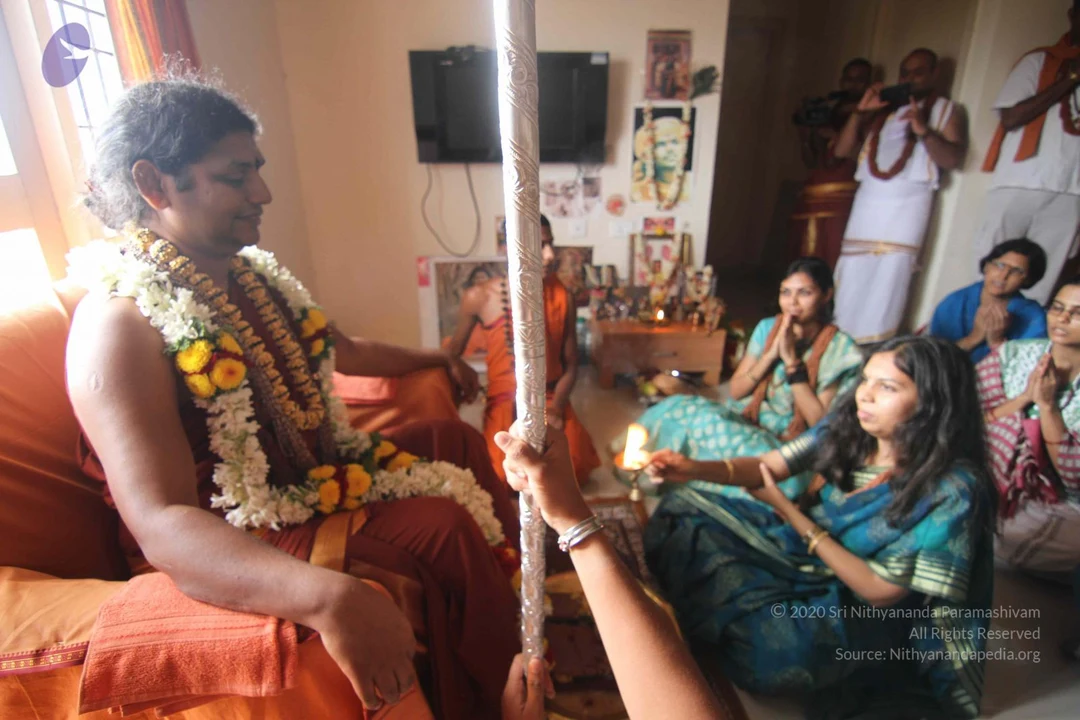
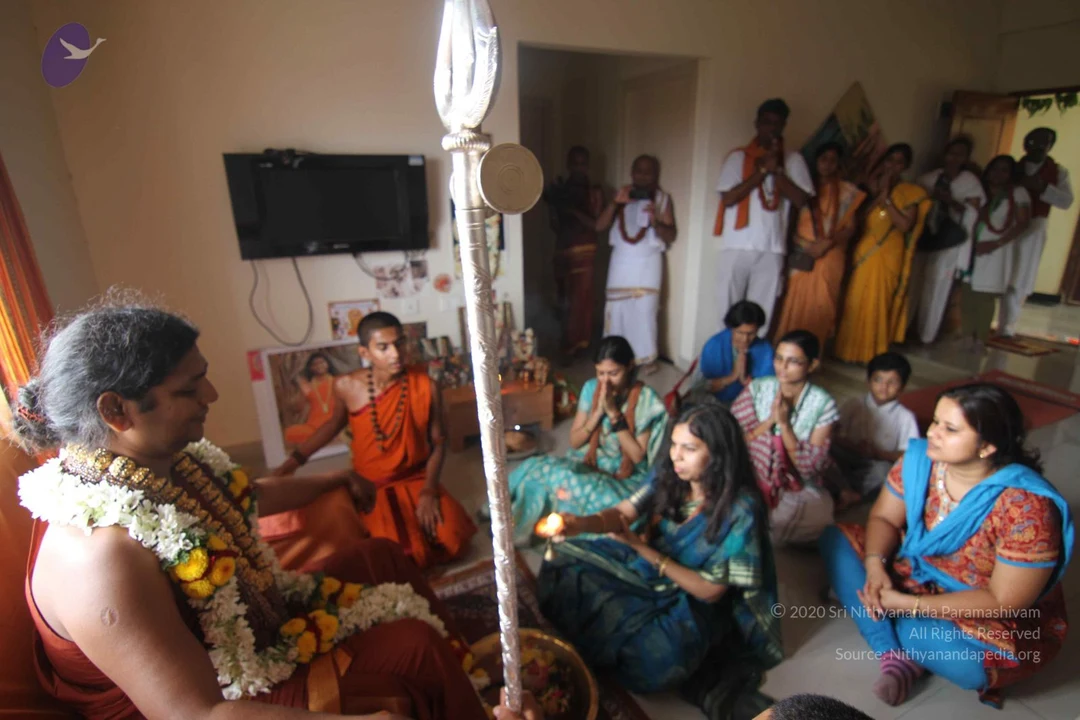
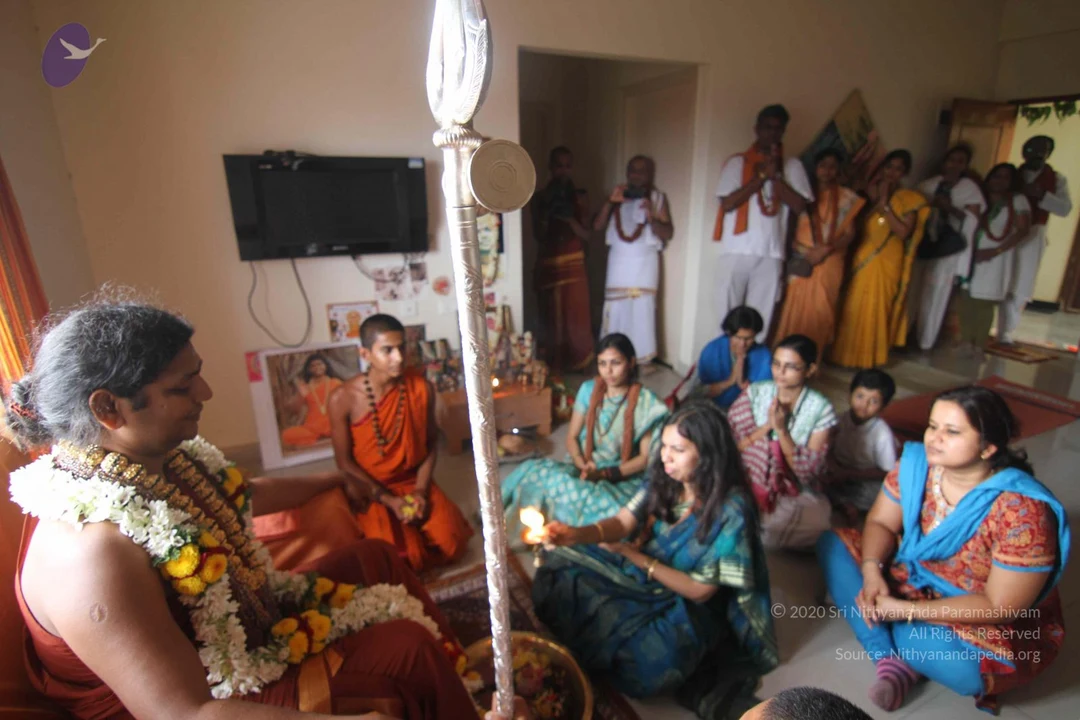
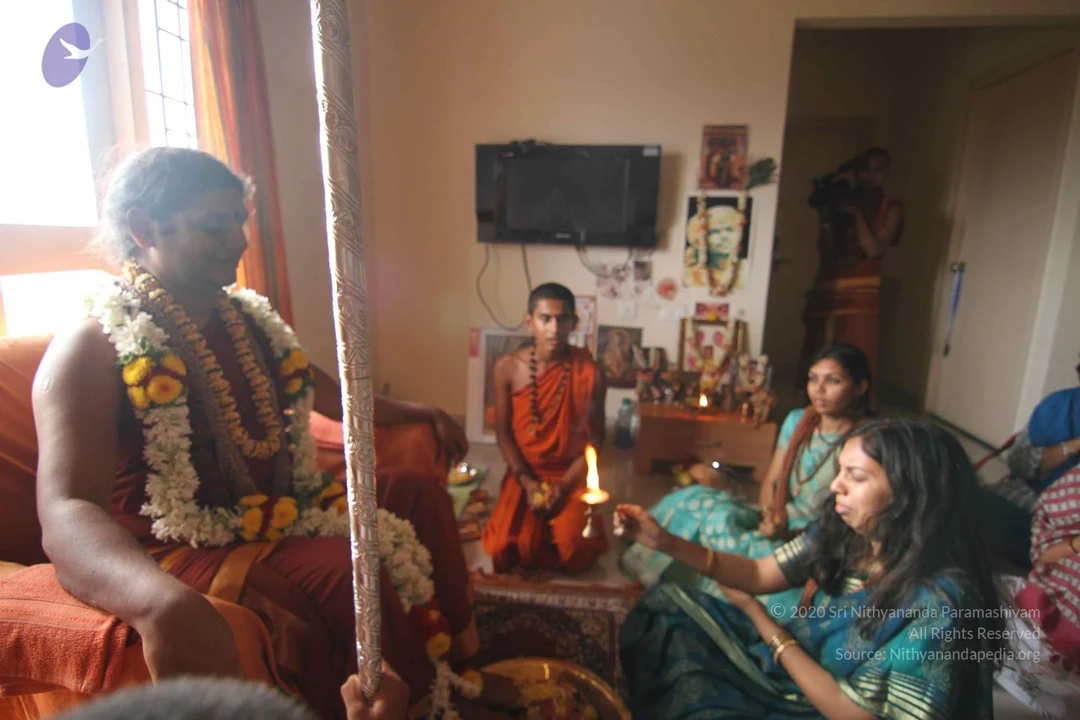
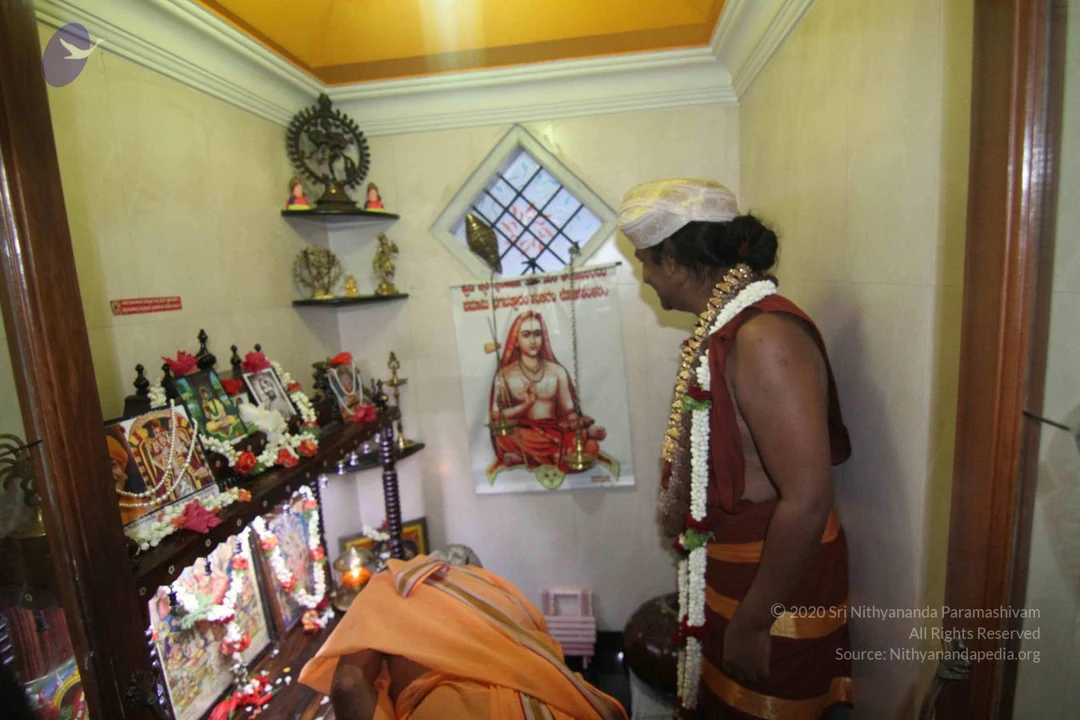
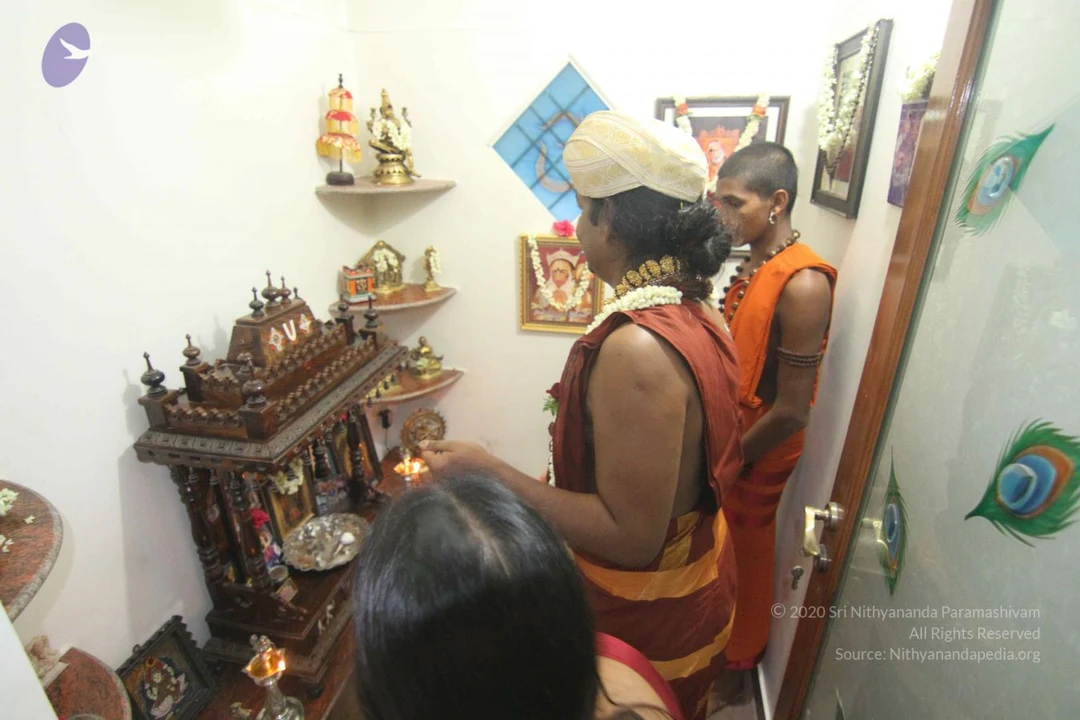
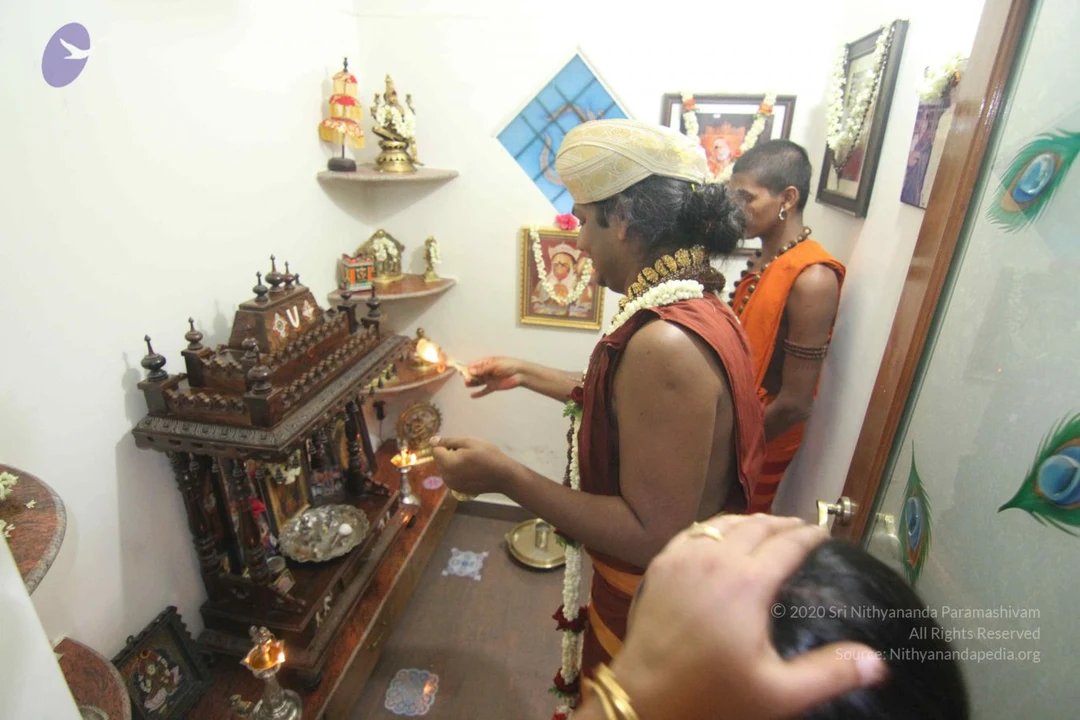
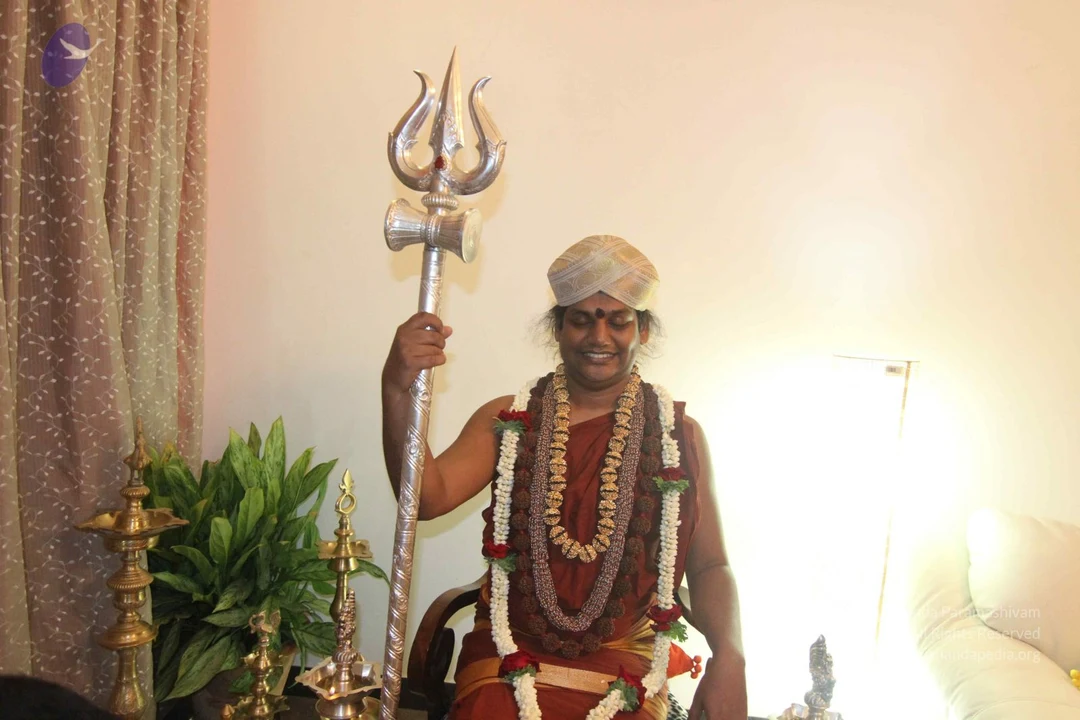
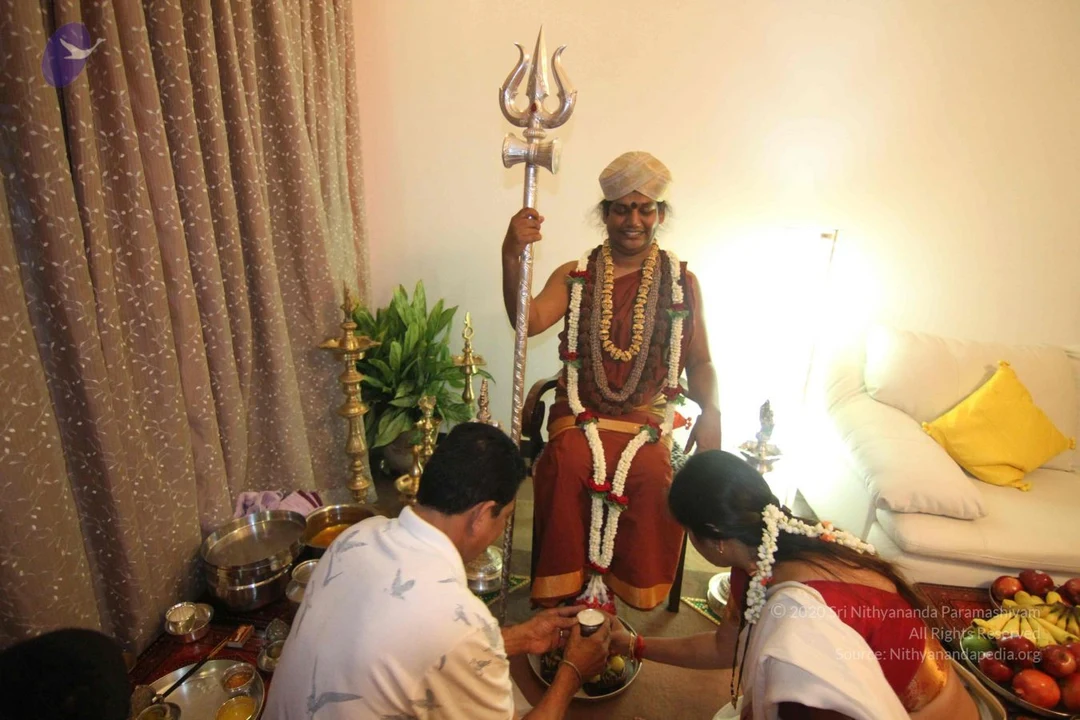
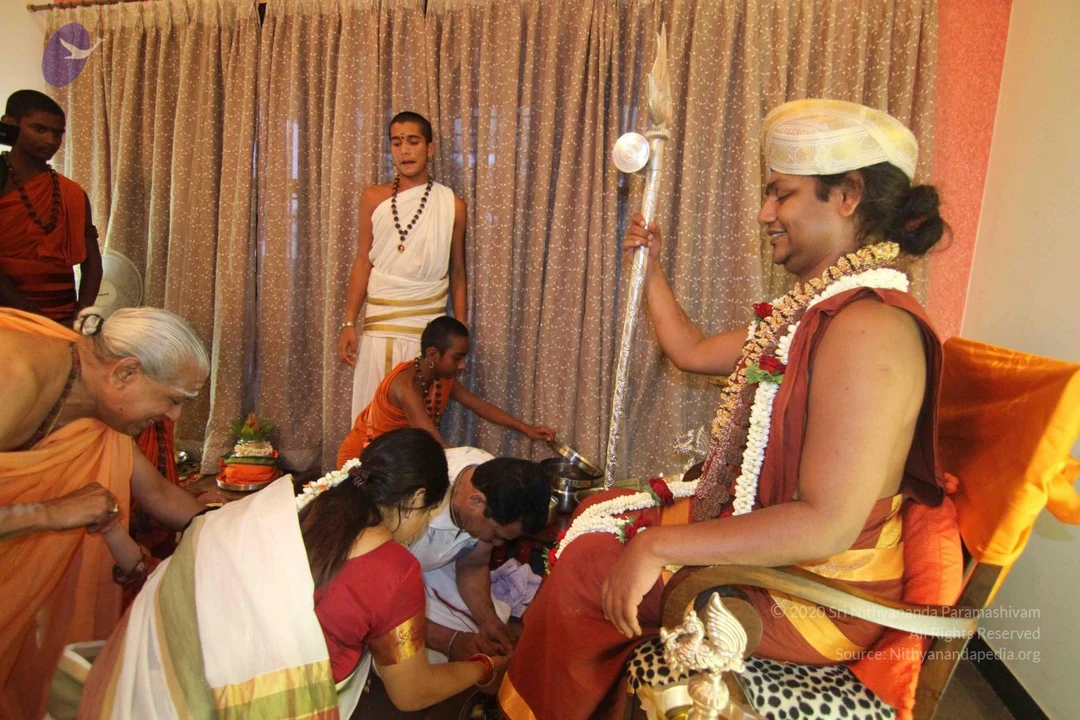
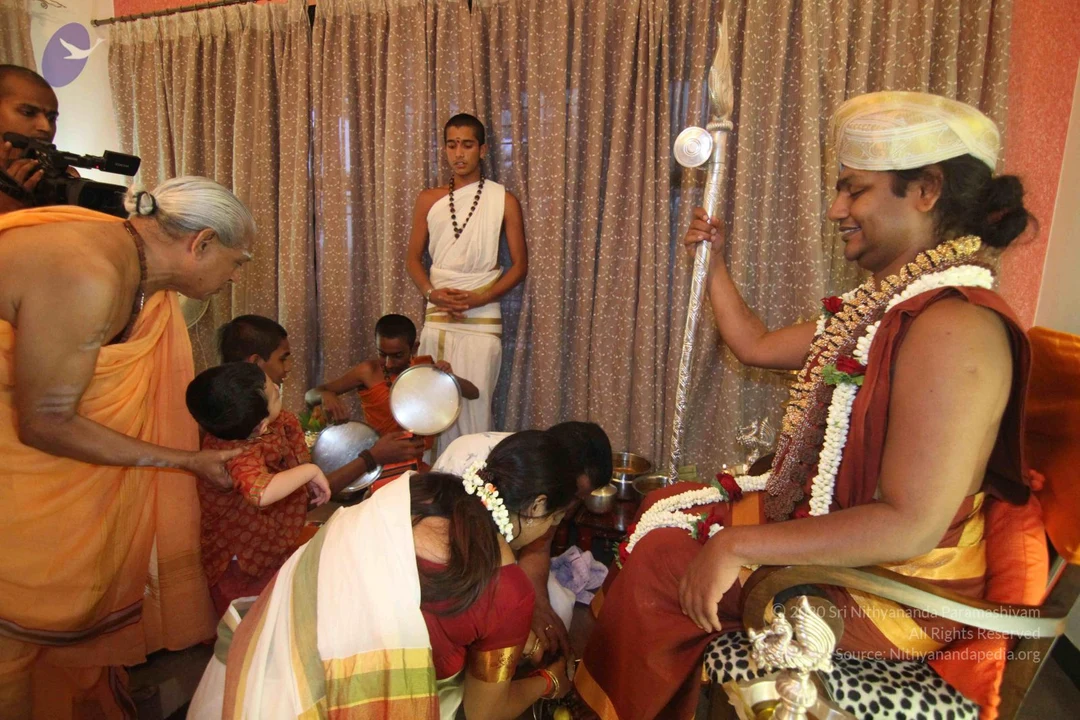
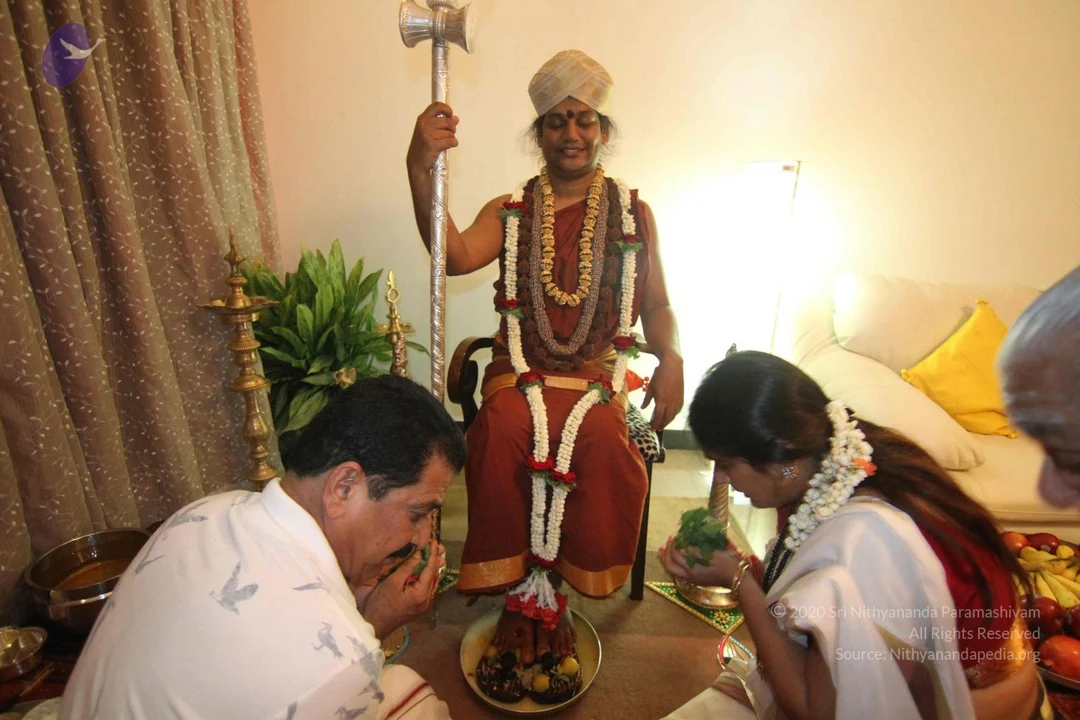
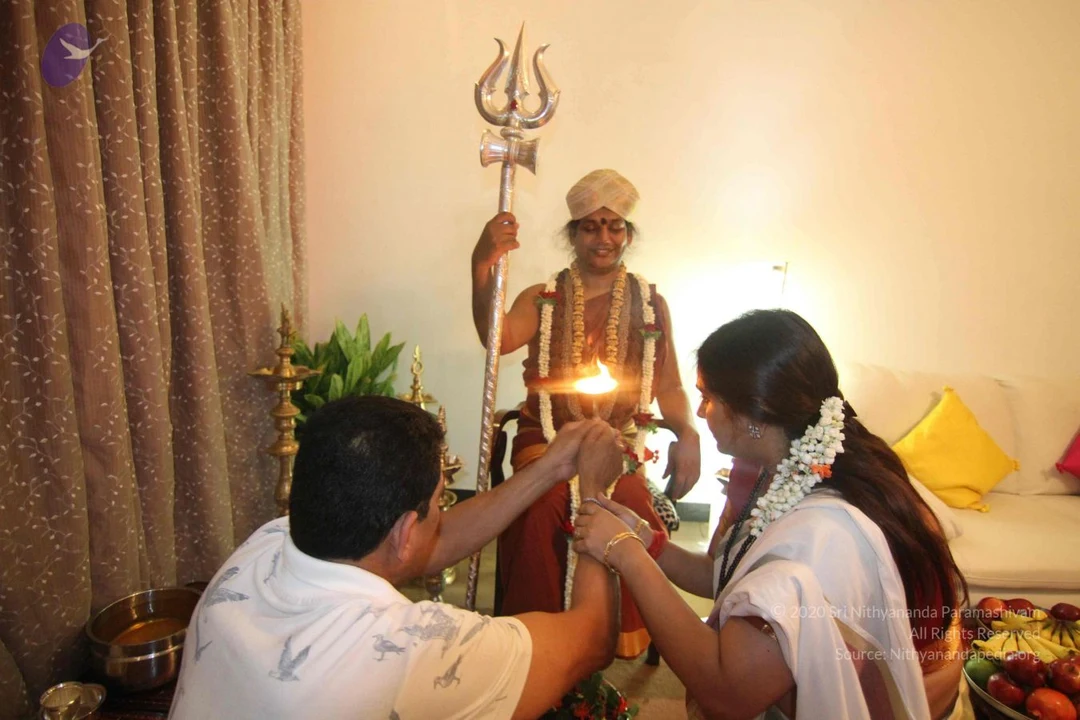
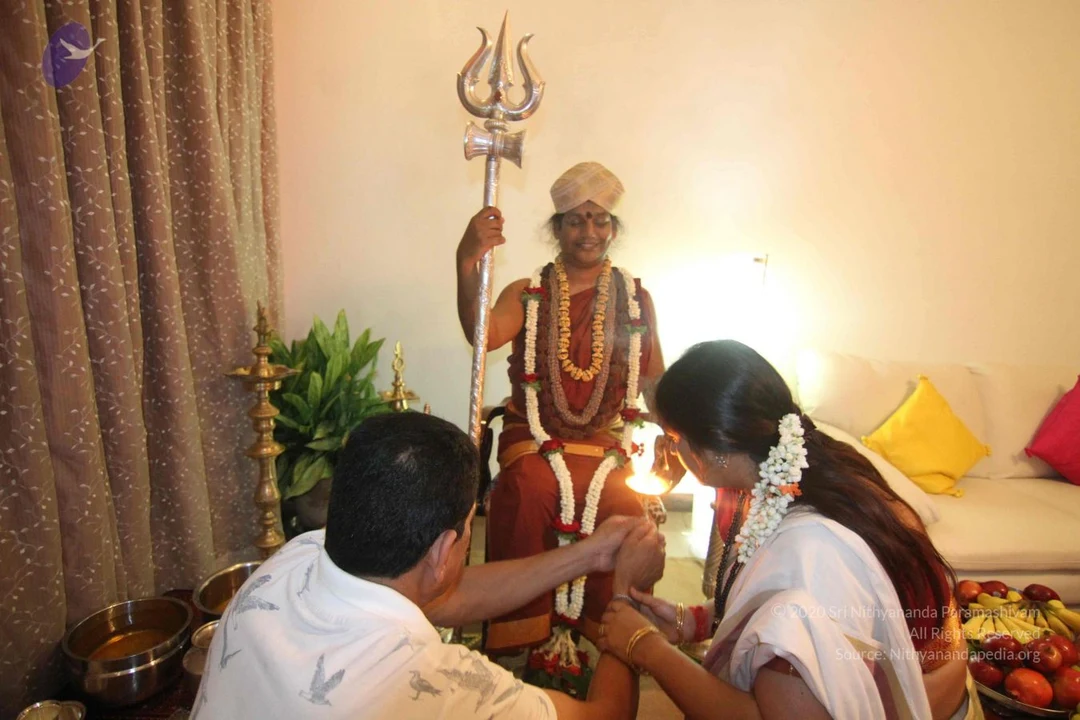
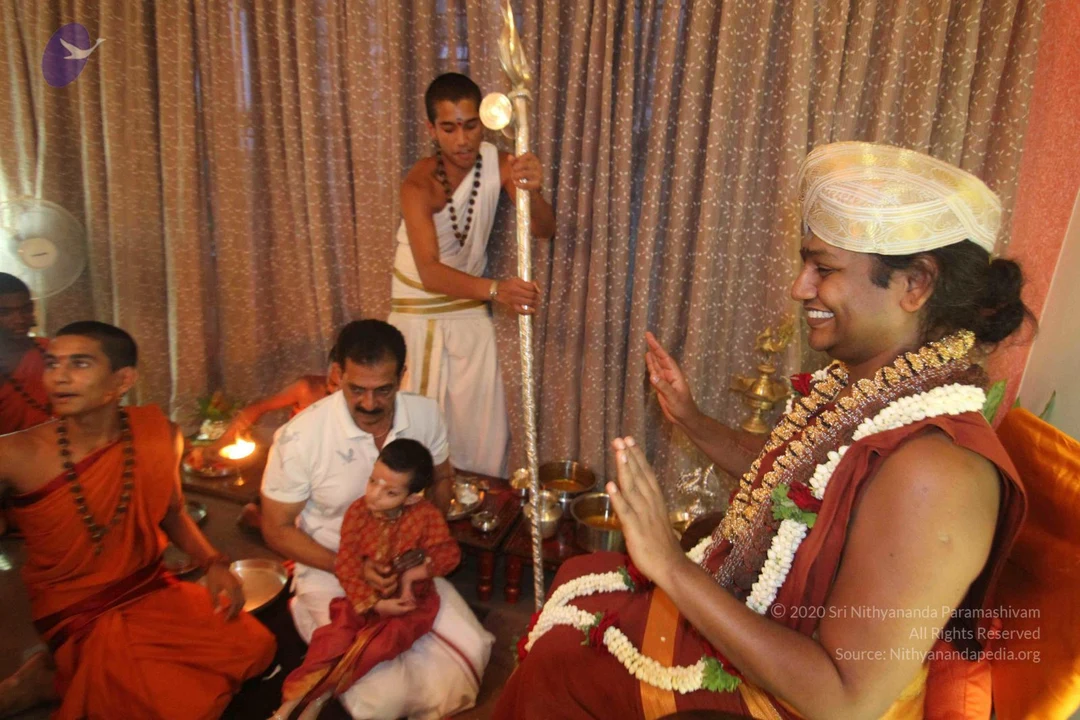
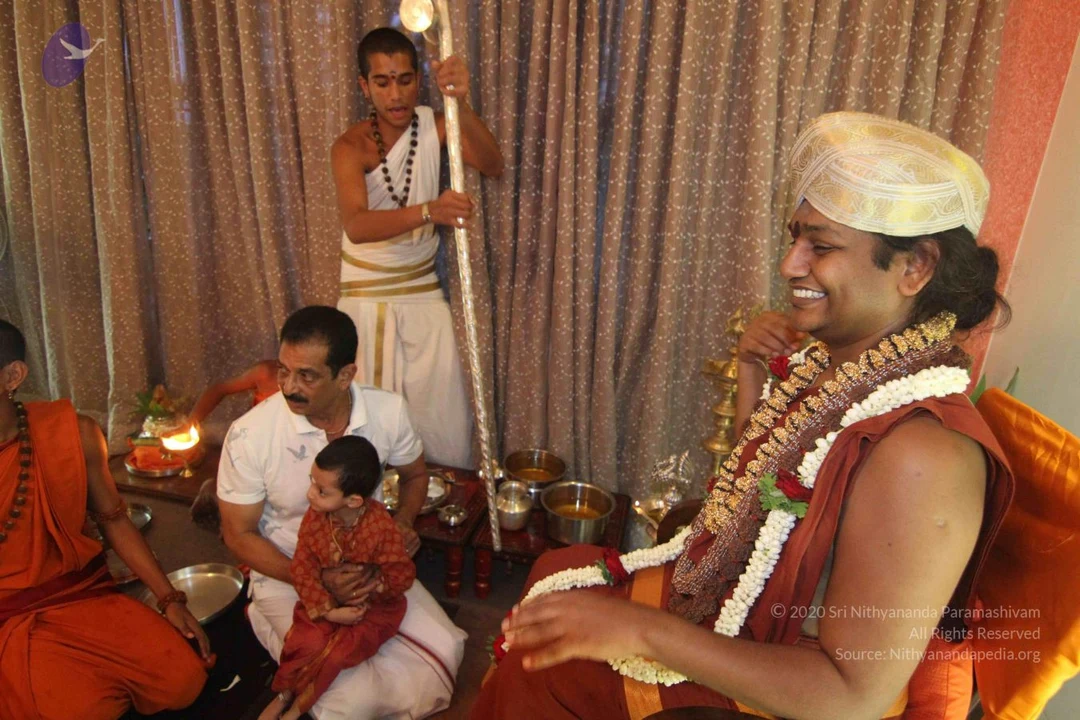
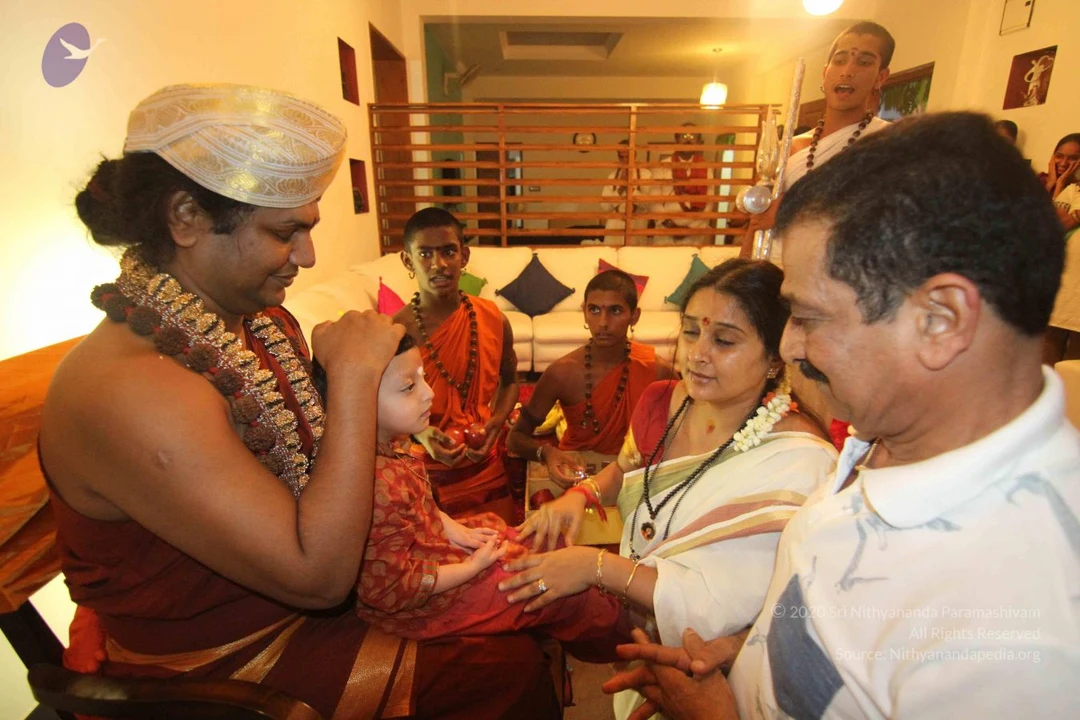
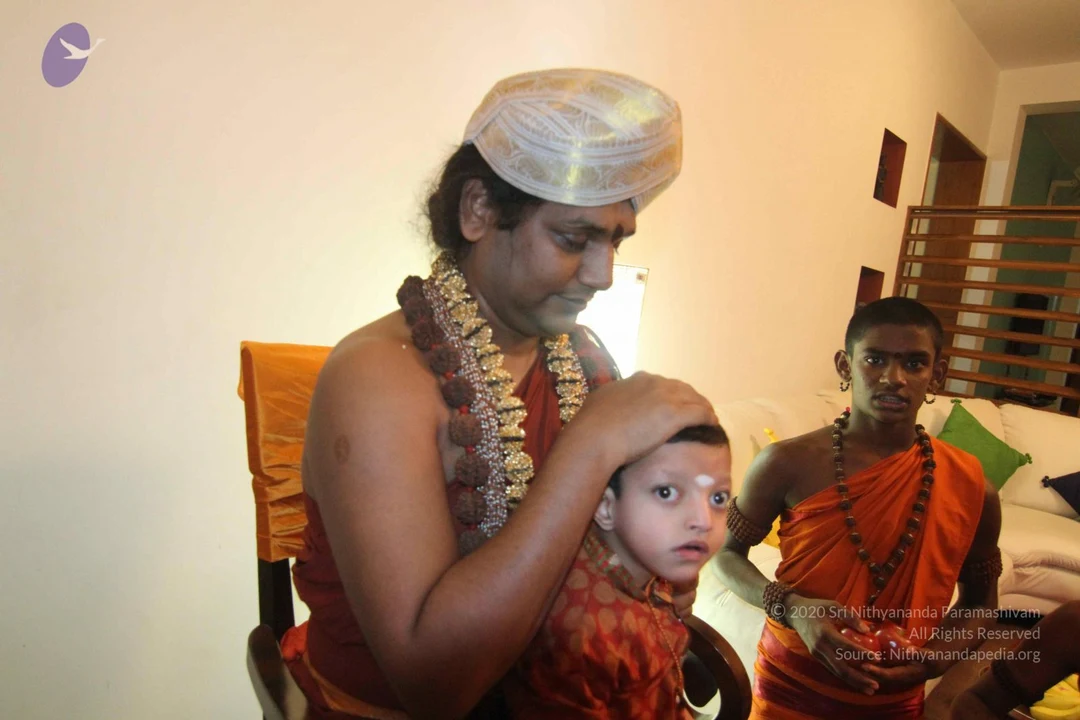
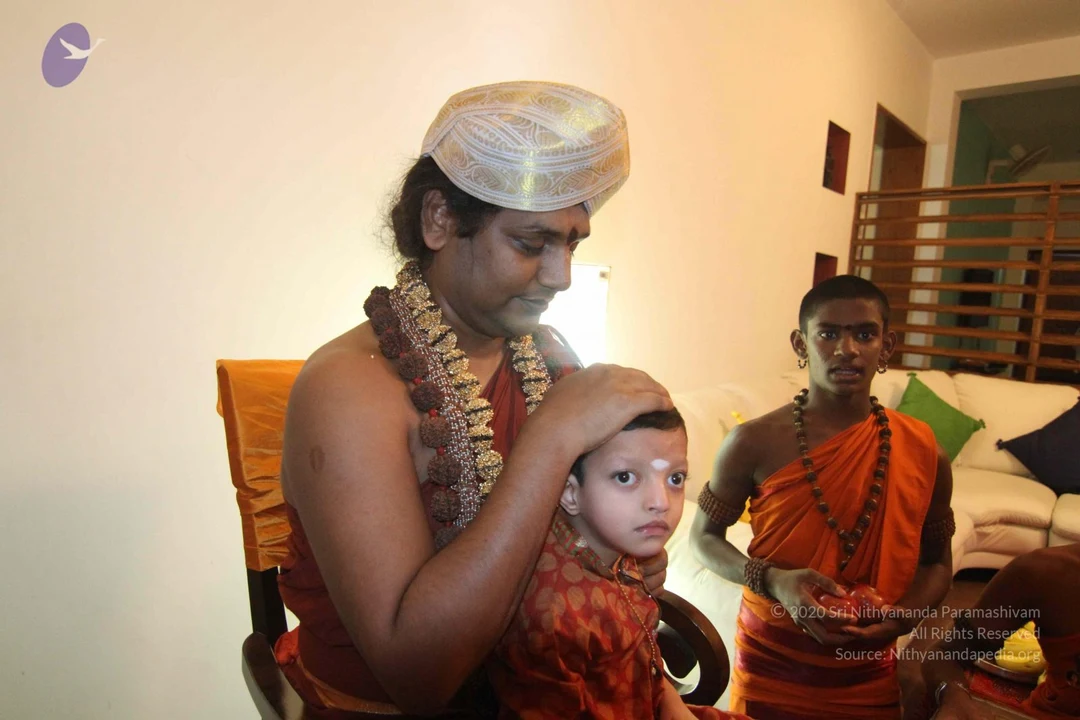
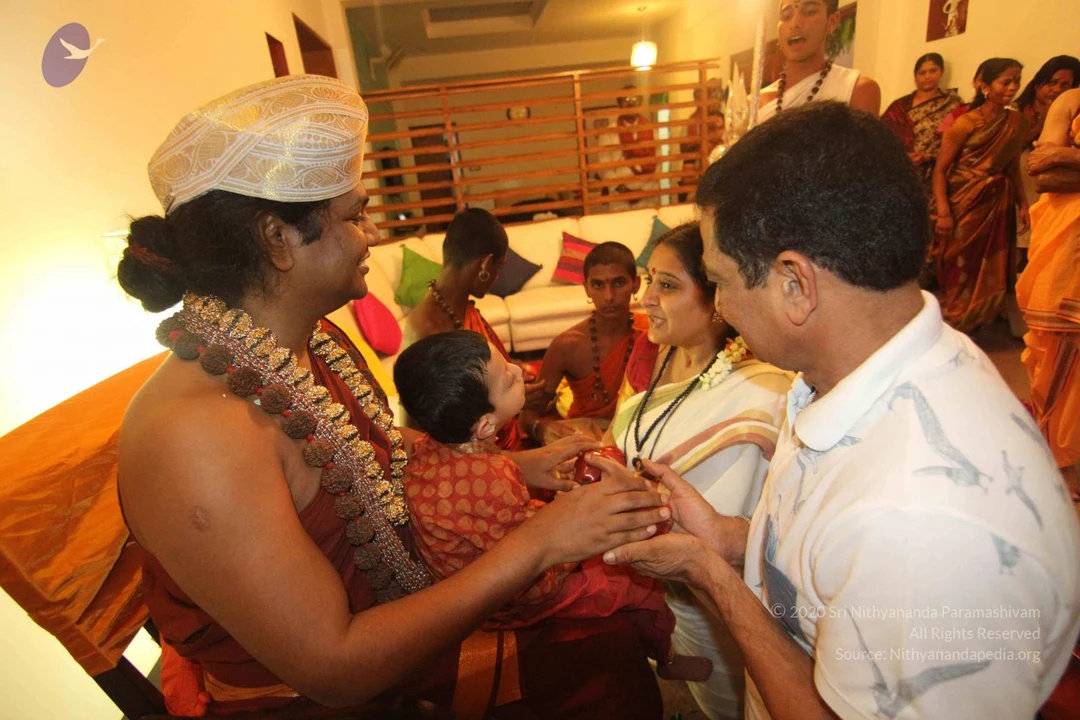
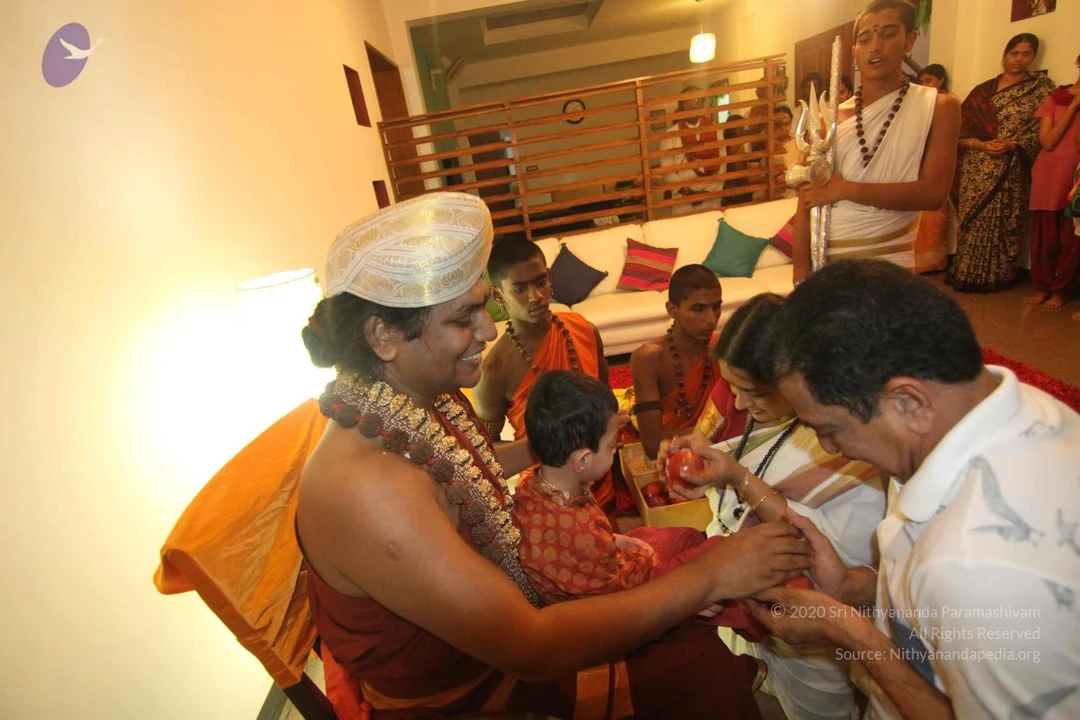
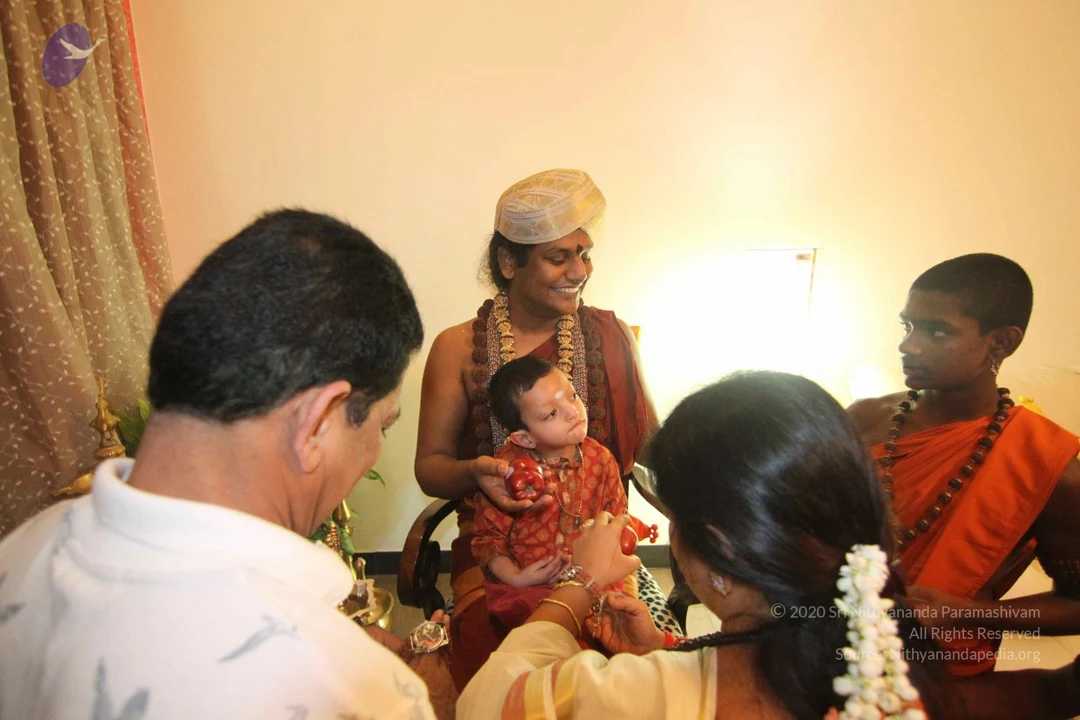
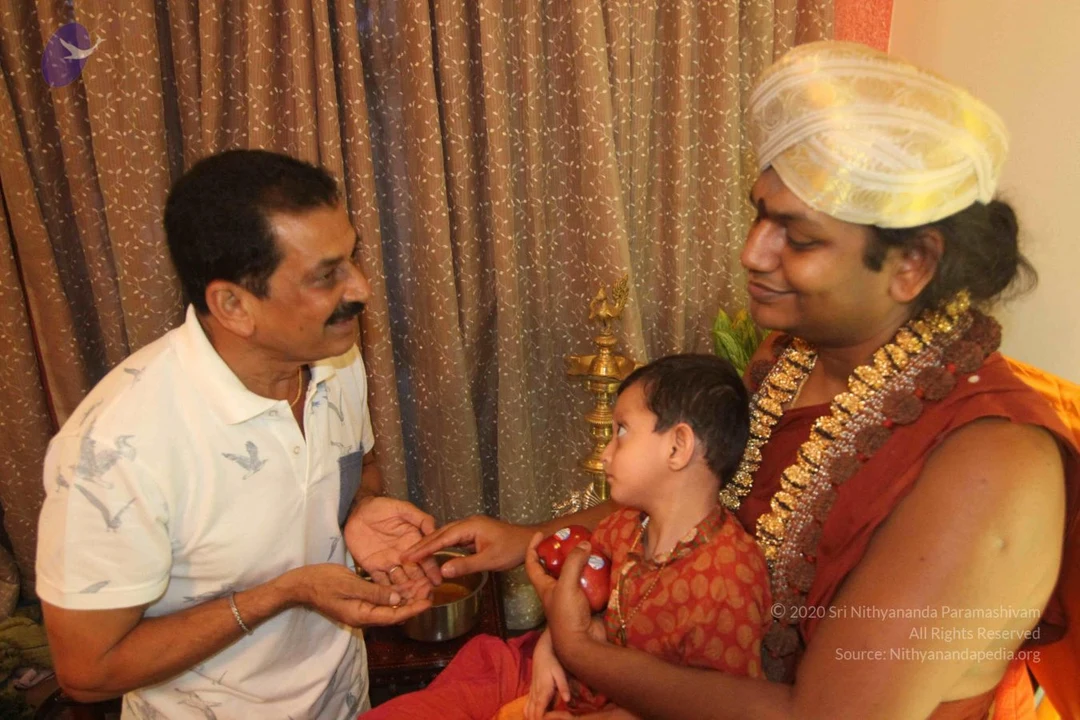
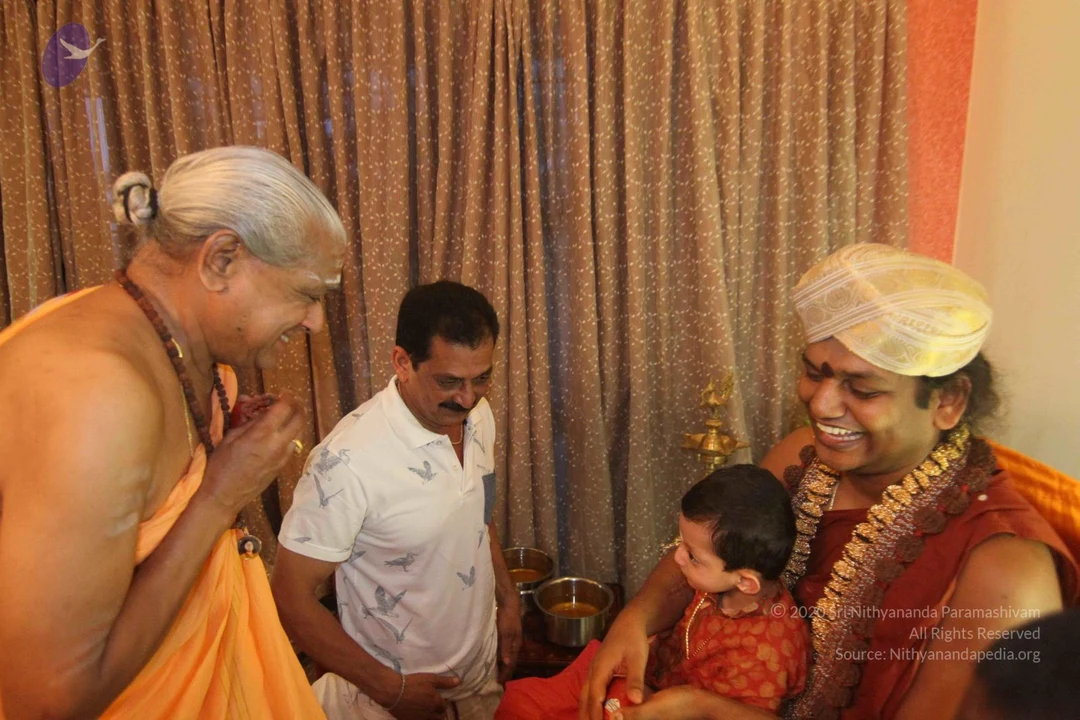
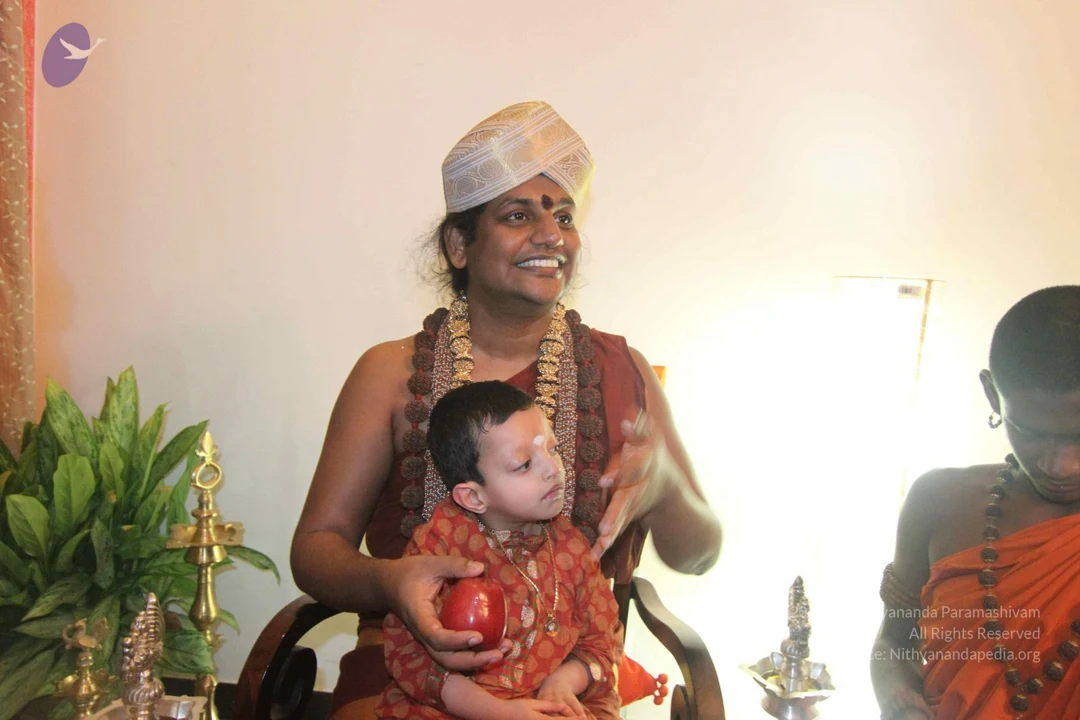
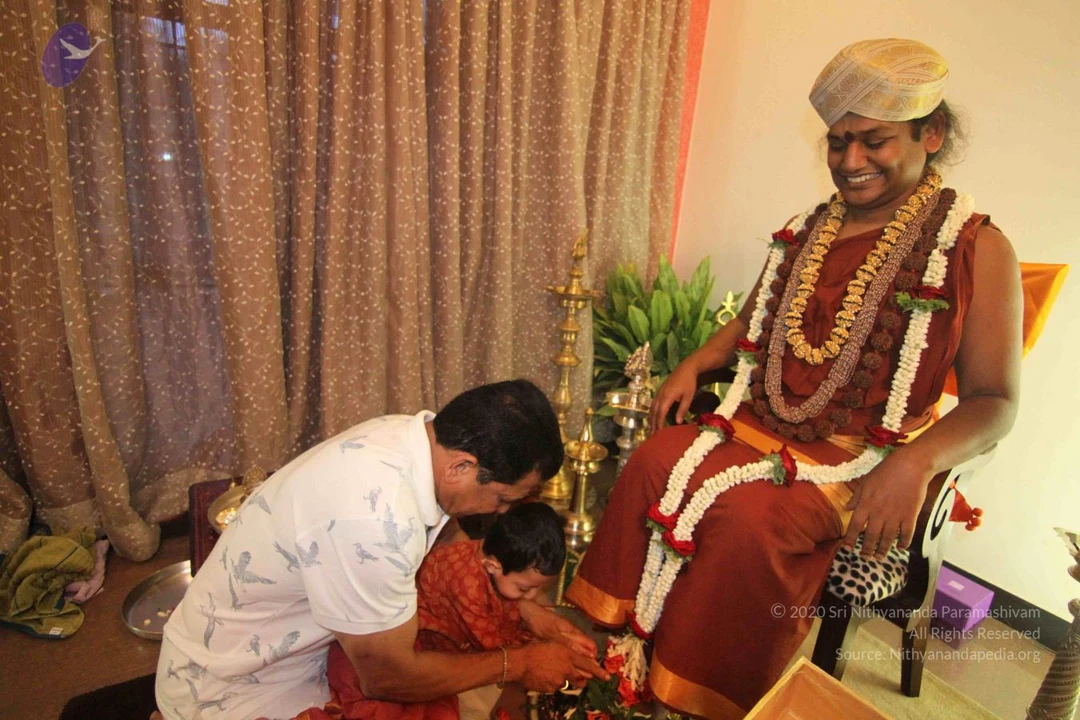
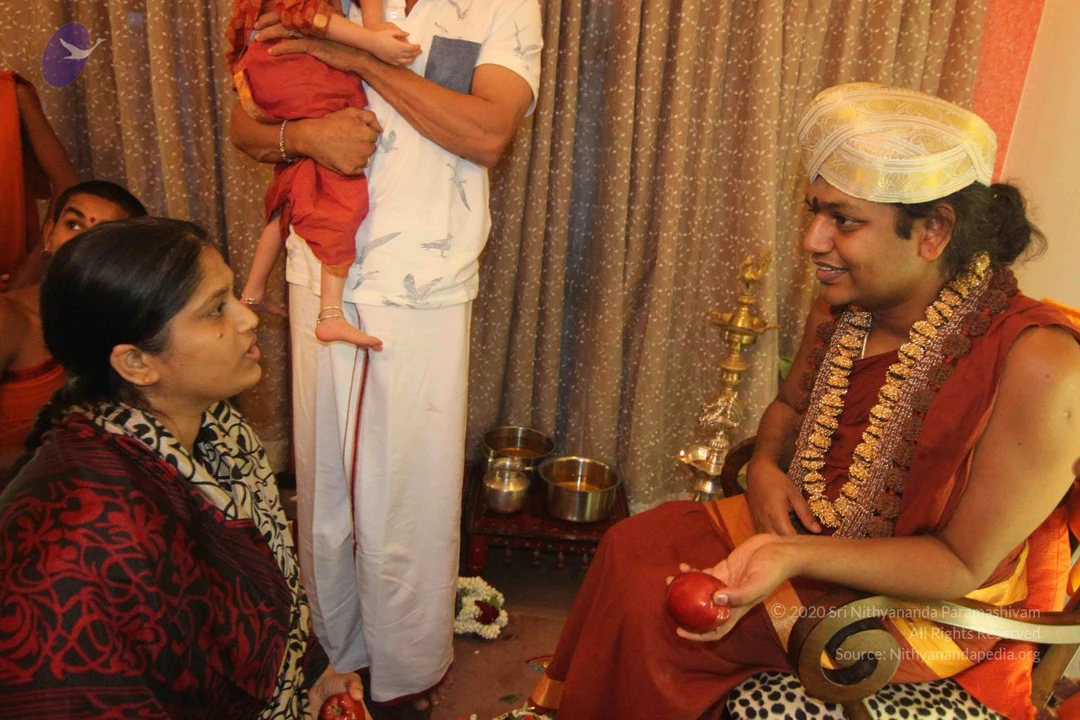
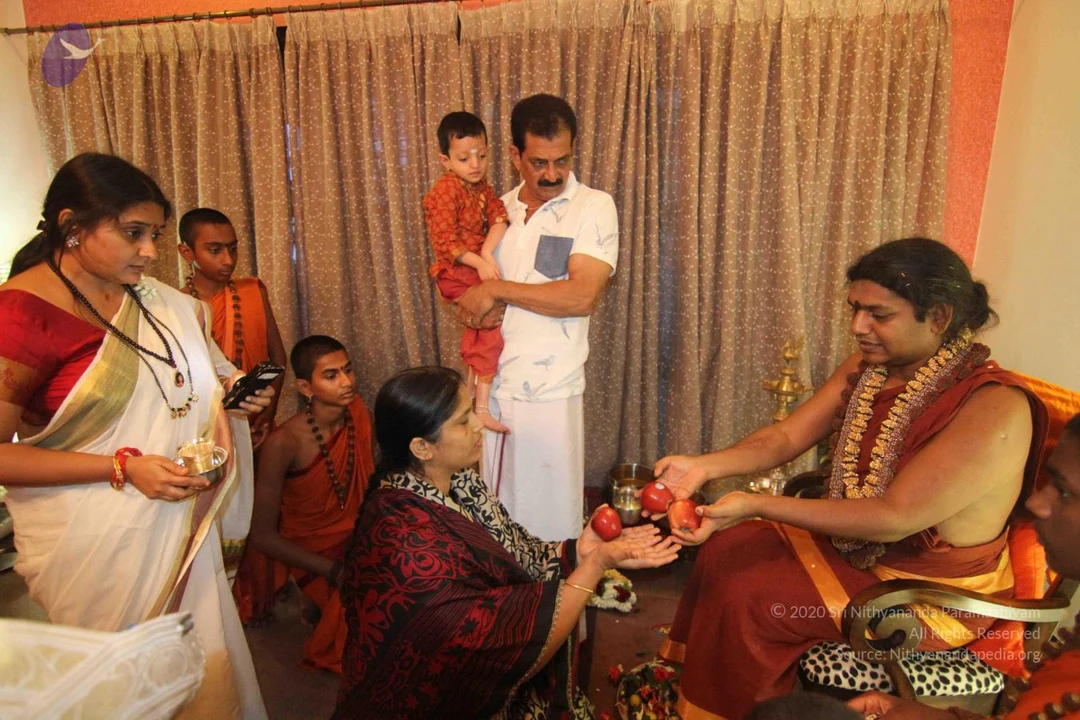
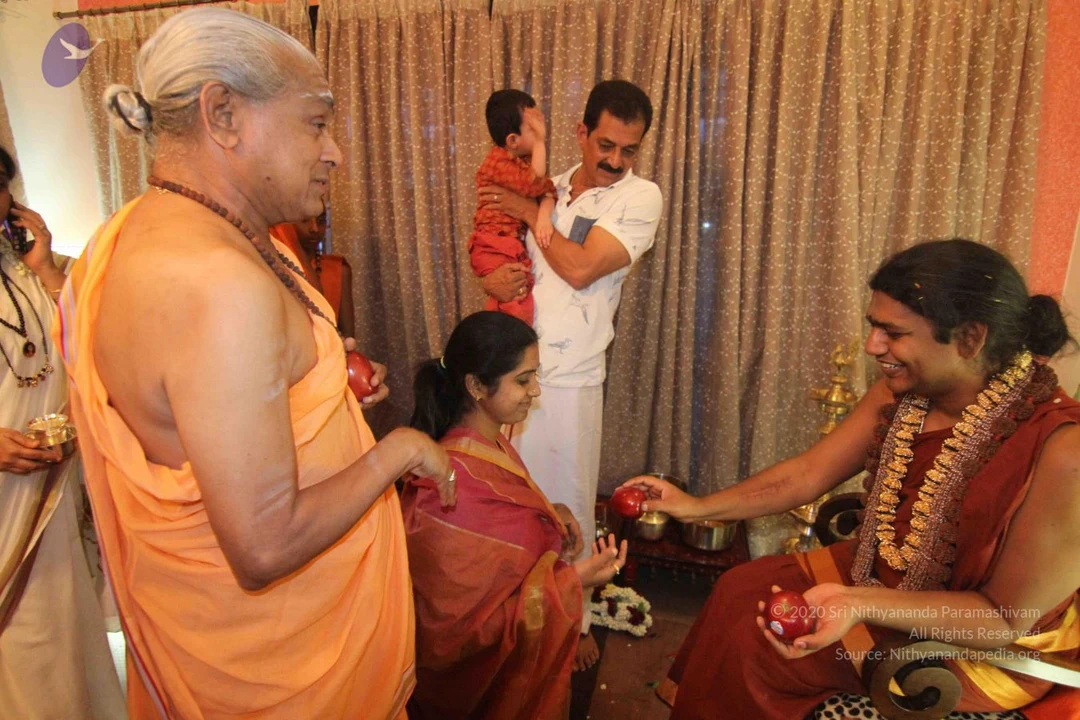
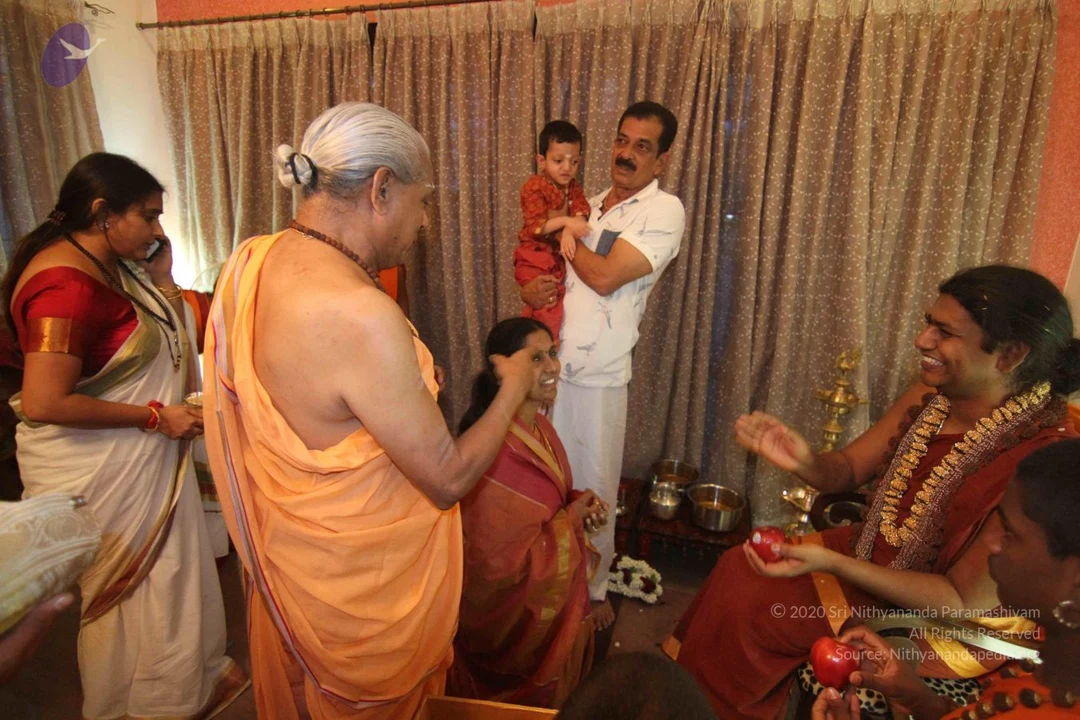
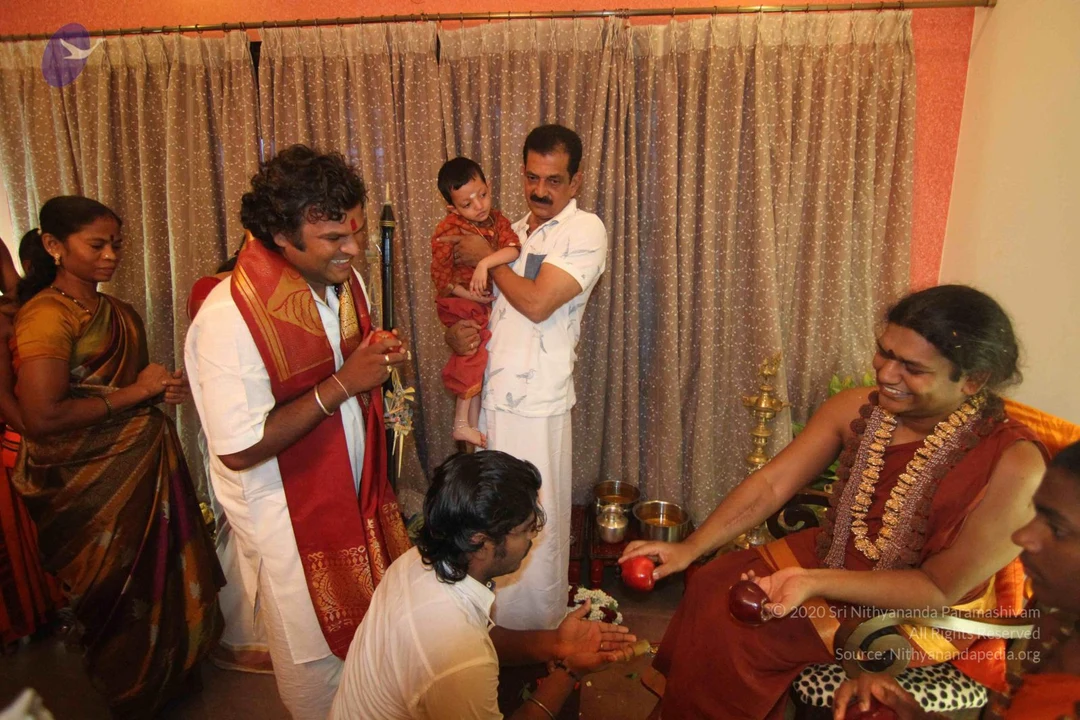
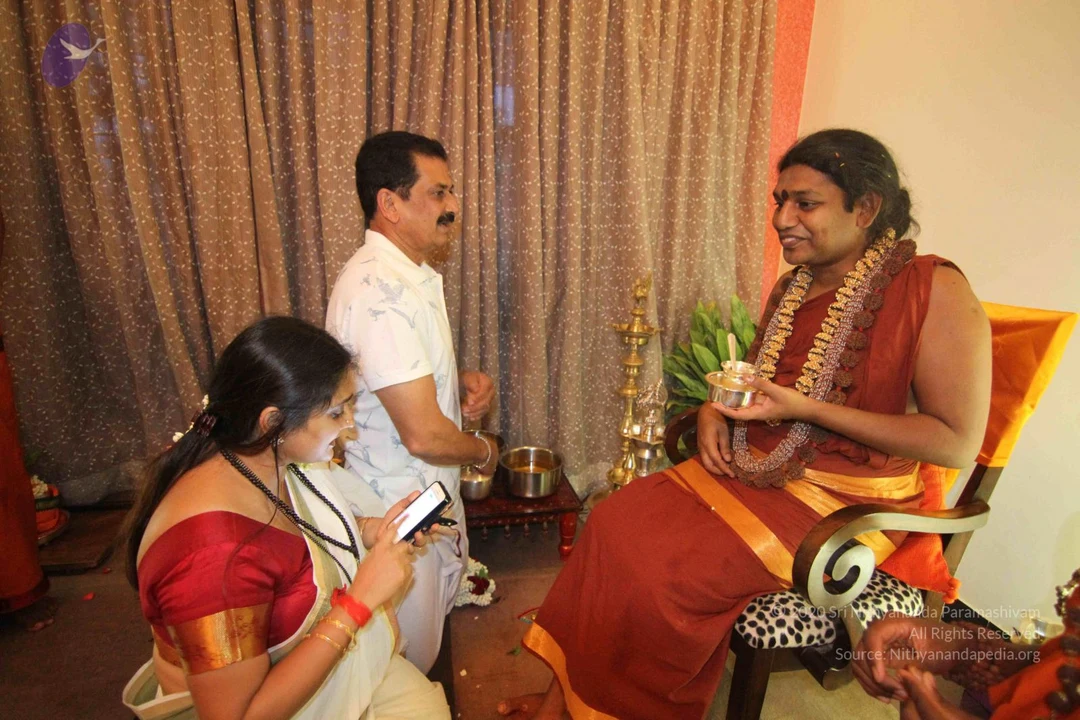
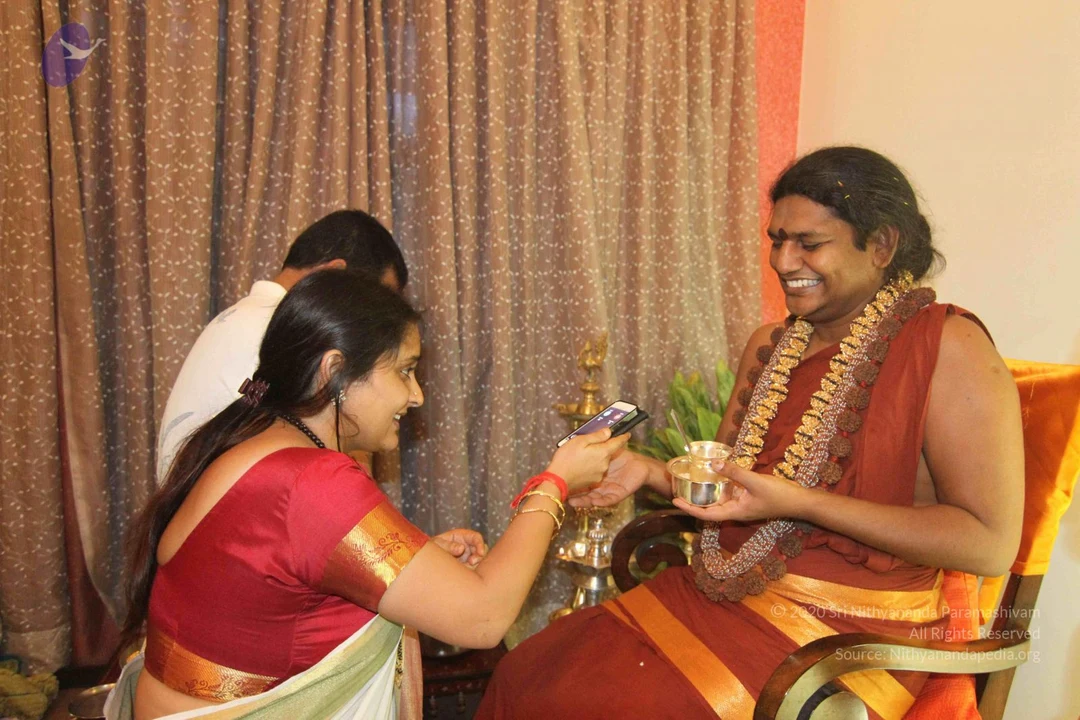
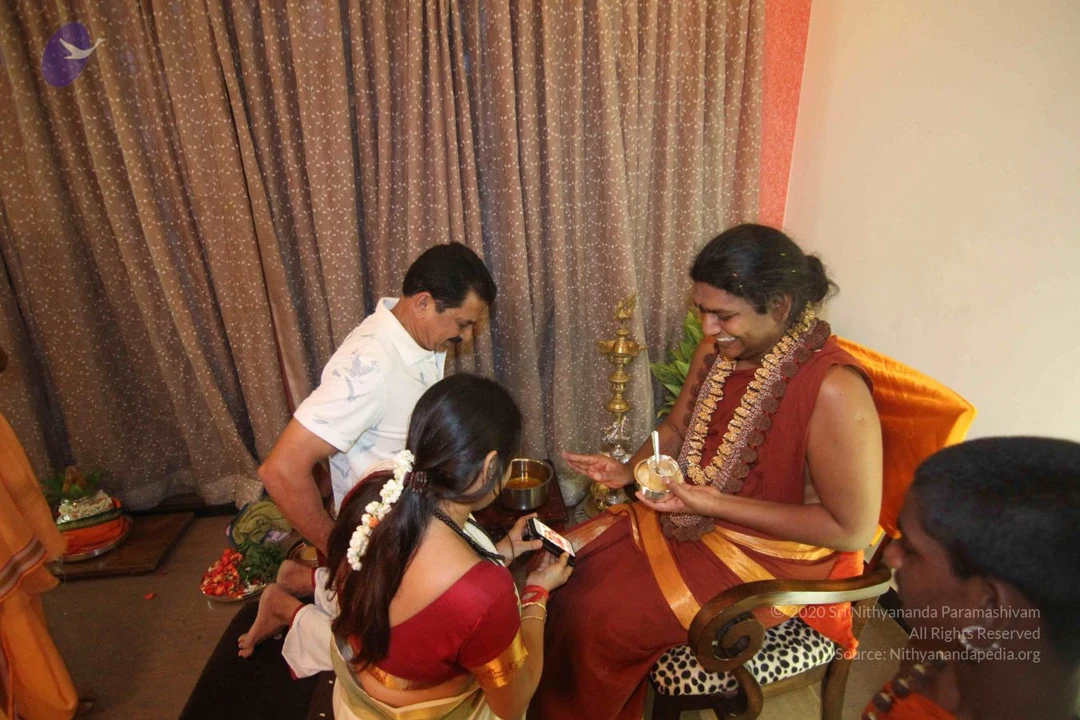
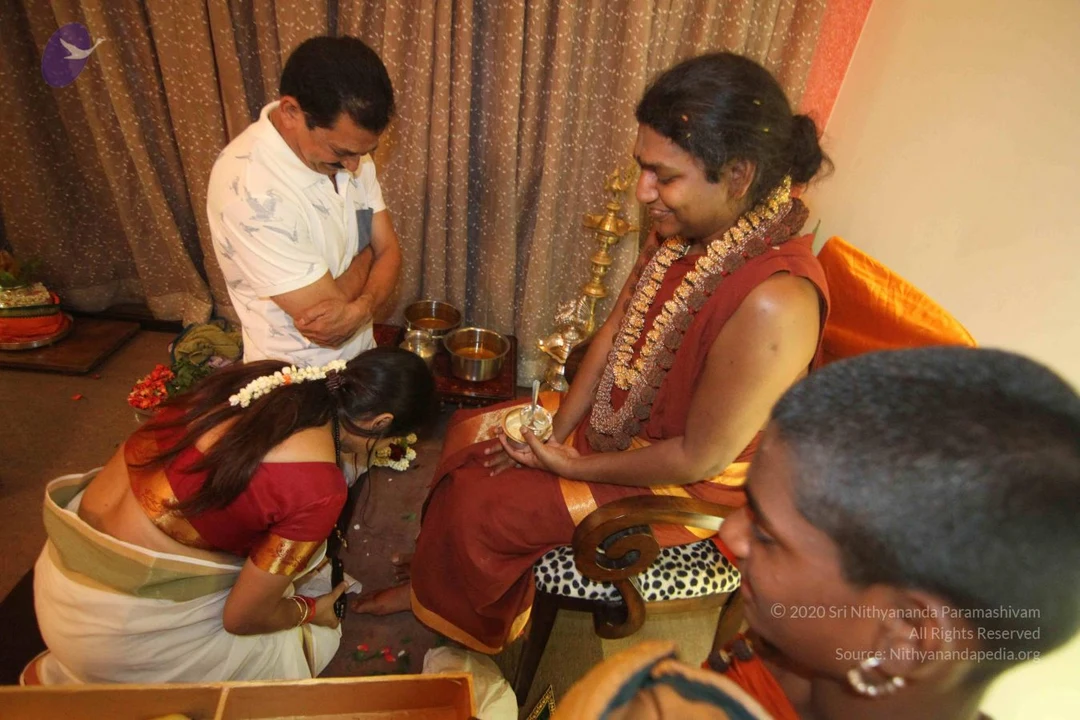
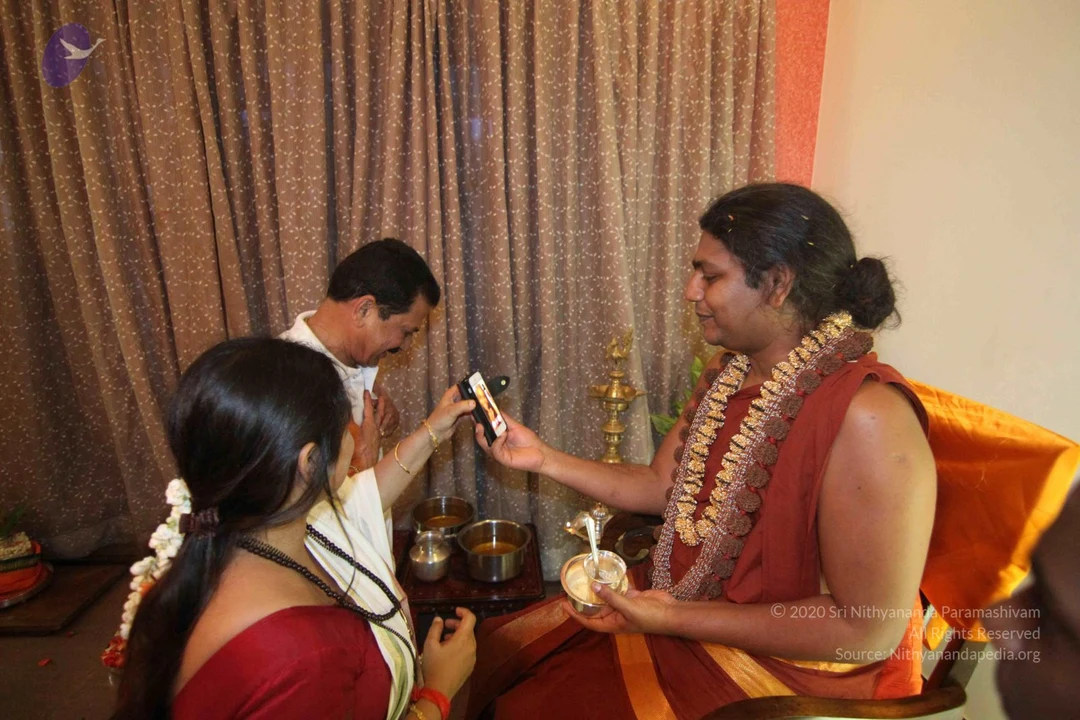
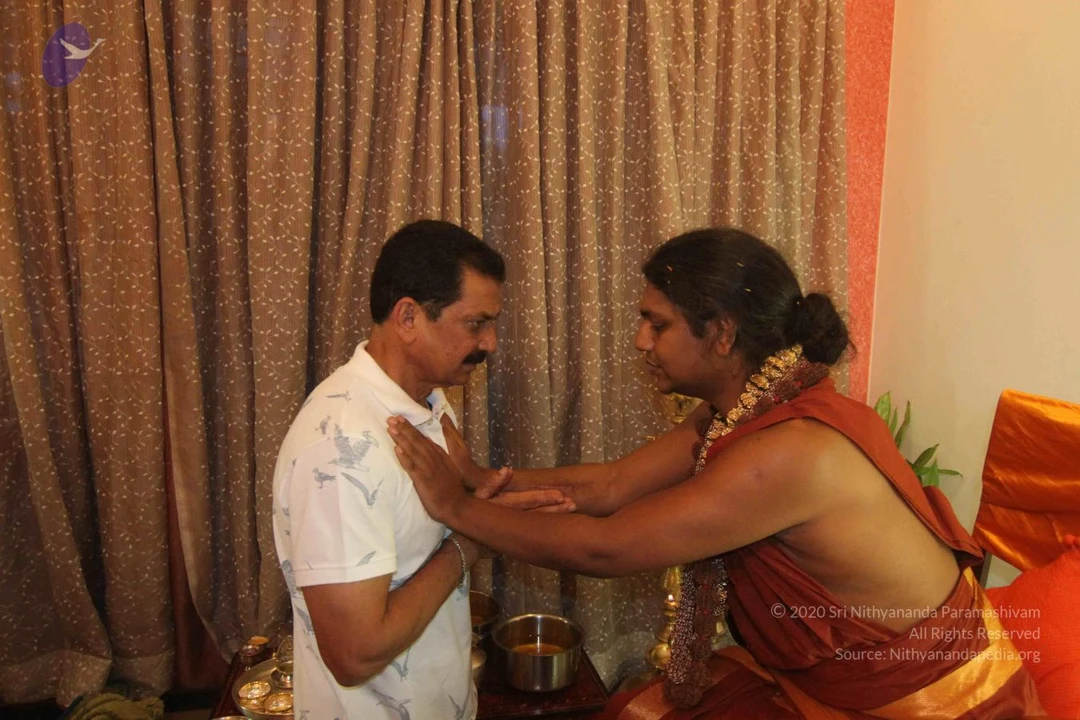
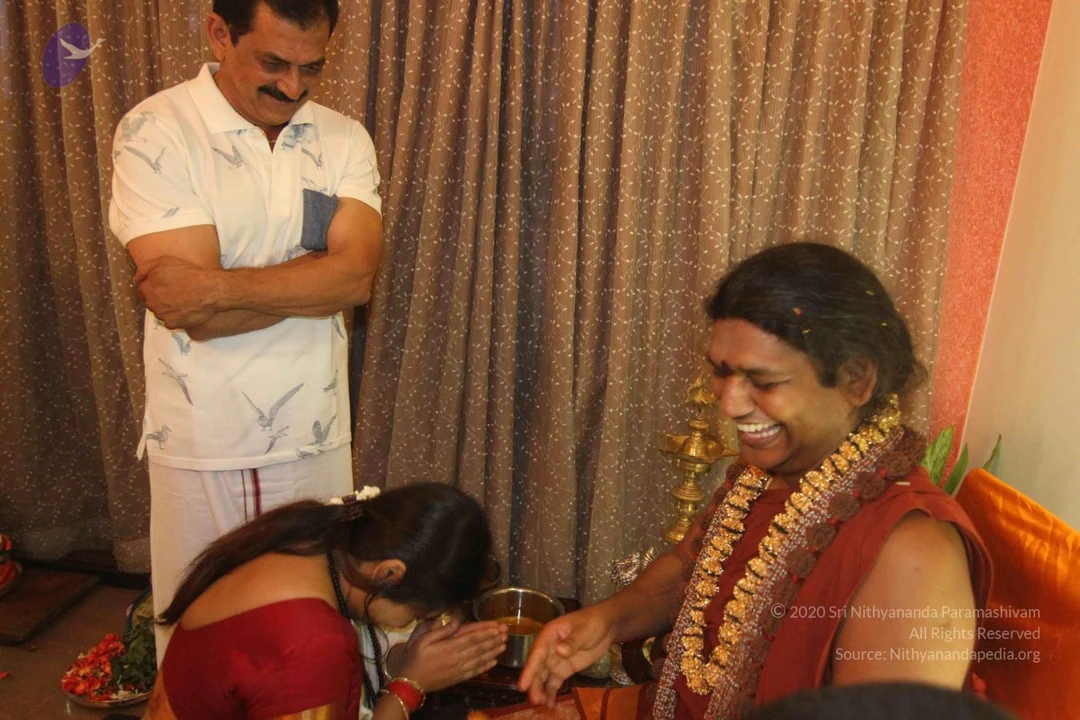
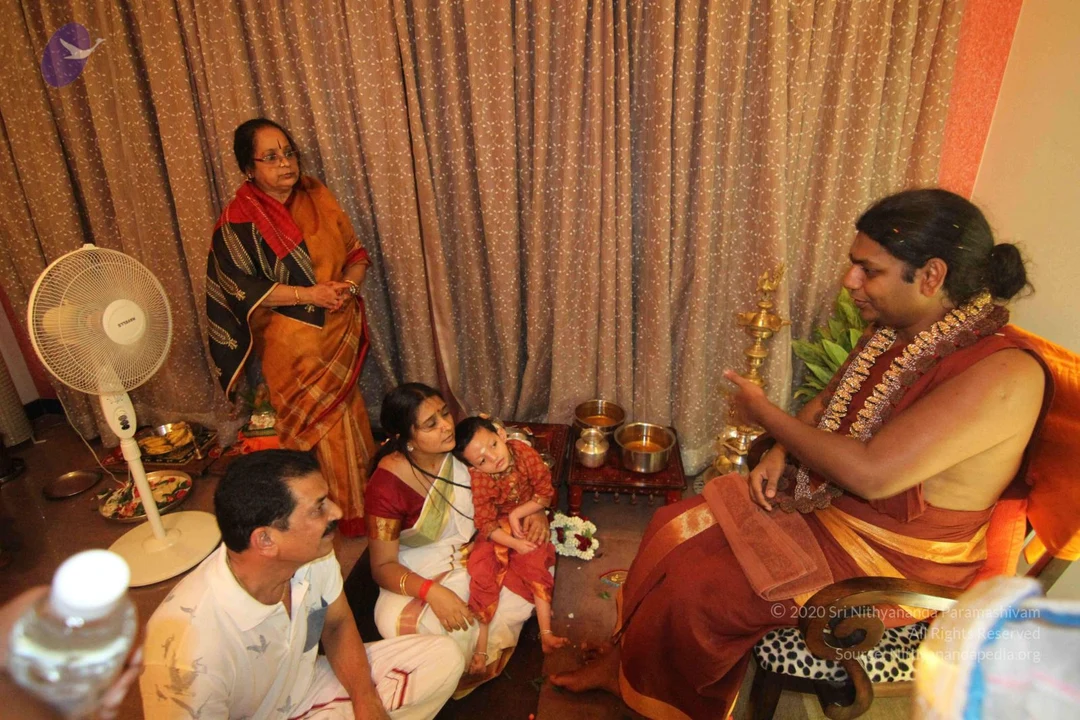
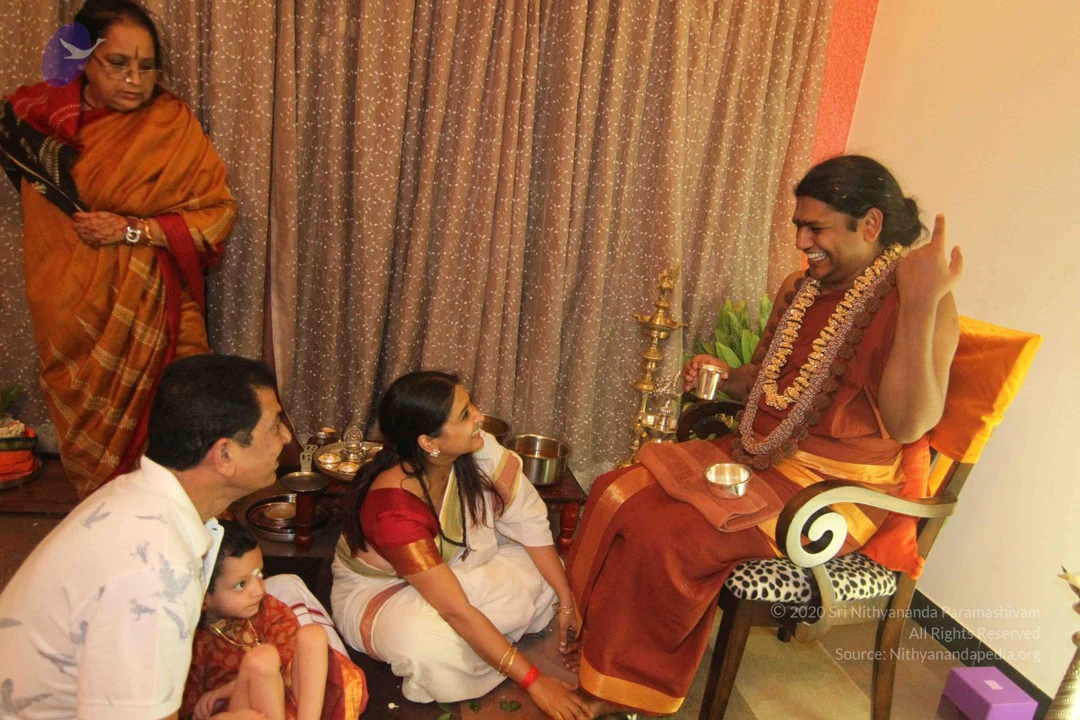
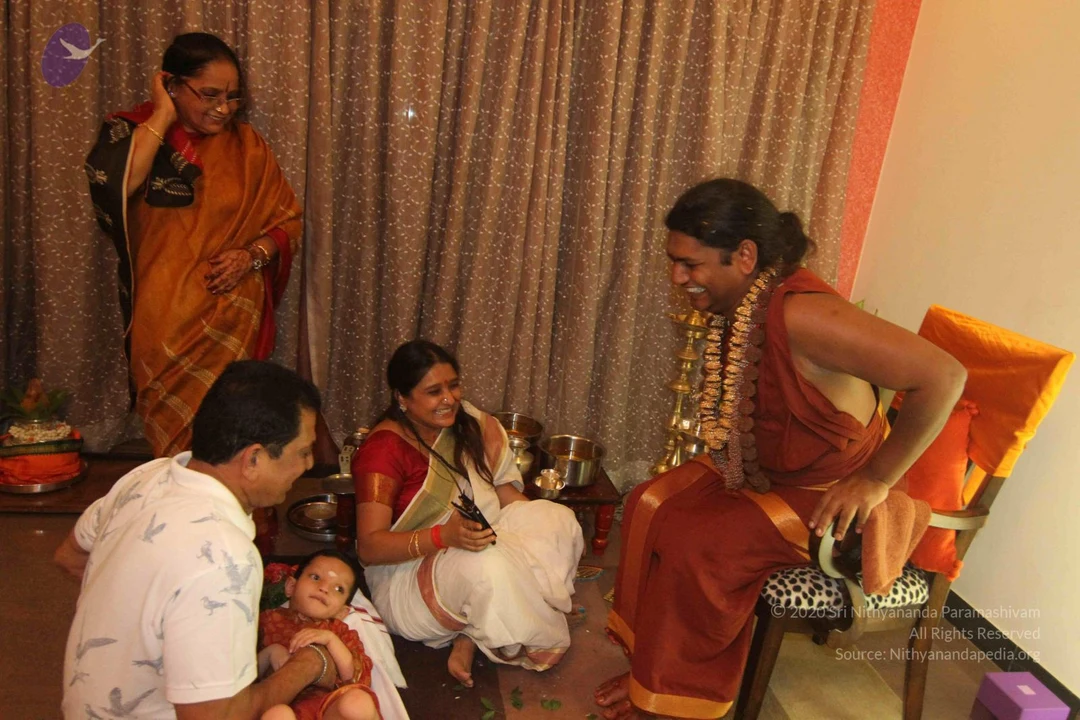
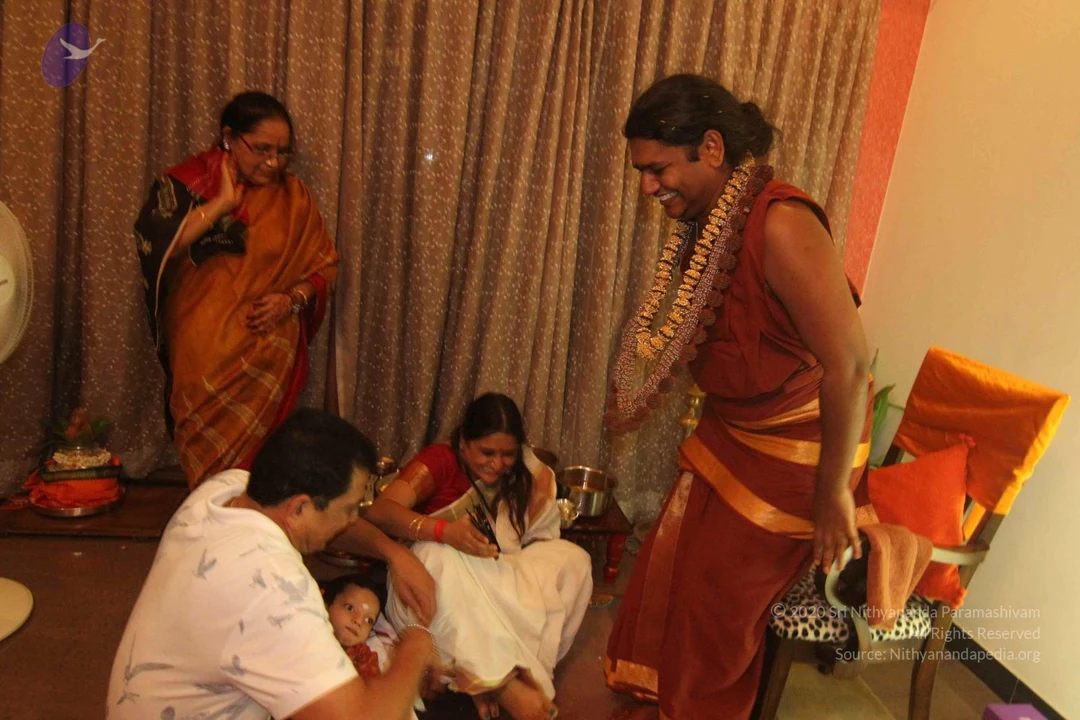
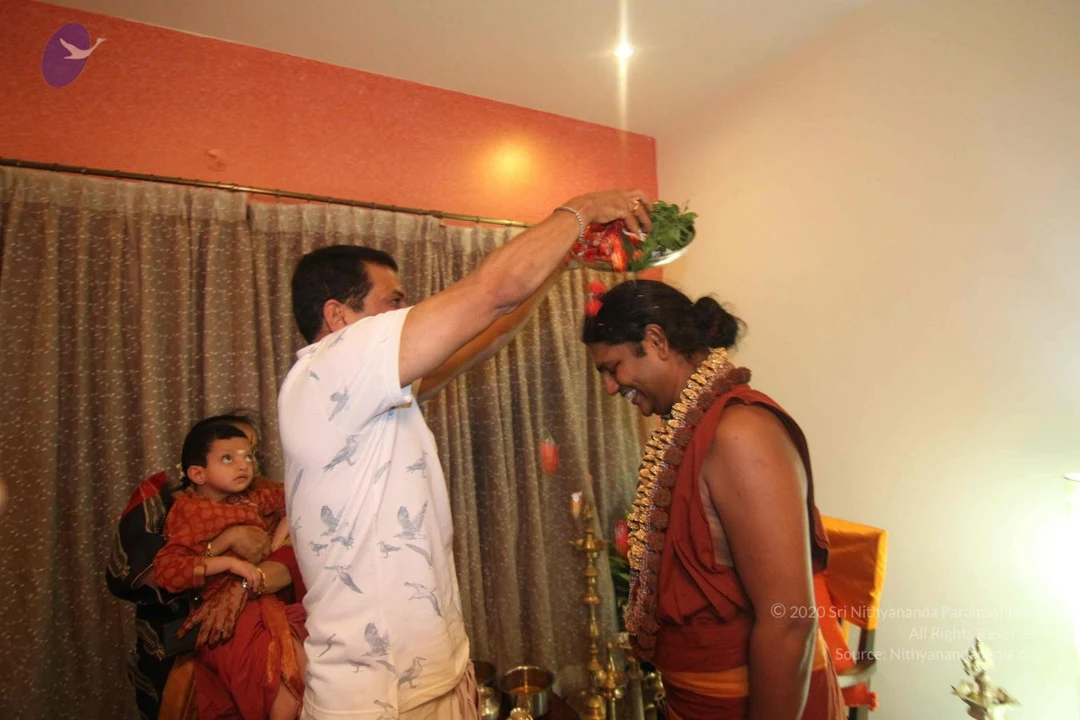
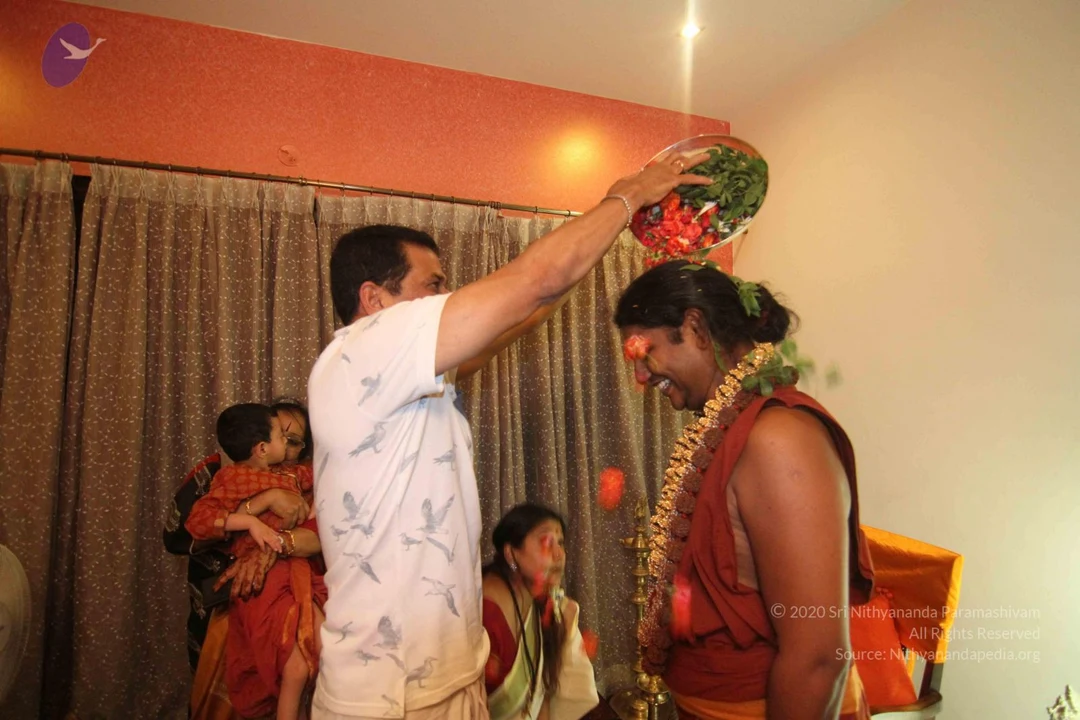
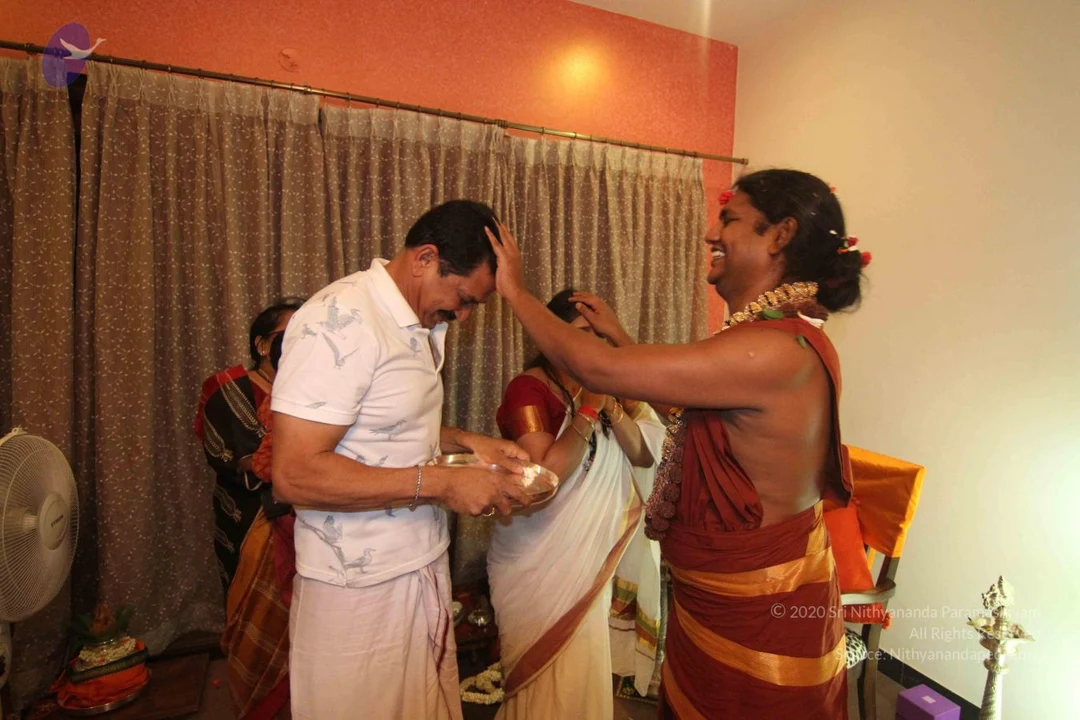
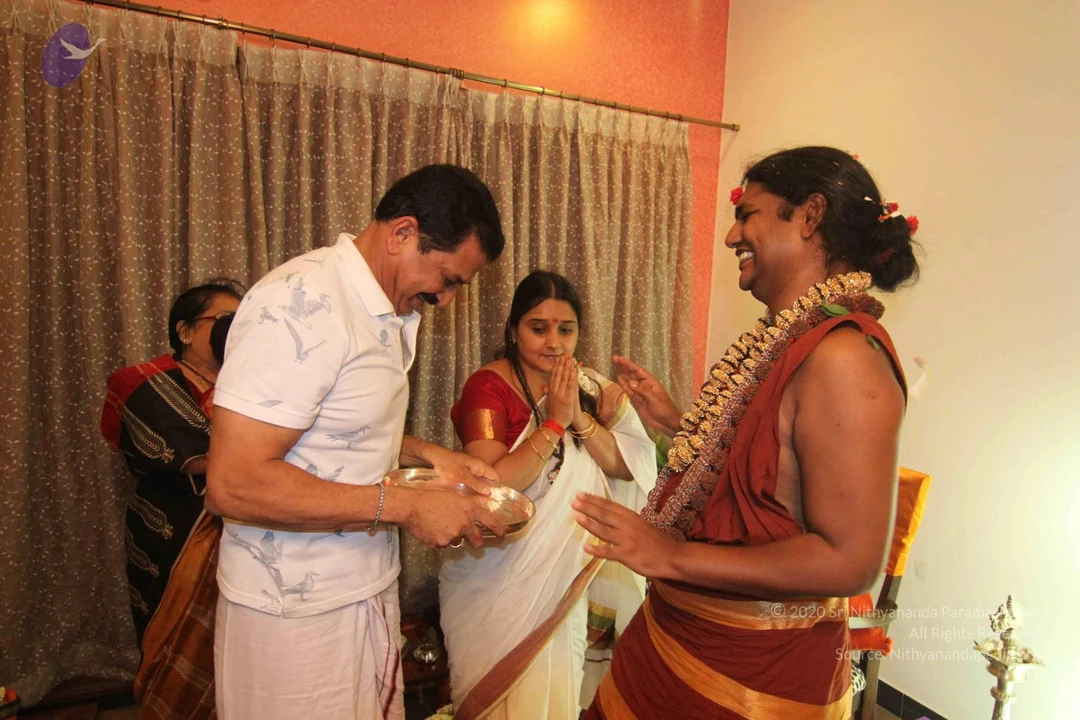
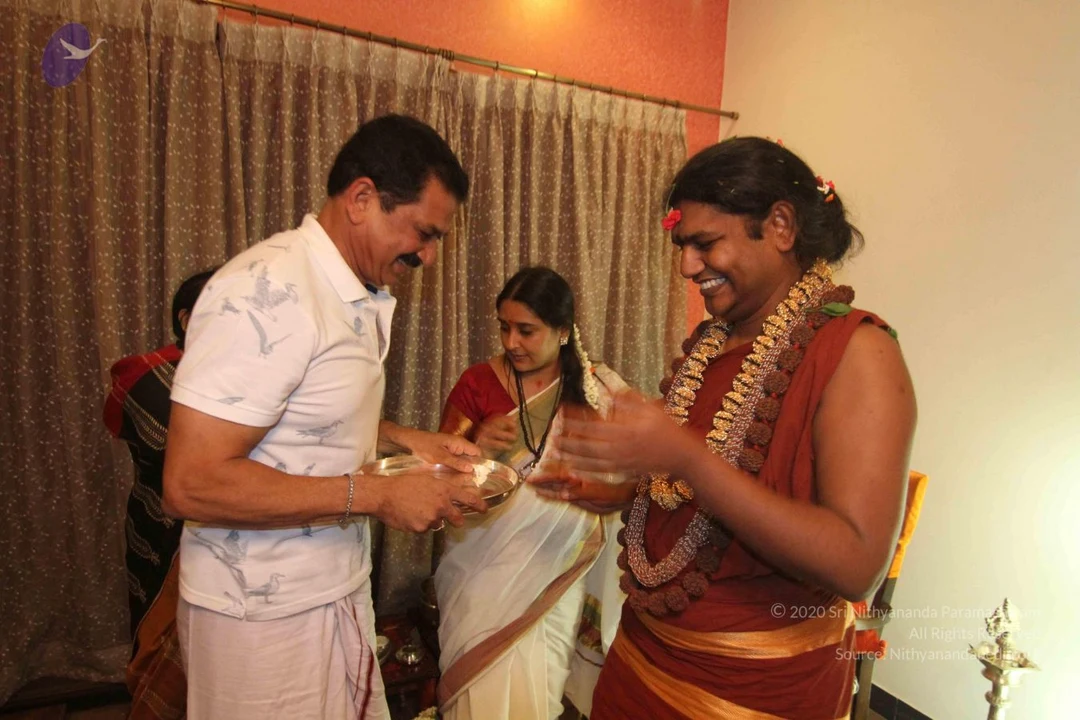
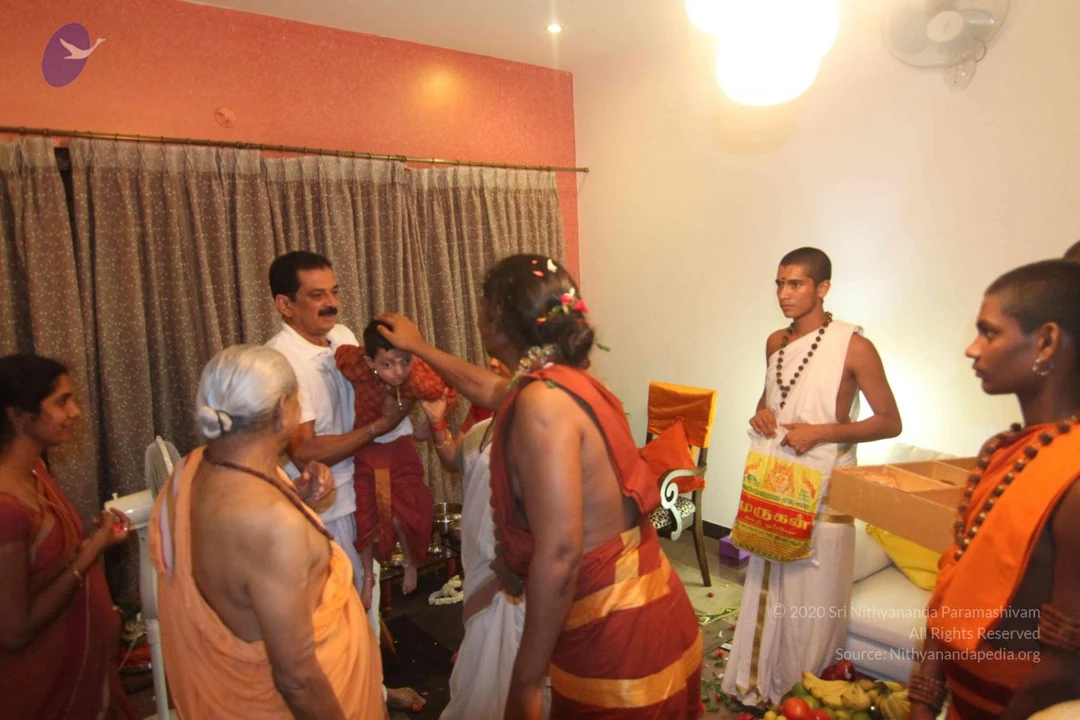
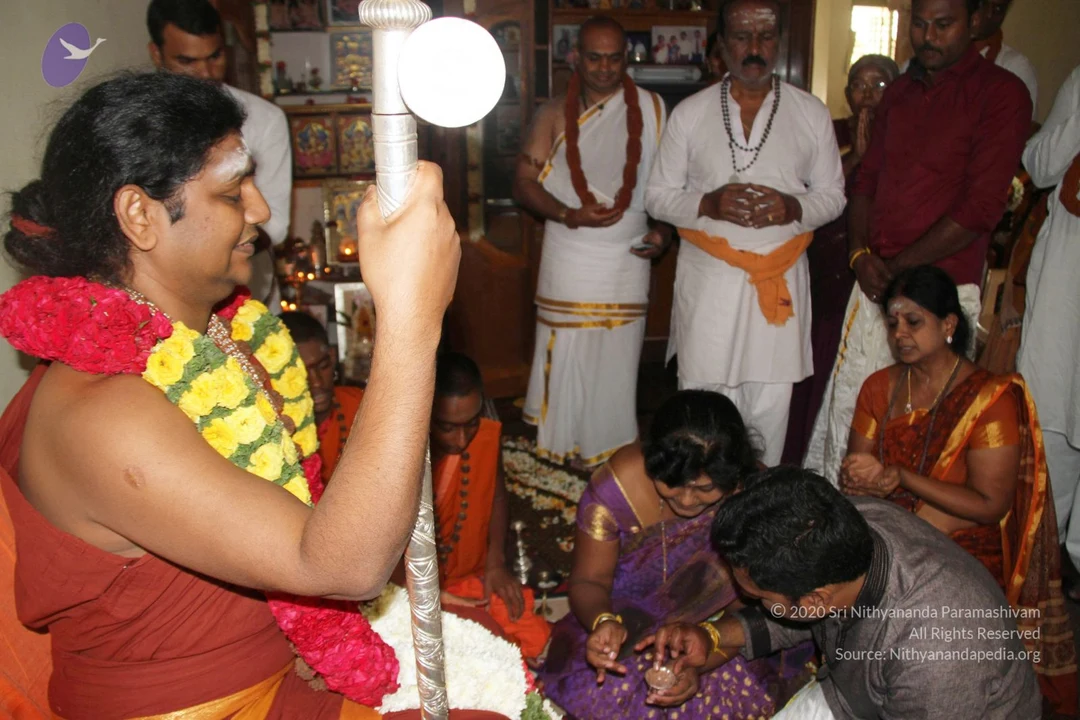
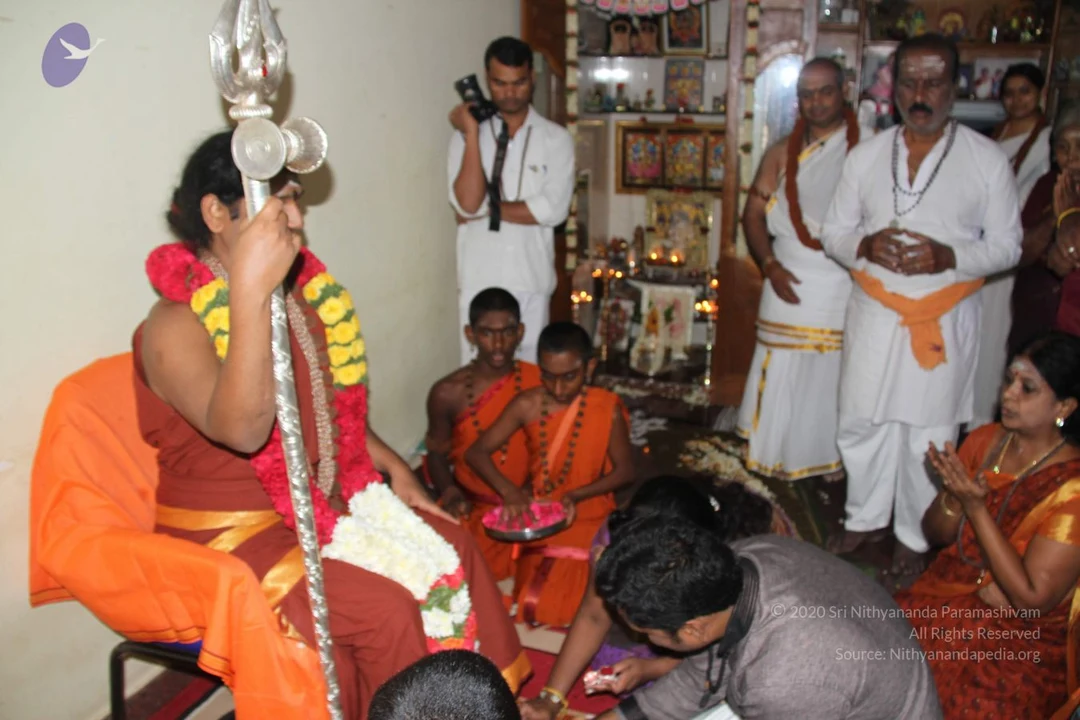
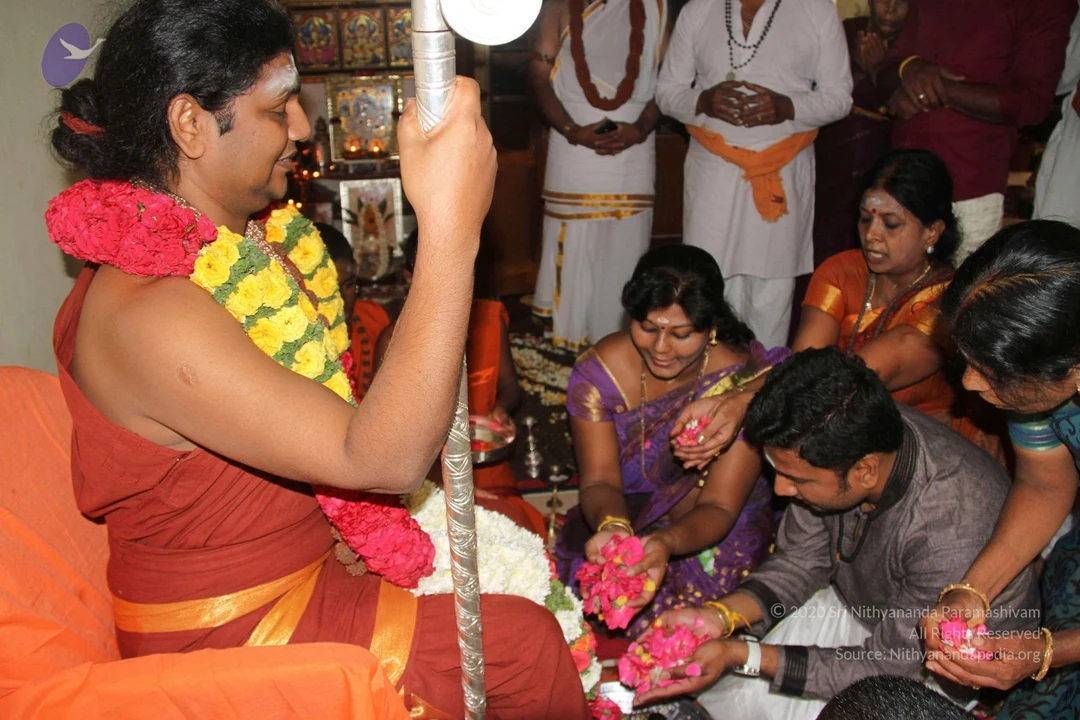
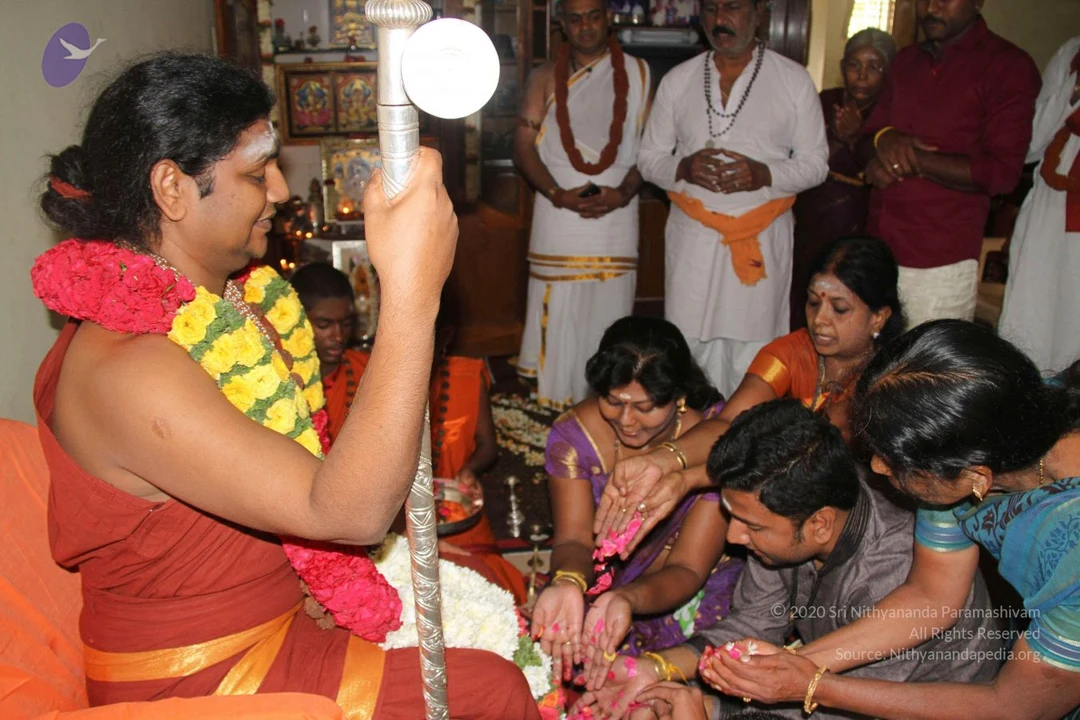
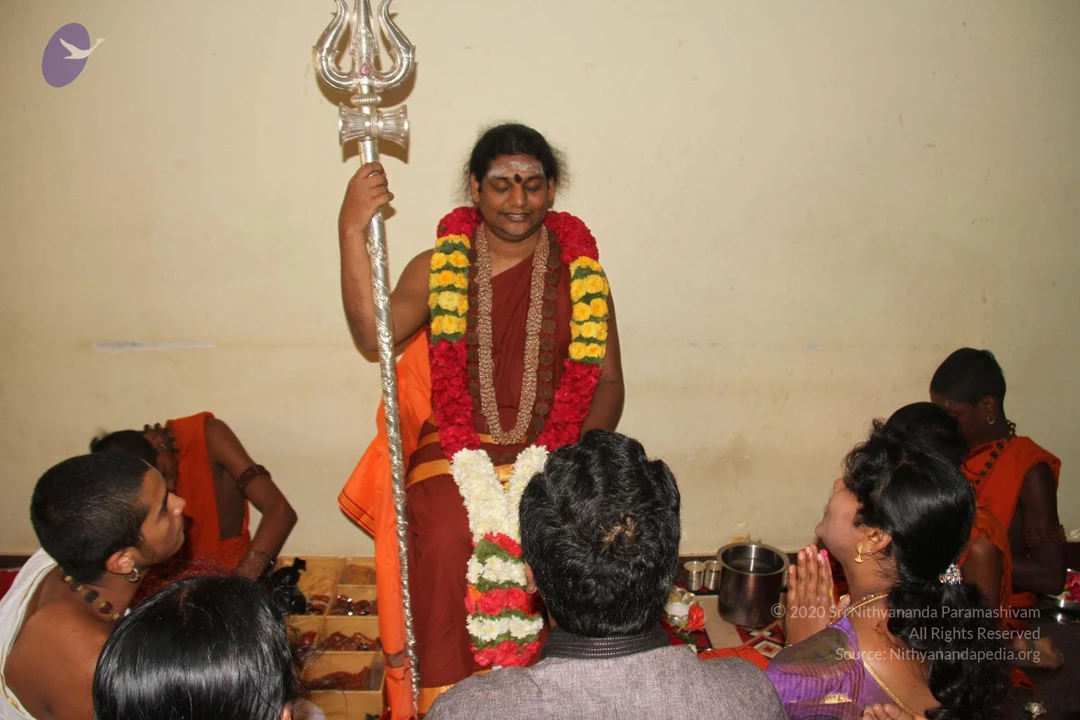
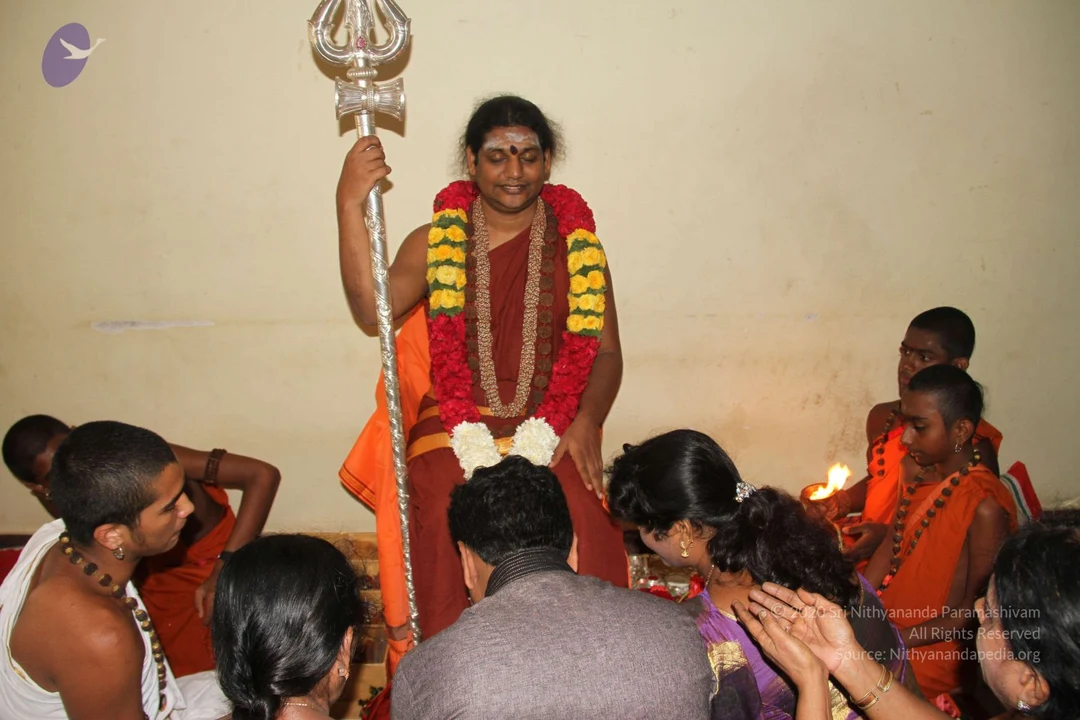
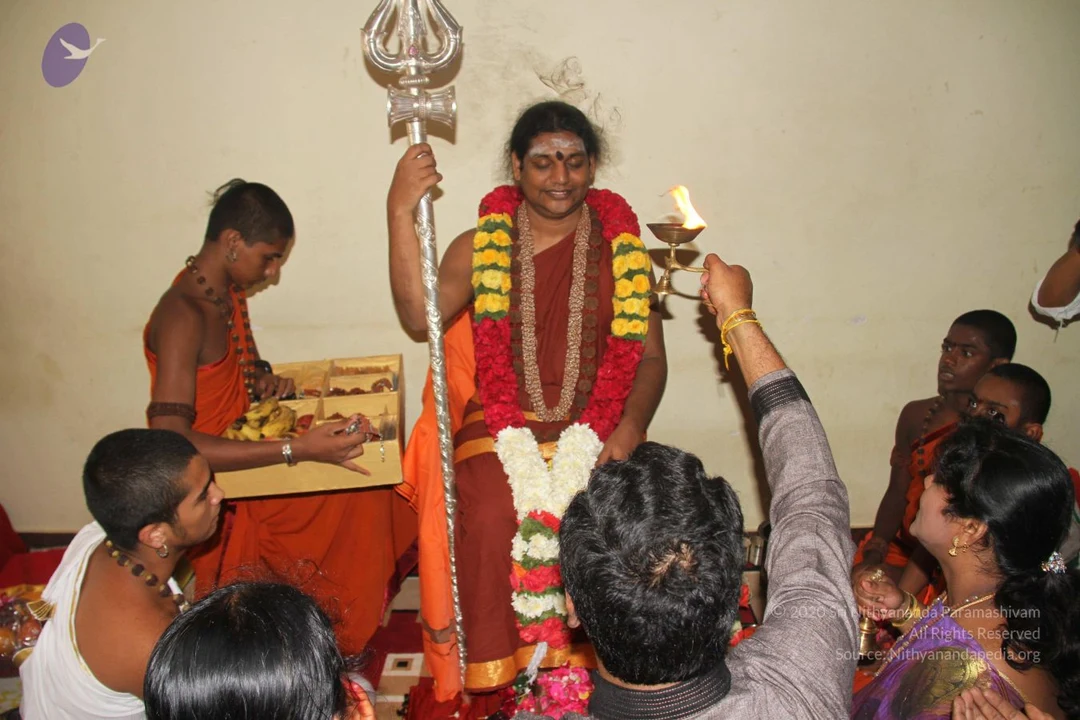
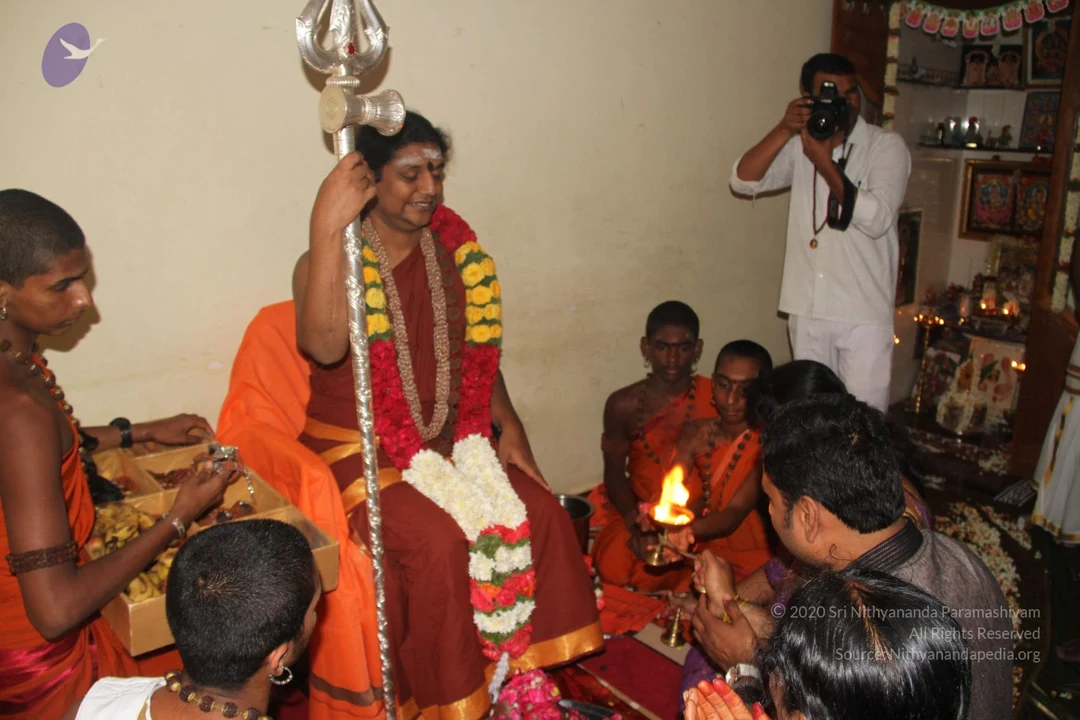
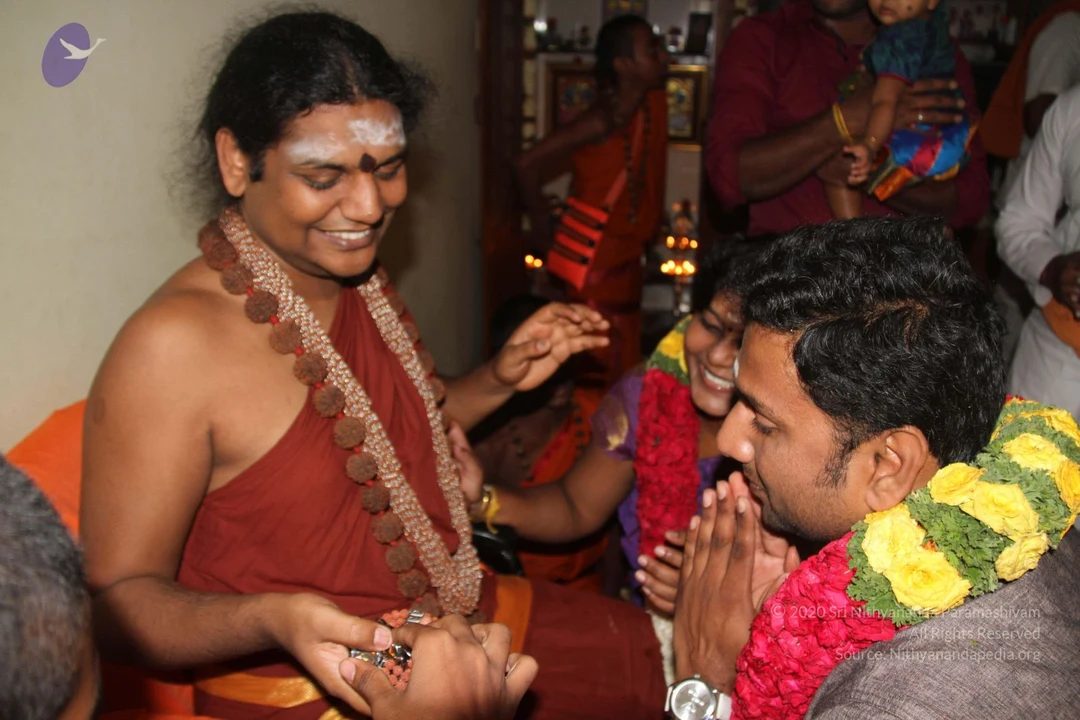
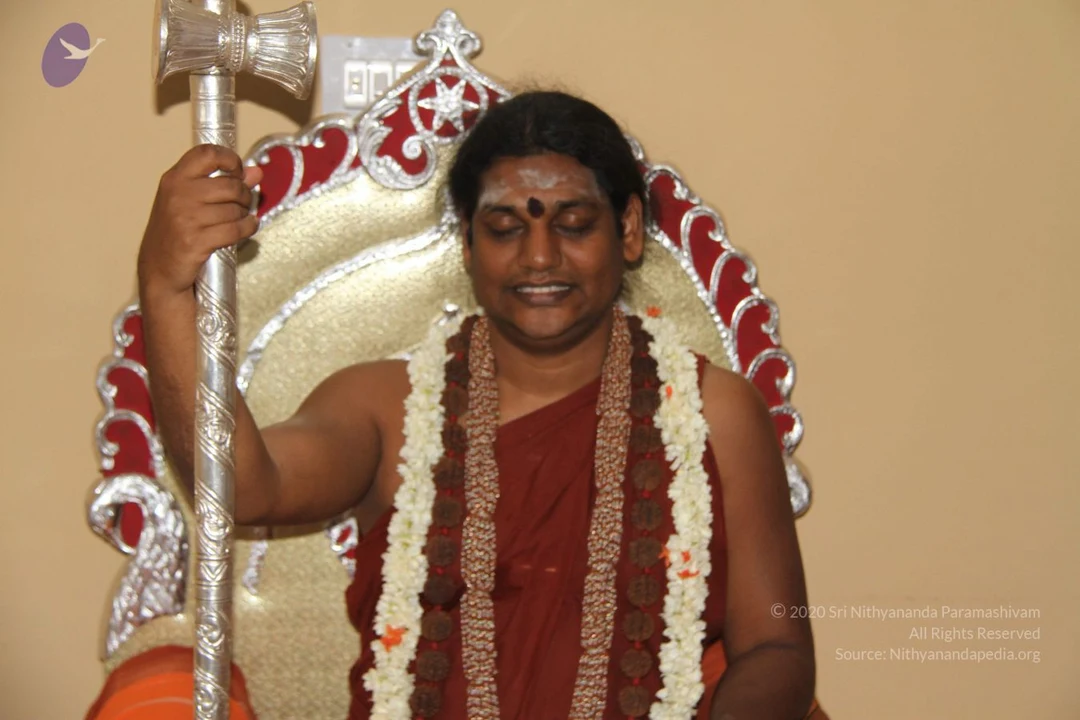
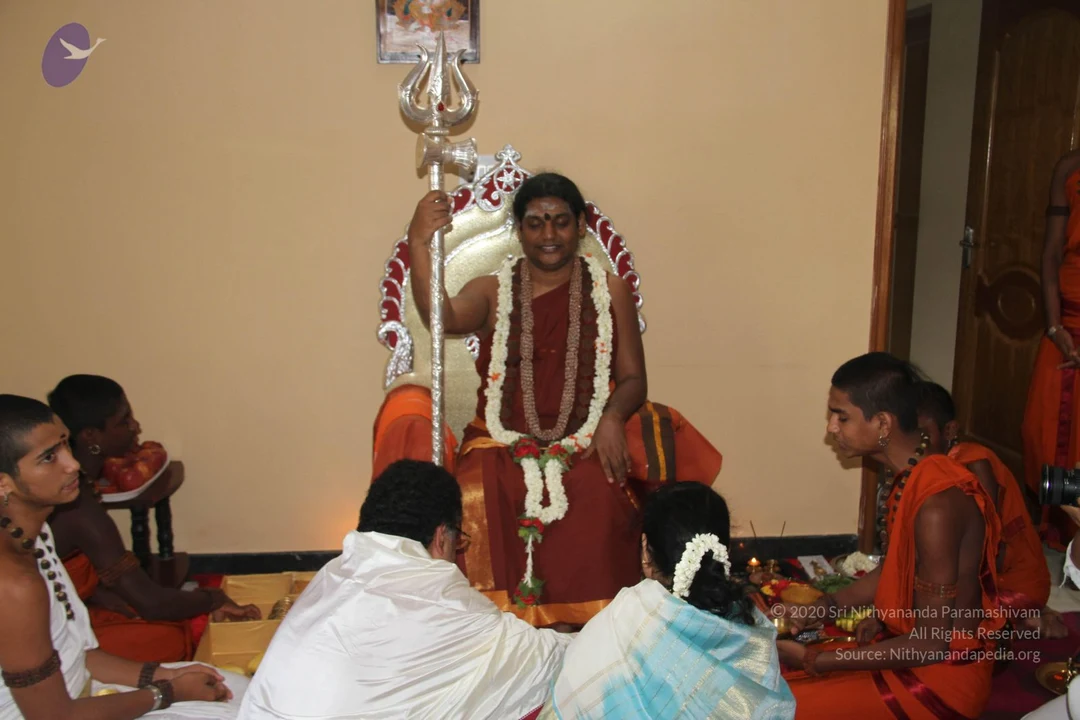
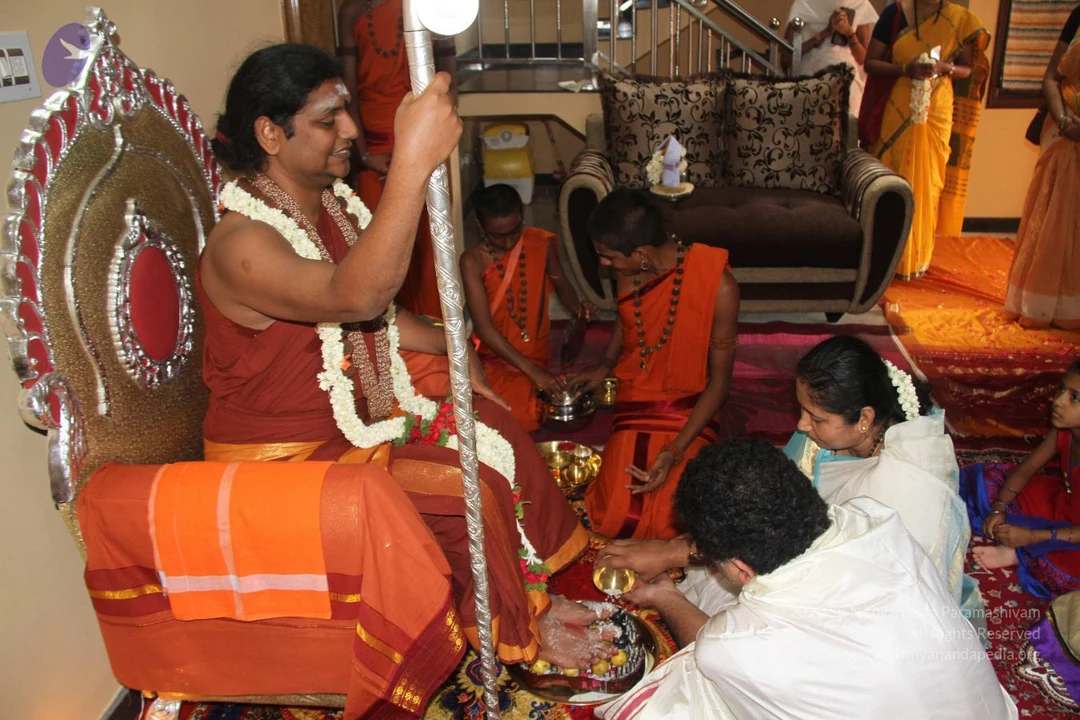
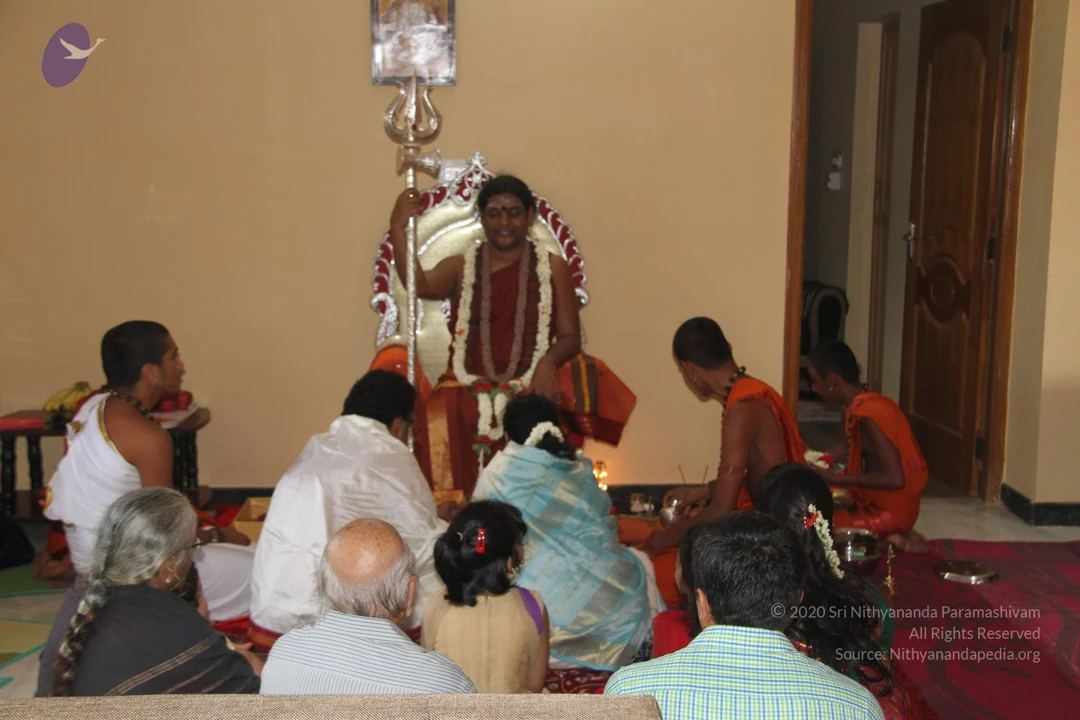
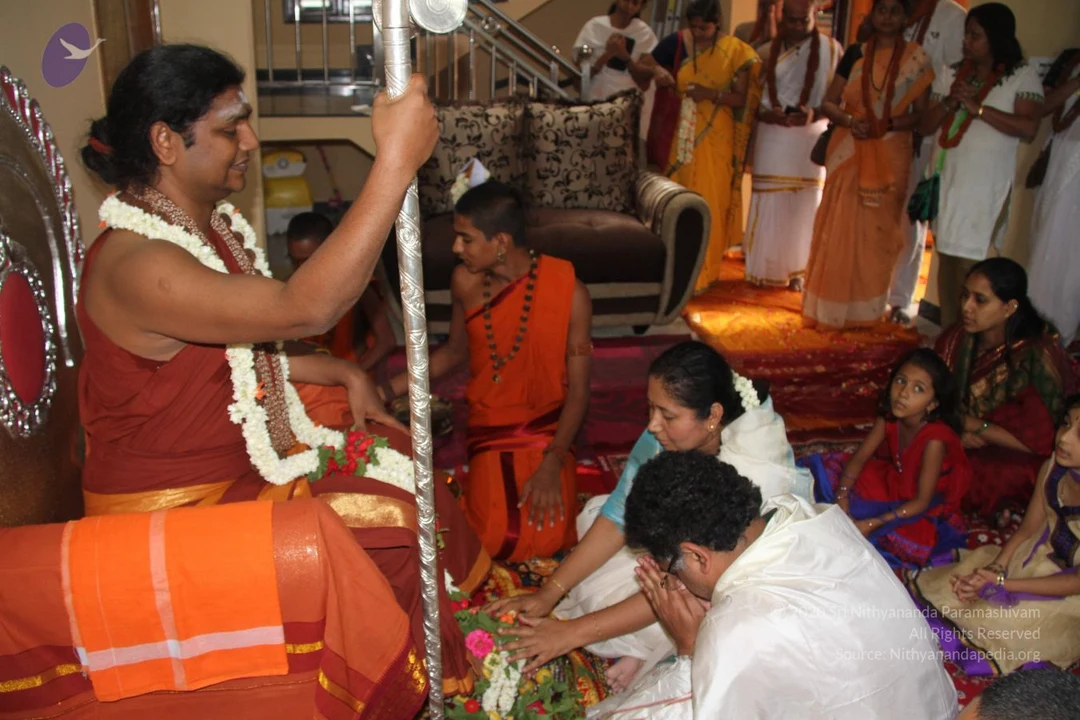
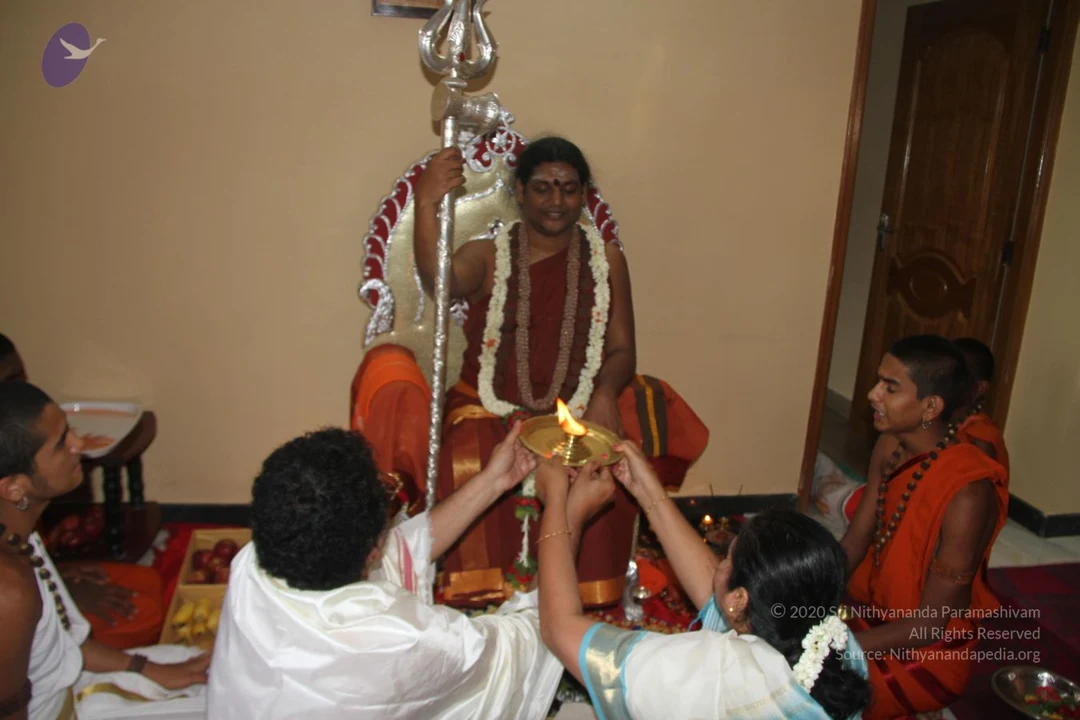
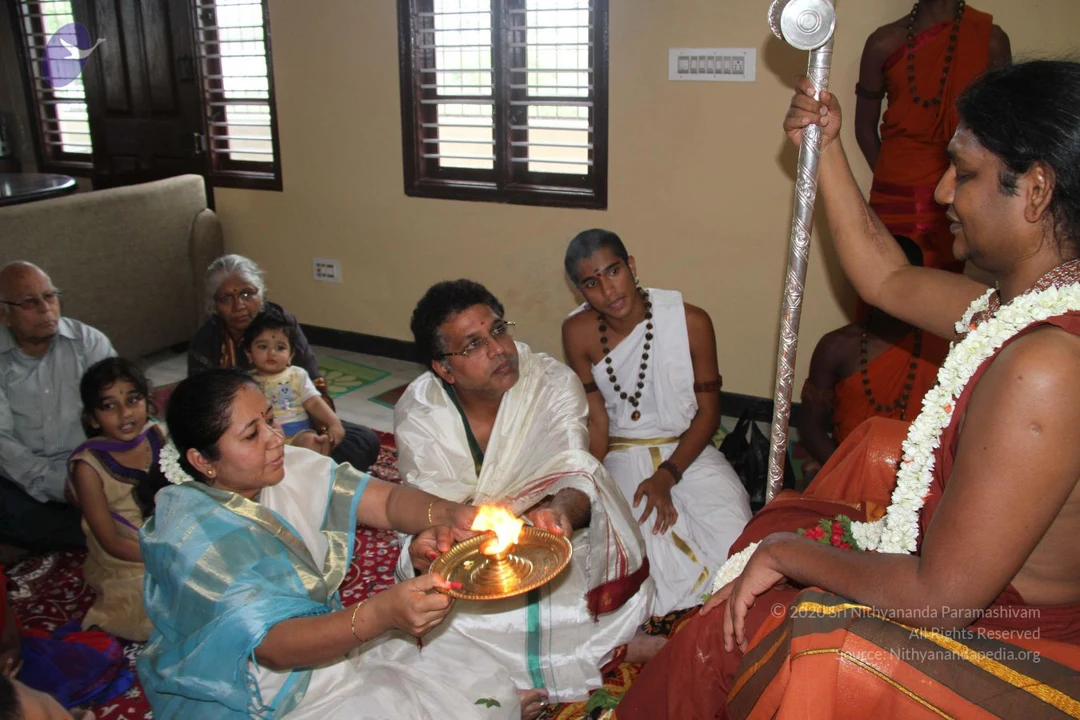
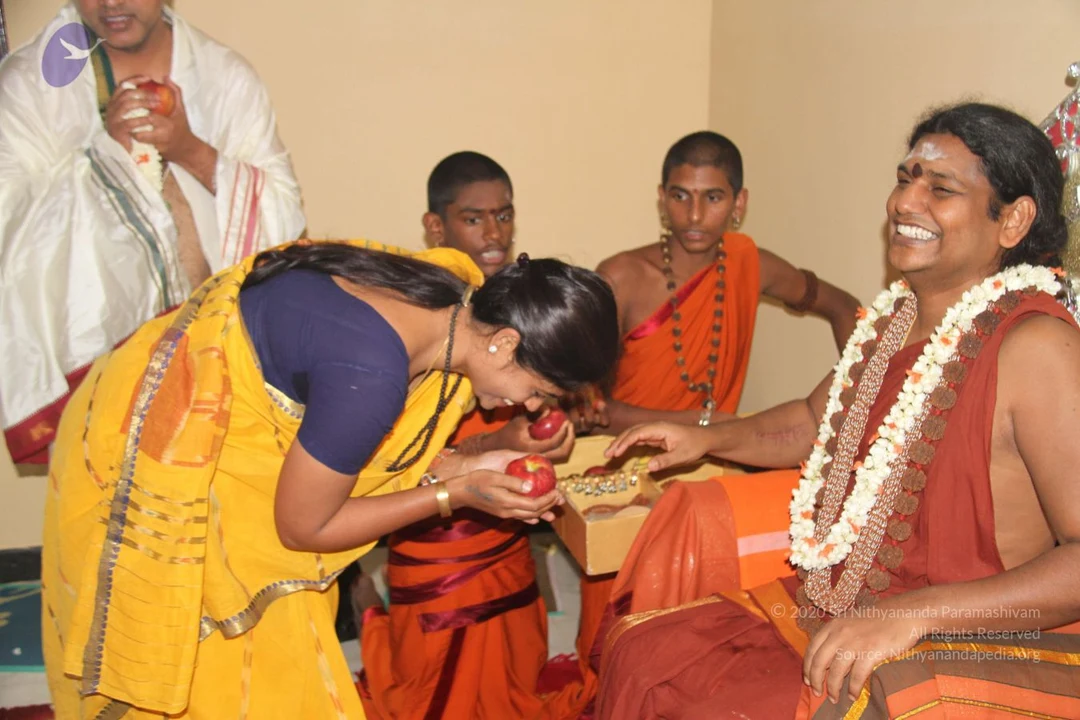
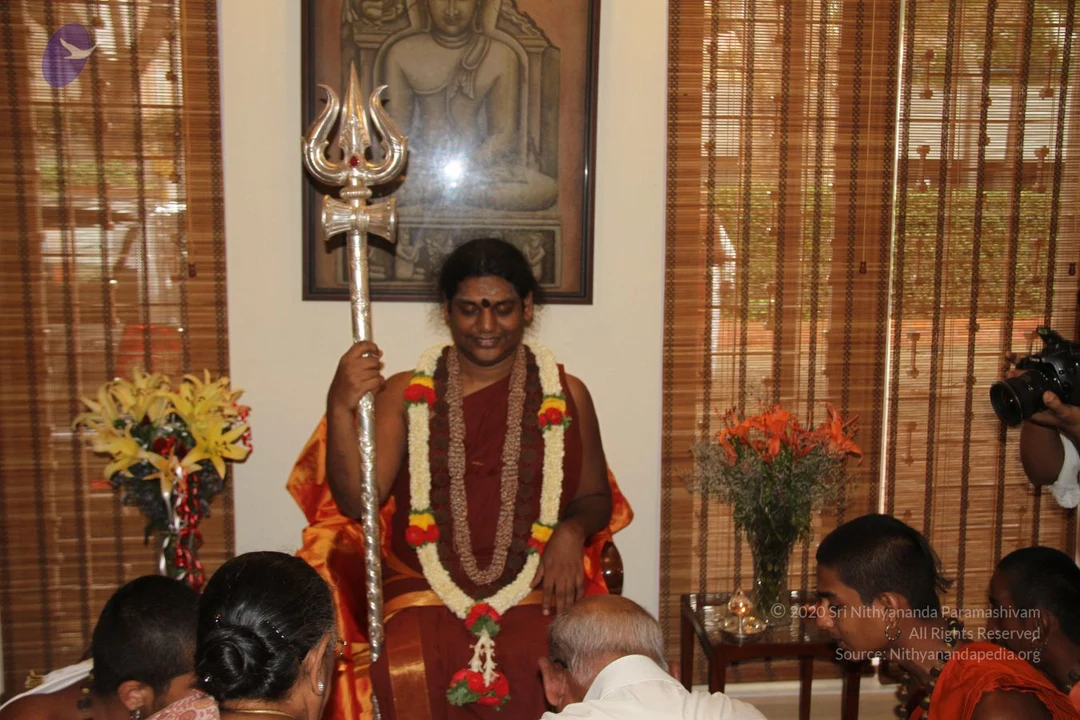
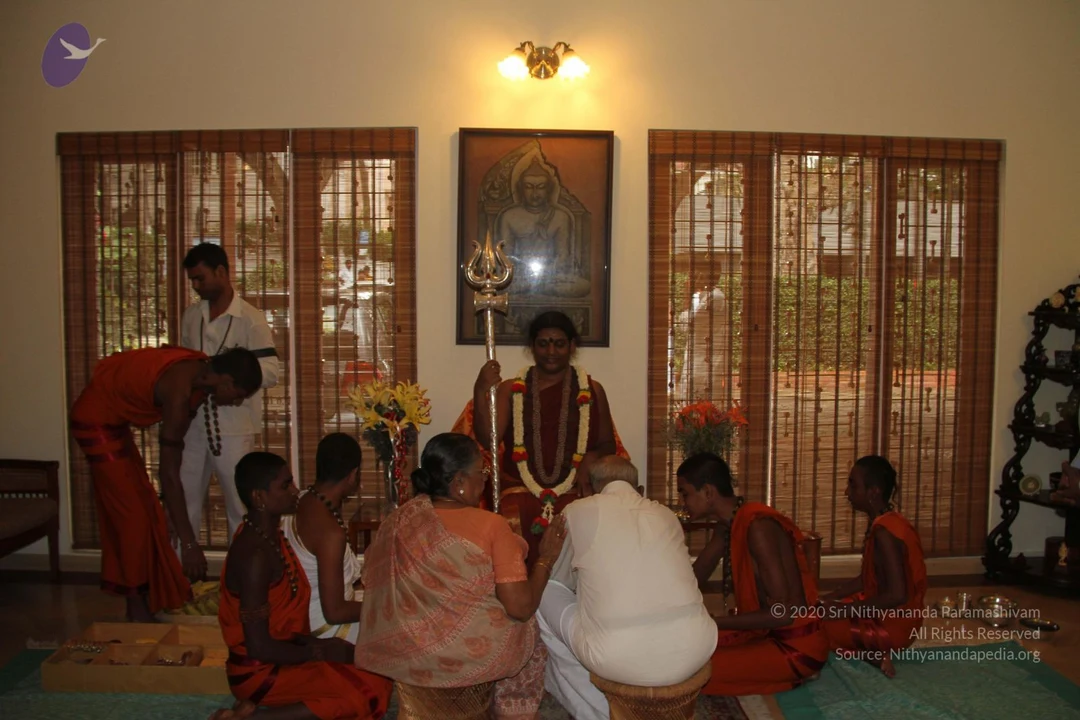
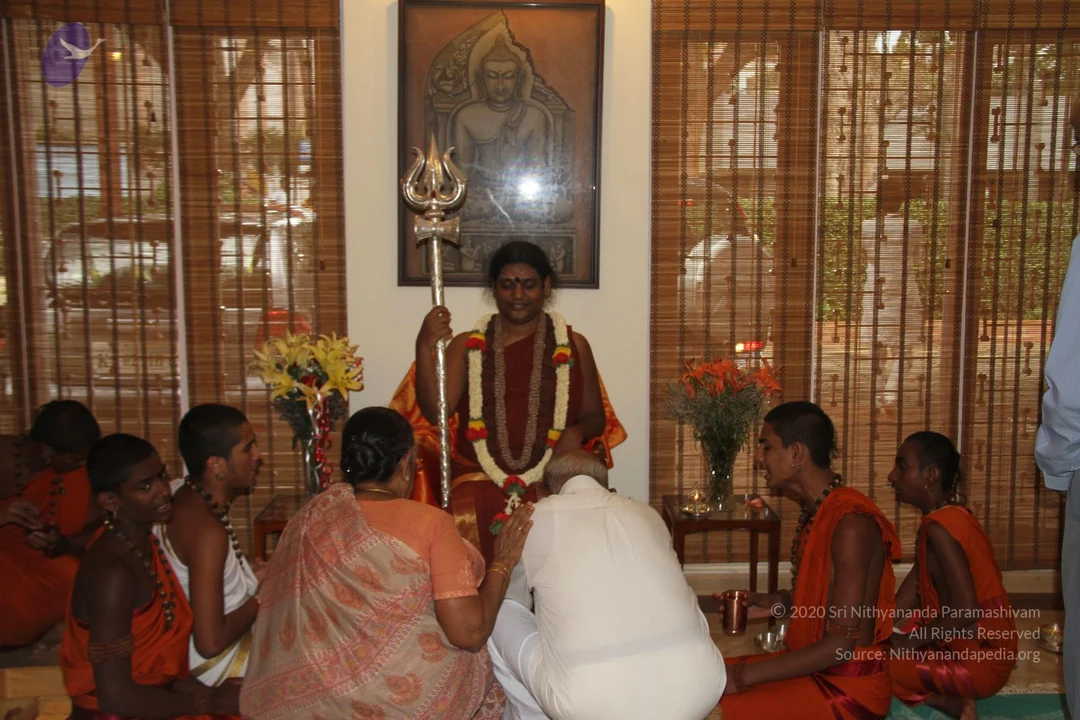
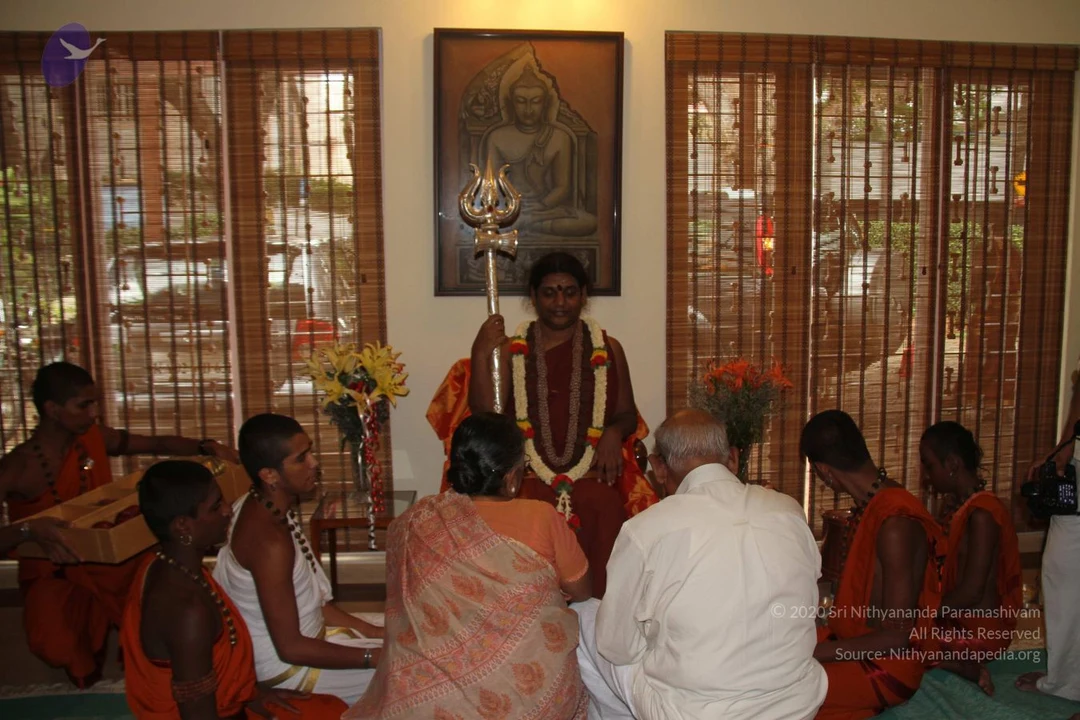
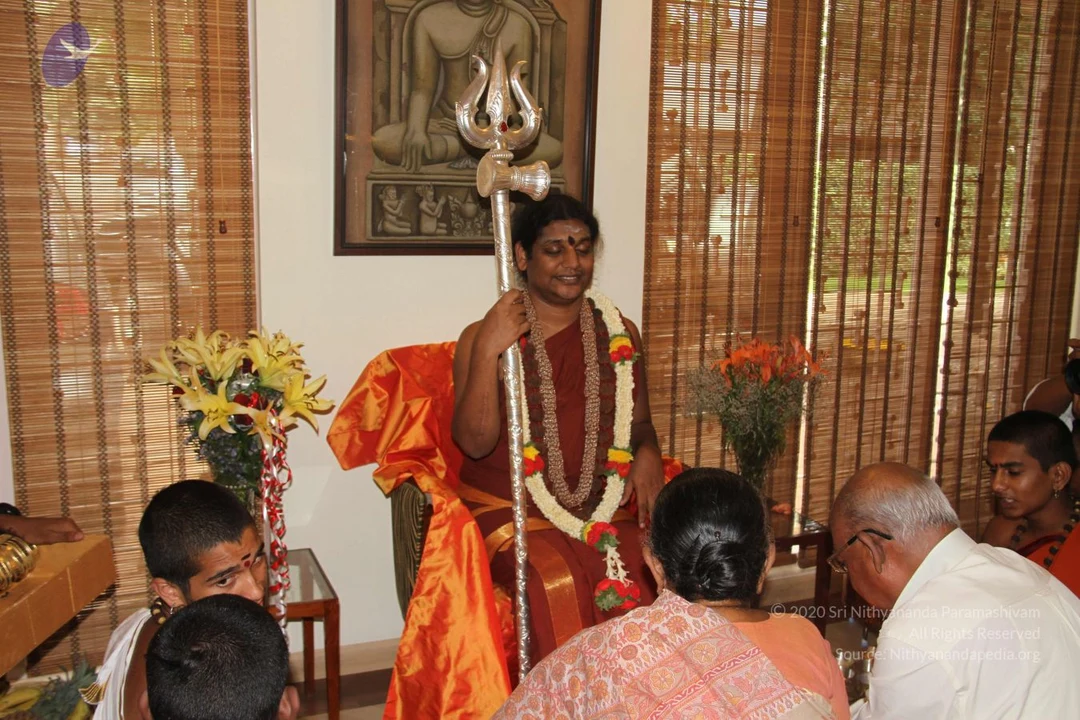
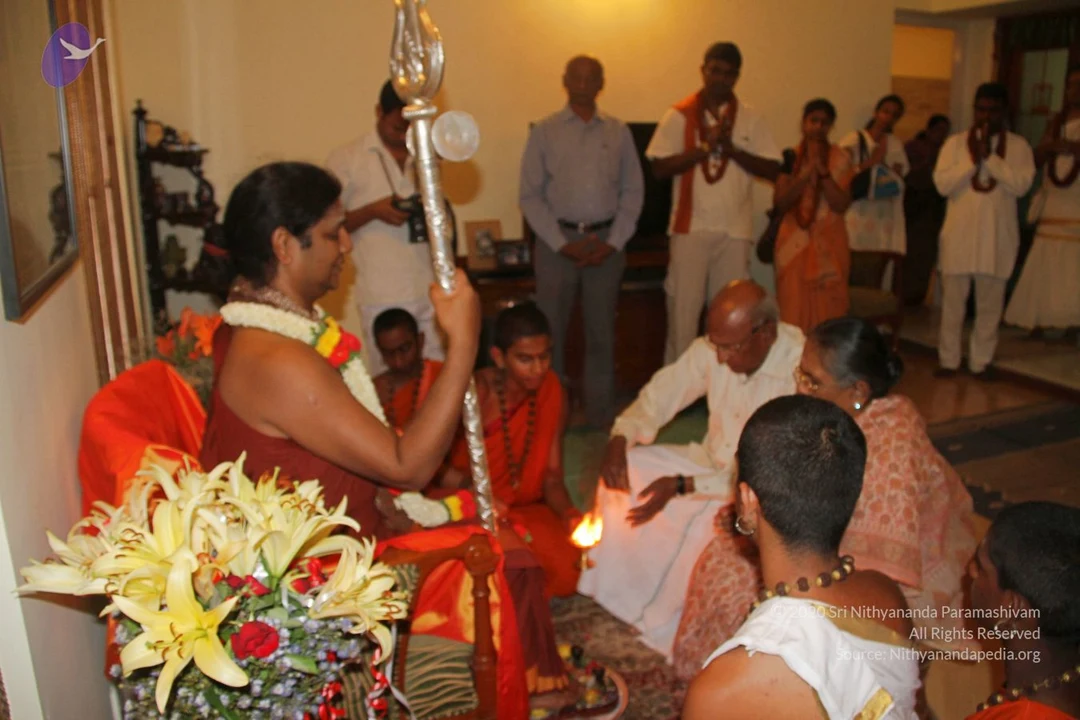
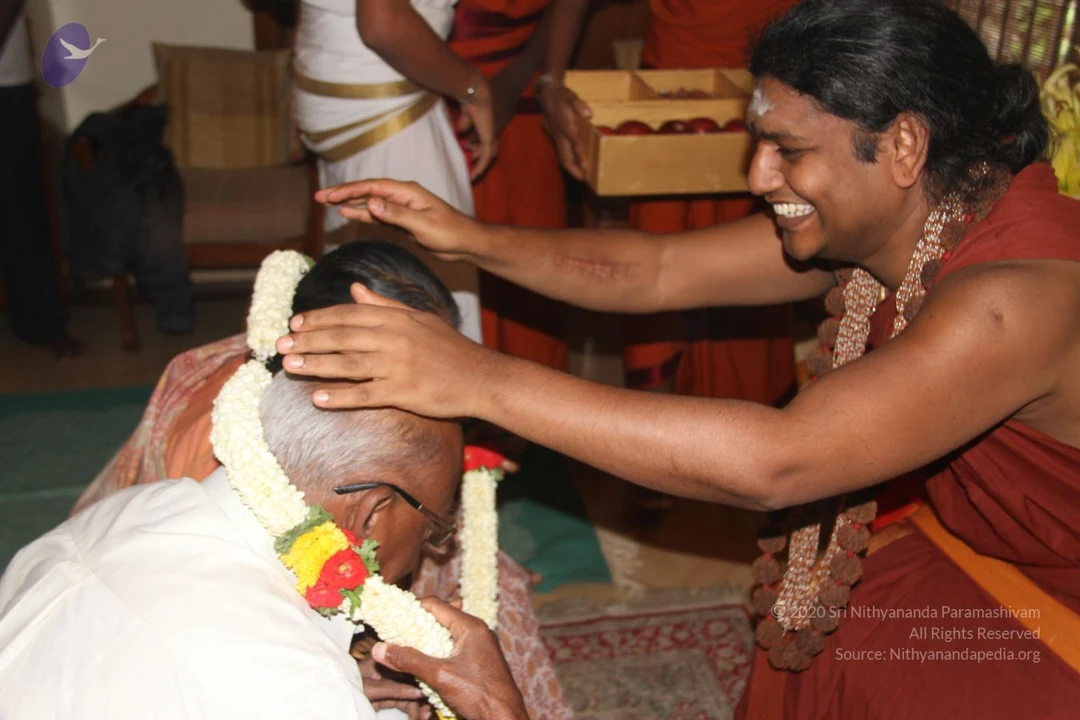
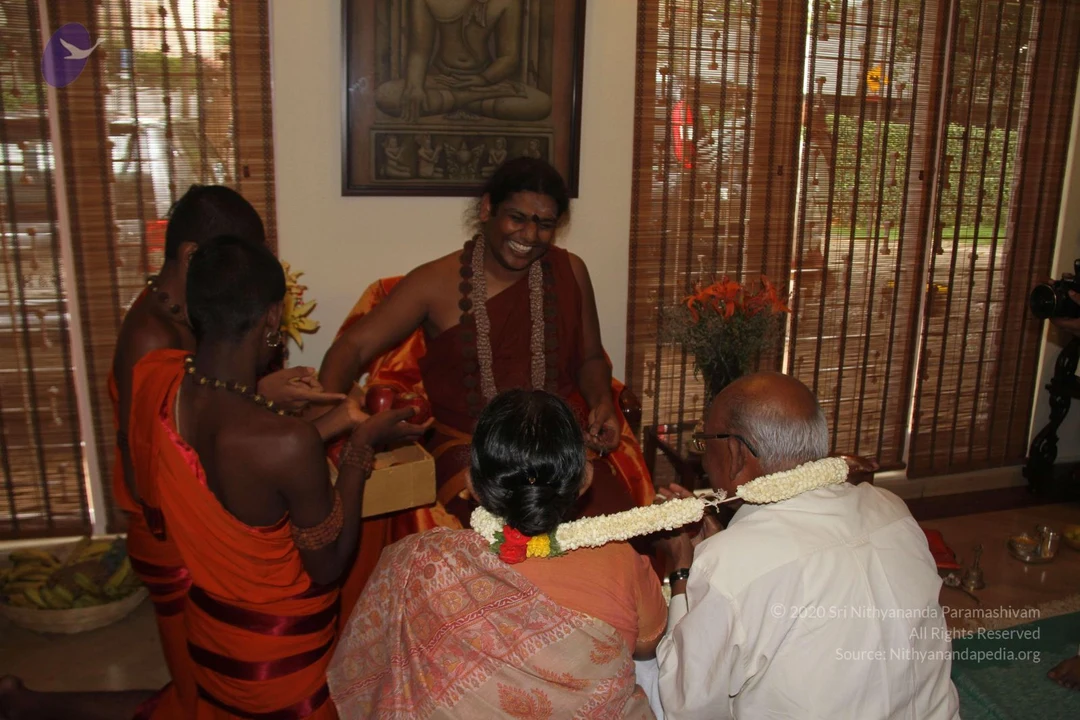
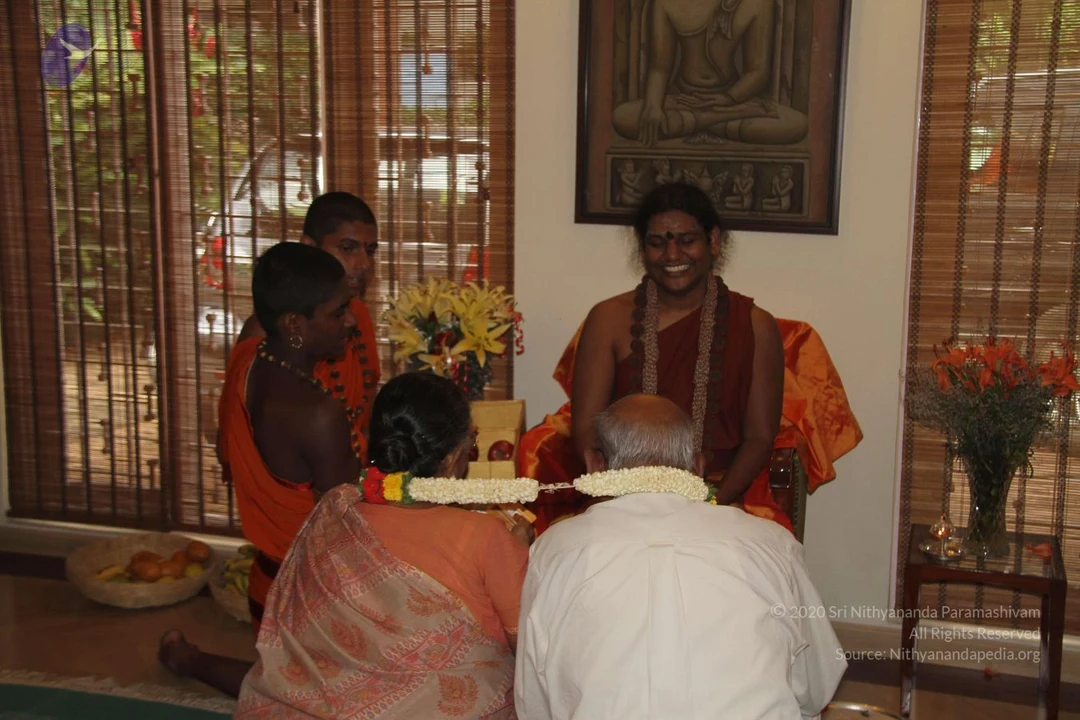
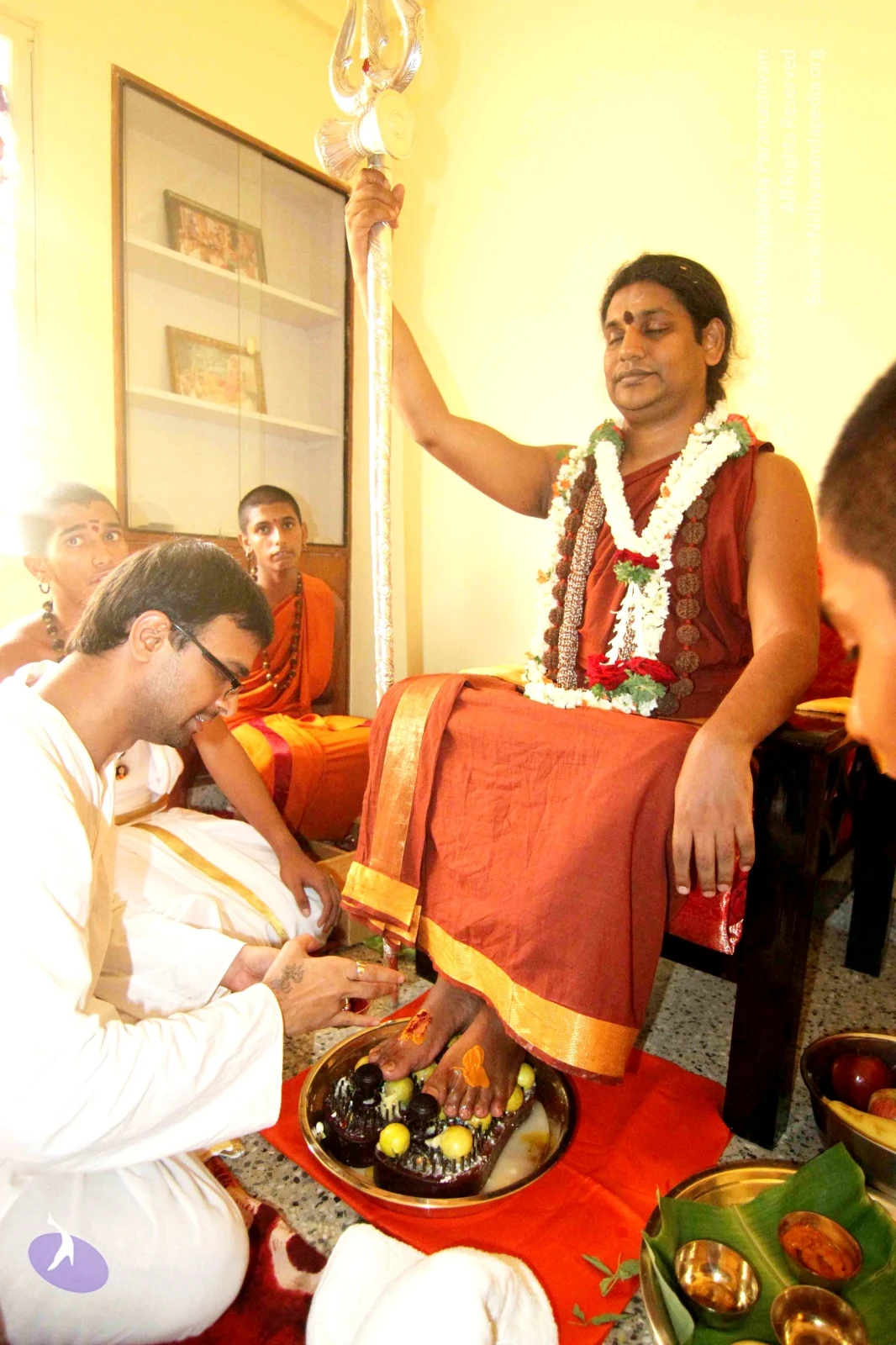
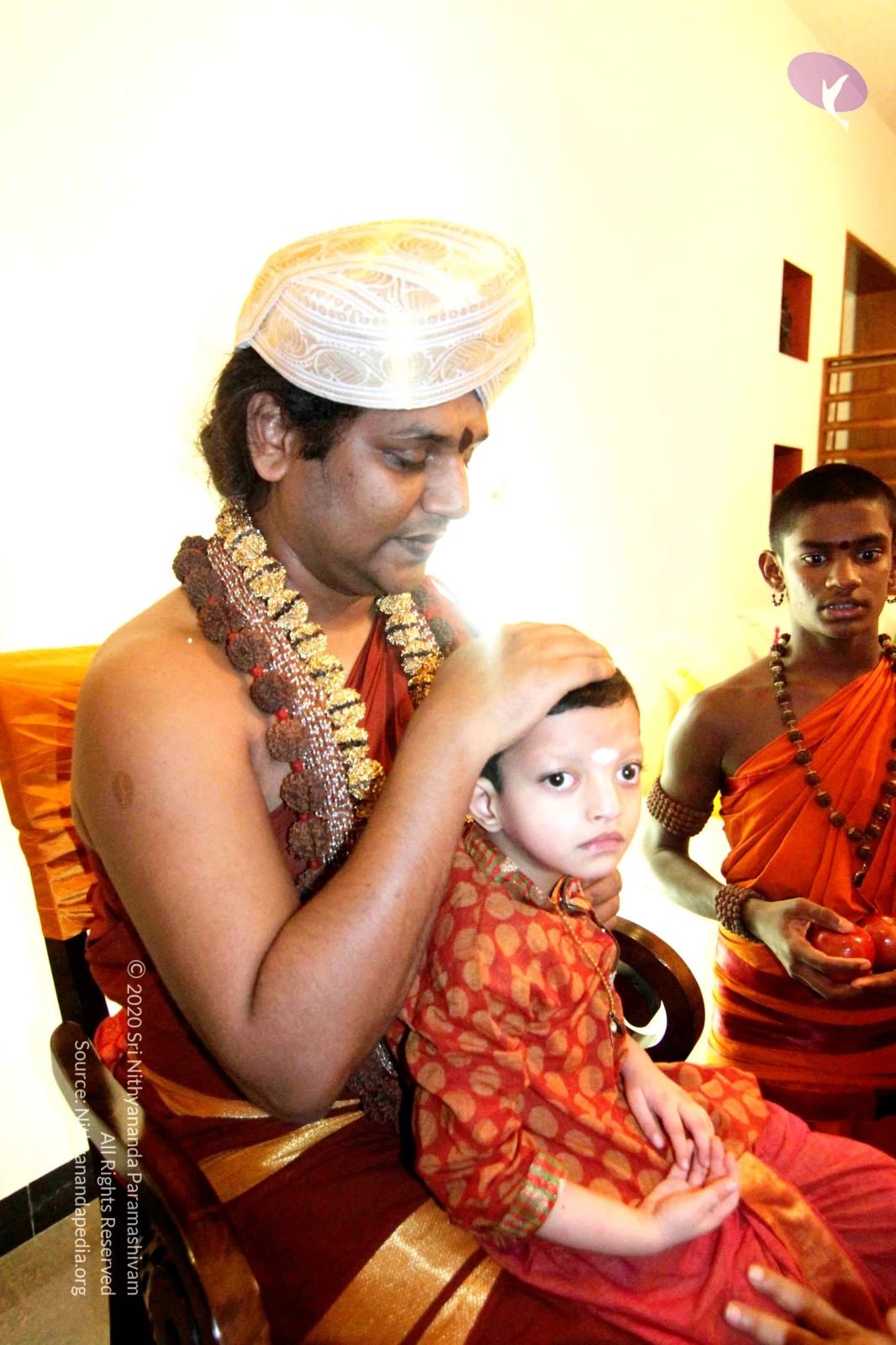
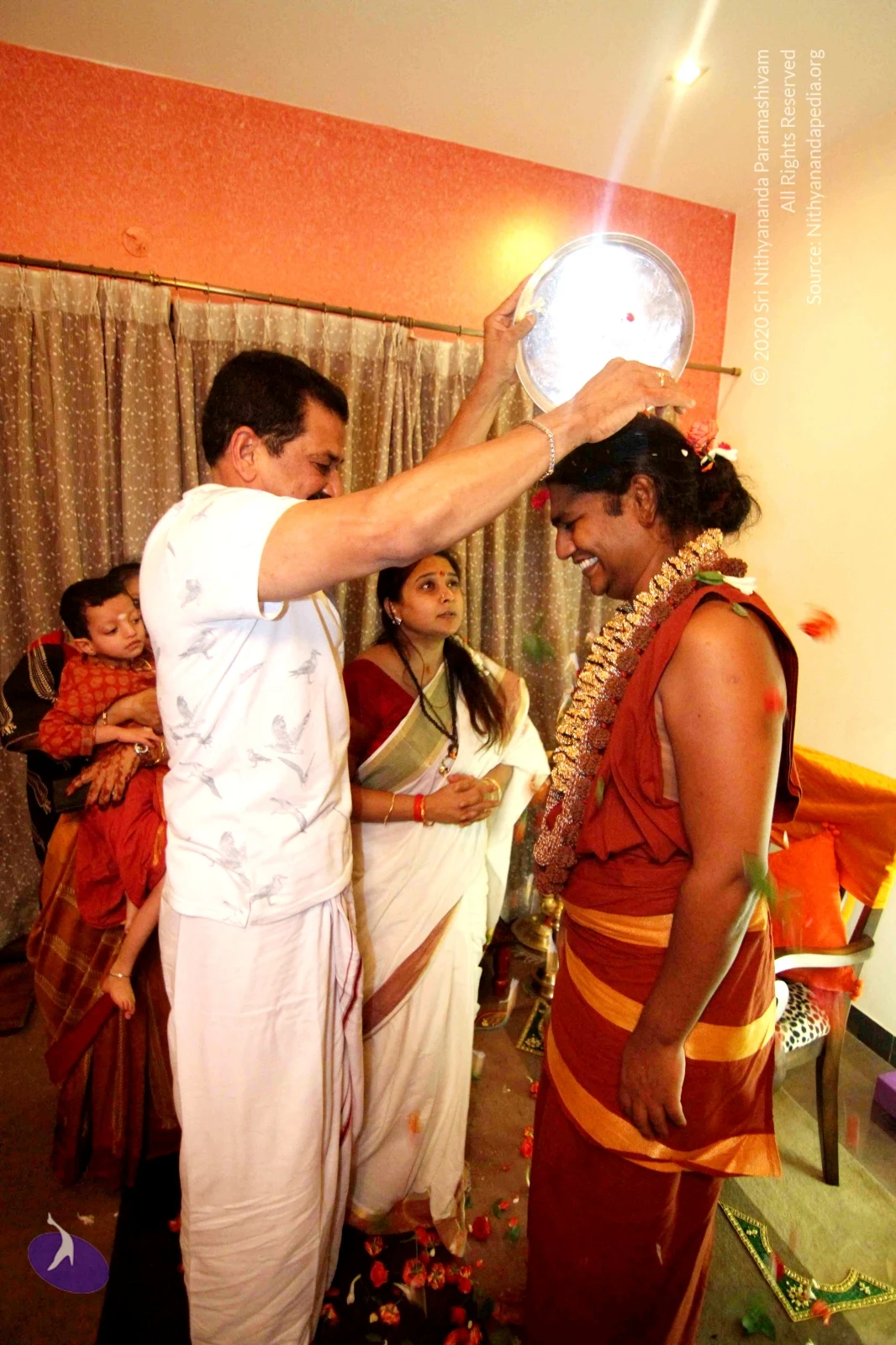
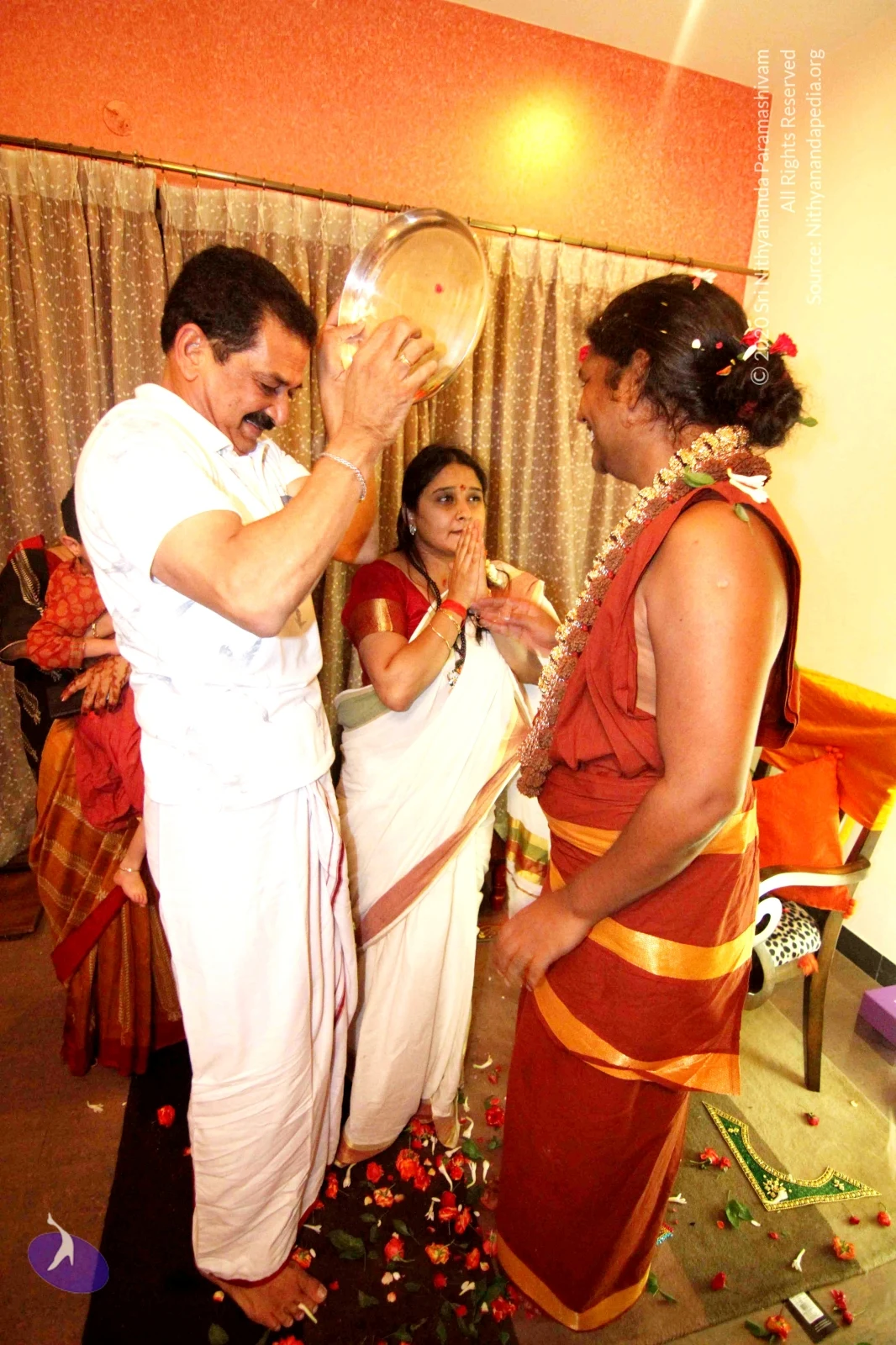
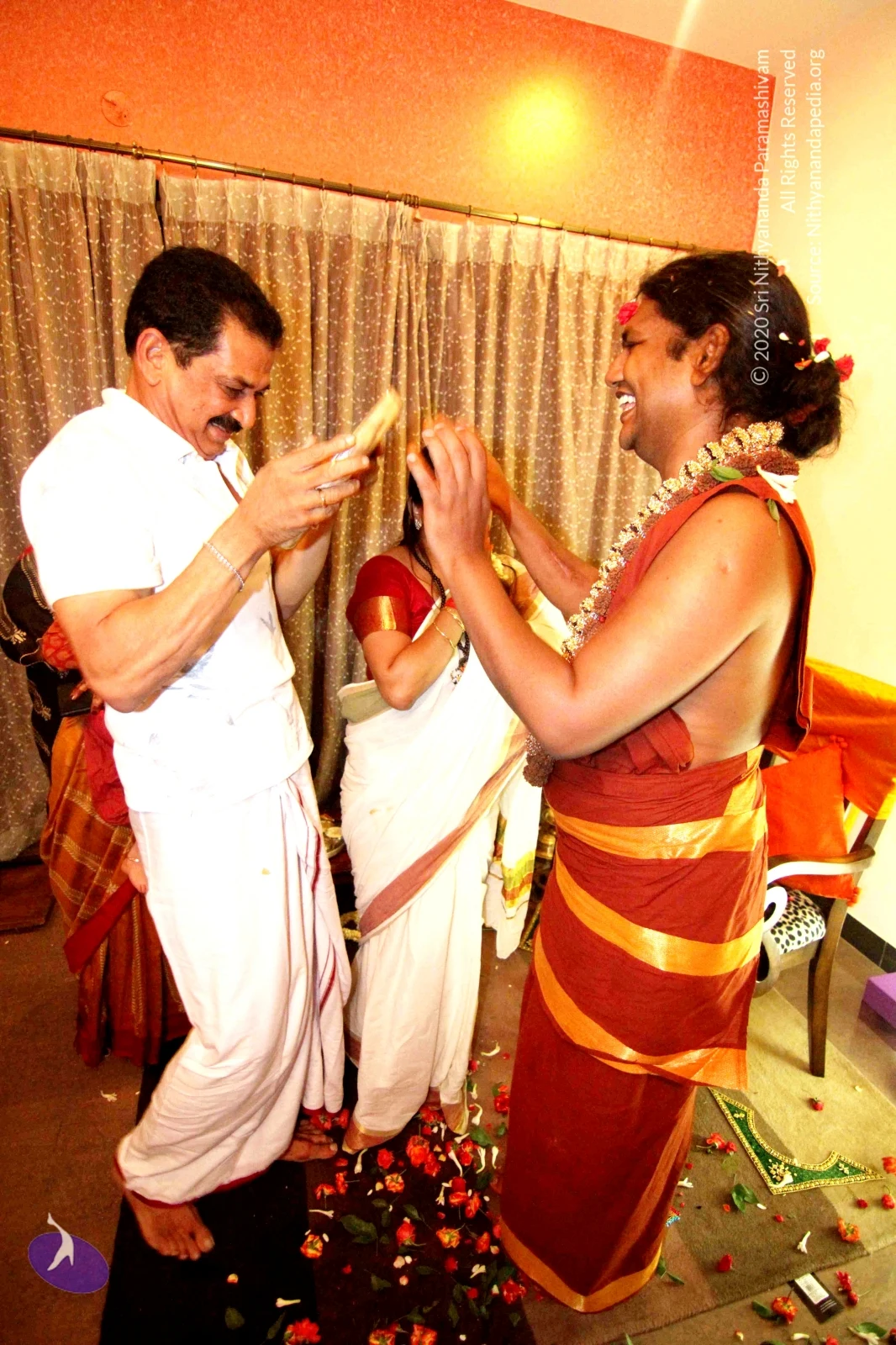
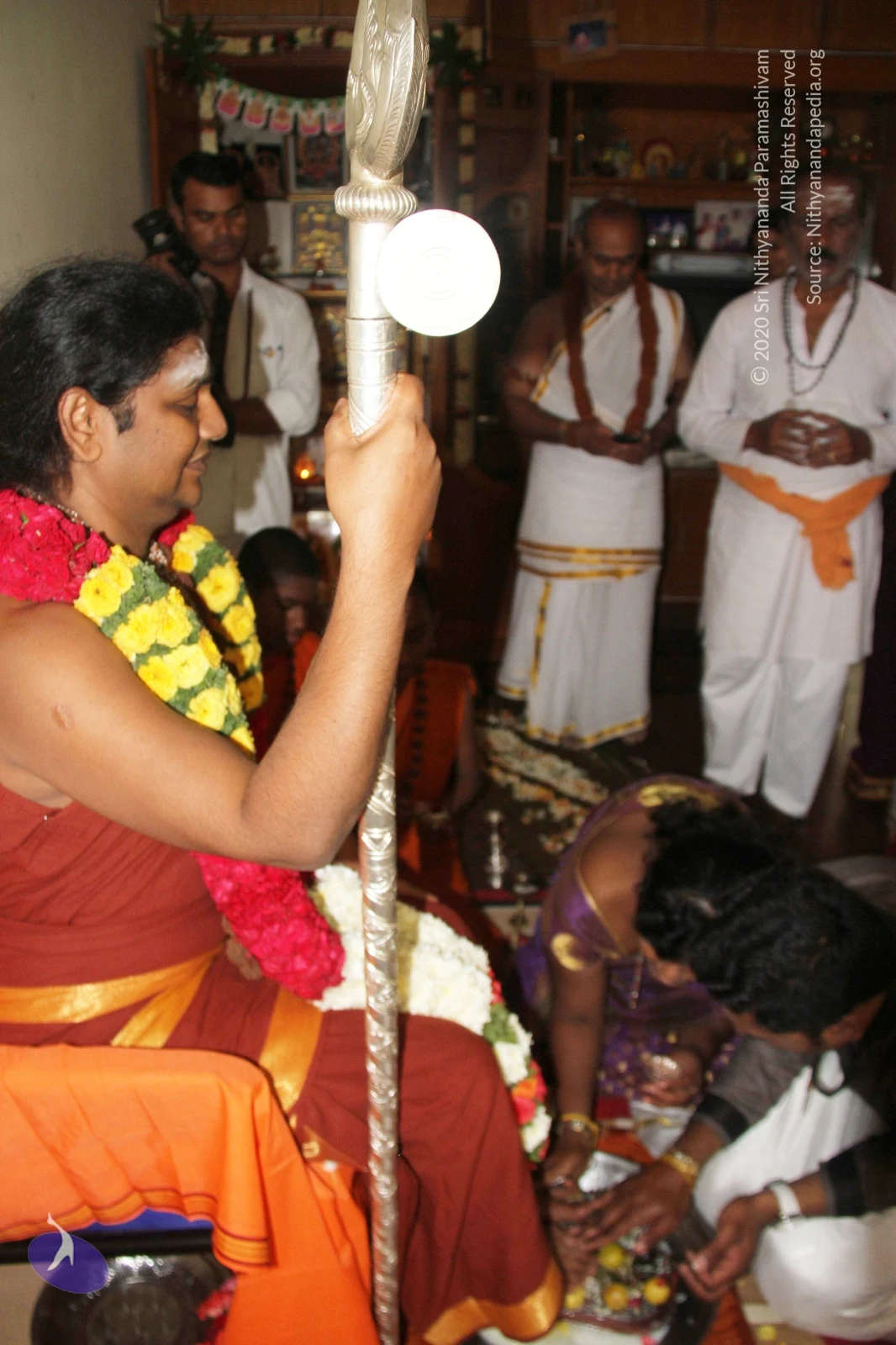
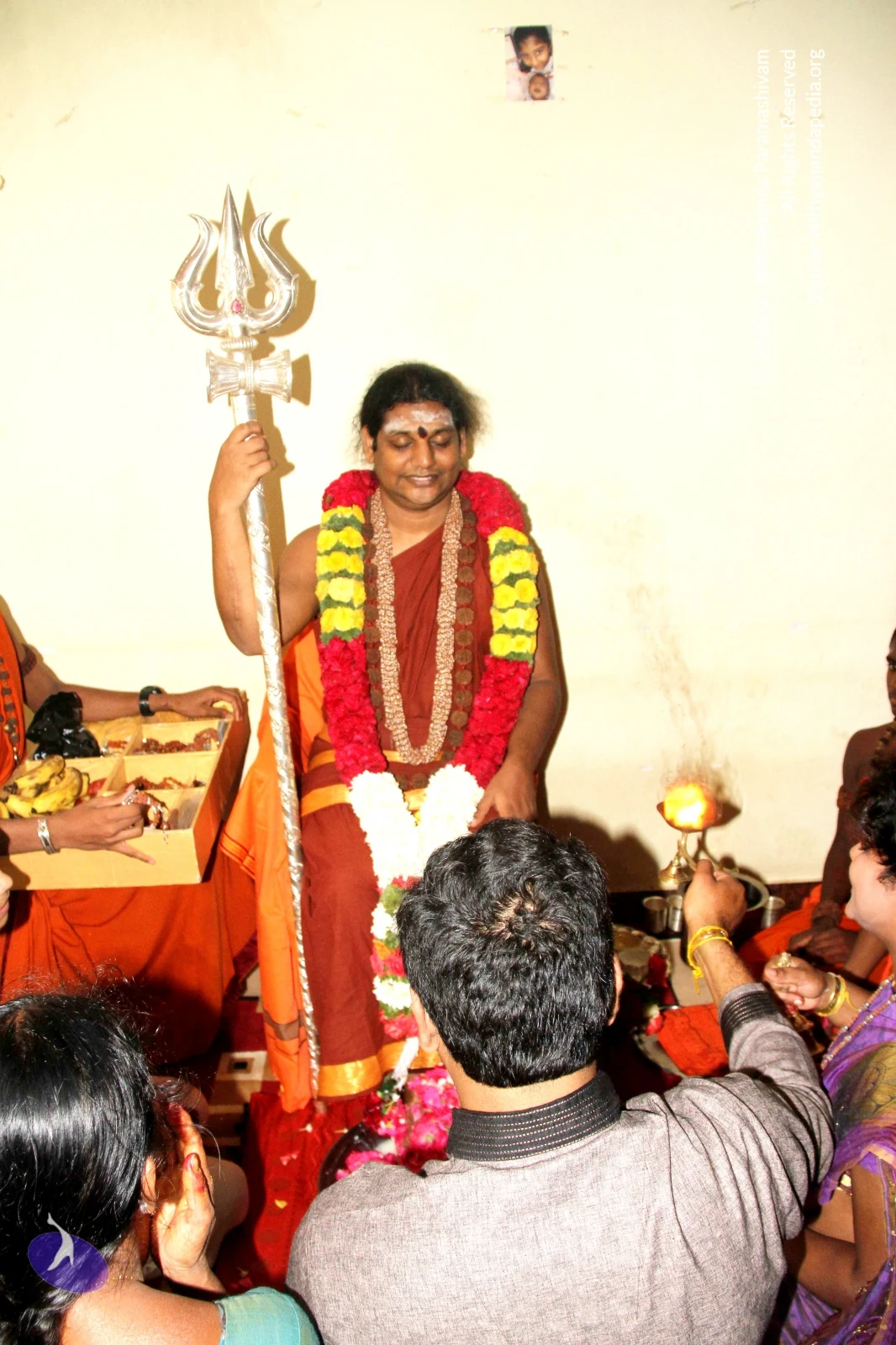
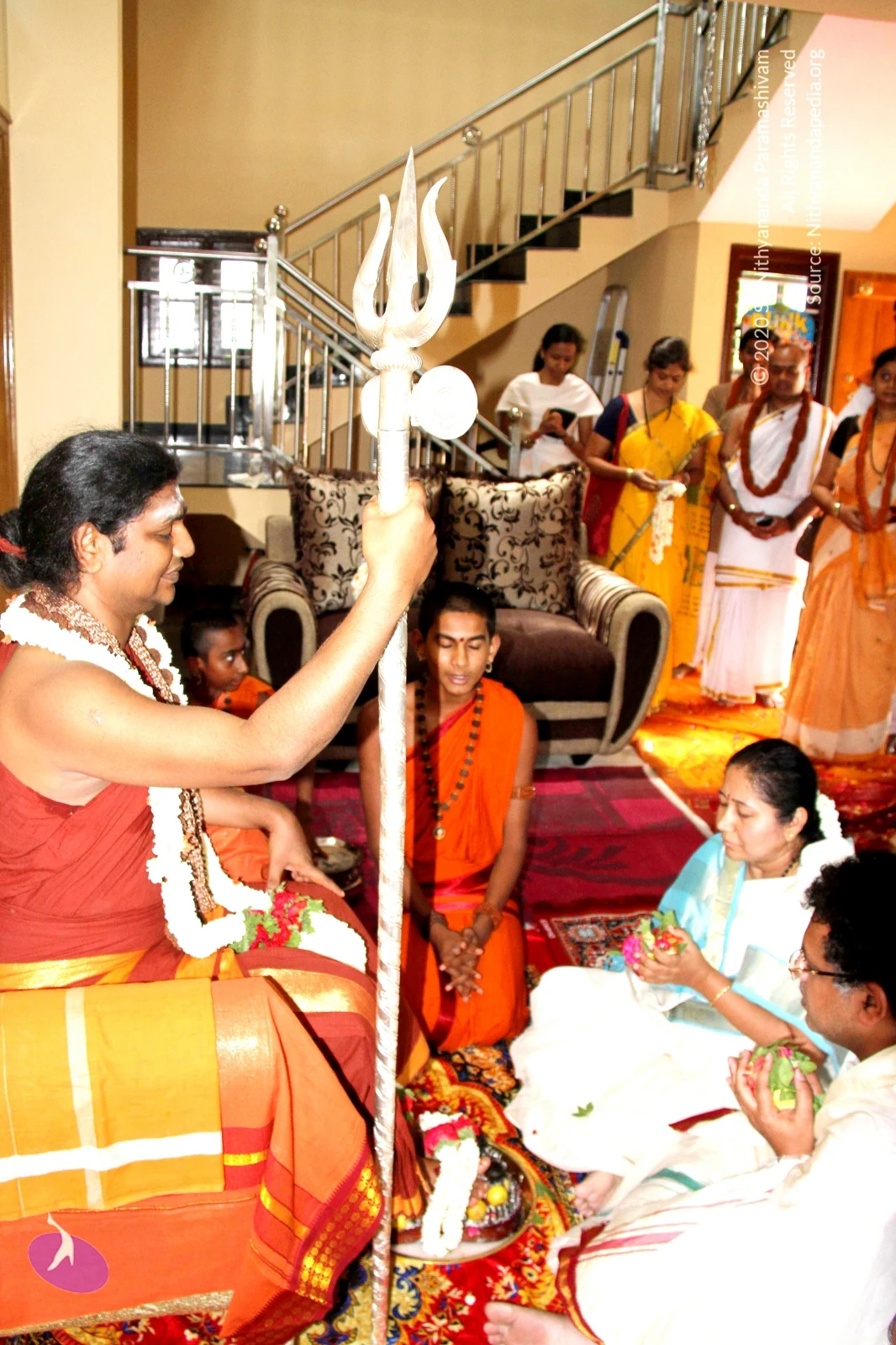
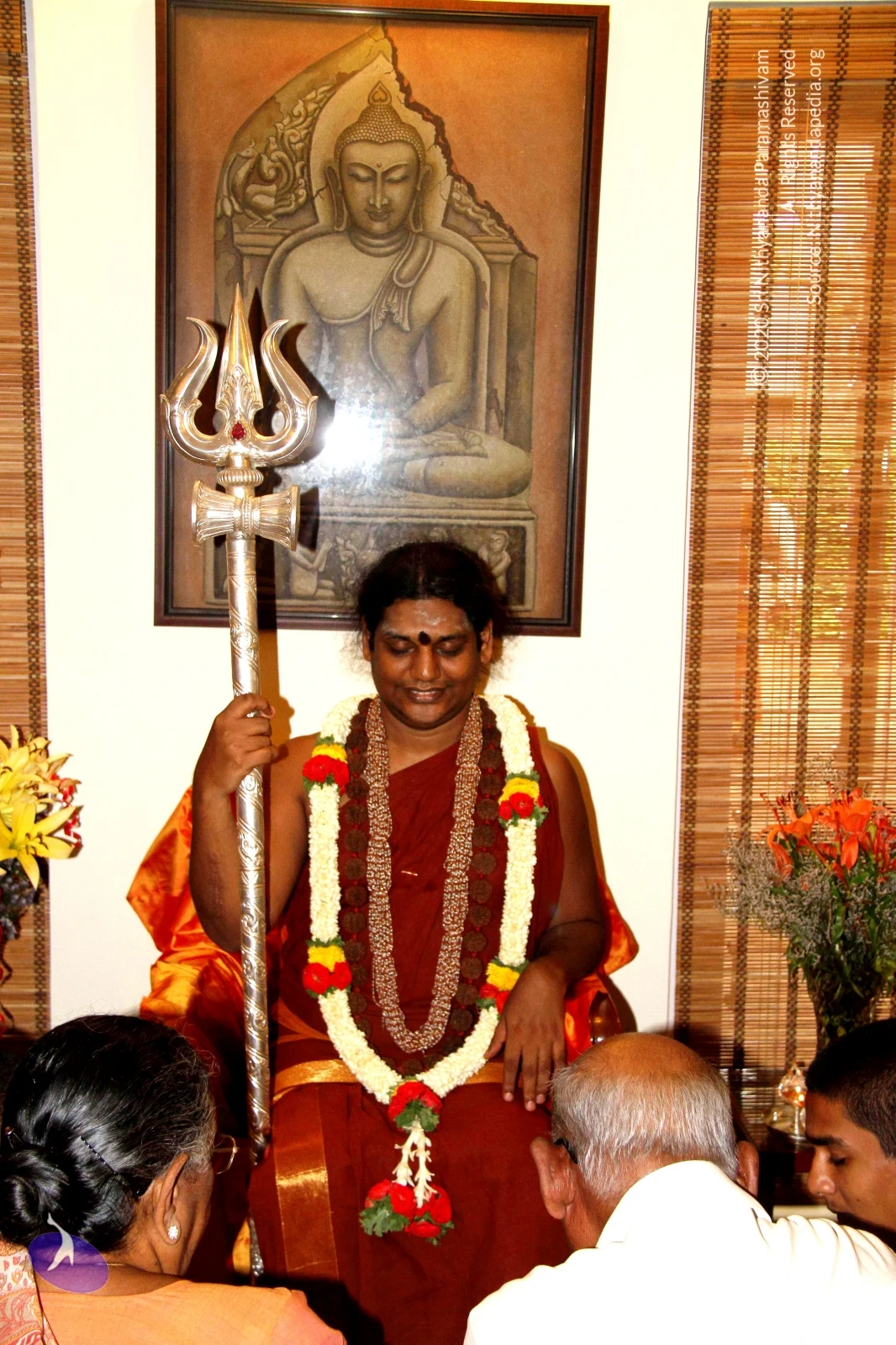
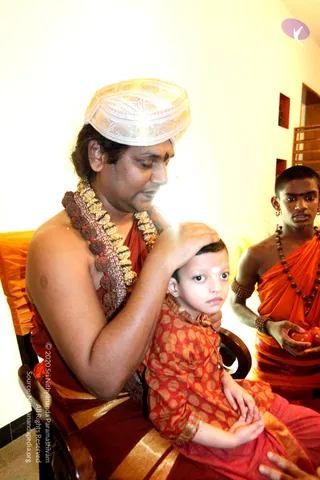
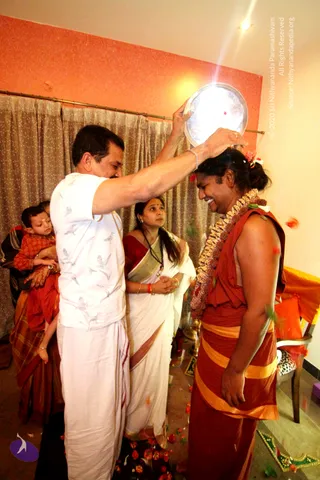
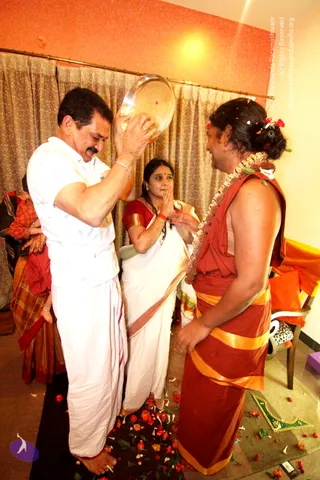
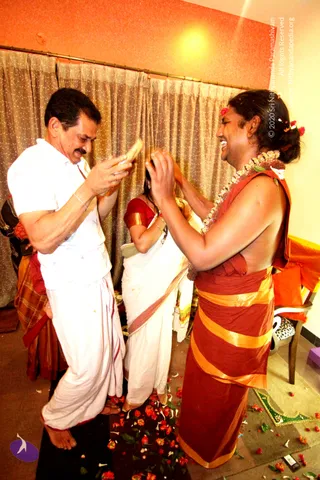
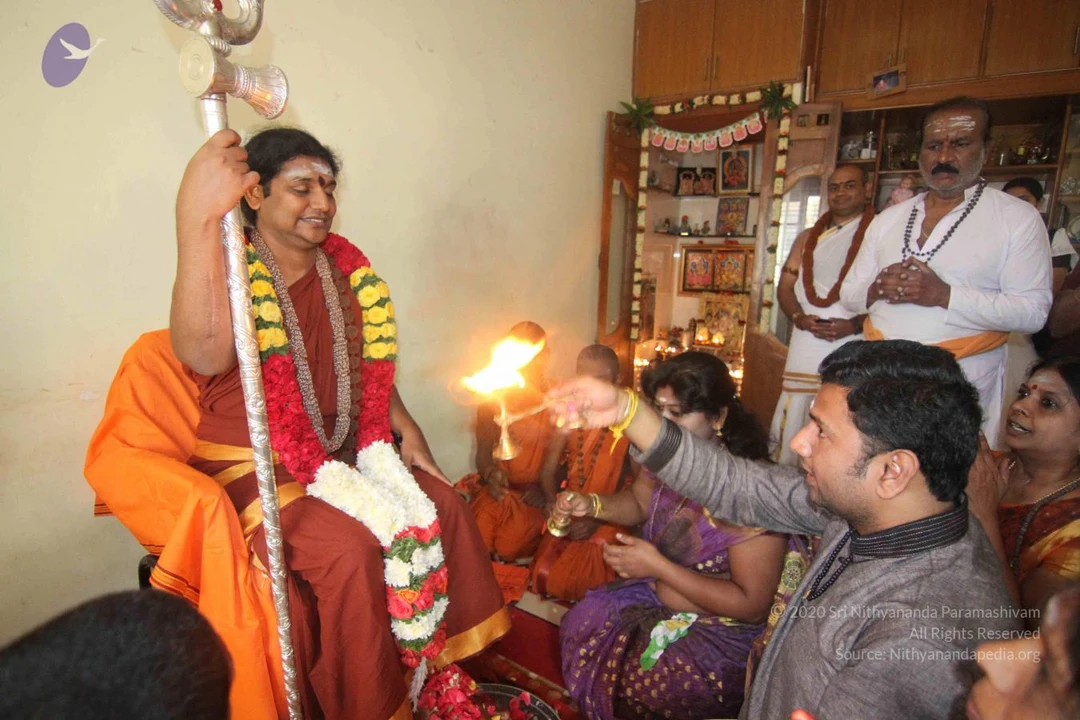
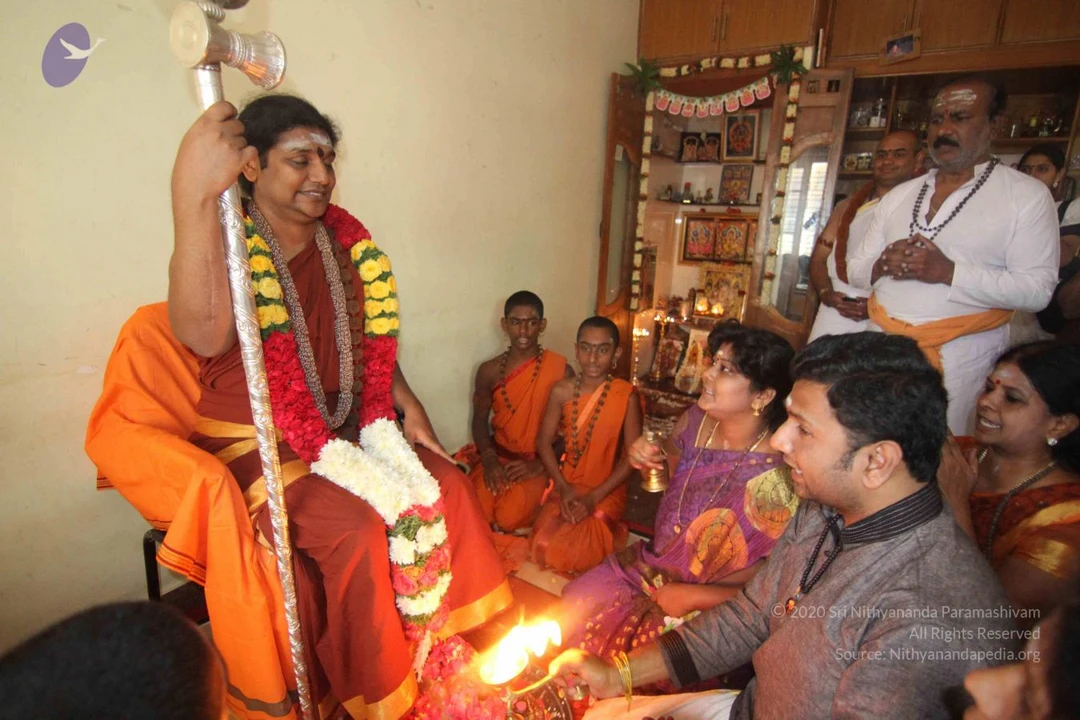
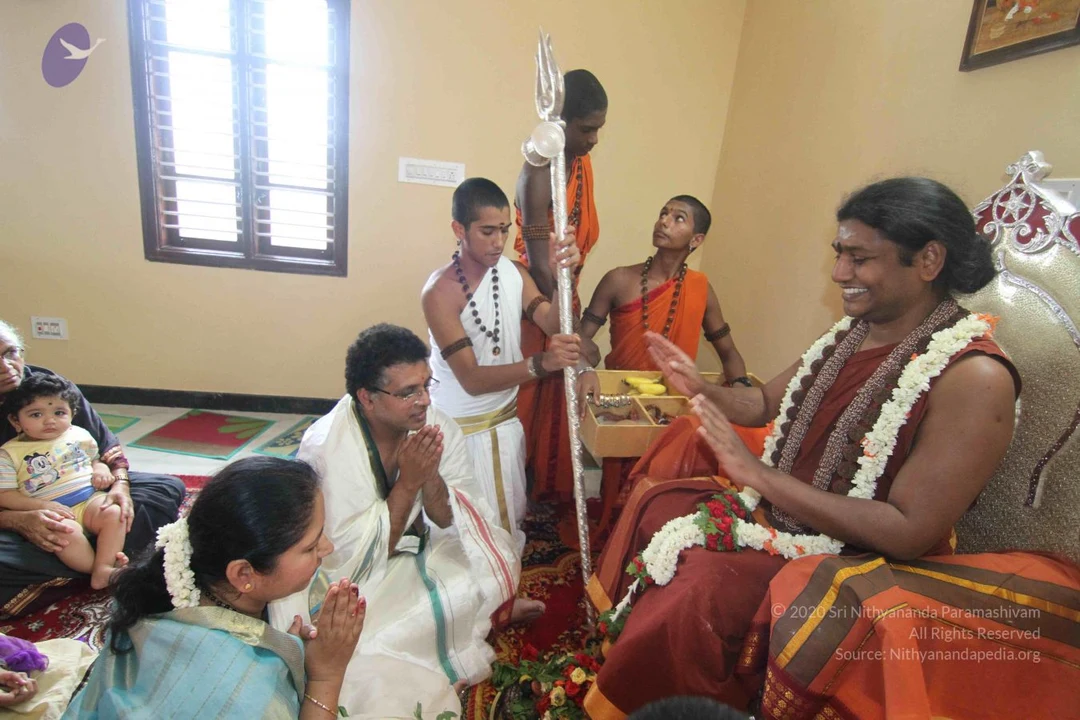
A seated man in a rust-red dhoti-style wrap and sleeveless top, wearing a white and red flower garland and rudraksha malas, holds a tall silver trident-topped staff upright with one hand and keeps his eyes closed. His feet rest in a brass plate of offerings, with a man in white dhoti and shirt kneeling to wash the feet in a padapuja ritual. Two young men in saffron robes sit behind on the left, and a banana leaf tray with brass bowls and fruit lies at the lower right. The wall shelves hold framed pictures and the room is painted pale yellow. Visible ritual: padapuja with a silver trident staff.A seated man in an orange-red sannyasi-style garment with a gold-and-black-edged rudraksha mala and a wide golden-bordered wrap, wearing a white and gold patterned cap, places his hand on the head of a small boy in a red and orange patterned kurta. The boy has a white dot on his forehead and sits on the man's lap. A young attendant in orange robes and rudraksha beads stands at right, holding red fruit. The setting is a plain cream-walled room with a wooden chair. a person: the seated man wears a rudraksha mala and orange robes, but the cues are only moderately distinctive, so identity is uncertain.A home ritual in a room with orange walls and beige curtains. A man in a white short-sleeved shirt with bird print and white dhoti holds a silver plate over the head of a smiling person in an orange-red robe with gold border, wearing a large marigold and gold garland. Rose petals fall through the air. A woman in a white sari with red border and a red blouse stands beside them with hands folded, and a child in red clothes is held on the left. Brass lamps and a small altar are at the lower right.A photograph of an indoor ritual in a room with orange walls and sheer gold-patterned curtains. A man in a white shirt and white dhoti holds a silver plate raised above the head of a person in an orange-red robe with a gold border and a garland of beads and flowers. A woman in a white saree with a red border stands beside them with palms pressed together in namaskar, wearing a red bindi and bangles. Rose petals and loose flowers are scattered across the floor, and an orange cushion sits on a chair at right. The recipient, whose hair is decorated with red flowers, appears to be receiving a pada puja-style honour; the page indicates a home visit, but the visible ritual is the plate and blessing gesture.A photograph of a home ritual inside a room with orange-tinted walls and beige curtains. A man in a white shirt and white dhoti, with a moustache, holds a small cloth or towel up near the head of a woman in a white sari with a red border, her face turned down. On the right, a smiling man with long dark hair decorated with red flowers wears a red-and-gold dhoti and a garland of white and red blossoms, and he holds his hands at the woman's head. Red and white flower petals are scattered across the carpet, and a green-and-gold cloth lies on the floor. Looks like a home pada puja. a person: the man on the right has long swept-back hair with flowers, a garland and a red-and-gold dhoti, and is performing the ritual.Photograph of a home padapuja in a domestic room with wooden furnishings and framed pictures on a shelf behind. A man with long dark hair, white forehead marking, red and yellow flower garlands and a red-orange robe with an orange wrap sits on a raised seat holding a tall silver staff with a round silver disc finial. Beside him, a woman in a purple sari with gold border and gold bangles bows low, washing or touching the feet of a seated person in white. Behind them, a man in white dhoti with a red garland and a man in white with an orange sash and rudraksha mala stand with hands folded. A second man in white stands near the back at left holding a camera. Floral offerings and a small oil lamp sit on the floor. Visible people total about six.
July 10 2014

1 photoView all
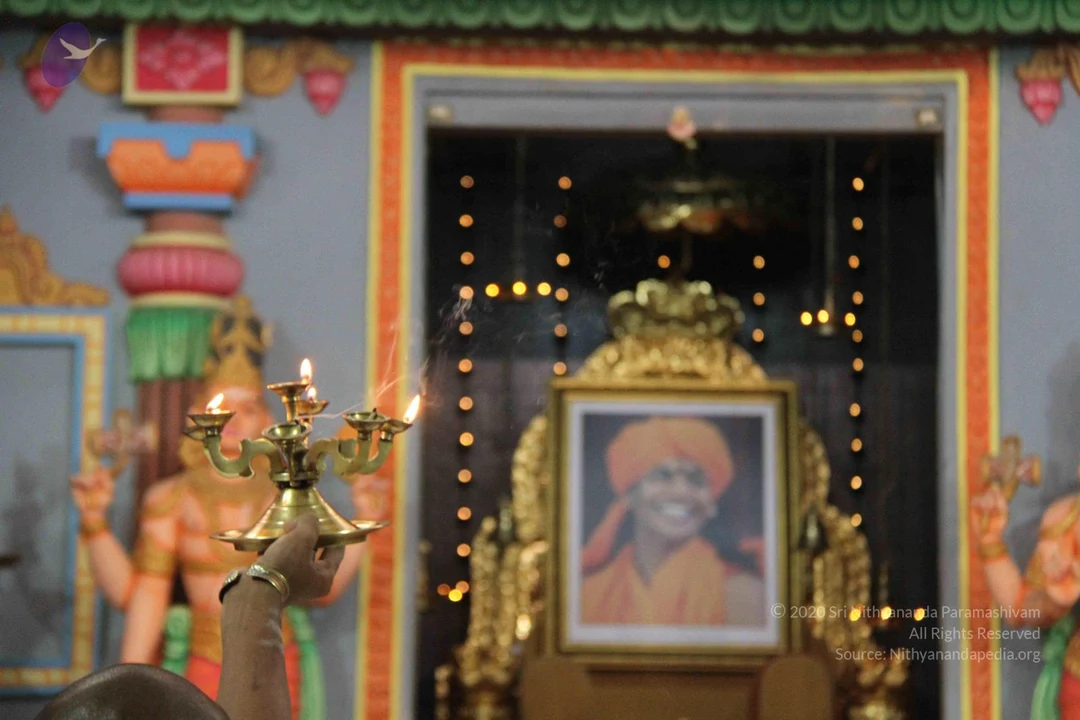
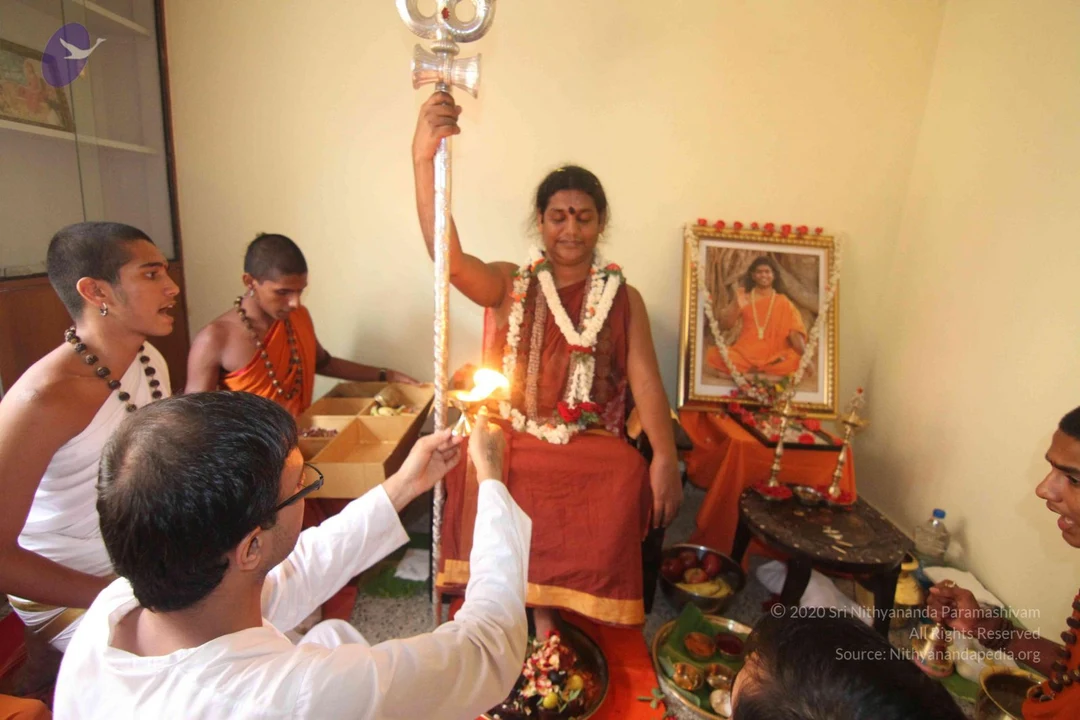
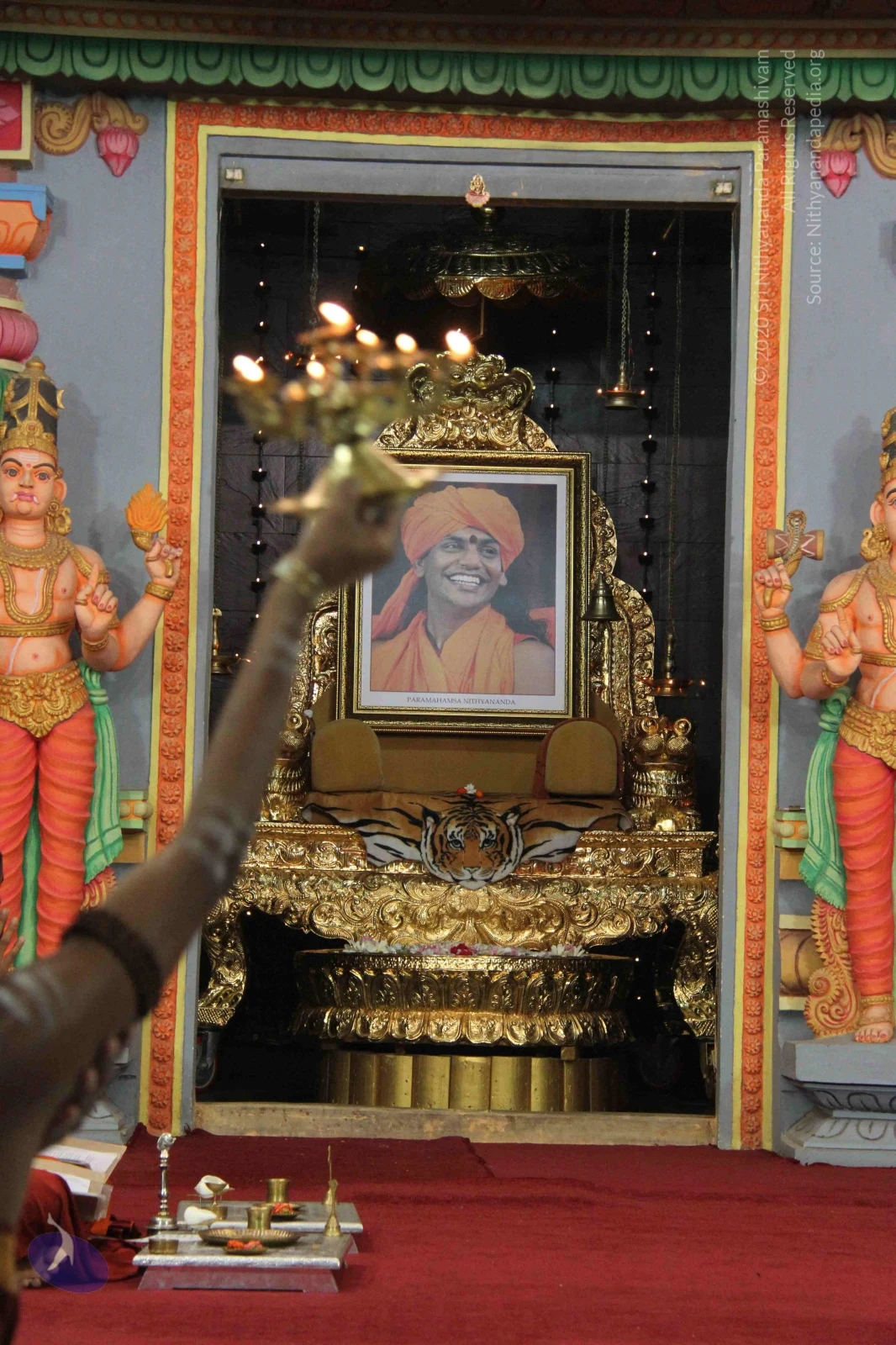
Photograph of a temple shrine: a blurred arm in the foreground raises a multi-flame brass aarti lamp toward an ornate gilded throne draped with a tiger-skin cloth. Behind the throne, a framed portrait labelled "PARAMAHAMSA NITHYANANDA" shows a smiling man in an orange turban and orange shawl. Painted orange-clad dvarapala guardian figures with raised arms flank the doorway, and a brass puja tray with flowers and small lamps sits on a red carpet. The portrait and throne are depictions, and no living person in front of the lamp is identifiable as a person.