Skip to content
Saturday

12 April 2014

Build the right identity.

Dated photos
70
Source pages
1
Media
2
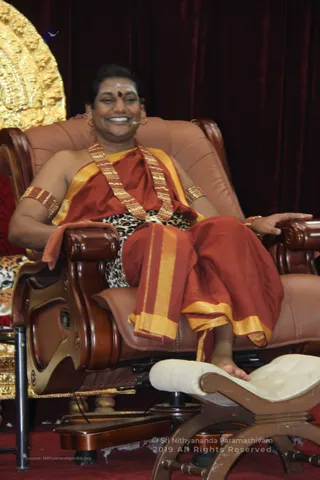
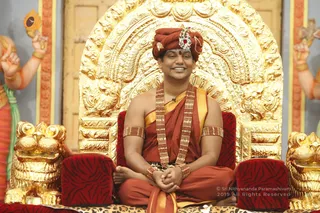
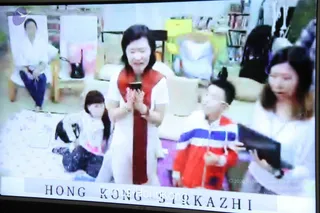
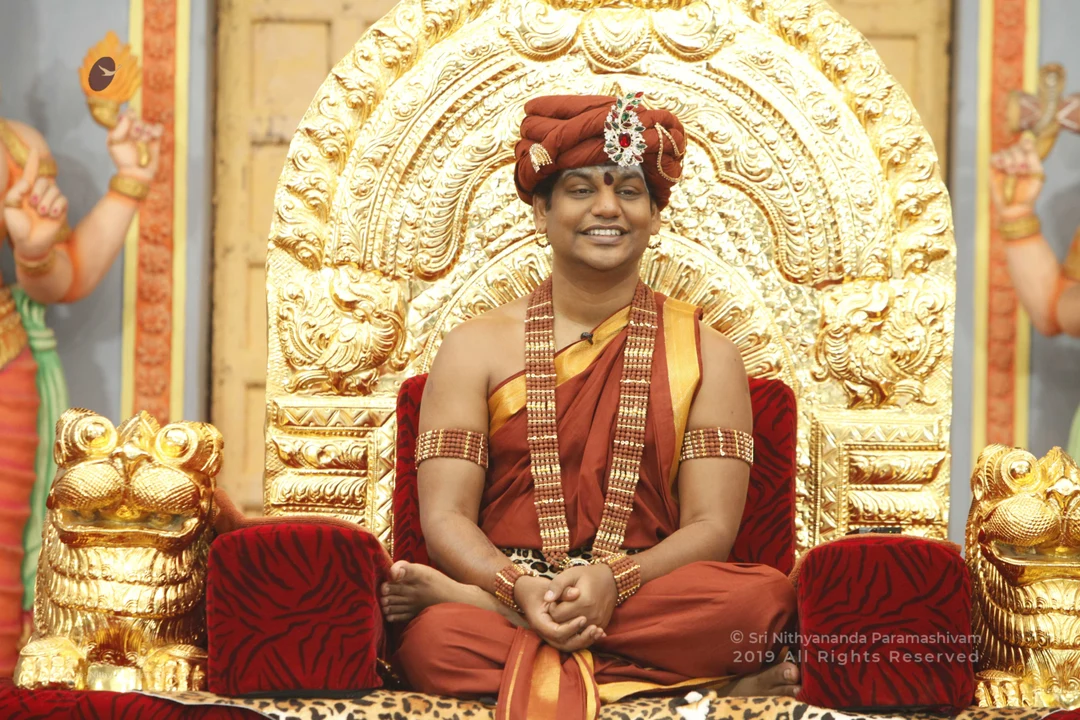
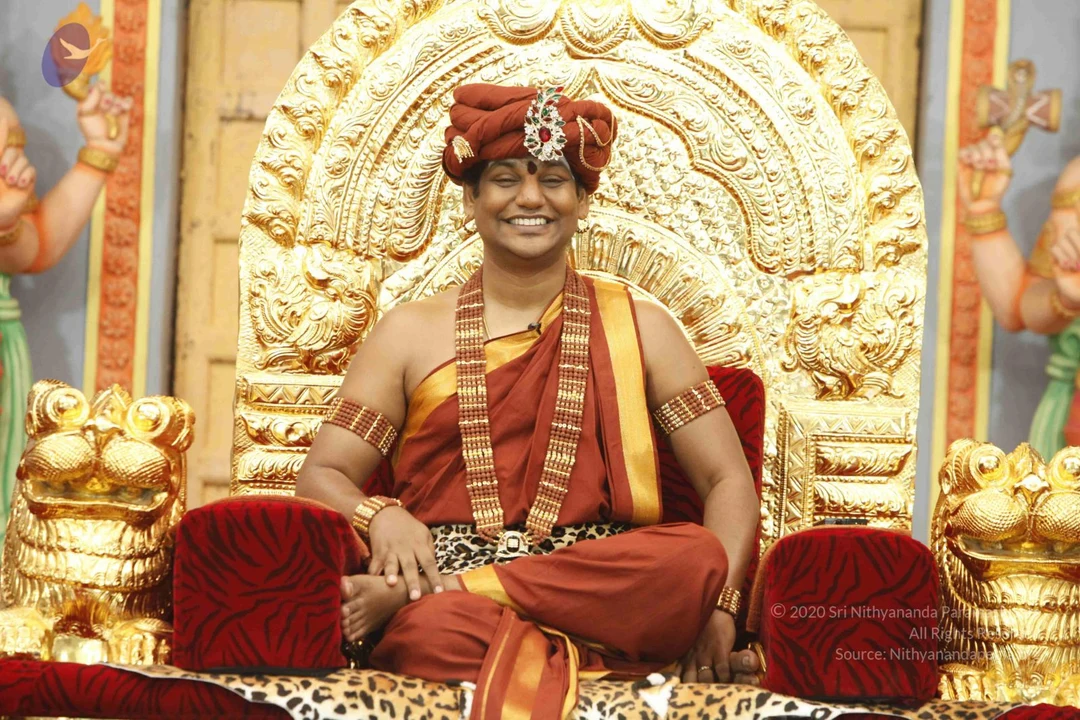
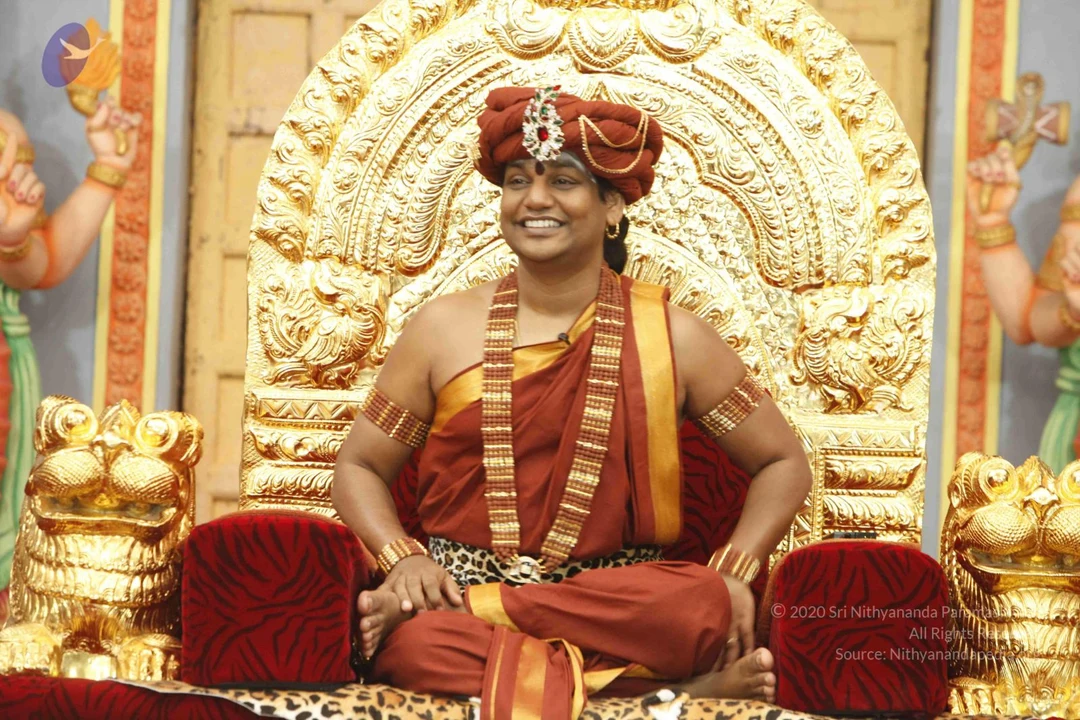
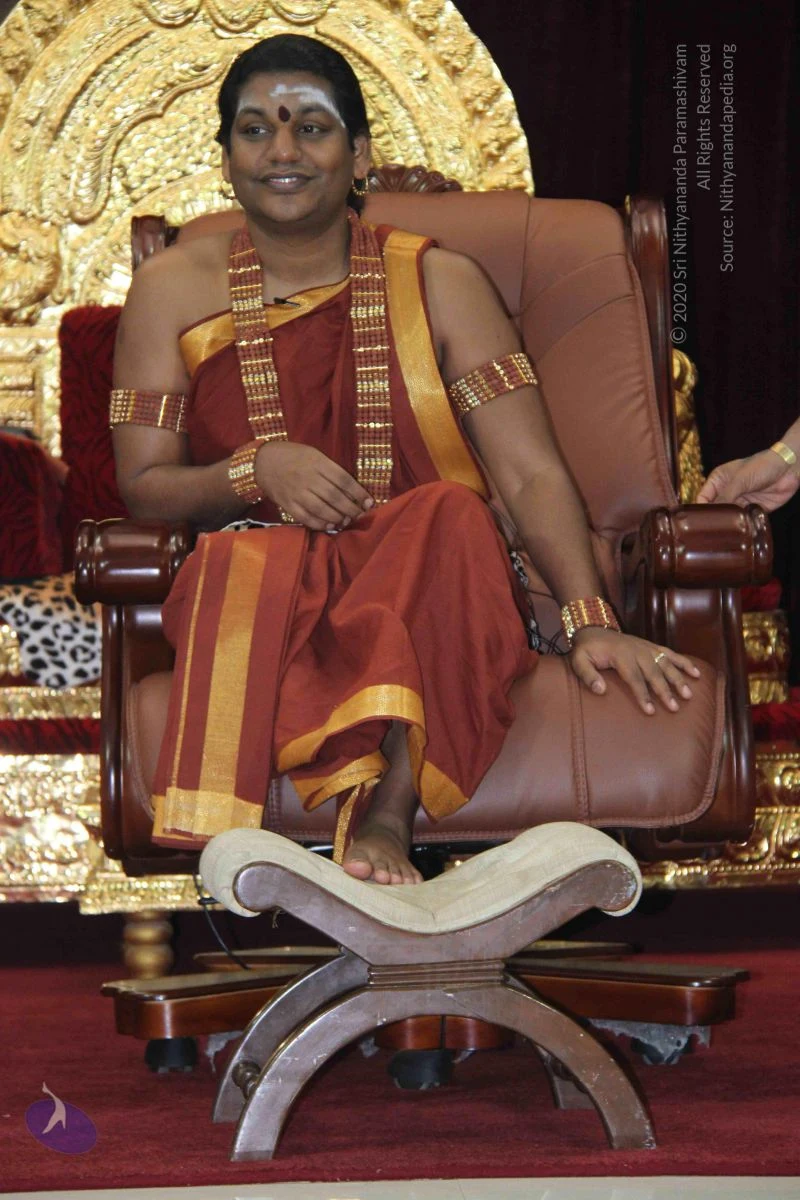
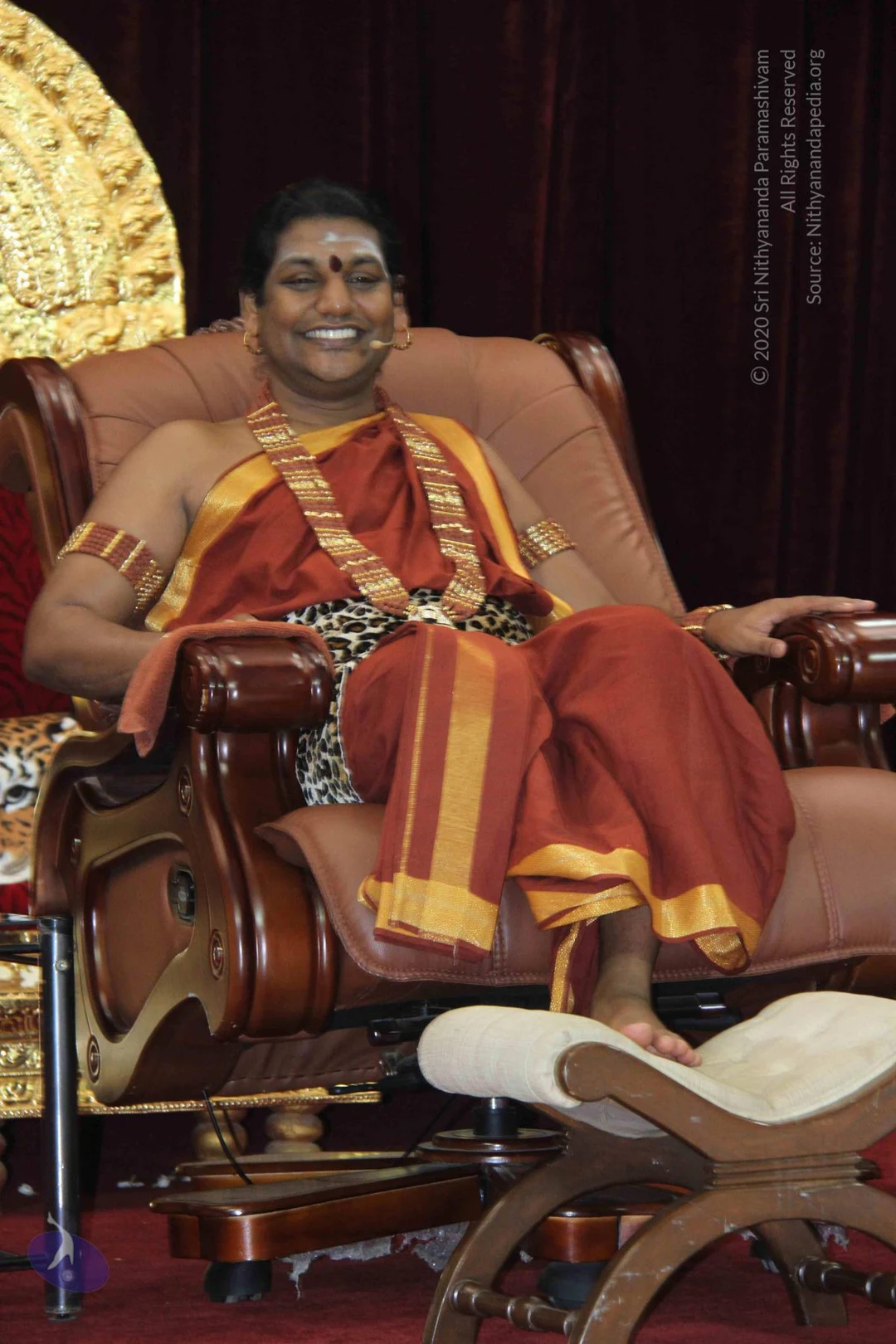
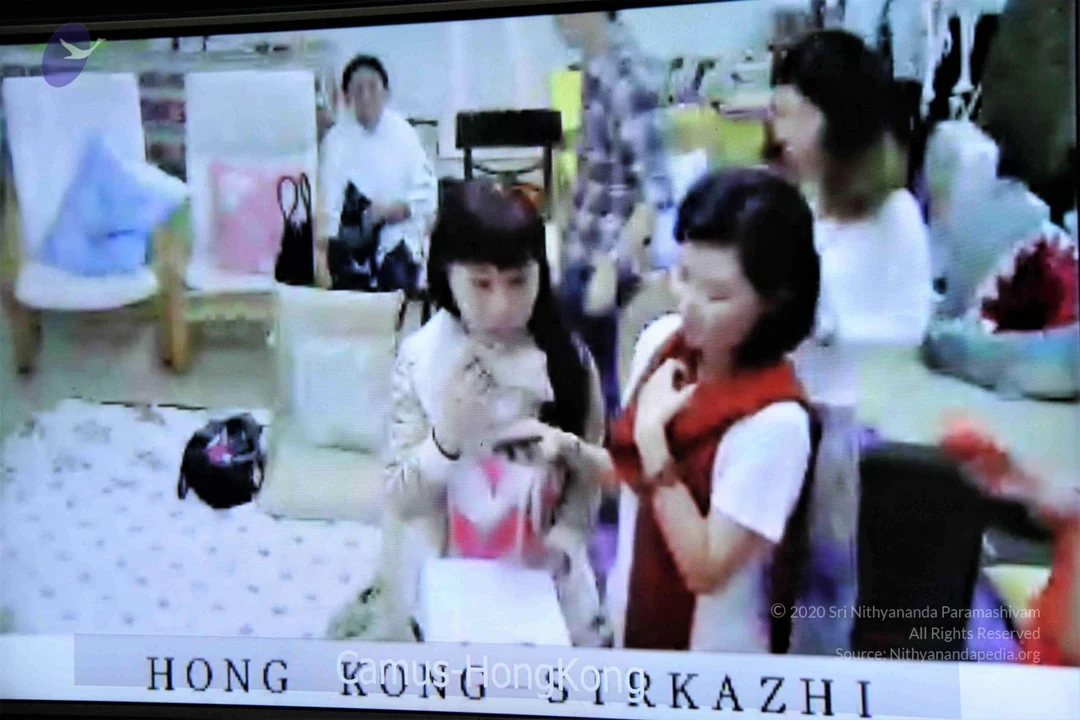
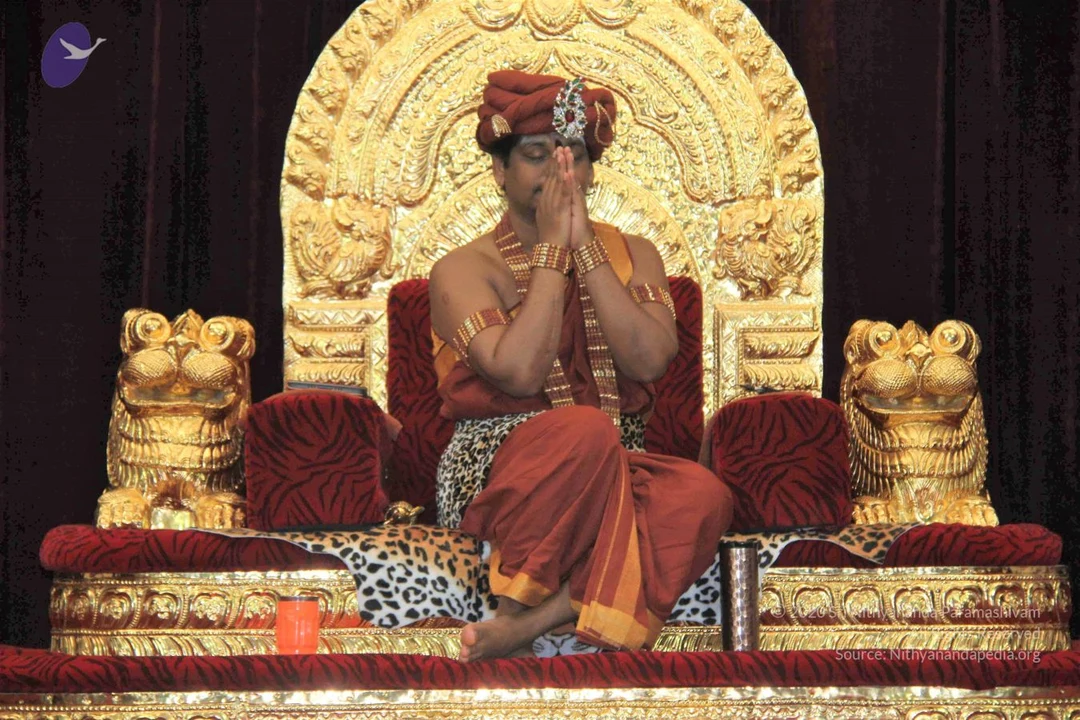
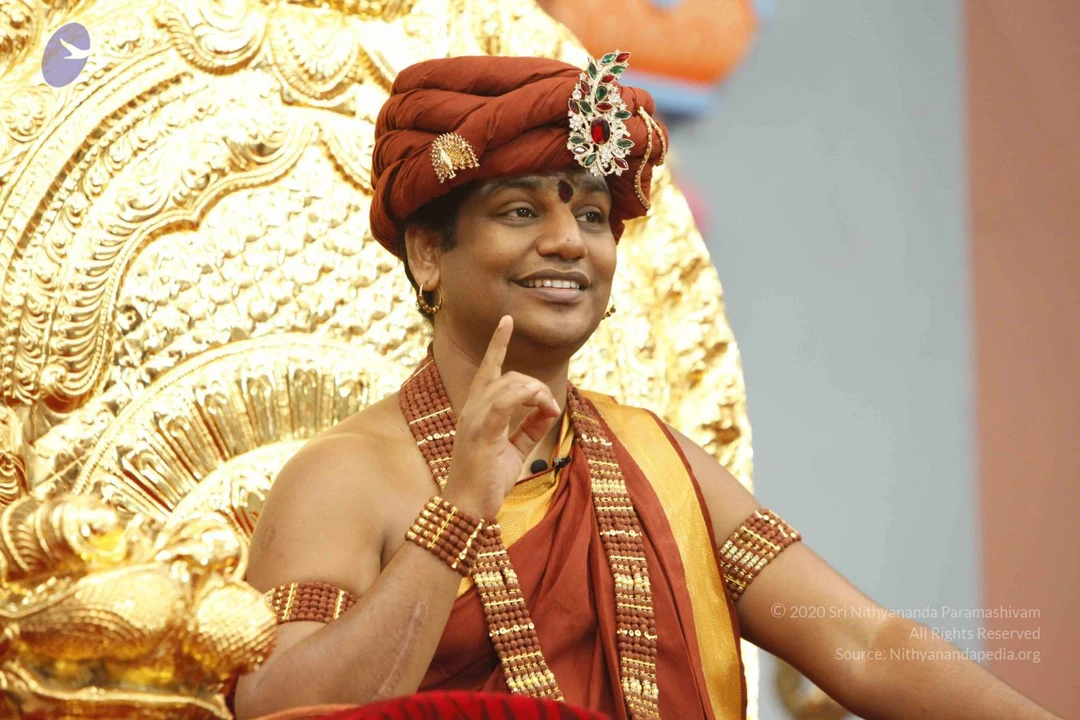
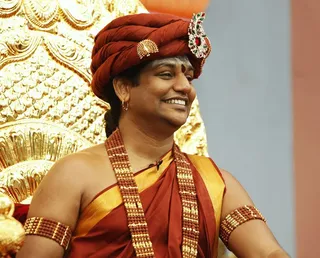
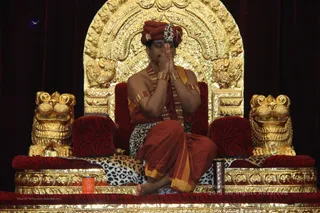
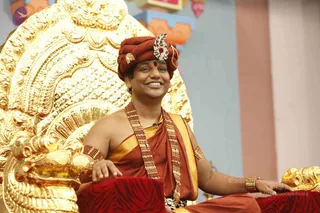
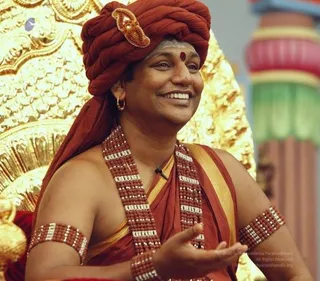
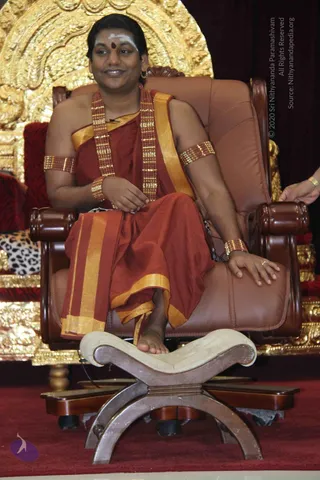
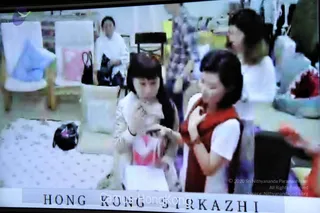
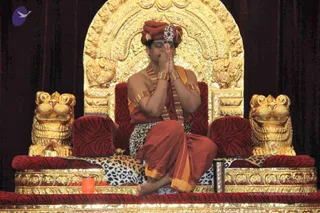
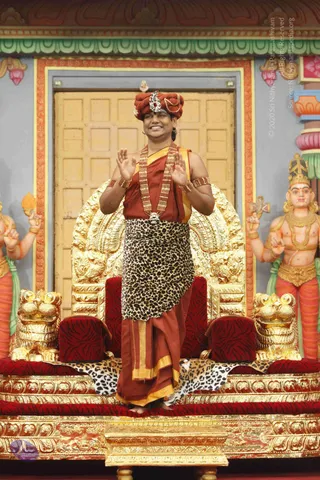
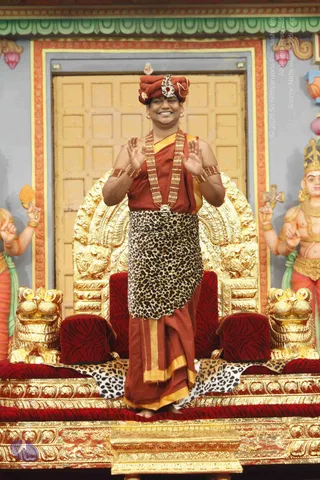
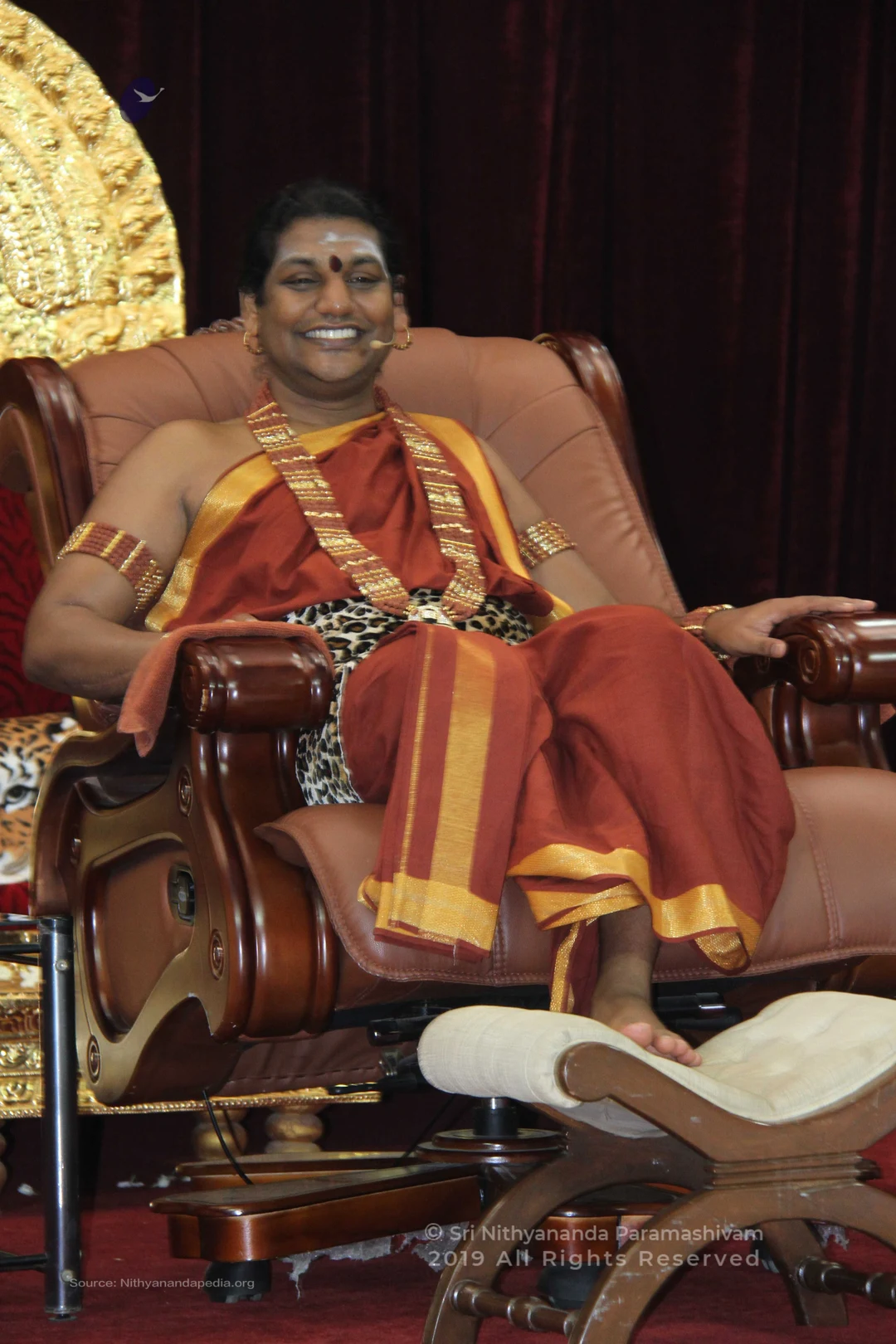
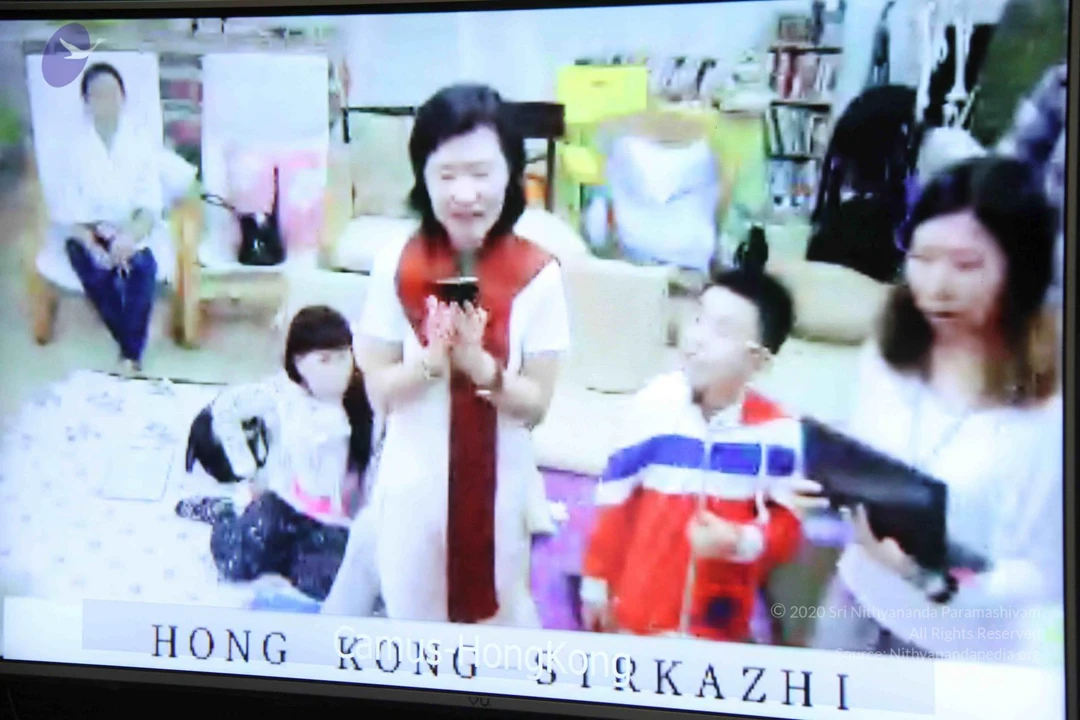
A smiling person sits in a brown leather recliner chair with wooden armrests and a footrest, barefoot, on a red carpet before deep maroon velvet drapes and a gold carved backdrop. The person wears a rust-red garment with gold border, a leopard-print undergarment, layered gold beaded necklaces, gold bangles on the upper arms and wrists, gold hoop earrings, a red bindi and white forehead markings, and a small head microphone. The person is the only physical person visible.A seated man sits cross-legged on a red velvet throne cushion with a leopard-print covering in front of an ornate gold throne backdrop. He wears a rust-orange turban with a red and white jewelled ornament, a rust-orange robe with gold trim, a long gold-toned bead garland, and gold armlets. He has hands folded in his lap and is smiling. Flanking the throne are golden lion sculptures, and painted deity statues with raised hands appear at the edges.A photograph of a video-conference screen showing a Hong Kong satsang location. A woman in a white top and red-and-orange sash stands with palms pressed together in greeting, a dark mug or cup in one hand. Beside her a young girl sits on a patterned rug and a boy in a red, white and blue striped jacket smiles and raises a hand. A woman at the right, in white, holds a dark object. Behind them a seated person in white sits in a room with shelves, furniture and a yellow object. The lower caption reads Camus HongKong and Hong Kong Sirkazhi. No a person candidate is visible in this frame.

April 12 2014

Original wiki page
Contents

Title:

Build the right identity.

Description:

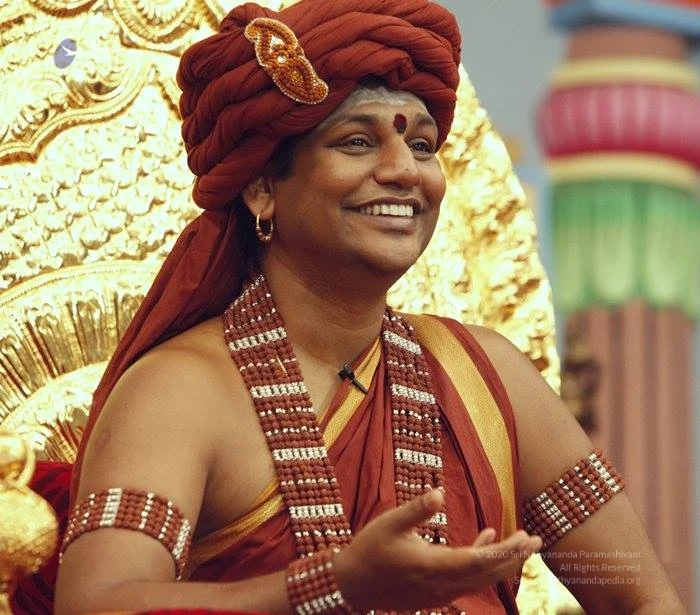
In today’s (12th April, 2014) morning Satsang, Paramahamsa Nithyananda gives us deeper insights on the importance of building the right identity. In society, we have been taught to only focus on body- building which has a severe depreciation value, diminishing as we age. But when we build our identity with Authenticity, based in consciousness, our appreciation value raises exponentially, increasing as we age. Authenticity is building the Being to live in the space of Advaita.

Link to Video:

VideoAudio

Transcript:

Nithyanandeshwara Samaarambhaam

Nithyanandeshwari Madhyamaam |

Asmath Aachaarya Paryanthaam

Vandhey Guru Paramparaam ||

I welcome all the devotees, disciples, samajis, satsanghis, Shrimahants, Mahants, Kotharis, Thanedars, sitting with us all over the world through Nithyananda TV, Lotus News Channel, Sadhna TV, Janashree TV, and through two-way video-conferencing having Nayana Deeksha, many cities in many countries around the world.

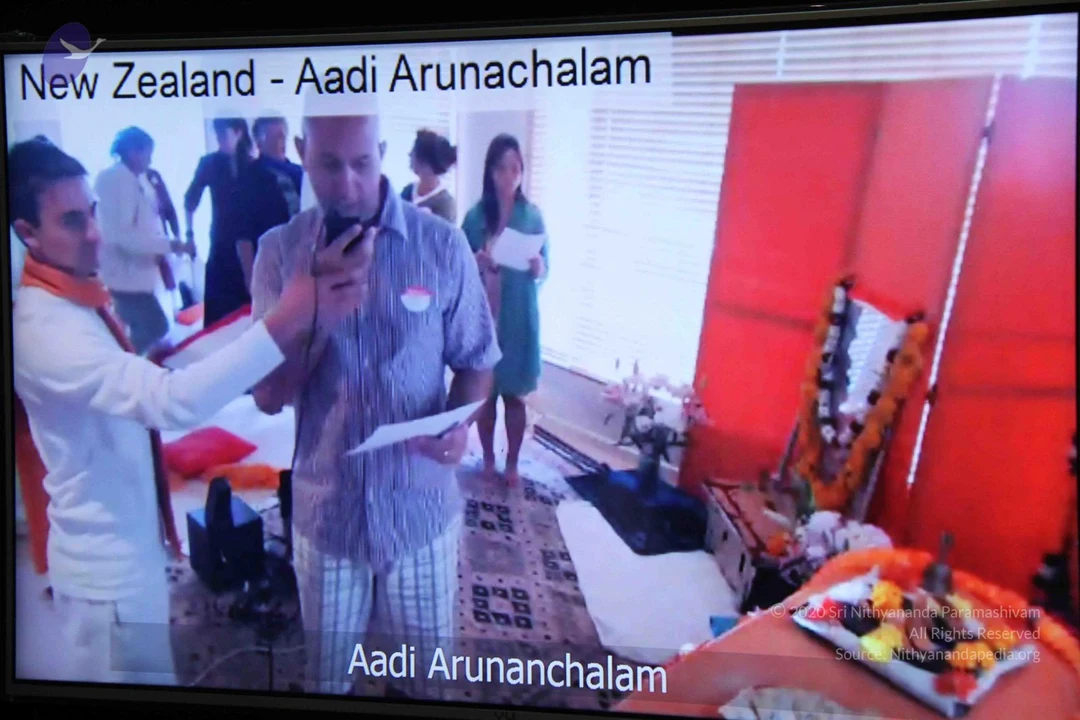
The cities sitting with us through two-way video-conferencing having Nayana Deeksha: New Zealand-Adi Arunachalam, Camus-Hong Kong, Toronto-Kailasam, Nithyananda Nagaramu-Hyderabad, Nithyananda University-Los Angeles, Seattle-Chidambaram, Singapore-Singapuram, San Jose-Madurai, St. Louis-Tirumala, Ohio-Prayag, Varanasi, Seremban-Sivakasi, Scottsdale-Arizona, Oklahoma-Somanatham, Vancouver-Bhubaneshwar, Charlotte-Srisailam, Simi Valley-California, London-Kashi, Oman-Sivagangai, Devon-UK, Dakota Dunes, Bogota-Colombia, Highland Creek - North Carolina, Dubai-Vaidyanatham, Houston-Texas, Hyderabad-Gupta Kashi, Indrani-New Jersey, Jorpati-Nepal, Mumbai-Mulund, Newfoundland-Canada.

I welcome all of you with my love and blessings.

Again, today, I insist on understanding about Advaitha.

Please understand, strategizing your day-to-day thinking based on the simple truths is Living Enlightenment. Strategizing your day-to-day decisions based on the eternal truths is Living Advaitha.

Few days before I was shown a reply by a rich man to a pretty girl who has advertised in the dating websites that she wants to marry rich man. When that reply was brought to me, I told Jnanatma I will comment on it. Jnanatma can you read out and I will comment on it?

Jnanatma : So the article , ‘This Pretty Girl Was Seeking a Rich Husband. The Reply she got from a Banker was Priceless.’

The following is what a woman posted on a dating forum seeking a rich husband.

I’m going to be honest of what I’m going to say here. I’m 25 this year. I’m very pretty, have style and good taste. I wish to marry a guy with $500k annual salary or above. You might say I am greedy, but an annual salary of $1M is considered only as middle class in New York.

My requirement is not high. Is there anyone in this forum who has an income of $500k annual salary? Are you all married? I wanted to ask: what should I do to marry rich persons like you?

Among those I have dated, the richest is $250k annual income and it seems that this is my upper limit. If someone is going to move into high cost residential area on the west of New York City Garden, $250k annual income is not enough.

I’m here humbly to ask a few questions:

First - Where do most rich bachelors hang out? Please list down the names and addresses of bars, restaurant, gym.

Which age group should I target?

3) Why most wives of the riches are only average-looking? I’ve met a few girls who don’t have looks and are not interesting, but they are able to marry rich guys.

4) How do you decide who can be your wife, and who can only be your girlfriend? My target now is to get married.

Ms. Pretty

A philosophical reply from CEO of J.P. Morgan below:

Dear Ms. Pretty,

I have read your post with great interest. Guess there are lots of girls out there who have similar questions like yours. Please allow me to analyse your situation as a professional investor. My annual income is more than $500k, which meets your requirement, so I hope everyone believes that I’m not wasting time here.

From the standpoint of a business person, it is a bad decision to marry you. The answer is very simple, so let me explain.

Put the details aside, what you’re trying to do is an exchange of “beauty” and “money”: Person A provides beauty and Person B pays for it, fair and square.

However, there’s a deadly problem here, your beauty will fade, but my money will not be gone without any reason. The fact is, my income might increase from year to year, but you can’t be prettier year after year.

Hence from the viewpoint of economics, I am an appreciation asset, and you are a depreciation asset. It’s not just normal depreciation, but exponential depreciation. If that is your only asset, your value will be much worse 10 years later.

By the terms we use in Wall Street, every trading has a position, dating with you is also a “trading position”.

If the trade value dropped we will sell it and it is not a good idea to keep it for long term – same goes with the marriage that you wanted. It might be cruel to say this, but in order to make a wiser decision any assets with great depreciation value will be sold or “leased”.

Anyone with over $500k annual income is not a fool; we would only date you, but will not marry you. I would advise that you forget looking for any clues to marry a rich guy. And by the way, you could make yourself to become a rich person with $500k annual income. This has better chance than finding a rich fool.

Hope this helps.

J.P. Morgan CEO


Understand, I usually pick up only the Upanishads, Vedic scriptures, to comment on. But very rarely I pick up some modern-day writing or the recent postings to comment on. But I picked it up this up personally. It has a very deep insights of Advaitha.

Please listen. Whole life is a business, the whole life is trading: you give something, receive something. Either you got more or you gave more. Or you got and gave equally. Whatever is said and done, whole life is a business, please understand. But, the good news is, what you consider as you is the starting point. The best news is that can be just updated by the Advaitha.

Please understand what you consider you is the position, trade position. If you consider you only dependant on your physical qualities you only have depreciation asset. You only have depreciation value. But if you assess yourself based on the qualities you carry in your mind it can be, you can be appreciation asset - means intelligence, your ability to handle any situation. Please understand whenever the queens were chosen they were always chosen, the first priority was given to their appreciation asset. Not to the depreciation asset. Whenever the daasis were chosen they were chosen even with just appreciation asset but whenever queens were chosen in any kingdom they were chosen with appreciation asset.

Now I am introducing very important truth to you. You can have something which is eternally appreciating if you perceive yourself only as a body you have only depreciation asset. Exponentially depreciation asset. Please understand whether you plan for your life based on your beauty or health. Whether you plan your life based on your beauty or your health you are planning on a wrong footing. You’re planning on a wrong footing.

Please understand there’s a Sanskrit verse:

Kaaryeshu daasi, karaneshu mantri, rupe cha lakshmi kshamaya daritri bhojyeshu maata shayaneshu rambha Shad-dharmayuktaah kuladharma patni

Means; ideal wife the one who works like a servant, advises and strategizes like a minister, feeds like a mother, makes love like a nymph, is as beautiful as Lakshmi and forgiving like the earth.

It’s a Sanskrit verse. One fellow read this verse and came to me and said, ‘Swamiji I have achieved the meaning of this verse!’ I said, ‘you are fortunate, blessings. Please call your wife, receive the blessings.’ He said, ‘No Swamiji just change the word, call your wives because so many qualities will not be in one person! I married six with all these each one having one of these qualities.’

Anyhow how you perceive you if it is just occupied means your self-image, your identity about you, if it is occupied completely by your look, by your beauty, the physical dimension, please listen, you are making all your strategies and plans based on depreciation asset more and more. As time passes, life will be hell for you. Kaala will bring suffering for you. Please understand, the strategy which brings the best things as Kaala passes, is eternal strategy.

If your perception about you is all based on your beauty, you are having exponential depreciation asset. You can manage few more years with various creams and cosmetic items, but it will continue to depreciate.

Second, if your perception about you is based on your mental abilities, your ability to understand, your ability to assess, your ability to strategize, your ability to cognize, your ability to respond, you have appreciation asset. Please understand, you have appreciation asset. As the time passes, you will only have more and more joy. You will not have more and more suffering. Kaala brings you more joy.

If your perception about you is based on the Consciousness, if your perception about you is neither based on your beauty and health, nor based on your beauty and health or based on your mind’s abilities, it is based on your conscious space, the space you carry, the being you carry, the consciousness you carry, the idea you have about you, understand, you have exponentially appreciation asset. Kaala brings you bliss.

If you are just based on your beauty, you have exponentially depreciation asset. If you are built on your health, you have depreciation asset. If you are built on your mental abilities, knowledge, you have appreciation asset. If you are built on your consciousness, you have exponentially appreciation asset.

Whether Kaala is going to bring suffering to you, or pain to you, or joy to you, or bliss to you, understand, when you have beauty and health, making the comforts you want and position you want in society is okay. Means, making some money and making a career and making a family, it is okay. But, please don’t strategize your life based on that.

No Old Age Insurance is going to be useful for the person who is paying it, please understand; because all Old Age Insurances becomes useless by the time you reach that age, because that money for which you insured is no more useful to run your life. Thirty years before, people who paid Old Age Insurances, they would have thought $100,000 is the greatest money and they would have insured themselves for that! Now, with that, what you get your monthly money, may be maximum you can make the ends meet; means you can have food and roof above your head. So, please understand, now you may think maybe ten million dollars is the best insurance. Make it and see. By the time you become old...... Strategize! I am not saying don’t have insurance. I am only saying insurance does not mean insurance. That is all I am saying. I am not saying don’t take insurance. But insurance alone is not insurance.

Listen. The first thing, strategize your life based on Authenticity. Please understand. Strategize your life based on Authenticity. How you perceive about you, let it be based on Authenticity. How you perceive yourself to be, please listen. Internalize sincerely when you are listening.

Let your perception about you be always based on the consciousness you hold, the identity you hold. Inner Awakening program is all about making you understand the right identity and go on asking you to strengthen the right identity. Authenticity is all about re-writing your right identity and go on strengthening that right identity, completing with all the unnecessary components you are carrying around your identity. If you are depressed this moment, ask yourself, ‘Is this time and energy I spend on depression is going to strengthen the identity I want to establish for myself?’ Identity-building is just like body-building and mind-building. Society gives so much of importance and time to body-building and mind-building, forgets to let you understand identity-building.

The other day I was sitting and calculating the bio-memory, bio-energy, and DNA structures of our Swamis based on the lifestyle, food-style. Please understand, very comfortably I am putting this on record in the national television in satsangh; Anyhow later on, in times to come, these satsanghs will be eternally stored and seen by crores of disciples yet to come, and thousands of years yet to come; I am putting this comfortably on record: Average, all my sannyasis will live 120 years comfortably. You will see. Comfortably, without any disease, average 120 years my sannyasis will live! Very comfortably, not with struggling, pulling, pushing. No! Very comfortably. Because, first good thing, first good thing, I am already successful is, I made a very good eating habit for them. Very good eating habit. Ninety percent of them abide by this good eating habit. Even the ten percent, they miss only rarely while they travel around. “Good eating habit” means, with the right gap, the habit of eating only what is required for the body. That is what is “good eating habit”. I was sitting with some of my Swamis for a teamily dinner. We were scanning, scanning, scanning. We have not found even a single sannyasi or ashramite who abuses food; means, eating unnecessarily, eating out of depression, eating out of just lust of taste. I was so happy. This is the first step you have to master to develop the right identity.

Then the right yoga lifestyle: I can say, again ninety percent I am successful. Only ten percent who are travelling outside, when they travel outside, night travel, bus, trains, they miss; and the Swamis who are staying in some remote centres, they miss, because they are all alone; that also should not be missed.

Once somebody can master the eating and yoga pattern, now very easily they can build the right identity.

Understand, society stops with body-building because, by the time you come to the right body-building itself, your energy, effort, everything is wasted. By the time you build the right food habit and yoga pattern, you are too tired or too old and you feel too much of effort has been spent on it. Then with knowledge you try to do mind-building, through education. If you are a doctor, in that field; if you are an engineer, in that field. Any field. By the time you do mind-building, you stop the patterns of body-building, you start over-eating. That is why, people, if they achieve something in the knowledge field, they think they can pamper themselves and develop the bad eating habit and bad routine, lifestyle. I have seen doctors; their tummy will be hitting the operation table and they will have to bend all out to cut the patient! I have seen engineers; they build amazing buildings; the foundation will be so strong, and the roof will be light; but, in their body, the foundation will be so weak and the middle portion will be too heavy. Leads to the weak columns and knee pain. By the time you build the body, you are tired and you don’t want to build the mind. By the time you build the mind, you just want to pamper yourself and stop building body.

Listen. You are never given the knowledge about building the Being. Authenticity is building the Being. This process which I am putting all of you through, the teamily Advaitha process, the Advaitha teamily is nothing but reminding you to build the right identity. Reminding you to build the right identity.

Understand, I am getting the Eternal Insurance for you; not Old Age Insurance, Eternal Insurance for you. Whoever has built the right identity, you have a place in Akshardhama. Means imperishable space. Imperishable space, Akshardhama, which is equalent to Kailaasa or Vaikunta! The power of Kailaasa wealth of Vaikunta put together is Akshardhama!

The identity-building has to be done consciously as a lifestyle. First, pen down the best inner-image you want to have, outer-image you want to project, how you want others to perceive you, how you want to perceive the world and others. And, after you pen down that, every action, every thought, every word you utter, go on reminding yourself, ‘Is it aligned to what I want? Is it aligned to what I want?’ If it is aligned, do it and overdo it! If it is not aligned, complete and drop it.

Understand, many times your identity is in one direction, your actions are completely in the other direction. The conflict of interest in you drags you to the easiest direction. By the time you wake up, you are dead! Dead before wake up are what I call as “Accidental Humans”. You are born when your parents were trying to do something else, as an accident! You live as an accident! And die as an accident! The person who starts building the identity, even if he is a failure, he will be successful in his journey. Understand, understand, I am making a statement. Even if you are failure in building your Authenticity, just because you tried you will be successful in your journey either tomorrow or next day because even starting the journey with the right direction and the right guide is the greatest thing can happen in your life. That is why I am saying Inner Awakening, first foremost truth, experience, program, can happen in your life. Wake up to yourself. Come back to Authenticity.

All the Swamis, Mahants, Kotharis, Thanedars, devotees, disciples, today your homework is, if you have done your Completions with the teamily, the next step is, define your new identity which you wanted to cause:

new inner-image you want to have, the outer-image you want to show, others-image – how you want to be perceived by others, and life-image – how you want to perceive the world.

Pen down all the four, post it on my Facebook wall; not on inbox, please don’t inbox me; only put it on the Facebook wall.

I bless you all.

If you have not yet finished the teamily Completion, finish that and then pen down this. You have time till tomorrow morning satsangh to finish your teamily Completions. But people who have finished, for all of them this is the next step – the right identity-building. Only you can be liberated from the consciously-built identity, you can become mindless only from a mind which you built consciously, not before that. You can go beyond the mind only jumping from the mind which you built consciously, not from the unconscious mind. Unconscious mind can never be a jumping pad from mind to mindlessness. Mind to no mind state. Only consciously-built mind can be a jumping pad from mind to no-mind.

I bless you all. Let you all radiate with Integrity, Authenticity, Responsibility, Enriching and Causing eternal bliss, Nithyananda. Thank you.

Photos

Pada Puja
Nithya Satsang
Kalpataru Darshan
Tags:

Paramahamsa Nithyananda, identity, society, bodybuilding, depreciation, consciousness, value, age, authenticity, Being, live, Advaita.

Photos Of The Day:

Dial-the-avatar-New-Zealand
Nithya-Satsang
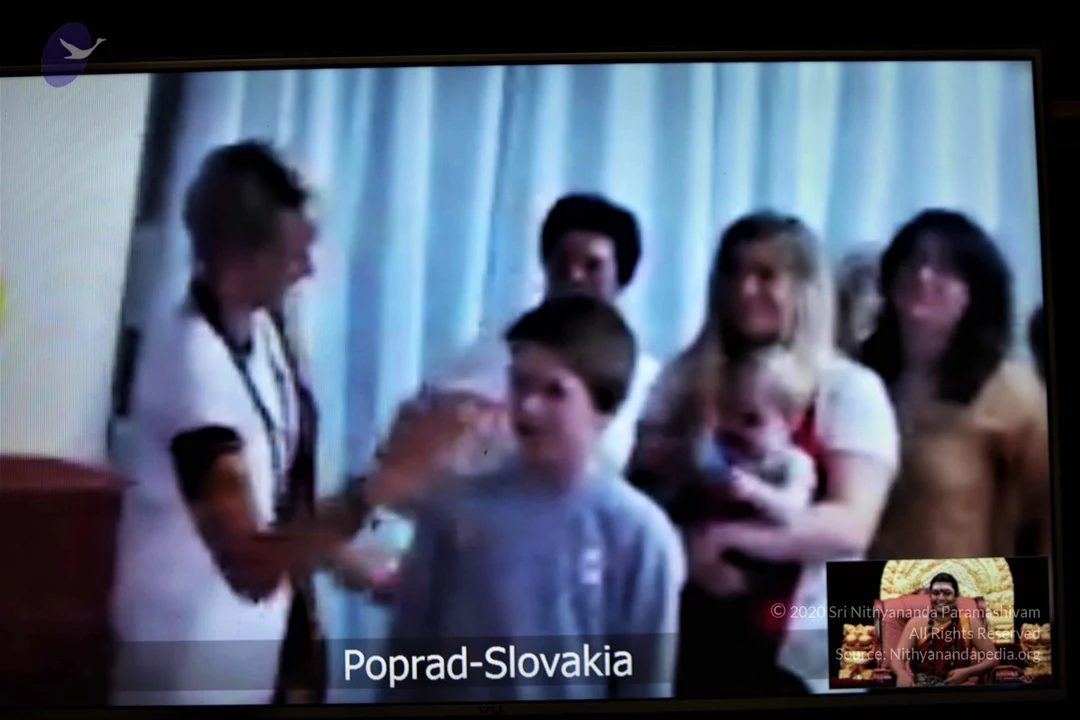
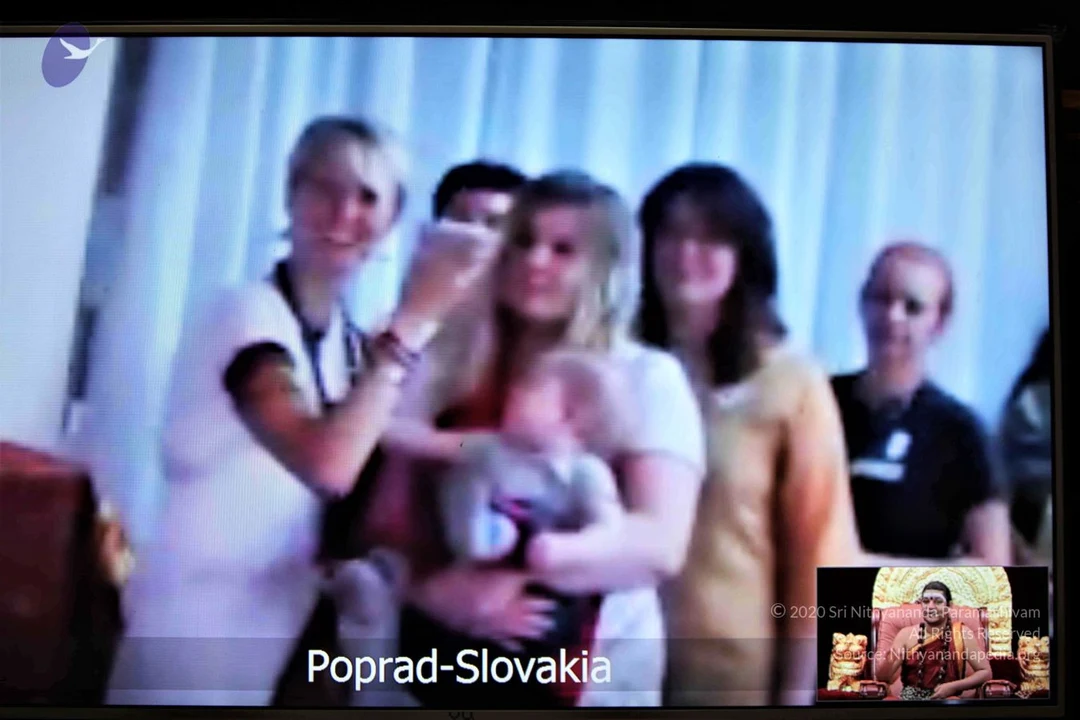
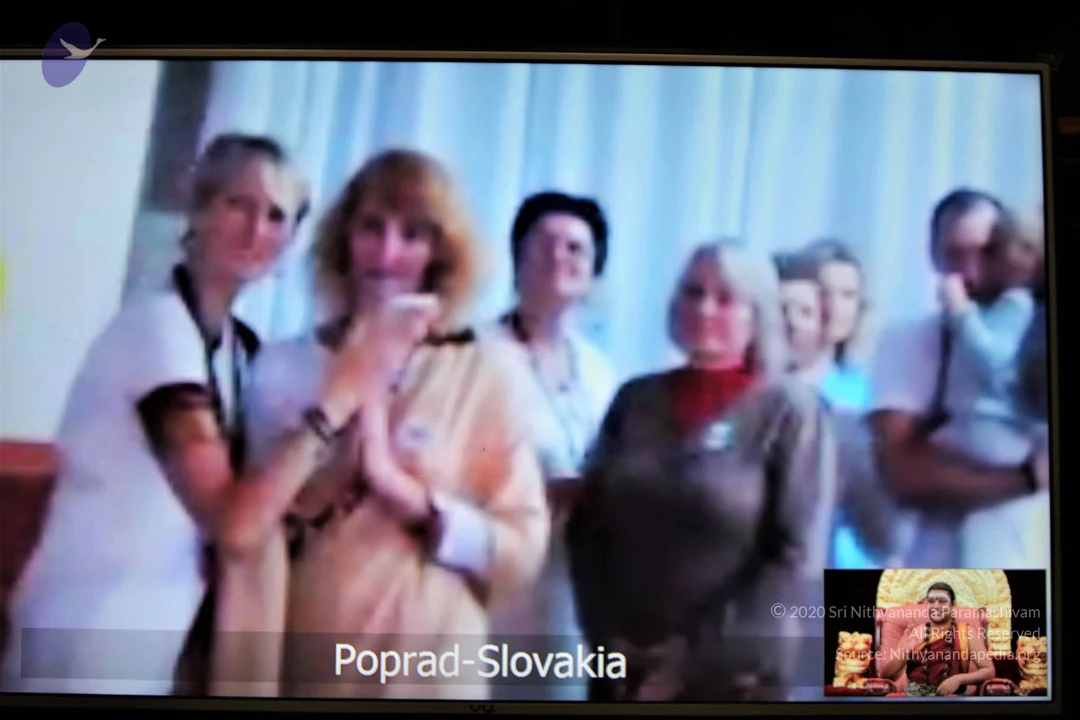
Dial-the-avatar-Slovakia
Photos Of The Day:

FB-photo-of-the-day

Photos Of The Day:

Pada-Puja EDITED-READY-TO-PUBLISH

Dial-the-avatar-New-Zealand EDITED READY-TO-PUBLISH

Nithya-Satsang EDITED-READY-TO-PUBLISH

Dial-the-avatar-Slovakia EDITED-READY-TO-PUBLISH
01--Pada-Puja

Photos from this day

View all 70 photos

Pada Puja

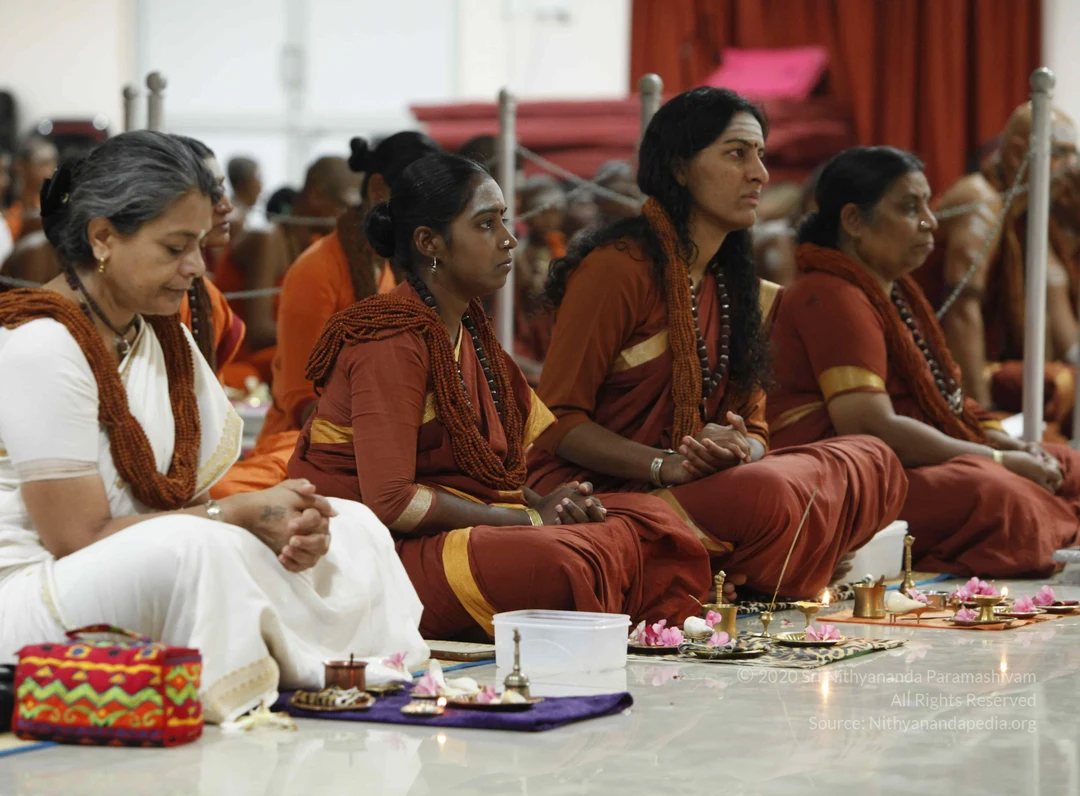
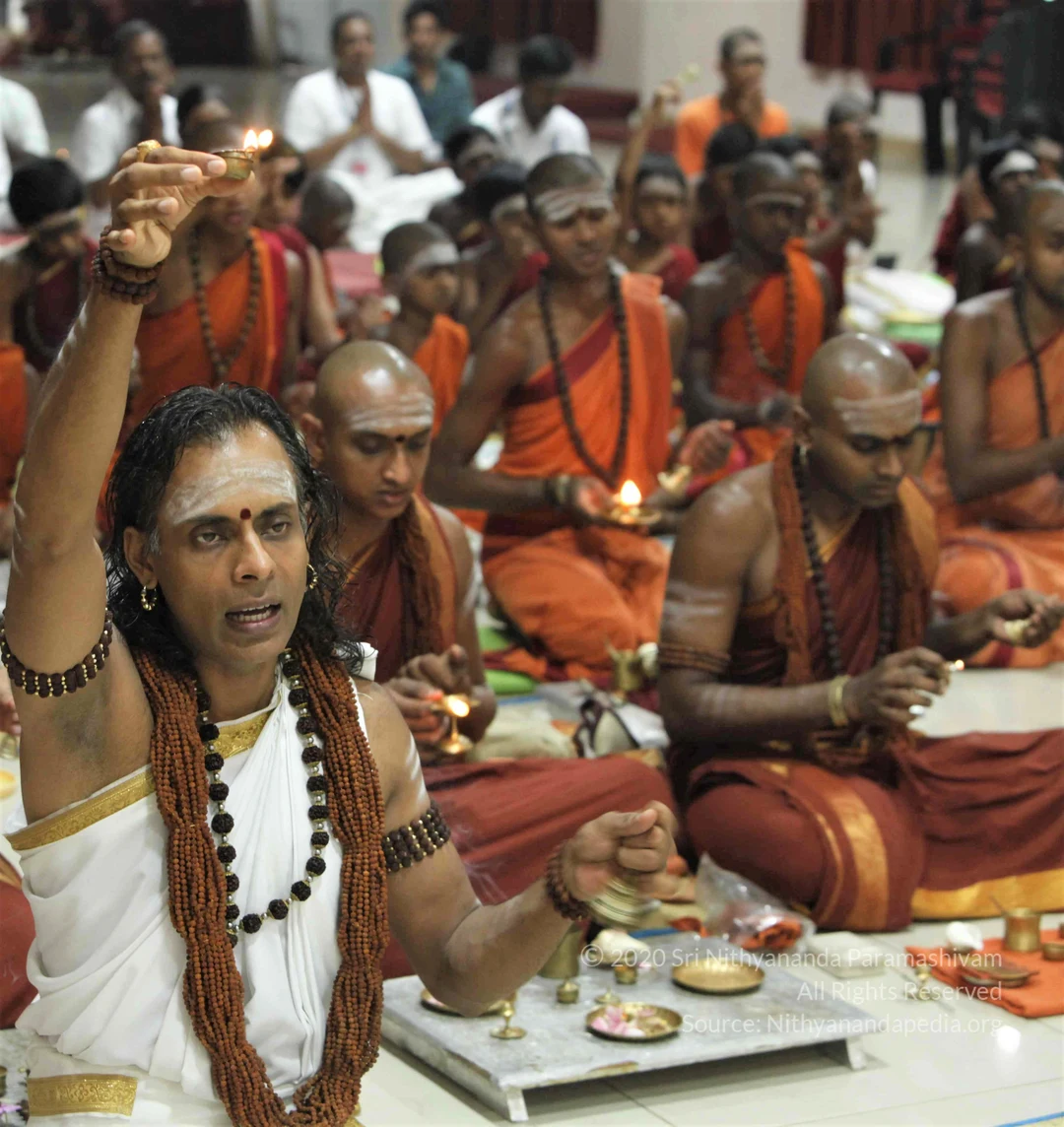
3 photosSource gallery
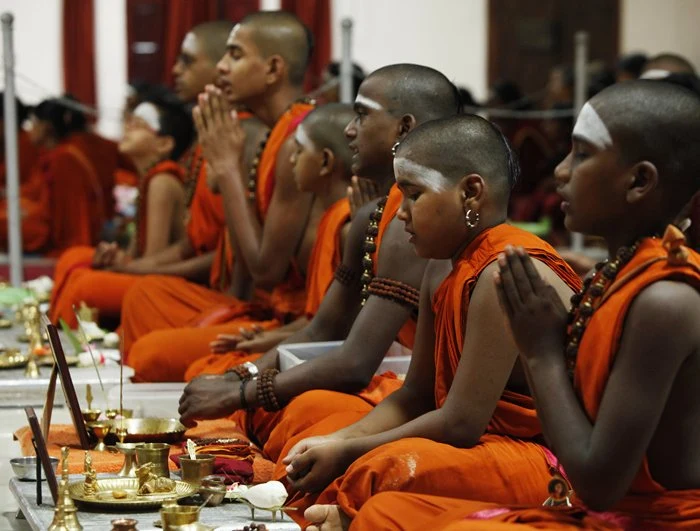
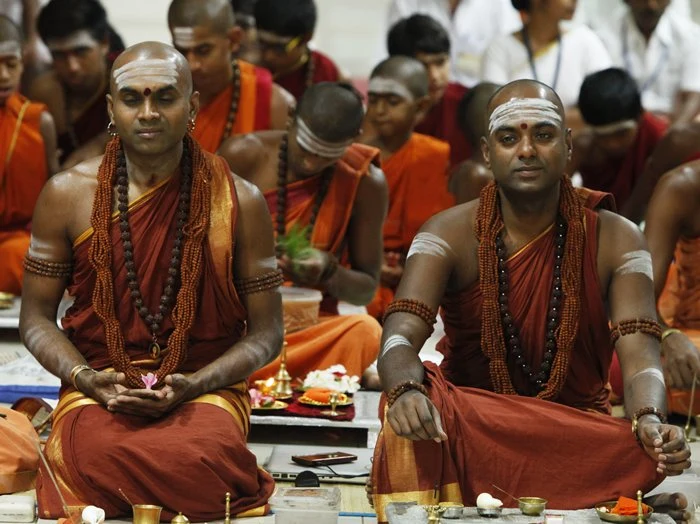
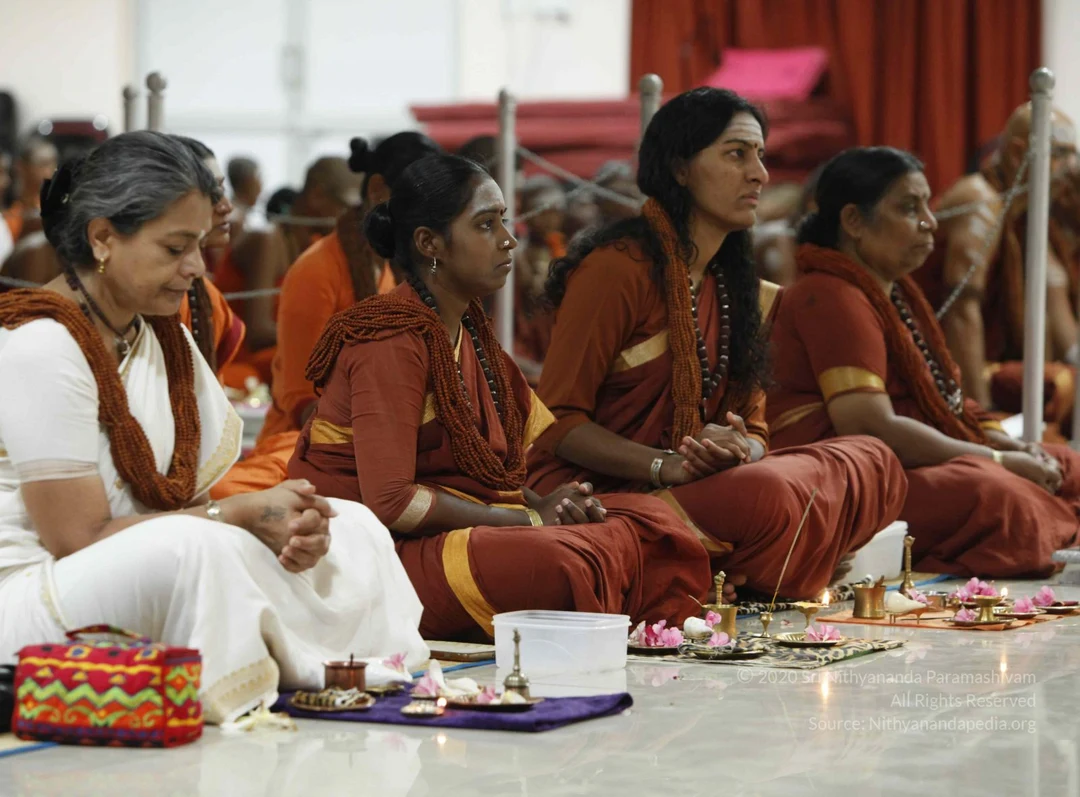
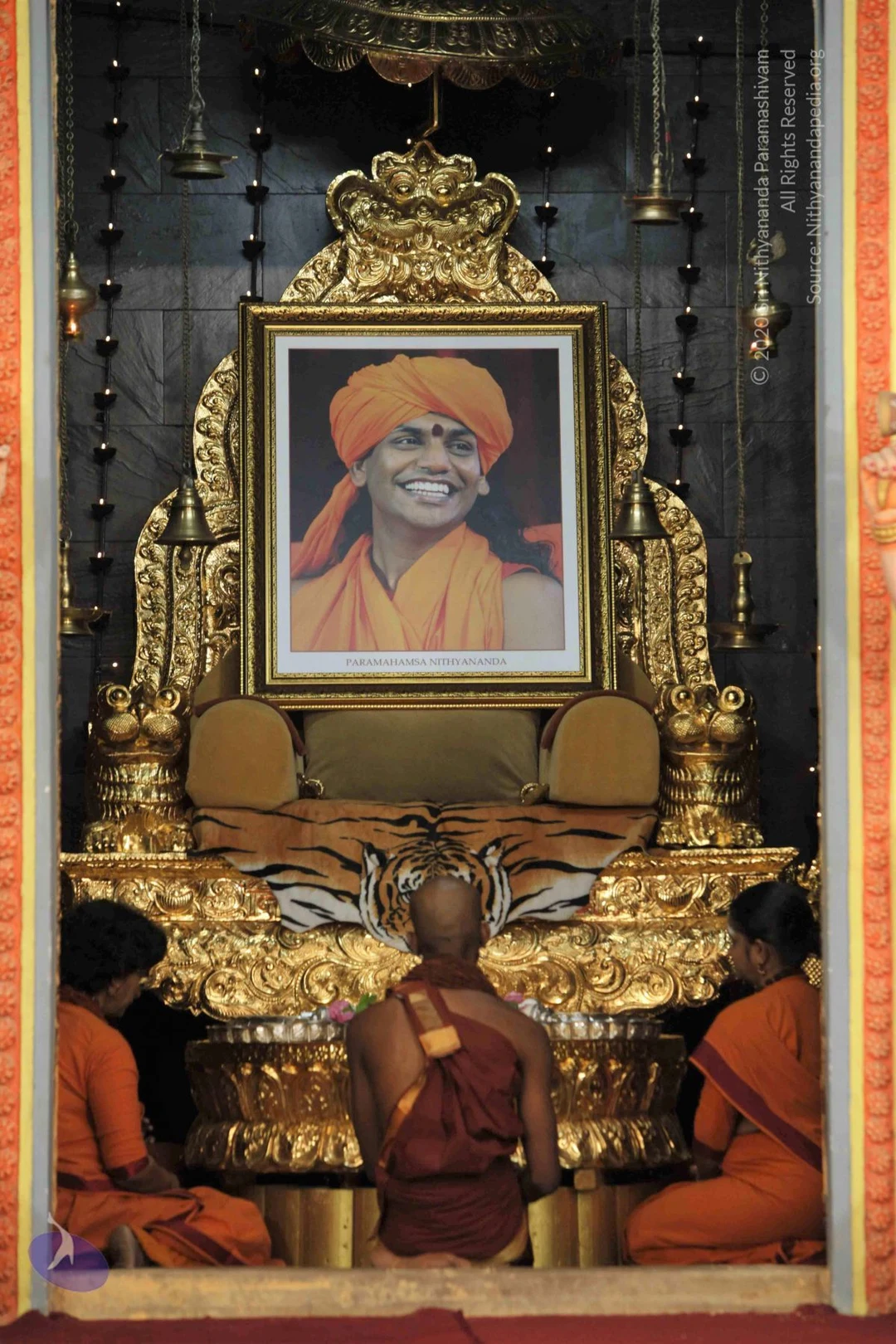
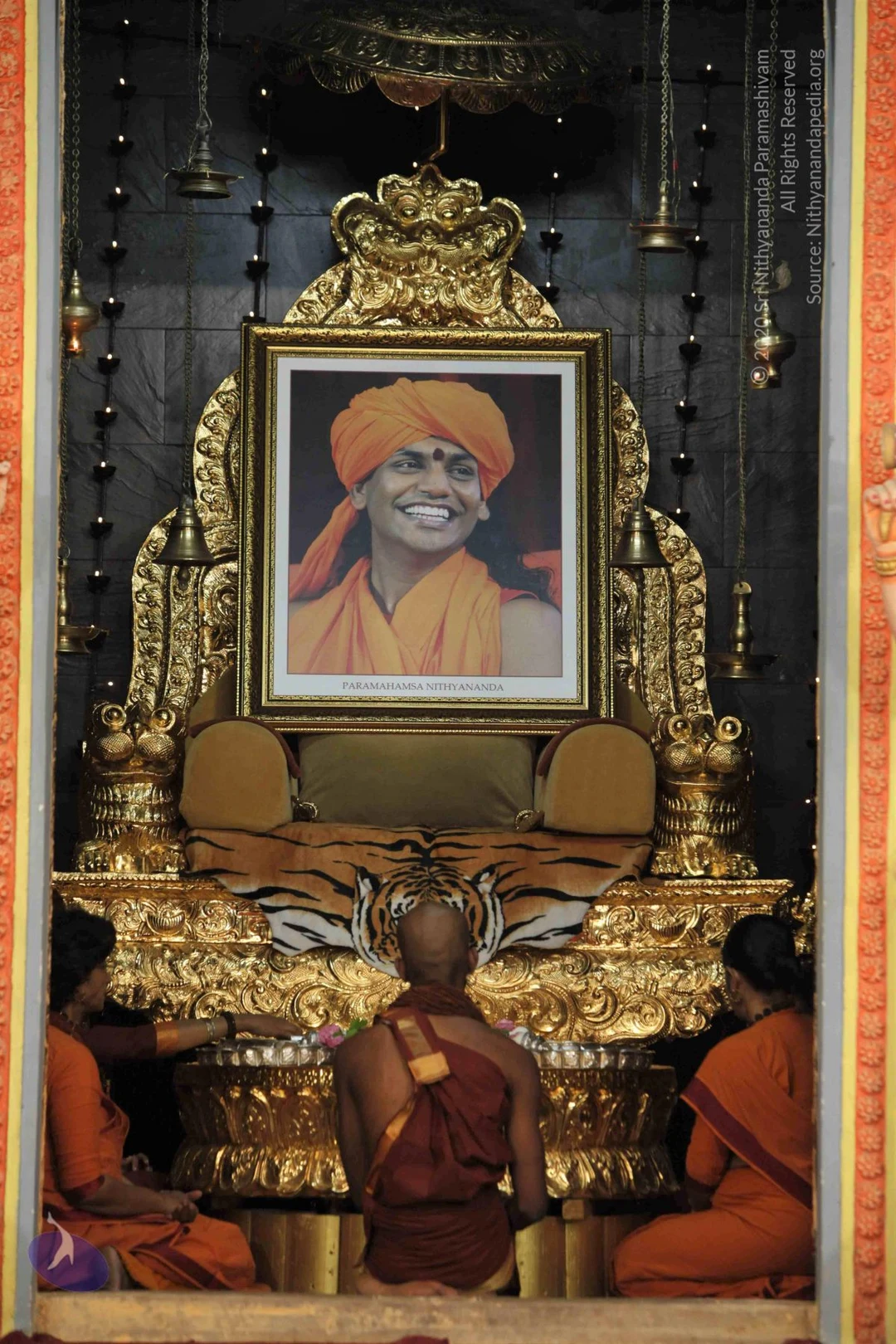
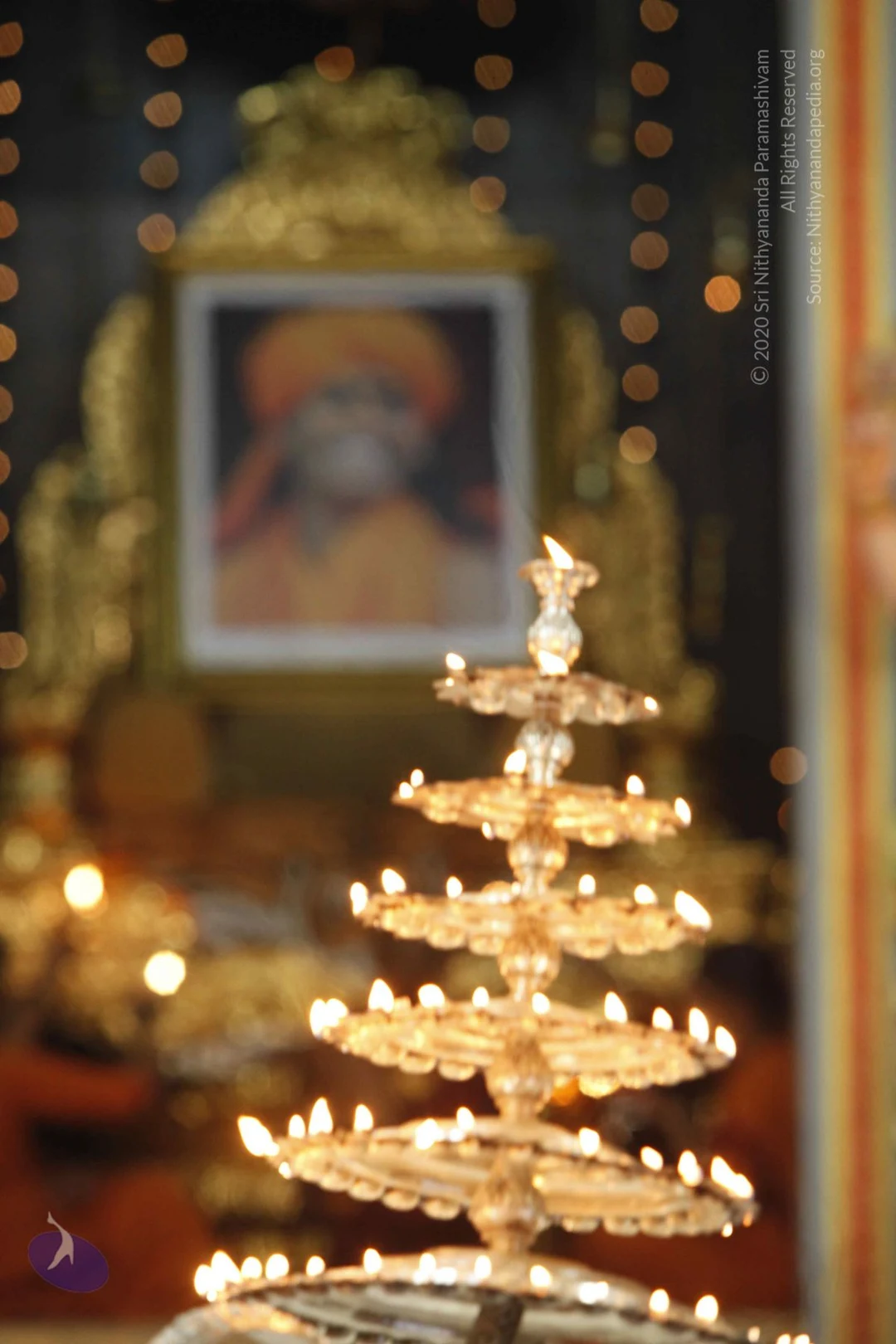
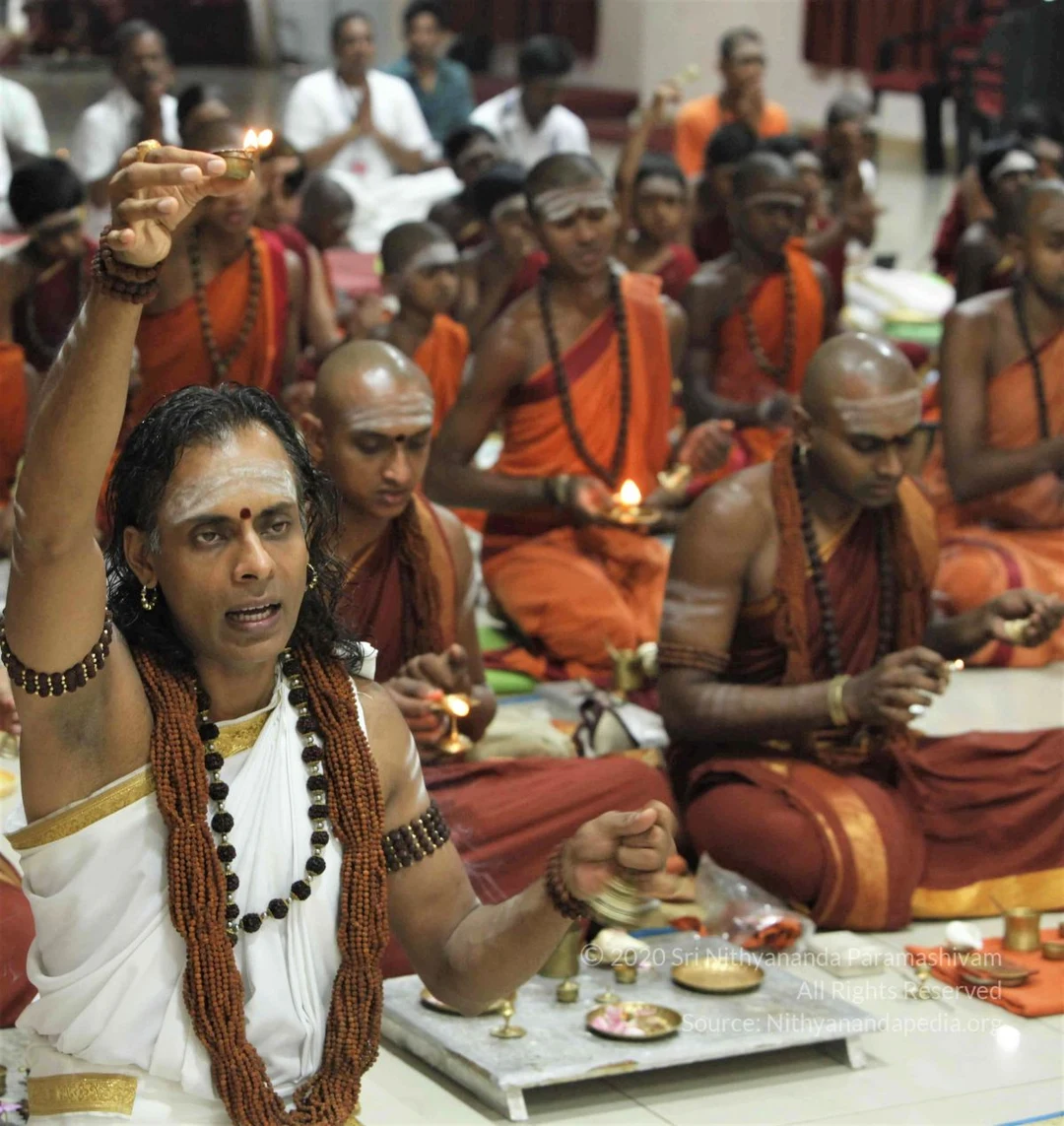
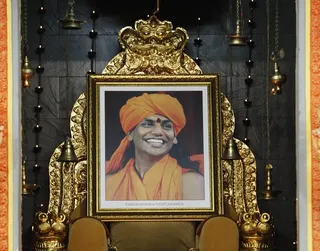
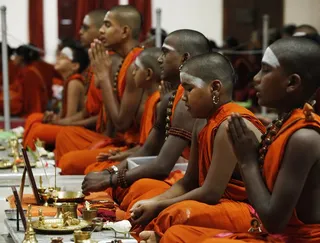
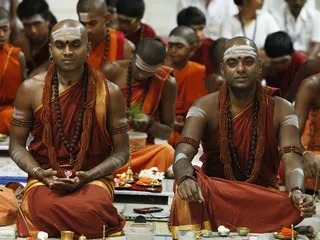
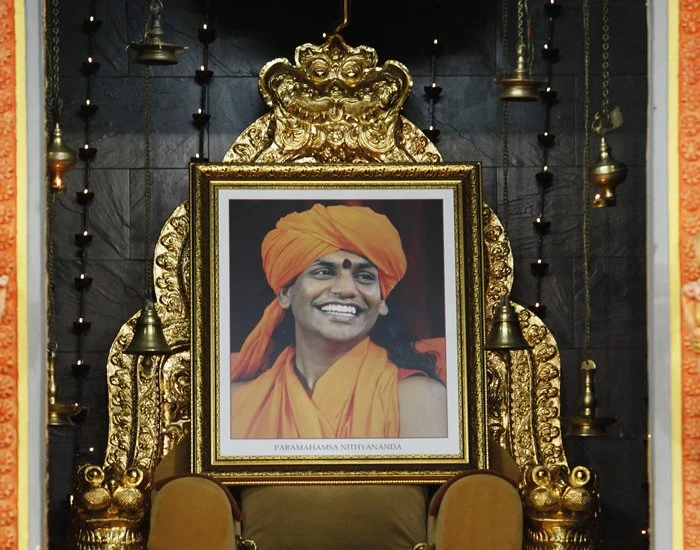
A framed portrait labelled "Paramahamsa Nithyananda" sits on an ornate gold-carved throne with a mustard-coloured cushioned seat. The portrait shows a smiling man in an orange turban and orange shawl with a red forehead mark. Hanging brass oil lamps and dark beaded rudraksha-style strings frame the throne against a black stone wall, with orange fabric at the edges. No physical people are present; the figure is printed in the portrait, so the scene is a depiction of a throne shrine.Photograph of a row of young shaved-headed monks in saffron-orange robes seated cross-legged on a mat during a ritual. Several have white vertical tilak marks on their foreheads and wear rudraksha malas, and the closest boy has earrings. Their hands are pressed together in anjali mudra in prayer while they face forward. In the foreground on a low tray are brass puja vessels, a small brass oil lamp, a kalasha-style vessel, and incense sticks. Other seated devotees in orange robes are visible in the background. The setting is an indoor hall with pale walls and red-curtained surroundings.Photograph of a seated puja ceremony with many devotees in saffron-orange robes and white forehead and arm markings. In the foreground, two men sit cross-legged in red-brown dhoti and shawl with rudraksha malas; the man on the left holds a small pink flower and clasps his hands, while the man on the right holds a sprig of greenery. Brass lamps, a plate of flowers and offerings, and small bowls sit on a cloth in front of them. Behind, rows of younger boys and men in saffron clothing sit and some hold leaves. a person cues are not clearly established, so the central figures are described by role only.

Nithya Satsang

4 photosSource gallery
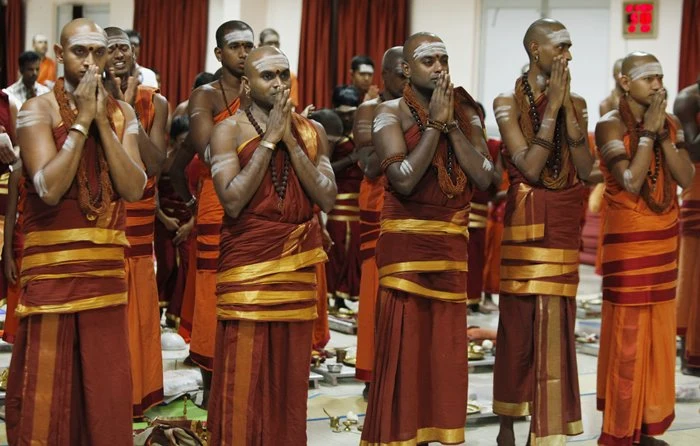
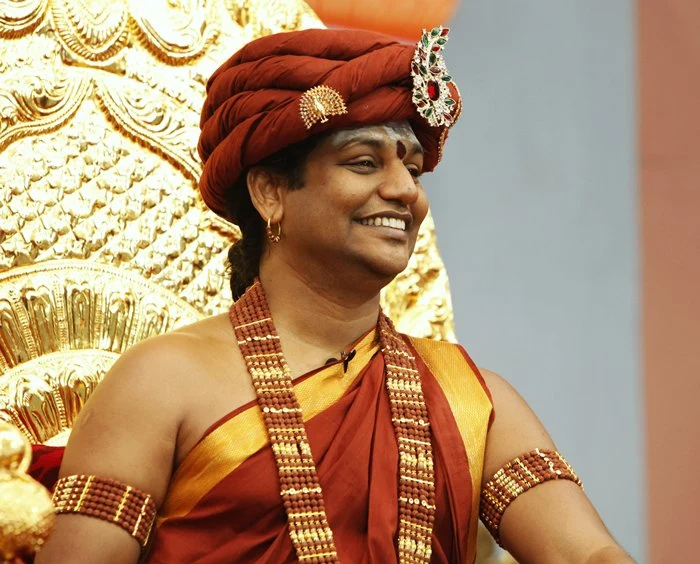
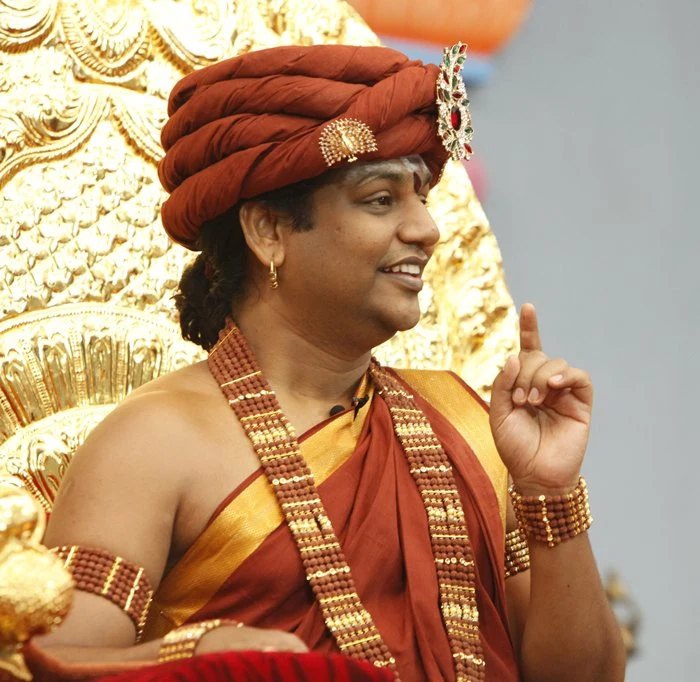
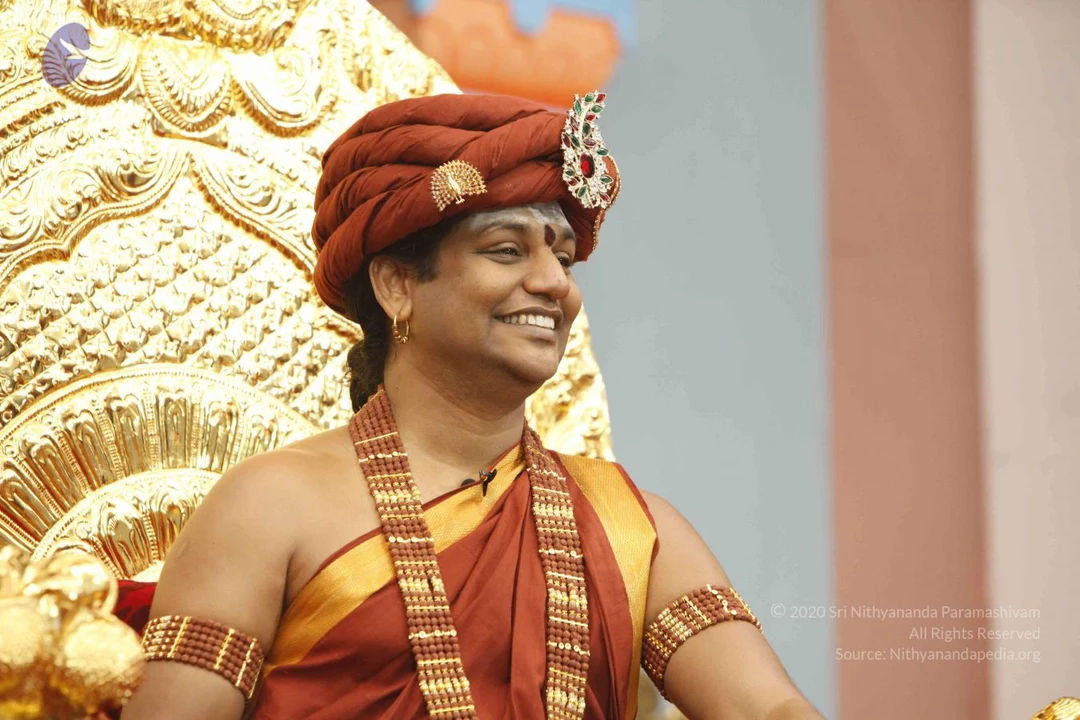
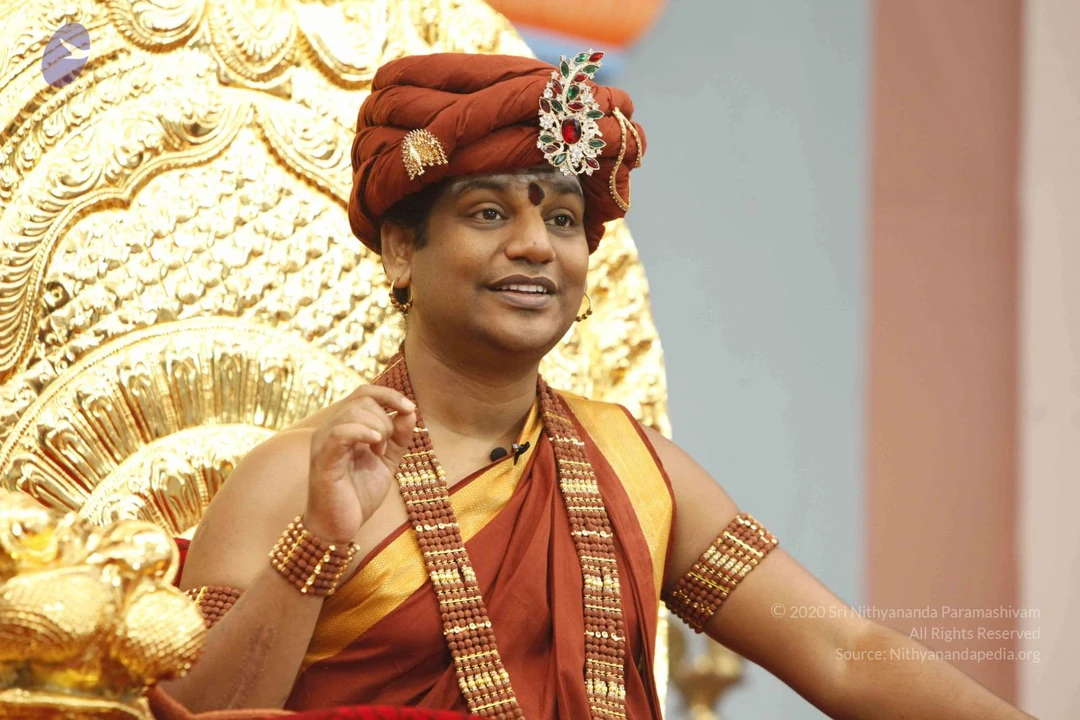
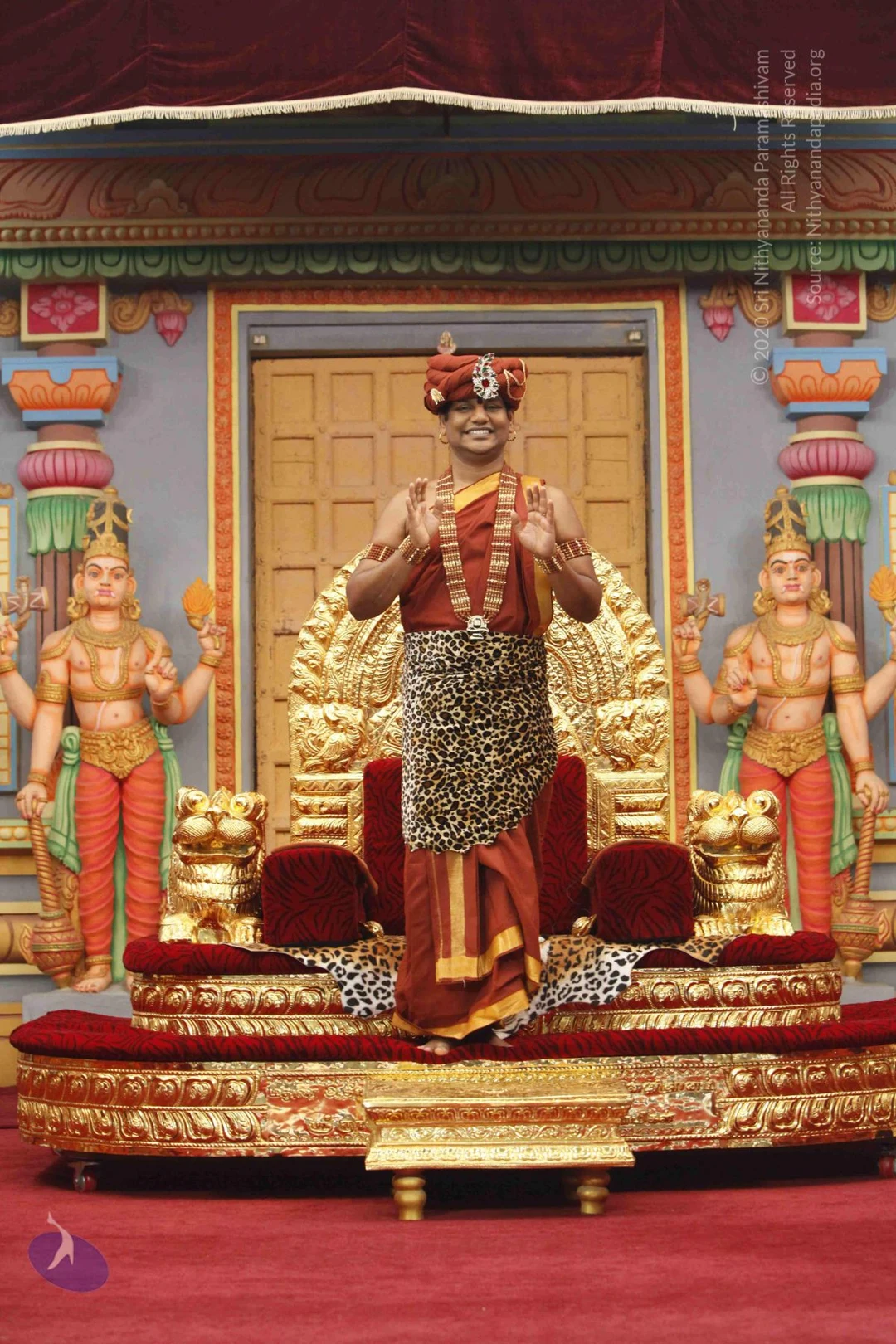
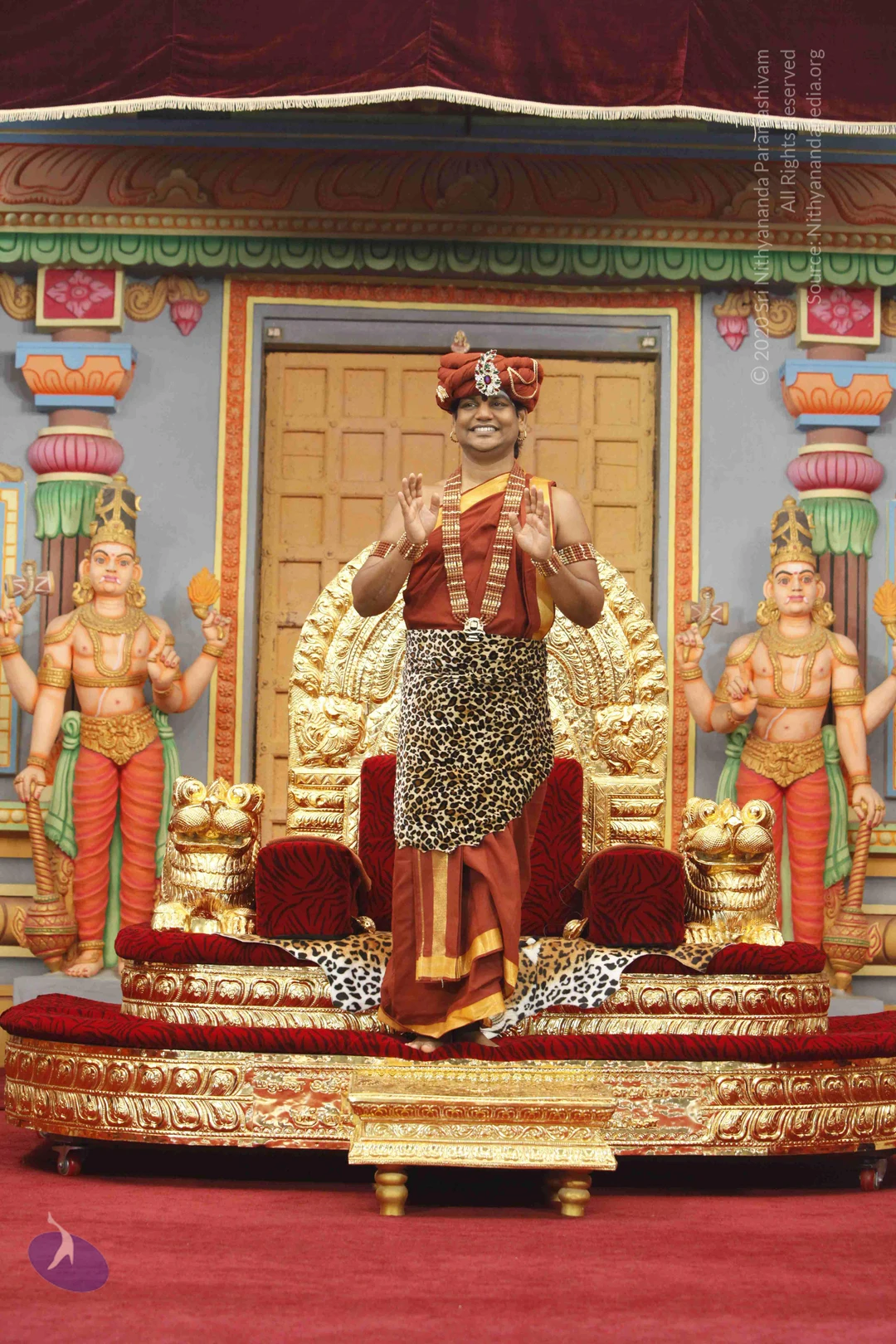
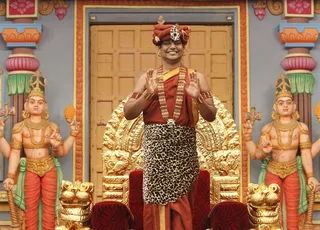
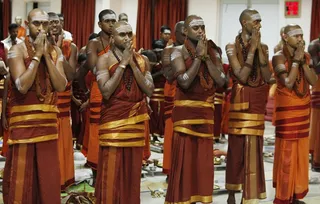
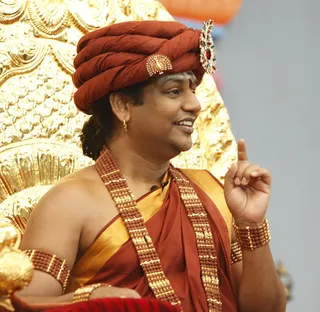
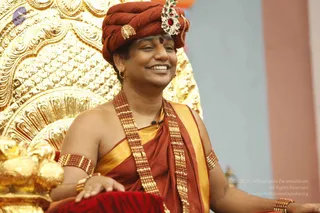
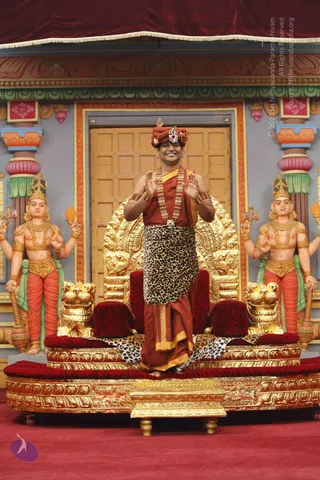
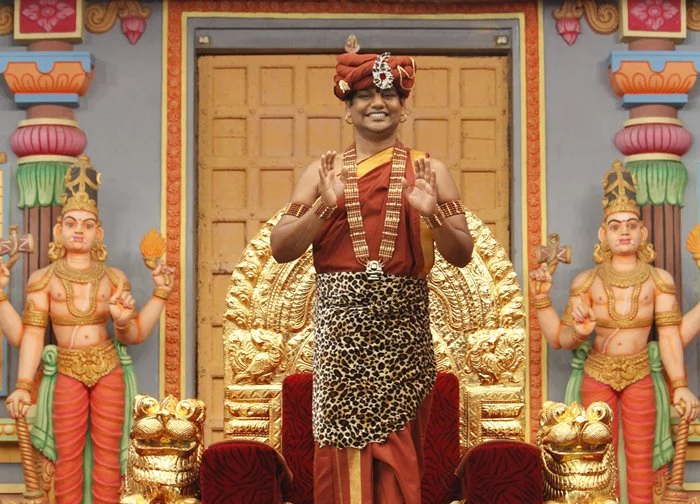
A smiling man in a red-orange turban with a jewelled ornament and an orange-red robe stands on a golden throne, raising both hands in a blessing gesture. He wears a long gold-coloured beaded necklace with a pendant, bangles and a leopard-print wrap around his waist. Flanking him are large painted statues of standing deities with gold crowns, gold necklaces and orange-red dhotis, holding ritual objects. Golden lion-head figures sit on red cushions at the base of the throne, and a carved wooden door stands behind. The stage has ornate pillars in pink, green and blue. Appearance-based cues such as the turban, jewelled ornaments and ceremonial robe are consistent with a person candidate, though identity is uncertain from appearance alone.A photograph of a group of young male devotees standing in a hall during a puja, palms pressed together in anjali mudra. They wear maroon and orange dhotis with gold-striped borders, orange shawls draped over their shoulders, rudraksha malas, and white sacred ash marks with tilak on their foreheads and arms. Behind them, more people in orange and white stand and sit, with brass plates and offerings on the floor. Dark red curtains line the back wall of the room. Six men are clearly visible in the foreground, with others partially visible behind them.Probable Swamiji (probable) seated on an ornate gold throne, smiling, wearing a deep red turban with a jeweled gold-and-red brooch, red and gold draped robe, multiple rudraksha mala necklaces, beaded rudraksha armbands, and a small red tilak on the forehead. A small microphone clip is visible on the robe. The gold carved throne fills the background, with an orange wall at right. He is the only person visible.A man seated on an ornate gold throne with carved golden scrollwork behind him, smiling and raising one index finger as if making a point. He wears a deep rust-red turban with a jewelled ornament and feather-like brooch, gold hoop earring, a rust-red and gold shawl draped over the shoulder, a long rudraksha mala with a gold-tone clasp across the chest, matching beaded bracelets on his wrist and upper arm. Appearance-based label: a person, seated in the throne and speaking, consistent with satsang discourse. Only one person is visible.

Kalpataru Darshan

3 photosSource gallery
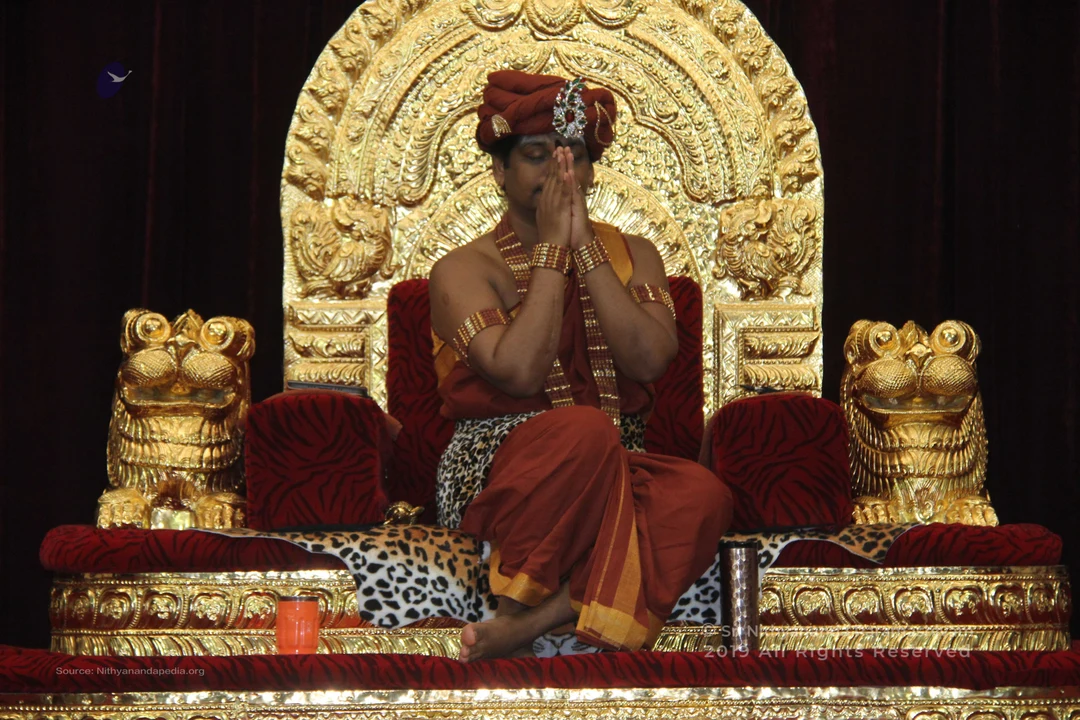
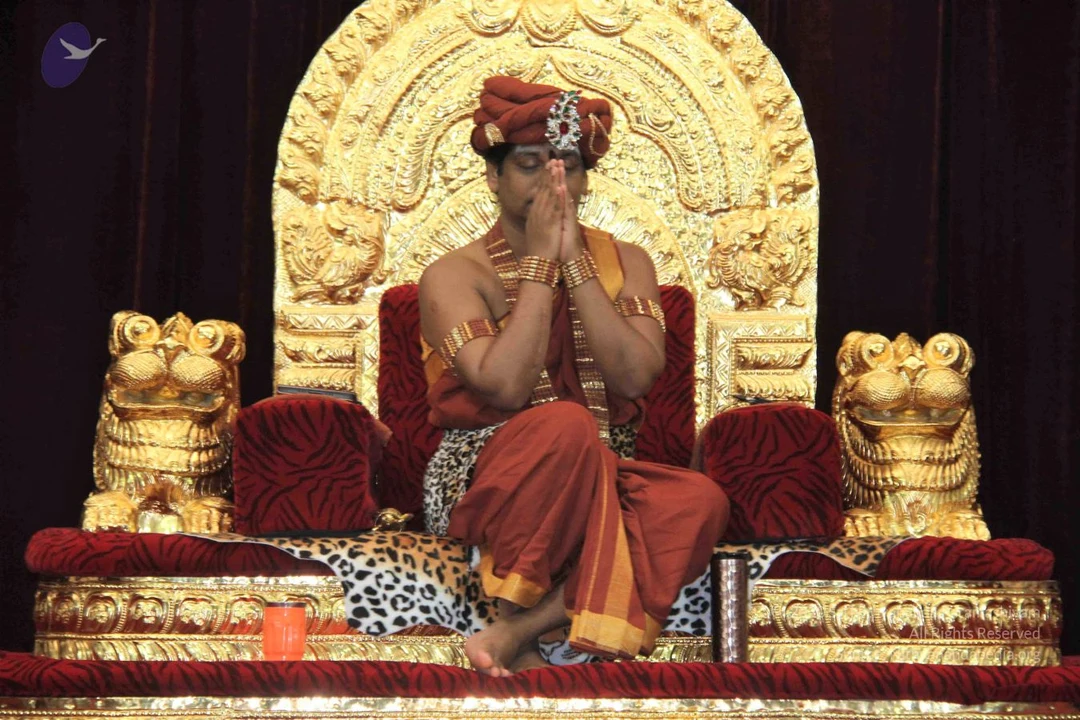
A smiling person sits in a brown leather recliner chair with wooden armrests and a footrest, barefoot, on a red carpet before deep maroon velvet drapes and a gold carved backdrop. The person wears a rust-red garment with gold border, a leopard-print undergarment, layered gold beaded necklaces, gold bangles on the upper arms and wrists, gold hoop earrings, a red bindi and white forehead markings, and a small head microphone. The person is the only physical person visible.A seated figure in a maroon-red turban with a jeweled ornament sits cross-legged on an ornate gold throne with carved lion heads, hands pressed together in namaskar with eyes closed. He wears a maroon-red upper cloth, a red-gold sash over the shoulders, a dhoti with gold border, gold armlets and bangles, and a long rudraksha-style mala. The throne is backed by a large gold carved arch against dark red drapes, with leopard-print cushions, red velvet armrests and a small orange candle on the platform. Appearance cues include the turban, ceremonial gold ornaments and mala, consistent with a person seated on his peetha in a satsang setting.A seated man sits cross-legged on a red velvet throne cushion with a leopard-print covering in front of an ornate gold throne backdrop. He wears a rust-orange turban with a red and white jewelled ornament, a rust-orange robe with gold trim, a long gold-toned bead garland, and gold armlets. He has hands folded in his lap and is smiling. Flanking the throne are golden lion sculptures, and painted deity statues with raised hands appear at the edges.

Dial-the-avatar-New-Zealand

2 photosSource gallery
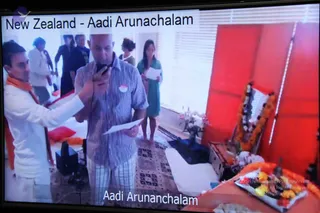
A photograph of a video-conference screen showing a Hong Kong satsang location. A woman in a white top and red-and-orange sash stands with palms pressed together in greeting, a dark mug or cup in one hand. Beside her a young girl sits on a patterned rug and a boy in a red, white and blue striped jacket smiles and raises a hand. A woman at the right, in white, holds a dark object. Behind them a seated person in white sits in a room with shelves, furniture and a yellow object. The lower caption reads Camus HongKong and Hong Kong Sirkazhi. No a person candidate is visible in this frame.A screen displays a live two-way video link labelled "New Zealand - Aadi Arunachalam" showing a home room with red walls and a red and white floor cushion. A bald man in a striped shirt with a white badge holds a microphone and reads from a paper. A young man in white with an orange shawl stands at left, holding the microphone cable, and a woman in a green dress holds papers behind him. On the right, a shrine-like altar has a garland of orange marigolds, flowers and a silver deity murti with a kalasha-style offering tray. Other people stand in the background near white blinds.

Nithya-Satsang

9 photosSource gallery
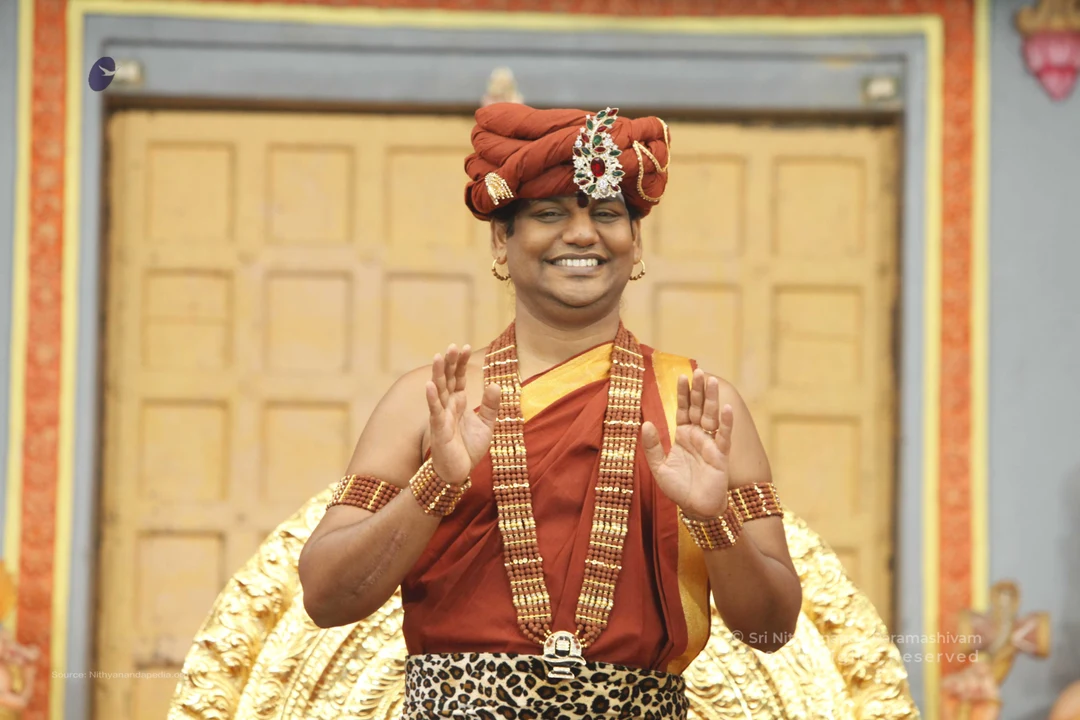
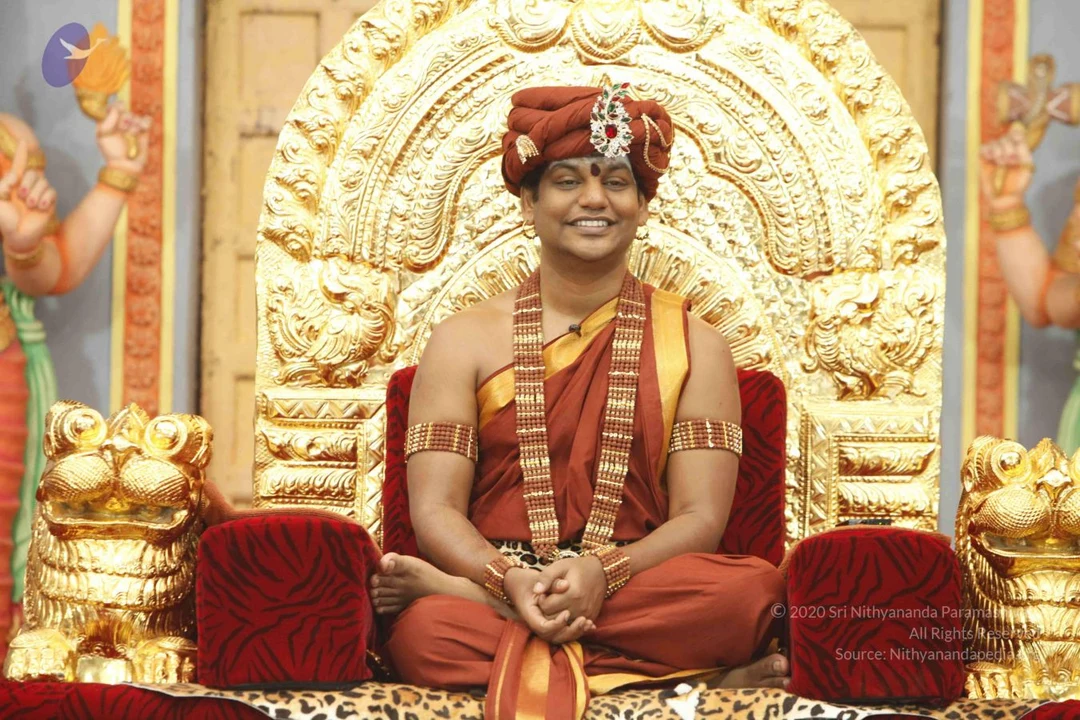
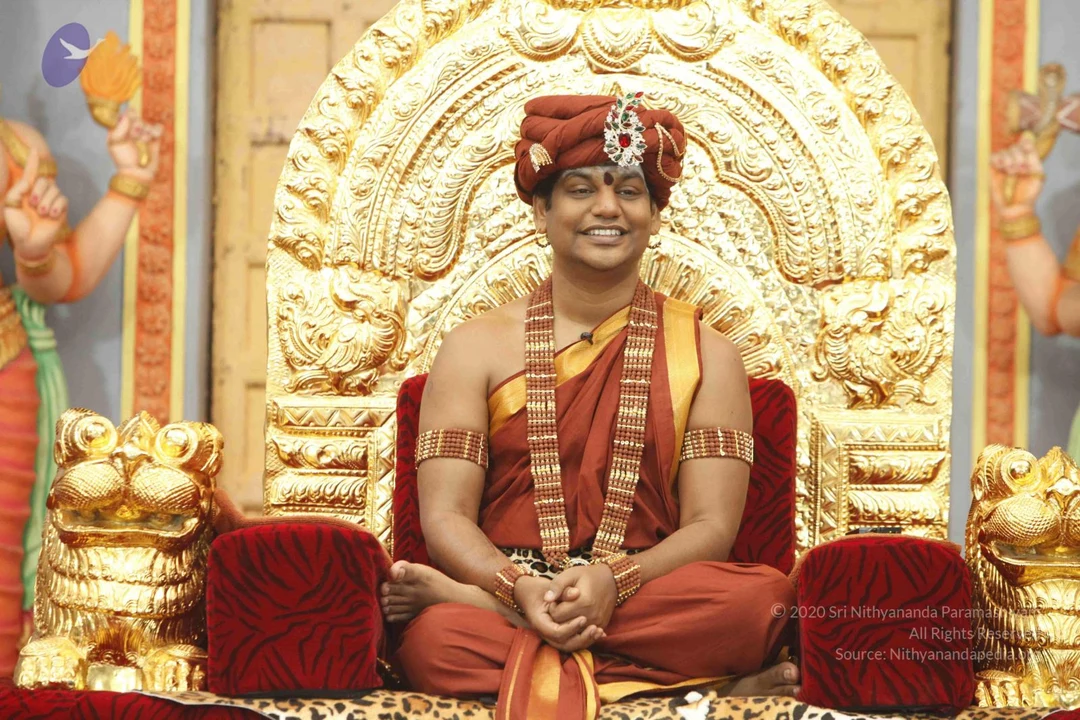
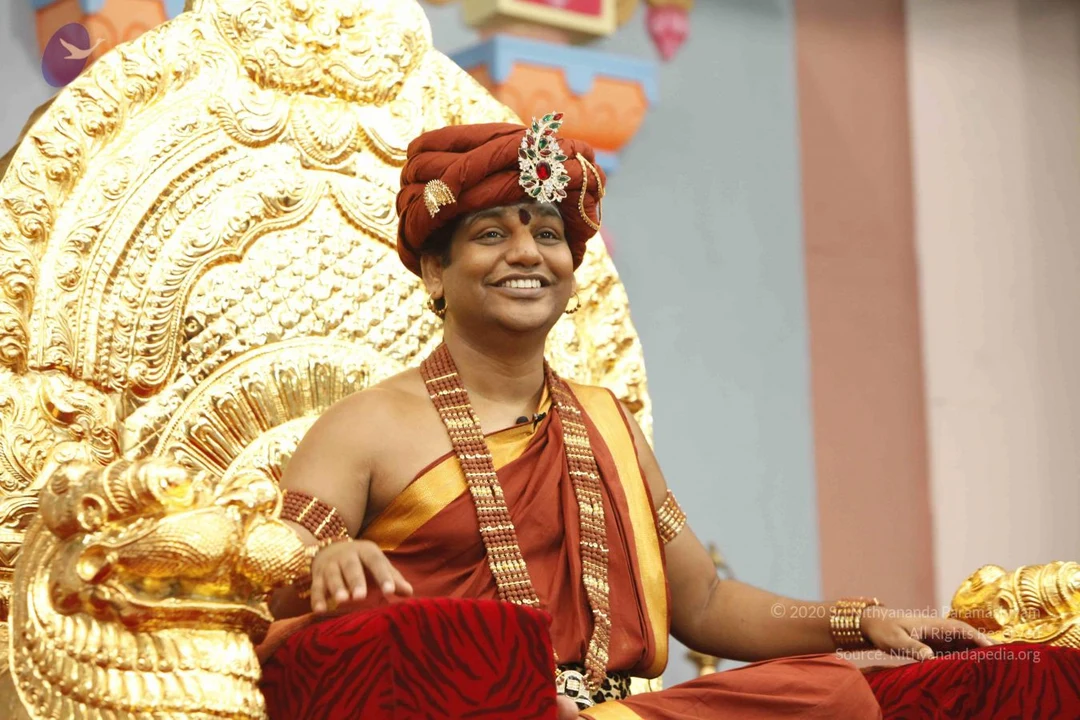
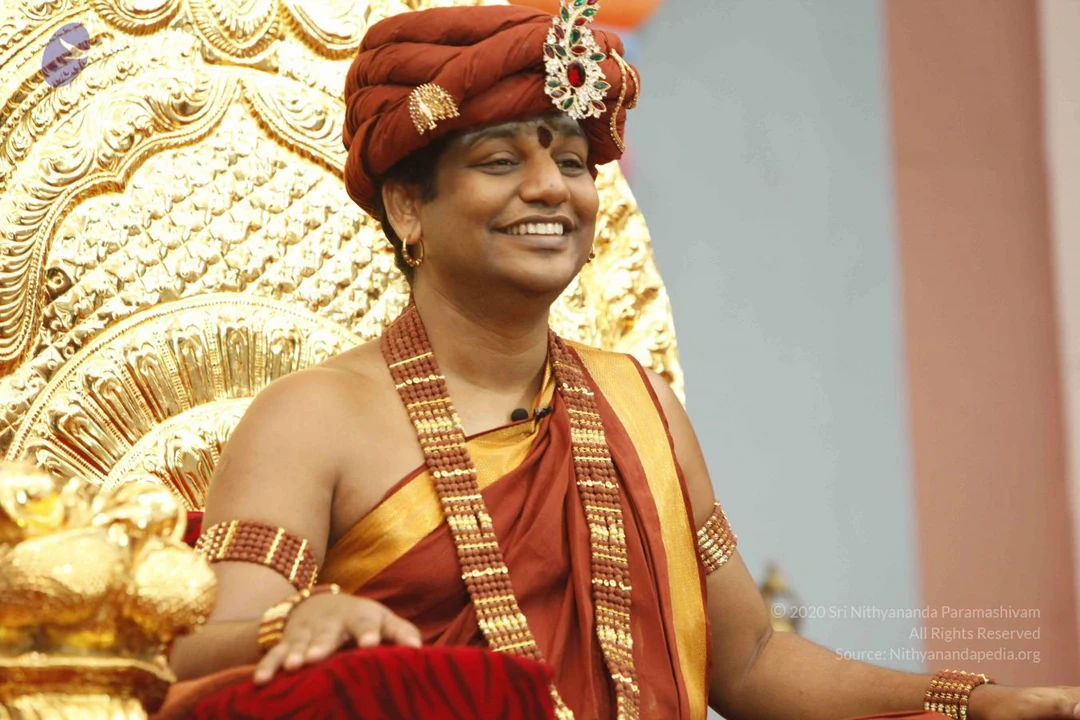
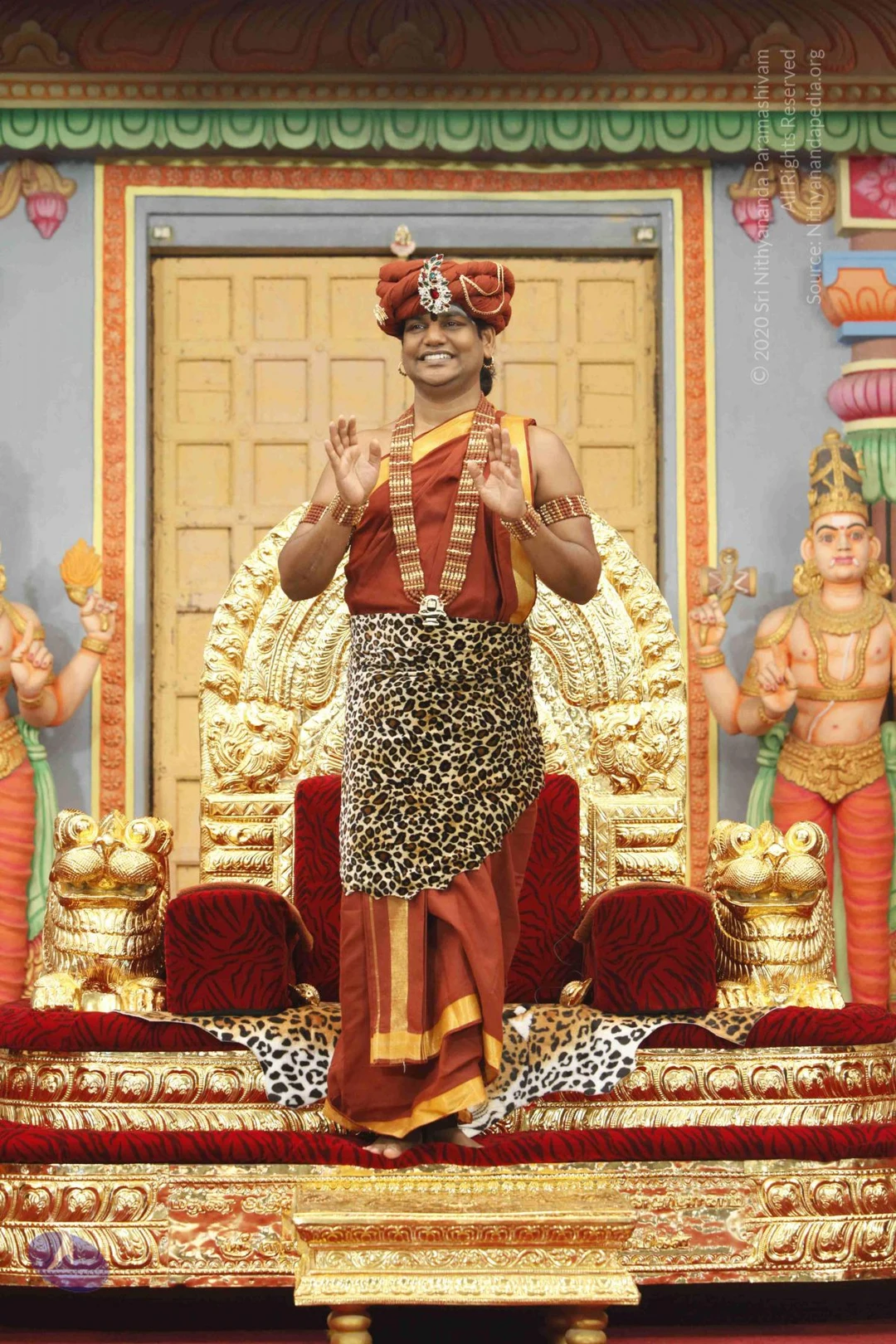
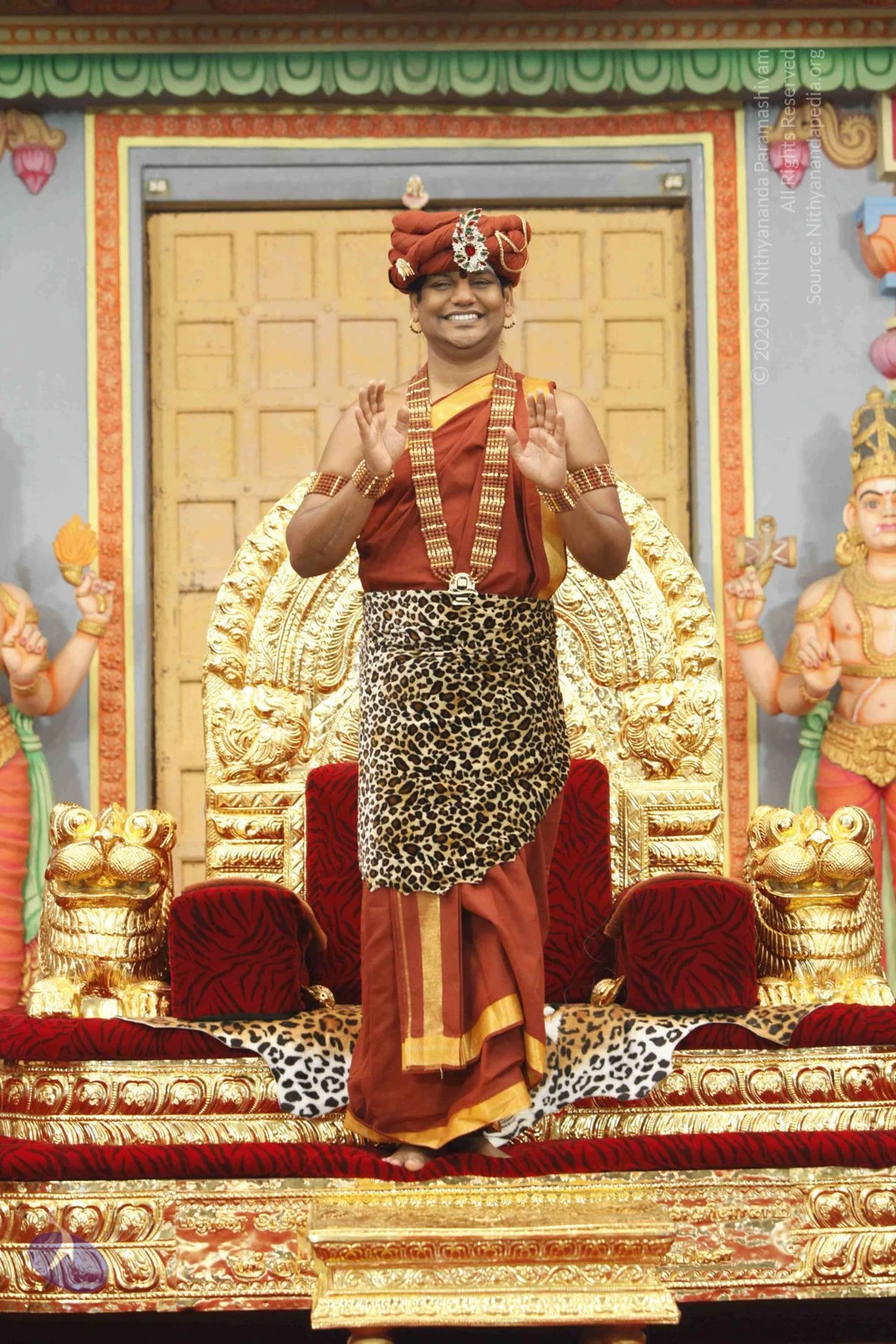
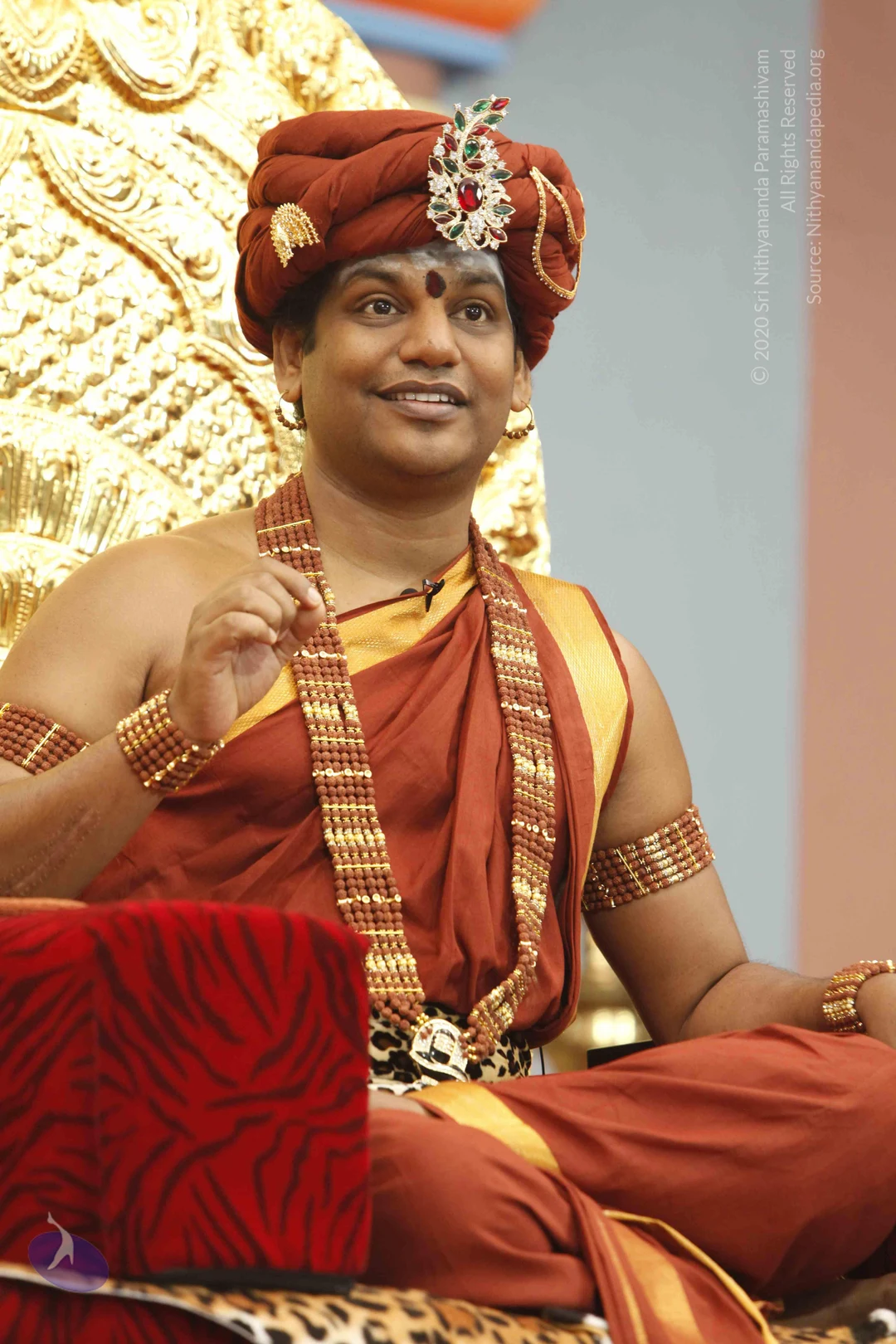
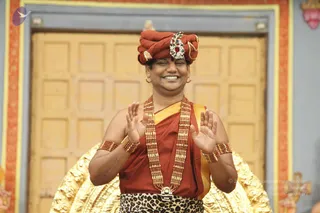
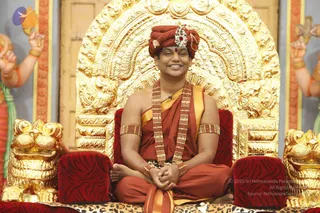
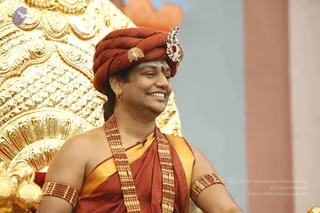
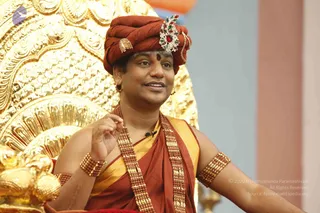
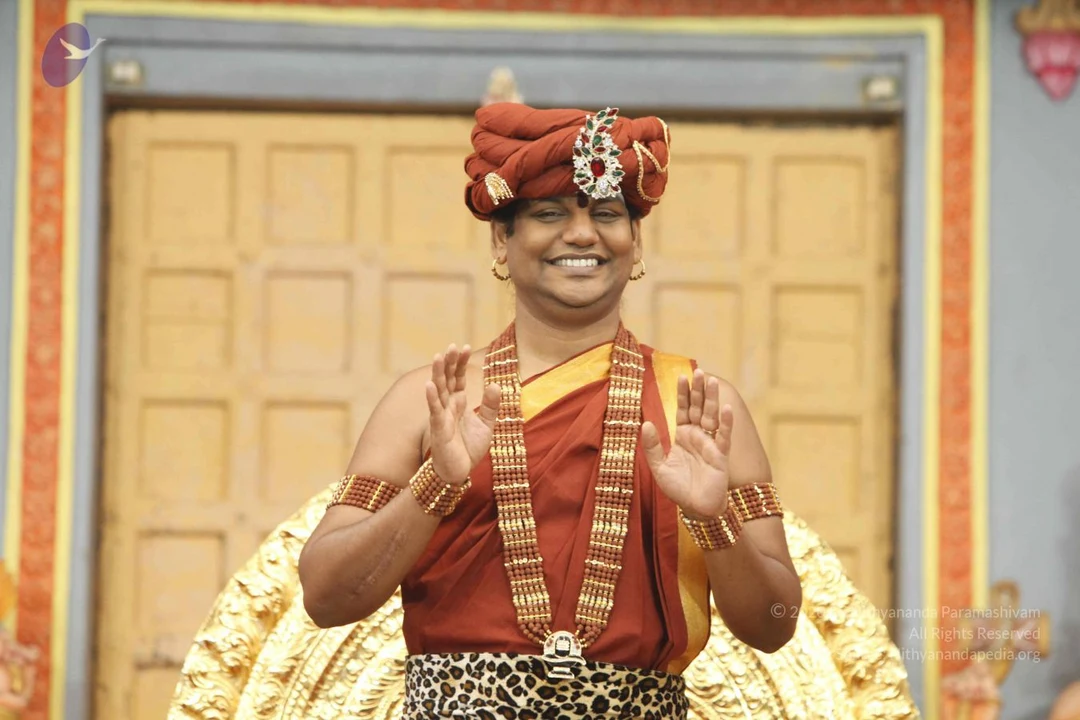
A smiling man stands centrally in front of a large wooden panelled door framed in red and yellow, raising both hands palms-outward in a blessing gesture. He wears a red-orange turban with a jewelled ornament featuring green and red stones, gold earrings, a red-orange shawl over the shoulders with a yellow border, layered red and gold beaded malas, and a leopard-print waist cloth. Red beaded armlets and gold bangles adorn his arms. Golden ornate throne carving is visible at the bottom of the frame.A photograph of a seated man in a golden ornate throne with carved gold arch and two gold lion-head armrests upholstered in red tiger-stripe fabric. He wears a red-orange turban with a jewelled ornament at the front, a red-orange shawl over a saffron-yellow cloth, a long red and gold rudraksha-style mala, gold armlets and bangles, and sits cross-legged on a leopard-print cloth with hands clasped. Painted deity murti figures with multiple arms flank the throne on either side.A seated man smiles broadly in front of an ornate gold throne carved with scallop and fan motifs. He wears a rust-red turban decorated with a gold medallion and a jewelled ornament with red and green stones, plus a red and gold draped garment with a gold-bordered shawl, rudraksha mala necklaces, beaded armlets and a small gold hoop earring. A forehead tilak is visible. A small lapel microphone is clipped at his chest. The background shows a pale blue wall and a pink-orange pillar. Appearance-based candidate: Swamiji (probable), seated in person with distinctive saffron-red and gold ornamented attire, rudraksha malas and crowned turban.A man seated before an ornate gold throne with carved golden scrollwork speaks mid-sentence while gesturing with his right hand. He wears a rust-red turban decorated with a jewelled brooch of green, red and white stones and gold ornaments, plus a red-brown shawl over a gold-bordered garment. Strands of rudraksha beads hang across his chest, with matching bead bracelets on his wrists and upper arms. A small lapel microphone is clipped to his clothing and a red tilak marks his forehead. Swamiji (probable): the turban, rudraksha malas and ceremonial gold ornaments mark him as the discourse speaker seated on the throne at a satsang. The background shows pale blue and pink walls.A smiling man sits on an ornate golden throne with carved lion-head armrests and a large gilded backrest, dressed in a rust-red turban decorated with a jeweled brooch, rust-red and gold drapes, and a long beaded rudraksha-style mala around his neck. He wears gold bangles and armbands, and his hand rests on the red patterned cushion of the throne. A bright pink and grey backdrop stands behind him, consistent with a stage setting. Swamiji (probable): the throne seating, ornate gold ceremonial clothing, turban and multi-strand beaded mala form a distinctive combination of cues, presented as the seated central figure.A smiling man seated on an ornate gold throne with a carved gold backrest, wearing a deep red turban decorated with a gold and jewelled ornament, a red bindi, gold earrings, a red and gold cloth draped over bare shoulders, and a long red and gold beaded mala with gold accents. Matching red and gold beaded armlets and bangles are on his arms, and a small clip-on microphone is visible at his collar. A red cushion rests beside him and a pink pillar stands in the background. The appearance matches the Swamiji (probable) cues of a red turban, ornate jewelled headwear, a rudraksha-style mala and ceremonial gold, seated as a discourse speaker, in a satsang setting.

Dial-the-avatar-Slovakia
12 photosSource gallery
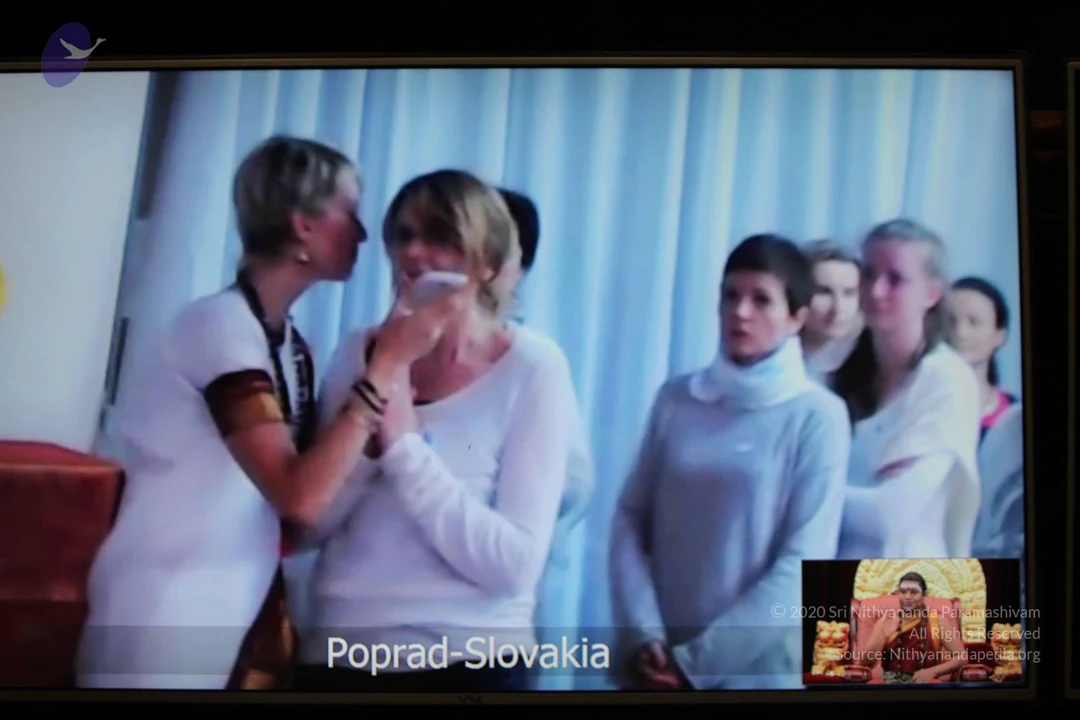
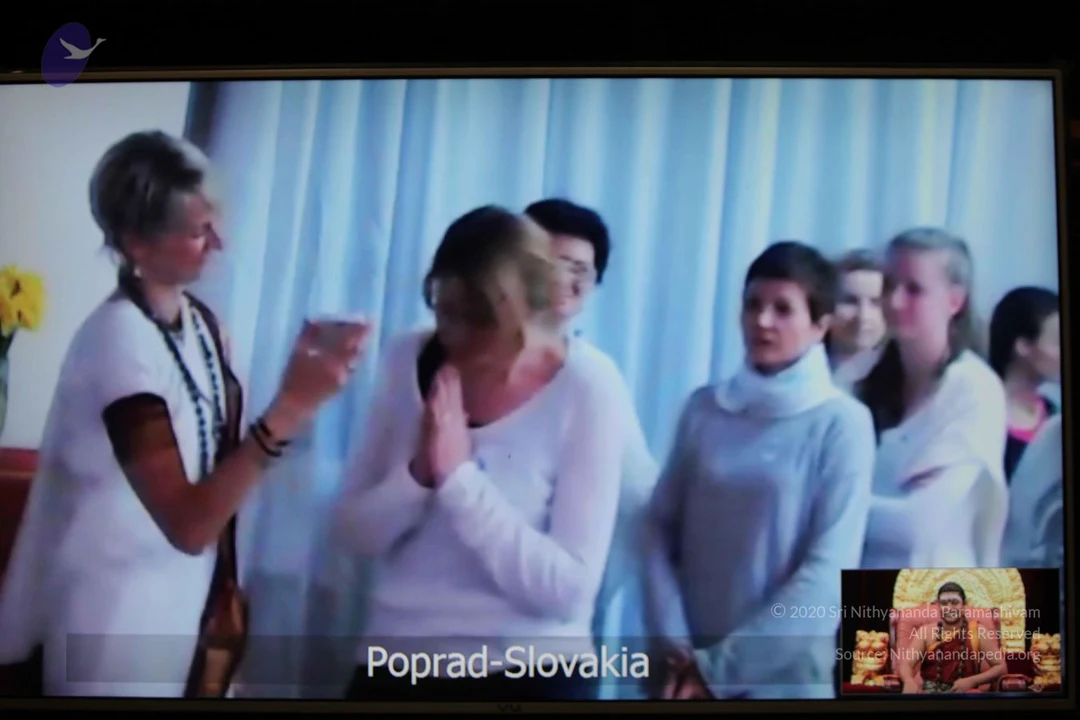
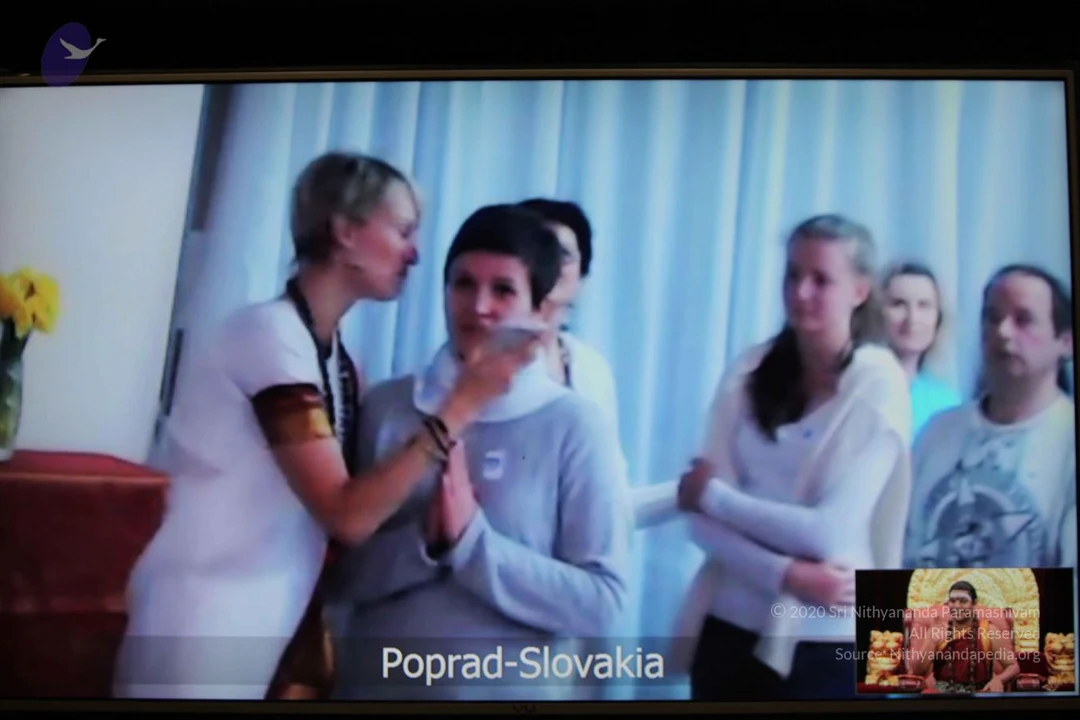
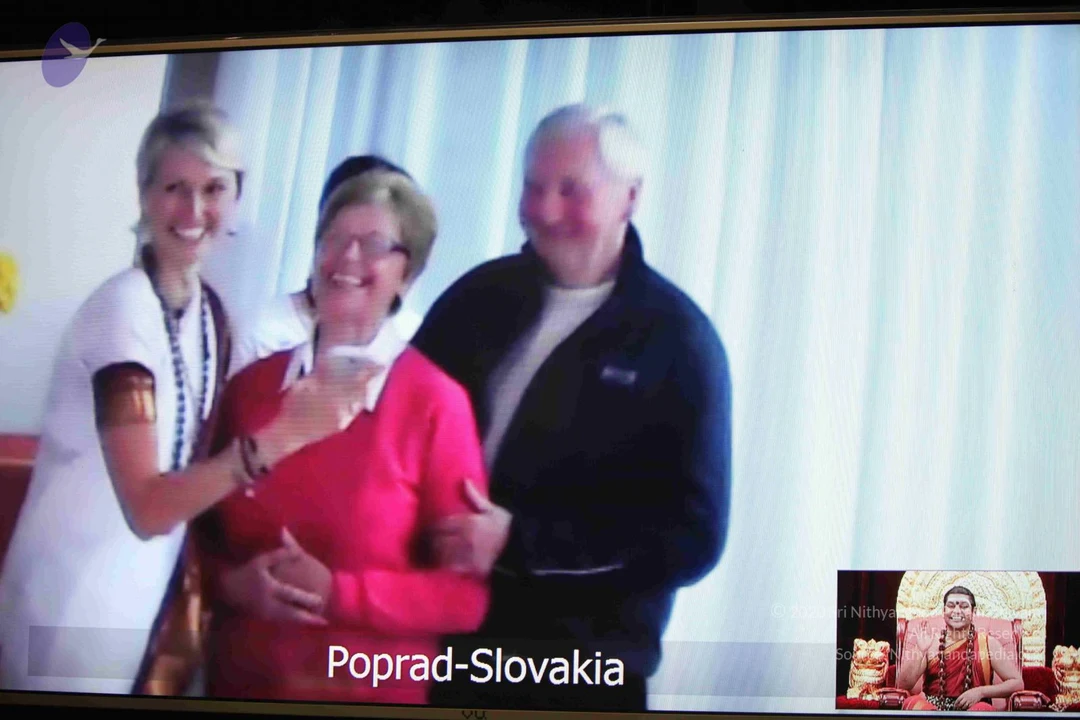
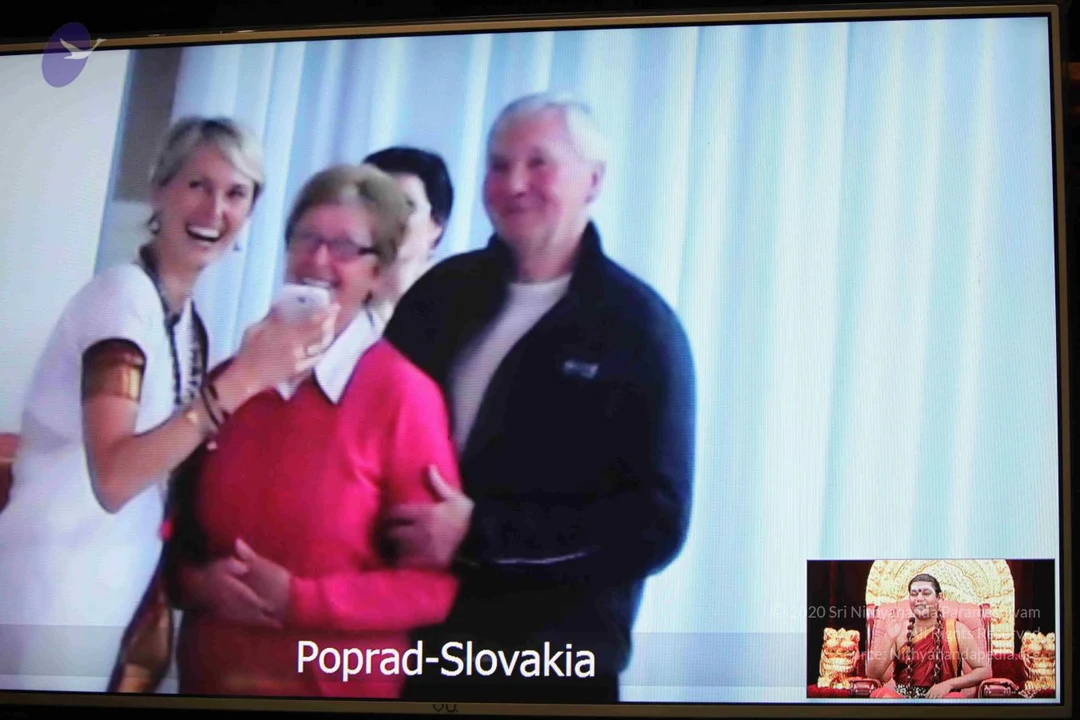
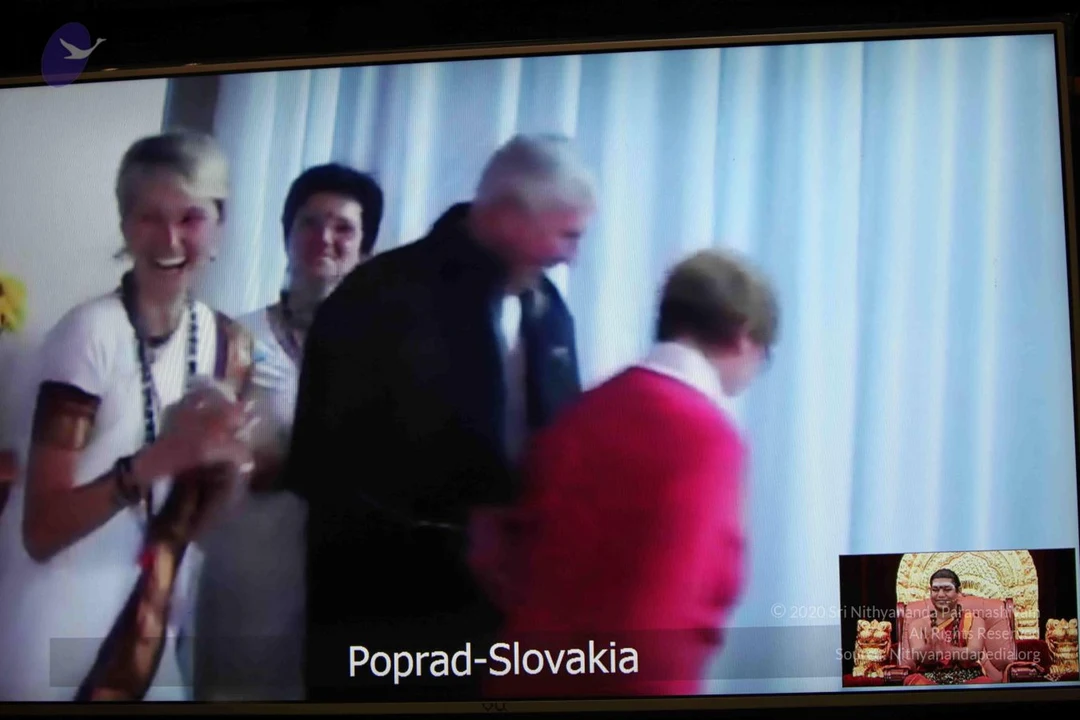
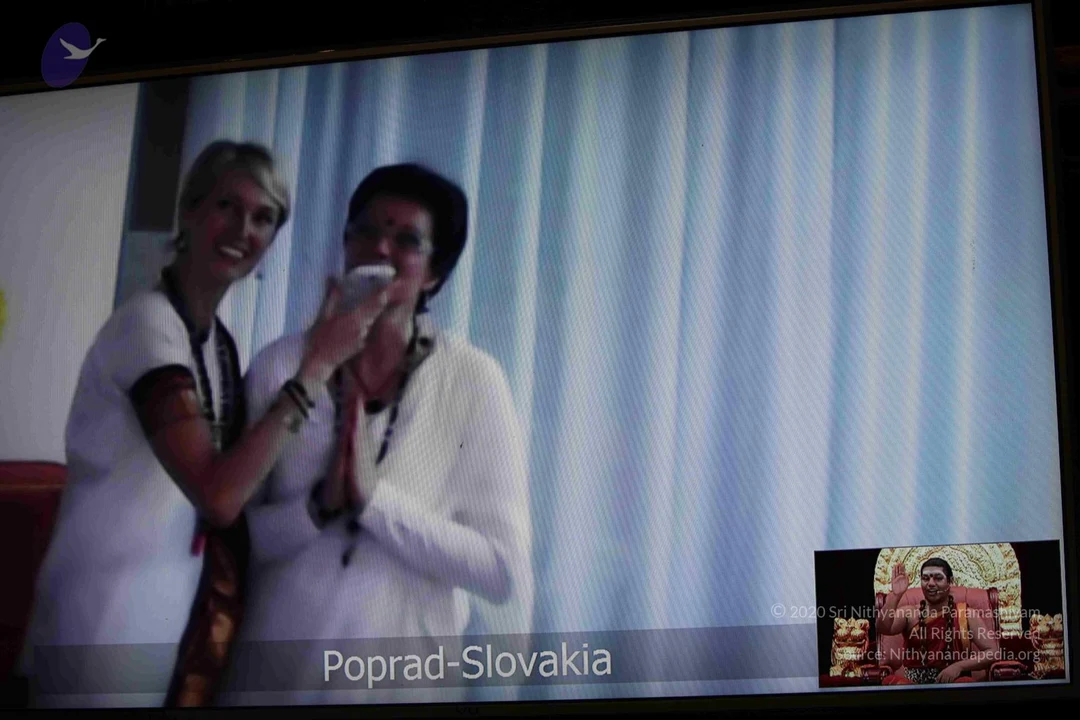
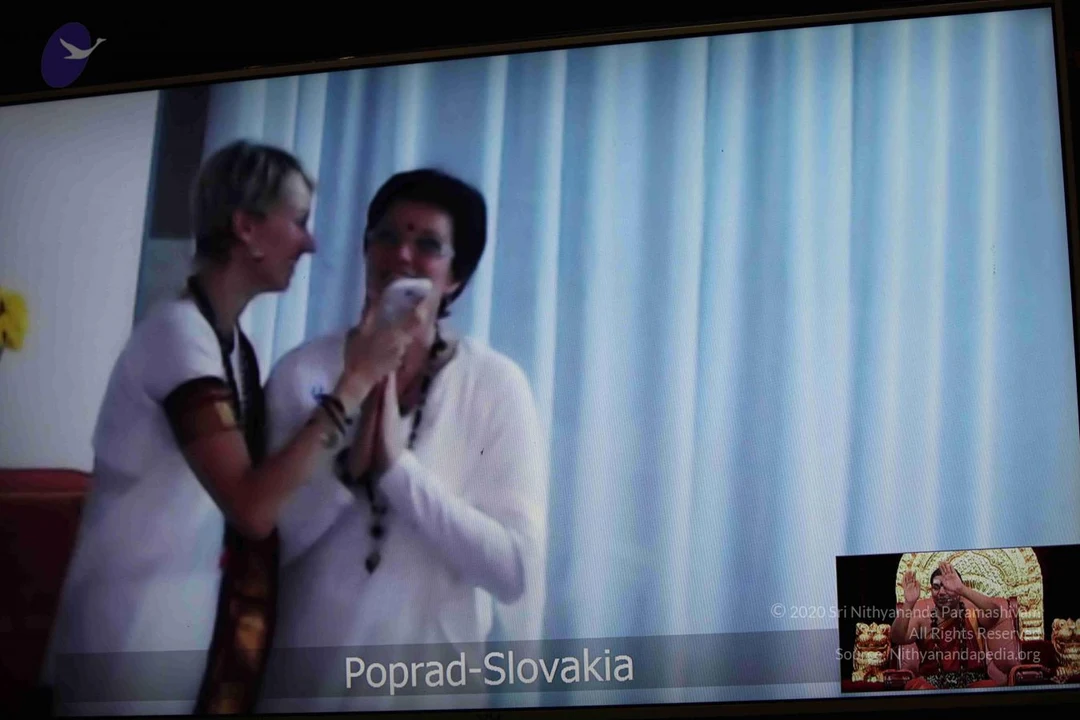
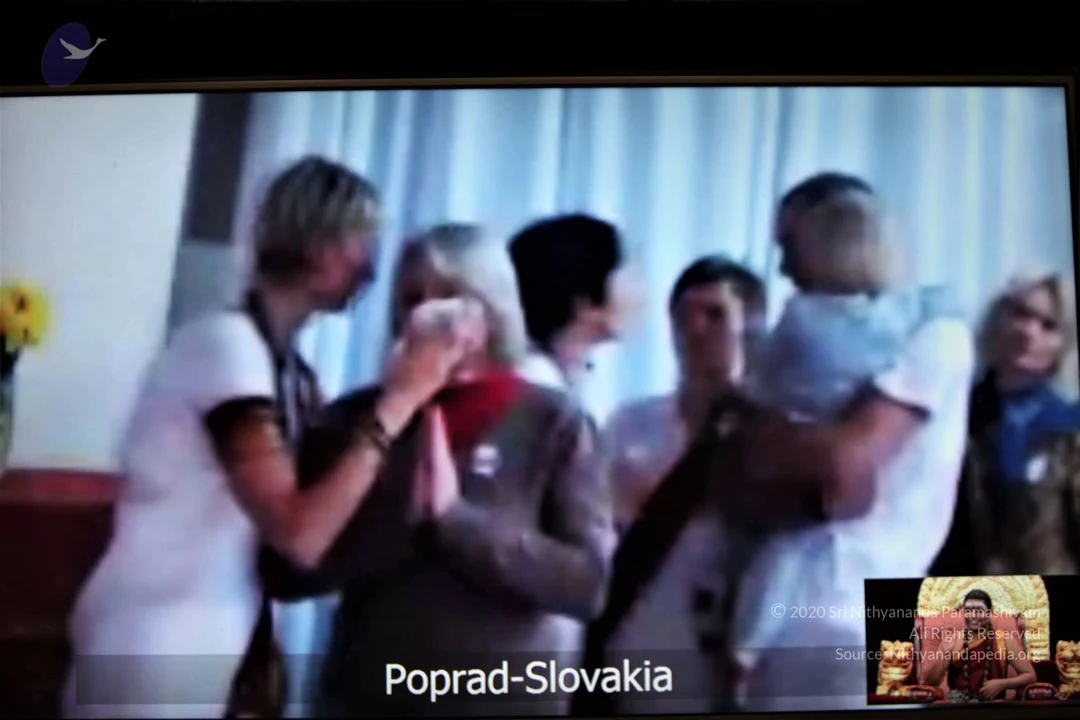
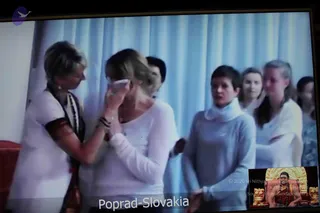
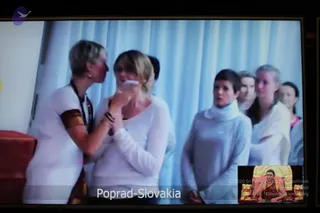
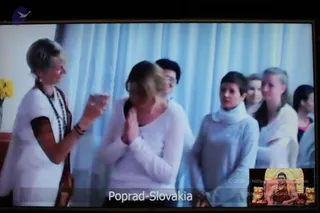
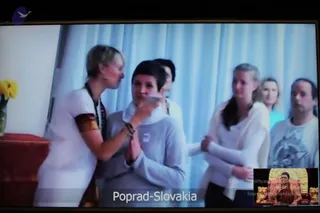
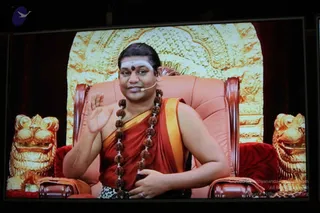
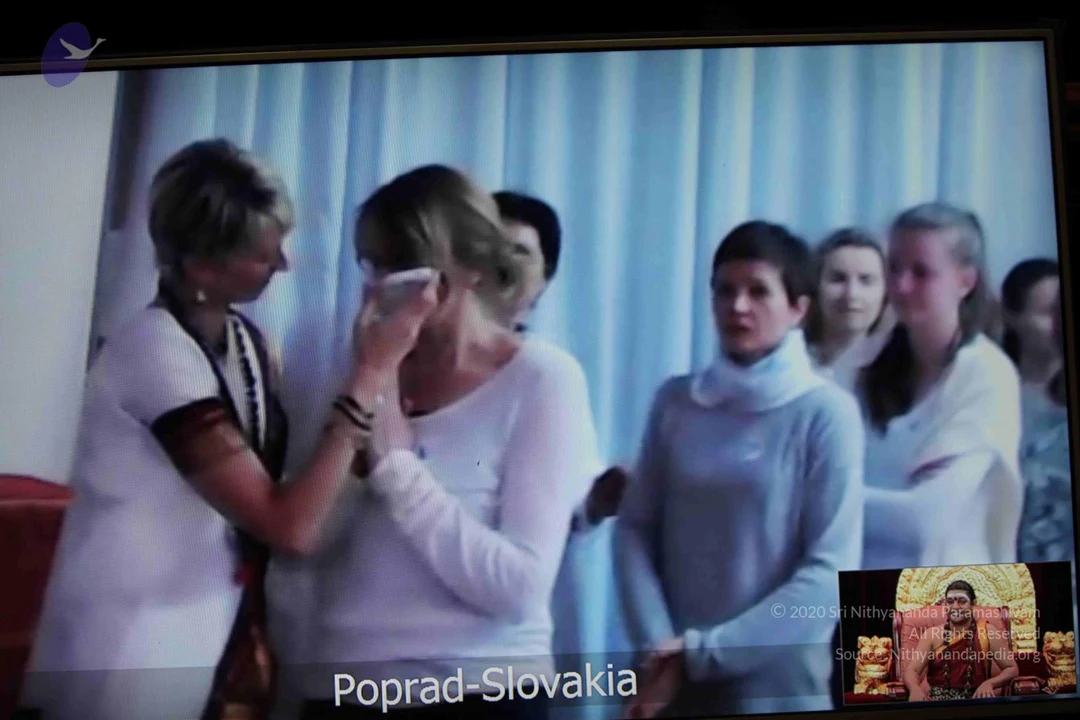
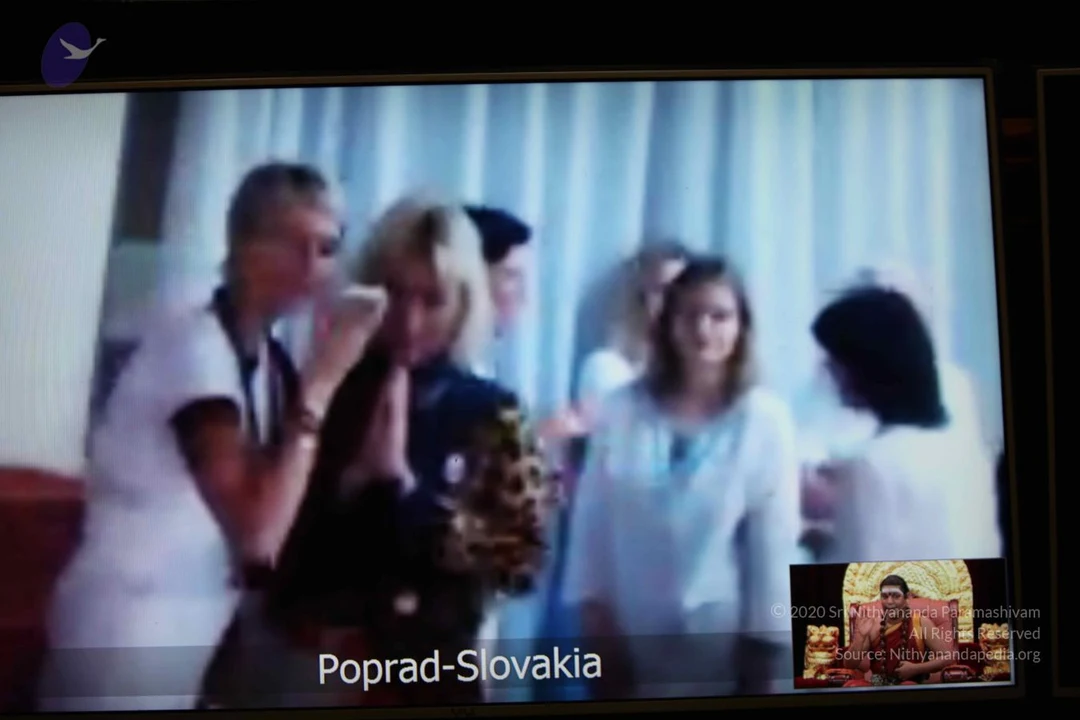
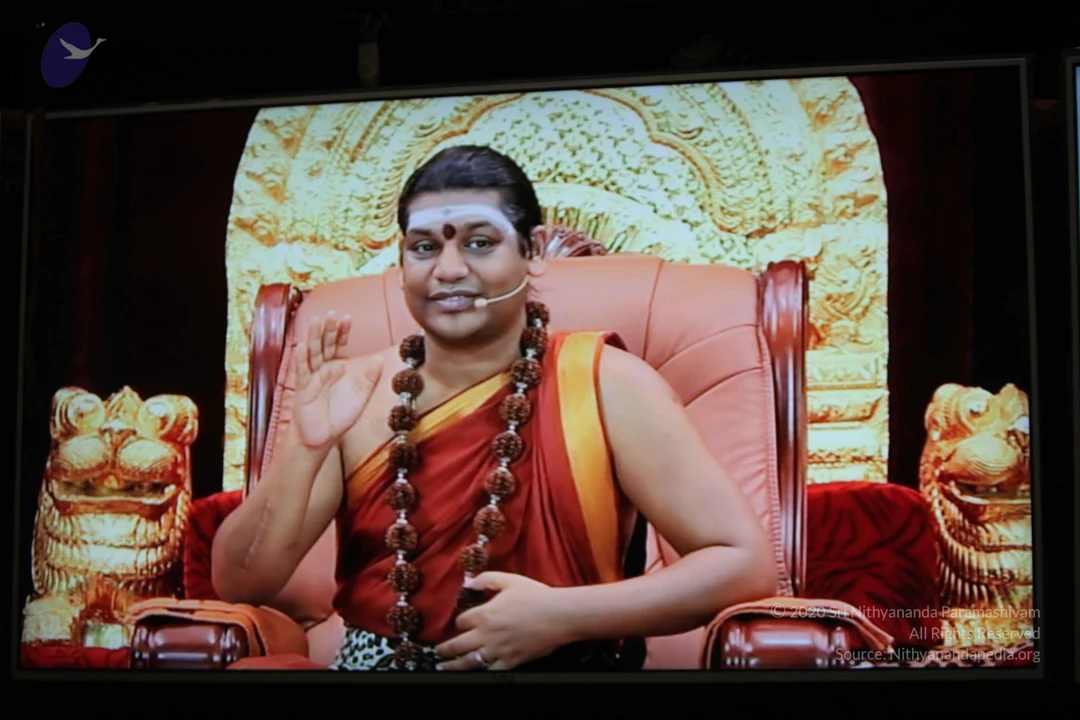
A screenshot of a video-conference feed showing women in a group at a venue labelled Poprad-Slovakia. In the foreground, a woman with short light hair in a white top and dark patterned sleeve holds a hand to her face wiping tears, while another woman in a white top and dark scarf stands close beside her. Behind them, several women in pale grey and white tops stand before a pale blue curtain. A small inset in the lower right shows a figure seated on a golden throne with a decorated background, and a caption reads Poprad-Slovakia at the bottom of the feed. Counting only the physical women visible in the feed, there are about six.A video screen shows a live two-way link captioned Poprad-Slovakia. A woman in a white top with a short blonde-grey haircut holds the face of a blonde woman in a white long-sleeved top, who is smiling, while a short-haired woman in a grey turtleneck and several other women in light clothing stand behind them against a pale blue curtain. A small inset in the lower right shows a seated figure on an ornate golden throne with red-and-gold draping, but no person in the room is identified as a person. Four to six physical people are visible on the screen.A photograph of a television or screen showing a live video-conference link. Several women stand together in front of pale blue drapes. The woman on the left wears a white top, a long dark beaded necklace and bracelets, and gestures with one hand. In the centre, a woman in a white top stands with palms pressed together in namaste. Beside her, a woman in a light grey turtleneck smiles, and more women in white and grey stand behind them. A yellow flower arrangement is at the left edge.A photograph of a large screen showing a video-conference link during a satsang. On the screen, a woman with short blonde hair in a white top leans in to greet a woman with short dark hair in a grey sweater with a white scarf, who has her palms pressed together in namaste. Behind them, several people stand before pale blue curtains, including a woman in a light cardigan and a man in a grey graphic t-shirt. A yellow flower arrangement sits at the left edge. A caption at the bottom reads Poprad-Slovakia.A photograph of a video-conference screen showing a group of people in a room with pale blue curtains. In the foreground a woman with short grey hair and a white top with a dark lanyard presses her palms together in namaste; beside her a woman with light blonde hair wears a dark jacket with a patterned sleeve, also in namaste. A young woman with long brown hair in a white top smiles, and a dark-haired woman in white stands at the right. A caption on the screen reads Poprad-Slovakia.A large screen shows a seated man in a red and gold robe with a gold border, wearing a long necklace of red-brown rudraksha beads and a white and red forehead mark. He sits in a pink leather throne with ornate gold carved backrest and golden lion-head armrests, raising one hand in a blessing gesture while wearing a small microphone. The image is a screen display in a hall, so the figure on screen is a depiction; a person based on the rudraksha mala, red-and-gold robe and throne cues, with the page indicating his presence.

FB-photo-of-the-day

1 photoSource gallery
A smiling man seated on a golden throne with ornate gold carvings behind him, wearing a red-orange turban with a gold ornament and a red bindi. He is bare-chested with a red-orange and gold shawl draped over his shoulder and waist, wearing multiple strands of red and white beaded rudraksha-style malas across his chest and red beaded armbands on both upper arms, with a small lapel microphone clipped to his chest. His right hand is raised in an open gesture as he speaks. Behind him a red, green and yellow decorated pillar is visible. Appearance-based label: a person, seated and speaking on stage.

Pada-Puja EDITED-READY-TO-PUBLISH

17 photosSource gallery
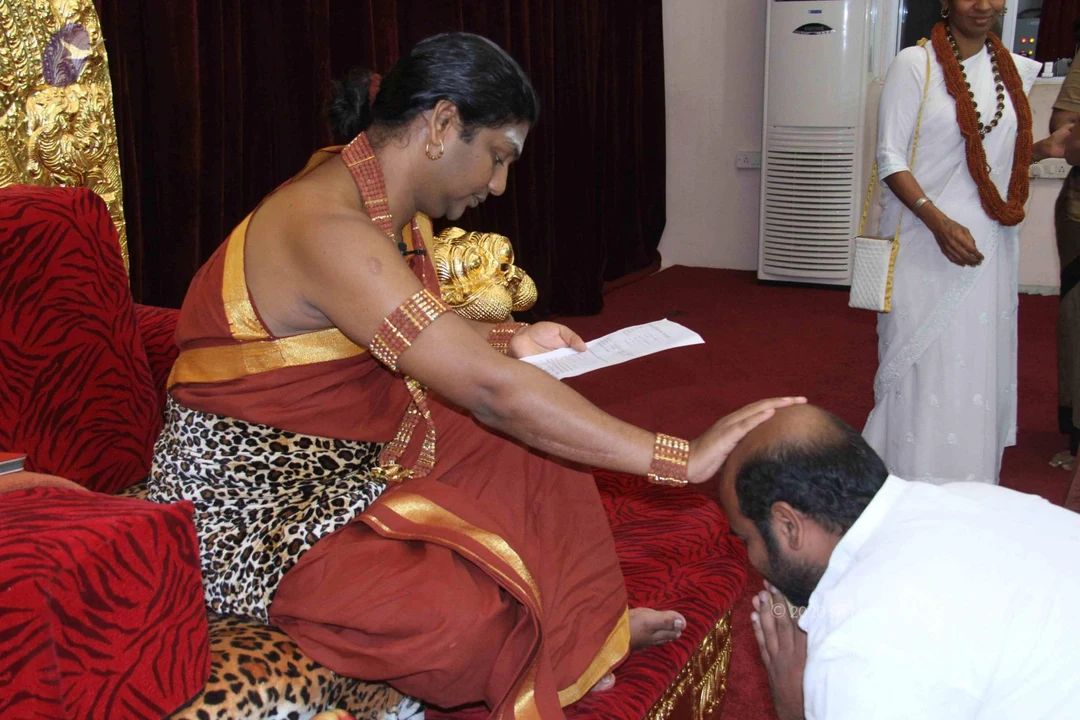
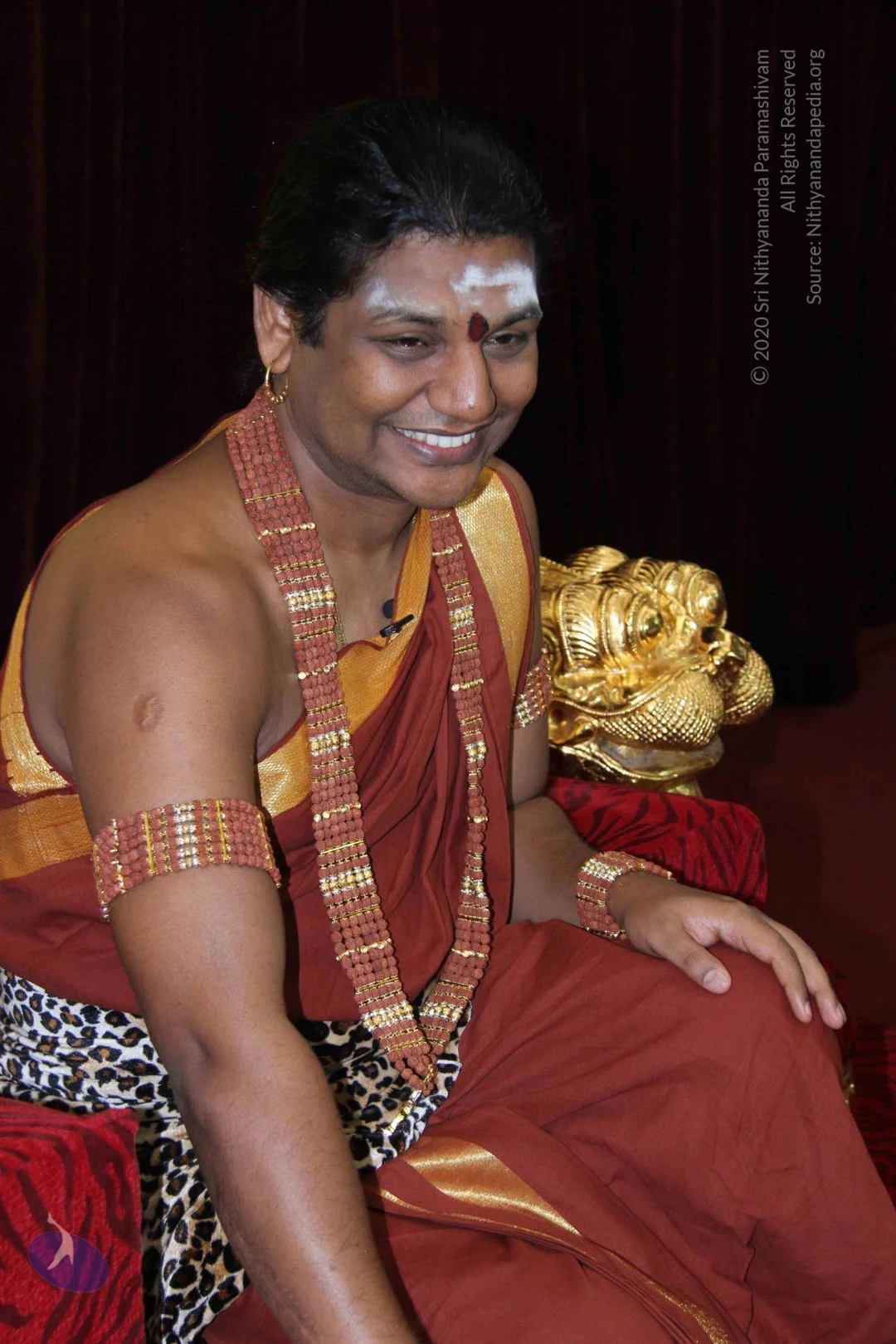
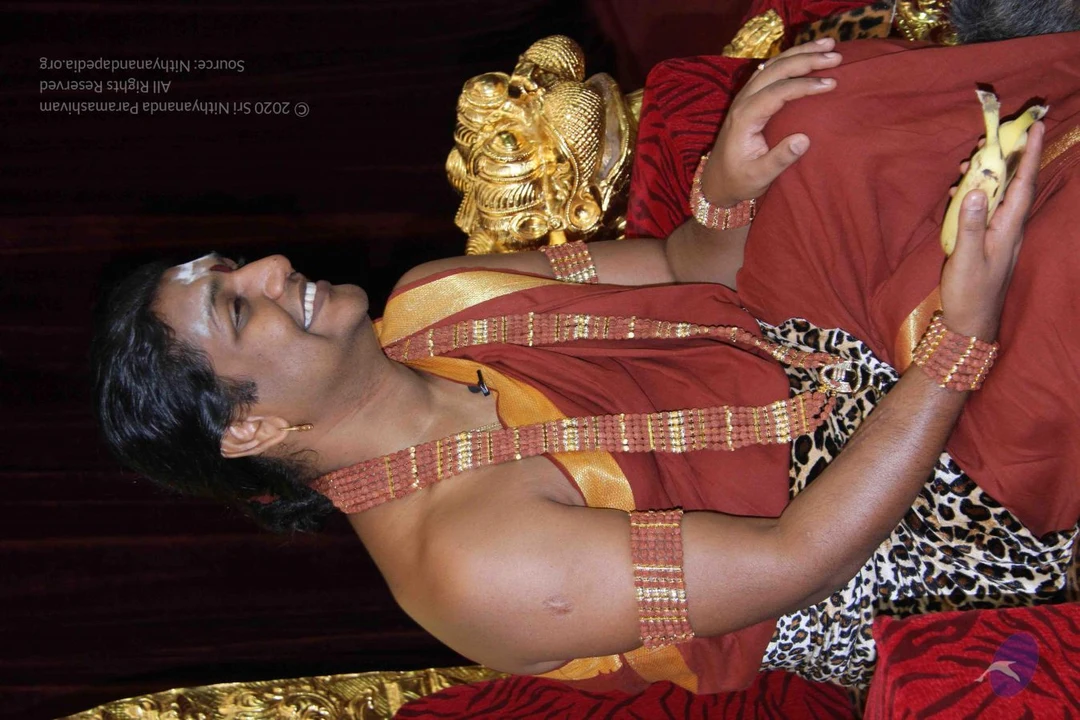
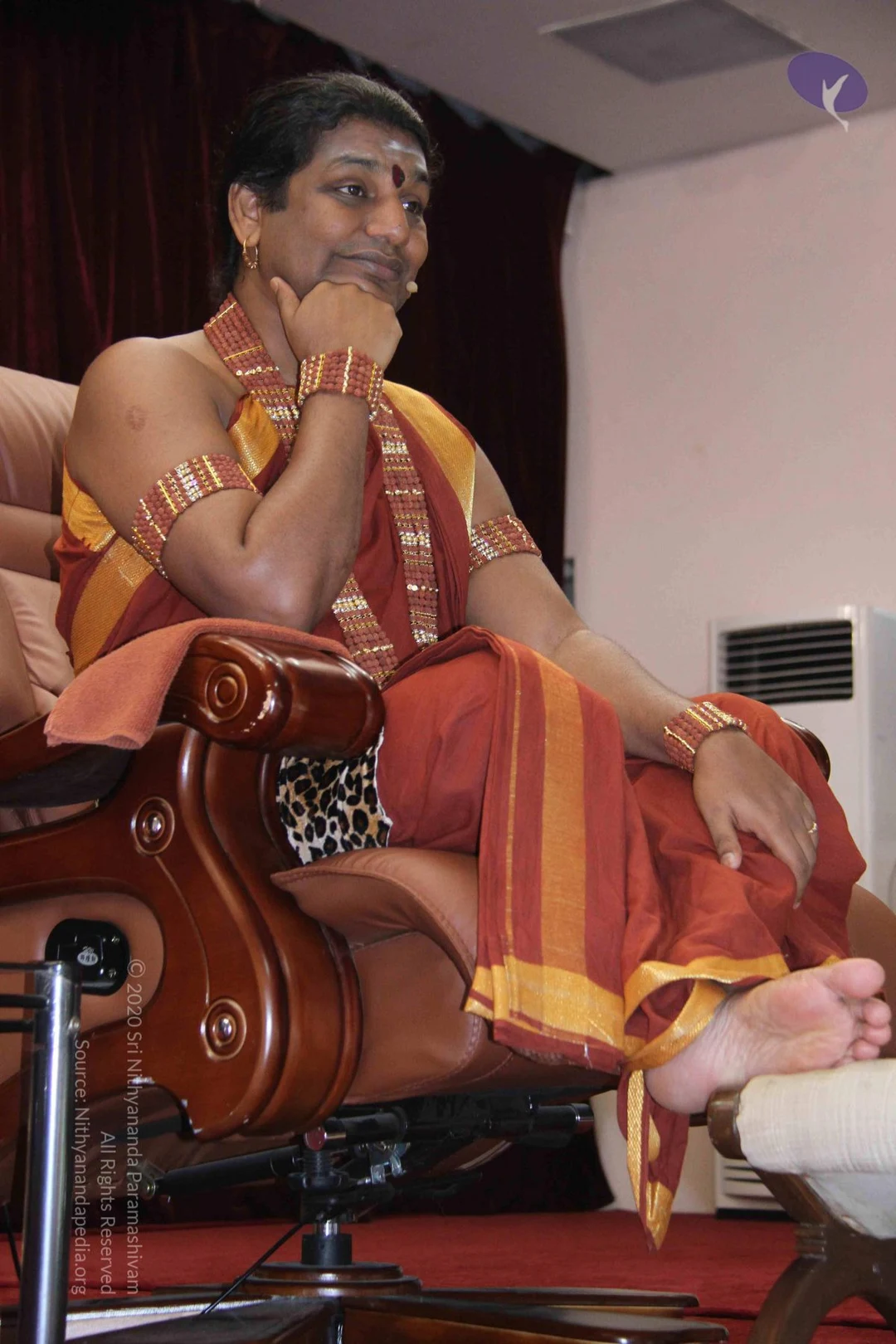
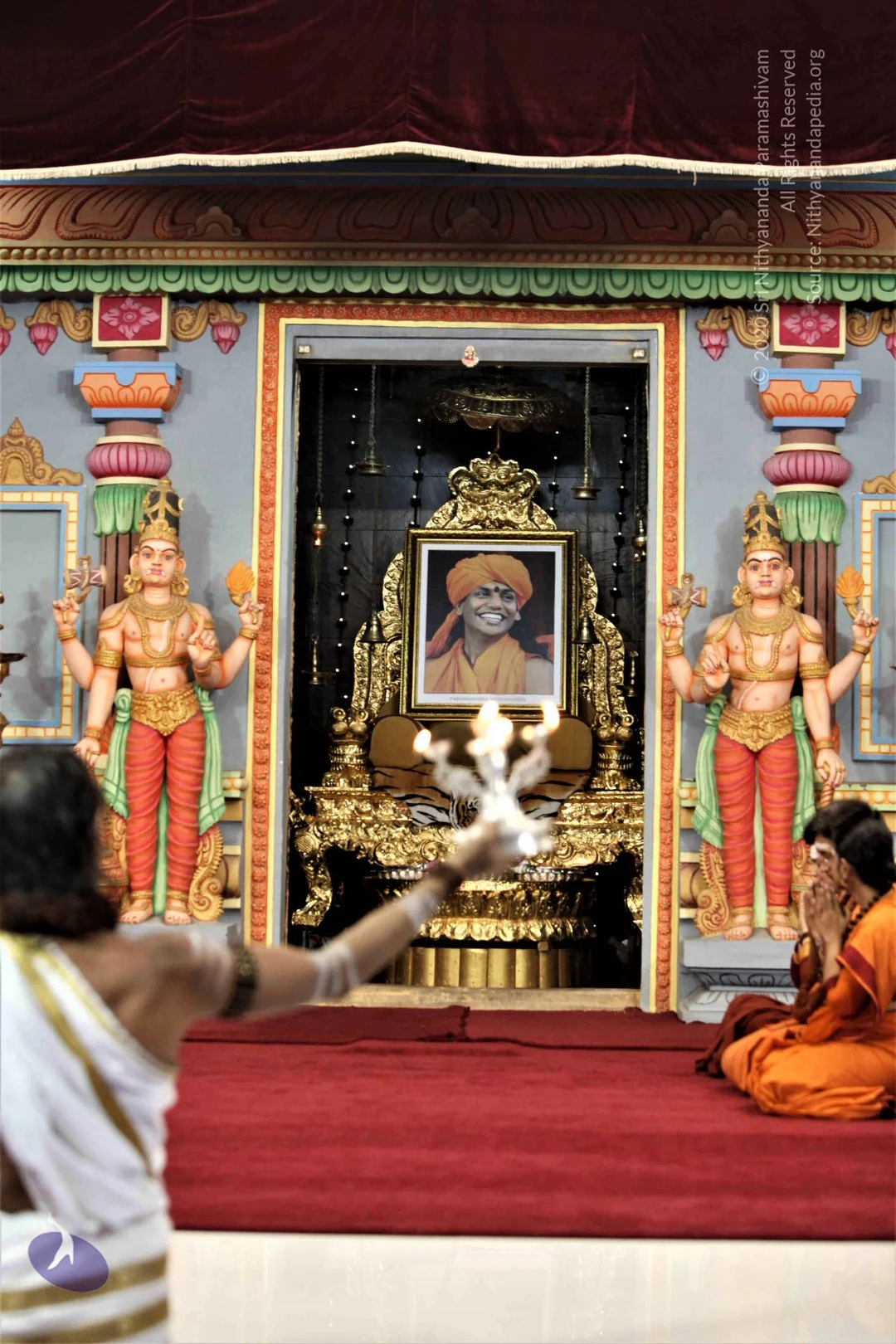
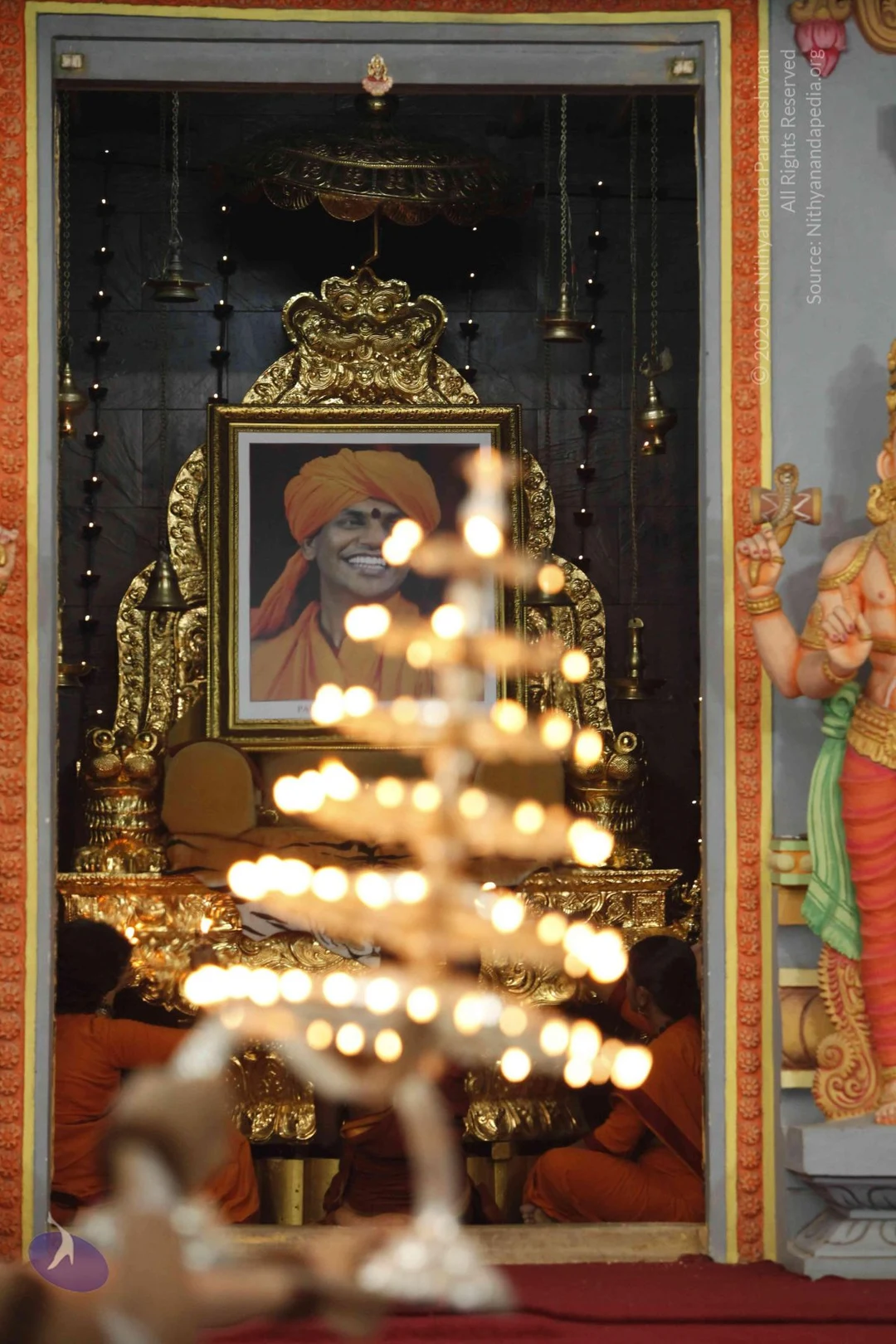
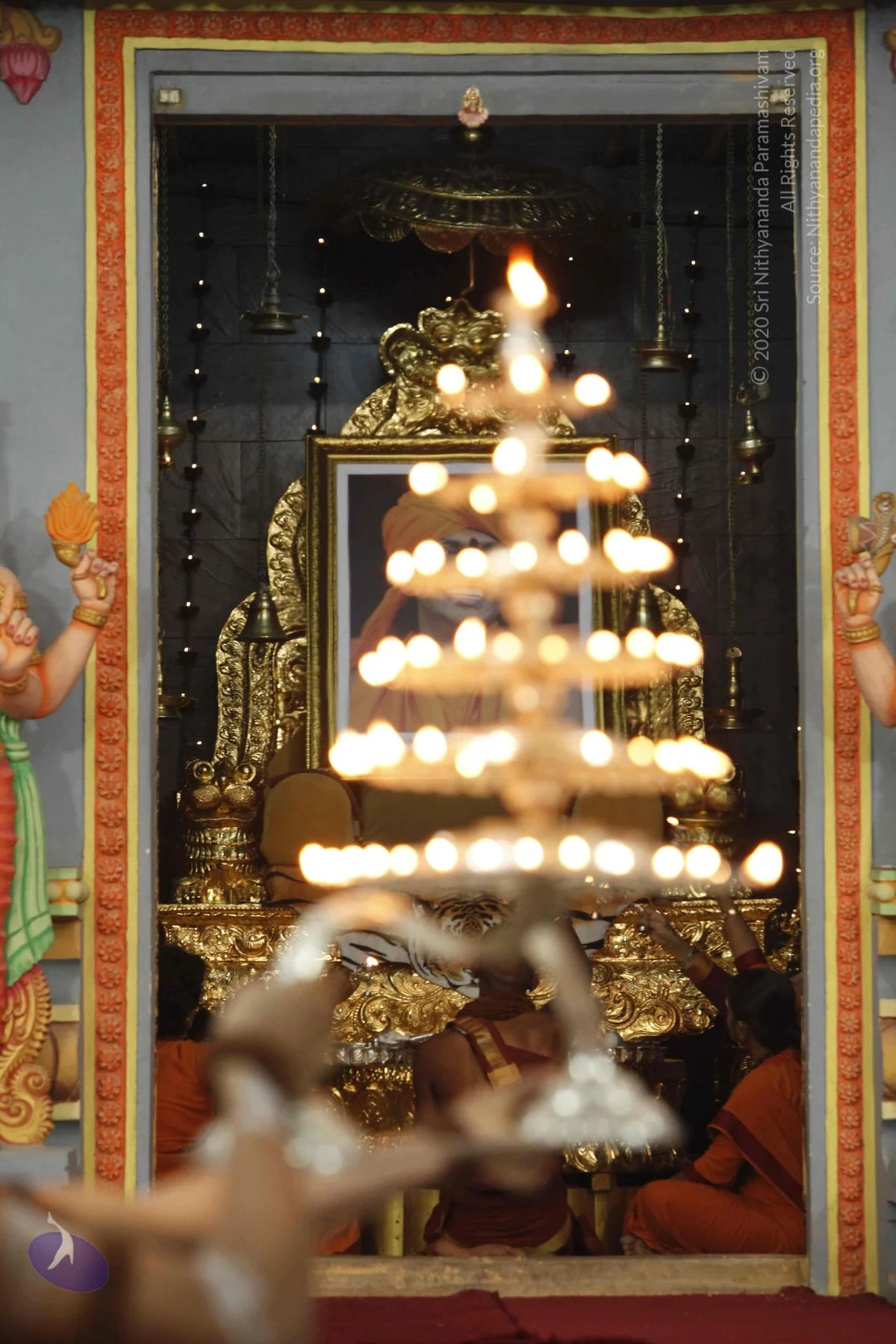
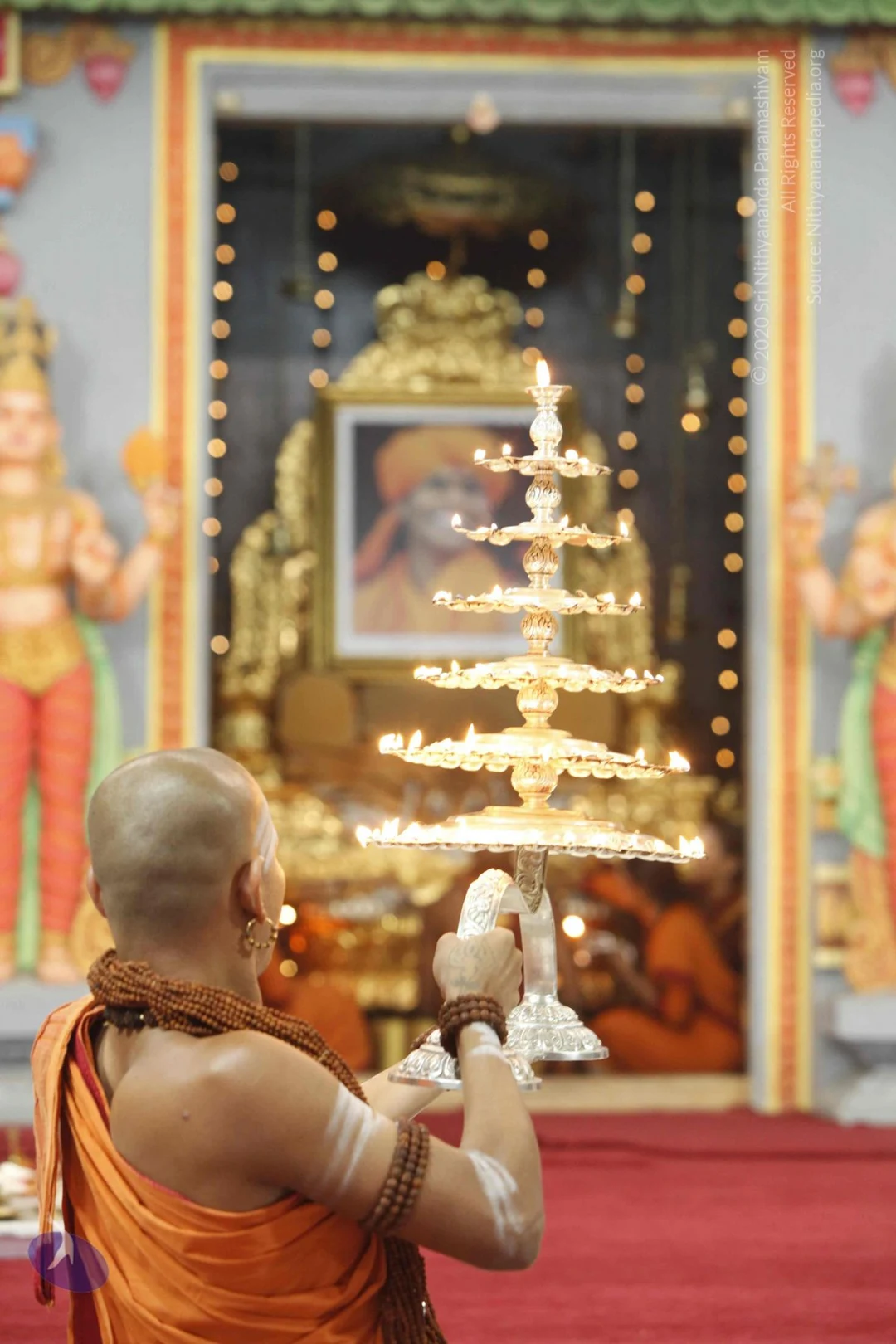
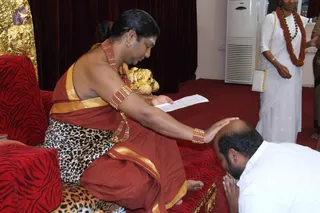
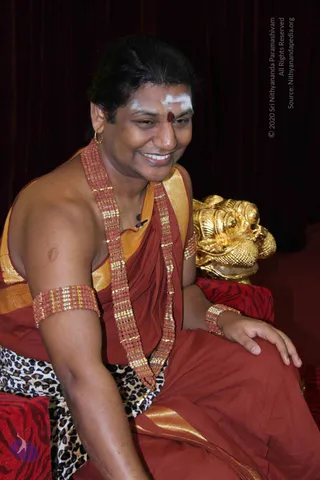
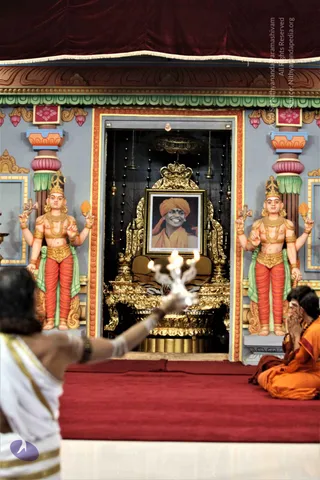
A seated figure in a rust-red and saffron-bordered garment with a leopard-print cloth beneath, wearing a red beaded necklace and gold armbands, places his right hand on the bald head of a kneeling man in a white shirt whose palms are pressed together in namaskar. The seated figure, sitting on a red zebra-striped cushioned seat with a gold-decorated backdrop, holds a printed sheet in his left hand. A woman in a white sari with a red beaded garland stands to the right beside an air conditioner. This appears to be a blessing gesture during a gathering.A smiling man sits on a red cushioned seat against a dark red curtain, with a gilded lion-head figure beside him. He wears a rust-red and gold-bordered cloth wrapped over one shoulder, a leopard-print undercloth, and long strands of rudraksha beads with gold spacers, plus matching rudraksha armlets and a wrist band. He has white vertical tilak marks on the forehead, a red dot between the brows, and a gold hoop earring. A small clip-on microphone is visible at his collar. a person: long swept-back hair, ornate gold-bordered saffron-red clothing and rudraksha malas match the page's claim, but the appearance is not conclusive enough to confirm identity from the visible cues alone.A photograph, rotated sideways, of a smiling man seated on a throne-like couch covered in red and leopard-print fabric. He wears a maroon robe with gold borders, rudraksha-style beaded necklaces and wrist bands, and white tilak on his forehead. He holds a bunch of bananas in one hand and rests his other hand on his chest. Behind him is a large gold lion-headed ornament.A smiling person with a red bindi and white forehead markings sits on a large brown leather armchair in front of an ornate gold-carved throne backdrop. They wear a rust-red garment with gold borders, a beaded rudraksha-style mala necklace, and matching beaded arm bands and wrist bands. Bare feet rest on a cream-upholstered footstool on a red carpet. A hand of another person is visible at the right edge.A seated man in a red and gold saffron-toned garment with gold border sits in a brown leather and wooden armchair on a red carpet, chin resting on his hand, legs crossed, bare feet visible. He wears a red rudraksha-style beaded necklace, matching beaded bangles and armbands, a small red bindi, and a small earring. A microphone is clipped near his face. Behind him hang dark red curtains and a pale wall with an air conditioning unit.A photograph of a temple-style shrine room with a red carpet in the foreground. Centre, a framed portrait labelled "Paramahamsa Nithyananda" shows a smiling man in an orange turban and orange robe, set on an ornate gold throne with a tiger-skin cushion beneath a gold canopy. Two painted deity murtis with four arms and red-and-green dhotis stand on either side of the doorway. In the lower left, a priest in white ritual clothes with a gold-bordered cloth raises a lit aarti flame toward the shrine. At lower right, two seated devotees in orange and maroon robes press their palms together in prayer.

Dial-the-avatar-New-Zealand EDITED READY-TO-PUBLISH

4 photosSource gallery
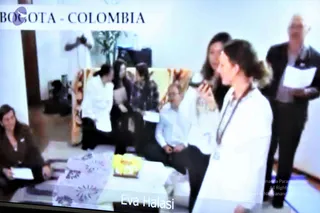
A screen capture of a video-conference feed labelled BOGOTA - COLOMBIA, showing a room with several people in white and dark clothing gathered around a small table with a yellow flower arrangement and white cloth. A woman with long hair in a white garment stands at right, speaking, with a lanyard around her neck, while a man in a dark jacket holds a white sheet of paper at far right. Others sit or stand in the background near a plant and a patterned hanging. A caption on the lower part reads Eva Halasi.A screen shows a video-conference feed labelled "BOGOTA - COLOMBIA" in the top left corner. A standing woman with long dark hair and a white blouse speaks into a microphone while holding a sheet of paper. Beside her, a man in a dark jacket and light shirt holds papers. Behind them, several people sit on a cream sofa and floor cushions in a plain room, including a man in white and women in dark tops. A white cloth-covered table holds a yellow flower arrangement and a white-and-purple cake. A caption at the bottom reads "Eva Halasi".A screen shows a video-conference feed labelled BOGOTA - COLOMBIA, with a caption reading Eva Halasi. Several people in light and dark clothing stand and kneel in a room with a flower-decorated table in the foreground. The people have their palms pressed together in anjali mudra, and one woman in white at right holds a microphone to her face while pressing her hands together. The scene is a remote satsang broadcast, with the participants seen on a monitor.A photograph of a television or projection screen showing a live video-conference feed from a room in Hong Kong. Two women stand close together in the foreground: the woman on the left wears a cream top with a red dot on her forehead and holds a white paper, while the woman on the right wears a red scarf over a white top. Another woman in white stands behind, with a dark handbag on a white chair and a white cushion nearby. A lower-third caption reads Canus-Hong Kong and Sirkazhi.

Nithya-Satsang EDITED-READY-TO-PUBLISH

8 photosSource gallery
A seated man in a rust-red turban with a jeweled ornament sits in namaste with palms pressed together, wearing rust-red garments, gold armbands and bangles, and a long beaded necklace. He sits cross-legged on an ornate golden throne with a carved arched back, red velvet cushions with tiger-stripe patterns, and gold lion-head armrests, draped with a leopard-print cloth. A small red candle stands at left and a metal vessel at right against a dark curtain backdrop. Swamiji (probable) cues: turban, ornate clothing and jewelry, seated on a throne in namaste, appearing as the presiding speaker of this satsang. One person is visible.A man sits cross-legged on an ornate golden throne with carved lion-head arms and a tall gilded arched backrest, against dark red drapery. He wears a deep red turban with a jewelled ornament, a red-orange robe with gold borders, a gold chain of beads or mala around his neck, and gold armlets and bangles. He holds his palms together in namaskar at his face with eyes closed. A leopard-print cloth covers the throne seat, and red tiger-striped cushions flank him. An orange candle or lamp sits on the dais at left and a steel vessel at right. Appearance-based identification is uncertain, and the page links the event to a person, so the figure is described by role as a seated teacher in namaskar.A man in a red-orange turban with a jewelled ornament and a red-orange dhoti-style garment with a leopard-print waist wrap stands barefoot on a gold-and-red raised dais in front of an ornate golden throne. He wears a long gold-beaded necklace with a pendant and gold bangles, and raises both palms in a blessing gesture. Flanking him are painted temple sculptures of multi-armed deities in gold jewellery and red-and-green dhotis holding staffs, and golden lion-headed armrests sit beside the throne, with a wooden door behind.A man in a rust-red turban with a jewelled ornament and a rust-red robe with gold border stands barefoot on a gold and red velvet throne platform, arms raised with palms open in a blessing gesture. He wears a leopard-print cloth around his waist, a long beaded mala with a pendant, and bangles. Behind him are a golden lion-faced throne back and a wooden door with carved colourful pillars. Two painted deity statues with multiple arms and crowns stand on either side, holding a trident and a flame. The red carpet and decorated stage suggest a satsang setting. Swamiji (probable) cues here include the rust-red turban, red robe, ornate mala and enthroned stage presence, consistent with the page's claim of Swamiji at this event.A photograph of a smiling man standing on an ornate gilded throne platform with red velvet cushions and gold lion-head armrests. He wears a red-orange turban with a jewelled ornament, a red-orange shawl over a gold-bordered dhoti, a leopard-print waist cloth, a red-orange and gold ceremonial mala necklace, and gold bangles on his arms. His palms are raised together in front of his chest. Behind him stands a wooden panelled door framed in red and gold, flanked by two painted deity figures with crowns and gold ornaments, one holding a flame. Leopard-skin cloth covers the platform. Probable Swamiji wearing saffron-coloured robes, rudraksha-style ceremonial mala and turban on the throne.A smiling man stands barefoot on a gold-ornate throne platform with red velvet cushions and golden lion-head armrests, raising both palms forward in a blessing gesture. He wears a red-orange turban with a jewelled ornament, a long ceremonial gold-bead necklace with a pendant, gold bangles, and a red-orange robe with gold borders under a leopard-print cloth wrapped at the waist. Behind him stands a large wooden door framed in red and green ornamentation, flanked by painted deity murti statues, one with a crown and a trident-like staff. Leopard-print cloth covers part of the platform.

Dial-the-avatar-Slovakia EDITED-READY-TO-PUBLISH
7 photosSource gallery

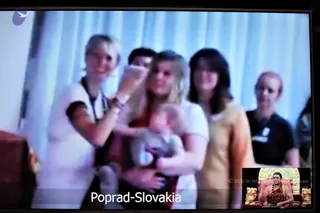
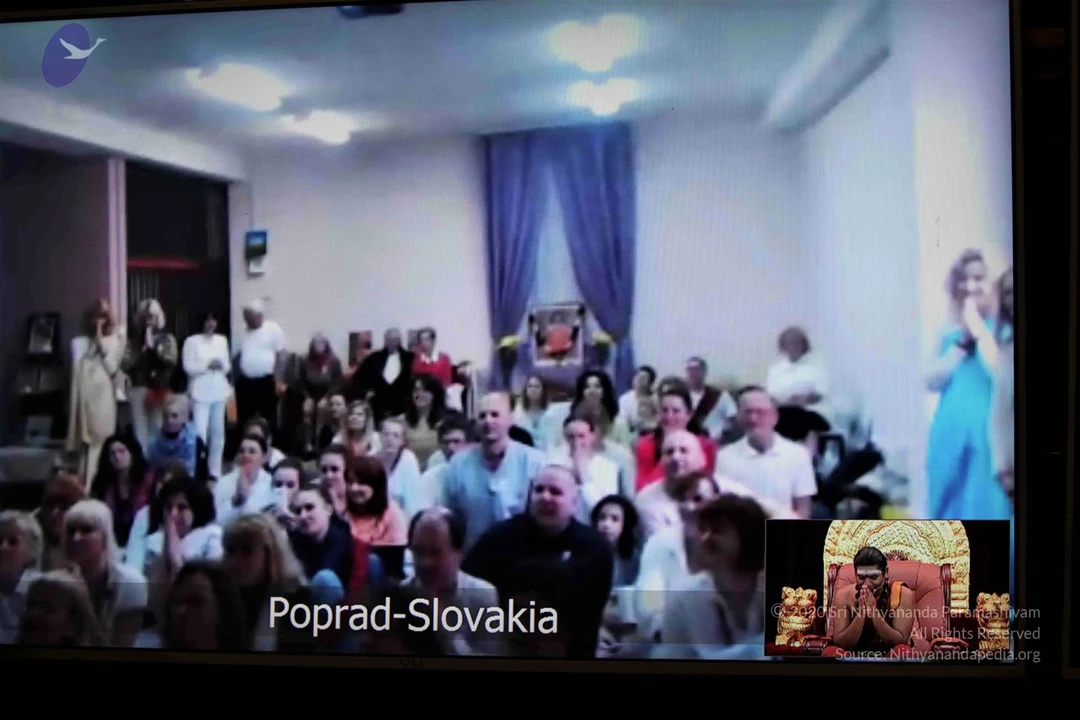
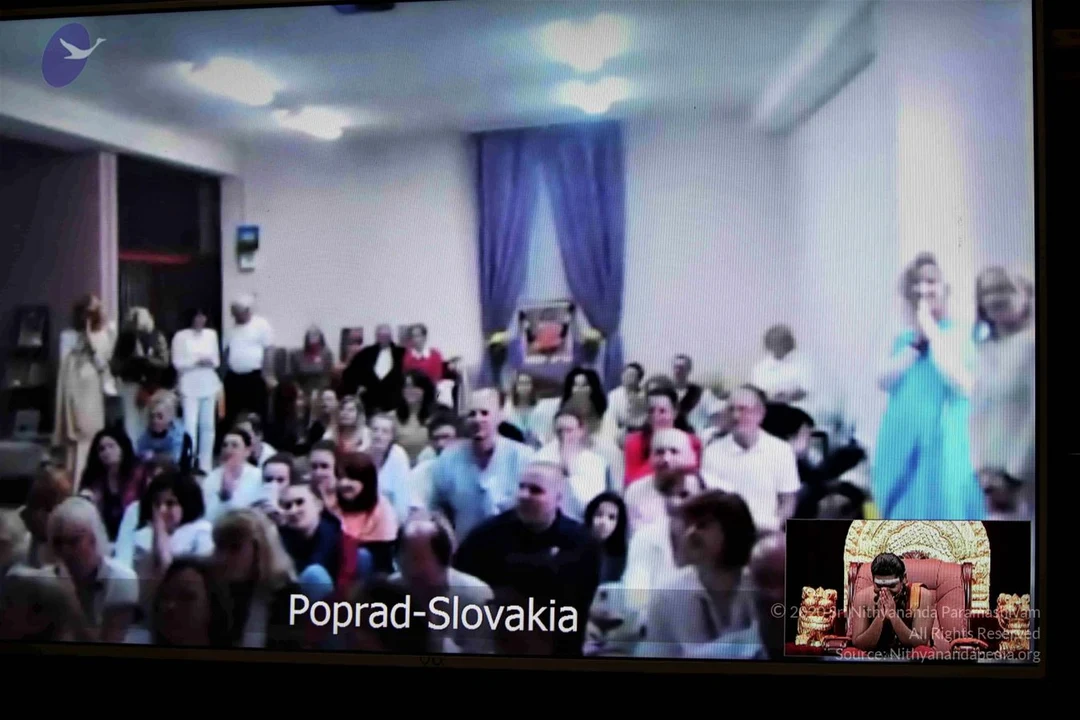
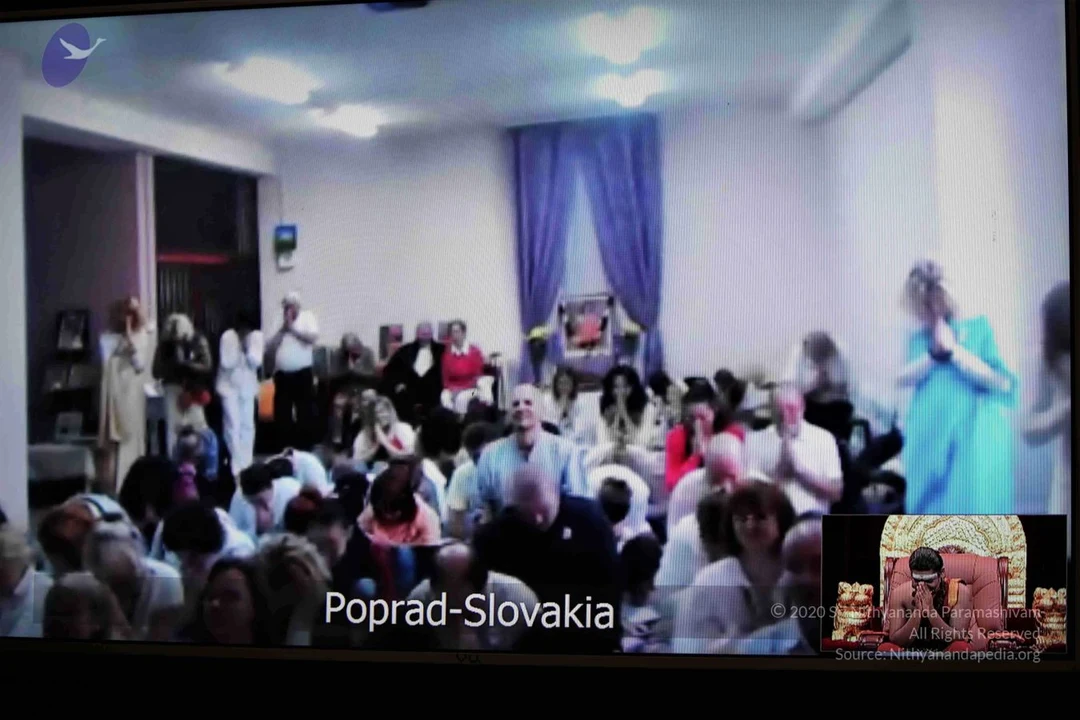
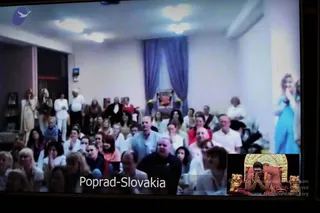
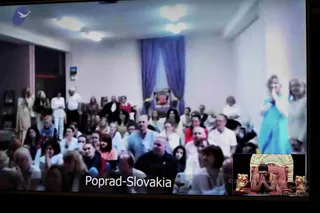
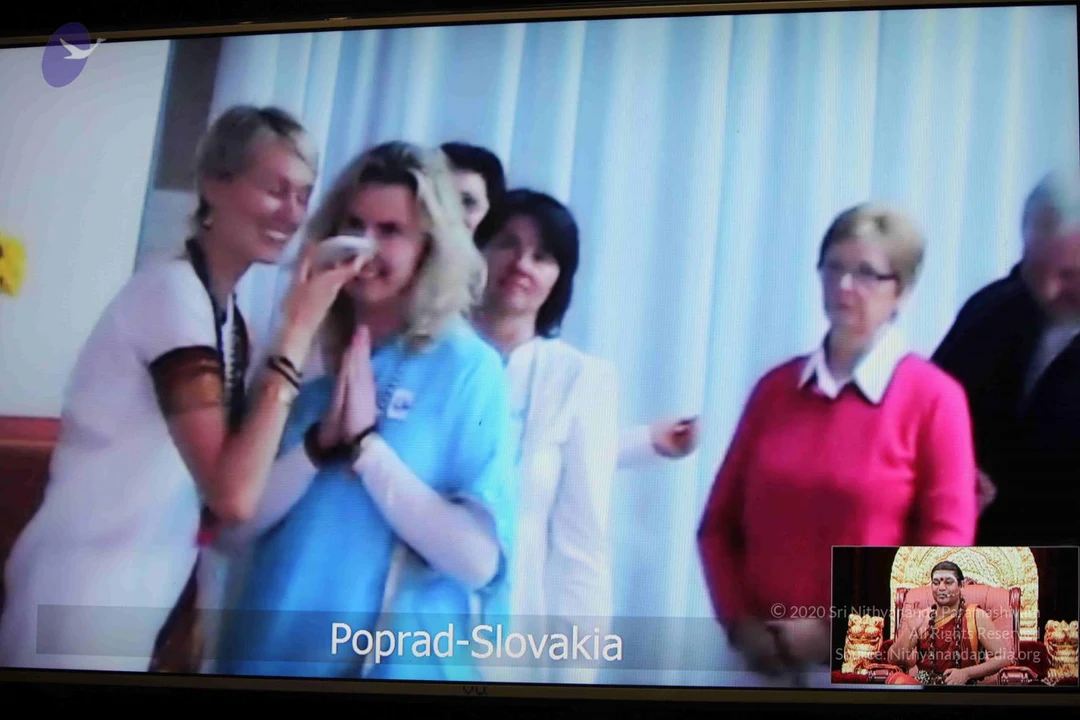
A photograph of a large display screen showing a video-conference feed. The feed shows a group of people standing in front of a pale blue curtain, with a caption reading "Poprad-Slovakia". In the foreground a young boy in a grey t-shirt stands centre-left, with a woman in a white t-shirt and dark lanyard to the left. Behind them a man in a dark cap and a woman holding a small child stand, and a long-haired person with bare shoulders stands at right. The scene is a satsang event with remote participants joined by two-way video-conferencing.A photograph of a large screen showing a video-conference feed of a group standing in a room with pale curtains. Several people are visible: a woman on the left in a white top raises a hand, a woman in the centre holds a baby wrapped in grey, a woman on the right wears a long beige kurta-style top with dark hair, and a bald man in a dark shirt stands at the right edge. A caption at the bottom reads "Poprad-Slovakia". In the lower right corner, a small inset shows a figure seated on an ornate golden throne with a lion motif, but the inset is too small and indistinct to confirm who it is, so no identification is made.A photograph of a large screen showing a video-conference link to a group in Poprad, Slovakia. Six women and a man stand in front of a pale blue curtain. The woman second from left wears a beige-gold shawl and presses her palms together in anjali. A woman in the centre wears a dark brown top with a red high collar, and a man at right holds a young child. A small inset in the lower right shows a seated figure before a golden deity backdrop, a presenter at a teaching setting. The caption reads Poprad-Slovakia.A photograph of a large screen showing a live video-link feed from Poprad, Slovakia. Several people stand close together in front of pale blue curtains and a yellow flower arrangement. A woman in a red scarf and grey jacket presses her hands together in front of her, while a man in a white shirt holds a small child on his shoulder. Others in white and dark clothing stand beside them. A small inset in the lower right shows a golden-framed figure seated in a throne-like setting, with a copyright credit overlaid.A large screen shows a live video-conference feed from a room in Poprad, Slovakia, where a crowd of many people sits and stands in a white-walled hall with blue curtains, a framed portrait and flower arrangements. Several participants in the front rows raise their hands in greeting or join palms in namaskar. In the lower right corner, an inset window shows a figure in orange robes seated on a golden ornate throne with lion-shaped armrests, hands folded in prayer. The lower-left caption reads Poprad-Slovakia.A photograph of a large screen showing a video-conference feed of a seated audience in a bright white room with lilac curtains and ceiling lights. Many people sit on chairs and stand along the walls, many in white, grey and casual clothes. A woman in a bright turquoise dress stands at right with palms pressed together. A small inset at lower right shows a figure in saffron and orange robes with hands joined, seated on a gold-decorated throne with ornate gold ornaments on either side; this inset is a screen depiction and the figure's identity is not established from appearance. A location caption reads Poprad-Slovakia.