Skip to content
Sunday

6 October 2013

Discover the power of right Words.

Dated photos
402
Source pages
1
Media
2
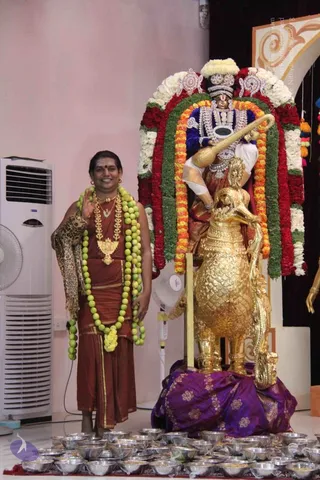
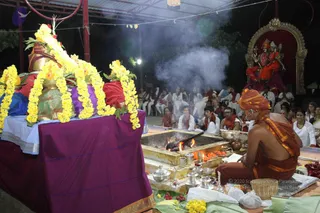
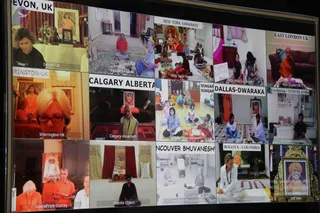
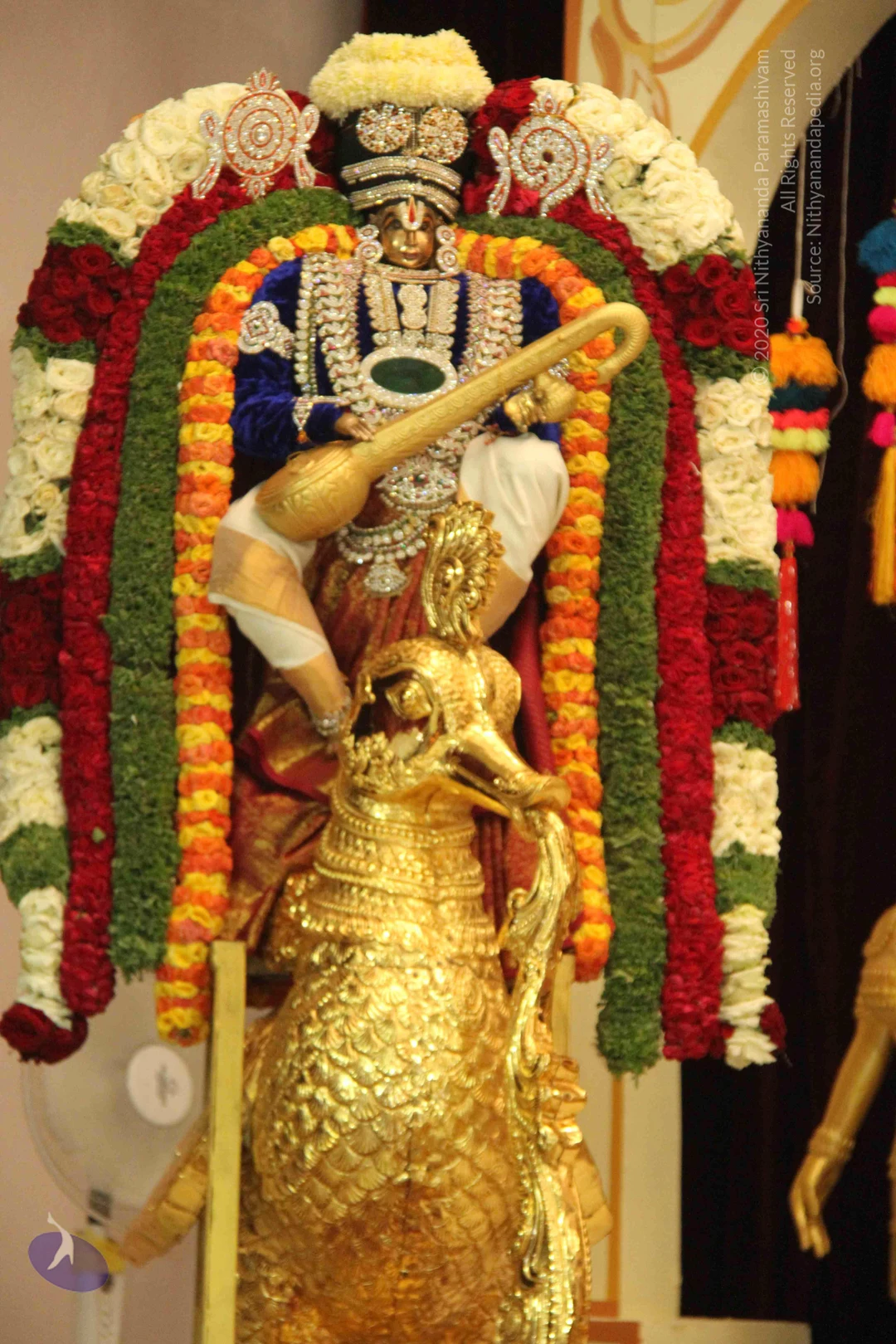
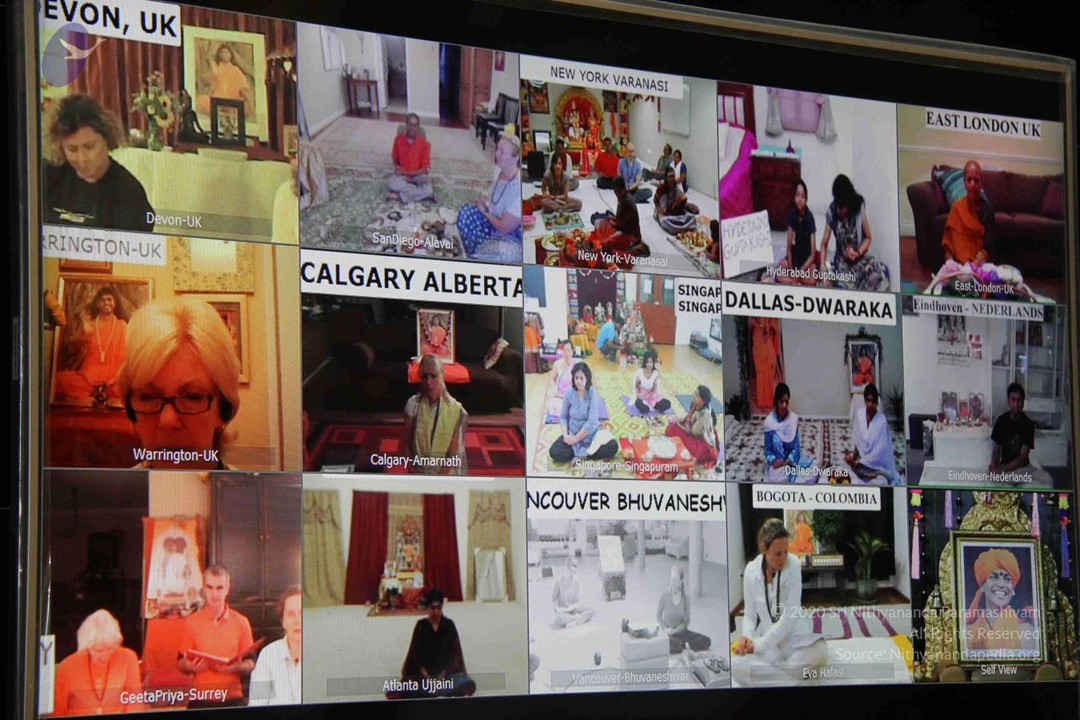
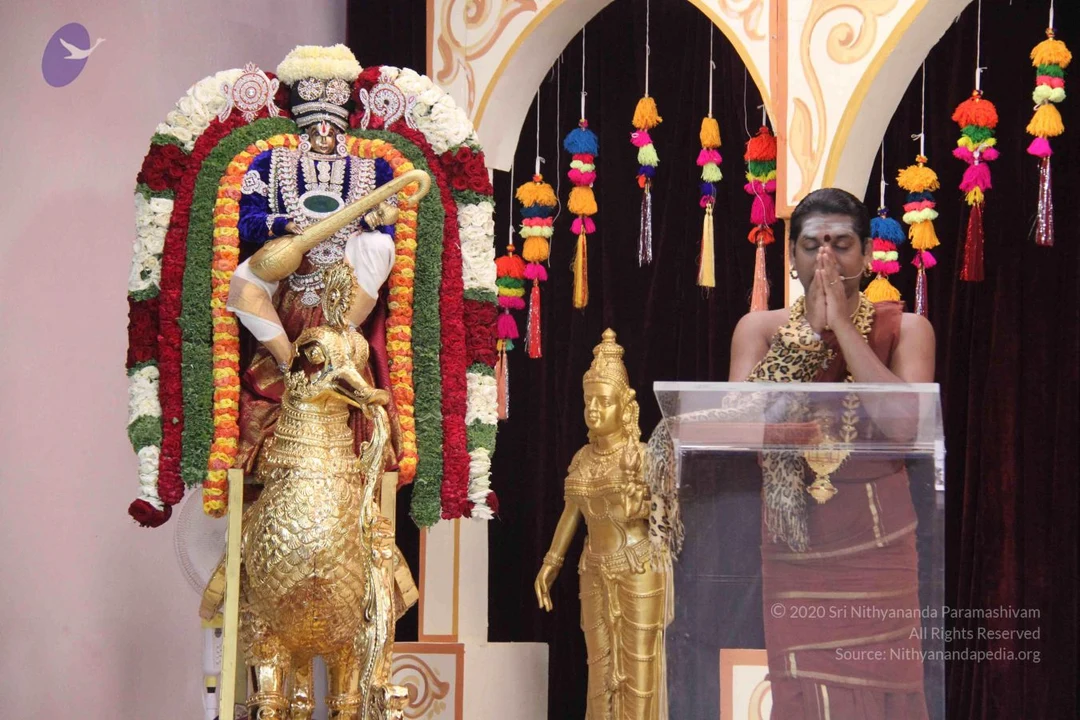
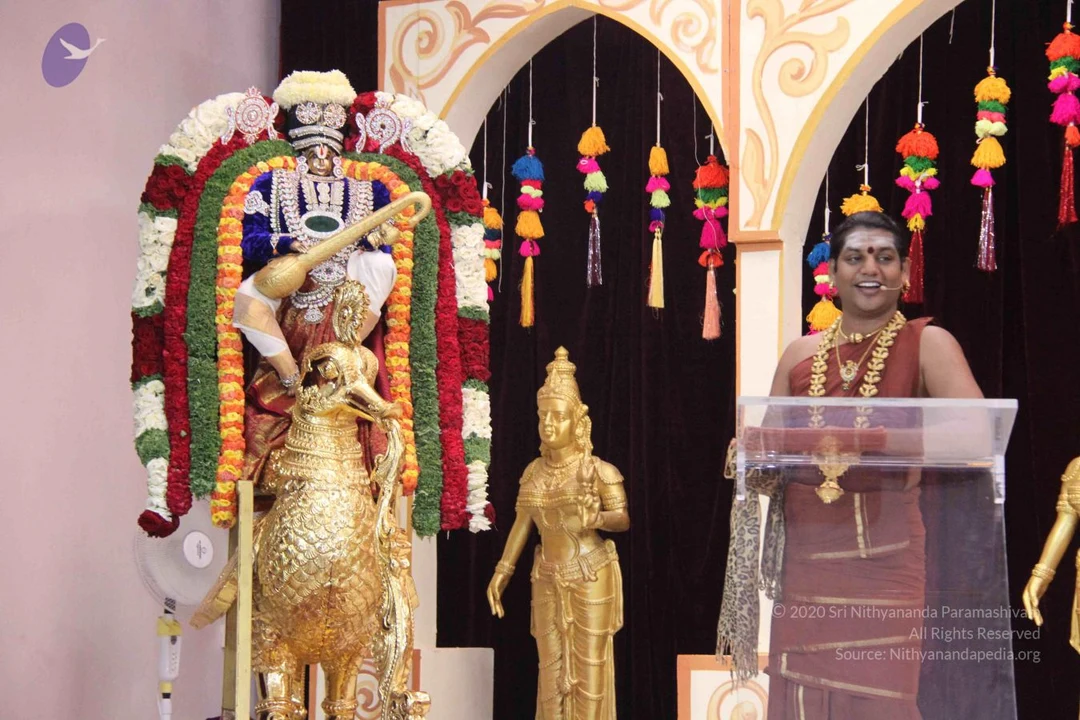
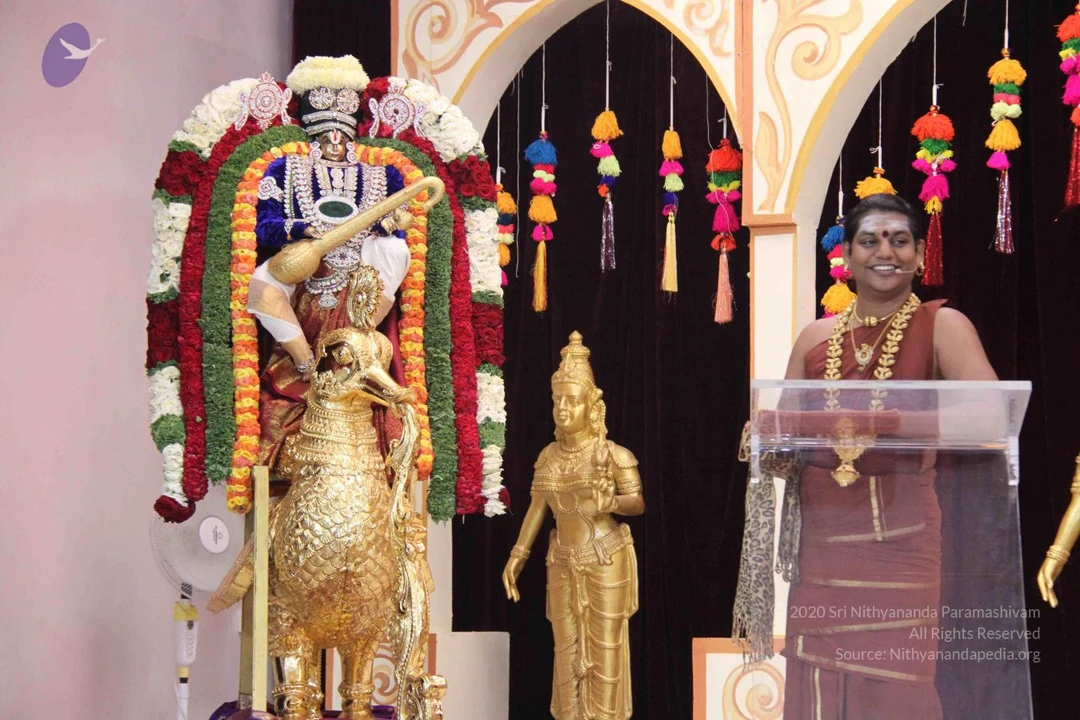
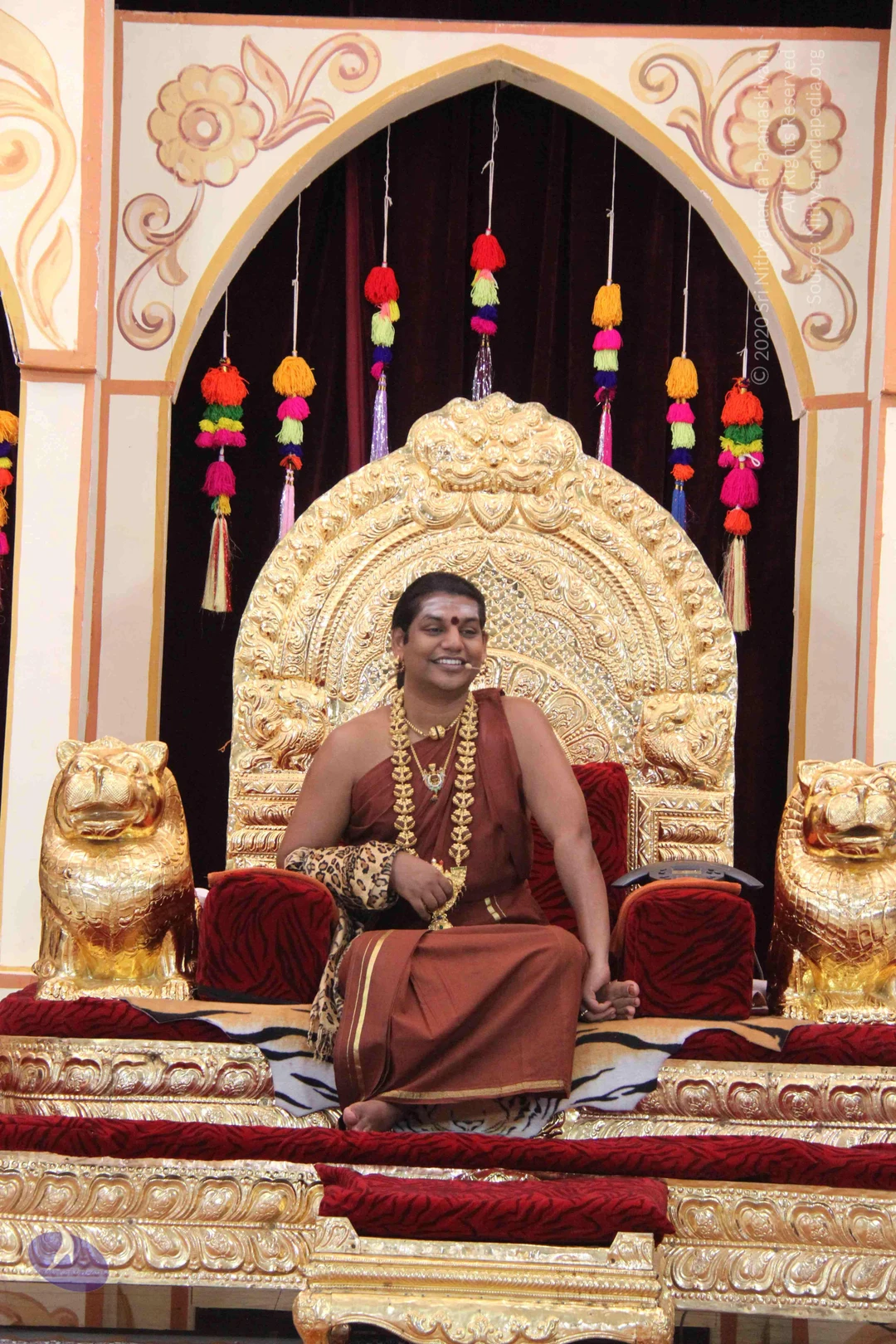
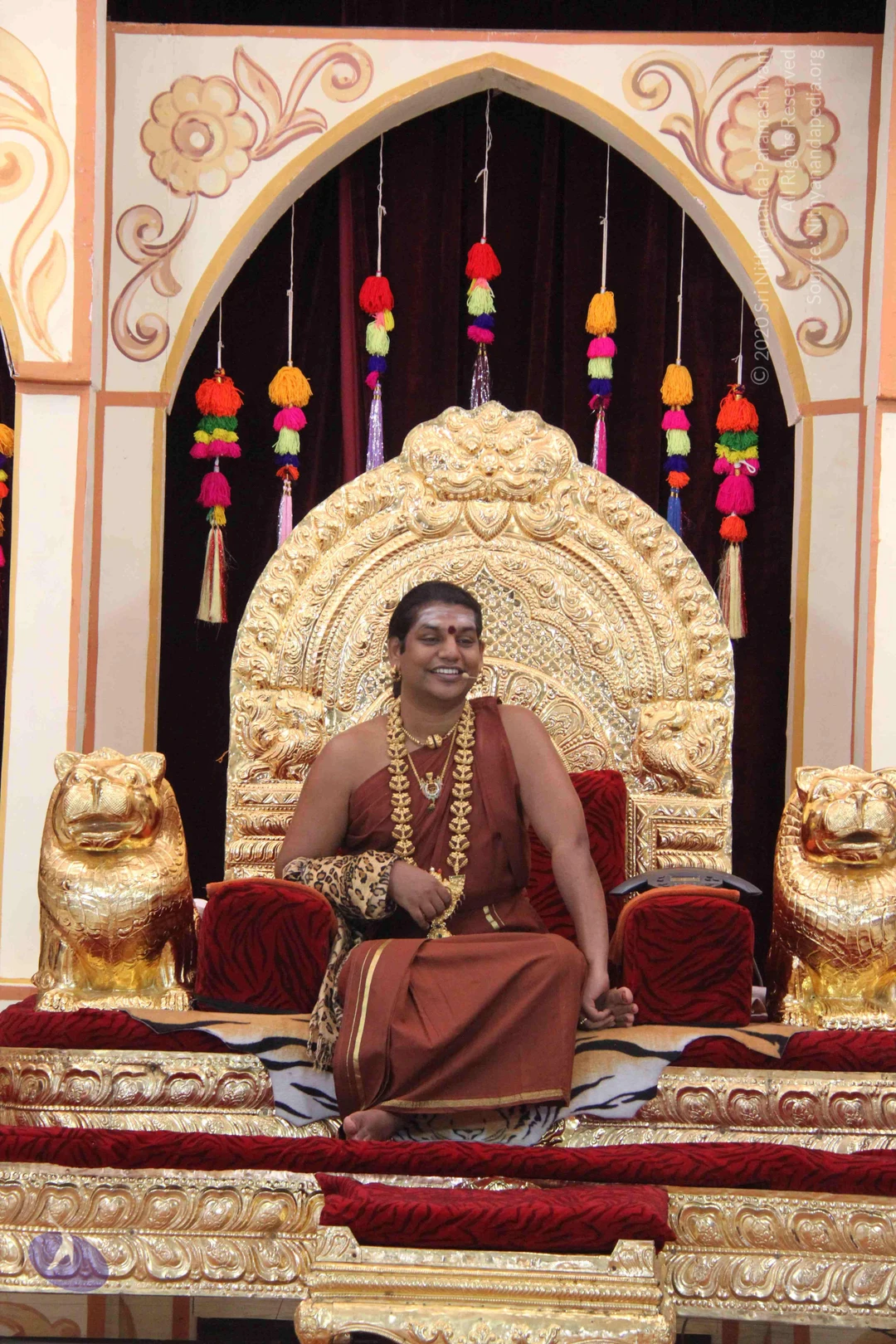
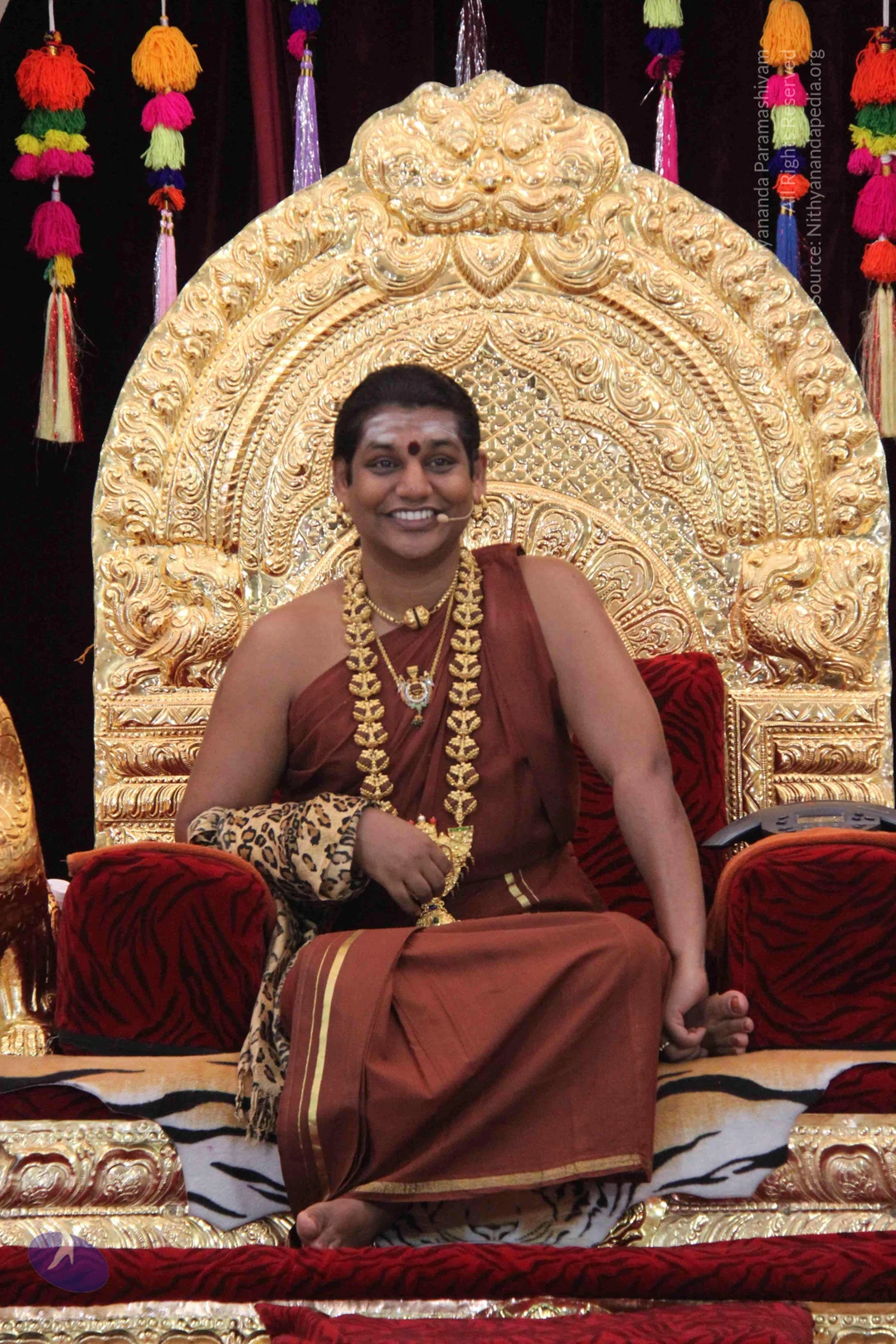
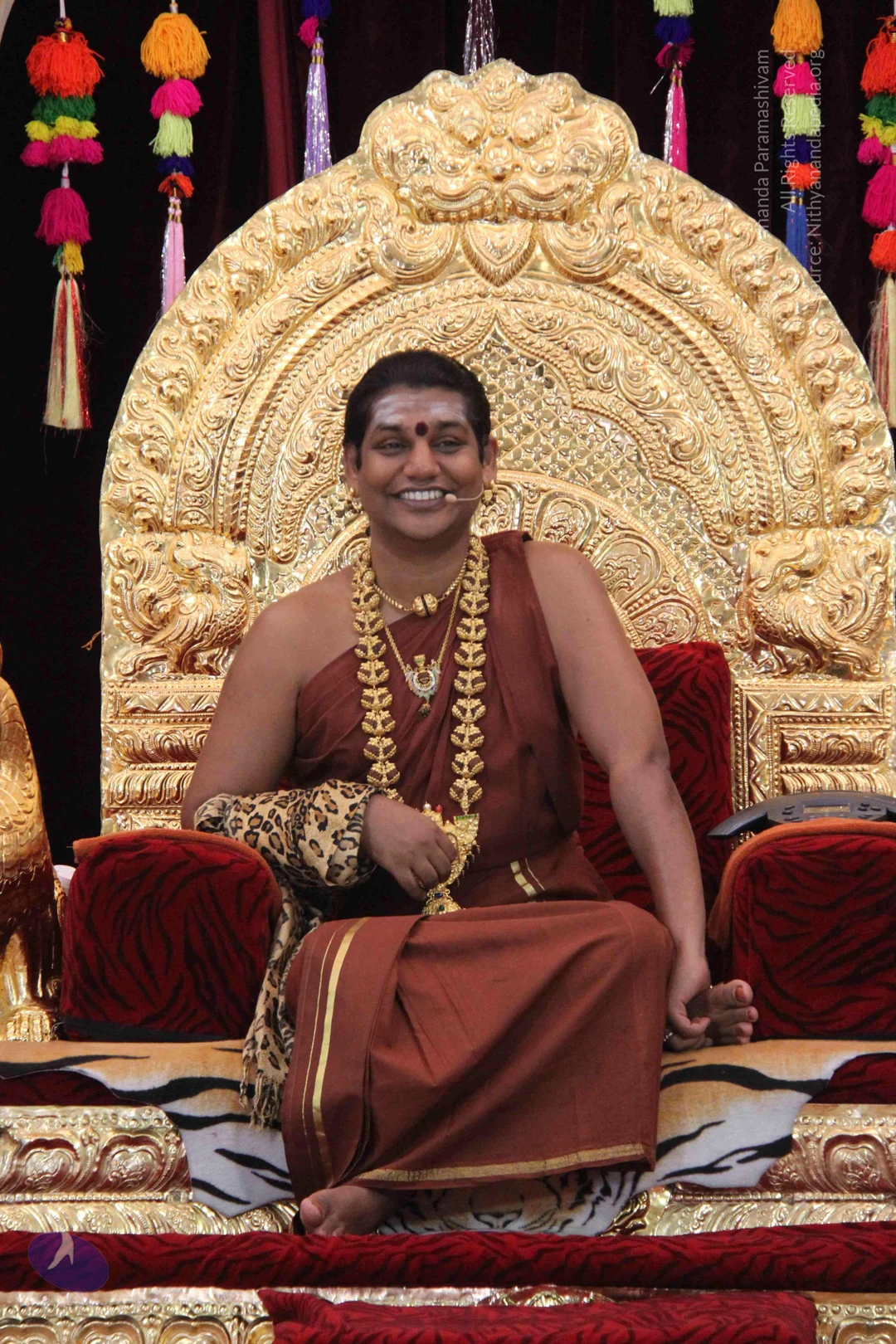
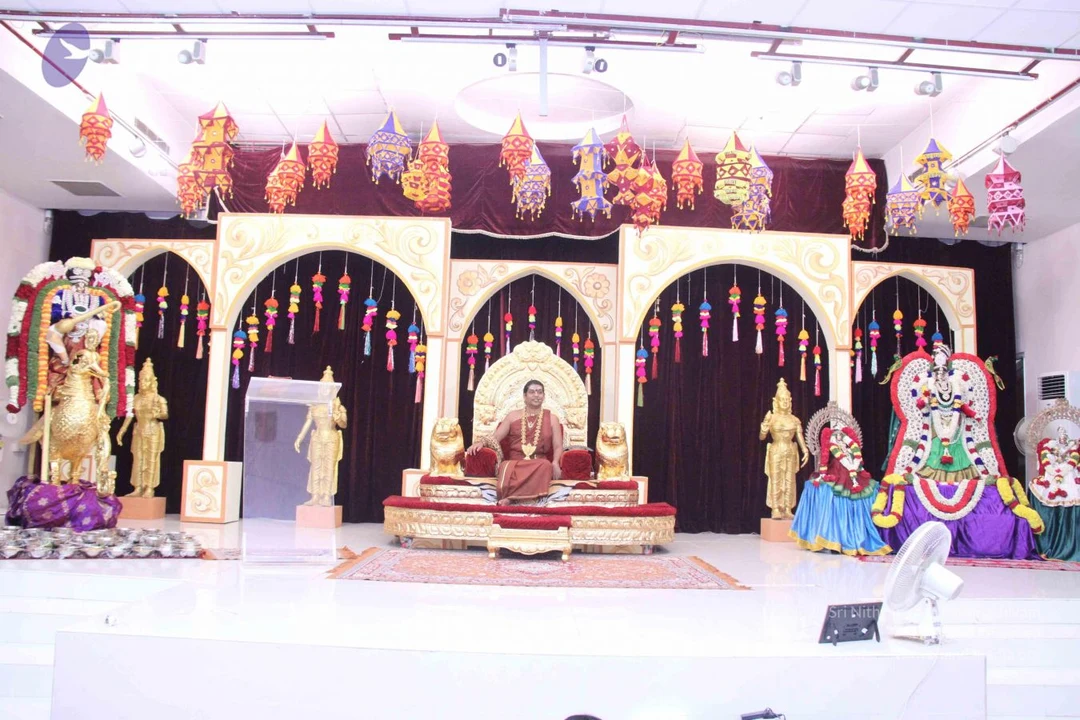
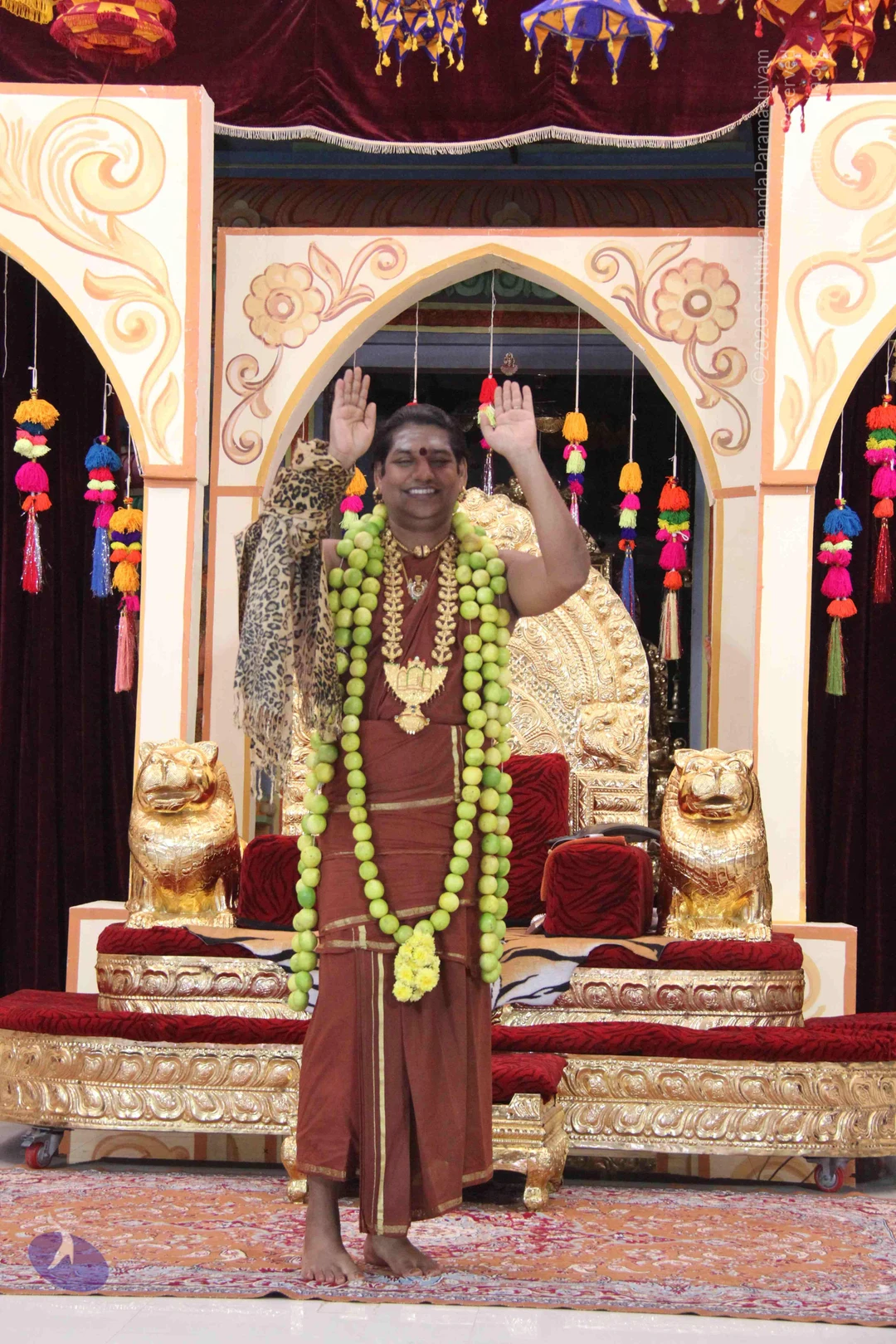
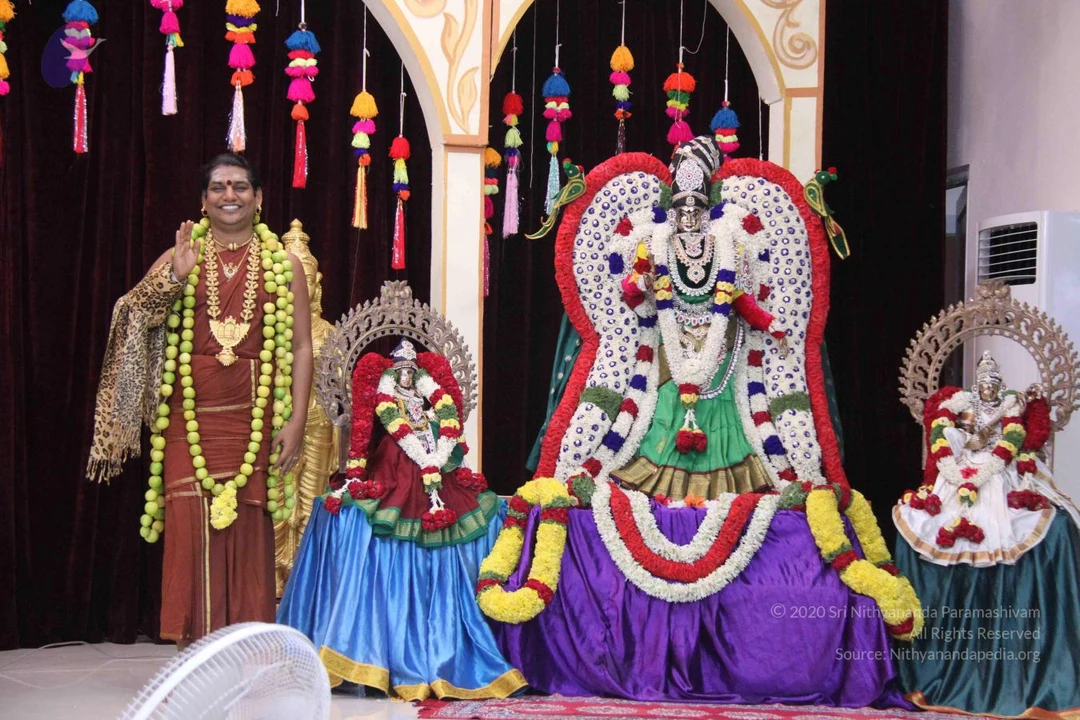
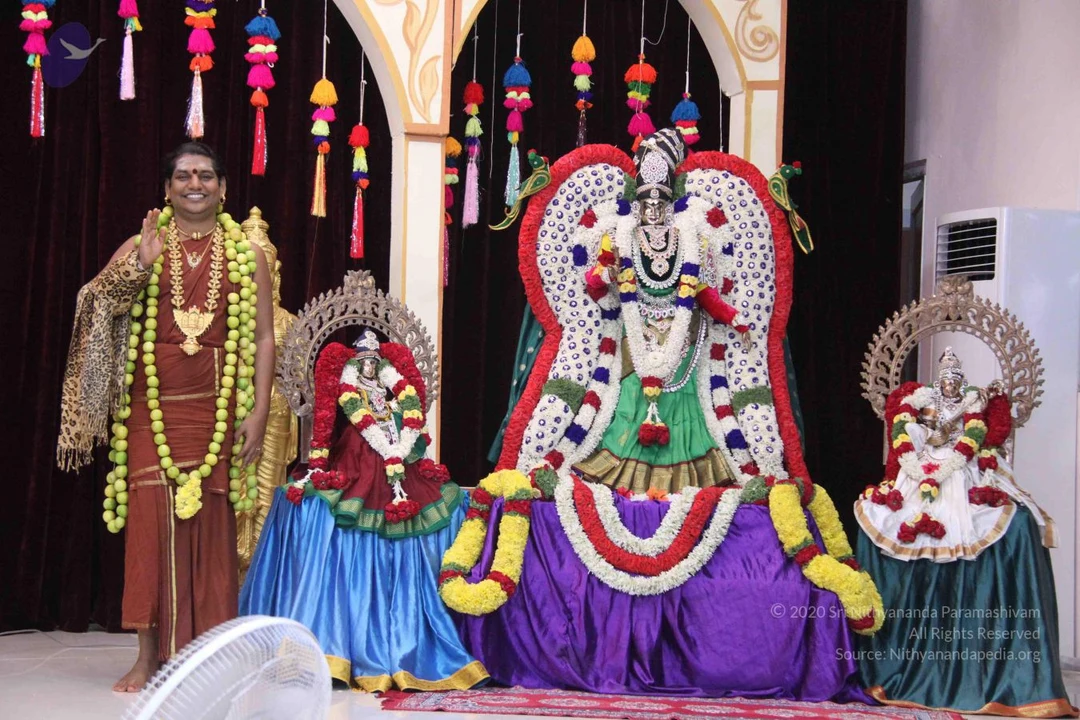
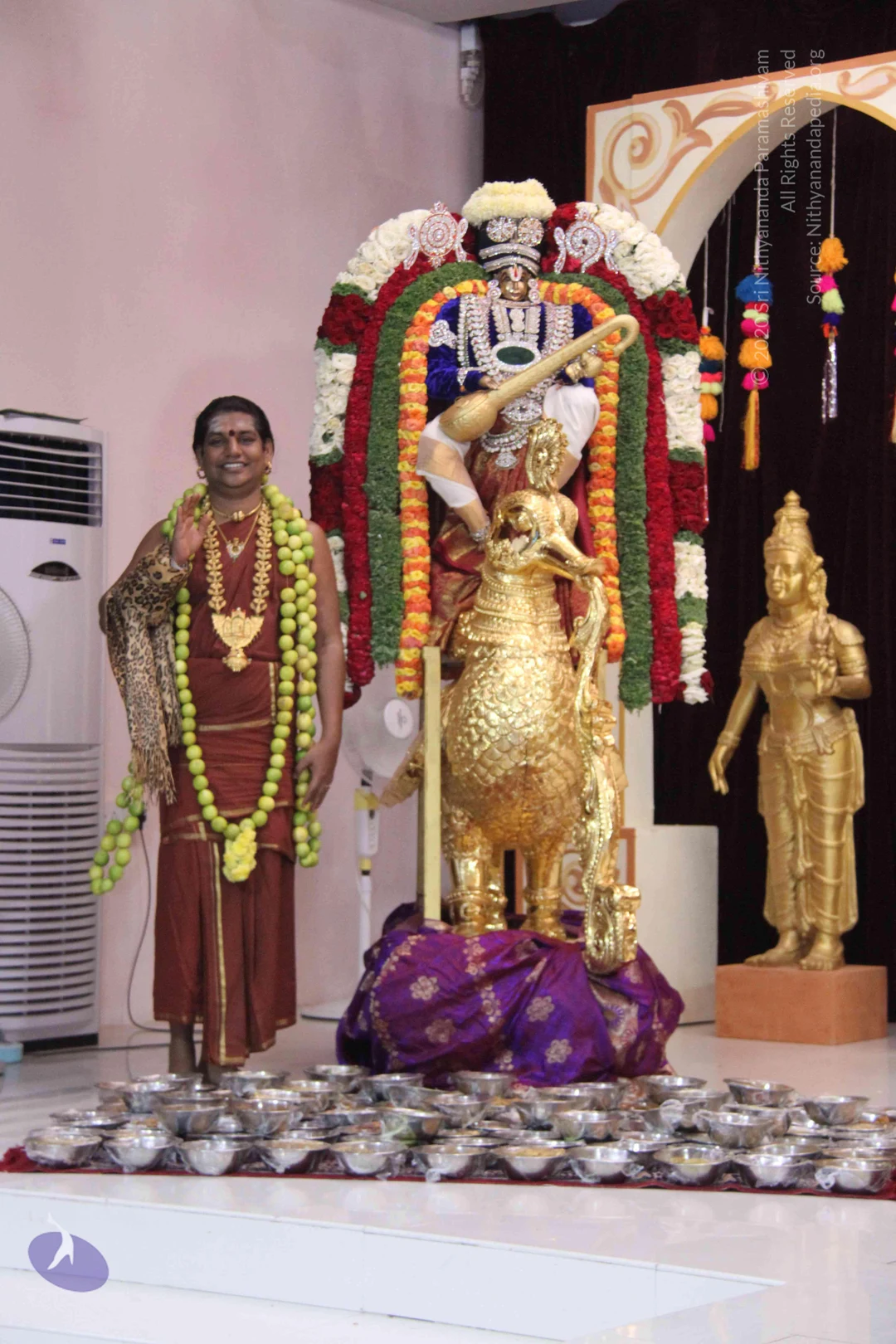
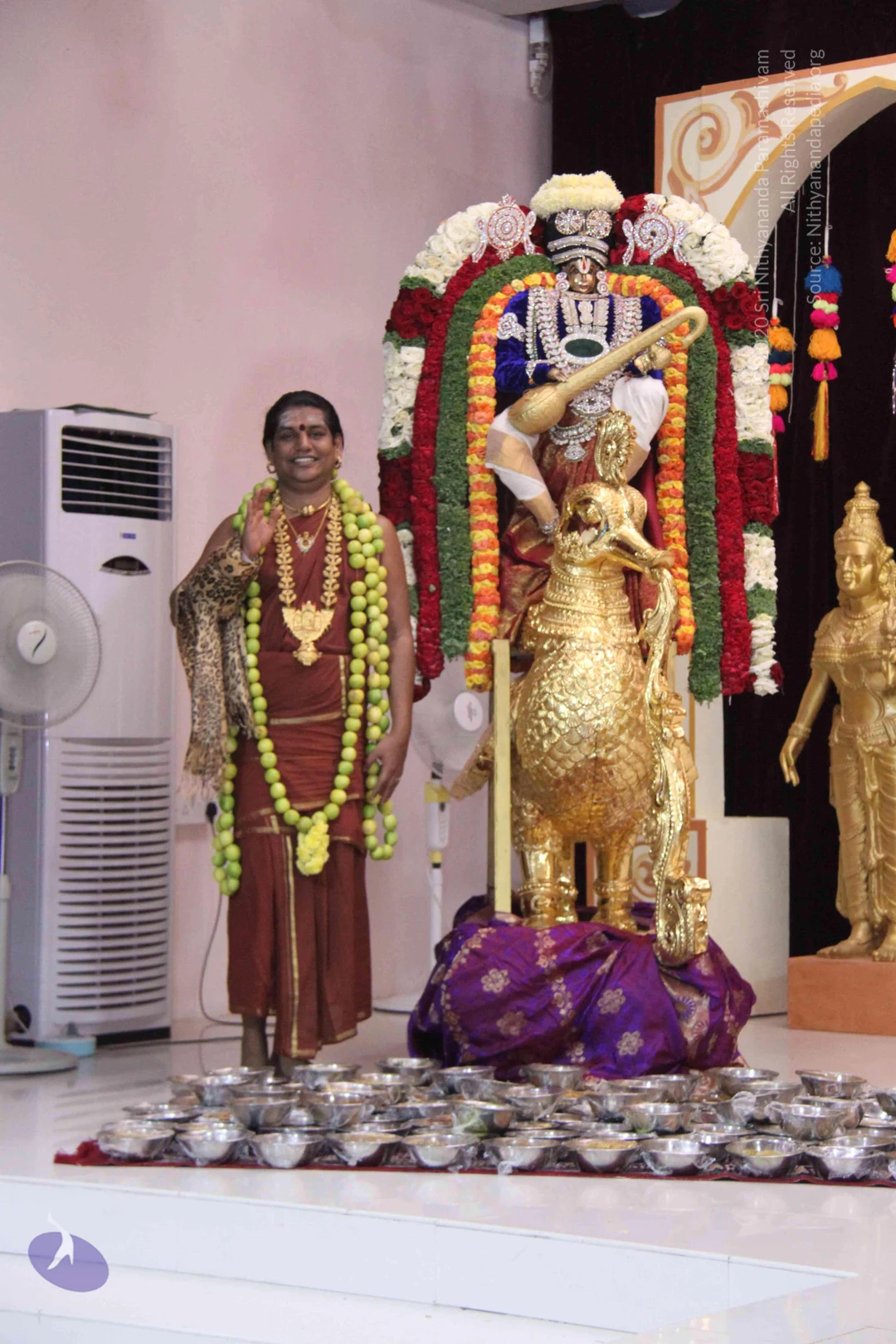
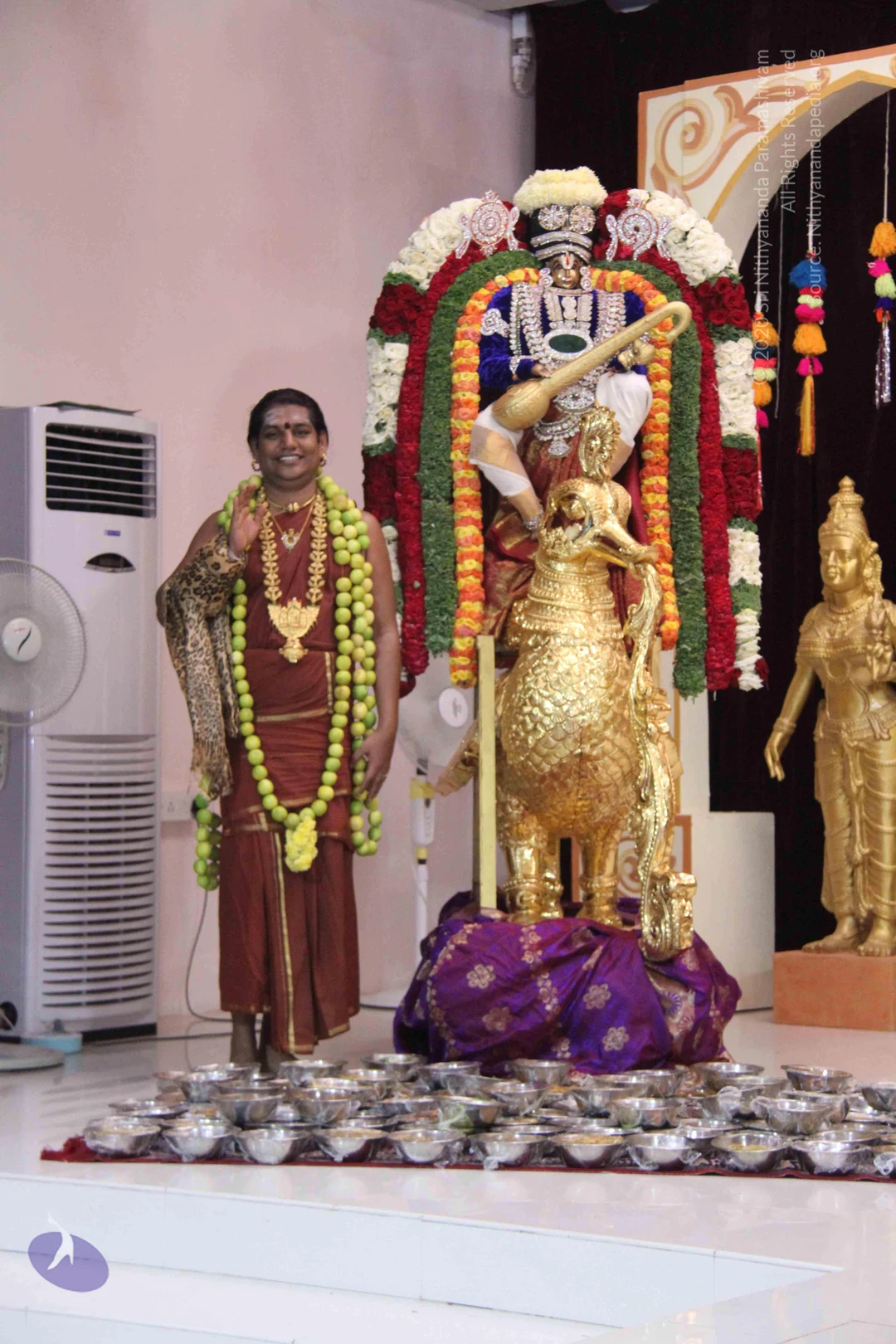
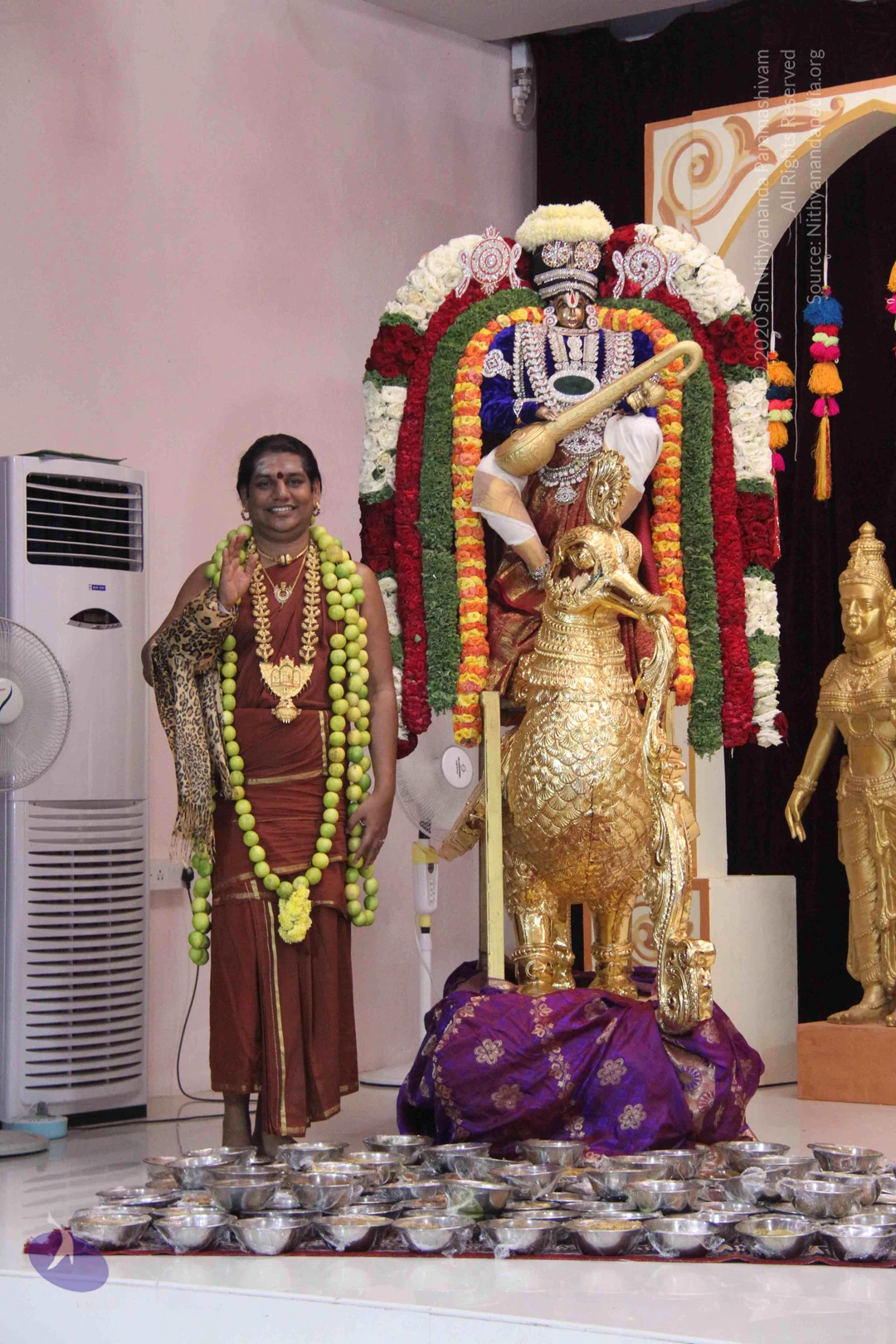
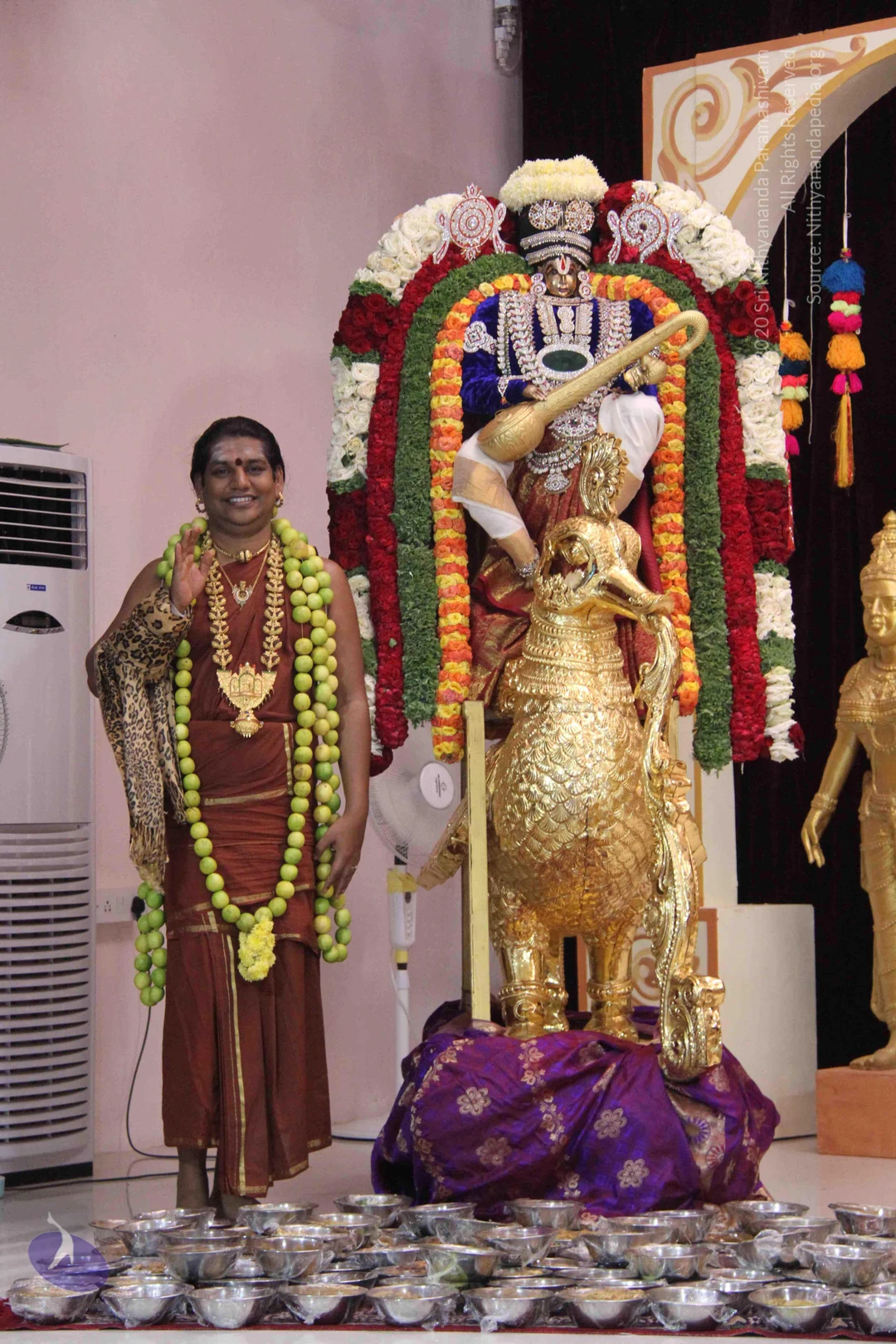
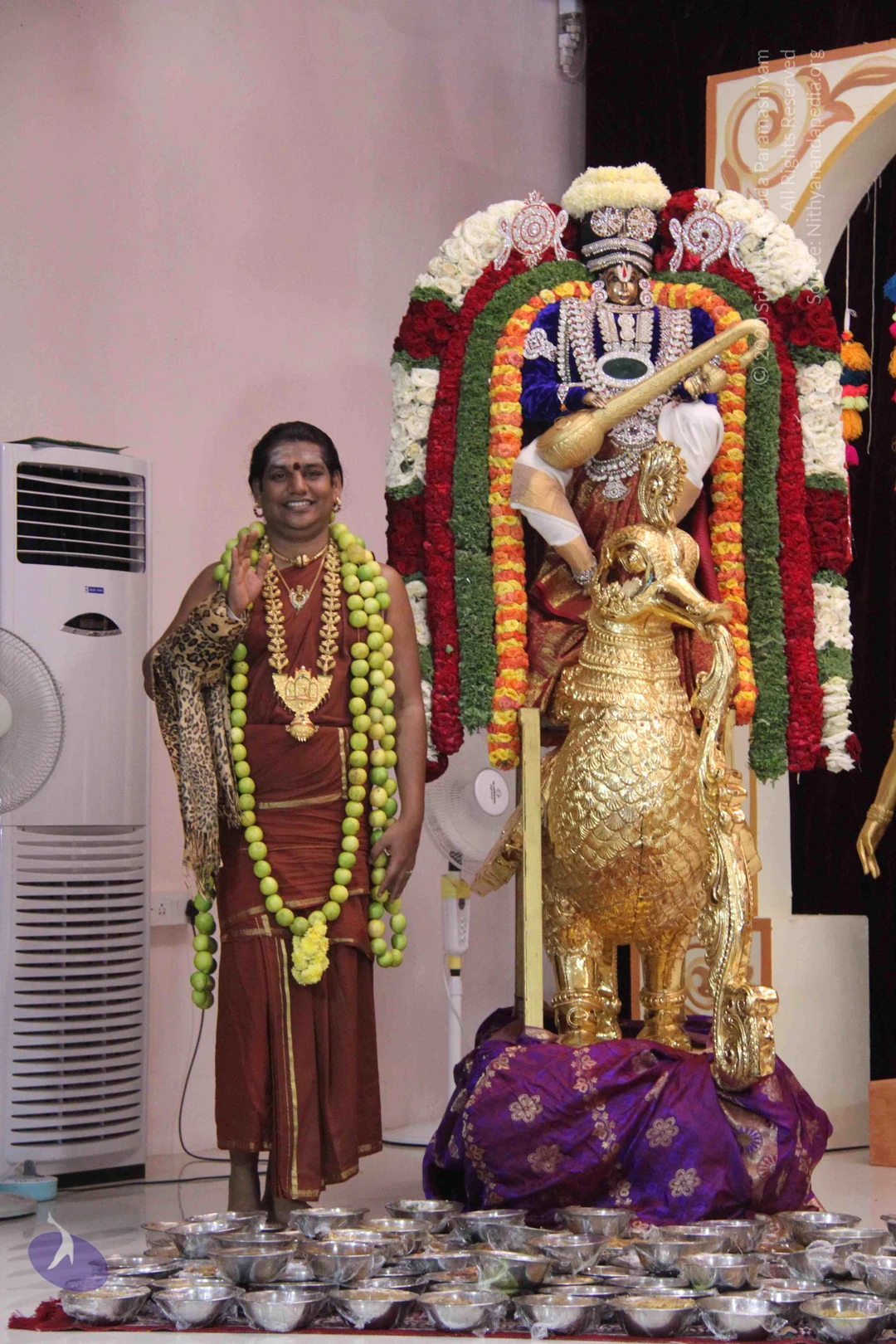
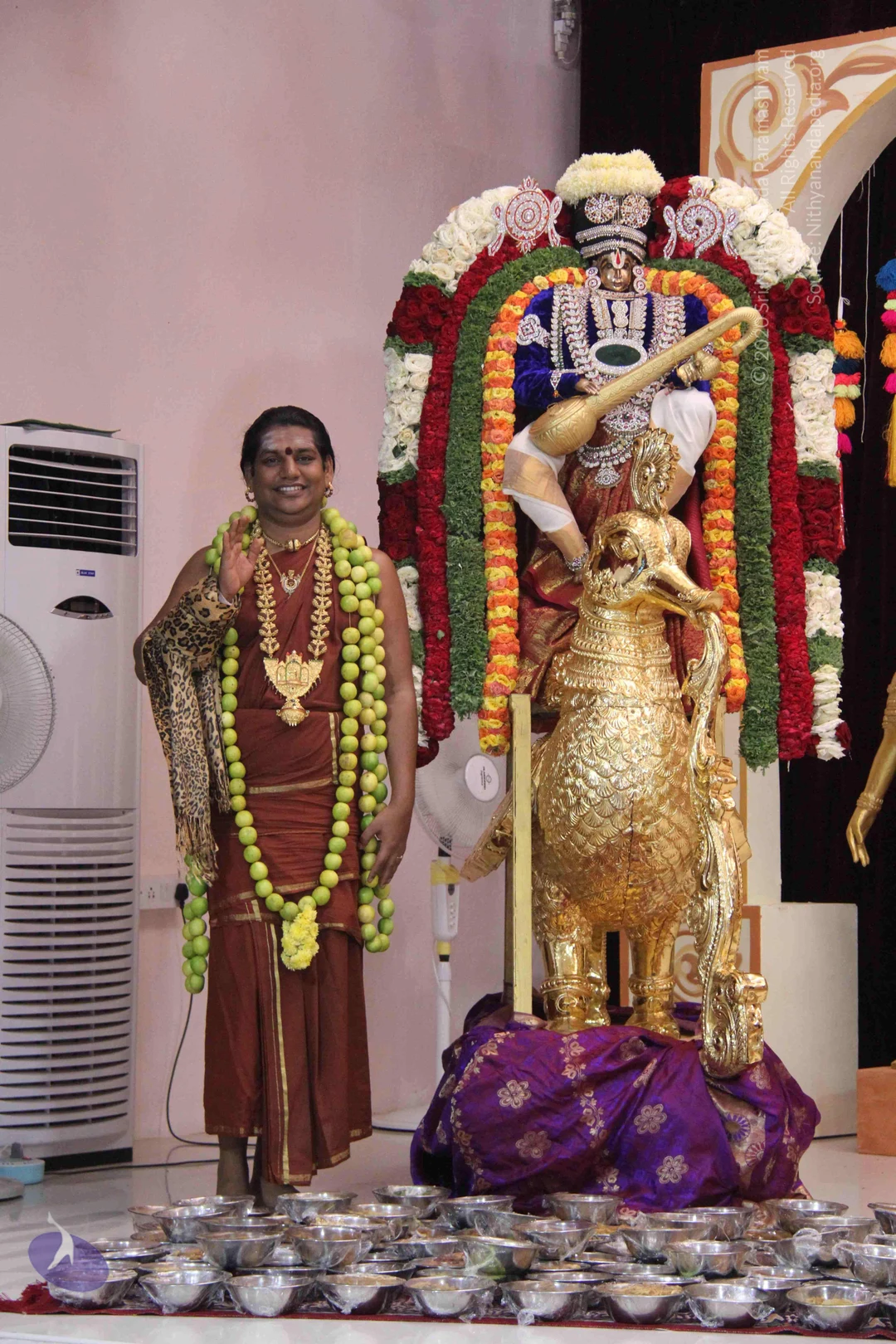
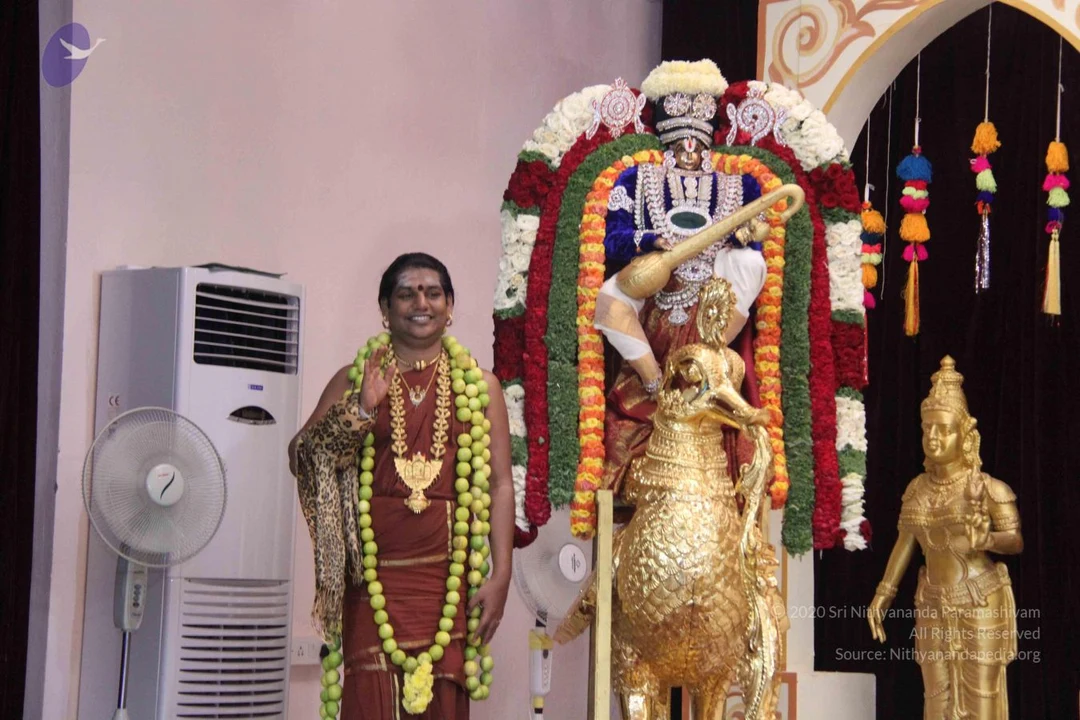
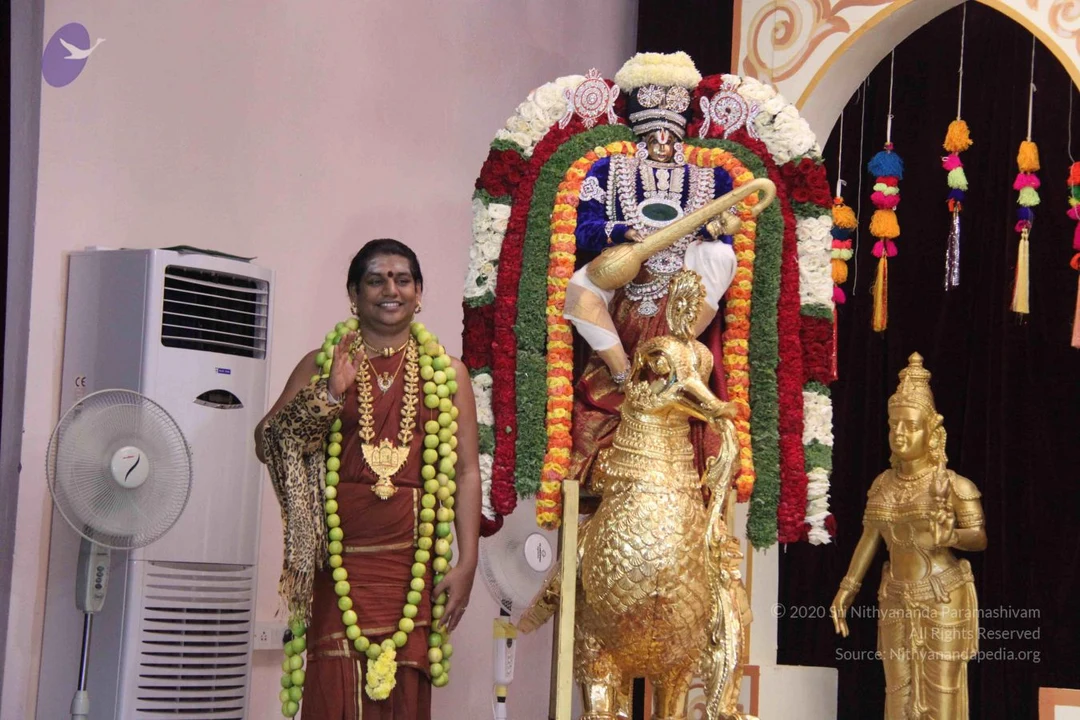
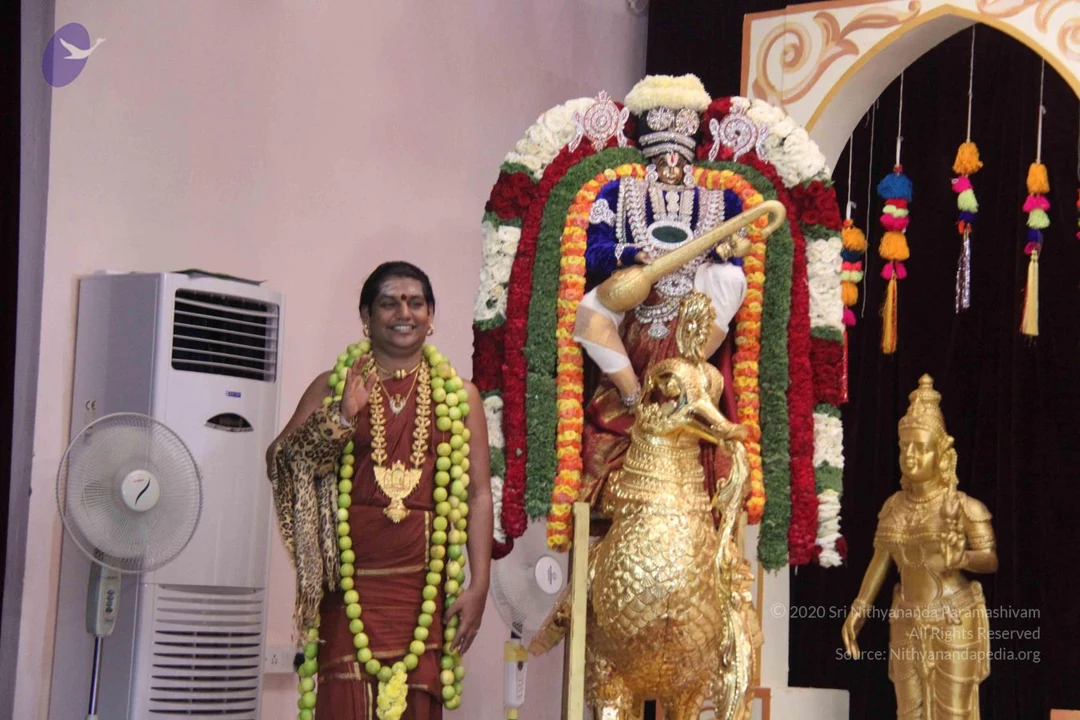
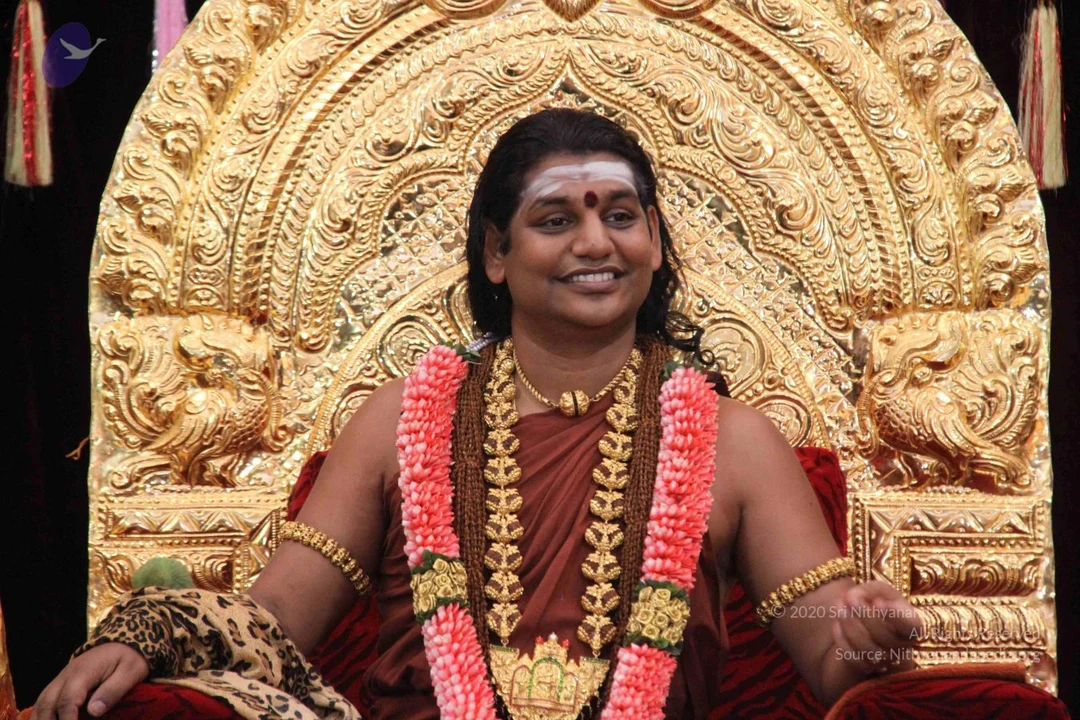
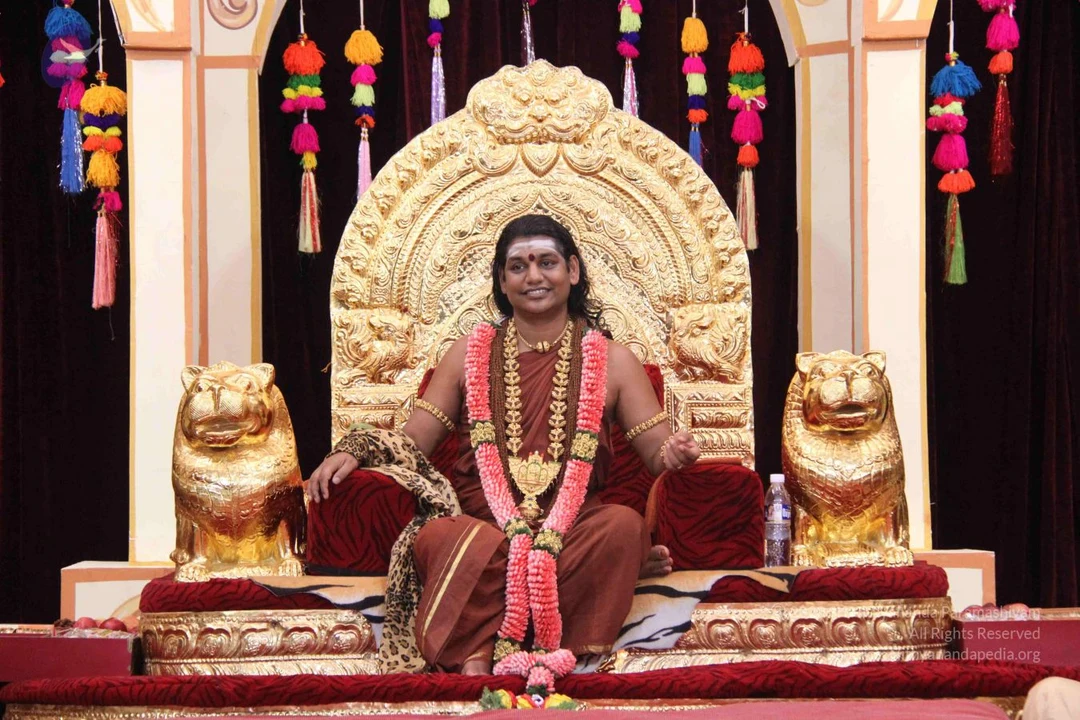
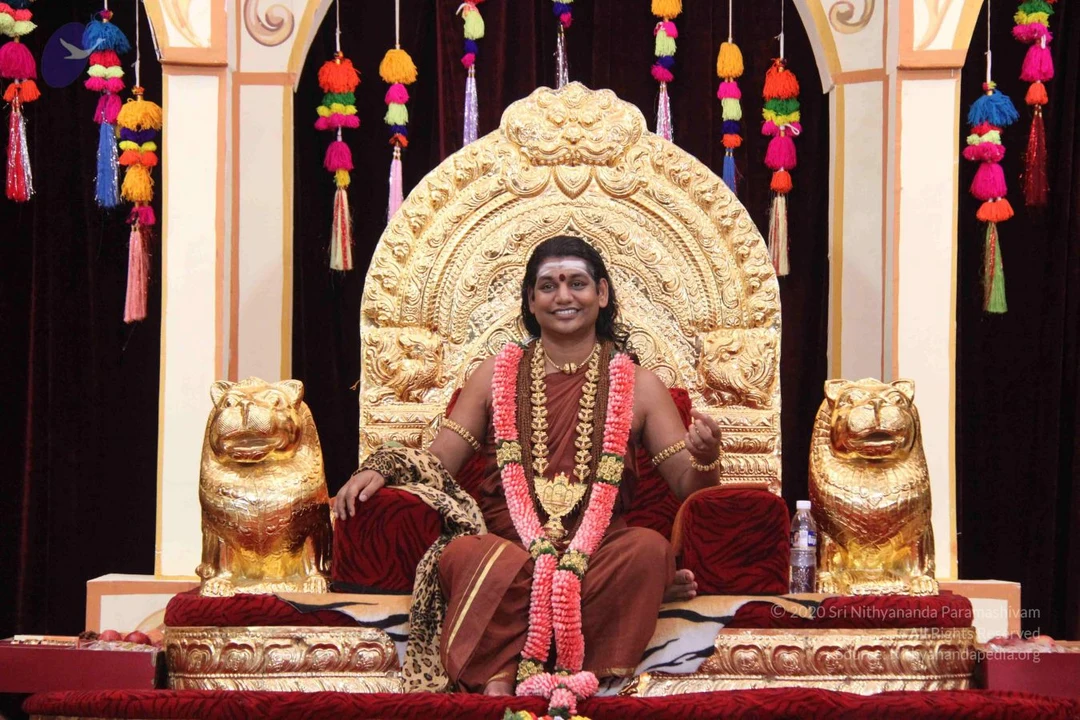
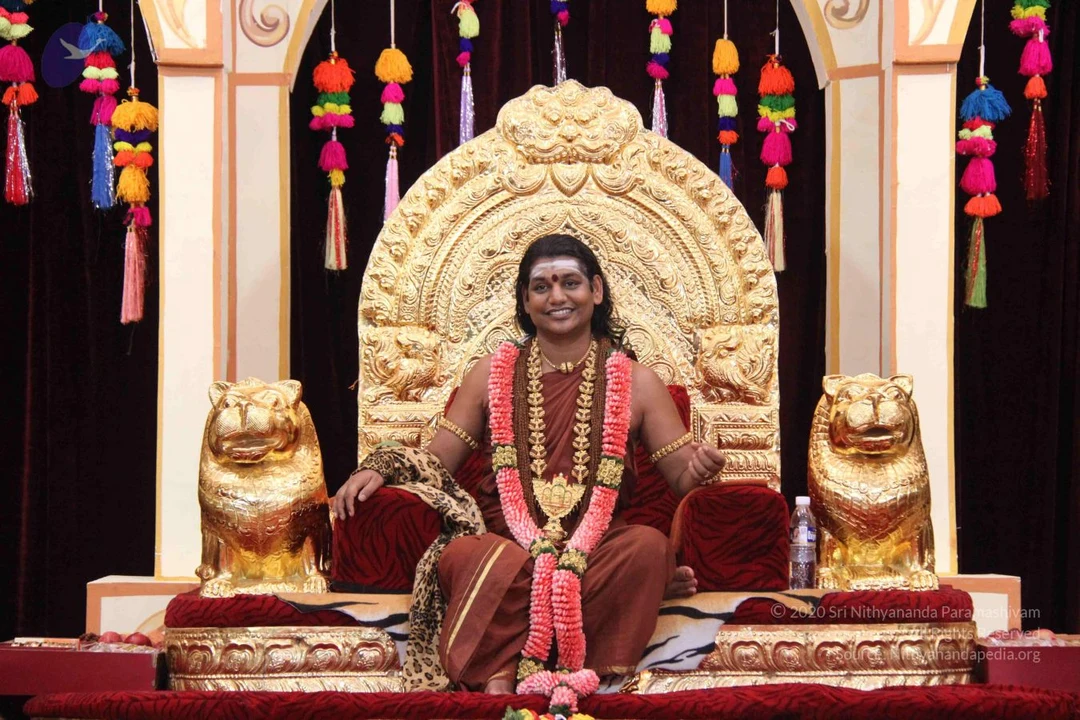
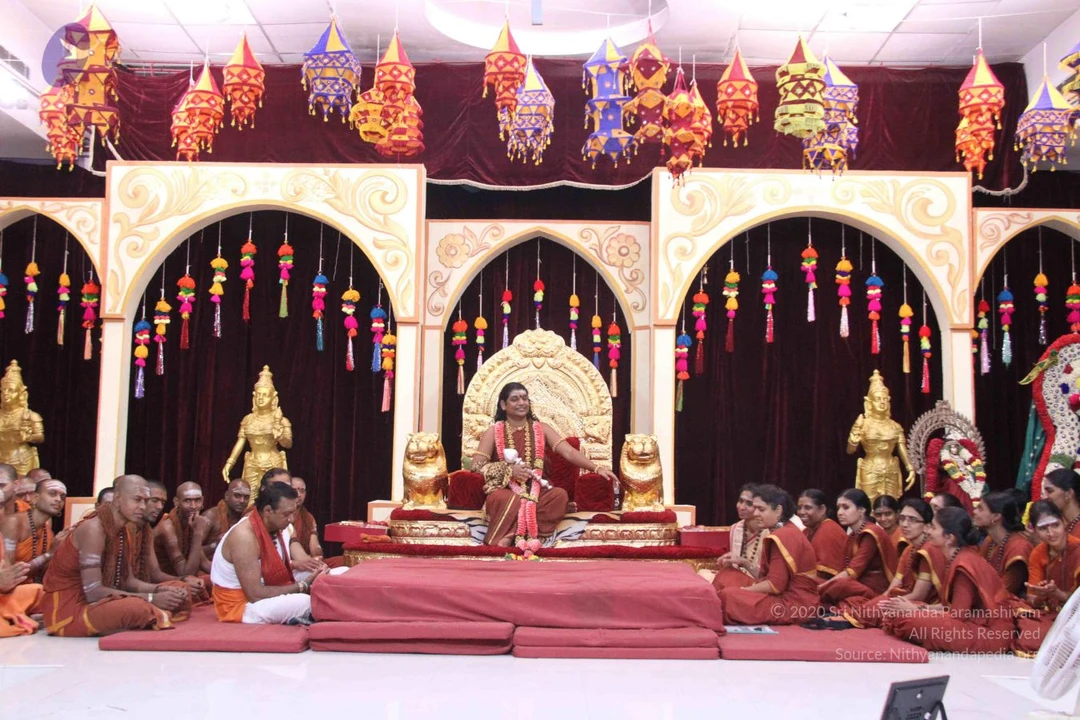
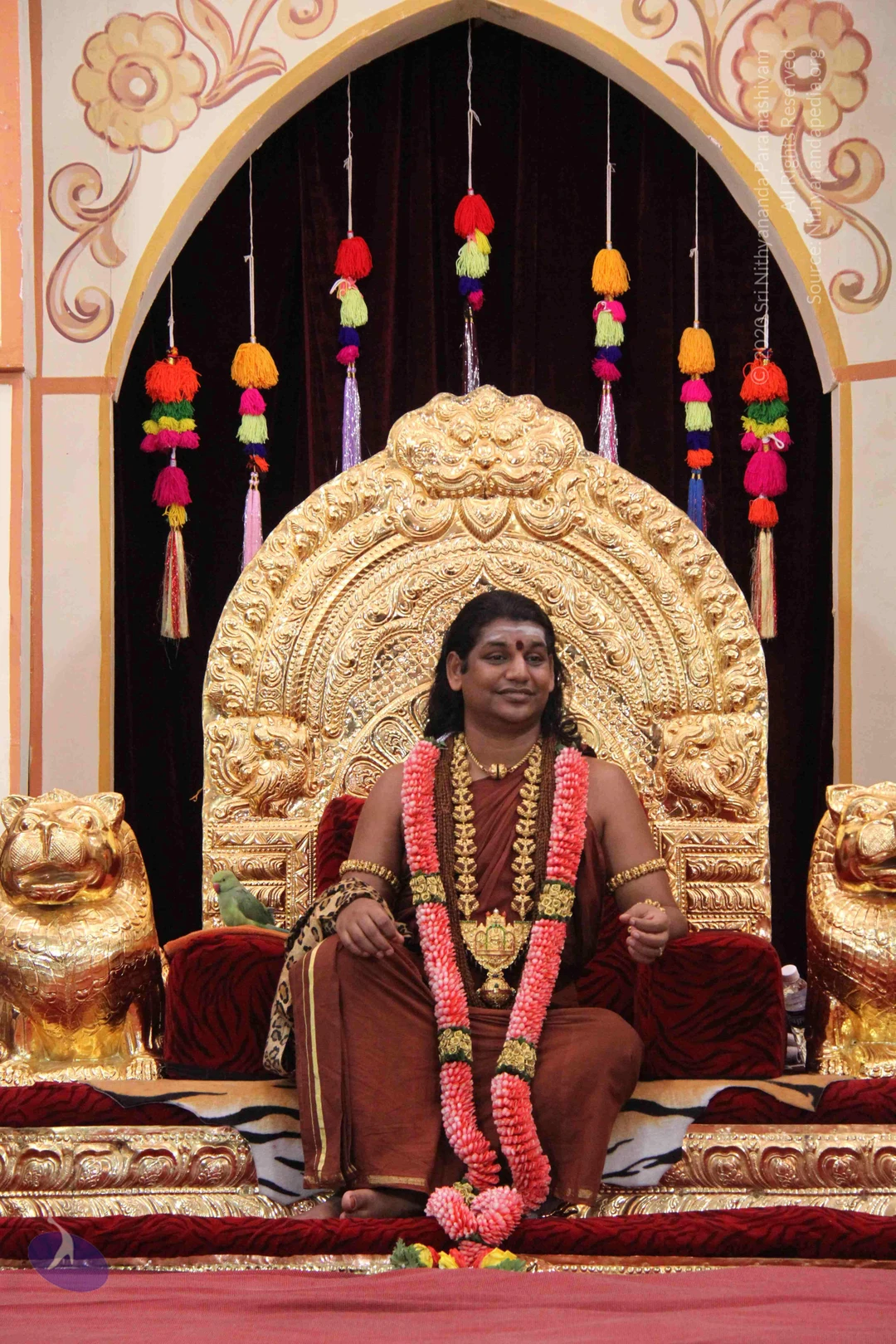
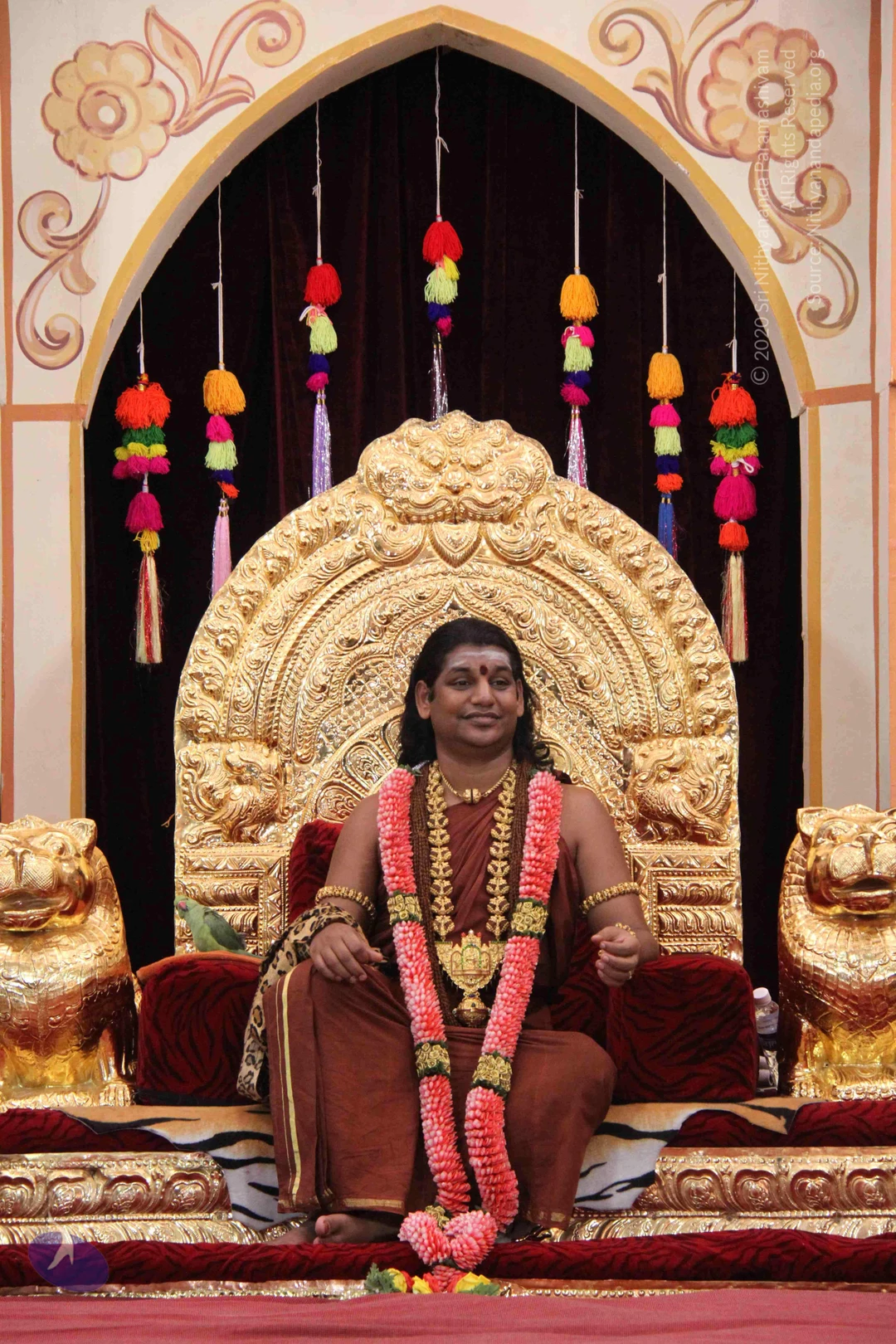
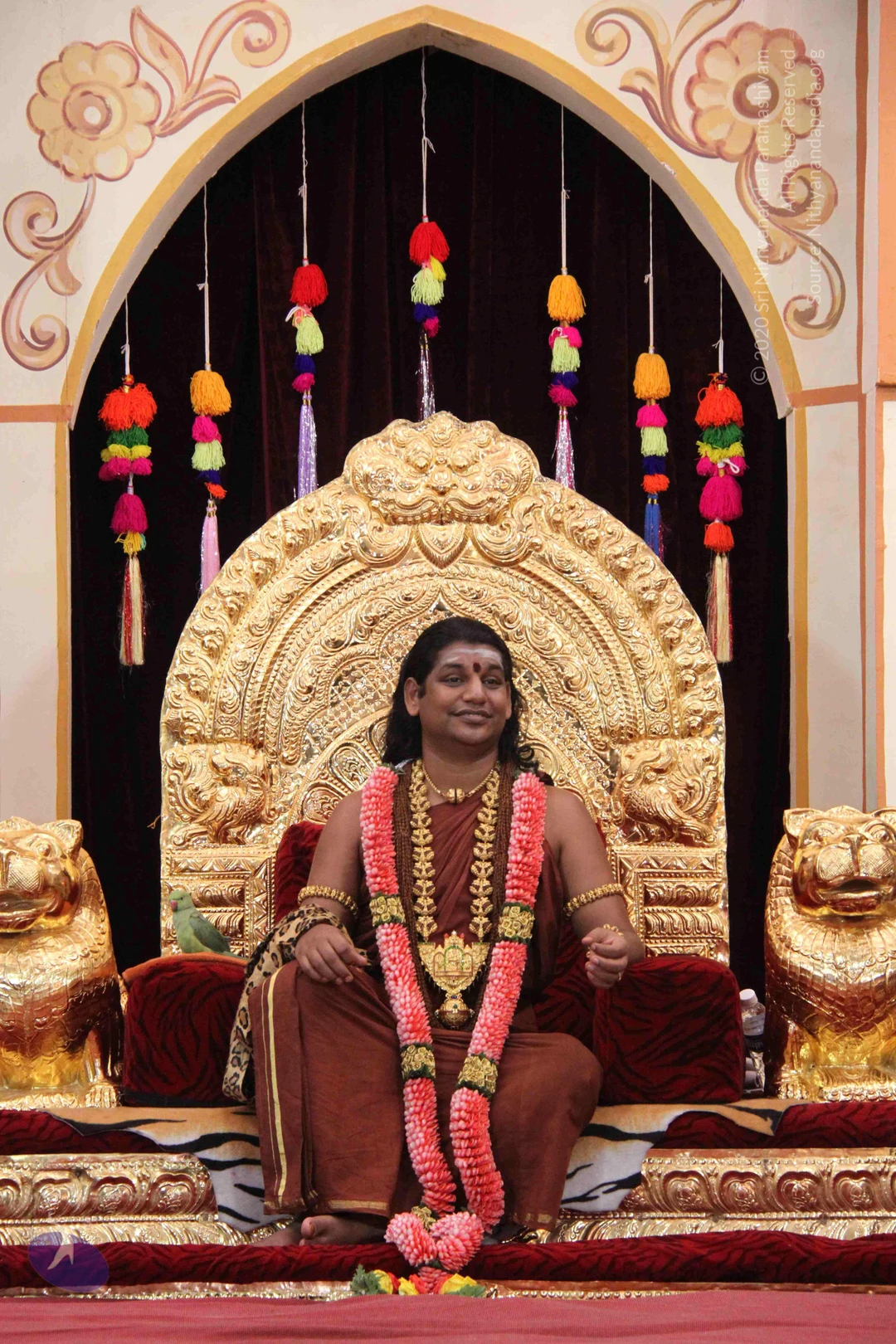
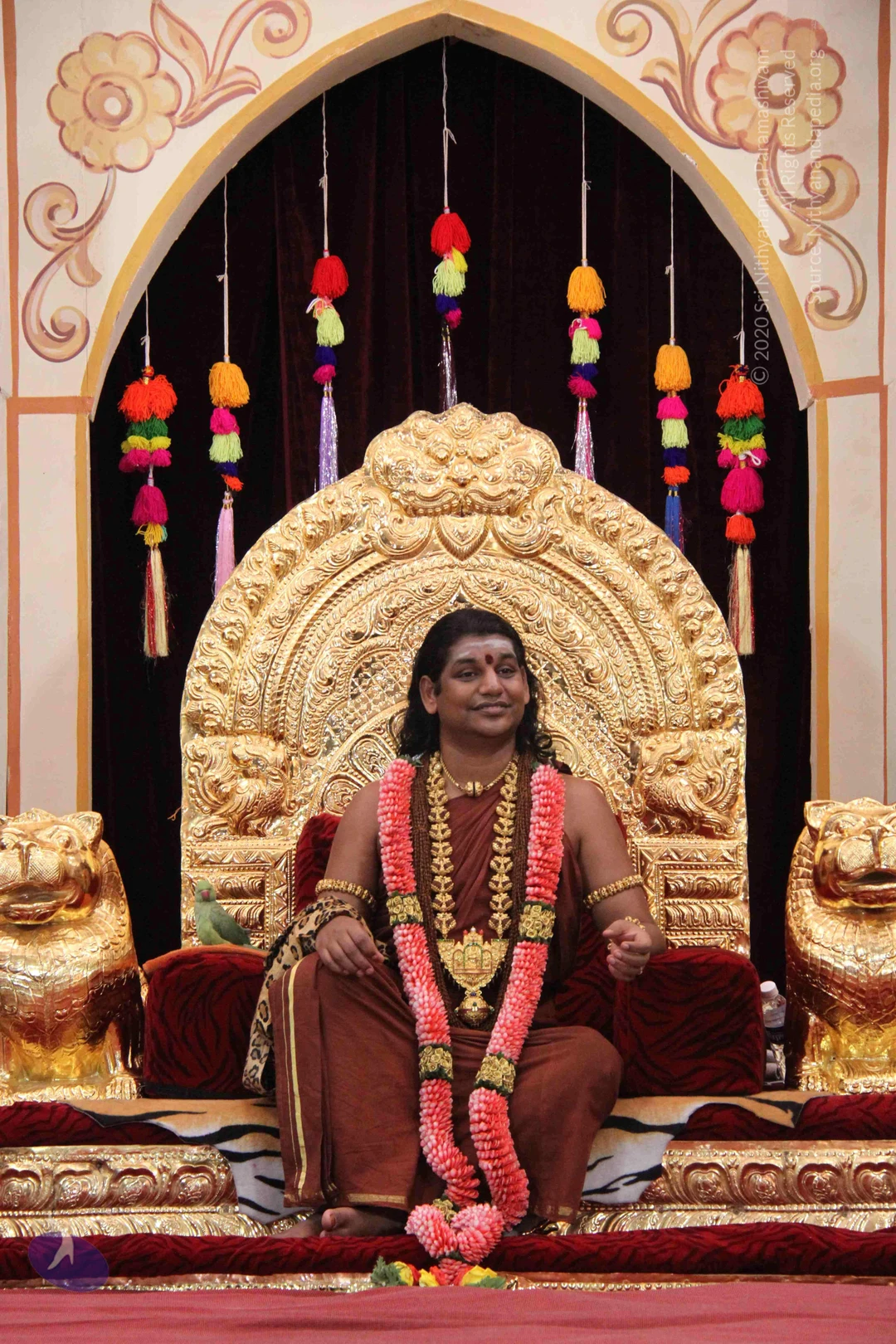
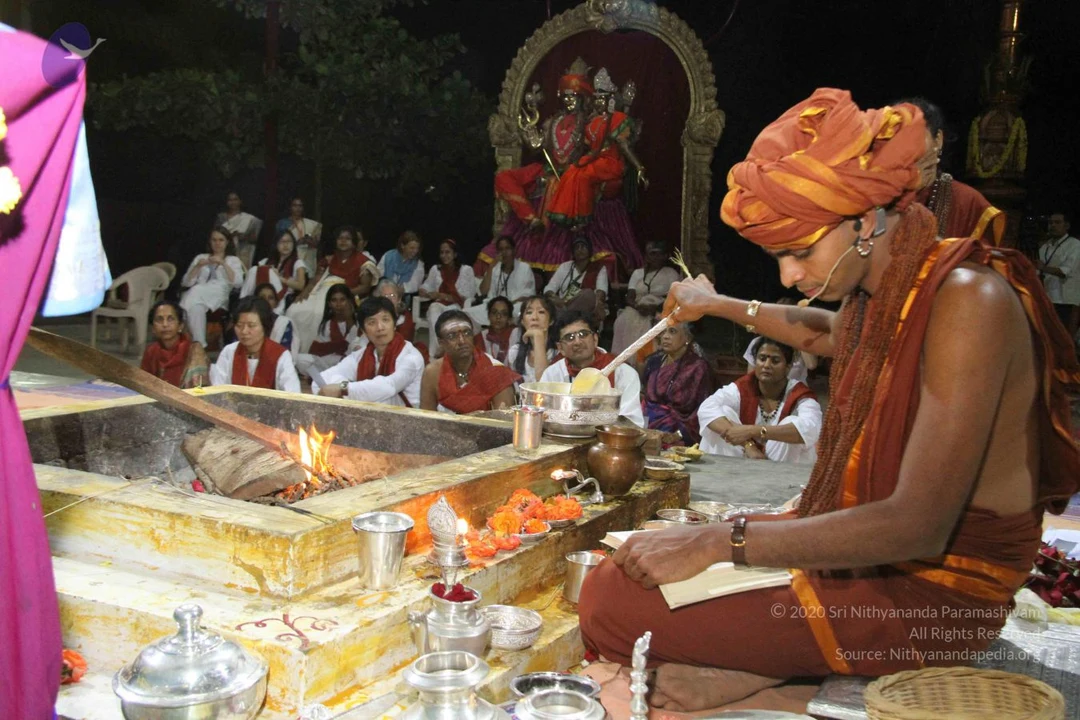
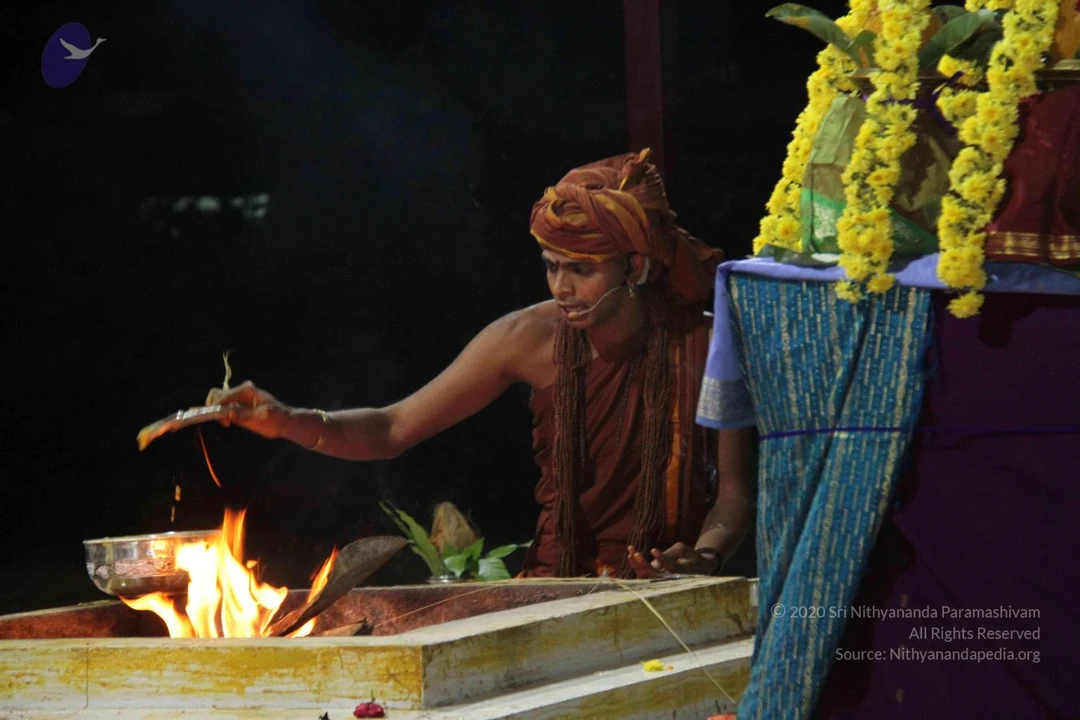
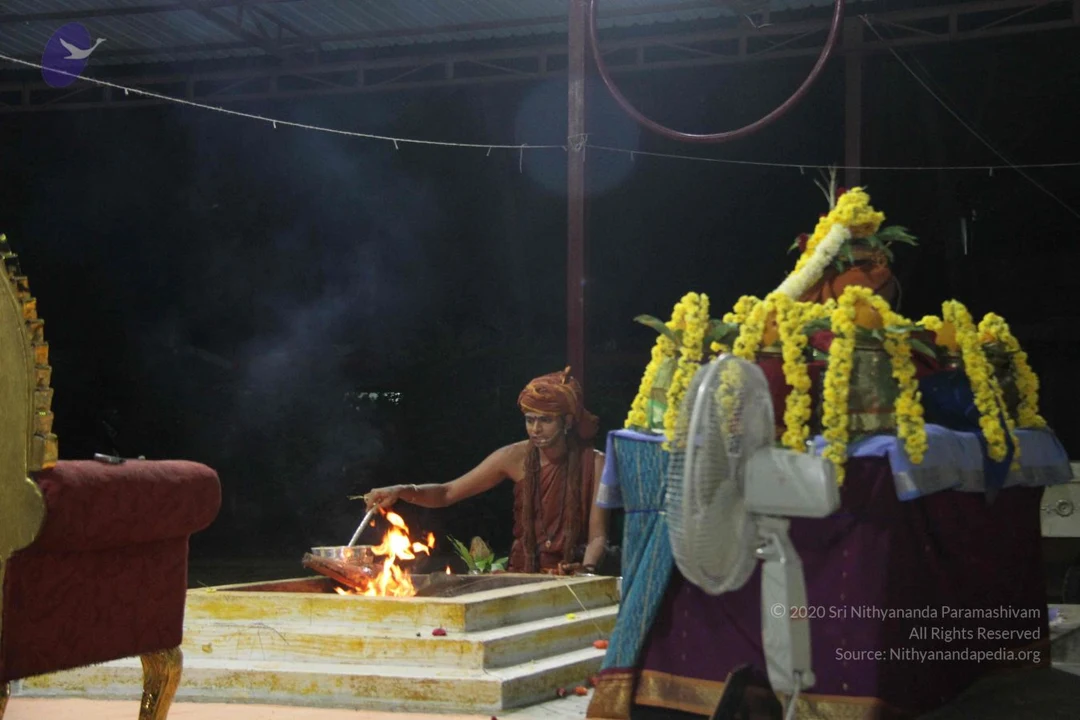
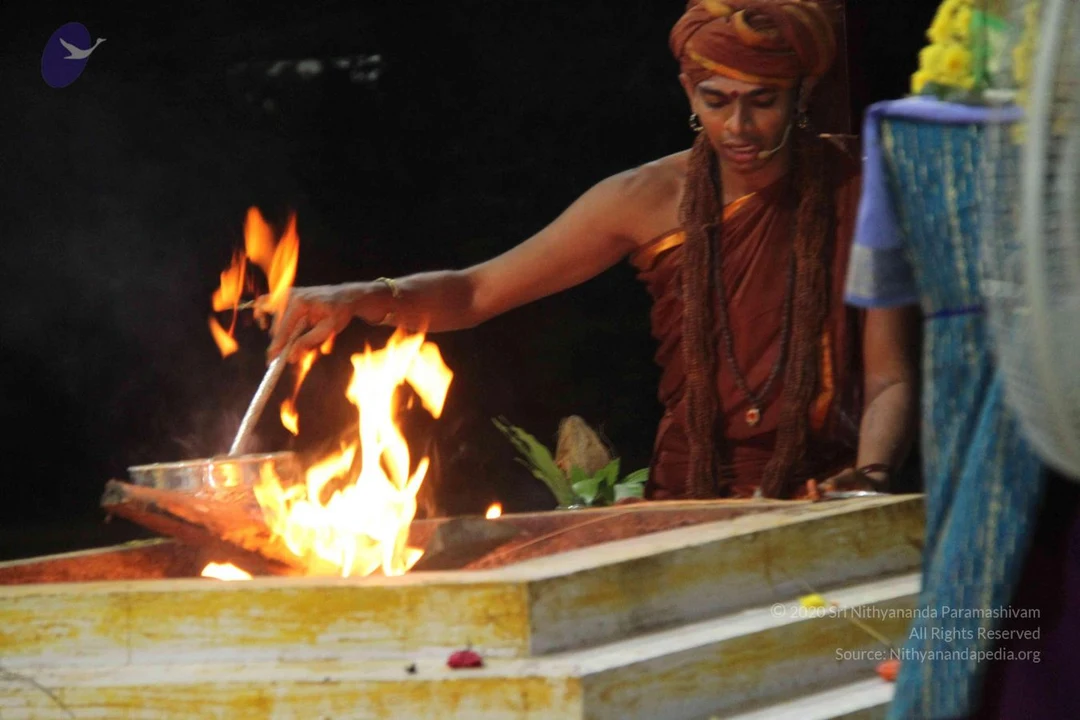
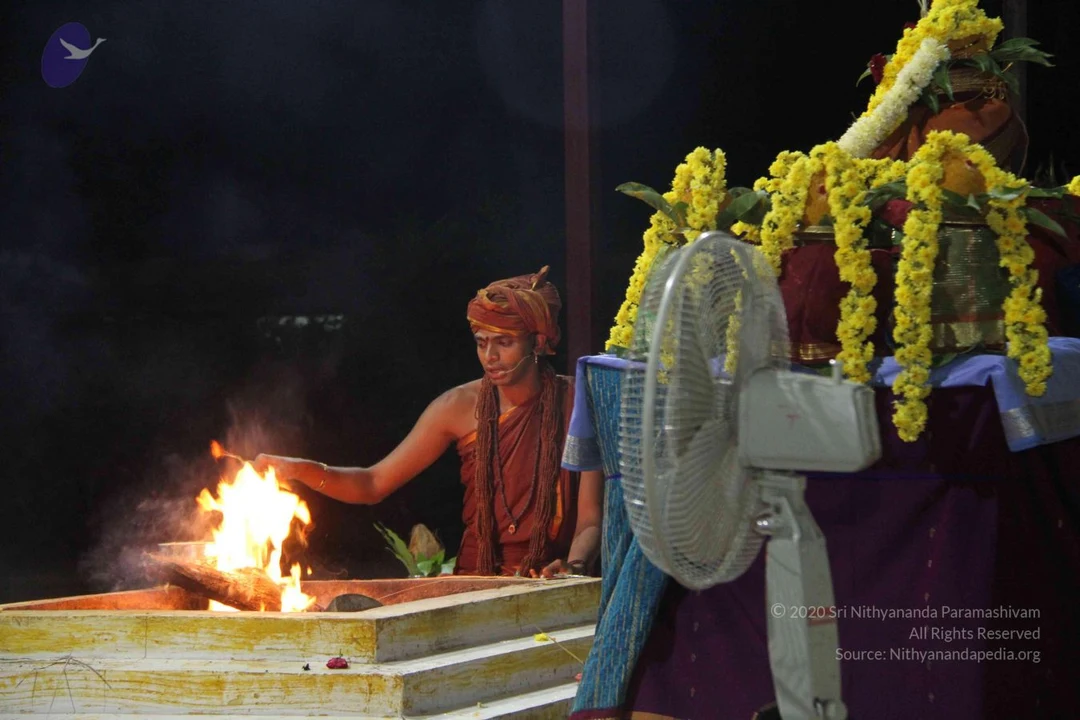
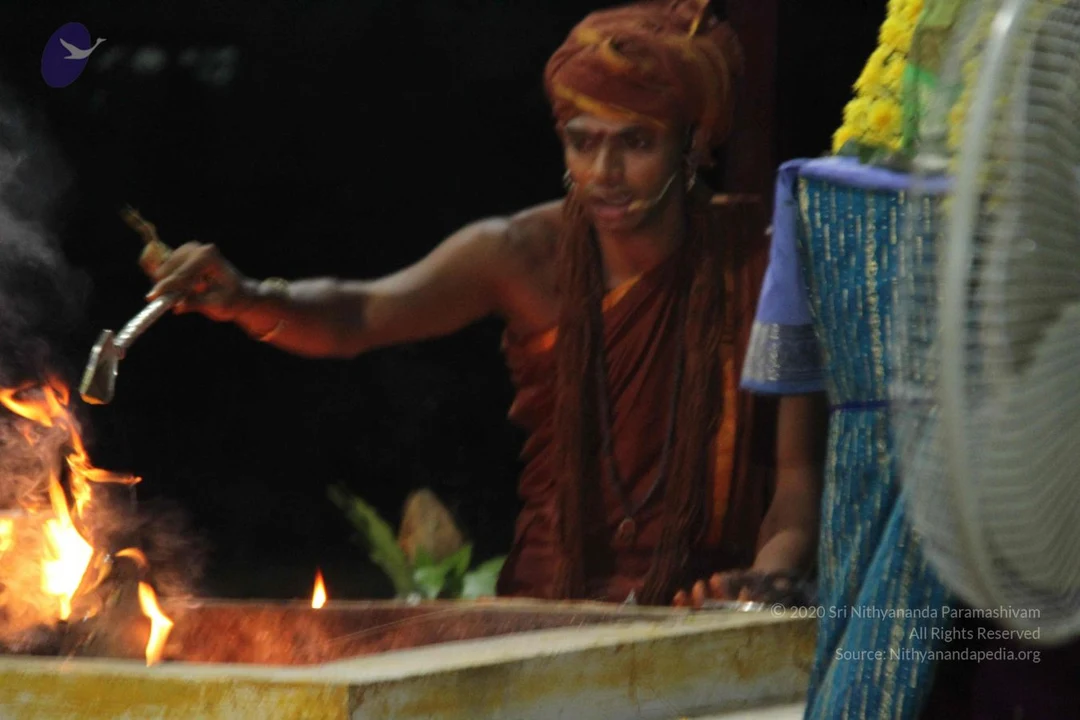
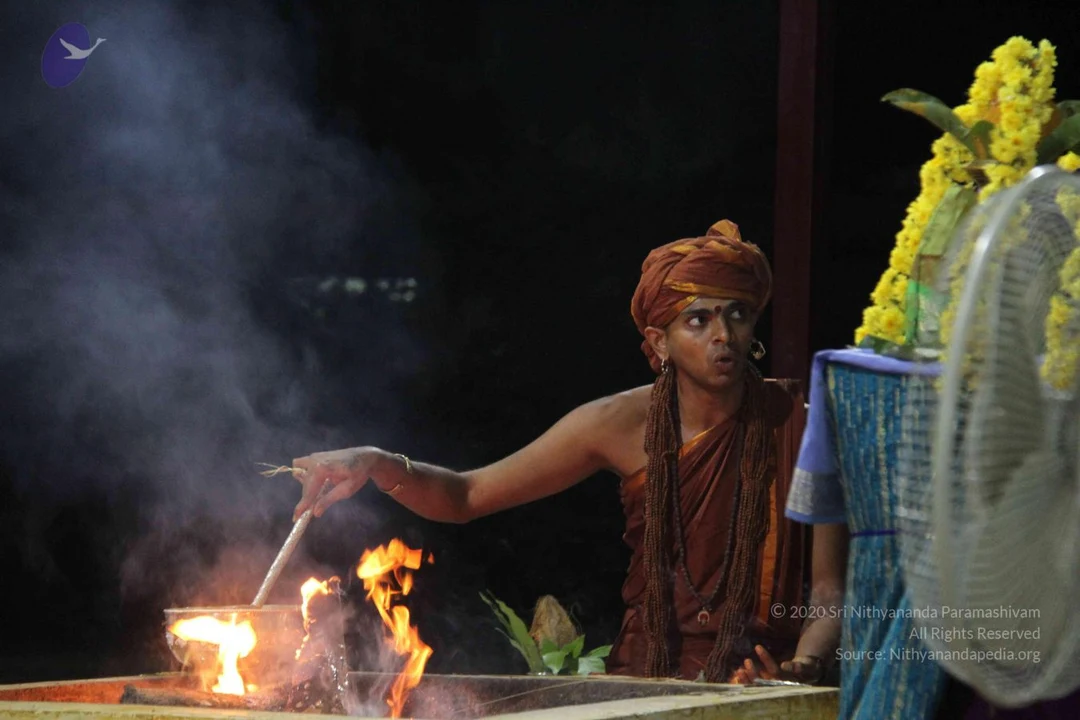
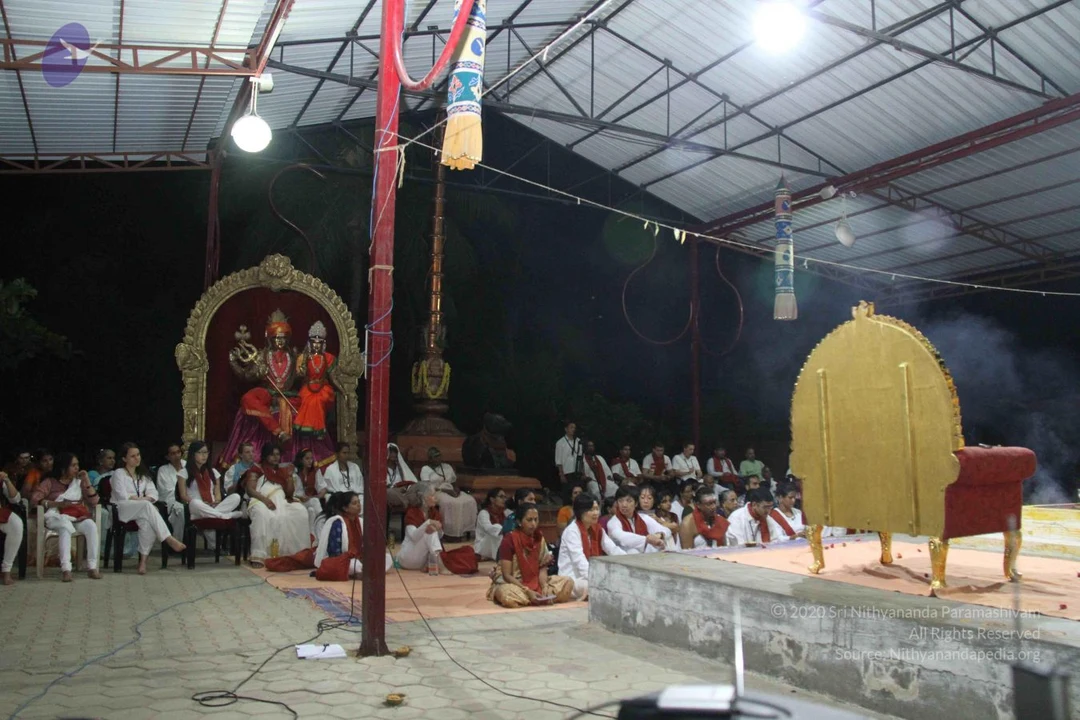
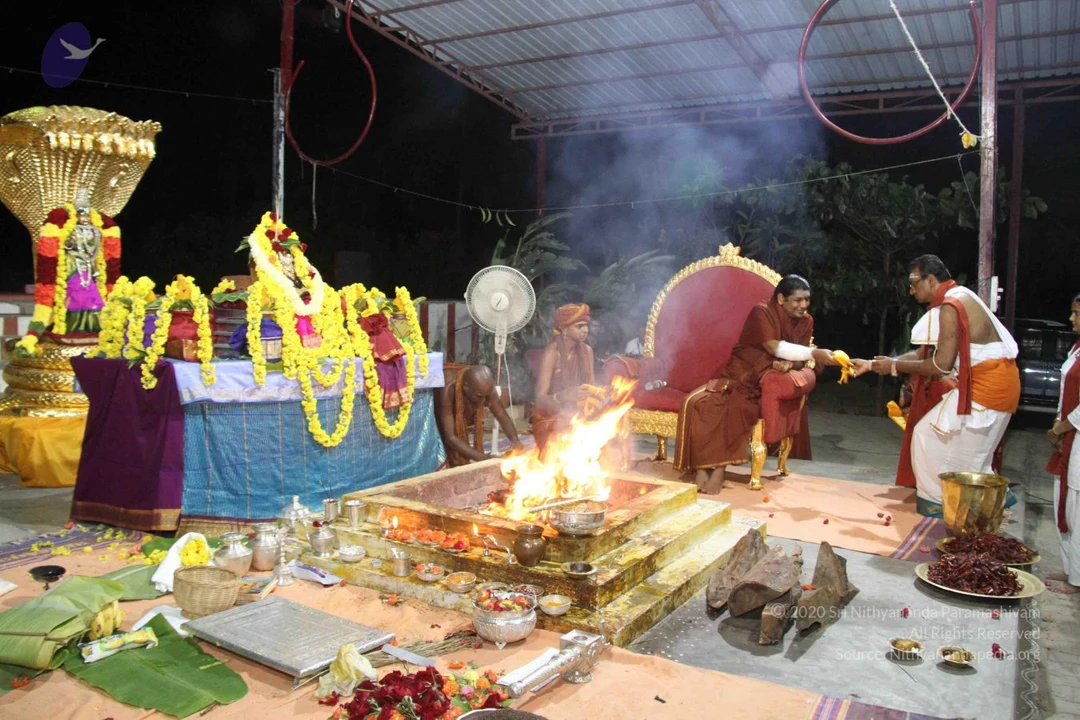
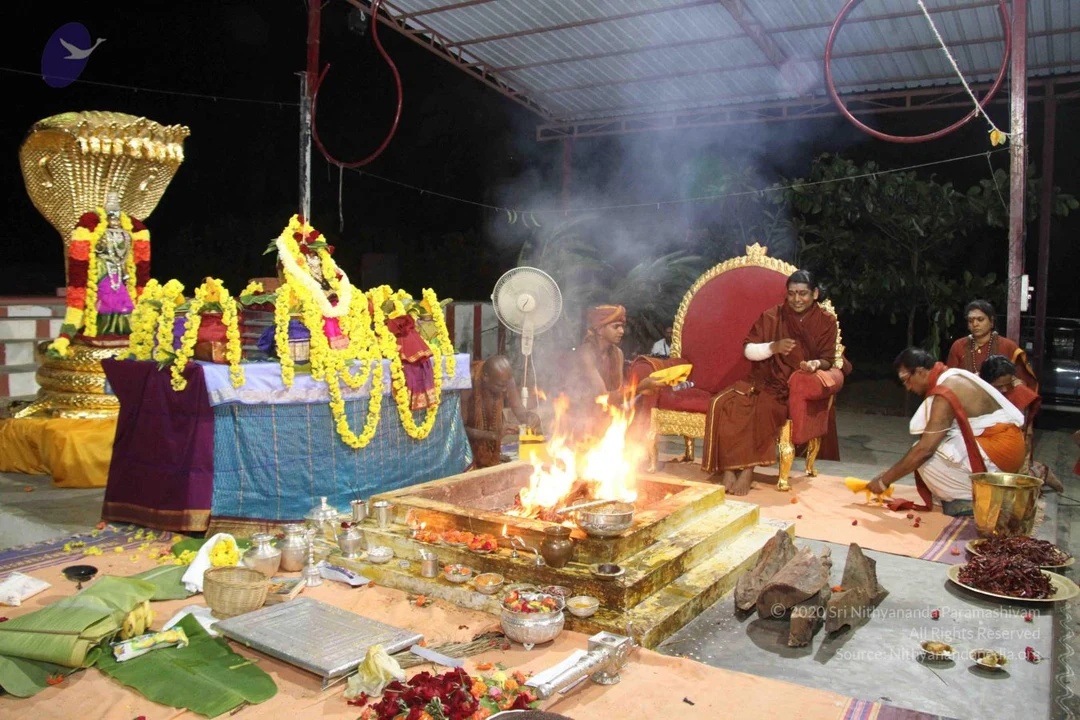
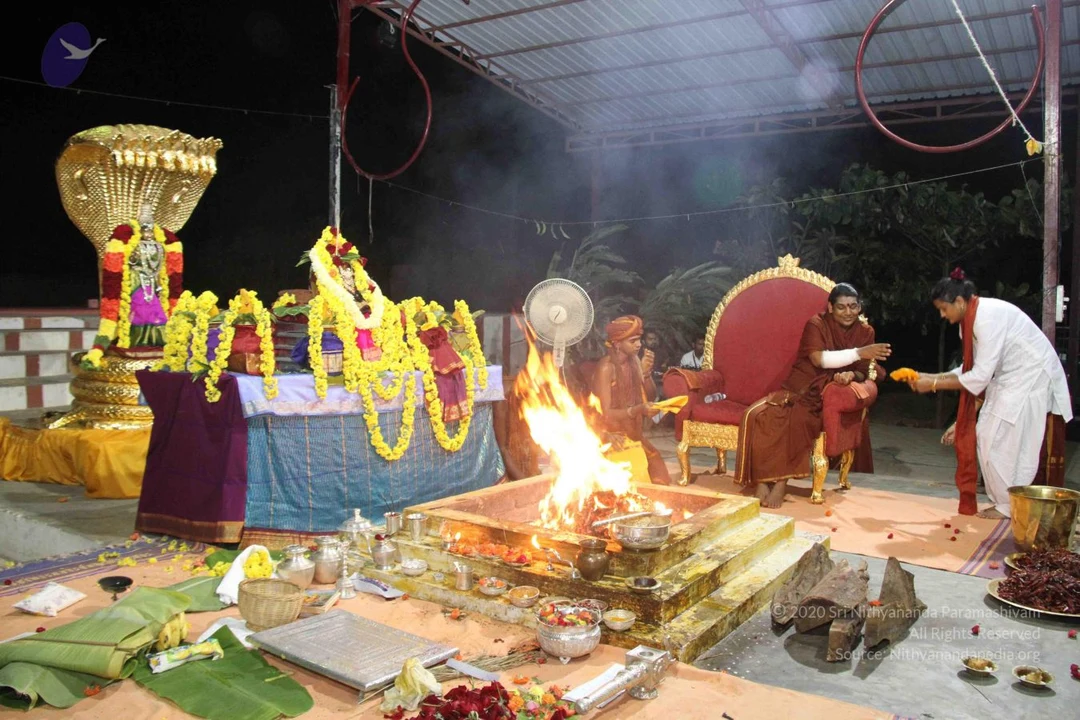
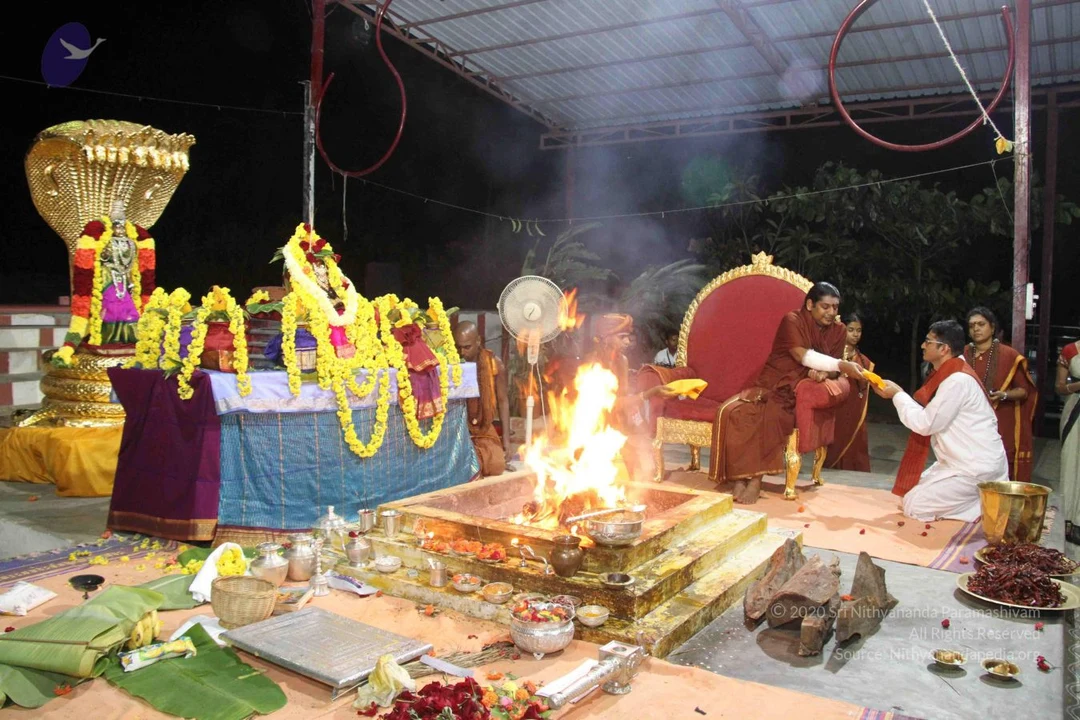
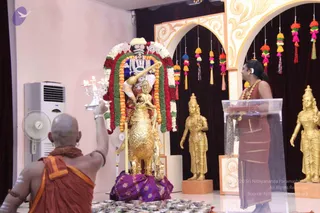
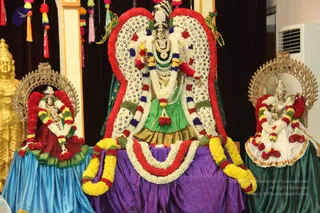
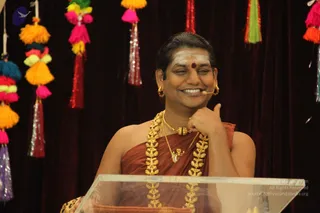
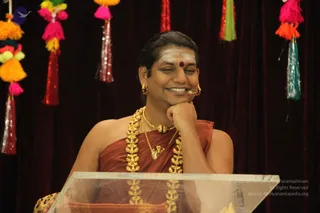
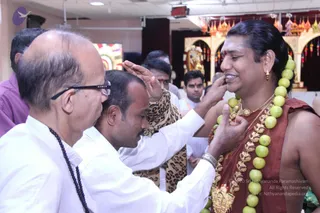
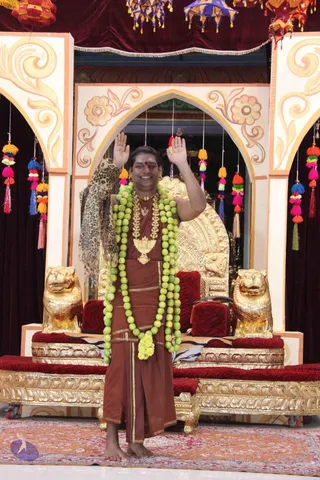
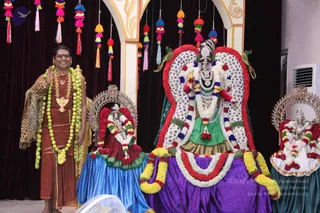
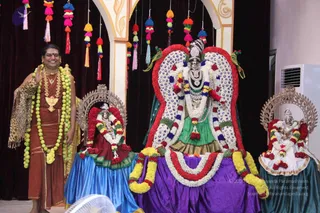
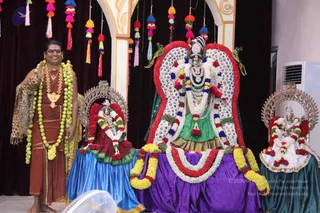
A standing man in a rust-brown dhoti and wrap with a gold-bordered edge smiles and raises one hand in greeting beside a golden garuda-like vahana. He wears a green-yellow garland of lime-sized fruit, a gold necklace with a pendant, and a red bindi. Behind him a deity murti in silver and jewelled ornaments holds a veena, framed by an arch of red, orange, green and white garlands. A golden peacock-like vahana stands before it on a purple cloth, with rows of small metal bowls of offerings in front. A wall fan and an air cooler stand at the left.A night-time homa at an open-air pavilion. A priest seated at right, viewed from behind, wears an orange-saffron turban and orange shawl and tends a rectangular fire pit with burning logs and flames. Around the pit sit metal vessels, brass cups, a kalasha and small offerings of flowers and orange marigolds. At left, a large kalasha-like vessel is draped in a purple cloth and garlanded with yellow marigold strings. Behind, a seated group of white-clad devotees, several in white with red shawls, watches. At right, a gilded arch frames a red-and-gold deity murti with multiple arms. Smoke drifts through the scene.A photograph of a large video-conference screen showing a grid of live feeds from many cities, each labelled with a city name in white caps, such as DEVON UK, NEW YORK VARANASI, EAST LONDON UK, CALGARY ALBERTA, DALLAS-DWARAKA, Eindhoven NEDERLANDS, Vancouver BHUVANESHWAR and BOGOTA COLOMBIA. Participants sit cross-legged or on sofas with framed deity pictures, flower arrangements, oil lamps and offering trays, several wearing saffron or orange clothing. In the bottom-right tile, a framed portrait labelled Self View shows a figure in an orange turban and ornate gold-trimmed garments on a decorated seat. Tiles show many separate small groups of people, all visible only on the screen.

October 06 2013

Original wiki page
Contents

Title:

Discover the power of right Words.

Description:

In today’s morning Satsang, Paramahamsa Nithyananda teaches us how to harness the power of words. When we take responsibility for the words we utter to ourselves and others, the tremendous power of words expresses through us. Once we change the thoughts of I can’t to I can, then powerlessness, the feeling that something is impossible, and psychological disorders can be healed. Everything in life is possible when we carry the right words about ourselves and others!

Link to Video:

VideoAudio

Transcript:

Nithyanandeshwara Samaarambhaam Nithyanandeshwari Madhyamaam | Asmath Aachaarya Paryanthaam Vandhey Guru Paramparaam ||

00:43 Hindi - 00:54

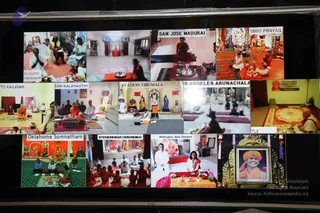
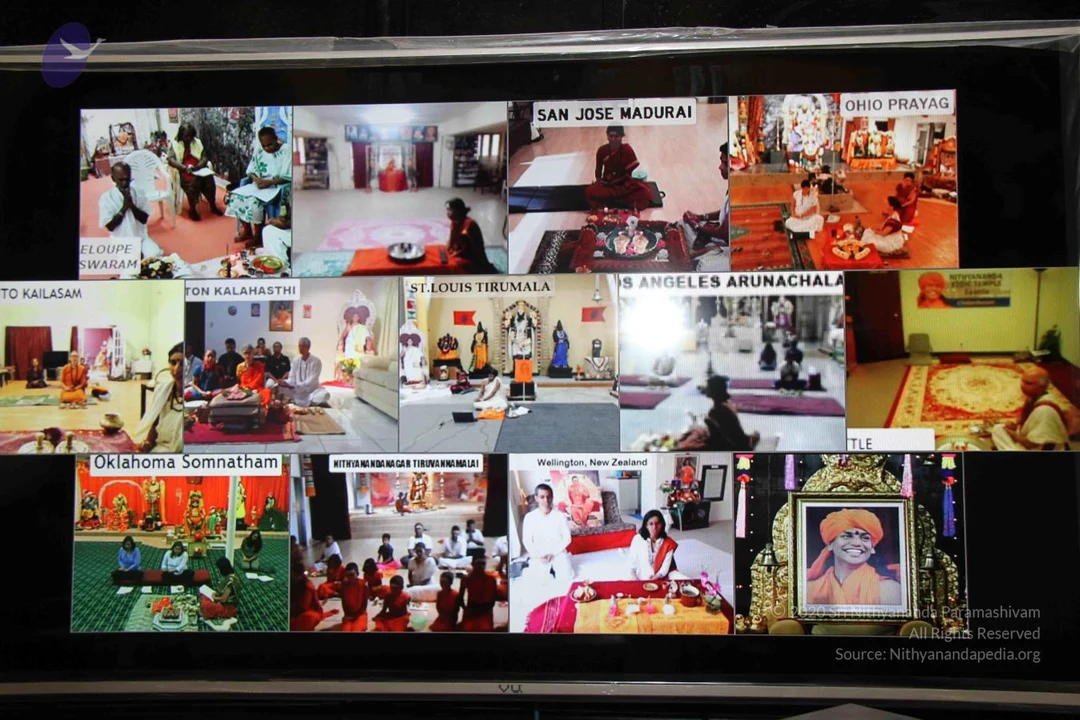
I welcome all the devotees, disciples, samajis, satsanghis sitting with us all over the world through Nithyananda TV, Sadhna TV, Lotus News Channel, and two-way video-conferencing having Nayana Deeksha.

Cities sitting with us in two-way video-conferencing: Guadeloupe-Rameshwaram, Hyderabad, San Jose-Madurai, Ohio-Prayag, Los Angeles-Arunachalam, Wellington-New Zealand, Singapore-Singapuram, Oklahoma-Somanatham, Toronto-Kailasam, Nithyanandanagar-Tiruvanamalai, Guru’s Gate-California, Charlotte - Srisailam, Houston-Kalahasti, Seattle-Chidambaram, Toronto - Kailasam and St Louis Tirumala: St Louis Tirumala is celebrating the xxx?xxx Brahmotsavam. Devon-UK, East London, San Diego-Tirualavai, New York-Varanasi, Netherlands, Bogota-Colombia, Calgary-Alberta, Warrington UK, East London UK, Dallas - Dwaraka , South Surrey British Columbia, Hyderabad-Gupta Kashi, Bangalore North, Slovakia-Shivaloka, Vancouver-Bhubaneshwar, Melbourne-Australia, Oman-Sivagangai, Colorado Springs-USA, Mattakalapu-Sri Lanka, Ottawa-Canada, New Jersey-Omkareshwar, Tiruvanmiyur Dhyanapeetam and Salem-Peethadeeshwaris Training Centre.

I welcome all of you with my love and blessings.

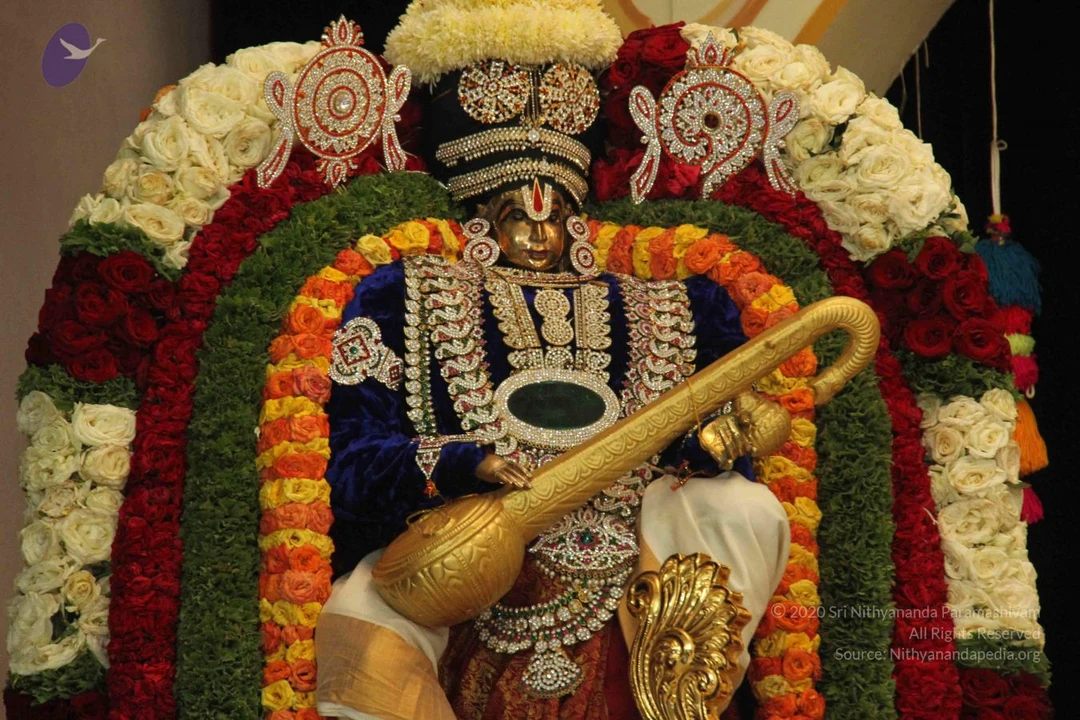
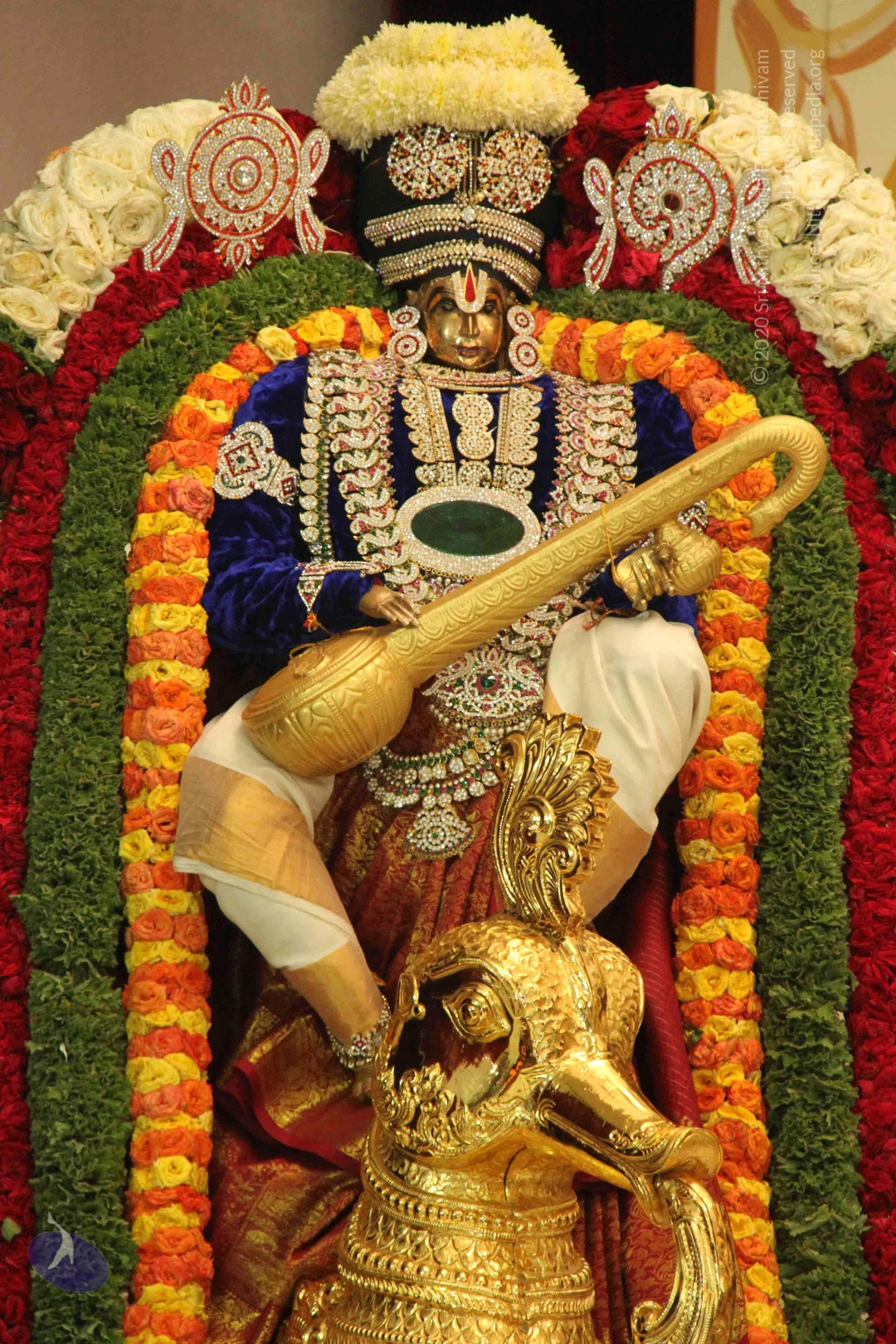
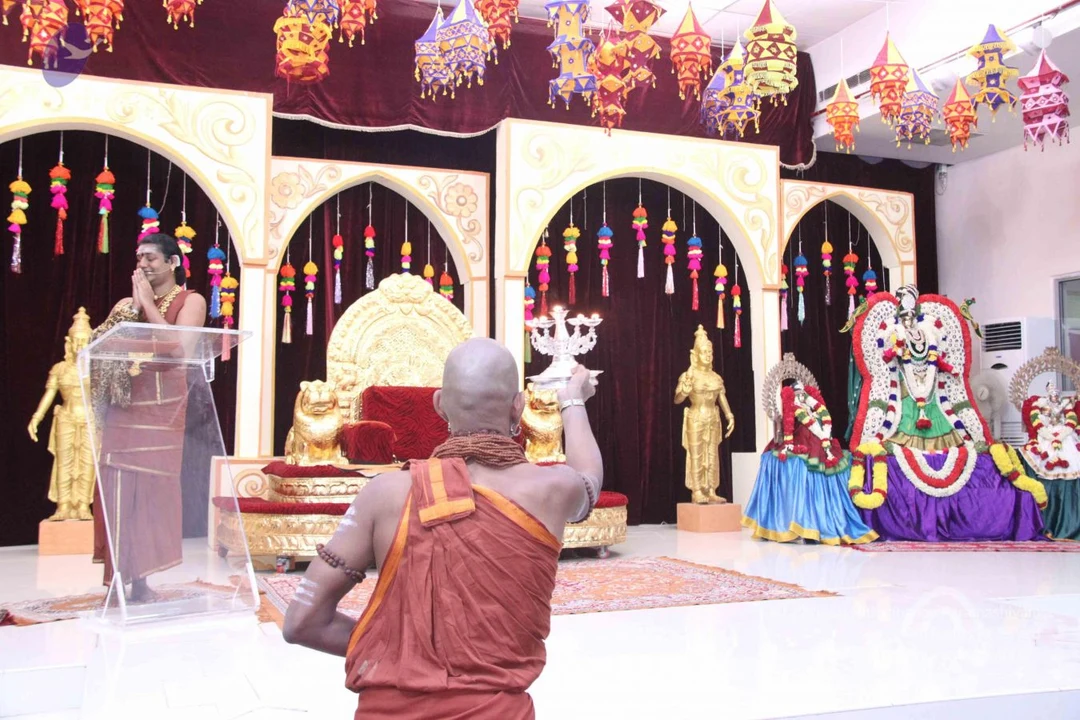
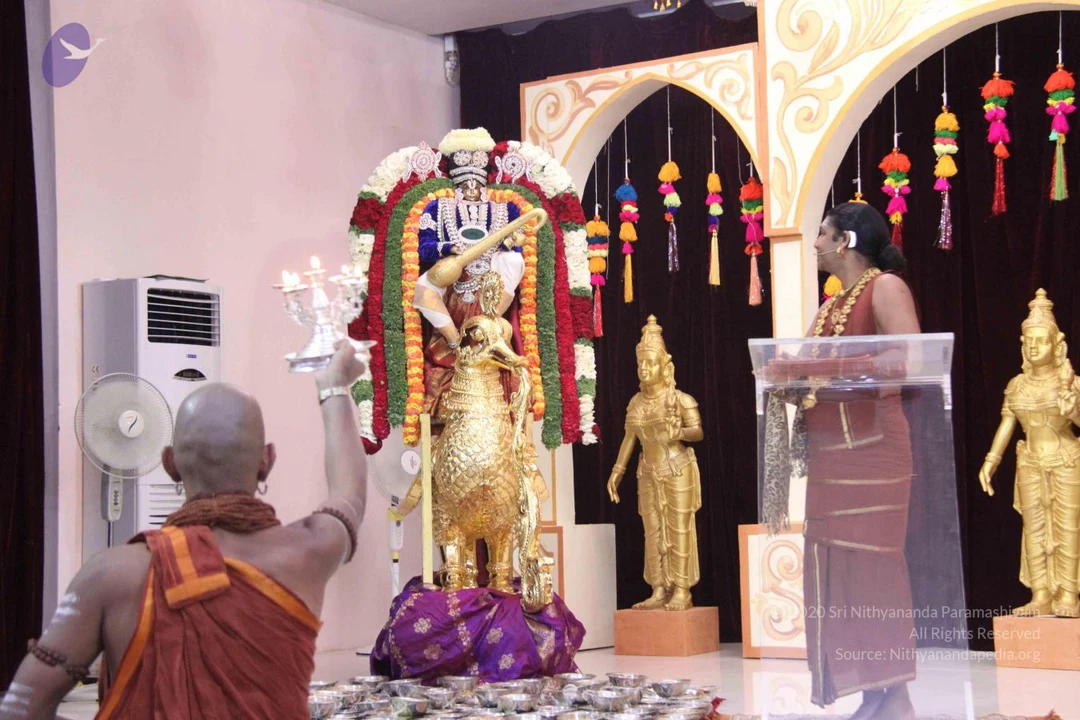
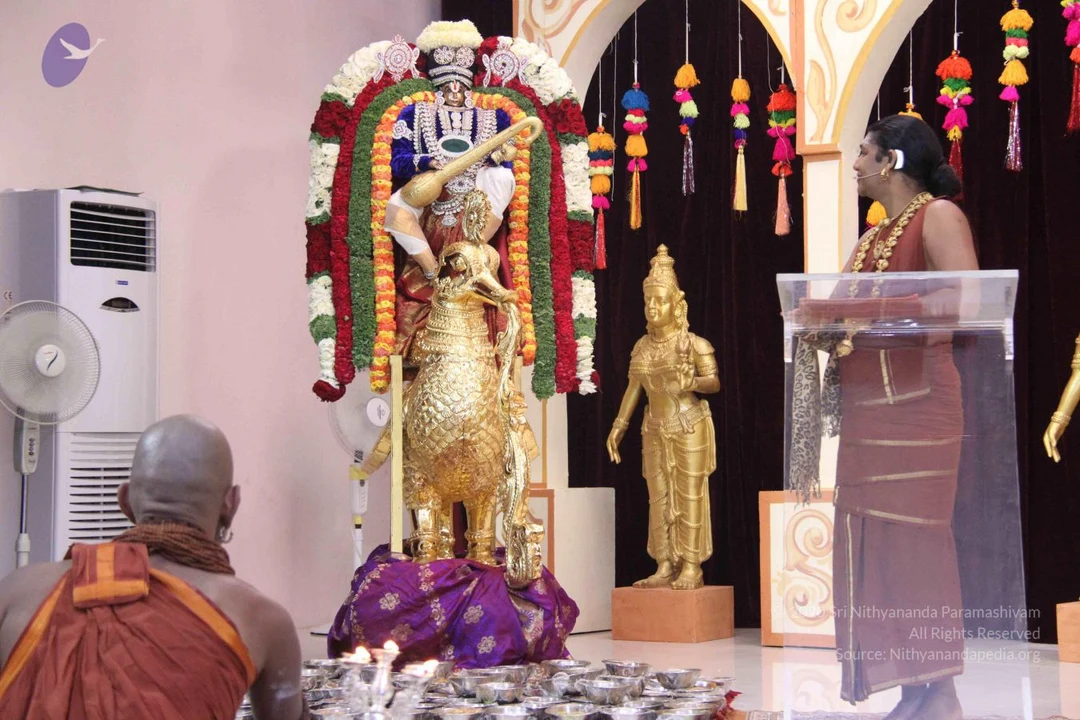
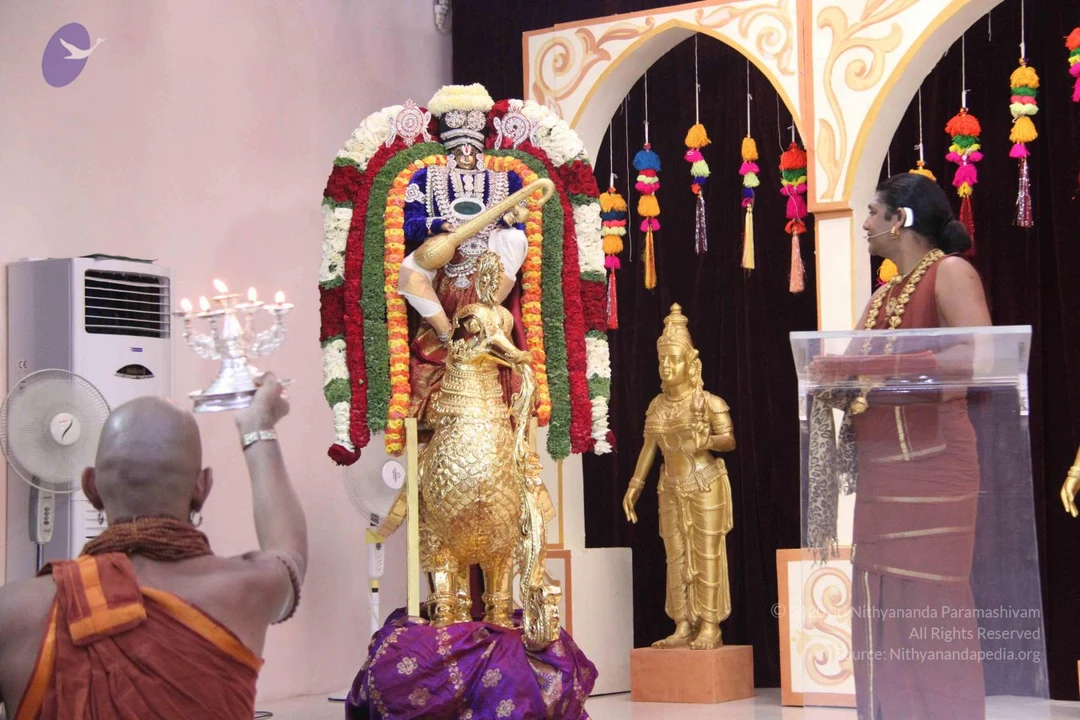
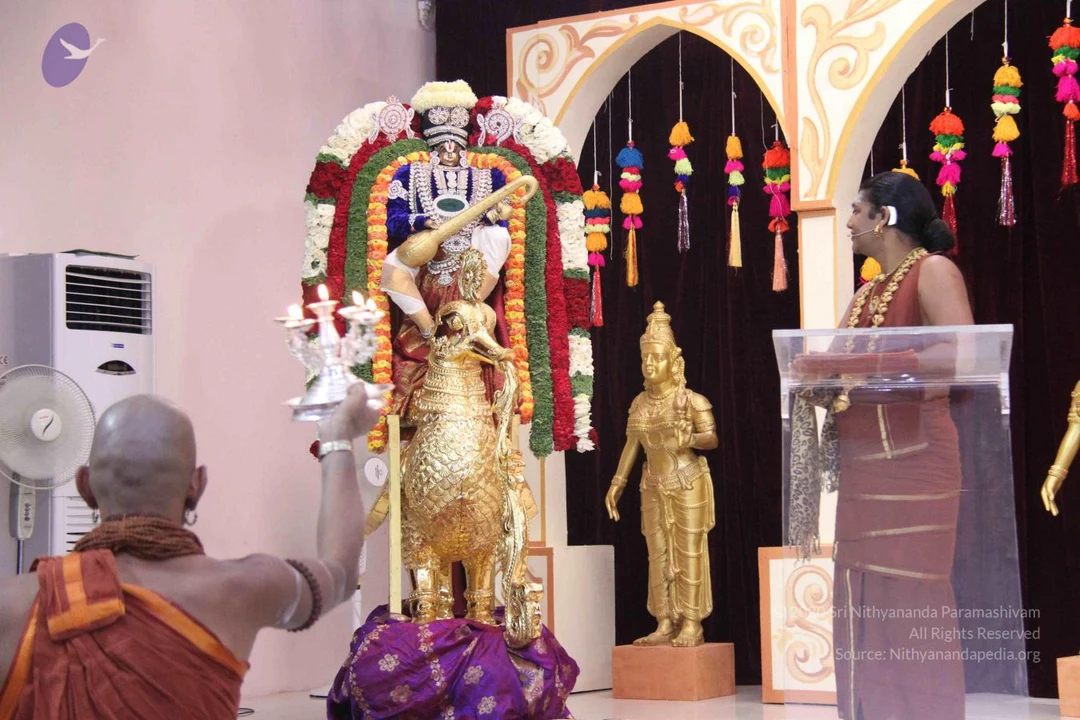
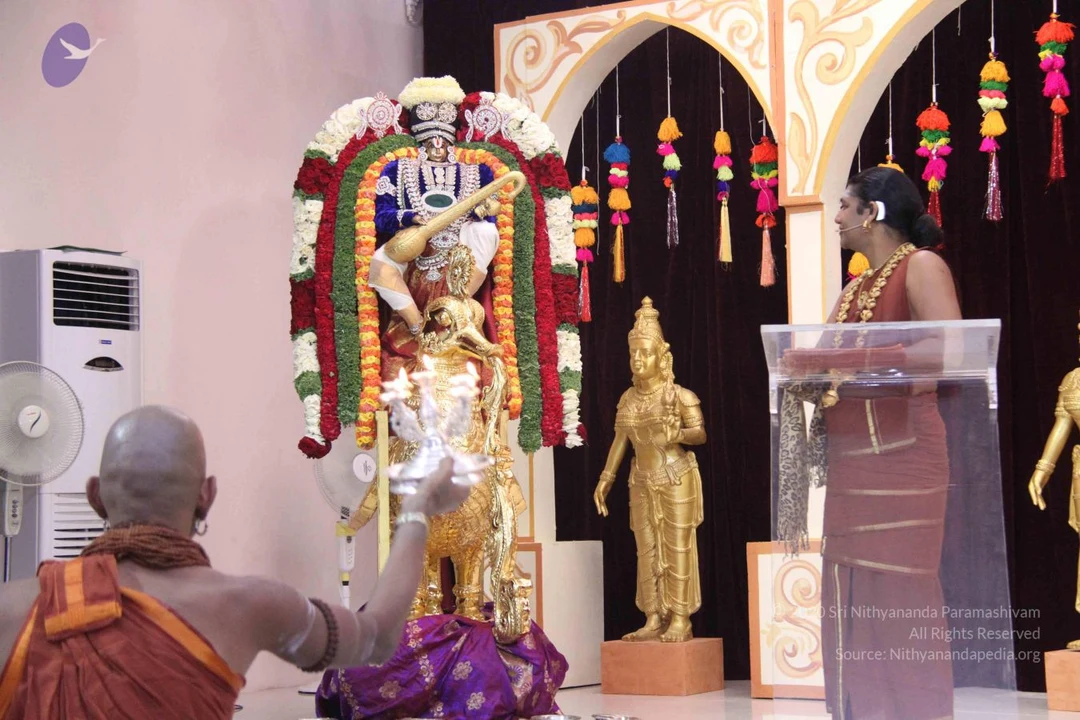
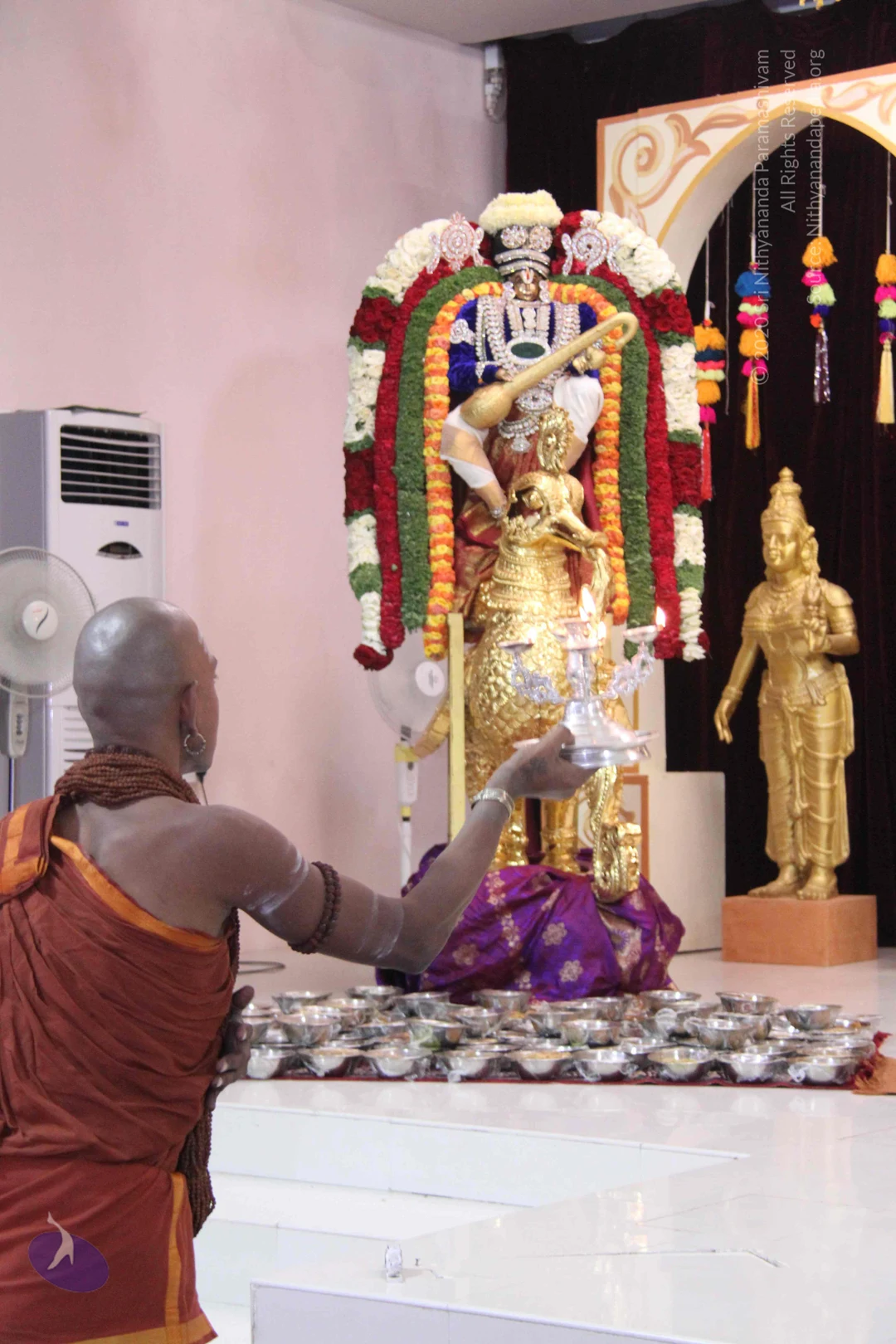
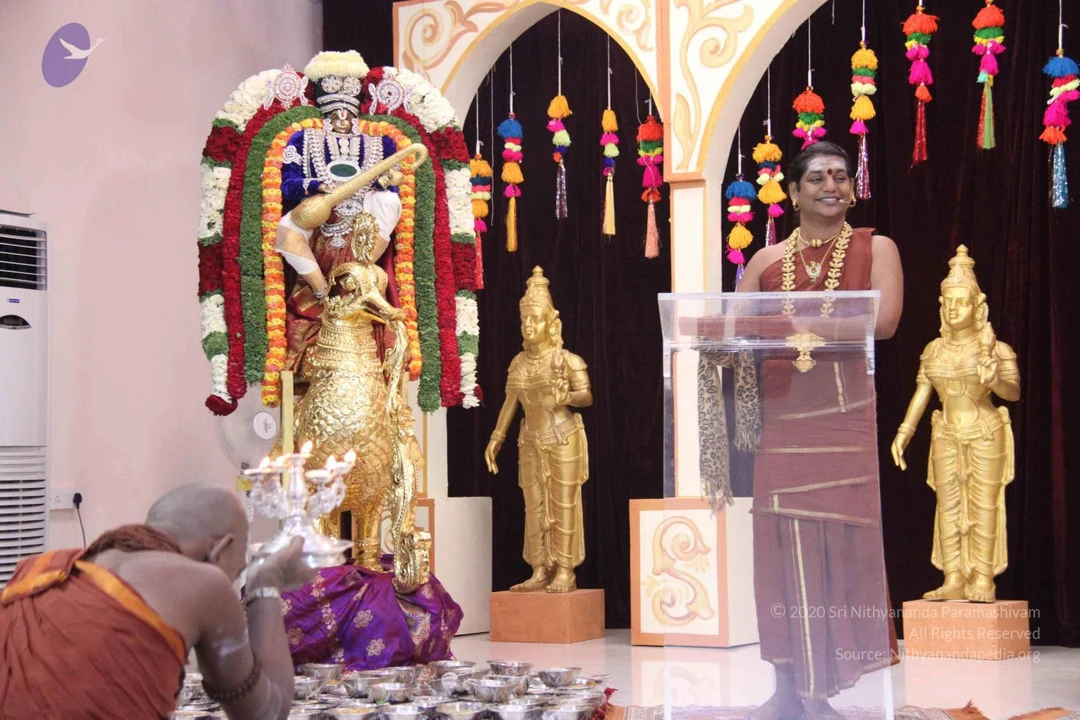
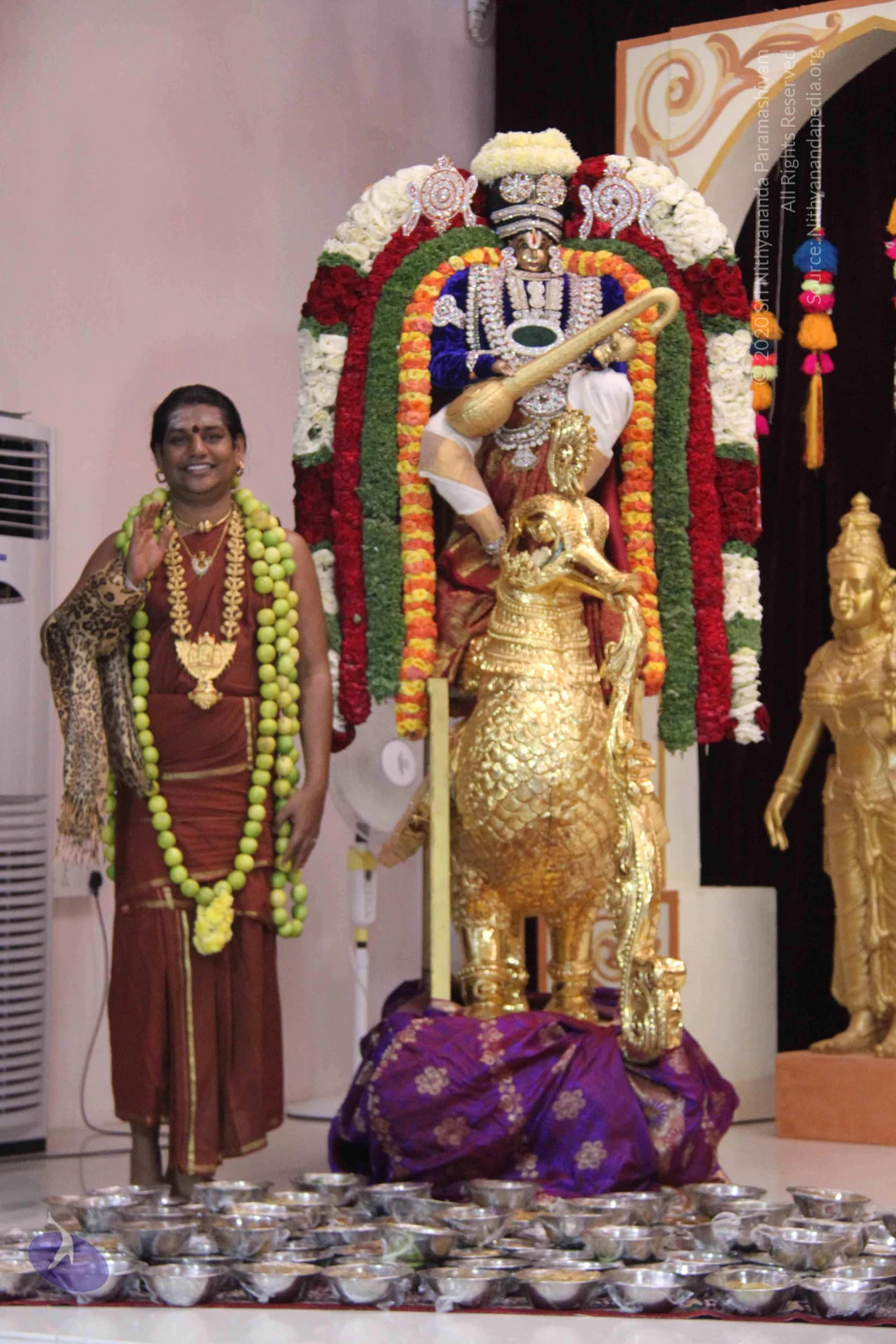
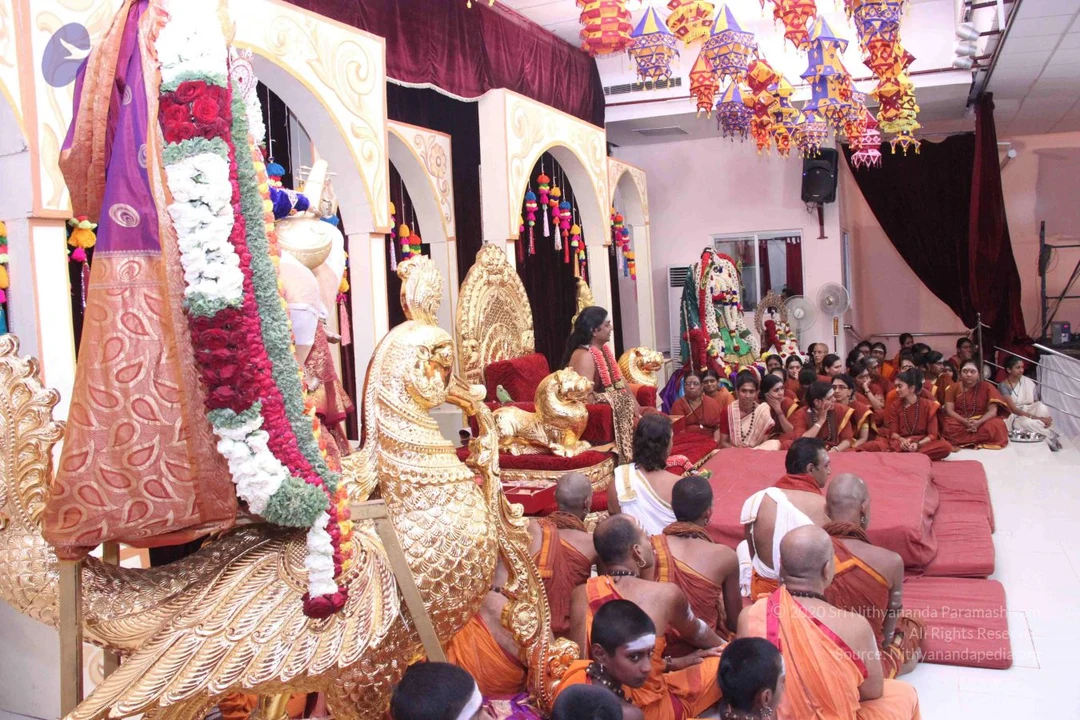
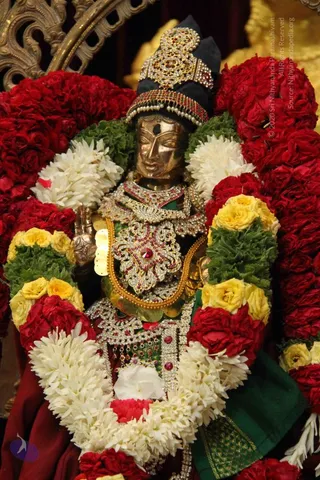
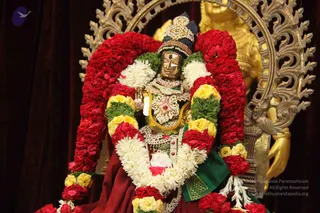
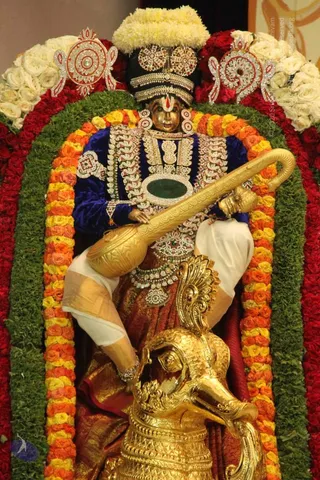
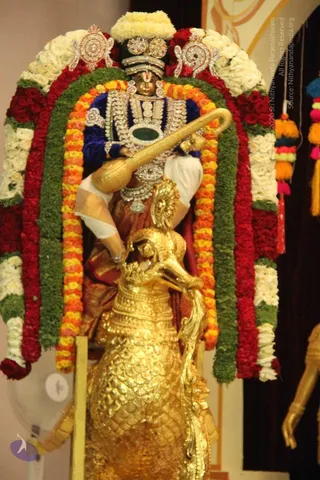
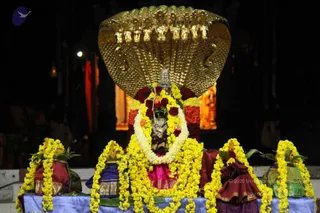
Today, the Brahmotsava, Srivari Brahmotsava. Venkateshwara is gracing us on Hamsa Vahana, Suvarna Hamsa Vahana – the Golden Swan Vahana – with all his grace and the Veena, he is gracing us on Suvarna Vahana. in Mohini Alankara. He is in the incarnation in the form of Mohini. To distribute the nectar to devathas he has taken this form.

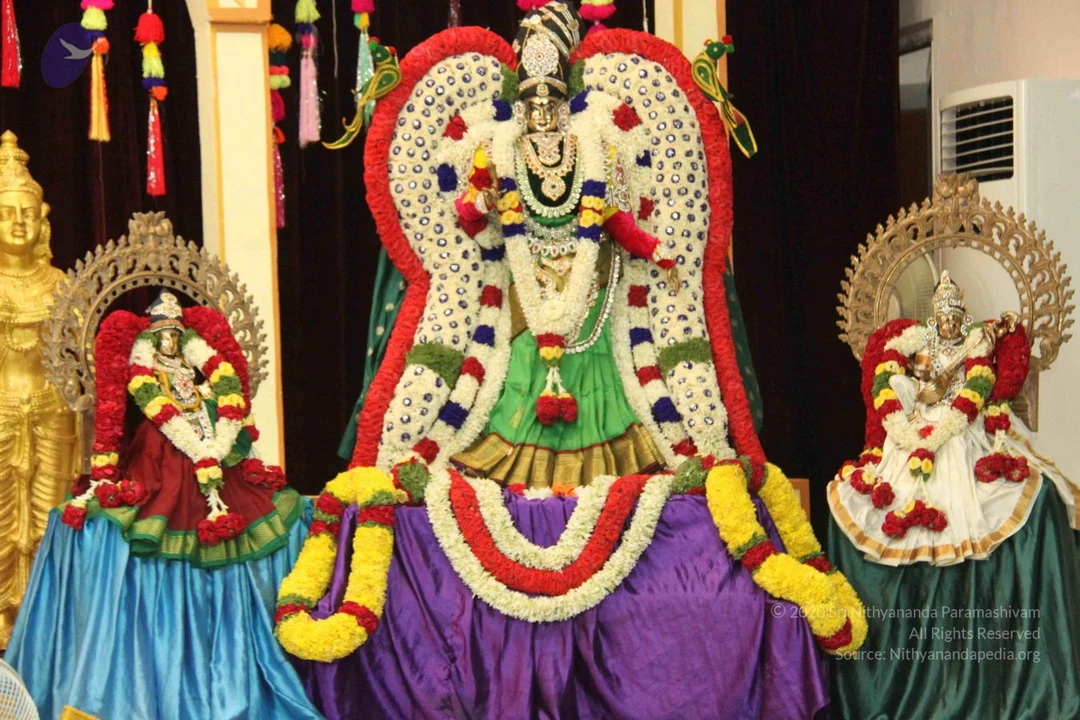
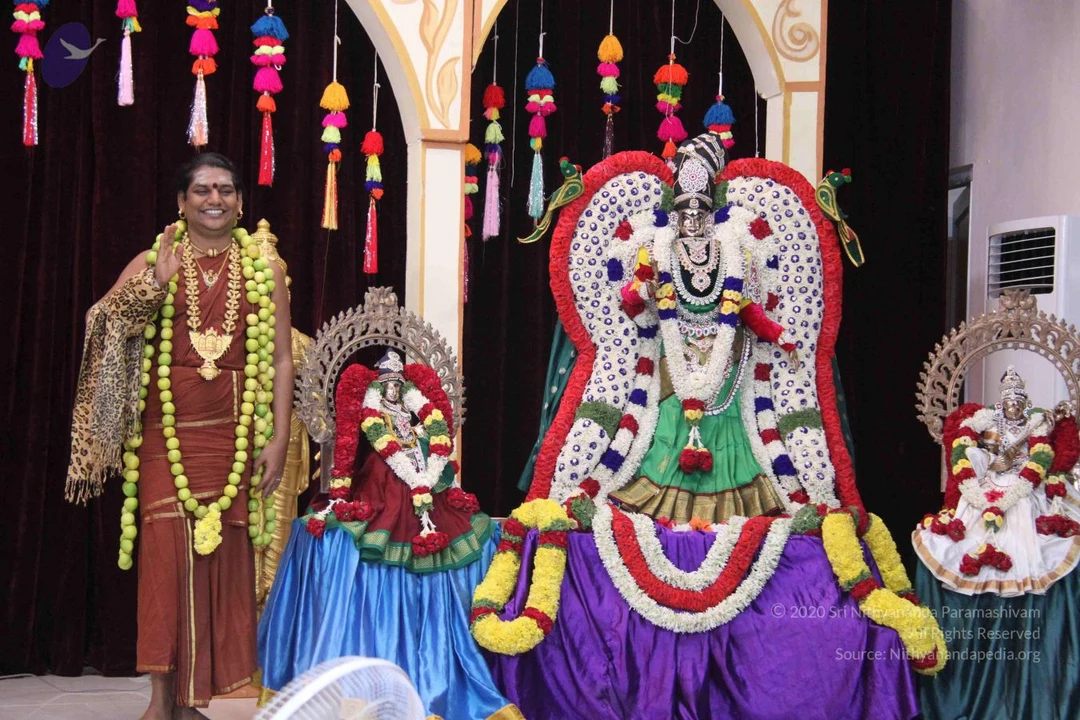
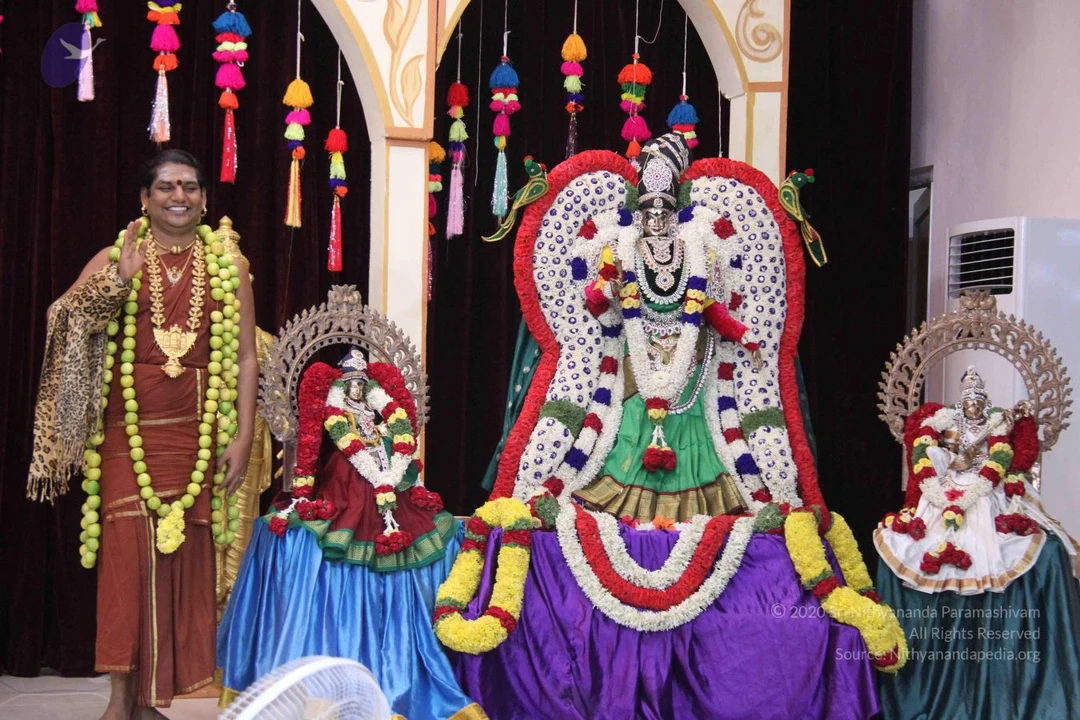
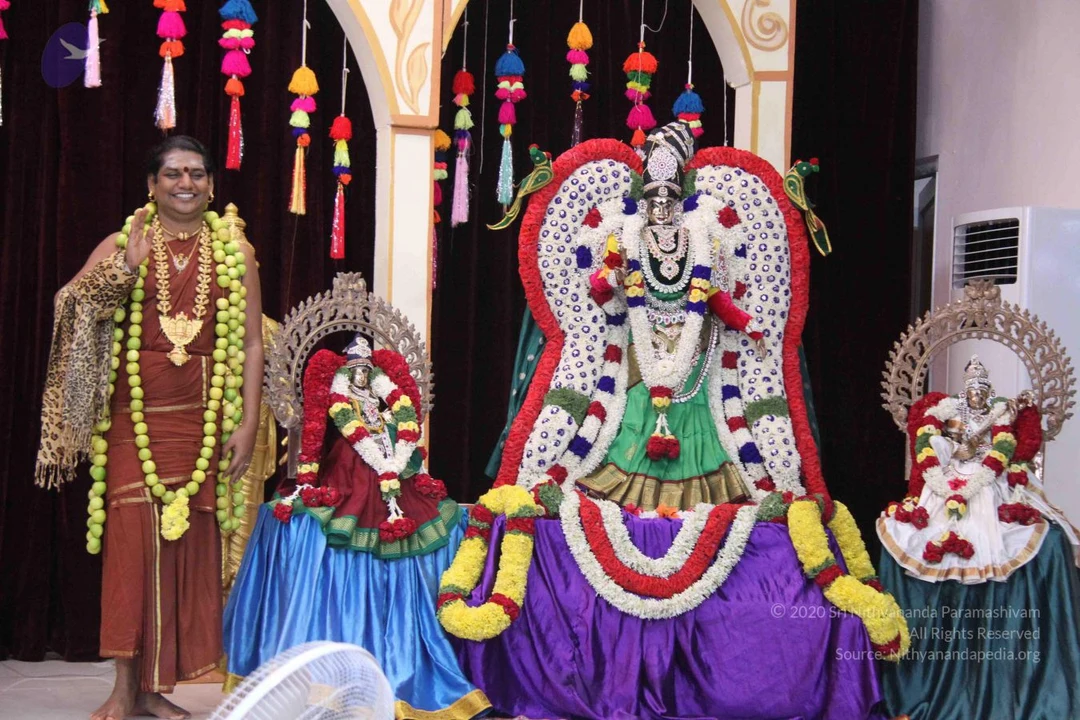
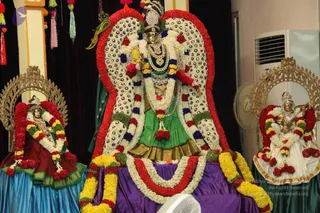
The other side, Navaratri Utsava. Devi is gracing us in the form of Meenakshi. Today, the day of Meenakshi’s incarnation is celebrated. In the form of Meenakshi she is gracing us with Lakshmi and Saraswathi serving her.

Great job of presenting Meenakshi in all her beauty and glory. Let us bow down to Meenakshi and Venkateshwara.

At the same time, two Brahmotsavas so beautifully both sides Devi and Vishnu are gracing.

And I think, by today or tomorrow, we will be starting the Chandi Homas. Oh today, today the Chandi Homas will be starting. From Kolkata we brought artists and made beautiful Durga deity which will be arriving. You can have the darshan of the Durga may be today or tomorrow. One side the Durga Puja also will start in the ashram.

So, the real festive season starts. The Navaratri Utsava starts. These nine days, meditate on the feminine energy in you. The feminine energy in you should be beautifully awakened, inspired, encouraged. These nine days is the time for that. The Durga deity will be arriving in next two days.

Let’s enter into today’s Nithya Satsang.

Today I wanted to expand about this Power of Words, the idea behind these words.

Power of Words, please understand.

Any impossibility you carry in your life is nothing but power of wrong words you utter to yourself and others, power of the wrong words you utter towards you and others. Any difficulty, any problem you experience in the life.

Life flows with words. Please listen, for example, whenever you utter the words, “It is not possible, not possible”, you take responsibility for that word. Whenever you utter the word “It is possible, it is possible”, you take responsibility for that word. When you take responsibility for the right word, when you take responsibility for the right word and when you utter the right word, you discover the power of the right word.

The biggest problem in what I am saying, whatever I am saying, when you practice, when you try to practice, the biggest problem you will face is; you will utter the right words outside but you will not be uttering the same right words inside. You will utter the right words outside but you will not be uttering the same words inside. Uttering the right words inside also and taking responsibility for it, please understand, taking responsibility for it that is a very important thing. Even when you decide in your feeling that you are going to take the responsibility for the words you uttered, for the words you are uttering, the Power of Words expresses through you.

Power of Words. Please understand, single word can break relationship of ten or twenty years. Single word can make the relationship which was not there for ten or twenty years. Single word can break the relationship of ten or twenty years. Single word can make the relationship which was not there for ten or twenty years.

Power of the words. The words you utter, especially the words you utter towards you and the thinking you do. Please understand we are all afraid of the Shani, Kethu, Rahu doshas which comes, may be, five years, six years, seven years, seven-and-a-half years, ten years; but we are not understanding one of the biggest doshas with which we are suffering is Mamakara Dosha. Means the very poor inner image, wrong or inadequate inner image with which we are suffering. When you carry the wrong, inadequate inner image, everything of your life, what you think as taste even that comes from your inner image. Please understand, what you think as taste of your life decides the quality of your life. What you consider as the taste of your life, what you consider as the taste of your life.

Please understand, taste of your life makes you naturally think towards it. Taste of, what you consider as the taste of your life - When I say “taste”, I mean what you think as the result, goal, what you think you enjoy in your life; that makes you think you towards it, feel you towards it, utter words towards it.

The words you utter, the way you think, the way you feel, the way you live, everything is a power. Please understand, end of the day if you think money is the power - I am not saying it is the right goal or wrong goal or inadequate goal, no. - Whatever you think is the power, towards it all the power you have starts travelling.

Listen, power always moves towards power. Money always moves towards money. Completion always moves towards Completion. Incompletion always moves towards incompletion. It’s a law of life. Any mass moves towards the other mass; that is the Law of Gravity. If you think money is the power, all the powers you have naturally starts moving yourself towards it; you will start feeling for money; you will start thinking for money; you will start uttering words for money.

15:00

But, unfortunately, you start uttering the words “It is NOT possible for me to have money”, you start thinking “It is NOT possible for me to have money”, you start feeling “It is NOT possible for me to have money”. That is the difficult part, dangerous part! All you need to do is too simple; that is why it is too difficult! Too simple! Instead of uttering the words inside you that, “I cannot achieve money”, you just need to change the words into “I can”. And, when you utter those words, feel you are going to be responsible for it, you are going to be responsible for it!

Uttering the right words and feeling responsible for those words gives you the Power of Words. I can tell you, all the psychological disorders can be healed just like that! All the powerlessness you feel can be healed just like that! All the ideas of “impossible” you feel can be cleared just like that! Whether it is in your business or spirituality or health, mental health, whatever may be the field you are in, whatever may be the field you are in, you are in! Please understand, the Power of Words is such a great power available to you and so easily it can be tapped, opened in your consciousness, and still you continue without opening, without making that power useful to you.

You need to understand one more law of life. Anything powerful, when you don’t use, it can’t keep quiet, because it is alive, living energy! When you don’t use, it is not that it is going to be silent. When you don’t use it properly, naturally you will misuse it. Either your heart pumps the good blood, the purified blood into your system, or it will continue to pump the bad blood, impure blood into your system, but the heart cannot stop pumping. Of course, if it stops, it is dead. But as long as it’s a living mechanism, it cannot stop pumping. Same way, the Power of Words; it’s a living mechanism in you! It cannot stop functioning, whether you use it or misuse it, but, it cannot be just unattended. Be very clear, it cannot be just unattended. It has to be attended!

The power of the right words, the power of the right words! You can see in your experience, if you listen to the same satsangh again and again, every time you listen, you will be having new, new revelations and deeper meanings from it; you will understand what you missed earlier. Same way, I am telling you, if you utter the right words again and again inside you, properly, with a clear understanding, with clear intelligence and clear decision to live, please listen; properly, with a clear understanding and clear decision to live; I am really telling you, the Power of Words, the Vaak Siddhi will be available to you!

At least once a day, spend a few minutes without any words inside and outside. That will give you the understanding your words are your freedom, they are not forced upon you, they are not pressurized upon you, you have a freedom to decide the right words on you!

Understand, if you think your goal is just pleasures in your life, your feeling will move towards that direction, your thinking will move towards that direction, your words will move towards that direction!

If you think, if you feel, if you decide enlightenment is the taste of your life, your feeling will move towards that direction, thinking will move towards that direction, words will move towards that direction!

I‘ll continue to expand on these different powers by answering your various questions and through Navaratri Satsangs.

I have a surprise announcement for all of you. Since we cancelled the Kailaasa Yatra this year, I am getting a lot of requests from devotees missing the Yatra this year. So, to fulfill all your Anyakara, I am announcing for the first time, Yatra plus Inner Awakening together! December 2013 Inner Awakening is going to be held in Bali. This is going to be a 23-day program – Inner Awakening and Yatra together. And we are adjusting and organizing the program in such a way, between the Inner Awakening sessions itself you will have a Bali tour visit. It‘ll not be just like a 21-day Inner Awakening, 2 days Yatra; it will be all 23 days Yatra plus Inner Awakening put together! And, I will be visiting Bali for the first time. And inviting all of you for this wonderful Yatra/ Inner Awakening…..I can say, Inner Awakening Yatra! Bali is not just a tourist location. The place has a spiritual significance. 93% of Bali’s population follows Hinduism. And there are beautiful Shiva temples. And, it will be an amazing experience! I can say, the whole program is going to be Inner Awakening Level-4! And, you will be receiving the Ananda Gandha initiation on the third day! Third day itself you will have Healers Initiation! Then, understand, what we are going to do after that!

The program is going to be aimed at the Power of Words, Power of Thinking, Power of Feeling, Power of Living. And the whole program is going to have the theme of “Money, Power, Love”! It will be a startling revelation!

And even new participants can participate. There is no need for pre-requisites. You don’t need to attend IA Level-1, Level-2 or Level-3 to attend this program, you can directly come. Inner Awakening Level-4 you can directly join. Only thing I request is, at least one month if you watch the satsang, you will be prepared with these terminologies. It is only a request, not a pre-requisite. It is only a request, not a pre-requisite.

So, the whole thing will be 23-days single package program. There will not be IA Level-1 or Level-2 in this. Straight Inner Awakening Level-4, where you will be exploring this Power of Thinking, Power of Words, Power of Feeling and Power of Living to have Wealth, Power, Love. Wealth, Power and Love that is the subject!

So, I invite all of you to come and enjoy and enrich as many lives as possible into the Inner Awakening Level-4, the startling, powerful revelations of life!

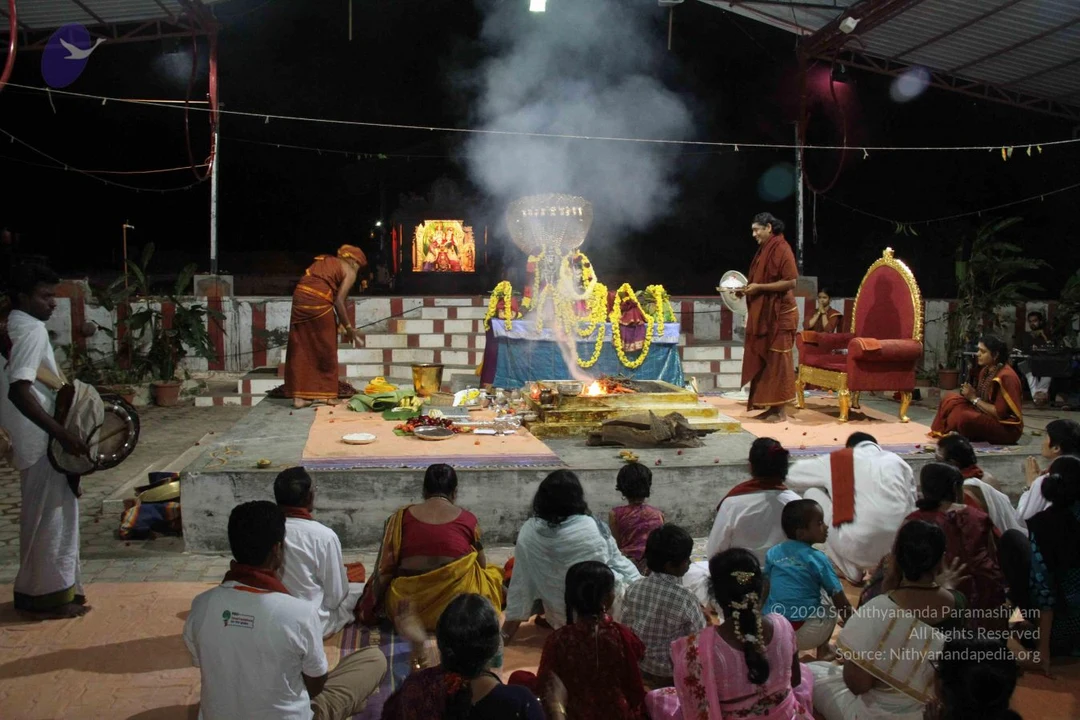
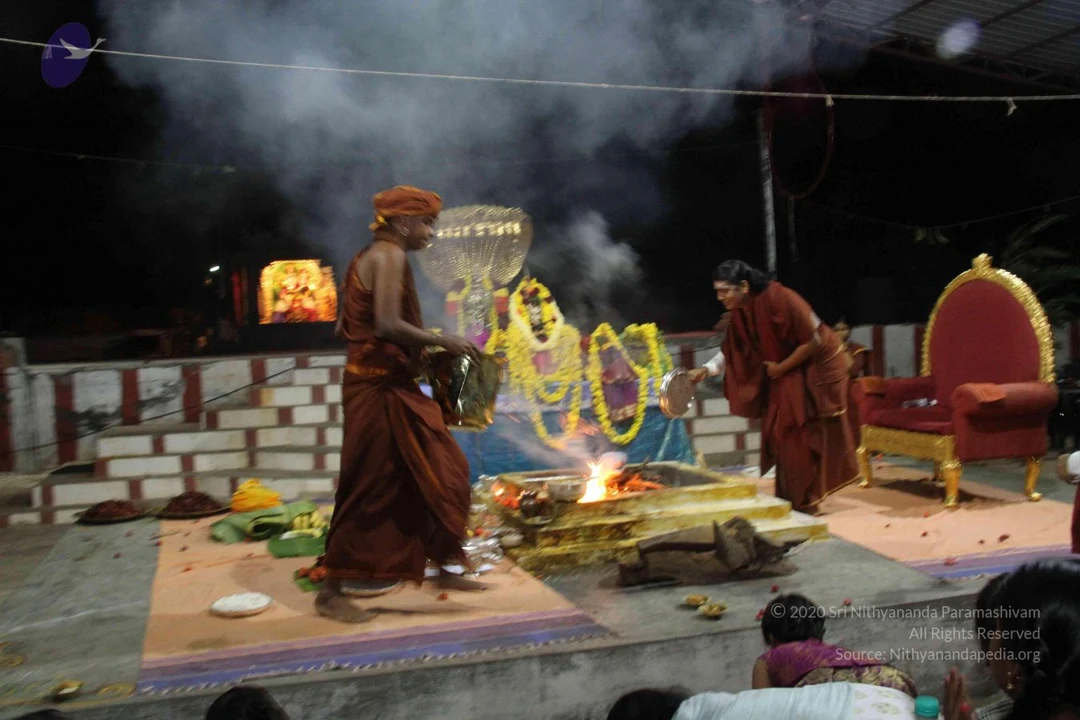
So, today, we’re offering 108 naivedhyams to Venkateshwara and Devi on this auspicious Navarathri day!

I bless you all! Let you all radiate with Integrity, Authenticity, Responsibility and Enriching, with eternal bliss, Nithyananda! Thank you!

Photos Of The Day:
navaratri-Devi-alankar

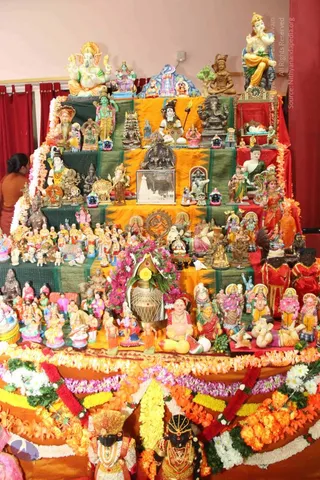
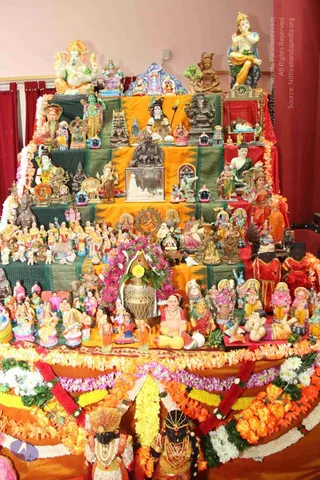
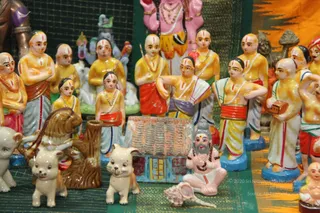
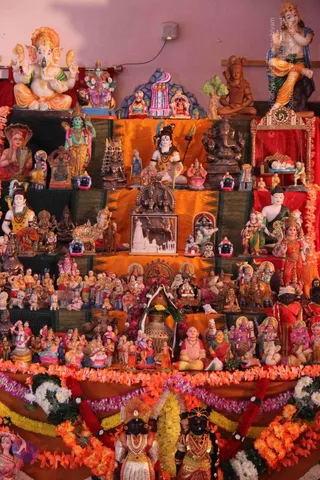
navaratri-golu

Vishnu-alankar

nayana-deeksha-2-way-cities
paduka-puja
deity-aarti

nithya-satsang

sarva-darshan

final-blessing

HDH-deities

ia-day10-darshan

ia-day10-gurukul-kids-show

ia-day10-session

navaratri-culturals

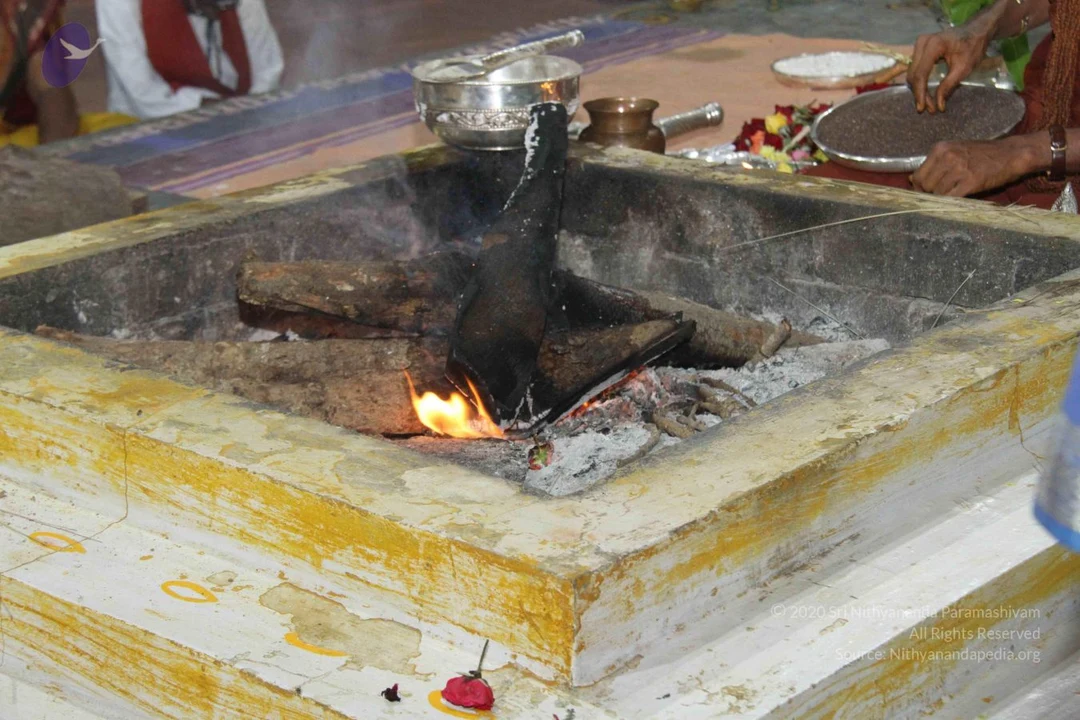
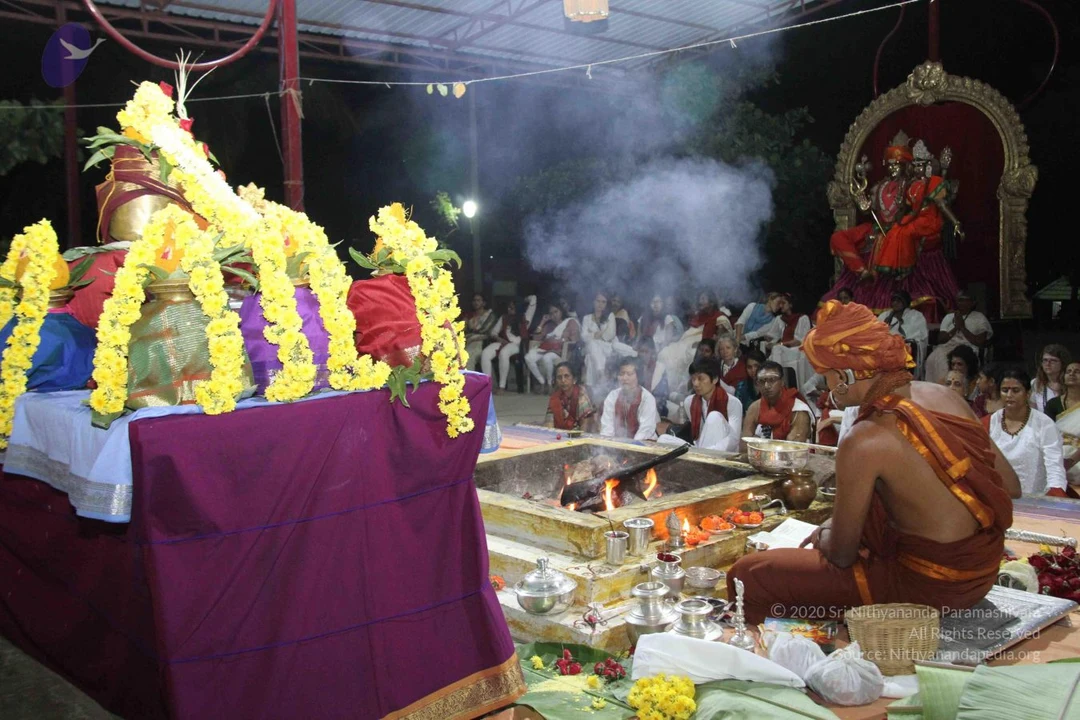
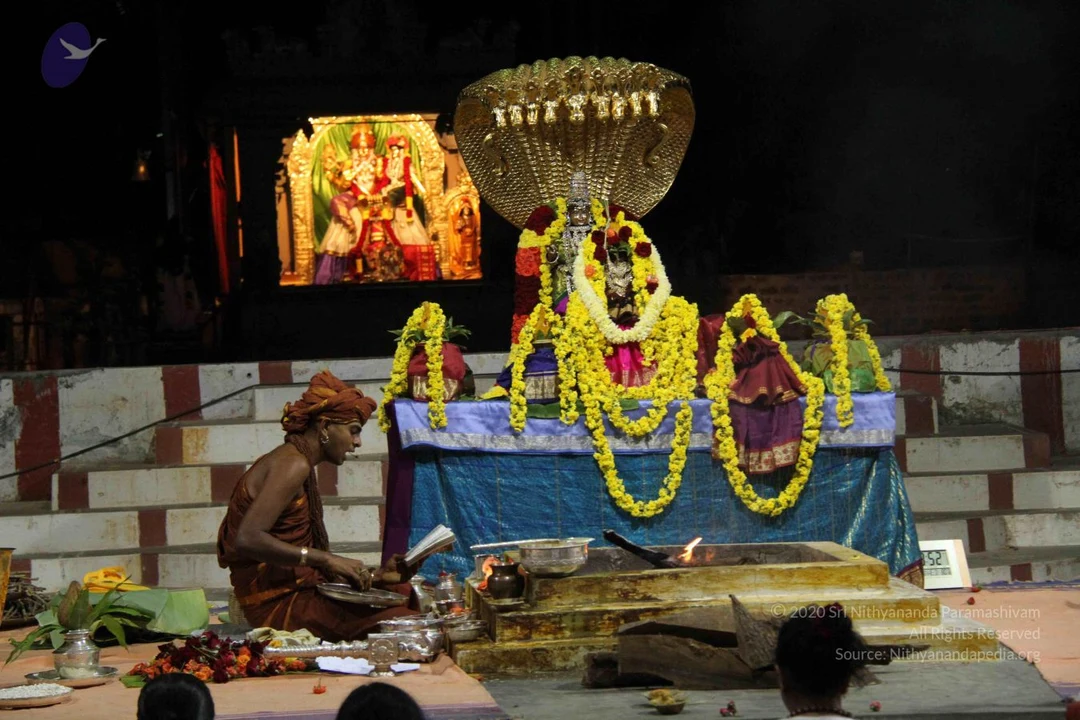
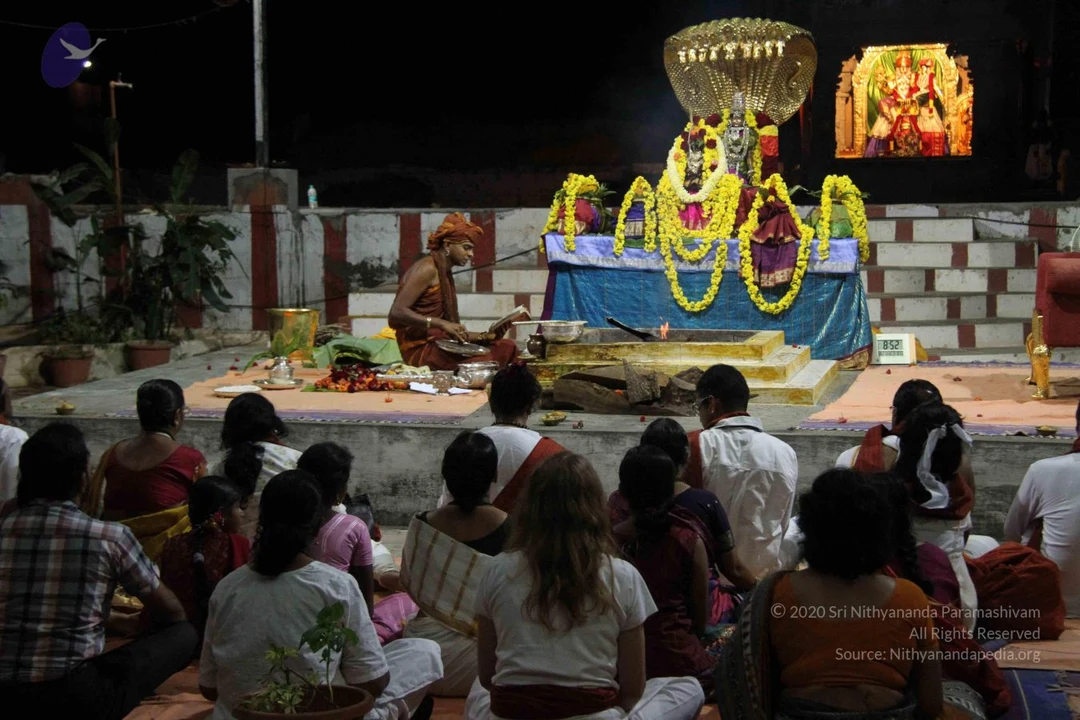
Chandi-homa

Tags:

Paramahamsa Nithyananda, power, responsibility, I can, powerlessness, psychological, disorders, healed, life.

Photos from this day

View all 402 photos

navaratri-Devi-alankar

10 photosSource gallery
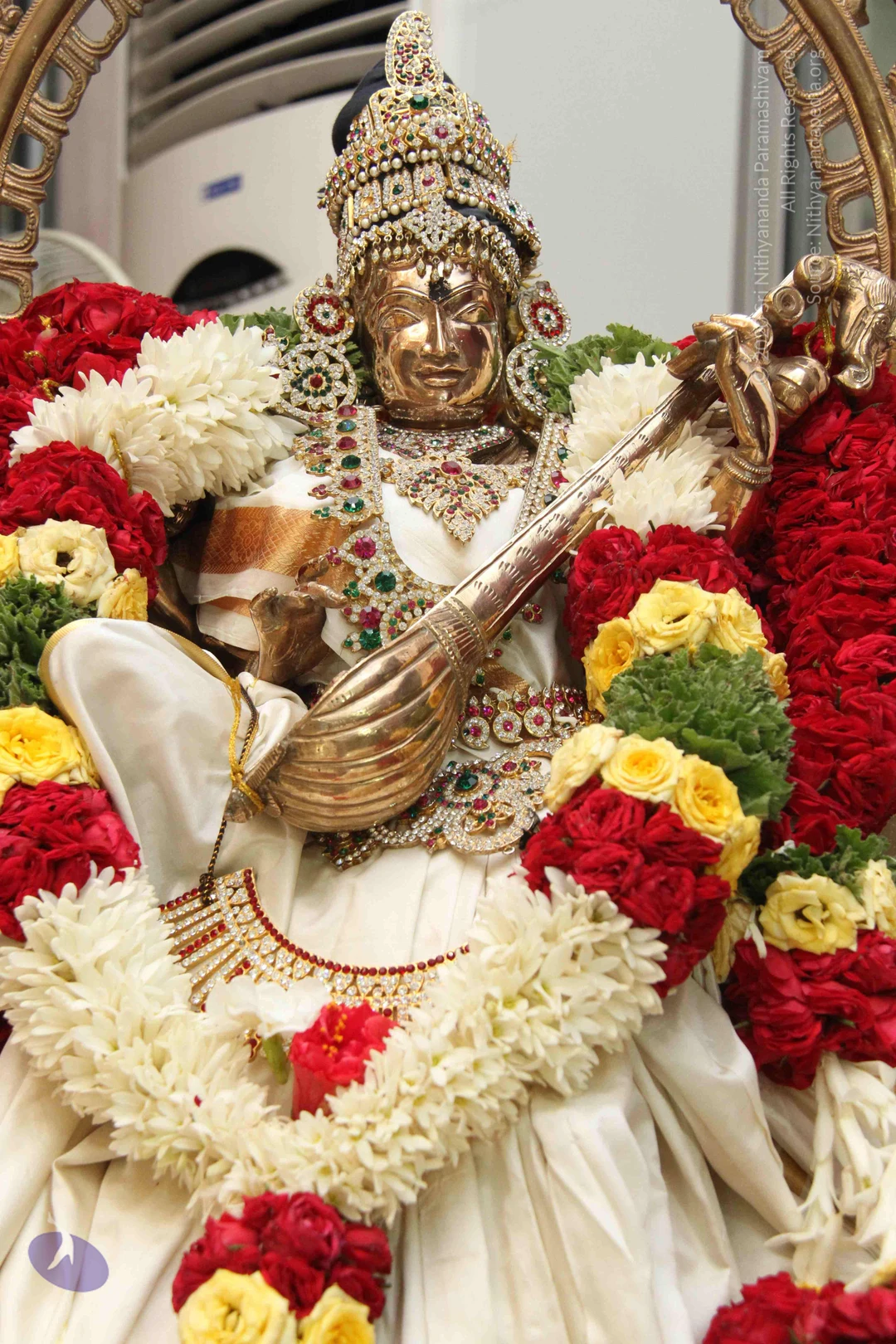
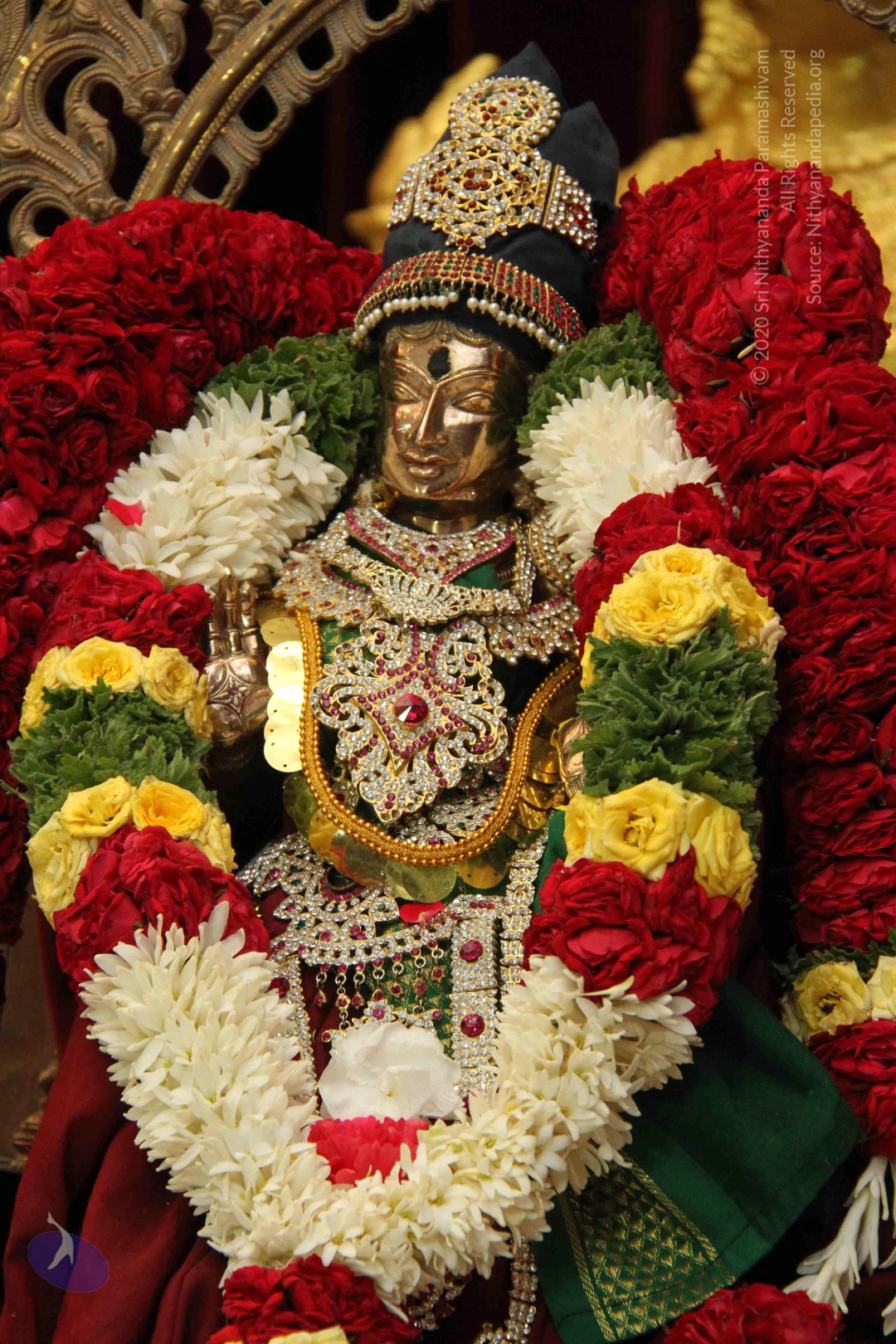
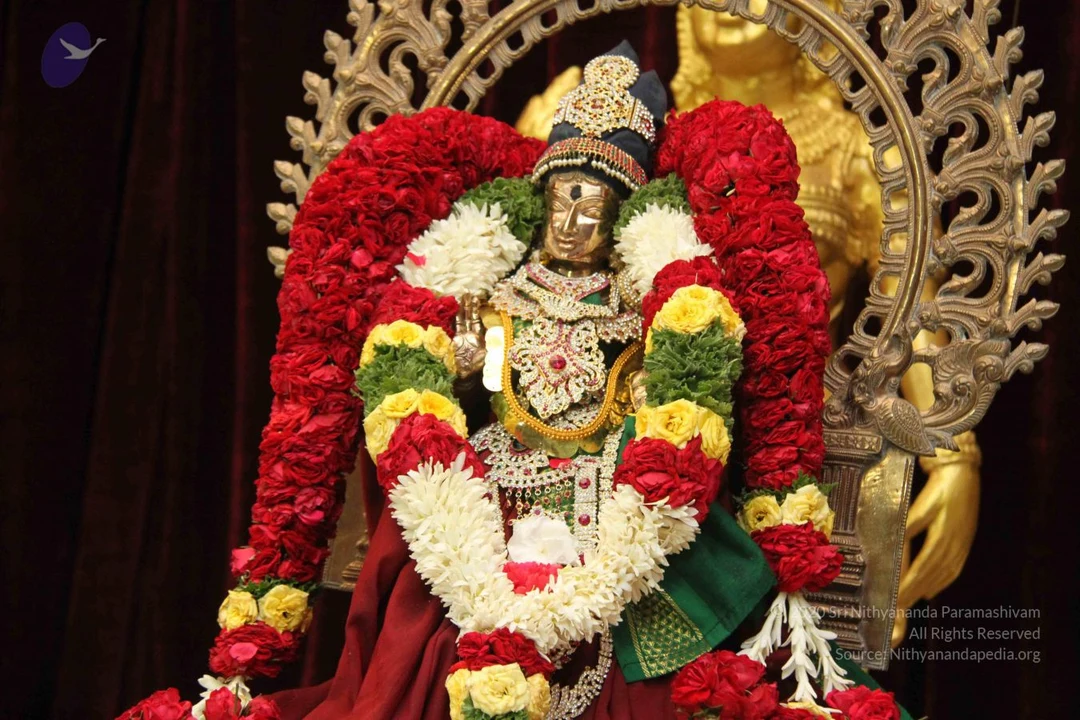
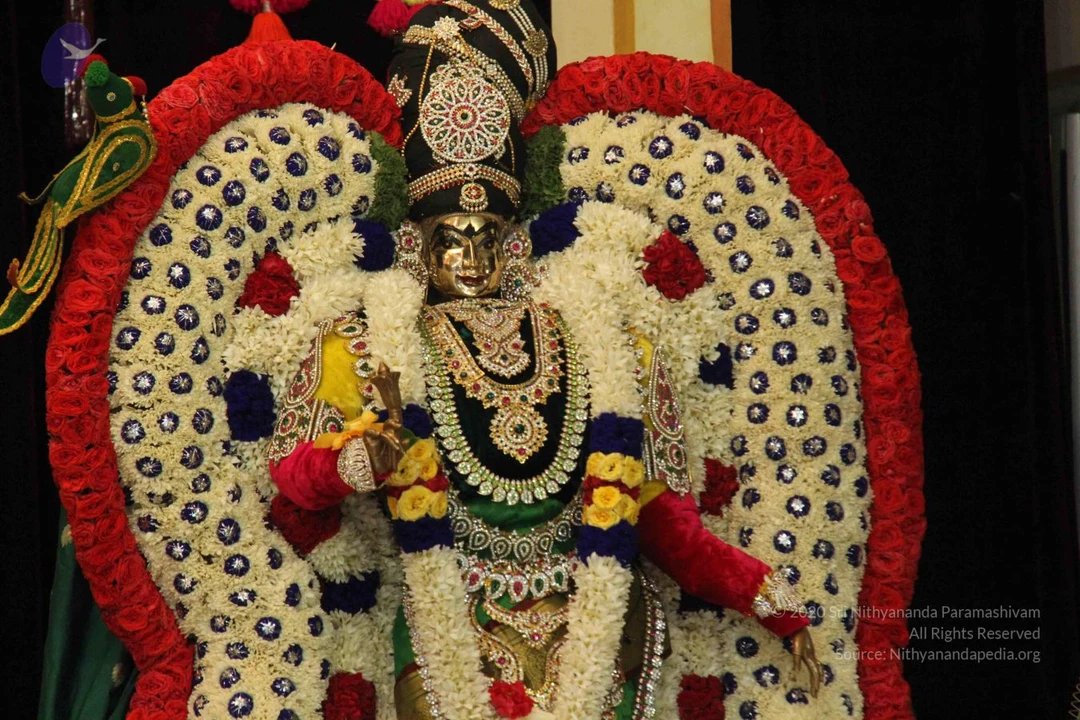
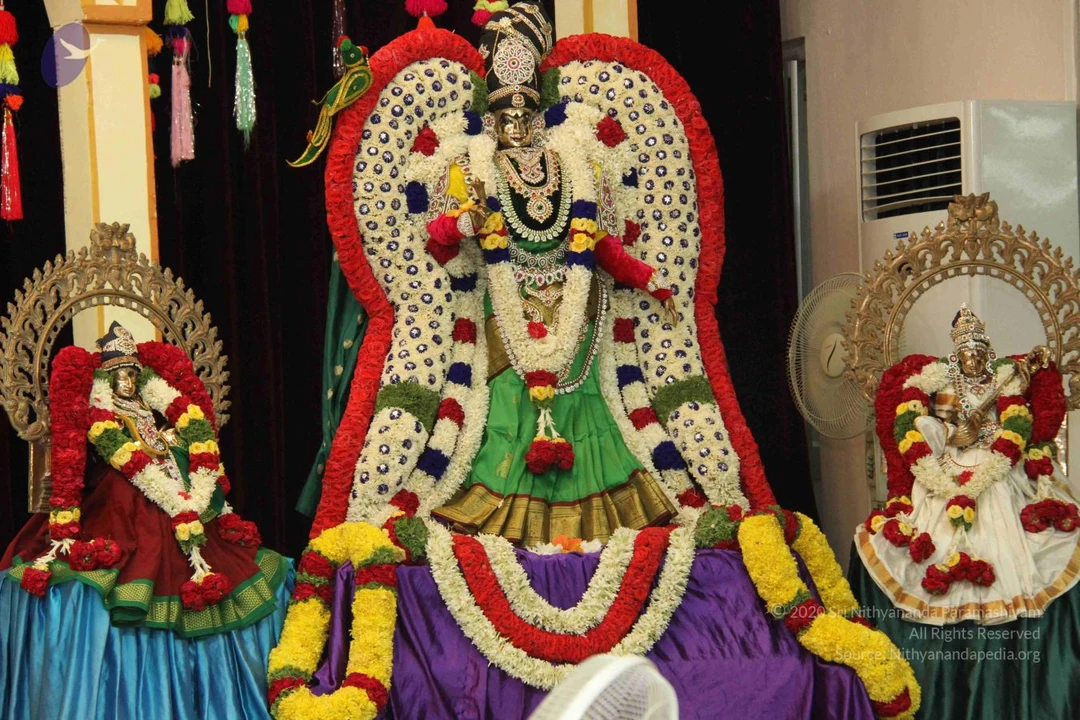
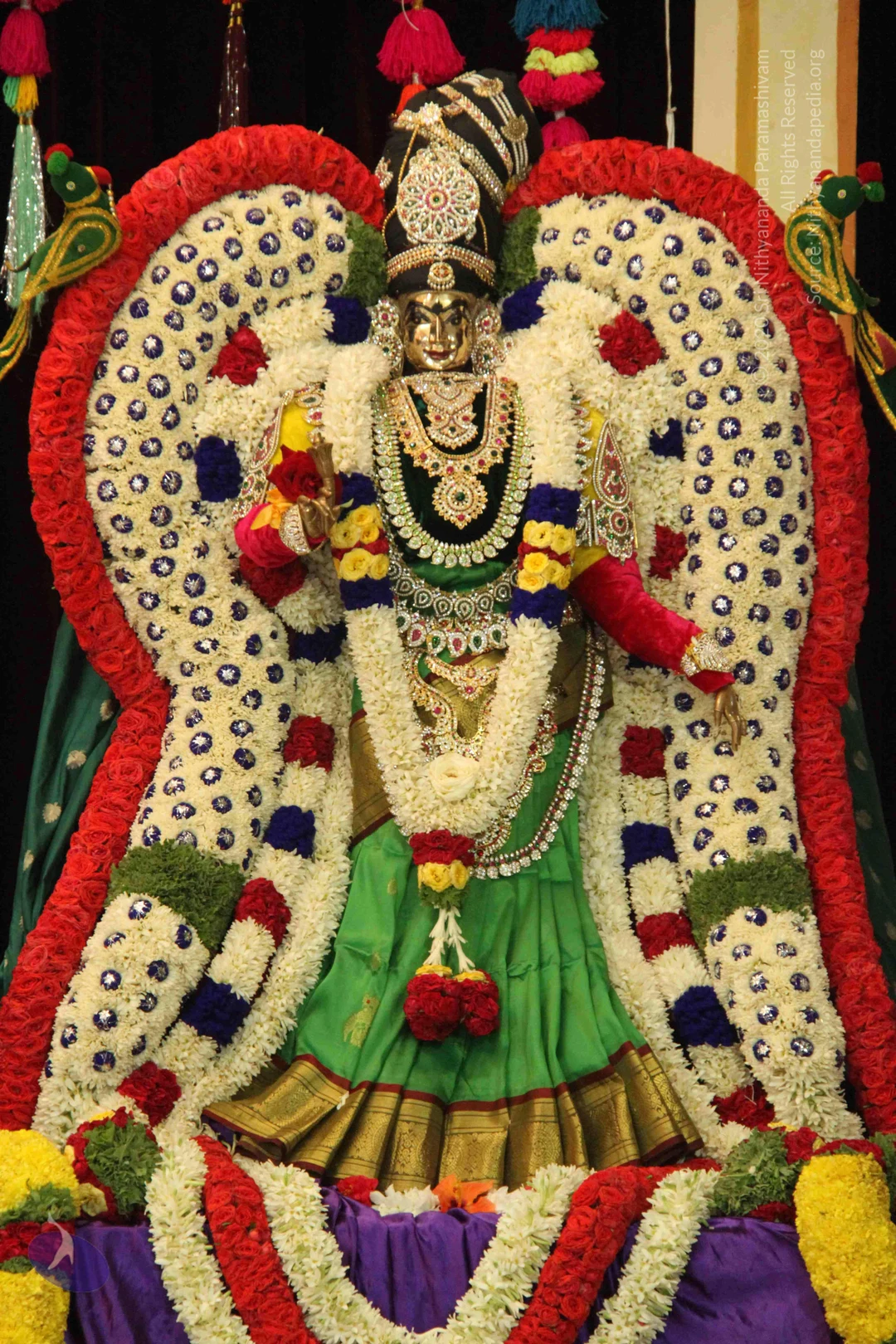
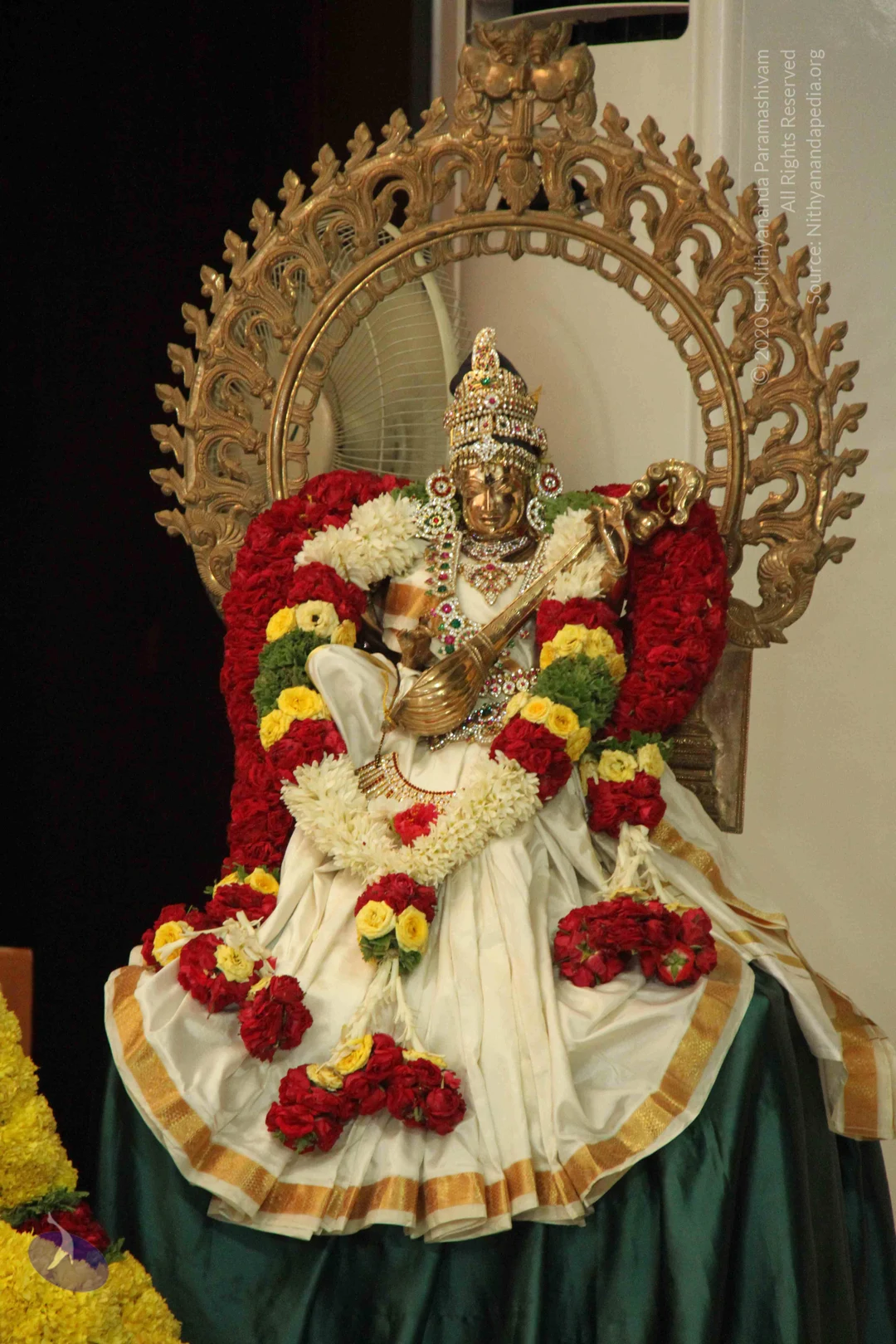
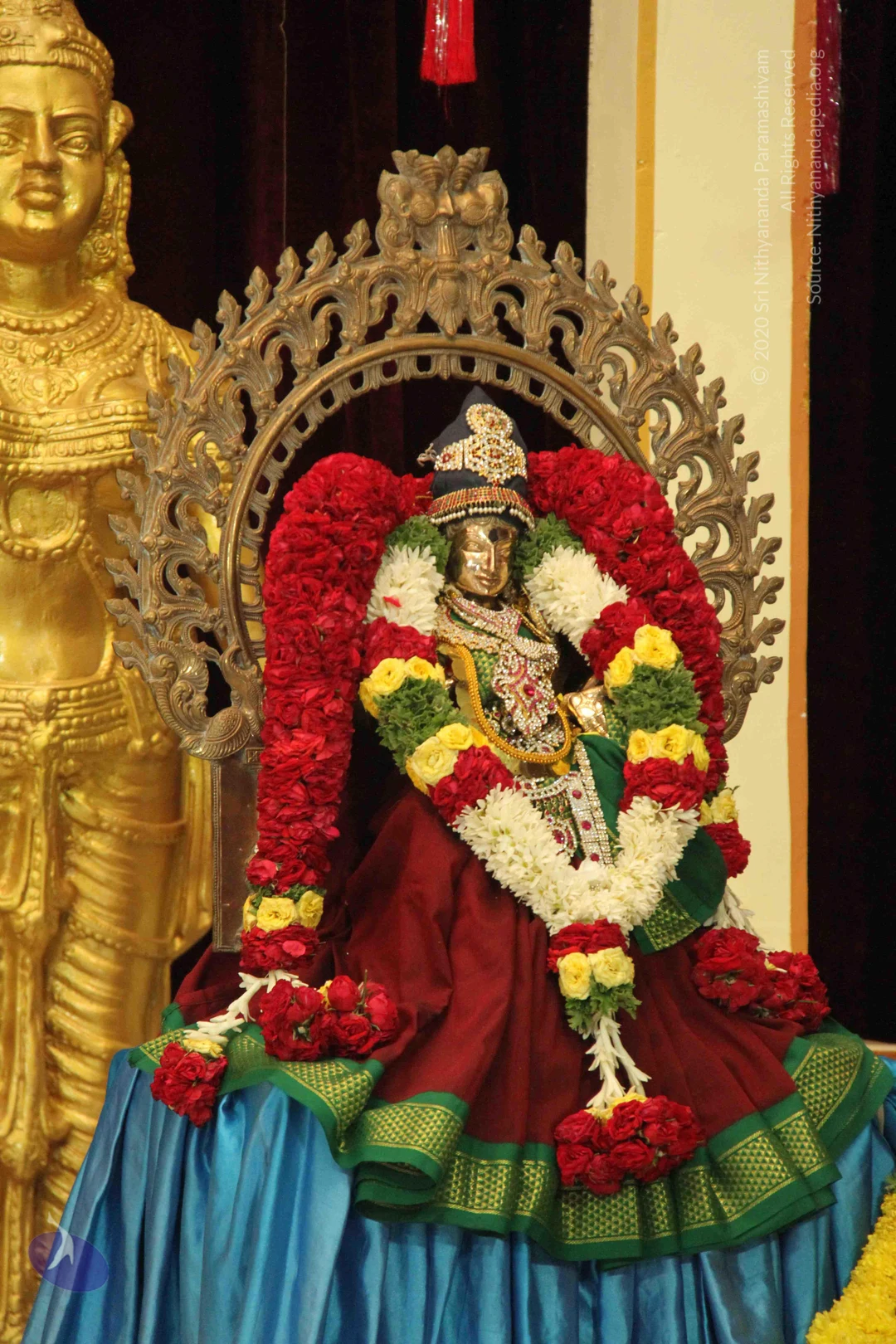
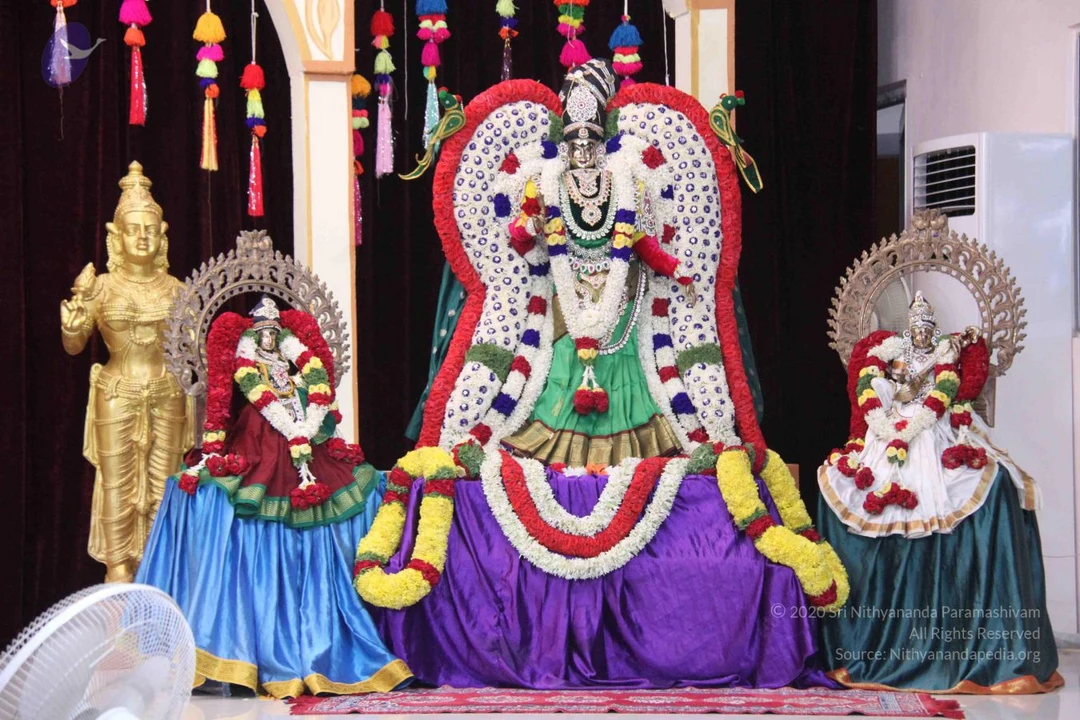
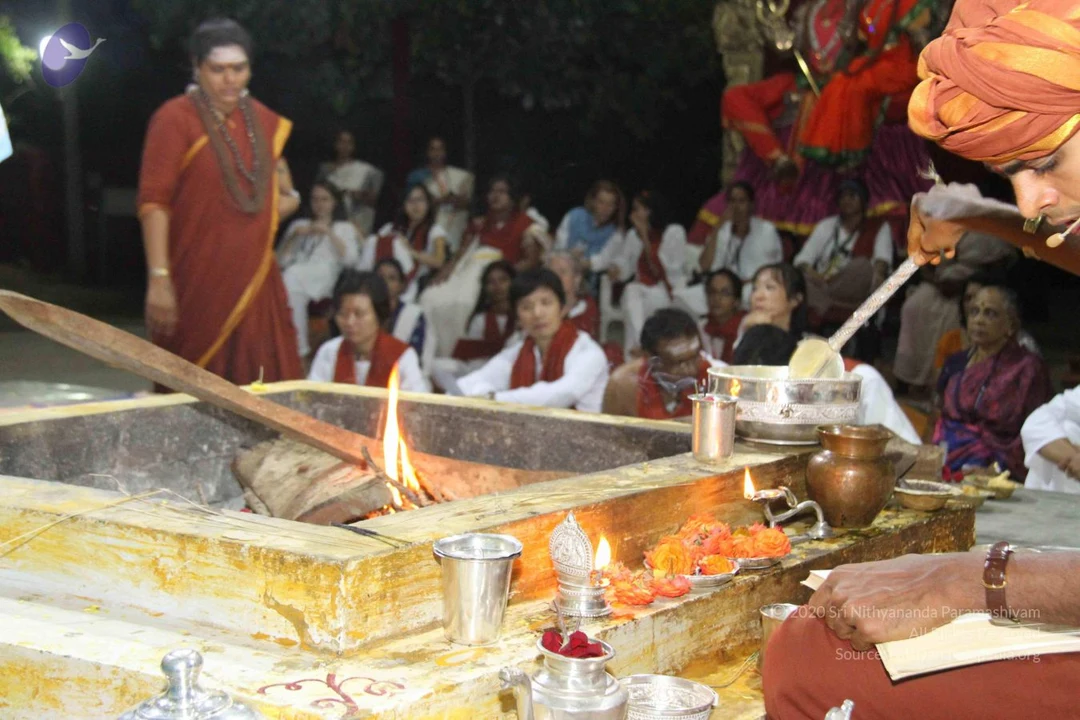
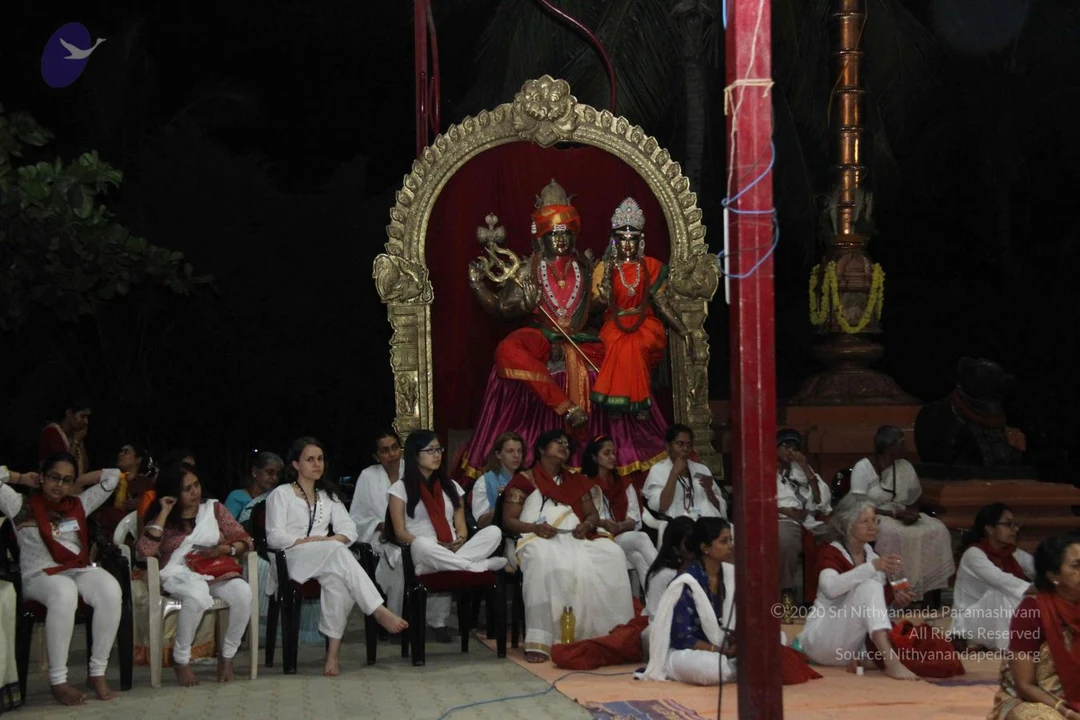
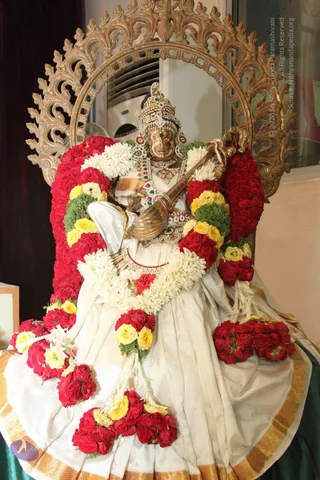
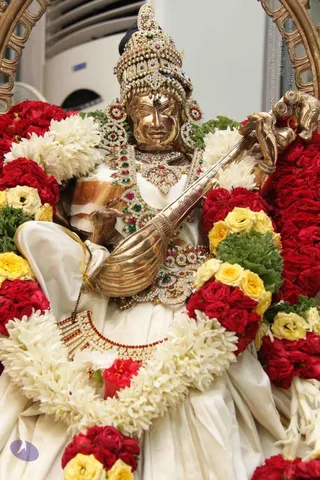
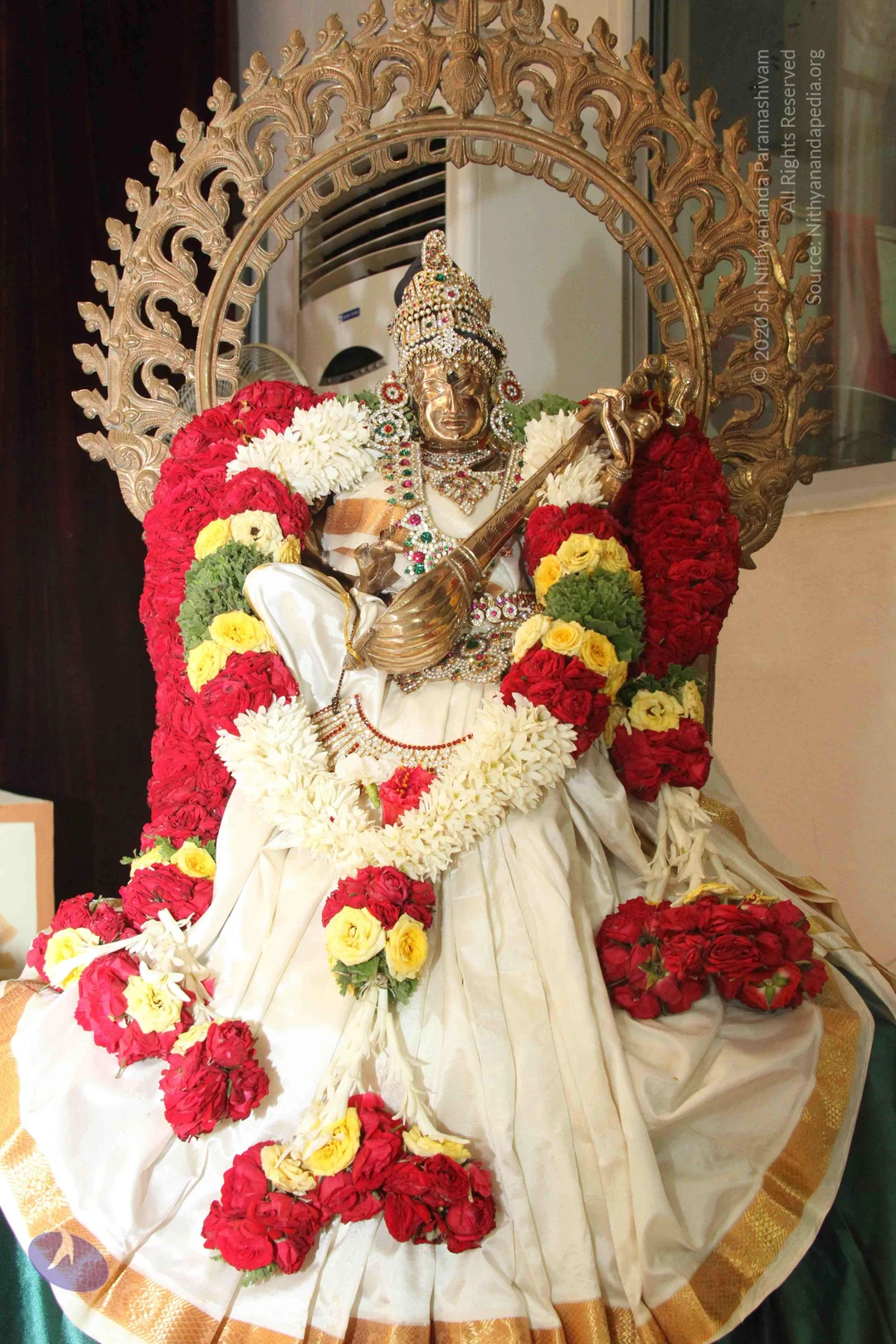
A brass deity murti of Saraswati seated on an ornate brass arched throne, wearing a jewelled crown and gem-studded necklaces, holding a veena. The figure is draped in a white silk sari with a gold border and is heavily garlanded with red roses, yellow roses, white jasmine strands and green leaves. A brass ceremonial chair frames the figure against a wall with an air conditioner and a window. No physical people are visible; the figure is a statue.A bronze deity murti of Saraswati, seated and playing a veena, is richly adorned with a jeweled crown, gemstone necklaces, earrings and armlets. It wears a white silk sari with a gold border and is heavily garlanded with red roses, yellow roses, white chrysanthemums and green leaves. A fan-like ornate bronze back frame surrounds the figure. No physical people are visible.A bronze deity murti is dressed and adorned for worship, framed by thick garlands of red roses, yellow roses, white jasmine and green leaves. The murti wears a tall black headdress edged with jewelled bands and pearls, a face marked with a dark bindi, a gold and crystal-studded necklace with a large red stone pendant, and a green garment. One raised hand is visible at the left. Behind the murti sits an ornate gilded throne with scrolled metalwork. No physical people are visible.A metal deity murti of a goddess is decorated for worship, framed by a large ornate brass prabhavali arch. The murti wears a tall jewelled crown, a dense jewelled necklace and a green blouse with a deep red drape. It is wrapped in thick garlands of red roses, white jasmine-style flowers and yellow blossoms, with green leaves. A golden figure stands partly visible behind the arch against dark maroon curtains.A gilded deity murti. It wears a tall black crown with gold and red-stone embellishments and a gold face mask-style visage. Heavy jewelled necklaces in green, gold and white stones cover its chest, and its arms are dressed in red and yellow sleeves with gold trim. Large heart-shaped frames of white jasmine and blue-centred white flowers, edged with red roses, surround the figure. No people are visible; a small green and gold peacock motif appears at the left edge. Dark background.A photograph of three decorated deity murtis displayed on ornate golden thrones against a dark curtain. The central murti, a female form in a green skirt and tall crown, is almost entirely covered in white and blue flower garlands with red rose borders, and wears layered gold necklaces. Flanking murtis on each side wear red and white garlands and embellished garments. Yellow and red flower strands drape the base and a purple cloth covers the platform. A wall air conditioner and fan sit at the right edge. No living people are visible.

navaratri-golu

5 photosSource gallery
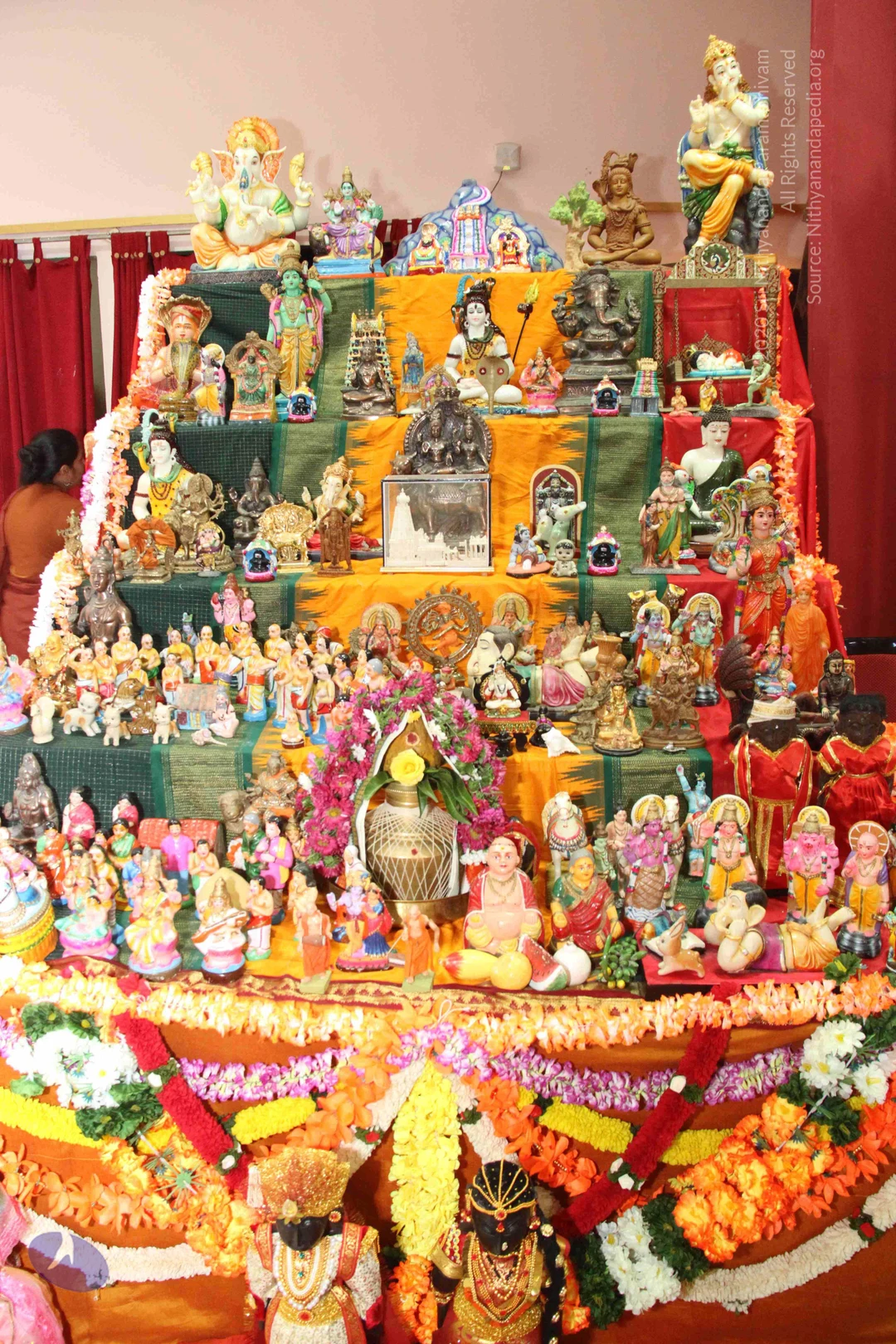
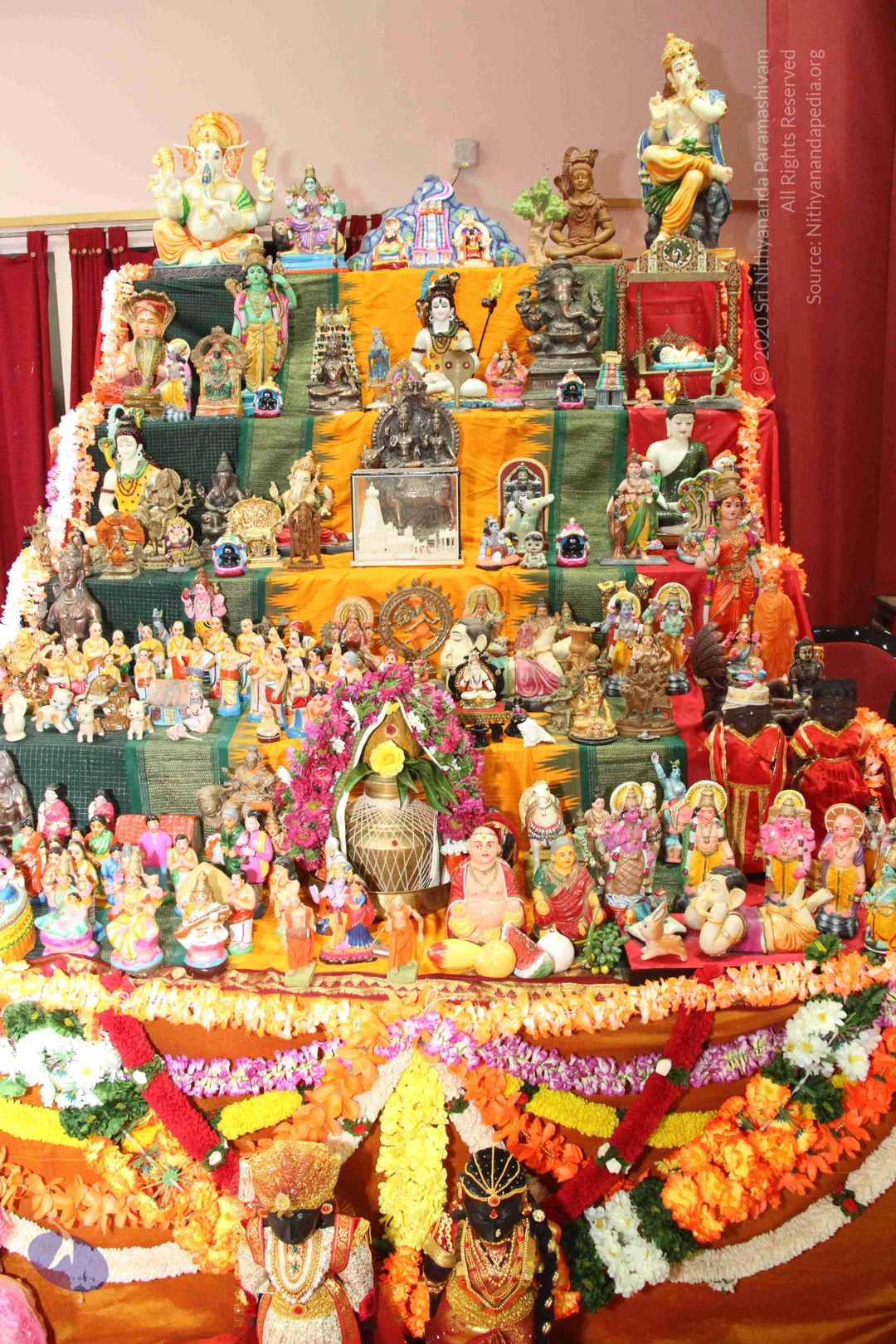
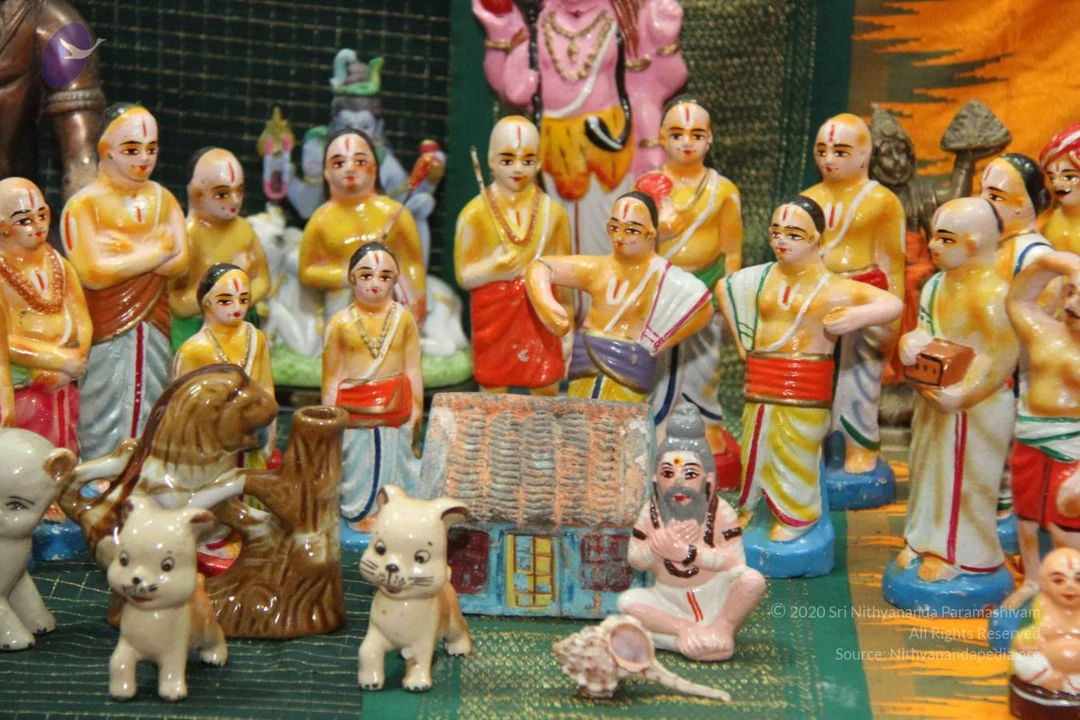
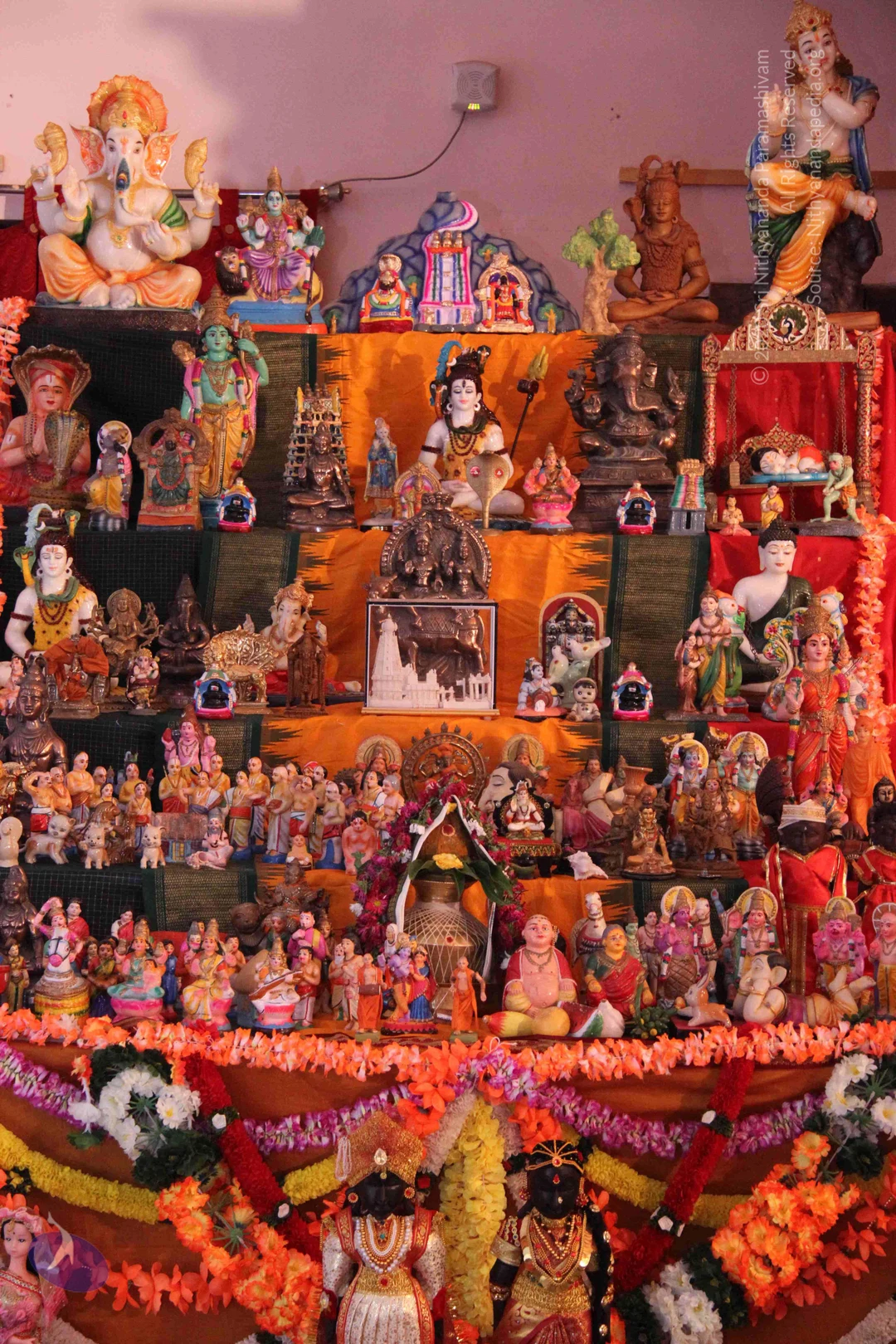
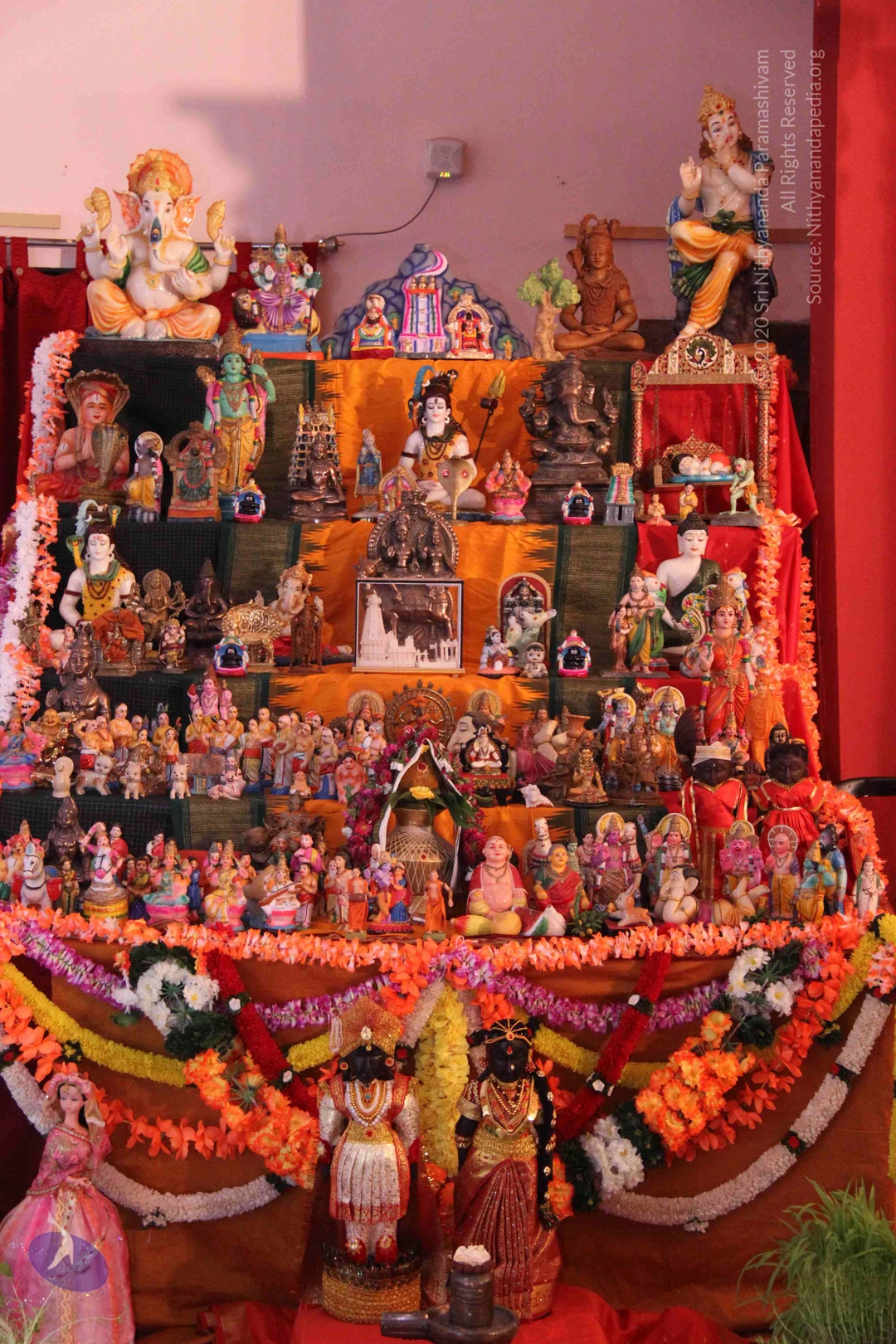
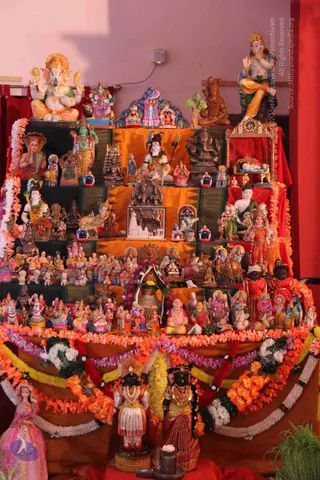
A tiered golu-style display of many colourful clay and metal dolls and deity figurines arranged on steps draped with orange and green cloth and garlanded with marigolds and white jasmine. Prominent figures include a white Ganesha at top left, a seated Shiva figure with a trident near the centre, a green-skinned deity at upper left, and a seated Buddha figure on the right. A small silver-framed photograph of a temple sits mid-display, with a pot of flowers in the lower centre. A woman in an orange sari stands at the far left edge. Figurines are statues and dolls, not living people; no a person is visible in the scene.A photograph of a tiered golu-style display covered in many deity figurines and dolls on green, orange and red cloth, decorated with marigold and jasmine garlands. Visible figures include Ganesha, Shiva seated in meditation, a dancing Nataraja, Krishna playing a flute at the top right, a Buddha figure and a kalasha with a yellow flower in the centre. Two large dark figures in red and gold dress stand at the bottom. A framed picture of a white temple sits on the middle tier. No living people are visible, and the figurines are not a person depiction.A photograph of a crowded tabletop display of small painted clay figurines and ceramic animals. Many standing figures wear orange-yellow dhotis and tilaka marks on their foreheads, some with red or white cloths over their shoulders and garlands. A seated bearded figure with a white-streaked beard and rudraksha beads, hands folded in prayer, sits near a small blue-and-orange clay house with a thatched roof. Cream-coloured ceramic dogs and a brown wooden tree stump lie in the foreground, with a conch shell at the bottom. Behind them stand a pink and gold figure and a bronze deity statue on a green cloth backdrop. The figurines are miniature statues, not physical people.A densely tiered display of colourful deity statues and figurines arranged on stepped shelves draped in orange and red cloth and strung with marigold garlands. Prominent figures include a large seated Ganesha in white and orange at upper left, a standing blue-skinned deity with a trident at upper centre, and a seated Shiva figure with a trident and rudraksha-like beads in the middle. Dark bronze figures, a Buddha figure, a framed black-and-white temple photograph, a kalasha pot with flowers and two dark standing deity statues wrapped in gold garlands at the bottom centre. No living people are visible.A tiered golu-style display of many painted and clay deity figurines filling a multi-level stepped stand covered with orange and red cloth and marigold garlands. Ganesha figures sit at the top left, a seated Shiva figure with a trident and a bull-like figure appear in the middle tiers, and a Buddha-like figure sits to the right. Two dark-complexioned figures in red and gold clothing stand in front at the base beside a small kalasha-like pot with a banana-leaf and flower decoration. Numerous small figures of devotees, animals and people fill the lower steps. No people are physically present in the photograph; all figures are statues or dolls.

Vishnu-alankar

4 photosSource gallery
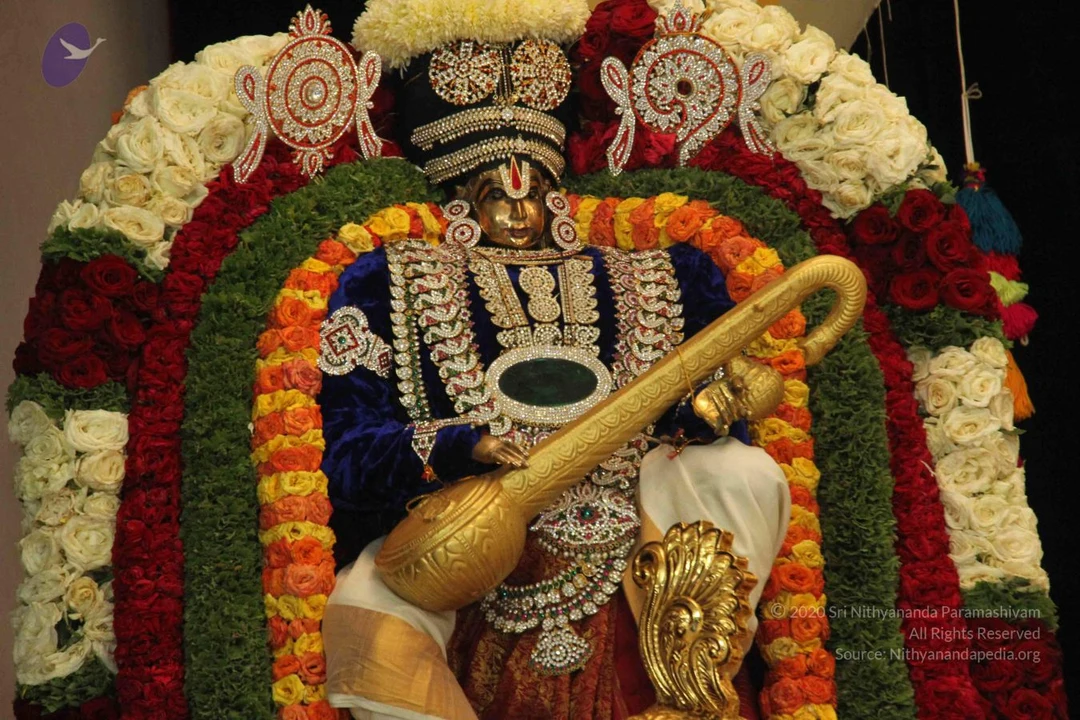
A deity murti of Saraswati-style iconography is decorated with a dense arch of white roses, red roses and green leaves, with bright orange and yellow marigold garlands along the inner frame. The figure wears a navy blue velvet garment with ornate gold and jewelled necklaces, a jewelled gold crown with a central jewel, and a gold golden-hued veena held across the body. A tilak marks the forehead. Ornate gold and jewelled shoulder ornaments and tassels hang at the sides. No physical people are visible, and no candidate for a person appears in the scene.A golden deity murti of a goddess seated in a rose-decorated shrine, playing a golden veena. The figure wears a deep blue velvet blouse with elaborate gold and jewelled necklaces, a jewelled crown, and a vertical tilak on the forehead. Surrounding garlands of white roses, red roses, orange and yellow marigold-style flowers, and green foliage frame the figure in an arch. A golden peacock motif and red and gold tassels appear at the right edge.A golden deity murti of Saraswati seated on a golden swan vahana, holding a long golden veena with a rounded resonator. The figure wears a blue velvet blouse with jewelled gold necklaces, a white and gold-bordered sari, a jewelled crown with a white flower crown above, and an urdhva tilaka on the forehead. The murti is framed by a horseshoe-shaped arch of white roses, red roses, and orange and yellow marigold garlands with green foliage. Jewelled ornaments in red and white decorate the arch. No people are visible.A deity murti of Saraswati, the goddess of learning, stands in an ornate shrine decorated with floral arches of white roses, red roses, and yellow-orange marigold garlands. She wears a blue choli, a red and gold sari, and a dense jewelled necklace and crown, and plays a golden veena held at her shoulder. A golden swan-like vahana with a curved neck stands in front of her. A partial gold statue appears at the right edge. No living people are visible.

nayana-deeksha-2-way-cities

2 photosSource gallery
A photograph of a large screen showing a grid of video-conference feeds from multiple centres, each labelled with a city or ashram name in white boxes such as "SAN JOSE MADURAI", "OHIO PRAYAG", "St. LOUIS TIRUMALA", "Oklahoma Somnatham", "Nithyanandanagar Tiruvanamalai" and "Wellington, New Zealand". Participants sit on mats before altars with deity murtis, lamps, kalasha offerings and flowers. In the bottom-right feed, a framed portrait of a smiling figure in saffron turban and robes is set within a gold ornate frame with tassels. Feeds show seated devotees and a few figures in saffron and white clothing during satsang-style gatherings.A photograph of a large video-conference screen showing a grid of live feeds from many cities, each labelled with a city name in white caps, such as DEVON UK, NEW YORK VARANASI, EAST LONDON UK, CALGARY ALBERTA, DALLAS-DWARAKA, Eindhoven NEDERLANDS, Vancouver BHUVANESHWAR and BOGOTA COLOMBIA. Participants sit cross-legged or on sofas with framed deity pictures, flower arrangements, oil lamps and offering trays, several wearing saffron or orange clothing. In the bottom-right tile, a framed portrait labelled Self View shows a figure in an orange turban and ornate gold-trimmed garments on a decorated seat. Tiles show many separate small groups of people, all visible only on the screen.

paduka-puja
40 photosSource gallery
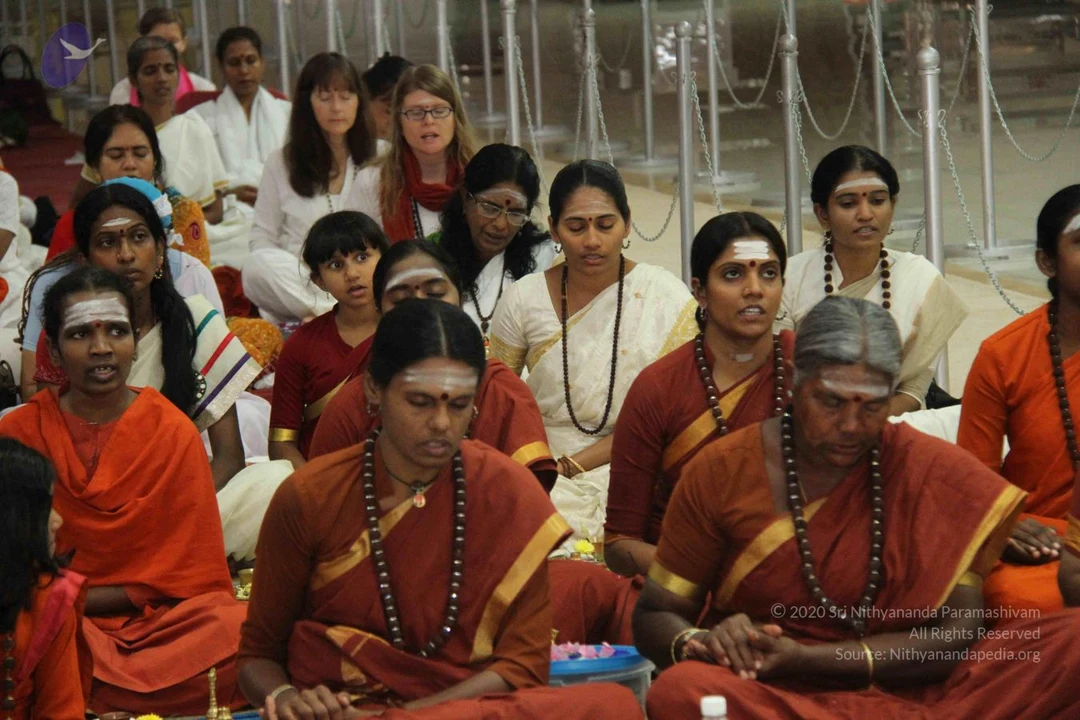
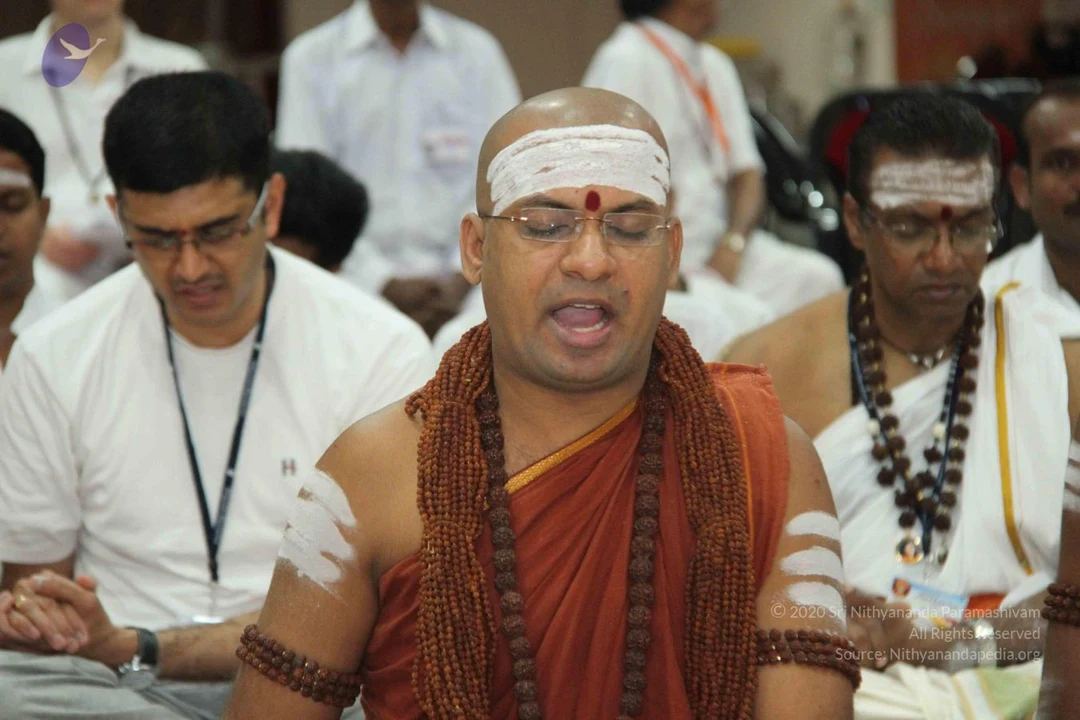
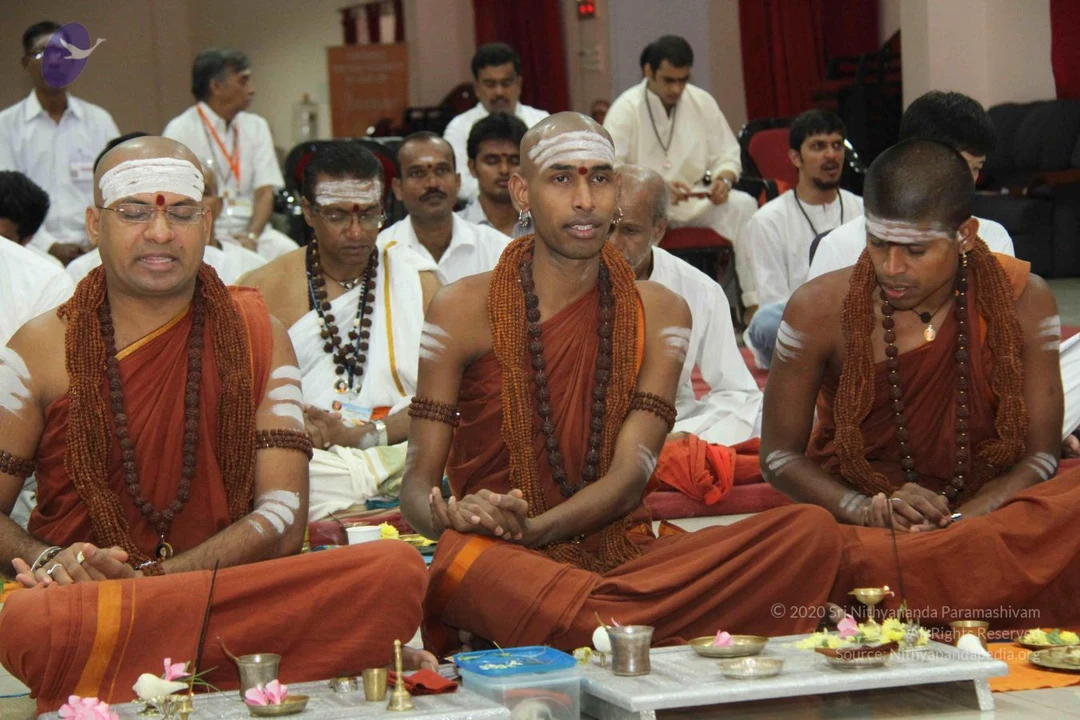
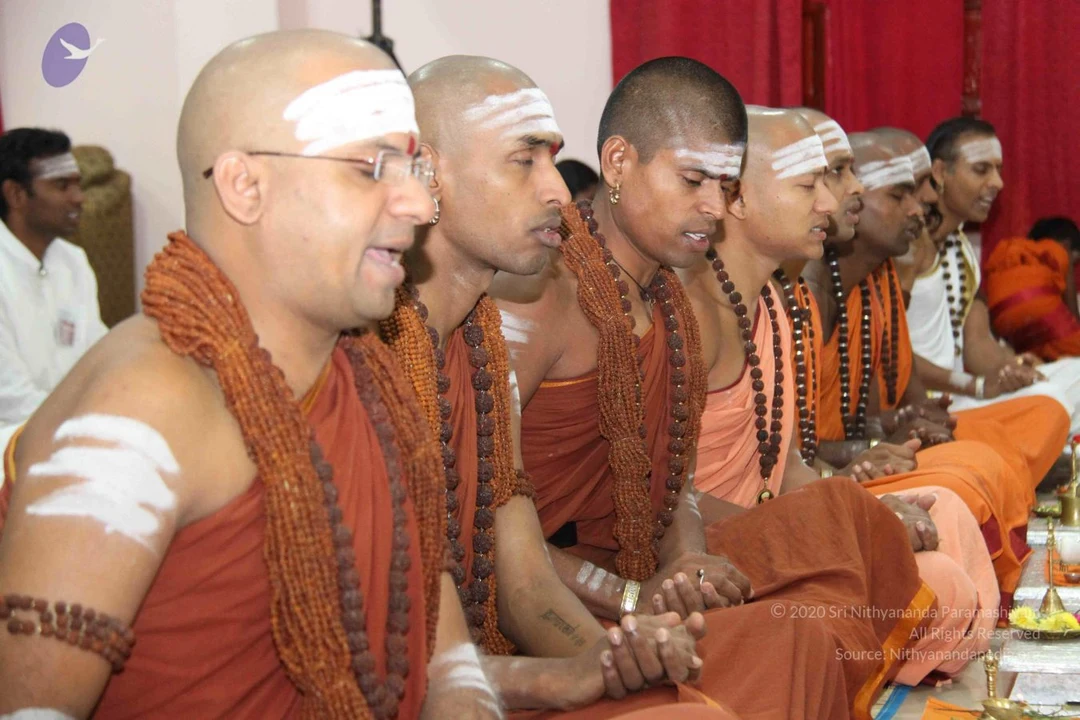
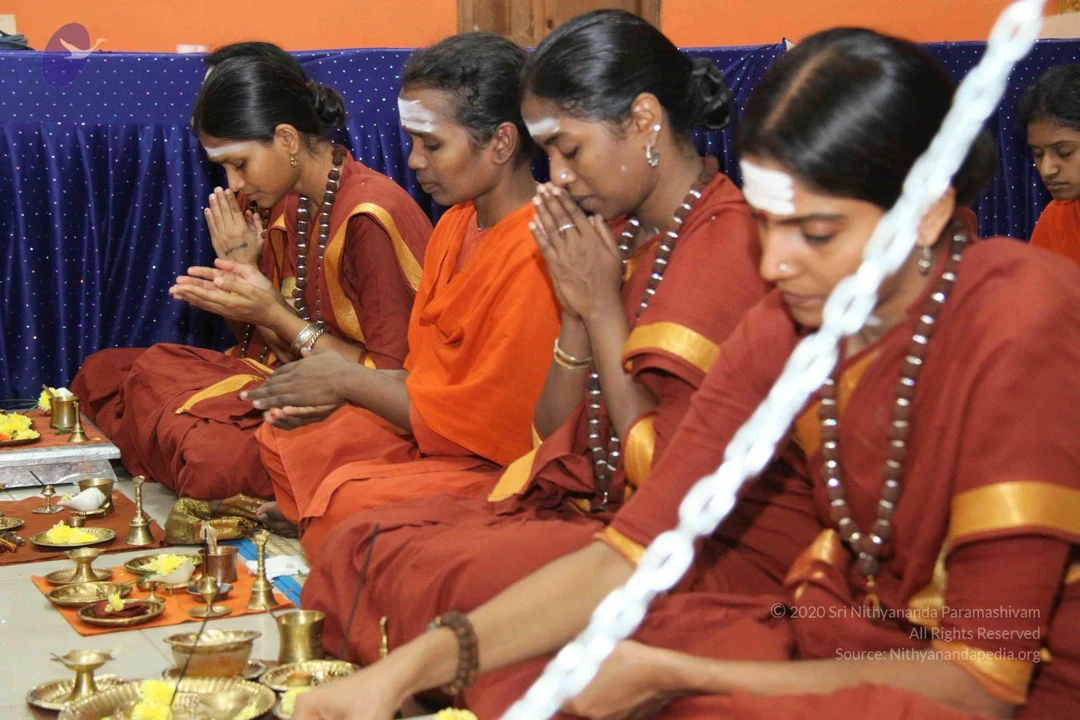
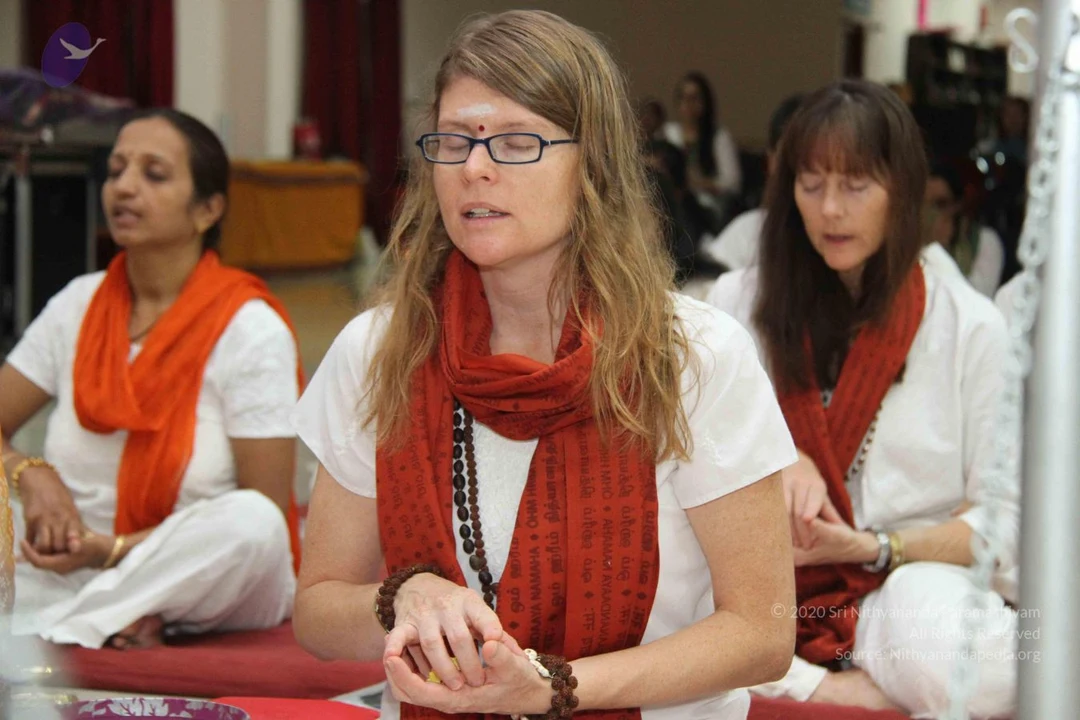
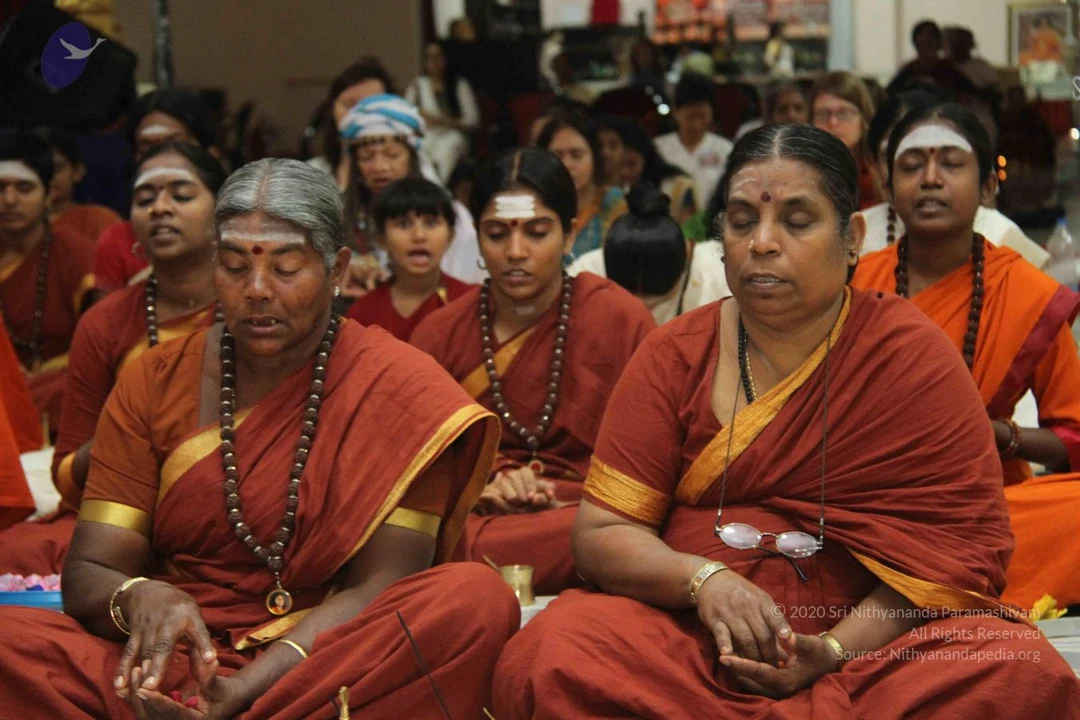
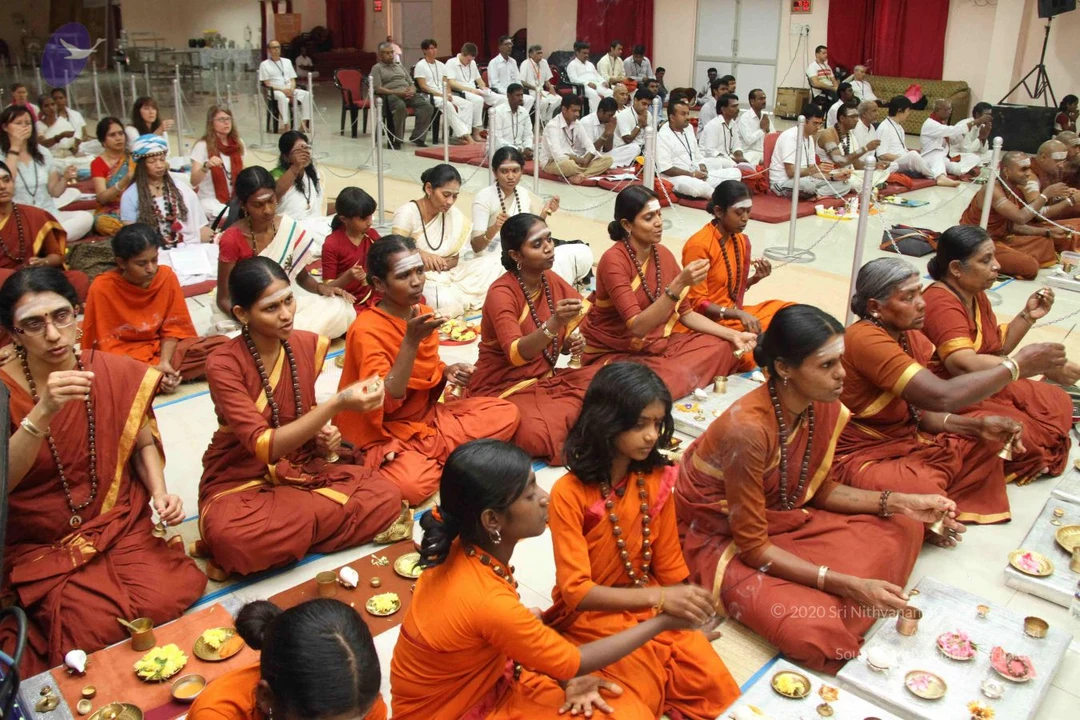
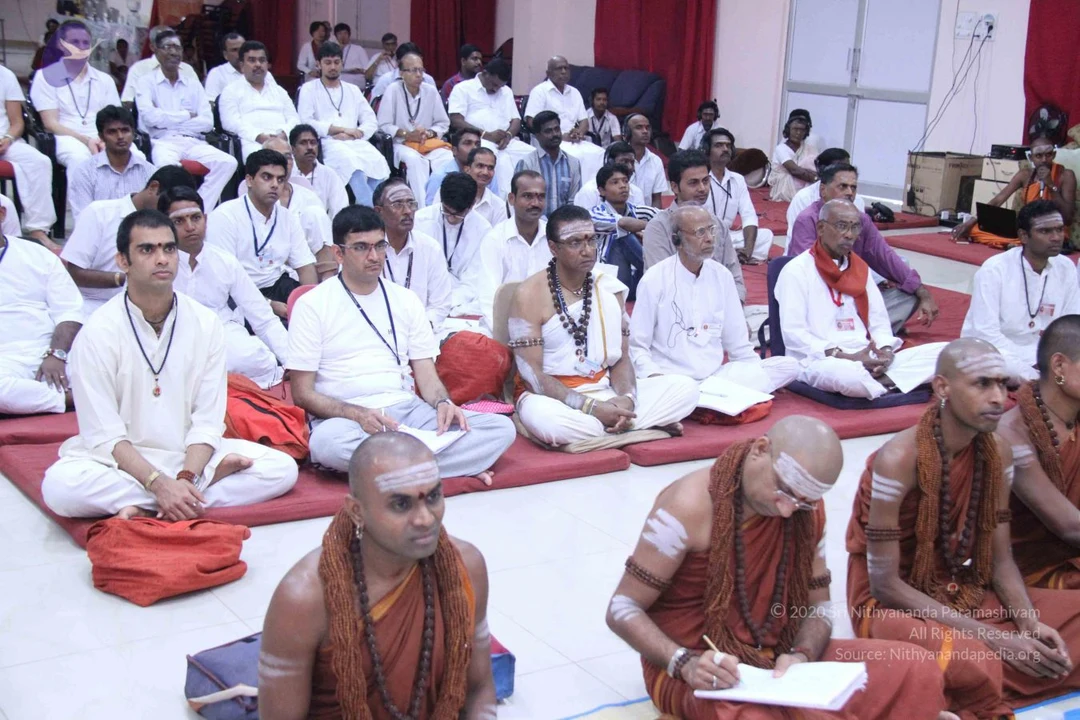
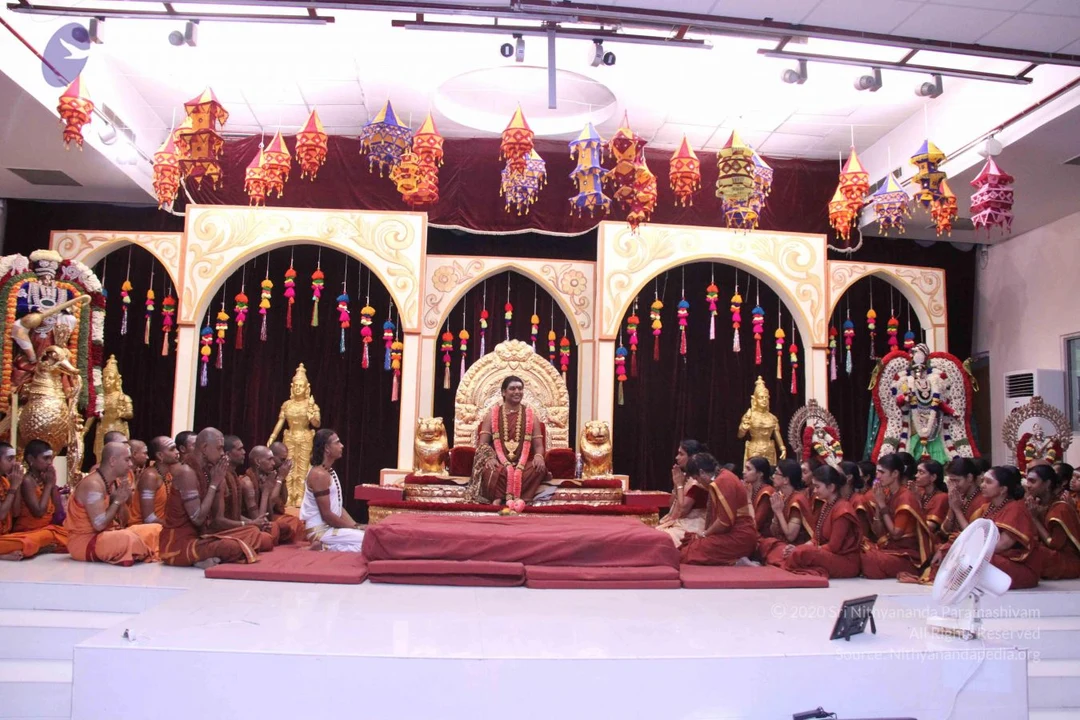
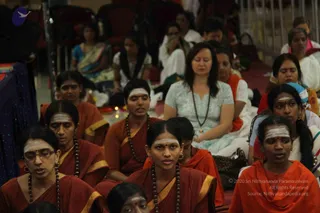
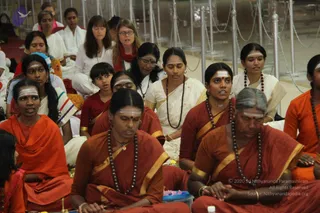
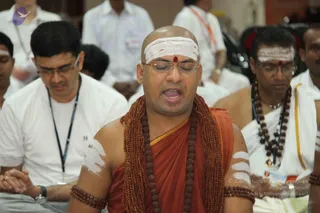
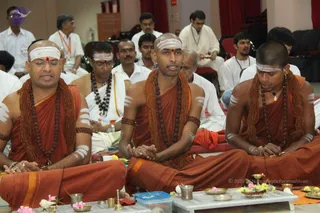
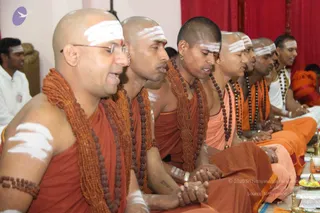
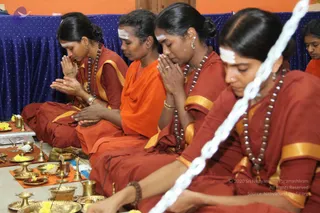
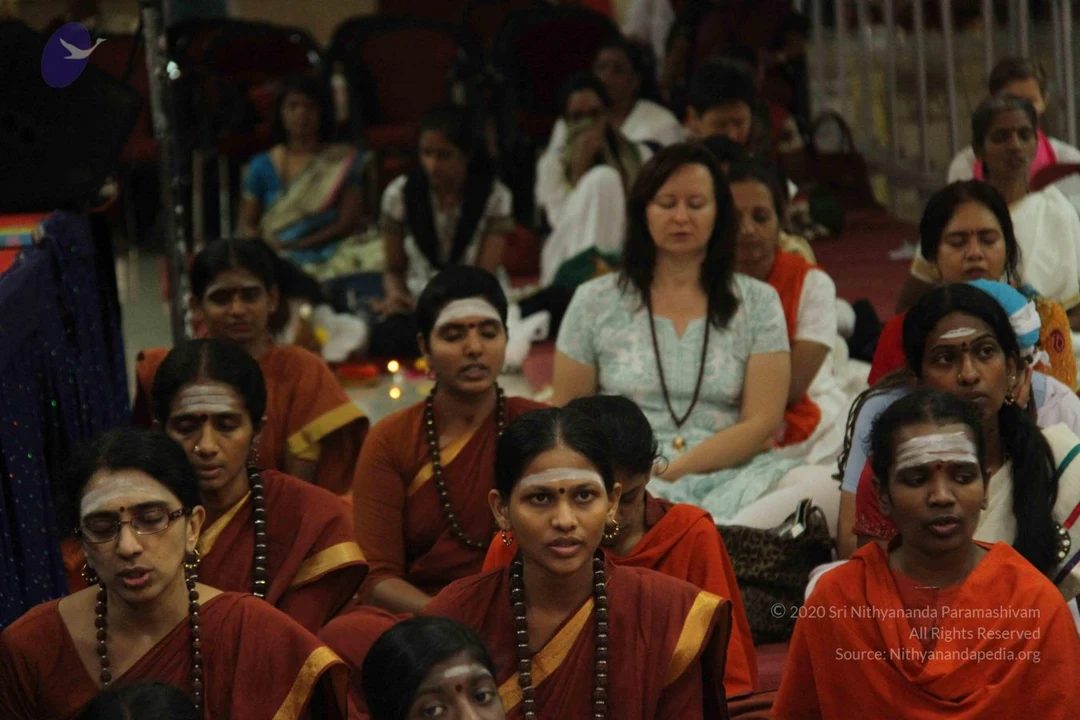
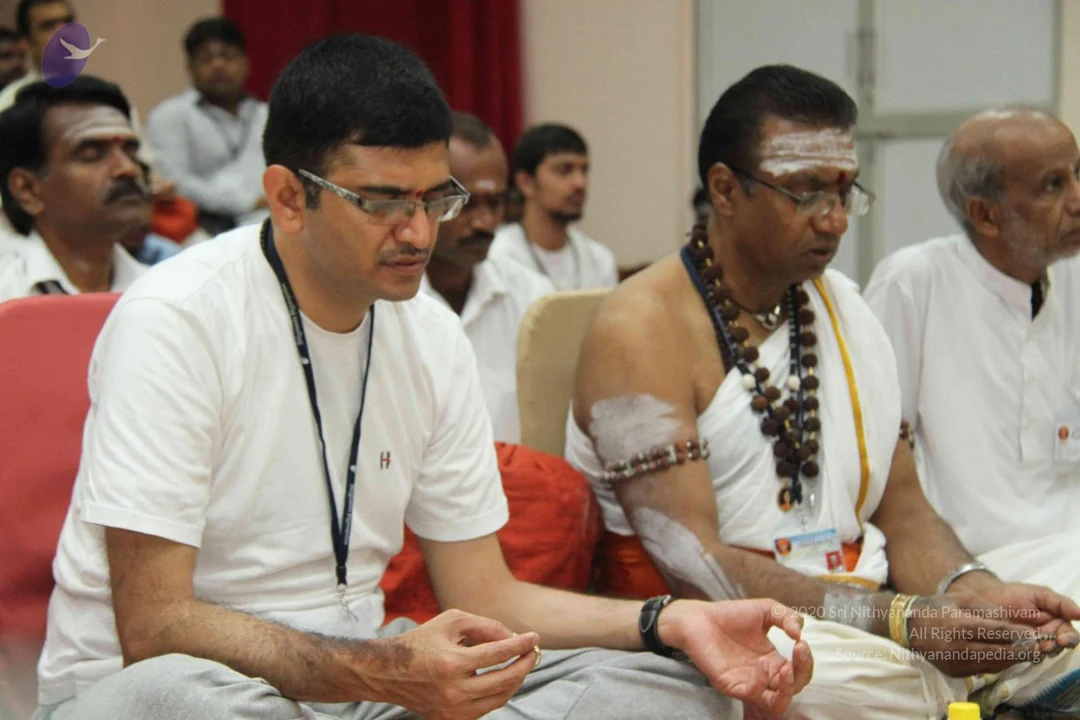
A photograph of a seated congregation at a satsang. In the foreground, several women wear rust-red and orange saris with gold borders, rudraksha malas, and white sandalwood tilak marks on their foreheads, some with eyes closed or lips parted as if chanting. Behind them, a woman in a pale mint-green salwar kameez with a long beaded mala sits with eyes closed, and others in white, blue and pink saris sit on a red carpet. A few small oil lamps glow near the floor, and a blue cloth hangs at the left edge. Some devotees are partly obscured by others in the rows.Photograph of a seated group of devotees during a chanting session in a temple-like hall with silver metal railings and chains behind them. Women in saffron-orange and red saris with rudraksha malas and white vibhuti lines on their foreheads sit cross-legged in the foreground, with several in white saris and white clothing seated behind them. Some have eyes closed or are chanting with mouths open, and brass items and flowers are placed on the floor near the front. A small girl in a red dress sits among the group. Several women in the background wear glasses and white or light clothing. Approximately fifteen to twenty people are visible.A photograph of a satsang-style gathering where a shaved-headed man in saffron-orange robes, with a rudraksha mala draped over his shoulders and bare upper arms marked with white ash bands, sits with eyes closed and mouth open as if chanting. He wears a red kumkum dot and a white band across his forehead. Around him, seated devotees in white shirts and white dhotis, some with white forehead bands and rudraksha malas, sit with hands folded in prayer. A seated man in a white shirt and lanyard badge is at left, and the room is filled with attendees.Three shaved-headed men in saffron-orange robes and rudraksha malas sit cross-legged on a raised platform in a hall, eyes closed or lowered, hands in anjali or holding incense sticks. Their foreheads and arms bear white sacred ash markings. On the table before them are brass oil lamps, small metal cups, a tray of pink and white flowers and a yellow flower garland, with a blue plastic box at left. Behind them, many white-clad men and women sit on the floor, some with rudraksha malas, watching the puja. The room has red curtains and a wall with a red-brown panel.A seated group of saffron-robed sannyasis chanting in a hall with red drapes. Most wear rudraksha malas across their chests and shoulders, and white horizontal tripundra marks on their foreheads and arms. Several have shaved heads, and one at the front left wears glasses. Their hands are folded in front of them, and brass puja items with flowers sit on a low table at the right edge. Behind them, a man in white clothes and an orange-robed figure sit as observers. No individual is clearly identifiable as a person from the visible cues, so the figures are described by role.Four women sit in a row on the floor in prayer, palms pressed together, eyes closed, wearing rust-red and orange saffron-toned robes with gold borders, rudraksha malas, white sacred ash bands on their foreheads, and bangles. In front of them is a spread of brass puja vessels, small oil lamps, kalasha-style bowls, marigold petals and yellow flowers on an orange cloth. A blue sparkly backdrop and a white chain hang in the background. No a person candidate is clearly visible.
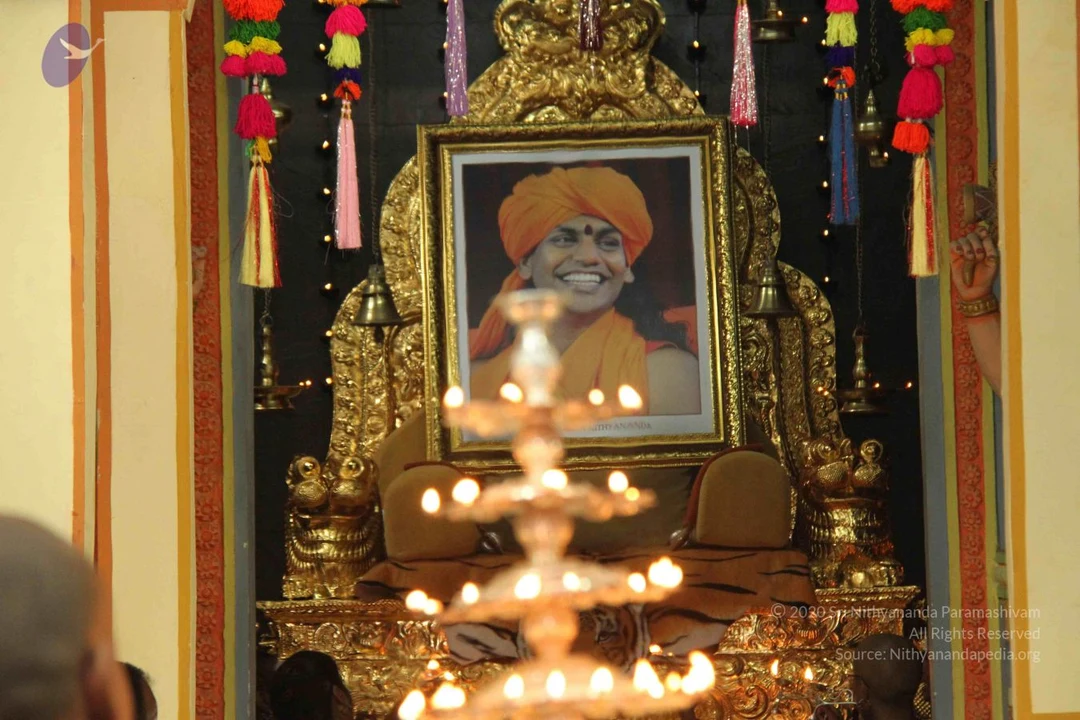
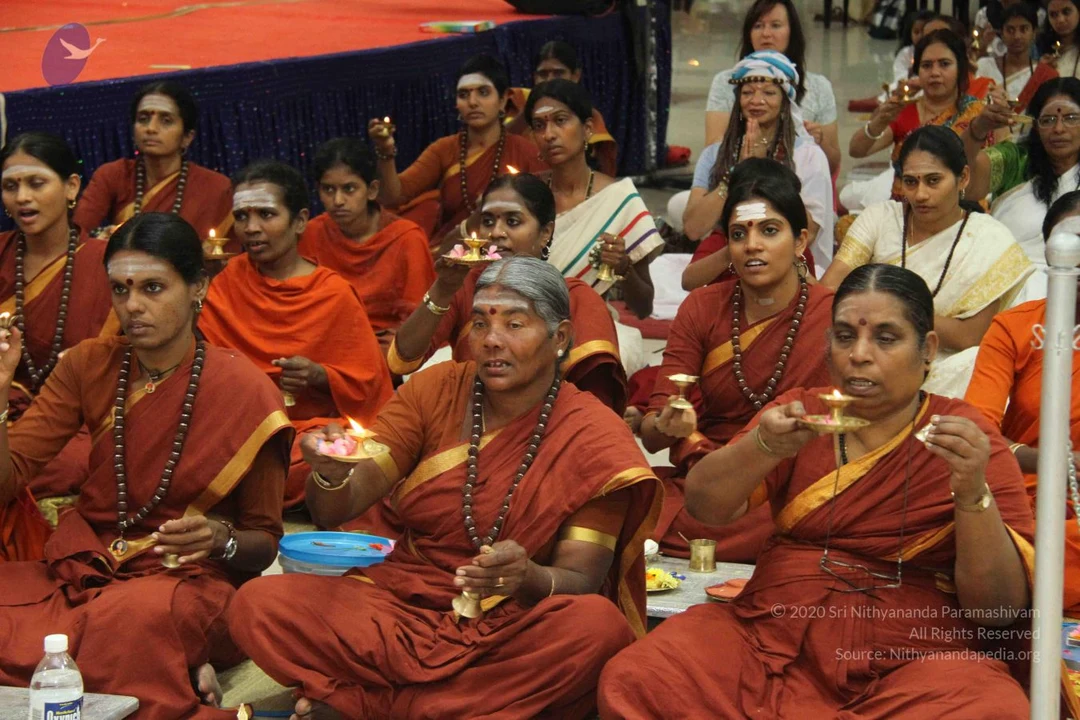
deity-aarti
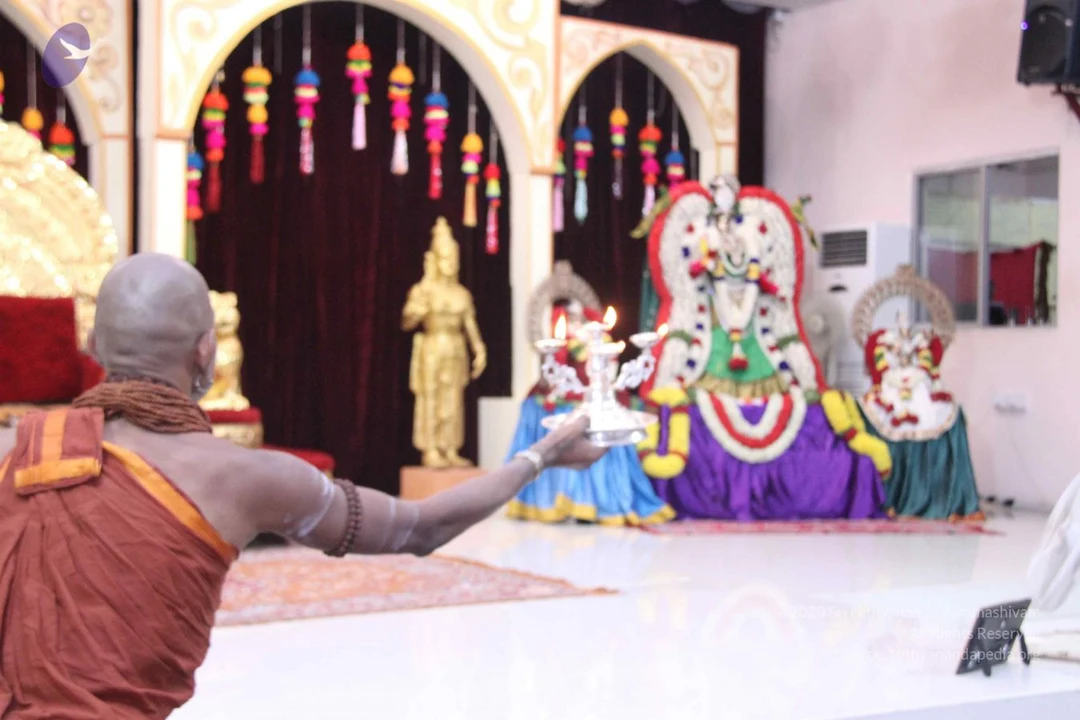
12 photosSource gallery
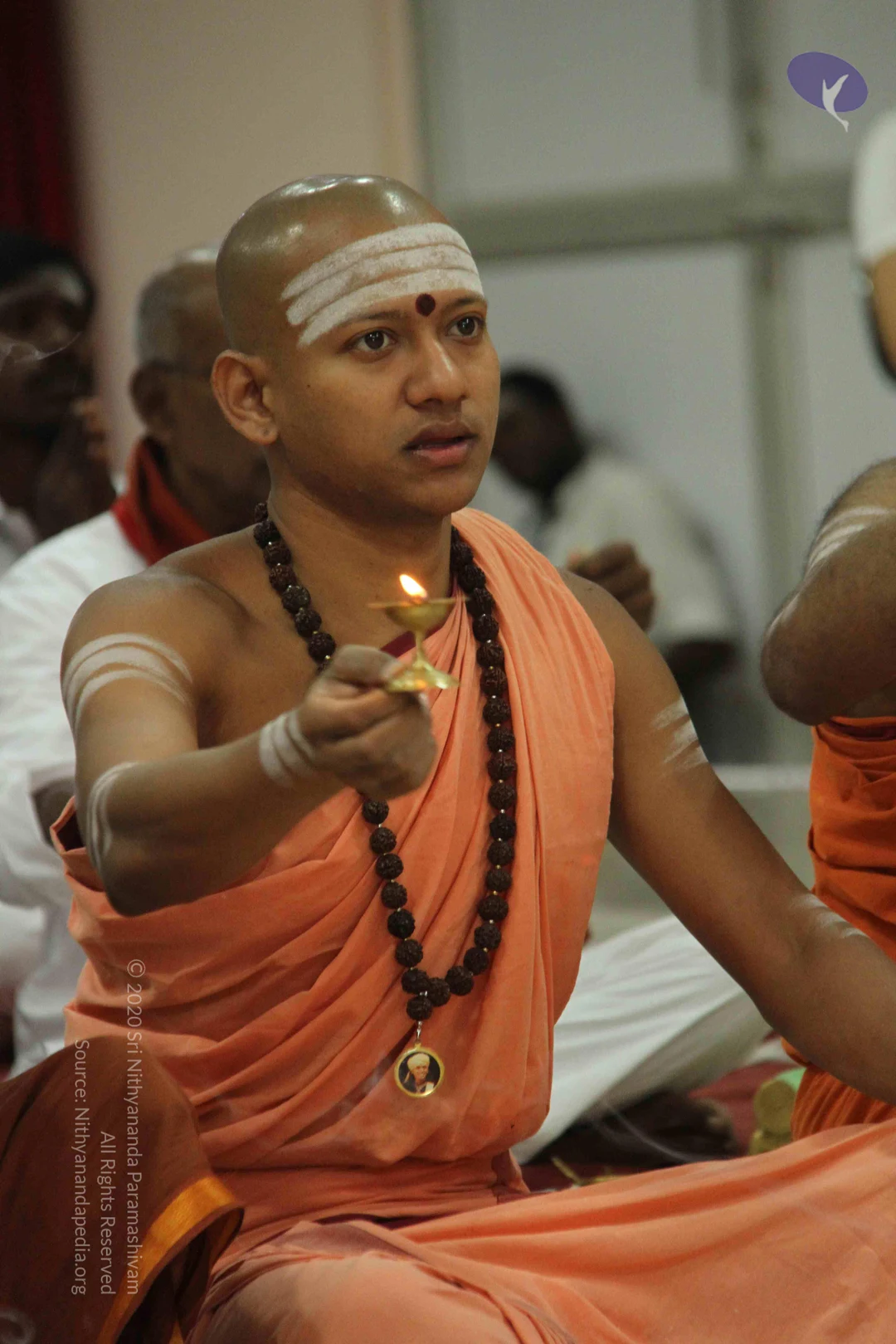
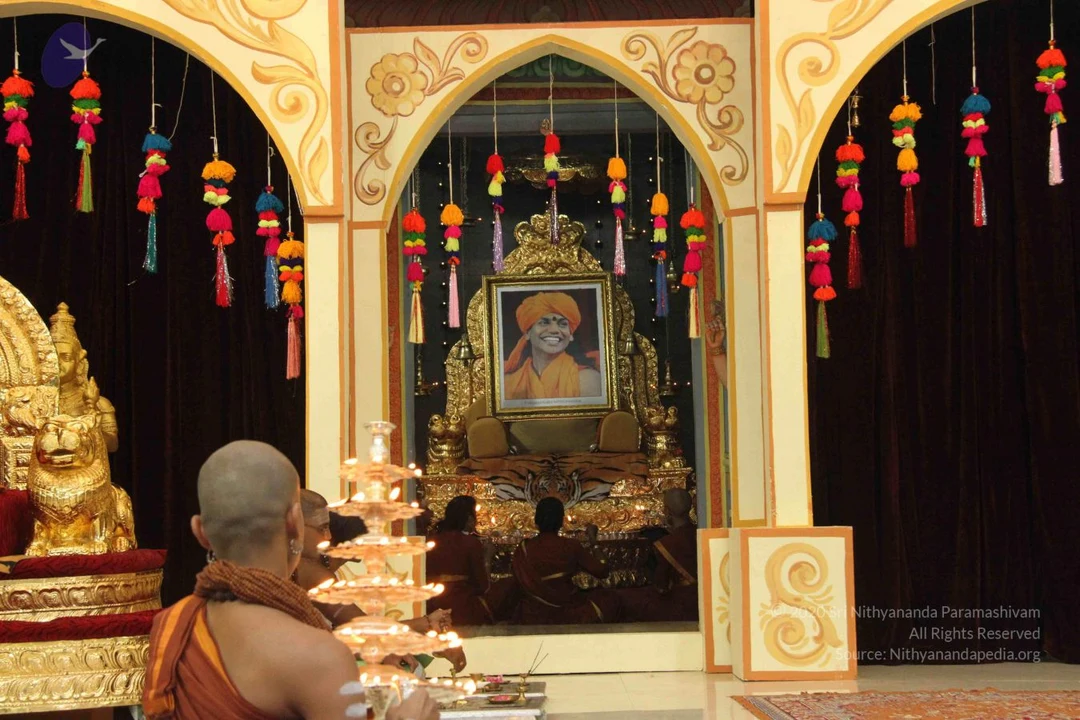
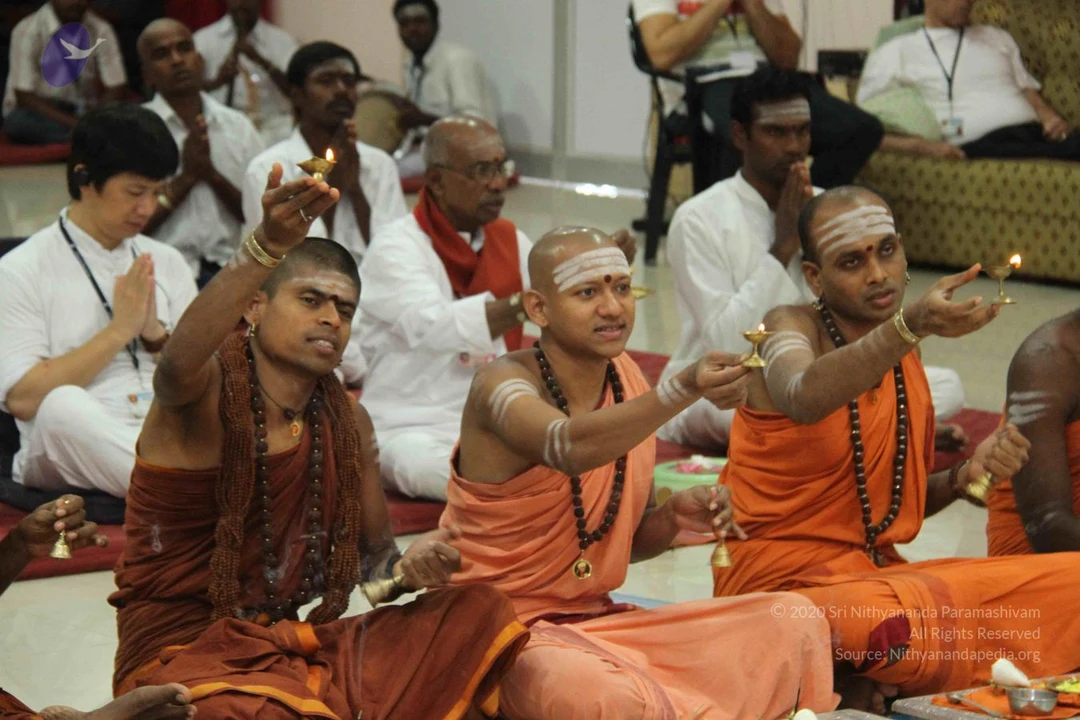
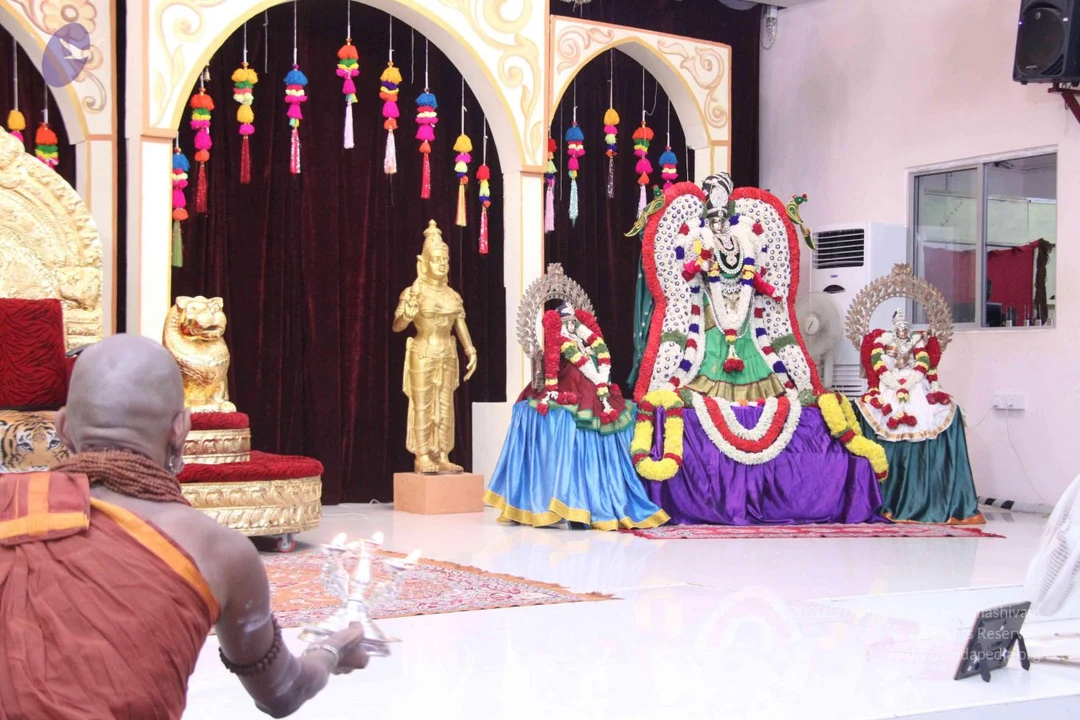
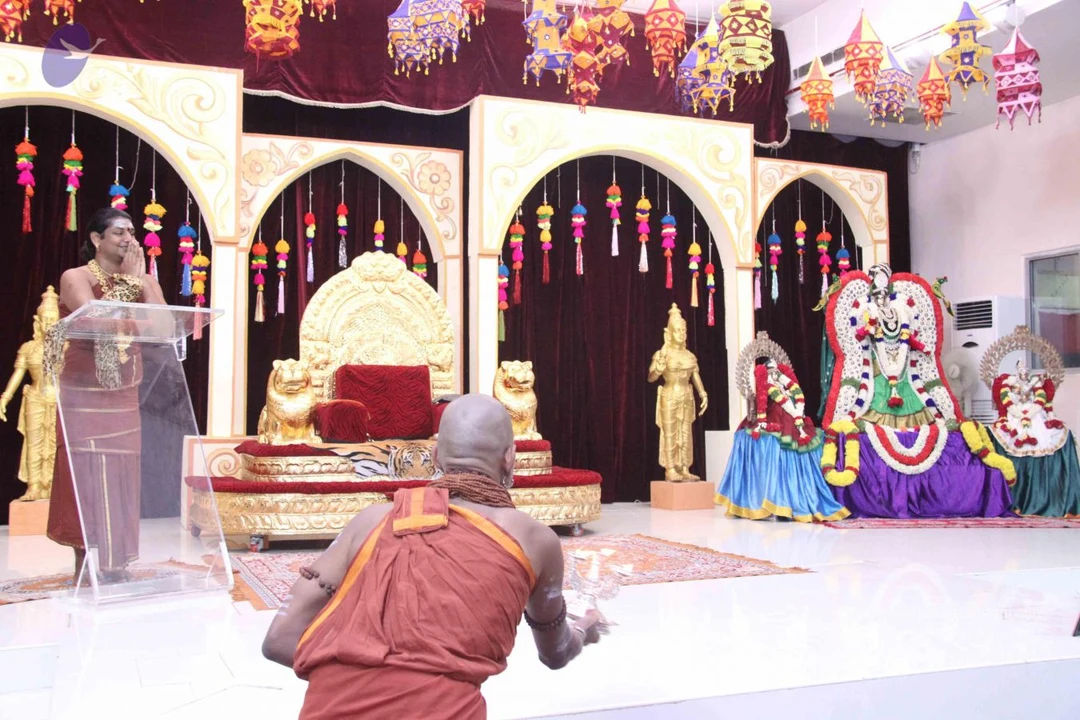
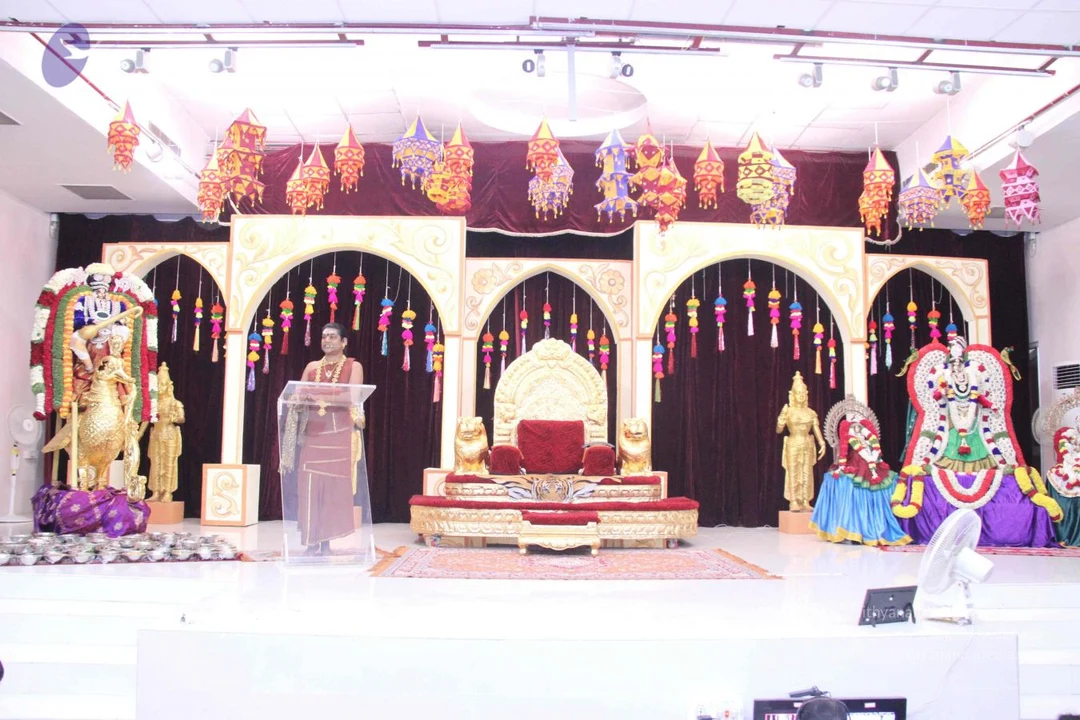
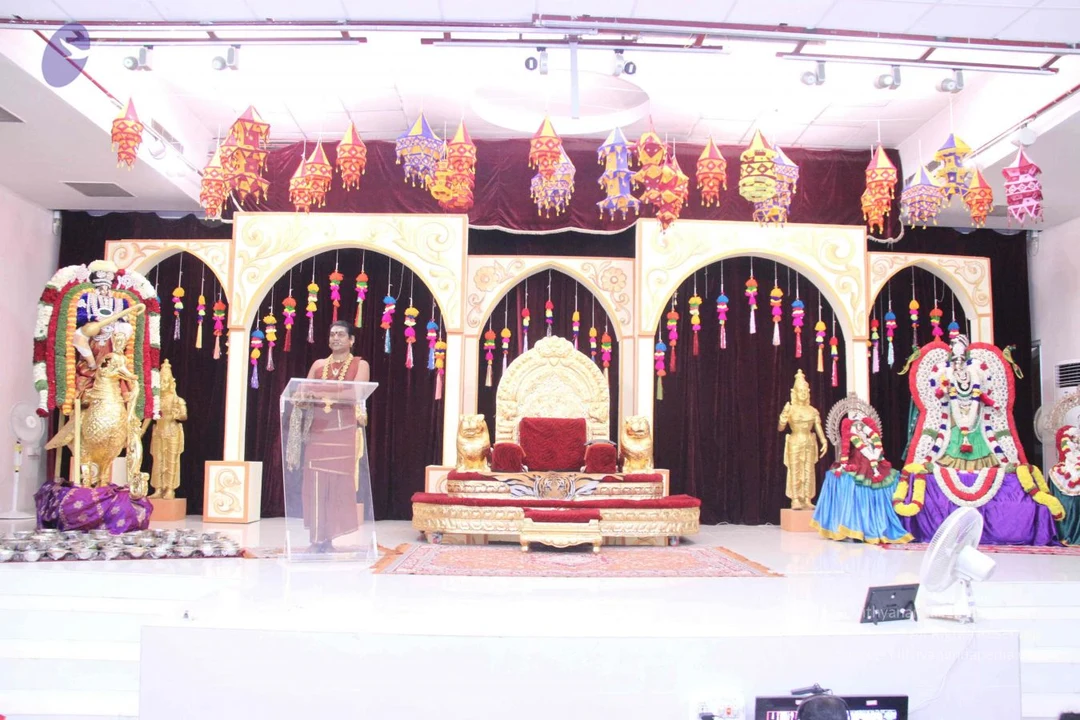
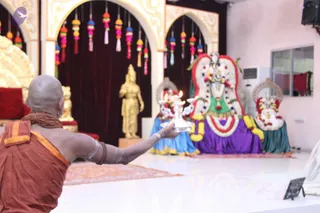
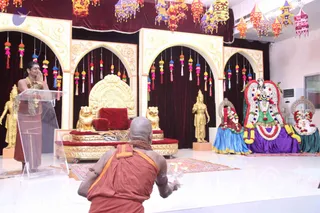
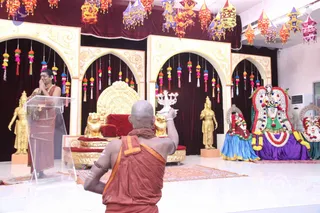
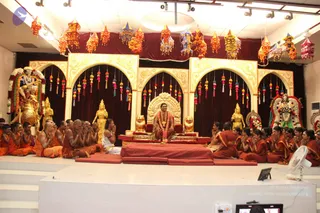
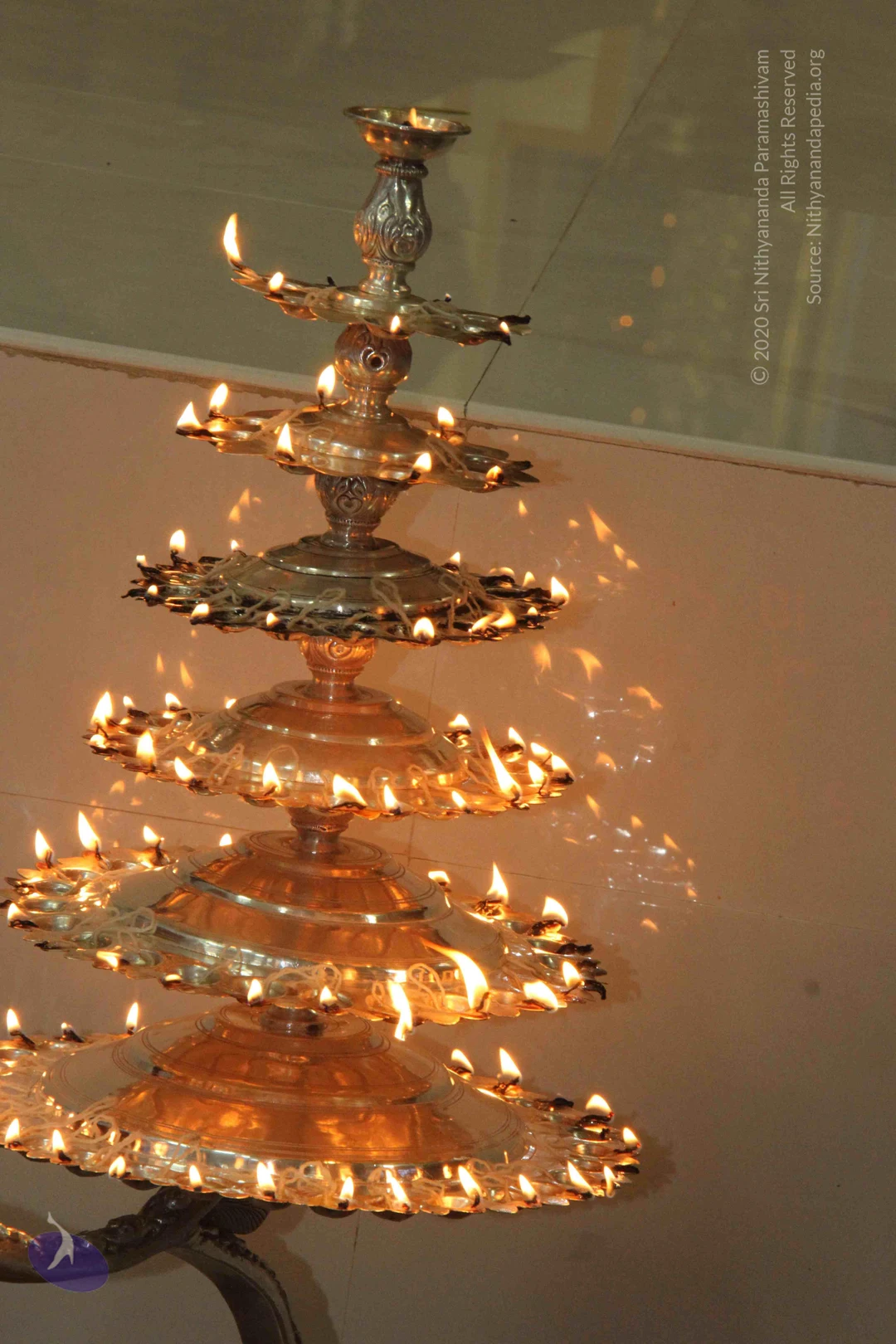
A shaved-headed priest in an orange-saffron dhoti and shawl, with a rudraksha mala around his neck and a bead bracelet on his wrist, holds a silver oil lamp with lit flames toward a decorated shrine. Behind him stands a gold-coloured standing deity murti and two decorated deity figures draped in garlands, one dressed in purple and green and another in blue and gold. Strings of colourful tassels and red-and-yellow hangings hang above, with a golden throne-like seat at left. Only the priest is a visible physical person.A bare-shouldered priest in an orange-saffron cloth with a rudraksha mala stands at the lower left, facing a stage decorated with a fully adorned deity murti pair seated on flower-garlanded thrones. The central deities wear green and purple garments draped with white and red garlands, and two smaller seated murtis in blue and green cloth sit on either side. A gilded standing deity statue stands between a gold lion-armed throne and the altar. Multicoloured tassels hang from arches behind, and the priest holds a brass lamp that appears to be an oil lamp during the puja.A stage set for a Hindu temple-style programme with a shaved-headed man in orange-saffron robes seated at the left edge, seen from behind, facing the stage. Centre stage, a large decorated deity murti with garlands of white and red flowers sits on a purple throne, flanked by two smaller seated murtis in blue and green garments with red garlands. A gold standing figure stands nearby, and a gold lion-form seat and a red cushioned seat appear at left. Strings of colourful tassels hang from arches behind, with a maroon curtain and a wall fan at right.A woman in a maroon sari with gold jewellery stands at a clear acrylic podium on the left, hands pressed together in greeting. In the centre, a bald man in an orange-and-saffron robe kneels with his back to the camera, holding a small object in his hands before a raised stage. Behind him is an empty ornate golden throne with a red cushion flanked by golden lion figures, under gold arches hung with colourful tassels and paper lanterns. To the right, a deity murti dressed in purple, red and green garments with garlands stands beside two smaller figures in blue and green skirts, and golden standing statues frame the stage.A stage set with a gold-framed throne draped in red cushions, flanked by two golden lion figures, with colourful paper lanterns and tasselled hangings above. A bald man in an orange-red wrap stands in the foreground, back to the camera, raising a lit oil lamp toward the throne. On the left, a woman in a gold-embroidered sari stands at a clear acrylic lectern with her hands pressed together in greeting. To the right, two deity murti are dressed in colourful garlands and silk, with flowers and floral garlands surrounding them, and a standing gold figure stands between the throne and the right side of the stage.A photograph of a temple-style ritual in a hall. In the foreground, a shaved-headed man in an orange-and-saffron robe with rudraksha beads raises a silver lamp stand with lit flames toward a deity murti. Behind him, a golden bull (Nandi-style) figure sits on a purple cloth before a dark-haired deity murti decorated with white and red flower garlands, a crown and a silver ornamental necklace. Rows of small brass oil lamps are arranged on the floor. To the right, a woman in a maroon sari and gold necklace stands at a clear podium. Golden standing figures flank the scene, and colourful tassels hang from the arches above. A man in saffron is performing aarti before the murti.

nithya-satsang
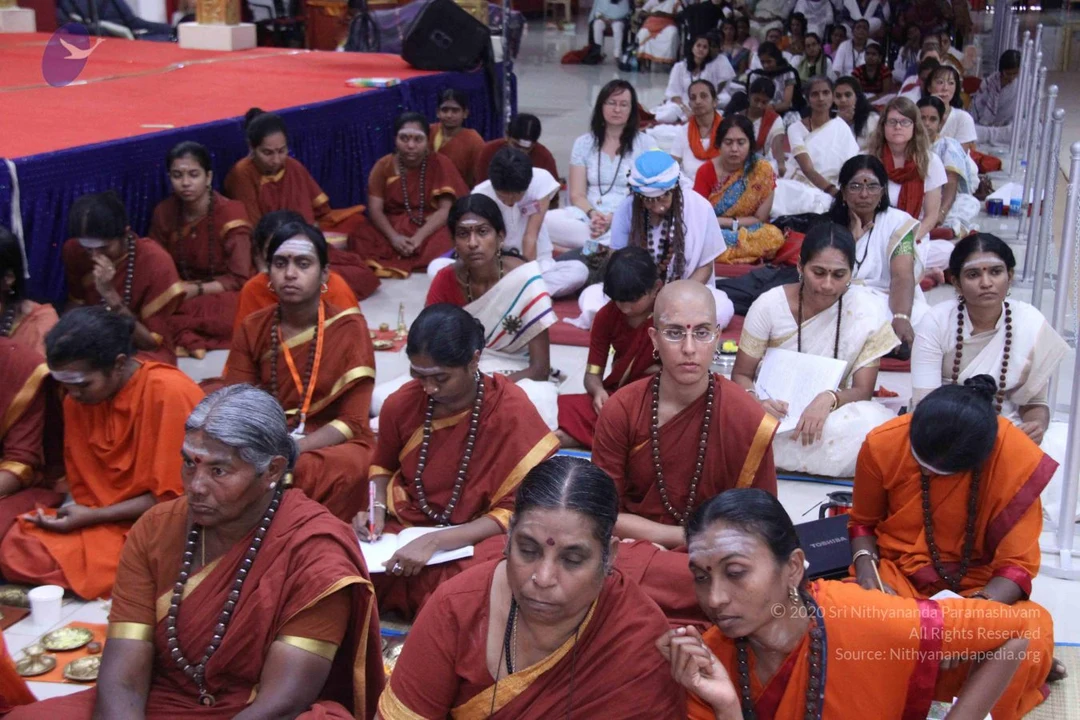
38 photosSource gallery
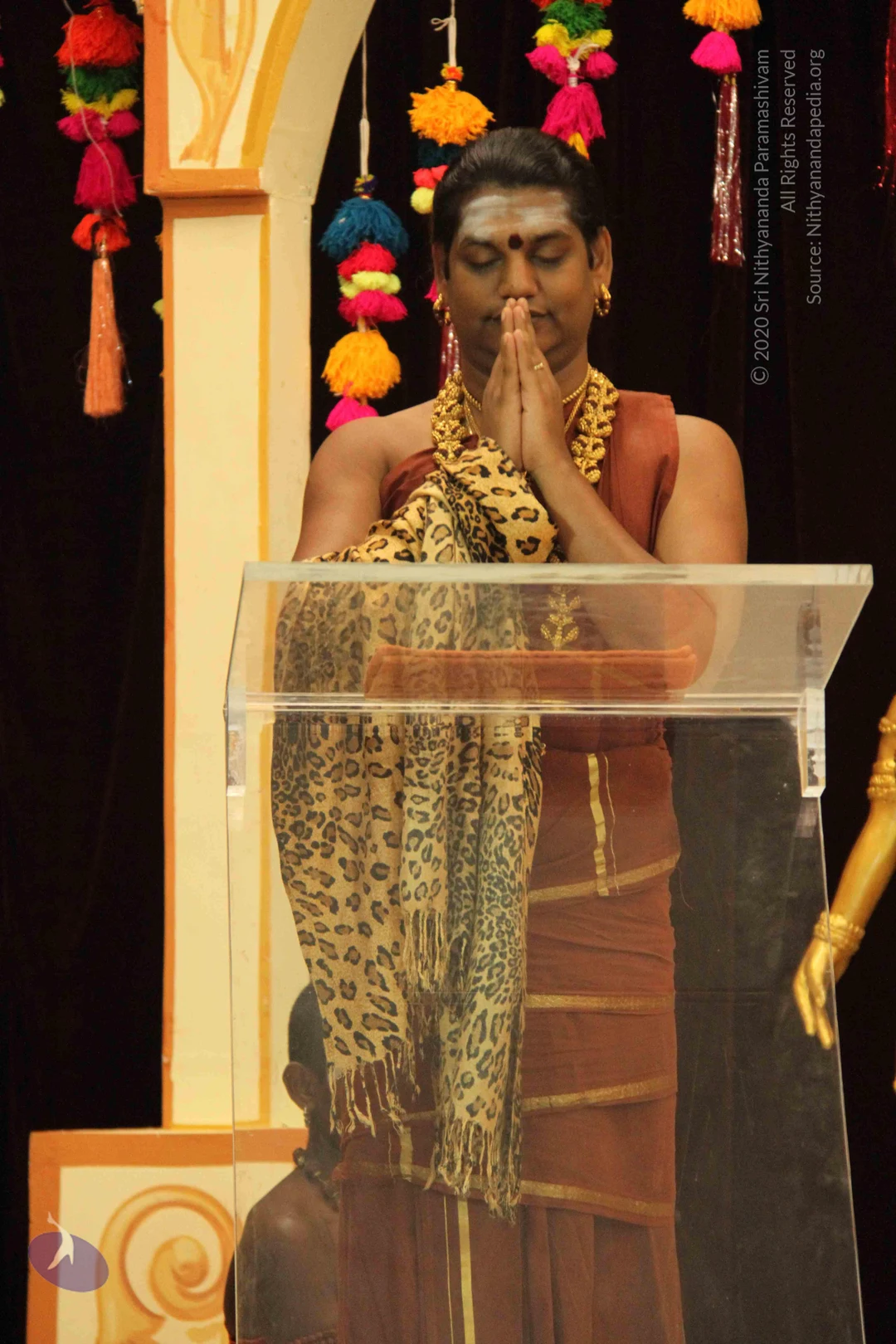
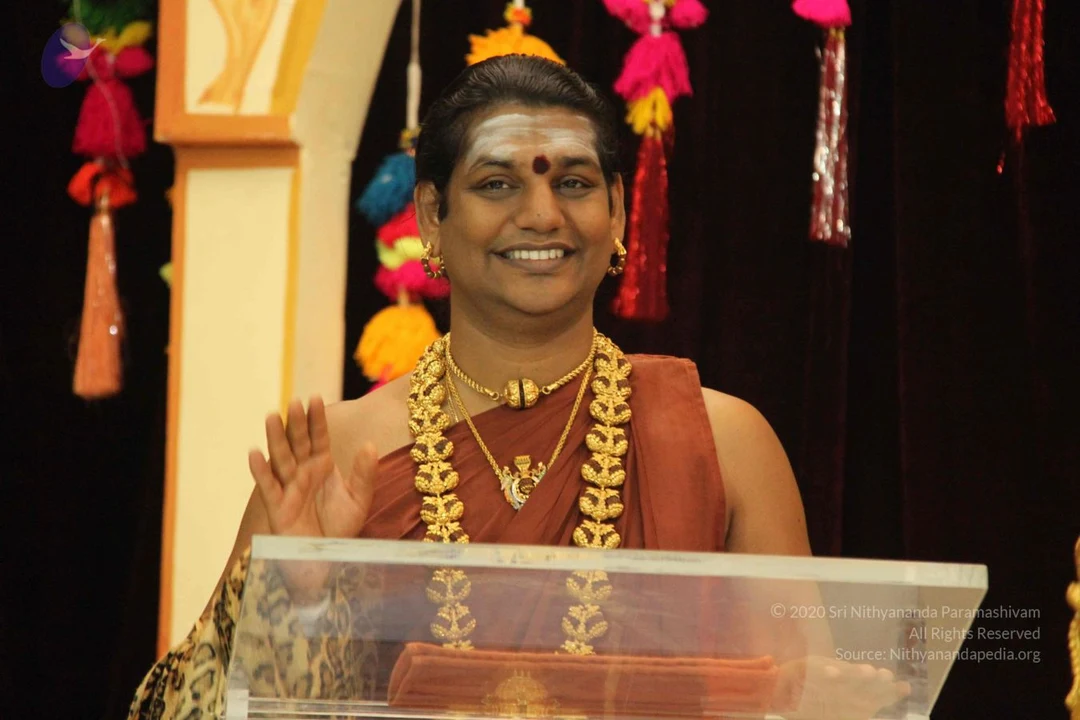
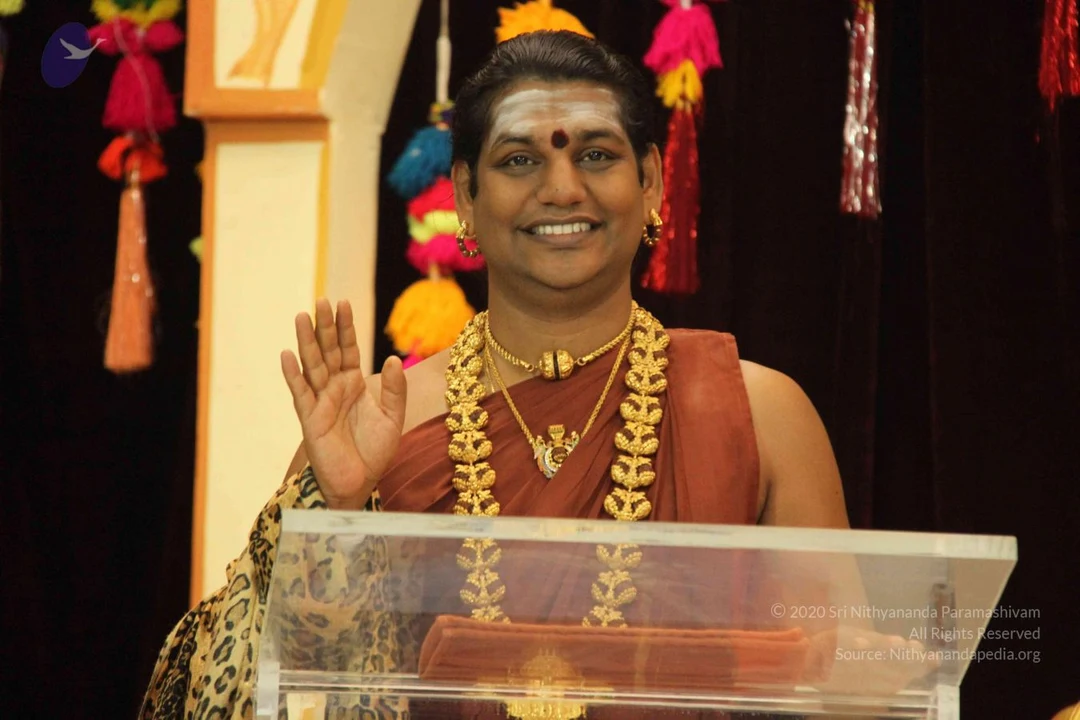
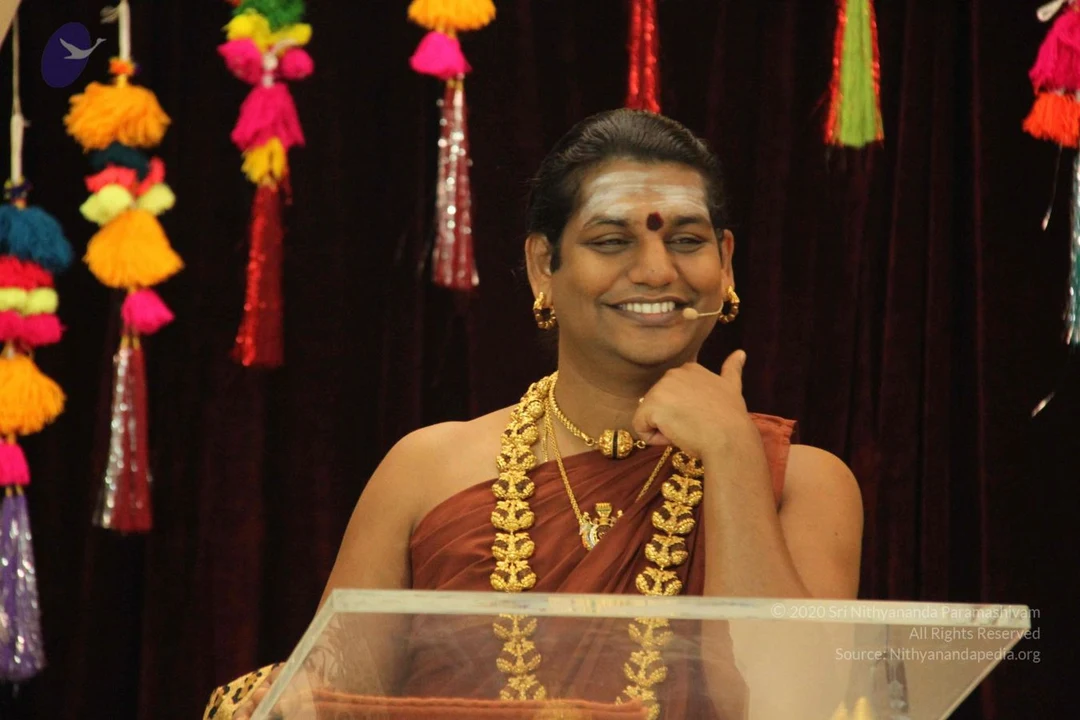
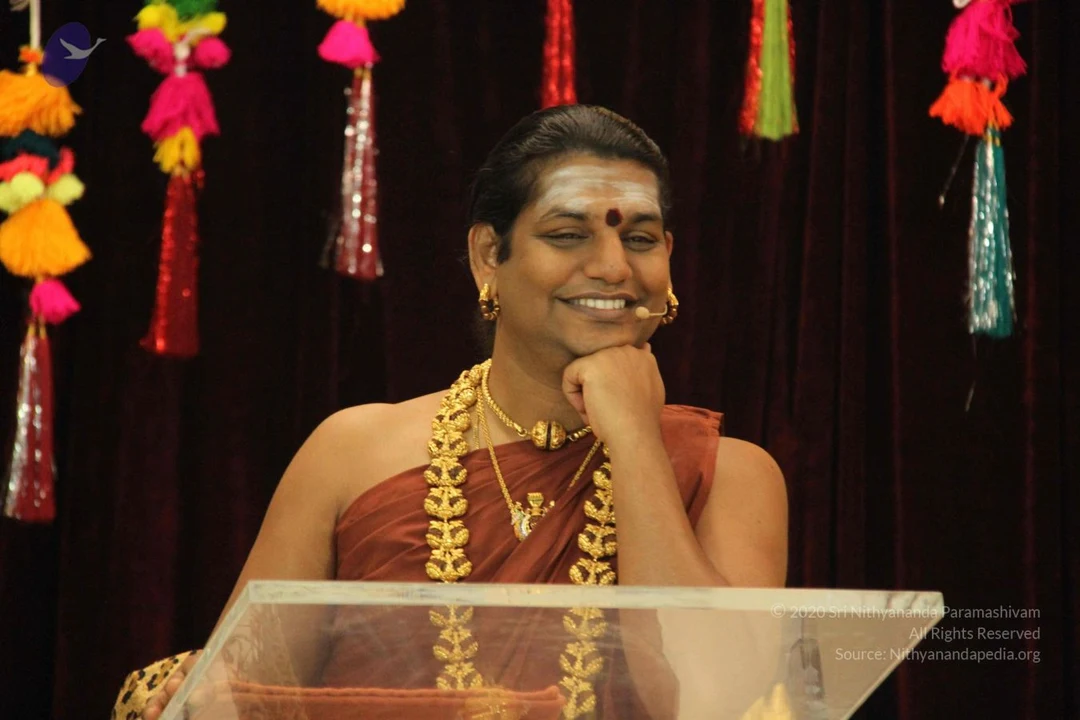
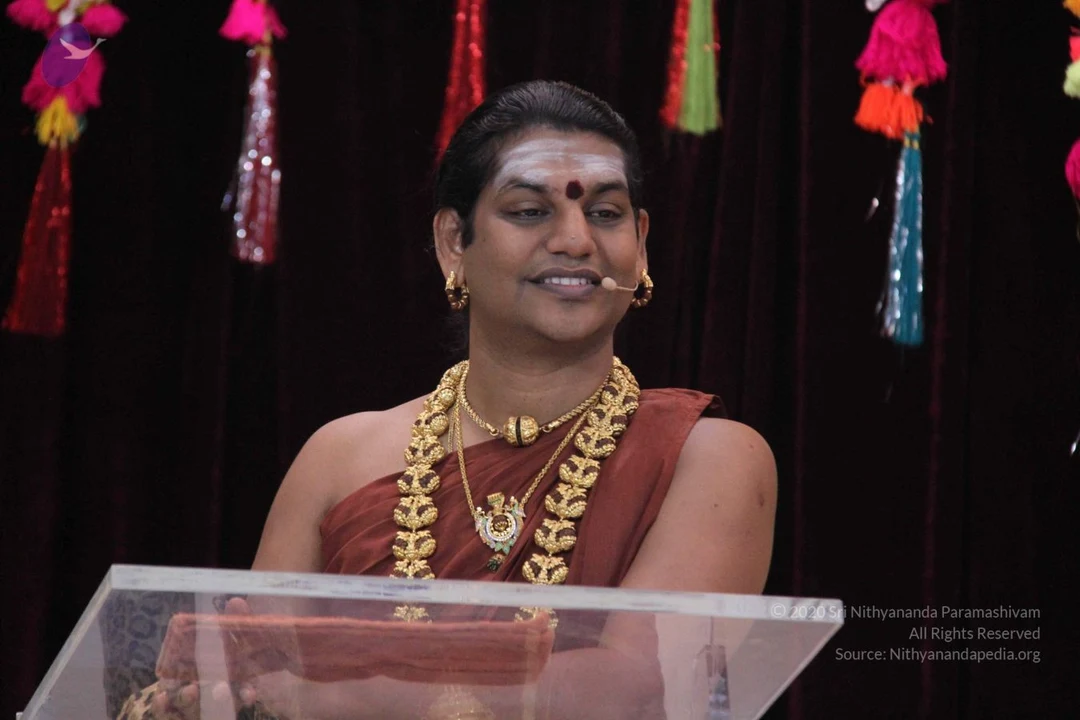
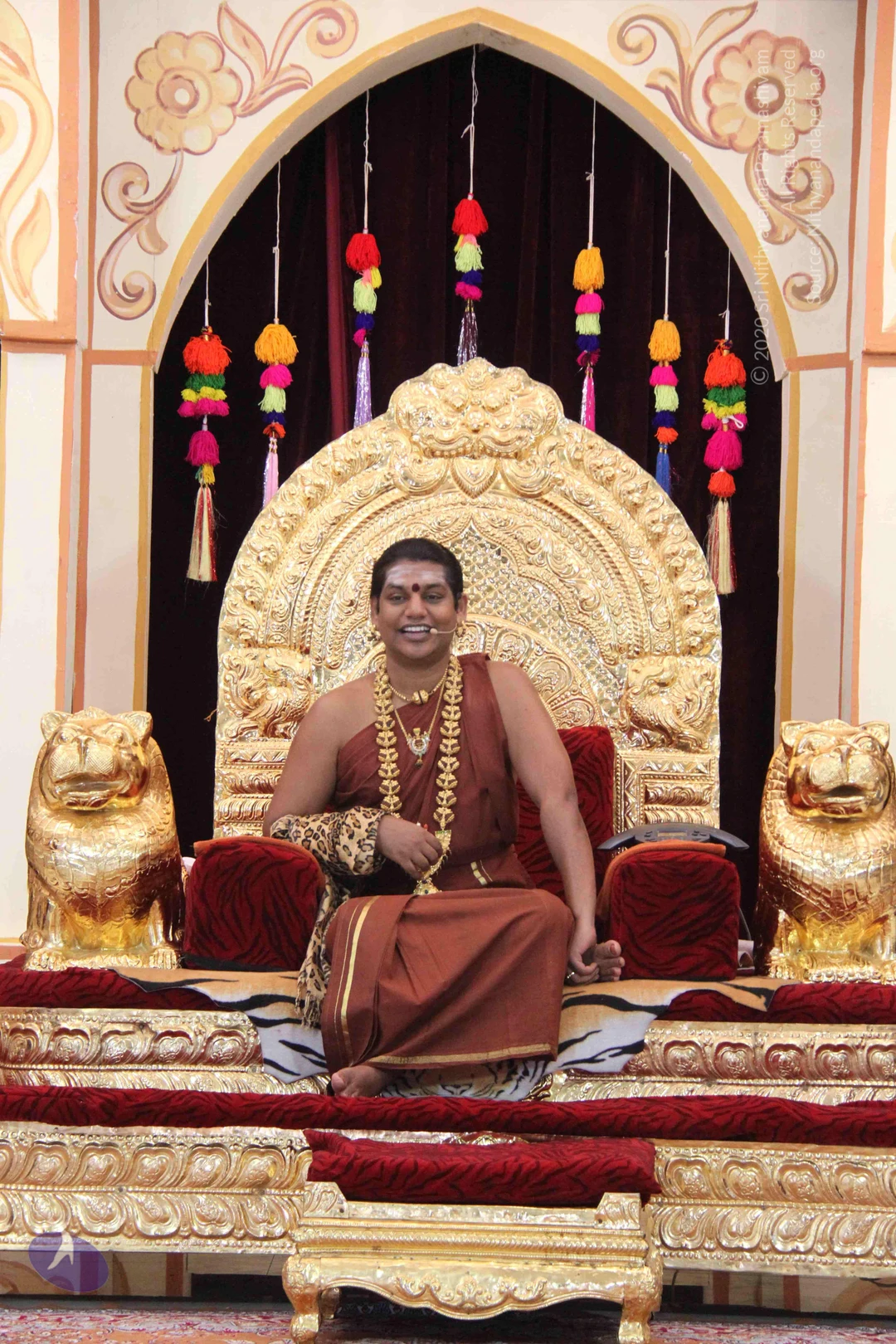
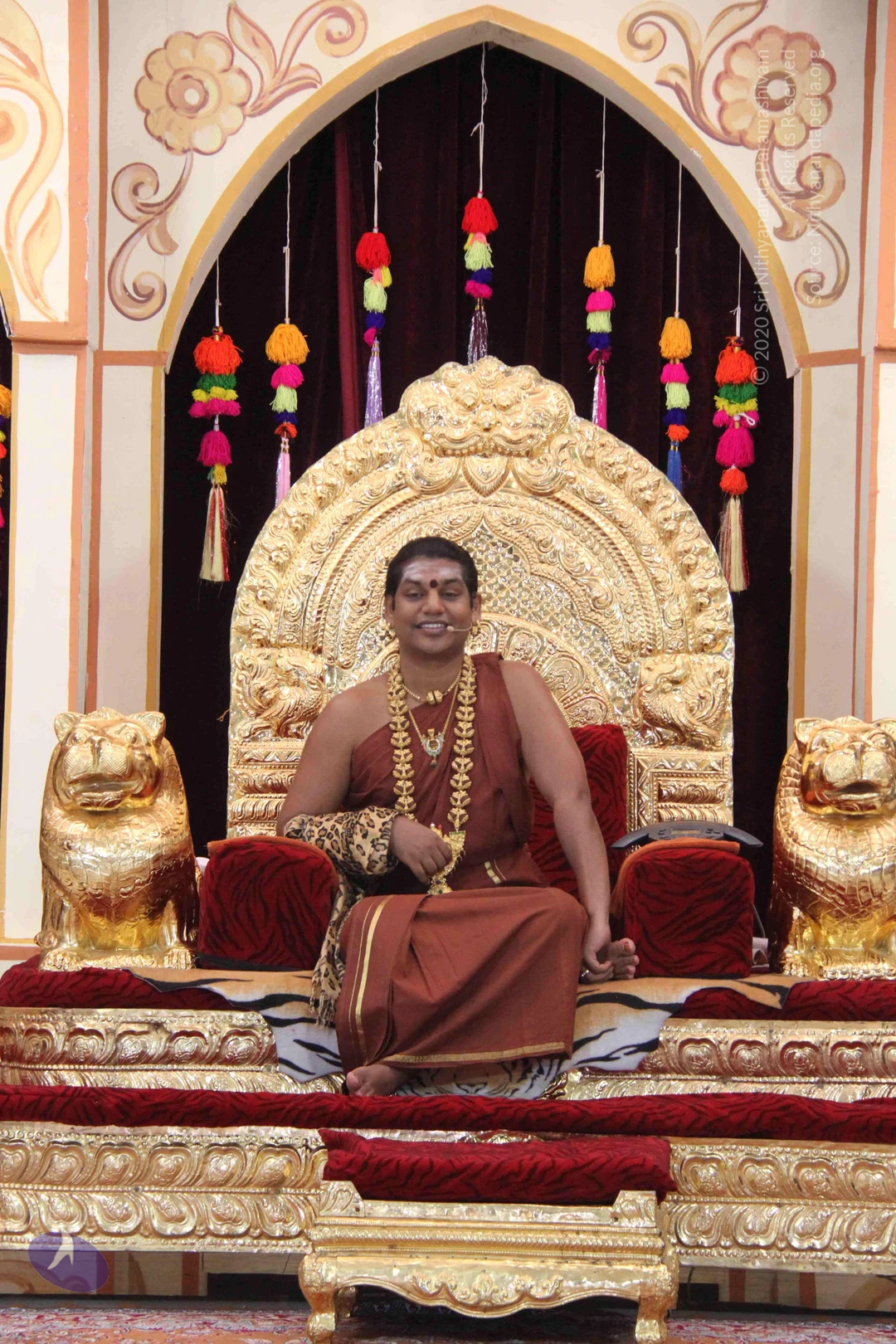
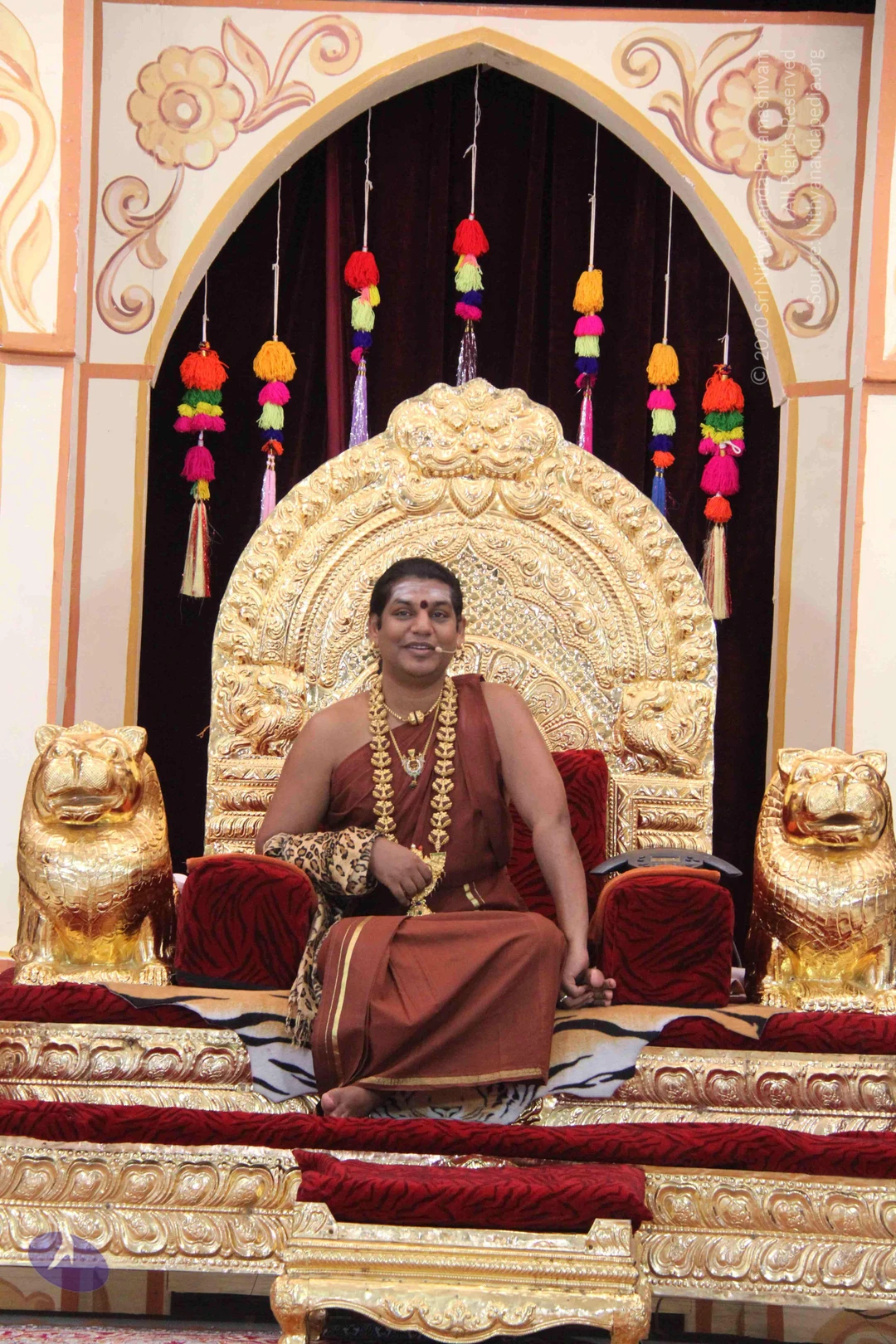
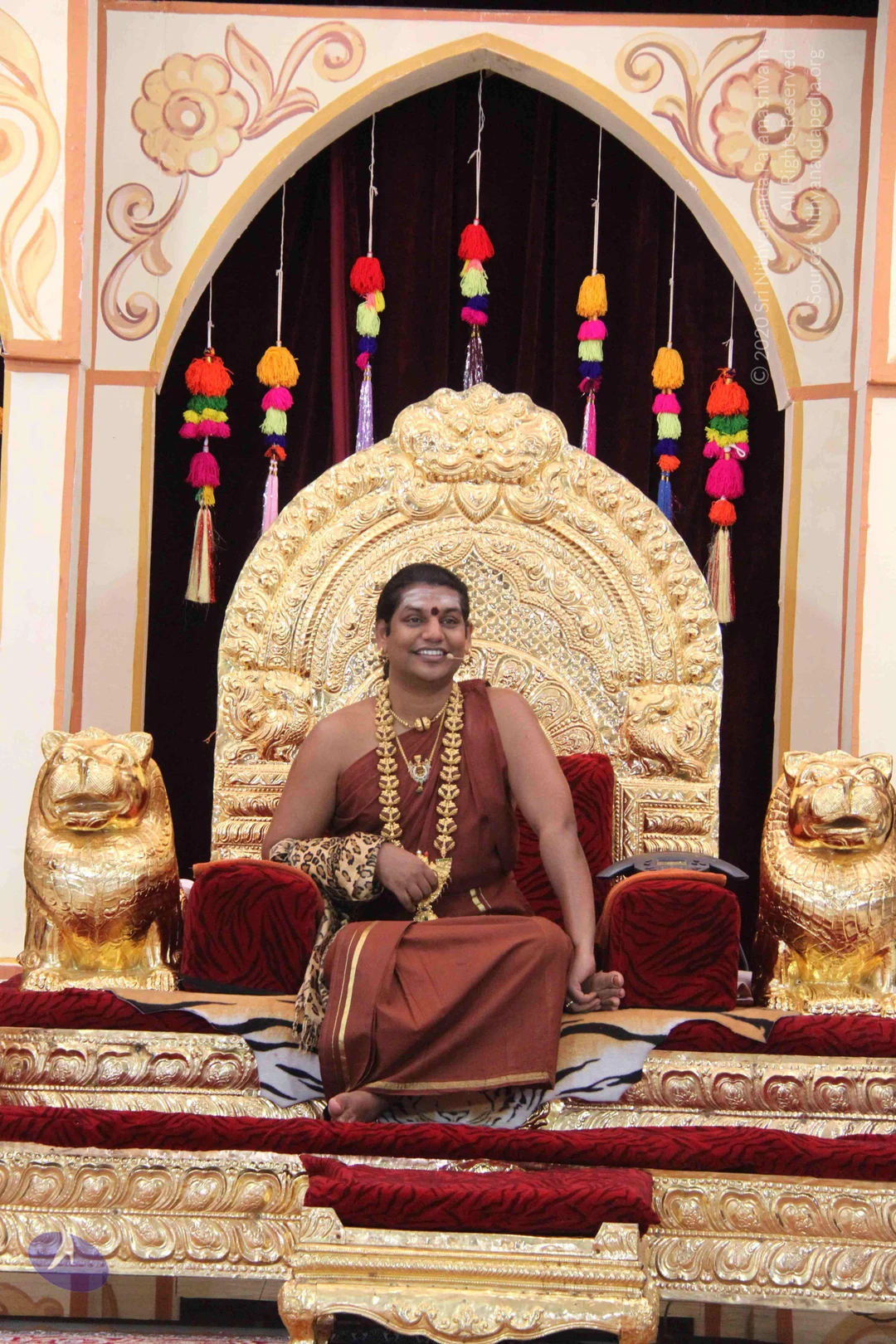
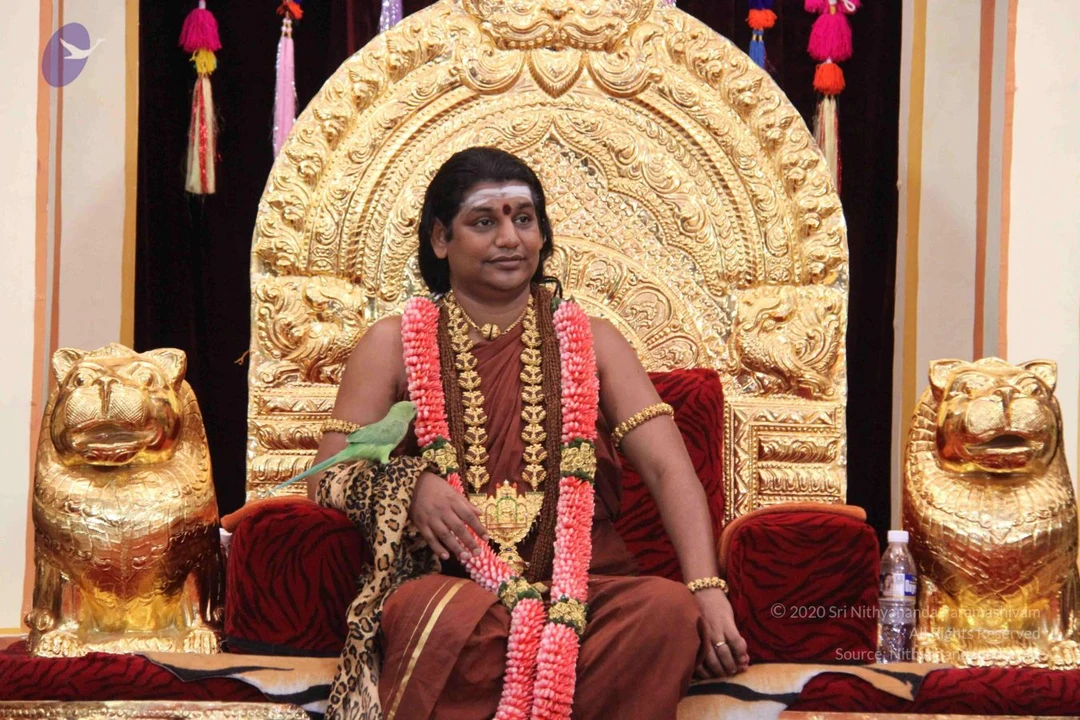
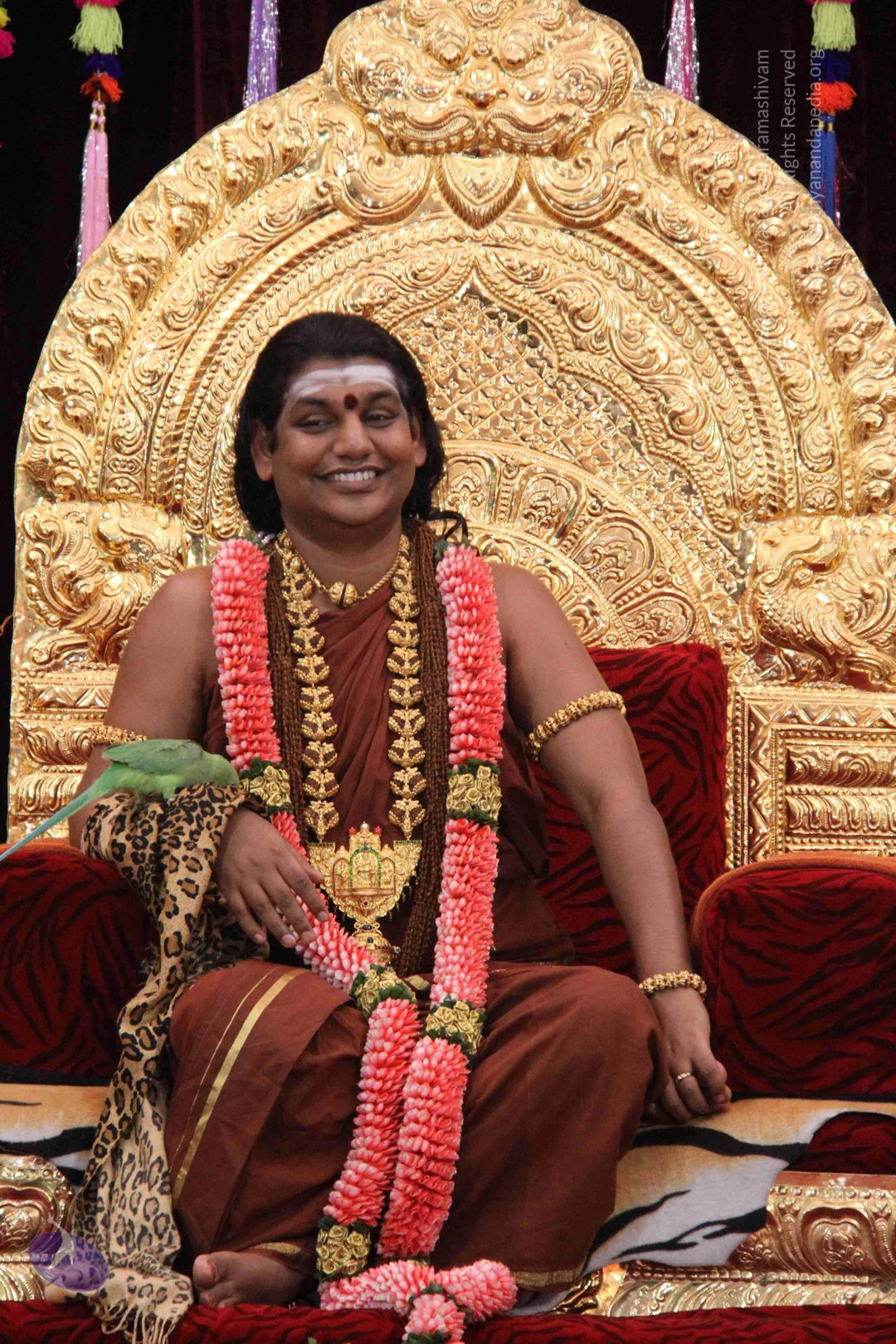
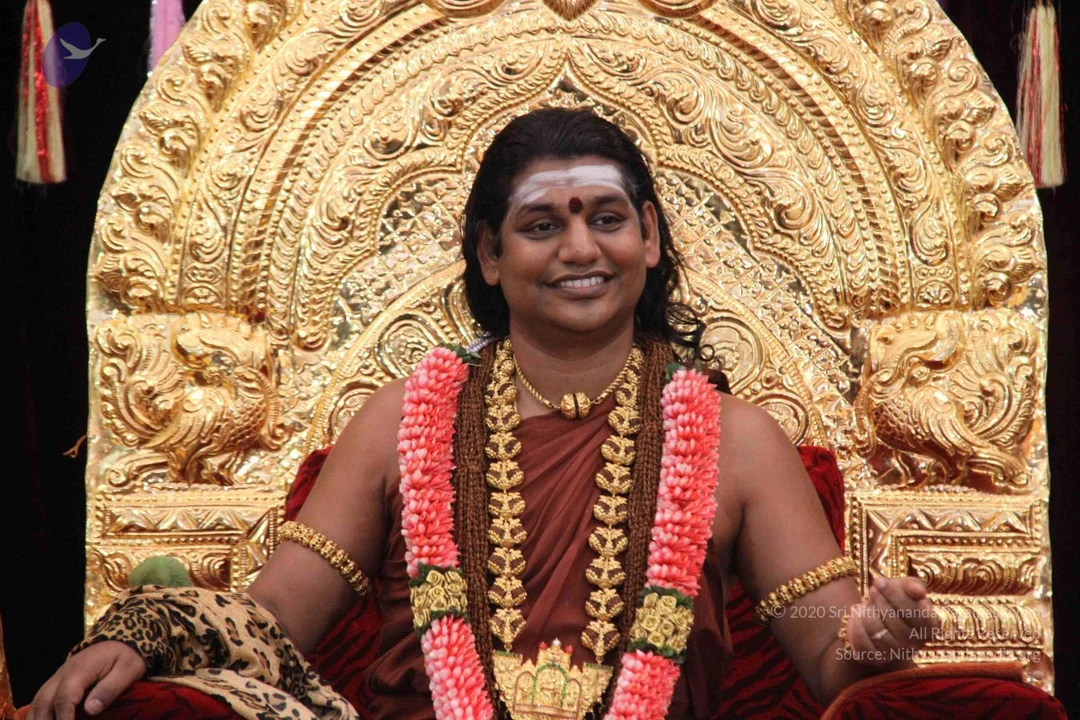
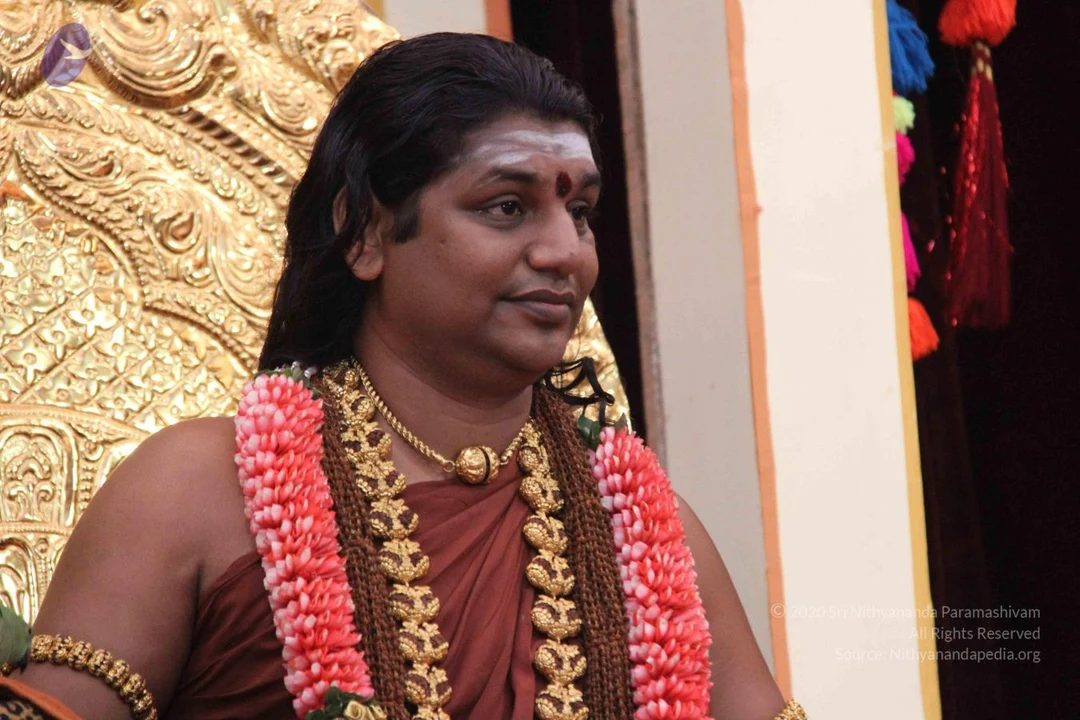
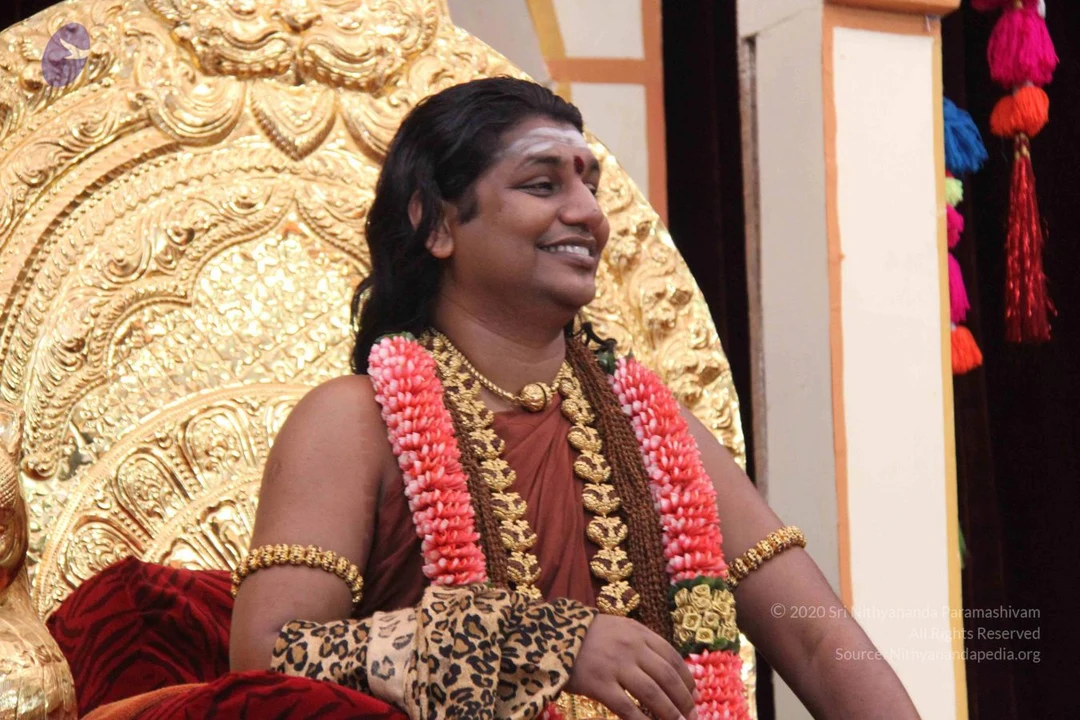
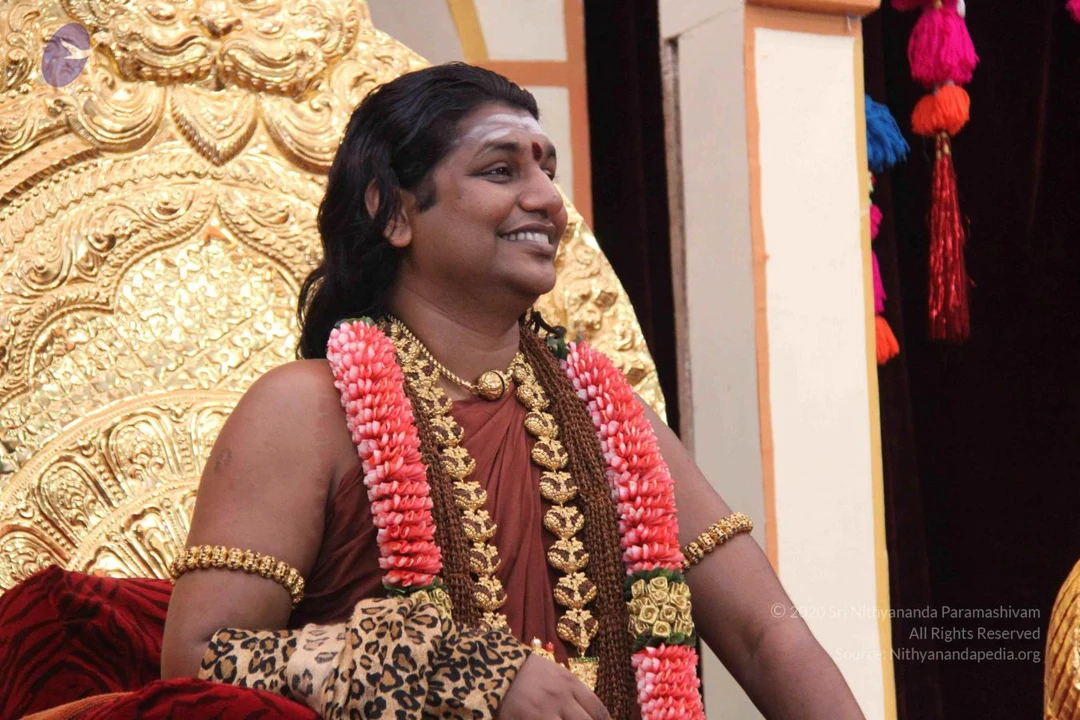
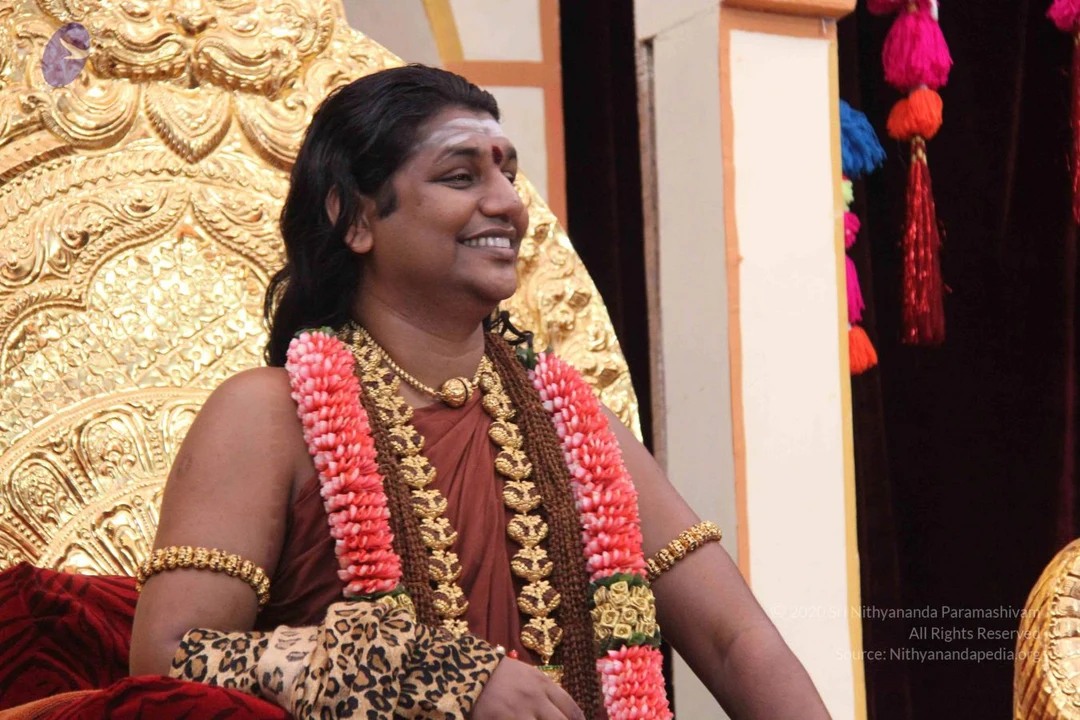
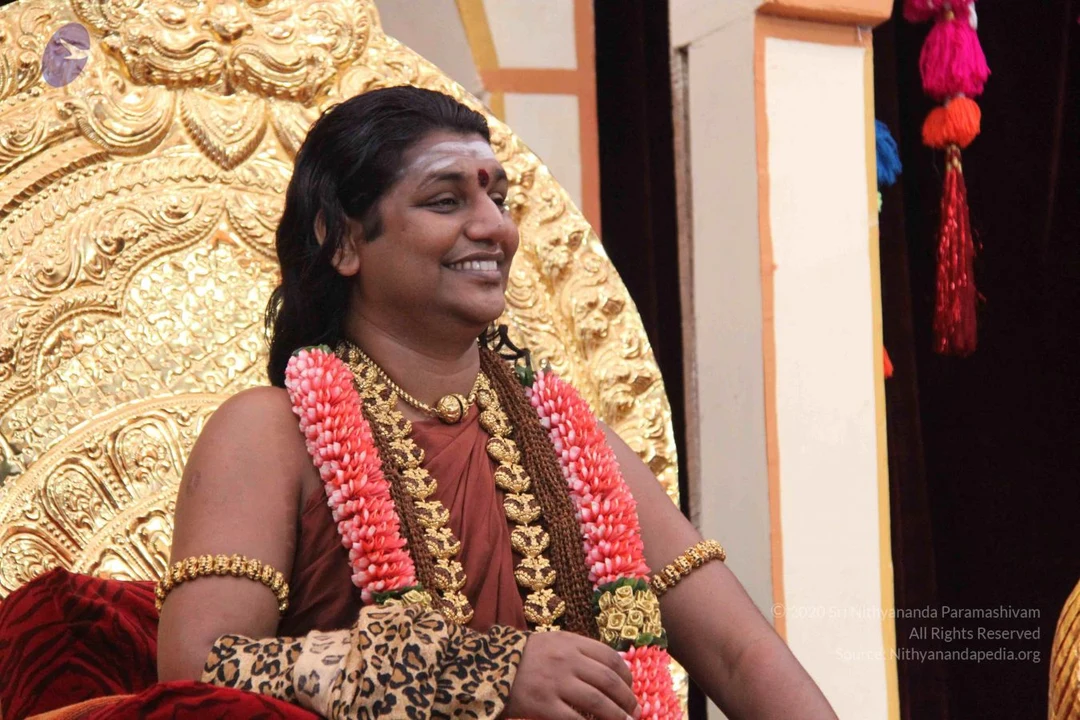
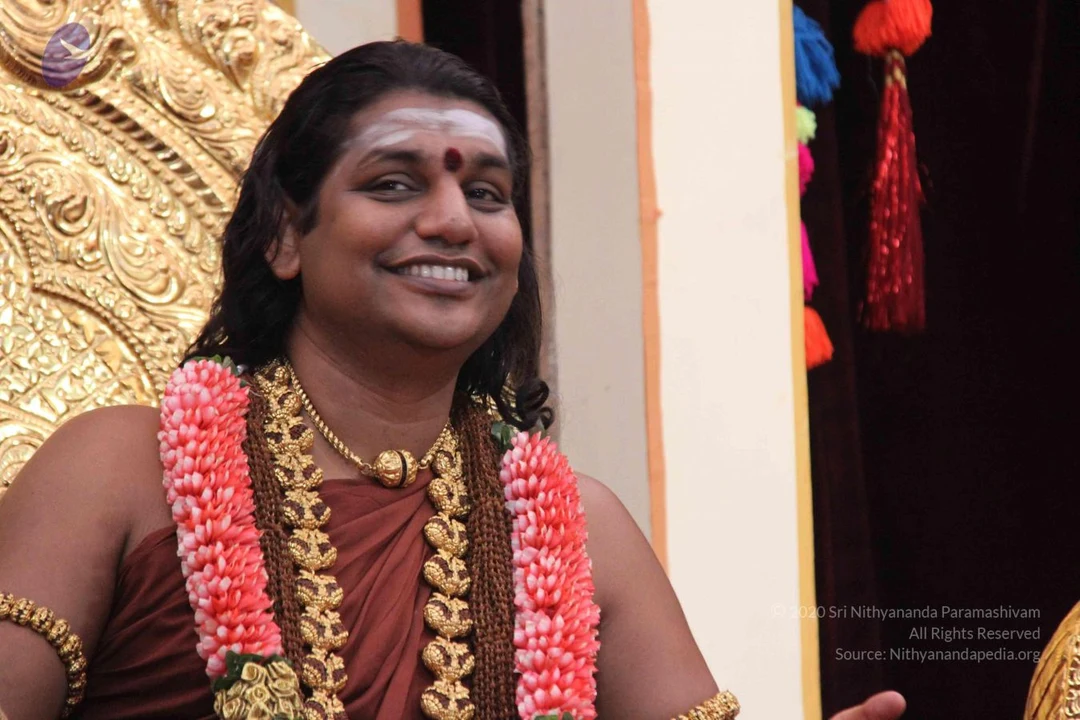
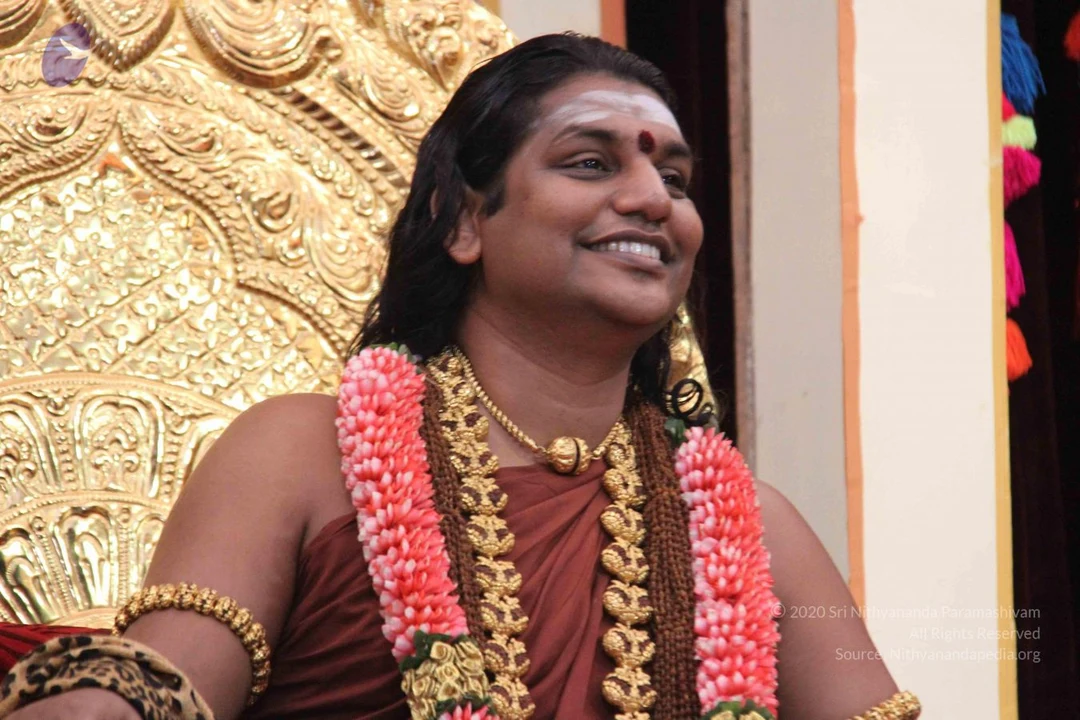
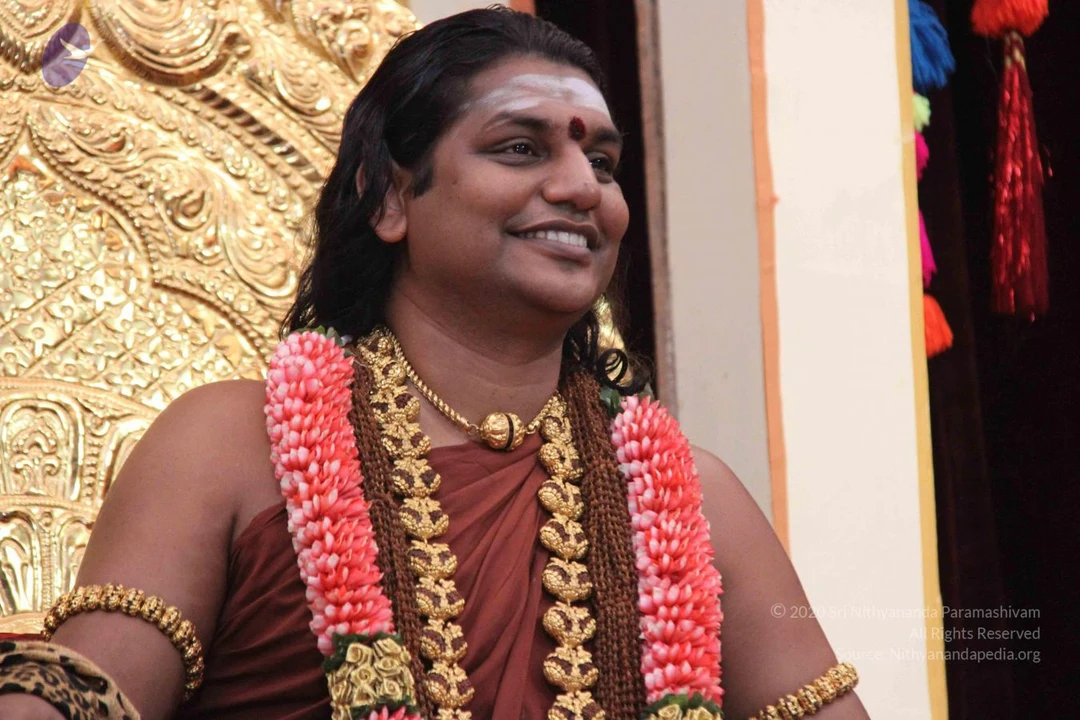
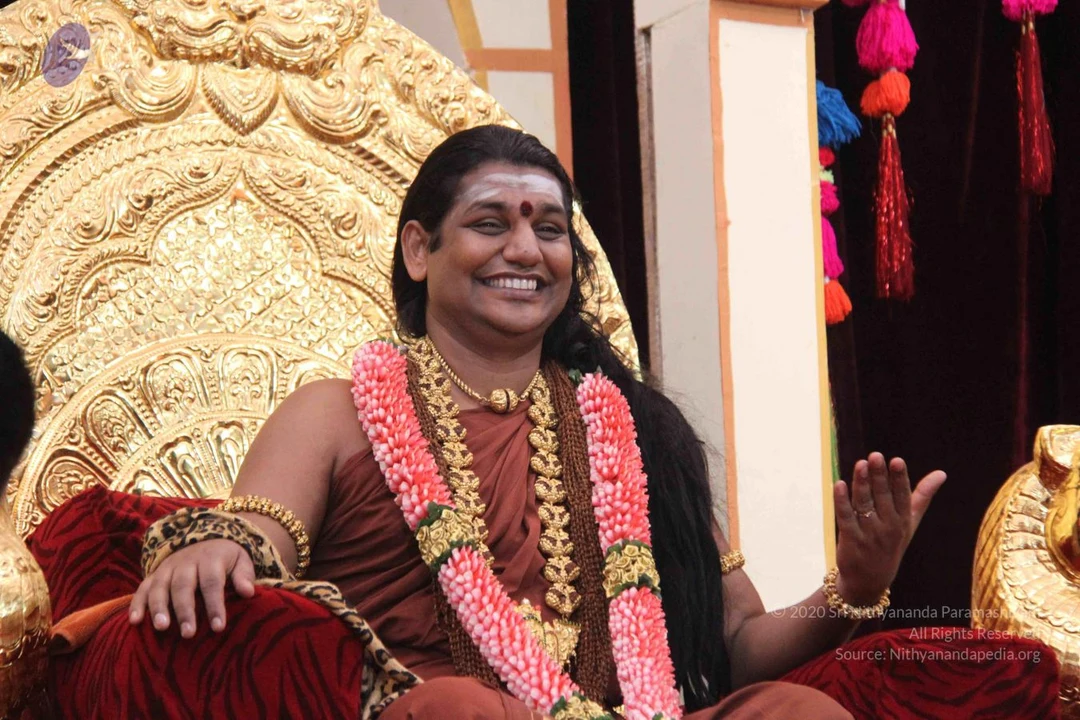
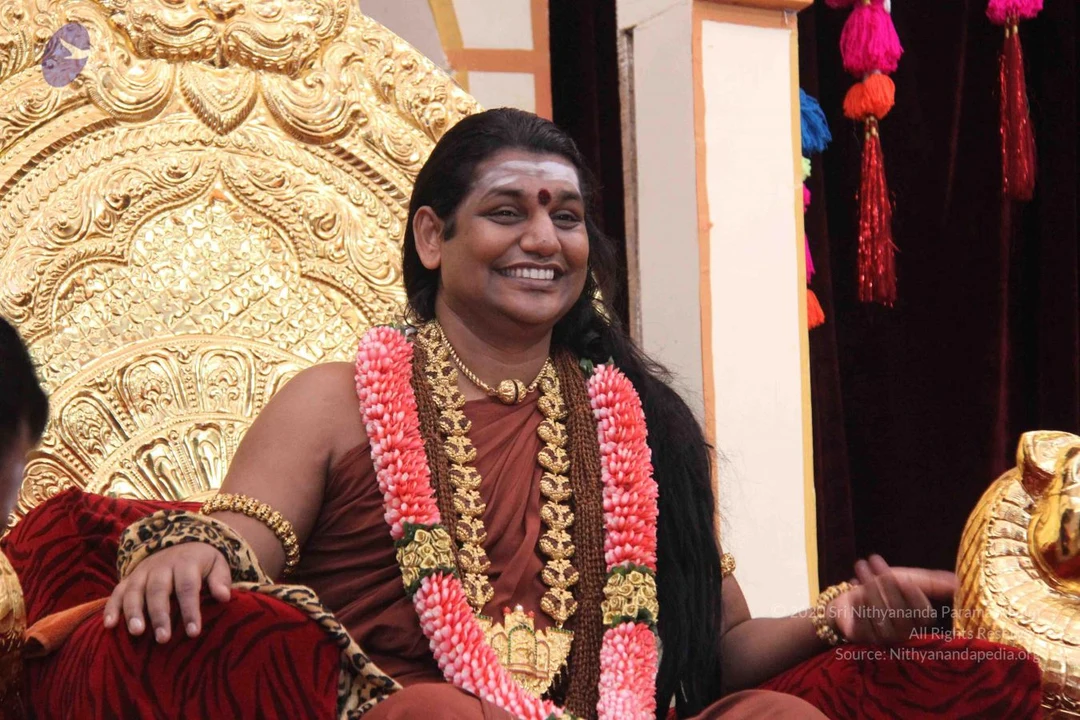
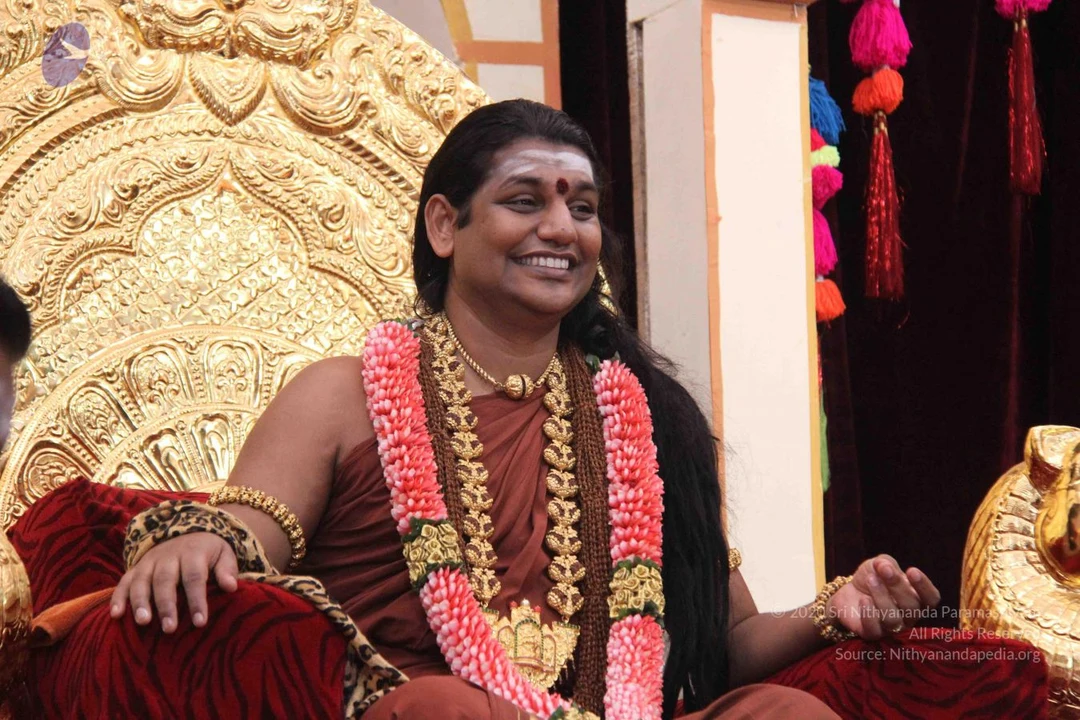
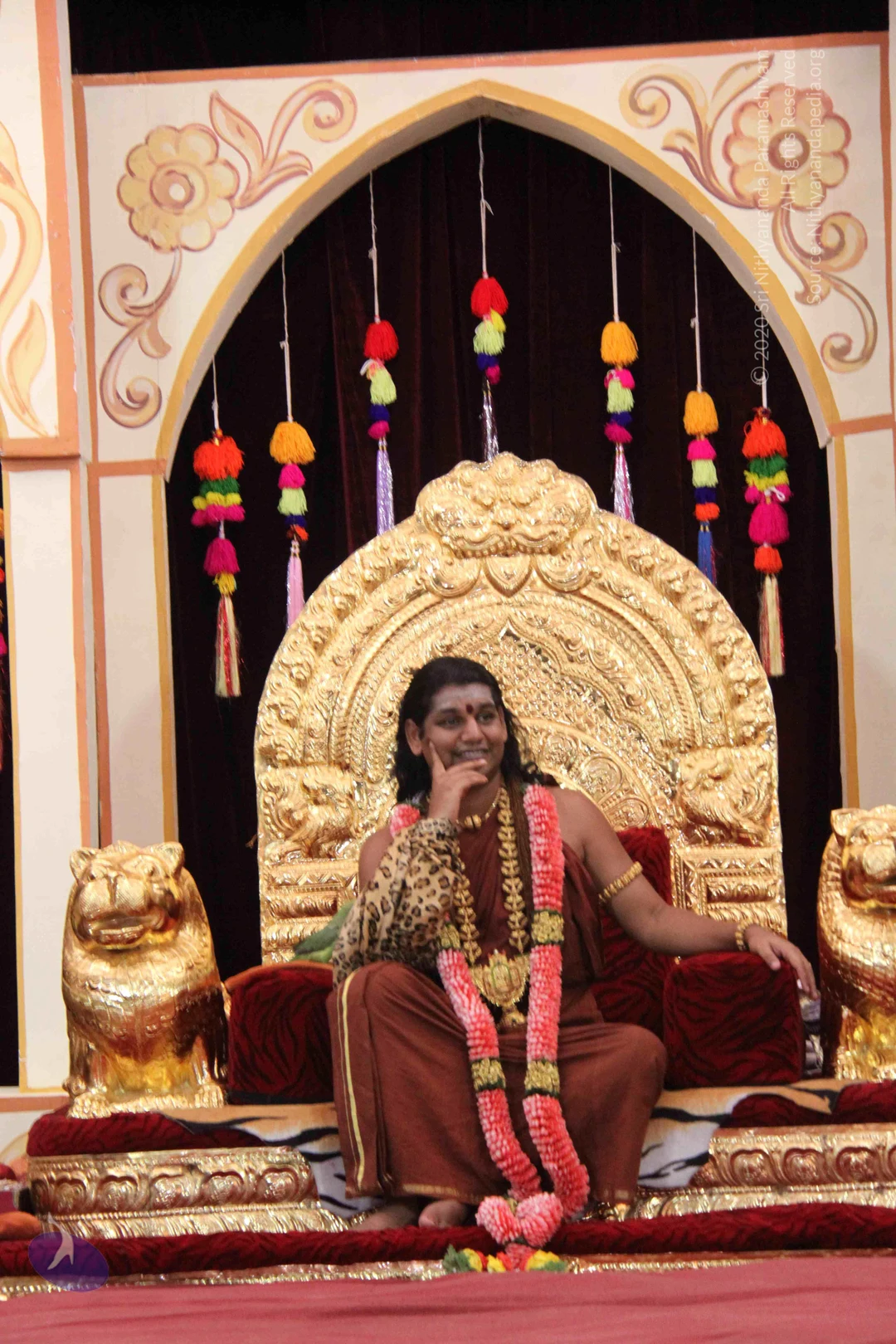
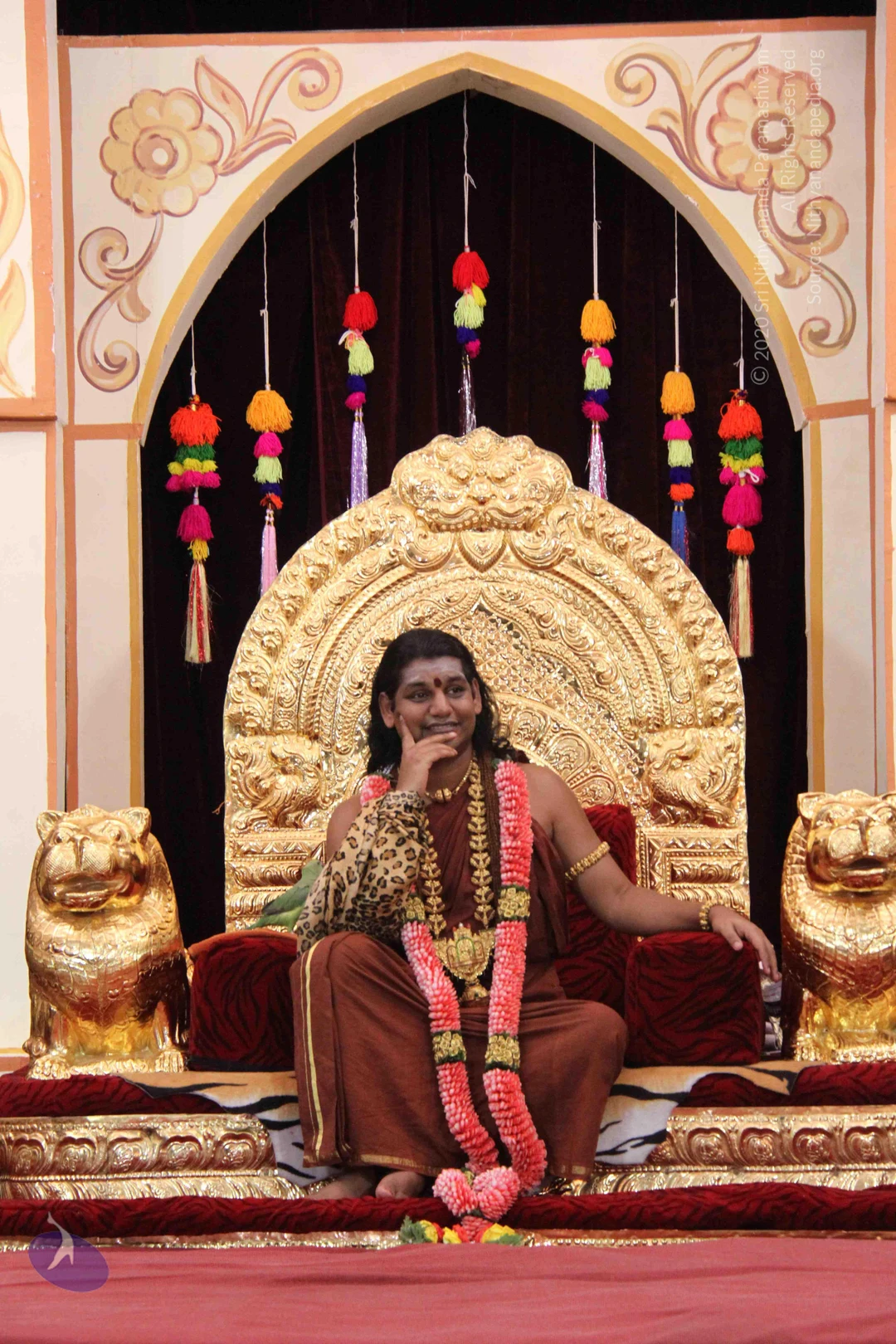
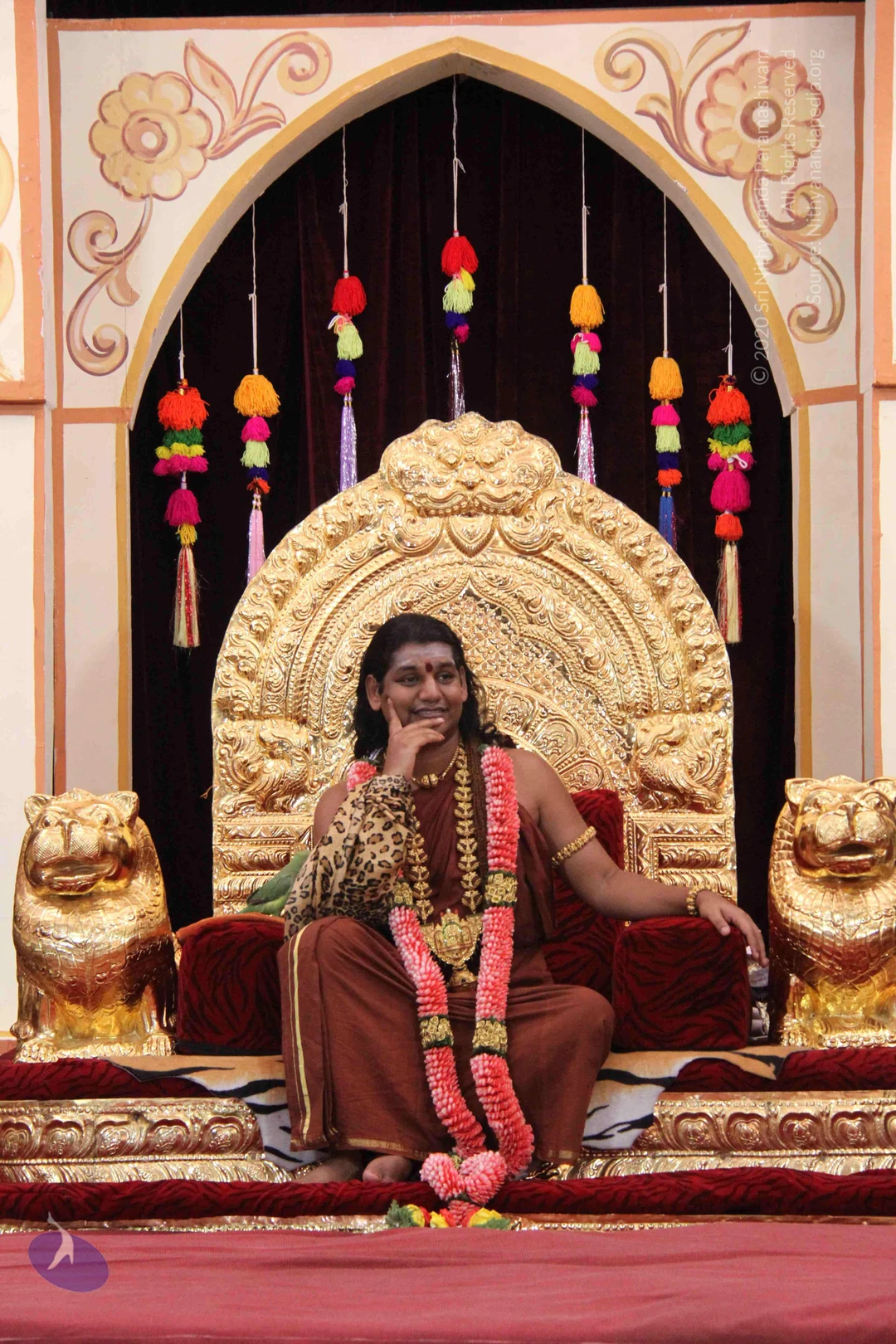
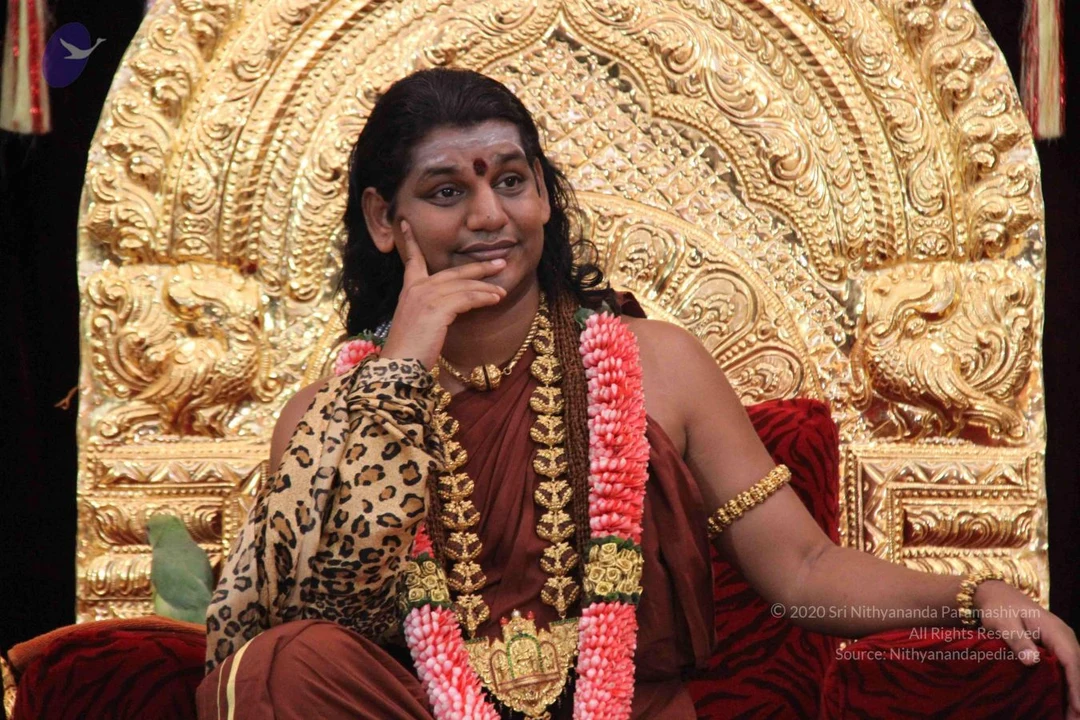
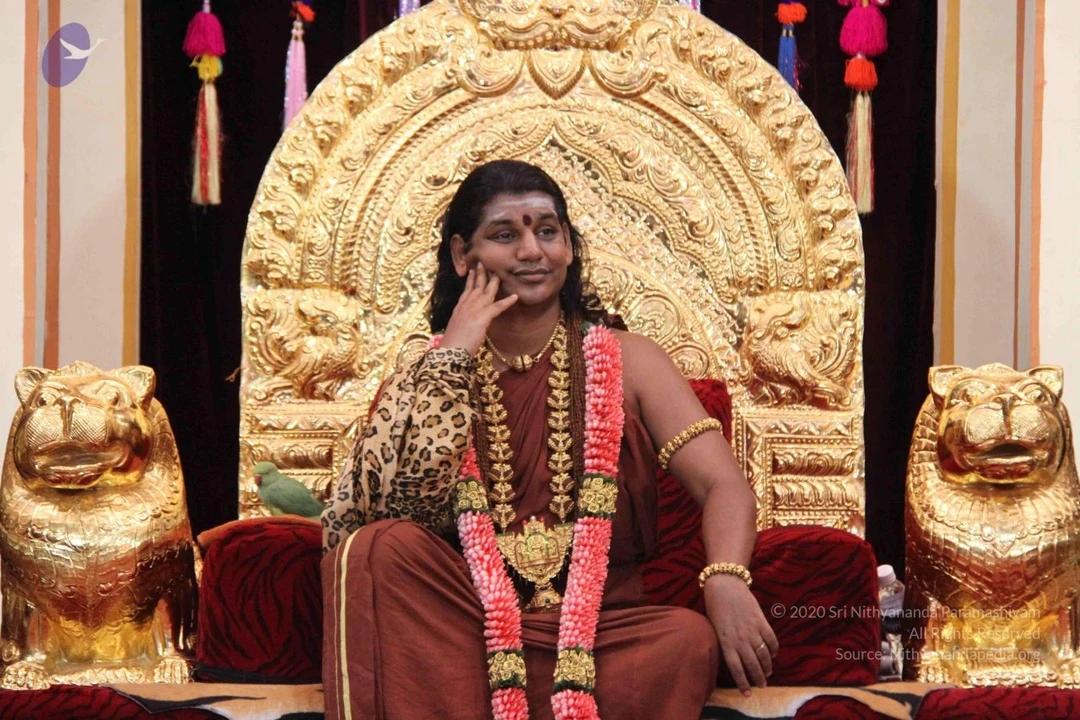
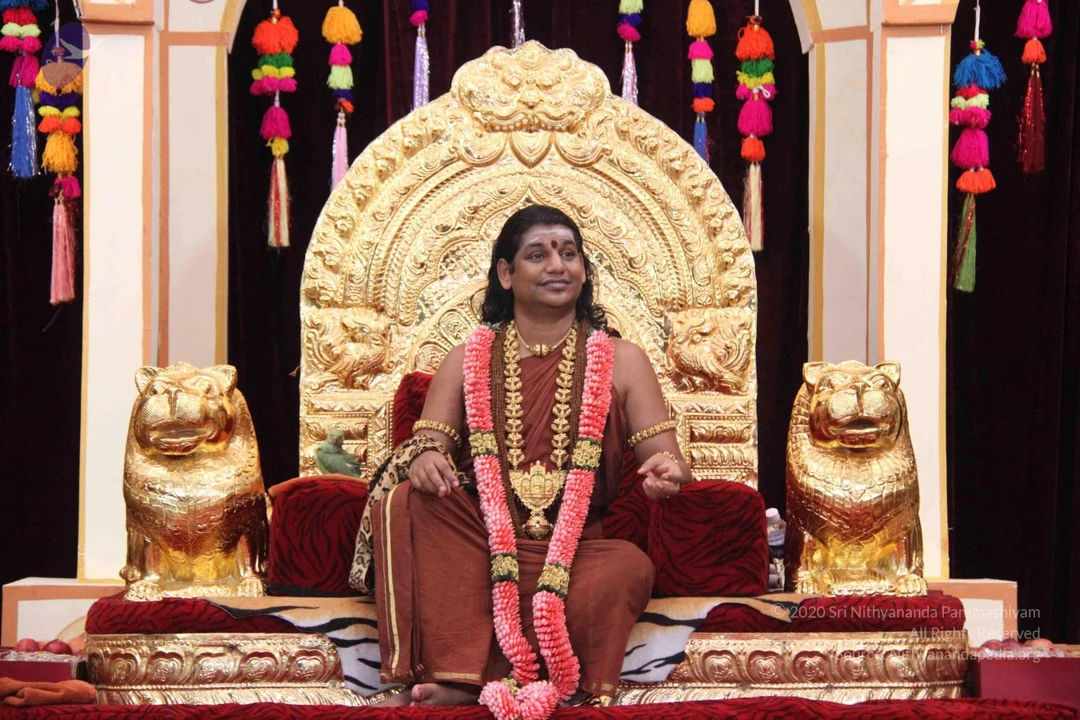
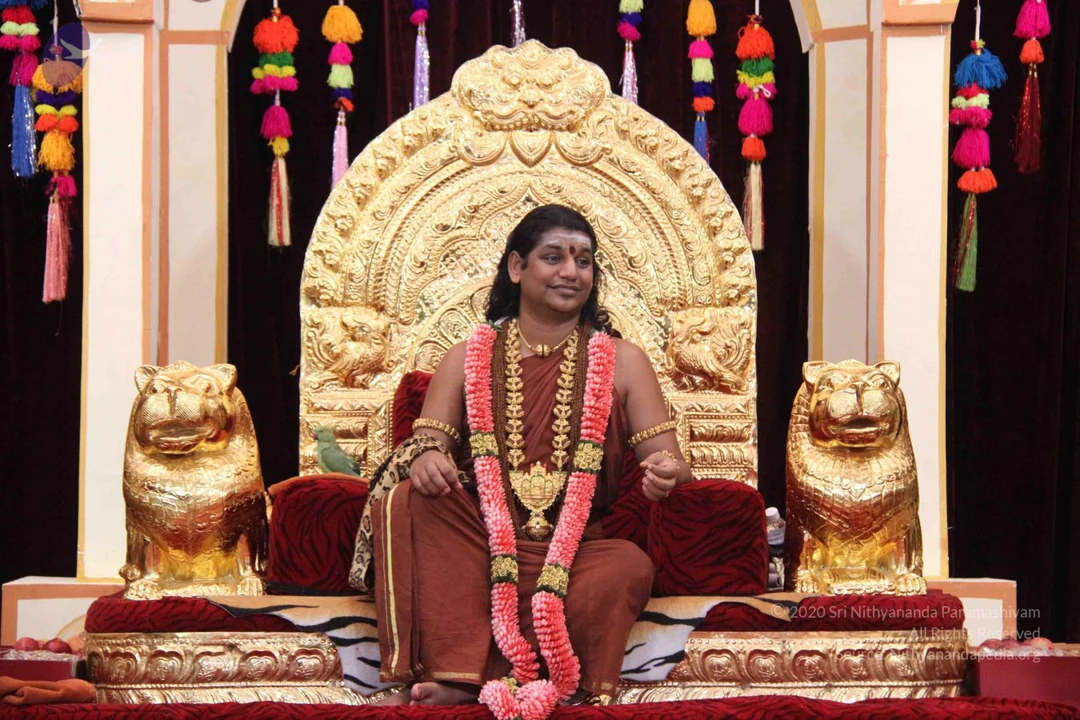
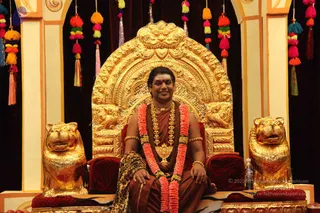
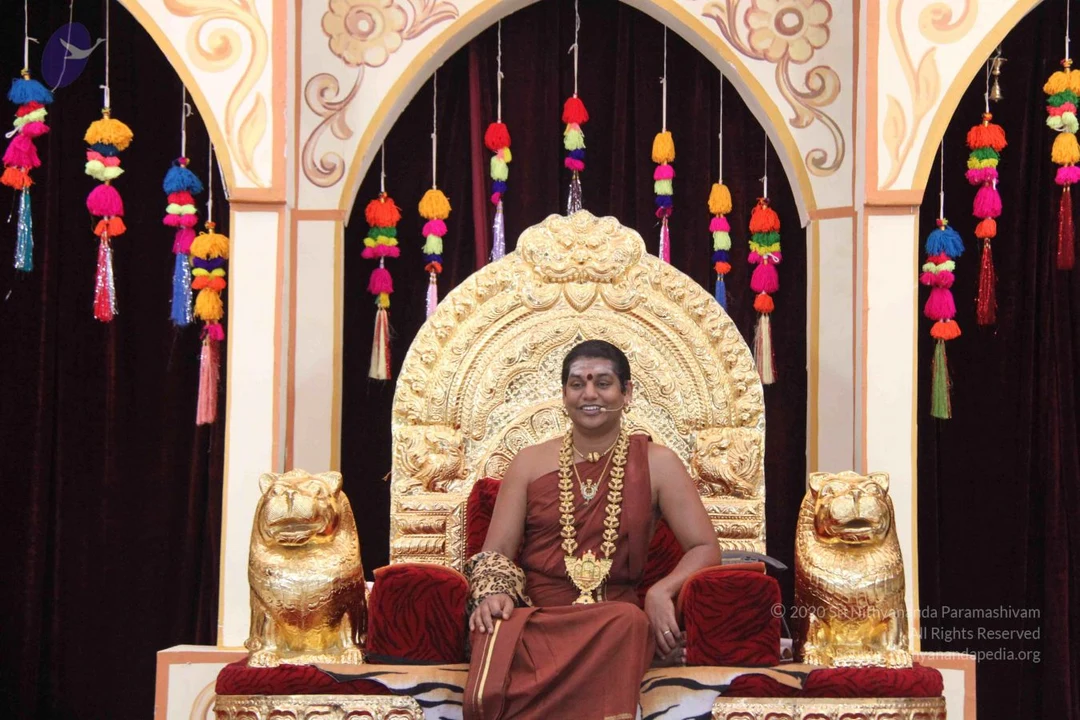
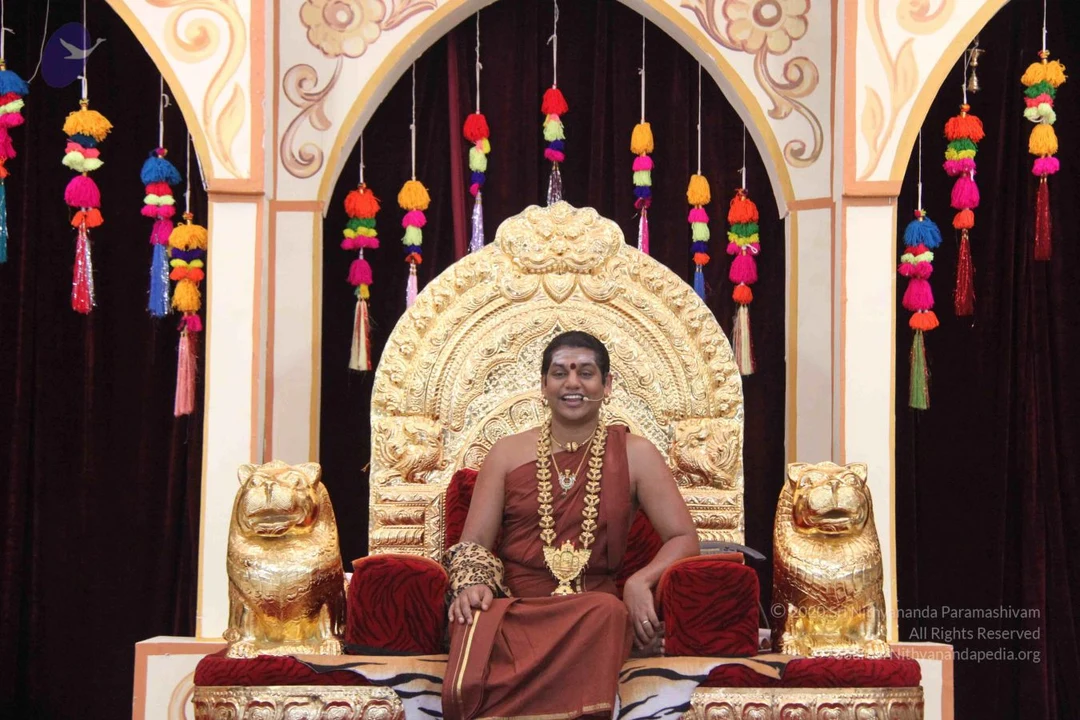
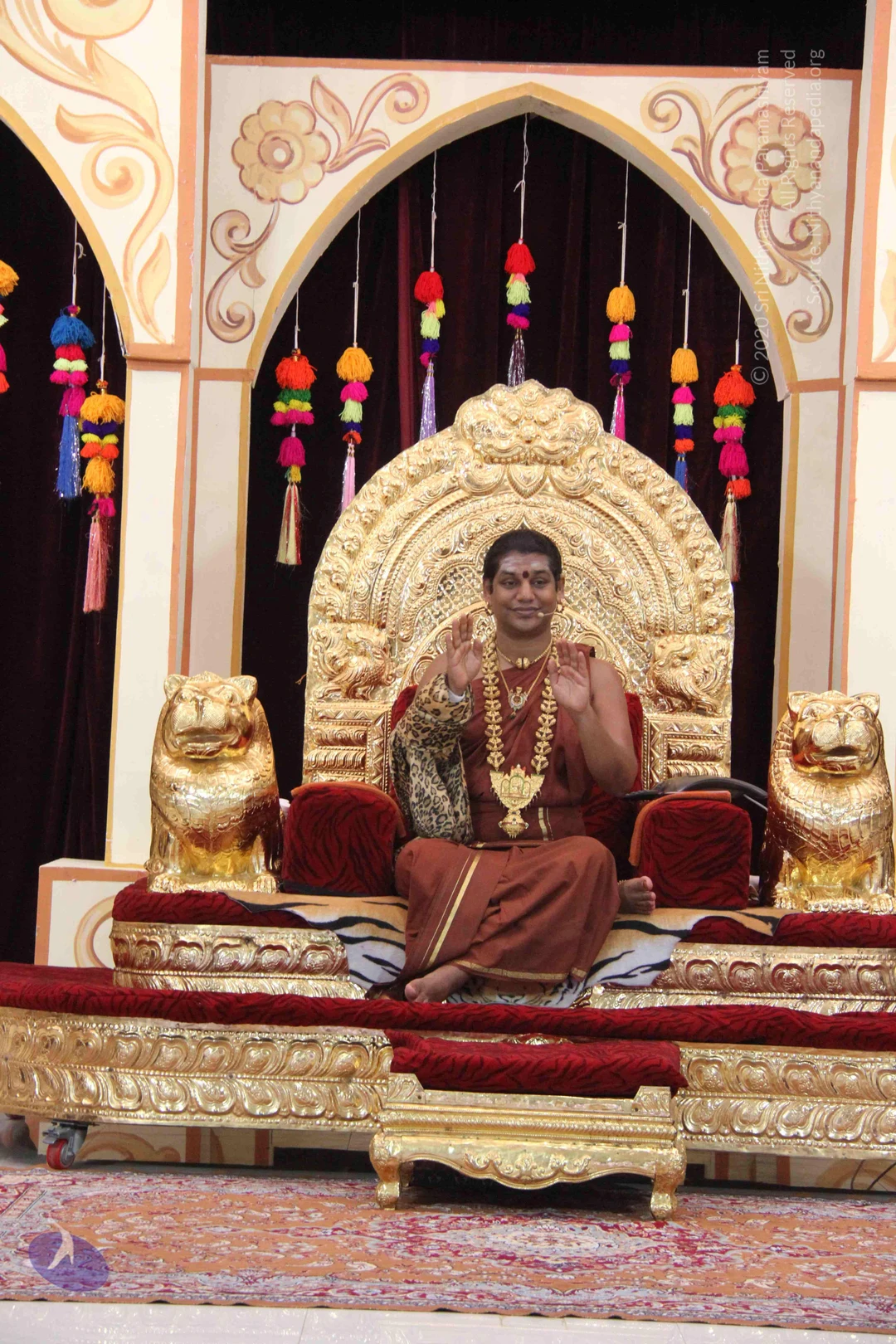
A man stands behind a clear acrylic lectern in a decorated stage setting, his palms pressed together in anjali mudra with eyes closed. He wears a rust-brown sleeveless garment with thin gold border stripes, a leopard-print shawl draped over his shoulders and arms, and heavy gold ornamental necklaces. A red bindi and white forehead markings are visible. Behind him hang colourful pink, orange, green and blue tassel decorations on a black drape beside a cream arch. A partially visible seated figure appears at the lower left, and a golden statue arm is at the right edge.A smiling man in a rust-orange (ochre) draped garment stands behind a clear acrylic lectern, one hand raised in greeting. He wears a long gold floral garland, gold ornamental necklaces, and gold earrings. A white sacred ash mark and a red bindi decorate his forehead. Behind him hang colourful tasselled decorations in pink, red, orange, yellow and blue against dark drapes.A smiling man in a saffron-red robe stands behind a clear acrylic lectern, raising his right hand in greeting. He wears gold ceremonial necklaces with a large gold-toned pendant, gold earrings, a white forehead marking with a red dot, and a leopard-print shawl draped over his left arm. Behind him hang a dark velvet curtain and colourful tassels in pink, yellow, blue and red. A man in a saffron robe with a rudraksha-style gold necklace and ceremonial gold garlands, described as a person, is speaking at a satsang setting.A decorated deity murti stands at centre on a purple cloth base, framed by a tall arch of white and red flower garlands with blue and yellow accents. The central figure wears a green skirt, a gold crown, and layered gold and pearl necklaces. Two smaller deity murtis sit on blue and green draped pedestals to either side, one in red and white and the other in white with gold trim and red flowers. A large gold standing statue stands at the far left edge, and colourful tassels hang from the top of the frame. Two-way satsang and temple worship setting, no people visible.A smiling man in a rust-orange draped garment stands behind a clear acrylic lectern, one hand raised to his chin. He wears a white forehead marking with a red dot, gold earrings, a tiered gold necklace with a pendant, and a long gold garland. A small clip microphone is on his face. Behind him hang a dark maroon velvet curtain and colourful tasselled decorations in pink, yellow, green, orange and blue.A smiling man in a rust-red shawl sits behind a clear acrylic lectern, resting his chin on his hand. He wears heavy gold multi-strand necklaces, a gold pendant, a red-and-gold bead necklace, gold earrings and a headset microphone. A white sacred ash mark and red bindi adorn his forehead. Behind him hang a dark maroon velvet curtain and colourful pink, orange, yellow and green tassel decorations.
sarva-darshan

12 photosSource gallery
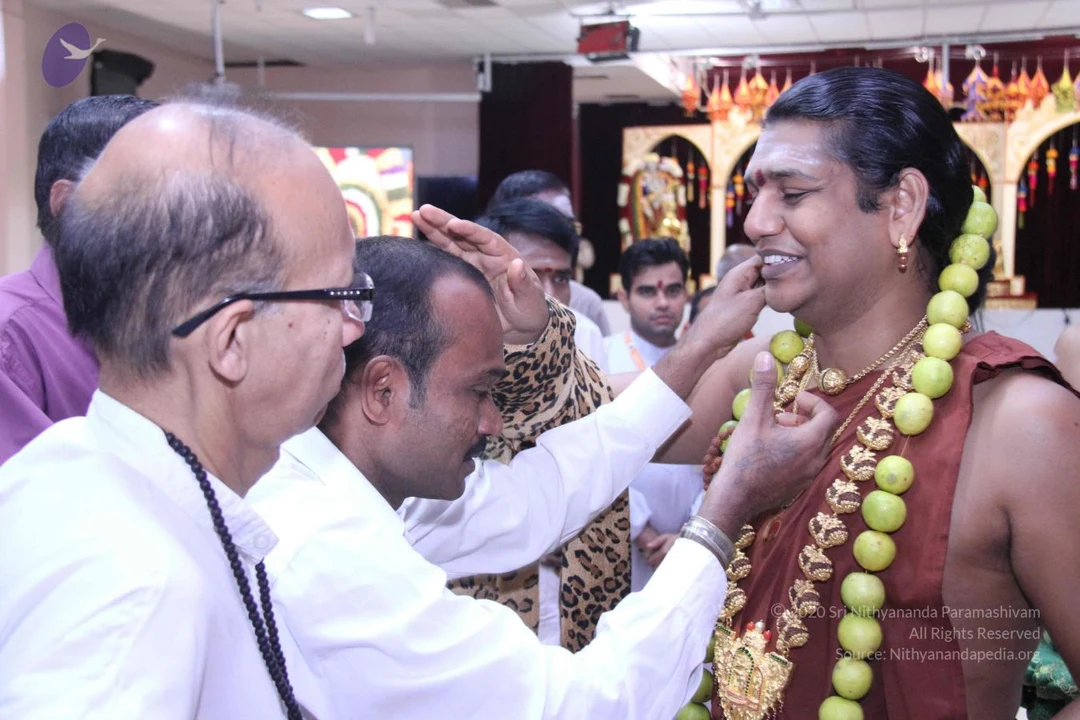
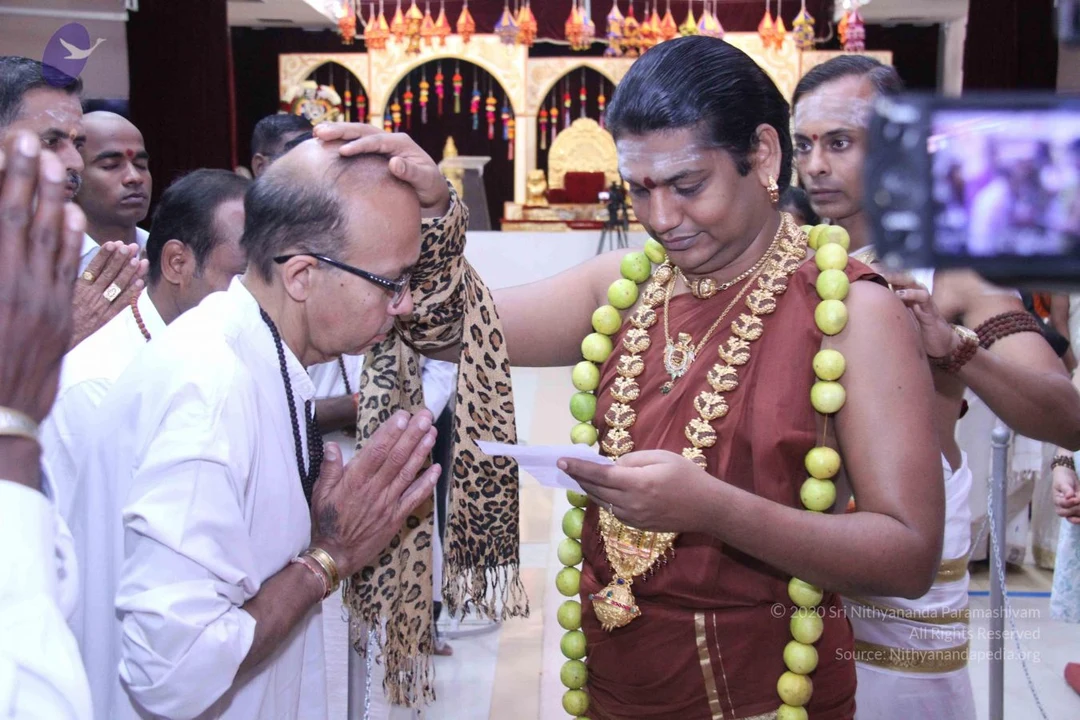
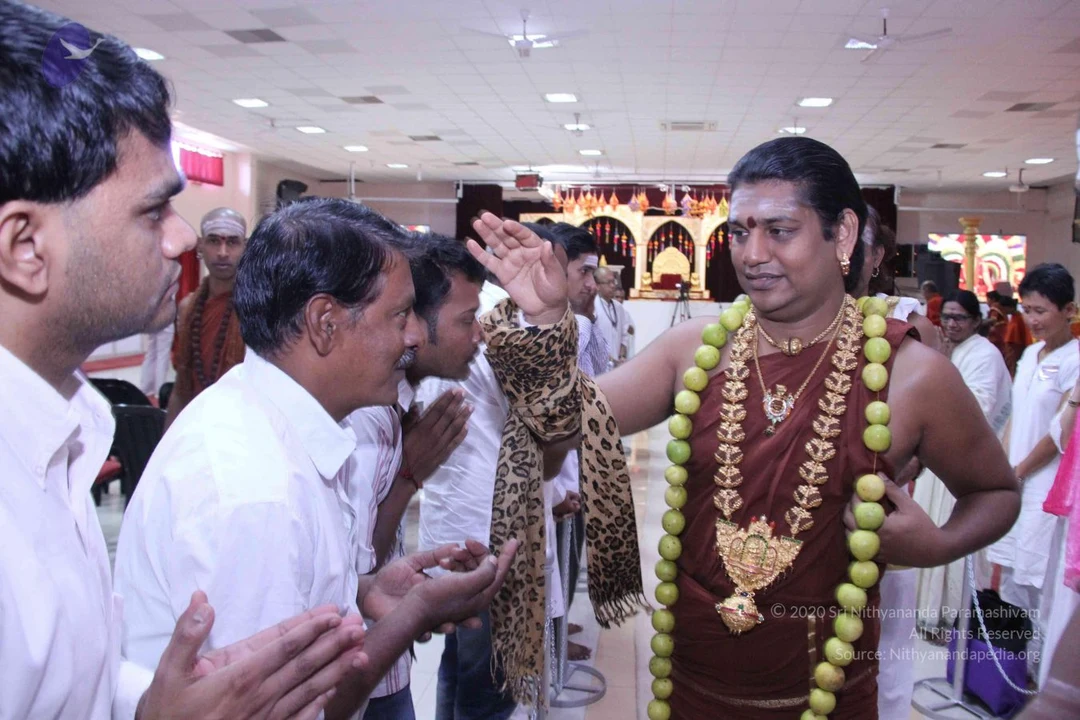
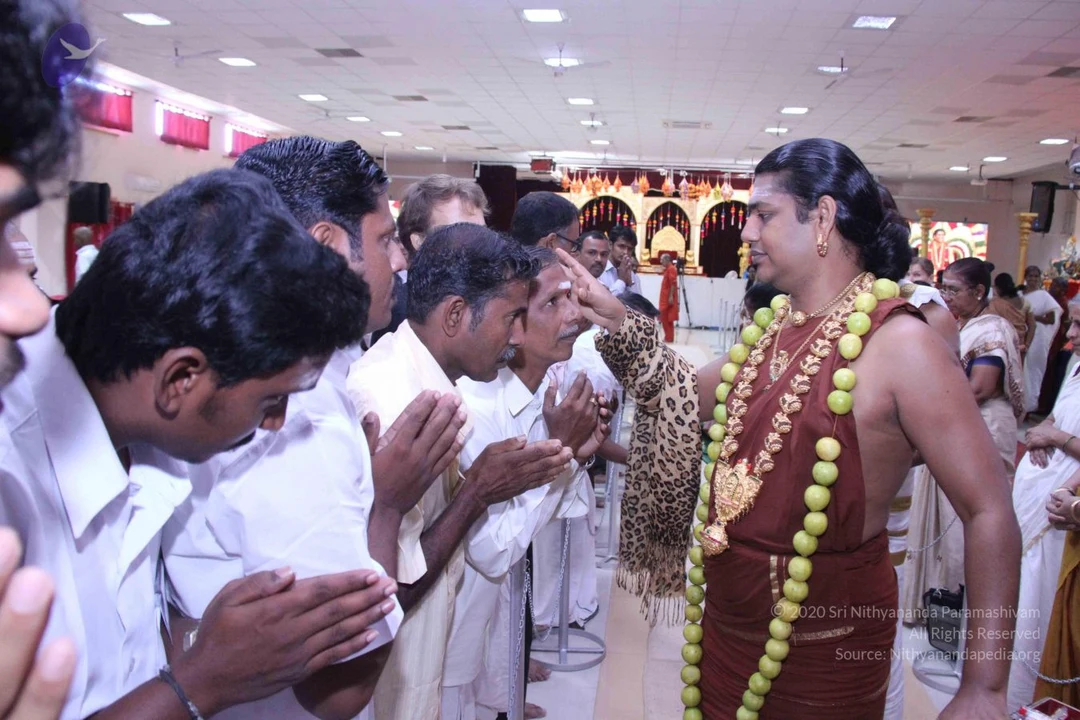
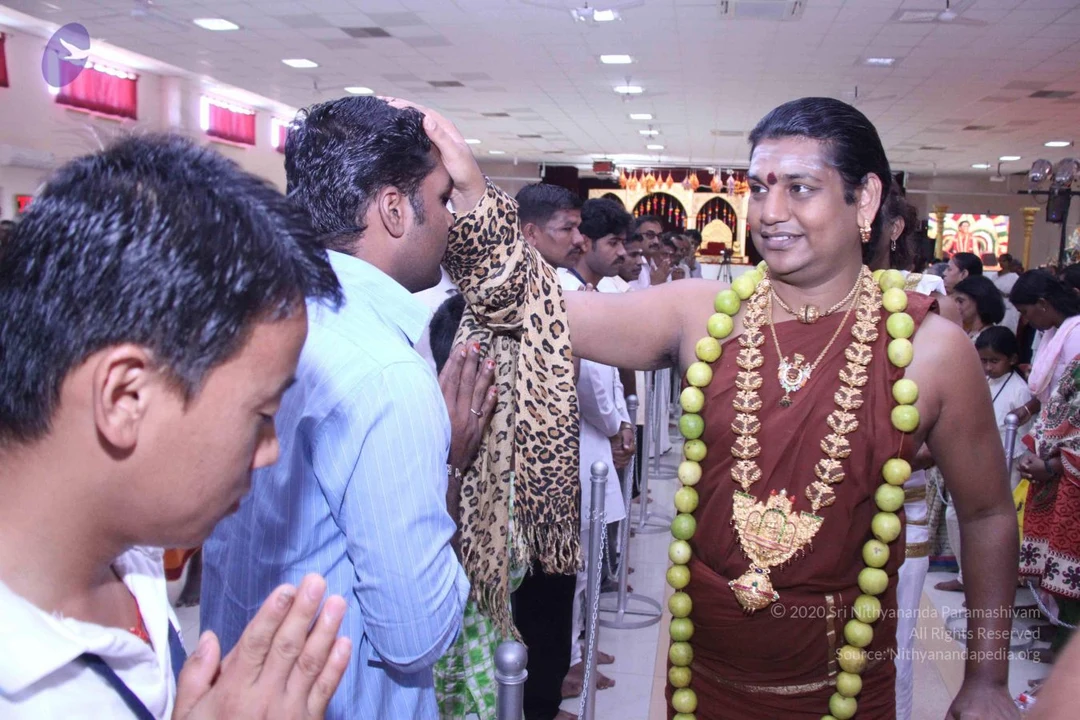
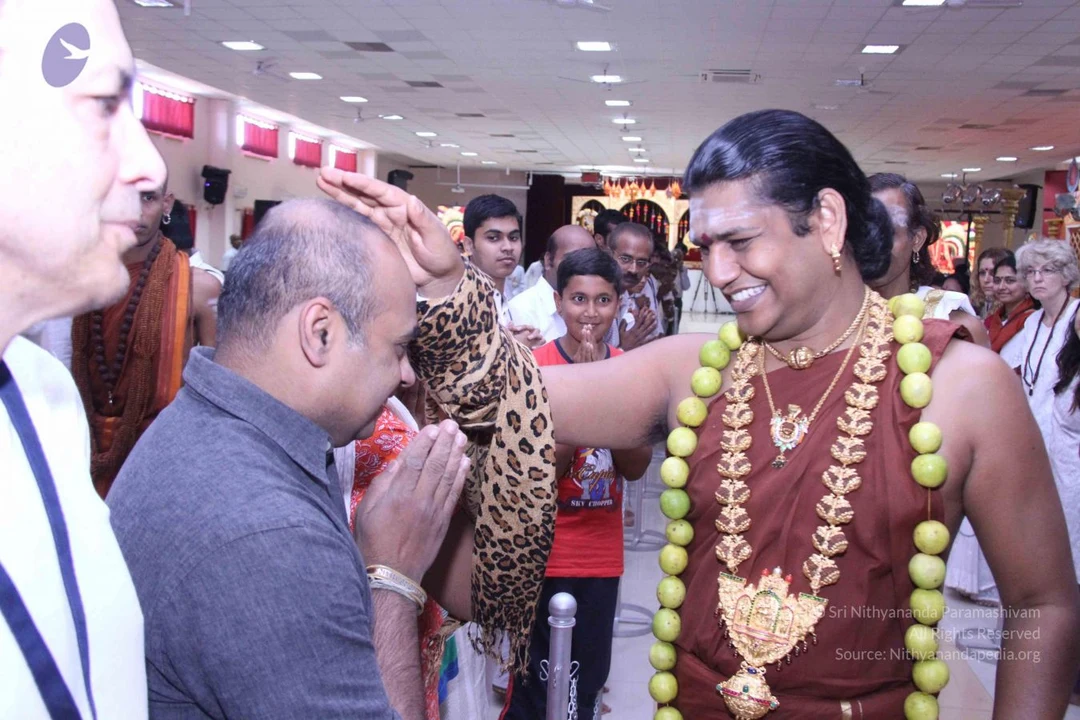
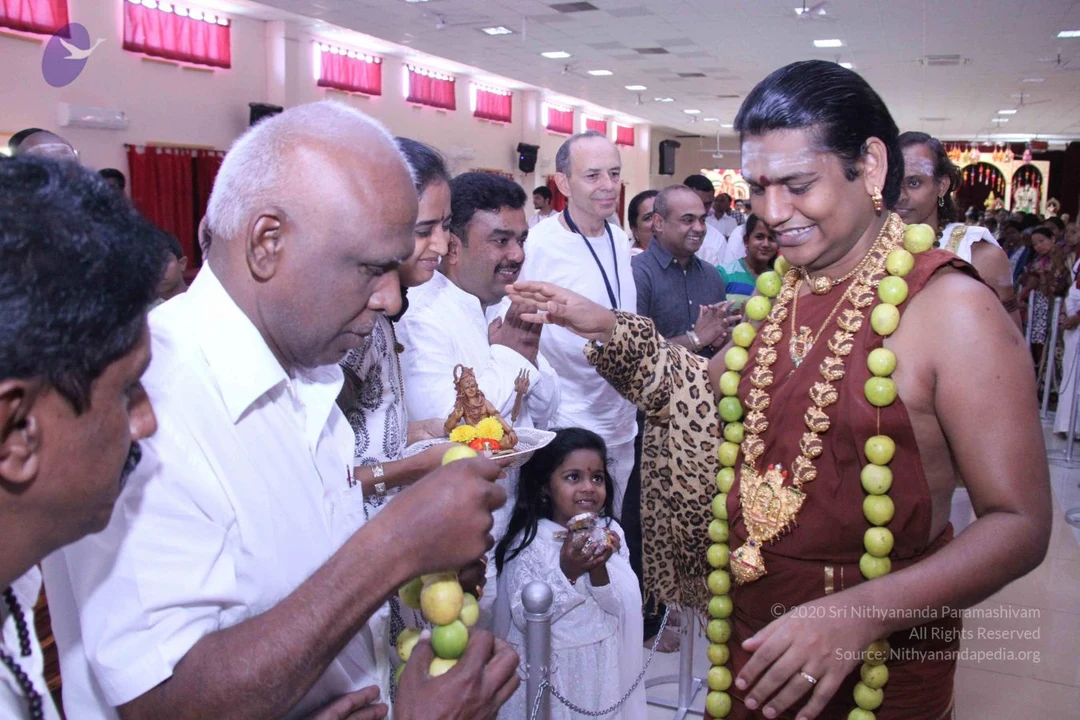
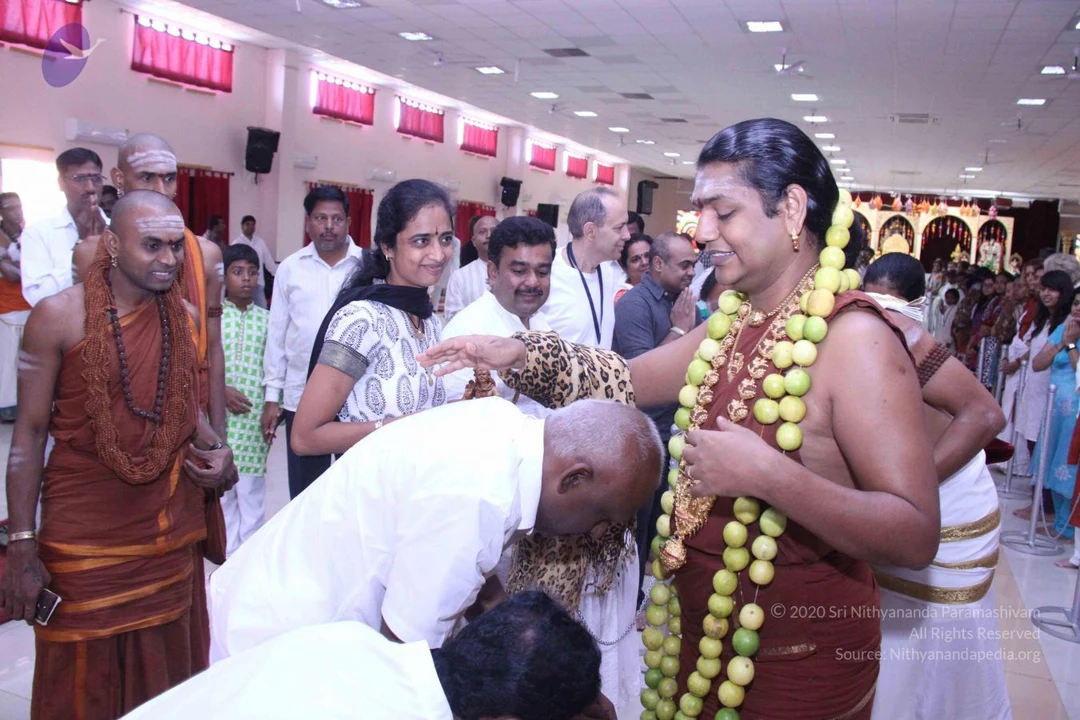
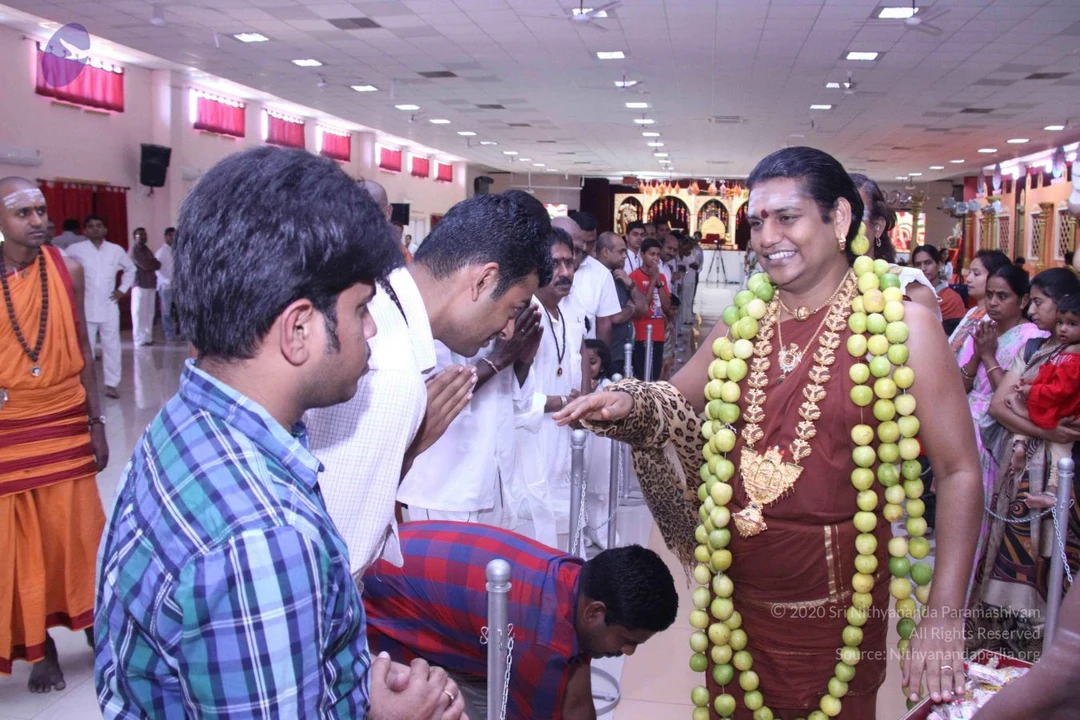
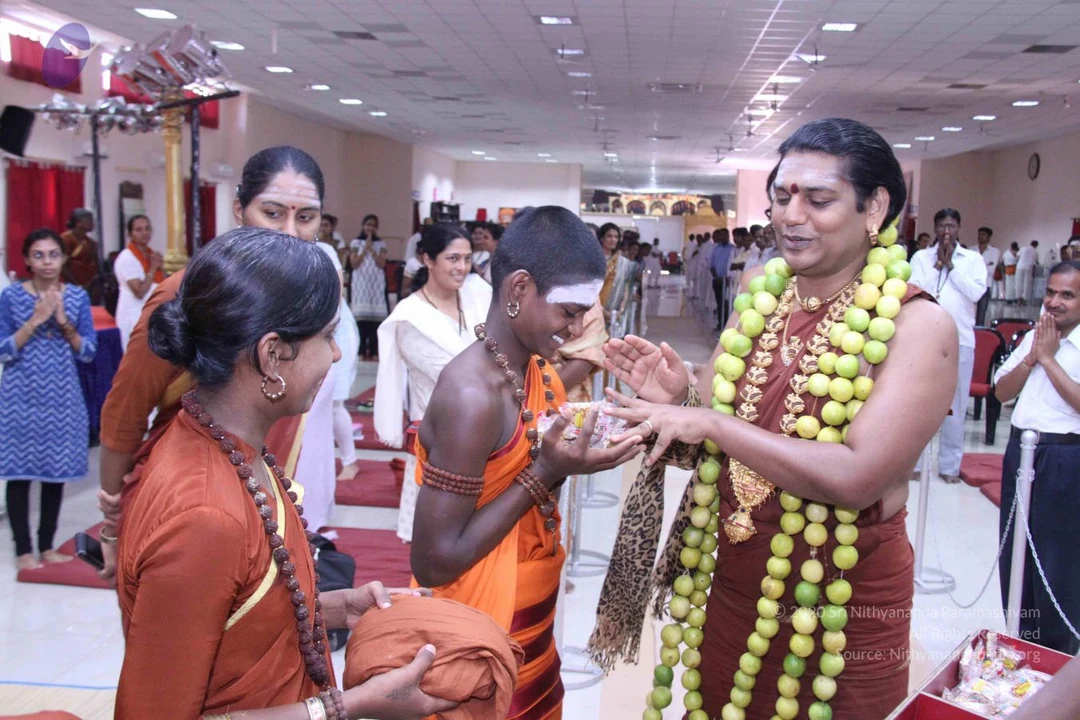
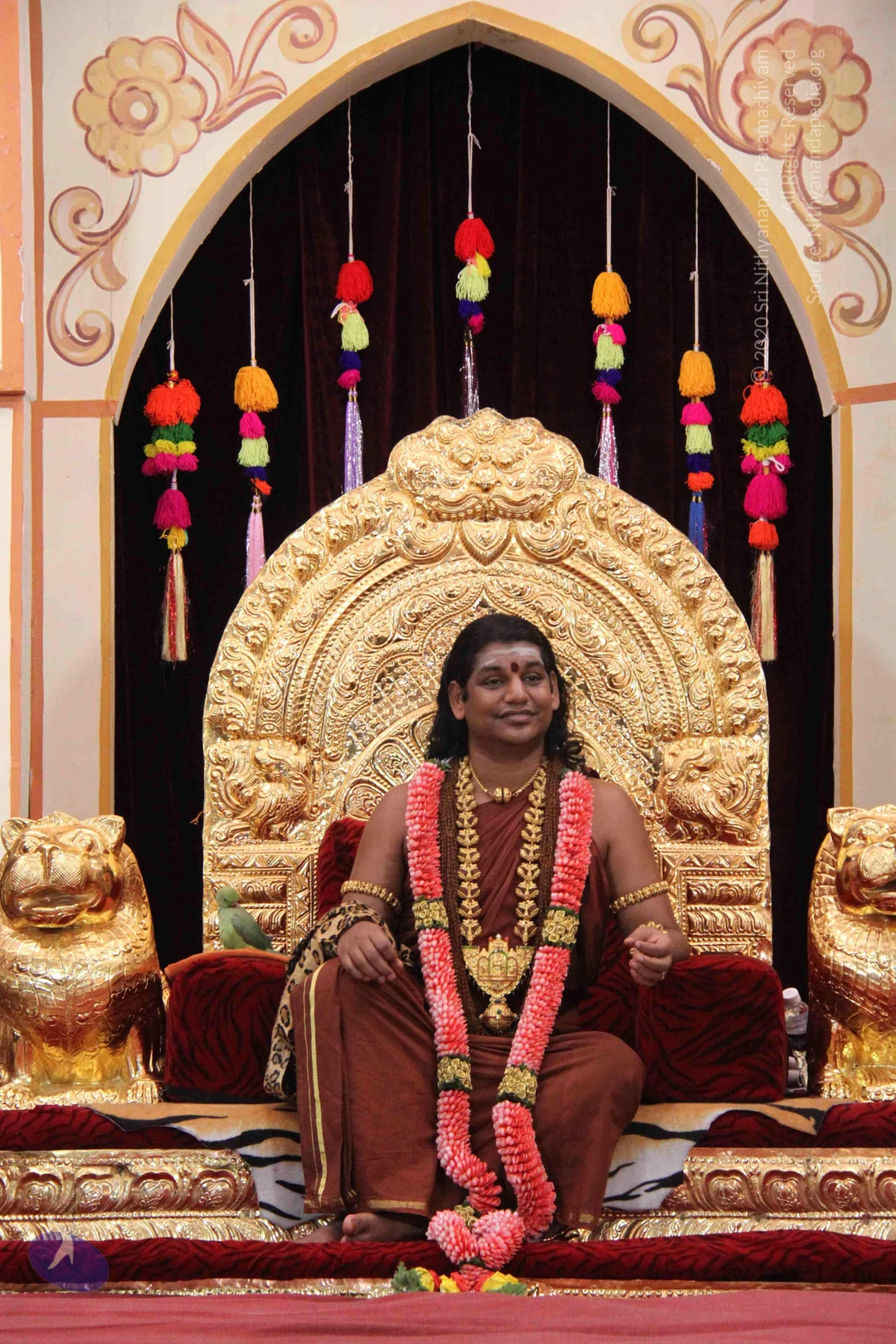
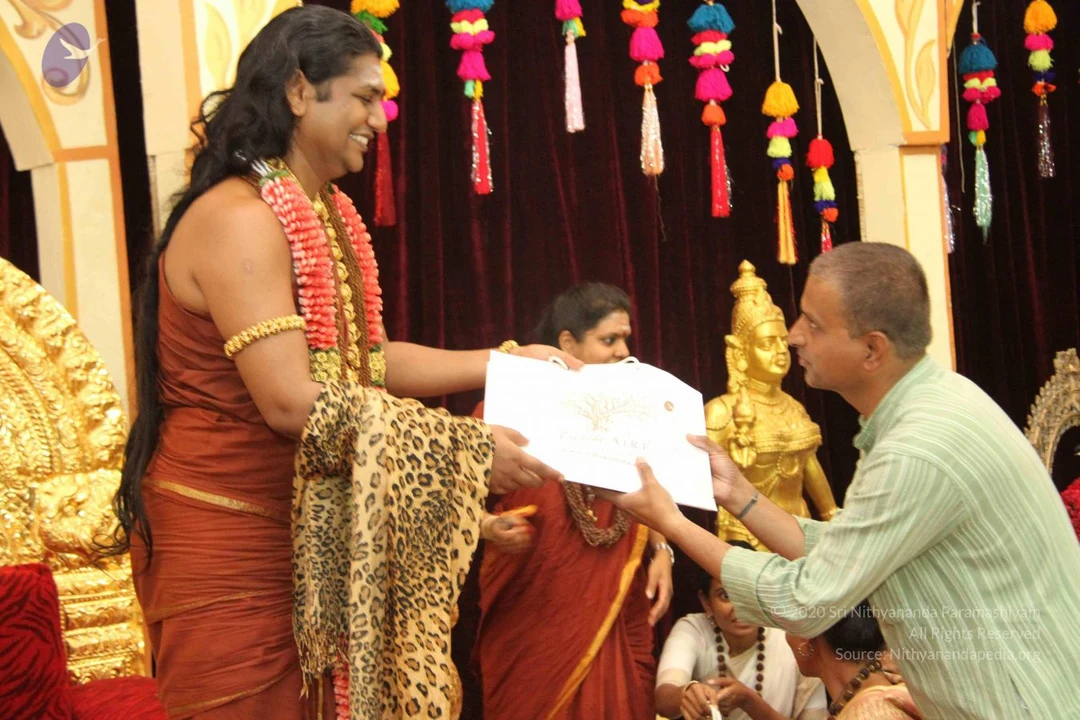
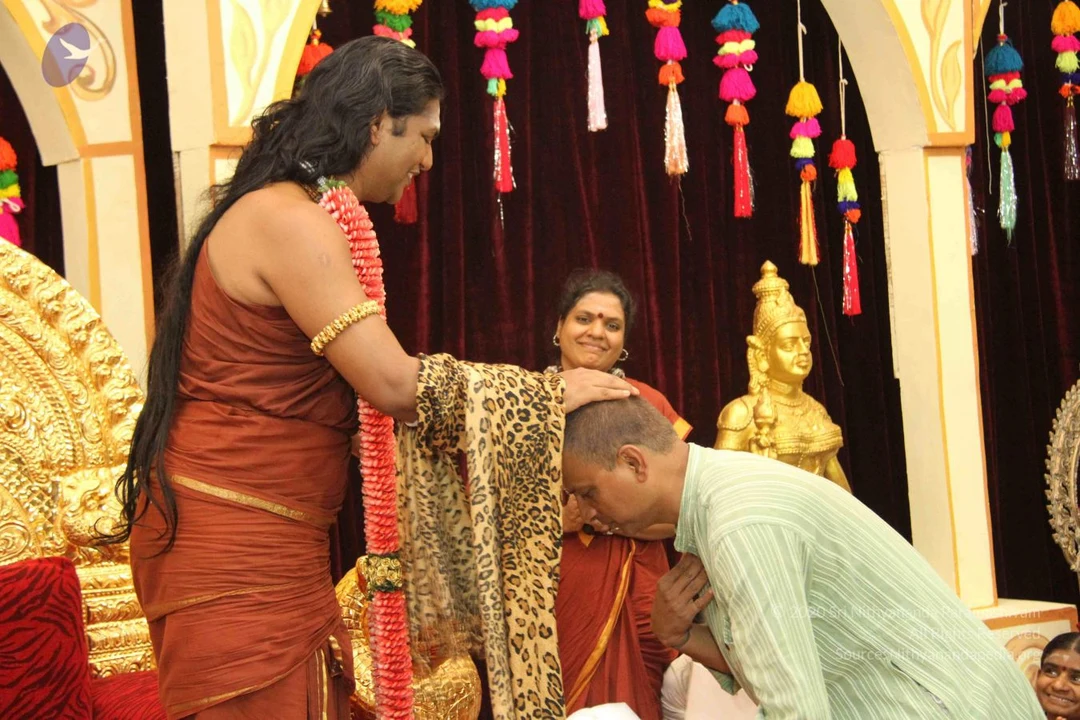
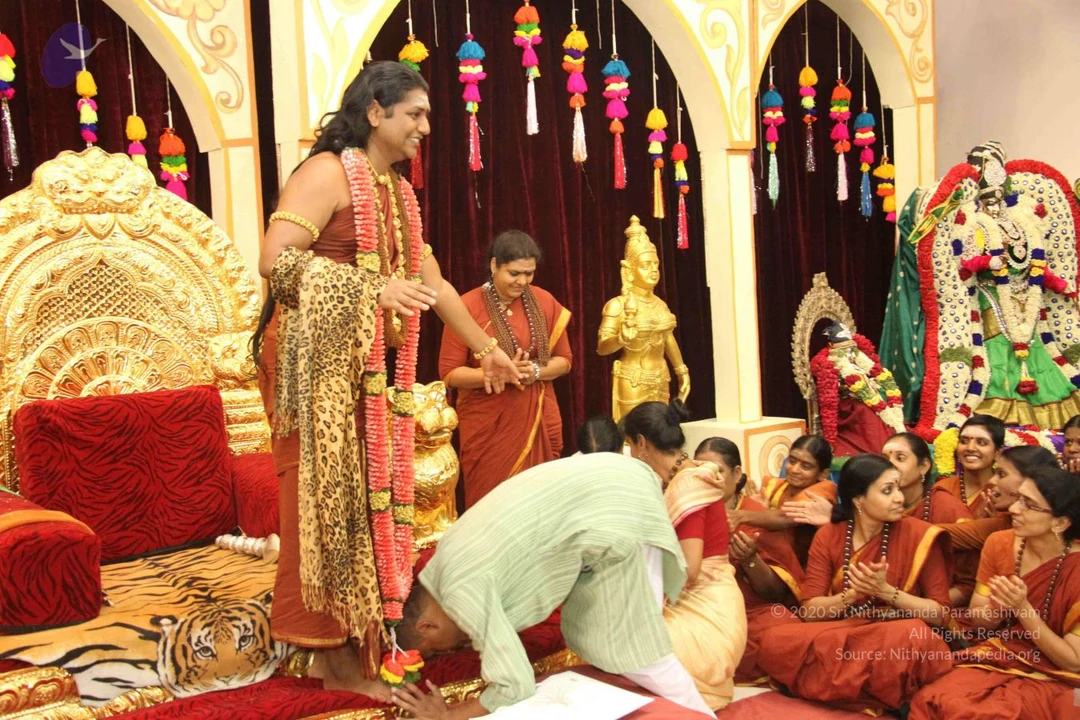
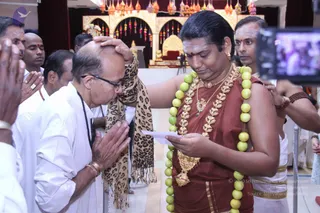
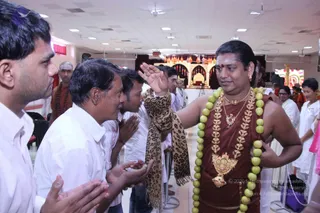
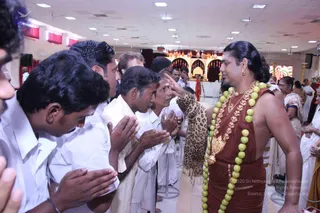
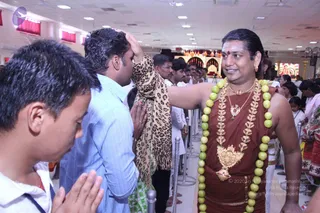
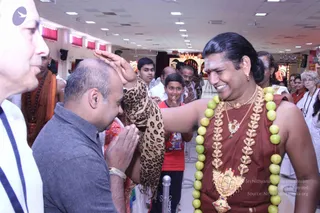
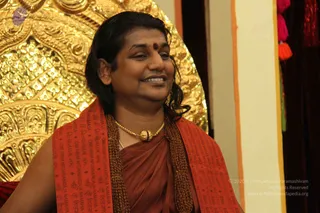
A photograph inside a temple hall with a red-carpeted, decorated interior. On the right, a smiling man with long dark hair swept back, wearing a rust-red shawl over bare shoulders, a long necklace of green fruit beads, layered gold necklaces, a gold ornament and earring, and a tilak on his forehead, is receiving attention. Two men in white shirts stand left: one wearing a rudraksha mala and glasses, the other bending in front of him and touching the smiling man's cheek and chin with both hands. A man in a leopard-print shawl and others stand behind, and a decorated arched shrine with a deity murti and hanging lamps appears in the background. The scene resembles a devotee greeting or blessing ritual.A photograph of a ceremonial moment in a decorated hall with a golden throne-like seat and paper lanterns in the background. A man in a rust-brown dhoti and shawl, wearing a long green-beaded necklace of large beads, a rudraksha-style ornamental gold necklace and gold earrings, holds a sheet of paper and places his hand on the bald head of a bespectacled man in white kurta with a dark bead mala, who stands with palms pressed together in namaste. A leopard-print shawl drapes the bowing man's shoulders. Other men in white and a camera operator are visible at the edges. The paper-holding man has a tilak on his forehead. Quite possibly the bowing man is receiving a blessing.A photograph of a man in a dark maroon-brown robe wearing long garlands of green beads and an ornate gold necklace with a gold pendant, a leopard-print shawl draped over his shoulder, and a red tilak mark on his forehead. He stands with one hand raised in a greeting gesture while a group of men in white shirts, some with hands pressed together in namaste, face him in a hall with a decorated stage behind. Visible people include men in white and a figure in saffron-orange robes at left; the setting is a hall with ceiling lights and an ornate golden stage backdrop. The bearded man in white with hands joined to the left of the central figure is one of the devotees gathered around him.A photograph inside a hall with a red-curtained stage and small decorated shrine in the background. A bare-chested man in a rust-brown dhoti wears a thick multi-strand rudraksha-style bead mala and gold ornaments, with long swept-back hair and a leopard-print shawl draped over one arm; he touches the forehead of a devotee with one hand. Several men in white shirts and dhotis stand with palms pressed together in namaste, waiting for blessing, and other devotees and a woman in a white sari stand nearby.A man in a rust-brown dhoti and shawl stands at the right, wearing a heavy gold necklace, a rudraksha-style bead mala of green-yellow beads, and a gold pendant, with a red tilak on his forehead. He extends his arm and palm to bless a devotee in a light blue shirt, whose head he touches, while a leopard-print scarf hangs from his arm. A younger man at left stands with palms pressed together in namaste, and a line of devotees waits behind a metal barrier. The hall has red drapes, white ceiling tiles and a decorated stage with ornate golden arches in the background. Five to six people are visible in the foreground, with more devotees behind.Indoor photograph in a bright hall with ceiling lights and red-curtained windows. A smiling man with swept-back long dark hair, sandalwood-tilak on the forehead, wears a rust-brown bare-chested garment draped at the waist, a large green-bead garland and layered gold necklaces with a gold pendant. A man in a grey shirt stands with palms pressed together in namaste, bowing as the smiling figure places a hand on his head; a leopard-print shawl hangs from the smiling figure's arm. Behind them, devotees in white and red attire, a boy in a red t-shirt, and a bald man in a saffron robe stand watching.

final-blessing

4 photosSource gallery
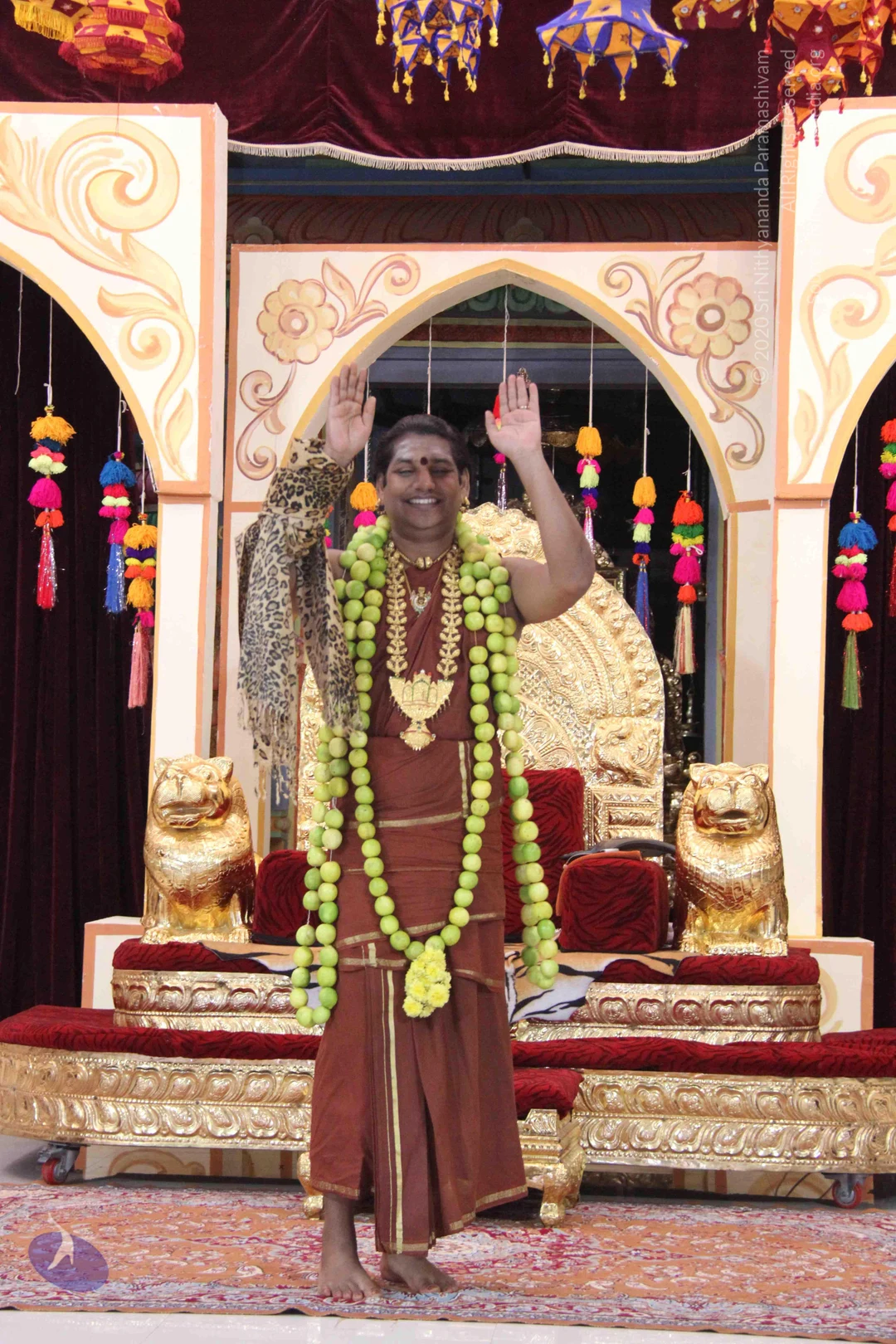
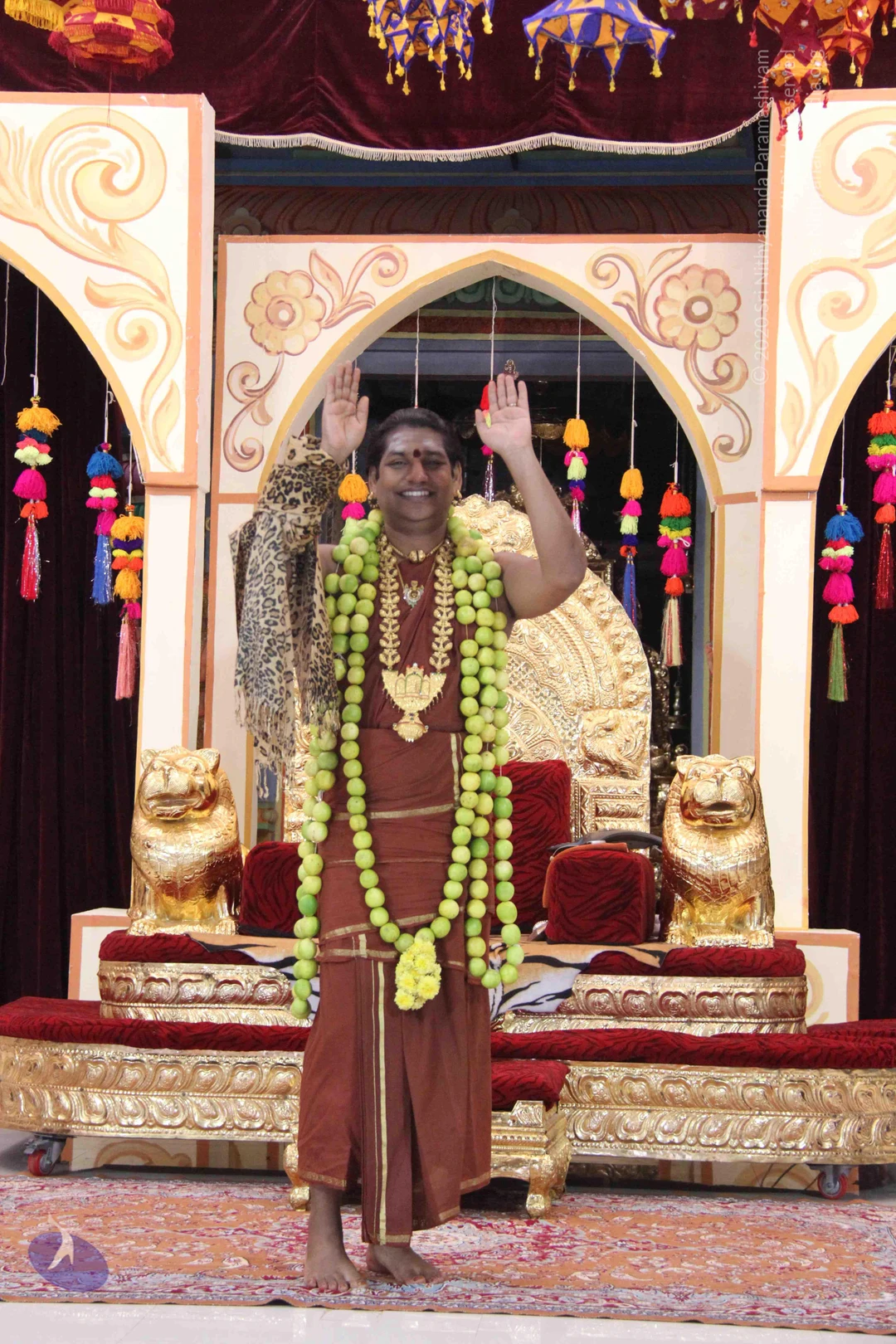
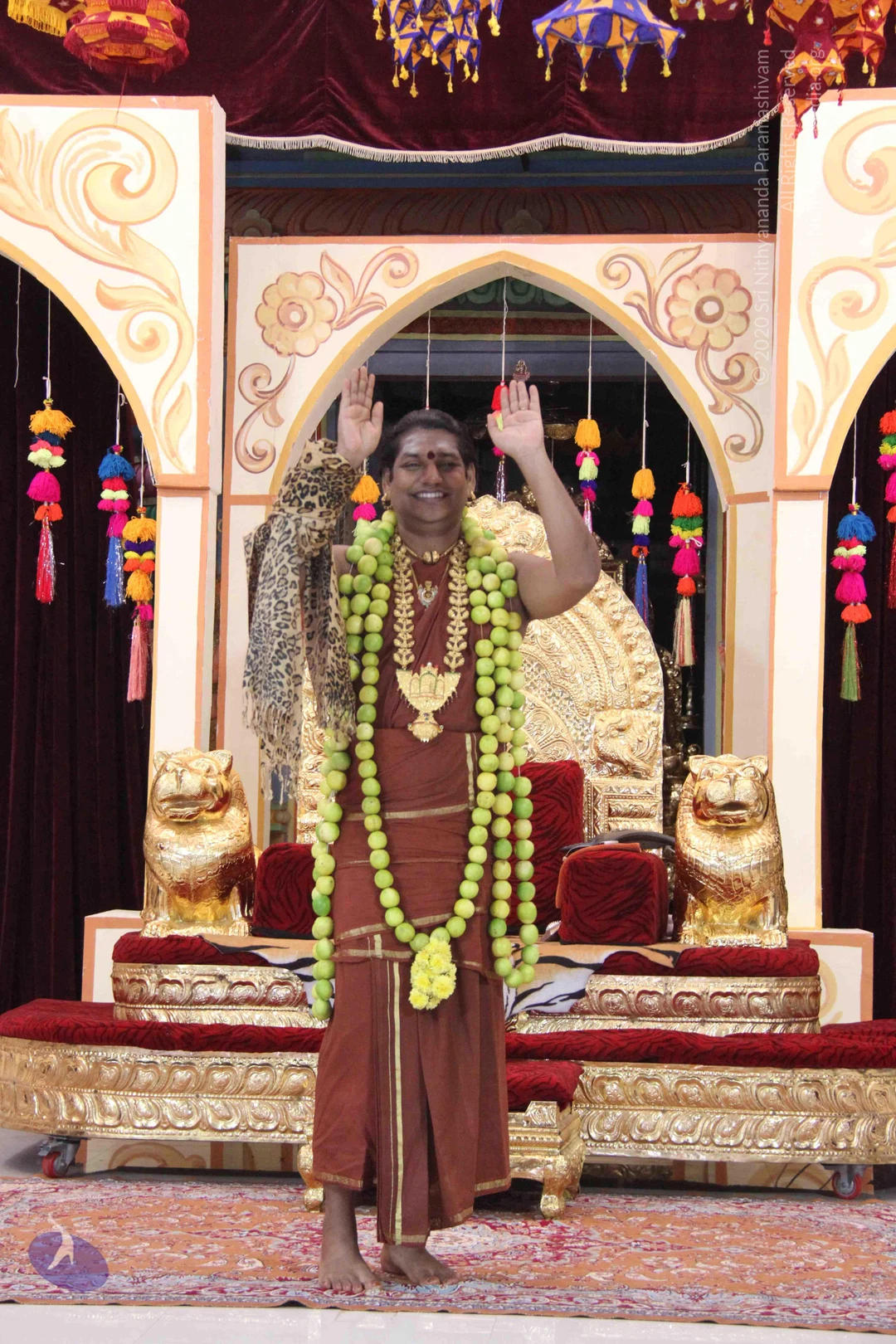
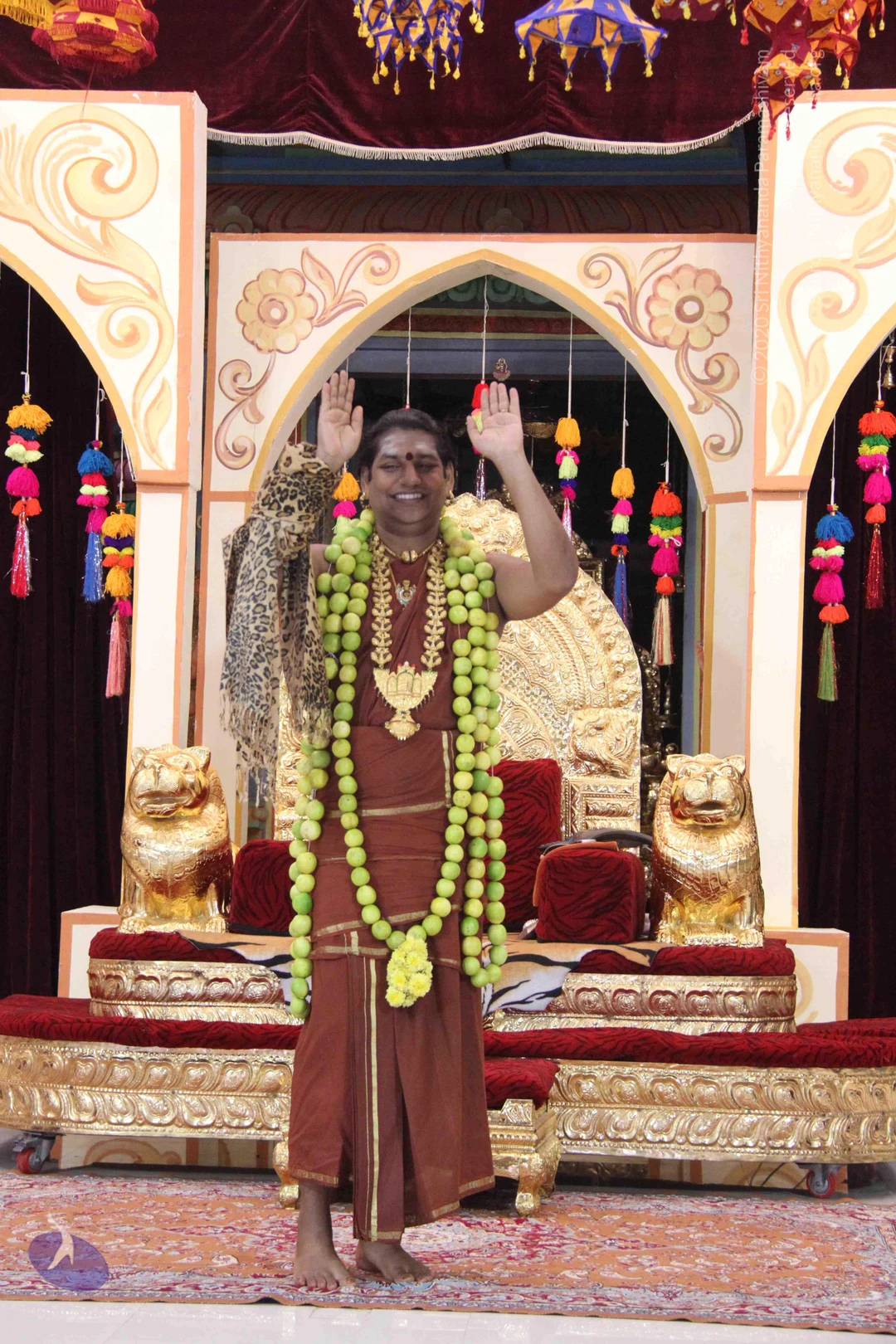
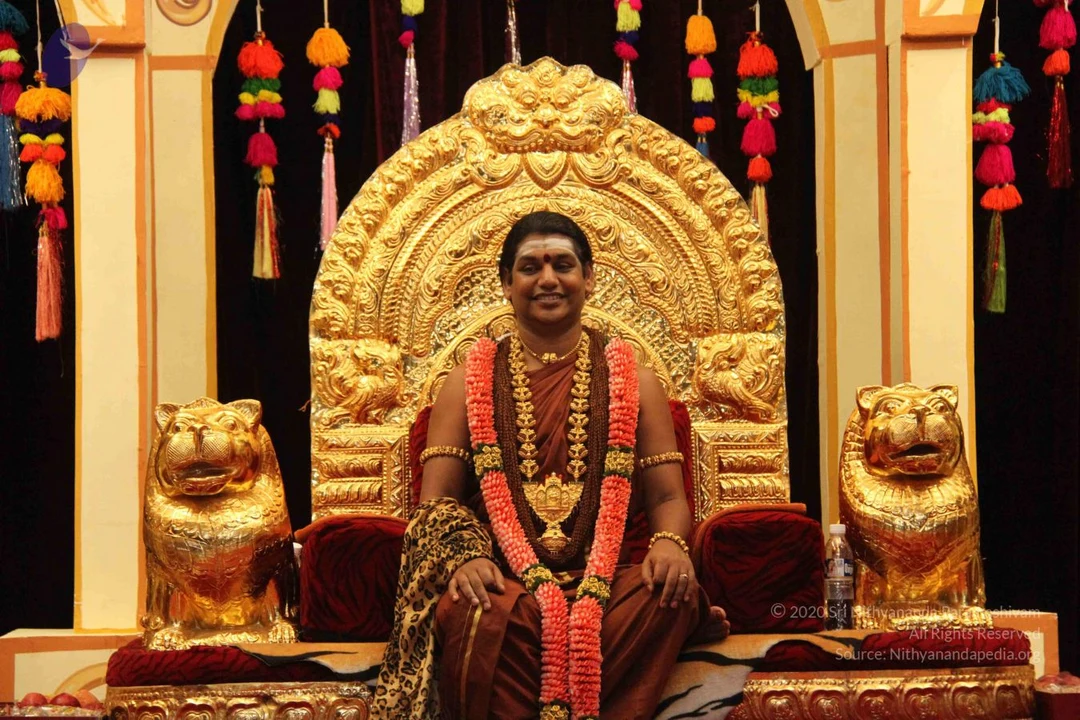
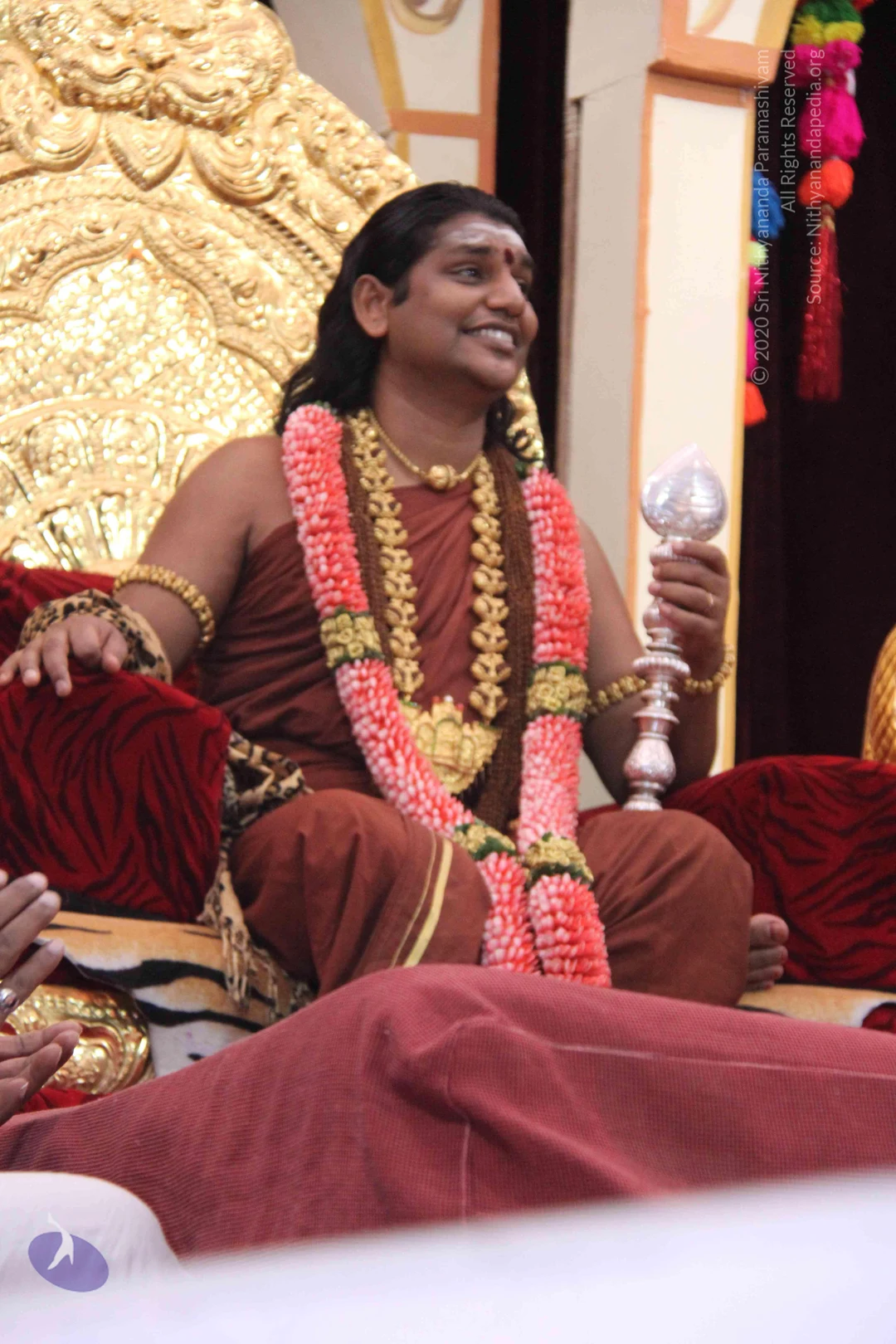
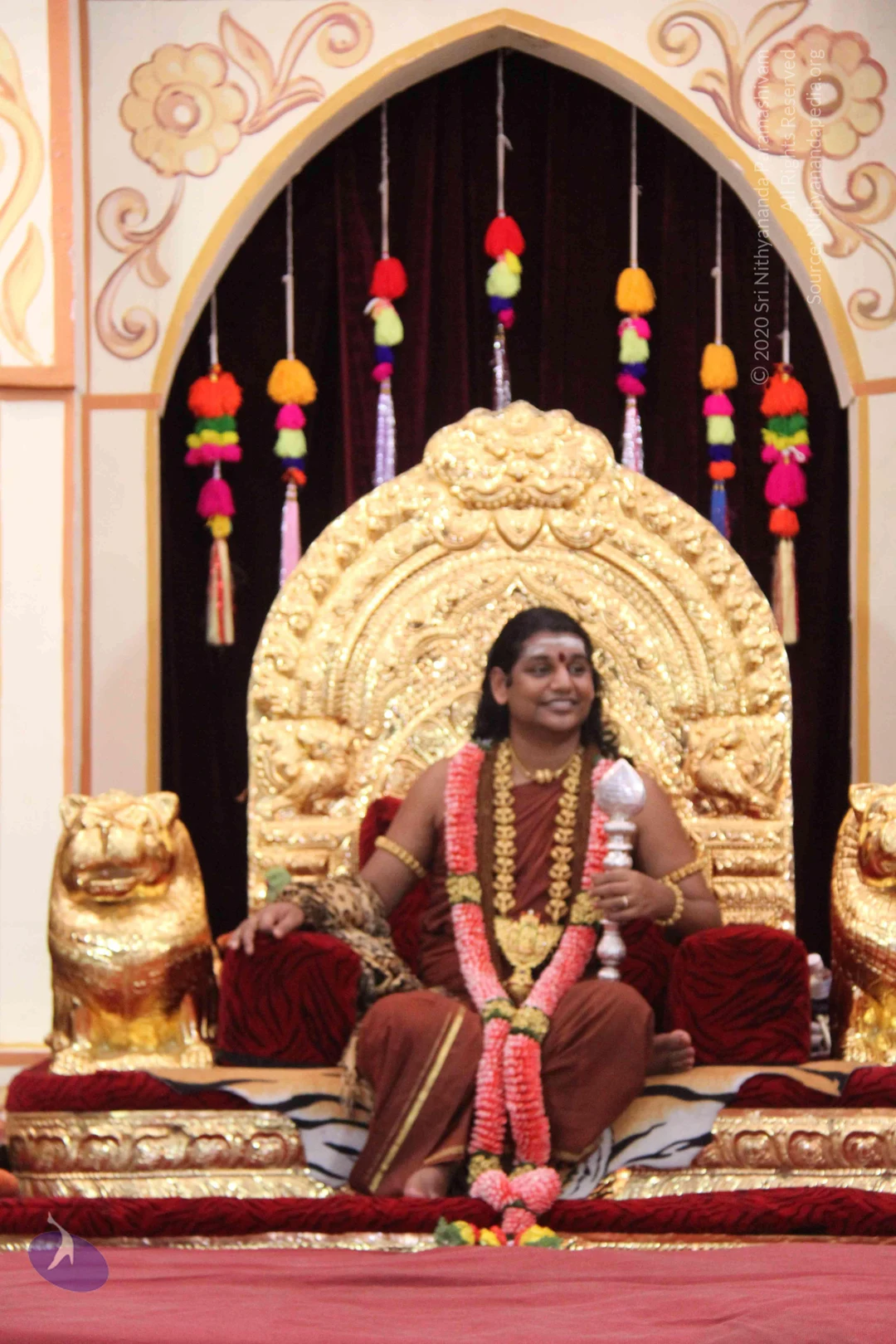
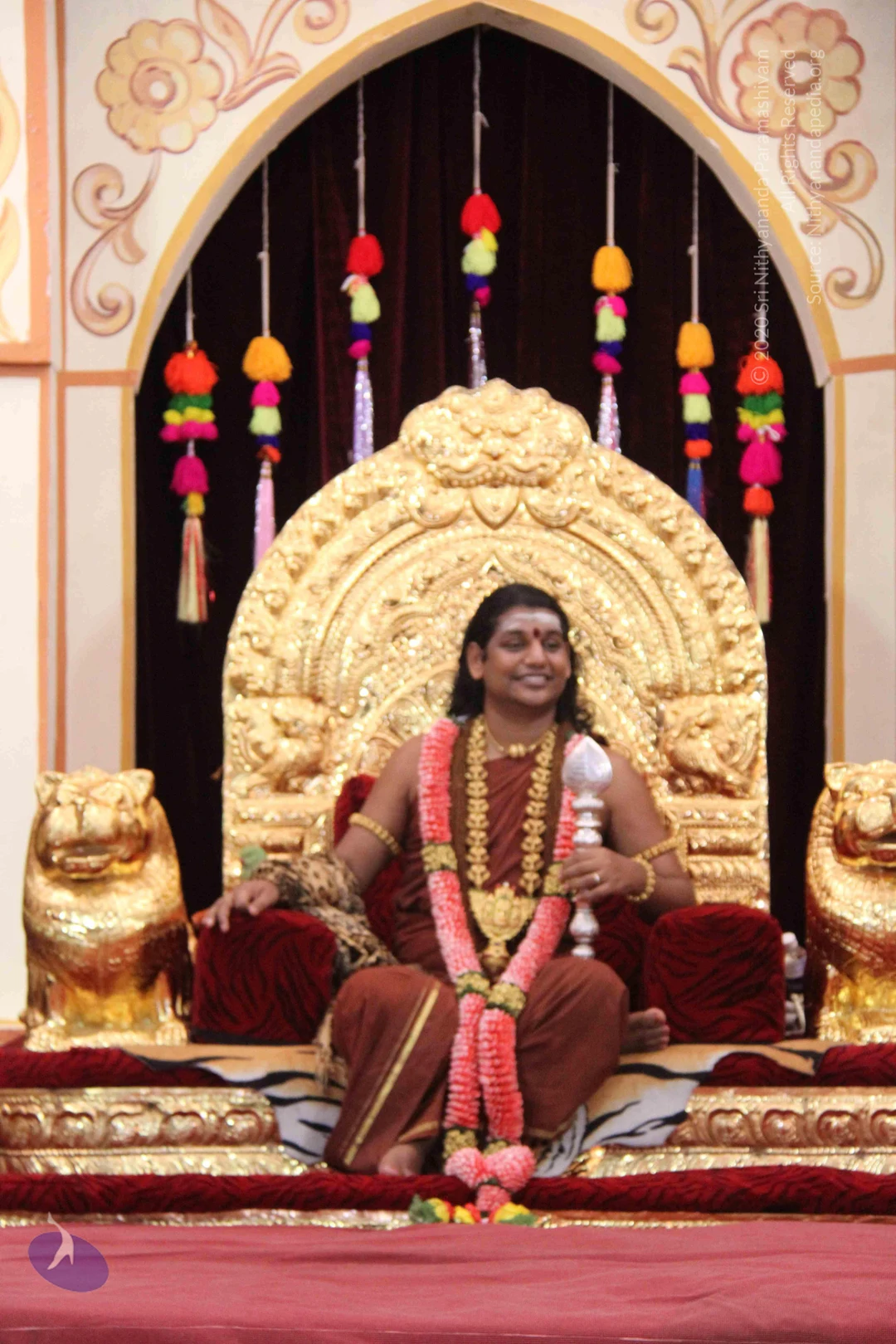
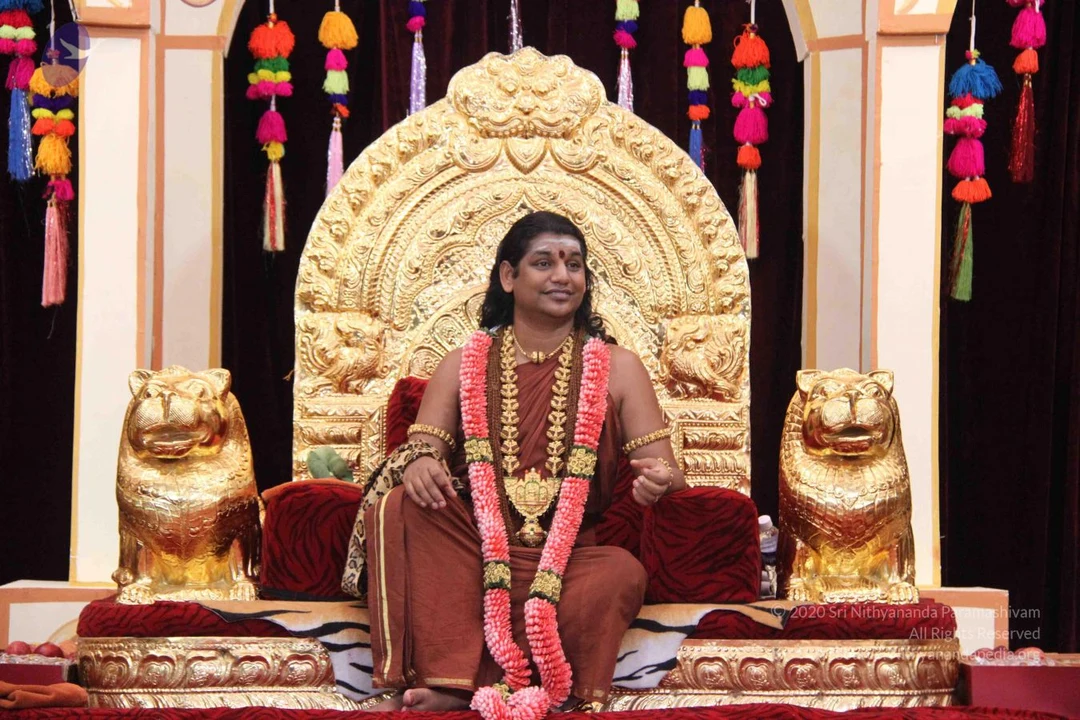
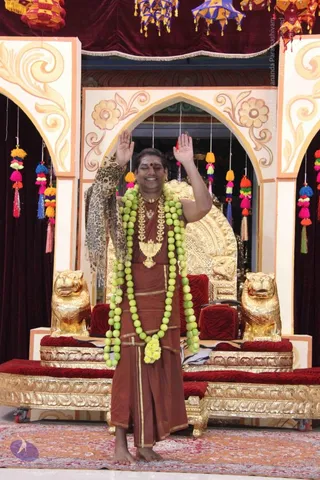
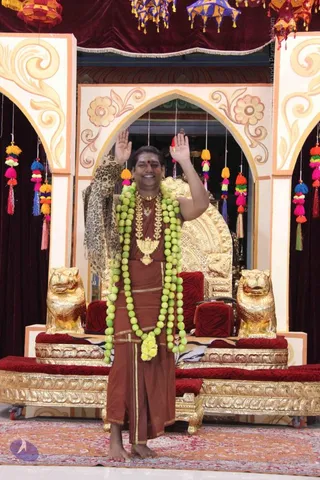
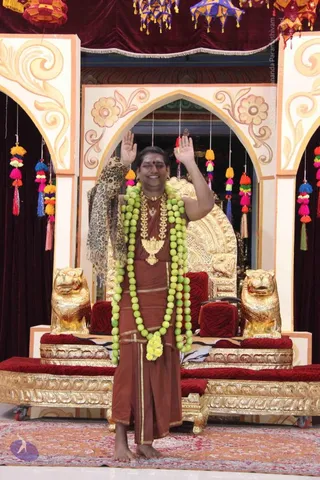
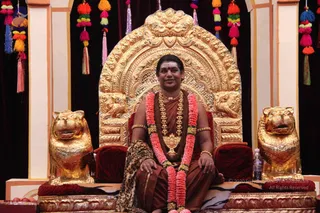
A standing man in a rust-brown dhoti and wrap, with both palms raised in greeting, smiling and wearing a dark tilak. He wears a long green lime-bead garland with a yellow flower tassel, a leopard-print shawl over one shoulder, and a gold-toned ornate necklace with a lotus pendant. Behind him is a gold-leaf throne with red velvet cushions flanked by two golden lion statues, under a maroon velvet canopy with colourful hanging tassels and paper lanterns. The rug is patterned peach and red.A smiling man in a reddish-brown dhoti-style robe with a gold-bordered cloth stands barefoot on a patterned rug, raising both palms in greeting. He wears a thick necklace of green beads with a yellow flower garland, a gold pendant necklace, a leopard-print shawl over one arm, and a red bindi on his forehead. Behind him stands an ornate gold throne flanked by two gold lion sculptures, with red cushions, a cream arched backdrop with floral scrollwork, and colourful tasseled hangings and lanterns. The scene is a stage-like setting with one physical person.A smiling man stands barefoot on a patterned rug before an ornate gold throne flanked by two golden lion figures with red cushions. He raises both hands in greeting, wearing a rust-brown dhoti-style garment, a leopard-print shawl over one shoulder, a gold necklace with a central pendant, a red bindi, and a long garland of green beads with a yellow flower cluster. Behind him stand a white arched backdrop painted with floral scrollwork and hanging tassels in pink, orange, blue and yellow. Colourful paper lanterns hang from the velvet drapes above. A small circular logo sits at lower left.A smiling man stands barefoot on a patterned rug before an ornate golden throne flanked by two gold lion sculptures with red velvet cushions. He wears a rust-brown robe with gold borders, a long green bead garland reaching to his waist, a gold ceremonial necklace with a pendant, a red bindi, and a leopard-print shawl over one shoulder. He raises both hands in greeting. Colourful tassel hangings and maroon velvet drapes frame an arched white backdrop with floral gold scrollwork. Appearance-based label: a person, given the saffron-toned robe, ceremonial gold necklaces and throne setting, though the appearance is only partly distinctive.

HDH-deities

17 photosSource gallery
A standing man in a rust-orange dhoti-style garment and draped leopard-print shawl raises one hand in greeting beside a decorated deity murti. He wears a green bead garland, a gold necklace and a gold pendant, and has a red tilak on his forehead. Behind him a golden throne sits in front of dark maroon curtains and hanging tassels in pink, orange and yellow. Three ornately decorated deity murtis stand on the right: the central figure in a green and red garment wears a crown and a white flower garland and is set on a purple cloth with red and white garlands, while the murtis on either side wear red, blue and white garments with flower garlands. A white floor fan and a wall air conditioner are visible at the edges.A standing man in a rust-brown dhoti and wrap with a long green-and-yellow bead garland and gold necklaces smiles and raises one hand in greeting before a decorated altar. Behind him, a tall gold-framed deity murti is dressed in a green sari with a flower-covered arch of red and white garlands and a crown. Two smaller deity murtis flank it, one in a red and gold sari before a blue cloth, the other in white and green before a teal cloth. Hanging multicoloured tassels, a purple draped stage, a dark curtain and a white fan complete the scene.A photograph of a man in an orange-brown dhoti and shawl standing at the left, smiling and raising one hand in greeting, wearing a long green-and-yellow beaded garland, gold chains and a gold pendant. Behind him, a decorated altar holds three deity murtis adorned with flower garlands: a central figure with a crown, in a red and white floral arch framed by blue and white flowers, seated on a purple cloth, flanked by smaller murtis on gold-framed thrones, one in a blue skirt and one in white and red. Hanging tassels in pink, yellow and red decorate the backdrop, and a white fan stands in the foreground.A photograph of a standing man in a rust-orange dhoti and wrap with a leopard-print shawl, wearing a green-beaded garland, a gold necklace and a red tilak, smiling and raising one hand in greeting. Behind him, a large ornately decorated deity murti is seated on a purple cloth, draped in a red and white flower garland and framed by a white-and-blue floral arch with peacock motifs. Two smaller decorated deity figures sit beside it on blue and white cloths, and multicoloured tassel hangings hang from the top of a dark drape. The man appears to be the a person by his distinctive adornments, shawl and garland, and his role is a standing devotee greeting the assembly. A cooling fan and an air conditioner are visible at the right edge.A standing man in a rust-red dhoti and a leopard-print shawl wears a dense green-beaded garland, a gold necklace and a gold pendant, raising one hand in greeting beside a decorated shrine. In the centre, a large ornate deity murti with a crown sits within a red and white flower-arch backdrop, decorated with white, blue and red garlands and a green sari-like drape, on a purple cloth-covered platform. Smaller murtis on blue and red cloth-covered seats flank it, all against a dark curtain with hanging pompom tassels and a white wall air-conditioner. Probable Swamiji's appearance includes long hair, a gold necklace and a shawl, and the page indicates his presence.A man in a rust-orange dhoti and matching shawl stands at the left of a temple-style stage, smiling and raising one hand, wearing a long green garland of beads, a gold necklace and a red tilak on his forehead. Behind him, three deity murtis are dressed and garlanded with red, white, blue and yellow flowers; the central murti sits on a purple cloth-draped throne with a crown and a decorated green skirt, flanked by two smaller murtis in red and white. Multicoloured tassels hang from the ceiling and a standing fan sits in the foreground. A wall-mounted air conditioner is visible at right.

ia-day10-darshan

12 photosSource gallery
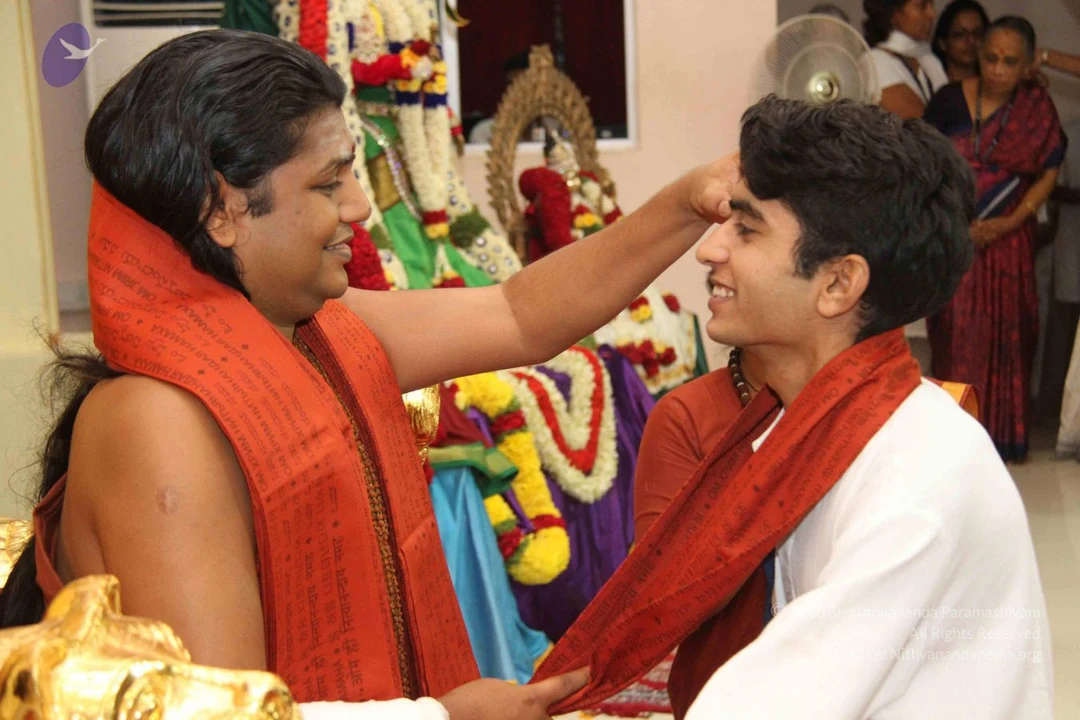
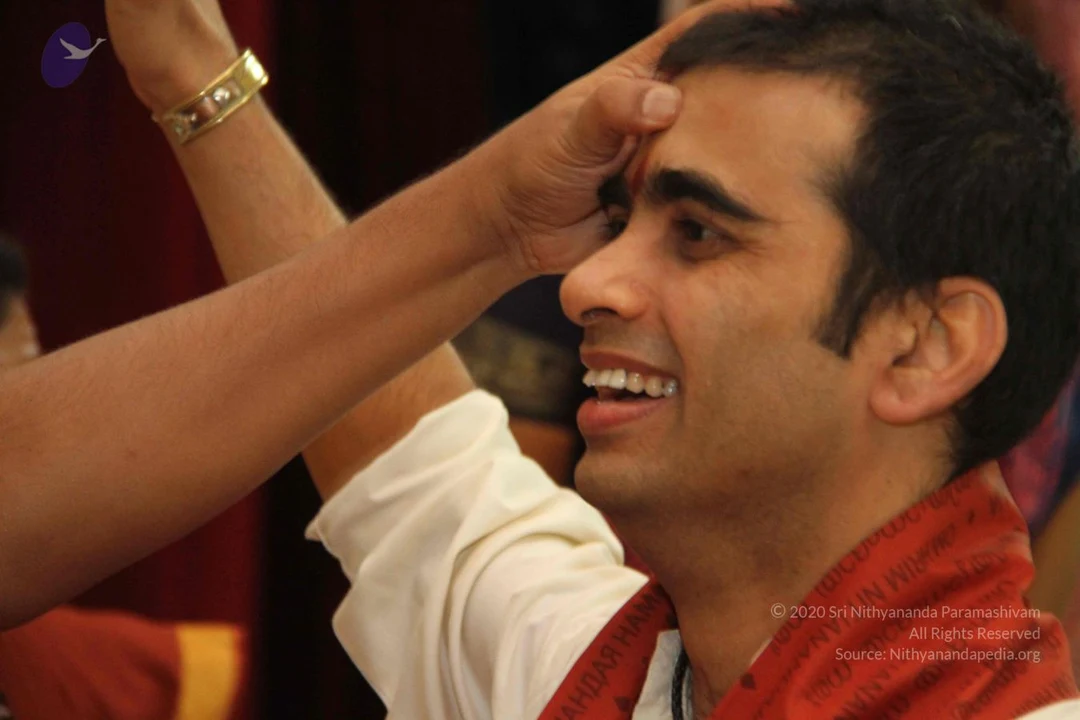
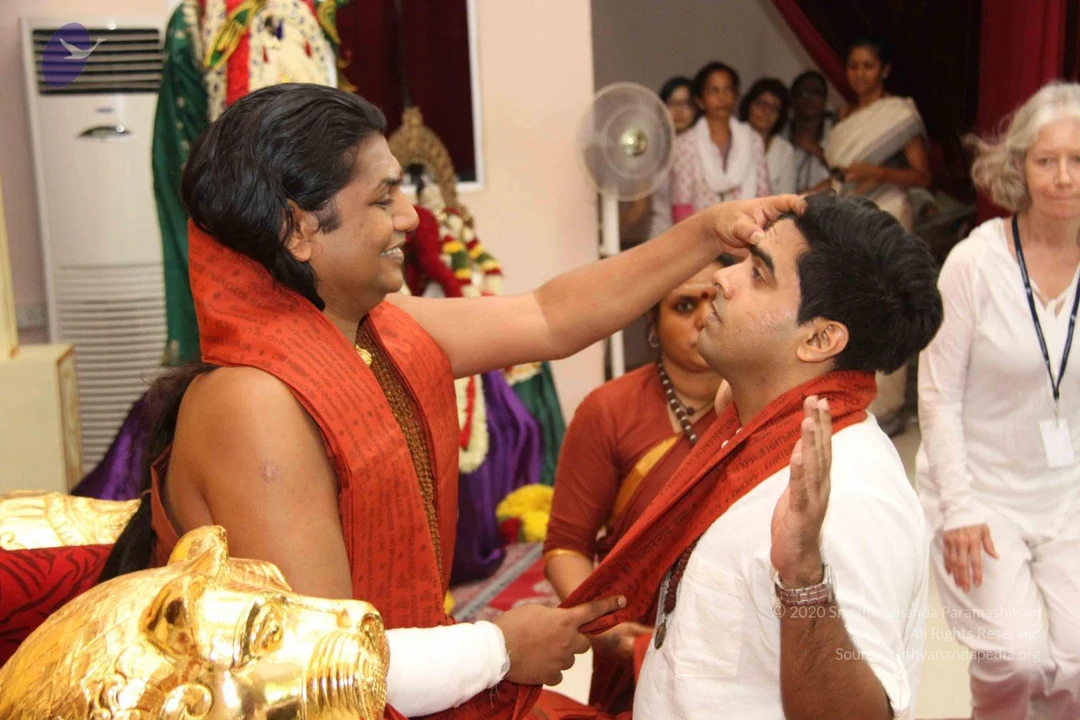
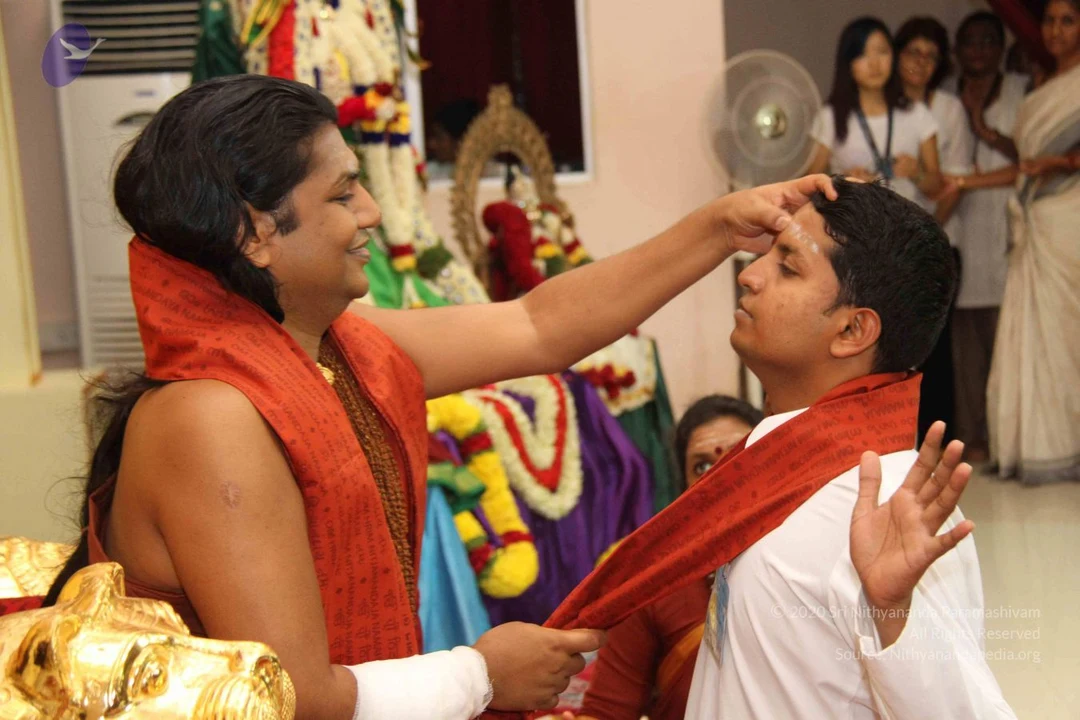
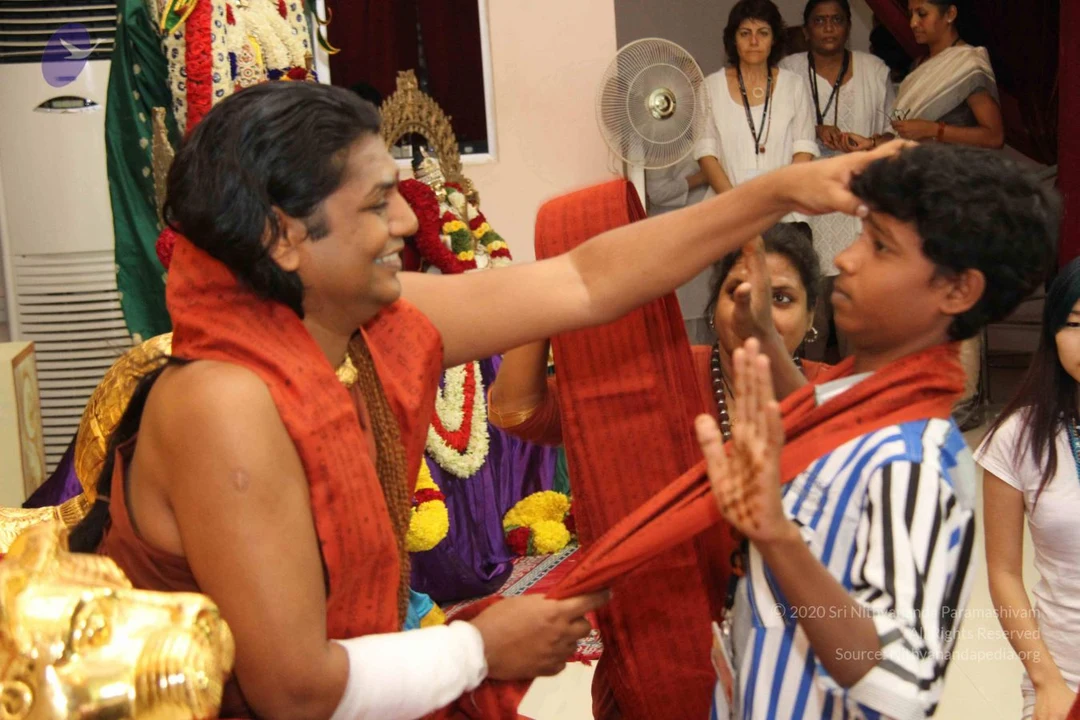
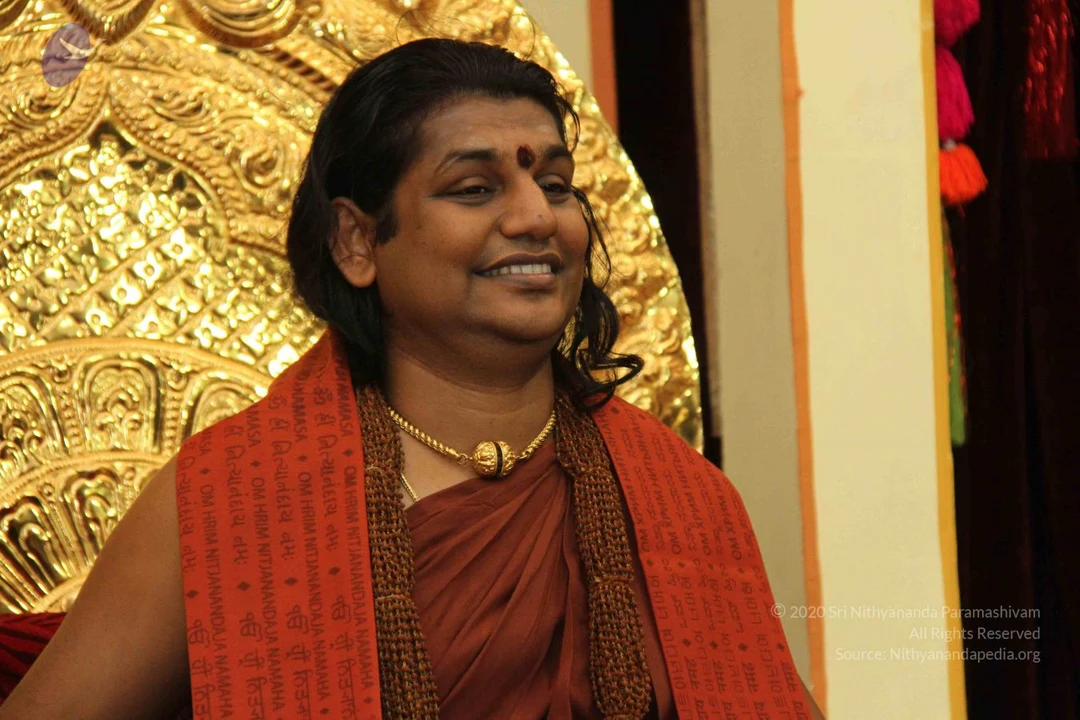
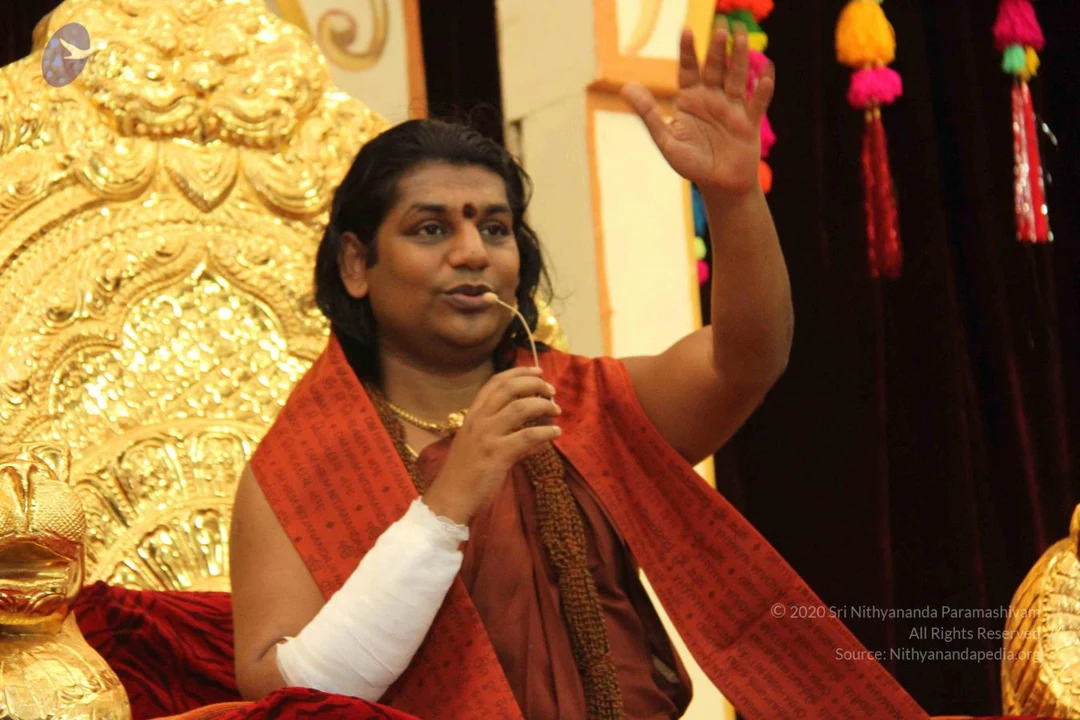
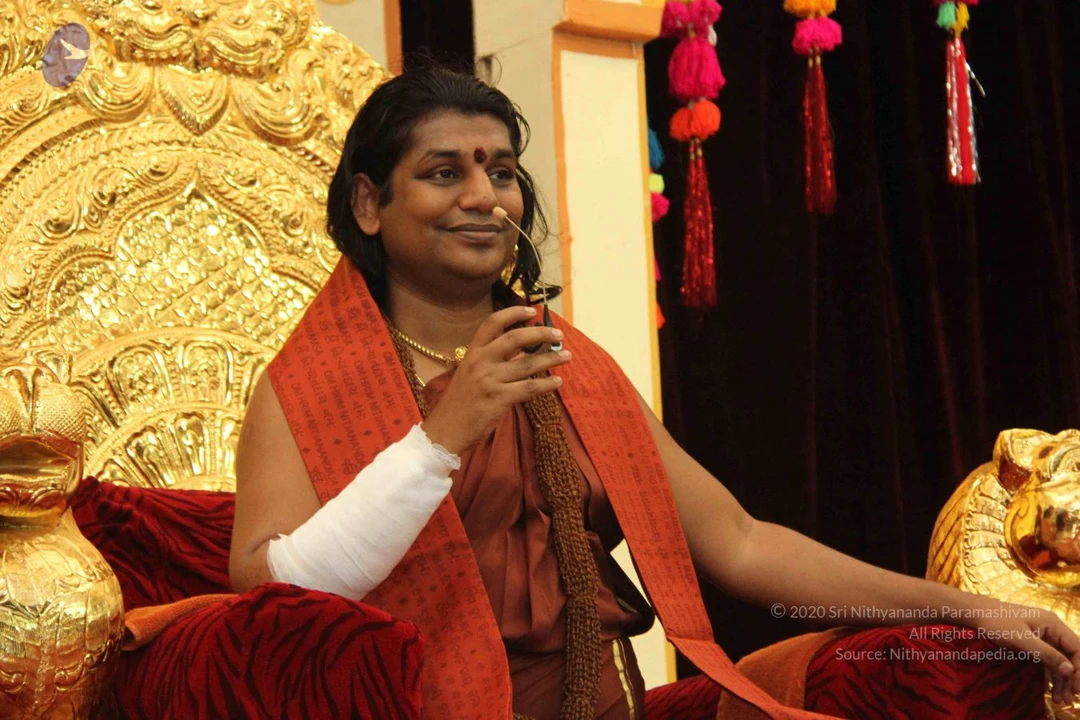
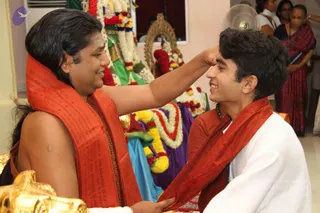
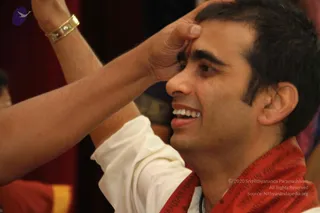
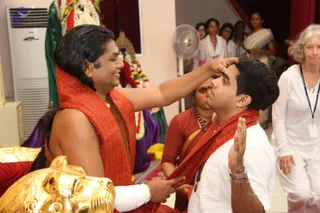
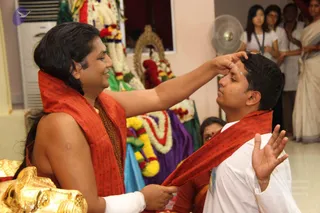
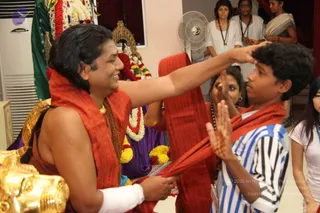
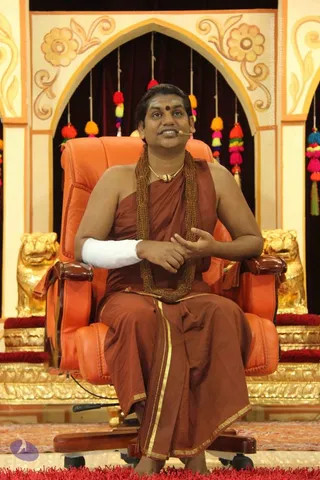
Photograph of an indoor ritual setting. A man with long, swept-back black hair and a bare upper torso wears a saffron-orange shawl printed with script. He touches the forehead of a smiling young man in a white kurta and a matching red-orange shawl with printed text. Behind them, garlands of white and yellow flowers and red and white blossoms hang on a deity murti or altar display, and a gold ornate frame stands on the right. A woman in a red sari and an older woman in a magenta sari are visible in the background. Probable Swamiji cues: long swept-back hair, saffron shawl with script, and a bare upper torso with ornamentation; he is the figure giving blessing to the young devotee.Close photo of a smiling man with short dark hair and a red tilak on his forehead, wearing a white top and a red shawl printed with Sanskrit-style lettering. A raised hand with a gold bangle presses or blesses his forehead. a person cannot be confirmed from appearance alone, so no identity is asserted. The man is a devotee receiving a blessing.A photograph of a ritual blessing inside a temple-like hall. A man with long, swept-back black hair and a red-orange shawl with printed text stands on the left, pressing his right hand to the forehead of a seated man in a white shirt and watch, who has a red-orange shawl draped over his shoulders and lifts one palm. Behind them a golden lion-headed seat stands in the foreground, with a kalasha-like altar, garlands and purple and green draped fabric behind. A woman in a red-orange sari and beaded necklace sits near the seated man, and women in white saris and white clothing watch from the background. A wall-mounted air conditioner and a standing fan are visible. The scene reads as a forehead blessing given with a shawl, with Swamiji (probable) as the standing man in orange cues: long swept-back hair, orange shawl and ornate gold necklace.A man with long dark hair and a bare upper body, wearing an orange-red shawl printed with script, marks the forehead of a man in a white kurta with a vermilion-red shawl. The bare-chested figure has distinctive long swept-back hair and ornate gold-toned clothing, consistent with the Swamiji (probable) candidate, shown in the act of giving a blessing or tilak. Behind them, garlands of white and orange flowers and purple and red fabric decorate a shrine area, with a gilded frame. Women in white saris and a young woman in white stand in the background, and a gold-toned lion or animal figure is at lower left.A photograph of a devotional blessing in an indoor hall. A man with long swept-back dark hair, bare-chested under an orange-red shawl with a white bandage on his right wrist, extends his arm to touch the forehead of a young boy in a blue-and-white striped shirt draped with a red shawl, who holds up his palm. Behind them, a floral garland of red and white flowers hangs near a golden ornate chair, and a purple cloth sits beside a fan. Two women in white and a woman in a grey sari stand watching in the background. A golden lion-shaped object is visible at the lower left. The man is Swamiji (probable) based on the long hair and orange-red shawl, present in person.A smiling man with shoulder-length dark hair and a red bindi sits before an ornate gold-leaf throne with repoussé patterns. He wears a rust-orange robe and an orange shawl printed with repeated Sanskrit mantras, plus a heavy twisted gold necklace with a round gold pendant over a brown rudraksha-style mala. Pink and red tassels hang at the upper right beside a cream pillar. Swamiji (probable): the long swept-back hair, ornate gold necklace, saffron robe and throne setting are consistent with the page's description of Swamiji at this satsang event.

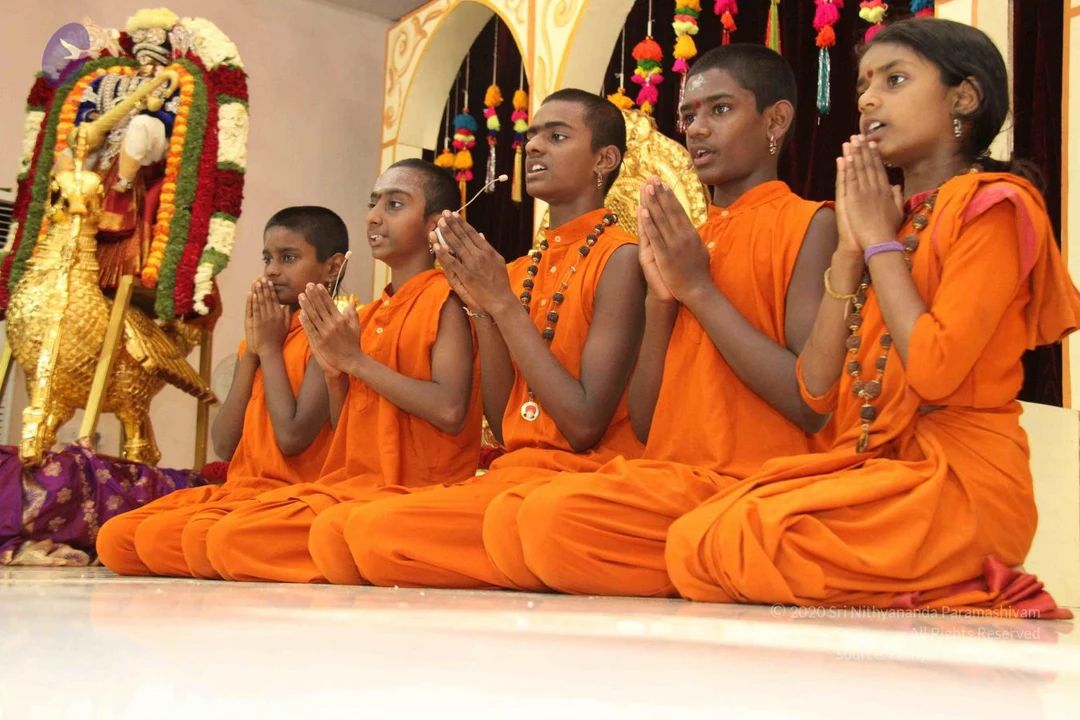
ia-day10-gurukul-kids-show

52 photosSource gallery
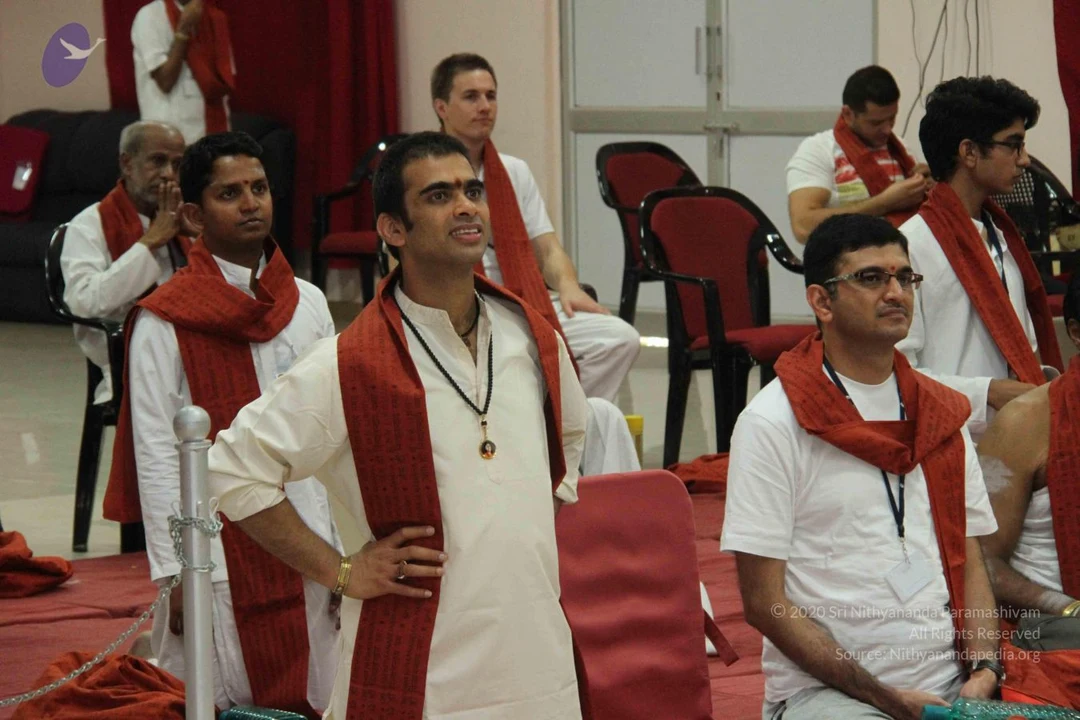
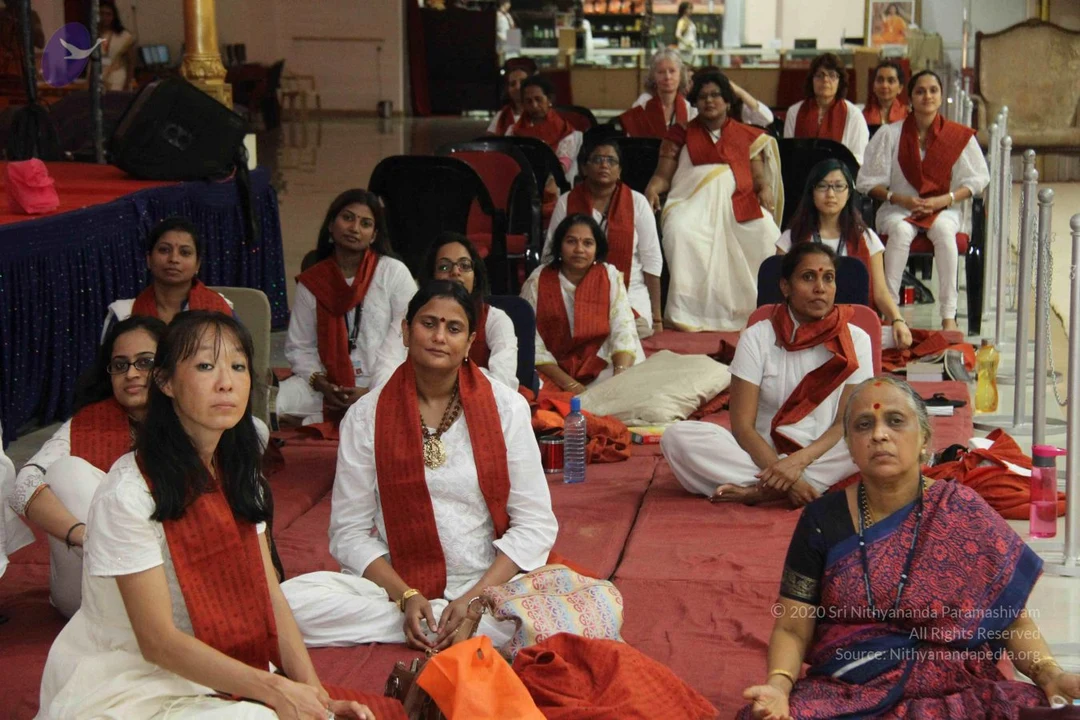
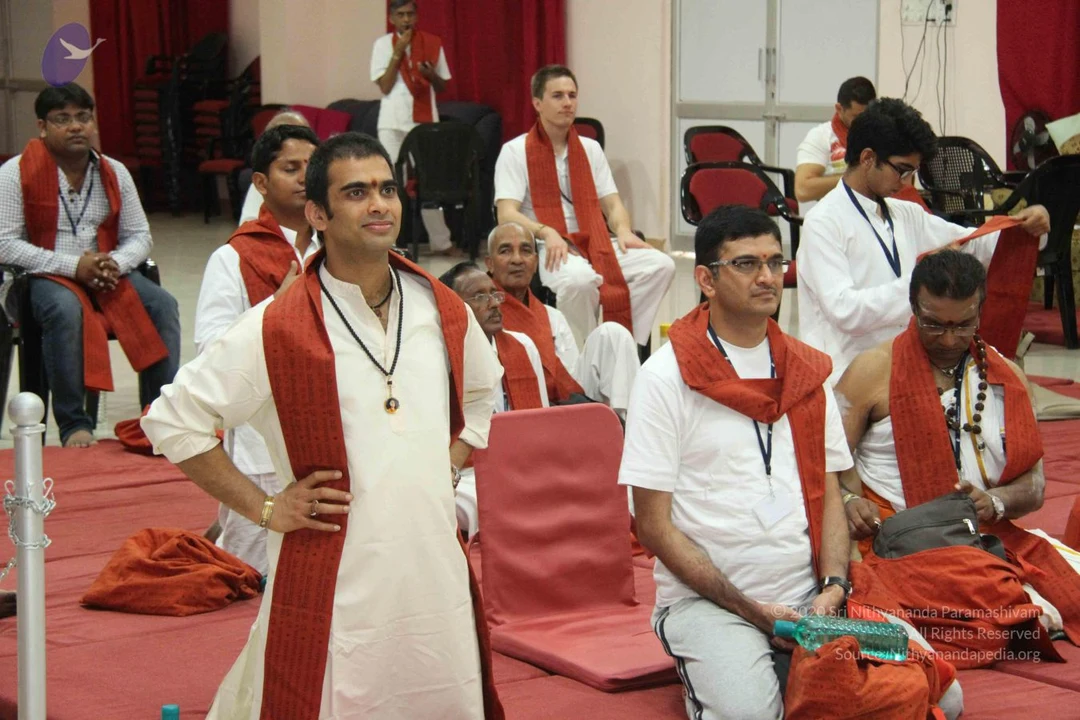
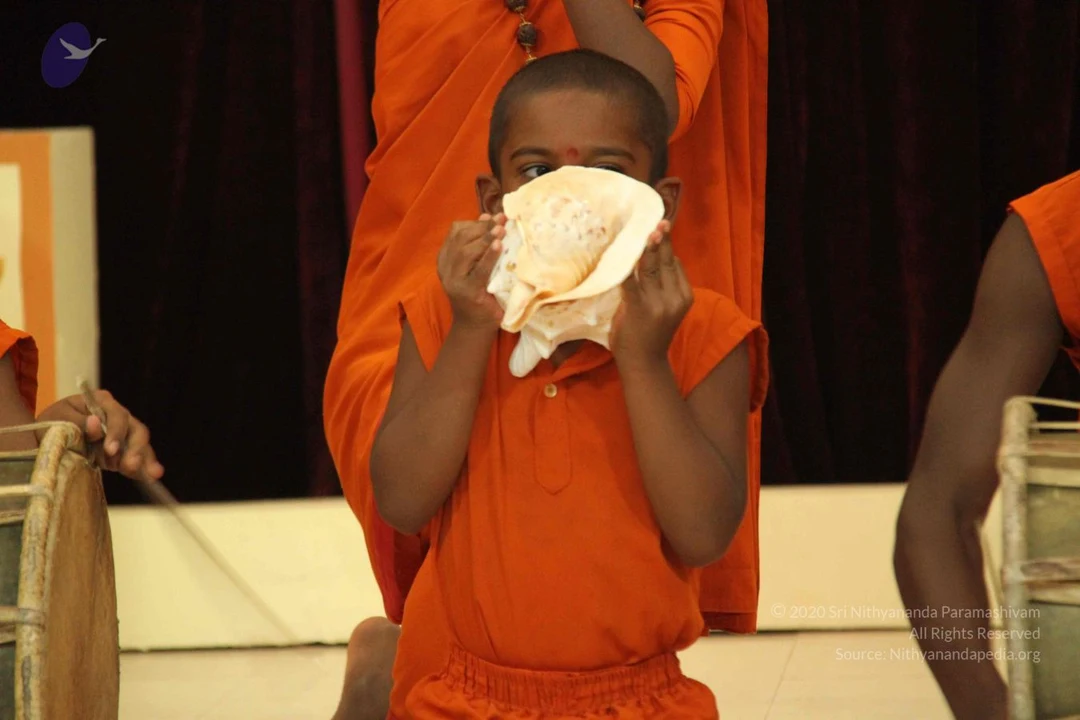
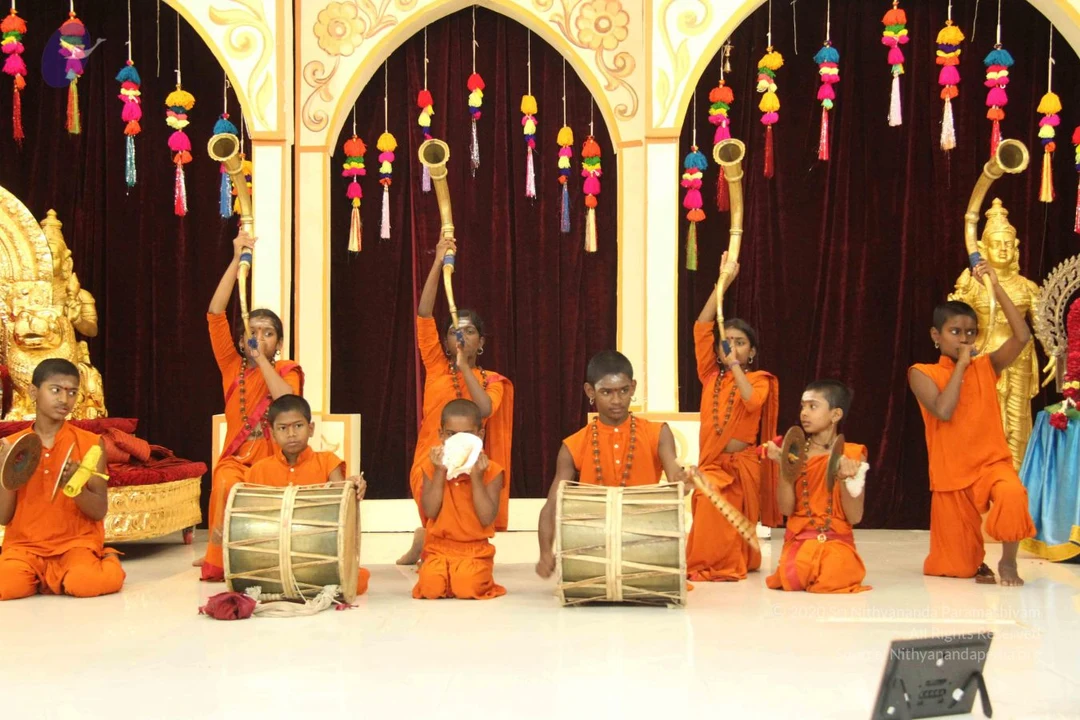
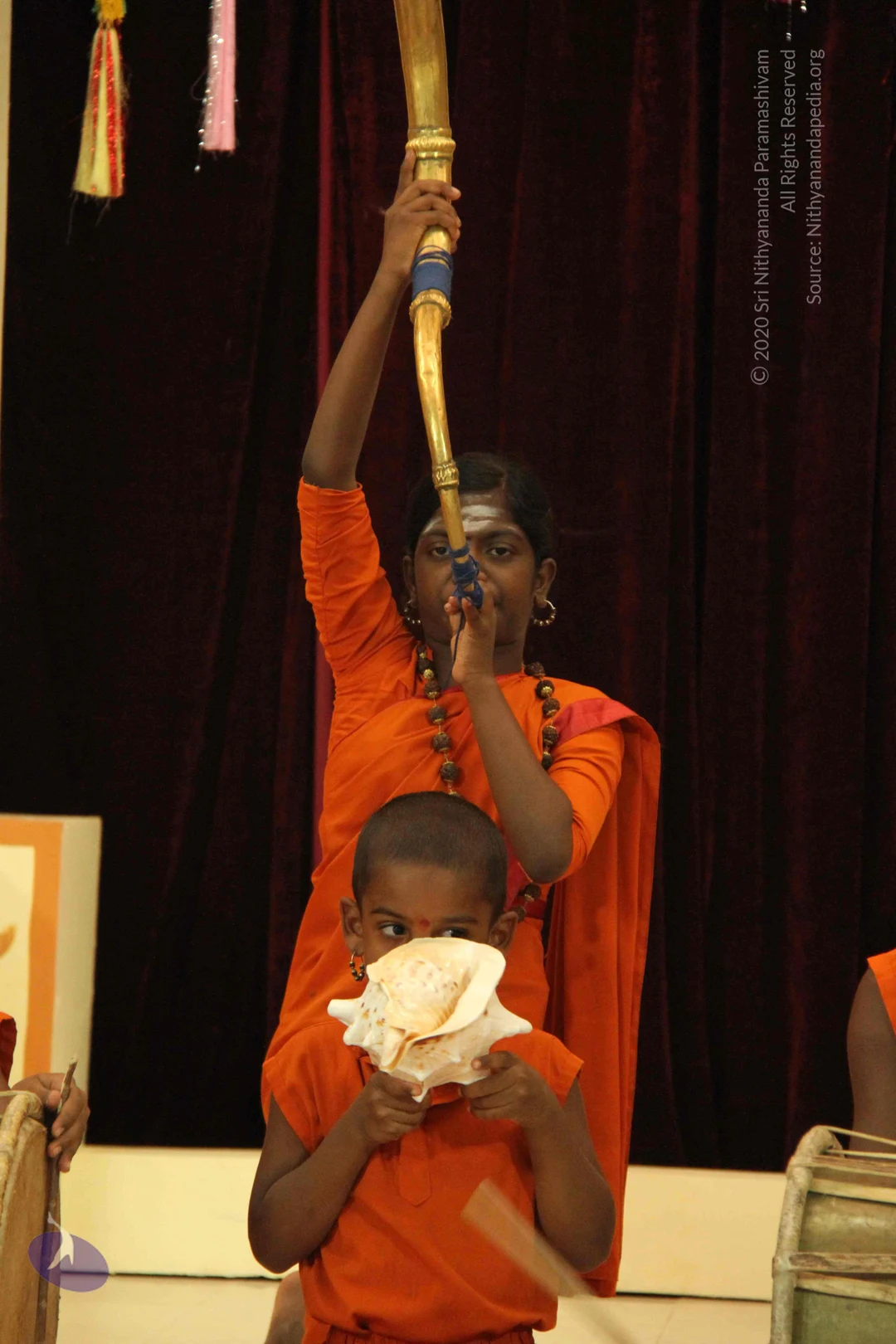
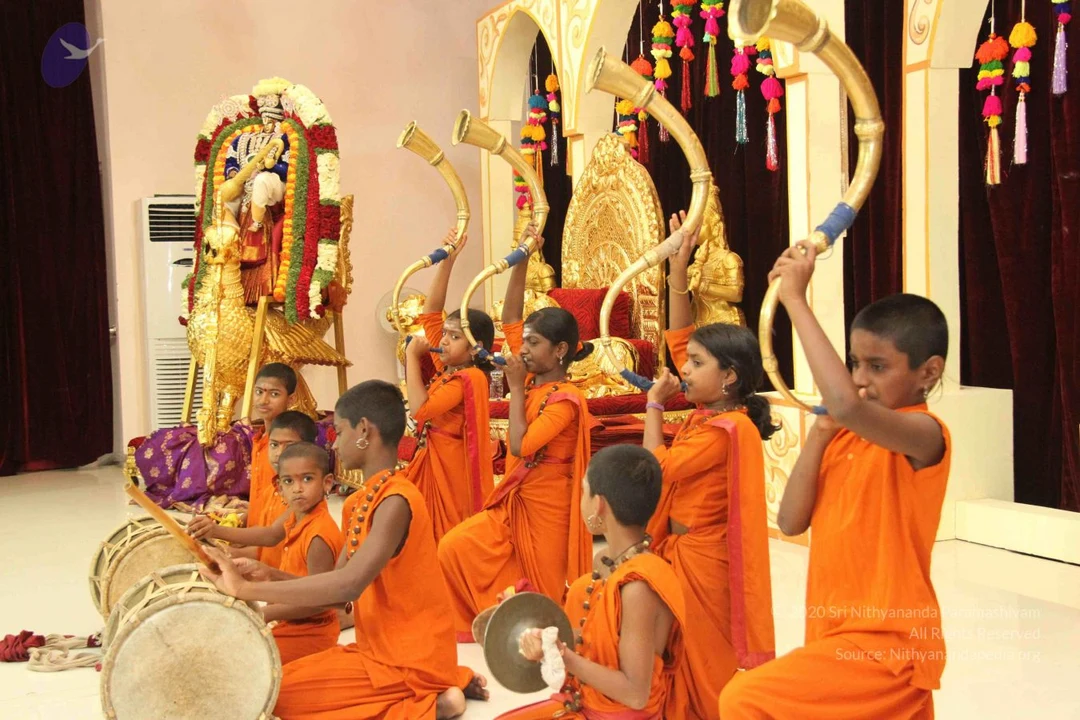
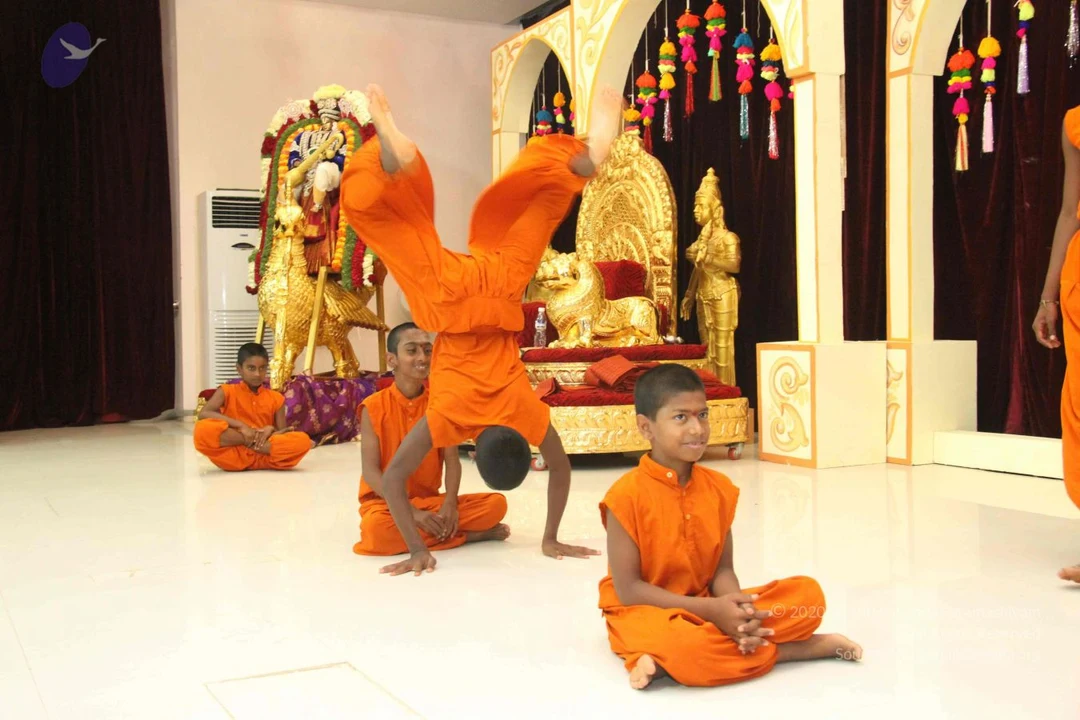
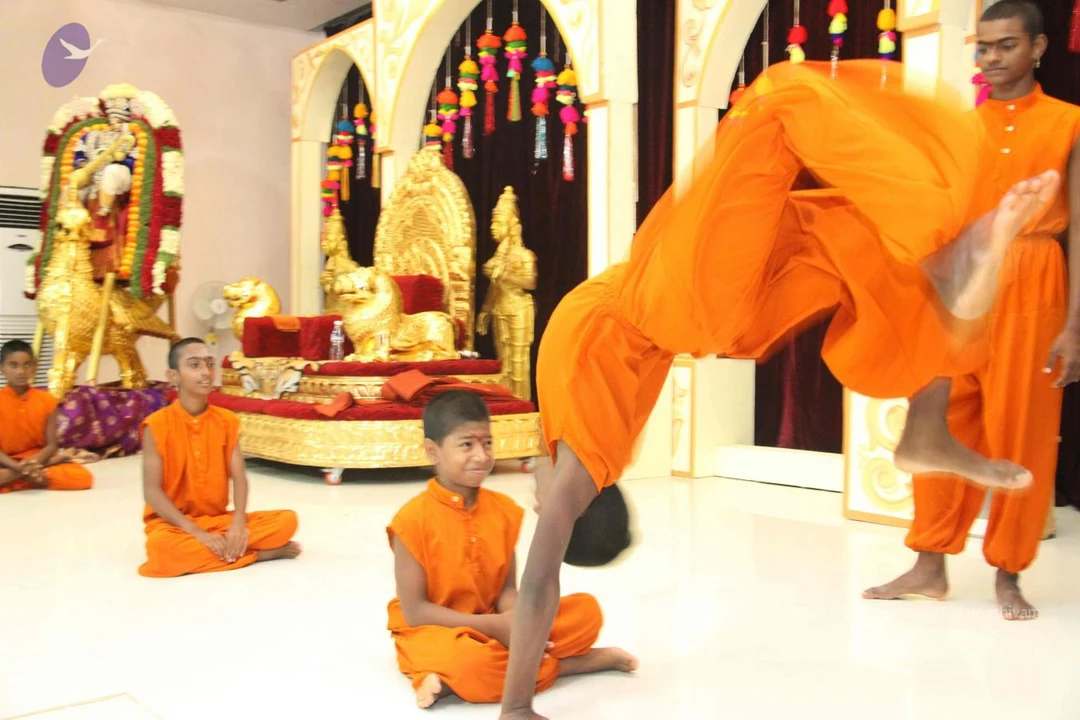
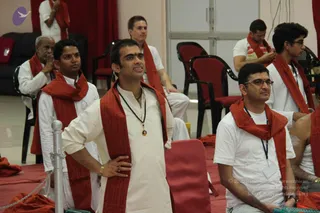
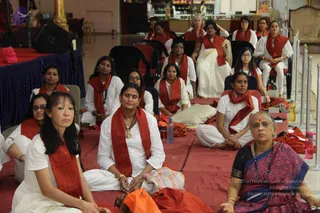
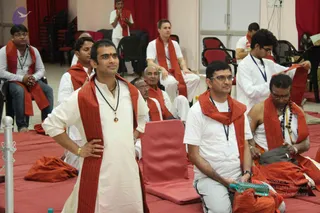
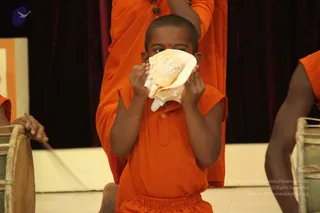
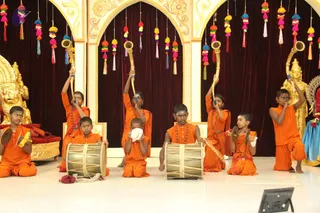
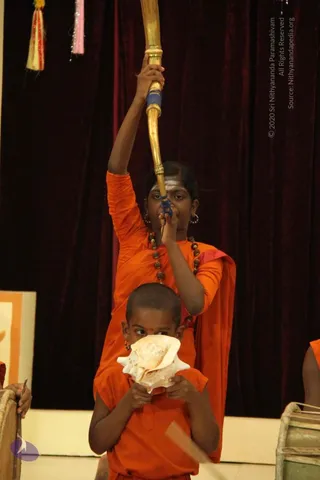
A photograph of a seated satsang gathering in a hall with red chairs and red floor covering. Men wear white kurta or t-shirts with red shawls draped over their shoulders. In the foreground, a man in a cream kurta with a rudraksha mala and red shawl stands with one hand on his hip, looking upward. Beside him, a man in white with glasses sits in a red chair, and a man on the left in white with a red shawl sits with hands folded. Behind them, several other seated devotees wear red shawls.A photograph of a seated audience at an indoor satsang hall. Women sit on red floor mats and cushions, most wearing red shawls over white clothes, with one woman in a patterned blue and maroon sari at lower right. Some hold water bottles or sit with hands folded, and rows of chairs and a blue-draped stage with a speaker stand the background. Partially visible people also appear at the far left and rear. The image is a photo of the audience rather than of a speaker.A seated group of devotees in a hall with red floor coverings and red curtains, many wearing red-and-orange shawls over white or white-and-grey clothing. In the foreground, a man in white kurta and white dhoti stands with hands on hips, wearing a rudraksha mala and a vertical tilak on his forehead, while a seated man in a white T-shirt and glasses wears an identification lanyard. Another seated man at right, with glasses and a rudraksha mala, holds a small bag. Behind them, others sit on red cushioned chairs and stand near a window, several in white with red shawls. No visible deity, altar or discourse setting is shown.A young boy in an orange ashram-style outfit with a red bindi on his forehead blows into a large white conch shell held to his mouth with both hands. Behind him a standing adult in orange robes with a beaded necklace is partly visible, and drummers at the left and right edges play barrel drums on a stage with a dark red curtain backdrop.A group of children in saffron-orange robes performs music on a stage decorated with colourful tassel garlands hanging from an arch. Several children raise long brass horns (ceremonial trumpets) to their lips or into the air, while others play barrel-shaped drums with sticks and hand cymbals. Some wear rudraksha malas. Behind them a golden deity murti stands on the right and a golden lion-faced figure appears on the left, with a deep maroon velvet backdrop and a white marble floor.Two child performers in orange saffron-coloured robes stand before dark maroon velvet drapes on a stage. The taller girl raises a long gold-coloured horn high overhead with one hand while blowing into it, wearing rudraksha beads around her neck, hoop earrings and a white vertical tilak on her forehead. In front of her a younger boy with a shaved head and a red bindi blows a large white conch shell, held in both hands. Drums are partly visible at the edges. Red and white tassels hang from the top left.
ia-day10-session

4 photosSource gallery
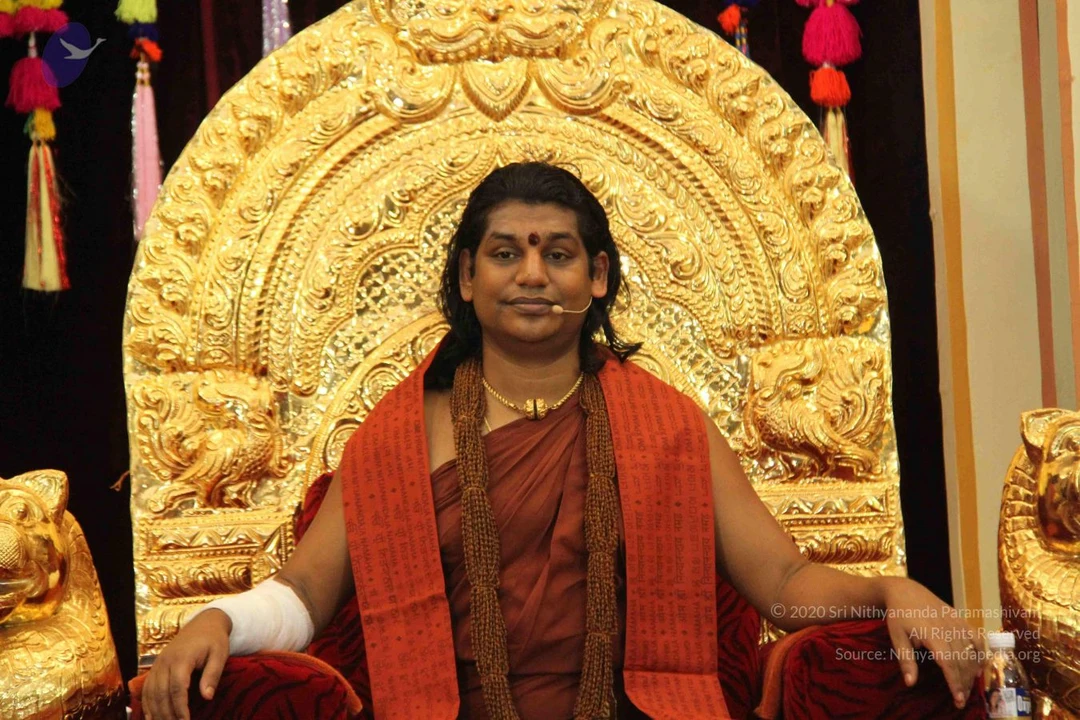
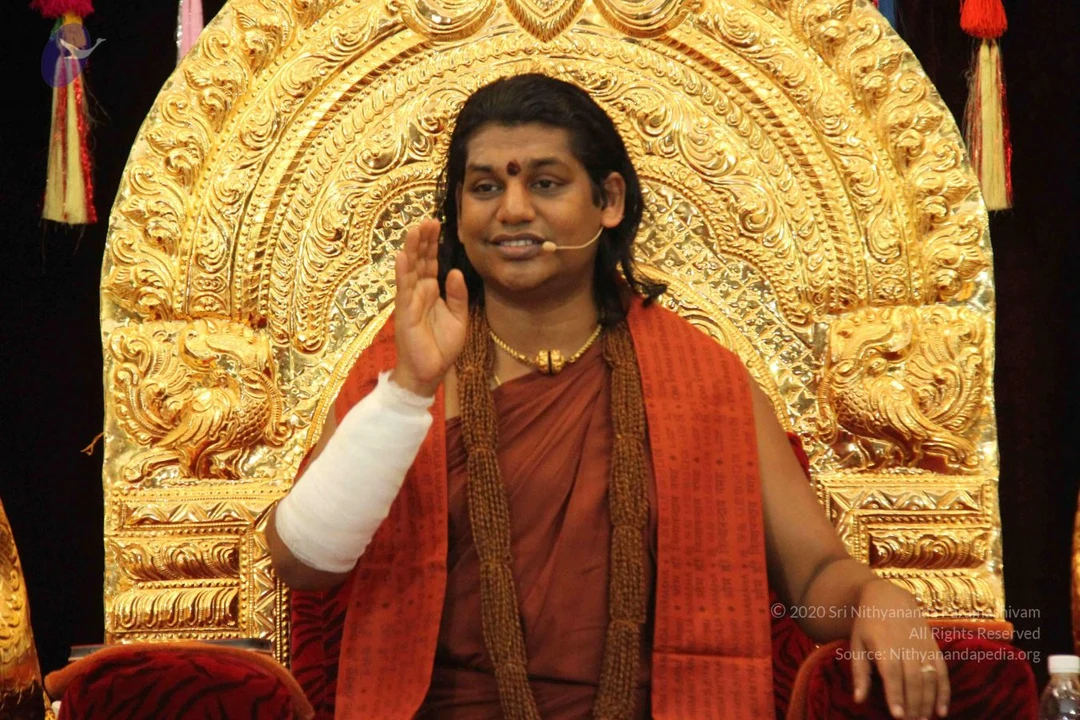
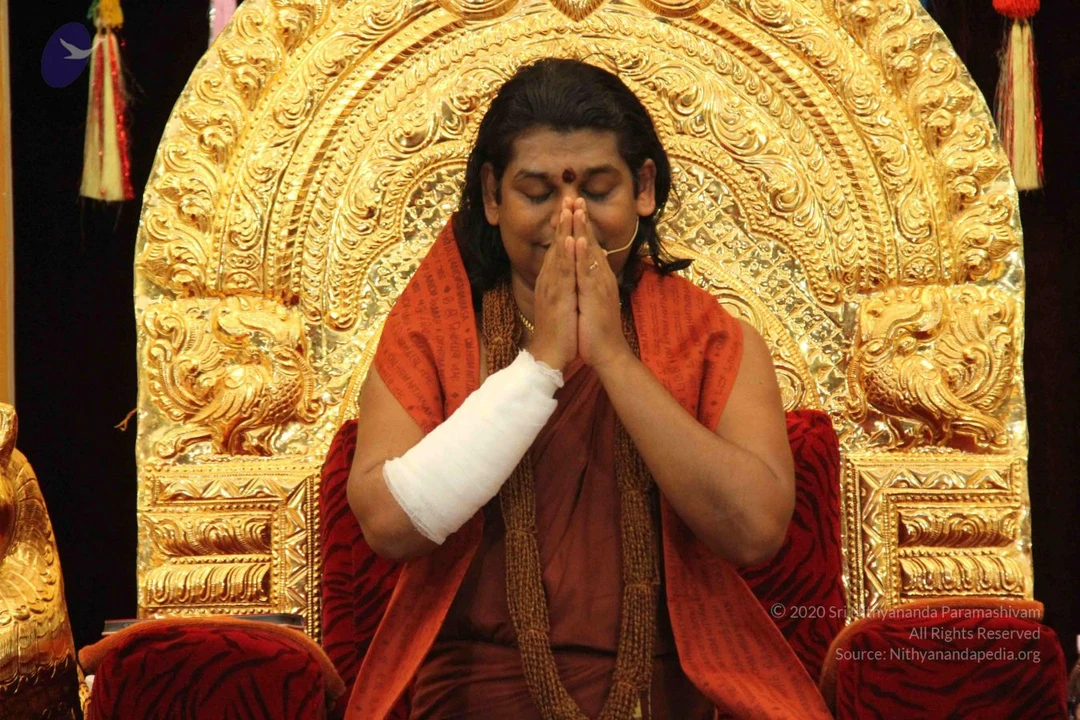
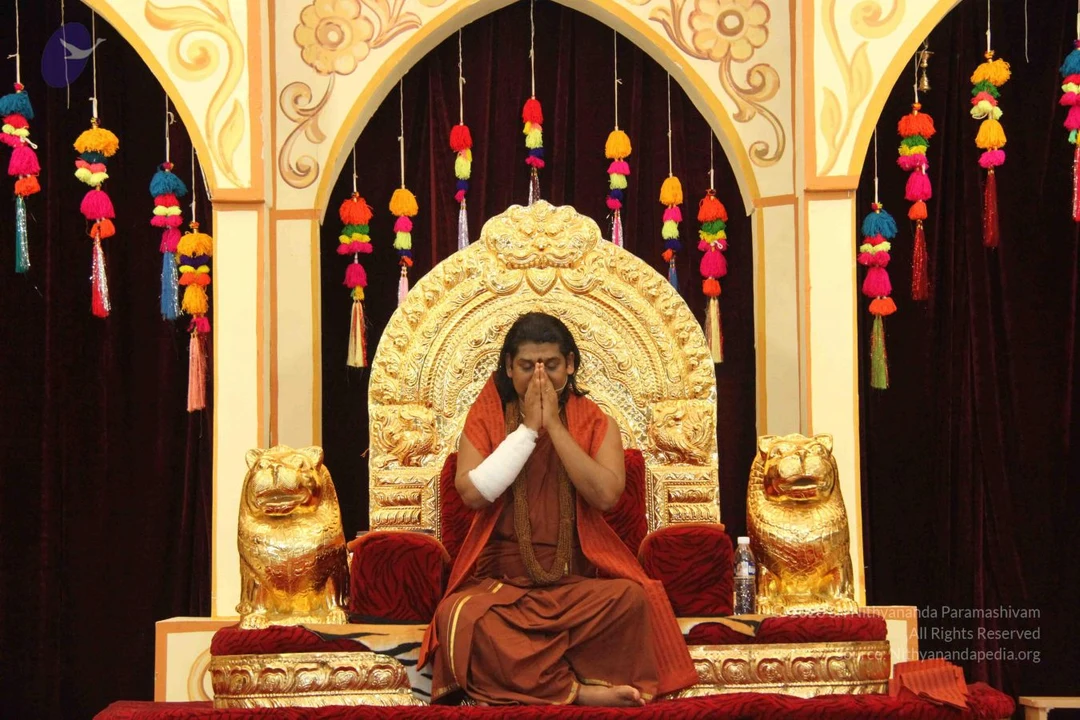
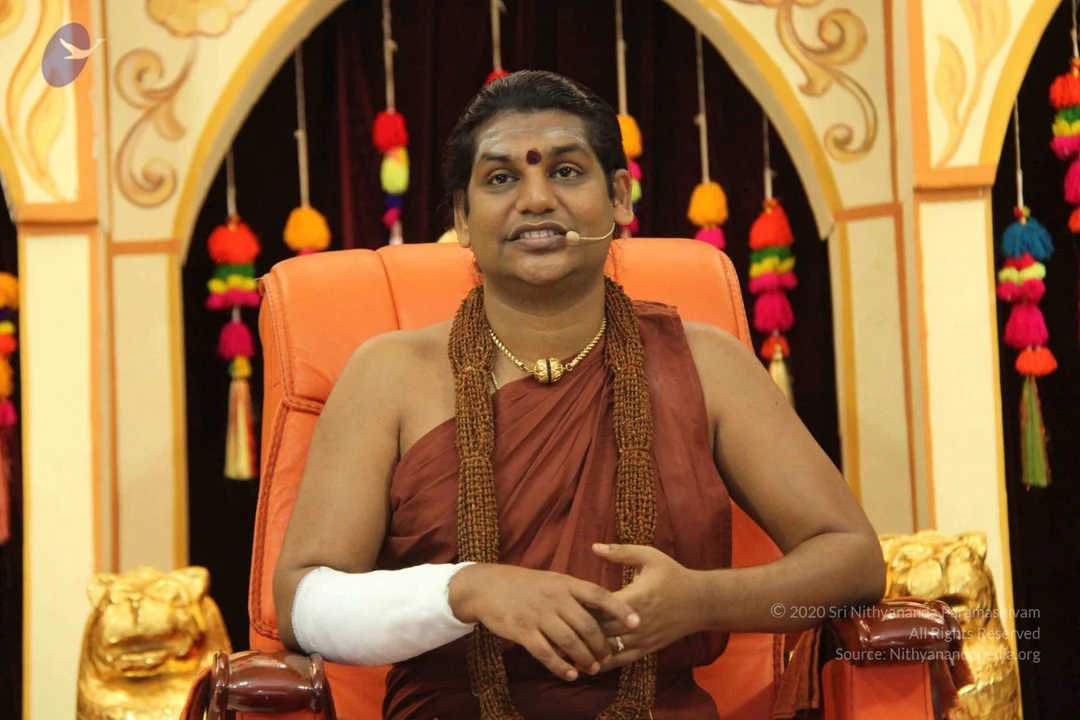
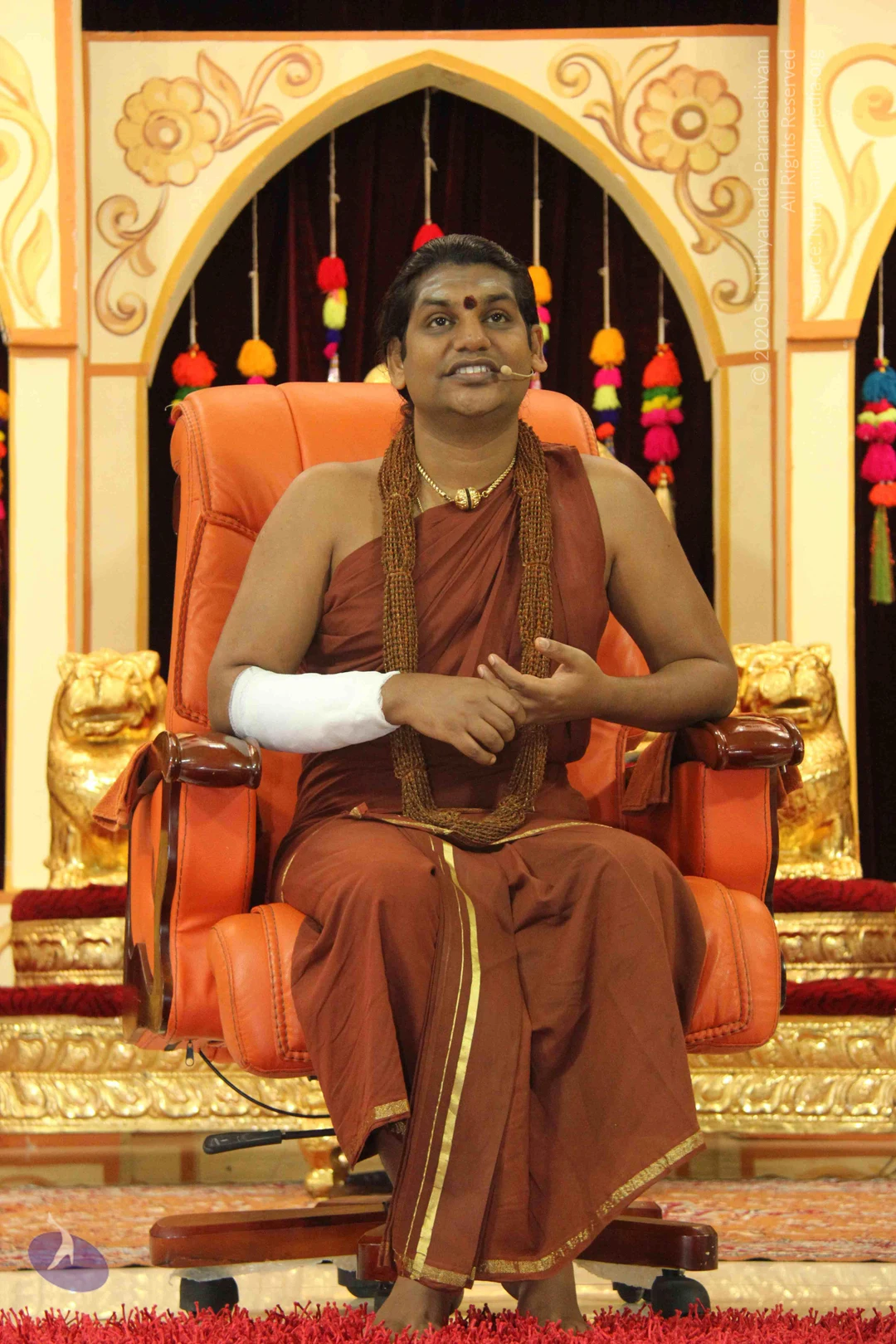
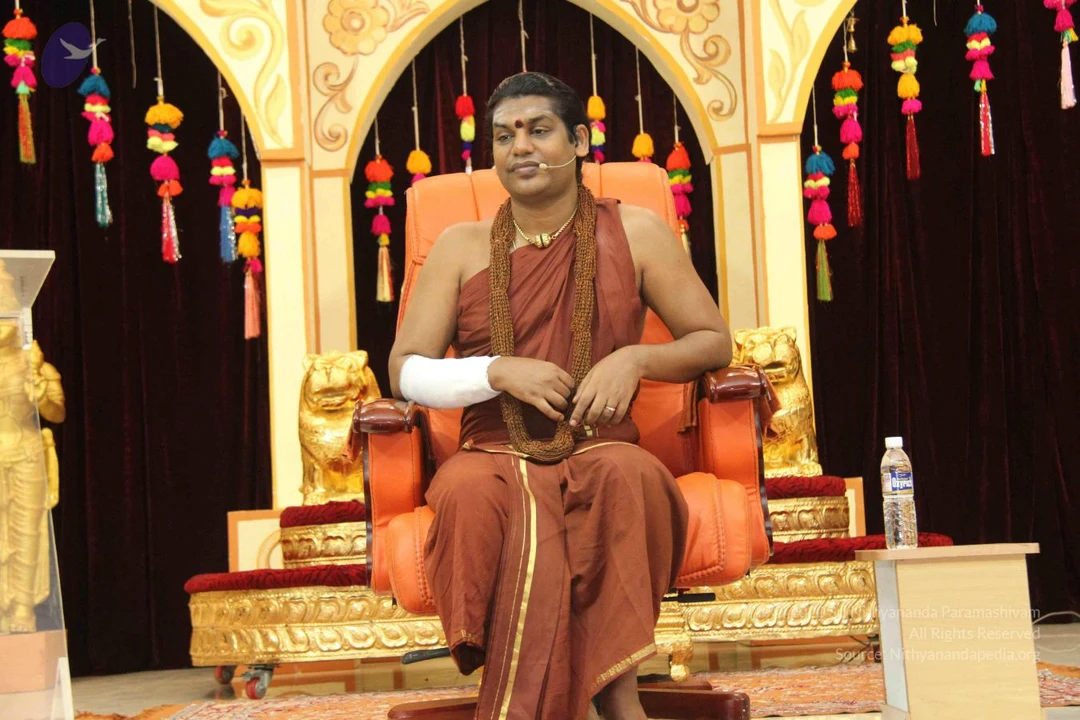
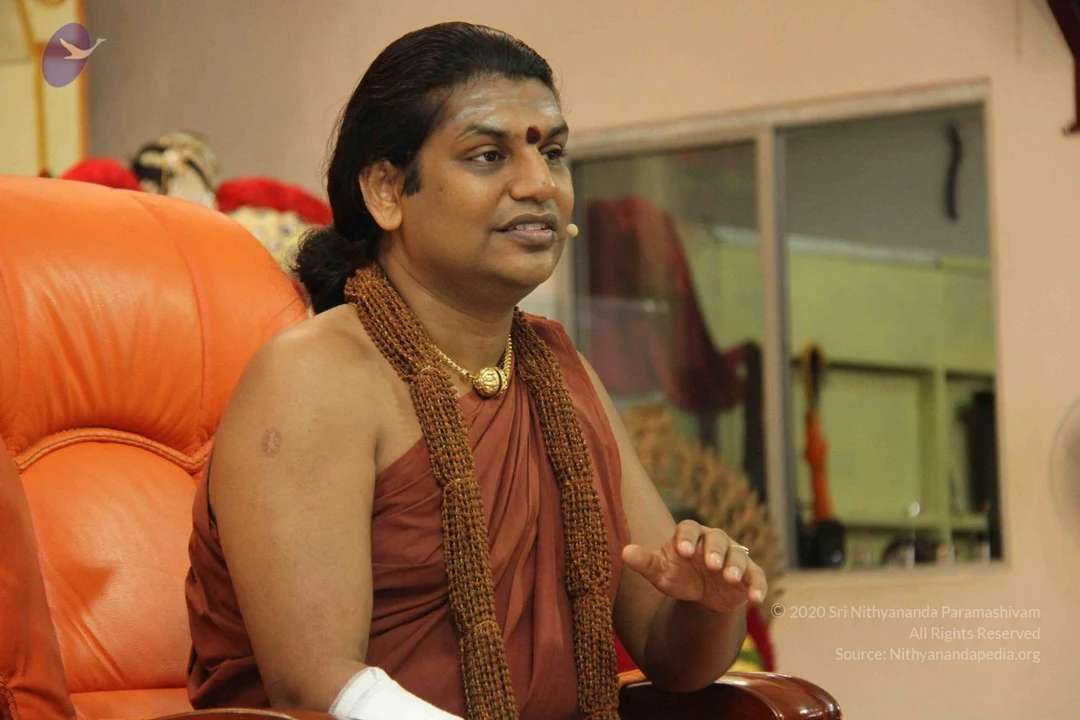
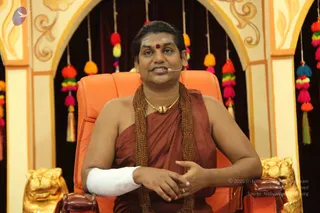
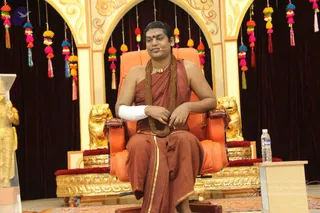
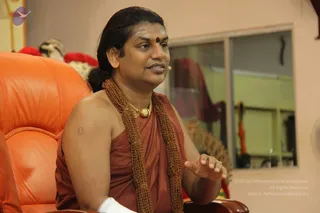
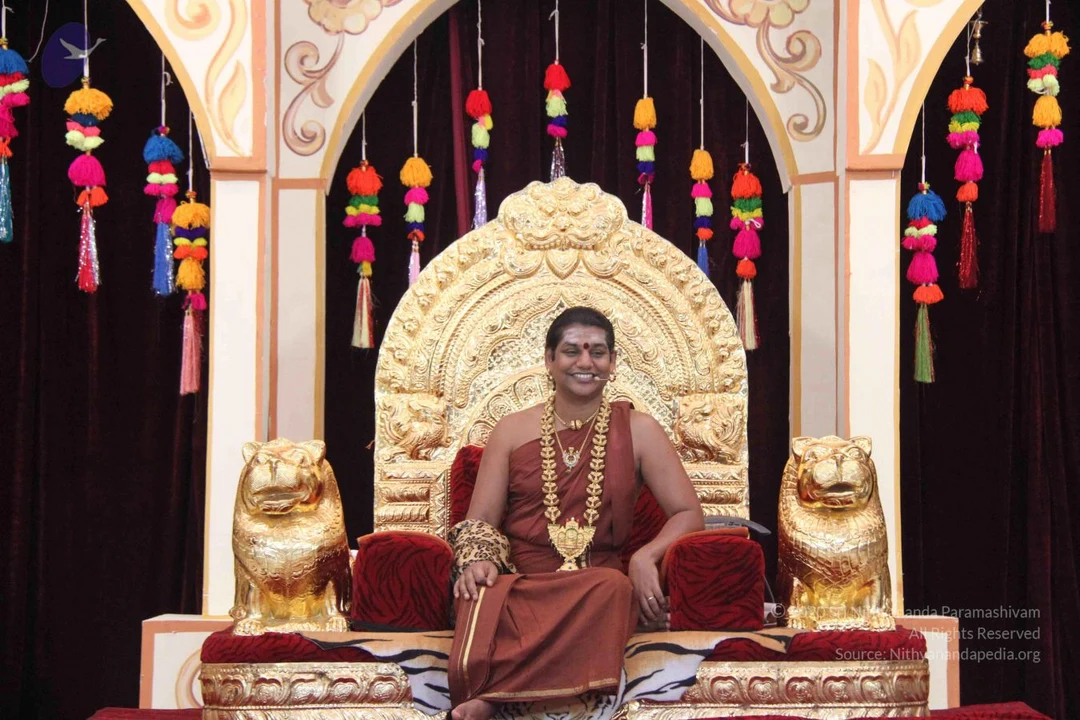
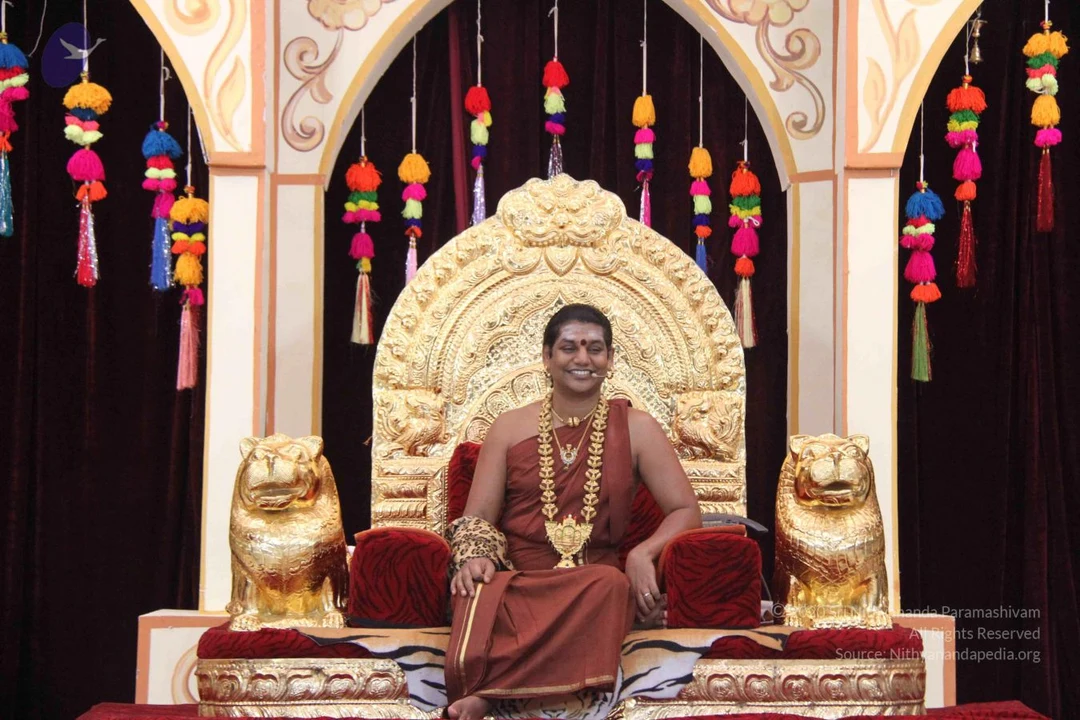
A man seated on an orange padded throne with carved golden lion arms, in a decorated stage set with arched cream panels and hanging tassels in red, yellow, pink and green. He wears a rust-red ochre robe over his shoulder with a long brown rudraksha mala and a gold necklace, has a red bindi and a small headset microphone, and has his left forearm wrapped in white bandage while his hands rest folded in his lap. Swamiji (probable): long swept-back hair, rudraksha mala, gold necklace and ochre robe; he appears to be seated in a discourse setting.A man with short dark hair and a red bindi sits in an orange leather chair on a raised stage, speaking into a headset microphone. He wears a rust-brown unstitched robe with a gold border and a gold neck ornament, and a brown rudraksha mala hangs over his shoulders. His right forearm is wrapped in white bandage. Behind him are gold lion carvings, a cream arch with gold floral painting, and hanging red, yellow and pink tassels. A red carpet lies in front.A man in a rust-brown sannyasi robe with a gold-edged dhoti sits on an orange throne flanked by golden lion armrests, against a backdrop of gold-arched panels and colourful tassel garlands. He wears a dense wooden rudraksha-style mala and a gold pendant, has a red bindi, a lapel microphone, and a white bandage on his left forearm. A bottle of water rests on a small table to the right and a gold deity murti stands at the left edge. Appearance-based candidate: a person, seated and speaking to an audience during a satsang.A seated man in a rust-brown wrap with bare right shoulder sits in an orange leather armchair, gesturing with his left hand while speaking. He wears a long multi-strand rudraksha-style mala of brown beads and a gold pendant necklace, plus a red bindi on his forehead and a small lapel microphone. Behind him are a window with reflections, a red-and-white decorative fabric and a green wall shelf. Appearance-based cues are distinctive (long swept-back hair, mala, gold necklace, saffron-brown clothing), so this is a probable Swamiji (probable) giving a discourse, consistent with a satsang setting.
navaratri-culturals

103 photosSource gallery
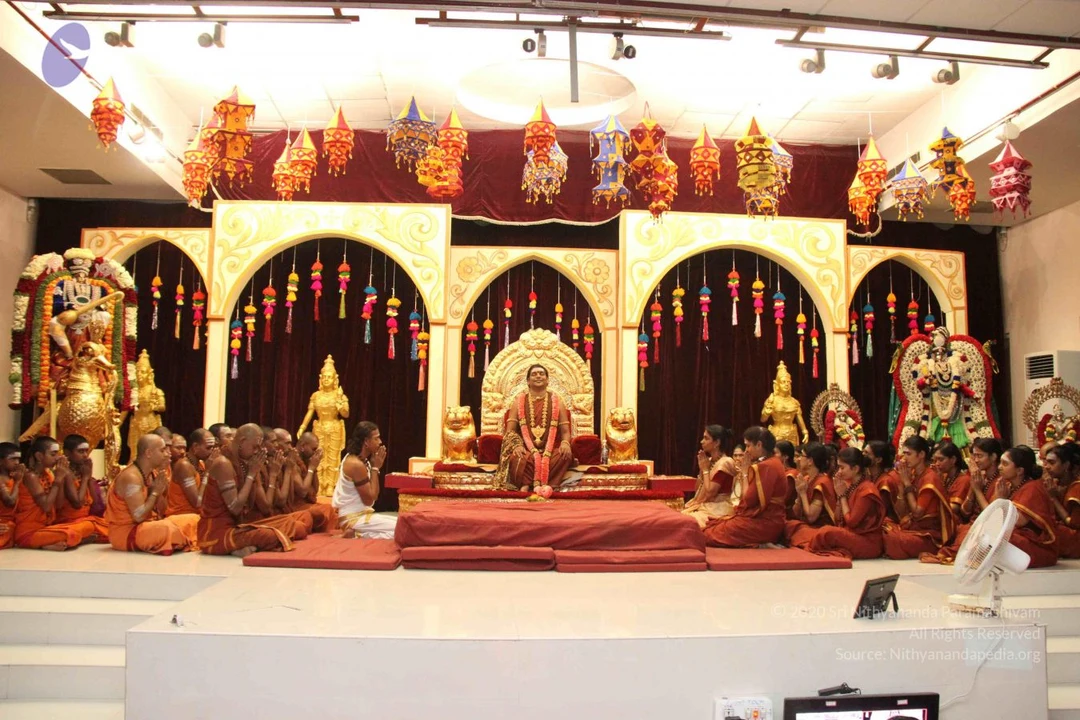
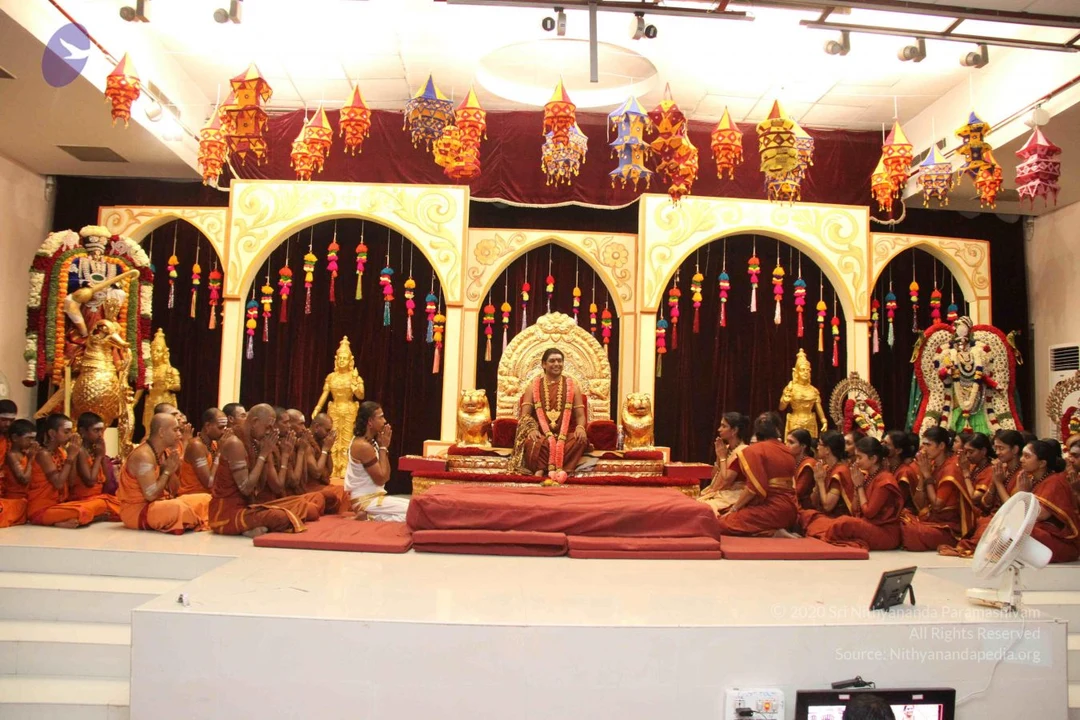
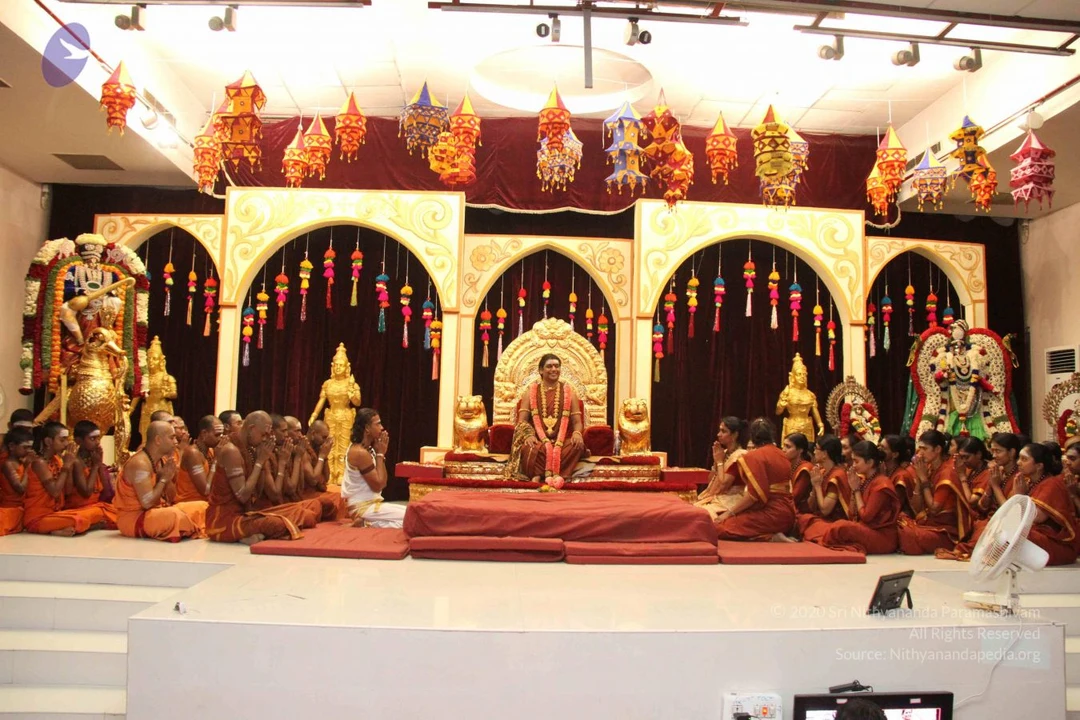
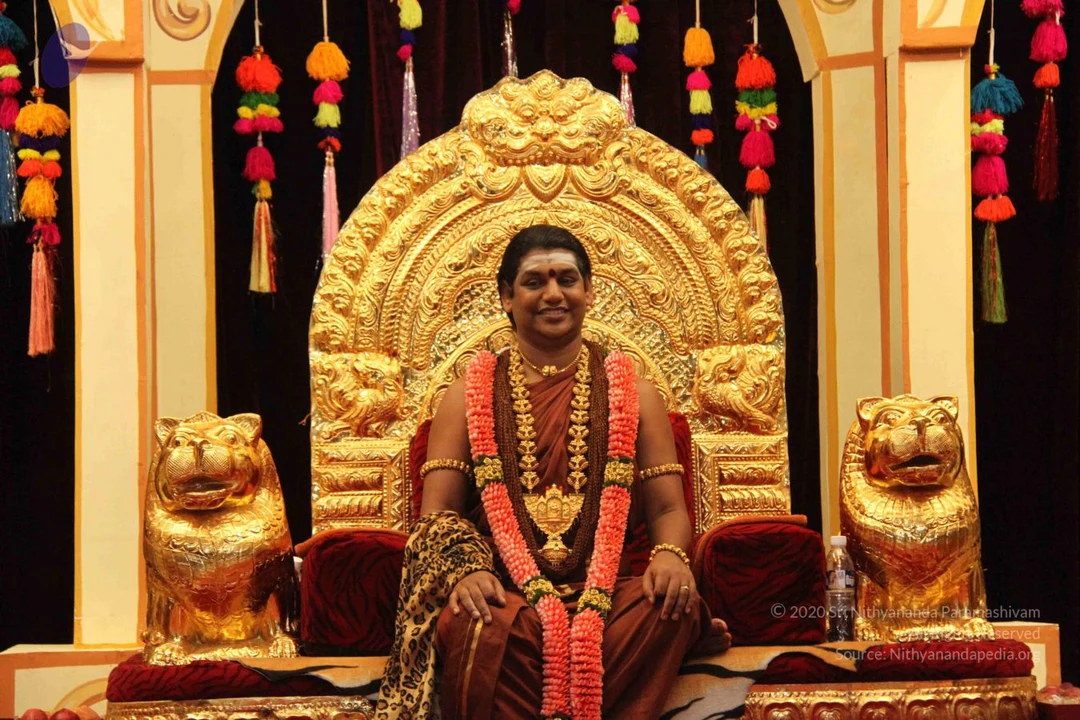
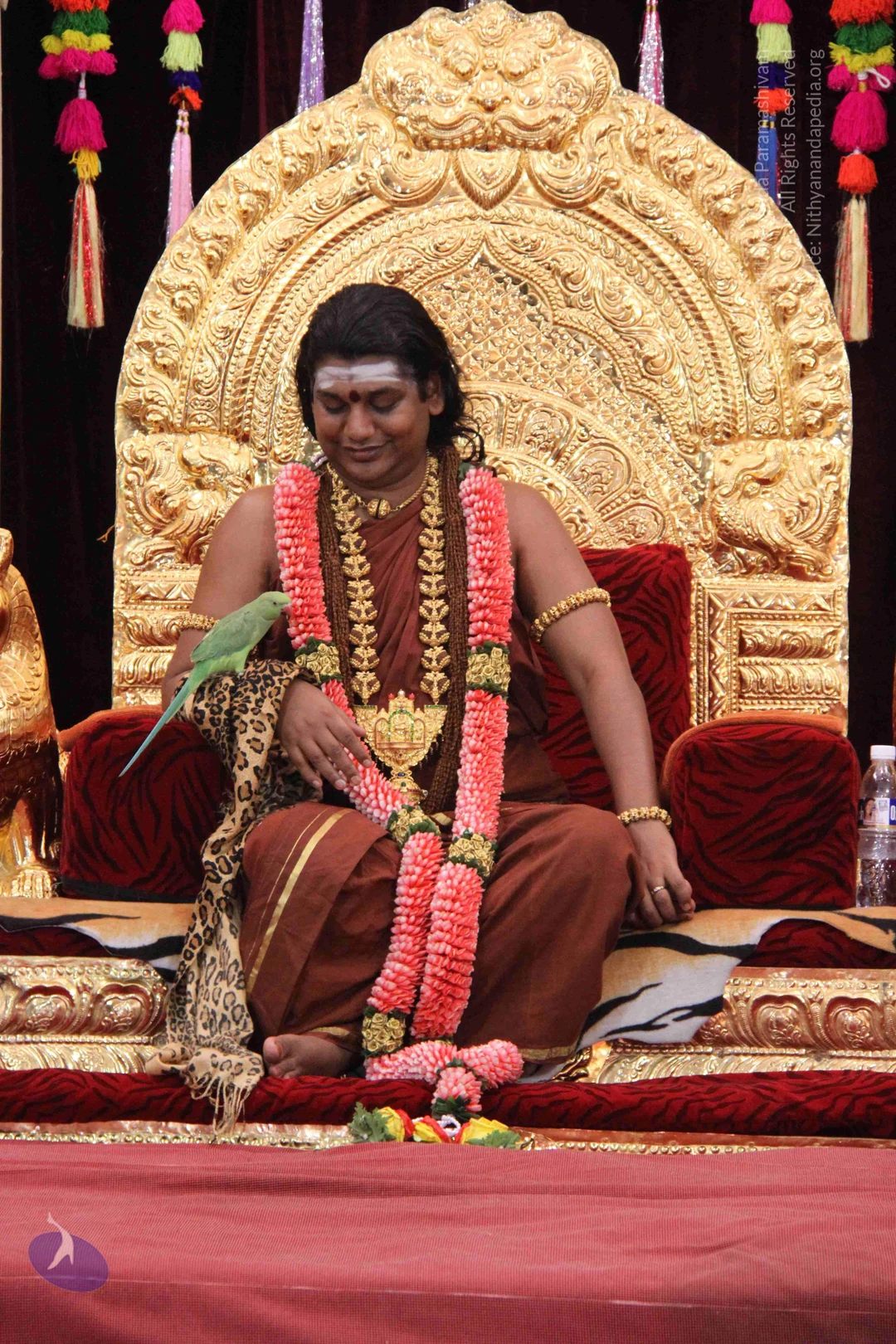
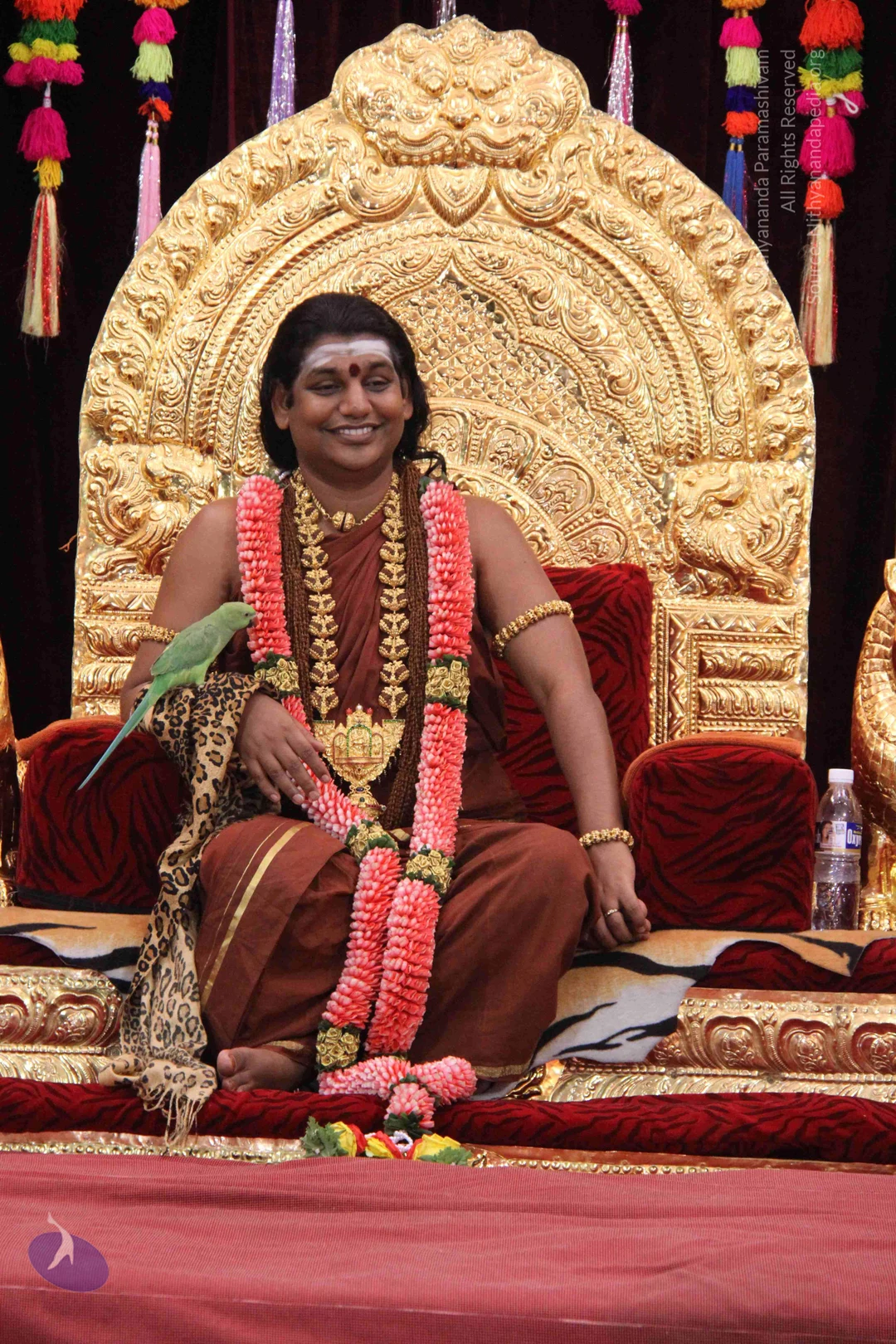
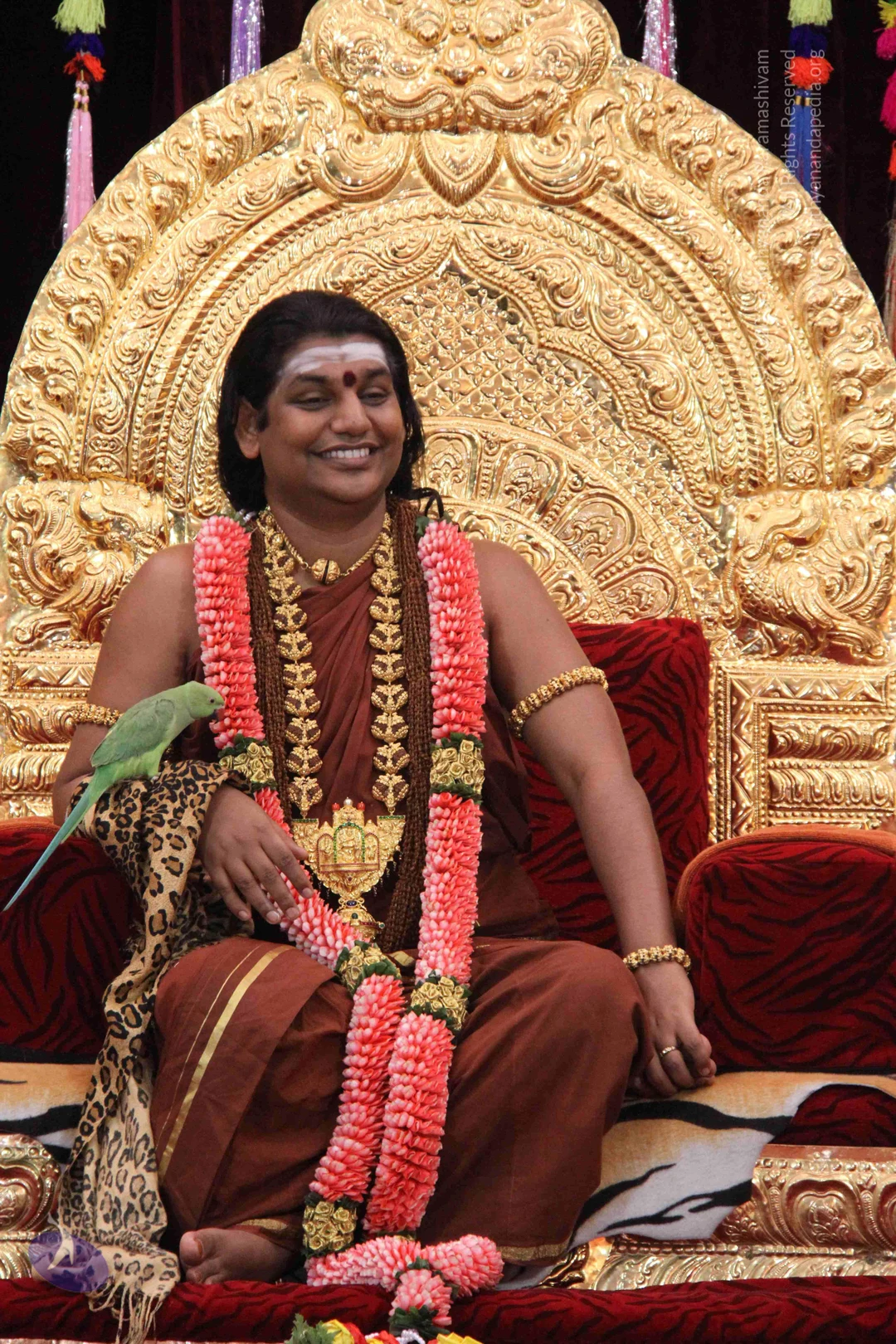
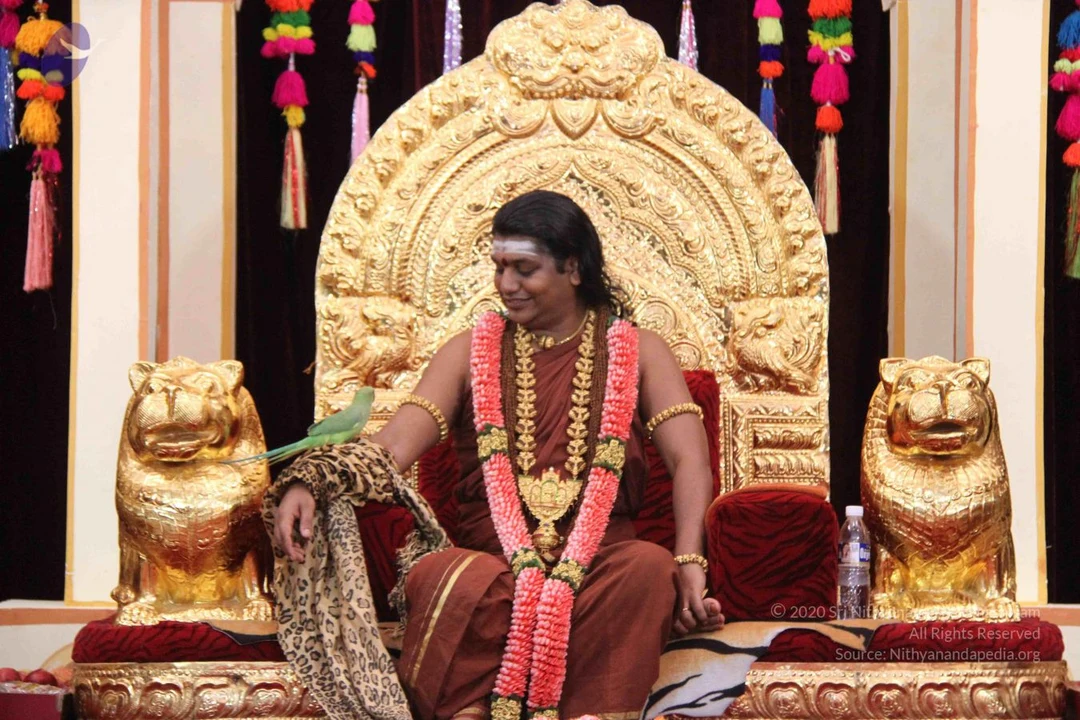
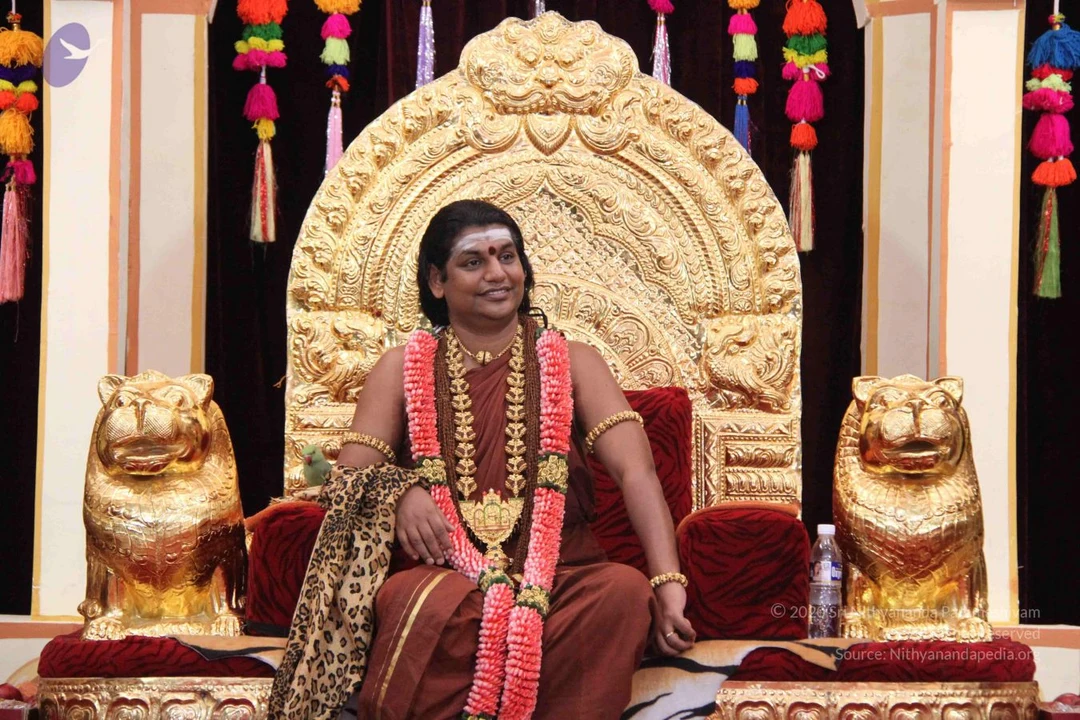
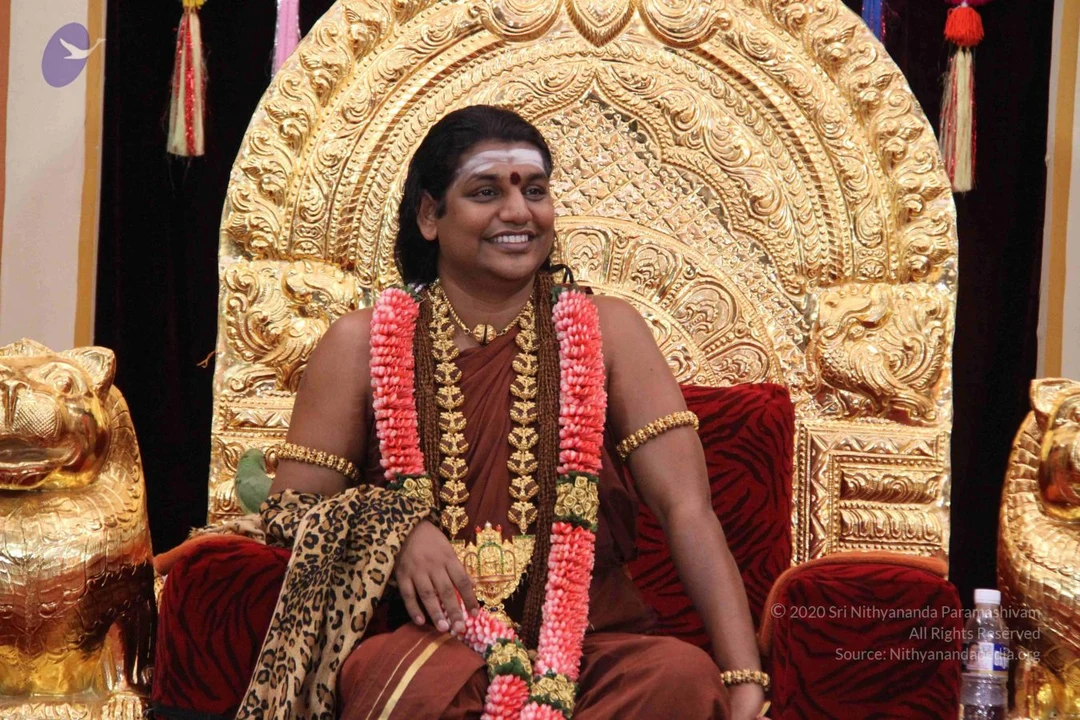
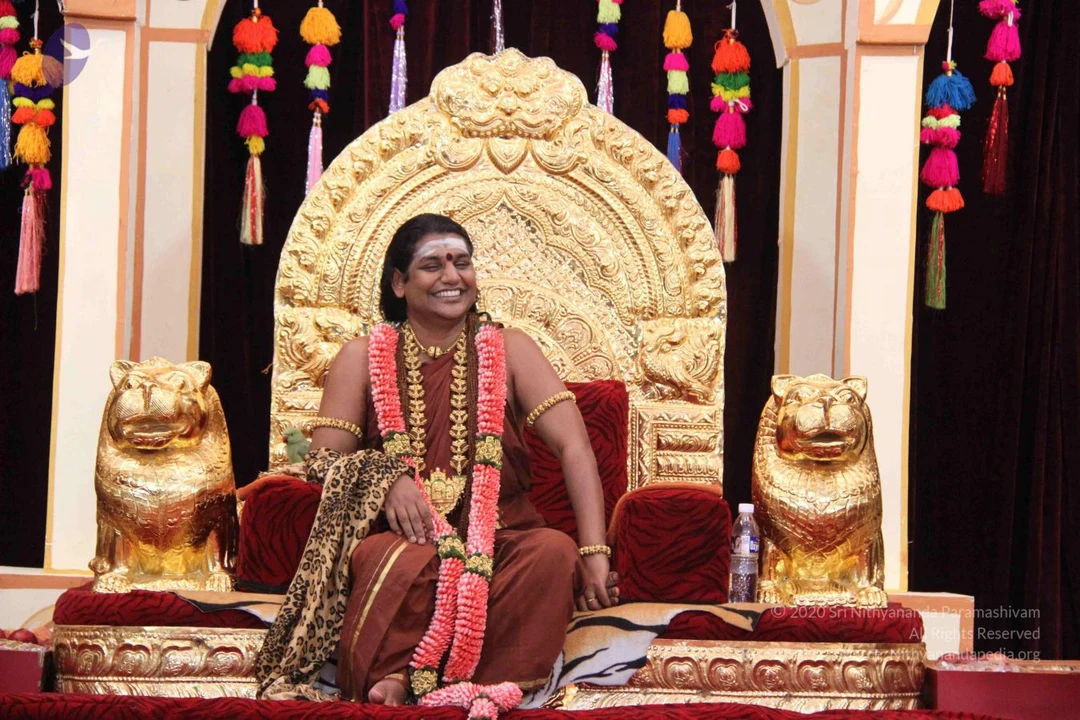
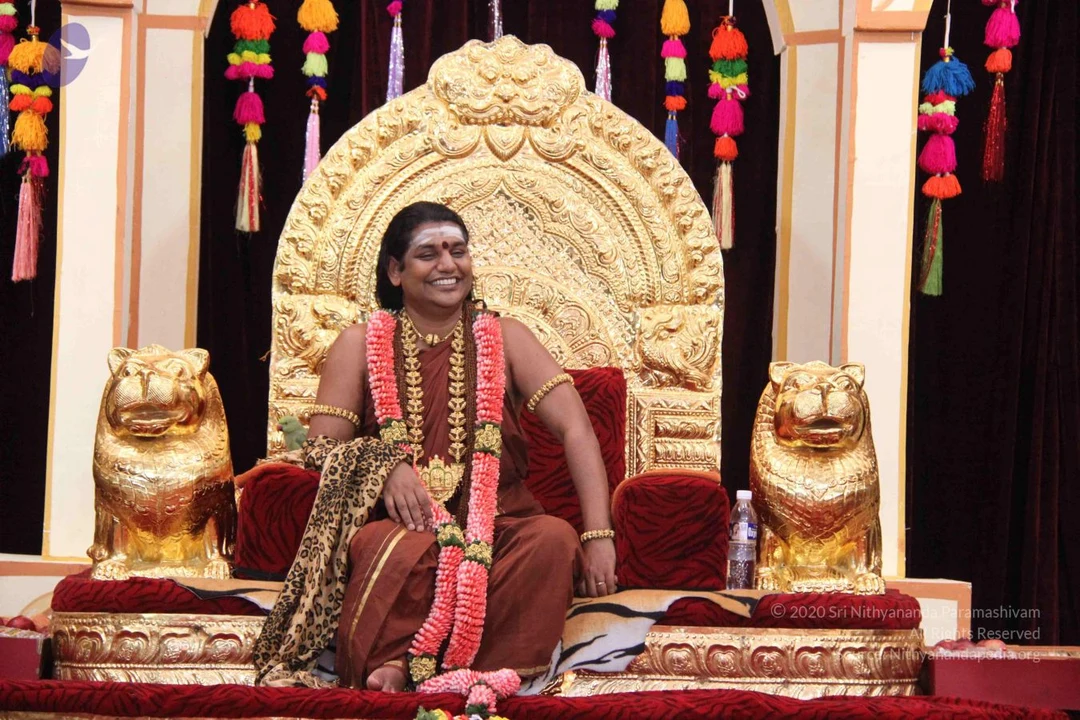
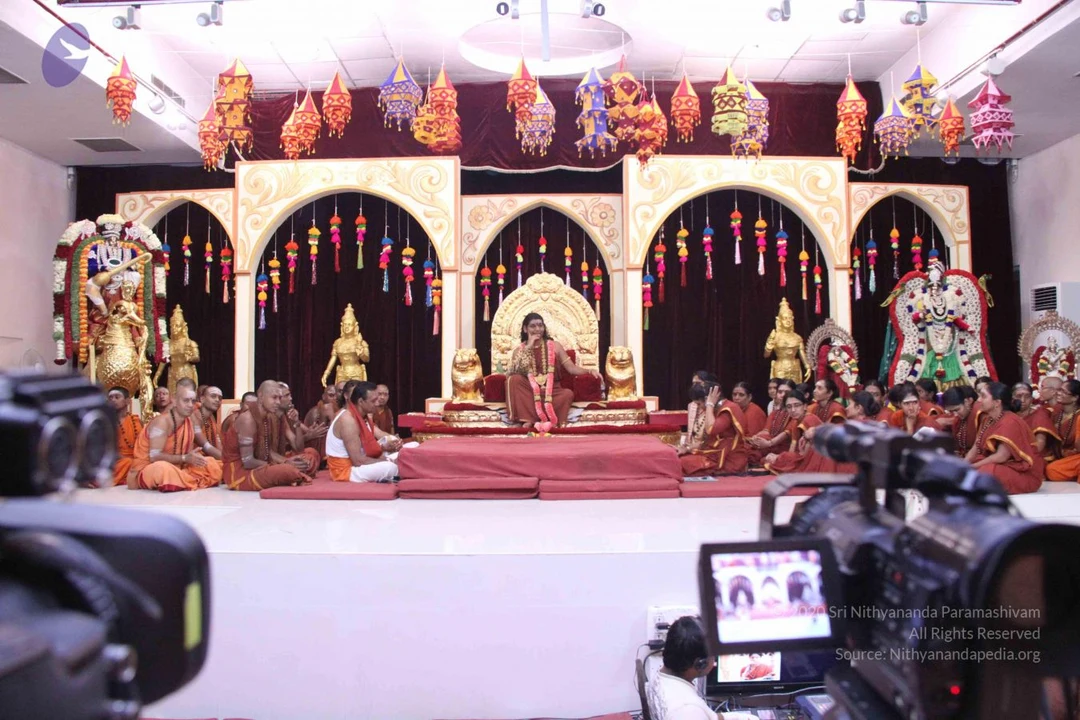
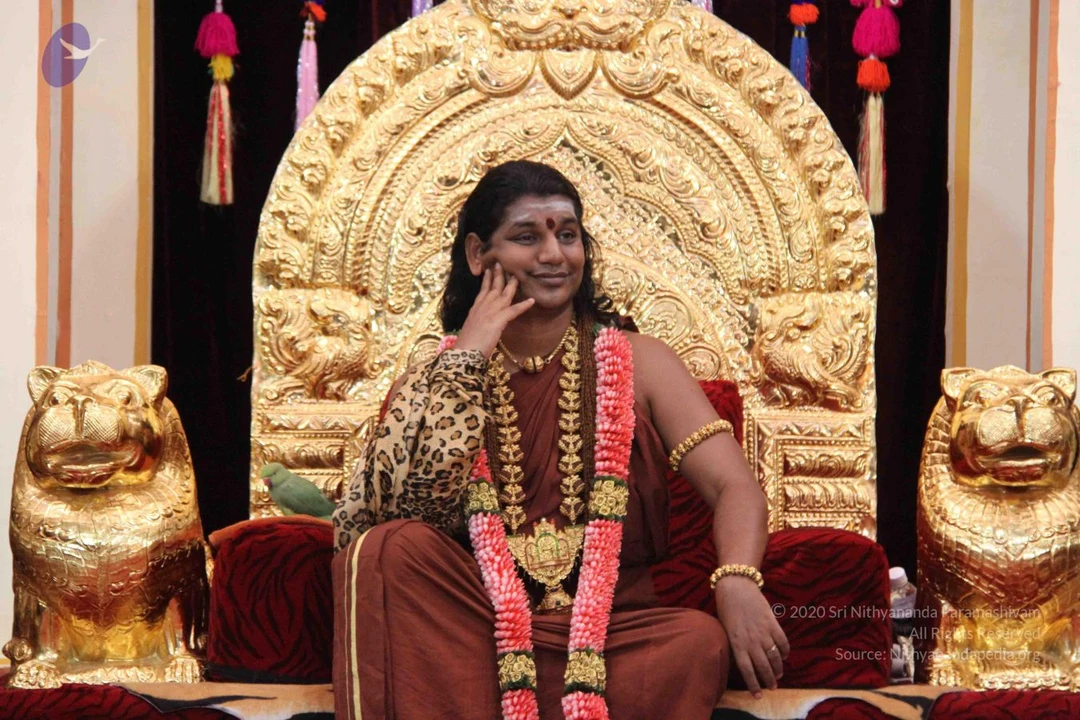
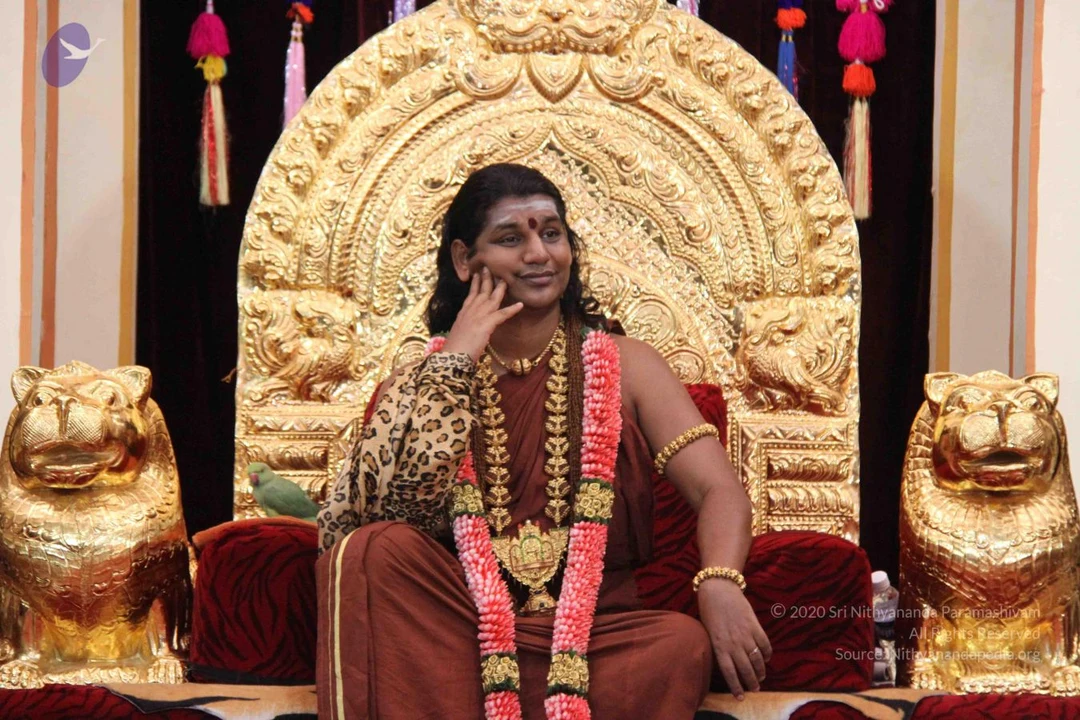
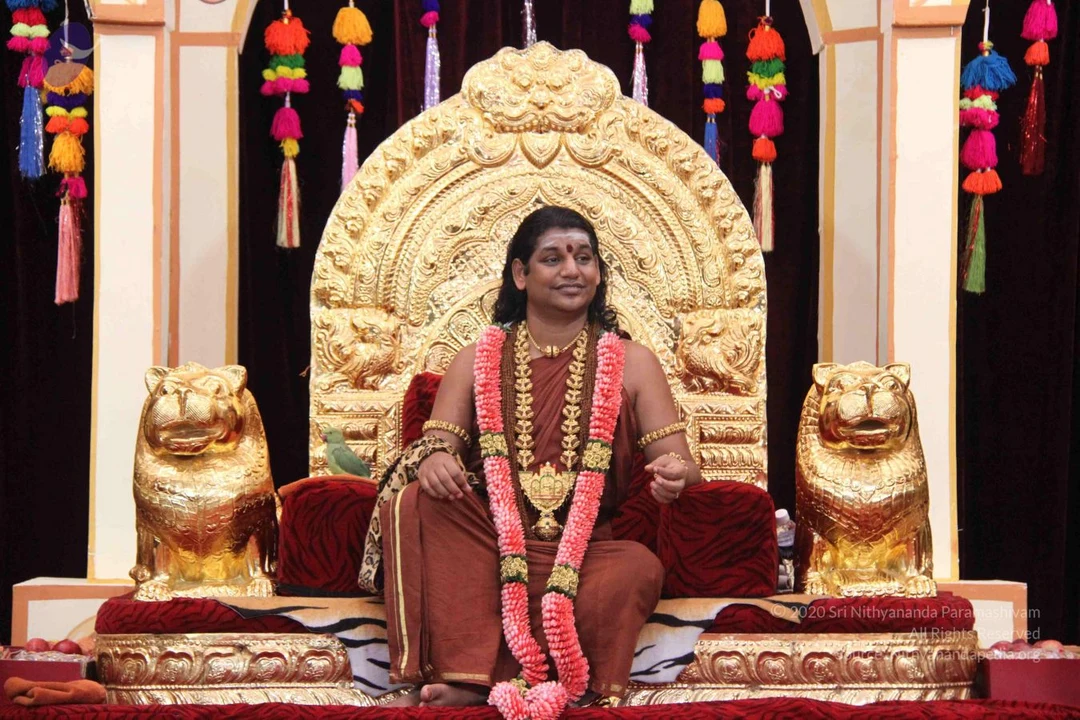
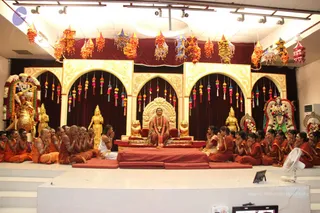
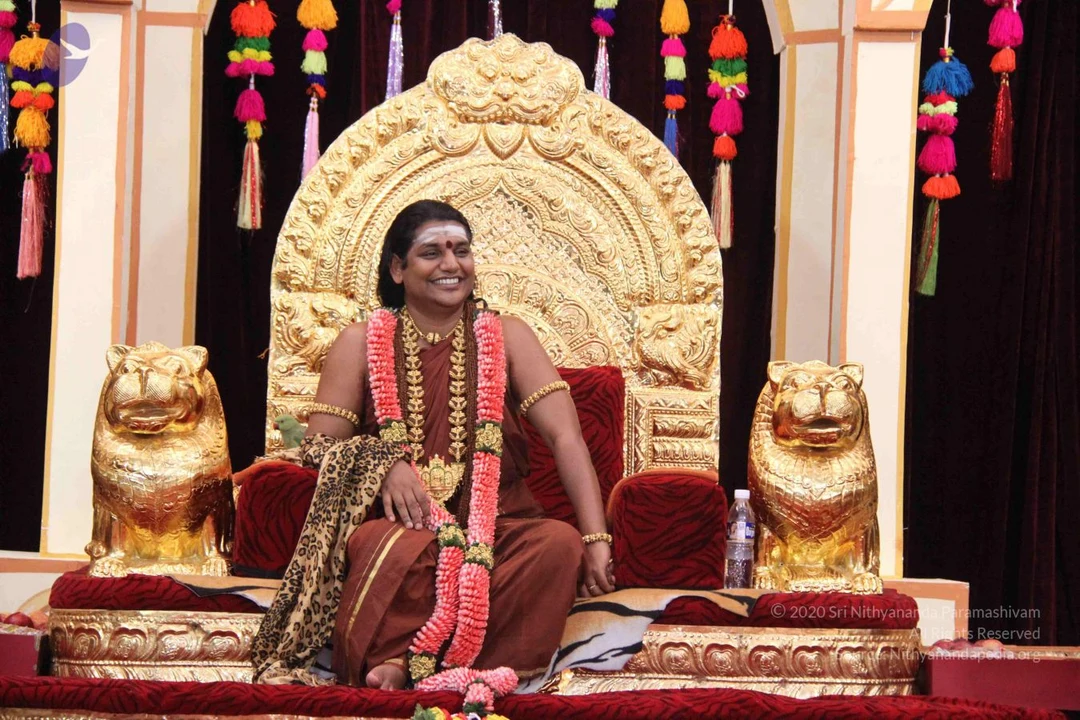
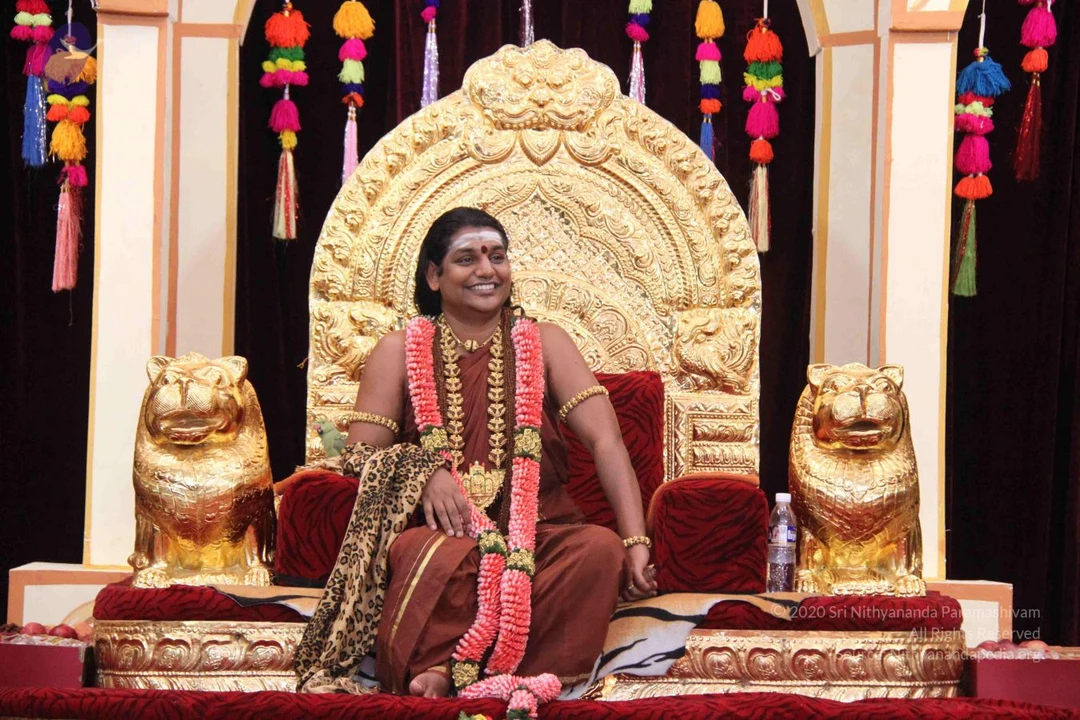
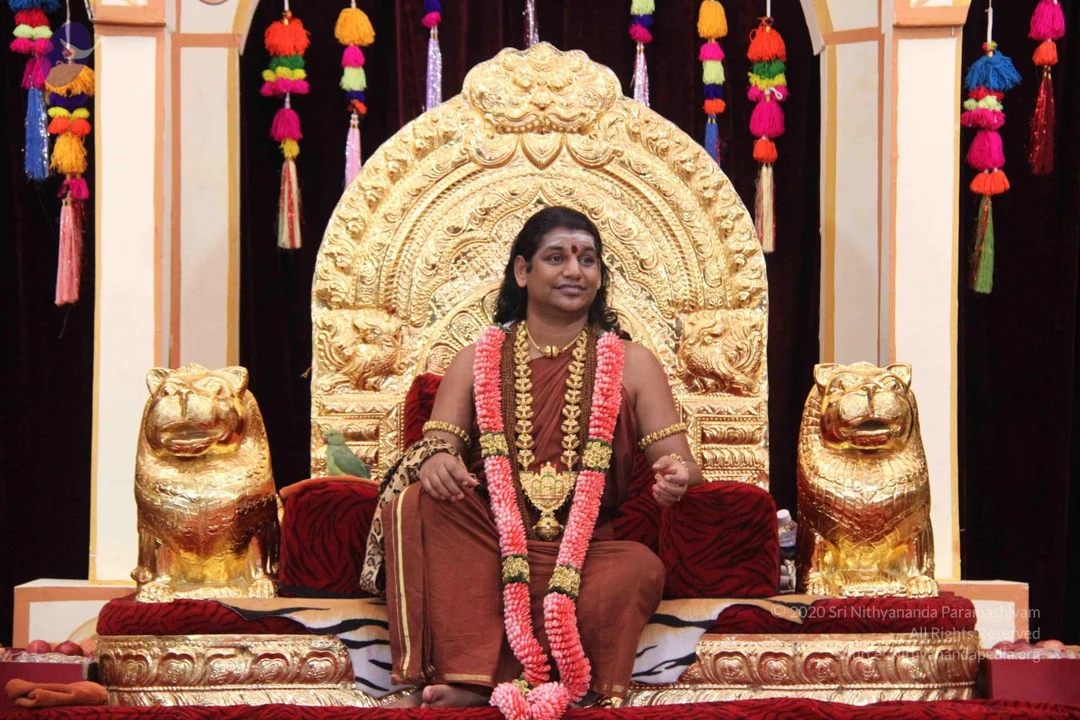
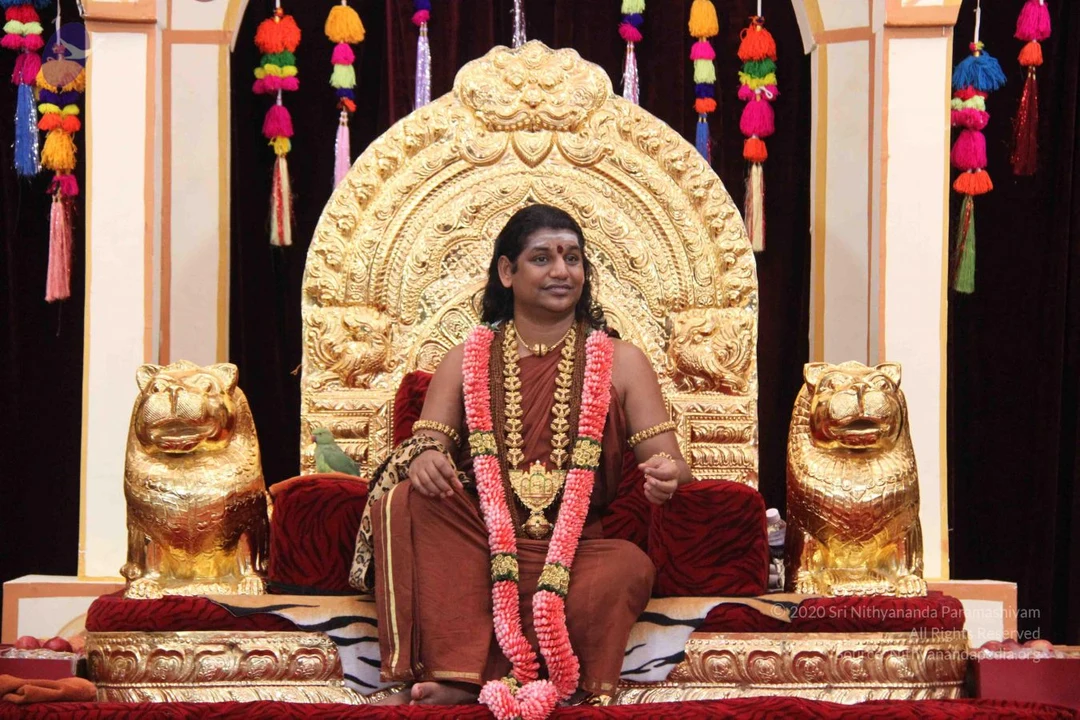
A stage event in a hall with a golden throne backdrop framed by cream arches draped with dark red curtains and hanging tassels. A seated figure in orange-red robes with a red-beaded garland sits on a golden throne flanked by golden lions, atop a red-cushioned dais. Rows of devotees in orange and saffron clothing sit on both sides of the stage with hands folded in namaste; several are shaven-headed in orange robes on the left and women in orange saris on the right. A golden deity murti stands near the left edge beside floral garlands, and paper lanterns in red, yellow and blue hang from the ceiling. A fan and a small monitor sit at the bottom right.A photograph of a satsang on a raised stage with a gold-and-red ornate throne flanked by golden lion figures. A central figure sits on the throne wearing a red-and-gold garment and a long flower garland, with a person identification based on the ornate red-and-gold clothing, garland and throne presentation, though the face-free cues are limited. Around him, seated devotees in saffron and orange robes sit on the left, many with hands in anjali, while women in orange sarees sit on the right. Golden deity figures and a decorated peetha stand on the stage, with colourful paper lanterns and tassel strings hanging from gold arches behind. A fan and a small monitor sit at the lower right edge.A photograph of a satsang on an ornate stage decorated with golden arches, maroon drapes and hanging paper lanterns in multicoloured shades. Around him, rows of devotees in orange and saffron robes sit with palms joined on red cushions on the left and right, and women in orange sarees and white-clad attendants sit nearby. Golden deity statues flank the stage, including a golden peetha-style figure on the left and a garlanded deity figure on the right, with a fan and a monitor in the foreground.A man seated on an ornate golden throne with carved arches and lion-head armrests, flanked by two golden lion statues. He wears a rust-brown dhoti and a leopard-print shawl over his shoulder, a pink and white flower garland around his neck, a gold-and-beaded ceremonial necklace, gold bangles and a vertical white tilak. Colourful tassels hang behind the throne against a dark backdrop, and a water bottle sits at the right.A man seated on an ornate gold throne with carved arches and two gold lion figures flanking it. He wears a rust-brown dhoti and shawl with a leopard-print wrap over his left shoulder, a pink and white flower garland, layered gold necklaces, rudraksha beads, gold armlets and bangles, and a red mark on his forehead. Behind him hang colourful tassels in pink, orange, green and yellow. A small water bottle sits on the platform. a person: the seated man has a ceremonial presentation with rudraksha malas and gold ornaments, and the page indicates he is present at this event.A man with shaved head and a red tilak on his forehead sits cross-legged on an ornate gold throne carved with lion heads, flanked by two gold lion sculptures. He wears a rust-brown robe, layered rudraksha malas, a gold pendant necklace, gold bangles and a pink and white flower garland, with a leopard-print shawl draped over one arm. Colourful tassels hang at the sides, and a water bottle sits on the platform. a person seated on his peetha, with the throne and garland marking a formal satsang setting.
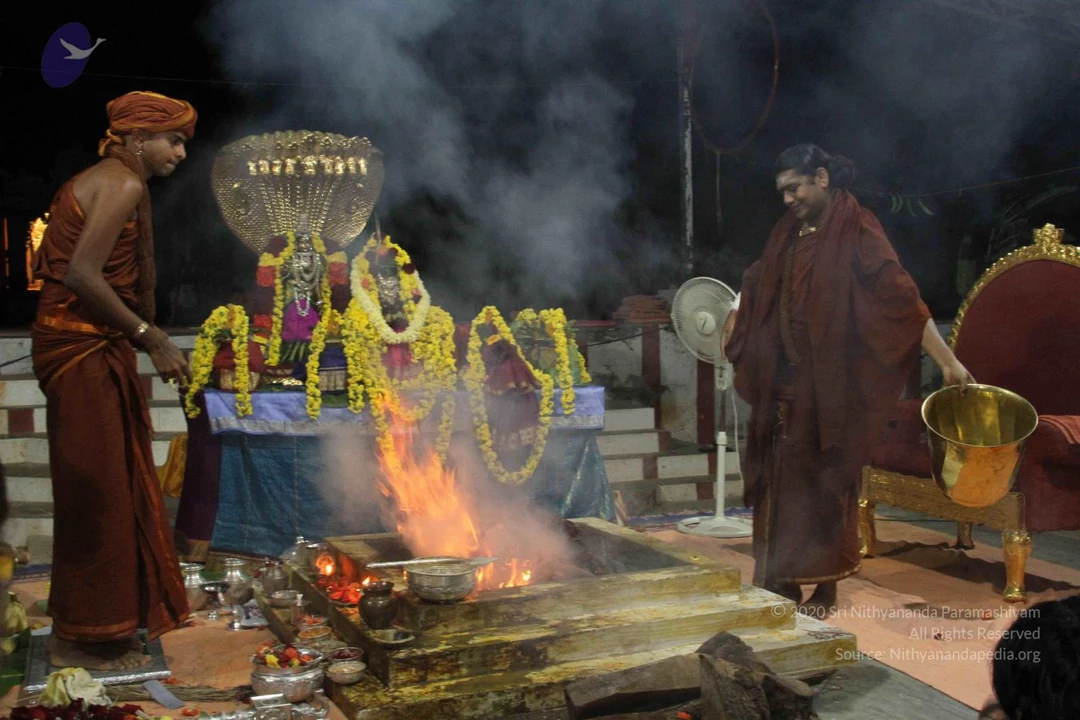
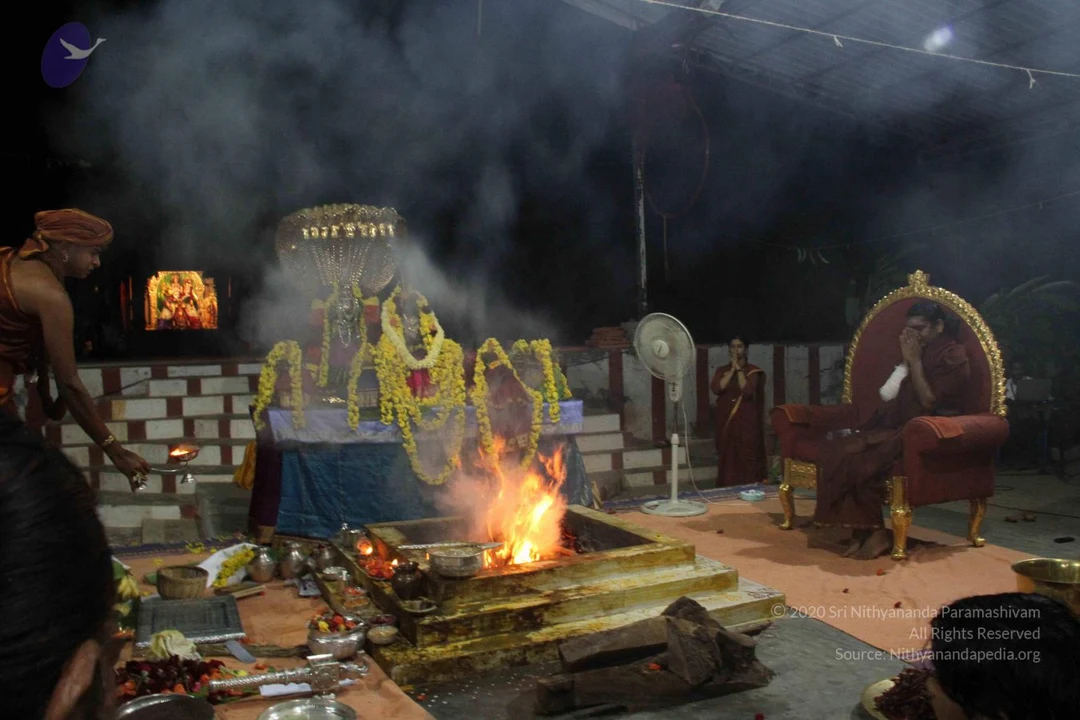
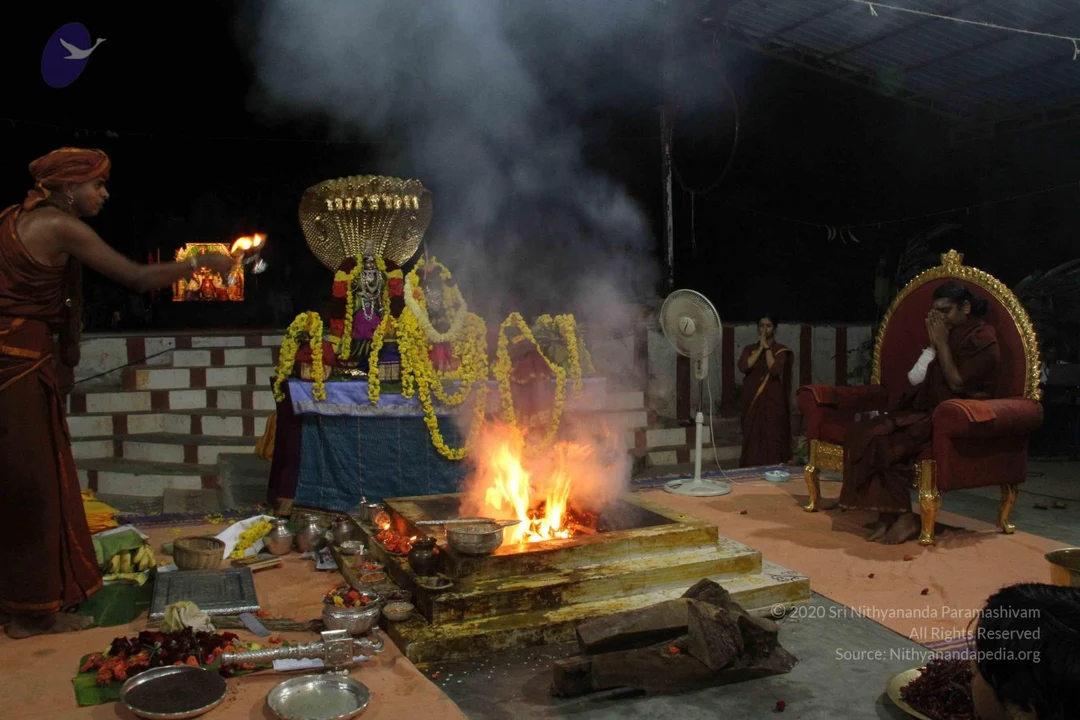
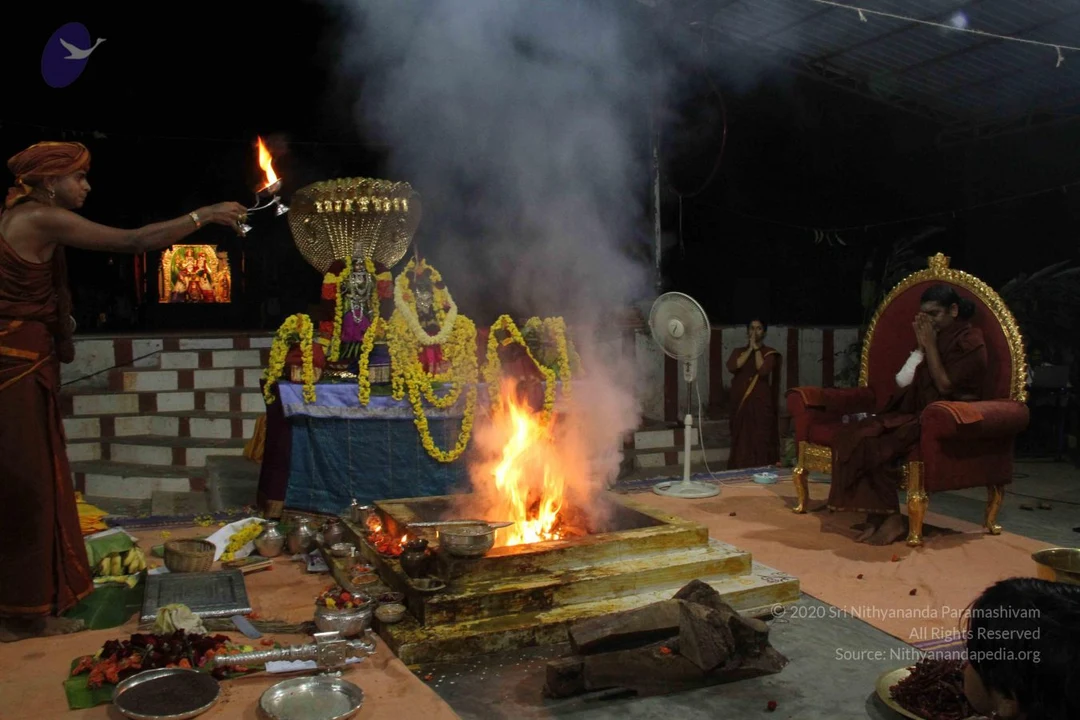
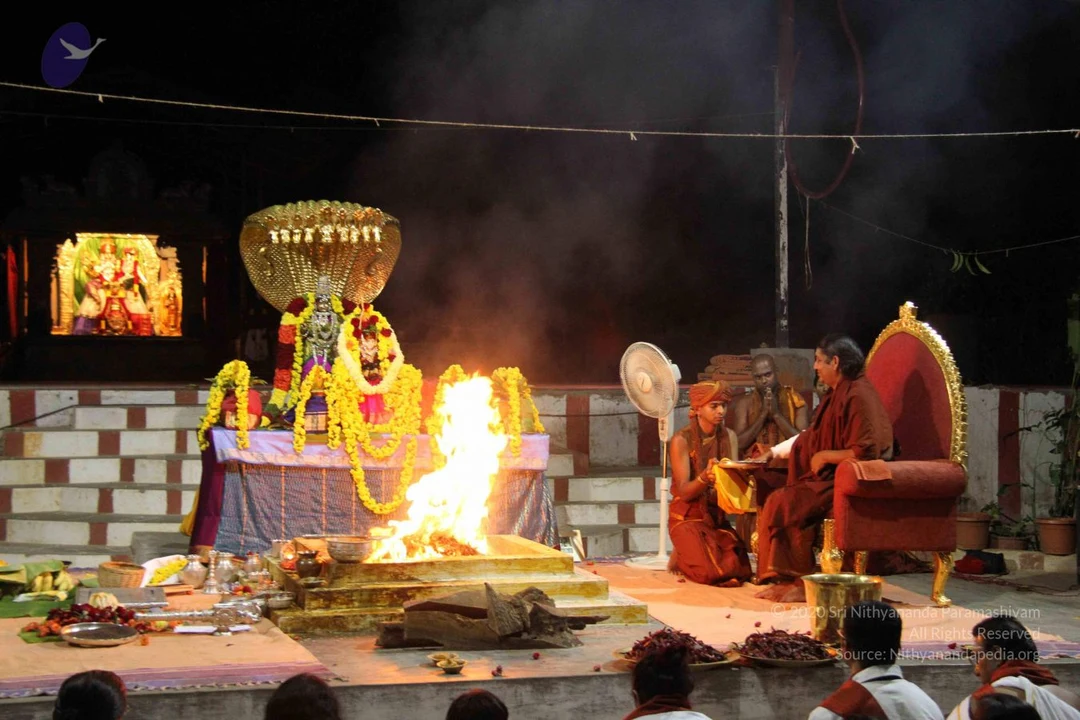
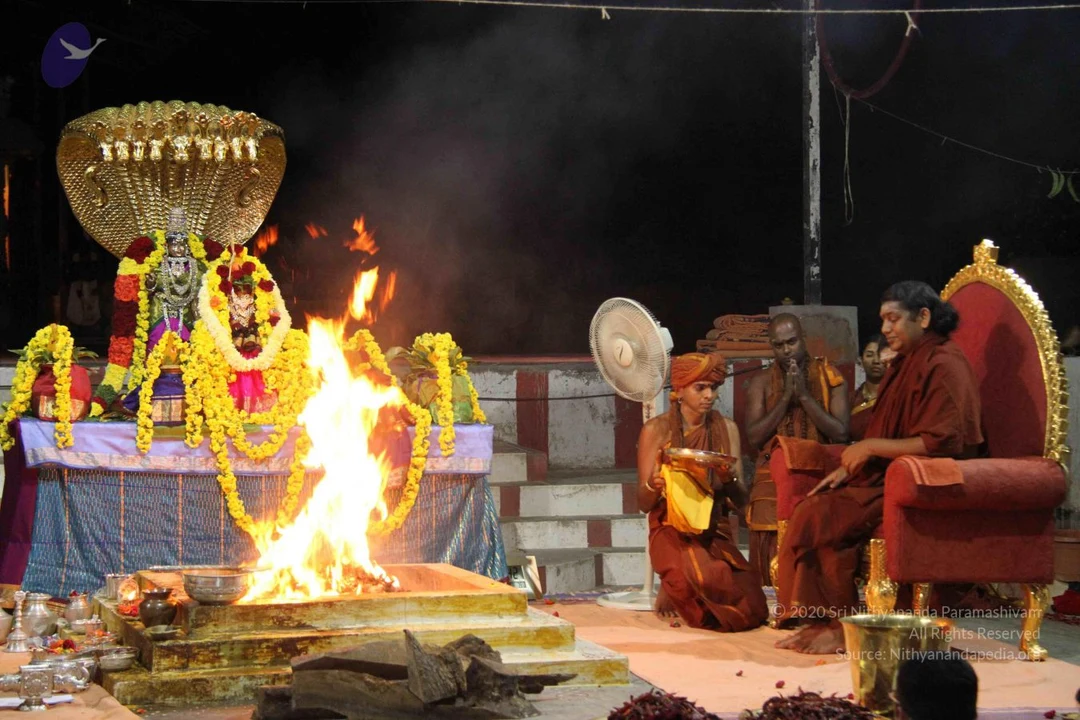
Chandi-homa
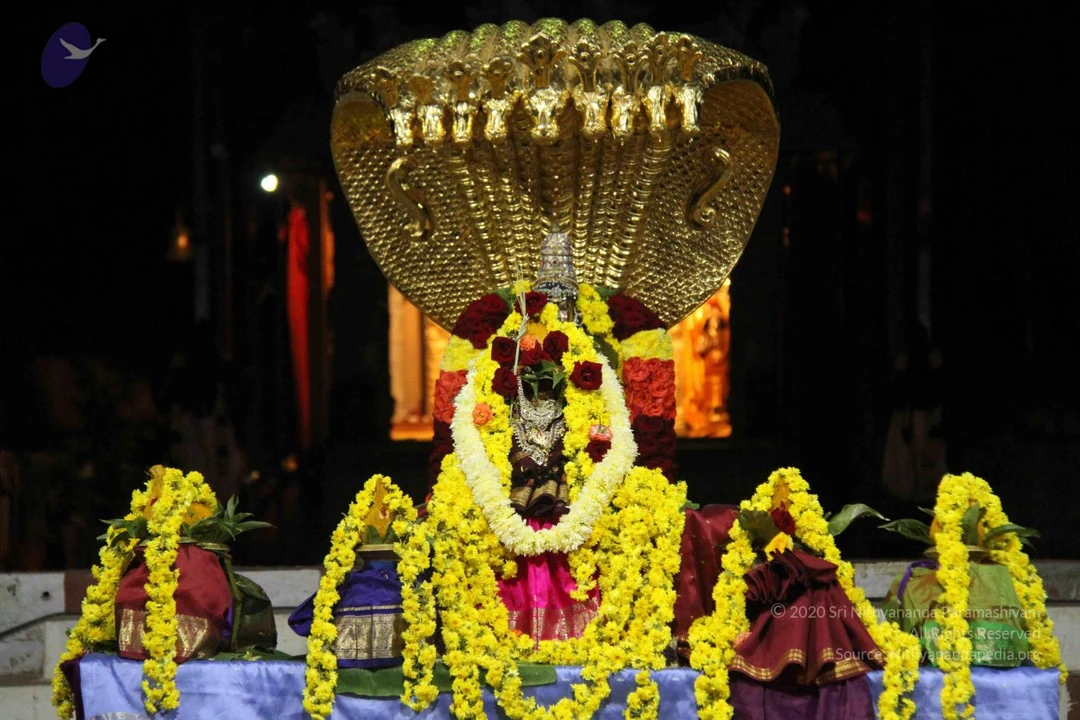
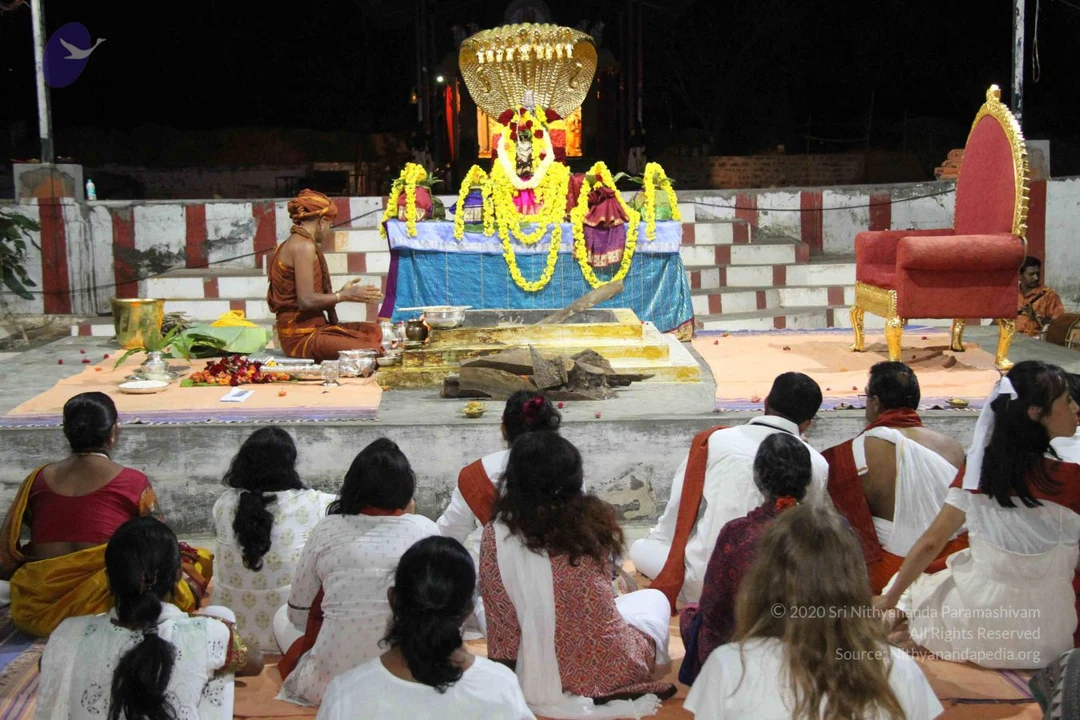
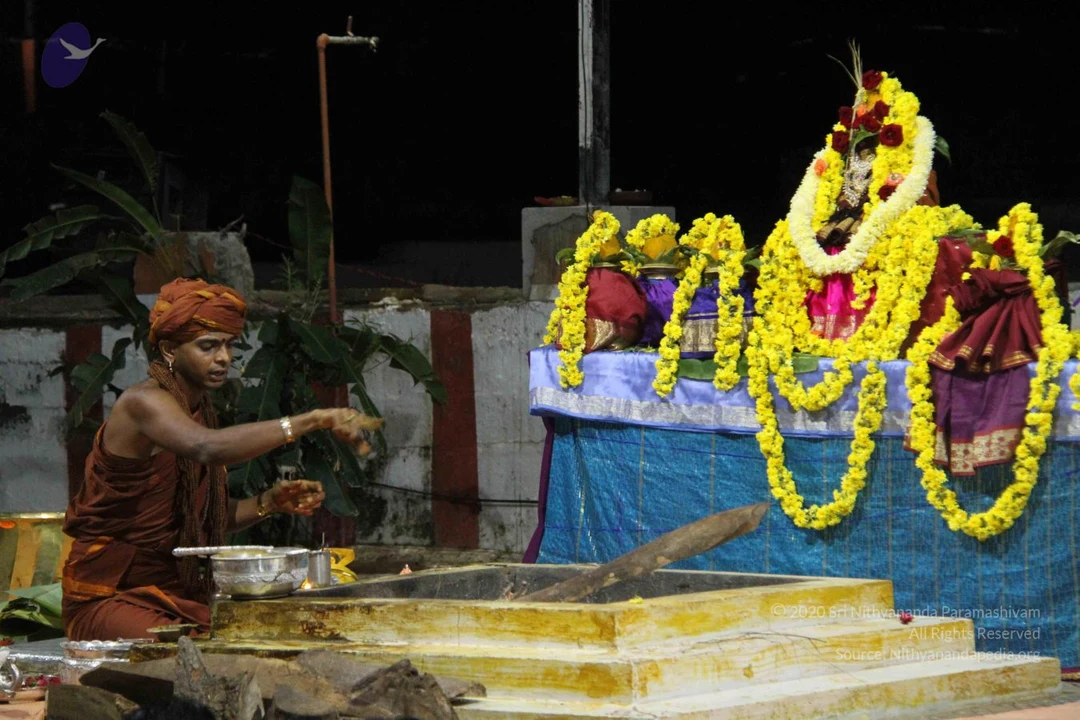
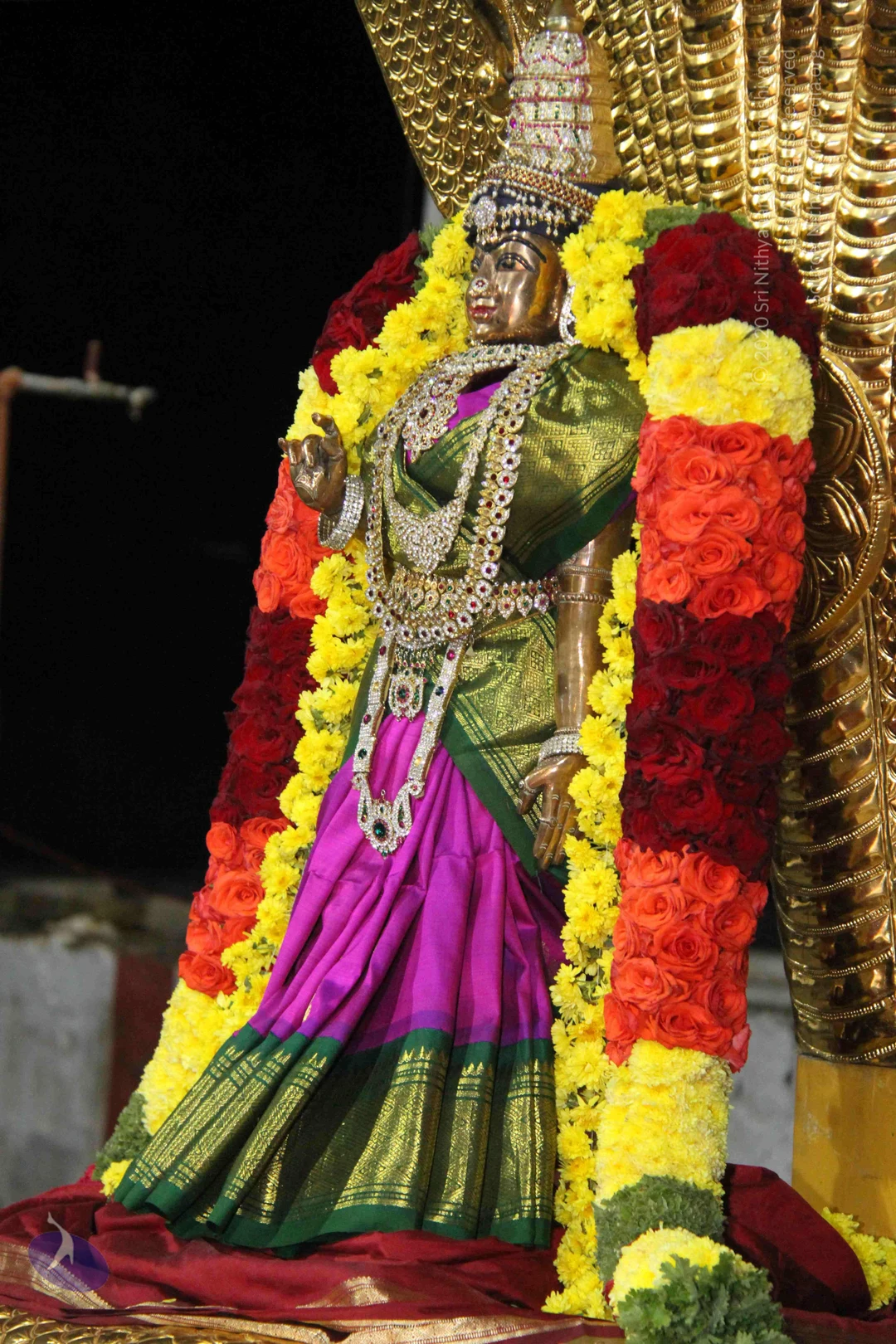
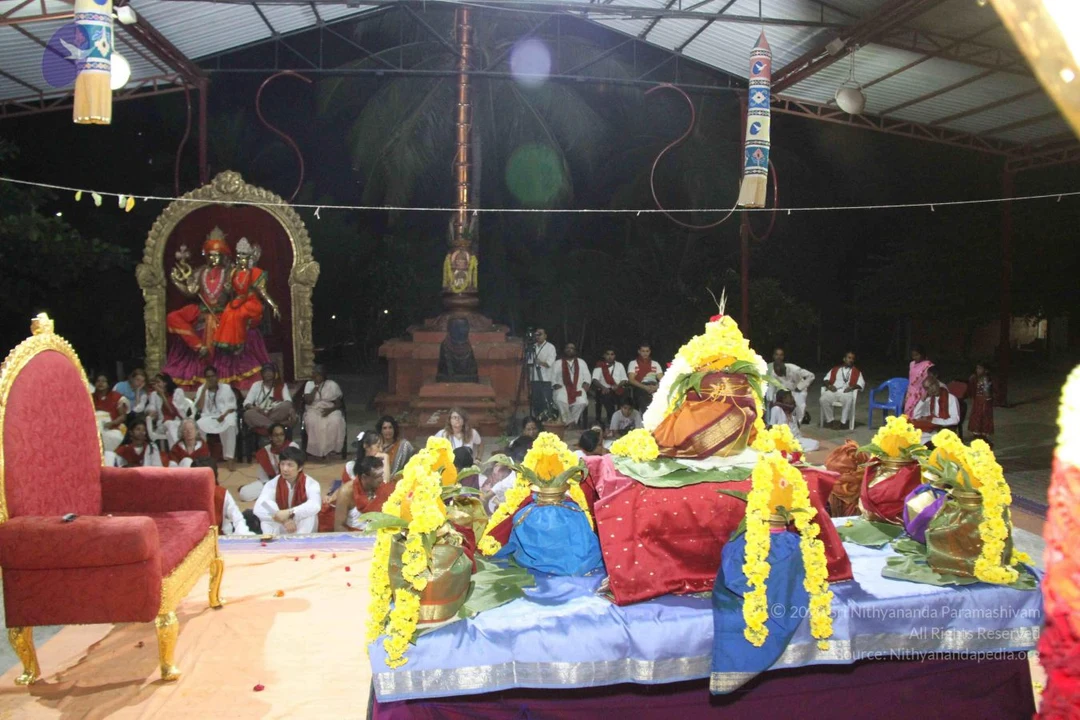
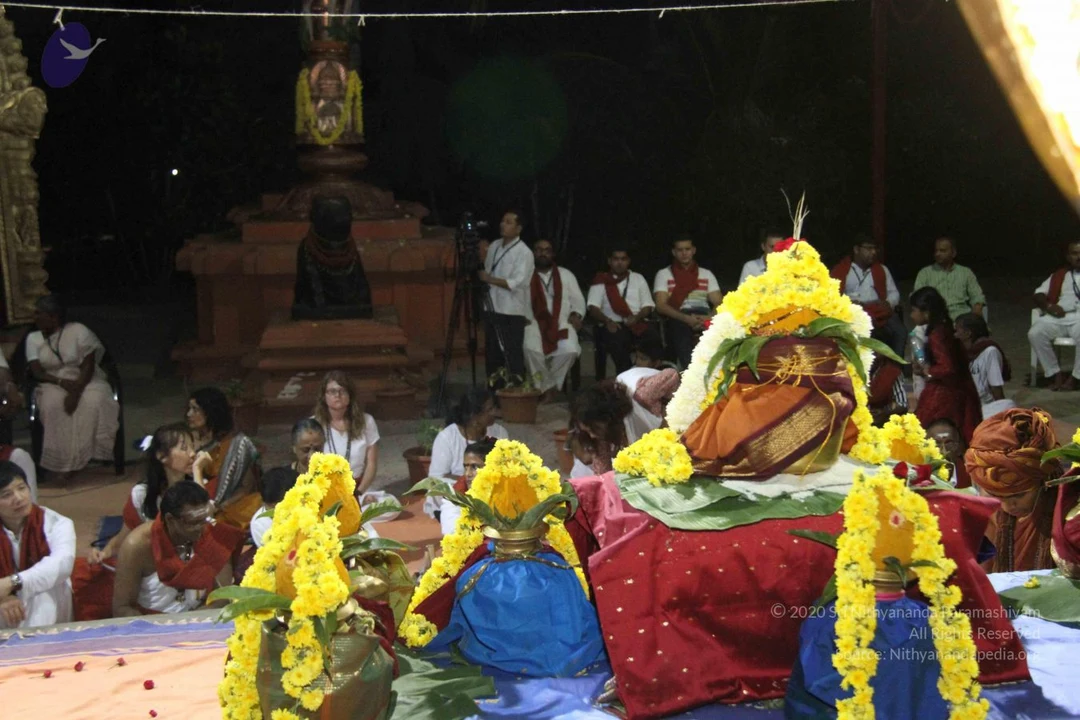
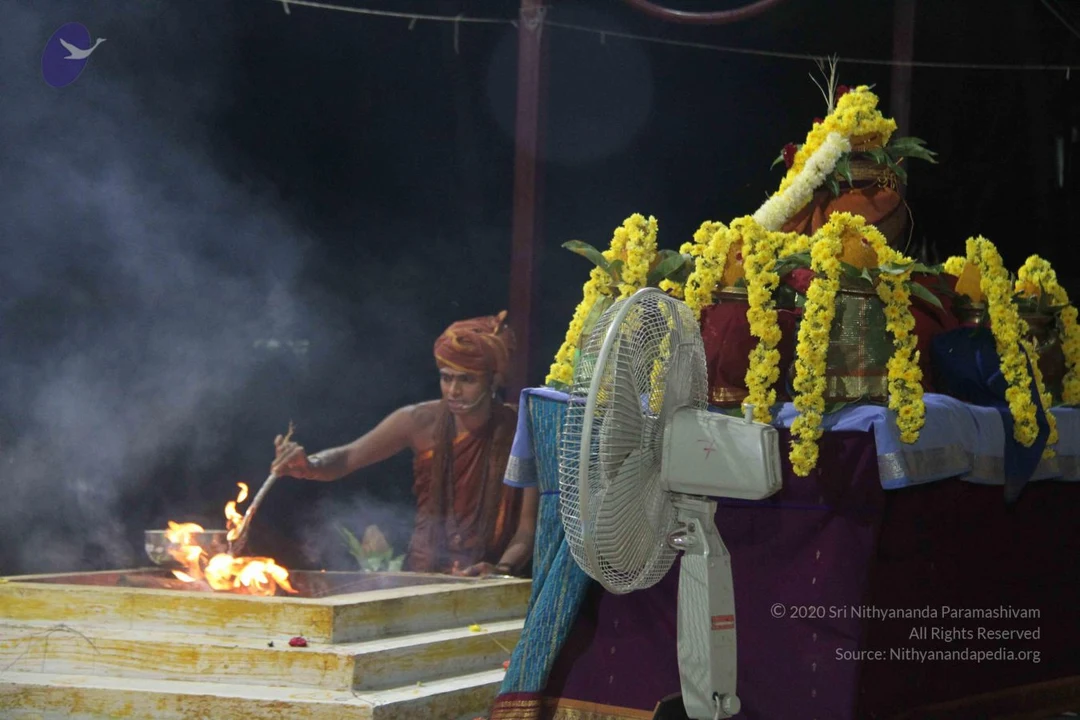
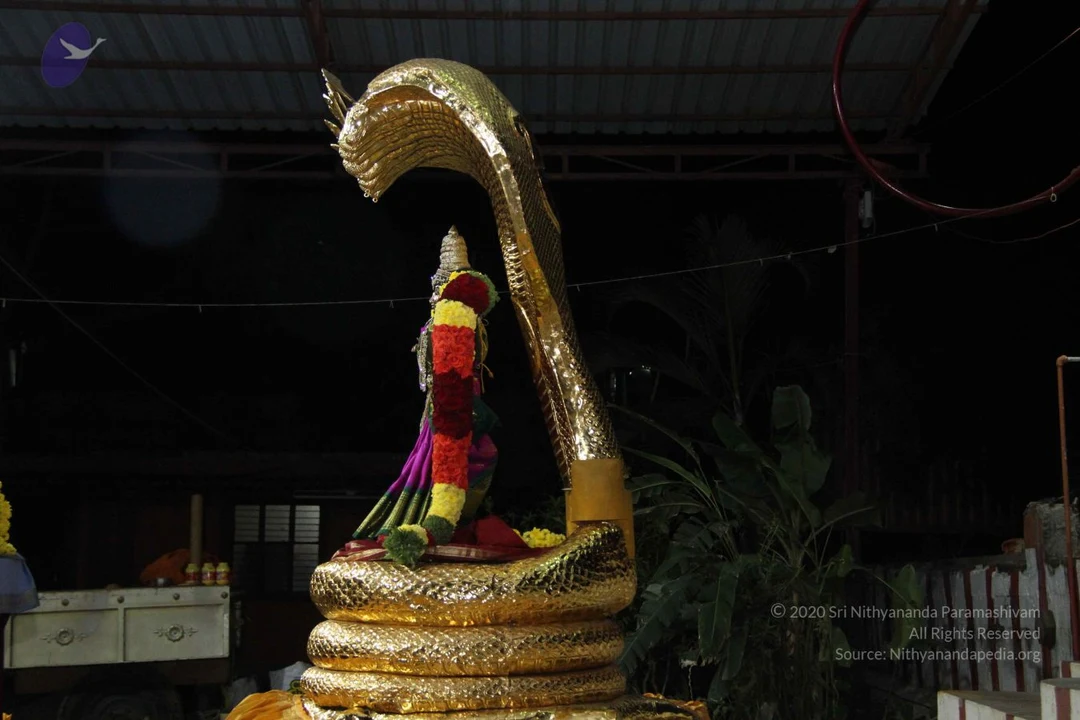
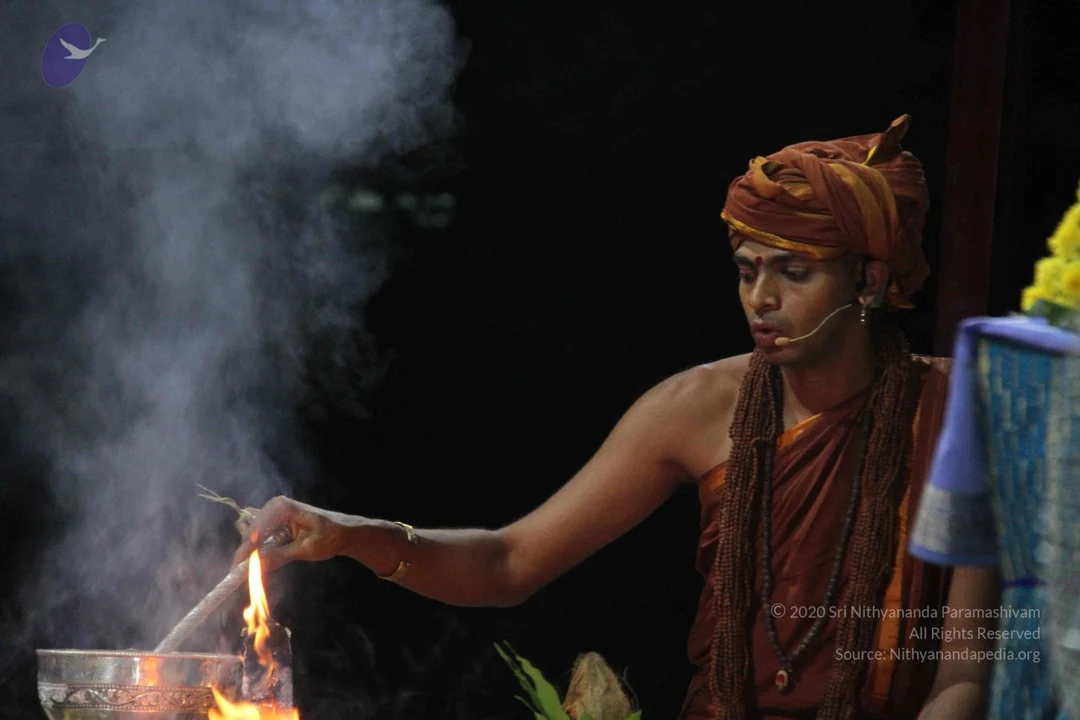
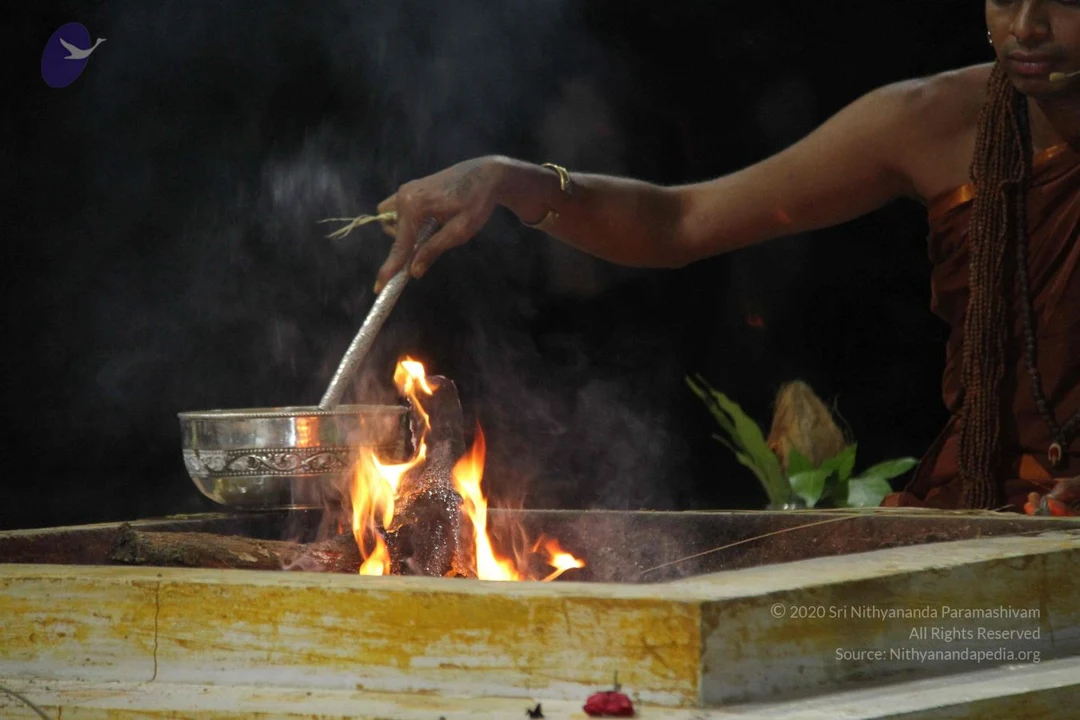
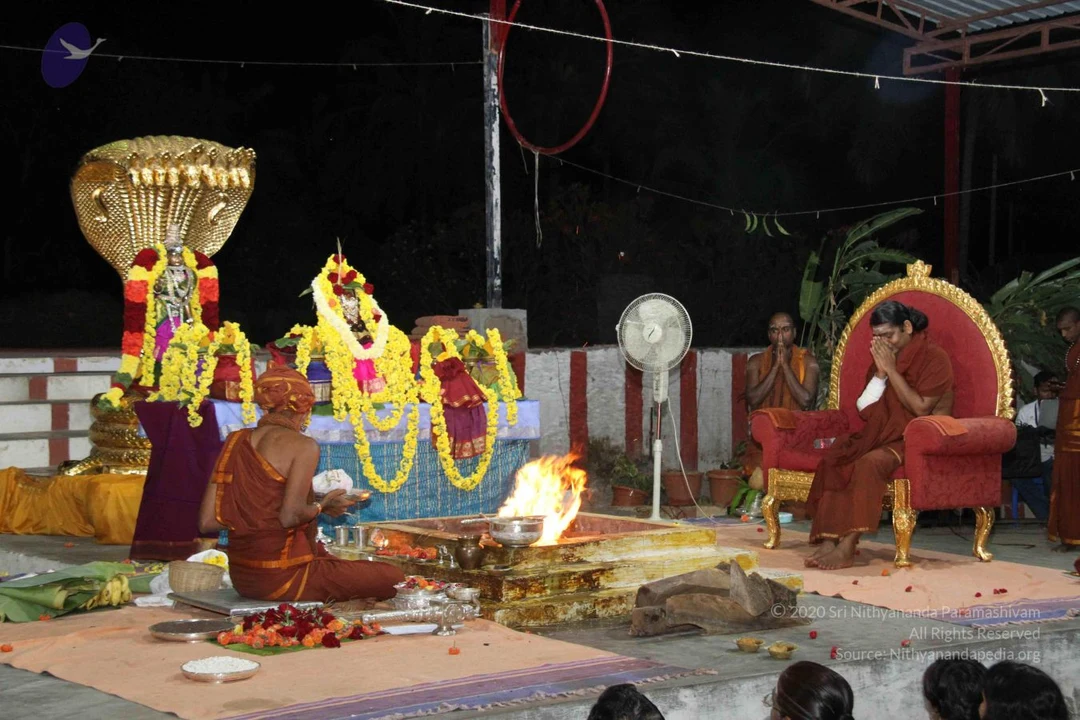
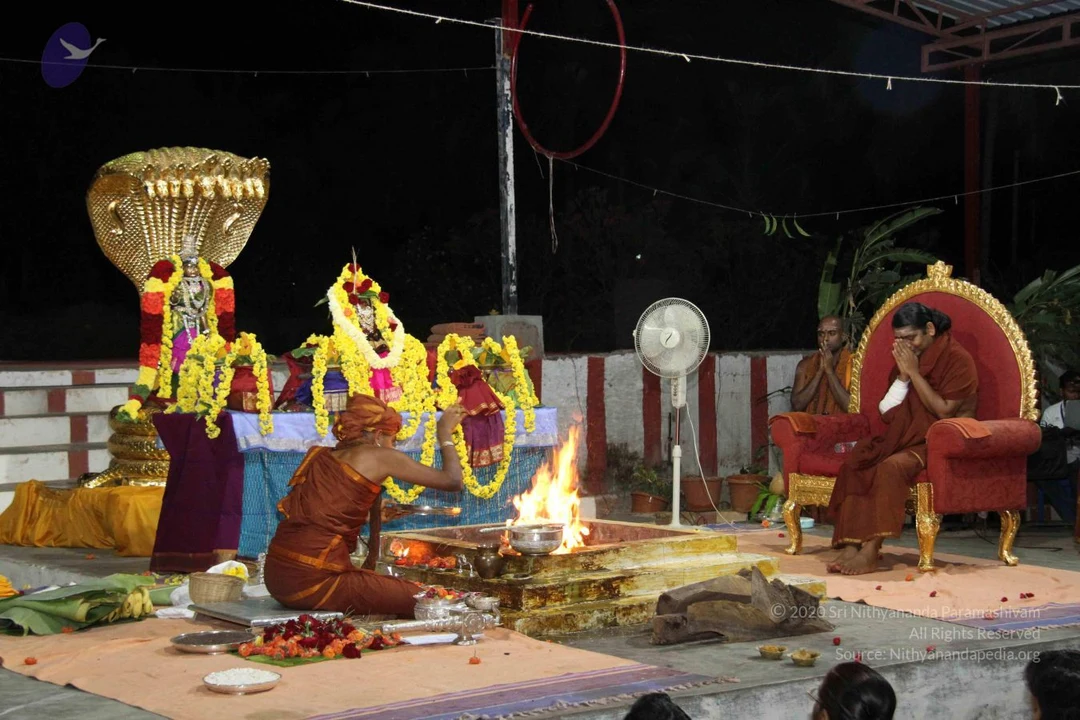
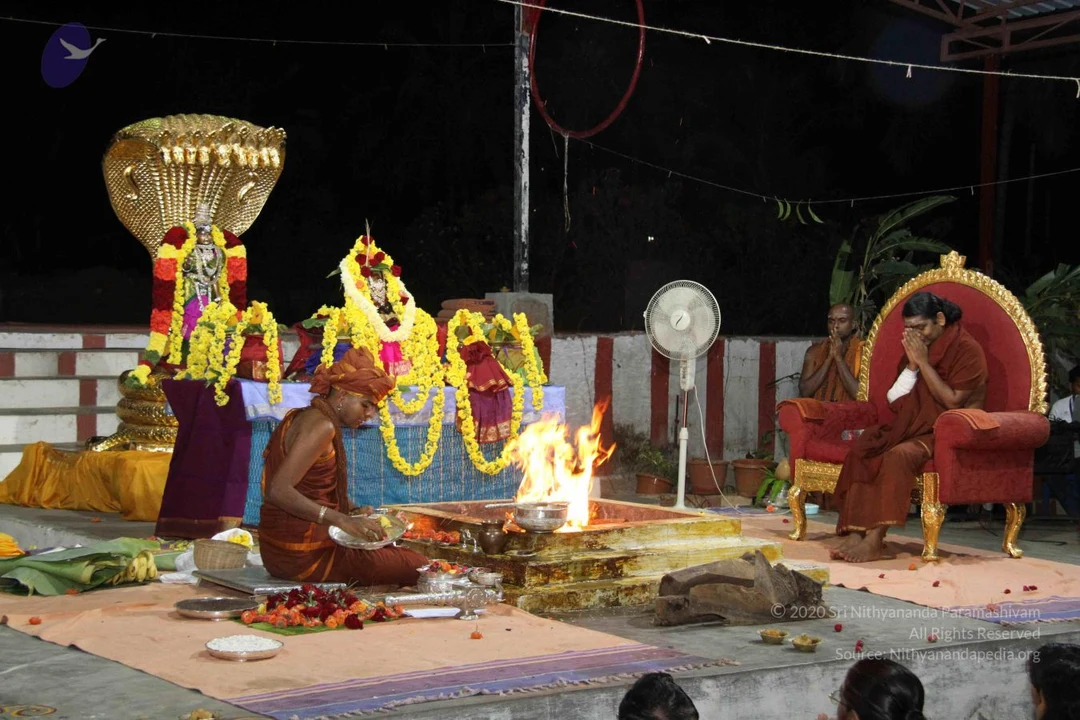
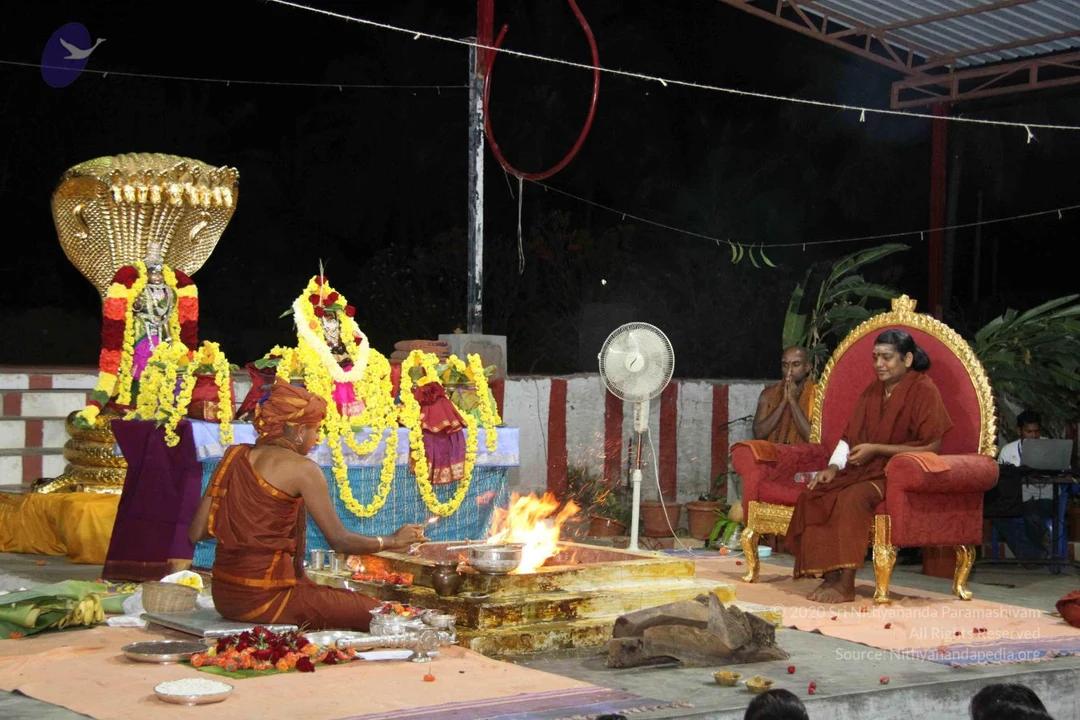
87 photosSource gallery
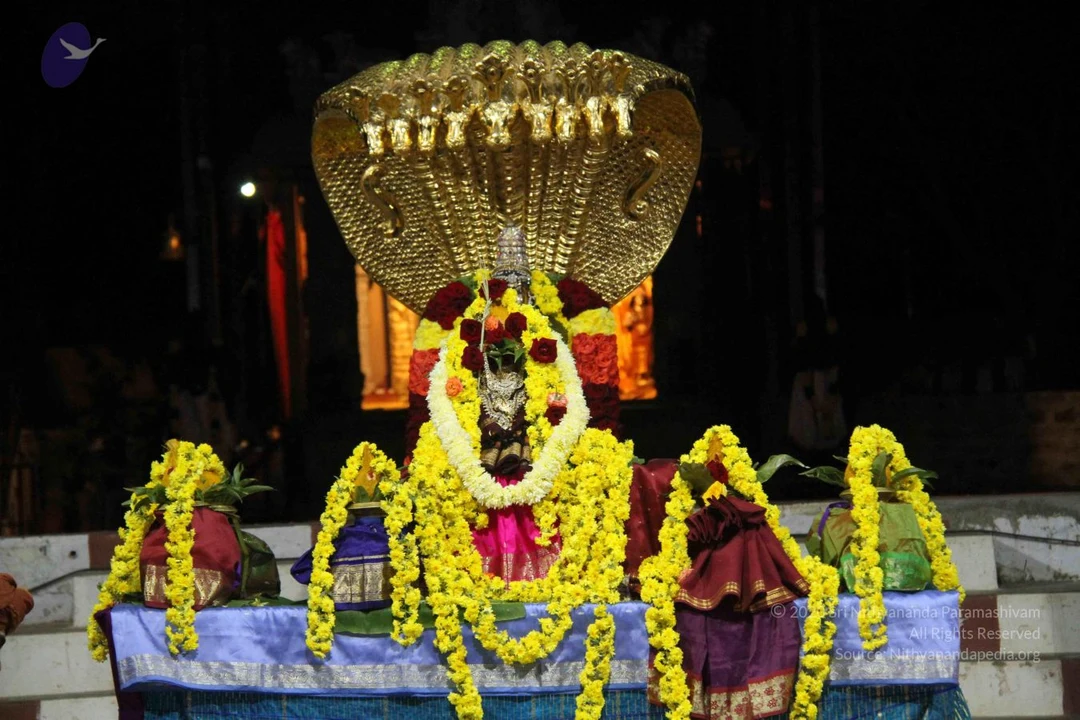
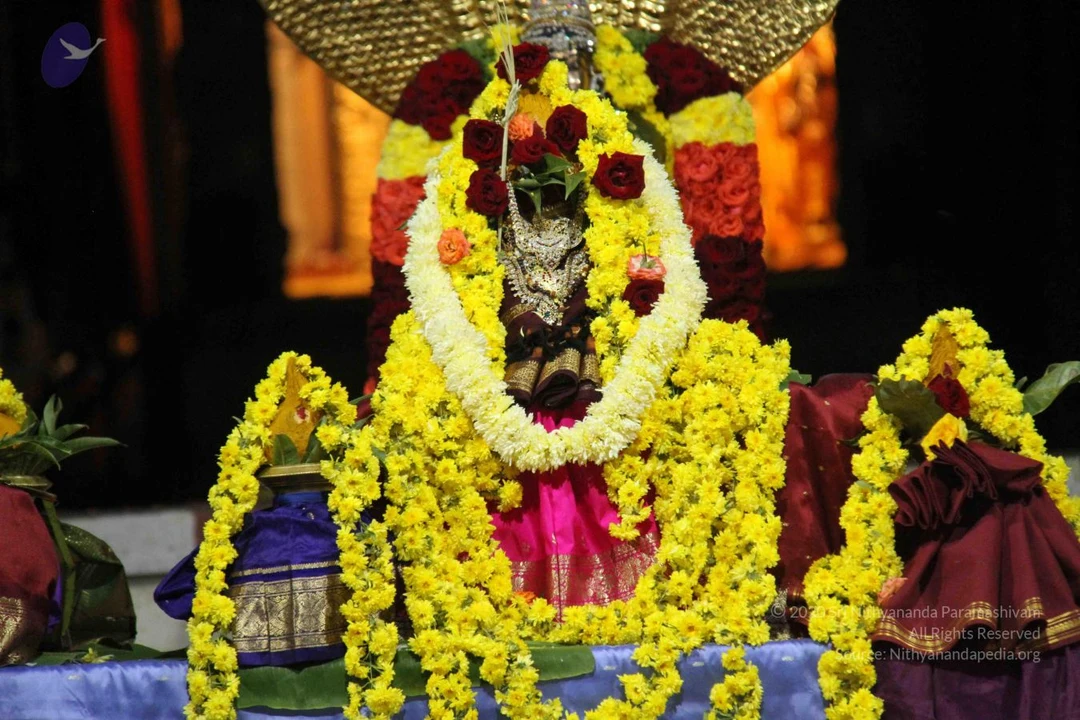
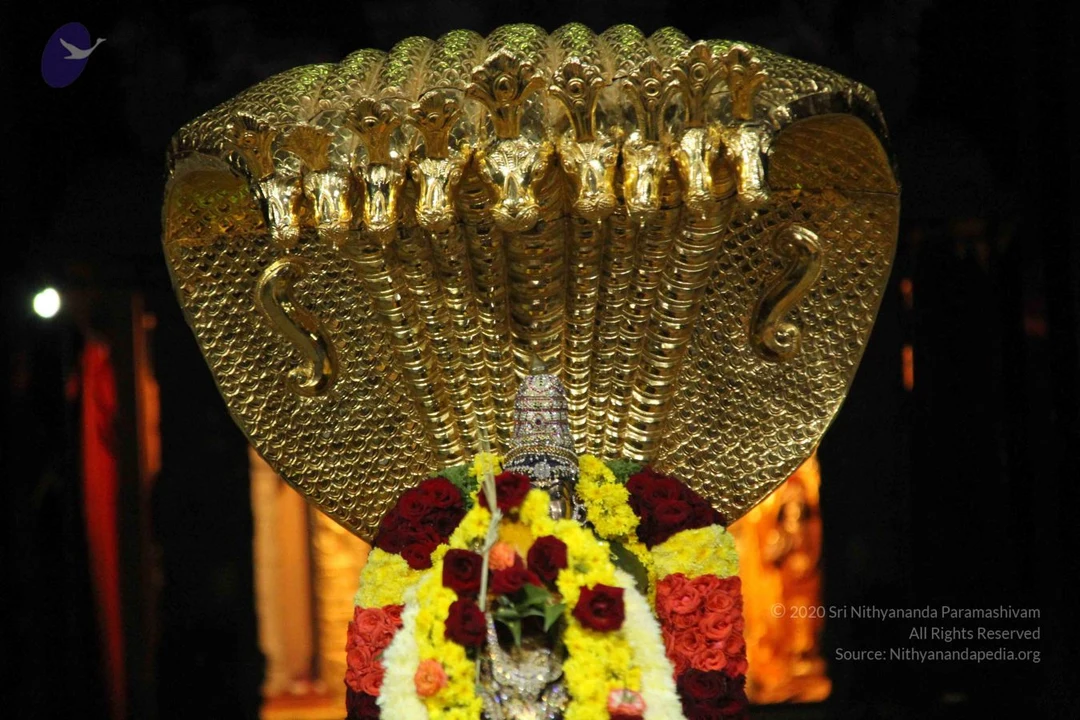
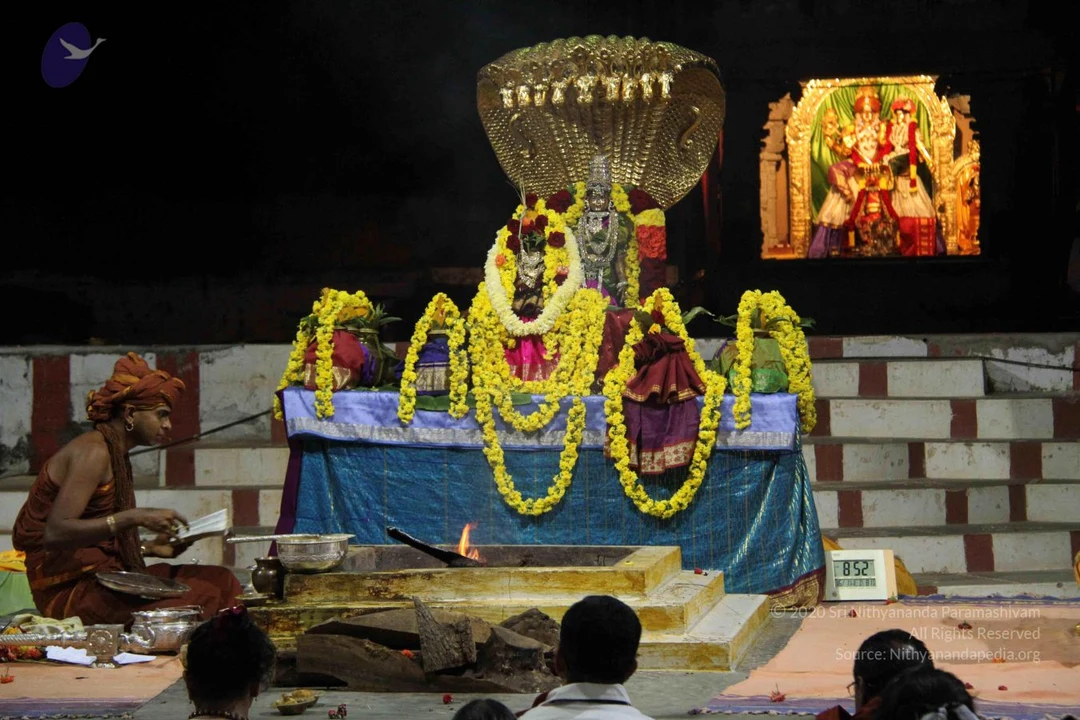
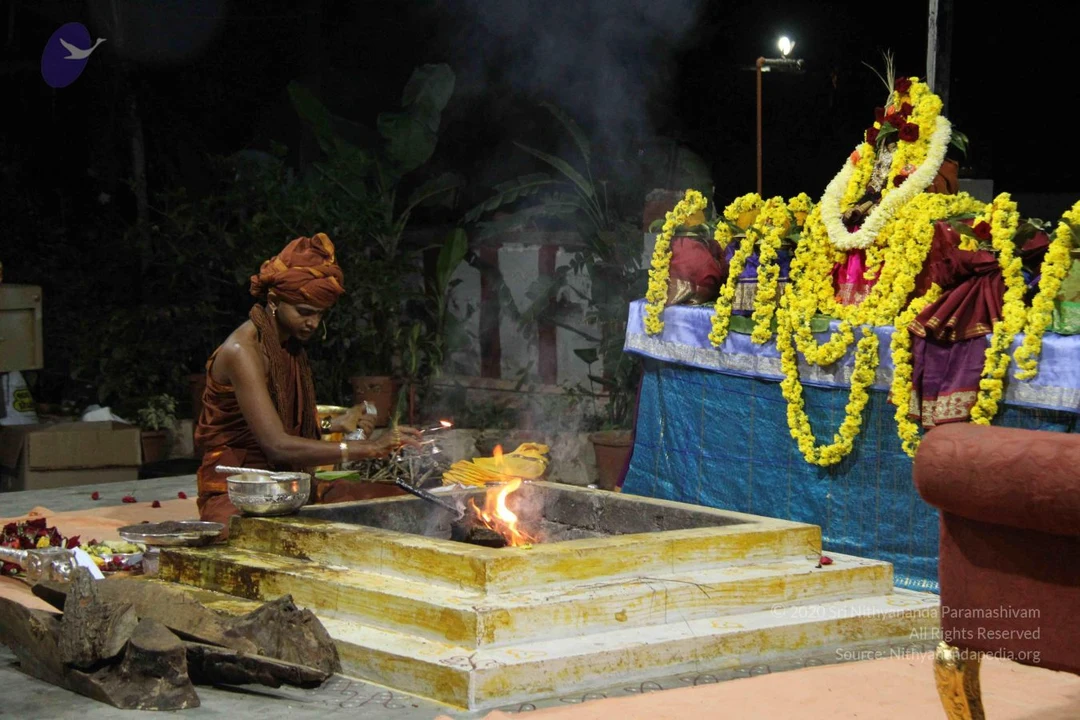
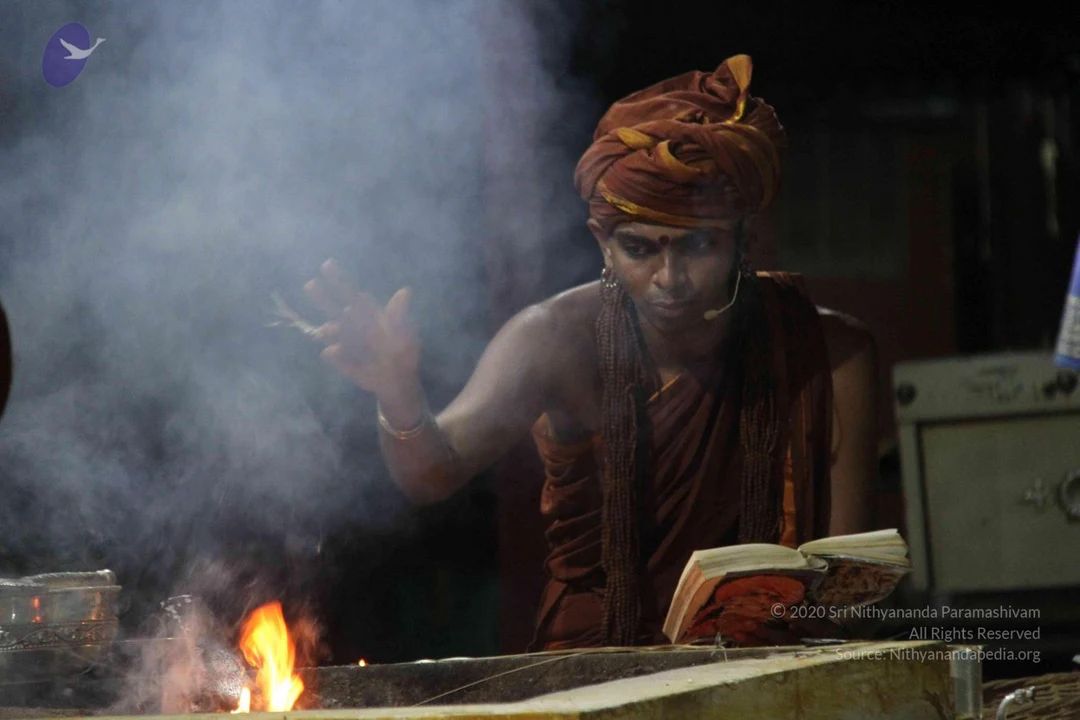
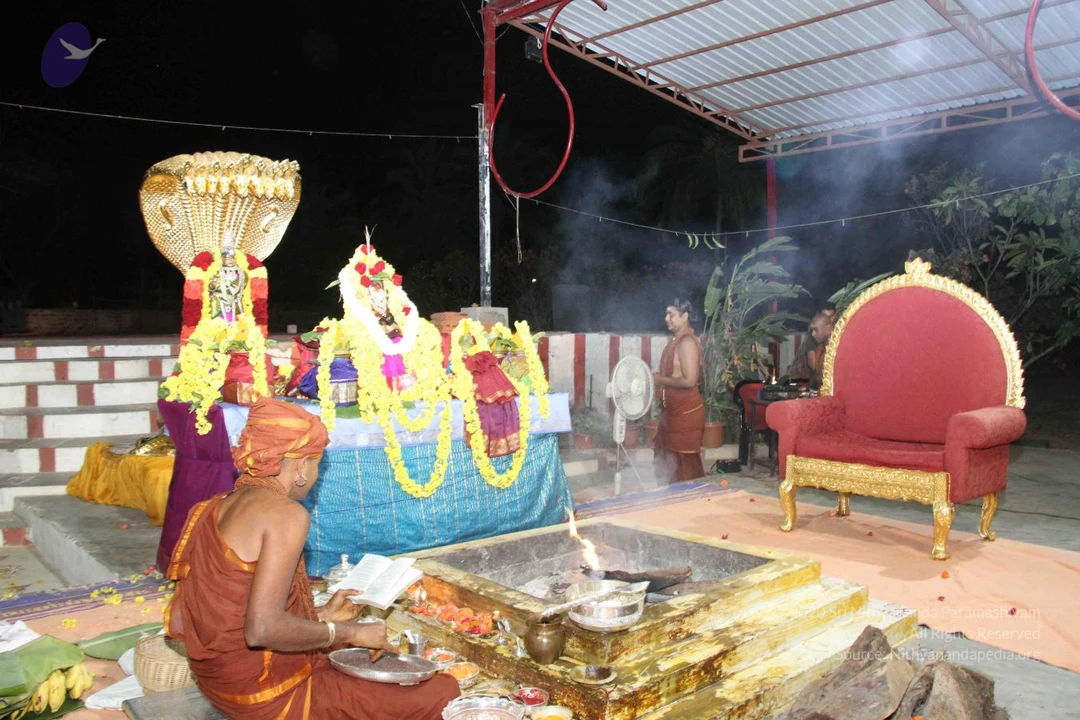
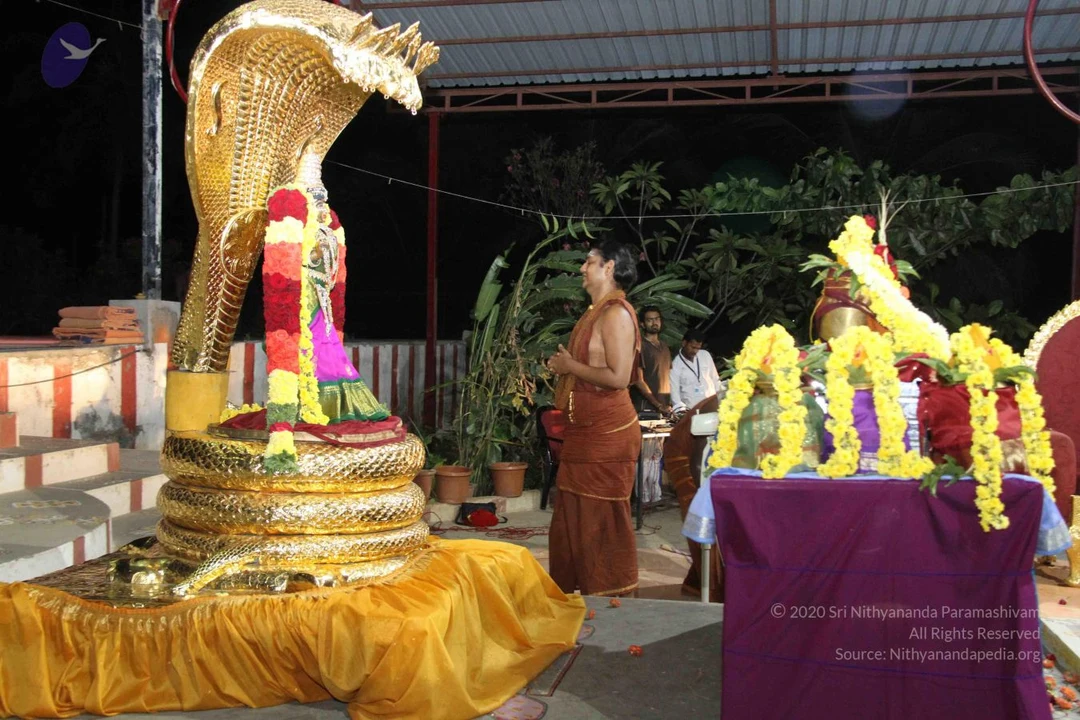
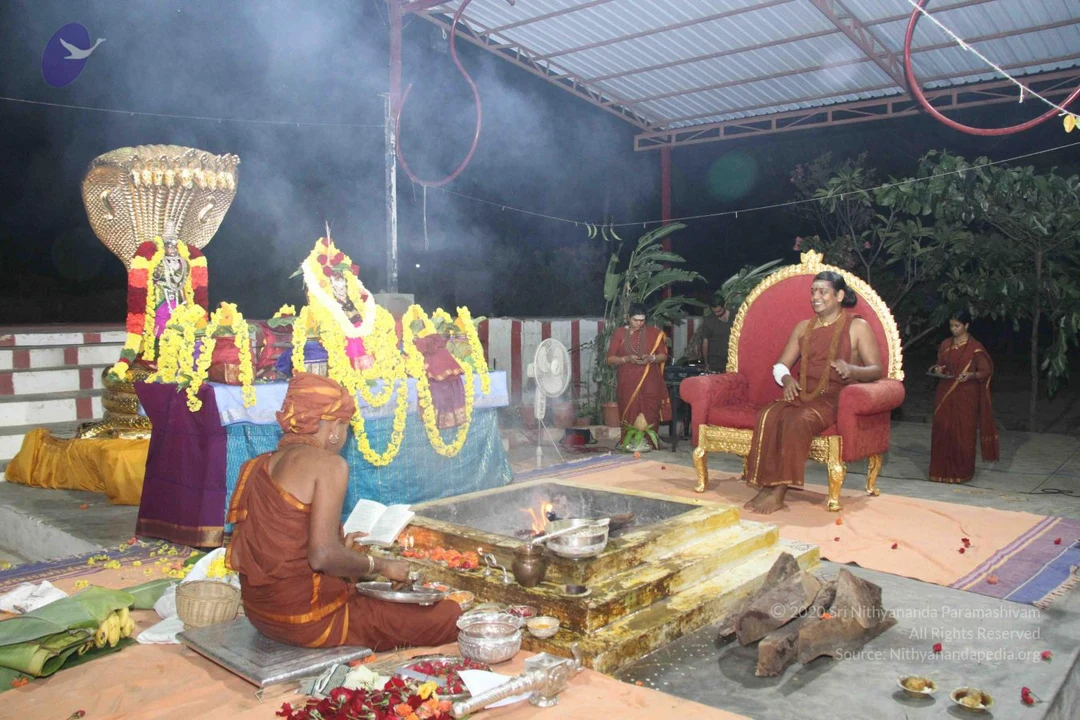
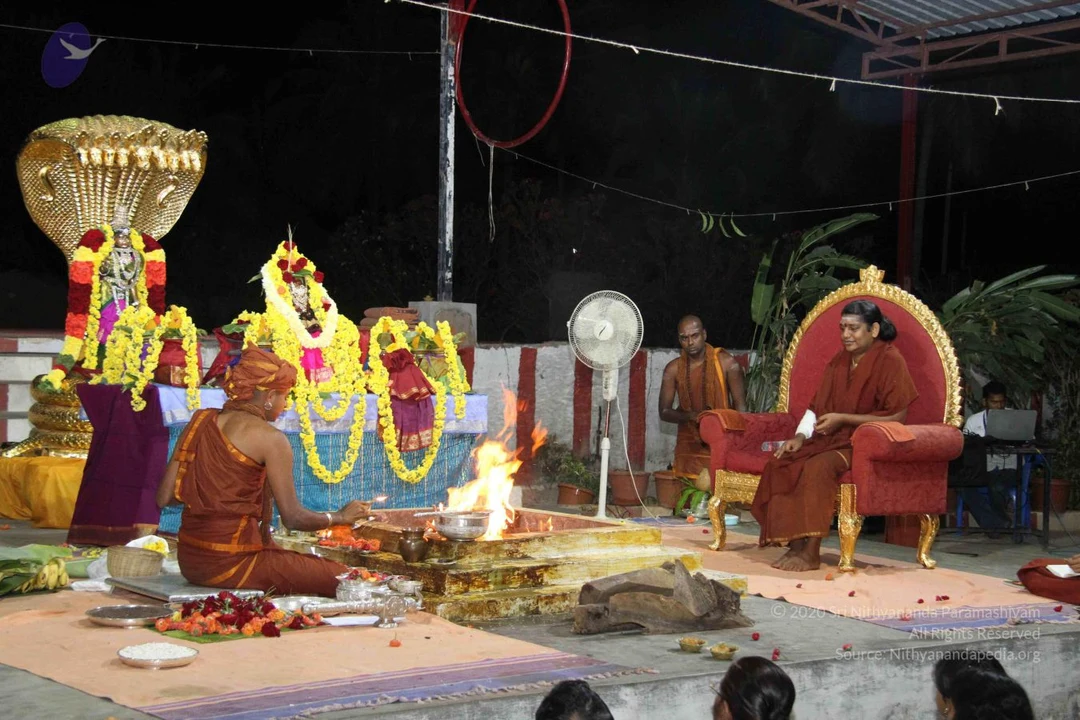
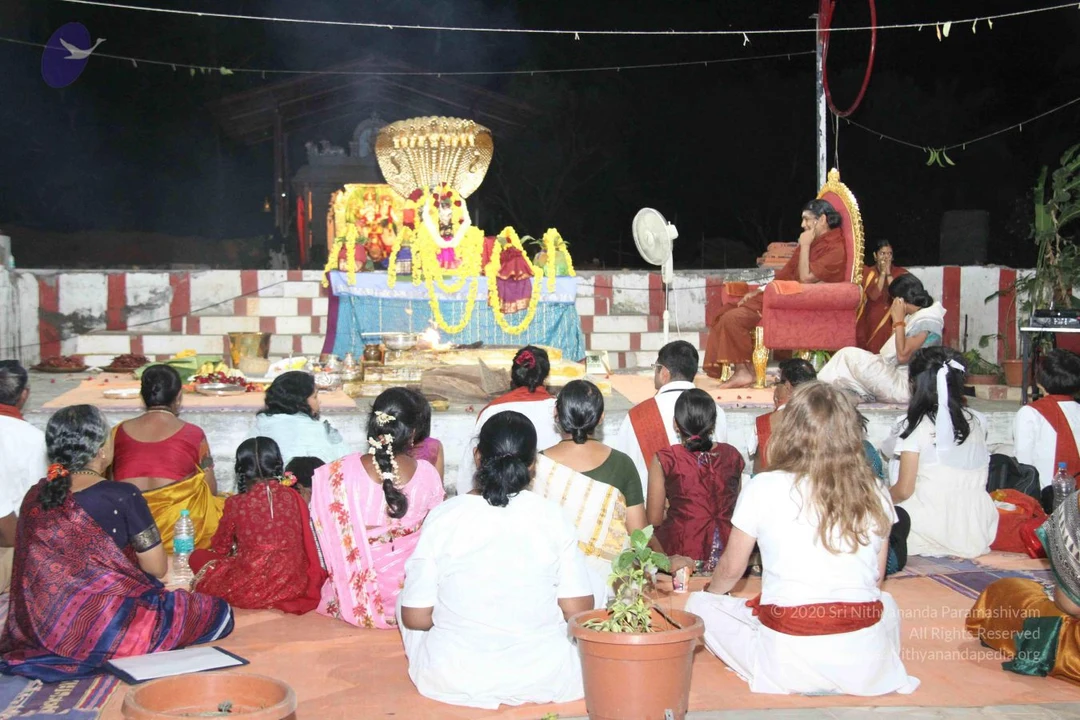
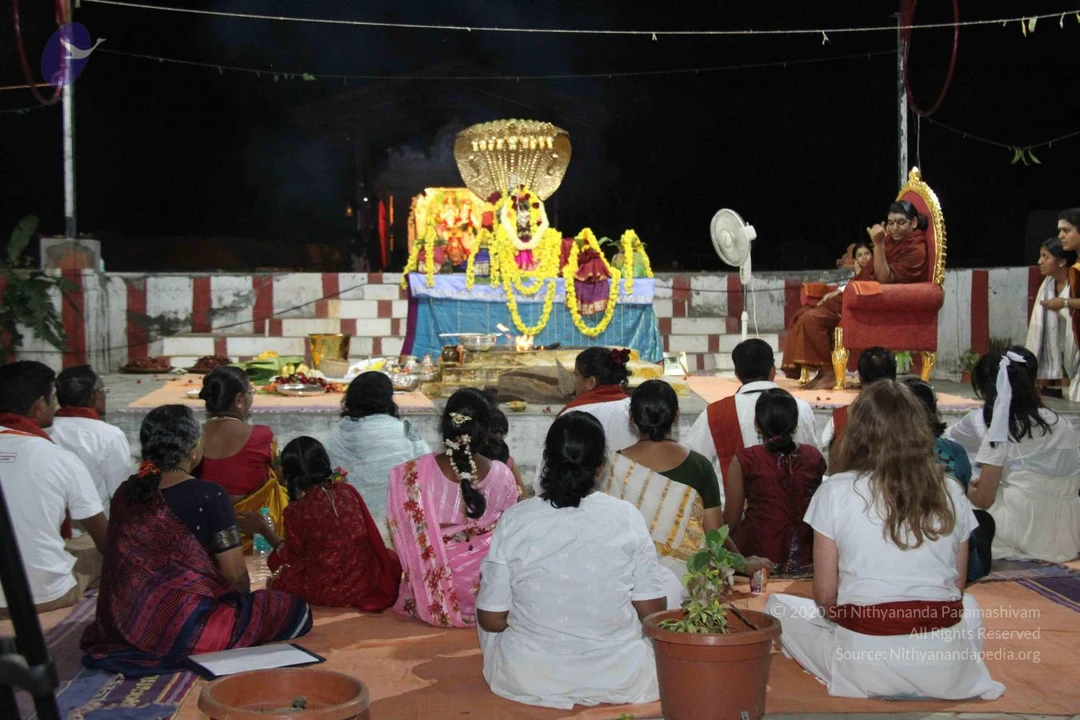
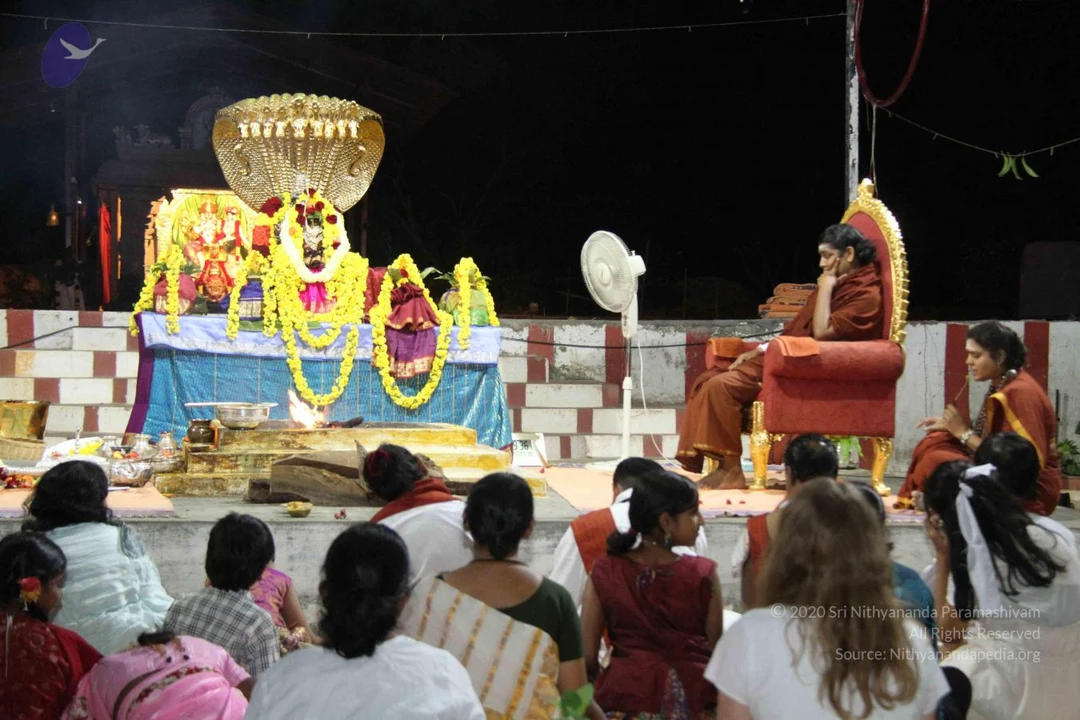
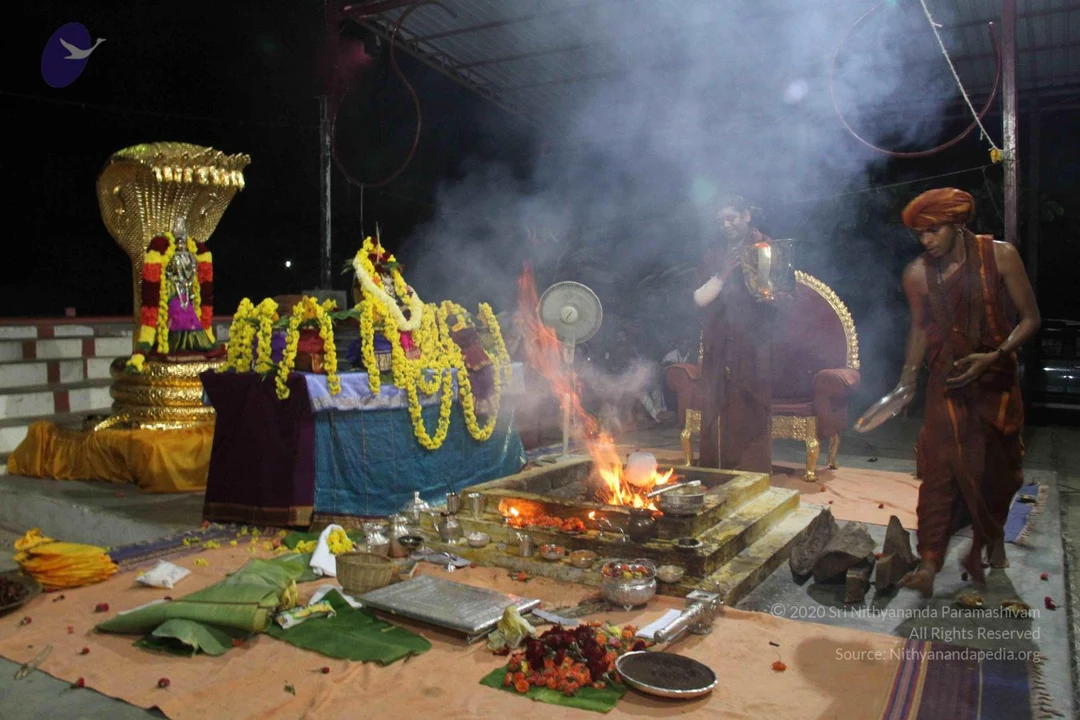
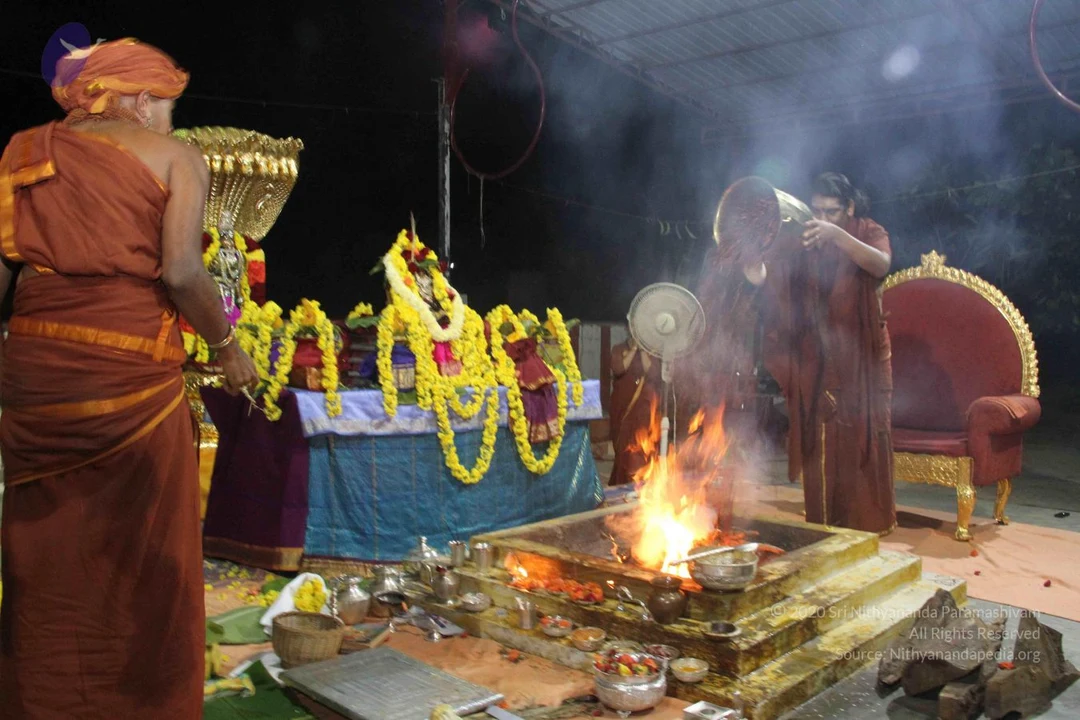
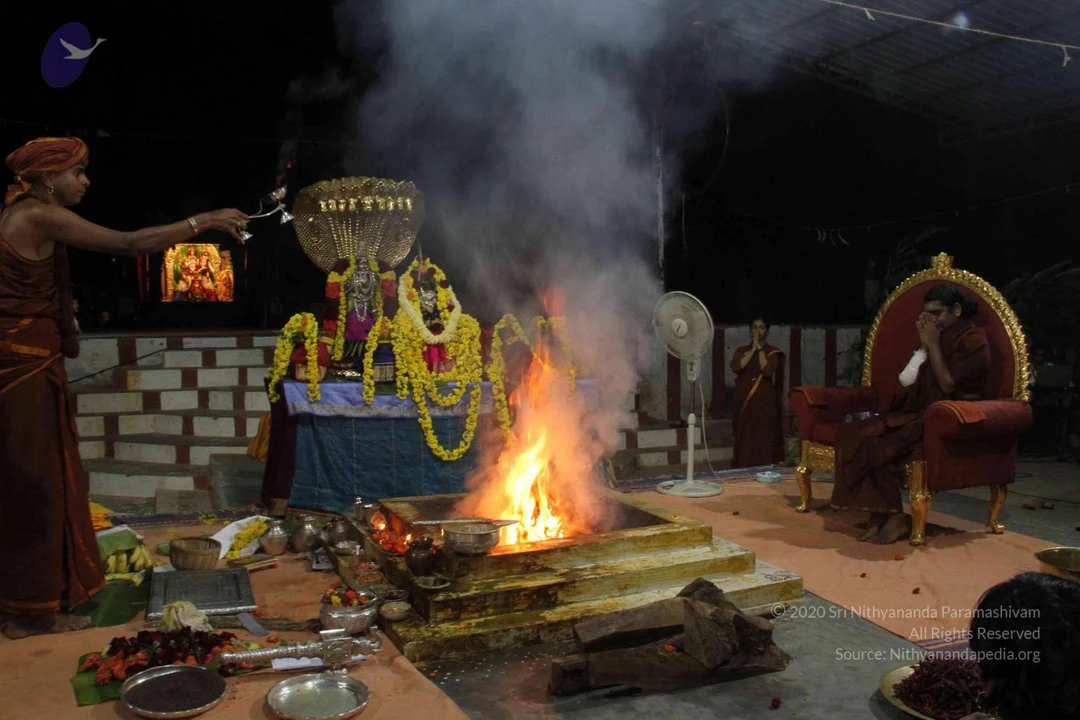
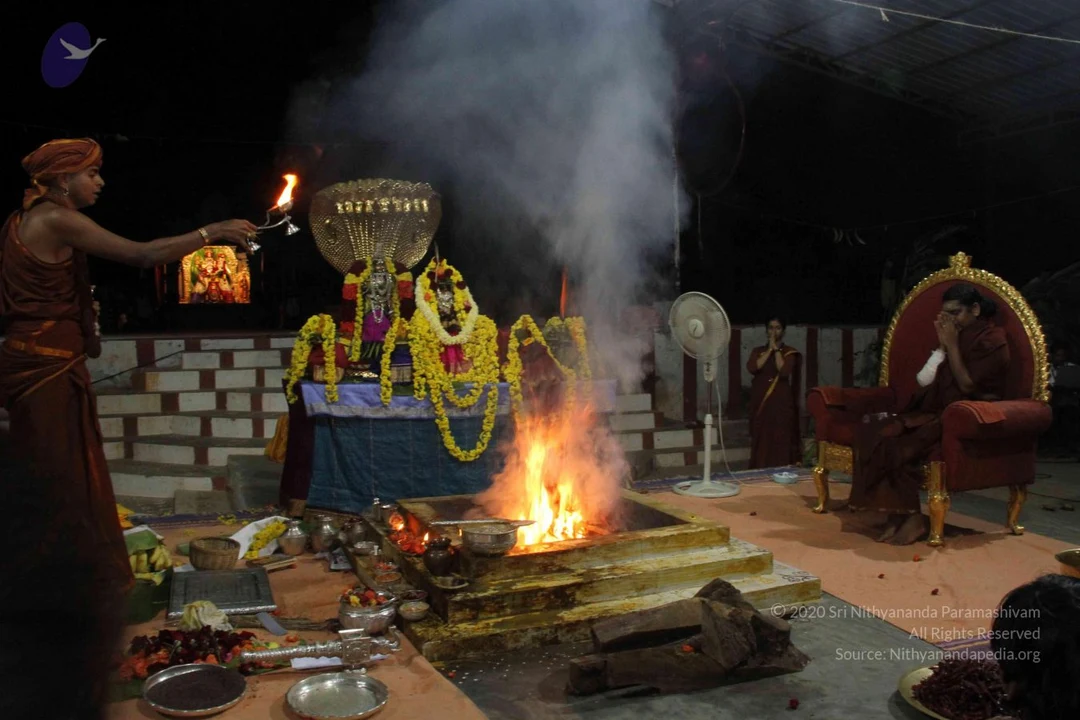
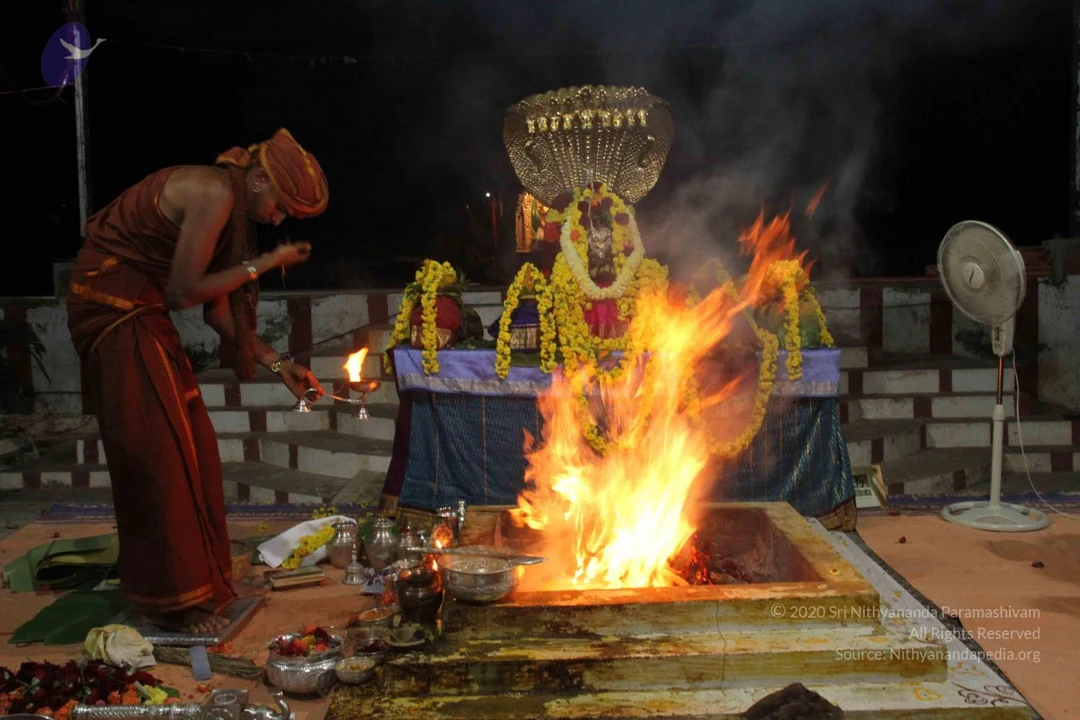
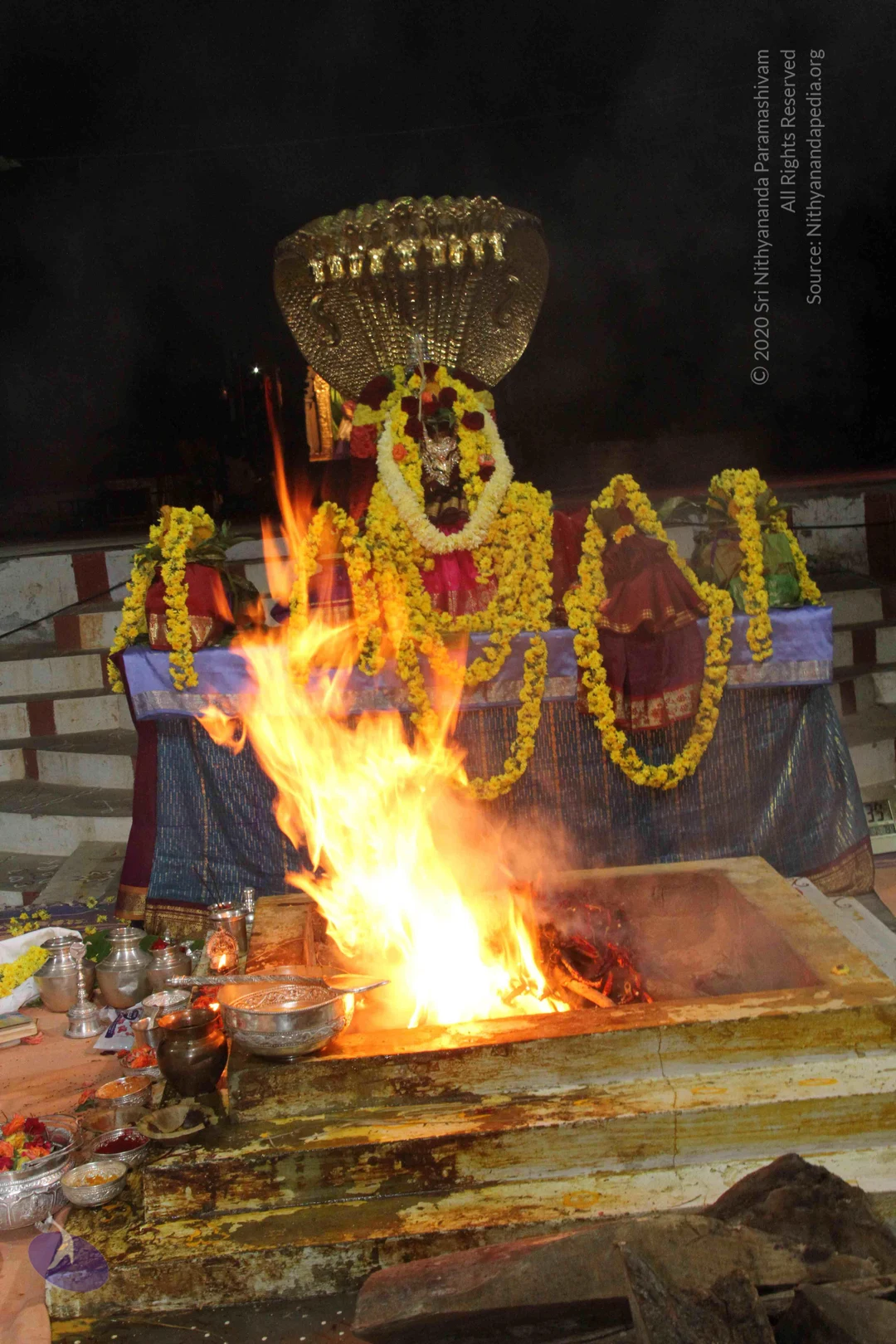
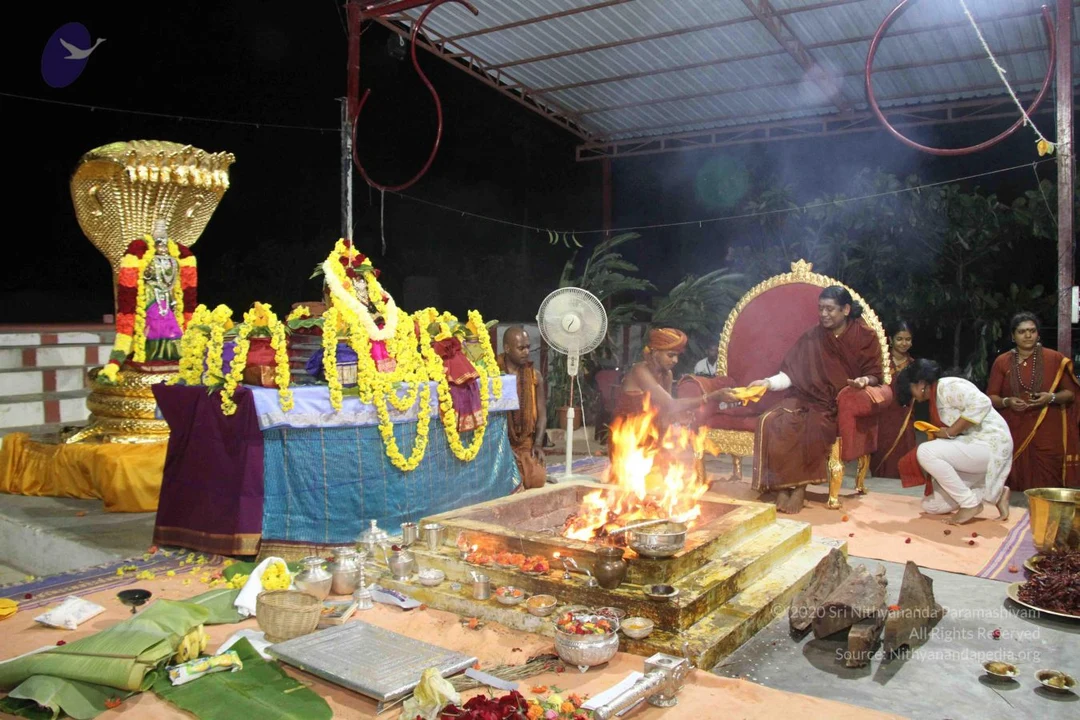
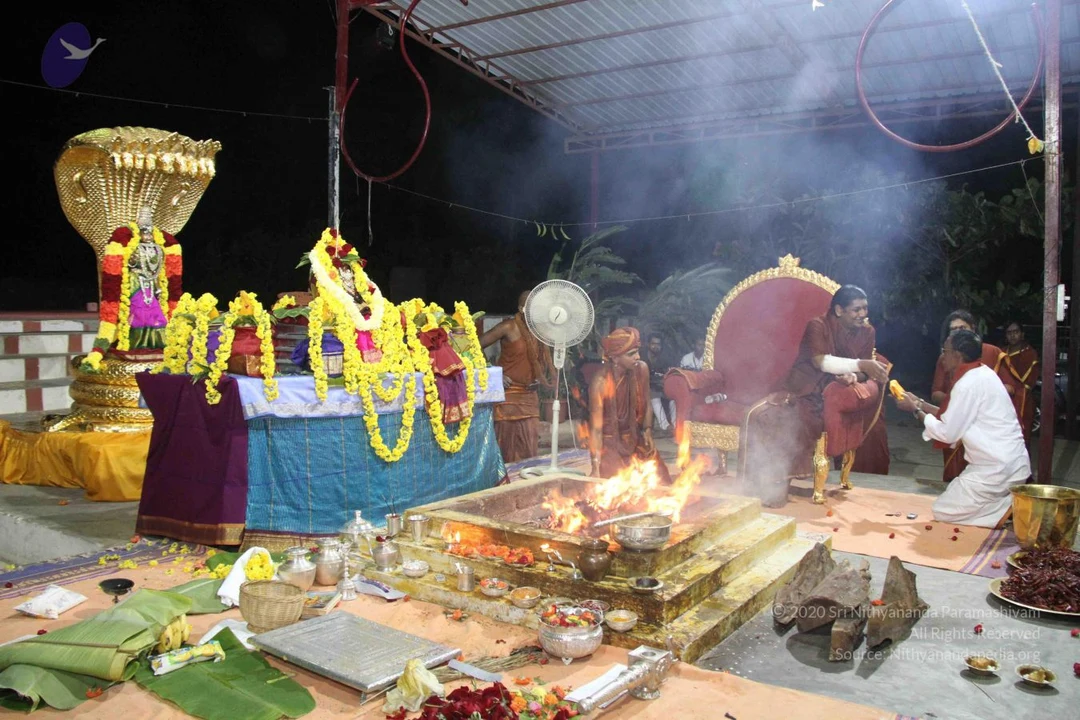
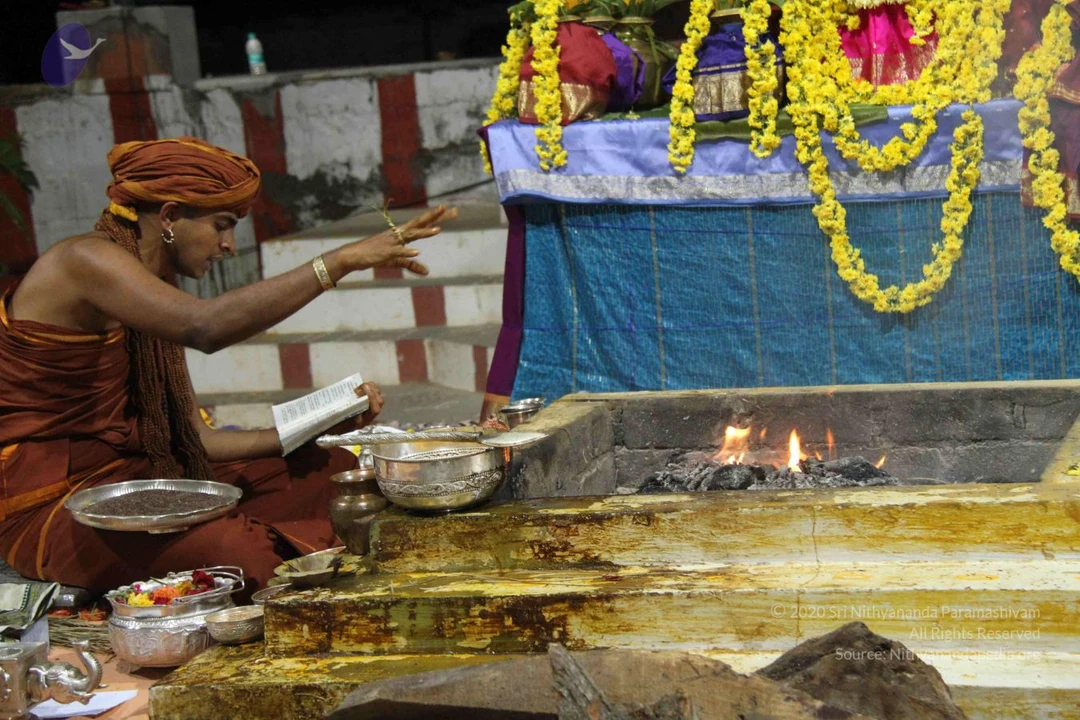
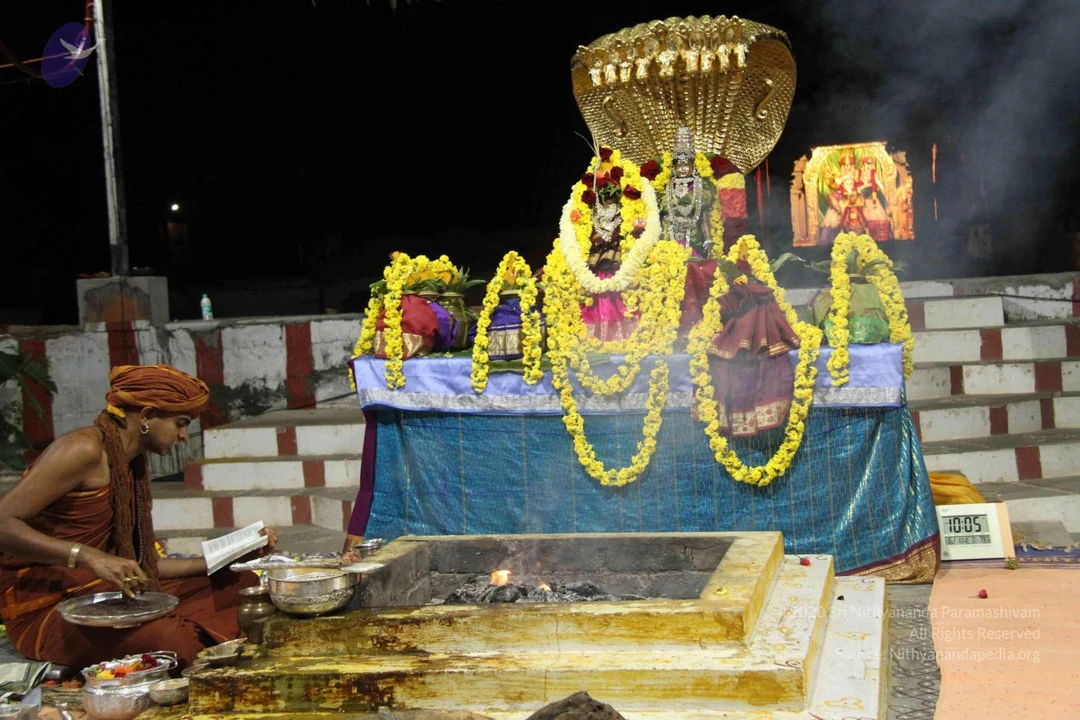
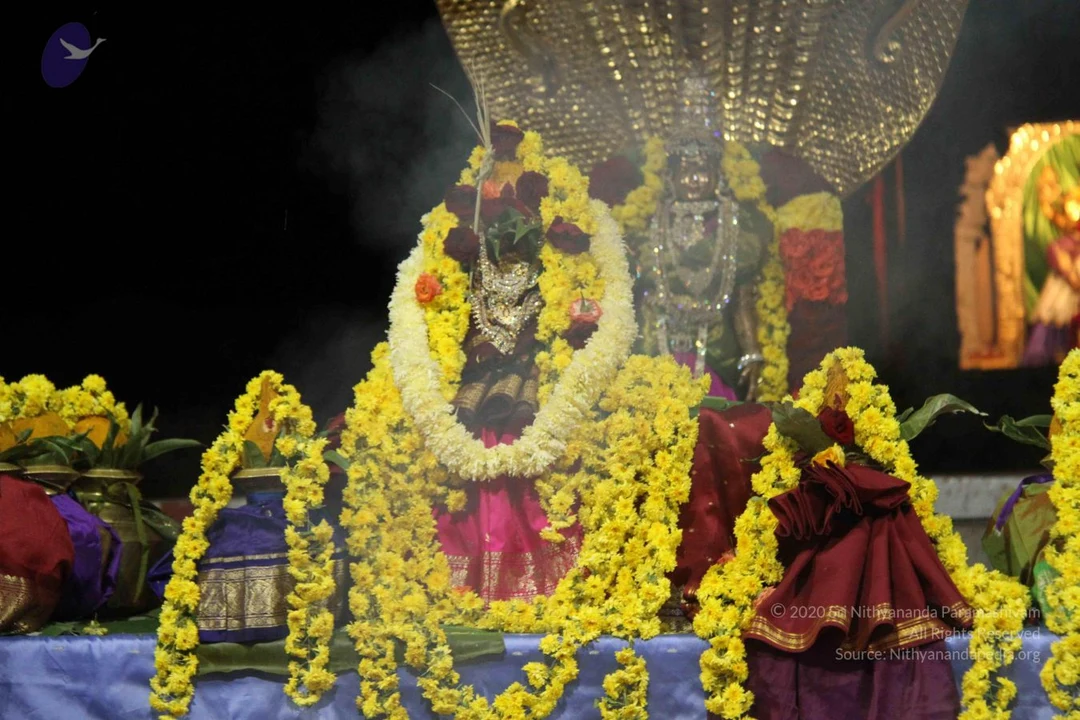
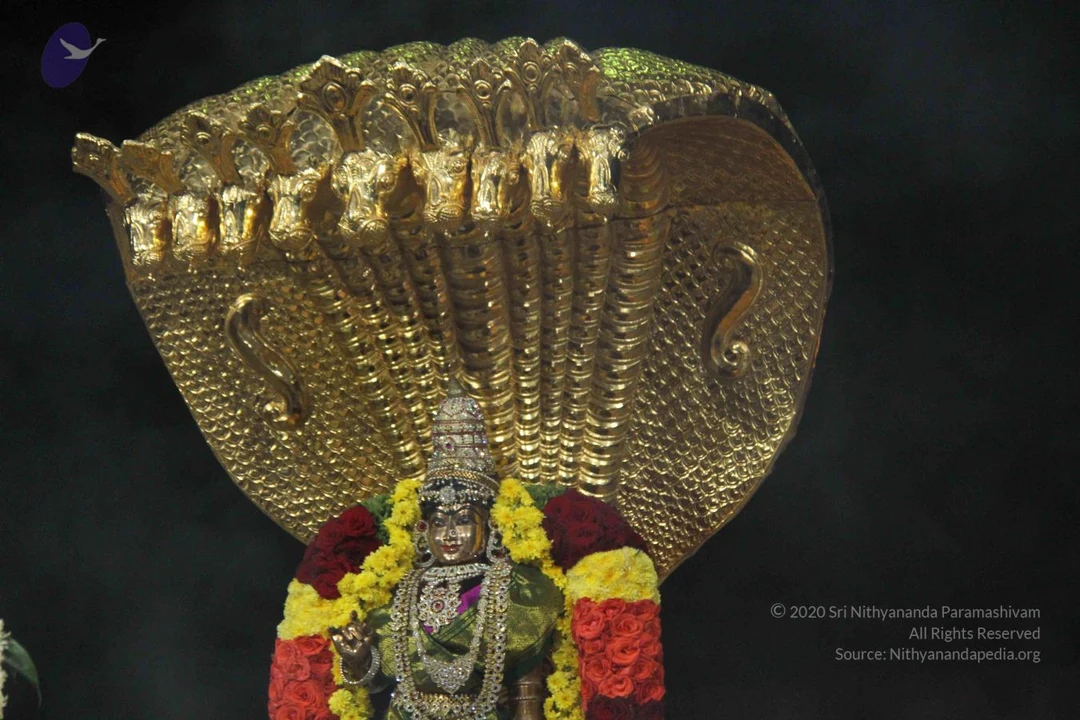
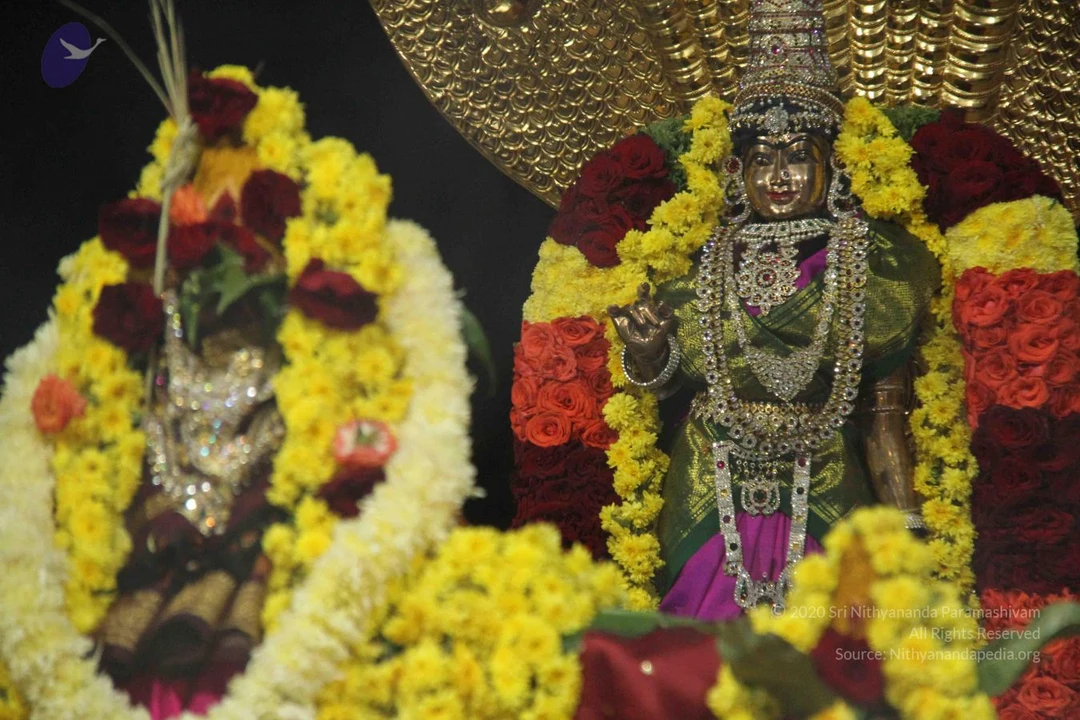
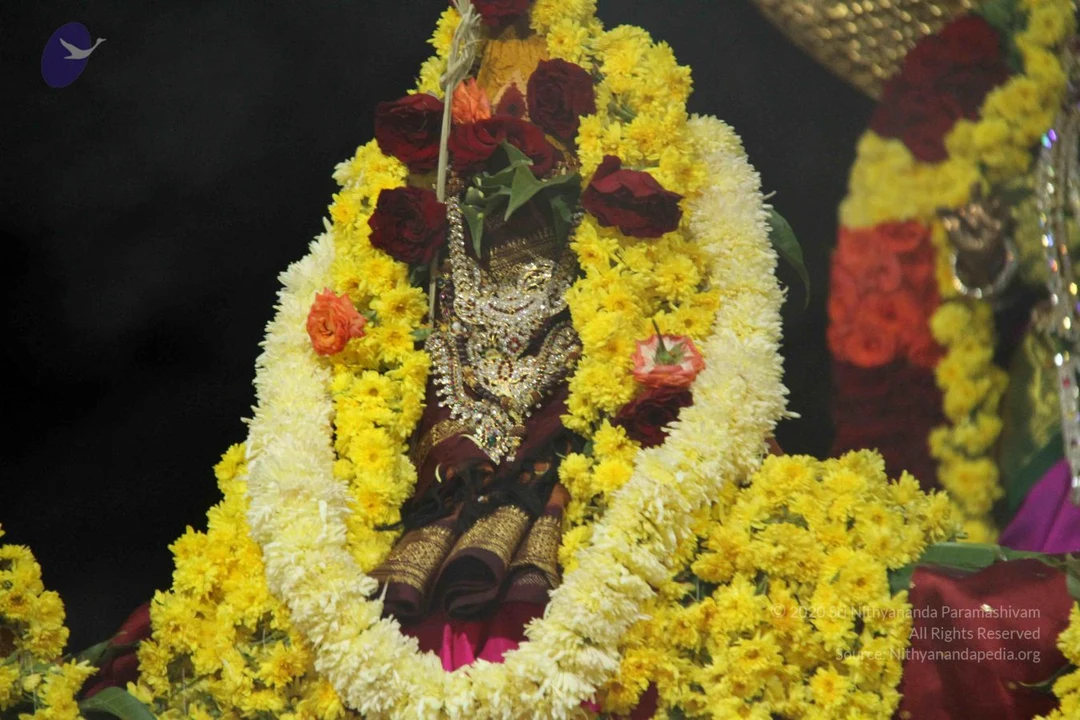
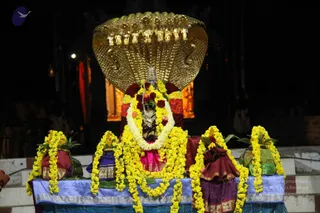
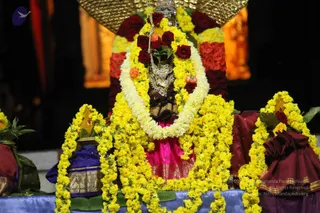
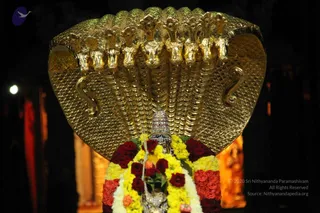
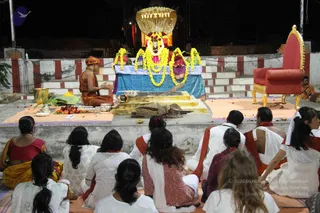
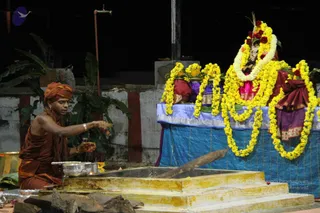
A night photograph of a decorated deity murti of Shiva-linga style or a serpent-hooded form, with a large golden five-headed serpent hood (naga) rising behind it. The central figure is adorned with garlands of yellow marigolds and red roses, a silver face or crown ornament, and a pink cloth. Flanked by smaller garlanded offerings and pots draped in purple, maroon and green cloths on a blue-draped altar. Dark background with a warm lamp glow behind. No people visible.Night photo of a decorated deity murti under a large golden five-hooded cobra canopy (naga kudai) with a crown-like top. The central figure is adorned with red roses, yellow marigold garlands and a white flower garland, with a magenta cloth draped below. The altar platform is covered in a blue cloth with silver border, holding additional garlanded items wrapped in maroon, purple and green cloths, all decorated with yellow marigold strands. Dark background with warm lamp glow and a red banner in the distance. No people are visible in the scene.A deity murti is richly decorated with yellow marigold garlands and red rose garlands, with a white jasmine-style garland across the chest. The figure wears a pink skirt-like drape, gold ornamental jewellery and a crown-like headpiece, with a metallic gold canopy above. Flanking it on both sides are smaller decorated items wrapped in yellow and maroon cloth, bordered with gold zari, on a blue-draped altar. Dark background with warm lamp light. No physical people are visible.A photograph of a golden five-hooded cobra canopy (naga kudai) arching over a deity murti, which is draped with garlands of red roses, yellow marigolds and orange flowers. The gold serpent hood has scaled texture and curled side ornaments against a dark background, with faint orange and red draperies visible at the edges. No people are visible in the frame.Night-time outdoor ritual at a raised stone platform before a deity murti crowned with a golden hooded cobra canopy and decorated with yellow and orange marigold garlands. A man in orange robes and an orange turban sits cross-legged at the left of the platform with palms pressed together in prayer, beside a fire pit with burnt logs and offering bowls. Around the platform, about a dozen devotees sit on mats facing the altar, wearing white and red garments. A red velvet throne with gold trim stands empty at the right, and a seated figure in orange is partly visible beyond it. Flower petals and banana leaves with offerings lie on the ground.A night ritual photograph at an outdoor shrine. A man in saffron-orange robes and a matching orange turban sits at left, with a long rudraksha-style mala and bangles, pouring or offering from a small steel bowl beside a yellow-tiered fire pit with a wooden ladle. Behind him is a deity murti decorated with yellow marigold garlands and red flowers, draped in maroon and magenta cloth, placed on a blue and lilac draped platform with kalasha-like pots. Green banana-type leaves and a tap pipe stand against a white and red painted wall. The man is the only physical person visible.