Skip to content
Thursday

6 October 2016

Paramahamsa Nithyananda expands on the significant details of the Spiritual Alchemy Process

Dated photos
310
Source pages
1
Media
4
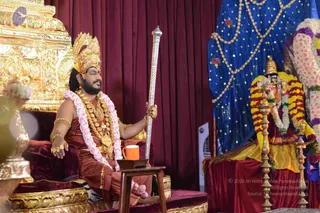
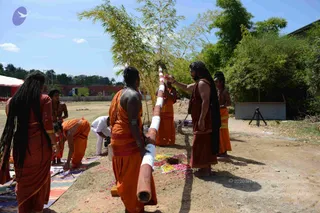
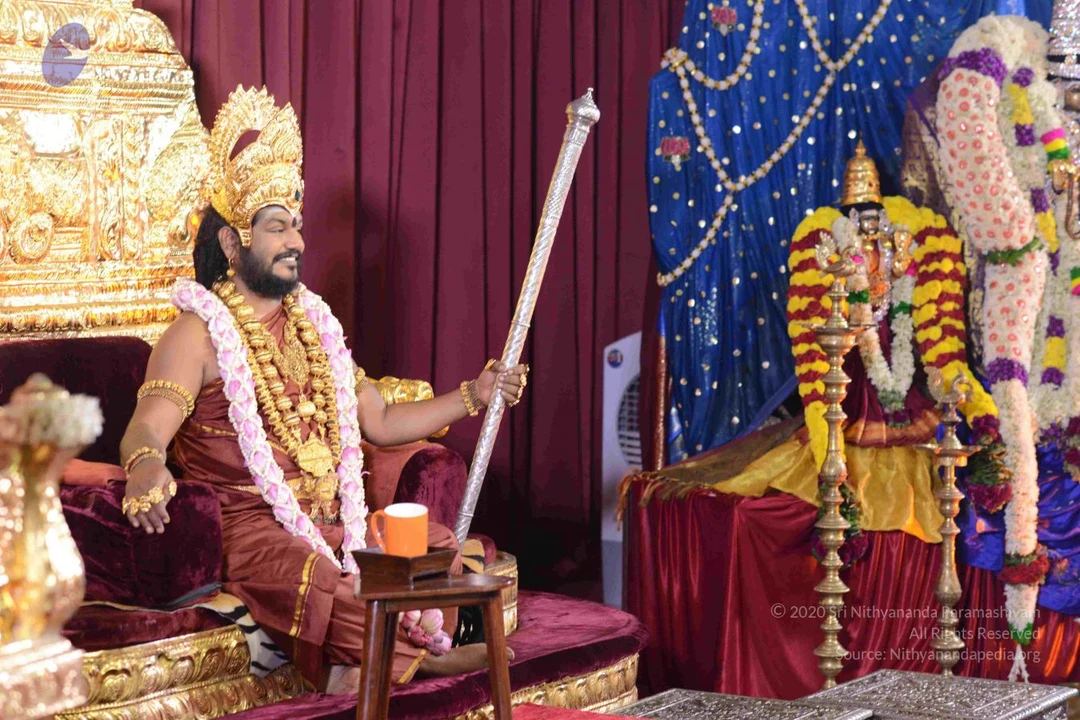
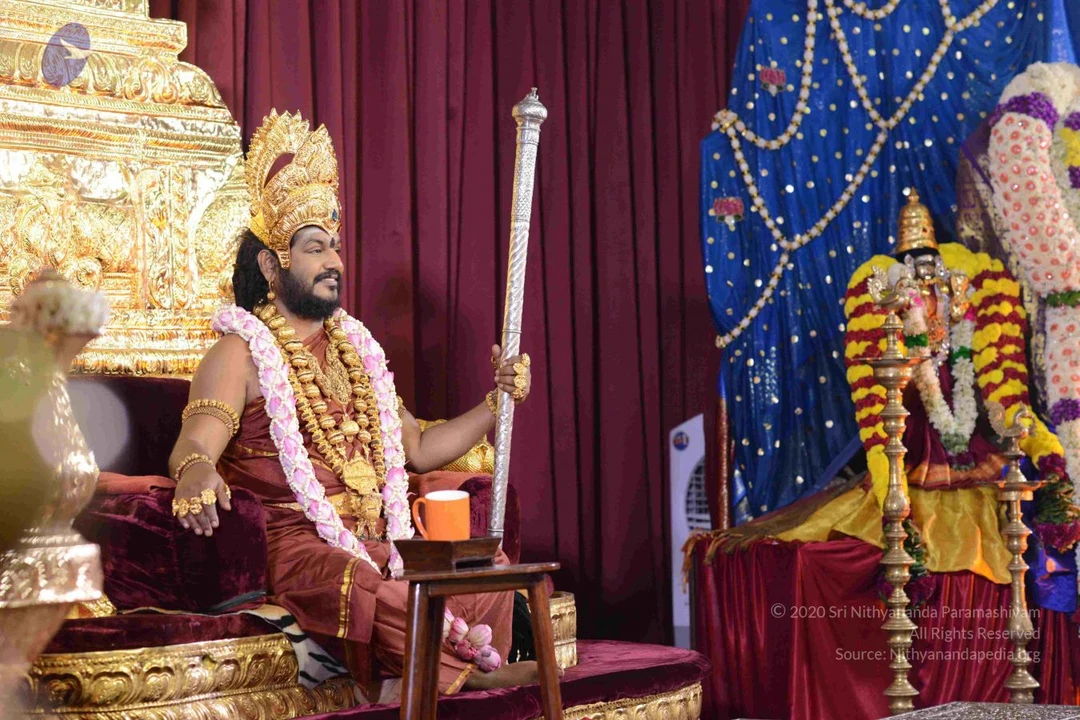
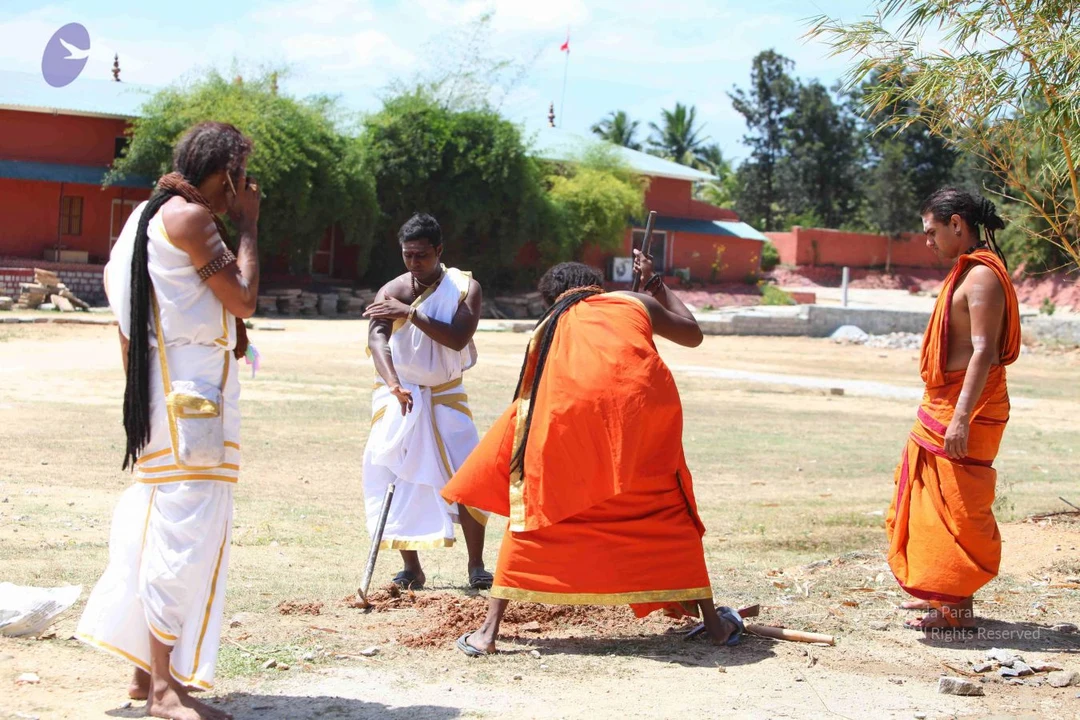
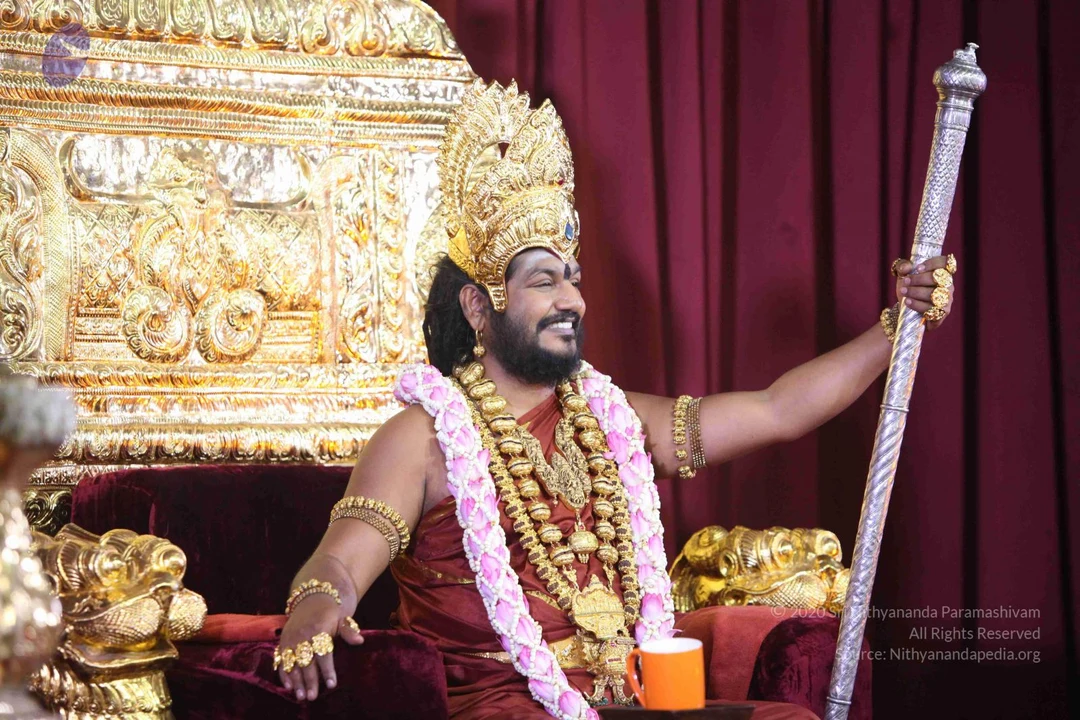
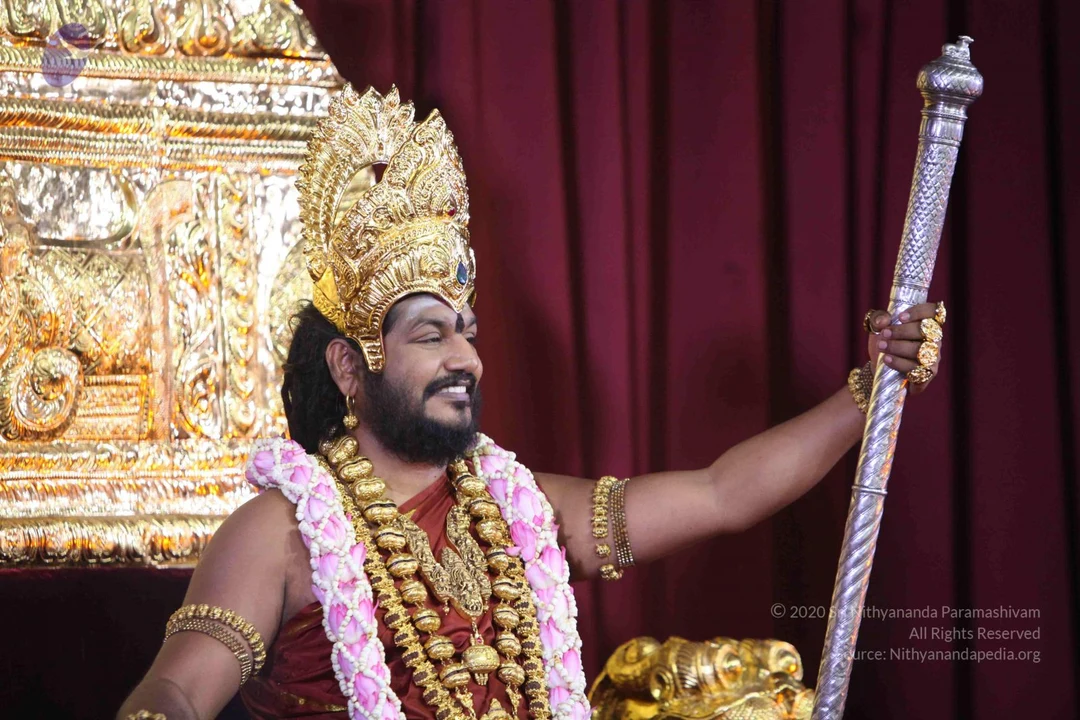
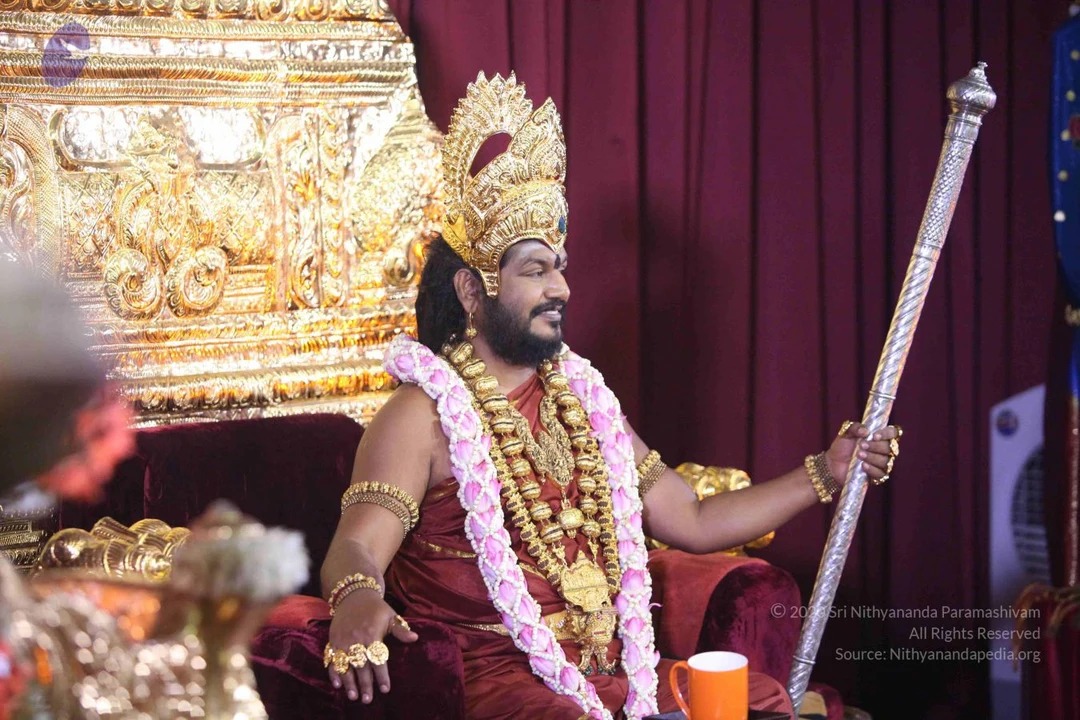
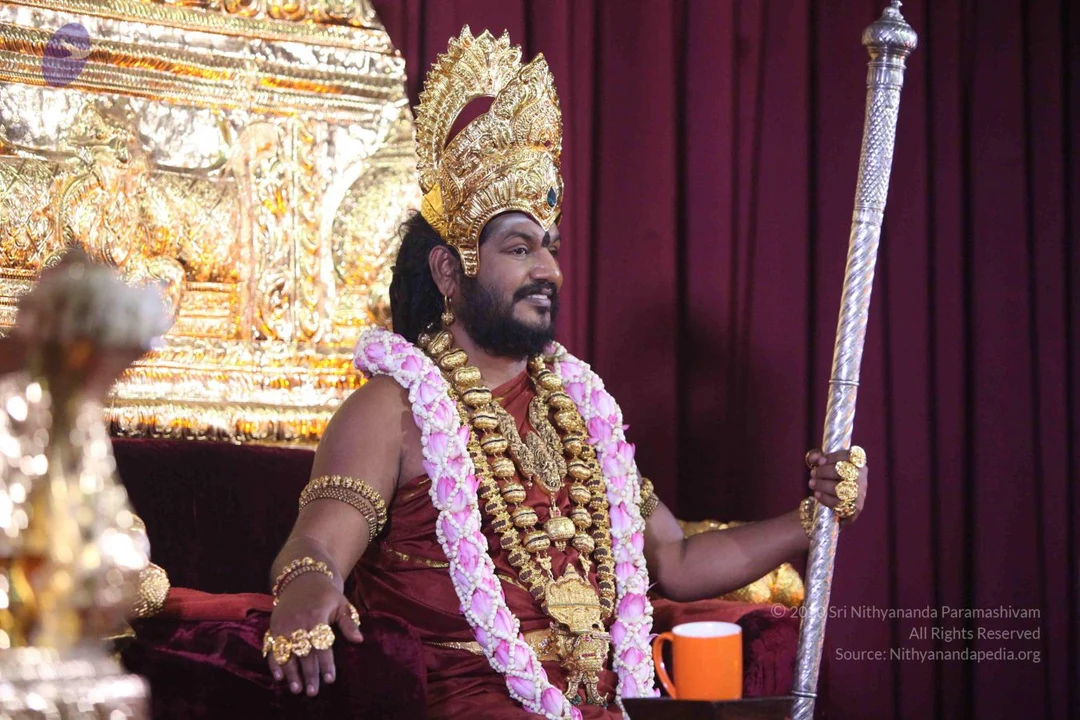
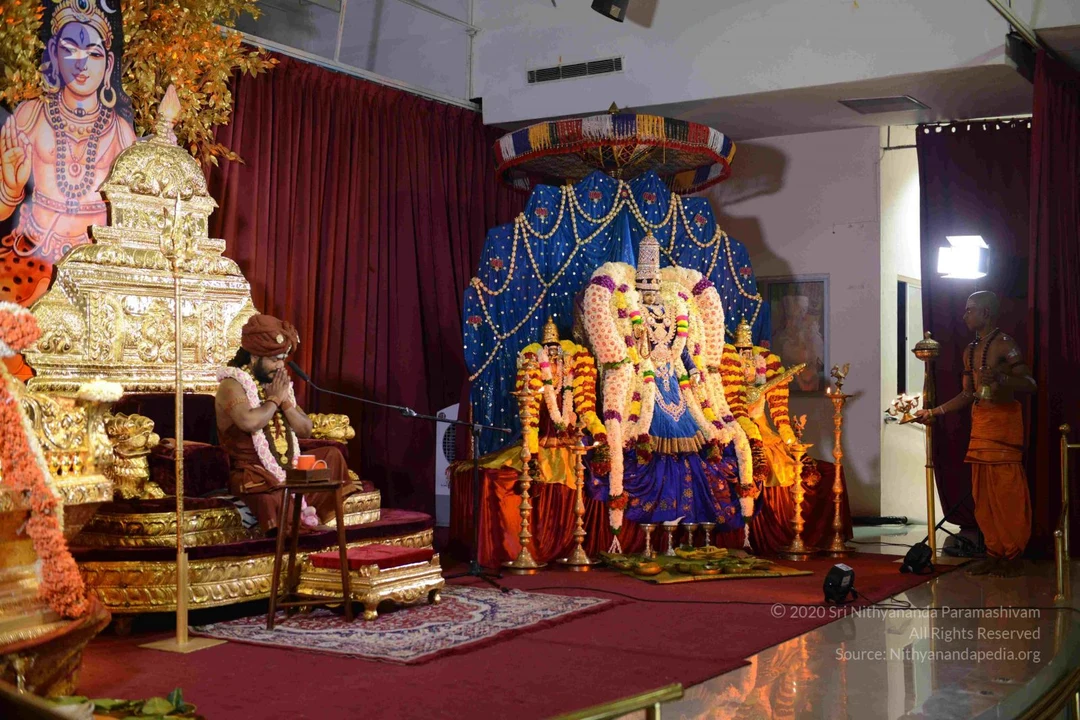
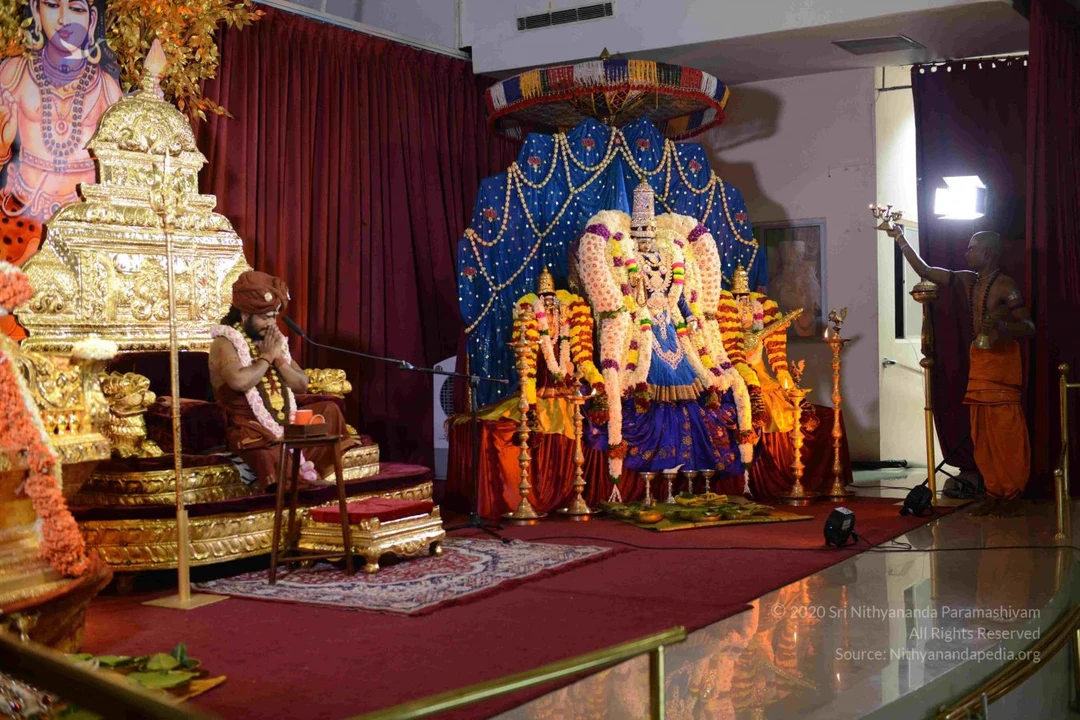
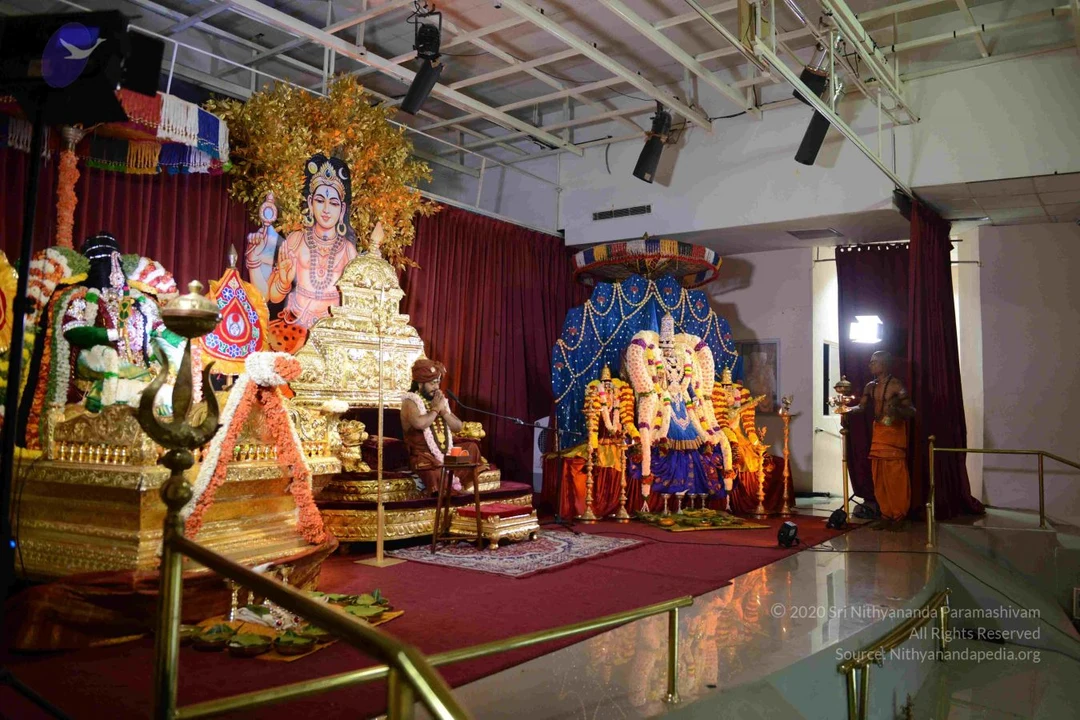
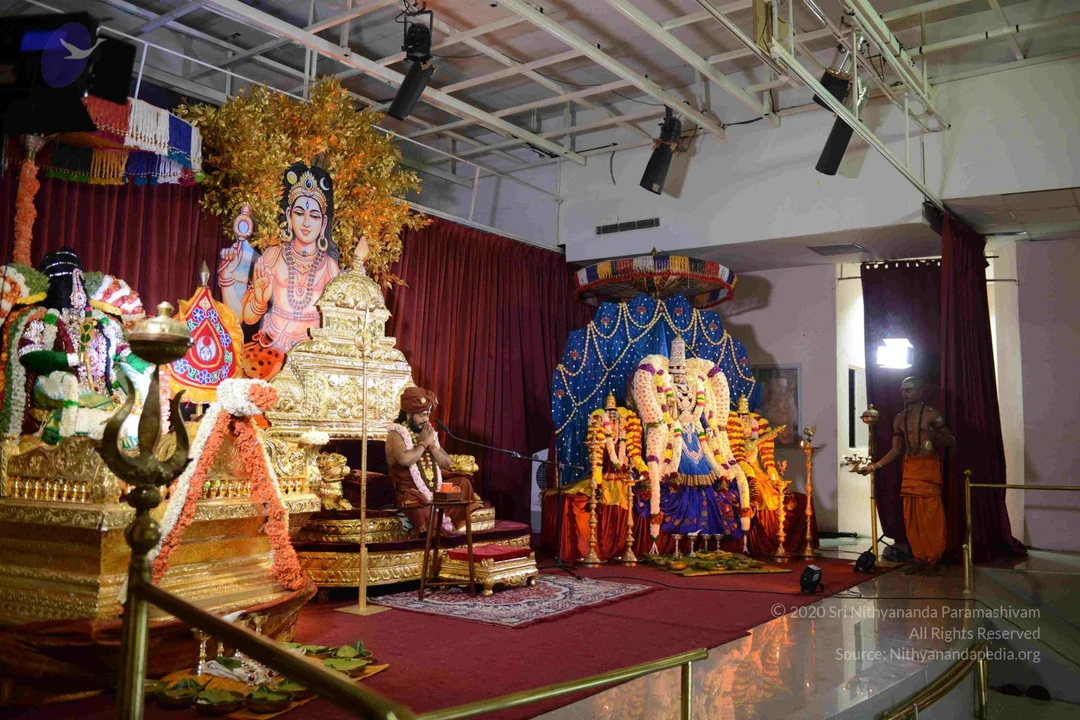
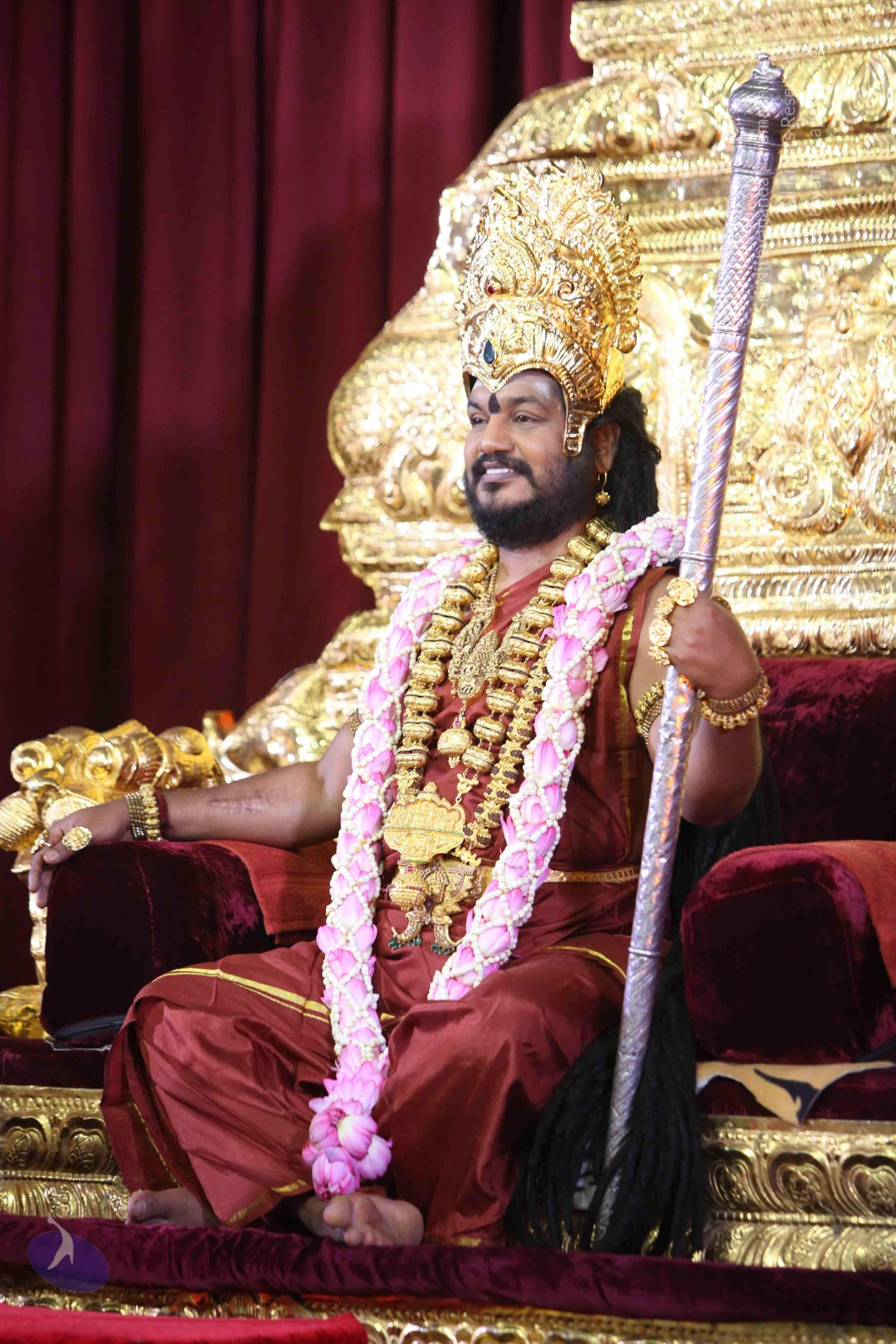
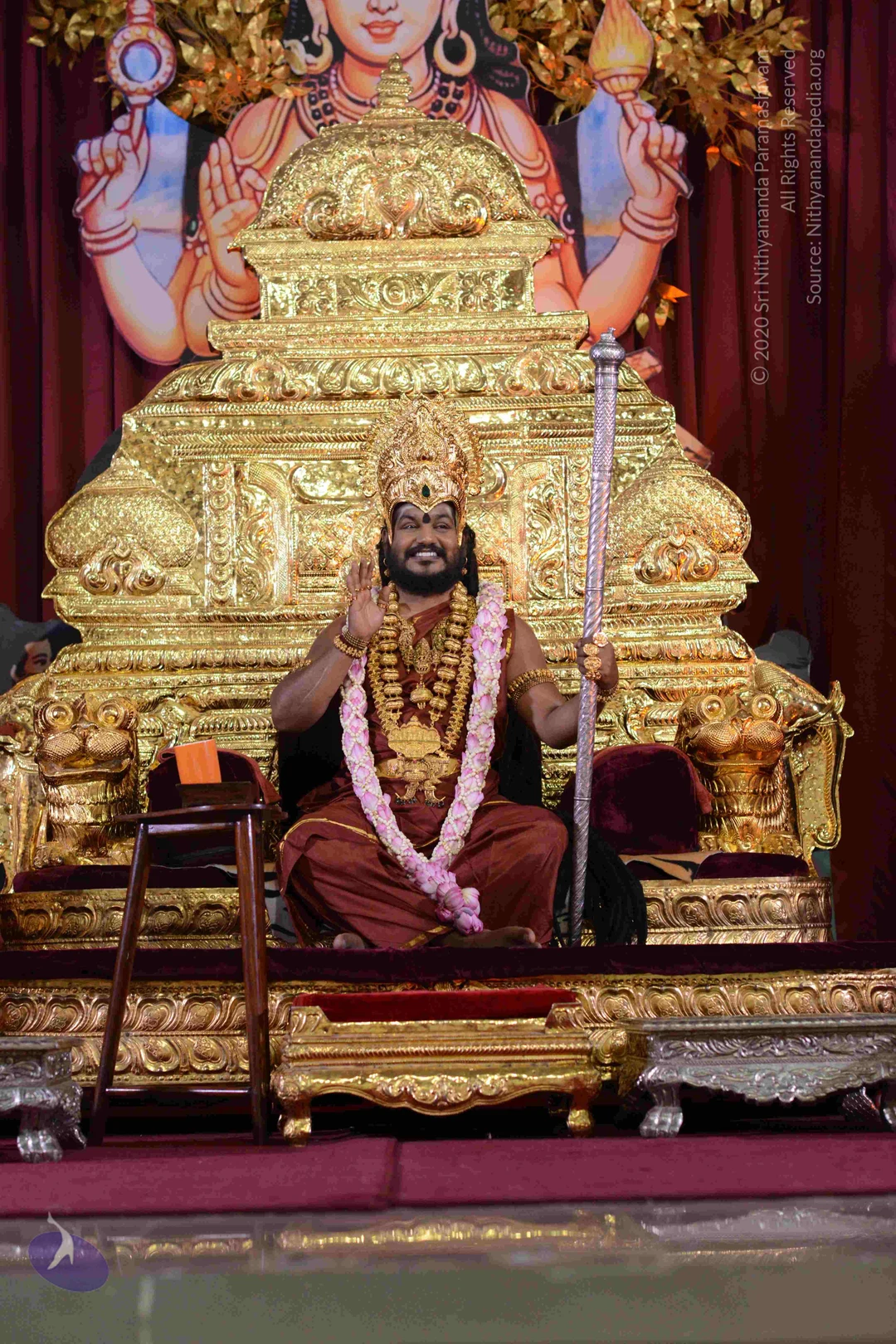
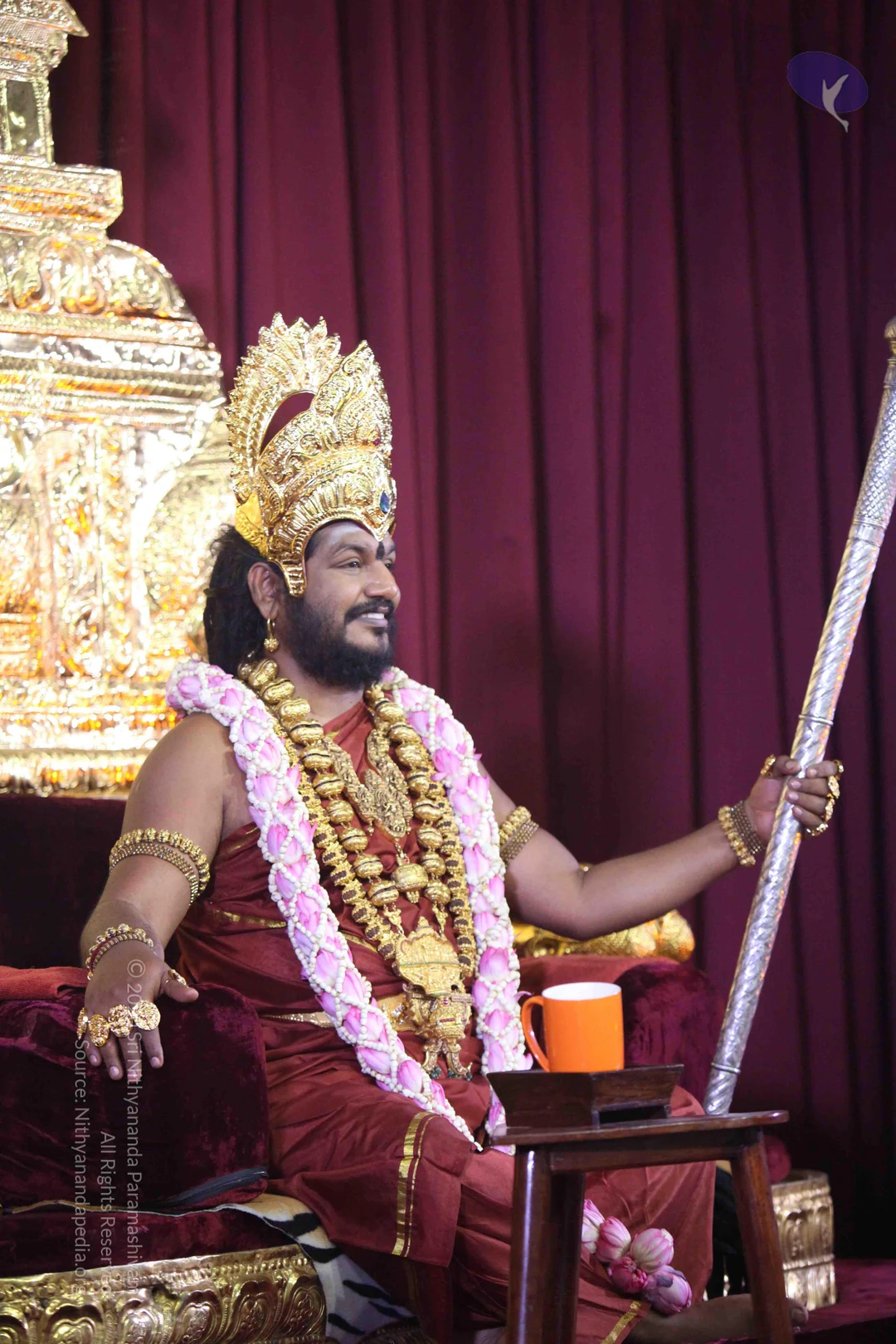
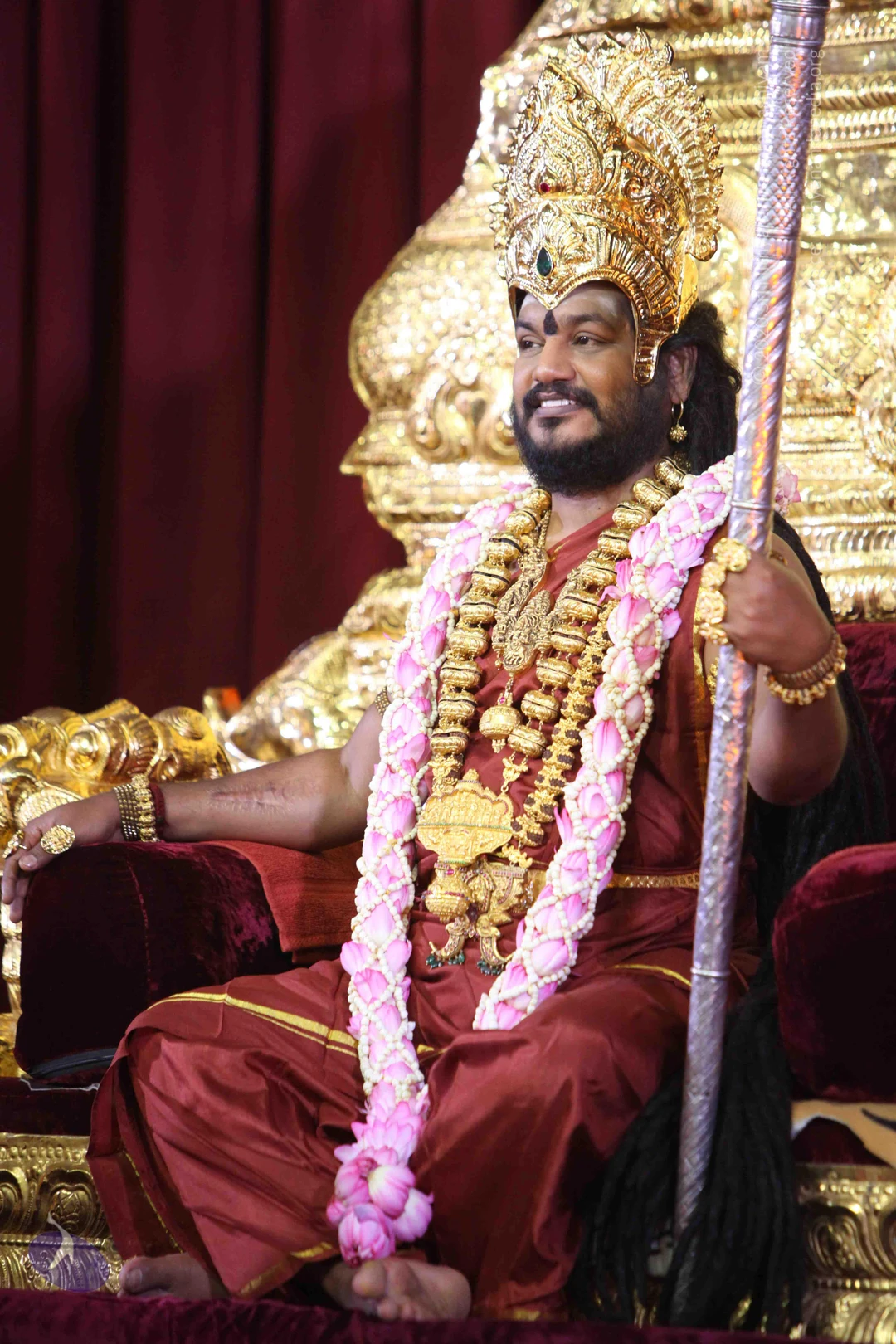
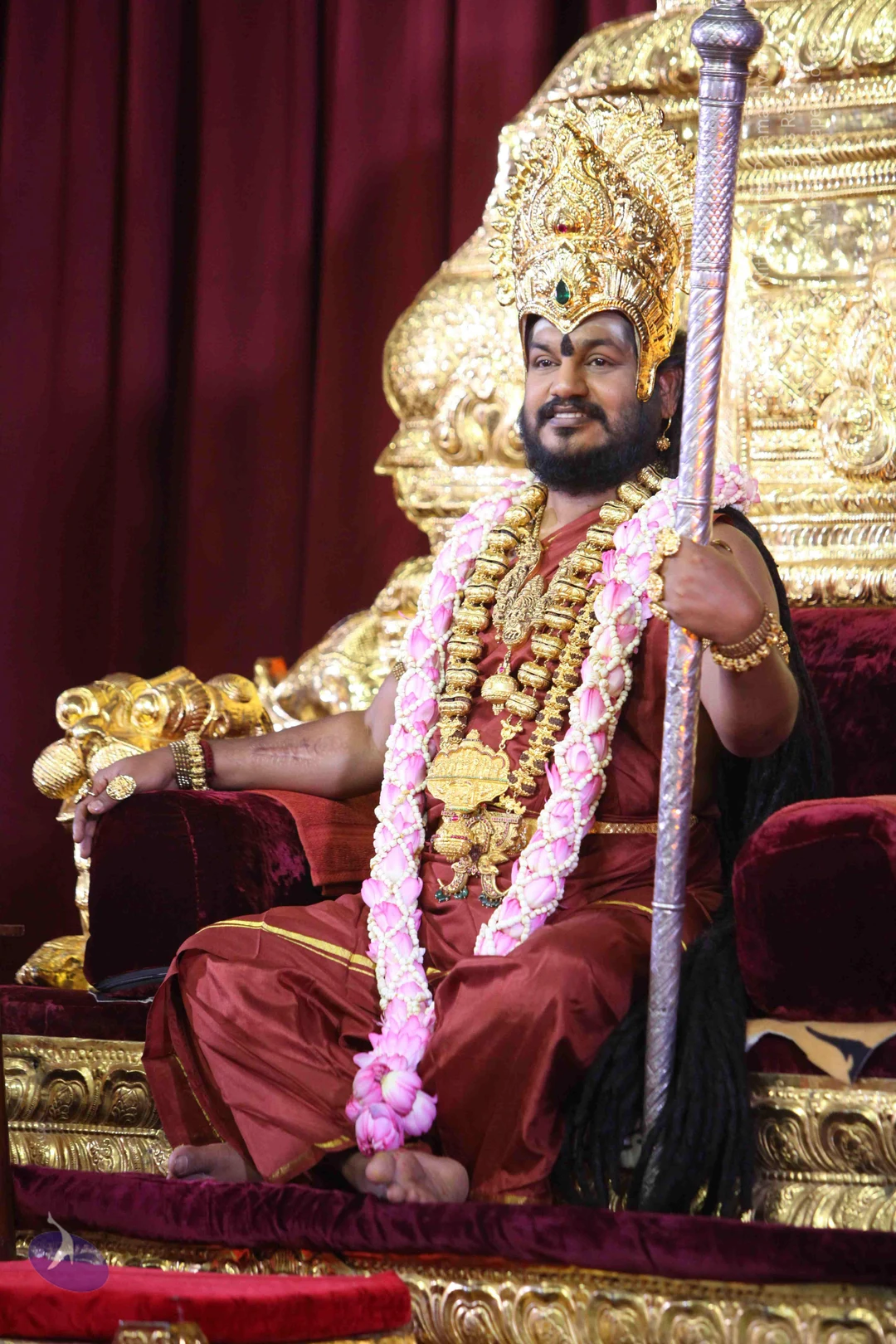
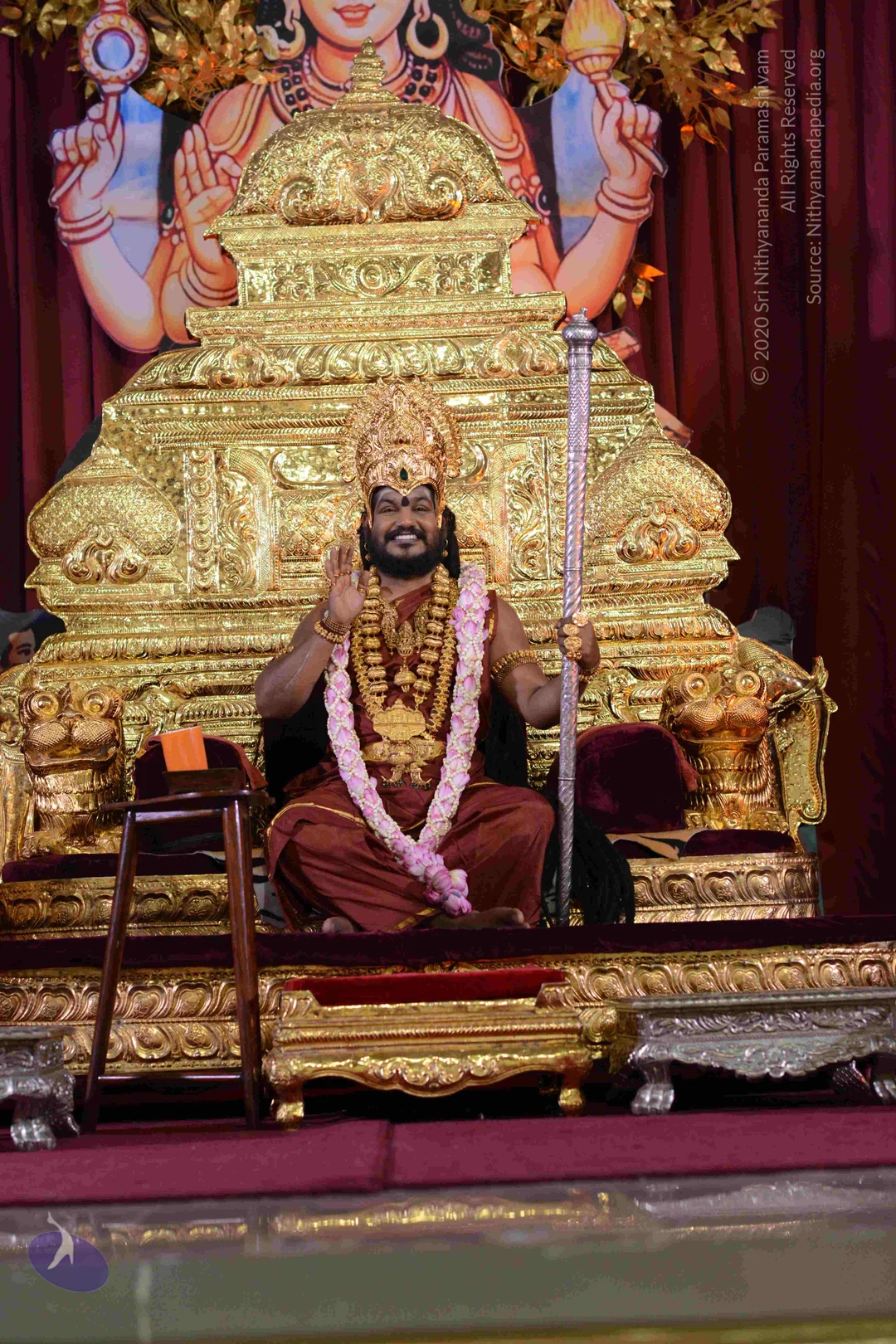
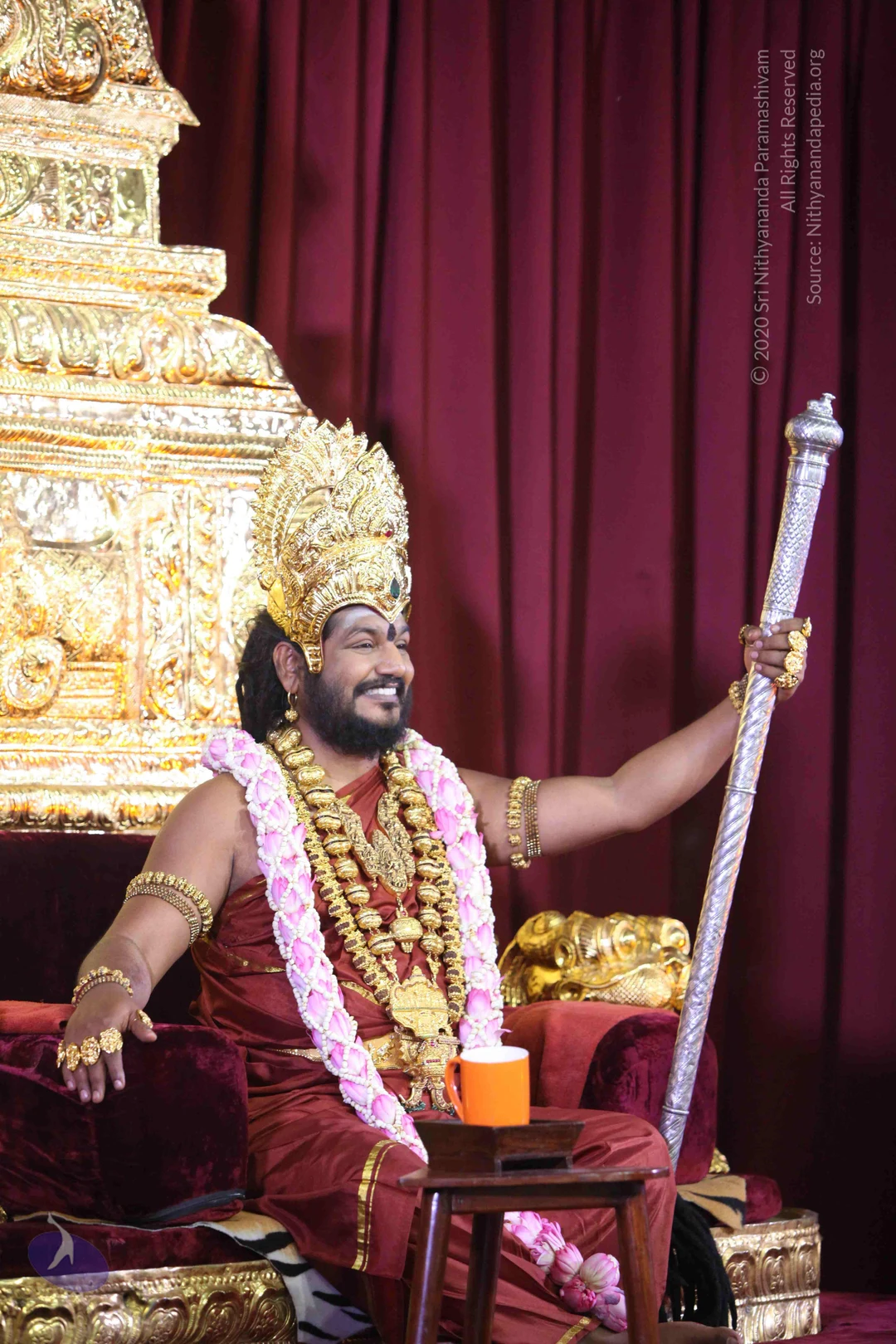
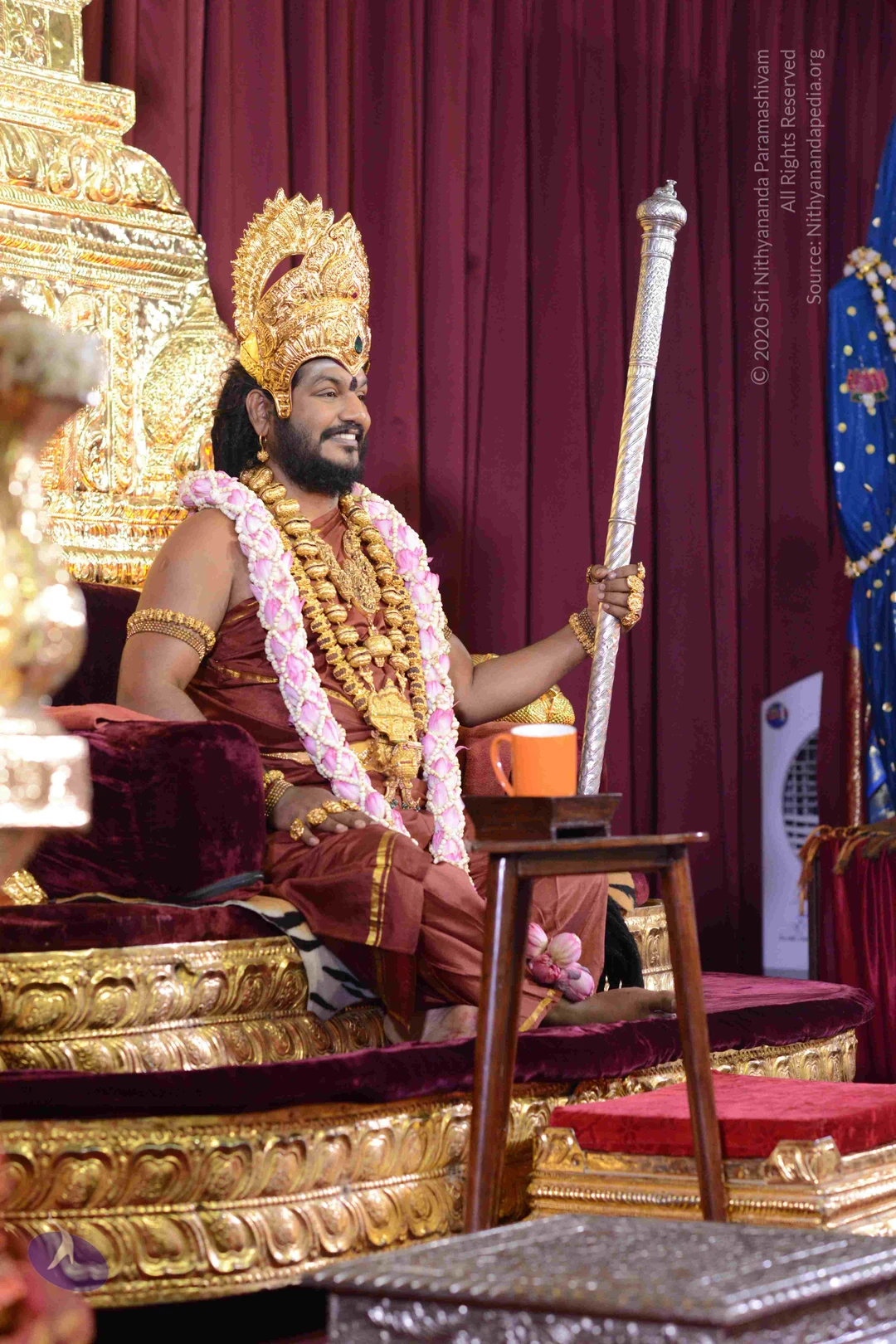
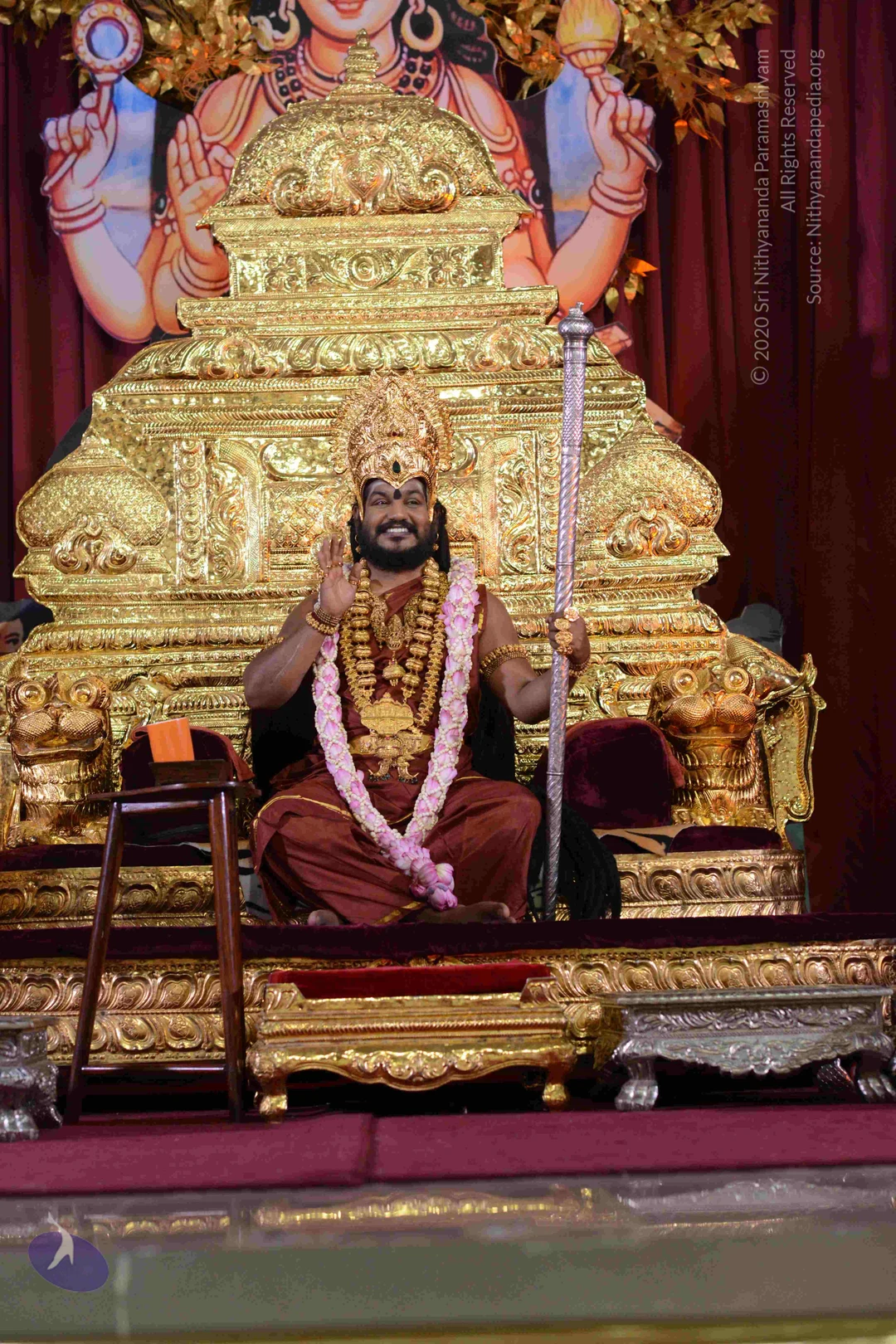
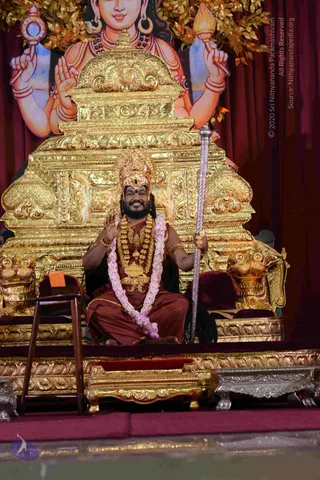
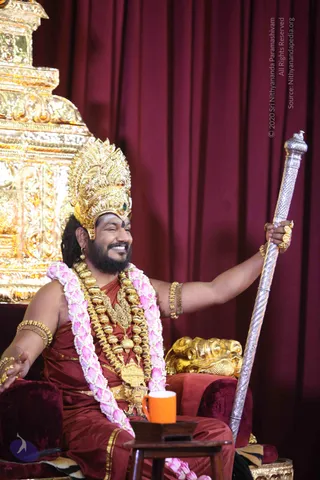
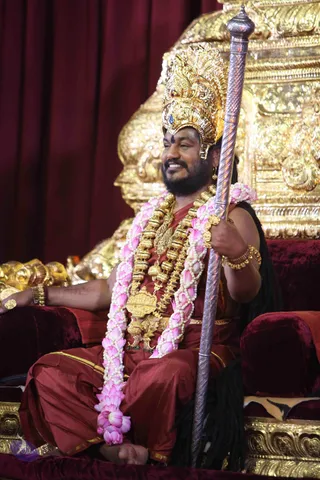
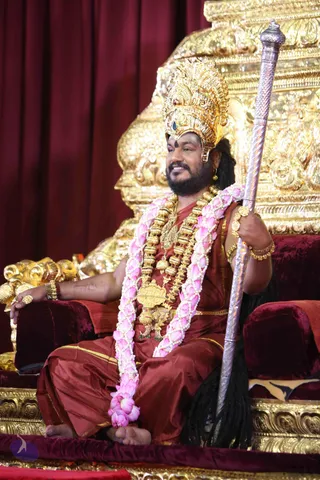
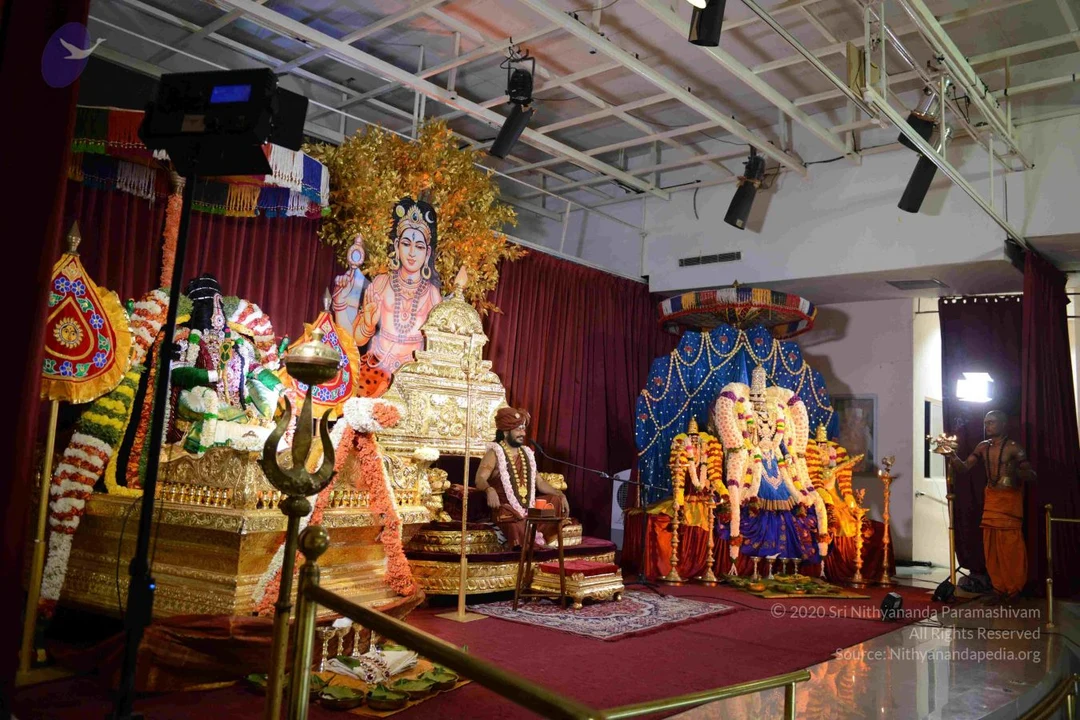
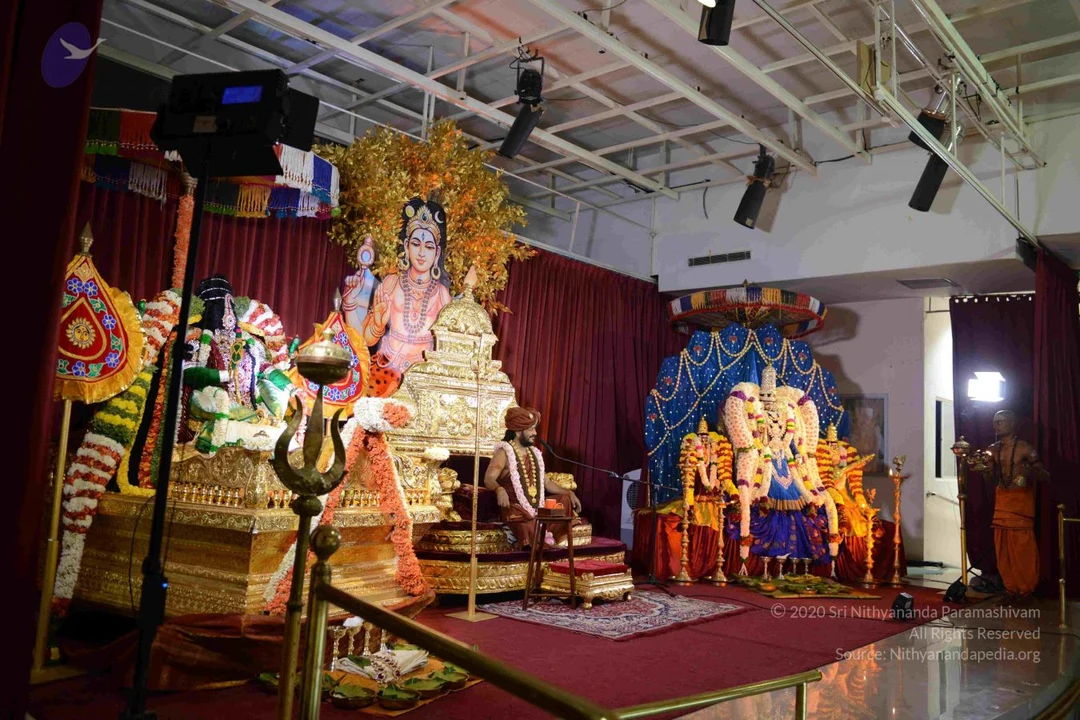
A man seated on an ornate gilded throne with red velvet cushions, wearing a gold crown, a pink-and-white flower garland, layered gold necklaces and a rust-orange draped garment, holds a silver staff upright in his right hand. A small orange cup sits on a wooden stool beside him. Behind him hang a deep blue fabric backdrop with white beads and a maroon curtain, and to the right stands a deity murti adorned with yellow and pink flower garlands, with brass oil lamps in front. Swamiji (probable) is seated on the throne, identified by the crown, saffron-toned clothing, ornate gold necklaces and the satsang-setting throne arrangement.A man seated on an ornate gold throne holds a silver staff in his right hand, wearing a gold crown, a gold necklace of beads and a pink-and-white flower garland, with gold armlets and rings and a rust-coloured garment. A tall gold kalasha-topped puja stand beside him is draped with yellow and red marigold garlands and white flowers, with a blue embroidered backdrop and a maroon curtain behind. An orange cup sits on a small wooden table at his side. Swamiji (probable): the seated man wears a gold crown, layered gold necklaces, rudraksha-style beads and a flower garland, with ornate gold clothing cues, and is seated on a throne with a staff. One physical person is visible.Outdoor ritual on bare ground beneath bamboo and green trees. A man with long dark hair and beard, wearing orange-saffron cloth and a dark shawl, stands at right touching a bamboo pole with a red-tinged hand while a helper in orange lifts the bamboo pole held upright over a round pit filled with flower petals and coloured powder. Other people in orange and red clothing with rudraksha-style necklaces kneel and work nearby on a striped mat; one in white stands at left. A tripod-mounted camera stands at right. The scene resembles a prepared pit ritual with flowers and bamboo.

October 06 2016

Original wiki page
Contents

Title

Paramahamsa Nithyananda expands on the significant details of the Spiritual Alchemy Process

Description:

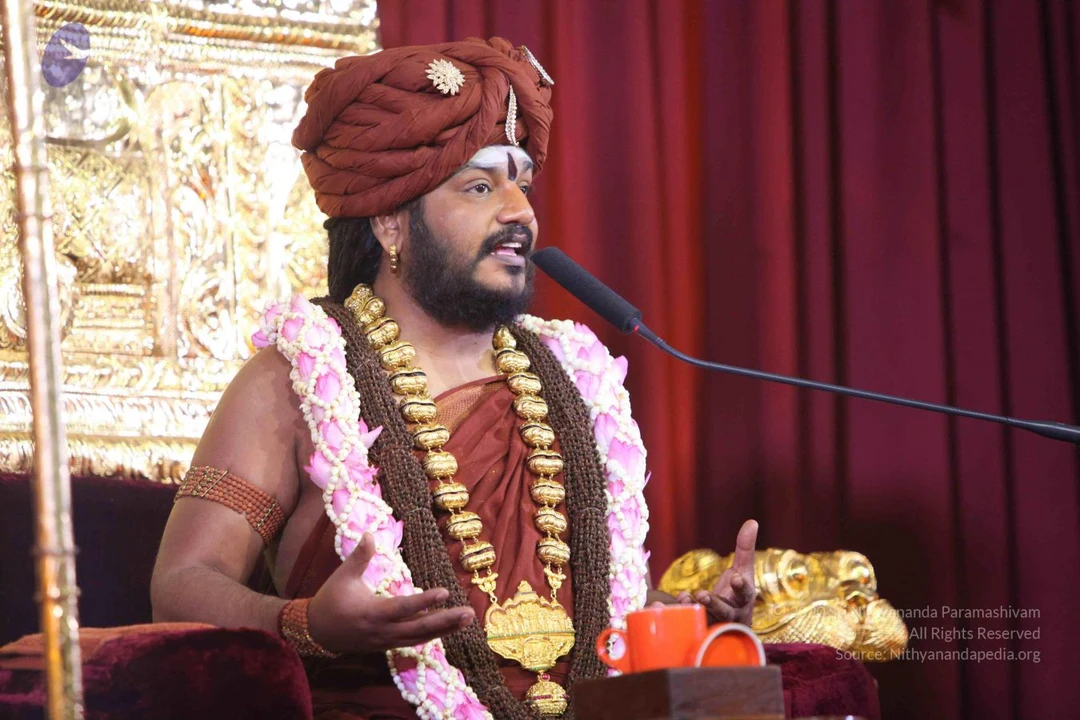
During today’s morning Satsang (06 October 2016), Paramahamsa Nithyananda continues to expand on the significant details of the Spiritual Alchemy Process. He candidly points out that no spiritual technique or tradition has been successful without having a spiritual alchemy process. Many religions and spiritual groups fail miserably because they do not understand this great science. They are able to attain a higher experience, but just how sand slips through the fingers, so does their spiritual attainment. Many plummet into depression, and often develop drug and alcohol dependency in a feeble attempt to recreate the experience. The lesson is: Let The Avatar teach you the proper science, from the Agamic scriptures delivered by Sadashiva Himself, and come to Sadashivoham 2016 to attain and retain a lasting enlightenment

Link to Video:

VideoAudio

Transcript:

Nithyānandeśvara samārambhām Nithyānandeśvari madhyamām | Asmadāchārya paryantām vande Guru paramparām ||

I welcome all of you with My love and respects. I welcome all the Devotees, Disciples, Samajis, Satsanghis, SriMahants, Mahants sitting with us all over the world through Nithyananda TV, Facebook live, YouTube live, and 2 way video conferencing having Nayana Deeksha.

(1:06)

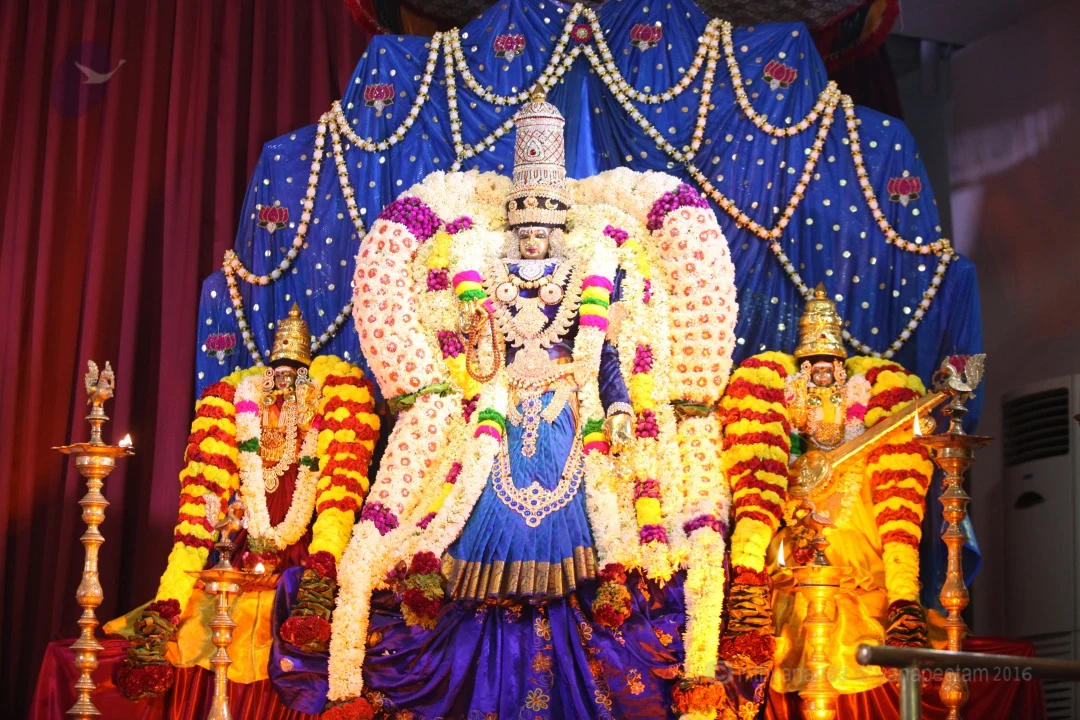
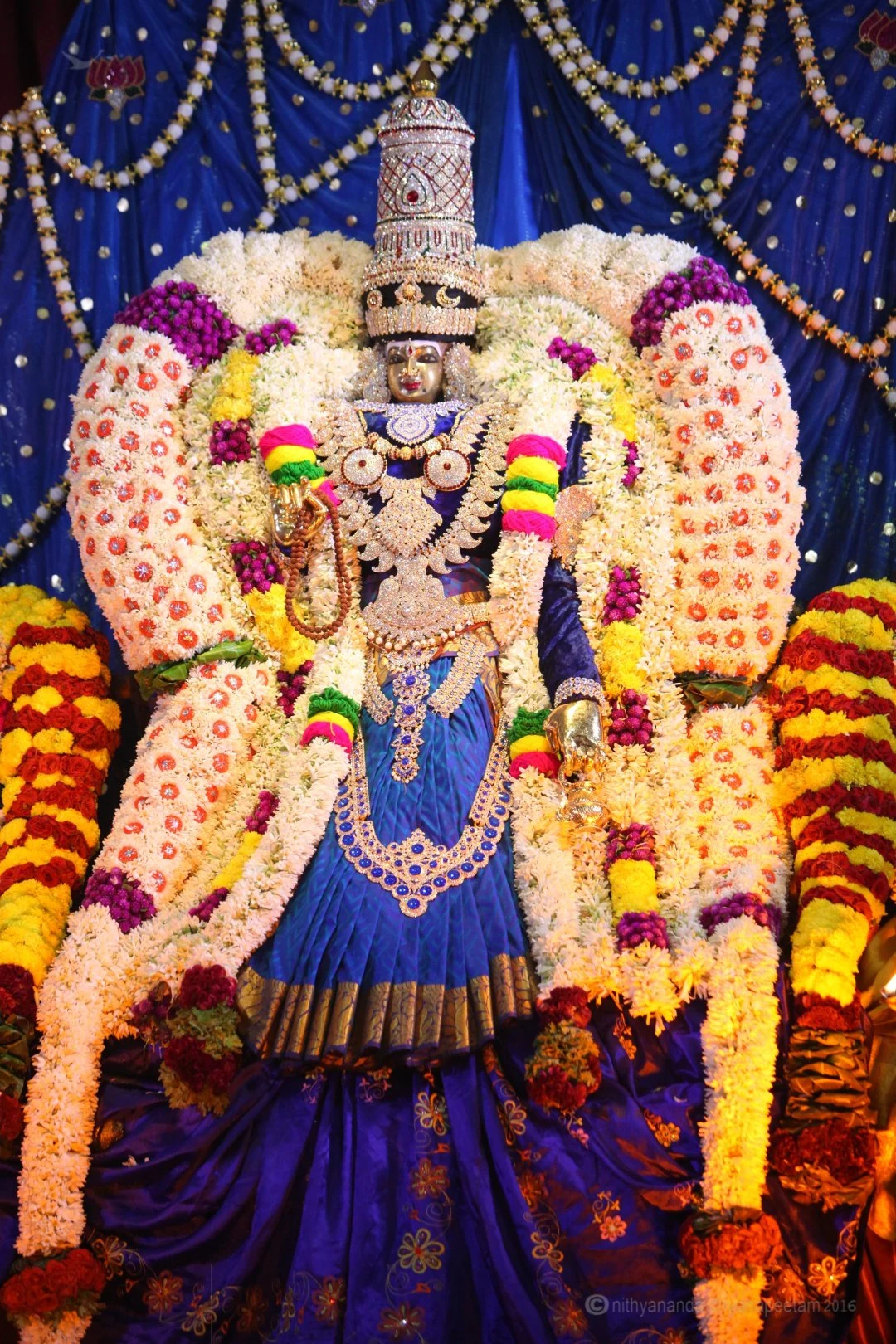
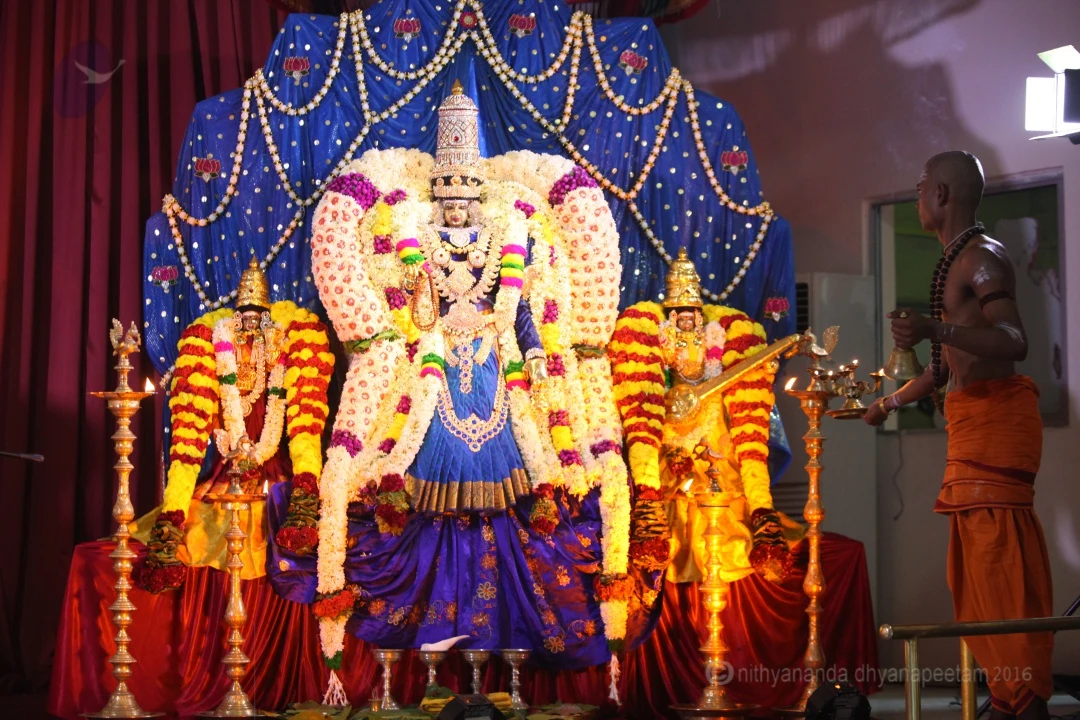
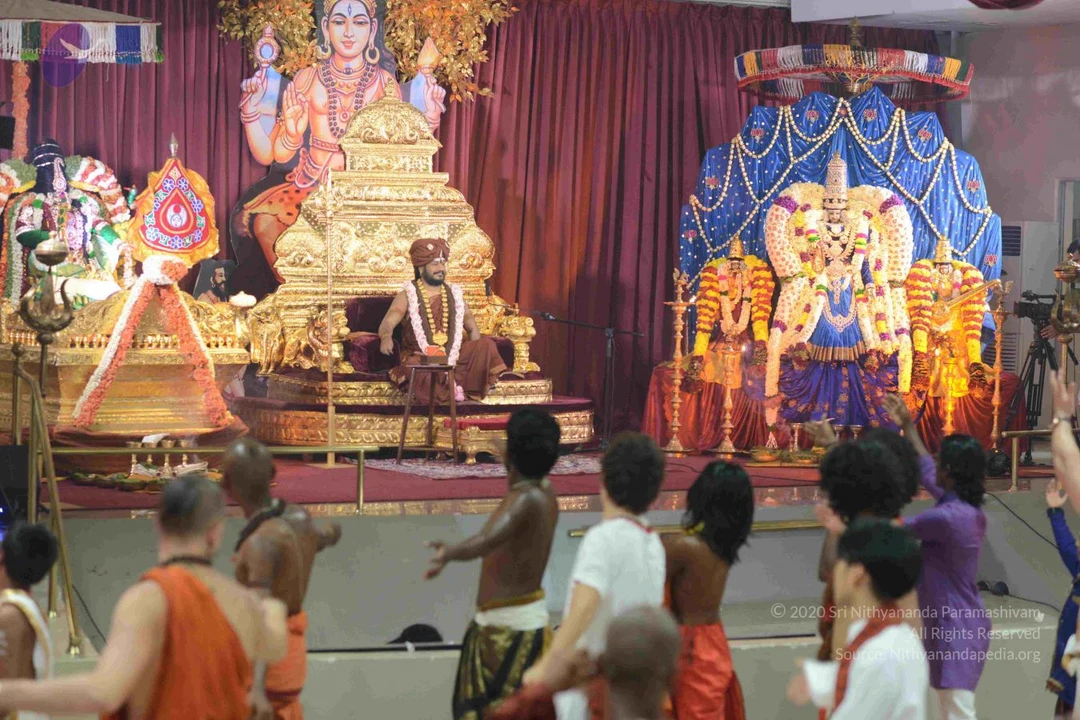
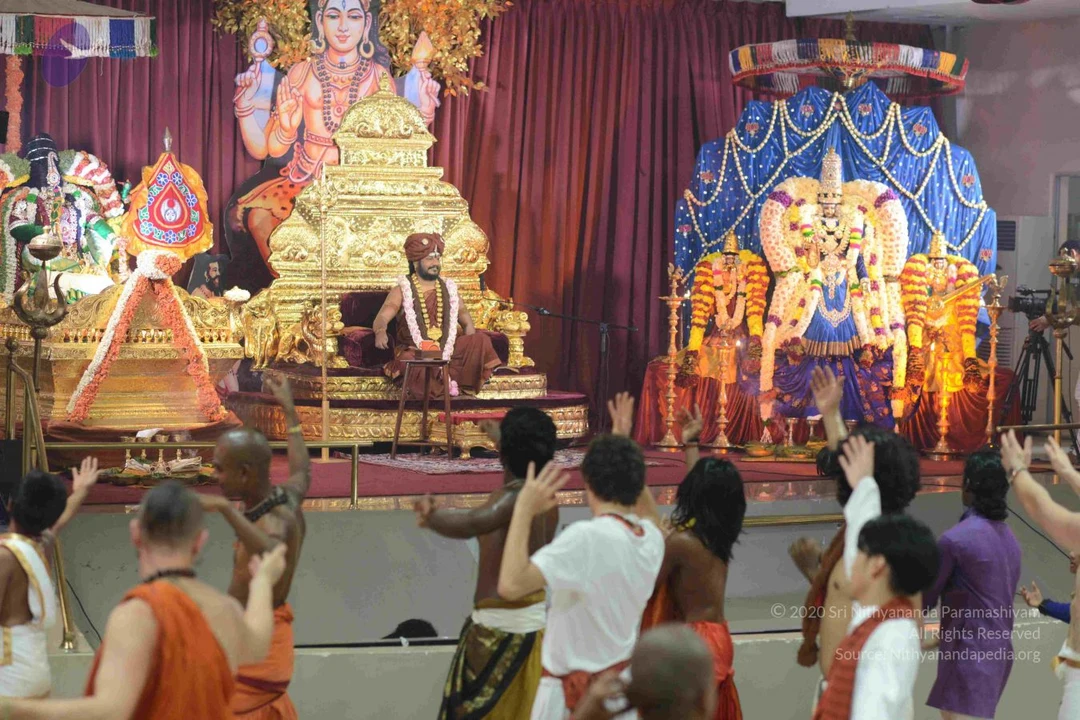
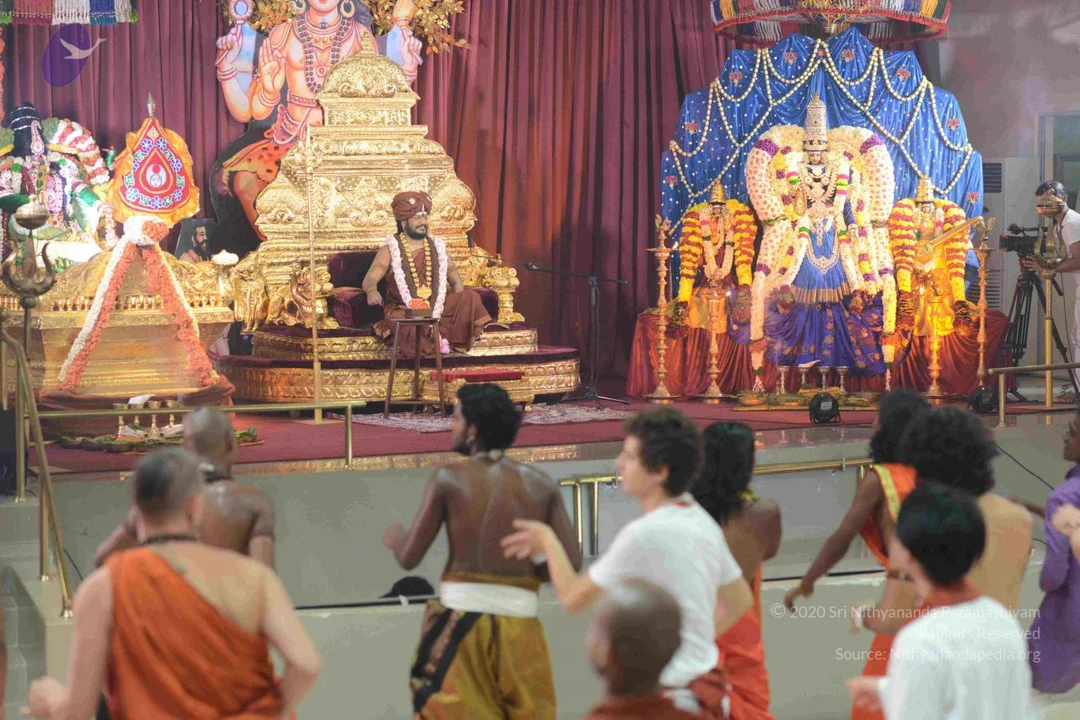
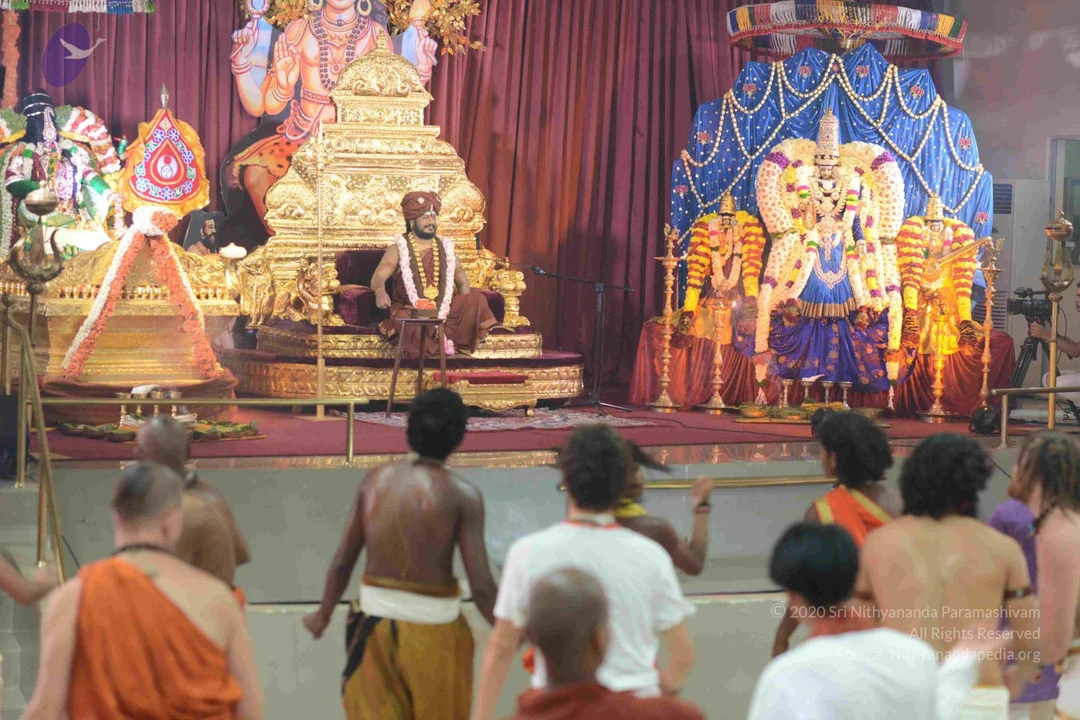
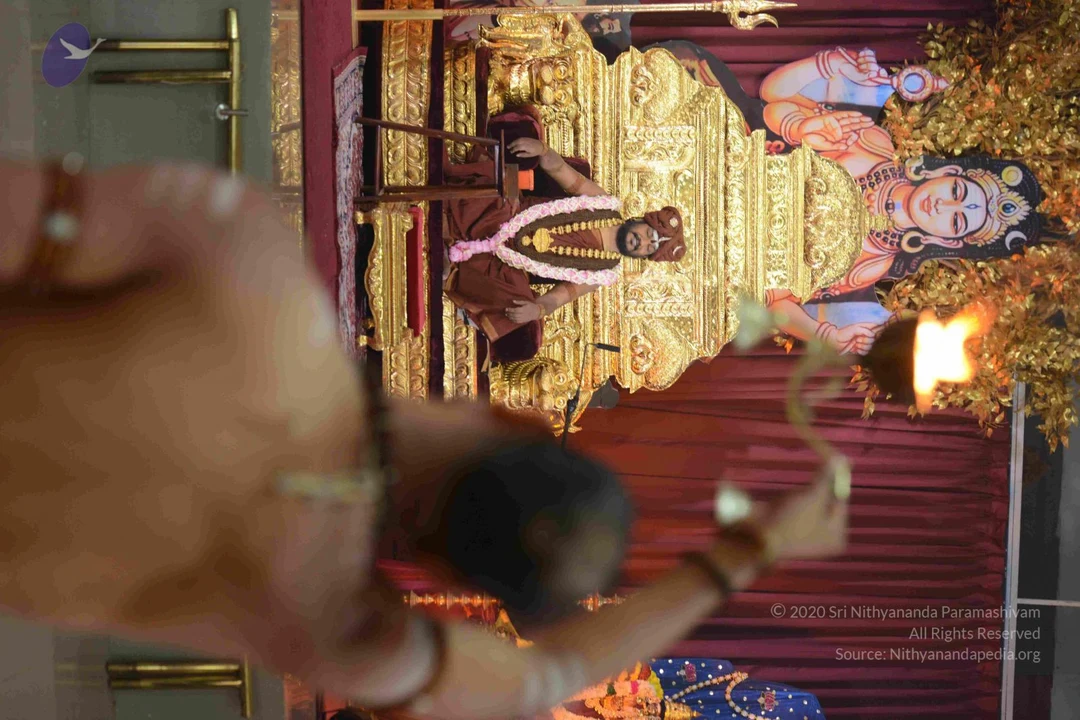
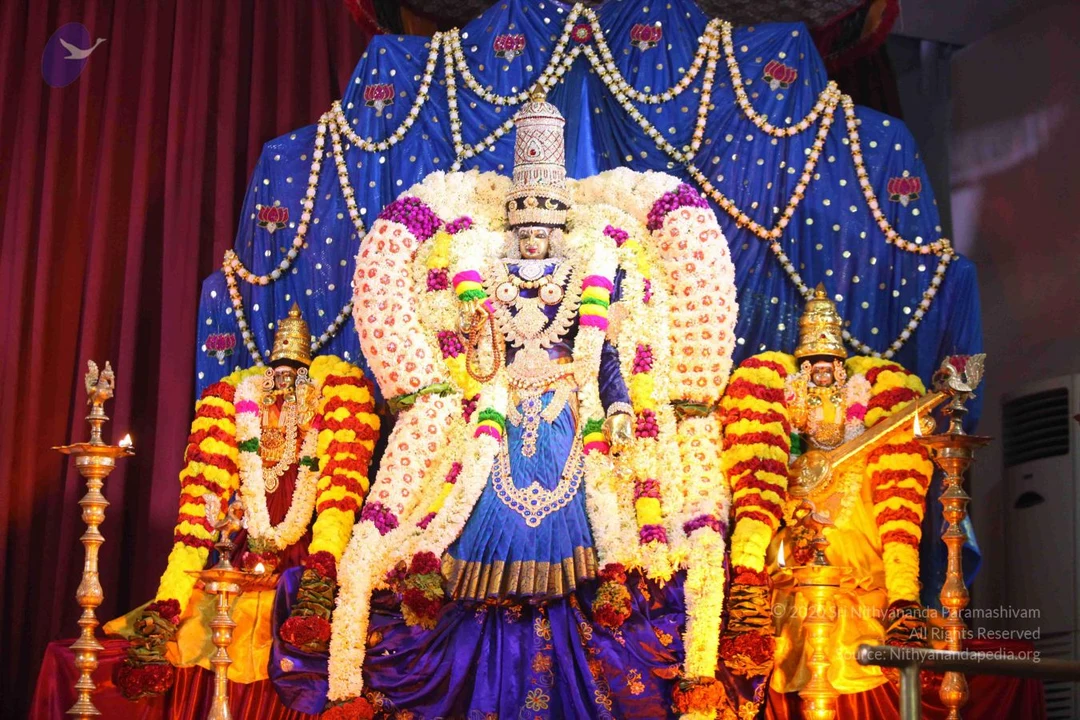
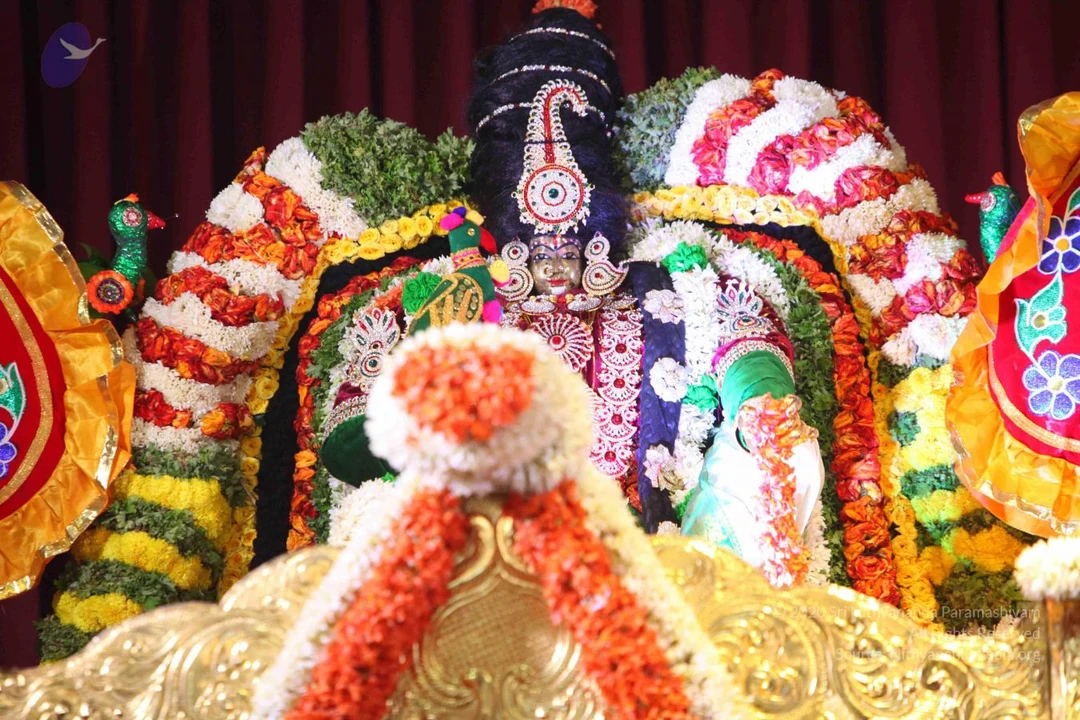
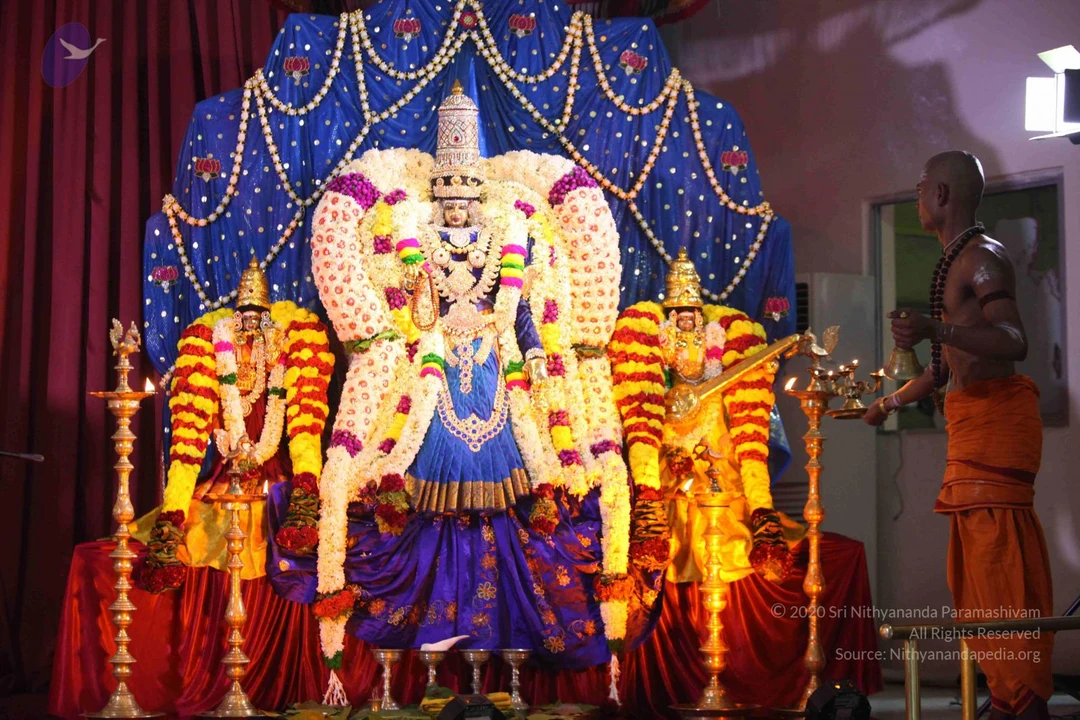
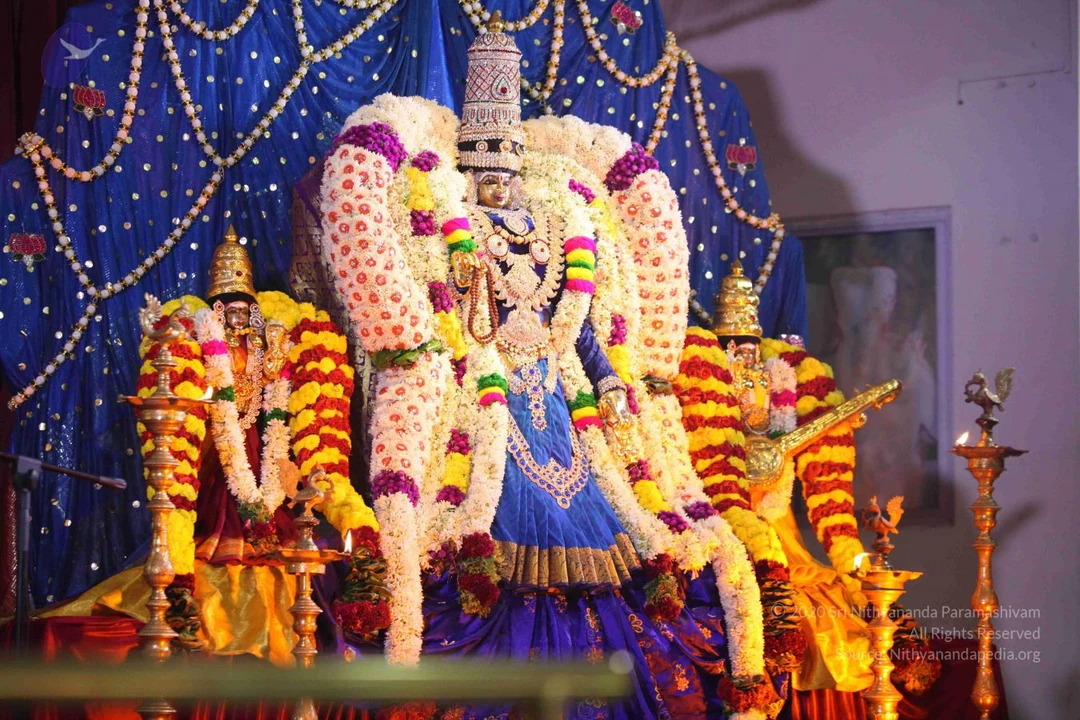
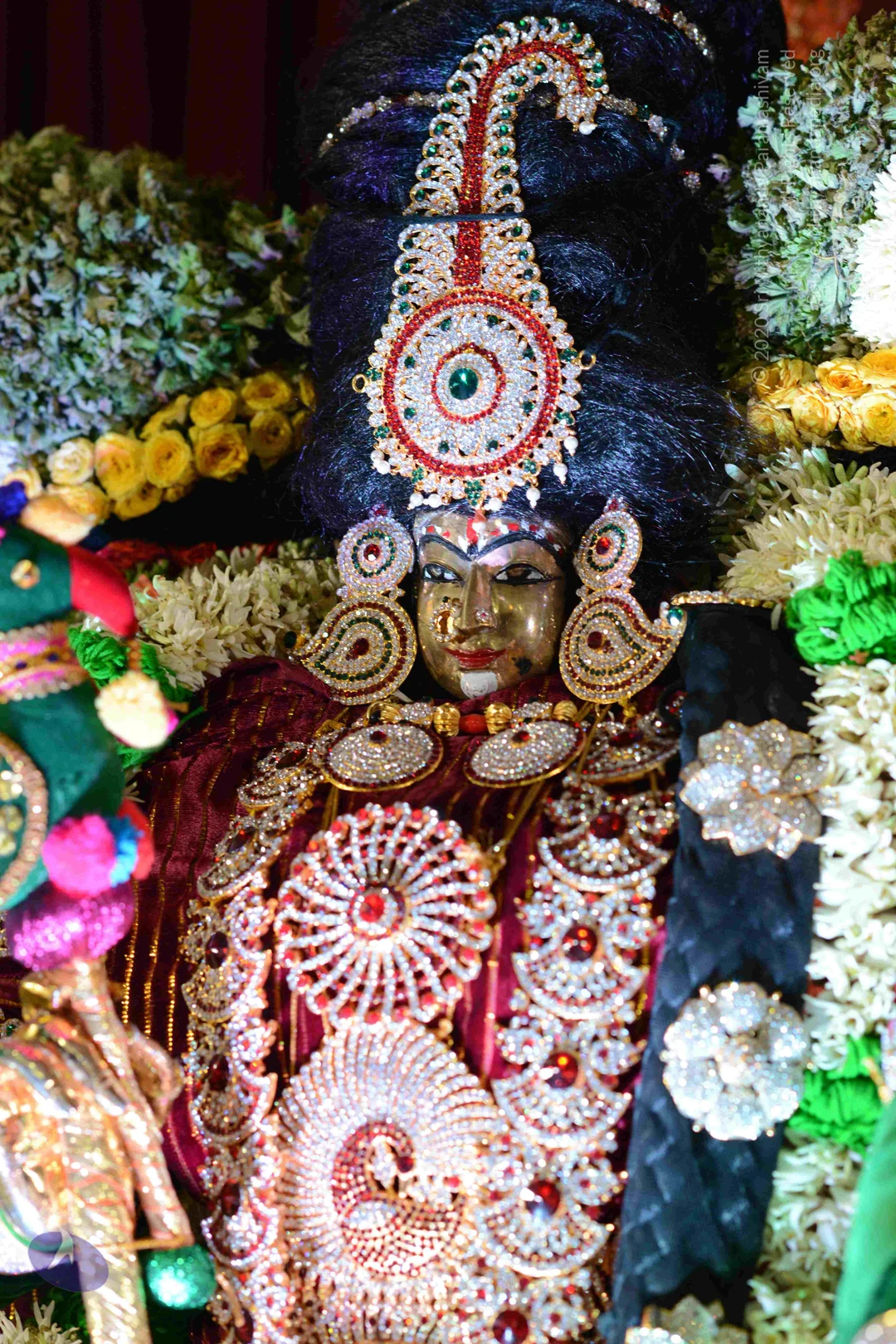
Navaratri 5th day Brahmotsava. Adishakti is gracing us in the form of Vishalakshi. The way she resides in Varanasi. Varanasi has a Jyotirlinga, Shakti peetha, and Siddha peetha. Jyotirlinga means the Svayambhu Linga which came by itself. Shakti peetha is the place where the part of the Sati fell. Siddha peetha means where Devi herself appeared and lived. Annapurni temple is the Siddha Peetha. Vishalakshi is the Shakti Peetha. Visvanatha is Swayambhu Linga, the Jyotirlinga.

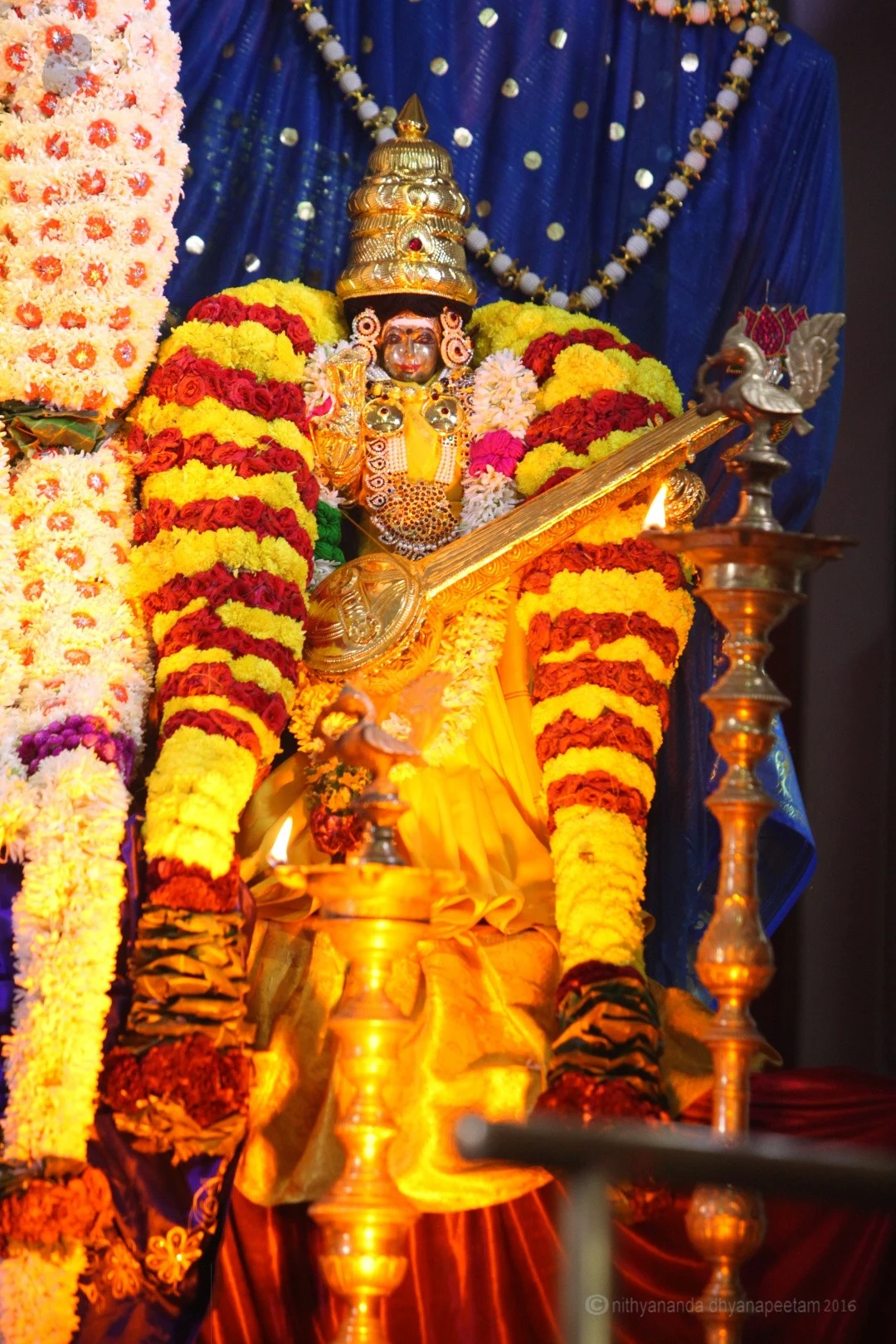
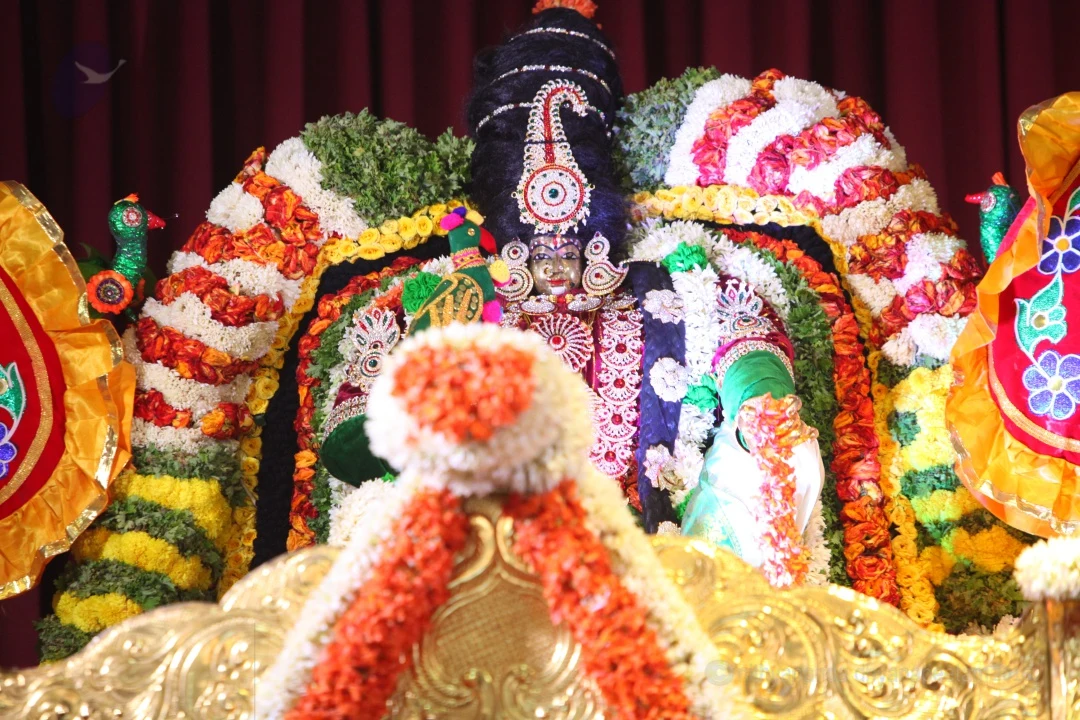
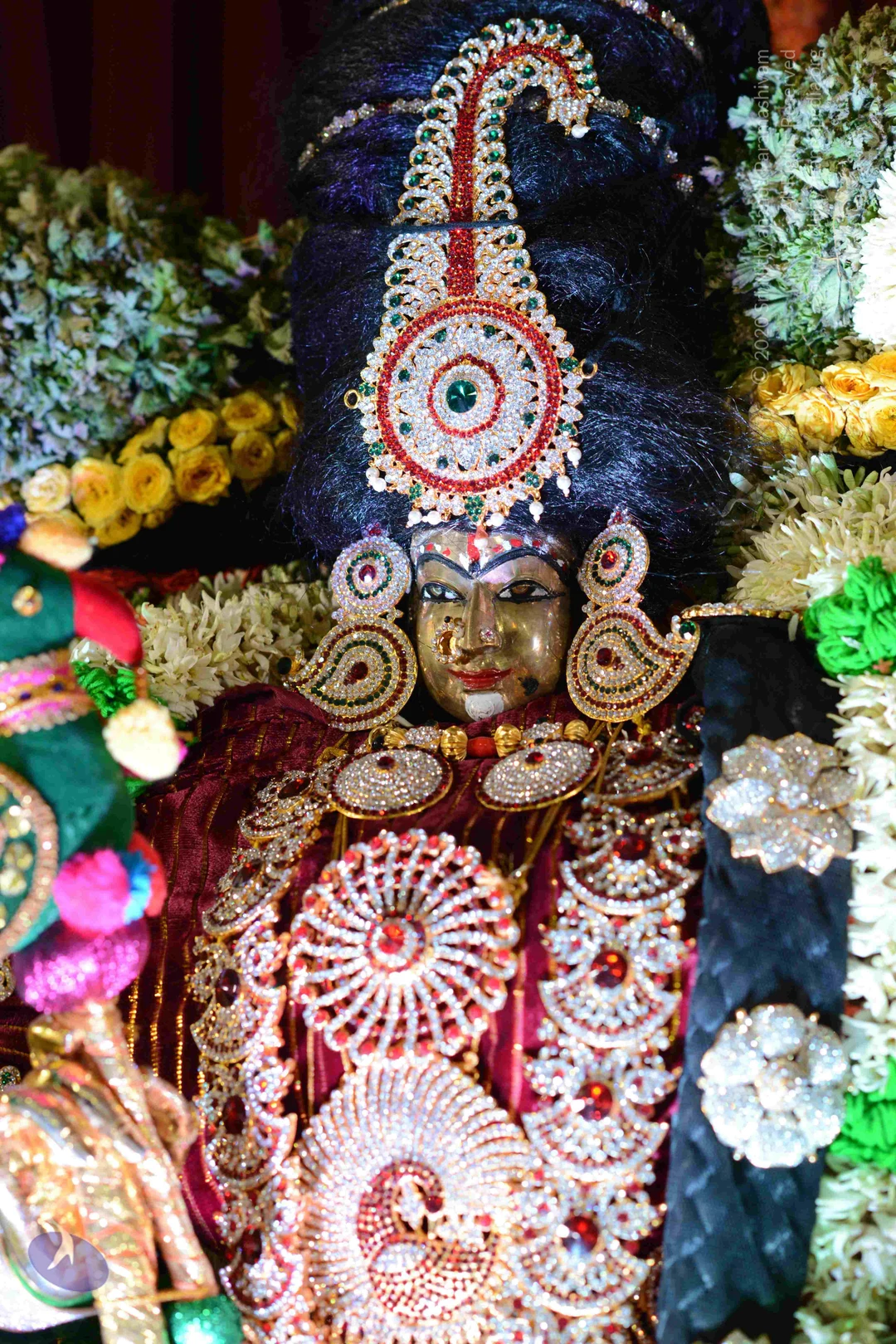
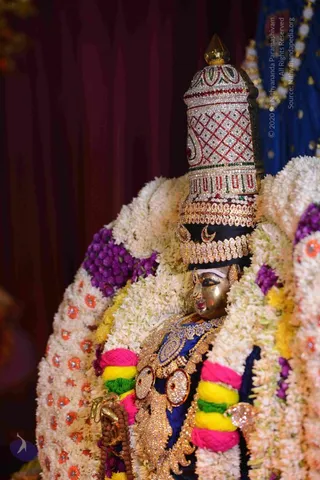
So Devi is today gracing all of us in the form of Vishalakshi, the great Shakti Peetha of Varanasi, and Venkateshwara today is in the form of Mohini to seduce Sadashiva. He took the form of Mohini and gave birth to lord Ayappa and Mohini leela alankāra. He is gracing on the golden palki, svarna Palaki. Golden palki. Let's receive Venkateshwara and Adishakti's grace and enter into Satsang.

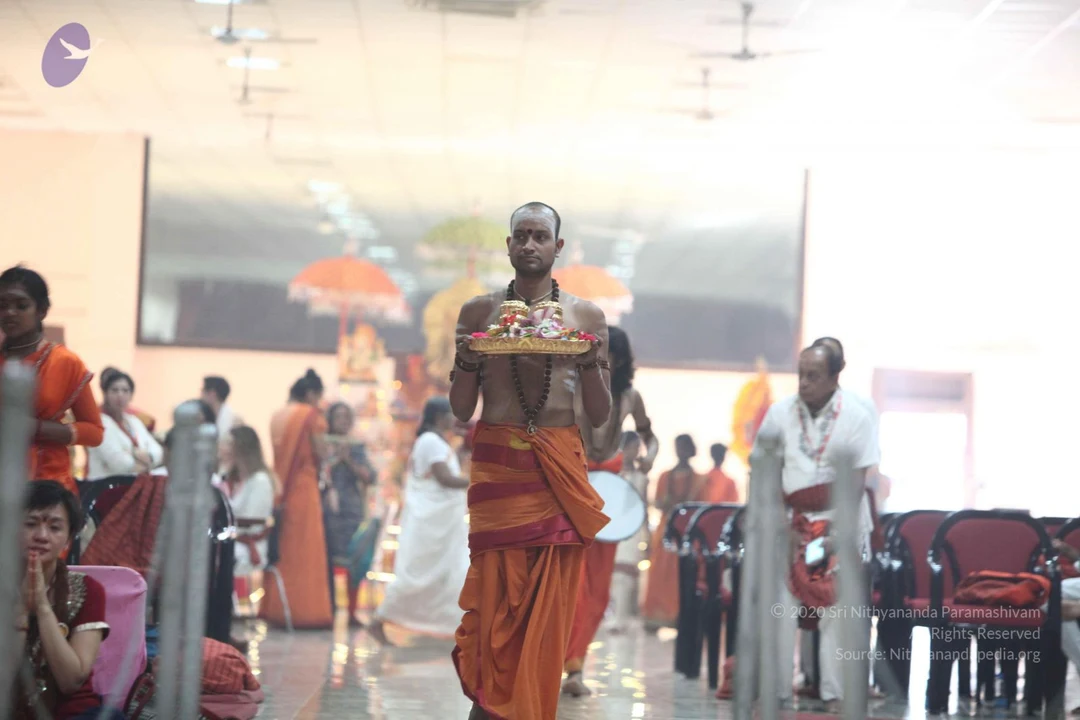
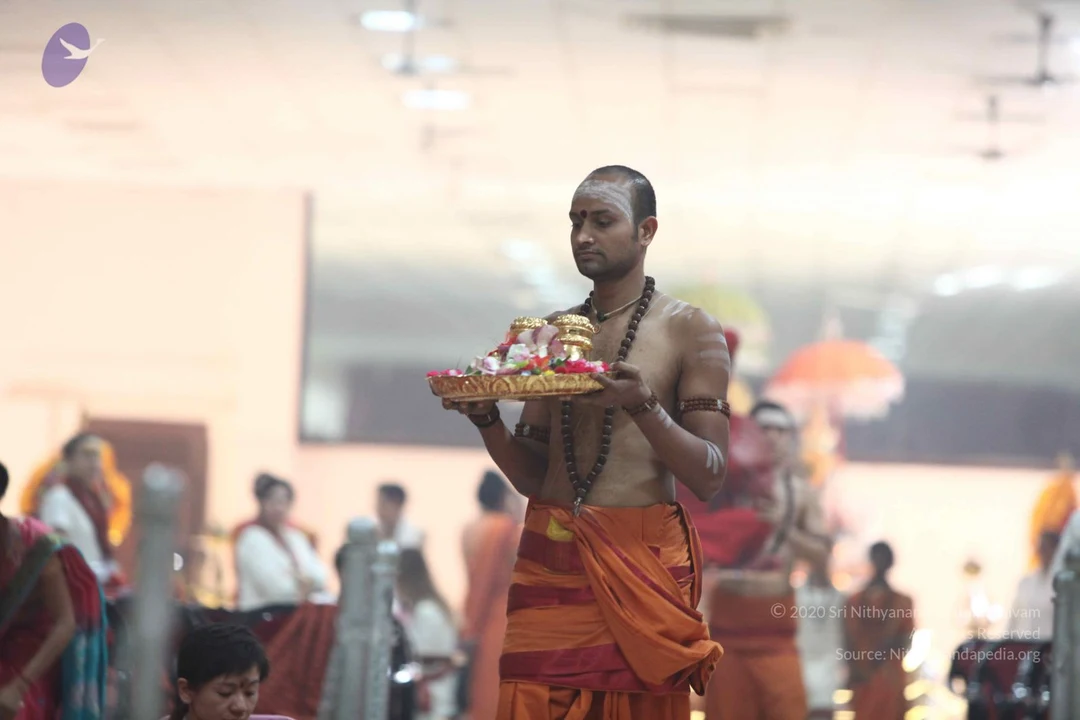
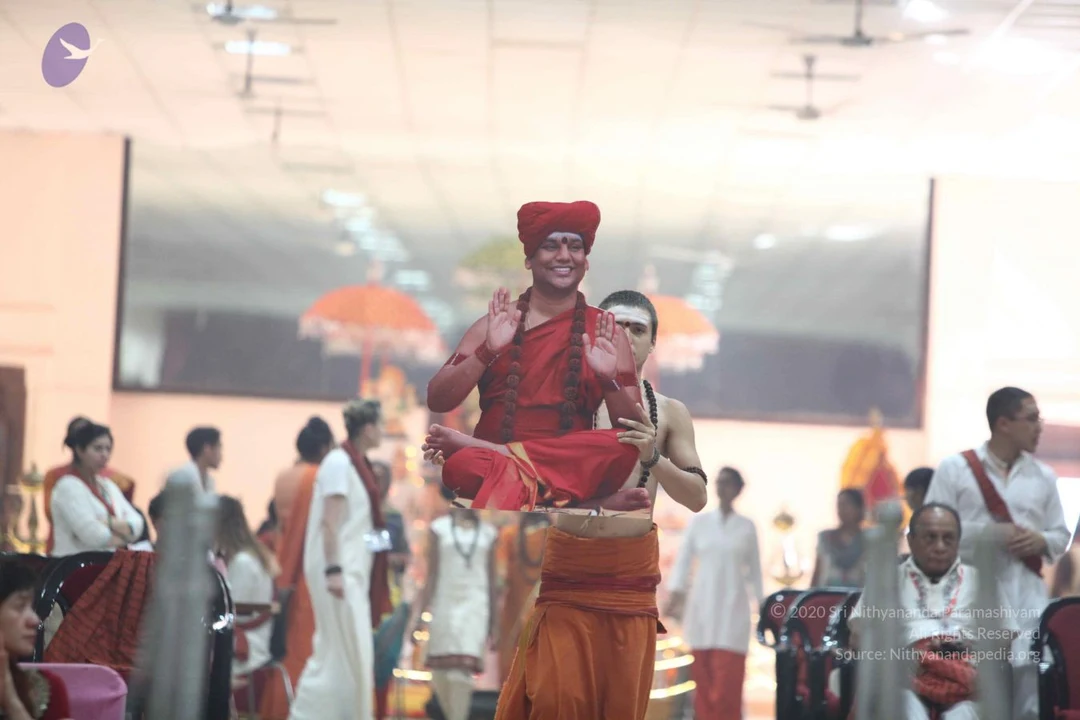
(2:45 – Aarti, puja)

(3:58)

I’ll continue to expand some of the details of the alchemy process, the spiritual alchemy process.

To tell you honestly without the spiritual alchemy process no spiritual or religious techniques or tradition is successful. Understand, the religions which tried to achieve the higher planes of Consciousness just using the mind and mind related techniques. Like a repetition of God's name, thinking of God's name, remembrance of God and His quality, or even remembrance of GODDEL and His qualities, name, repetition of name, remembrance of sacred qualities and…and svarupa dhyana, contemplating and meditating on the glories, trying to achieve Bhāva Samadhi, trying to achieve higher samadhi through all these methodologies. Listen. Listen carefully. Through all this methodologies, the religious traditions and individuals and groups which try to achieve the higher planes of consciousness miserably fail. When they did not adopt, use the spiritual alchemy sciences.

(5:55)

Listen. I will not make a statement they never experienced the higher planes of consciousness. But I’ll make a very sure statement – certainly they did not retain it in their system, hold it back in their system. The system was not capable of holding it back. And, some of the religious traditions when they saw that higher opening and were not able to hold that same in their system, they fell into heavy depression, started using drugs, marijuana. Expecting those drugs and marijuana and all those things may give the glimpse back, which is the biggest mess happened, understand, the biggest mess happened.

(7:19)

All the new age groups in the modern day, the new age spirituality, and the groups which uses marijuana psychedelic drugs for psychedelic experiences, all of them fall under this category. They do something which is mind based, psychological and get a glimpse of the higher plane, but unable to retain it because there is no spiritual alchemy process done to their body. Body was not prepared to hold it. I tell you, the systematic way I am preparing all your bodies – morning yoga, pancha kriya then puja, kirtan. By the time you sit in the Satsang, one, you won't fall asleep. Even if you fall asleep it is okay because your inner space cannot sleep now. Your inner space cannot sleep now. If you are sleeping, morning, you have not done all these properly. Morning you have not done all these properly. After Yoga and Kirtan and everything, naturally your whole system will be receiving what I am sharing. Now it will be breathing My breathing space., My inner space.

Listen carefully. If your system is prepared with the spiritual alchemy processes then, when you raise yourself psychologically and achieve the higher planes of Consciousness, you will be able to retain that experience in you. You will be able to retain that state of Consciousness in you. You will be able to retain that space in you, the spiritual state of Consciousness given to you. Unless it is retained, your body, mind falls back into such worst depression. Naturally you start looking at that alternative methods like marijuana, drugs, alcohol, heroin, whatever, whatever, whatever.

(10:36)

Understand. The spiritual alchemy processes and preparation is too important for you to hold that higher plane and manifest it as powers. It’s like a 100 ton gold is given to you and you say I don't have a room to keep it. Put it on the outside the compound. What will be back? What will remain back? Next day morning only, your house will not be there. Forget about the 100-ton gold. Because the crowd would have been so much to take the gold they would have smashed your house. Keeping the higher experiences in your system needs a systematic preparation through spiritual alchemy process. Even a small thing, when I give an energy darshan and you go down from the stage, immediately if you consume honey and tulasi or honey and the bel leaf, the energy darshan will settle down permanently in you forever. Even if you miss 20 minutes the whole thing will be drained you are back again as if you spoke to your spouse just now. Even if I work and raise you to the highest state of Consciousness 10 hours, 10 minutes one phone call is enough, you are back to square one; no, square zero. This simple things like honey and bel leaf opens certain nervous system in your brain, certain signals in your brain which holds the memory of the energy darshan experience as a living bio-memory.

Understand. Any memory when it becomes a living memory it becomes bio-memory. Along with the memory the Consciousness is also held inside your system. All the spiritual alchemy process is nothing but supporting you and helping you to retain, supporting you and helping you to retain your higher plane Consciousness happening in your system. Today I’m going to start one of the most powerful spiritual alchemy process for this Inner Awakening participants. I’ll be sitting with you guys today and answering all your doubts and lead you into causing yours and others reality by manifesting powers. You’ll understand. This is going to be one of the most powerful spiritual alchemy process. This is going to be one of the most powerful spiritual alchemy process. Most powerful spiritual alchemy process.

(14:44)

Do not ever think without the spiritual alchemy process, things can happen or you will be able to retain a spiritual experiences happening inside you. You can retain only when the spiritual alchemy process is done and you’re prepared properly. And I’ll make this happen in Sadashivoham. The whole thing is designed, getting designed in such a way independent of your individual efforts. I am trying to make you radiate Sadashivoham. It will be literally like a sit back and enjoy your flight to Sadashivoham. You may just have to put your seat belt, that's all.

(16:03)

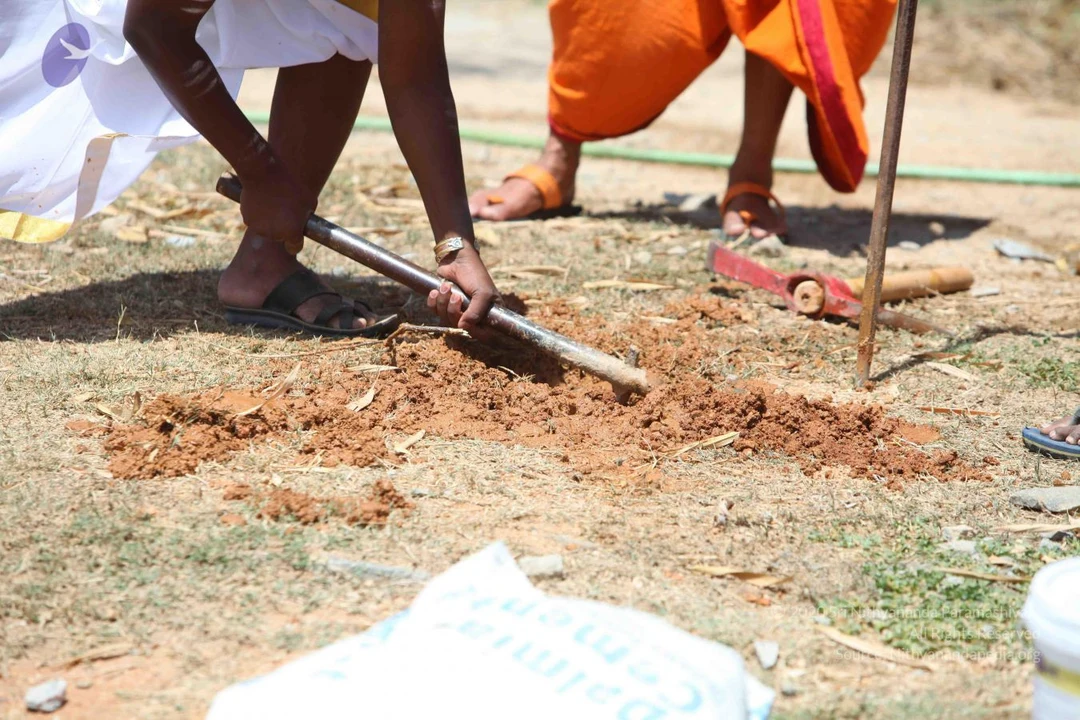
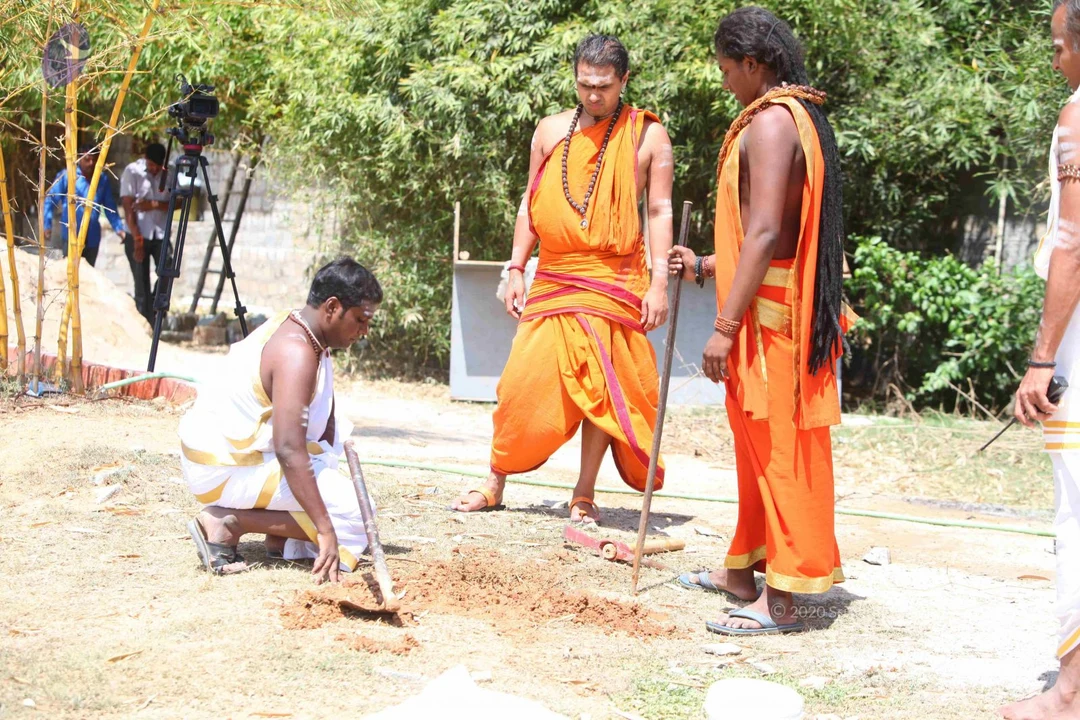
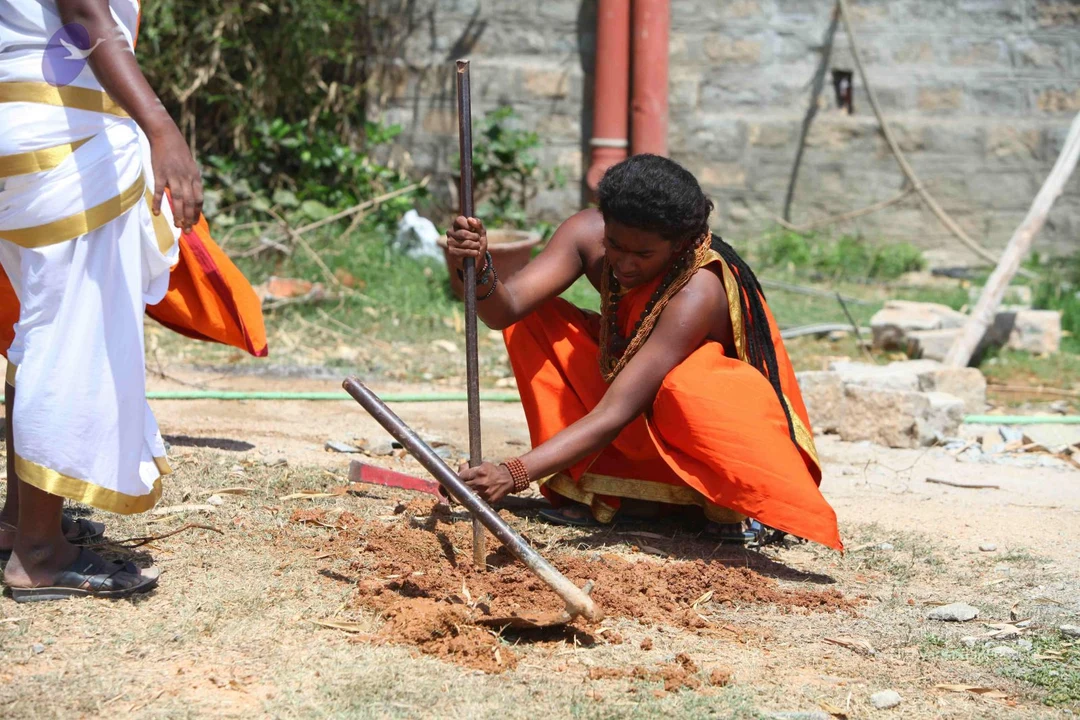
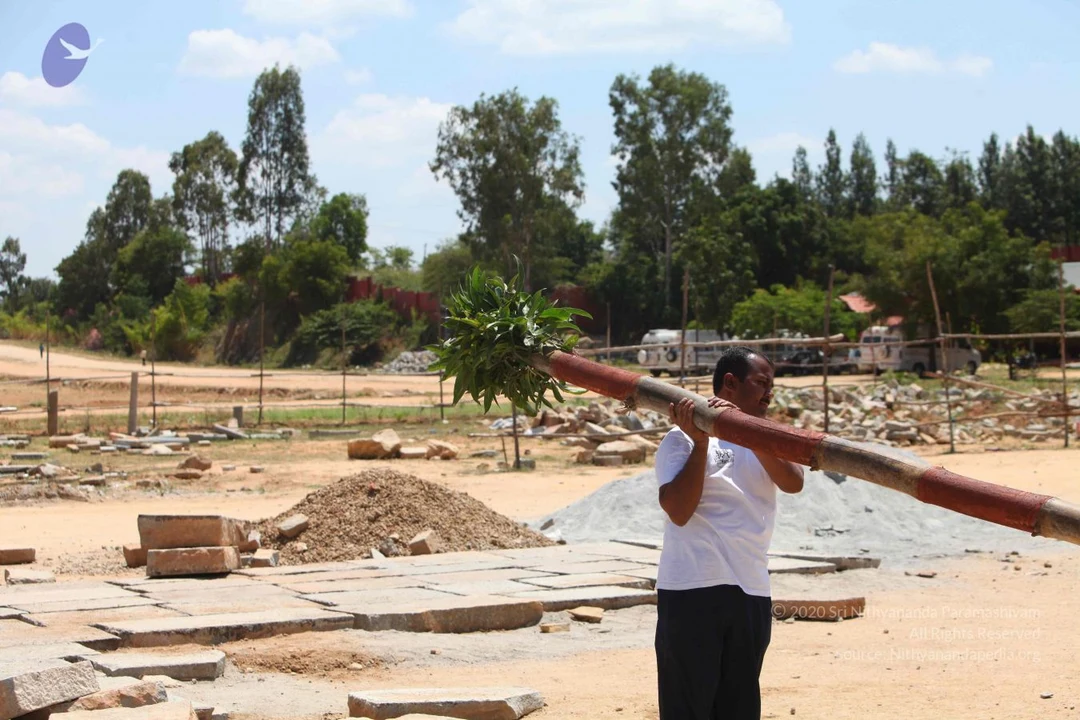
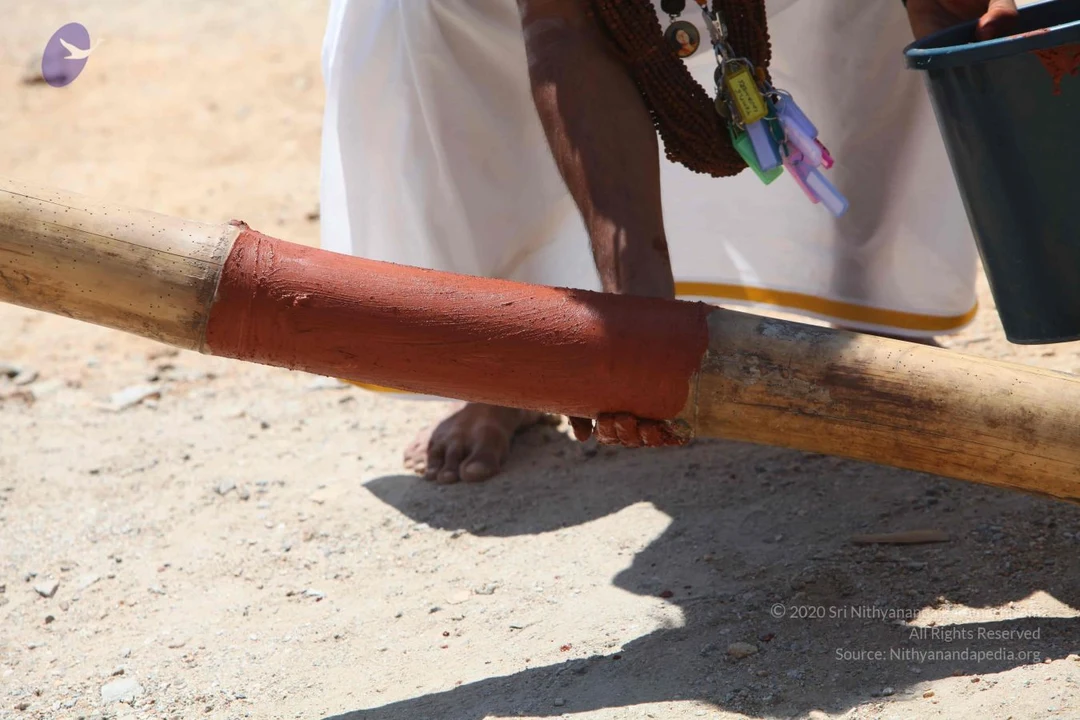
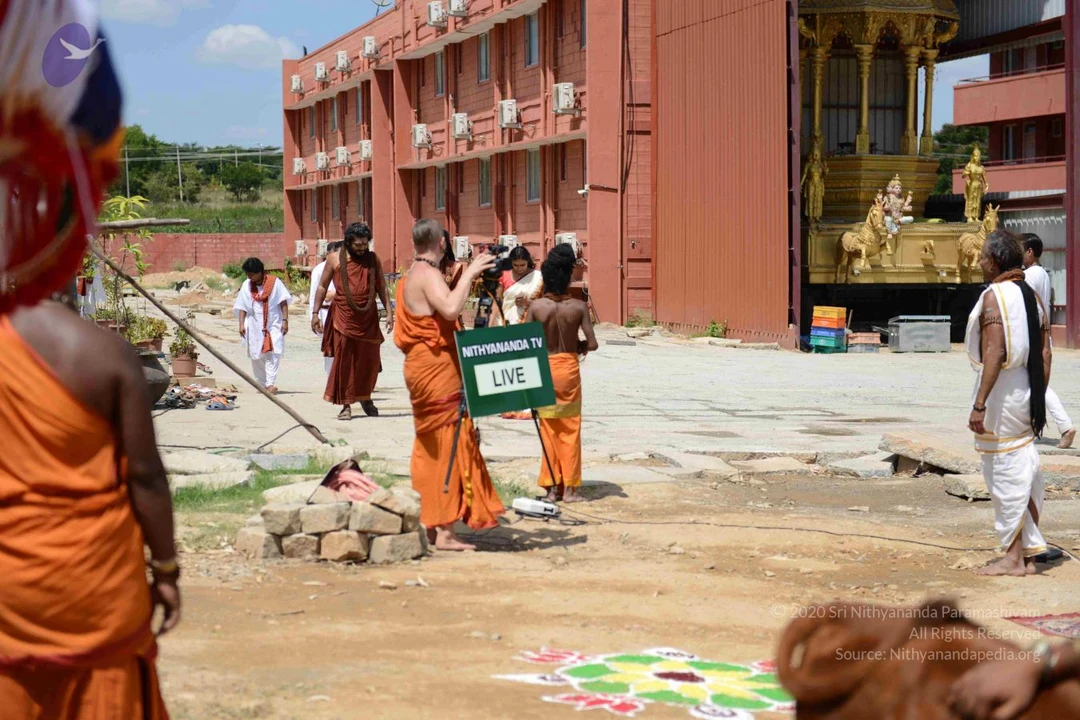
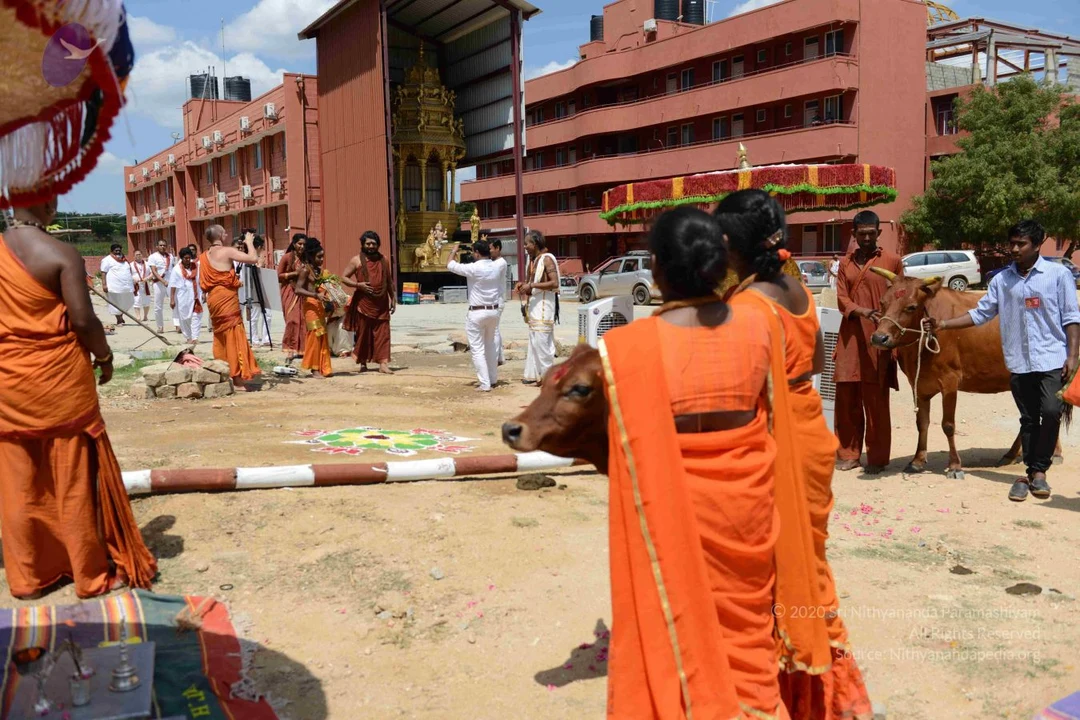
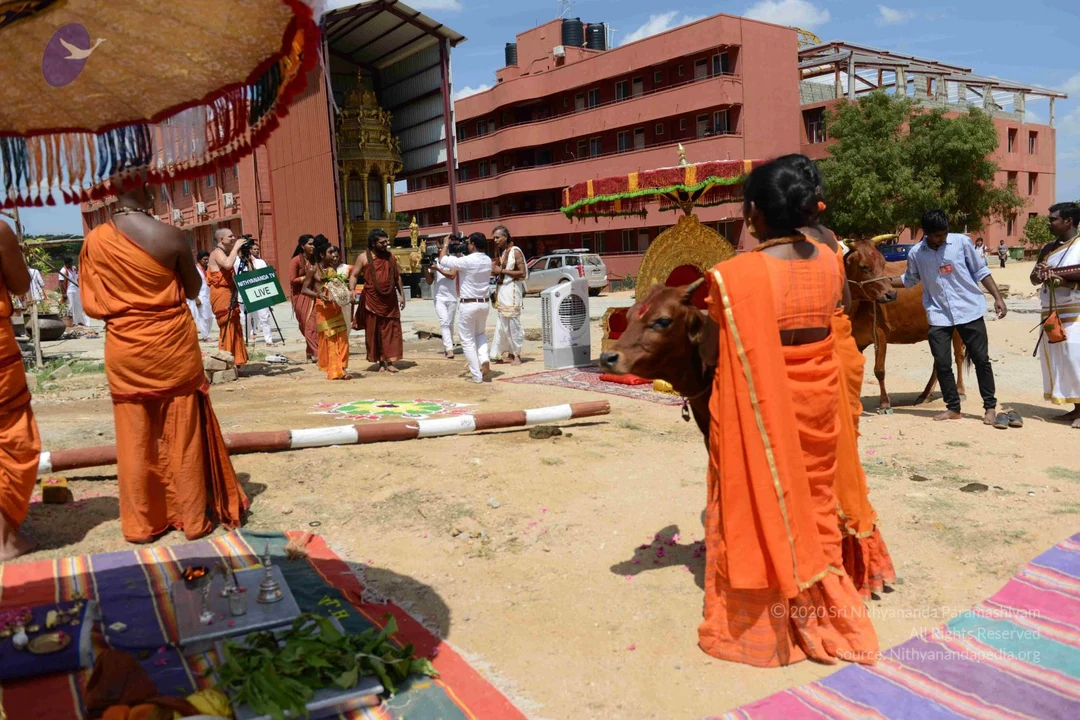
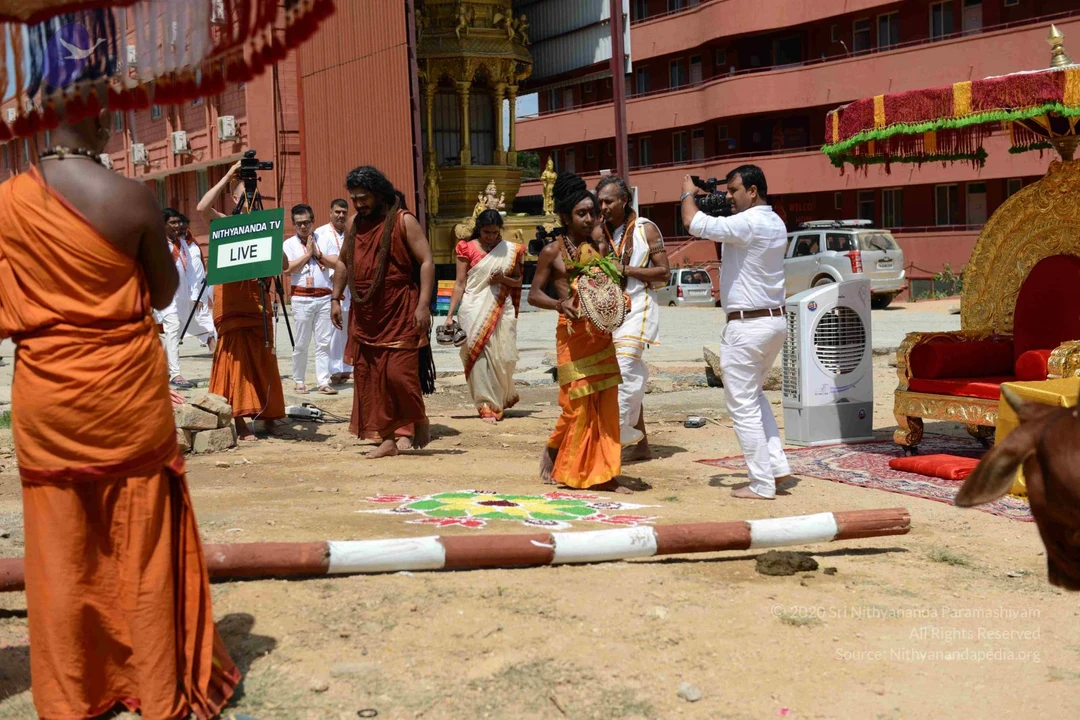
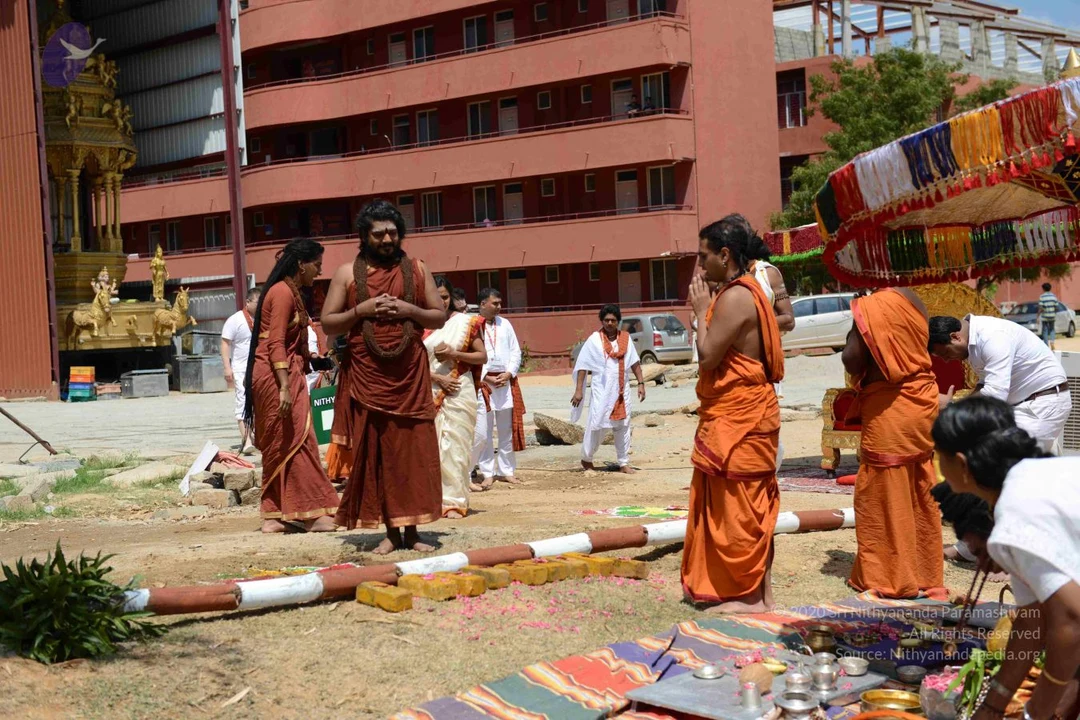
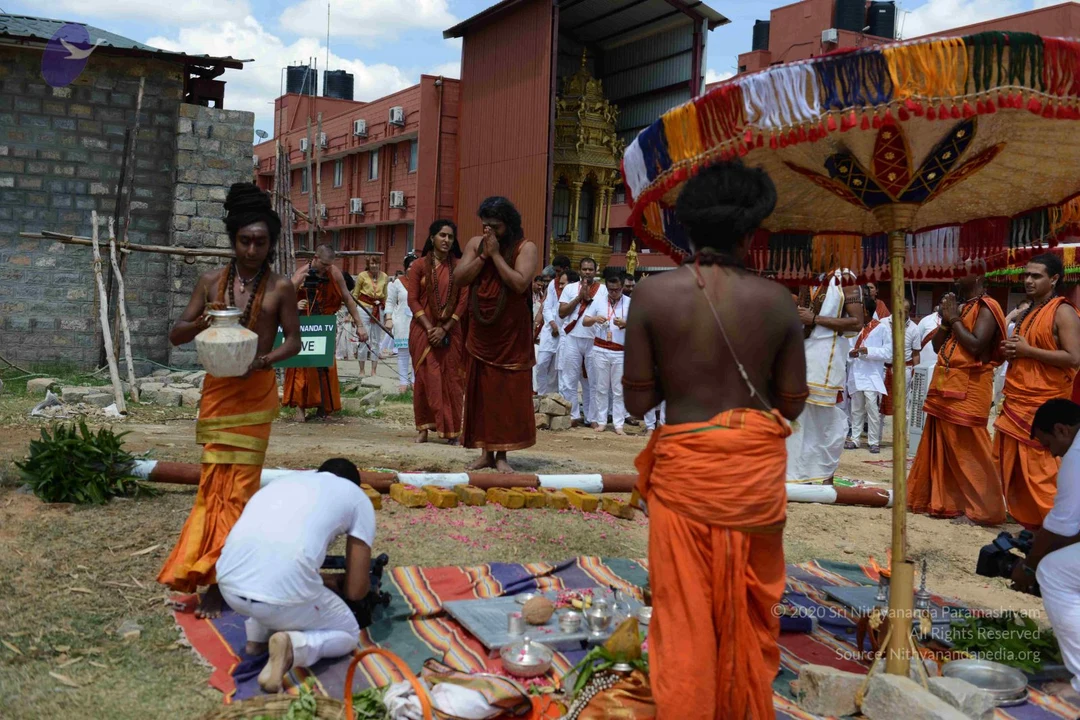
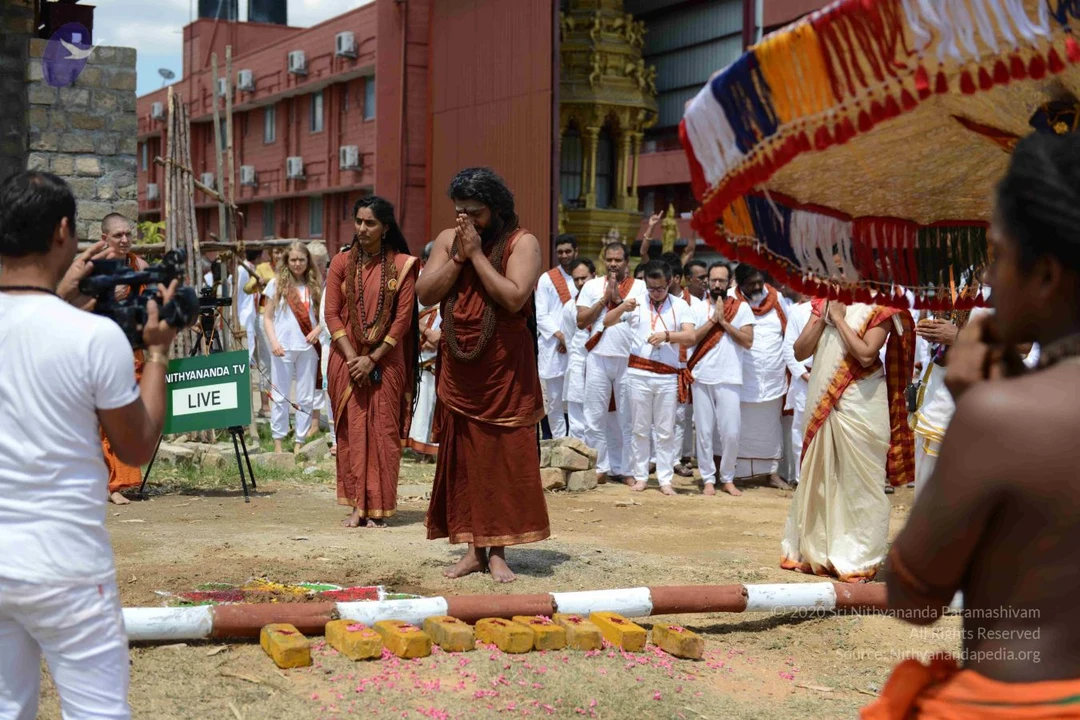
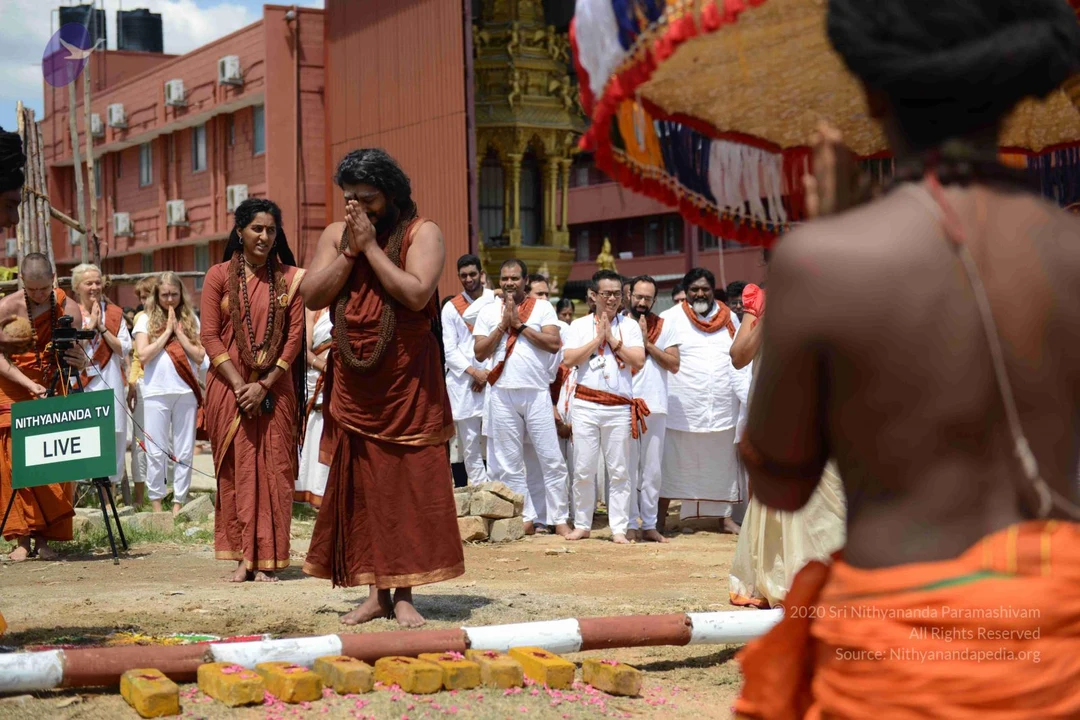
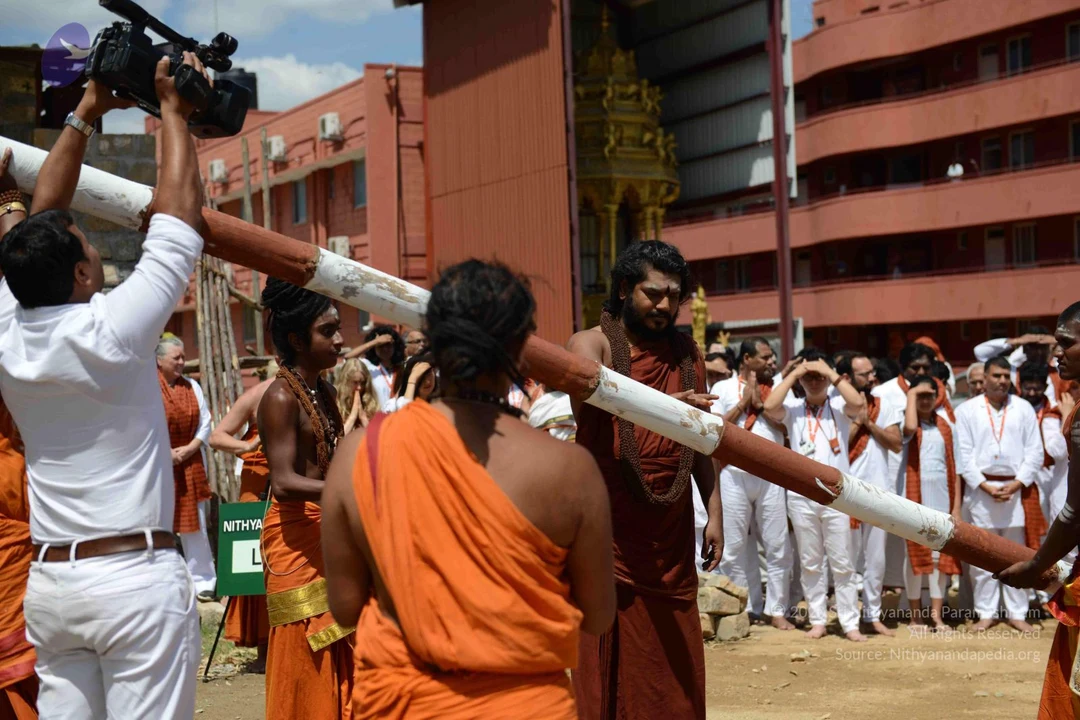
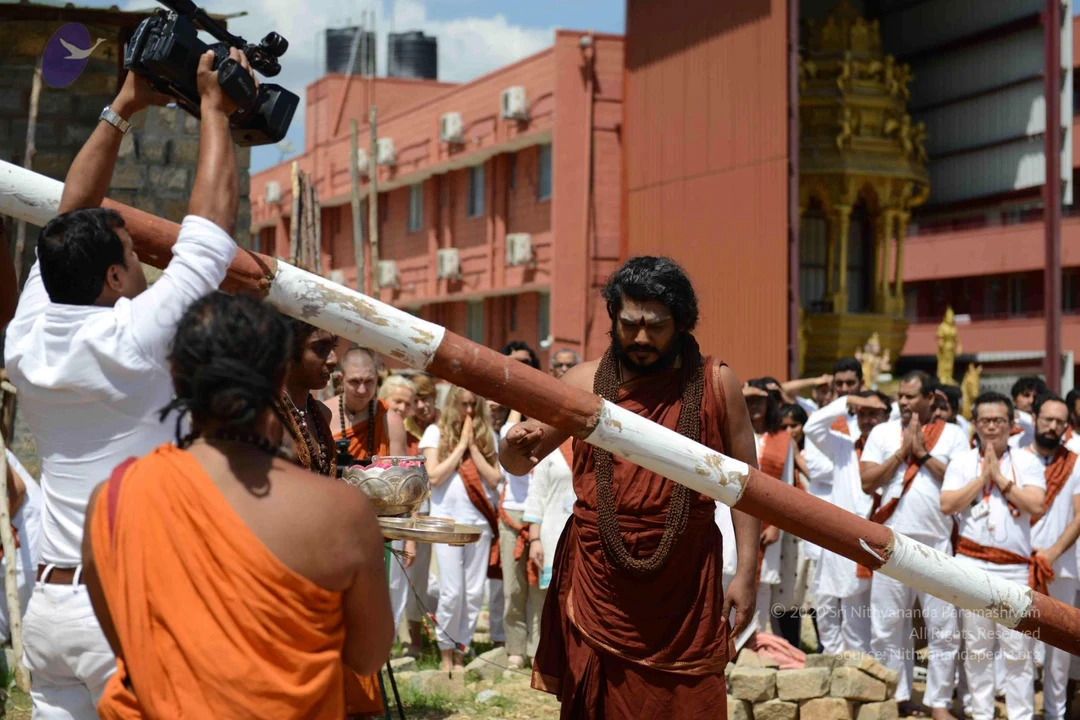
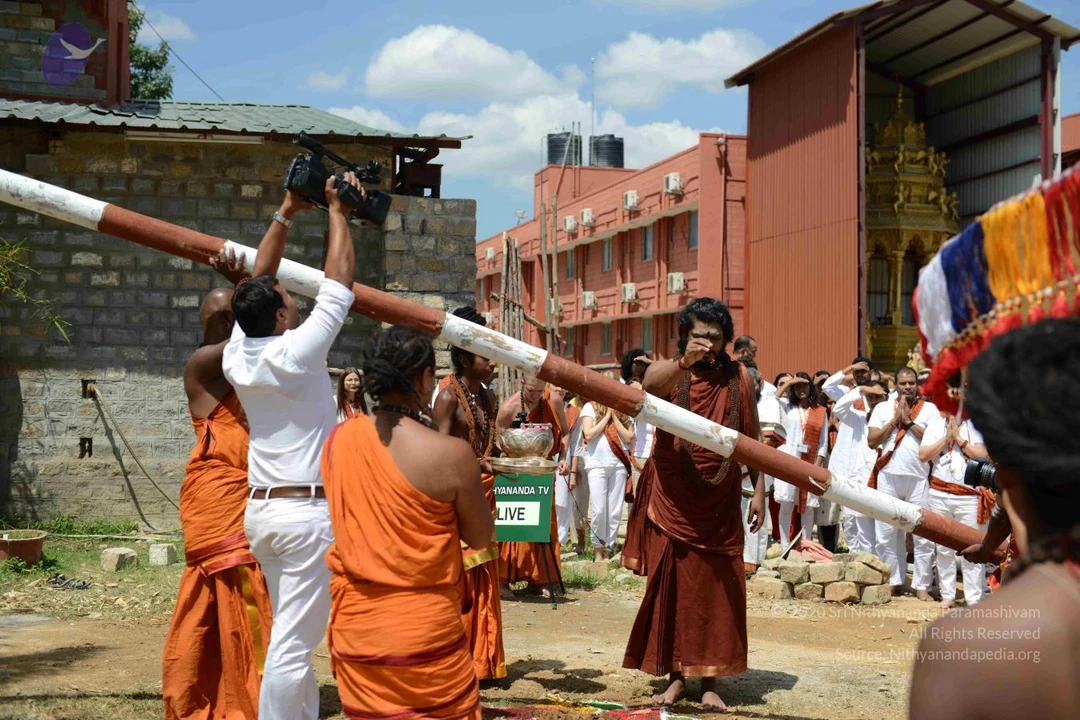
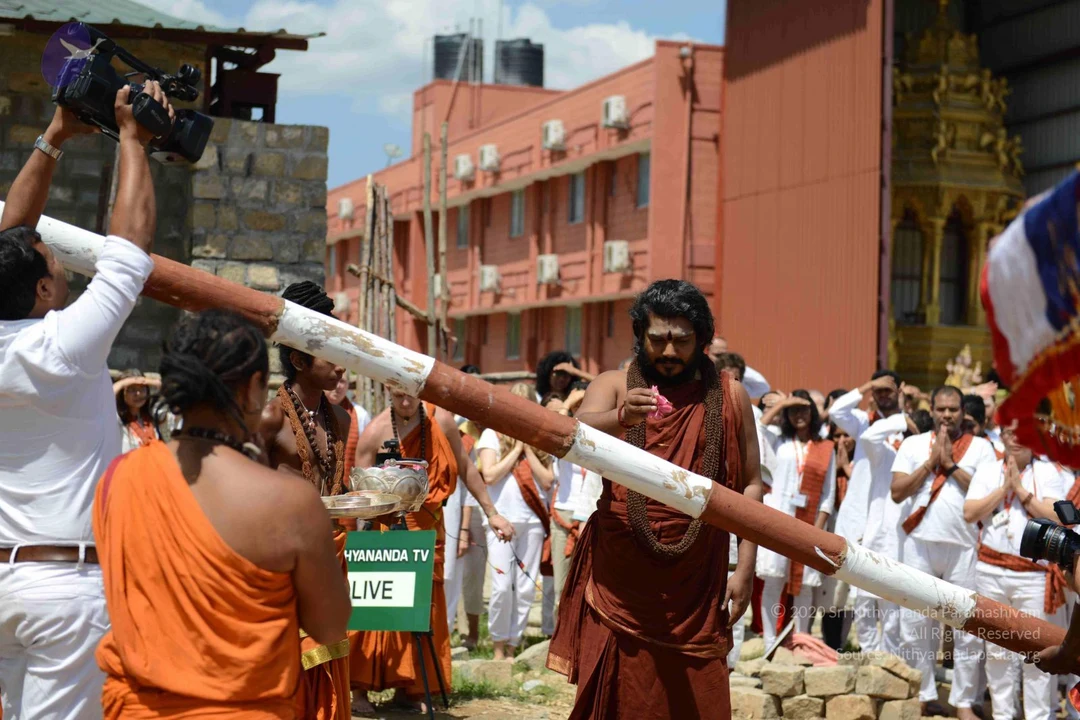
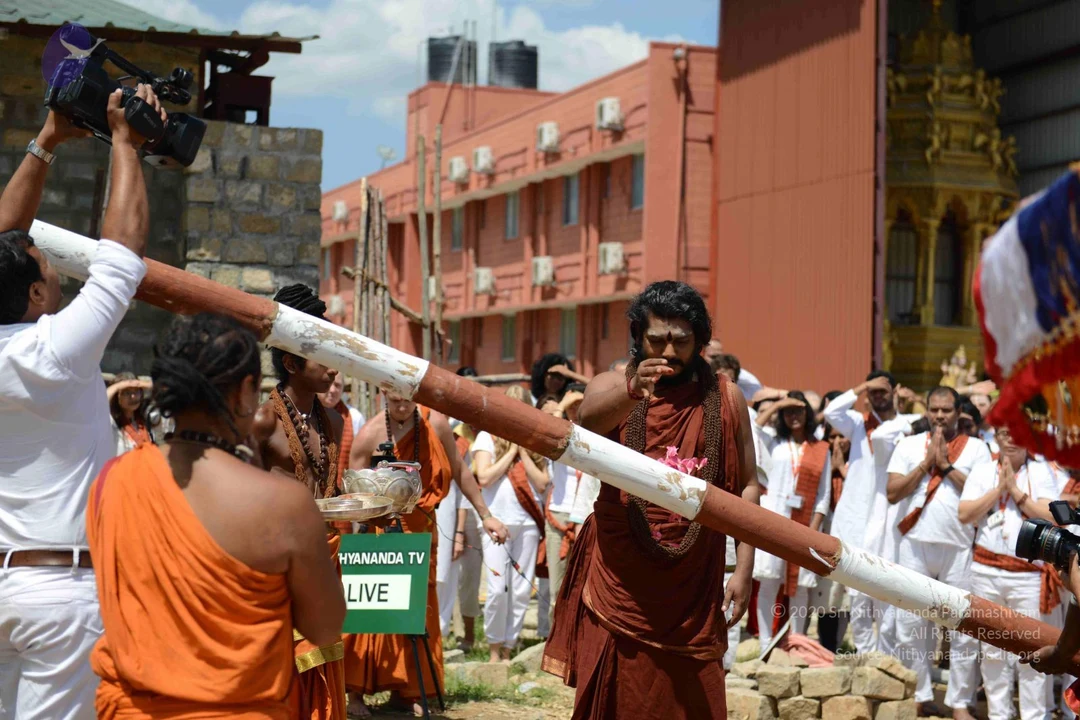
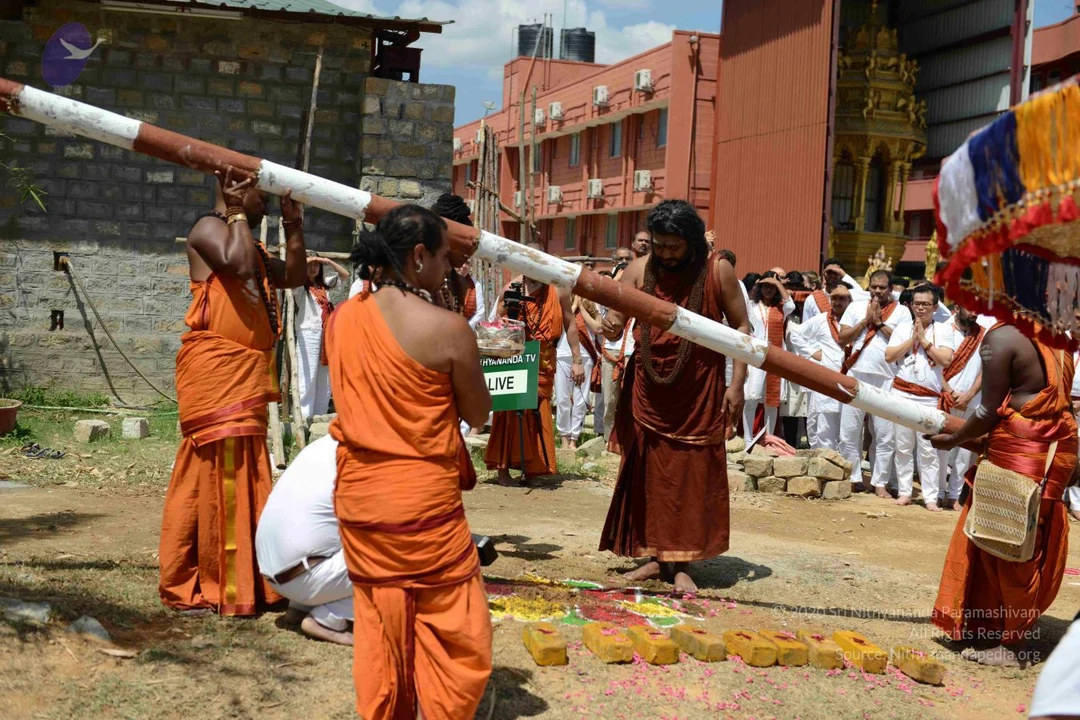
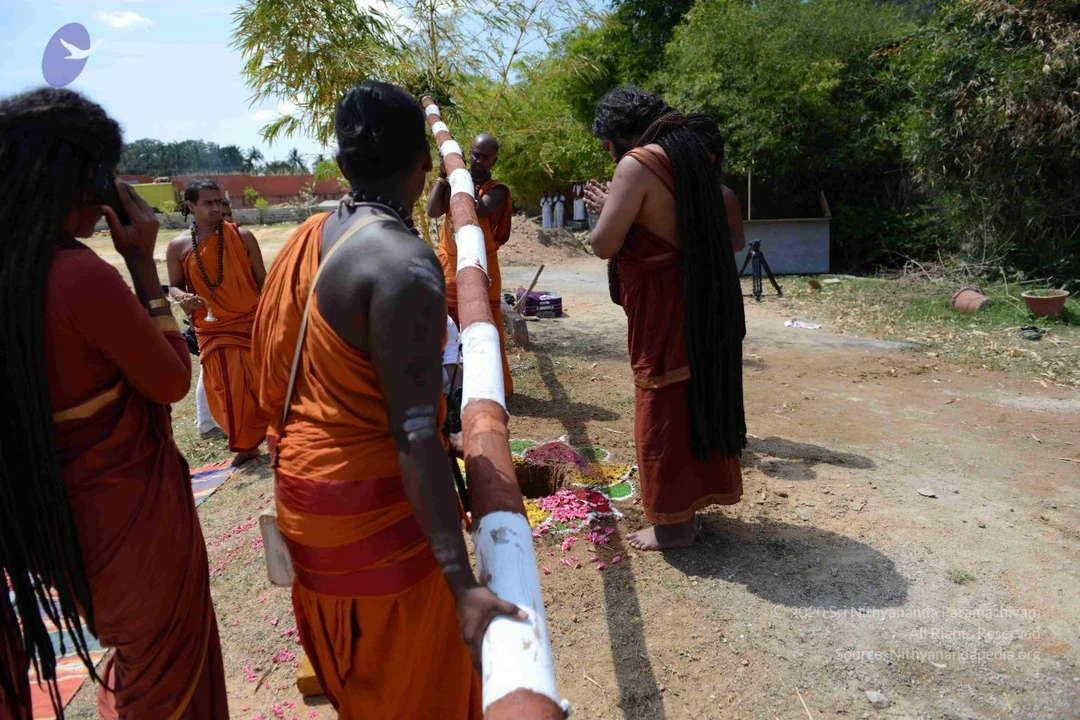
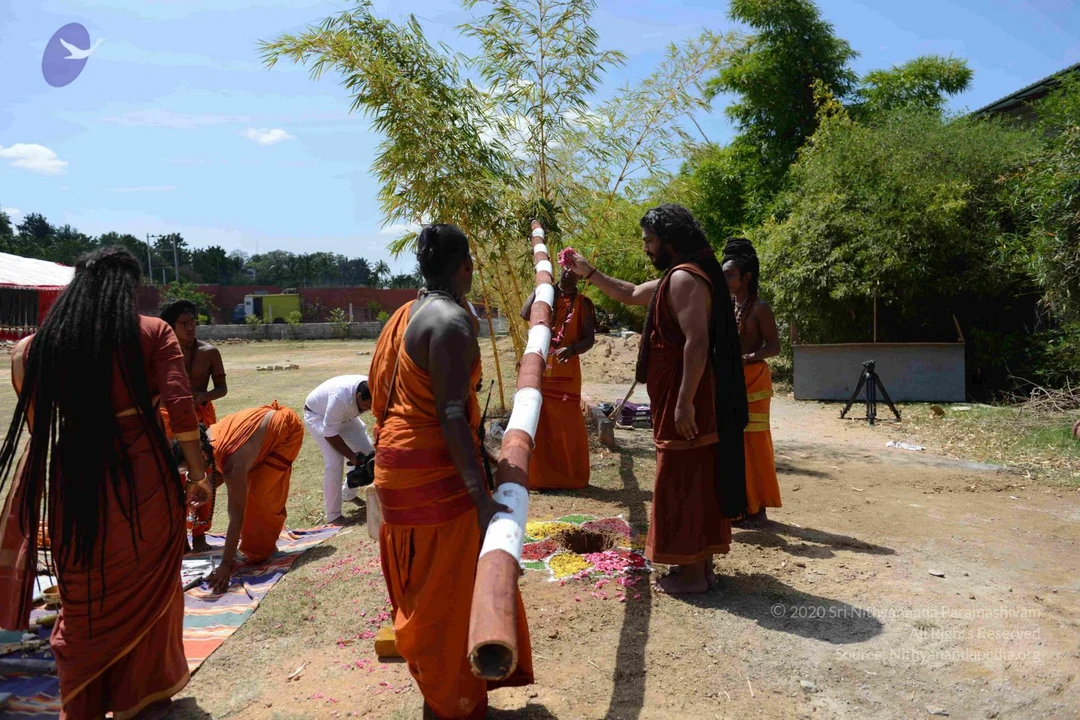
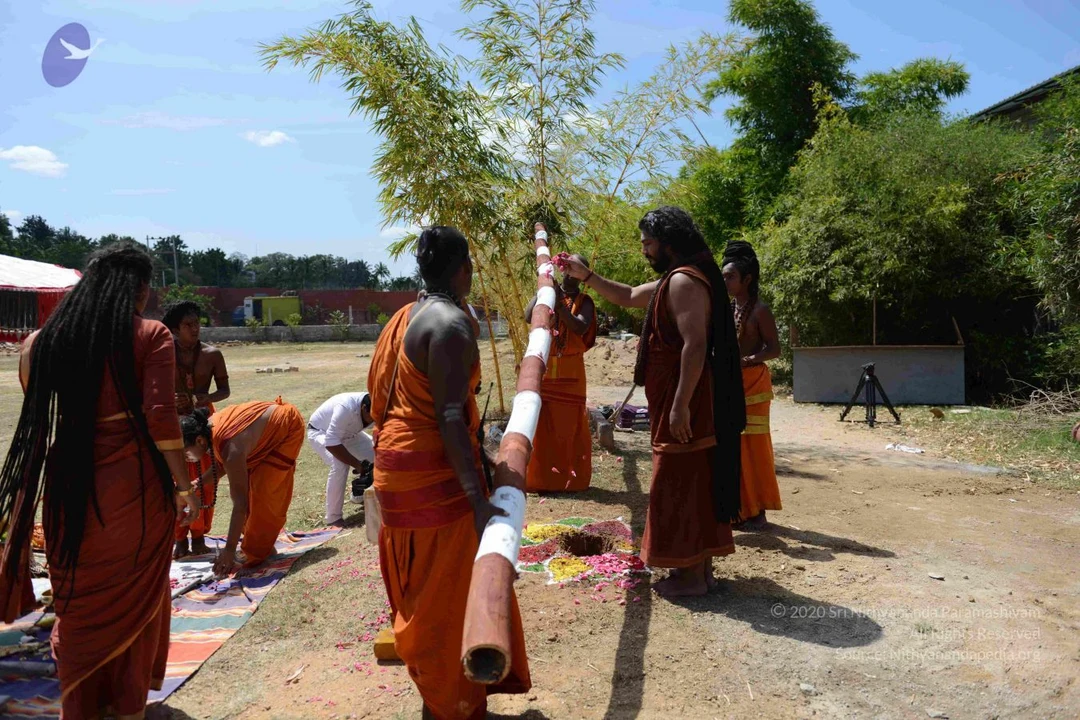
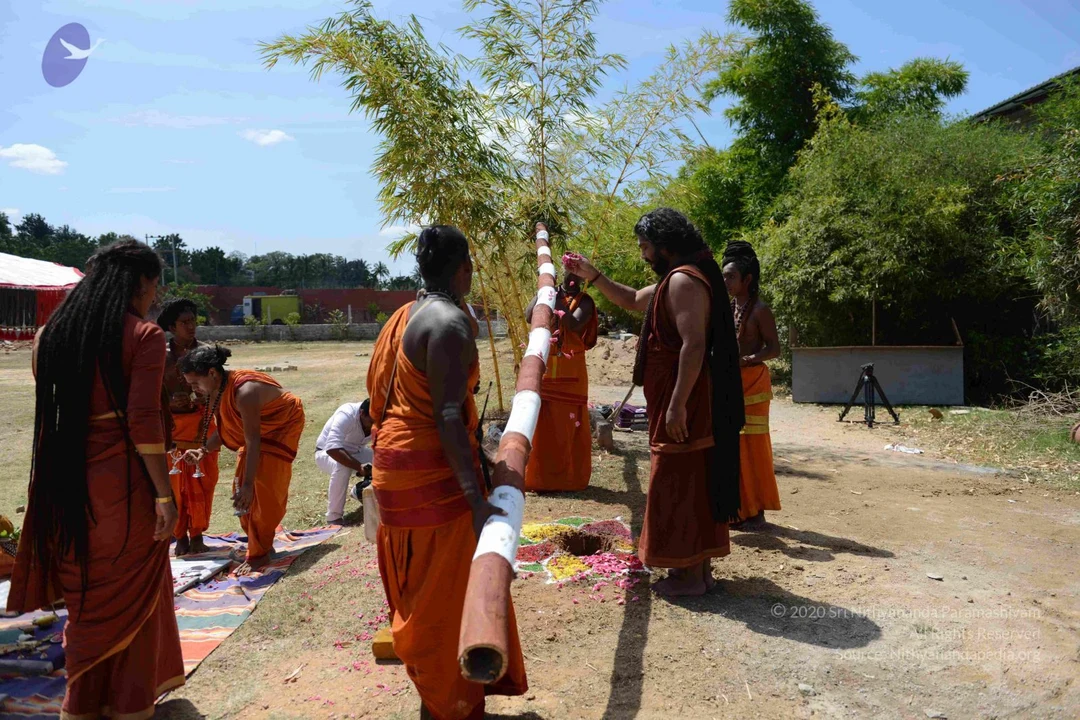
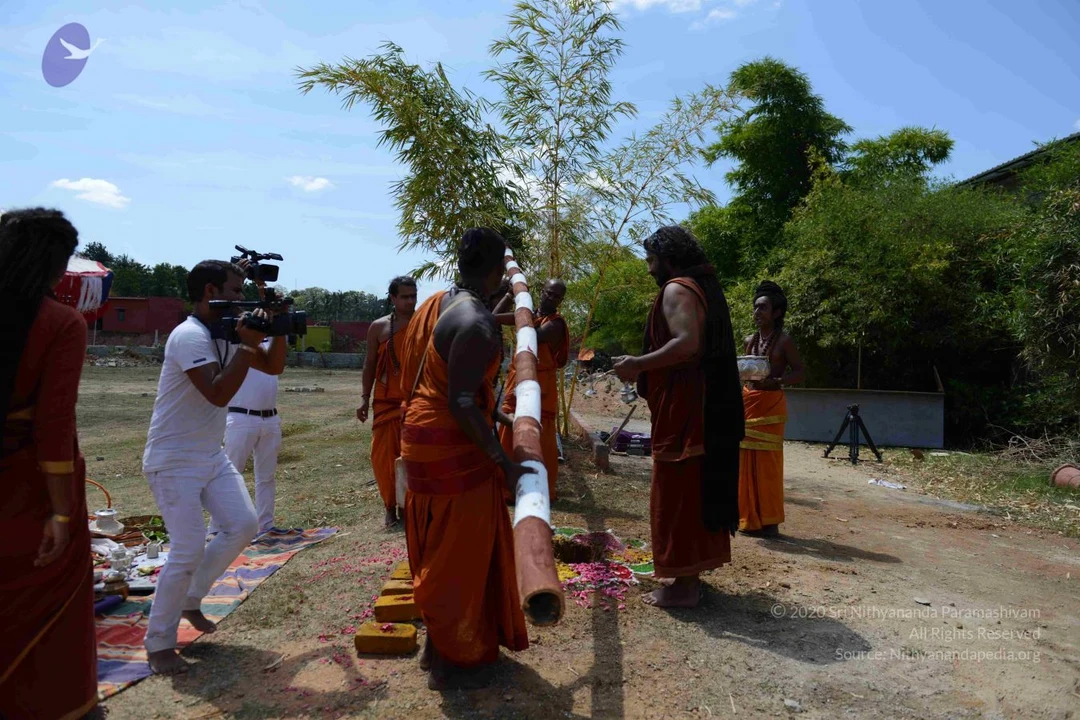
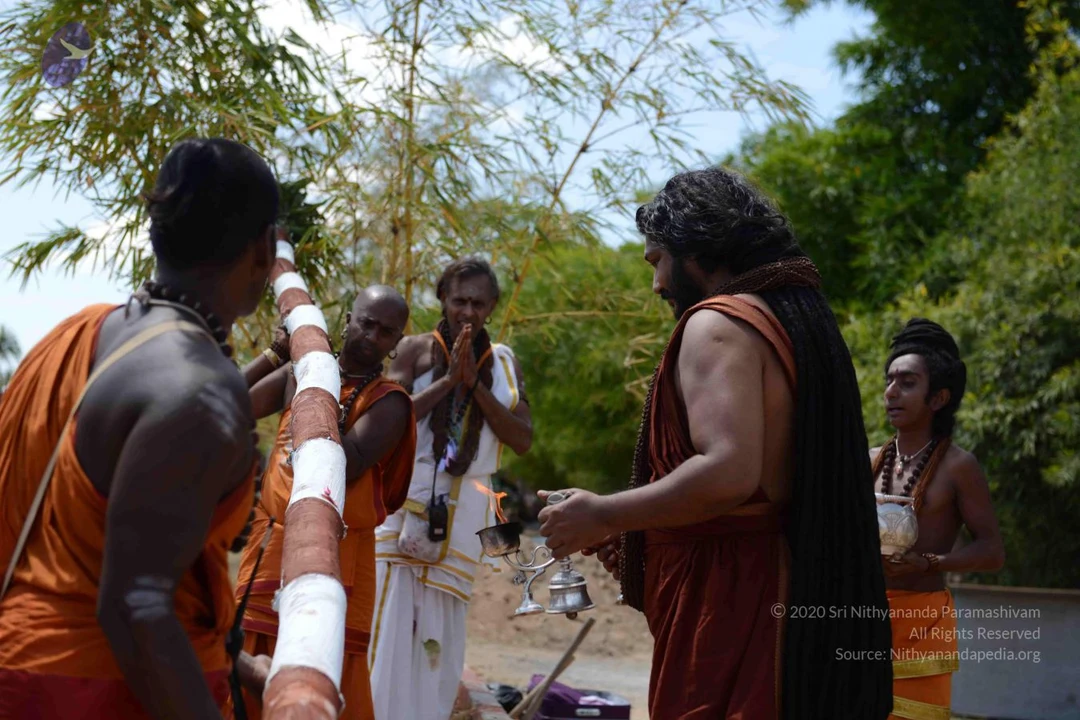
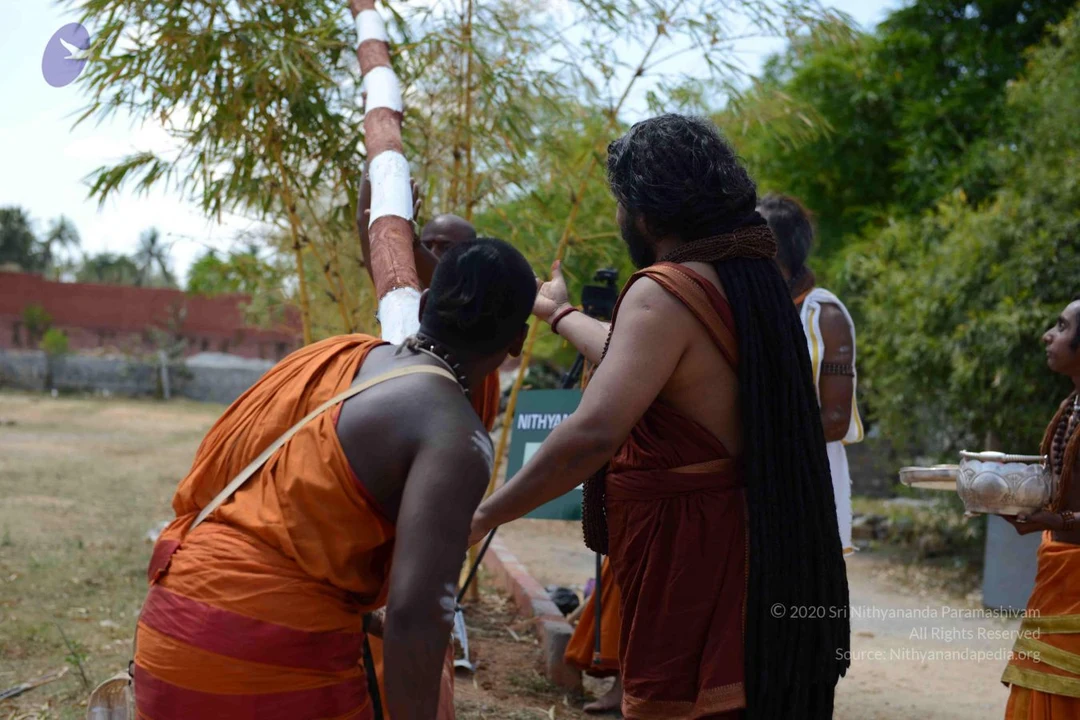
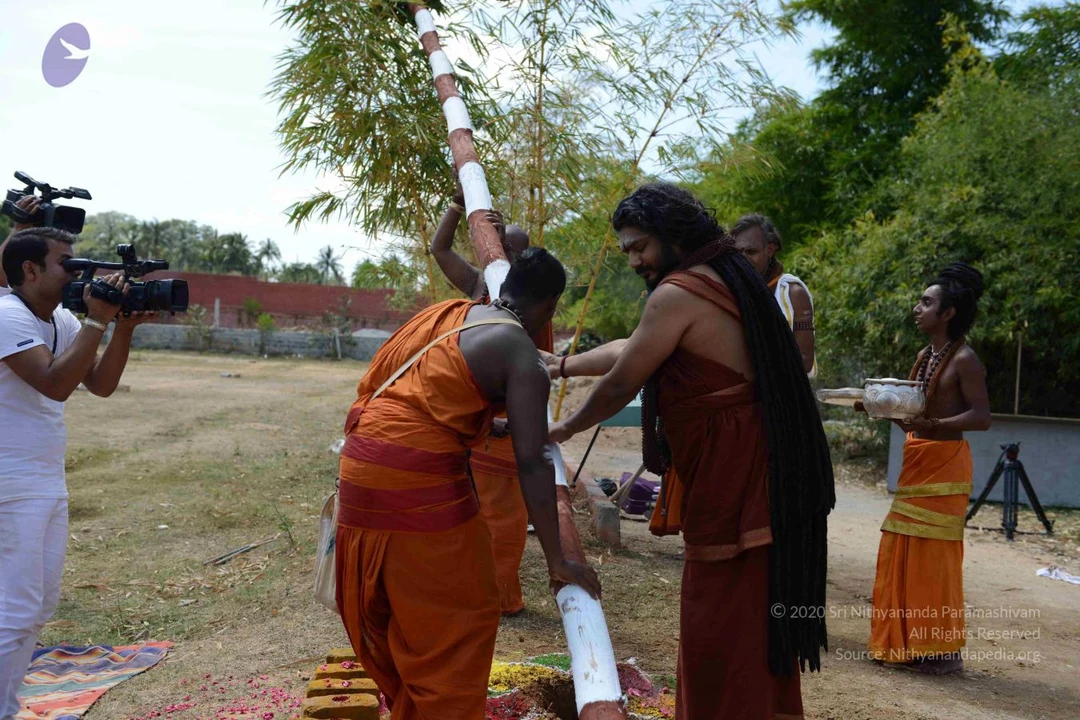
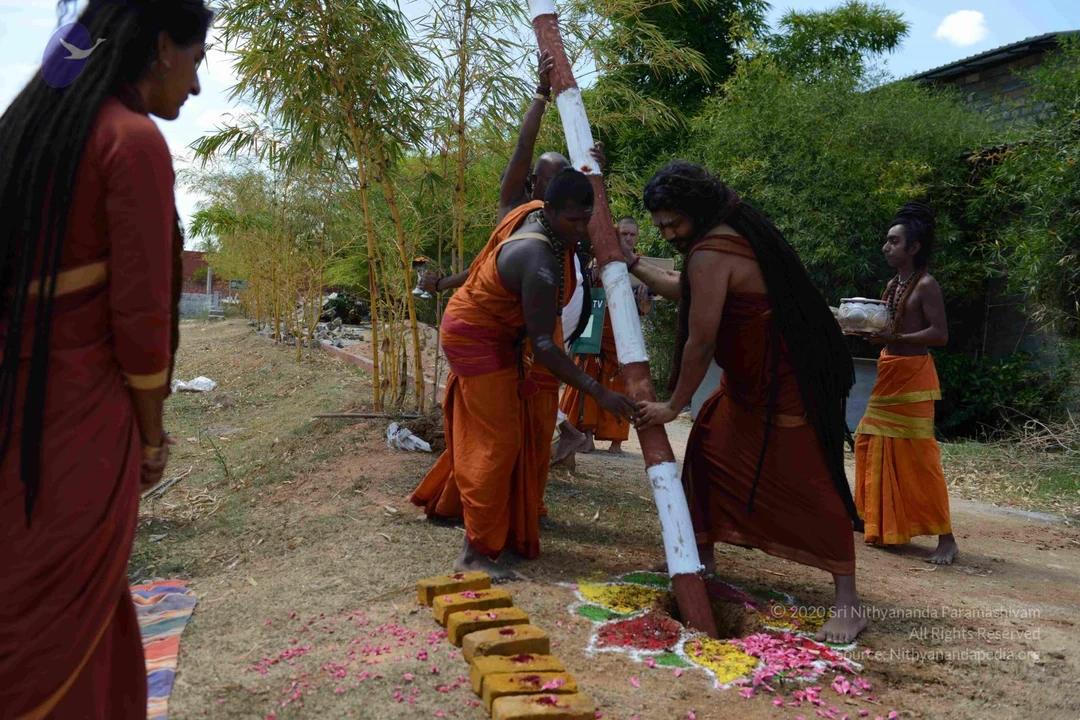
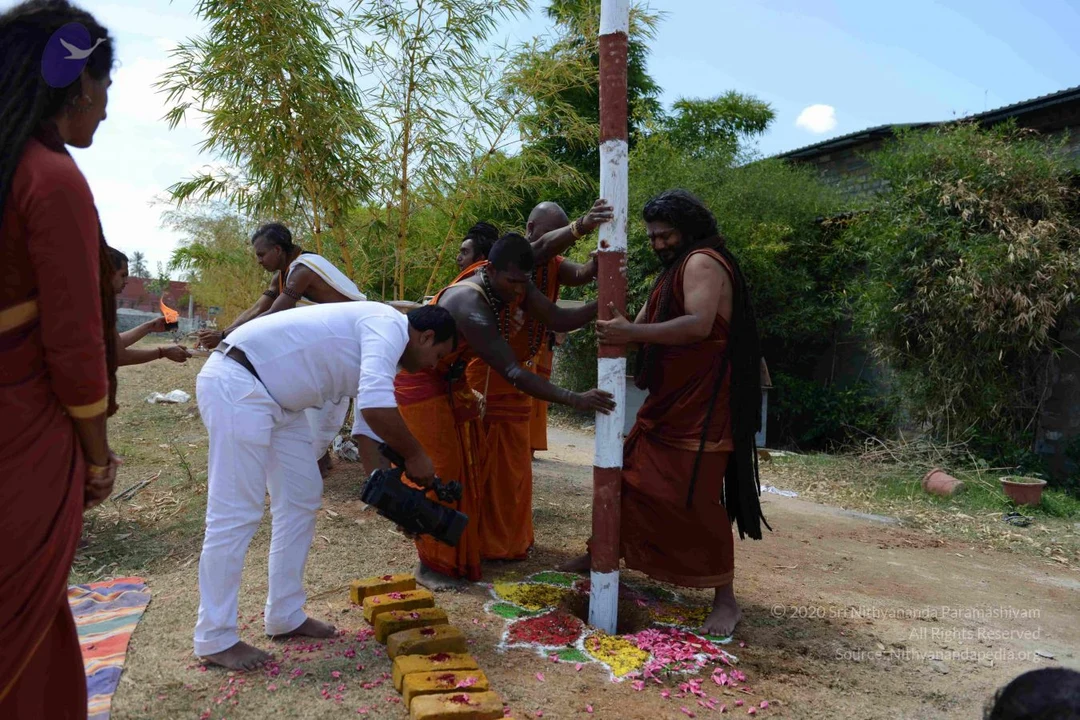
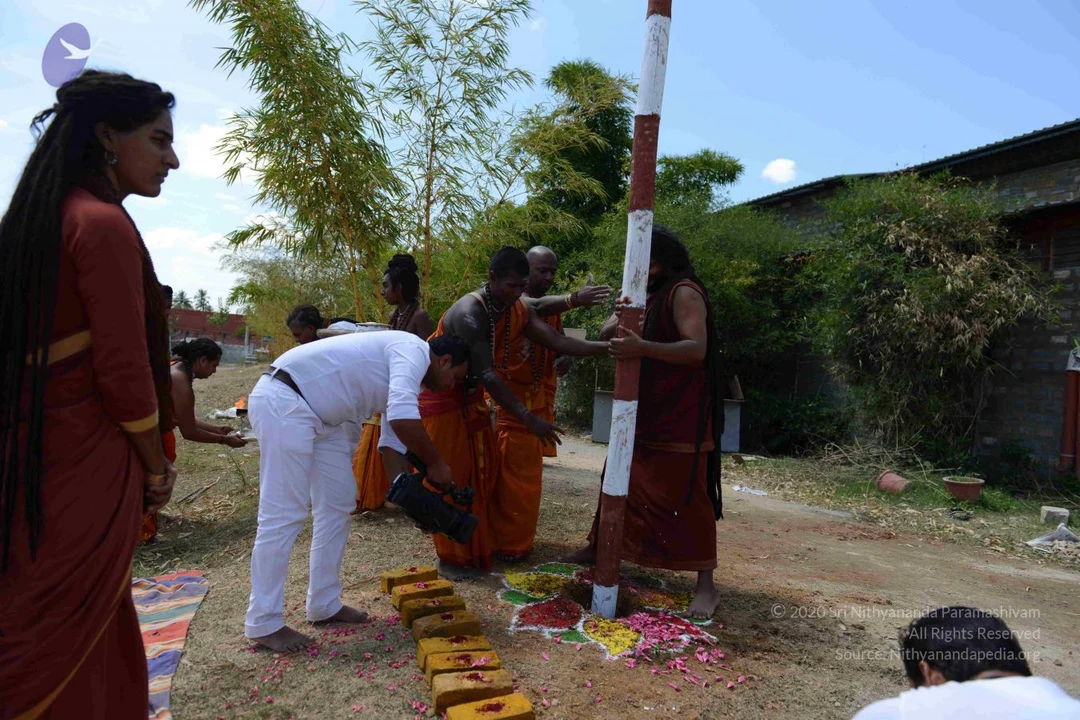
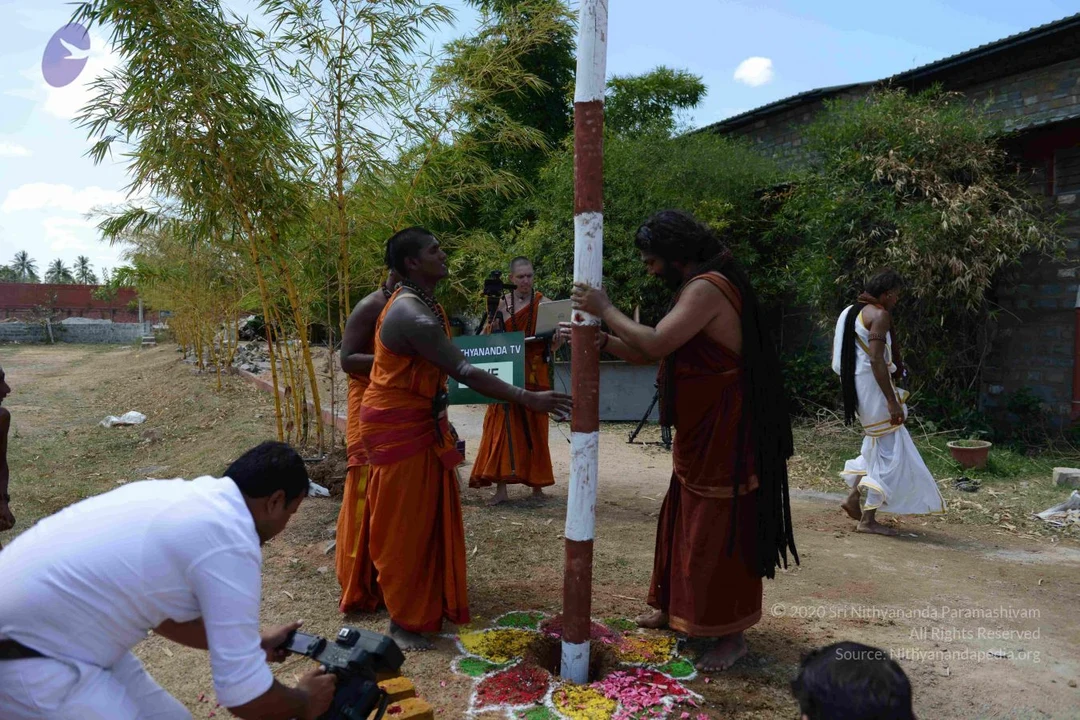
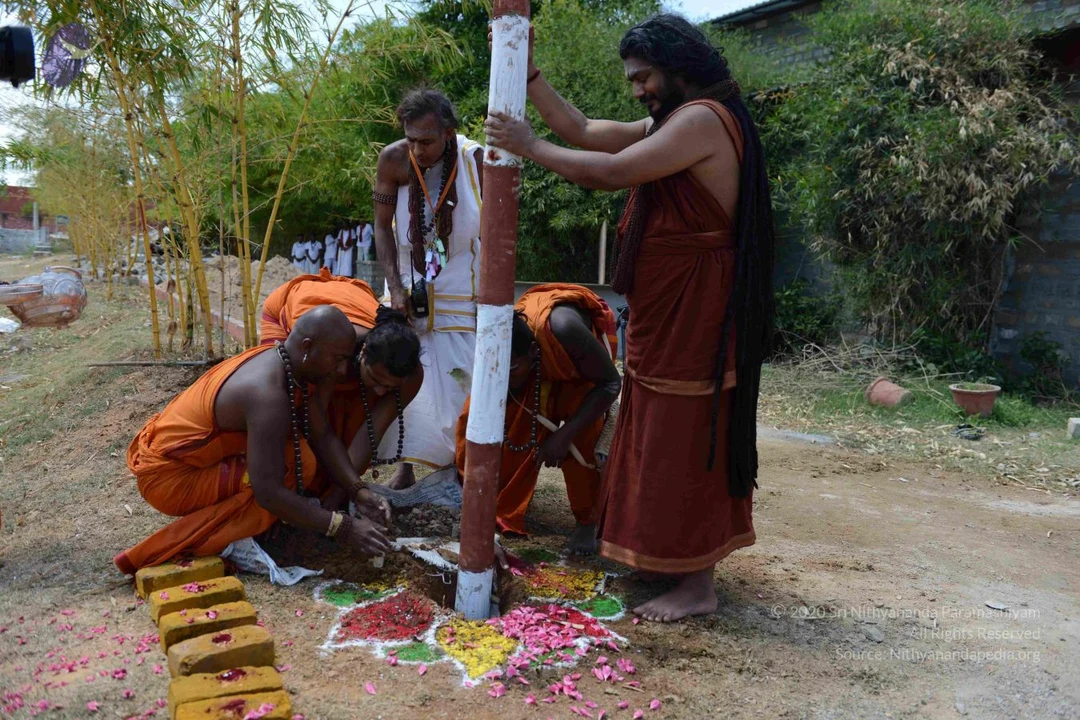
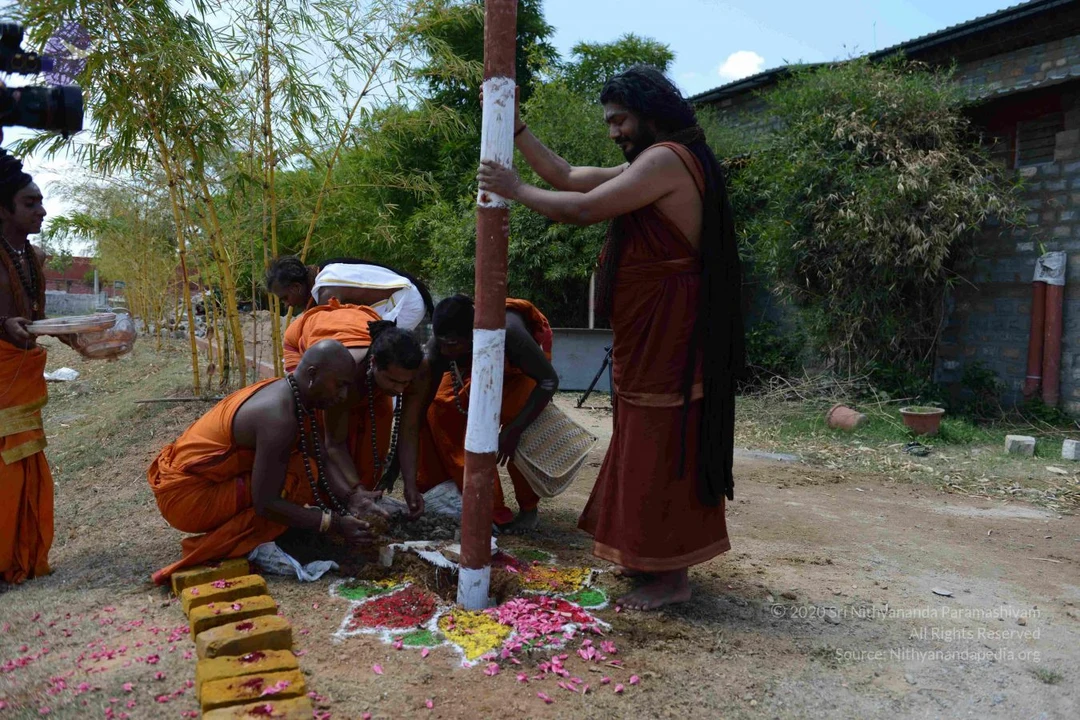
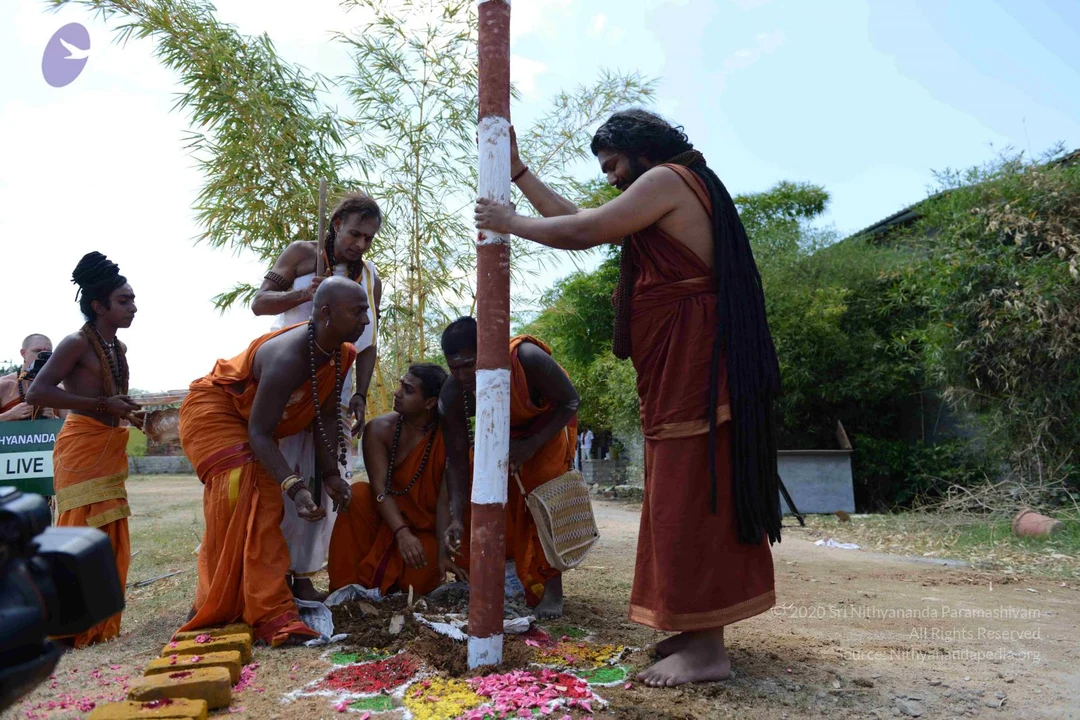
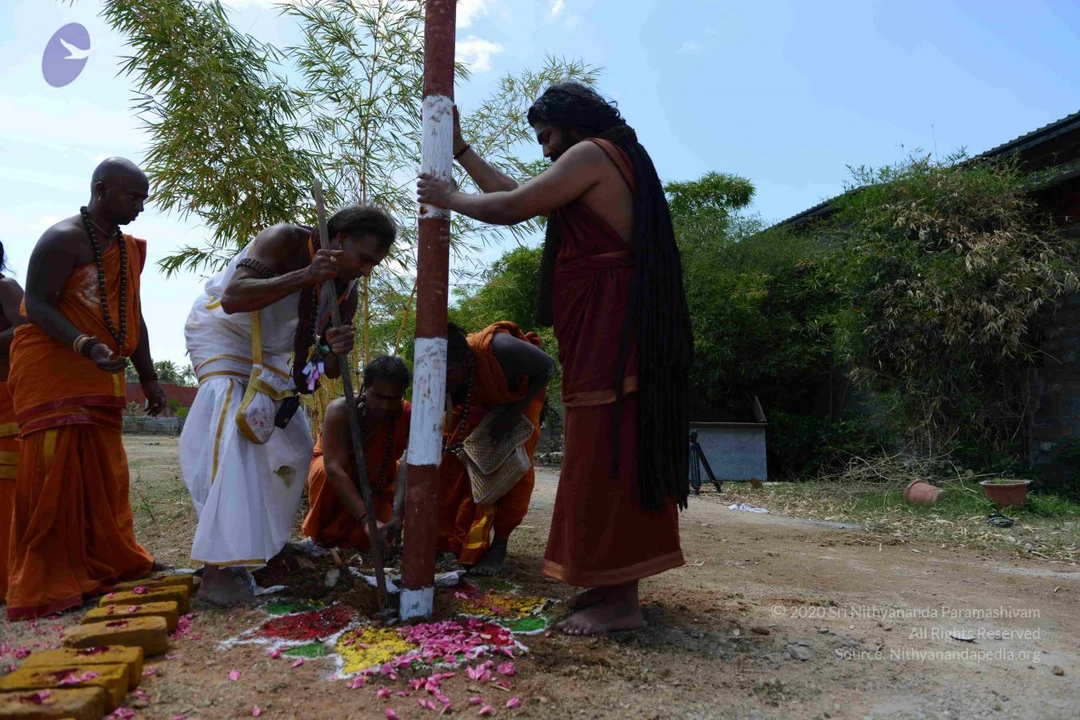
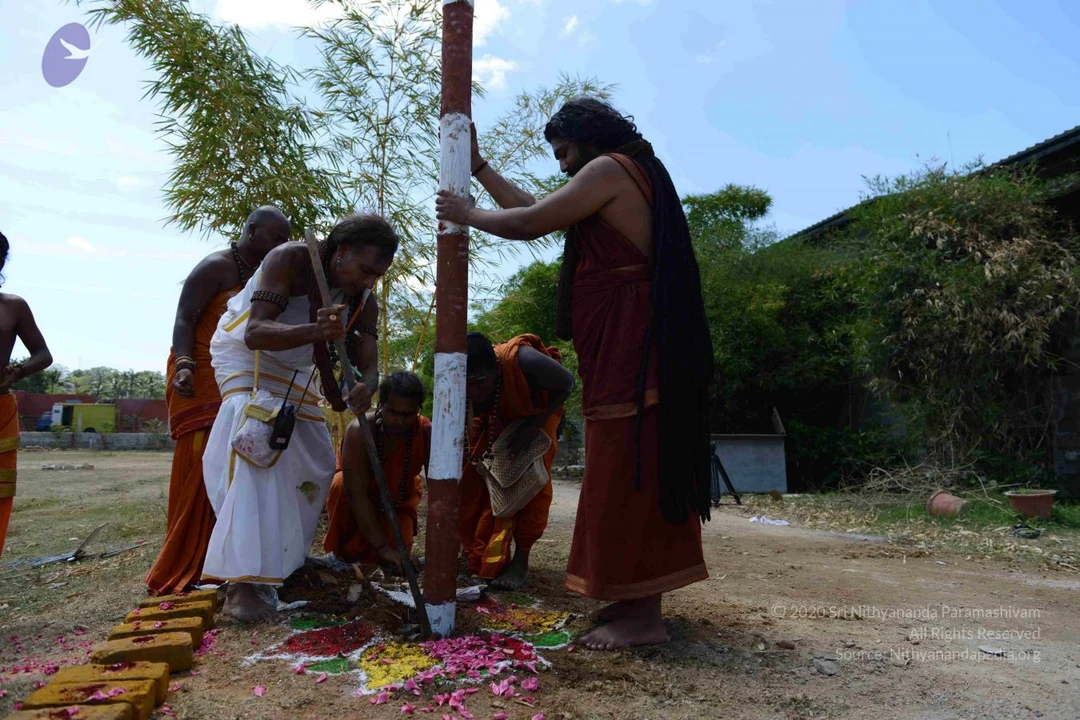
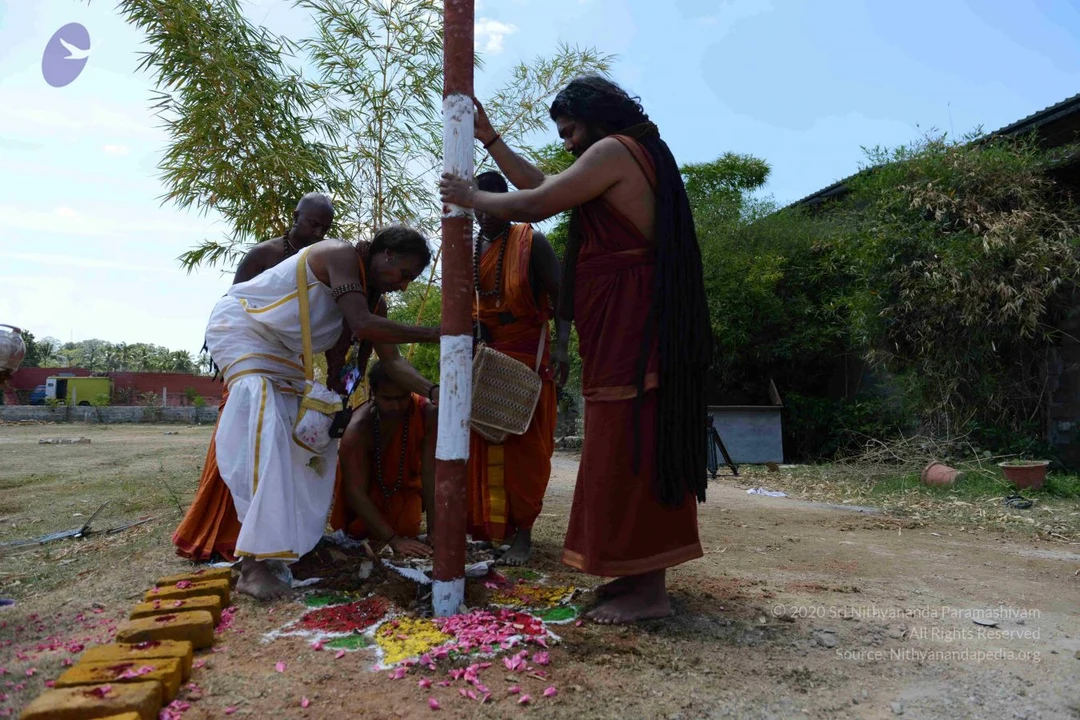
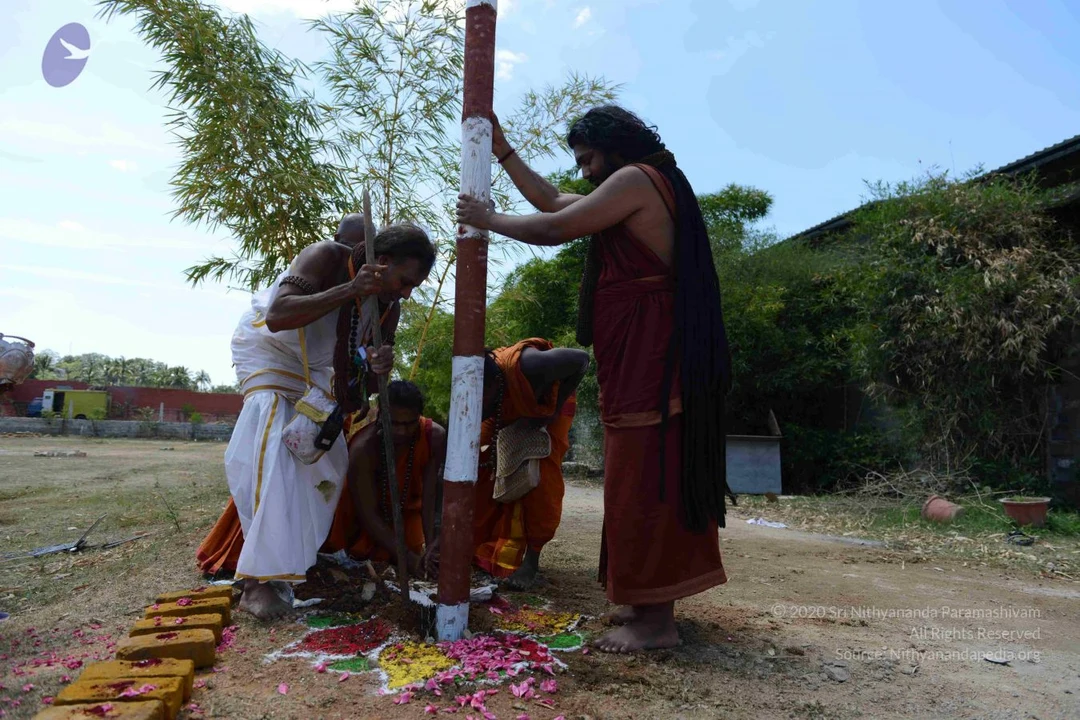
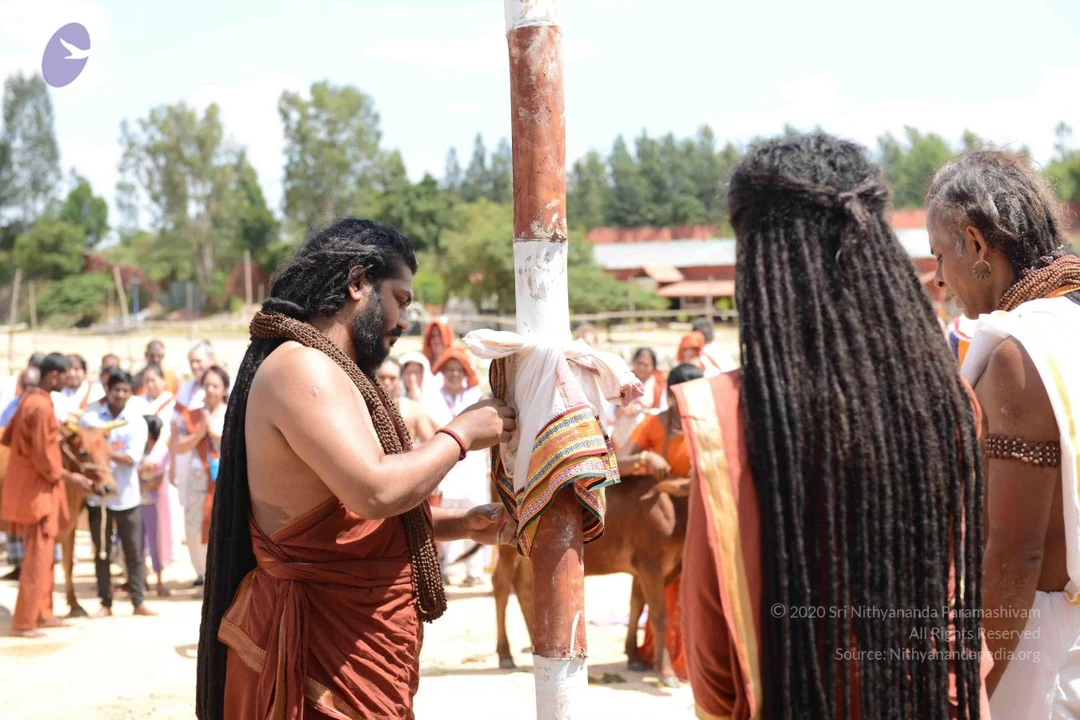
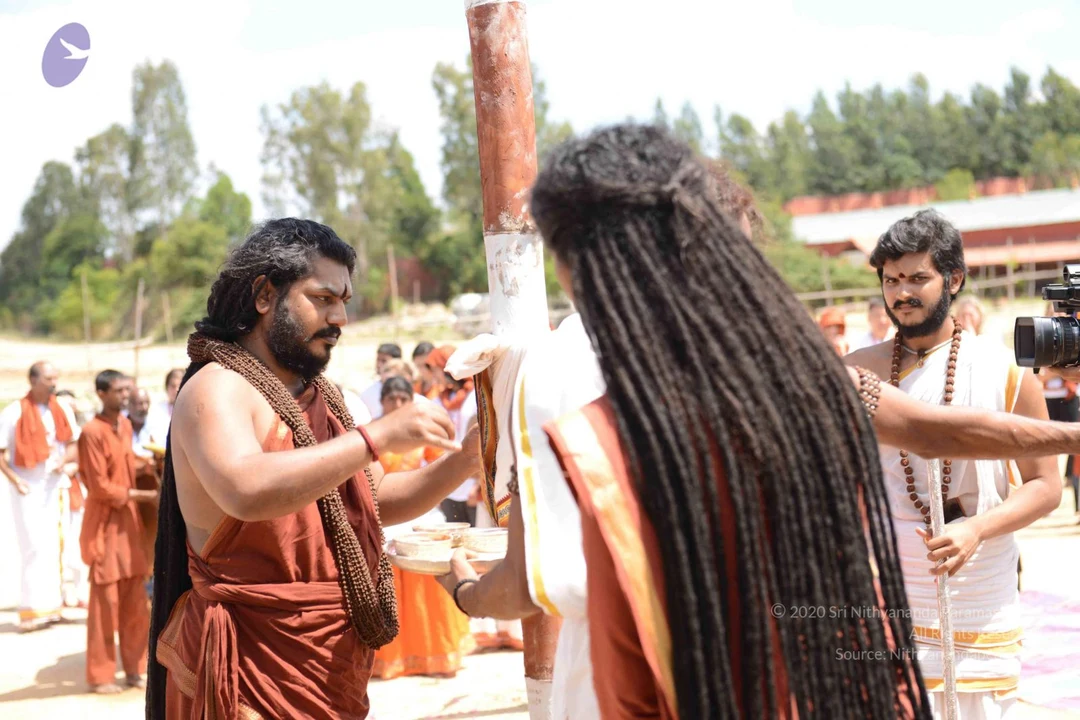
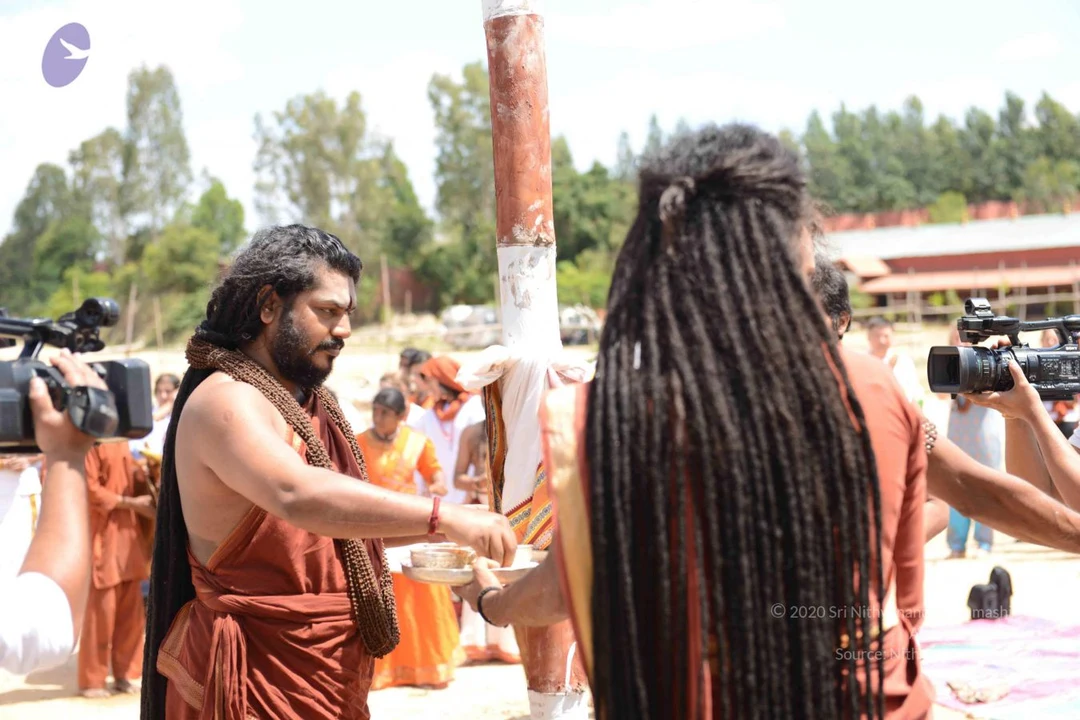
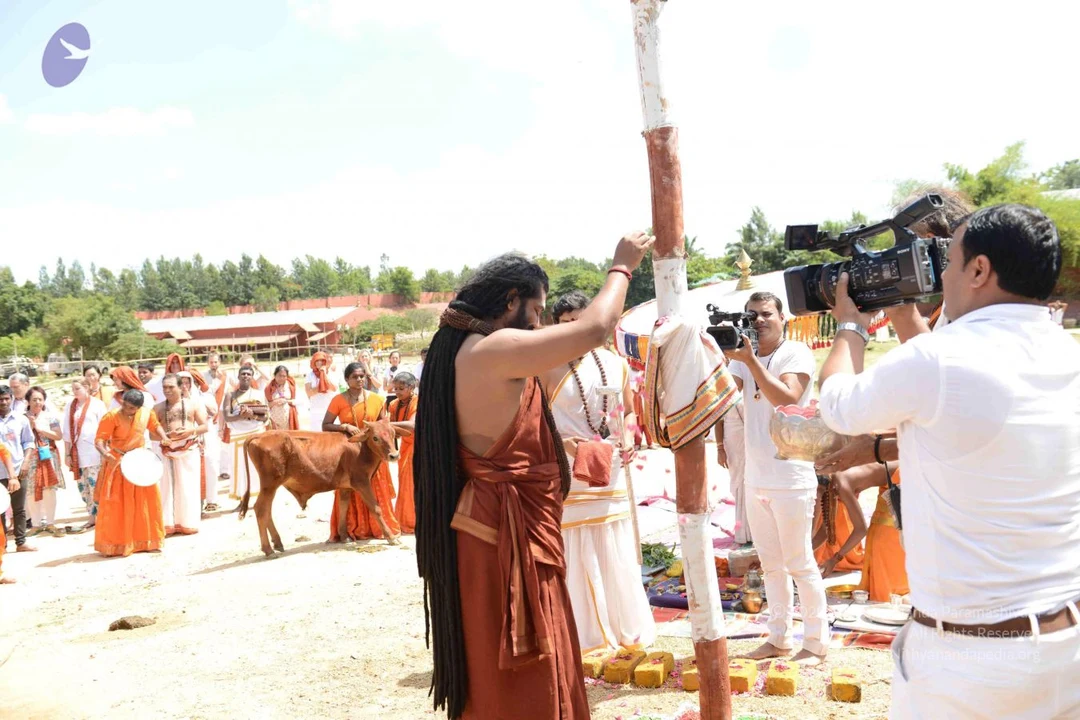
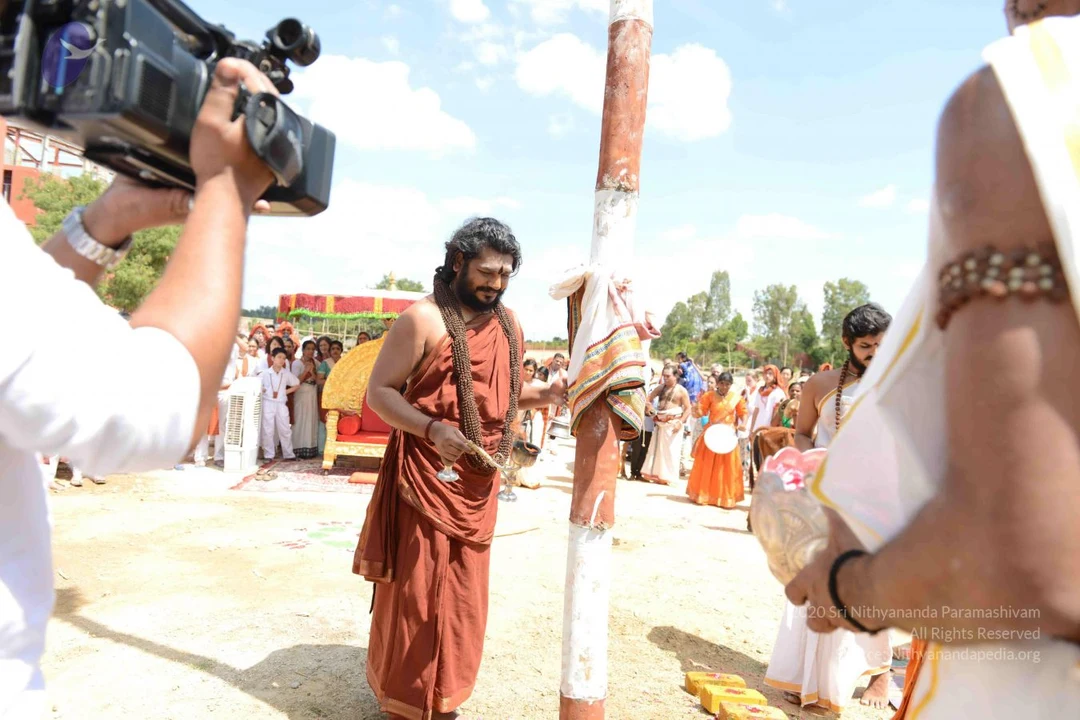
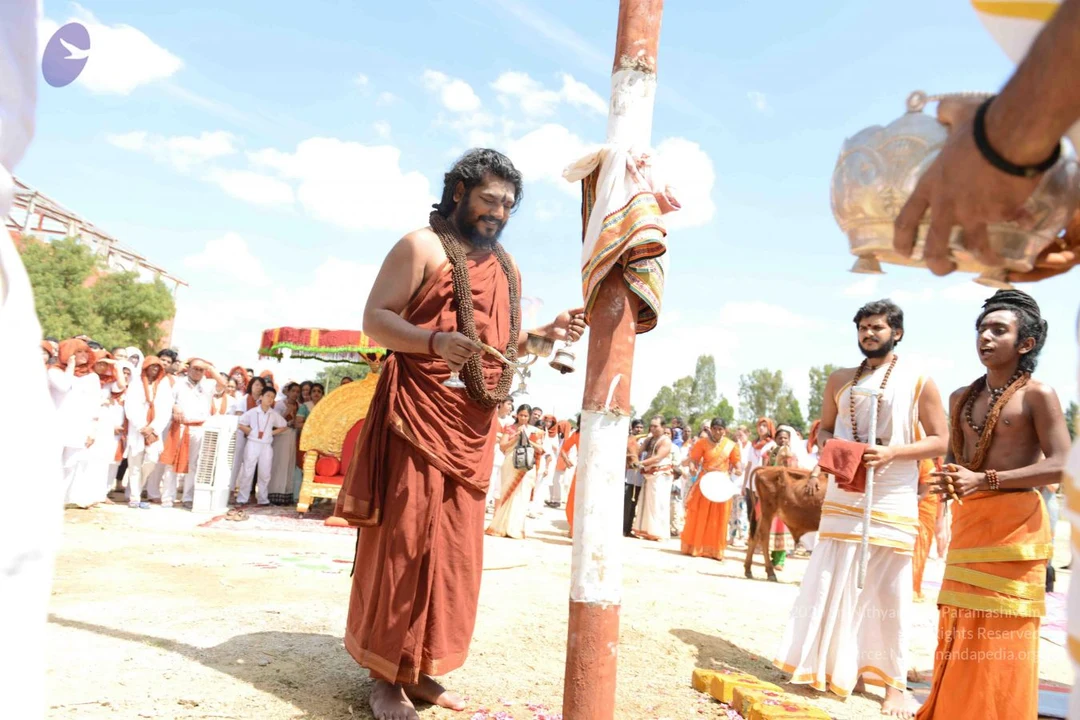
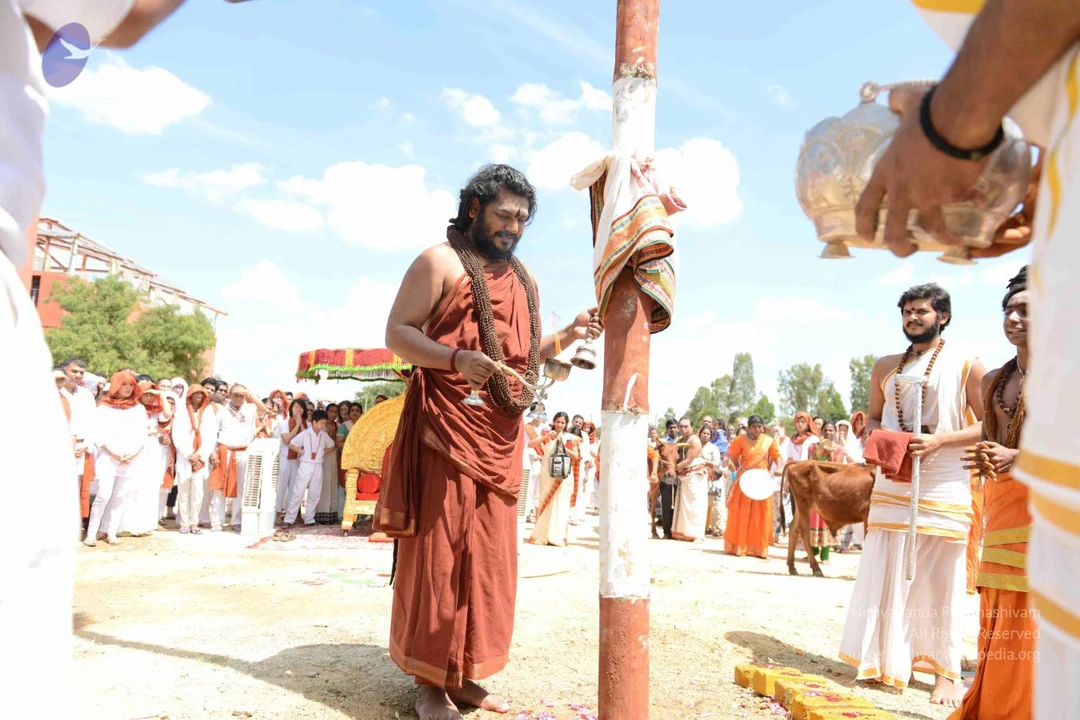
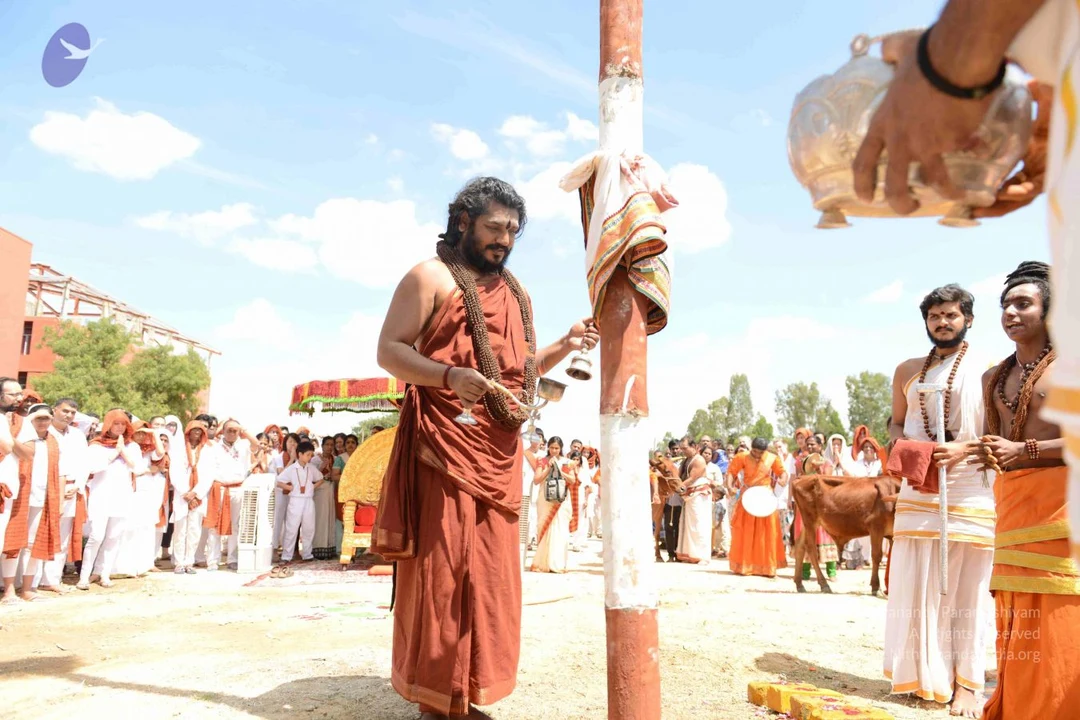
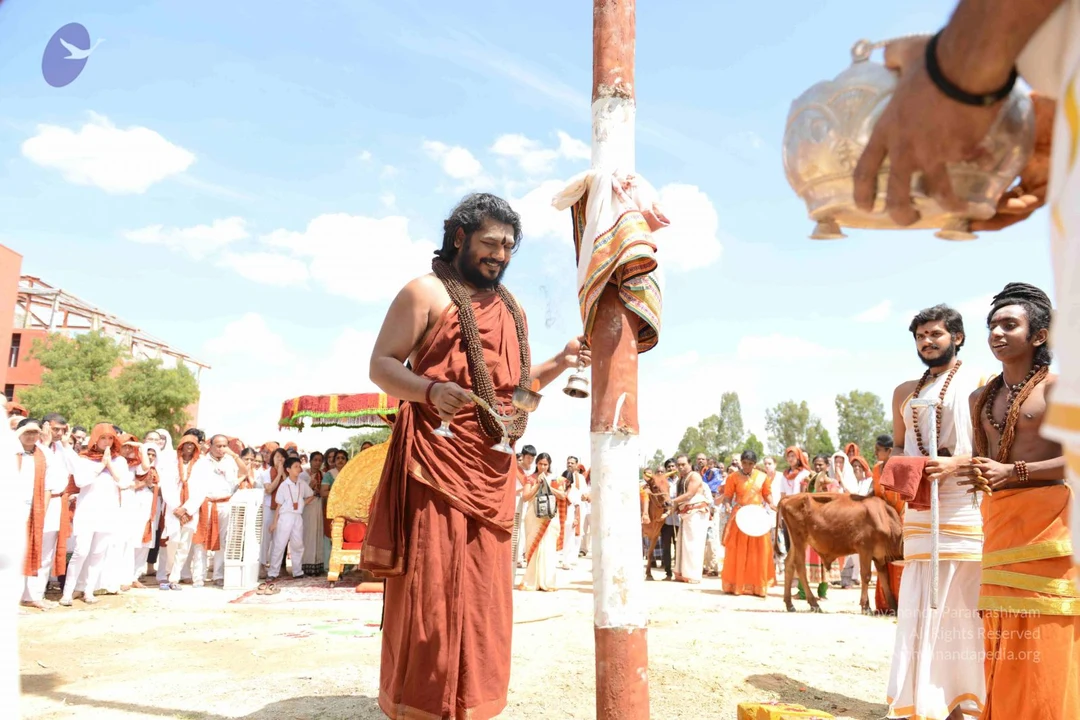
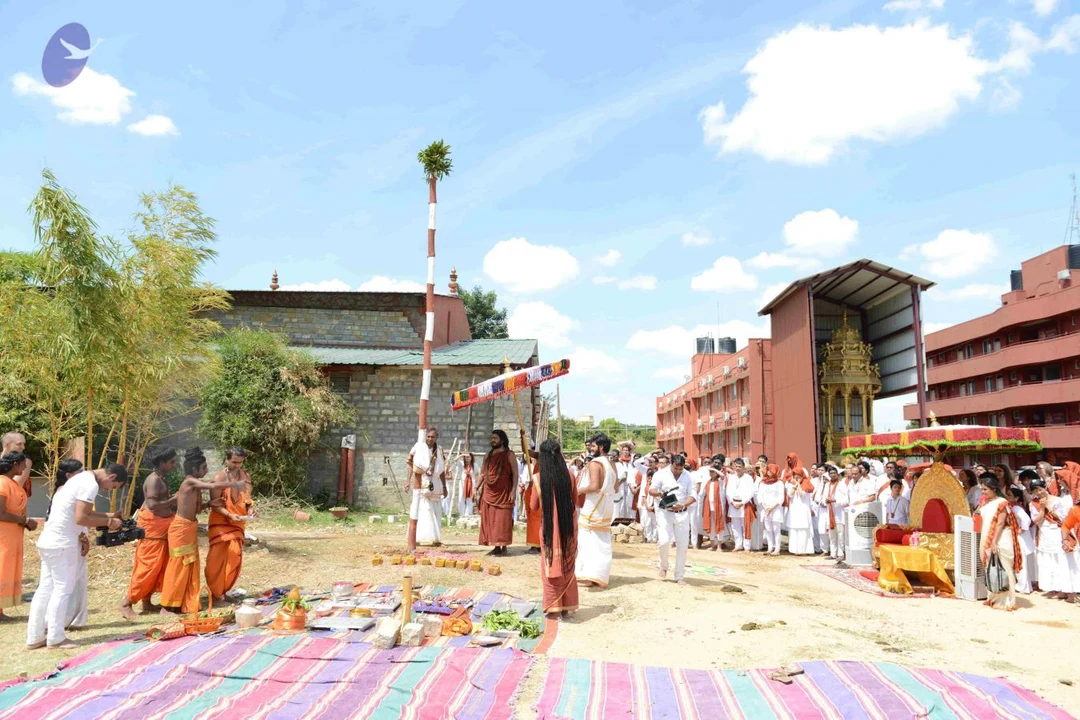
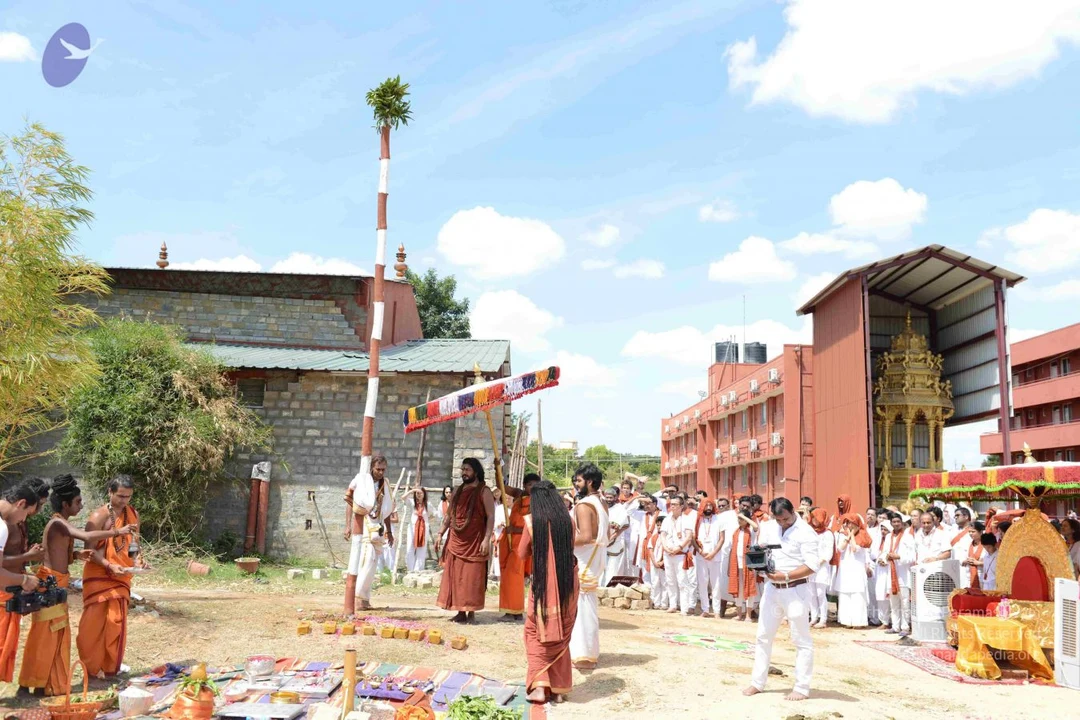
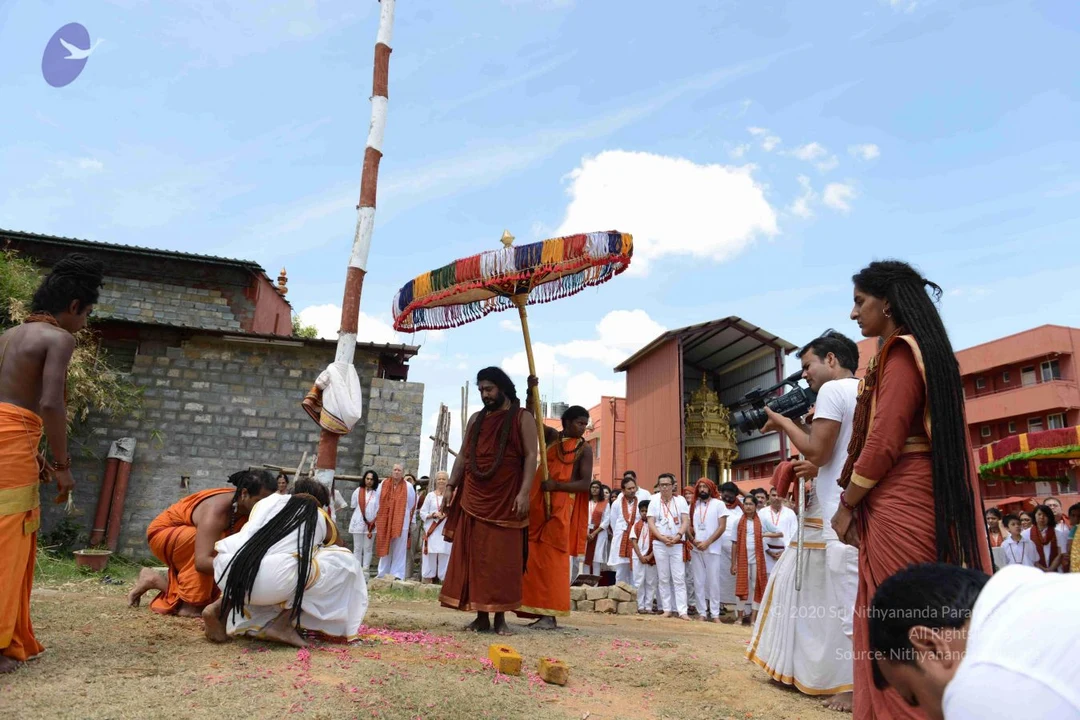
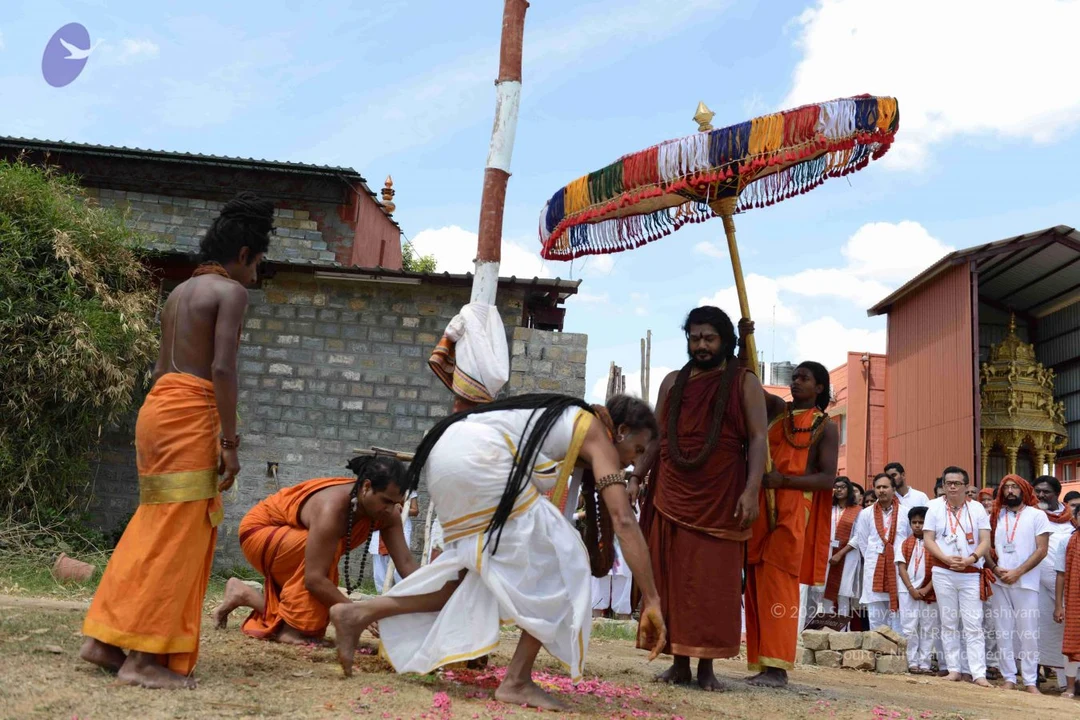
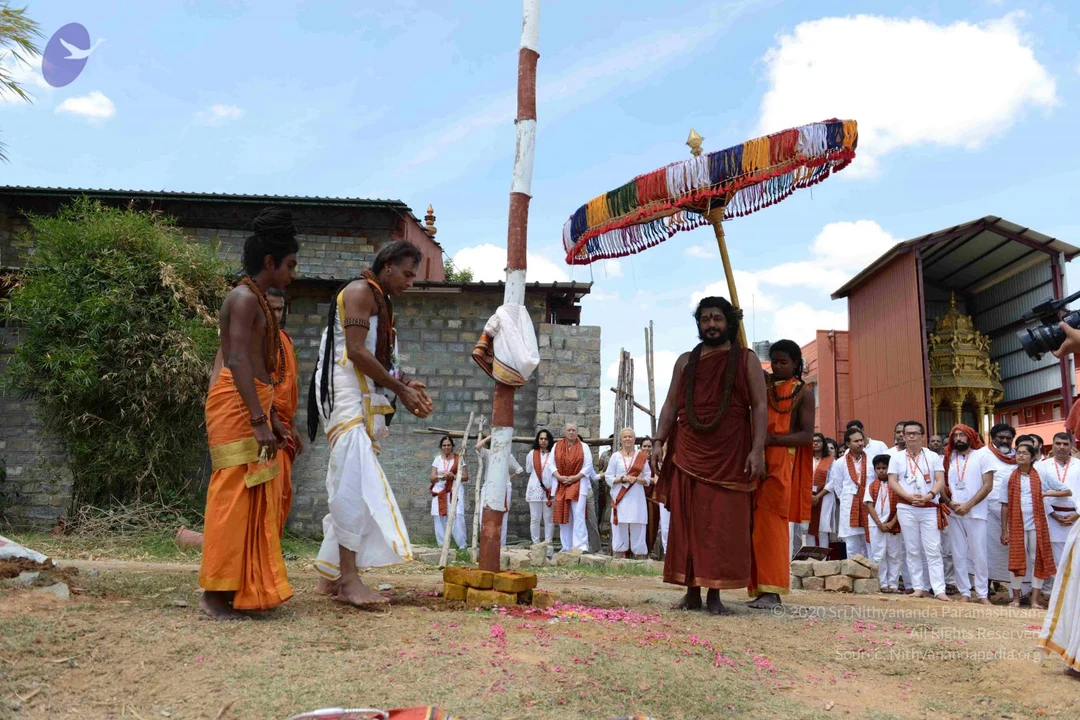
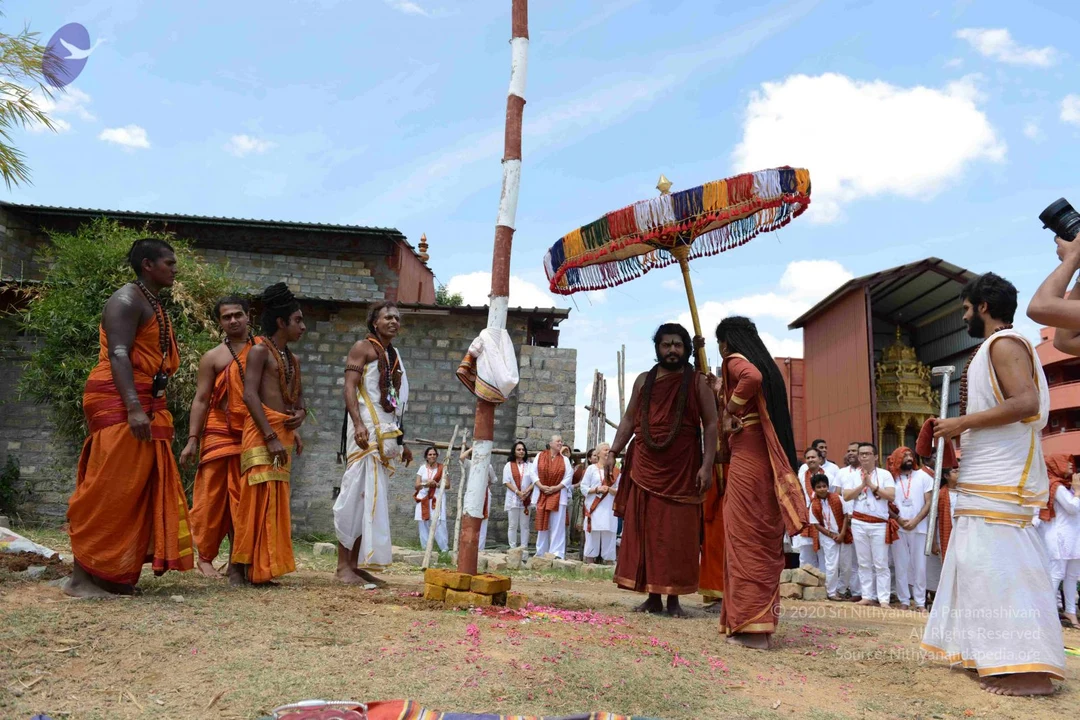
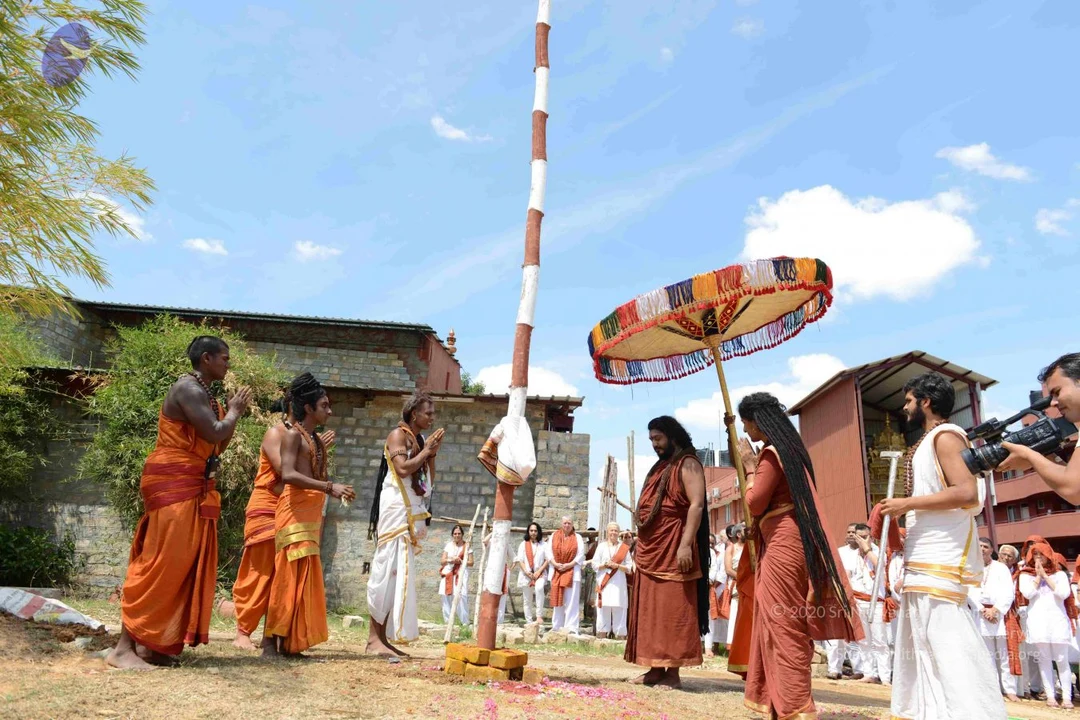
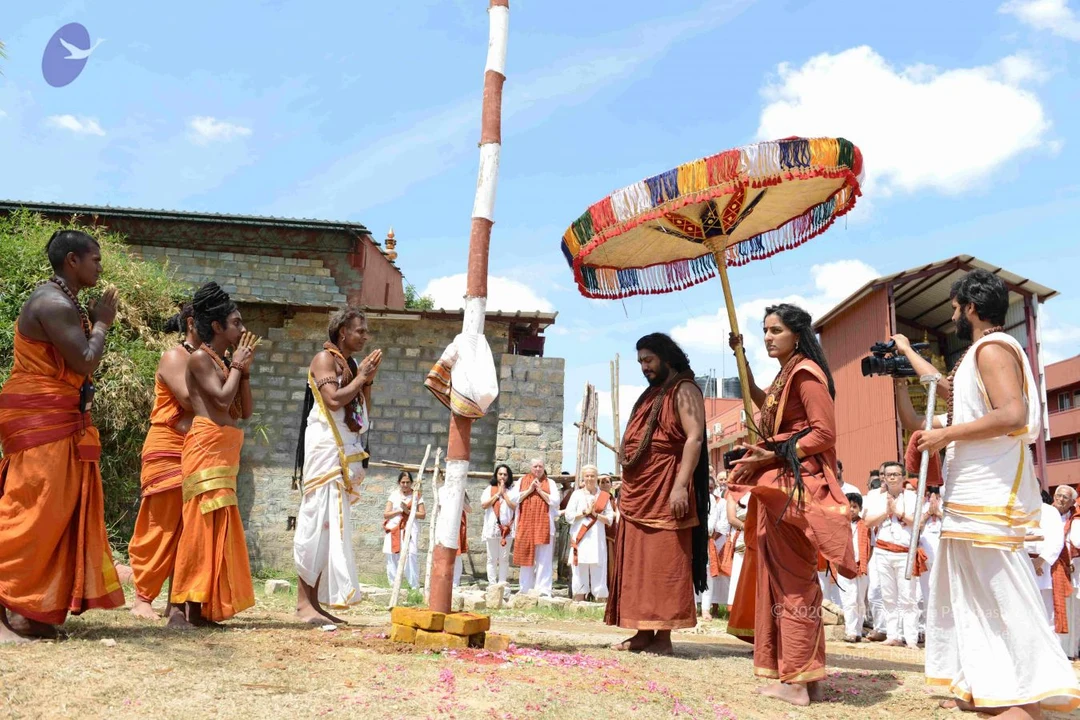
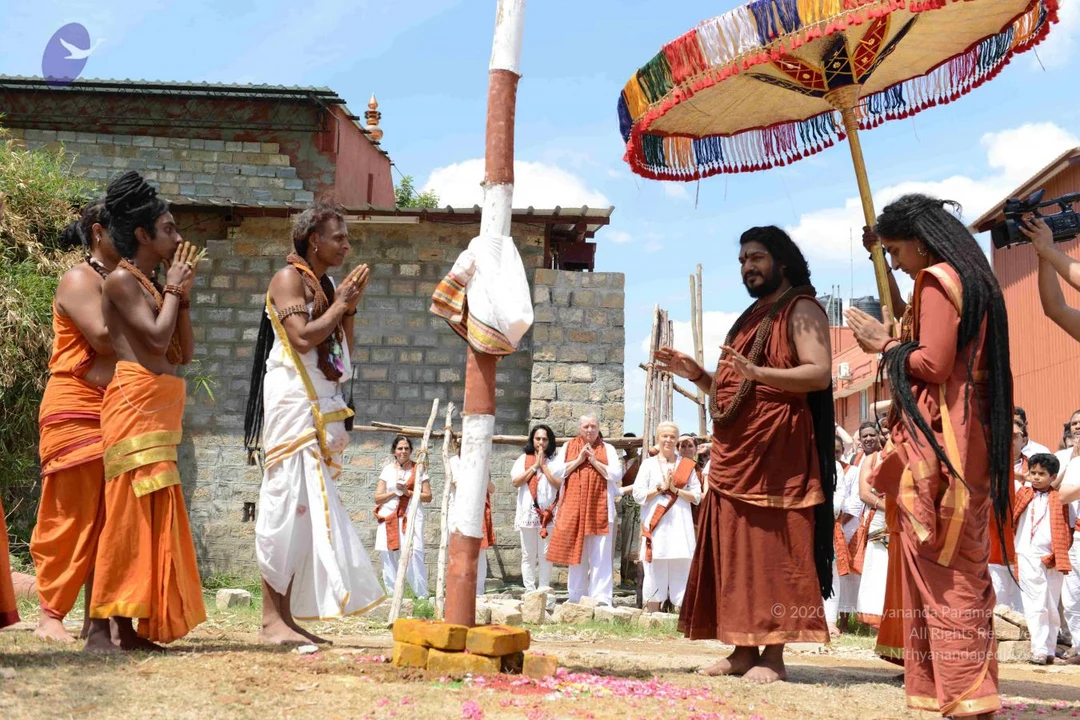
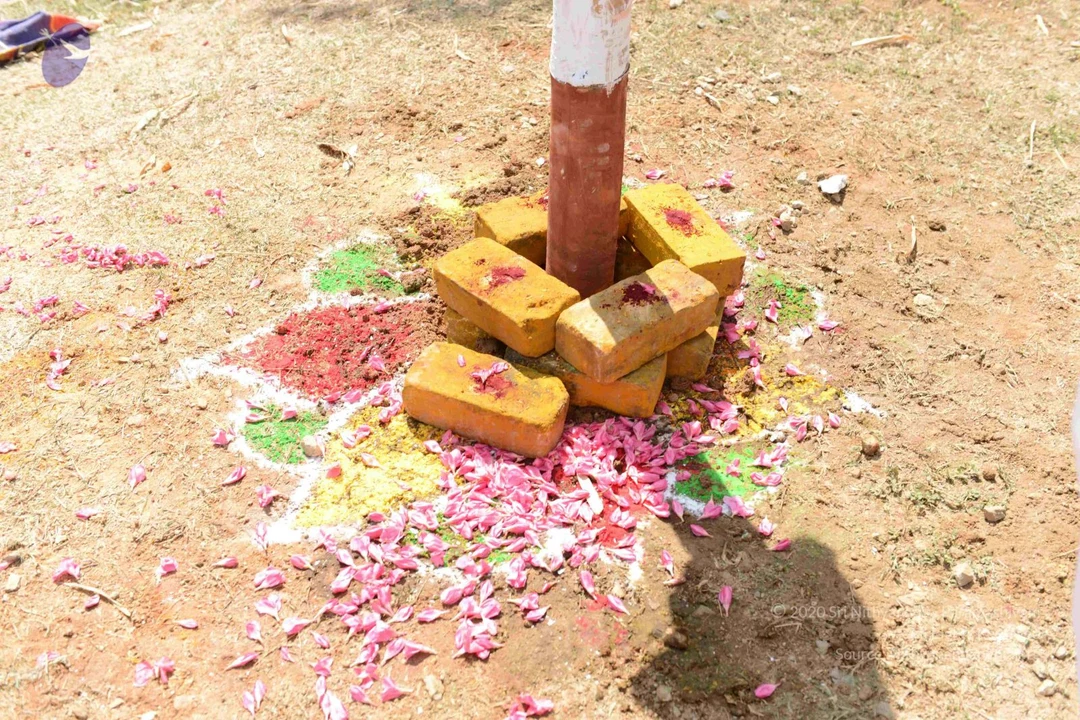
So today we have the pandhakaala utsavam, the inauguration for preparation for Sadashivoham process. It's a traditional process, starting all the work formally for the spiritual alchemy process. You can watch everything live on Nithyananda TV; 11:45 Morning, morning 11:45 Indian standard time. The pandhakaala utsavam starts. Preparation for Sadāshivoham 2016.

With this I bless you all. Let's all radiate with Integrity, Authenticity, Responsibility and Enriching, Causing Living Shuddhadvaita Saivam the eternal Bliss. Nithyananda. Thank you. Be Blissful.

Title

Acknowledge the Source || Part 1 || IA || 6 Oct 2016

Description

Name Of The Convention : Inner Awakening Title : Acknowledge the Source Part 1 Date : 06 October 2016 Venue : Adi Kailasa, Bengaluru, Karnataka, India

In this video, the Supreme Pontiff of Hinduism HDH #Nithyananda speaks to the delegates of the Inner Awakening convention in October 2016, and answers some of their questions. We specifically hear about the importance and high regard in which the ancient scriptures are held in Hinduism, and everything that His Divine Holiness does, is supported by a scriptural reference. Swamiji speaks about why it is imperative that deep regard and respect is given to these scriptures – they must be acknowledged as they have provided, and will continue to provide, for years to come.

The Supreme Pontiff of Hinduism Jagatguru Mahasannidhanam His Divine Holiness Nithyananda Paramashivam (HDH) is the reviver of #KAILASA - the ancient enlightened civilization and the great cosmic borderless Hindu nation. Revered as the incarnation of Paramashiva - the primordial Hindu Divinity, HDH has a following of 2 billion Hindus worldwide with de facto spiritual embassies in over 150 countries. He has worked untiringly for over 26 years for the revival of Kailasa, for global peace and to give super conscious breakthrough to humanity. He has survived the worst persecution of multiple assassination attempts on person and on character by anti-Hindu elements. He is collecting, organising, preserving, time capsuling, decoding, spreading and reviving 20 Million source books of Hinduism and the 64 sacred arts & sciences like Ayurveda, music, dance, sculpting, astrology, vastu and much more. Close to 20,000 hours of HDH’s timeless talks have been recorded till date (Sep 2020), which are a treasure trove of powerful cognitions to solve individual and global problems of any kind.

Link to Video:

Title

Acknowledge the Source || Part 2 || IA || 6 Oct 2016

Description

Name Of The Convention : Inner Awakening Title : Acknowledge the Source Part 2 Date : 06 October 2016 Venue : Adi Kailasa, Bengaluru, Karnataka, India

In this video, the Supreme Pontiff of Hinduism HDH #Nithyananda speaks to the delegates of the Inner Awakening convention in October 2016, and answers some of their questions. We specifically hear about the importance and high regard in which the ancient scriptures are held in Hinduism, and everything that His Divine Holiness does, is supported by a scriptural reference. Swamiji speaks about why it is imperative that deep regard and respect is given to these scriptures – they must be acknowledged as they have provided, and will continue to provide, for years to come.

The Supreme Pontiff of Hinduism Jagatguru Mahasannidhanam His Divine Holiness Nithyananda Paramashivam (HDH) is the reviver of #KAILASA - the ancient enlightened civilization and the great cosmic borderless Hindu nation. Revered as the incarnation of Paramashiva - the primordial Hindu Divinity, HDH has a following of 2 billion Hindus worldwide with de facto spiritual embassies in over 150 countries. He has worked untiringly for over 26 years for the revival of Kailasa, for global peace and to give super conscious breakthrough to humanity. He has survived the worst persecution of multiple assassination attempts on person and on character by anti-Hindu elements. He is collecting, organising, preserving, time capsuling, decoding, spreading and reviving 20 Million source books of Hinduism and the 64 sacred arts & sciences like Ayurveda, music, dance, sculpting, astrology, vastu and much more. Close to 20,000 hours of HDH’s timeless talks have been recorded till date (Sep 2020), which are a treasure trove of powerful cognitions to solve individual and global problems of any kind.

Link to Video:

Photos From The Day:

Nithya Sankirtan and Satsang

Photos Of The Day:

IA-Q&A

Navaratri-Darbar

Photos Of The Day:

nithya-satsang

sadashivoham2016-inauguration

Photos Of The Day:

01--IA-QandA

20161006_Photo_1000_DSC_0366_CMP_WM Done

02--Navaratri-Darbar

Photos from this day

View all 310 photos

Nithya Sankirtan and Satsang
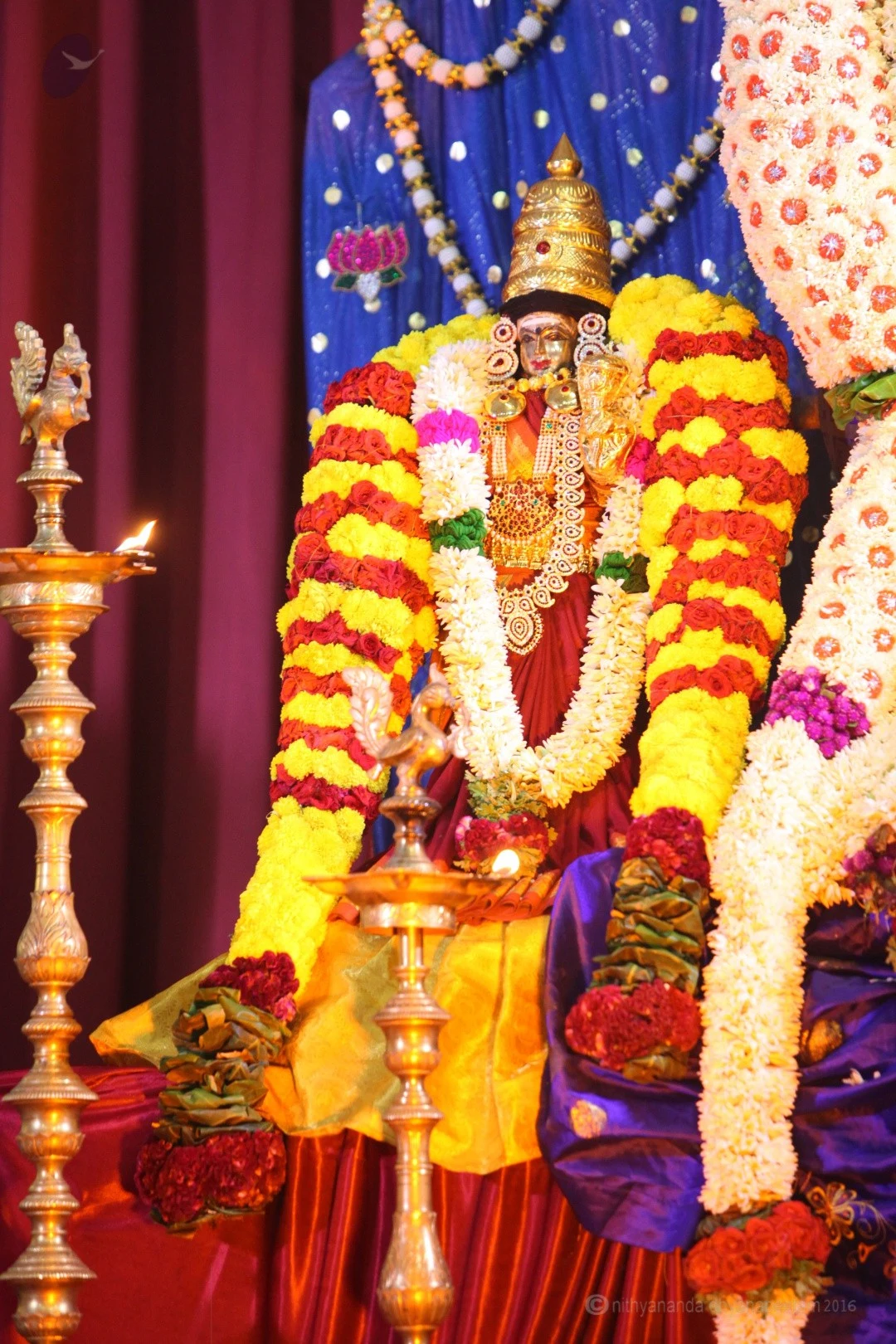
7 photosSource gallery
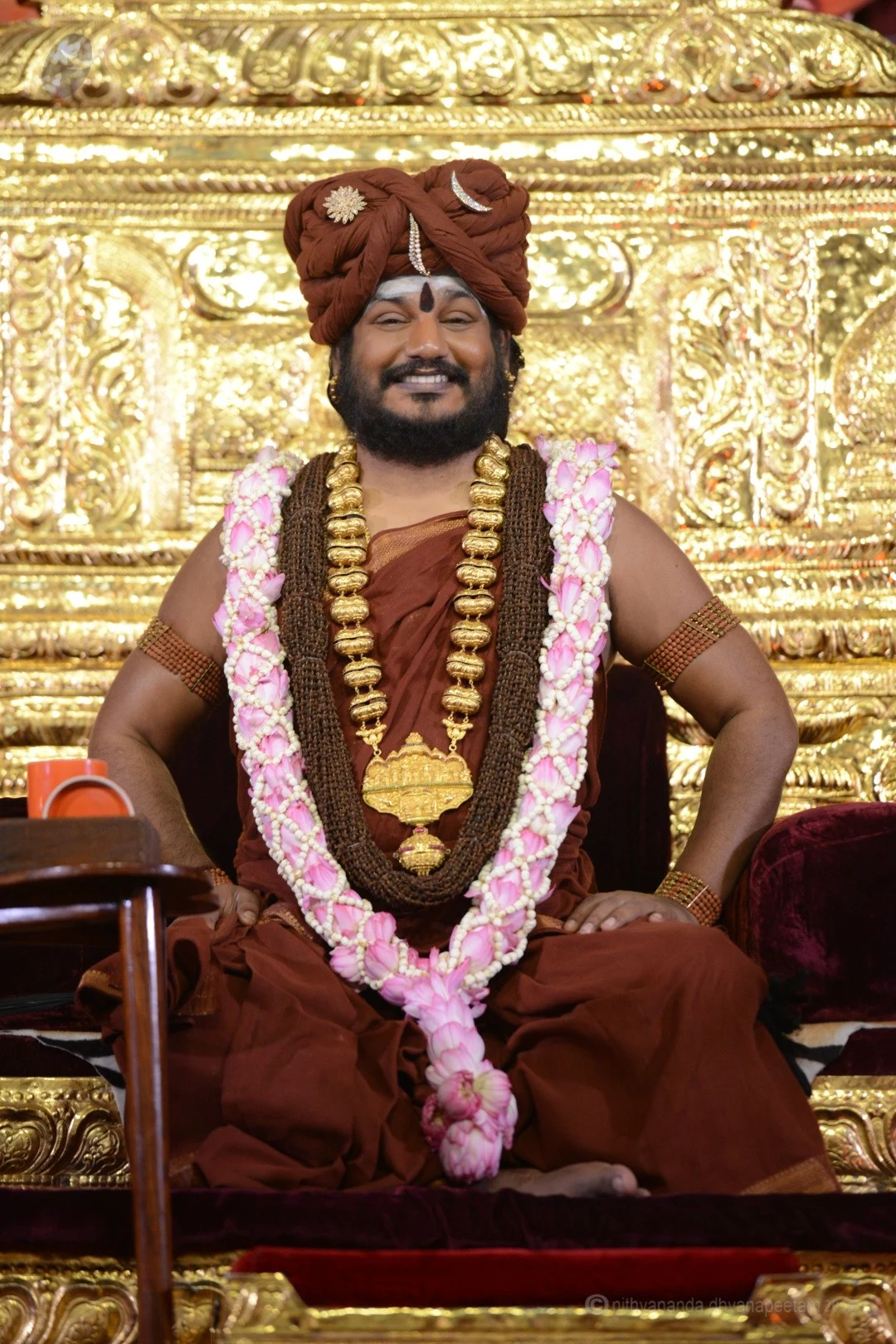
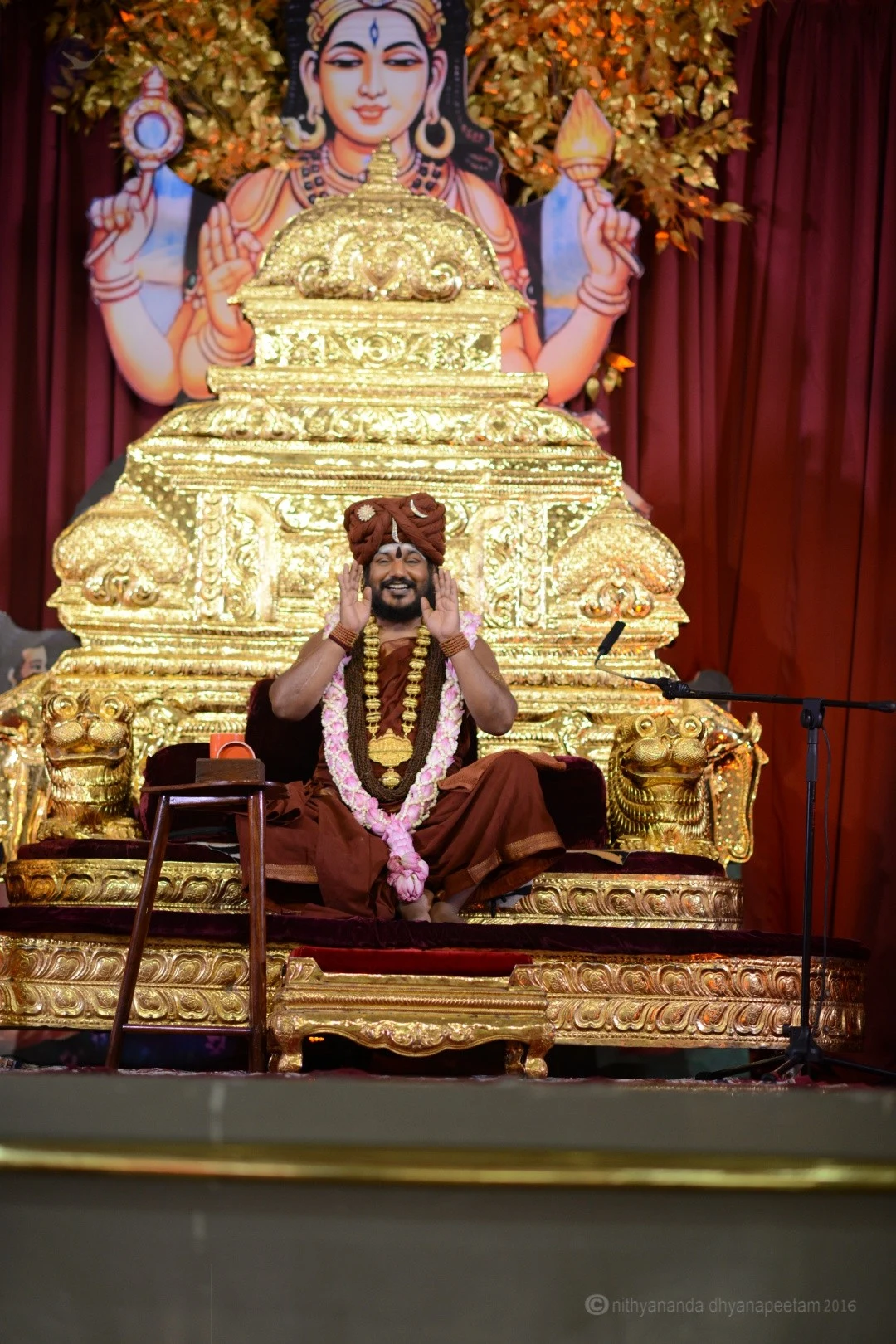
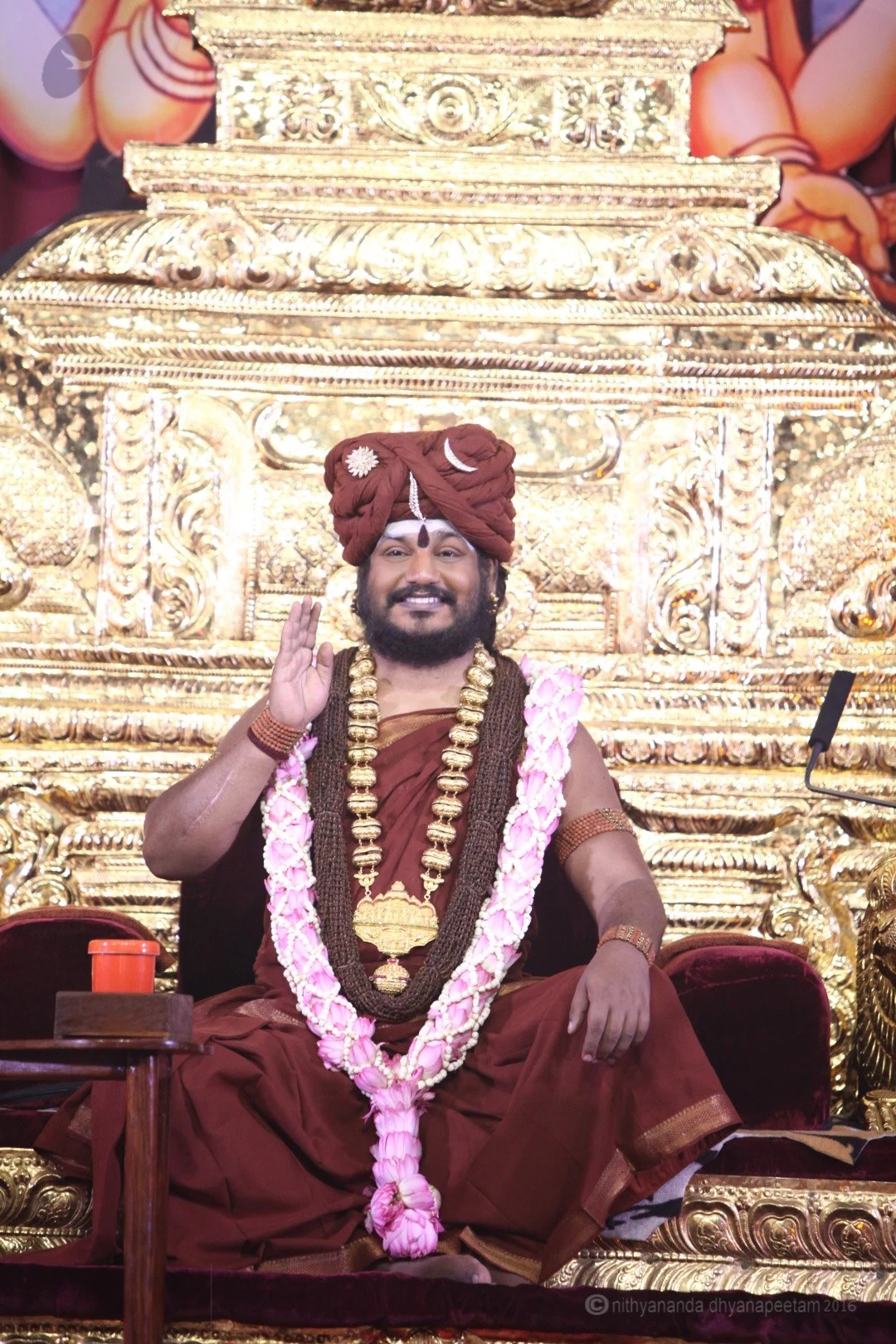
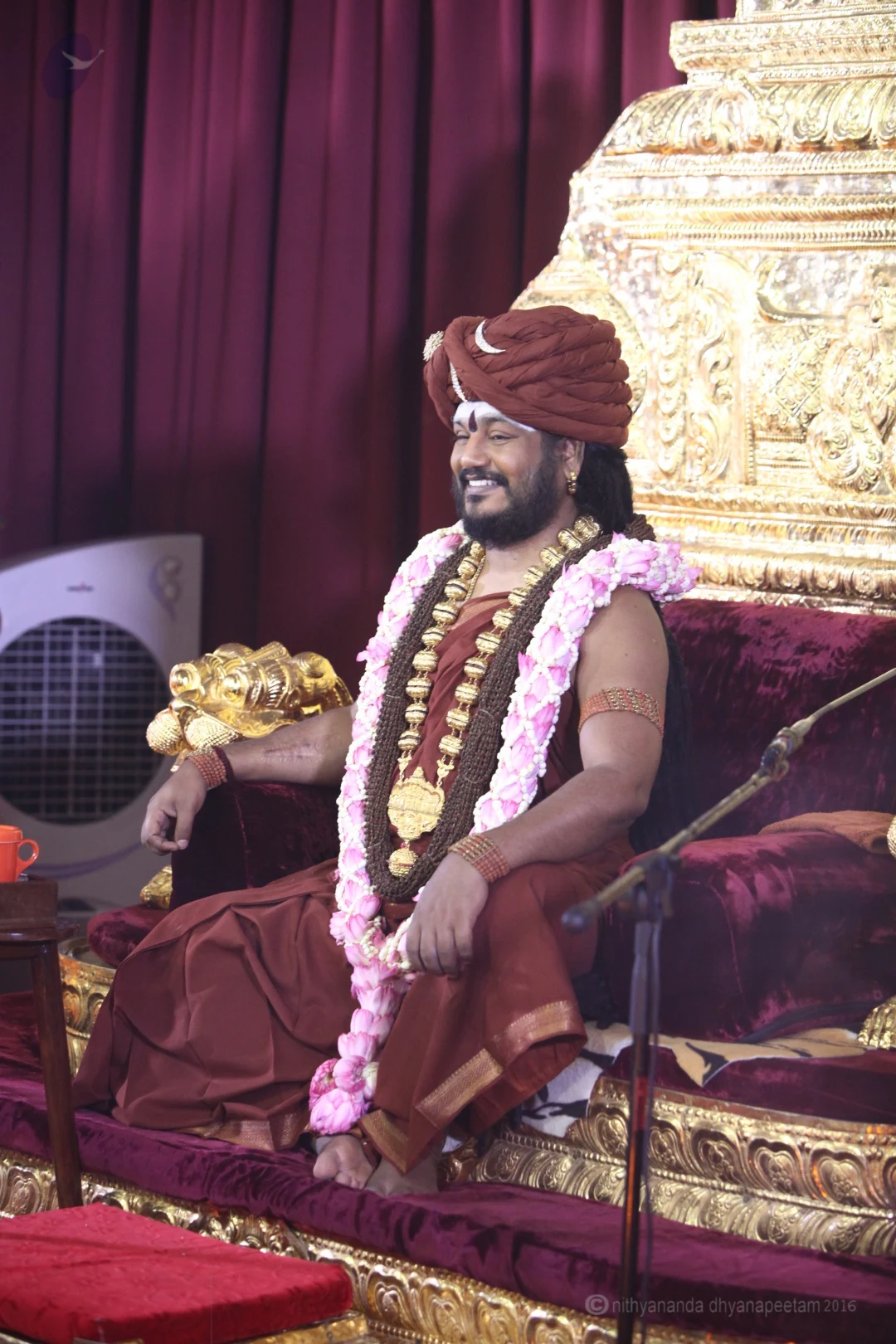
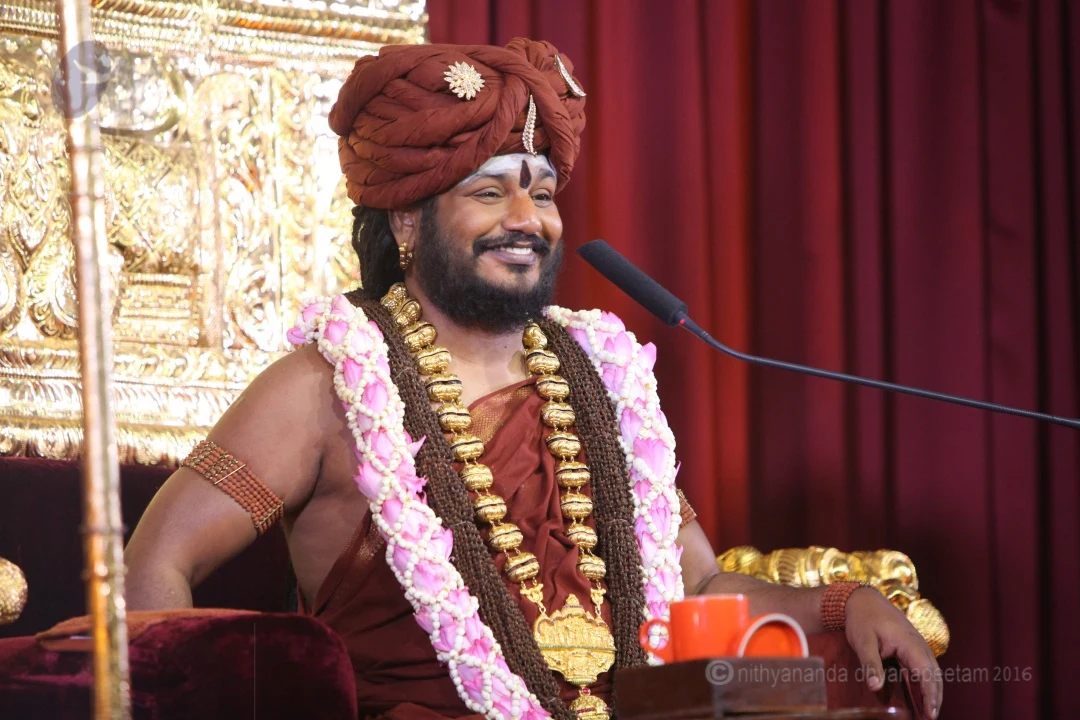
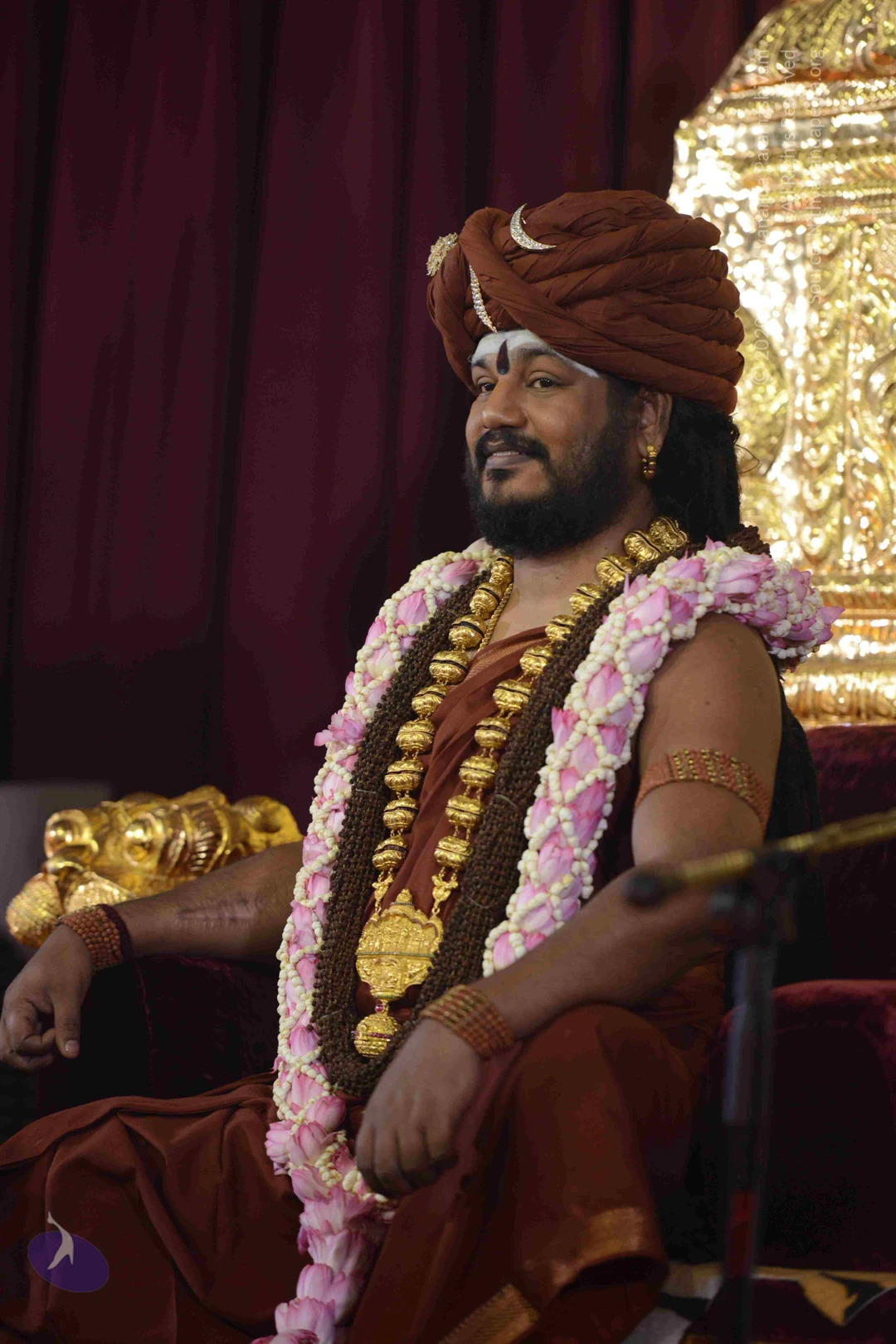
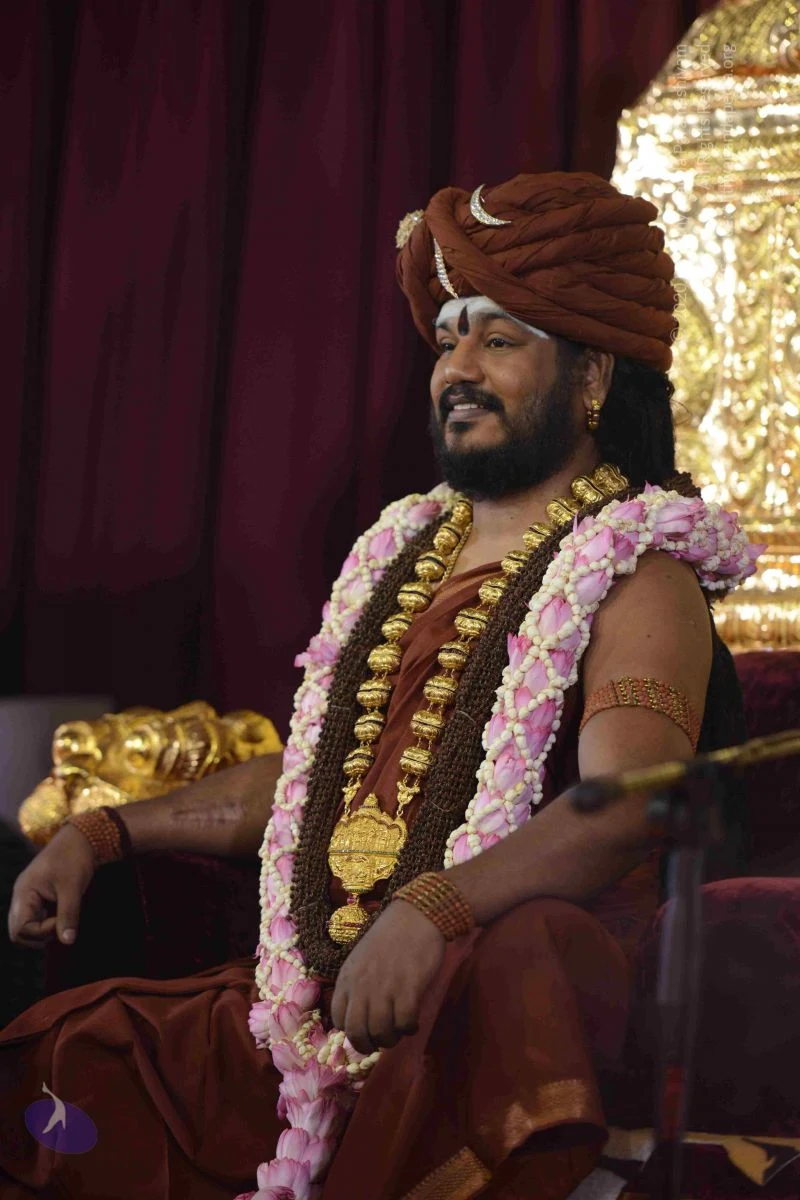
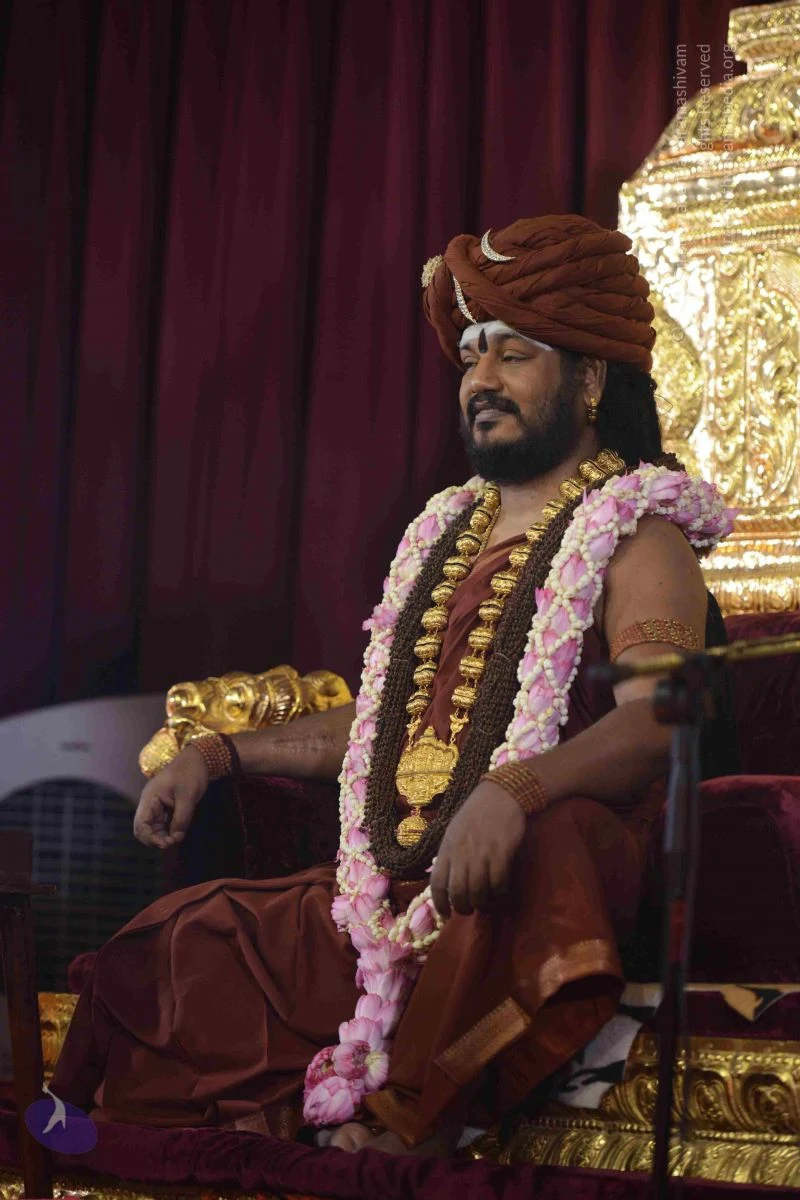
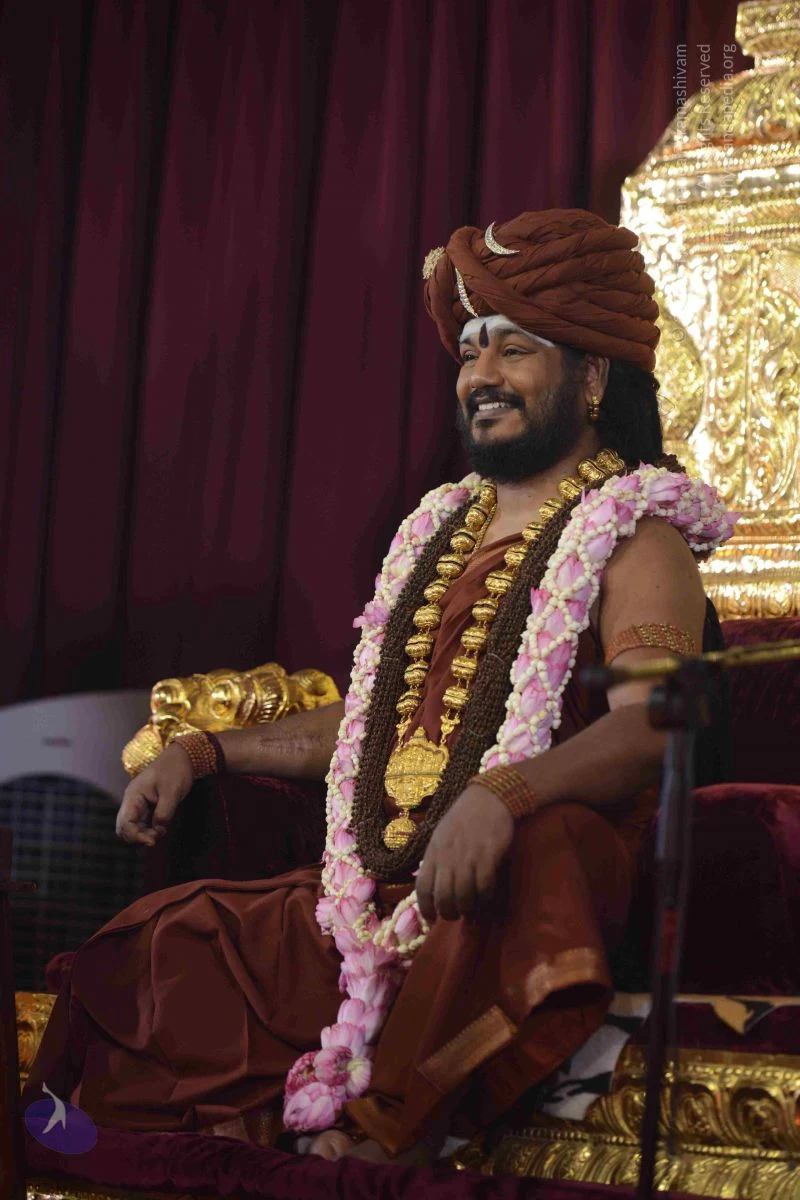
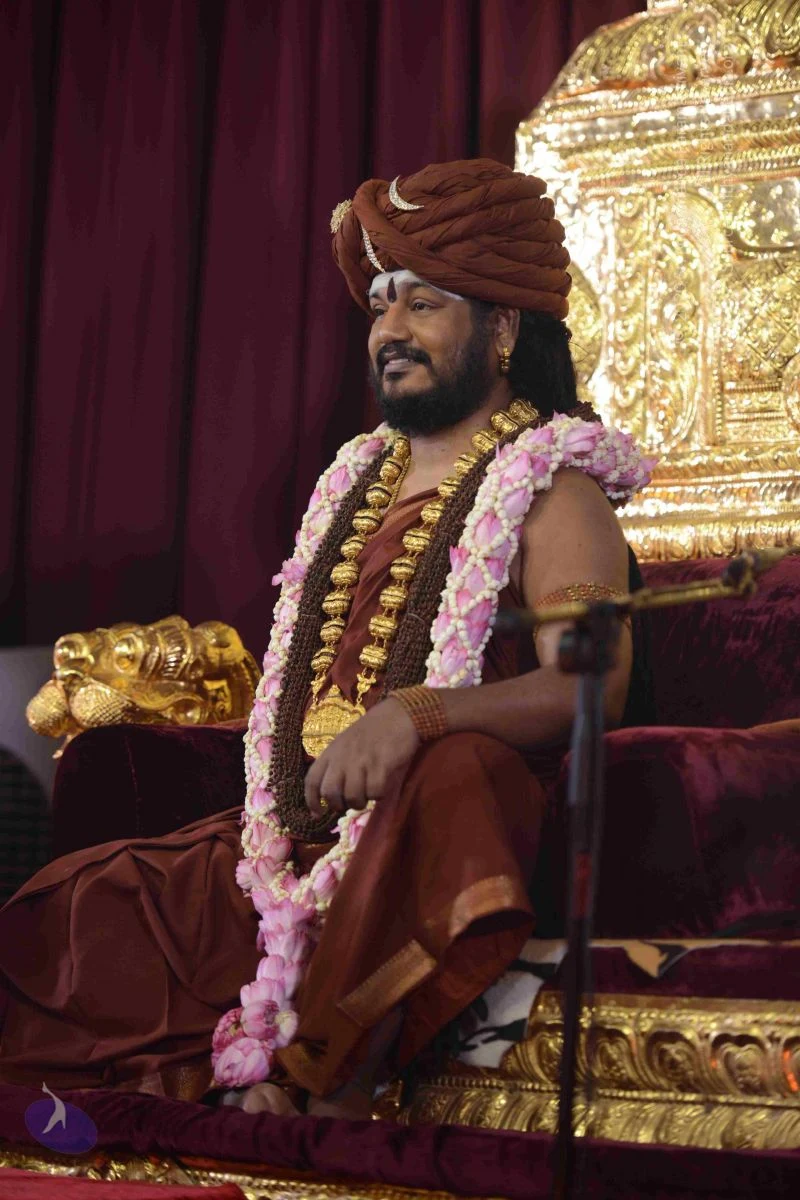
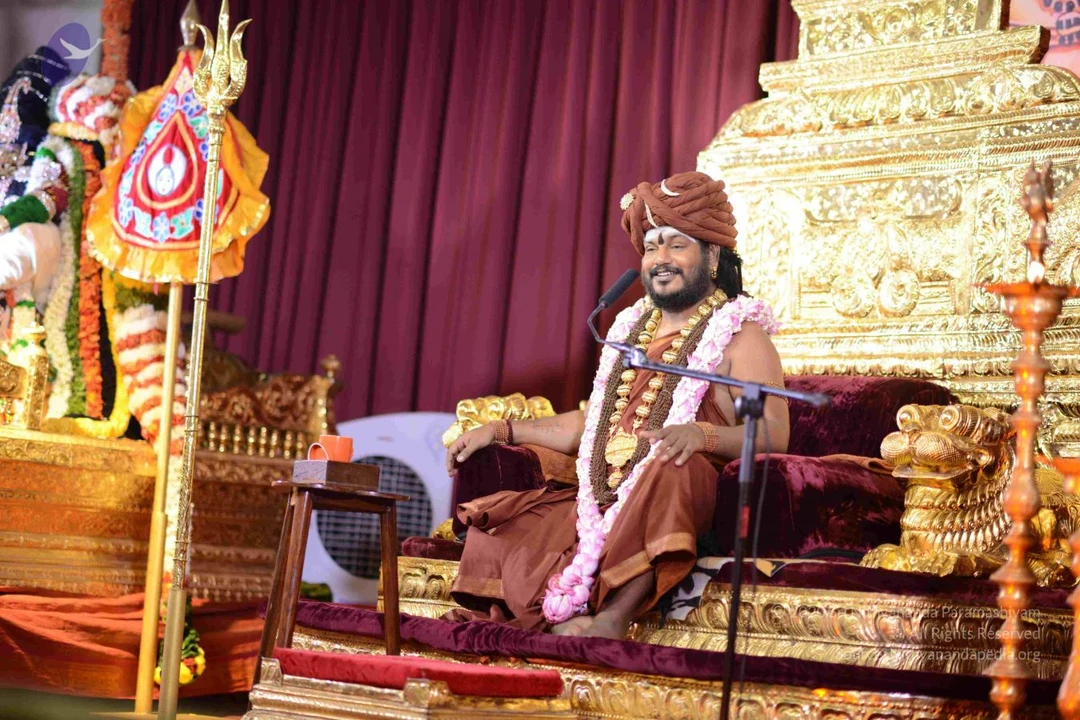
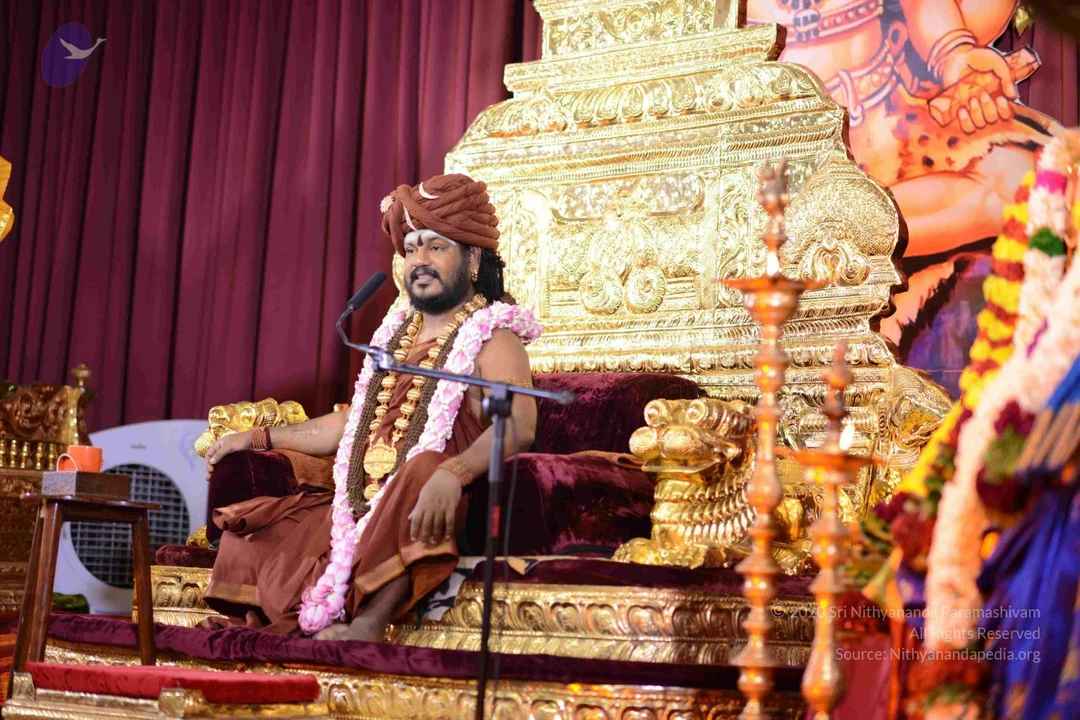
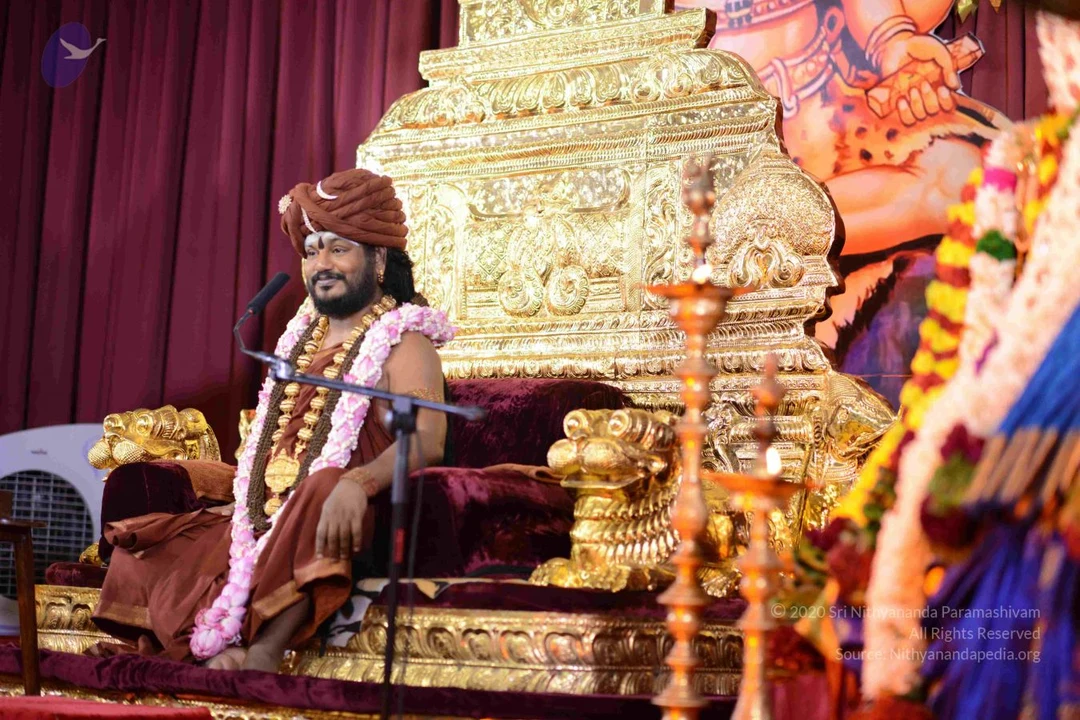
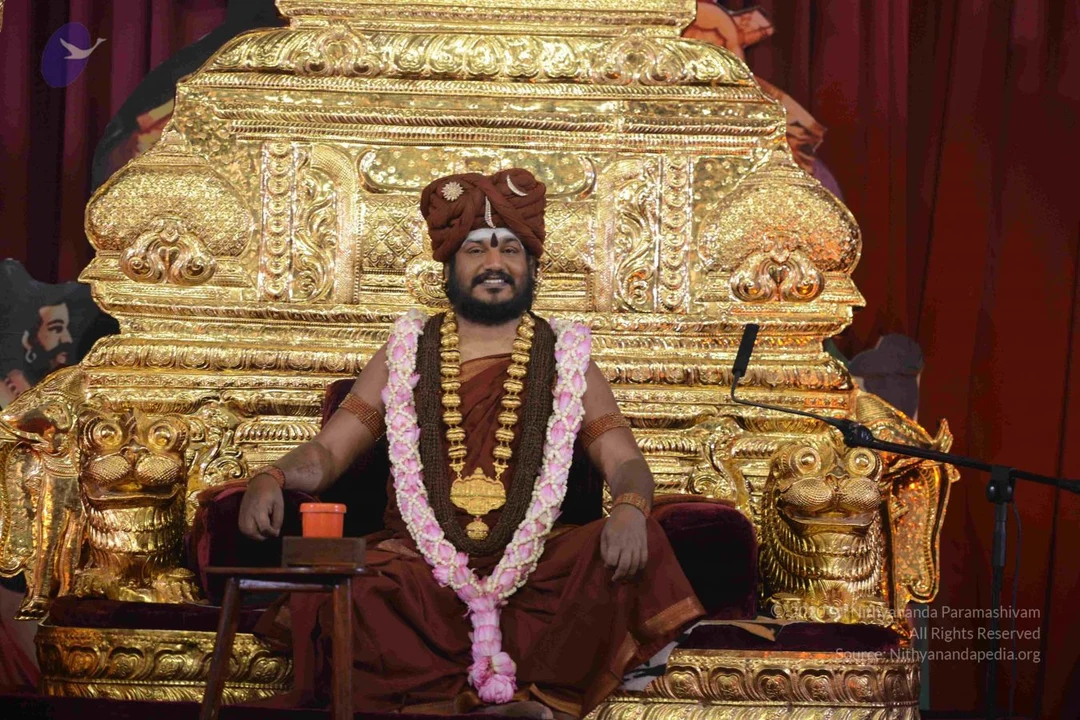
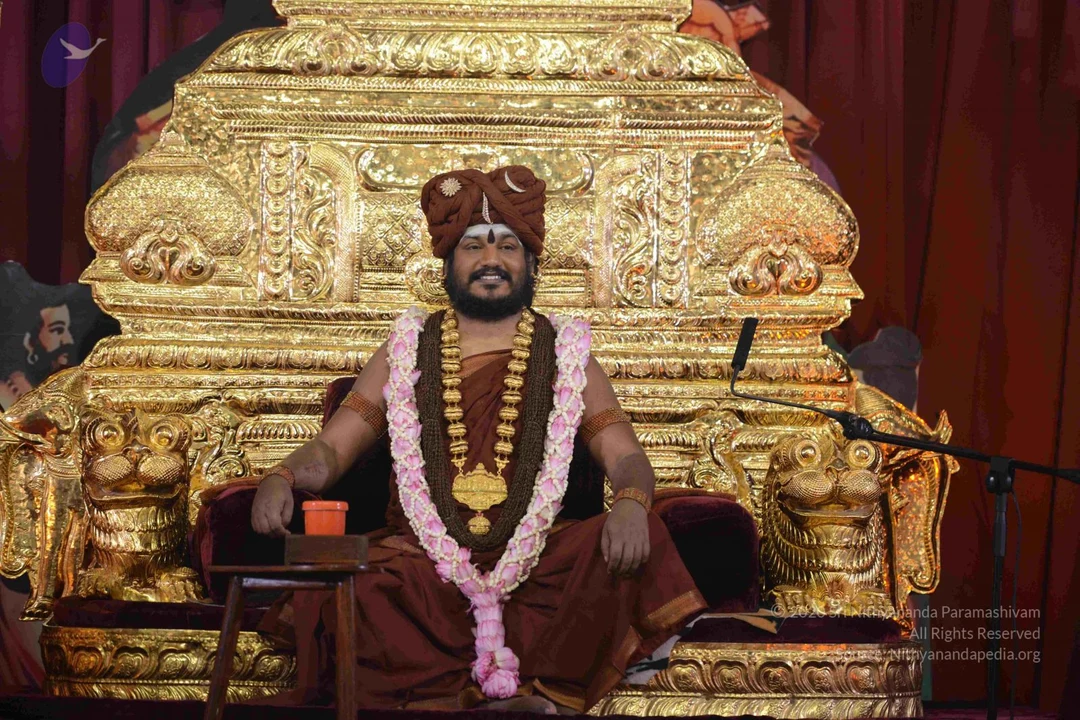
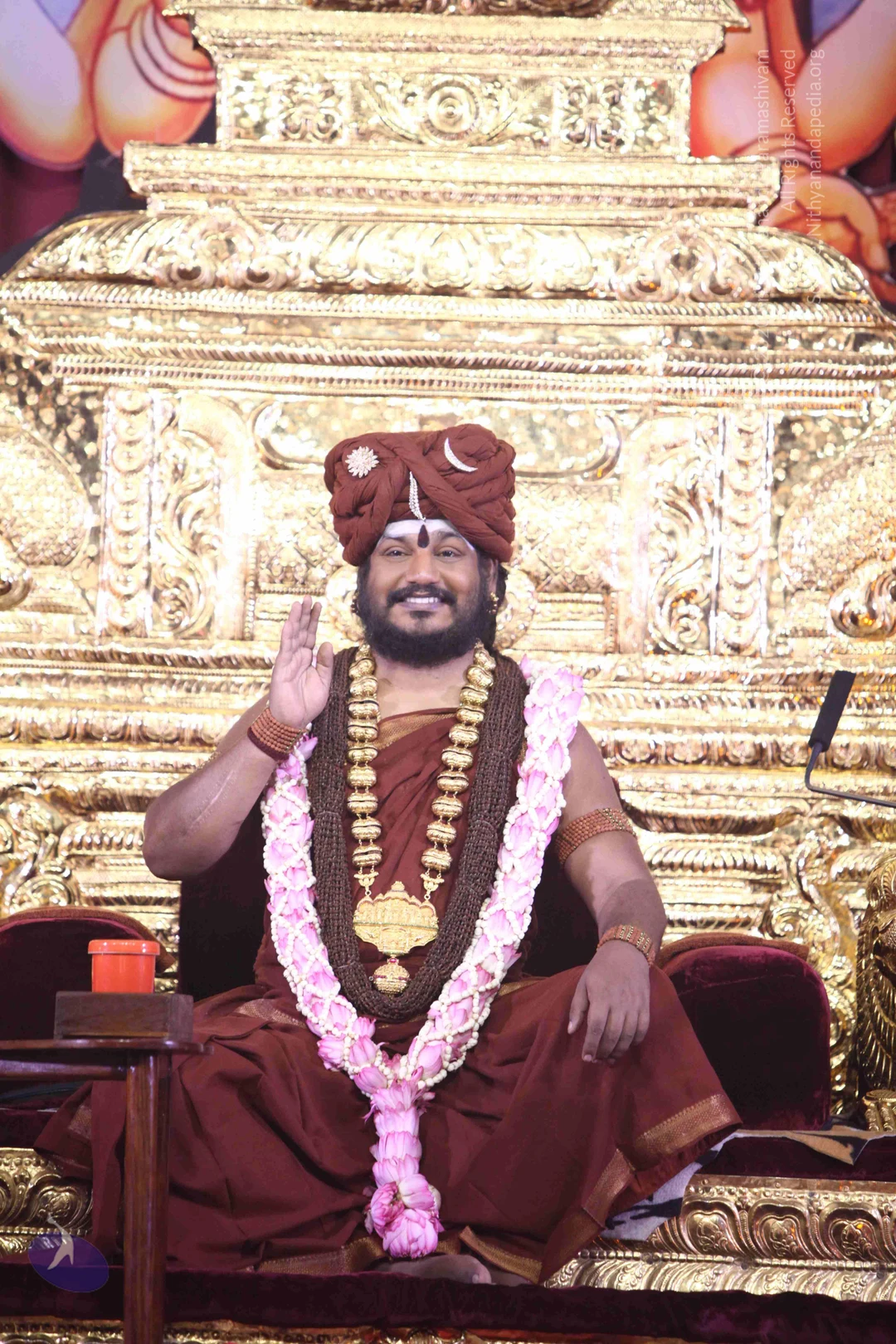
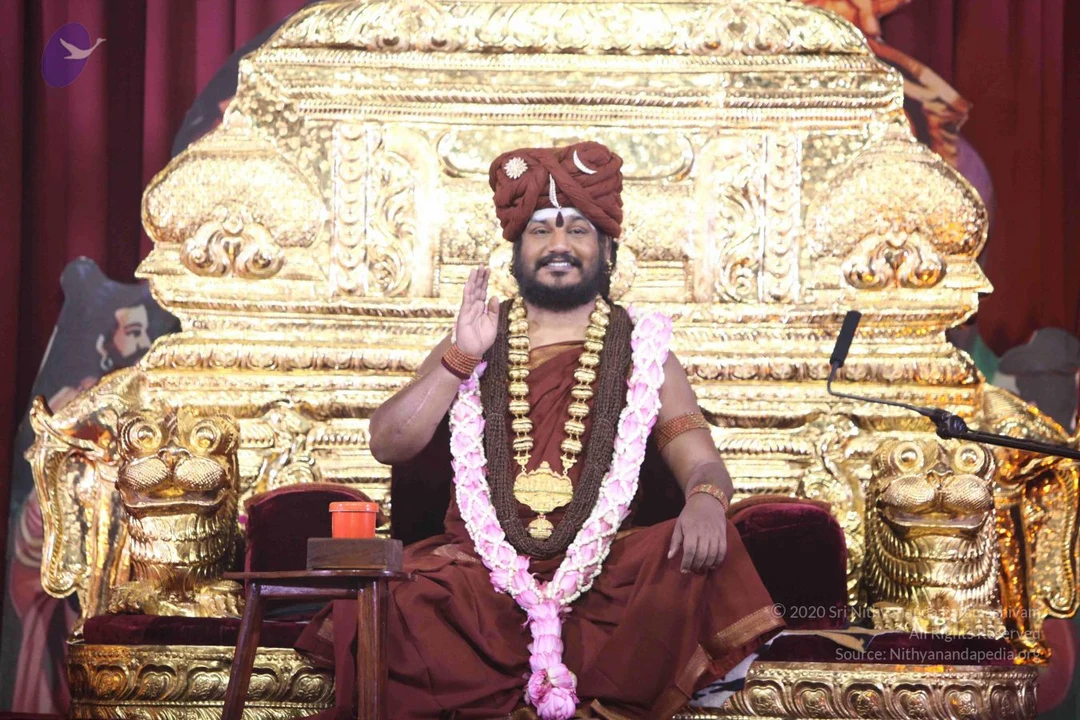
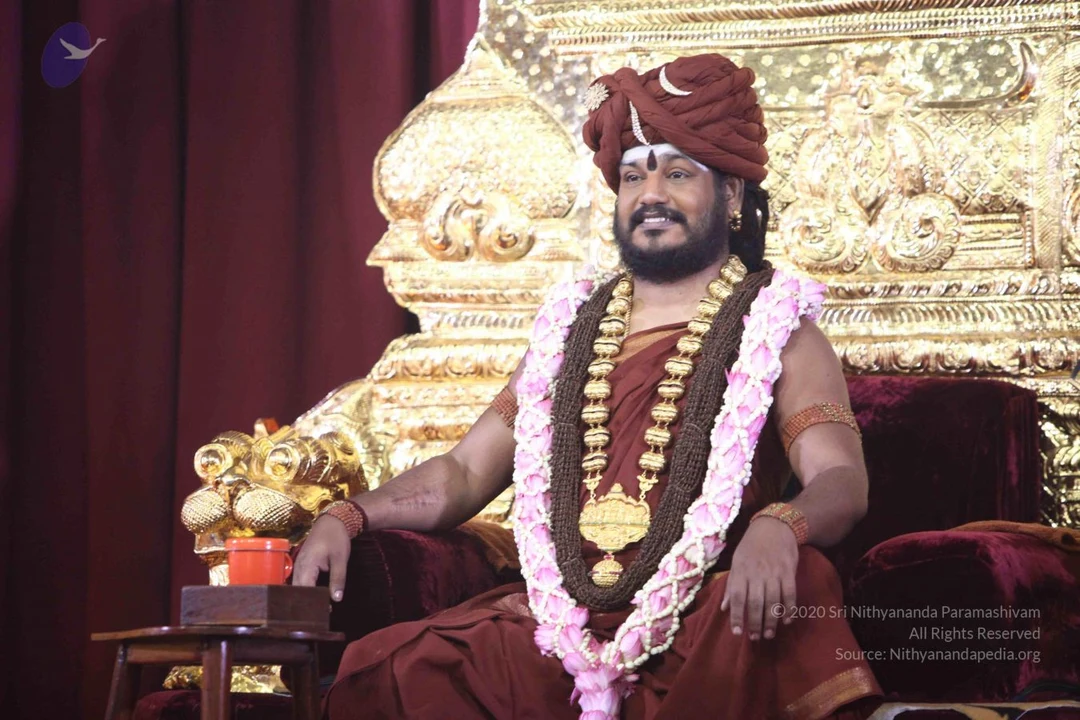
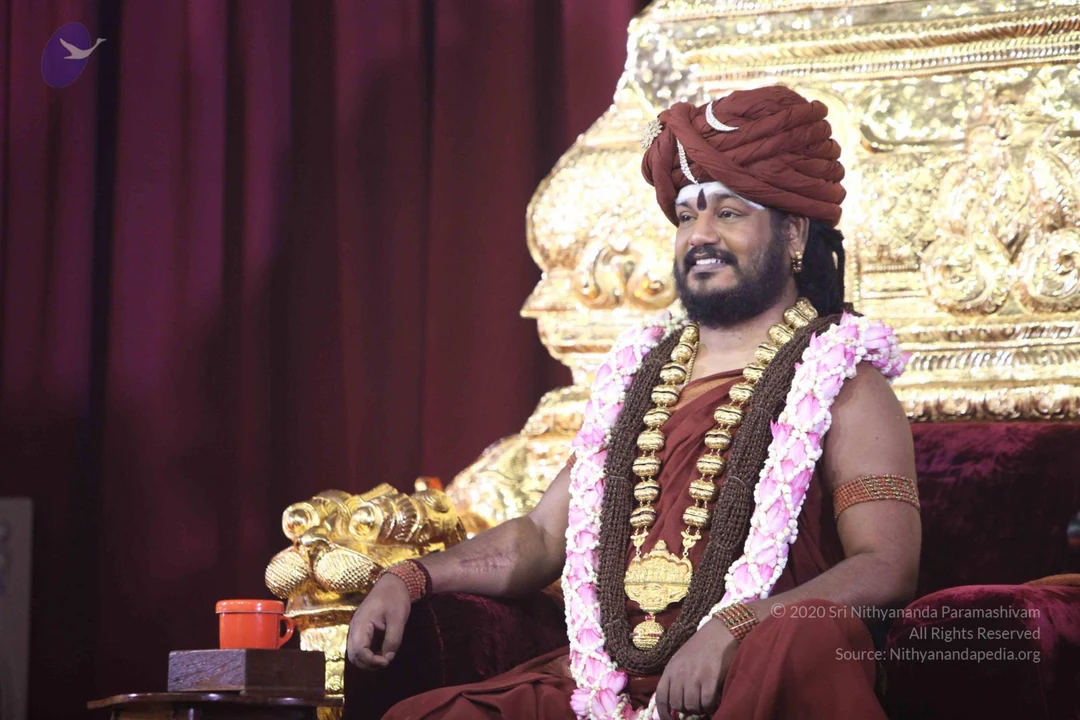
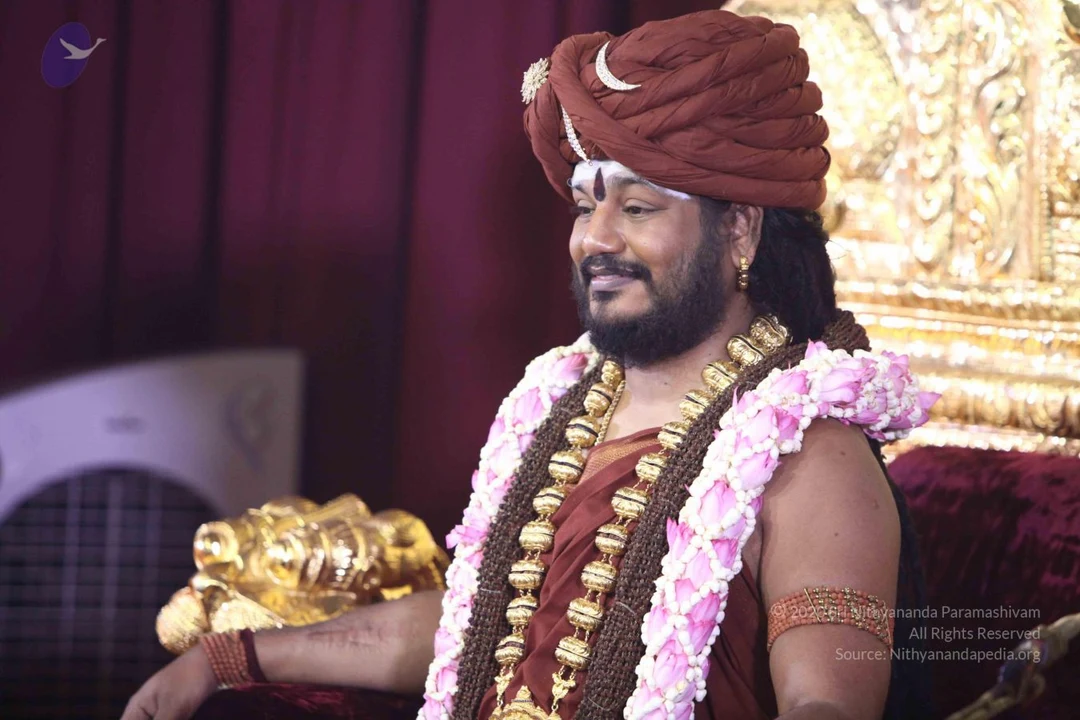
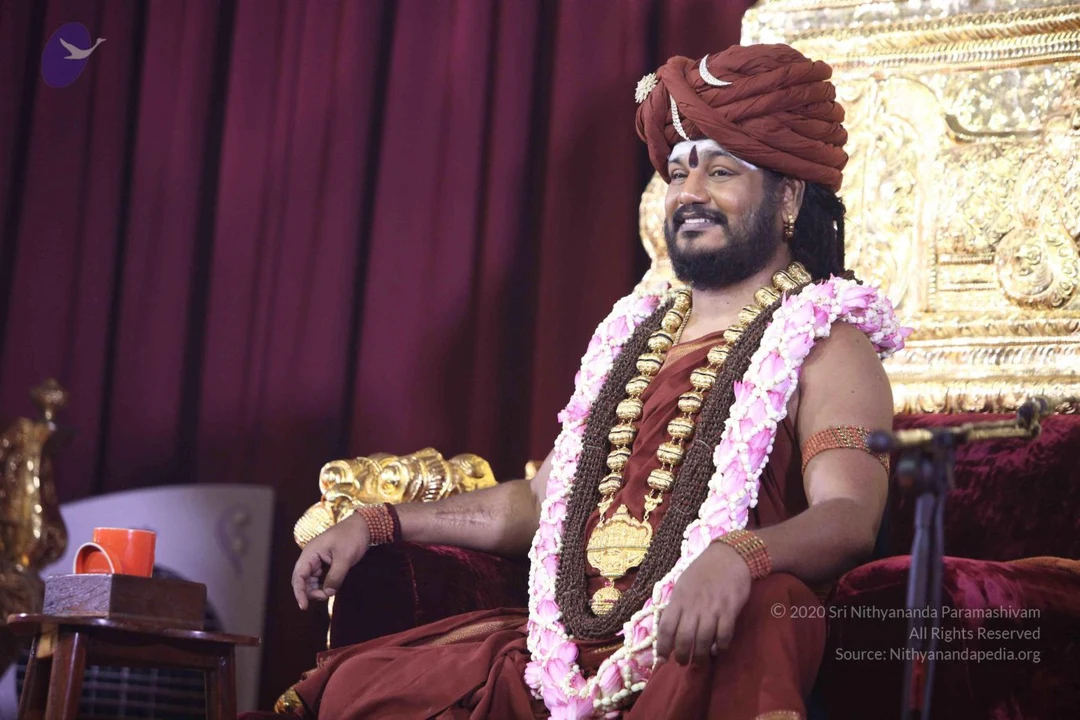
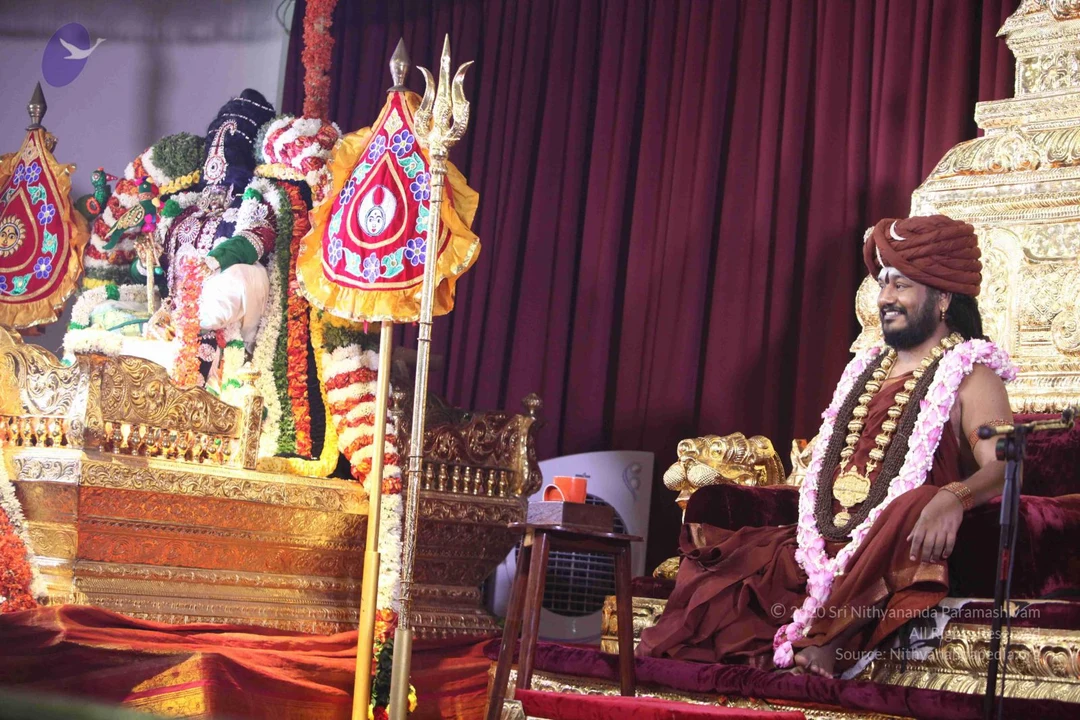
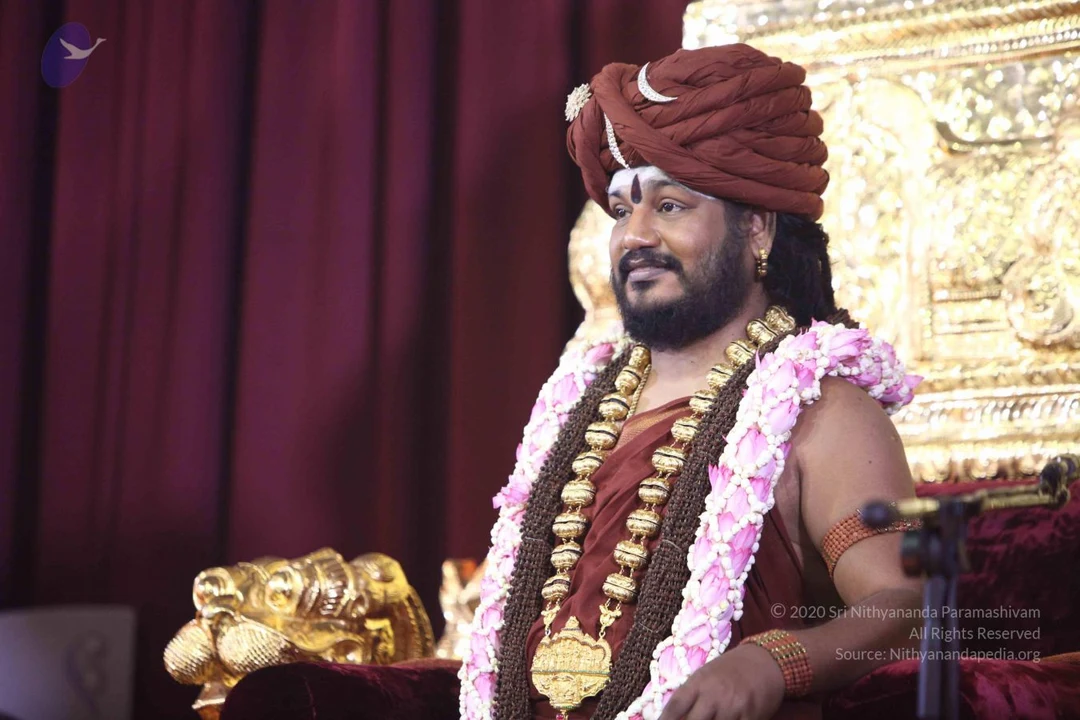
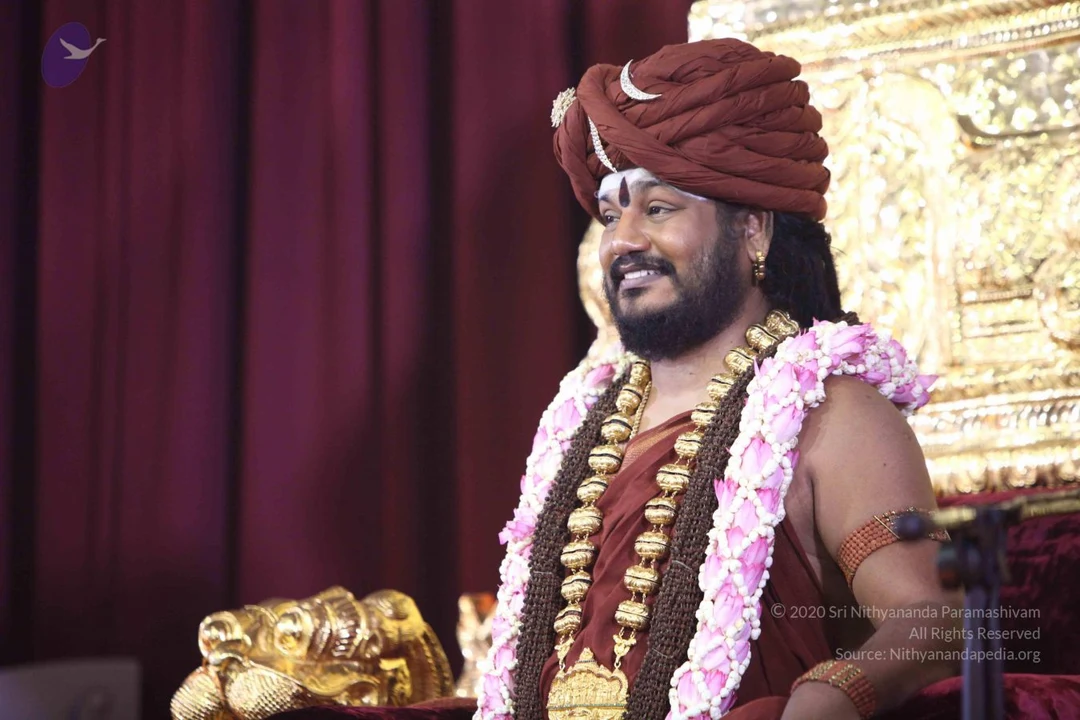
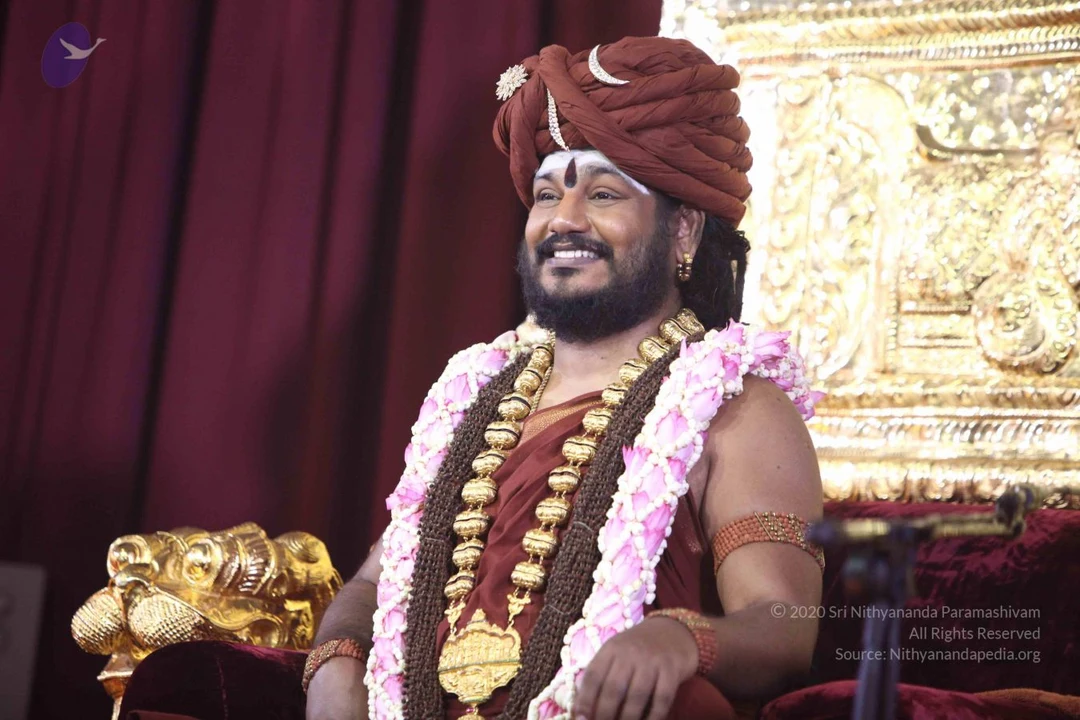
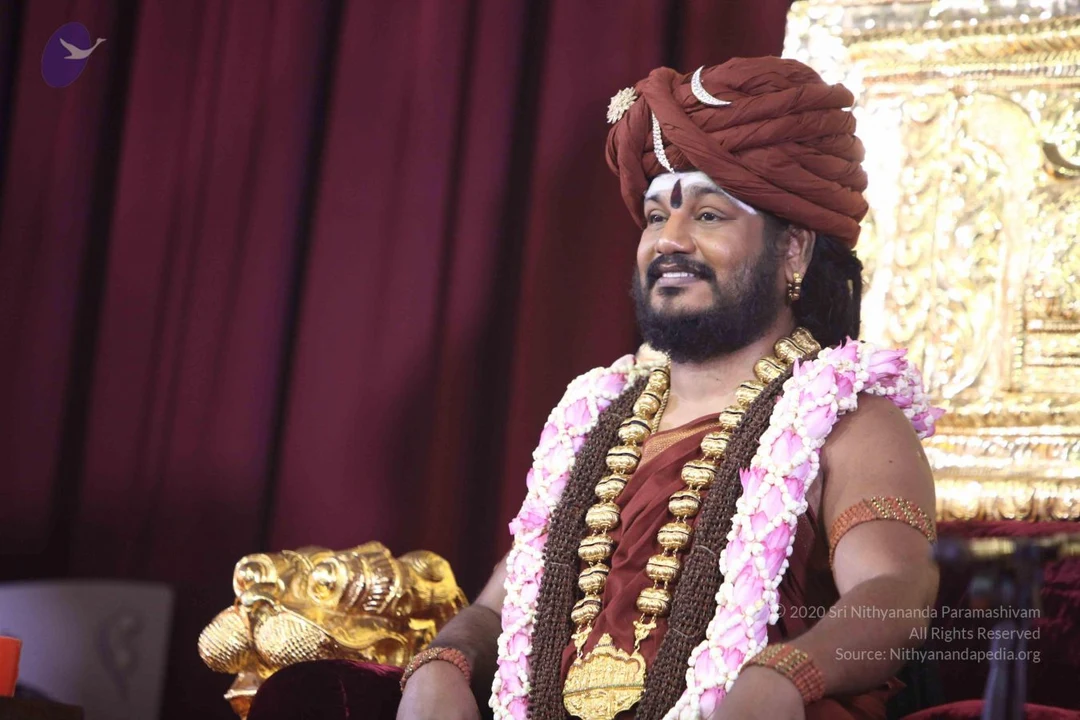
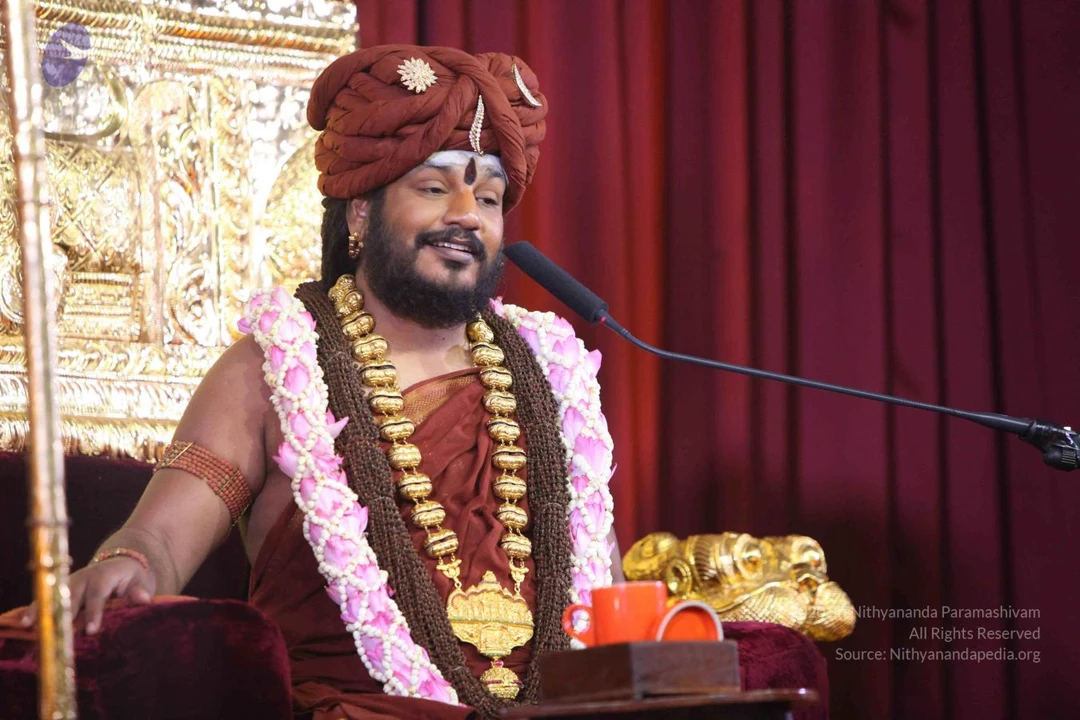
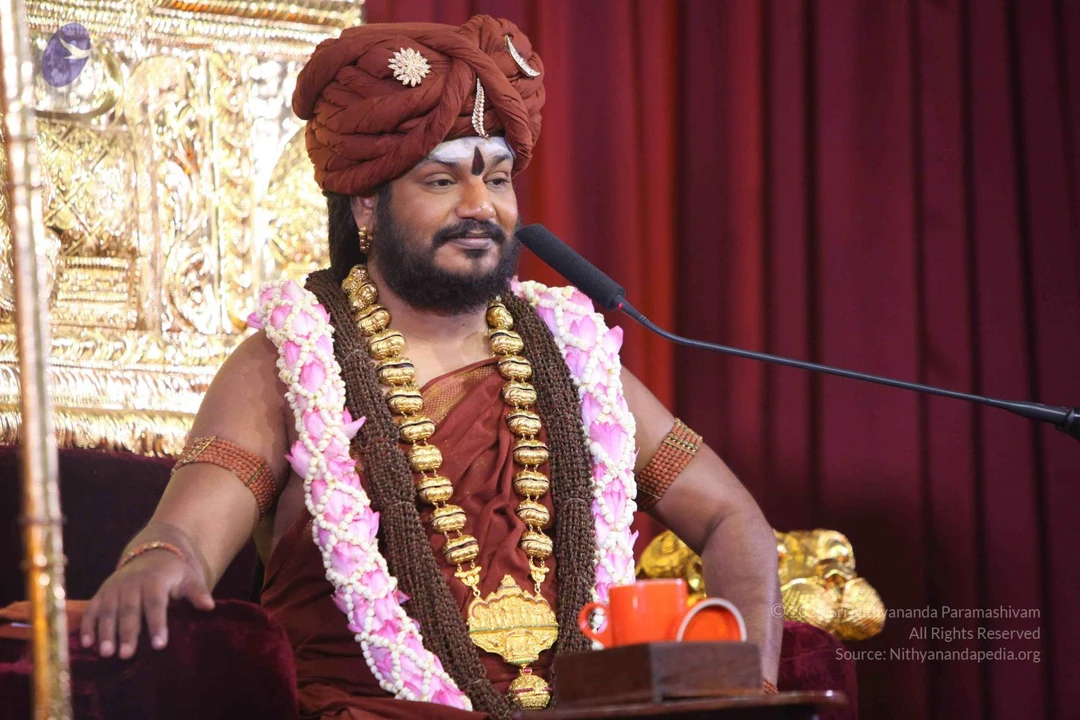
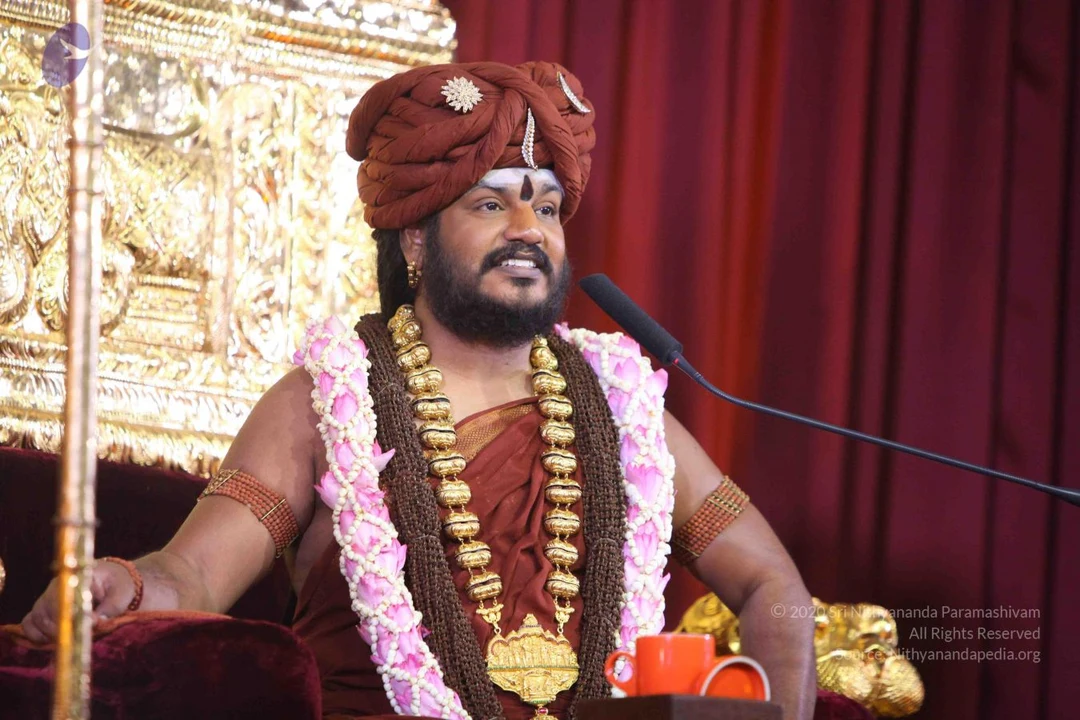
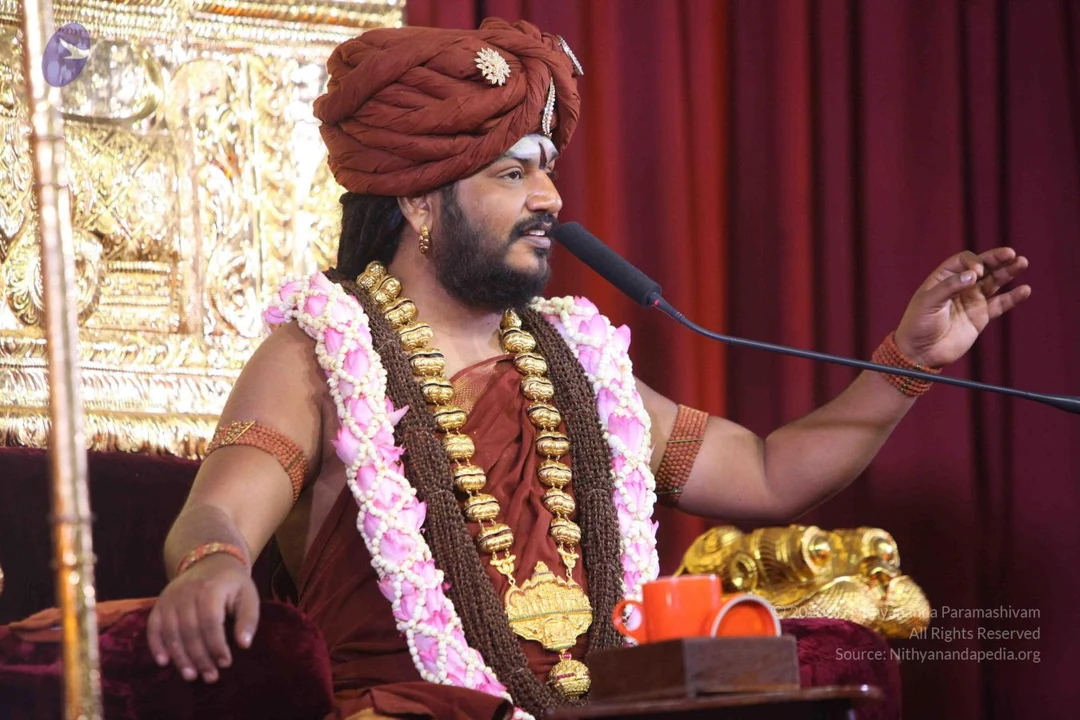
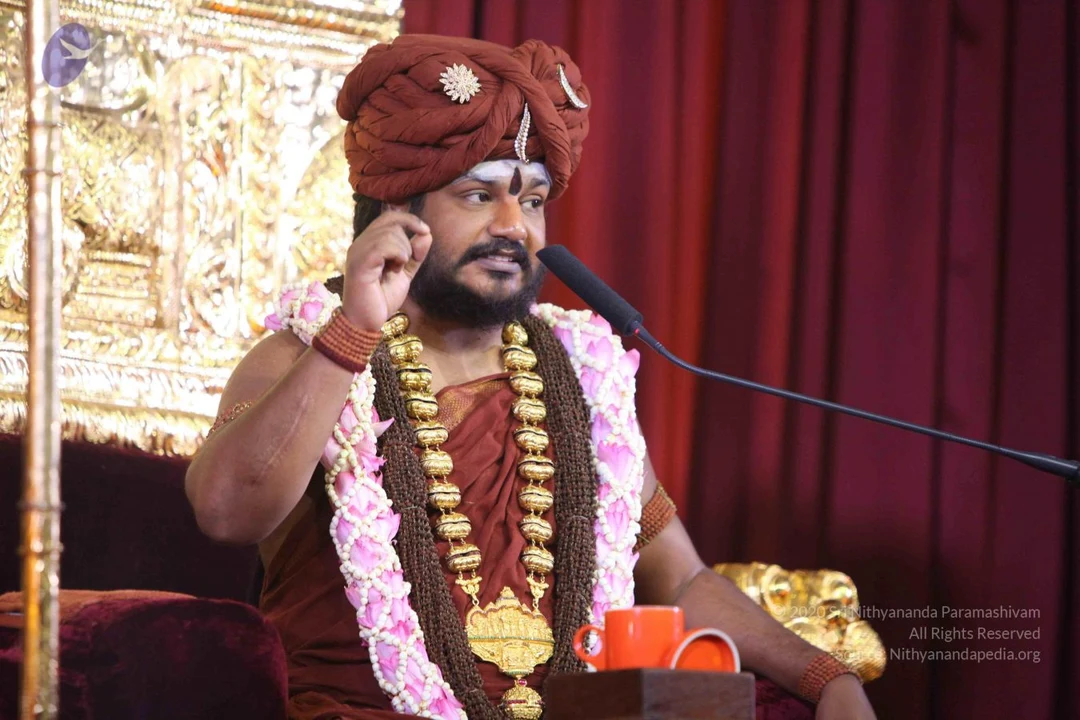
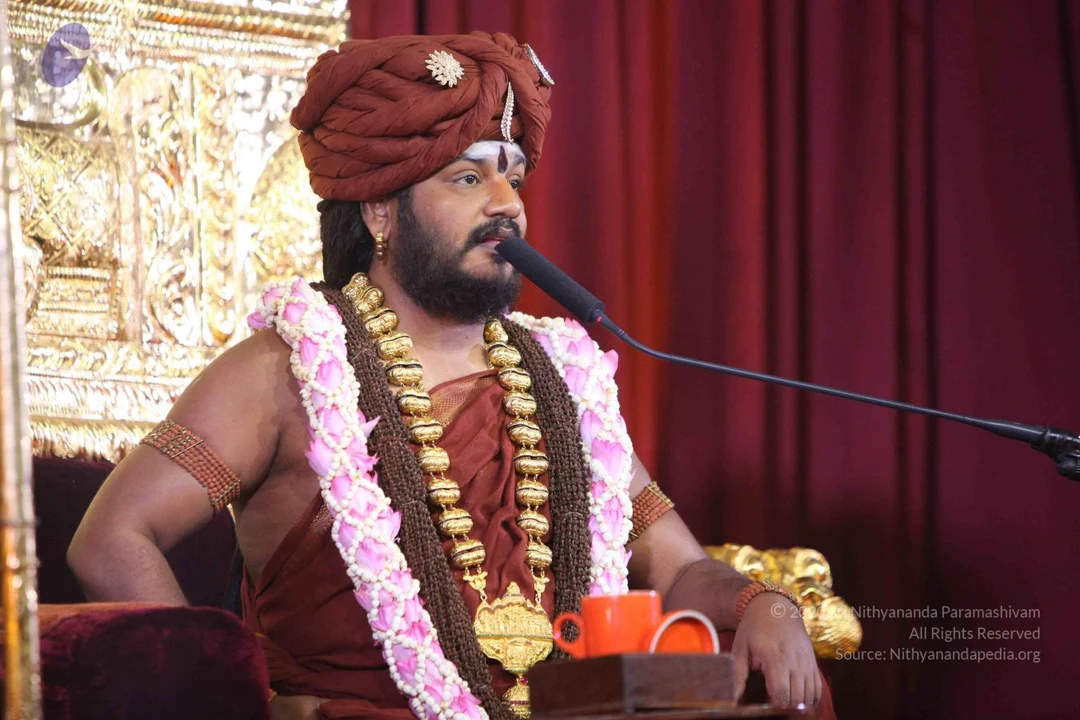
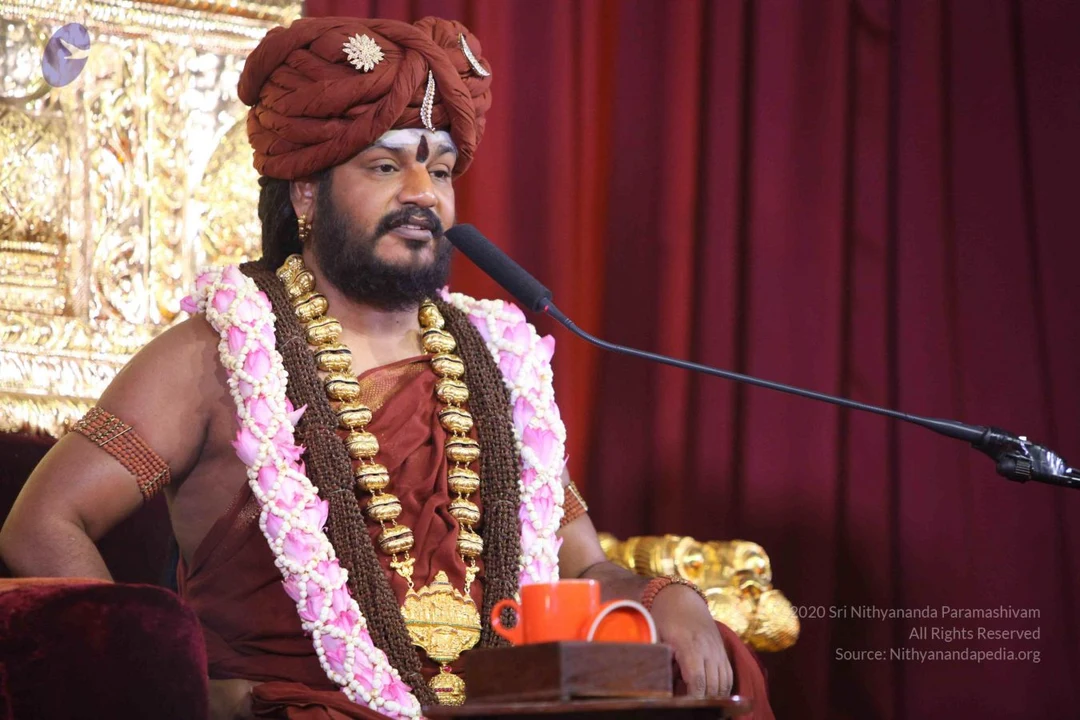
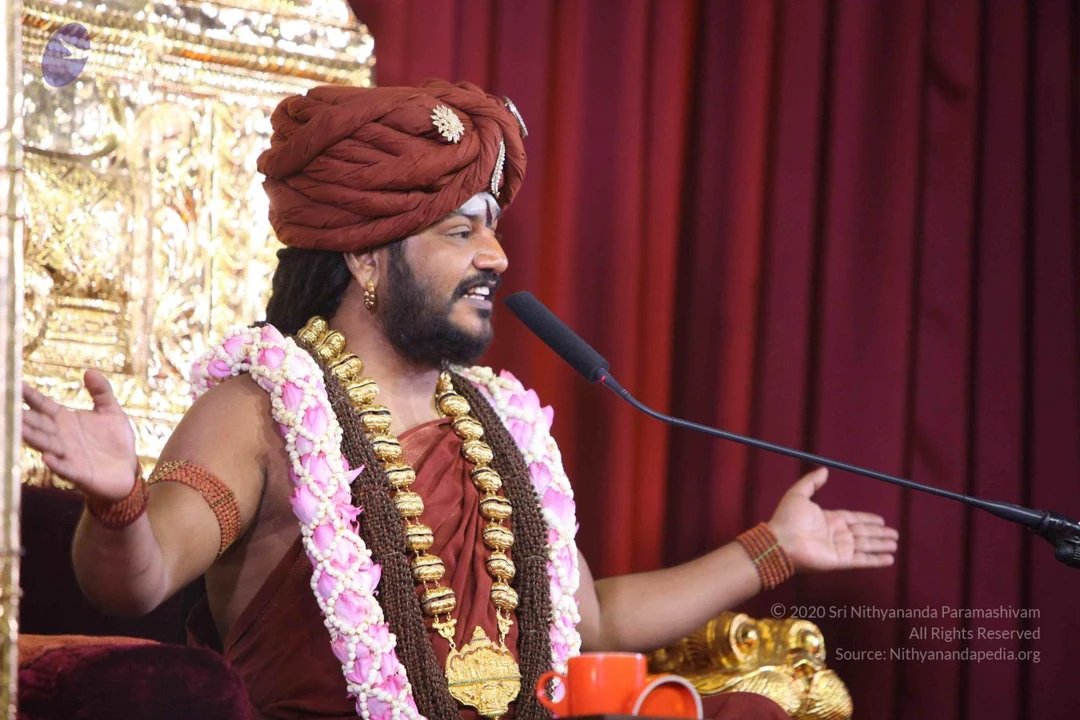
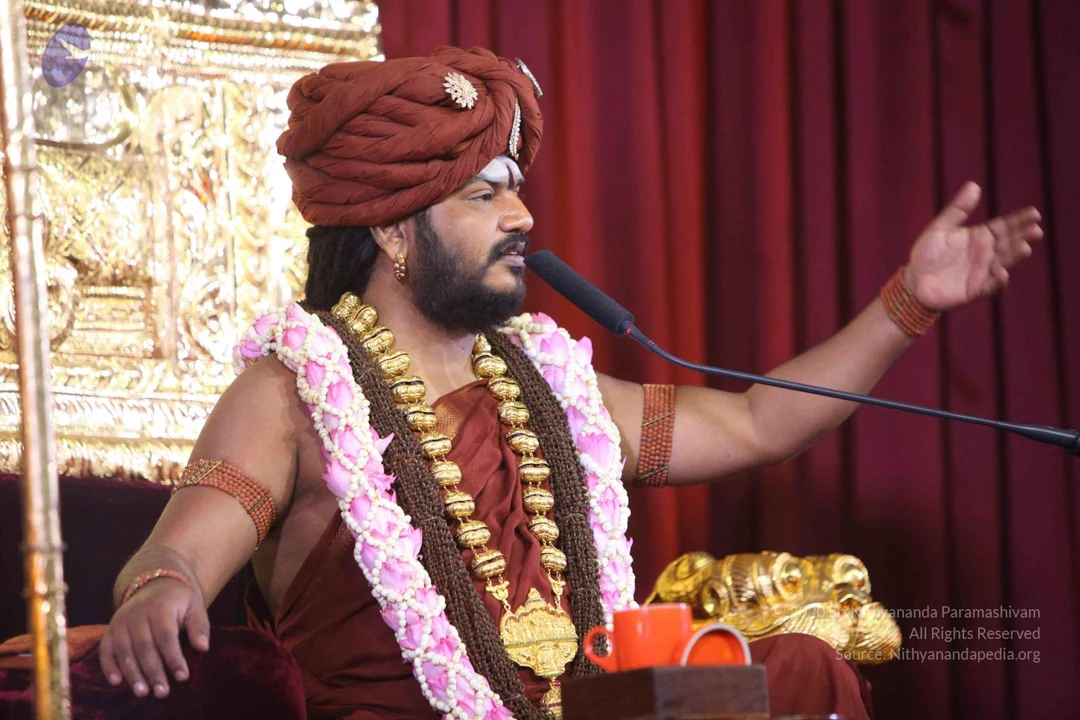
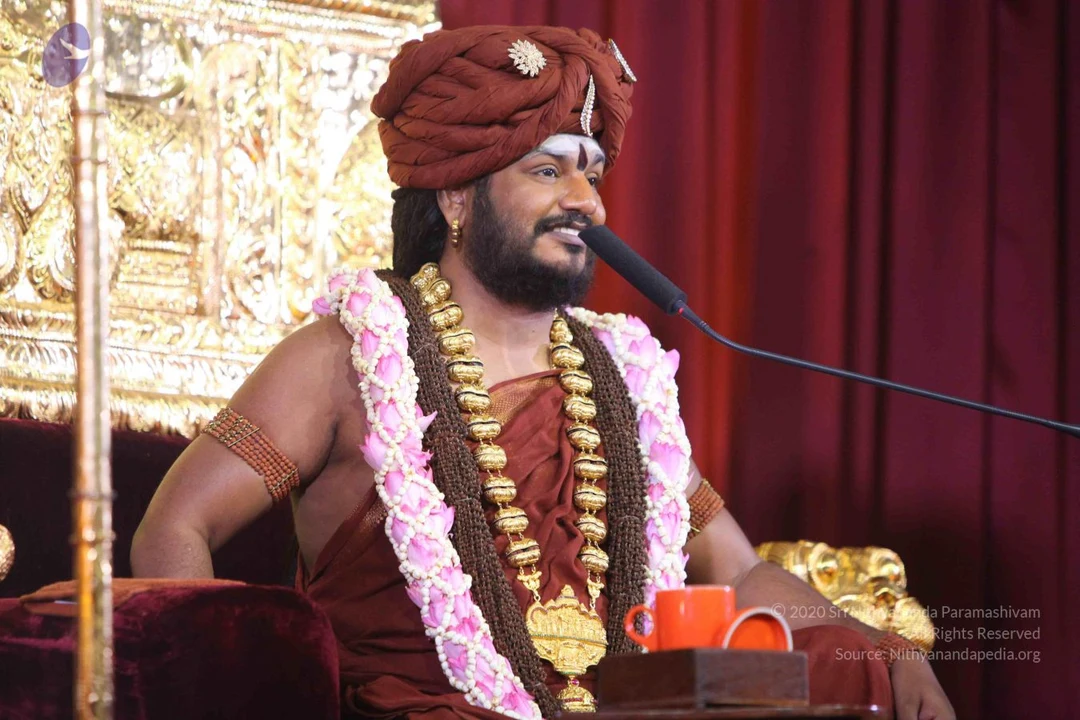
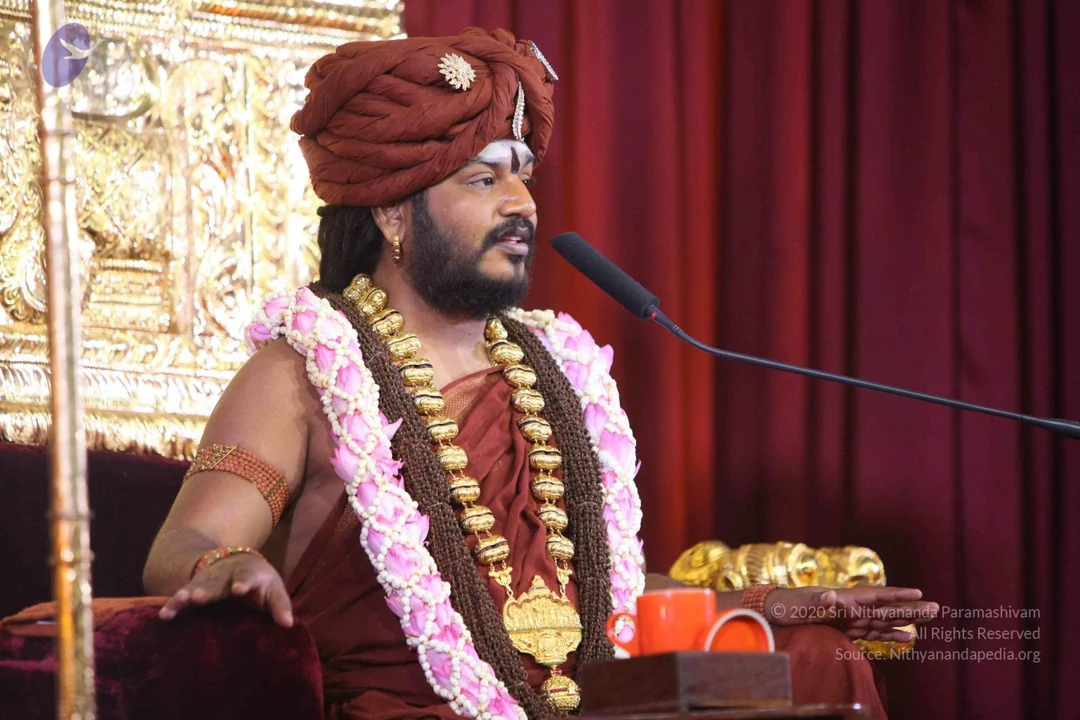
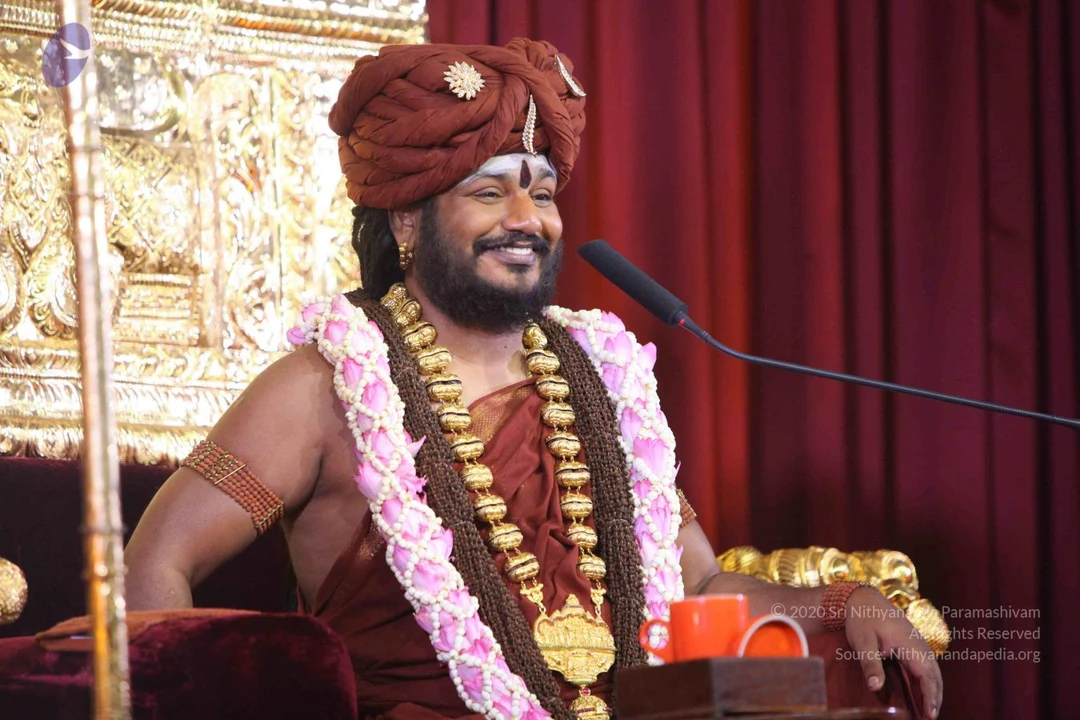
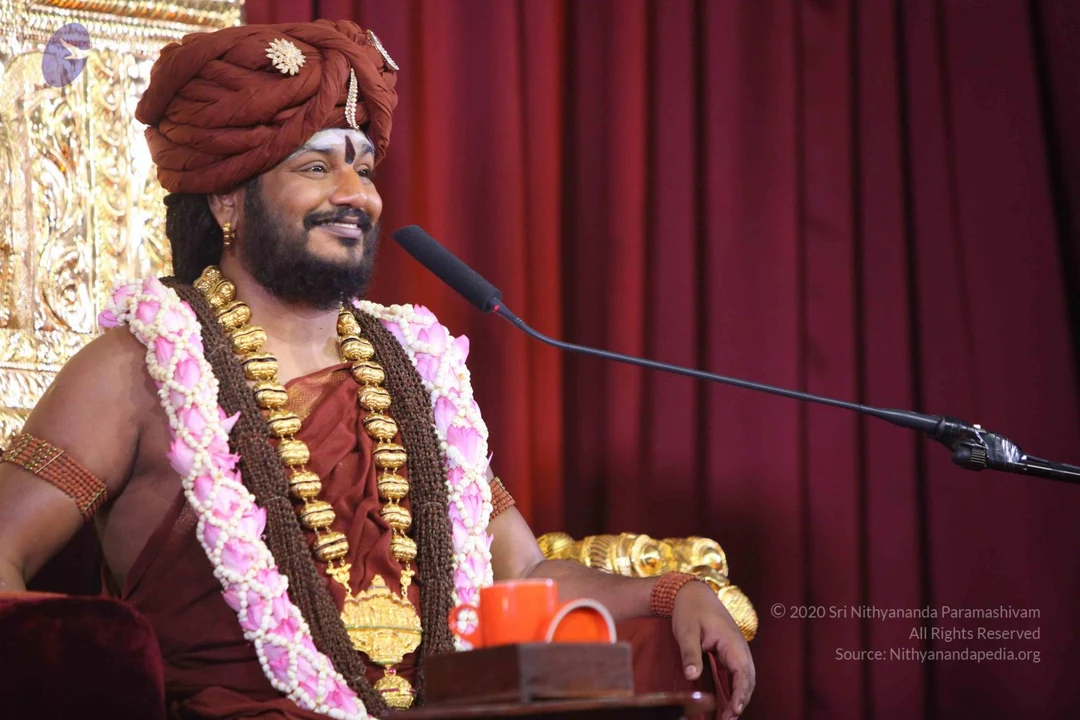
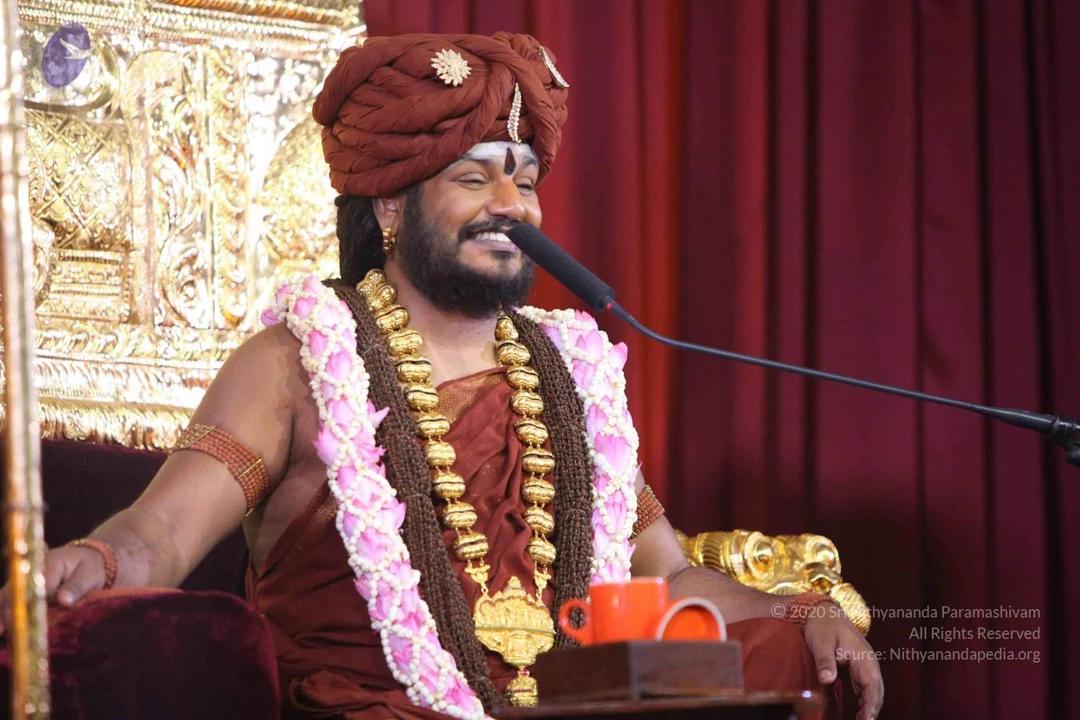
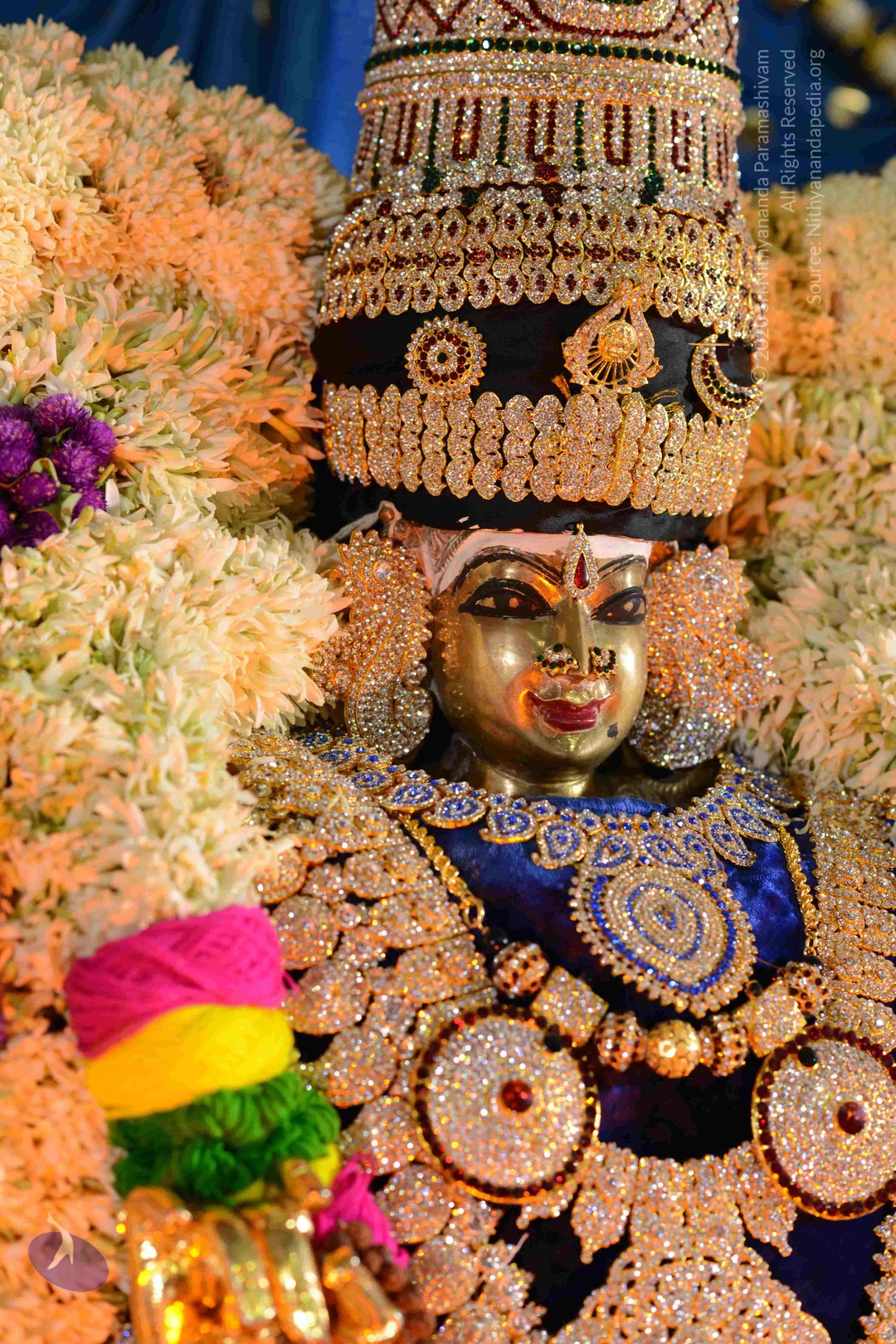
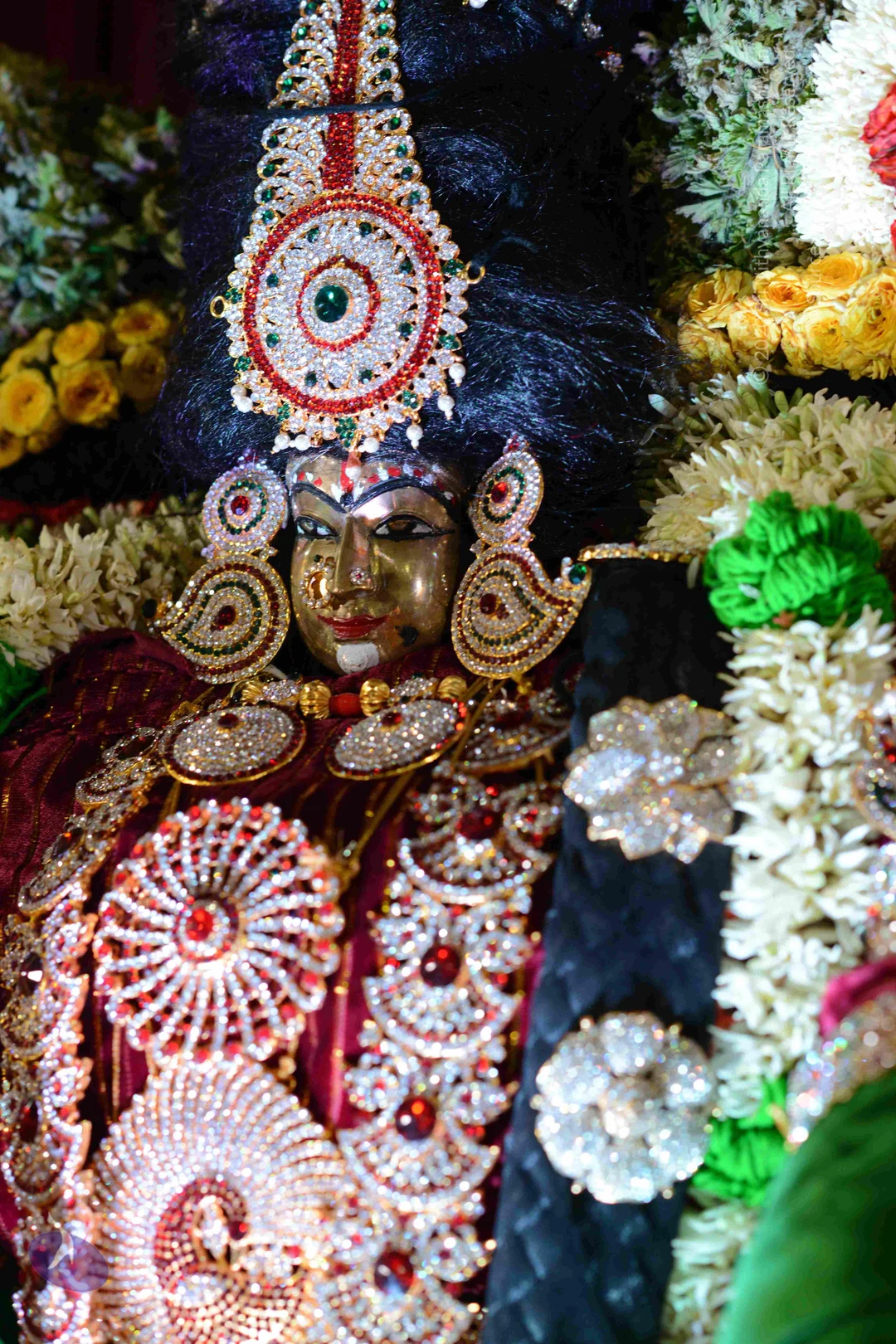
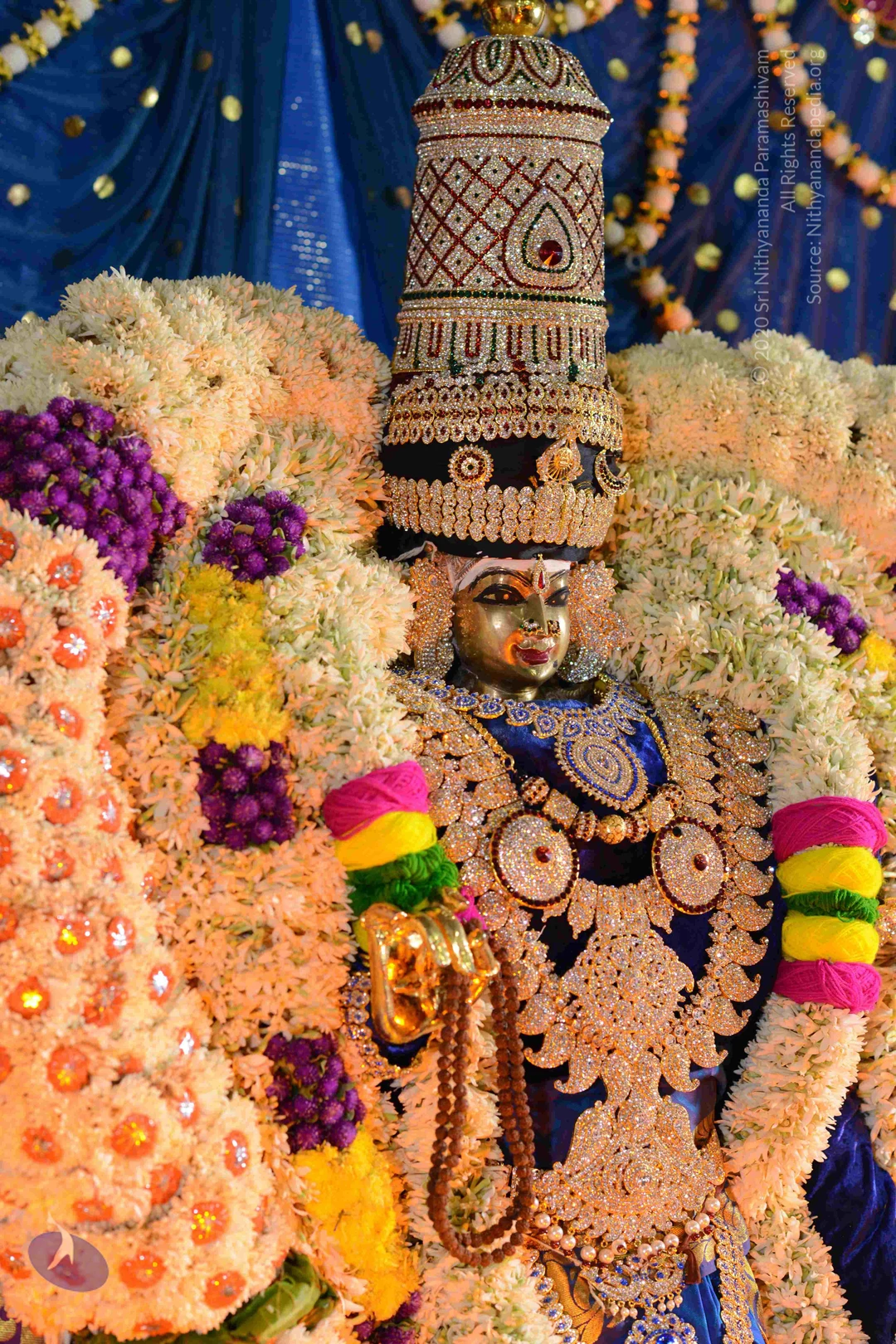
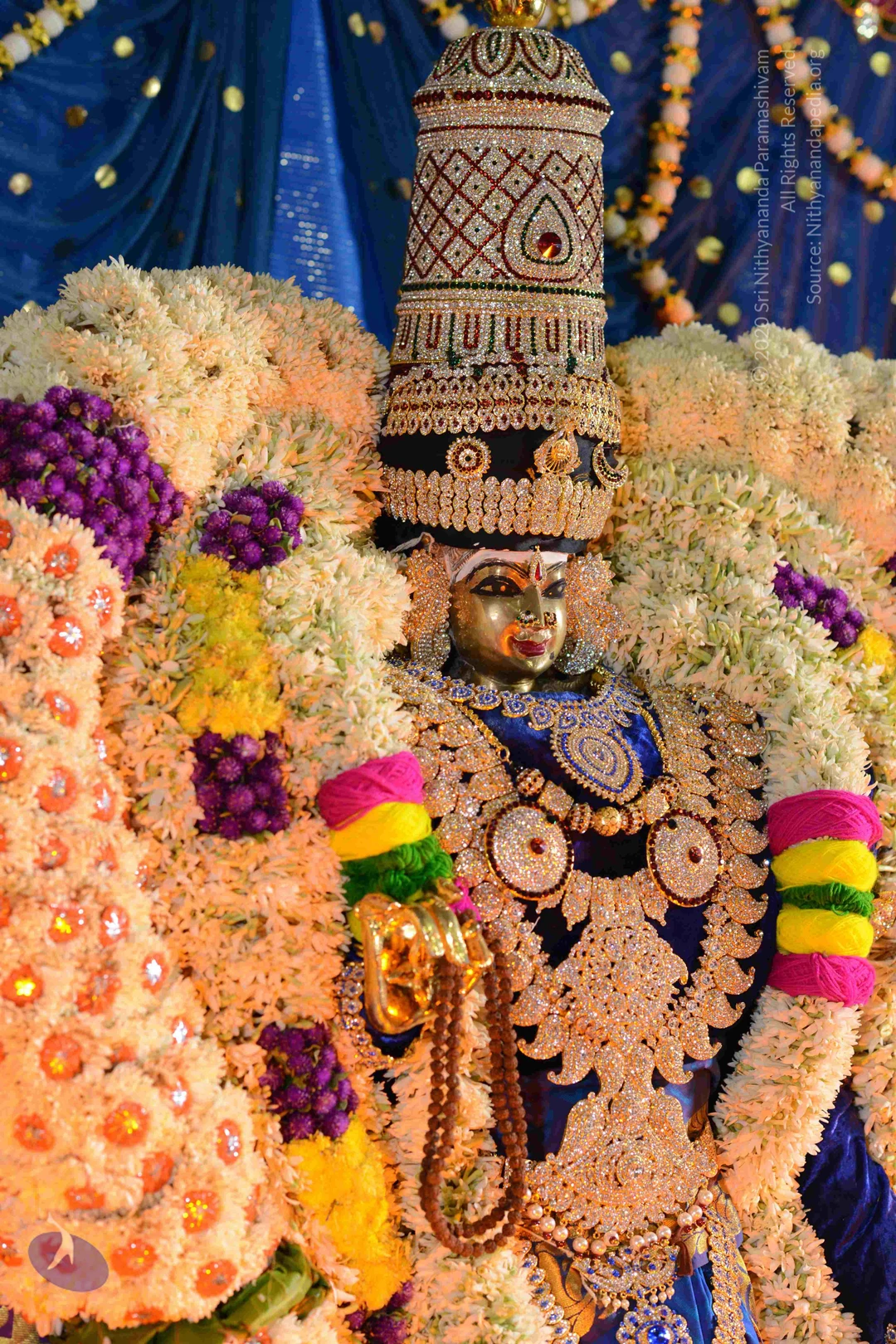
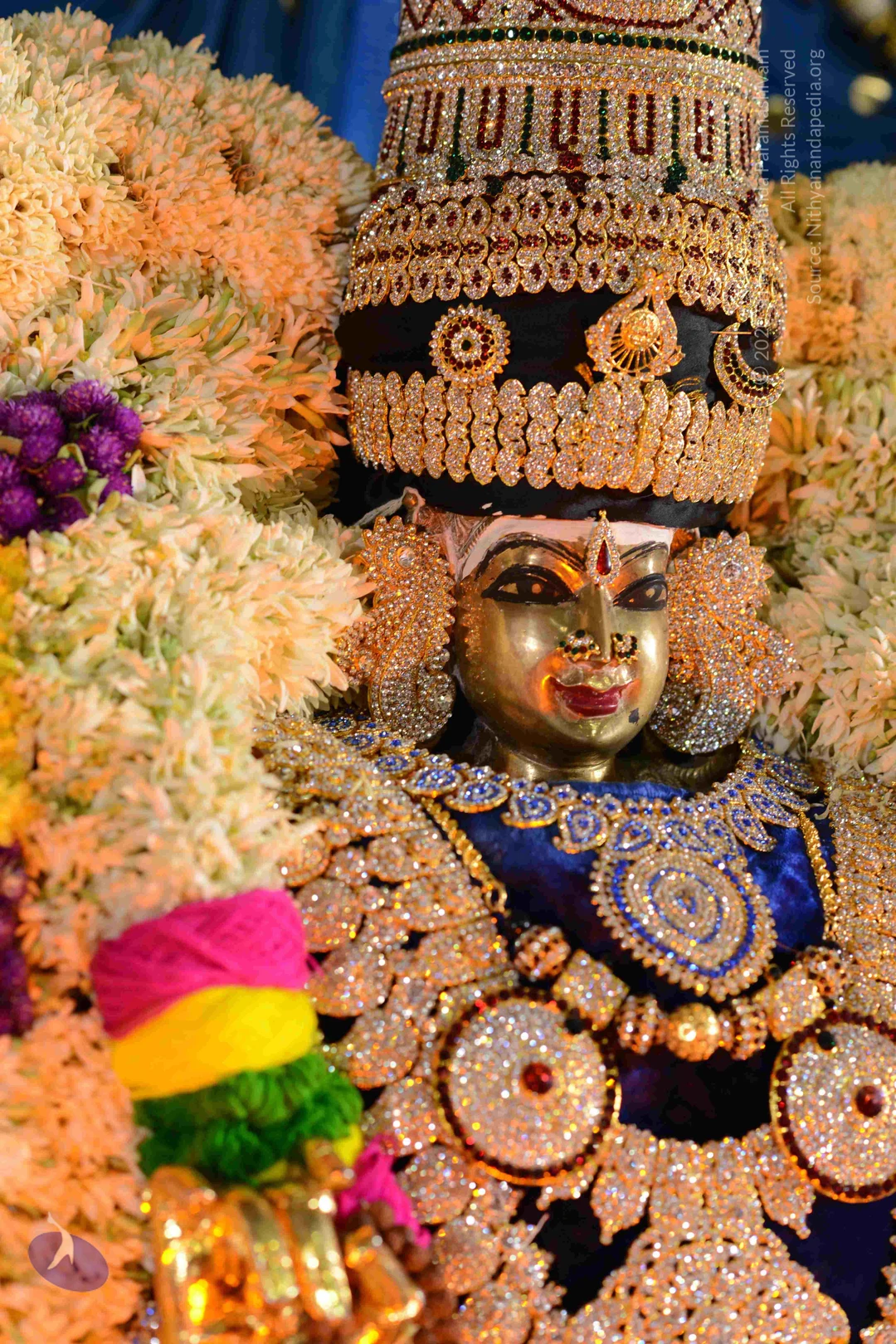
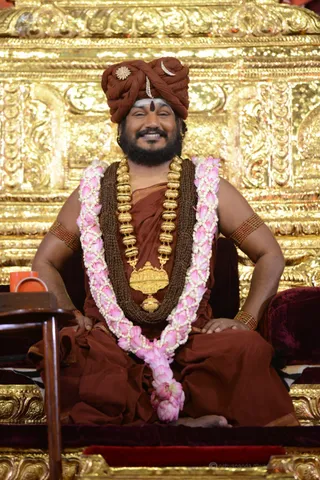
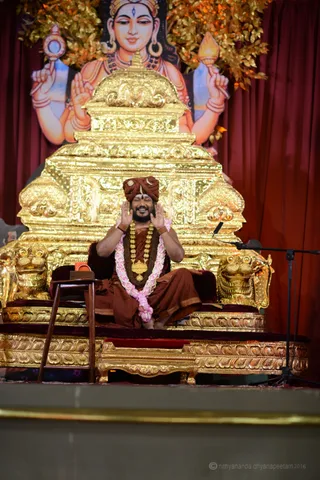
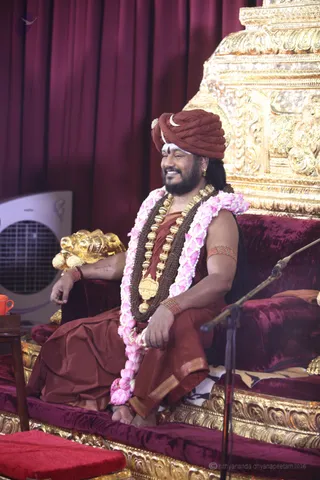
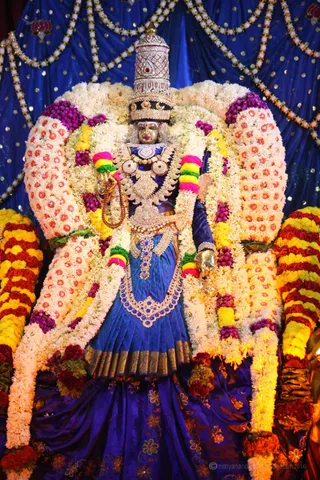
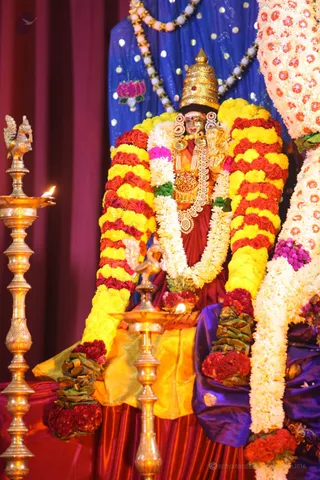
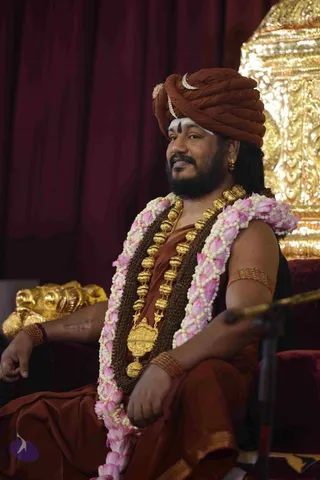
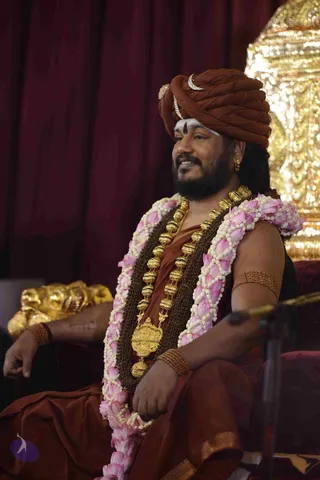
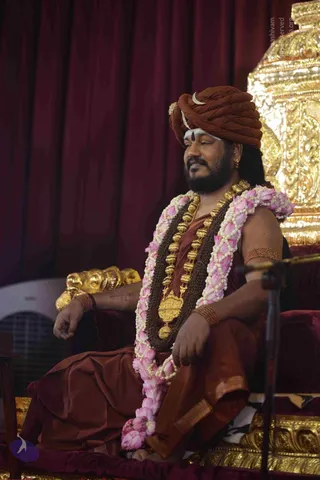
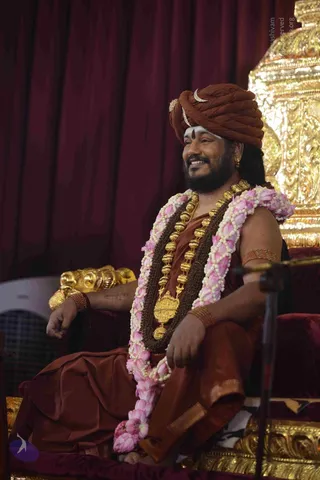
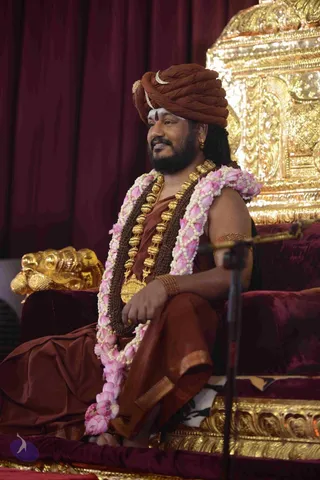
A seated man on a red velvet throne with gold carved armrest and gilded canopy behind him, wearing a rust-brown turban with a jeweled brooch, a rust-brown robe, a brown rudraksha mala with gold beads and a large gold pendant, and a pink and white flower garland over his shoulders. He has a vibhuti marking on his forehead and a kumkum bindi, and smiles while speaking at a microphone. An orange cup sits on a wooden table beside him. He is seated in a discourse setting, with a red curtain in the background.A photograph of a bearded man seated on an ornate throne in front of a heavily gilded, carved golden backdrop. He wears a rust-brown turban with a crescent and ornament, a rust-brown robe, a large pink and white flower garland, a heavy golden necklace with a temple-shaped pendant, a dark rudraksha-style mala, and bangles on his upper arms. He sits with hands resting on his knees and smiles broadly. A small orange cup sits on a wooden table at left. Appearance cues match the Swamiji (probable) candidate: distinctive turban, ceremonial gold necklace and rudraksha mala, presented as a seated honoured teacher in satsang.A man seated cross-legged on an ornate gold-covered throne (peetha) on a stage, smiling broadly with both palms raised beside his face. He wears a maroon-brown turban with a crescent and jewelled emblem, a maroon-brown robe, a pink-and-white flower garland, a layered rudraksha mala and a gold pendant, and a tilak on his forehead. Behind him rises a large golden tiered throne with lion-form armrests, framed by deep red drapes and gold leaf foliage. Behind the throne a painted image of a multi-armed deity holds a mirror-like object and a flame. A microphone stand stands to the right and a small wooden stool to the left. The person is the only one visible on the stage.A smiling man seated cross-legged on an ornate golden throne with plum velvet cushions, in front of a deep maroon drape and a gold-carved throne back. He wears a rust-brown turban with a small crescent ornament, a brown-red robe, a long pink lotus garland, a dark rudraksha mala with large gold beads, and a gold pendant. A gold-tipped arm rest, a microphone stand and an orange cup sit nearby. Swamiji (probable): the long hair, turban, ornate gold ceremonial necklace and rudraksha mala match the candidate cues, seated in the role of teacher at a satsang.A decorated deity murti, a goddess figure with a face of golden-brown metal, stands frontally against a deep blue draped backdrop with silver and white garland swags. She wears an ornate jewelled crown with red stones, a blue silk sari with a gold zari border, heavy gold and blue-stone necklaces and a rudraksha mala in one hand. Large arches of white jasmine and orange-dotted flowers frame her, with magenta and yellow-green garlands hanging from her arms and marigold strands at the base. No living people are visible; this is a dressed murti for devotional display.A decorated deity murti, a golden metal figure of a goddess seated in front of a backdrop of blue fabric with white and pink beaded garlands and a sparkling lotus ornament. The murti wears a tall golden crown, a red sari, layered gold necklaces and earrings, and is draped with thick garlands of yellow and red marigolds and white jasmine. Flanking it are tall brass oil lamps with lit wicks, one with a bird-shaped finial, and in the foreground a purple silk cloth with red flower garlands. No people are visible.

IA-Q&A
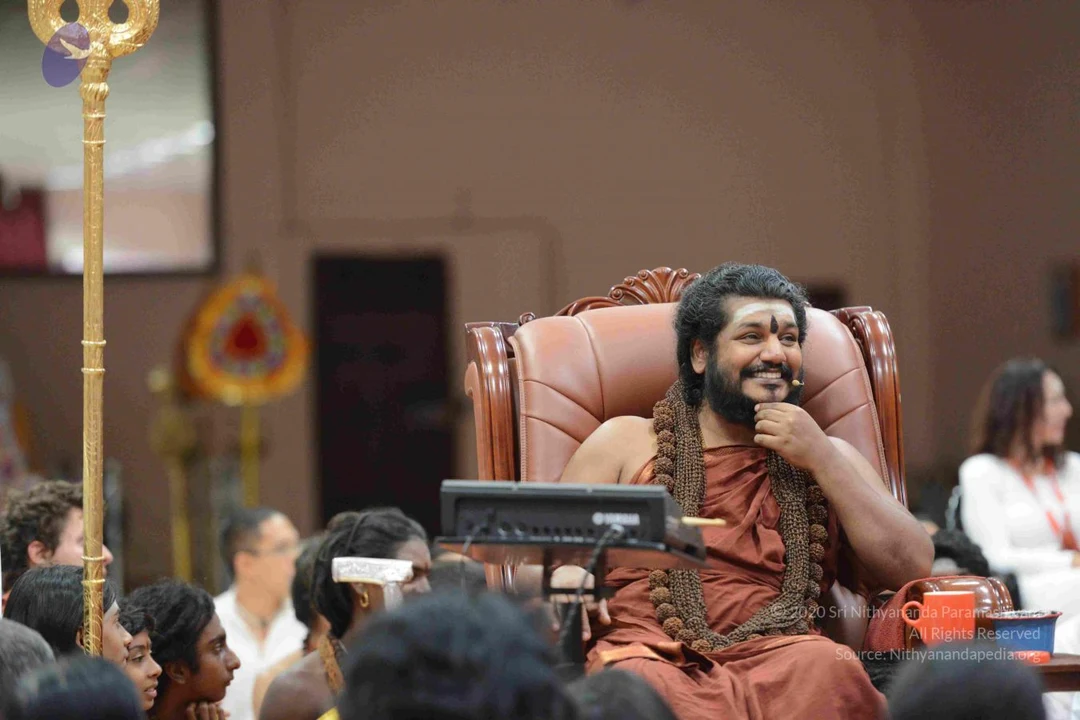
35 photosSource gallery
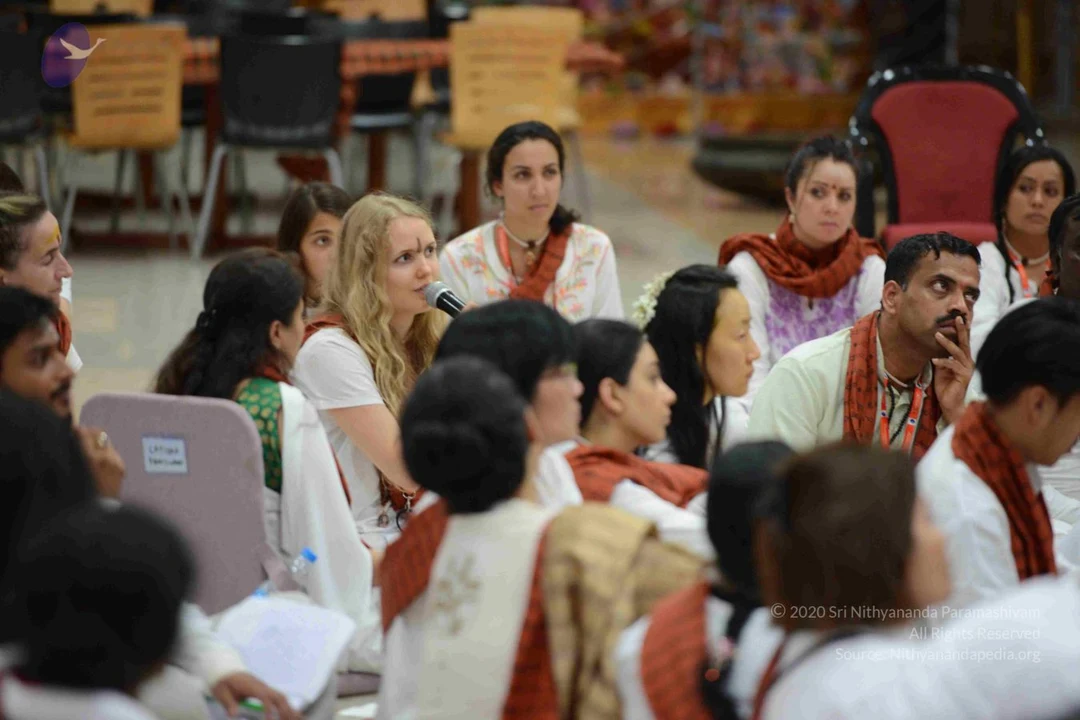
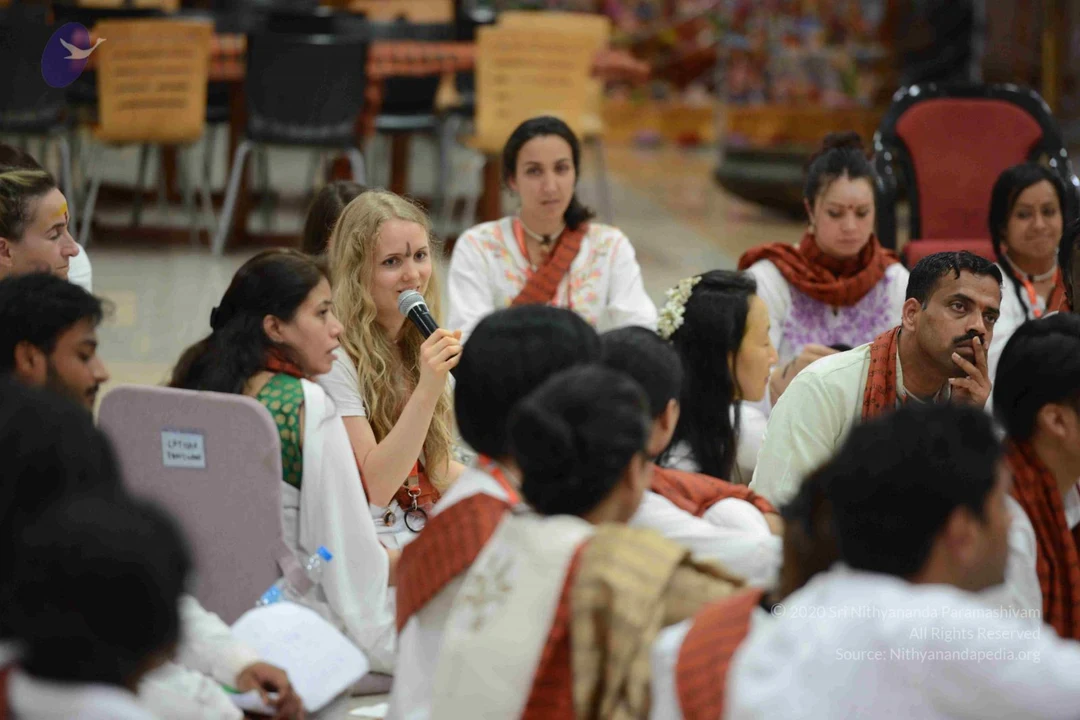
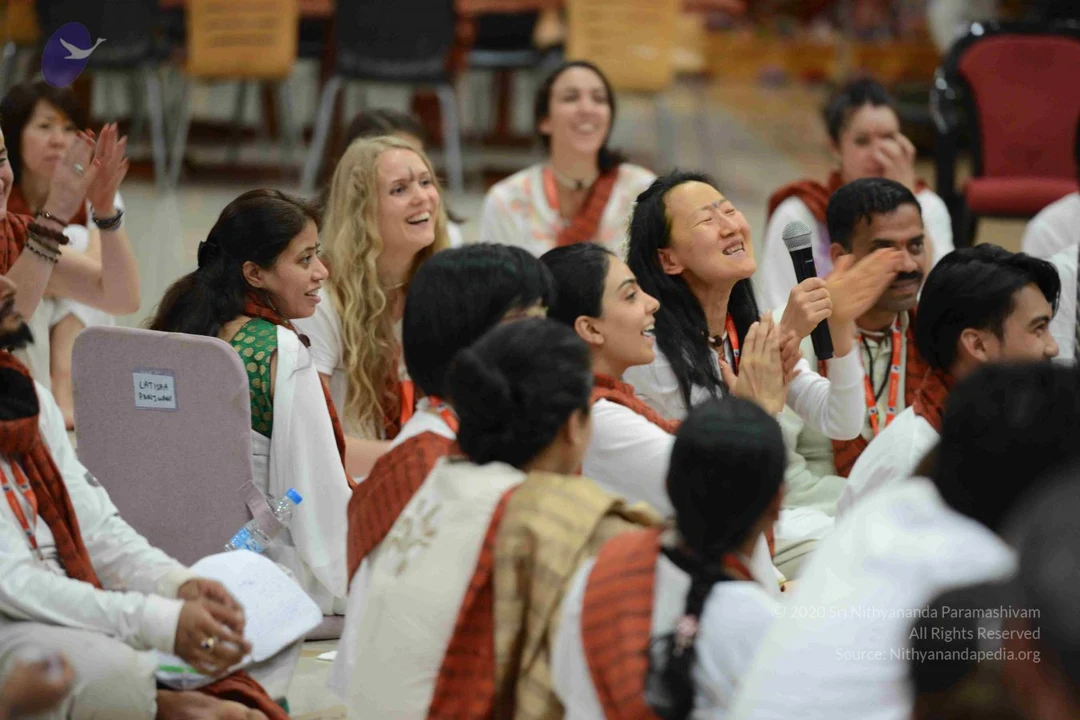
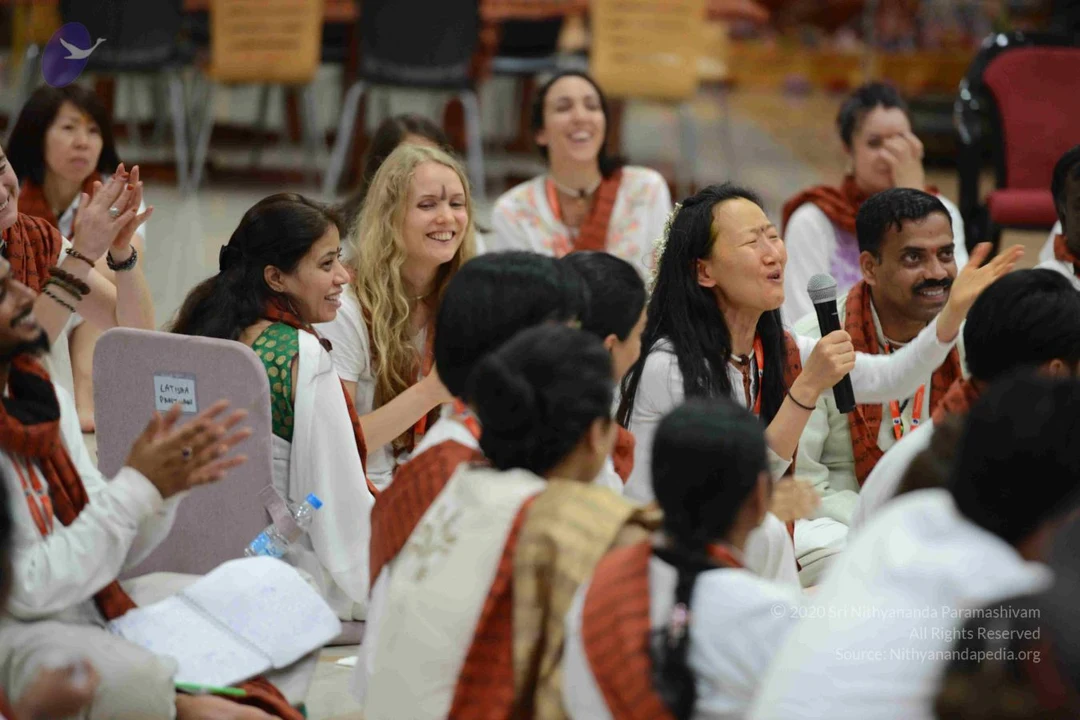
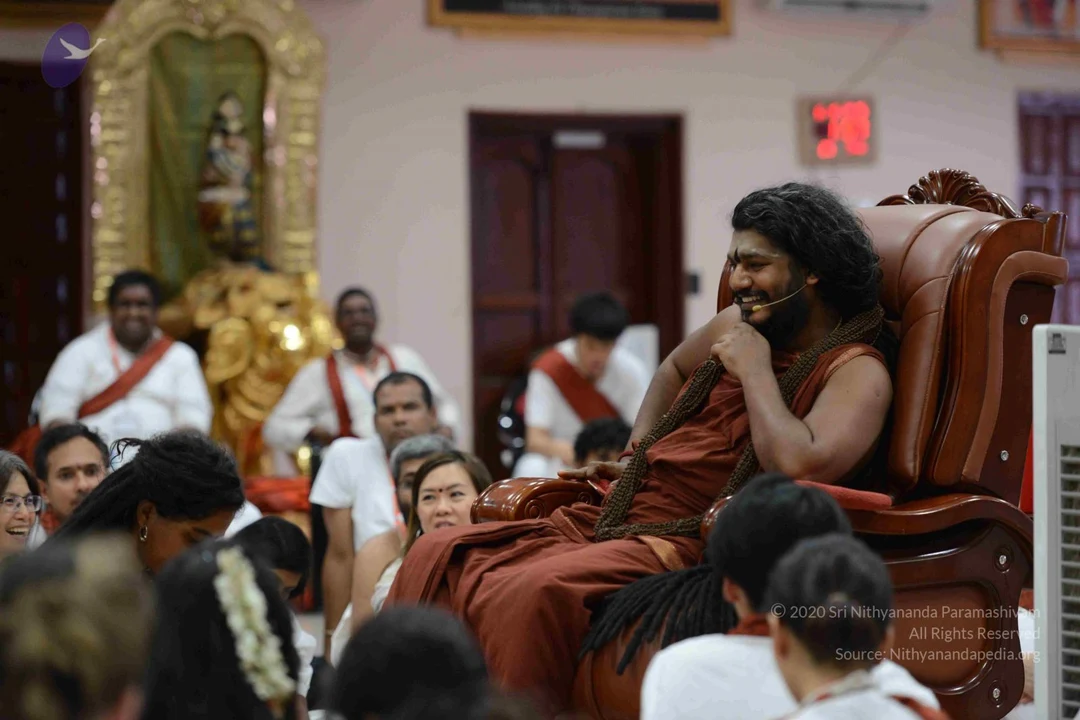
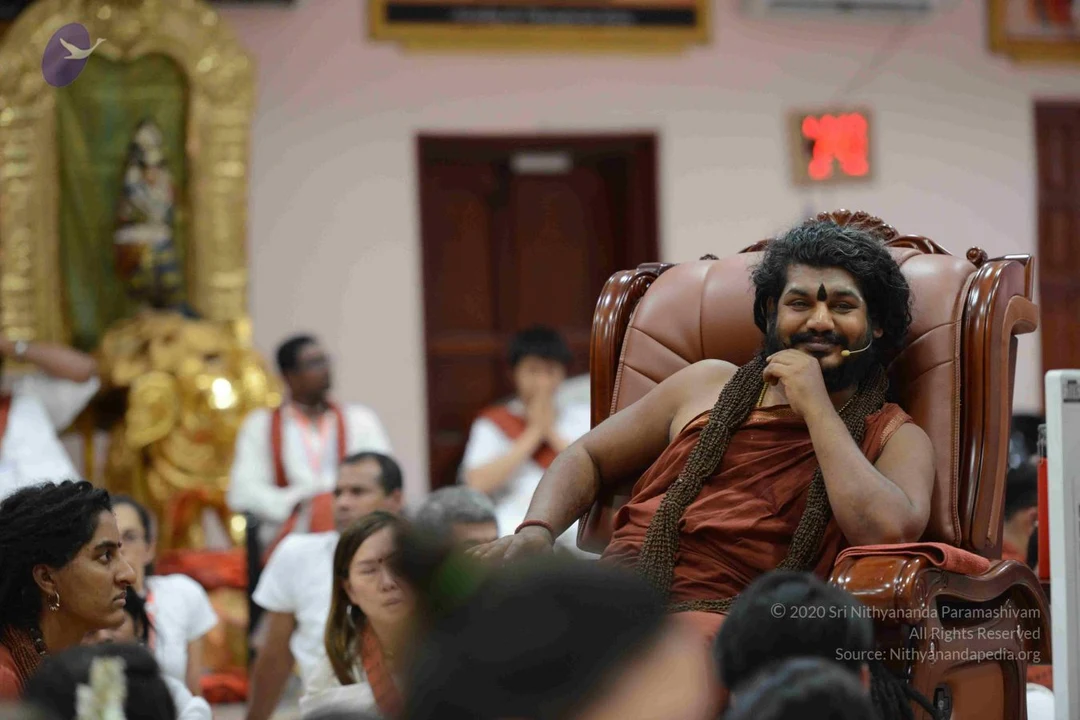
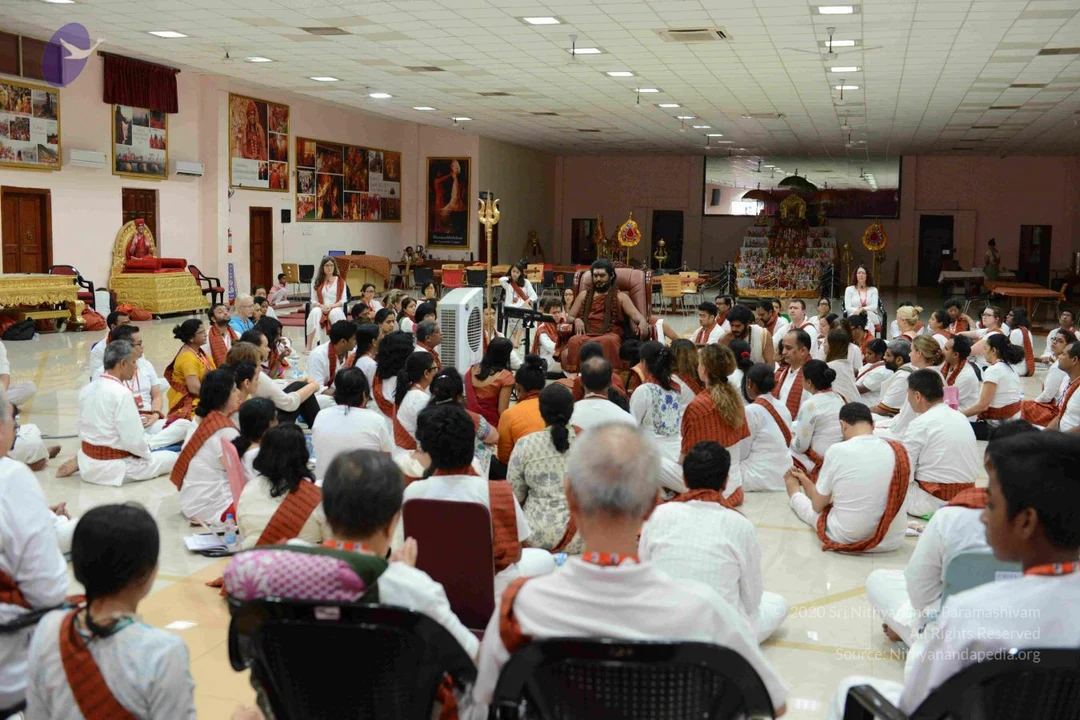
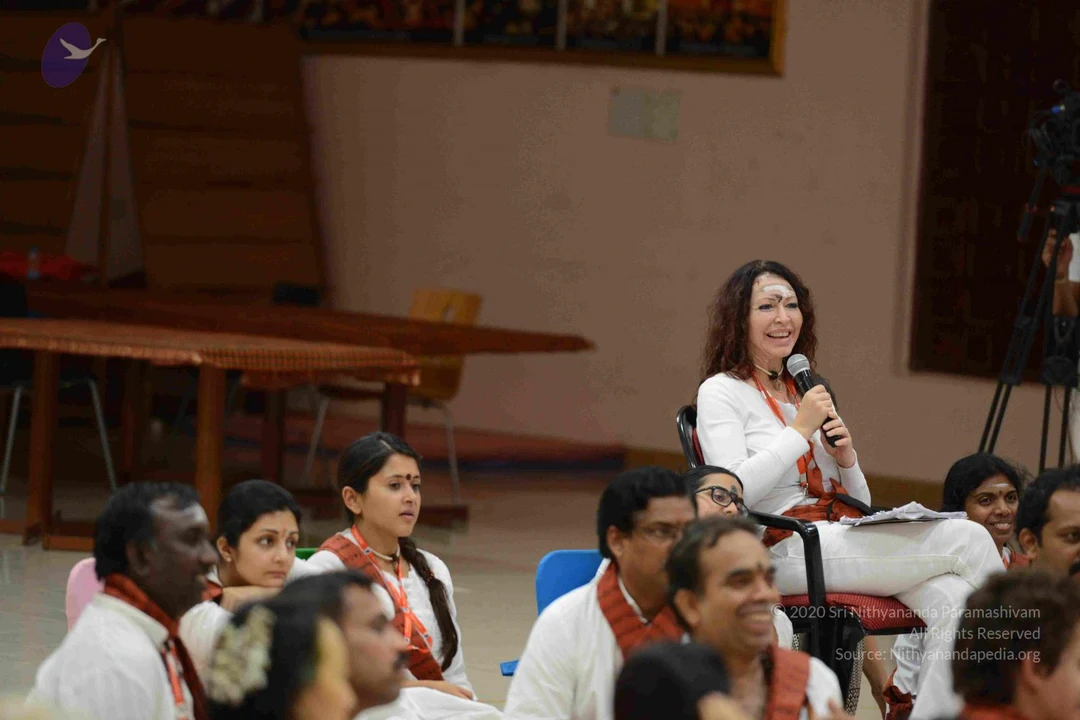
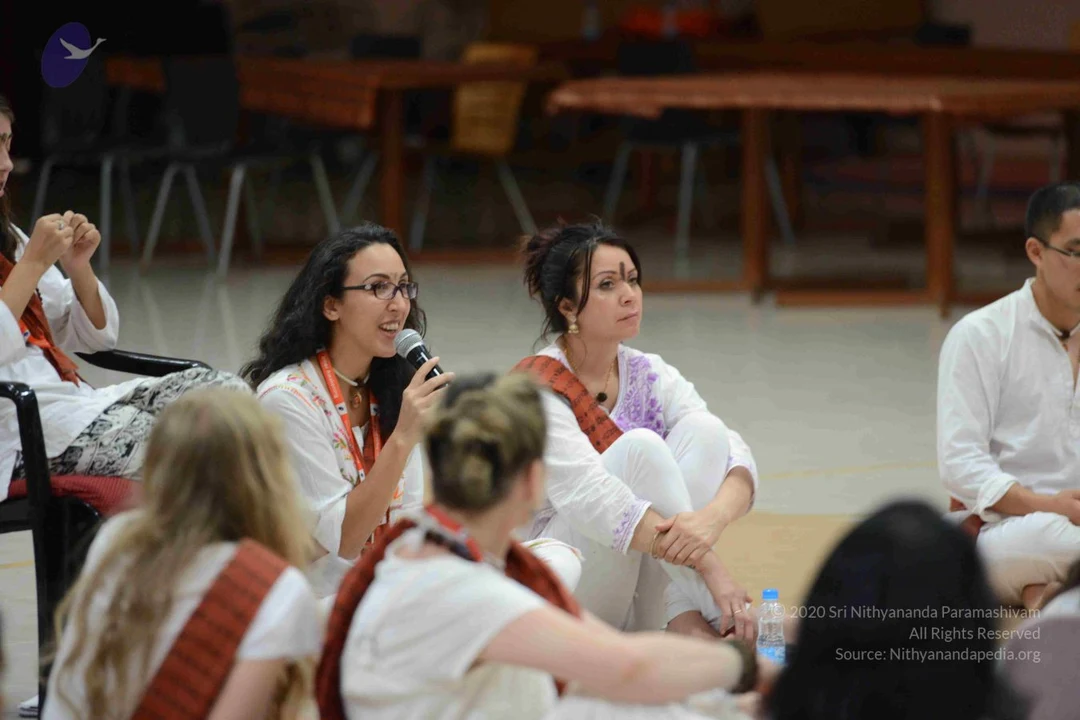
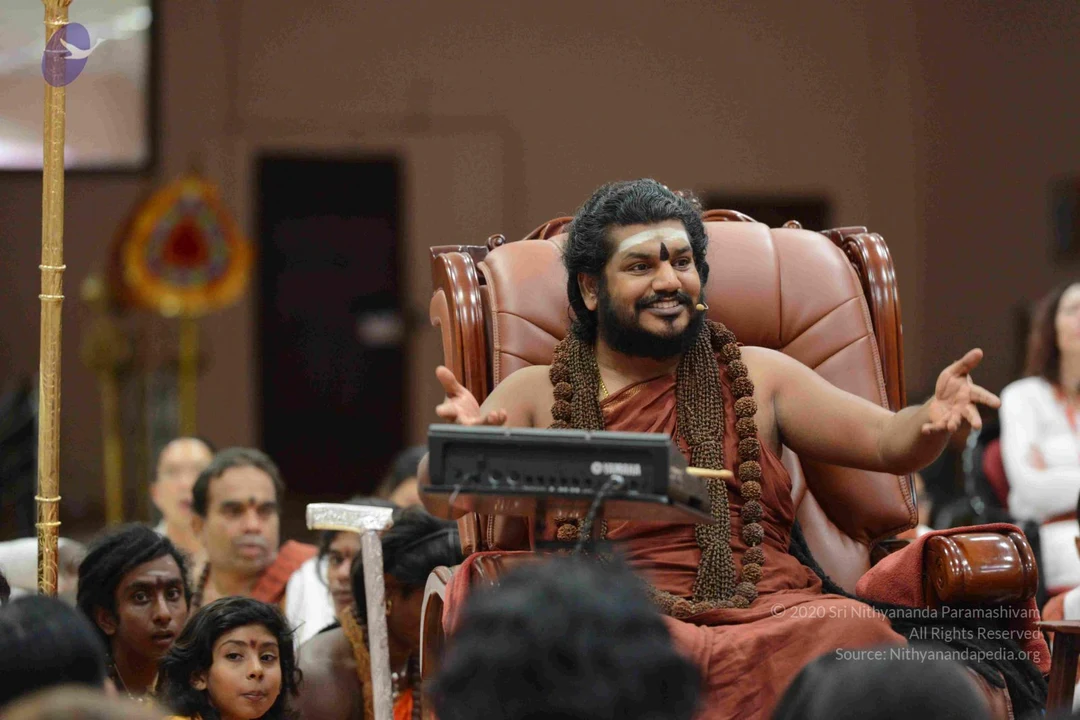
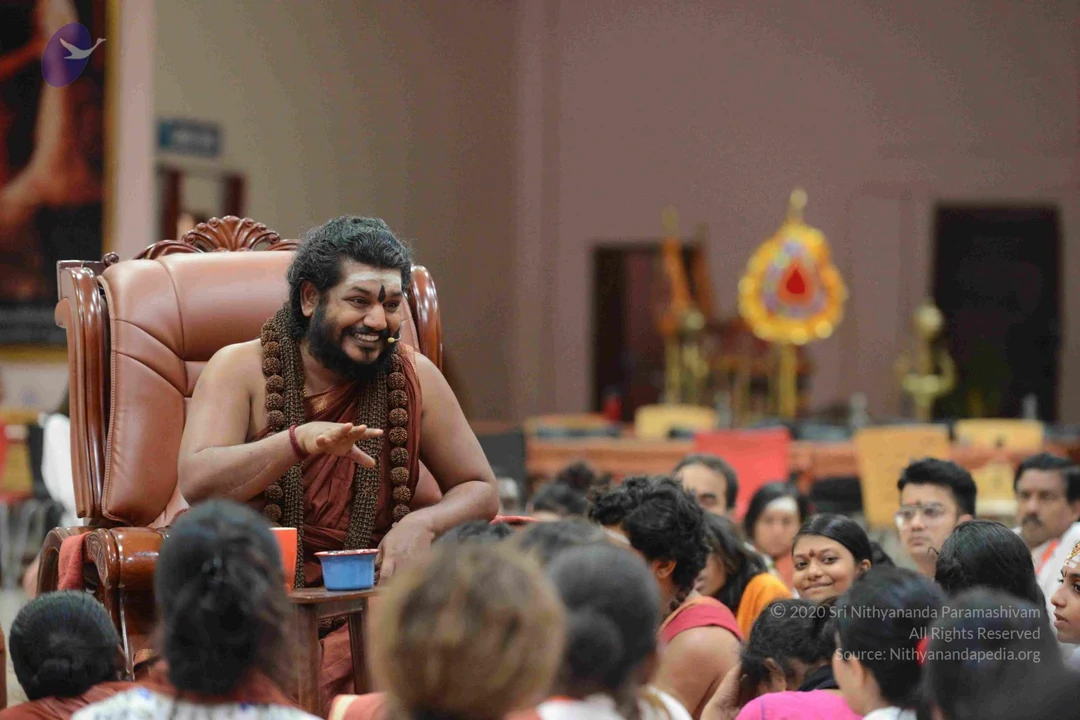
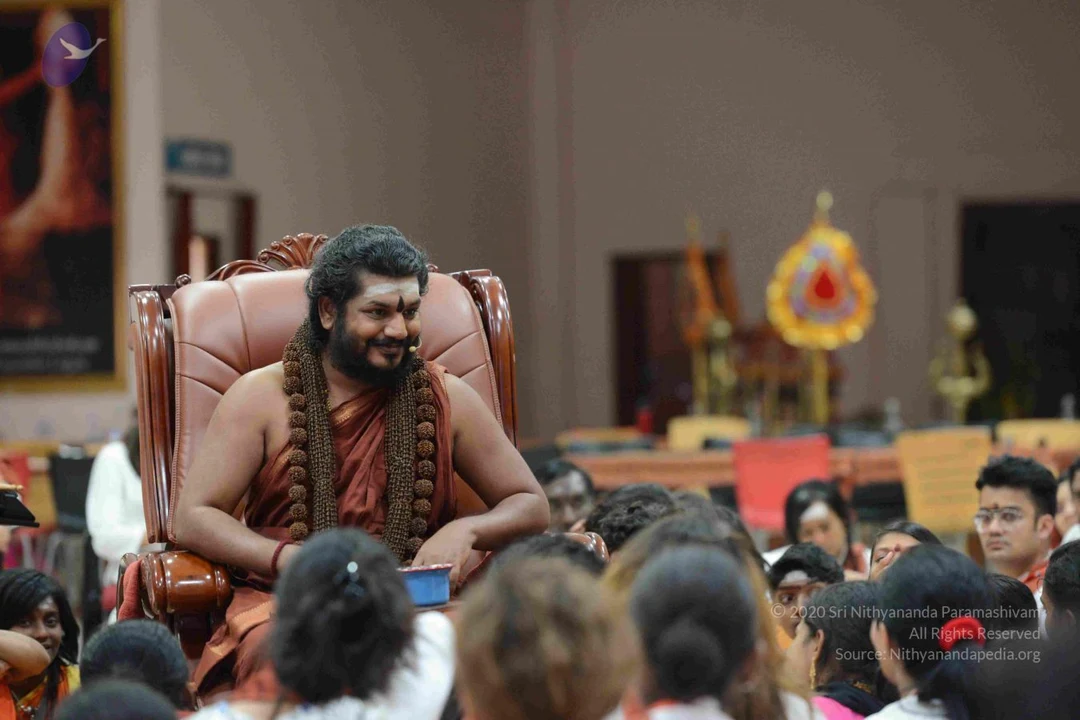
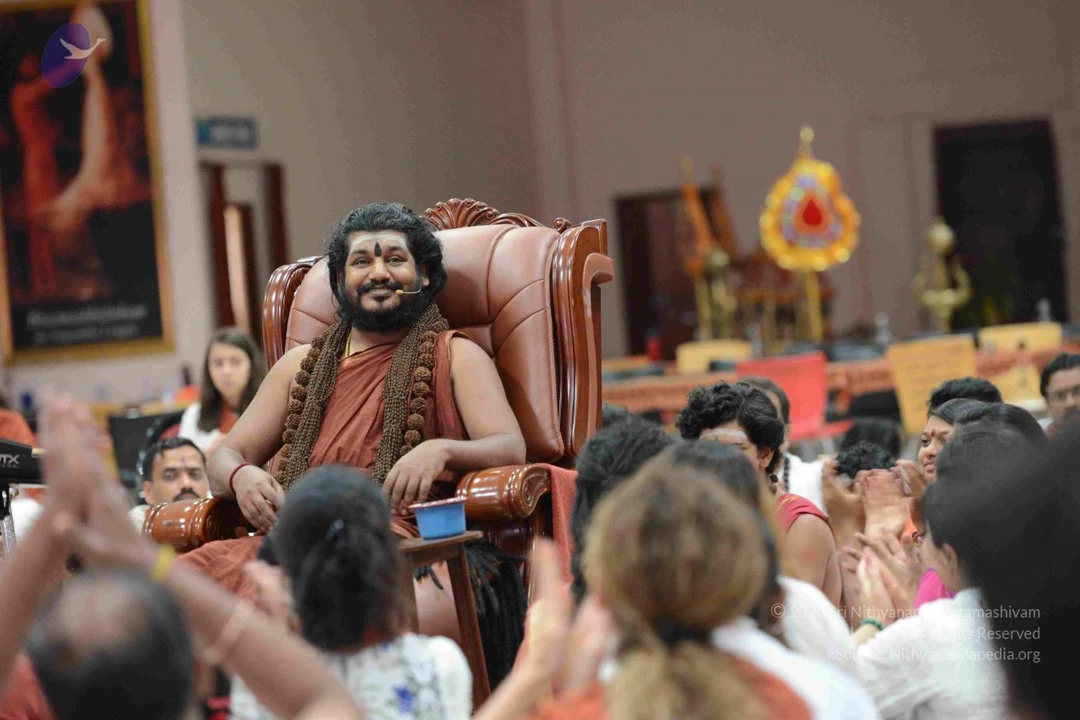
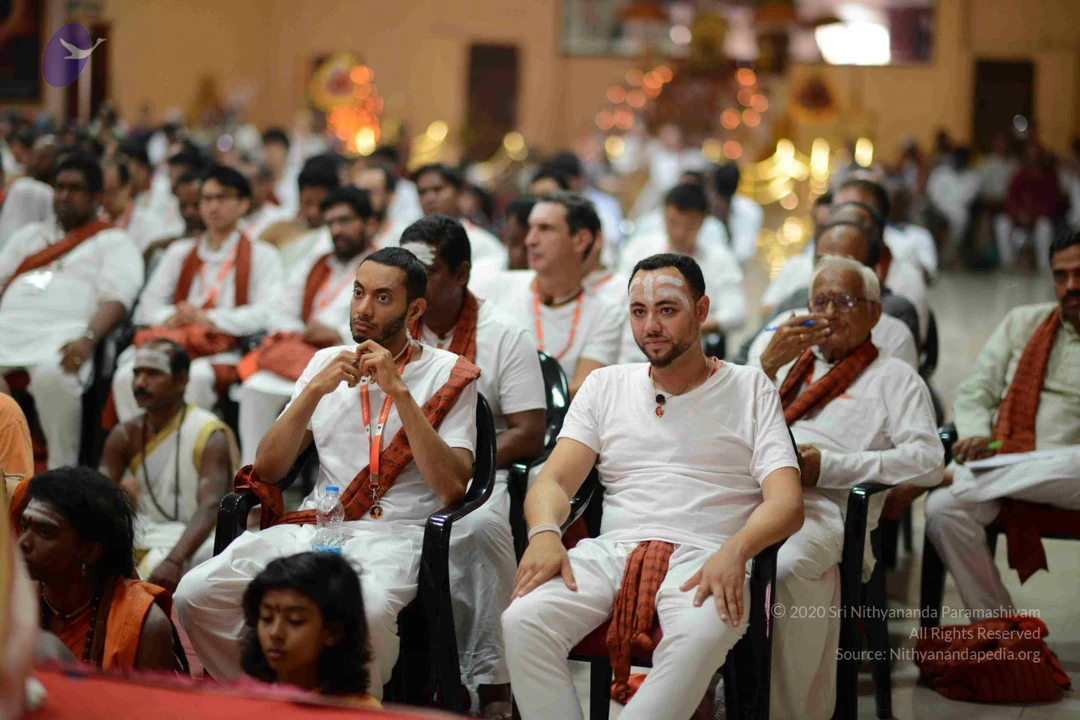
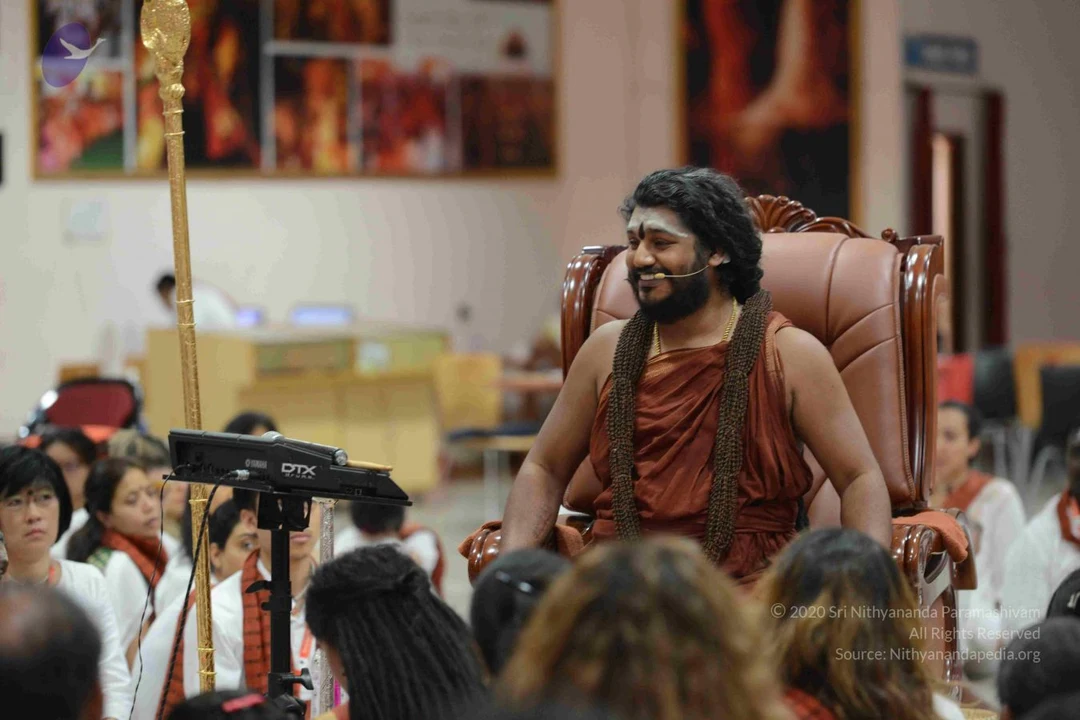
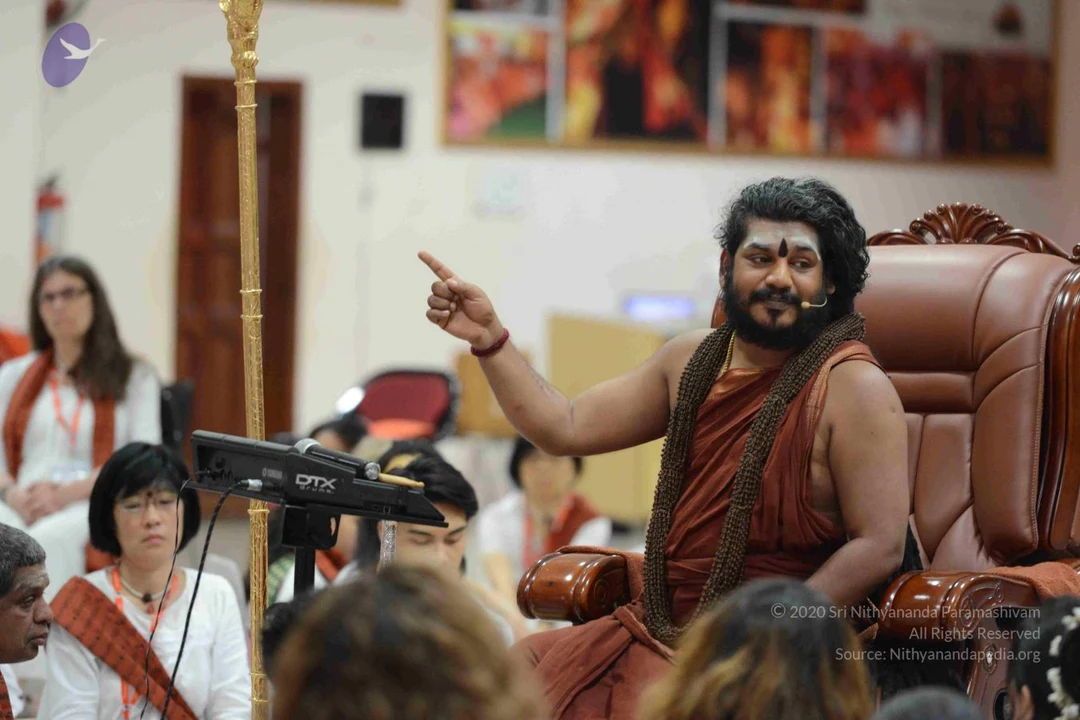
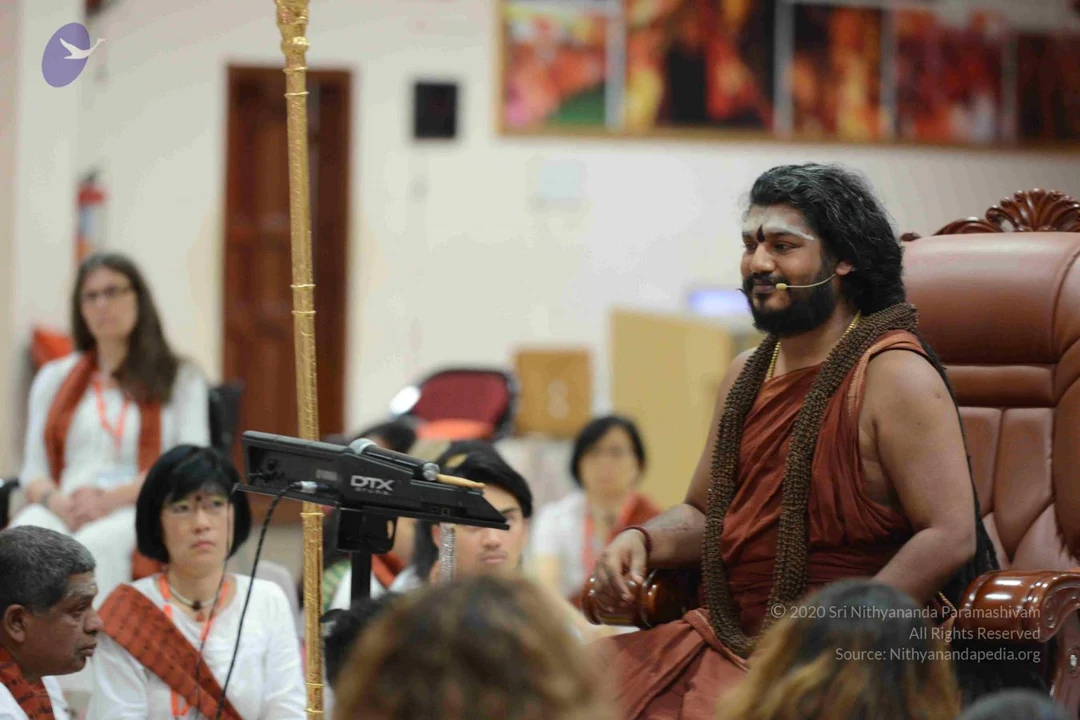
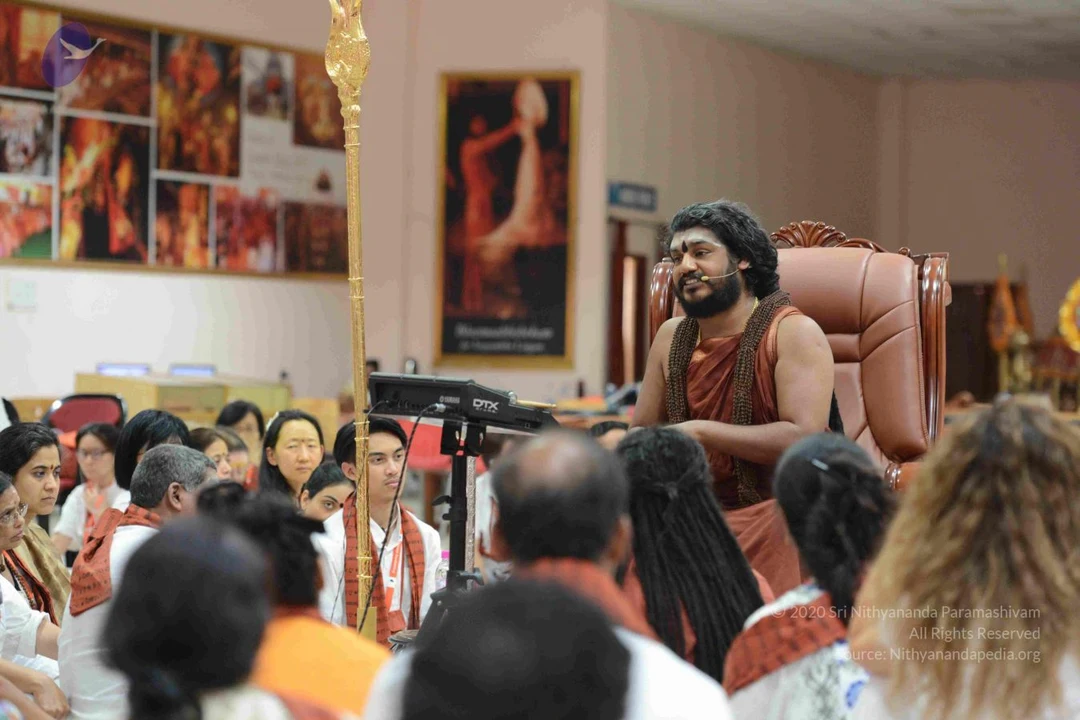
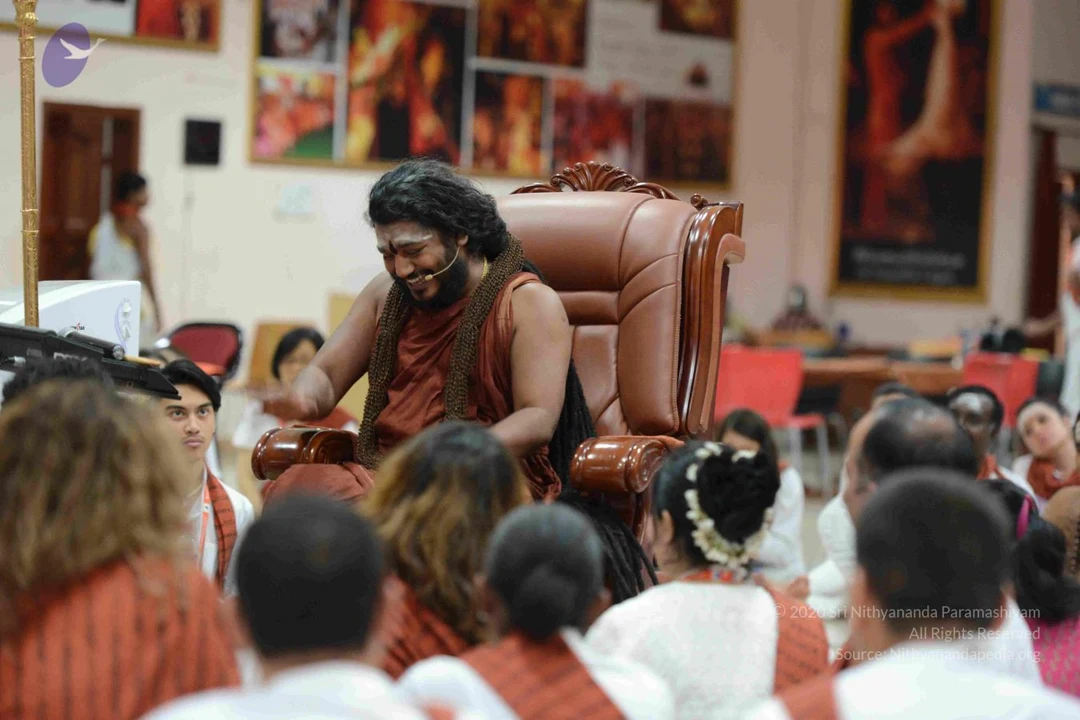
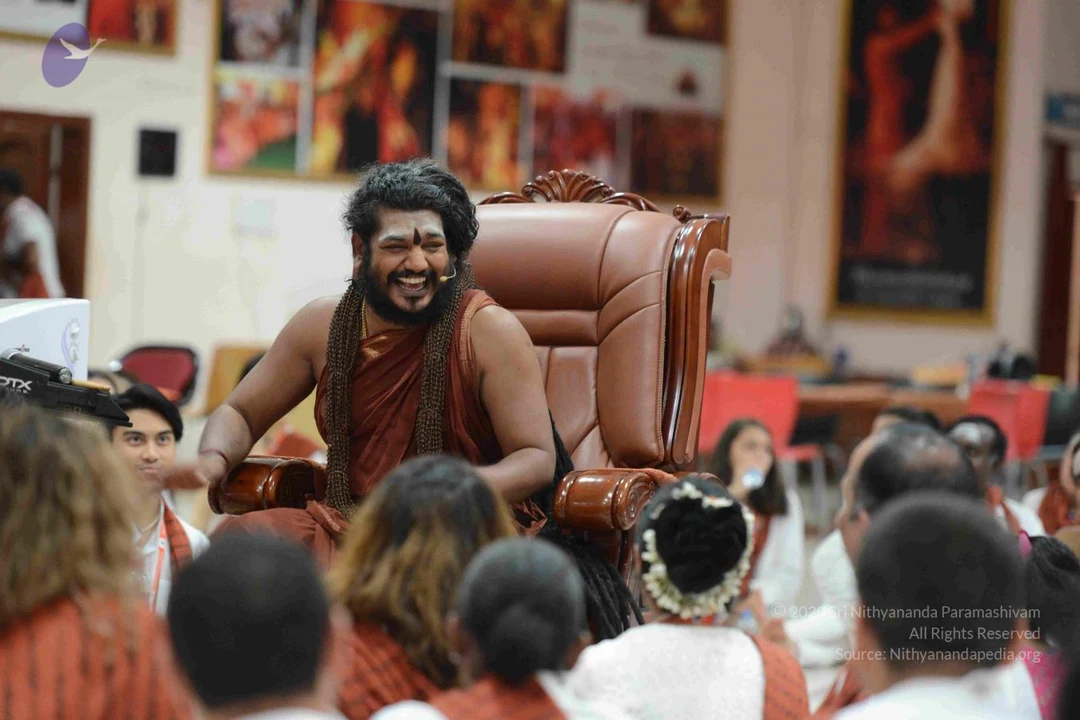
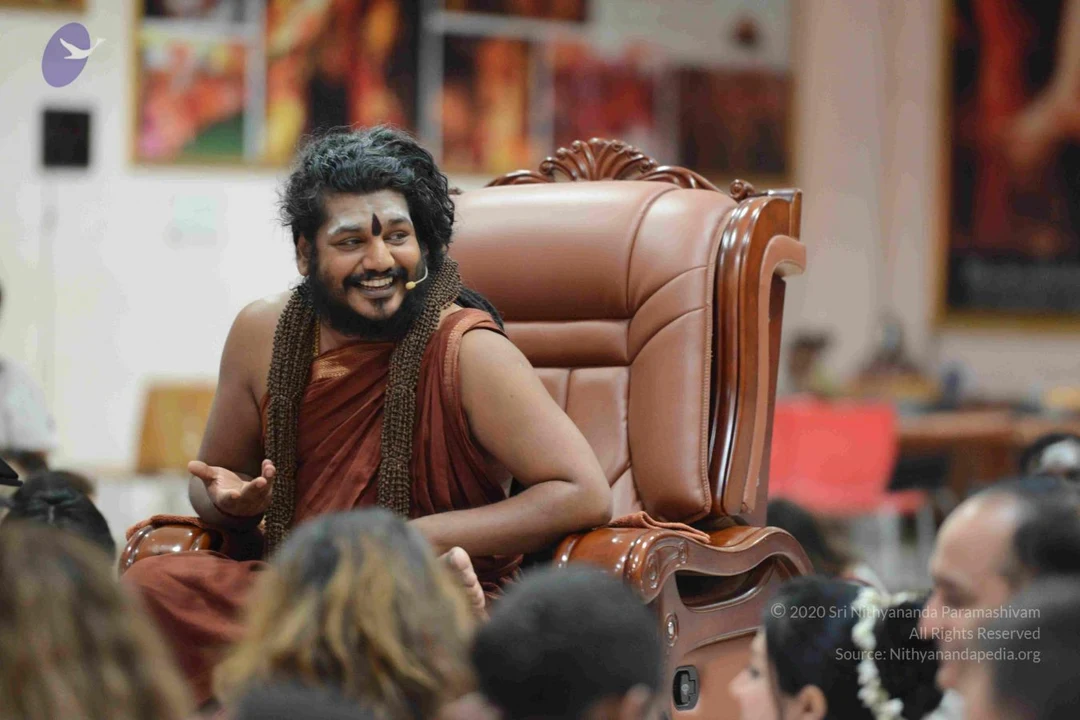
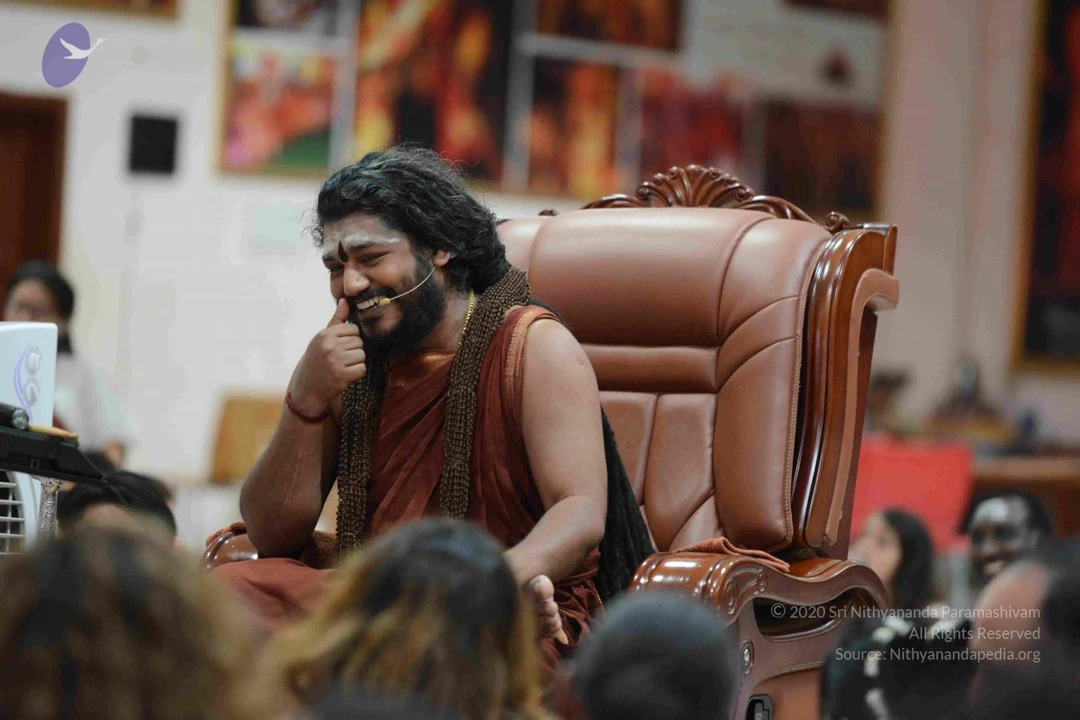
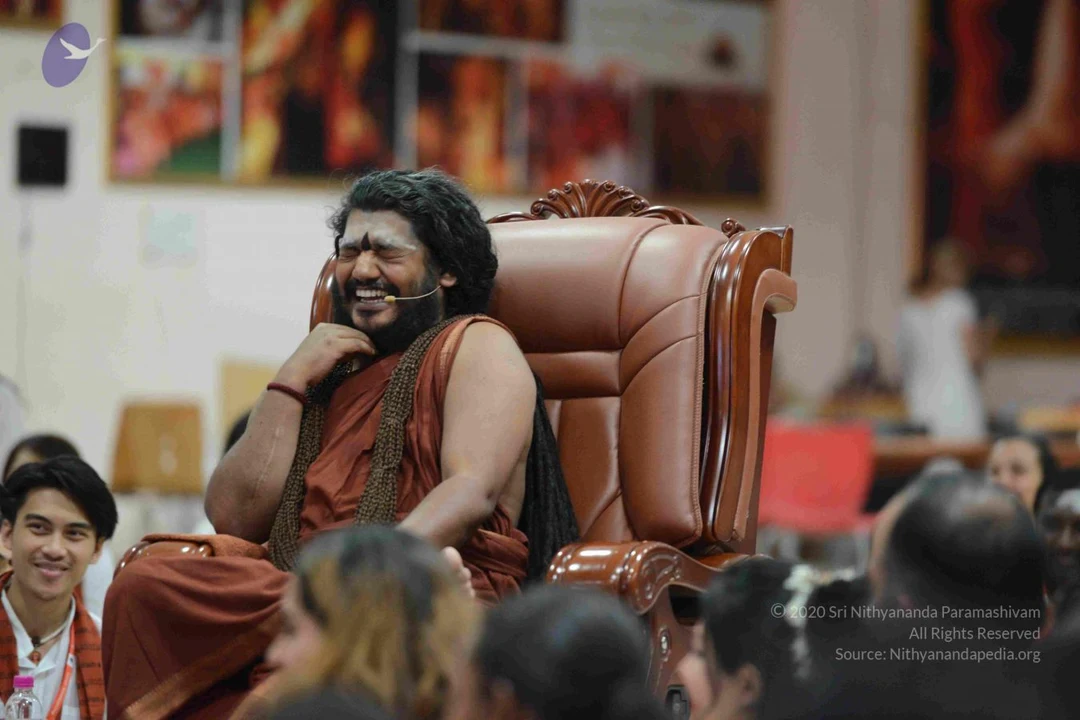
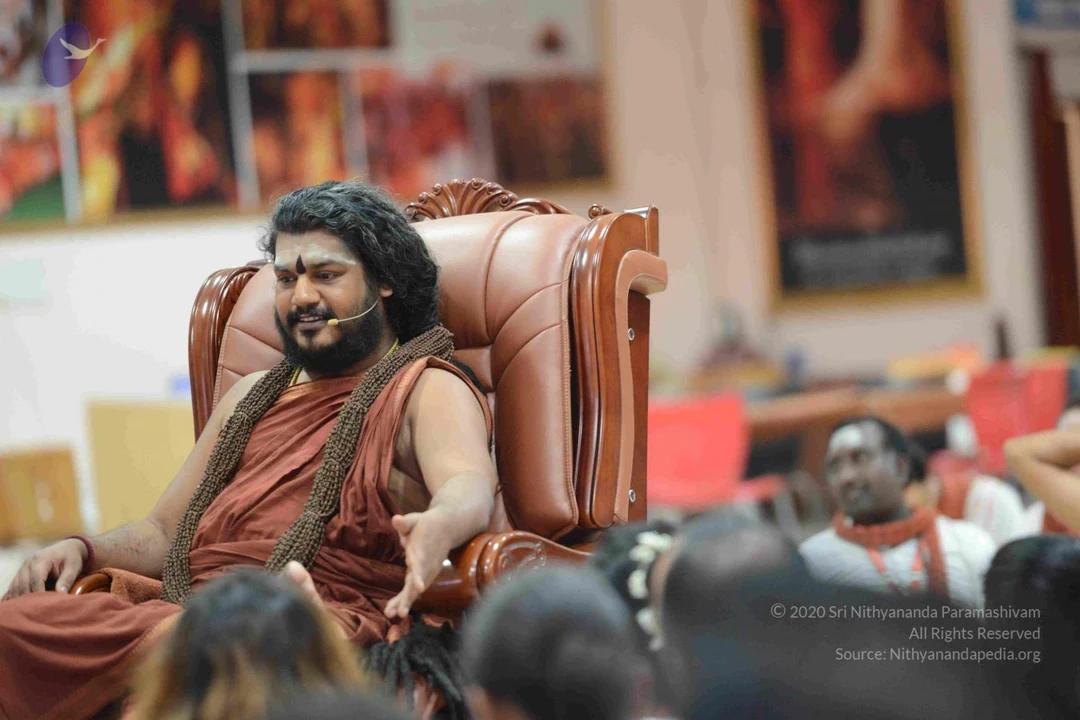
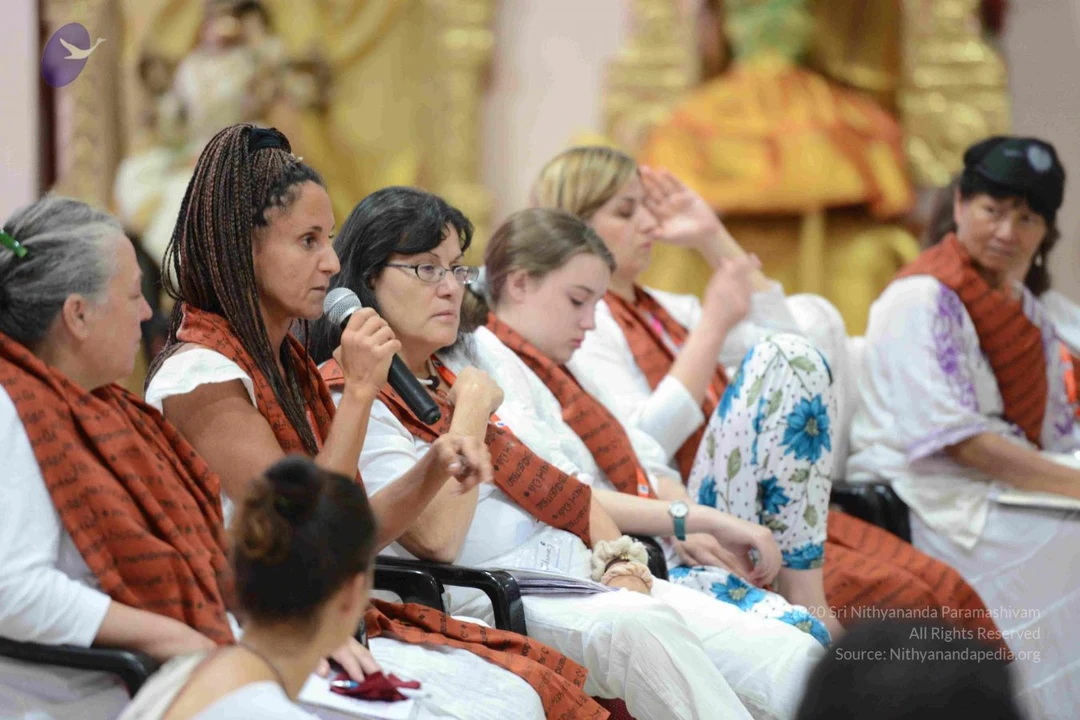
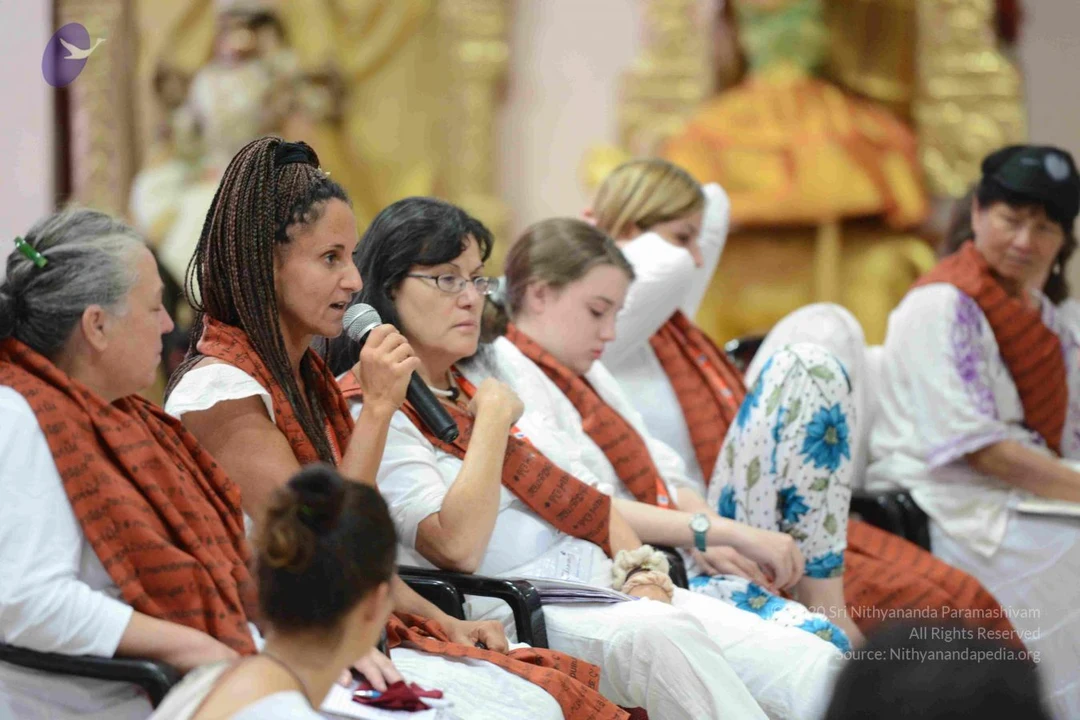
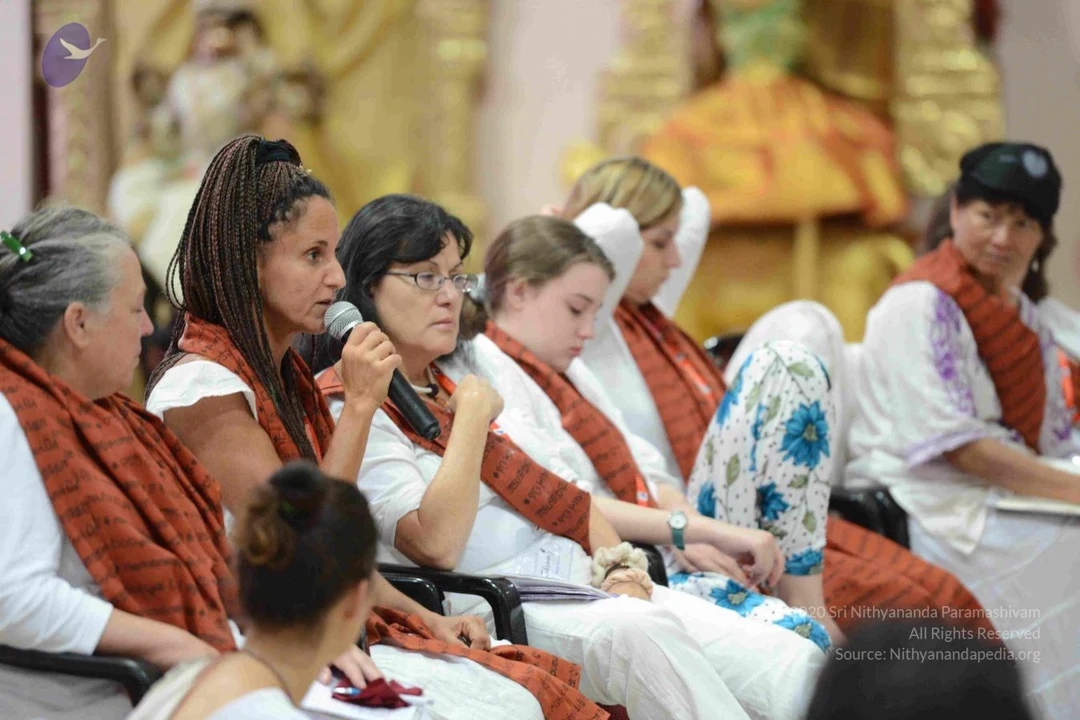
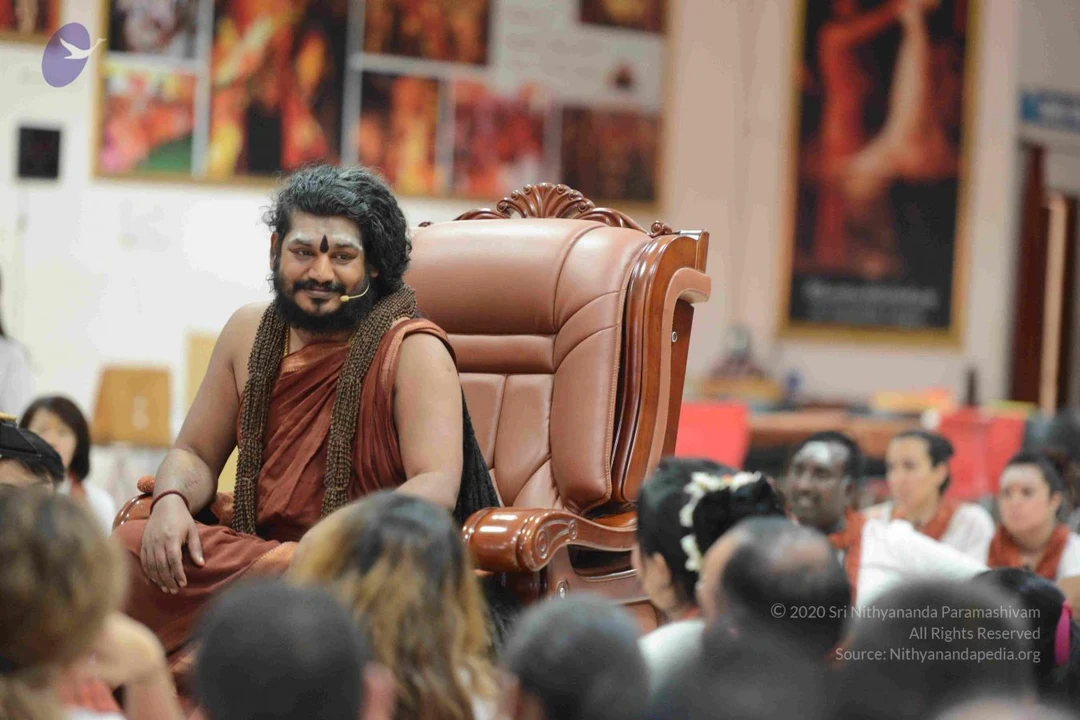
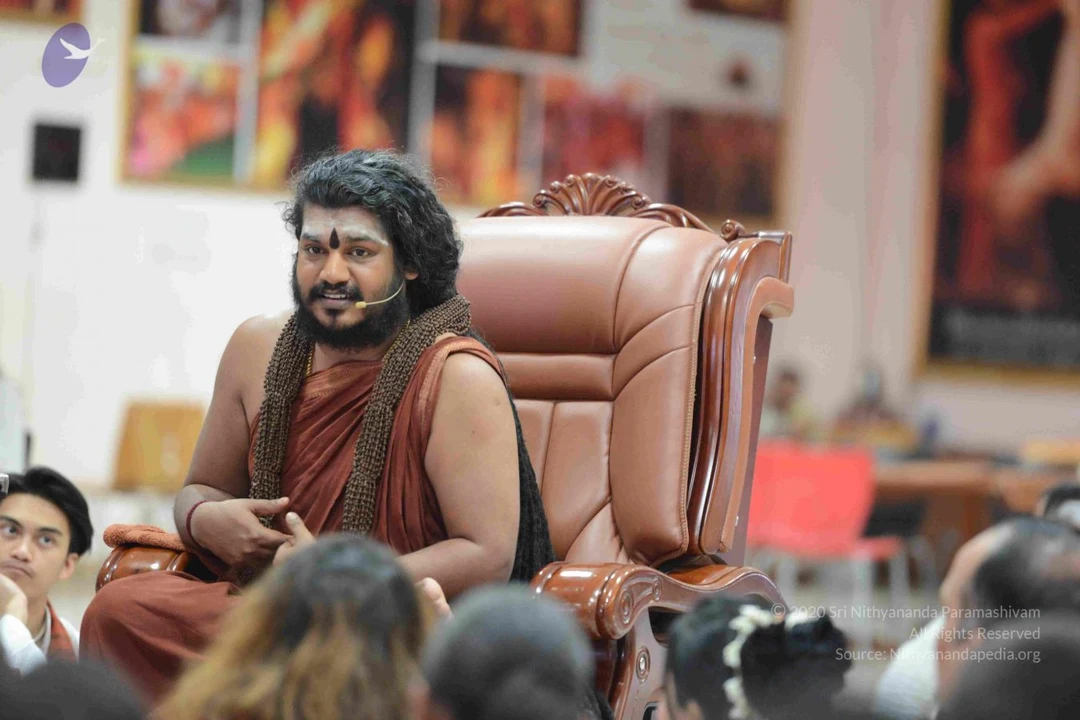
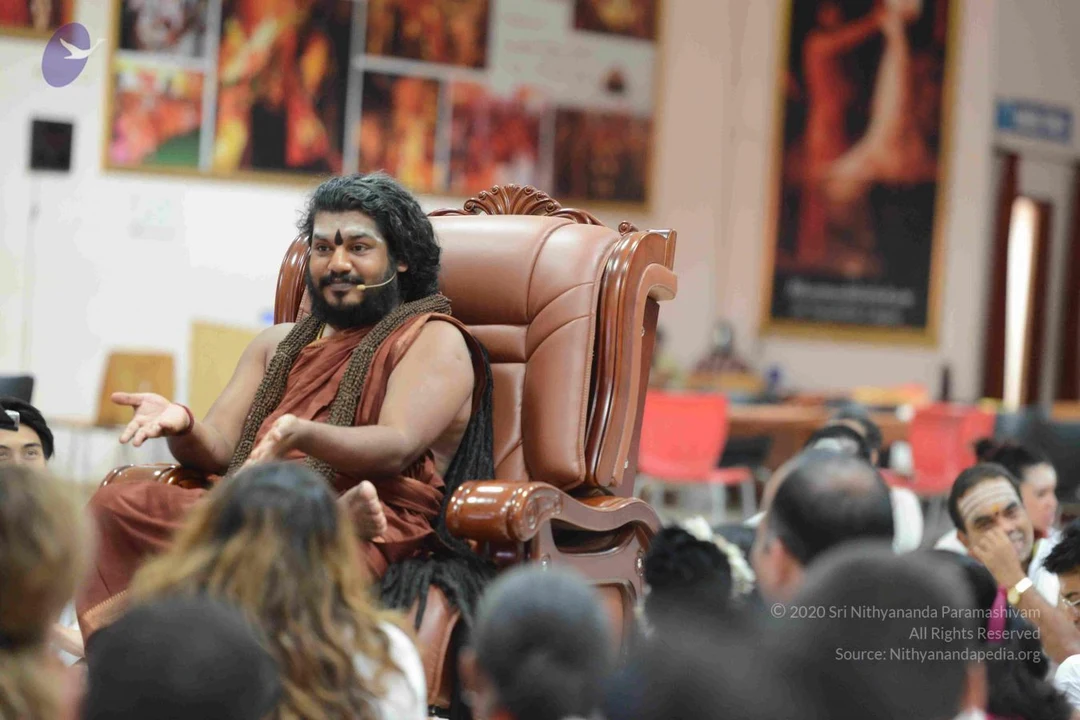
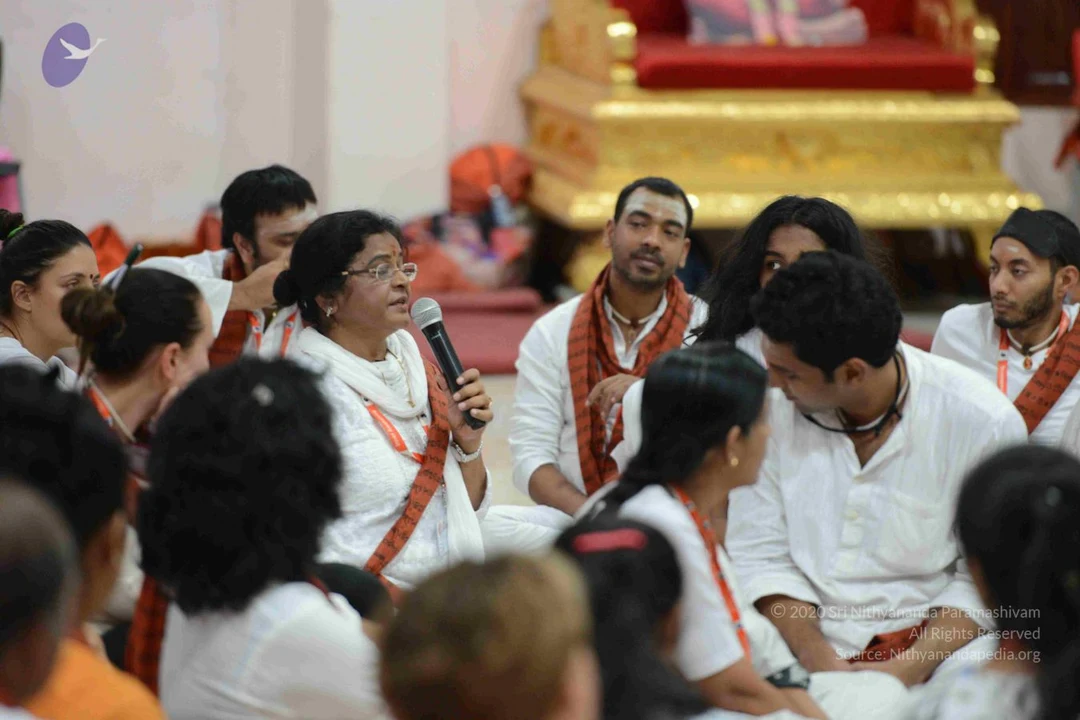
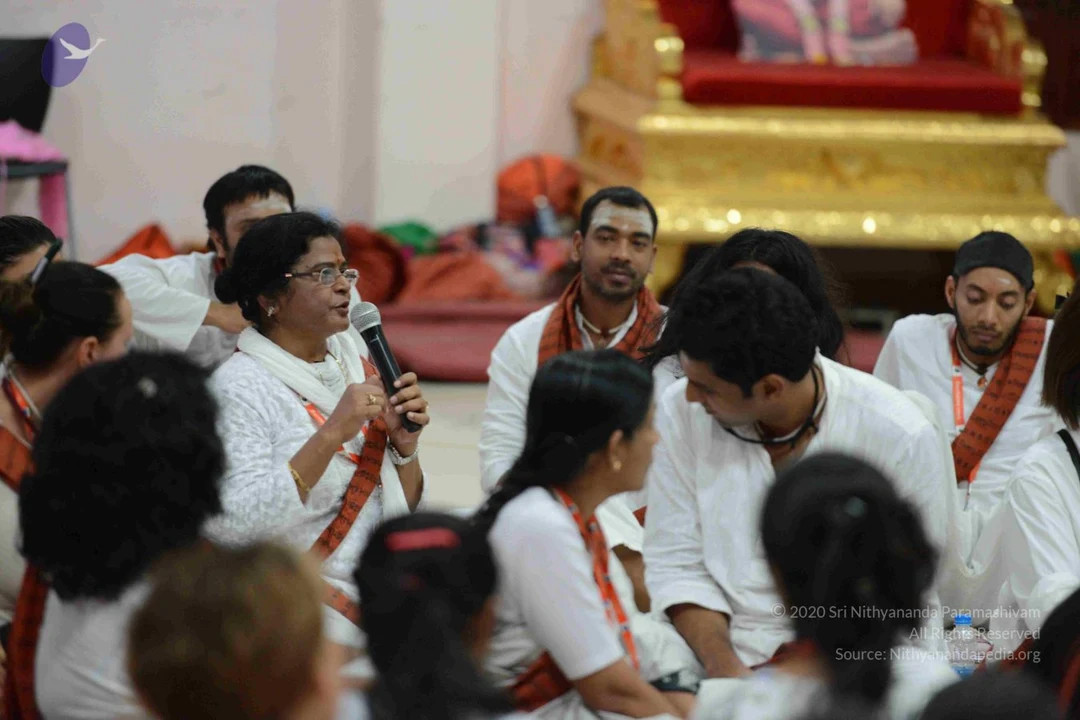
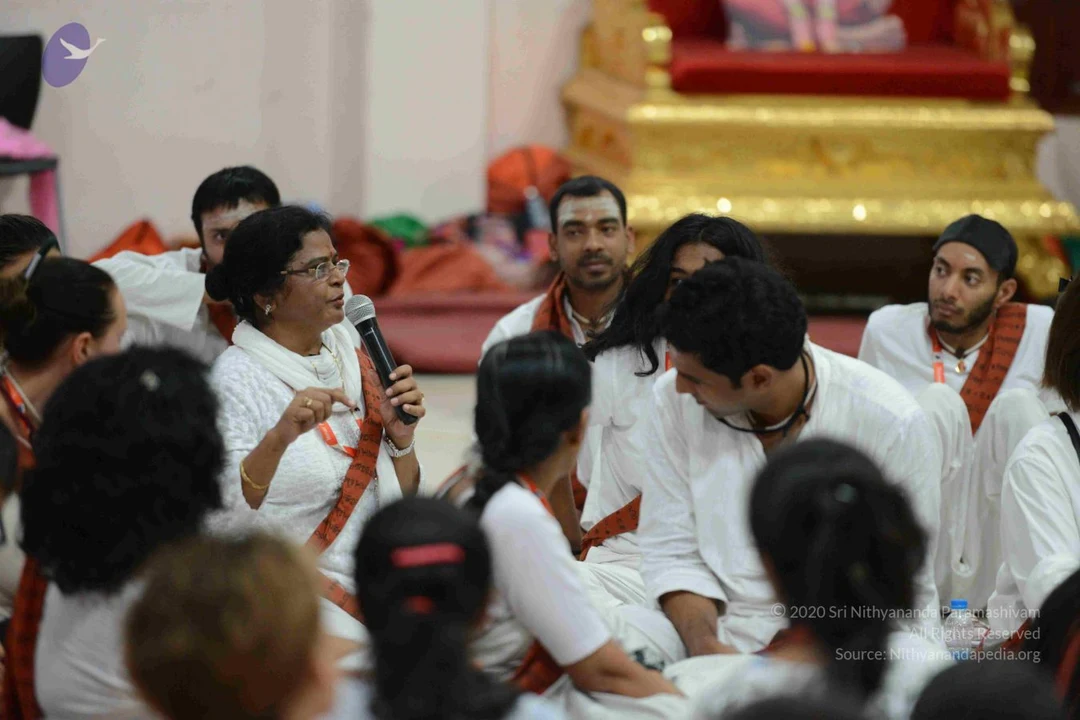
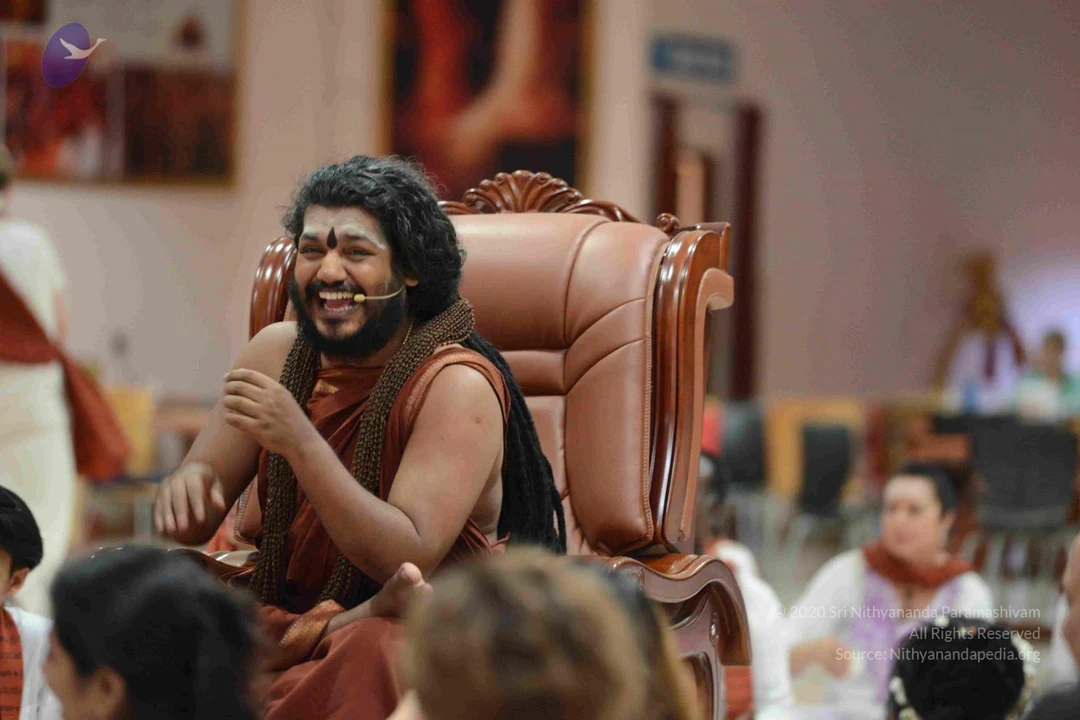
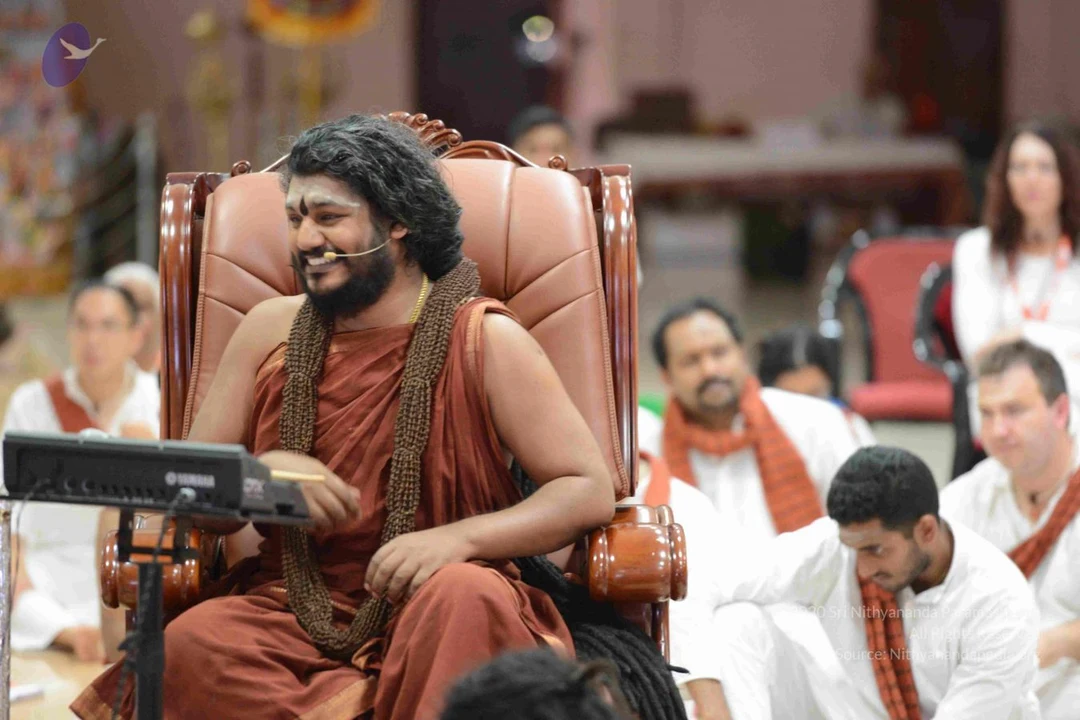
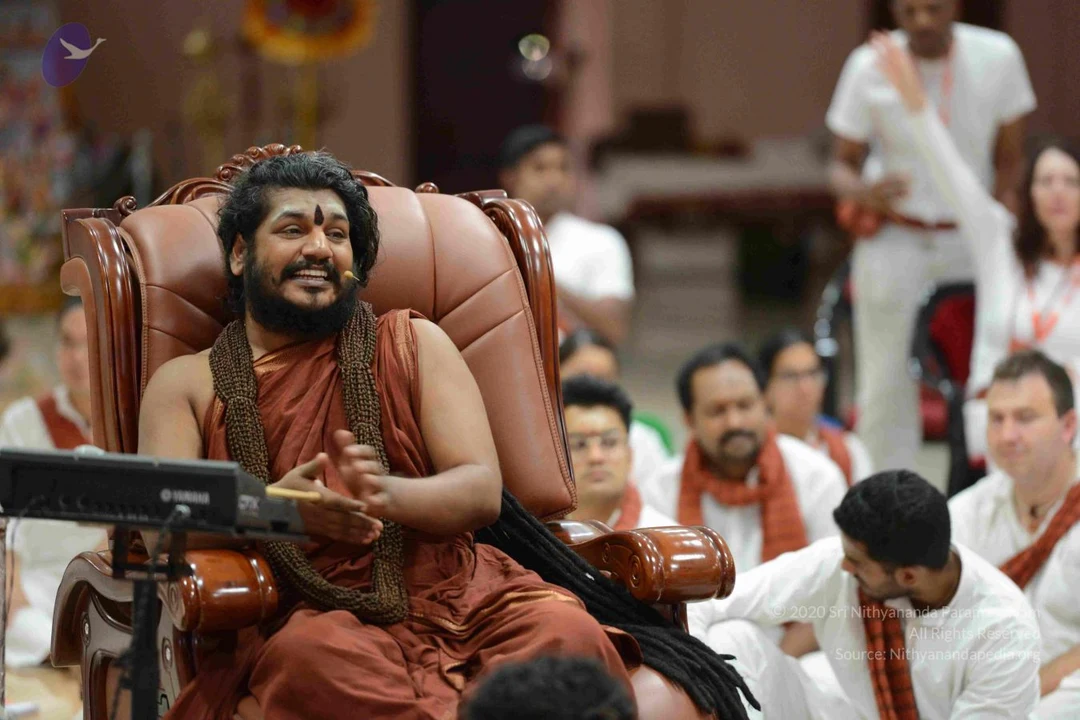
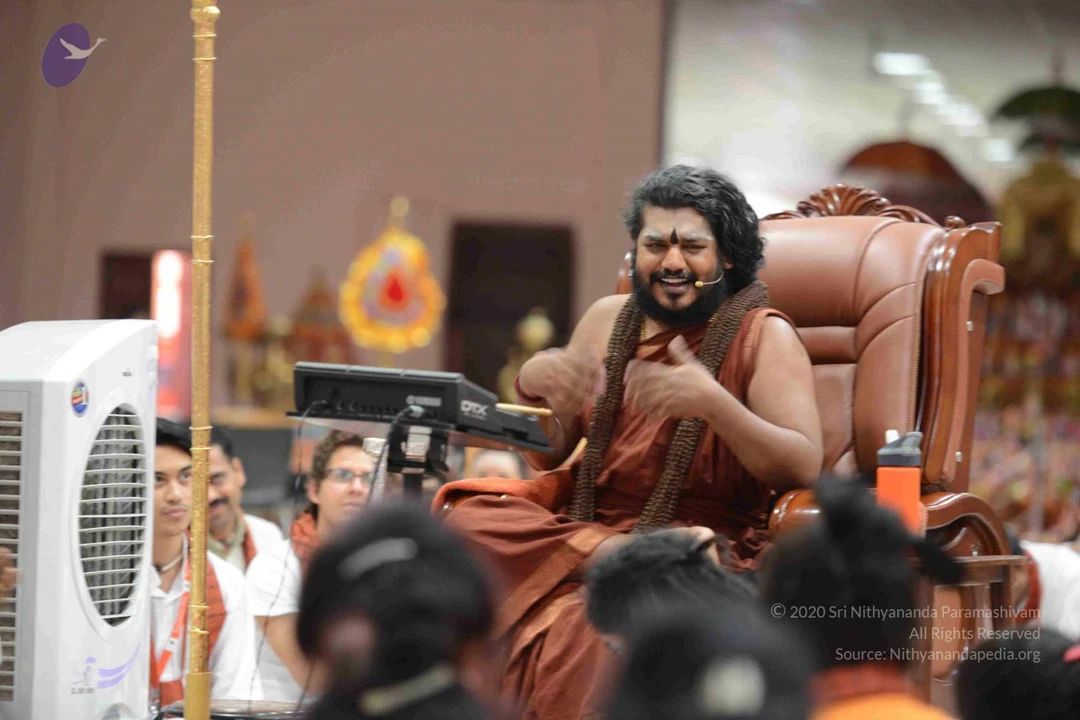
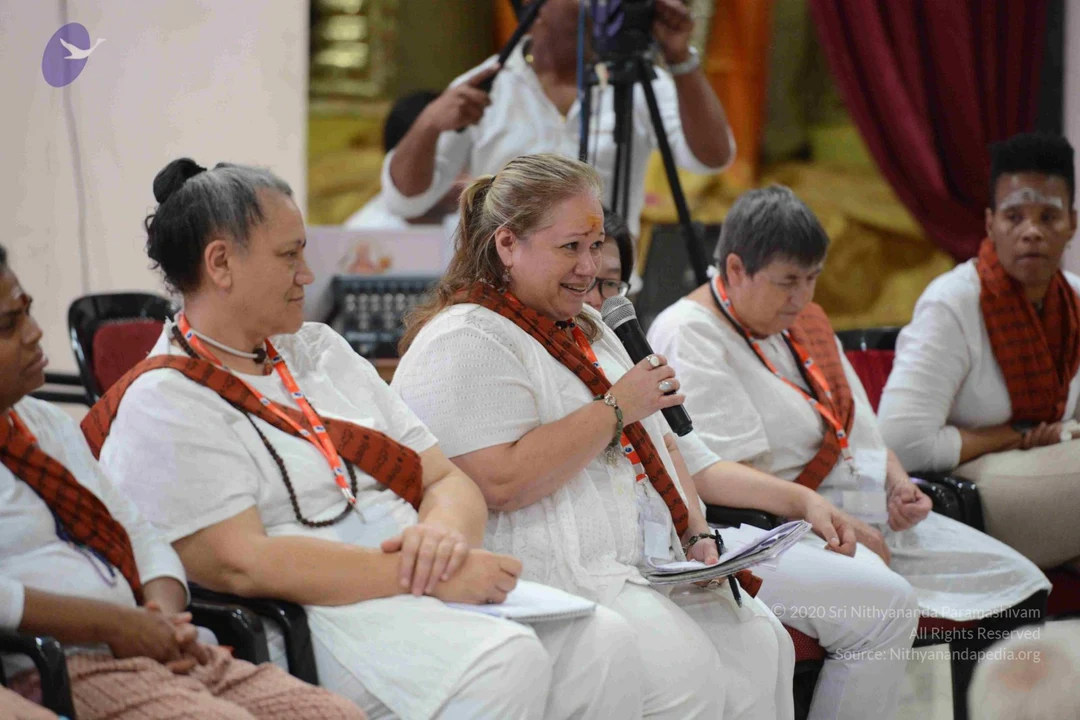
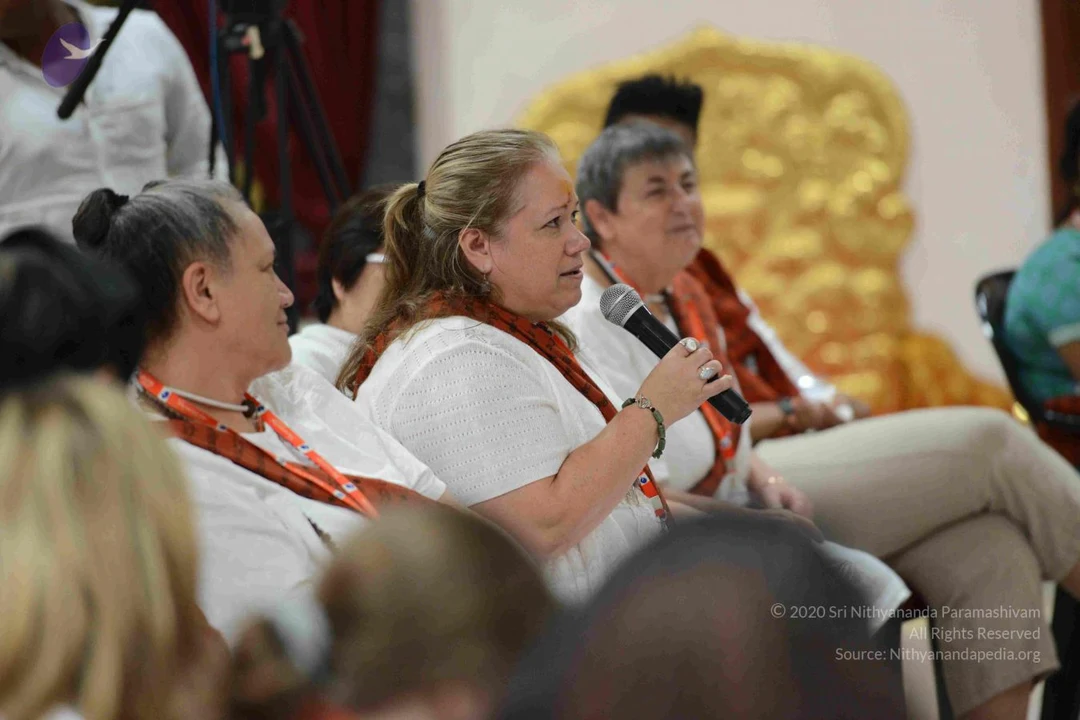
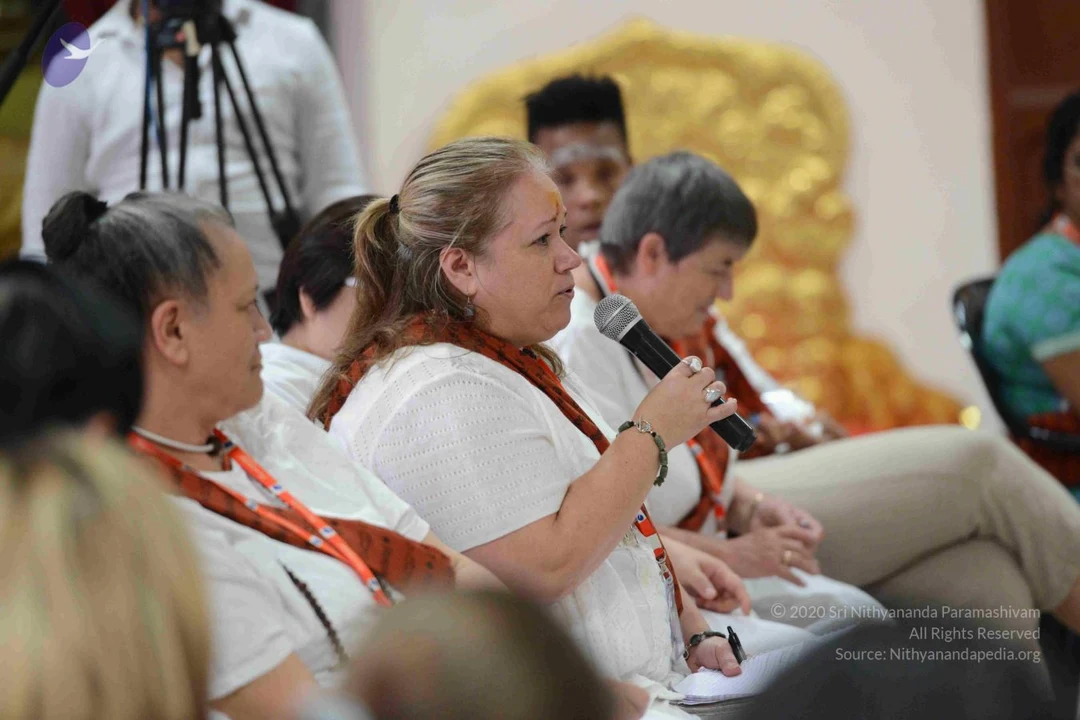
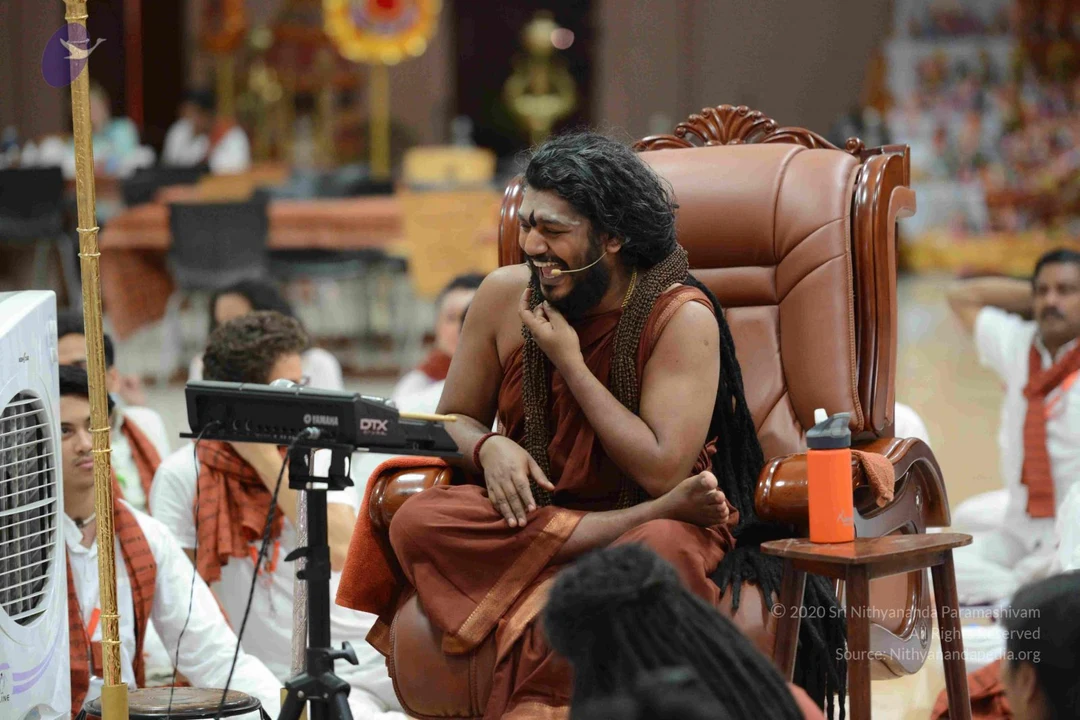
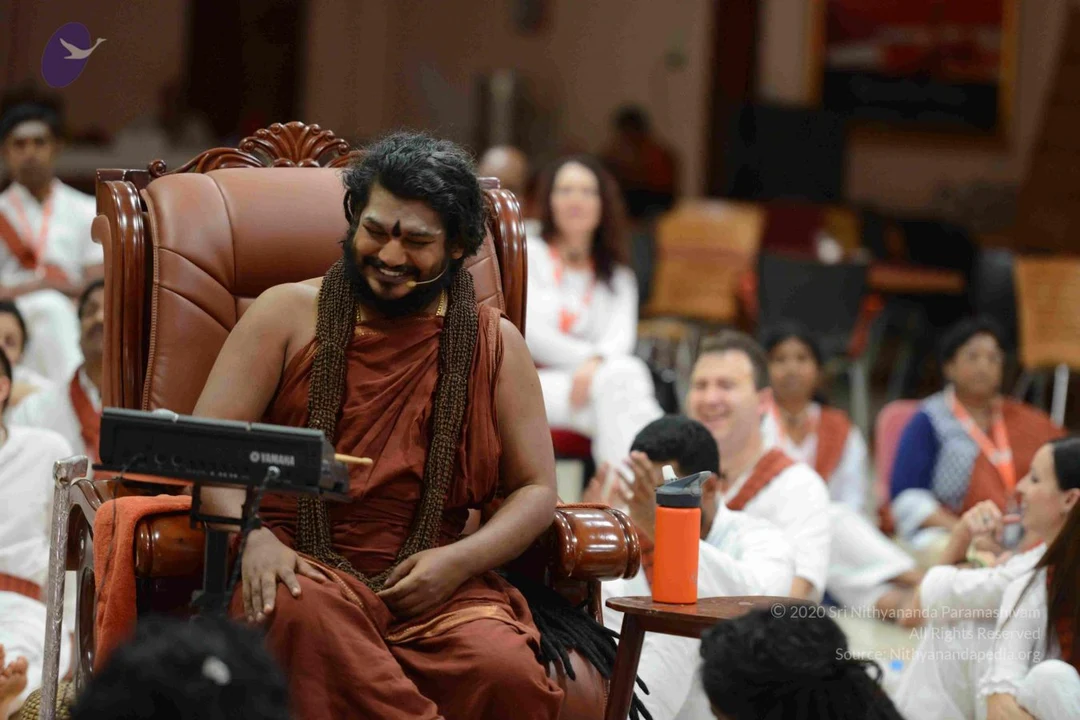
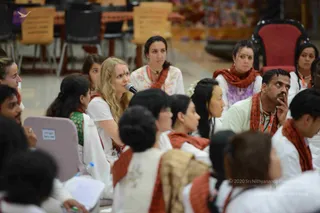
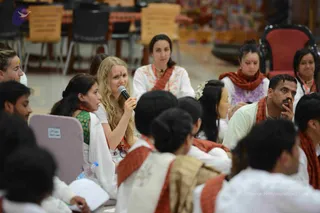
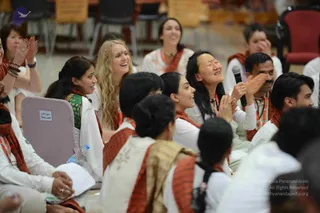
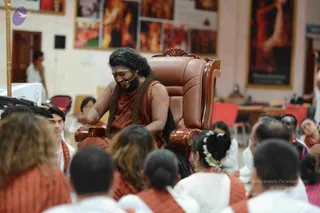
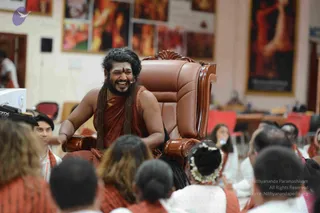
A seated audience of devotees in white clothing with orange-red shawls draped over their shoulders during a satsang. In the foreground, a woman with long wavy blonde hair and a red bindi holds a microphone to her mouth and speaks. Around her, participants sit on chairs and mats, some with hands near their faces, listening attentively. Behind them are wooden tables with black chairs and a red-cushioned throne-style chair near the back right, with a colourful decorated hall in the background.A photograph of a seated satsang audience in a hall with orange-and-white chairs and a red-cushioned chair at right. A young woman with long wavy blonde hair and a red bindi, wearing a white top and an orange lanyard, holds a handheld microphone to speak. Around her, devotees in white kurtas and dupattas with orange-red shawls sit on the floor, and a man at right with a moustache rests his hand on his chin. Blurred figures fill the foreground, and an altar with colourful decorations appears in the background. No speaker on a dais is clearly visible.A seated audience in white clothes with orange-red shawls at a satsang hall. Several smiling devotees laugh and clap, and a woman in the centre holds a handheld microphone with her eyes closed in laughter. Chairs with a white card label are visible at left, and orange lanyards hang from some necks. The front-facing speaker is not visible; no a person candidate is shown. Visible people number about twelve, with many partially visible in the foreground.A seated satsang audience in a hall with orange and red stacking chairs behind them. A woman in the centre with long dark hair, a white top and an orange scarf holds a microphone and gestures with one hand while speaking. Beside her a smiling man with a moustache wears a white kurta and an orange-red shawl. Around them devotees sit on the floor in white clothes and orange-red shawls, several clapping, and a woman on the left in a green blouse with white shawl smiles. A blonde woman in white and a woman with dark hair in a bun are also visible. No one is identified as a person in this crowd view.A satsang hall where a man with long dark wavy hair and a full beard, wearing a rust-red ochre robe and a rudraksha mala, sits smiling in an ornate brown leather throne with carved wooden armrests, a headset microphone at his ear. Seated devotees in white clothes with red shawls sit before him, and a gold-framed deity murti stands in an alcove behind, with a red digital clock and a wooden door in the background. The seated man appears to be Swamiji (probable), based on the long hair, rust-red robe and rudraksha mala, and the throne suggests he is presiding over the gathering.A man with long dark swept-back hair and a beard sits smiling in an ornate brown leather throne-style armchair, one hand raised to his chin and a small headset microphone at his face. He wears an orange-red saffron robe, a dark brown rudraksha mala draped over his shoulders, and a red tilak on his forehead. Seated audience members in foreground and background wear white and orange-red clothing; a woman on the left has dark curly hair. Behind them is a golden ornate shrine with a deity murti and a golden lion-shaped figure. A red digital clock is visible on the wall.
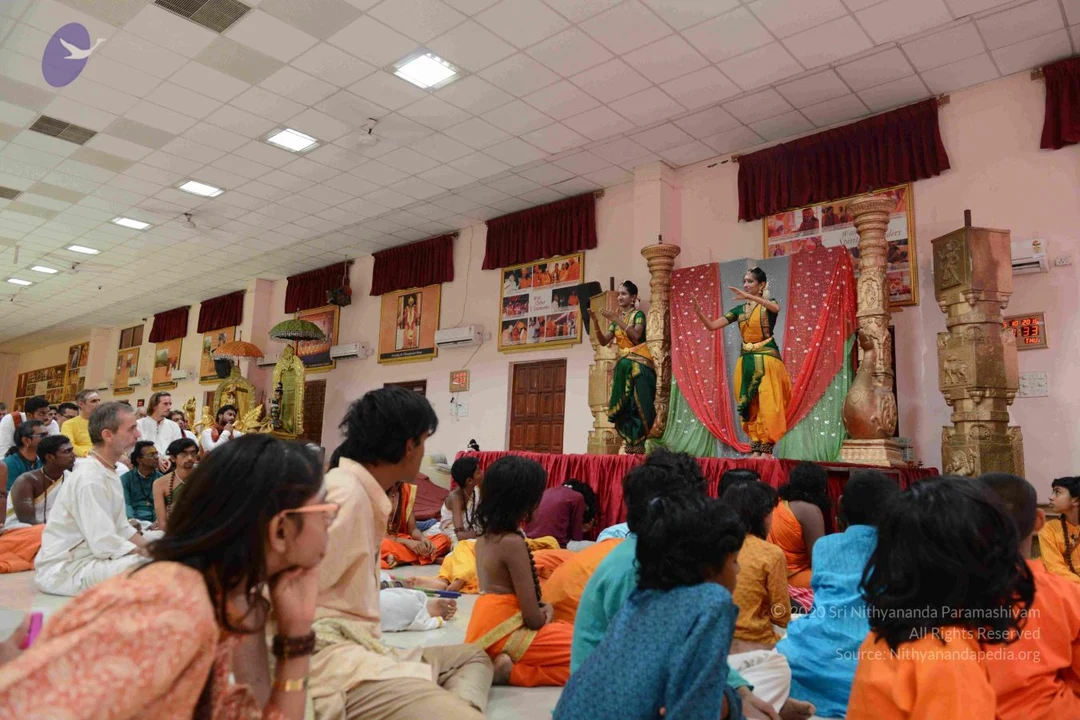
Navaratri-Darbar

51 photosSource gallery
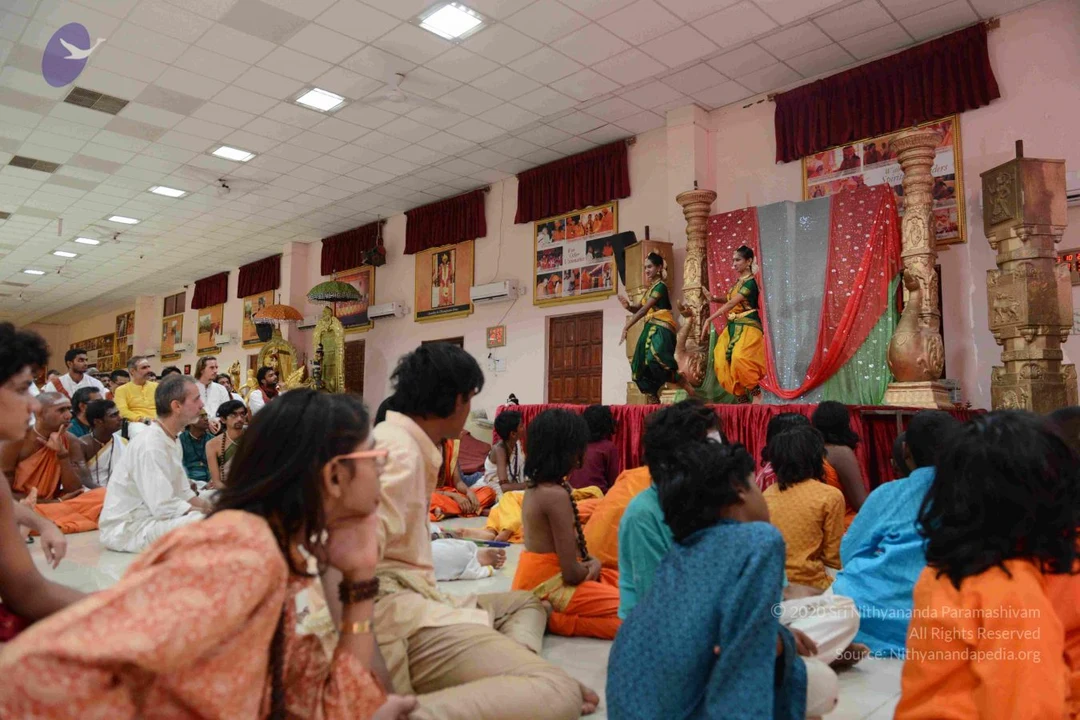
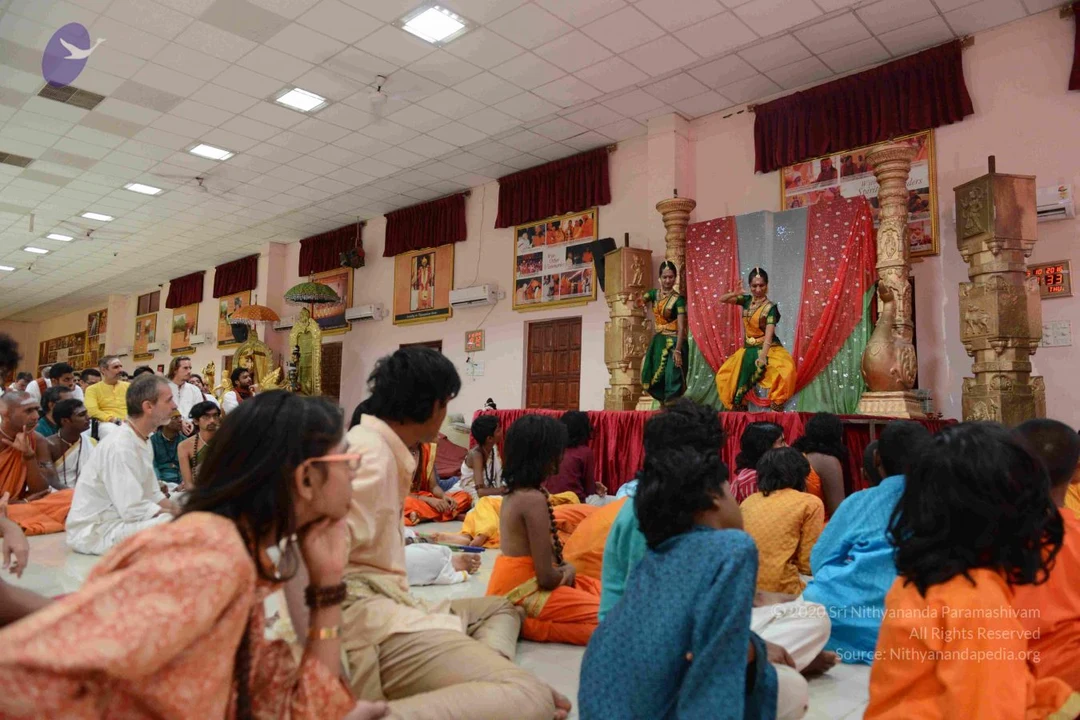
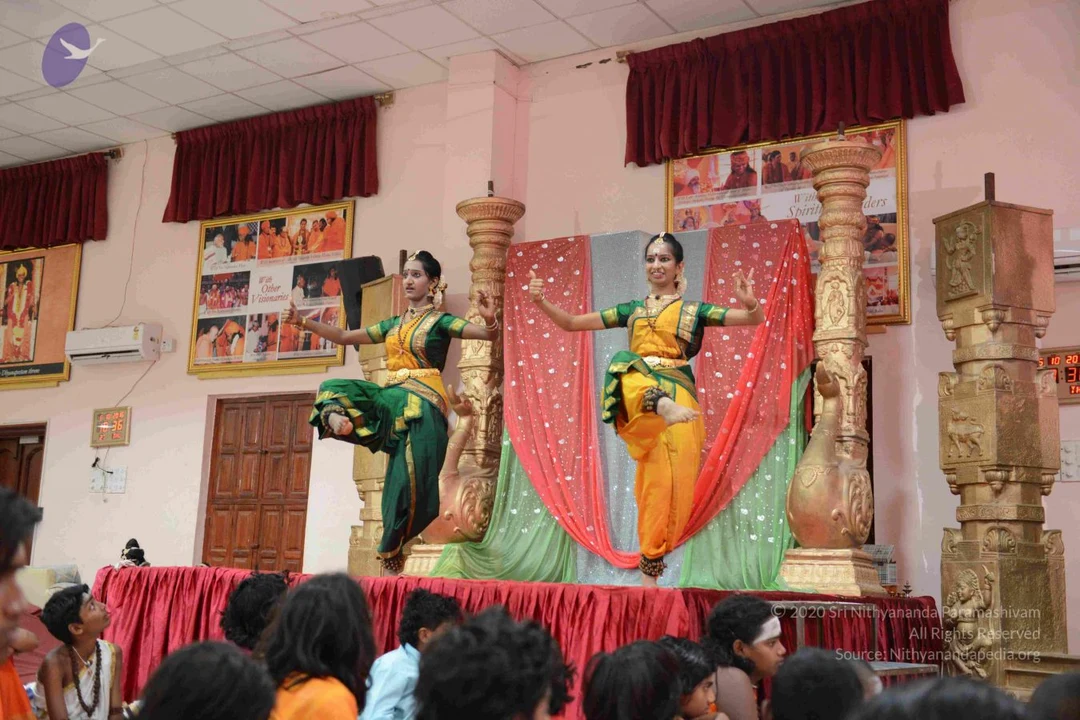
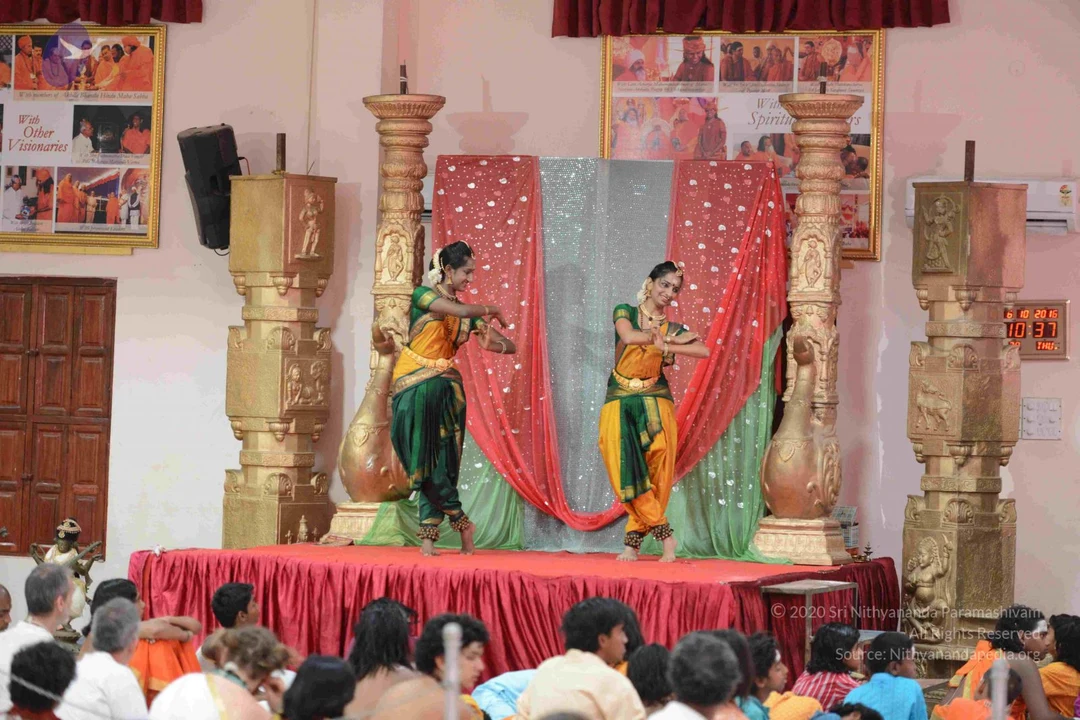
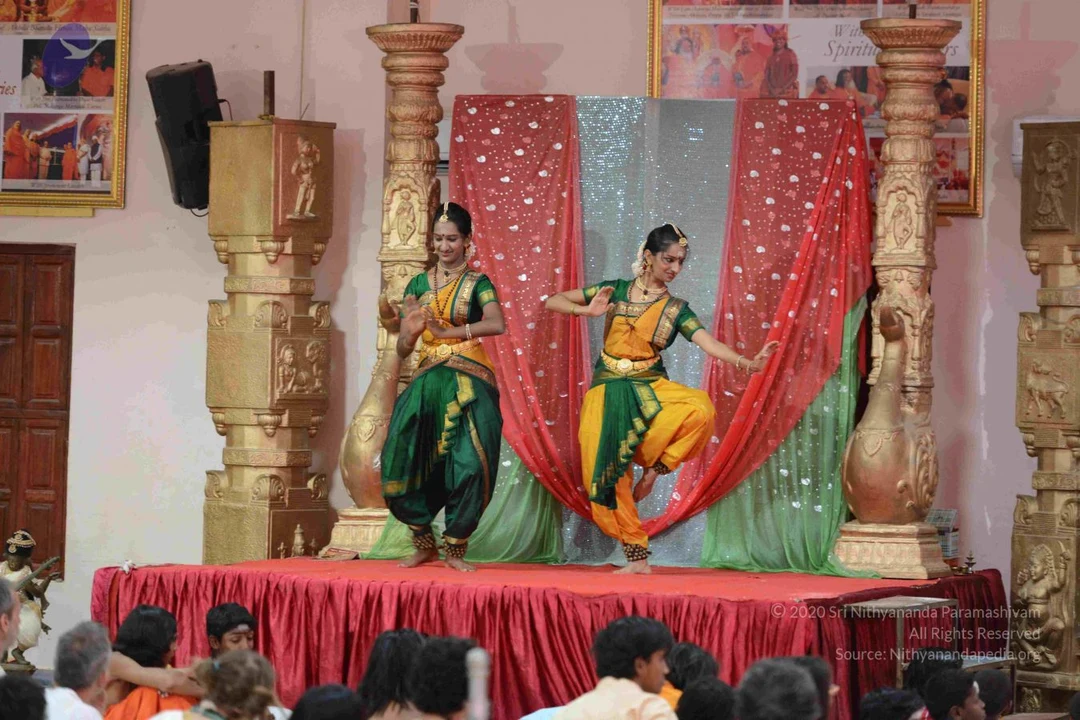
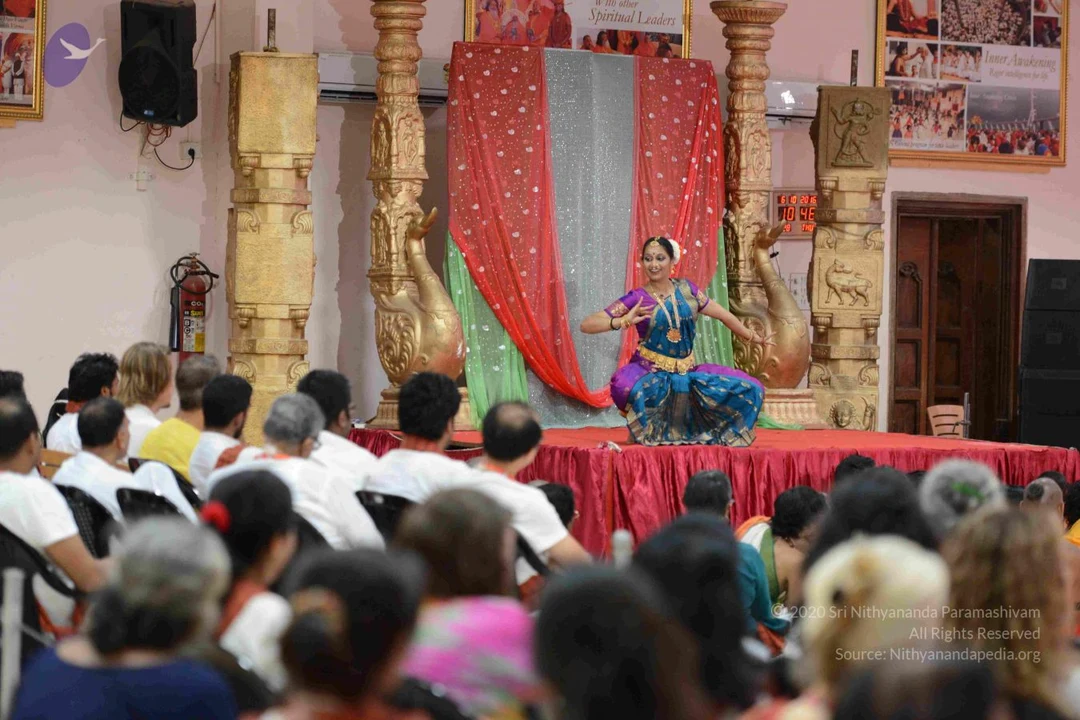
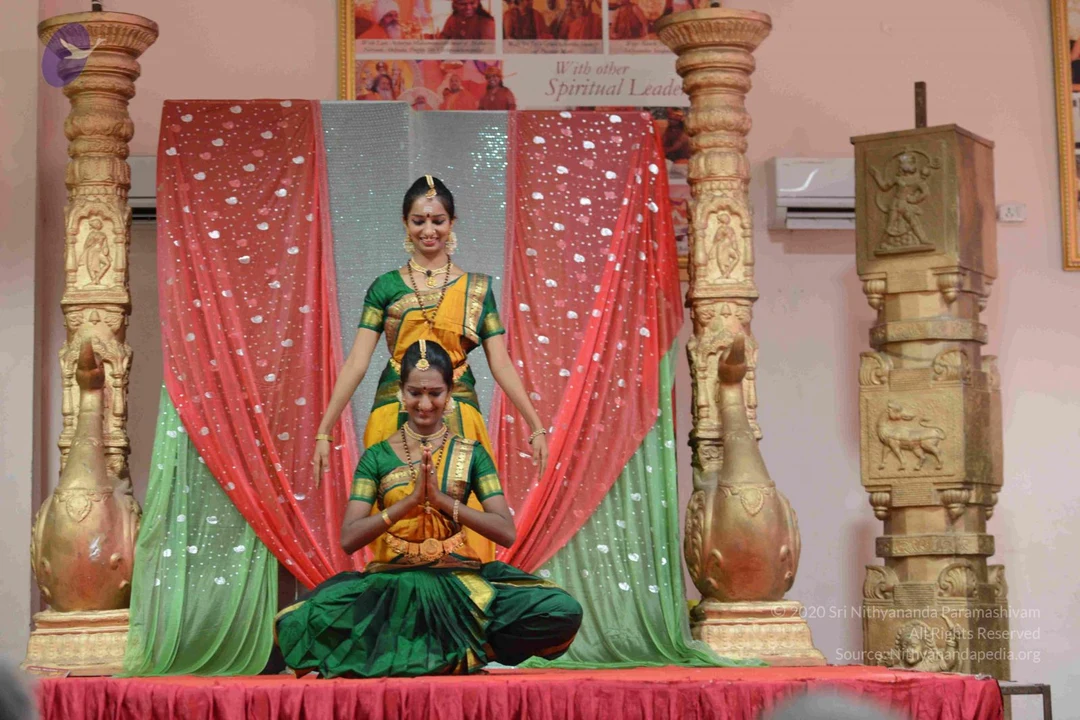
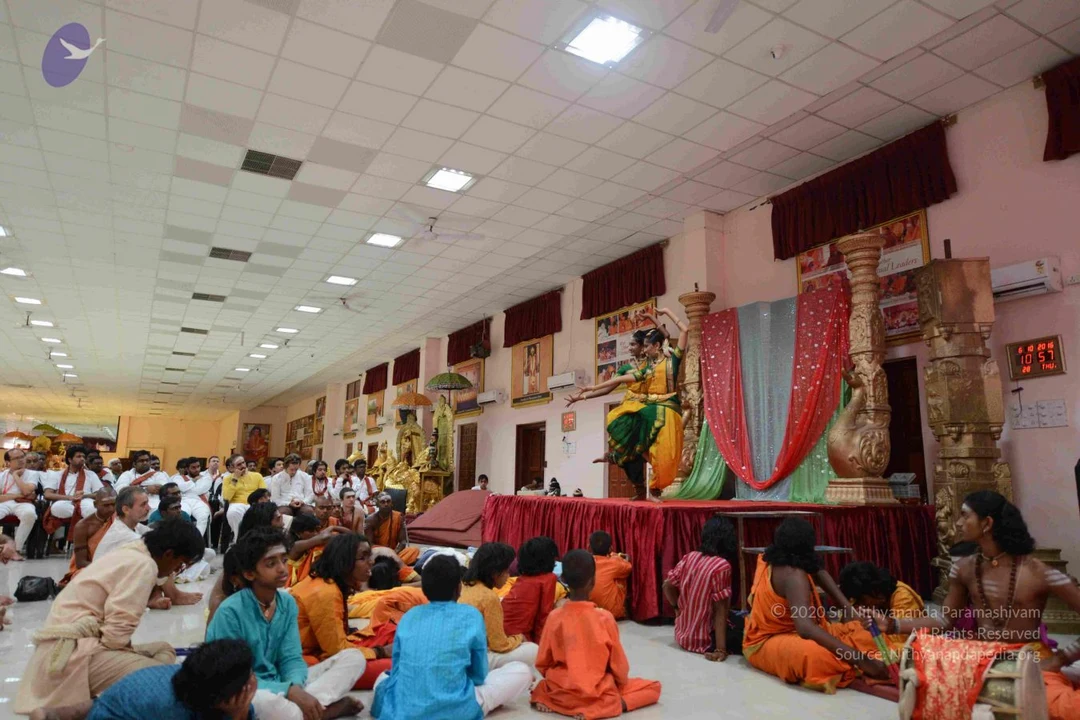
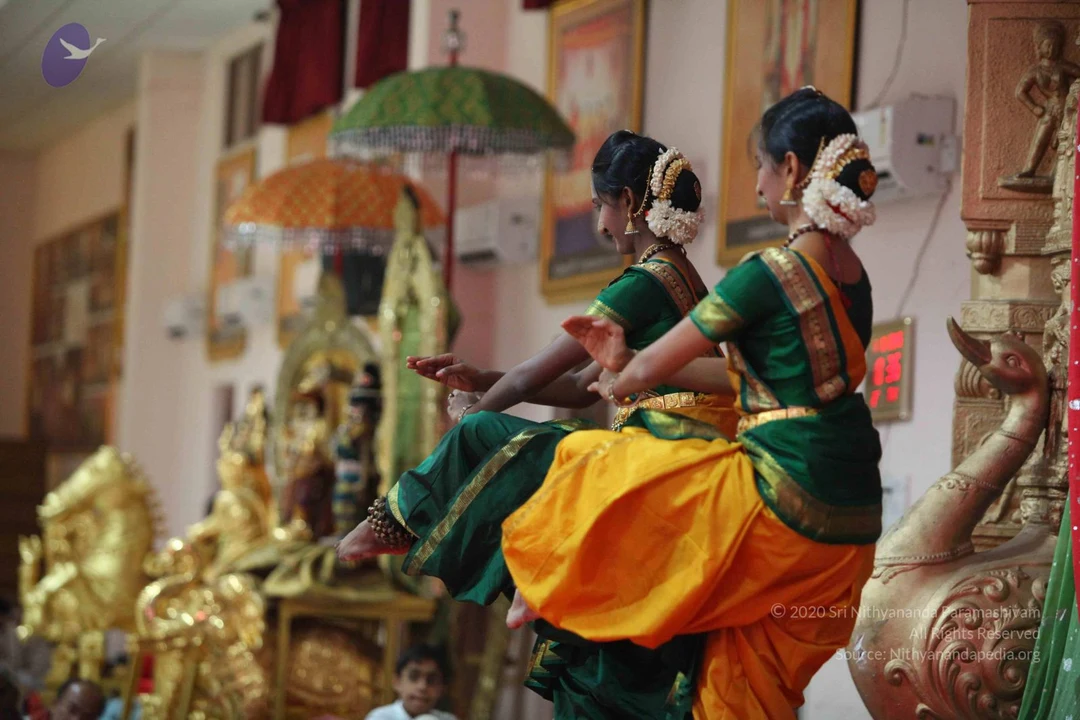
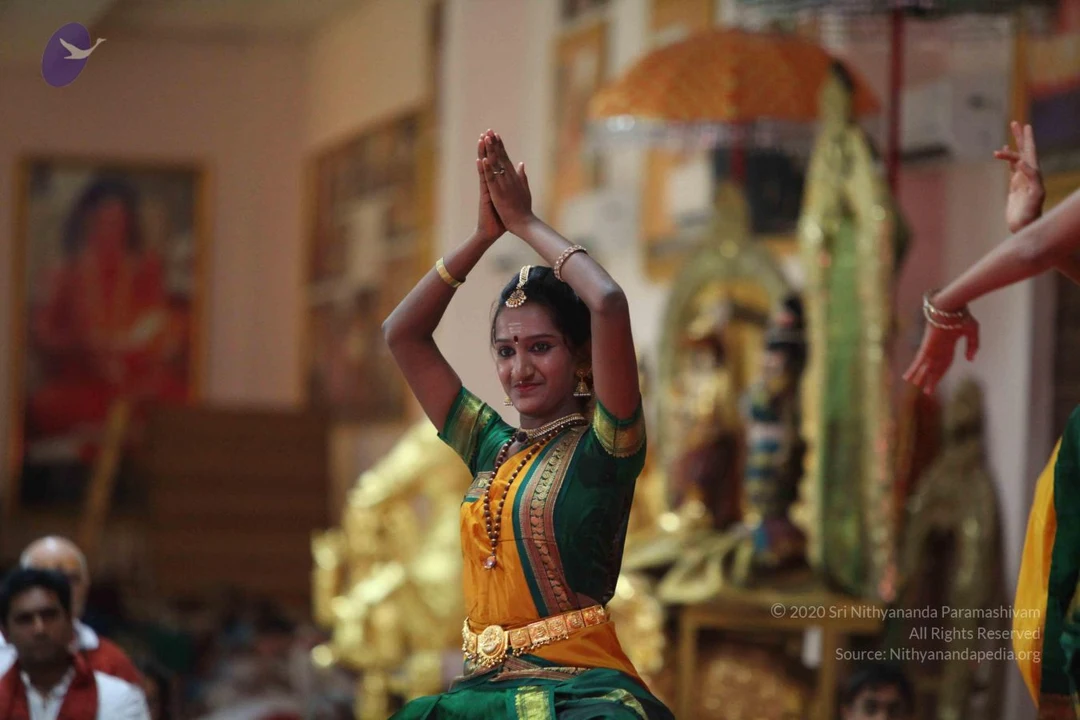
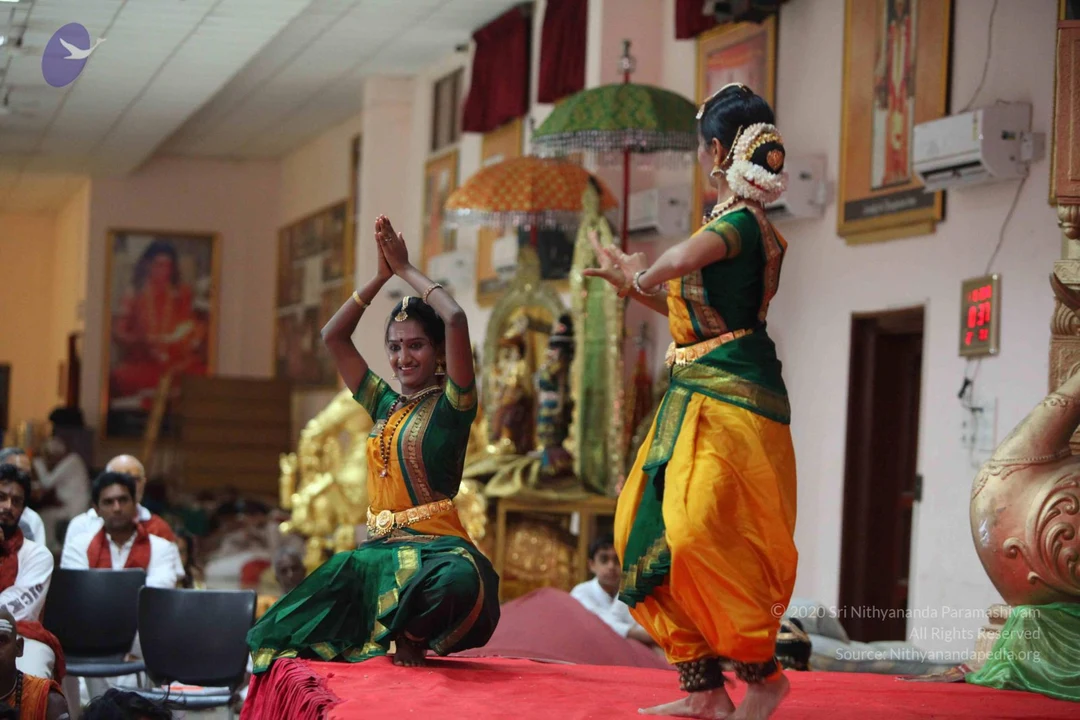
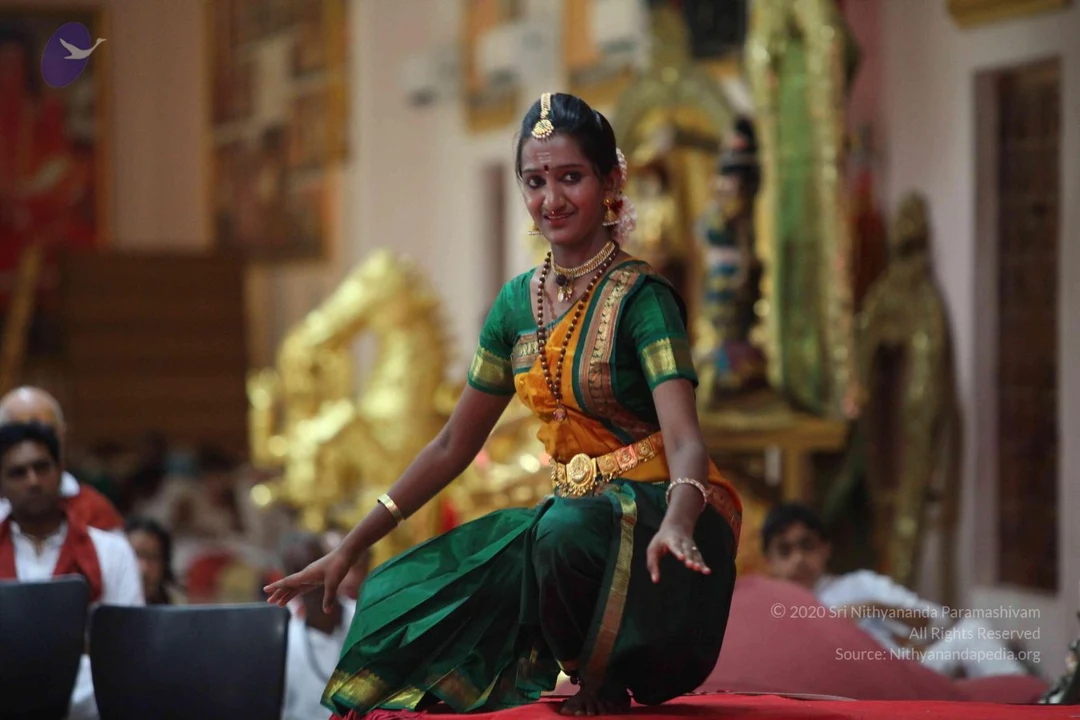
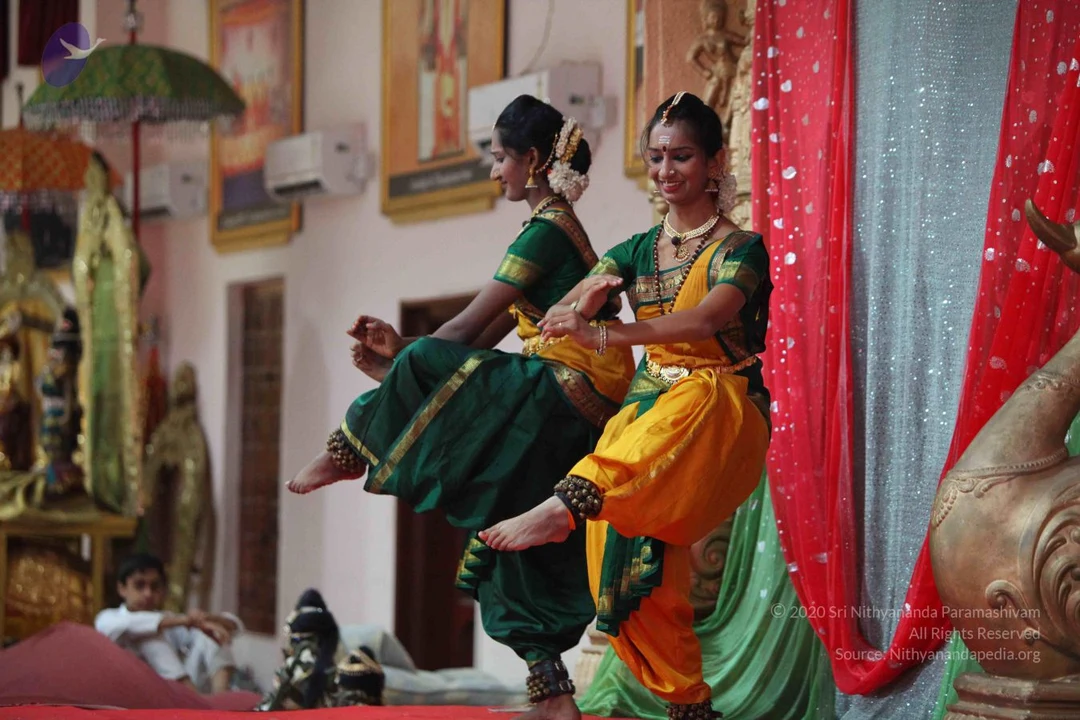
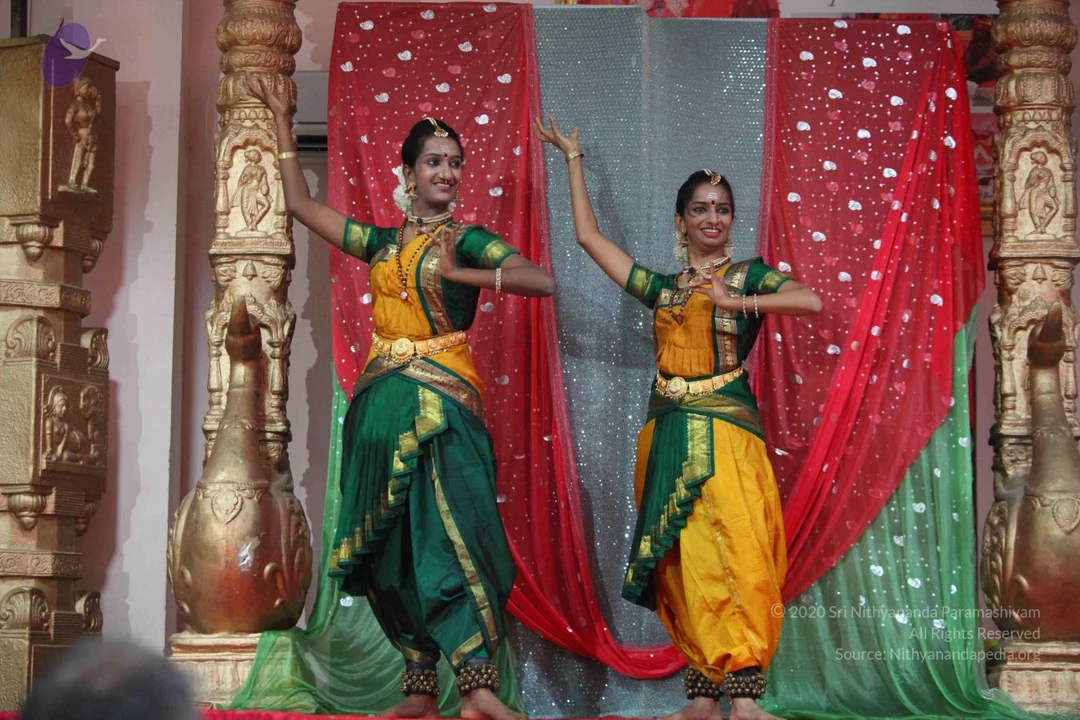
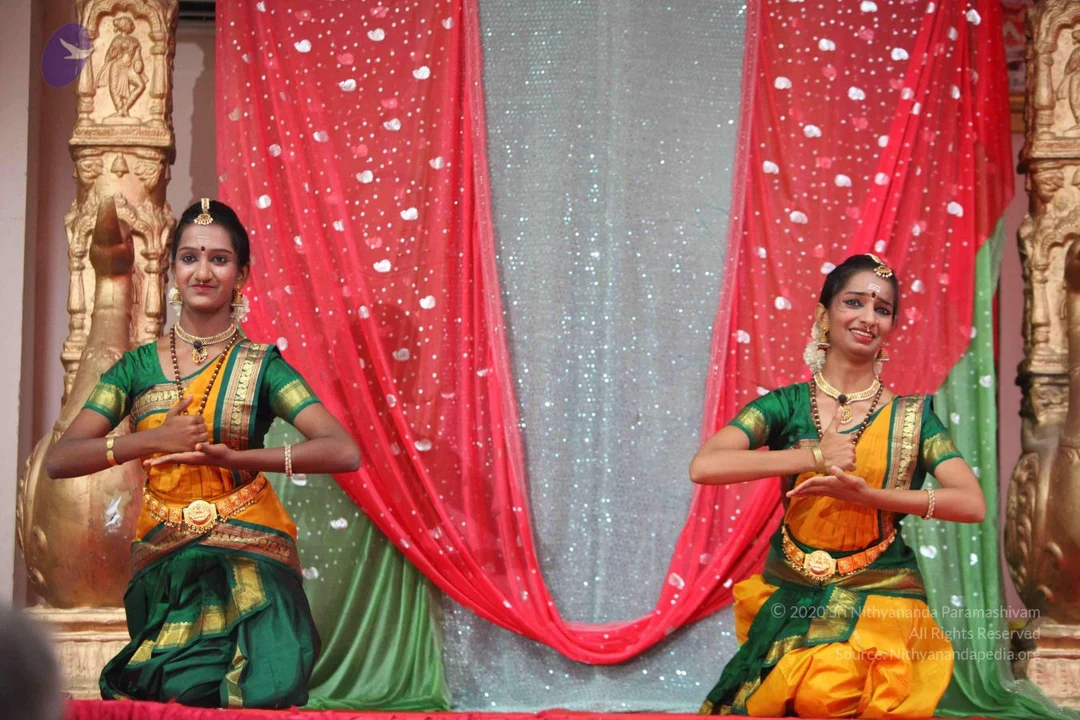
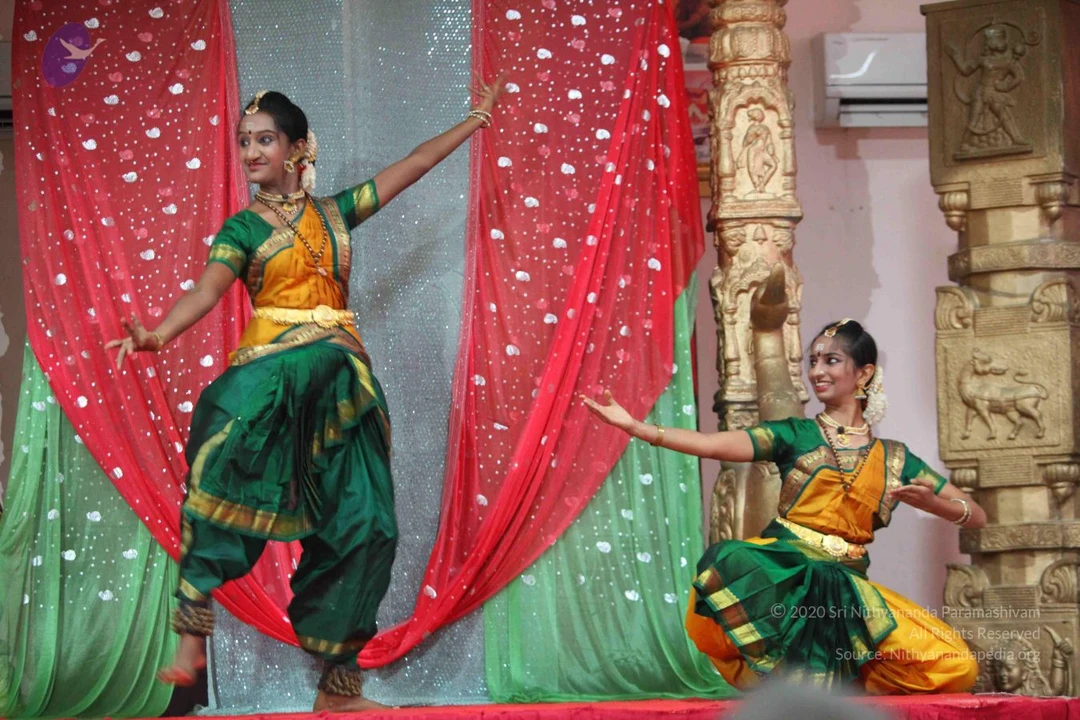
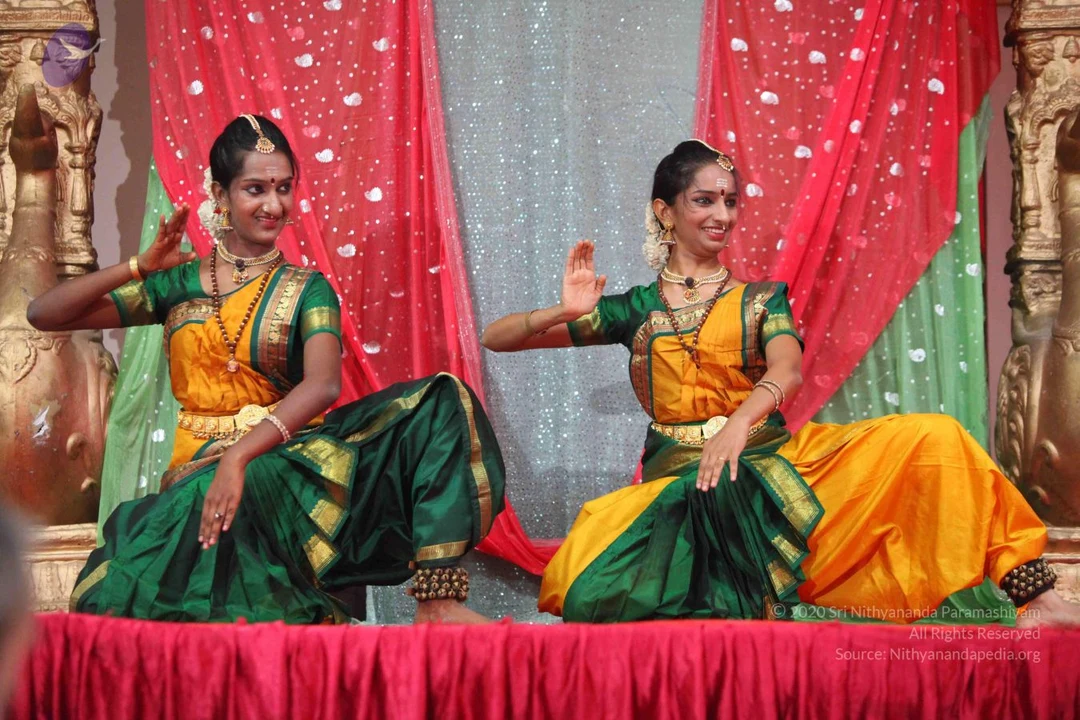
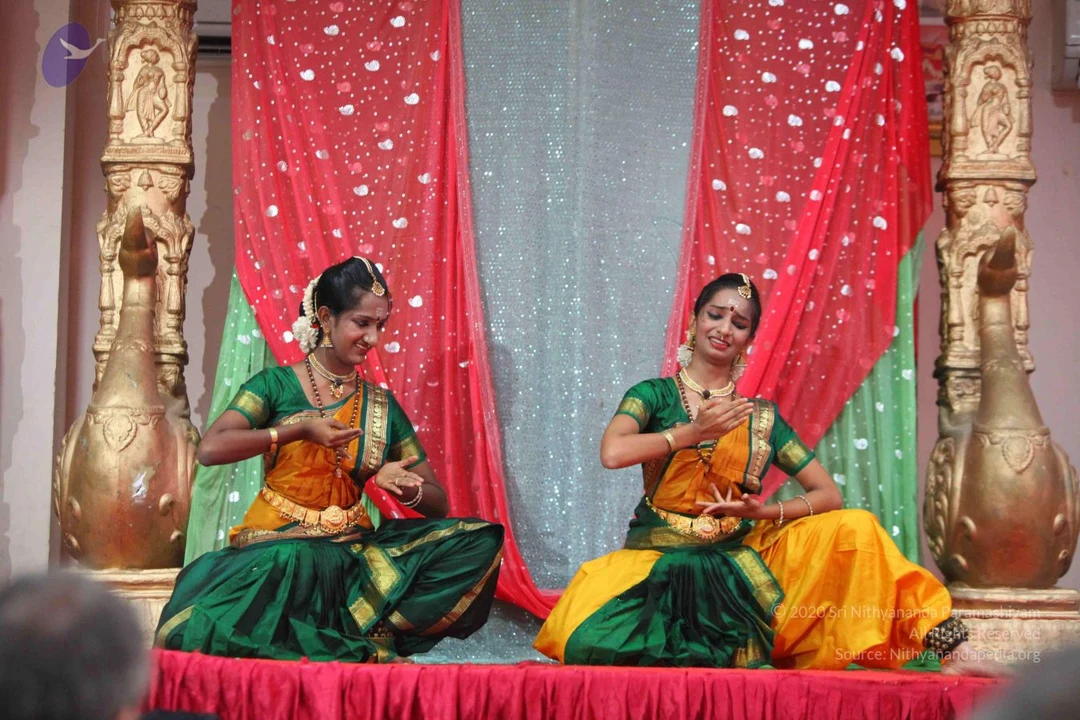
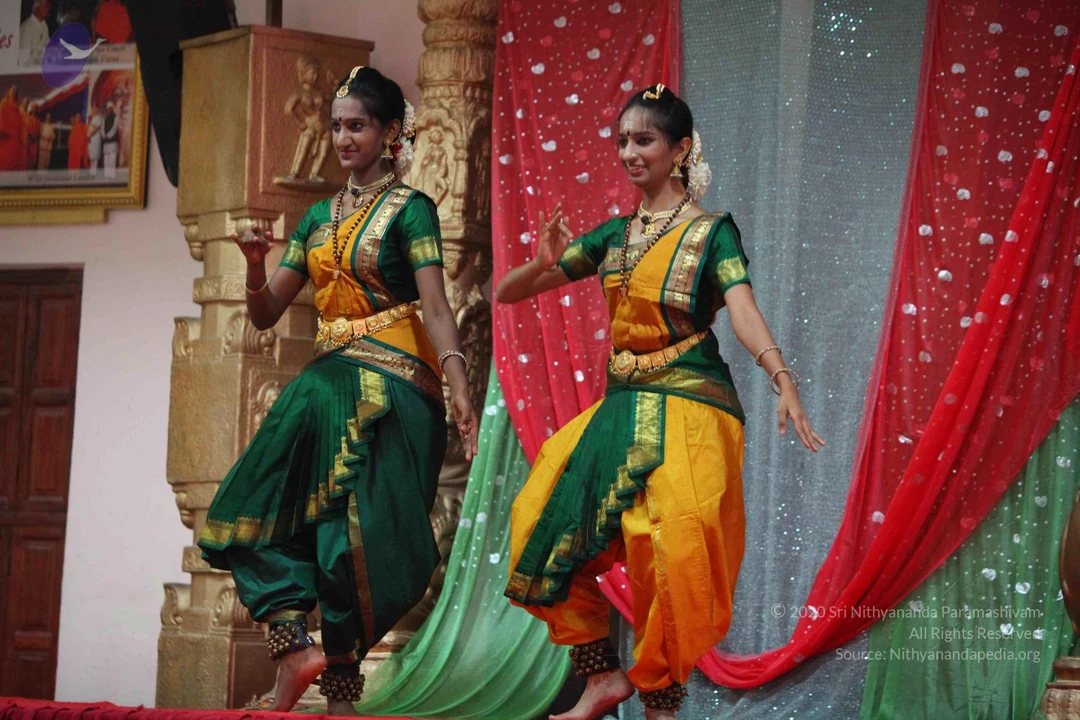
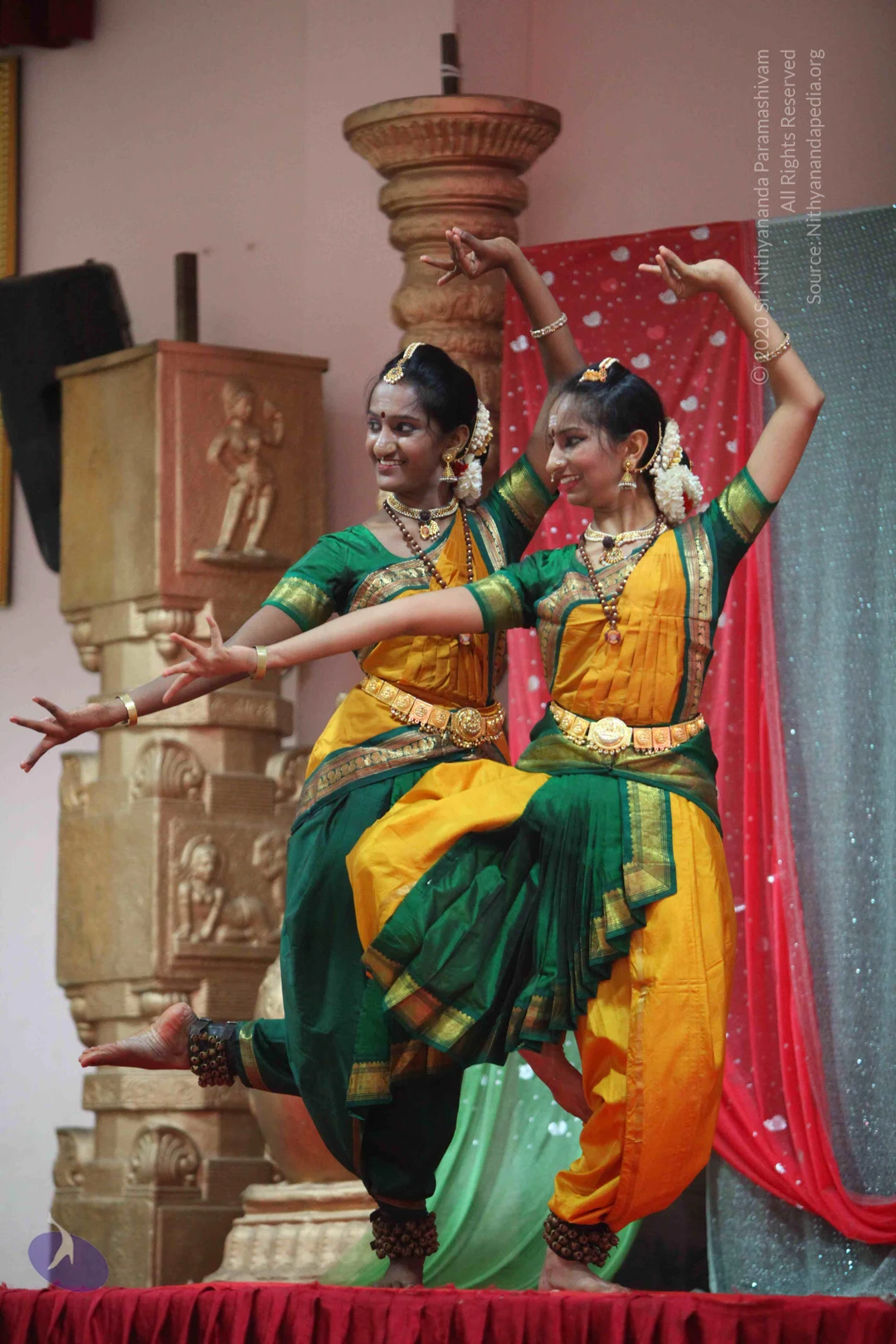
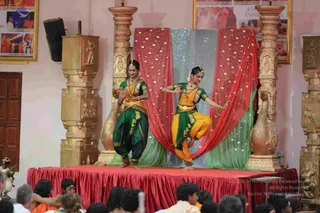
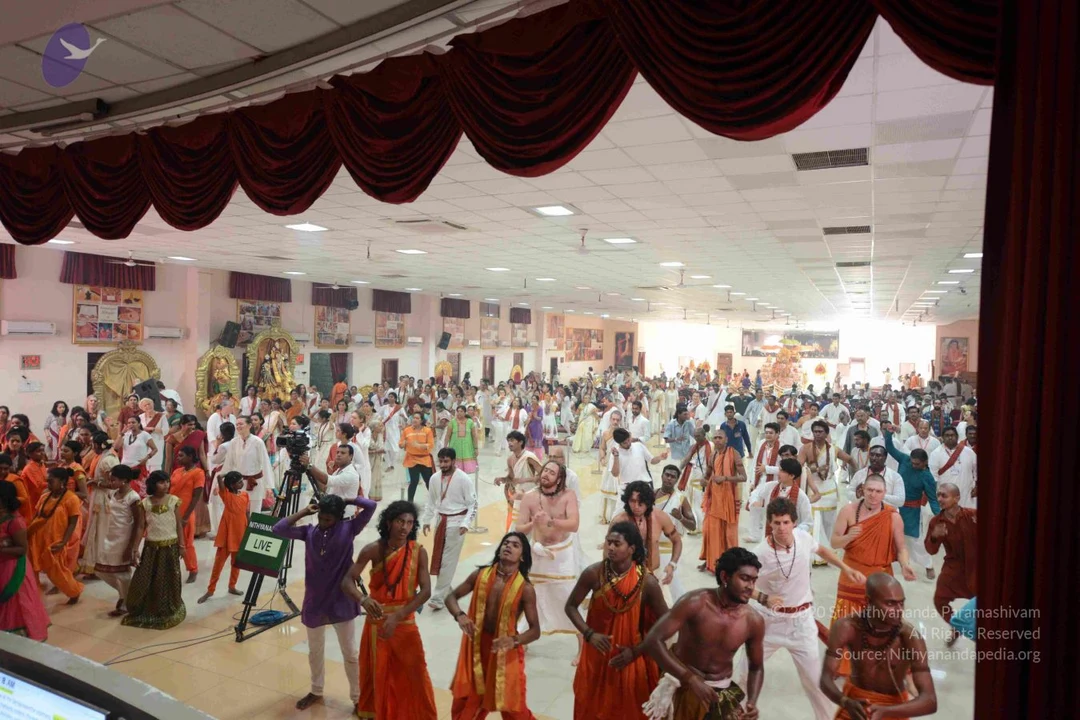
A seated audience of devotees fills the foreground of a hall with a raised stage at the back. Two young women in green and yellow dance costumes perform on the stage, one with arms raised, beside a red and green draped backdrop and ornate gold pillars. Many devotees wear orange, saffron and white clothing, and some sit cross-legged with bare upper bodies. A gold deity murti under a parasol stands near the left wall, with framed photographs on the walls and a row of ceiling lights above. A man in white clothes sits at left with his hands together. The scene appears to be a cultural performance during a satsang gathering.A seated crowd fills a hall during a performance on a raised stage. Two dancers in green and gold costumes perform in front of a red and silver draped backdrop with gold pillars. In the foreground, a woman in an orange and pink patterned top rests her chin on her hand, and a young person in an orange garment sits with others in orange, blue and yellow clothing. Behind them, a man in white sits and an orange-robed person sits near a golden umbrella and a decorated stand, with framed pictures on the walls. Many people sit on the floor facing the stage.Indoor hall with pink walls and red curtains, where two female dancers in green and yellow costumes perform on a stage draped in red and green fabric. A seated audience of many people, including monks and children in saffron and orange clothing and a few in white, watches from the floor. Ornate gold pillars and framed portraits decorate the stage, and a gold deity murti stands near the left side. Ceiling lights and a shaded umbrella are visible.Two female dancers perform Bharatanatyam-style choreography on a raised stage in a hall with pink walls and red curtains. The dancer on the left wears a green blouse and green skirt with gold trim and gold jewellery. The dancer on the right wears a green and yellow costume with a yellow skirt and gold jewellery, one arm extended and hand in a mudra. A red and green draped backdrop and carved stone pillars with lion and deity figures frame the stage. Framed photo panels on the wall show saffron-robed sannyasis, and a seated audience of children and adults in the foreground watches. A digital clock is visible at the right edge.Two female dancers in traditional Indian dance costumes perform on a raised red-draped stage in a hall with pink walls. The dancer on the left wears a green blouse and green skirt with a gold waist sash and yellow-orange overskirt; the dancer on the right wears a green blouse with an orange-yellow skirt. Both have flowers in their hair and ankle bells, and they extend their arms in graceful poses. Behind them hang red and green draped fabric with sequins between two ornate gold pillars carved with figures. Seated audience members in the foreground, some in orange and white clothing, watch. Framed photographs with text hang on the walls, and a digital clock reads 10:37.Two female classical dancers perform on a red-draped stage framed by ornate gold carved pillars with figurative reliefs. The dancer on the left wears a green and gold costume with a golden waist belt and ankle bells, hands raised in a mudra. The dancer on the right wears an orange and green costume with a golden belt, one leg lifted in a dance pose, arms extended. Behind them hang red and green draped fabric panels with silver sparkle. Seated audience members in the foreground watch from below, and framed posters line the upper wall.

nithya-satsang
84 photosSource gallery
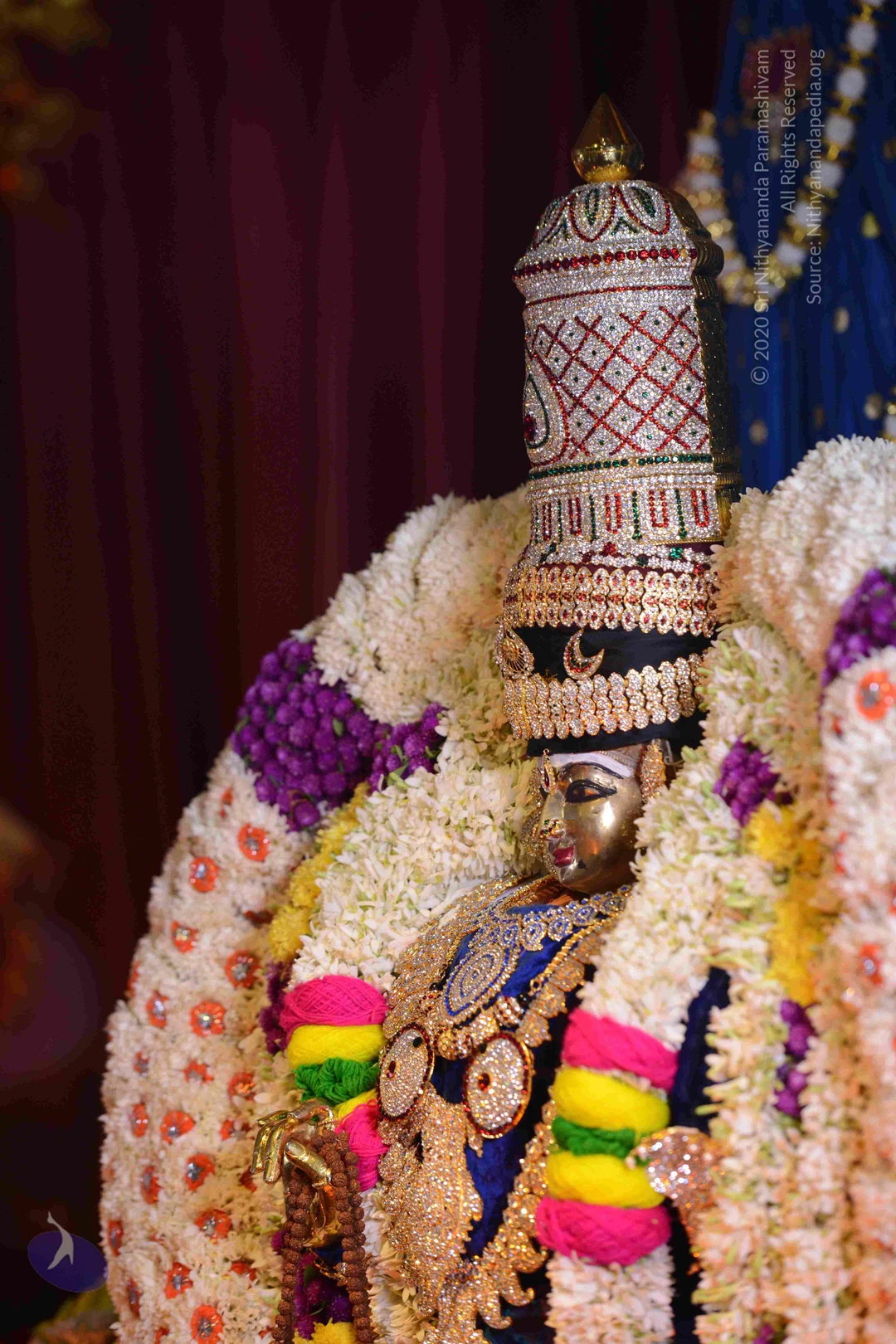
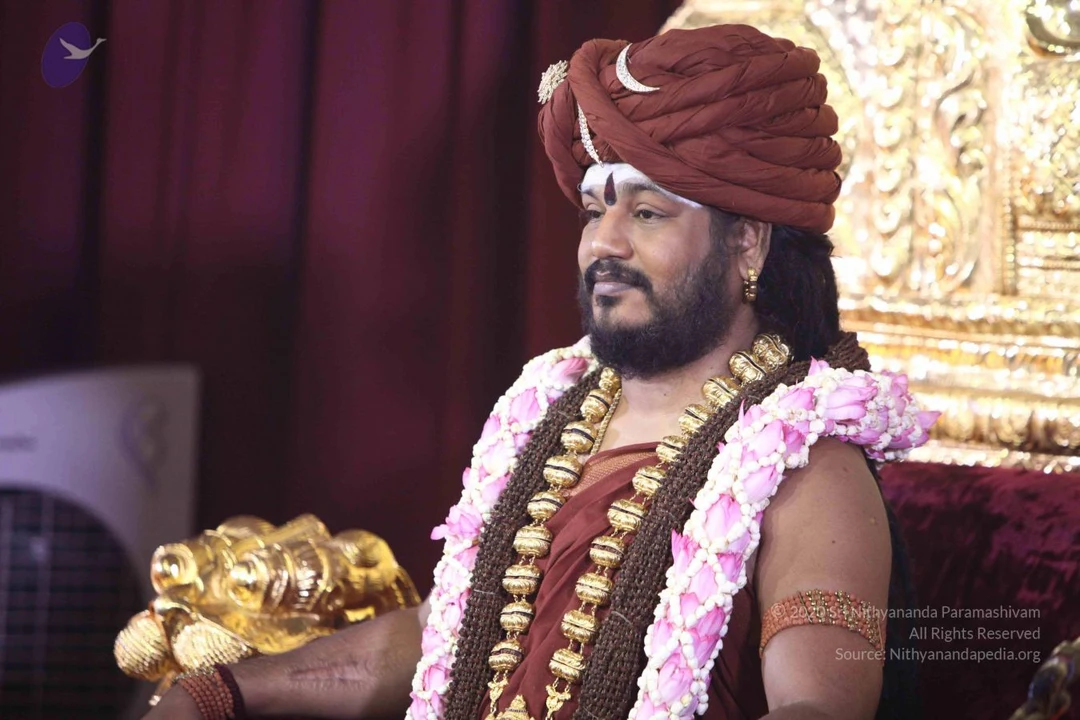
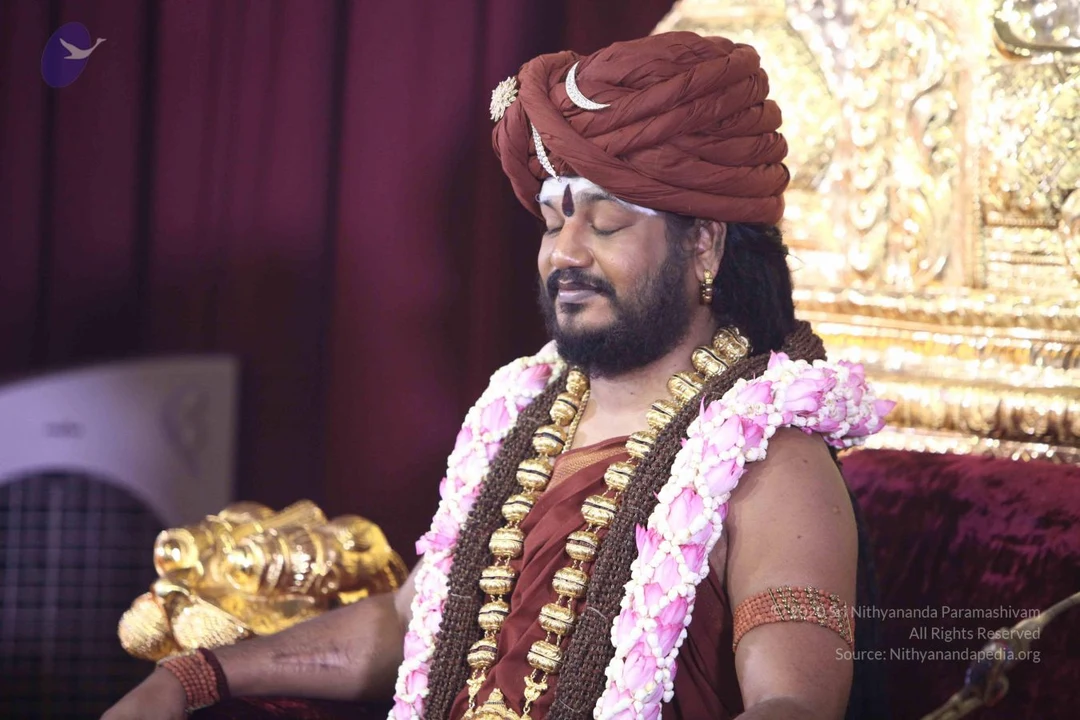
A gilded deity murti is richly adorned for worship. It wears a tall jewelled crown encrusted with white stones and red and green accents, a crescent ornament at the brow, and a deep blue garment with gold and stone-studded shoulder pieces. Thick white jasmine garlands wrap the figure, interspersed with purple flowers, orange-dotted blossoms and bands of pink, yellow and green thread. A rudraksha mala hangs at the side. The dark maroon drape behind and a blue fabric at the upper right form the backdrop. No people are visible.A seated man in a rust-orange turban with a crescent-moon ornament and a small jewelled pin, wearing rust-orange robes, a gold-bead rudraksha-style mala with a large gold pendant, and a thick pink lotus garland over his shoulders. He has a white vertical tilak with a red dot on his forehead, gold earrings and a gold armlet, and sits on a deep red velvet seat in front of an ornate gold-leaf carved backdrop and red drapes, with a microphone stand at the right edge. Swamiji (probable): the long swept hair, crown-like turban, saffron-orange robes and ceremonial gold necklace match the page's Satsang context, though the face is not used for identification.A seated man in a rust-brown turban with a silver crescent ornament and a forehead tilak sits on a dark red velvet throne in front of a gilded golden backdrop. He wears a rust-brown robe, multiple garlands of pink and white flower petals, a long rudraksha mala, a gold ceremonial pendant with a gold-tone chain, and orange-gold armlets. a person, a bearded man with long swept-back hair and ornate ceremonial attire, smiles while seated. A microphone stand is visible at right and a golden figure rests at left.A man seated on a gilded throne against deep maroon velvet drapery, wearing a rust-orange turban with a crescent ornament and a vertical tilak on his forehead. He wears a rust-brown robe and a long multi-strand necklace of pink and white flower garlands over a heavy gold pendant necklace with beaded gold links, plus gold bangles on his wrists and an armlet. A microphone stand stands at his side, and a gold-decorated armrest is nearby. a person: the orange turban, ornate gold ornaments, garlands and seated dais position fit the page's identification, so this is a satsang setting with the speaker seated in person.A man seated on an ornate golden throne against deep red curtains, smiling, wearing a rust-orange turban with a crescent-moon ornament and a vertical tilak on the forehead. He wears a rust-orange garment, a long rudraksha-style mala with gold beads, a large gold pendant, and a pink lotus garland over the shoulders, plus gold armbands and bangles. The gold-embossed throne and red velvet cushions frame him.A man seated on an ornate gilded throne in front of deep maroon velvet drapery, wearing a rust-brown turban with a crescent ornament, rust-brown robes, a golden necklace, a rudraksha mala, and a garland of pink flowers across his shoulders. He has a bindi and white tilak markings on his forehead and a full beard, with his hand resting on his knee beside a microphone stand. Gilded carved wood surrounds the throne.
sadashivoham2016-inauguration

93 photosSource gallery
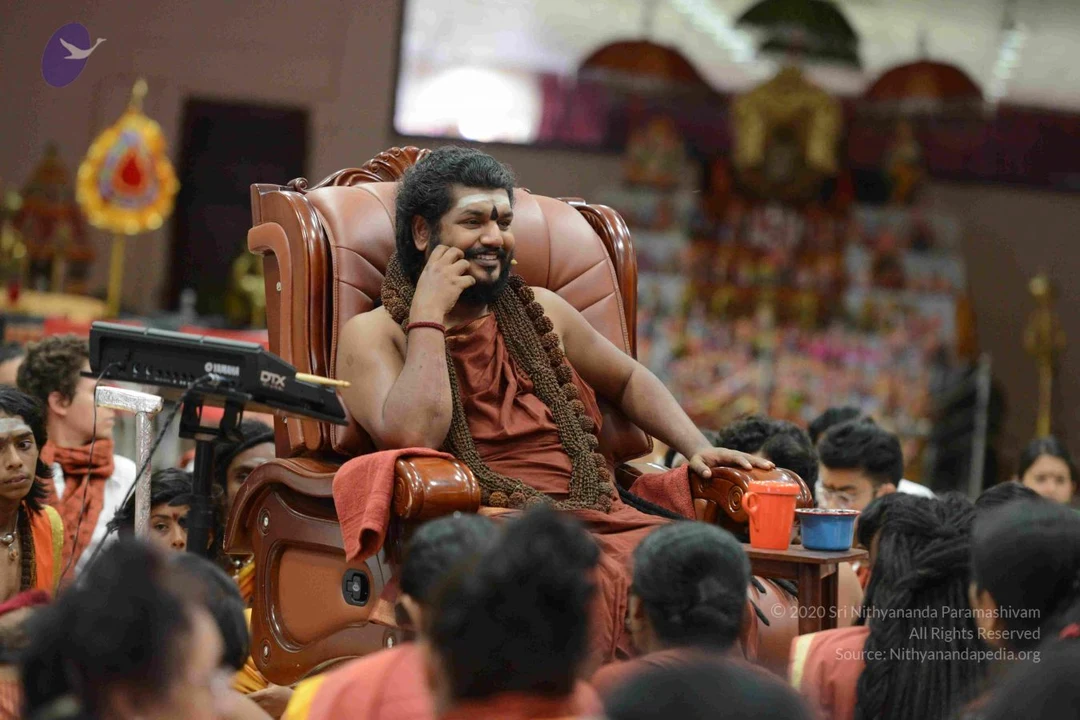
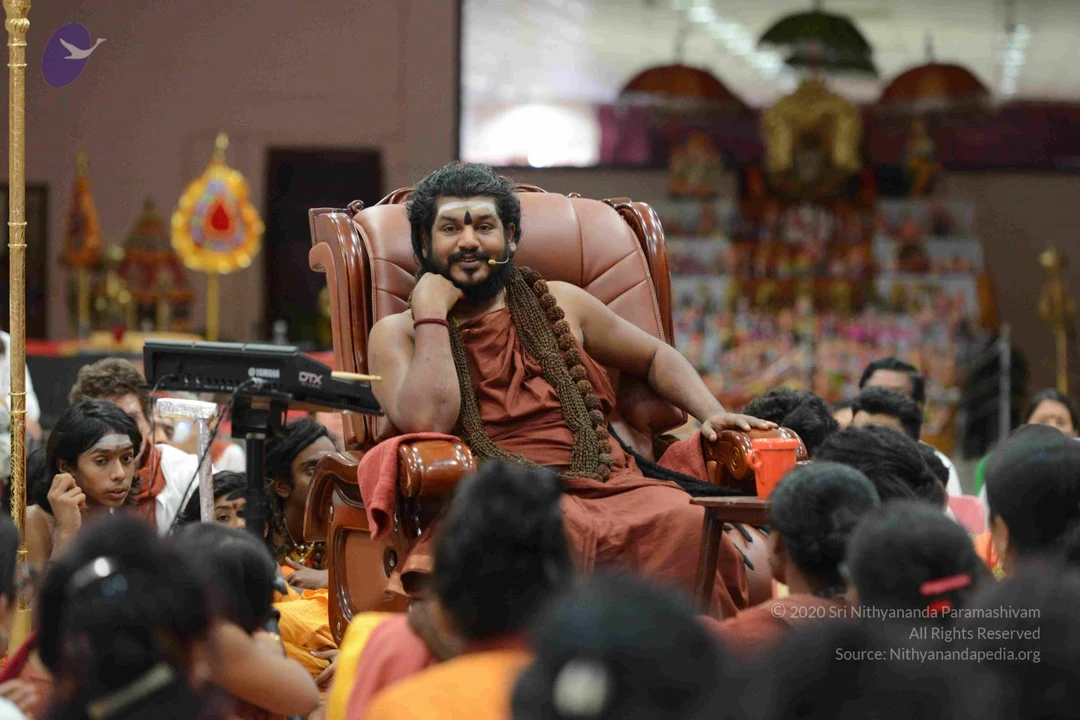
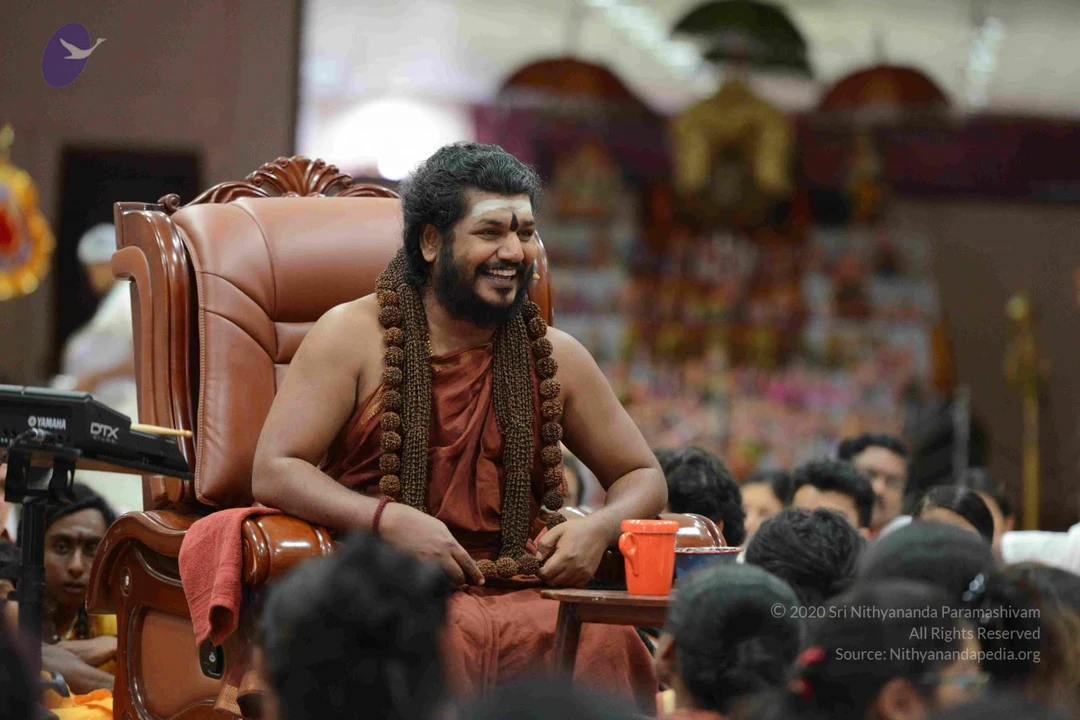
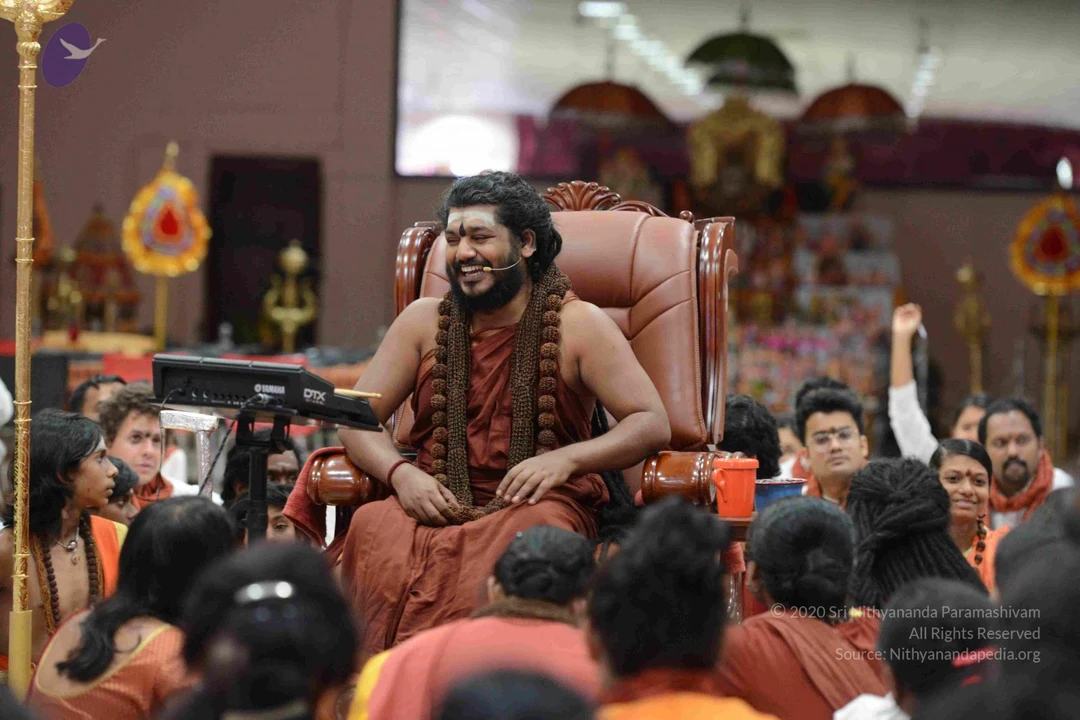
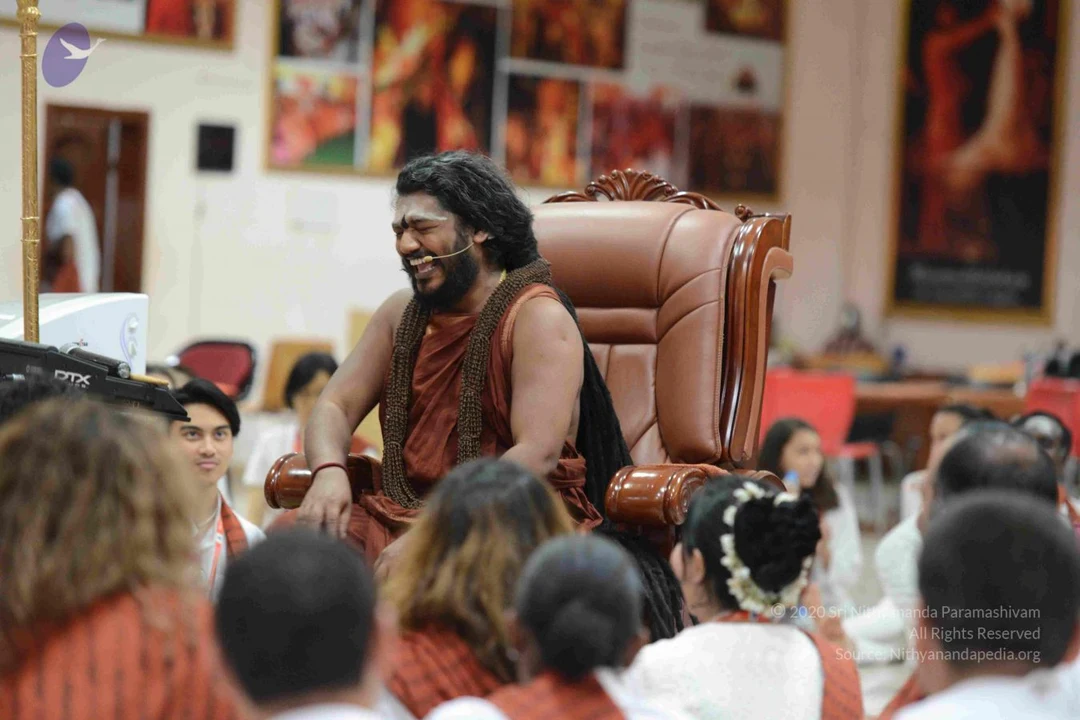
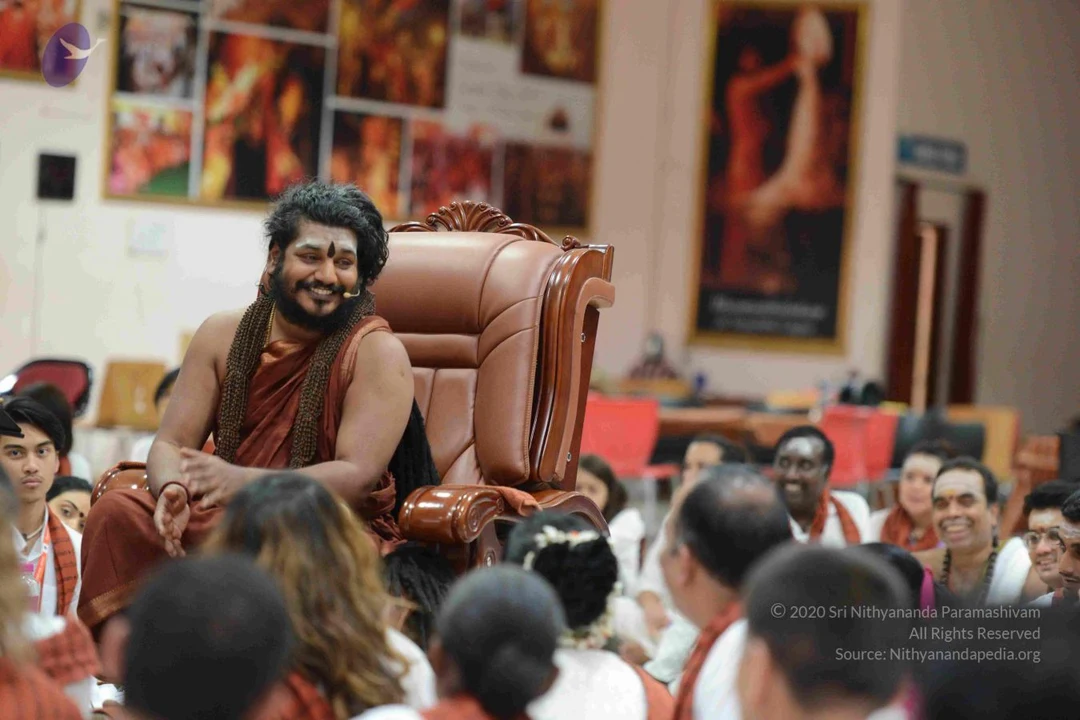
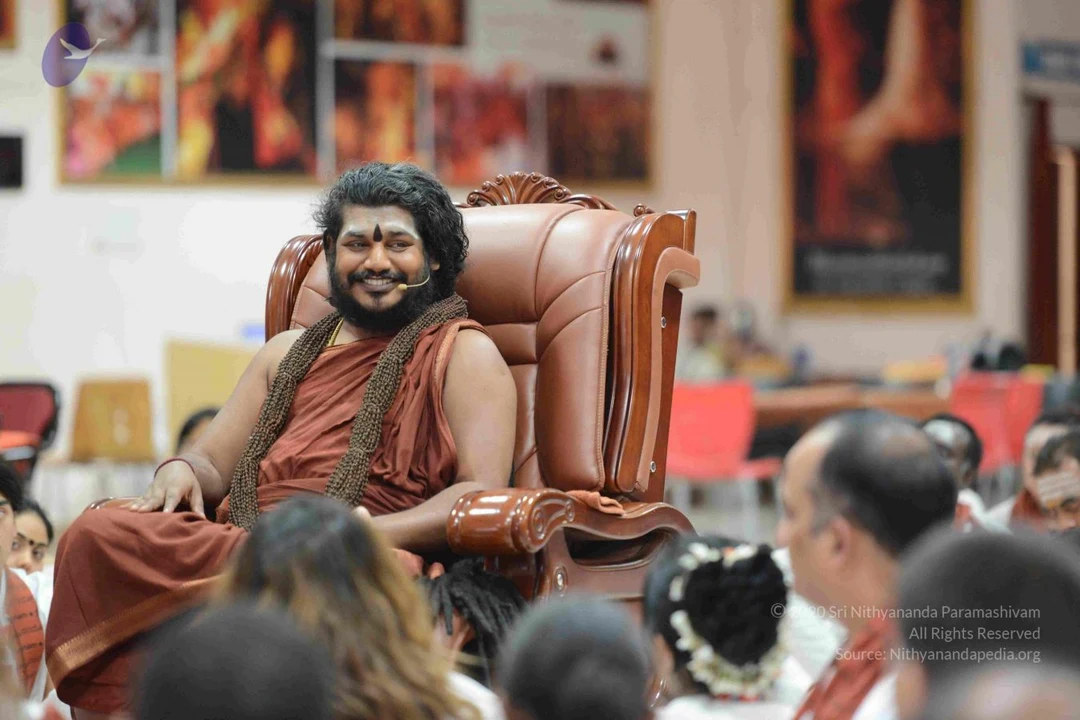
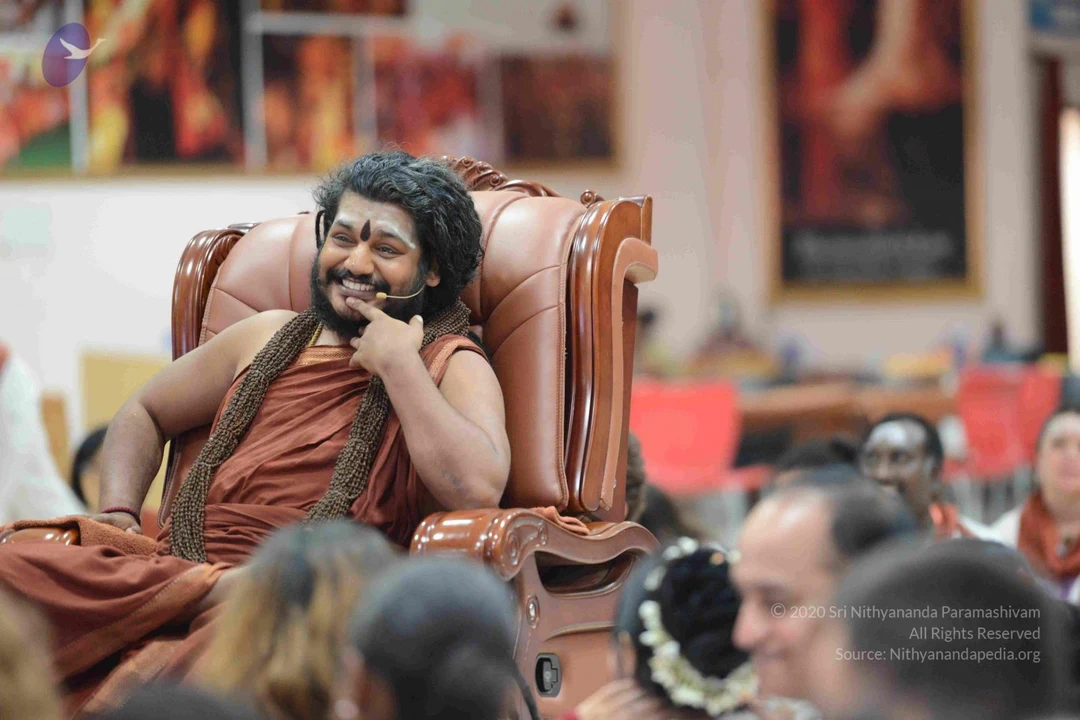
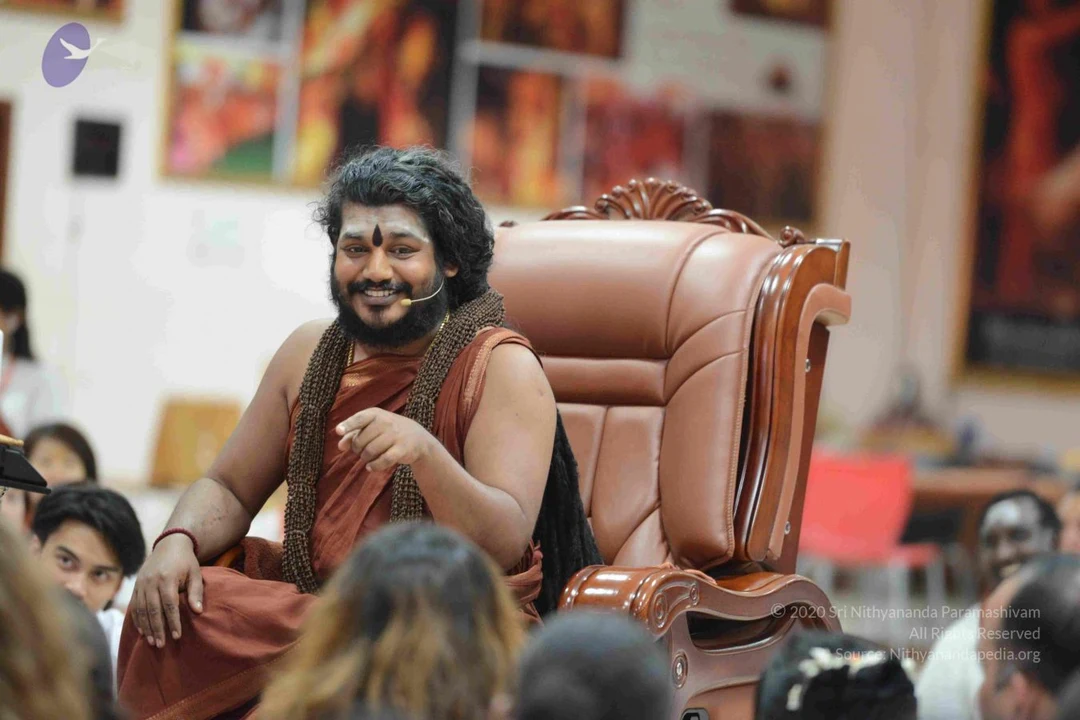
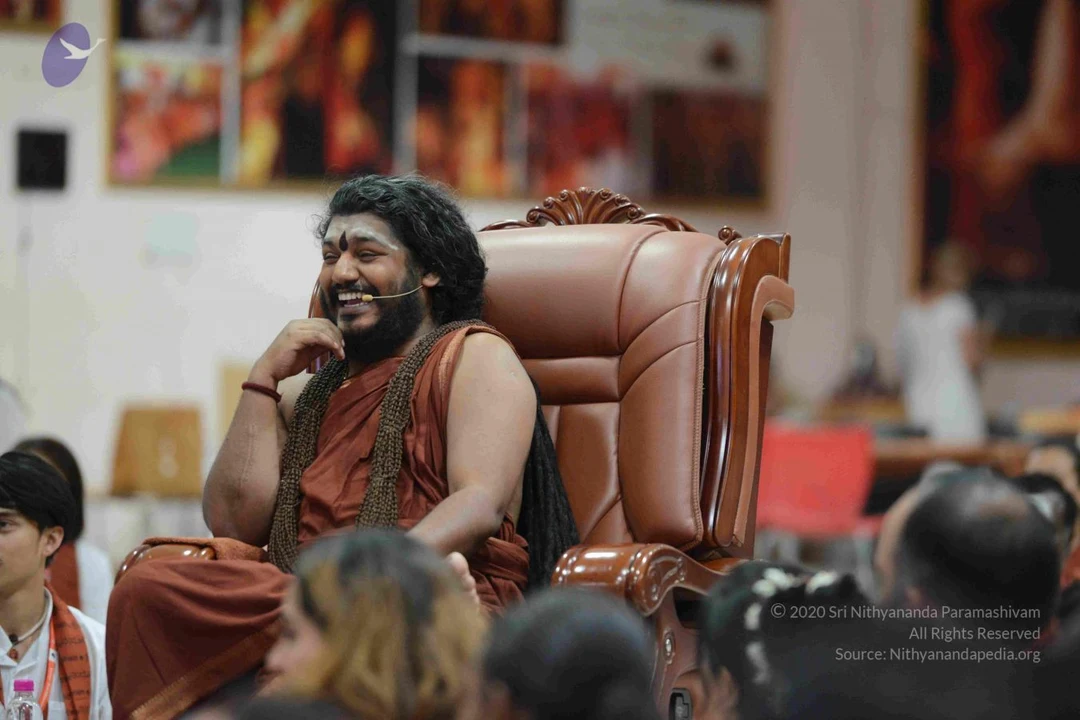
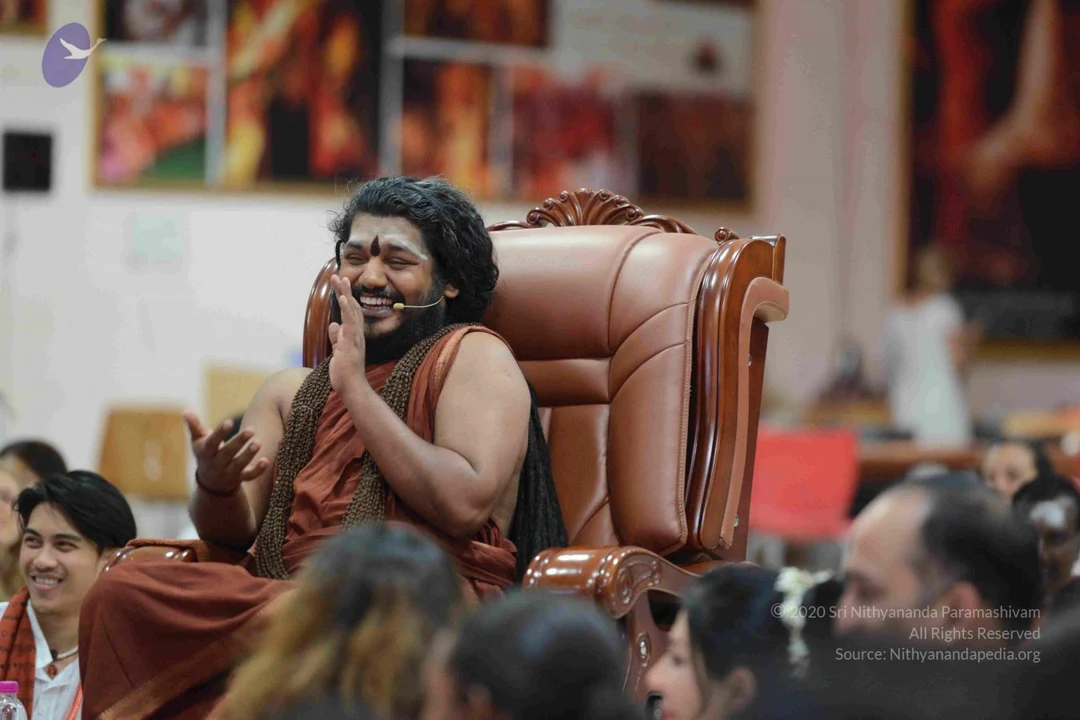
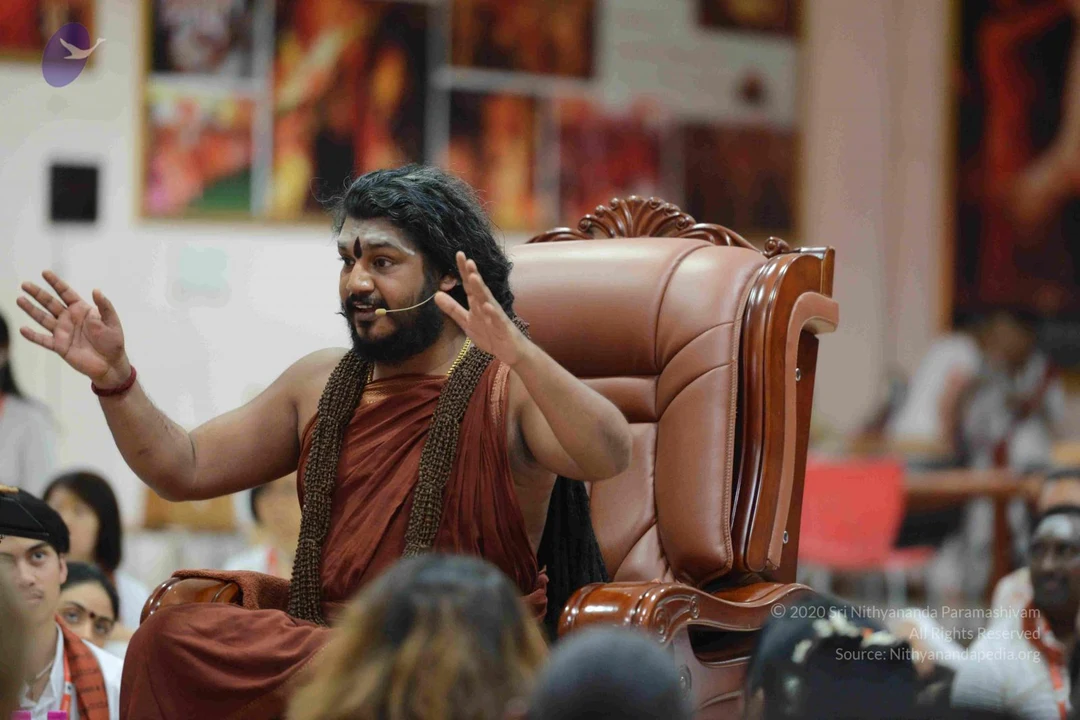
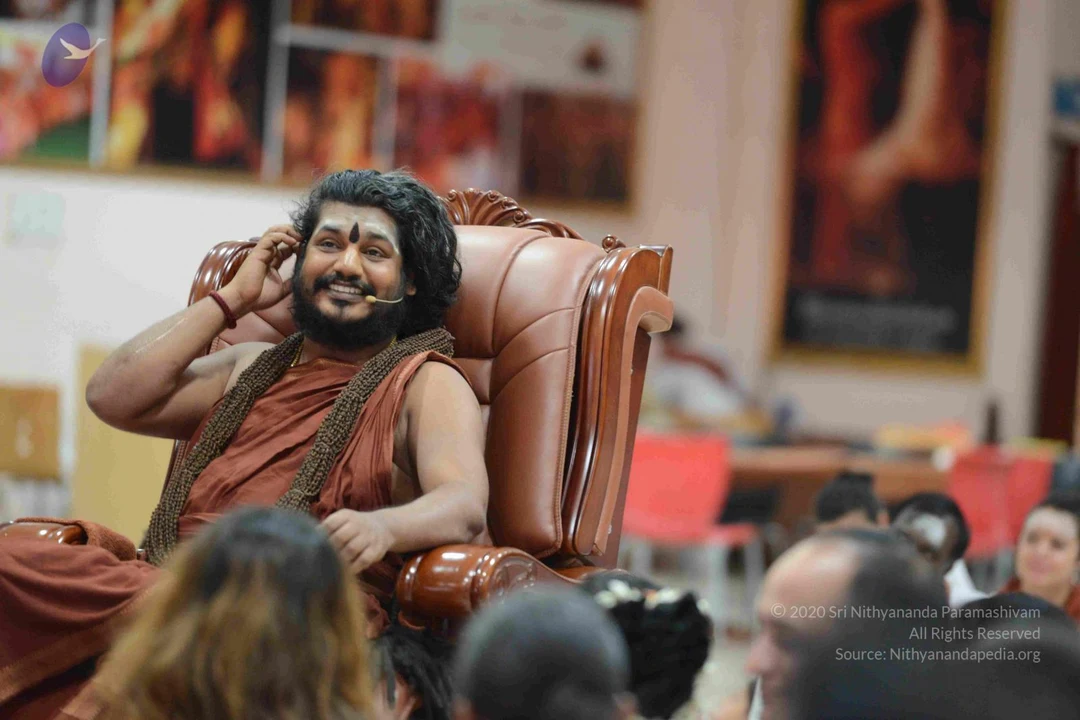
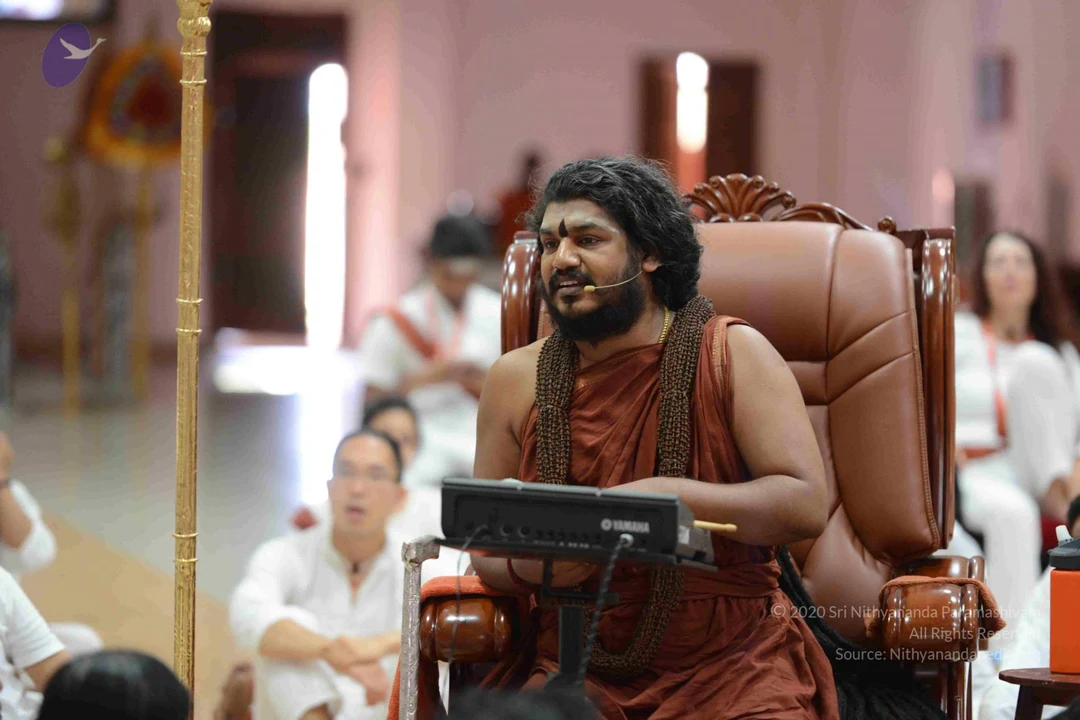
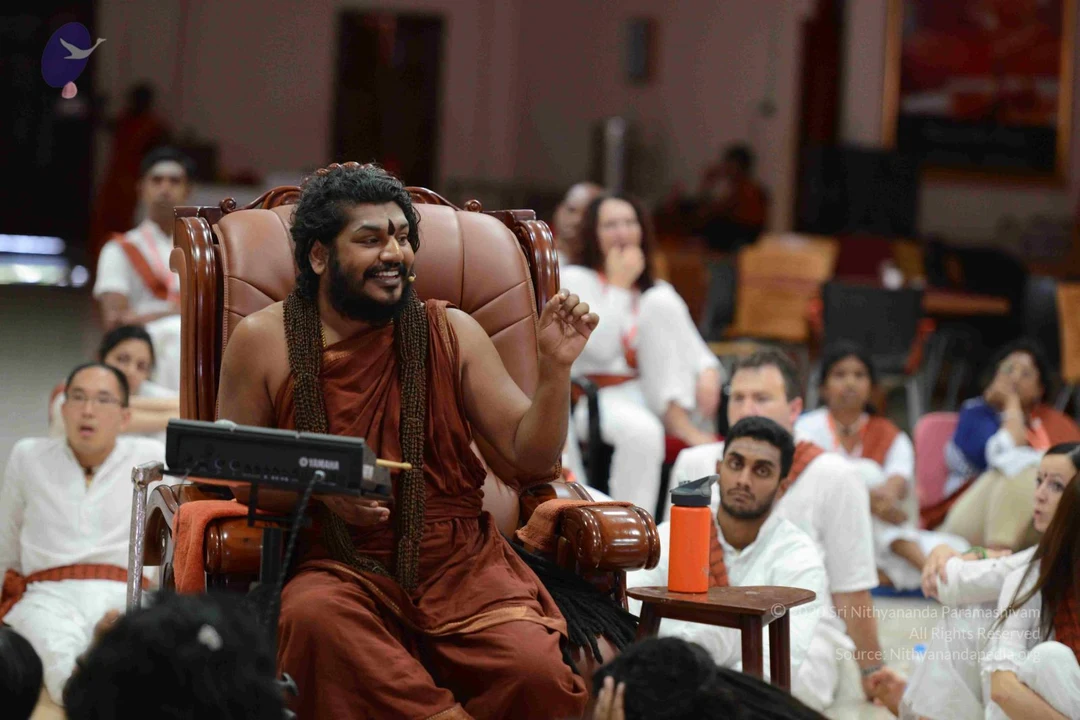
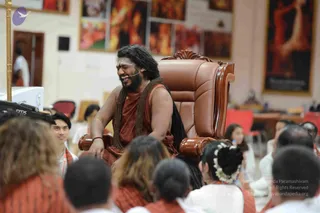
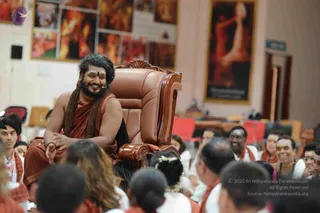
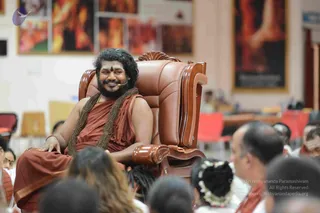
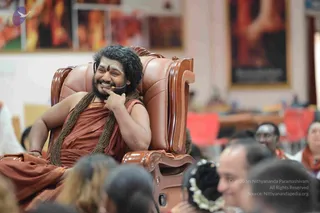
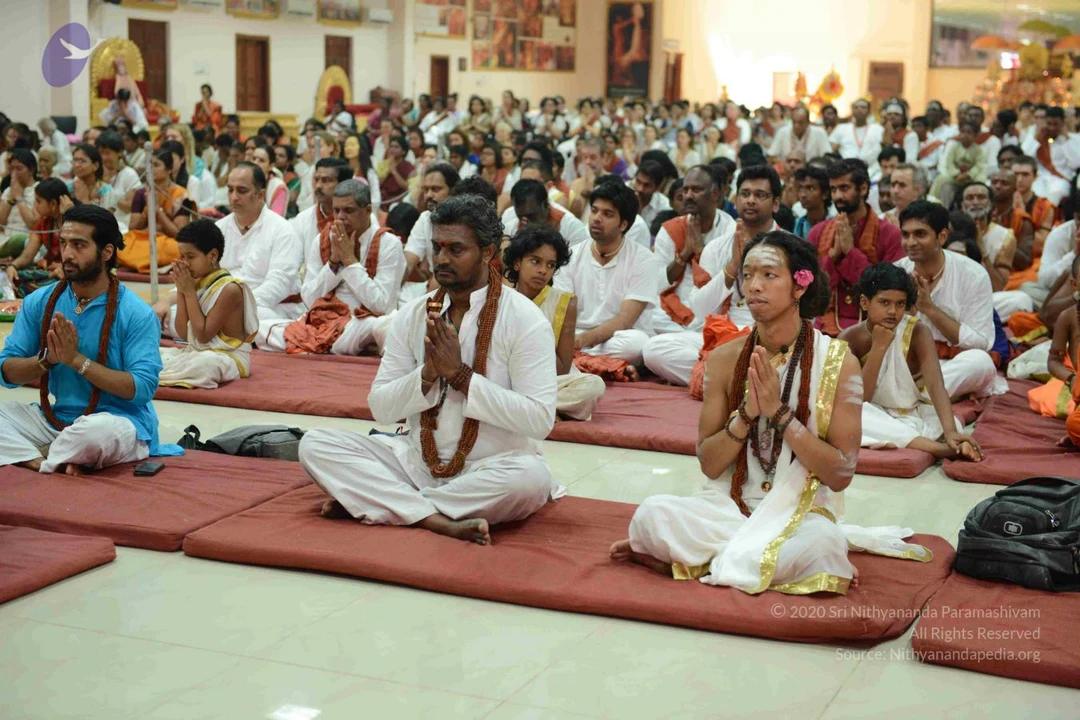
A photograph of a satsang hall where a man with long, swept-back dark hair and a full beard sits in a large brown leather throne-style armchair with carved wooden arms. He wears a rust-orange robe and a long beaded brown rudraksha-style mala draped over his chest, and a small microphone is clipped near his face. His eyes are closed and he smiles. Seated devotees in orange and white clothing, including a woman with white flowers in her hair, face him from the foreground. Behind him, framed photographs of fire ritual scenes hang on the wall, and a golden staff stands at the left edge. This is an appearance-based probable Swamiji (Paramahamsa Nithyananda) seated in a throne; the figure is shown with long hair, saffron-orange robe and rudraksha mala. Several devotees are visible in the audience.A man with long dark hair and a full beard sits in a large brown leather throne-style chair, laughing broadly. He wears a saffron-orange robe draped over one shoulder, a red-orange bindi and white forehead markings, and a long rudraksha-style mala of beads falling to his lap, with a small headset microphone at his cheek. He rests one arm on the chair's carved armrest. In front of him, a seated audience in orange and white clothing, including a woman with a white flower garland in her hair, is seen from behind. Behind the stage hang large framed red-toned dramatic artworks on a cream wall, and a computer monitor sits at the lower left. Swamiji (probable): the saffron robe, long hair and mala beads are the qualifying cues for the speaker on the throne.A bearded man with long, swept-back dark hair and a rust-orange wrap sits smiling broadly in an ornate carved brown leather throne, wearing a dark beaded necklace and a headset microphone. A seated audience in rust-orange and white clothing fills the foreground, with several people with their backs to the camera, including a woman with a white flower garland in her hair. Framed posters with fiery imagery hang on the wall behind, and a small flag-like emblem appears at the upper left.A bearded man with long swept-back dark hair and a red bindi sits smiling on a large brown leather throne-style chair, wearing an orange-red saffron robe and a long multi-strand brown rudraksha mala, his hands clasped. Seated audience members surround him in the foreground, including a woman in white and a man in saffron-orange shawl. Behind, large framed posters of fire ritual imagery hang on a pale wall, with a red chair visible at left. a person is the seated central figure, seated as the speaker at a satsang gathering.A photograph of a satsang hall where a bearded man with long dark wavy hair sits smiling in a large brown leather armchair with carved wooden arms. He wears a saffron-orange dhoti and a shawl, a long rudraksha-style mala hangs across his chest, and he has a tilak on his forehead and a small headset microphone. Audience members in the foreground, several with flowers in their hair and one with a white forehead mark, sit facing him. Framed photographs of fire and orange flames hang on the wall behind. Swamiji (probable): the seated man in the saffron robe with long hair, rudraksha mala and microphone is an appearance-based candidate for Swamiji, shown at a satsang seated on a throne-like chair.A man with swept-back dark hair, a black forehead bindi and white tilak marks, wearing a rust-orange robe and a long beaded rudraksha-style mala, sits in a large brown leather throne-like chair with wooden armrests. He smiles broadly with his finger on his chin, a small headset microphone near his mouth. Blurred seated devotees in the foreground, some in orange shawls, and framed wall paintings behind him suggest a satsang hall. a person by his orange robes, rudraksha mala and swept-back hair, seated on a throne-like chair.
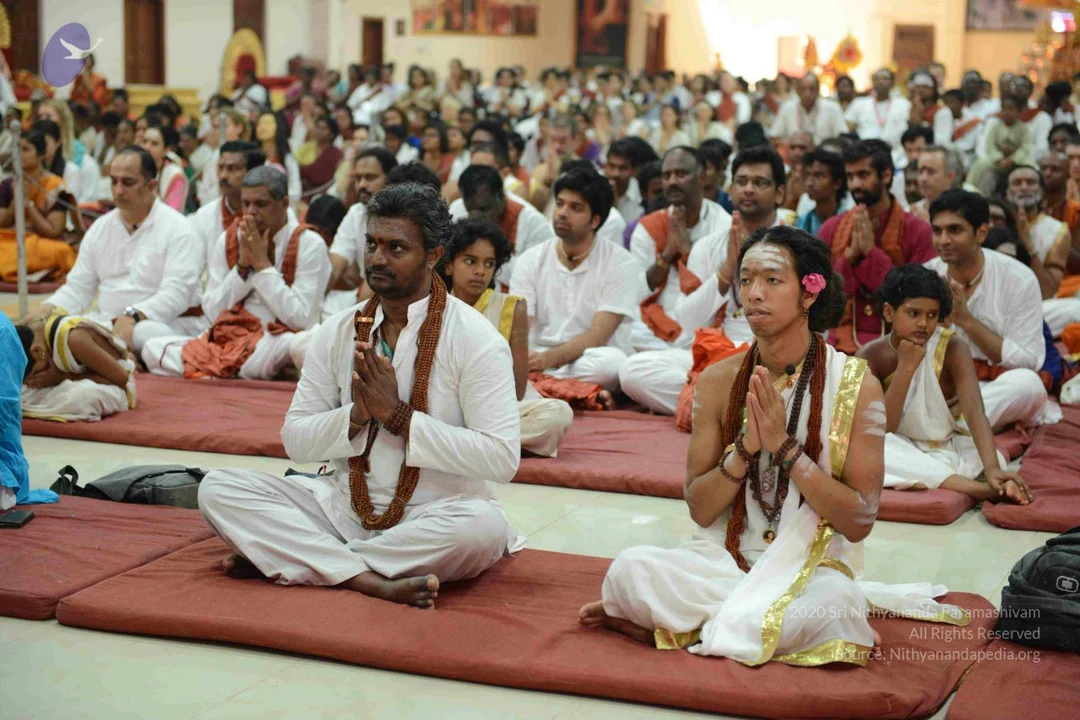
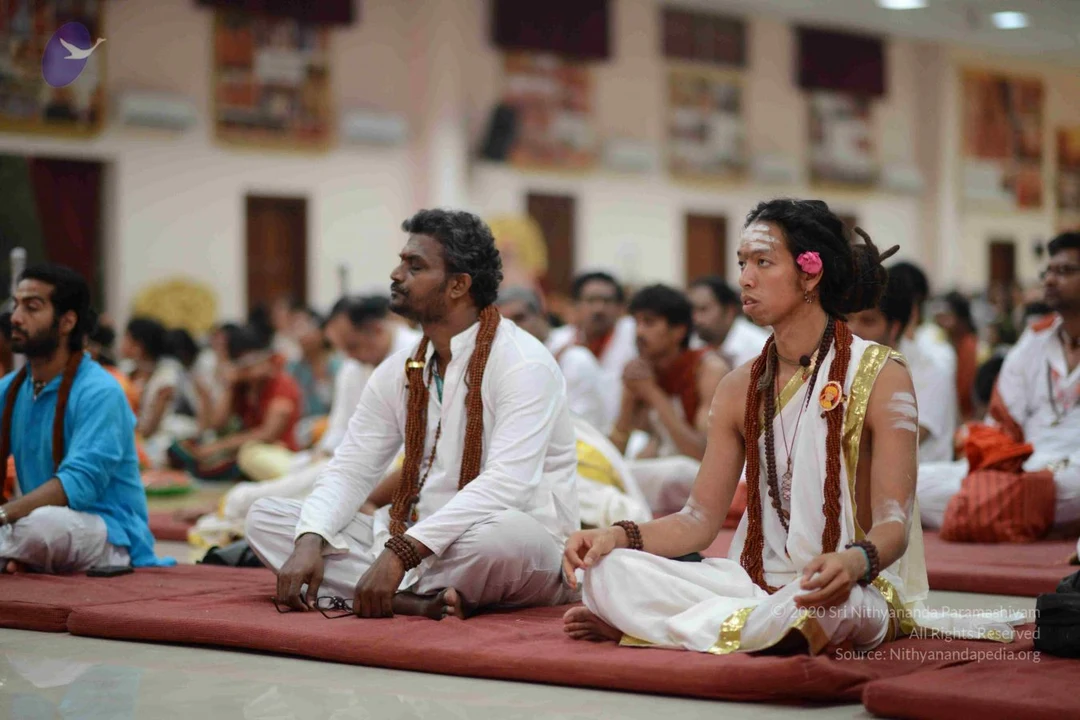
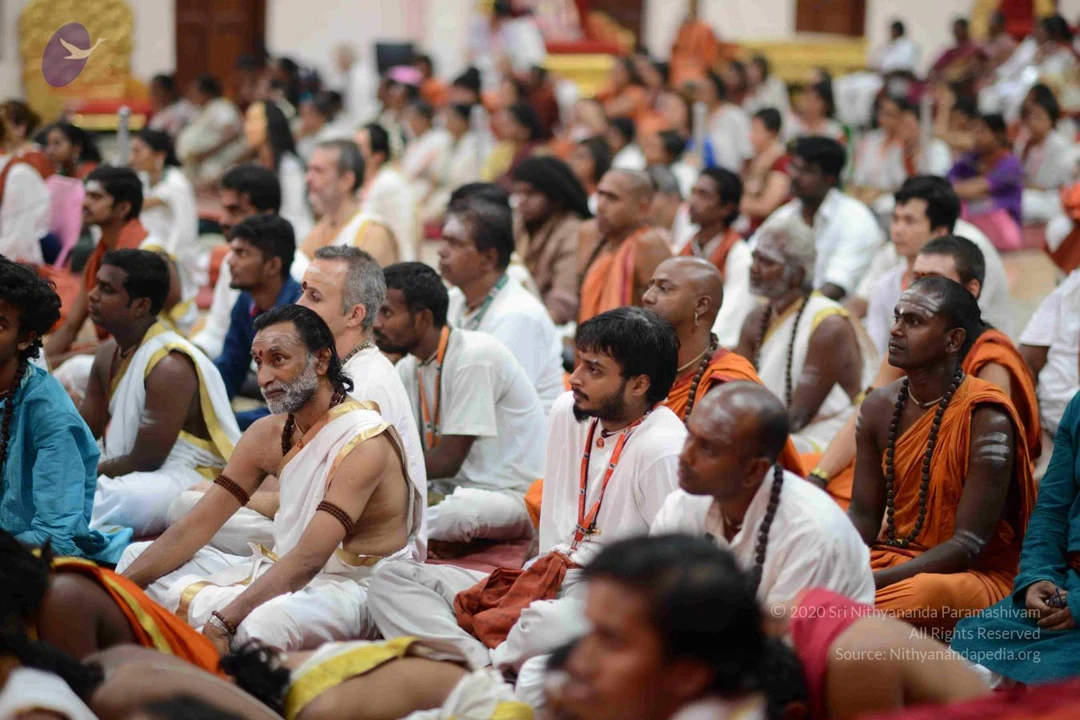
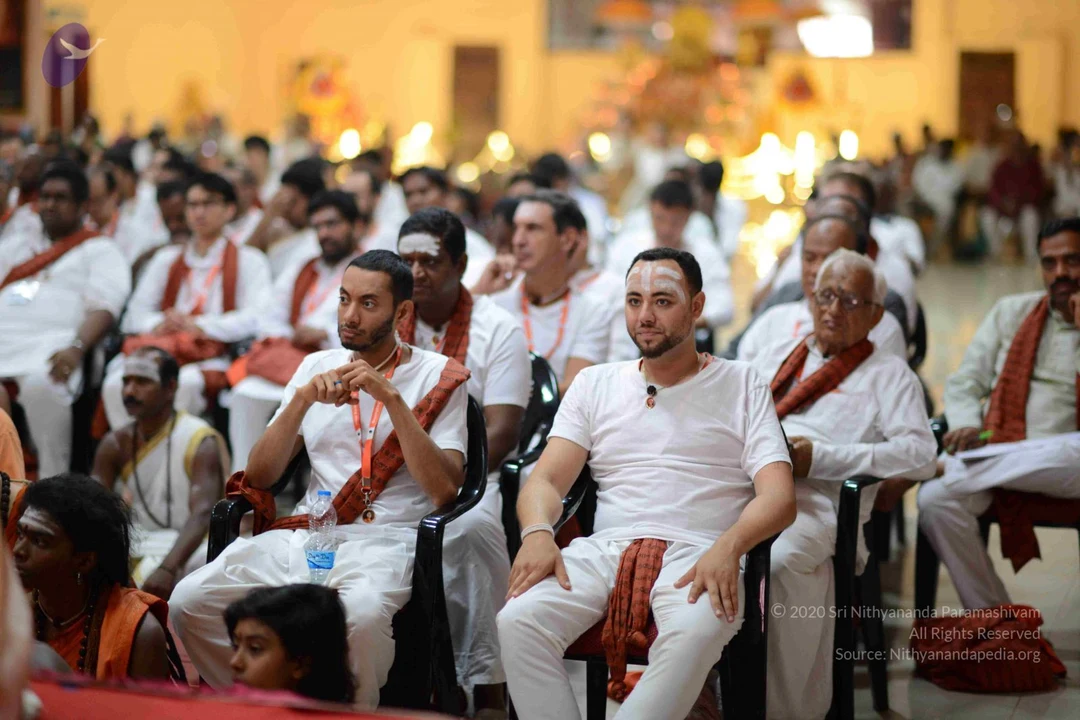
02--Navaratri-Darbar

24 photosSource gallery
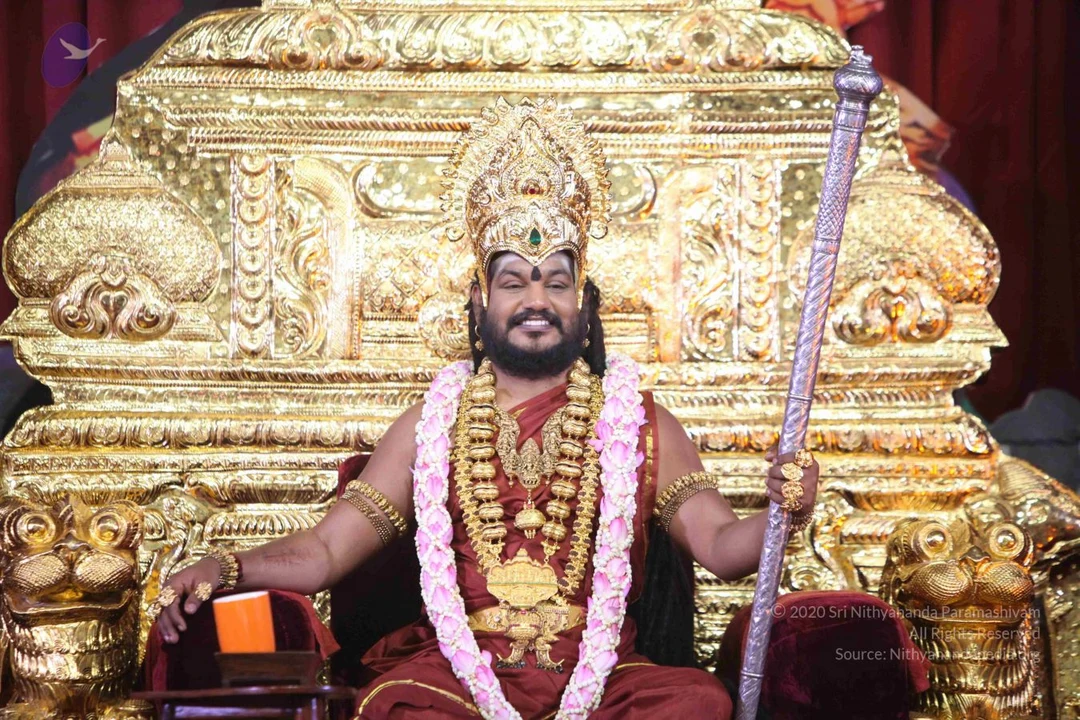
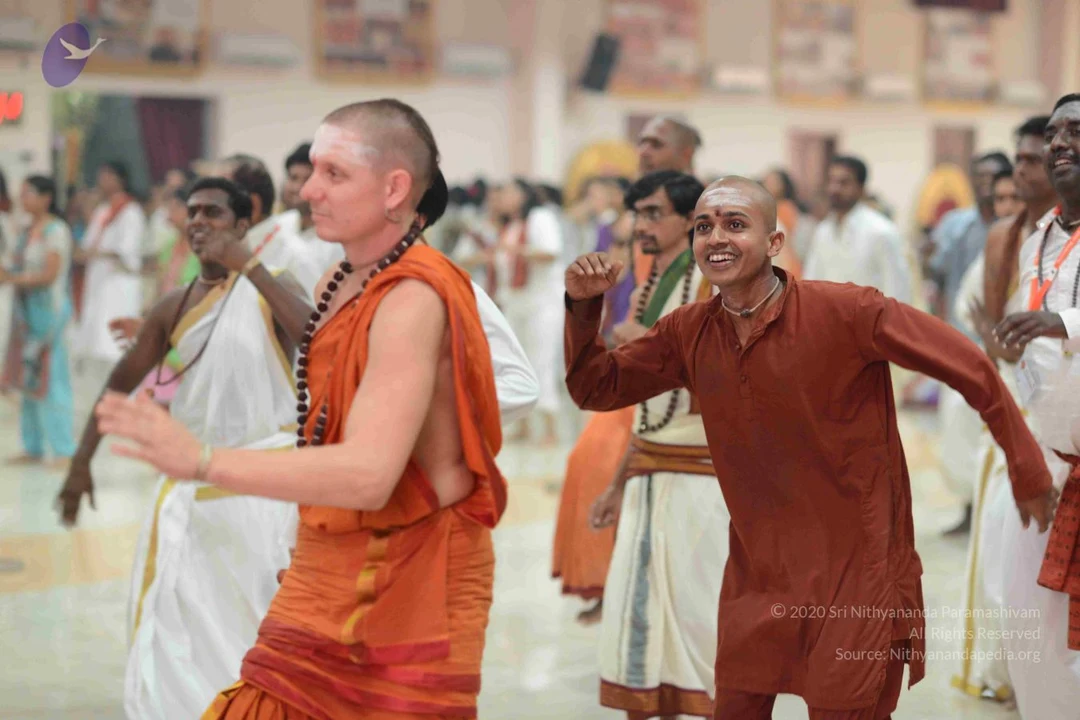
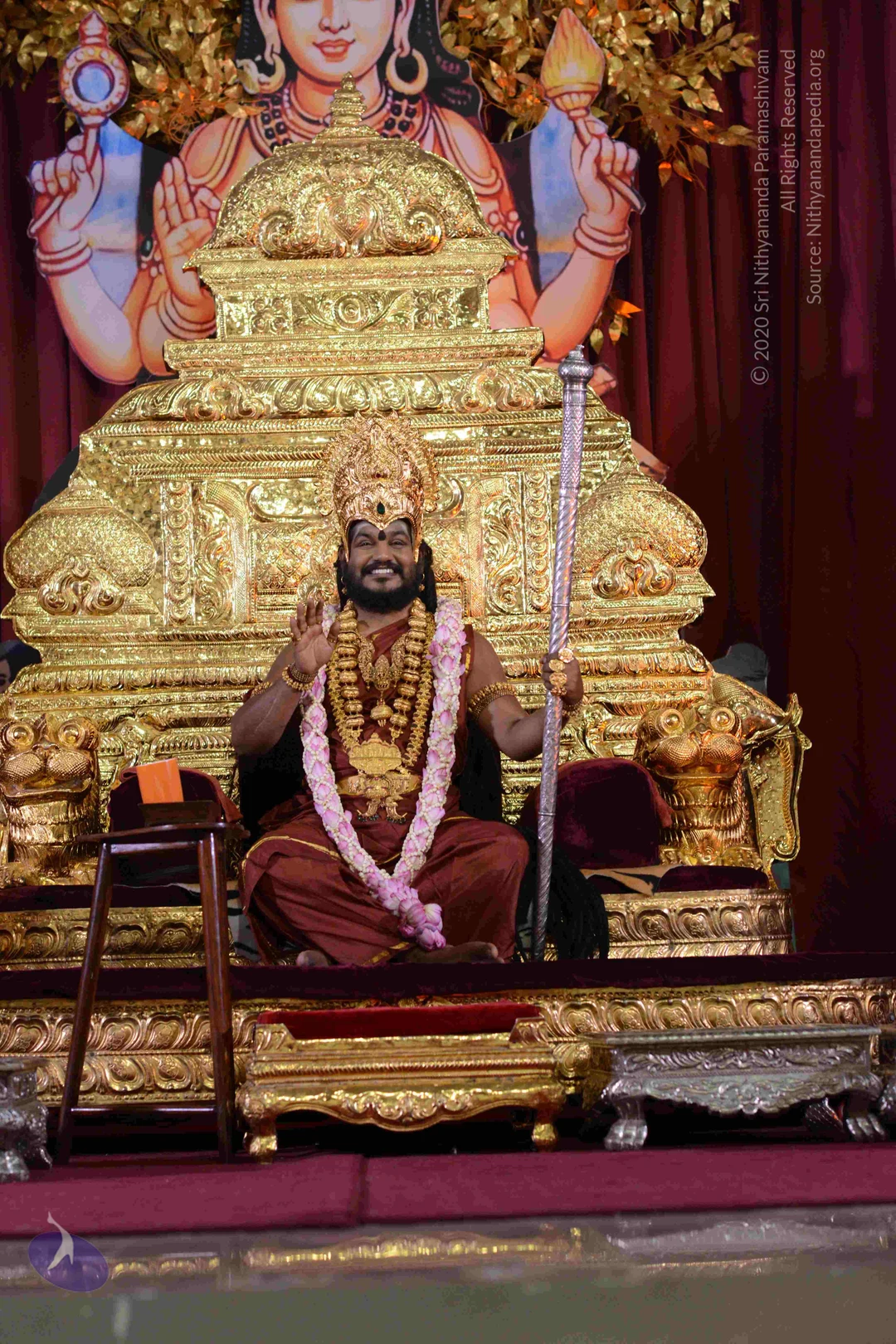
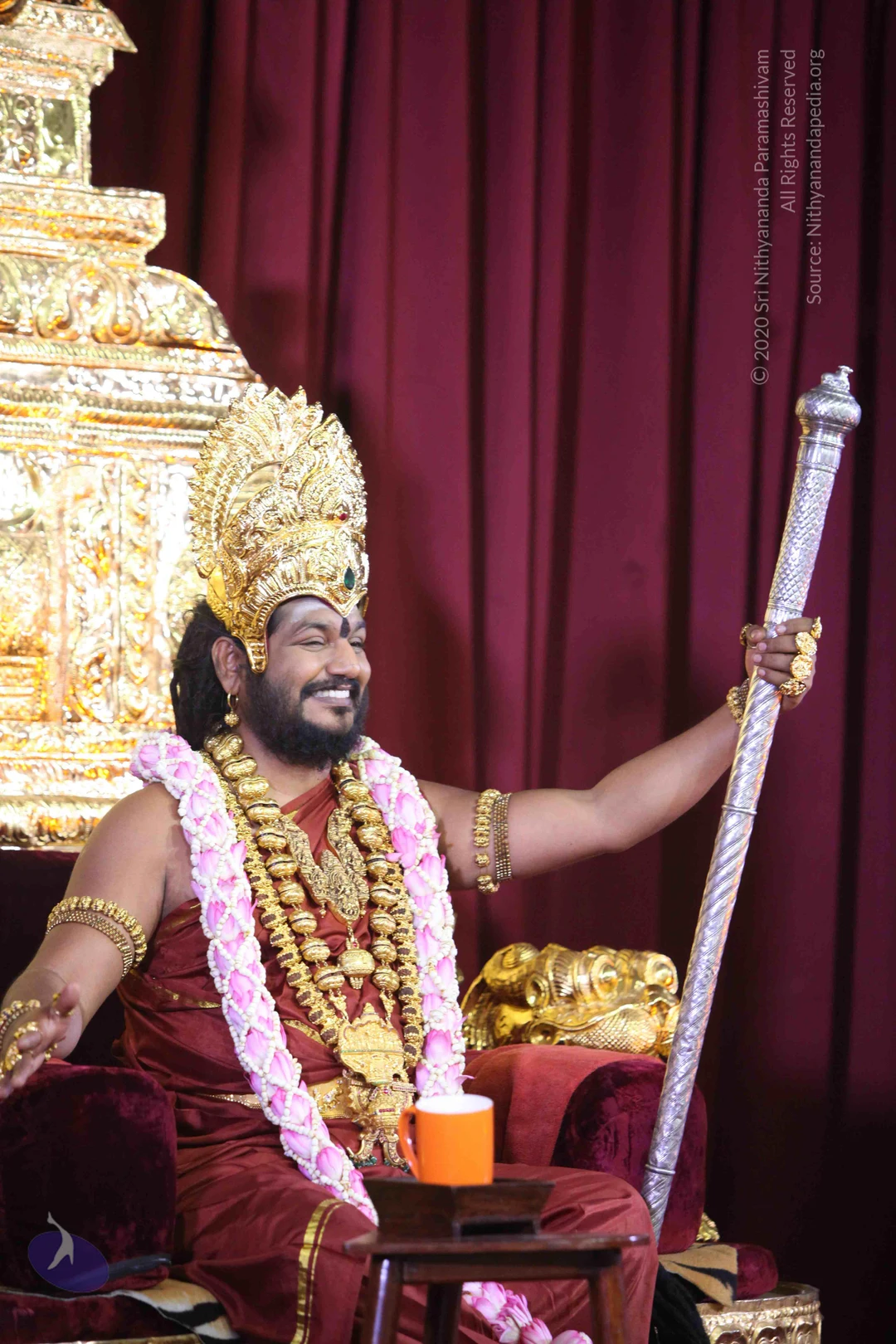
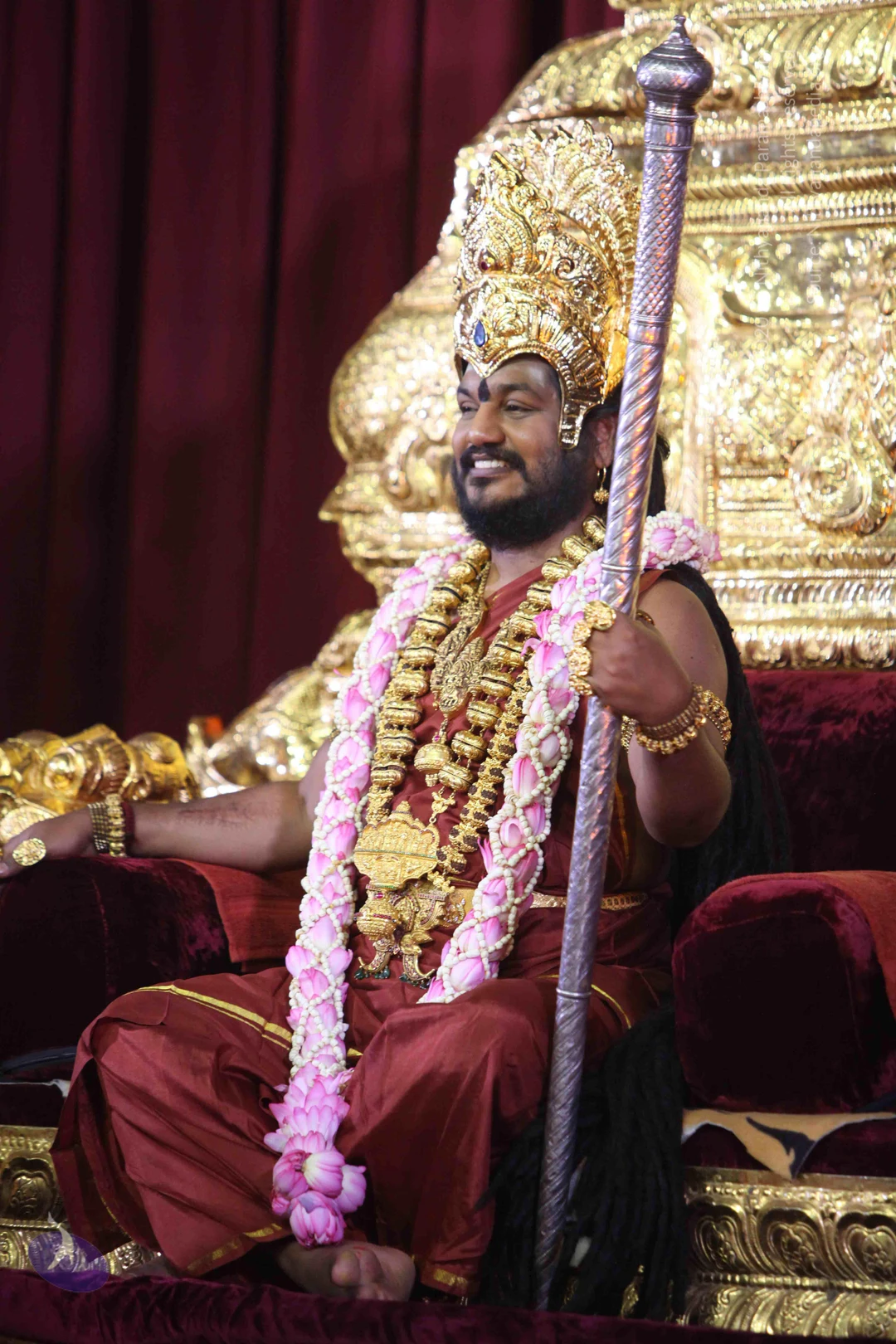
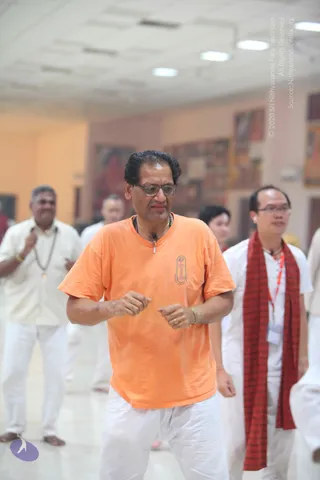
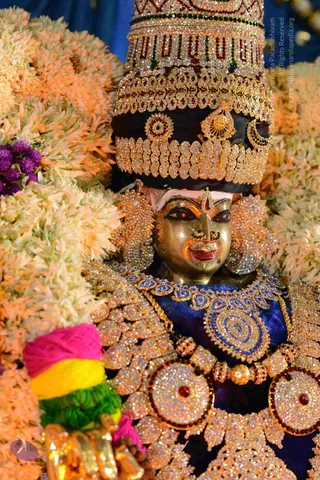
A photograph of a group of men and women moving together in a bright hall with pale tiled floor and framed religious paintings on the walls. In the foreground a man with swept-back dark hair and glasses wears an orange short-sleeved t-shirt with a small emblem, white trousers, a pendant and a beaded mala, his hands clasped at chest height in a mid-motion stance. Beside him a man in white clothes with a red-and-black checked shawl and a conference badge on a red lanyard smiles. Behind them a man in a cream shirt with a beaded mala and others in white clothing are also moving. Some of the men appear to be barefoot.Close view of a gold-toned deity murti with a painted face, adorned with a tall jewelled crown and heavy ornate jewellery set with crystals, a blue velvet garment and a dense garland of white flowers. A pink and yellow-green cloth bundle and purple blossoms sit at the lower left. No physical people are visible; the figure is a statue.A seated man in maroon robes sits cross-legged on an ornate golden throne with lion-shaped armrests and a tiered gilded canopy. He wears a gold crown, layered gold necklaces, bangles and a pink-and-white flower garland, and holds a silver staff in one hand while raising the other in blessing. Behind him a large painted deity figure with multiple arms holds ritual objects against a red curtain draped with golden leaves. A small wooden stool with an orange cloth stands at left, and a golden offering table sits in front of the dais. The appearance matches Swamiji (probable) through the crown, saffron-maroon ornate clothing, gold necklaces and staff, seated on a throne in a satsang setting.A seated man on an ornate throne smiles broadly, holding a silver staff with a finial in his right hand while his left arm extends outward. He wears a tall gilded crown, a deep maroon garment, layered gold necklaces with bead strands, gold armlets and bangles, and a pink-and-white flower garland. A small table holds an orange cup. Behind him hang deep red drapes and a gilded ornamental structure. Appearance matches the presentation cues of Swamiji (probable): gilded crown, ceremonial gold necklaces and maroon ceremonial attire, seated in a throne-like setting.A smiling man with a short beard sits on an ornate gold-and-red throne before a deep maroon curtain. He wears an elaborate gold crown with a blue gemstone, a maroon silk garment with gold border, and multiple layers of gold necklaces with a large gold pendant. Pink and white lotus garlands hang across his chest and shoulders, and he holds a tall silver staff with a finial in his right hand. Gold bangles adorn his wrists. The gilded throne behind him has detailed carvings. Swamiji (probable) appears here, seated in regal attire with crown, staff, gold jewellery and lotus garlands, matching the page's Navaratri Darbar event.A seated man in a maroon silk garment and an elaborate gold crown with blue and red gem accents sits on an ornate gold throne upholstered in deep red velvet, holding a tall silver staff with a finial. He wears layered gold necklaces, a gold pendant, gold armbands and bangles, and a long garland of pink flowers and white beads draped across his chest. Behind him is a gilded carved throne back against a red drape. The scene reads as a formal darshan or satsang seat.

October 06 2016

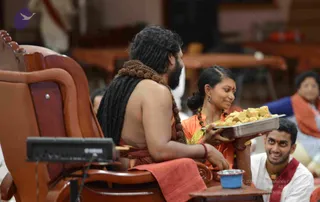
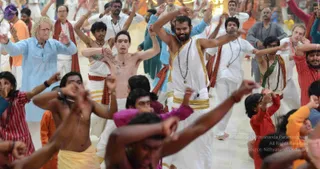
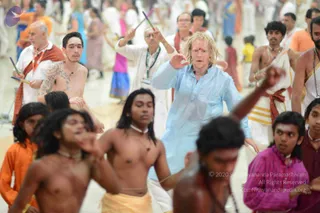
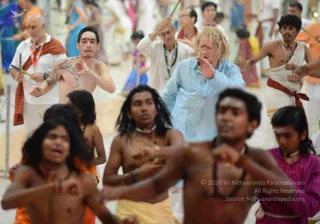
16 photosView all
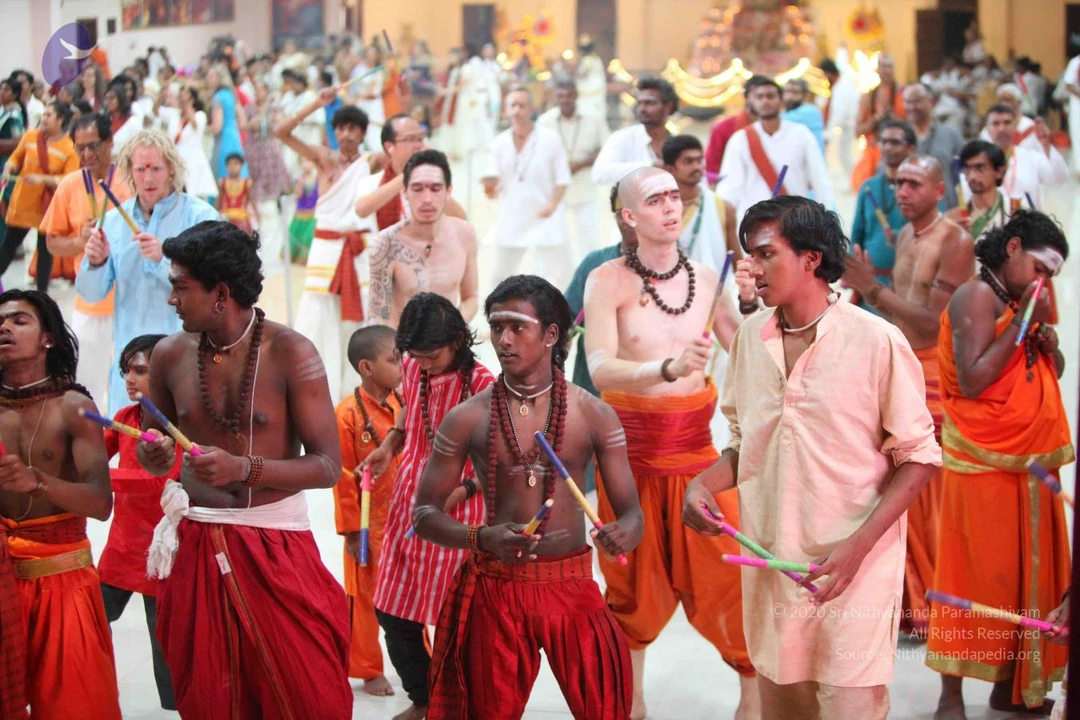
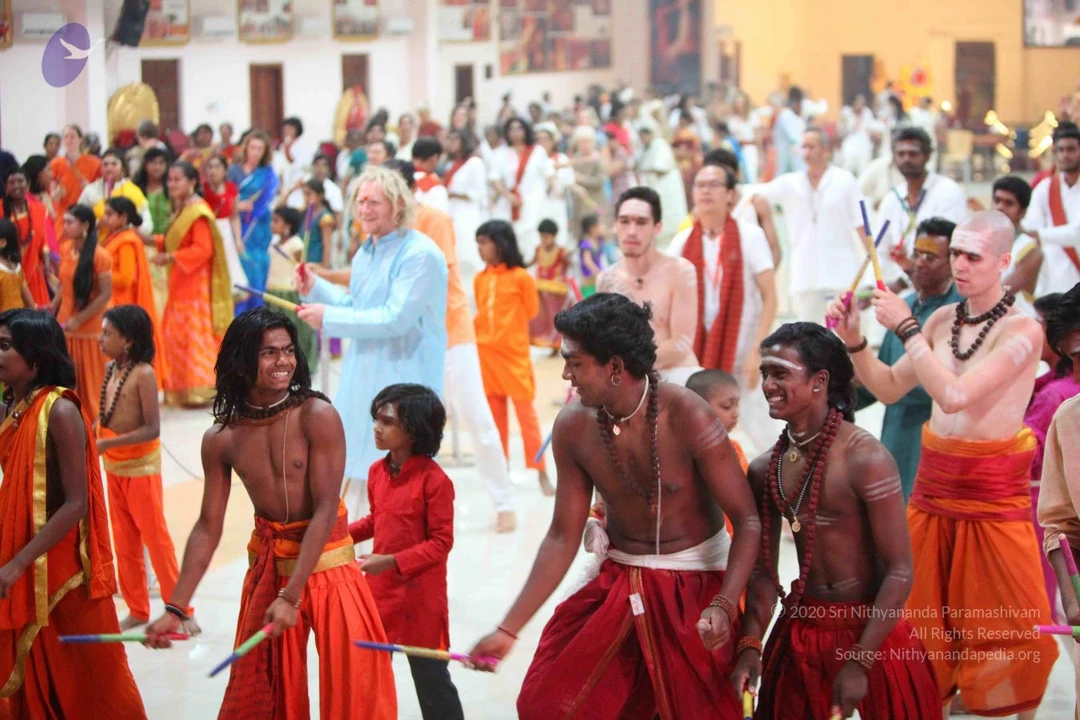
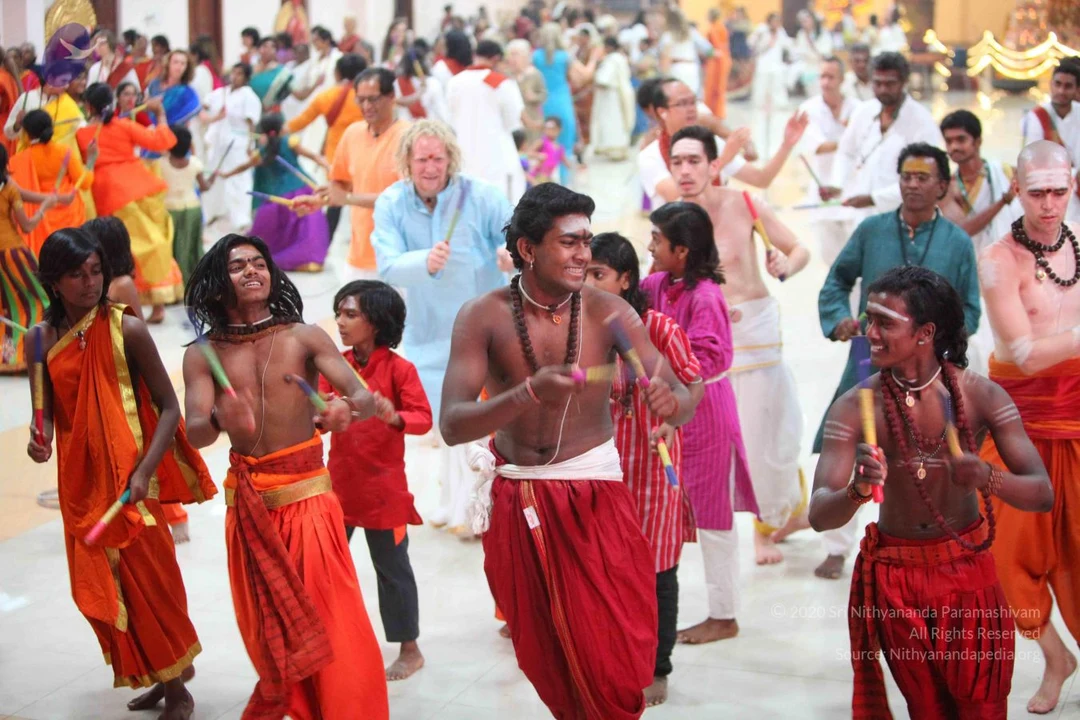
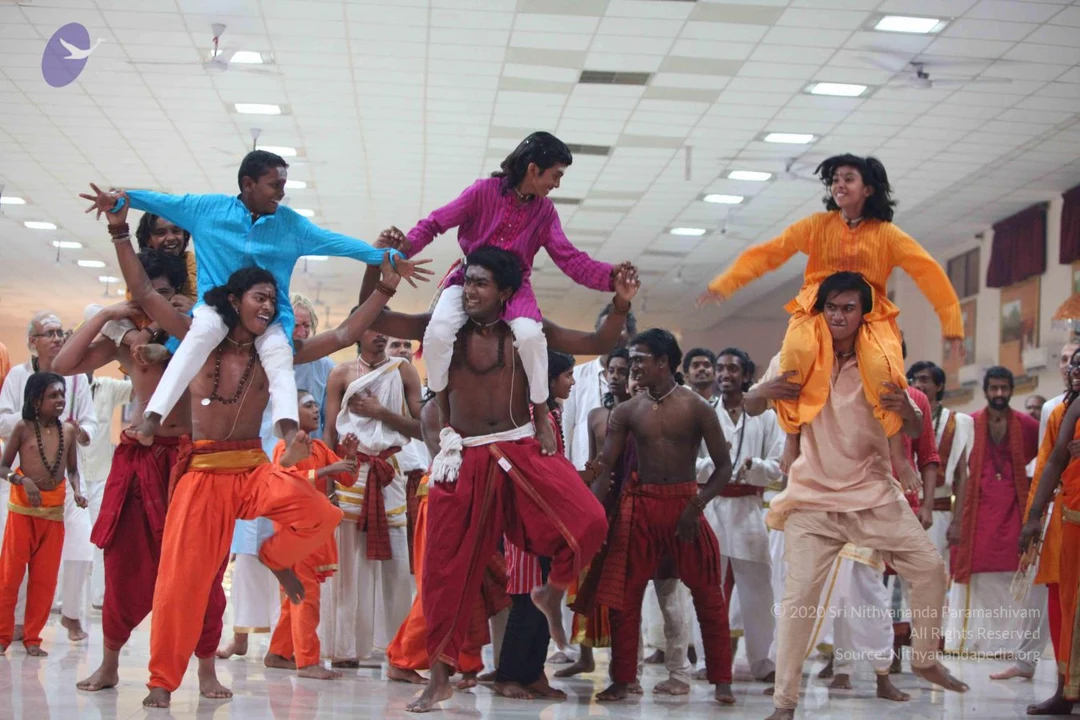
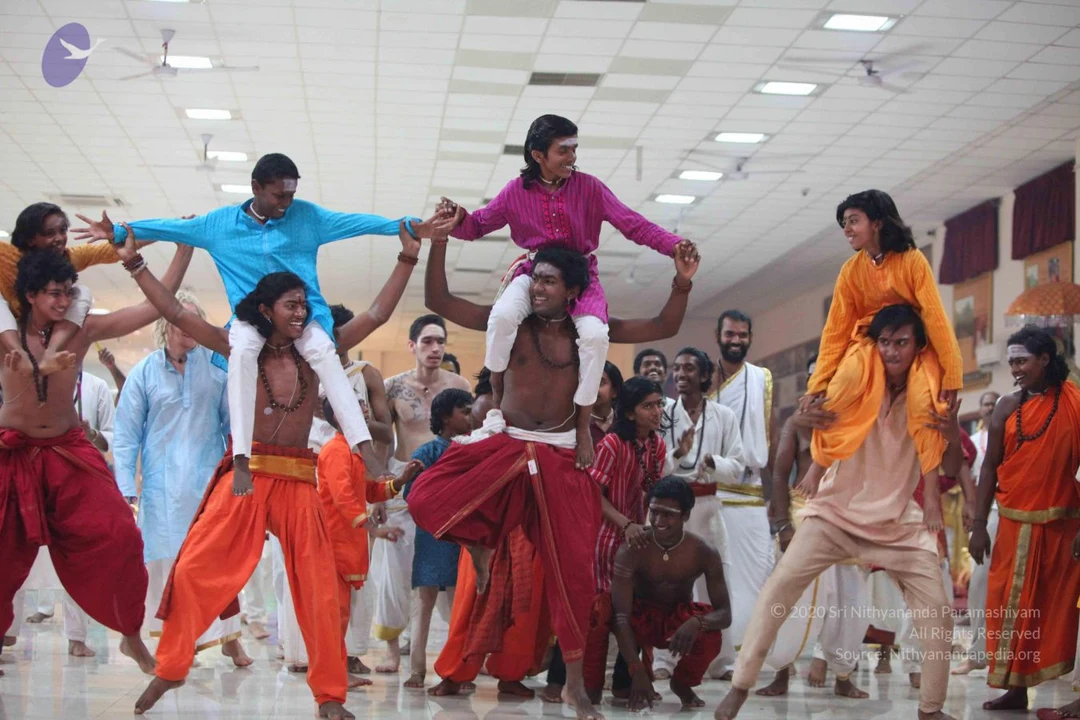
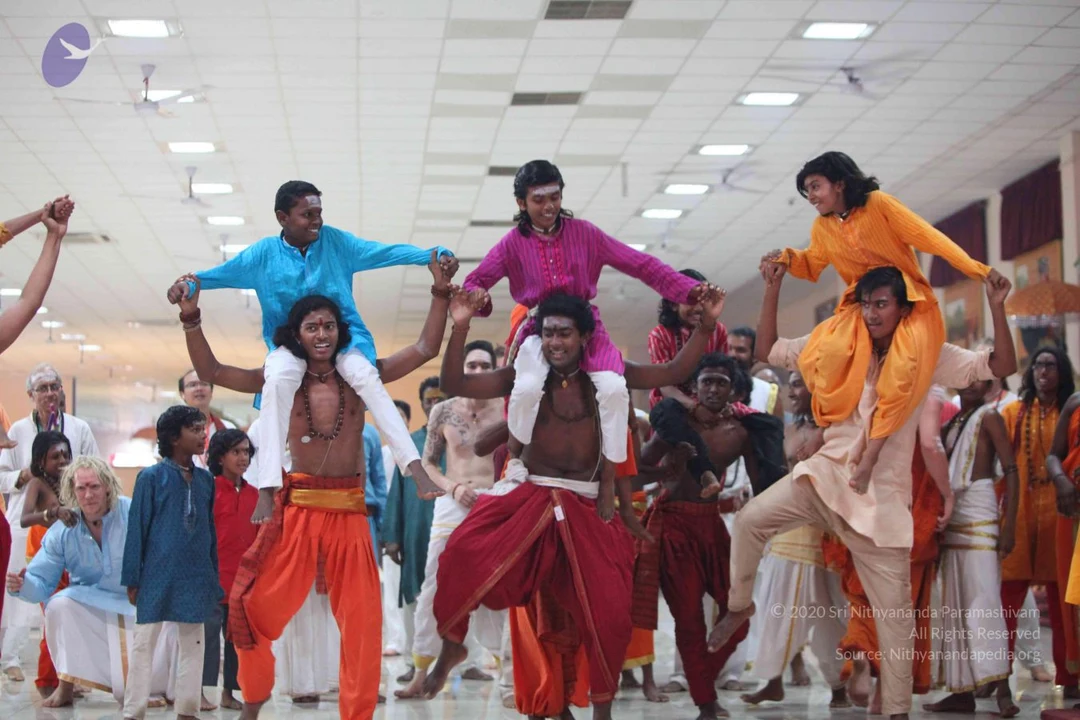
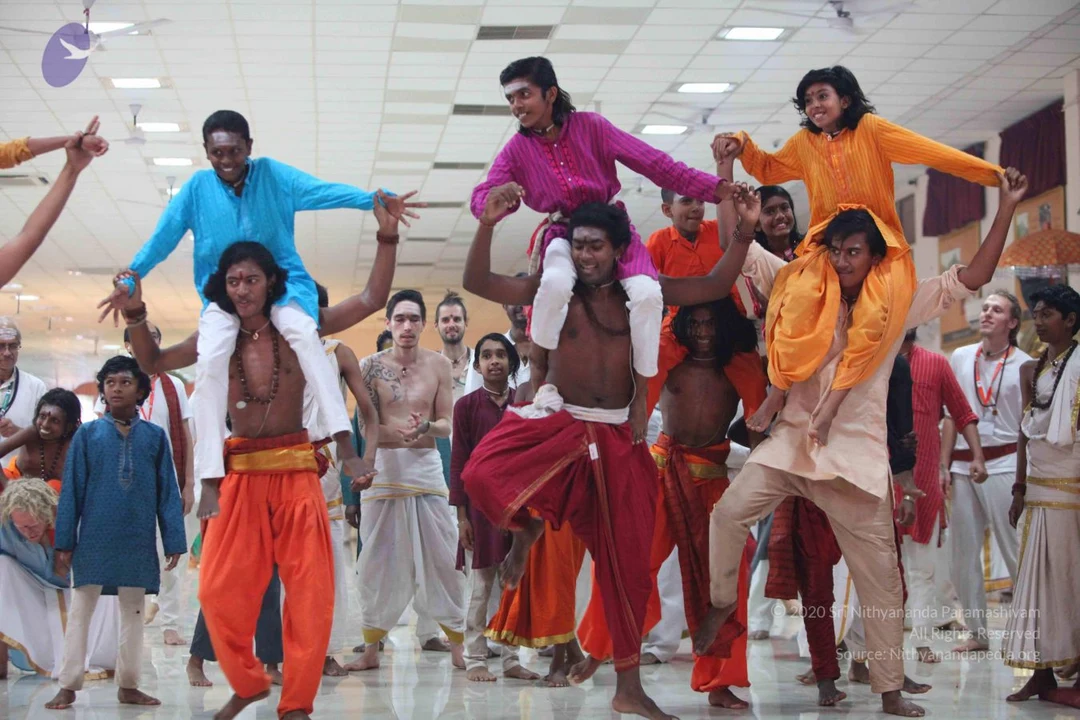
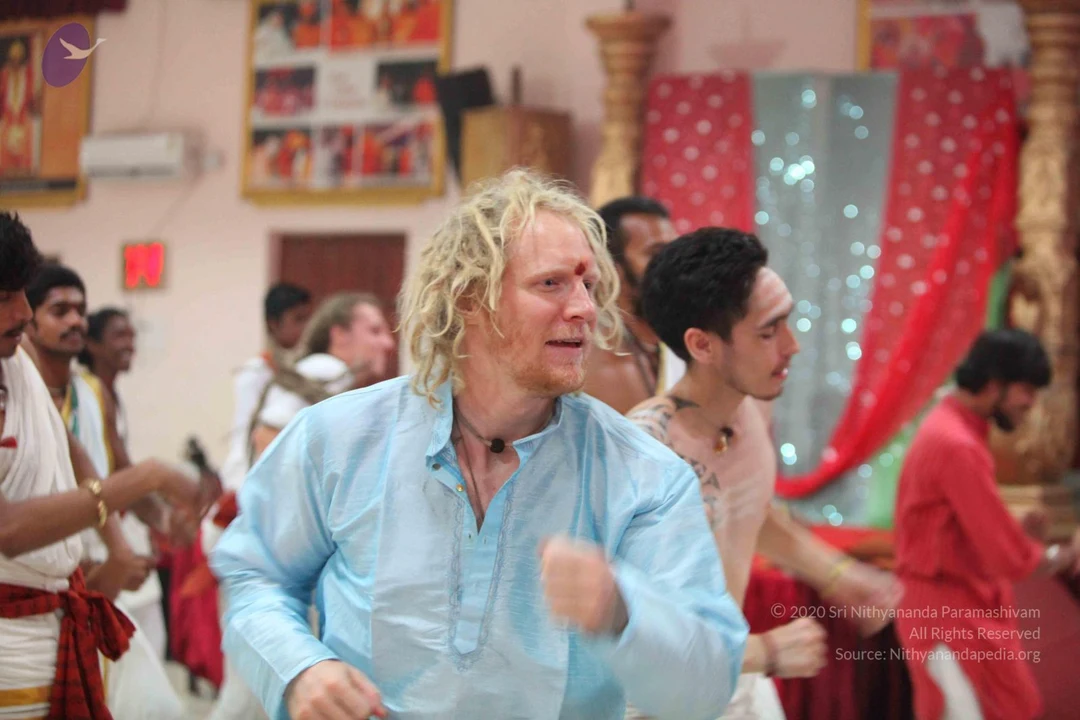
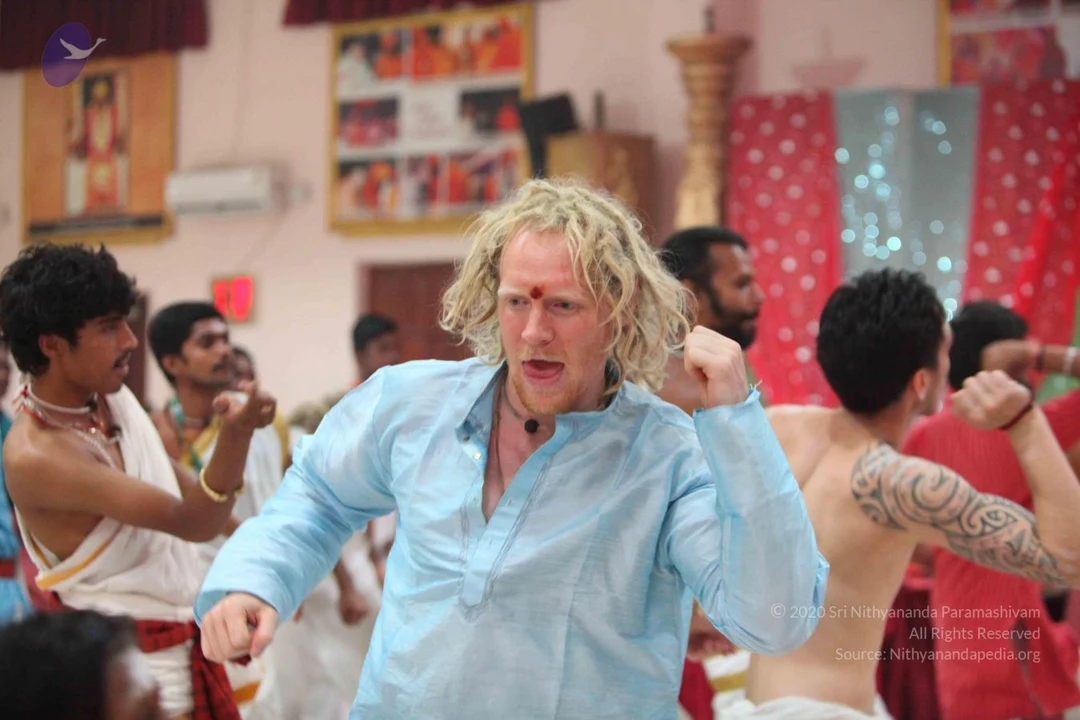
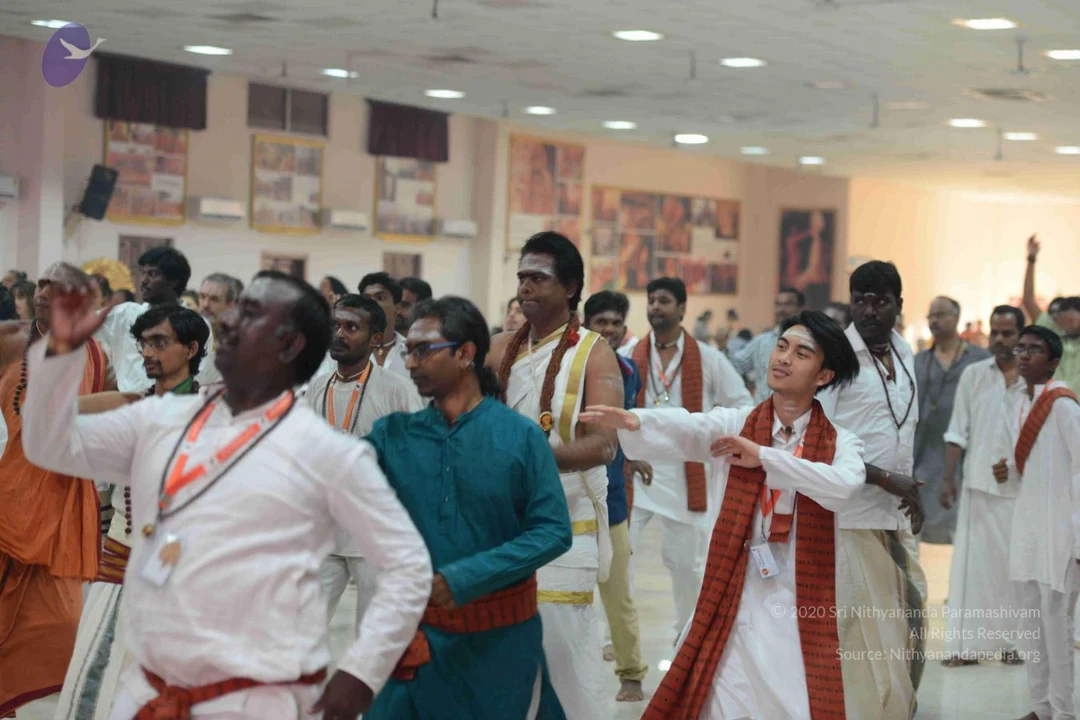
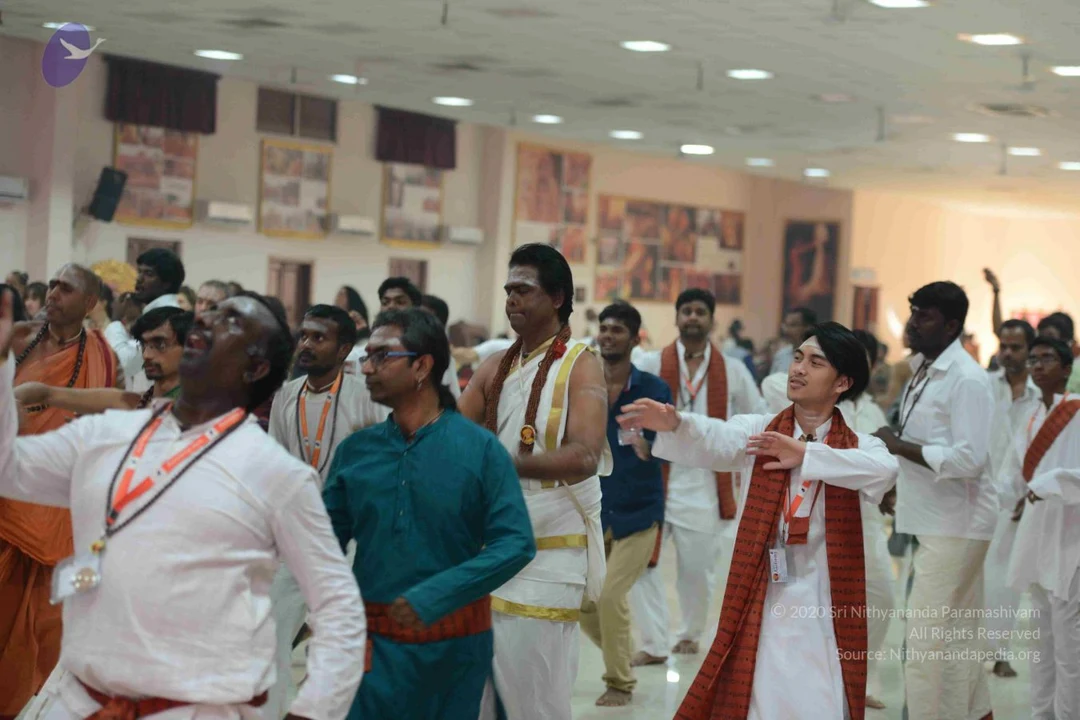
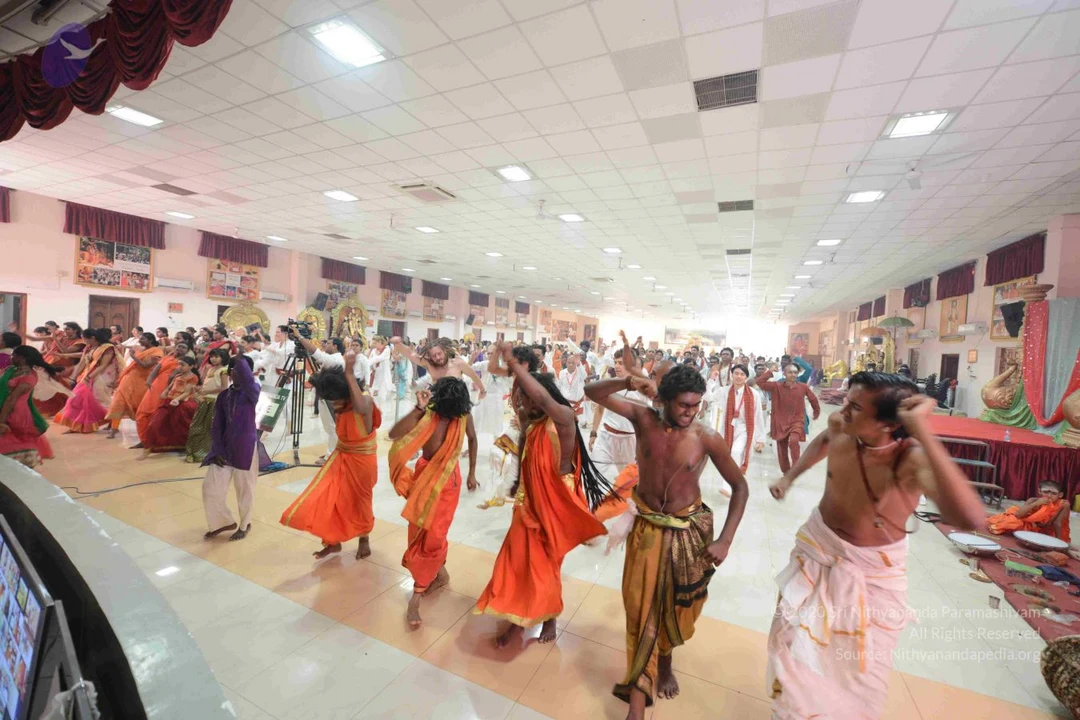
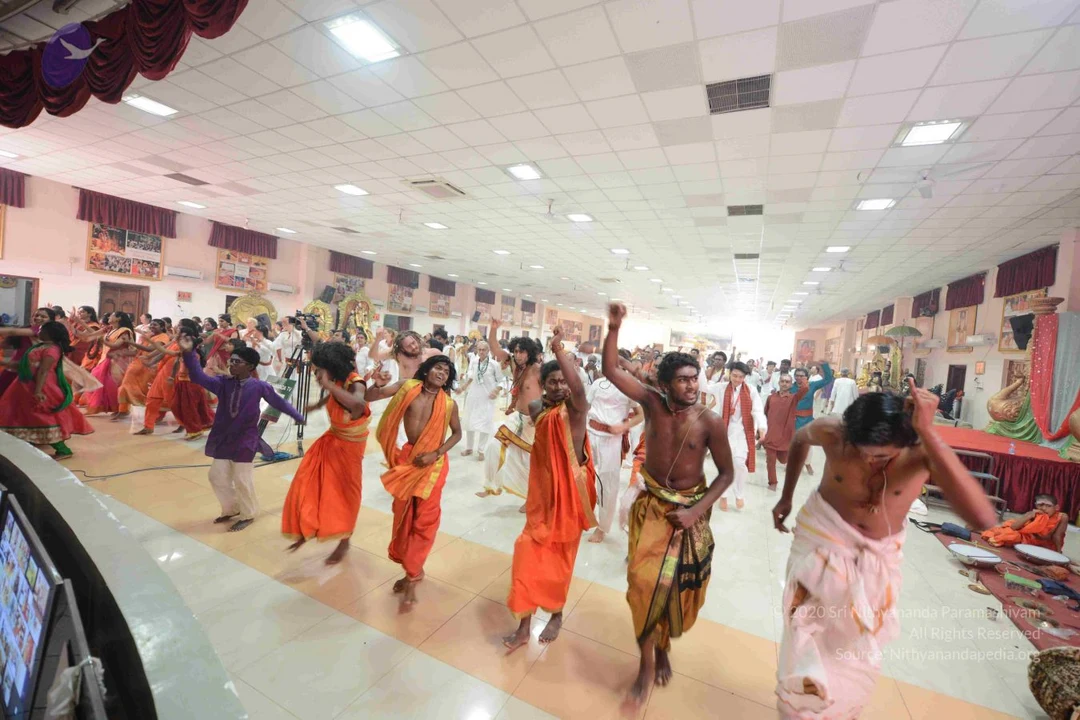
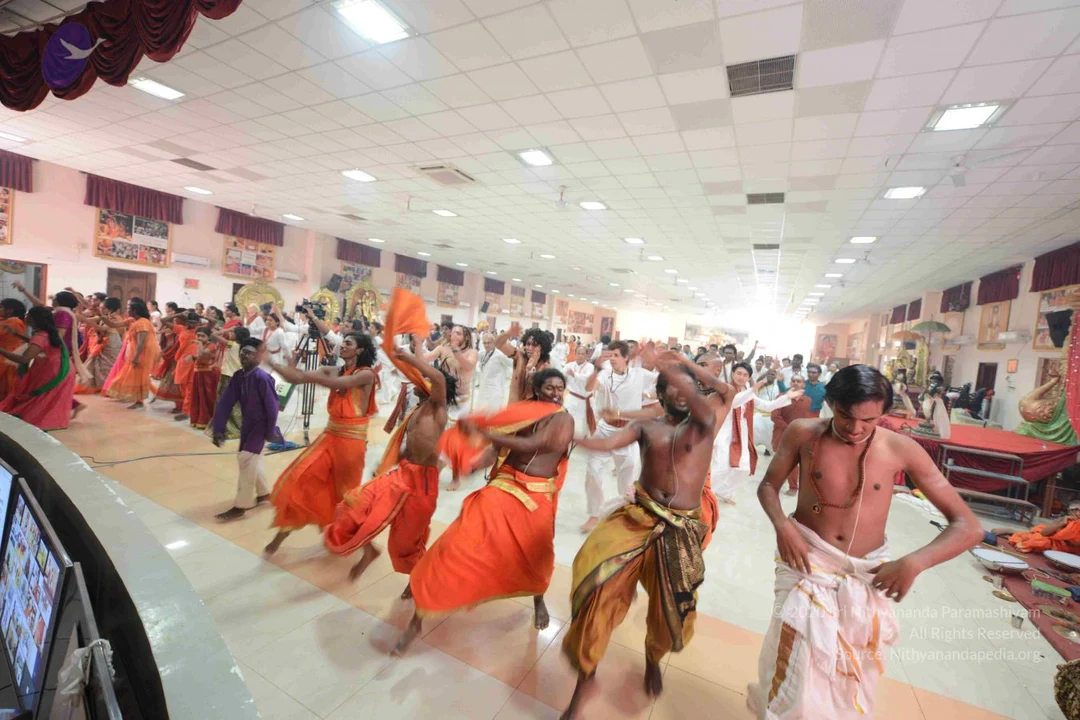
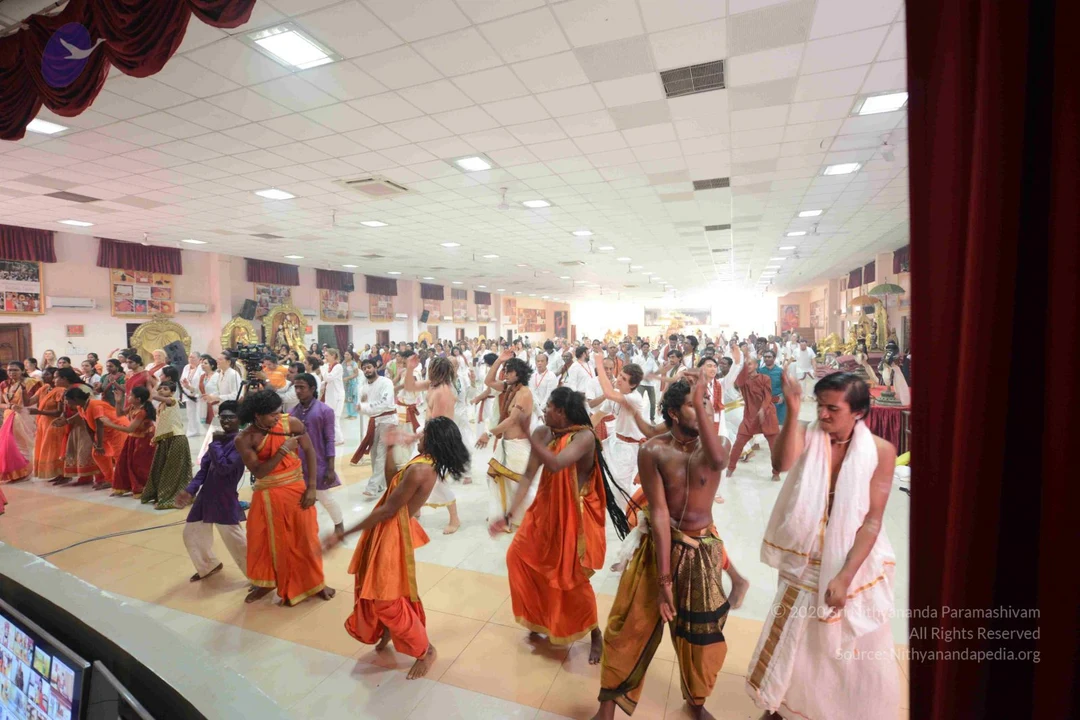
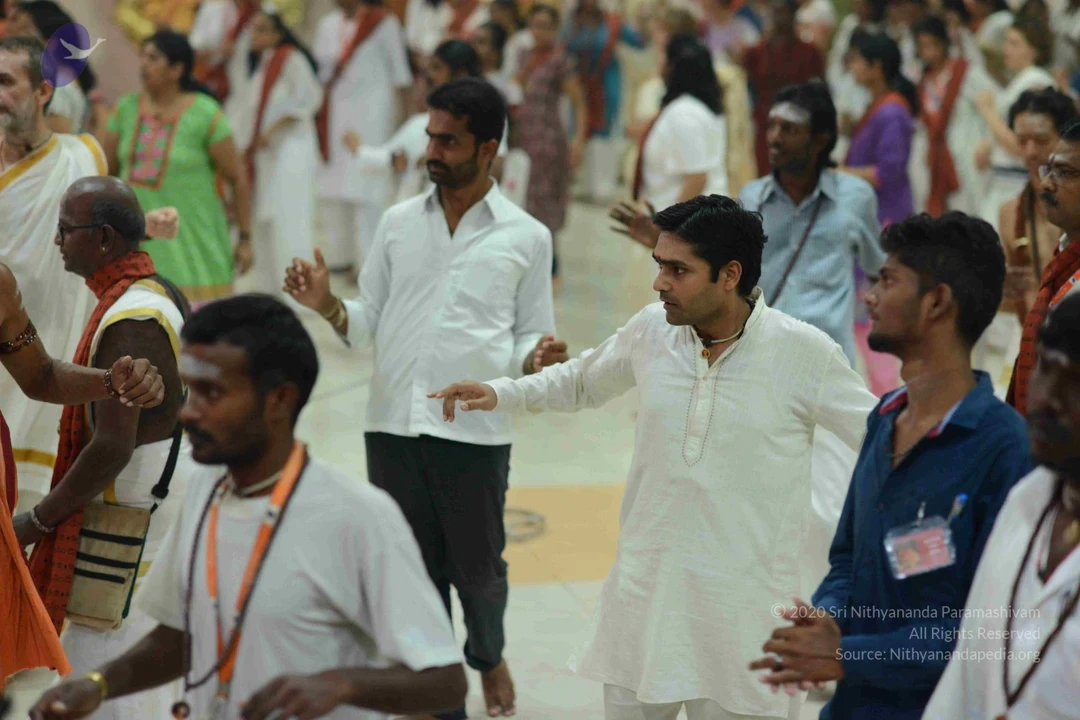
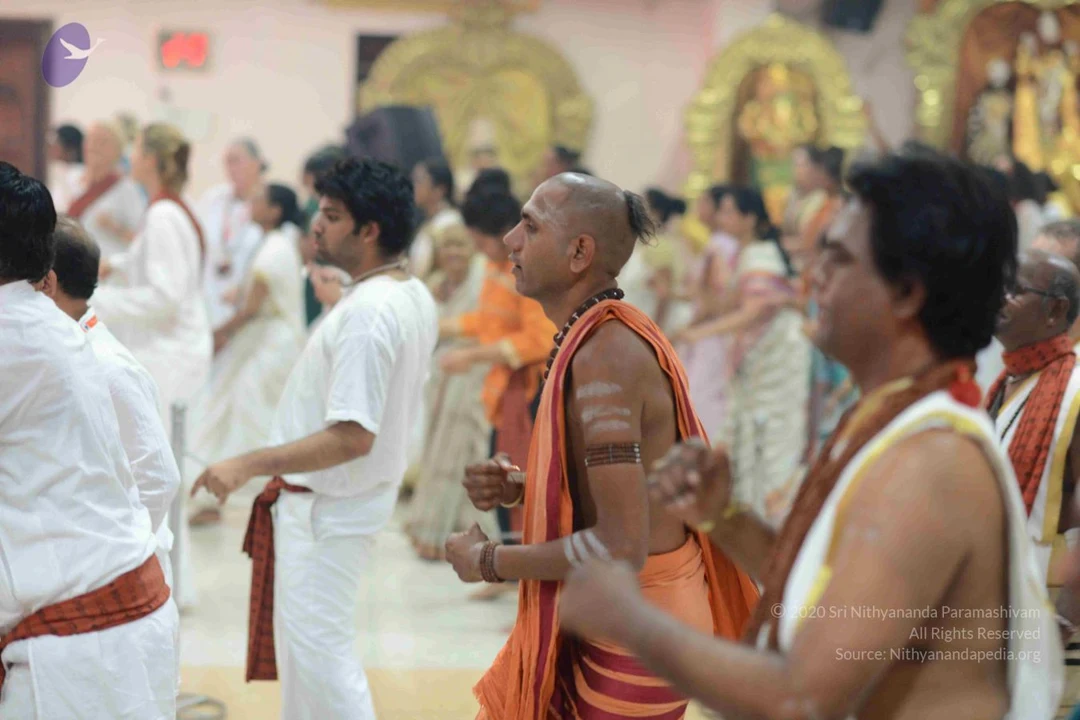
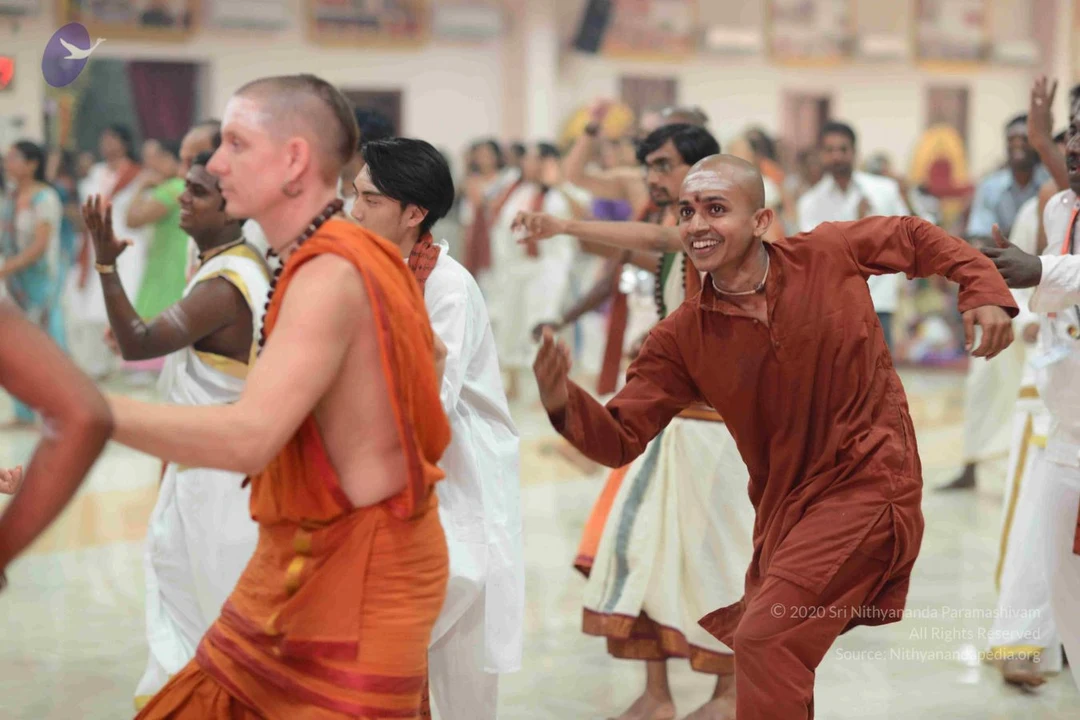
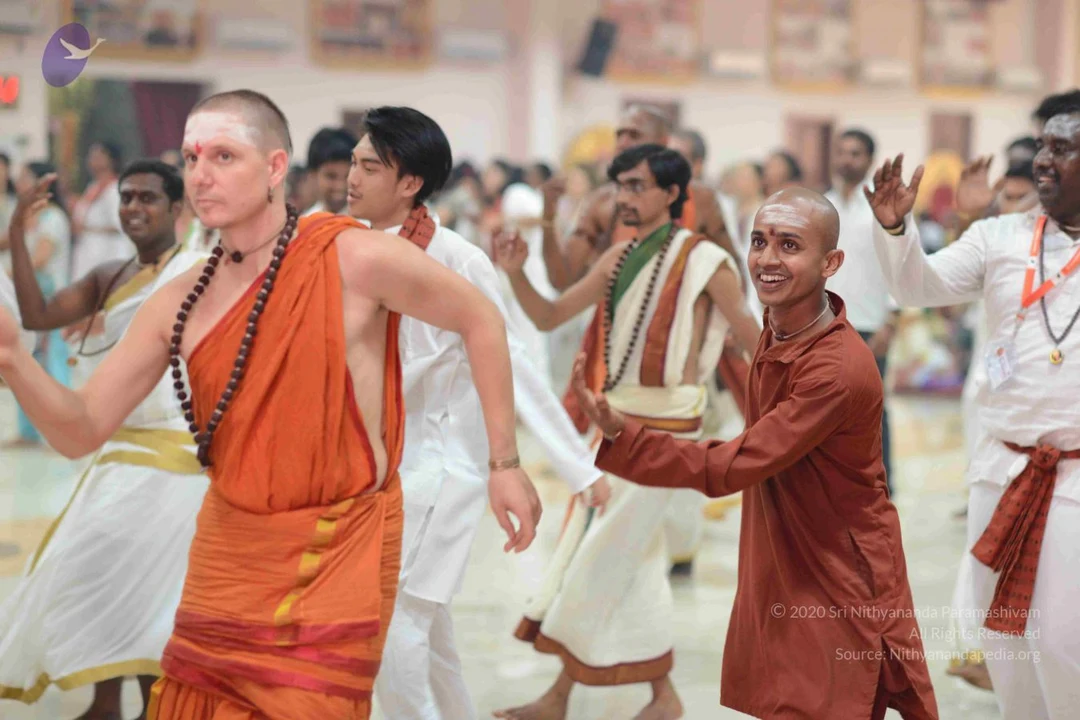
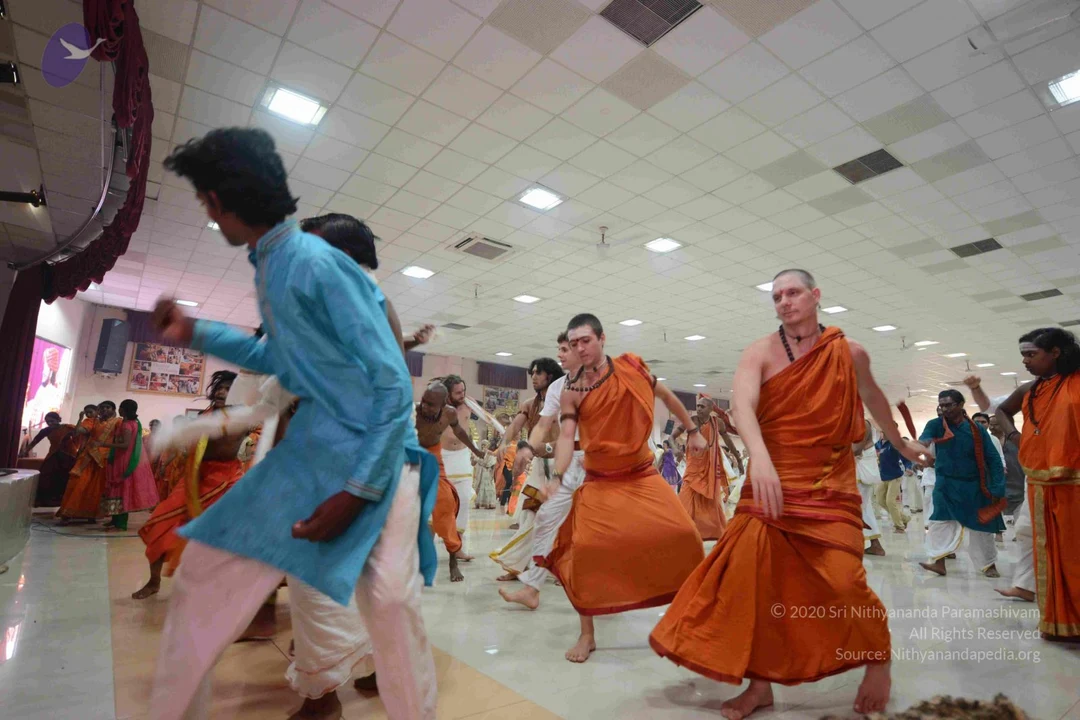
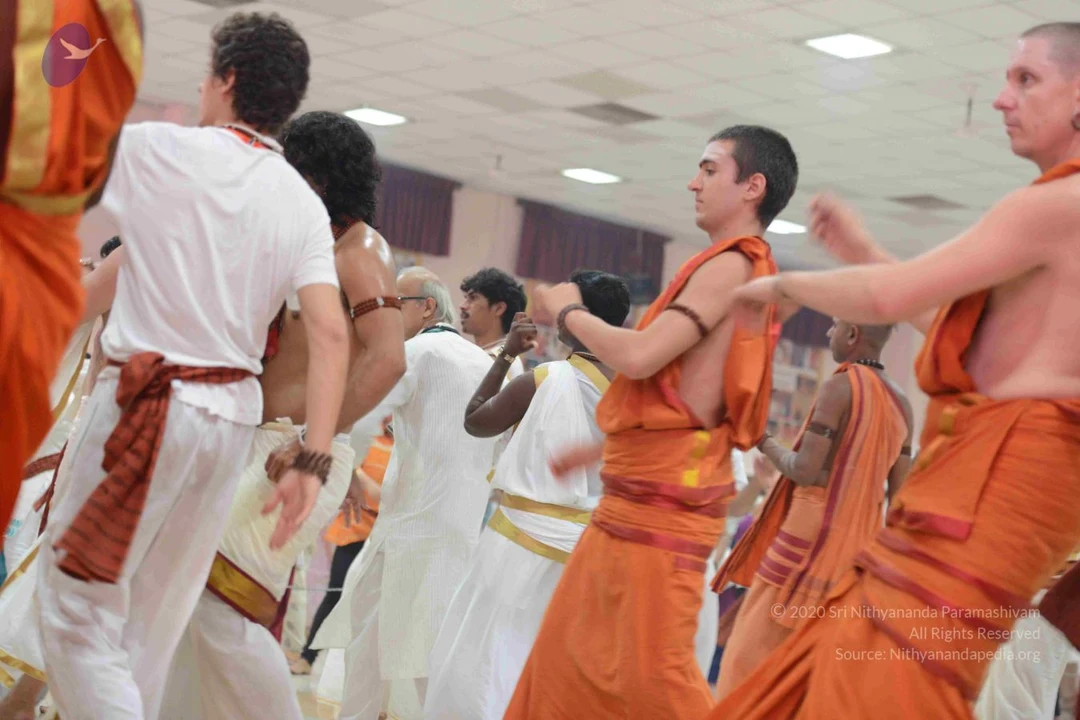
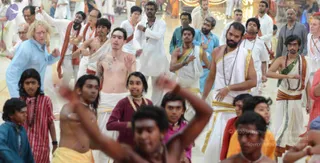
A photograph of a lively group dance inside a bright, tiled hall during a Navaratri-era gathering. A fair-haired man in a light blue kurta with a red forehead mark dances at centre, while a shirtless man with a tattooed arm and white dhoti stands to his left. Behind them, men in white kurtas and dhotis, several with red or saffron shawls, clap and move, some holding short sticks. In the foreground, young boys in orange, blue and red kurtas and a bare-chested young man with long hair and sacred beads move energetically. Gold-trimmed ceremonial fabric and hanging decorations appear at the upper right. No visible deity murti, throne or a person candidate is clearly identifiable by the criteria provided.A seated man with long dark matted hair and a full beard sits in a carved wooden armchair, his back partly turned, wearing a rudraksha mala with large beads across his shoulder and an orange-red cloth draped over his lap and armrest. A woman in an orange saffron blouse with gold trim and a gold-edged sari, hair in a low bun, holds a stainless steel tray of golden sweet cubes toward him. A small blue cup sits on the side table. Behind them, a seated man in a white shirt and red vest smiles, and other devotees in orange shawls sit in the hall. A Yamaha audio unit sits on the armrest. Swamiji (probable) is identified by long hair, rudraksha mala and saffron-toned clothing; the image shows him seated in a ceremonial throne-like chair, with a devotee offering prasad.A large group of devotees dances energetically in a bright marble hall, arms raised and hands gesturing overhead. In the centre, a bearded man in a white dhoti with a gold border and a white shawl wears a long rudraksha mala and a pendant. Nearby, a shirtless man with tattooed arms and a yellow-bordered white dhoti raises his arms, while a man in pale blue kurta with a red shawl and a man in white with a red-and-white sash move among them. Some wear saffron, pink, red and striped clothing, with rudraksha malas and white shawls common. The setting suggests a satsang or group devotional dance, with a white-robed devotee on the right and a girl in red and yellow near the foreground. Partially visible hands and heads fill the lower edge of the frame.A photograph of a crowded indoor hall where devotees in white and saffron clothing move energetically. In the centre, a man with shoulder-length blond curly hair and a red mark on his forehead wears a light blue kurta and gestures with raised hands. Around him, shirtless young men with long dark hair and white neck cords wear yellow and orange lower garments, and some hold thin sticks. A man in white with a green lanyard and a man with a tattooed chest stand nearby, while people in orange, pink and maroon clothing fill the background. The mood is festive and active.A photograph of a crowded ceremonial hall where participants perform synchronized stick and arm movements. In the centre, a man with long wavy blond hair and a red tilak on his forehead wears a pale blue kurta and gestures with raised hands. Around him, shirtless young men in white dhotis with red sashes and rudraksha-style necklaces move in motion blur, while a man in a white shirt with a green lanyard holds a long wooden stick. A young man with a tattooed arm wears a red-and-white wrap. Other participants in white, saffron and pink clothing fill the background, and a barrier rope runs along the left edge.A dense crowd of devotees dances energetically across a bright hall with a polished floor. Most wear white or cream dhotis and kurtas, many with orange or red angavastrams over the shoulder and rudraksha or bead malas. A bare-chested young man with tattoos on his arm and shoulder, in a white dhoti, gestures with raised hands at centre. A bearded man in a white dhoti with gold border and a long mala, and a man in a teal shirt with a lanyard, stand near the right. Children in red-striped and maroon clothing and a young man in a dark red shirt appear in the foreground, with blurred arms raised. Warm ceremonial lights glow in the background.