Skip to content
Wednesday

5 November 2014

Dated photos
109
Source pages
1
Media
2
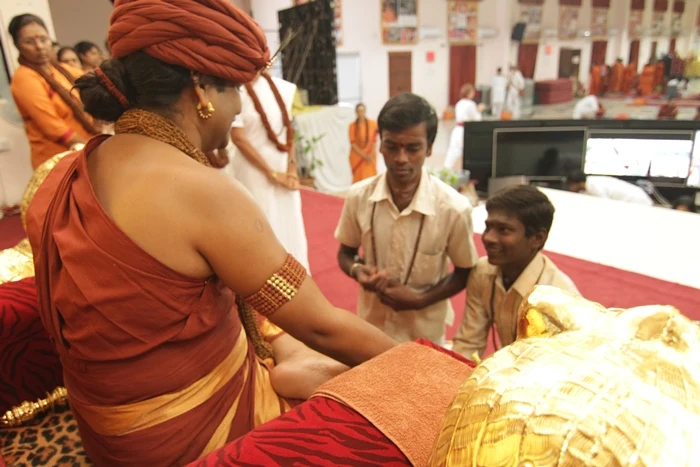
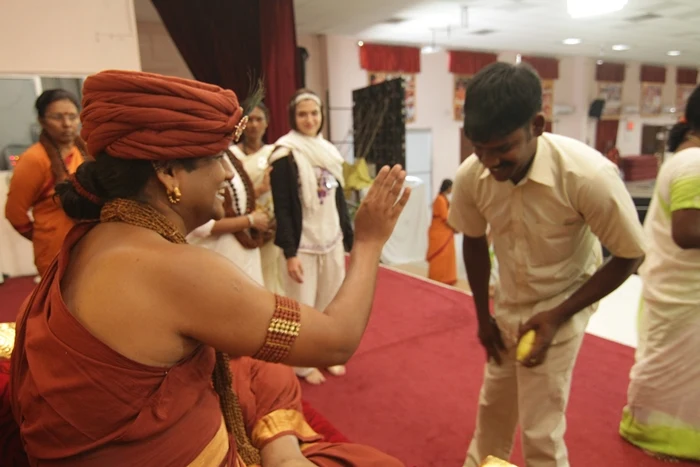
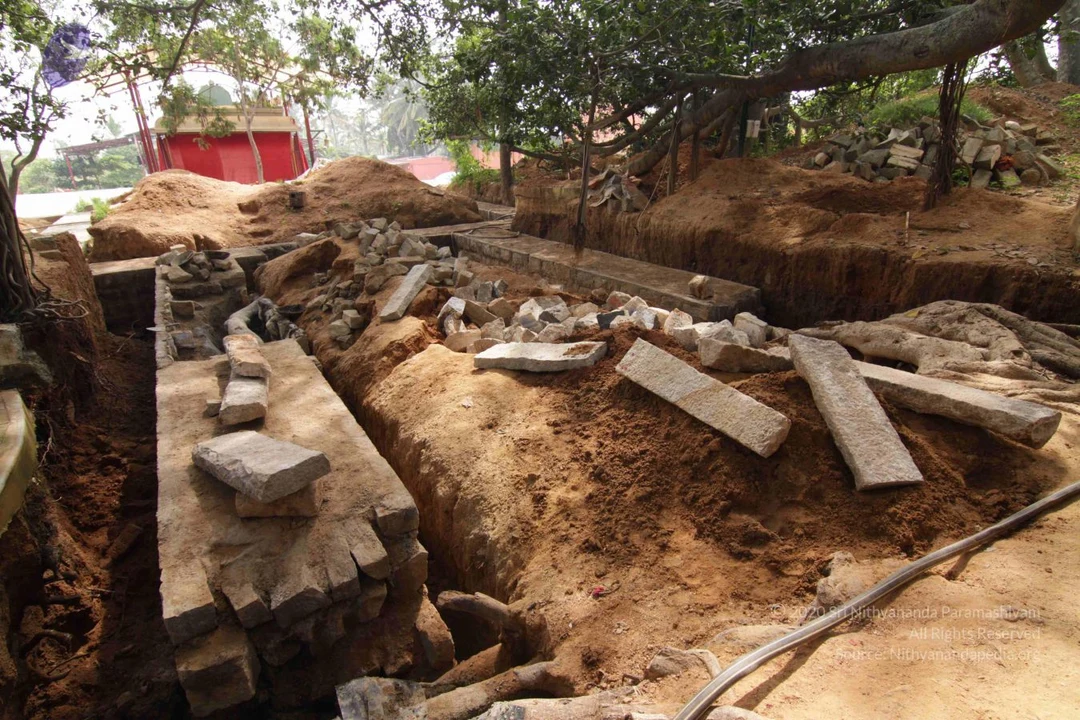
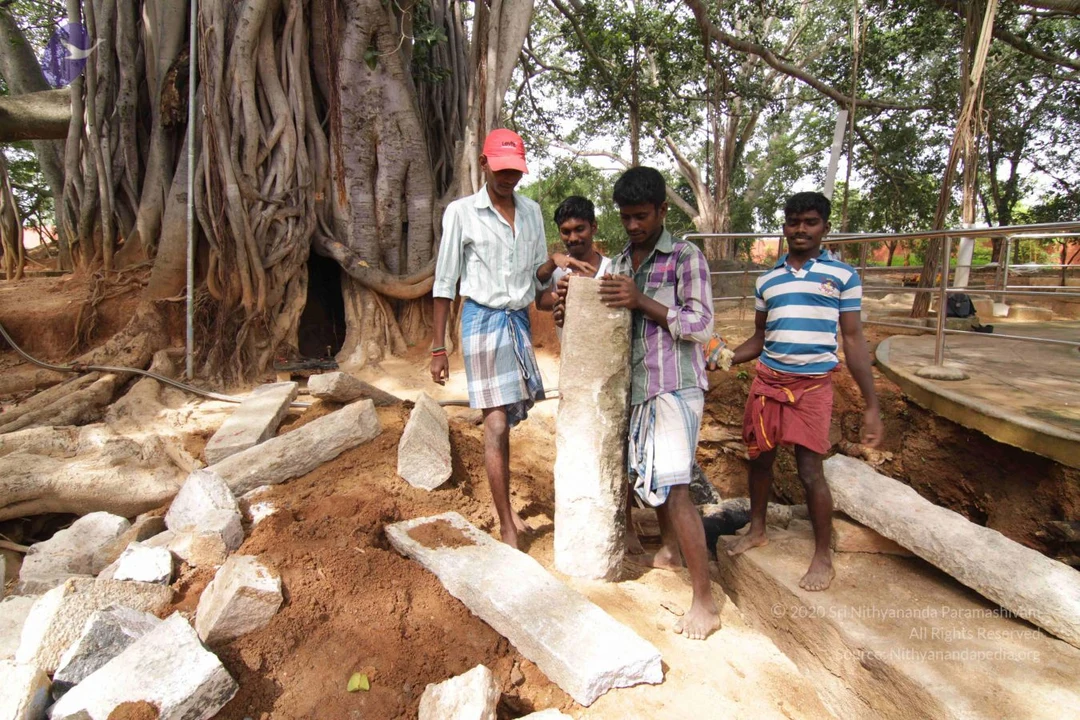
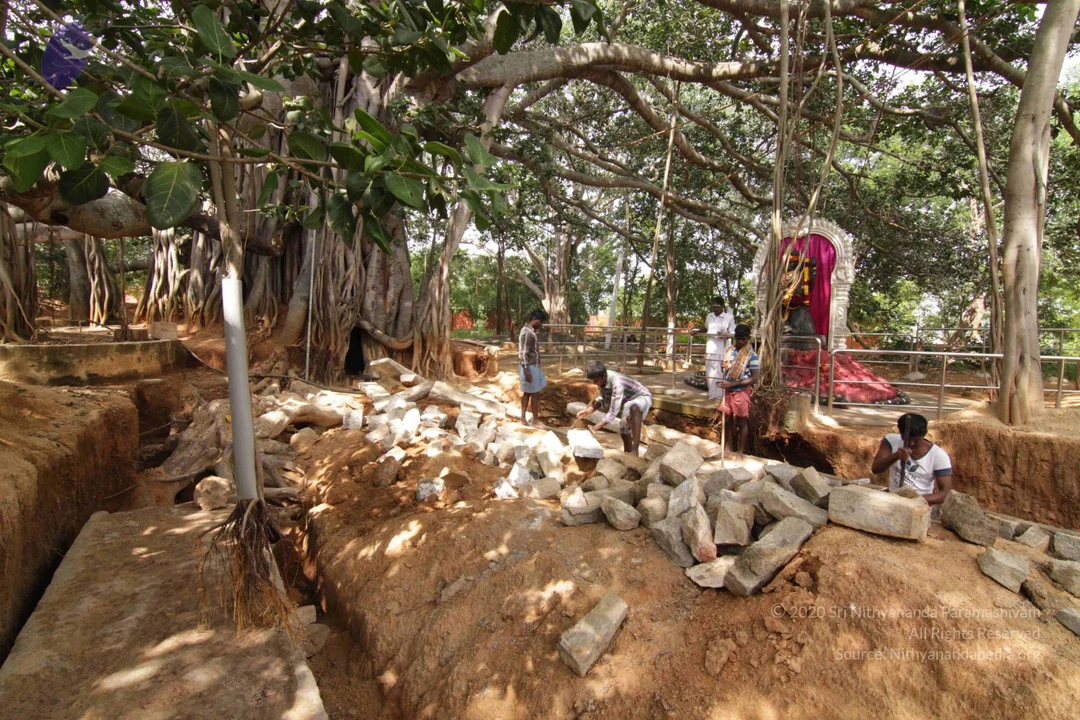
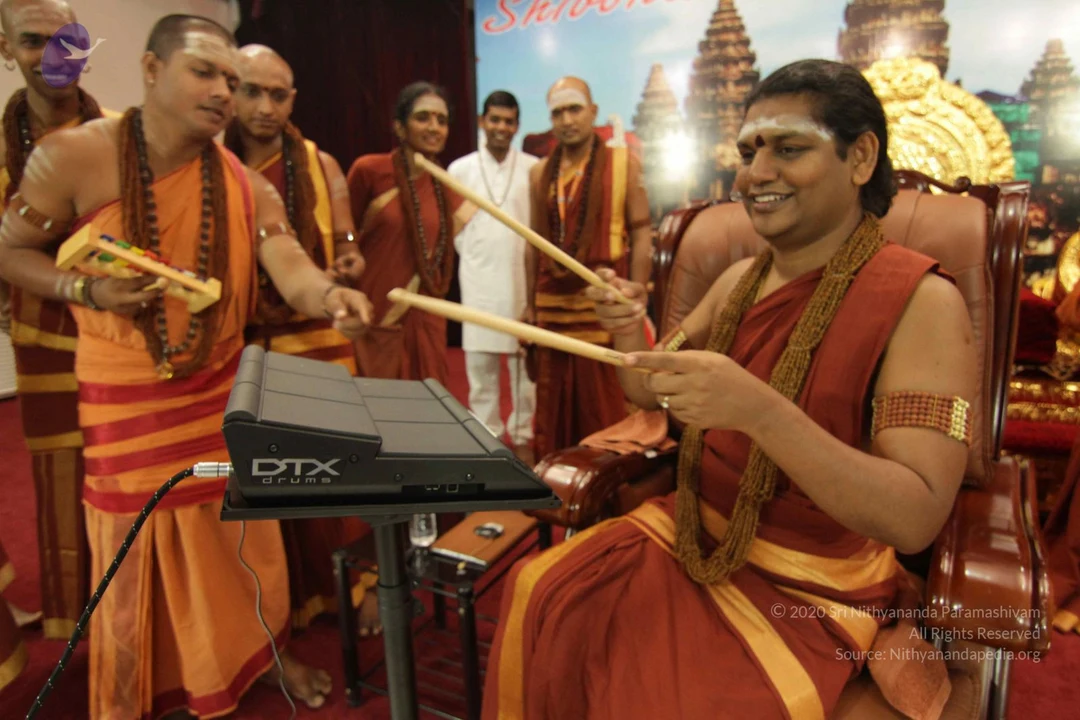
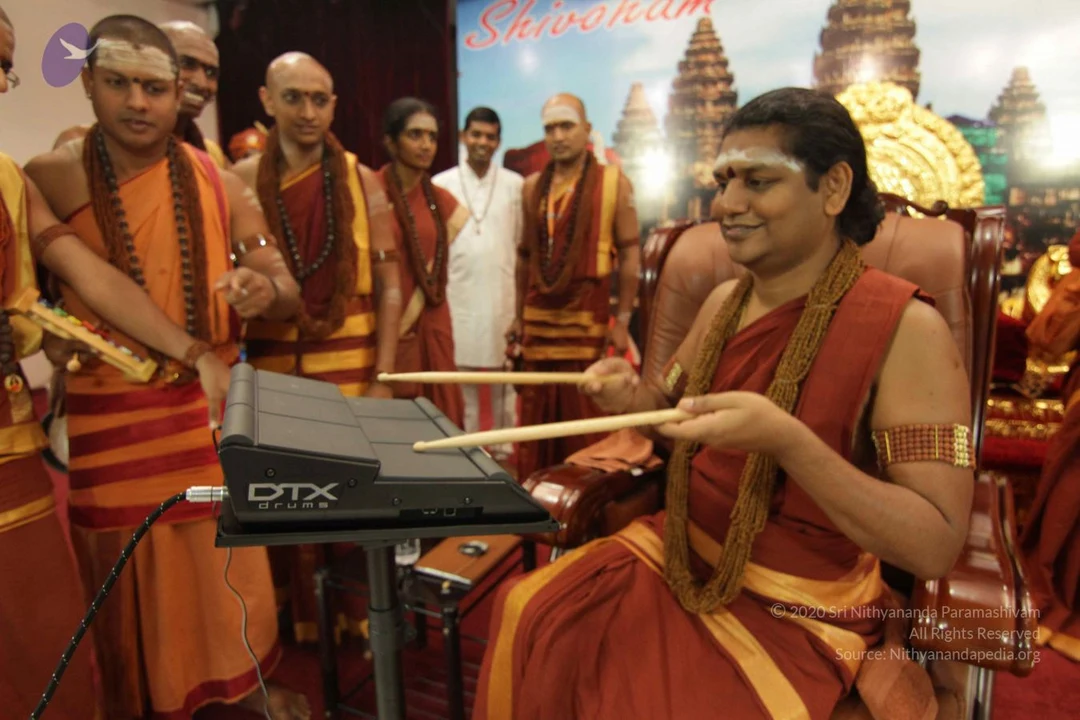
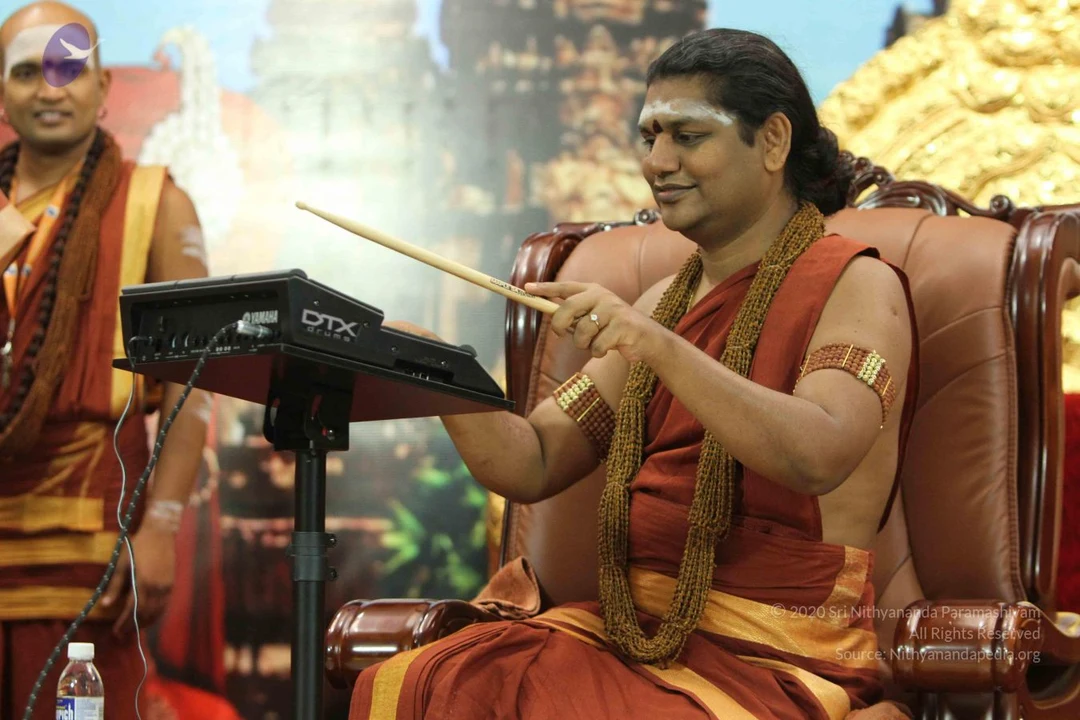
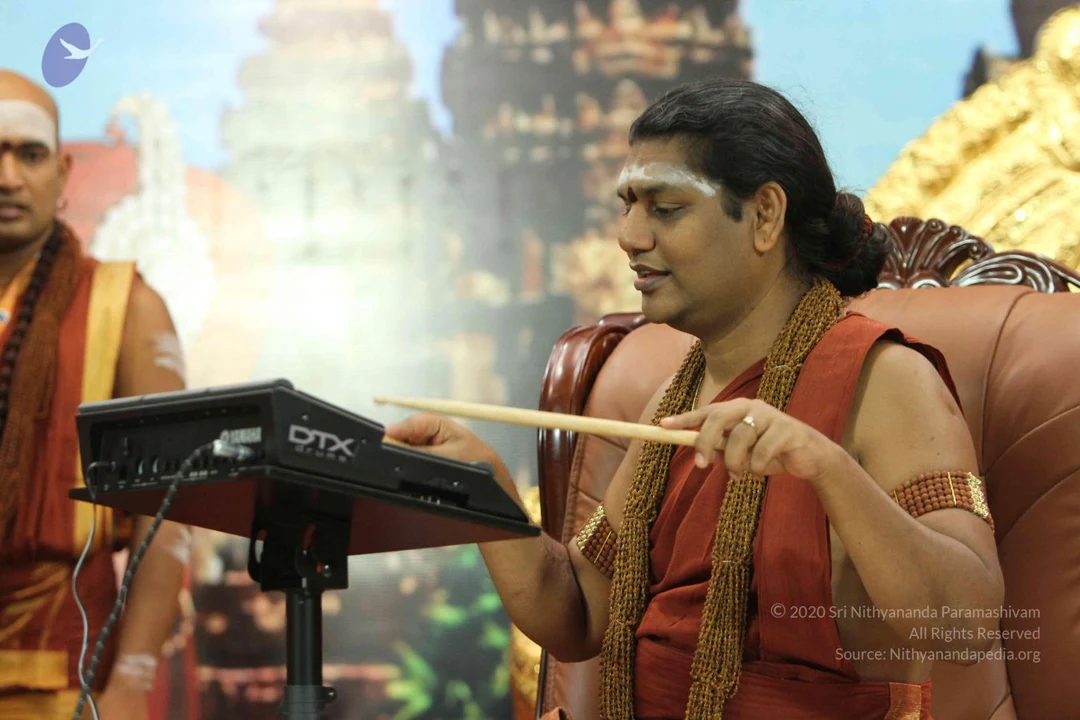
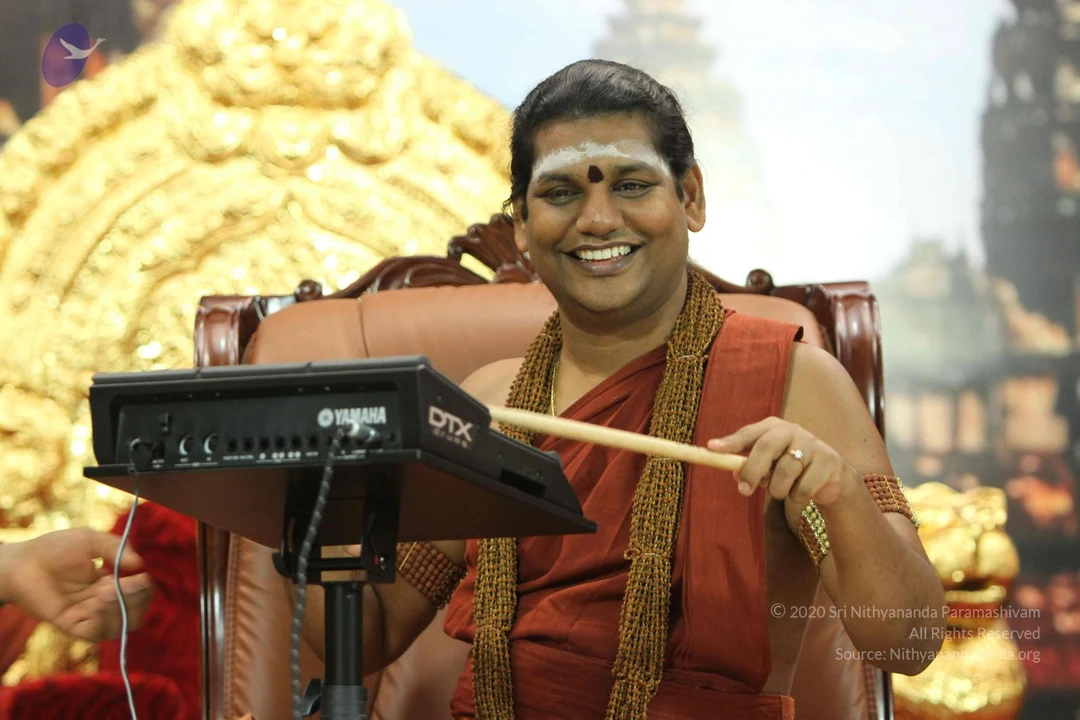
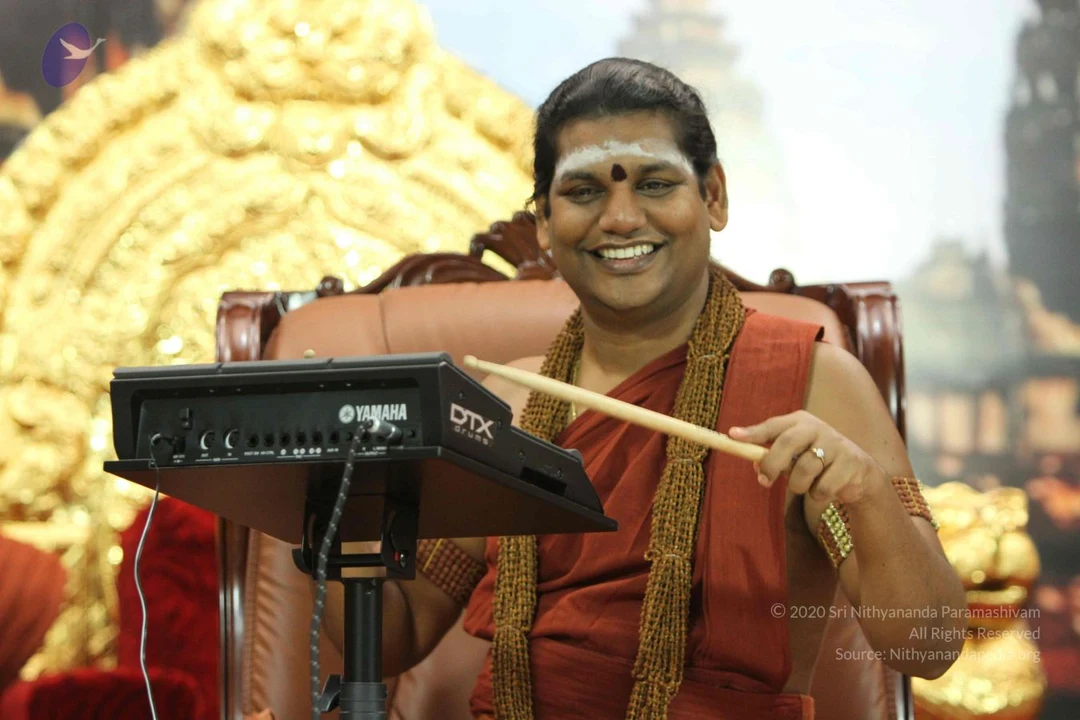
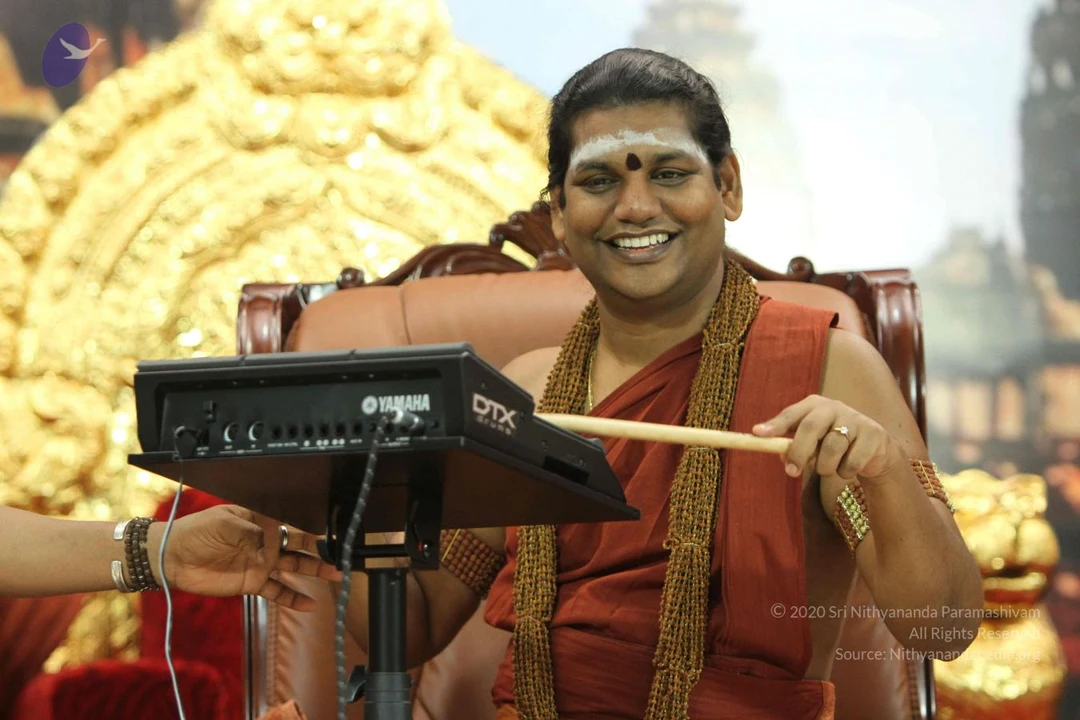
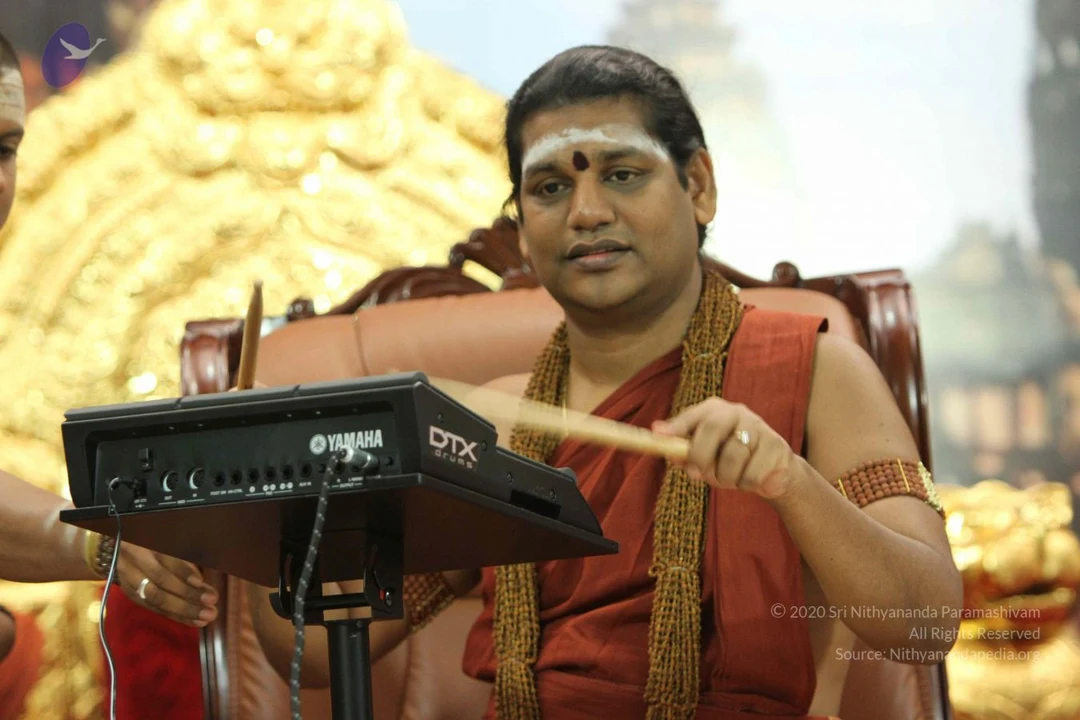
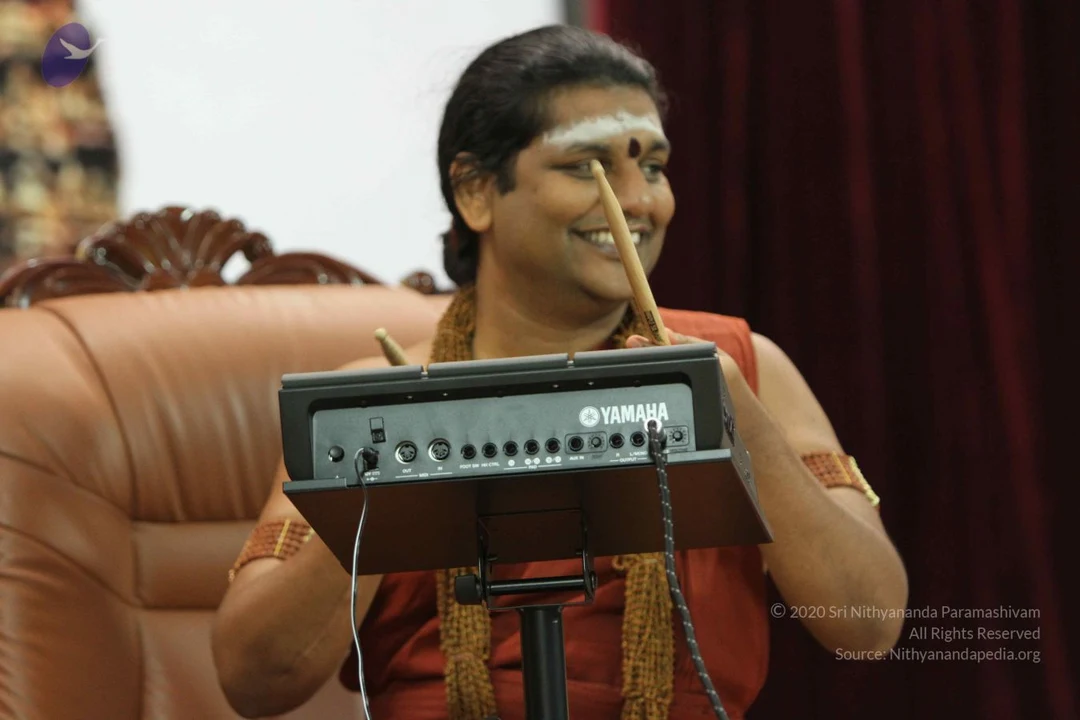
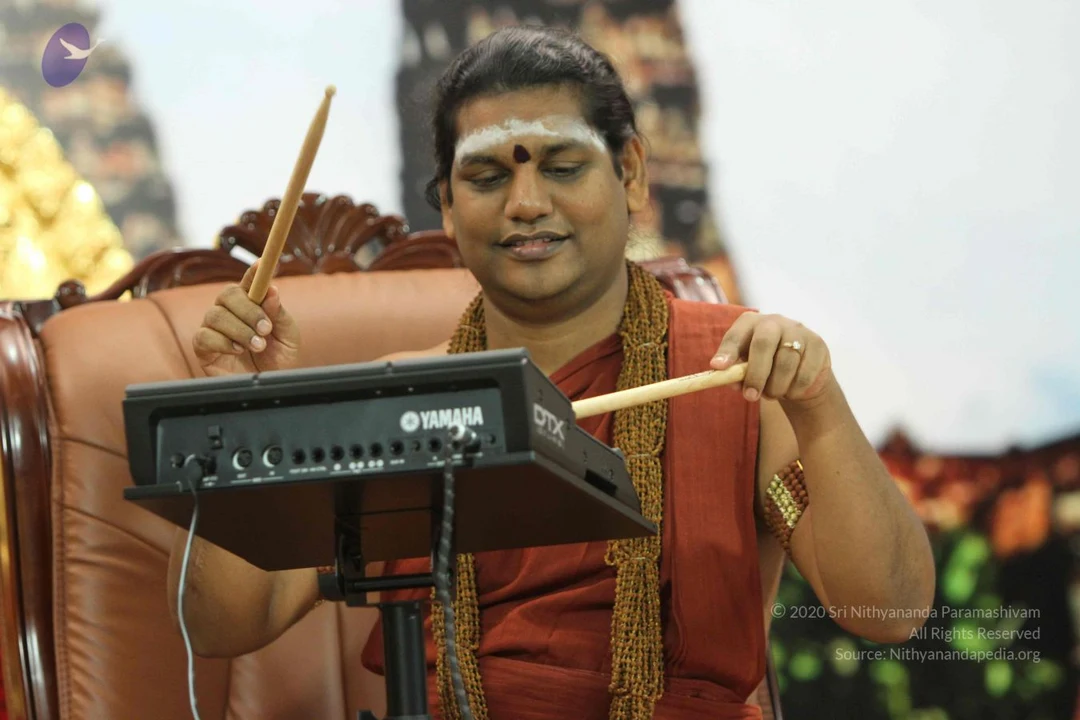
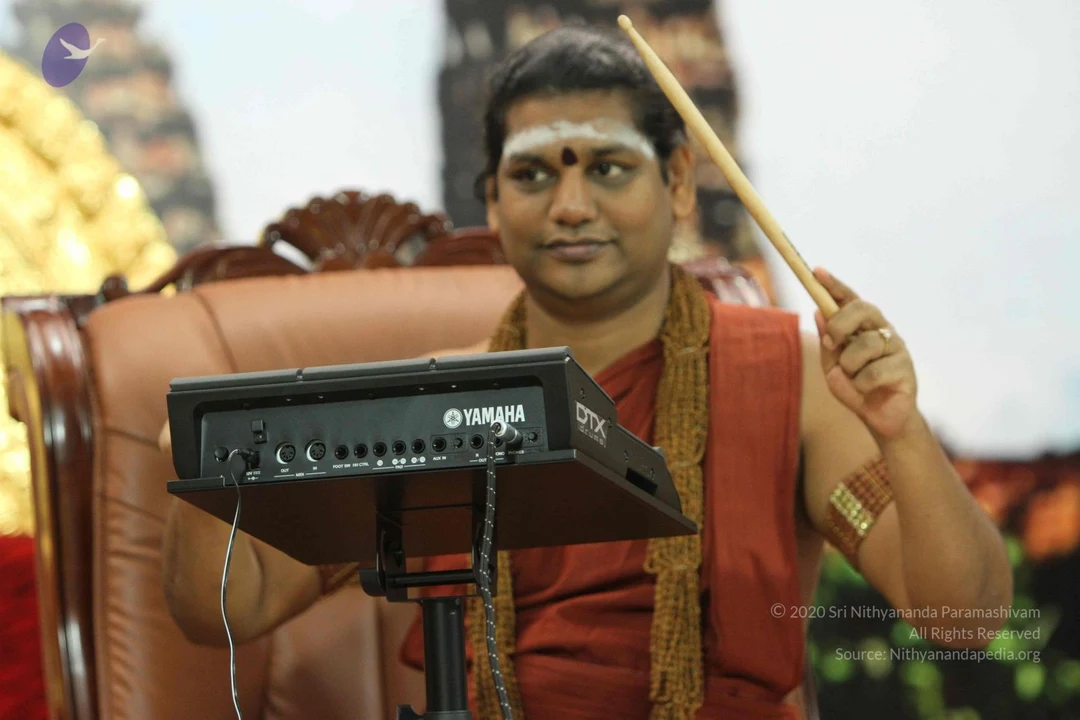
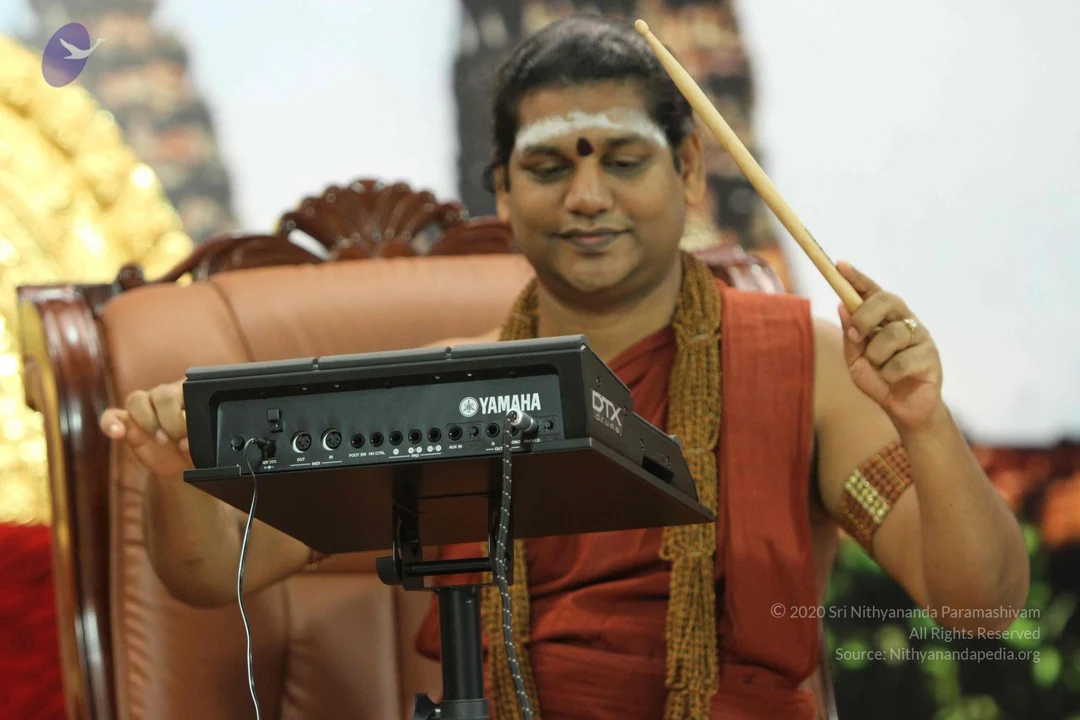
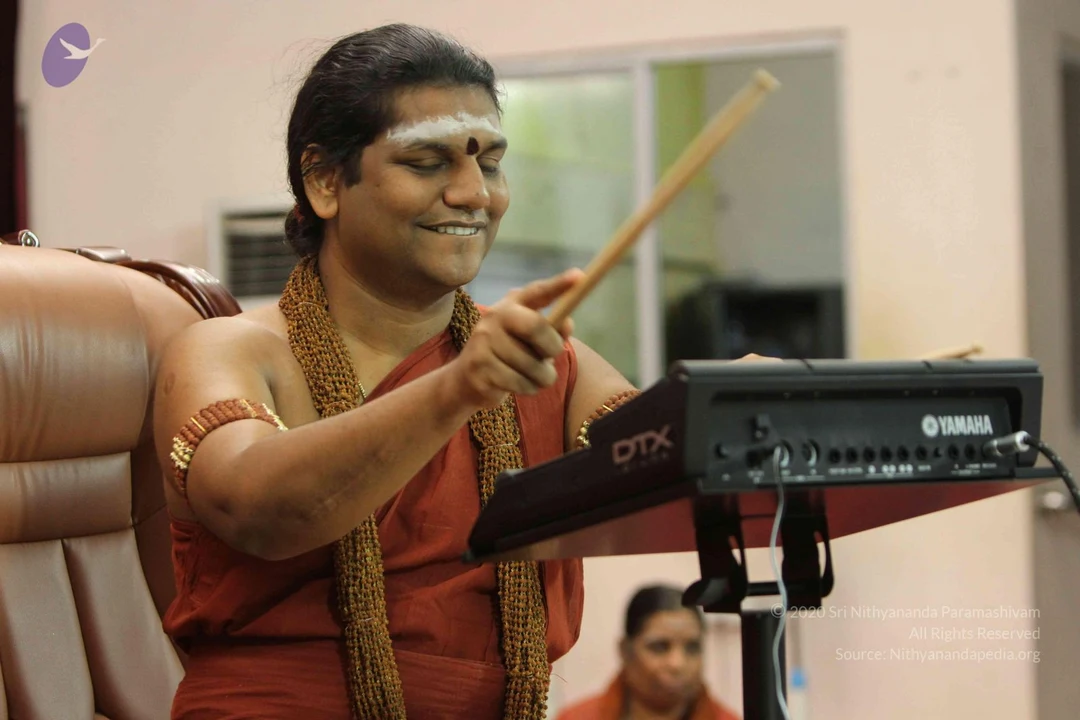
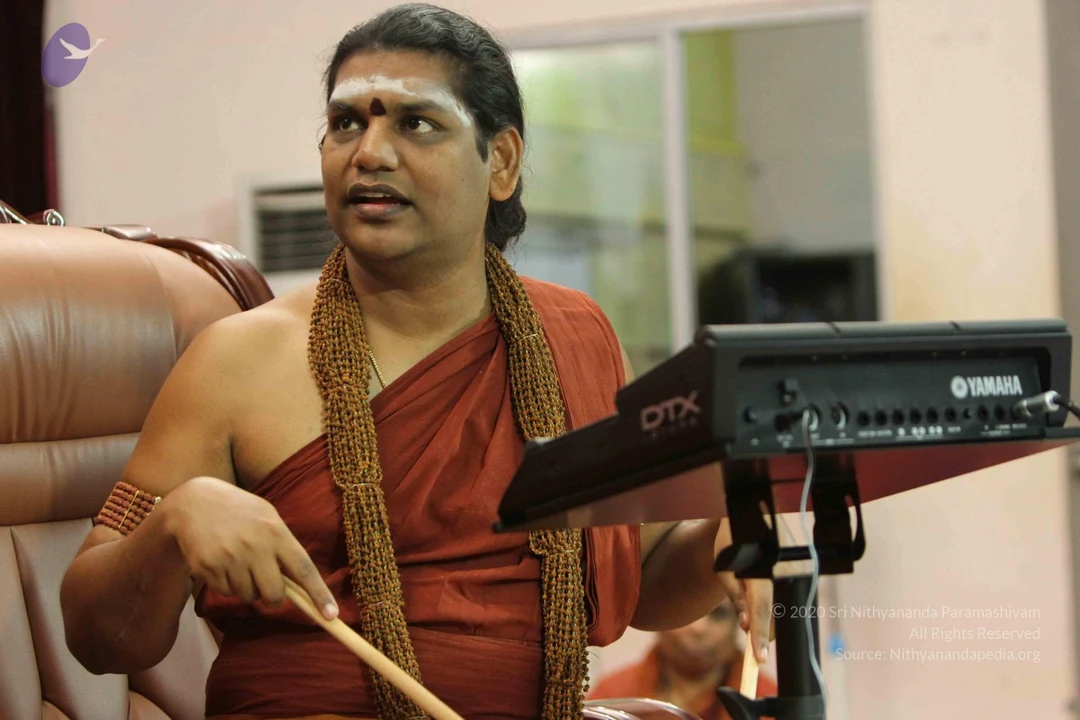
A photograph of a seated figure in a rust-orange turban and orange-red draped garment, with a heavy gold-beaded necklace and gold armlet, sitting on a red and gold-patterned cushioned seat with a gold bolster. The figure's bare foot rests on a folded orange cloth while two men in cream shirts and beaded necklaces stand and kneel beside them, one reaching forward with his hands. Behind them, saffron-robed attendants and a figure in white stand near a white-draped table, with a large monitor and an ornate hall of red carpet and tall red-and-gold panels in the background. The scene resembles a padapuja foot-washing ritual, with the figure in a turban and beaded adornments seated in an honoured position. Their identity as a person is uncertain from appearance alone.A man in a rust-orange robe and beaded rudraksha-style mala sits in a brown leather chair, holding a drumstick raised in his right hand while his left hand rests on a black Yamaha DTX electronic drum pad mounted on a stand. He has white horizontal sacred ash on his forehead with a red bindi, and a gold-toned armband on his upper arm. Behind him are a gold-embellished backdrop and a temple gopuram-style painted tower. The setting appears to be a satsang stage.Outdoor excavation site beneath a large banyan tree with aerial roots. Several workers in casual clothing are clearing and arranging cut stone blocks and rubble in a trench of reddish-brown soil. A man in a white shirt and light lungi stands near a small shrine with a pink-draped arch and a deity murti, behind a metal railing. A seated worker in a white shirt sits at right beside stones. No a person figure is visibly identifiable in this scene.

November 05 2014

Original wiki page
Contents

Title:

Cambodia – The Civilization of Enlightenment

Description:

In today’s (05th December, 2014) Morning Satsang "Cambodia – The Civilization of Enlightenment", Paramahamsa Nithyananda illustrates another unique aspect of Hinduism in that it gives everyone the space to argue. Who wants you to argue? Hinduism is about giving people the truths to experience on their own, setting the stage for analysis and debate, not to blindly follow an obscure ideal. He states how the pure Advaitha presented by Upanishads will be the thought current for this modern age and our developed brains – only the lifestyle of the ancient rishis can with stand the scrutiny of the current developed brains.

VideoAudio

Transcript:

Nithyanandeshwara Samaarambhaam Nithyanandeshwari Madhyamaam | Asmath Aachaarya Paryanthaam Vandhey Guru Paramparaam ||

I welcome all the devotees, disciples, samajis, satsanghis, Shrimahants, Mahants, Thanedars, Kotharis, sitting with us through Nithyananda TV, Sadhna TV, two-way video-conferencing having Nayana Deeksha all over the world.

The cities sitting with us through two-way video-conferencing having Nayana Deeksha: Seattle-Chidambaram Temple, Houston-Kalahasthi Aadheenam, Ohio-Prayag Temple, Hyderabad-Gupta Kashi, Oklahoma-Somanatham, Los Angeles-Peetam, St. Louis-Tirumala Aadheenam, Los Angeles-Hollywood, Jorpati-Nepal, Colombo-Sri Lanka, Hong Kong-Sirkazhi, Dubai, Guadeloupe-Rameshwaram, San Jose-Madurai, Amersfoort-Netherlands, Rajapalayam Aadheenam, Kuala Lumpur-Palani Aadheenam, Baroda, Dhyanapeetem Tiruvannamalai Aadheenam, Hyderabad-Gupta Kashi, Hyderabad-Peetam, Singapore-Singapuram, Toronto-Aadheenam, Oman-Sivagangai, Kathamandu-Nepal, Toronto-Kailaasa Aadheenam...........

Baroda-Samir Tuli, birthday blessings! With all the auspiciousness, you will be with me, I will be with you! Blessings!

I am just full of temples, temples, temples! Especially, Cambodia temples! I am looking at the whole thing from the perspective of how did they generate such large enthusiasm to do a one-pointed action. Please understand, Hinduism is a religion which always gives place and space for debates, arguments, different concepts, ideologies. Please understand, I am using the words specifically – ‘place’ and ‘space’. Means, Hindu kings always gave a place for other religious people, other thought-trend, other philosophies, other thinking, everything to flourish. We always had a place; our kings always gave the place and even the space. Please understand, whoever can lead us to a more enlightened life, deeper clarity, higher experience, we followed them. That is the beauty of this great tradition! That is why this tradition was never behind organization or infrastructure; it was behind the charismatic beings.

People ask me sometime: ‘Swamiji, why do Hinduism only produce so many incarnations?’ Because the need! Please understand, in Hinduism you can never shine, you can never have followers, you can never have people listening to you just because you are Head of a mutt, monastery, or infrastructure, organization. You need charisma! The need naturally makes beings to expand the unimaginable level of enlightenment. If you have to guide people in Hinduism, it is your ability to lead them to the higher experience; that is important. No one will care about the organization structure, which organization you are Head, and what post. Posts have no meaning in Hinduism. Anybody can have any title. Simply you can have title ‘Jagat Guru’; no one can question you. You can say, ‘I have one disciple, his name is ‘Jagat’. So, I am ‘Jagat Guru’!’ HAHAHAHAHAHA! No one can question you. In Hinduism there is no such thing as somebody giving you some title. Even if somebody gives you the title, unless you radiate the charisma, no one will be following you.

See the whole history of India and Hinduism. First comes Krishna. Seeing his charisma, the whole country follows him. Then comes Buddha who is completely opposite ideology. But seeing his charisma and ability to lead people into enlightenment experience, the whole country followed him. Then came Shankara. Just his ability to lead people into experience, simply the whole country followed him. Then came Nagarjuna who is completely opposite to Shankara. But his ability to lead people to experience, the whole country followed him. So, we never followed any infrastructure, organization. We followed the beings’ ability to lead us into the next level. That is why I am saying, so much of place and space was offered for further thinking, developing, research, development, debate, argument. Some people may think this is the weakness of Hinduism. I tell you, this is the strength of Hinduism, because, the future, every field is going to be accepted with the transparent, analytic, the possibility for further research and development methods. In the future, whether it is medicine or law of the land or social lifestyle understandings or construction methodologies or the way we cook and eat, the way we dress, our belief, faiths, philosophies, religions, everything, please understand, everything is going to be accepted after thorough debate and thorough analysis. So, in this modern era, era of thinking, please understand, the modern era of thinking, Hinduism is the only tradition which is inbuilt to withstand this modern era of thinking, the modern Thinking Age.

The other day I was talking to some of my ashramites. I was explaining an important concept: human brain, even in physical size, it is expanding, please understand! The brain size, even physical size, weight, it is growing; it is becoming more and more every few hundred years. Few hundred years before, our ancestors’ brain size, the weight, was much less than the size and weight we have now. Please understand, along with the expansion of the size, weight, capabilities, humanity is getting into a new era where higher level questions are asked, where every basic is questioned, where human brain, in a large scale, enters into the possibility of analysis, research and questioning capabilities. Please understand, the critical mass is able to question everything and understand, internalize everything. Not like those days, only the cream, elite society will be able to question and understand, and the mass always used to follow the elite. But now, because of even the physical development of the brain, human civilization is entering into a space where more questions, more thinking, more debate, more analysis become lifestyle.

Please understand, the religions created just few centuries ago are created for the human brain which existed at that time. But the religion, Sanatana Hindu Dharma, is created by the rishis whose brain was at least few thousand times more active than any possible human brains can happen in the future. Because of enlightenment, they (the rishis) operated beyond the body, mind and brain. That is why I am saying, only the traditions created by the Vedic rishis, the truths declared by them, the truths revealed by them, the lifestyle created by them, is capable of the enlightened thinking created by them, enlightened thinking presented by them; only that is capable of standing the scrutiny of the developed human brain of this century. This New Age thinking era, only that tradition, that enlightened thinking, the science of enlightenment, science of Completion, Advaitha, is capable of standing the scrutiny of the modern-day brain. That is why I am telling you, in the future, if at all religions exist, they may have any name, but the stuff will be simply the pure Advaitha presented by Upanishads. May be different language, different titles, different names, different presentation, but the stuff will be only the pure Advaitha presented in Upanishads. I am telling you, no other thought-current, no other thinking style, no other truths presented can withstand the scrutiny of the developed brain, please understand.

With the developed brain, human-beings are entering into the developed possibilities. The place for various debates, research, development, is the unique contribution and unique component belongs to only Hinduism, Hindu tradition. No religion allows debate other than Hinduism. No religion allows research and development other than Hinduism. Hinduism is a religion encourages logic. In this religion, with this basic infrastructure, intellectual infrastructure, you cannot make slaves and build large buildings. That is why I am wondering what kind of charismatic enlightened beings would have been there in this infrastructure, able to inspire and convince millions of people and concentrate them towards one-pointed action. I am very sure, at least they had ten human-beings to the level of the charisma of incarnations, at least ten human-beings who were radiating, who were charismatic to the level of incarnations! Otherwise, see we are not primitive religions where you just infuse certain faith and certain fear and greed, and they just do what you want. No! It is a religion of debate. And, you need to know, every day, in all the Akhadas, morning collectively practising Yoga, and night sitting and collectively having ‘khandana-mandana’ (refuting or destroying an opponent’s philosophy, and embellishing one’s own philosophy), ‘vaadha prathivaadha’ (philosophical arguments and counter-arguments), is a lifestyle!

Every day, I was reading a book on Varanasi. Beautifully they are saying, every day, in the banks of the Ganga, three to four-thousand Naga sadhus will sit and choose current topics and have a debate, ‘khandana-mandana’, ‘vaadha-prathivaadha’! It is a lifestyle, understand! So, the religion which encourages so much of ‘vaadha-prathivaadha’, ‘khandana-mandana’, in this religion you cannot make slaves and build temples.

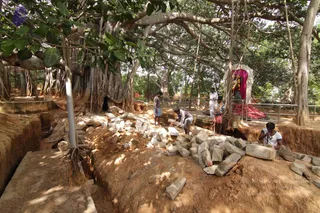
I am sure, whole Cambodia building, at any given time, at least one-lakh (100,000) people were building temples; because, the number of temples and the years, at any given time, directly or indirectly, one-lakh people were involved in temple-building! I am wondering who, who inspired all of them and kept them centred on one thought-current. Surely, it is not possible by political power, because slaves cannot be artist! Through the political power, kings can create slaves, but not artists. When you create artists, they need to be given freedom, tremendous thinking freedom, freedom to think, freedom to feel, freedom to visualize, freedom to celebrate the beauty, freedom to celebrate the subtle emotions like romance, love, pain. Slaves don’t even experience pain, understand! That is the truth! They become insensitive even to pain! It is only artists experience the subtle emotions of life which are fulfilling. Subtle emotions of life, only people who experience subtle emotions of life can be artists. Only people who experience the higher awakening like Kundalini Shakthi can be spiritual artists. Here, if one-lakh people are working to build temples, I tell you, at least eighty-thousand they need spiritual artists, eighty percent of the workers should be spiritual artists! Who awakened their Kundalini? Who gave them that kind of a insight? Who gave them that kind of an intelligence, enthusiasm? Working in stone is not a joke! I tell you, we are working for months now; we have not built the temple beyond the ground level! It is still in the underground level! Still not crossed the ground! How did they create inspiration, how did they create enthusiasm, how did they create excitement, knowing that, in their generation, they may not see the completion of the temple! How?!!

I tell you, at least ten beings radiating the charisma to the level of at least incarnations were living and guiding. That is the only way this large size, this large size, this large size actions can happen, this large size truths, this large size. I can’t even say the tall temples, large temples standing are made out of stone. I am sure, they are just standing tall as a symbol of some of the greatest experience that large group of human-beings experienced. It’s a symbol of collective enlightenment that whole Cambodian society radiated. It’s a symbol of the collective enthusiasm, energy, experience, excitement, the whole Cambodian civilization radiated.

I can tell you, it’s a symbol of mass enlightenment! Literally, one-lakh people constantly meditating on Mahadeva, only can give them that kind of an inspiration to do such monumental physical work. See, when you need to just sit and think, and no physical pain, you will not question the ideology about which you are thinking; but, when you need to physically move your body, and muscles are paining every night, you are tired, and you see your friends and family are dying because of the stone dust settling and even then you continue to work, then you must be thoroughly, experientially convinced about the whole ideology for which you are living. And an important thing: this whole structure can never be built by forcing somebody, making somebody a slave, because, so much of art, so much of art is involved! So much of synchronizing, so much of synergy, energy synchronized, intelligence synchronized, is required!

When I am seeing the large ‘trimurthi’ deities (deities of Brahma-Vishnu-Shiva, the great trinity) built, it is literally they just build a hill with a stone and then carve the whole hill! You can’t build pieces by pieces and carve and assemble a face and all, because, lot of symmetry need to be done, right side and left side and all that. They made the whole river sacred, one river-bed, by carving thousands of Shiva Lingas on it! So, the water flows on the thousands of Shiva Lingas and comes to you!

And I am wondering what a Advaithic experience and enlightenment they all would have radiated! Now I want to tell you one more thing: That experience does not go away when they leave the body; it stays in those temples! I will prove to you guys! I will awaken those temples back to life! I will awaken whole Cambodia back to Shivoham! I will awaken that whole enlightenment energy back! It will not only make this IA participants enlightened, the whole Cambodia will start experiencing that experience of enlightenment! Even when I see those temple structures’ and photographs, I understand! And the next step, I am wondering, if India can export ten incarnations and at least one-lakh enlightened beings to Cambodia, then what number of enlightened beings we would have had! Because, it is after all exported! I am sure we created at least one or two structures to the scale of Angkor Wat in India. May be got destroyed by these Moghuls, during their invasion; the Muslim attack, during their invasion, maybe we lost it, they have destroyed it.

It is time you all come and be part of this re-awakening of Cambodian temples enlightenment energy, and in that enlightenment tsunami get enlightened, and share enlightenment with the whole world. Let’s live and share enlightenment with the whole world. So, I welcome all of you to come and celebrate the enlightened civilization of Cambodia and its coming back to life, its revival. My blessings to all of you!

So, with this, I bless you all! Let you all radiate with Integrity, Authenticity, Responsibility, Enriching and Causing eternal bliss, Nithyananda! Thank you!

Photos
Photos Of The Day:

TEMPLE
NITHYA-SATSANG
DARSHAN

NITHYA-KIRTAN

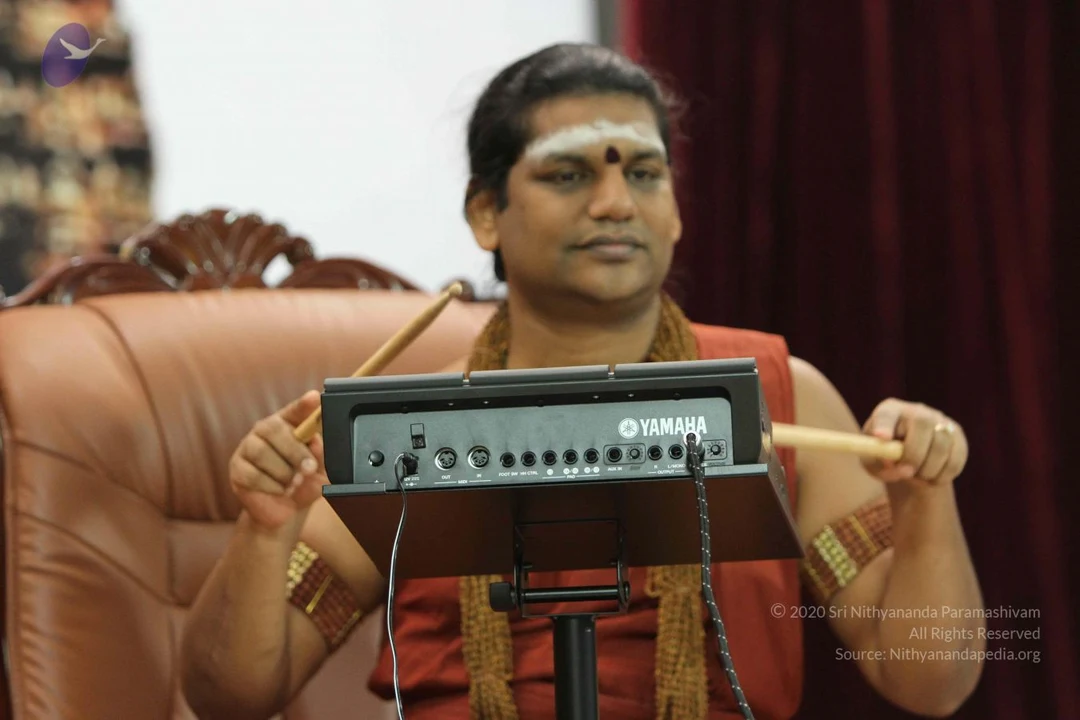
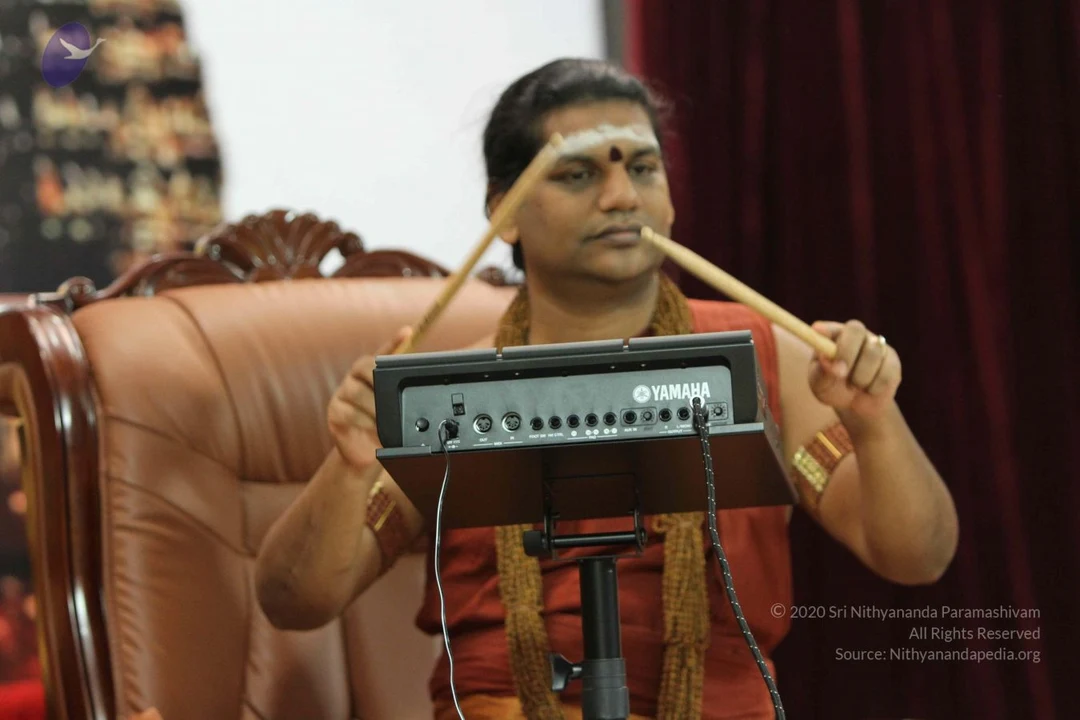
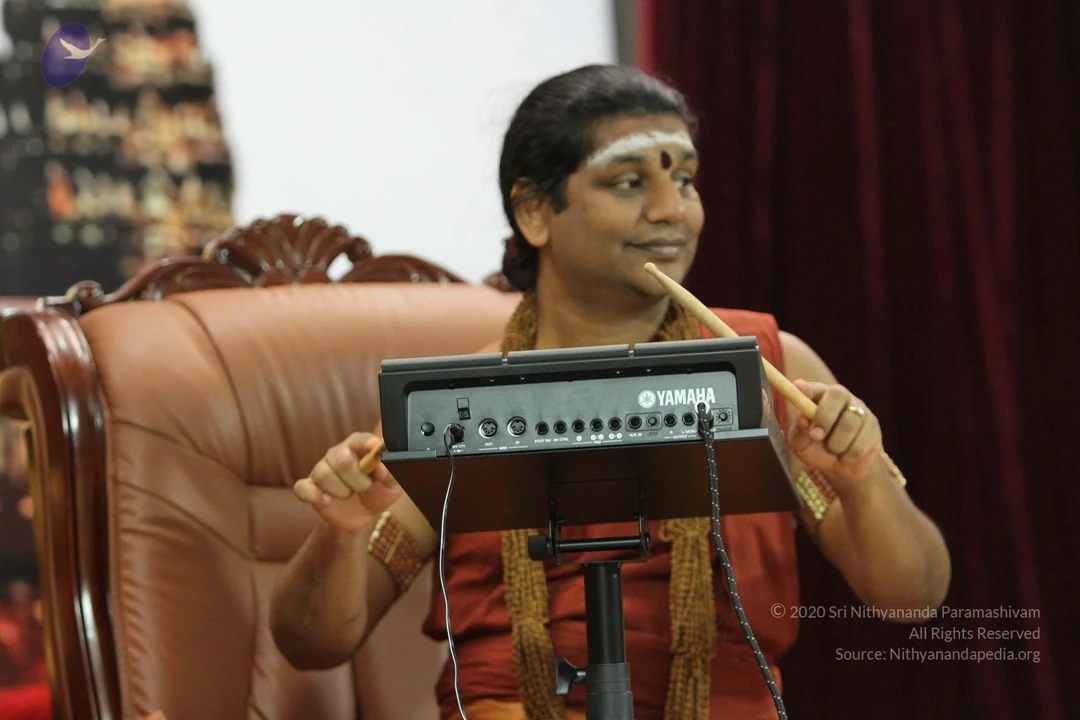
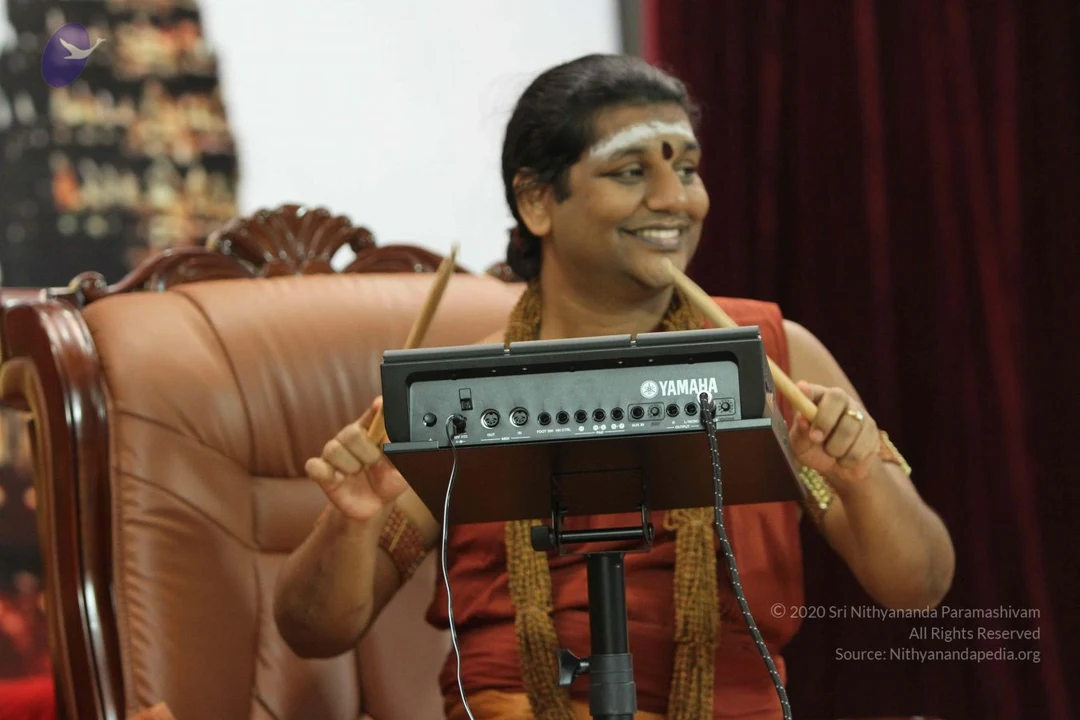
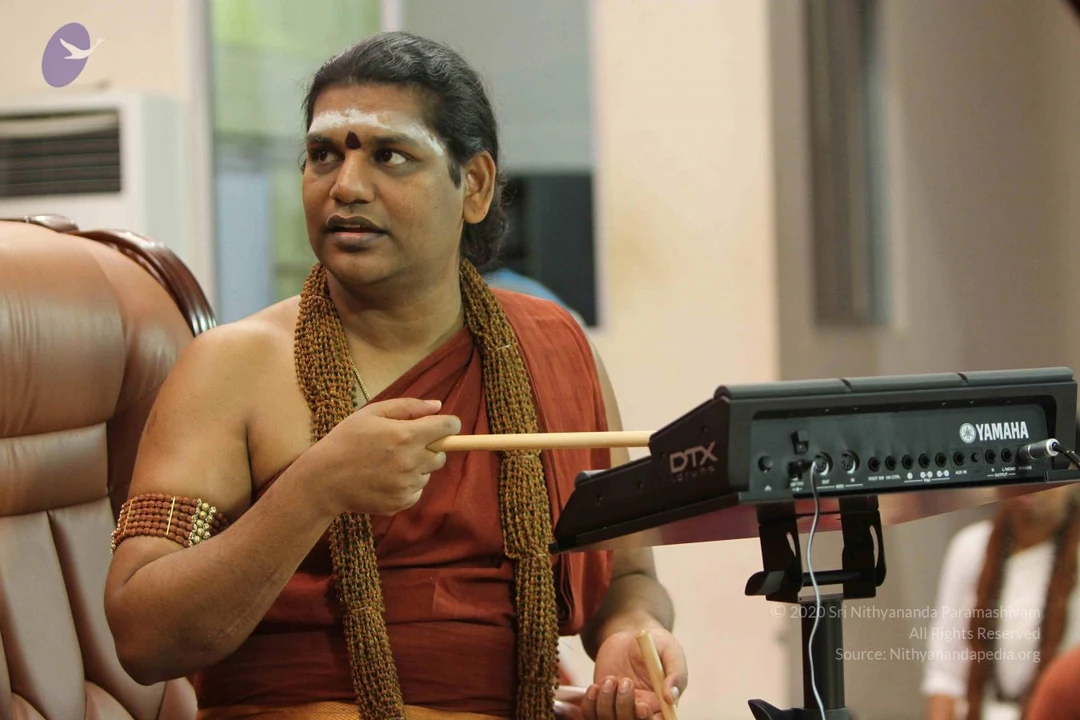
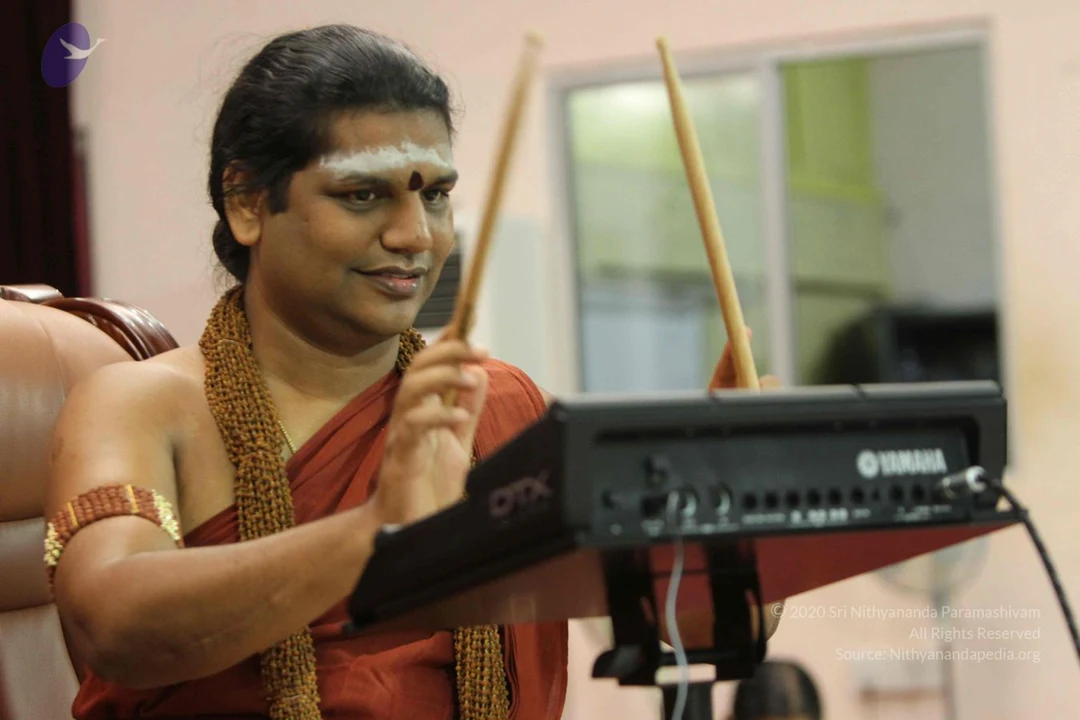
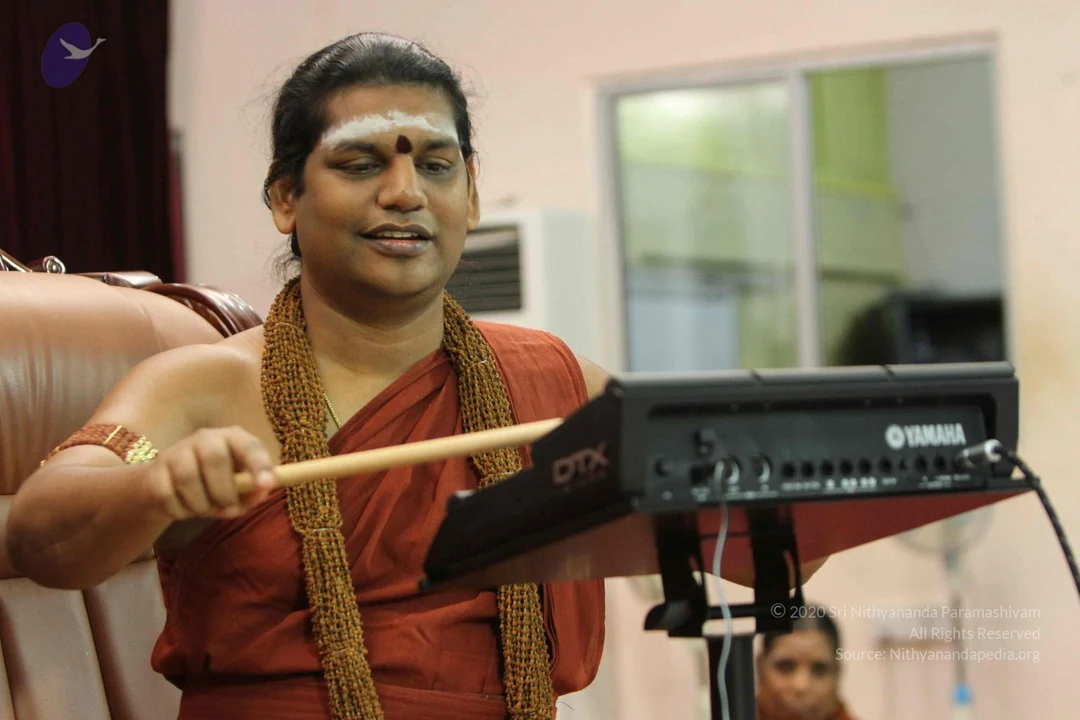
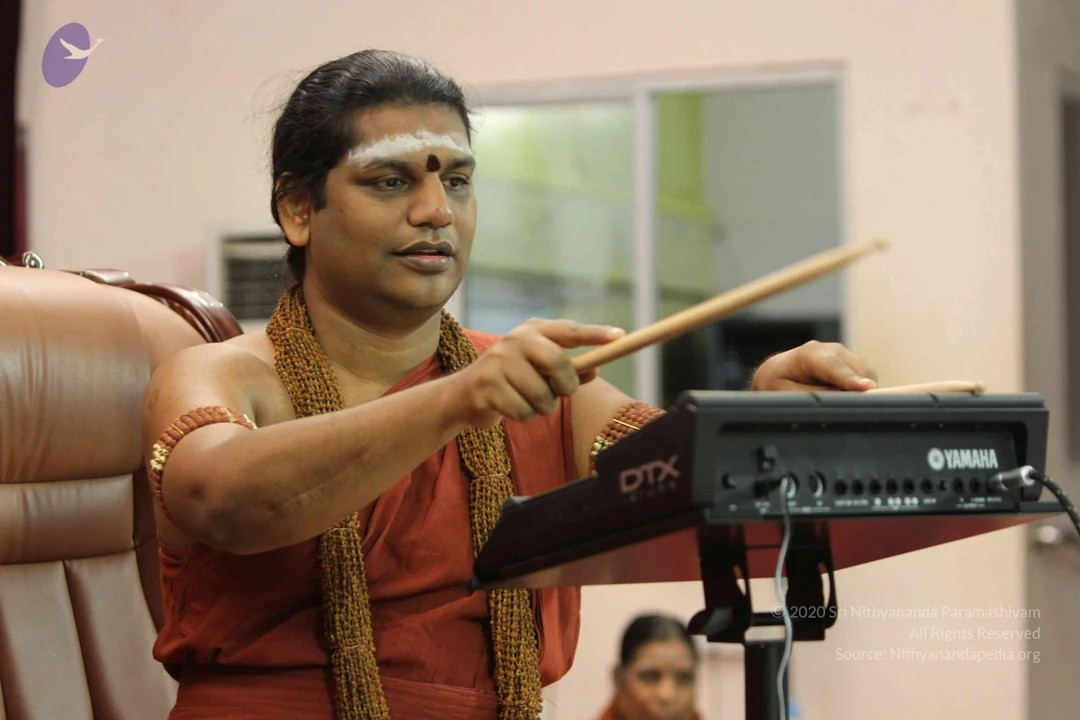
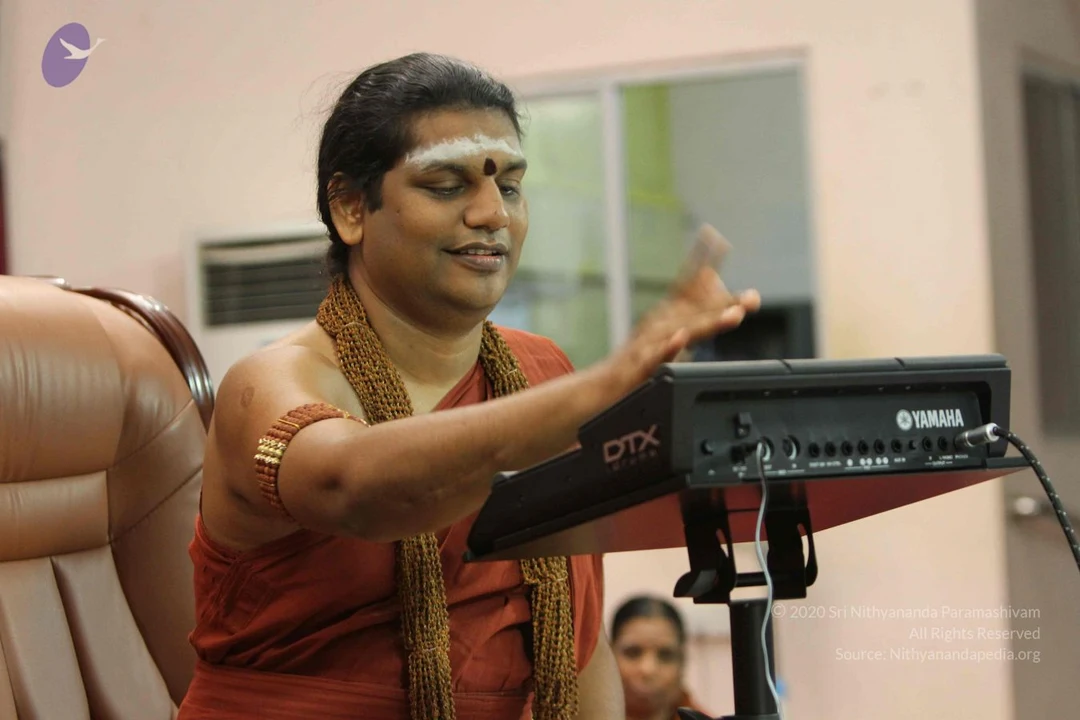
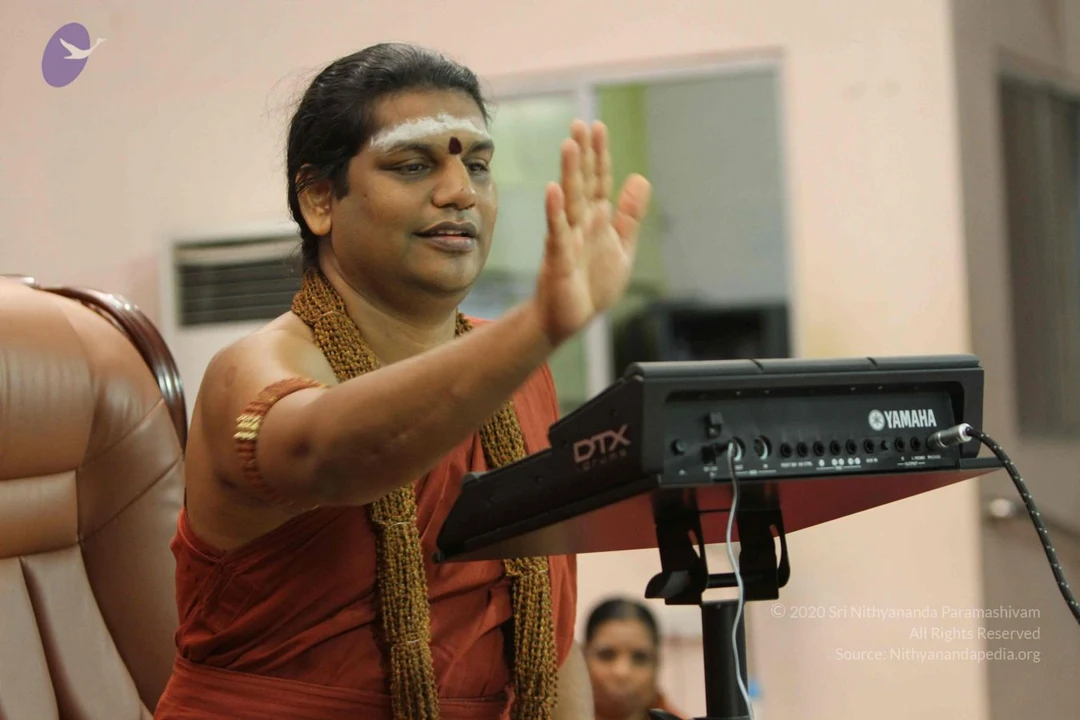
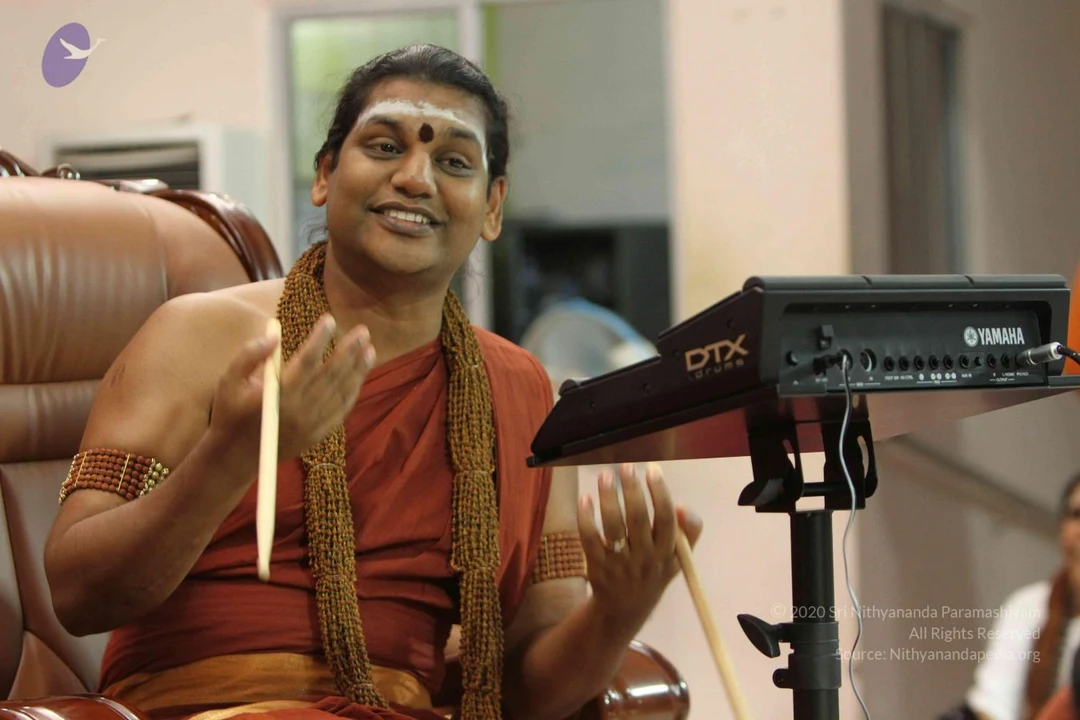
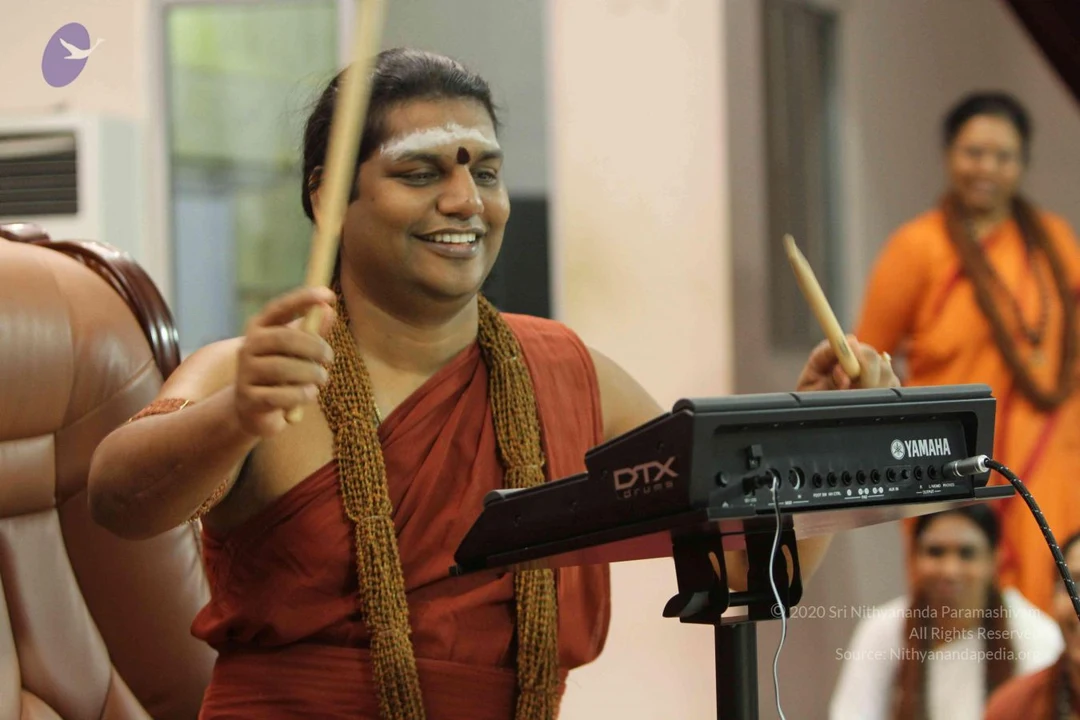
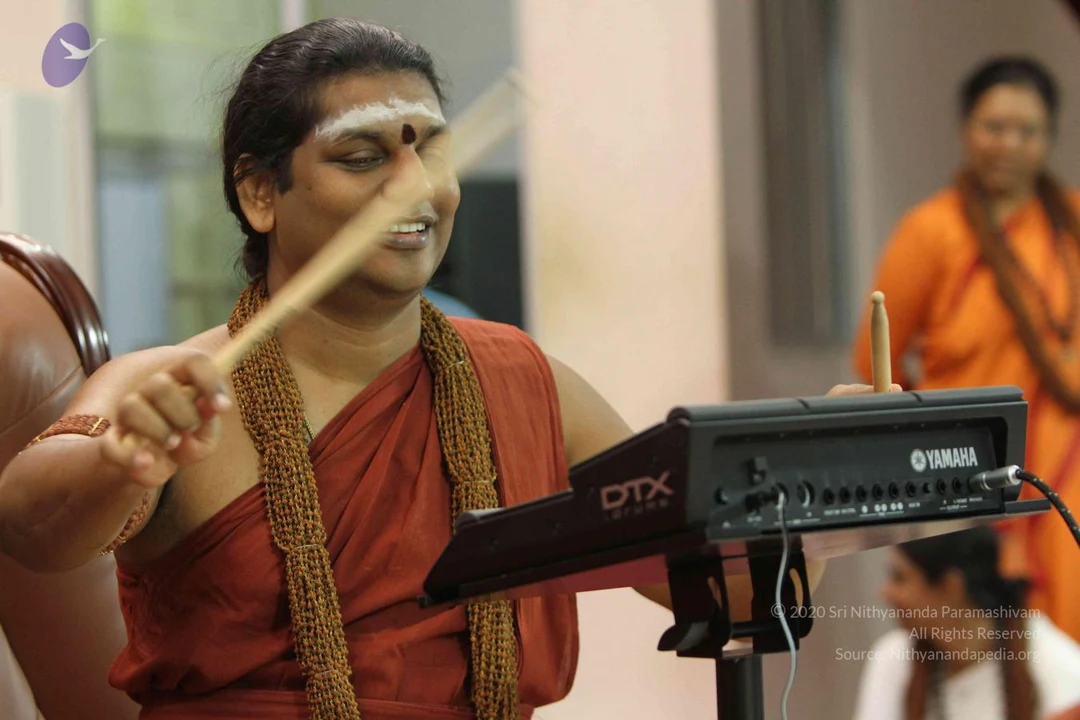
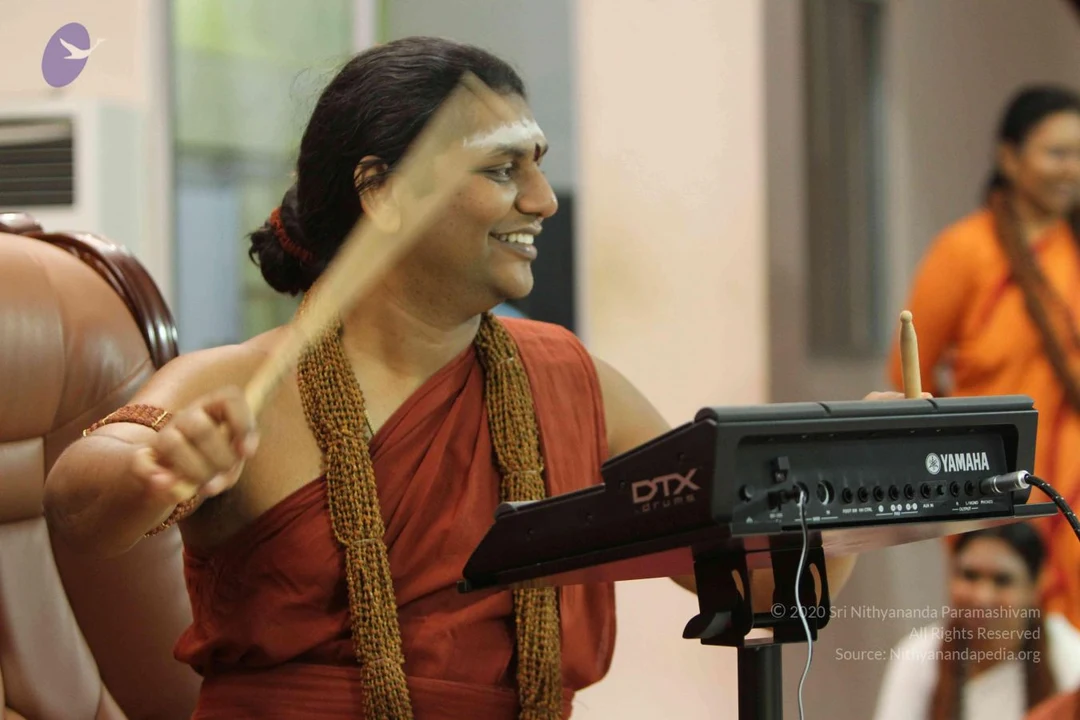
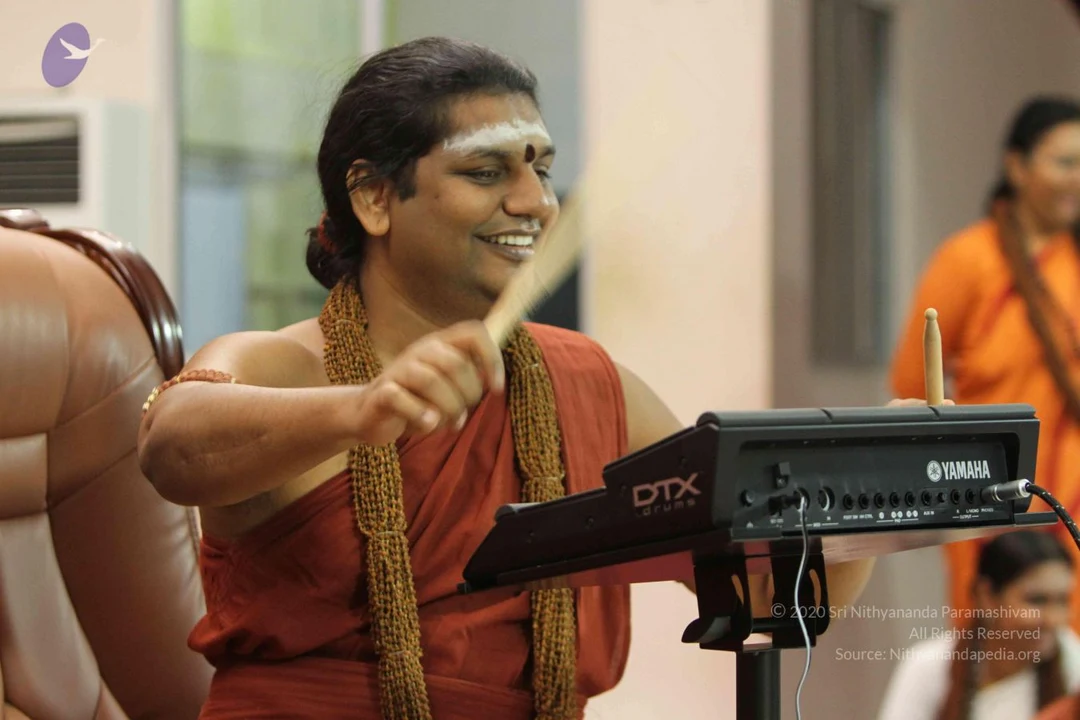
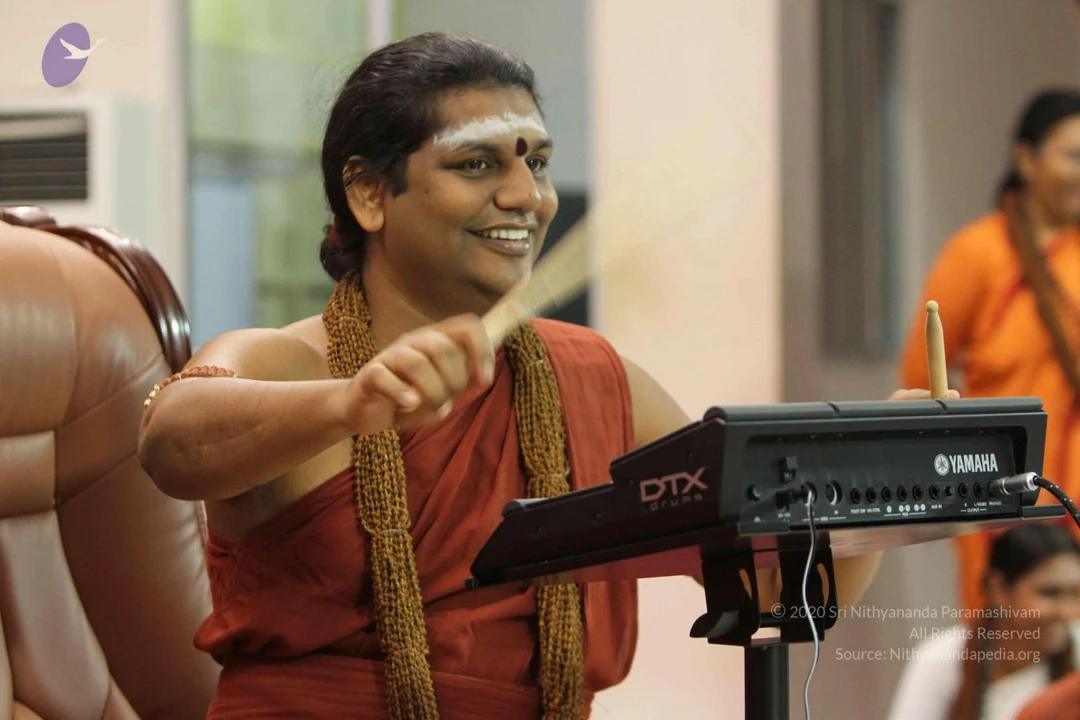
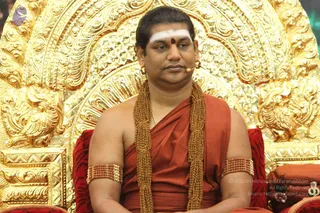
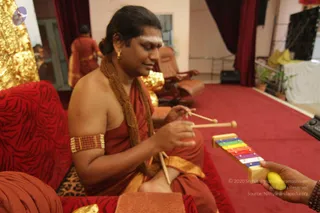
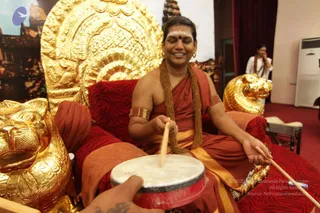
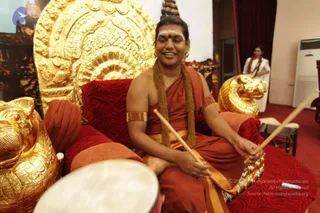
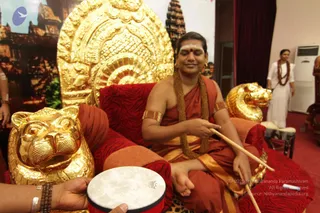
SWAMIJI-PLAYING-MUSIC

Photos from this day

View all 109 photos

Photos

5 photosSource gallery
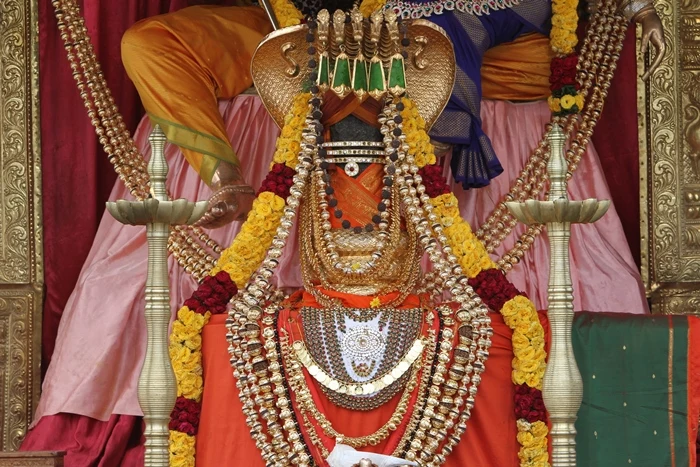
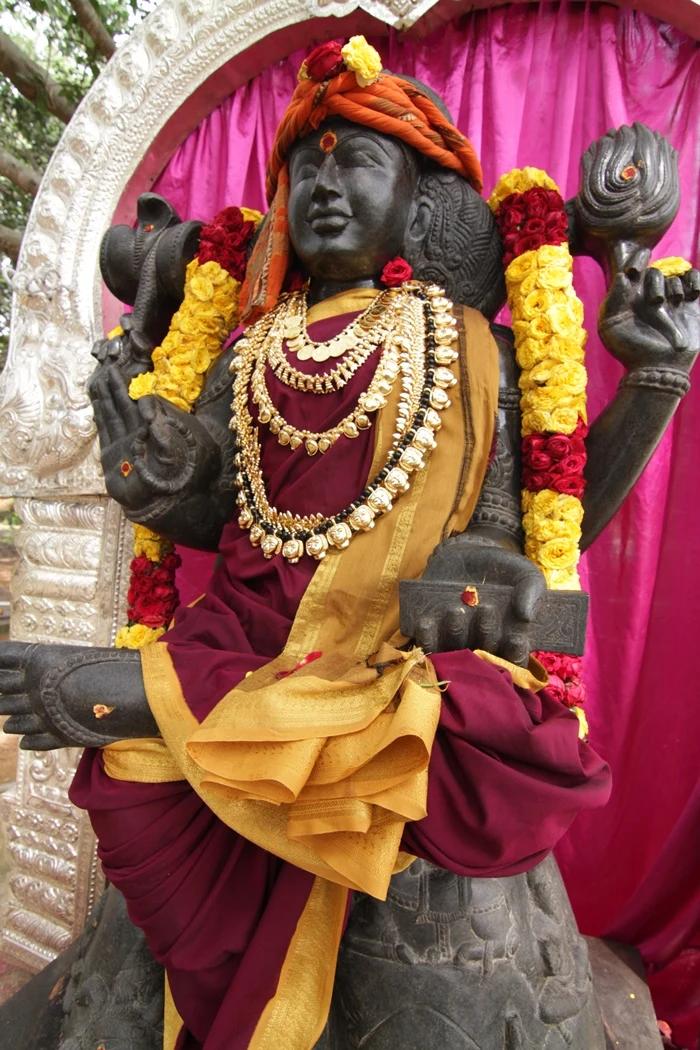
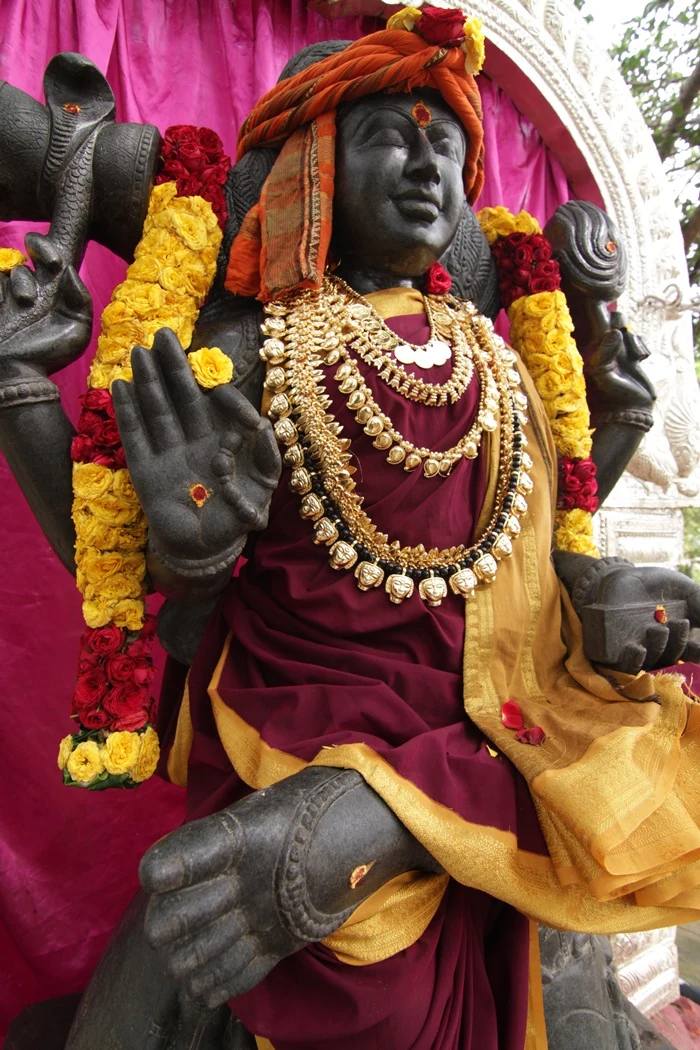
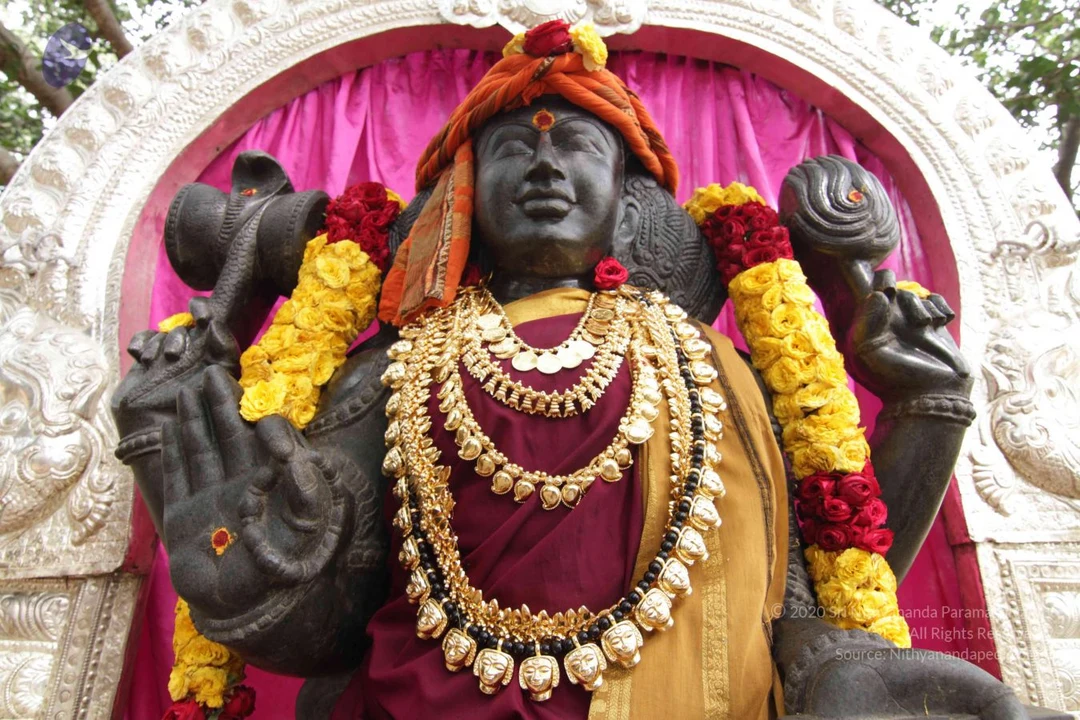
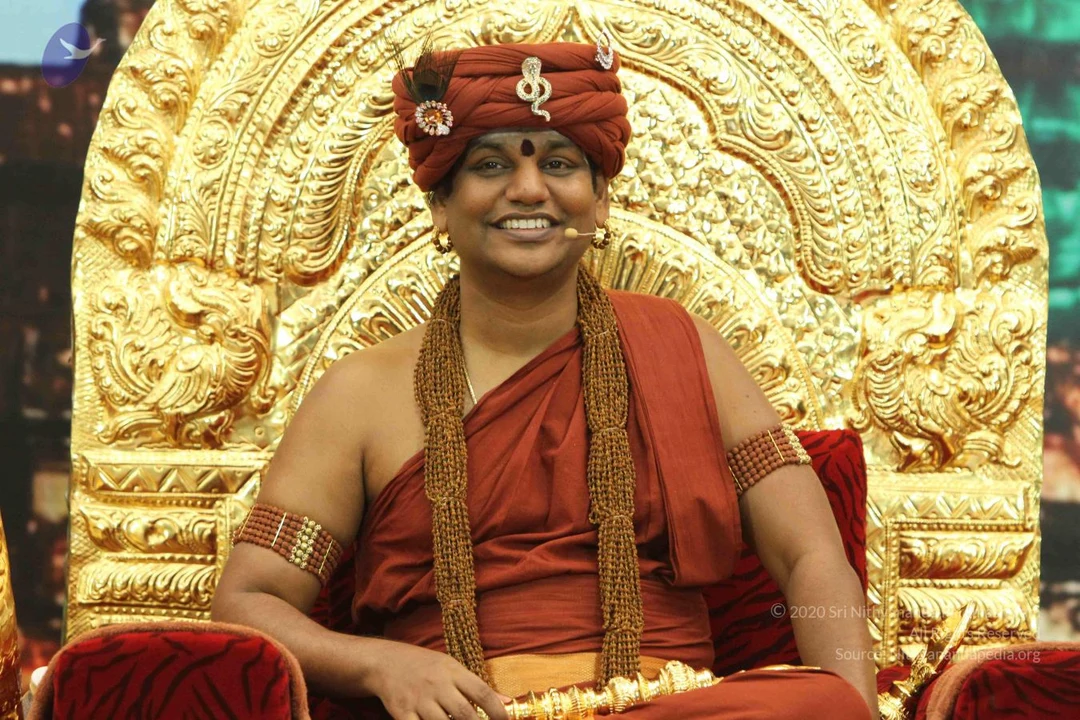
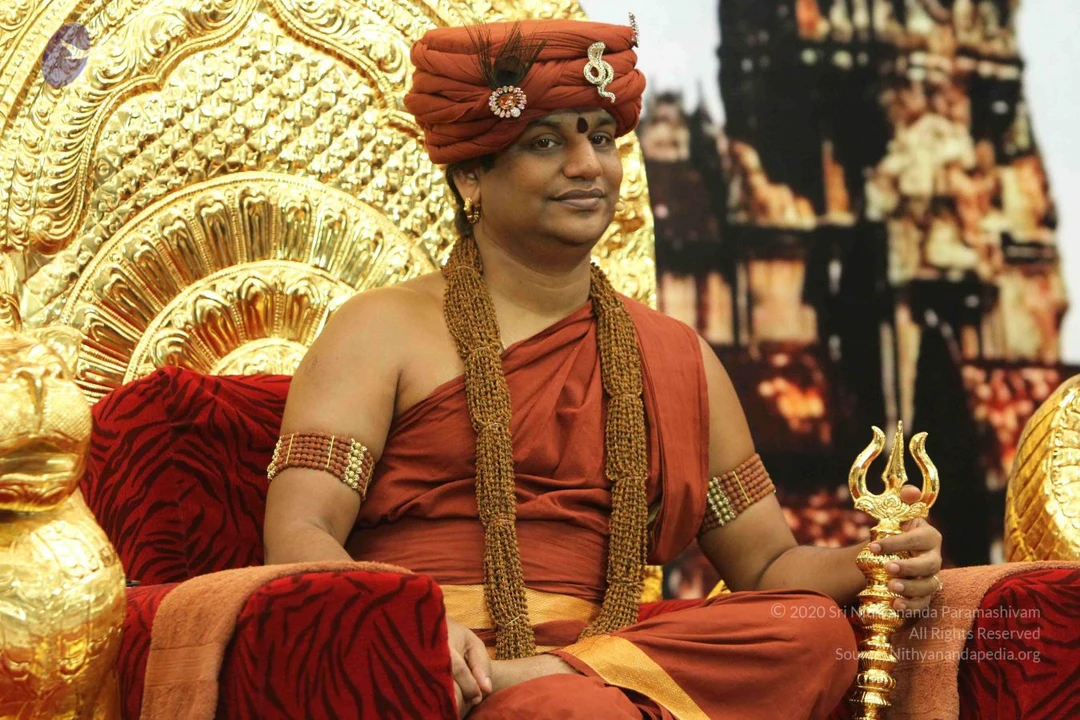
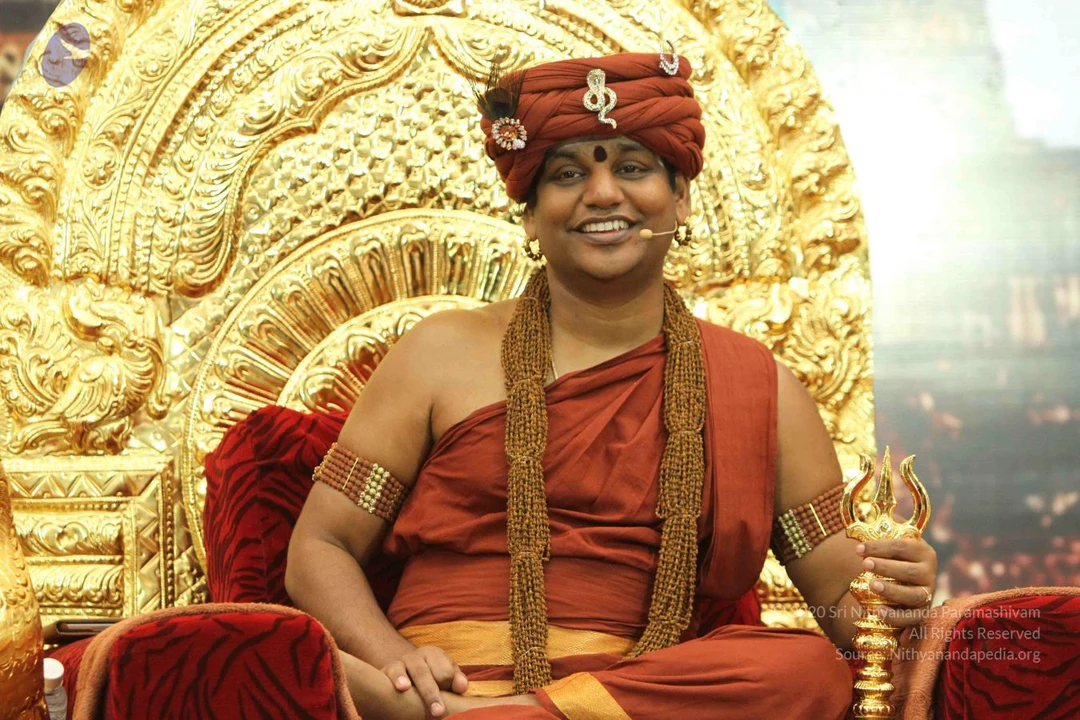
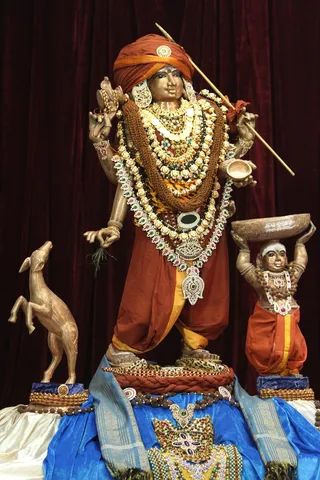
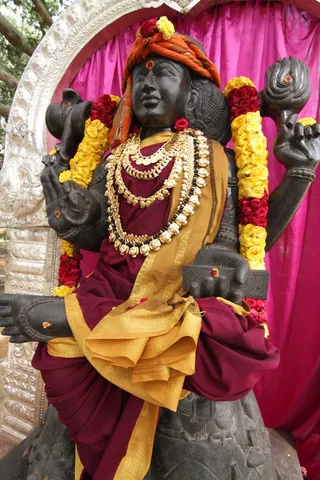
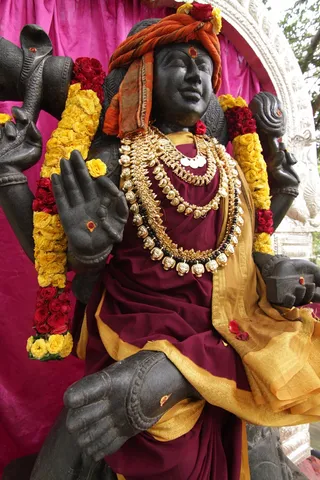
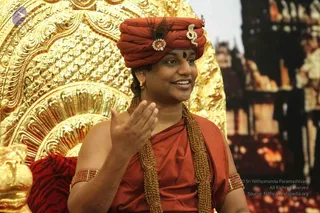
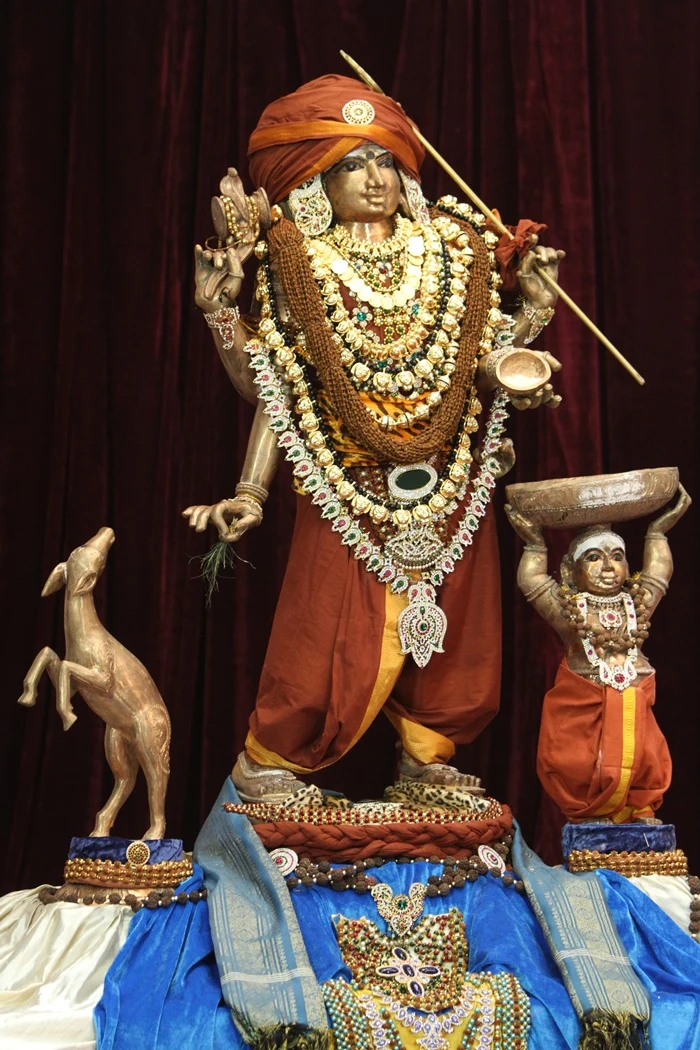
A large ornate deity murti of a standing figure in a rust-orange turban and orange-red dhoti with a gold-yellow edge, adorned with multiple layered gold necklaces, bead malas and jewelled garlands, holding a staff in one hand and a bowl or cup in another. A smaller kneeling figure in orange dhoti and jewelled garland raises a wide clay bowl overhead. A carved deer stands at the left on a blue-and-gold draped pedestal, set against a dark maroon curtain. Statues only; no physical people present.A smiling person in a red-orange saffron wrap and matching dhoti sits on an ornate gold throne with red cushions. He wears a red-orange turban with a jewelled brooch and a small gold emblem, a red bindi, long gold beaded necklaces and gold armbands. He holds a gold trident in his right hand. The gilded throne backdrop and stage setting suggest a satsang or darshan event. Appearance-based cues fit Swamiji (probable): a saffron turban, ceremonial gold necklaces and a throne presence, though the throne alone is not sufficient. No readable text is visible.A temple sanctum shrine with painted and gilded deity figures under an ornate golden arch with red curtain backdrop. Central seated pair of deities, one with a trident and a turban-like crown, the other in a tall crown and blue skirt, both adorned with layered gold necklaces and yellow-orange and marigold garlands. Below, a large orange-red linga-shaped form decorated with a gold face mask and flower garlands sits on a pink cloth. Flanking standing figures on either side wear rudraksha-style beads, gold necklaces and orange-yellow garlands, one holding a staff. No physical people are visible; all figures are statues.A dark stone statue of a deity murti, shown with four arms, stands before a pink draped backdrop and an ornate silver-toned arch. The figure wears an orange turban with a red tilak mark on the forehead, a maroon and gold-bordered garment, layered gold necklaces with bead strands, and a garland of yellow and red roses draped over its shoulders. One hand holds a tall ornamental staff topped with a flame-like finial, another rests on a raised object, and a small ceremonial pot sits near the base. No physical people are visible, so this is a photograph of a statue, not a person.A dark stone deity murti of a four-armed form stands in a shrine niche before a magenta cloth backdrop. It wears an orange and gold turban with a red-and-yellow rose garland draped over its shoulders, a maroon dhoti with a gold border, layered gold necklaces with bead pendants, and a red tilak on the forehead. One hand is raised in abhaya mudra, and the surrounding flowers include red roses and yellow marigolds. No physical people are visible.

TEMPLE

26 photosSource gallery
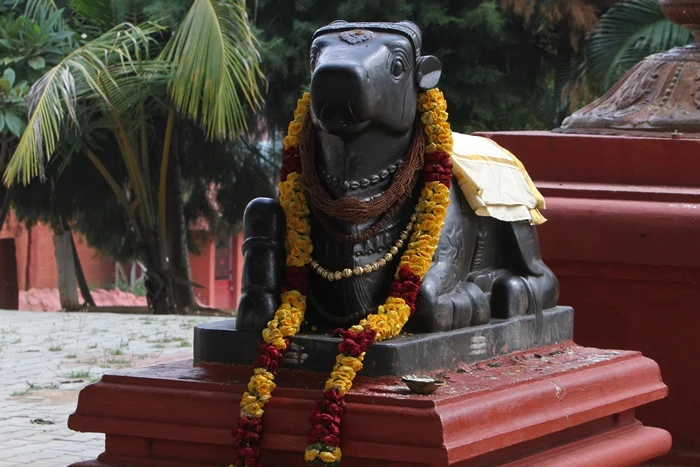
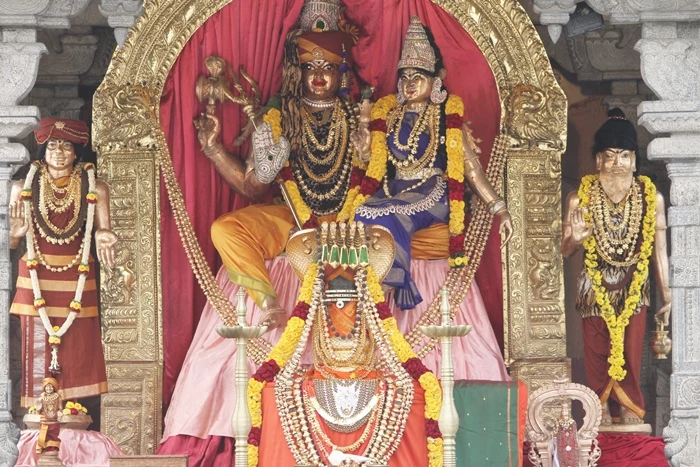
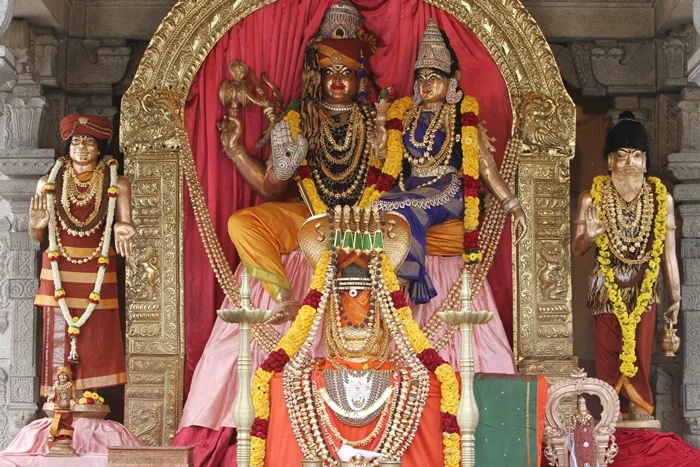
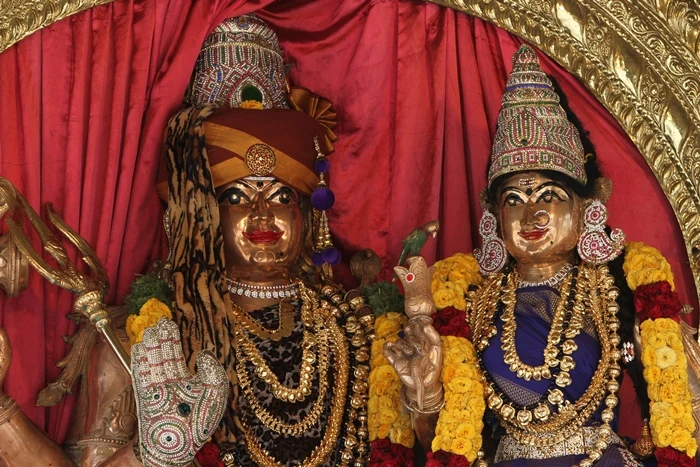
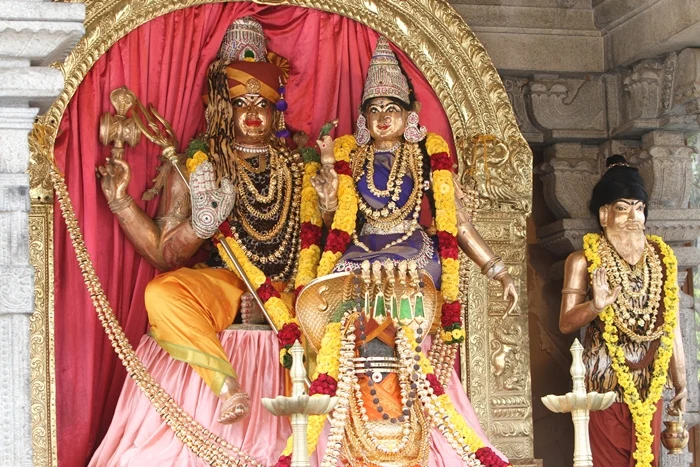
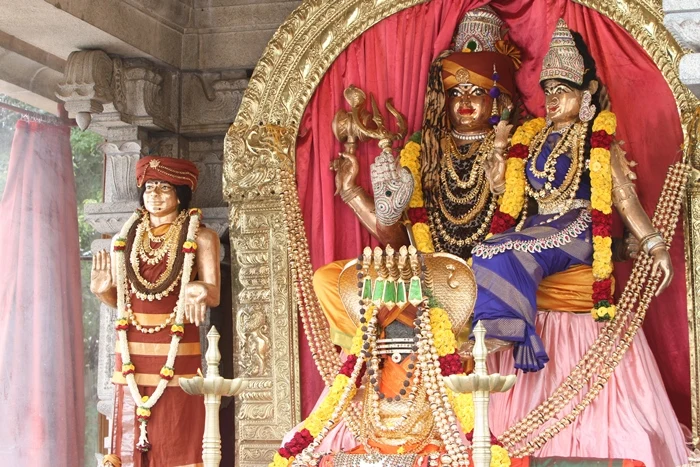
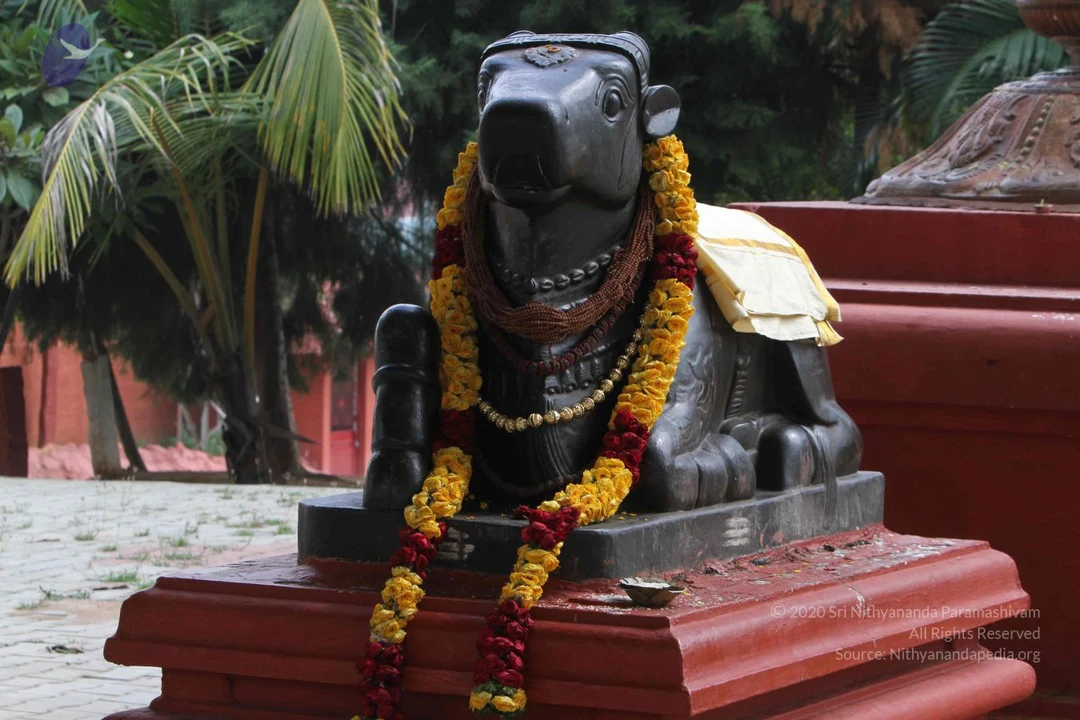
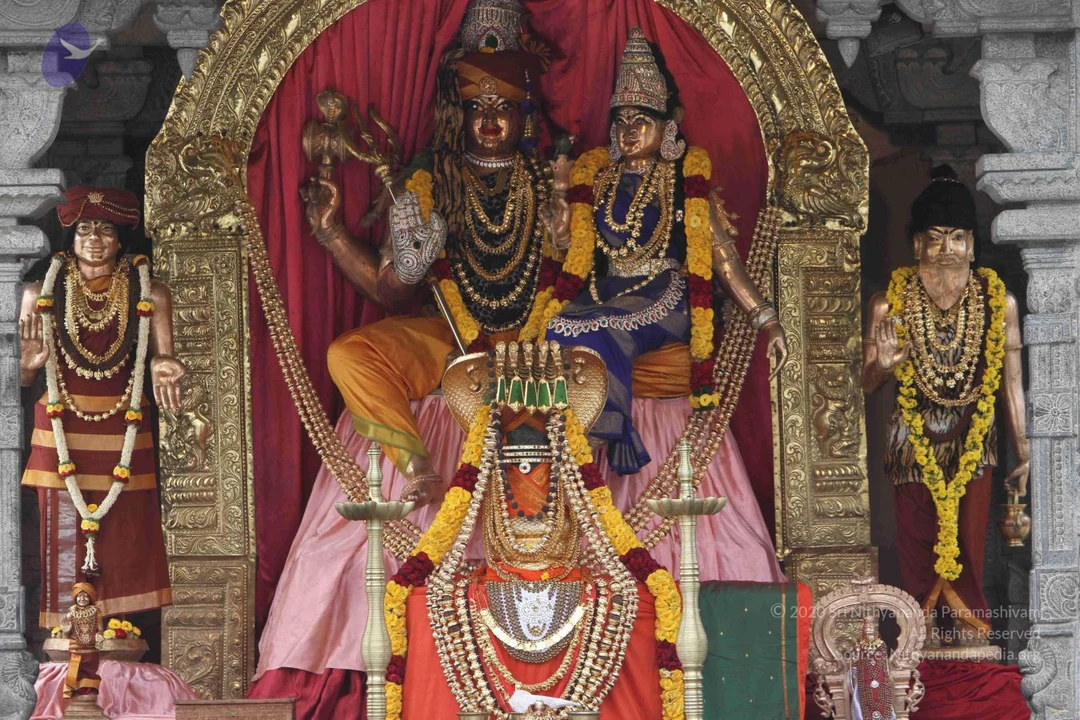
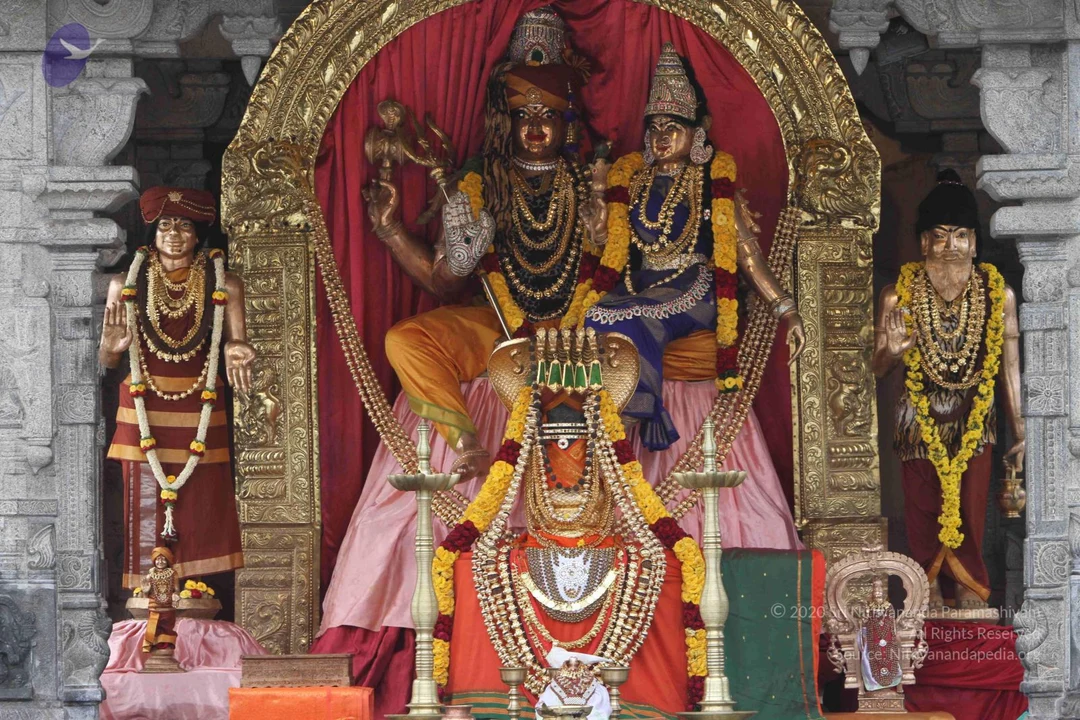
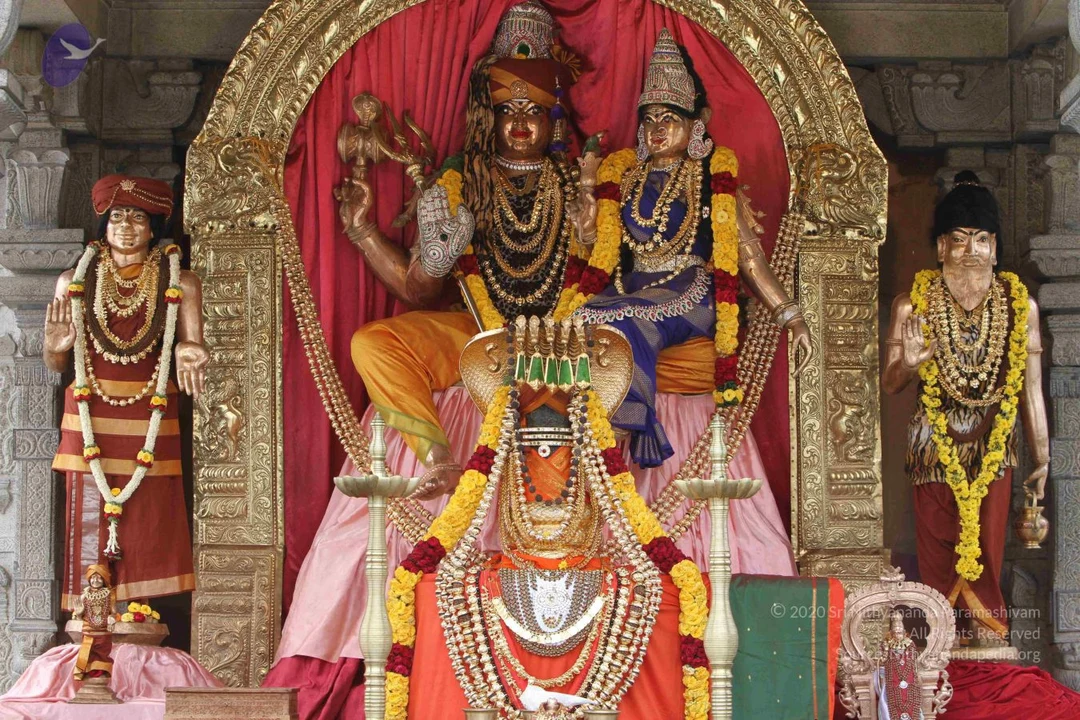
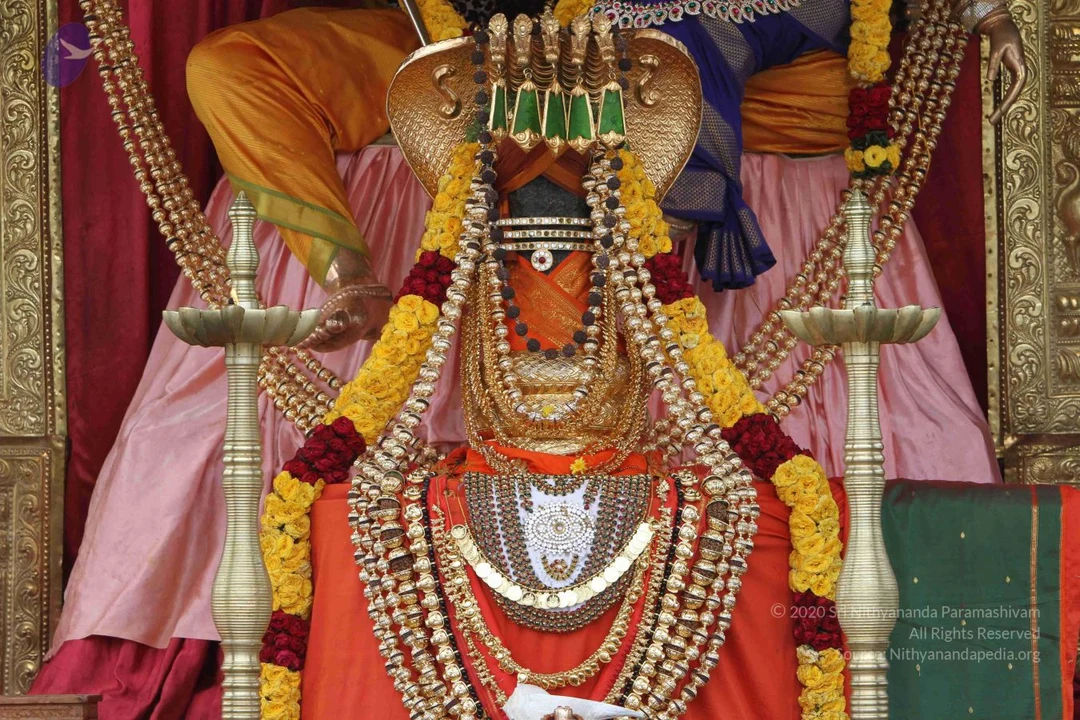
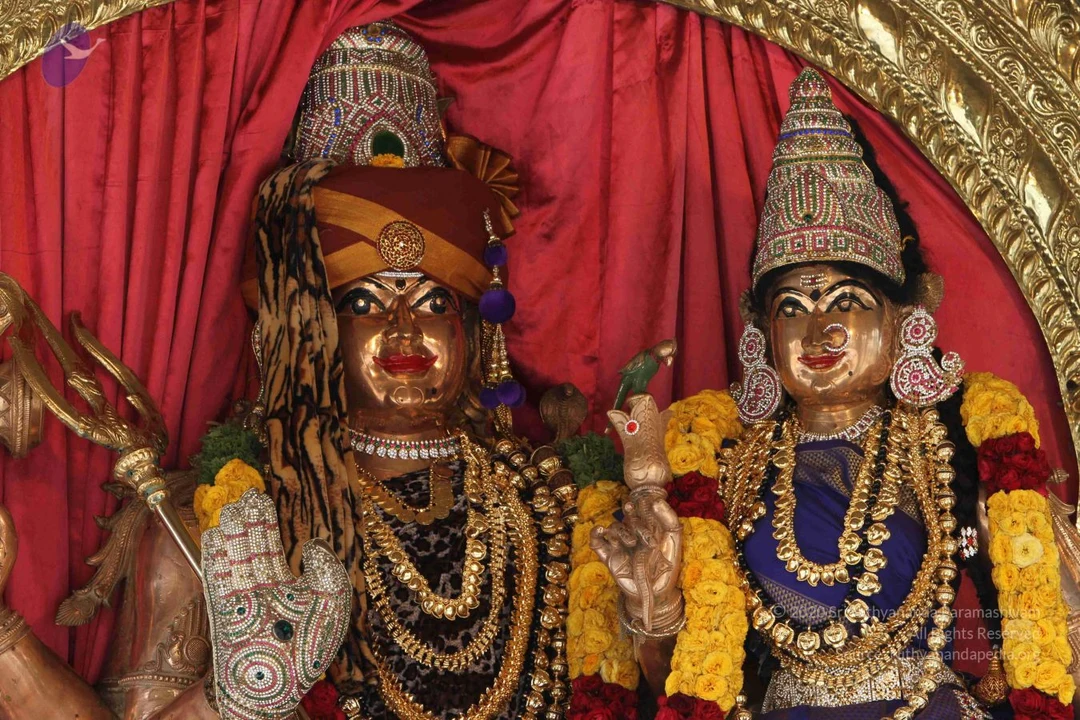
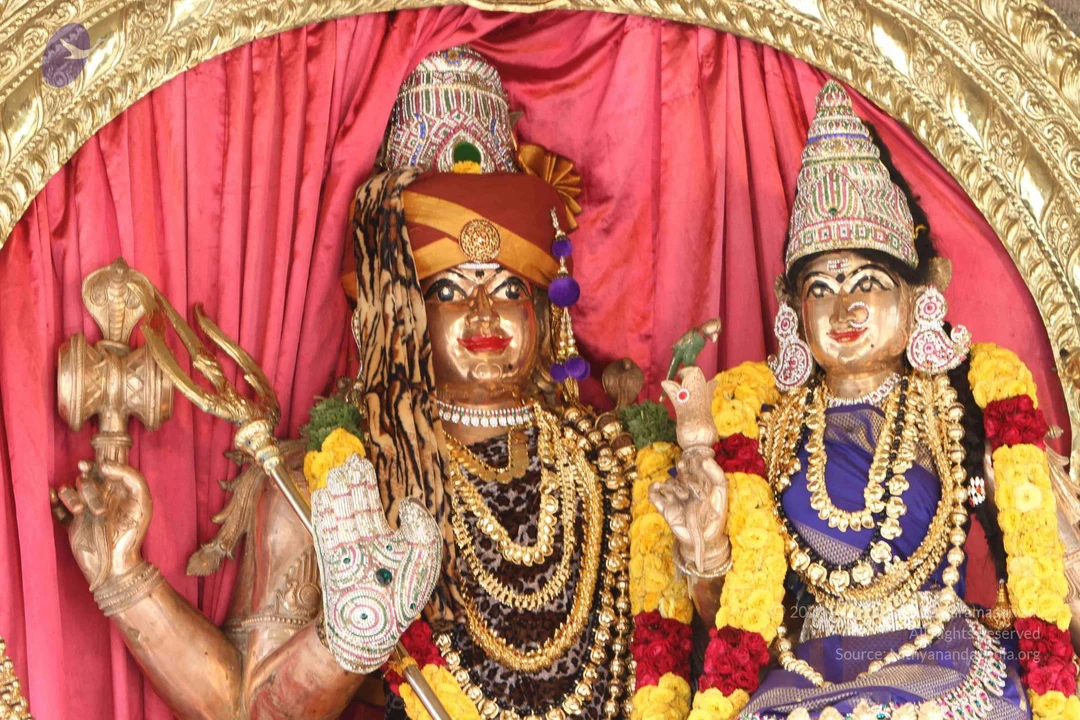
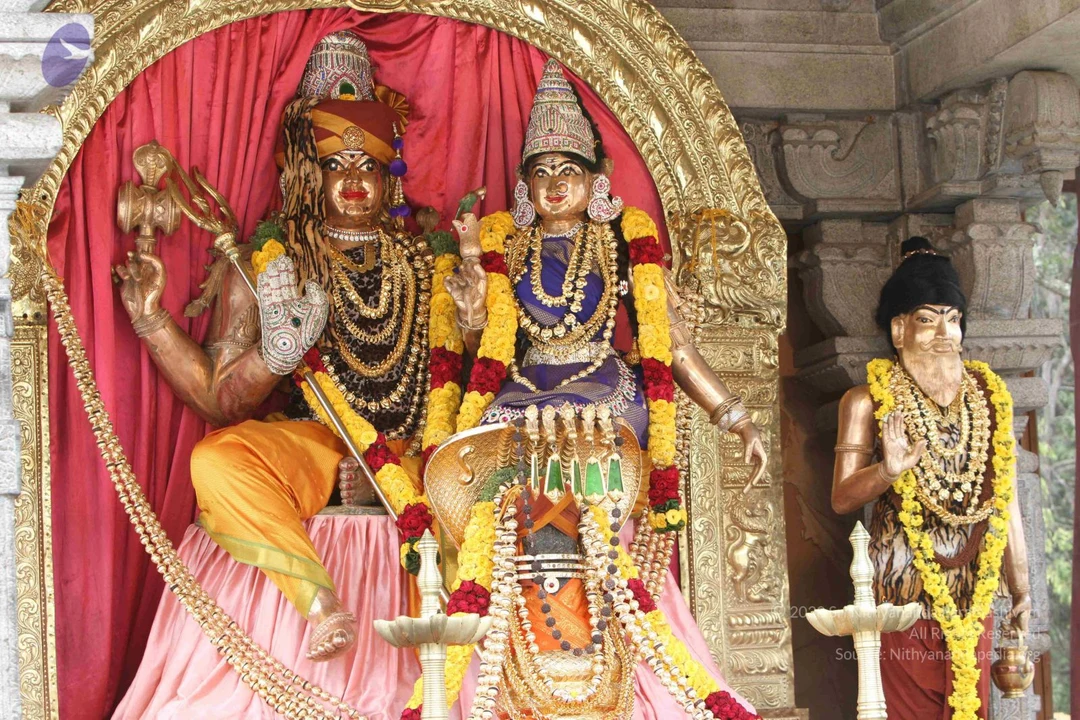
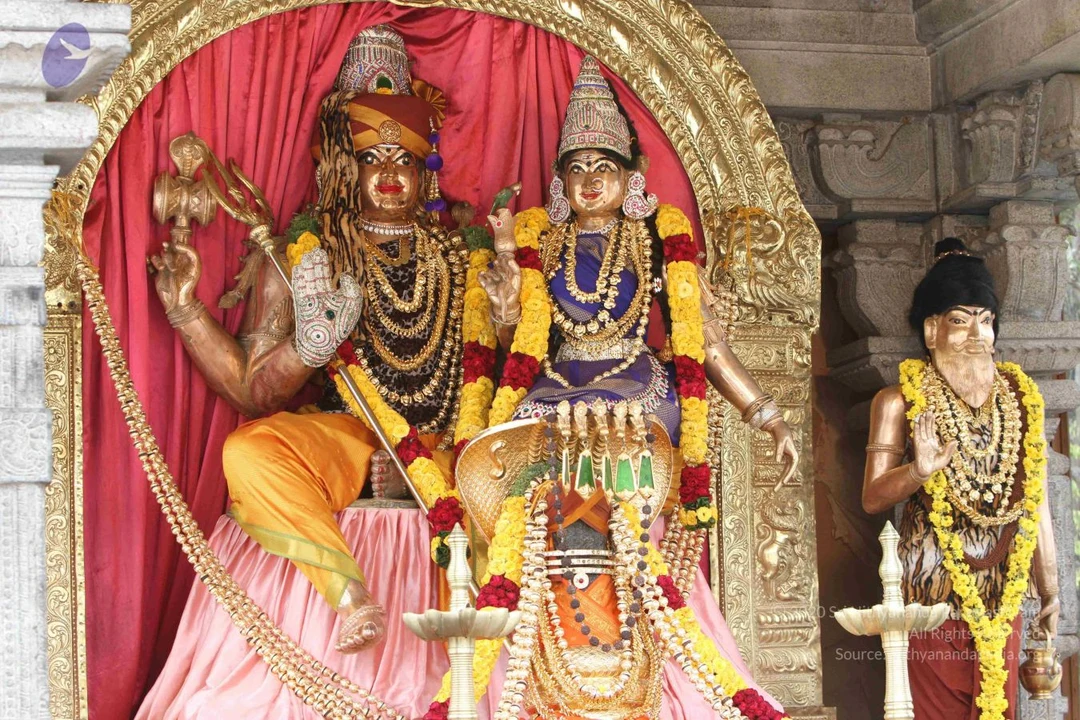
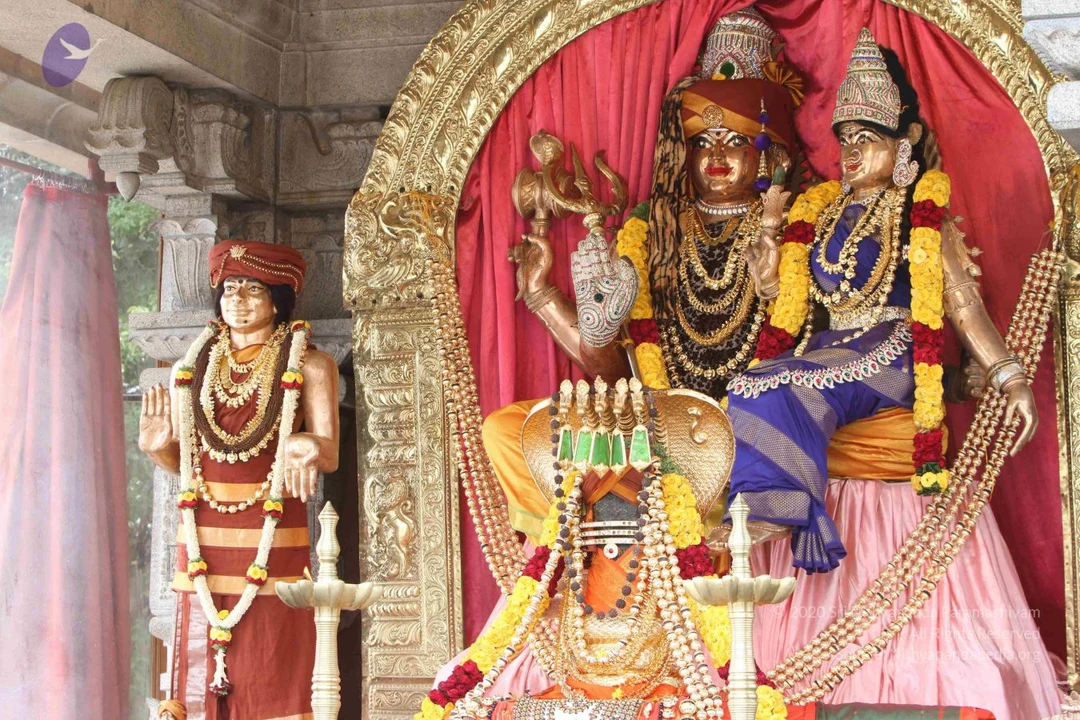
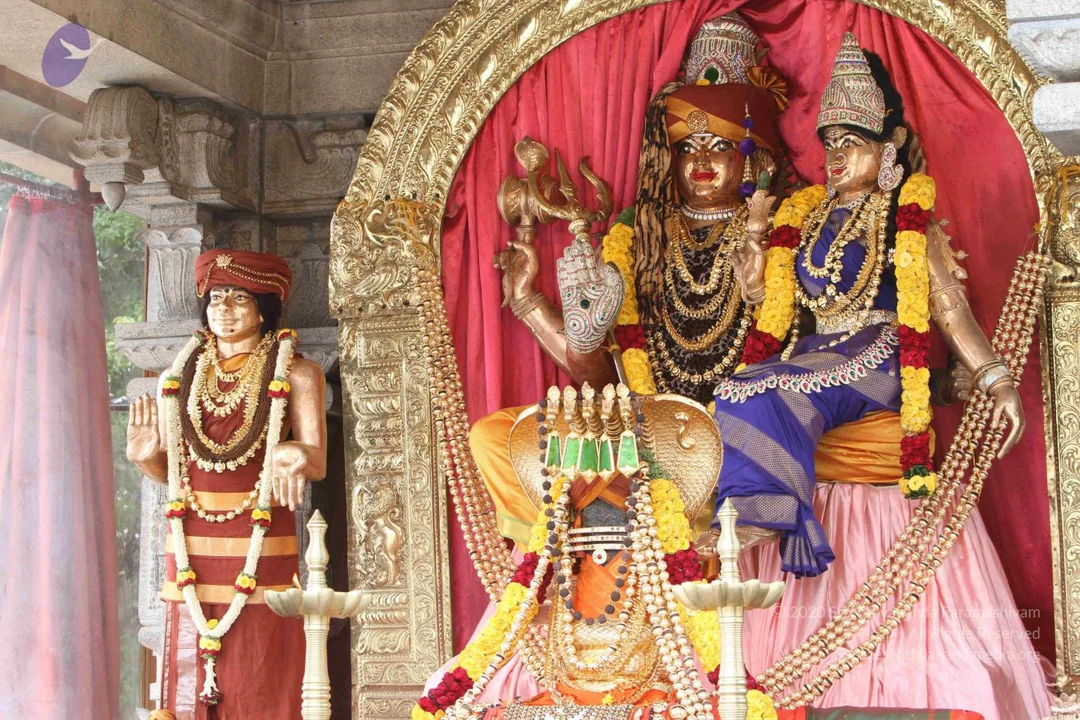
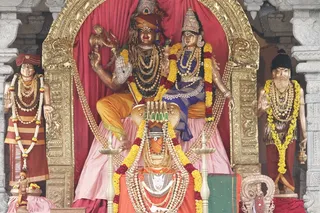
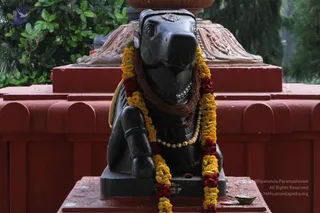
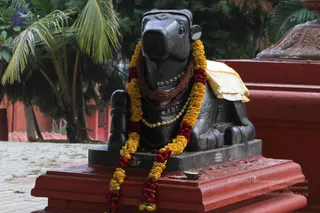
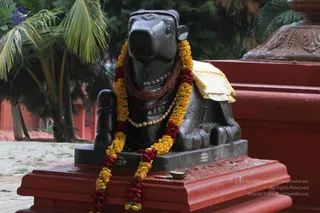
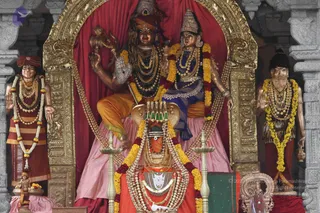
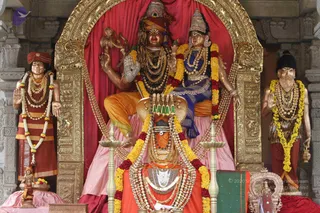
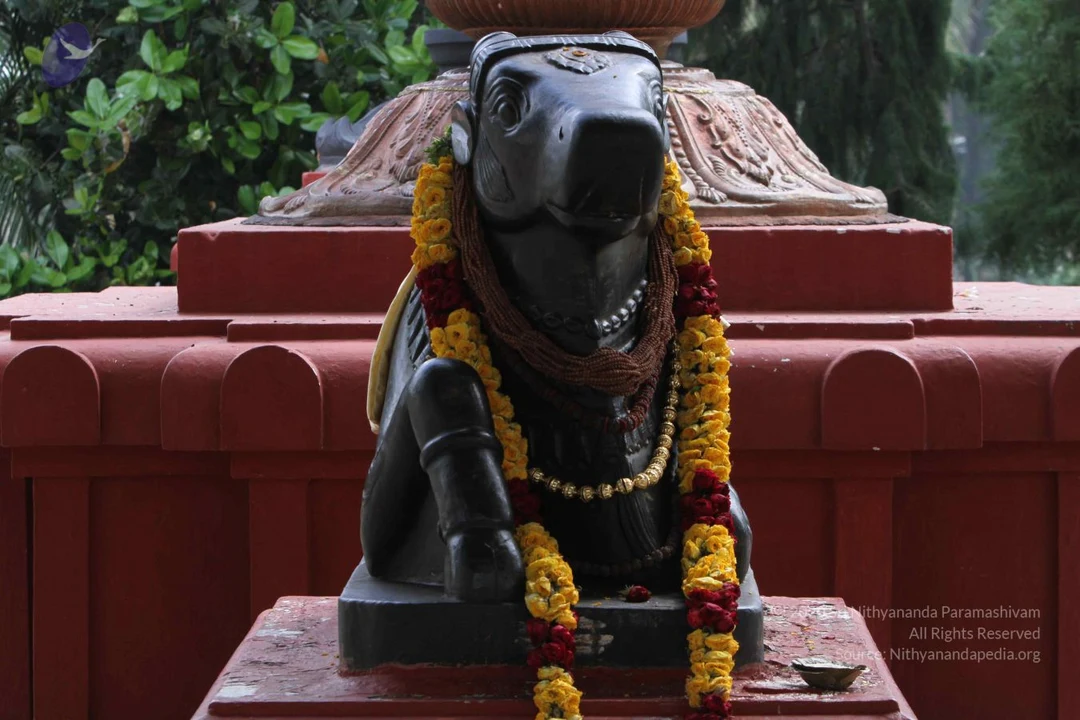
A black stone Nandi bull statue sits on a red plinth in an outdoor shrine, draped with garlands of yellow and red marigolds and roses. It wears a brown rudraksha-style bead necklace and a white pearl-like necklace with a gold chain. A small oil lamp rests on the base at right, and green foliage and a red stone pedestal surround it. No physical people are visible.A large black stone Nandi bull statue sits on a red plinth in an outdoor temple courtyard. It wears garlands of yellow and red marigolds, a rudraksha-style brown bead necklace, a pearl-like cowrie necklace and a gold chain, with a cream and gold cloth draped over its back. A small oil lamp sits on the plinth in front. Palm trees and red walls of temple buildings are behind it. No people are visible.A black stone Nandi bull statue sits on a red pedestal in an outdoor temple courtyard. It is draped with thick garlands of yellow and red flowers, a brown beaded necklace, and a gold-coloured cloth over its back. A small oil lamp sits on the pedestal in front. Palm fronds and a red wall stand behind it. No people are visible.A gilded shrine tableau of deity murtis within a golden arch backed by a red curtain. Two large statues sit at centre: a male figure with matted hair, a saffron-and-orange dhoti, a trident and rudraksha-style beaded necklaces, flanked by a female figure in a blue sari with gold ornaments and a crown. Flower garlands of yellow marigolds and red blooms hang on the figures. Two standing attendant statues stand on either side, one in a red-and-white cloth with a turban and the other with long hair and a bare chest. In the foreground a small seated figure and a large kalasha-like ornamental pedestal sit before the group, with oil lamps on tall brass stands. Statues and printed visuals only; no physical people are present.Ornate temple shrine with a golden arch framing a deity murti of Shiva and Parvati seated on a pink-draped platform, Shiva holding a trident and a small drum, both figures in gold jewellery and rudraksha-style necklaces with yellow and red marigold garlands. Flanking them are two standing statues of sages in saffron and red-striped cloth with garlands. A brass lamp stand and a red-and-orange draped figure occupy the foreground, with a white and gold ceremonial decoration at the base. The figures are statues and depictions, not living people.A temple shrine photographed head-on, centred on a large golden-bronze deity murti of Shiva seated on a throne with his consort beside him. The Shiva figure has a crown, many rudraksha and gold necklaces, and holds a trident. The consort wears a blue-purple sari and a tall headdress with garlands of yellow and red flowers. A red curtain and a golden arch frame the figures. Below, a smaller orange-robed murti is adorned with garlands and beads, with a white offering in front. Standing murtis on either side wear red and gold garments, garlands and gold necklaces, one holding a kamandalu. No living people are visible.

NITHYA-SATSANG
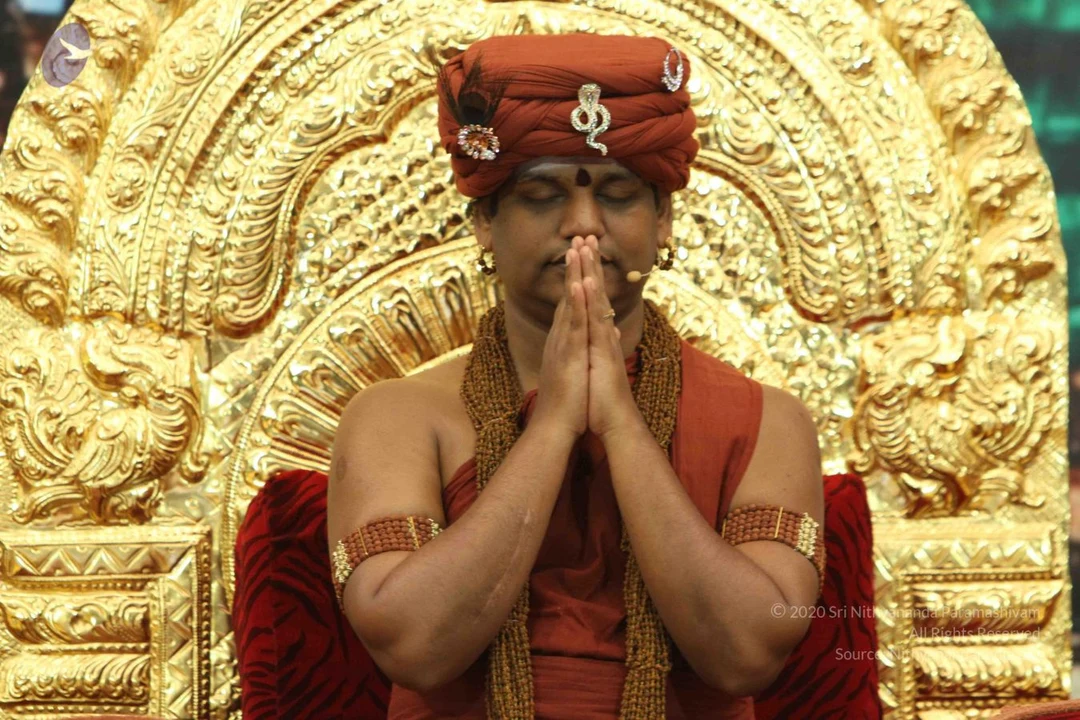
24 photosSource gallery
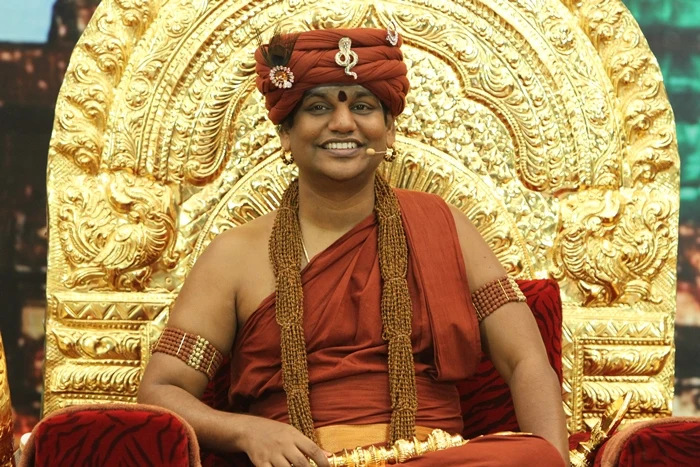
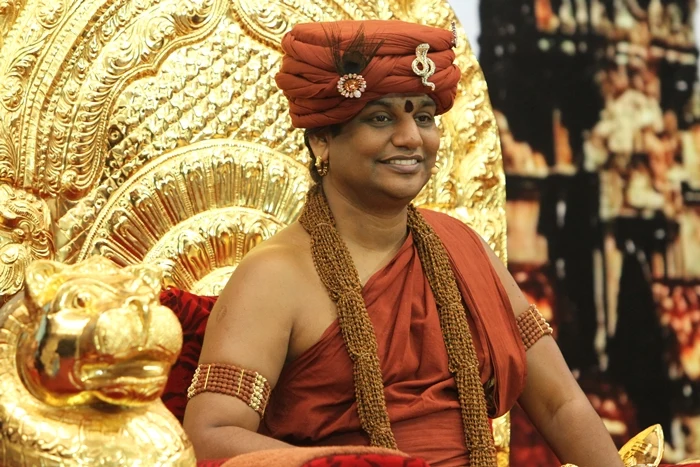
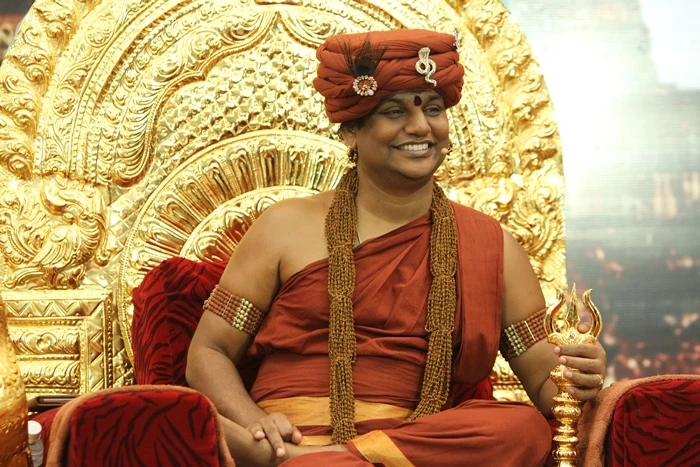
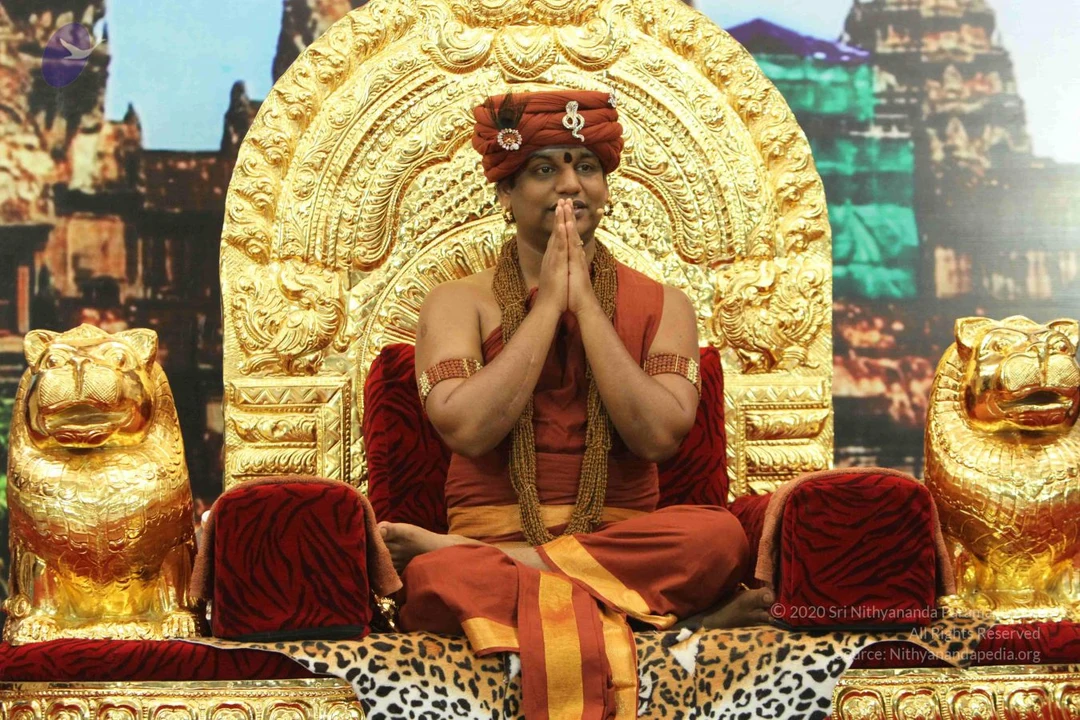
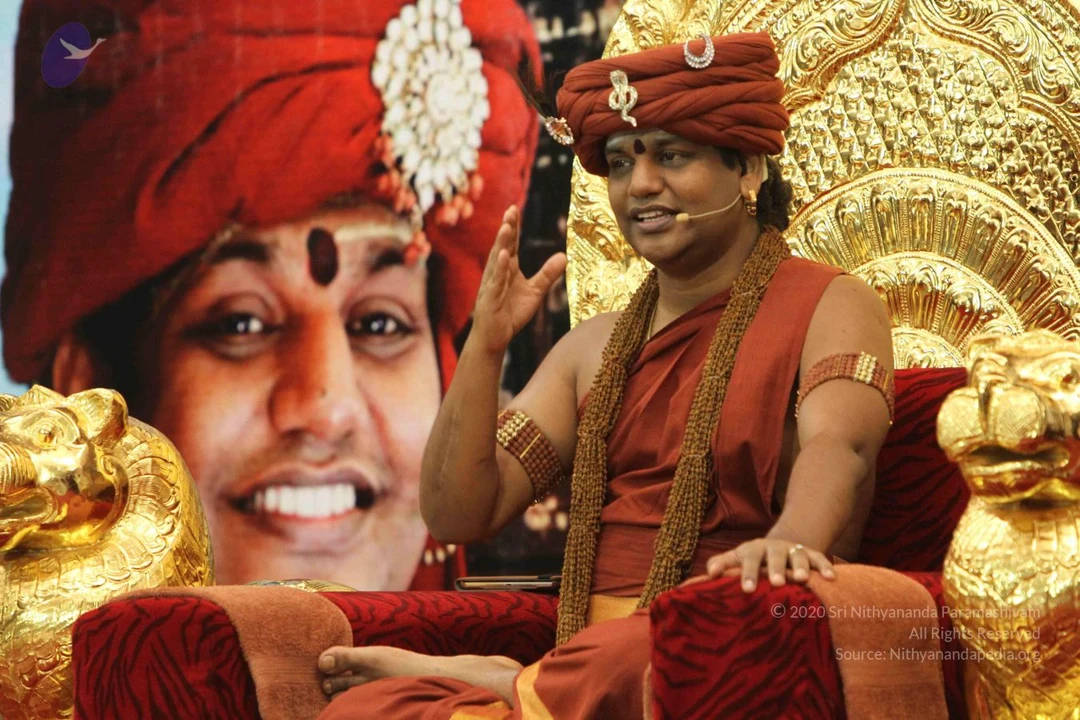
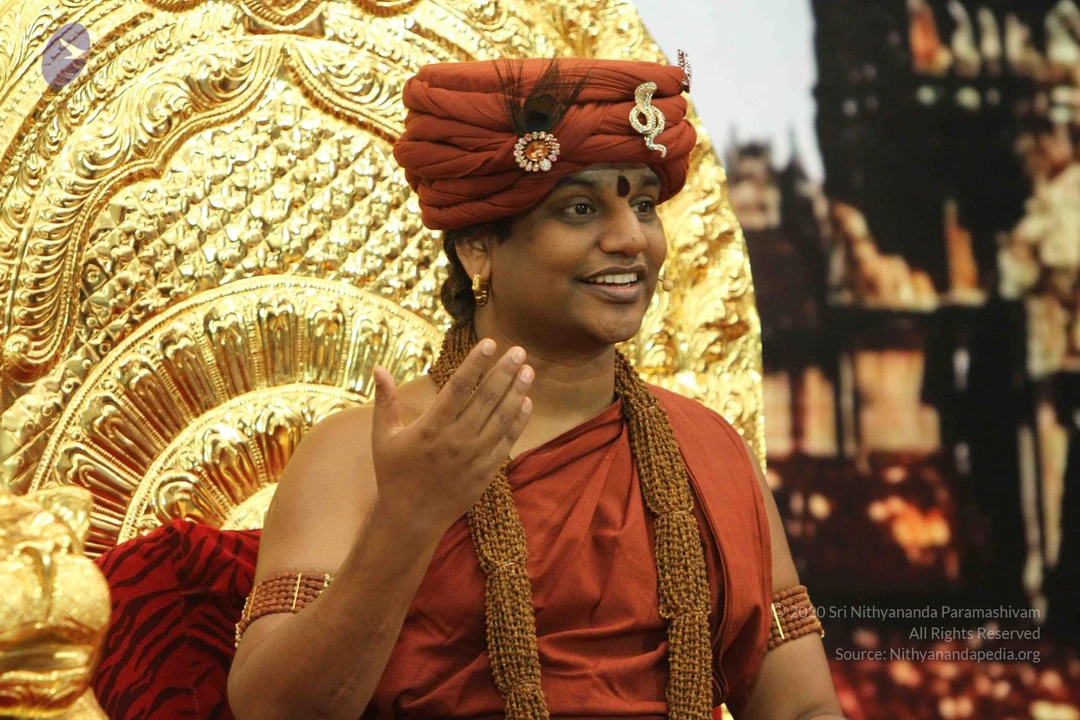
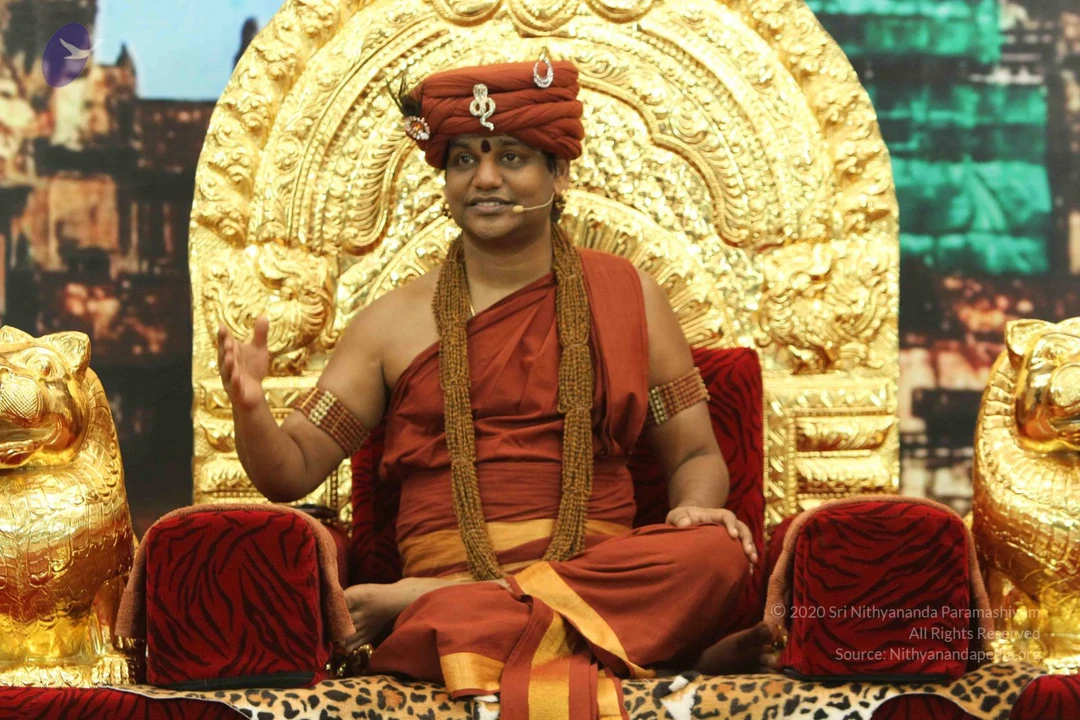
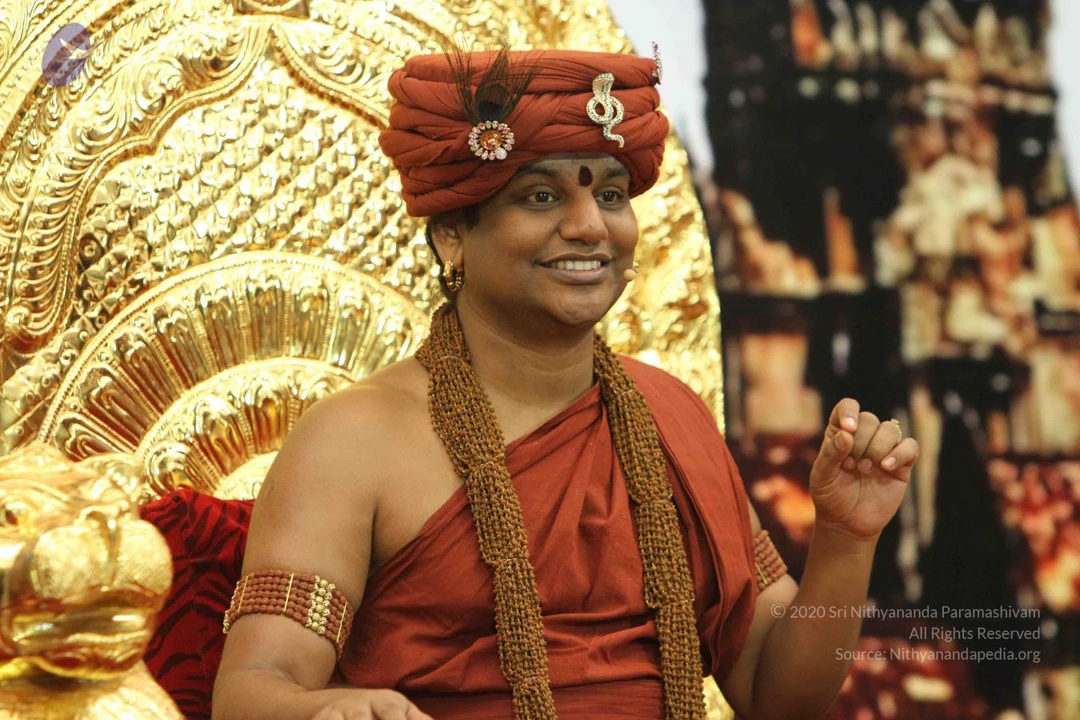
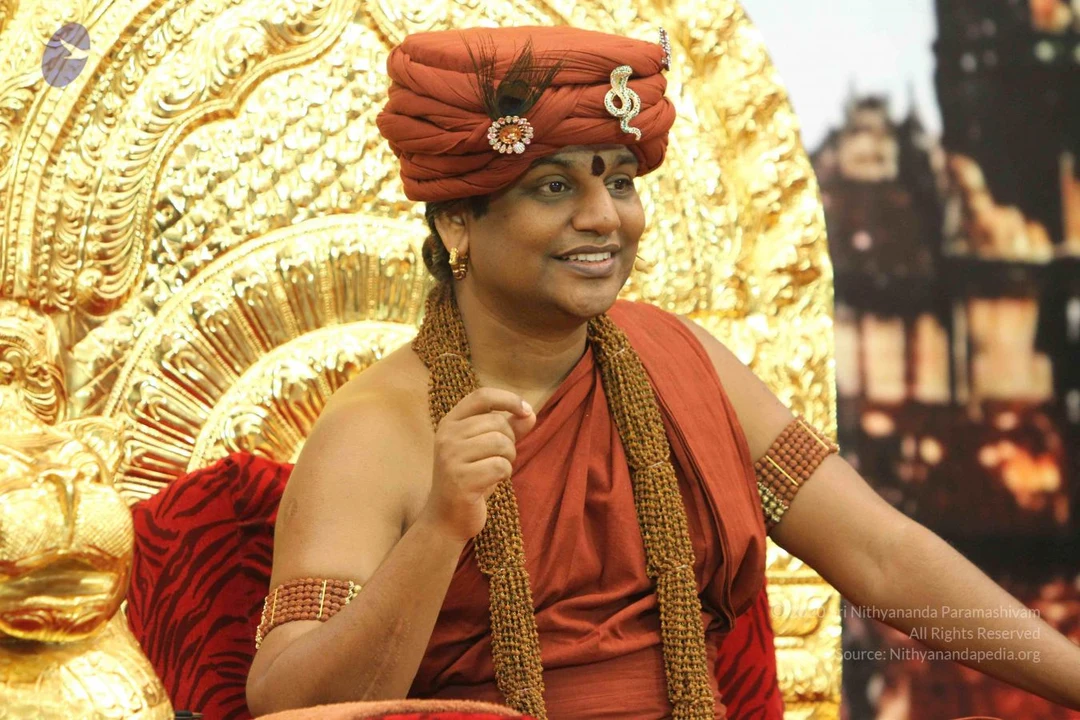
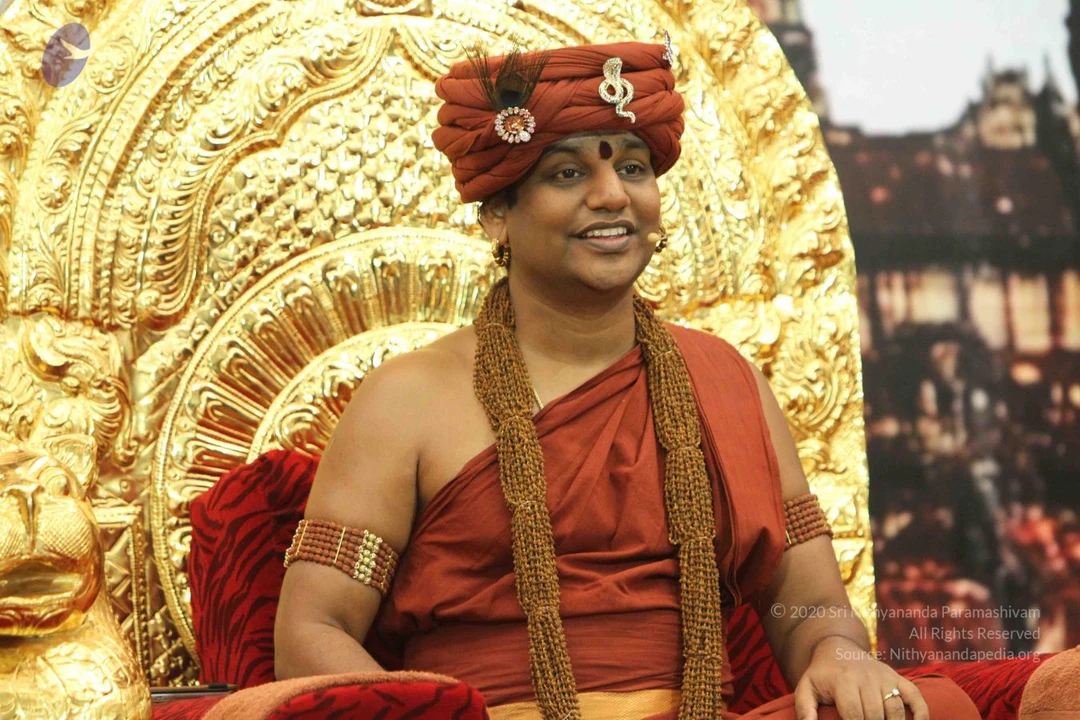
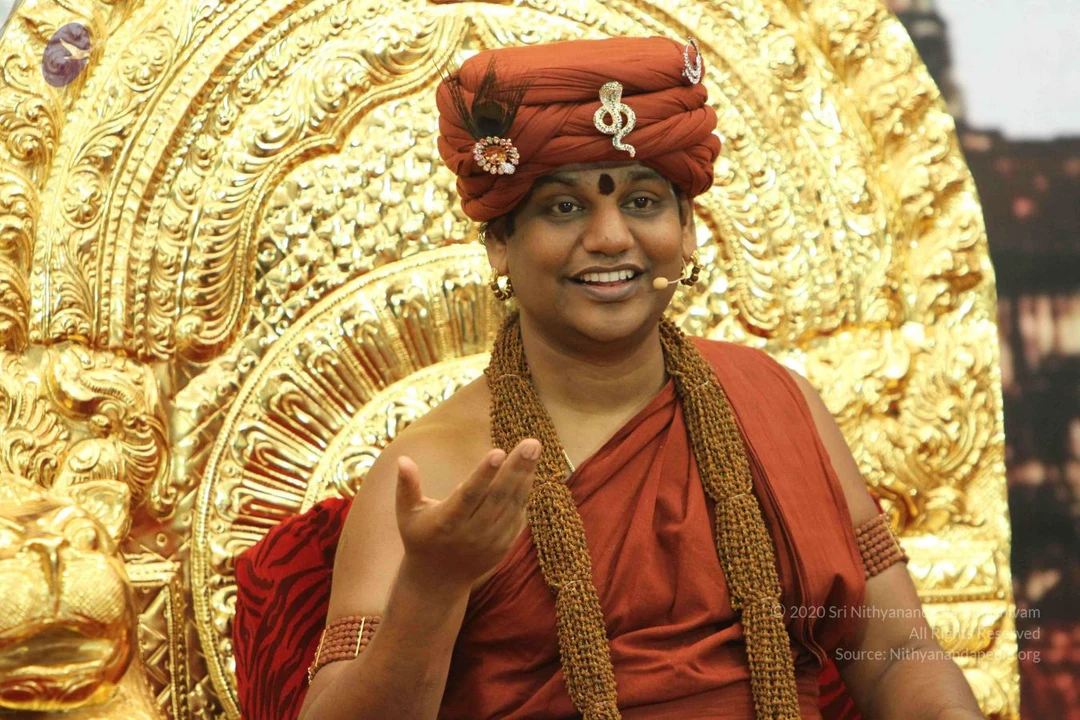
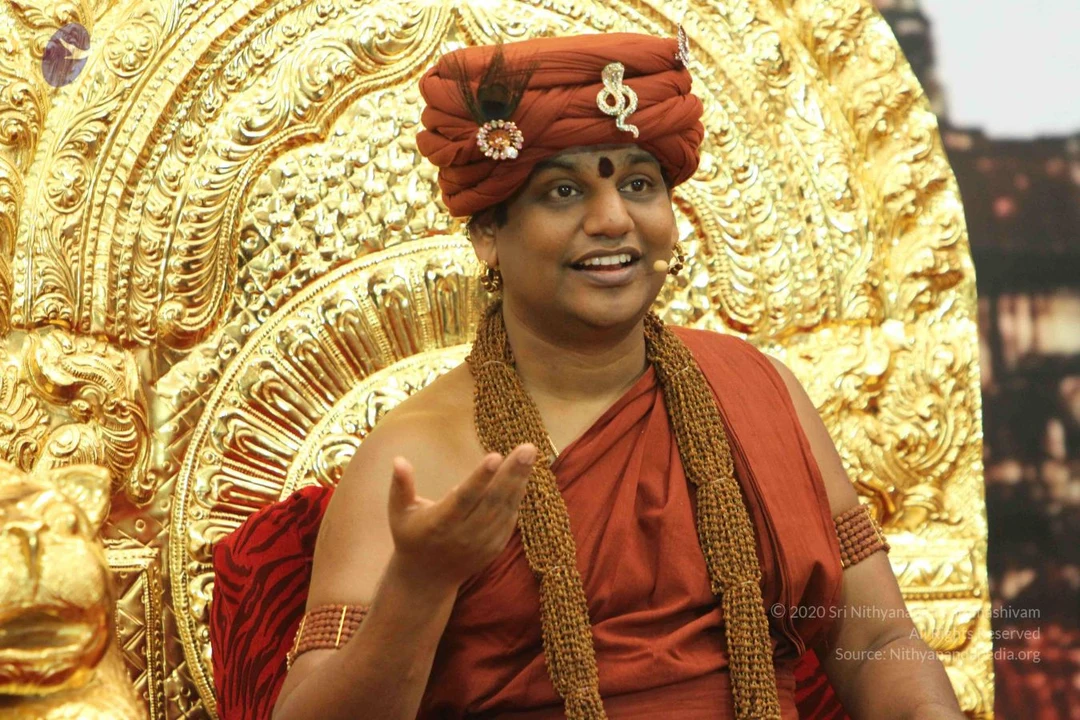
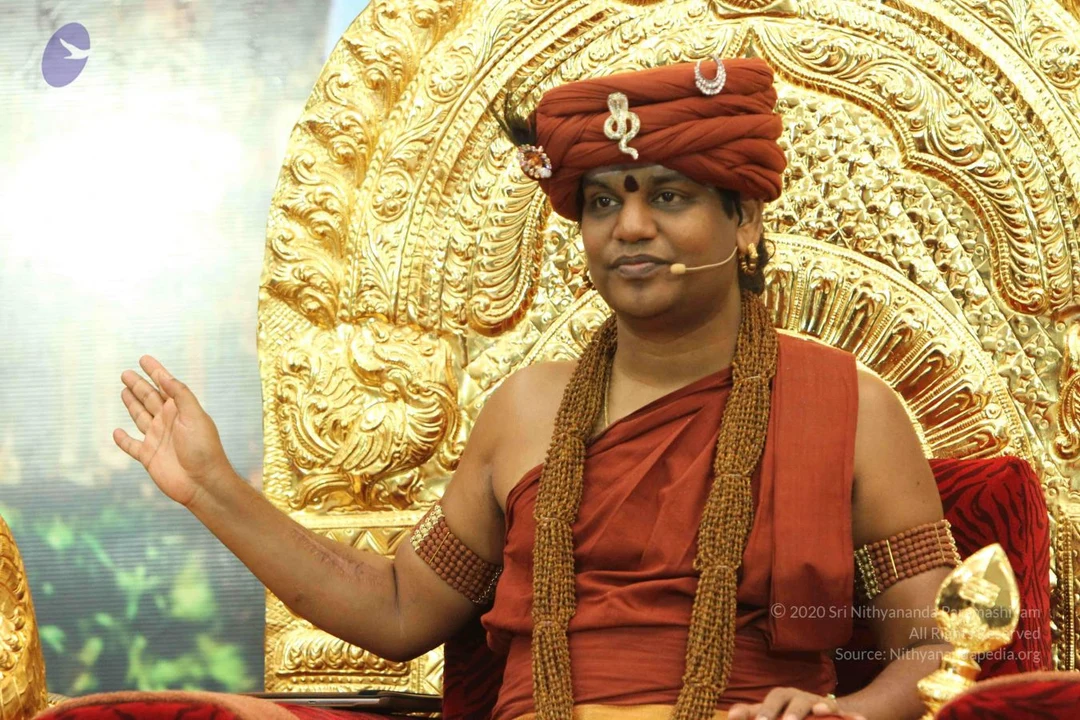
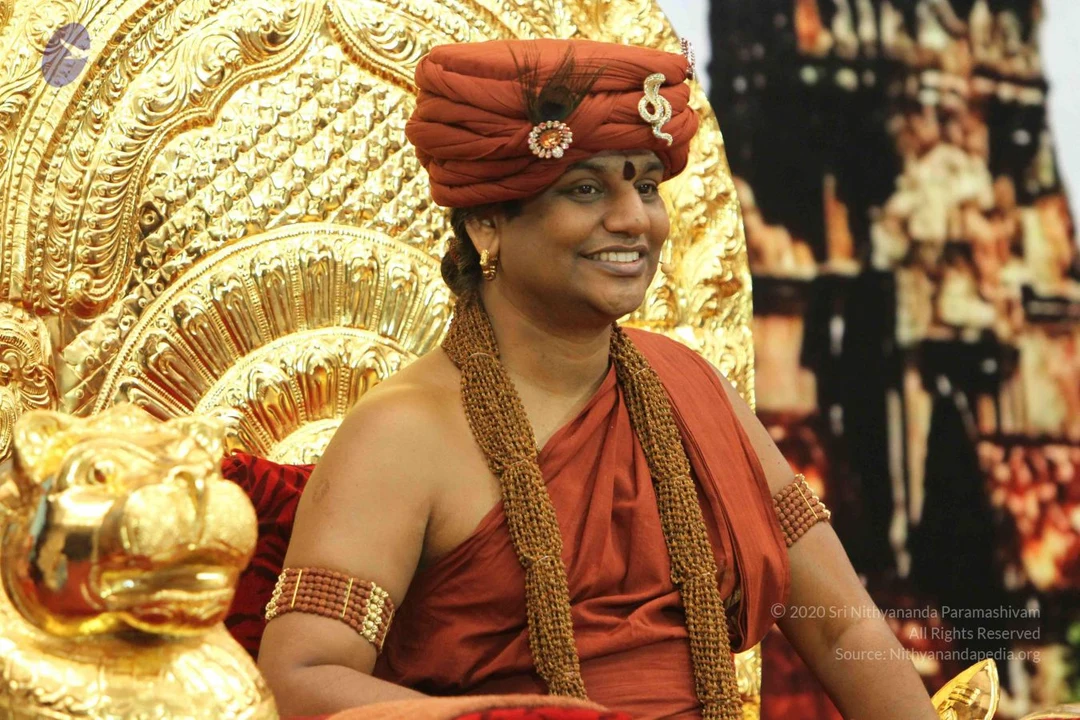
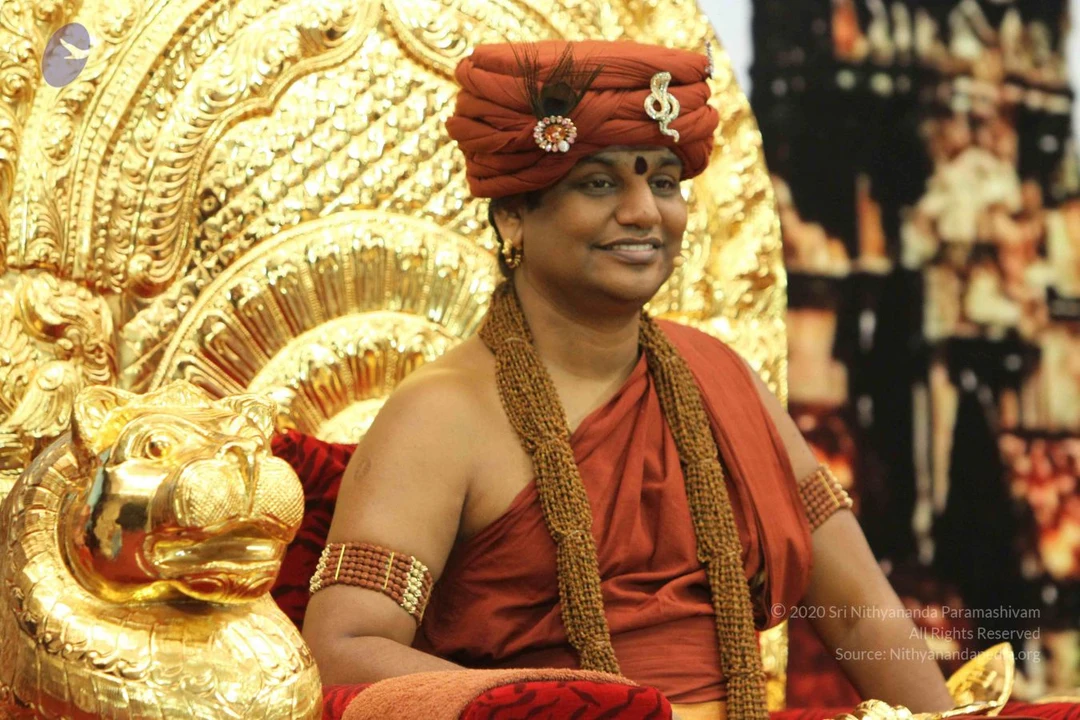
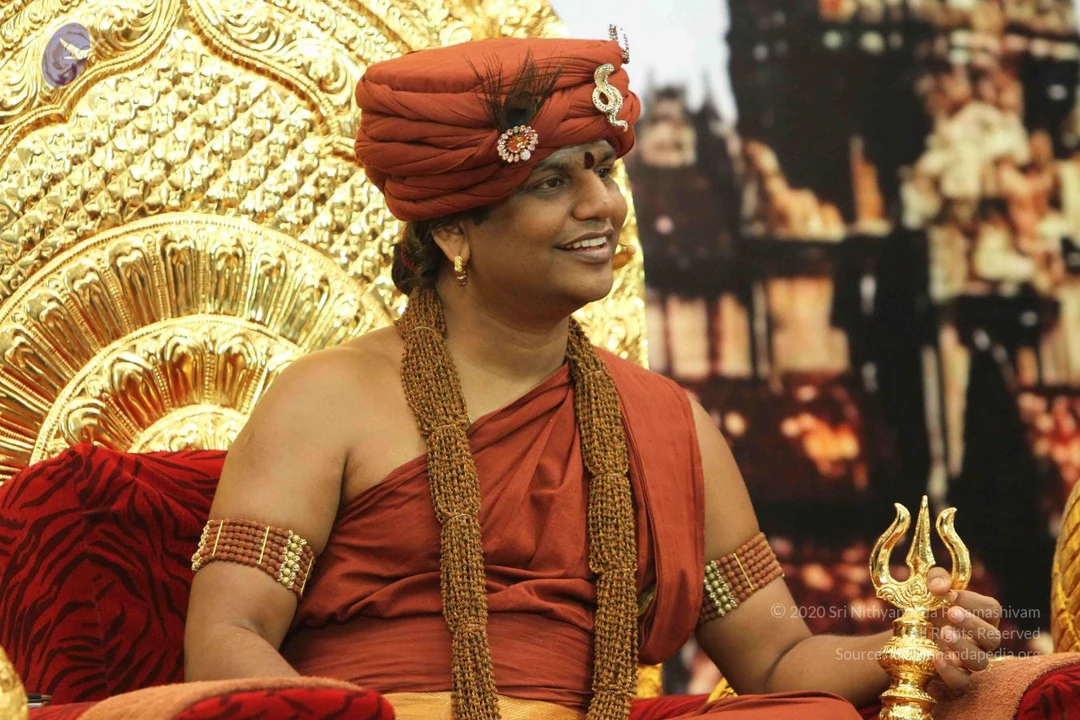
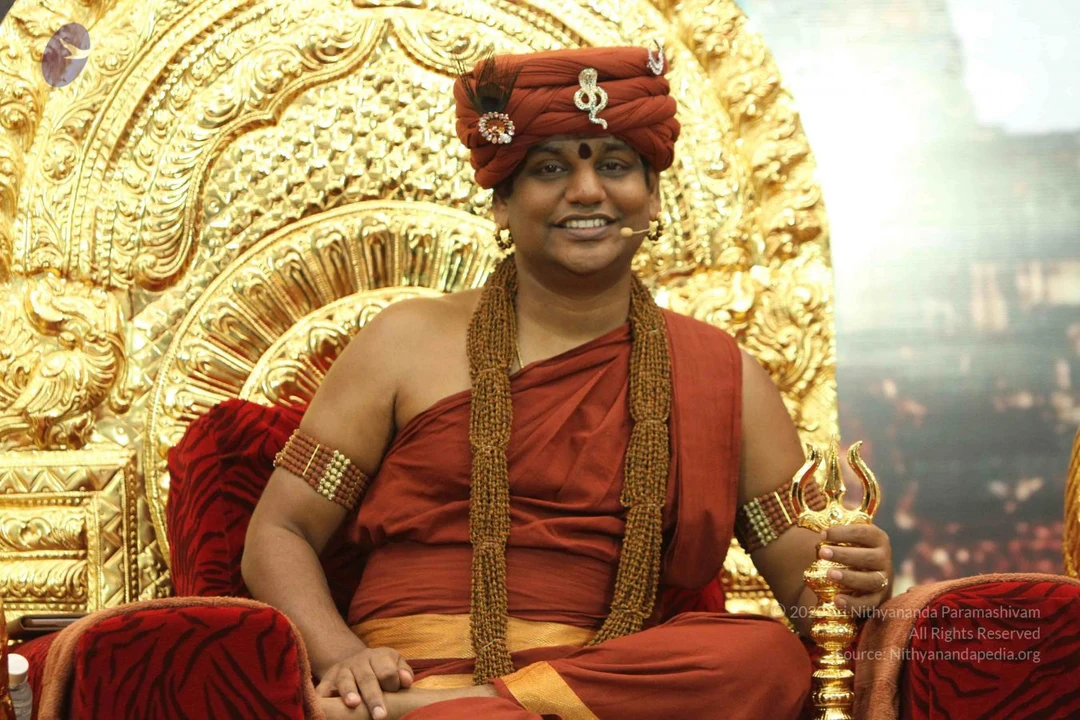
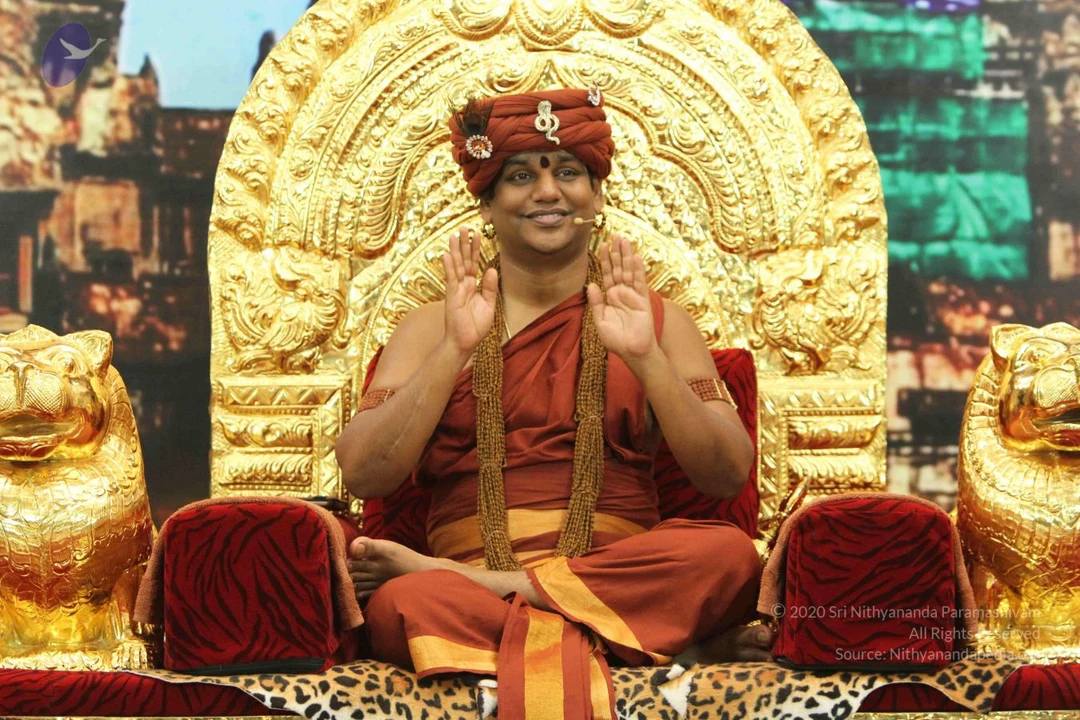
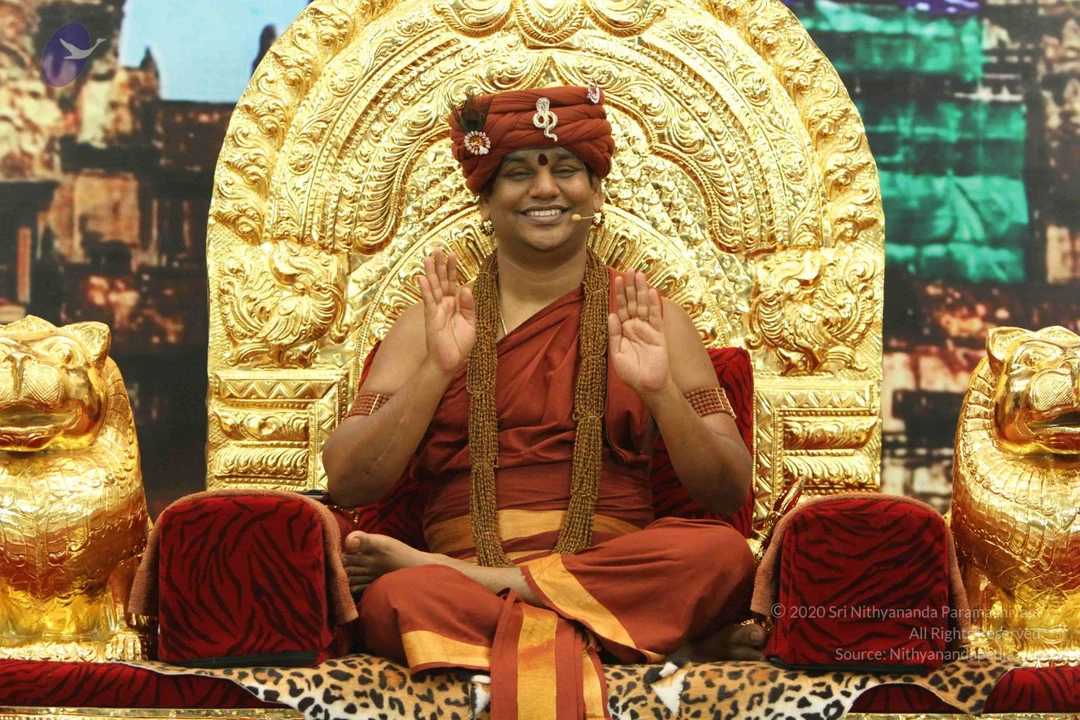
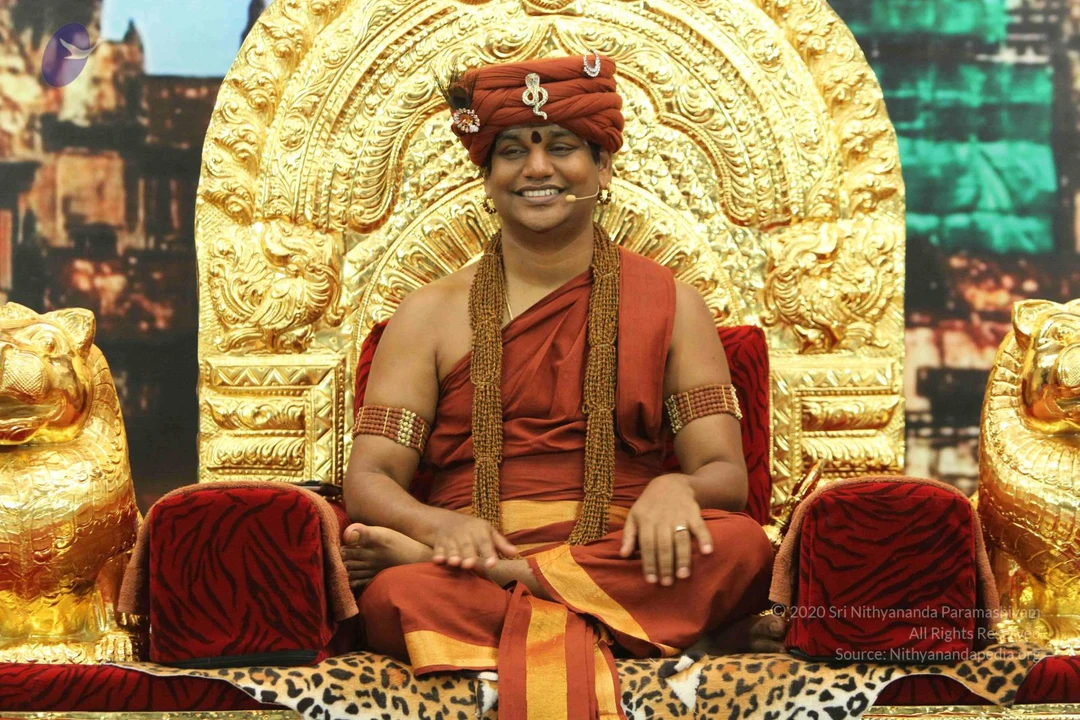
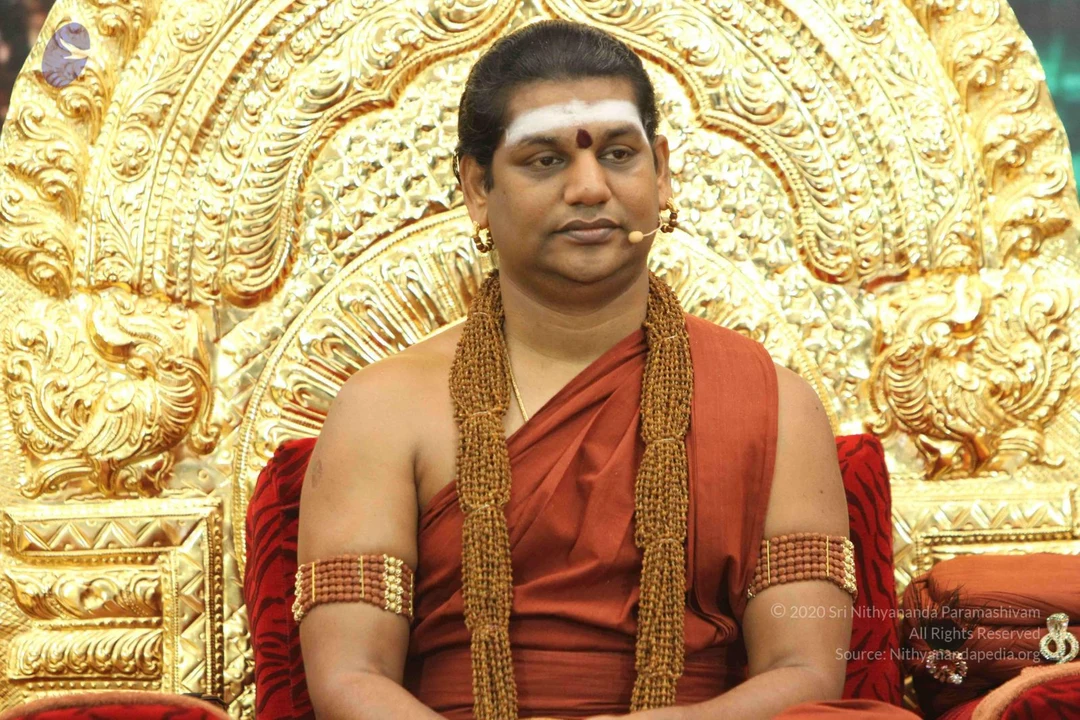
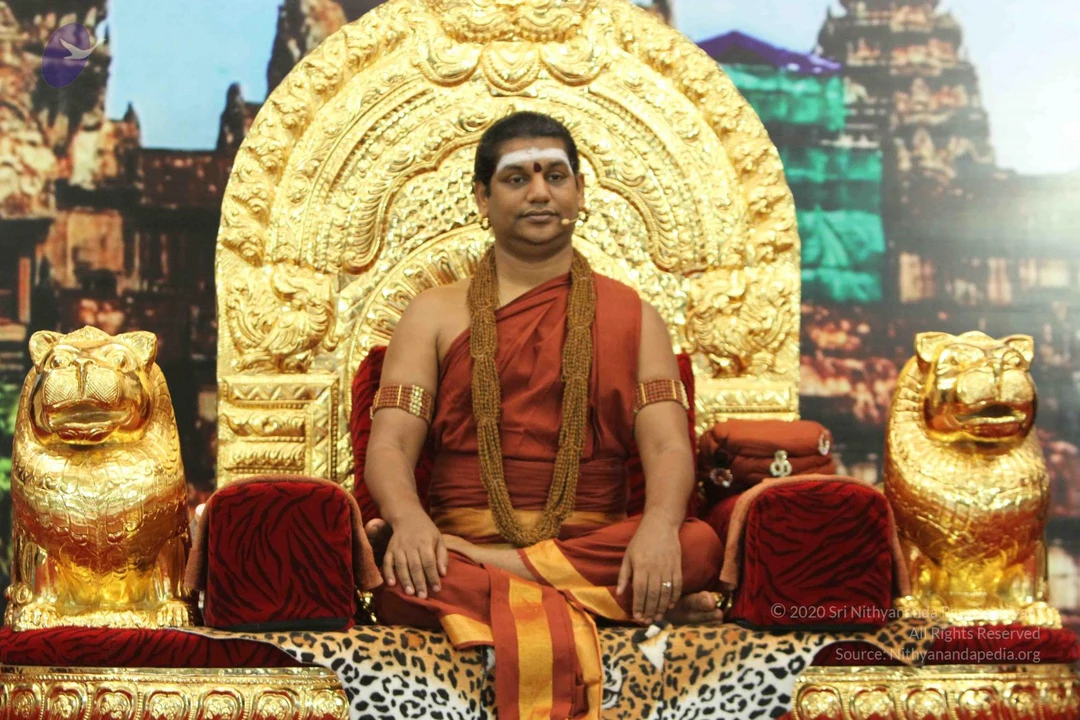
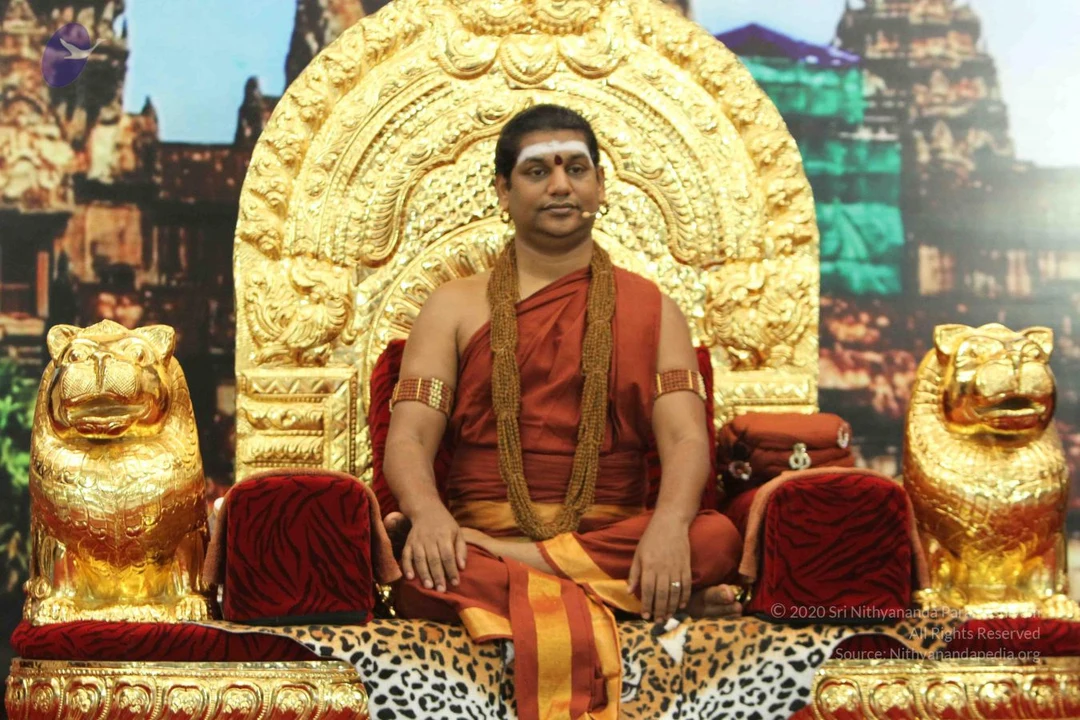
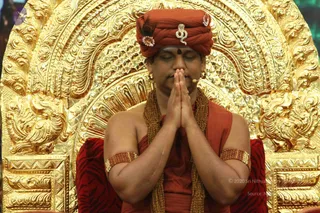
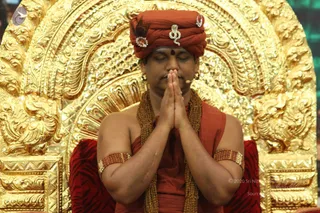
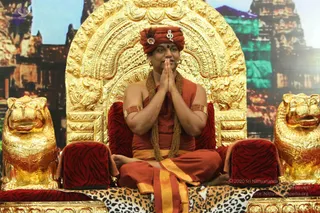
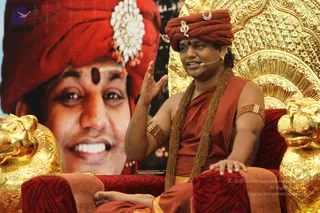
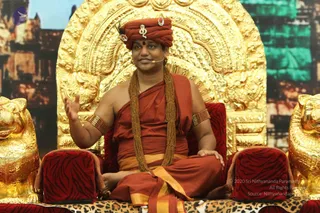
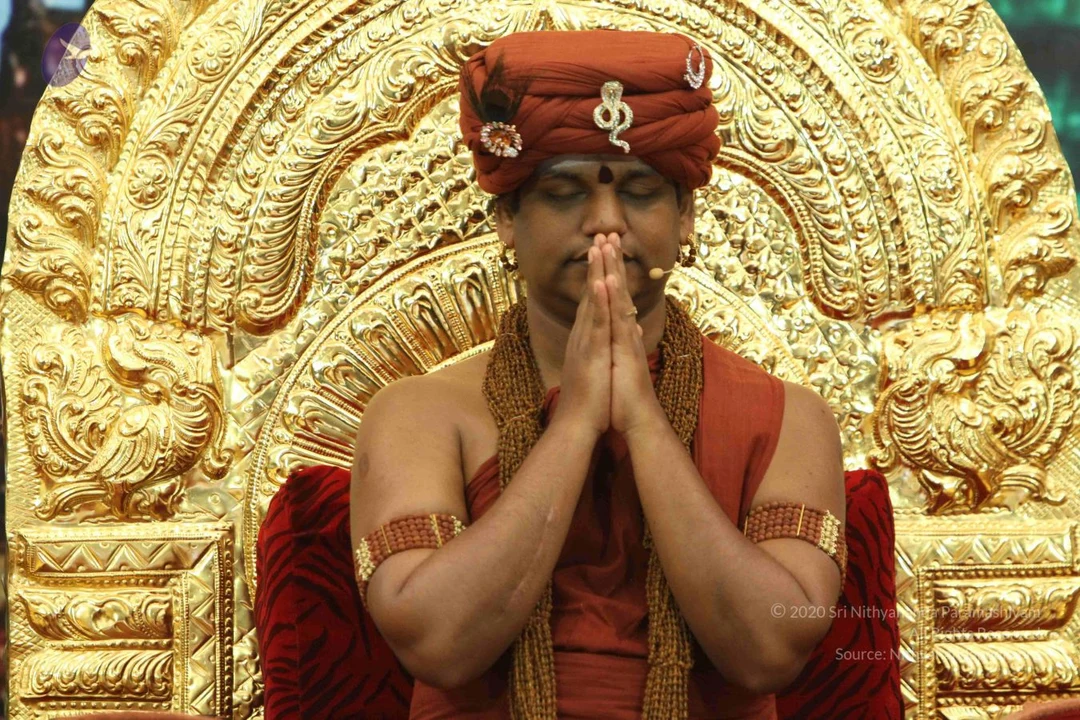
A seated man with eyes closed presses his palms together in anjali mudra at the chest. He wears a red-orange turban with a jewelled ornament and a small white-and-gold emblem at the front, a red-orange robe, and a long mala of beads hanging around his neck. Red-orange beaded armlets sit on his upper arms. A small lapel microphone is clipped near his face. Behind him is an ornate gold throne with heavily carved floral and scroll patterns, and red velvet upholstery shows at the sides. The page indicates a person candidate, but the visible cues (red turban, beaded mala, red-orange robe, gold throne) are present yet not distinctive enough to confirm the identity, so this is recorded as unsure.A seated man in a red-orange turban with a feather and a jewelled snake-shaped brooch sits with eyes closed and palms pressed together in anjali mudra. He wears a red-orange shawl over the shoulders, a beaded rudraksha-style necklace with gold-toned beads, gold armbands, and gold earrings, with a small red bindi and a clip-on microphone at the cheek. Behind him is an ornate gilded throne with carved lion-like motifs and red velvet armrests. Background is a dark stage area.A seated figure in saffron-orange robes and an orange turban with a red jewel and small emblem sits in namaste on an ornate gold throne with carved backrest and golden lion armrests, draped in red tiger-striped velvet over a leopard-print cloth. A long rudraksha-style mala hangs at the chest and gold bangles are on the upper arms. Behind the throne a backdrop shows a stone temple tower in warm tones. The scene reads as a satsang setting.A seated man in a red-orange turban and matching saffron-orange robe speaks into a headset microphone while raising one hand in a gesture of explanation. He wears a rudraksha mala and a bangle on his upper arm, and sits on an ornate gold throne with carved lion-head armrests upholstered in red patterned fabric. Behind him, a large backdrop portrait shows a smiling man in a red turban with a white and pearl turban ornament and a red tilak. The setting suggests a satsang discourse. a person: the seated speaker wears a red-orange turban, saffron-orange robes, a rudraksha mala and a headset microphone on a gilded throne, consistent with the page's reference to a discourse by a person.A man in a rust-orange turban with a peacock feather and jewelled brooch, plus a gold serpent ornament, sits before an ornate gold throne with fan-like carved backrest. He wears a rust-orange shawl over the shoulder, a thick beaded rudraksha-style mala necklace, gold armlets and earrings, and a red dot on his forehead. He is smiling and gesturing with one raised hand while speaking. Behind him a large screen shows a lit stone temple at dusk.A man seated cross-legged on an ornate gold throne with carved backrest, speaking with a headset microphone. He wears a rust-orange turban with a silver emblem, rust-orange robes with a gold-bordered waist cloth, a long rudraksha-style bead necklace, and gold armbands. Flanking the throne are gold lion sculptures, and the red-and-leopard-print cushioned seat sits on a leopard-patterned cloth. Behind him is a backdrop of an ancient stone temple. Probable Swamiji is seated in a teaching posture, one hand raised mid-gesture while addressing an audience, with the orange robes, turban and ornate gold throne as qualifying cues.

DARSHAN
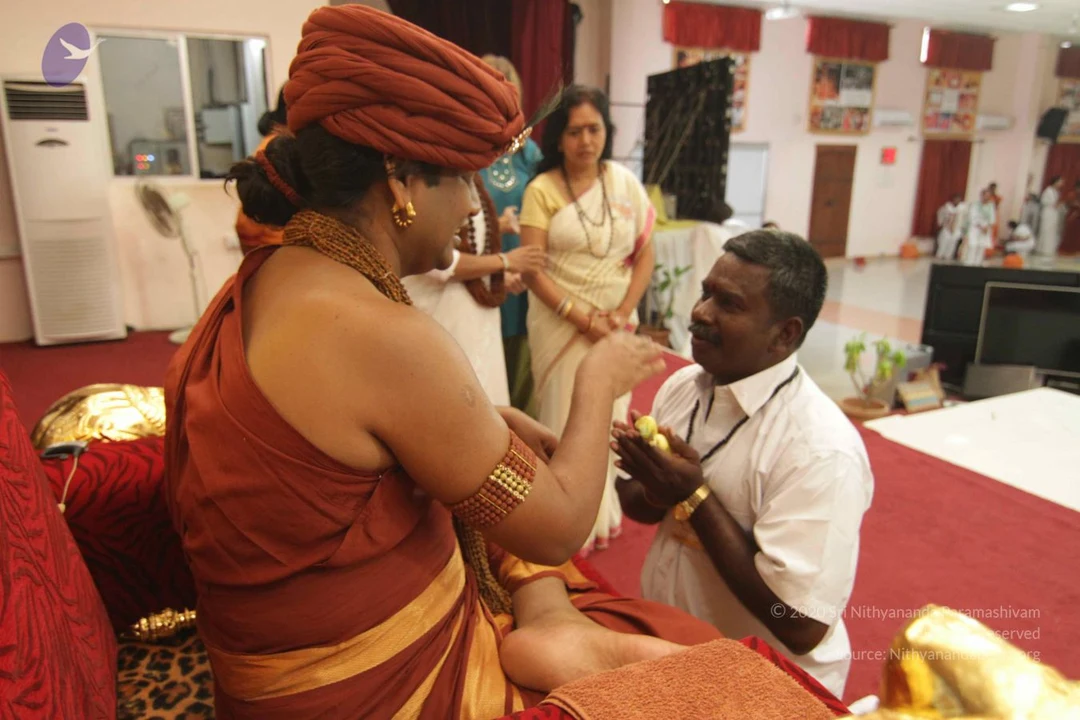
7 photosSource gallery
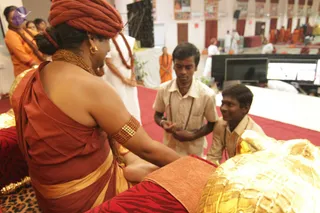
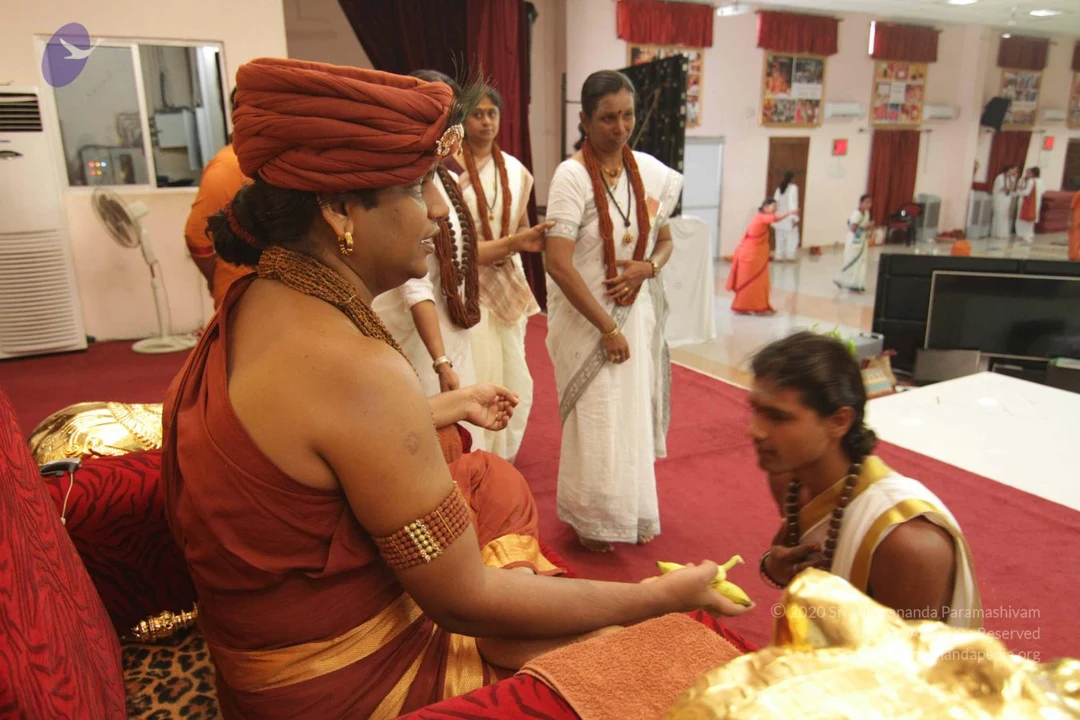
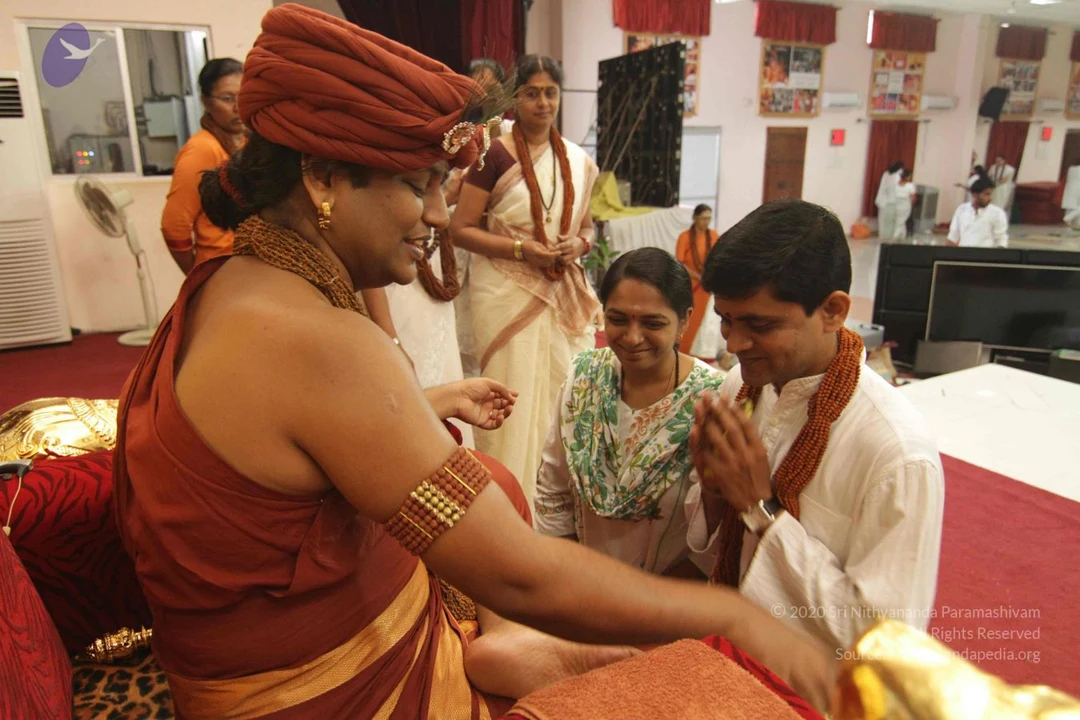
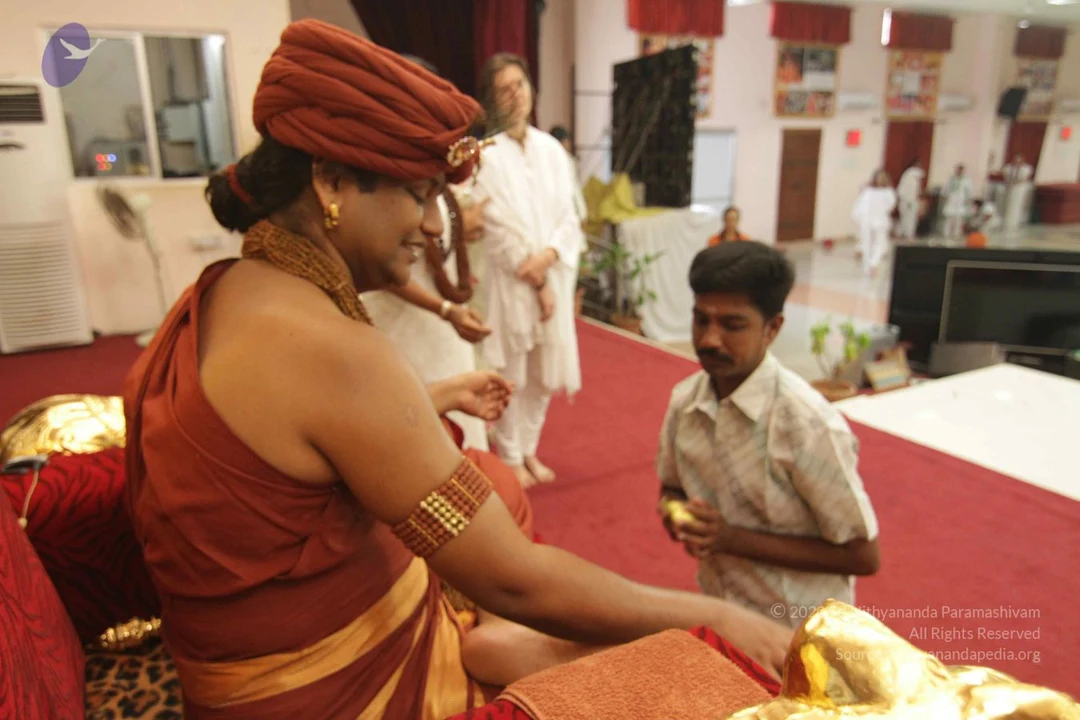
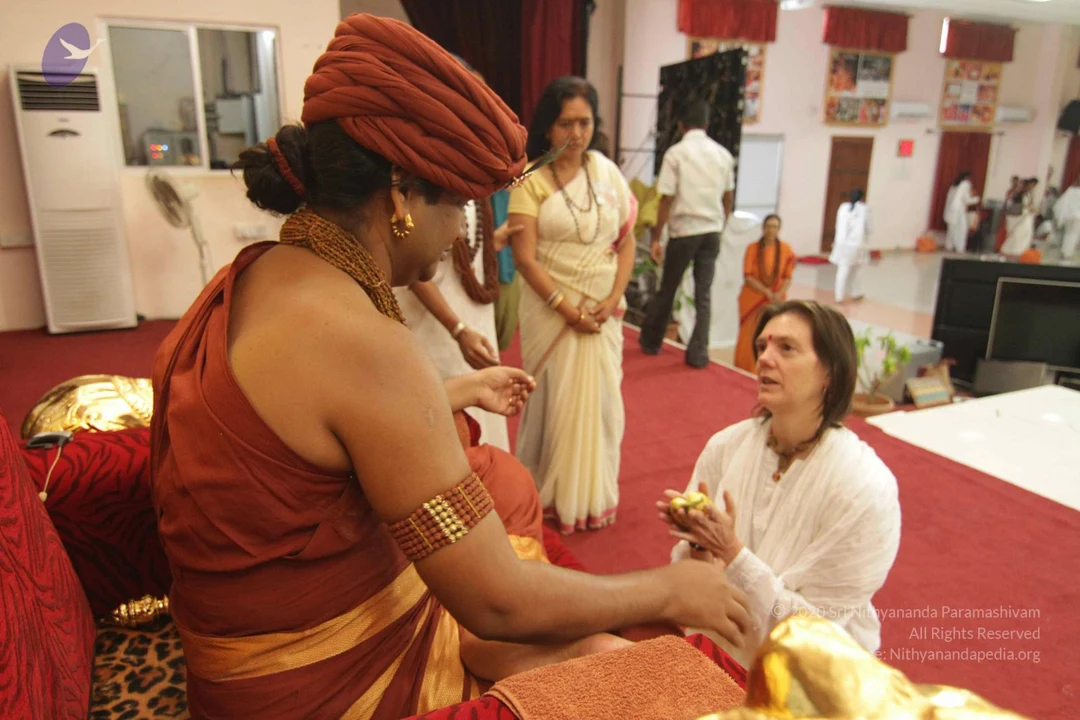
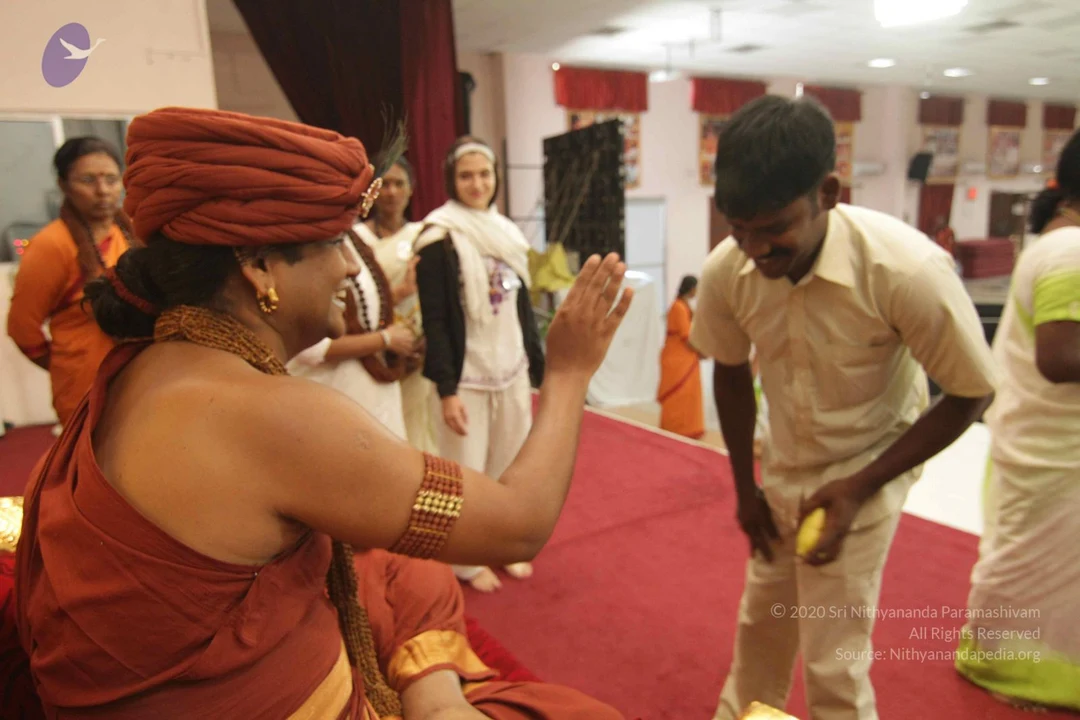
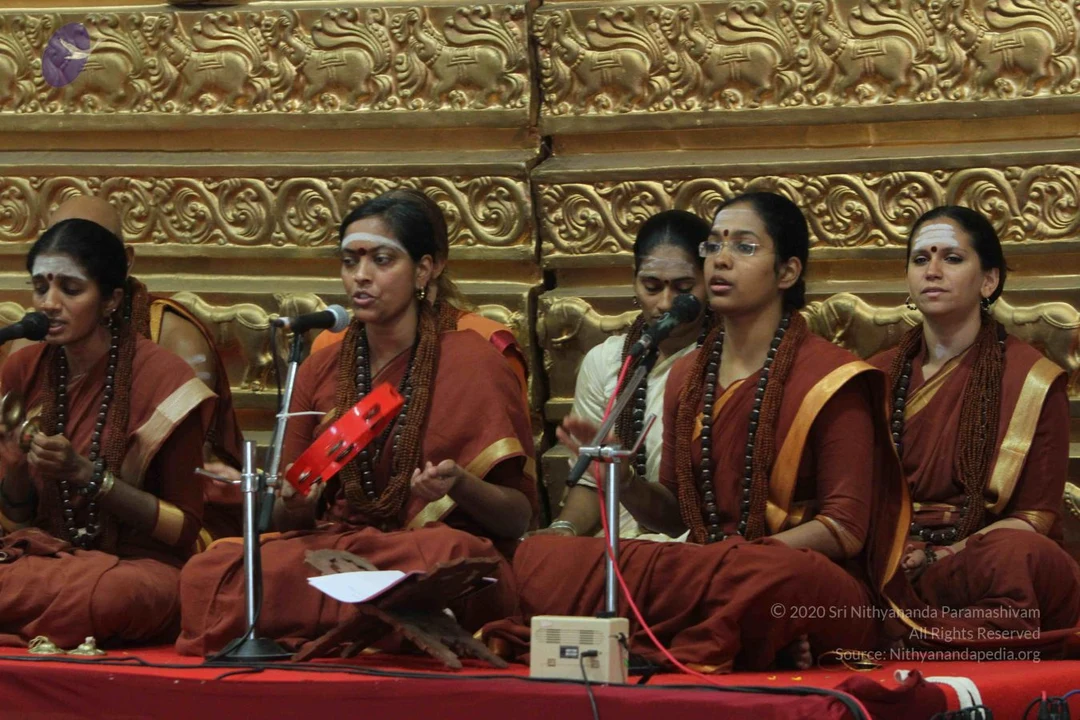
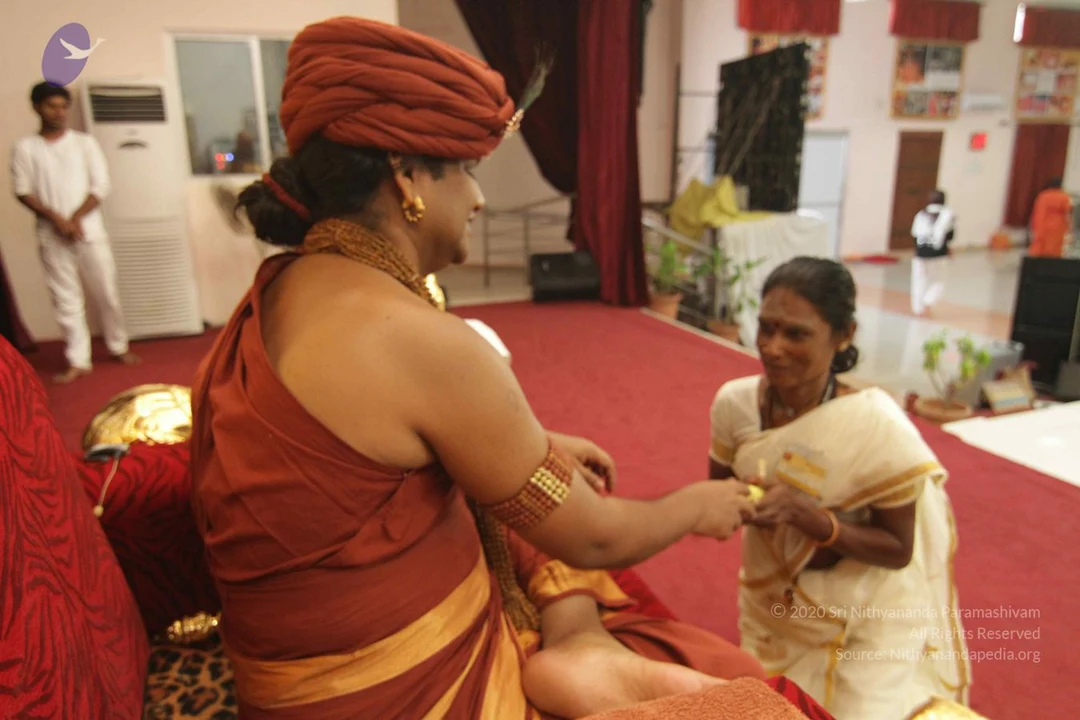
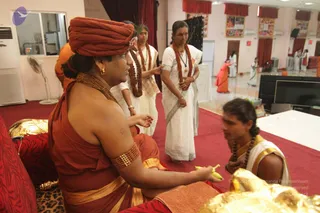
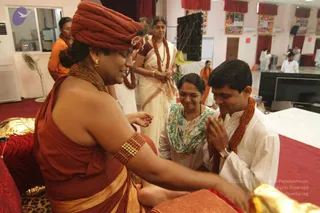
A photograph of a seated figure in a rust-orange turban and orange-red draped garment, with a heavy gold-beaded necklace and gold armlet, sitting on a red and gold-patterned cushioned seat with a gold bolster. The figure's bare foot rests on a folded orange cloth while two men in cream shirts and beaded necklaces stand and kneel beside them, one reaching forward with his hands. Behind them, saffron-robed attendants and a figure in white stand near a white-draped table, with a large monitor and an ornate hall of red carpet and tall red-and-gold panels in the background. The scene resembles a padapuja foot-washing ritual, with the figure in a turban and beaded adornments seated in an honoured position. Their identity as a person is uncertain from appearance alone.A seated figure in a saffron-orange turban and matching saffron-orange robe with a gold border, wearing a heavy beaded gold necklace and a wide gold armlet, sits on a red cushioned seat with a leopard-print cloth. Appearance-based candidate: a person, identified by the saffron turban, ornate gold jewellery and long swept hair. He holds a yellow banana and faces a younger man in white and gold-bordered dhoti with rudraksha beads, who sits on the red carpet. Behind them, women in white saris with red and orange garlands stand on a red carpet, and a few more people in white and orange are visible in the room.A photograph of a seated figure in a rust-red turban and matching red-orange robe, adorned with red beaded necklaces and gold bangles, receiving a devotee. The seated figure rests a bare foot on a folded orange cloth while a man in white kurta with red rudraksha-style beaded necklace kneels with palms pressed together, and a smiling woman in a patterned white top with a dark-haired companion stands nearby. Behind them a woman in cream sari with red-beaded mala and a man in orange clothing watch. The setting is a hall with red carpet, red curtains, framed photographs on the wall and gold-trimmed cushions.A seated figure in a red-orange turban and matching red-orange drape, wearing a gold beaded necklace, gold earring and gold armlet, receives a foot service from a young man in a pale striped shirt who kneels beside a gold object. The seated figure is smiling and leaning forward with an orange-red cloth draped over the lap. Behind them, a standing person in white kurta-style clothing stands on a red carpet in a hall with red curtains and framed posters on the walls. Several other people in white are visible in the background near a stage, and a person in orange sits at the far side. A leopard-print cloth lies beside the seated figure and a golden cushion is at the lower edge.A photograph inside a bright hall with red carpet and red curtains. In the foreground, a figure in a rust-red turban and draped rust-red and gold-bordered cloth, wearing a gold beaded necklace, bangles and earrings, sits on a red cushioned seat with gold accents and offers something to a kneeling woman in white. The woman wears a white garment and a beaded necklace and holds a small golden object in both hands. Behind them, a woman in a cream sari with beaded necklaces stands, and a woman in an orange robe, a man in a white shirt and other people in white stand in the background near a stage. A wall-mounted air conditioner and framed posters are visible. The figure's appearance is consistent with the page's a person reference, with turban, ornate gold jewellery and rust-red clothing, but this is uncertain.A photograph in a red-carpeted hall where a seated figure in a rust-orange turban, orange-red drape with gold border, and multiple heavy beaded necklaces with gold bangles sits on a red and gold throne with a leopard-print cushion. The figure has long hair swept into a bun and is turned toward a kneeling man in a white shirt and white trousers with dark beads at his neck, who holds a small yellow fruit or offering in cupped hands. Behind them a woman in a cream sari with a beaded necklace stands near a table, and white-clad people are visible further back by a window and wall posters. The figure's visible cues (turban, ornate beads, orange clothing, long hair) appear consistent with a person, but identity is uncertain.

NITHYA-KIRTAN

9 photosSource gallery
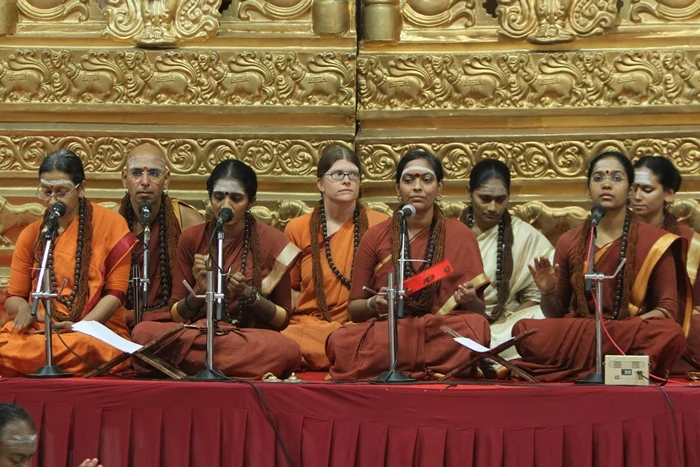
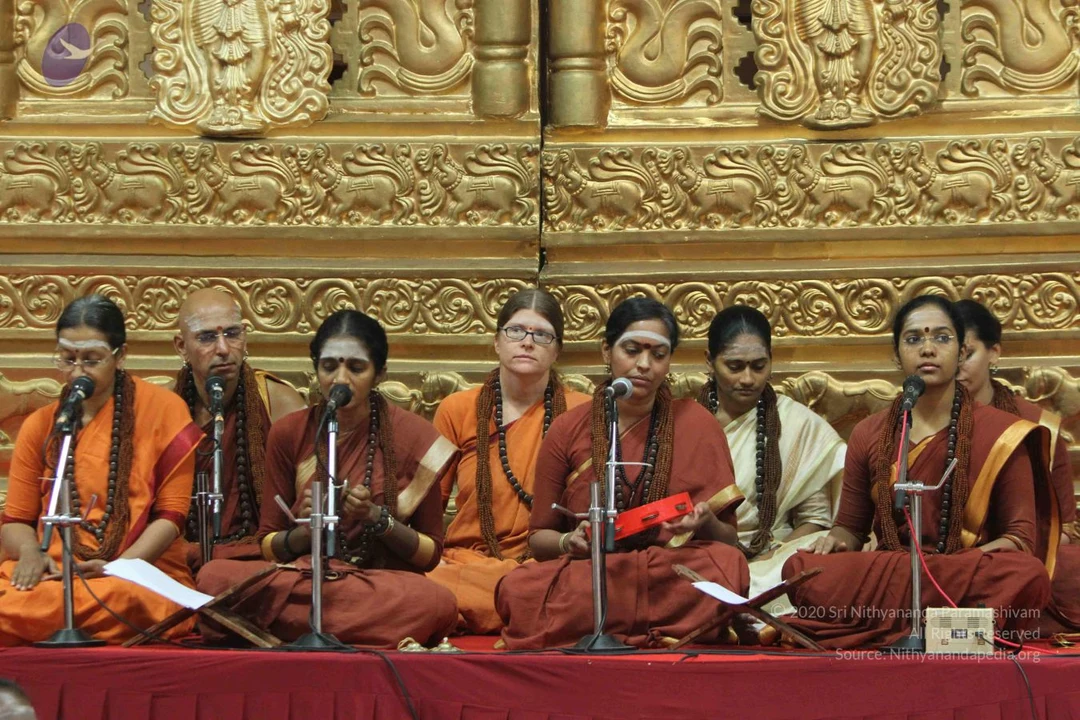
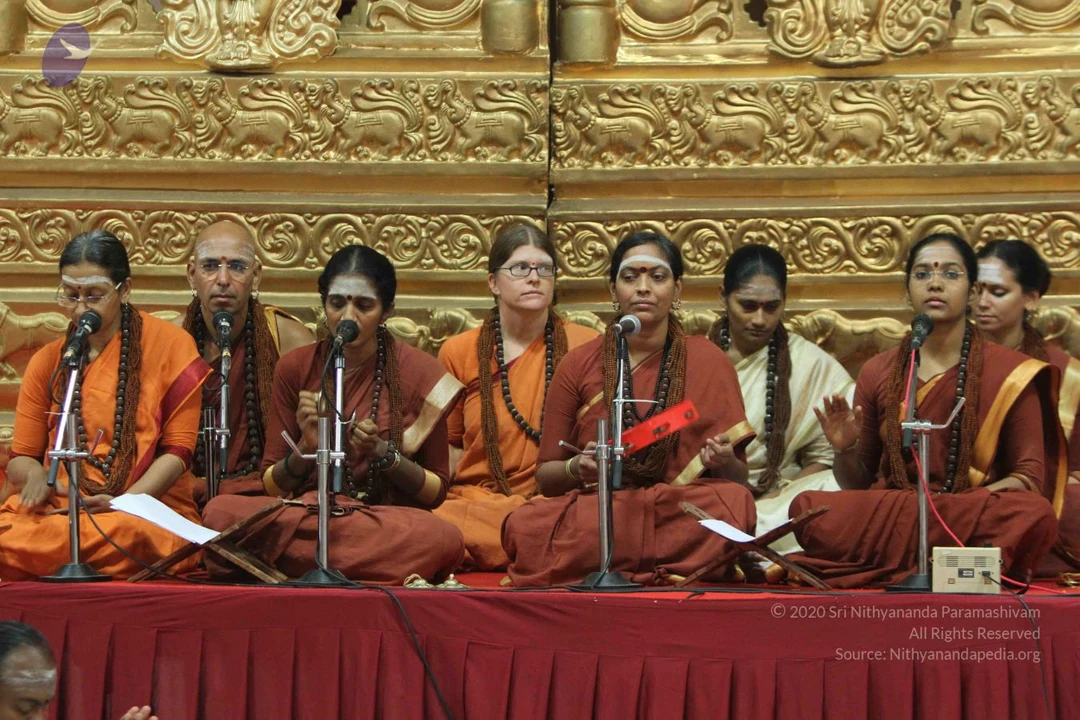
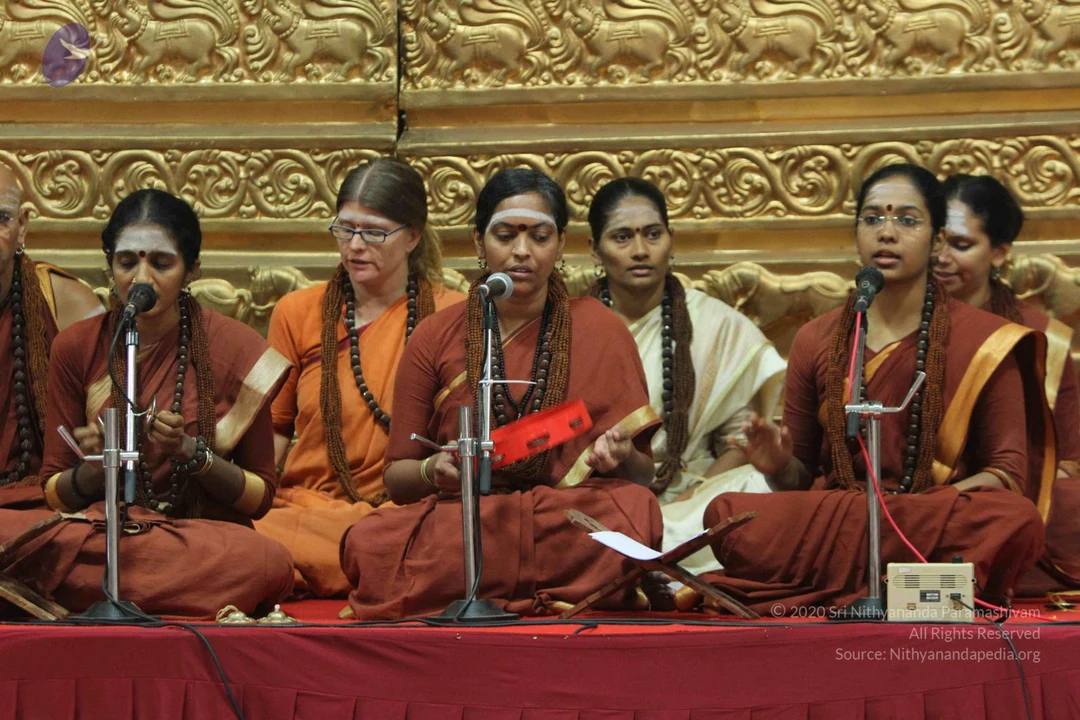
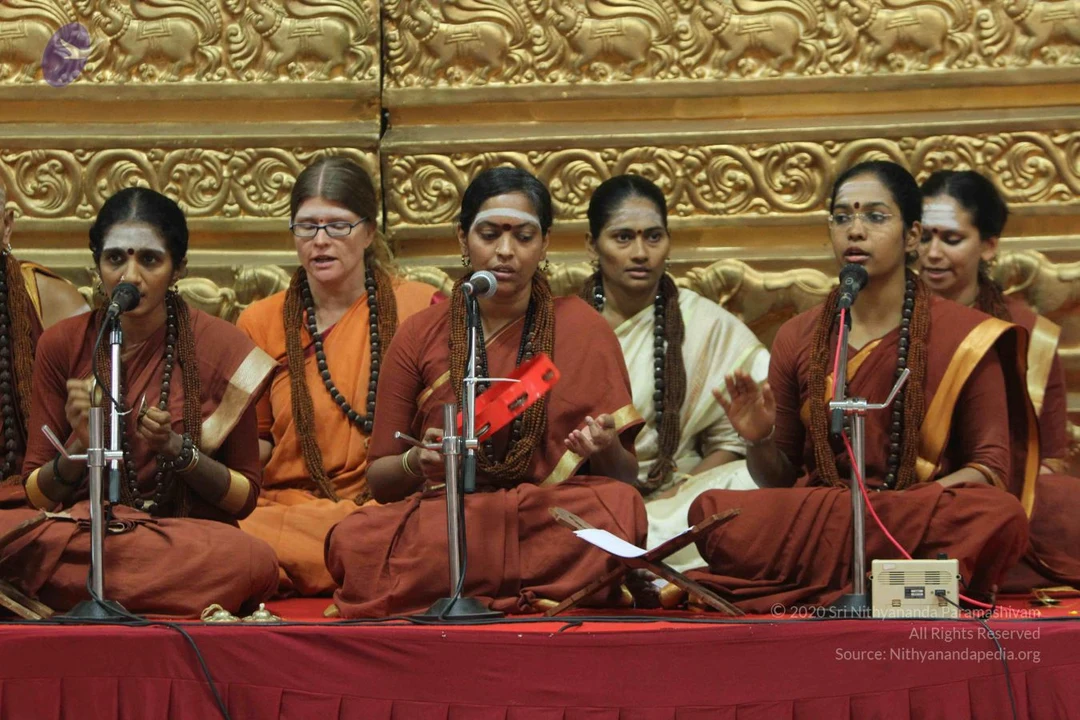
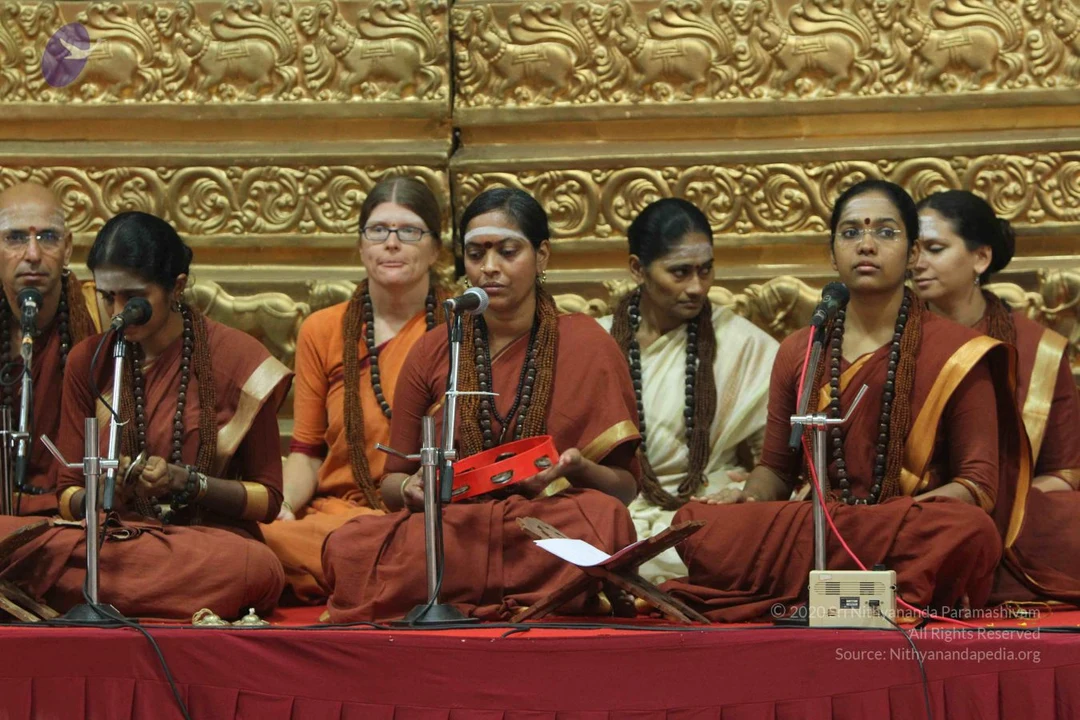
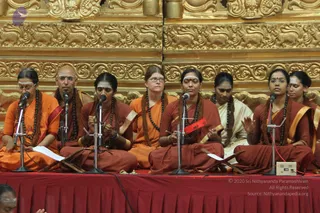
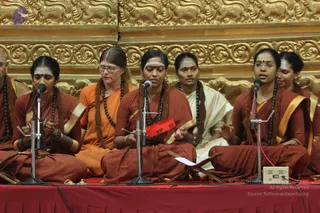
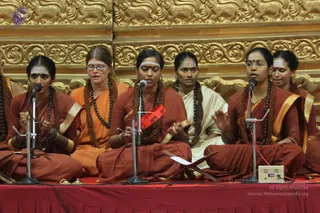
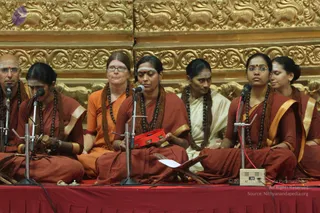
A group of seven devotees sit cross-legged on a red-draped stage in front of an ornate gold-leaf carved wall, each seated before a microphone on a stand. Most wear rudraksha malas; the robes range from orange to deep maroon, with one woman in a white sari. Several have white tilak marks on the forehead. Some hold small percussion instruments, including a red hand drum, and papers rest on music stands.A photograph of a row of seated devotees chanting at microphones on a red draped stage in front of ornate gold carved panels. Most wear orange or rust-red robes with rudraksha malas and white vibhuti lines on their foreheads. The second figure from left is bald with glasses and wears an orange robe; a woman in the centre wears a red robe and holds a red object; other women wear saffron and red saris. Several hold small paper sheets. A small amplifier sits at the right edge, and a few blurred heads appear at the bottom left.Six women sit cross-legged on a red-draped stage before a gold-embossed backdrop of lions and scrolling floral relief, singing from paper sheets at standing microphones. The women in the front row wear rust-red and maroon saris with gold borders and rudraksha malas, with white vibhuti and kumkum on their foreheads. A woman in orange robes and a woman in cream and white sit among them. A small red harmonium-style instrument rests on the floor in the centre. The group appears to be performing devotional chanting during a satsang programme.A group of six women sit cross-legged on a red stage draped in red cloth, singing into microphones on metal stands in front of an ornate gold-toned carved wall with lion reliefs. Most wear rust-red saris with gold borders and rudraksha malas; one in a orange robe and one in a white sari with a grey-bordered cloth also sit among them. Several have white vertical tilak markings on their foreheads. Some hold small hand percussion and papers, and a red object and a small amplifier sit on the stage. Pictured as a devotional chanting or satsang performance.A photograph of a devotional music performance on a red-draped stage before a gold-embossed backdrop. Six people sit cross-legged behind microphone stands. A woman in the centre plays a red tambourine and holds a sheet of paper. Several women wear rudraksha malas, rust-red and saffron robes with gold borders, and white forehead markings. One woman in a cream sari with a rudraksha mala sits at the back. A man at the far left in a red shawl and glasses sits behind a microphone. A woman in a saffron top with glasses sits at the back centre. No a person candidate is visible.A man seated on an ornate gold throne with carved floral and scrollwork backrest and red upholstered cushions. He wears a saffron-orange draped garment over his shoulder and torso, long gold-toned rudraksha-style mala beads hanging to his chest, and beaded bangles on both upper arms. He has a white vibhuti horizontal mark with a red kumkum dot on his forehead, gold earrings, and a small clip-on microphone near his mouth. a person seated in a satsang setting, with distinctive saffron robes, mala beads and ceremonial adornments. Visible people: one.

SWAMIJI-PLAYING-MUSIC
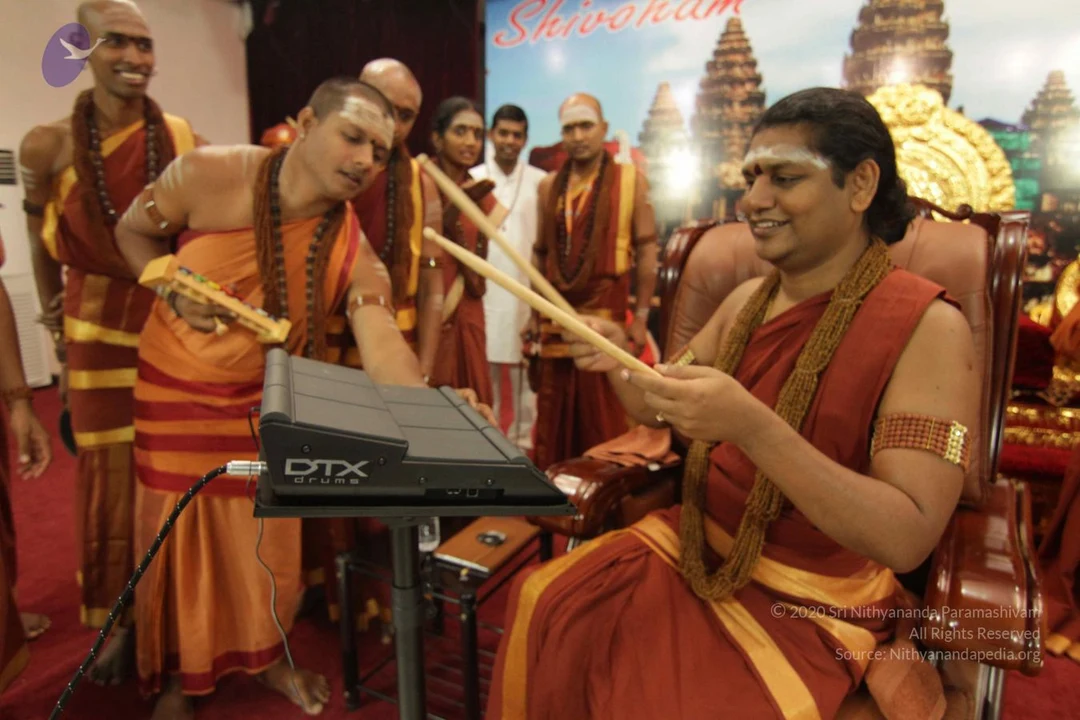
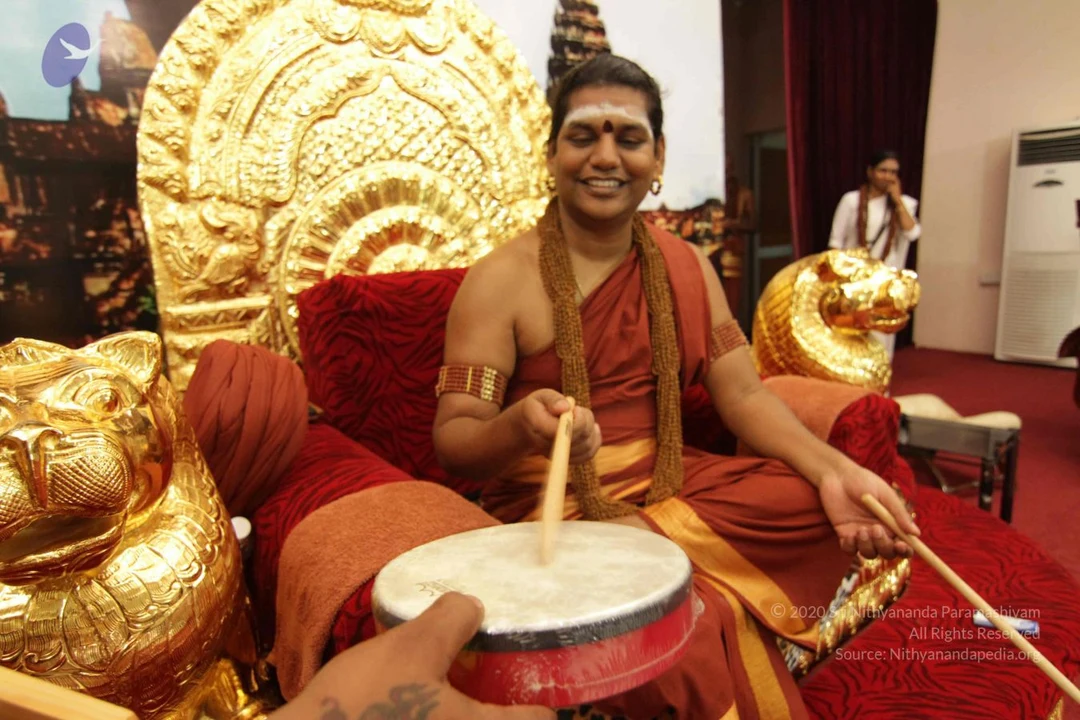
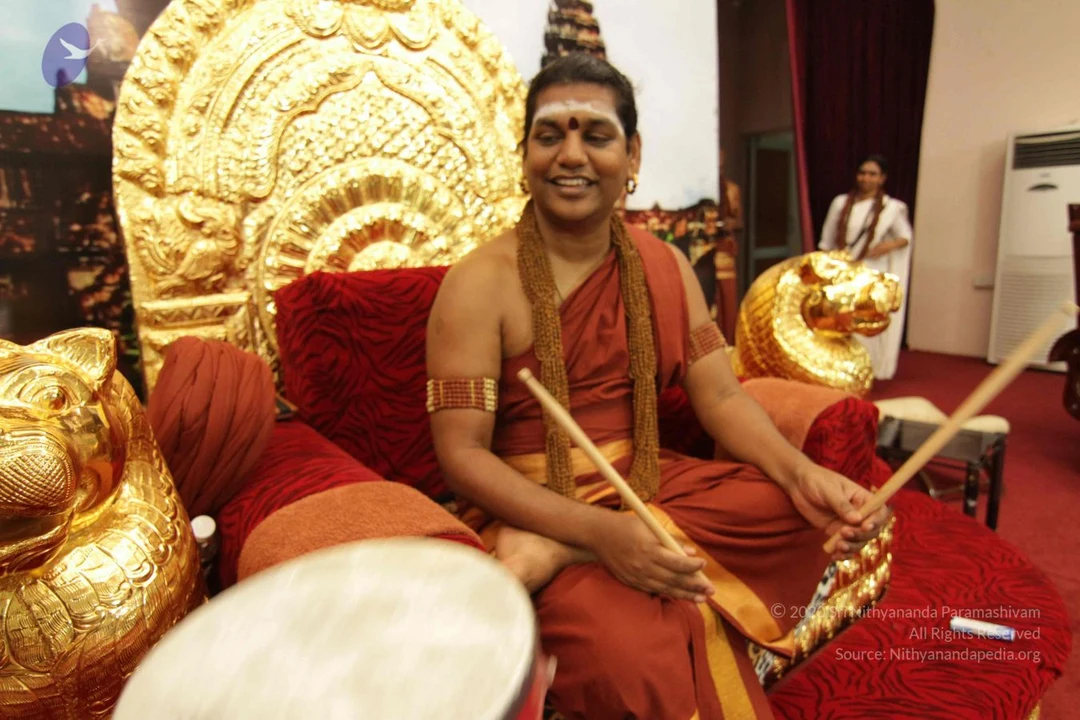
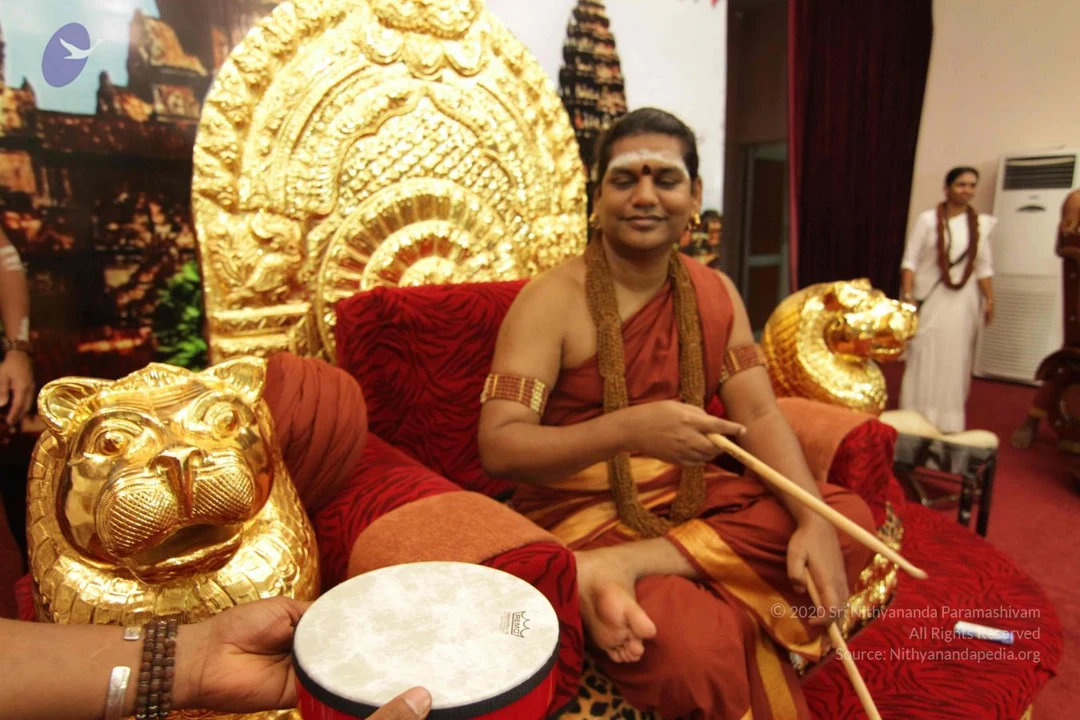
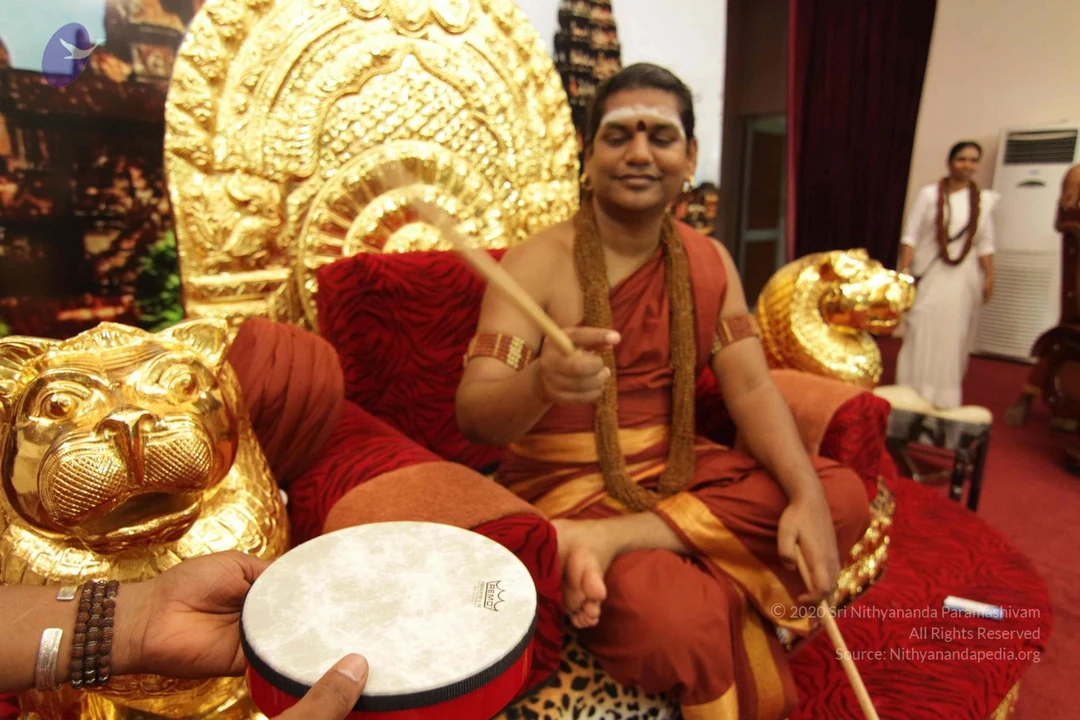
38 photosSource gallery
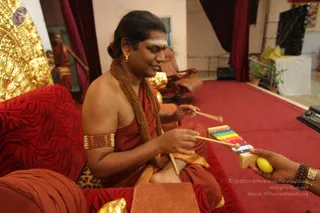
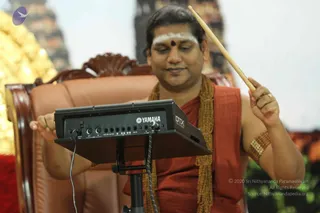
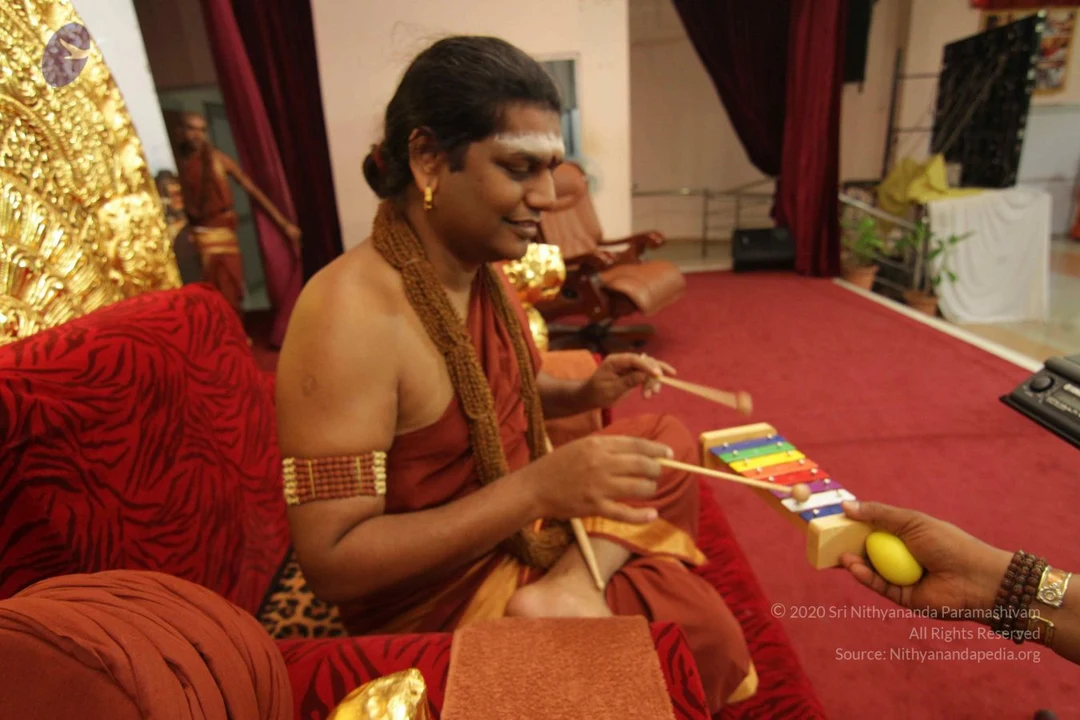
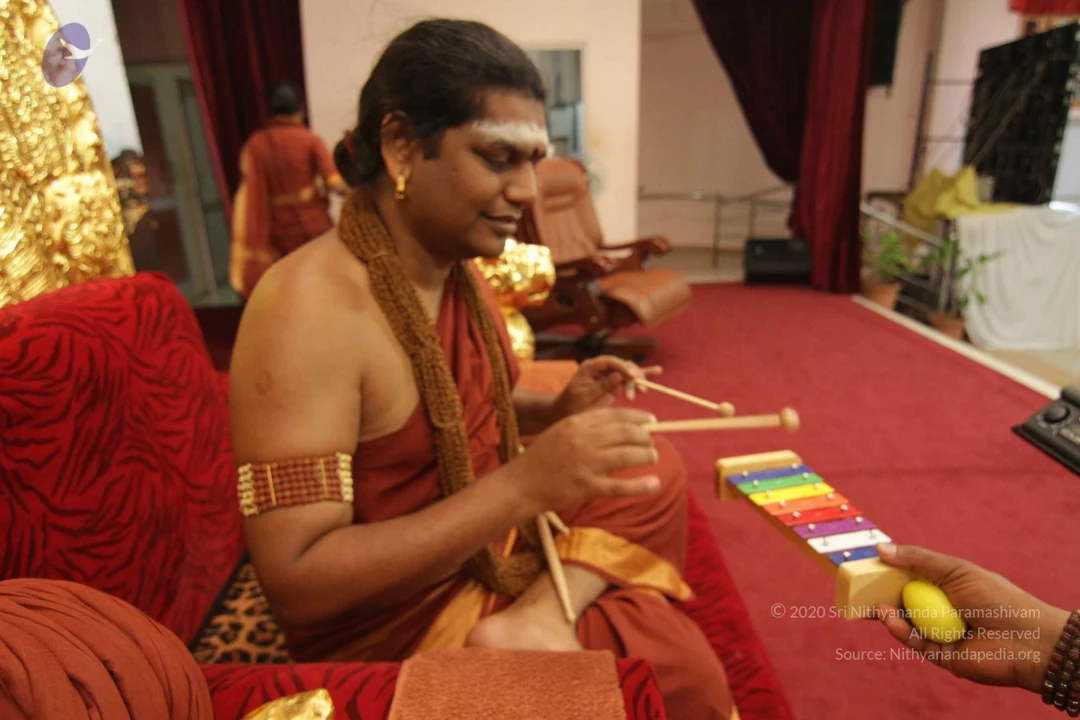
A seated figure in a red-orange turban with a dark feather, wearing an orange-red shawl over the shoulder, a heavy gold necklace and gold armlets, receives a kneeling woman in a cream sari with gold border. The woman bends forward with folded hands and holds a small object toward the seated figure, who reaches out to take it. The seated figure is a person by a swept-up turban, ornate gold jewellery and saffron-red clothing, though the face is only partly visible. Behind them a red carpet, a red curtain, a standing young man in white, and a figure in orange in the background suggest a satsang or ashram hall with a gold-trimmed seat and red cushions to the left.A seated man in an orange-red robe and a brown rudraksha-style beaded necklace plays a multicoloured wooden xylophone with two mallets while seated on a red tiger-print cushioned seat with gold ornamental carving. He wears a white forehead marking, a gold earring and a beaded armband. A hand at the right edge holds a yellow mallet near the xylophone. Behind him, a second person in orange clothing stands near a gold-ornamented backdrop, with red curtains, a brown leather chair and potted plants in the room. Appearance cues are not distinctive enough to confirm identity, so the seated man is described by role only.A seated man in red-orange robes with a bare upper body sits on a red patterned cushioned seat, playing a rainbow-coloured xylophone with two wooden mallets. A shawl-like orange cloth covers his shoulder, a long brown beaded mala hangs at his chest, and gold armbands and earrings are visible, with a white tilak on his forehead. A hand holding a yellow mallet appears at the right edge. Behind him are a gold-decorated throne back, a brown reclining chair, red curtains and a red carpet. Another person in red clothing stands in the background.A smiling man seated on an ornate golden throne with carved lion-head armrests and a golden arched back, playing a hand drum with two drumsticks. He wears saffron-orange robes with a gold-bordered cloth, a long rudraksha mala, gold armlets, a white vertical tilak with a red bindi, and a gold earring. A tattooed hand holds the drum's edge in the foreground. Behind him a backdrop shows temple architecture, and a woman in white stands near a white air conditioner. The man shows the appearance cues of a candidate, so a person is noted with his mala, saffron robes and ornate gold throne as qualifying cues; the page places him at a Satsang.A smiling person seated on a red upholstered throne with gold lion-head armrests and a gold ornate backrest, playing a drum with two wooden sticks. The person wears a saffron-orange dhoti and shawl, a gold-bead rudraksha-style mala, gold armlets, white vibhuti on the forehead with a red kumkum dot, and gold earrings. A drum with a white head sits in the foreground. In the background, a woman in white clothing stands near a red curtain beside an air conditioner, and a backdrop shows a temple tower. The setting is an indoor satsang hall.A seated man in rust-red ochre robes sits on an ornate red velvet throne with gold lion-head armrests and a large gilded arch behind him. He wears a rudraksha-style bead necklace, gold armbands and white forehead markings, and holds a drumstick over a small hand drum held by another person's hand in the foreground. A standing woman in white with a beaded necklace stands at right, and a backdrop shows an illuminated temple at night. Setting appears to be an indoor event hall with red curtains and an air conditioner. a person appearance cues include ochre robes, beaded necklace and gold ceremonial armbands, with the throne and ochre attire as seating context.