Skip to content
Tuesday

4 November 2014

Dated photos
85
Source pages
1
Media
3
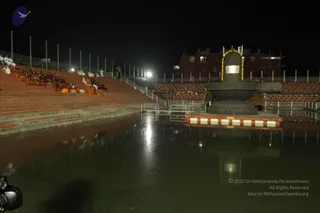
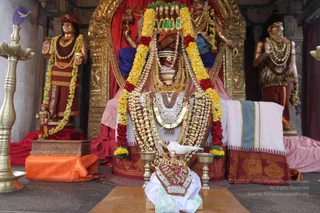
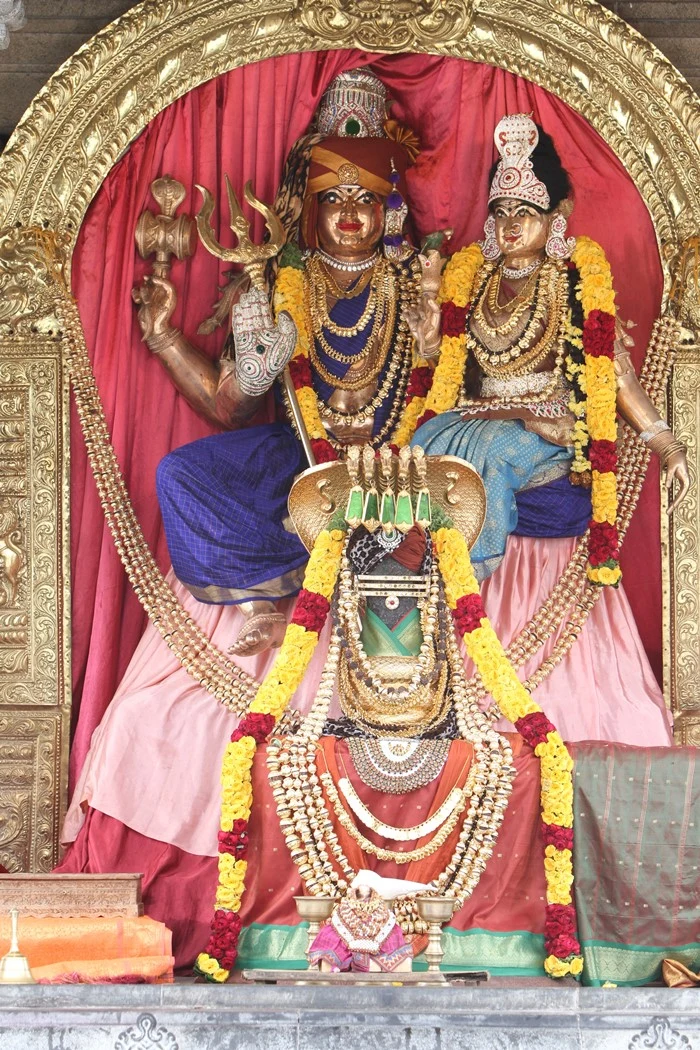
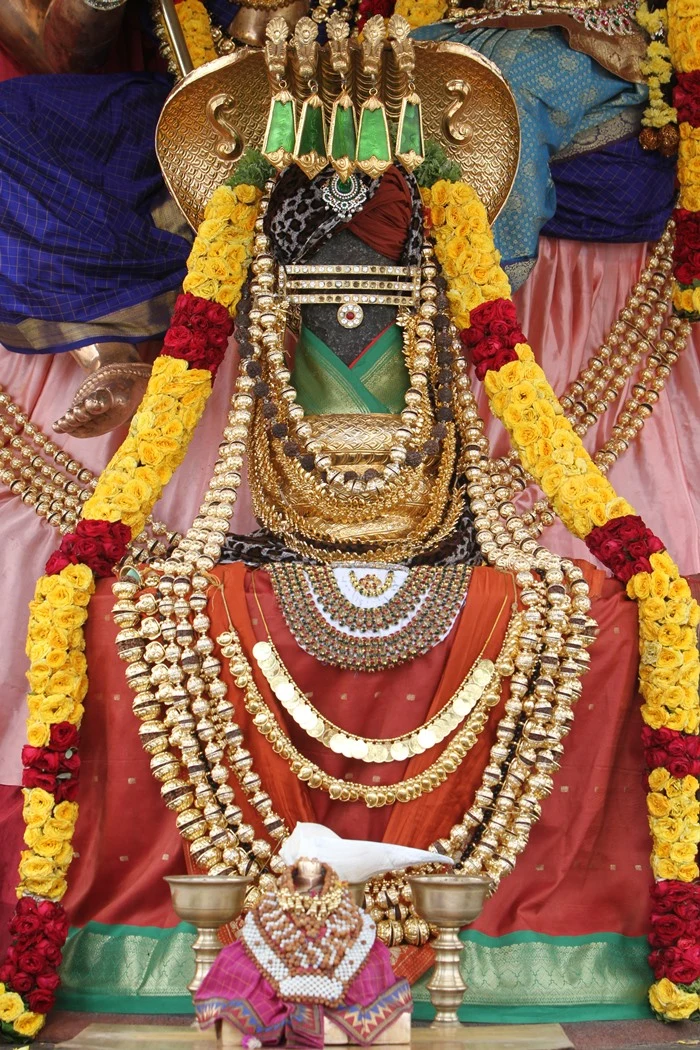
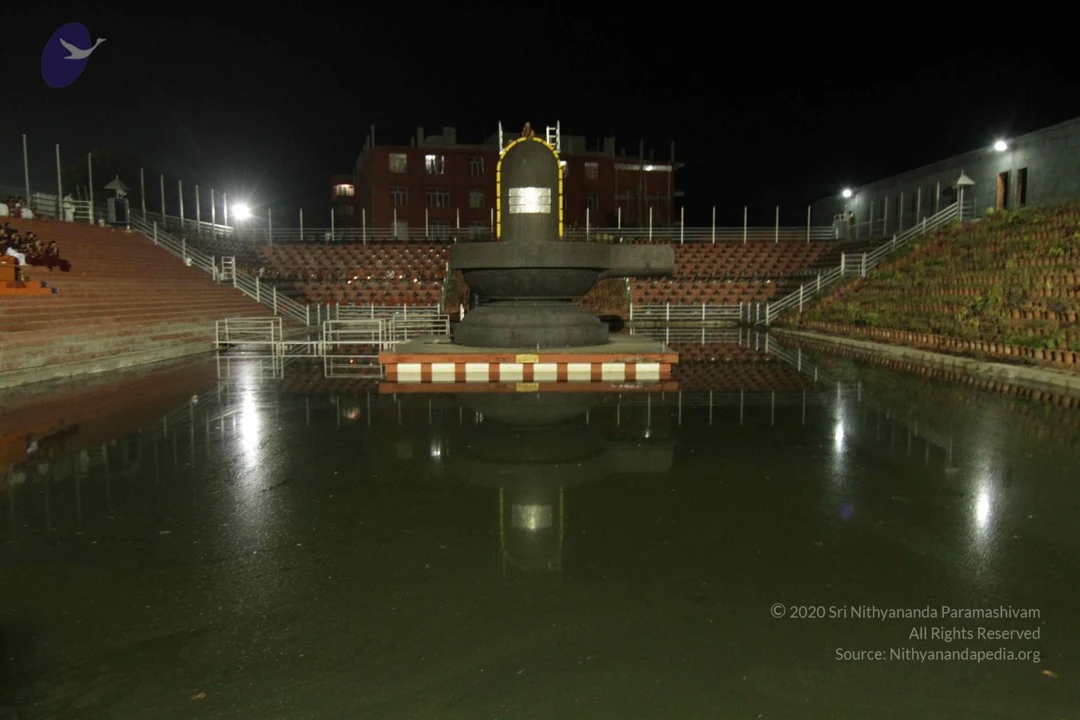
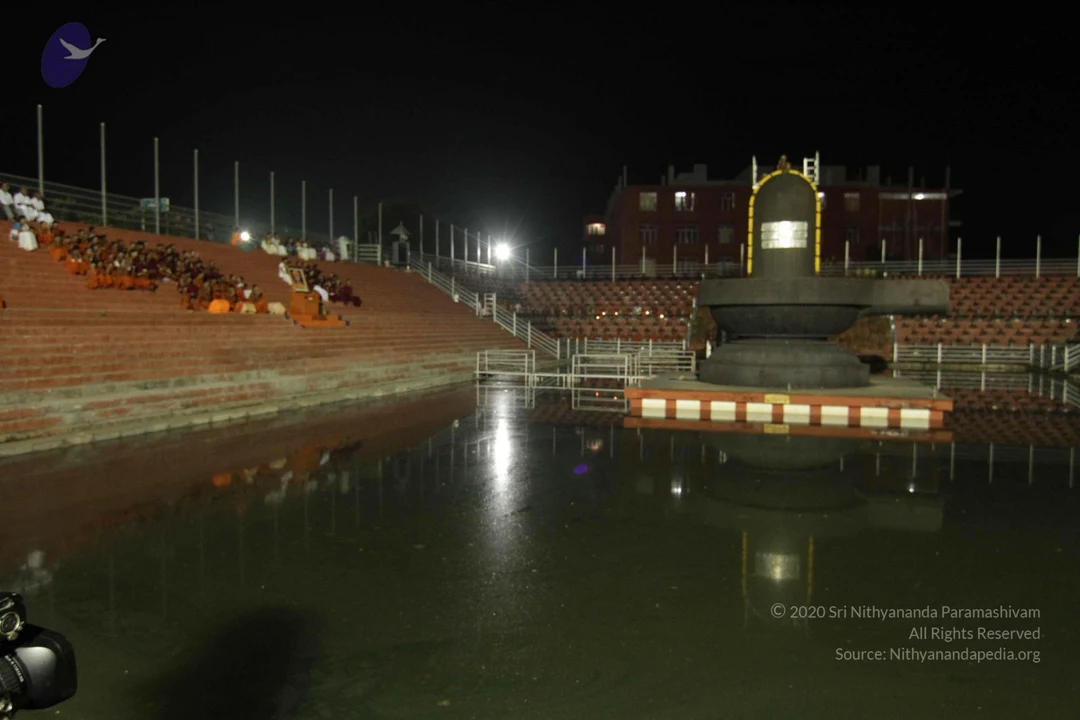
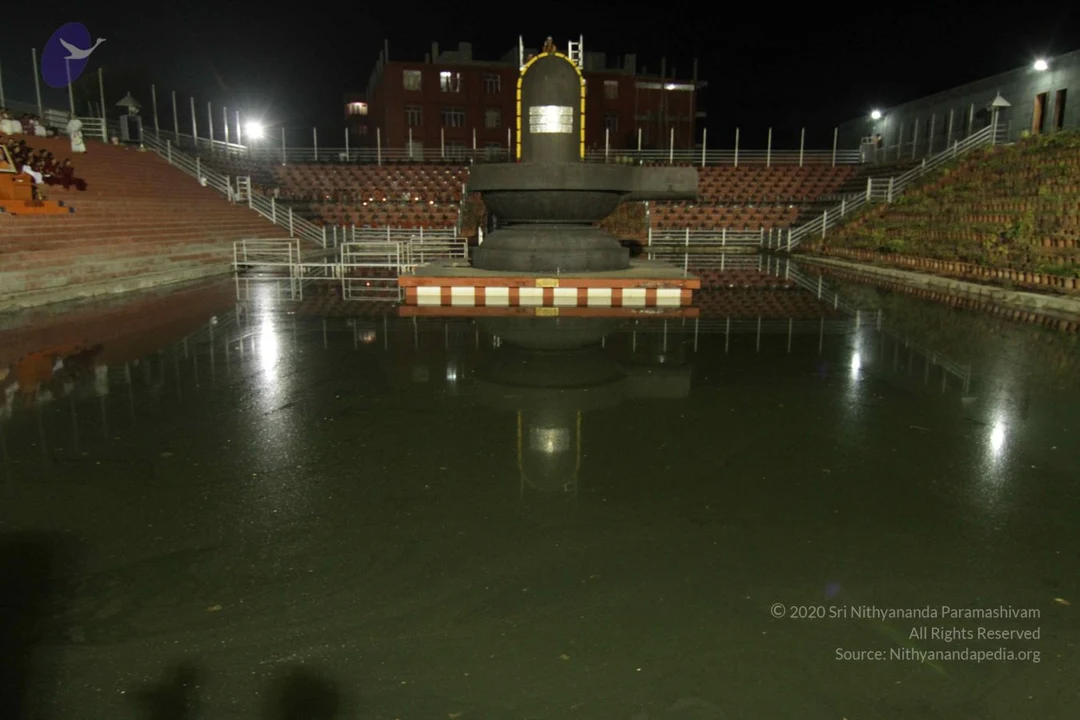
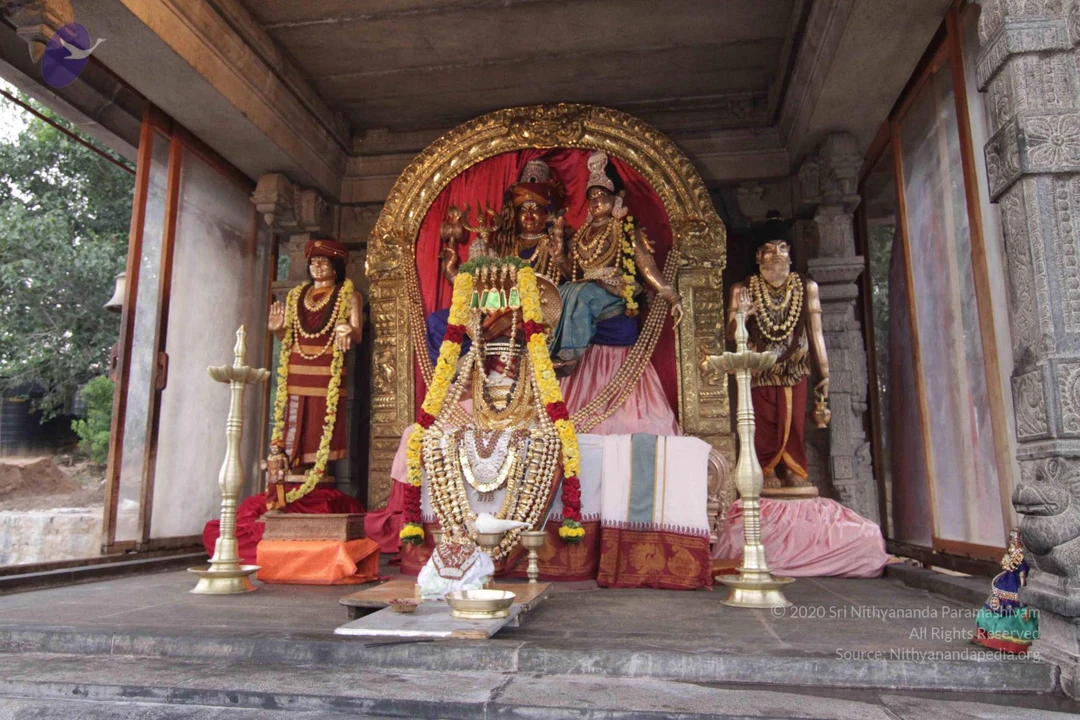
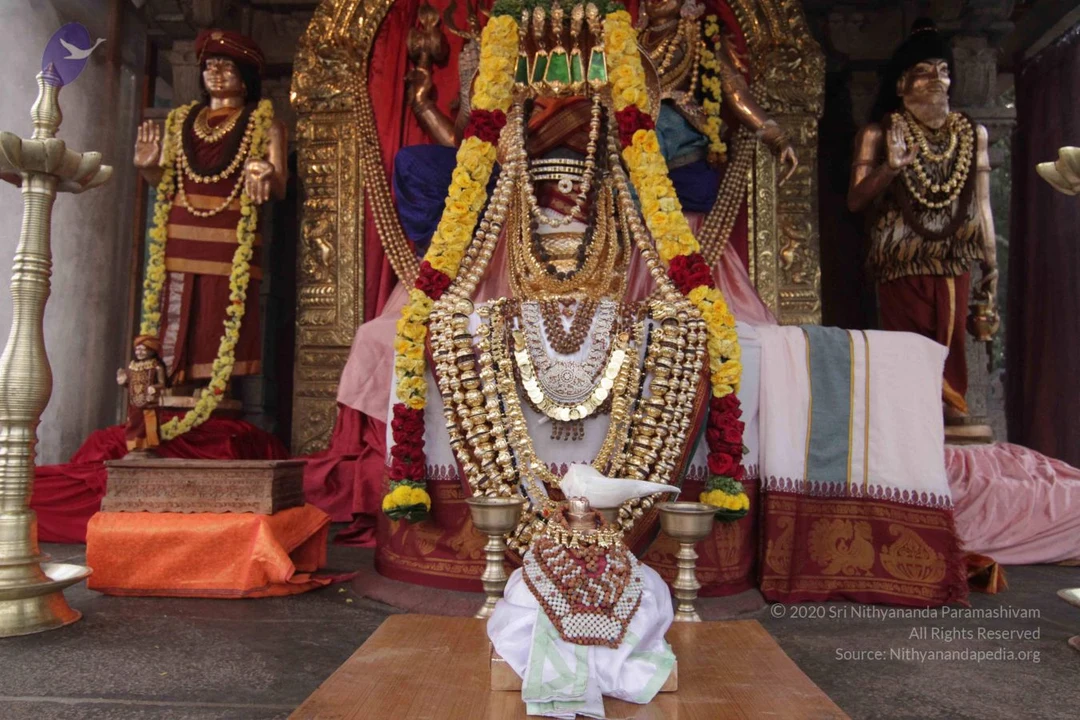
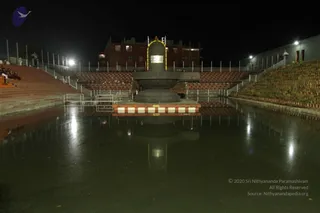
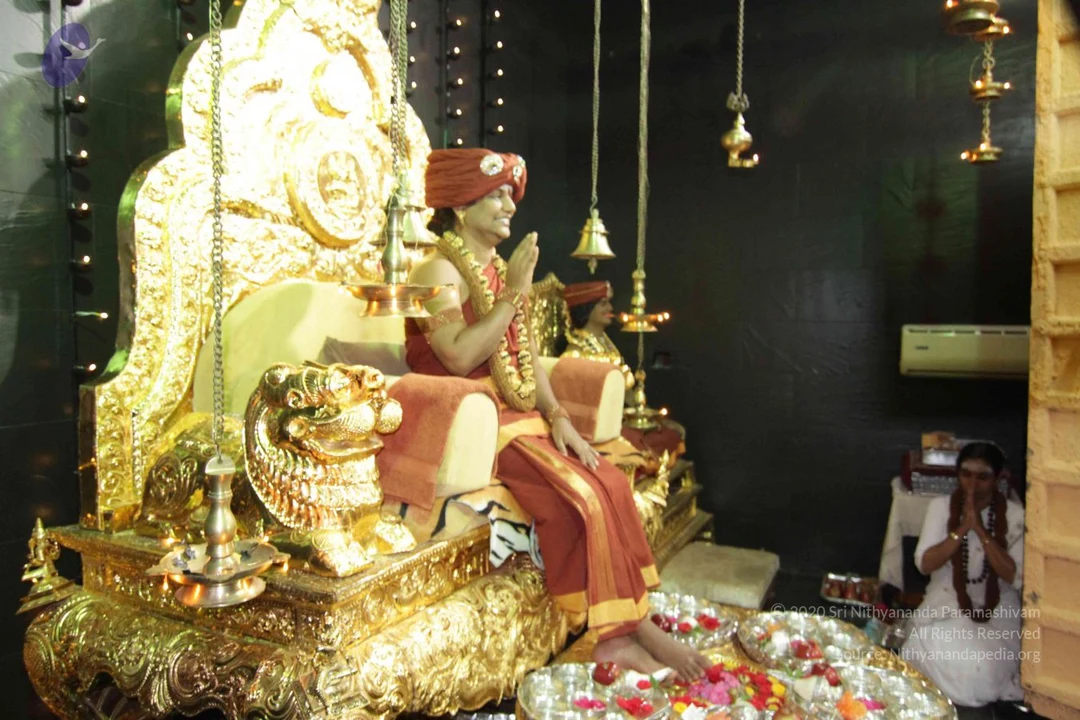
Night photograph of an outdoor ritual pool with a large black stone Shivalinga rising from a square base on the water's edge, its yoni-style base rimmed by red-and-white striped border, decorated with yellow garlands and lit by a bright lamp. Steps on the left lead up to a seated gathering of devotees in orange and white clothing, with a small raised platform and lectern near the front. Floodlights and a red brick building stand behind the pool.Photograph of a richly decorated deity murti at a temple shrine, adorned with layered gold necklaces, a silver chest ornament, and a tall crown with green and gold elements. Garlands of yellow marigolds and red roses drape the figure. In front stands a white cloth-draped platform with a conch-like offering, flanked by brass oil lamps. Behind are golden-hued standing statues of sages with folded hands, one in rust-red robes and one in dark robes with a rudraksha-style necklace, along with a red and gold backdrop. No living people are visible.

November 04 2014

Original wiki page
Contents

Title:

The Master's Bouquet

Description:

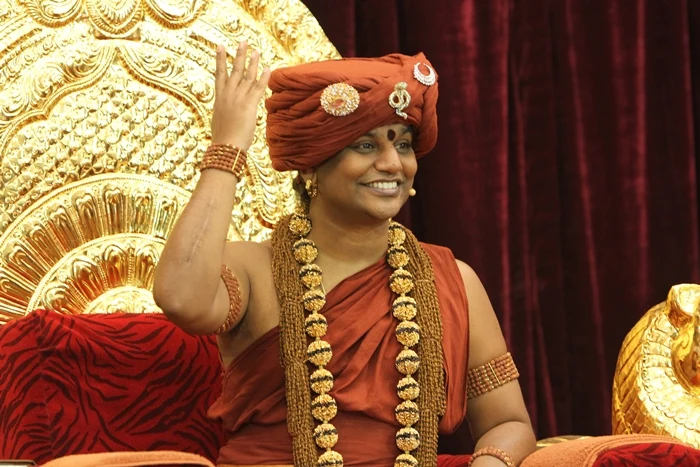
In today’s morning Satsang, Paramahamsa Nithyananda speaks about how different religions ultimately have the same goal but it is only the path that is different. The uniqueness of what he is sharing is that not all paths have the same speed or comfort. Living with the best context and authenticity is the key that makes Nithyananda Sampradaya unique.

VideoAudio

Transcript:

Nithyanandeshwara Samaarambhaam Nithyanandeshwari Madhyamaam | Asmath Aachaarya Paryanthaam Vandhey Guru Paramparaam ||

I welcome all the devotees, disciples, samajis, satsanghis, Shrimahants, Mahants, Kotharis, Thanedars, sitting with us all over the world through Nithyananda TV, Sadhna TV, and two-way video-conferencing having Nayana Deeksha.

Cities sitting with us through two-way video-conferencing: Harris Plains New Jersey, Surrey-Canada, Los Angeles-Hollywood, Nithyananda Nagar-Rajapalayam Aadheenam, Kuala Lumpur-Palani Aadheenam, Nithyananda University-Paris, Hong Kong-Sirkazhi, San Diego-La Jolla, Indrani-New Jersey, Seattle-Chidambaram, Toronto Aadheenam, Surrey-Canada, Colombo-Sri Lanka, Guadeloupe-Rameshwaram, Houston-Kalahasthi, Amersfoort-Netherlands, Premayananda-Dubai, Warrington-UK, Los Angeles Peetam, Hyderabad-Gupta Kashi, Oklahoma-Somanathan, San Jose-Madurai, Ohio-Prayag Temple and more cities are joining.

I welcome all of you with my love and respects.

Last few days I am just soaked in Cambodia temples!

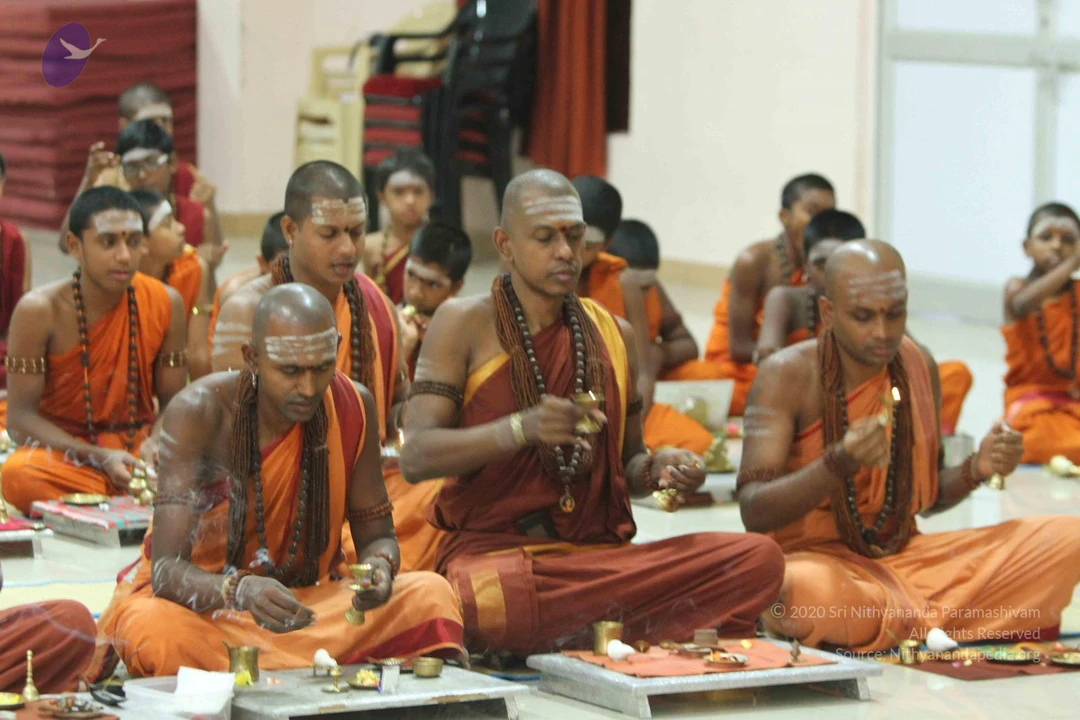
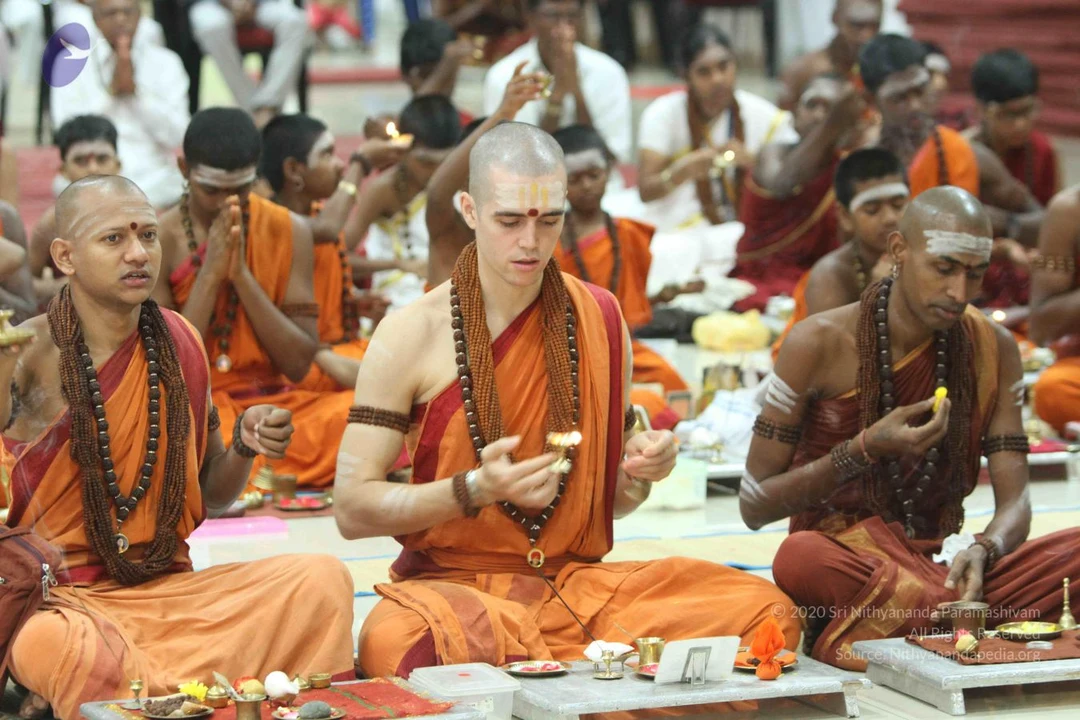
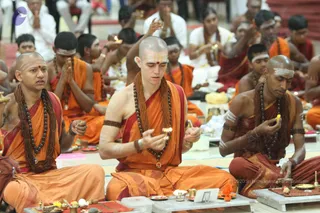
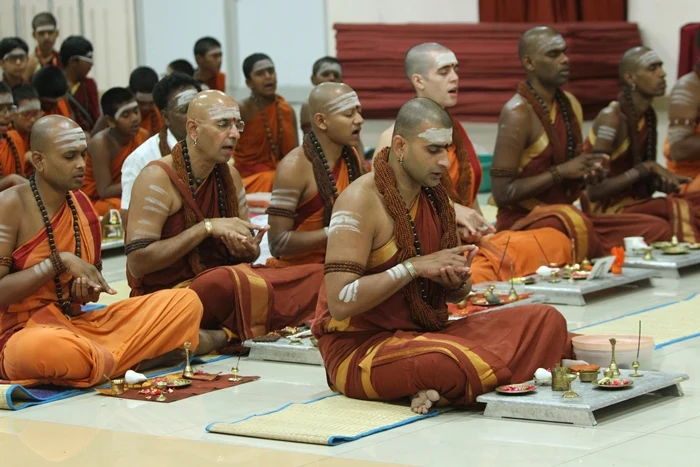
Before entering into the satsangh, let me remind all of you today is Maha Parinirvana Day, the day my biological father achieved enlightenment and left the body. I think as per the Hindu calendar, “Thithi”, “Punya Thithi”, we are observing this festival, this ritual. “Punya Thithi” means, the day they left the body, that day is called “Punya Thithi”. So as per the Vedic tradition exactly on that same “thithi” we are observing this Maheshwara Puja not only for my father, all the devotees, disciples, who lived Jeevan Mukthi, who were striving for Jeevan Mukthi, initiated disciples who lived Jeevan Mukthi, for all of them today we give “shraaddha”, we give “pinda tharpana”, and we are doing Maheshwara Puja. The best place on Planet Earth to give “pinda tharpana” is the stomach of a sannyasi. That is the “jataraagni”, the hunger fire of a sannyasi is the best fire on which you can offer the “pinda tharpana”, the “shraaddha”, which reaches the “pithrus” directly. It is thousand times more greater than offering any “pinda” , any “shraaddha”, in any river, any water-body, any tank, any lake, any holy land, any holy place. Offering it in the stomach of a sannyasi is the best, best form of “pinda tharpana” and “shraaddha”.

I can challenge, in this whole world you will never find this many number of authentic Sannyasis anywhere! I guarantee you with my name, this many Sannyasis authentically, authentically living! I am telling you, I have lived in all monasteries: I have stayed in many Christian monasteries, I have stayed in many other religions’ monasteries, I have stayed even in Hindu monasteries. With all this authority I am telling you, this many number of Sannyasis, authentically living Advaitha, you will find only in Dhyanapeetam. We are the place where the largest number of Sannyasis are living the highest possible authentic Living Advaitha. And the way they handle their each problem and solve it just only by Advaitic understanding! Understand, I am a too powerful perfectionist, task-master, trainer. That’s the right word I have to use! “Too, too, too perfectionist, powerful, task-master, trainer”! Even the same result I want, I will not allow them to achieve using some other method or technique other than Living Advaitha. Not just the “goal”, even the “path” I won’t compromise!

See, for example, living a simple life. If somebody is living a simple life because of their poverty consciousness, it is stupidity. From a very young age they believe they are poor, and their life is going to be poor. Out of that pattern, if somebody is living the poverty, I will not accept that as a “simple life”. You will see automatically the situation will happen in such a way their desires will be aggravated, their greed will wake up. Only if they come to the conclusion and decision of a “simple life” because of Advaithic understanding – || तेन त्यक्तेन भुञ्जीथा मा गृधः कस्यस्विद्धनम् || “thena thyakthena bhunjeethaa, maa gridhah kasyasvid dhanam” – “By renouncing everything, celebrating everything.” This is the Advaithic context of renunciation. By renouncing everything, celebrating everything. I will let them rest in peace and live even humbleness if they understand this right context, not till then! Everything they do, even if the goal is as we want, as desired, I will not keep quiet or tolerate and accept or adjust. I will see to it even the understanding, path, the reason why their perfect, is also perfect. Only then that perfection will be perfectly perfect and be eternal. If that perfection is achieved by wrong reason, it’ll never be eternal. If somebody achieves “simple life” out of poverty consciousness, I challenge the moment he gets easy money, all his “simple life” will disappear. If somebody lives a “simple life” because of this grand understanding – || तेन त्यक्तेन भुञ्जीथा मा गृधः कस्यस्विद्धनम् || “thena thyakthena bhunjeethaa, maa gridhah kasyasviddhanam” – “Celebrating everything by renouncing everything”.

ईशा वास्यमिदँ सर्वं यत्किञ्च जगत्यां जगत् ।

तेन त्यक्तेन भुञ्जीथा मा गृधः कस्यस्विद्धनम् ।। १ ।।

कुर्वन्नेवेह कर्माणि जिजीविषेच्छतं समाः |

“Eeshaa vaasyam idham sarvam, yath kim cha jagathyaam jagath

Thena thyakthena bhunjeethaa, maa gridhah kasyasviddhanam”

“Kurvan-neveha karmaani jijeevishecchatham samah”

“Whatever is, by renouncing celebrate”

“By renouncing the idea of “I” and “Mine”, celebrate whatever is”

Not just the end result, even the context, again and again and again, I bring it to Living Advaitha. That is why I am telling you, you will find so many Sannyasis all over the world, no doubt, who are living the same result, who are as simple as my Sannyasis and as dedicated as my Sannyasis, as pure as my Sannyasis; but I tell you, this one thing, with a lot of bliss, I can challenge, not out of ego or arrogance, with a lot of bliss I declare. No need even to challenge, I declare, you will not find Sannyasis who will have so many right reasons for what they are, and who they are, why they are the way they are. That I can be very sure because the amount of understanding given to them, the amount of knowledge transferred to them, the amount of experience transmitted to them, the amount of right things shared with them, the amount of the right knowledge showered on them, with that, almost spending fifteen years on this Sannyas training and thirty-seven years of me being directly trained by my Gurus and by my great disciples – I have a training and reverse training, both – after being trained thirty-seven years in Sannyas by my Gurus and by my disciples, by various organizations and traditions.

I have to tell you guys, I don’t feel shy at all to tell this, I have trained, I got training and initiation in various Sannyas sampradhayas of Hinduism. In so many Sannyas sampradhayas of Hinduism I had a training and initiation. ‘He doesn’t belong to Advaitha, he doesn’t belong to Shaiva, he doesn’t belong to Siddhantha, he doesn’t belong to Vedantha, because he did that also, he did this also!’ But, history cannot be hidden. History is history. I have had initiation and training in multiple Sannyas sampradhayas of Hinduism, because I had so much of passion, intensity to explore every sampradhaya and collect all the best things from every sampradhaya.

I tell you guys, all the best things, whether it is the way my Sannyasis dress, or the things they eat, or the way they live, whether the lifestyle practices like kriyas, yoga, mental understandings, knowledge, the way they solve their problems, the way they approach themselves, others, world, life, human-beings, the Sangha members, everything. I tell you I have collected the best flowers from all the Sannyas traditions and made a beautiful bouquet – that is my Sannyasis! That is my Sannyasis! All the best understandings, for example, the extreme love and devotion of Ramaaya Sampradhaya and the extreme purity, and fire, Advaithic fire of the Shuddha Vedanthis, Shuddhaadvaitha Vedanthis, and the extreme renunciation, the way they handle their body, purely from Aghoris, and the way they sing the kirtans, bhajans, music, the way the music and dance is celebrated is from the Gaudiya Sampradhaya, Gaudiya Vaishnava Sampradhaya, and the way they constantly repeat and maintain the space of Shivoham, from Shiva Advaitha Sampradhaya. Rama belonged to Shiva Advaitha Sampradhaya. Shiva Advaitha Sampradhaya originates from the Shiva Gita given to Rama by Mahadeva. From that the Shiva Advaitha Sampradhaya originates. The bhakthi and prema of the Ramaaya Sampradhaya, the music and dance of Gaudiya Sampradhaya, food and clothing style of Shaiva Sampradhaya, I have taken the best flowers from all the gardens, great gardens, and made the bouquet – that is my Sanyasis!

I am telling you even my Sannyasis do not know they have had so much training. I have collected the best flowers from almost all the sampradhayas. The best flowers from almost all the sampradhayas! Shaiva, Vaishnava, Madhwa, Shuddhaadvaitha, Shuddha Vedantha, Shankara, Siddhanta! The best things from all the sampradhayas I have collected because, I myself personally went through training in most of the sampradhayas and even had a formal initiations in many of these sampradhayas and saw the extreme experience, the goal of those sampradhayas from those contexts. With this clarity I am telling you, what Ramakrishna said: “Yatho math, thatho path” – “As many faiths, so many paths” – is true. I just want to add only one line: “As many faiths, so many paths”, no doubt. But there are some paths in which you can only travel in bullock-cart speed. There are some paths in which you can just take off like a jet. That I want to add, understand. That is why I am saying that all paths lead to the same goal, but not in the same speed or the same comfort. All paths lead to the same goal, but I don’t want to say all paths are same. Sampradhaya, Order, each Sampradhaya is created with one context and one goal. I tell you, our Sannyasis are living the best context and the best goal and best authenticity.

Today we will be having Maheshwara Puja, giving “shraaddha”, “pinda dhaana”, to all the disciples, devotees of our Sangha who lived, strived to live enlightenment and lived enlightenment, who lived these great teachings and left the body. For all of them, today we will be offering “shraaddha” and “pinda tharpana” in the form of Maheshwara Puja.

Today we also have Nithya Yoga Teachers’ Training.

And I tell you, when Vedanthis see my Sannyasis’ body flexibility, they can never accept our sannyasis as Vedanthis, because, Vedantha is somehow identified with a big belly and very inflexible body. It is unfortunate. It is not that all Vendanthis have big bellies. That is not true. There were many Vedanthis, great Yogis. But commonly. And Shaiva Siddhanthis can never tolerate when they see the joy radiated by my Sannyasis, and they can never understand or accept my Sannyasis radiating so much of joy. Because each Sampradhaya is created with a different context and different goal. Here I have collected all the best contexts and the best path and the best goal, made it into most user-friendly, easy to live, easy to radiate, because putting the context first. Once the context is understood, the life is simply lived. No teaching should be “practiced”. What is the meaning of the word “practicing”? Means you wanted, understood this is right, but still you are striving, struggling to live that completely. That is what is “practice”. “Practice” is a decent word to show your irresponsibility to live the truth as it is, your stupid failure to live the truth from the moment you understood it. That is why I don’t believe in “practice”. I believe in understanding the right context. The moment you understood the context, you are living it. And you are loving it. That’s all! The moment you understood the context, you are living it and you are loving it. That’s all.

Authenticity, “Authenticity” means: “What you like in your private Facebook page, liking the same thing in your day-to-day life, and showing it to the world as your like” is “Authenticity”.

I am giving a new definition of “Authenticity”: “What you like in your private Facebook page, where you changed your name and you kept a secret profile, in that private Facebook page what you like, in that private profile what you like, liking the same in real life also” is “Authenticity”. This is the definition of “Authenticity” for the modern-day youth.

Today we will have the Maheshwara Puja. I have so much to tell about Cambodia. Time only is so short! I am full of Cambodia temples now and I have even started picking up some of the designs from Cambodian temples and started inculcating in to our temples which we are planning and building all over the world in our Sangha. To that extent I am full of Cambodia temples now!

And we also are going to have a. See in Cambodia there is a special temple built only to give “shraaddha” to ancestors. We will plan and have one Maheshwara Puja in that same temple. And our Swamis are already sitting in Cambodia, organizing the event to make it as a grand celebration of Shivoham, celebration of Shivoham. Already all the arrangements are done, the basic arrangements. Now beautifully expanding and doing.

Understand, I am getting overwhelmed when I remember these Cambodia temples. I don’t know which one to speak and which one not to speak. There are some carvings which are seven-zero miles, seventy miles long! Please understand, seventy miles long! Seven-Zero miles long! I am not able to understand how did these guys do it. Because we are also carving seven feet, some seventy feet, and all that. How did those guys manage seventy miles?

Alright! It is really important we revive Cambodia temples. As I said, already we started working with the Cambodia Government, committing with them that we will install deities and bring the temple back to Cambodia. Please understand as on now it remains to be just a monument, tourist attraction. It is not a living temple. We are working with Cambodian Government; at least few temples we will install deities and revive it, make it as living temples, and show what a living Hindu temple means to the world. It’s our responsibility. We will do it. Our responsibility and we will do it!

So, with this, I bless you all Let you all radiate with Integrity, Authenticity, Responsibility, Enriching and Causing eternal bliss, Nithyananda. Thank you.

Nithyananda Times - 4th November, 2014

Photos
Tags:

"Paramahamsa Nithyananda",religions,authenticity,"Nithyananda Sampradaya"

Sakshi Pramana:

Sharing from Nithyananda Teachers training

Link to Facebook Page:

https://www.facebook.com/ParamahamsaNithyananda/posts/735431703211349

Photos Of The Day:

FB-photo-of-the-day
Photos Of The Day:

RUDRABHISHEKAM
TEMPLE
PADAPUJA
PUJA

NITHYA-KIRTAN

YOGA

VIP-VISIT

TEMPLE-CONSTRUCTION

Photos from this day

View all 85 photos

Photos

17 photosSource gallery
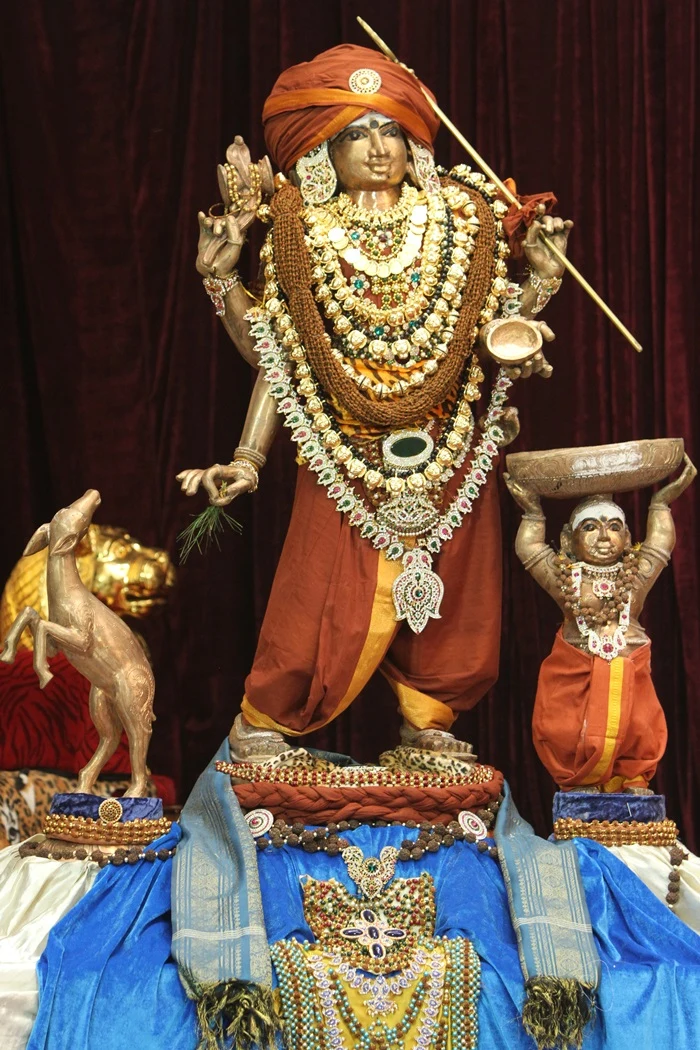
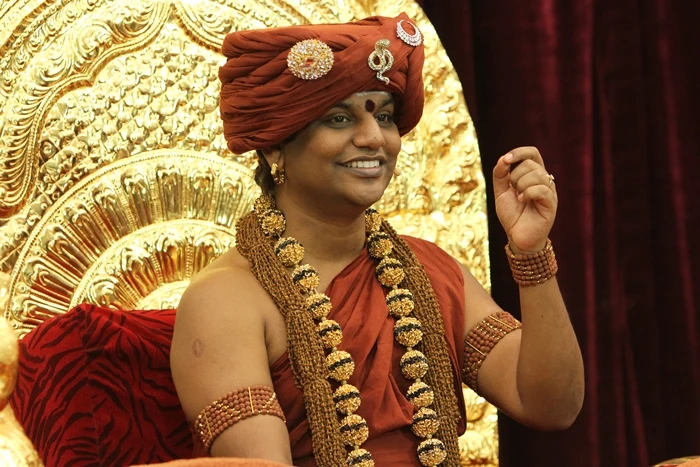
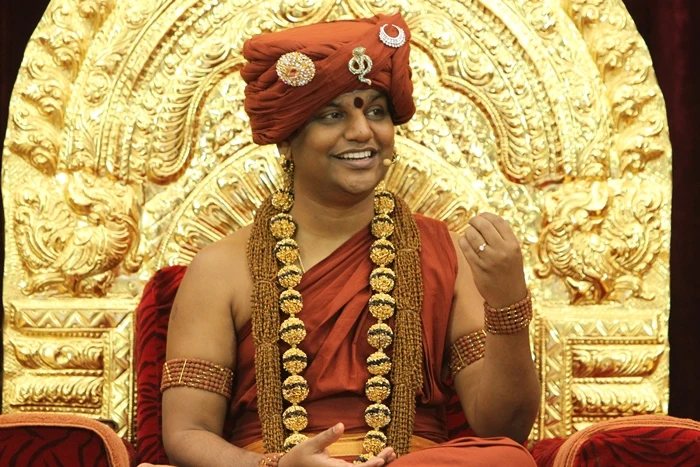
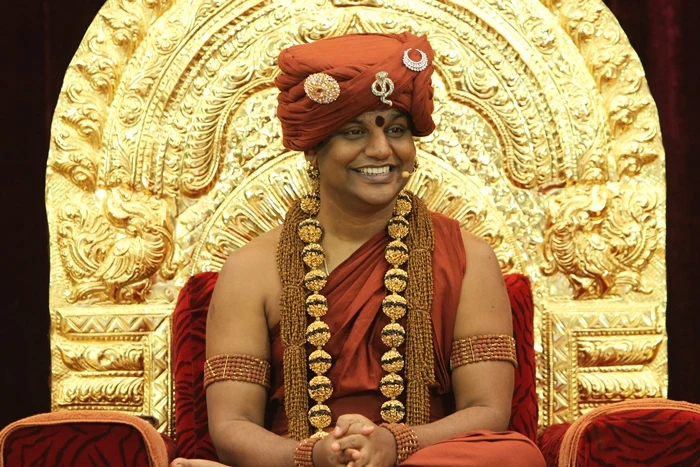
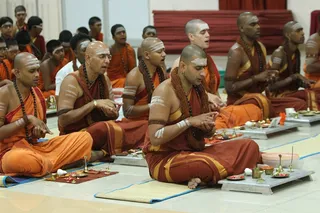
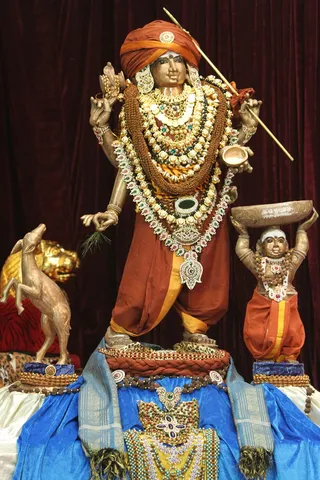
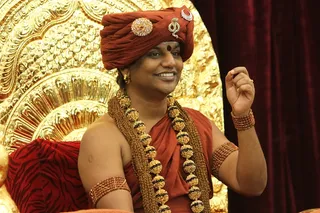
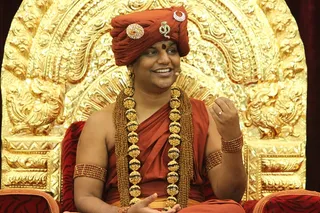
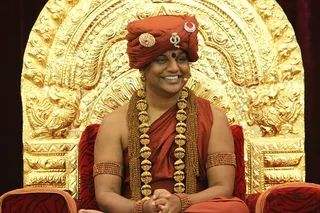
A group of men in saffron and maroon robes sit cross-legged on mats in a hall during a puja. Many have white sacred ash marks on their foreheads and arms and wear rudraksha malas. In front of them are brass oil lamps, small silver bowls, a brass kalasha-style vessel and incense sticks on raised metal trays. Several men hold their hands together in prayer or offering gestures while others chant. A red curtain hangs on the back wall, and more seated devotees in orange robes stand in the background.Seven people in saffron and orange robes sit cross-legged on a red-draped stage in front of an ornate gold-carved wall with lion and elephant motifs, singing with microphones on stands and paper song sheets in hand. Several wear rudraksha malas and forehead markings, and one at the far right with a shaved head and bare arms wears a saffron wrap and beaded bracelets. The group appears to be performing a devotional kirtan.A sculpted murti of a standing figure in bhiksha-dana style, shown in a shrine with a dark red velvet backdrop. The figure wears an orange-red turban, heavy layered gold and gemstone necklaces, a brown rudraksha-style mala, and an orange-red dhoti with gold edging. In the right hand is a bowl-like vessel and in the left a long staff topped with a red ribbon. Beside the figure stands a smaller figure in orange dhoti holding a large bowl overhead, and a gilded animal figure with a deer-like form sits at left. The base is draped in blue silk with jewelled ornaments and beaded garlands. This is a statue, not a living person.Photo of a smiling person seated on an ornate gold throne with carved gold relief, wearing a rust-red turban decorated with a jewelled brooch and a small gold emblem, and rust-red robes. Multiple heavy gold-toned rudraksha-style beaded malas hang around the neck, and matching beaded armlets and bangles adorn the arms. The right hand is raised in a gesture while the left rests on a red zebra-striped cushion. A deep red curtain stands behind. Swamiji (probable): the cues are the red turban, rudraksha malas and ornate ceremonial clothing, with the seated figure presenting as the honoured teacher at satsang.Photo of a smiling man seated on an ornate gold throne with carved lion and floral relief panels, wearing a saffron-orange turban with a jewelled brooch and crescent-and-trident ornament, an orange-red shawl over saffron clothing, and a long gold bead necklace with tassels. He wears gold armlets and bangles and gestures with his hands while speaking, a small microphone visible at his ear. Swamiji (probable): the saffron turban, ornate gold necklace and armlets, and orange-red robes match the page's description of a satsang with Paramahamsa Nithyananda speaking; the seated figure is a speaker at a discourse.Photograph of a smiling person seated on a red upholstered chair in front of an ornate gold-leaf carved throne backdrop with lion-like motifs. The person wears a rust-orange turban with a jewelled brooch and crescent-moon ornament, an orange-saffron shawl draped over the shoulders, a dense multi-strand gold bead necklace with a large gold-bead mala, gold bangles on both upper arms and wrists, and a red bindi. Hands are folded in the lap.

FB-photo-of-the-day

4 photosSource gallery
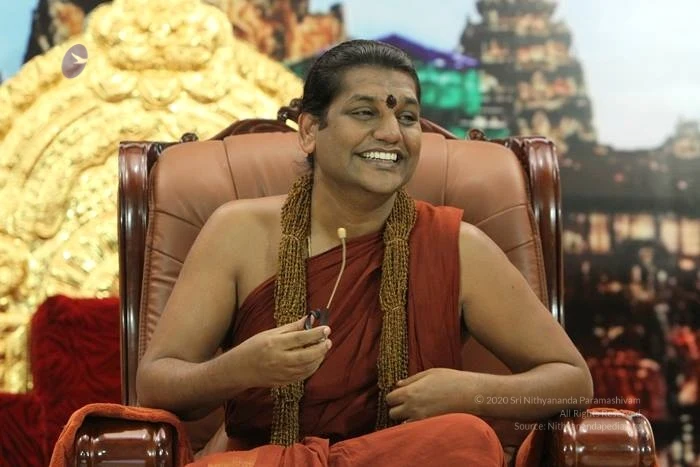
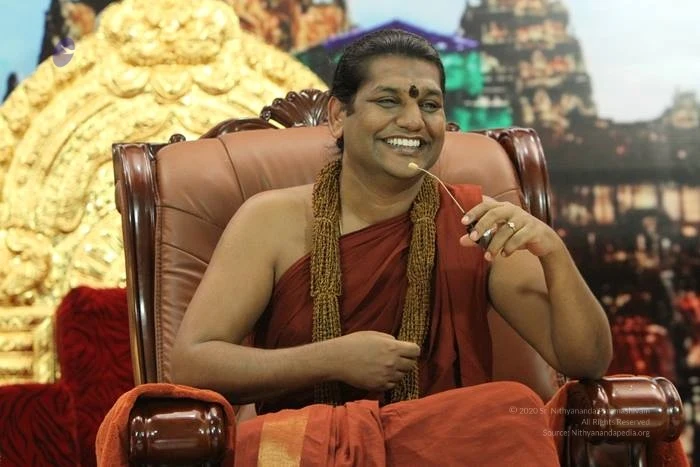
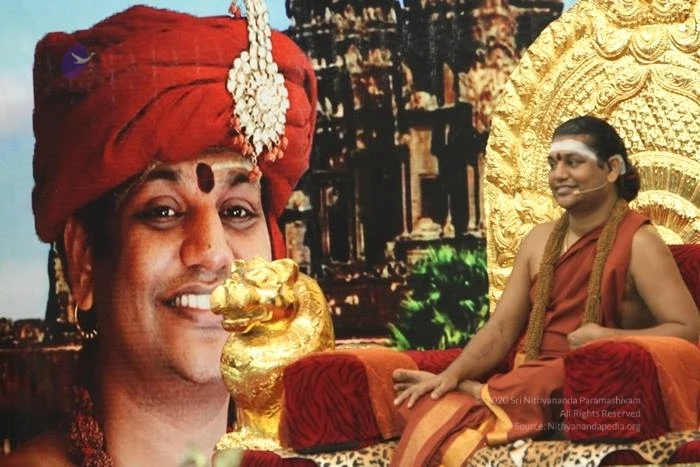
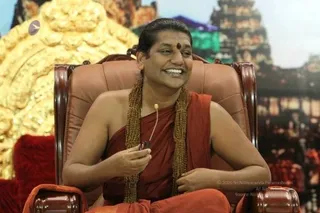
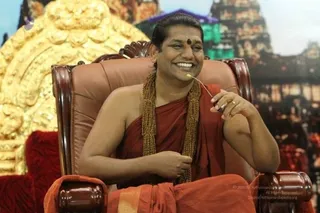
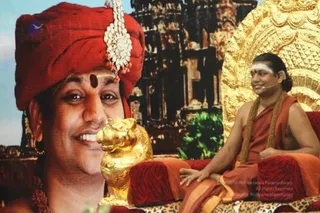
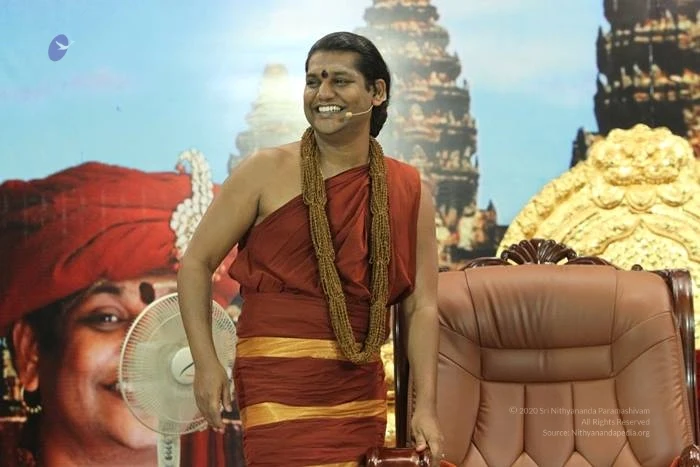
A seated man in saffron-orange robes sits on an ornate golden throne with red cushions, a rudraksha mala draped over his shoulders and a white vibhuti marking on his forehead. He rests his hands on his lap and smiles toward the audience. Behind him is a large backdrop photograph of a temple tower and foliage. To the left, a large portrait of a smiling man in a red turban with a central bindi and a gold ornament hangs beside a golden figurine. a person appears seated in person, identified by his saffron robes, rudraksha mala, white forehead marking and ceremonial throne, with the printed portrait showing a red-turbaned man in a similar presentation.

RUDRABHISHEKAM

4 photosSource gallery
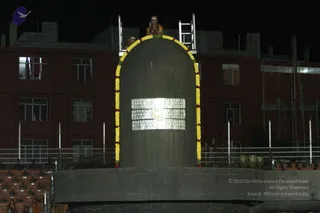
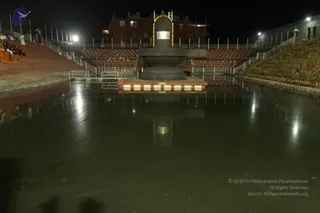
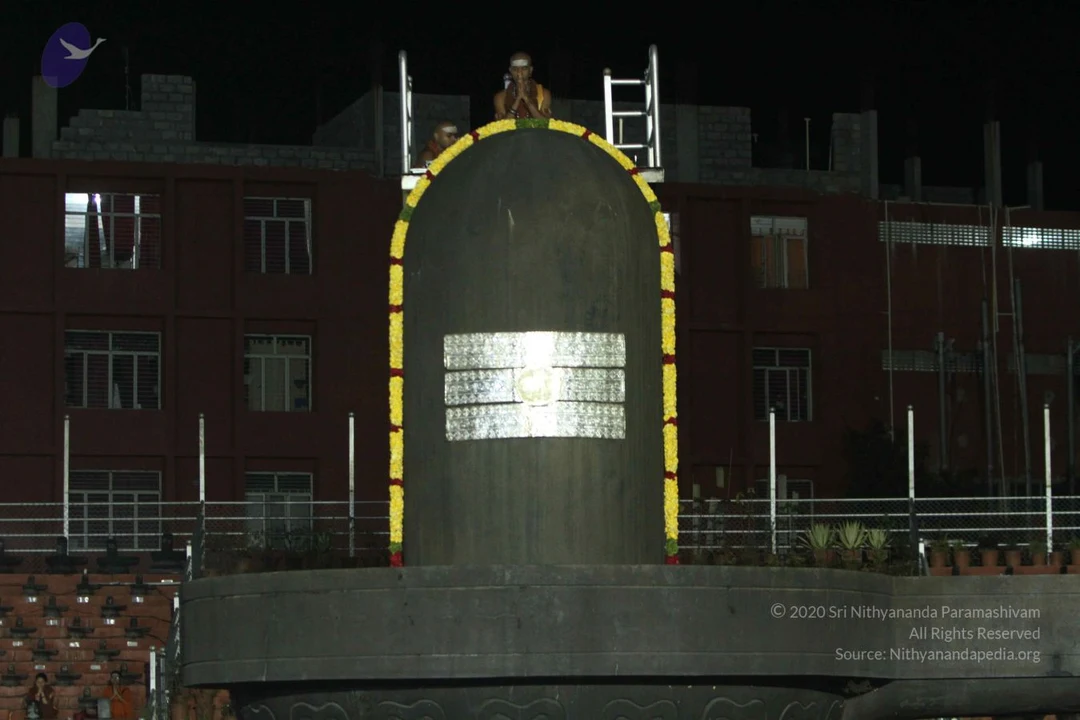
Night photograph of a very large dark black stone Shivalingam on a raised circular platform, decorated with a continuous garland of yellow and red flowers arching over its top. Two lamp-lit silver horizontal tripundra-like bands with a small gold emblem sit on its face. Behind it, a multi-storey reddish-brown building with rows of windows. At the top of the structure, a figure in saffron-coloured robes with shaved head and a white cloth tied over the forehead stands with hands joined in namaskar, while another person in orange stands beside a ladder. Small oil lamps line the lower edge of the platform in the foreground.Night photograph of an outdoor Shiva lingam set in a reflective water pool at the centre of a stepped amphitheatre. The dark stone lingam has a golden-yellow arched frame behind it with a small lit panel, and its base sits on a red and white banded platform. Rows of empty tiered seating with metal railings rise on both sides, with a few small seated figures far to the left. Floodlights illuminate the scene against a dark sky, and a multi-storey brick building stands in the background.Night photograph of an outdoor ritual pool with a large black stone Shivalinga rising from a square base on the water's edge, its yoni-style base rimmed by red-and-white striped border, decorated with yellow garlands and lit by a bright lamp. Steps on the left lead up to a seated gathering of devotees in orange and white clothing, with a small raised platform and lectern near the front. Floodlights and a red brick building stand behind the pool.Night photograph of a large black stone Shivalinga with a yellow-outlined arch behind it, standing on a red and white striped base in a reflecting pool of water. Tiered stone steps with rows of small lamps line the surrounding grounds, and a few seated figures sit at the far left edge near a white-clad person. Floodlights and a brick building are visible in the background.

TEMPLE

23 photosSource gallery
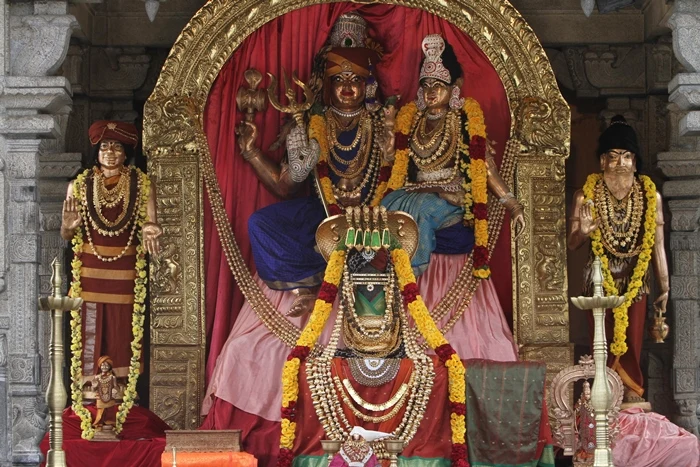
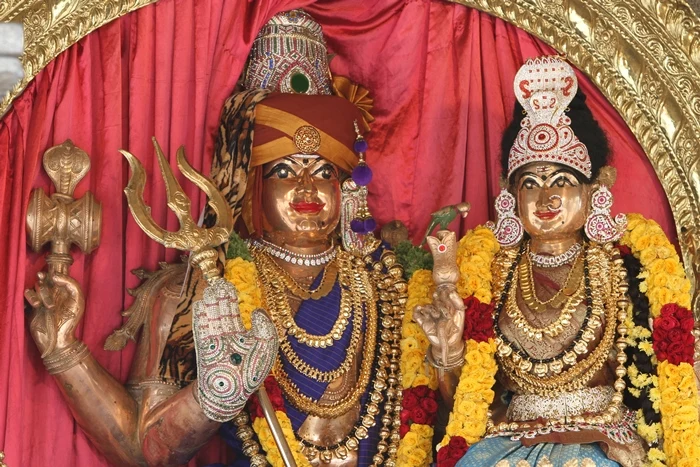
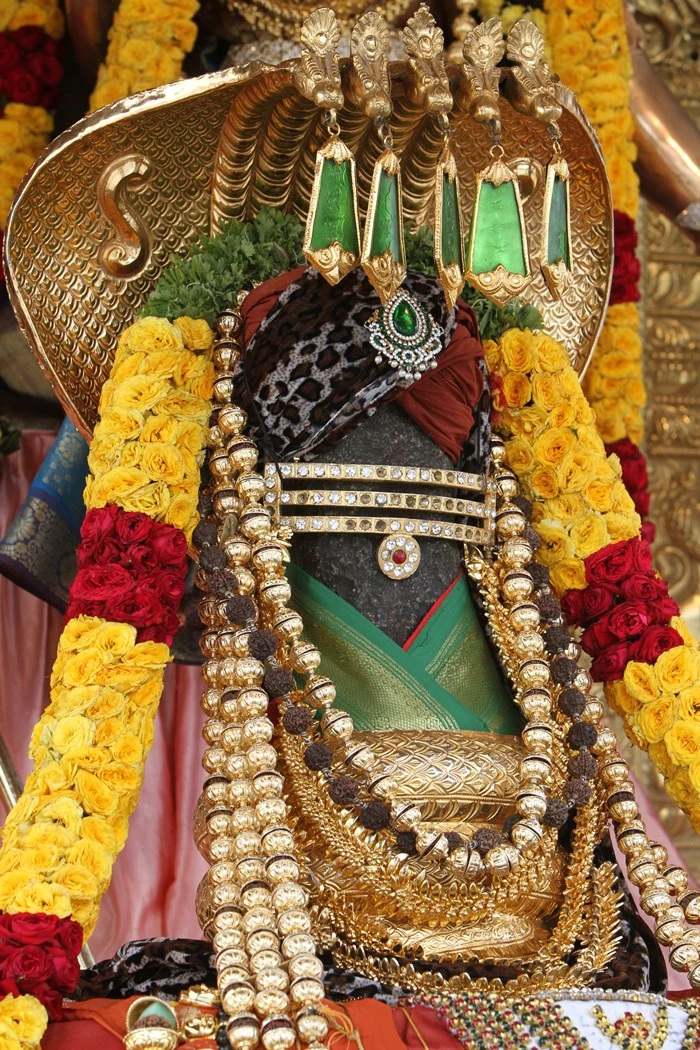
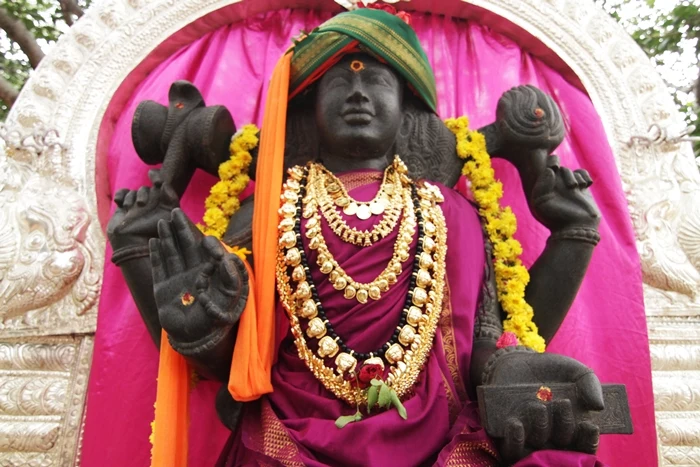
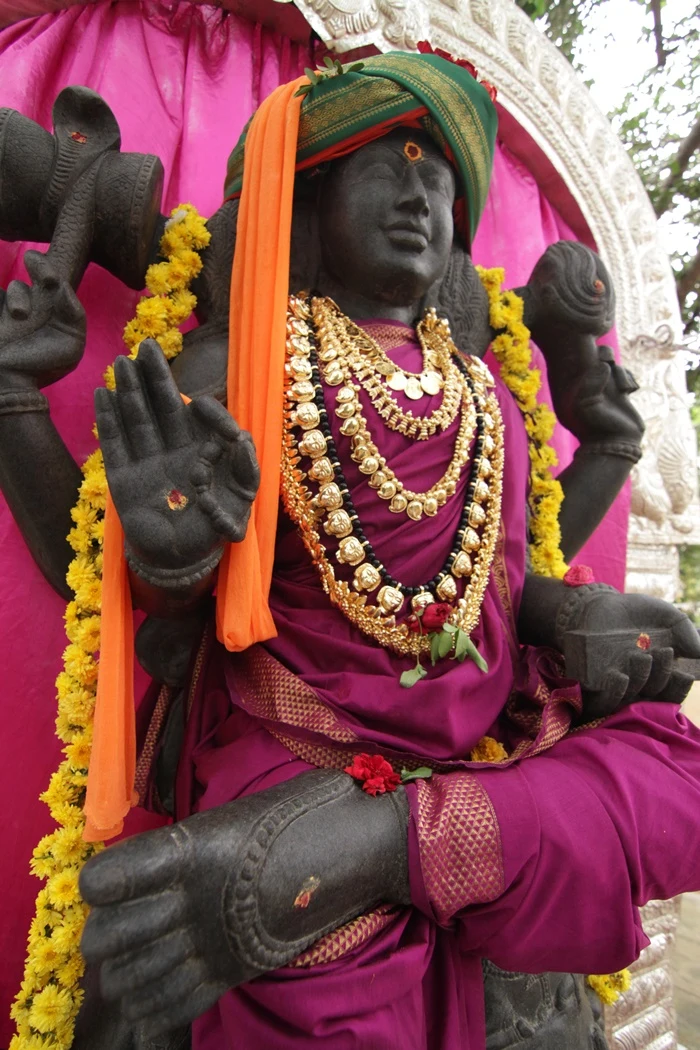
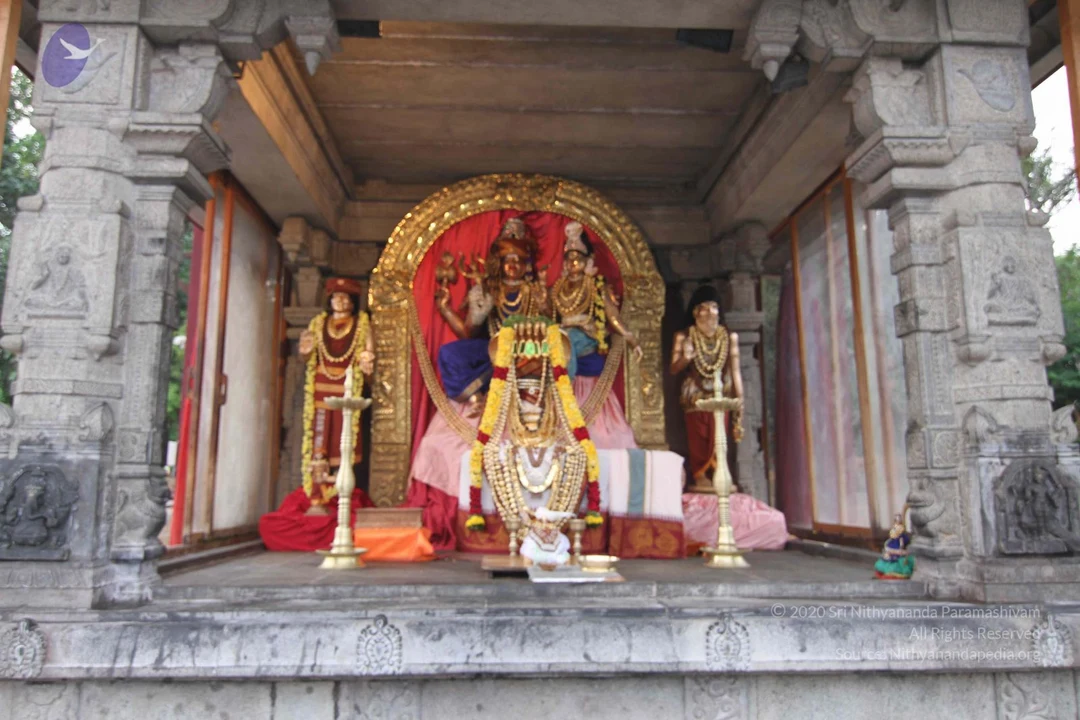
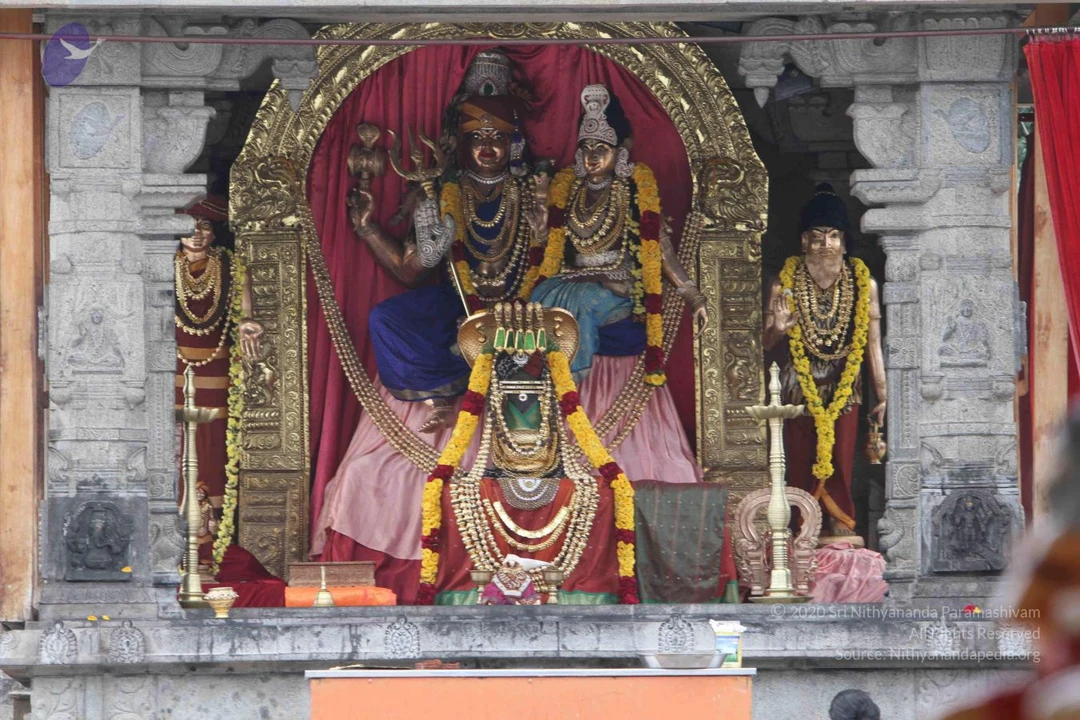
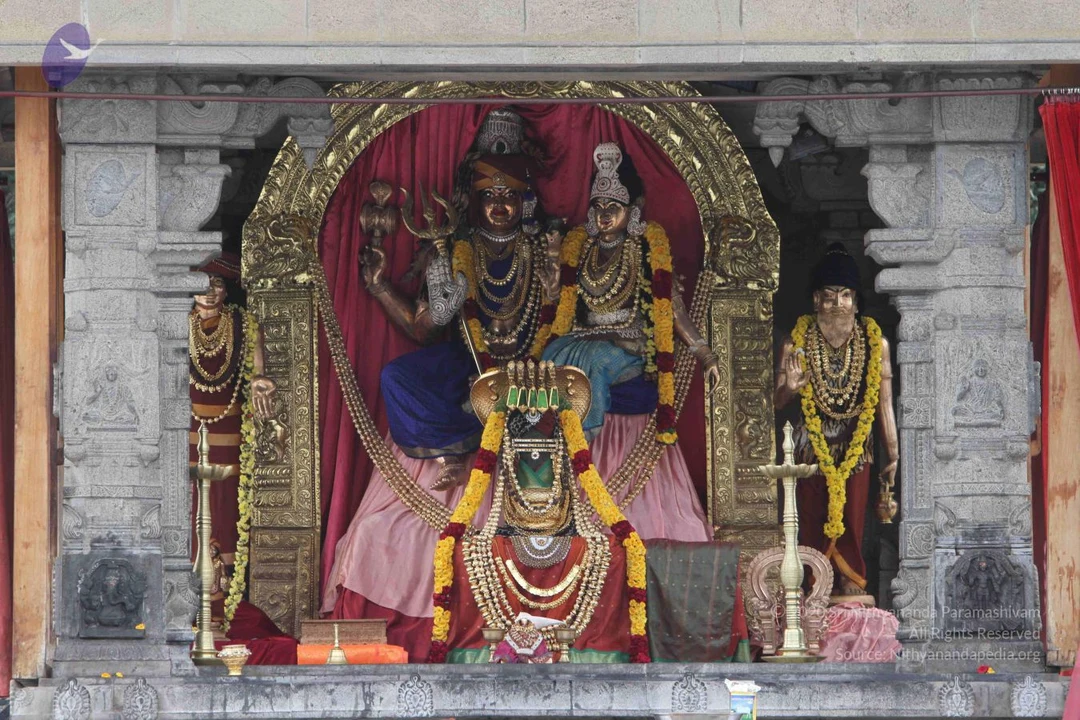
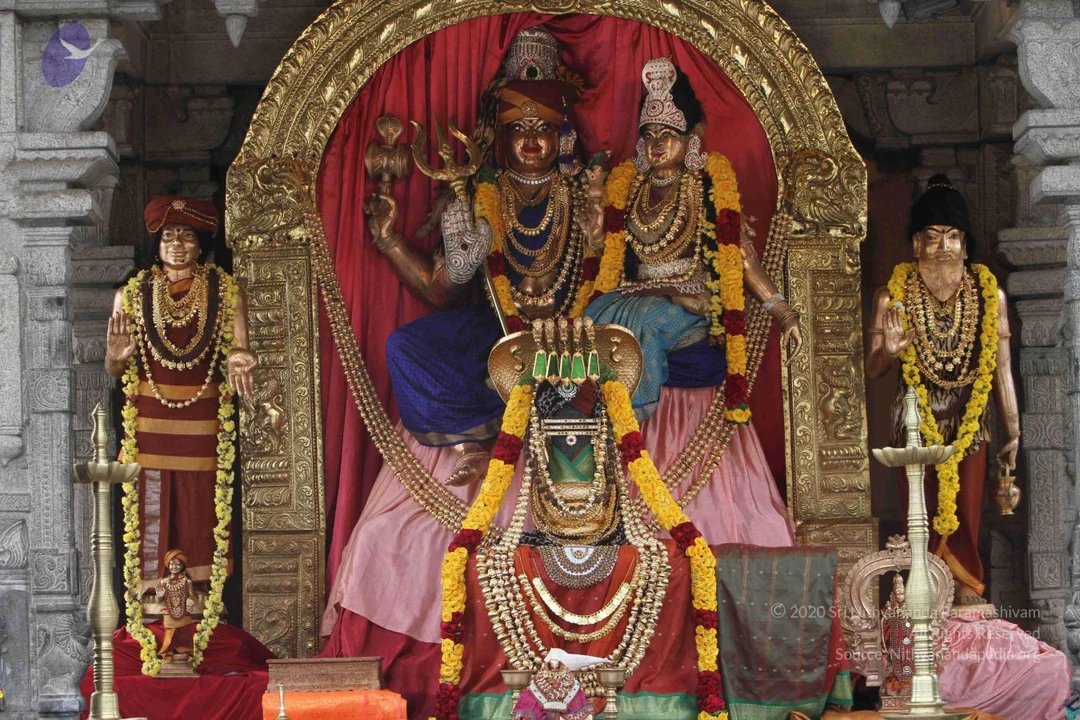
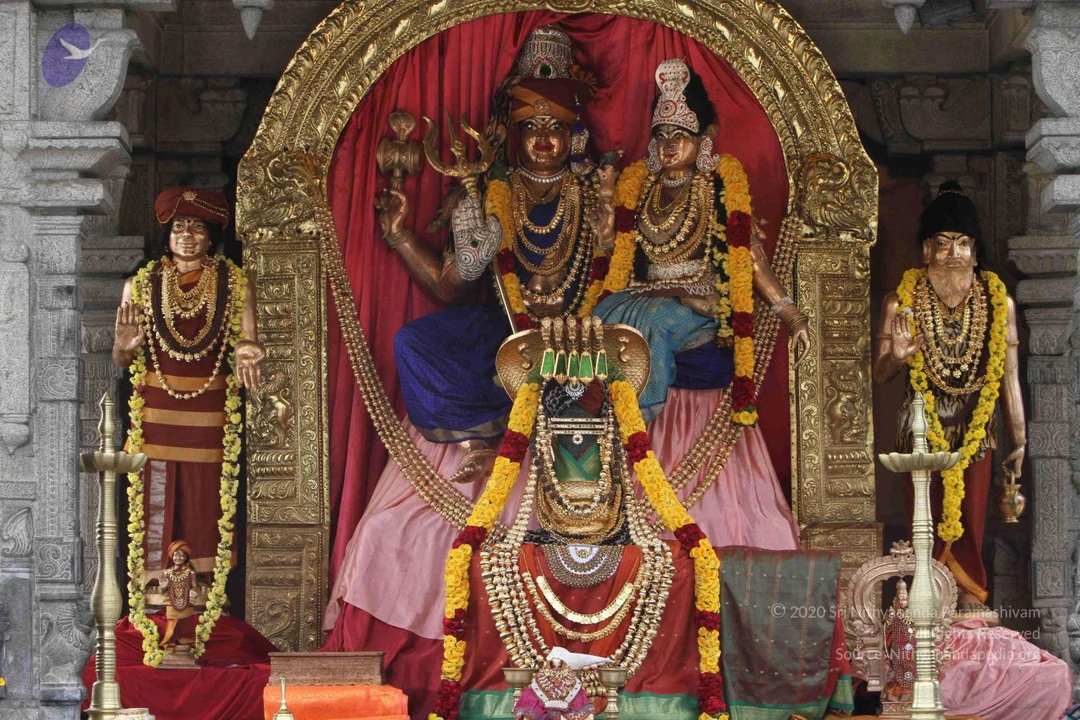
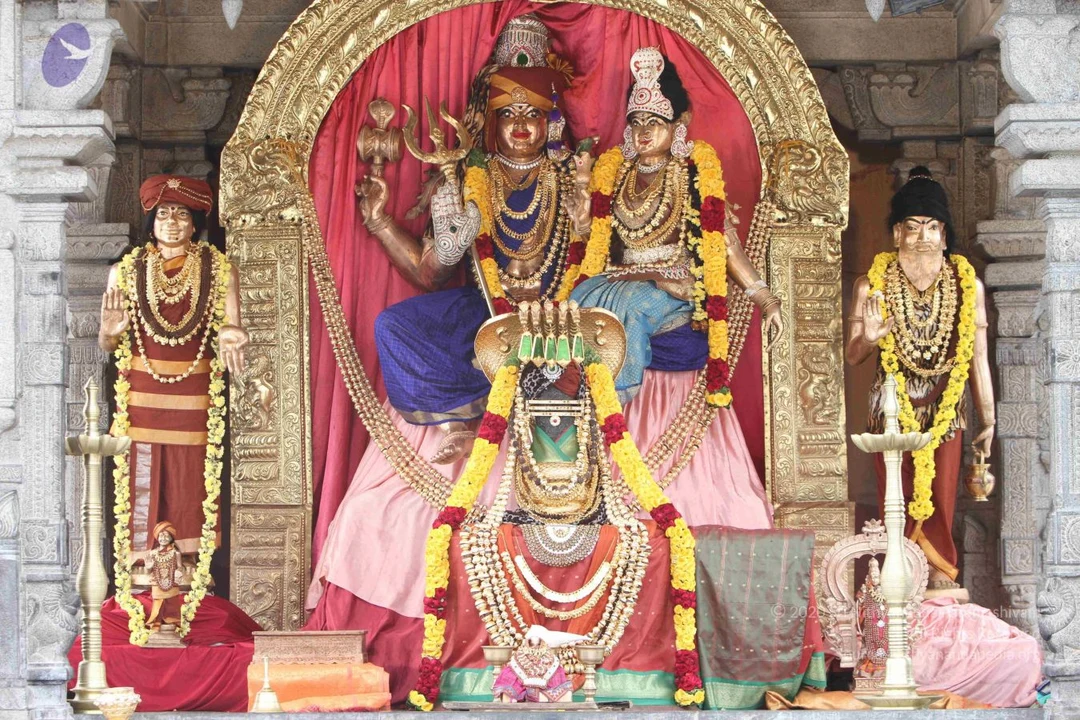
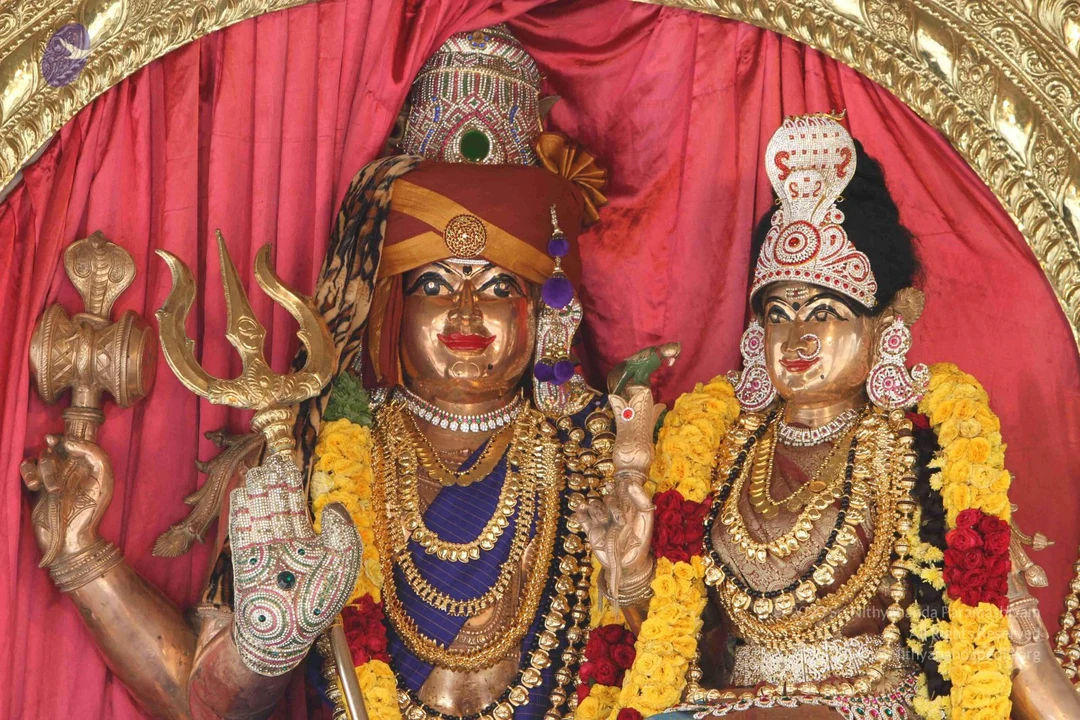
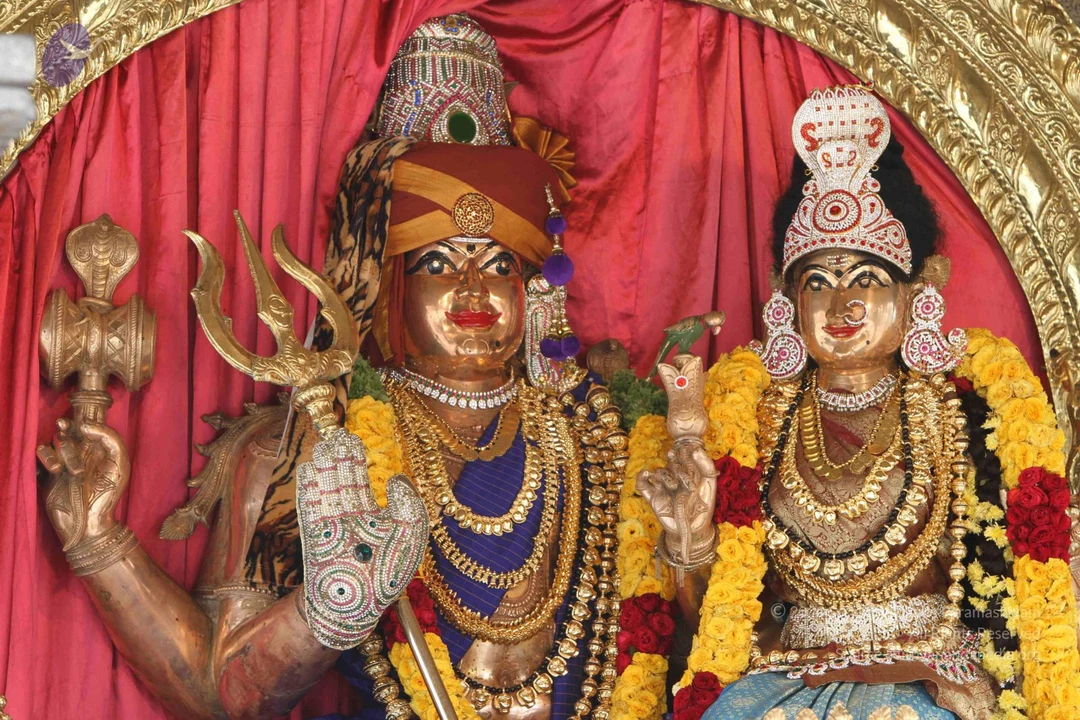
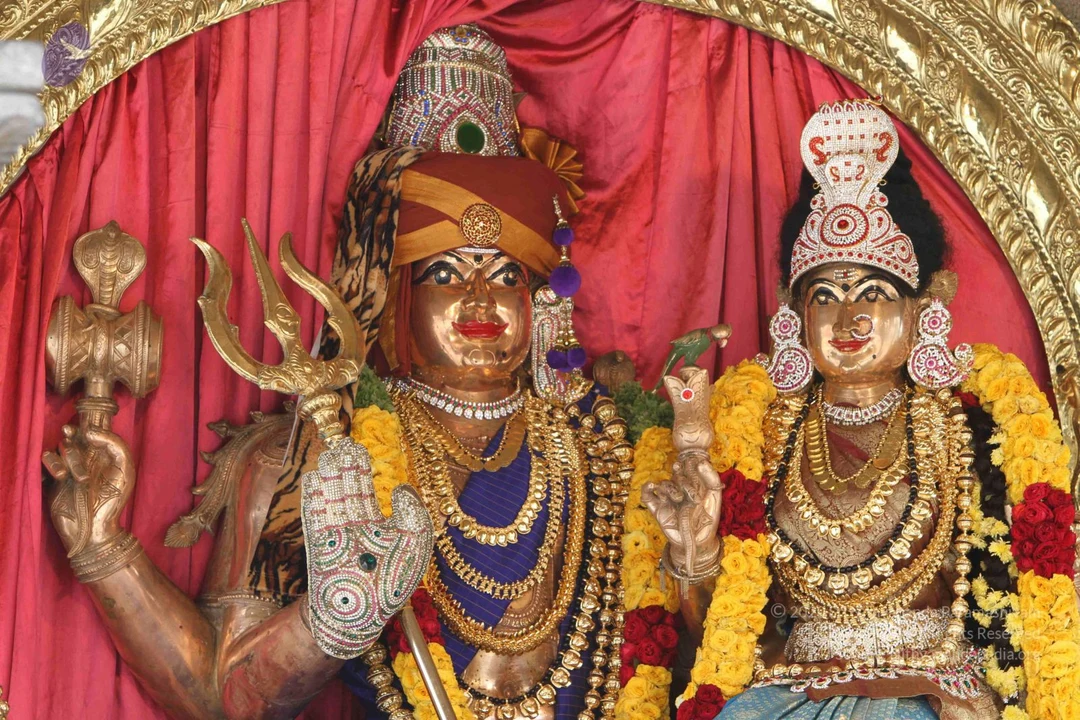
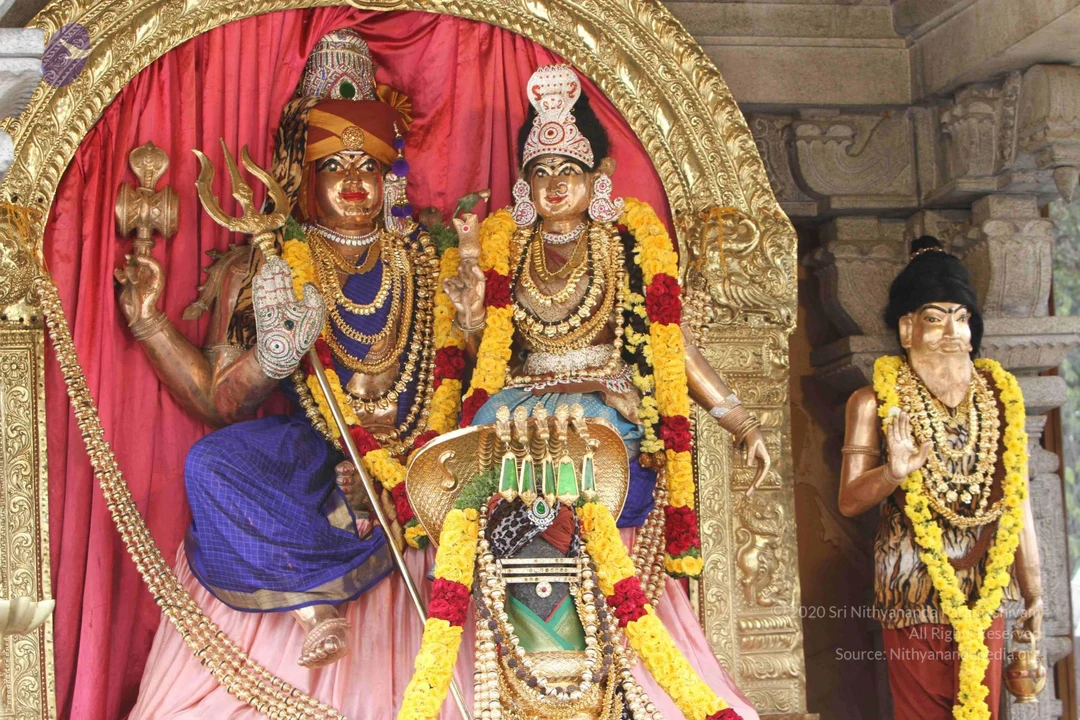
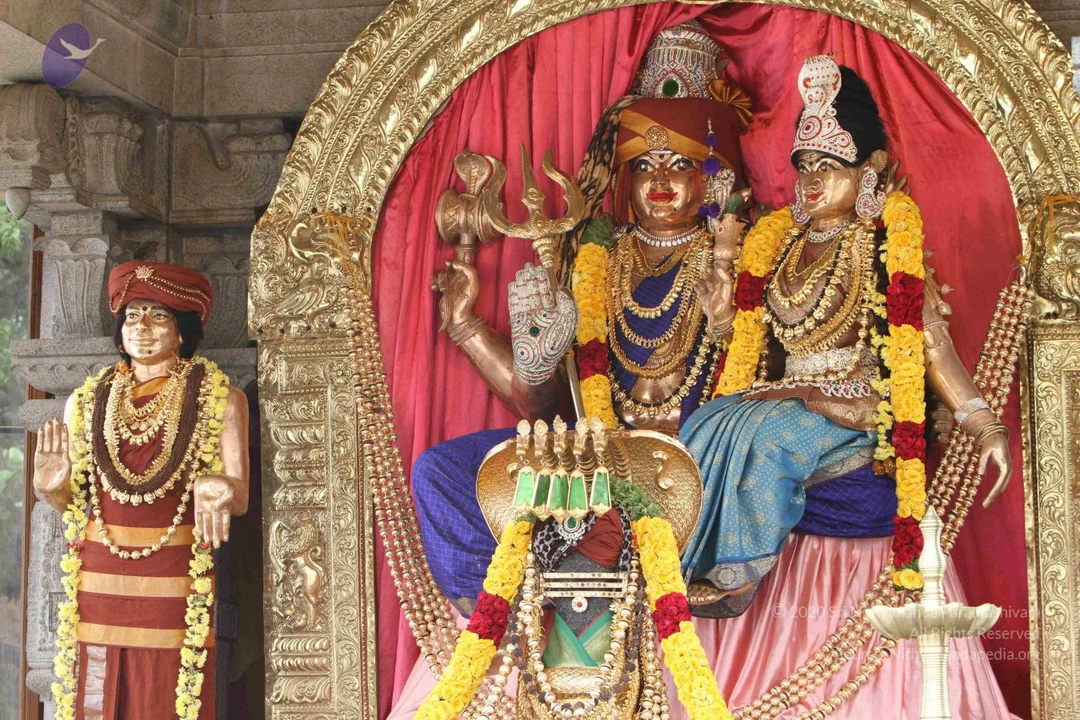
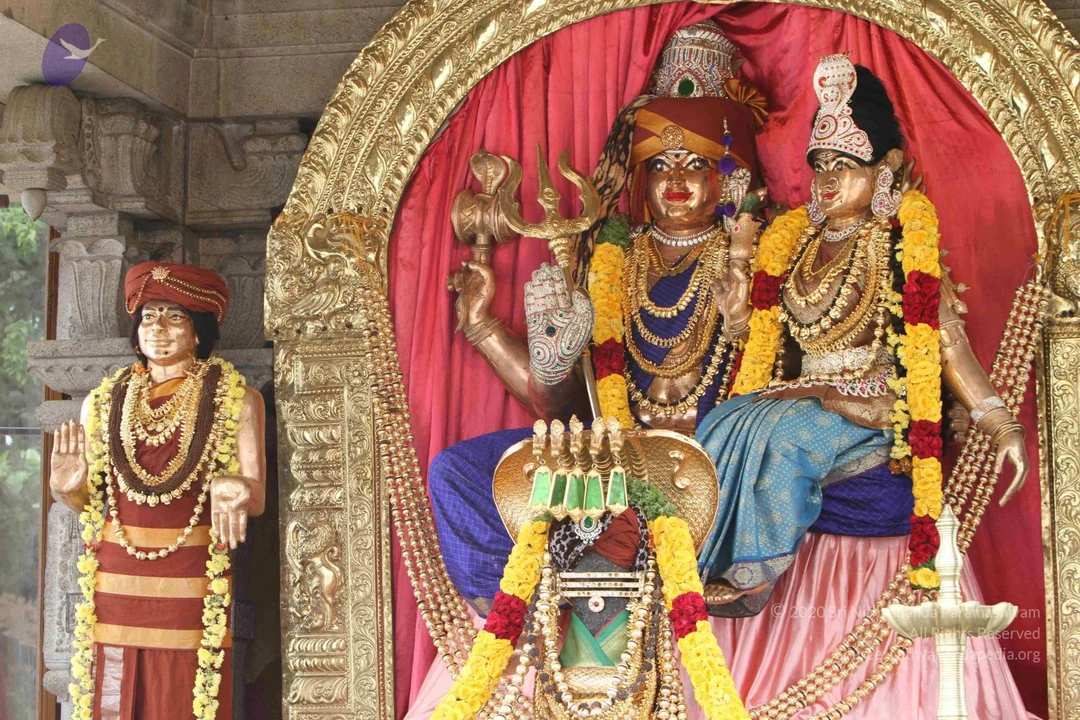
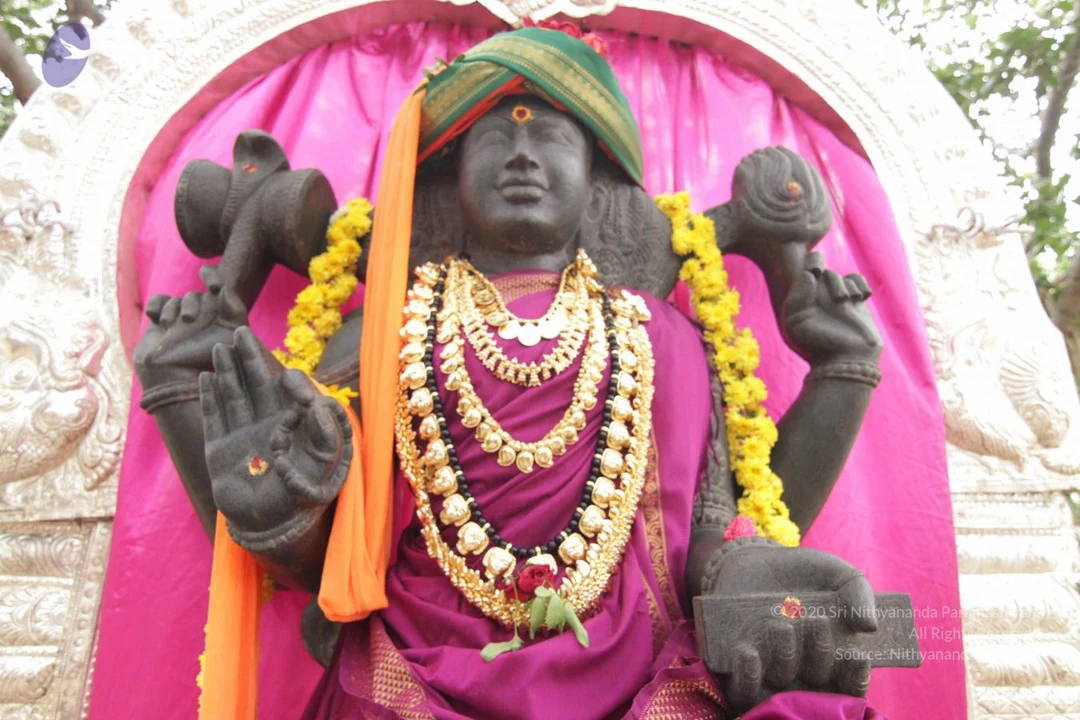
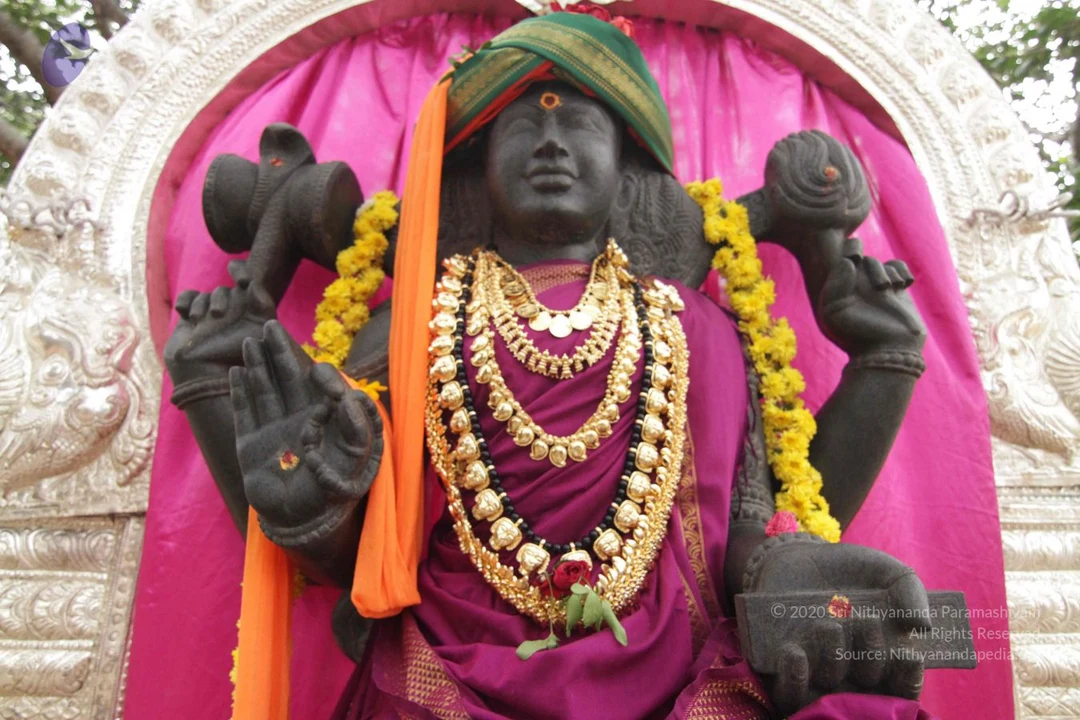
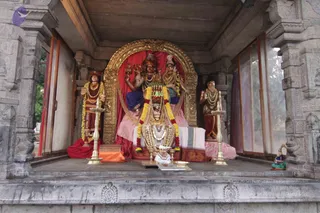
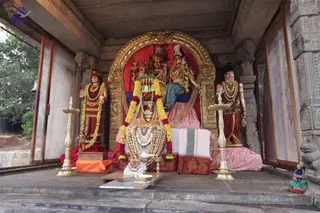
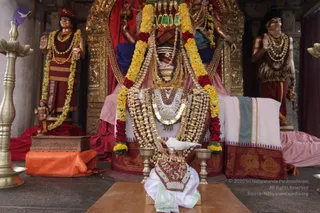
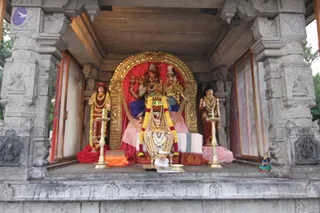
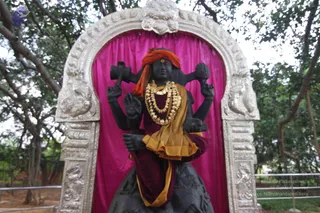
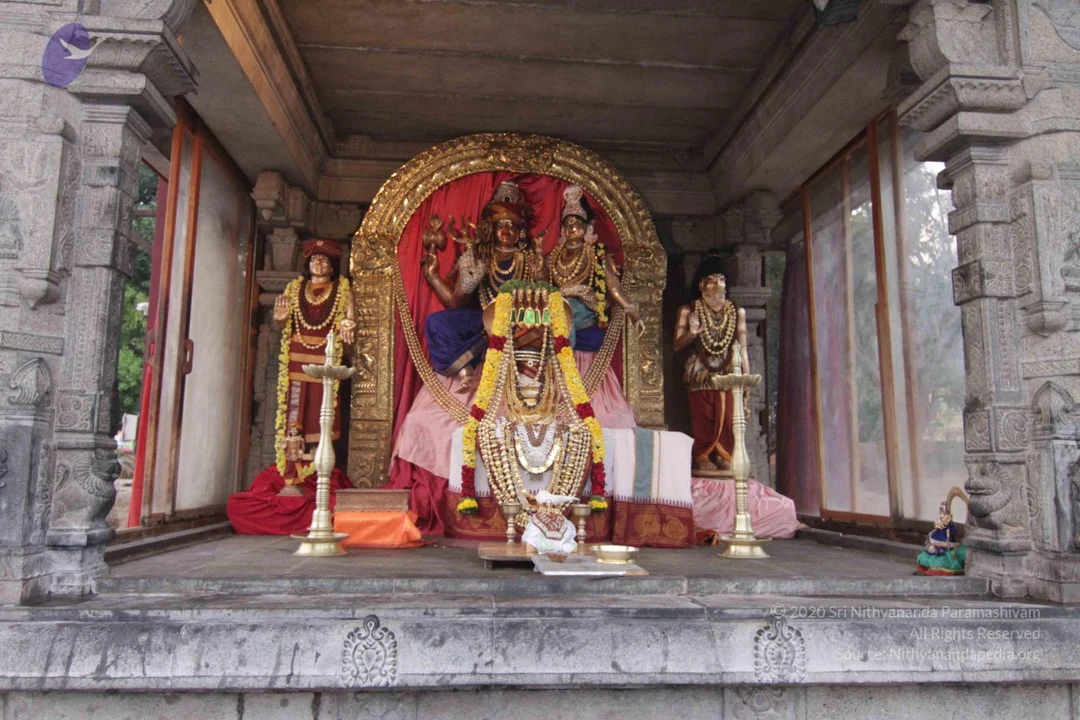
A stone shrine niche with a golden arched frame and red drape houses a deity murti seated on a pink-draped pedestal, a multi-armed Shiva form with trident and crown, beside a consort figure with a crown and heavy gold necklaces. Flanking standing statues hold garlands. In front, a large linga-shaped image is decorated with yellow and red flower garlands and gold ornaments, with brass oil lamps, a kalasha-like brass vessel and offerings on the platform. Stone pillars with carved motifs frame the shrine. No living people are visible, so this is a photograph of statues and a sanctum rather than a satsang or event scene.A shrine niche framed by an ornate gilded arch with a red curtain holds deity murti statues. A seated consort figure in pink and blue garments and a crowned standing figure occupy the central frame, with a tall rudraksha-like mala draped over a decorated central form adorned with marigold and red flower garlands, jewelled necklaces and a silver crown. Brass oil lamps stand on either side, a small silver bowl and offerings rest on the stone platform, and carved stone pillars frame the scene. No living people are visible.A photograph of a temple shrine with a large deity murti heavily decorated with gold jewellery, gold necklaces and layered garlands of yellow marigolds and red roses, with a green and gold crown. Two standing attendant statues flank the murti, one in red and gold robes with a turban and a gold-beaded necklace, the other in patterned robes and rudraksha-style beads. Brass oil lamps stand on the floor, and a white cloth and folded red and gold textile sit at the base. No living people are visible; the murti and statues are the subjects, set against a red and gold backdrop.Photograph of a richly decorated deity murti at a temple shrine, adorned with layered gold necklaces, a silver chest ornament, and a tall crown with green and gold elements. Garlands of yellow marigolds and red roses drape the figure. In front stands a white cloth-draped platform with a conch-like offering, flanked by brass oil lamps. Behind are golden-hued standing statues of sages with folded hands, one in rust-red robes and one in dark robes with a rudraksha-style necklace, along with a red and gold backdrop. No living people are visible.A stone shrine with carved pillars and a gilded arched frame holds a deity murti seated on a throne, adorned with garlands of orange and yellow flowers and gold necklaces. Two standing attendant figures in red and orange dress with garlands flank the central image, and brass oil lamps stand on the platform in front. A small figure in the foreground and a small blue figurine at the right corner complete the shrine. No living people are visible.A dark stone statue of a multi-armed deity form stands in an arched silver-toned frame lined with carved floral and scrolled motifs, set before a hot pink draped backdrop. The figure wears a saffron-orange turban and a gold and orange ceremonial necklace with garlands, a mustard-gold shawl draped over the shoulders, and a maroon lower garment. Several hands hold ritual objects, including a trident-like staff and a bell or drum. Tall outdoor trees and a metal railing surround the shrine.

PADAPUJA
11 photosSource gallery
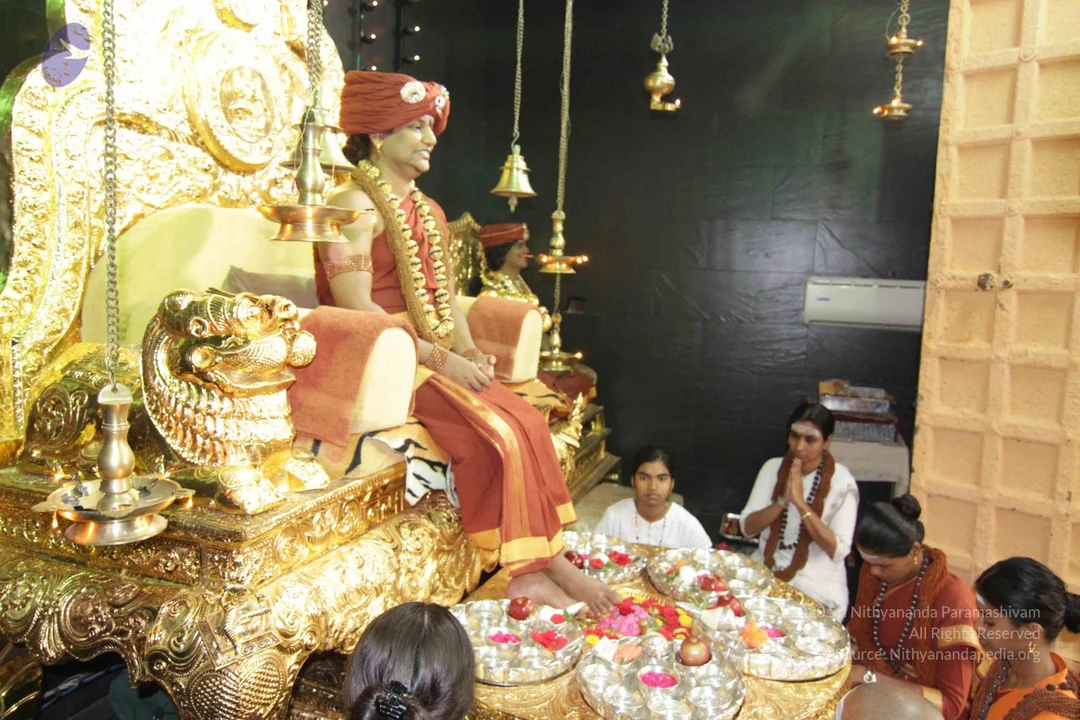
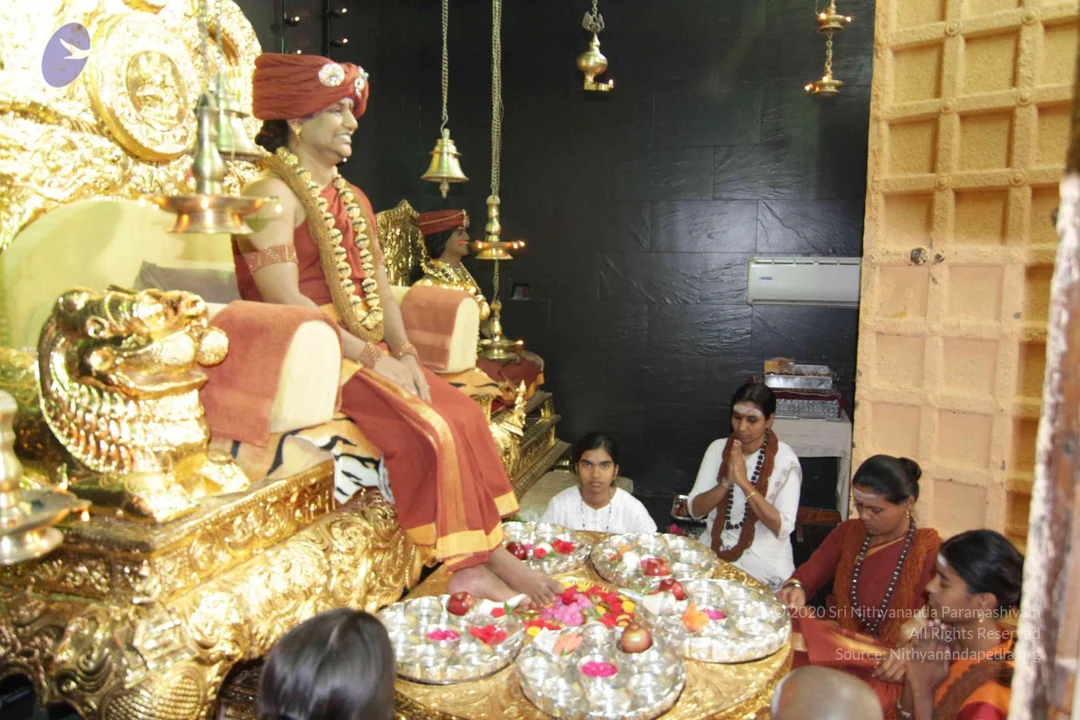
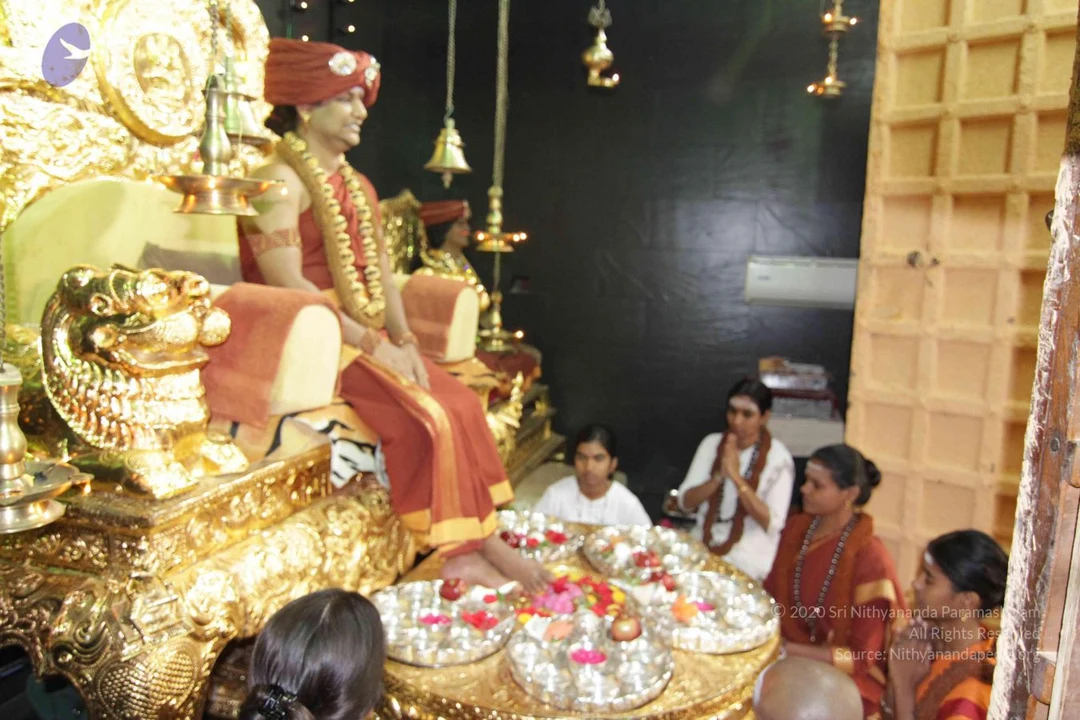
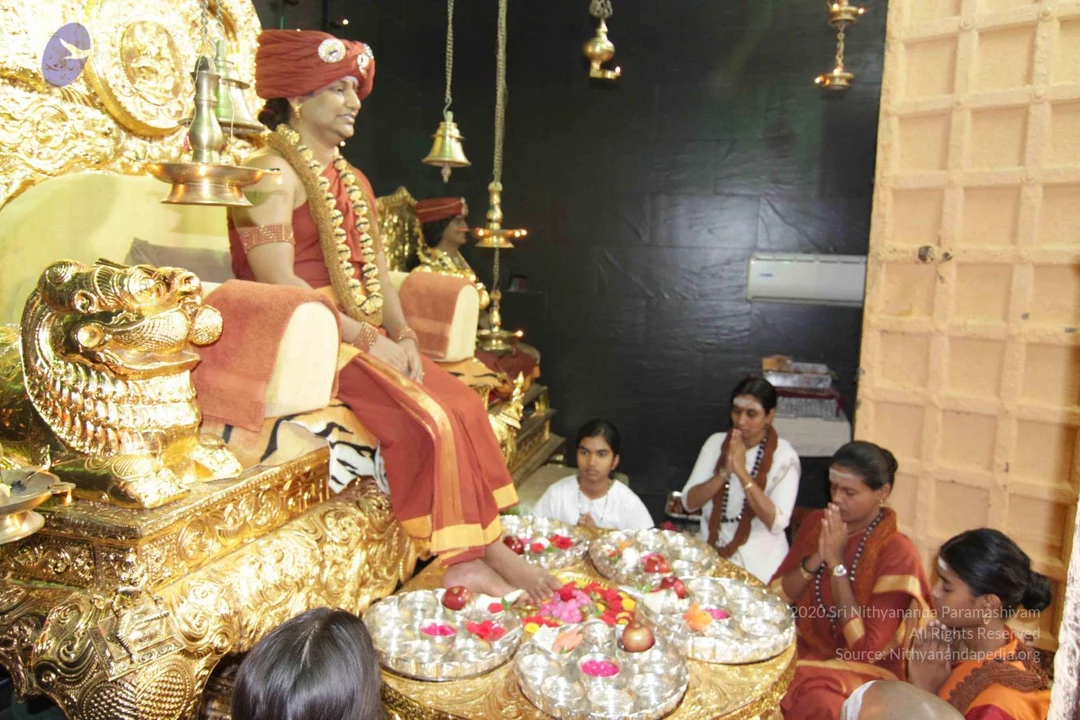
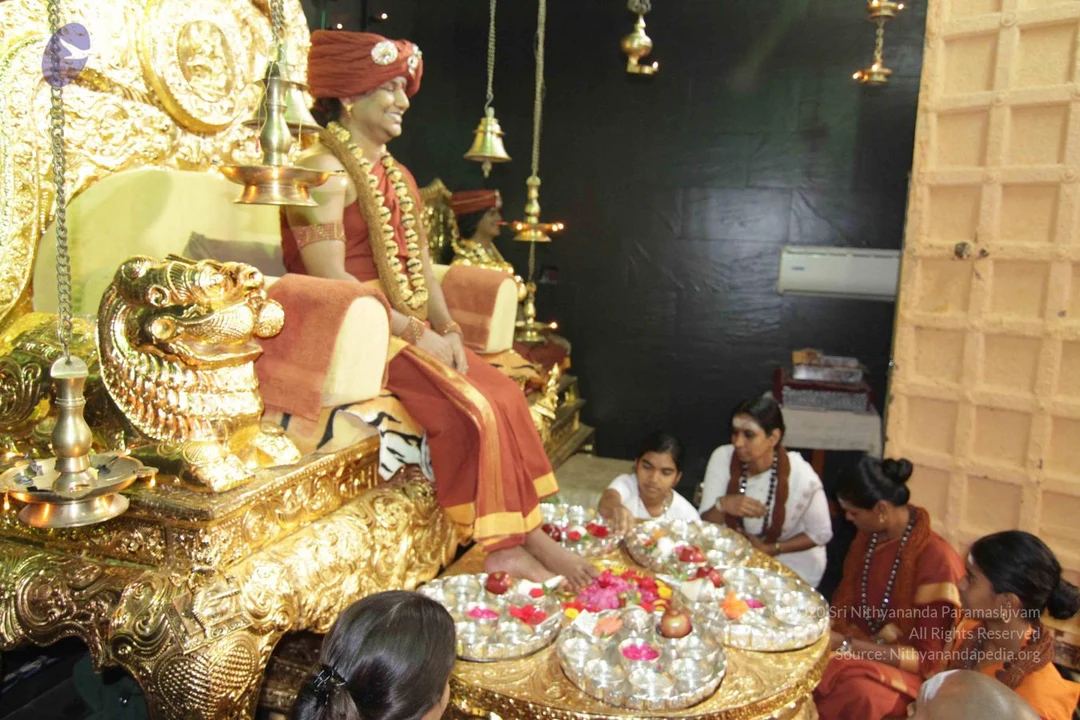
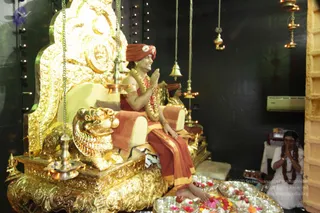
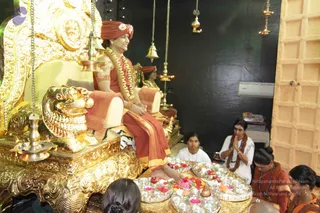
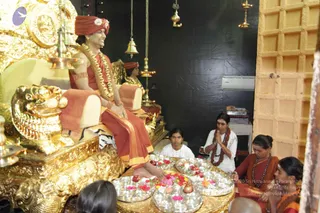
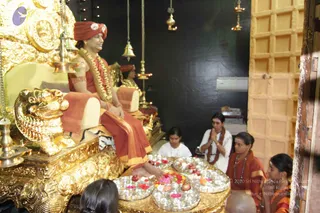
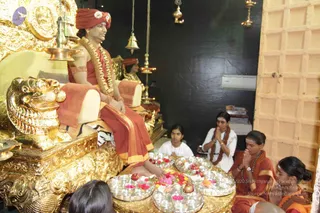
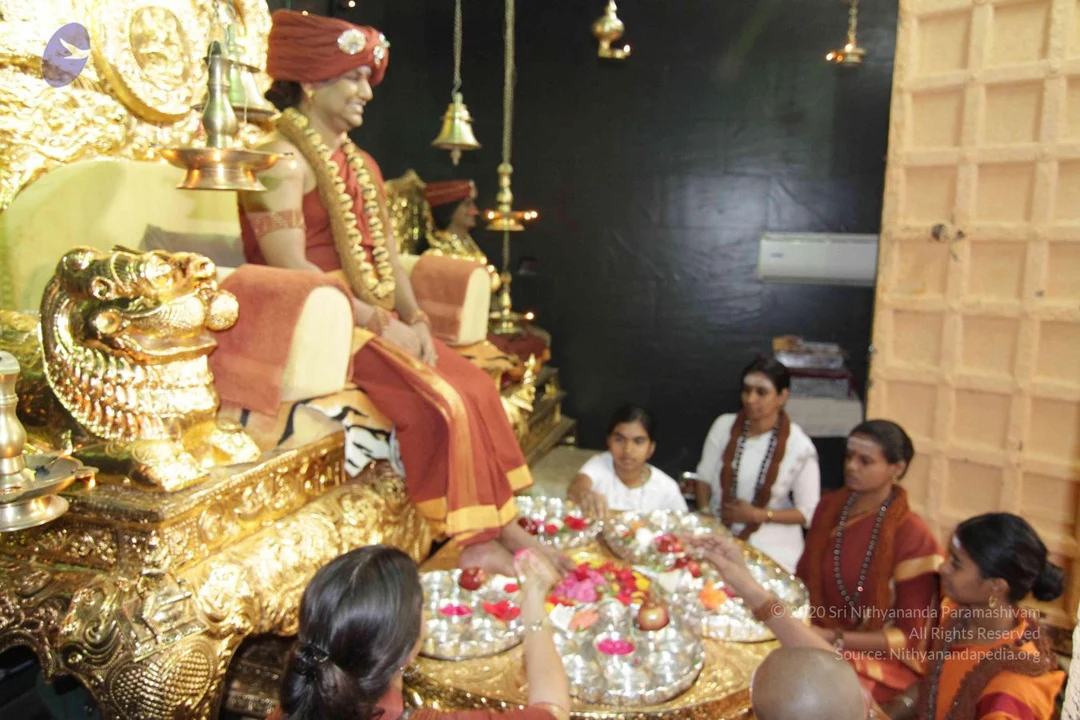
A photograph of a seated figure on an ornate gilded throne with a lion-head armrest, dressed in saffron-orange robes with an orange turban and a rudraksha mala and flower garland, hands raised in anjali. A second statue-like figure in matching orange and a turban sits on the right. A woman in white with a red bindi and rudraksha mala stands with palms together at the lower right. Brass hanging bells and oil lamps hang above, and silver plates of flowers and offerings sit at the foot of the throne. a person: the seated figure has a turban, saffron robes, garland and rudraksha mala cues, though the figure may be a statue.Photograph of a gilded throne with a lion-head armrest in a shrine. A figure in an orange turban, orange robe and ornate garland sits on the throne, apparently a statue or life-size figure rather than a living person, with a second orange-turbaned figure behind. Brass oil lamps and hanging bells surround the throne. In the foreground, devotees in white and orange clothing sit with folded hands before silver plates of flowers, fruit and offerings, and a small child in white sits among them. Swamiji (probable) is shown seated on the throne in orange robes and turban with a garland, though the figure appears to be a depiction. Printed caption on the image reads Nithyananda ParamashivamA photograph of a golden throne with a seated figure in an orange-red robe and an orange-red turban, wearing a long garland and a gold armband, seated on a gilded seat with lion-head carved arms. The seated figure appears to be a statue or life-size figure rather than a living person, given its waxy, fixed pose. To the right, women in white and maroon-orange saris and rudraksha malas kneel with folded hands near brass plates of flowers, fruit and red offerings on a gold cloth, with a bare-footed child in white beside them. Brass oil lamps and hanging bells surround the throne against a dark wall.A photograph inside a richly decorated shrine room with gold-covered throne and carved golden lion-head armrest. A man seated on the throne wears an orange-red turban, an orange-red robe, and a long gold-and-red garland, with bangles on his wrist; he sits with feet on a gold footstool. Around the throne hang brass oil lamps and bells. Before him, several women and a young girl kneel in orange and white clothes, one with palms joined in namaste. Silver trays holding flowers, fruit and kumkum-coloured offerings are arranged on a gold table in front. A gold deity-like portrait frame is on the wall behind. a person appearance is uncertain.A photograph inside a shrine-like room with black walls, hanging brass bells and oil lamps. A figure seated on an ornate gold throne with a carved lion-head armrest wears a red-orange turban, an orange robe and a long white garland, with a rudraksha-style necklace visible; his features are not clearly discernible at this distance. Behind him a second seated figure wears a red head covering. In the foreground, several devotees sit on the floor: a young girl in white, a person in white with hands pressed together in prayer and a rudraksha mala, a woman in orange with a mala, and another woman in orange. Silver trays hold rose petals, fruit and flower offerings in front of the throne. A small wall air conditioner and a wooden door with carved panels are at right.A seated figure in a saffron-orange robe and matching orange turban sits on an ornate gilded throne with lion-head carvings, wearing a long orange garland, bangles and a gold-bordered shawl. Two gilded oil lamps stand nearby and brass bells hang above. In front, devotees kneel with folded hands, including a woman in an orange sari with rudraksha mala and a woman in white with a mala. Silver plates hold red and pink flowers, fruit and lamps arranged on a gold platter. A woman in a white dress and a child stand at the edge of the frame. The wall is black with a patterned door panel to the right.

PUJA

3 photosSource gallery
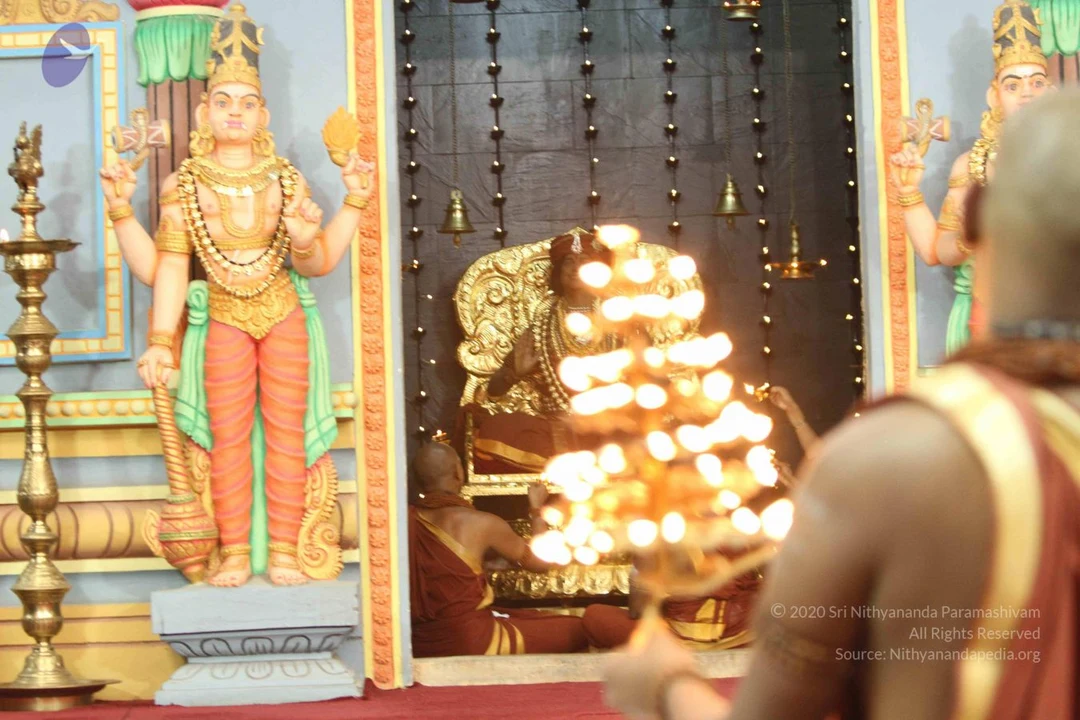
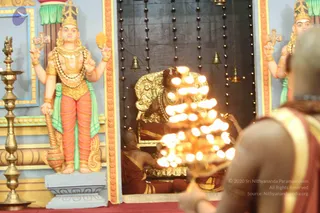
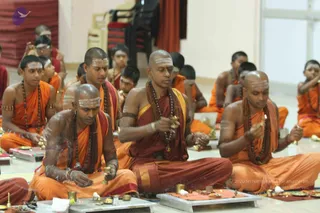
Inside a temple shrine, a multi-flame oil lamp aarti is being waved in the foreground by a person in the right foreground wearing a saffron-red robe with a gold-bordered shawl. Behind it, a figure in a saffron-red robe sits on an ornate gold throne-like seat before a dark curtain hung with bells and beaded strings, with a small brass lamp to the left. Two large painted deity statues flank the doorway, each with multiple arms, crowns, gold necklaces and green sashes, one holding a trident-like staff. A tall brass oil lamp stands at the left edge. The scene suggests a puja or aarti ceremony.A group of saffron-robed sannyasis sit cross-legged on a hall floor performing a ritual, with white vibhuti tripundra on their foreheads and rudraksha malas around their necks. Several hold small brass vessels and cups, and brass lamps and bowls sit on low wooden stools in front of them. Several younger boys in orange clothing sit behind them, and more people fill the background. Red stacked mats and chairs line the far wall.A seated group of saffron-robed monastics performs a ritual in a hall with a red-carpeted floor. In the foreground, a shaven-headed man with a white-and-orange forehead tilak and a long rudraksha mala holds a small offering and a lamp-like object over a brass tray. Beside him, a young man with a saffron robe and red-trimmed shawl wears a rudraksha mala and holds an offering near a brass cup. A third monastic on the right, wearing a red-brown robe, white arm markings and a rudraksha mala, handles a yellow flower. Behind them, more seated devotees in orange and white clothes hold their hands together in prayer or offer items, and small brass lamps and fruit sit on low tables.

NITHYA-KIRTAN

5 photosSource gallery
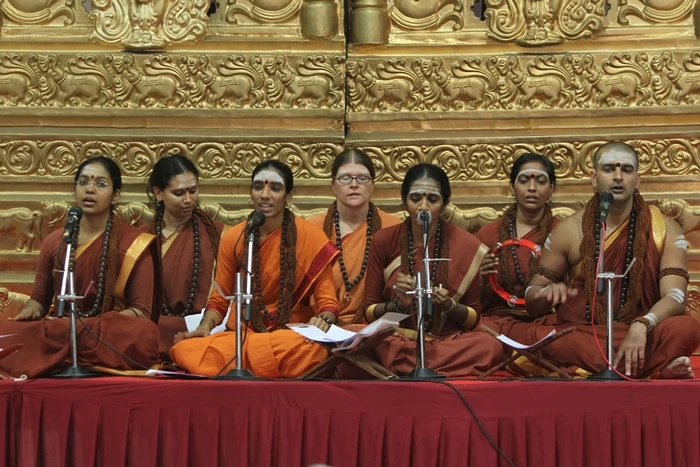
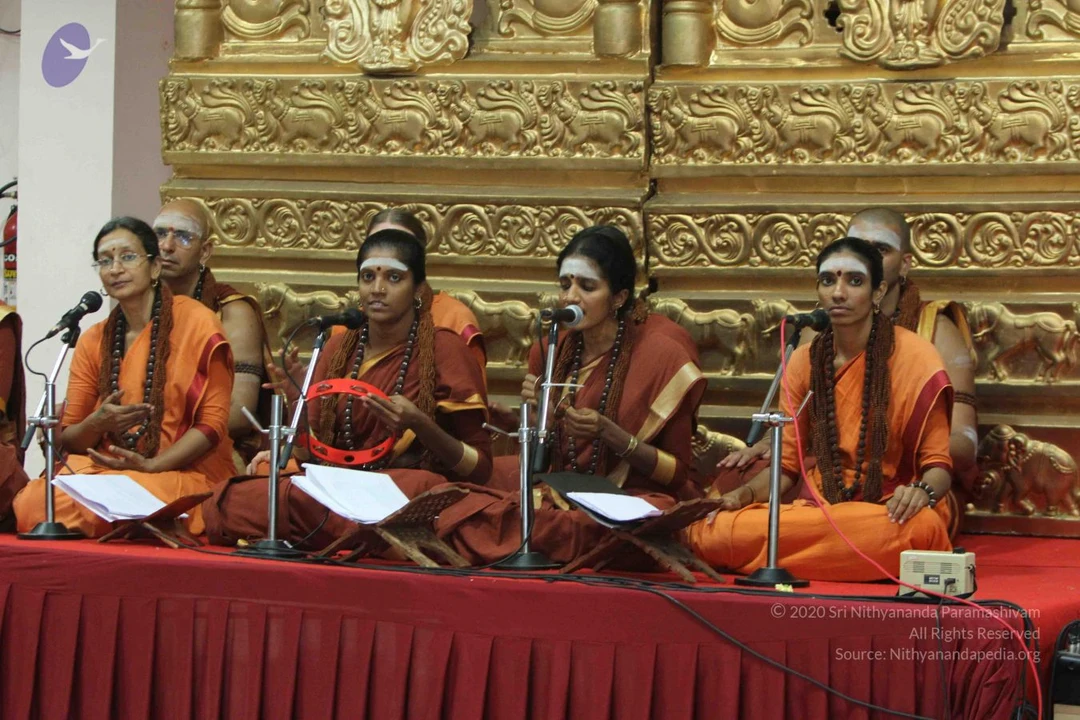
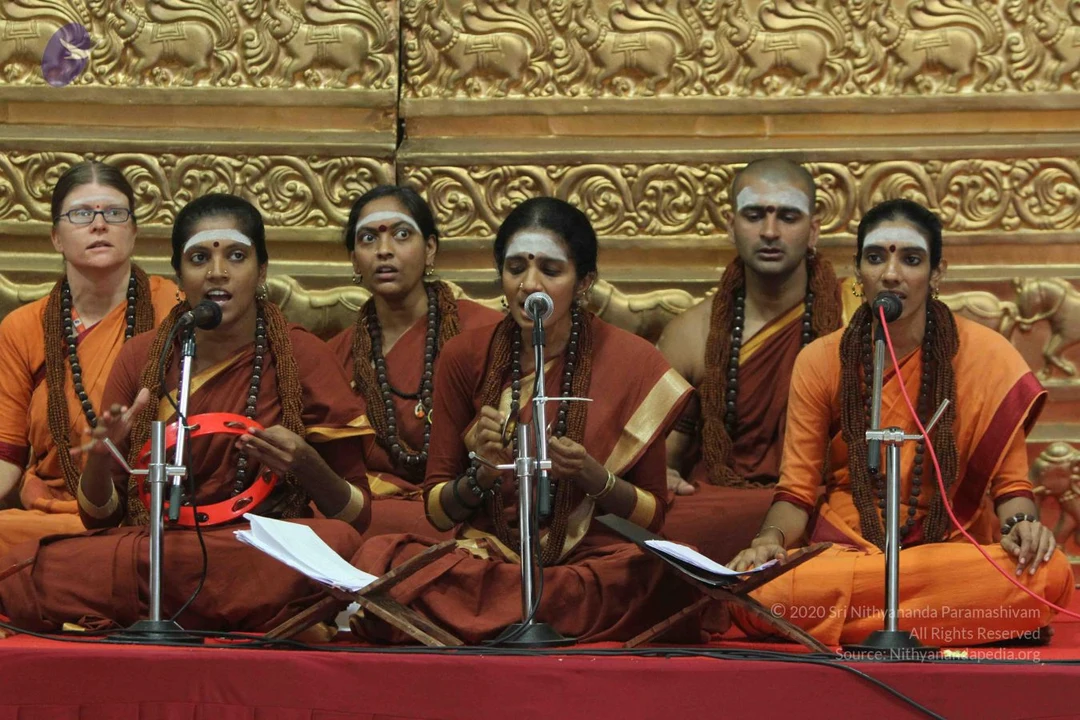
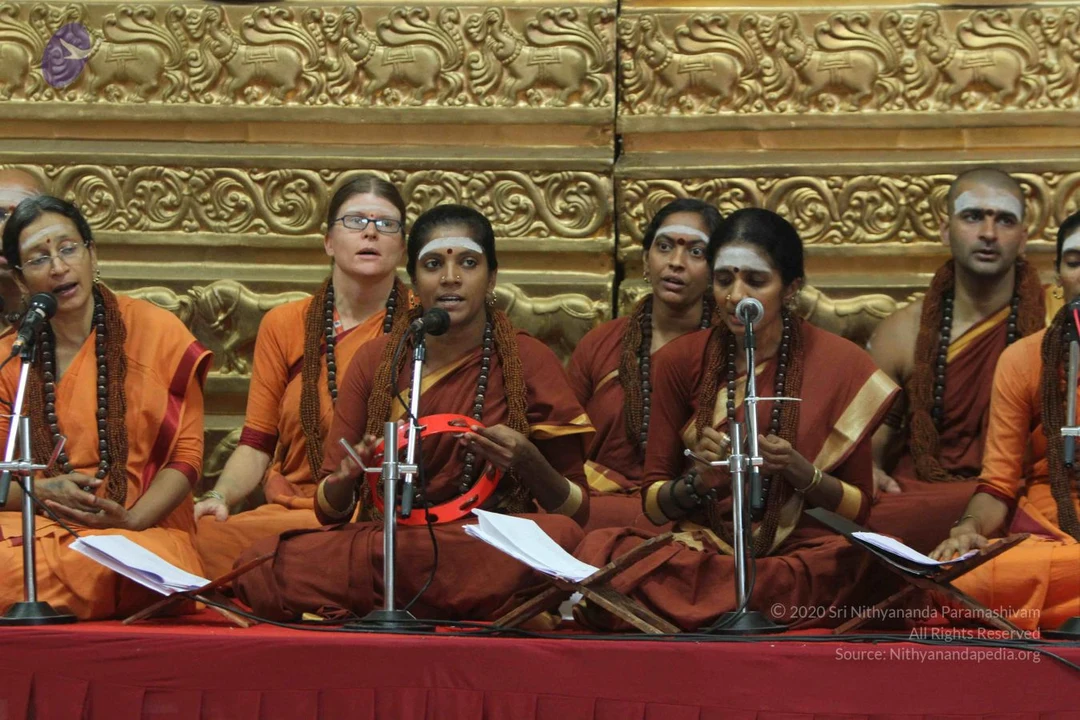
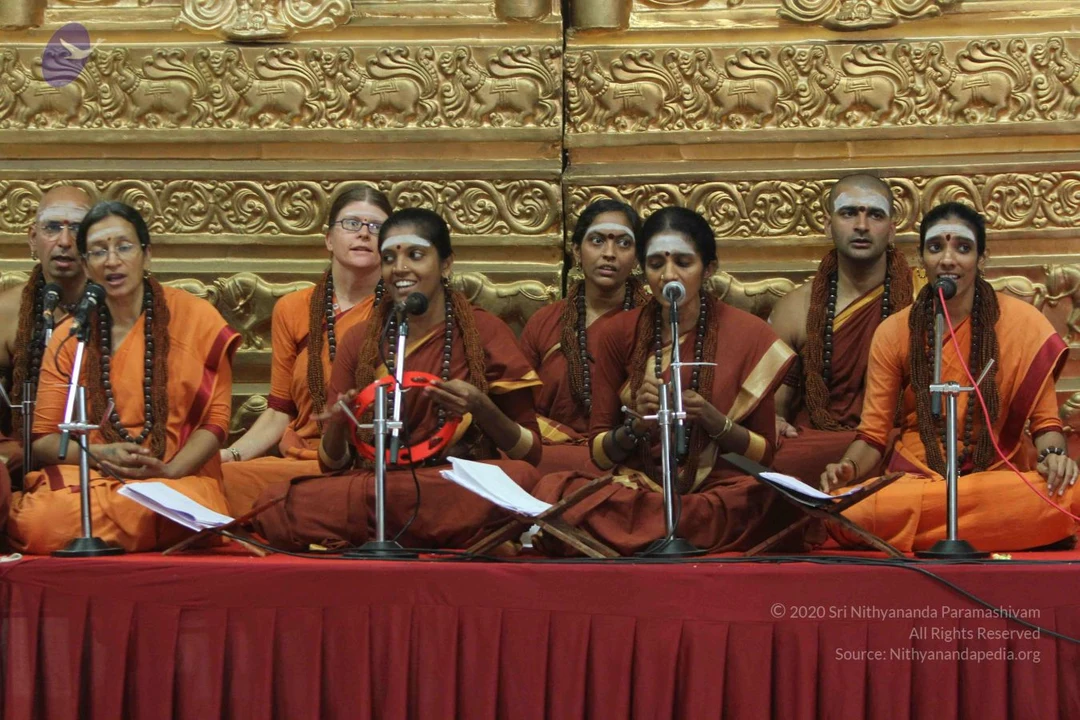
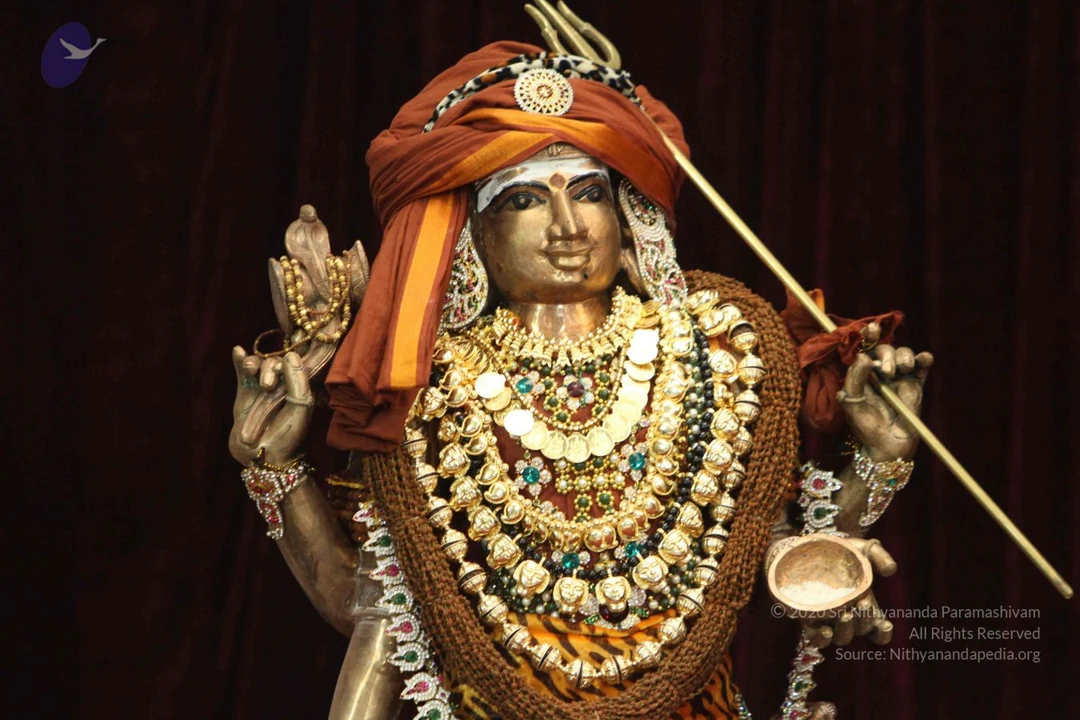
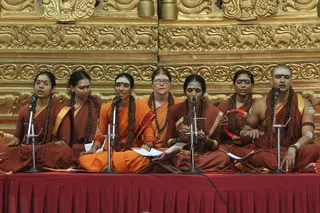
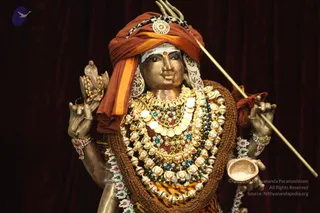
A photograph of a group of devotees seated on a red-draped stage in front of ornate gold carved panels with lion and animal motifs. Several women in orange and maroon robes with rudraksha malas and white forehead markings sit at microphones on stands, singing or chanting from printed sheets on lecterns. One woman in the centre holds a red tambourine-style percussion instrument. Behind them, a shaved-headed man in orange and an older man in glasses also sit with the group. No individual is confidently identified as a person.Five devotees in orange and maroon saris and dhotis sit cross-legged on a red stage before a gold-embossed carved backdrop with horse and floral reliefs. Each has white forehead markings and wears long rudraksha malas. Several sing into standing microphones while reading from loose printed sheets on wooden music stands; one woman on the left wears glasses. The woman second from left plays a red tambourine, and a red cable runs across the stage.A group of devotees seated on a red-draped stage sings in front of an ornate gold-embossed wall decorated with lion and floral reliefs. A woman in the centre wears a maroon sari and plays a red tambourine, singing into a microphone; she has a white forehead band and a rudraksha mala. Beside her, women in orange and maroon saris with white forehead marks and rudraksha malas sing at microphone stands, with sheet music on stands in front of them. Several men in orange and maroon robes with white forehead bands sit at the right edge. No a person candidate is visible in this image.A group of eight people in orange and maroon robes with rudraksha malas and white forehead markings sit cross-legged behind microphone stands on a red-draped stage, singing from printed sheets. One woman in the centre plays a red tambourine-like drum while others sing. Behind them is an elaborate gold-embossed wall with carved patterns.A metal statue of a deity murti with a golden-brown face, wearing a saffron-orange turban with a white-and-gold forehead ornament and a trident raised behind the head. The figure wears layered gold necklaces with green and red gemstones, a dense brown knitted shawl, and tiger-striped cloth at the waist. The raised hand holds a rudraksha-style bead strand while the other hand holds a small bowl, set against a dark maroon velvet backdrop. Gold bangles and jeweled armlets adorn the arms.

YOGA

8 photosSource gallery
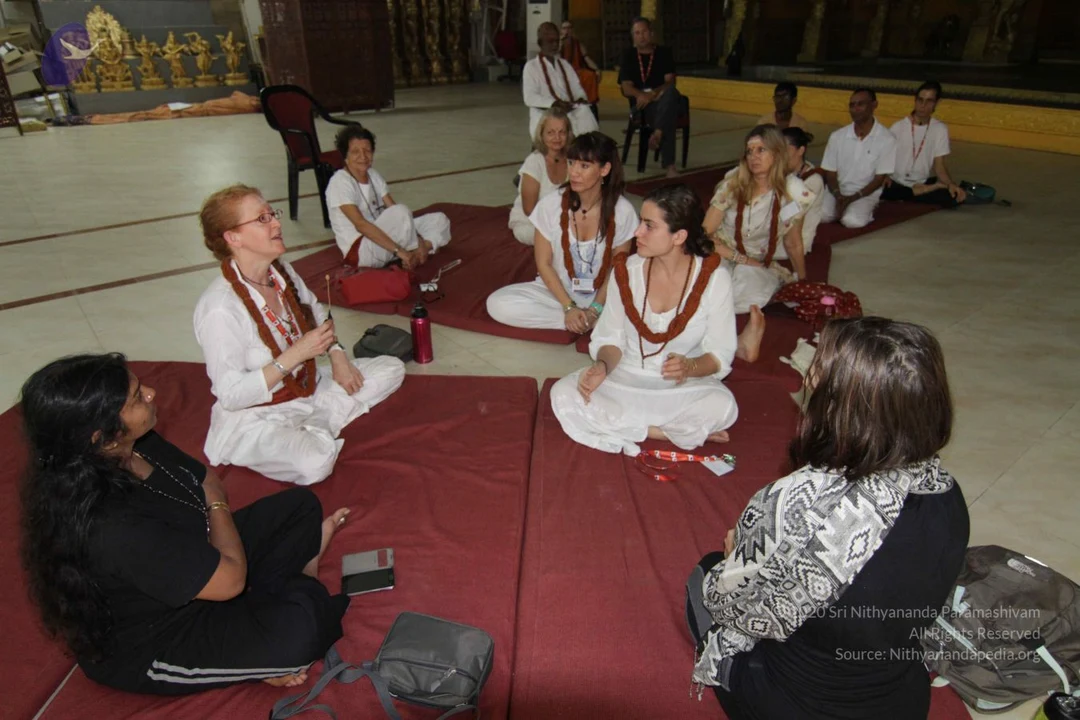
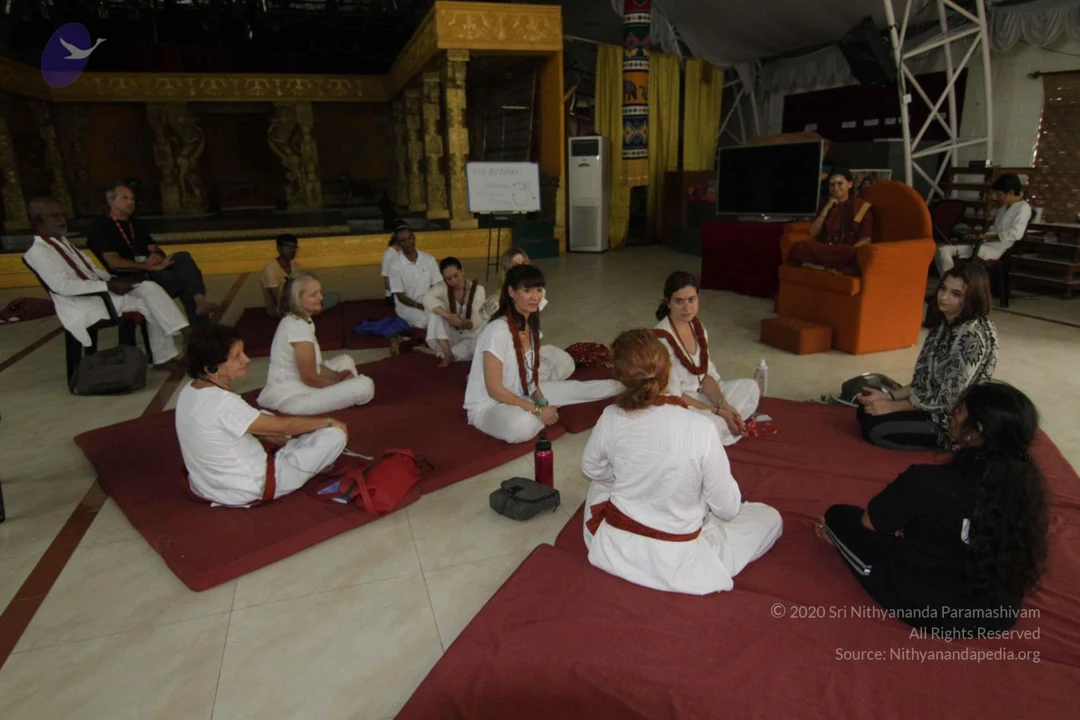
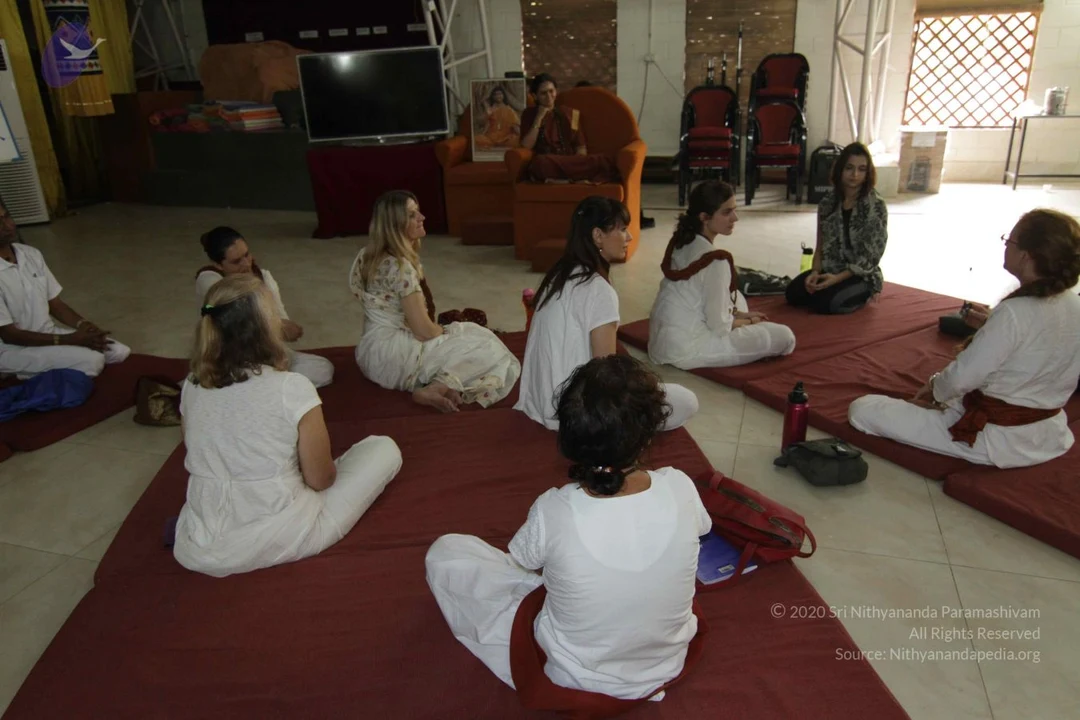
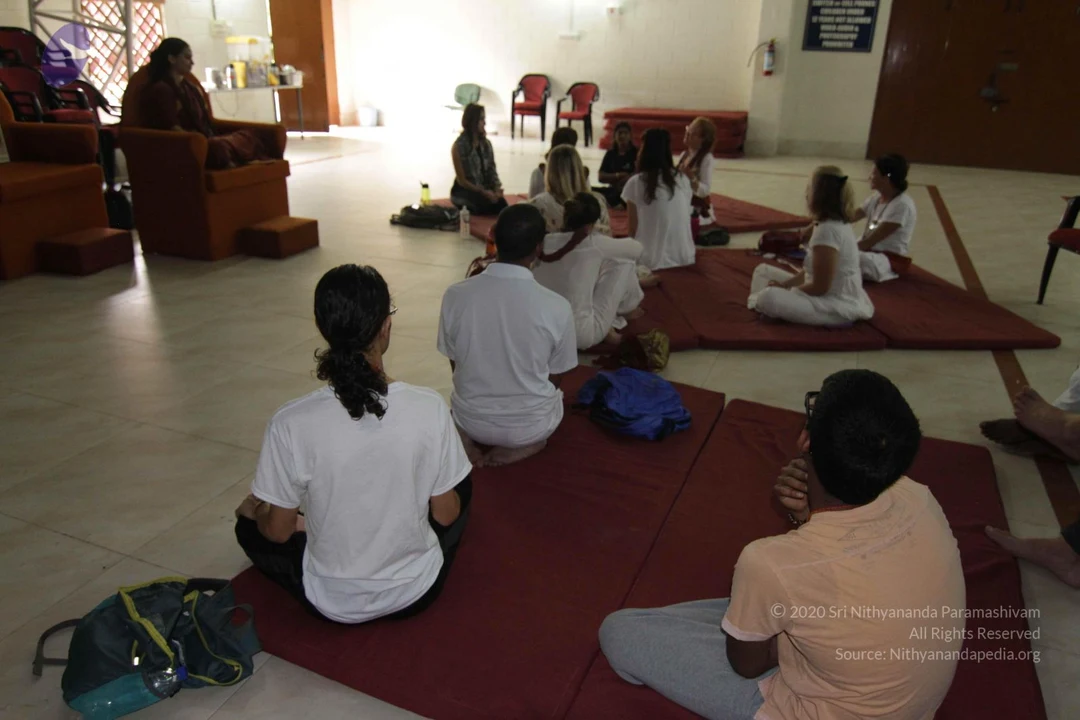
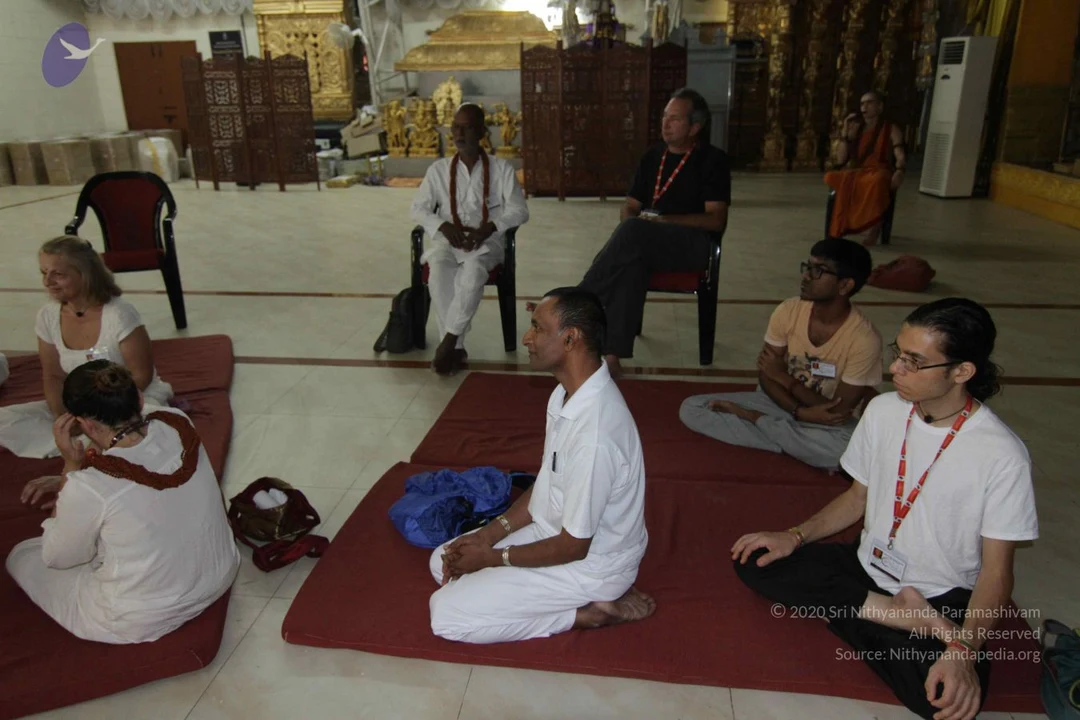
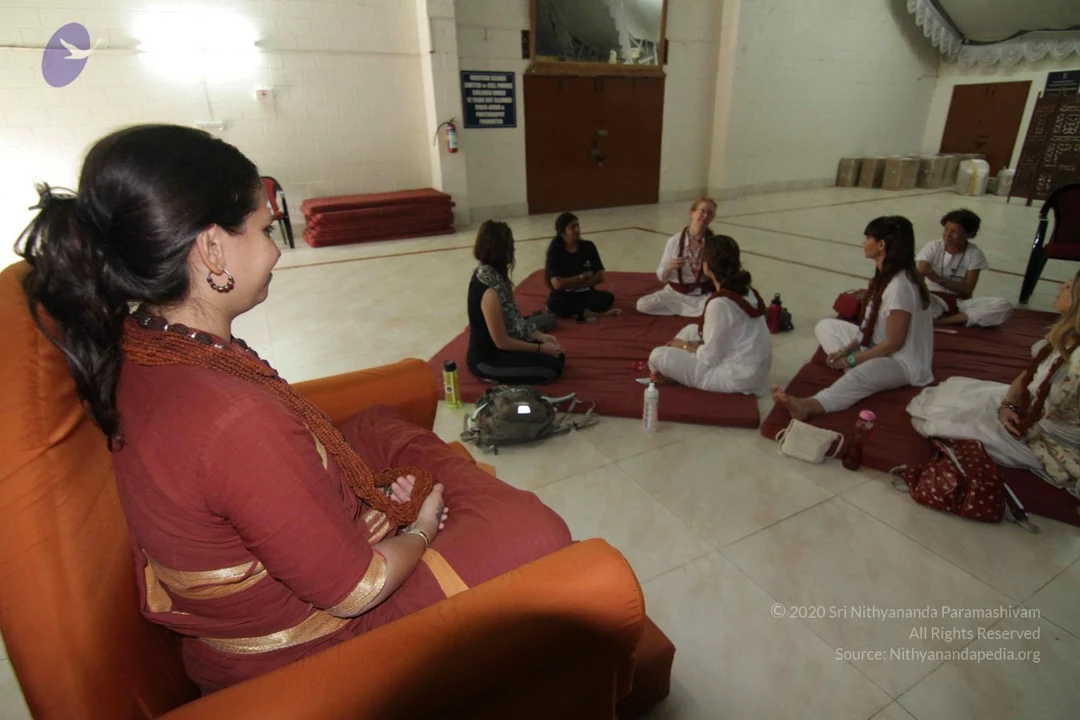
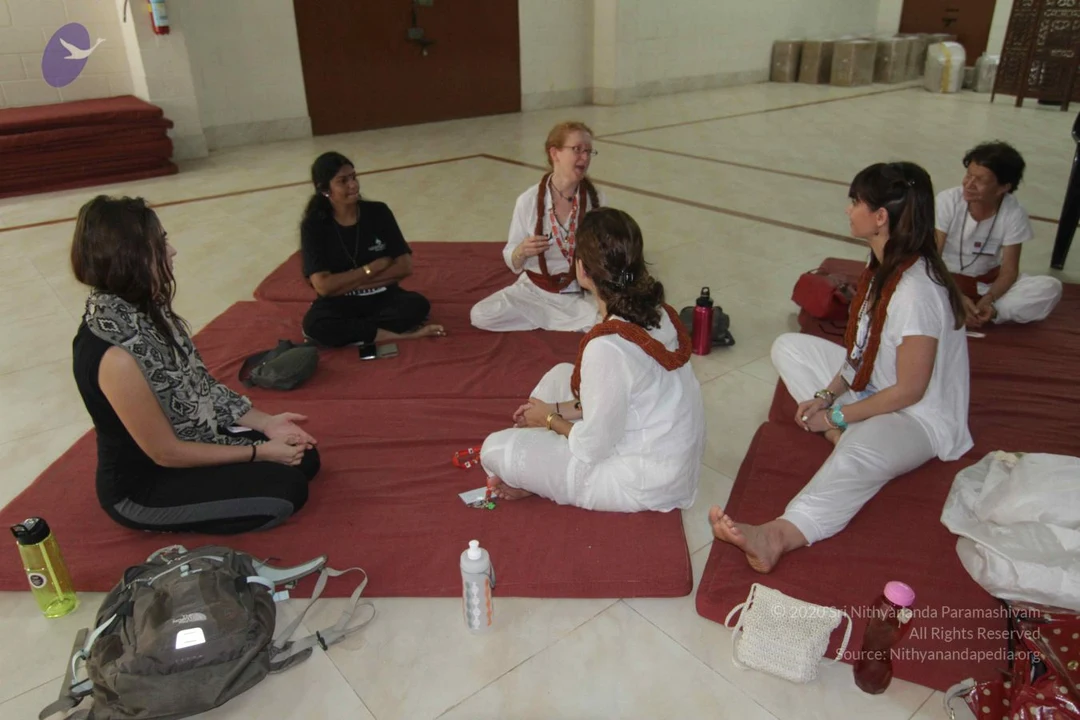
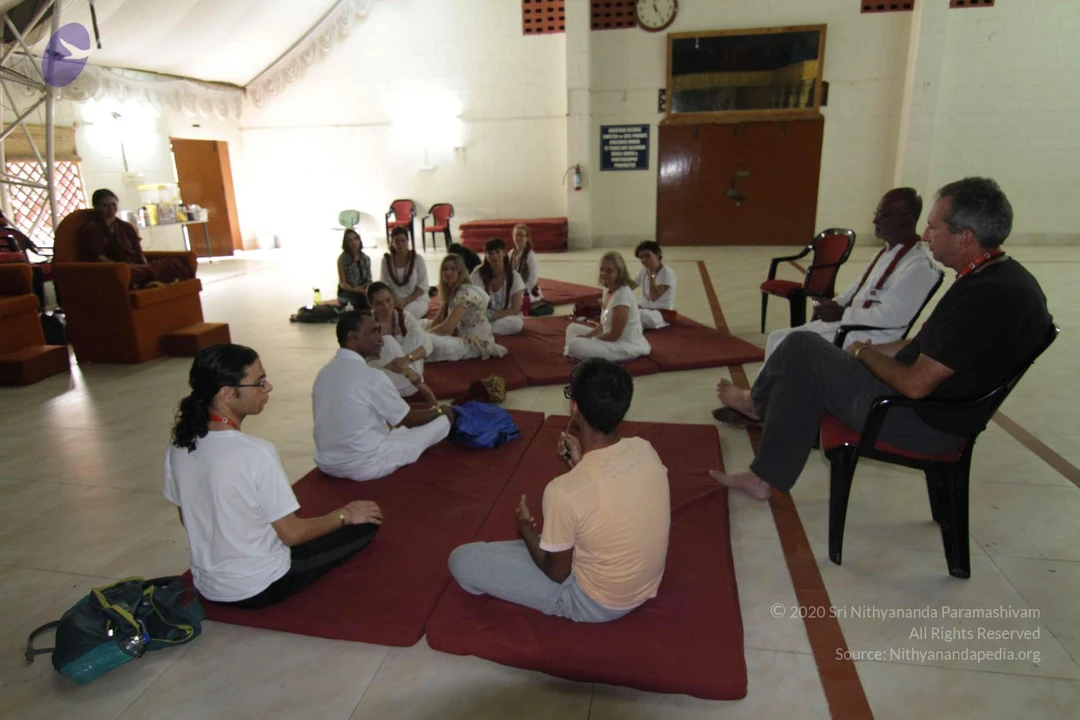
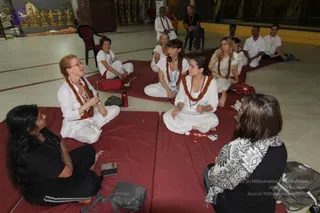
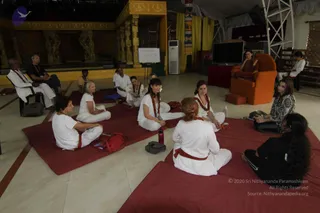
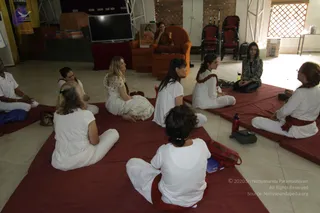
A group of about fifteen people sit in a circle on red mats on a polished floor inside a temple-like hall with gold-accented carved wood and a gilded deity figure in the upper left. A woman with reddish hair and glasses, wearing white clothes and a rust-coloured shawl, speaks and gestures with one hand while others listen attentively. Several participants wear white outfits with rust-red shawls, and a few wear dark tops; water bottles, bags and a small book lie on the mats. Two figures in the back wear white, and a man in a dark shirt sits on a chair at the rear. No person is clearly identified as a person, and the group appears to be a discussion or satsang circle.A seated group discussion in a large hall with ornate golden carved pillars and a wooden stage backdrop. Several people sit on red mats on the floor in white clothing with red sashes; a man in white sits on a chair at left. A woman in a bright orange armchair sits at the far right back, apparently the focus of the circle, while other attendees listen. A flip chart stands at the back and a flat-screen monitor is nearby. Visible people: about ten.A photograph of a seated group in a bright hall with tiled floor. Around ten people sit cross-legged on dark red mats arranged in a circle, most dressed in white with red sashes or waist cloths. A woman in a patterned top sits on the right edge, and a woman in a dark-red outfit sits in an orange armchair in the background beside a framed portrait. Water bottles and bags lie on the floor, and a television and stacked chairs stand at the back. No visible deity murti, fire or ritual objects. No one in the scene is identified as a person.A seated group of devotees on red mats in a bright hall during a satsang-style session. Two women in red-brown clothing sit in orange armchairs at the far left, facing the group. Students in white and light clothing sit in a semicircle, some with their backs to the camera. A red chair and a red cushioned bench sit against the back wall, with a water dispenser on a table nearby. A man in a peach shirt and grey trousers sits in the right foreground. The floor is pale tile and a blue bag rests near the front.Indoor satsang in a hall with a gold-toned temple backdrop, carved wooden dividers and gilded shrine elements. A man in white ritual clothes with a red-orange shawl sits on a chair at centre-left, flanked by devotees seated on red mats. A man in a black shirt and dark trousers sits on a chair behind them, and a person in an orange robe sits on a chair at the upper right. In the foreground, a man in white sits cross-legged with hands folded, a young man in a beige t-shirt sits with arms crossed, and a bespectacled young man in a white t-shirt with a red lanyard sits with hands resting on his knee. A woman in white sits at left, and another woman in white with a red shawl sits with head bowed. Several lanyards and bags lie on the floor. Visible people total about eight.A photograph of a small group session in a plain white-tiled hall. A woman seated on an orange armchair in the left foreground wears a rust-red sari with gold border and a rudraksha-style bead necklace; she faces the circle. Six people sit cross-legged on maroon mats in a circle; several wear white clothes with maroon shawls, and others wear black. Water bottles, a backpack and handbags lie on the floor, and a wall sign and folded mats are visible behind.

VIP-VISIT

1 photoSource gallery
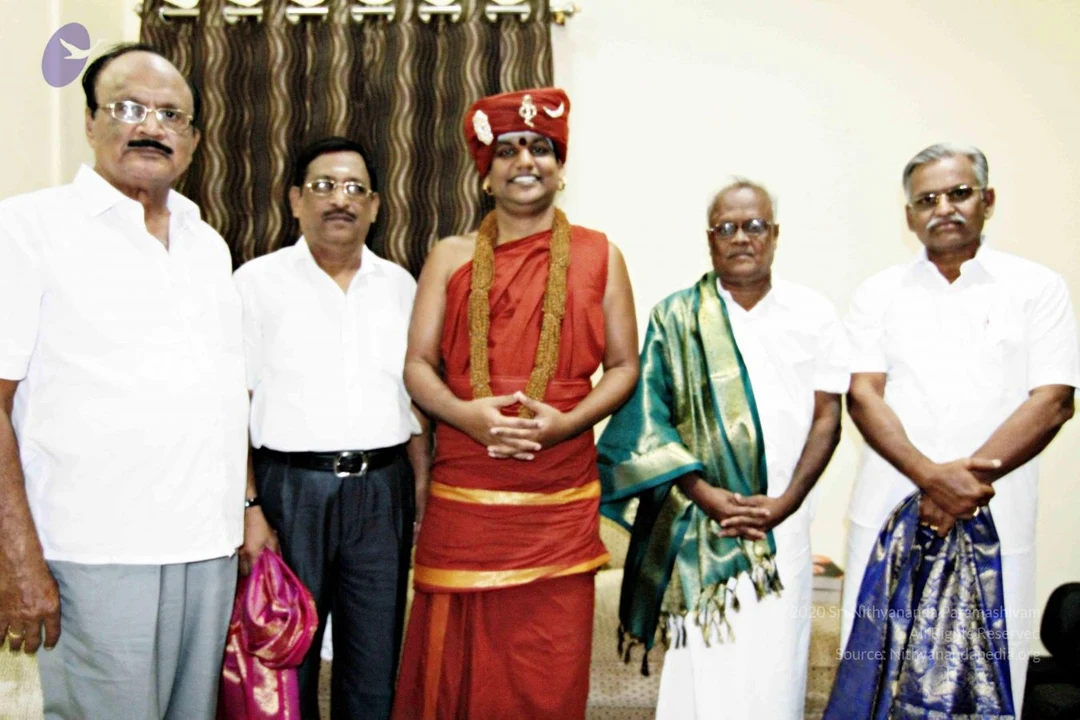
Indoor group photograph in a room with beige walls and brown patterned curtains. Five people stand in a row. In the centre, a smiling woman wears a red and saffron sannyasi-style outfit, a red turban with a gold emblem, and a gold-coloured mala around her neck, with hands clasped in front. To her left stand two men in white shirts, one with glasses and a moustache and the other in dark trousers and a belt. To her right, a man in white dhoti and white shirt with glasses wears a green and gold shawl, and a man in white shirt holds a blue and gold cloth. A pink cloth is visible at the lower left.

TEMPLE-CONSTRUCTION

9 photosSource gallery
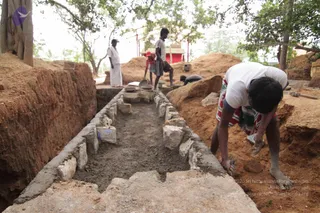
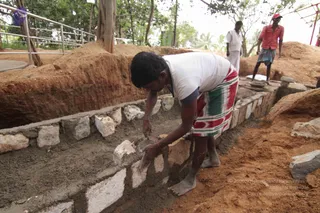
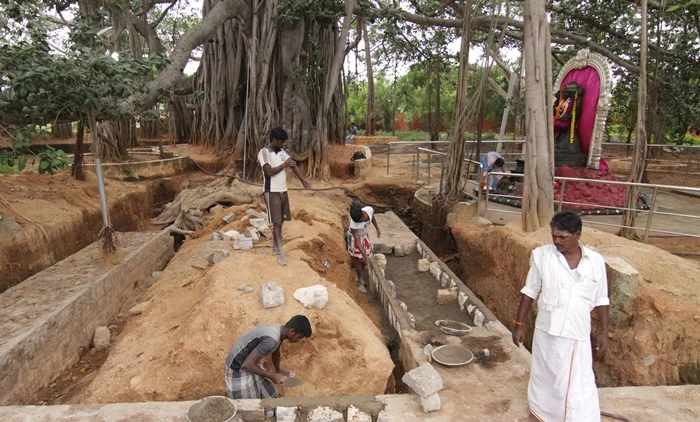
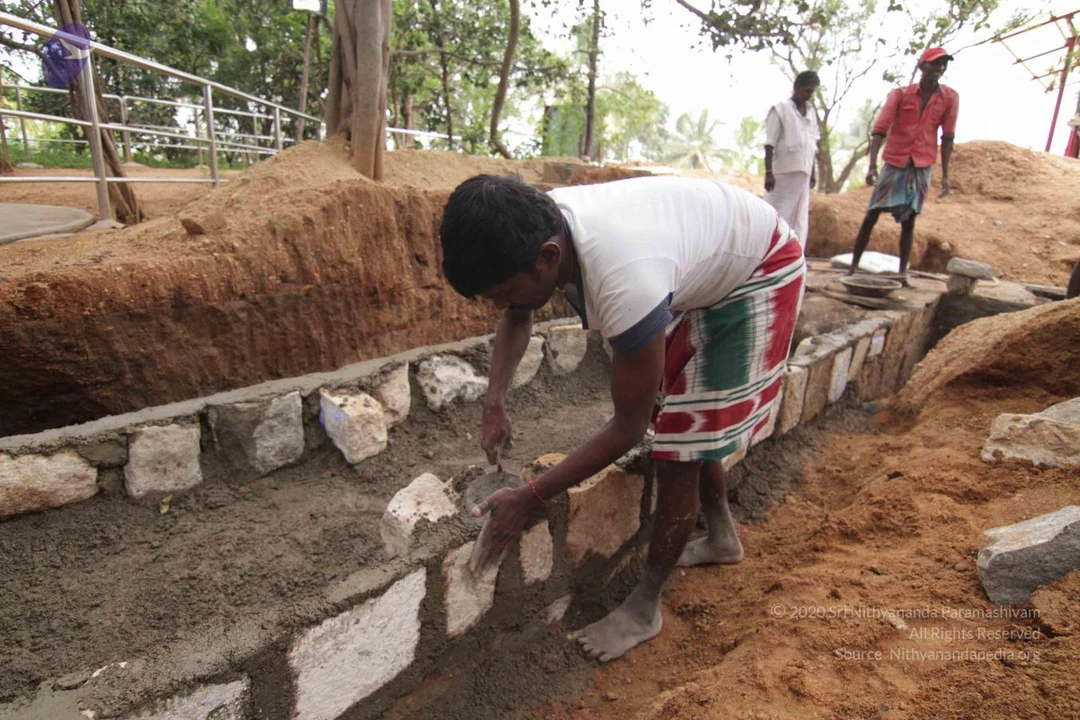
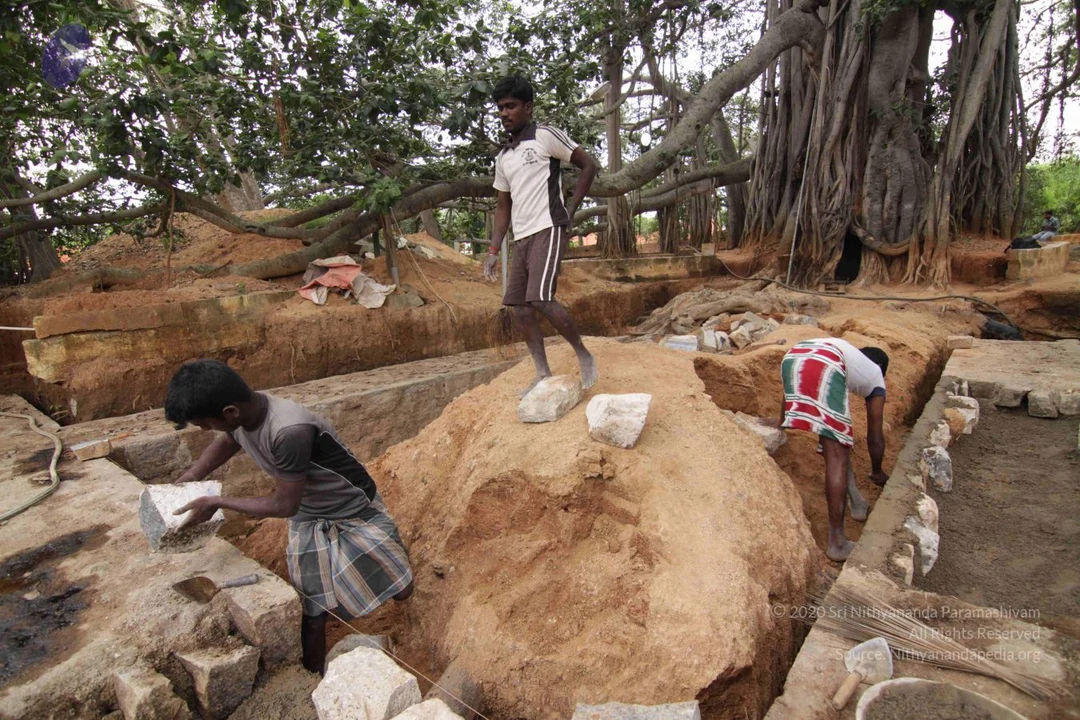
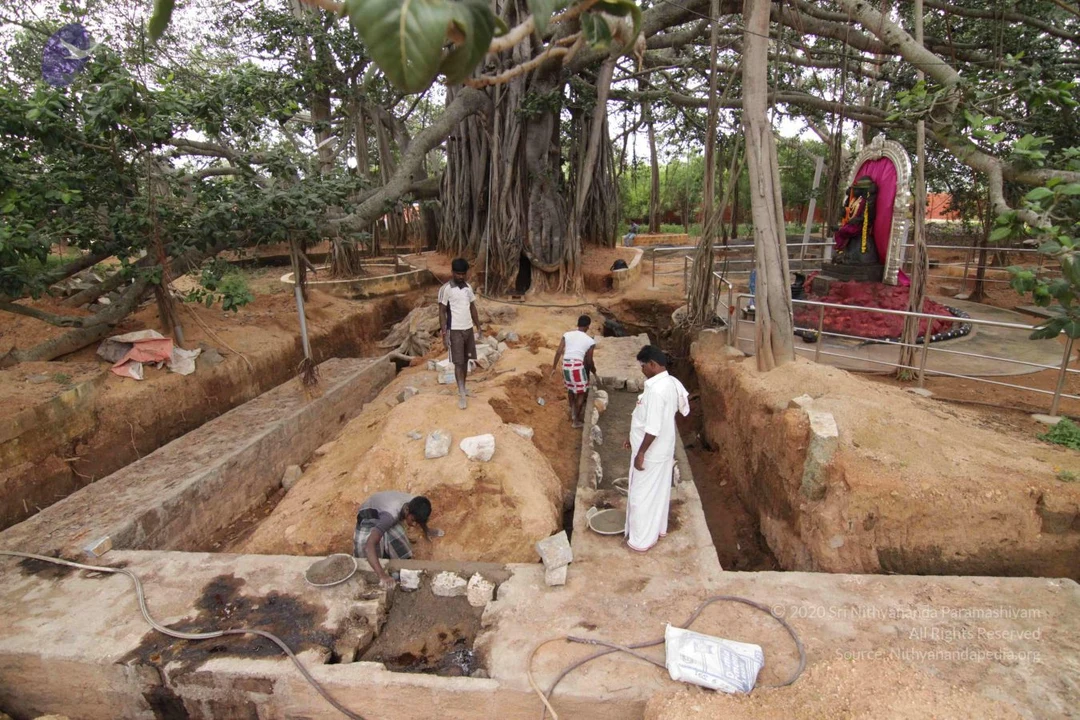
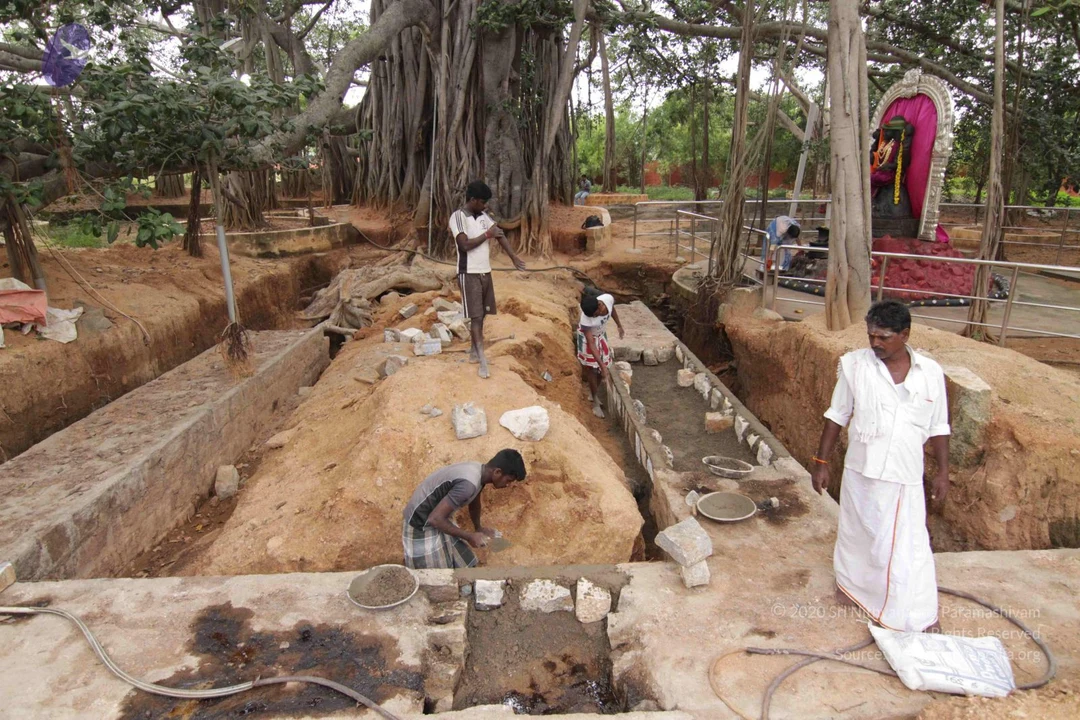
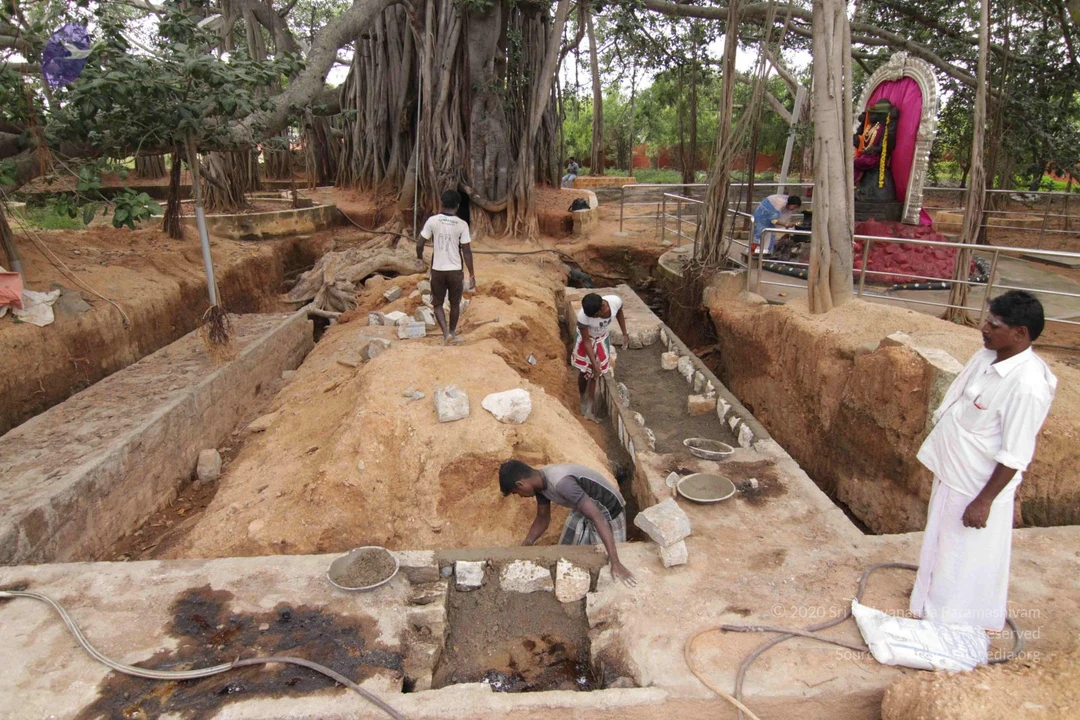
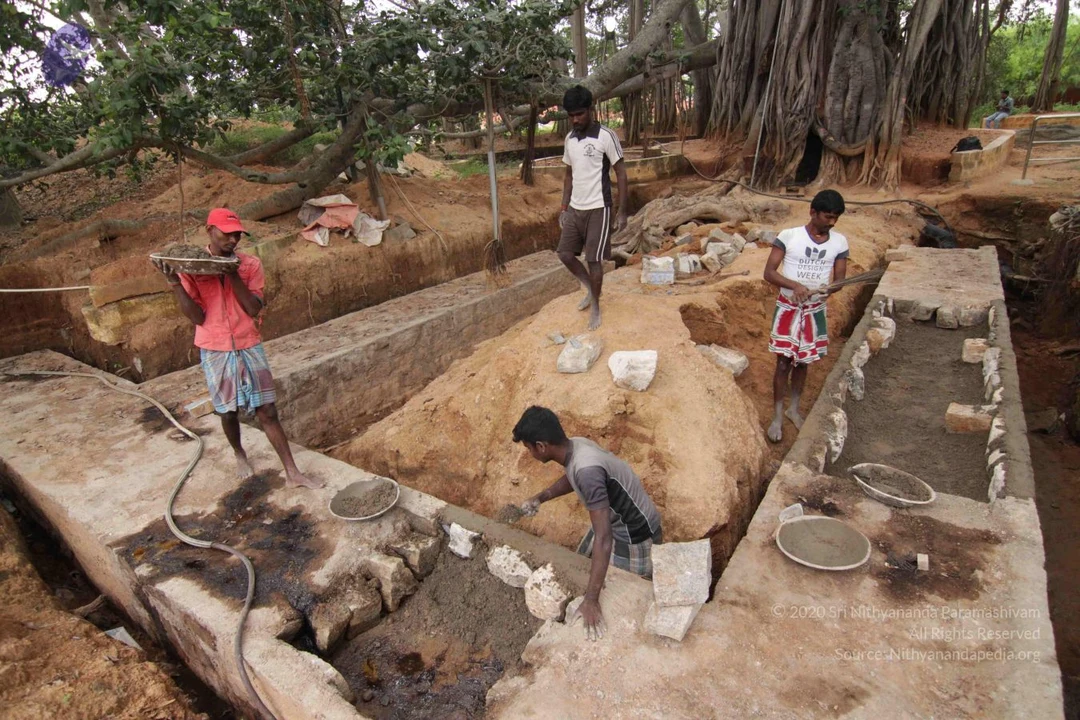
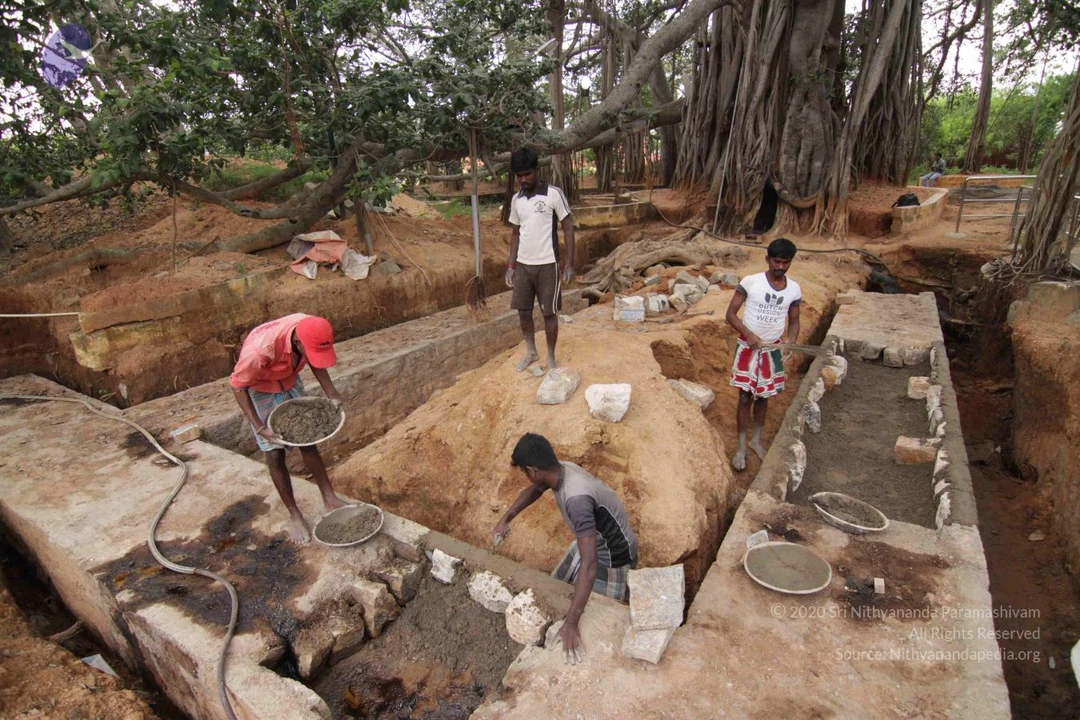
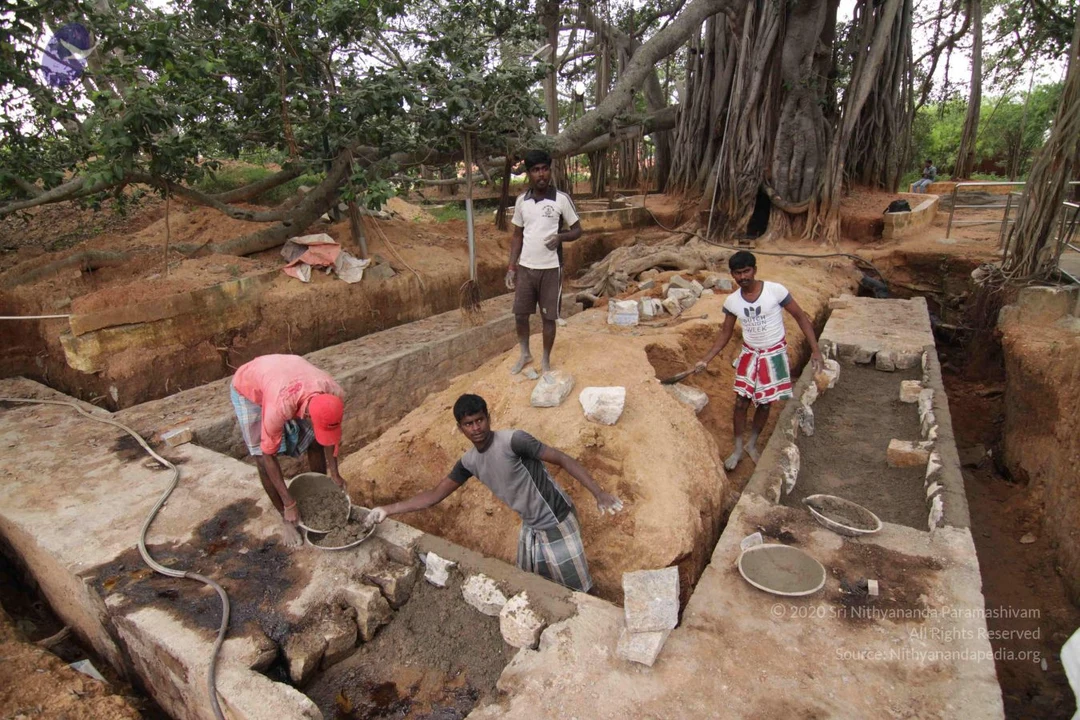
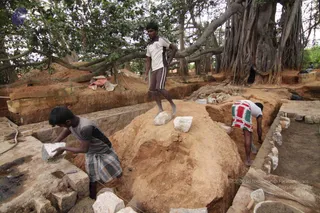
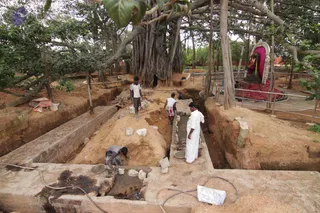
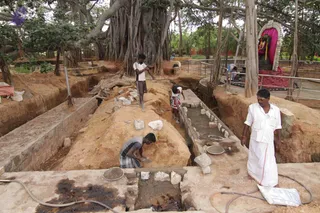
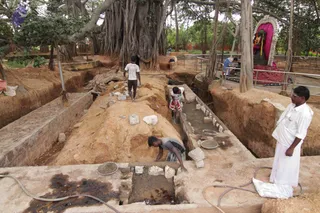
A photograph of an outdoor construction site beside a large tree, showing a long rectangular trench lined with rough stone blocks and concrete, with fresh wet cement or sand filling the floor. Mounds of red-brown earth surround it. A man in a white shirt and checked lungi crouches at the right edge, working with a trowel. Another man in a white dhoti and shirt stands at the back, and a younger worker in shorts stands near the trench with a bowl, while a child in red watches. A red-and-white structure with scaffolding rises behind them. No ritual, discourse or a person candidate is visible.A worker in a white t-shirt and a red-green-white checked lungi bends over a low wall of rough stones, troweling wet mortar between them. Behind him, a second man in white clothing stands by a mound of excavated red earth, and a third man in a red shirt and checked lungi stands on a raised red-soil bank beside a metal railing. Trees and a palm are visible in the background. No one is identified as a person in this construction scene.A photo of an outdoor construction site beneath a large old banyan tree with hanging aerial roots. Three young men work in excavated trenches of reddish-brown soil. One crouches at left, shaping and setting a squared pale stone block with a trowel-like tool. Another stands on a mound of excavated earth placing stone blocks, wearing a white t-shirt with dark stripes and brown shorts. A third, in a red-green striped cloth and white top, bends over at right near a stone-lined edge. Cut stone slabs and loose rubble lie around the trench, with a hose along the left edge. No a person is visible.An outdoor excavation at a temple site beneath a large banyan tree with many aerial prop roots. Several workers dig in trenches of reddish-brown earth lined with concrete walls; one shirtless man in white shorts and a cloth-wrapped figure work at the bottom, while a man in a white shirt and white dhoti stands at the trench edge. Loose stones and a hose lie nearby. To the right, a black Shiva lingam stands in a shrine with a pink cloth backdrop, marigold garlands and a shaded niche, enclosed by metal railings. The scene is a construction or restoration project rather than a ritual event.Outdoor excavation at a temple site beneath a large banyan tree with dense aerial roots. Several trenches are dug into reddish-brown earth, lined with stone and mortar walls. Four workers are visible: a shirtless man in grey shorts kneels and works with a tool in the lower trench, another stands on the mound, a small child in a red-and-white dress stands in the trench, and a man in a white shirt and white dhoti stands at right beside a sack. Metal pans and rubble stones lie around the trenches. At upper right, a shrine with a pink-draped arch holds a deity murti decorated with garlands, behind metal railings.An outdoor excavation site beneath a large banyan tree with aerial prop roots. Several workers dig trenches in reddish-brown soil, one crouching at the edge of a stone-lined channel and another bending over the trench, while stone blocks and metal pans of sifted soil sit along the ditch. A man in a white shirt and white dhoti stands at right, watching. Beyond, a shrine niche painted pink holds a deity murti with garlands and a red cloth, and iron railings line the walkway. A white plastic bag lies on the ground at right.