Skip to content
Tuesday

13 May 2014

Non Duality is the Axis of Life

Dated photos
390
Source pages
1
Media
2
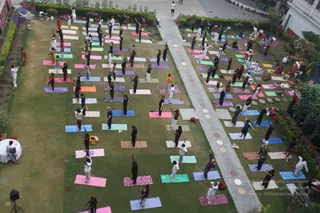
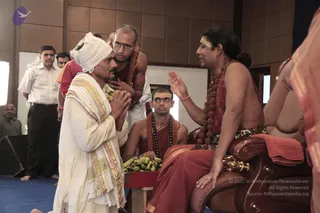
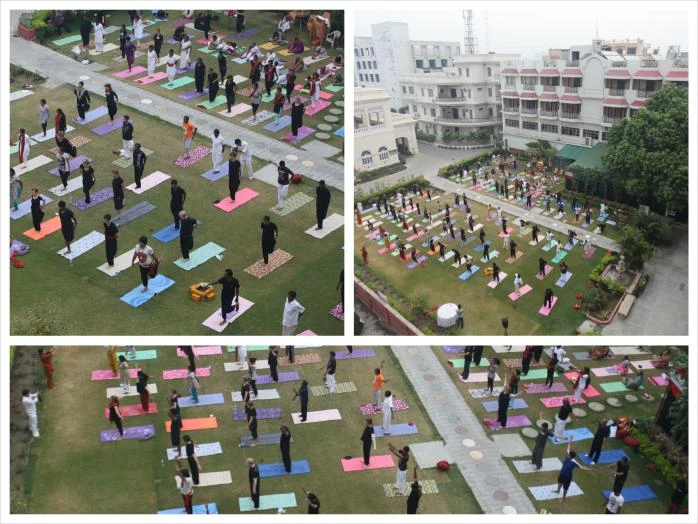
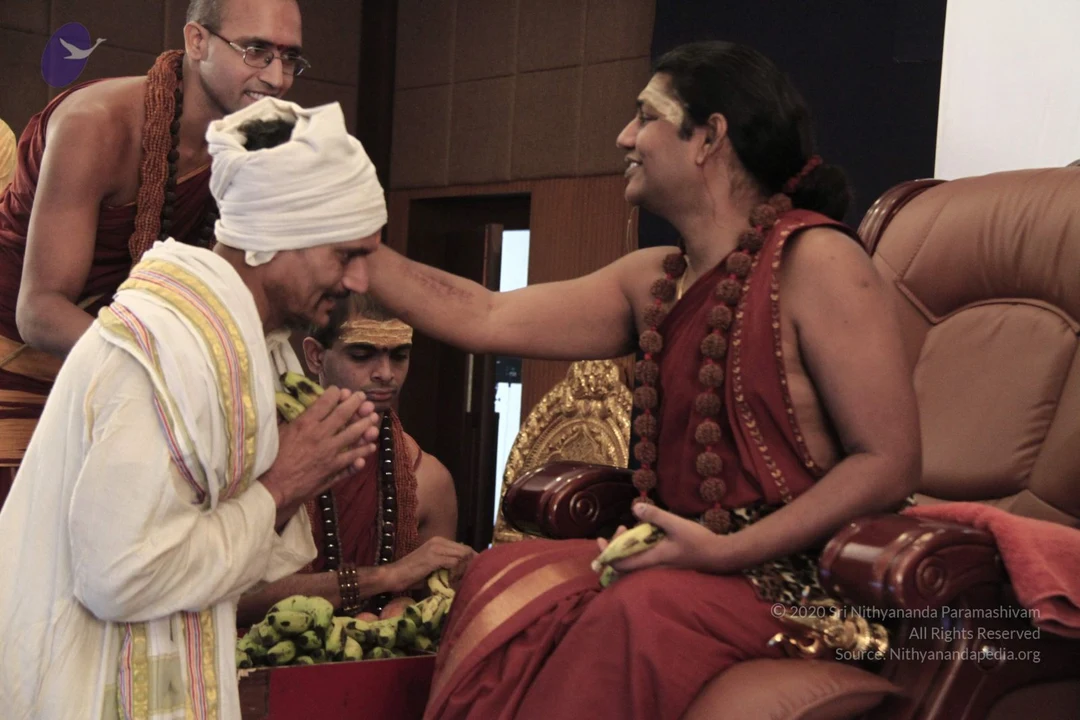
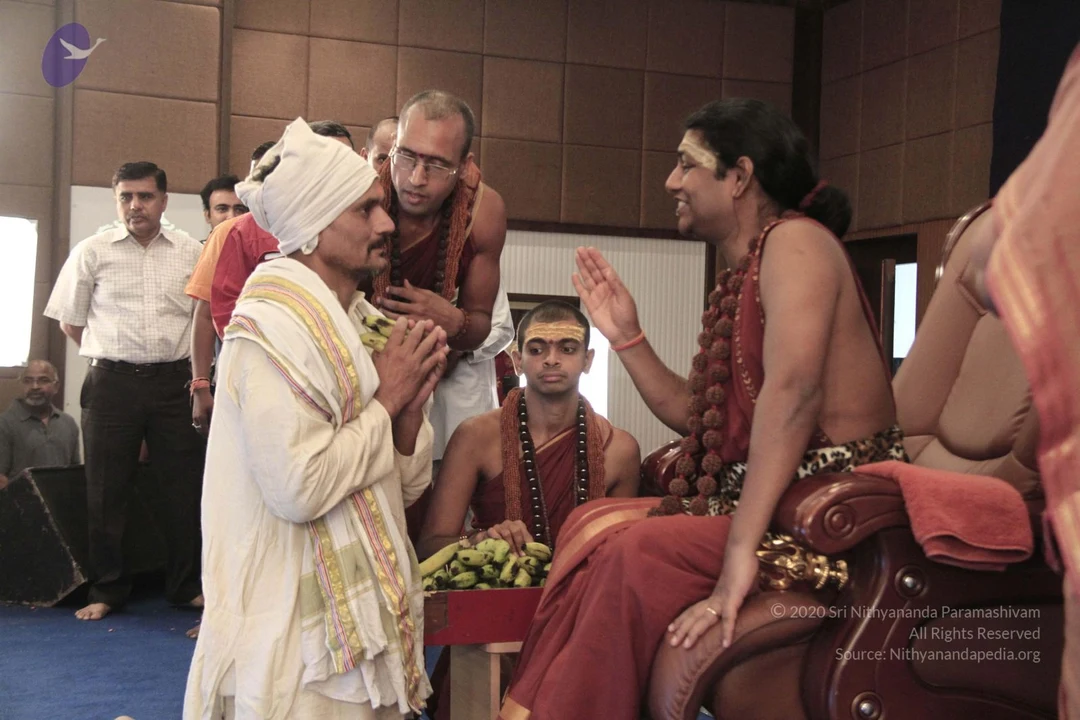
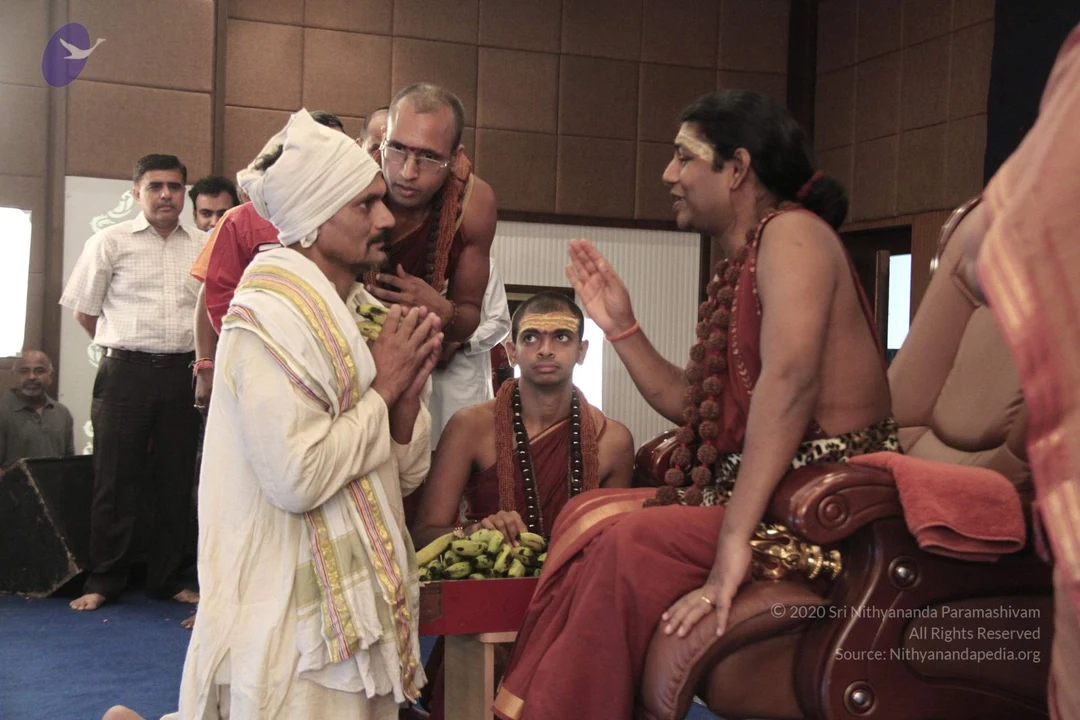
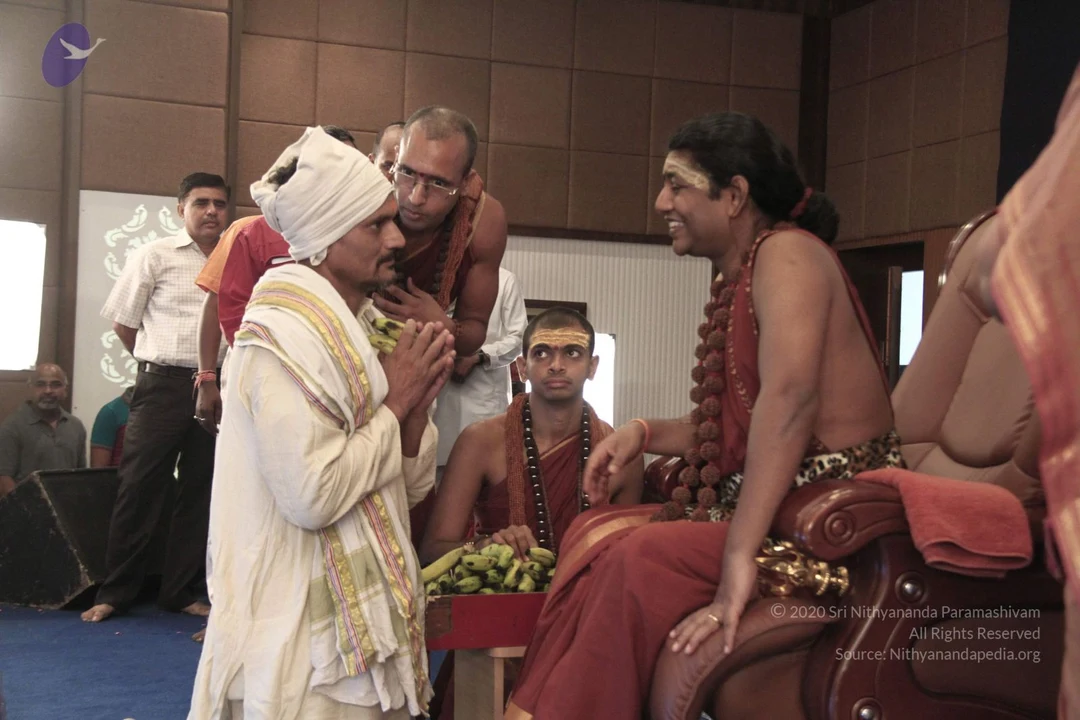
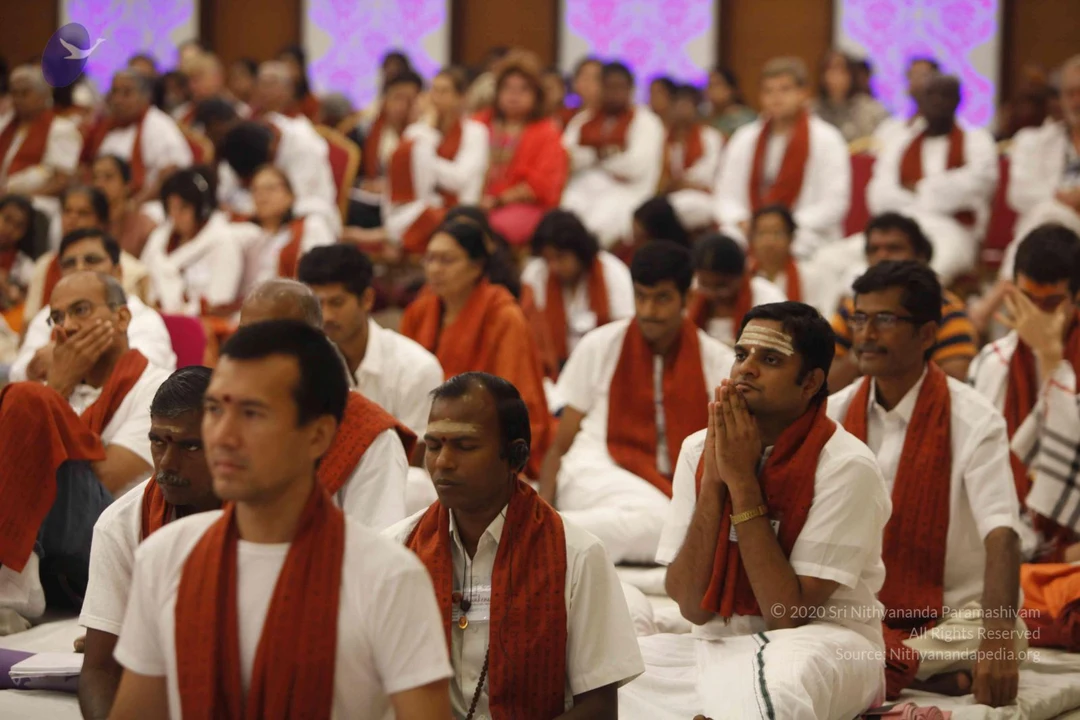
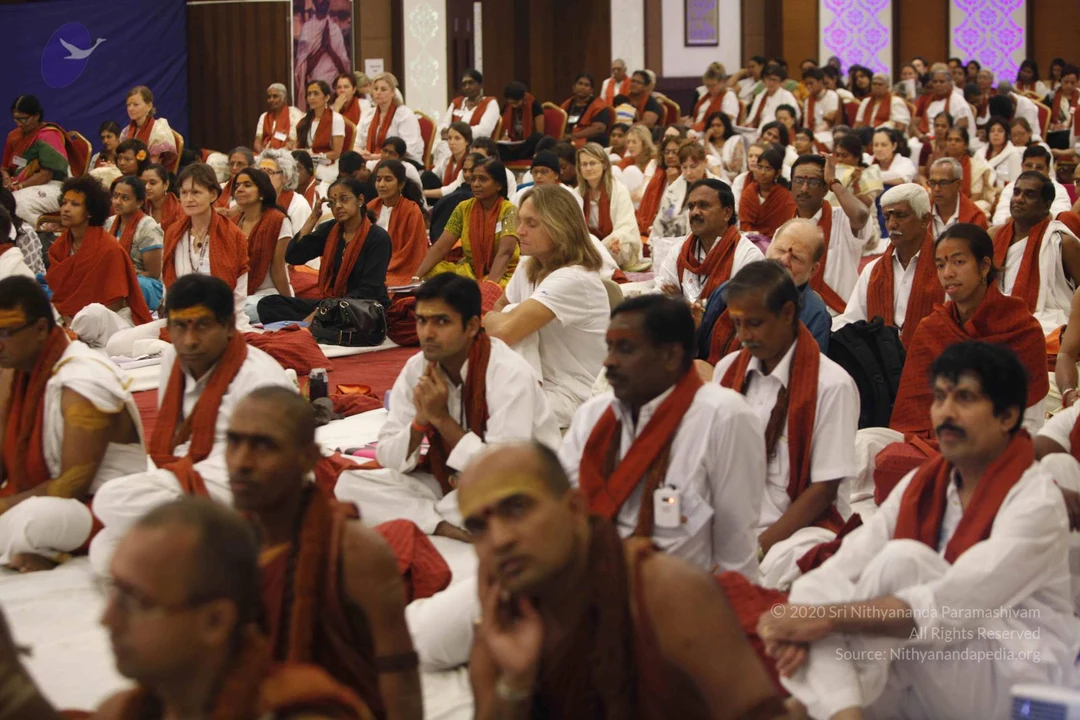
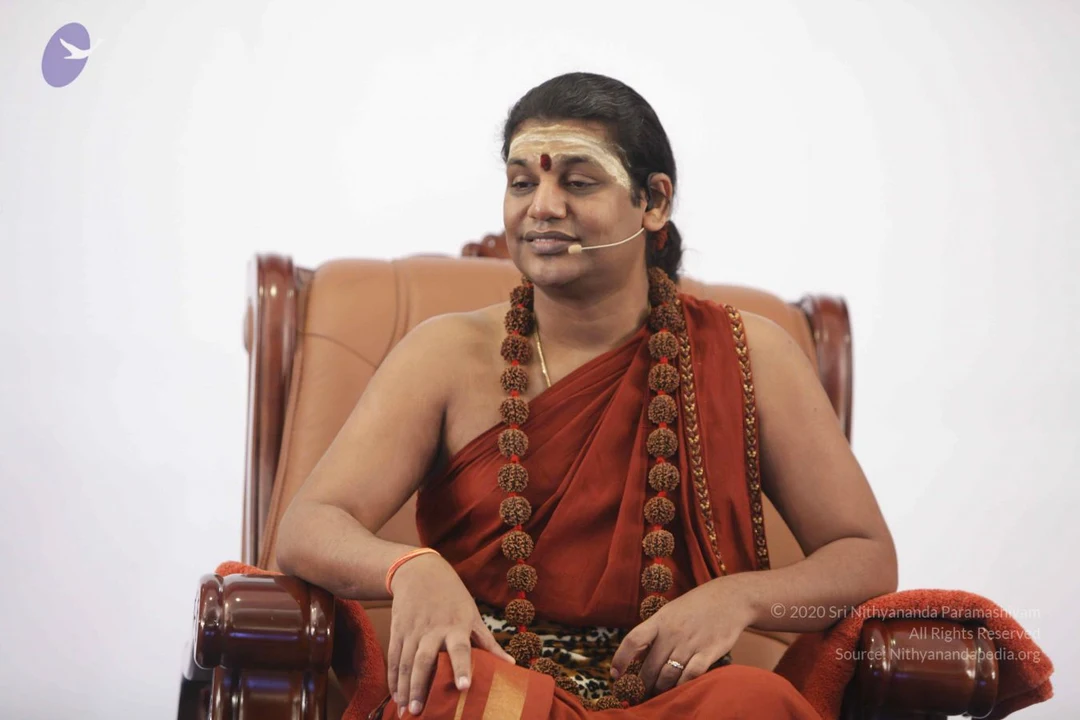
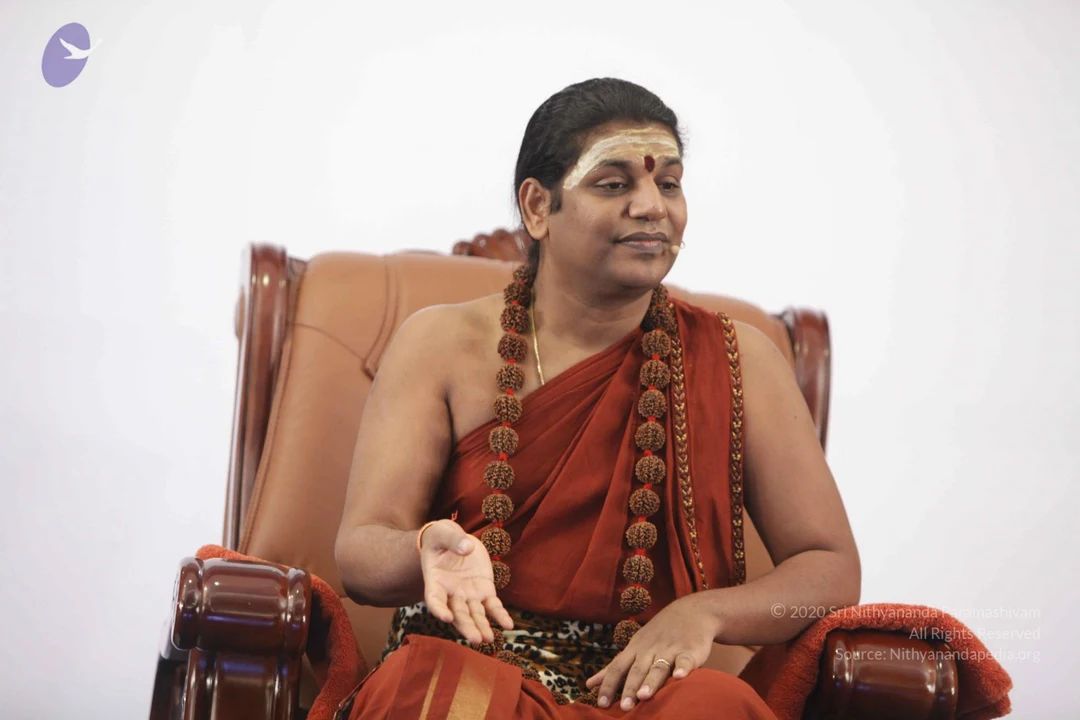
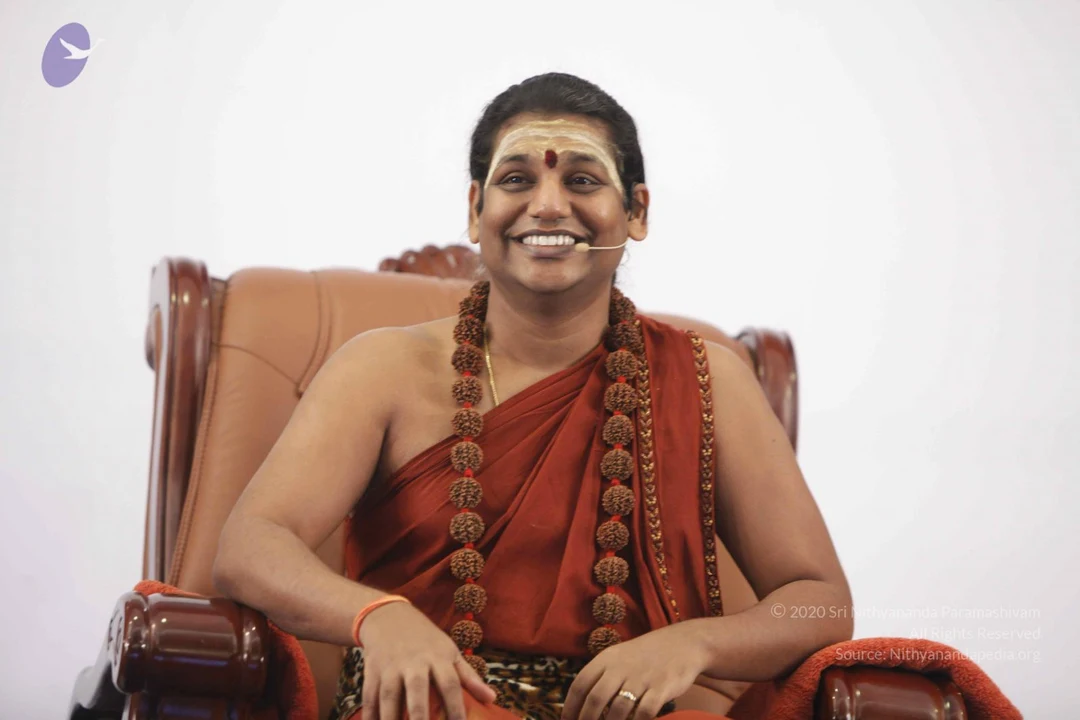
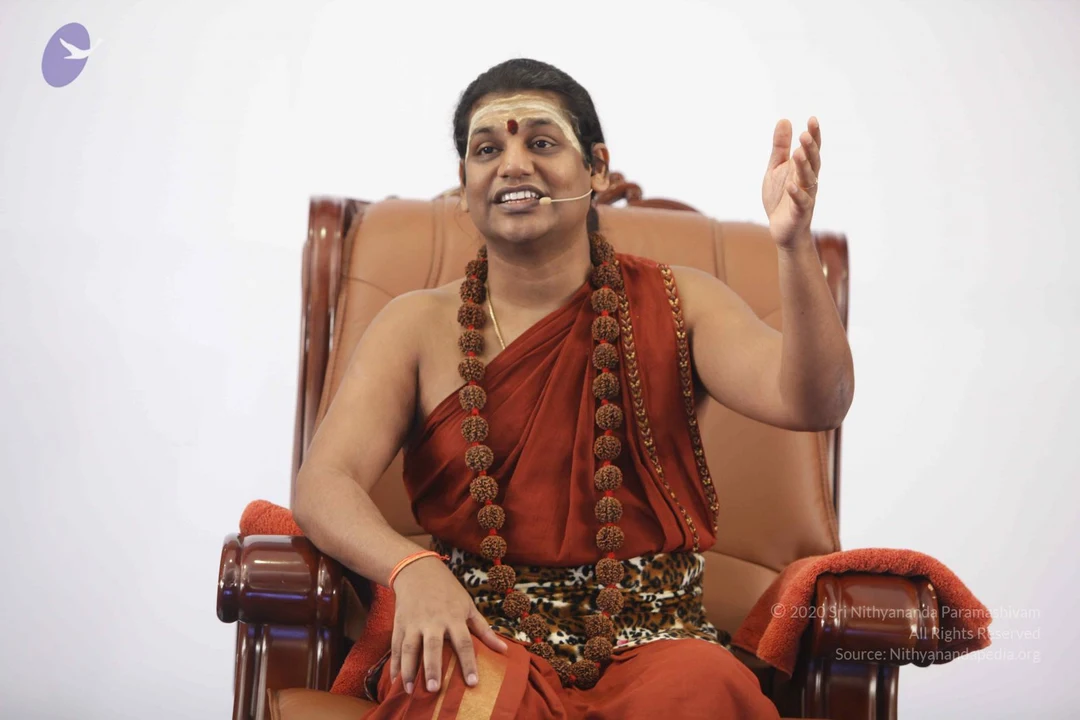
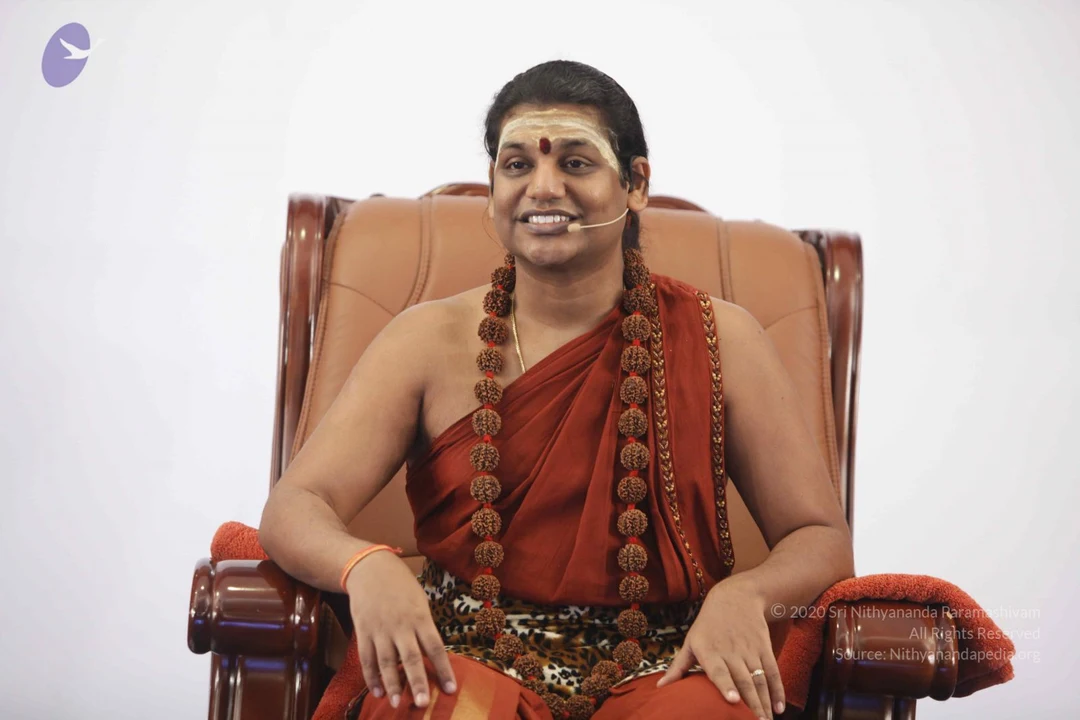
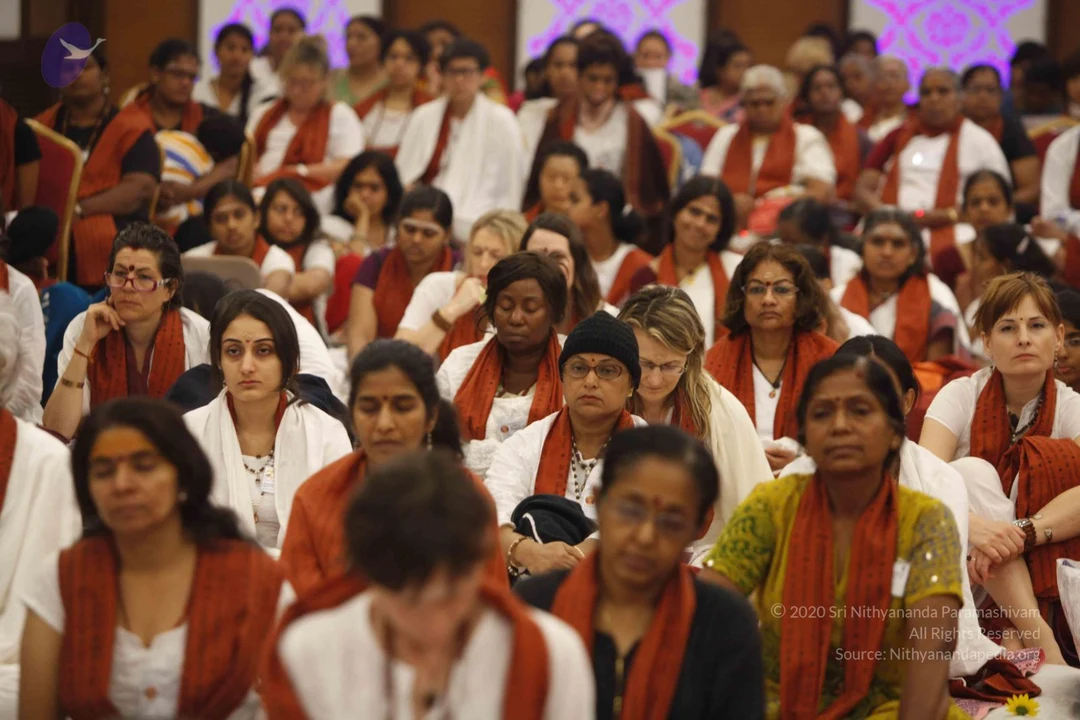
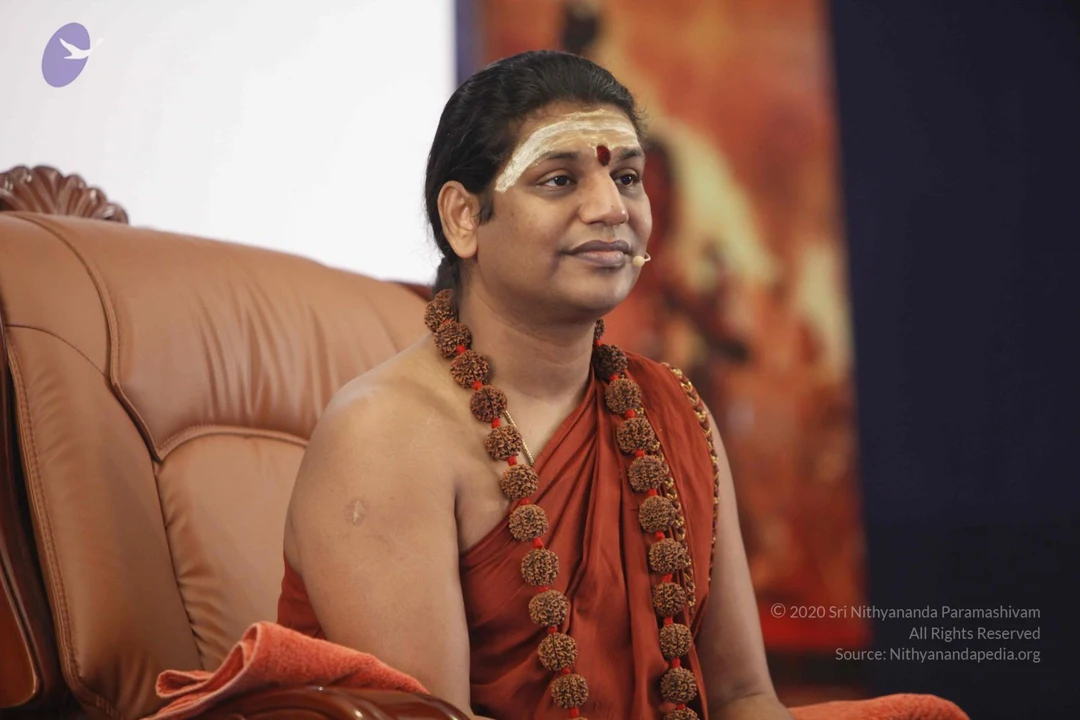
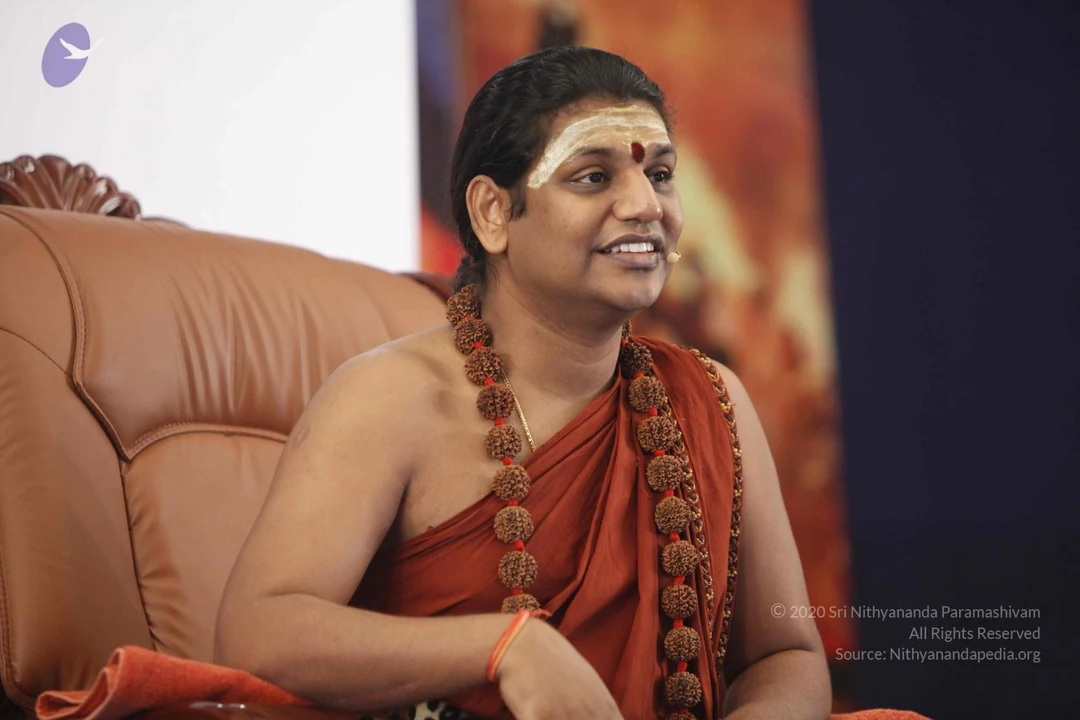
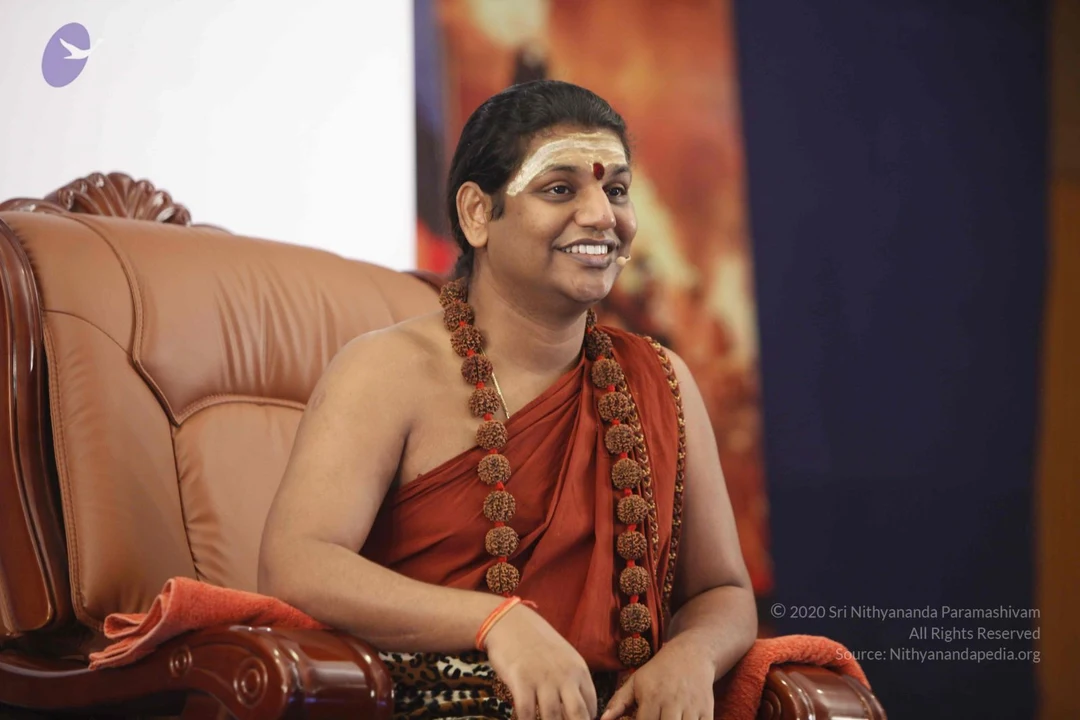
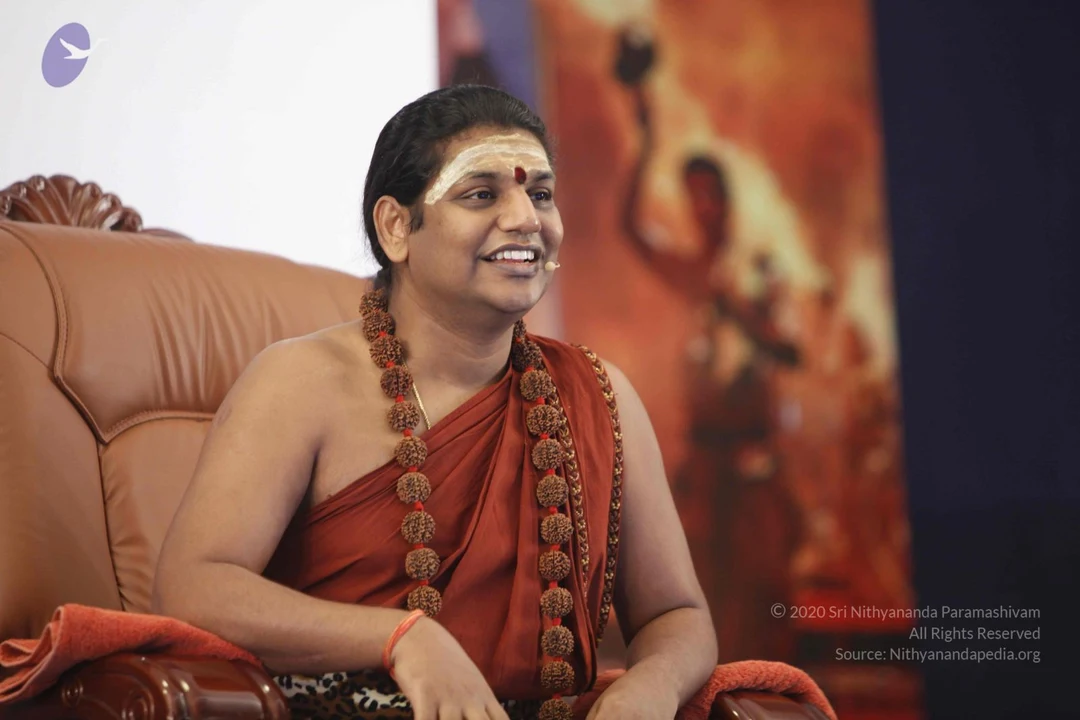
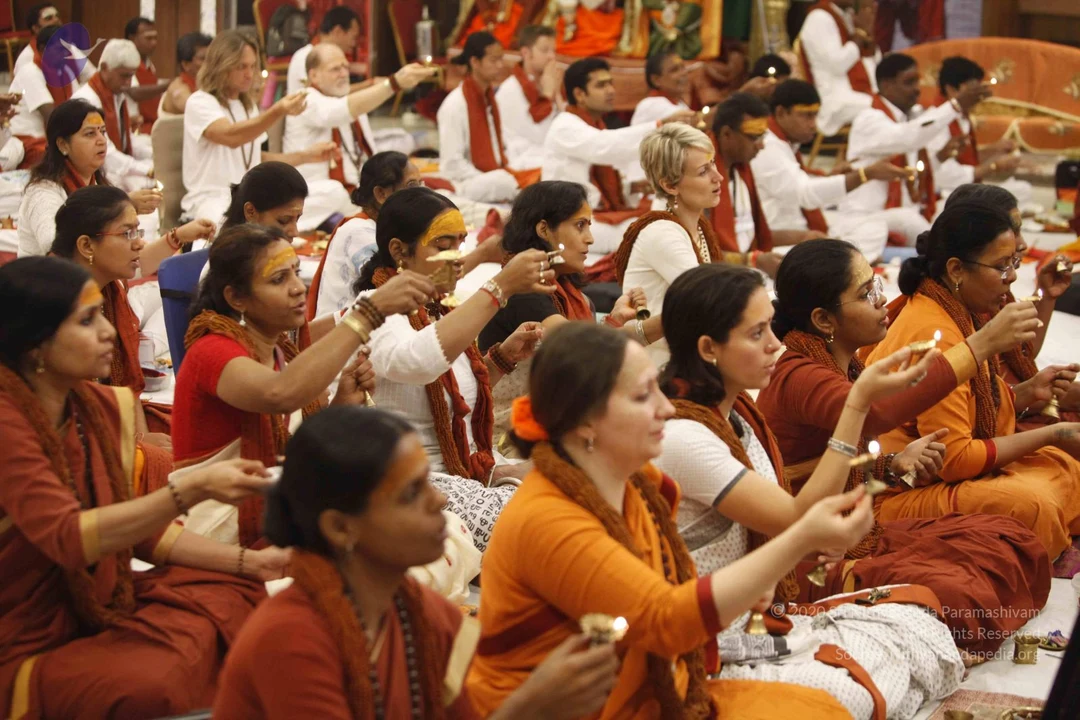
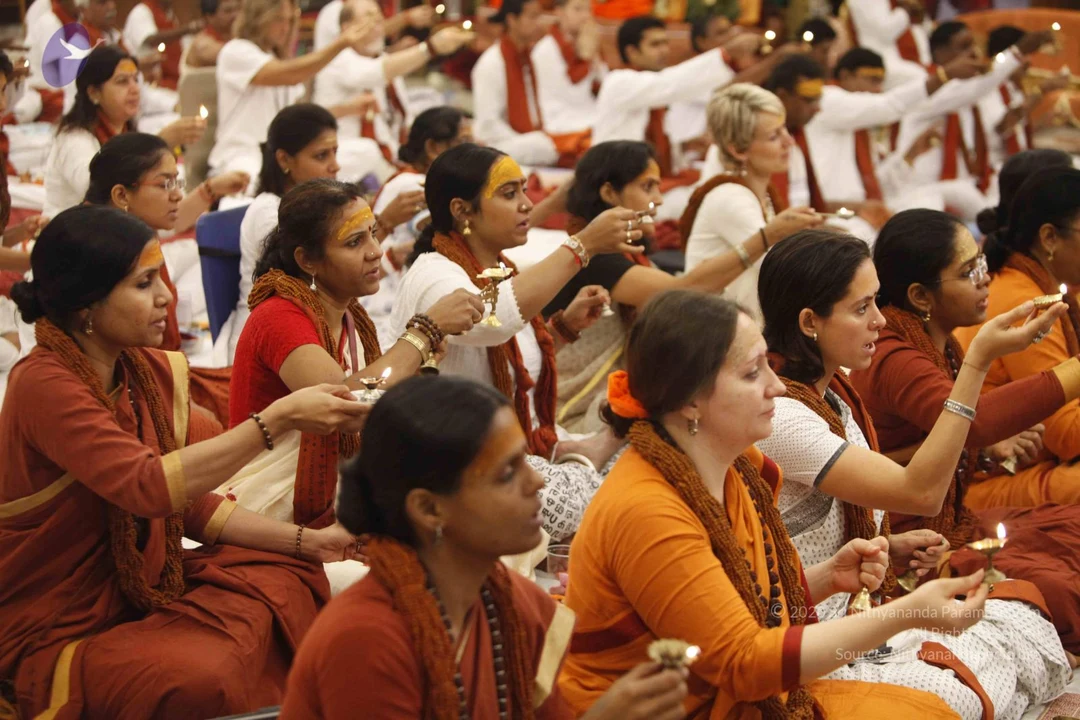
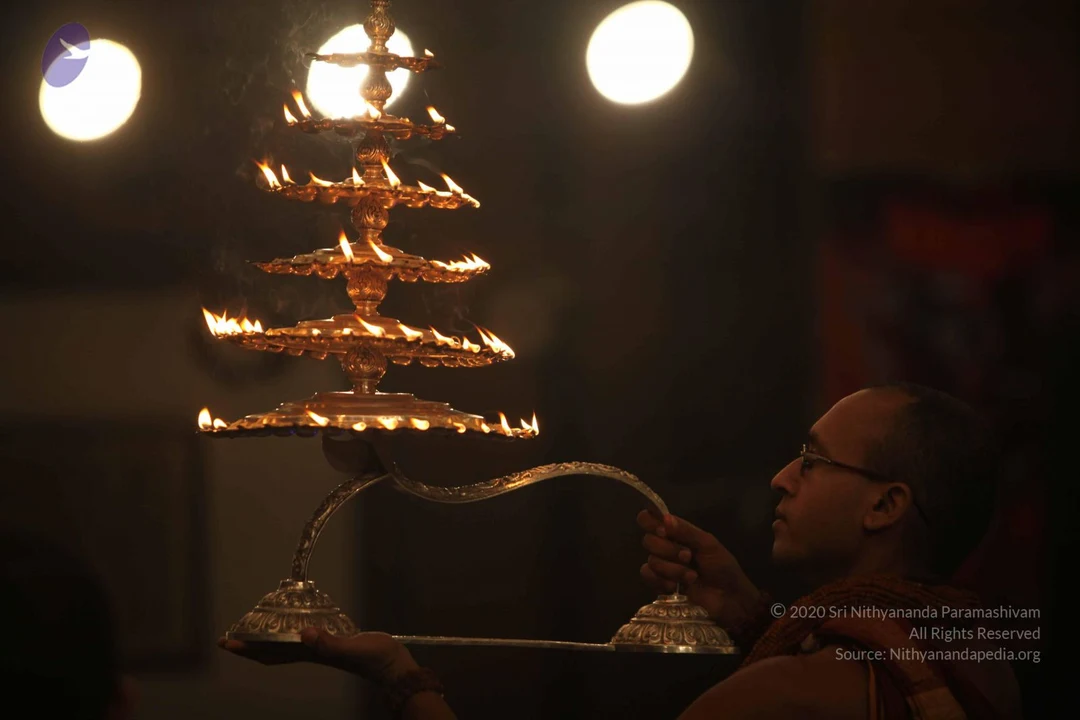
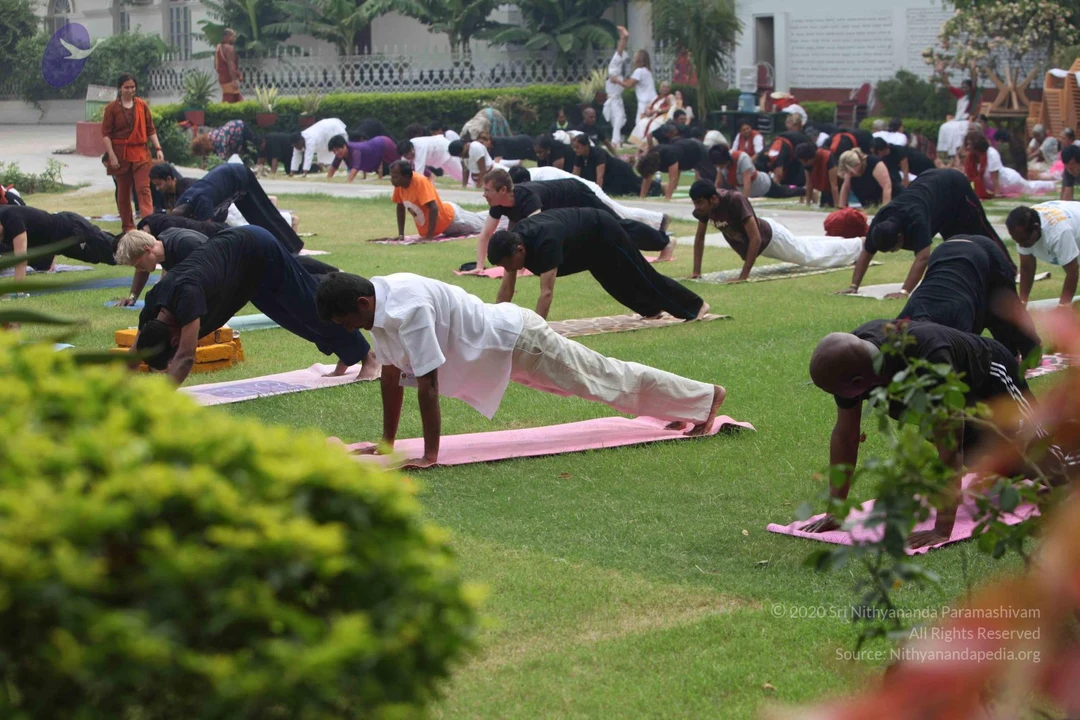
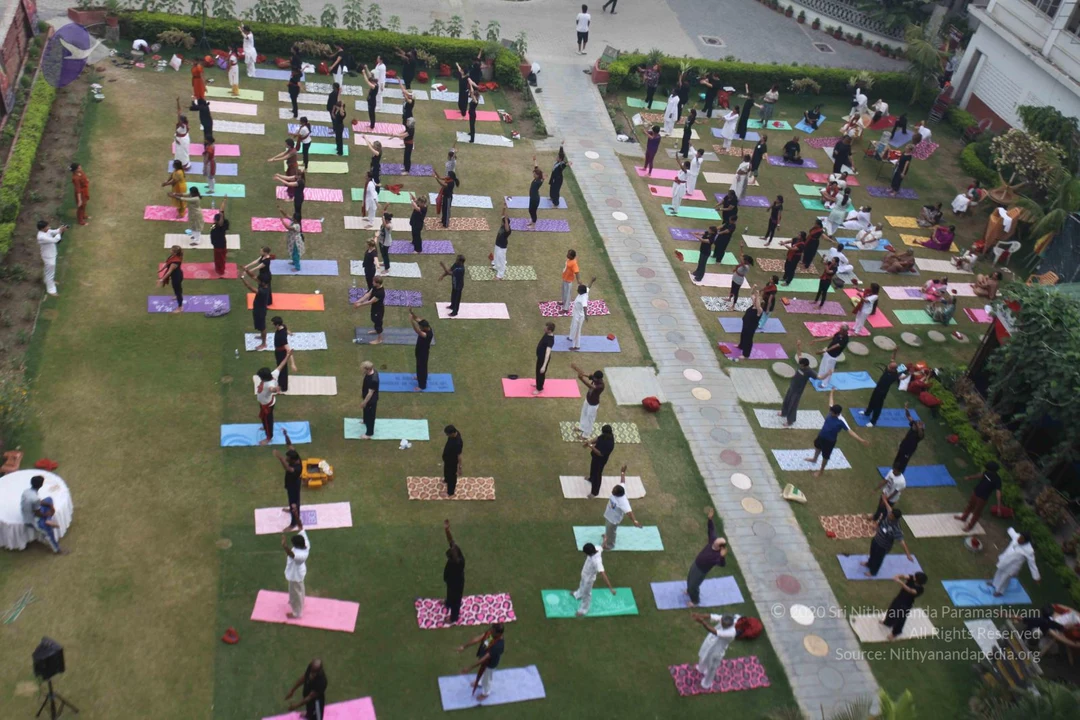
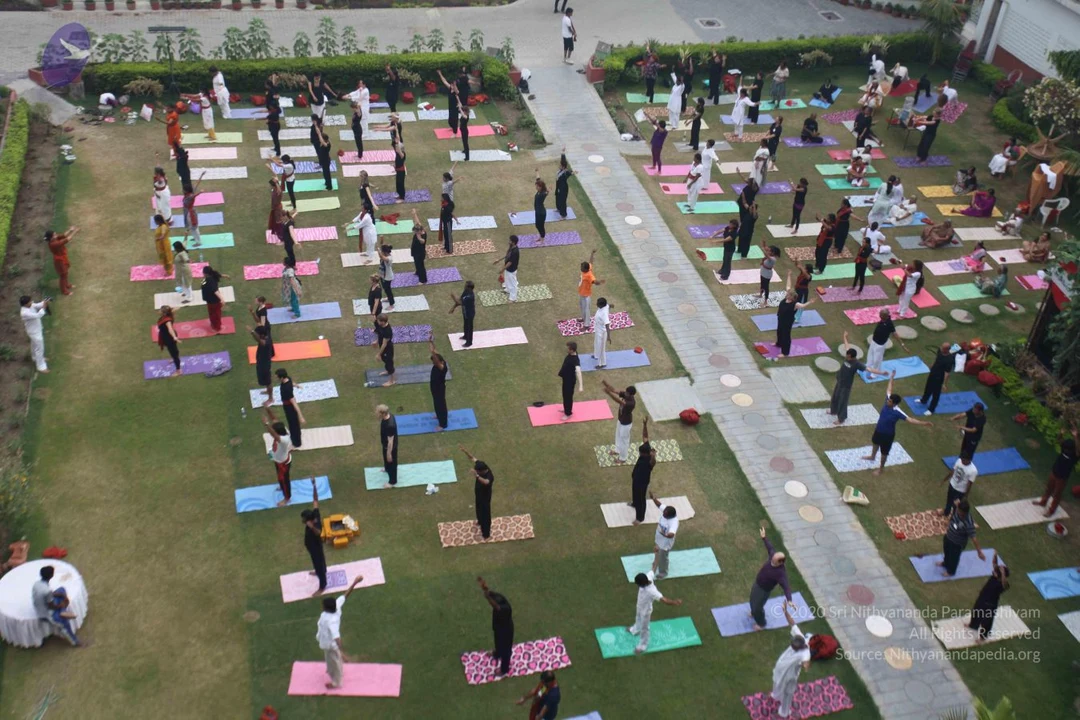
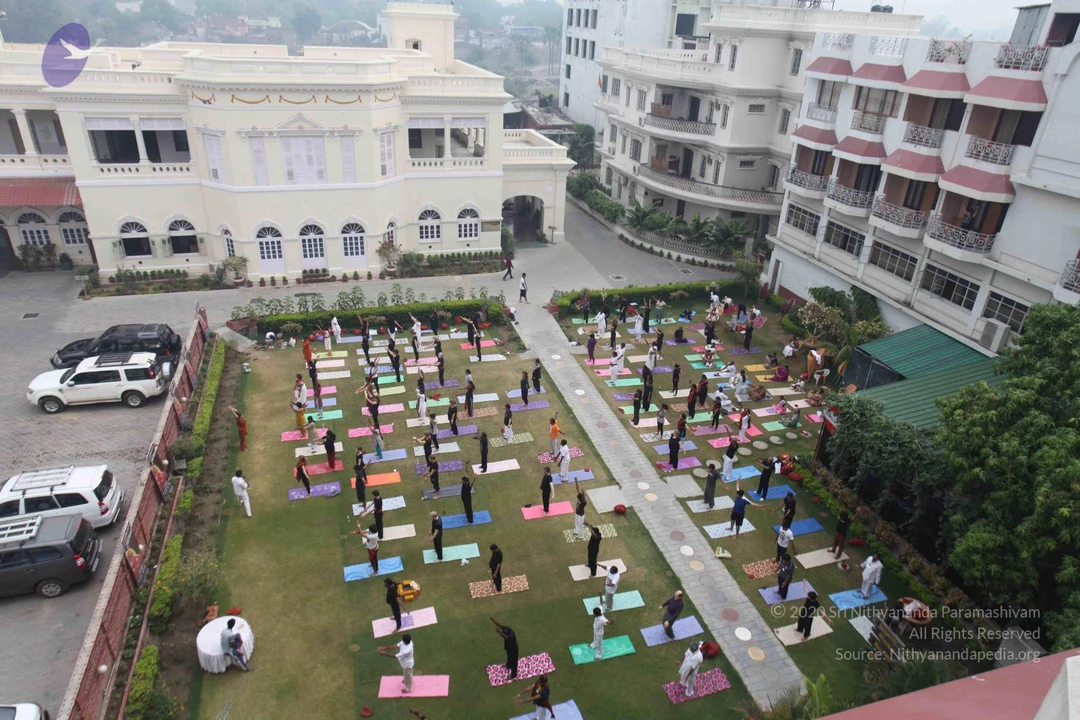
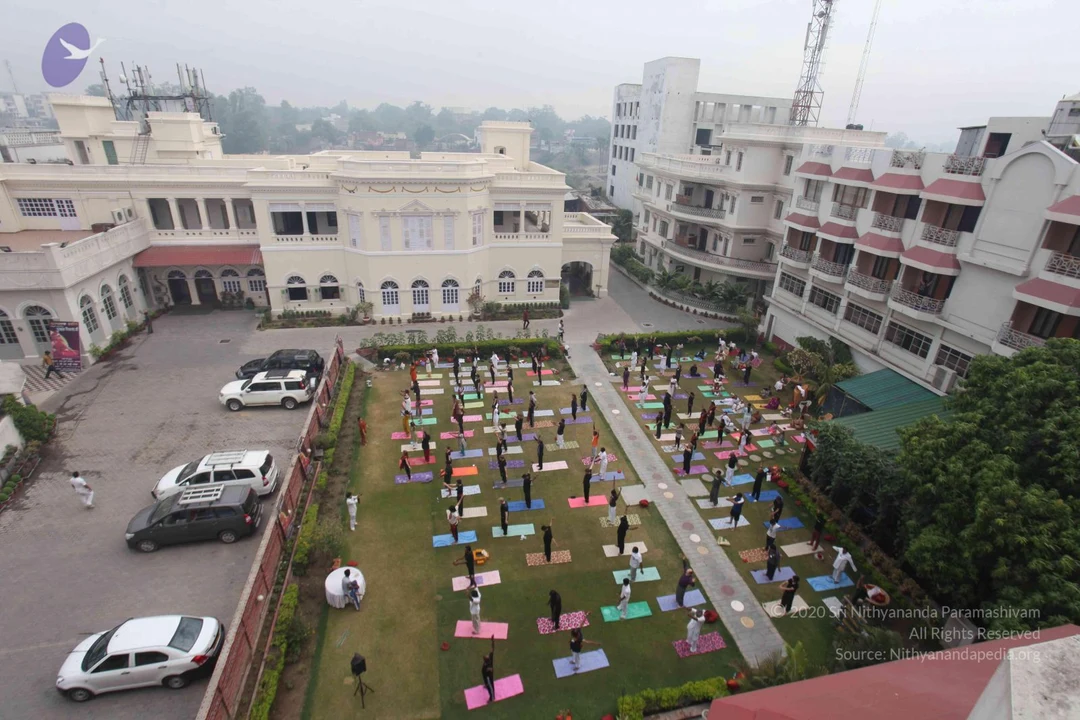
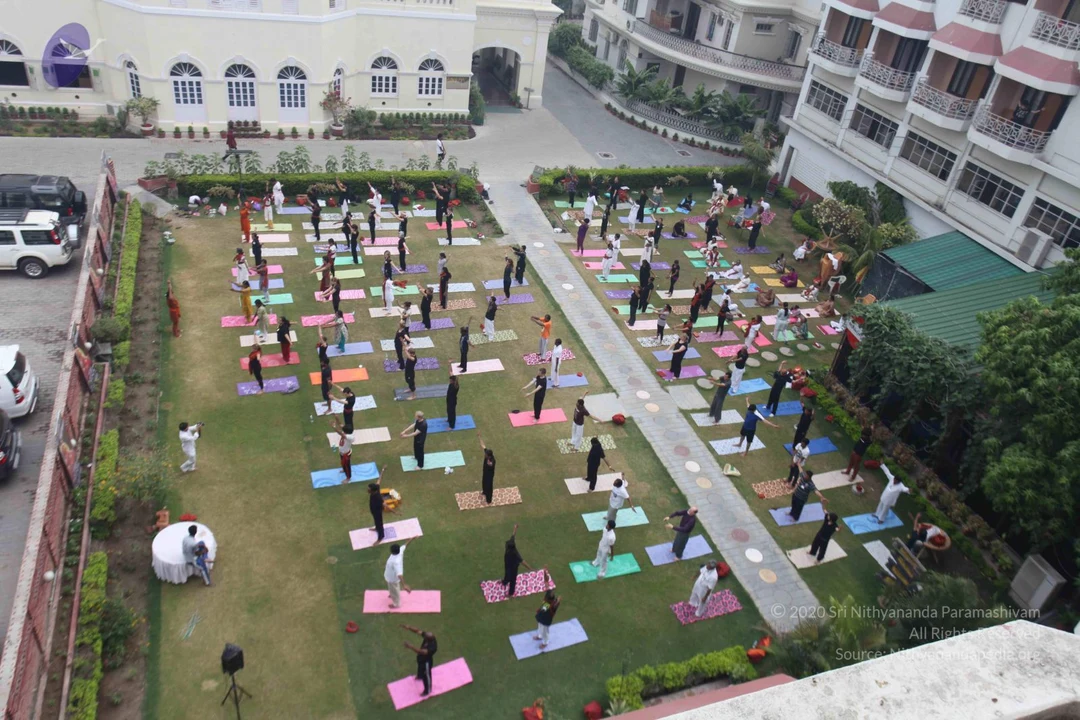
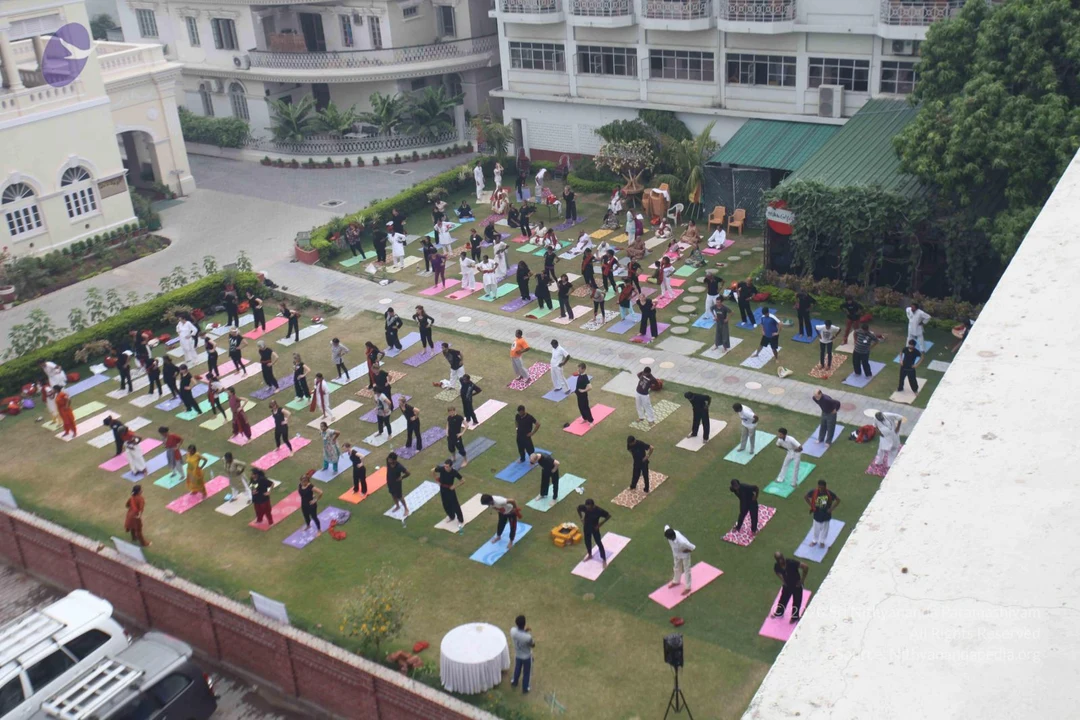
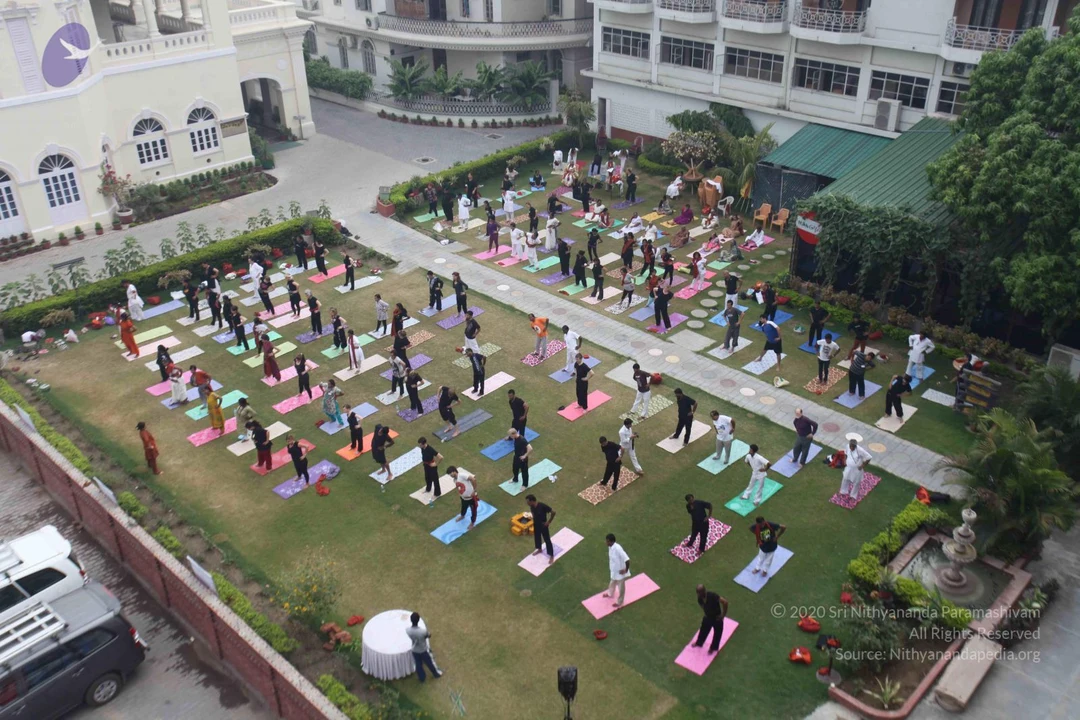
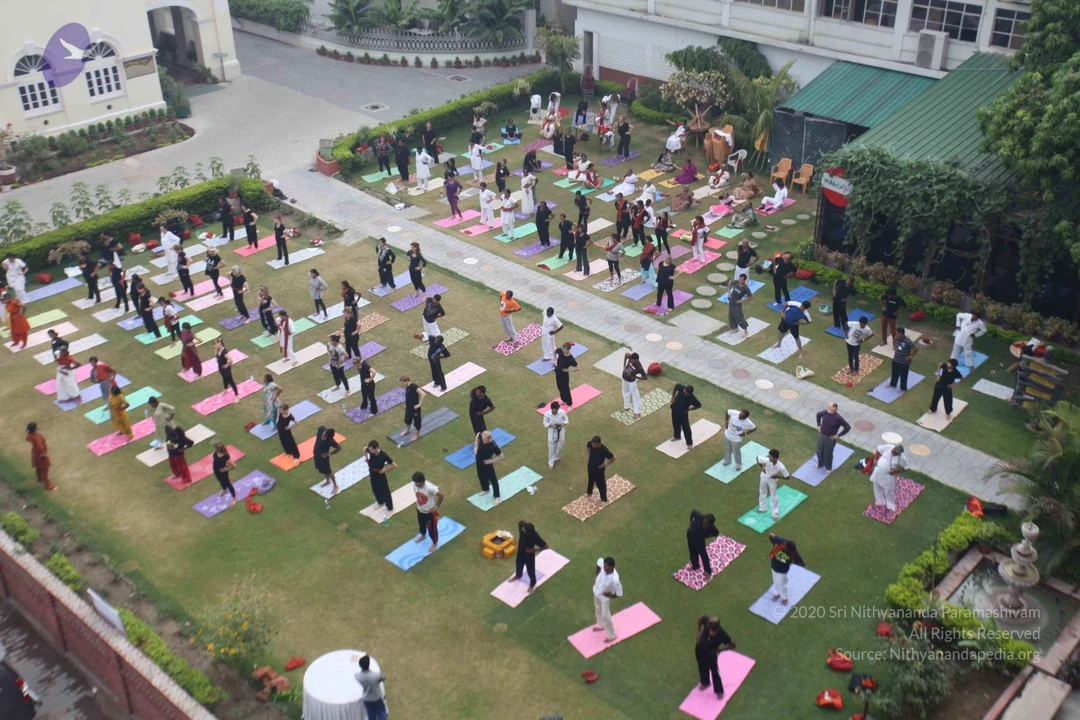
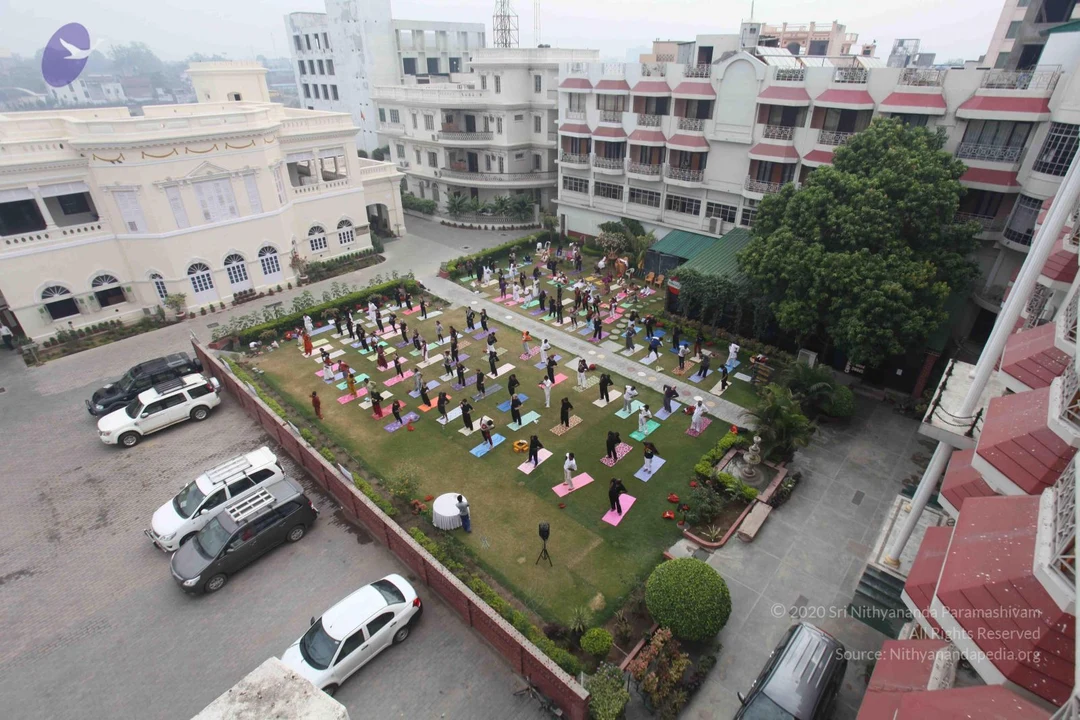
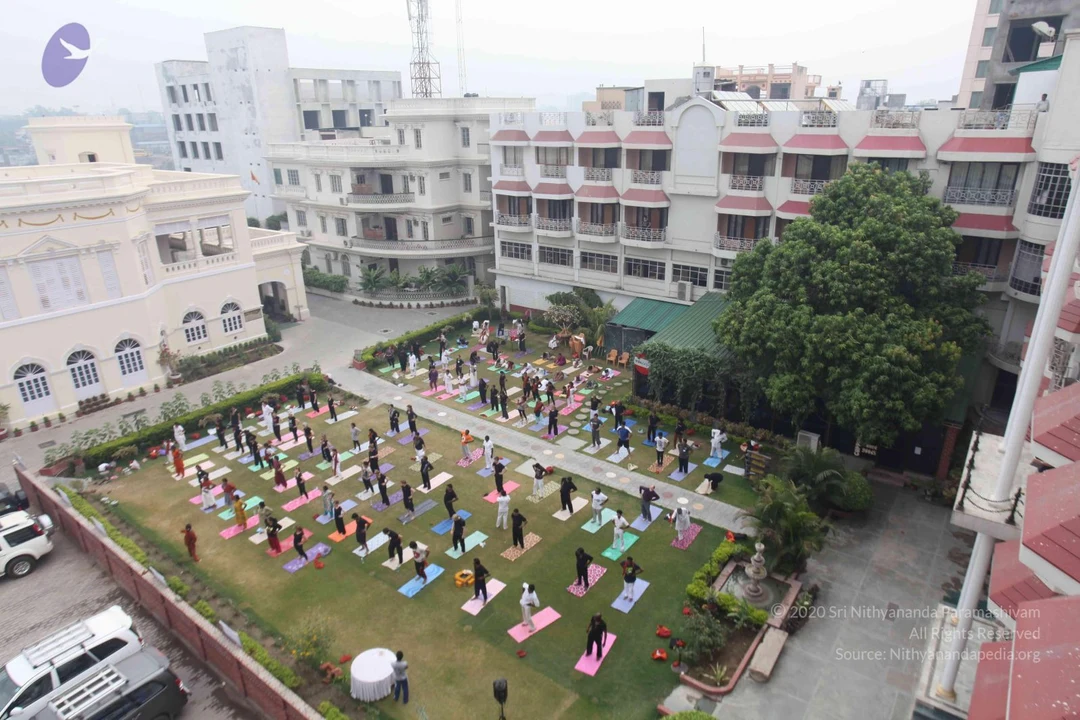
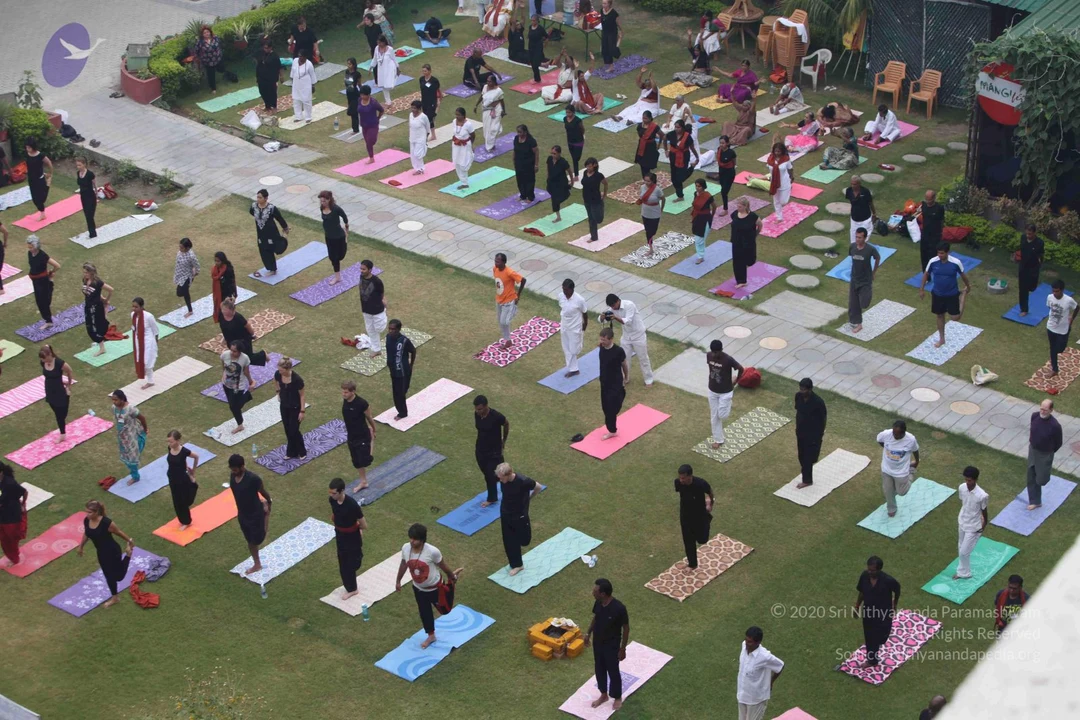
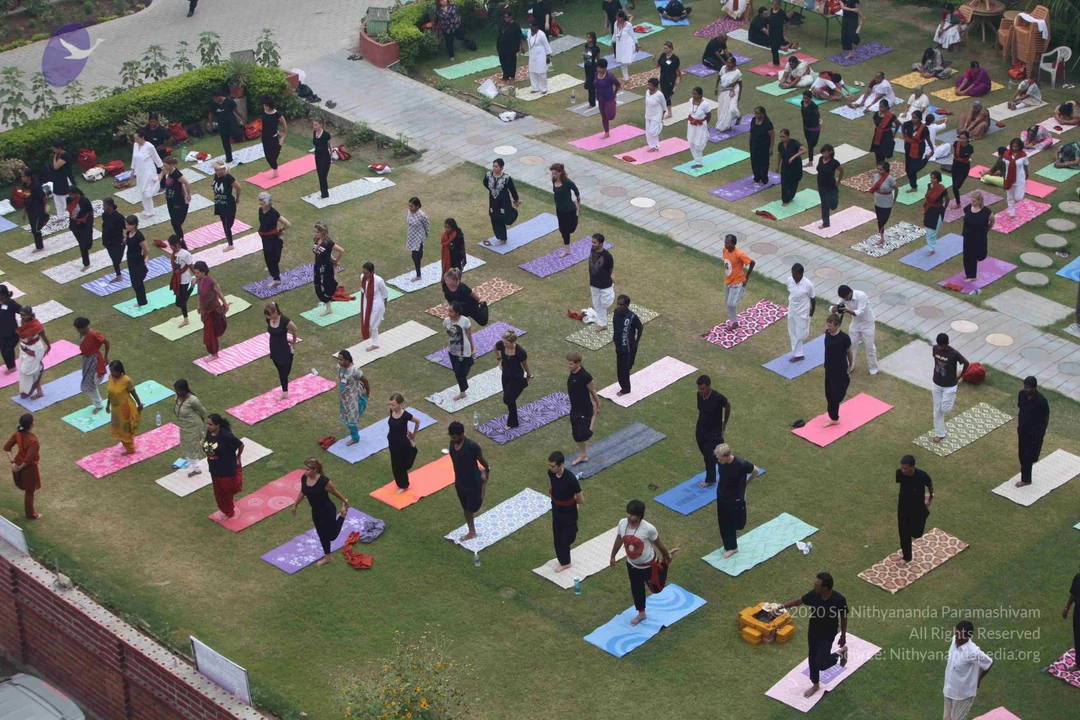
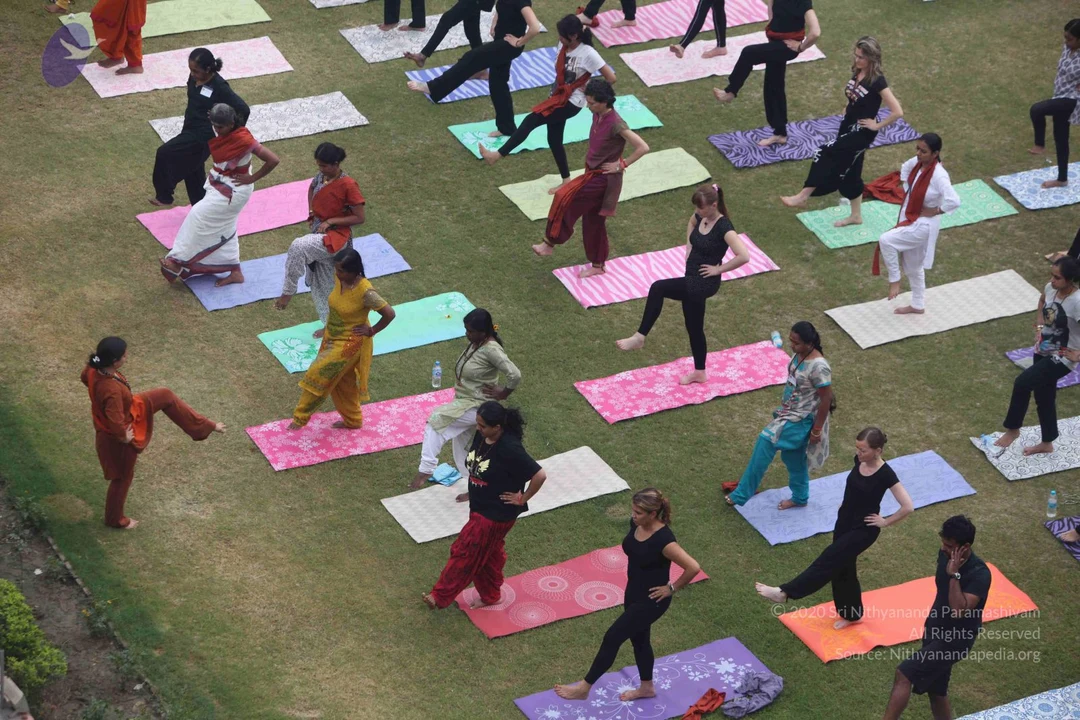
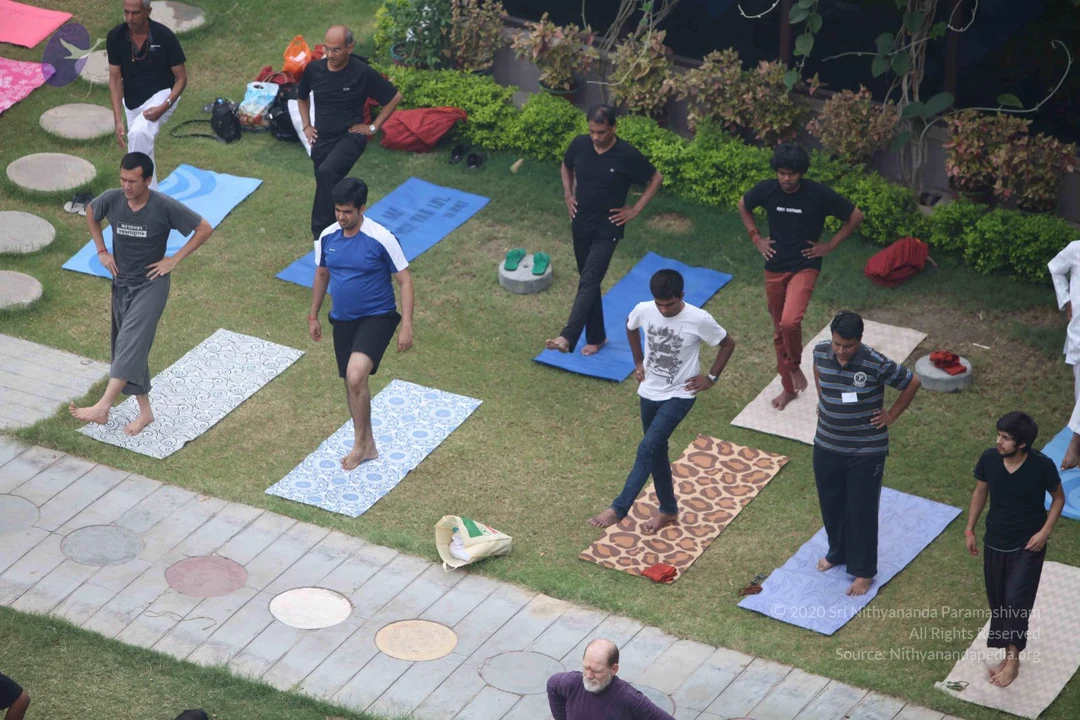
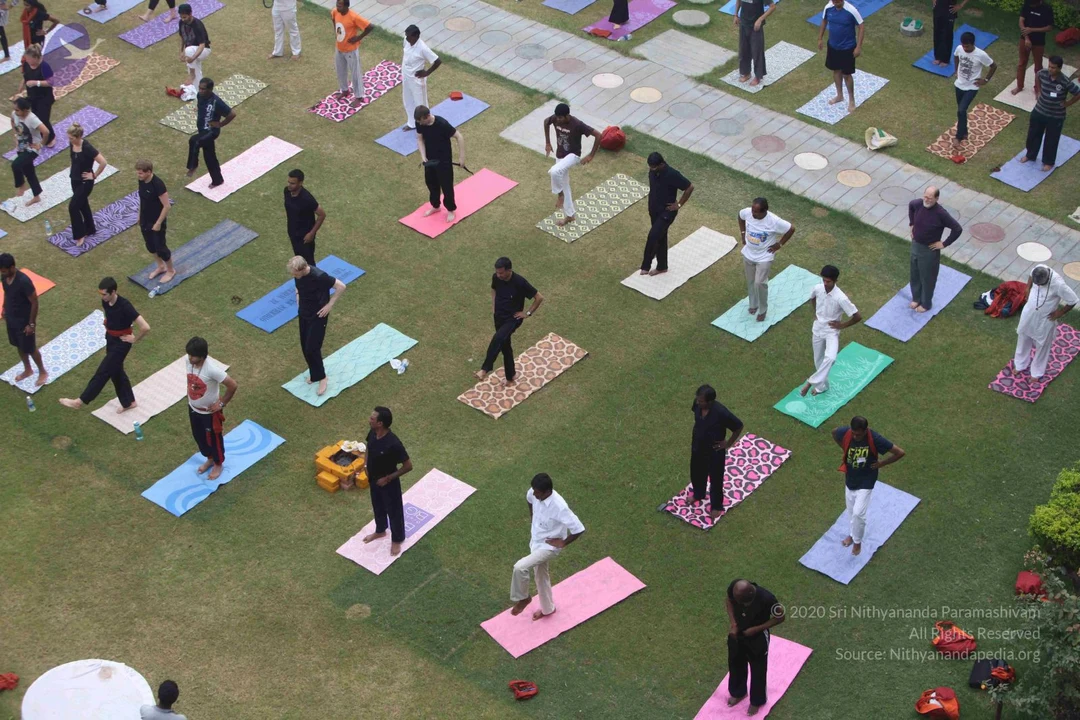
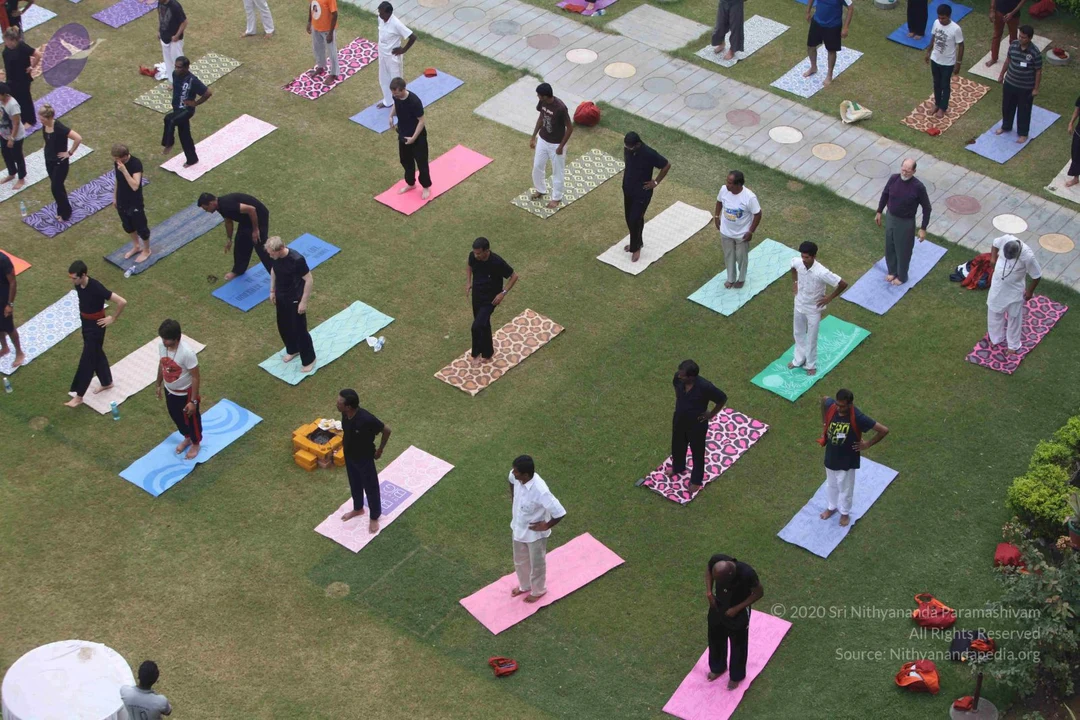
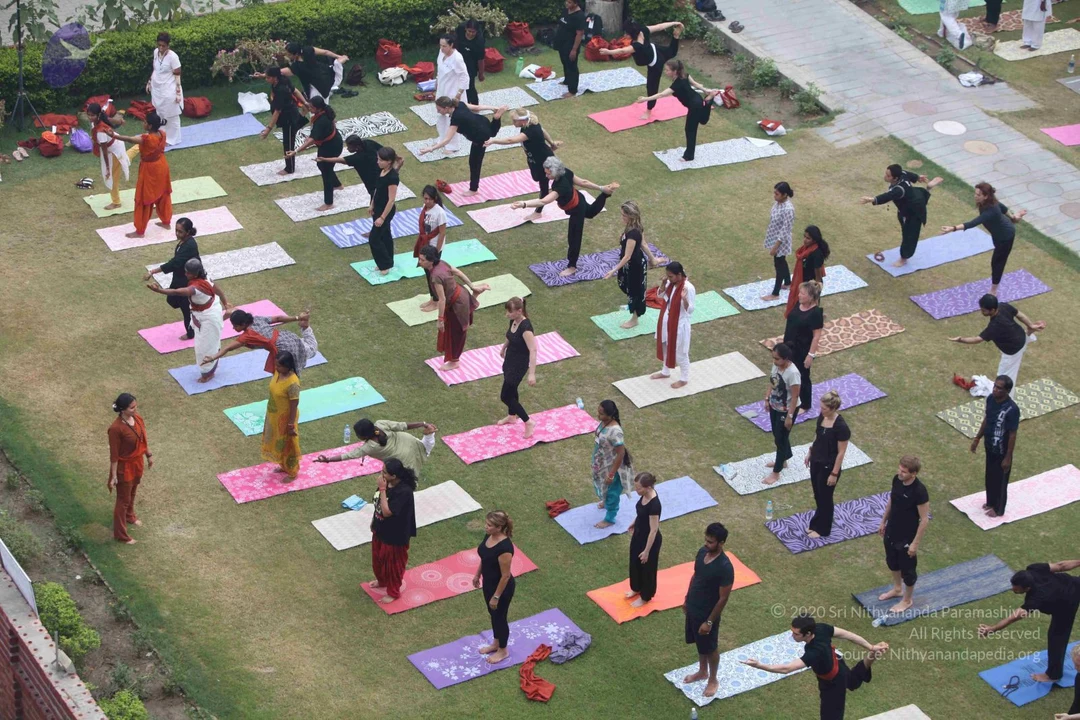
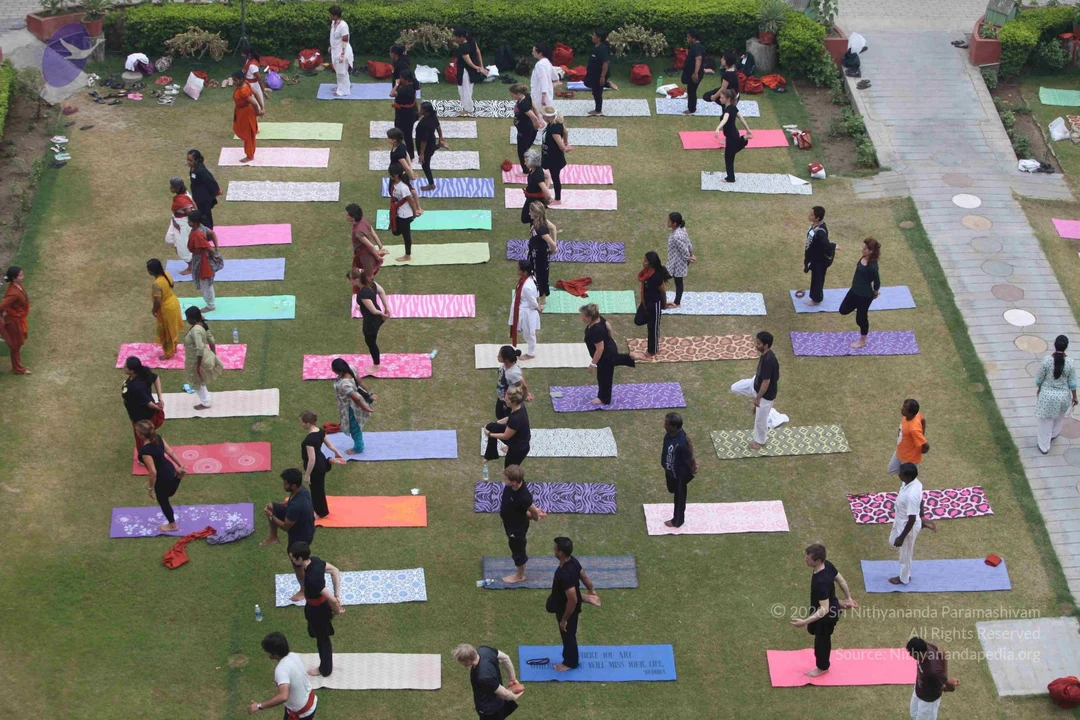
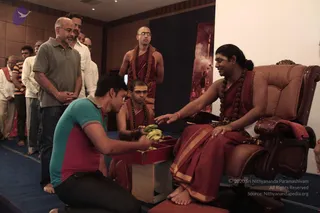
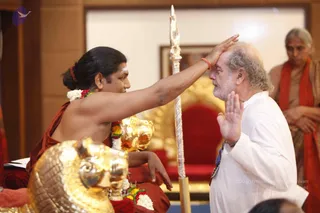
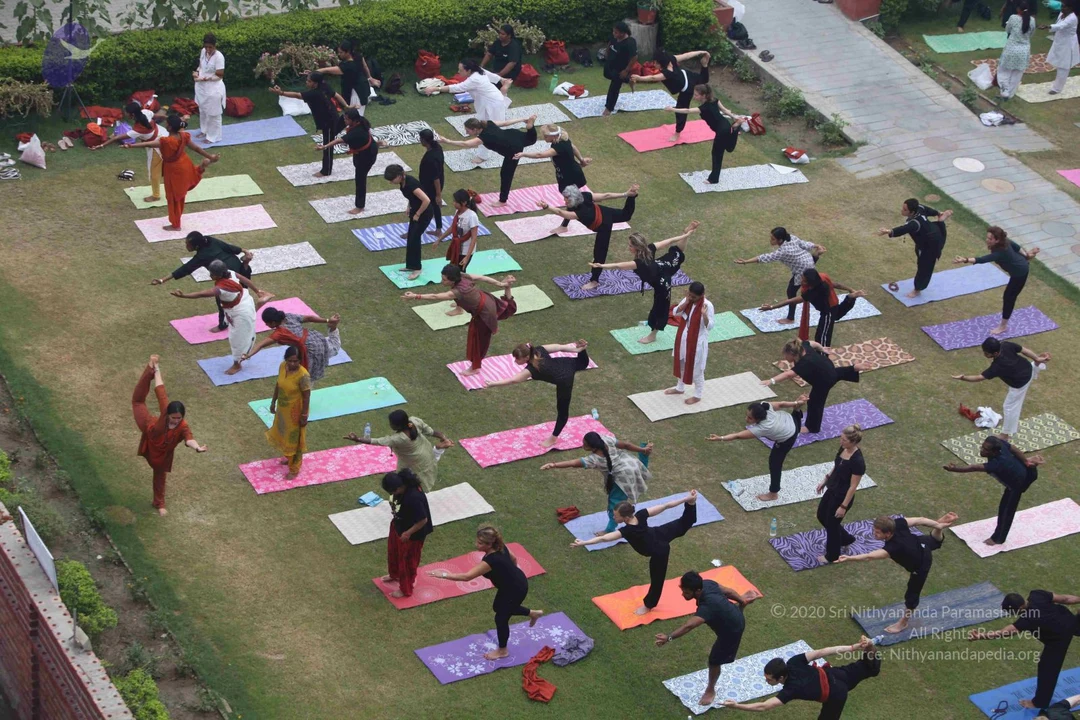
Aerial view of a large outdoor yoga session on a green lawn at an ashram. Dozens of participants stand and stretch on rows of colourful yoga mats in pink, blue, green, purple and orange, arms raised overhead. Most wear white, black or dark clothing. A paved stone path with round stepping stones runs down the centre, bordered by hedges, palm trees and a building with white columns. A few people sit or kneel at the far right near the edge of the lawn, and a white-draped table with a flower arrangement appears at the left edge beside a tripod-mounted camera. The scene looks like a group yoga practice, with participants spaced evenly across the lawn.A photograph of an indoor satsang hall with a blue carpet and wood-panelled walls. A seated figure in a red-orange robe, with long dark hair, a rudraksha mala and bare upper body, sits on a brown leather armchair and raises one hand toward a man in white. The seated figure appears to be the probable Swamiji, identified by long swept-back hair, rudraksha malas and ceremonial adornment, with a shawl-like red-orange drape. A man in a white turban and white kurta with a striped shawl stands with palms pressed together in greeting. Behind him a bald man in rust-coloured robes with a rudraksha mala and glasses leans in, and a younger shaven-headed attendant in red robes with a mala sits beside a red table holding a bunch of green bananas. Several onlookers in shirts stand along the back wall.A man in orange-brown ritual cloth holds a tiered brass aarti lamp with multiple rows of burning oil lamps, its curved handle extended toward his right hand. He wears round glasses and a shaved head, looking up at the flames in a dim hall with blurred round lights above. Smoke drifts from the lamps. A copyright and source credit appears on the lower right of the photo.

May 13 2014

Original wiki page
Contents

Title:

Non Duality is the Axis of Life

Description:

In today’s morning satsang from Varanasi, Paramahamsa Nithyananda expanded on Living Advaitha. He revealed that any field such as physics, mathematics, chemistry ,religion, dance, music, is complete when it reaches Advaitha. The Core Truth of Advaitha has the ability to complete everything. Non duality is the Strategy for solving all problems. Apply Advaitha and you will have an eternal solution to any situation in life.

Link to Video:

VideoAudio

Transcript:

Nithyanandeshwara Samaarambhaam

Nithyanandeshwari Madhyamaam |

Asmath Aachaarya Paryanthaam

Vandhey Guru Paramparaam ||

I welcome all the disciples, devotees, samajis, satsanghis, Shrimahants, Mahants, Kotharis, Thanedars, who are sitting with us all over the world at this time through Nithyananda TV, Sadhna TV, two-way video-conferencing having Nayana Deeksha in many cities, in many countries around the world.

The cities sitting with us through two-way video-conferencing having Nayana Deeksha: Mumbai-Thanigai Arasu, Hyderabad-Gupta Kashi, Warrington-UK, Scottsdale-Arizona, Dakota Dunes, Anand Singh, Wellington-New Zealand, High Point-North Carolina, Jorpati-Nepal, Gyaneshwor-Nepal, Port Washington-New York, Guadeloupe-Rameshwaram, Penang-Tirupparamkundram, London-Kashi, Nithyananda Nagar-Tiruvannamalai, Nithyananda Nagara-Bidadi, Nithyananda Nagaramu-Hyderabad, Nithyananda Nagar-Rajapalayam, Phoenix-Kanchipuram, St. Louis, Ohio-Prayag, Nithyananda University-Los Angeles, Toronto-Kailasam, Singapore-Singapuram, Oklahoma-Somanatham, Kuala Lumpur-Palani, Peethadeeshwaris Training Centre-Salem, Seattle-Chidambaram, Bala Sants-Bidadi, Charlotte-Srisailam, Houston-Kalahasti, Halifax-Canada, Klang-Malaysia, Hong Kong.

I welcome all of you with my love and respects.

Today I will expand on the same science of Living Advaitha.

One aspect of Living Advaitha is remembering and understanding axis of life itself is Advaitha. Please understand, centre on which the life is functioning is Advaitha. I can give you tons and tons and tons of examples, whether in the line of Physics, Mathematics, emotions, Atomic Science. I am not even opening the doors of metaphysical, because with metaphysics you always think, ‘Oh, it is all subjective.’ No. I am saying, anything which is objective, what you think that it can be verified. But, ultimately, your science is subjective, metaphysics is objective. It’ll take a little time for you to grasp. So let me talk in your language.

Metaphysics is the most objective, fool proof, truth as it is. Whatever you know as science is all subjective; “corrupt subjective”, that is the right word I have to use. Don’t think just the Pharmaceutical Industry is polluted by the people who fund the researches. The companies which fund the study researches manipulate the result; and they even fund only that kind of a scientists researches, who already came to the conclusion of what conclusion they are carrying. They actually ask for the Pilot Studies. Why this Pilot Study? Just to see which stupid fellow is matching with the stupidity they are carrying. So heavily corrupted. Please understand, even though it is heavily corrupted, not just Pharmaceutical Industry I am talking about, I am talking about even the fields where researches are happening, even this “God Particle” recently they were talking. I studied so many articles about this “God Particle”. Somehow at the end, somehow they want to miss the context; they do not want people to catch the context. Because if you catch the context, Advaitha will become reality!

Understand, Advaitha is not “One God” theory. The “One God” theory is not Advaitha. The “One God” religions does not want you to catch the truth of the “God Particle”. May be on one day, I will expand on the whole, whatever we know, whatever already the world knows about “God Particle” through science and whatever world already knows about “God Particle” through metaphysical science, and finally, from my own experience, the right context through which you need to look at the concept of “God Particle” and understand. For that I have to do a separate satsangh. Let me give this clarity today I wanted to give.

Whether it is a science known to the so-called outer world, or the science which you call as a subjective, the ignorant leaders of humanity have brainwashed you so thoroughly, anything which questions them, they call it as brainwashing! No really! Anything which questions them, they call it as brainwashing! The whole concept of this education system which is practiced all over the world, especially practiced cult-like fanaticism in India, I wanted to question that whole thing. Do you know the largest business industry in India today is Education? It is just destroying human-beings! Whether it is the outer-world science, inner-world science, the way you have been brainwashed the Metaphysics is subjective, the so-called science is objective. I tell you whether it is Physics or Metaphysics, in any field, this is the statement I wanted to make: In any field when you look at the core, it is Advaita.

Any field is complete when it reaches the truth of Advaitha. Any field is complete when it reaches the truth of Advaitha. Listen. Even religion becomes complete with it reached the truth of Advaitha. Ganga became complete with she reached Varanasi. Understand only in Varanasi she is turning towards her origin – North. That is why, in Varanasi, she is called “Uttara Vaahini” – “flowing towards the North”. Why will a river flow towards the origin? Because, she wants to have darshan of Vishwanatha. The moment she touches Vishwanatha’s feet, gets the darshan, then she is complete now; she lets go and merges with Varuna Raja. Understand even Metaphysics is Complete when it reaches Advaitha. I really wanted this to be done. I know my Bala Sants, my gurukul kids will fulfil this: Doing a vast study on non-duality, how the non-duality is the axis of everything. Everything. When I say “everything”, I mean everything.

Even though non-duality was preached, promoted by religious leaders, it doesn’t belong to just religion. In any field as simple as your emotions, or as complicated as your layers of visualizations, or the field of Astronomy, Astrology, Cosmology, studying on atoms, Physics, studying on Universe, Chemistry, Mathematics, field of Medicine, every field reaches its Completion when it realizes the core truth of Advaitha, understand? As simple as your emotions, your violence gets Complete when it gets the touch of Advaitha. Your lust gets Complete when it gets the touch of Advaitha. Your sex gets Complete when it gets the touch of Advaitha. The study of Cosmology becomes Complete when it gets the touch of Advaitha. Study of Astrology, or Astronomy, or Astrophysics becomes Complete when it gets the touch of Advaitha. Study of the law of life gets Complete when it gets the touch of Advaitha. Study of religion becomes Complete when it gets the touch of Advaitha. The study of Mathematics becomes Complete when it gets the touch of Advaitha. Any field, Physics, Metaphysics, Science, Chemistry, Biology, everything becomes Complete when it gets the touch of non-duality, the Advaitha. Advaitha has the ability to Complete everything, whether it is your individual consciousness or the collective consciousness.

I wanted to tell the whole world this good news: Our kids, Bala Sants are two years ahead of their subjects, syllabus. Please understand today they all have gone to write their exams. All of you to know, by two years they are ahead! My Gurukul Principal, Ma Advaith is coming and asking, ‘Swamiji, now two years they are ahead! Two years they can take complete vacation and do what you want!’ Means, they completed the syllabus two years ahead! I wanted my kids to study, do research on how non-duality completes every field. I wanted to give this as a subject for research and study to my Bala Sants. And I tell you guys, before they do their research, I tell you, this will be something beyond any doctorates, any Ph.D. person’s research paper, because once they complete, I’ll publish it to all of you guys. You will see.

So today they are going for examination. I am blessing them for their examination and giving this for their project. There are four kids who are four years ahead of their syllabus. And all the kids are two years ahead of their syllabus. And I want you to know, they never take marks like ninety-five, ninety-six, and all; it is simply hundred. When they can’t give hundred, they are given ninety-nine. There is no syllabus choice, this, that, for my Bala Sants.

Our Gurukul kids don’t even talk like, ‘Oh, this guy studies well. And this student is a little dull.’ Nothing! That concept doesn’t exist among our Bala Sants. Zero adolescence problem! The problems of adolescence - zero. When I see them, I am so happy. Just like how I was brought up by my Gurus, I am so happy I have created a space for them. My only vision: I just wanted a few more Gurukuls with at least a few thousand students; one in Tiruvannamalai; like this few places. I wanted Gurukuls where a few thousand kids study, grow. And today I commit and declare to the world my Bala Sants, these two years of research work; I guarantee at least ten of them will get Ph.D. from some internationally-recognized University. I’ll be their guide, who is only a High School dropout. I’ll help them.

Please understand, it is time that you need to understand, any field becomes Complete when it touches the core of non-duality. So in whatever you may be, whatever you believe you are, whatever you are, the identity you carry, the understanding you have, whether you are engineer, lawyer, doctor, whatever profession you may be practicing. Most of you think, ‘You don’t know, Swamiji! You can tell any kind of specimen, but I am completely confused. What will you call me?’ Even if you are thoroughly confused, you can be Complete when you touch the core of non-duality, because non-duality is the ultimate confusion! No there are some people who decide always to be in the space of confusion. No, really. When they try to ask me some decision, I tell them, ‘You tell the decision. I’ll give the “Thathaasthu”’ because, the moment I give a decision, they will attack you with ten-thousand questions! That is why they constantly attack themselves. I tell them, ‘No, I am not coming for this game.’ This “Thathaasthu” is such a great game-escaping method. No one can trap you in their mental game. Otherwise the fools are already struggling, suffering and they are trying to trap you into their game.

Listen. This is the statement I am trying to convey to you: The pure, uncorrupt, truth as it is, is non-duality. No king funded any Rishi to discover this truth fortunately. Otherwise he would have manipulated them. One nice thing with India, researchers are always one step above the king. King comes and touches the feet of the Rishi. Never a Rishi goes to the king. That is why somehow, our researchers have always kept themselves away from the social reward, award, money, wealth, palace. And you also need to know a Rishi who serves as a RajaGuru is considered as the cheapest in our Hindu tradition. His researches are not accepted as a first grade because they feel just by being in the court continuously, they have also learned social politeness, political politeness. So all the great acharyas, even Drona never lived in the court or in the palace, or inside the kingdom. They always stayed outside the territory of the king. Very rarely, very rarely, people who have reached the space of beyond possibility of any corruption, only those few beings, those few people, those few beings, those few people whose consciousness have gone beyond the society’s corrupting possibilities, the truth which is revealed by those few beings who have no other vested interests other than revealing the truth as it is. That is why, in Vedas, very rarely you will find even the names of the authors. That is also mostly like a community name, Vyasa. Vyasa is not an individual but the community.

Please listen. People who have lost even their name in the truth, the truth revealed by them, the truth of the truths, is non-dual consciousness. The truth about the non-duality, I tell you in life, in death, in any crisis, in any survival crisis, in any critical moments, my disciples should keep only non-duality as their strategy for life, as their strategy for decision-making, as their strategy to approach the problem. It can be as simple as your migraine, or as complicated as a real-estate legal issue, or as ultimate problem as marital issues. Whatever it is, I tell you, apply Advaitha, apply non-duality. You will have immediate solution, eternal solution. Immediate solution, eternal solution!

Today, this one statement only I wanted to repeat, insist, emphasize: Non-duality is the axis of life, and even religion achieved Completion when it touched the truth of non-duality. Any field achieves its Completion when it touches non-duality, understand?

“One God” theory is not non-duality. Some of these stupid secular intellectuals are constantly screaming, saying that “One God” theory is non-duality. No. “One God” theory is not non-duality. It is the metaphysical version of autocracy. The immature mind which cannot look beyond the political supremacy and political superior personality, very primitive level of understanding of life. The political head is seen as all-powerful, so the projection of that same person into the metaphysical zone is what is this “One God” theory.

Then you may ask, ‘What about Meenakshi? She was a political head. What about Krishna? He was political head! What about Rama? He was a political head! May be, they are also like their projections only!’

Be very clear, they embodied Advaitha, and they were very clear we worshipped them because they promoted Advaitha, not because they claimed themselves as God. Krishna stood for non-duality; that is why we worship him. Rama stood for non-duality; that is why we worship him. Meenakshi stood for non-duality; that is why we worship her. The whole “pattabhishekam” means the coronation ceremony of Meenakshi, records clearly she takes the oath on Manu Dharma Shastra, Manu’s Laws and she takes the oath that she will run the kingdom, run the world, based on the dharma of non-duality.

So understand autocracy ornamented with metaphysics is “One God” theory. Autocracy imagined in the field of metaphysics is “One God” theory. “One God” theory is not Advaitha. Even many of the Hindu Gurus who are brainwashed and brainwashing the people need to know that Advaitha is not “One God” theory. In Advaitha, everything is God. Even the word “thing” I cannot say. “Every” is God. I cannot say “Everybody”, “Everything”! No! “Every” is God that is all I can say. Infinite gods with infinite possibilities. Infinite gods, each of them are expressing infinite possibilities. Means, means, that is the definition of God in non-duality.

I tell you our Gurukul kids will take up this research for next two years, how non-duality completes the field of Astronomy, Cosmology, this Parallel University theory, Astrophysics, how the non-duality completes Psychology, Physiology, Biology, Arts, how non-duality completes, brings Completion to Yoga, the touch of non-duality, from the context of non-duality, how the Dance brings Completion to itself, how Dance reaches Completion with the touch of non-duality, Chemistry reaches Completion from the context of non-duality, Mathematics reaches Completion from the context of non-duality. I wanted to establish this so that all education methodology in any field the non-duality should be the Primary School syllabus. When the kids enter school, in the Primary School, study non-duality. First two years, from the age of three to five, let the kids study non-duality. After they are soaked and established in the space of non-duality where they cannot be manipulated, misused, abused any more by the rewards, awards, punishments, when they become free from possible corruptions, now let them study any department they want; they will complete that field.

If you are complete by studying something, you are “educated”. If you complete the study itself by studying it, you are “Educator”. If you are complete by studying something, you are “educated”. If you complete the study itself by studying it, you are “Educator”. I tell you my Bala Sants will be Educators. If you approach any subject with the context of non-duality, you will complete that subject, you will become Educator.

I only wanted to have more Gurukuls in all these five places – Tiruvannamalai, Varanasi, Haridwar – so that this science of non-duality can complete any field, is told to the world.

I tell you, non-duality is the ultimate war strategy. That is what Krishna did it. Non-duality can complete Political Science. I’ll prove non-duality is the best media strategy. I will prove it to the world. All attacks on me, I’ll come out of it shining just by the power of non-duality, and make this as an education syllabus for the world – how the non-duality can be the crisis management strategy, how the non-duality can be strategy during all the critical moments. If I write a “tell all” book the thread of that book will be this only: How the non-duality is applied for every situation, how the non-duality can be the crisis management strategy, how non-duality is a powerful strategy to turn around all the attacks put on you, whether social front, legal front, economical front, media front, brutal physical attacks through rowdies in every level.

Non-duality Advaitha can be the best strategy can be the best thinking structure can be the best lifestyle. Even in our Sangha, I have seen, the more people digest Advaitha, more they rise in our Order. Please understand, don’t ever try to believe or make others believe, even if you are a Thanedar you are a great Advaithi. No. If you digest Advaitha, you will cross the space of Mahant. And because it is run directly by me, if you cross the space of Mahant, I will never keep you lower than that. Advaitha, more and more when it is digested shared, more and more alive it becomes. When more and more you make that alive in your life, more and more you become Complete.

So with this the essence of today’s satsangh:

Whatever you may be, whoever you may be, whatever you may be doing, decide Advaitha to be the strategy, thinking trend, lifestyle to solve anything, to make decision at any moment. Let Advaitha be your crisis management strategy. Let Advaitha, Advaita be the source of your enlightenment. Let Advaitha be the source of your excitement. Let Advaitha be the source of your joy. Let Advaitha be the source of your pleasure. Let Advaitha be the source of life. Let Advaitha be your strategy even when you face death. Let non-duality be you, and may you be that!

I bless you all, let you all radiate with Integrity, Authenticity, Responsibility, Enriching and Causing eternal bliss, Nithyananda. Thank you.

Photos From The Day:
Tags:

Varanasi, paramahamsa Nithyananda, Living Advaitha, physics, mathematics, chemistry, religion, dance, music, The Core Truth of Advaitha, complete, Non-duality,strategy, eternal solution

Photos Of The Day:

FB-photo-of-the-day

Photos Of The Day:

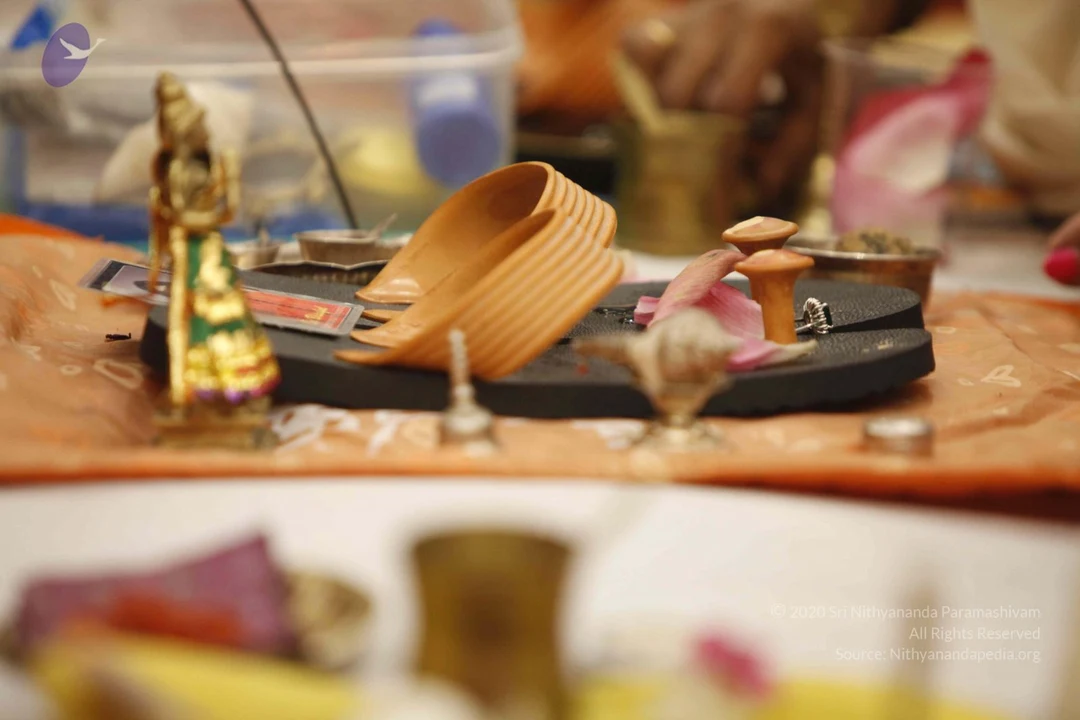
PadaPuja-Kalpatharu-Darshan
Pada-Puja-Satsang

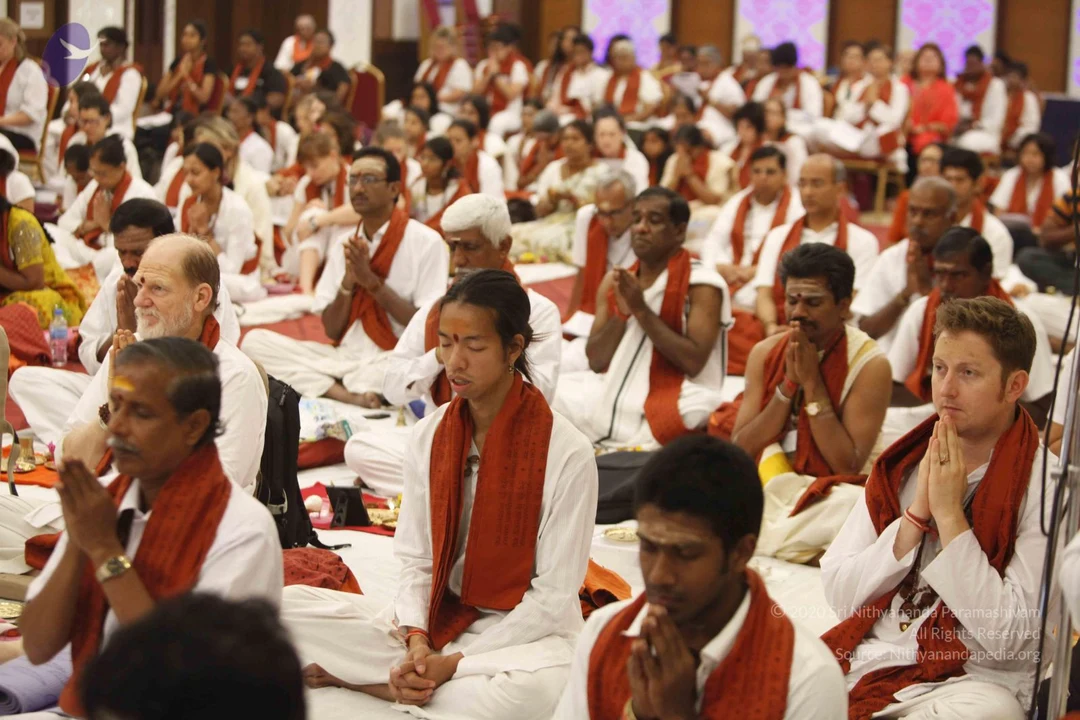
Yoga

Manikarnika-Ghat-Visit-Darshan

IA-Darshan

2-Padapuj-Satsang

4-Manikarnika-Ghat-Visit-Darshan

6-IA-Darshan

Photos from this day

View all 390 photos

Photos From The Day:

11 photosSource gallery
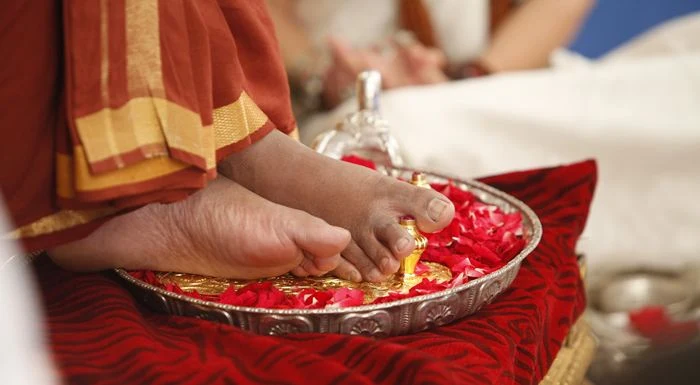
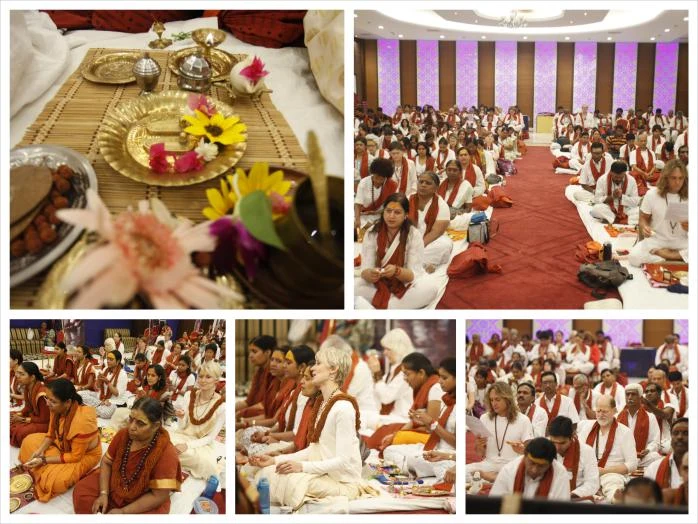
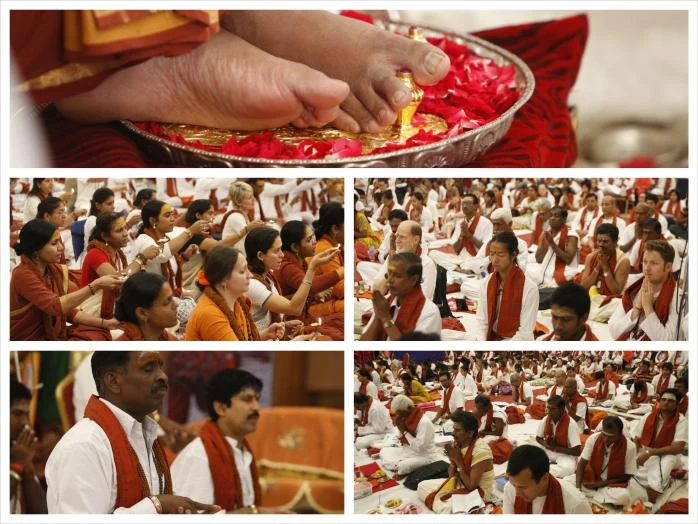
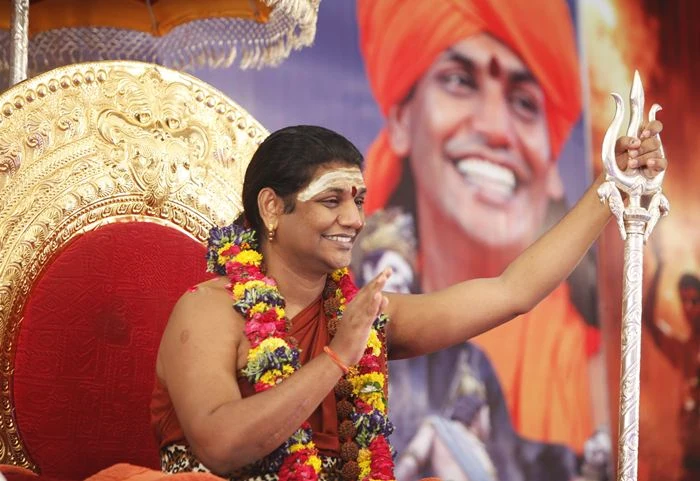
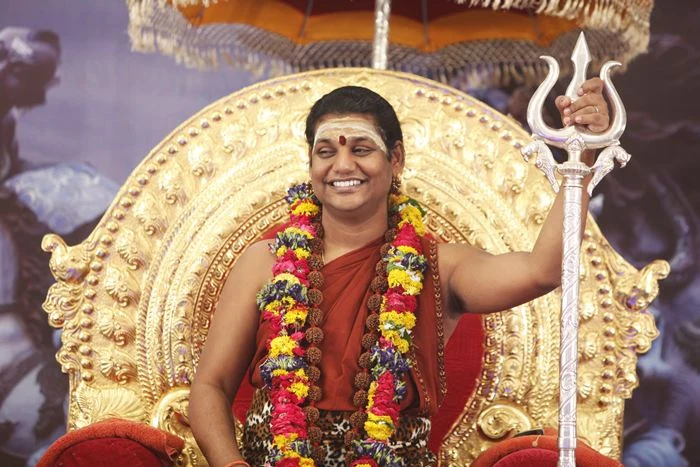
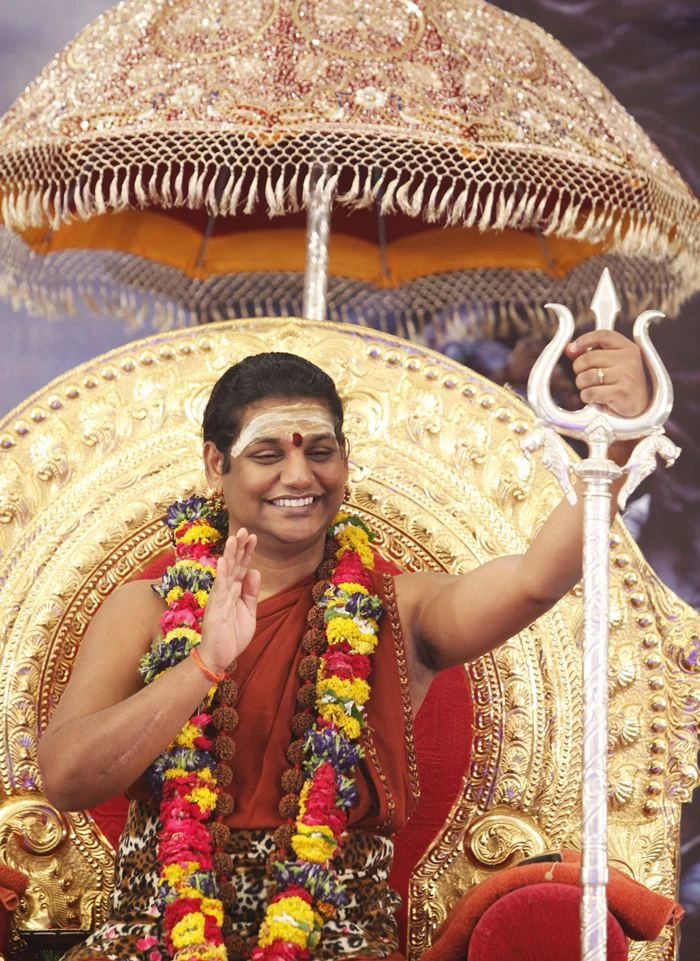
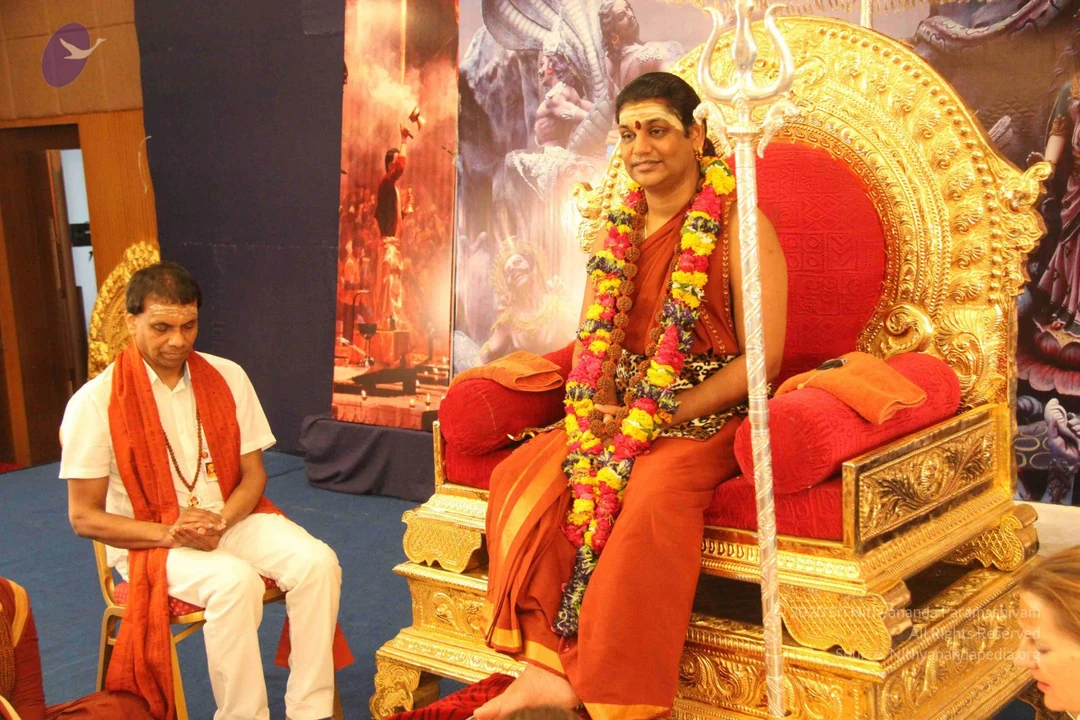
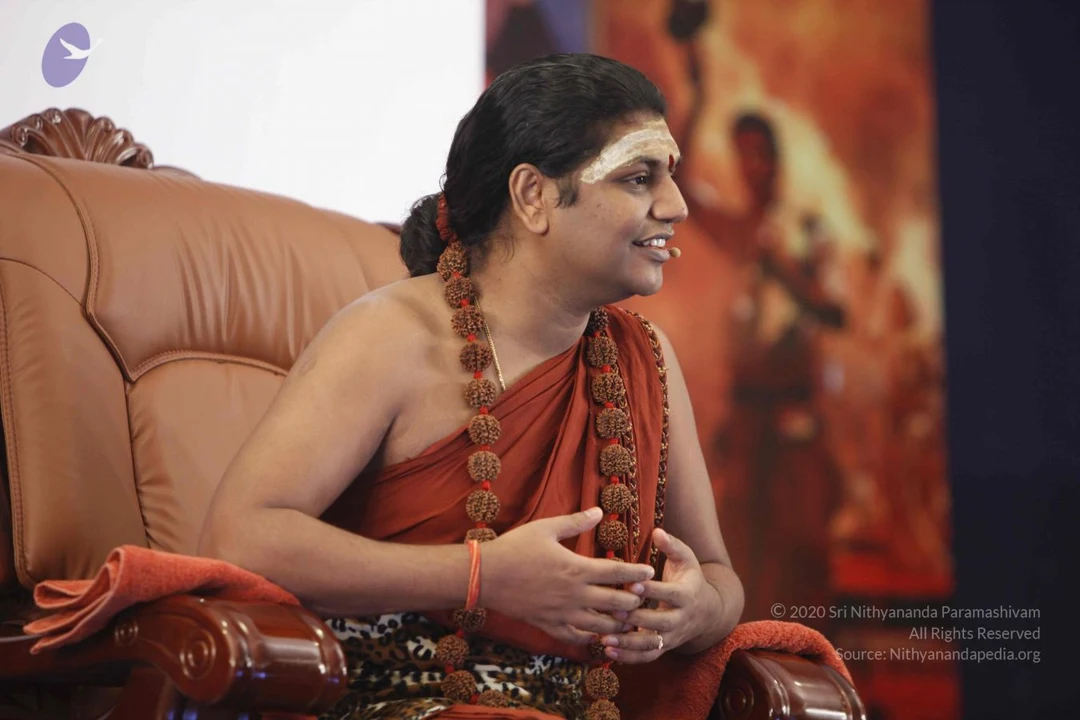
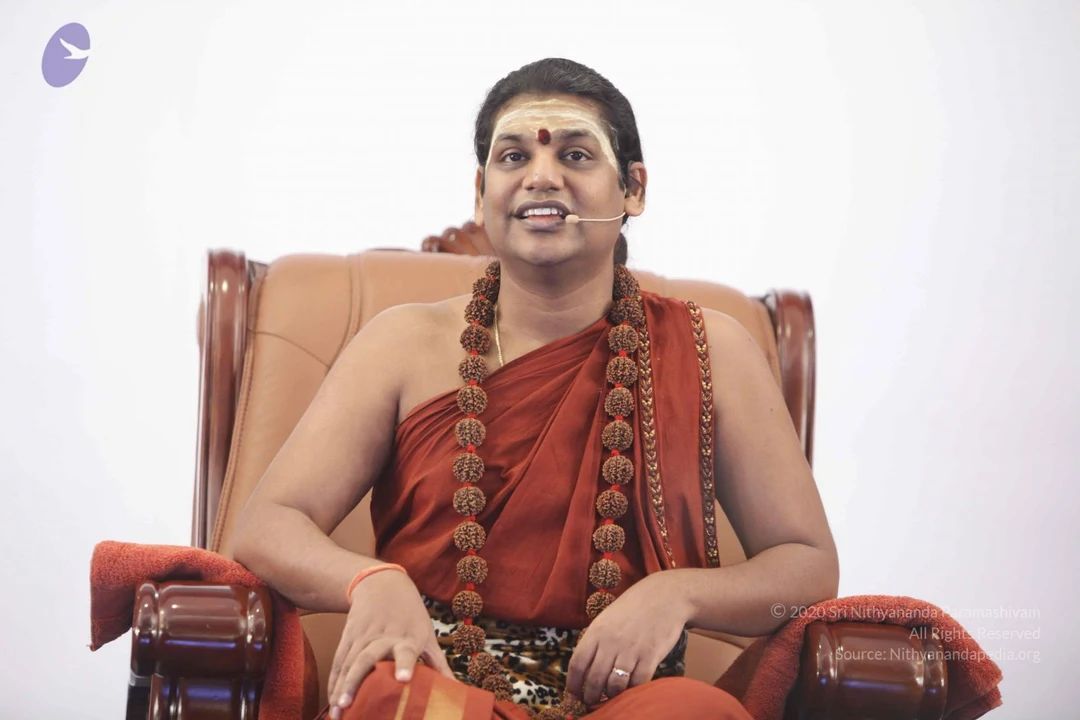
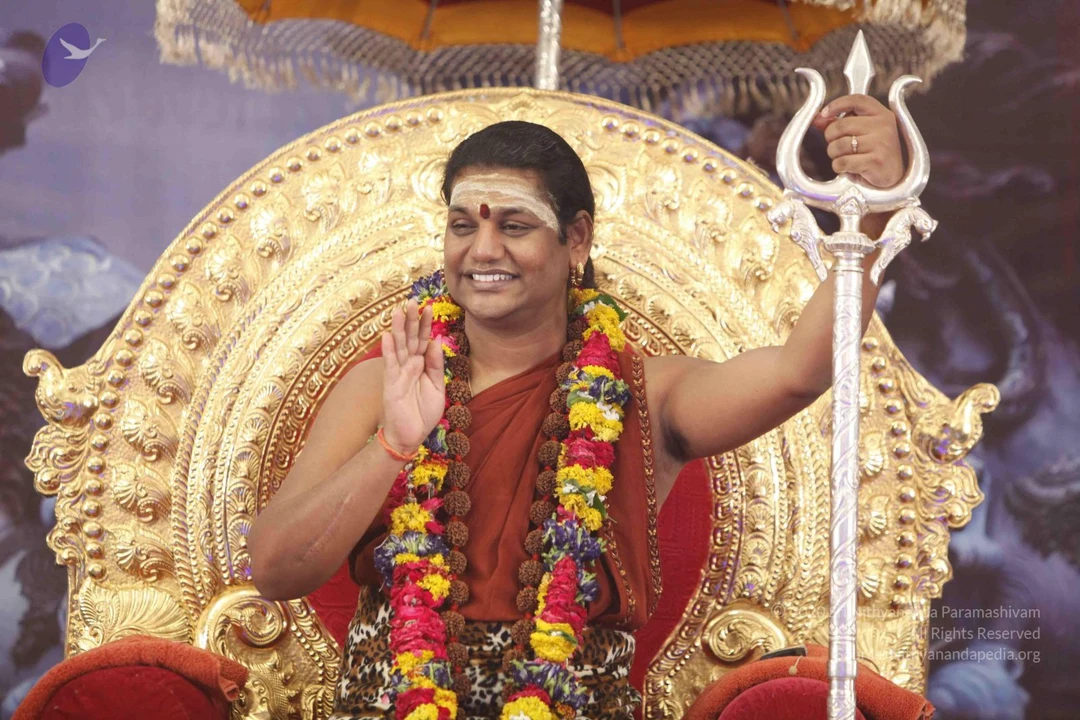
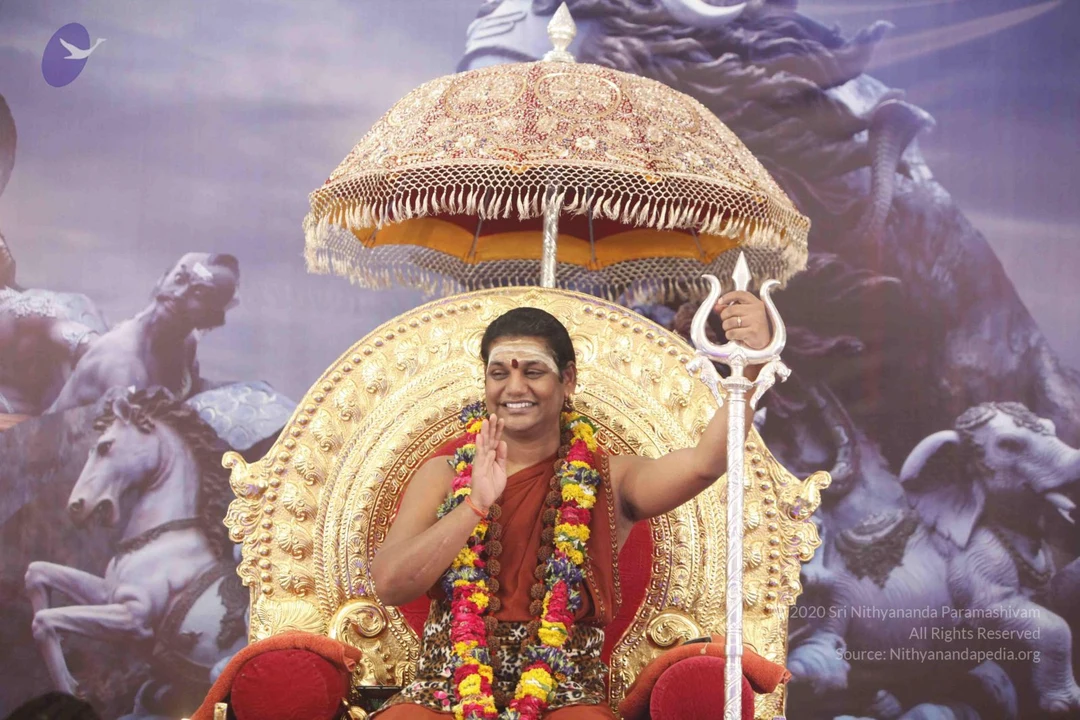
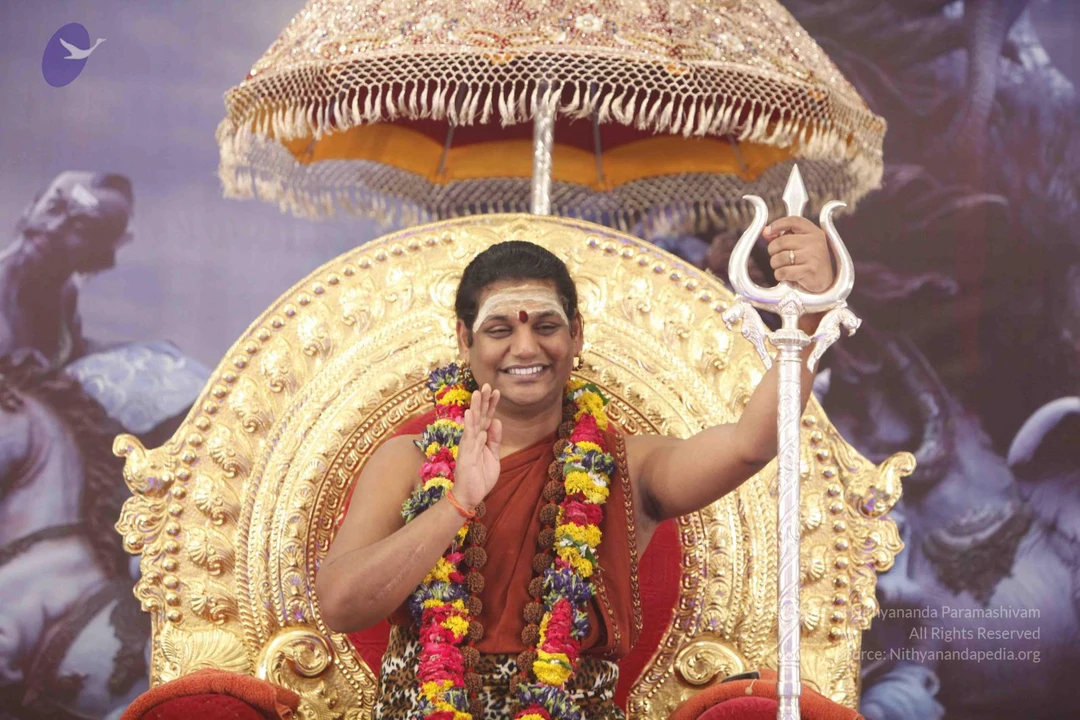
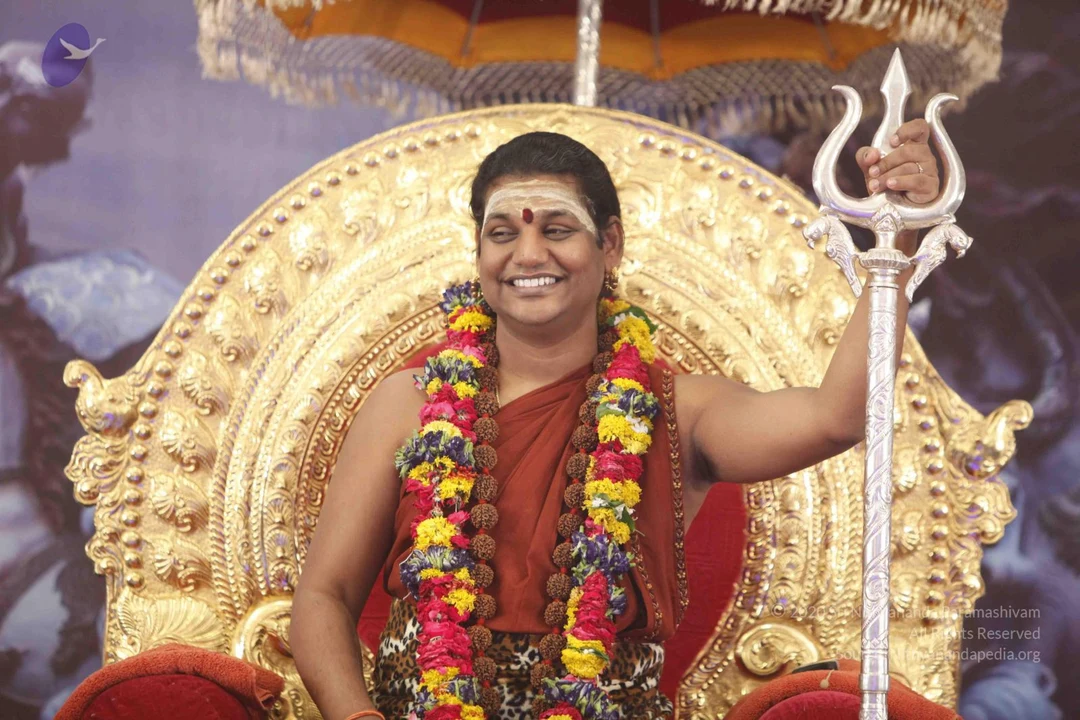
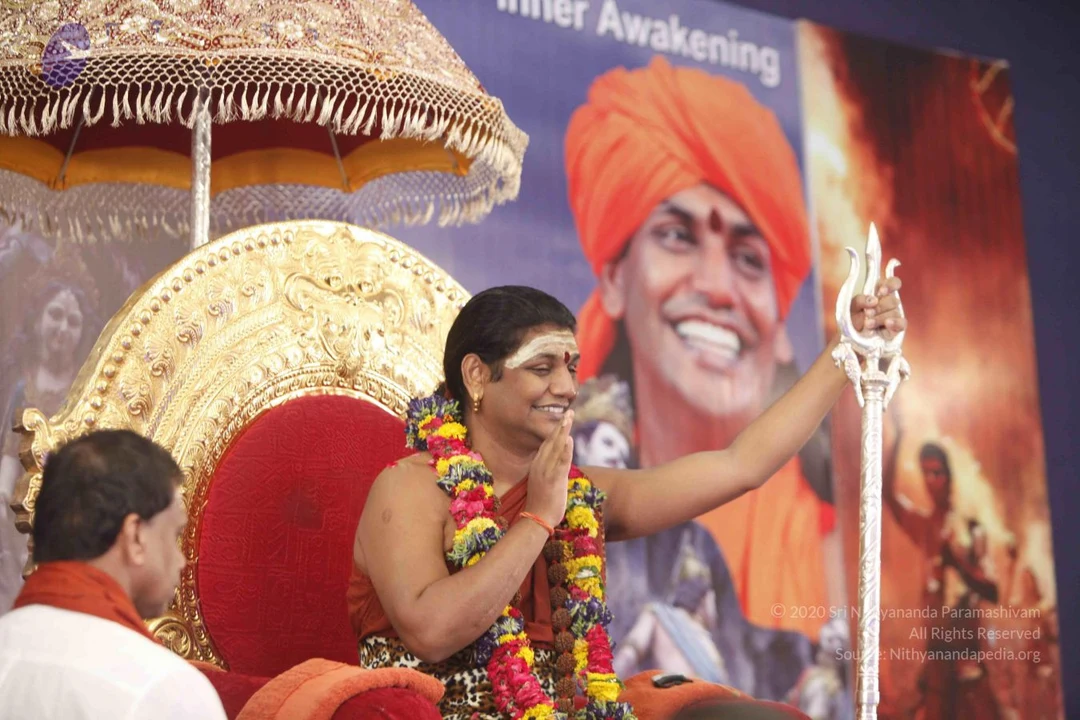
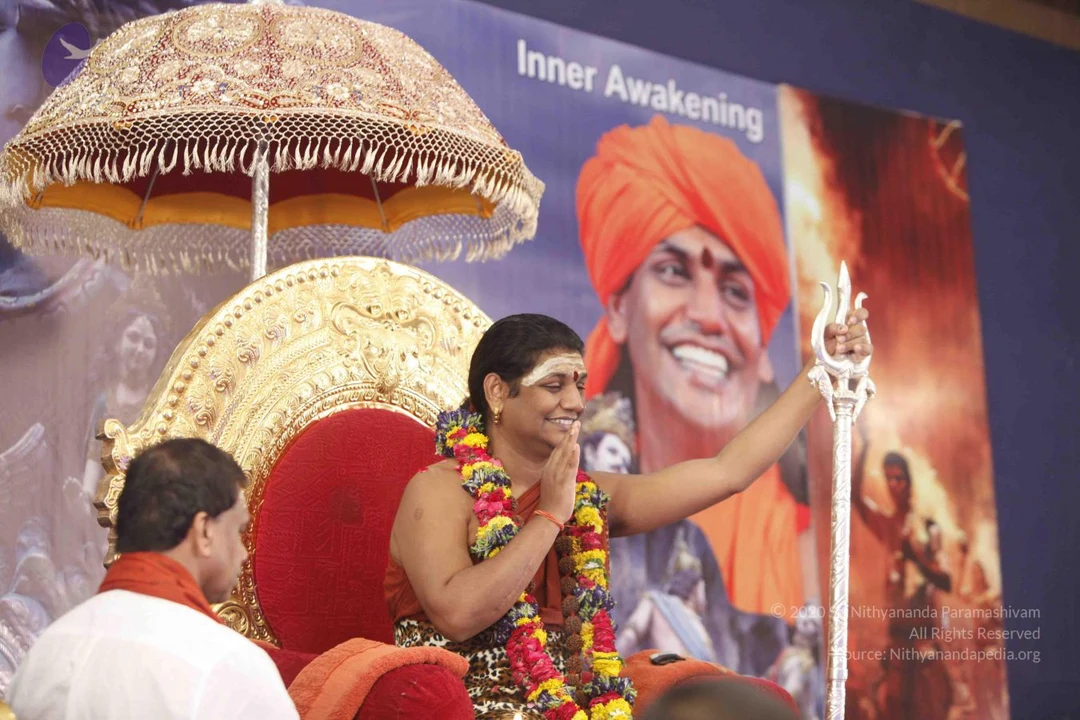
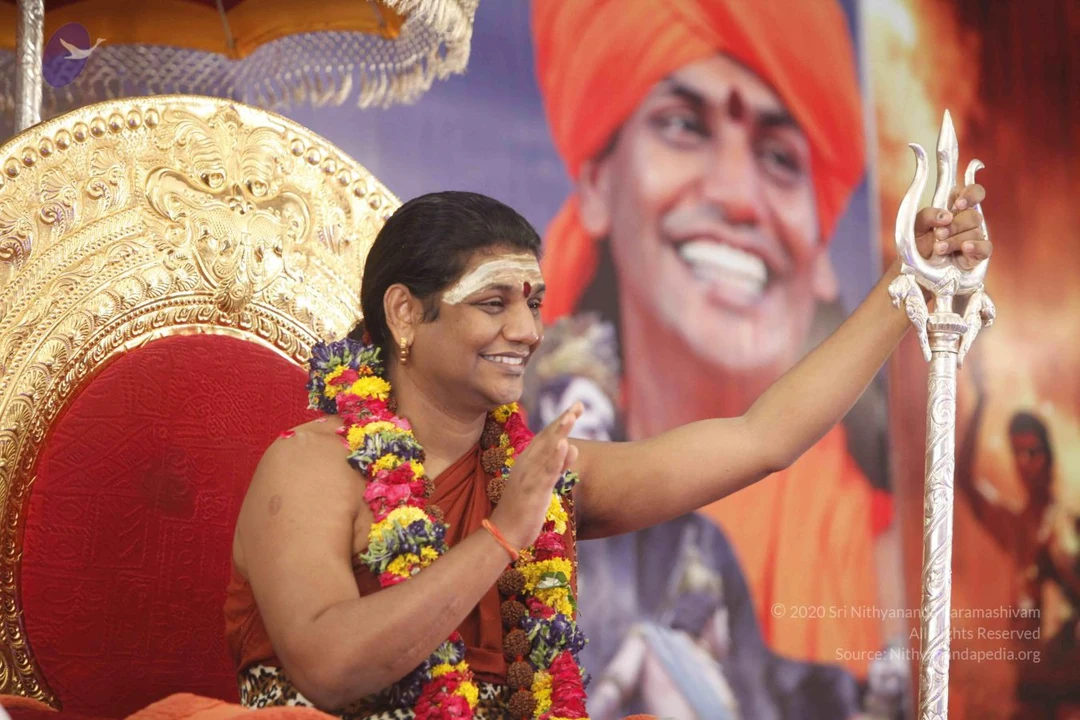
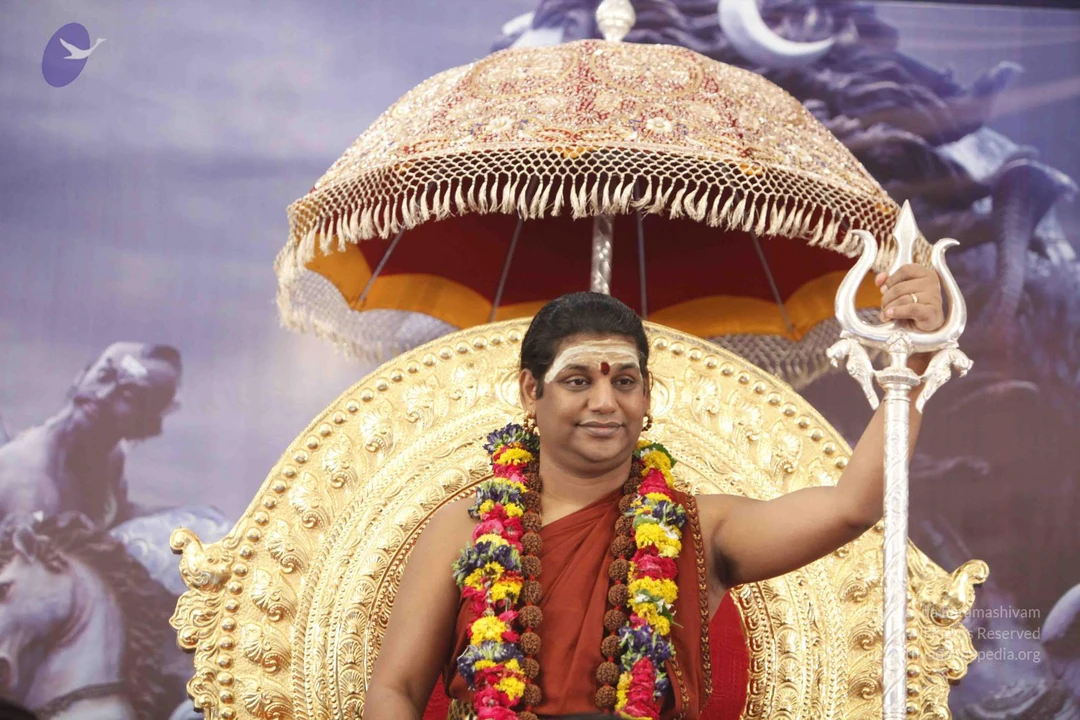
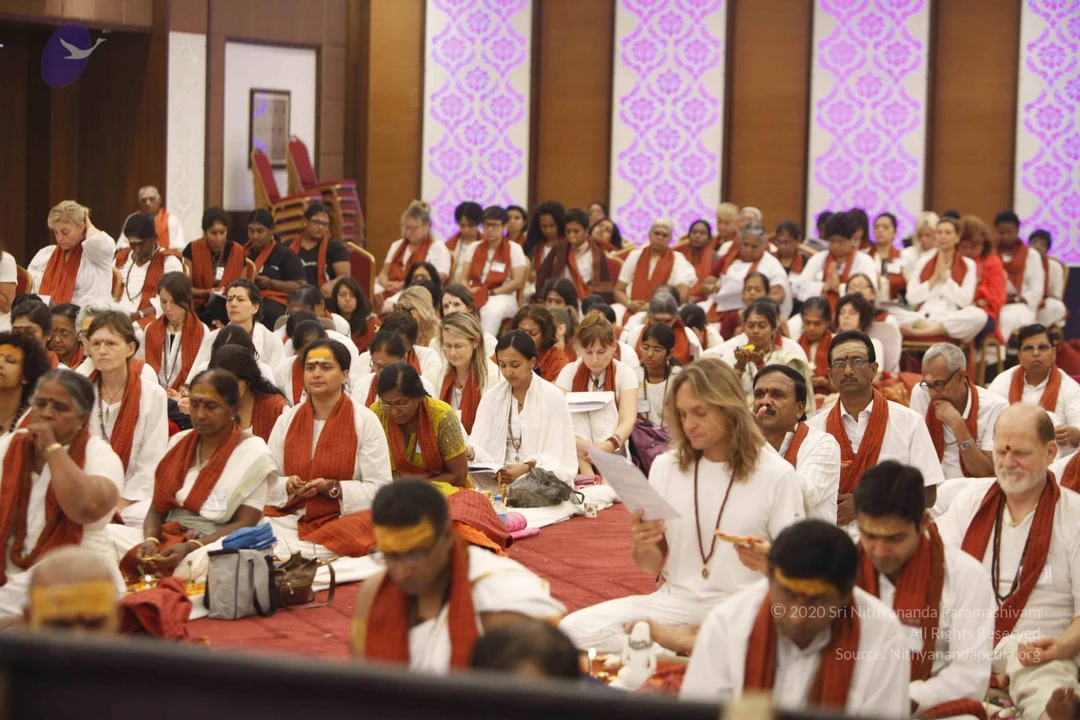
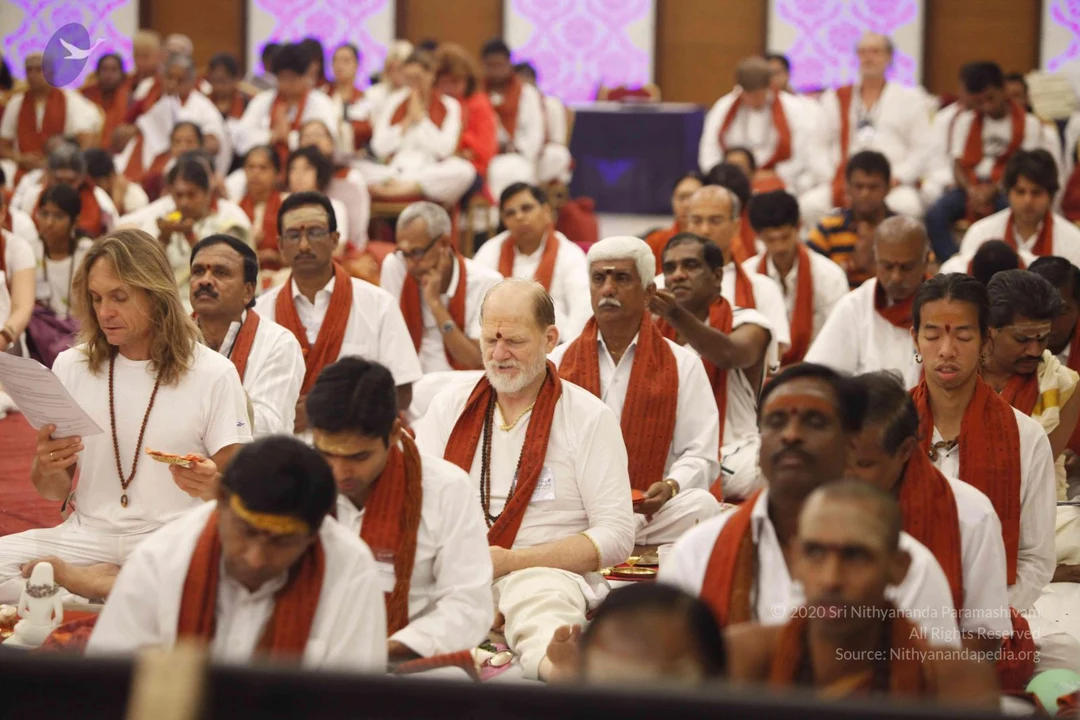
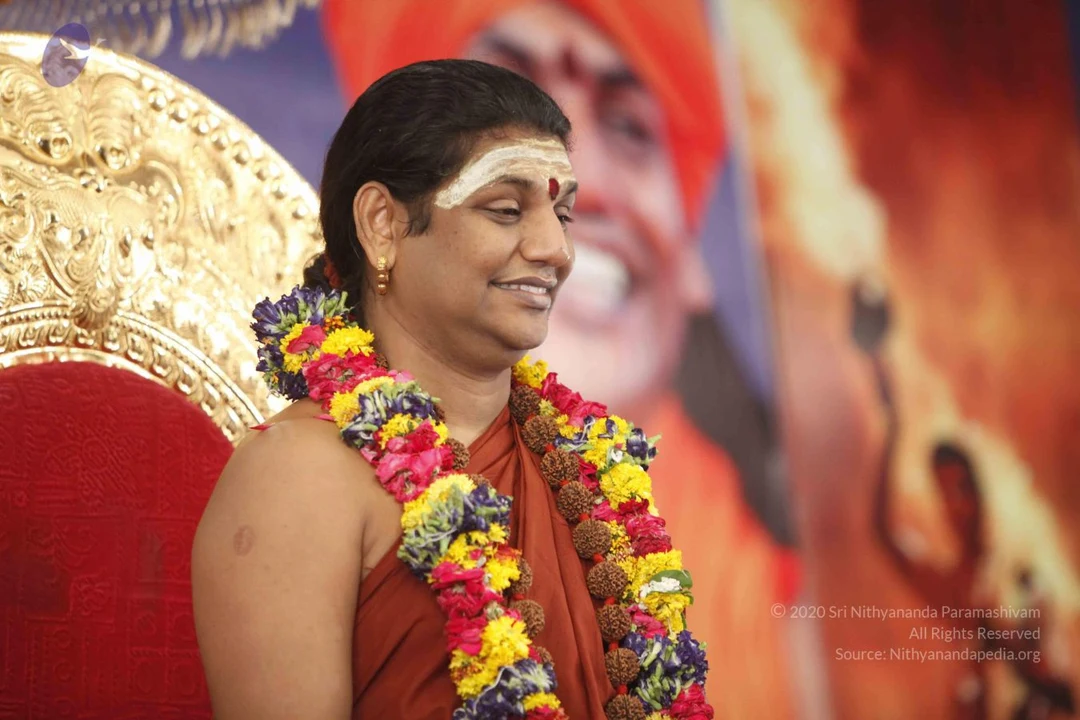
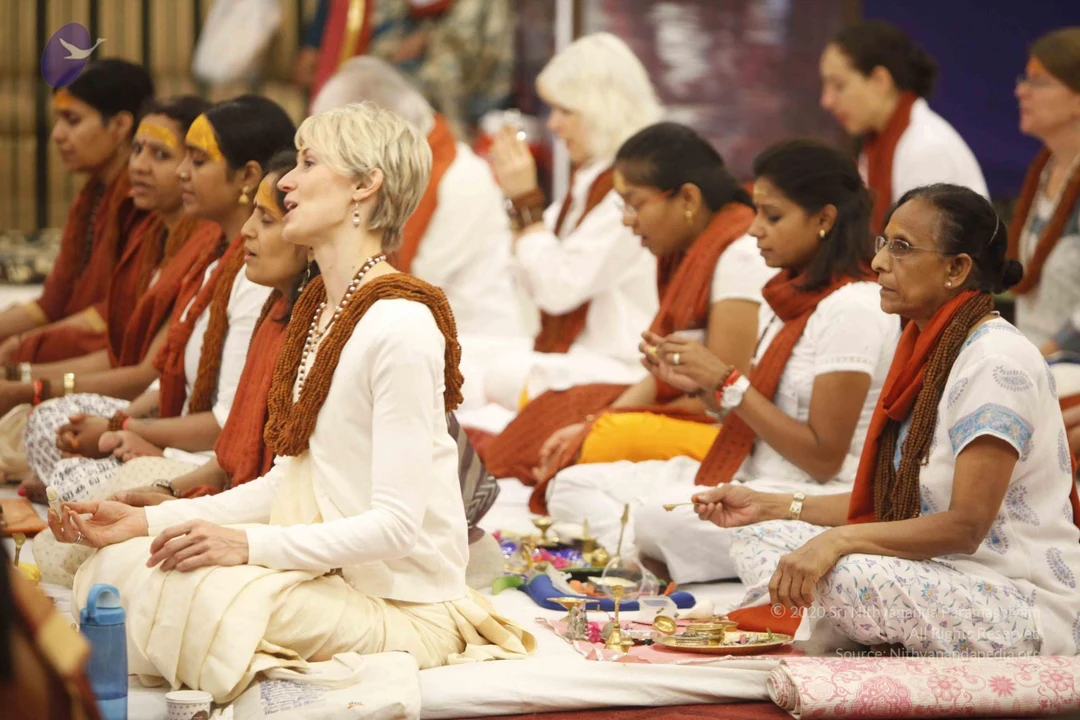
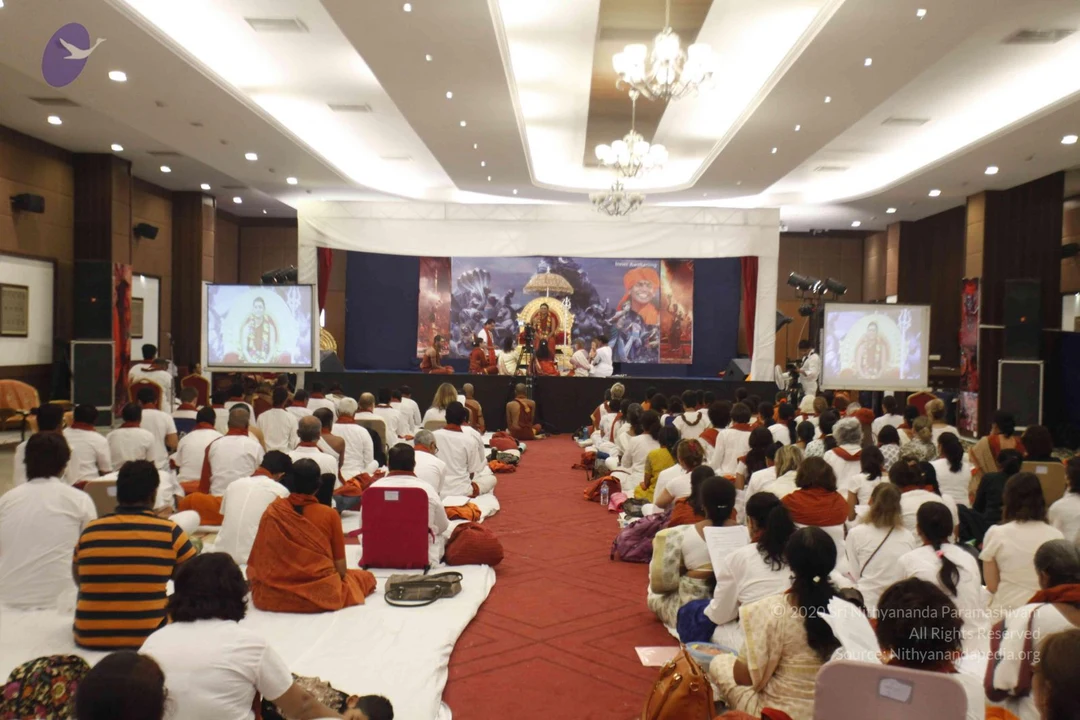
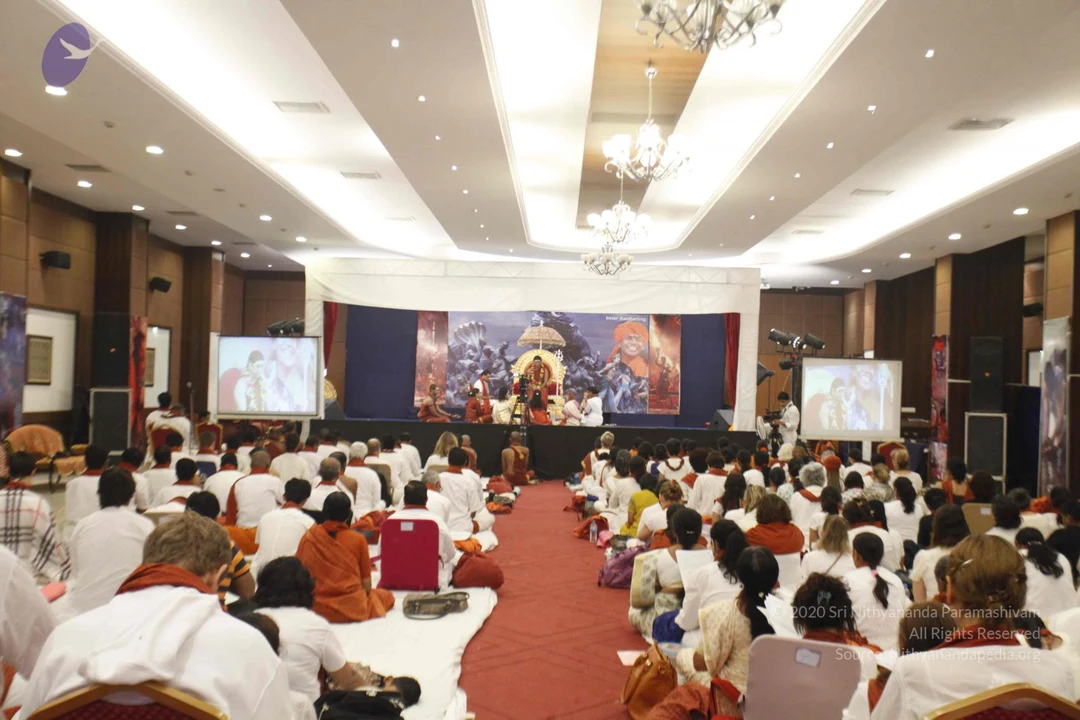
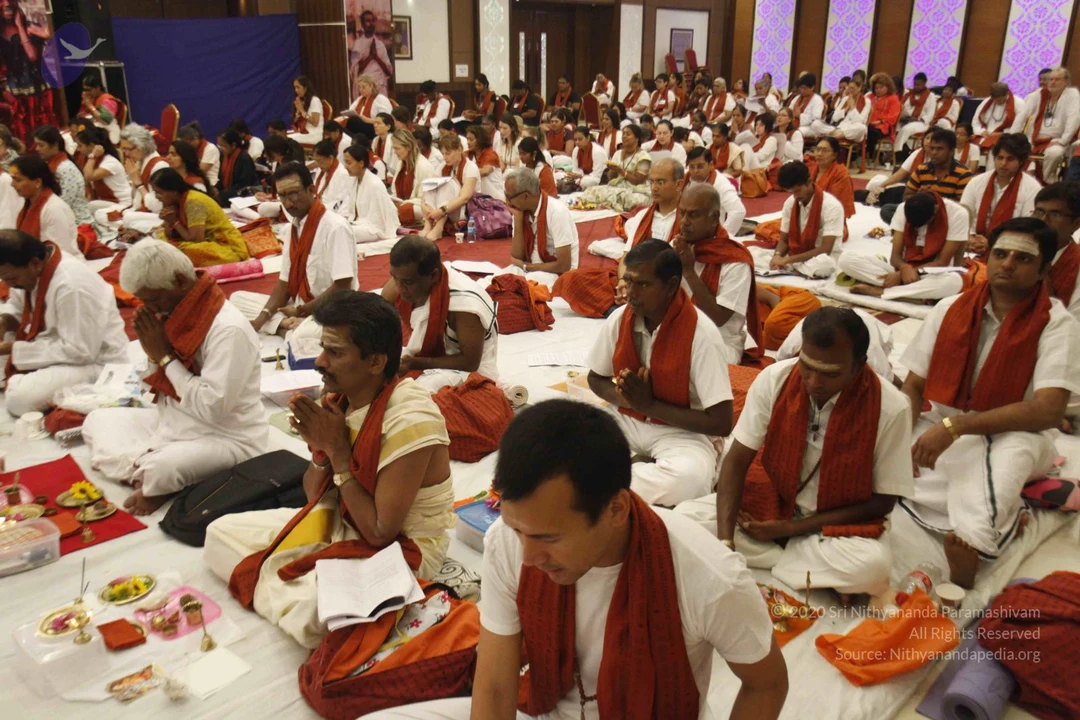
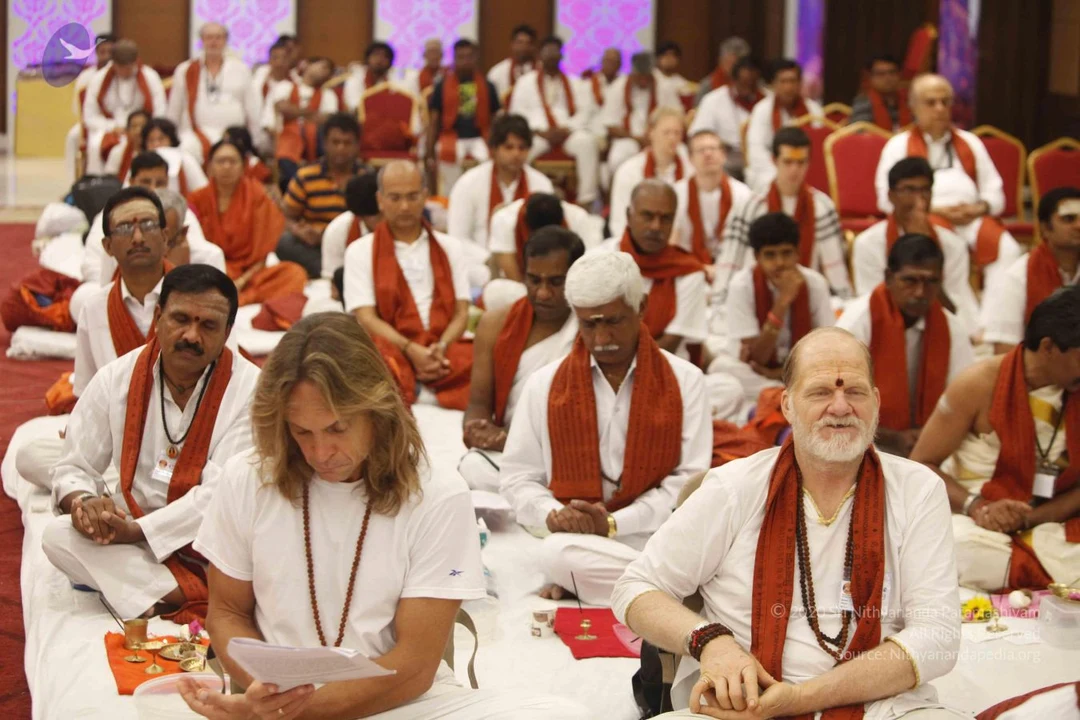
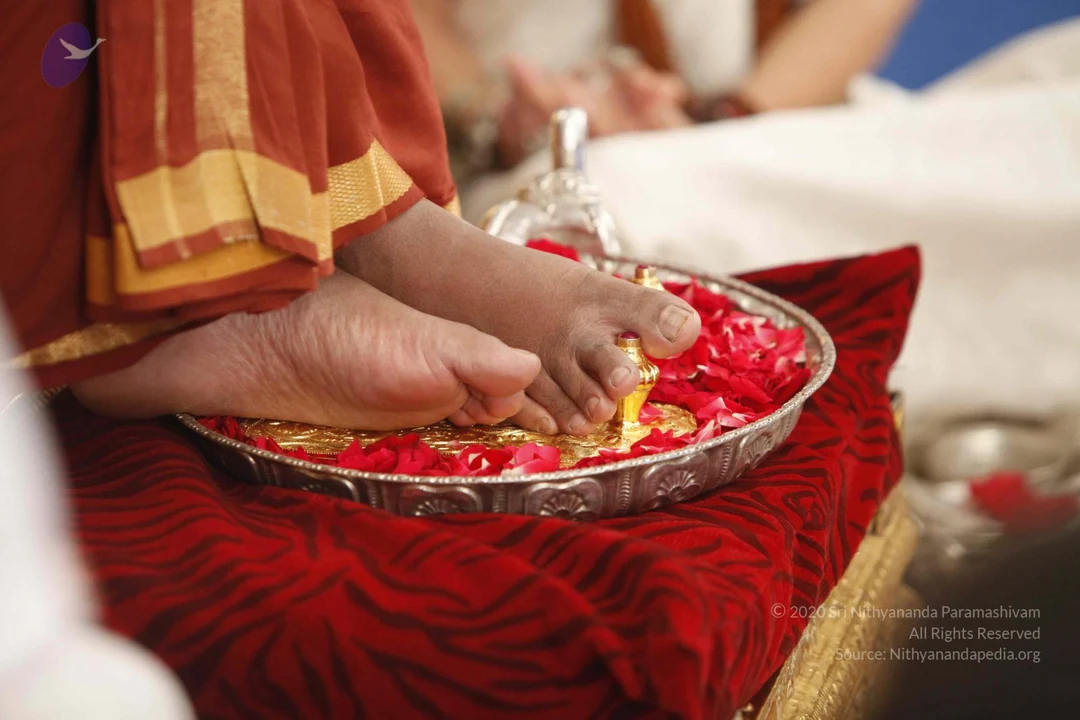
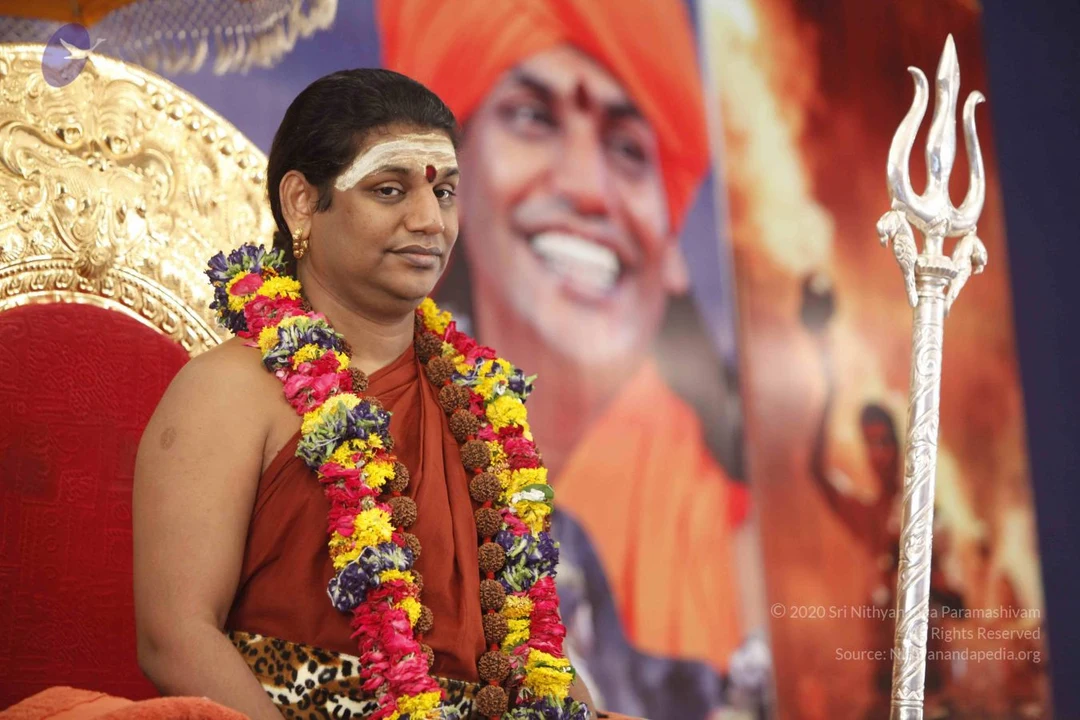
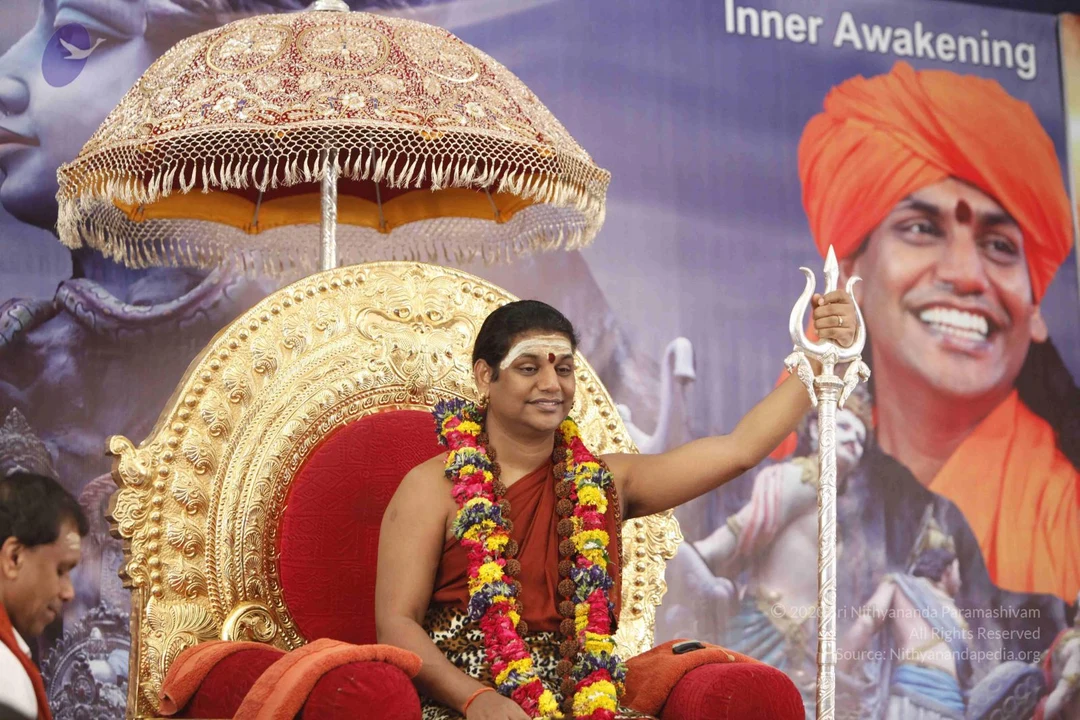
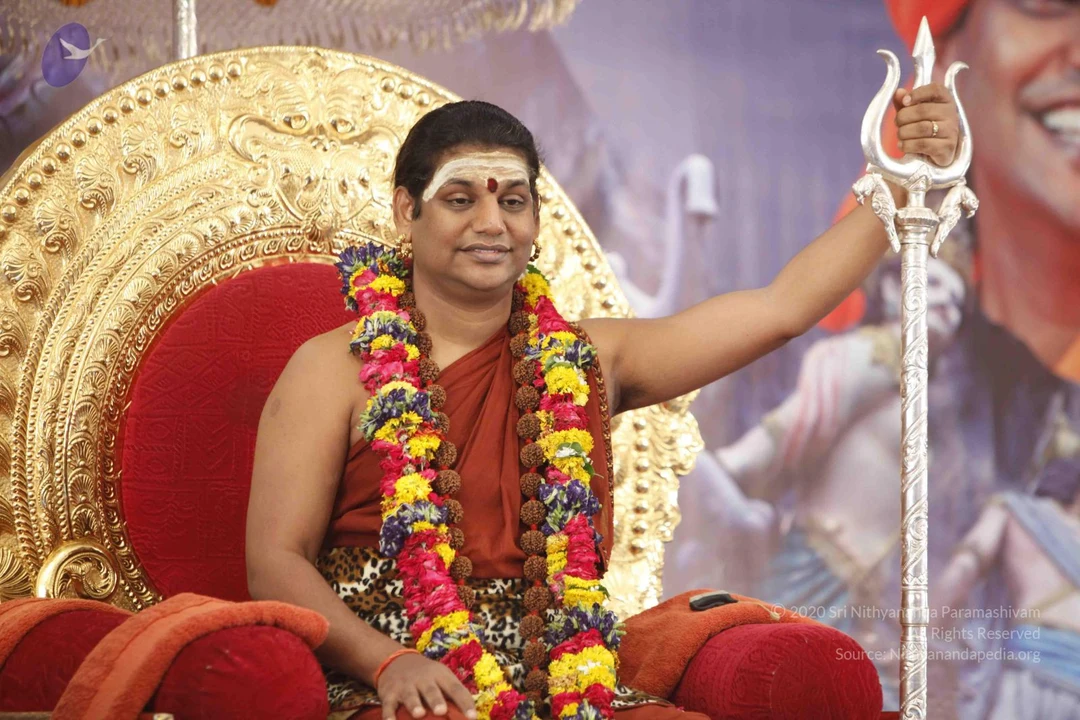
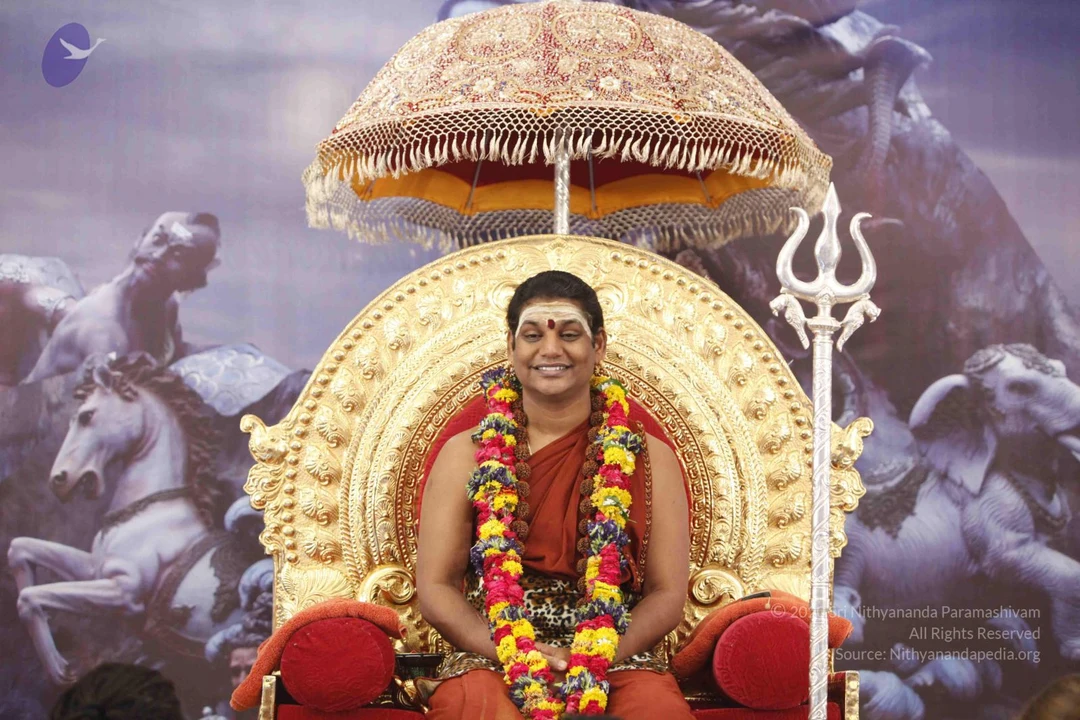
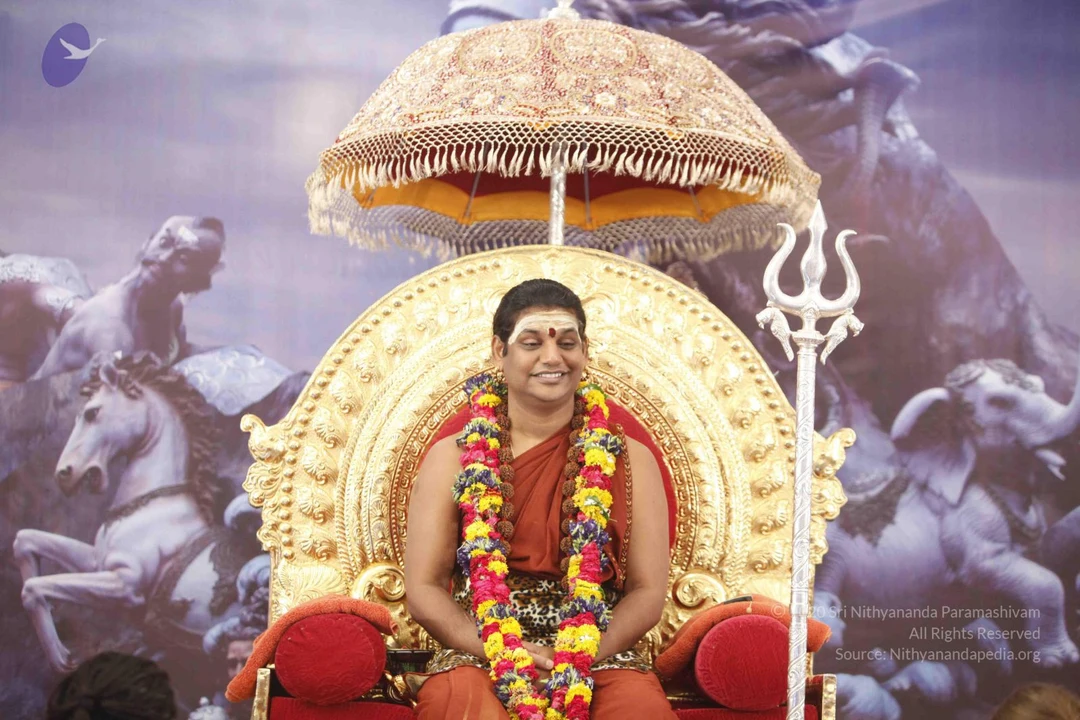
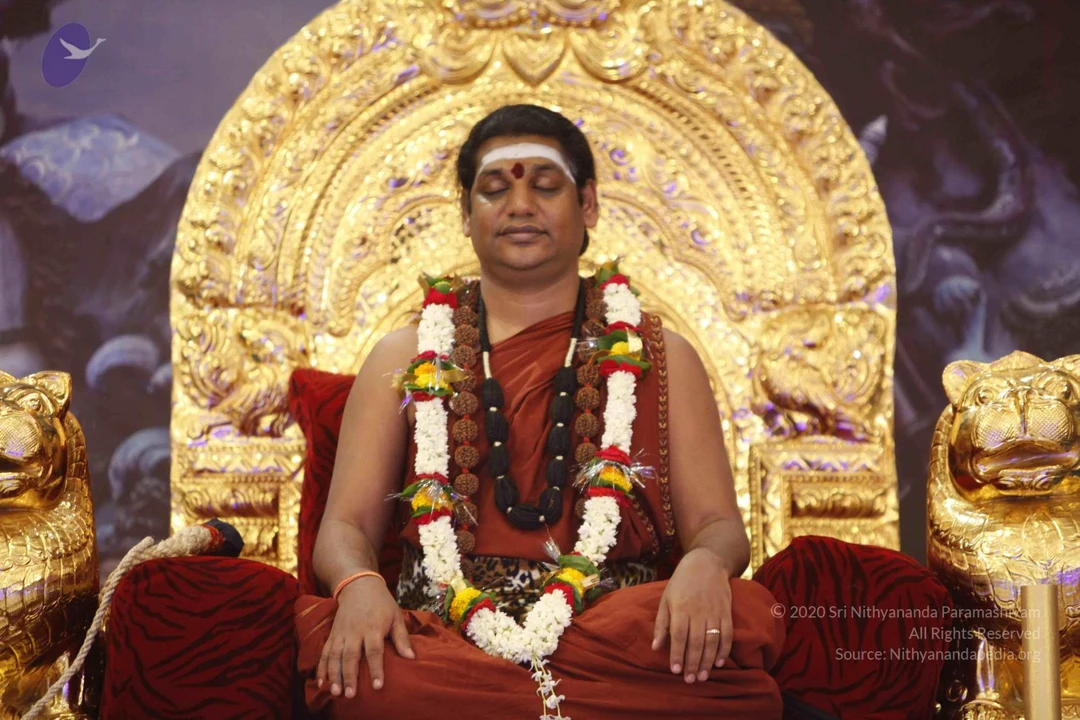
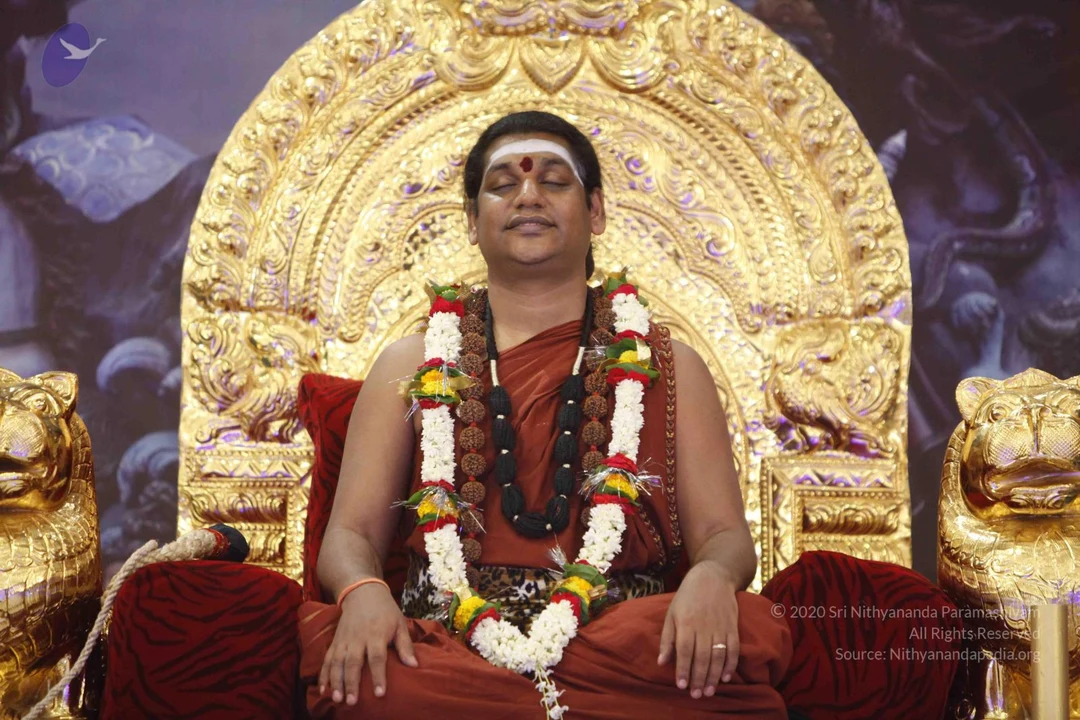
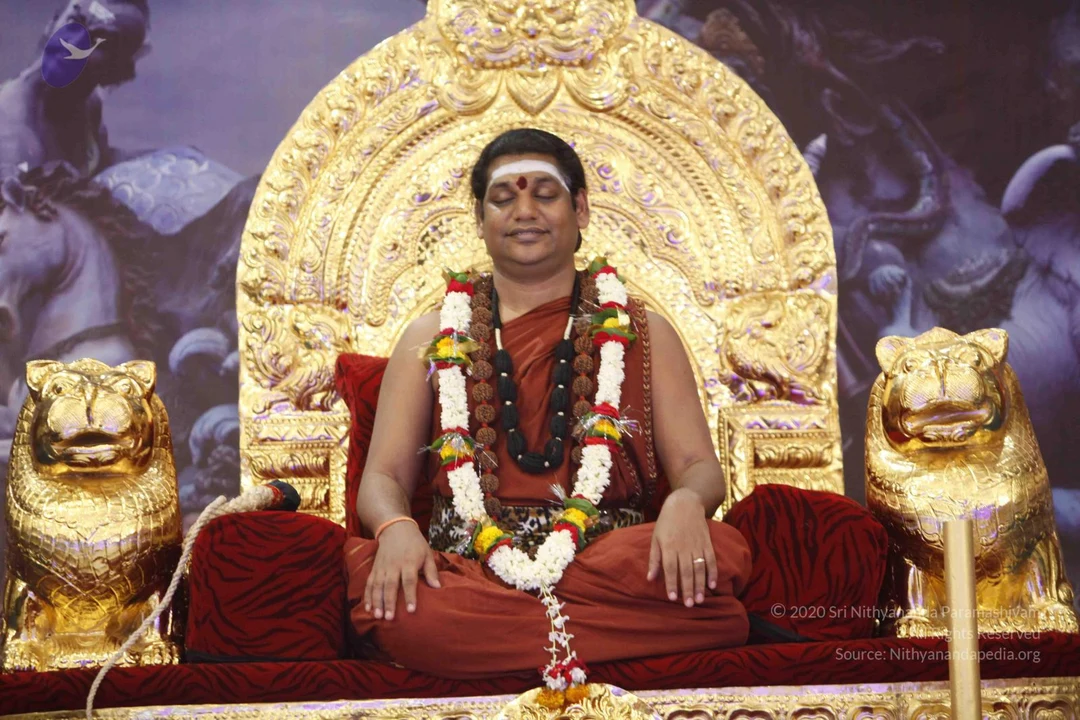
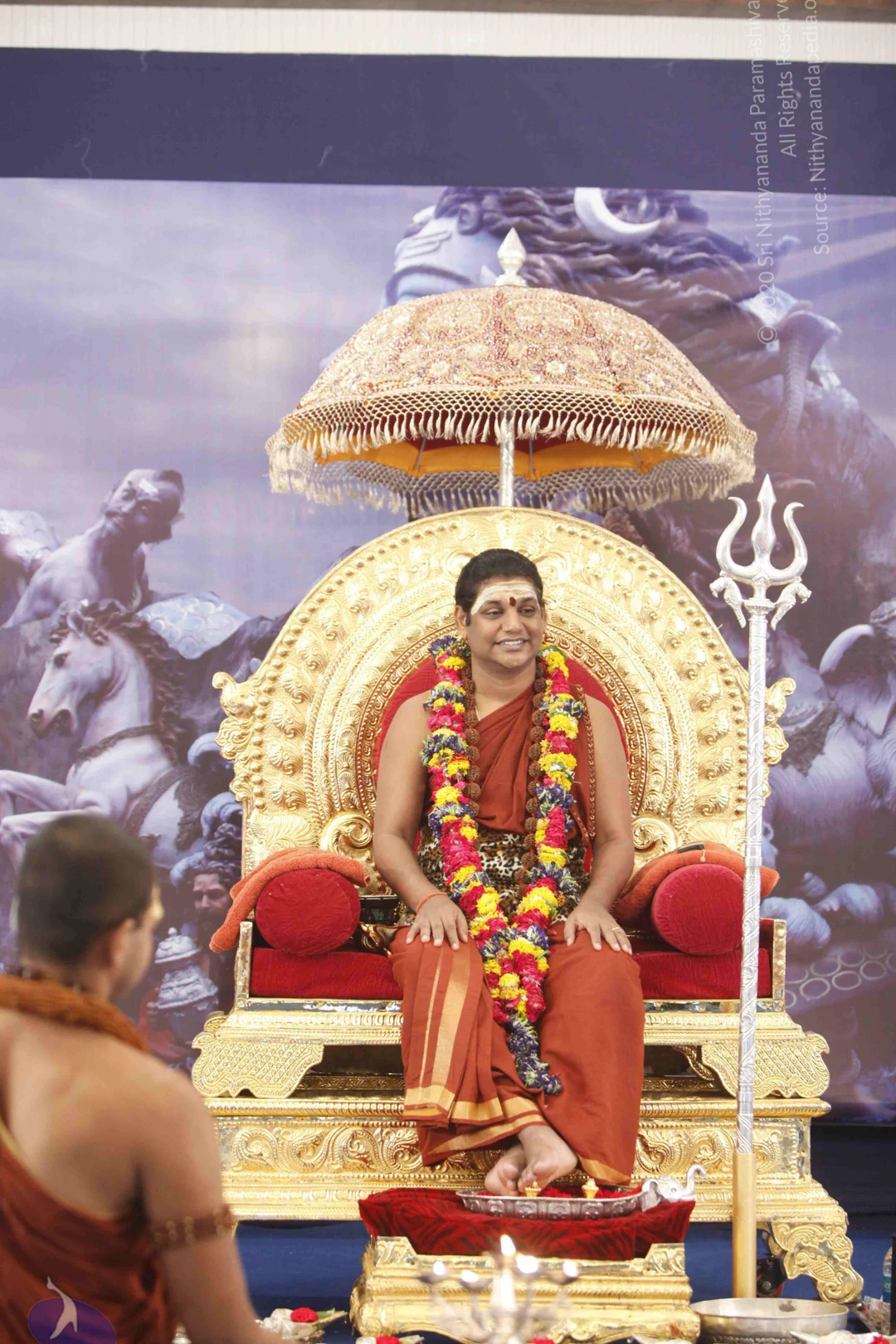
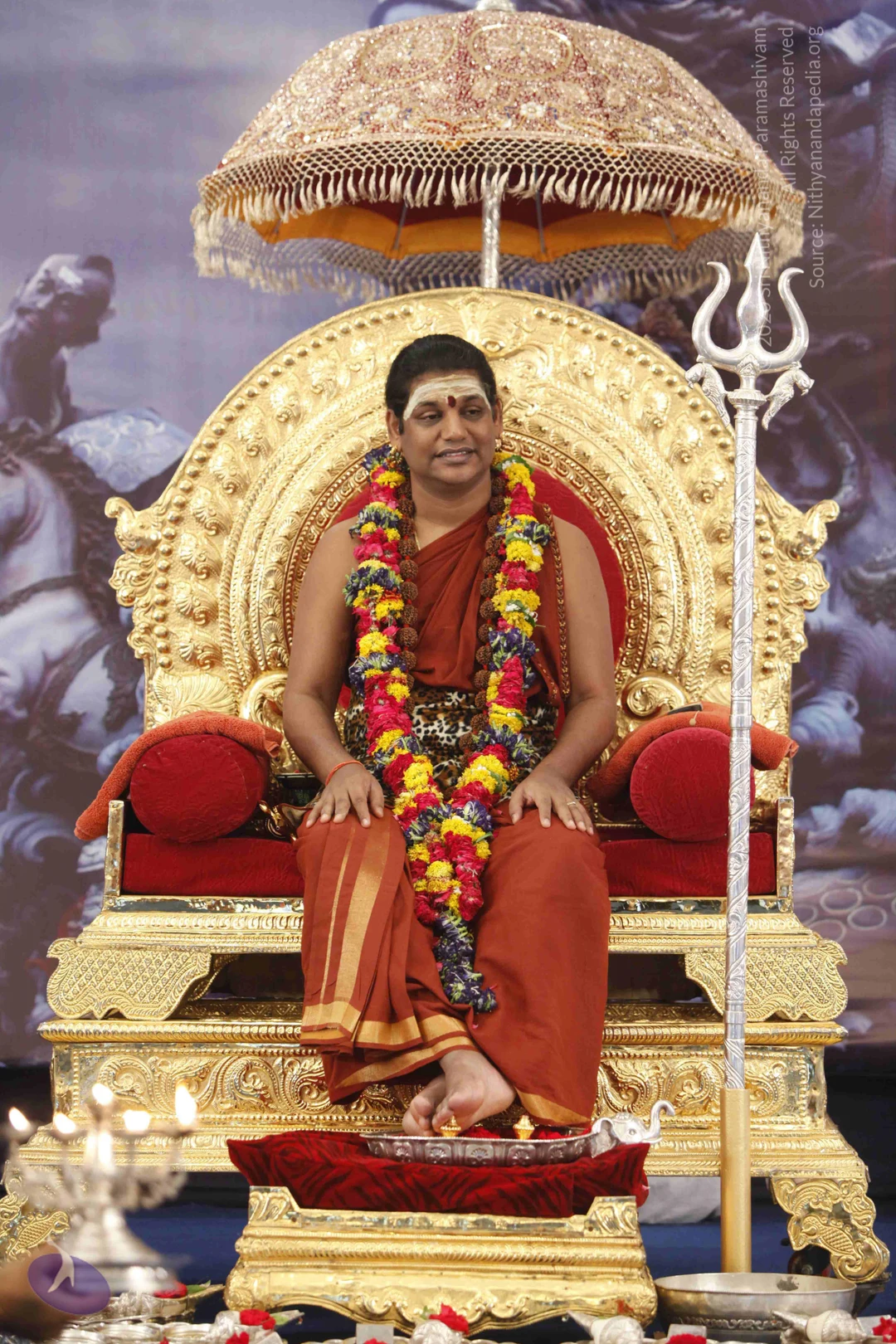
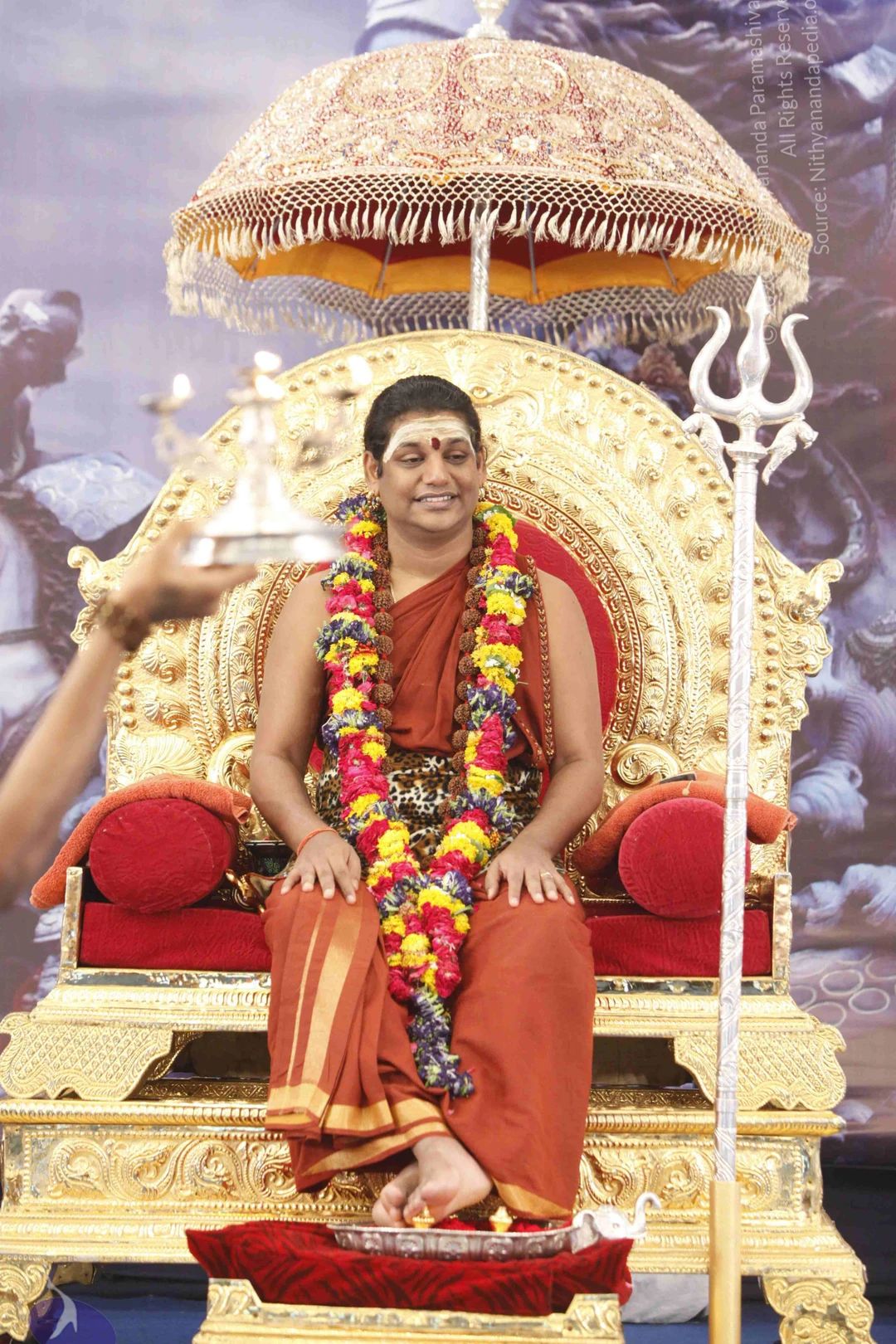
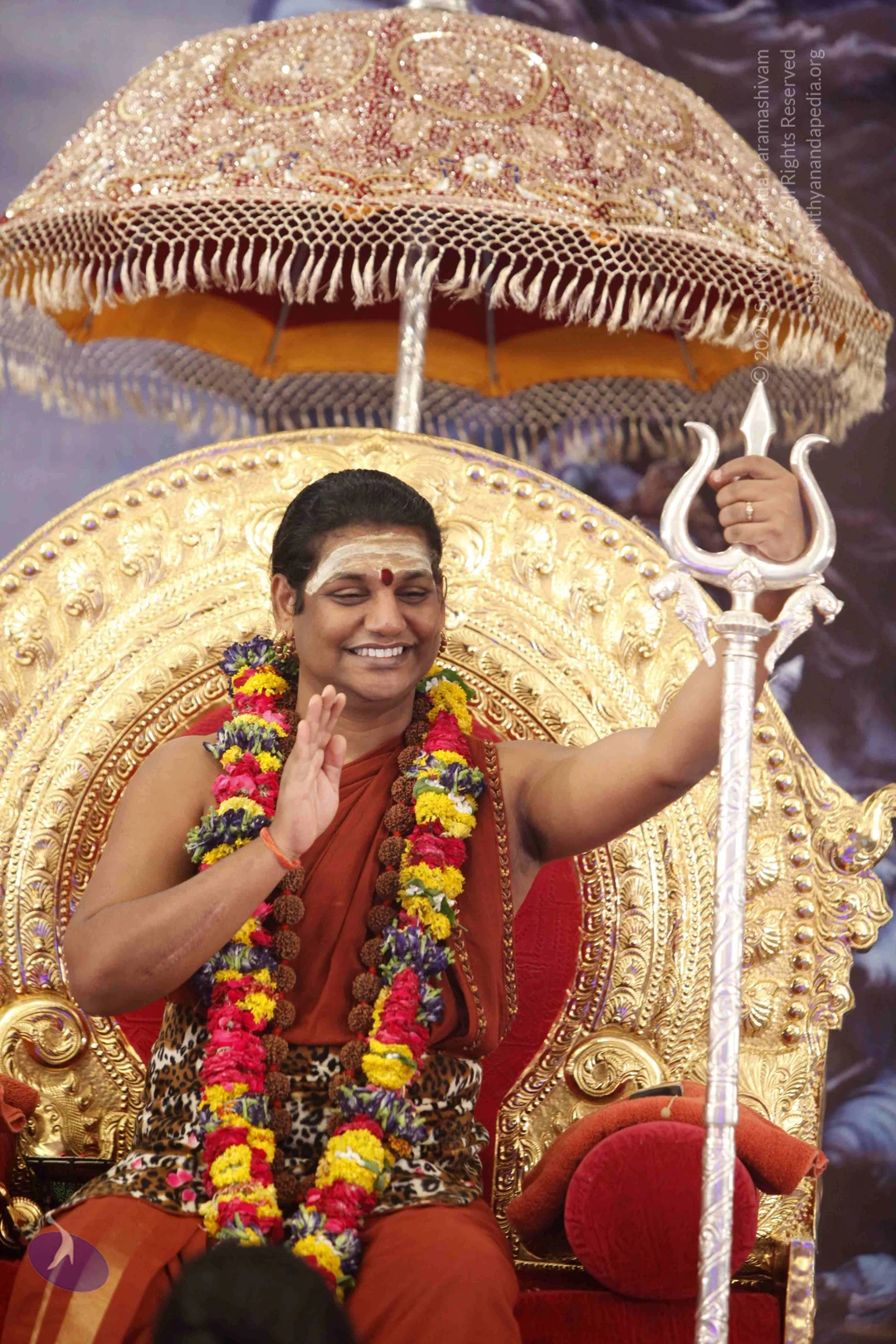
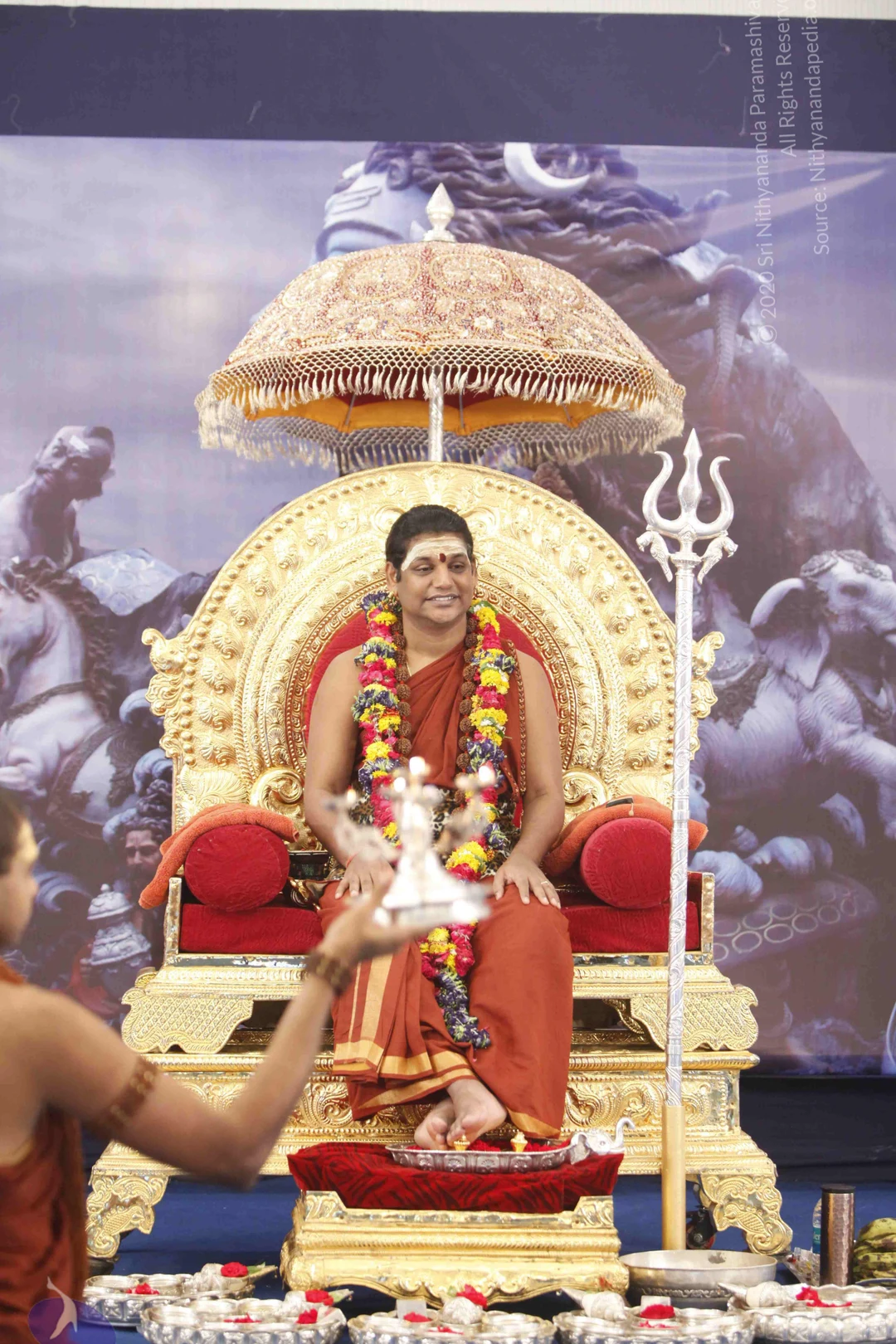
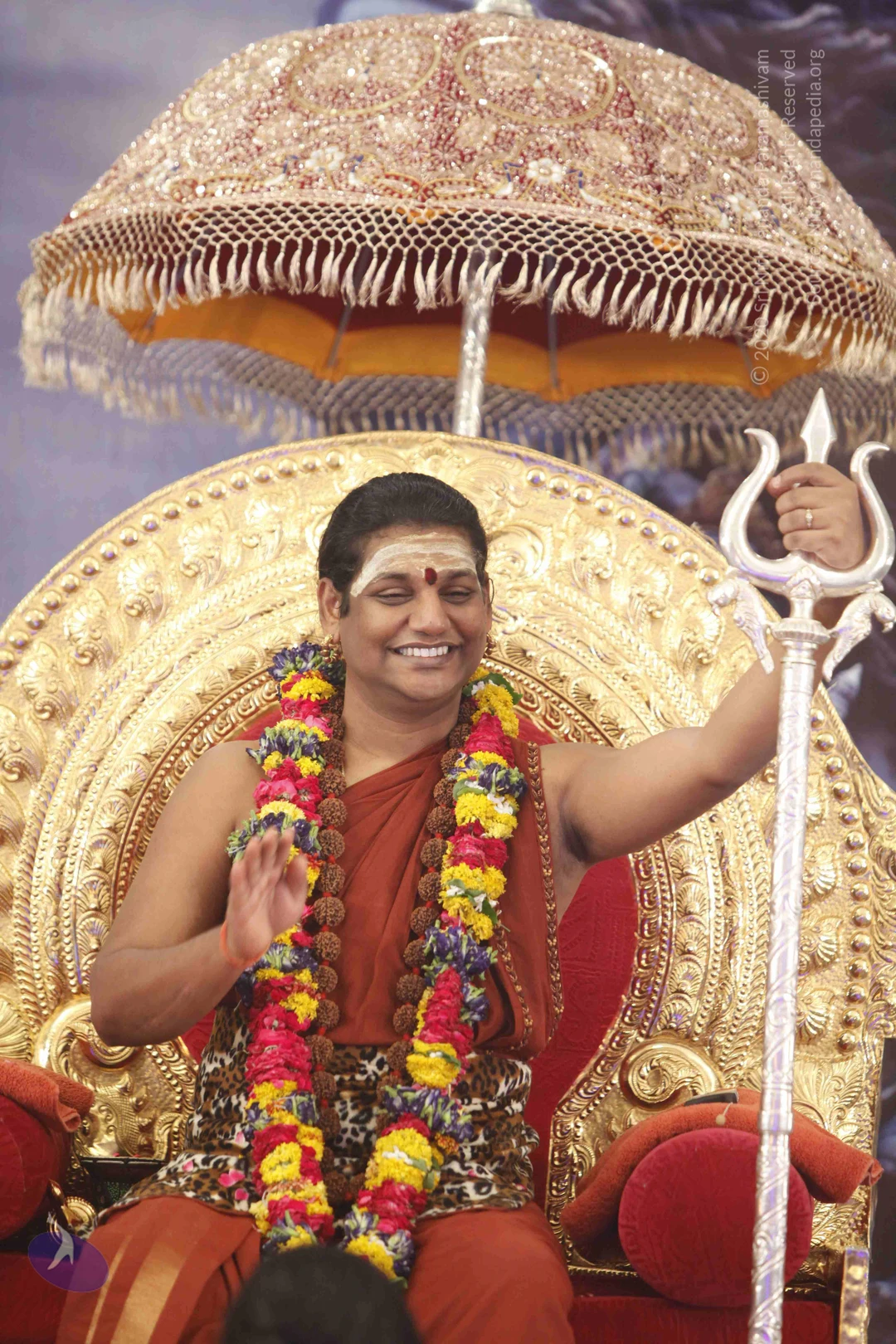
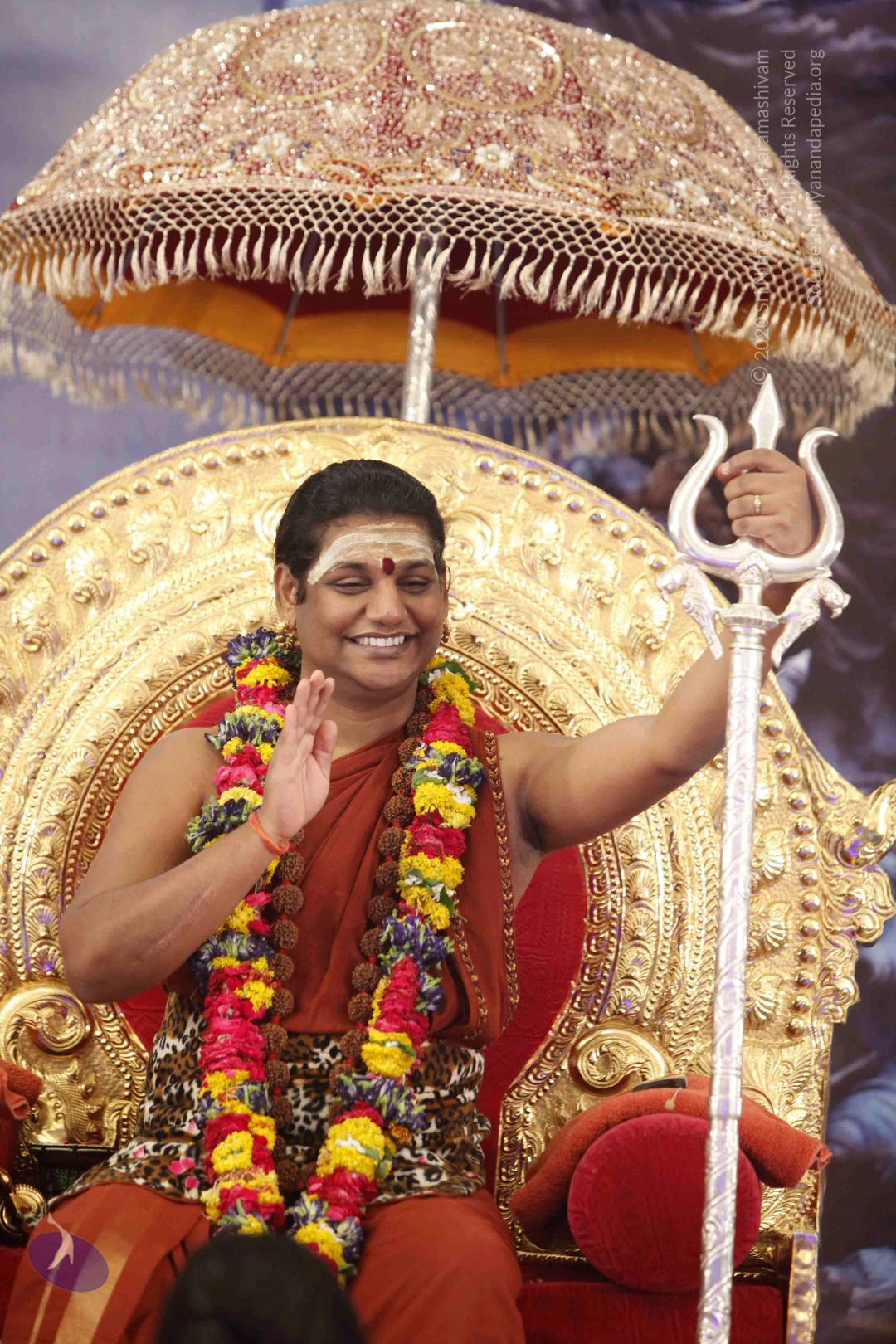
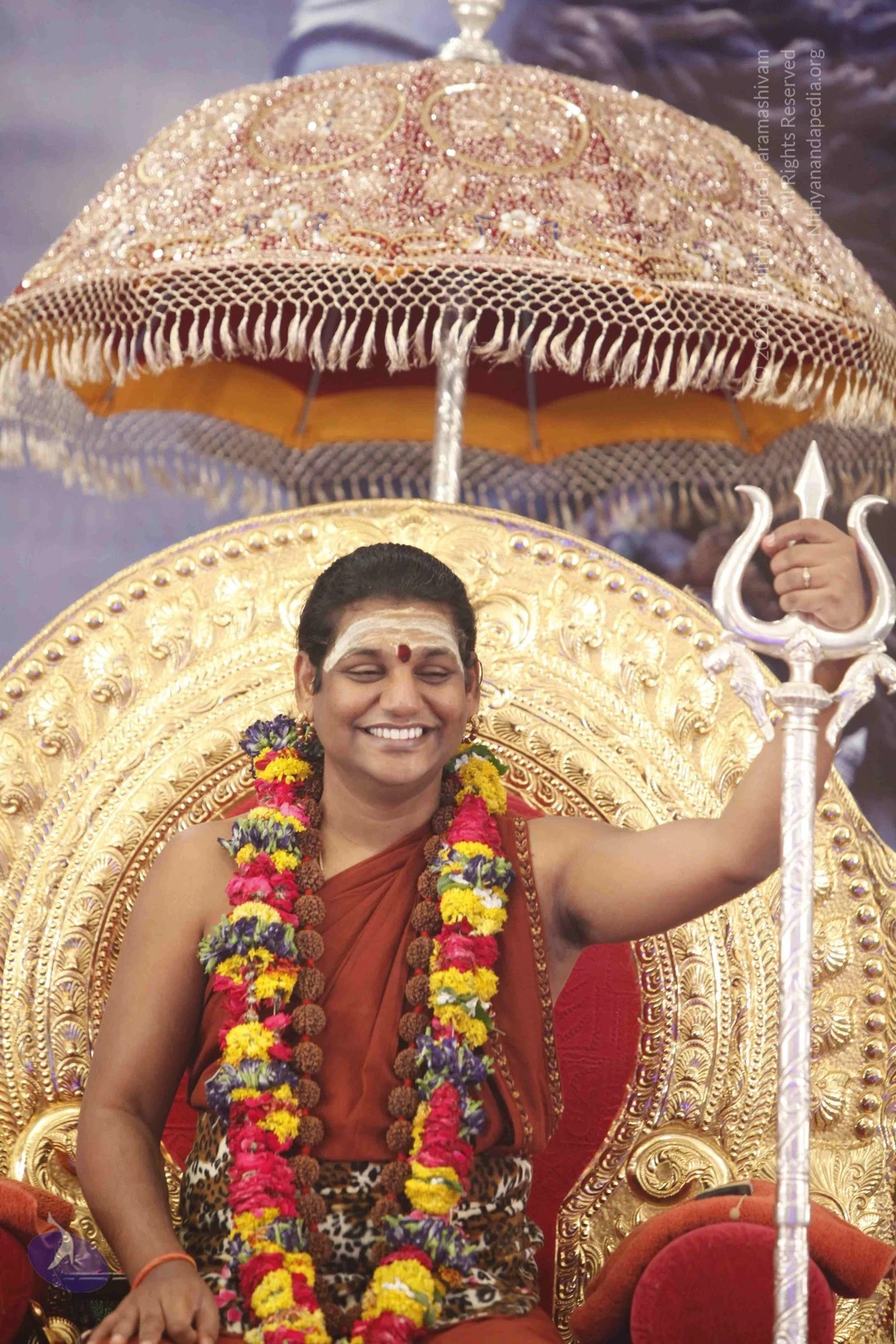
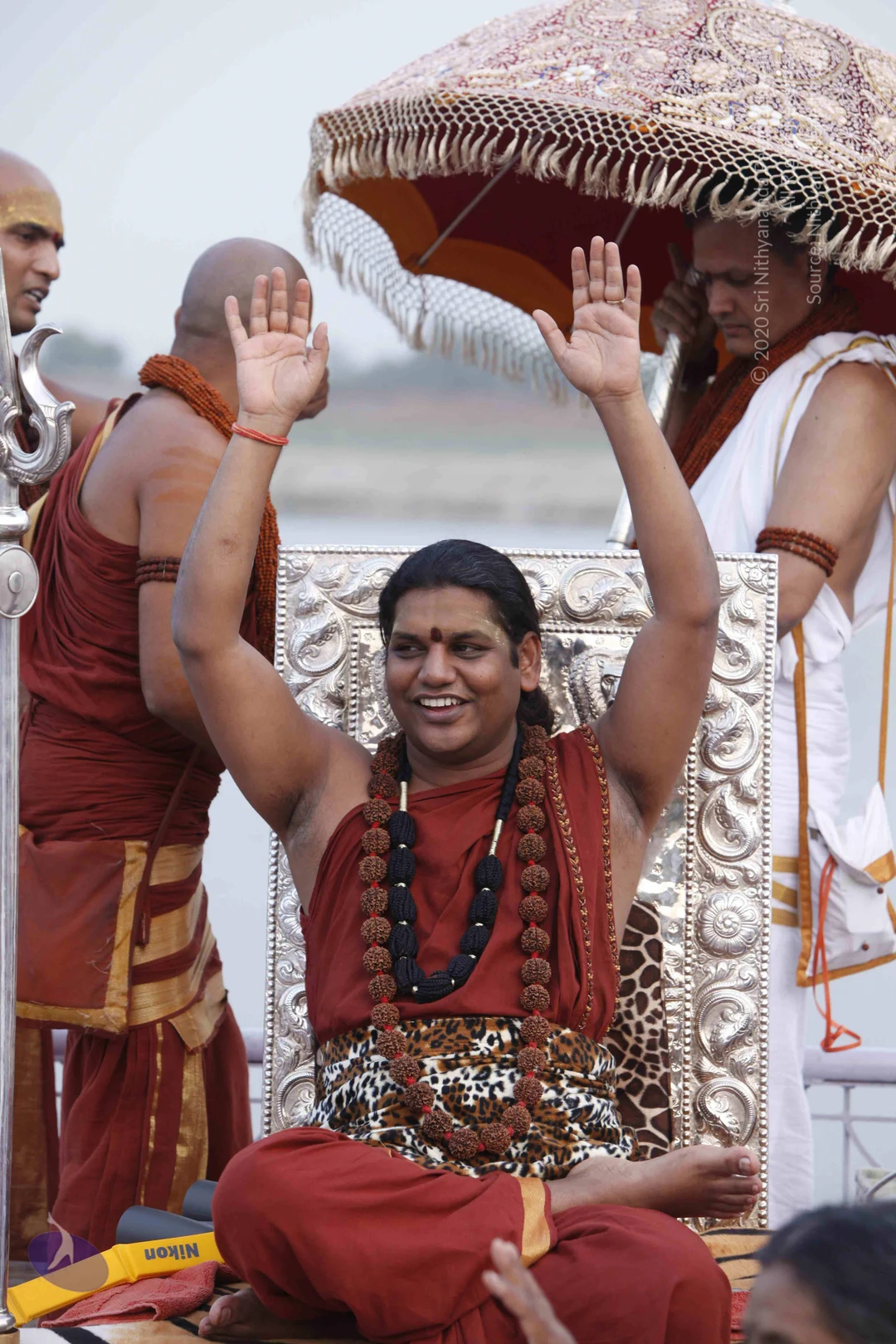
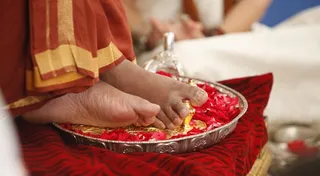
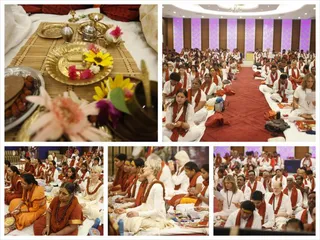
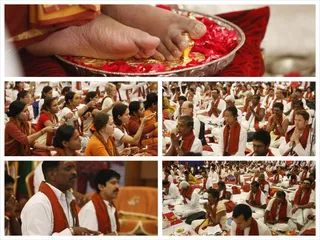
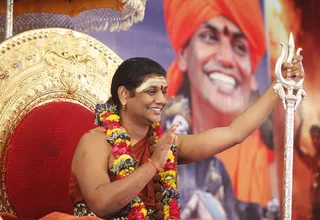
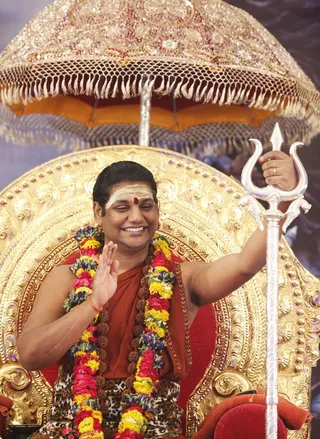
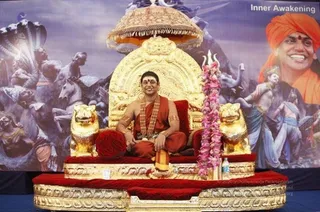
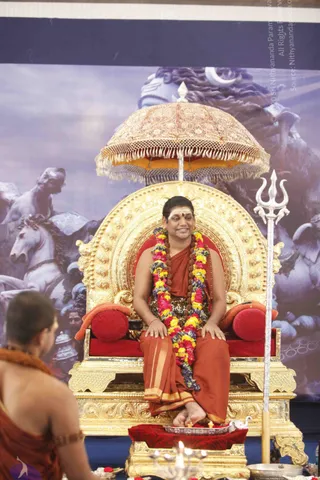
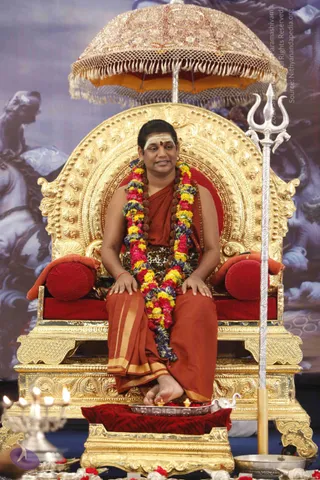
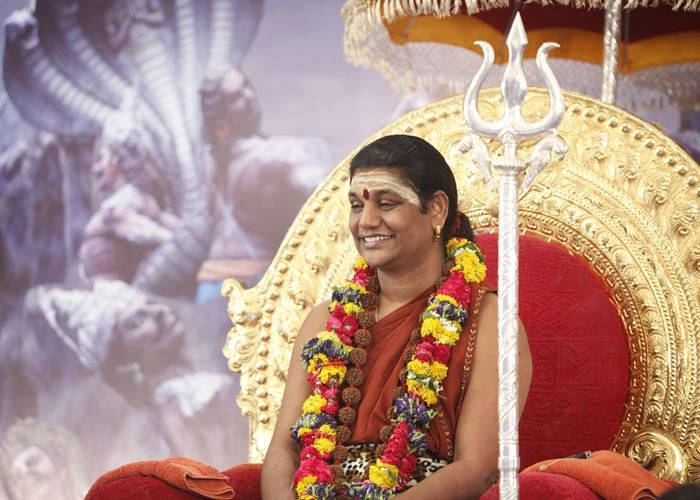
A smiling person with swept-back dark hair and a red bindi sits on an ornate gold throne with red cushions. They wear an orange-saffron garment, a multicolour flower garland mixed with rudraksha beads, and a gold earring, with white vibhuti horizontal marks on the forehead. A tall silver trident stands beside the throne. Behind is a painted backdrop of a large serpent hood and figures, and an orange and gold canopy is visible at the top.Close-up photograph of bare feet resting on a silver tray filled with red flower petals during a padapuja foot-worship ritual. The person wears a red and gold-bordered garment, and a gold ornament lies among the petals. The tray sits on a red fabric with a tiger-stripe pattern. Blurred white-clad figures and a brass vessel are visible in the background.Multi-panel collage of a KAILASA padapuja gathering. Top left: brass puja thali with a kalasha-style brass vessel, marigold and pink flowers, a rudraksha mala and a plate of sweets on a bamboo mat. Top right: a large hall with lilac-patterned walls, with rows of white-clad devotees wearing red shawls seated on a red carpet facing a central stage. Bottom panels: close views of seated devotees in white, red and orange garments, some wearing rudraksha malas, one older woman with long blonde hair in a white kurta, and others holding flowers or puja items. No single identifiable a person figure is clearly visible in the frame.Multi-panel collage of a padapuja ceremony. The top-left panel shows a pair of bare feet being washed or anointed over a silver bowl filled with red rose petals and a golden vessel. Other panels show large seated crowds in white clothes with red-orange shawls, many with hands folded in namaskar, and women in orange and red saris offering flowers. The collage is a graphic, with photographs as panels and no physical people counted at the collage level.A smiling man with short dark hair and a white vibhuti tilak with a red kumkum dot sits on an ornate gold-and-red throne, wearing saffron-orange robes and a multicolour flower garland with a rudraksha-style bead mala. He raises one hand in greeting and holds a silver trident in the other. Behind him a large printed portrait shows a smiling man in an orange turban and saffron robes, labelled with the name on the banner. The setting appears to be a stage or satsang dais.A smiling man seated on an ornate gold throne under a jewelled umbrella with fringed red and gold canopy. He wears an orange-red robe over a leopard-print garment, a rudraksha mala, and a long garland of yellow, pink and purple flowers. A white sandalwood tilak marked with a red dot is on his forehead. He raises one hand in blessing and holds a silver trident in the other.

FB-photo-of-the-day

1 photoSource gallery

PadaPuja-Kalpatharu-Darshan
23 photosSource gallery
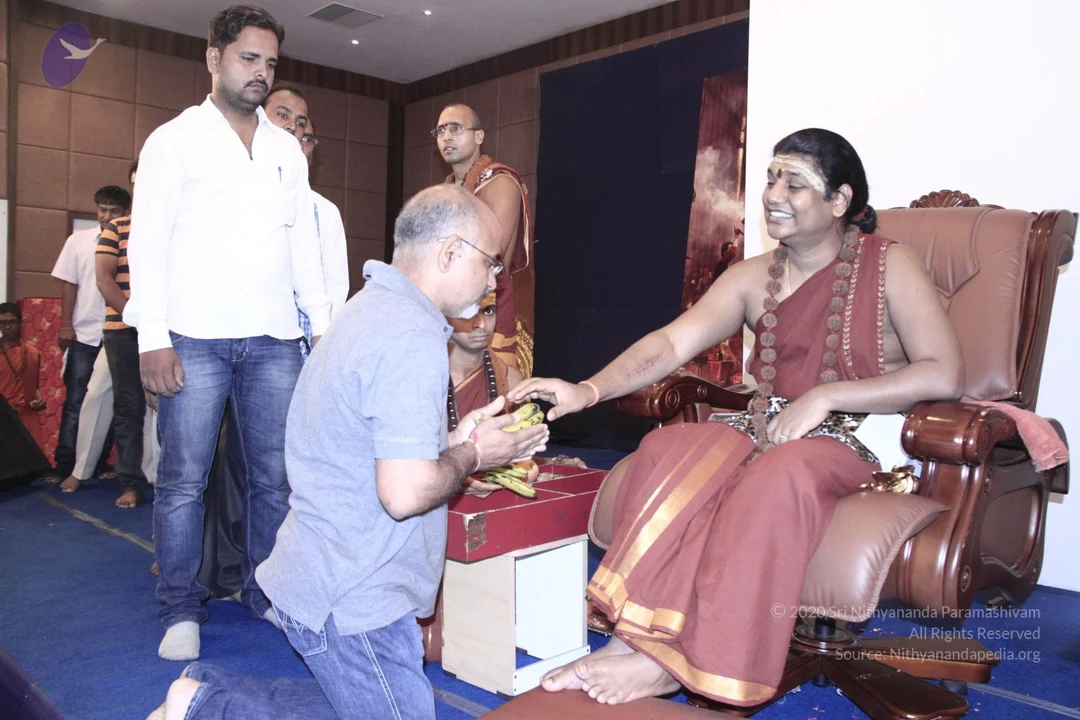
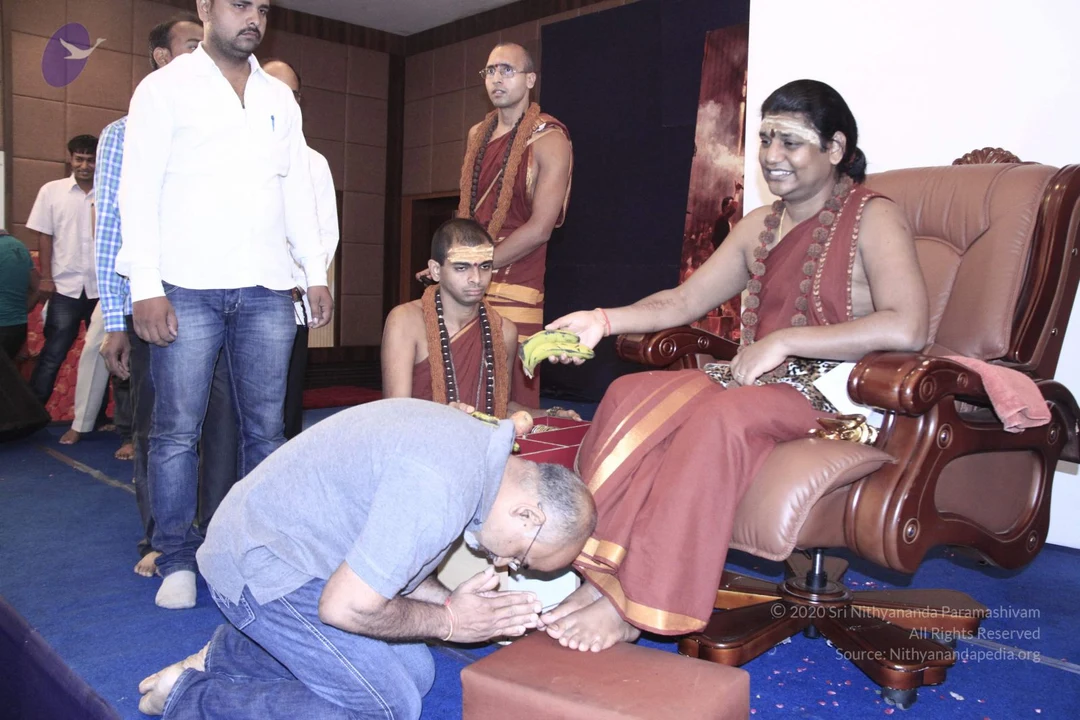
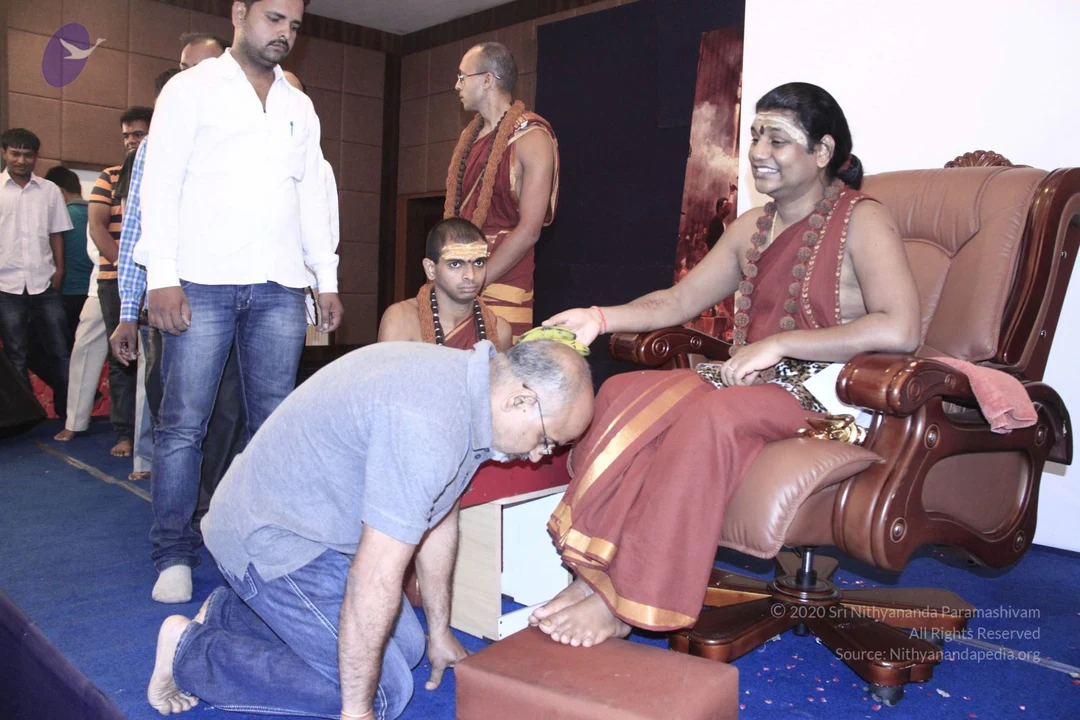
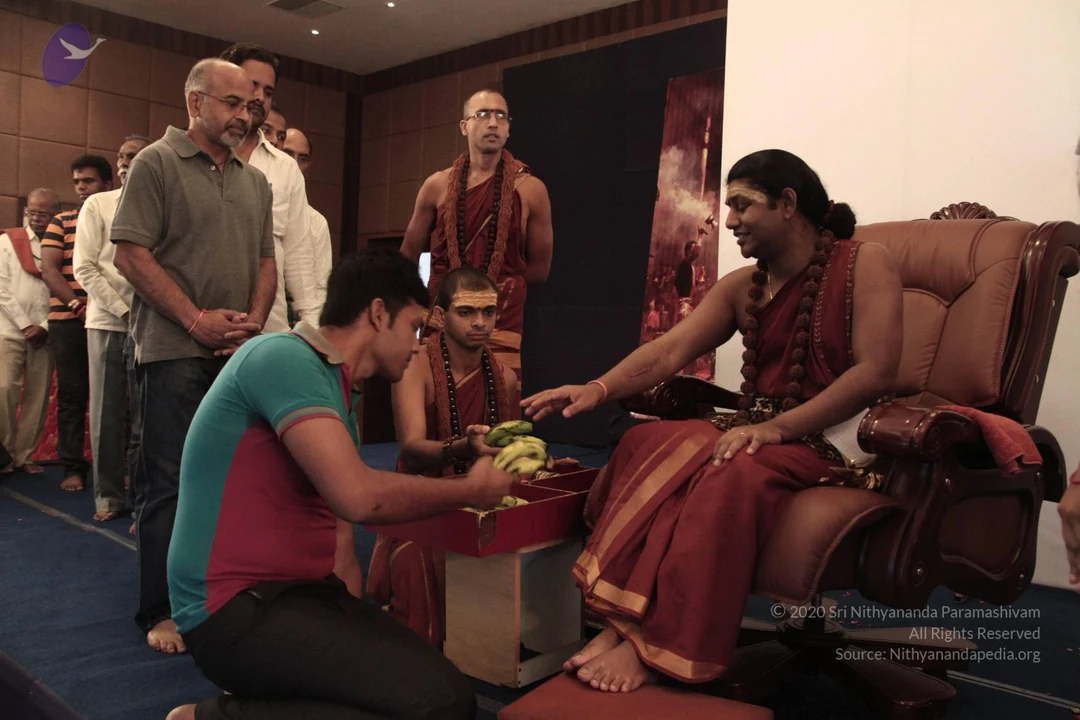
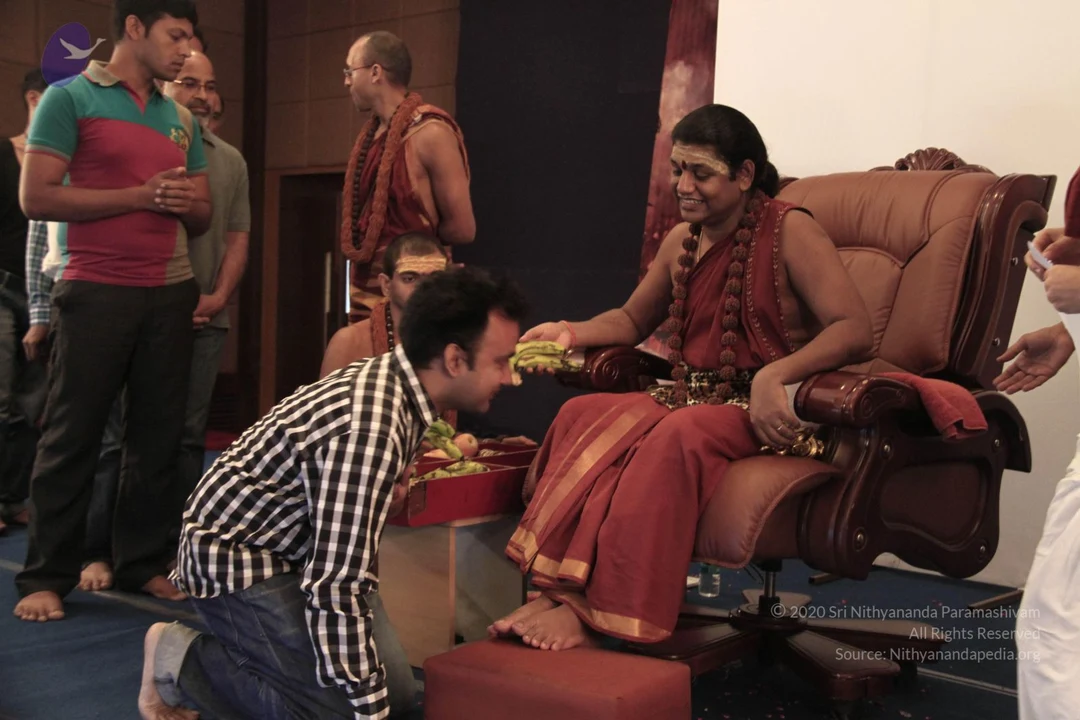
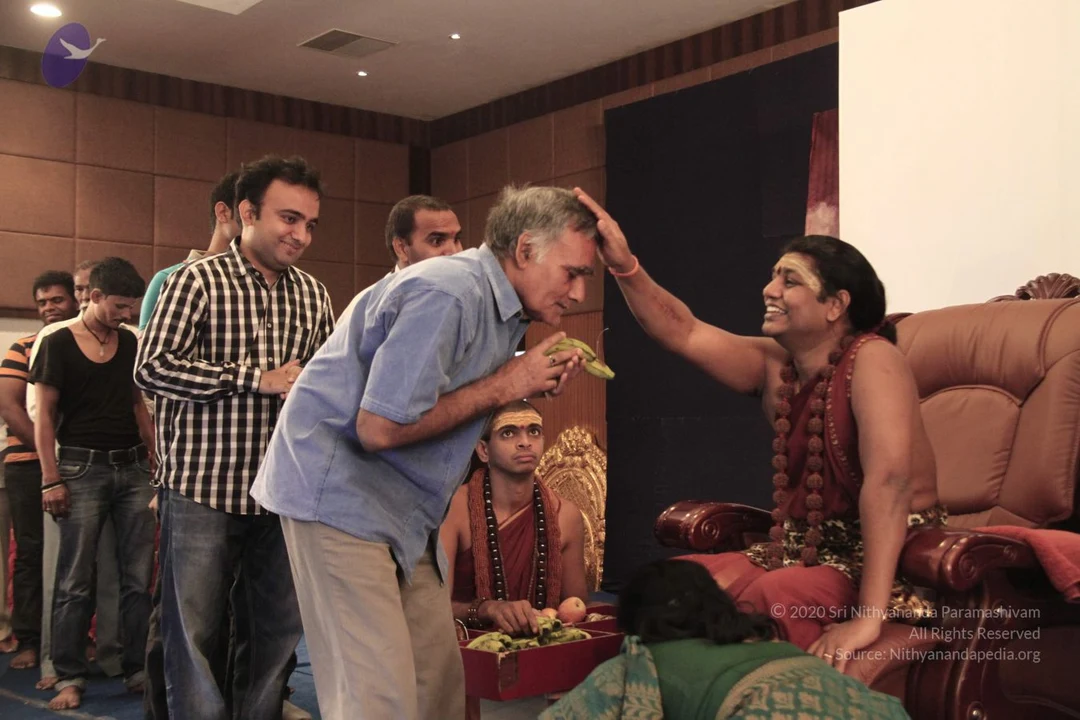
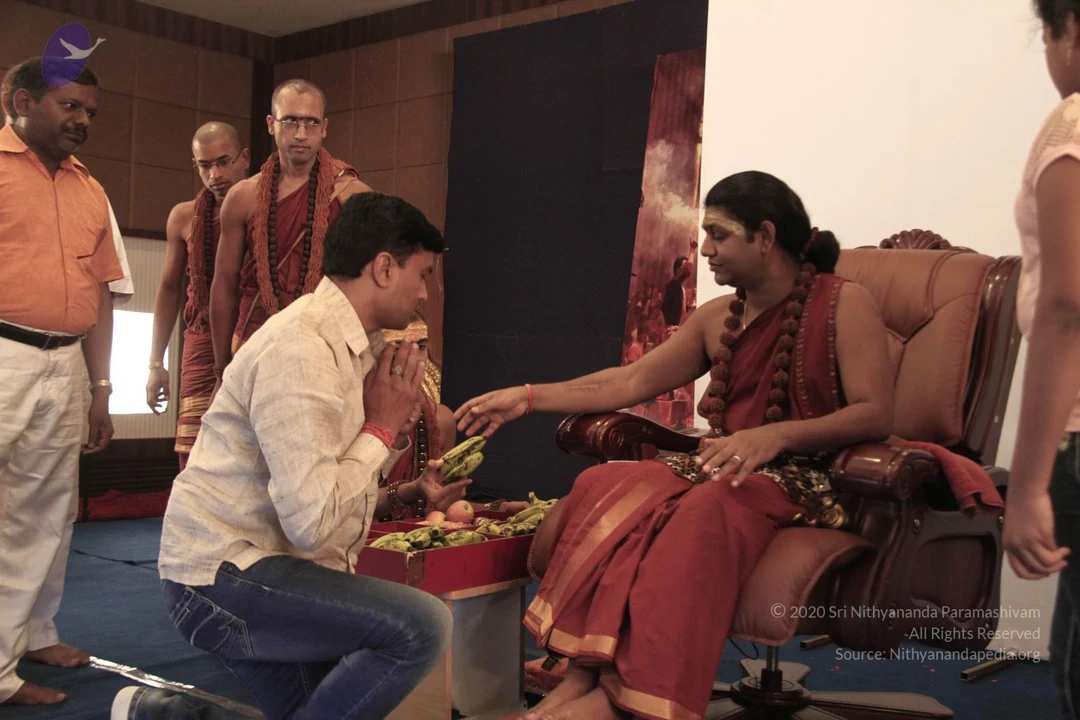
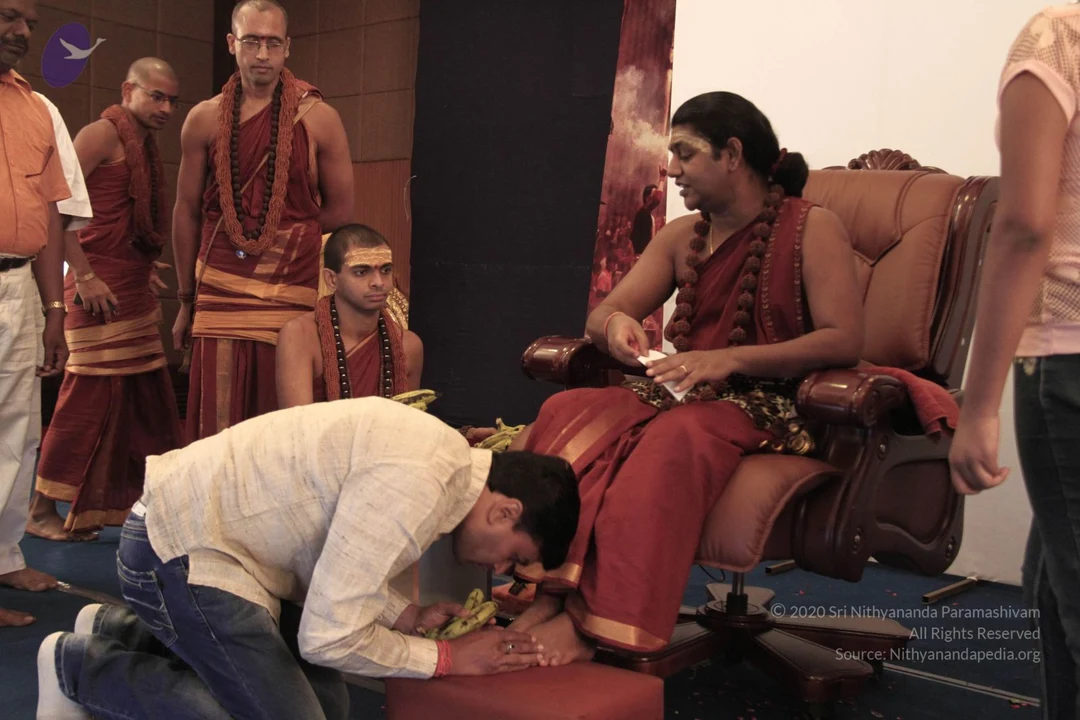
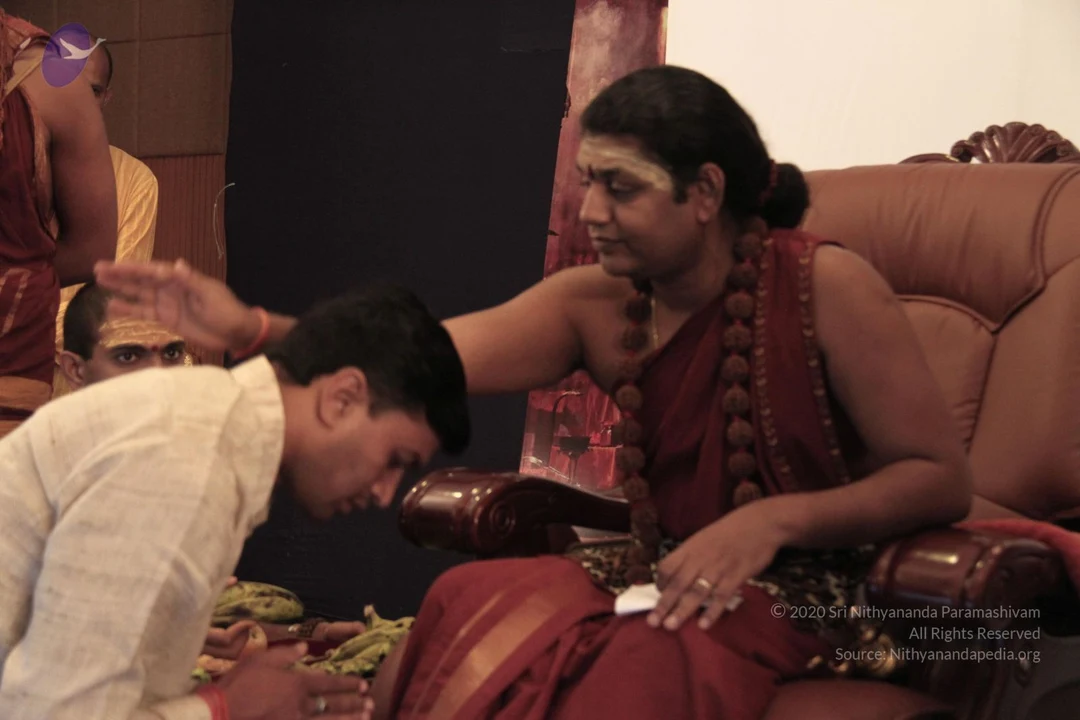
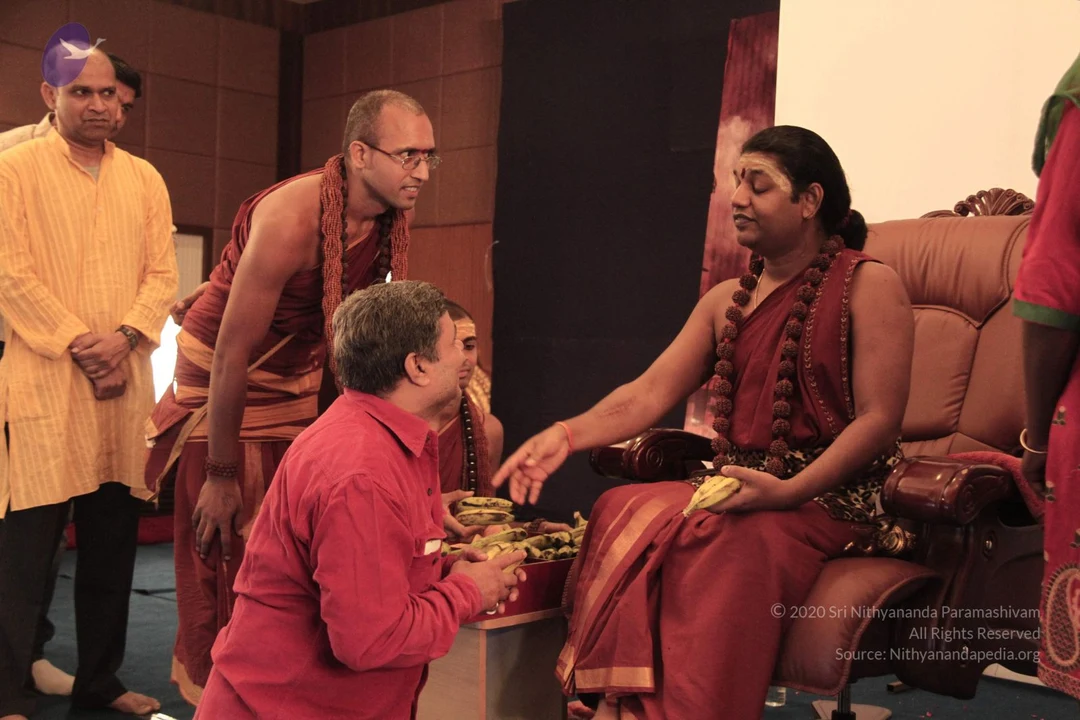
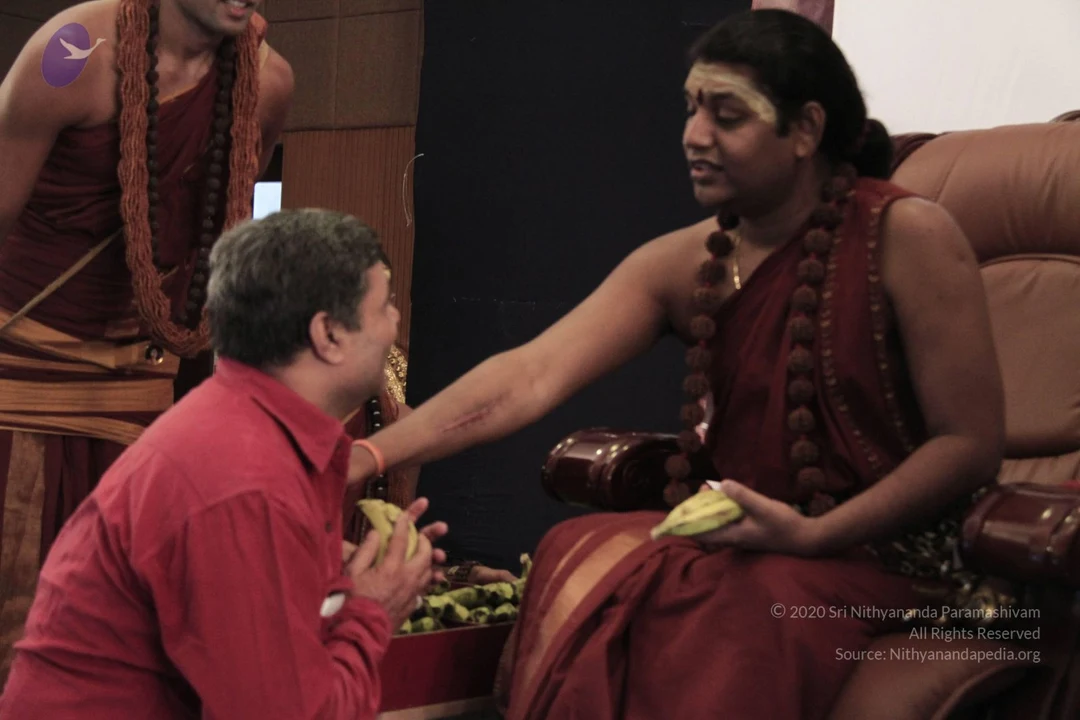
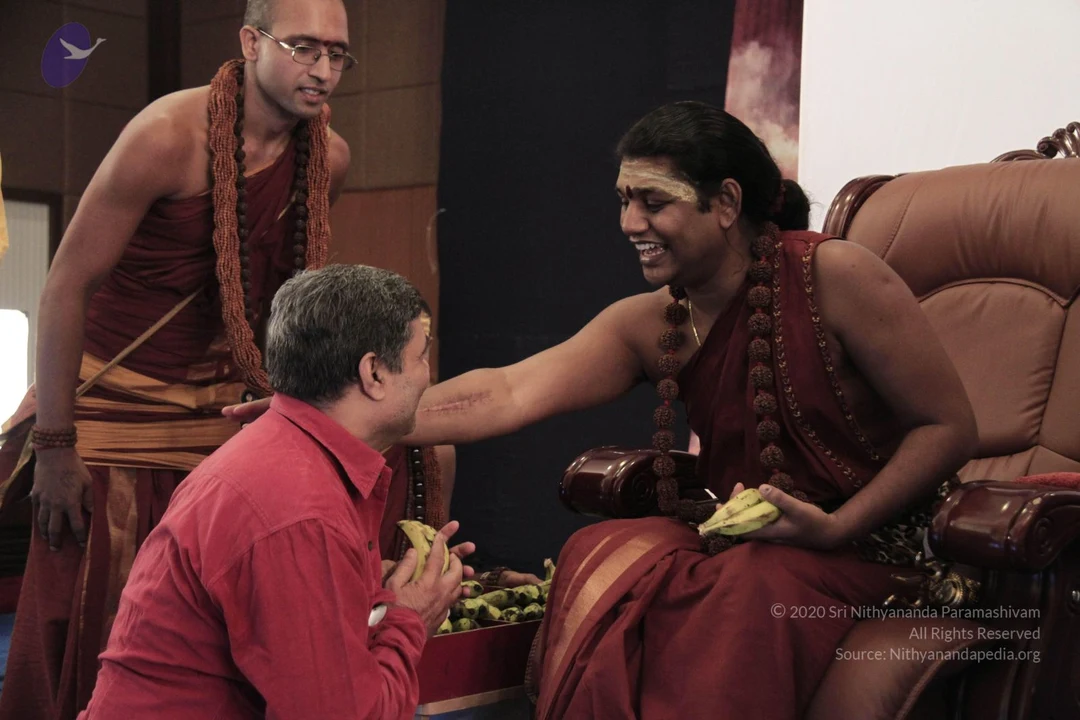
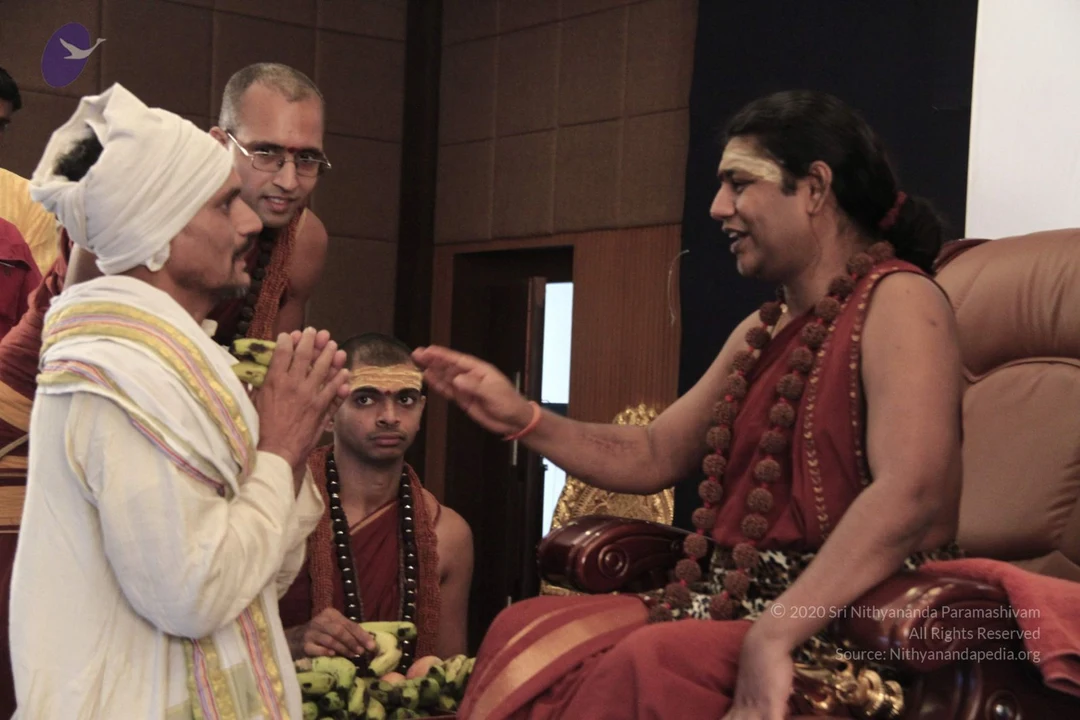
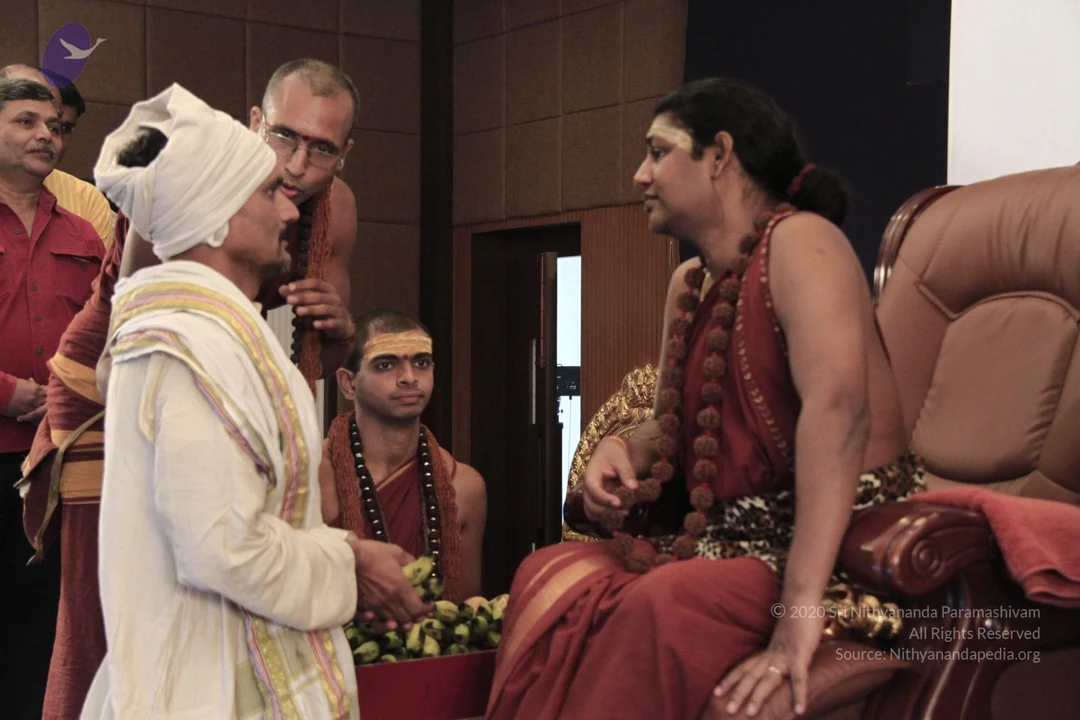
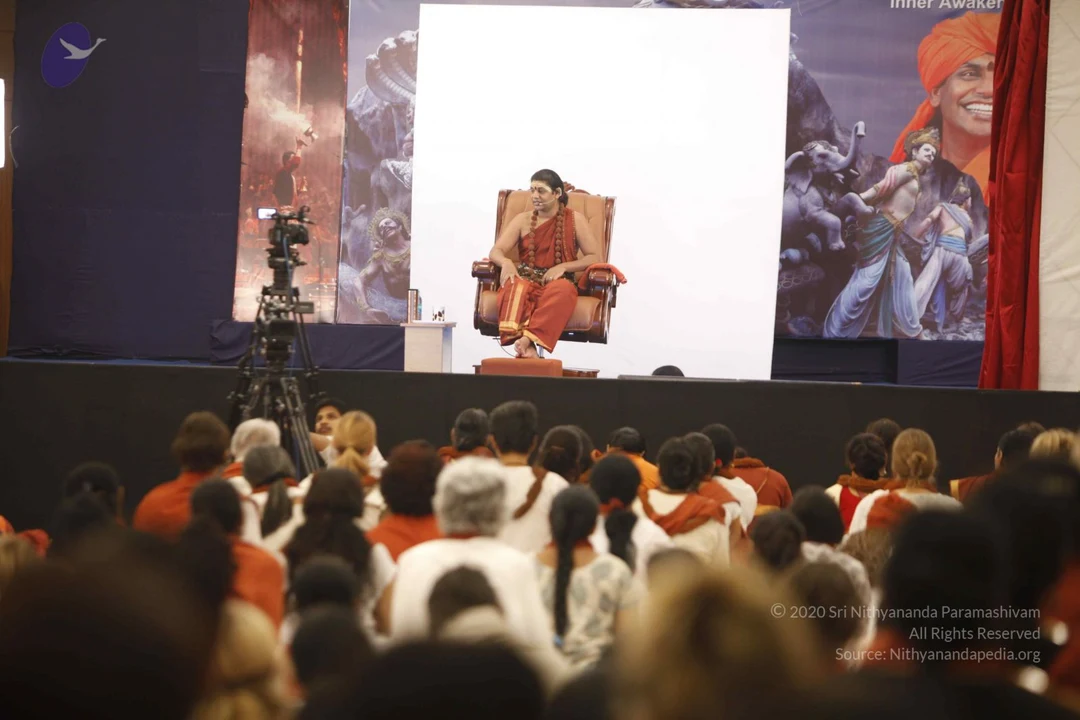
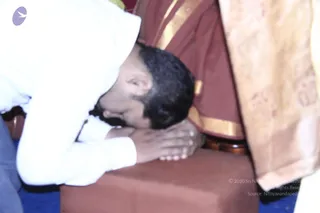
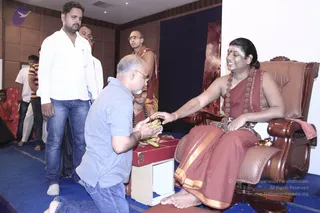
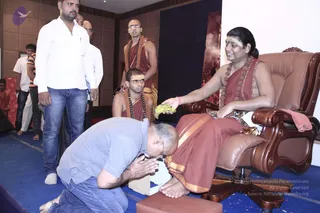
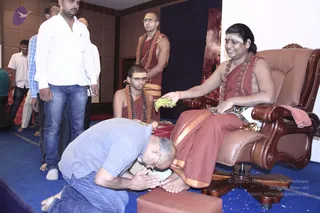
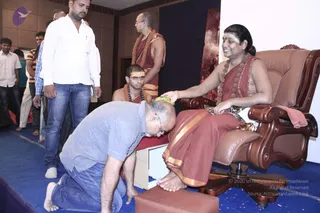
A photograph of a man in a white shirt bowing with his forehead resting on a reddish-brown cushioned footstool or pad, his hands pressed flat on it in an act of prostration. Beside him, a seated person wears a maroon garment with a broad gold border, and a golden-beige cloth with a faint printed pattern hangs at the right edge of the frame. The blue floor covering is visible at the bottom. Only the bowing man is clearly a physical person in the foreground, with the seated figure partly visible. No identifiable a person candidate is clearly shown; the seated figure's face and presentation are not sufficiently visible to confirm identity.A seated figure in a rust-red and gold-bordered dhoti and matching shawl, with white vibhuti marks on the forehead and multiple beaded rudraksha-style malas, sits in a large brown leather armchair on a blue carpeted stage. A kneeling man in a grey short-sleeved shirt and jeans offers bananas on a red tray set on a small wooden box to the seated figure, who extends a hand to receive them. Standing behind, a white-shirted man in jeans and a saffron-robed monk look on. Another man in a saffron garment stands near the back, and a red decorated backdrop is visible at left. Visible physical people total about six, including the standing and seated figures.A woman with a forehead tilak and sandalwood-coloured robes with a gold border sits in a brown leather recliner on a blue carpet, holding a banana. Beaded necklaces and a gold-edged shawl drape her shoulders. A man in a grey t-shirt and jeans kneels before her with his hands folded, touching his forehead to her bare feet resting on a red footstool, a padapuja-style gesture of devotion. Behind them stand a bald man in a saffron-orange robe with a rudraksha mala and a shaved-headed young man in a matching robe with a tilak. Standing spectators in white shirts and casual clothes watch from the left. A red-and-gold backdrop and a dark curtain frame the stage area.A seated woman in a brown leather recliner, wearing a rust-red saffron-style dress with gold border, a rudraksha mala and a tilak on her forehead, smiles while another person hands her a banana. A man in a grey t-shirt and jeans kneels on the blue carpet, pressing his palms together and bowing his head toward her feet, which rest on a small wooden footstool. Behind them, a shaved-headed young sannyasi in saffron robes and rudraksha beads sits on the floor, and another robed man in glasses stands. Other men in white shirts and jeans stand in the background, and a red cloth covers a low table.A seated woman in a rust-red sari with gold border and a red-and-gold rudraksha mala sits in a brown leather recliner chair on a blue carpet, with a red footstool before her. Her feet are being touched by a man kneeling on the floor in a grey t-shirt and jeans, bowing his head toward her feet while she rests one hand on his shoulder area with a light gesture. A young man in a rust-red garment with a sandalwood tilak and rudraksha beads kneels behind her, and a standing figure in rust-red robes with a garland stands further back. Other men stand along the left in white and striped shirts and jeans. Rose petals are scattered on the floor.A photograph of an indoor satsang-style gathering in a hall with dark wood-panelled walls and a blue carpet. A seated figure in a maroon-red robe with a gold-bordered cloth and a long rudraksha mala sits in a brown leather armchair, with bare feet resting on a footstool and a sandalwood-style tilak on the forehead; he appears to be the probable Swamiji by appearance cues, with long hair tied up and ornate rudraksha beads. He extends a hand toward a young man in a teal and maroon polo kneeling and presenting a tray of bananas in a red box. A younger attendant in maroon robes and rudraksha stands beside the tray, and another monk in maroon with a bald head and glasses stands behind. Several standing men in grey and white shirts watch with hands folded, and a bare-footed devotee stands at the left edge.

Pada-Puja-Satsang
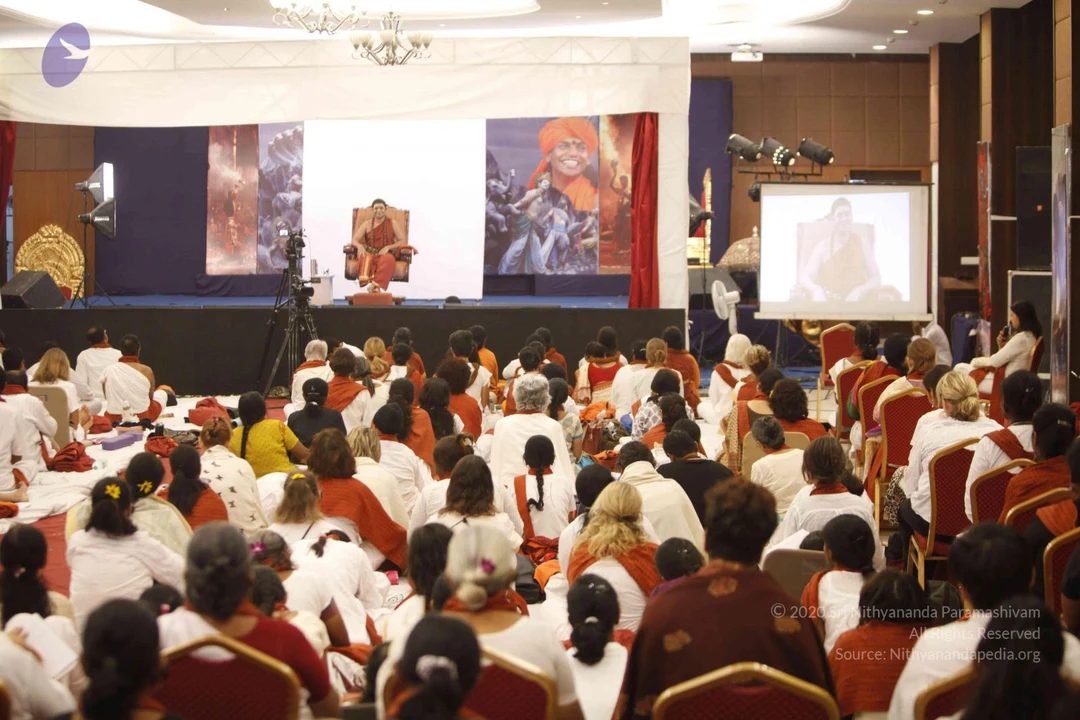
88 photosSource gallery
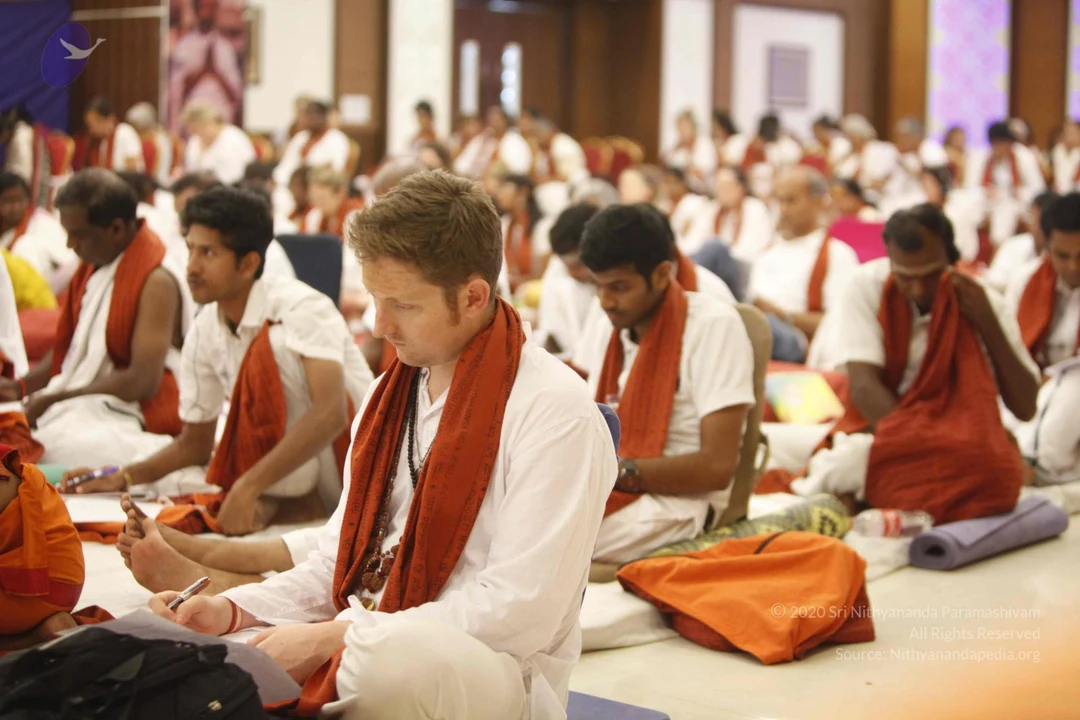
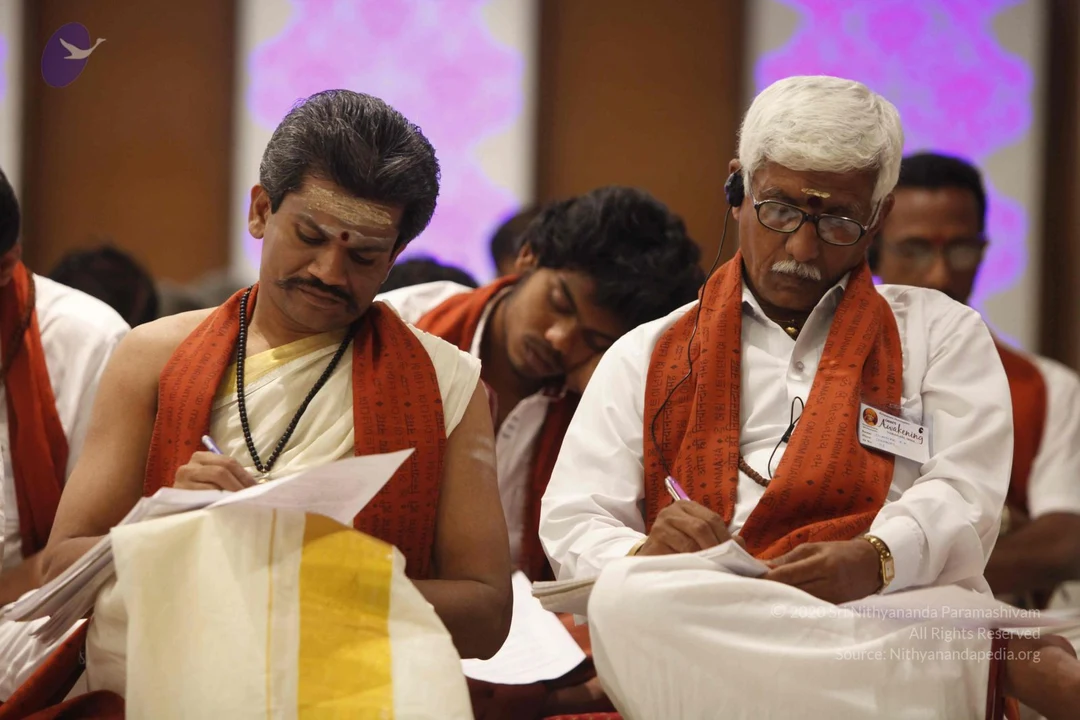
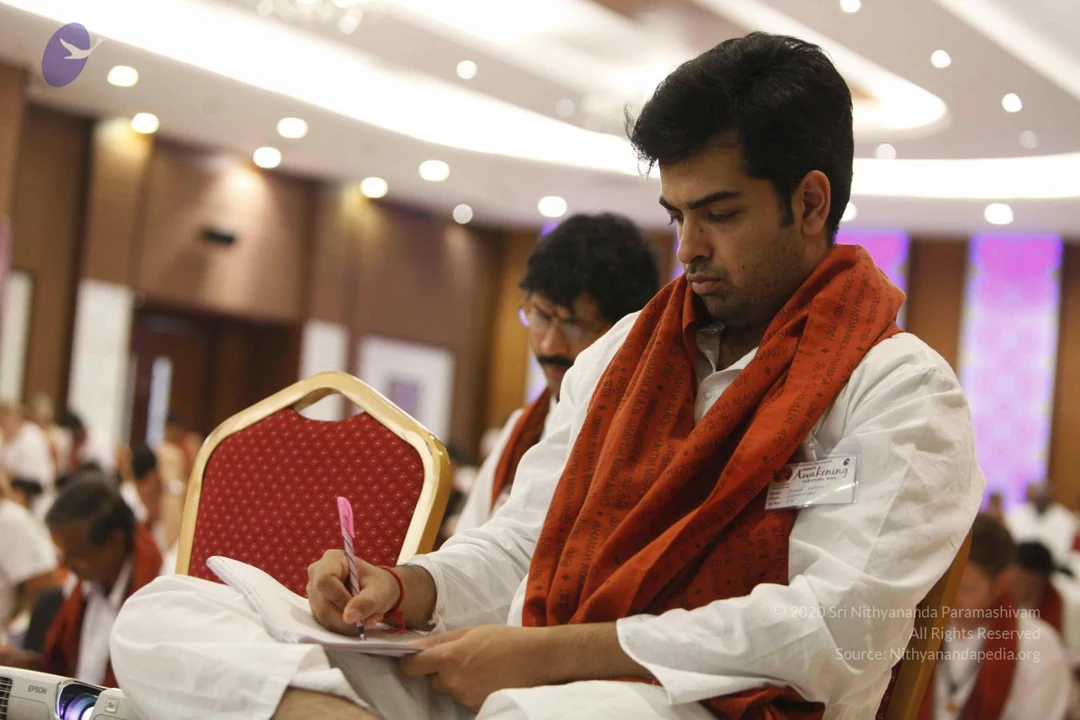
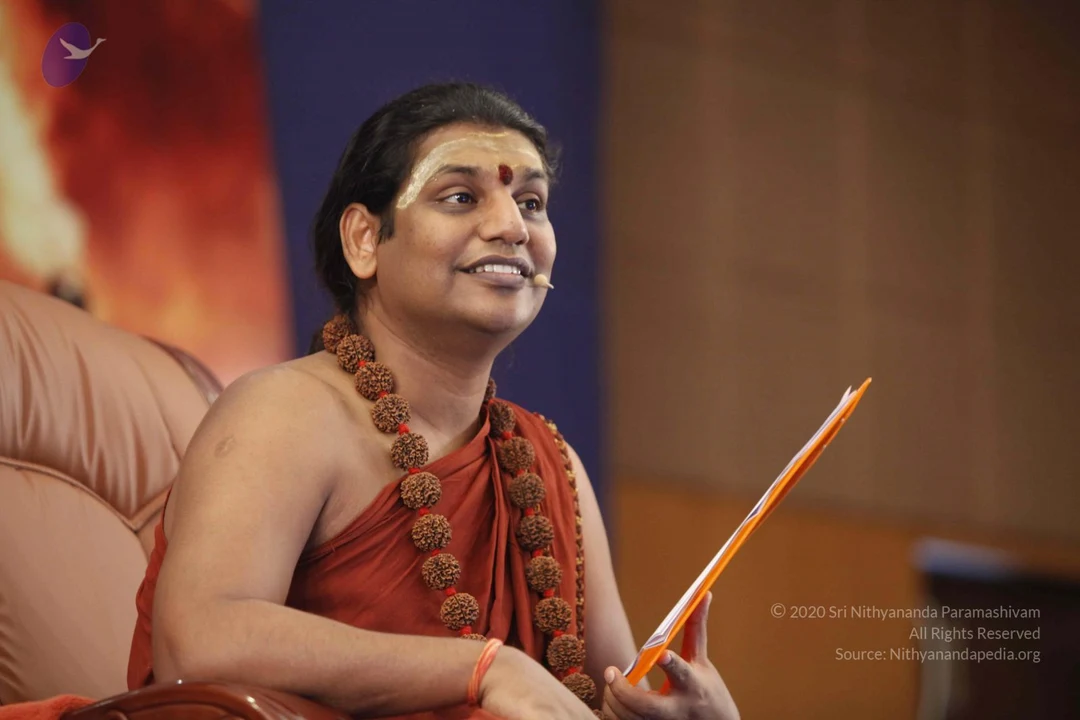
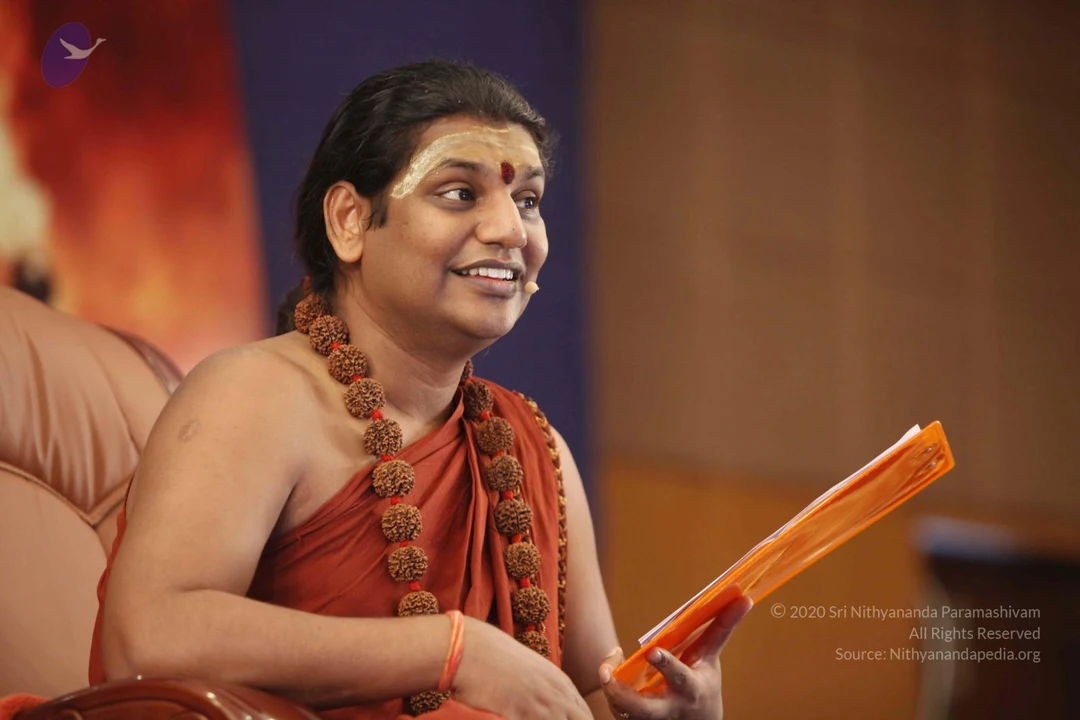
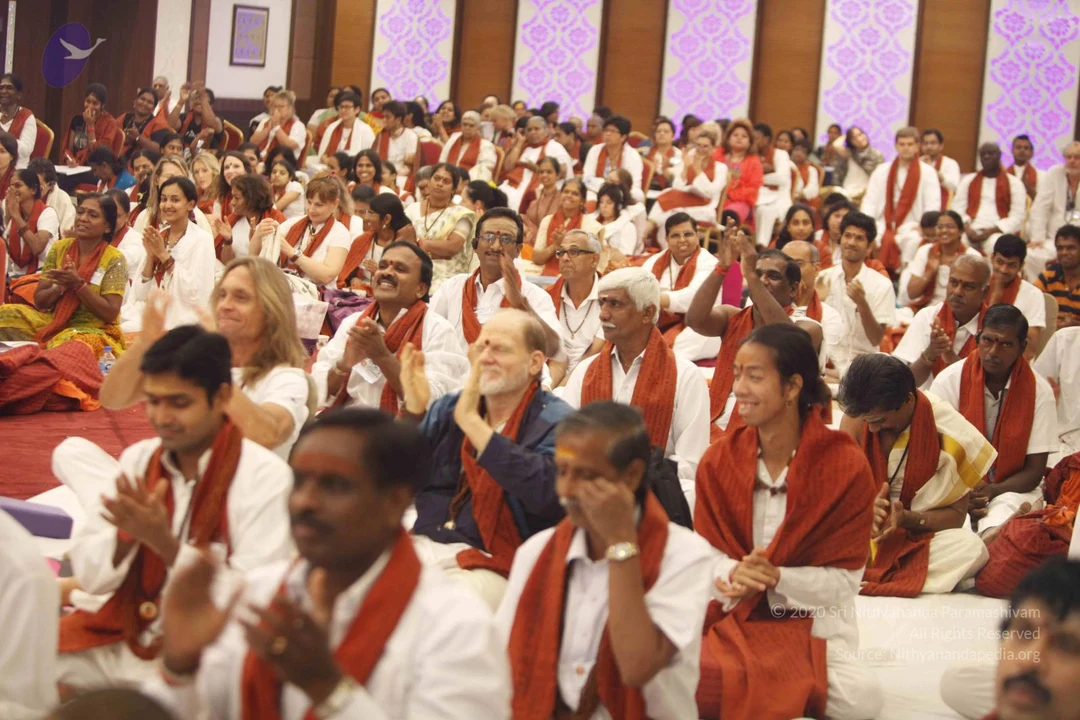
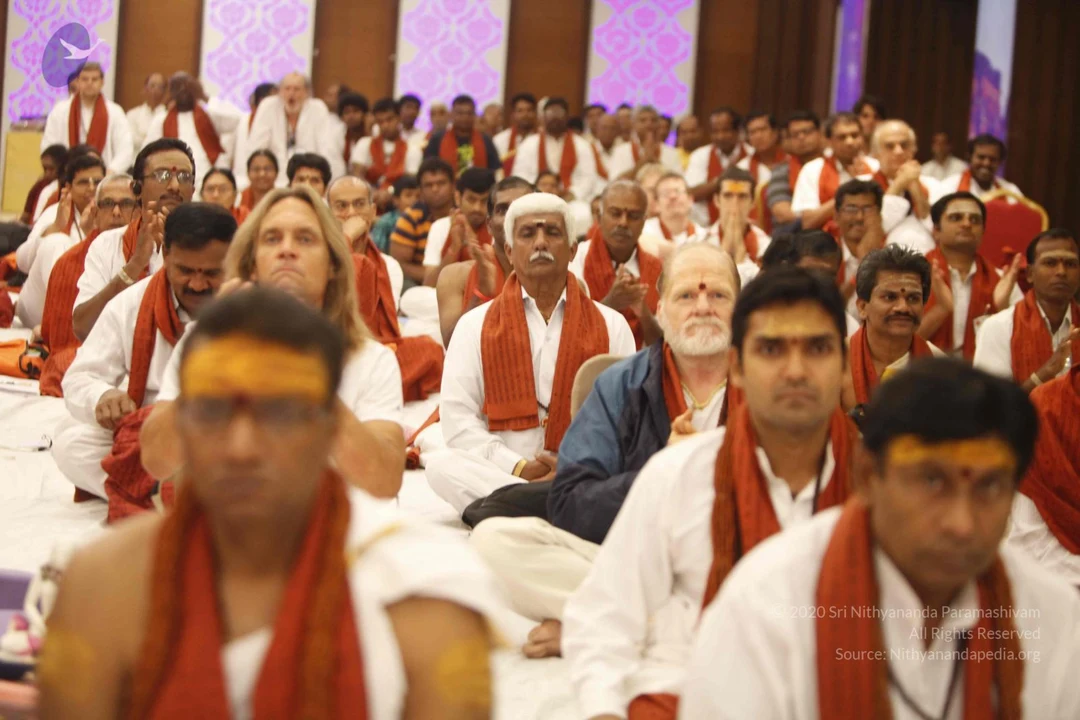
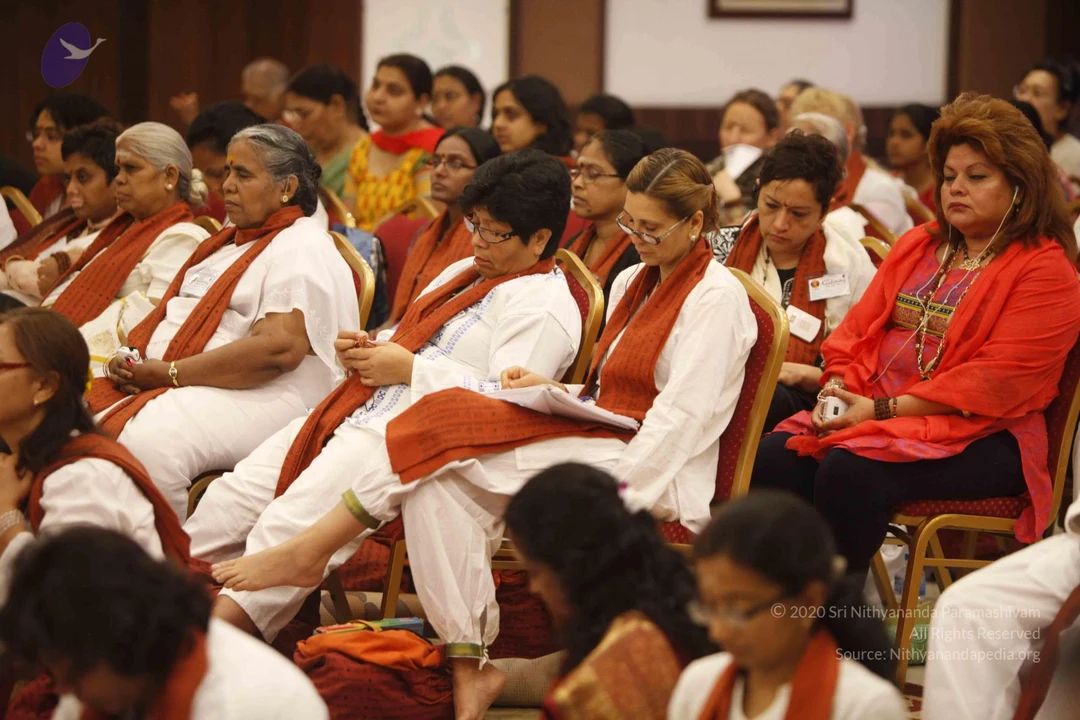
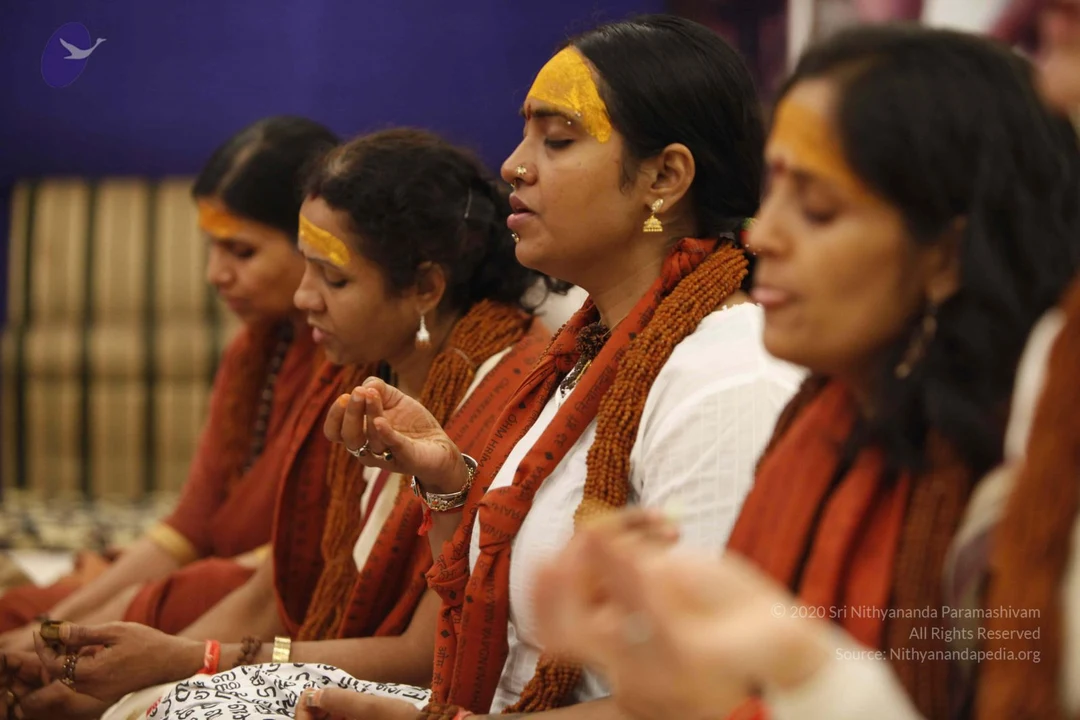
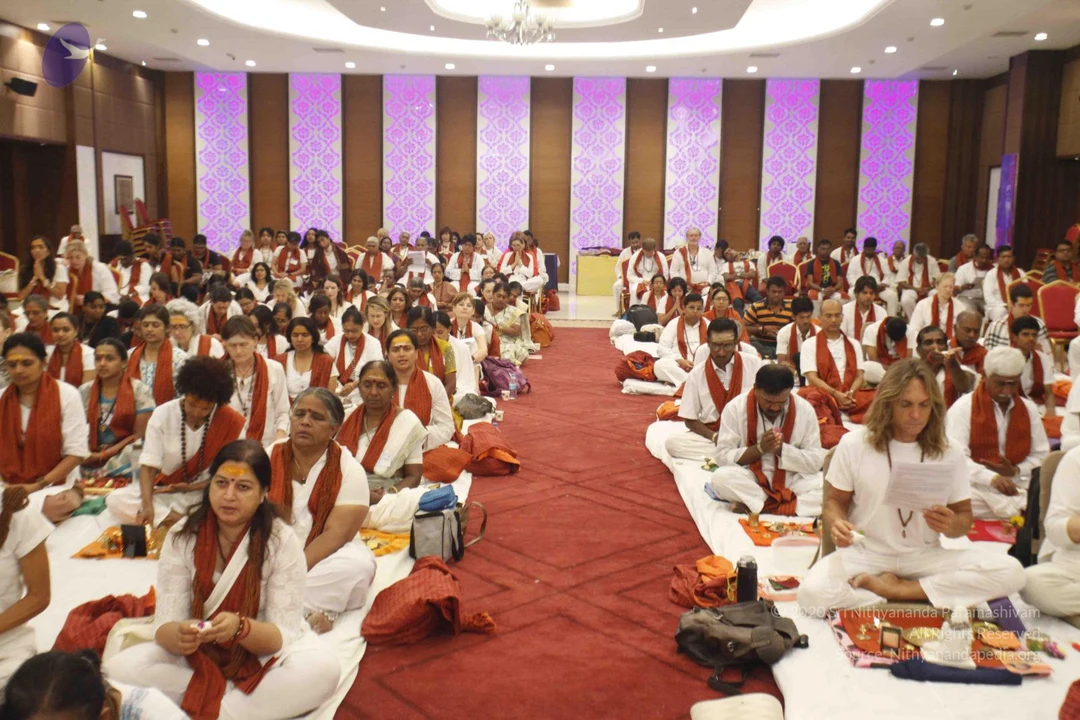
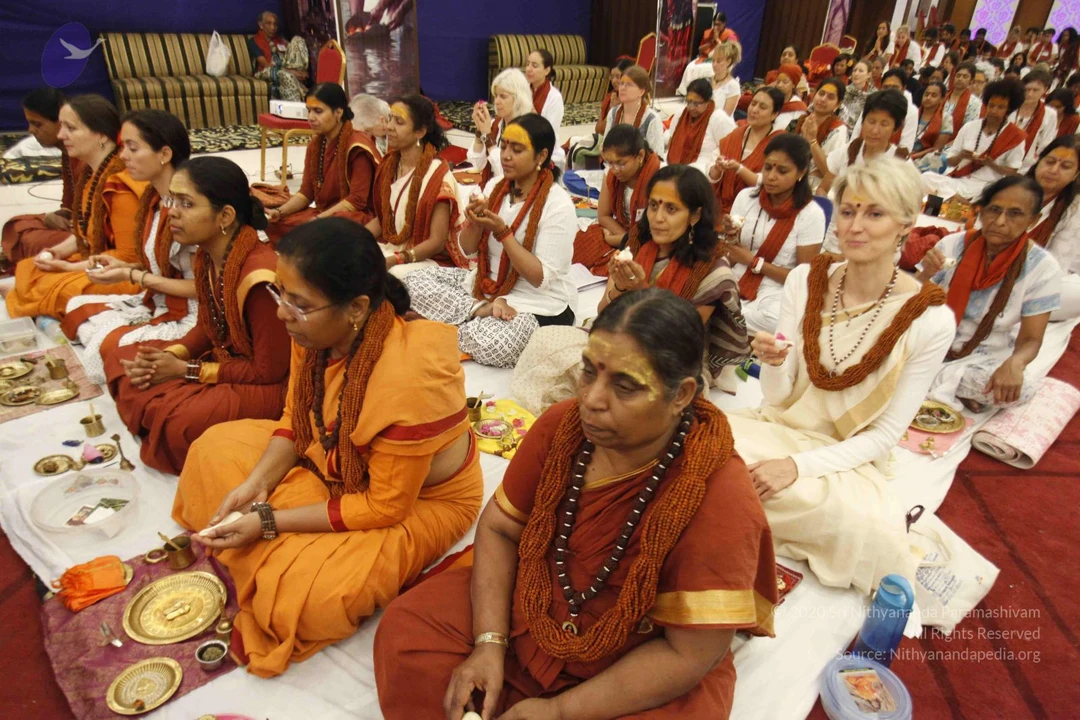
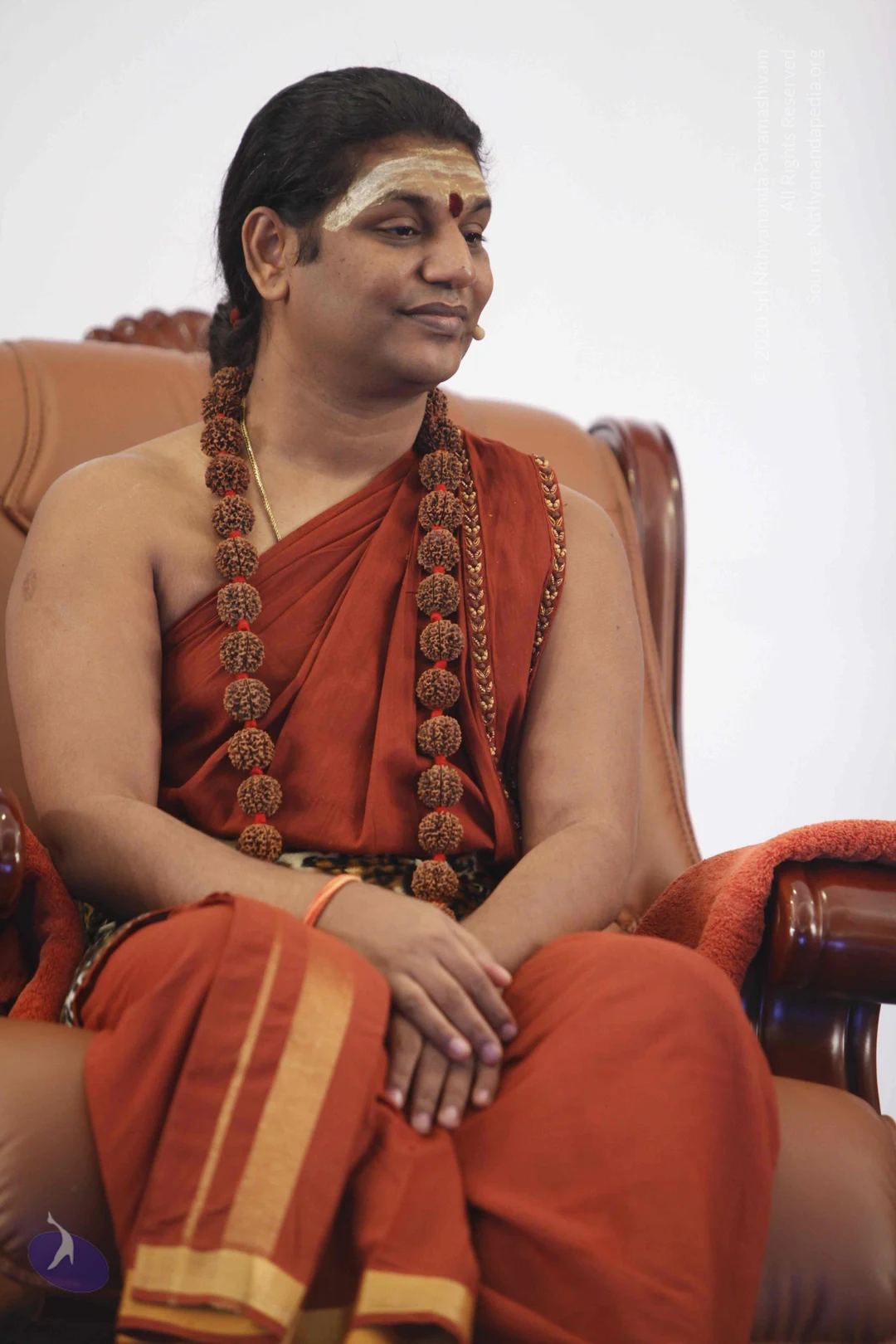
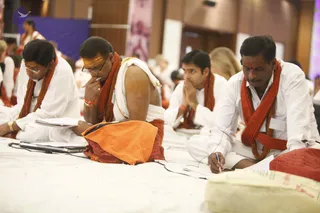
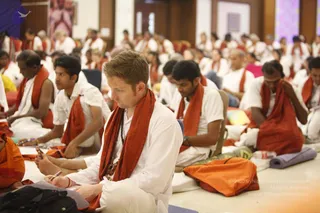
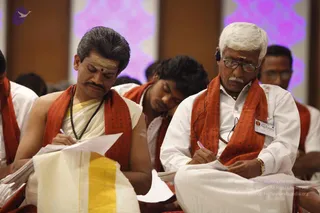
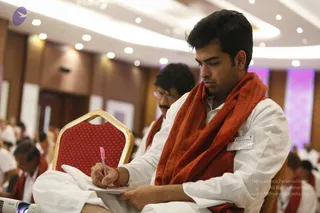
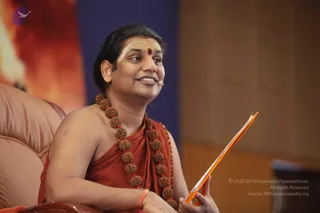
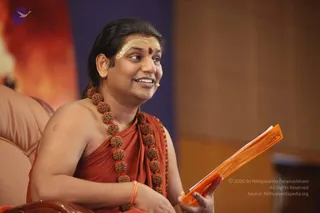
Devotees sit cross-legged on a white floor covering at a satsang hall. Four men in white kurtas wear red-orange shawls with tilak marks on their foreheads. The man on the left writes in a notebook beside a laptop. The seated man in the centre, bare-shouldered with an orange cloth over his lap, holds a pen to his mouth while reading. The man on the right wears a white shirt and writes on paper with a pen, and a cable runs from his ear. Behind them, more seated devotees and a blurred purple banner appear.A large indoor satsang hall where many seated devotees in white ritual clothes with orange-red shawls sit on the floor in rows. In the foreground a fair-haired man in white with an orange shawl and a beaded mala sits cross-legged, holding a pen and notebook. Other devotees, some in white and some with orange shawls, sit around him and a bag and rolled mat lie on the floor at right. A dark-haired figure in white with a red shawl sits at right. The background shows a wall with a tall panel and purple decorative lights. No clearly visible central figure is identifiable as a person, so no candidate is asserted.Two men seated and writing on paper pads at a satsang gathering. The man on the left has a sandalwood tilak on his forehead, a bare-shouldered white and yellow-bordered dhoti, an orange shawl printed with script, and a black beaded mala; he holds a pen over loose sheets. The man on the right has white hair and a moustache, glasses, a white kurta, an orange printed shawl, and an earpiece; he writes on a notepad with a pen and wears a name badge. Behind them a man with his head bowed and others in orange shawls sit in a hall with pink backdrops. Visible people number about four.A young man in white kurta and an orange-red shawl printed with script sits on a chair in a banquet hall, writing in a notebook with a pink pen. A name badge reading Awakening is pinned to his shawl and a red-and-gold chair stands beside him. Behind him, another seated man in white and orange, wearing glasses, is also writing, and rows of people in white and orange sit in the blurred background under recessed ceiling lights. A projector sits at the lower left.A man seated in a brown leather armchair speaks while holding an open orange-edged booklet in his right hand. He wears a rust-red sleeveless robe draped over his left shoulder and a long layered necklace of brown rudraksha beads, with a small orange thread on his wrist. A white tilak marks his forehead with a red bindi above it, and he has a small clip-on microphone near his mouth. Behind him are a red-orange backdrop and a wooden wall panel. One person is physically visible.A smiling man seated in a cushioned brown leather chair speaks while holding an open orange folder with loose papers. He wears a rust-orange shawl over a bare shoulder and a long rudraksha mala with multiple large beads. He has a white tilak with a red dot on the forehead and a small microphone clipped near his face. The background shows a blurred wooden panel, a deep blue curtain and a warm orange backdrop.

Yoga

51 photosSource gallery
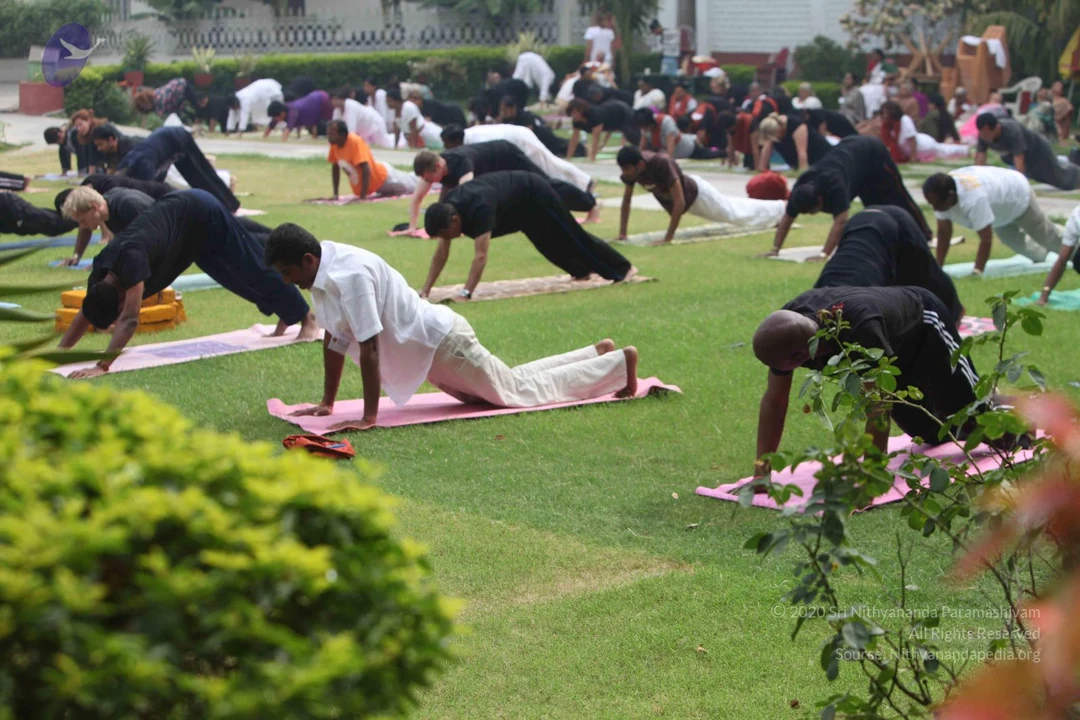
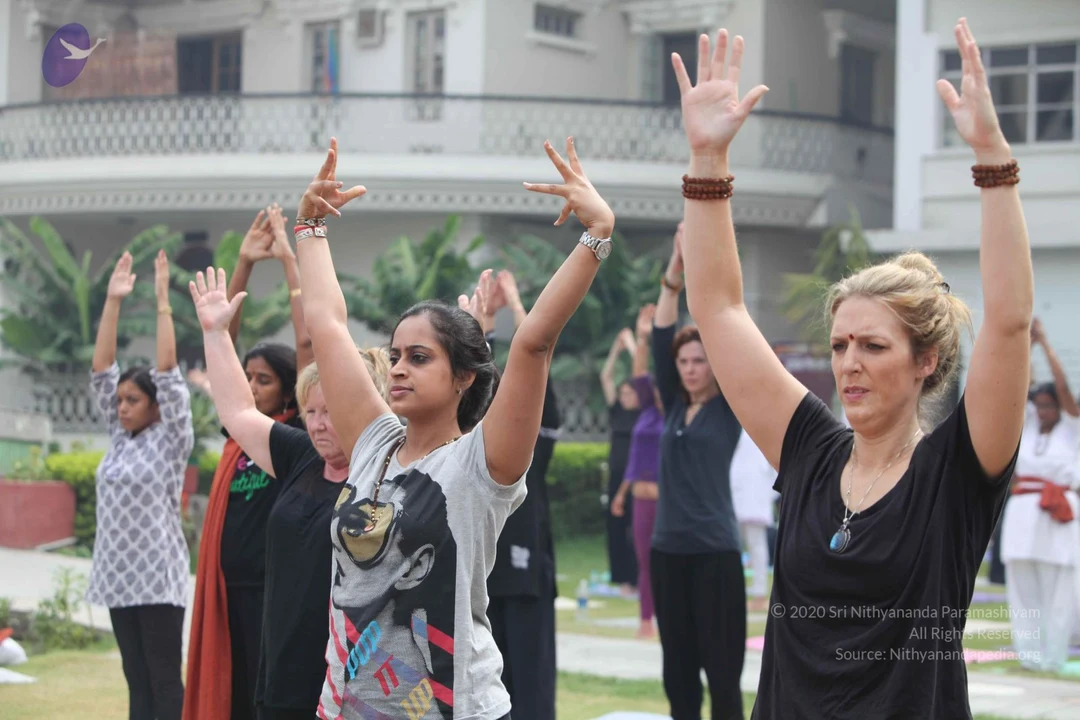
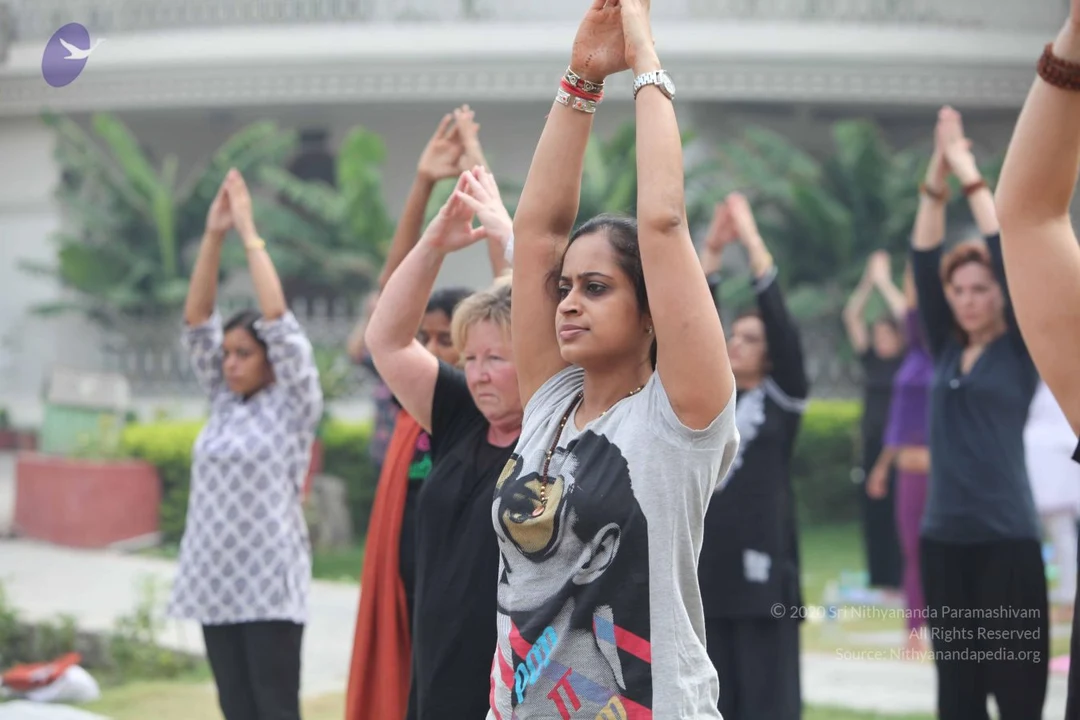
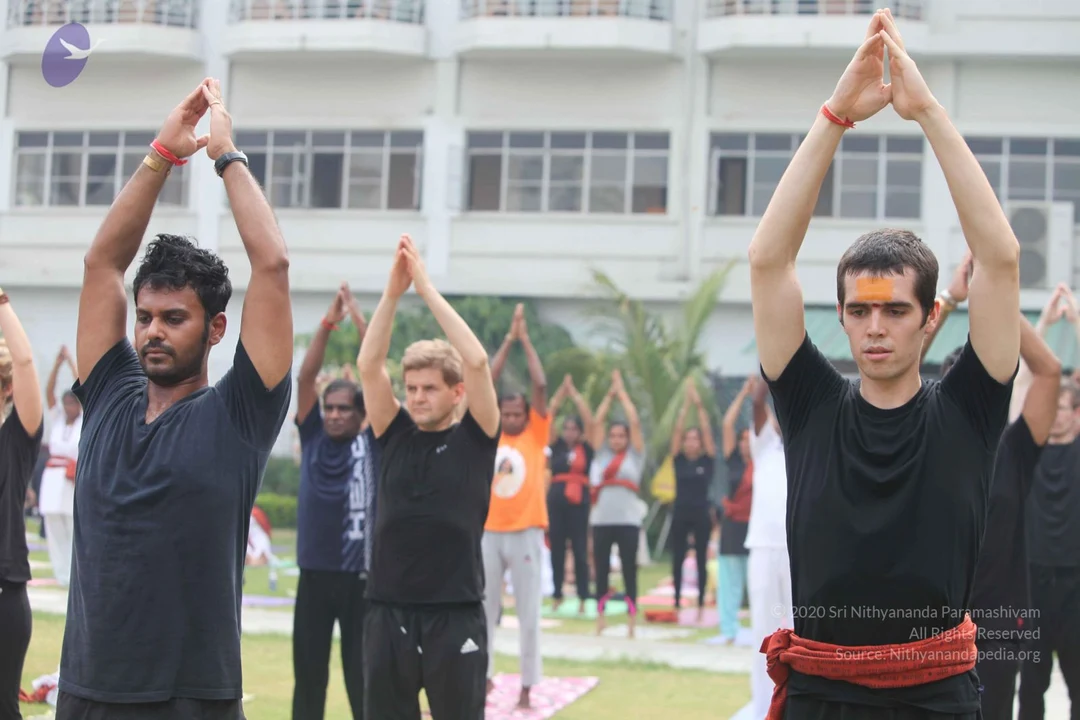
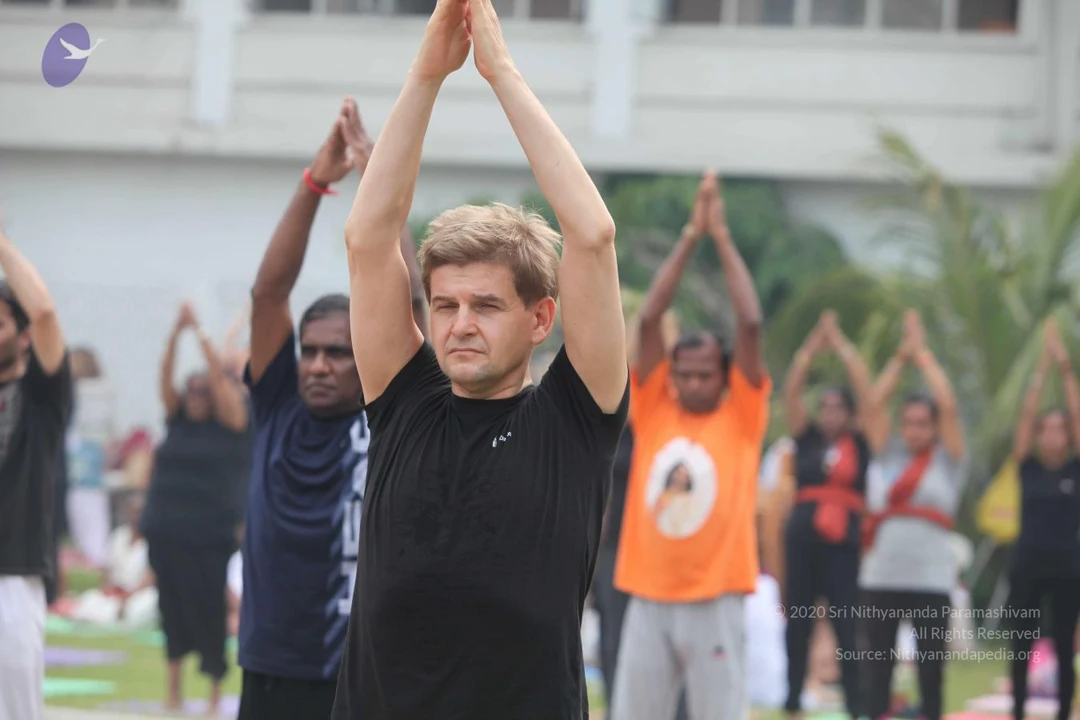
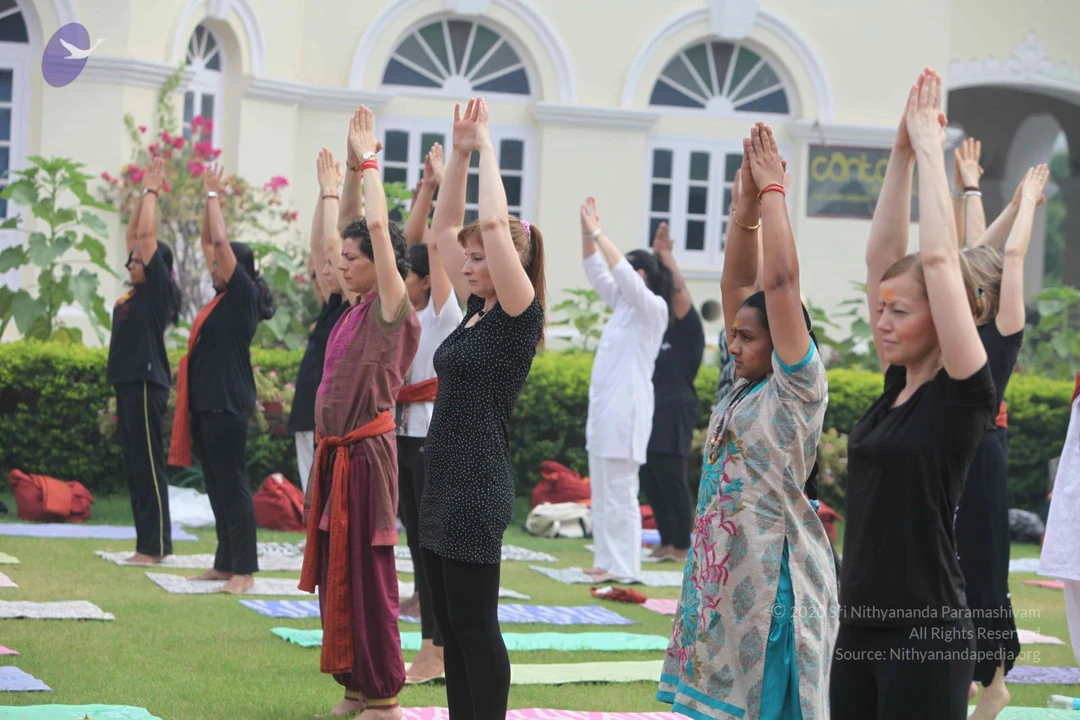
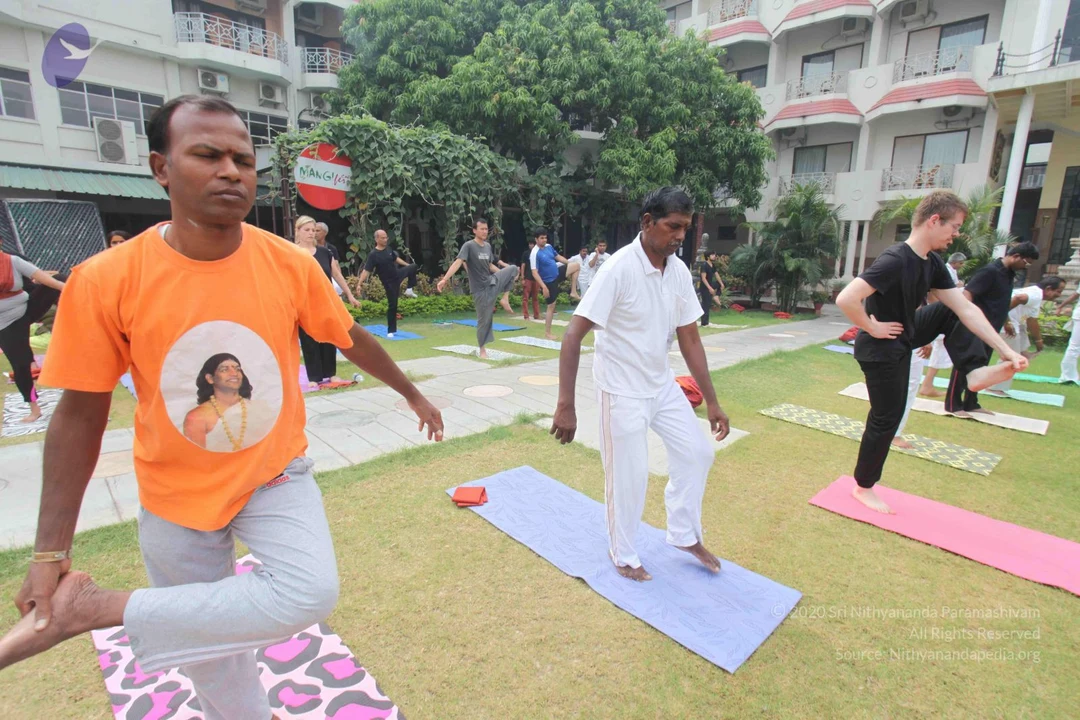
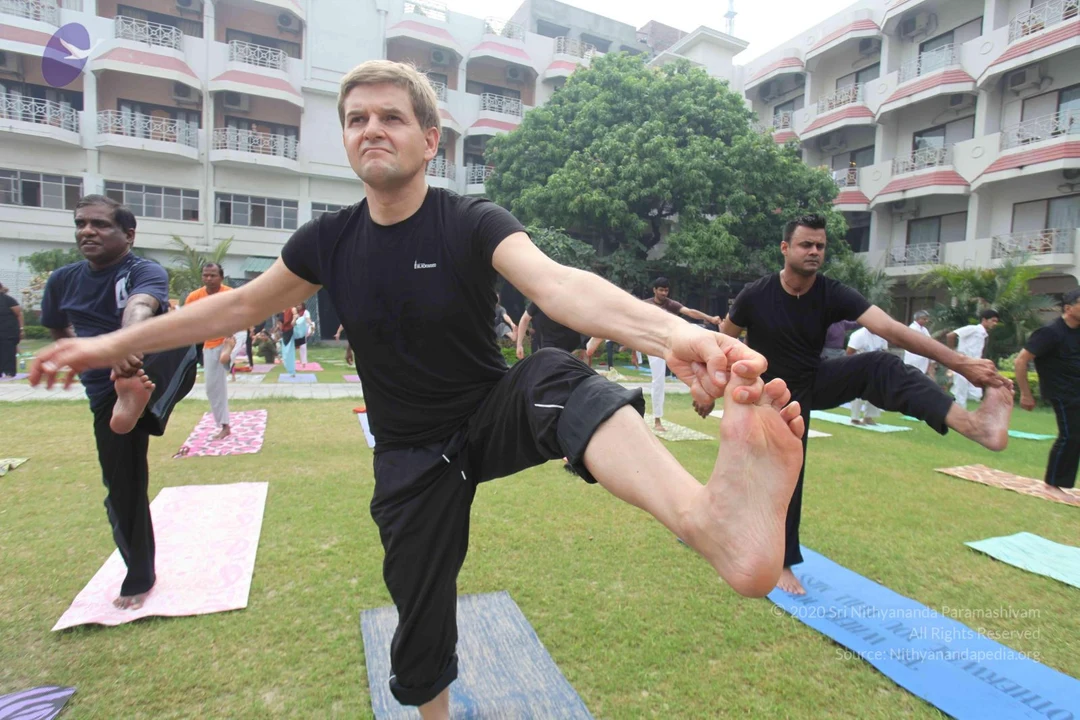
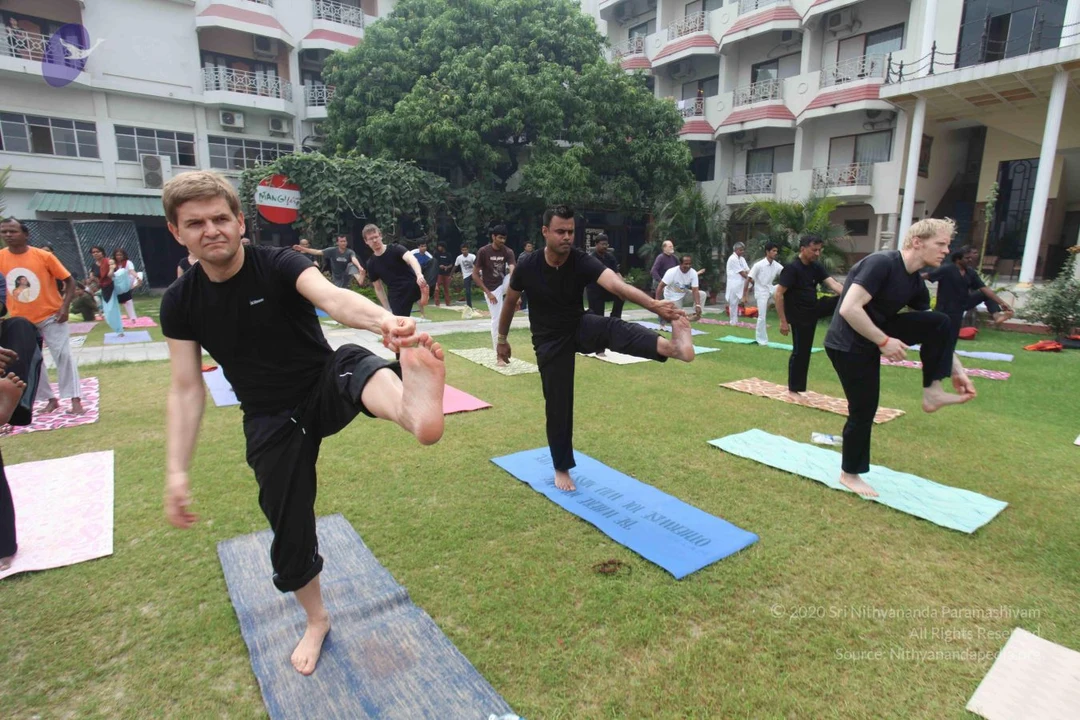
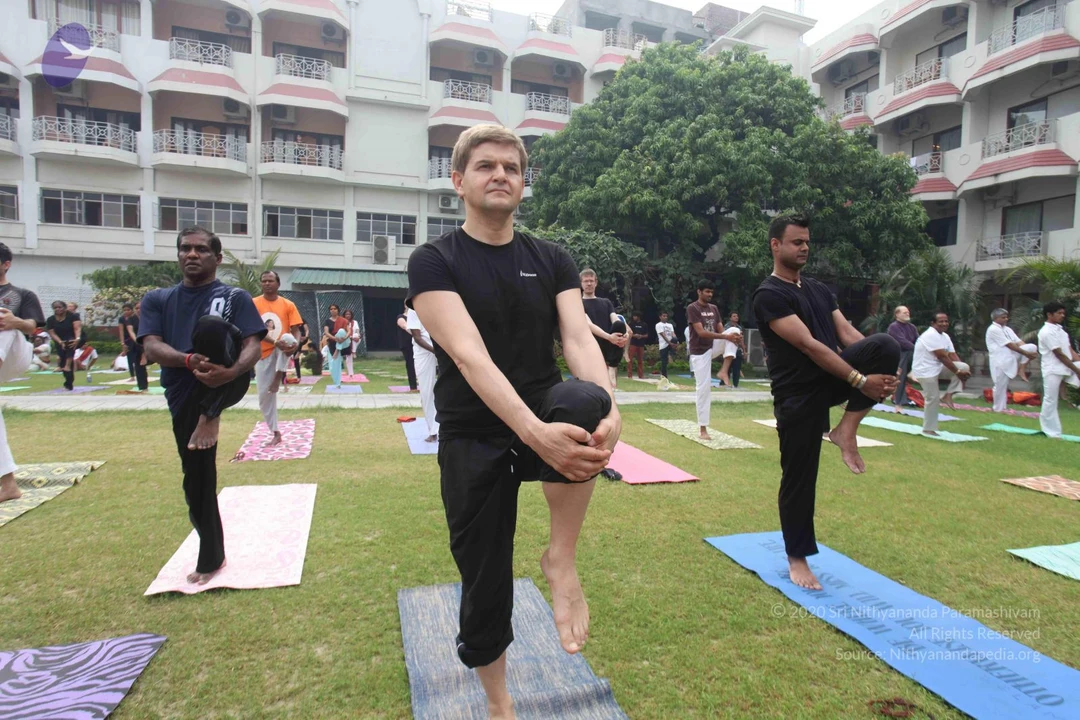
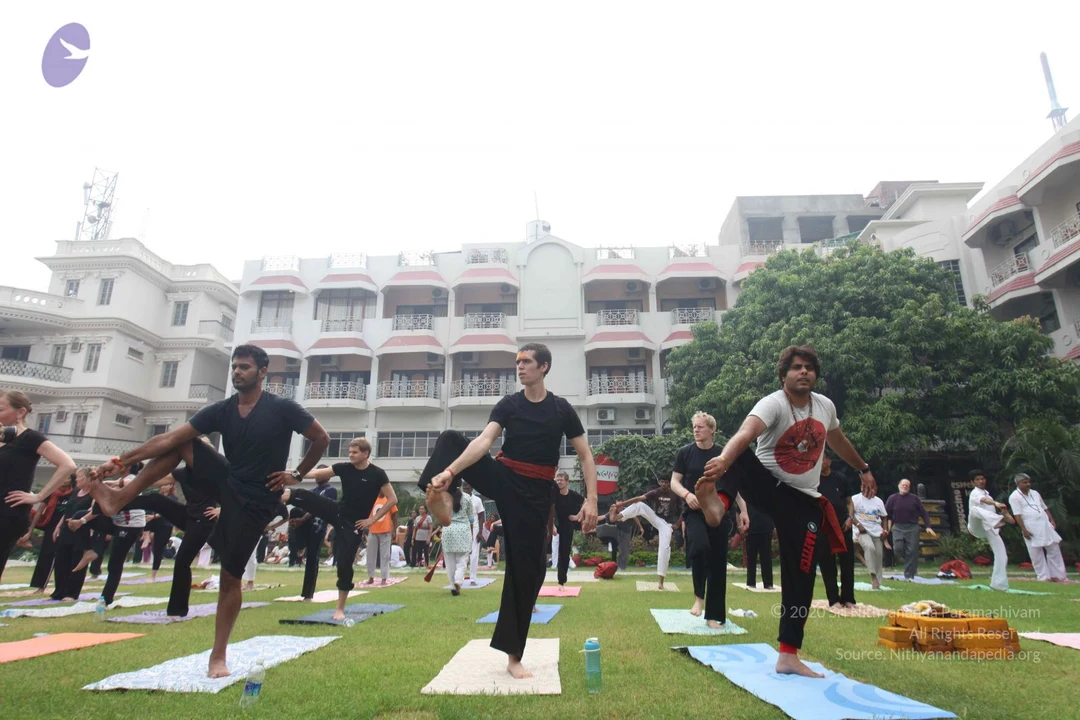
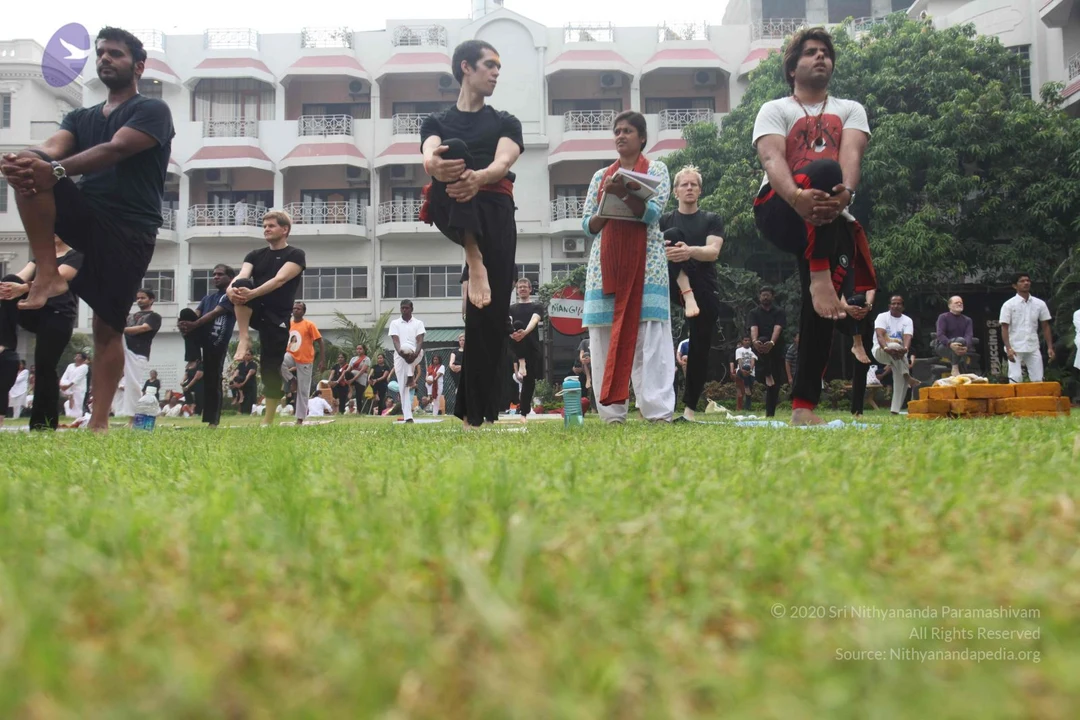
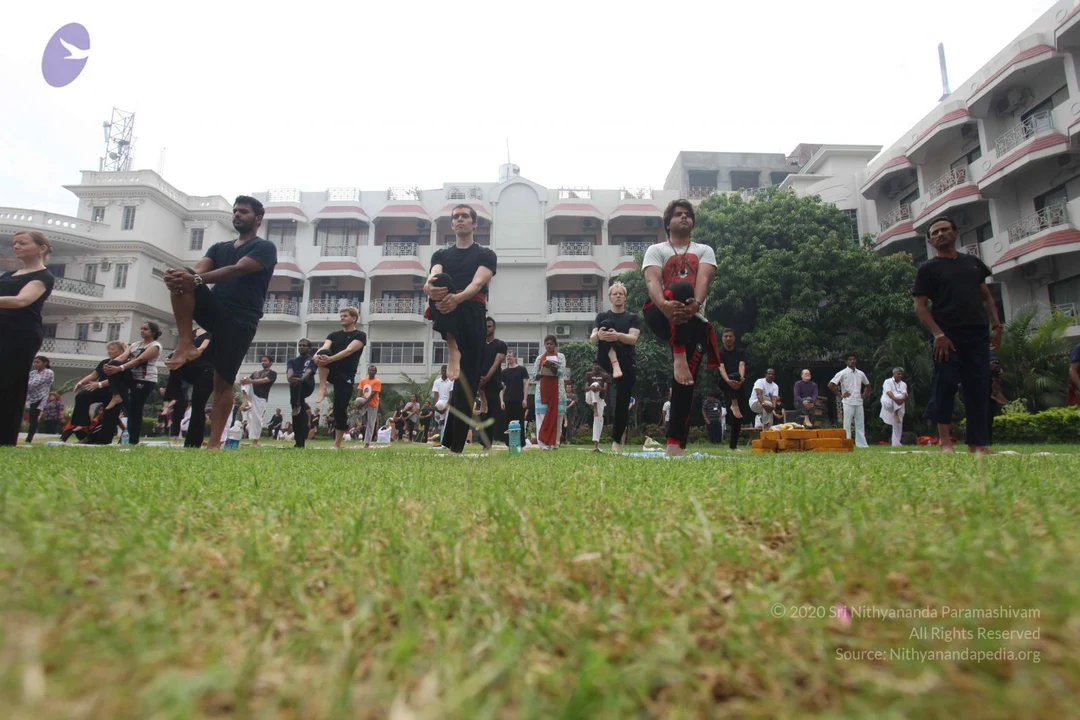
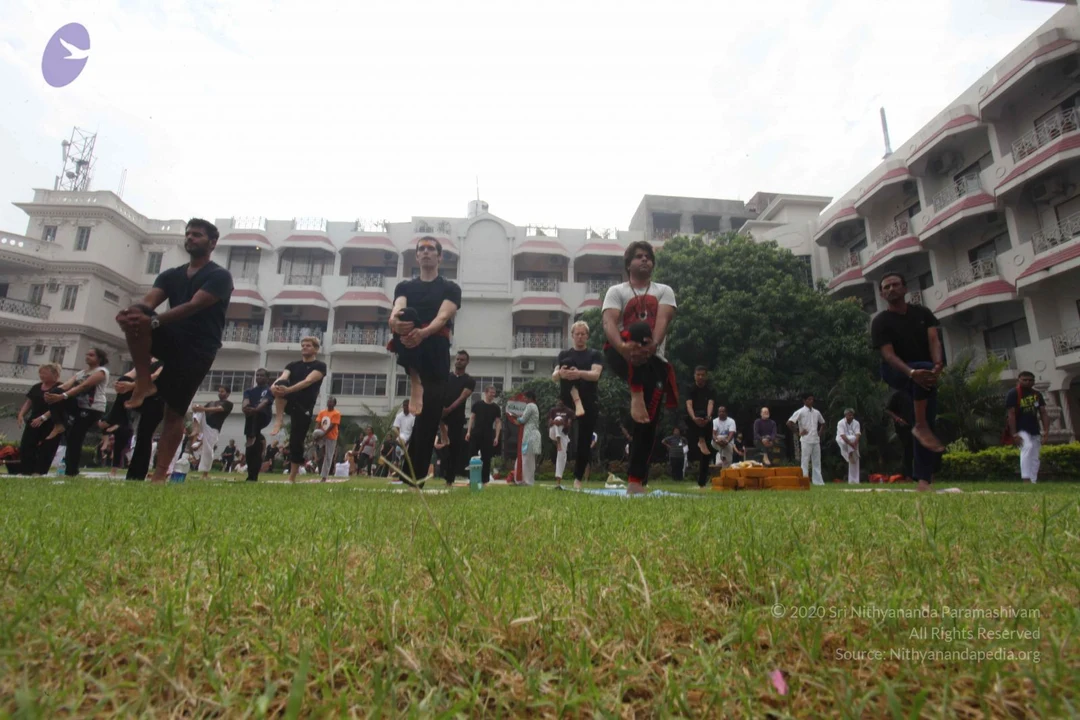
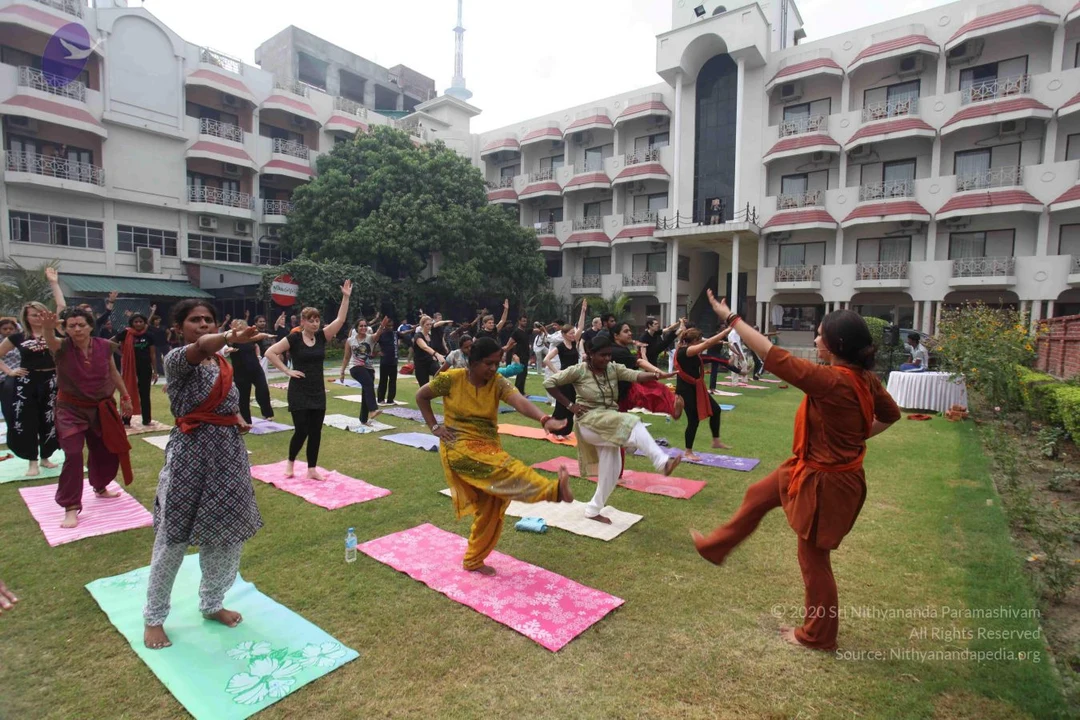
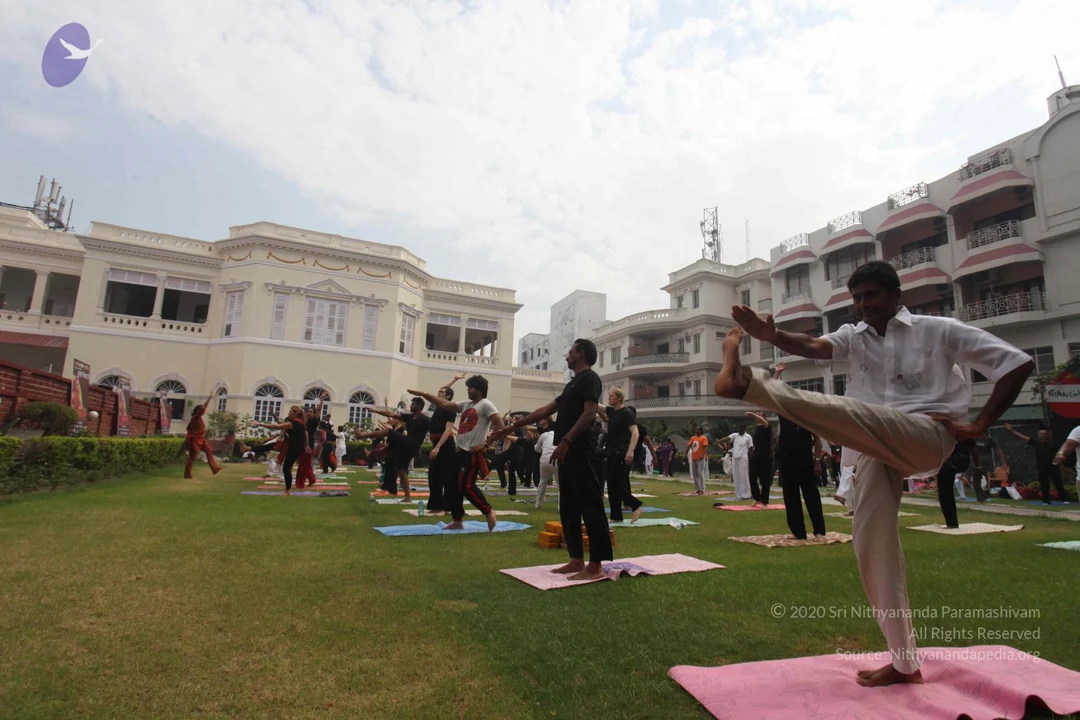
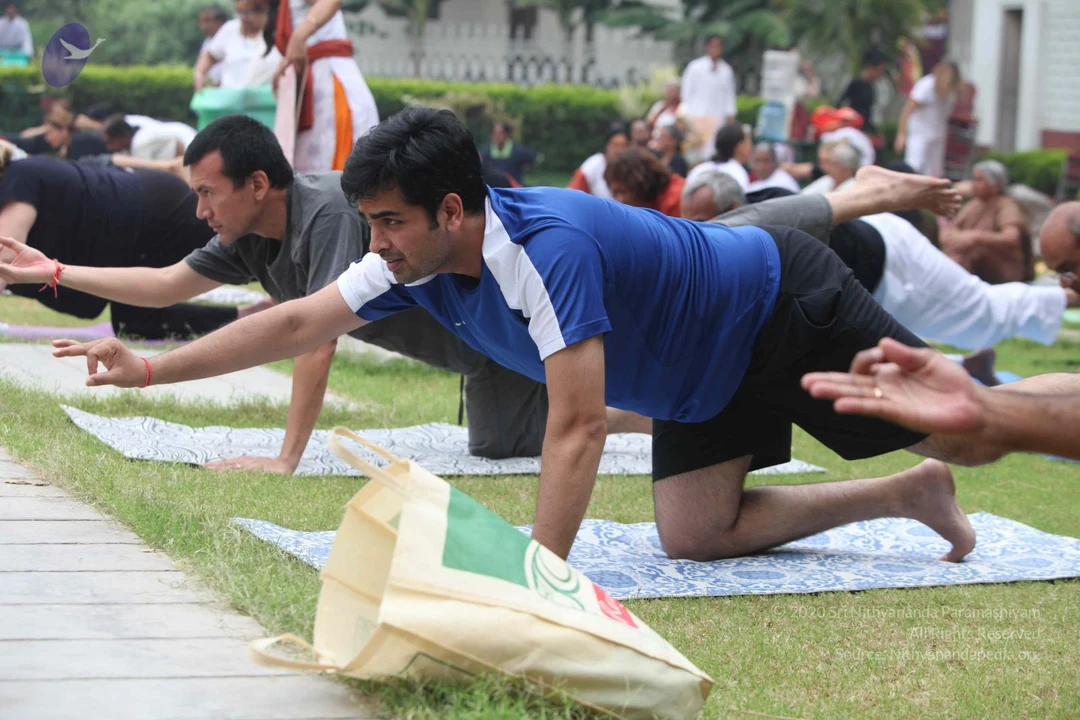
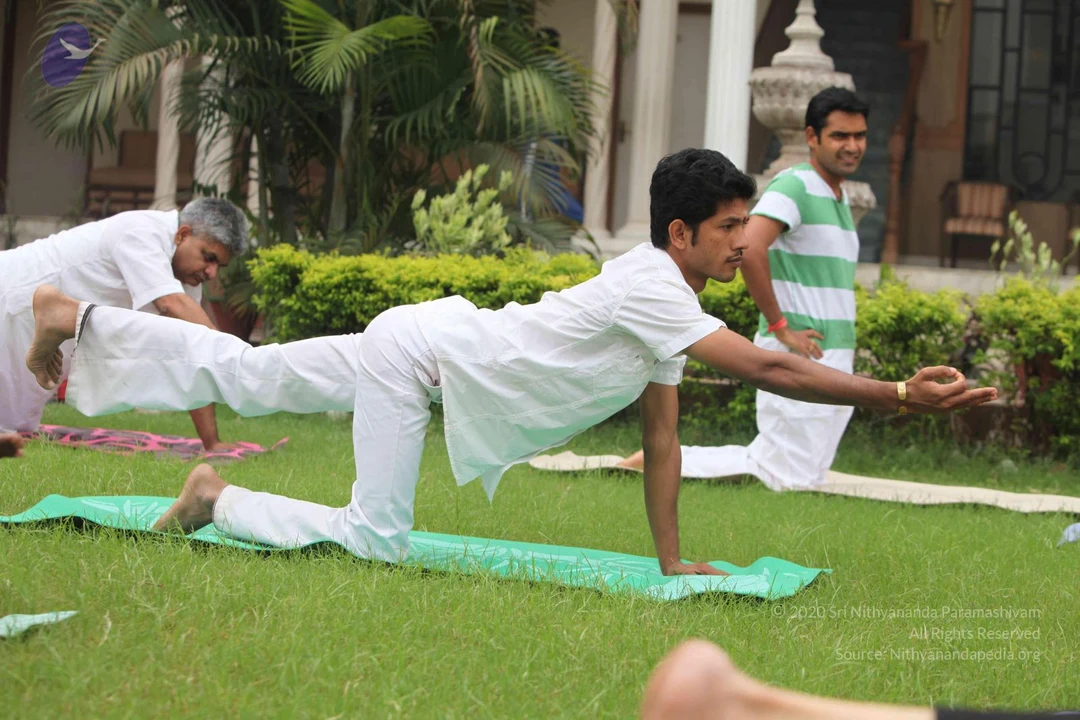
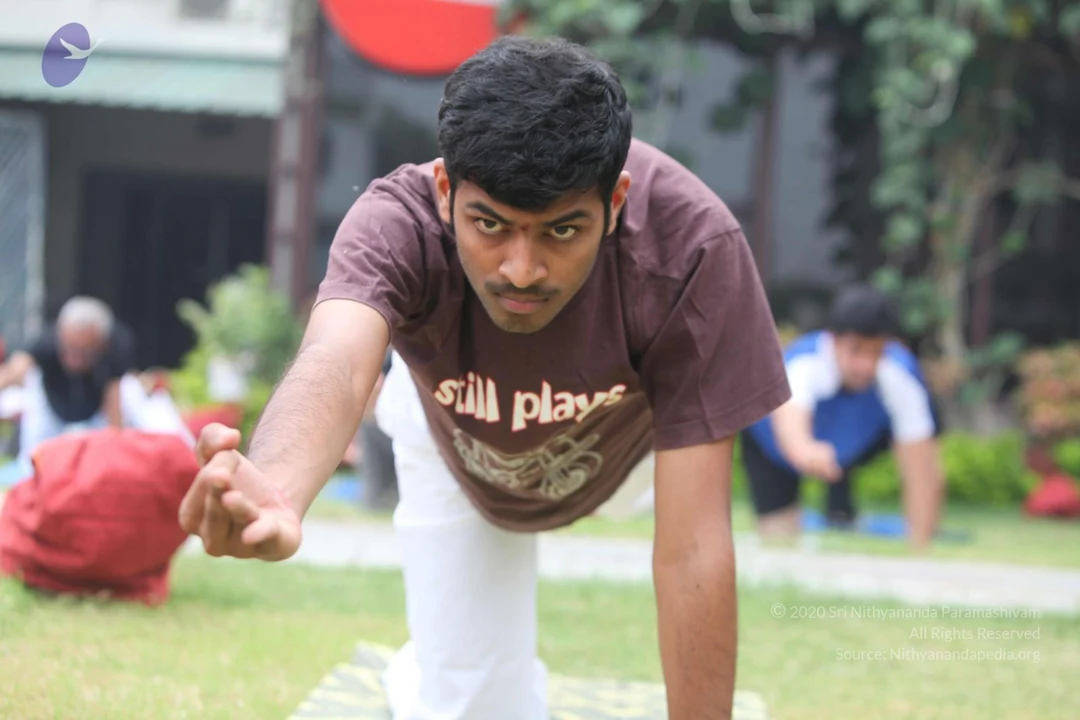
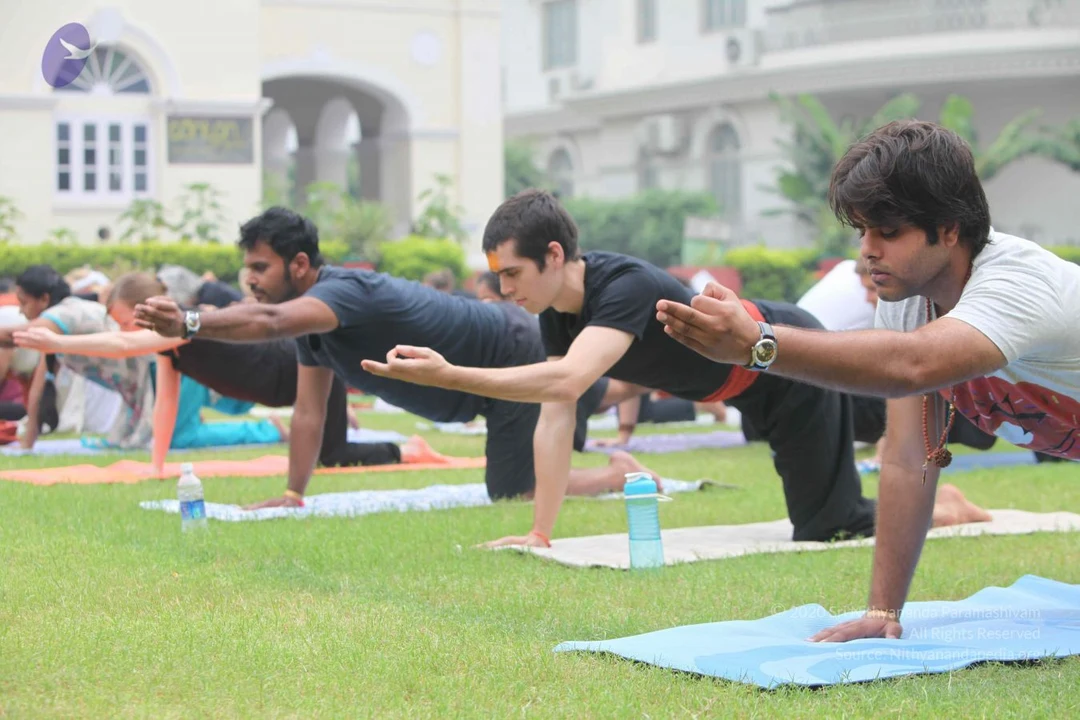
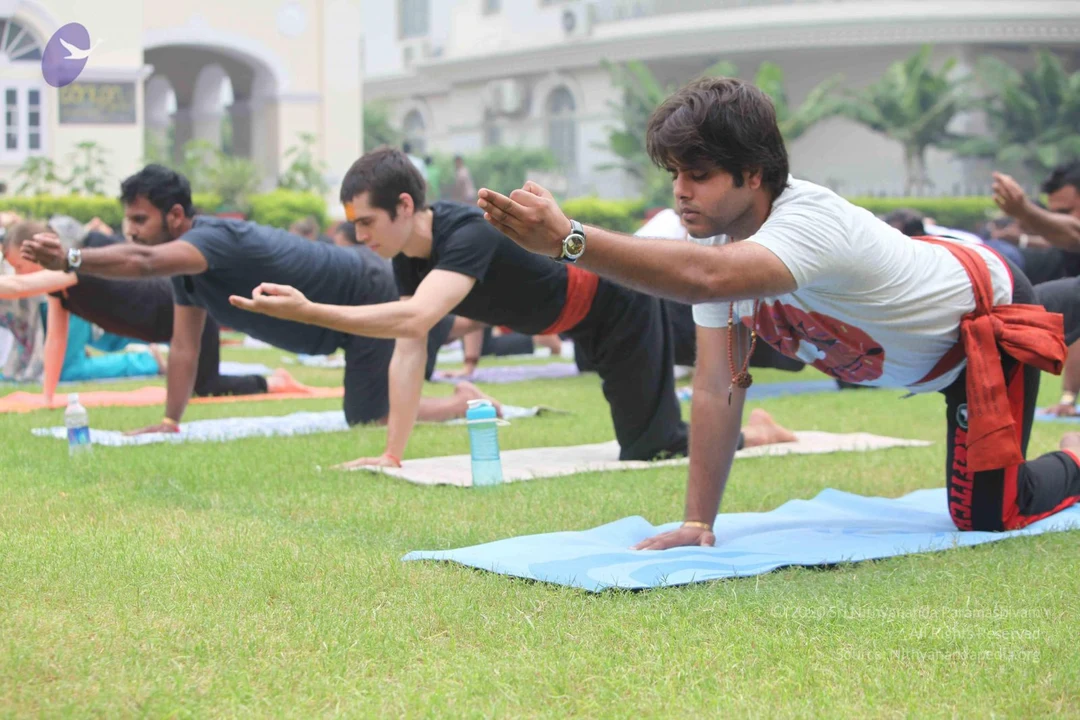
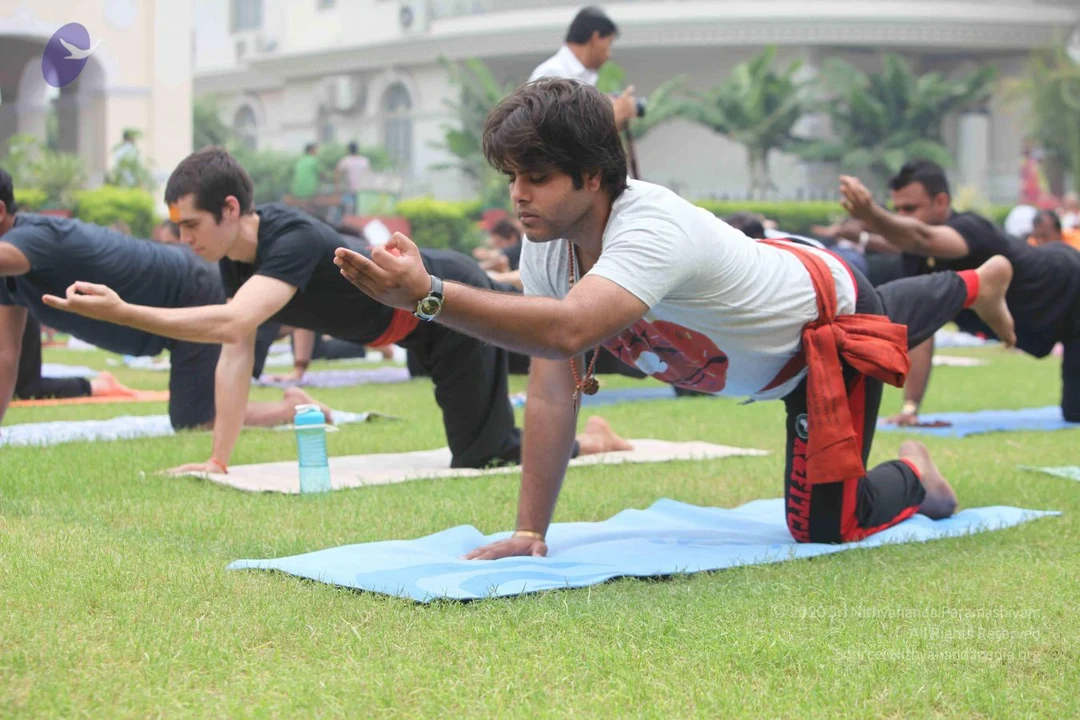
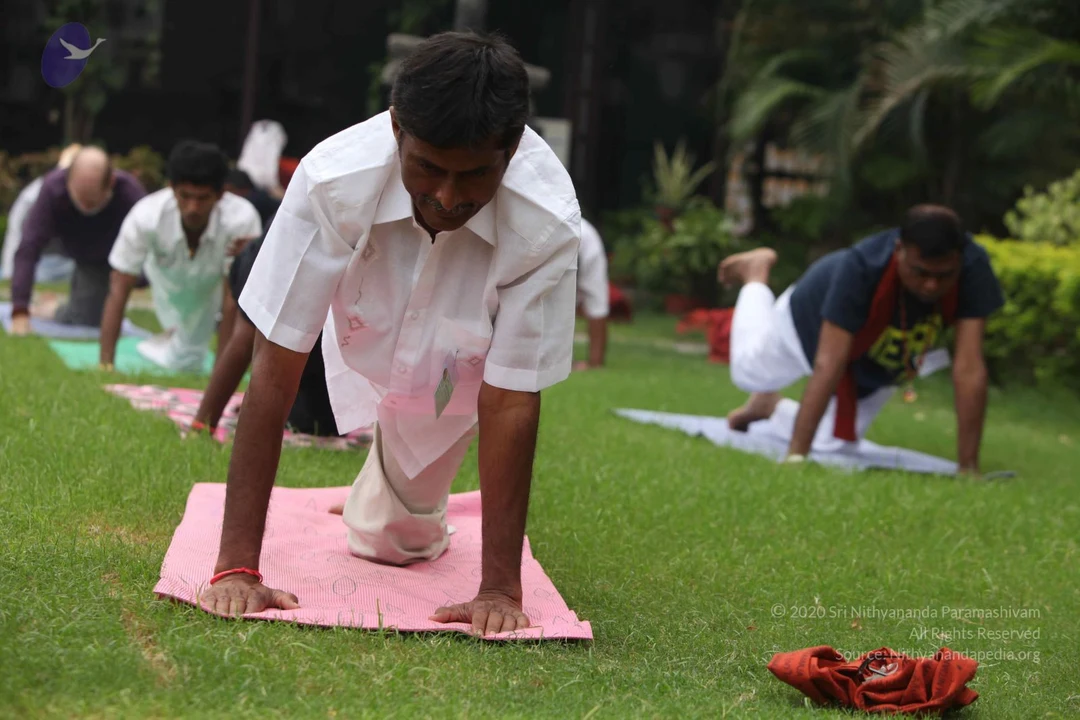
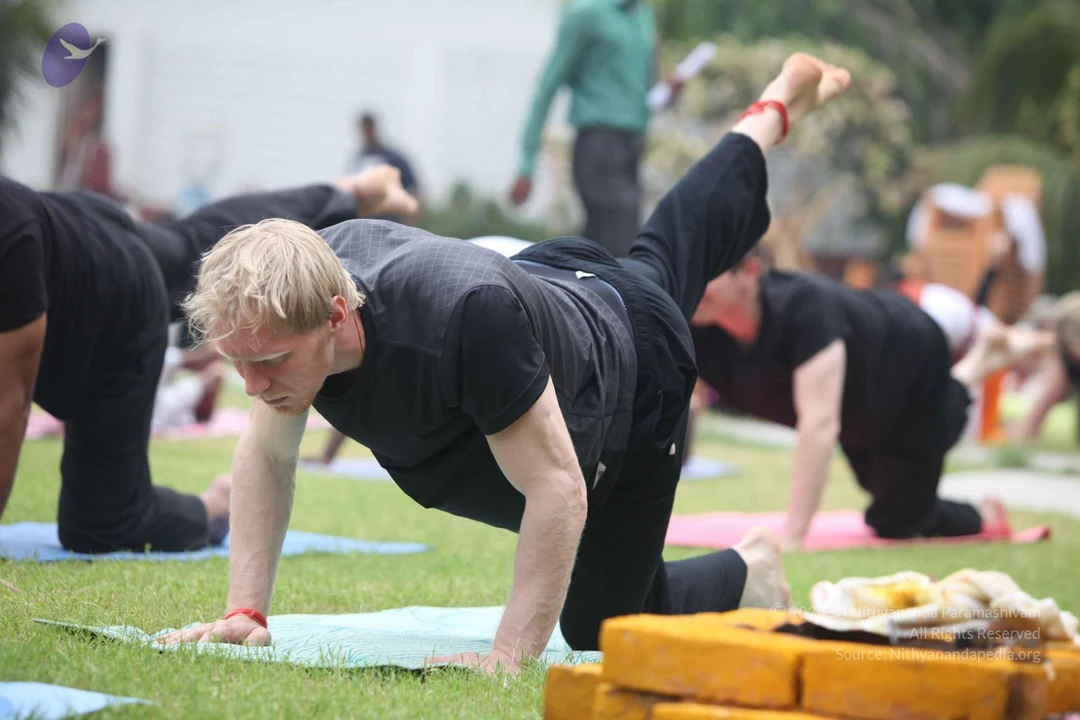
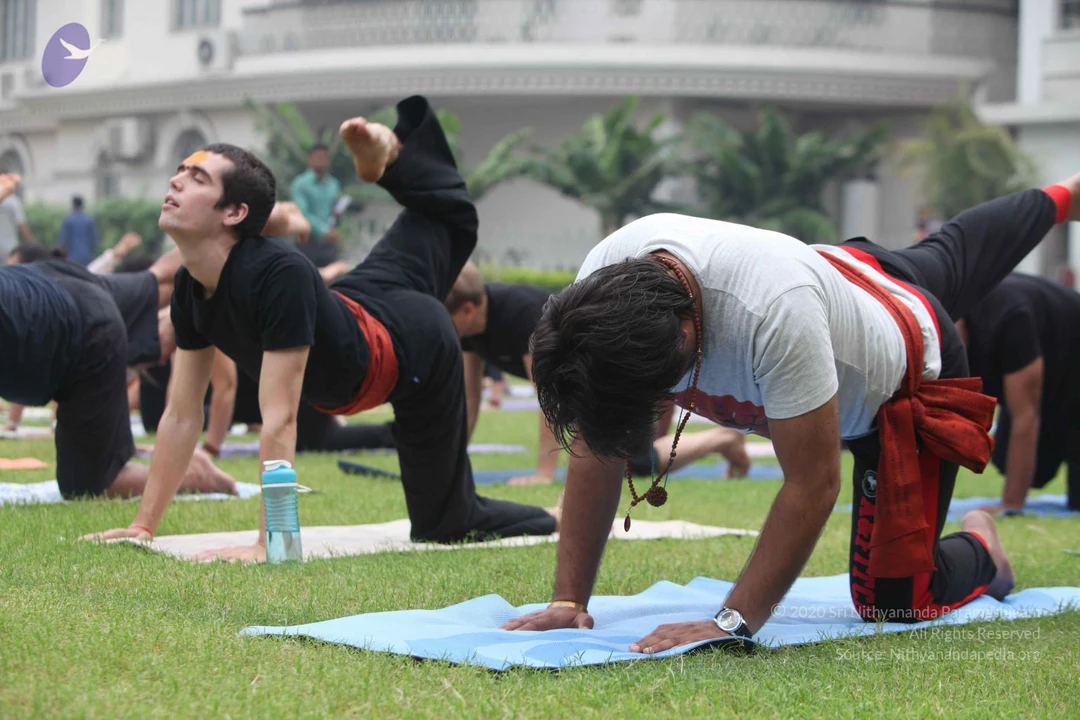
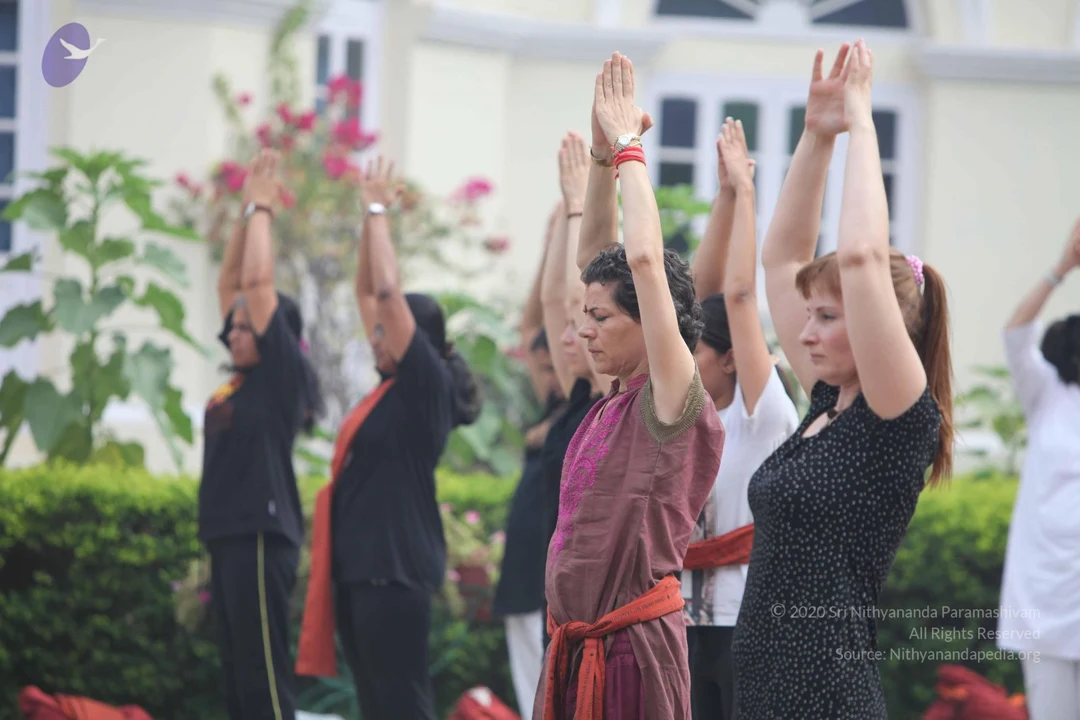
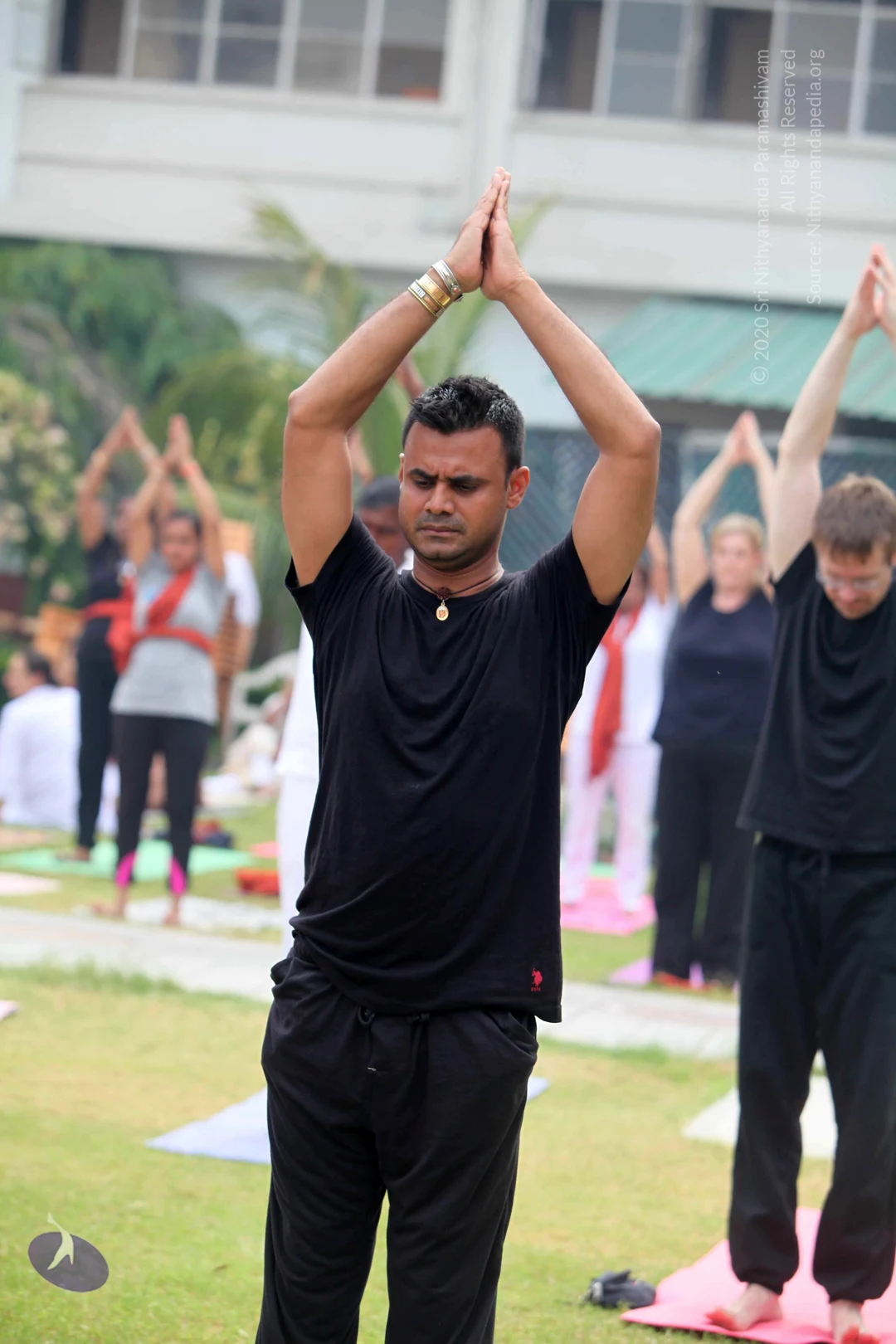
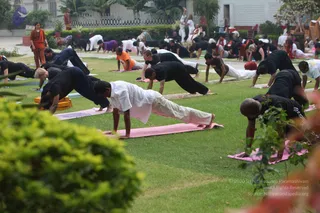
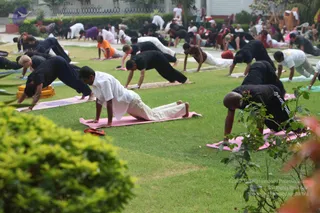
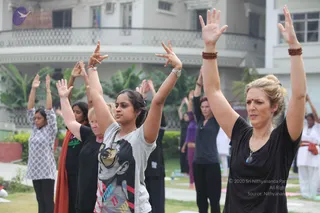
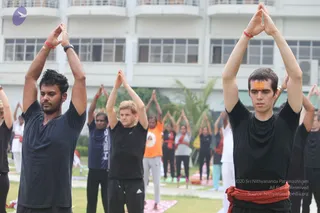
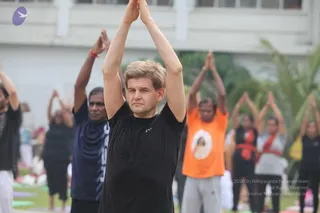
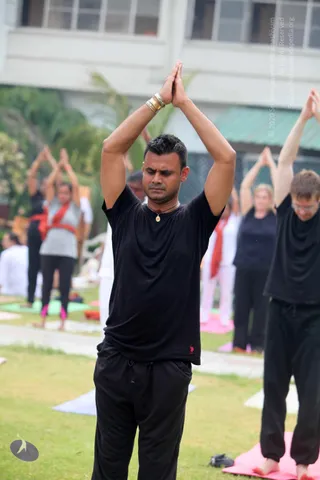
Outdoor yoga session on a lawn at an ashram, with many participants in dark athletic clothes and white kurta-style outfits doing a plank-like or downward pose on pink and purple yoga mats. A woman in orange robes stands at left watching the group, and greenery and white ashram buildings with a stone tablet form the background. No identifiable a person figure is visible among the people shown.Outdoor yoga session on a grassy lawn with many participants in rows on pink, purple and blue mats, performing a forward-bending or cobra-style stretch with hands planted on the mats. Most wear black or dark athletic tops and trousers; a few wear white kurta-style clothes and white trousers. A man in a white shirt and white trousers is in the foreground-left, hands pressed on a pink mat. A bald man in a black tracksuit sits in the foreground-right beside a green shrub. A man in orange clothing stands among the rows mid-left. Tall trees and white buildings with arched colonnades form the background.Outdoor group yoga session on a lawn in front of a white multi-storey building with a balcony and banana plants. Several women stand with arms raised overhead and palms open, practising a standing stretch. In the foreground, a woman in a grey graphic t-shirt and a woman in a black t-shirt with a pendant necklace lead the pose; a woman in black on the right wears a red-brown beaded bracelet. Others in dark and white clothing stand behind, and a few people further back wear white. No identifiable a person is visible.A group of women practise a standing yoga pose outdoors on grass, arms raised overhead with palms pressed together. In the foreground a woman in a grey t-shirt printed with a large black-and-white portrait, red and black accents, and a pendant necklace stands with eyes calm and forward. Beside her an older woman in black clothing and an orange-brown wrap stands with palms joined overhead. Other participants in black, white and purple outfits, some wearing bangles and watches, stand in rows behind them. A white building, banana plants and a low hedge form the background.Outdoor group yoga session on a green lawn in front of a white multi-storey building with rows of windows and a palm tree. Participants stand on mats with arms raised overhead and palms pressed together in namaskar above the head. The foreground man on the left wears a dark t-shirt, a red wrist band and a wristwatch. The man on the right wears a black t-shirt, a red waist cloth and an orange tilak on his forehead. Behind them, several people in orange, black and white clothing, one in an orange t-shirt, continue the same pose. No a person is visible.An outdoor group yoga session on a lawn with several rows of practitioners standing with arms raised and palms pressed together overhead in a salutation pose. In the foreground a light-haired man in a black t-shirt stands centred with arms raised. Behind him a man in an orange t-shirt with a circular graphic and a man in a navy top also raise their arms. Women in black and grey tops with red sashes stand with hands joined. A building with windows and palm trees form the background, and yoga mats lie on the grass.

Manikarnika-Ghat-Visit-Darshan

83 photosSource gallery
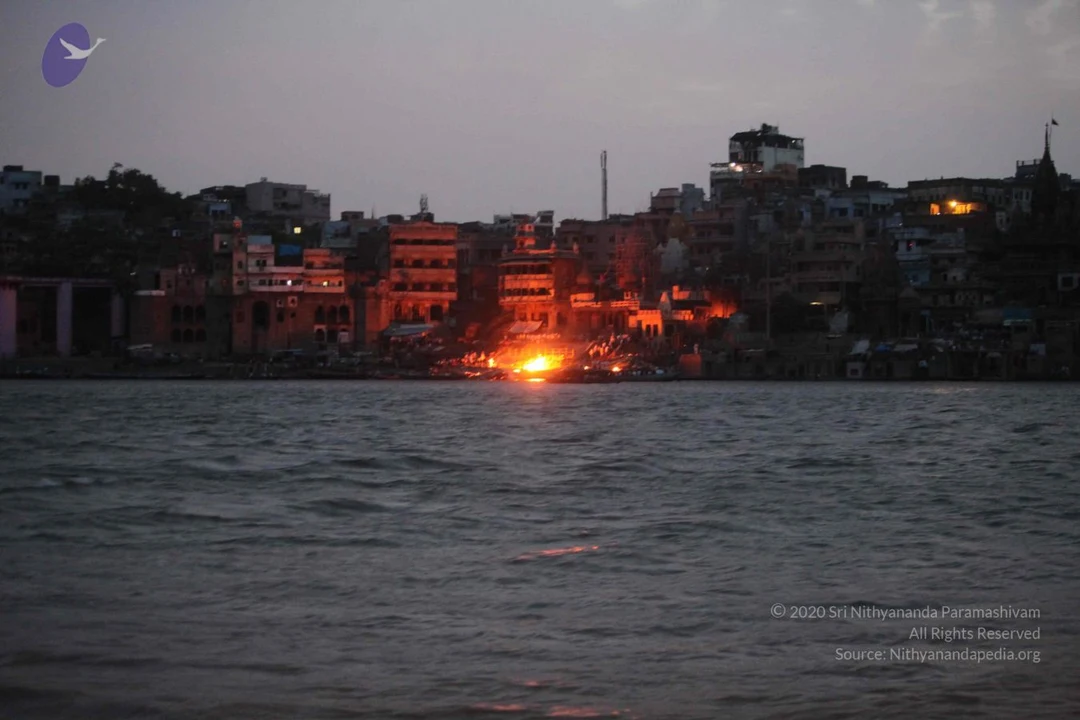
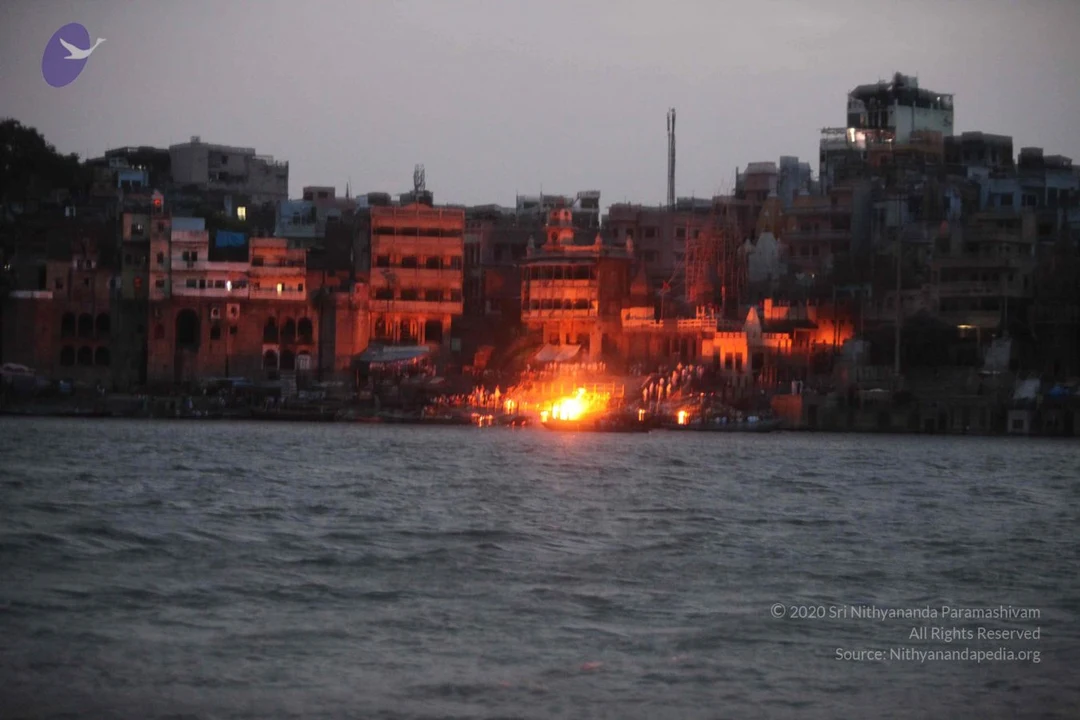
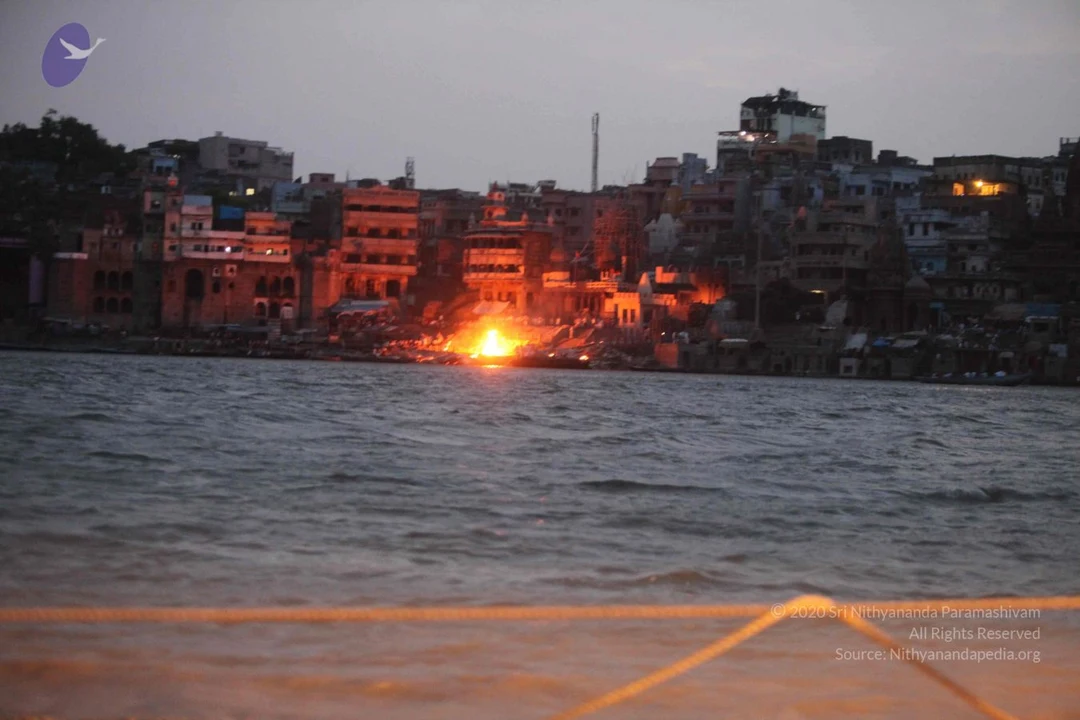
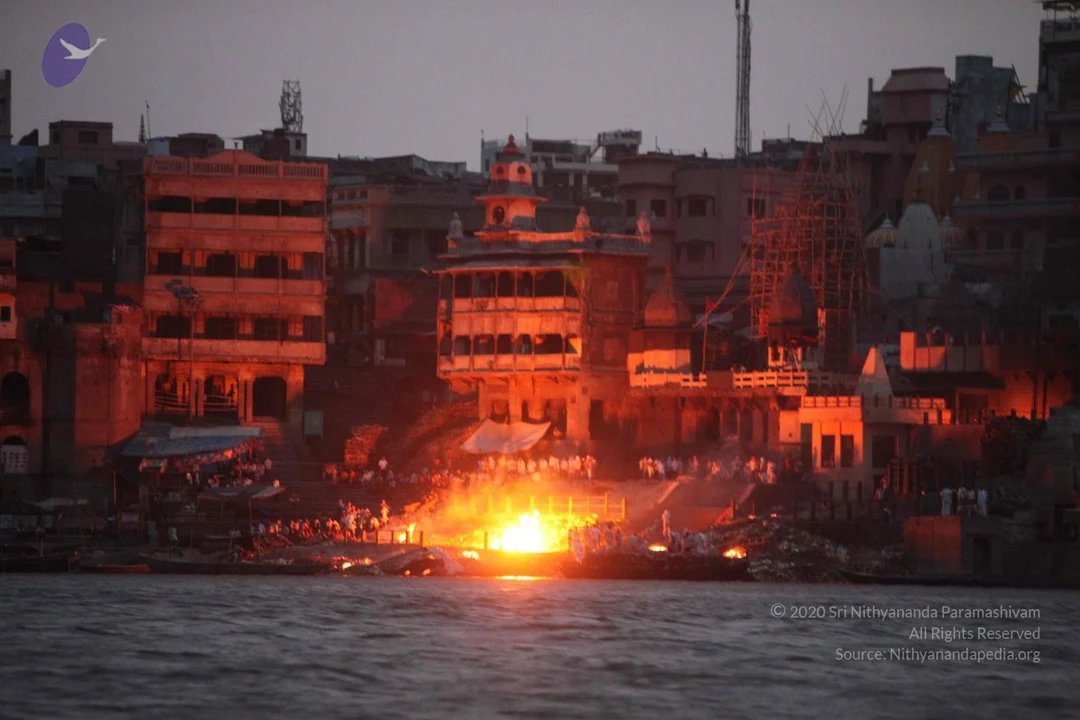
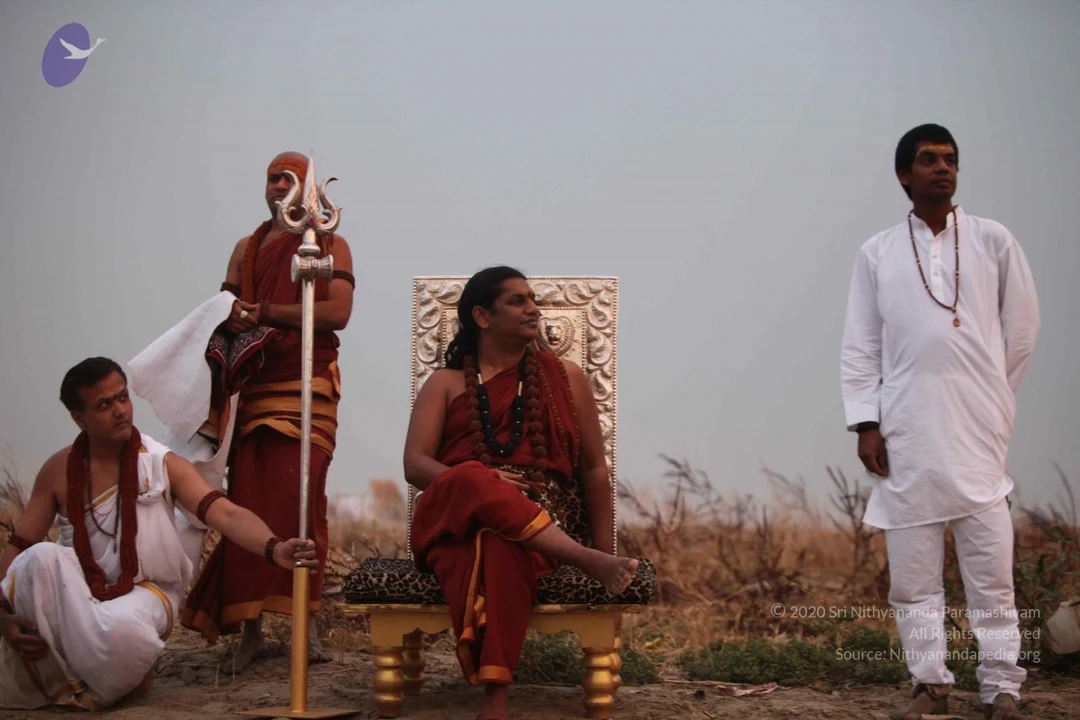
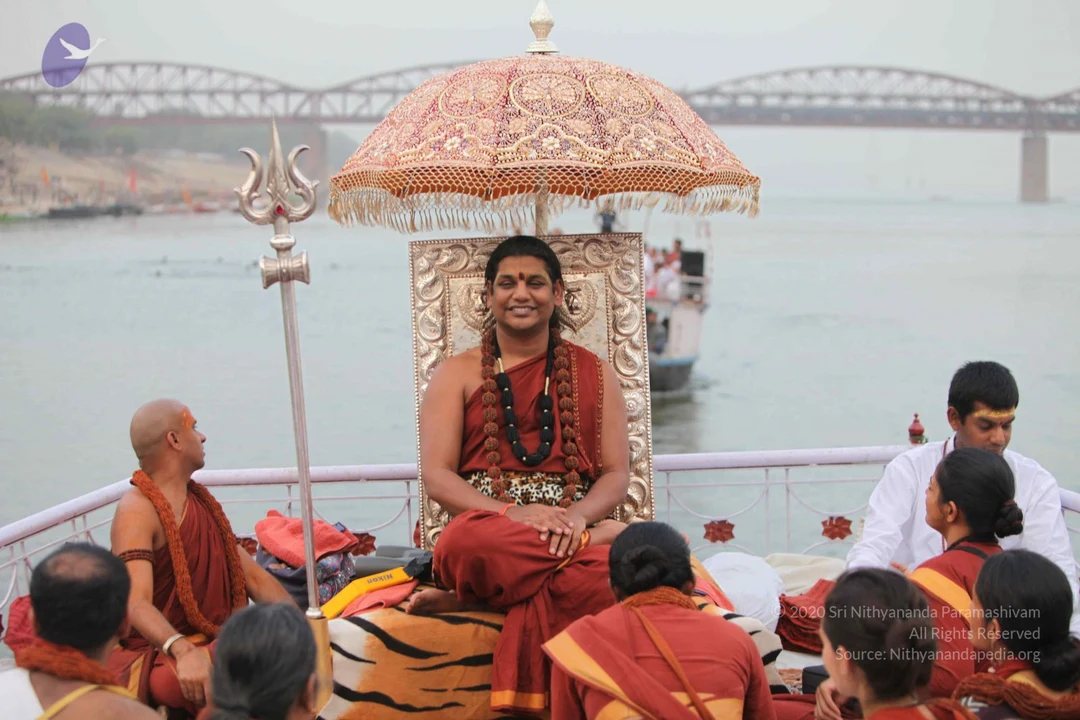
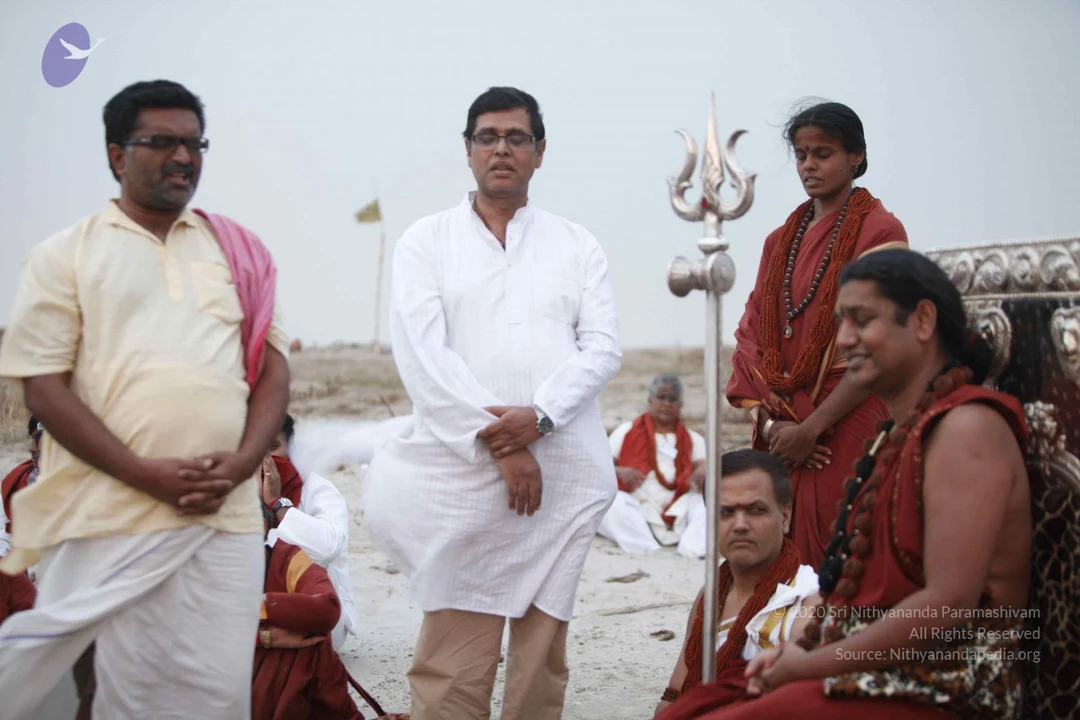
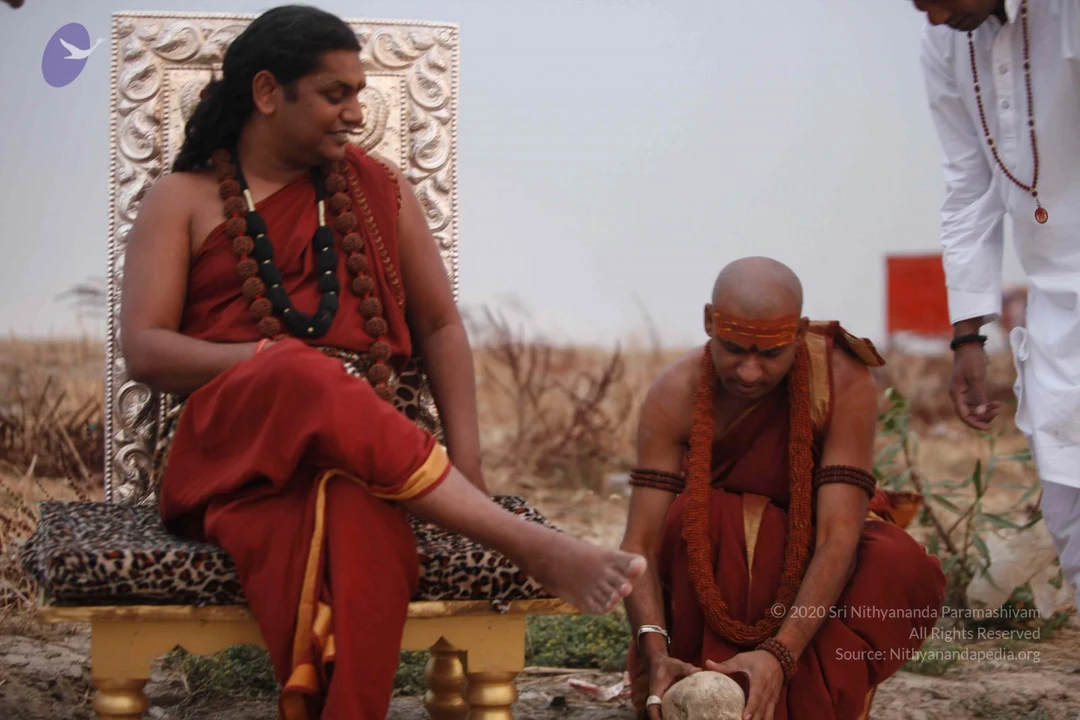
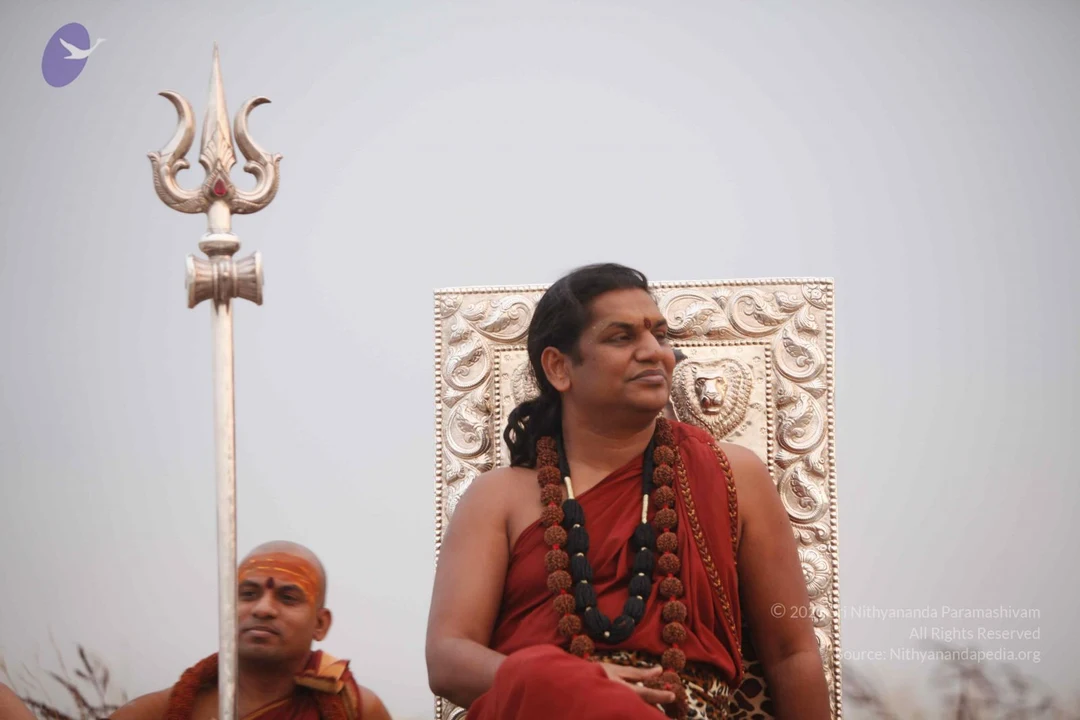
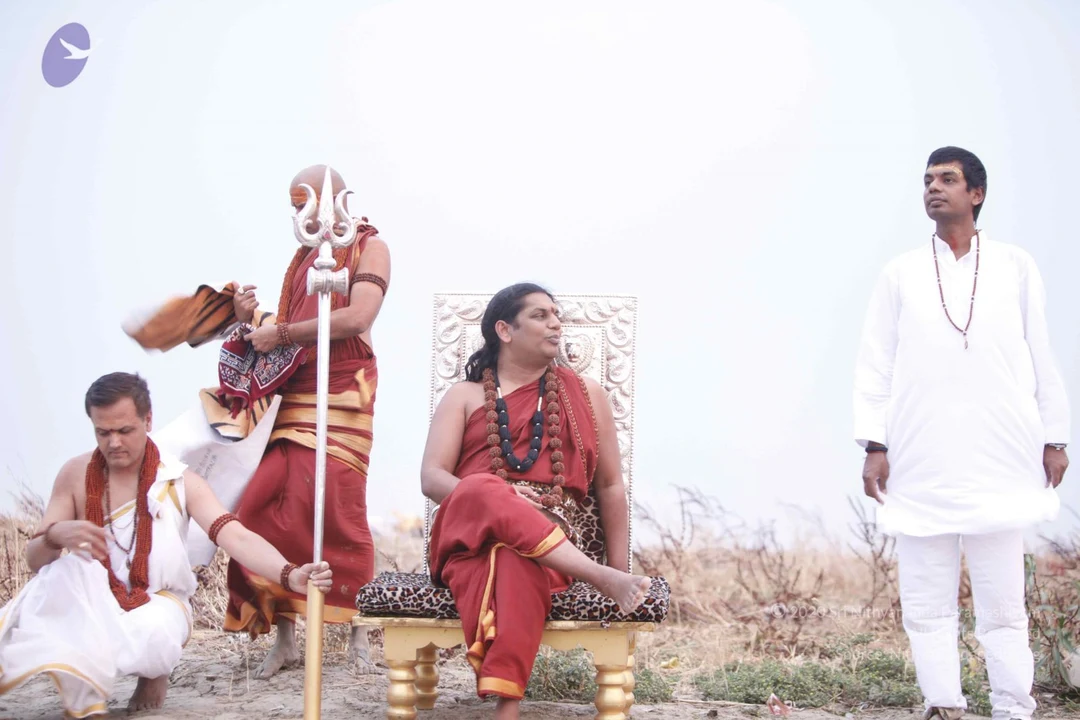
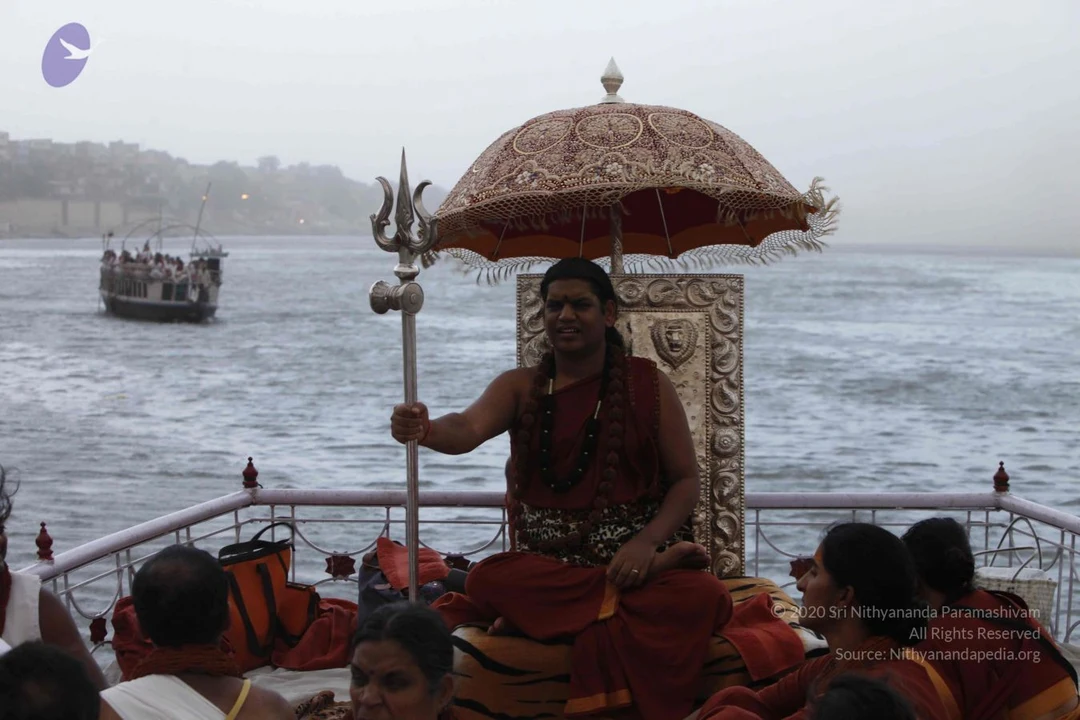
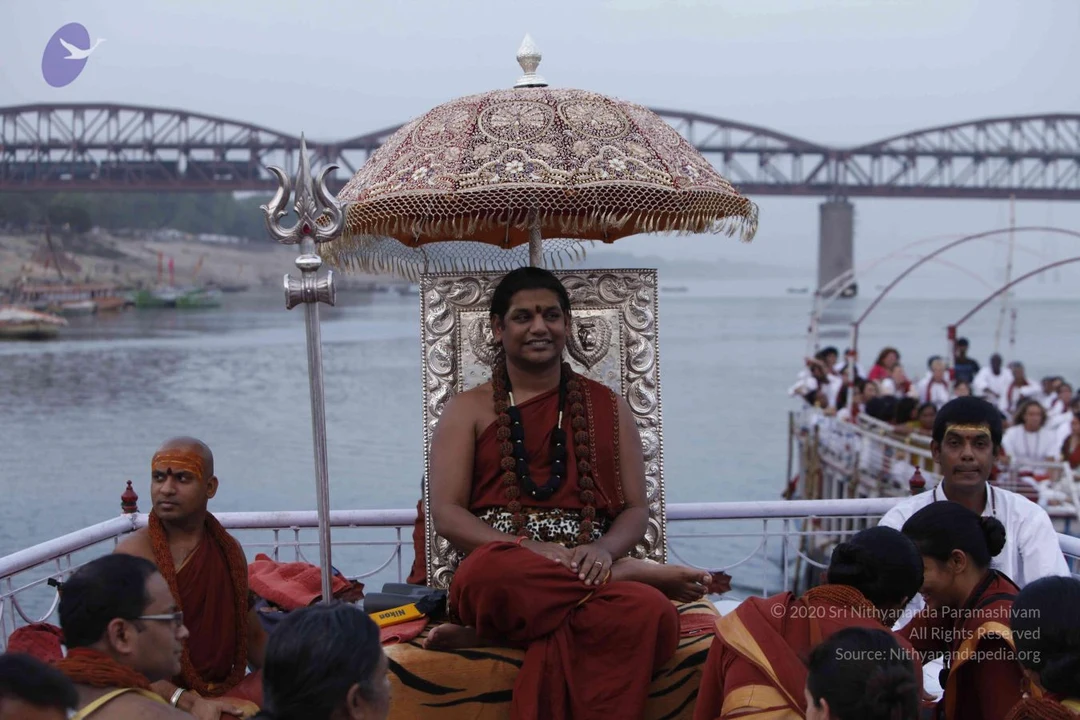
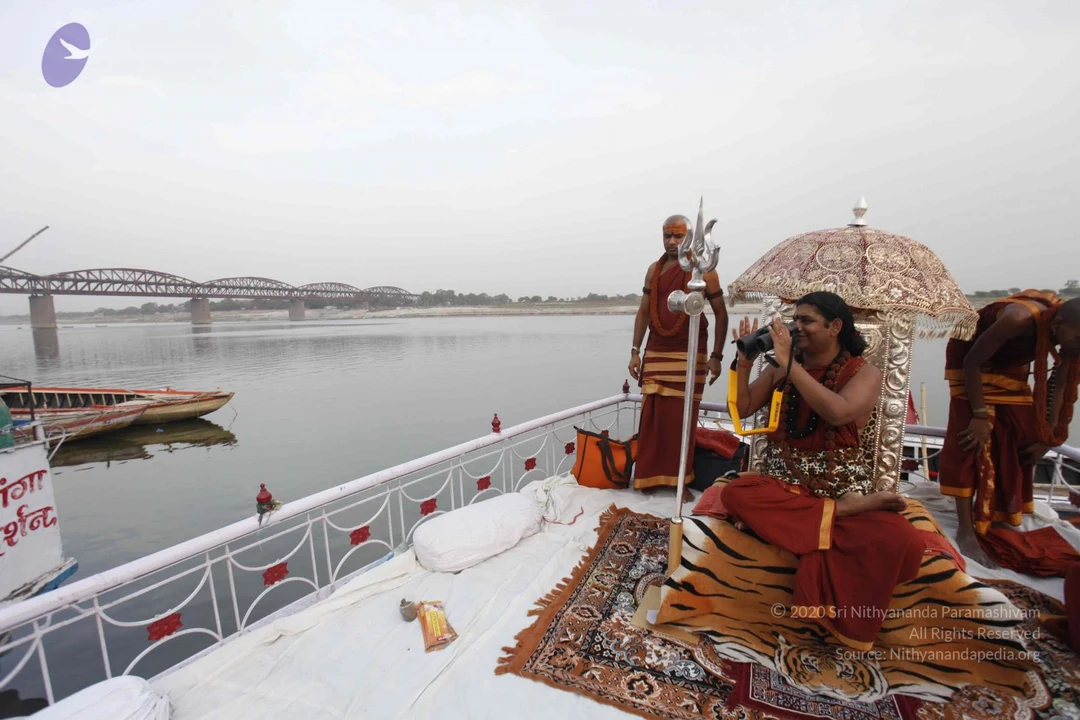
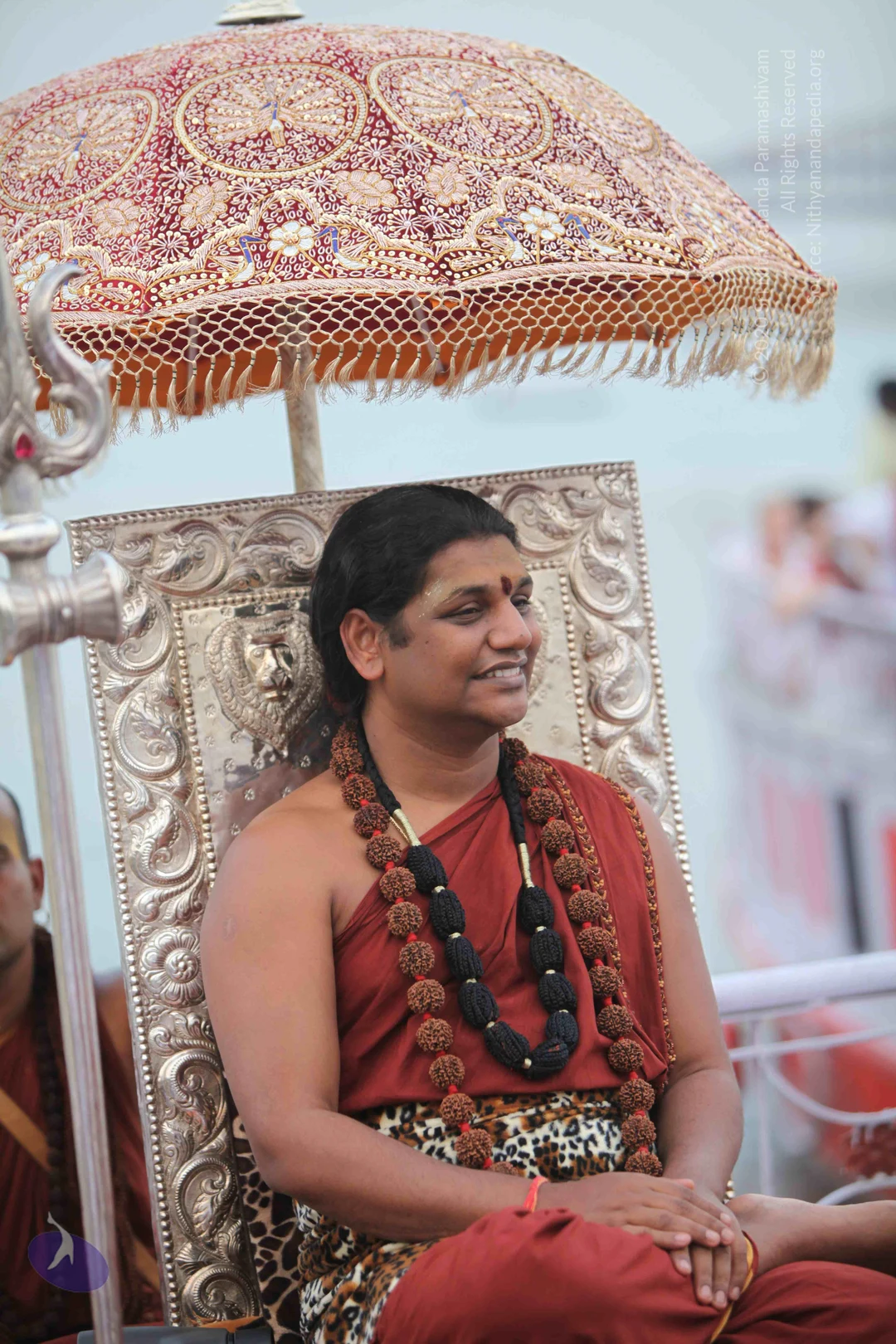
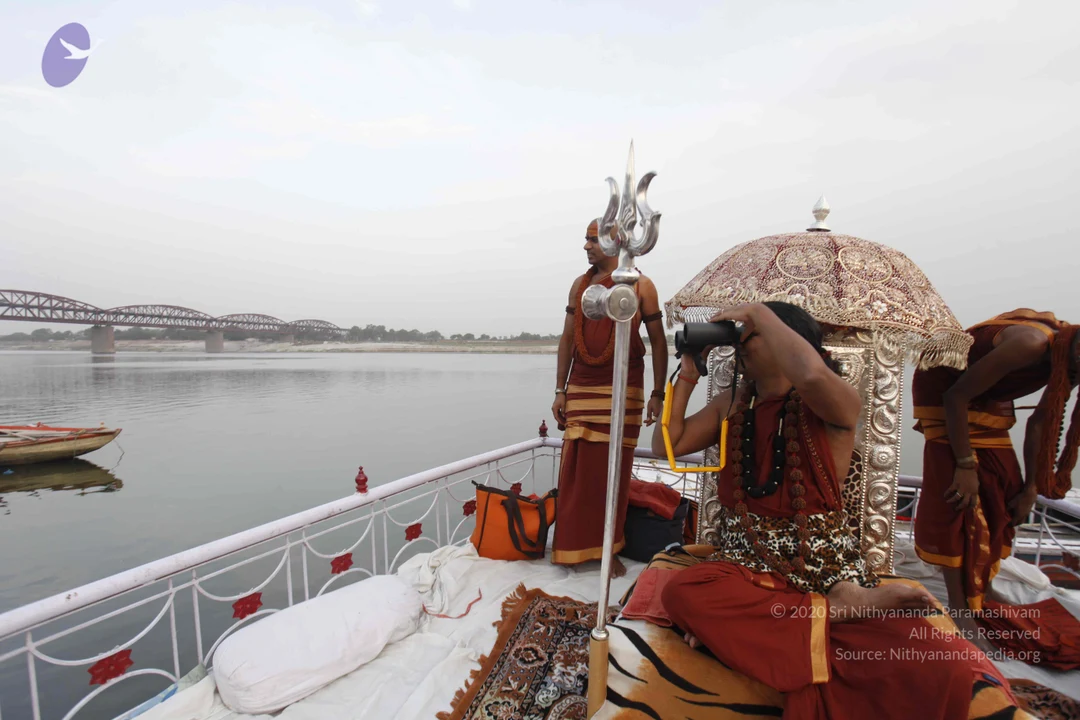
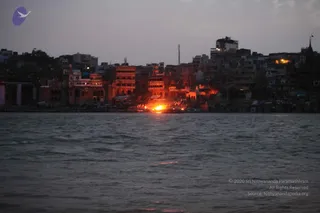
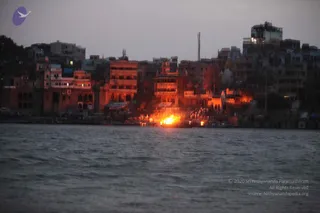
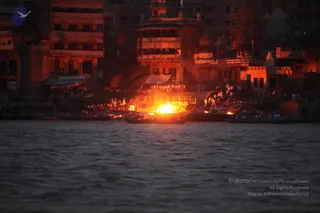
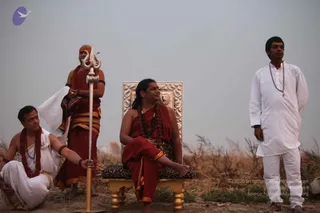
Evening view across the river toward a dense row of multi-storey buildings in terracotta and ochre tones along a riverbank ghat in Varanasi. A bright fire glows at the water's edge near the steps, with smaller flames and reflections on the dark water. No people are clearly visible in the scene; the view is taken from the water at dusk.Dusk view across the wide grey river toward Varanasi's riverfront ghats, with multi-storey buildings in warm orange-red and pink tones lining the bank. At the water's edge a large fire glows bright orange amid a cluster of small figures. Tall antennae and dark rooftops rise against a grey sky. Several tiny distant people are visible along the steps, too small to count precisely.Dusk view across a wide river toward a ghat in Varanasi, with multi-storey stone buildings lit orange by the setting light. At the water's edge a large fire blazes on a platform while small groups of people stand and sit on the steps and in boats nearby. Several small flames glow along the bank. The scene appears to be an evening fire ritual at the riverside. No individual figure can be identified as a person from this distance.Dusk view across a river toward the riverfront of Varanasi, with dense multi-storey buildings in terracotta and ochre tones lining the ghats. A bright fire burns near the water's edge at the centre, its glow reflected in the rippling river. A taut rope runs across the bottom of the frame over the stone platform. No people are clearly visible in the scene.Dusk view across a wide river toward a row of multi-storey stone ghats in Varanasi, lit orange by fire and sunset. A large cremation pyre burns at the water's edge at centre, with flames rising and small groups of people standing on the steps nearby. Tall brick buildings, a red-tiered temple tower and scaffolding line the bank. Several small figures are visible on the steps and beside the pyre, but no individual can be identified as a person, so no candidate is described.Outdoor photo on dry grassland under a pale hazy sky. A man in red-orange robes with long braided hair and a dark bead mala sits cross-legged on a white-and-gold throne draped with a leopard-print cushion, bare feet on the ground, gazing to the side; he is the central figure and matches the appearance cues of the a person. Behind him, a man in orange-red robes and an orange head wrap holds up a tall silver trident. At left, a seated man in white with a red shawl rests a hand on the trident's staff. At right, a standing man in white kurta and pants wears a rudraksha mala and a tilak. Four physical people are visible.

IA-Darshan

93 photosSource gallery
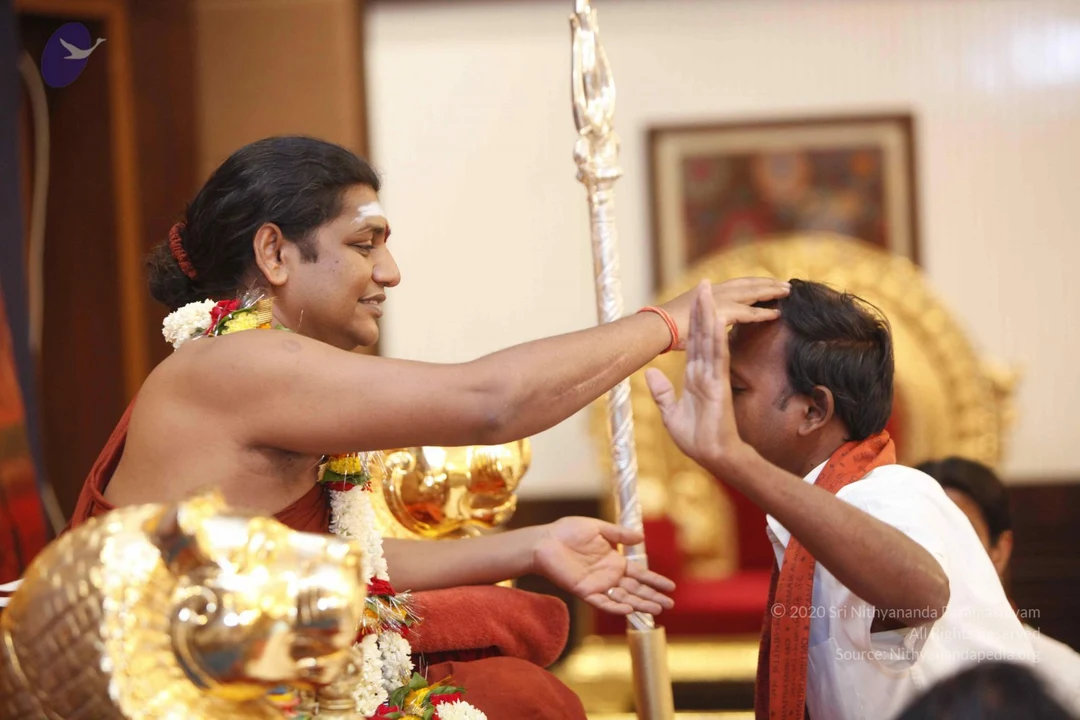
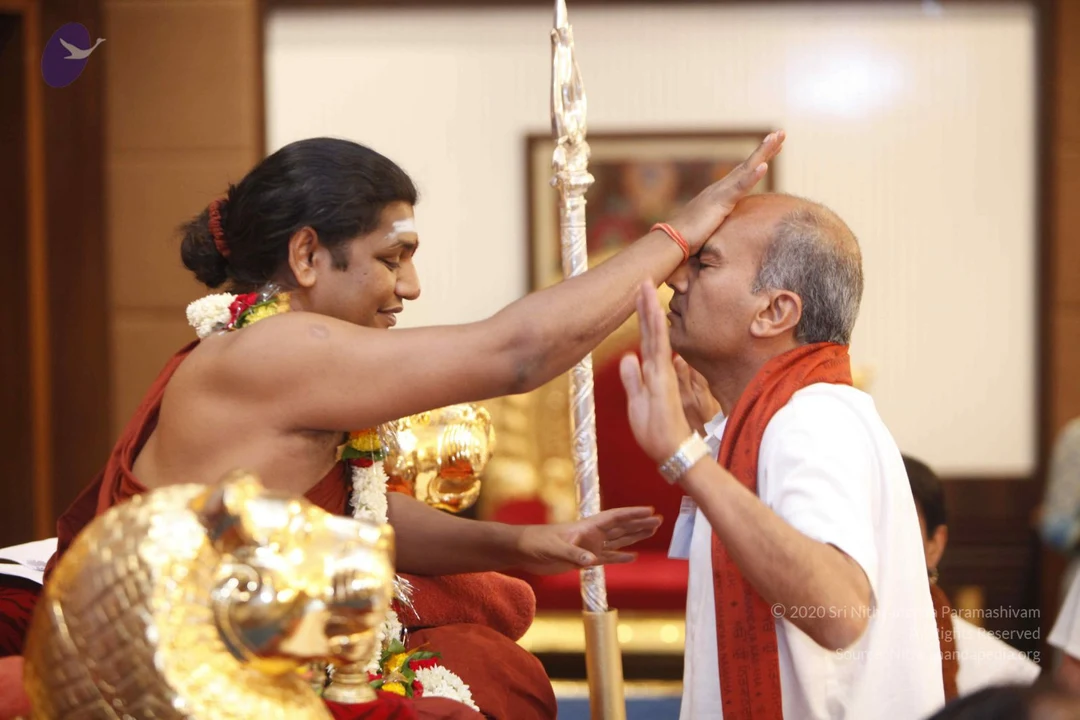
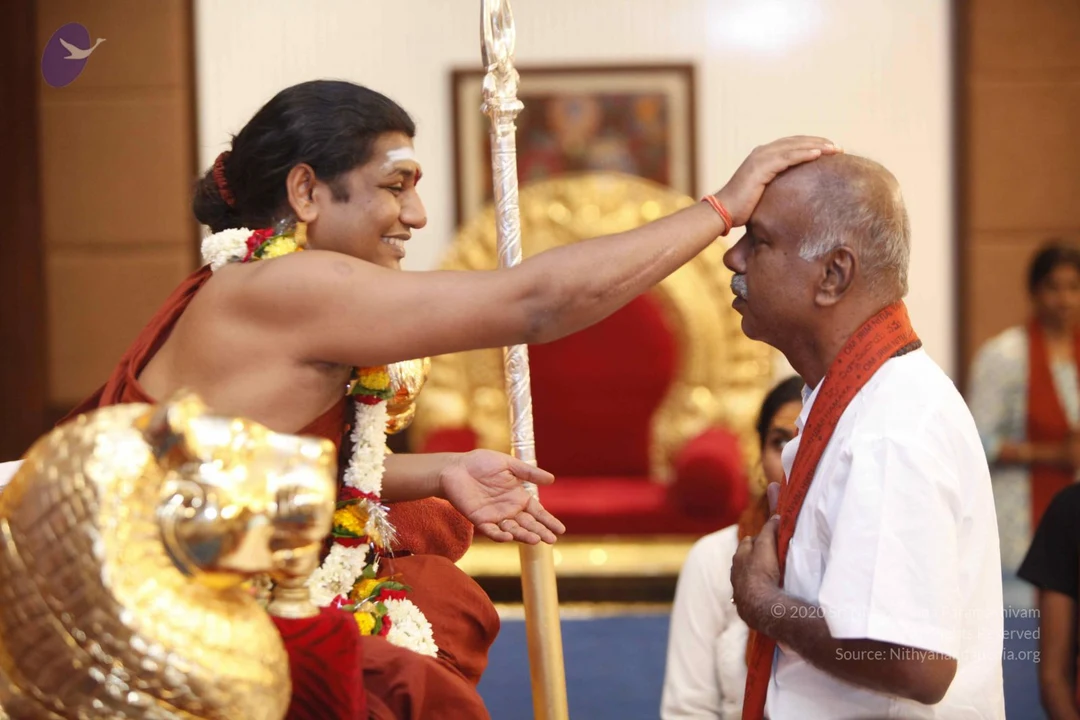
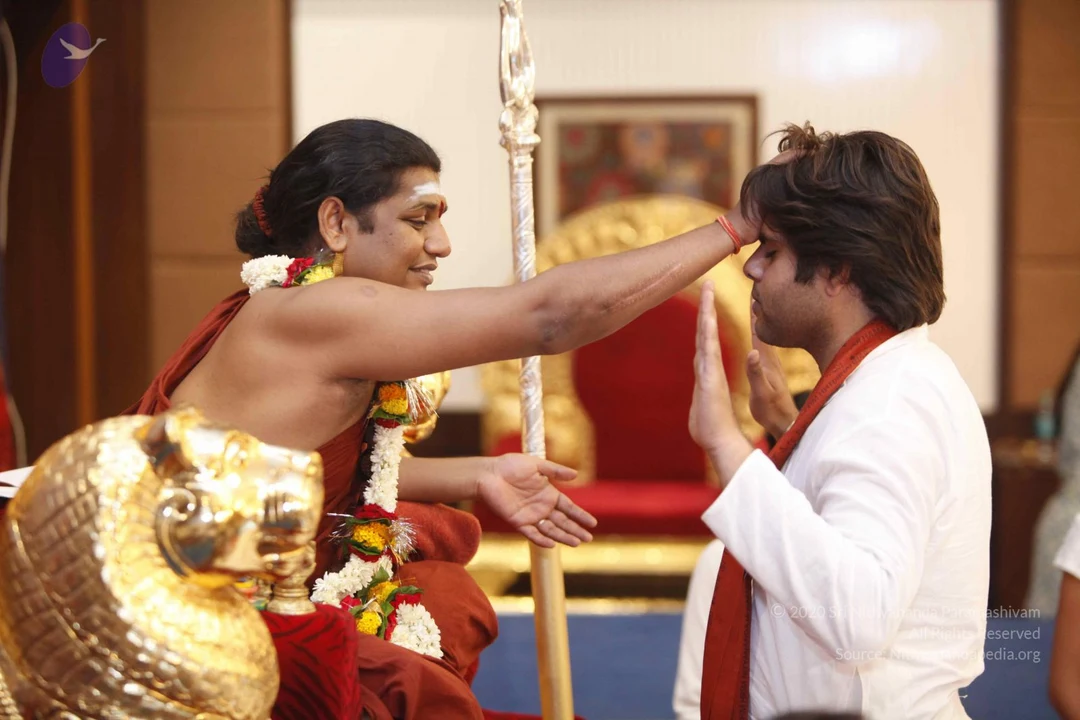
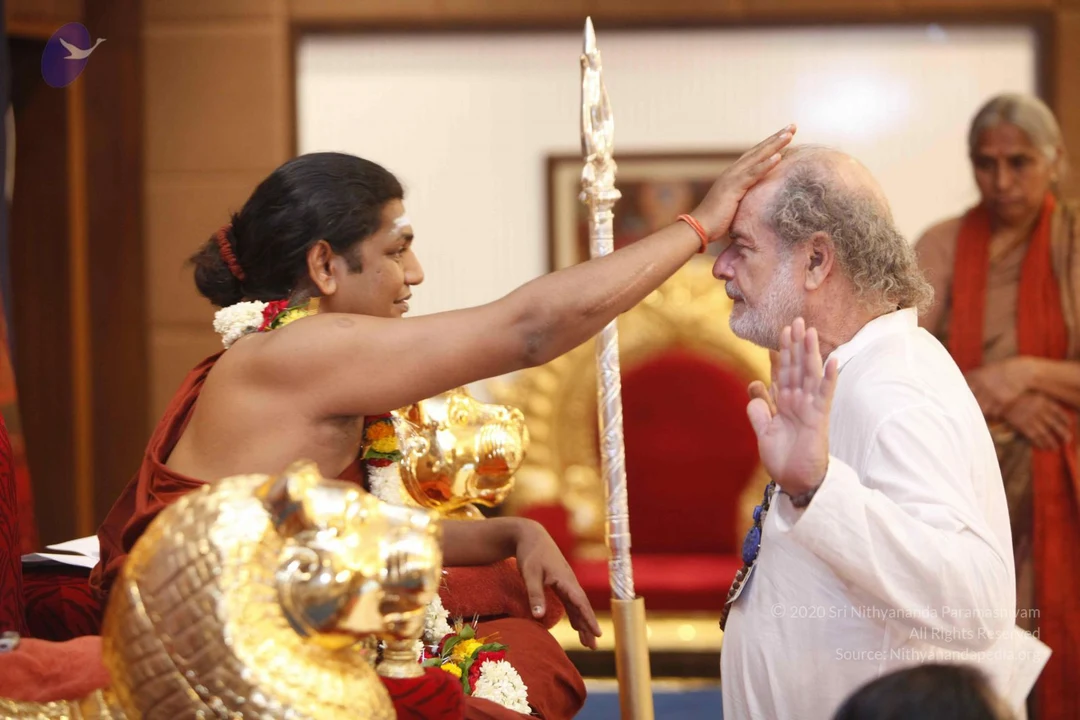
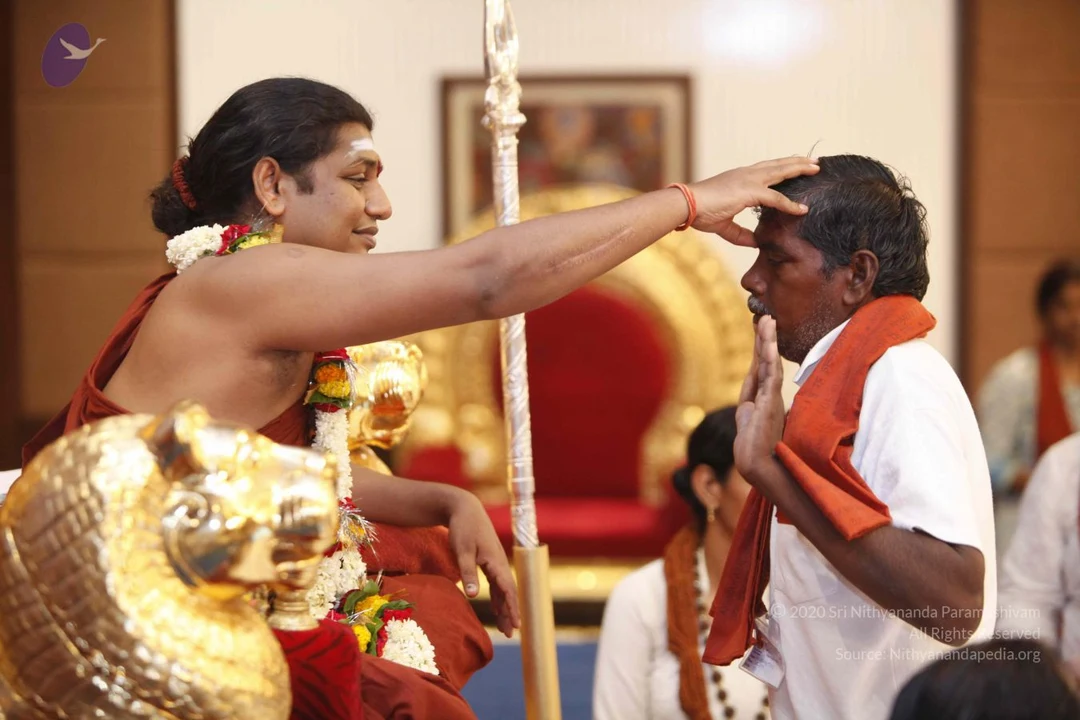
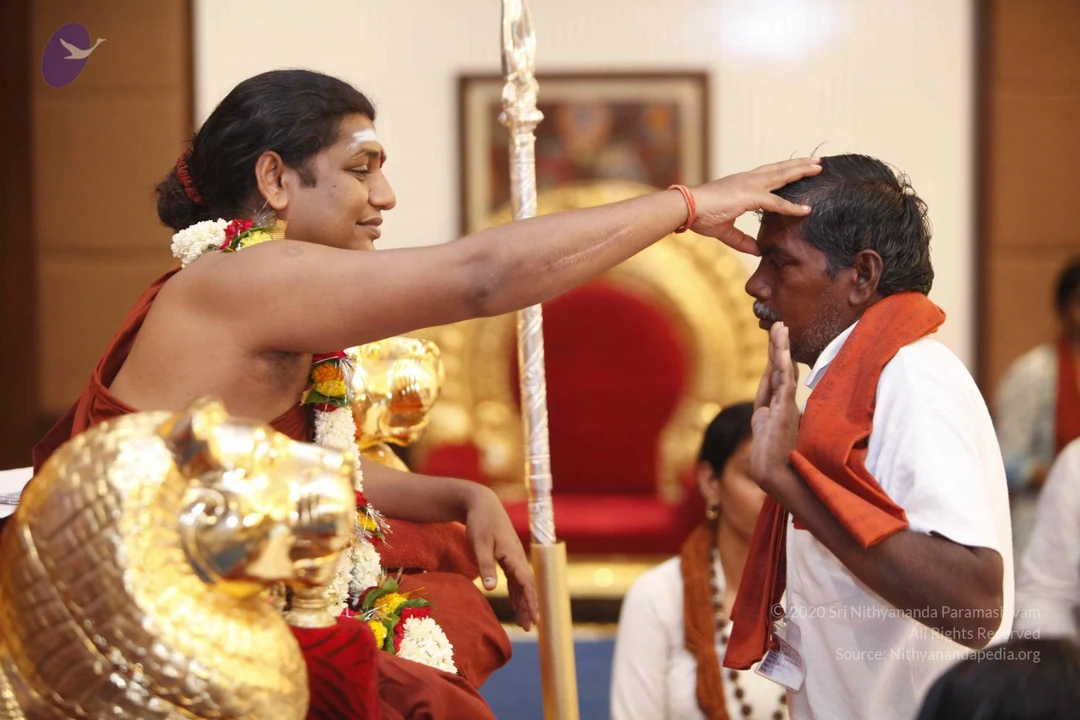
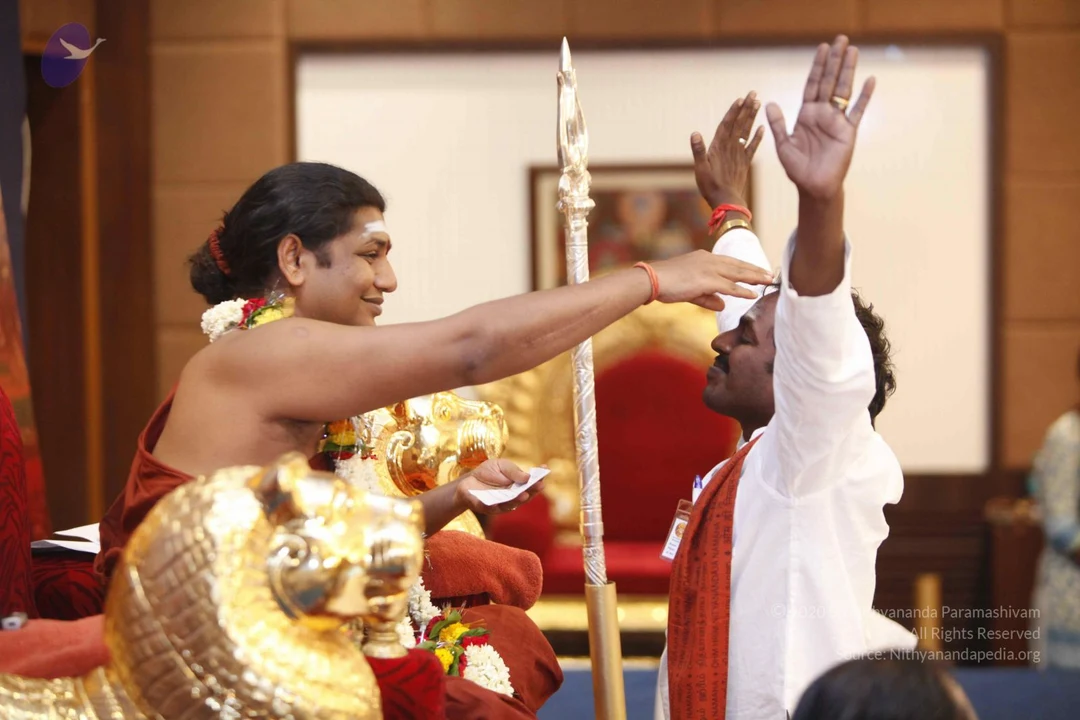
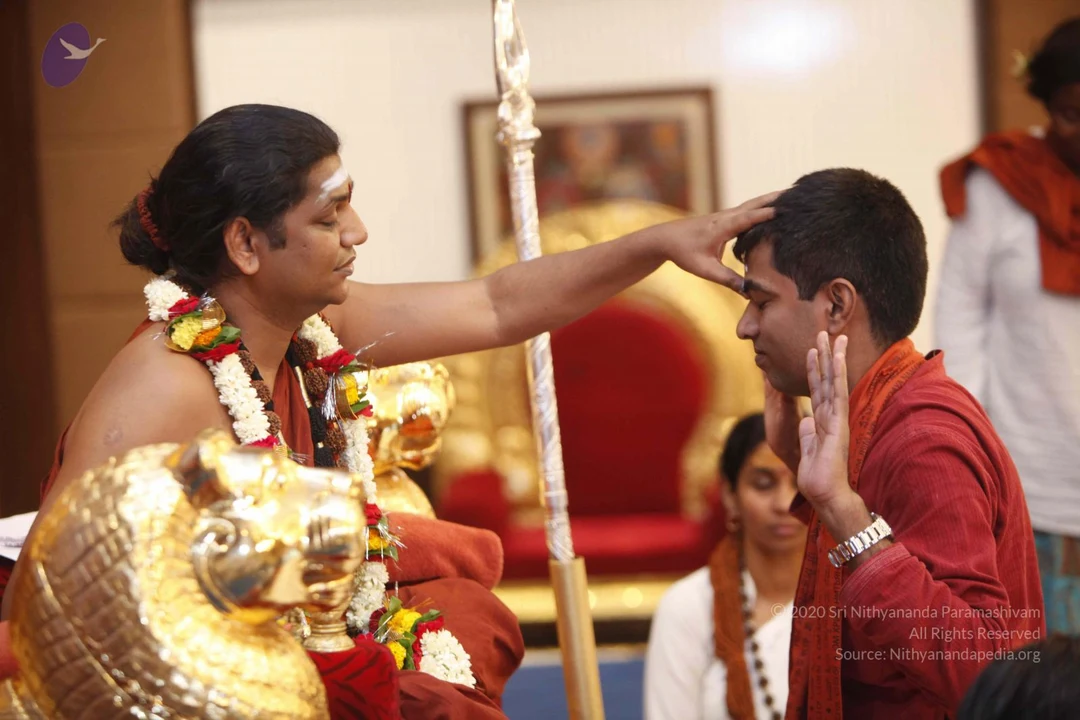
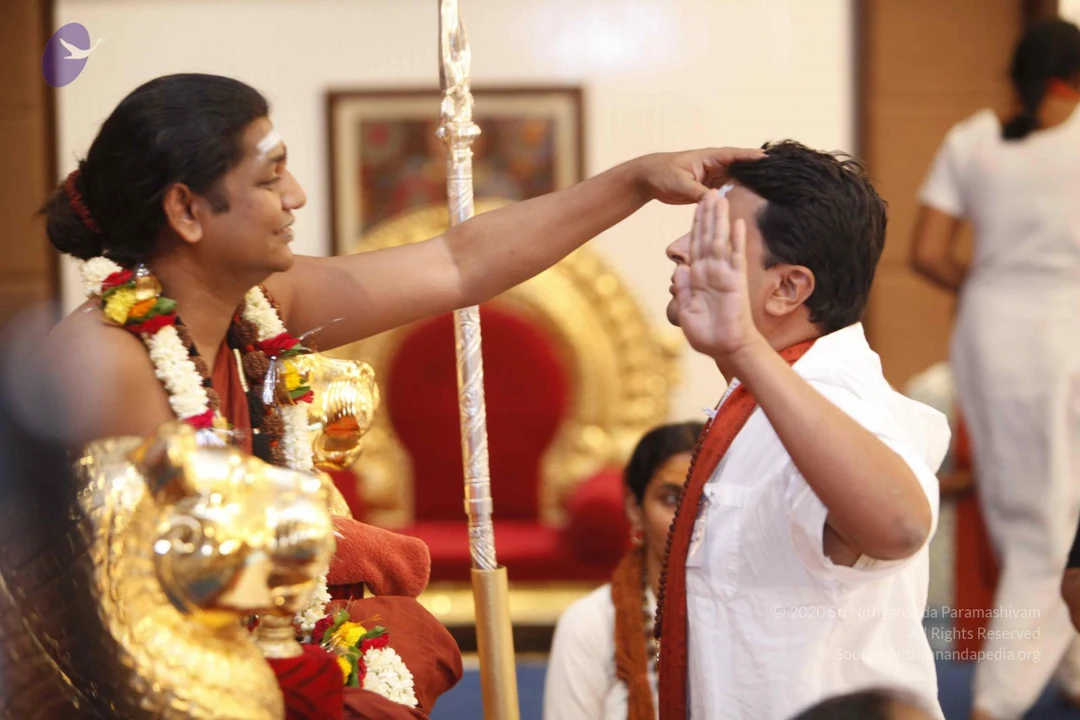
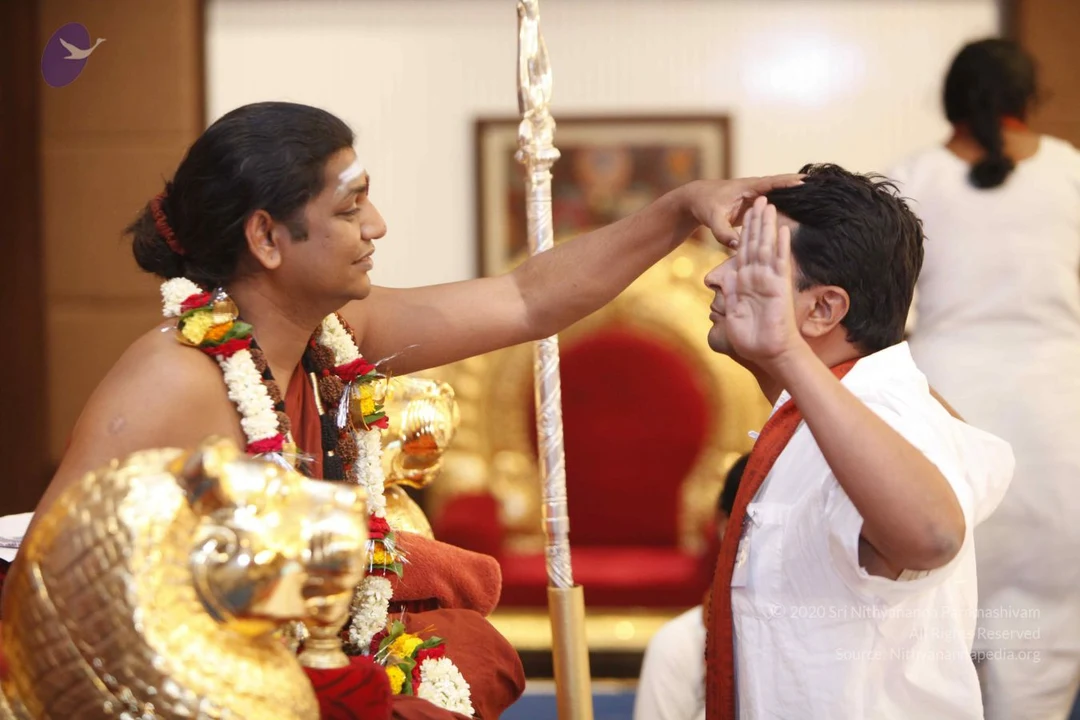
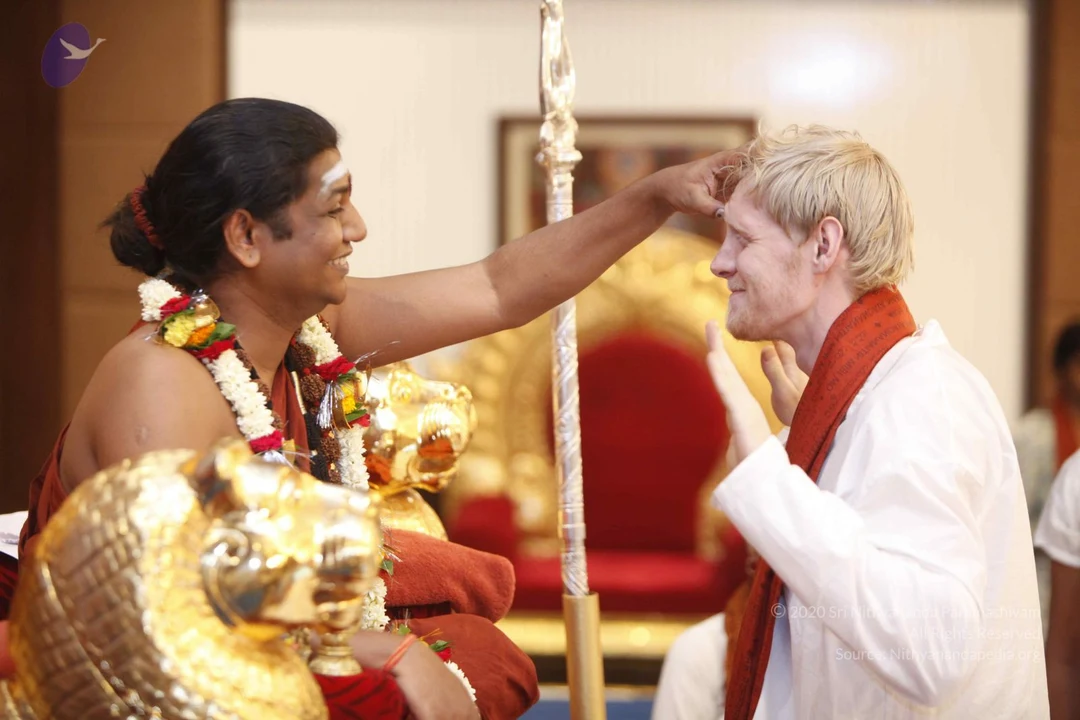
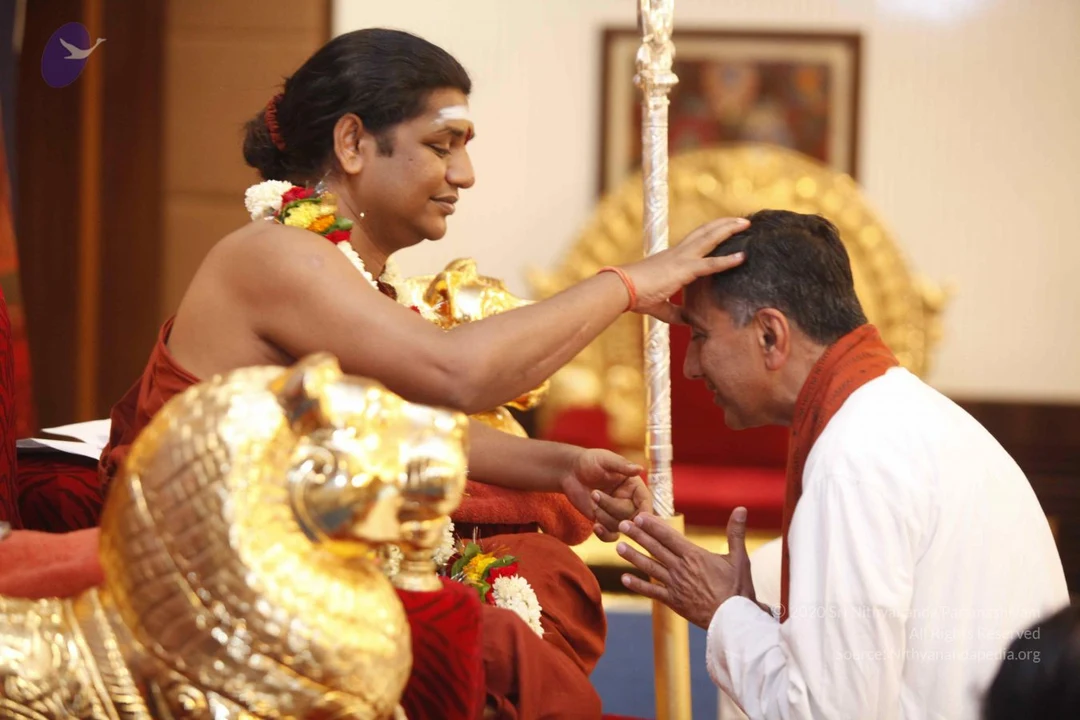
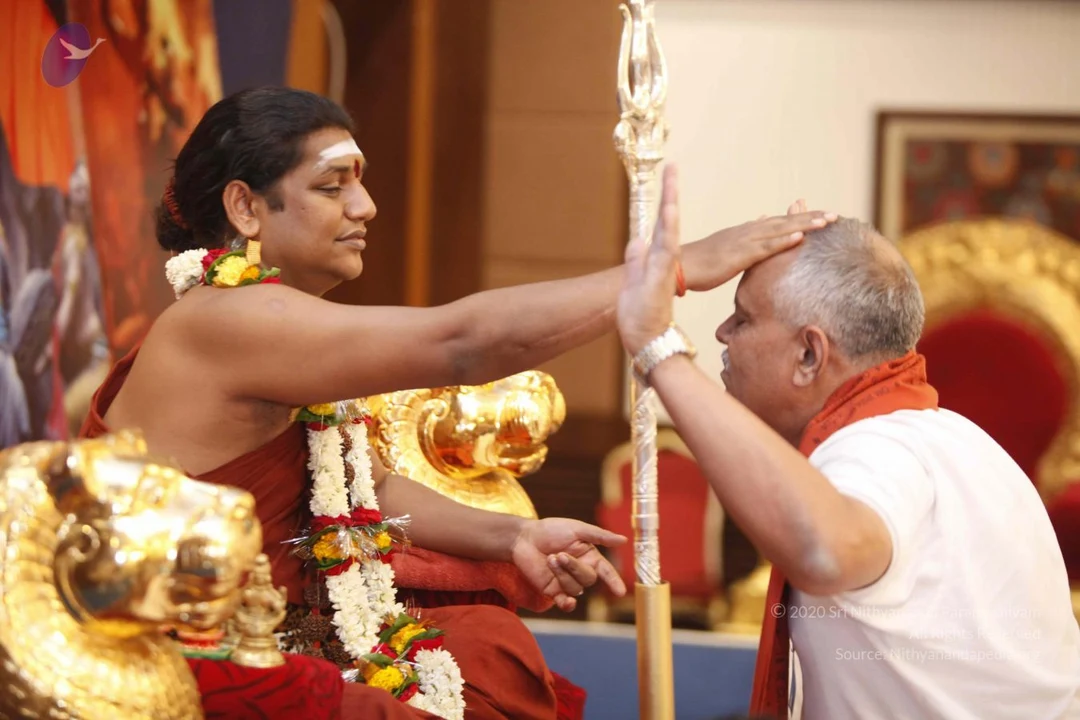
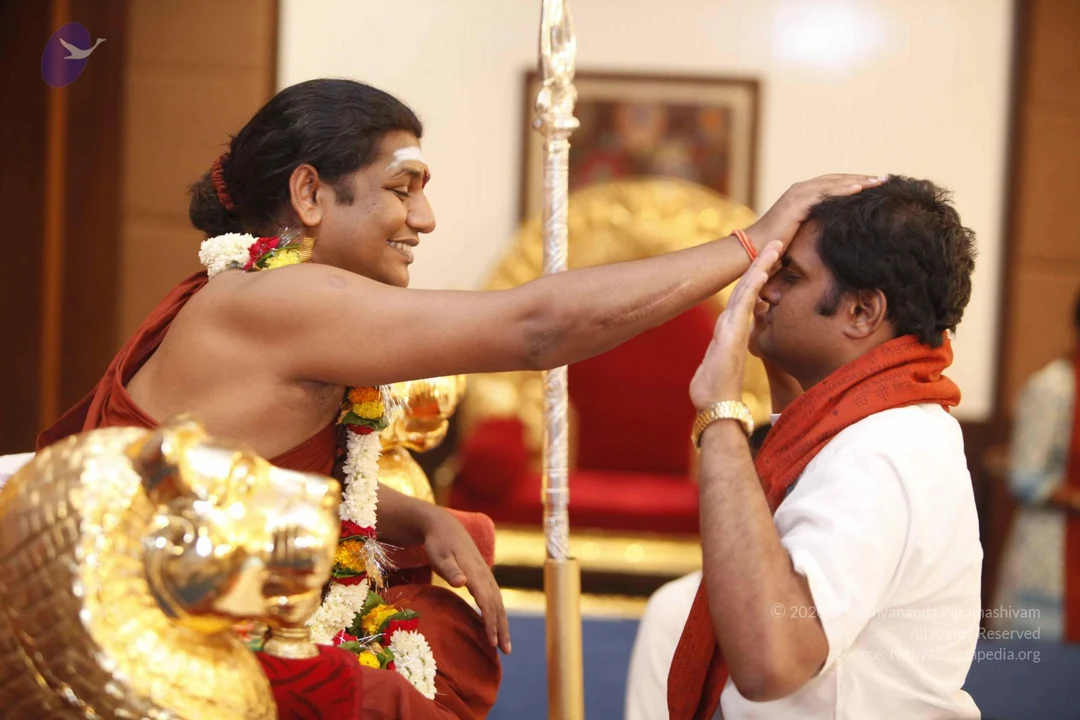
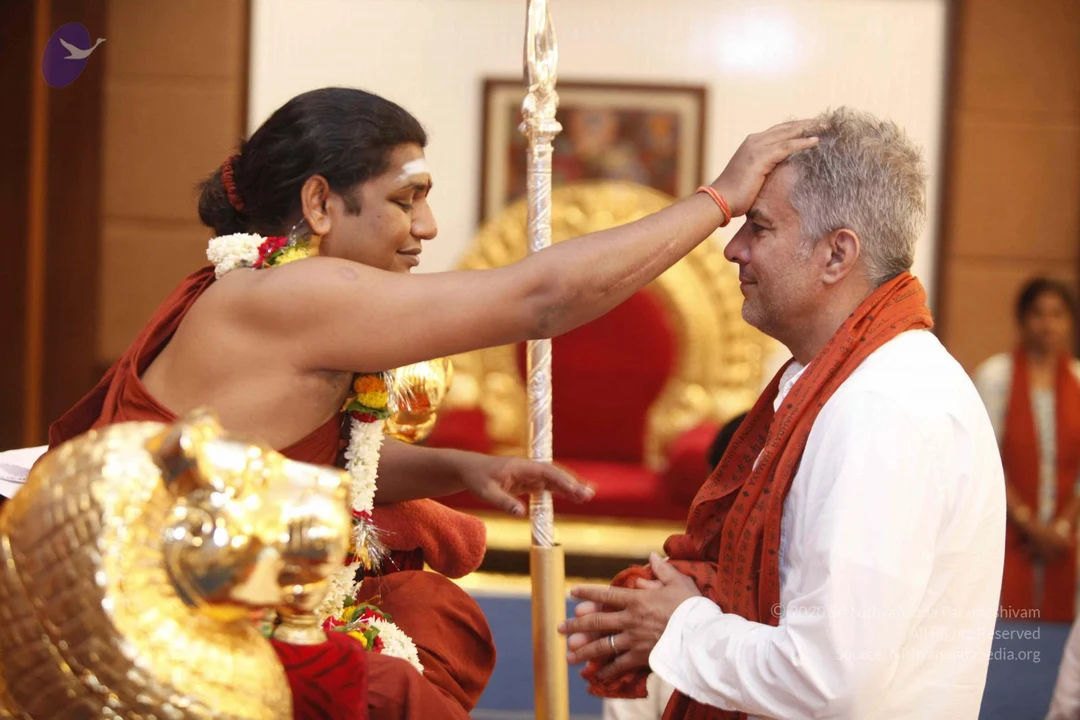
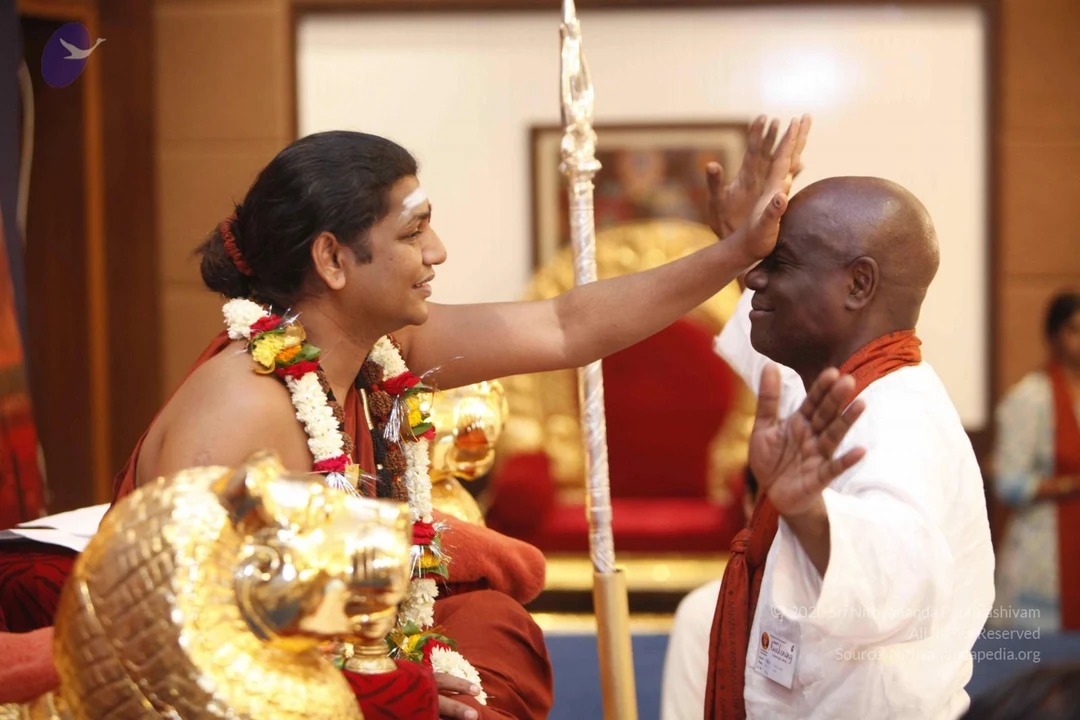
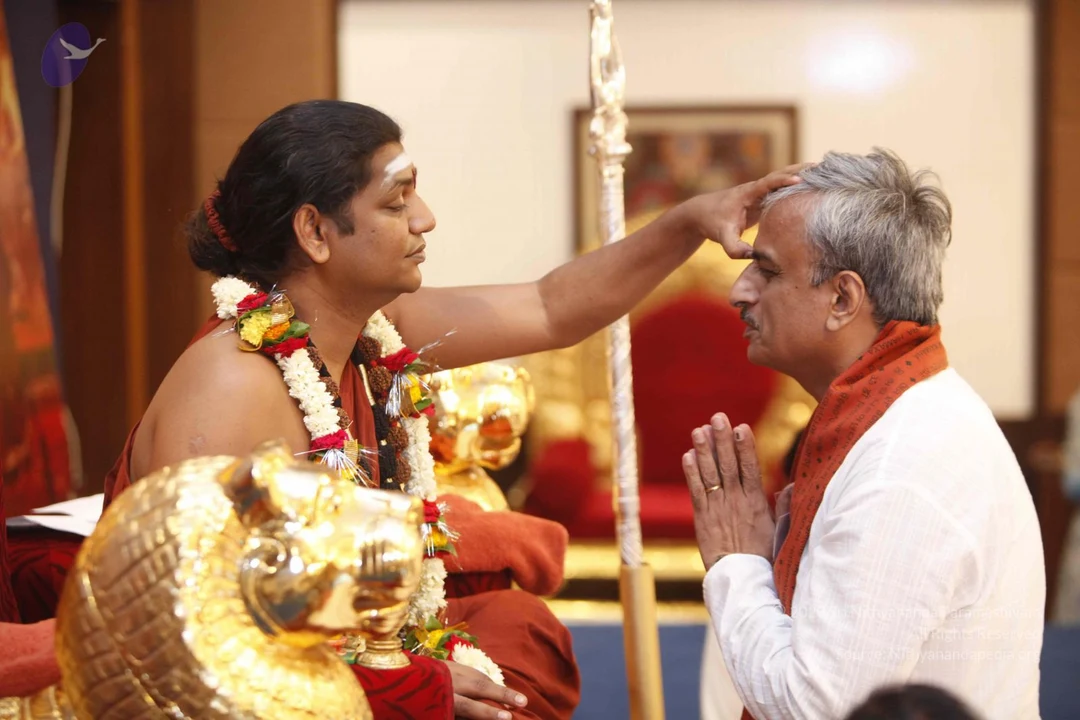
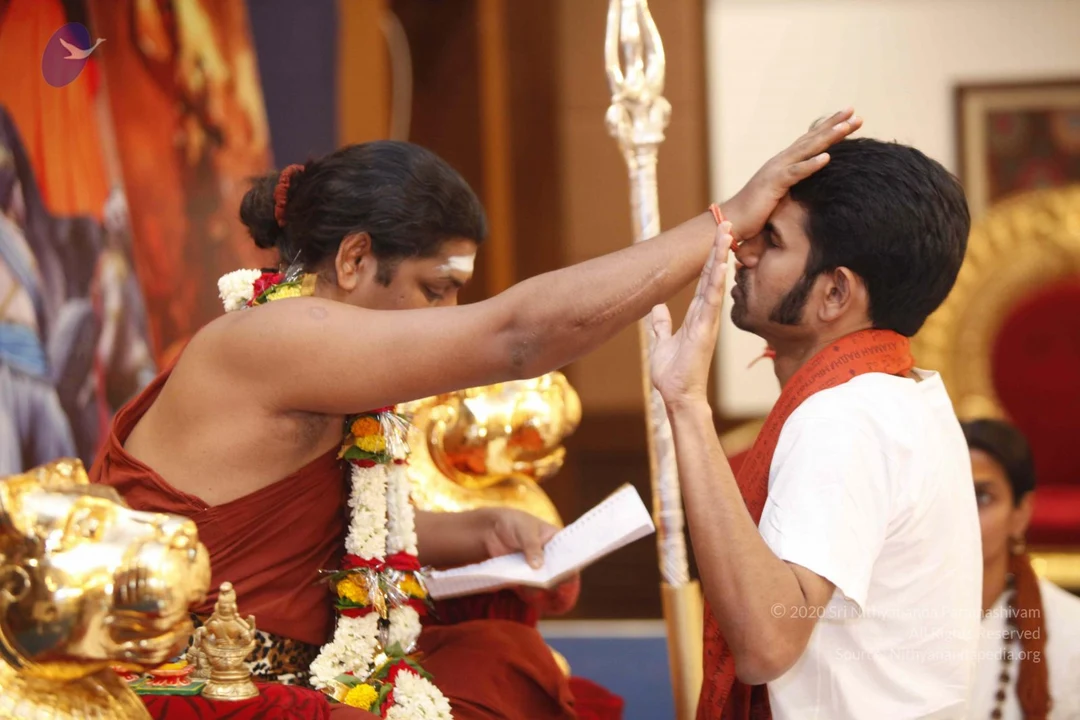
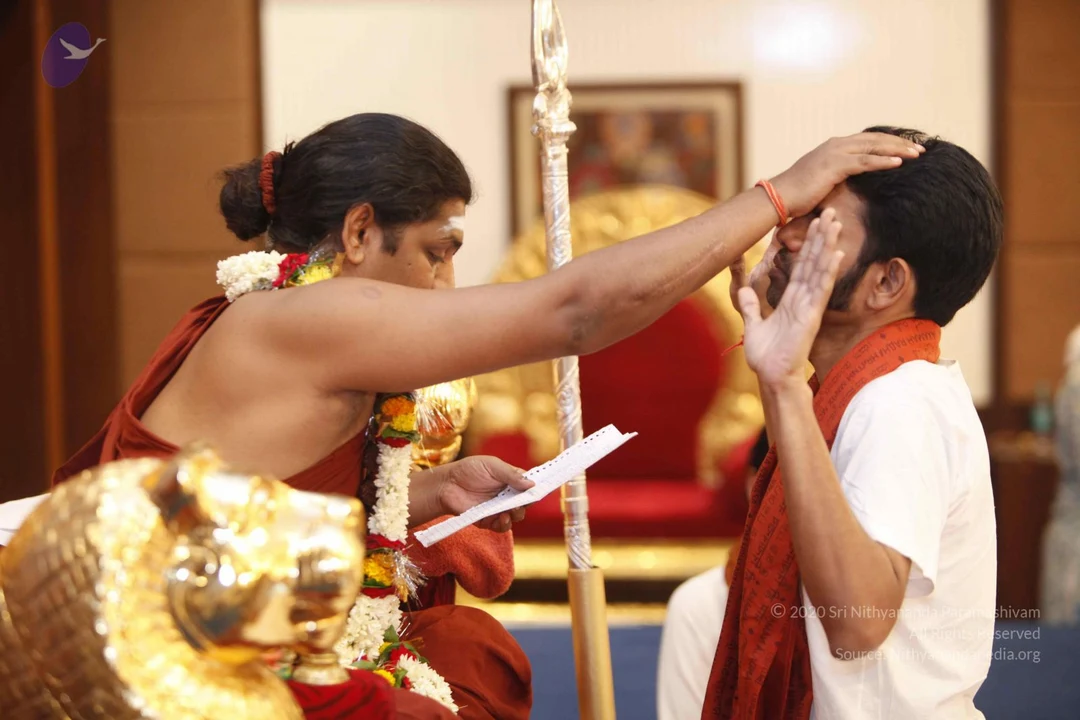
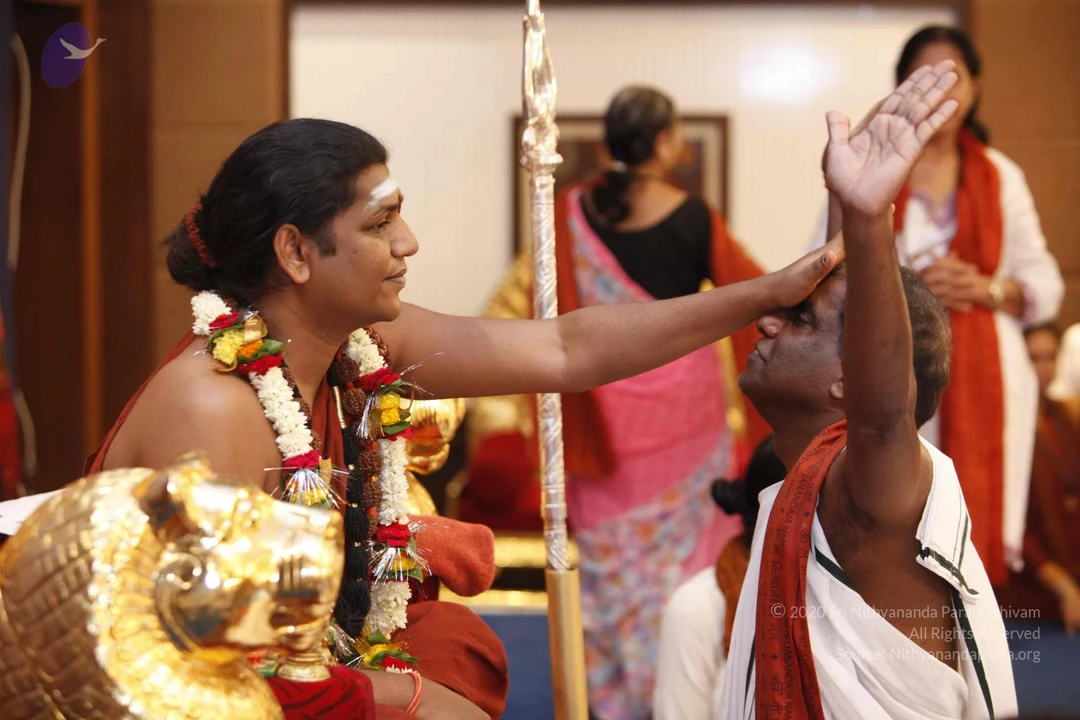
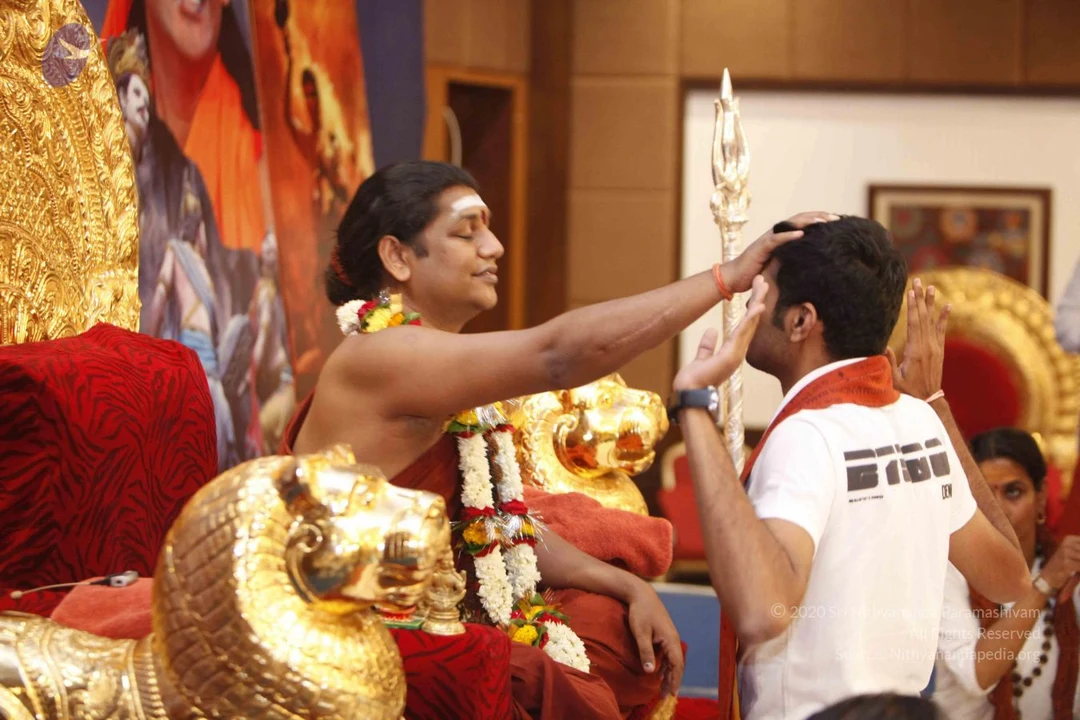
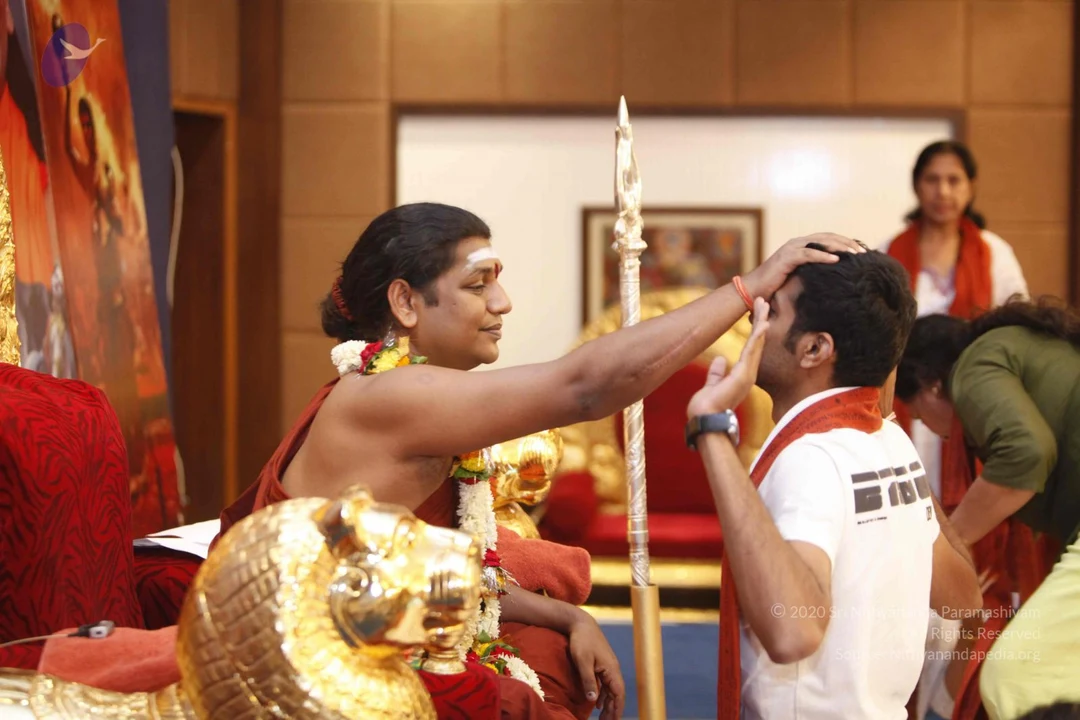
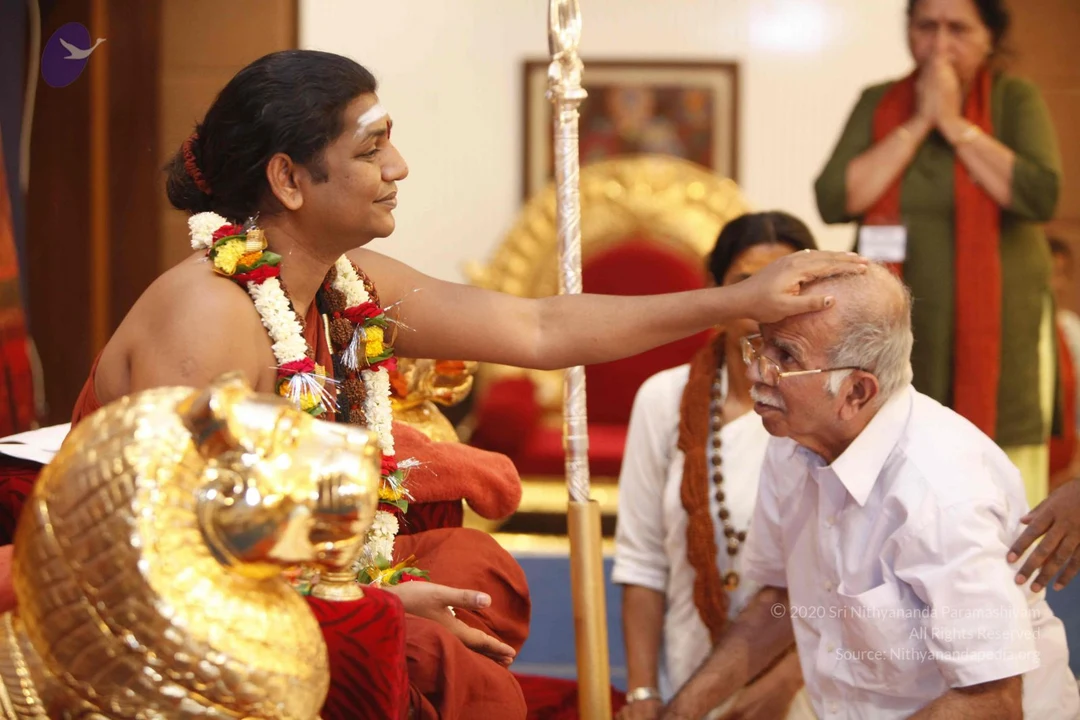
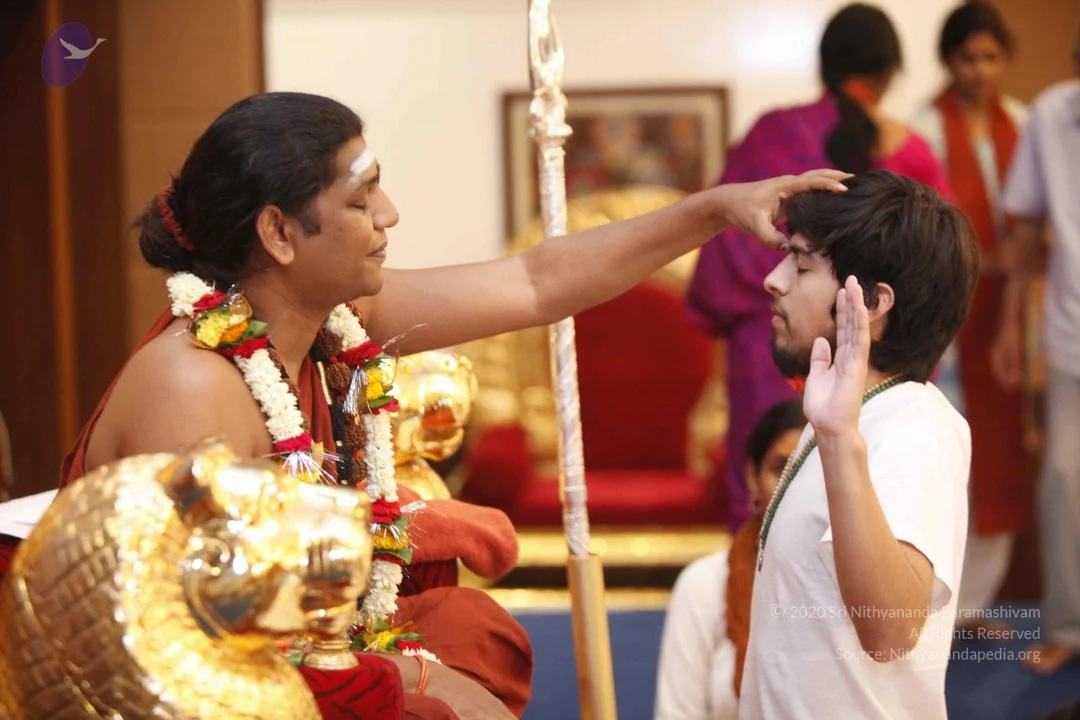
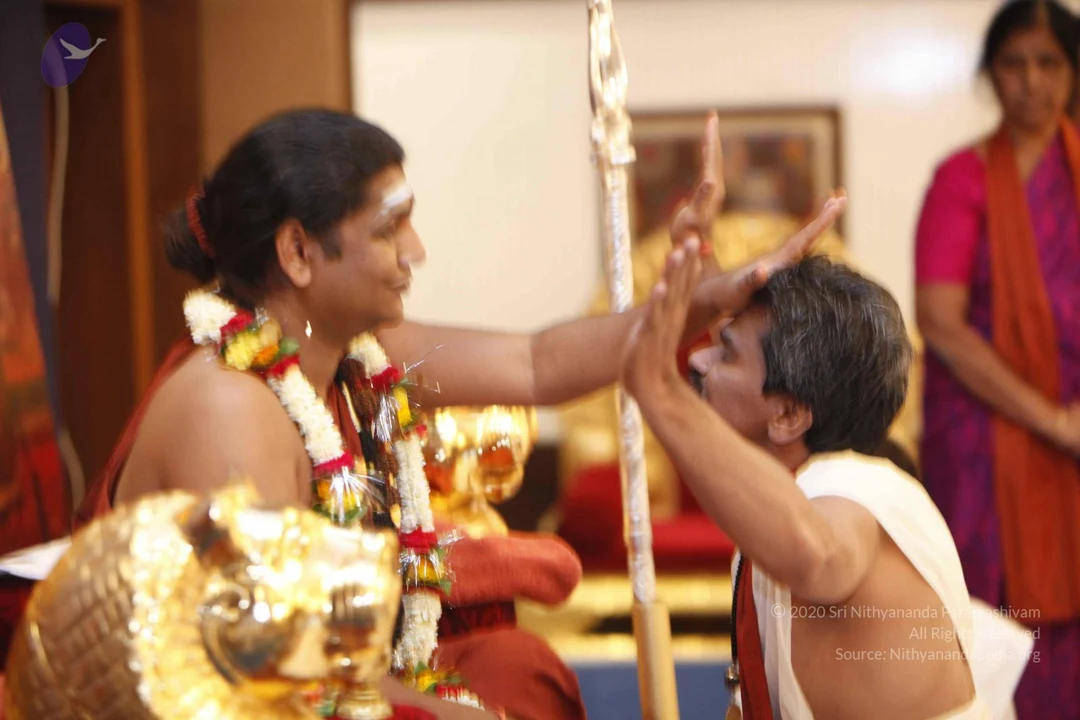
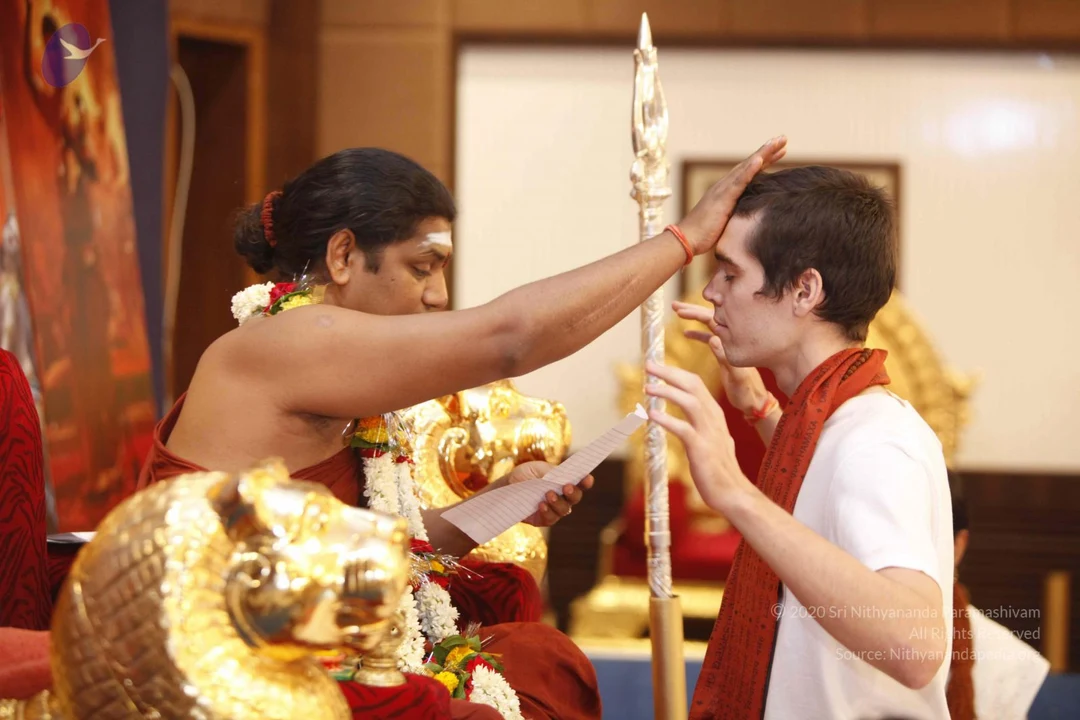
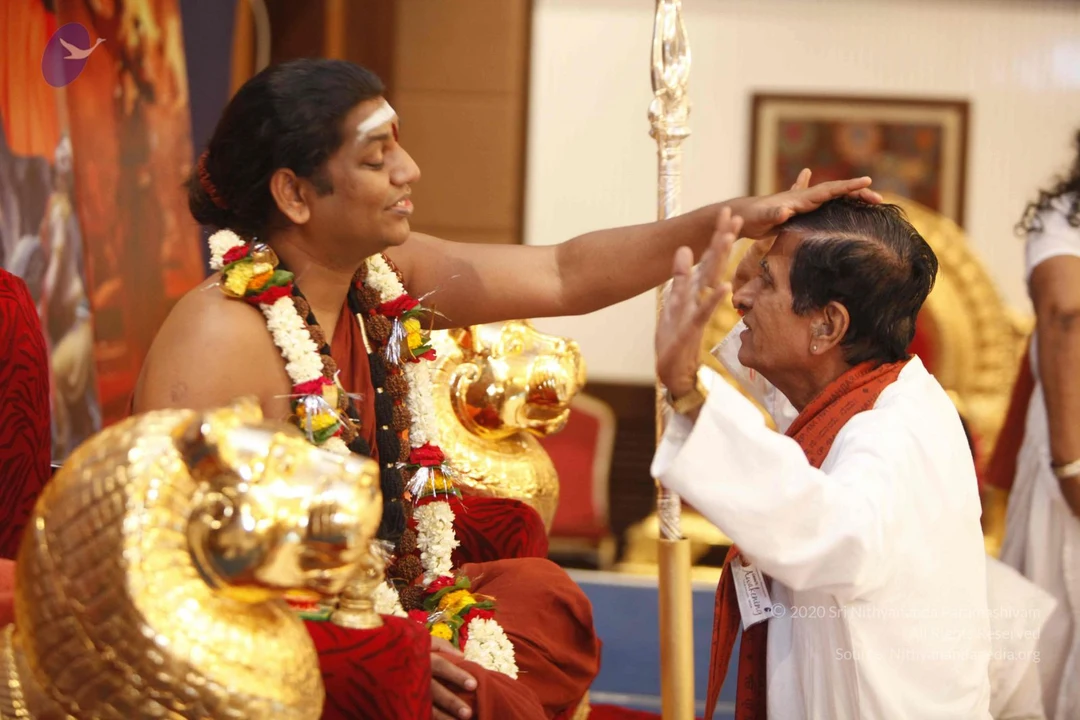
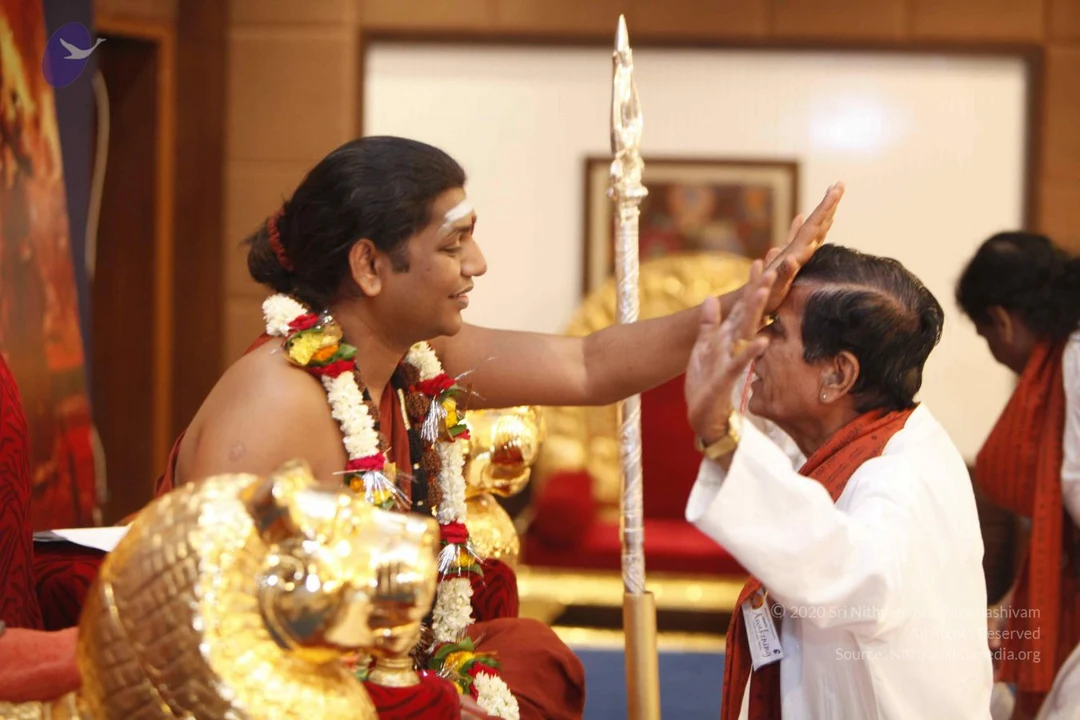
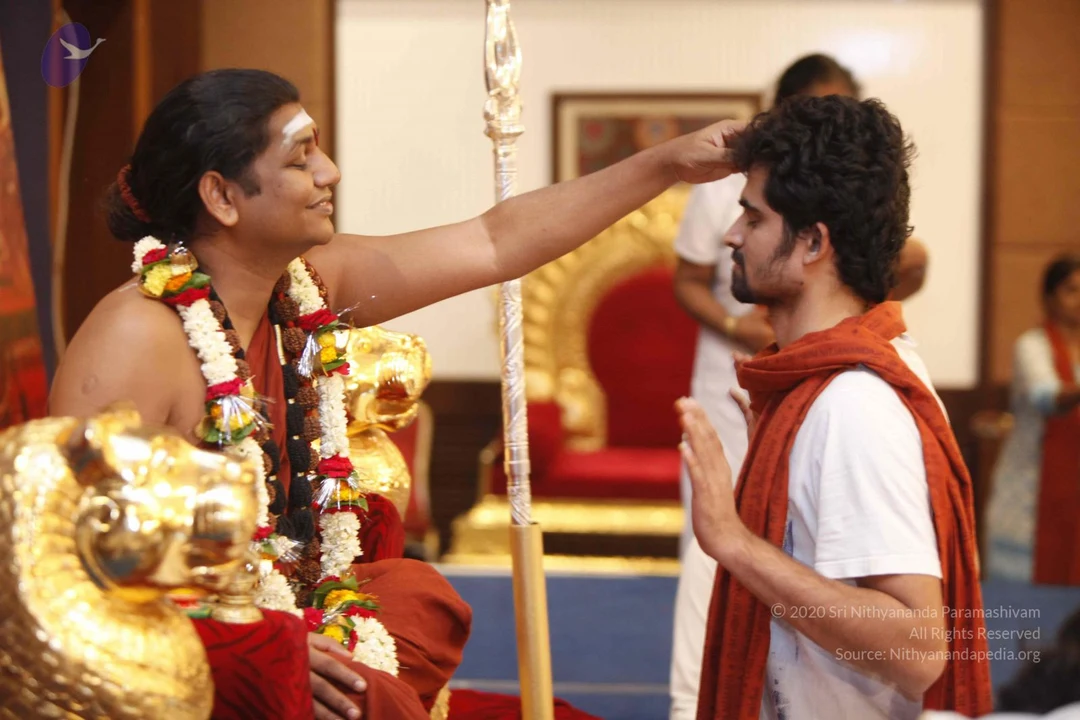
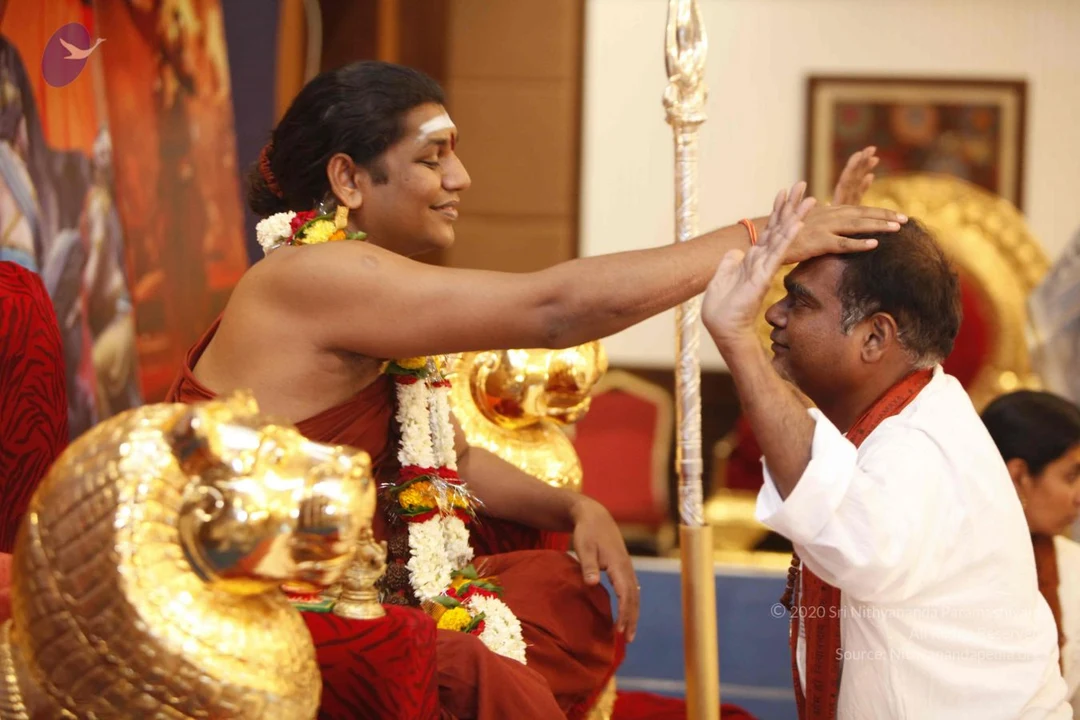
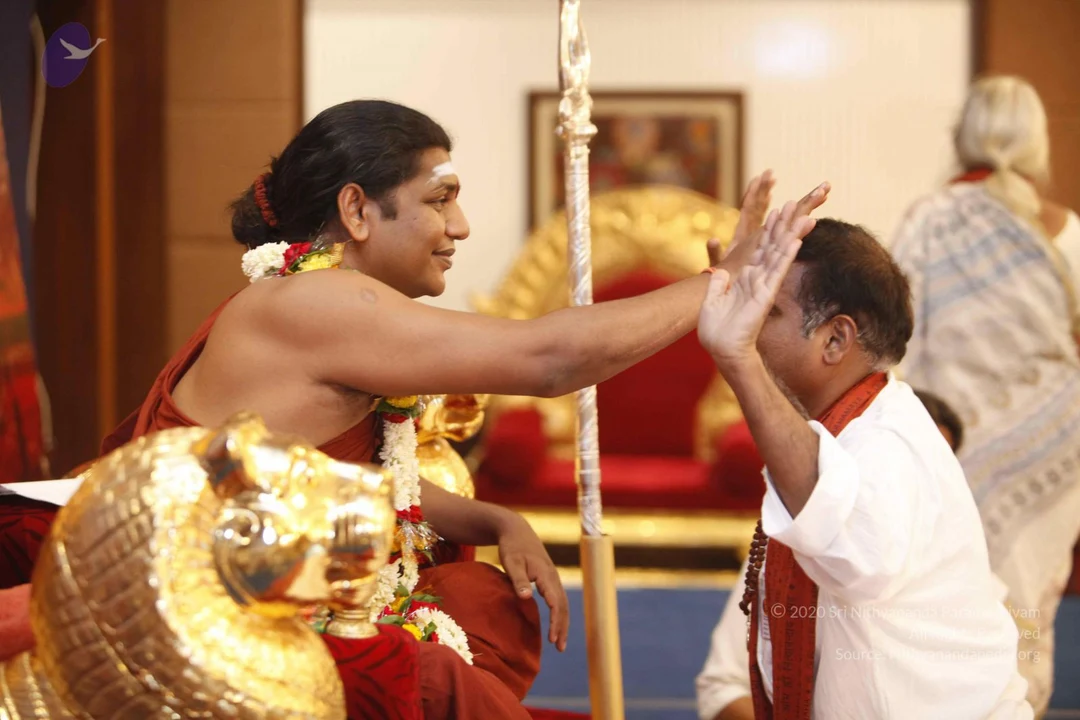
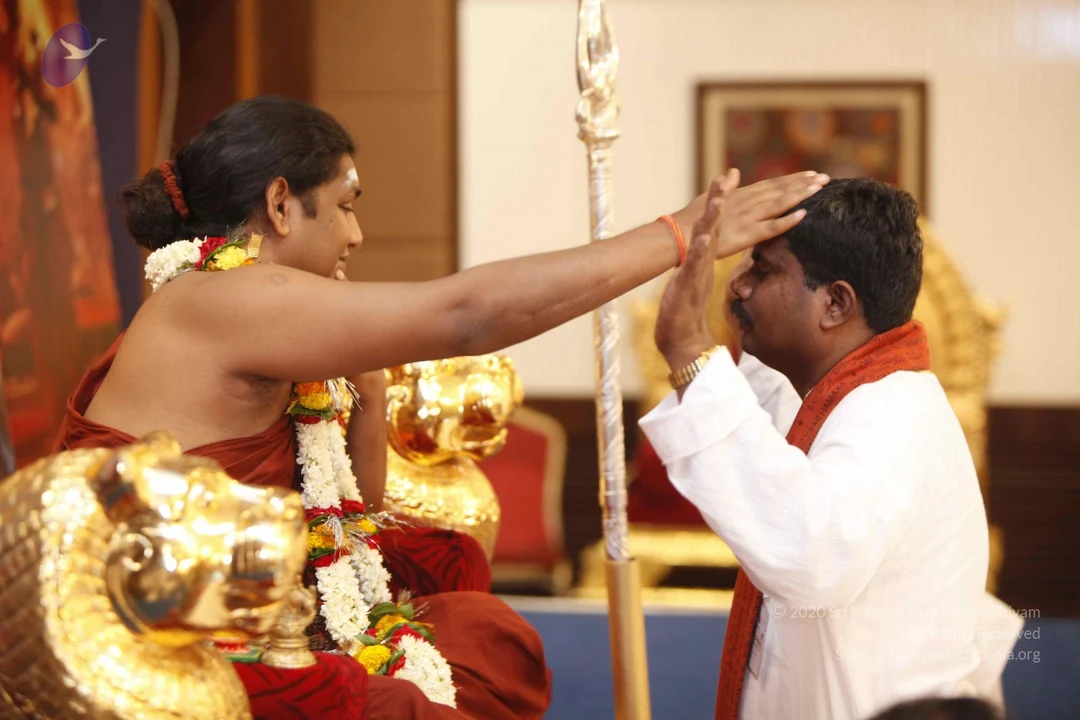
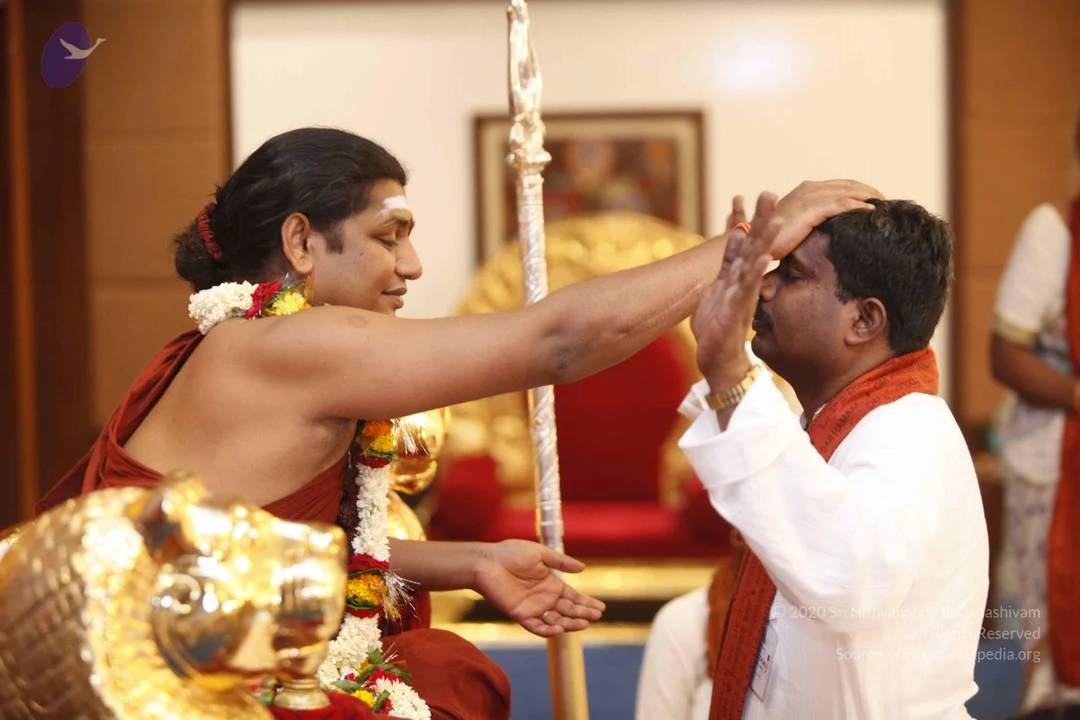
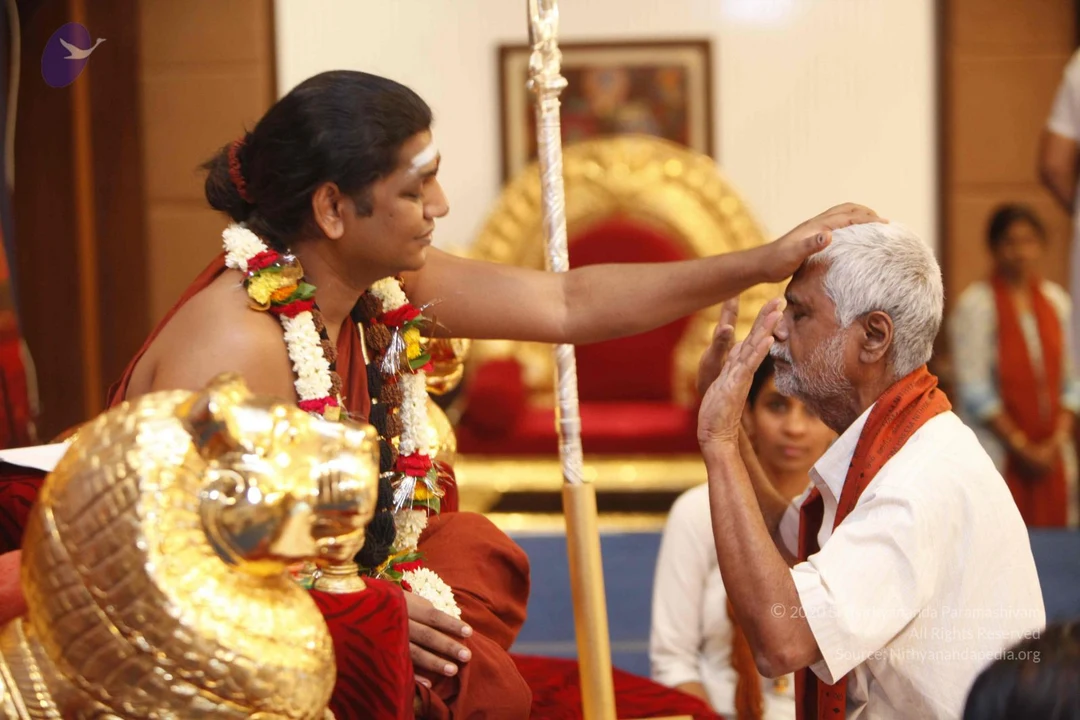
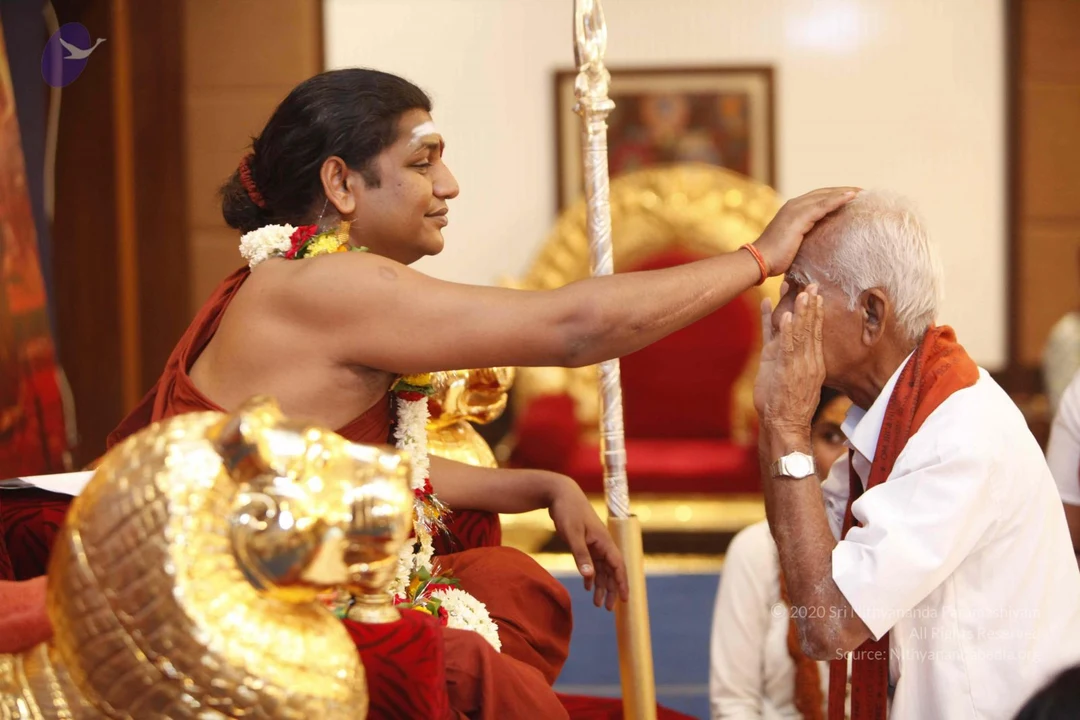
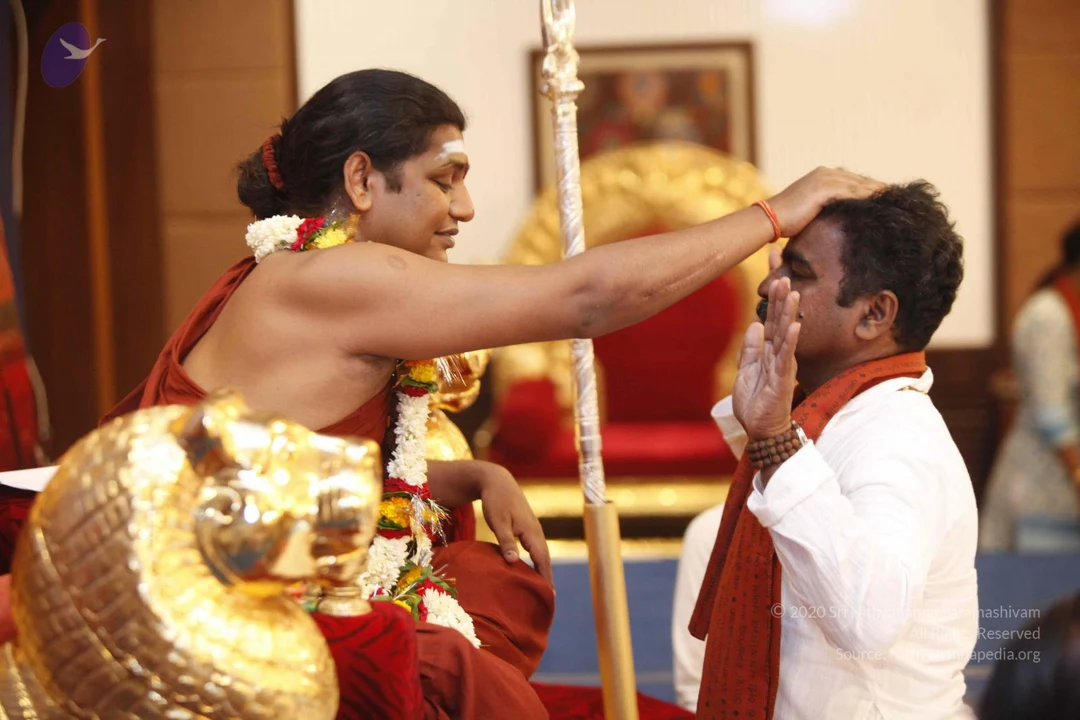
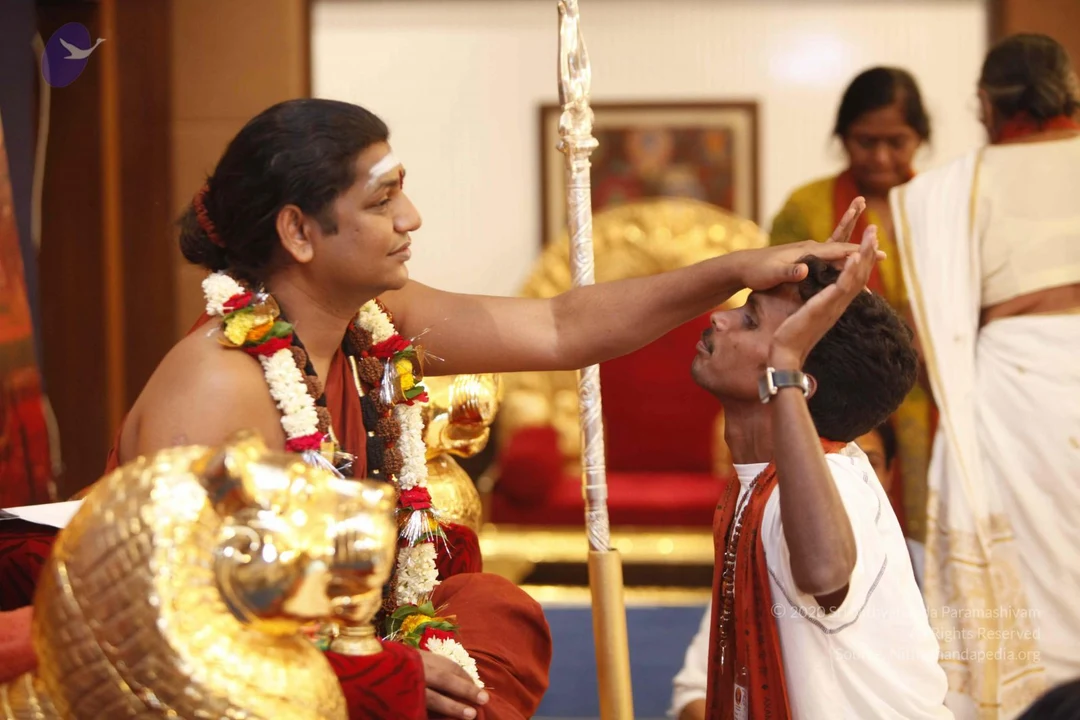
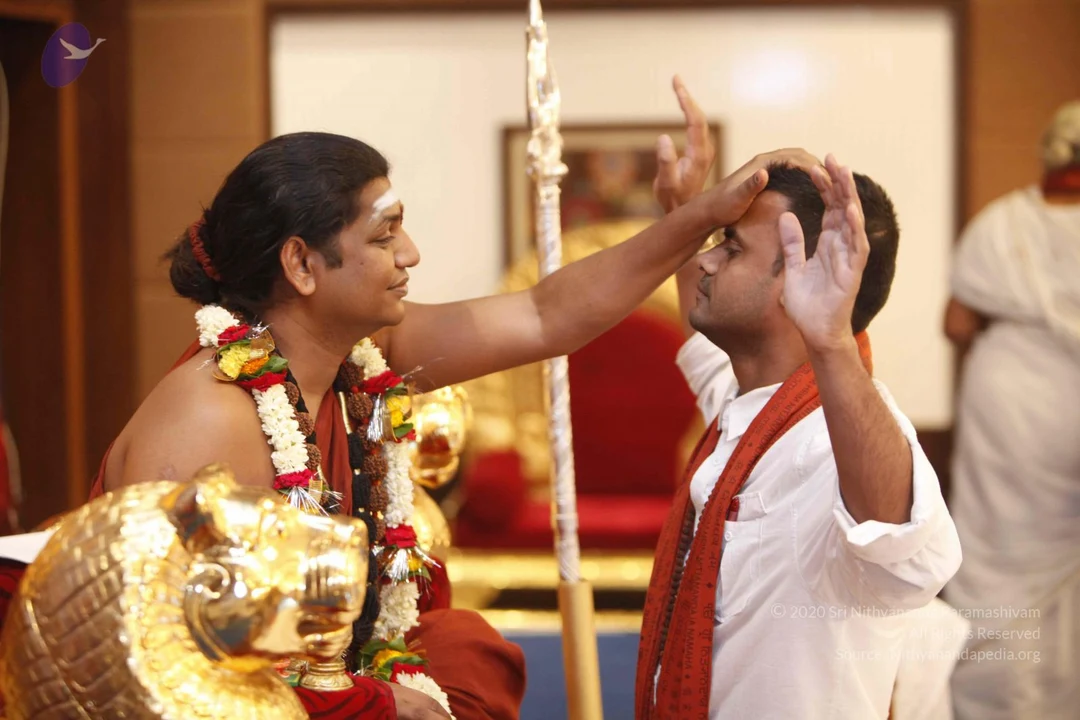
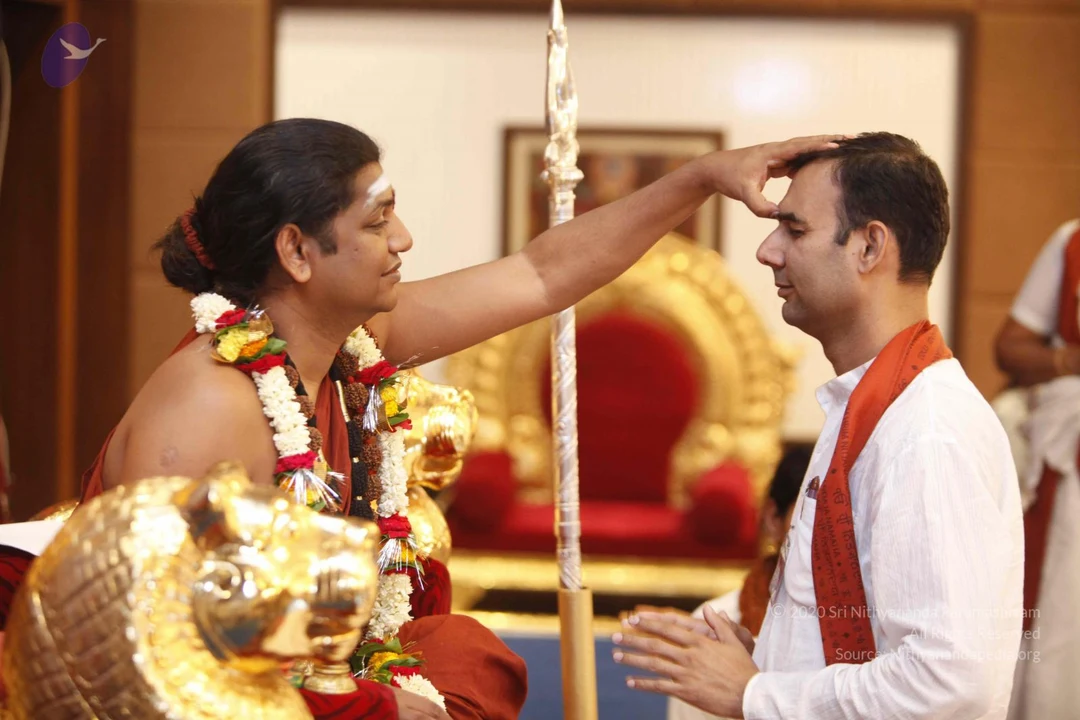
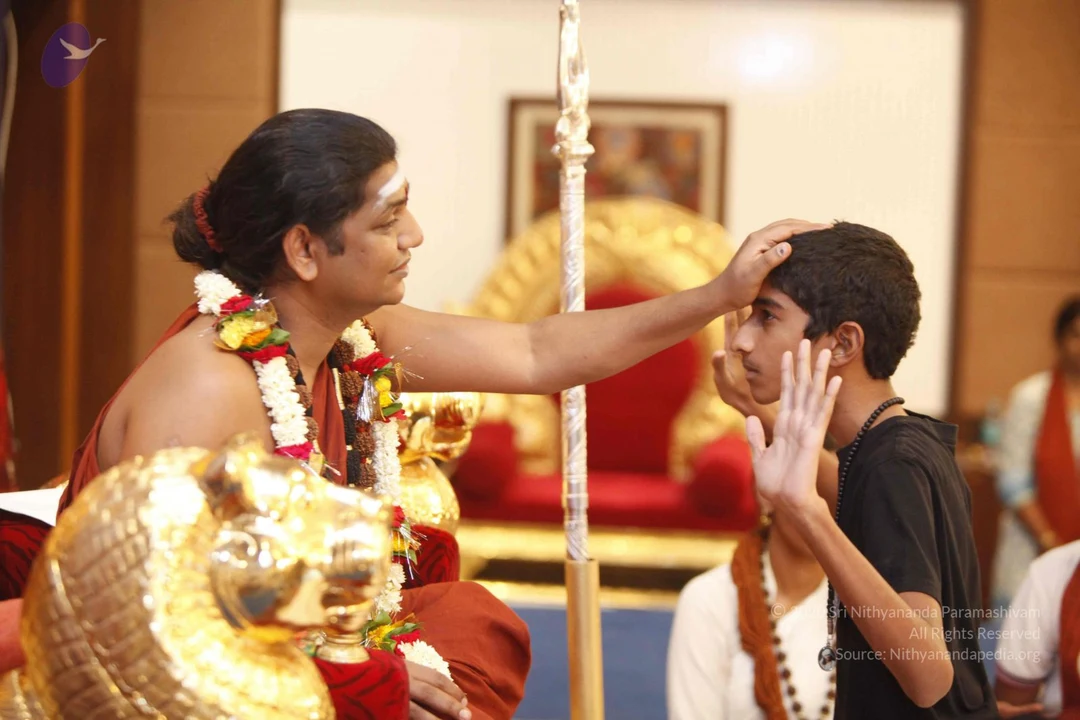
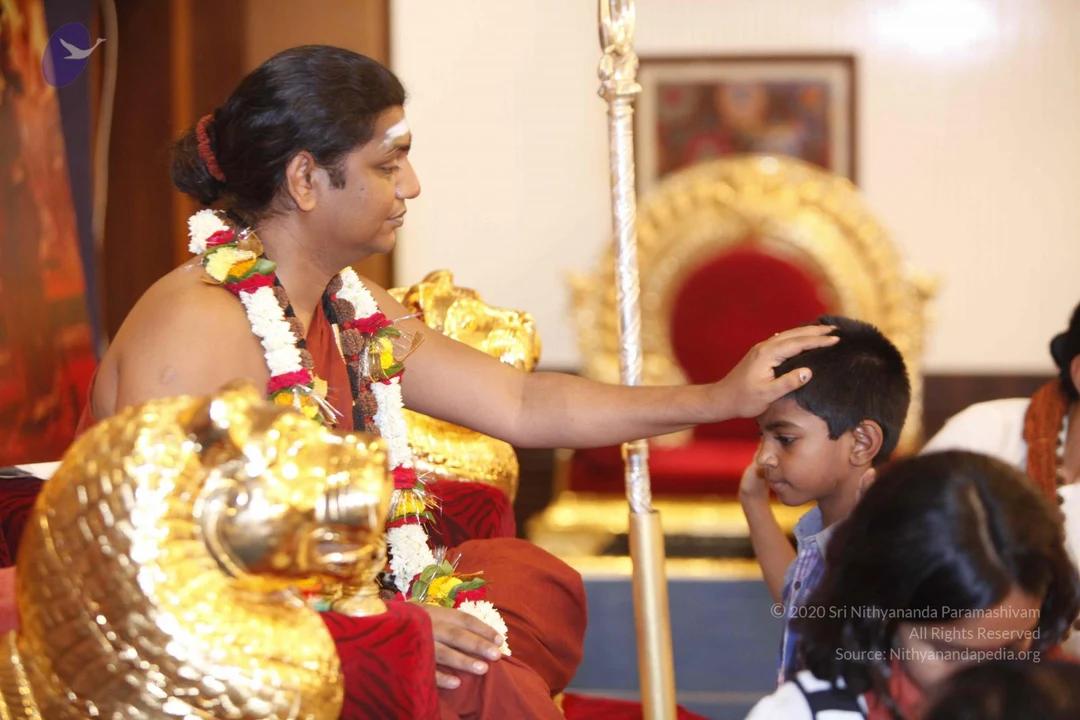
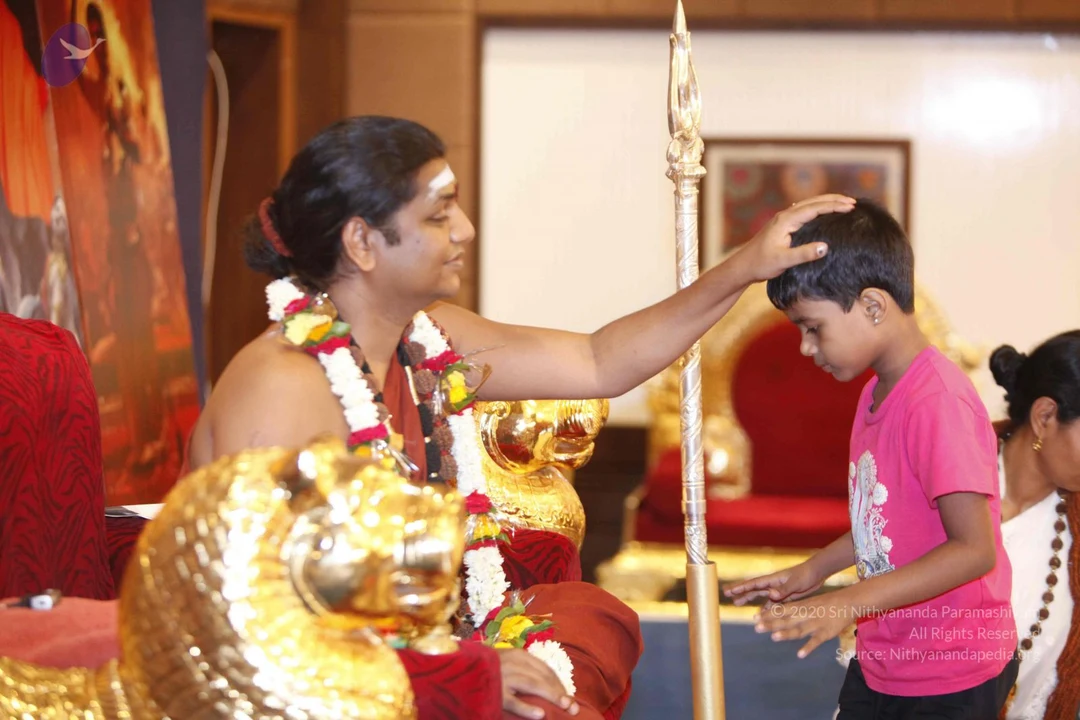
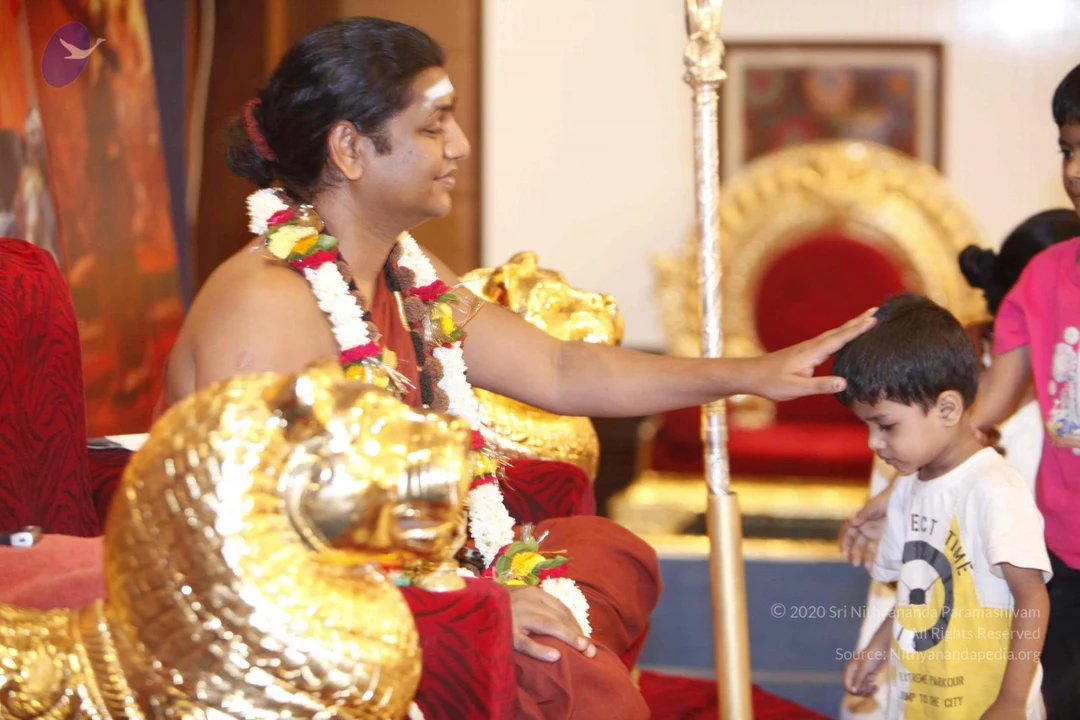
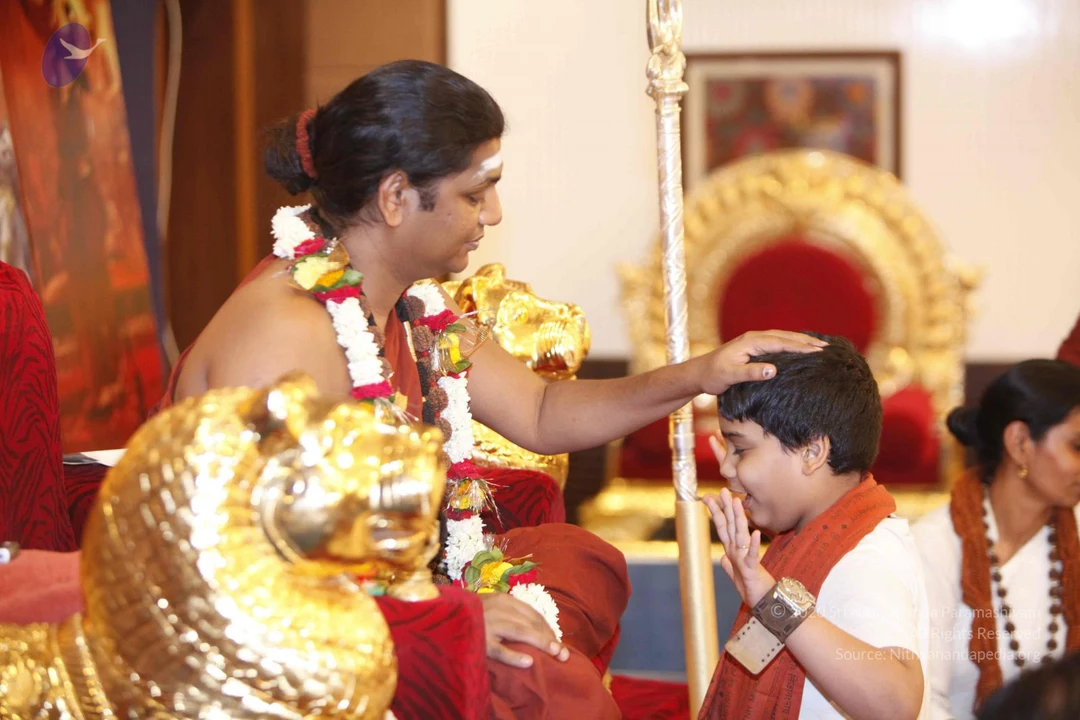
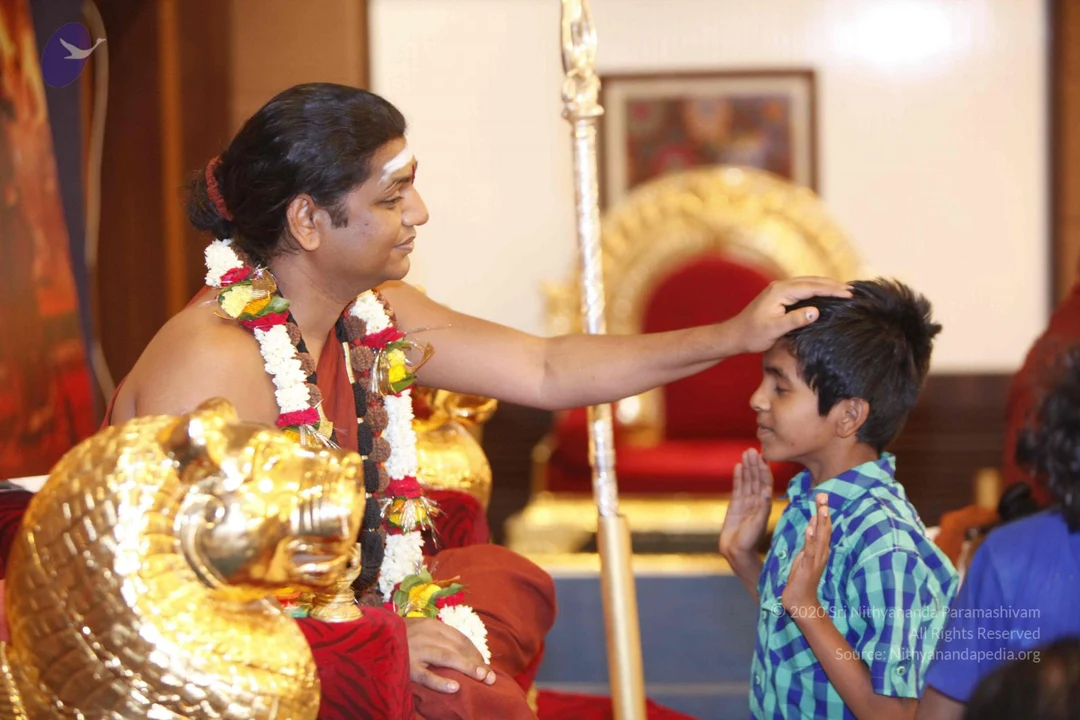
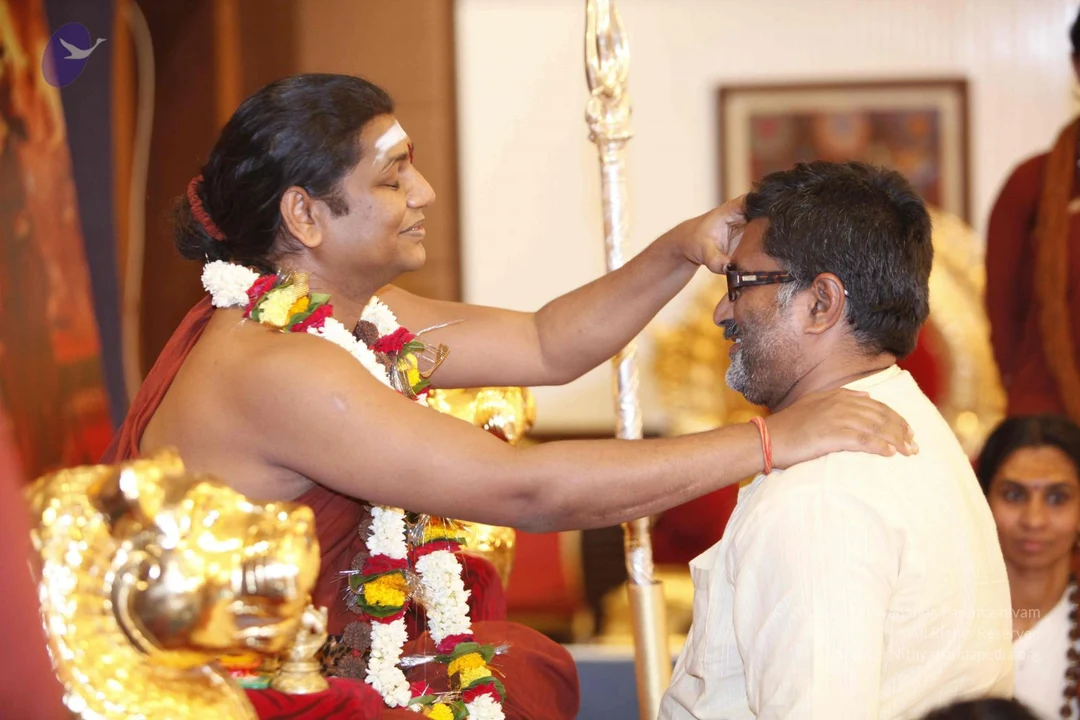
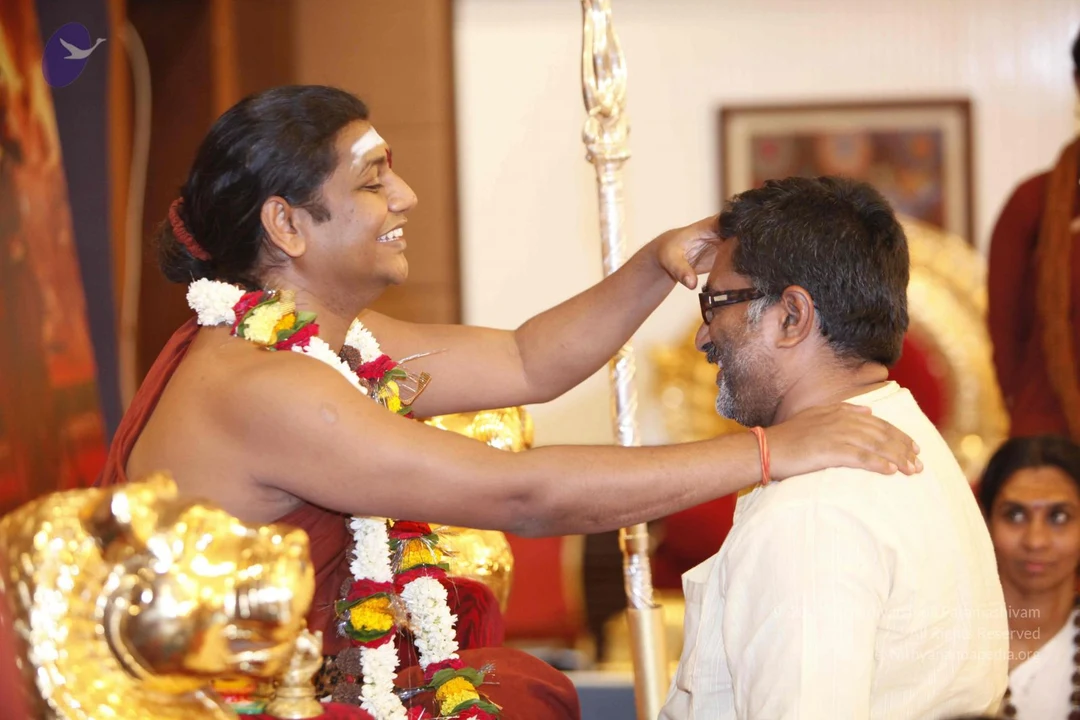
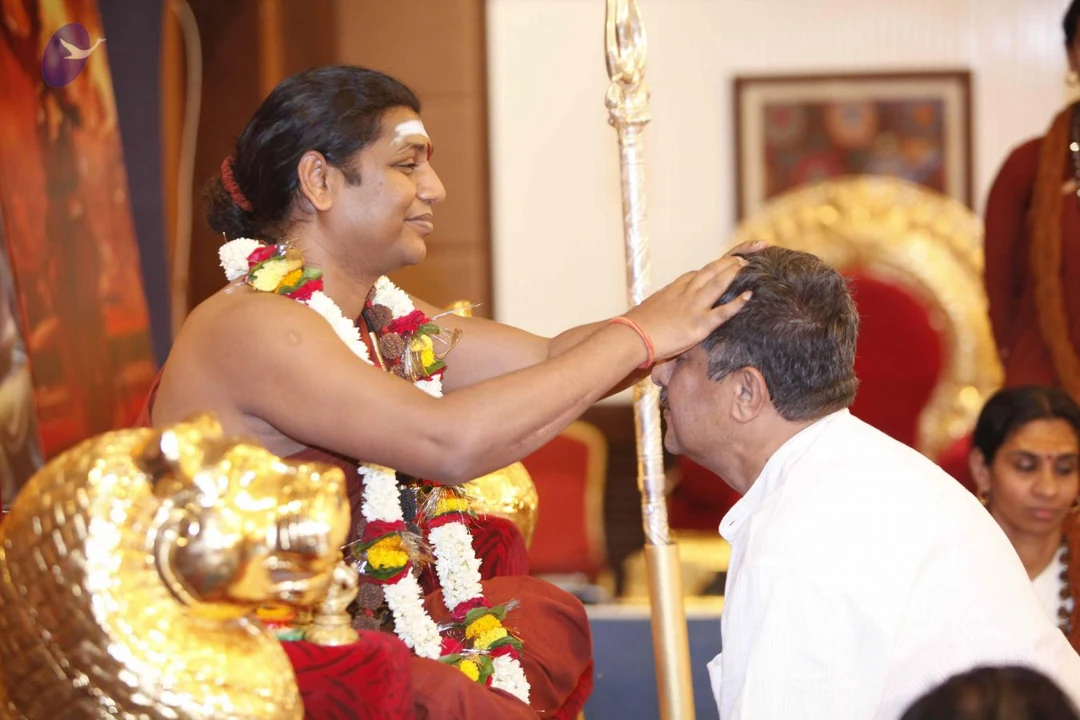
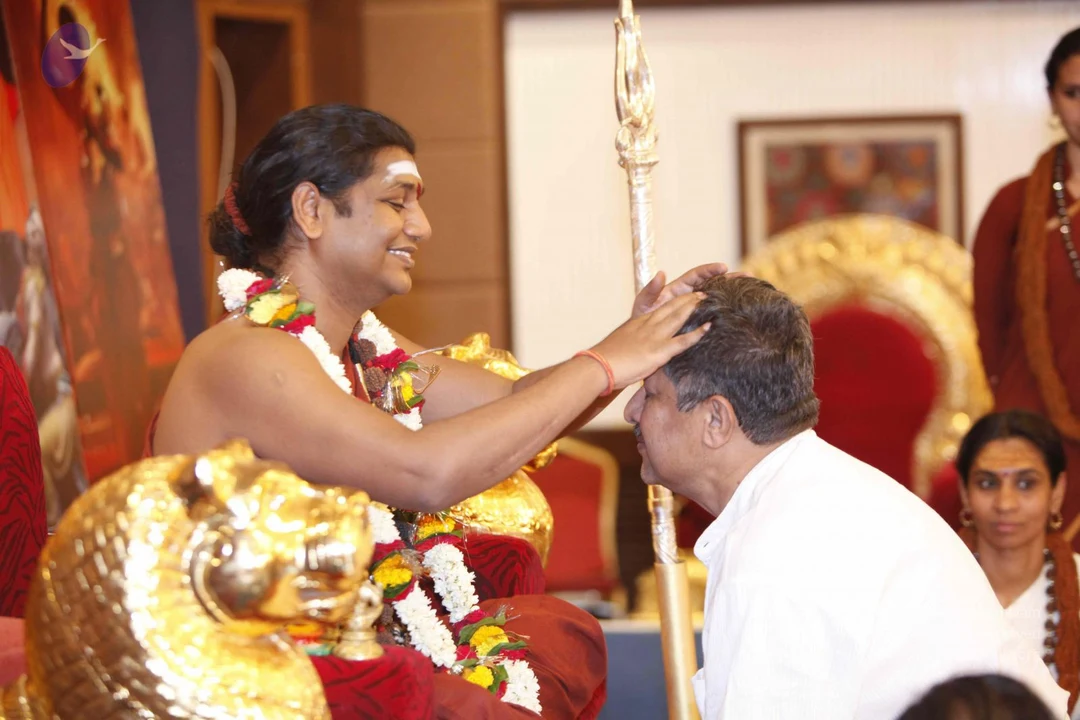
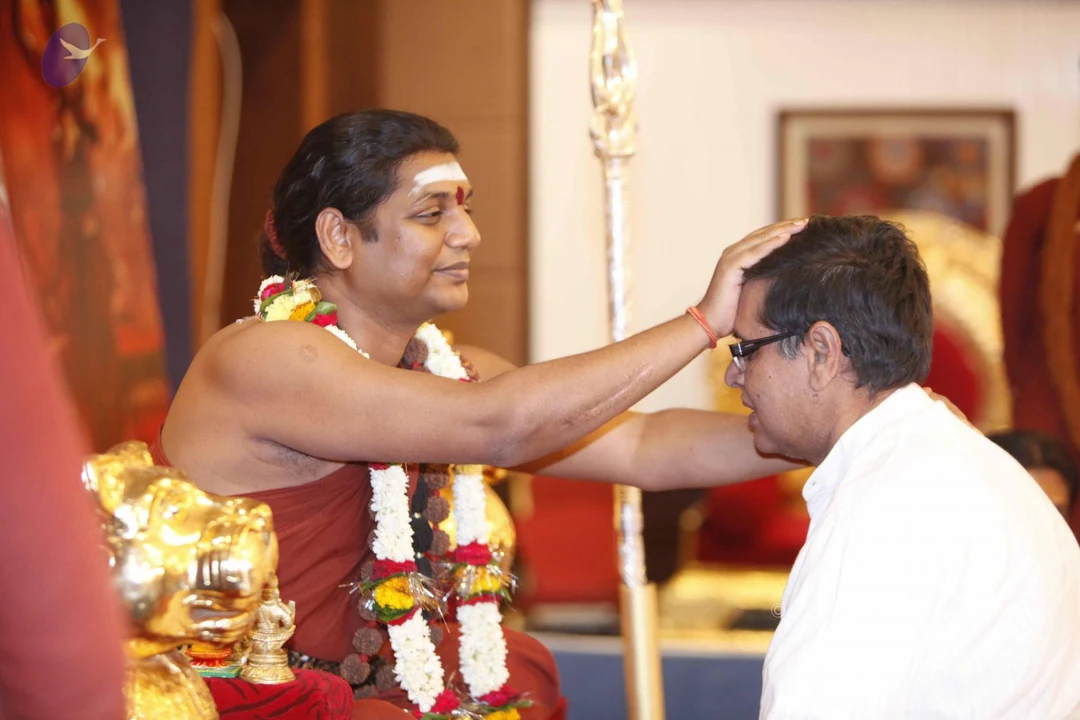
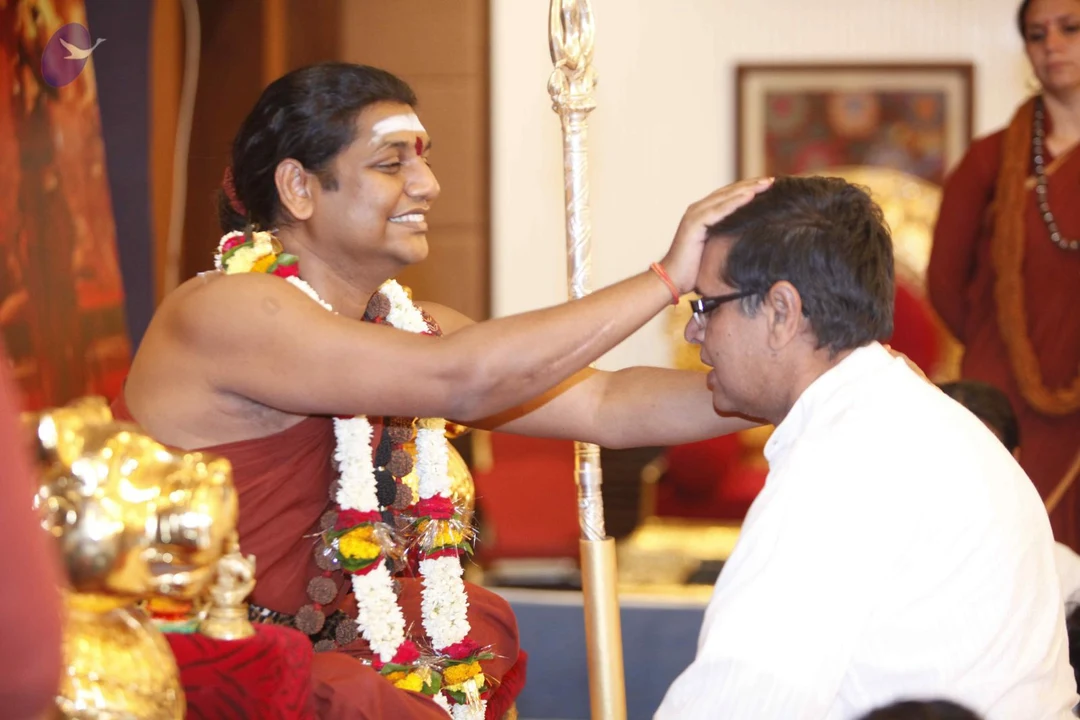
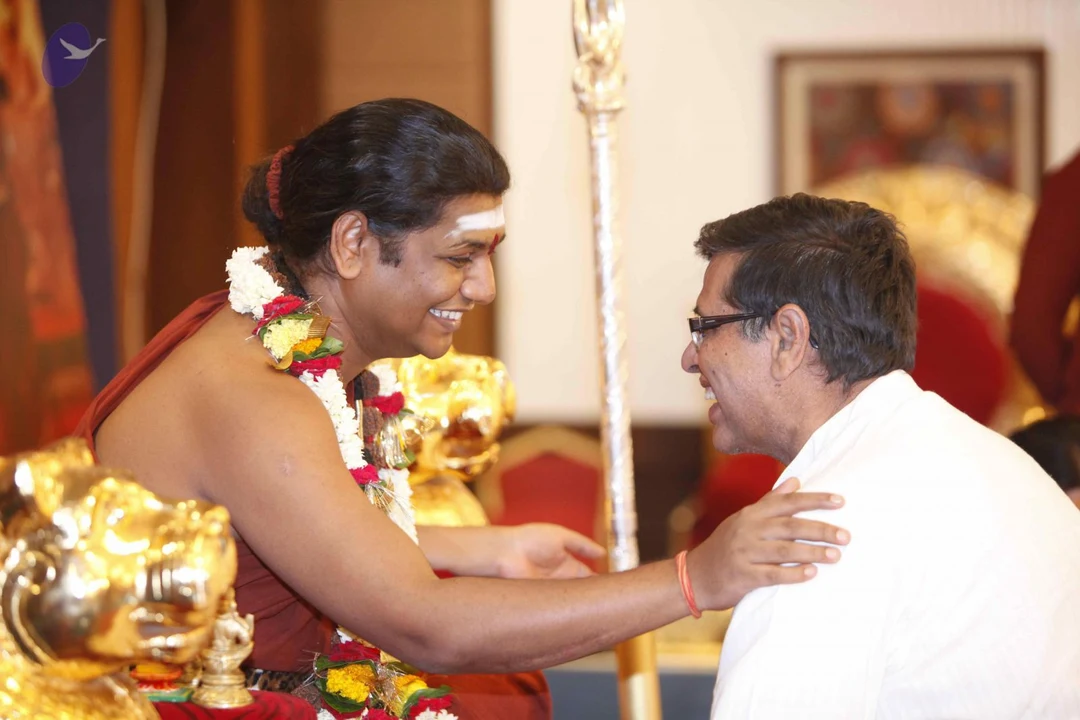
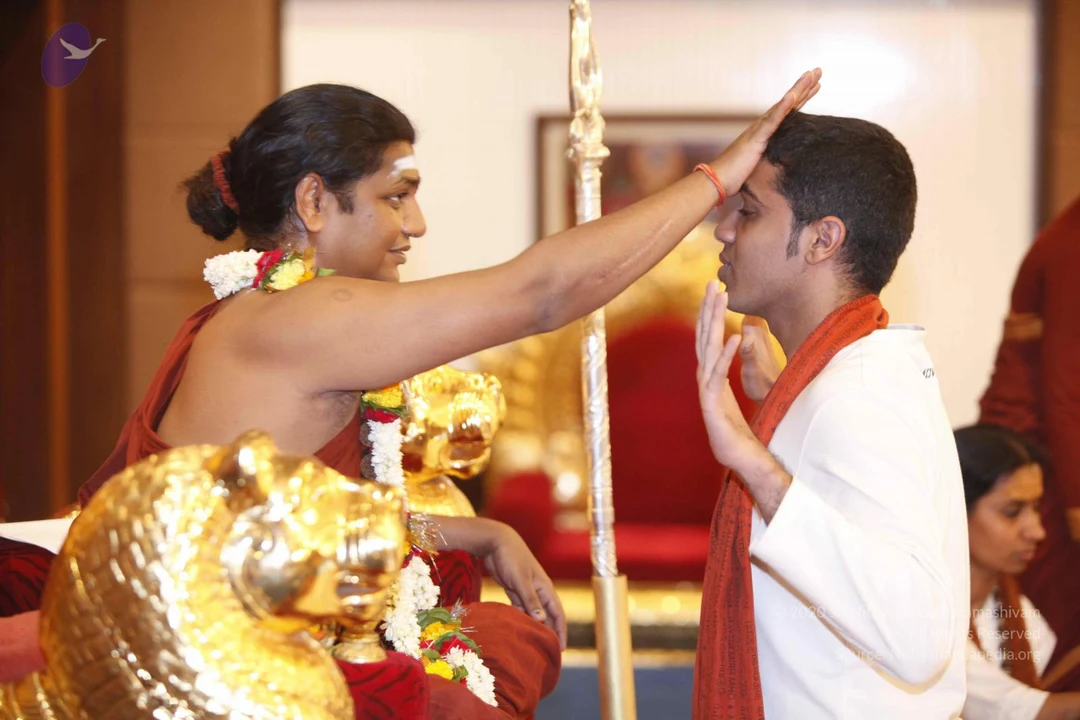
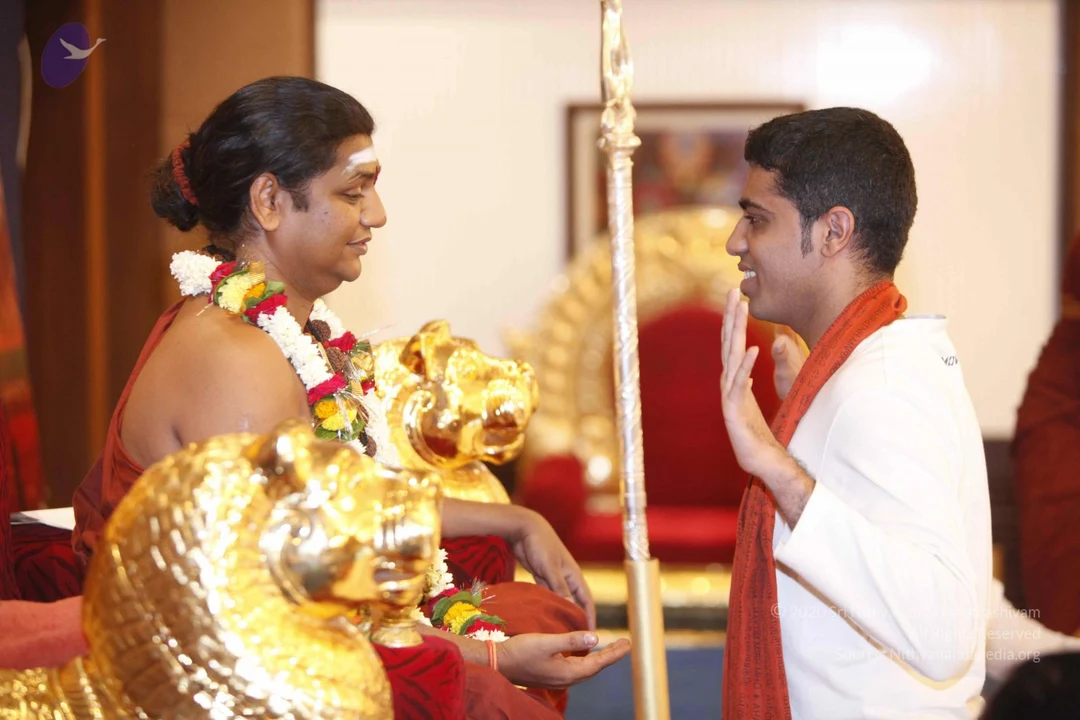
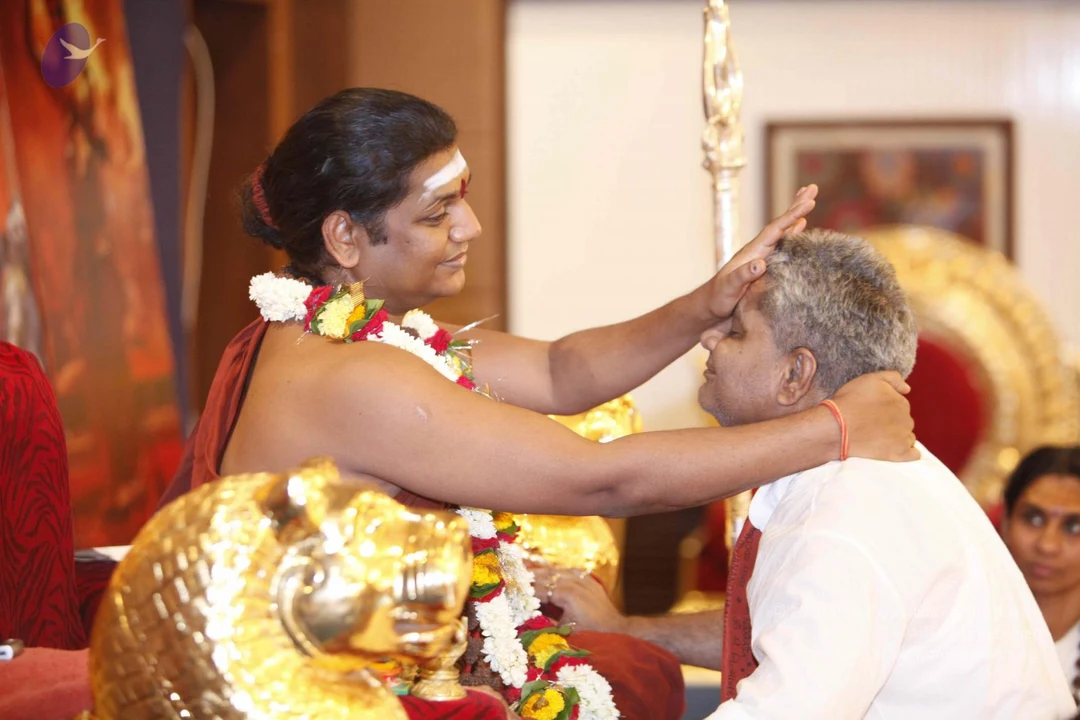
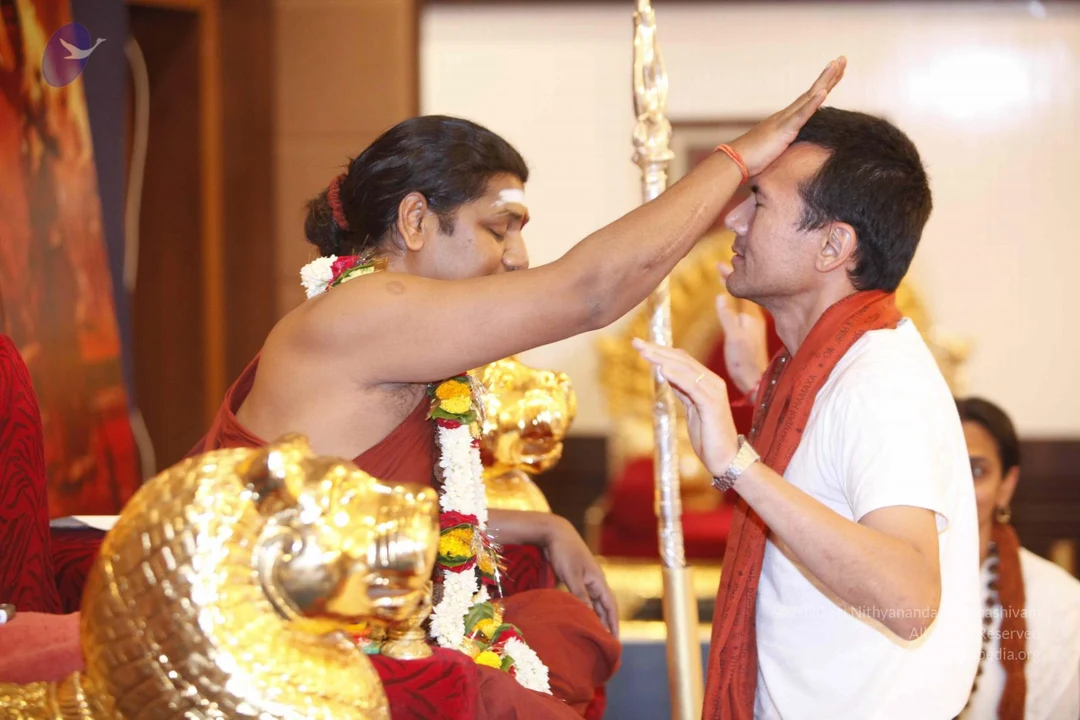
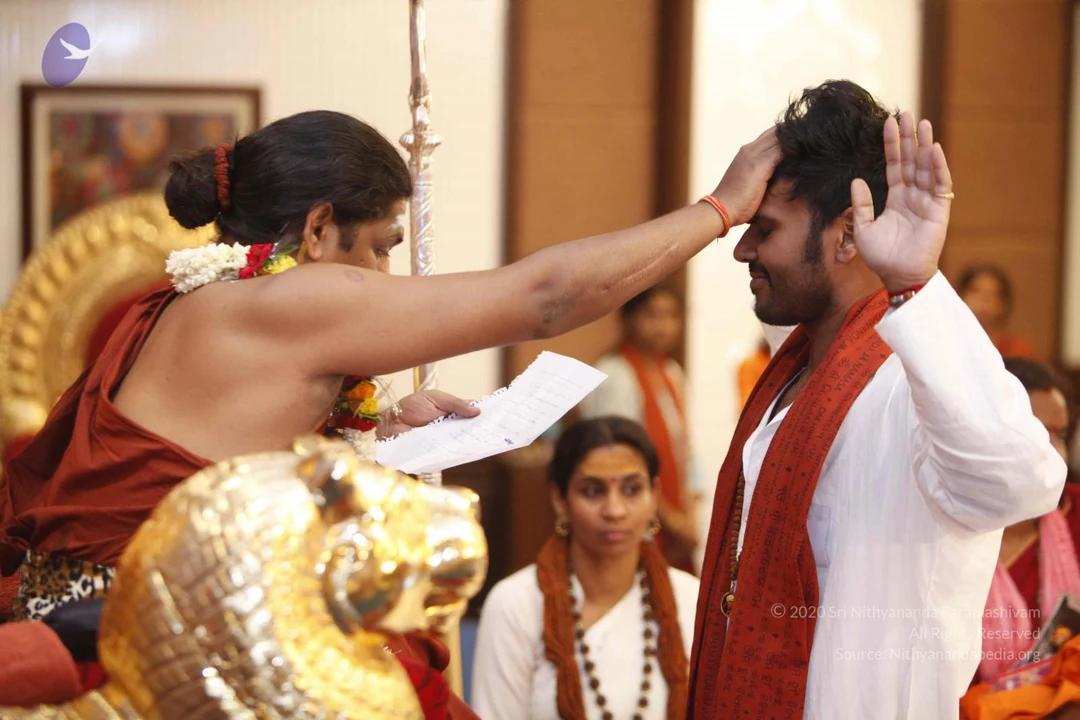
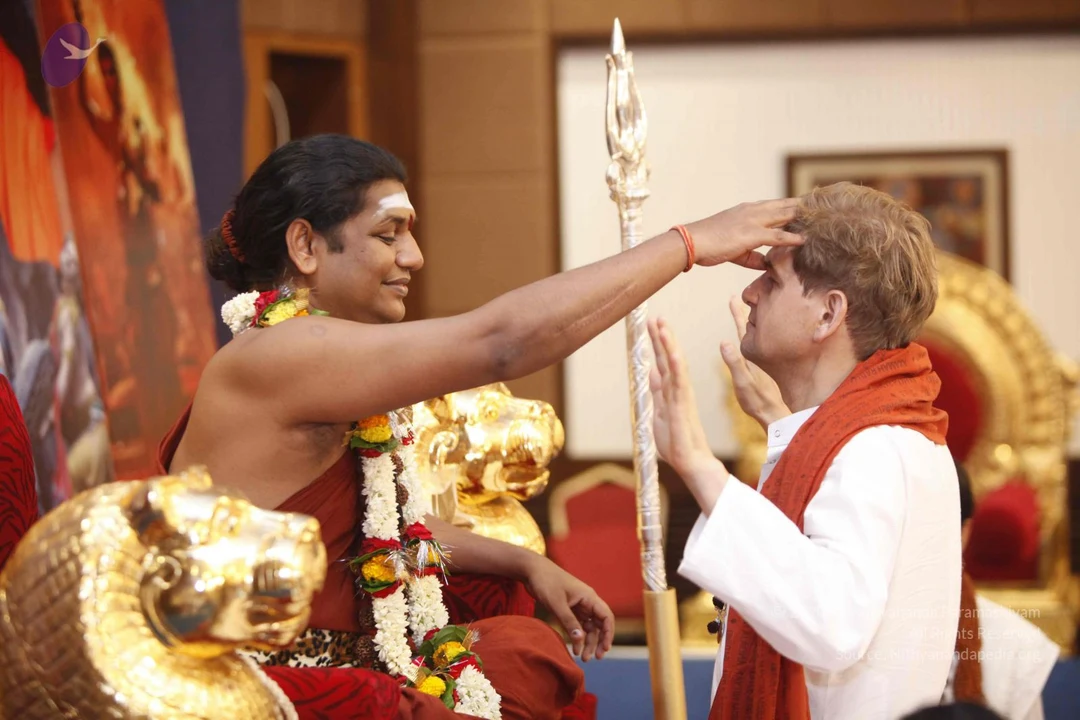
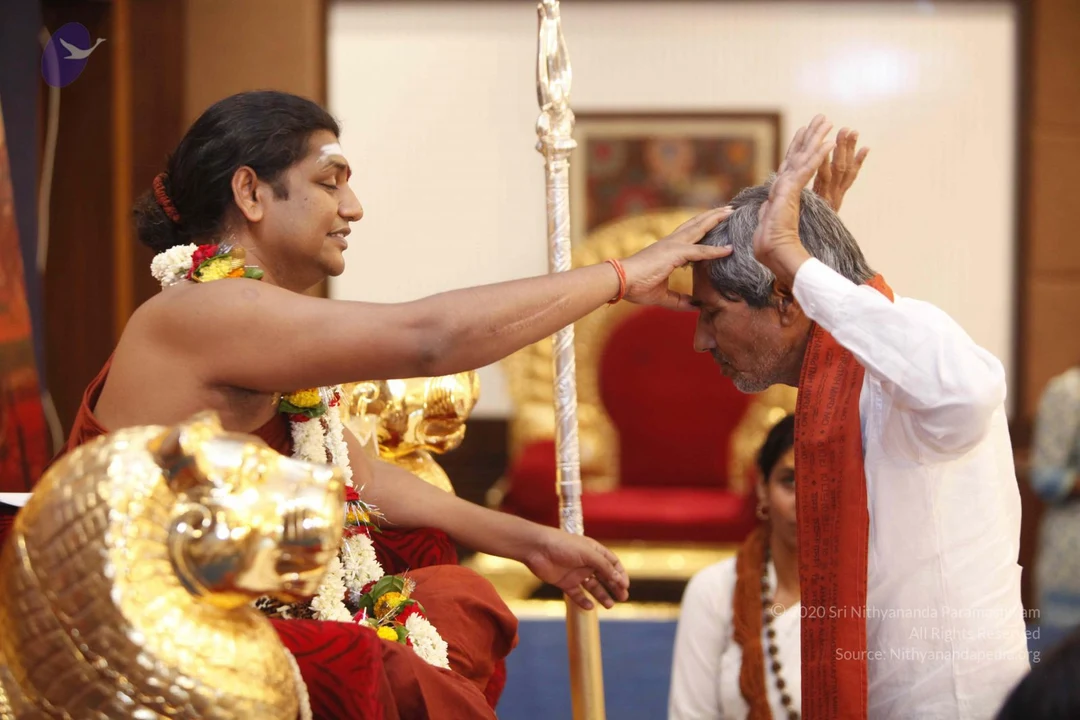
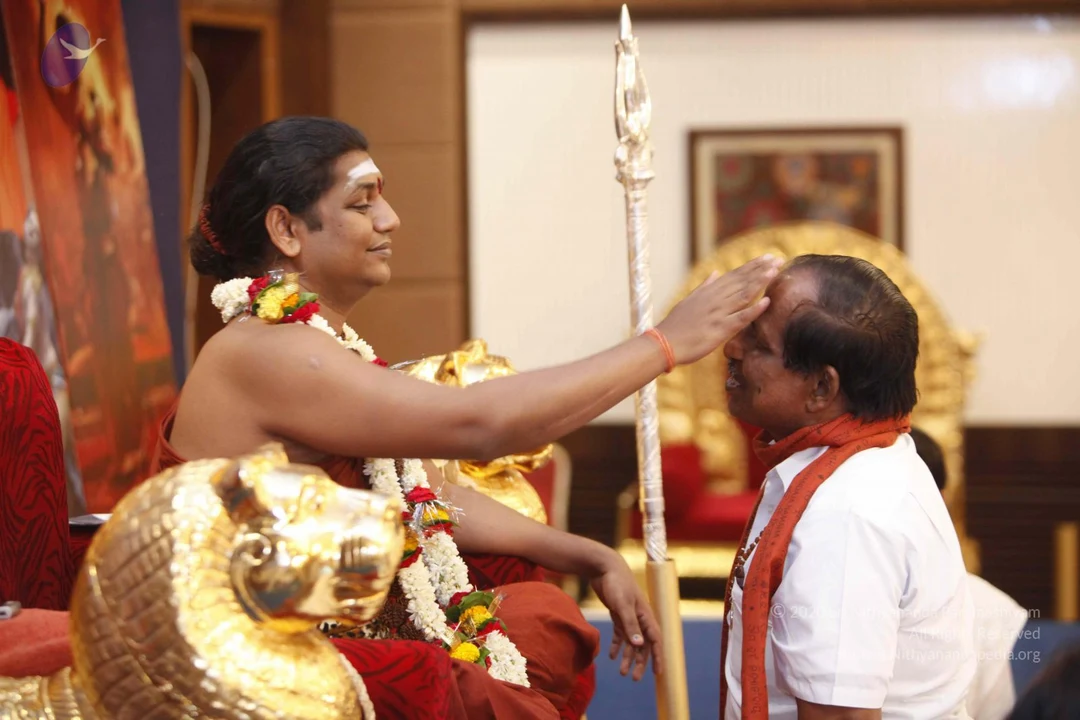
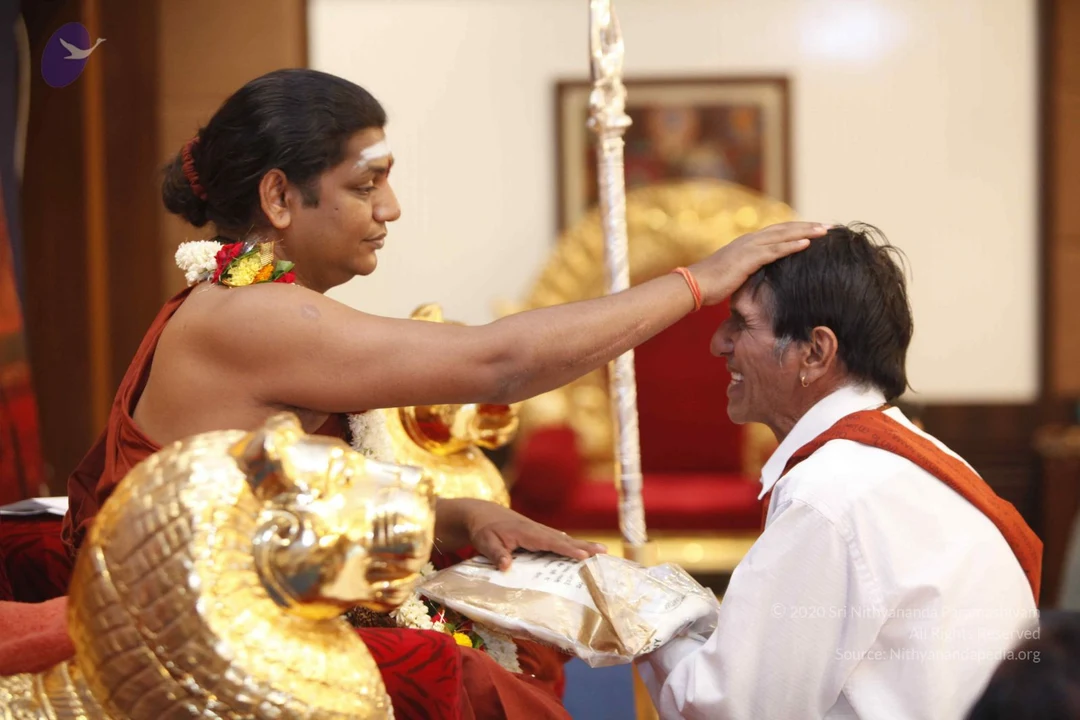
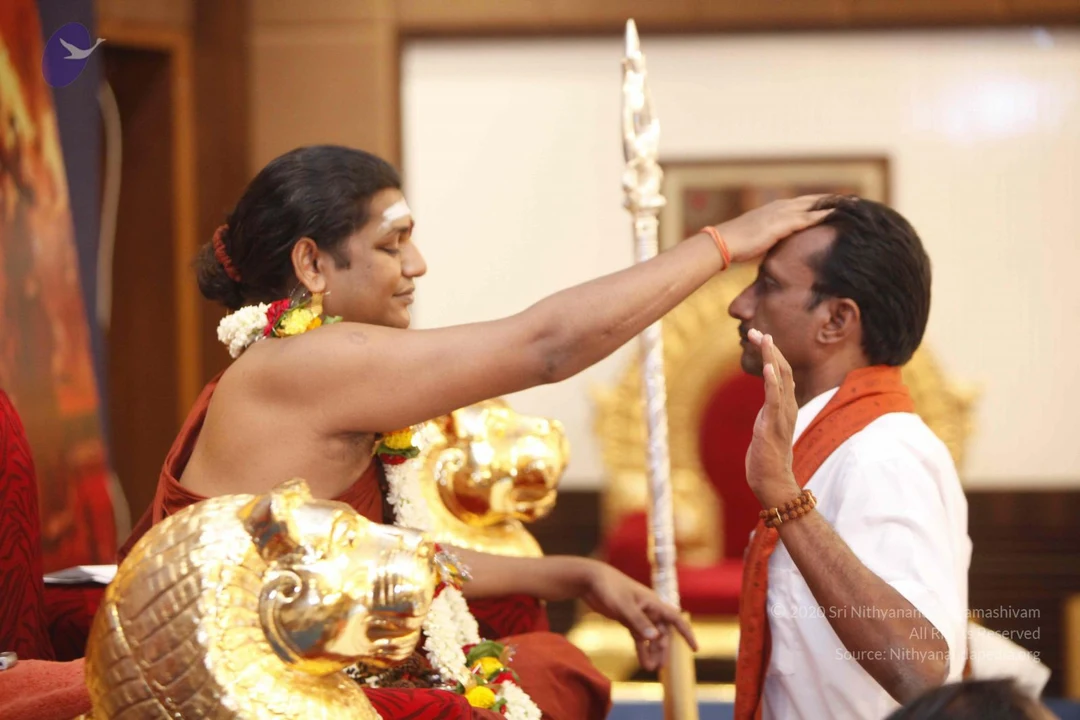
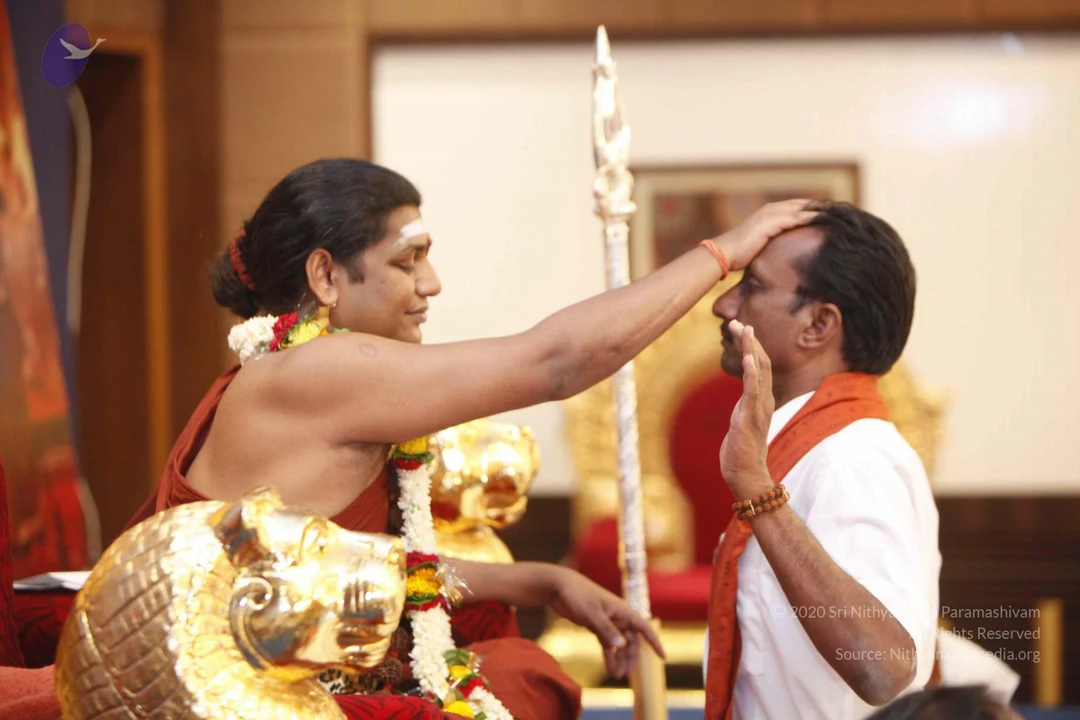
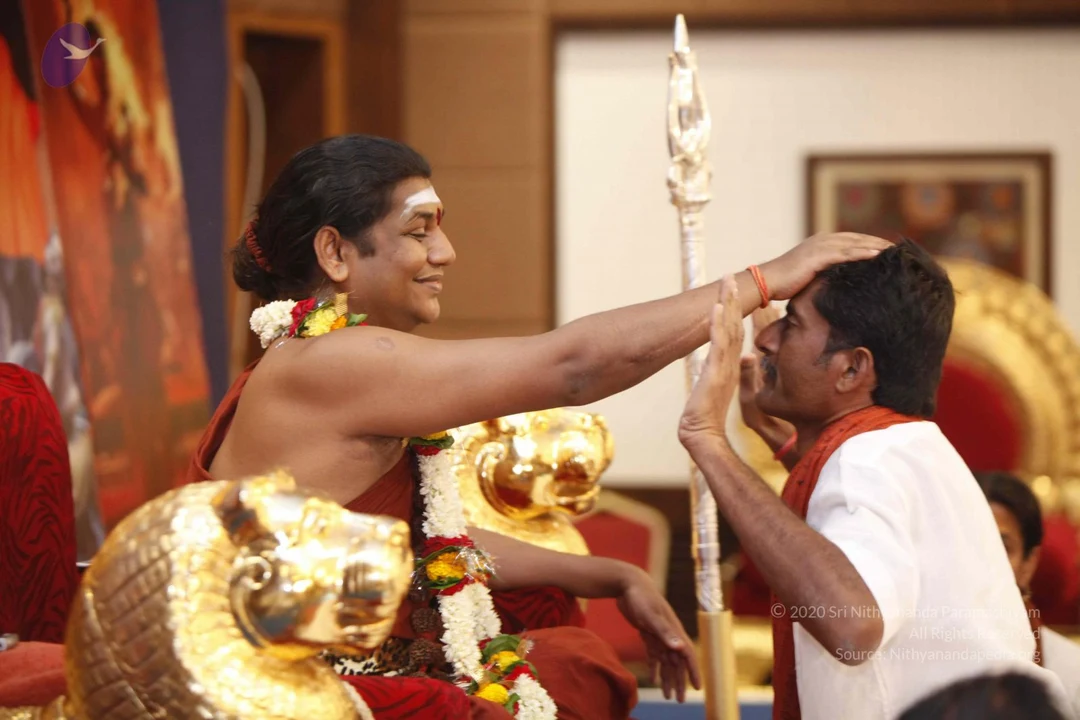
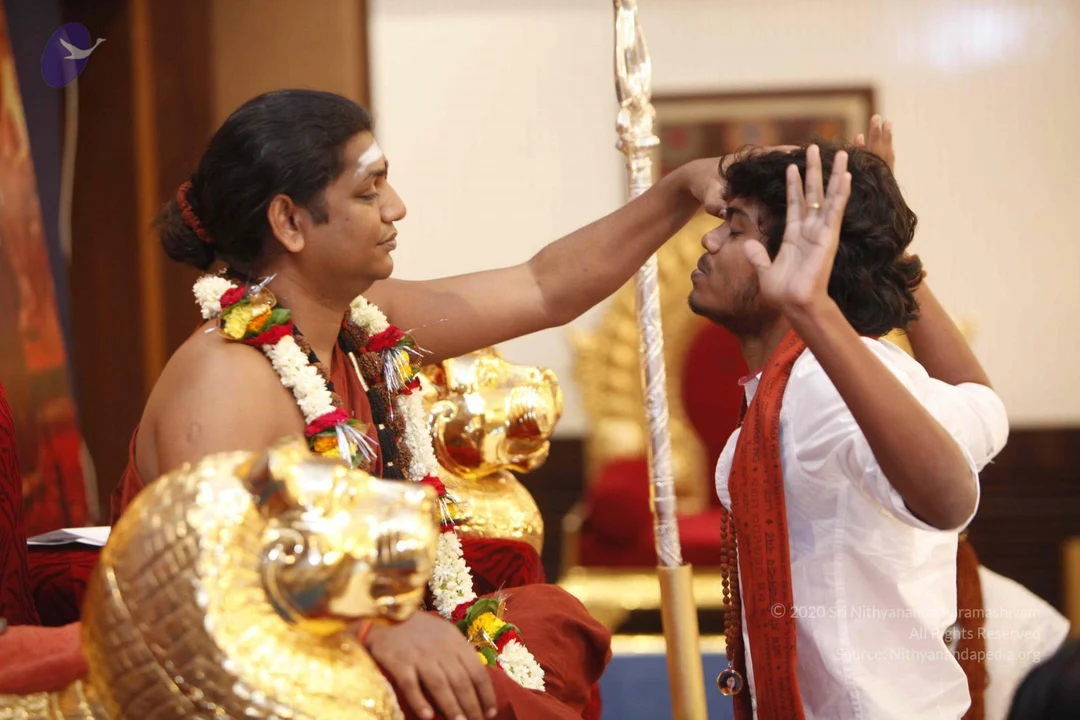
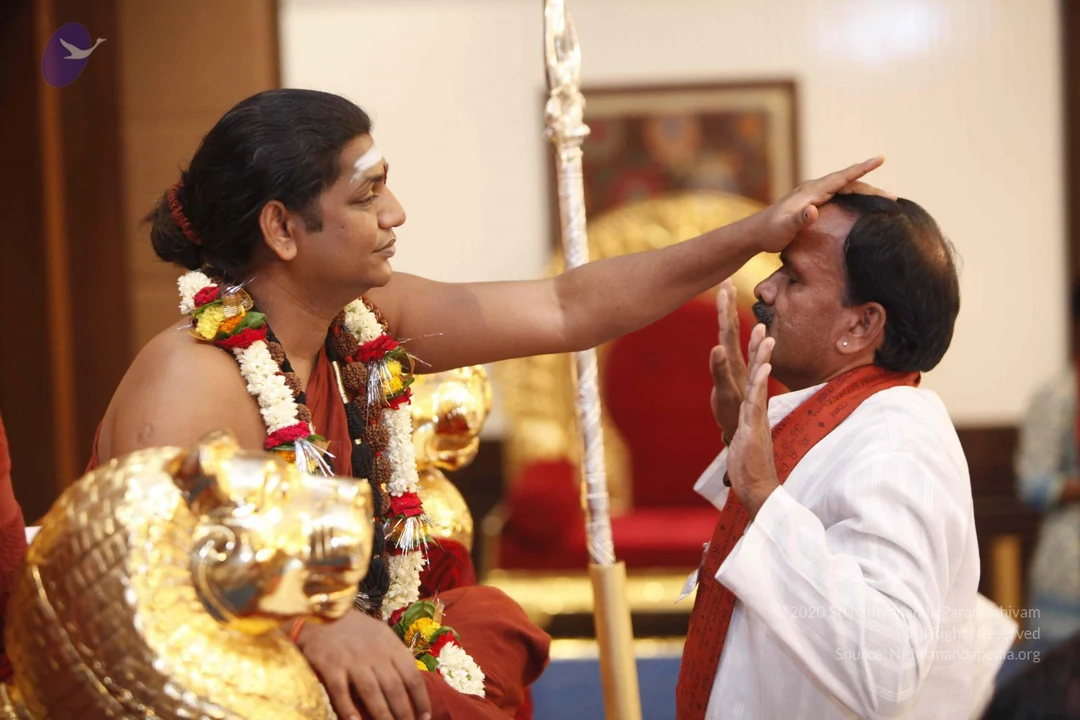
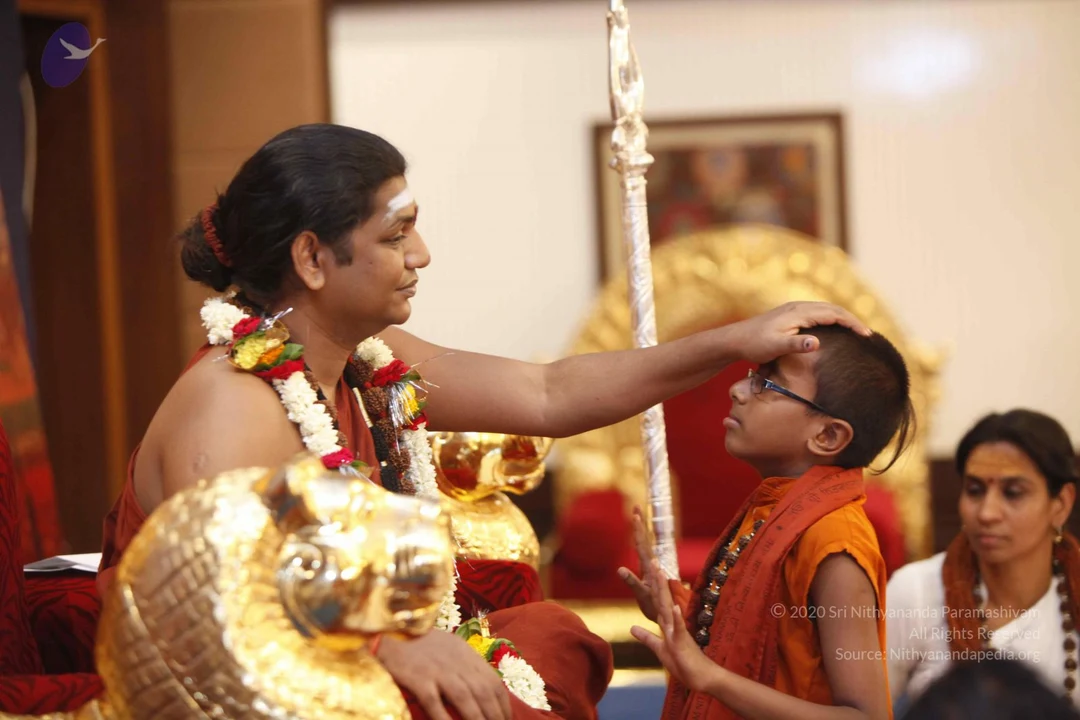
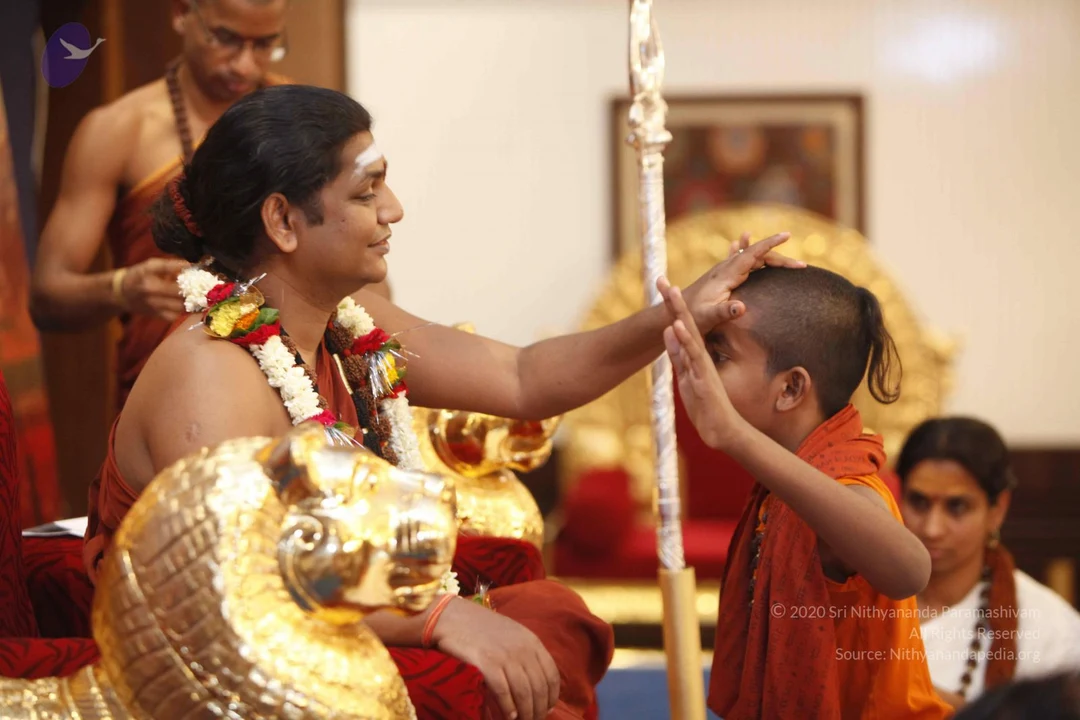
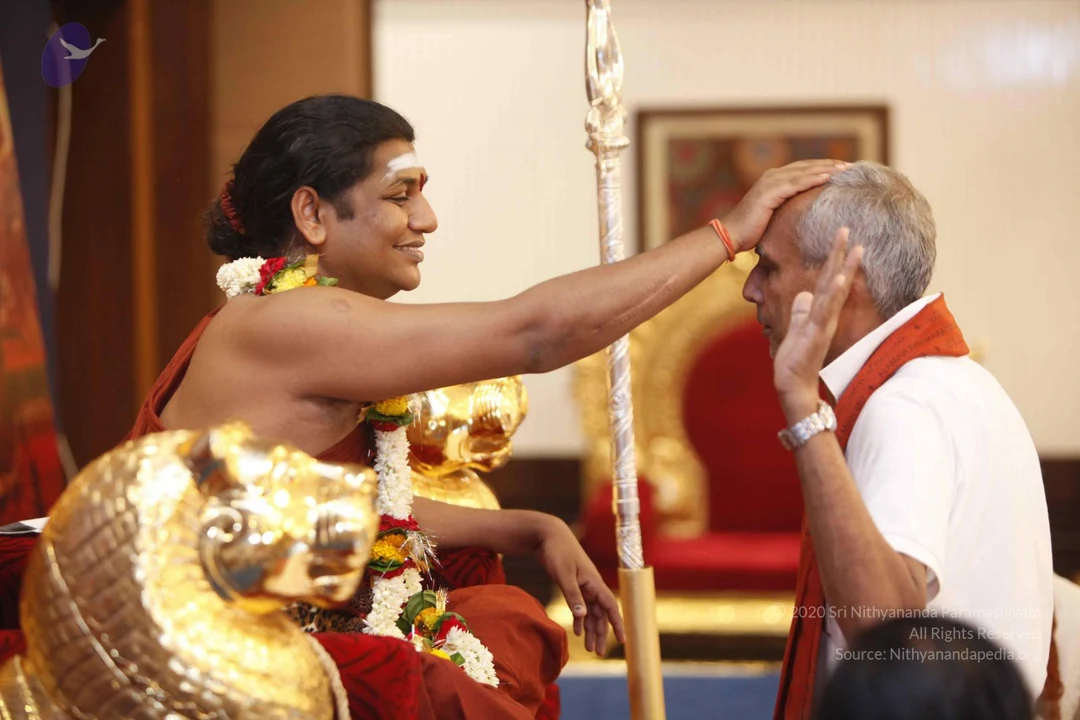
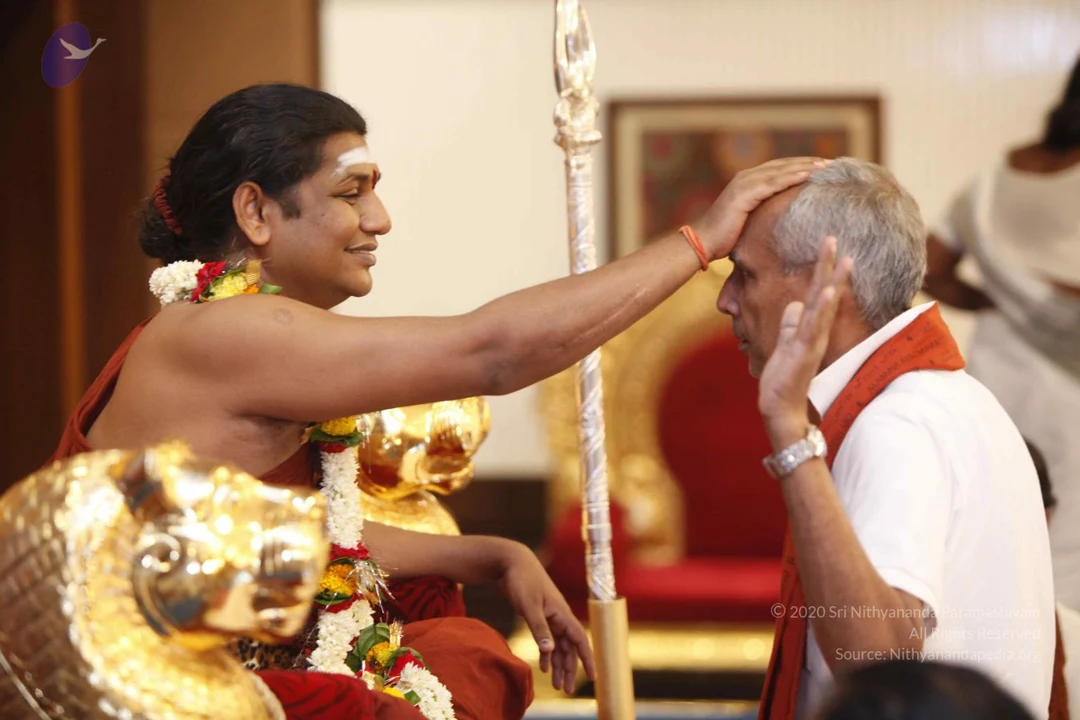
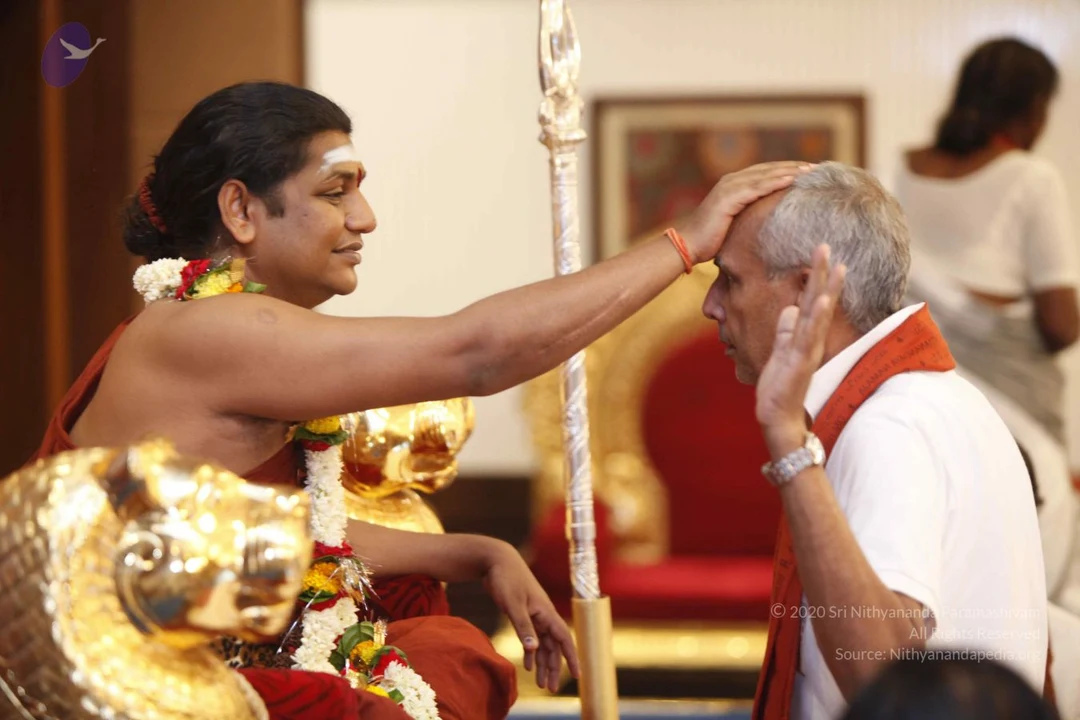
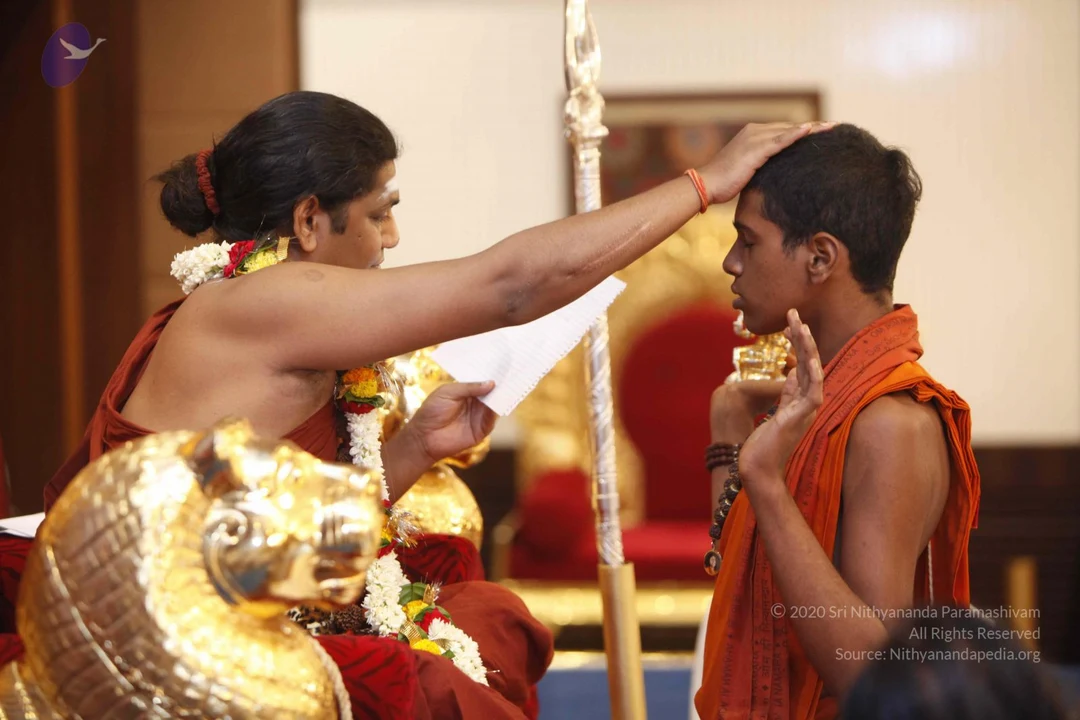
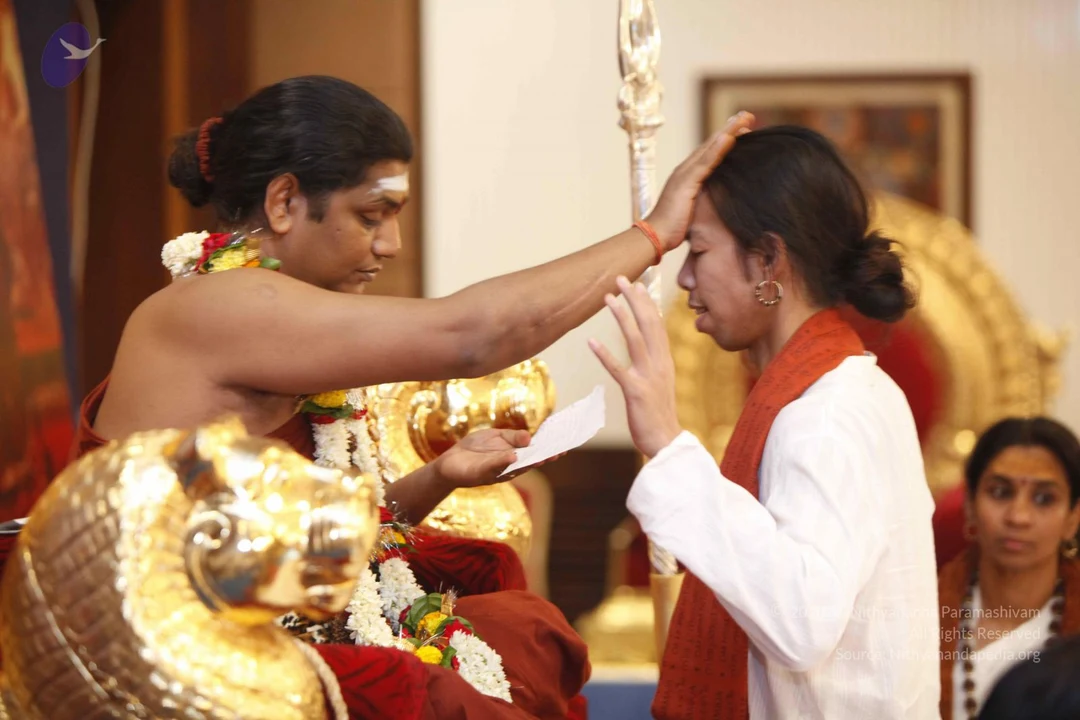
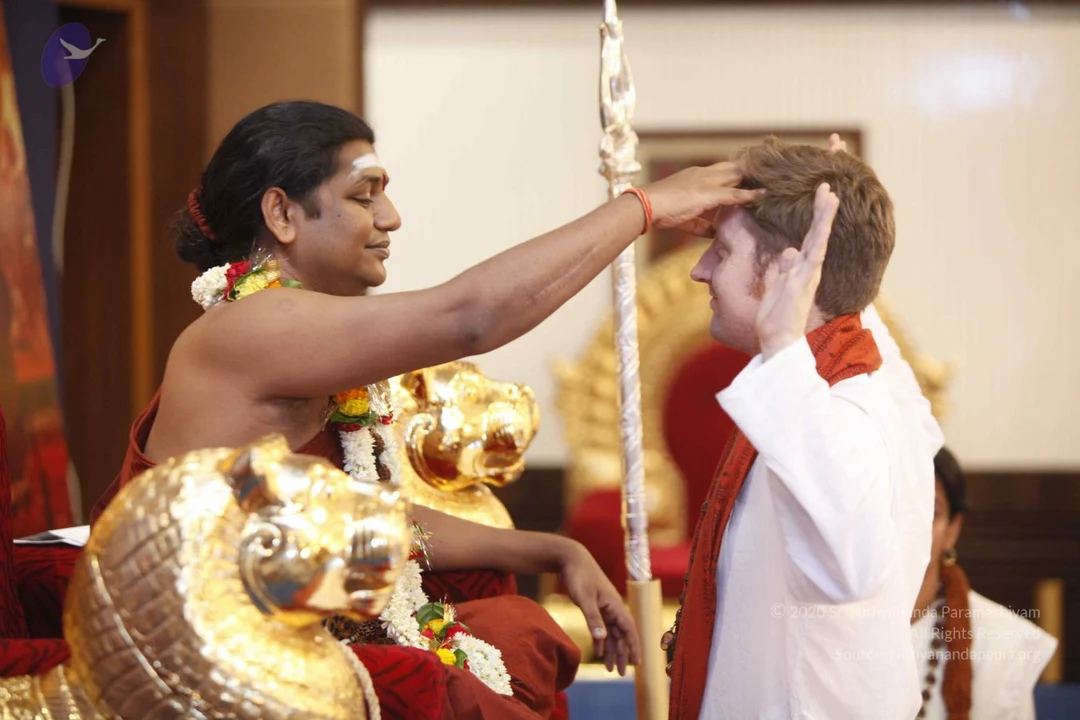
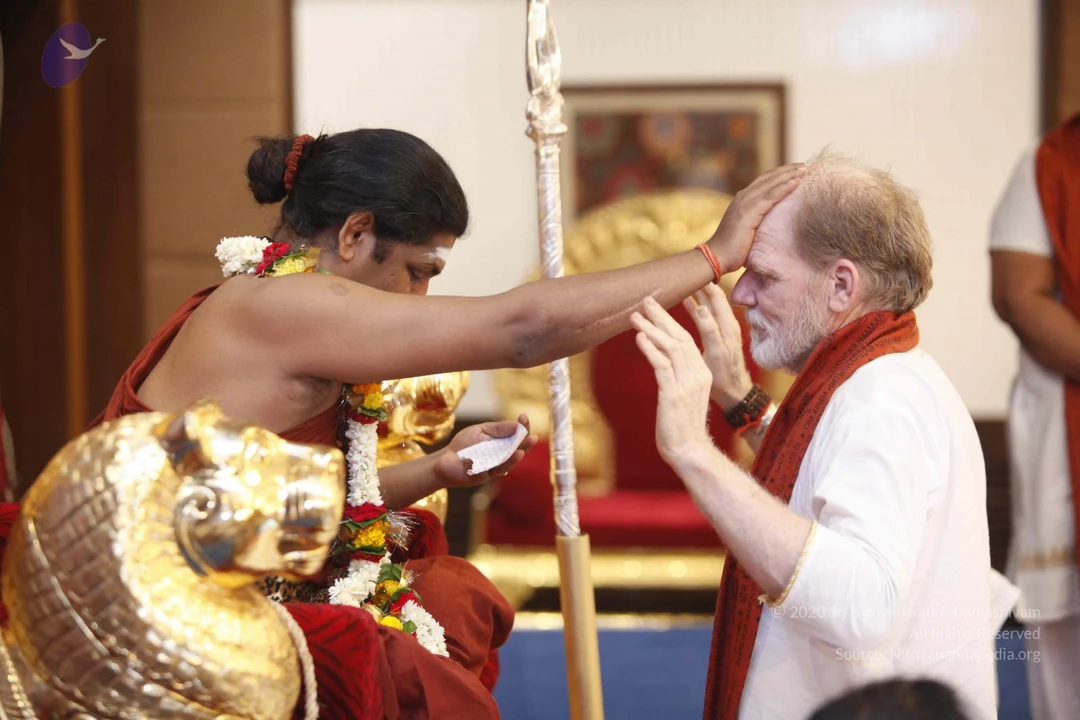
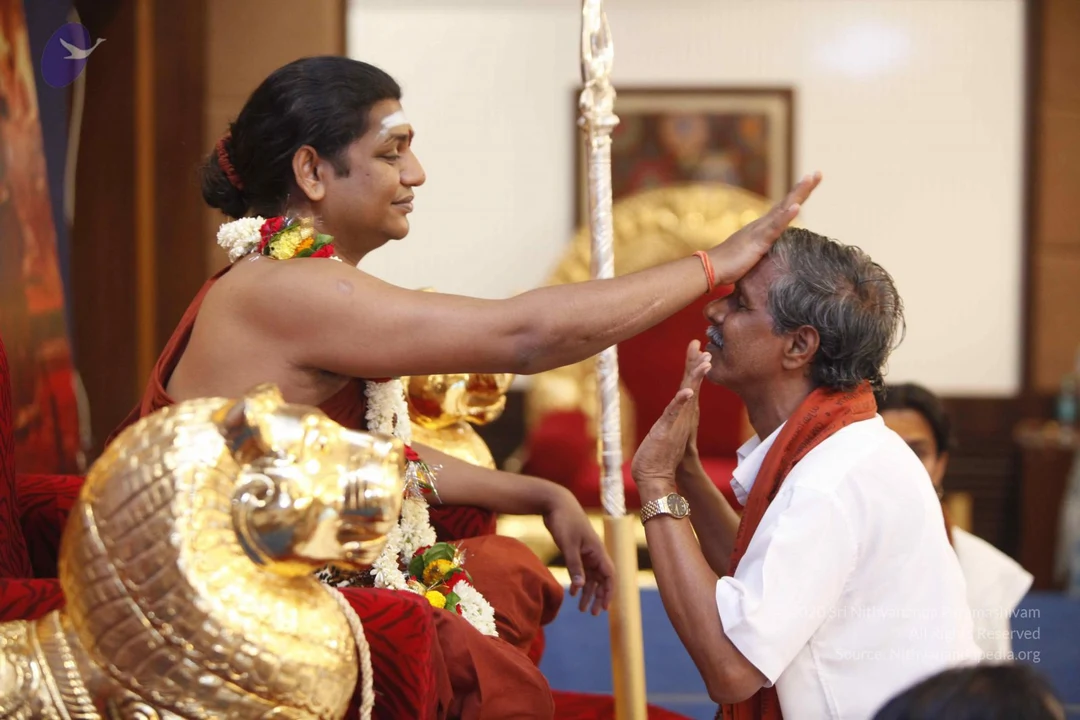
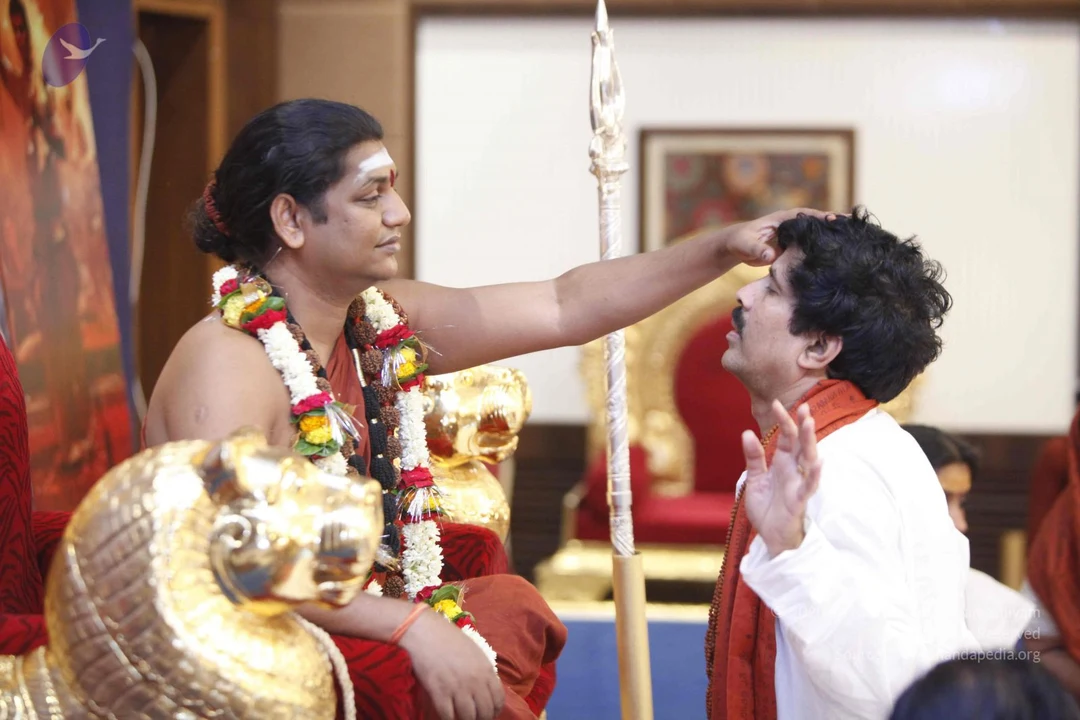
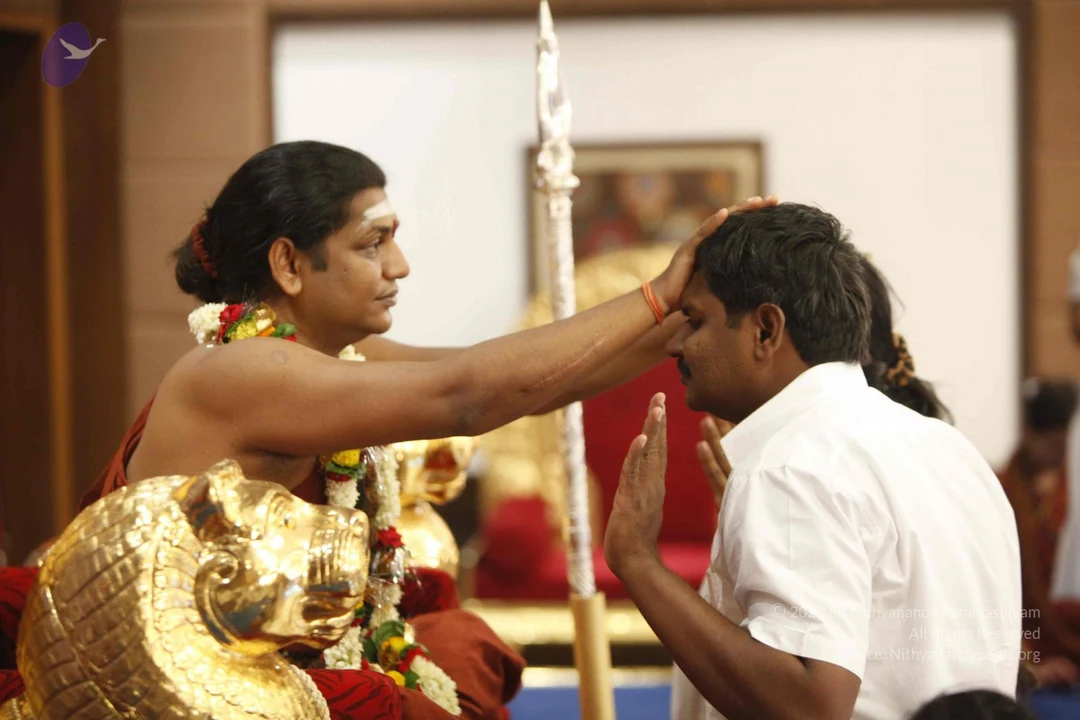
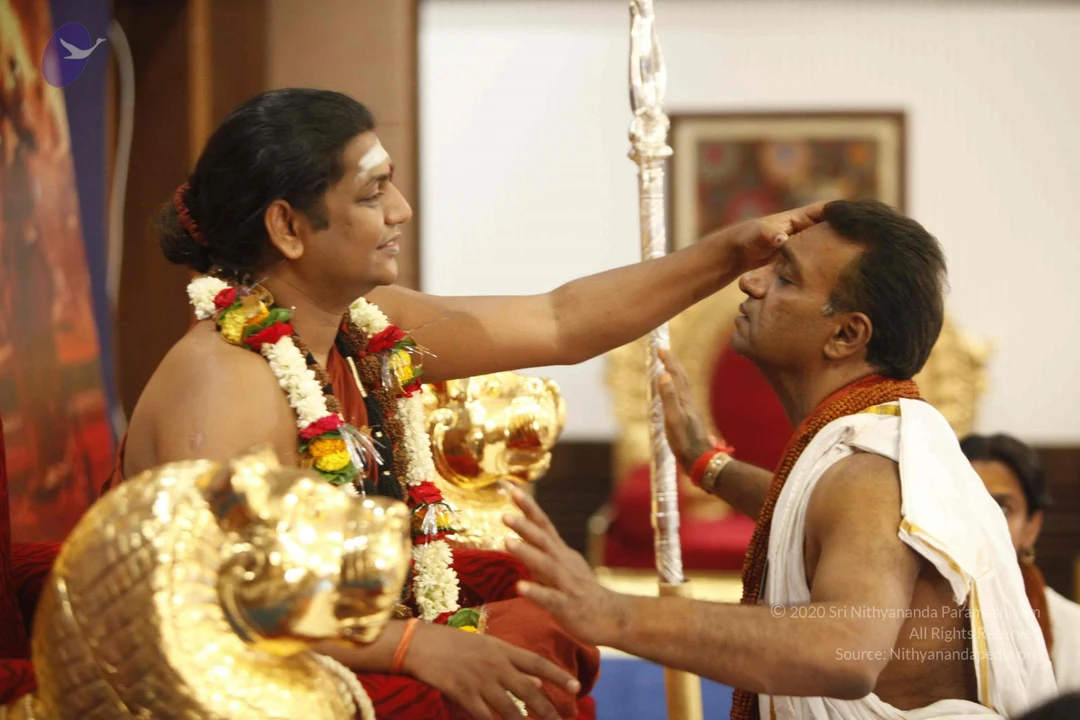
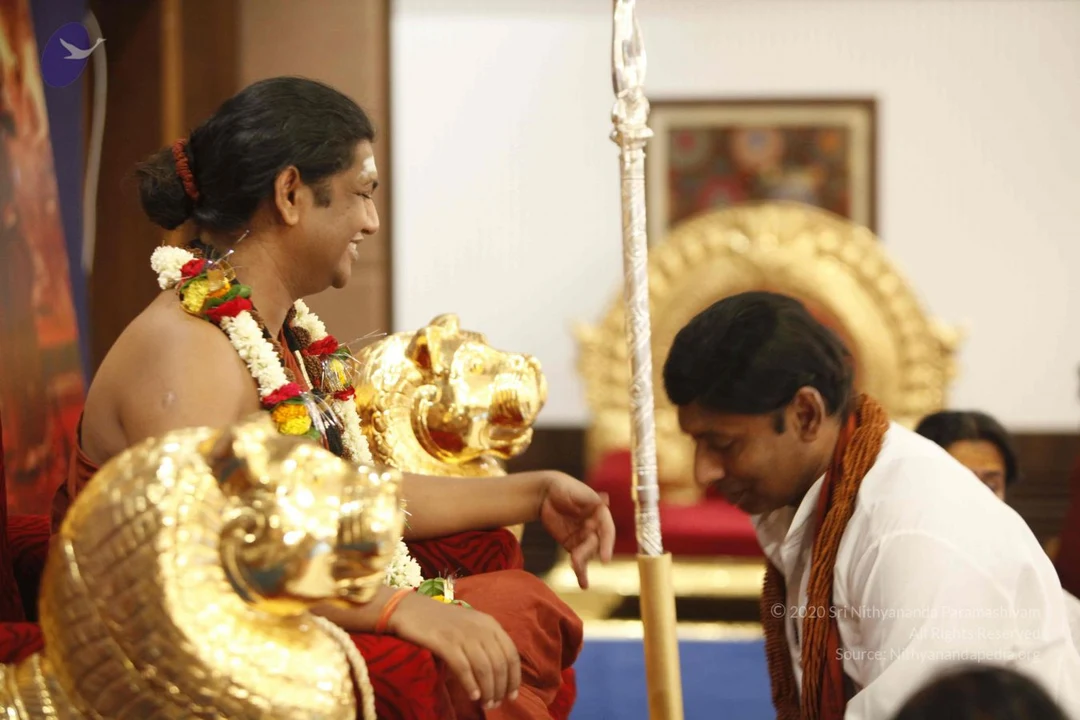
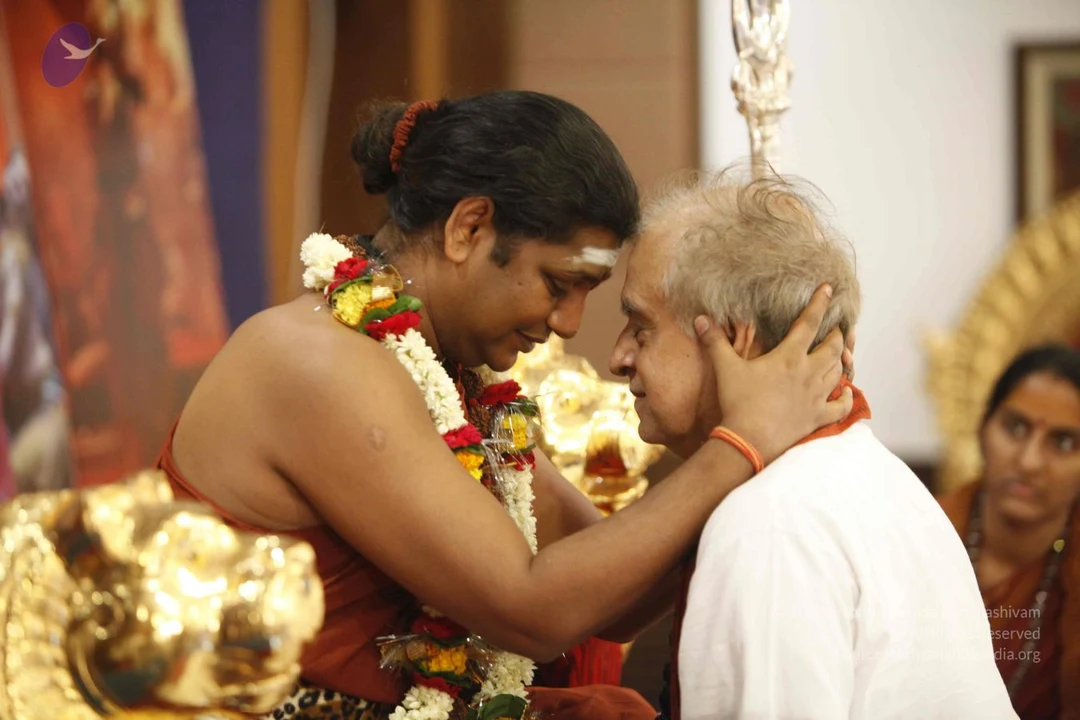
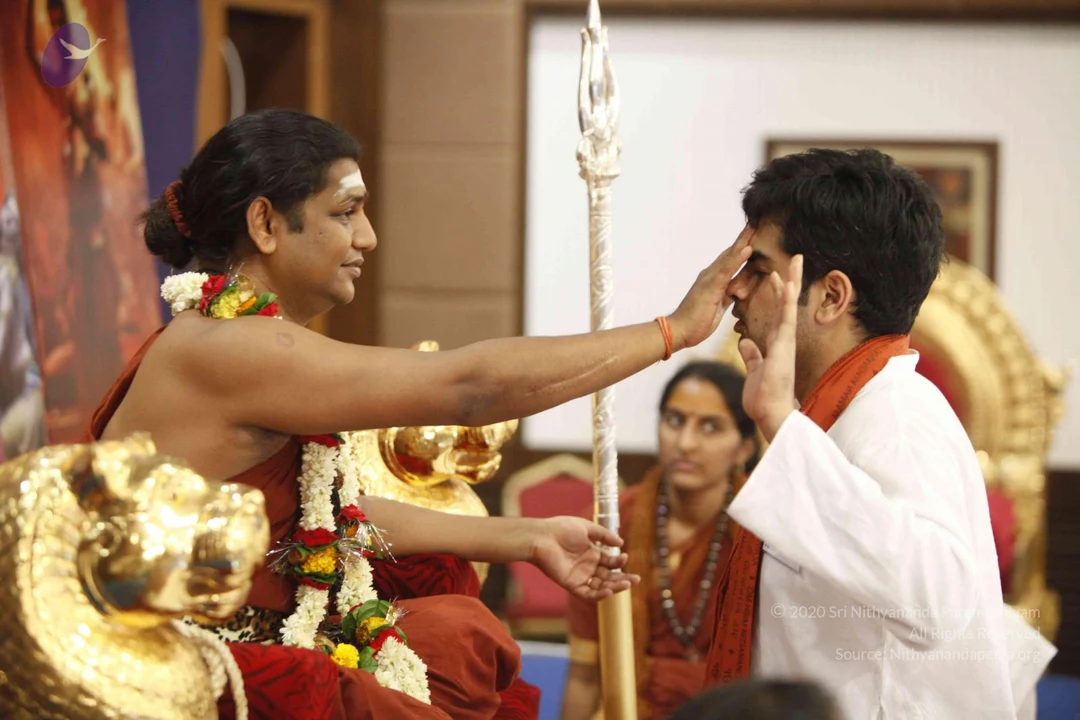
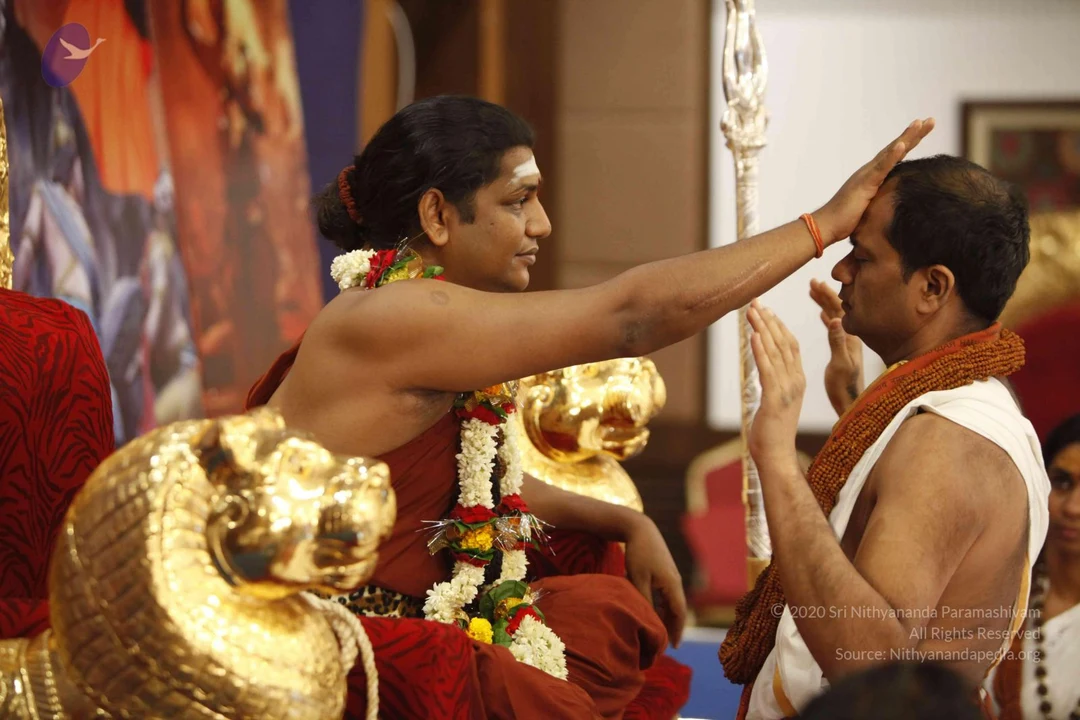
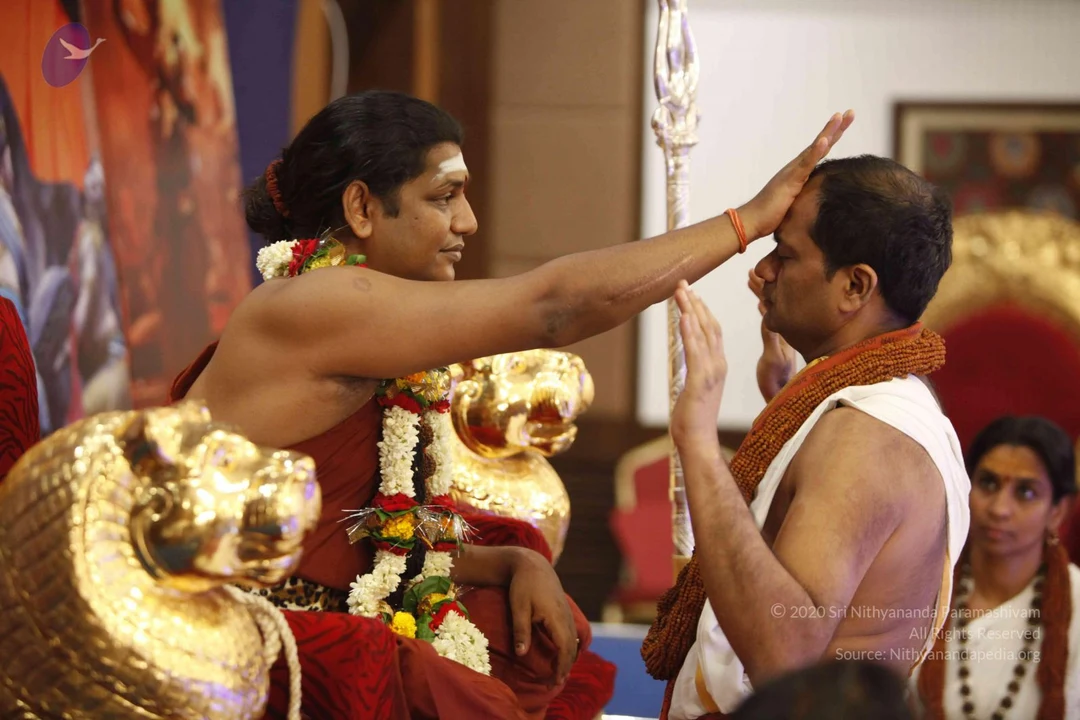
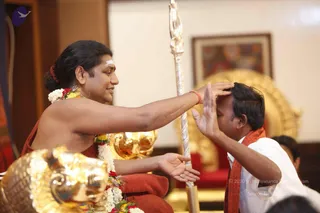
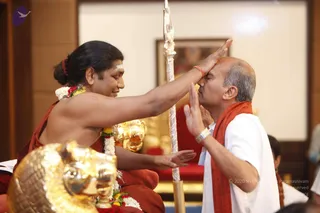
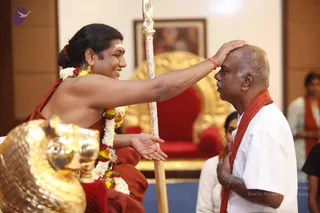
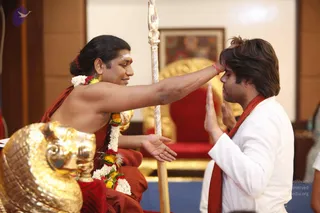
A seated man with short dark hair, a white forehead mark and a red wrist thread, bare-chested and draped in an orange-red cloth, wears a white flower garland with red and yellow blossoms. He extends his right hand to press a palm on the forehead of a standing man in a white shirt with an orange-red shawl. A tall silver staff with a trident-like top stands beside them, with a gilded lion-faced ornament and a gold throne-like backdrop behind; a framed painting hangs on the wall. The scene suggests a blessing exchange.A photograph of a seated spiritual teacher in a saffron-red robe with a white tilak on his forehead and white and orange flower garlands, his right hand raised to touch the forehead of a bald, grey-haired man in a white shirt and red-orange shawl who holds his palm up in response. Golden lion-head ornaments and a silver staff with a finial stand nearby, with a red-cushioned throne and a framed painting behind them. The .A seated figure in a rust-red saffron wrap, bare-shouldered, with long dark hair in a bun, white and red tilak on the forehead, and a multicoloured flower garland with white blossoms, places his right hand on the forehead of a standing older man in a white shirt and a red-orange scarf printed with text. The seated figure holds a silver staff and rests beside a gold-decorated seat with a red cushion. Behind them, a framed picture hangs on the wall and a woman in a light outfit with an orange scarf stands at right. The man receiving the blessing has his hand over his heart.A photograph of a seated man in saffron-red robes and a floral garland touching the forehead of a younger man in white kurta with a red shawl. The seated man has a white tilak on his forehead and a red bindi, and his bare arm extends toward the other man's head. Beside them is a gold lion-headed sculpture, a silver staff stands upright, and a red and gold throne is visible behind. The seated figure matches the page's a person cues of a garland and saffron-red clothing, so this is a probable in-person candidate. The younger man kneels with palms raised in a receiving gesture, consistent with blessing or initiation, in a room with a blue carpet and cream walls. Watermarked by the archive and not described further.A seated priest in a rust-red robe with a bare upper torso and a white and red tilak on the forehead presses his right palm to the forehead of a bald, grey-bearded man in a white kurta with a blue beaded necklace. The seated figure wears white and orange flower garlands and has dark hair in a bun. Two large gold cobra-hooded forms with gold kalasha-like ornaments sit in the foreground, and a silver staff stands in the centre. Behind them a red and gold throne is visible. A woman in an orange shawl stands at the right edge. The gesture appears to be a blessing or initiation.A seated man with short dark hair, a white tilak on his forehead, a red-maroon cloth wrapped over bare shoulders and a garland of white and orange flowers places his right hand on the forehead of a bald, bearded older man in a white kurta with a beaded necklace who holds his right palm raised in greeting. Behind them stands a gilded throne or red cushioned seat, two golden cobra-hooded forms in the foreground, and a silver staff. On the right, an older woman in an orange shawl stands with folded hands.

2-Padapuj-Satsang
20 photosSource gallery
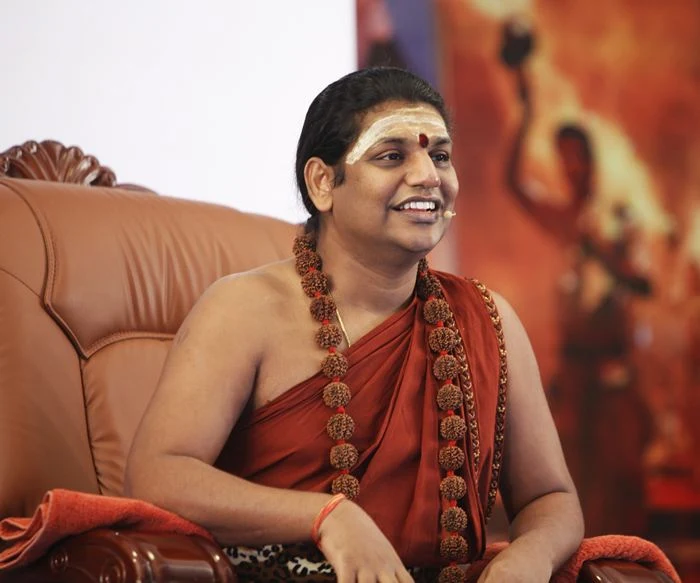
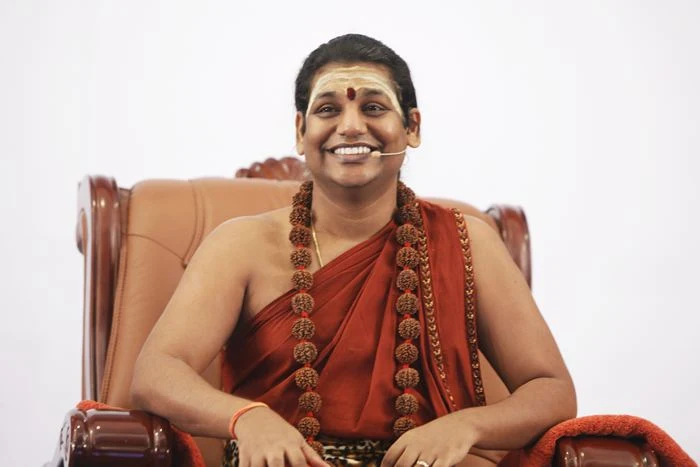
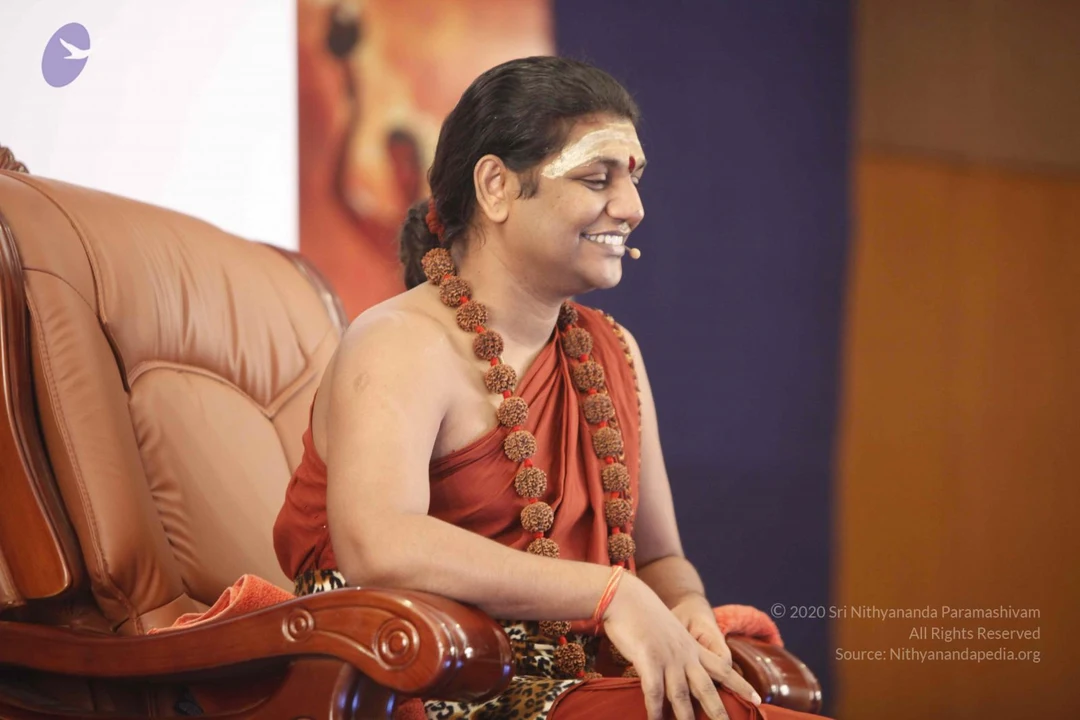
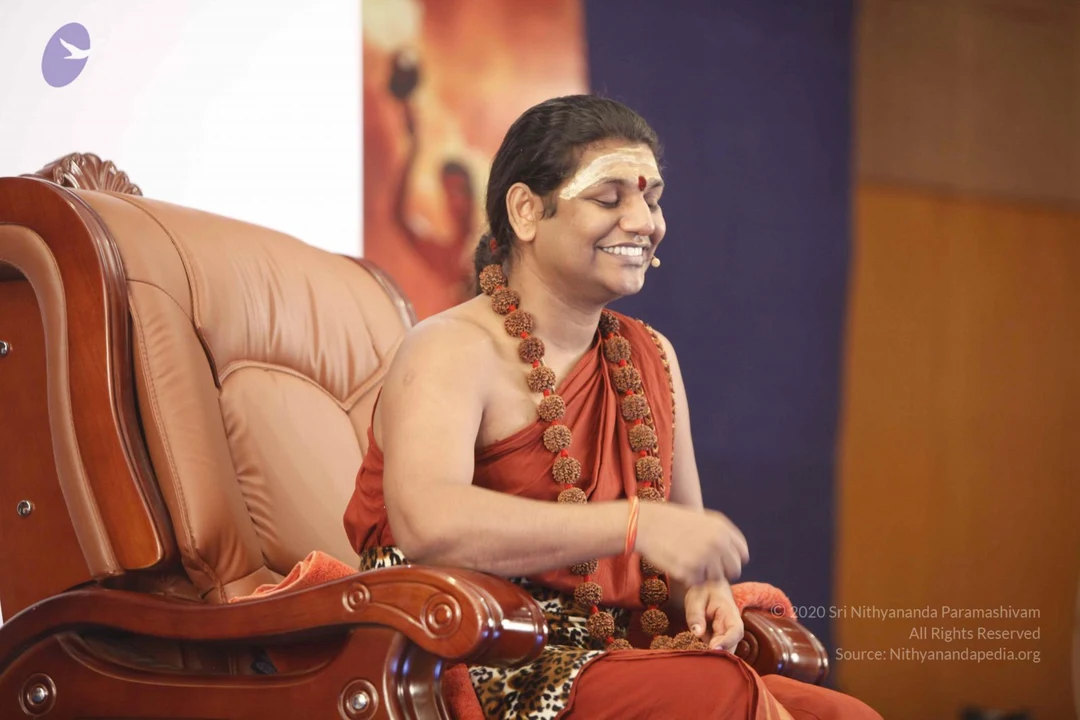
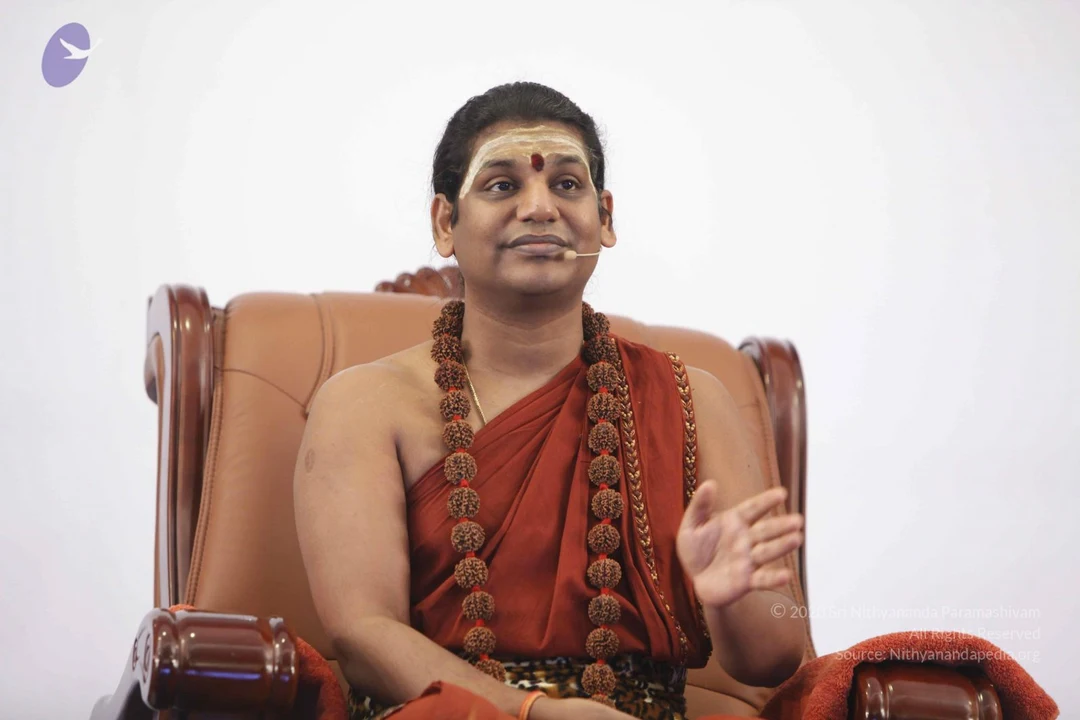
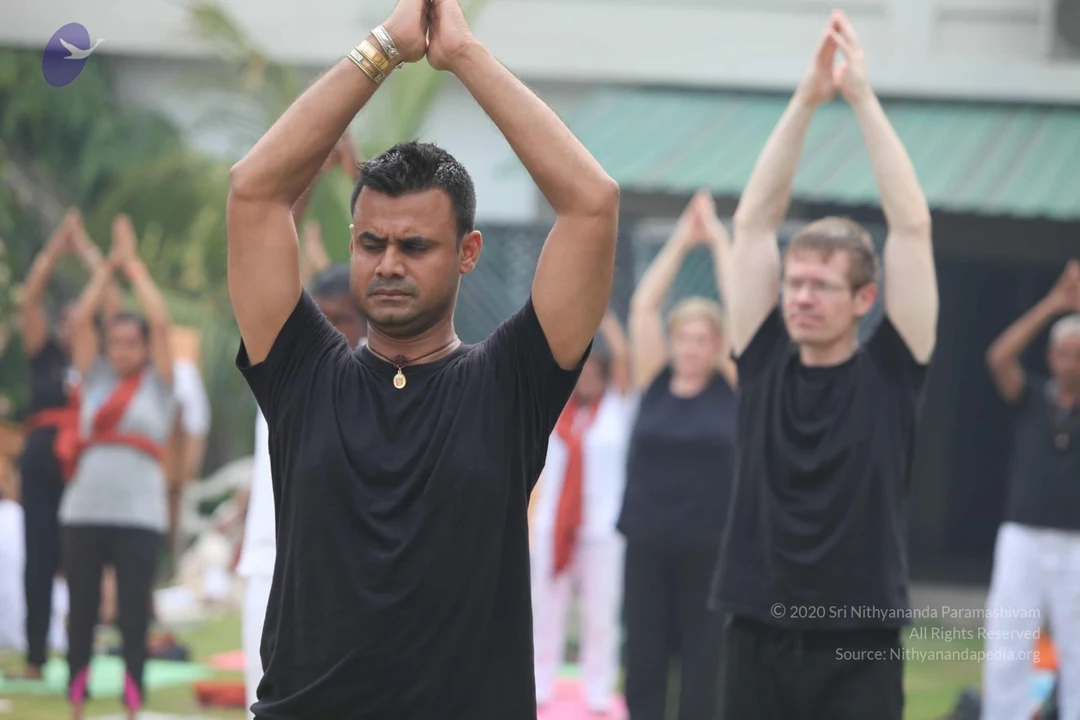
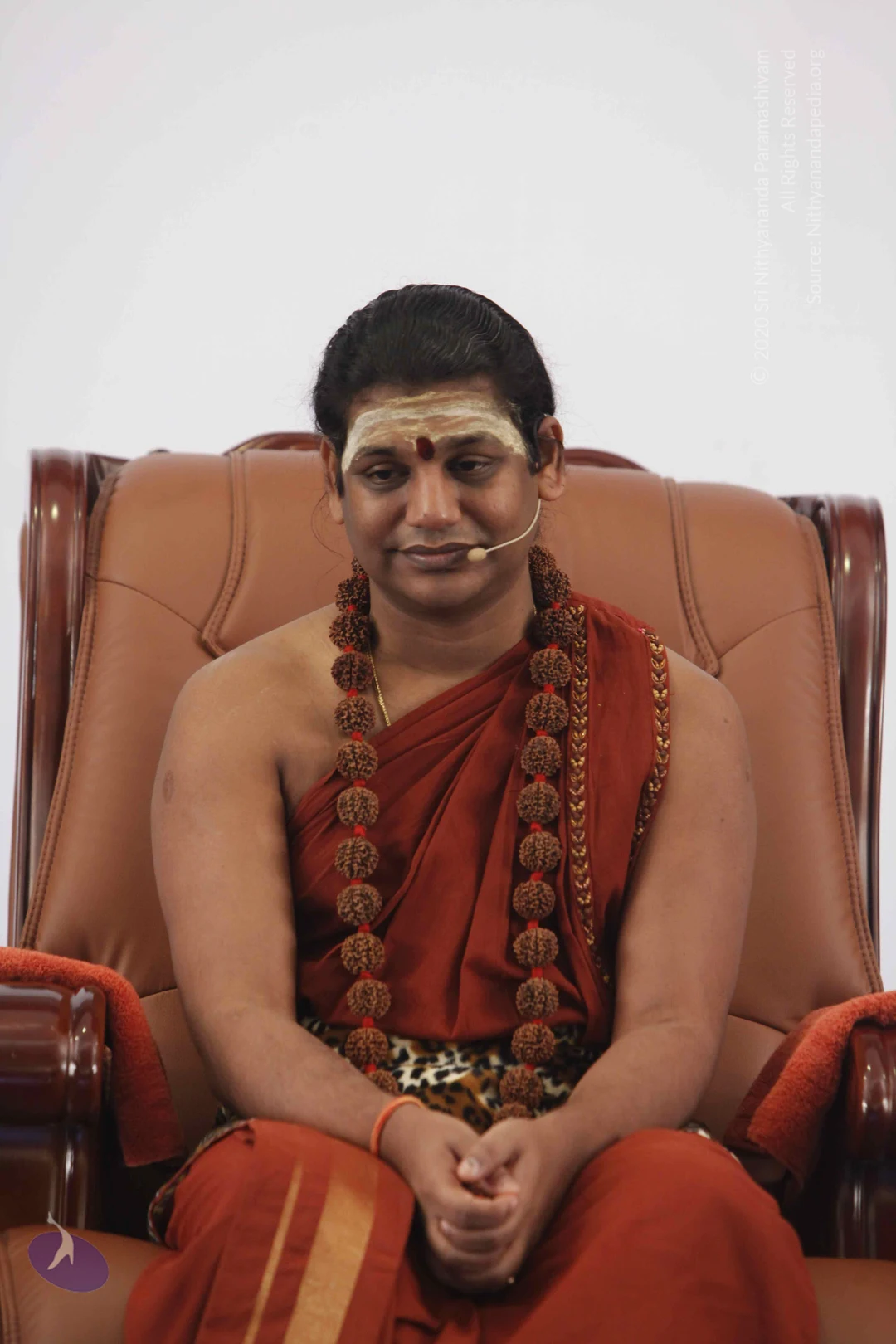
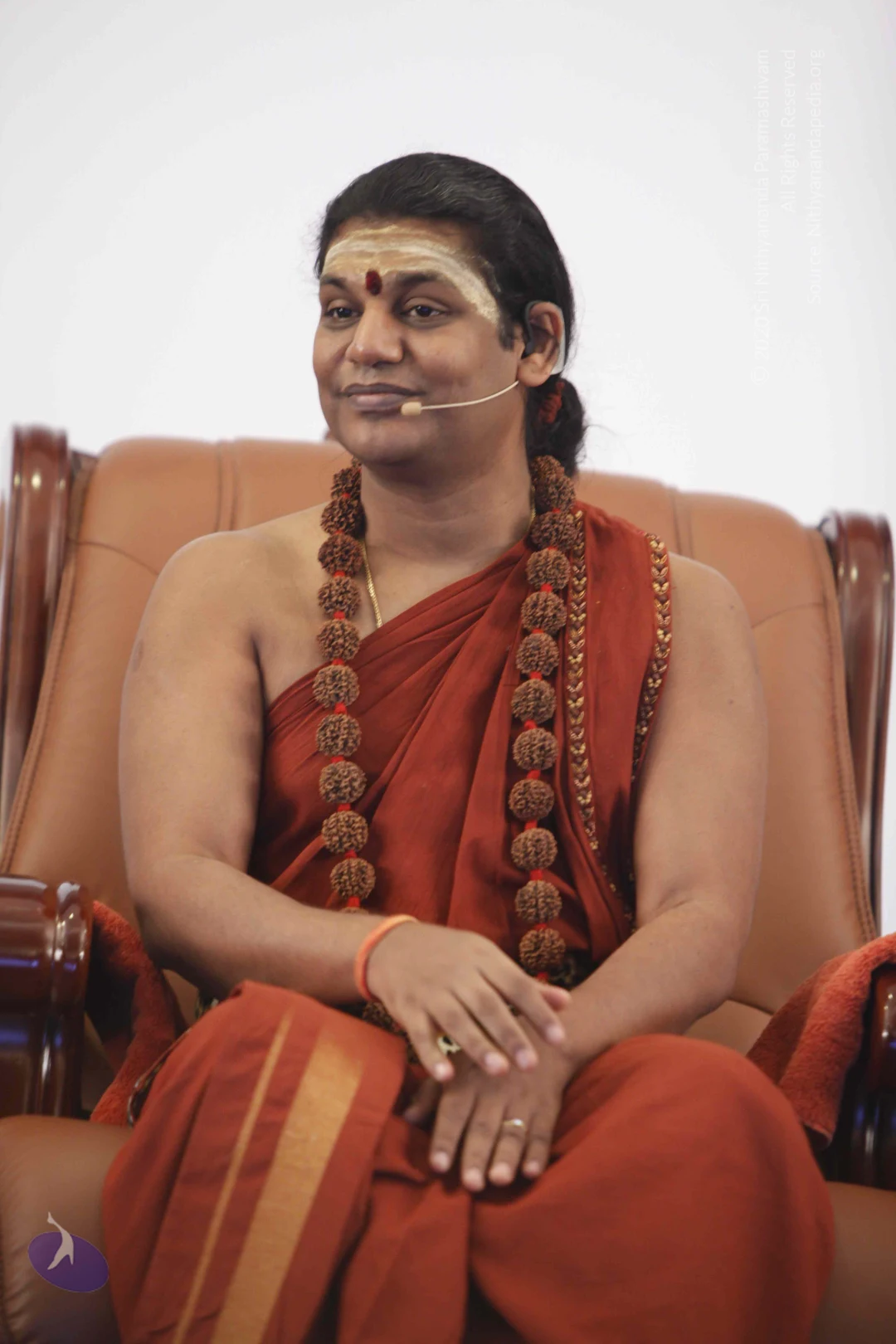
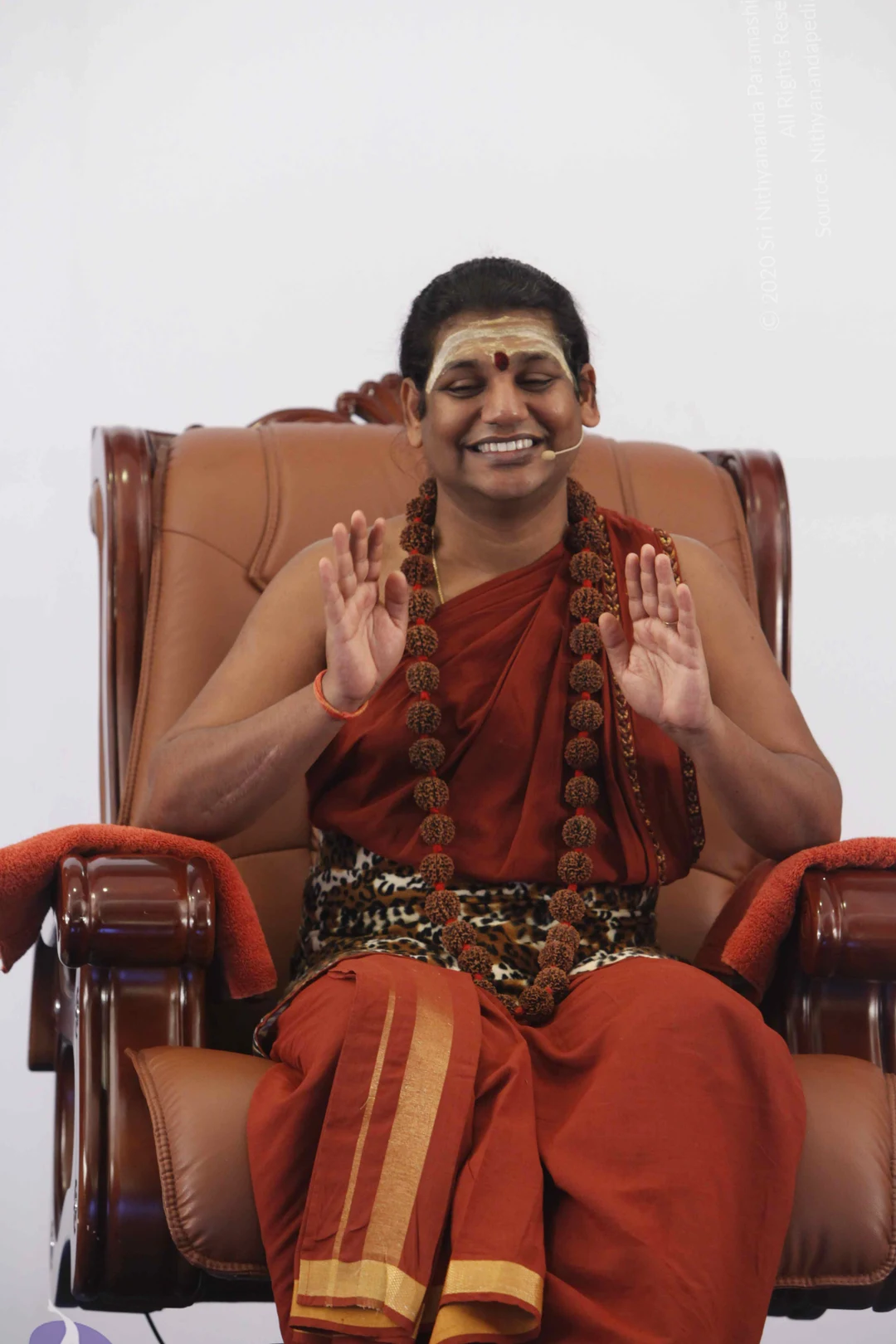
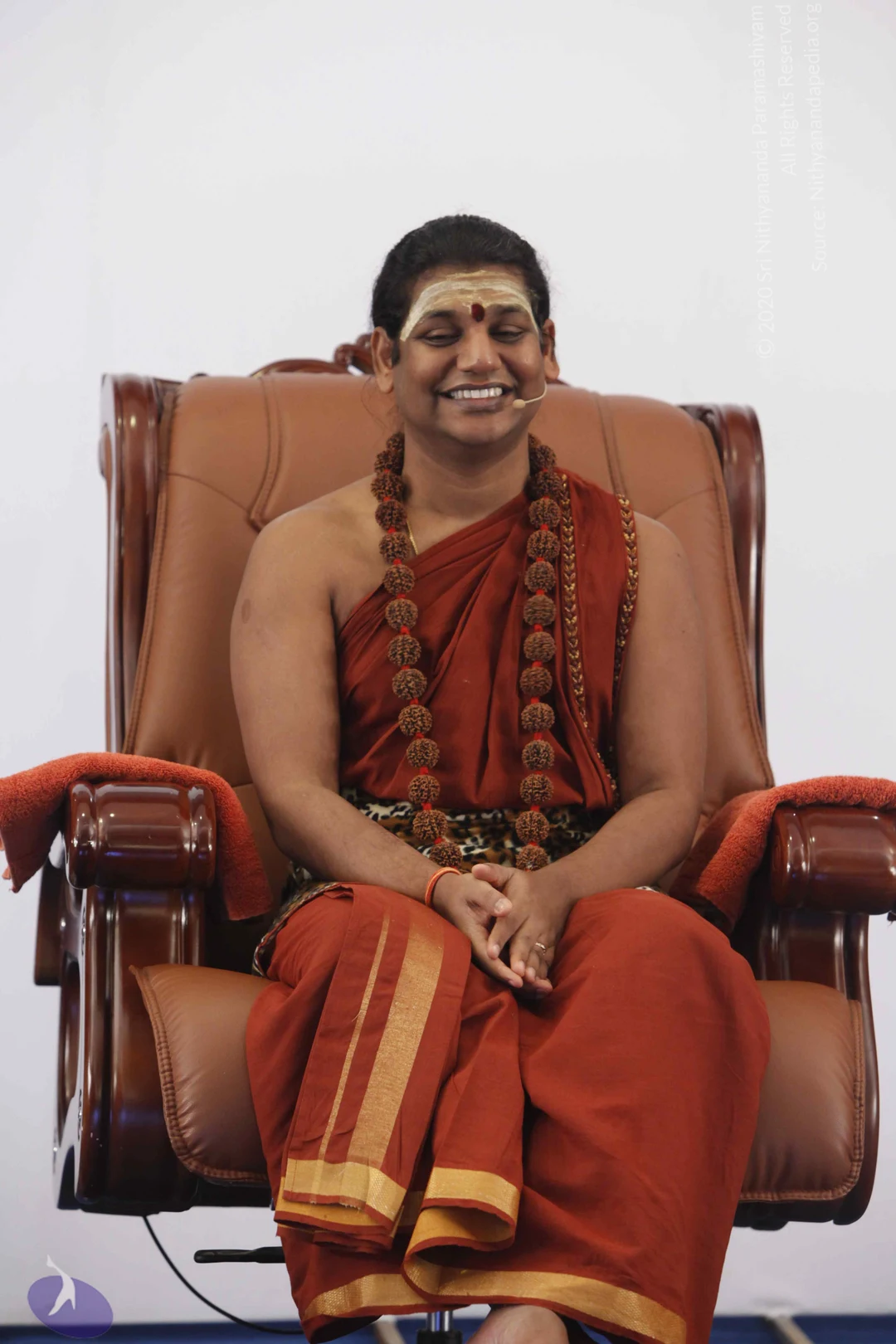
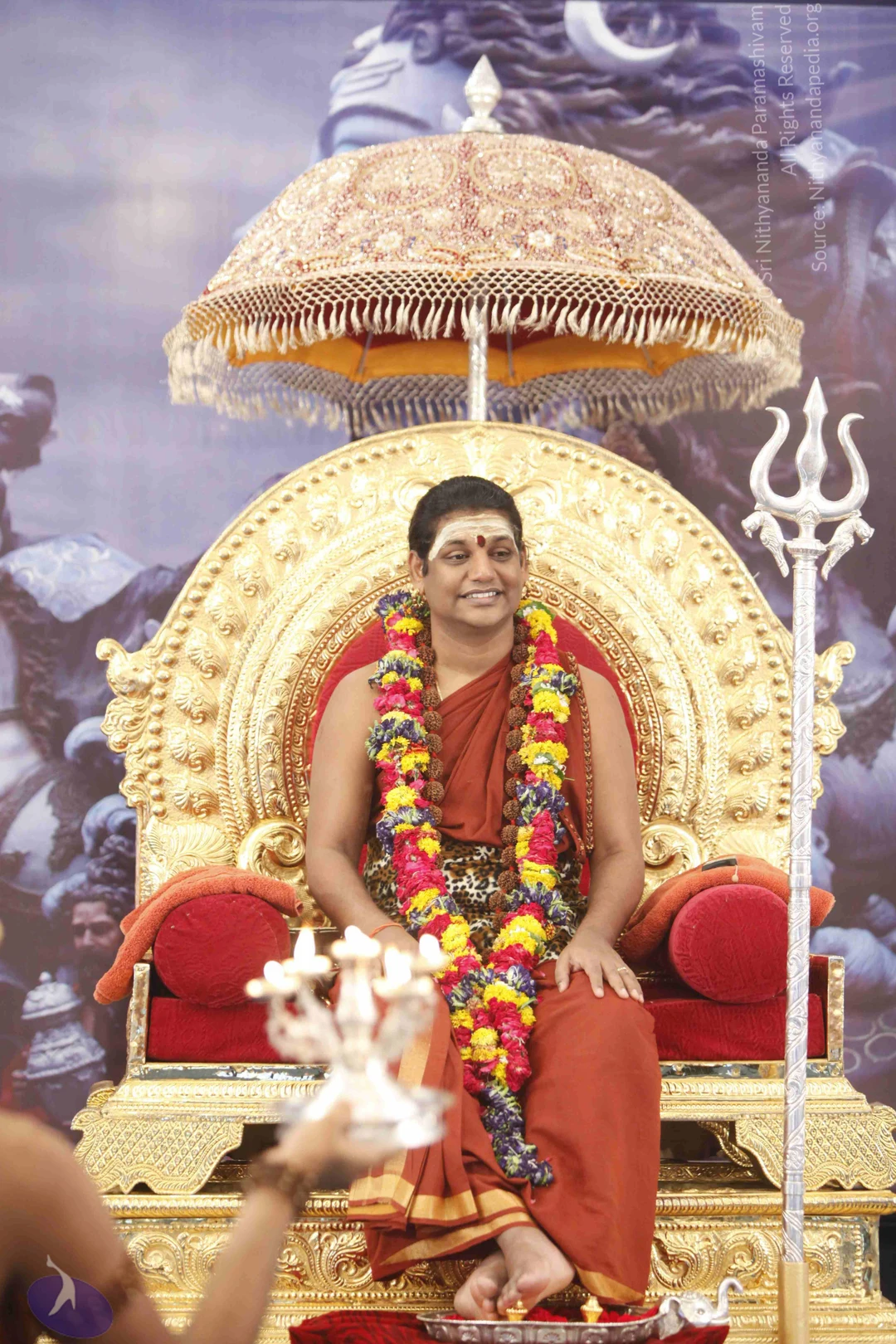
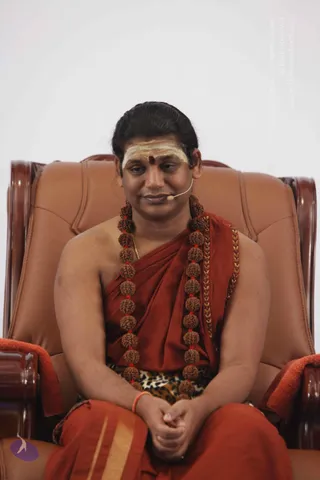
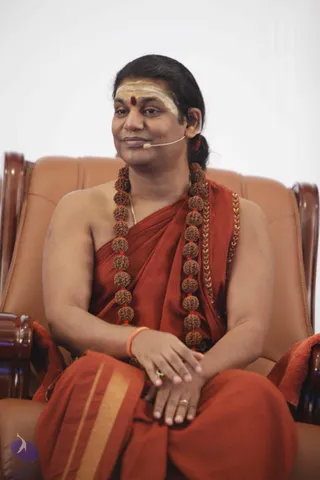
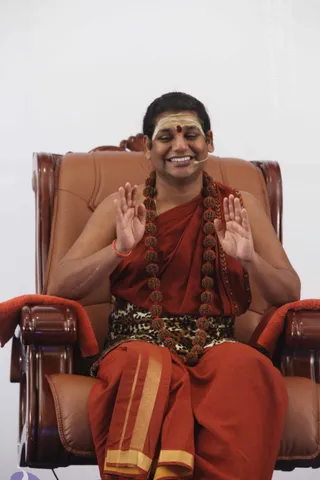
A seated man in a brown leather armchair wears a red-maroon shawl draped over one shoulder with gold border, a patterned leopard-print cloth at the waist, and a long rudraksha mala of large brown beads with red thread hanging to his lap. He has a white sandalwood band with a red dot on his forehead and a small headset microphone. His hands are clasped in his lap and he looks downward against a plain white background. a person: the rudraksha mala, saffron-red shawl and forehead markings are the qualifying cues; he is presented as a seated speaker at a satsang.A man in saffron-orange robes sits on an ornate gold throne with red cushions beneath a decorated canopy umbrella. He wears a multicolour marigold and rose garland and rudraksha beads, with white and red tilaka on his forehead. A silver trident stands beside the throne, and a silver tray with offerings rests on a red cushion at his feet. In the foreground, a seated figure in saffron clothing with a rudraksha mala is seen from behind, with an oil lamp in the lower frame. The backdrop shows a painted Shiva with a crescent moon and white horses. The man on the throne has long swept-back hair and a saffron robe, a probable Swamiji.A seated man in an orange-red saffron garment wrapped over the shoulders, with a gold-bordered dhoti, sits in a brown leather armchair against a plain white background. He wears long rows of rudraksha beads, a red bindi and white sandalwood-style lines across the forehead, and a small headset microphone on his cheek. His hands rest clasped in his lap. The appearance and styling match the Swamiji (probable) cues of long swept-back hair, saffron clothing and rudraksha malas, and the page indicates an in-person satsang, so the person is treated as a candidate present in the photo.A man with short dark hair and a white-and-red forehead mark sits on an ornate gold throne with red cushions, beneath a jewelled, fringed canopy umbrella. He wears a rust-orange garment, a leopard-print undercloth, and a long multicoloured garland of yellow, pink, and purple flowers with a rudraksha mala around his neck. His bare feet rest on a red velvet cushion before a silver tray. A silver trident stands to the right, and oil lamps and flower petals appear at the lower edges. A painted backdrop of deities or mythic figures is behind him. a person: the seated figure wears saffron/orange robes, a rudraksha mala and a garland on a gold throne with a canopy, these cues are shared by other sannyasi-style figures, so the identity is not certain.Outdoor yoga session on a grassy lawn in front of a white multi-storey building. A man in the foreground wears a black t-shirt, black trousers, a gold pendant on a dark cord and stacked bangles, standing with palms pressed together overhead in a prayer-like pose with eyes lowered. Behind and beside him, several participants in black and white clothing, some with red sashes, stand with arms raised and hands joined on blue and pink mats. A tall palm and greenery appear in the background.A man seated in a brown leather armchair with carved wooden armrests and an orange towel draped over one arm, speaking into a small head microphone. He wears a rust-red robe with a gold-bordered dhoti, a leopard-print waist cloth, and a long multi-strand rudraksha mala with a gold chain. He has a white vertical tilak with a red dot on his forehead and an orange wrist thread, smiling with eyes closed and both palms raised in an open gesture. The plain white background suggests a satsang discourse setting. The person is an appearance-based a person candidate, showing a rudraksha mala, a red-and-gold robe and an ornate chair, though the cues are not fully distinctive.
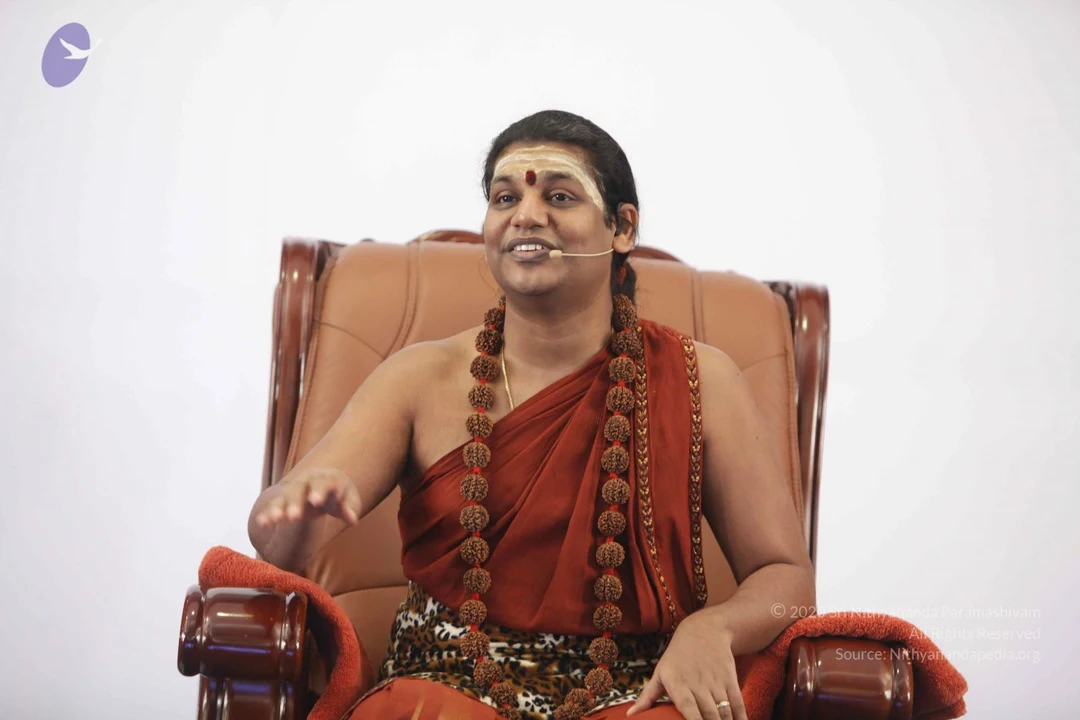
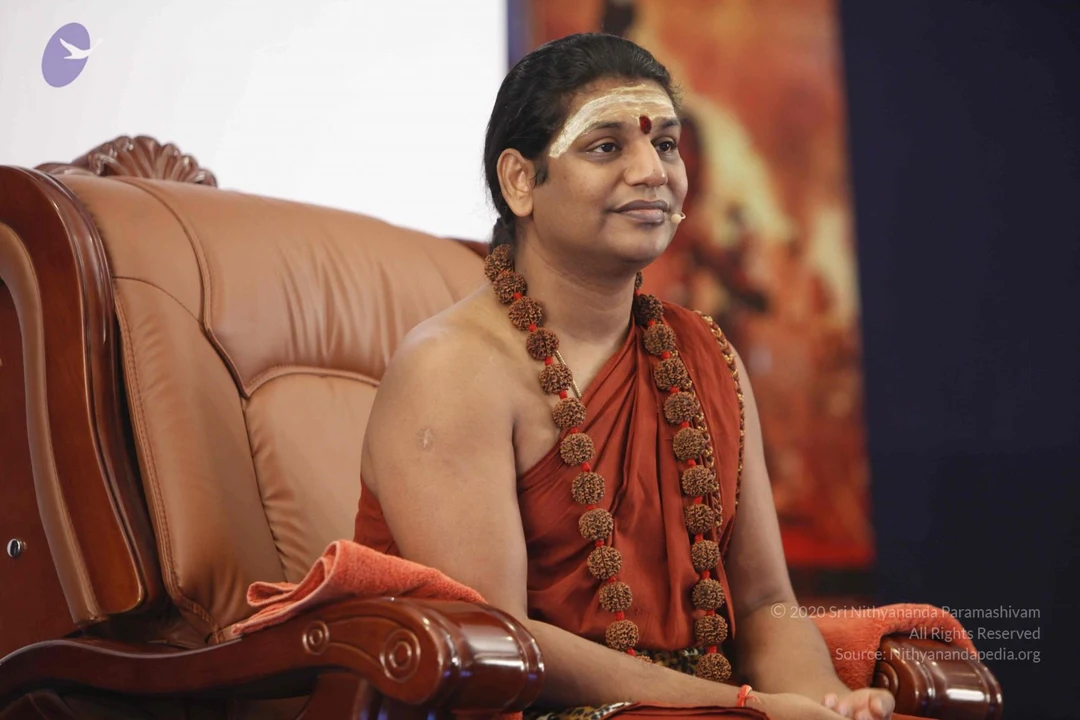
4-Manikarnika-Ghat-Visit-Darshan

12 photosSource gallery
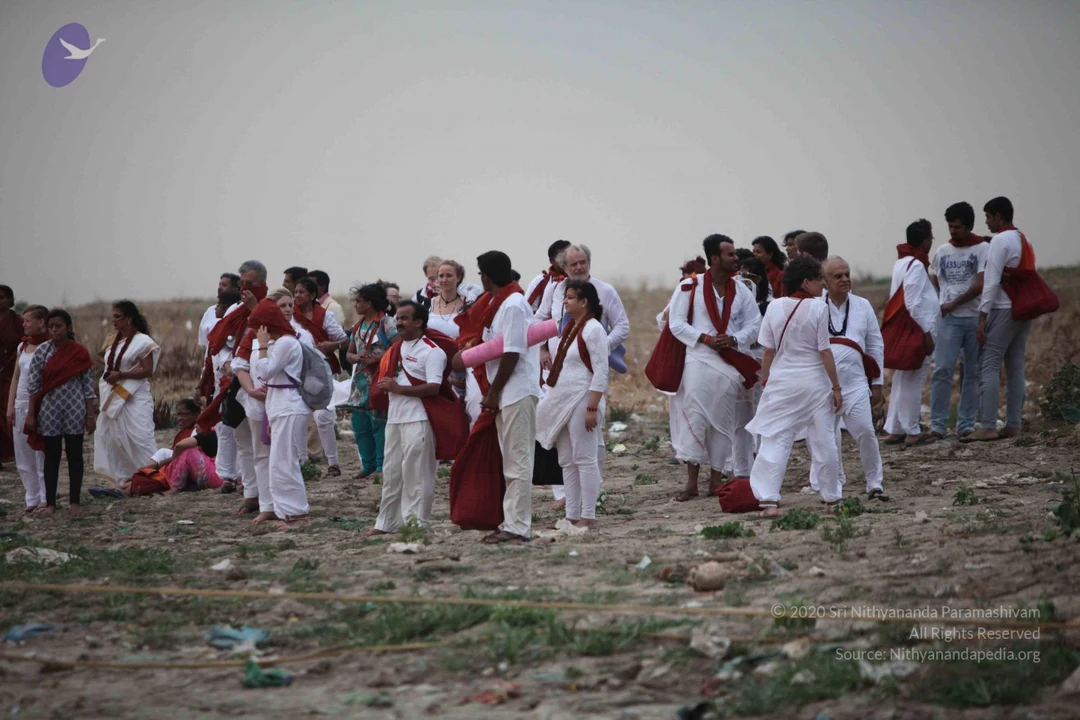
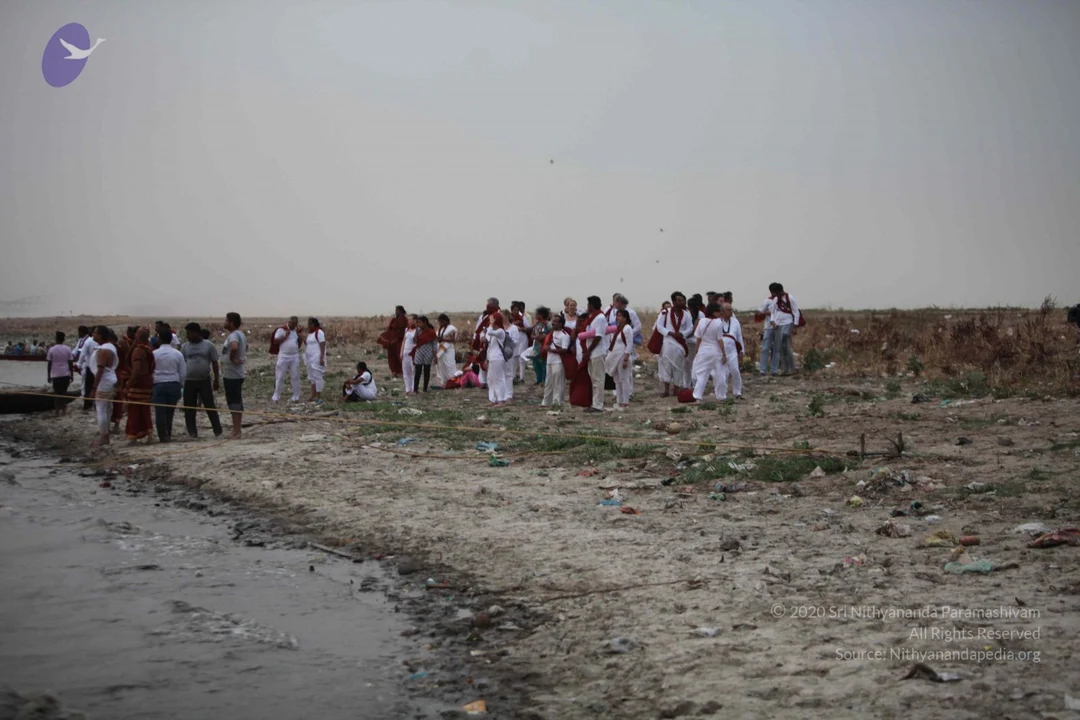
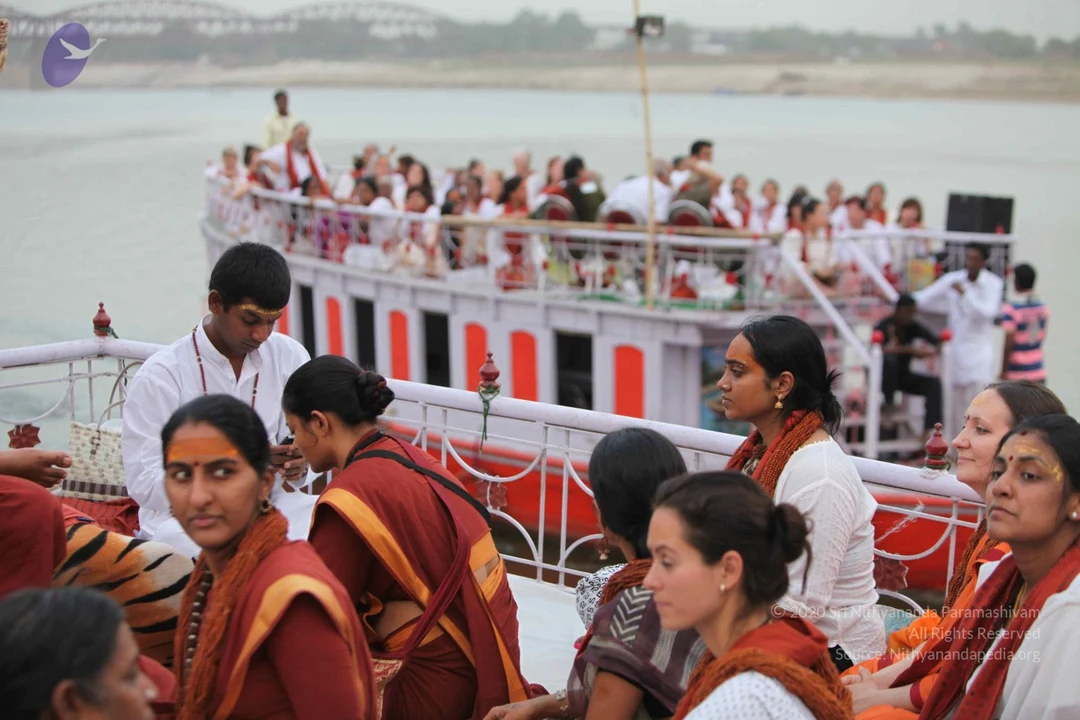
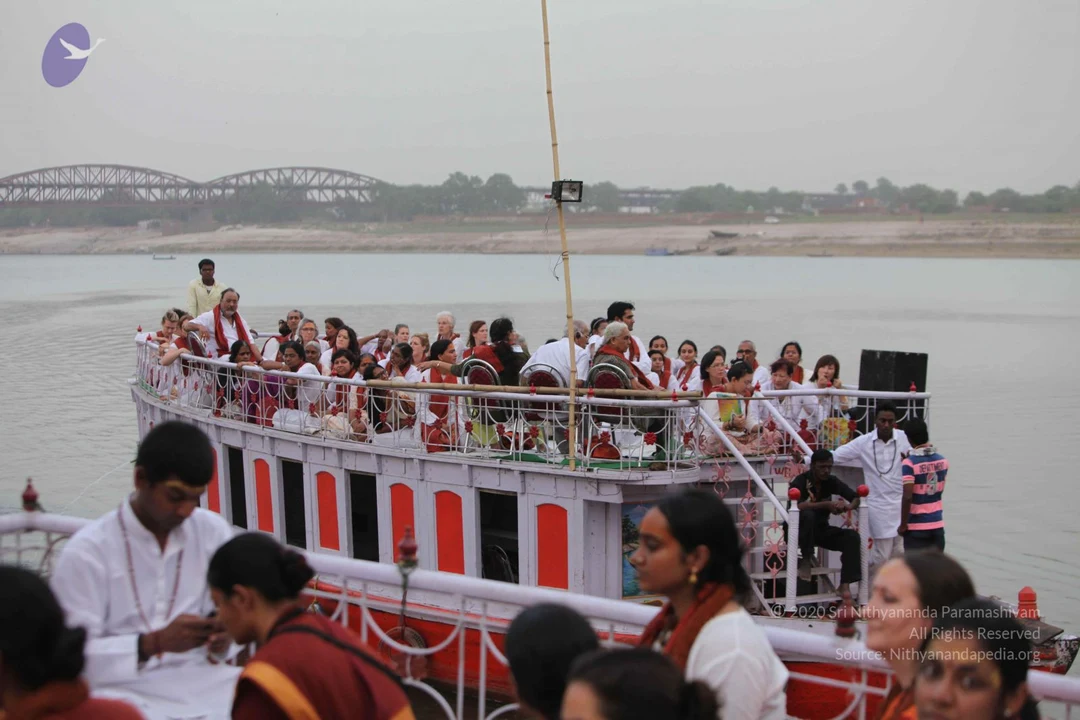
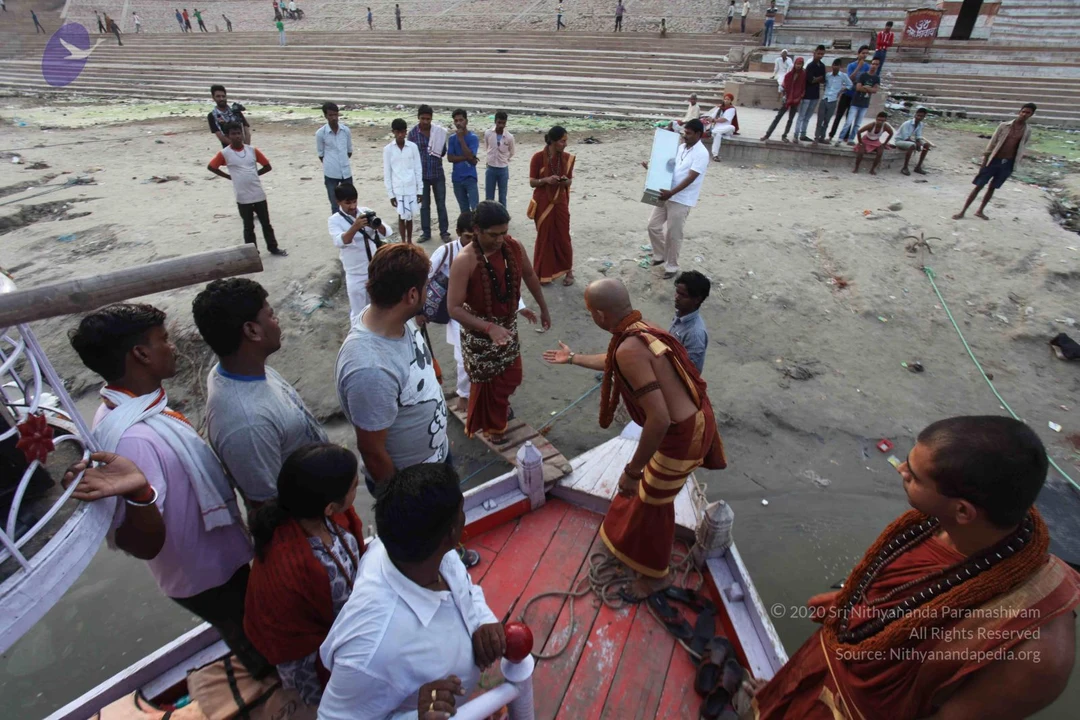
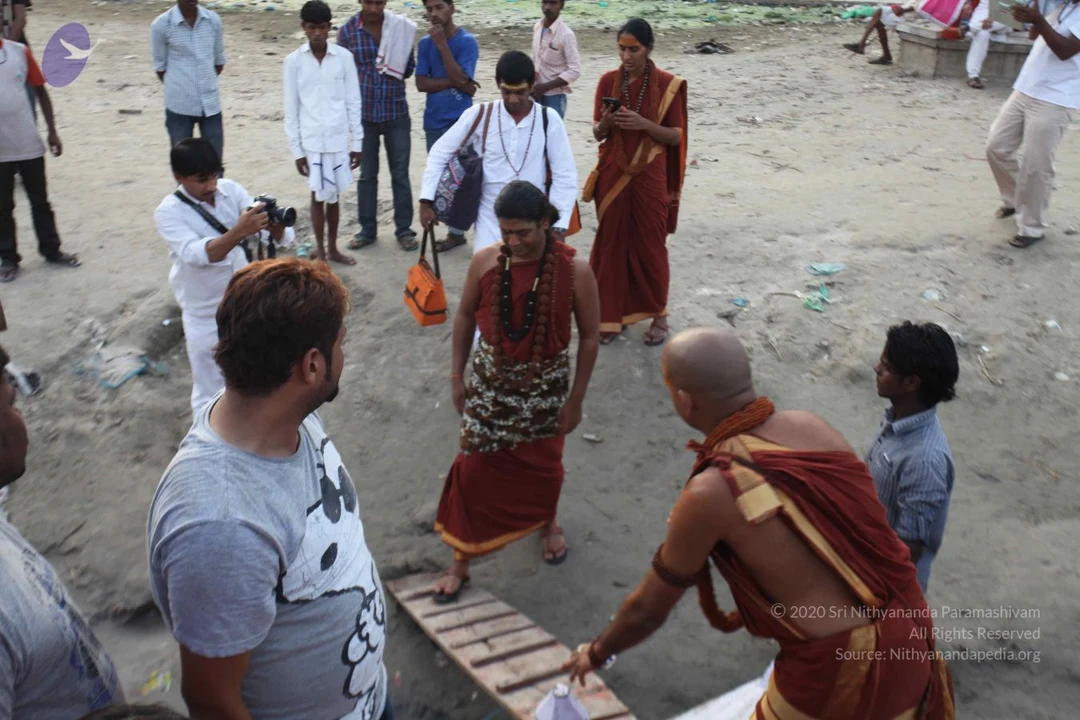
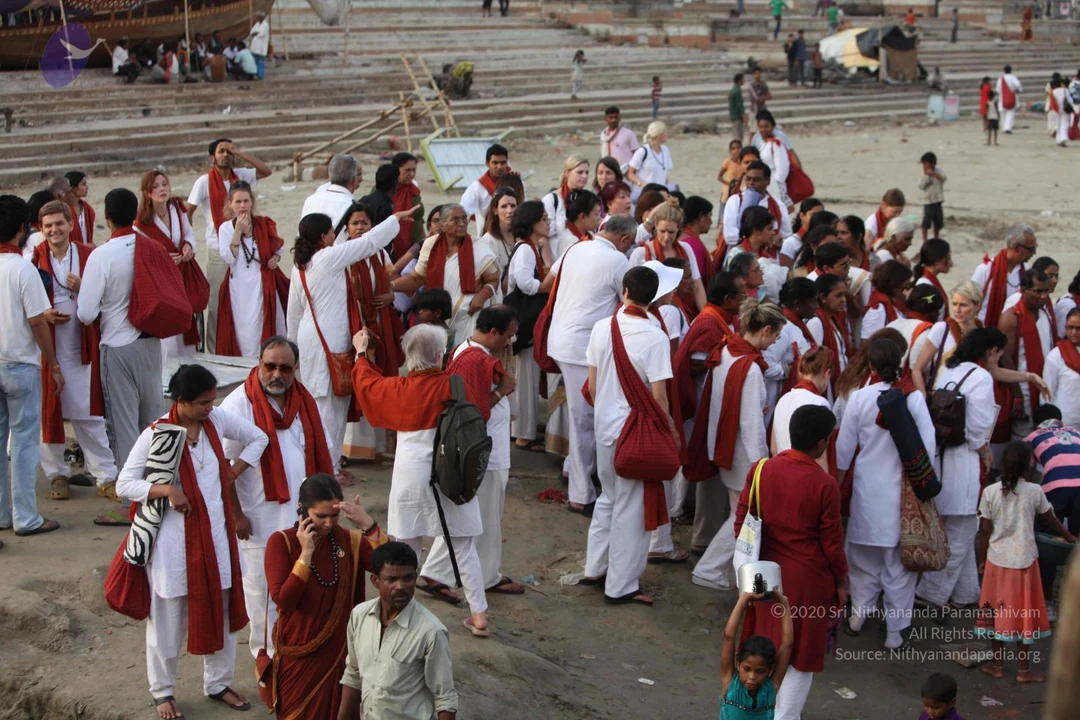
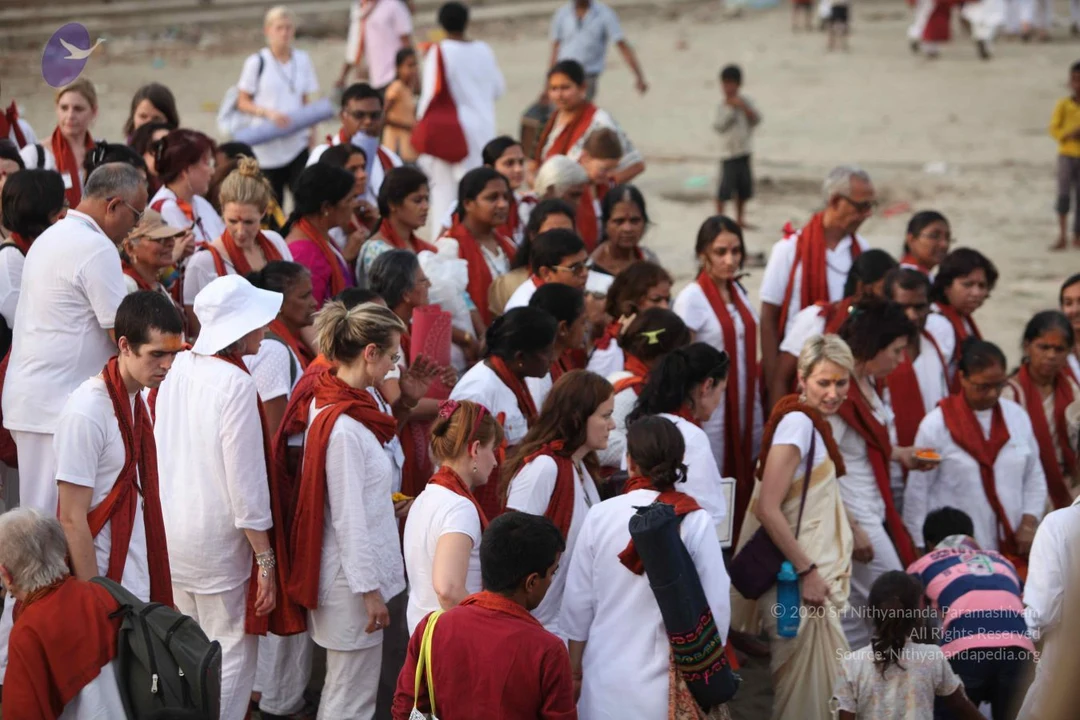
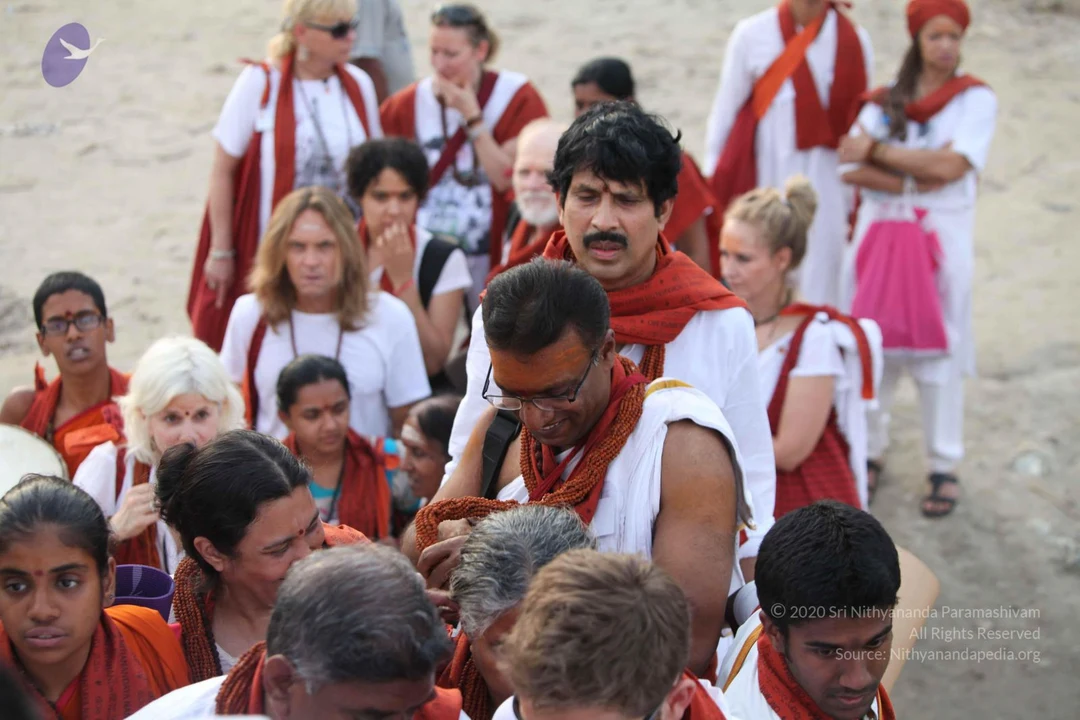
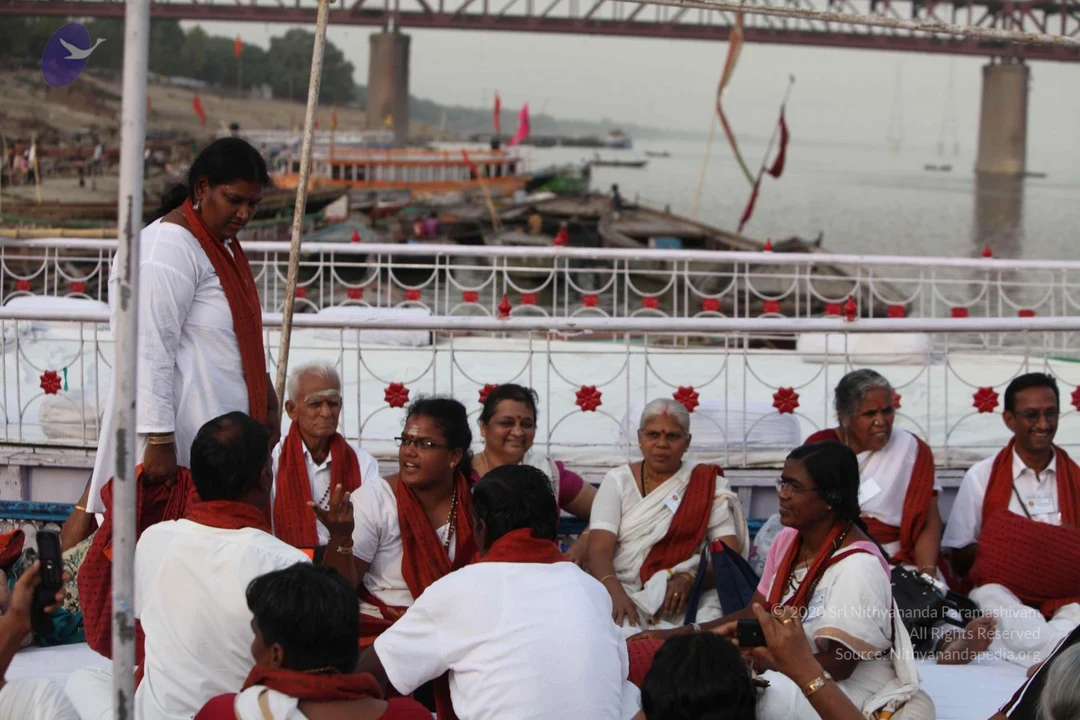
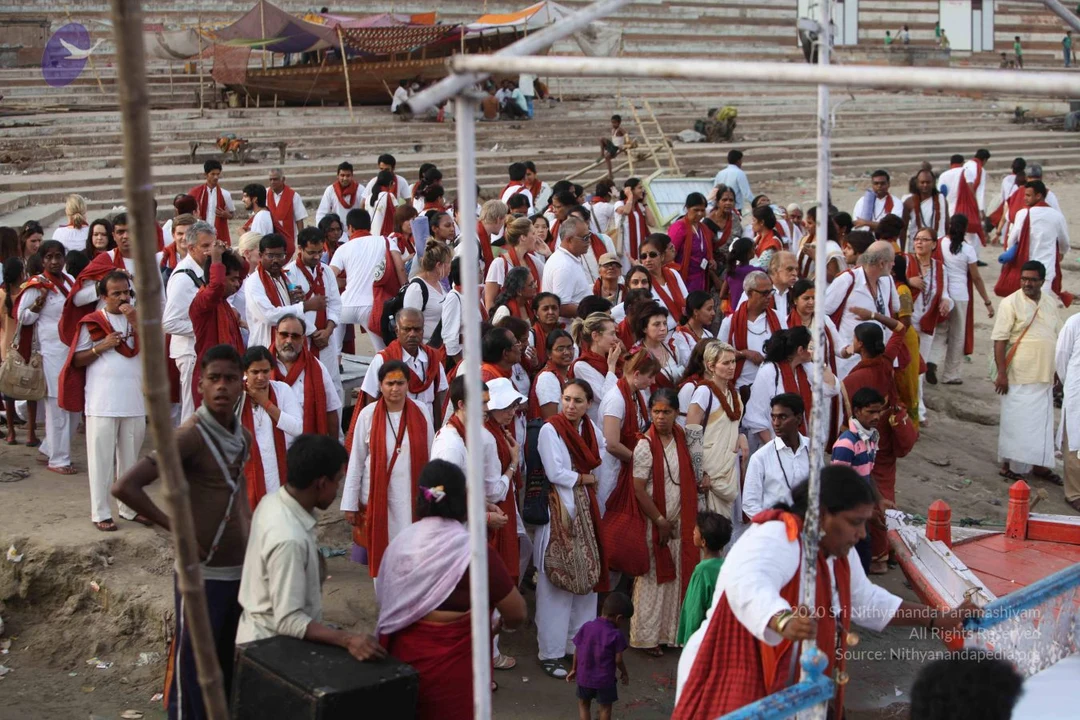
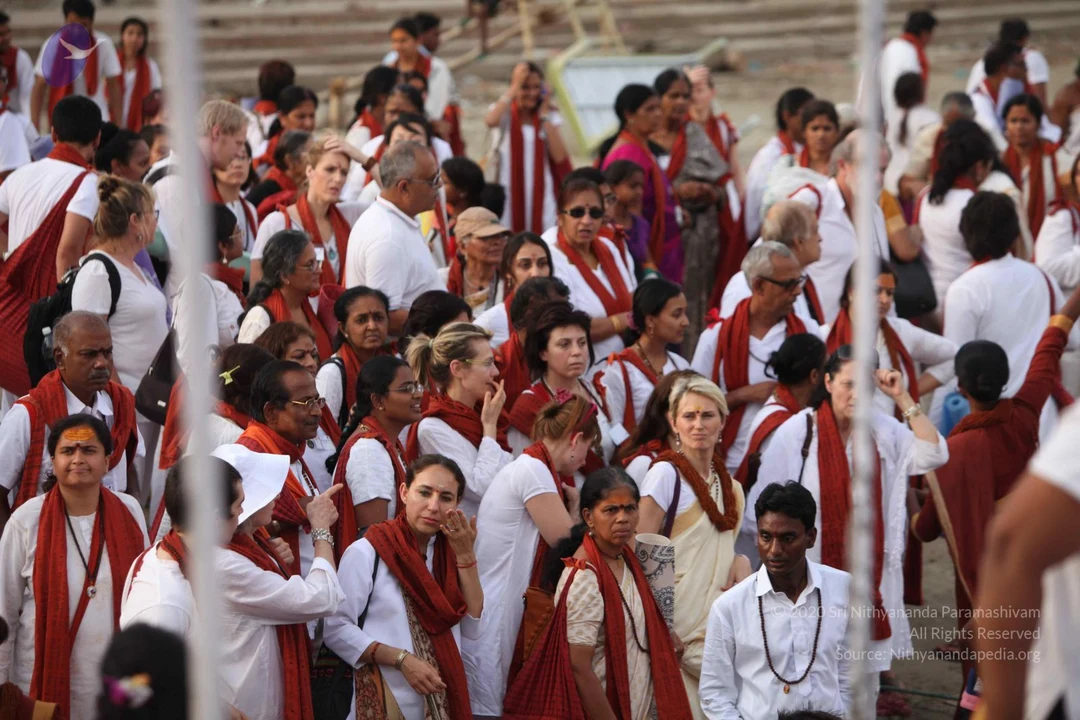
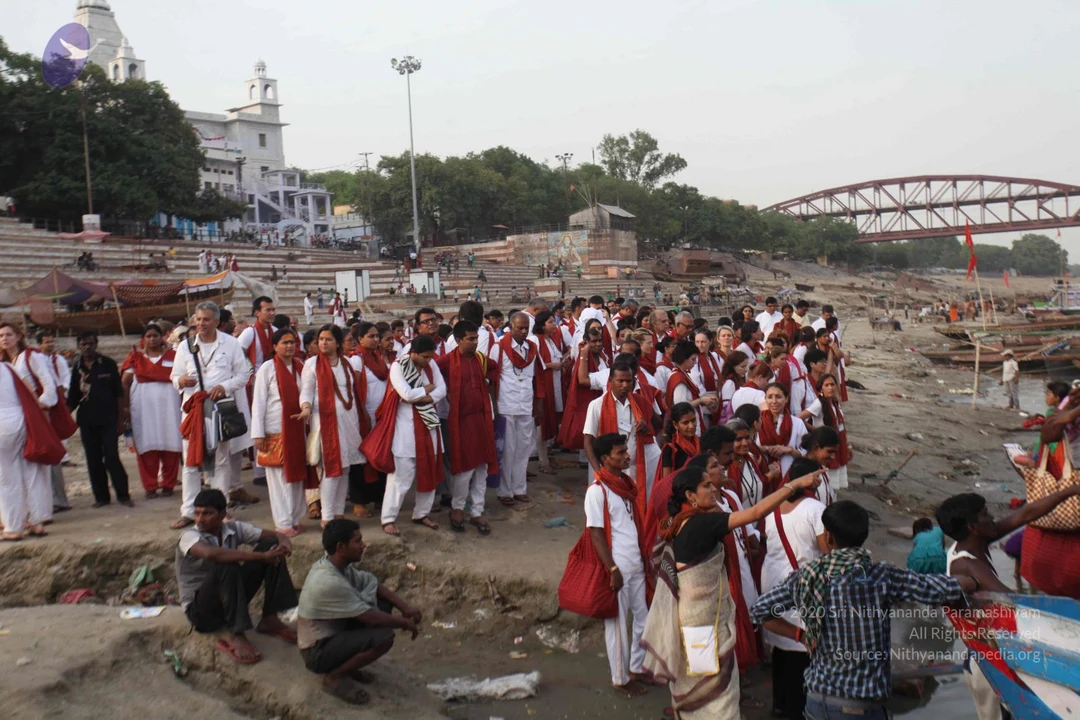
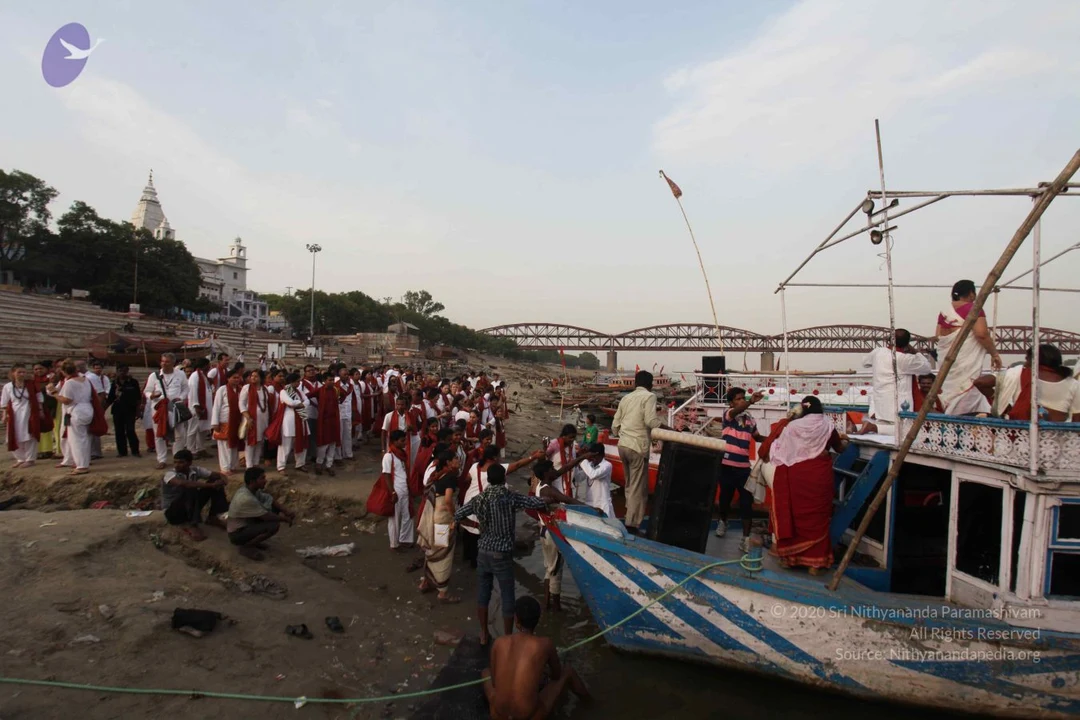
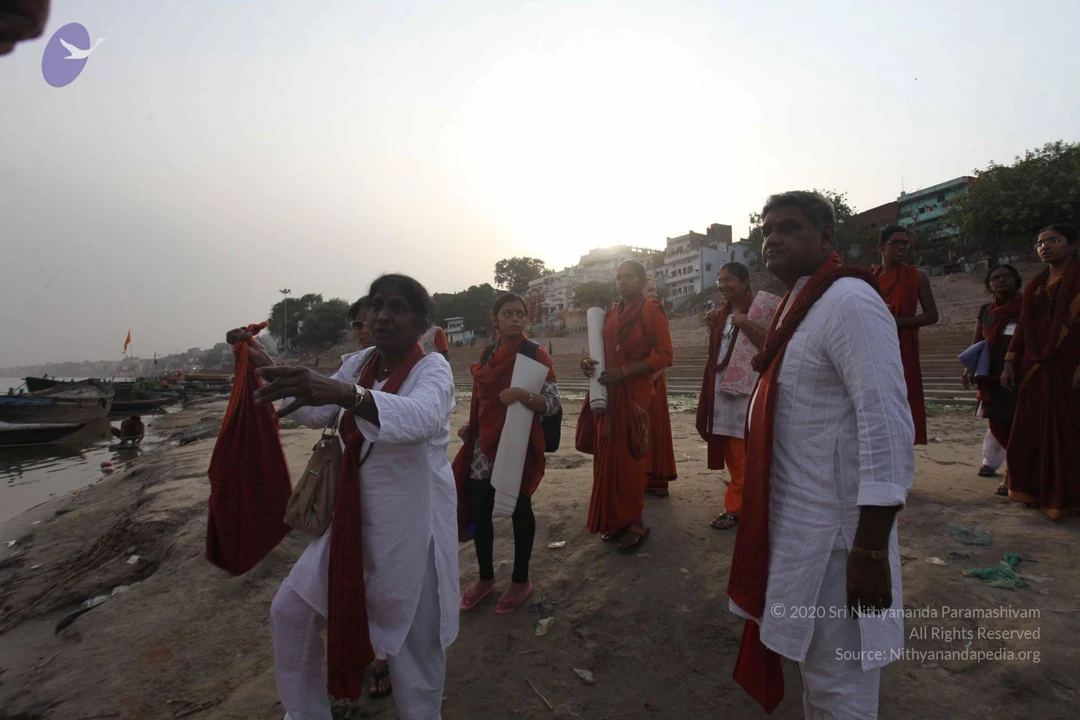
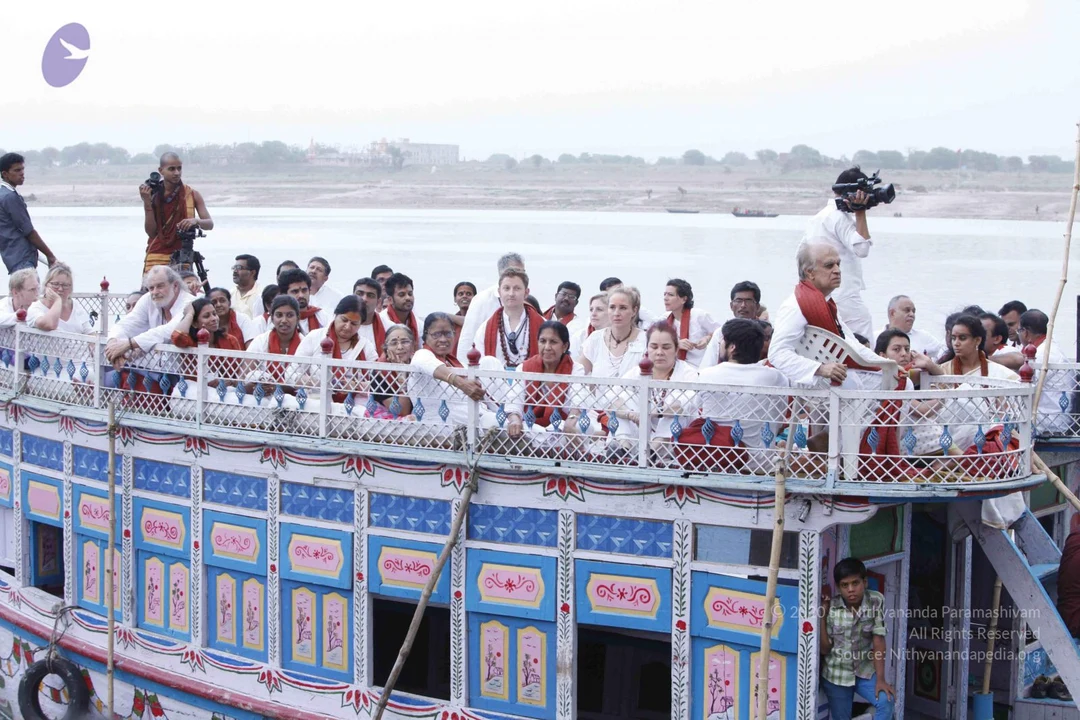
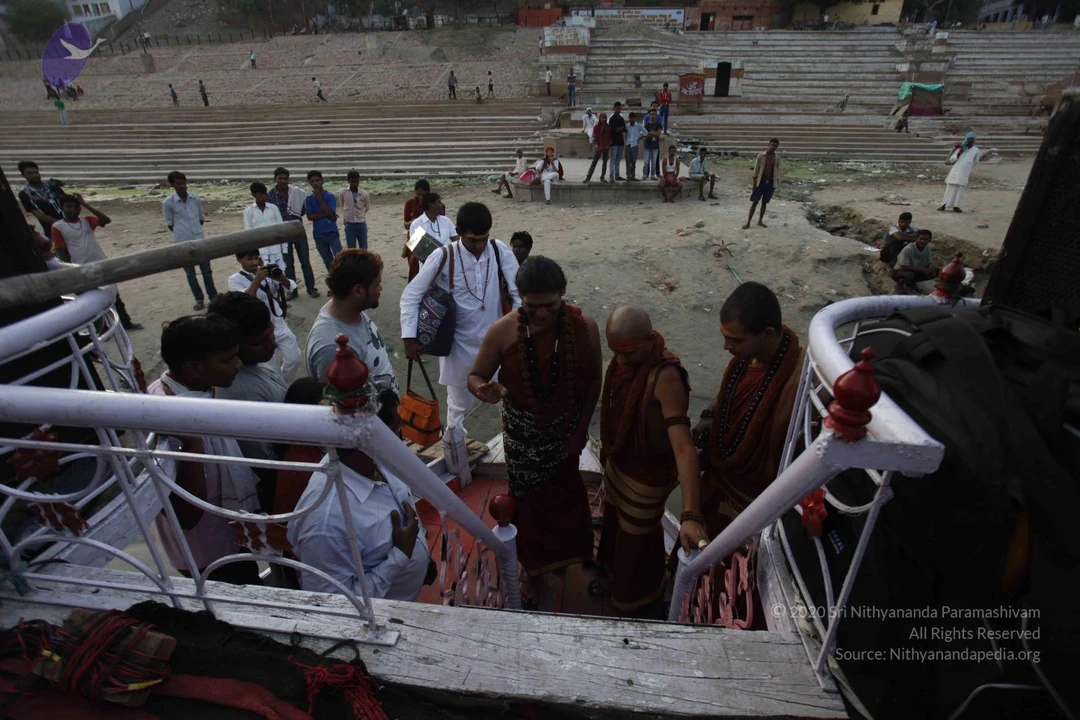
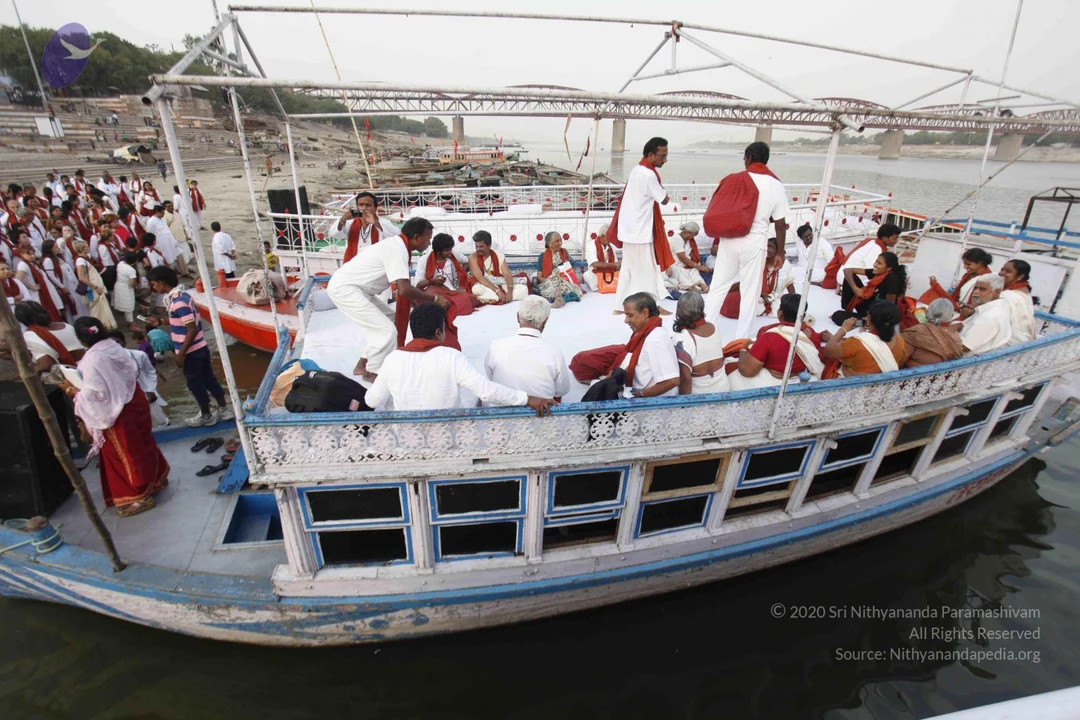
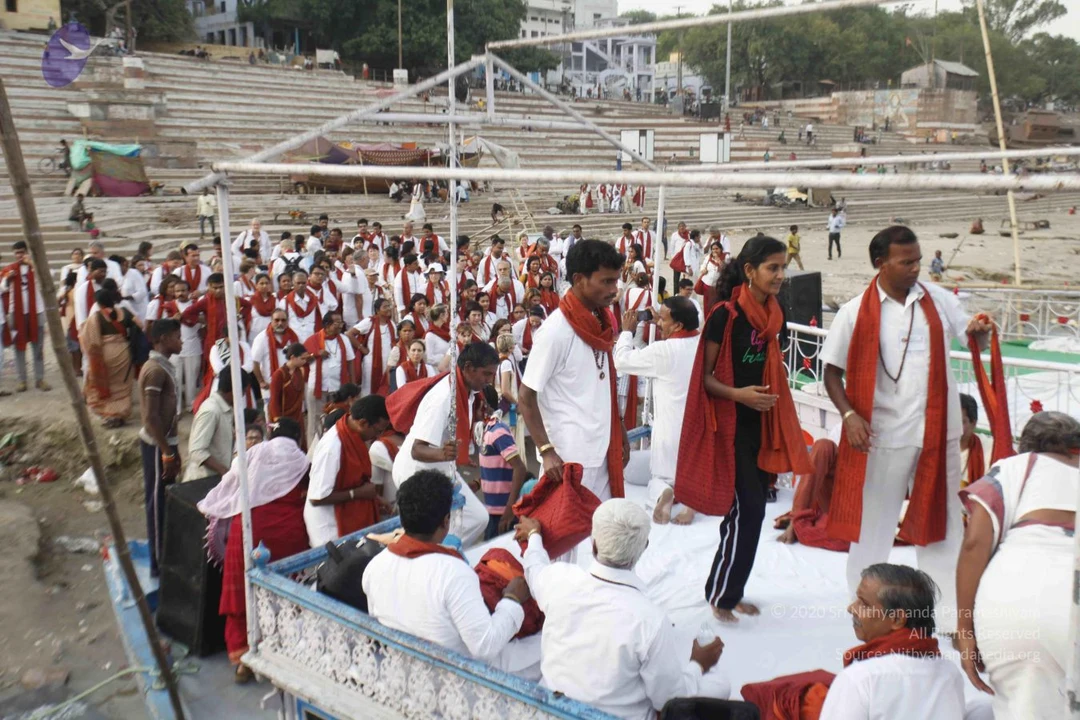
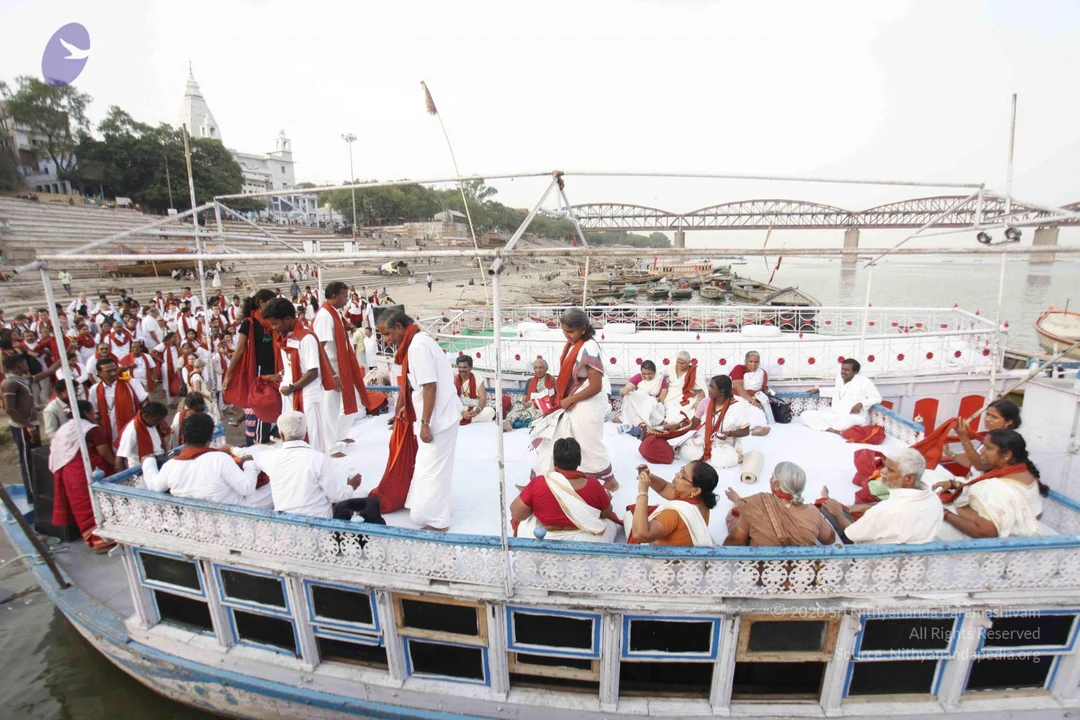
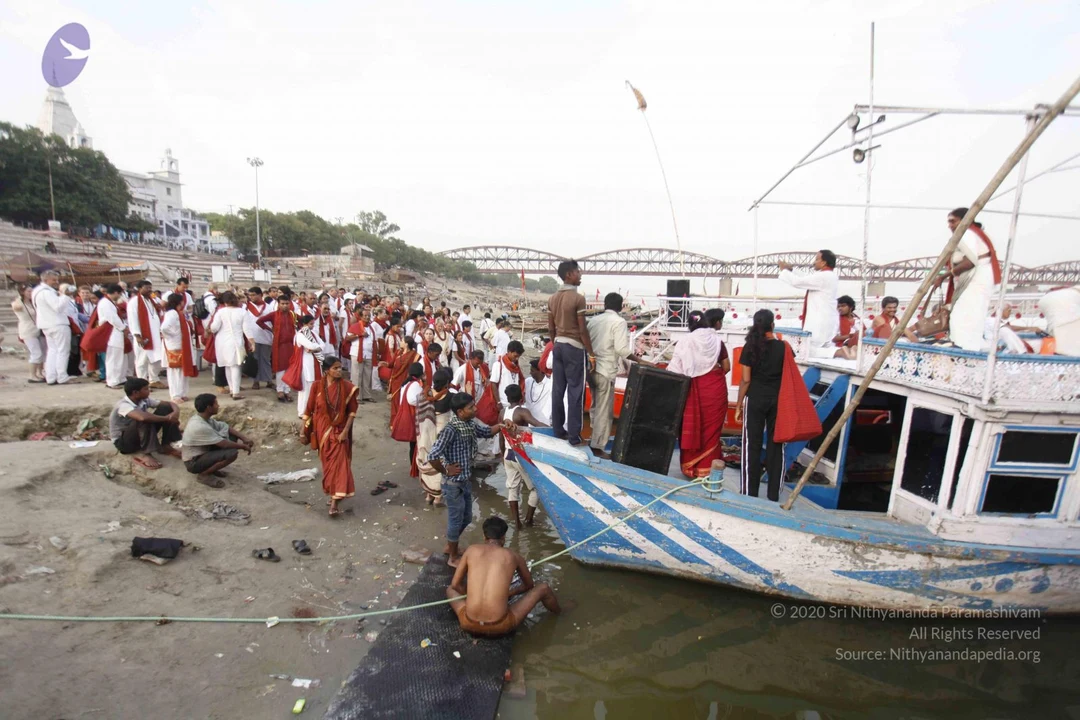
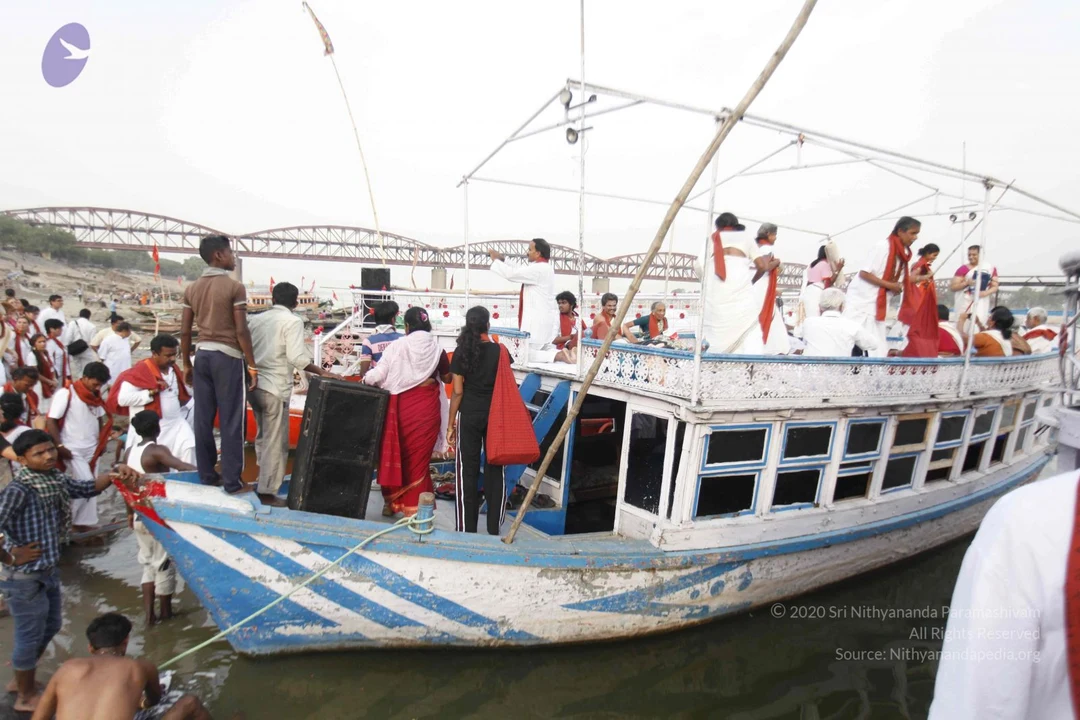
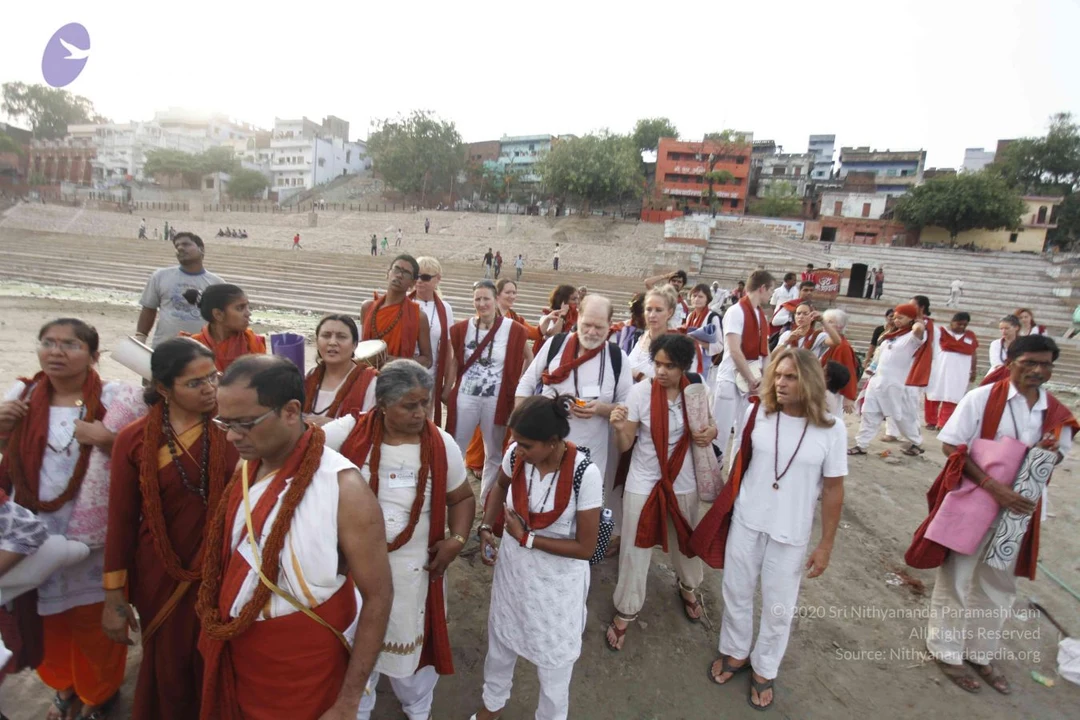
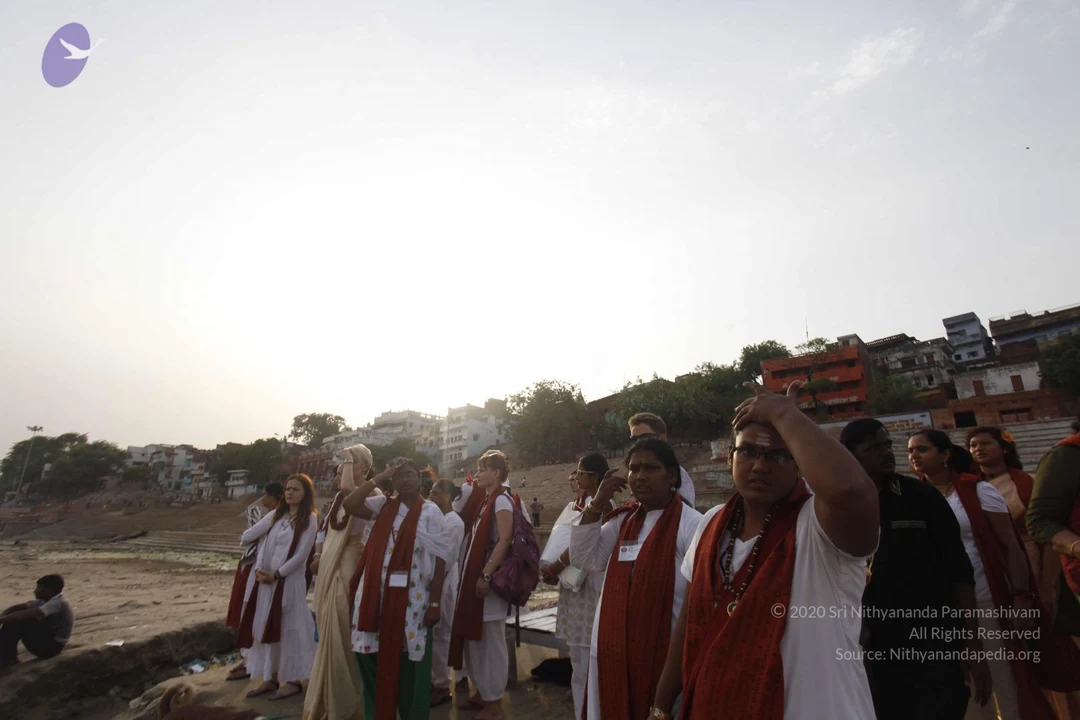
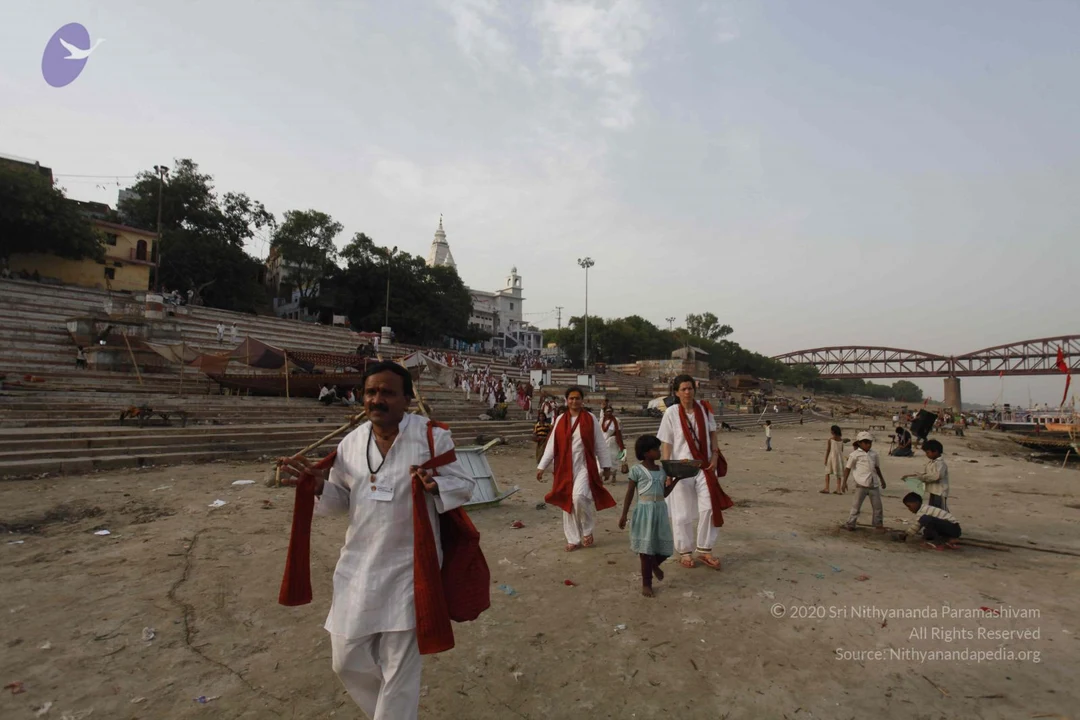
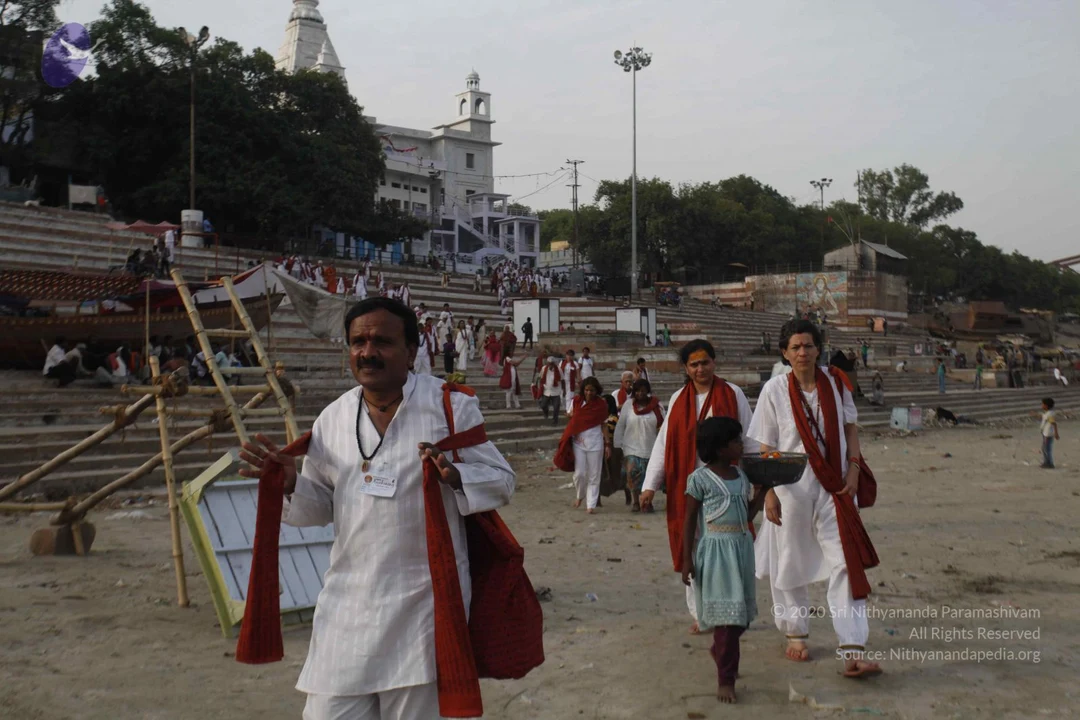
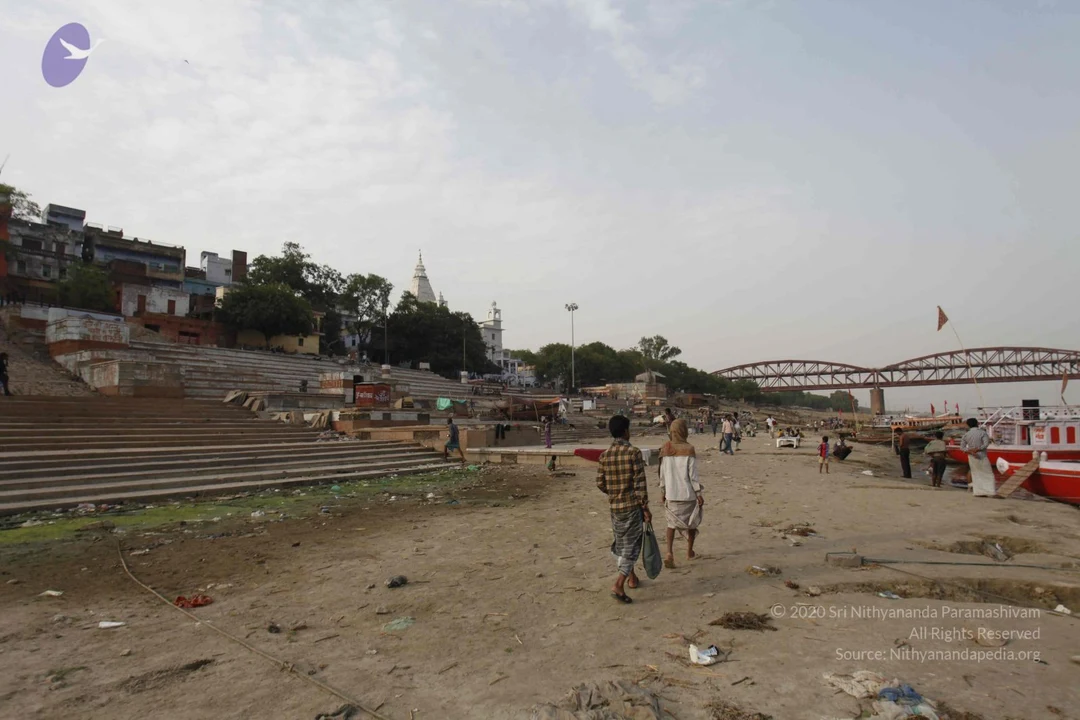
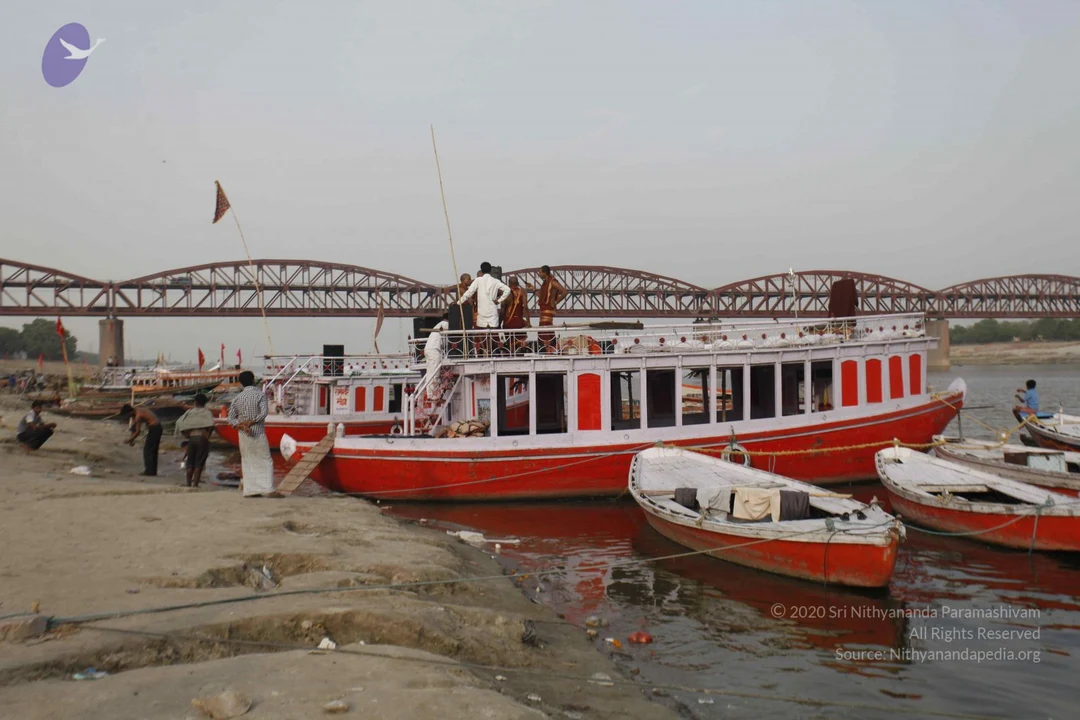
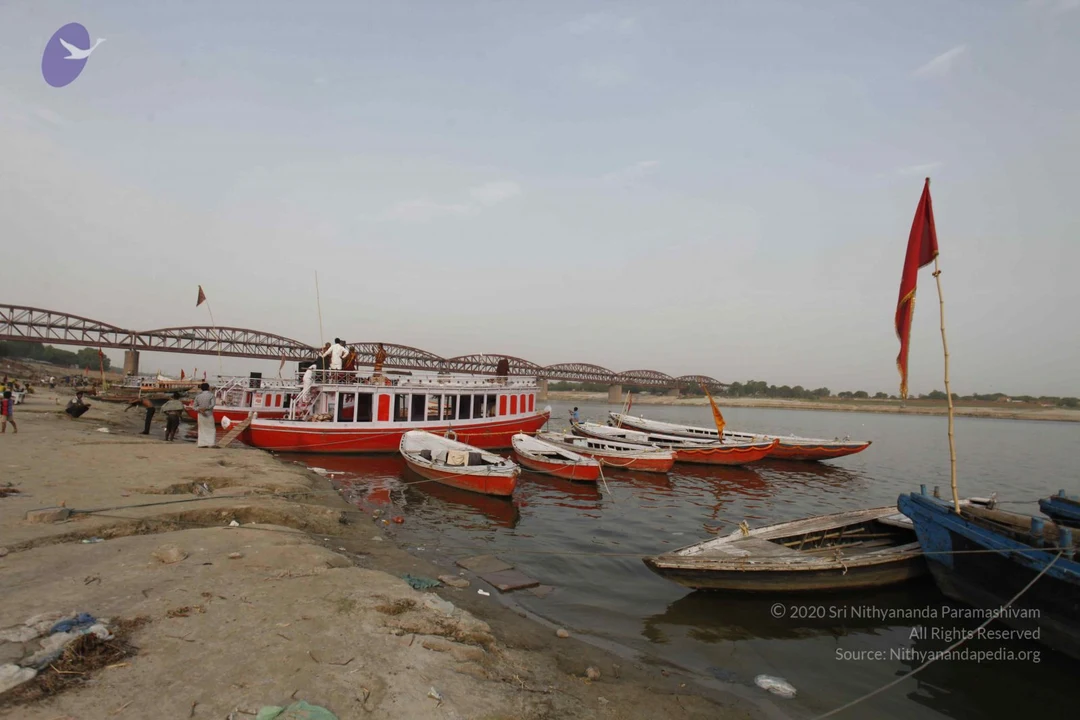
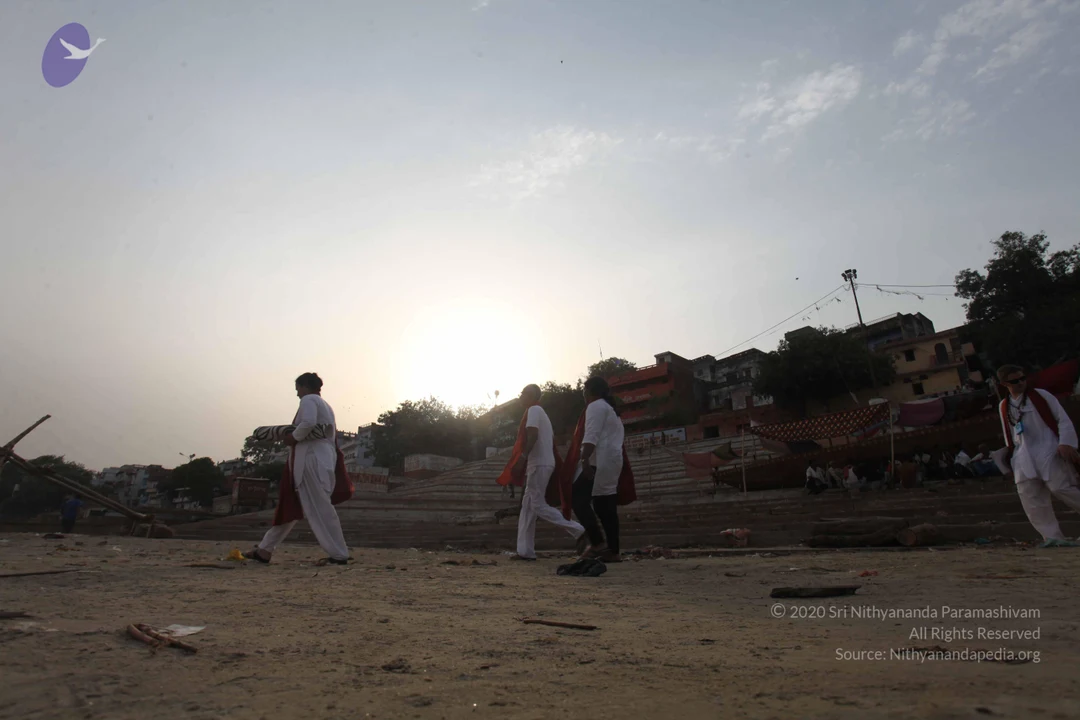
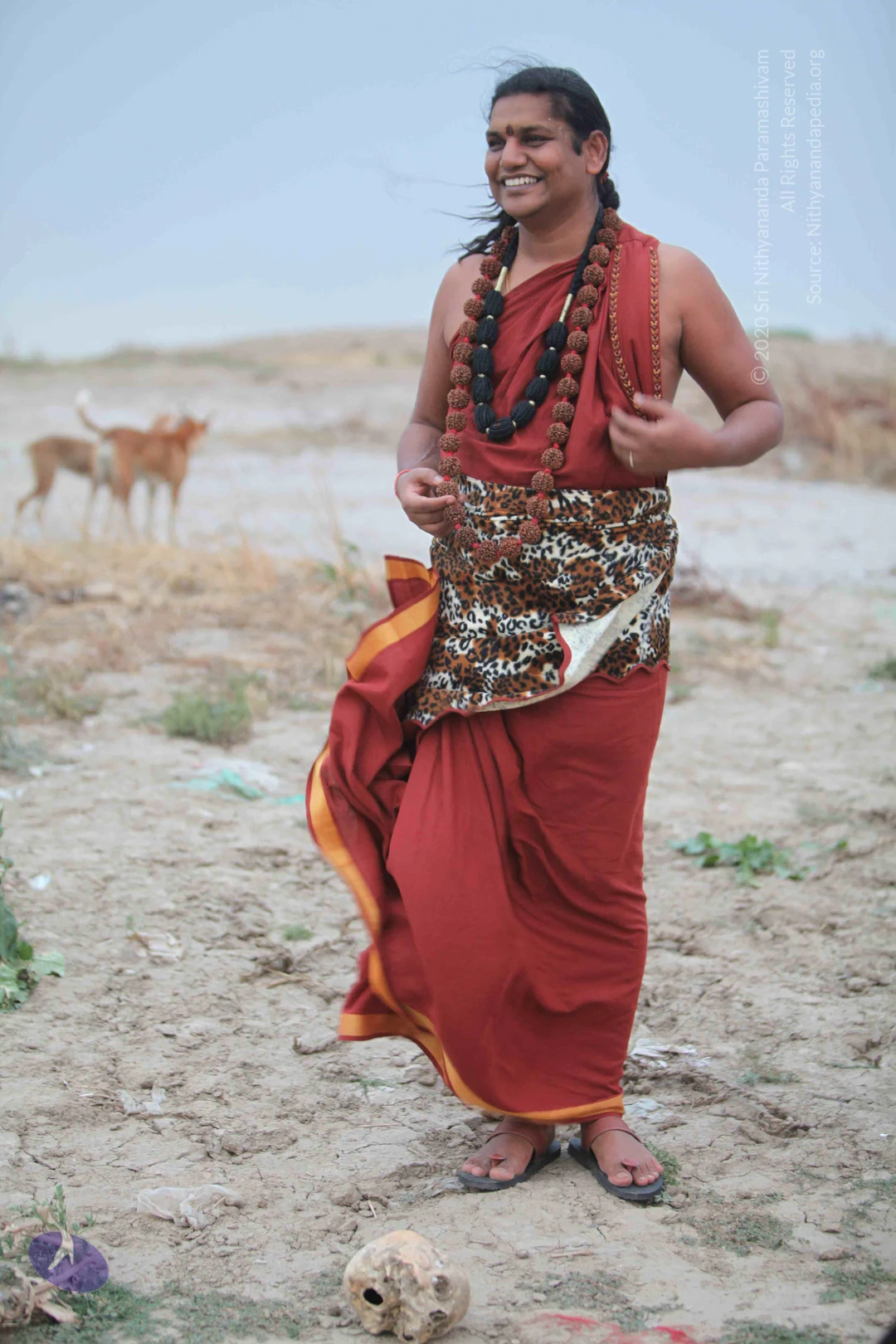
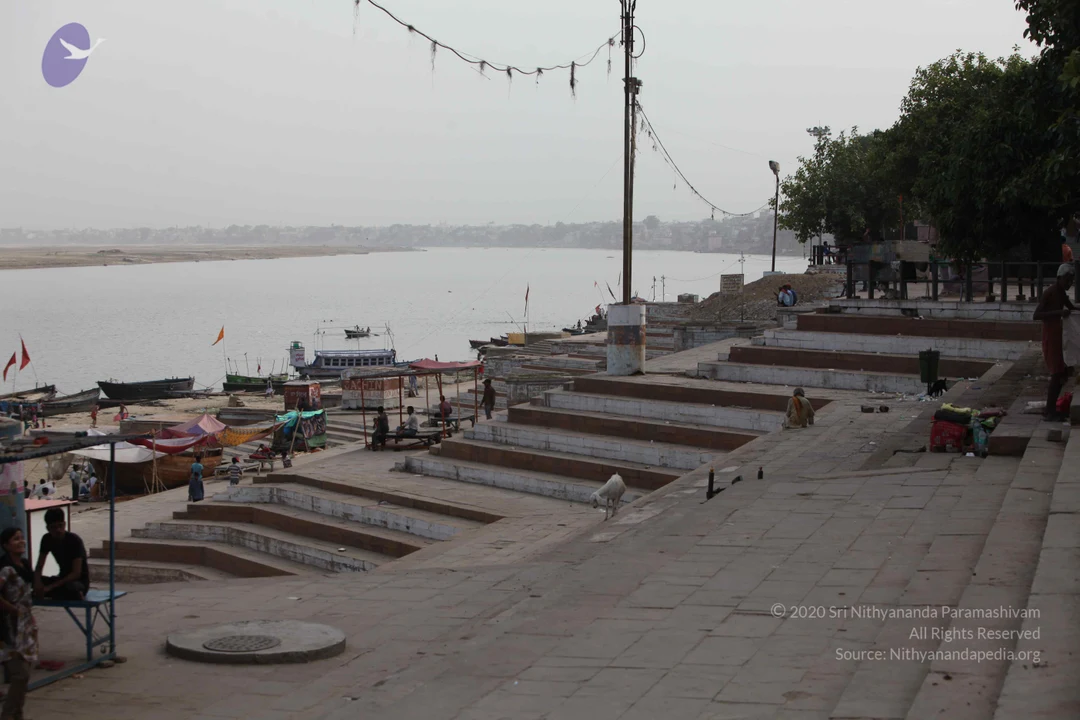
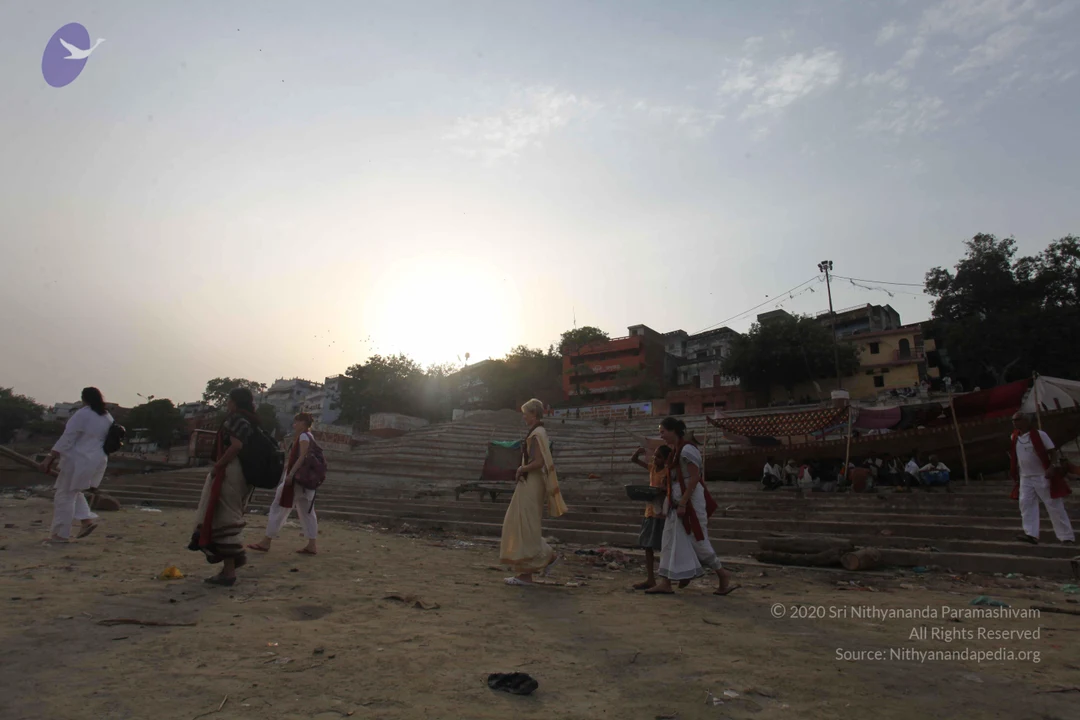
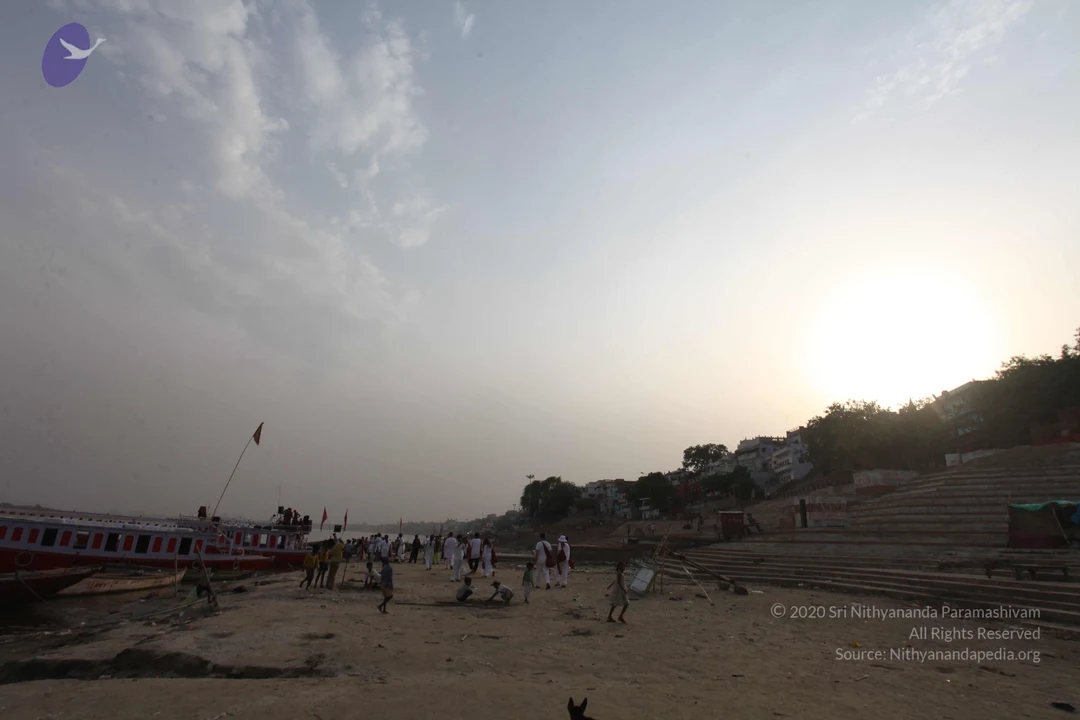
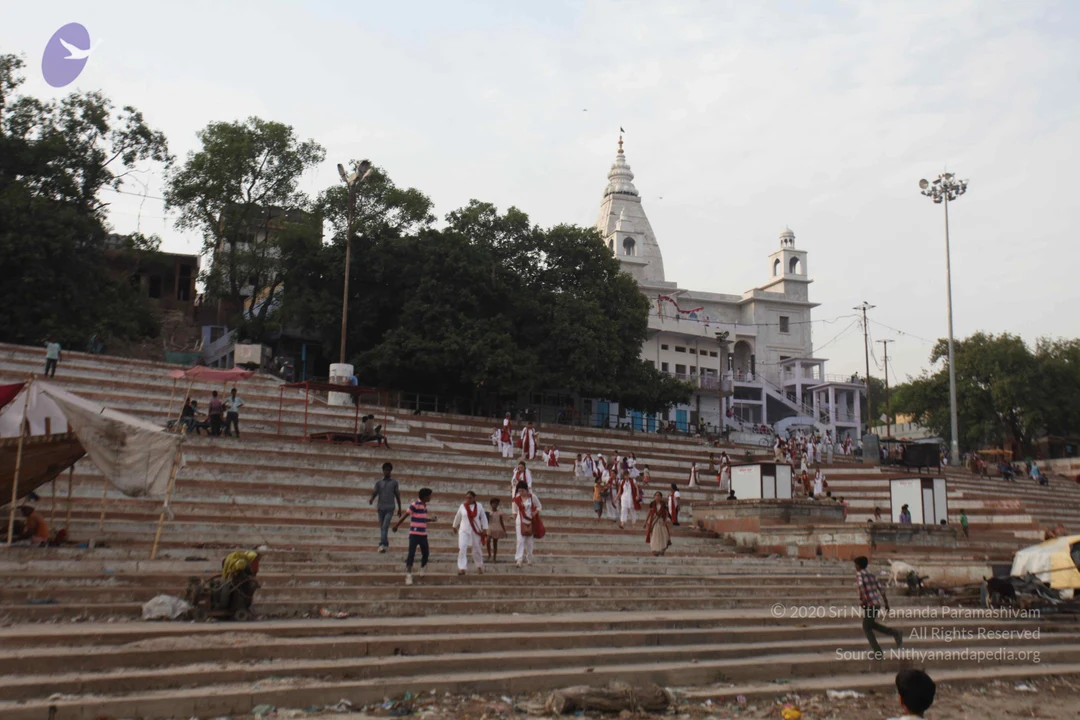
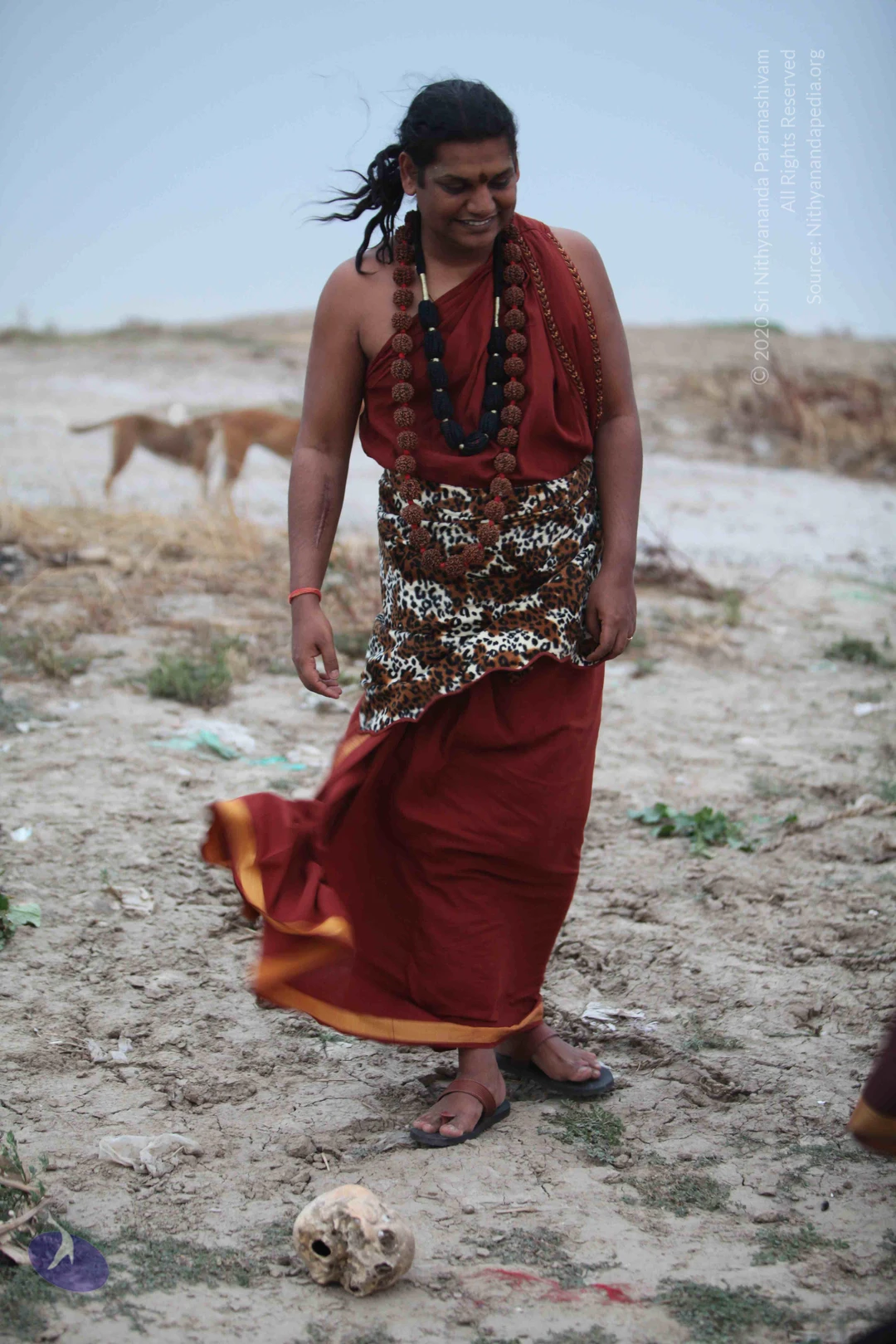
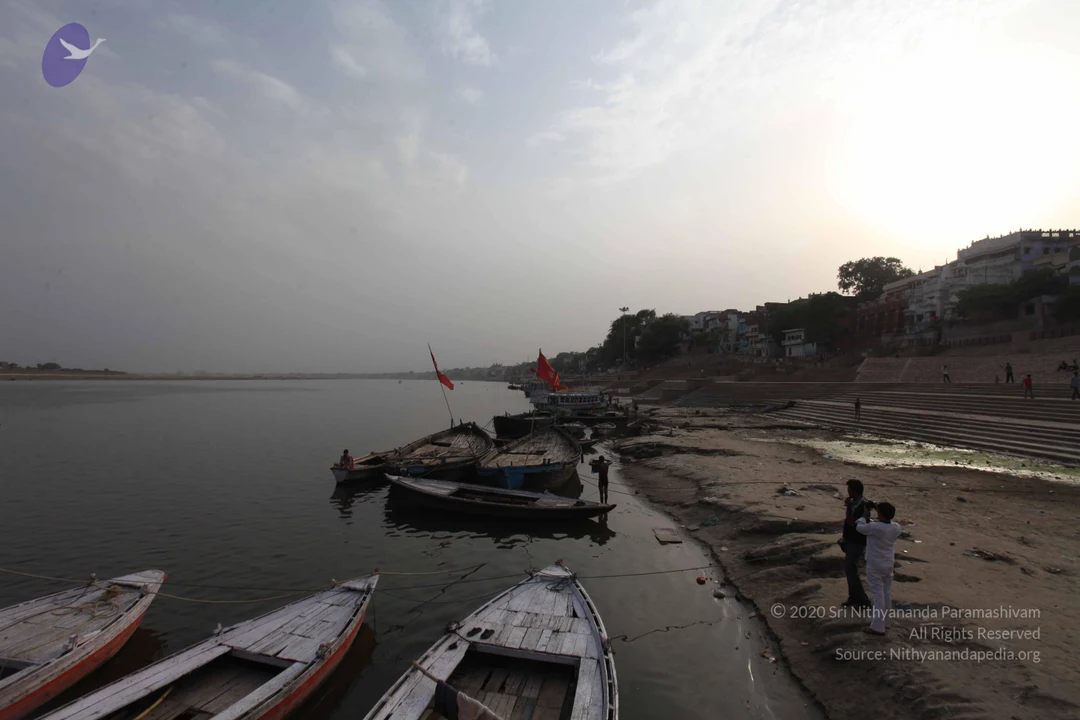
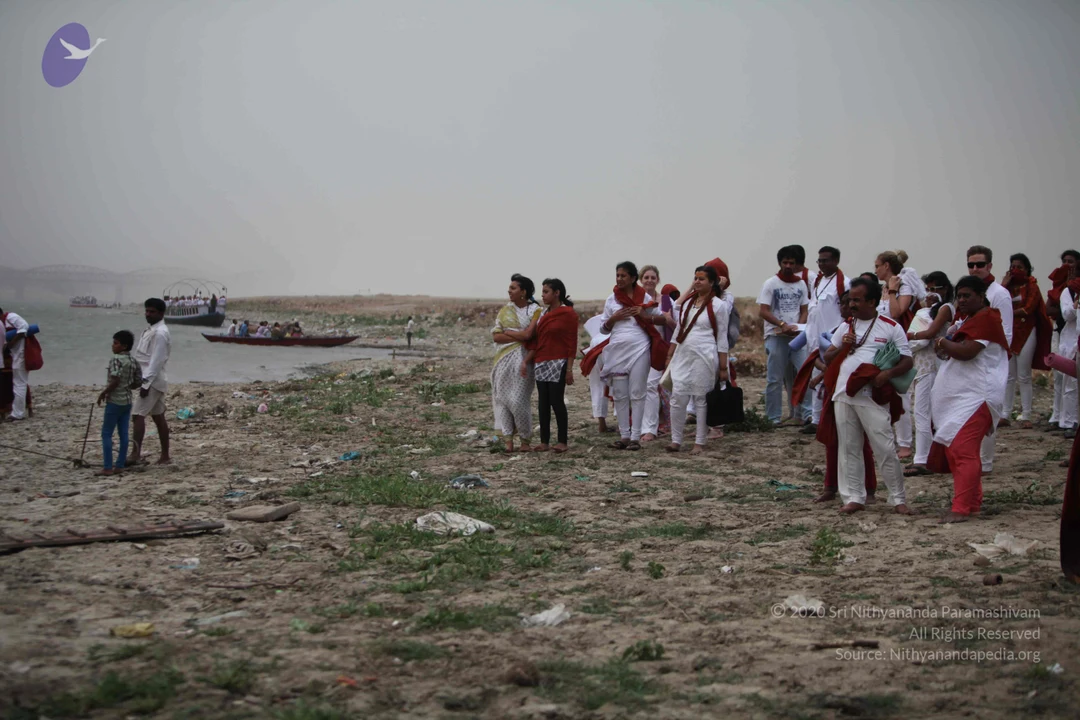
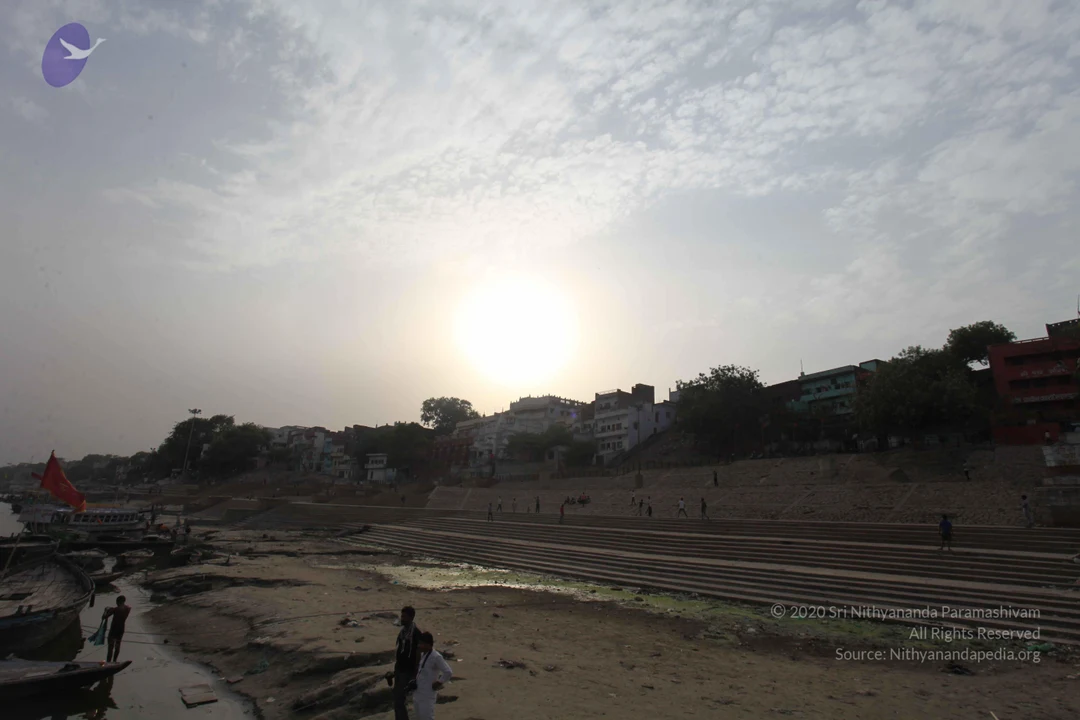
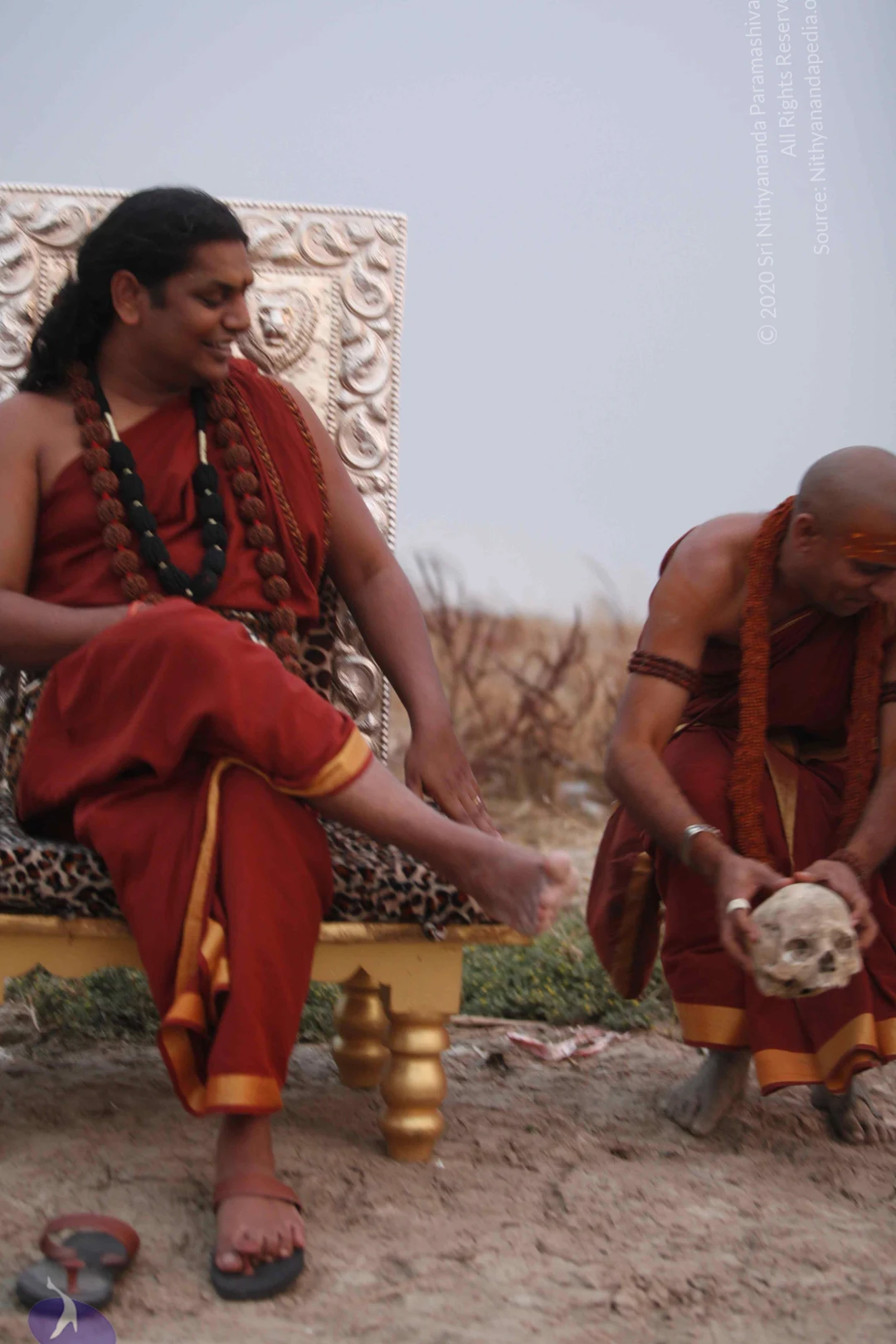
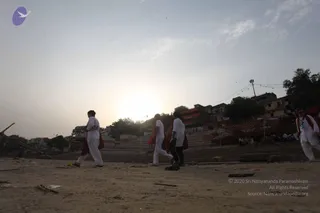
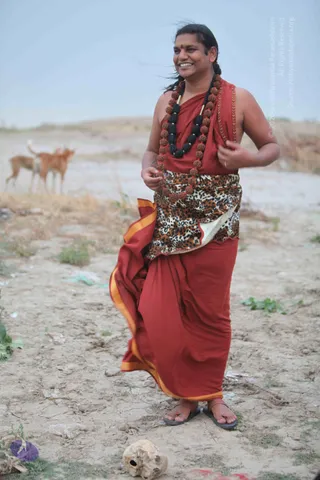
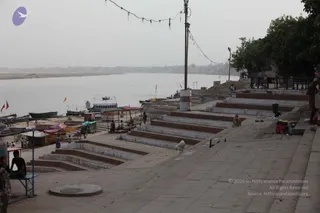
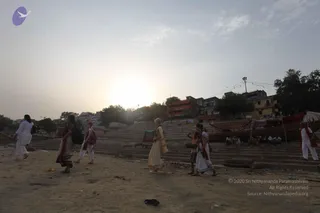
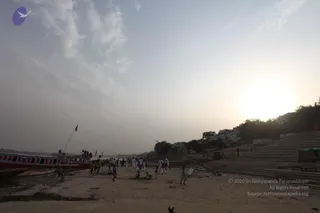
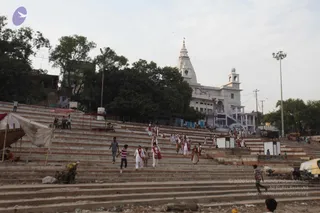
Wide low-angle photo of a dusty riverside ghat in Varanasi at sunset, with the sun glowing behind haze. Four people in white clothing walk across the sandy foreground toward stone steps. Several wear red or orange shawls draped over their shoulders; one at the left carries a bundle. On the right, a man in white with a red shawl and a visible lanyard walks near a red-and-white striped canopy. Stone steps, red-walled buildings, bamboo poles and a few seated figures fill the background. Scattered debris lies on the ground.A smiling man with long dark hair swept back stands on dry cracked ground outdoors, wearing a rust-red wrap over the shoulder and a red-and-gold bordered red dhoti, with a leopard-print cloth tied at the waist. He wears a long necklace of rudraksha beads with black tassel-like strands and a red bindi on his forehead, and holds the necklace with one hand. Two tan dogs stand in dry grass behind him, and a weathered skull lies on the ground in the foreground beside scattered debris. Appearance-based identification is uncertain; the long hair, rudraksha mala and saffron-red clothing are visible cues, so the figure is a possible a person, but the cues are not distinctive enough to confirm.A wide view of a riverside ghat on the Ganges in Varanasi, with broad stone steps descending to the hazy, flat river on the left. Moored wooden boats with orange pennants sit at the water's edge, and small tented canopies with red and blue fabric shelter sellers and seated people on the sand below. A white cow walks up the steps on the right, and a few scattered figures sit or stand along the terraces. Tall utility poles with strung bunting and green trees line the right side, with a distant city skyline across the river under overcast sky. No a person candidate is visible.Wide evening photograph of a sandy riverbank with stone ghat steps leading down toward the Ganges at Varanasi. Several people walk across the sand in white and cream clothing, some with red shawls or stoles over their shoulders, one carrying a bag. A few people sit on the steps near a covered boat with red cloth, and a sun low in a hazy sky lights the scene. Buildings with red and beige walls and trees line the bank behind the ghat.Wide outdoor photograph of a riverbank at a ghat in hazy late-afternoon light, with a pale sun low on the right over a bright, dusty sky. On the sandy shore, a small group of people in white clothing and white head coverings walks and stands near moored red-and-white boats with a small flag. Children in yellow and other light clothing play in the sand in the foreground. Stone steps lead up to the buildings and trees along the water on the right. Ghat steps and a few small structures line the shore, with a lone dog visible at the bottom edge.Wide outdoor photo of the Manikarnika Ghat stone steps in Varanasi, with a white multi-tiered temple with a spired shikhara and small domed towers rising behind green trees. Several groups of people walk down the steps; a few men in white dhotis and white kurtas with red shawls or sashes carry items, and a woman in a red and white sari walks among them. Other figures sit or stand on the steps, a child in a striped shirt runs, and a red-and-white canopy tent stands at left. Street lamps and a grey sky frame the scene.
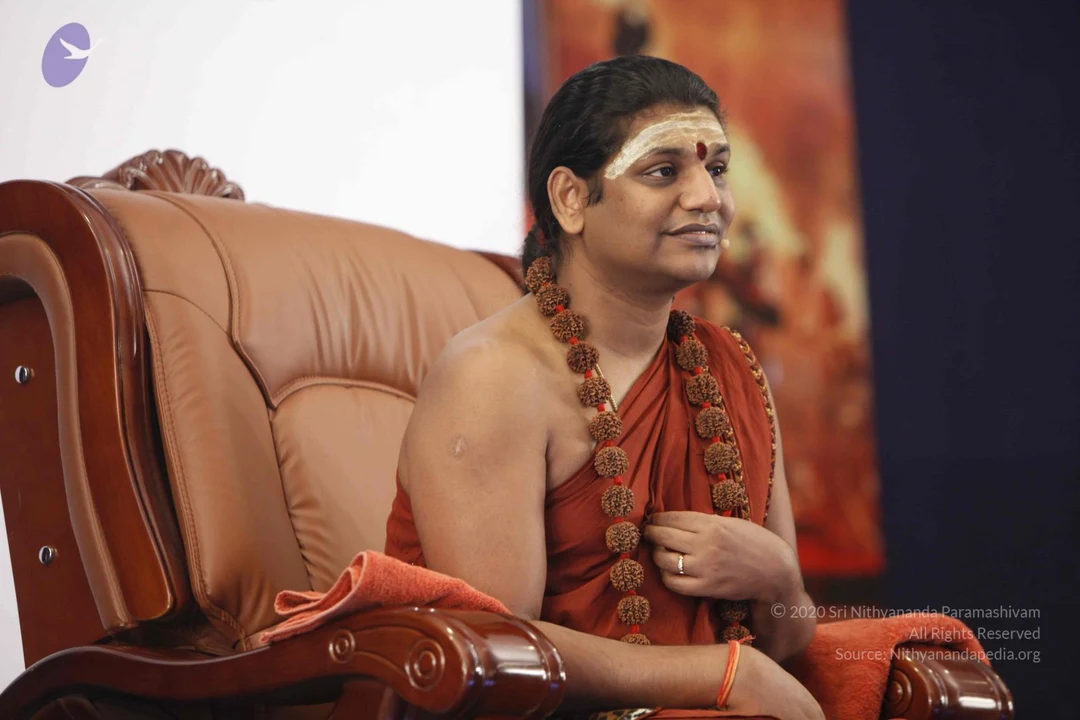
6-IA-Darshan
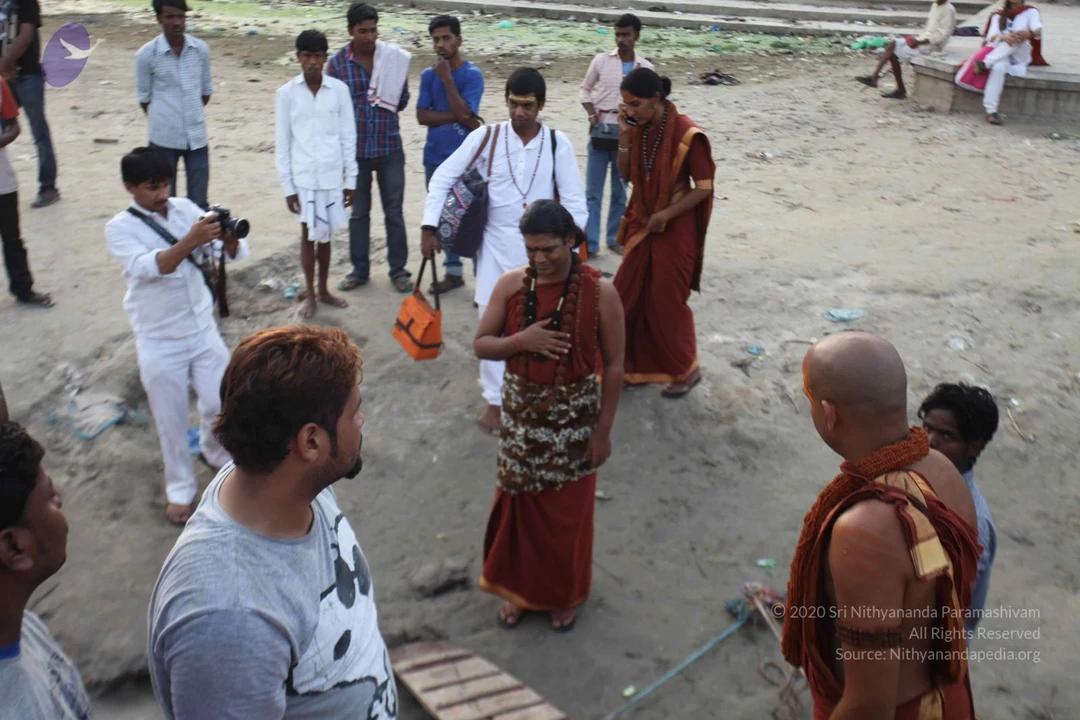
8 photosSource gallery
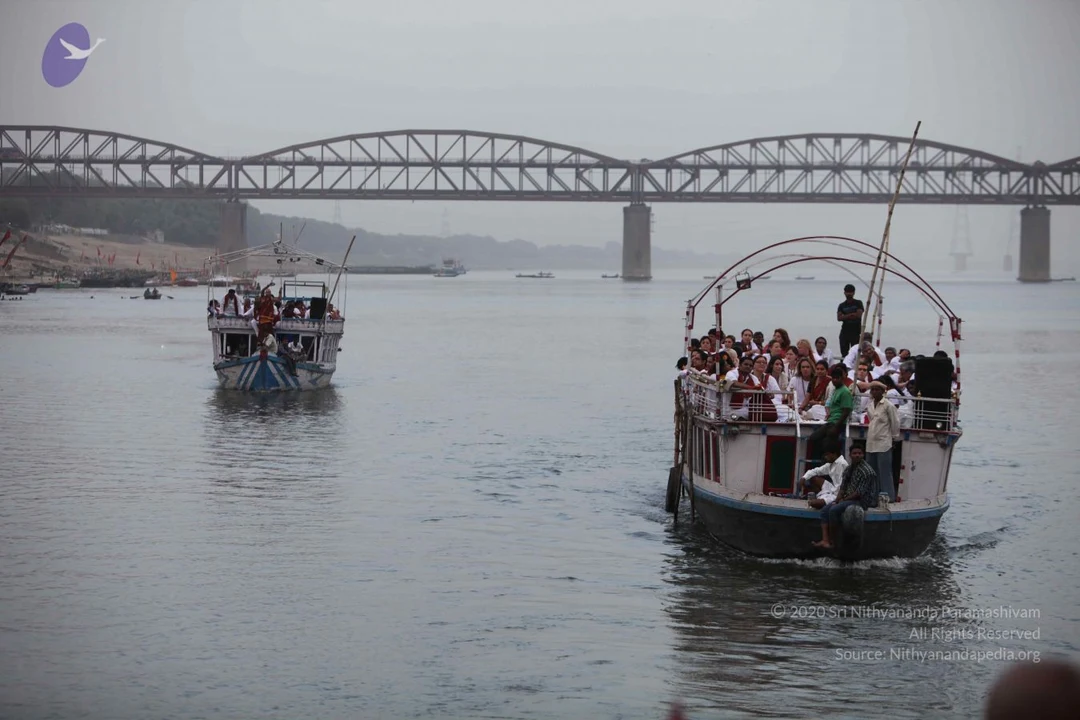
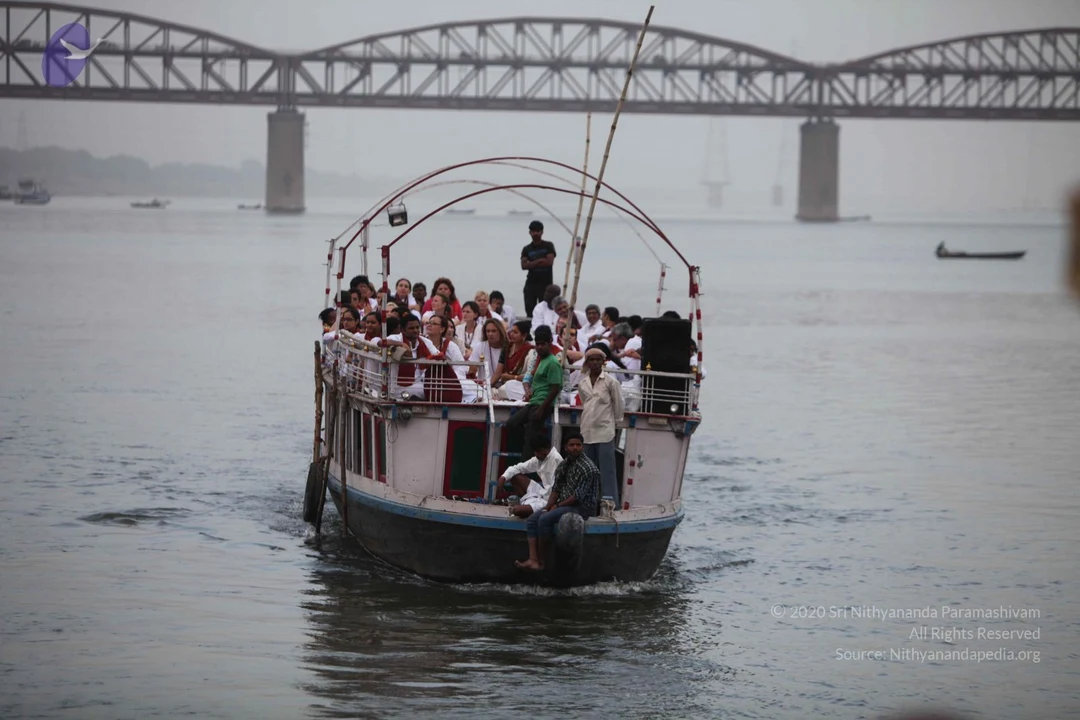
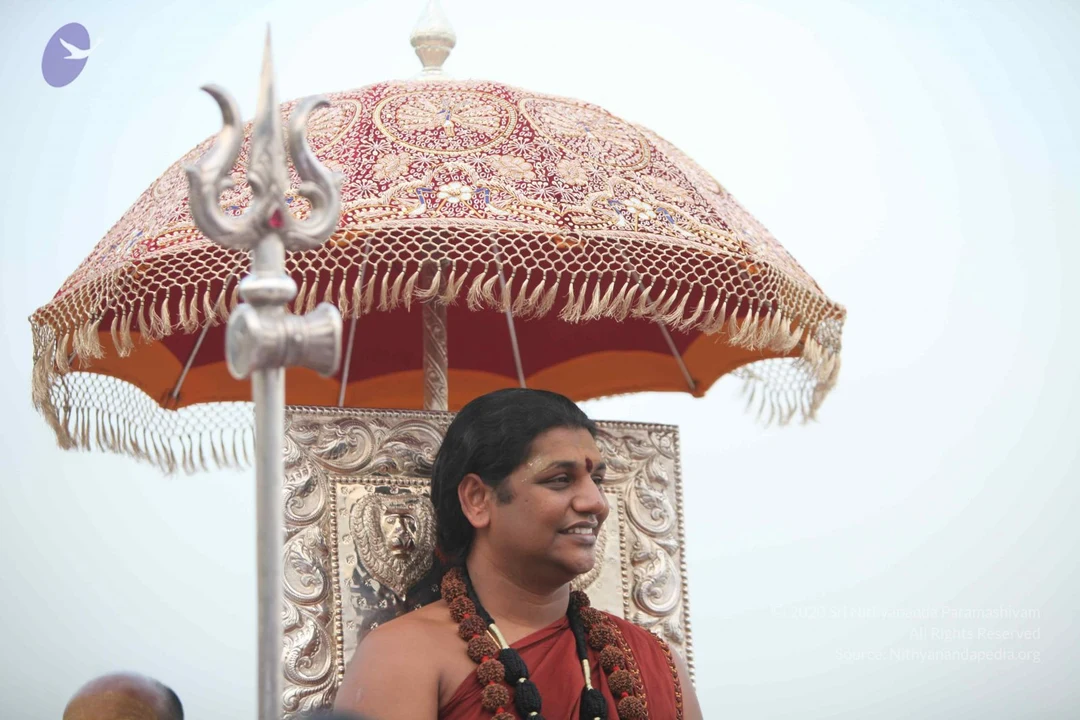
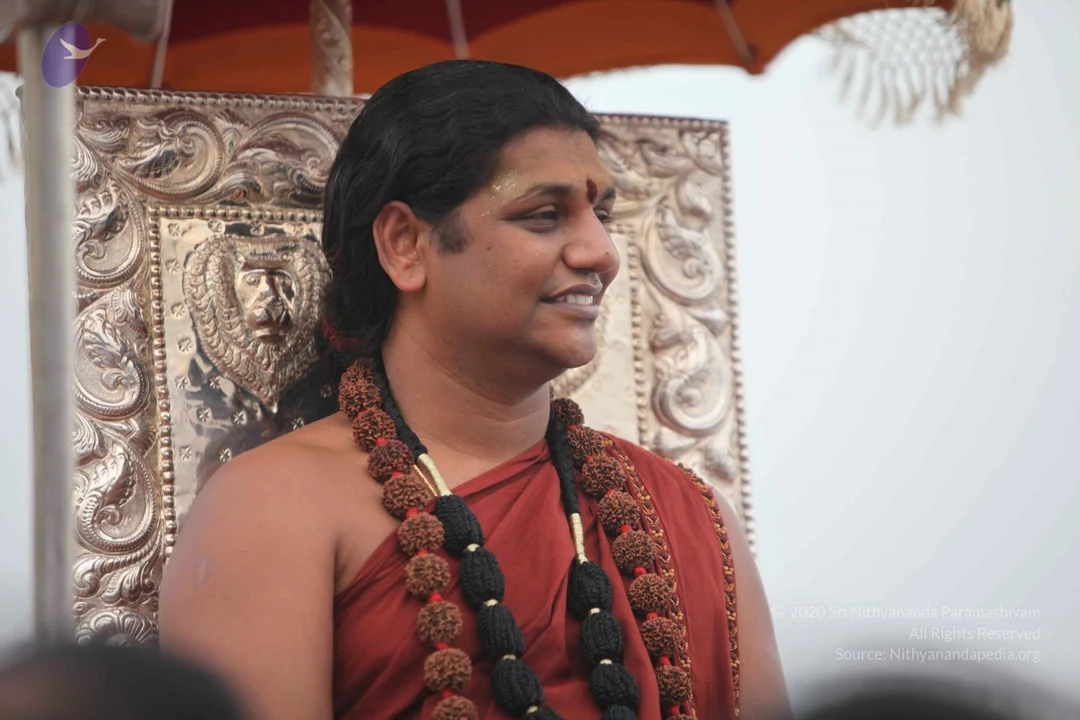
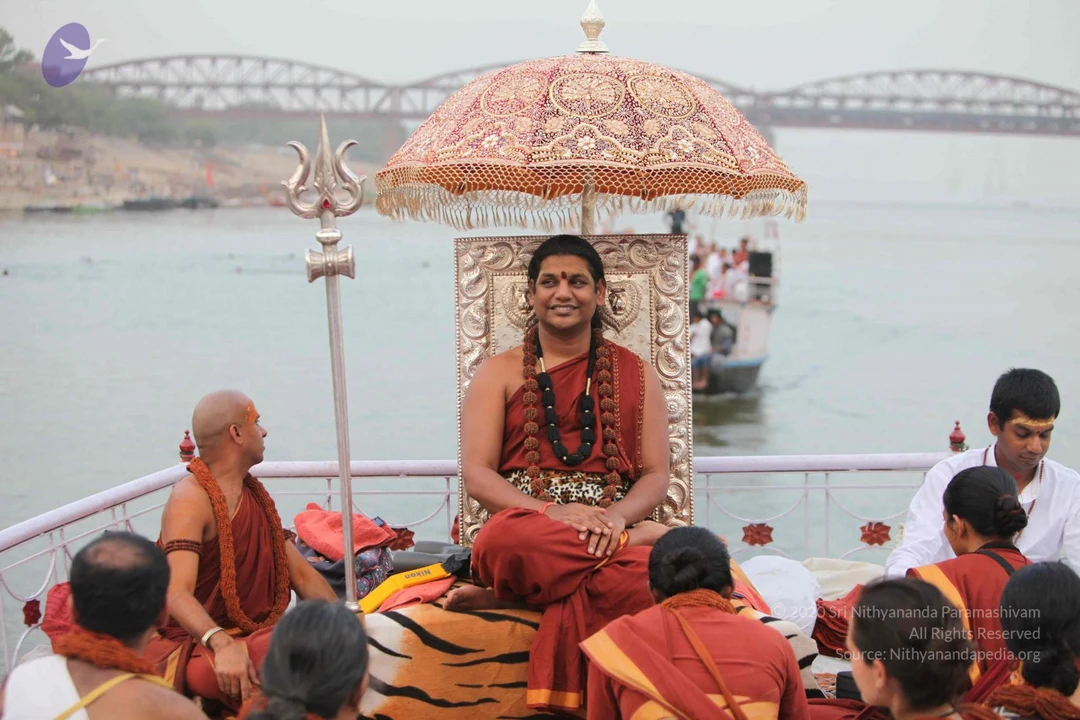
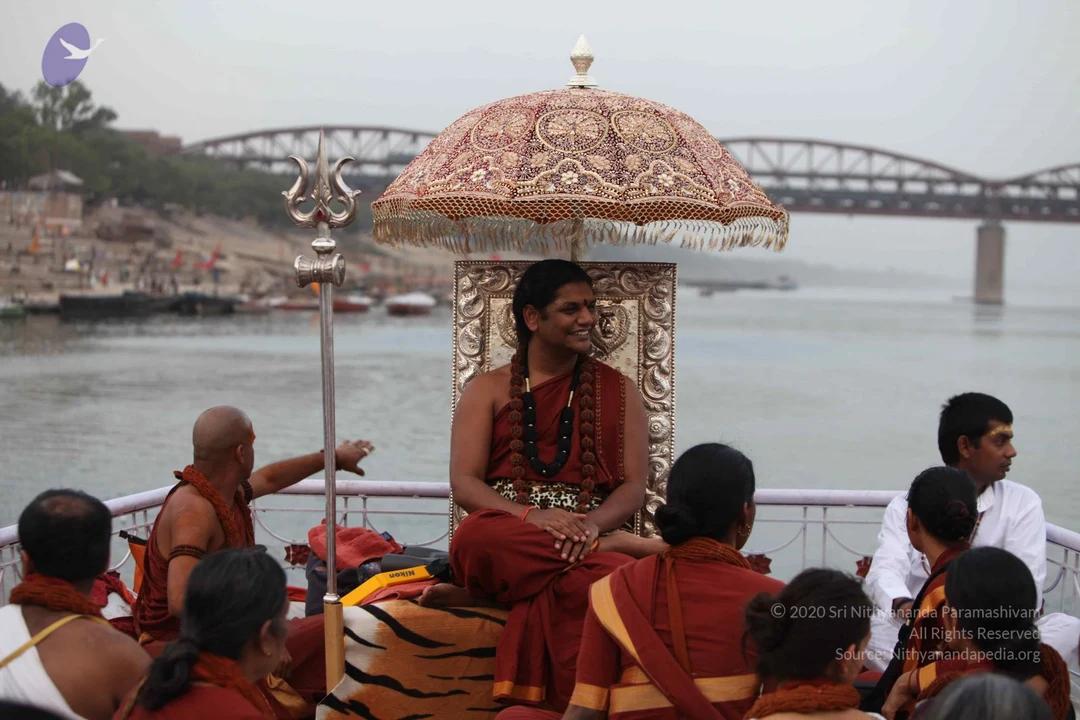
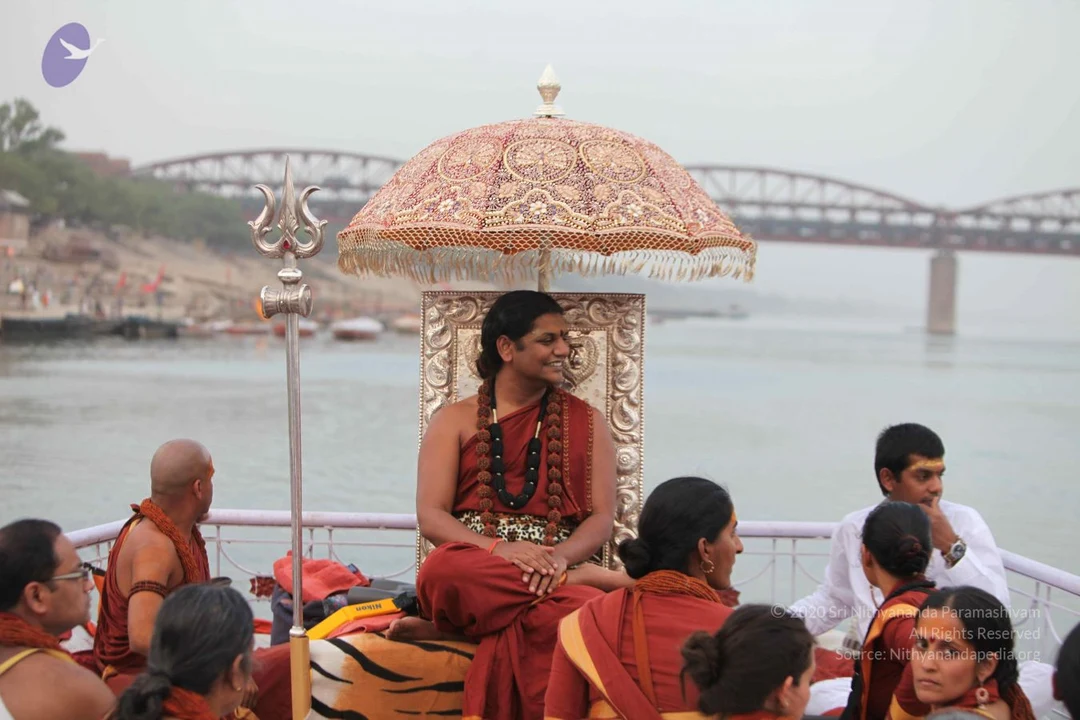
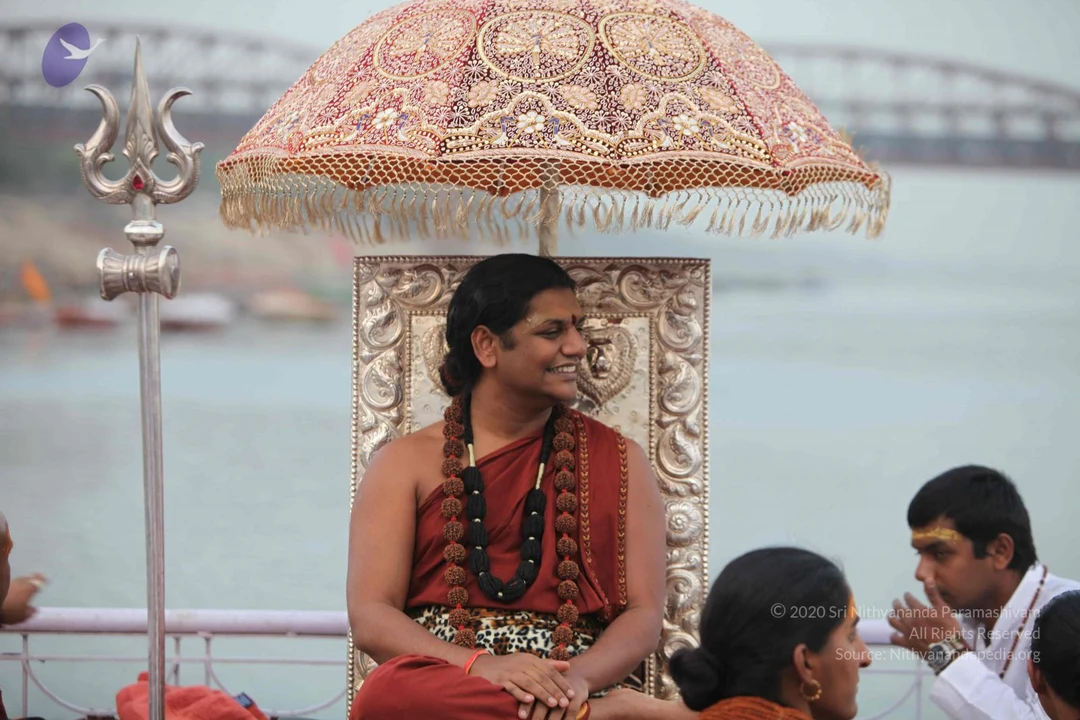
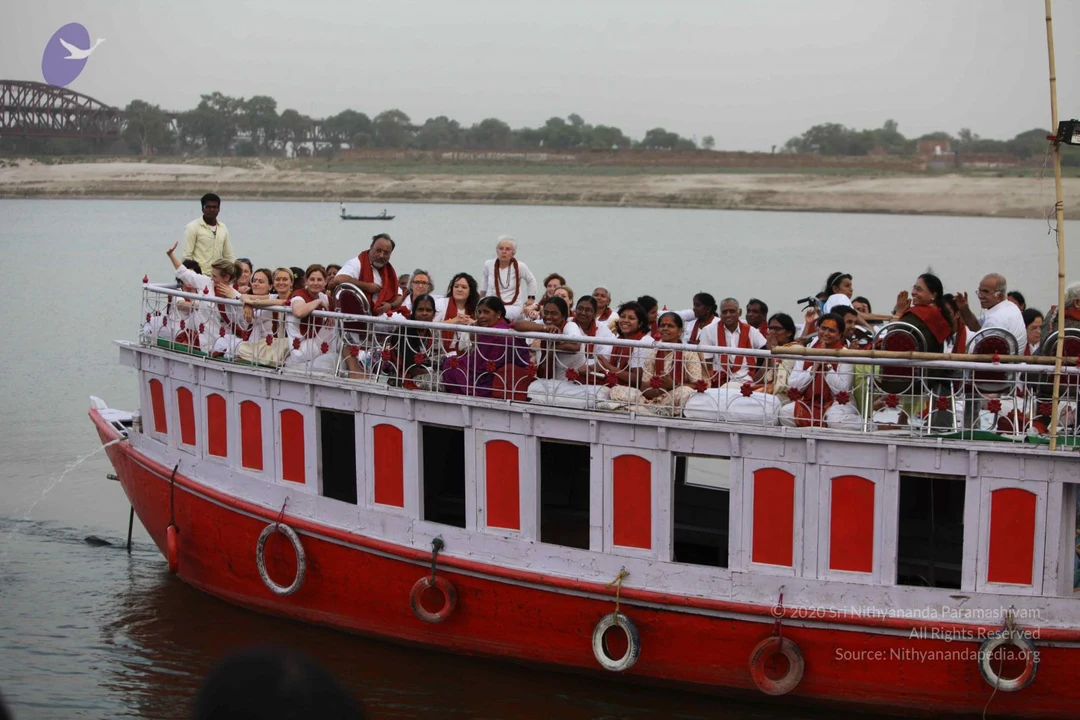
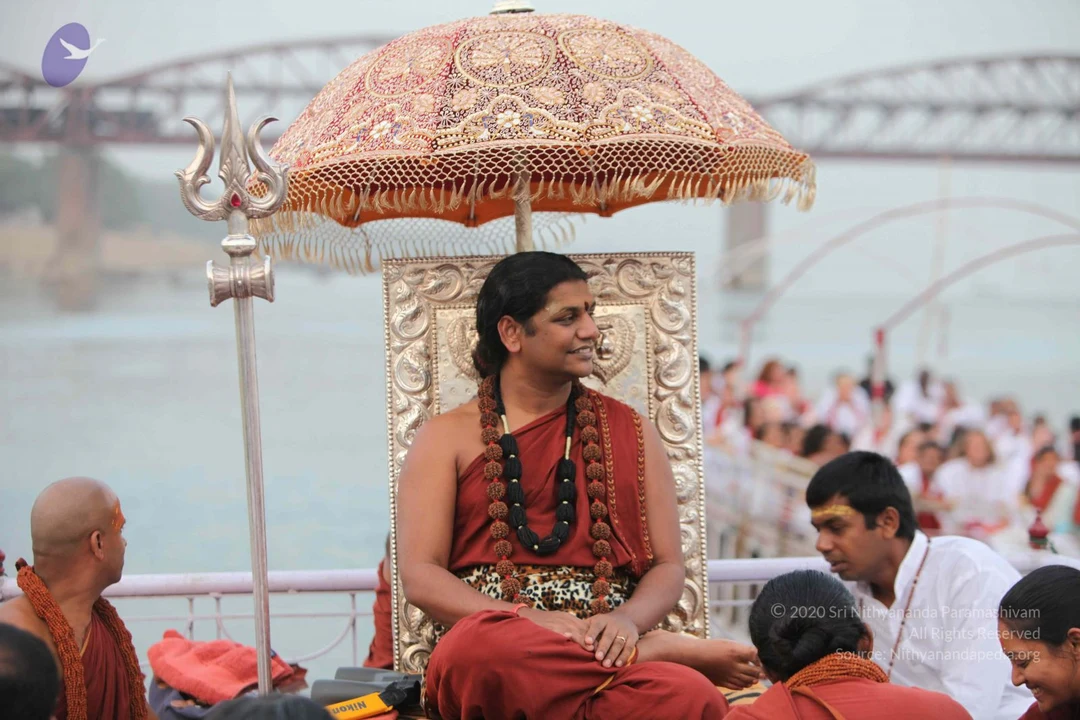
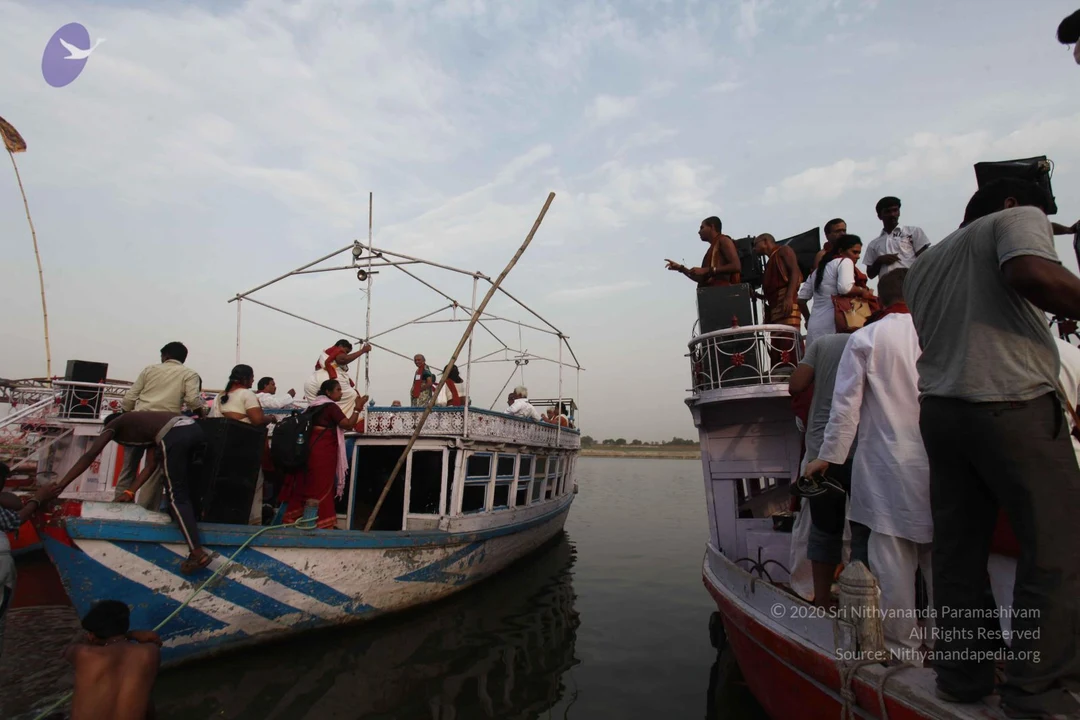
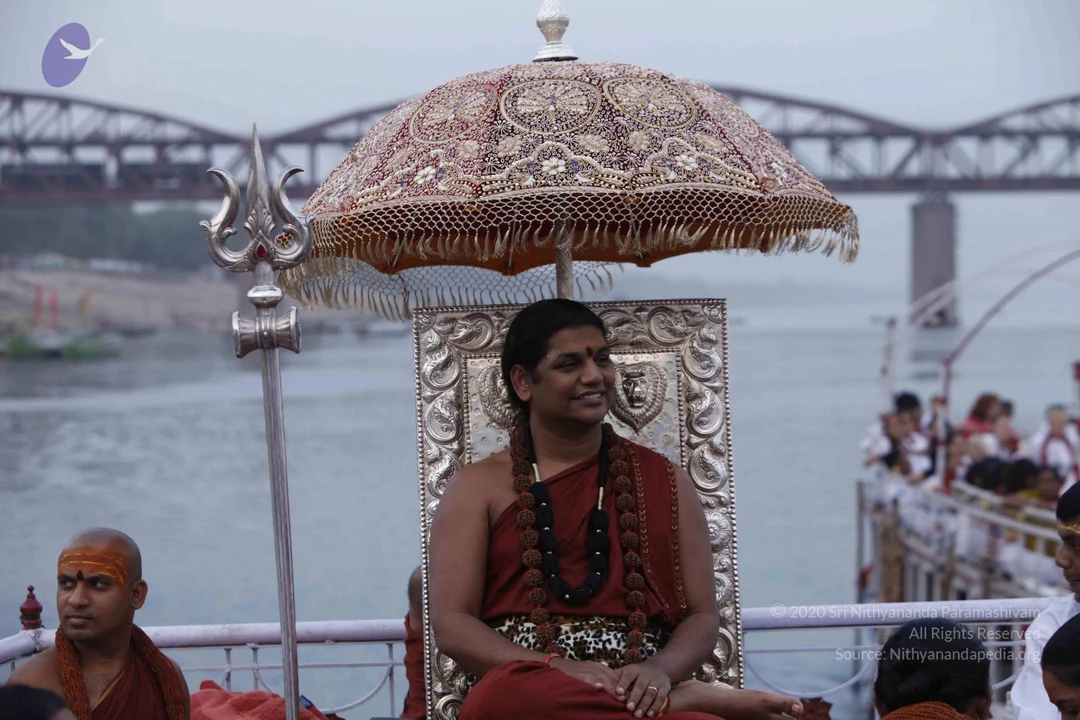
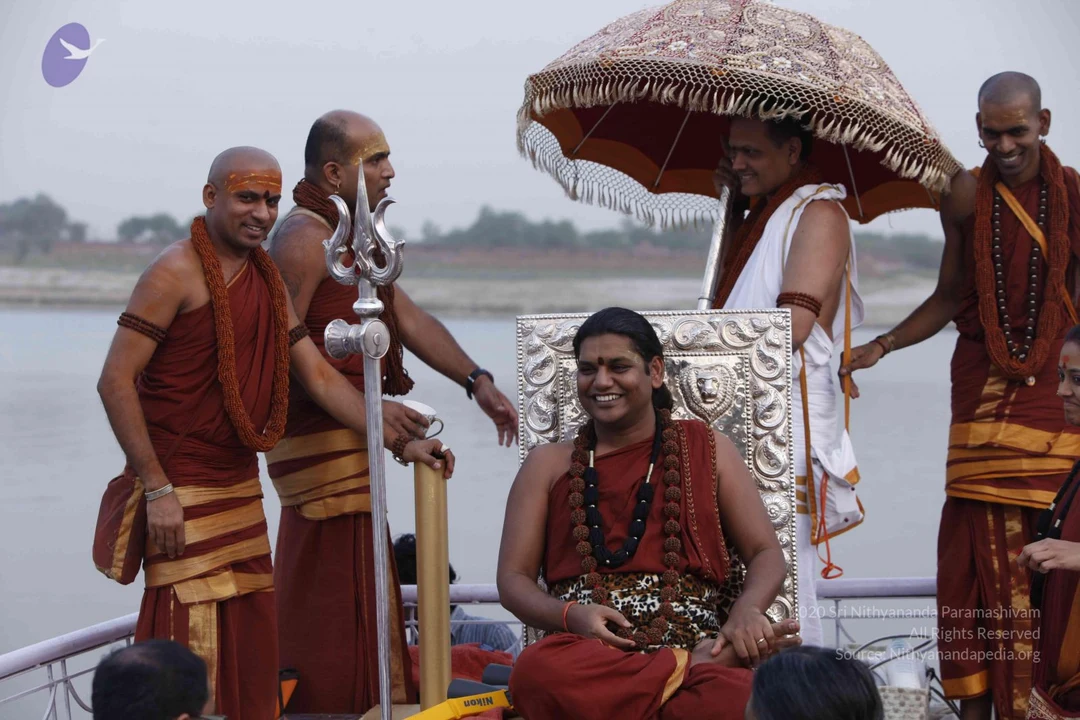
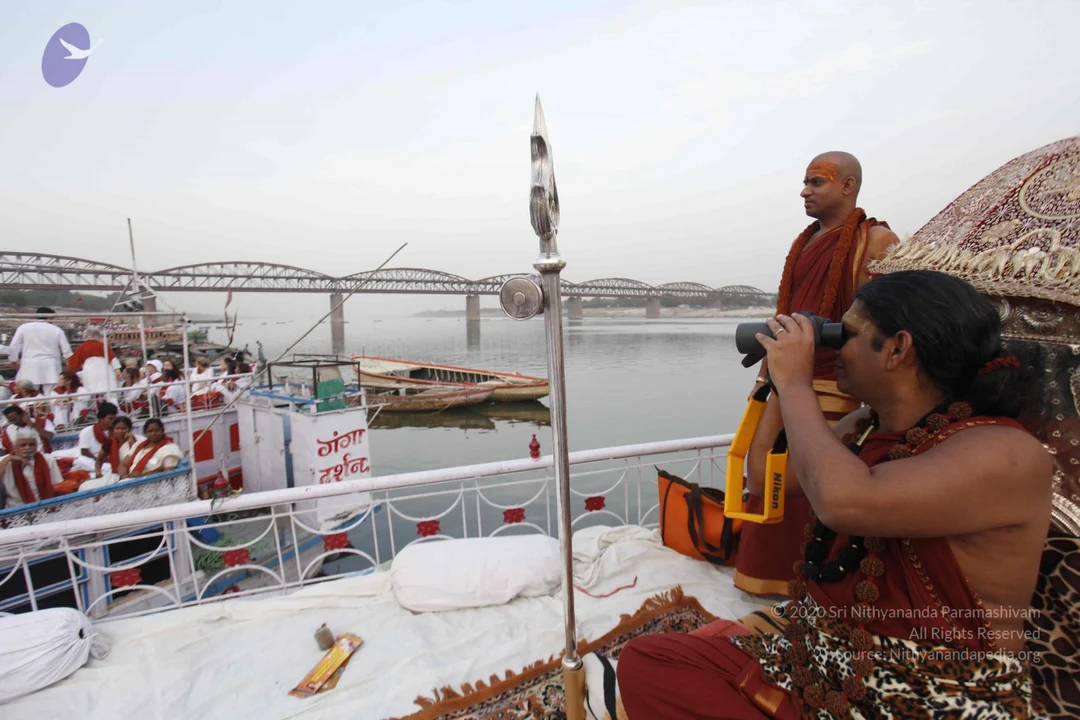
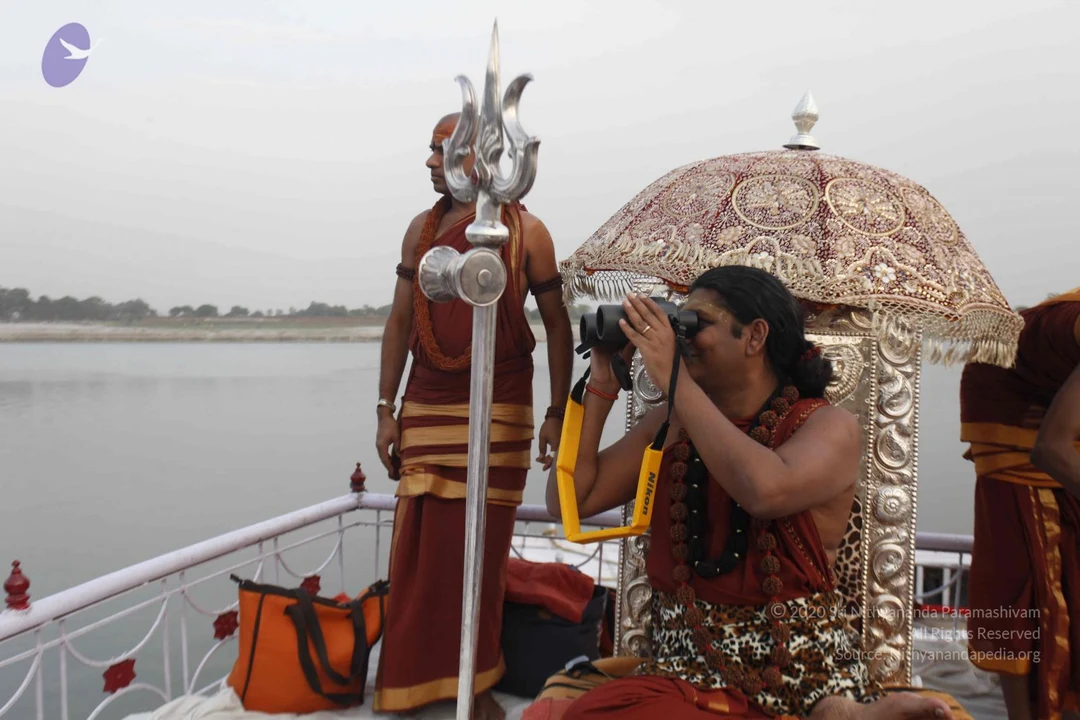
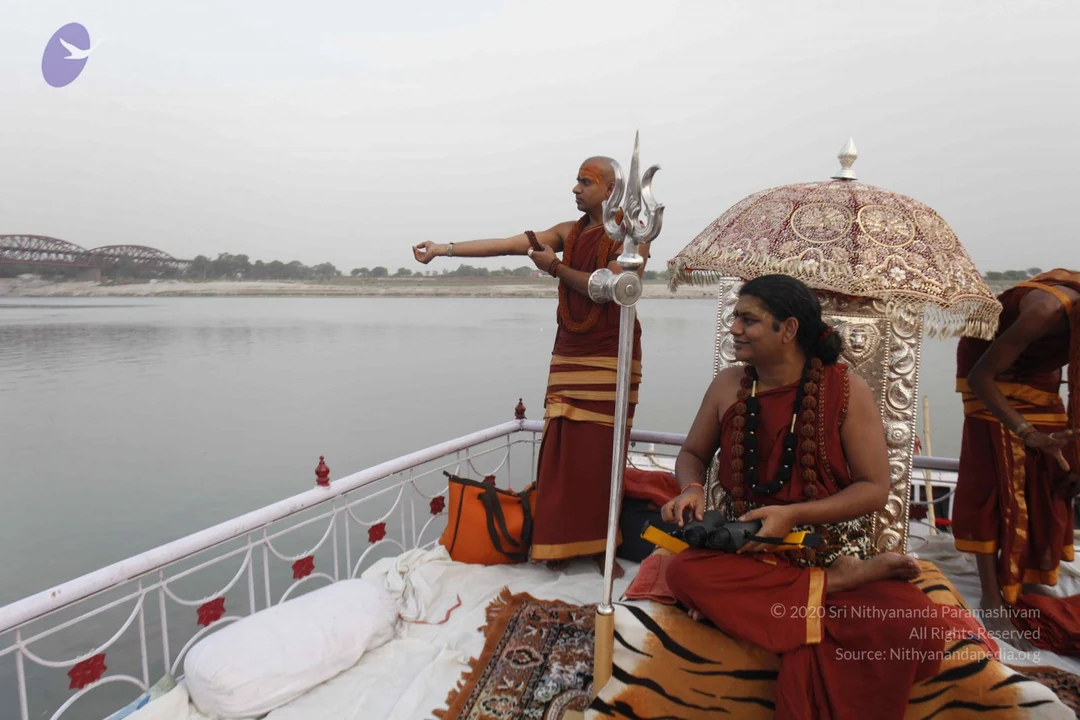
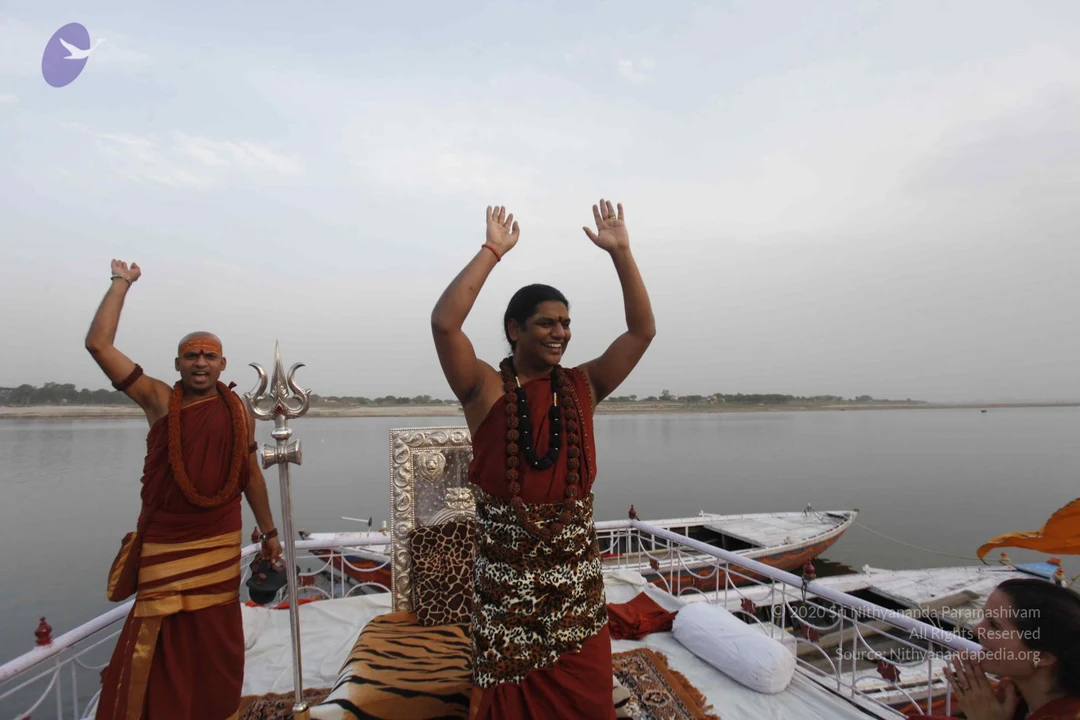
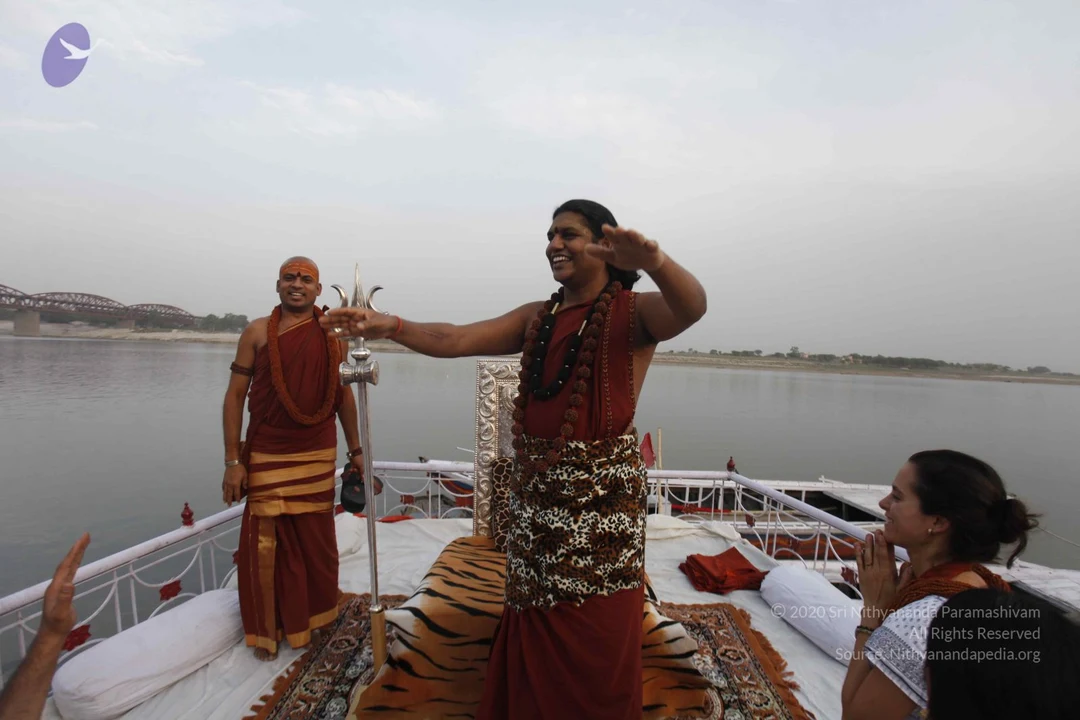
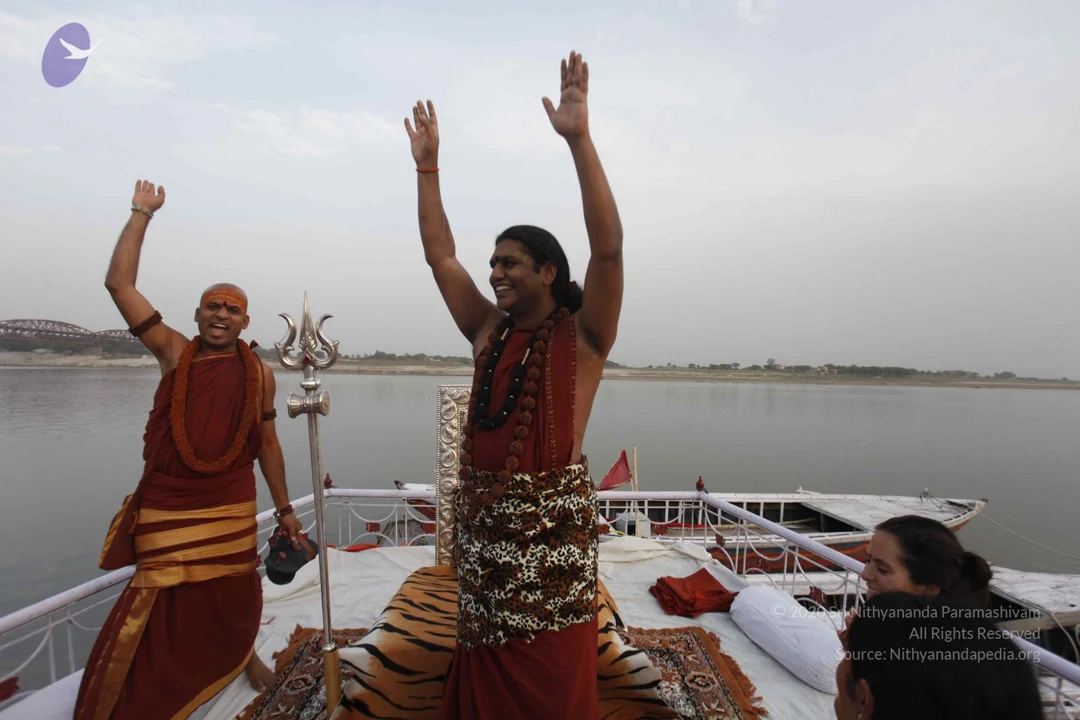
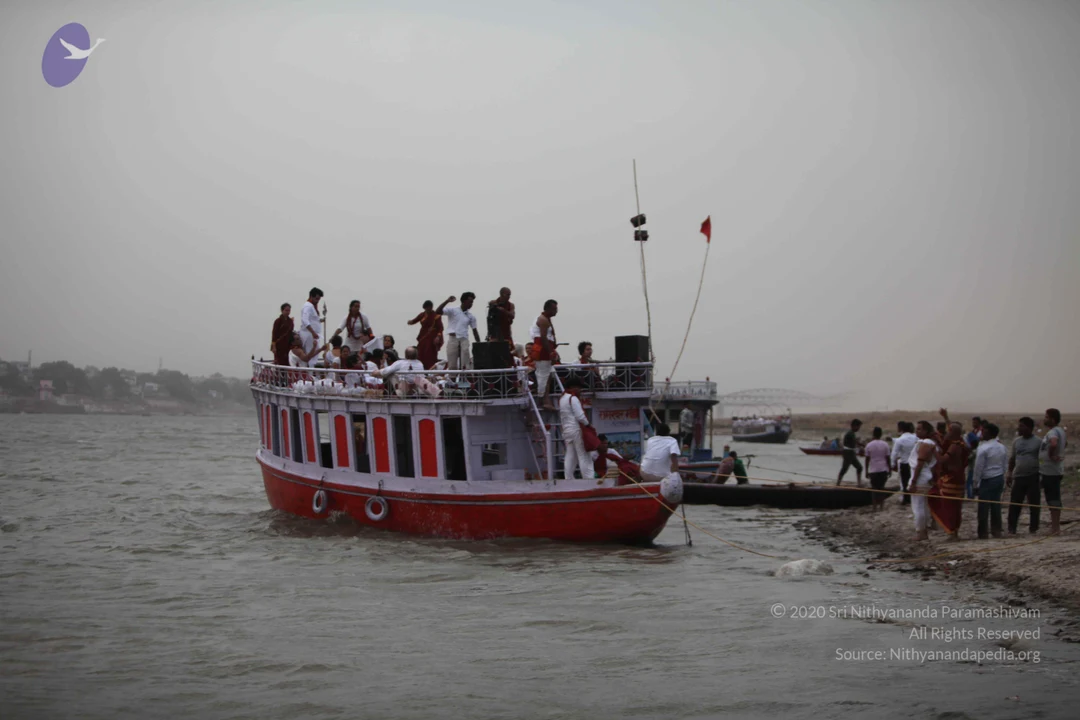
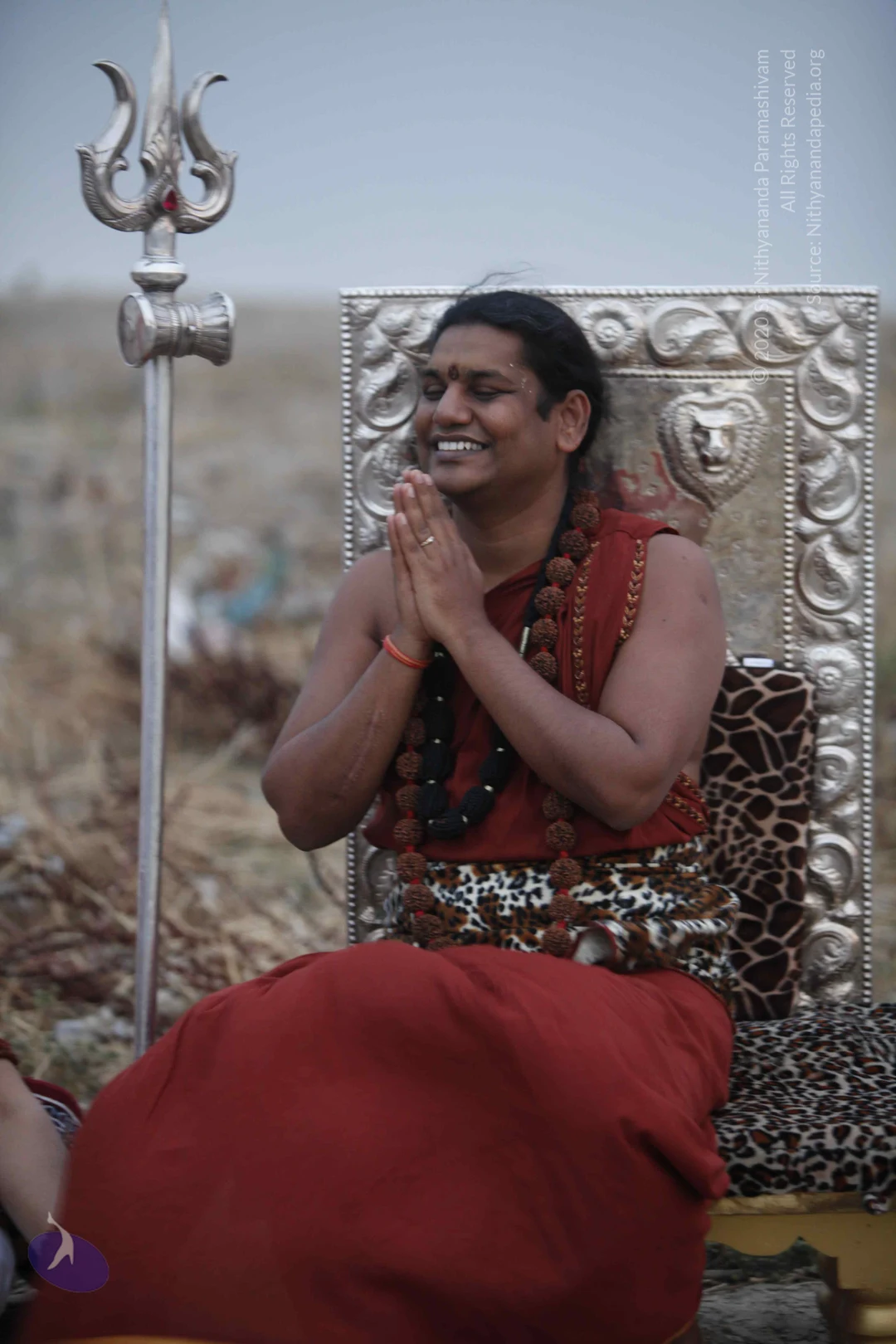
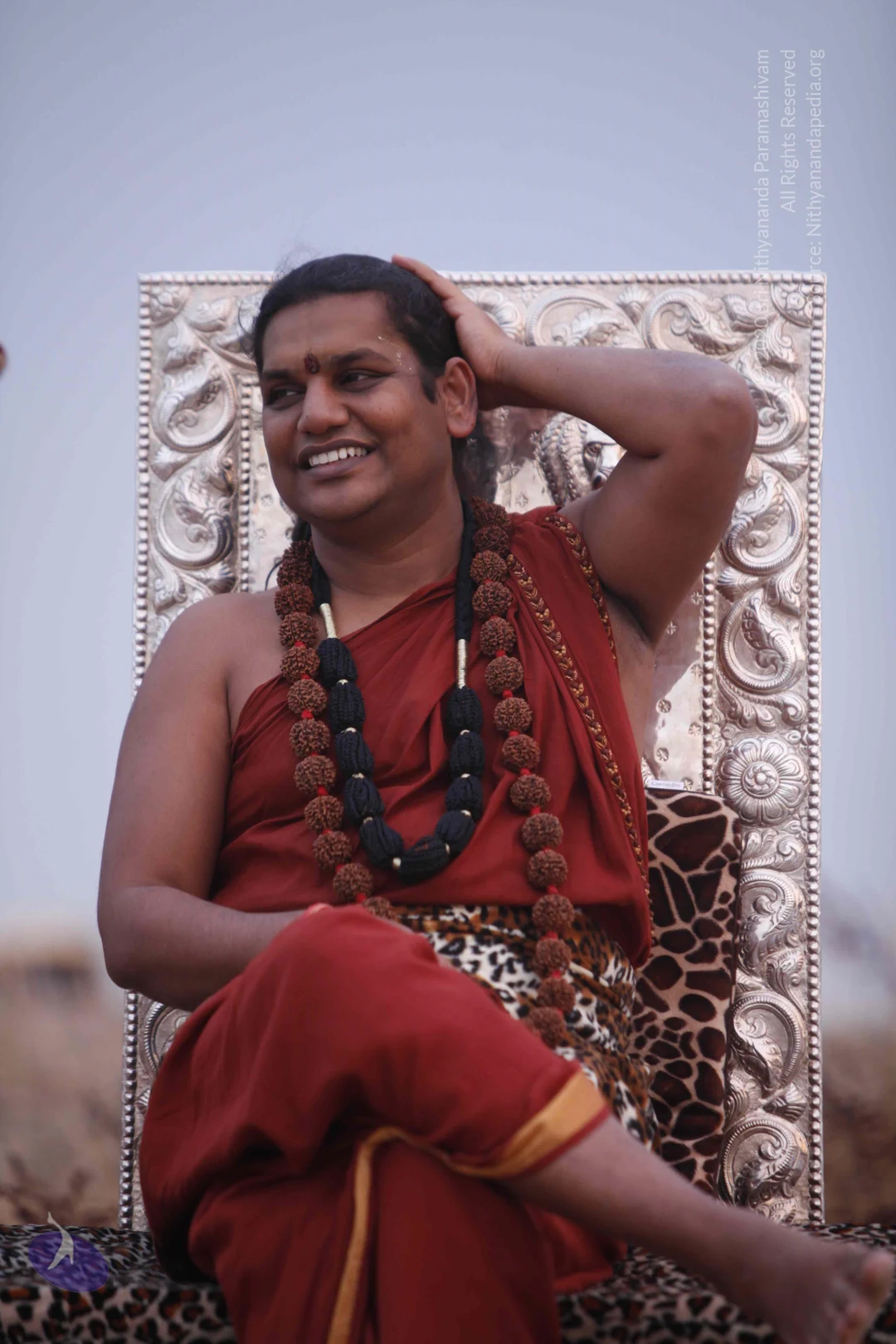
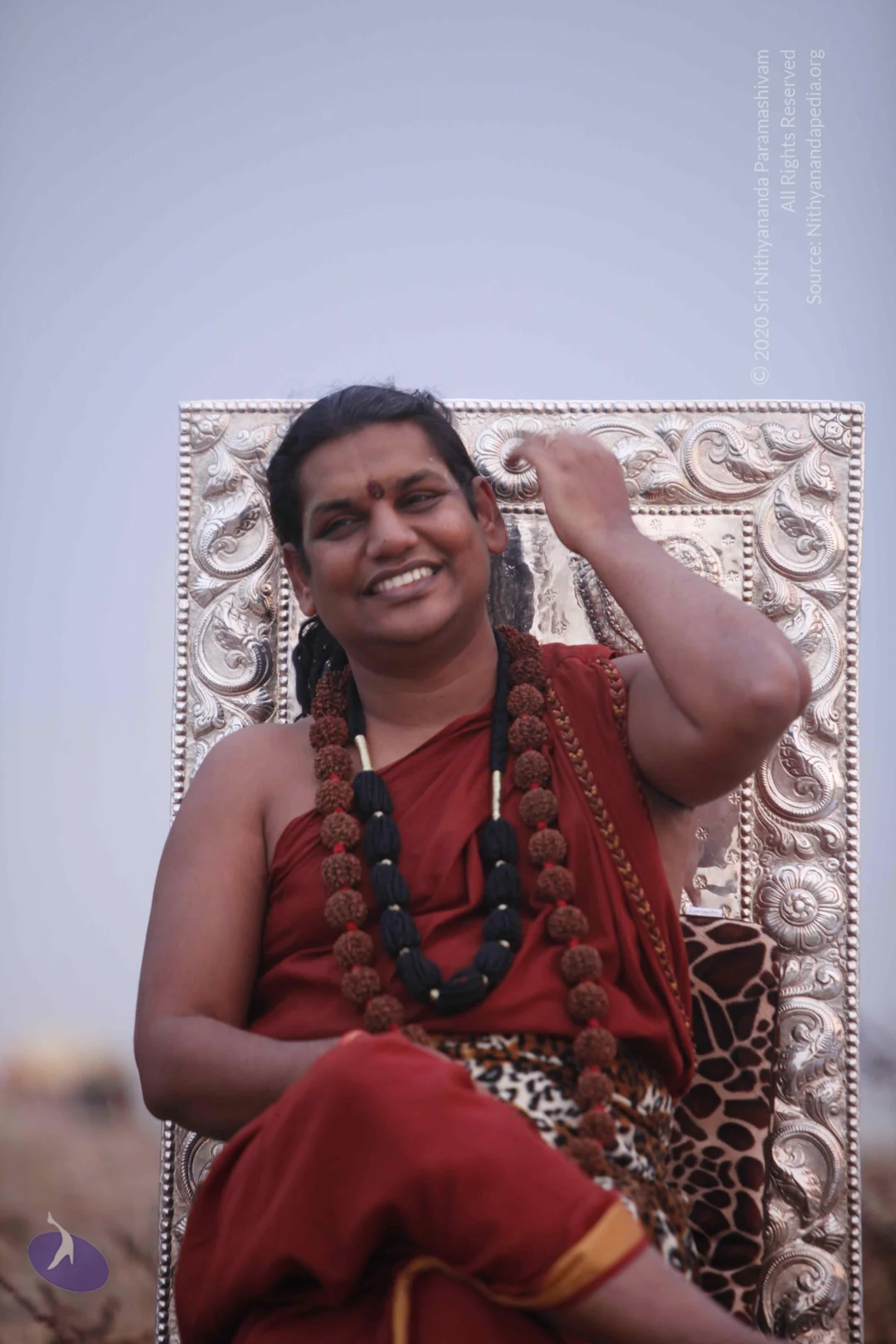
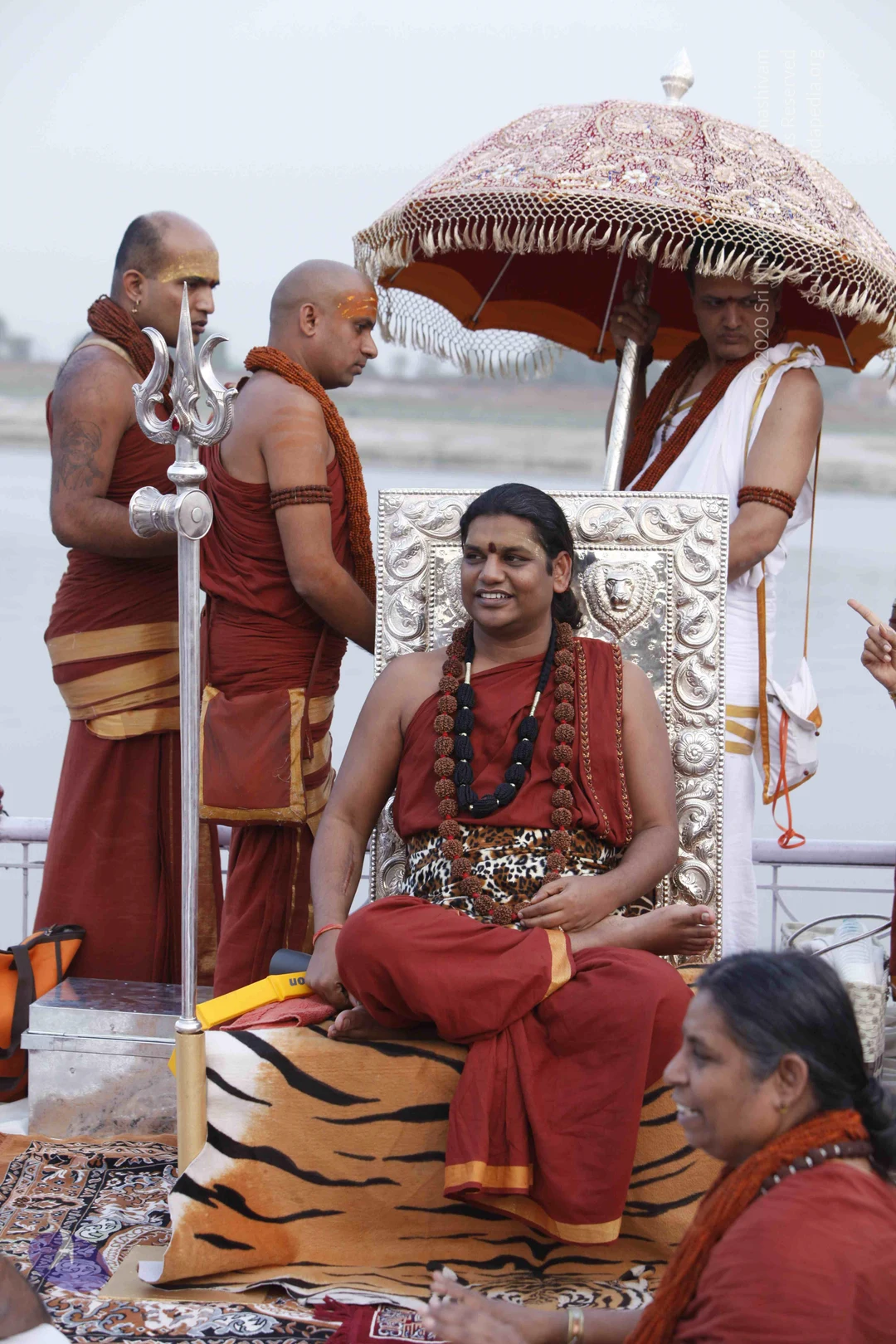
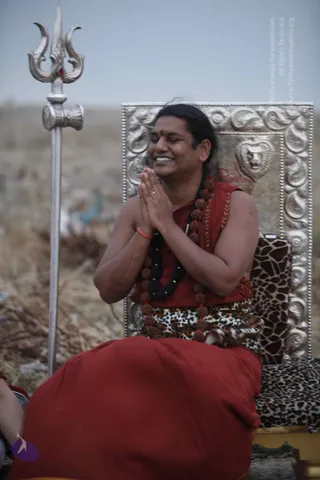
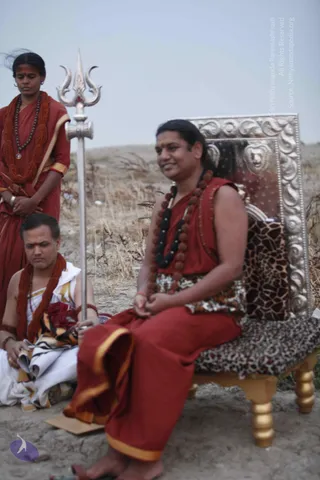
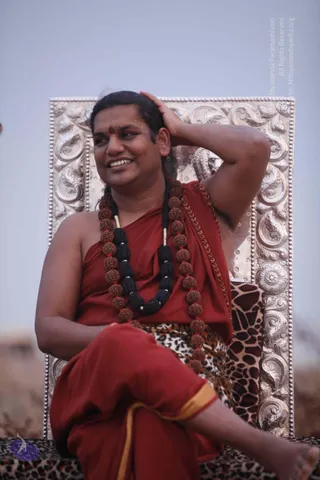
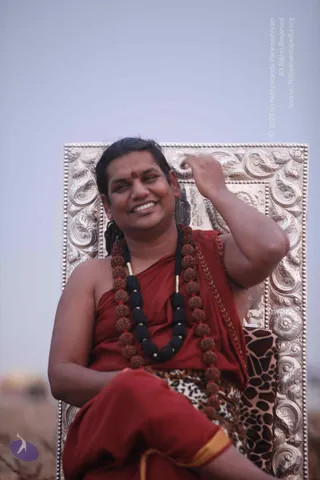
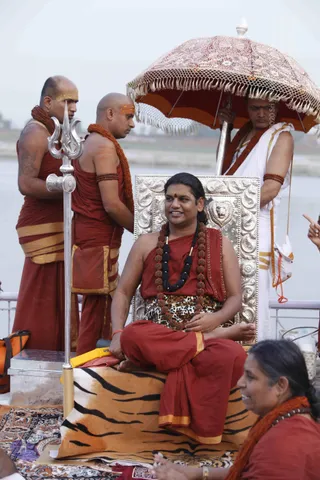
A smiling man with long dark hair sits with eyes closed and palms pressed together in namaste on an ornate silver throne with leopard-print cushions, in an open dry field. He wears a red shawl over a red garment, a red-and-black rudraksha mala with rudraksha beads, a leopard-print waist wrap, and a red thread on his wrist. A tall silver trident stands to his left. Swamiji (probable): long swept-back hair, a red shawl and rudraksha malas on a silver throne fit the candidate's presentation, so this is an in-person candidate.Outdoor photo on dry, dusty ground with sparse brown grass and a pale sky. A man in red sleeveless robes and a long red-gold bordered dhoti sits on an ornate silver-framed throne with leopard-print upholstery and gold legs, wearing a double strand of rudraksha beads and smiling. A large silver trishul stands beside him. A woman in red sari with gold border and red rudraksha mala stands behind, hands folded. A man in white dhoti with gold border and red rudraksha necklace sits cross-legged at the lower left, eyes lowered. Appearance-based candidate for a person, seated on the throne in red robes with rudraksha malas and a trishul beside him; identity uncertain from appearance alone.A man seated on an ornate silver-embossed throne with a leopard-print cushion, smiling and resting one hand on his head. He wears a deep red-maroon draped robe with a gold-edged border over one shoulder, a long necklace of rudraksha beads alternating with black beads, and a red-and-gold tilak on his forehead. The setting is outdoors under a pale sky. The man's appearance matches a probable Swamiji through several cues: long swept-back hair, a saffron-red sannyasi robe and a rudraksha mala, seated on a throne as the central figure. Swamiji (probable) is the central figure seated on the throne.A smiling man with swept-back dark hair and a red bindi sits on an ornate embossed silver throne with floral scrollwork. He wears a deep red draped garment over one shoulder and a long necklace of brown rudraksha beads alternating with black beads. His right hand rests near his head, and his legs are crossed with a patterned animal-print cloth beneath him. The background is a pale sky with a blurred dry landscape below.Outdoors by a river, a long-haired man in rust-red robes and a dark-and-red rudraksha mala sits on a silver ornate throne draped with a tiger-stripe cloth. Two shaved-headed attendants in red robes with gold borders and rudraksha necklaces stand to the left, one holding a silver trishul. Behind the throne a man in white with a red rudraksha mala holds a pink and gold embroidered parasol. A woman in red with a rudraksha mala sits in the lower right foreground. Appearance-based candidate for a person, seated, with long swept-back hair, rudraksha malas and a leopard-print waist cloth, but the appearance is not certain enough to confirm.Photograph taken on a boat deck over a calm river under an overcast sky, with a steel bridge with arches on the left bank. A seated man in orange-red robes and layered rudraksha malas looks through binoculars held in both hands, his back to the camera, beneath an ornate silver and maroon canopy. Beside him, a standing man in orange-red robes with a shaved head and tilak wears a long rudraksha mala and gazes across the water, next to a large silver trident. A third man in orange-red clothing bends over at the right edge of the frame. Orange bags, white cushions and a patterned rug with tiger-stripe fabric lie on the deck, with a small boat tied at the left.