Skip to content
Thursday

5 September 2013

Dated photos
392
Source pages
1
Media
2
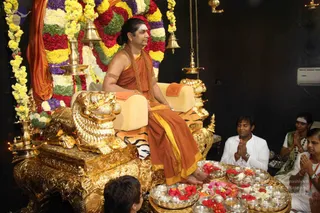
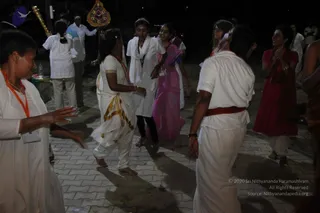
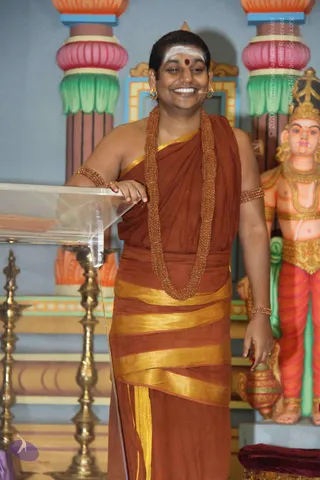
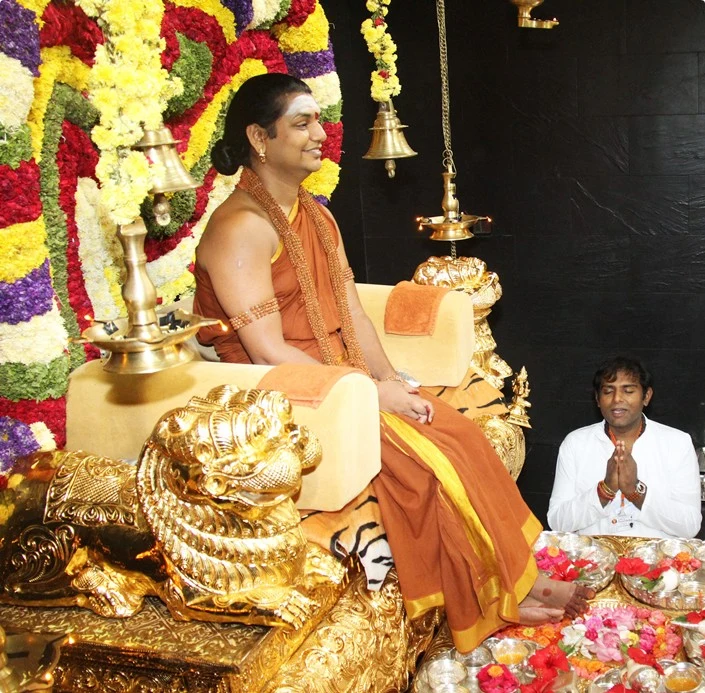
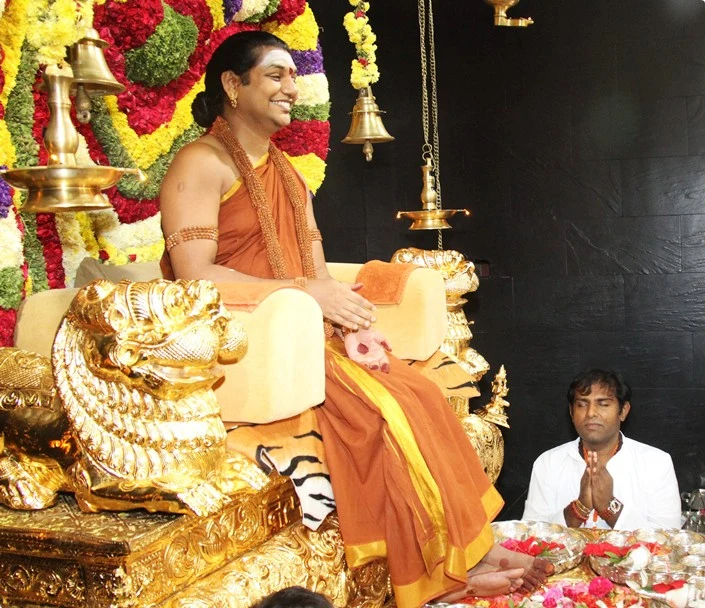
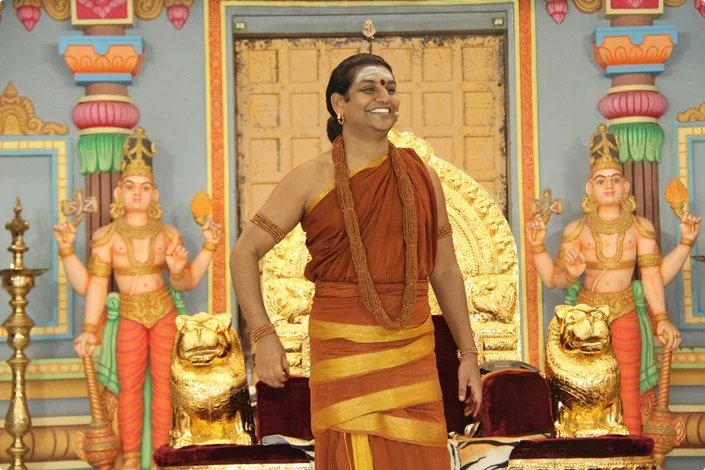
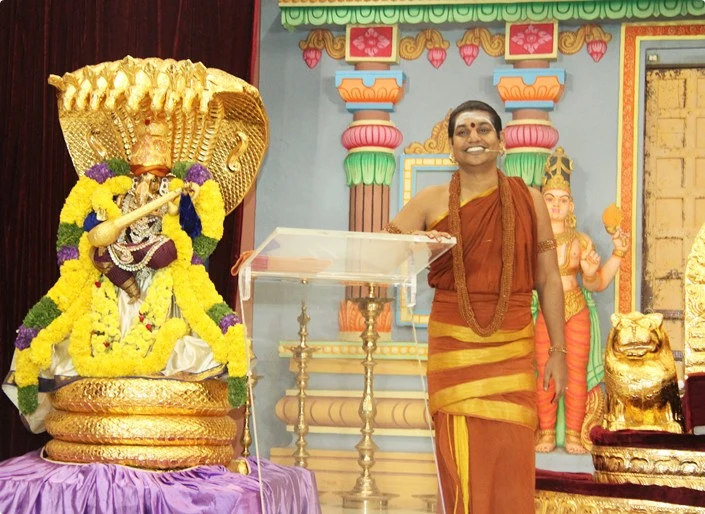
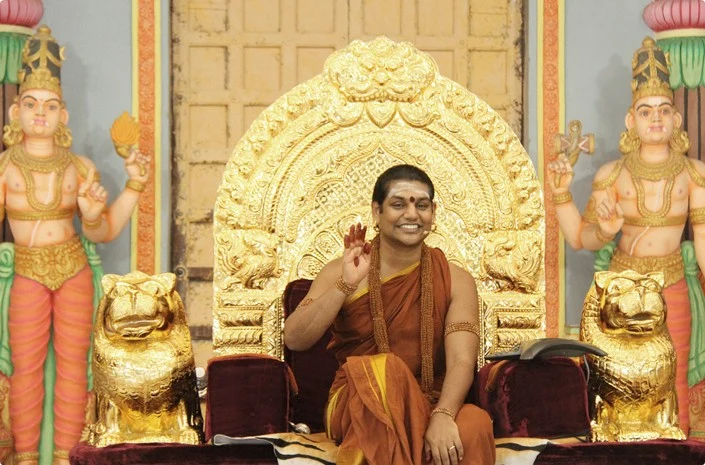
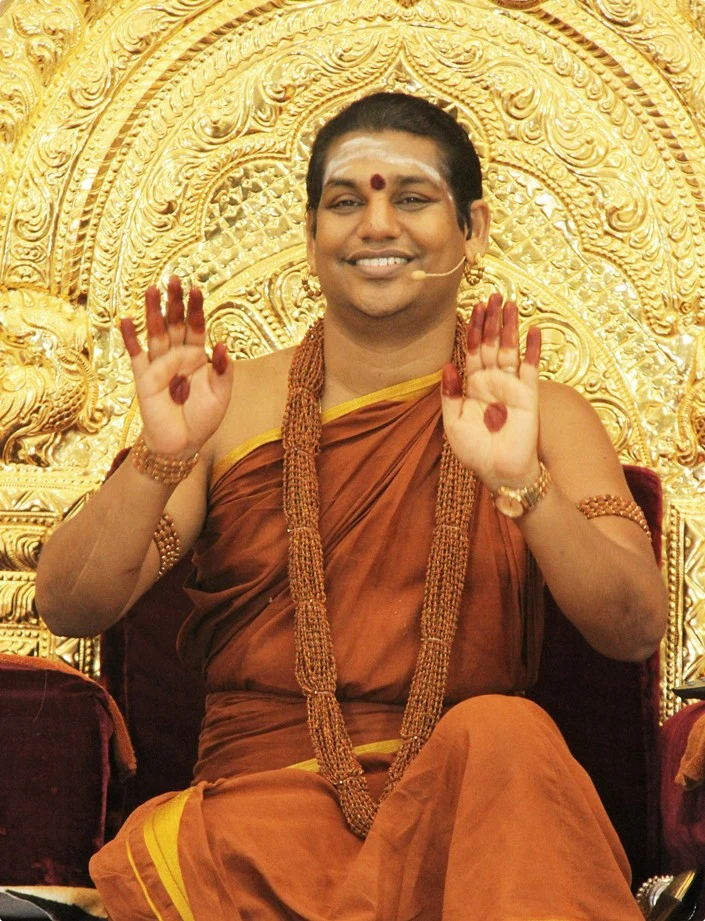
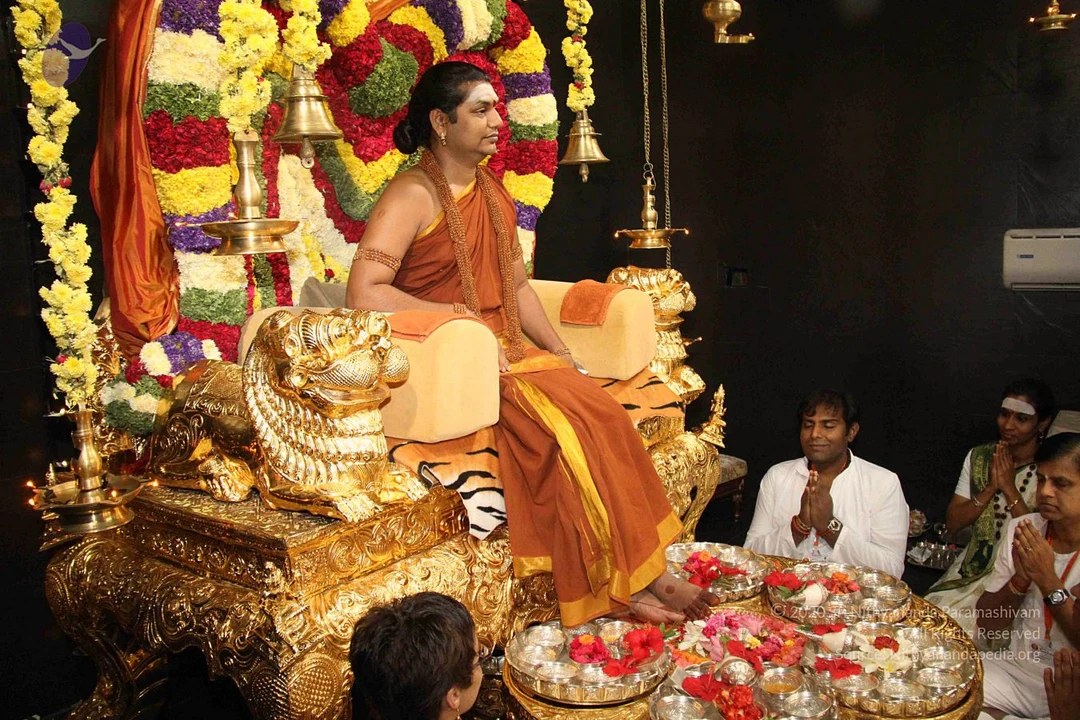
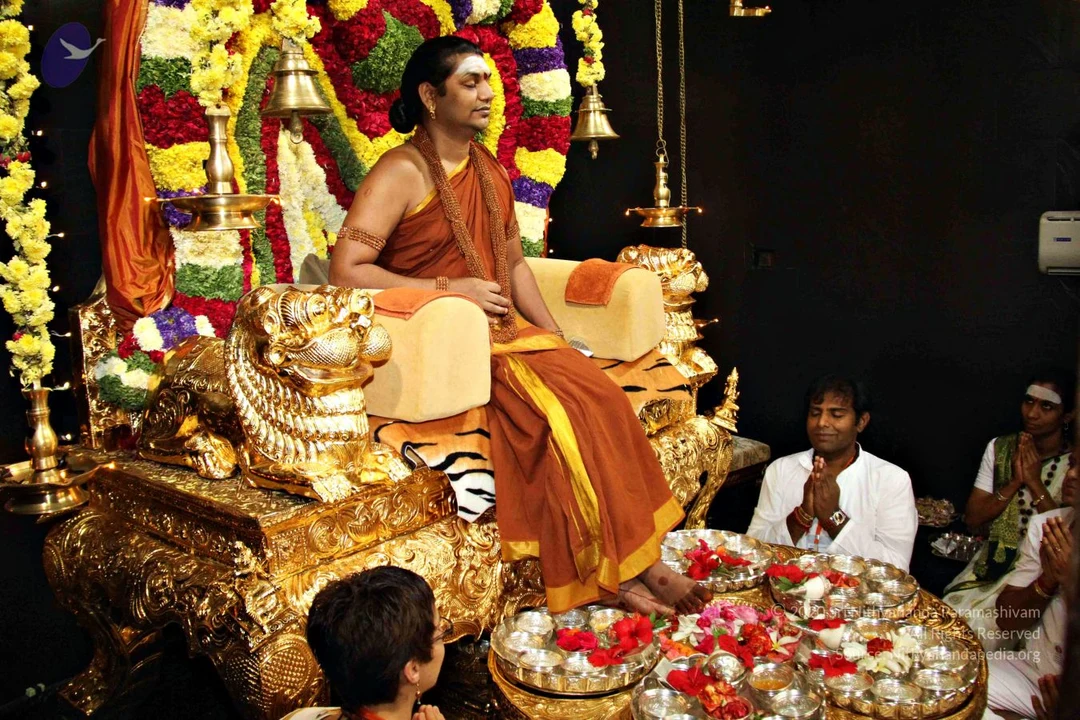
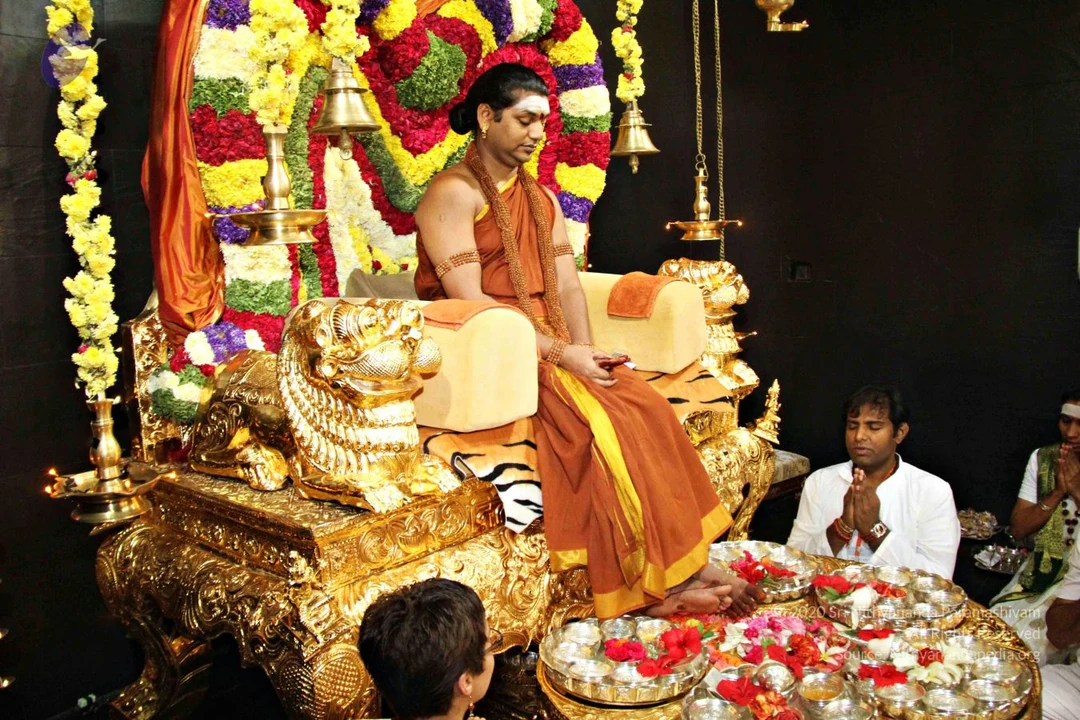
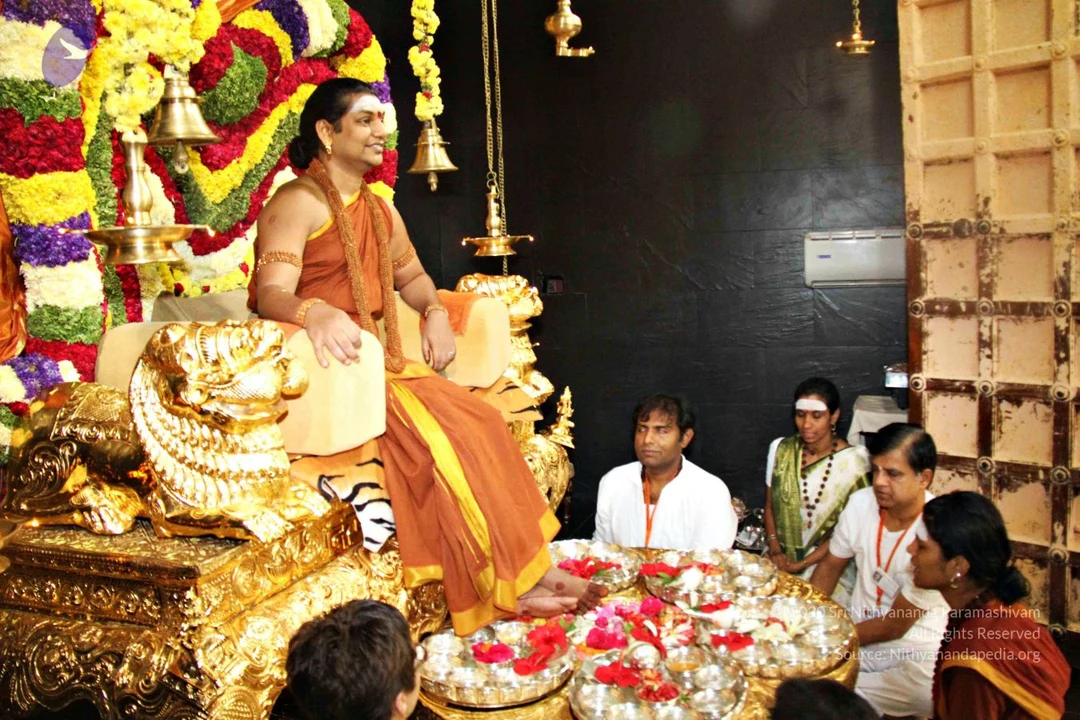
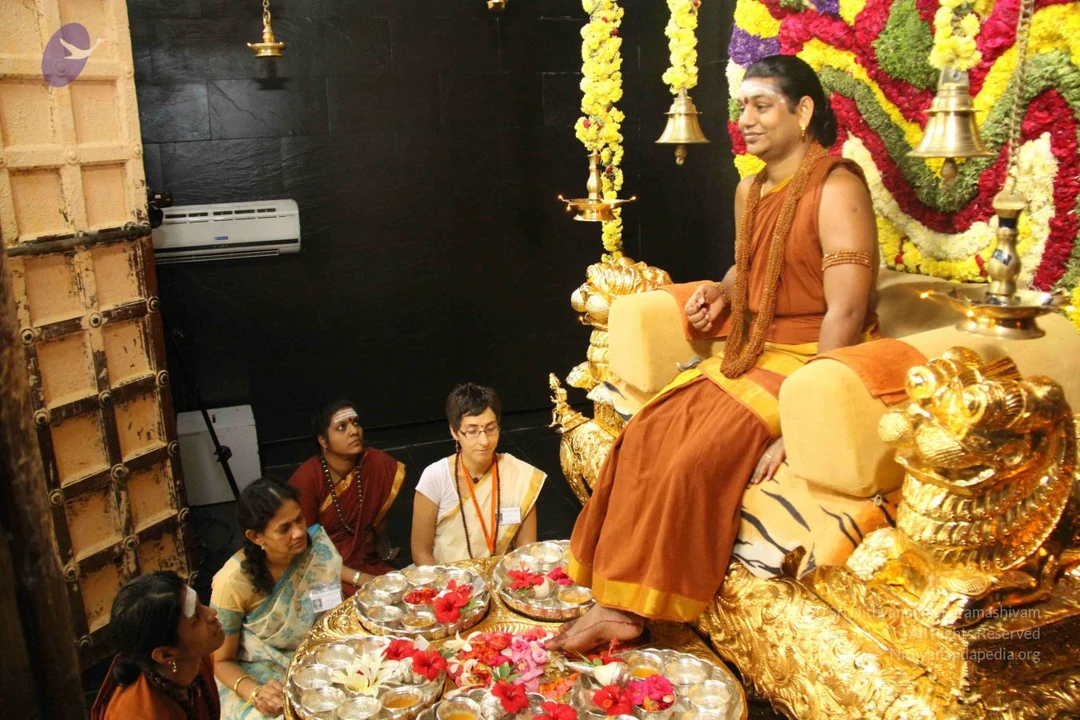
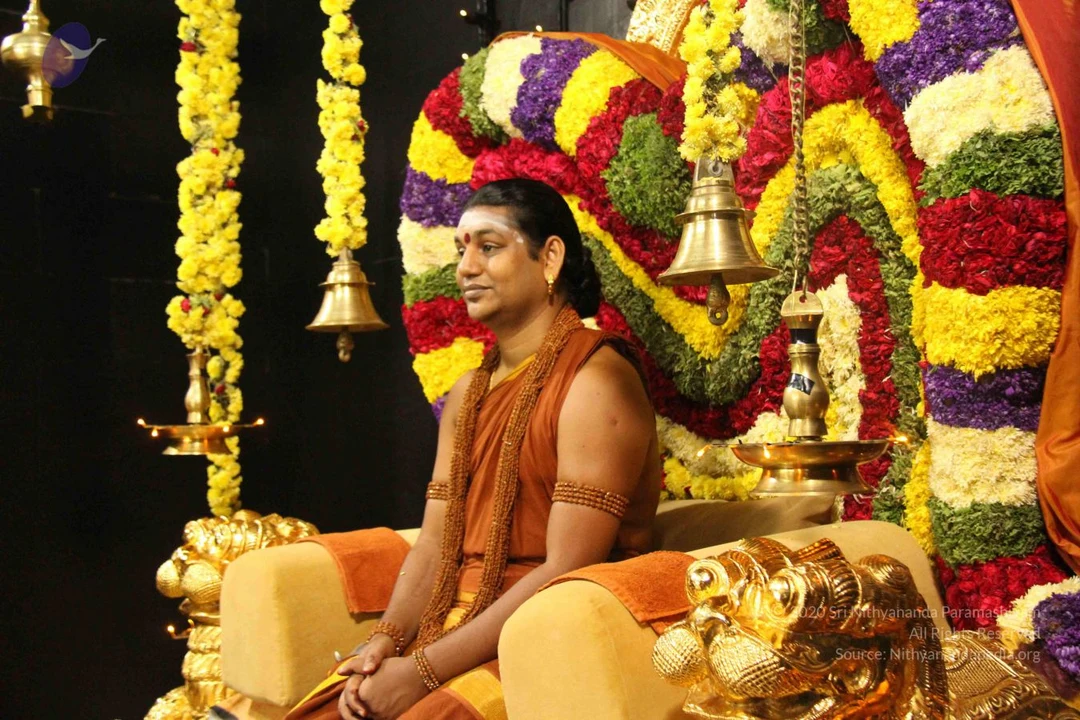
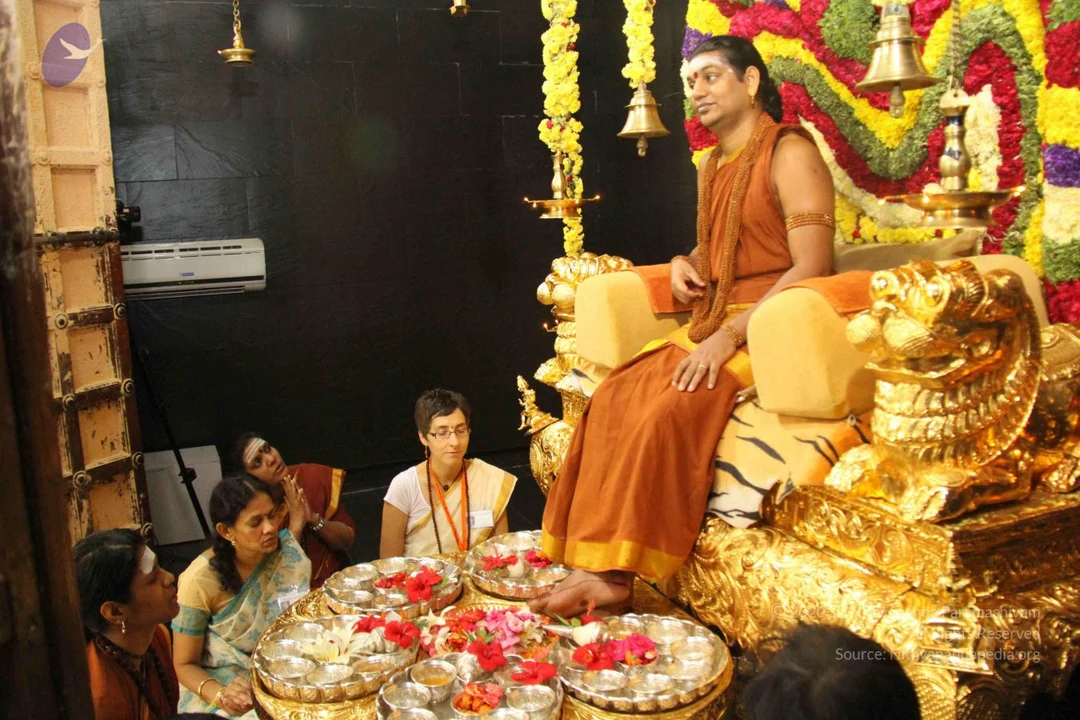
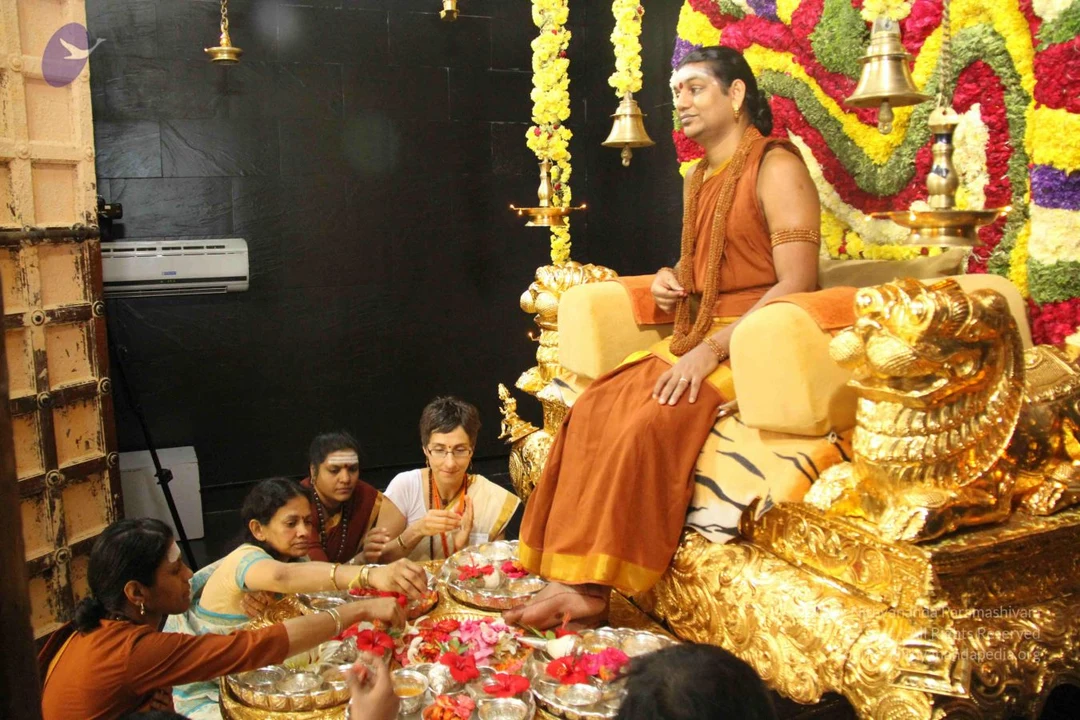
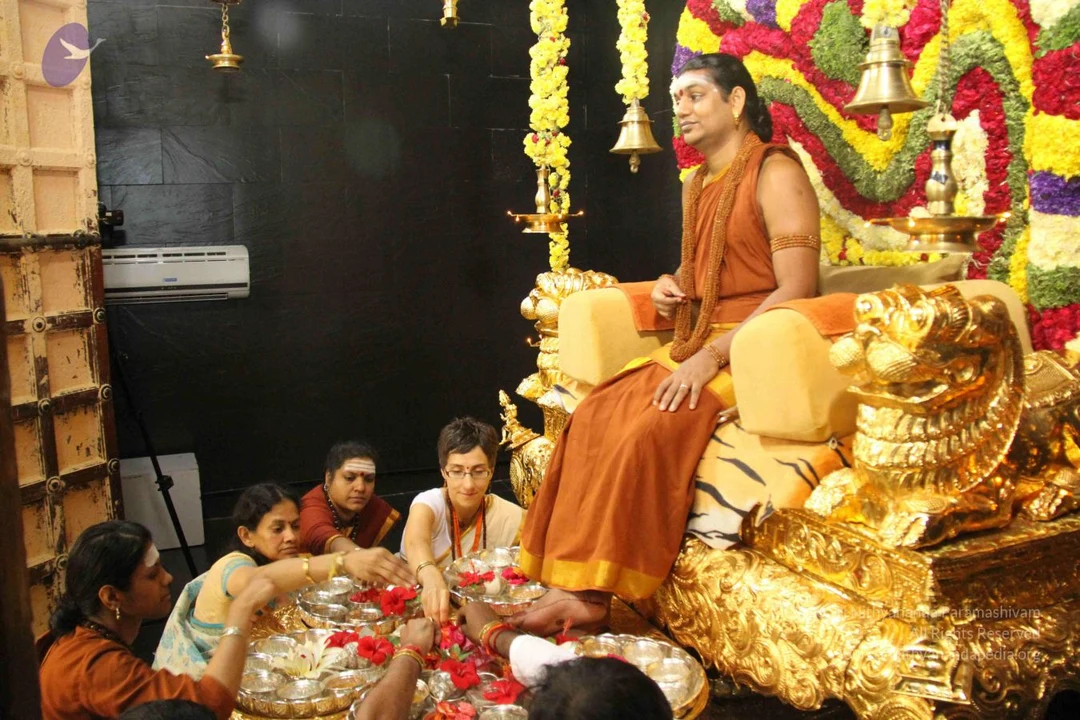
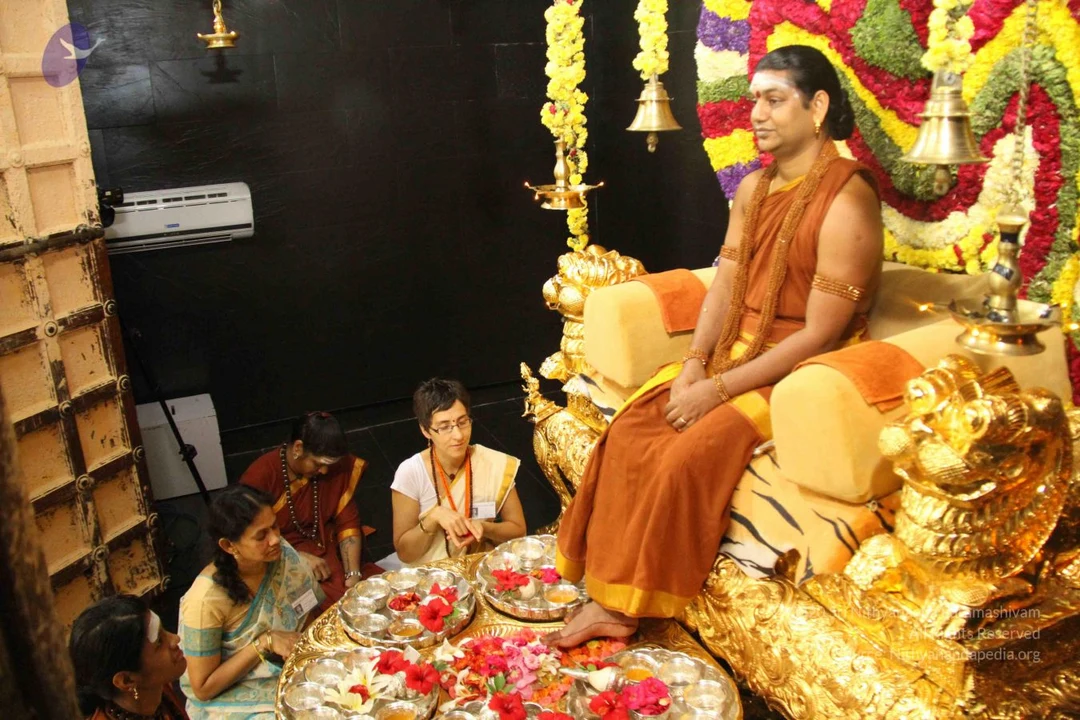
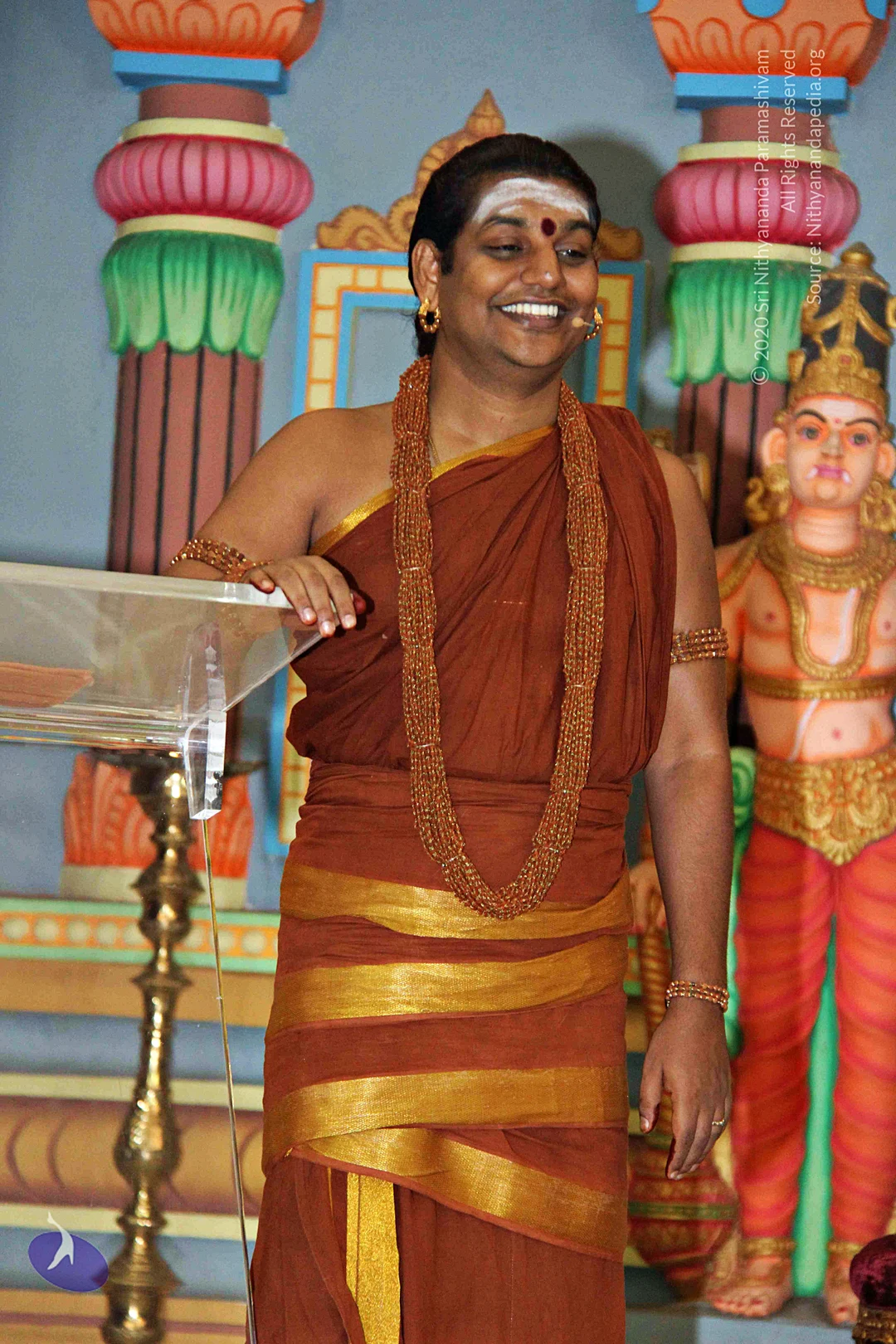
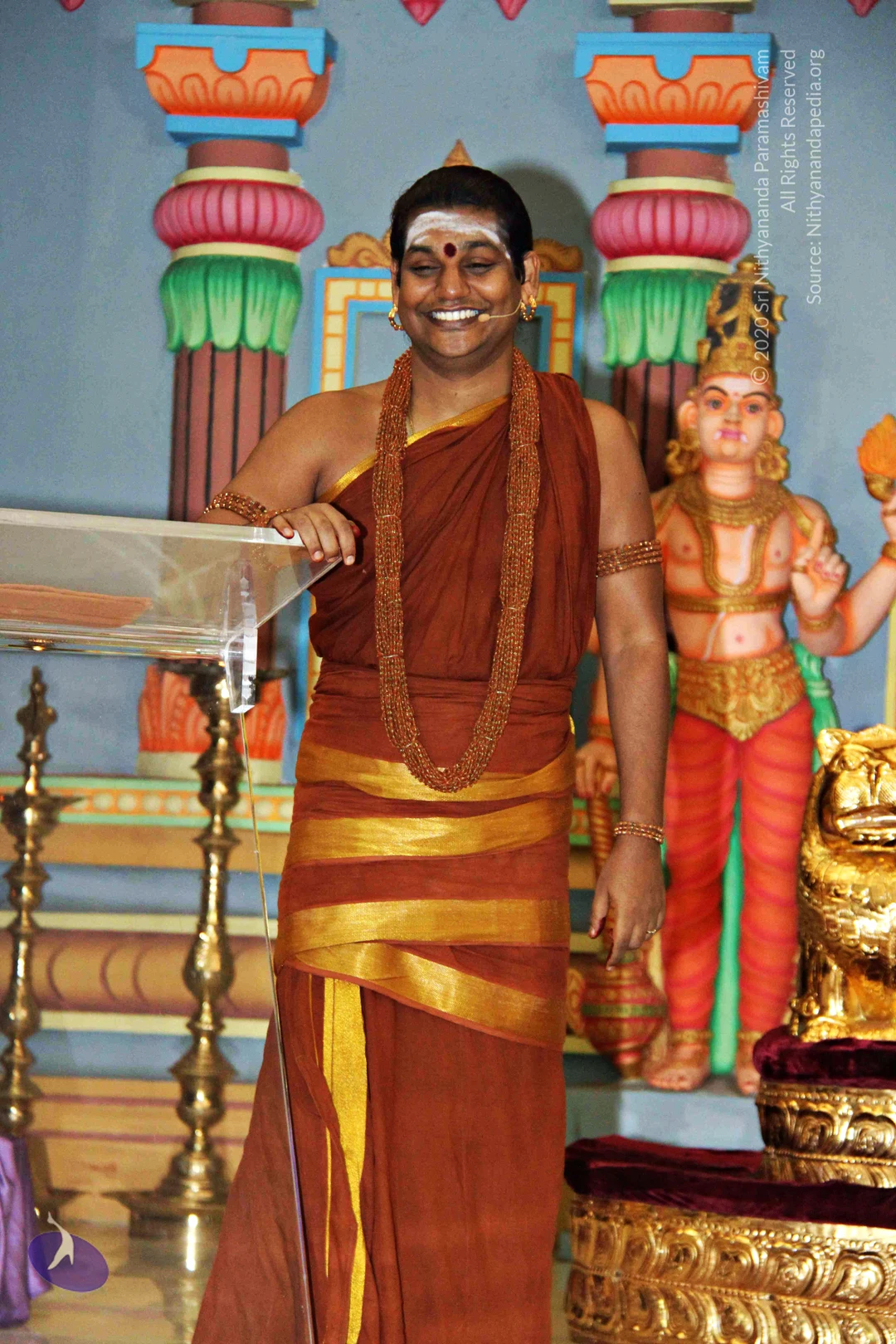
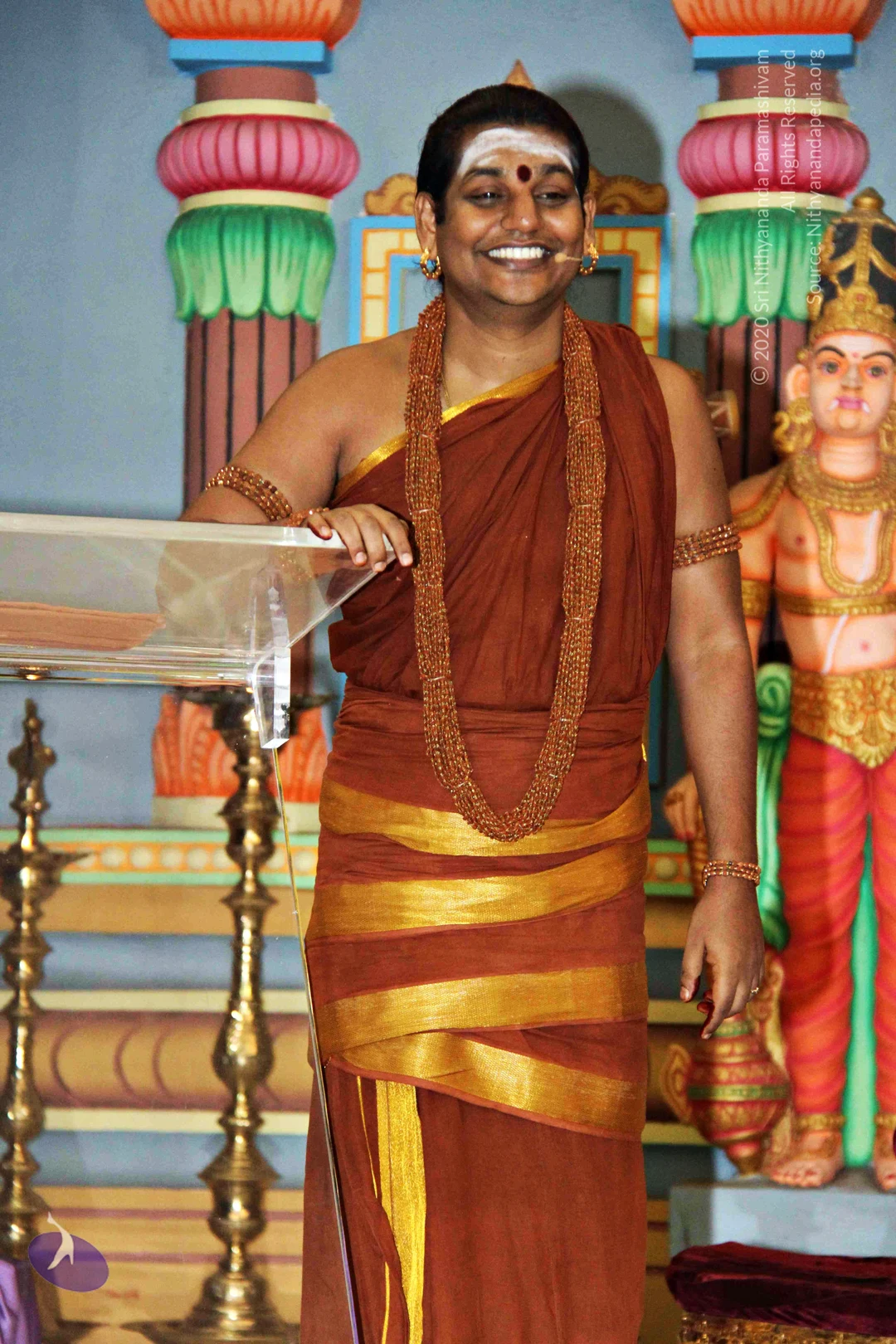
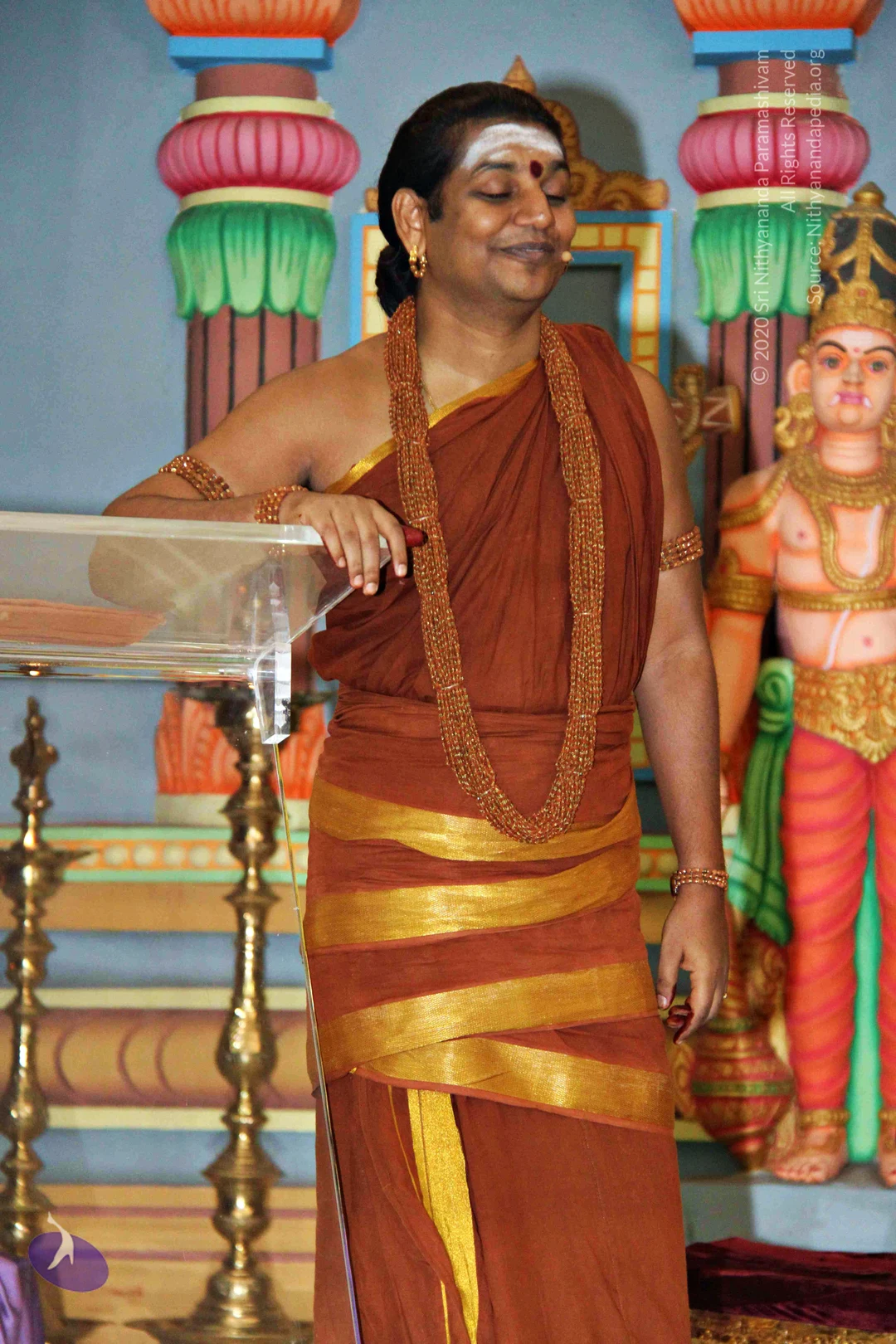
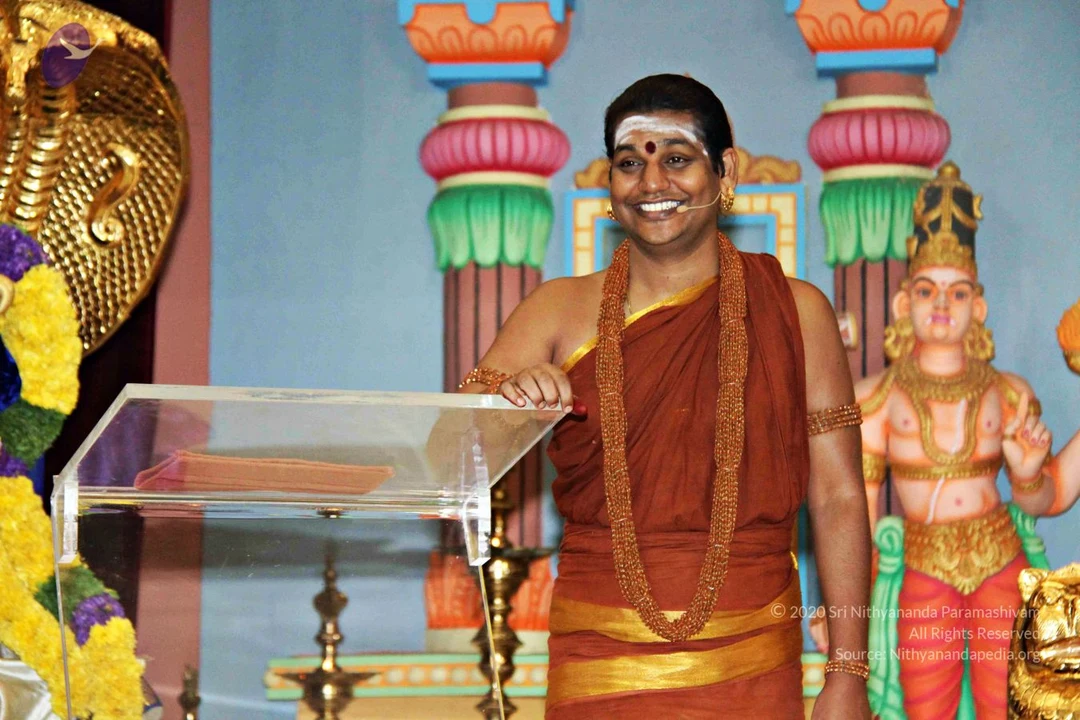
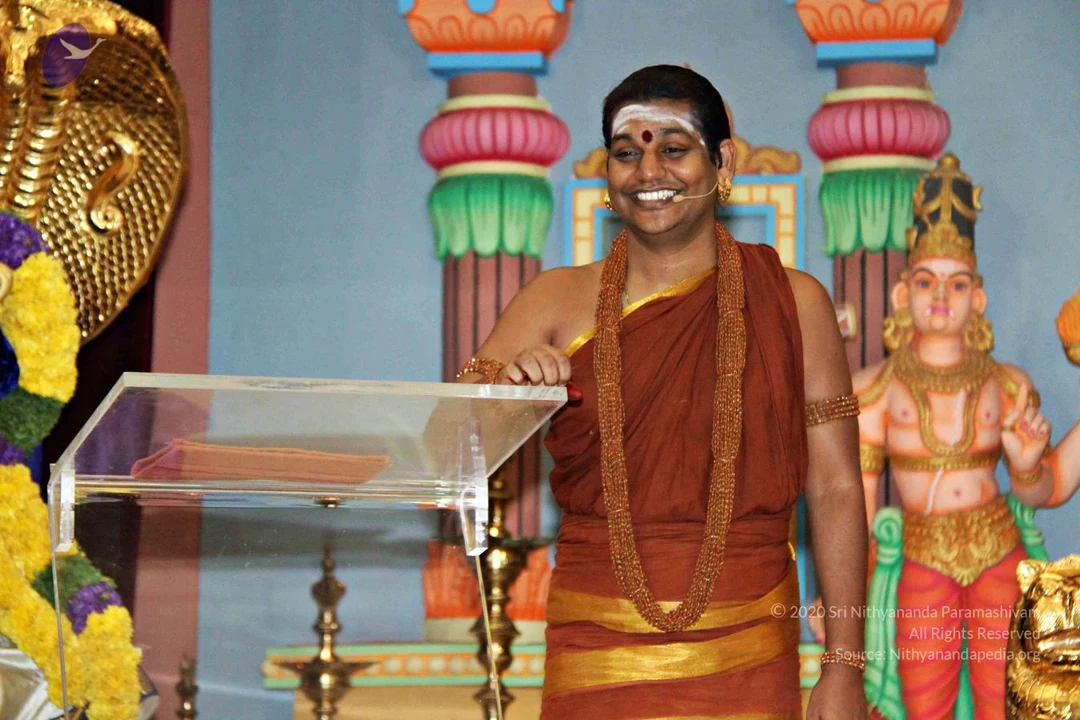
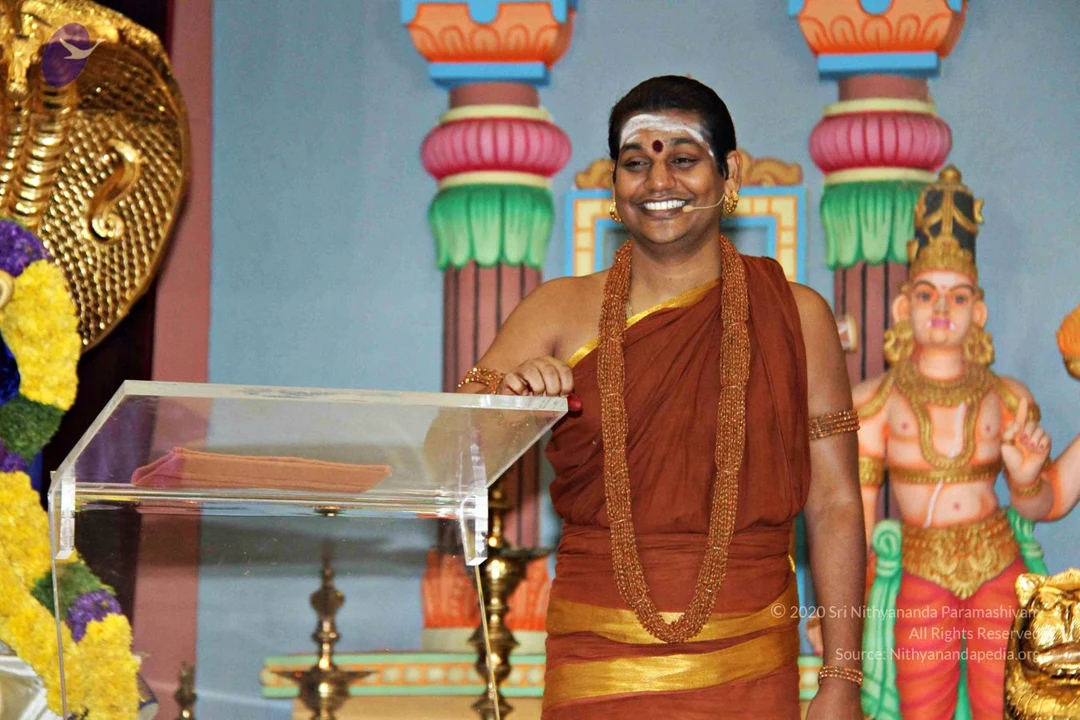
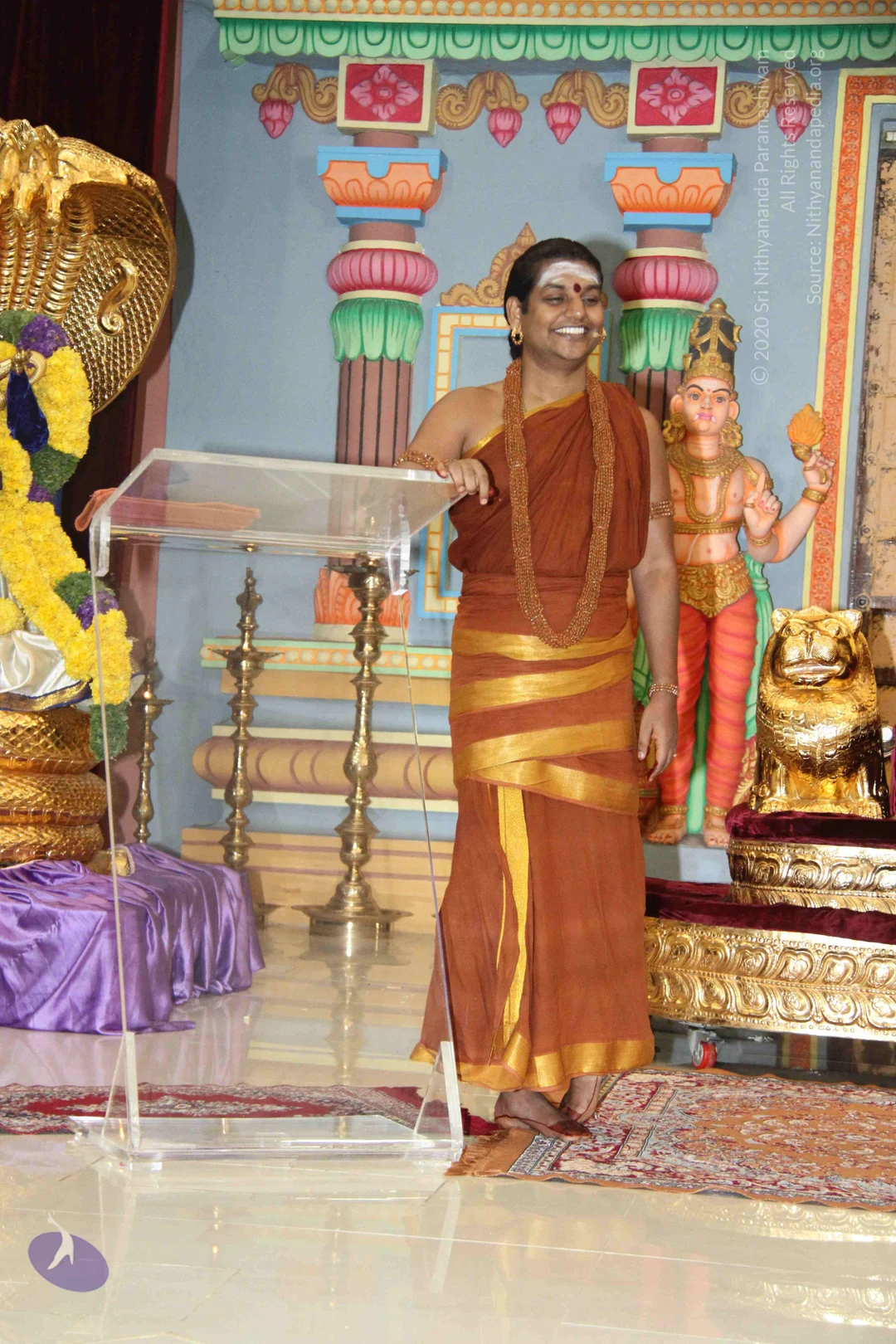
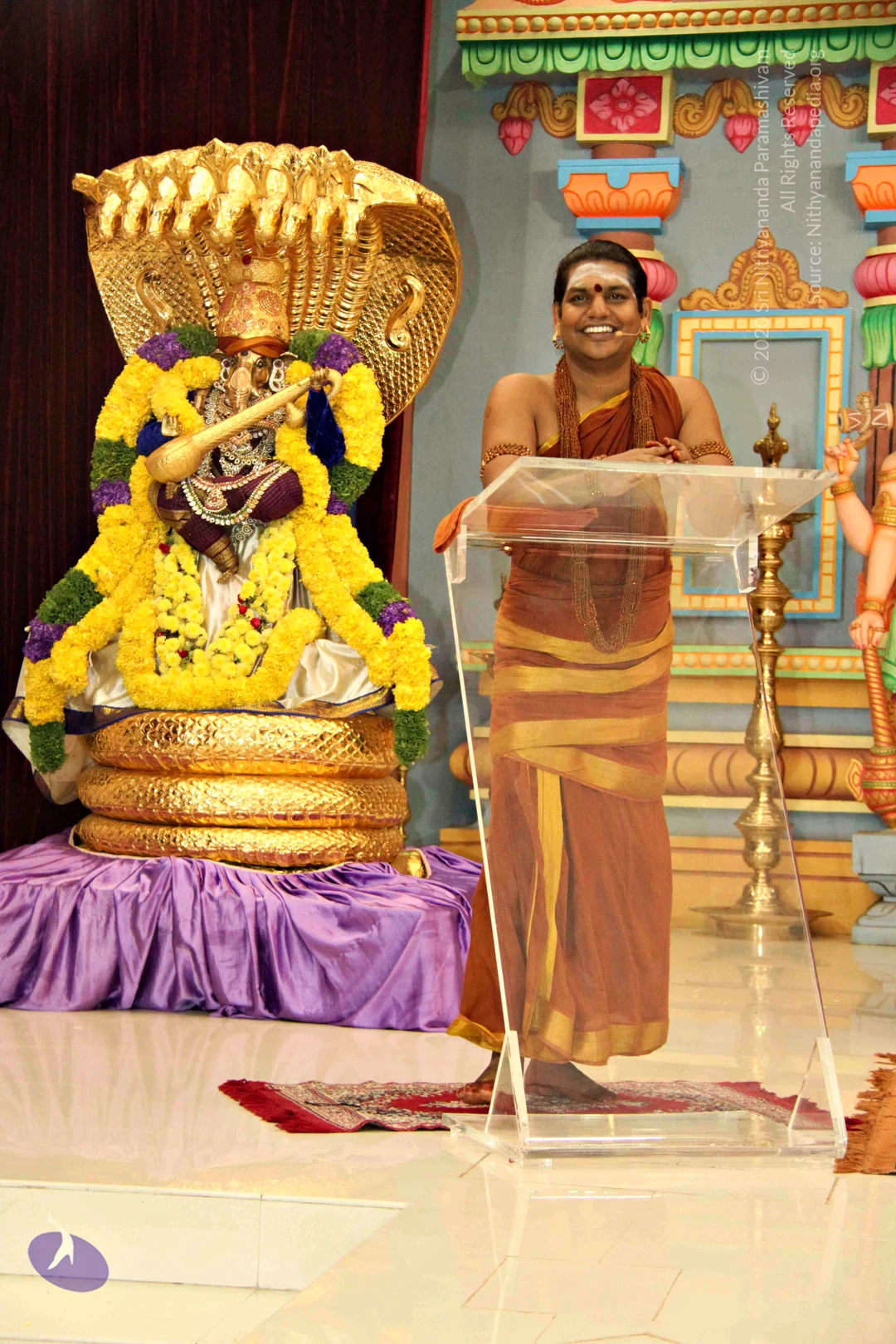
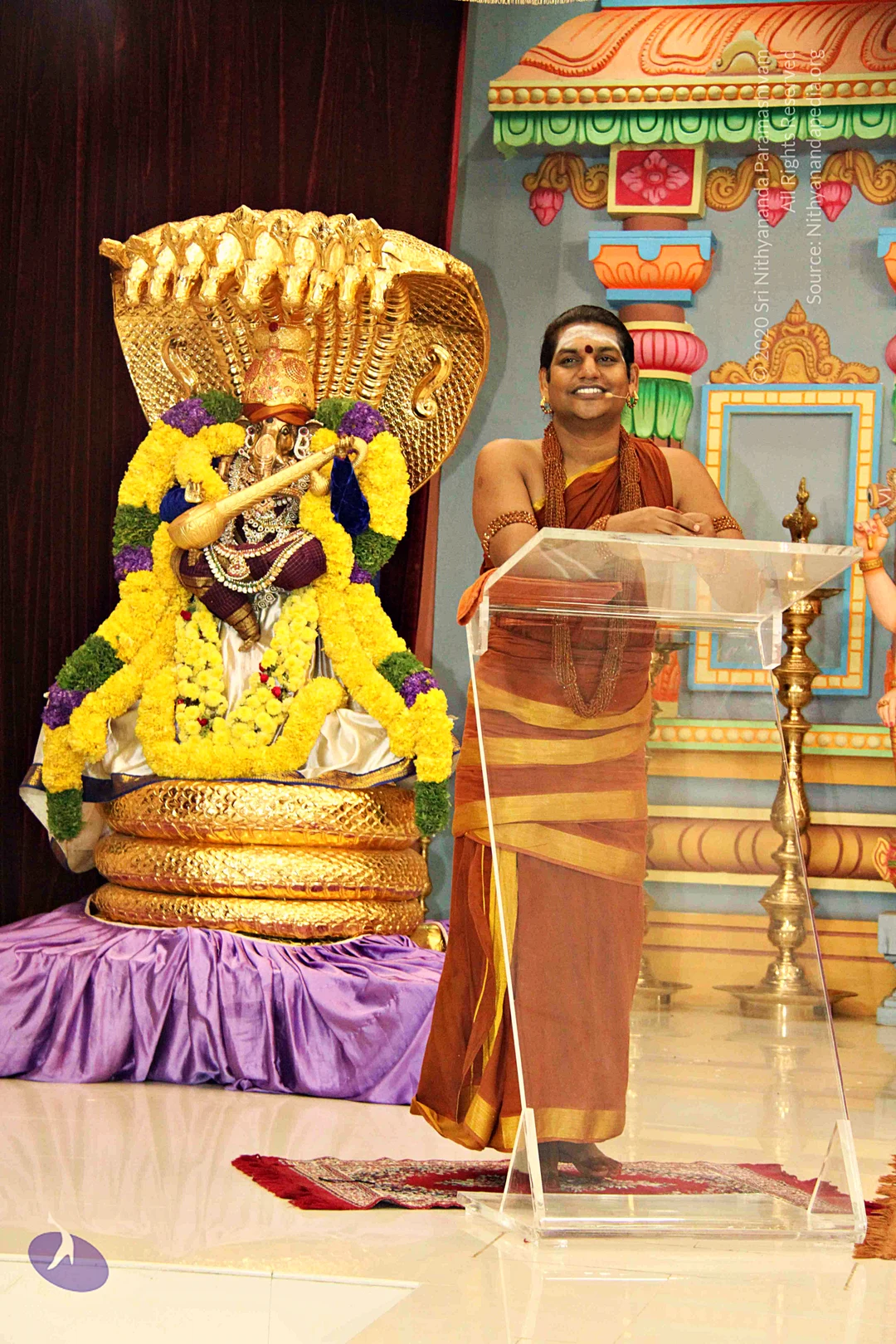
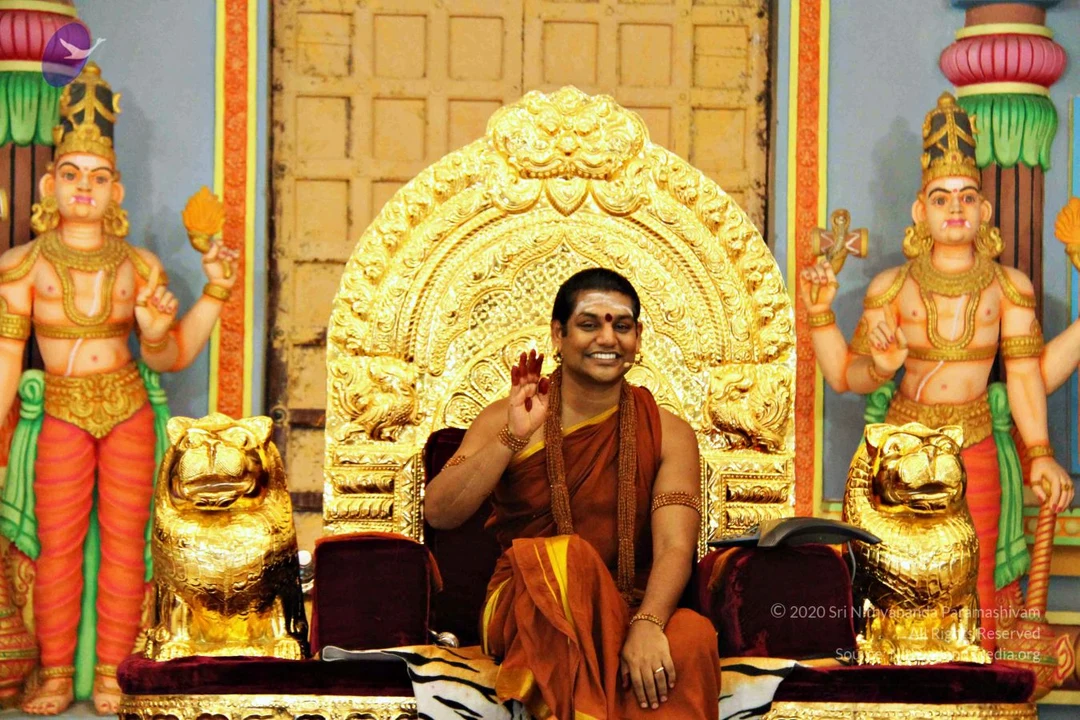
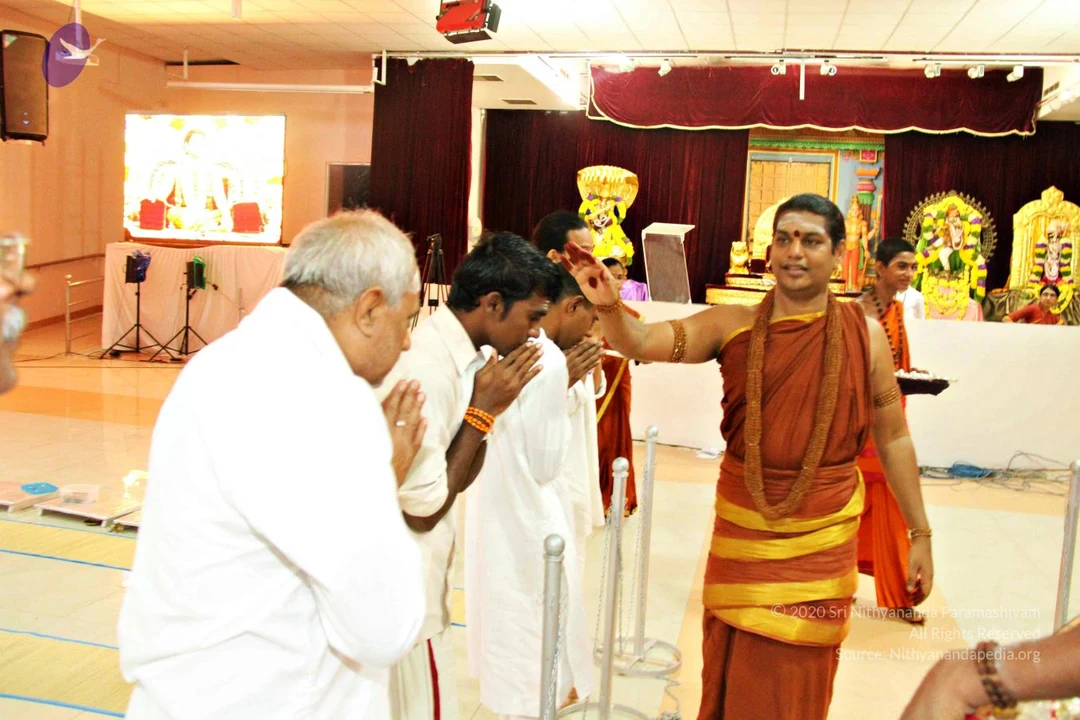
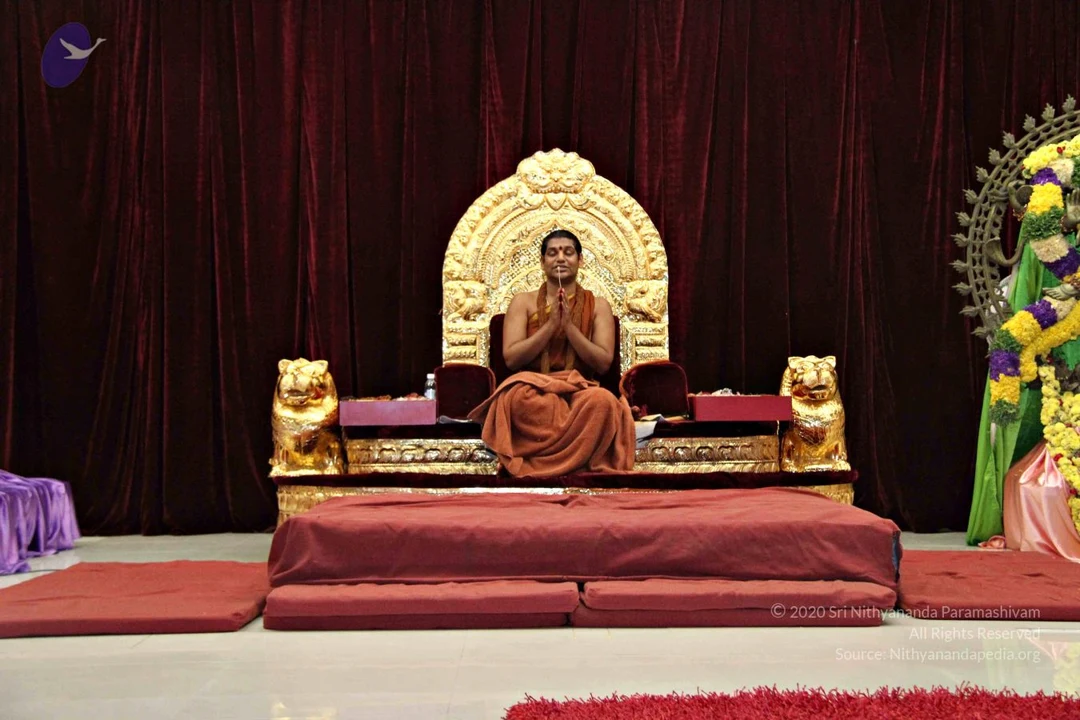
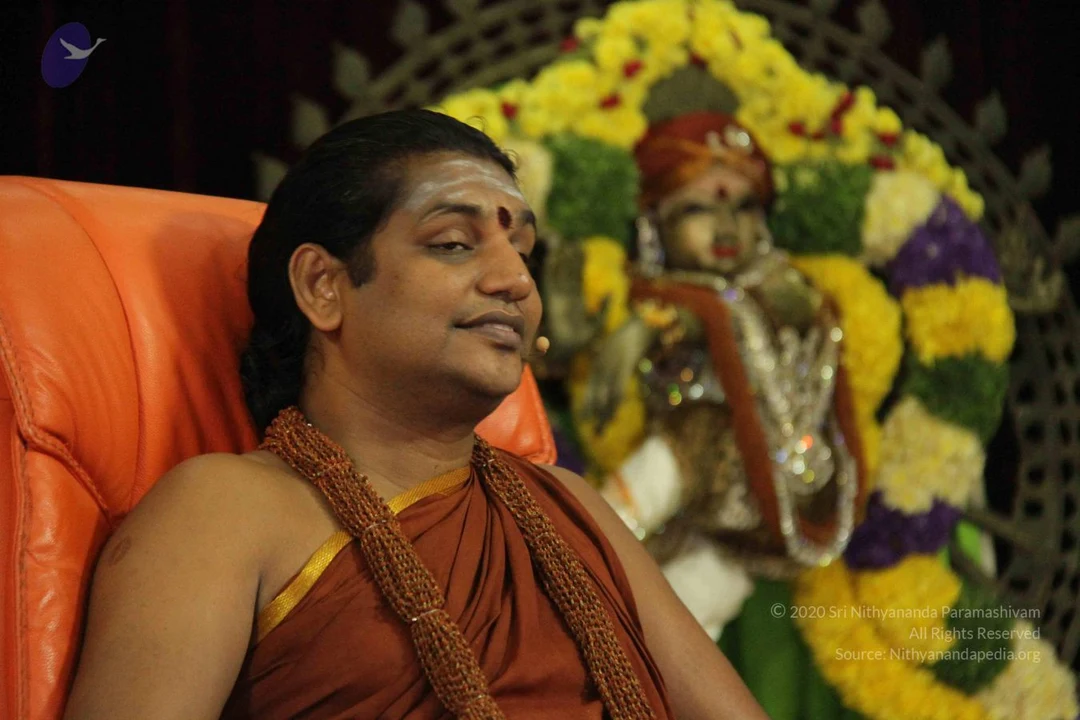
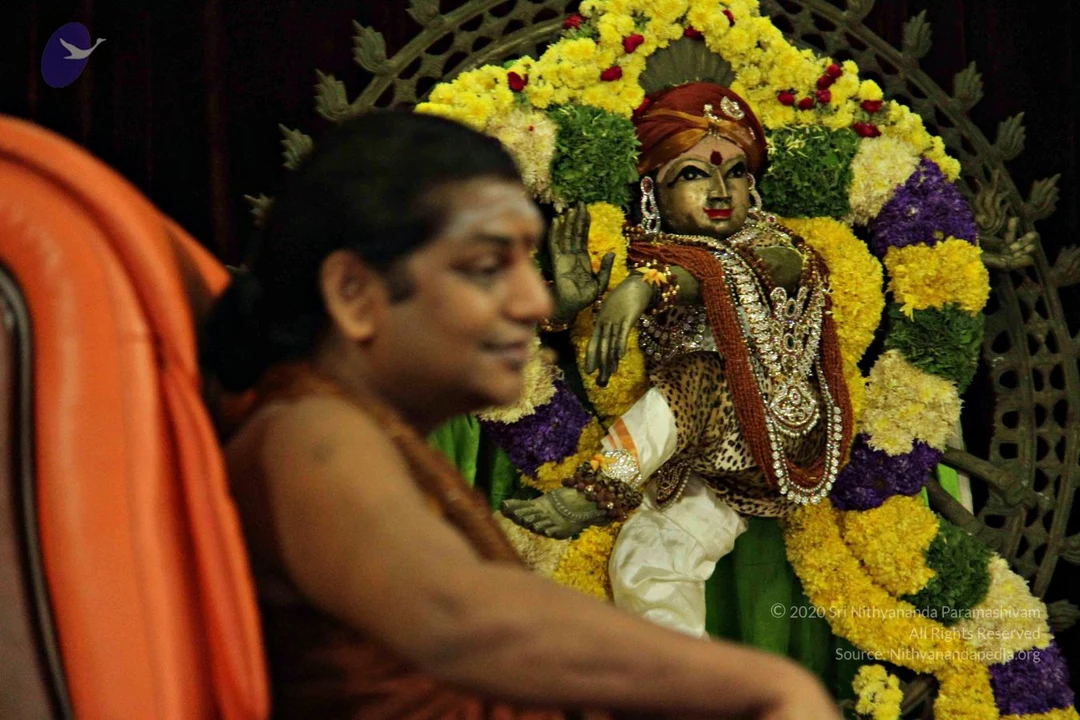
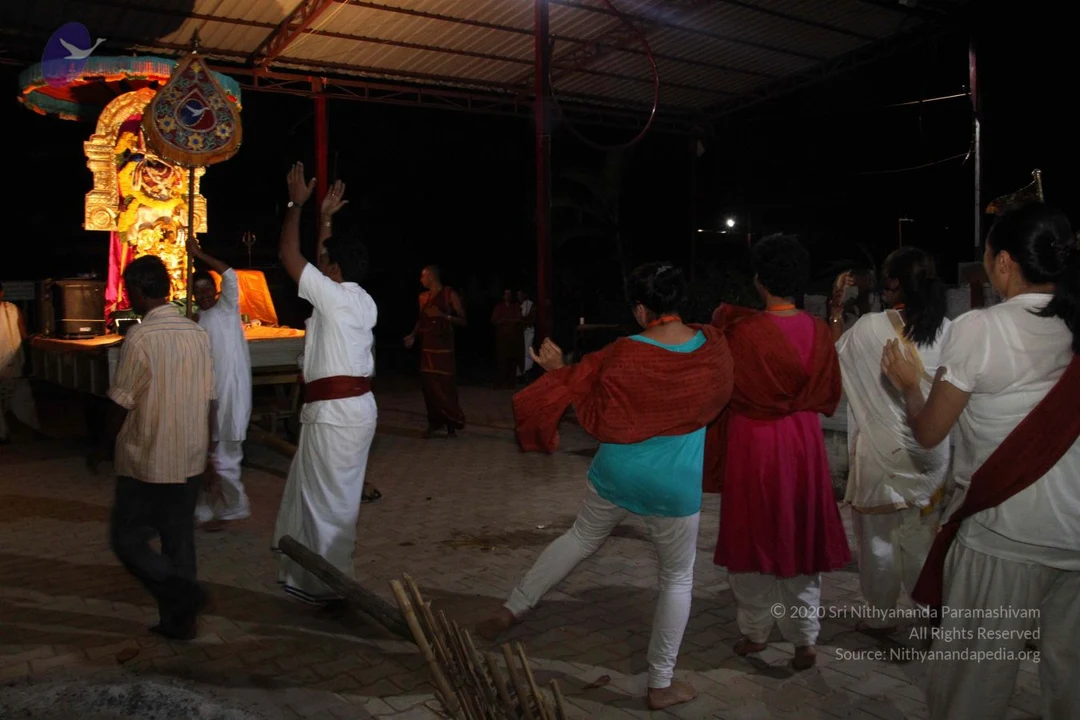
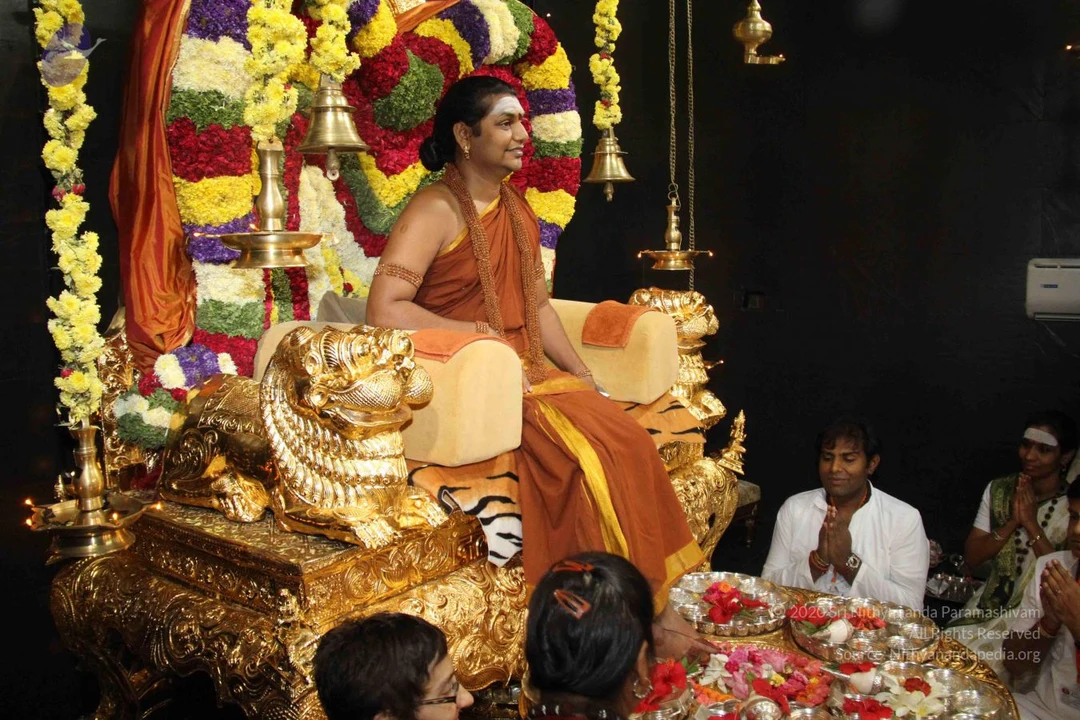
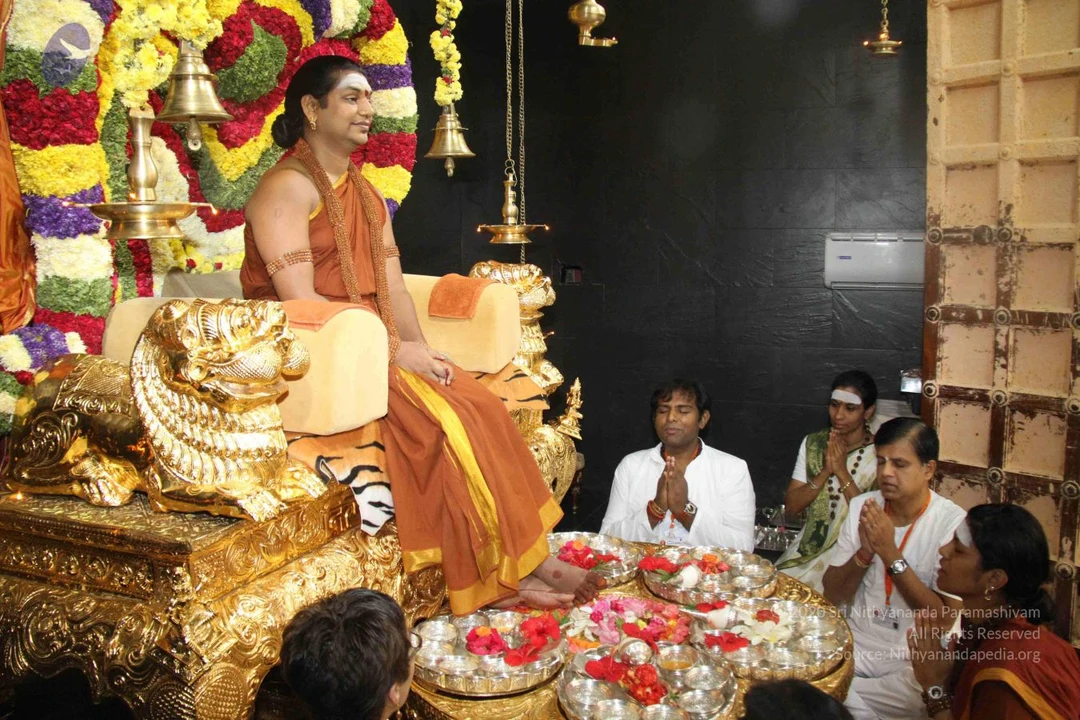
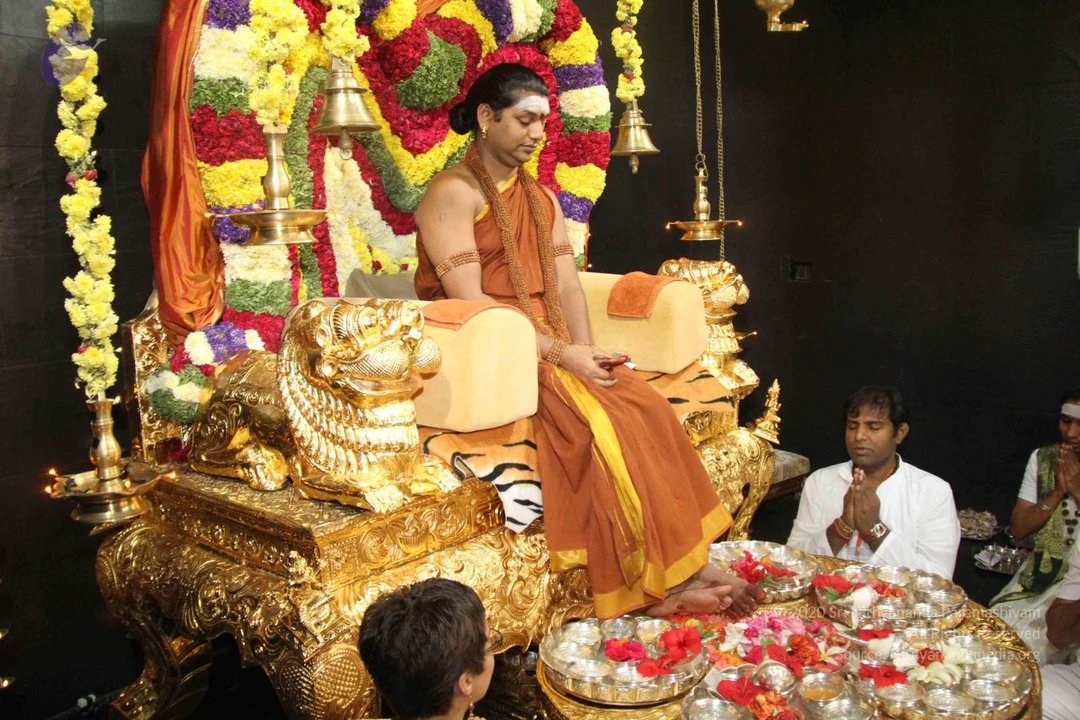
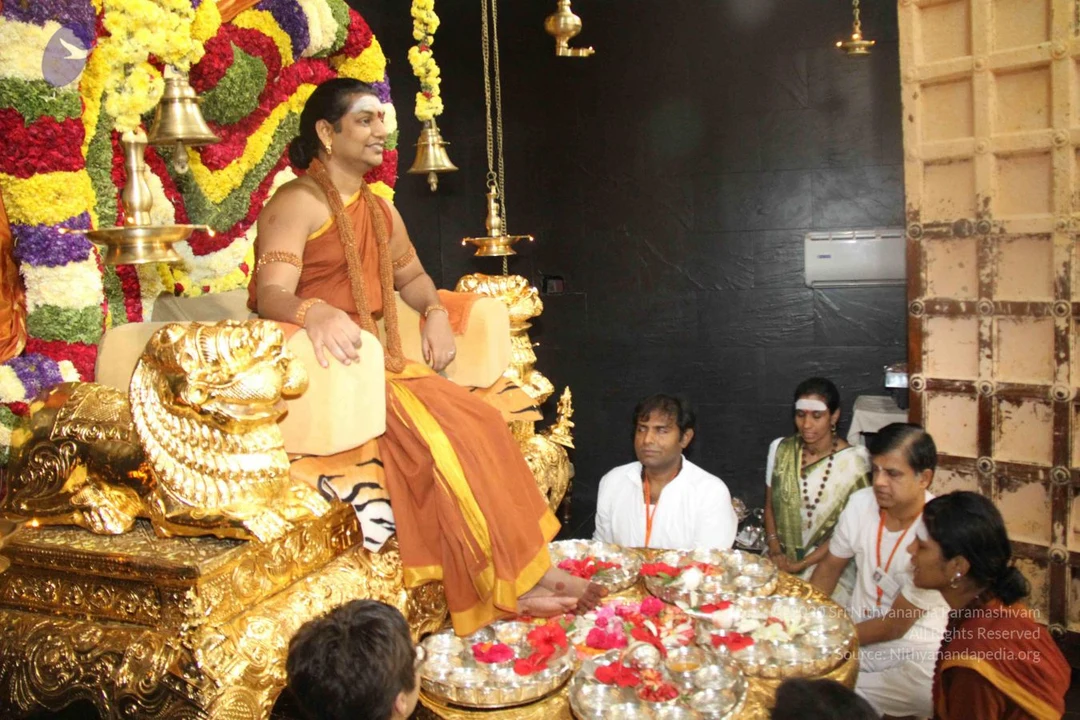
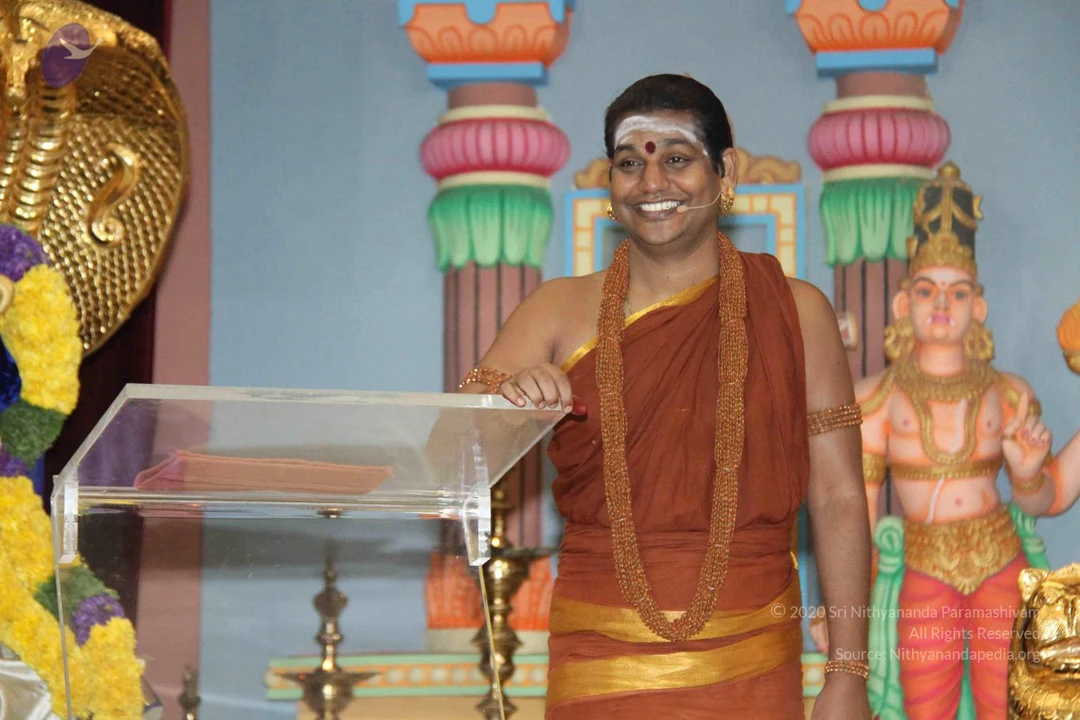
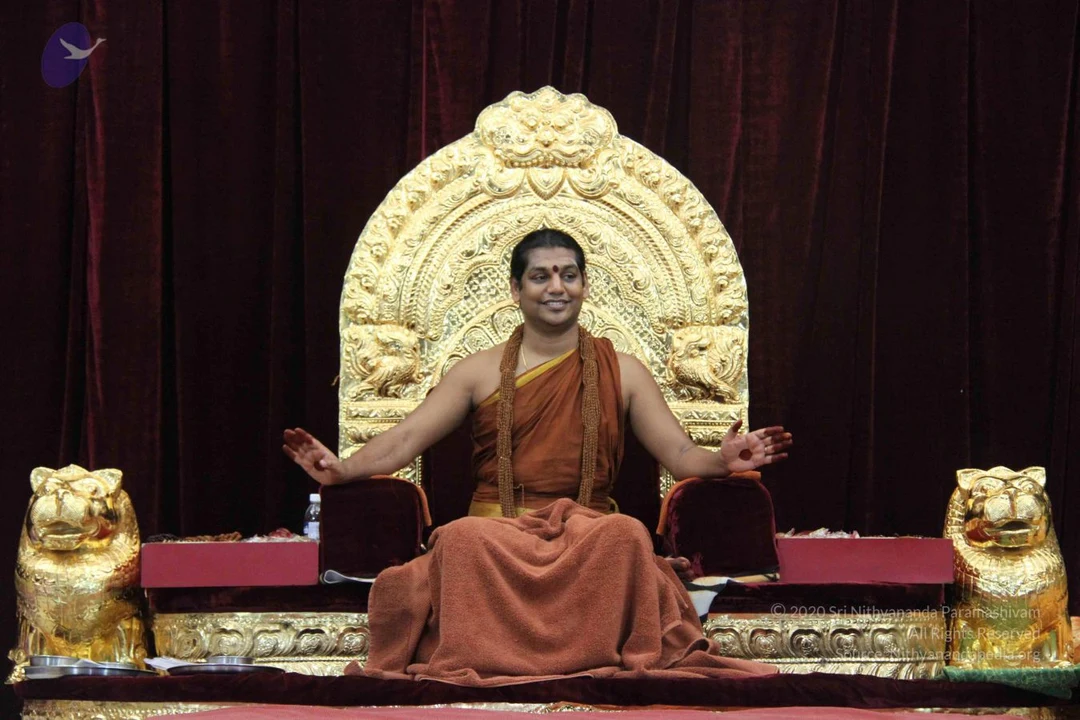
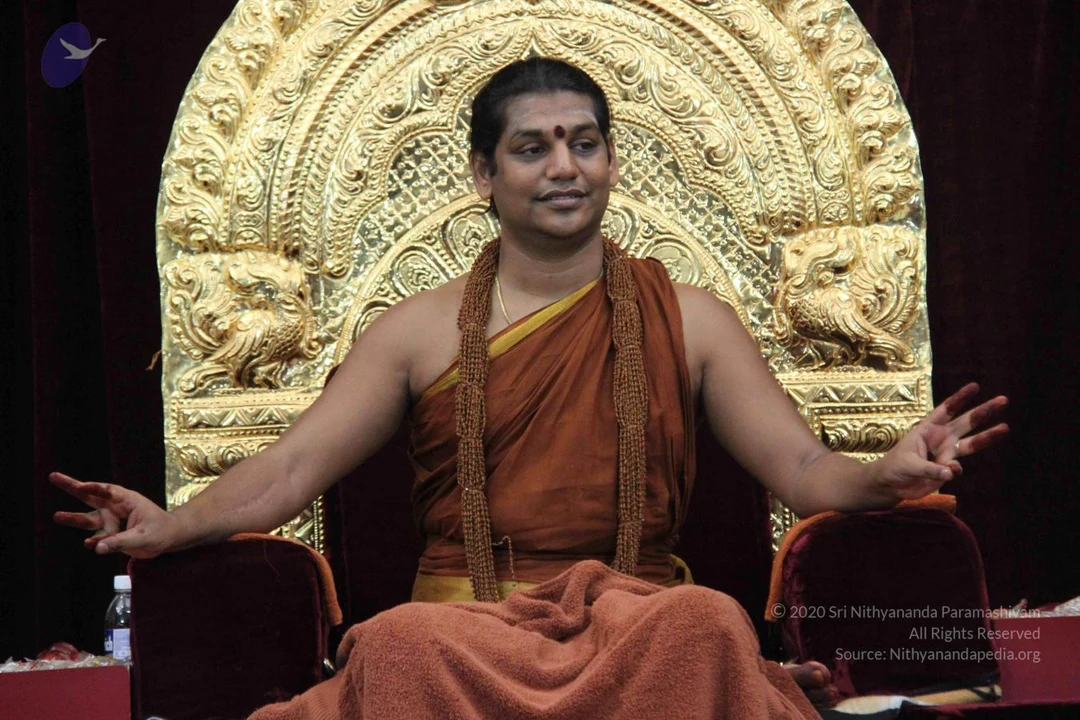
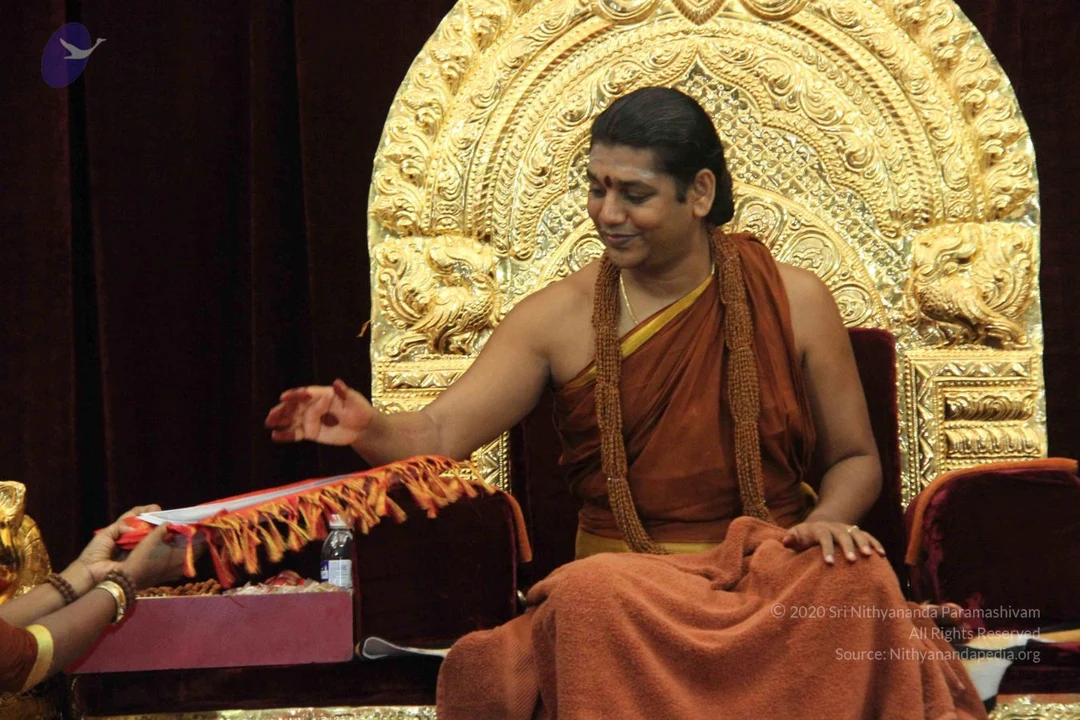
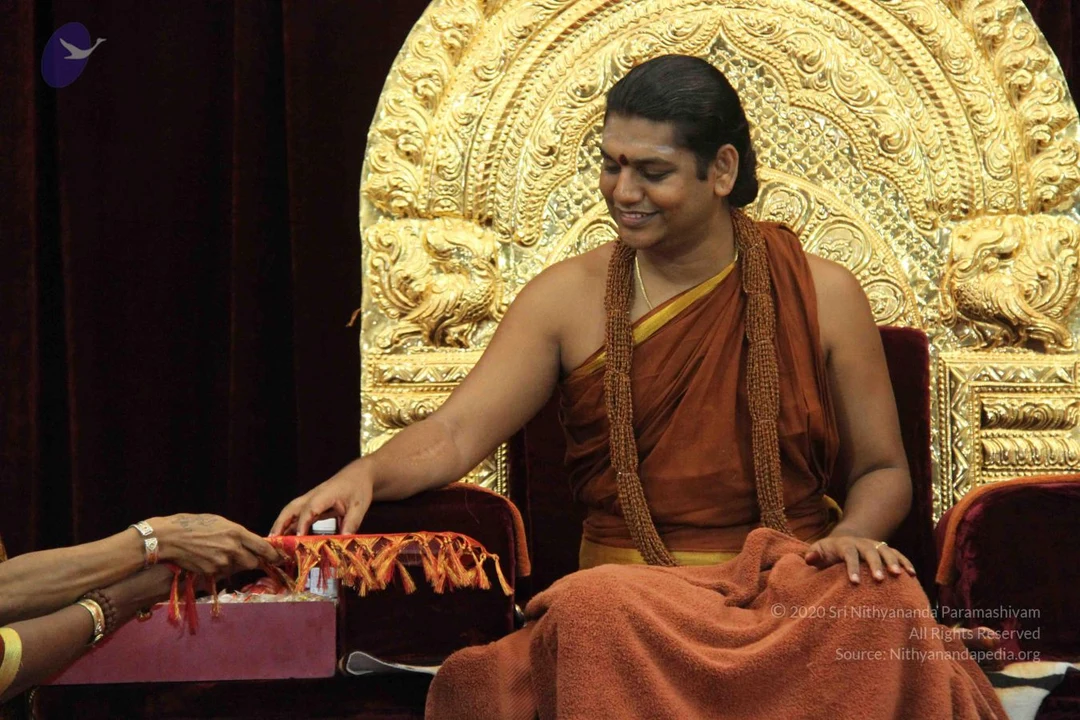
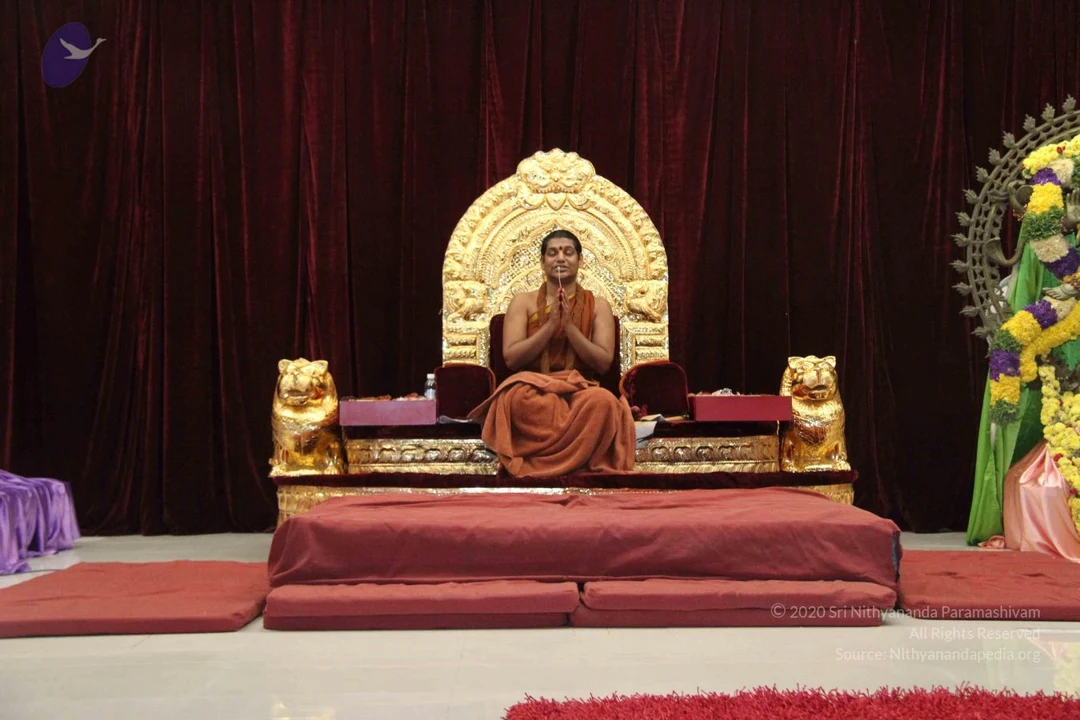
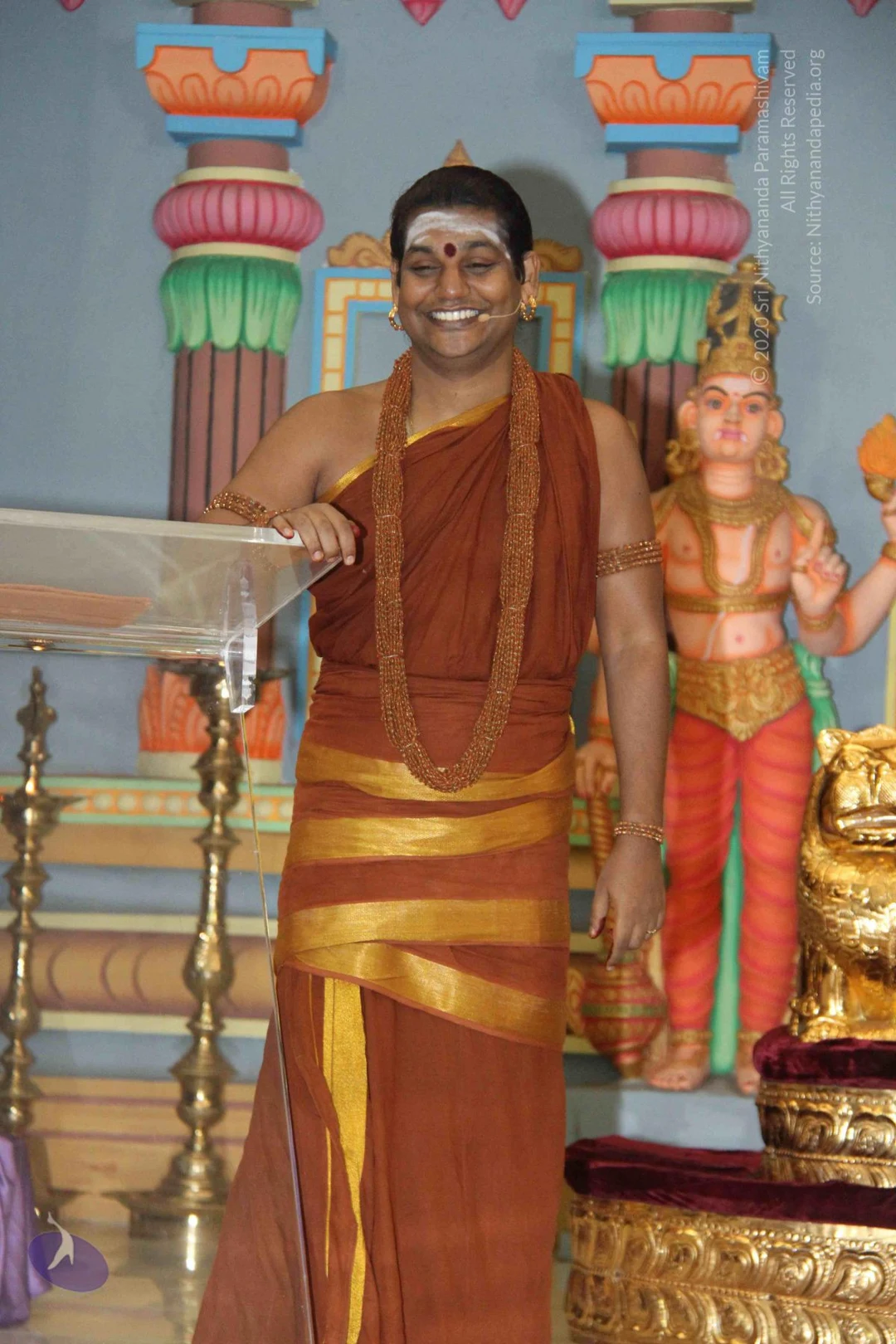
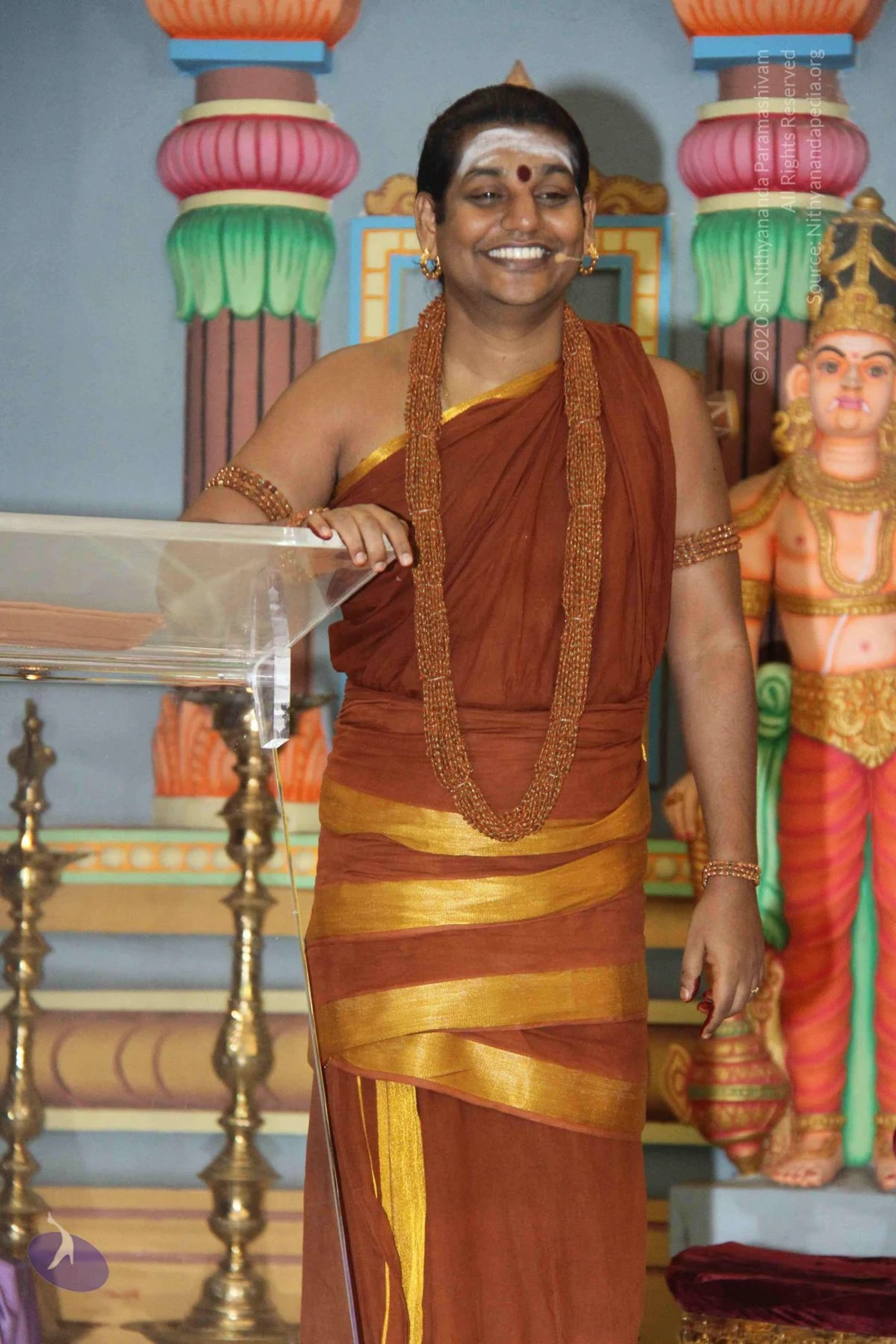
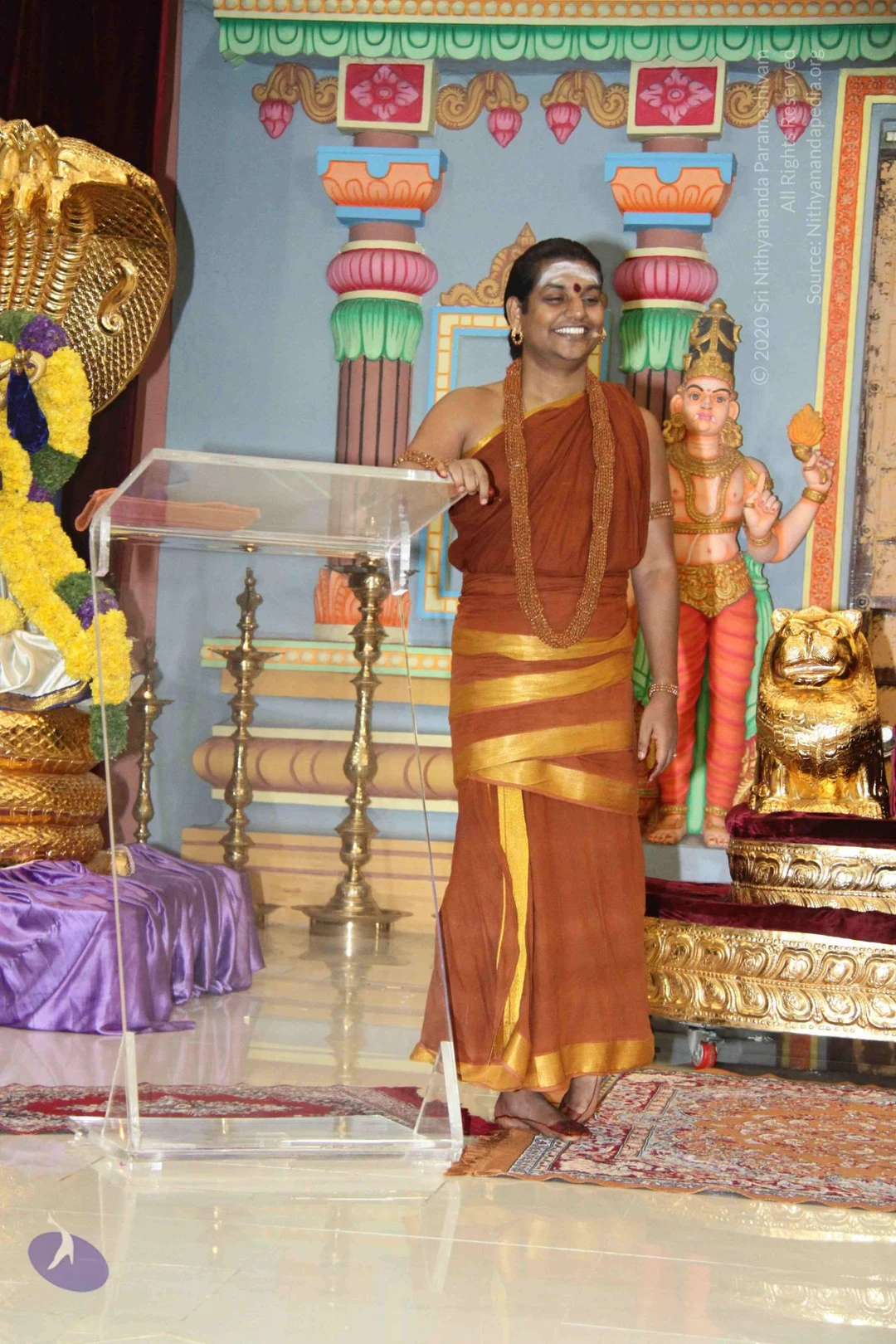
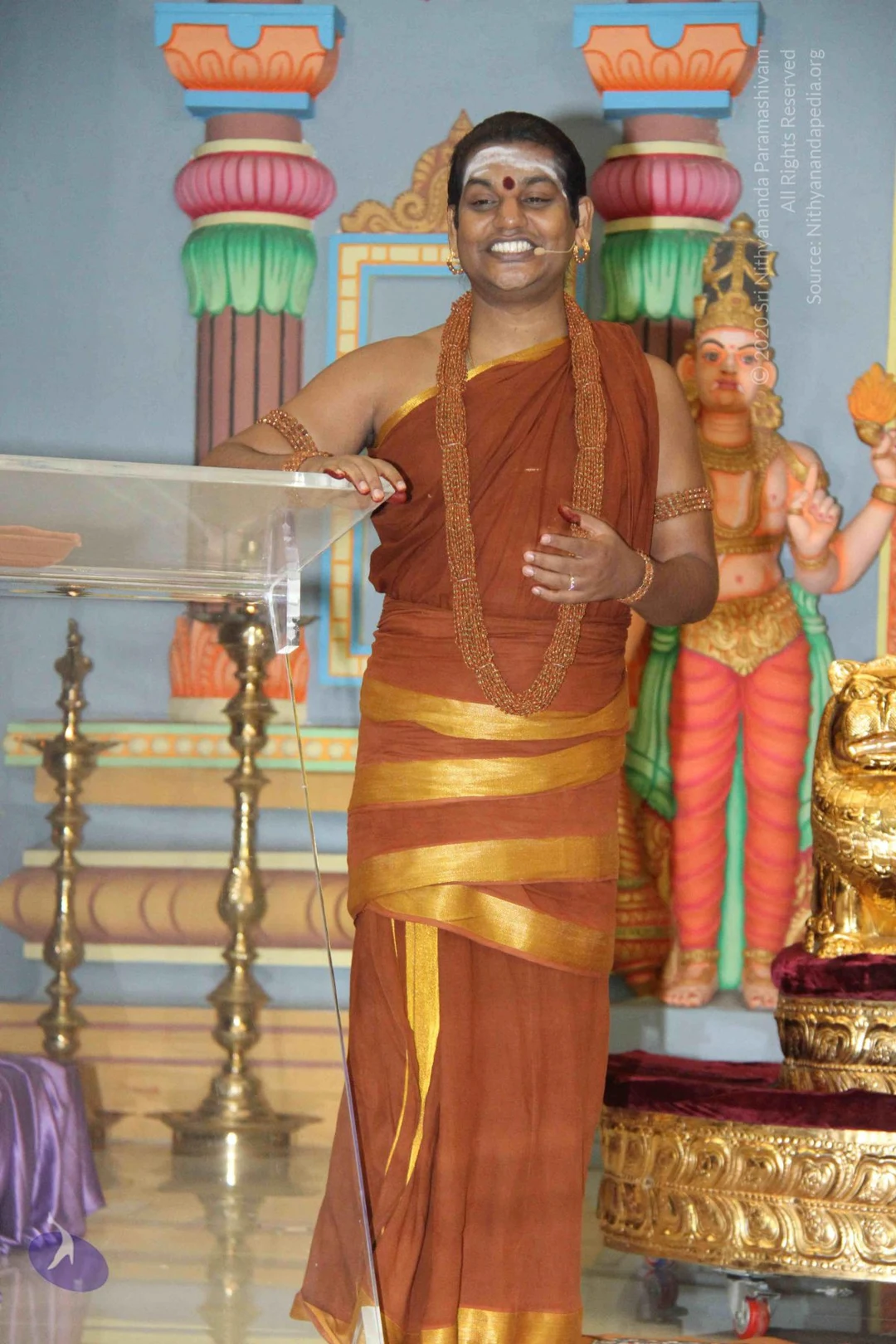
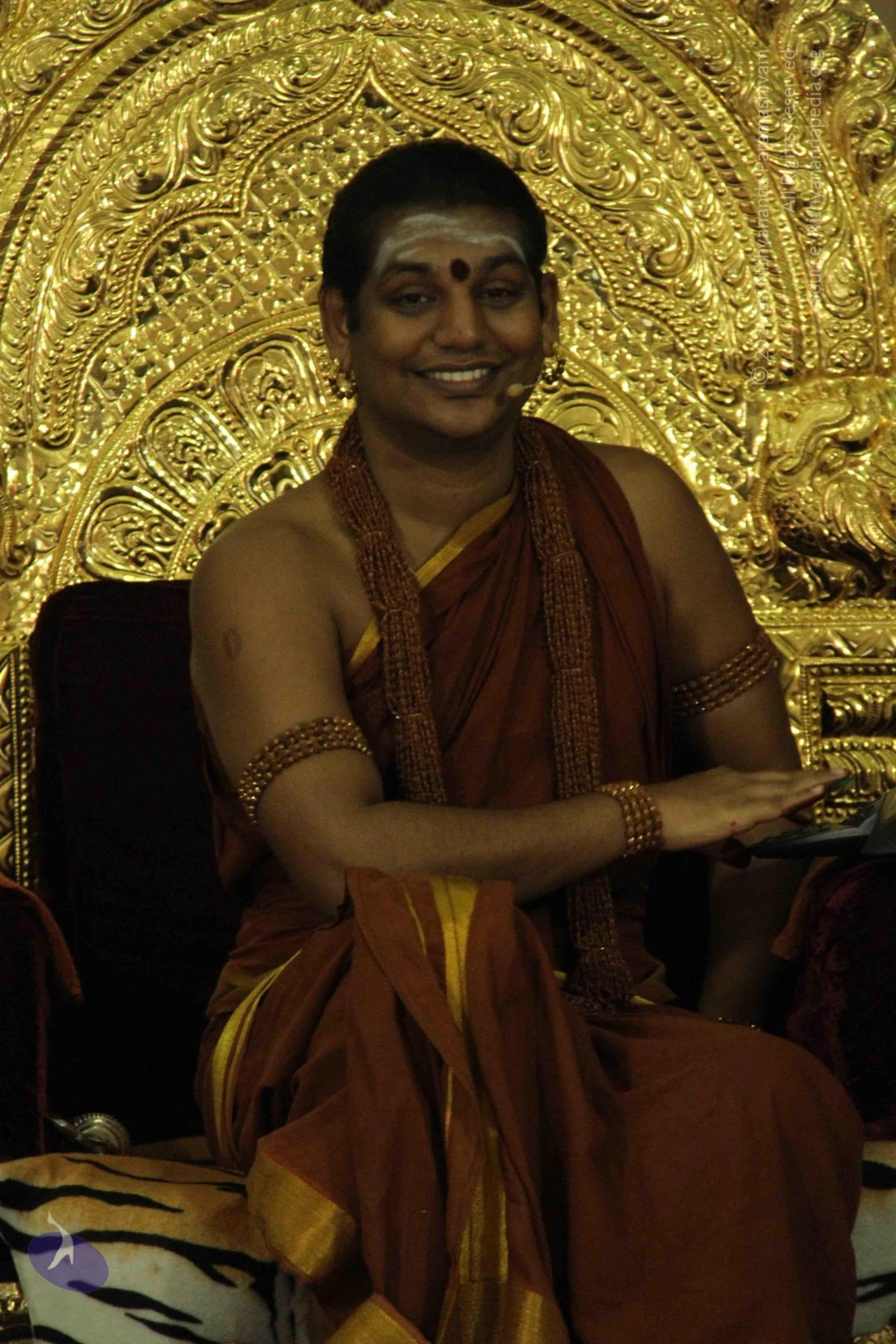
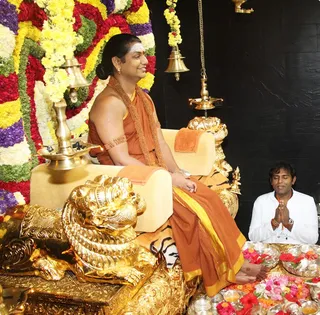
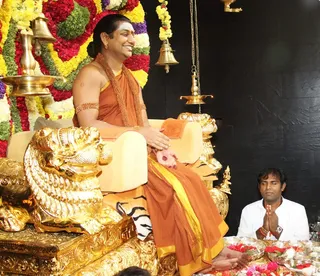
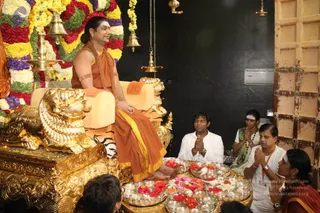
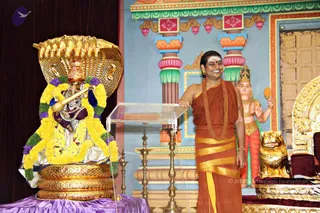
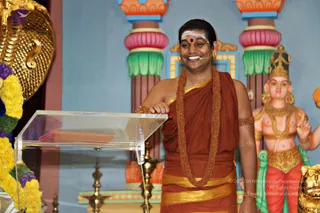
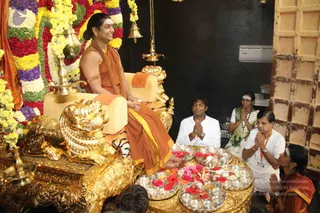
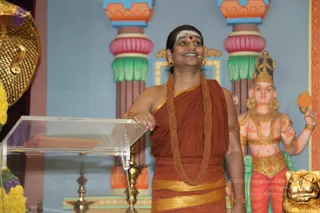
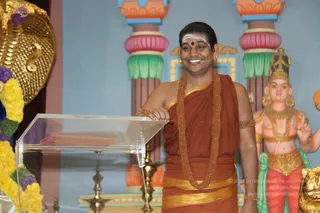
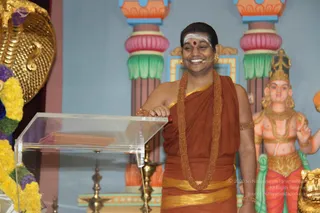
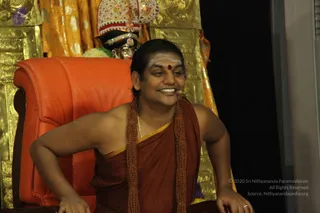
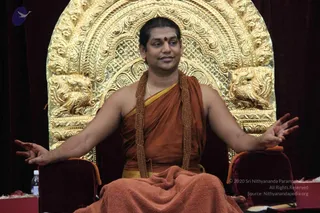
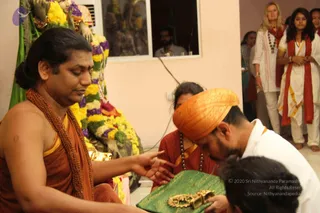
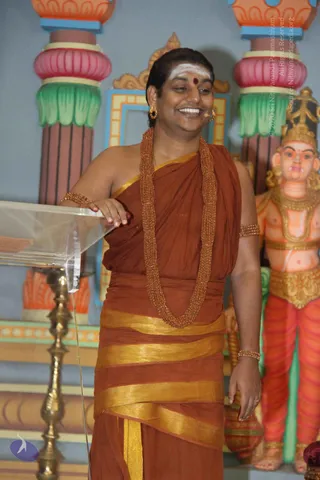
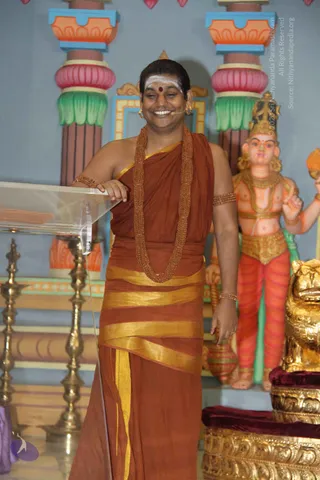
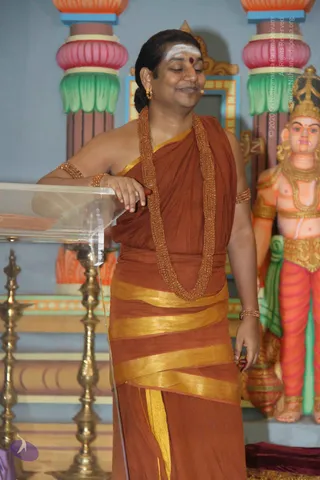
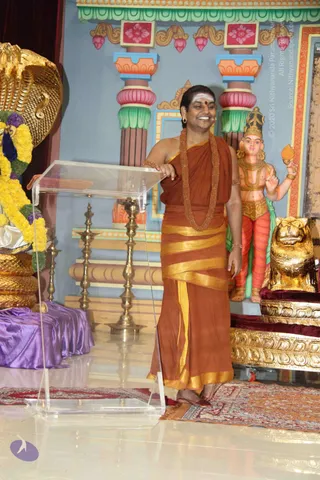
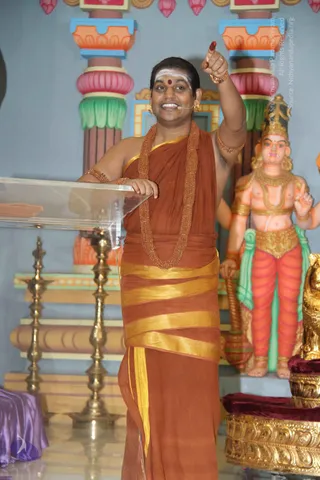
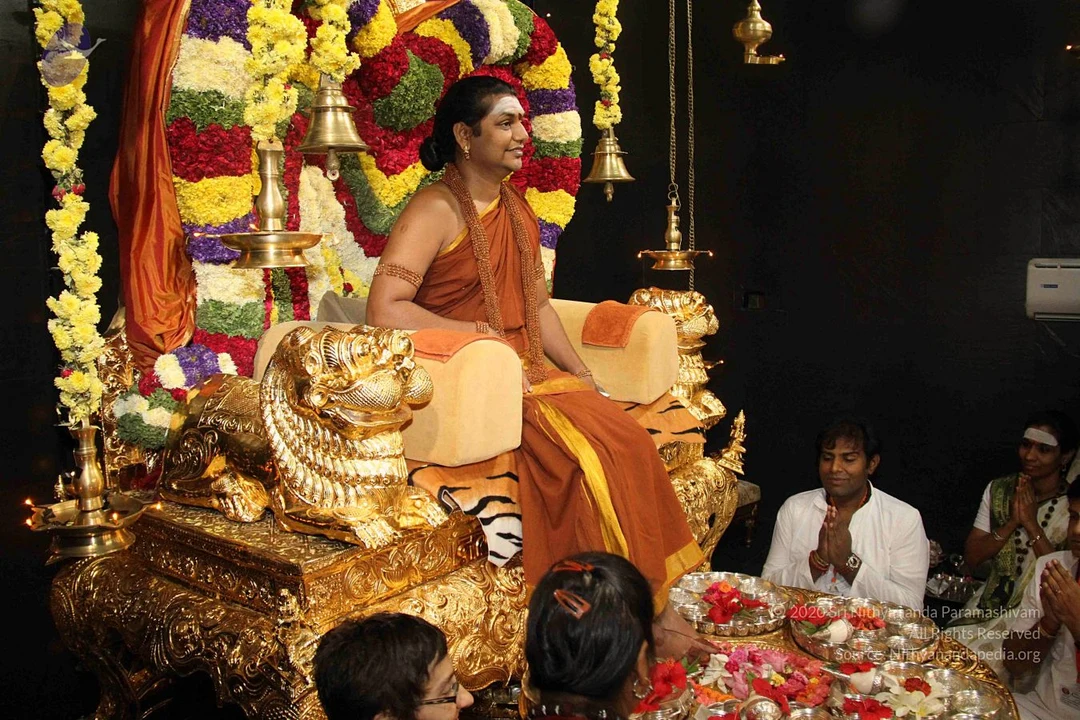
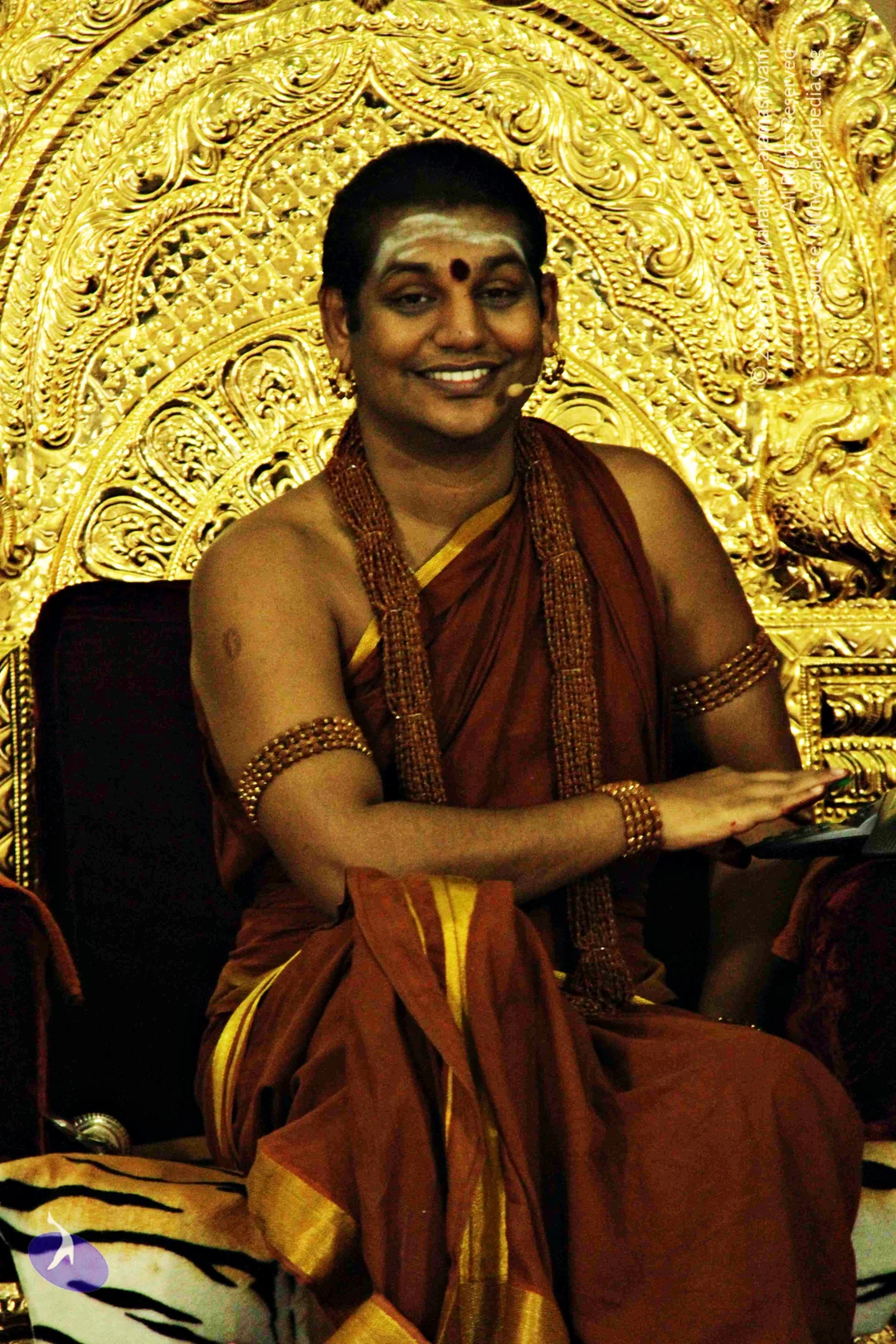
A photograph of a seated man in a saffron-orange robe and gold-toned shawl sits on an ornate gold throne carved with a lion-head armrest, draped with a tiger-striped cushion. He wears a rudraksha mala with a gold necklace and a vertical white-and-red forehead mark, and his hair is swept back in a bun. Behind him a garland wall of red, yellow, purple and green flowers hangs beside hanging brass bells and oil lamps. In front, brass trays hold flower petals, red blossoms and small lamps. A white-clad man sits at right with palms pressed together, a woman in a green sari with a white forehead band also sits with hands folded, and another woman in a white top sits at the far right edge. A figure's head is visible at lower centre. The setting shows an ashram ritual reception with flowers and oil lamps.Night scene on a paved courtyard where a group of devotees dances in celebration. In the foreground a woman in white clothes with an orange lanyard claps with her hands raised. Beside her a woman in a white dhoti-style outfit with gold border dances barefoot, while a woman in white kurta and a pink saree dances nearby. On the right a man in white shirt and white dhoti wears a red sash and faces away from the camera. Further right a woman in red clothes claps and smiles. Behind them a man holds a long golden trumpet-like instrument and a tall ceremonial banner with a red and gold emblem is raised, with more devotees in white in the background.A smiling man stands beside a clear acrylic lectern in a temple-style hall, one hand resting on the lectern. He wears a rust-brown unstitched cloth wrapped with gold borders, a long multi-strand rudraksha-style bead mala, beaded armlets and a small red bindi with white forehead markings. Behind him, a painted deity murti with a gold crown and gold jewellery stands beside a pillar in pink and green, and brass oil lamps stand near the lectern. A microphone is visible near his face. A printed photo caption on the image reads Sri Nithyananda Paramashivam.

September 05 2013

Original wiki page
Contents

Description:

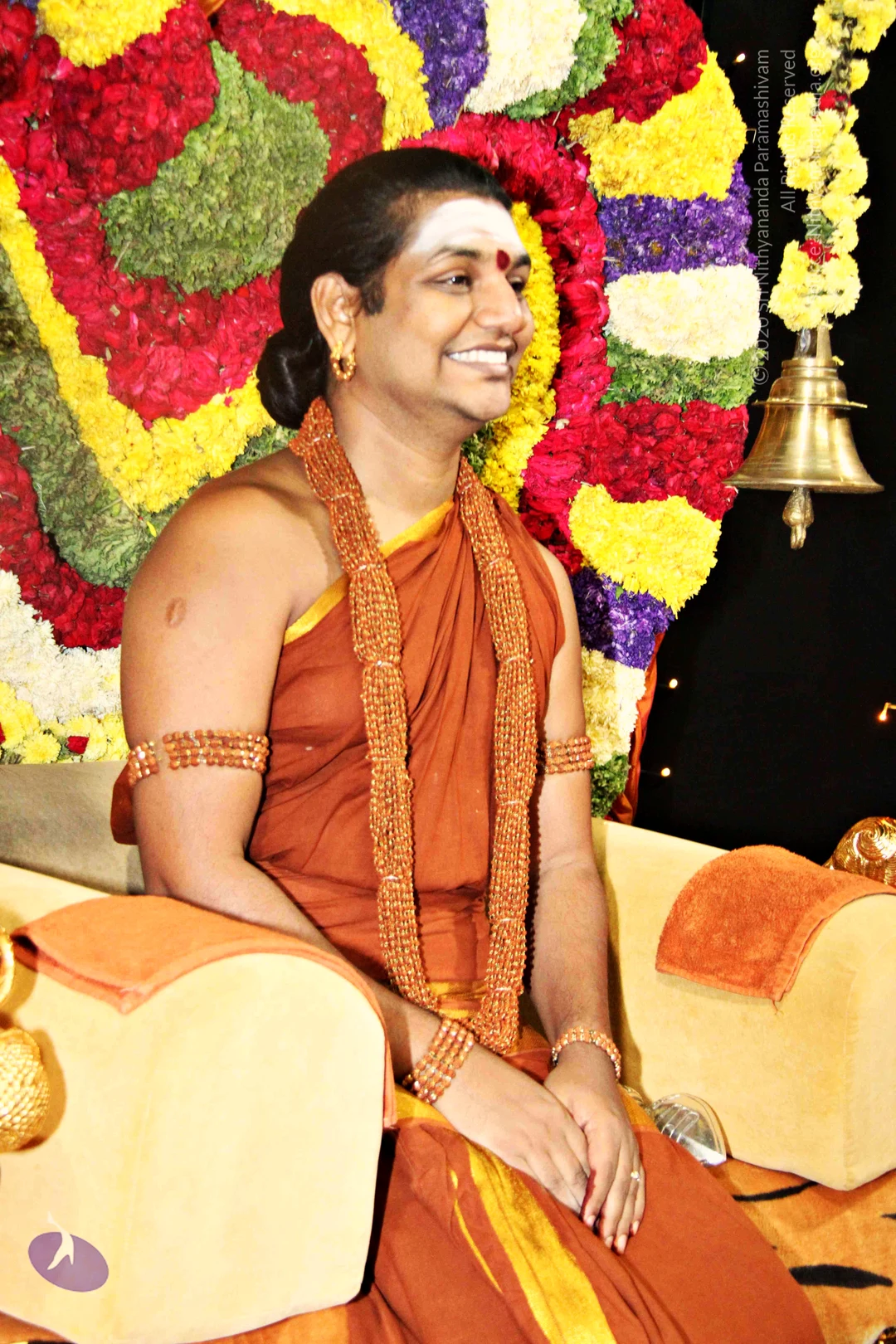
Today Paramahamsa Nithyananda continued talking about the importance of reclaiming your inner space from self- doubt. He explained that self-doubt is like an air bubble trapped in a metal idol. If an air bubble gets trapped in the metal when the idol is being cast, it makes the area around it weak and prone to breakage. In the same way, self-doubt makes us weak and unreliable, and we miss God, the Master and all the auspicious things in life. Completion with self-doubt lets the air bubbles out, and you become strong and reliable. Some people think that they can complete with self-doubt only once they become perfect. This is not true. The people who run after perfection neither achieve perfection nor manage to complete with their self-doubt. Simply declare completion with your self-doubt. You will have a beautiful relationship with the Master and live a simple, innocent and enlightened life.

Link to Video

VideoAudio

Transcript:

Nithyanandeshwara Samaarambhaam Nithyanandeshwari Madhyamaam | Asmadaachaarya Paryanthaam Vande Guru Paramparaam ||

I welcome all of you with my love and blessings.

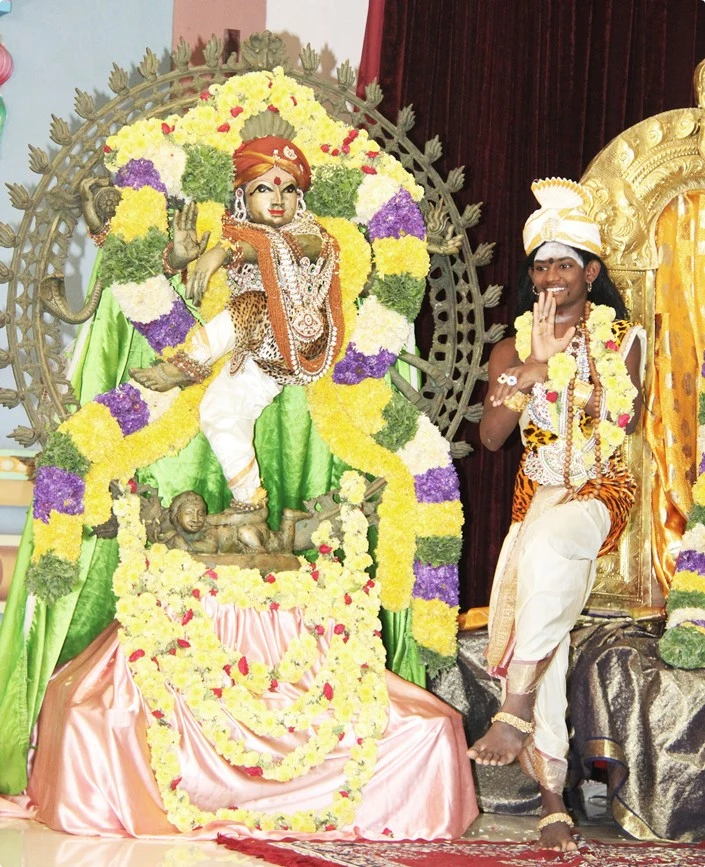
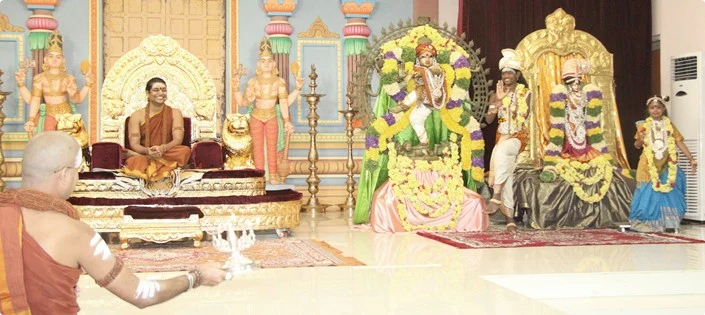
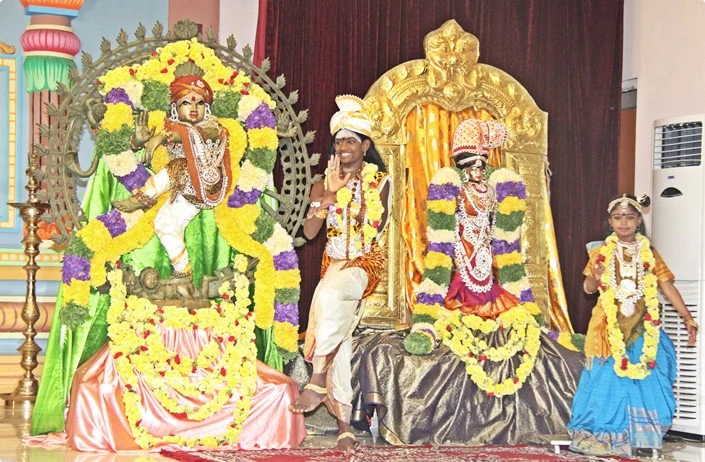
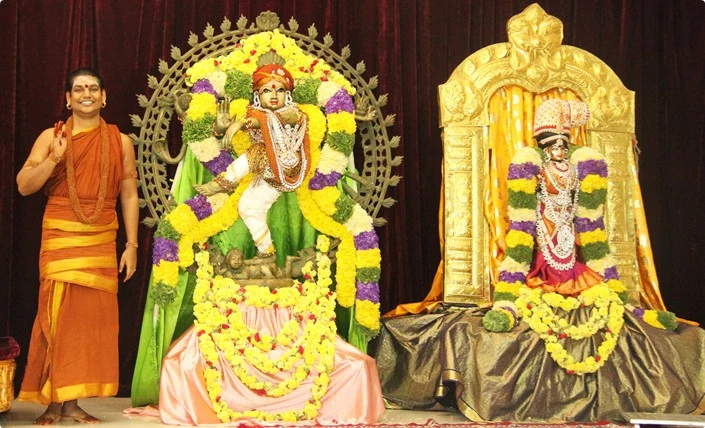
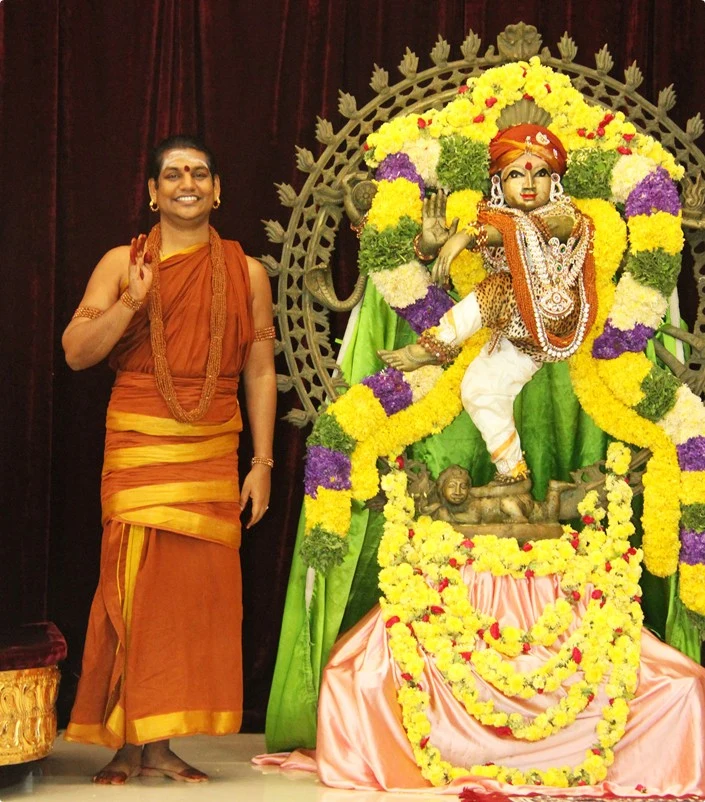
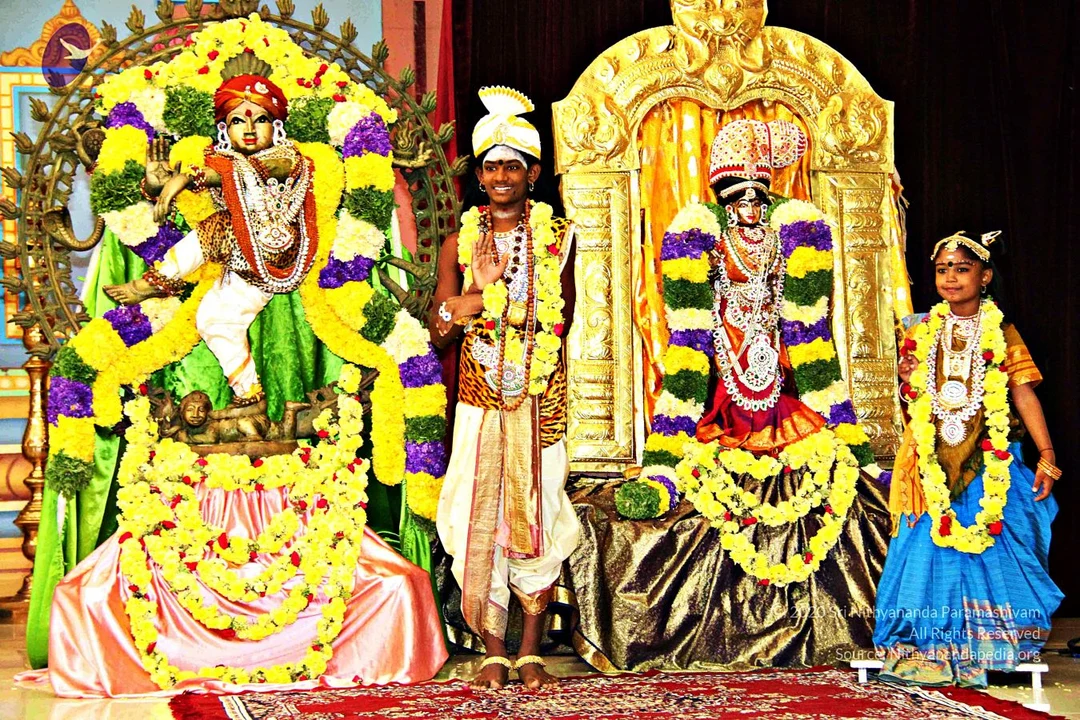
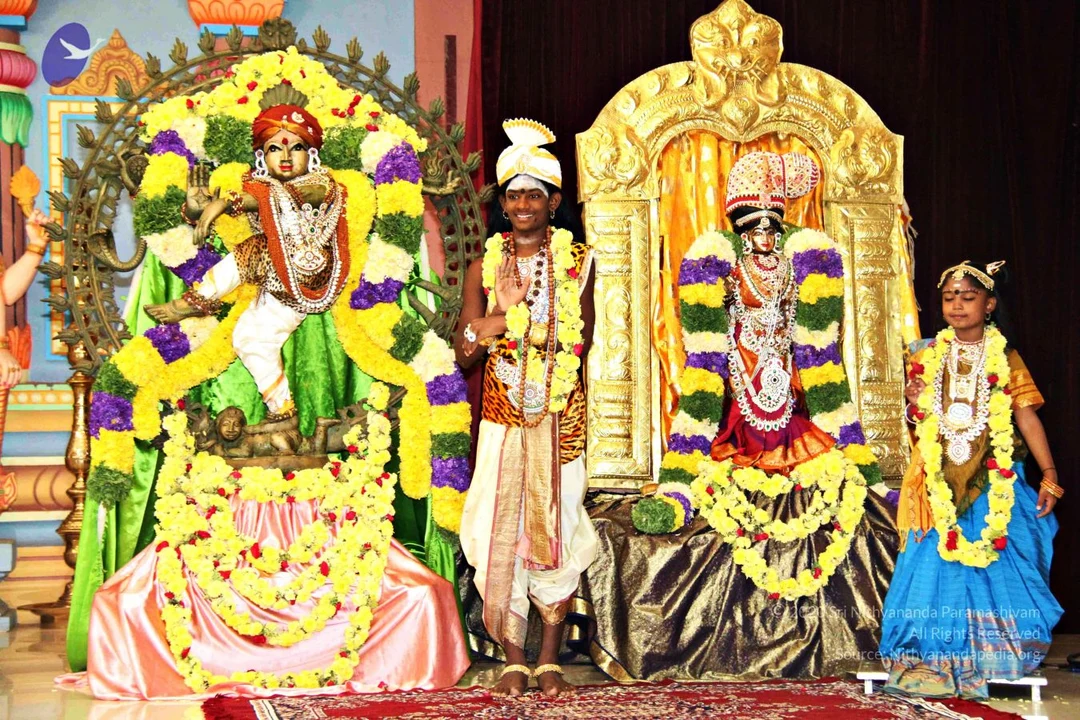
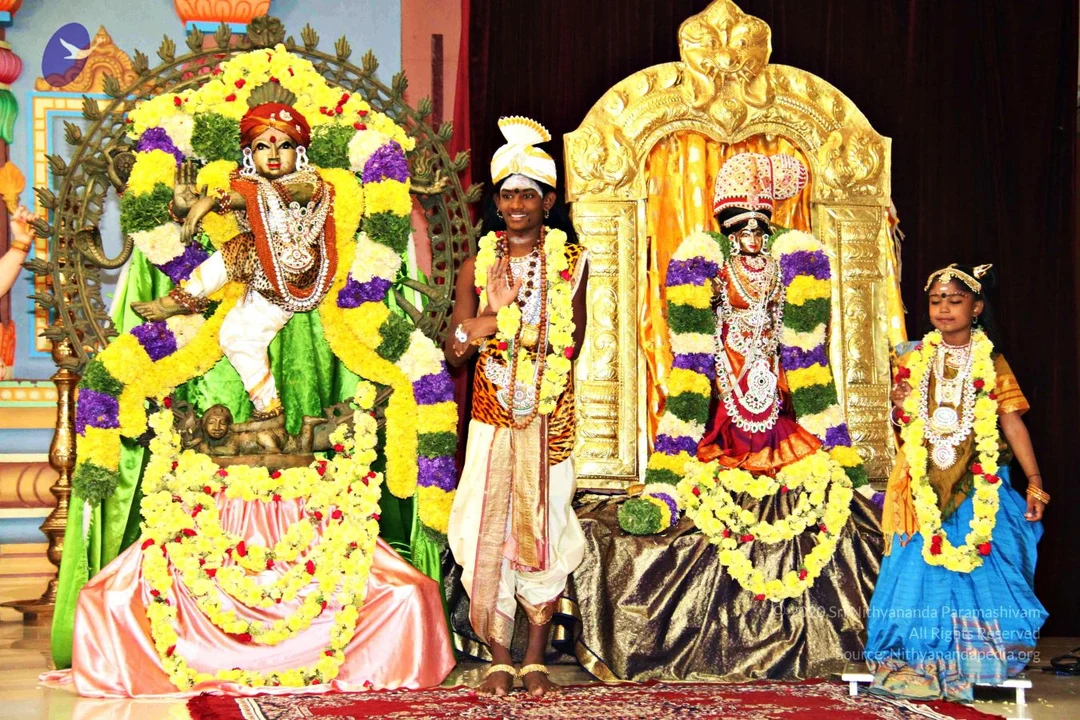
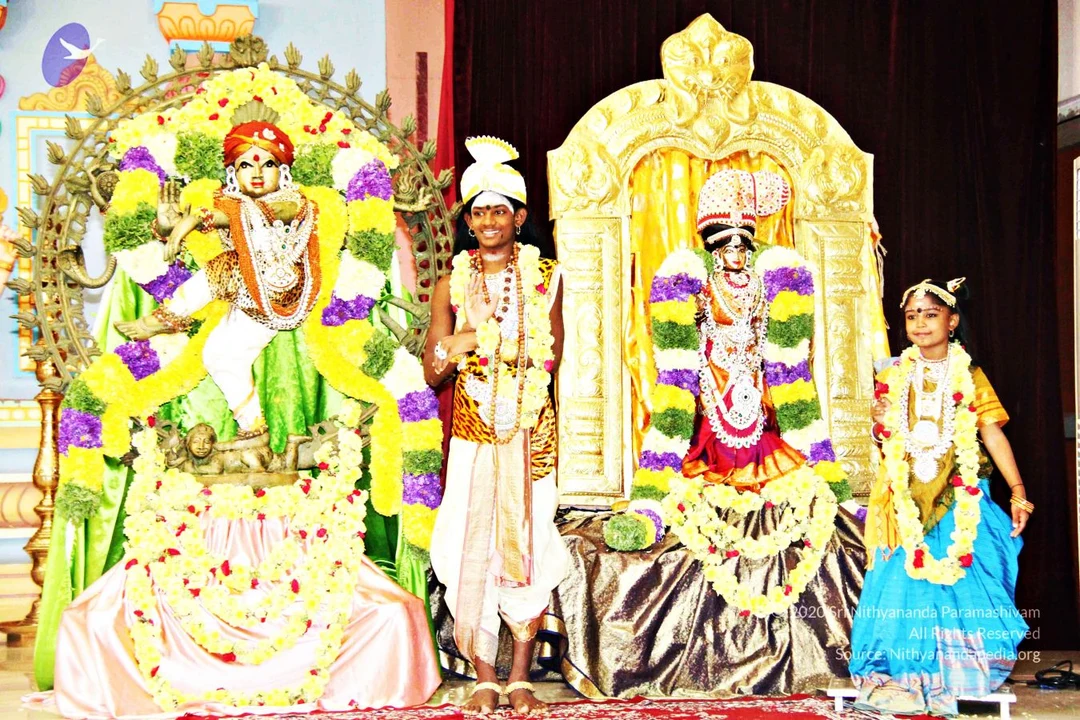
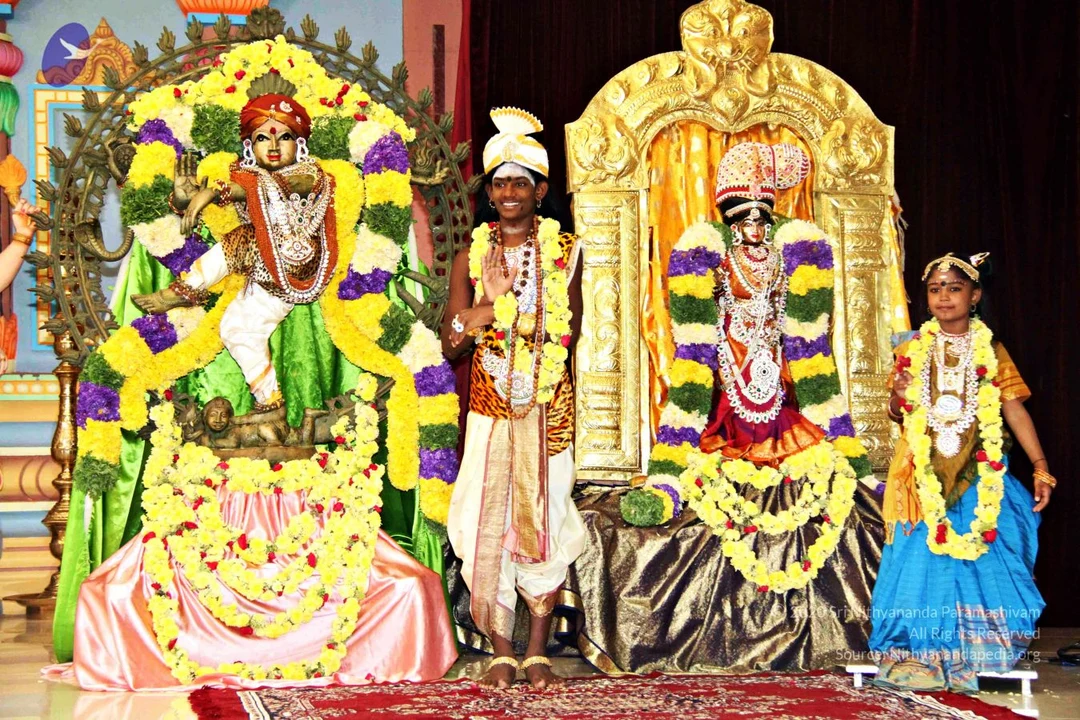
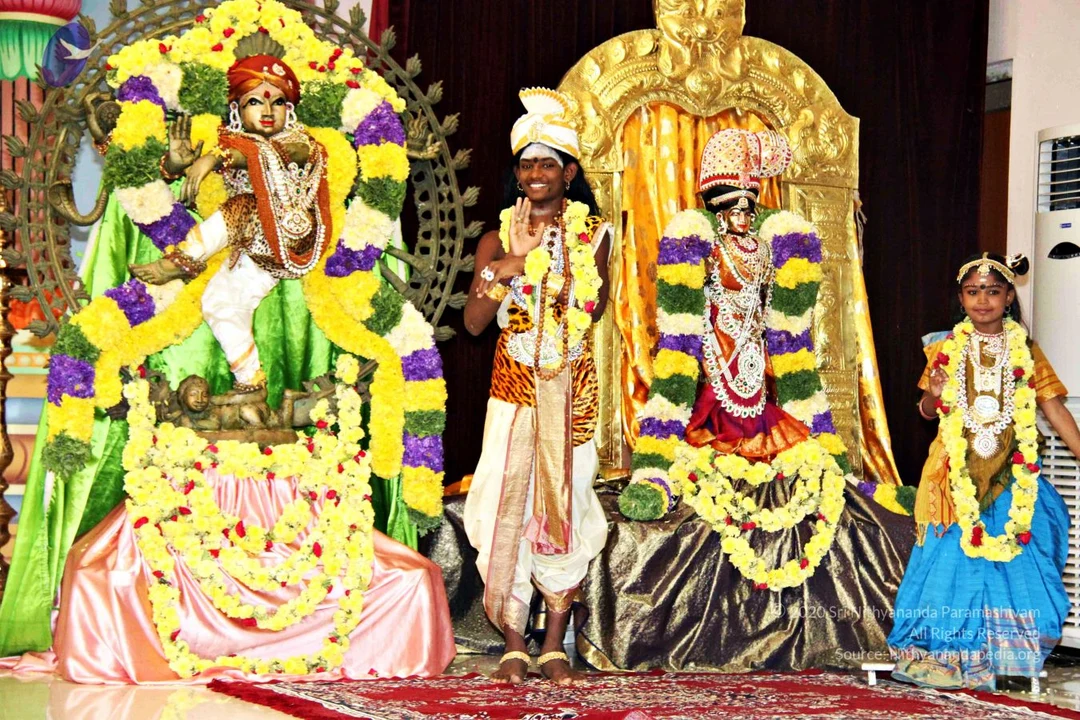
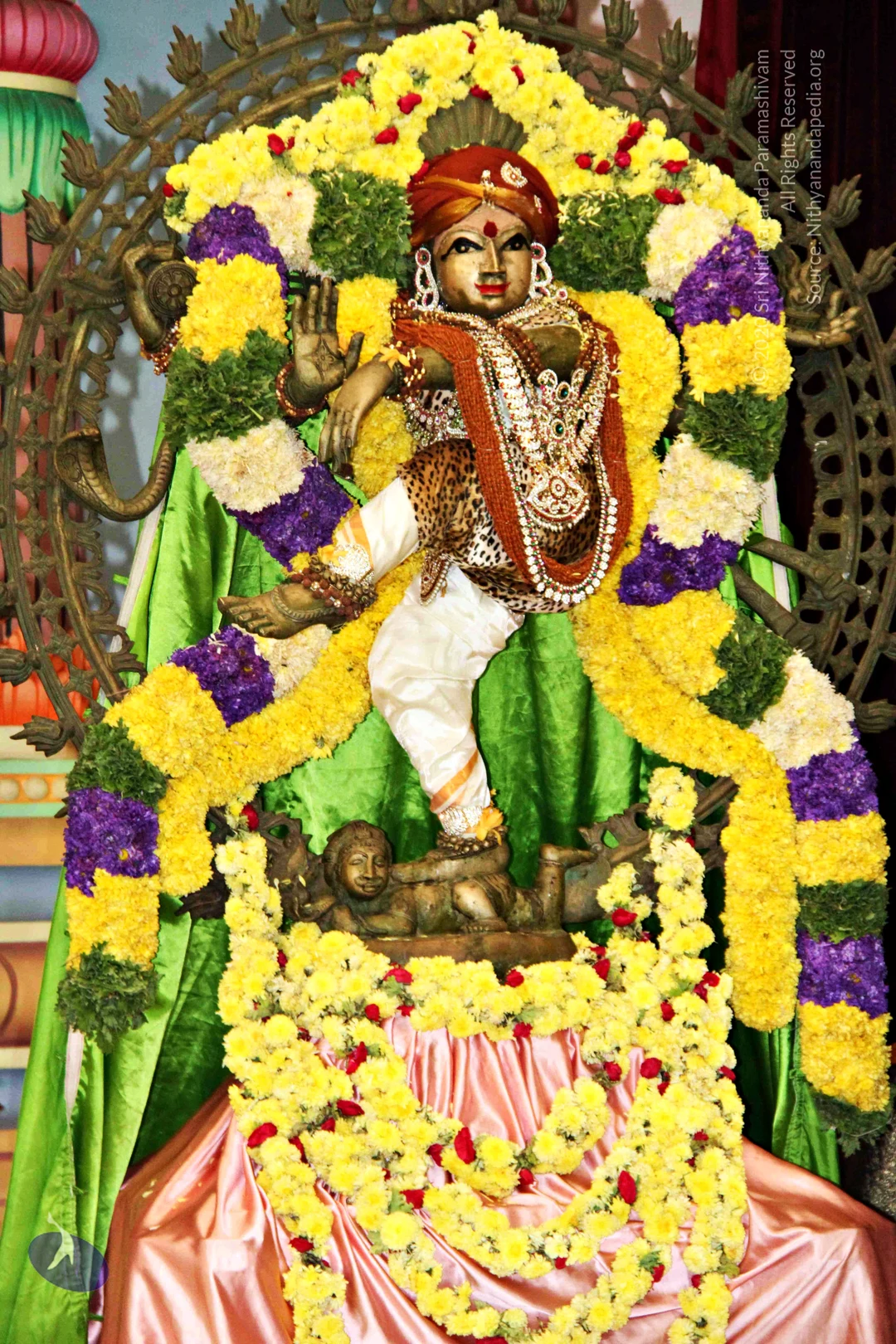
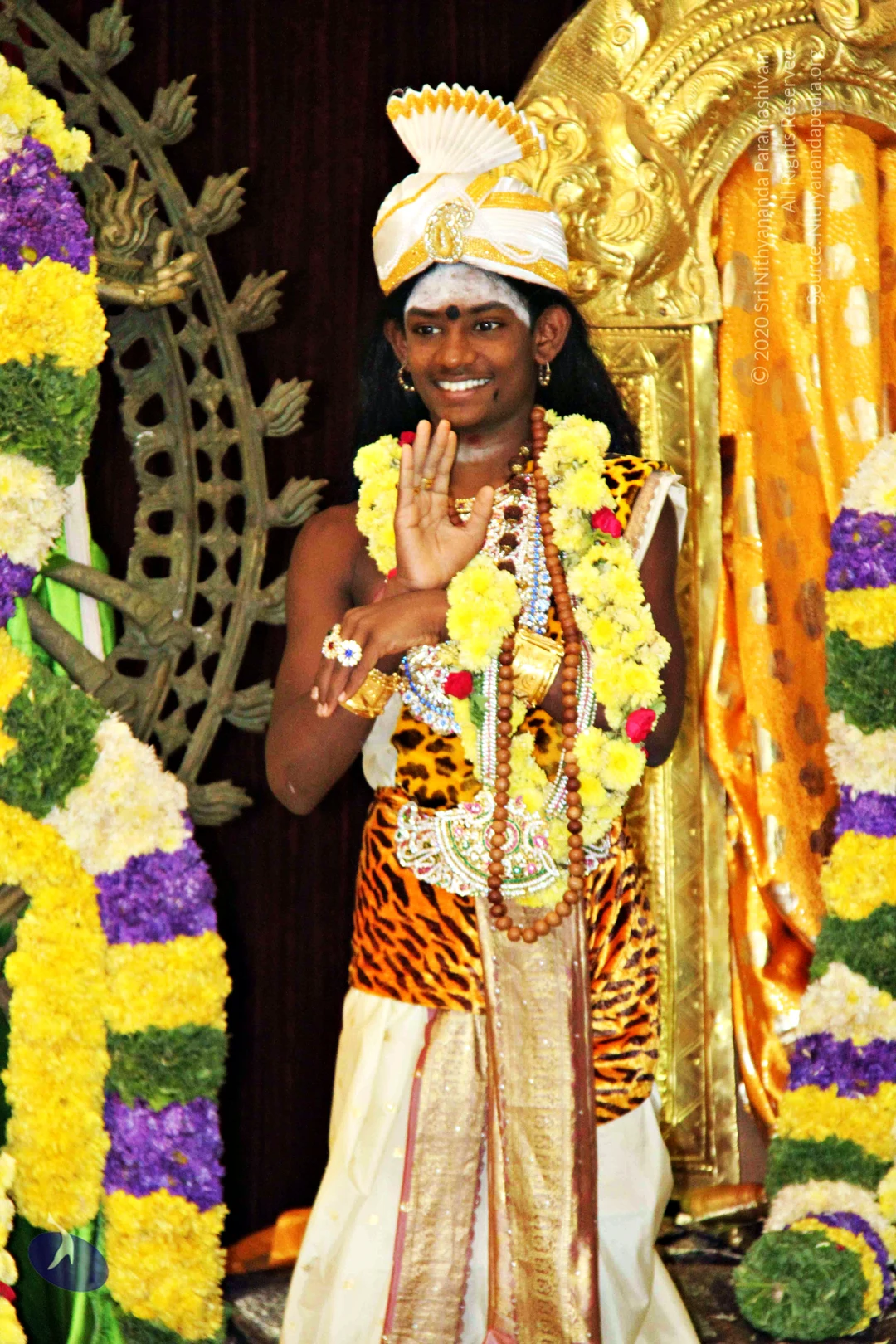
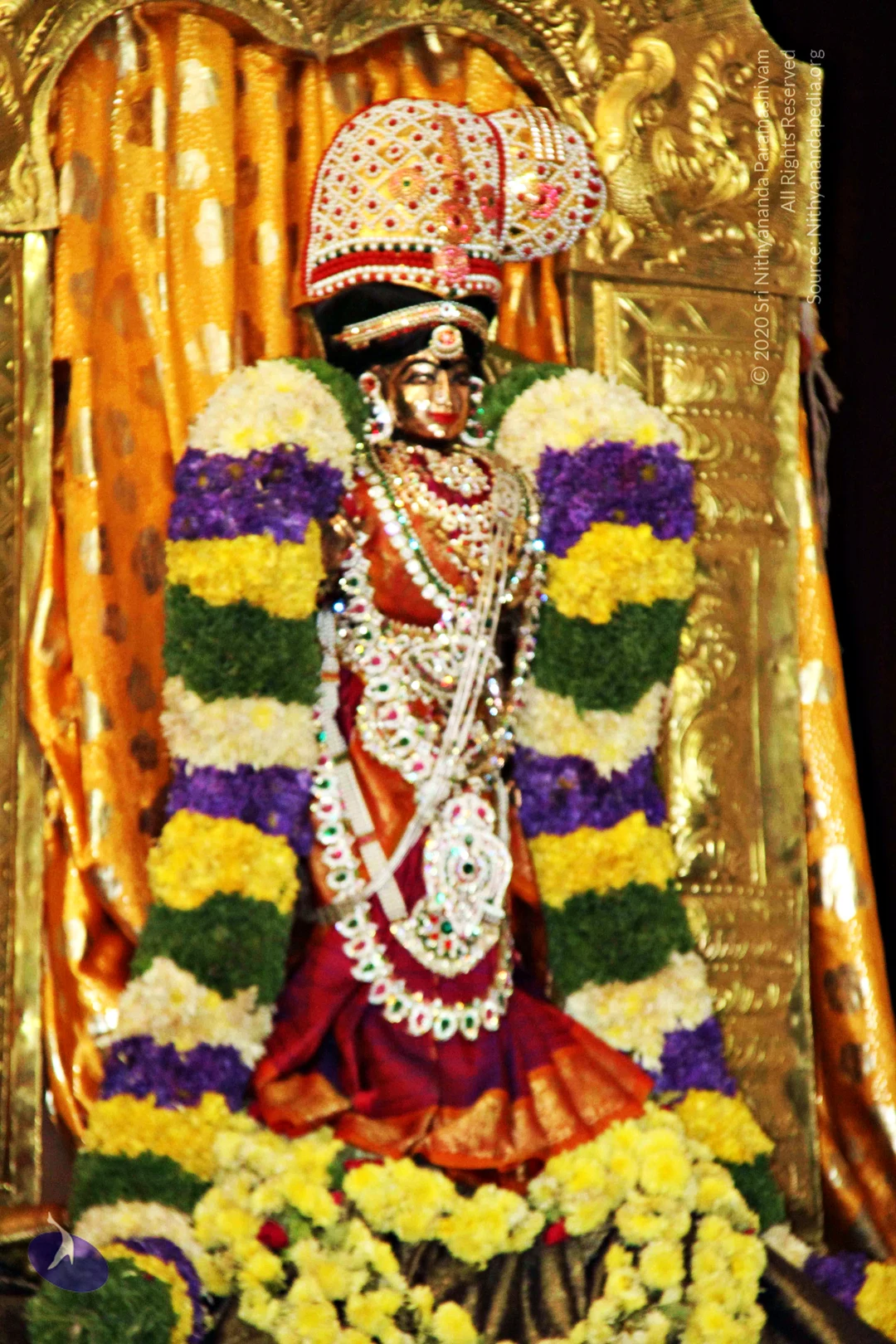
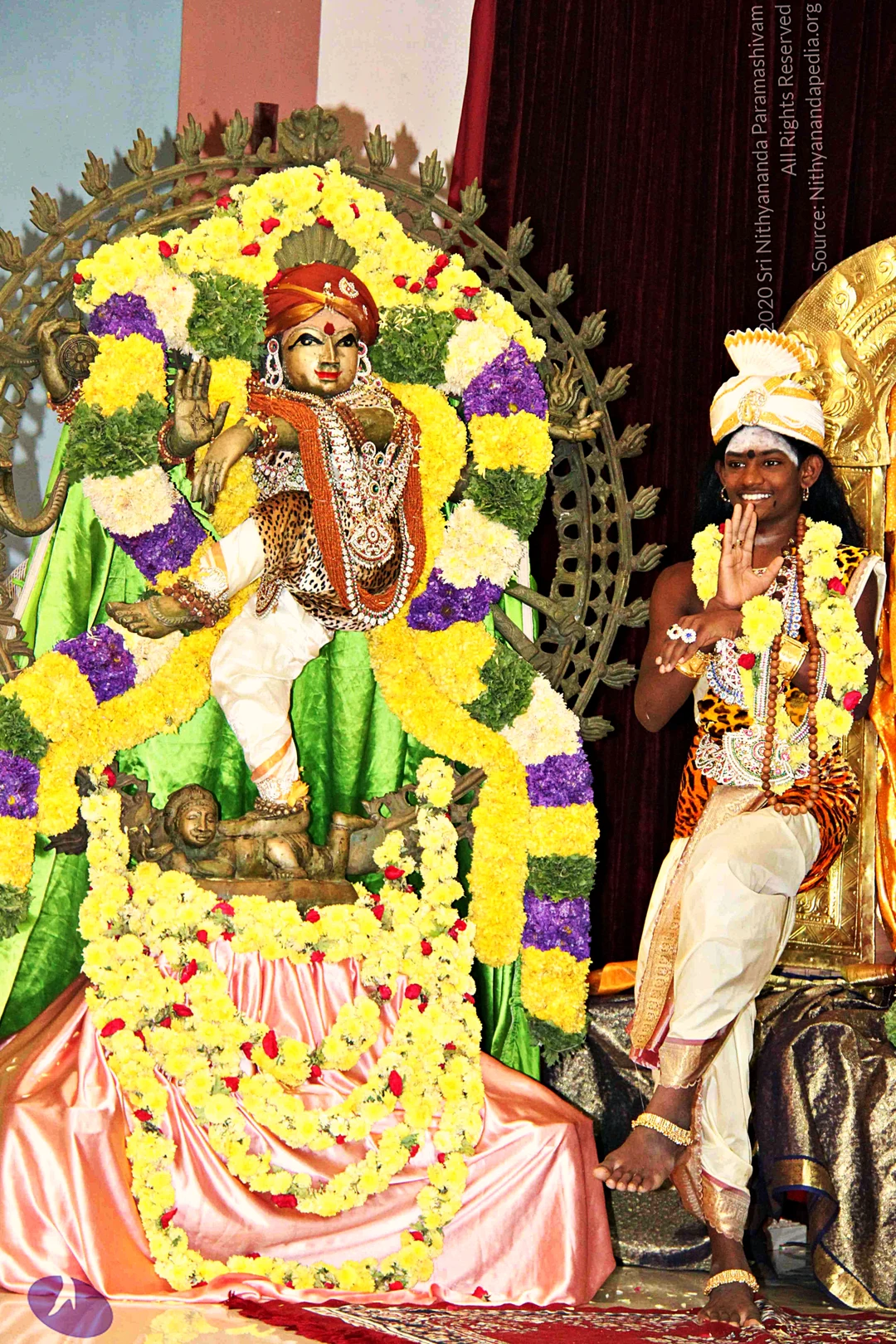
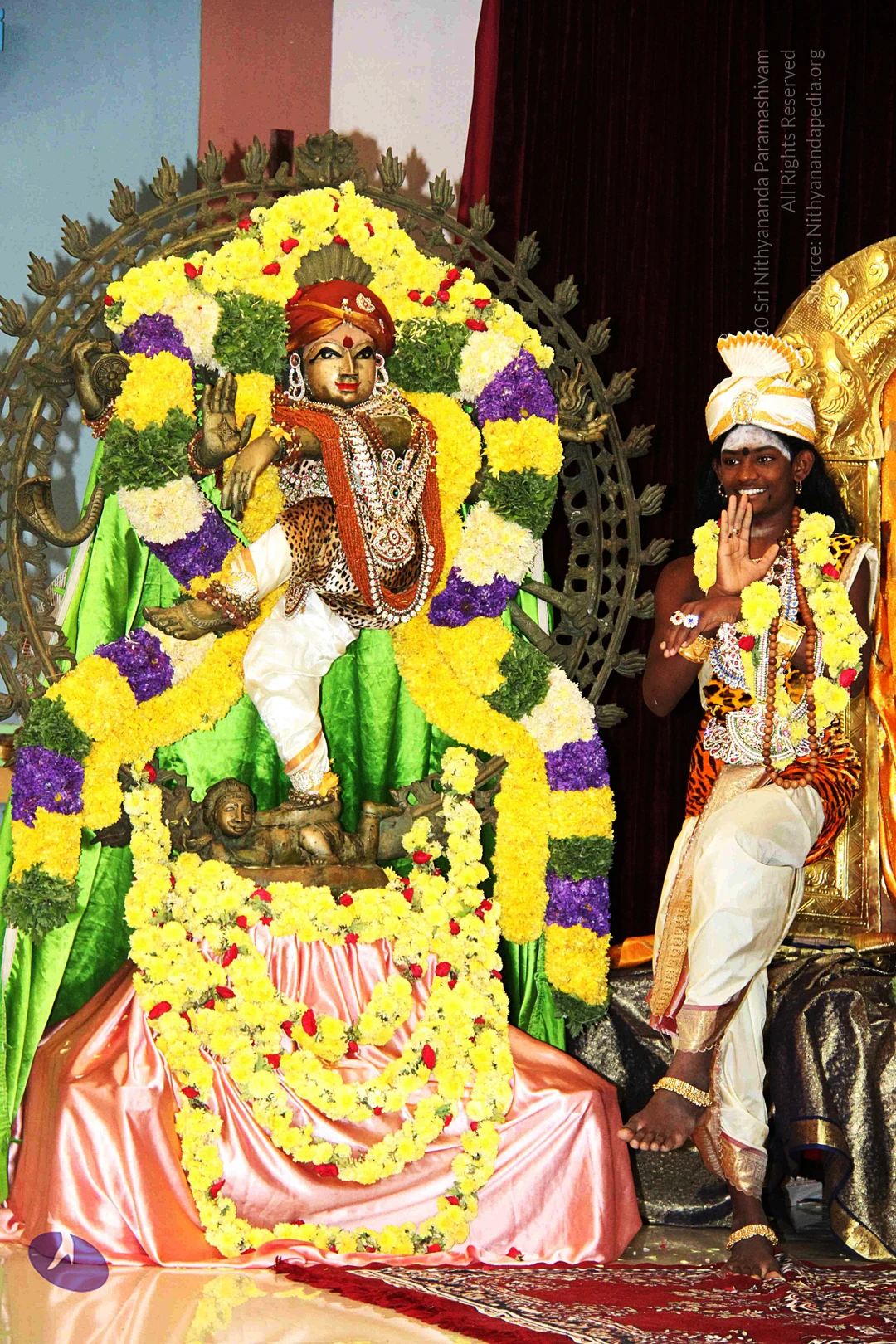
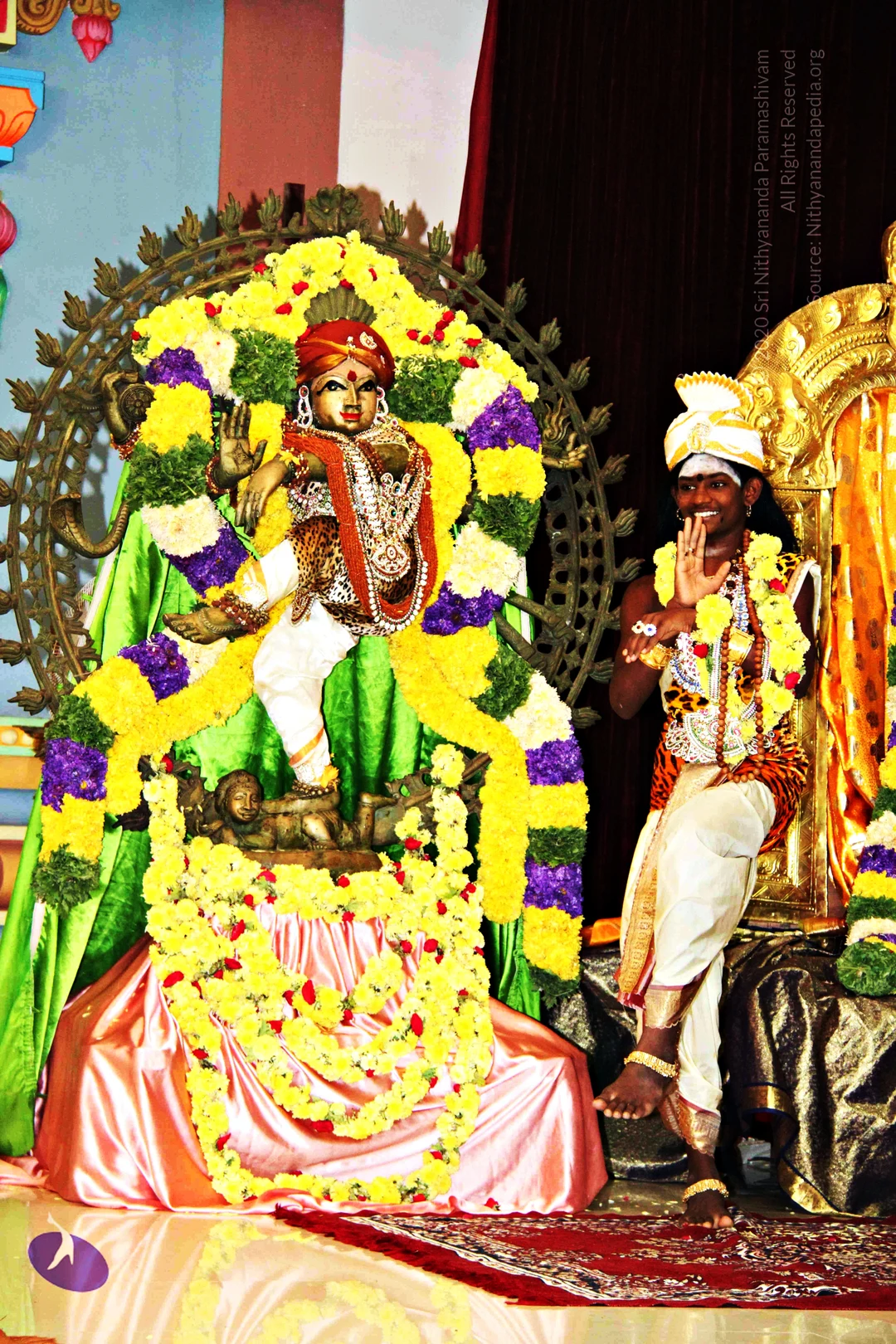
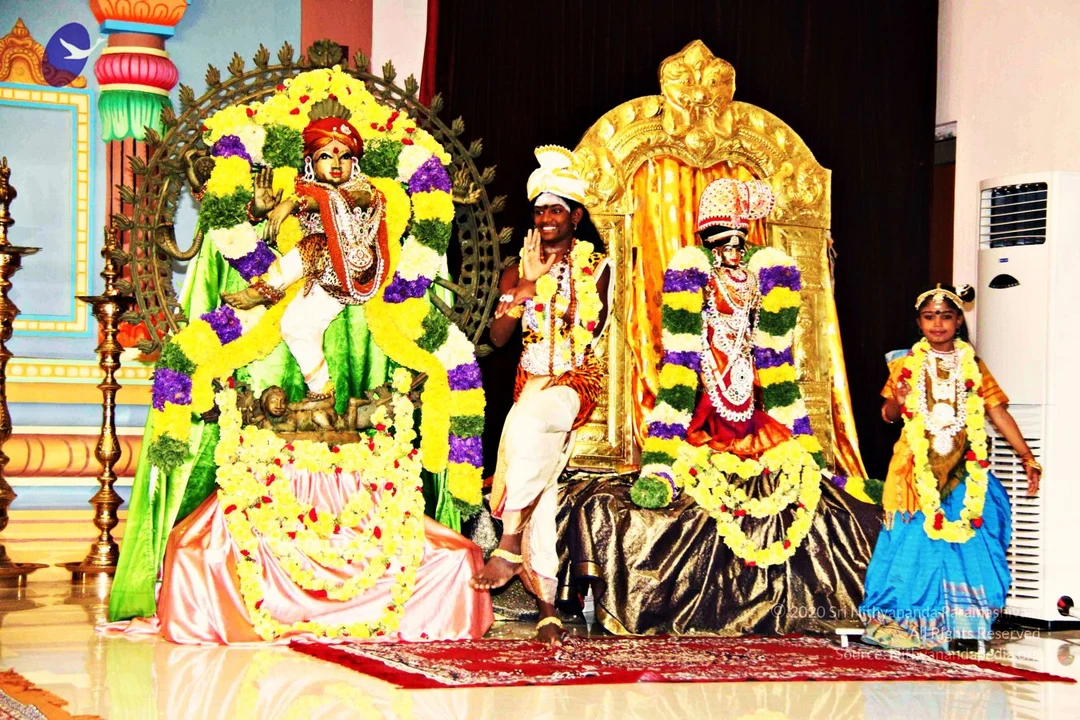
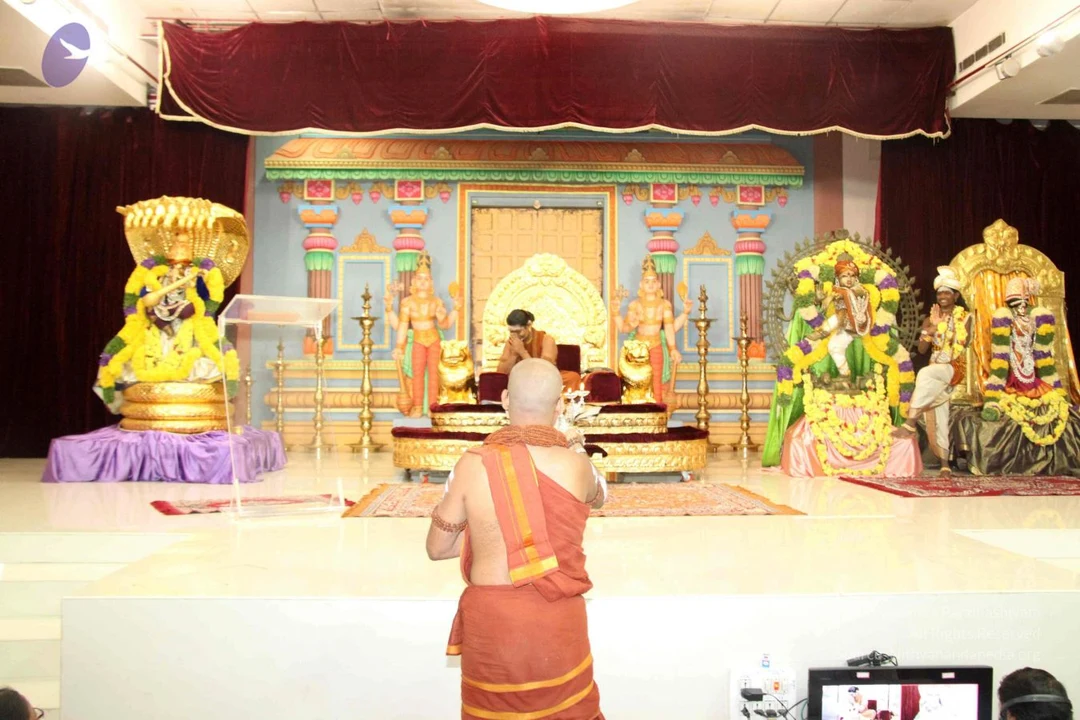
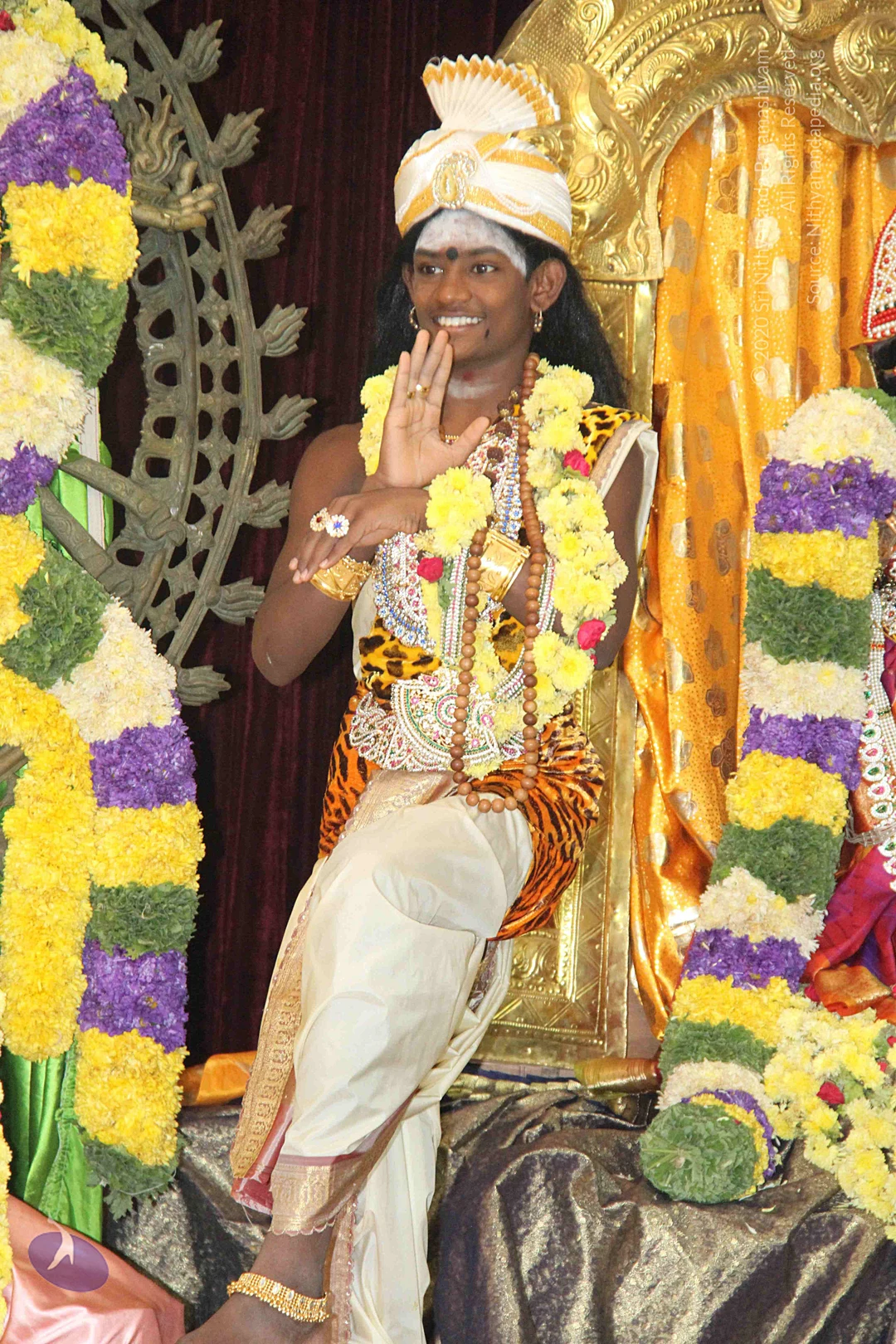
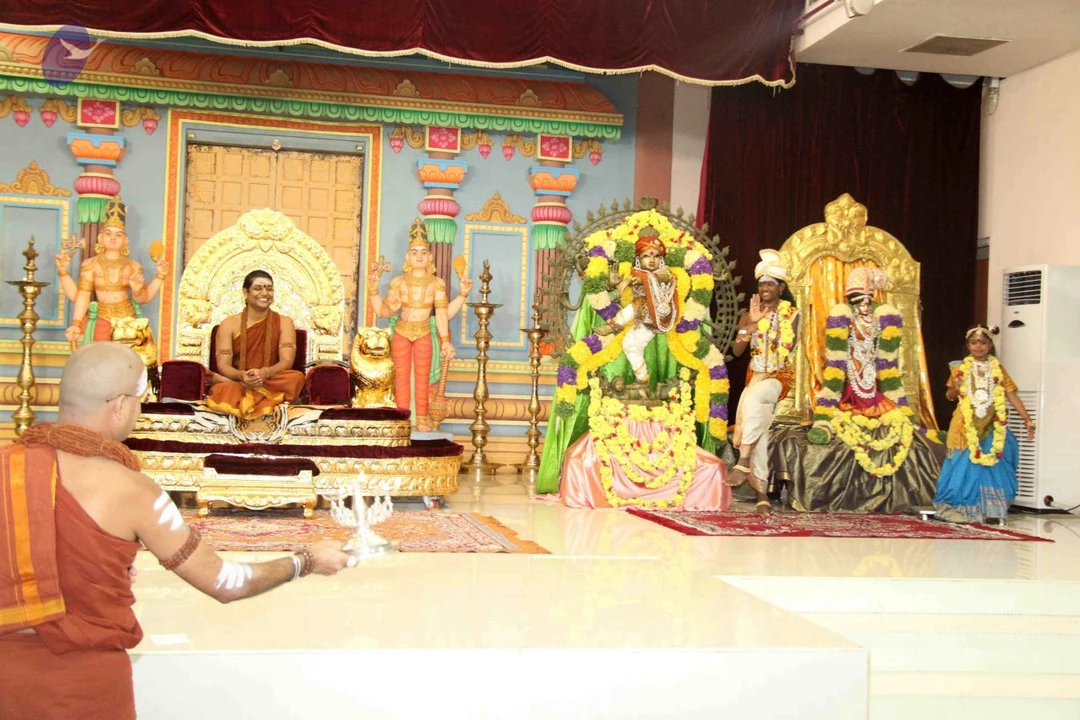
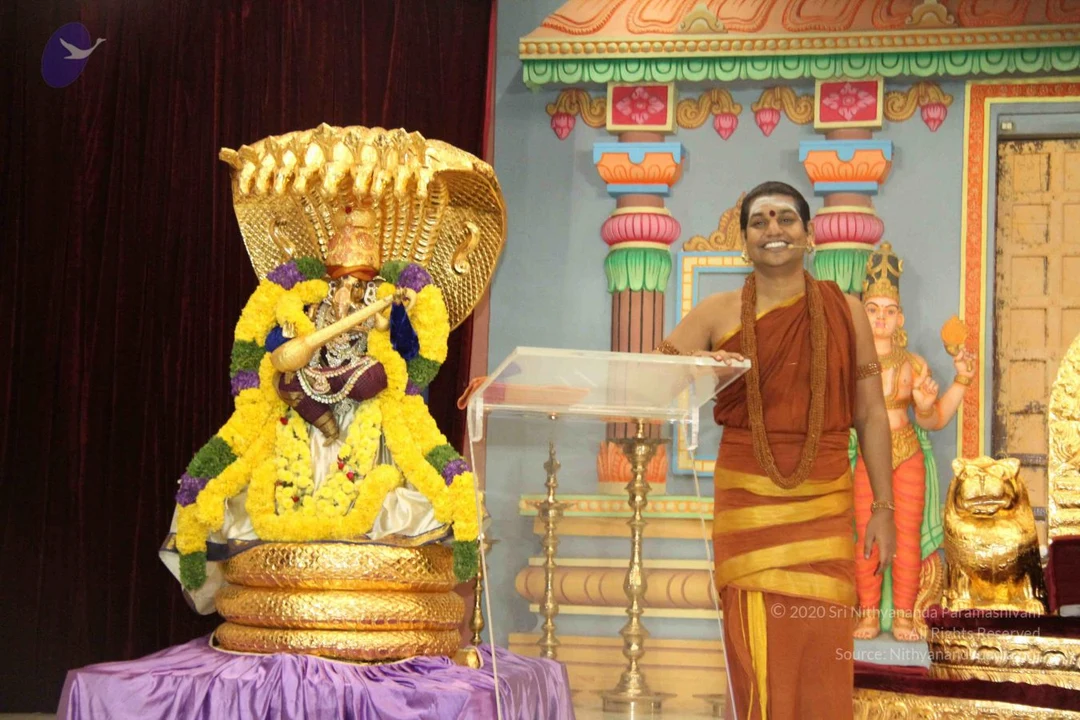
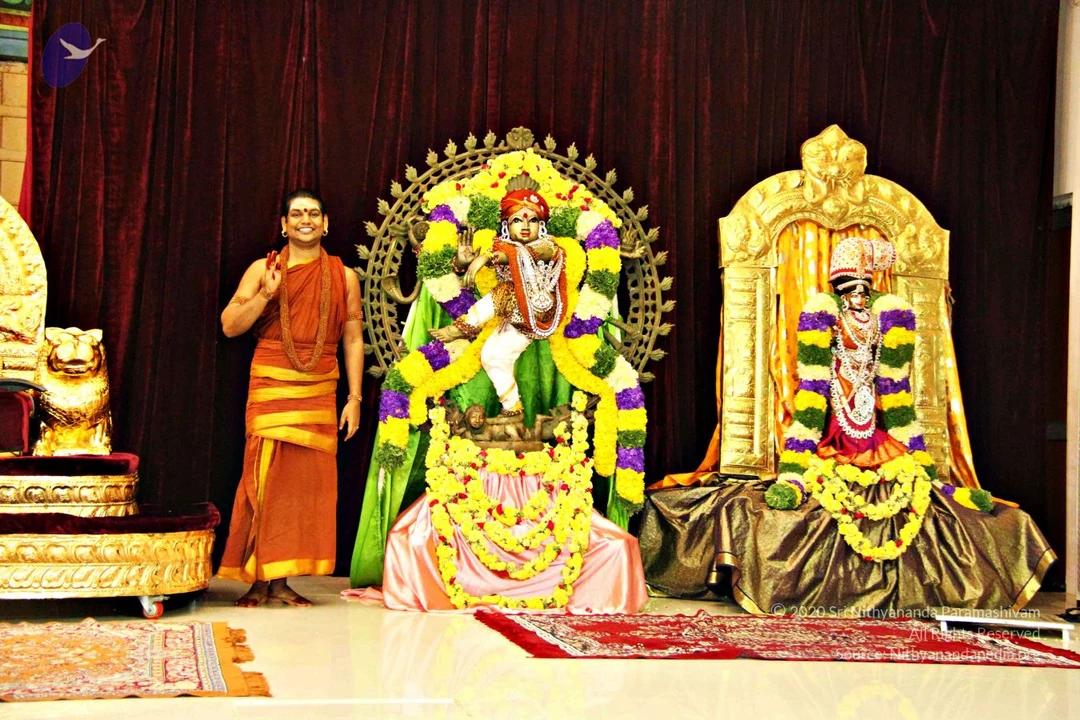
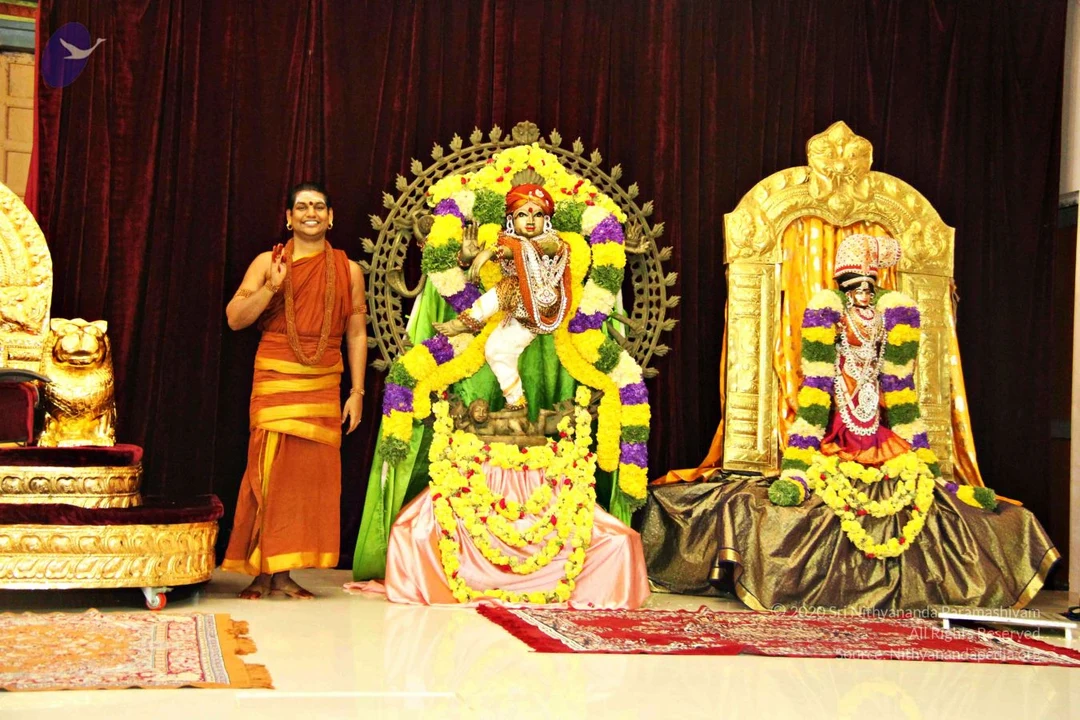
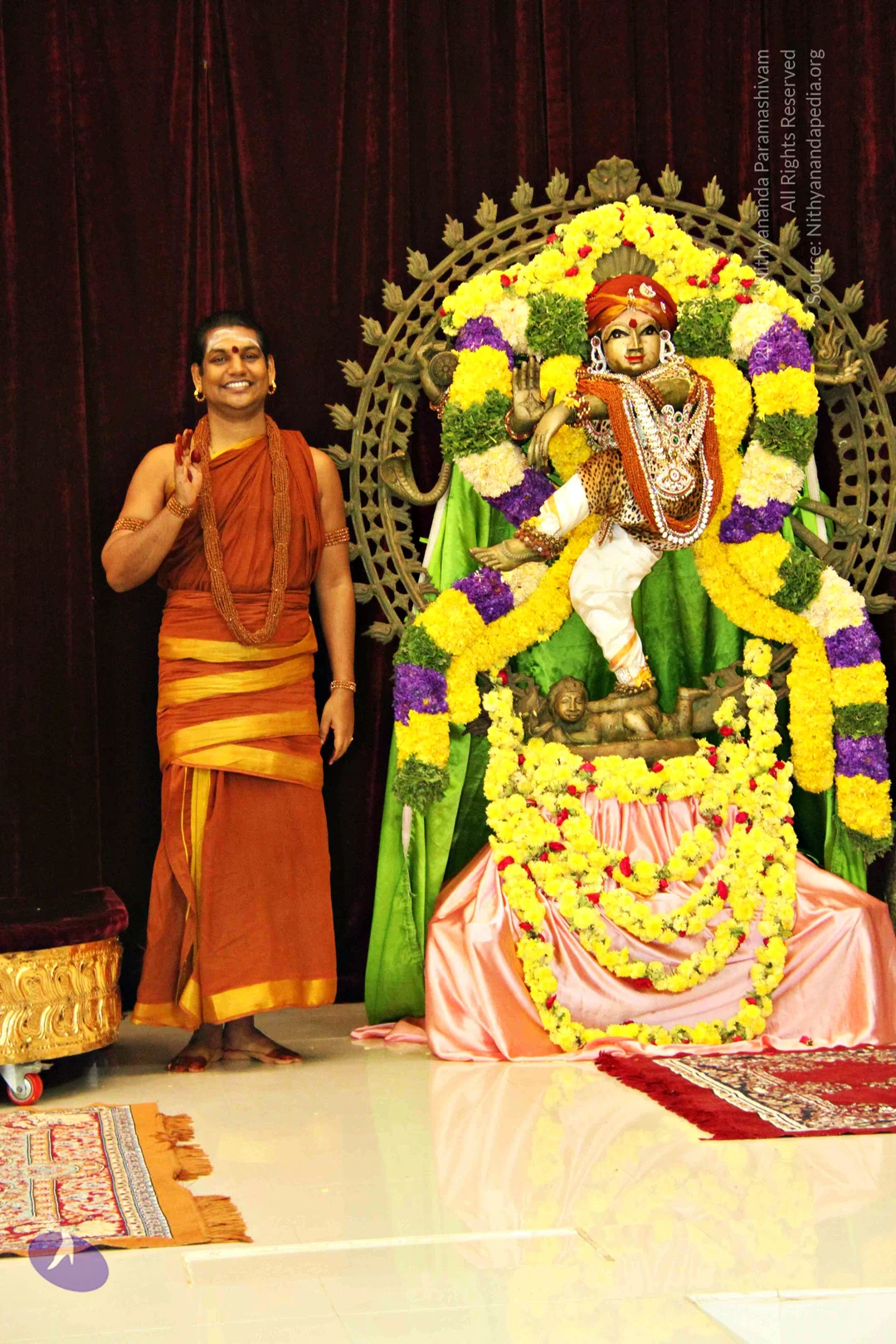
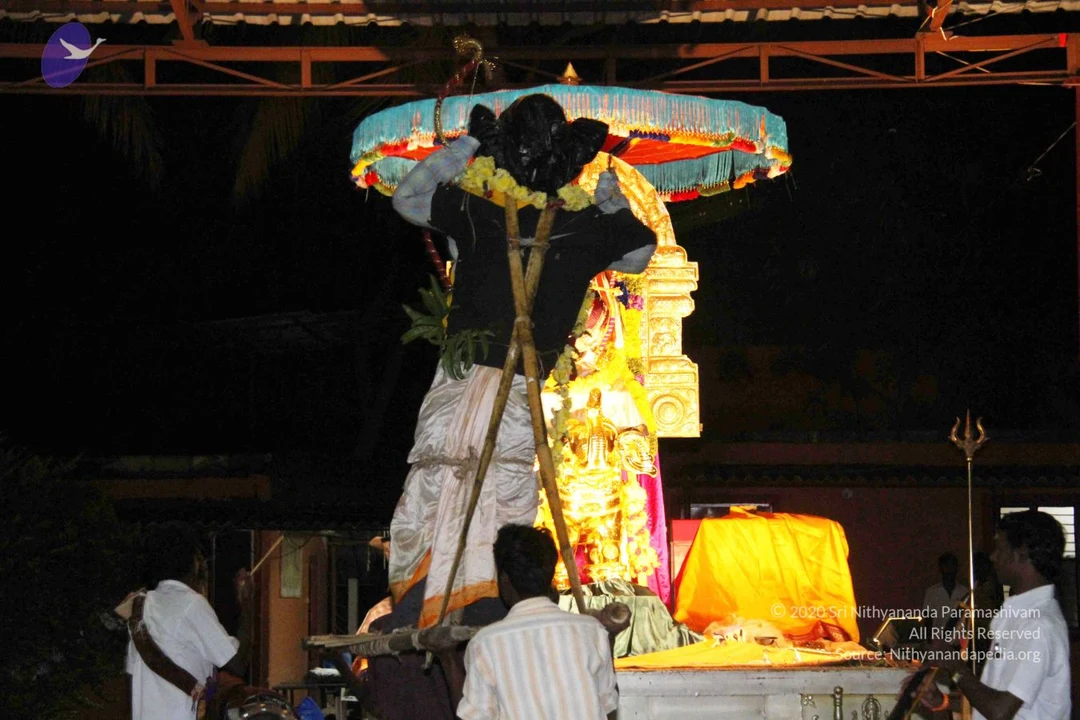
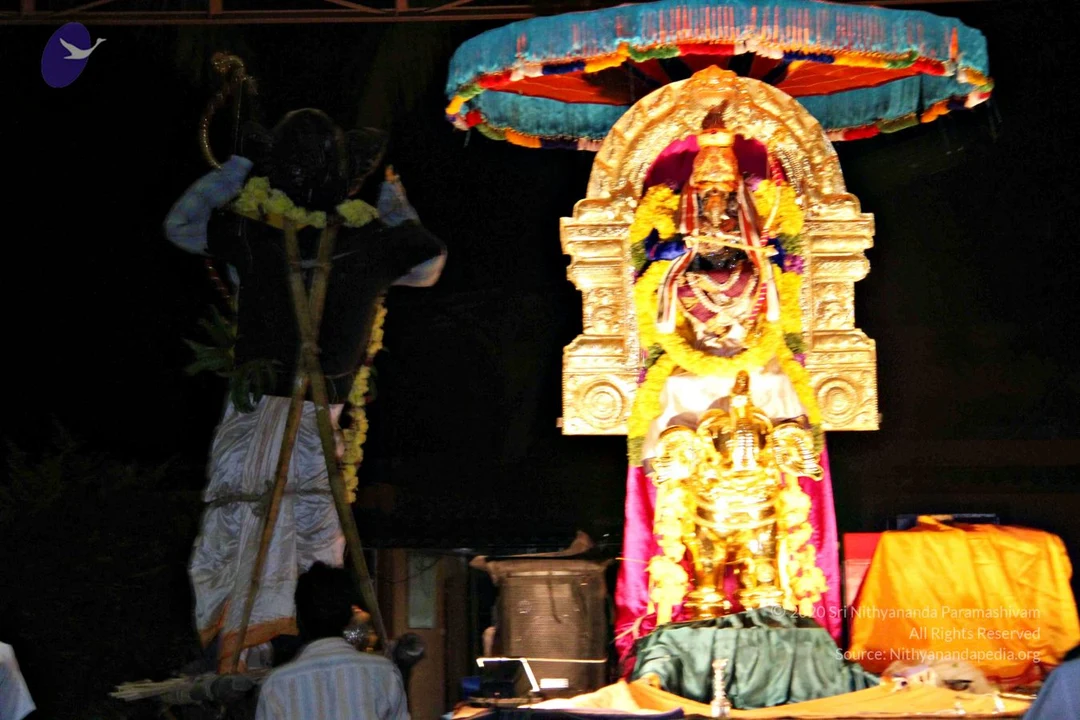
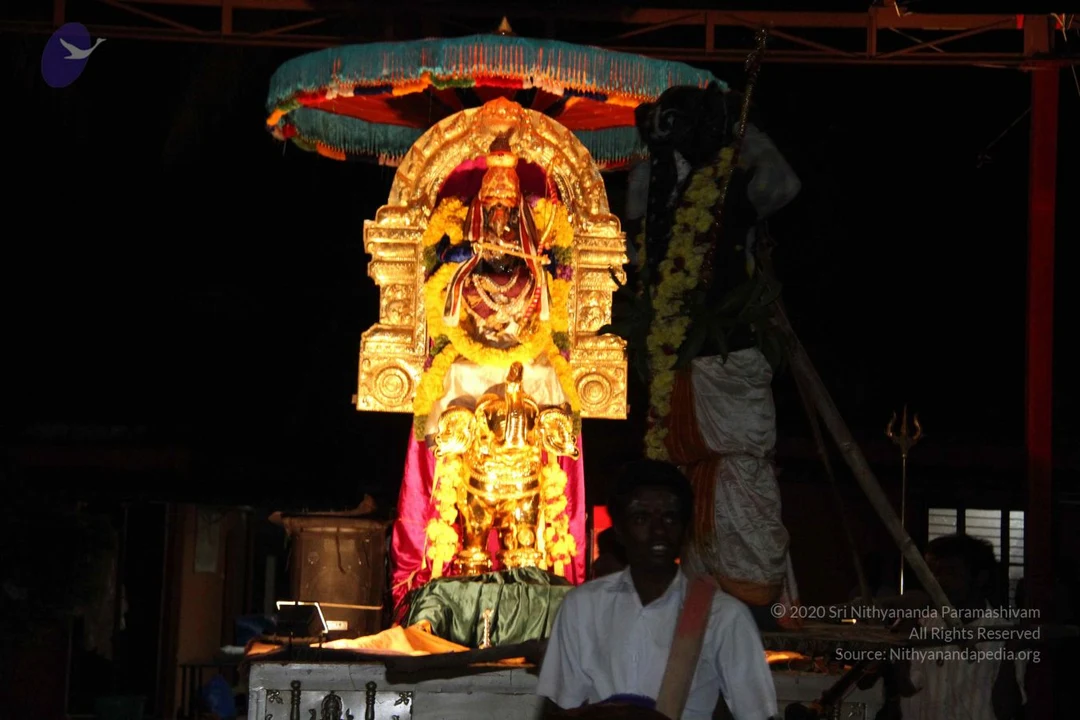
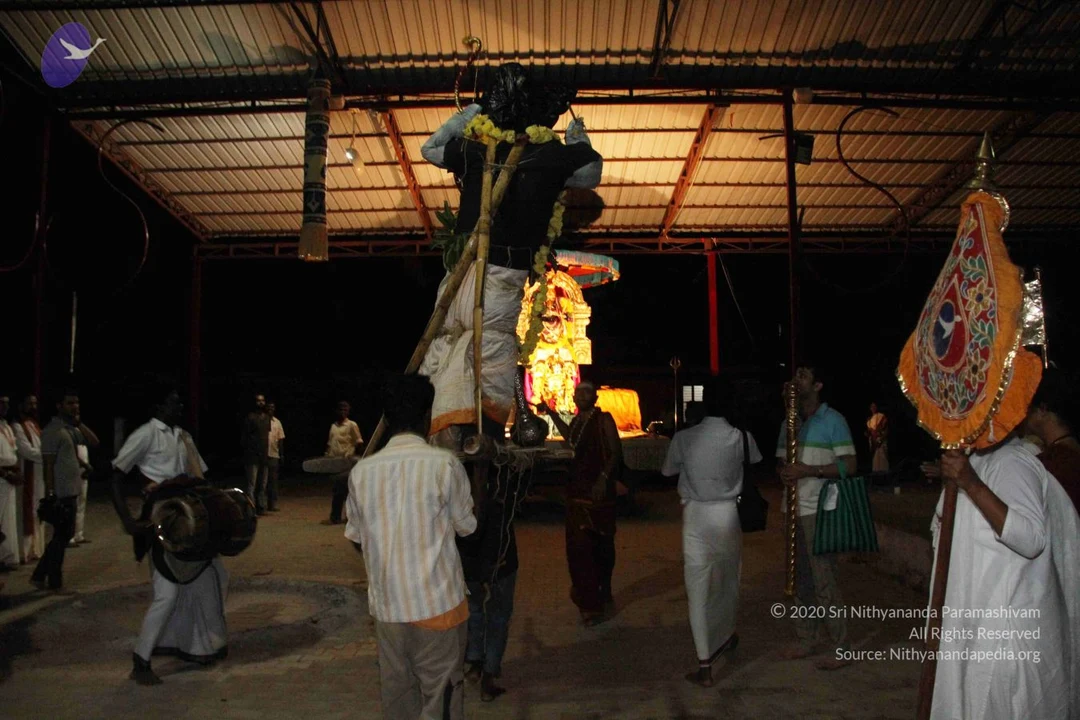
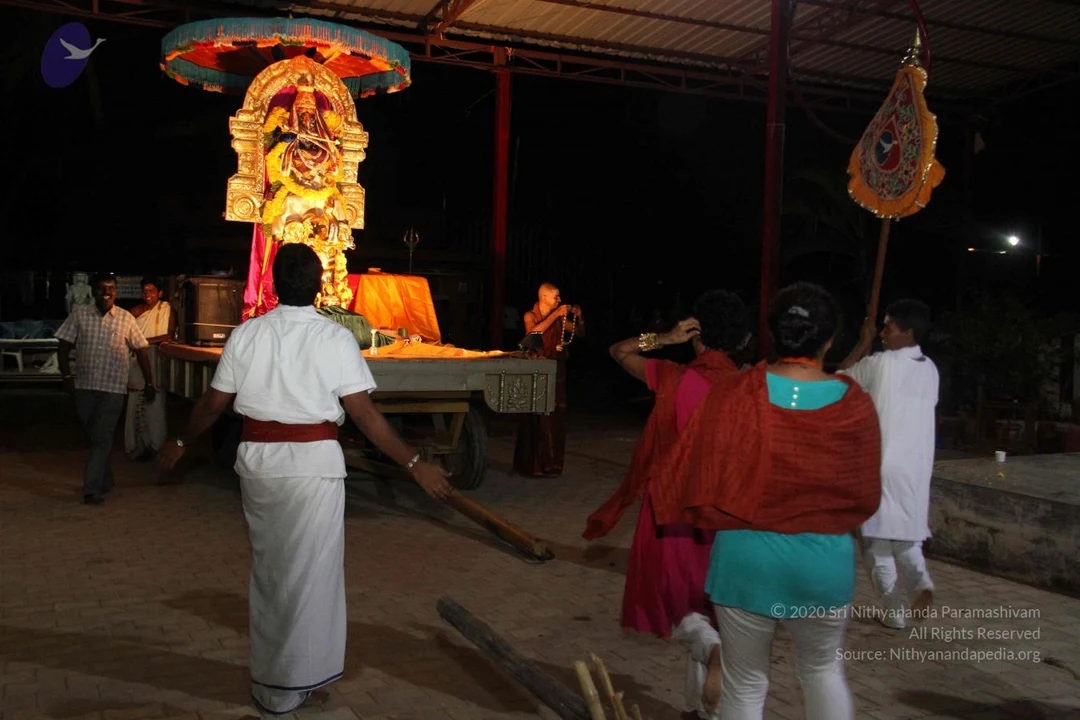
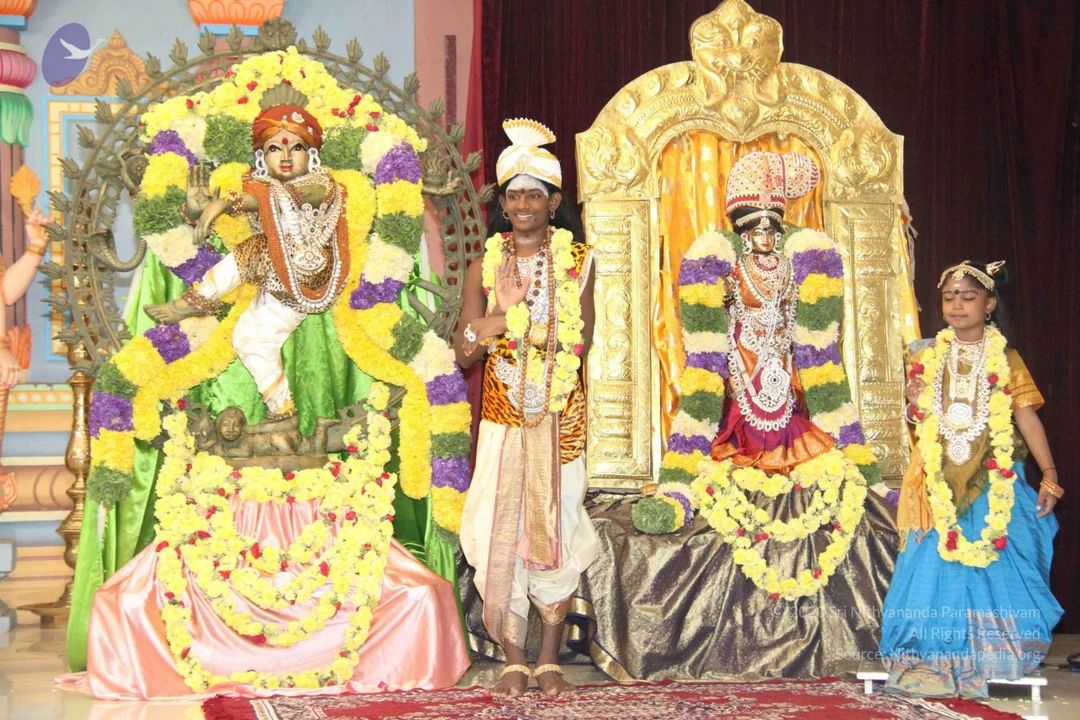
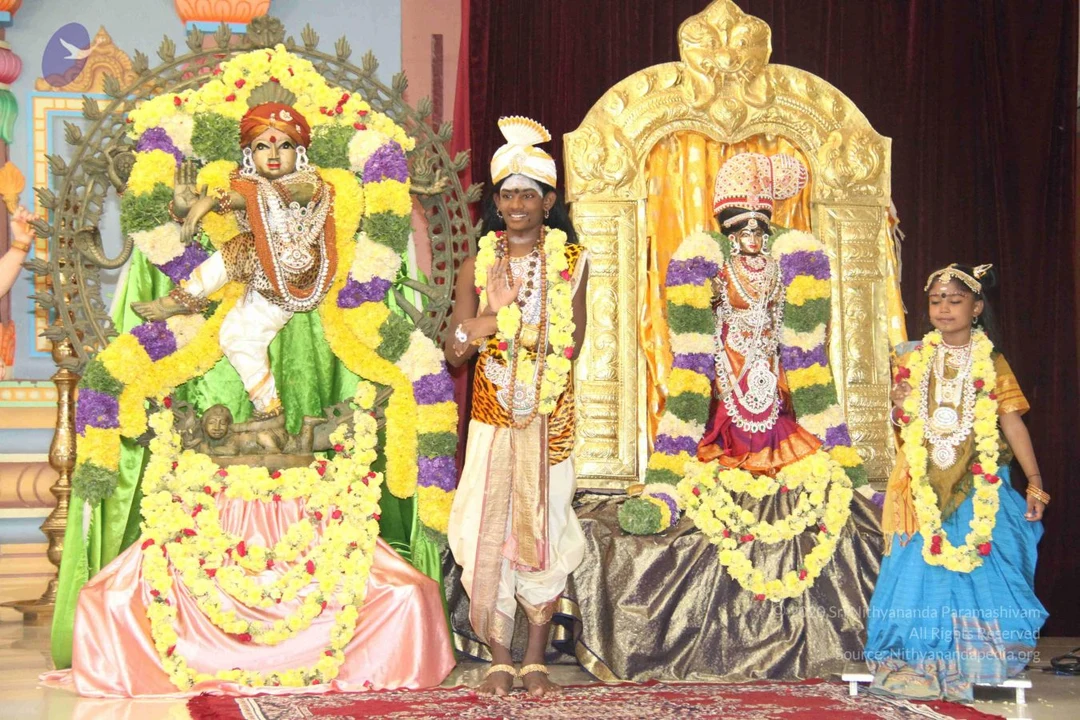
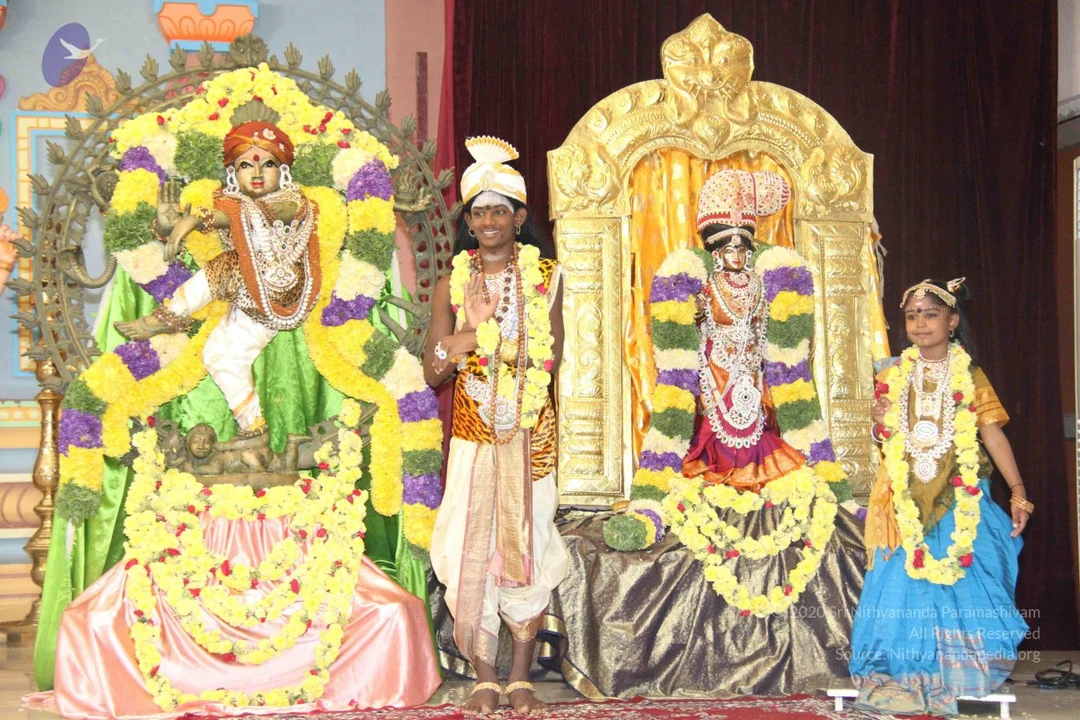
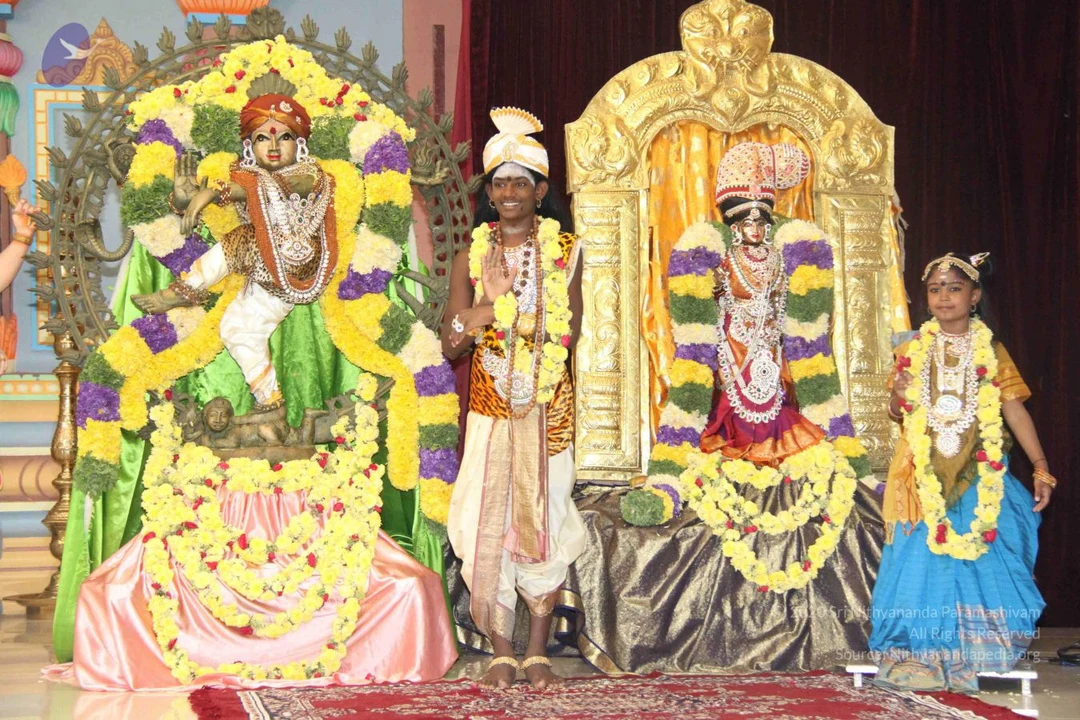
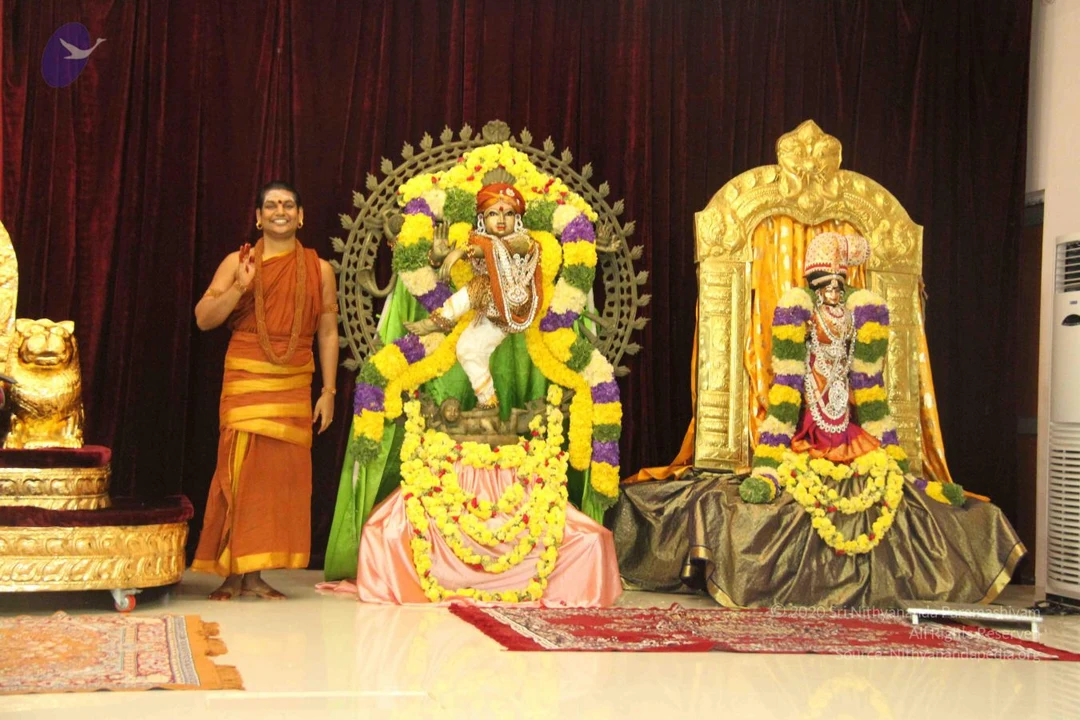
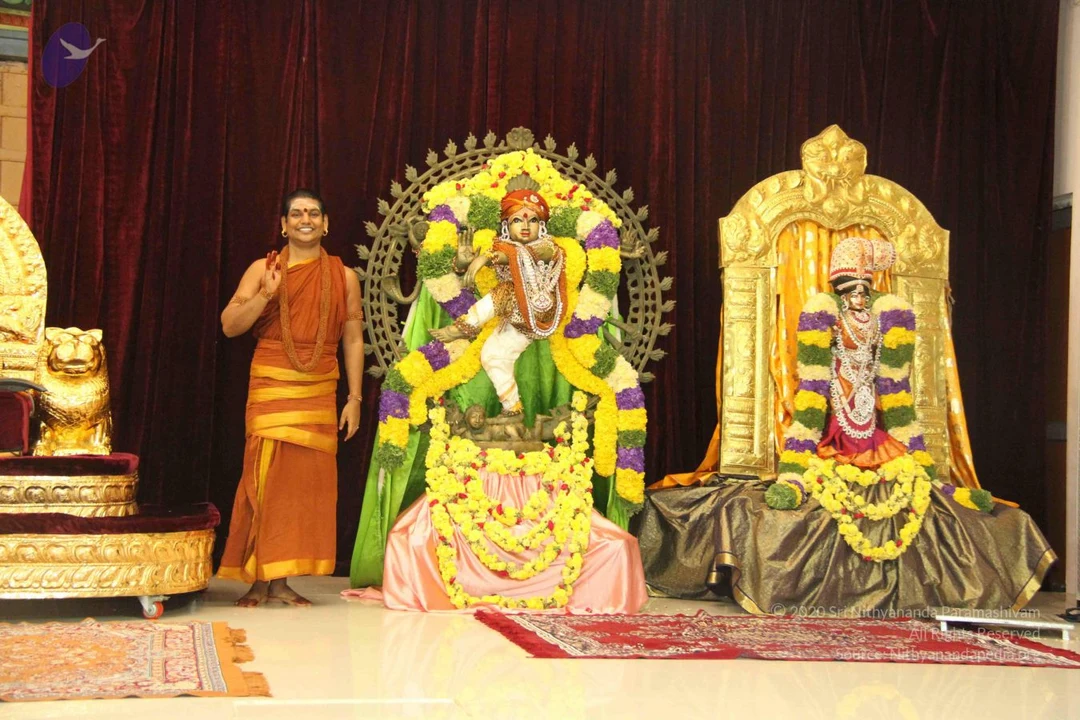
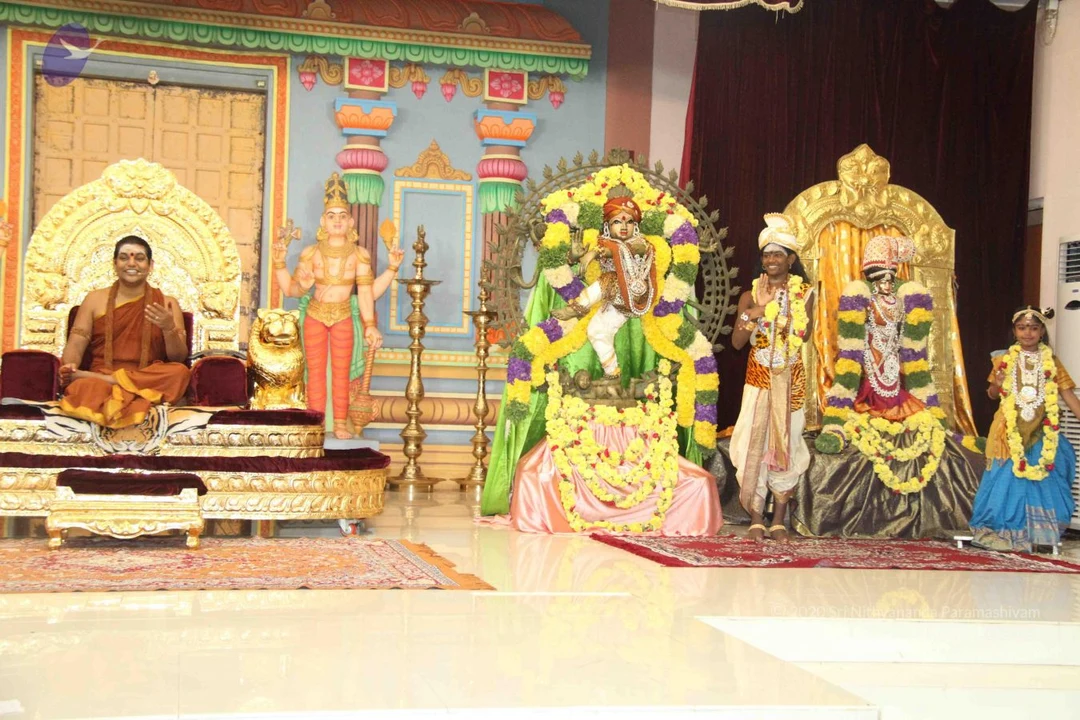
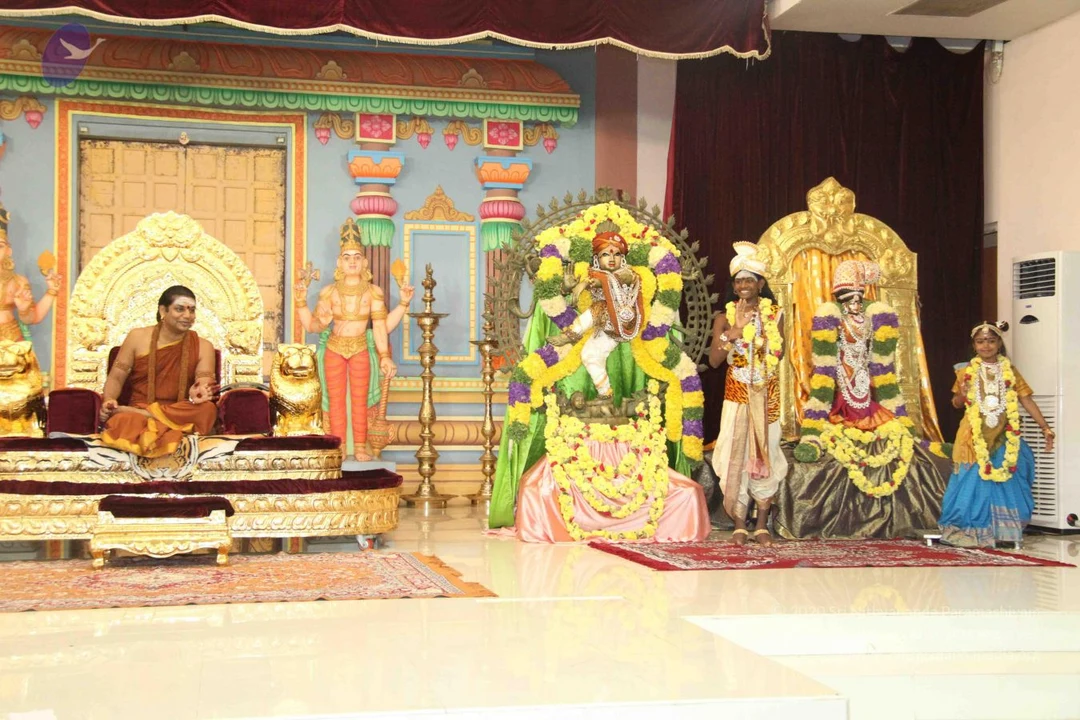
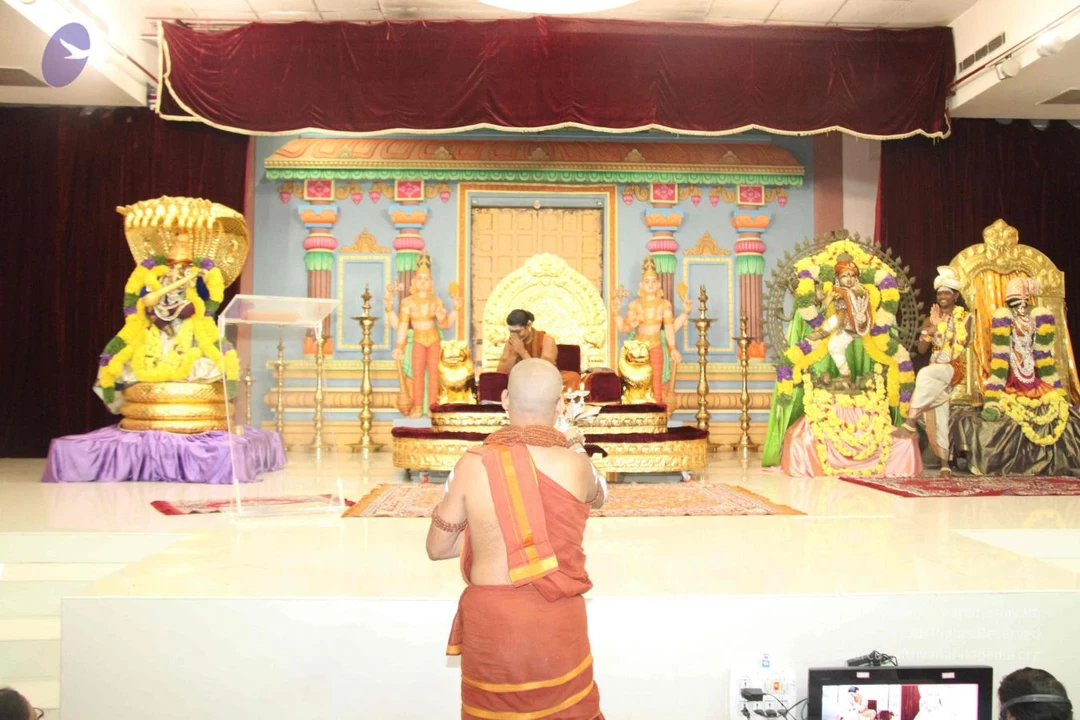
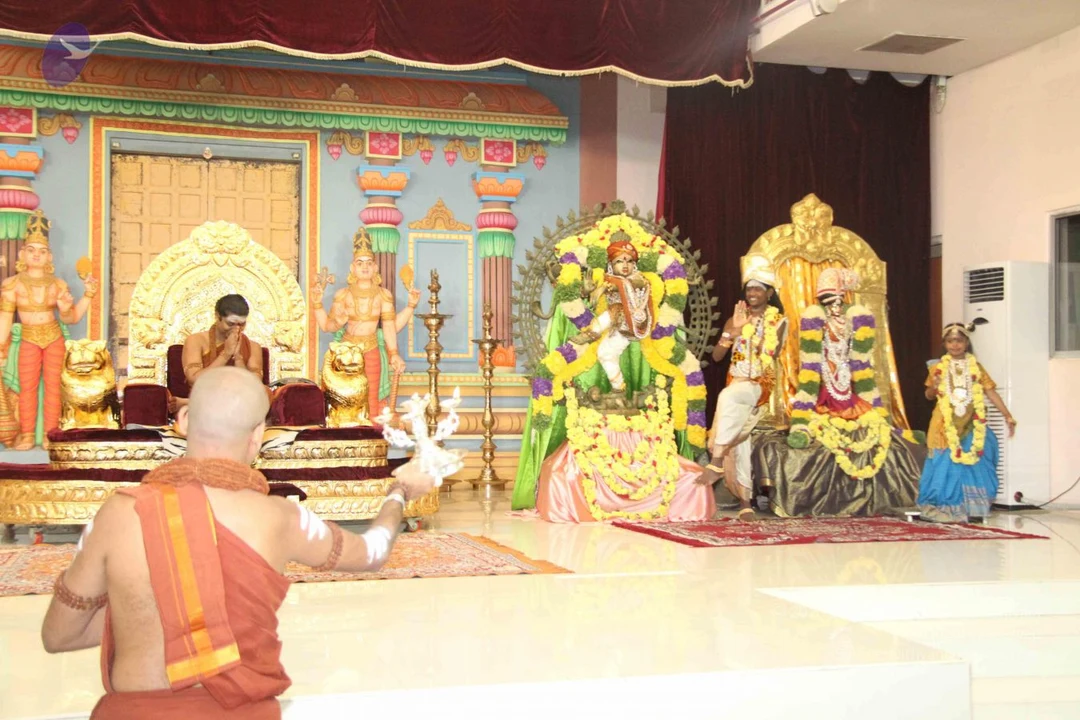
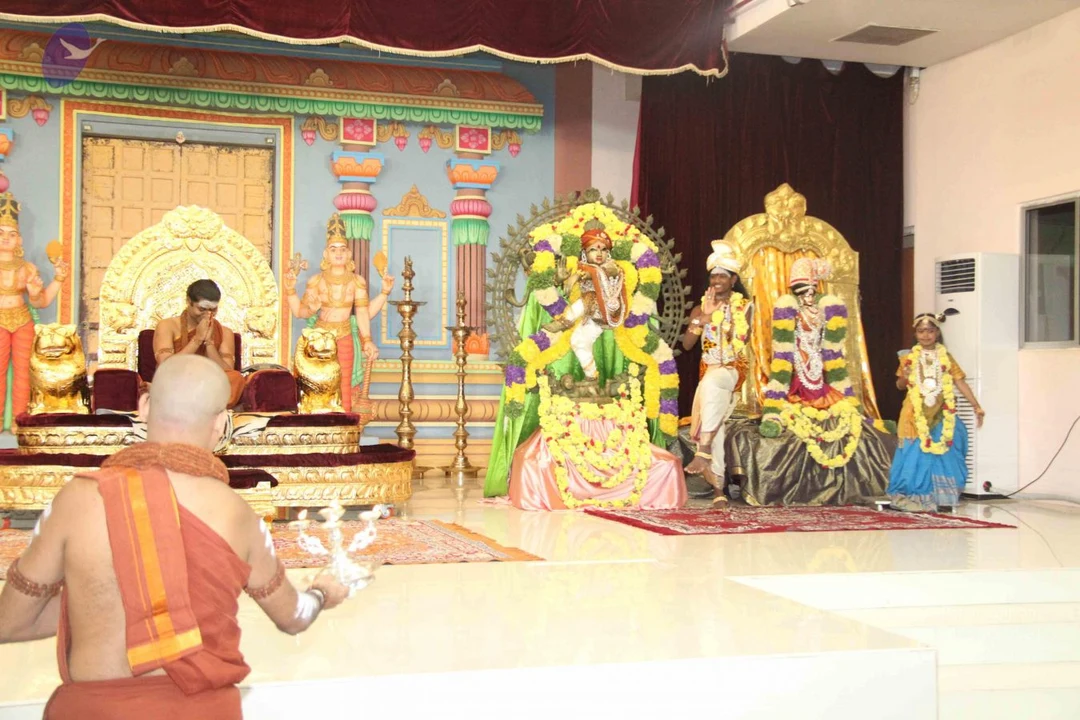
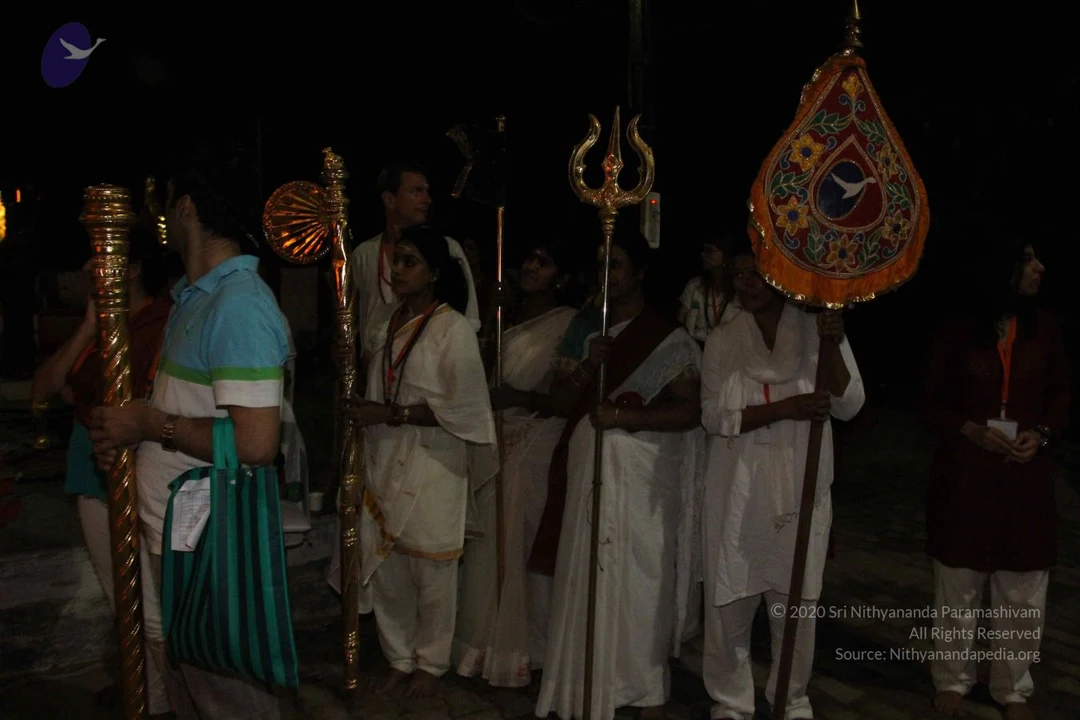
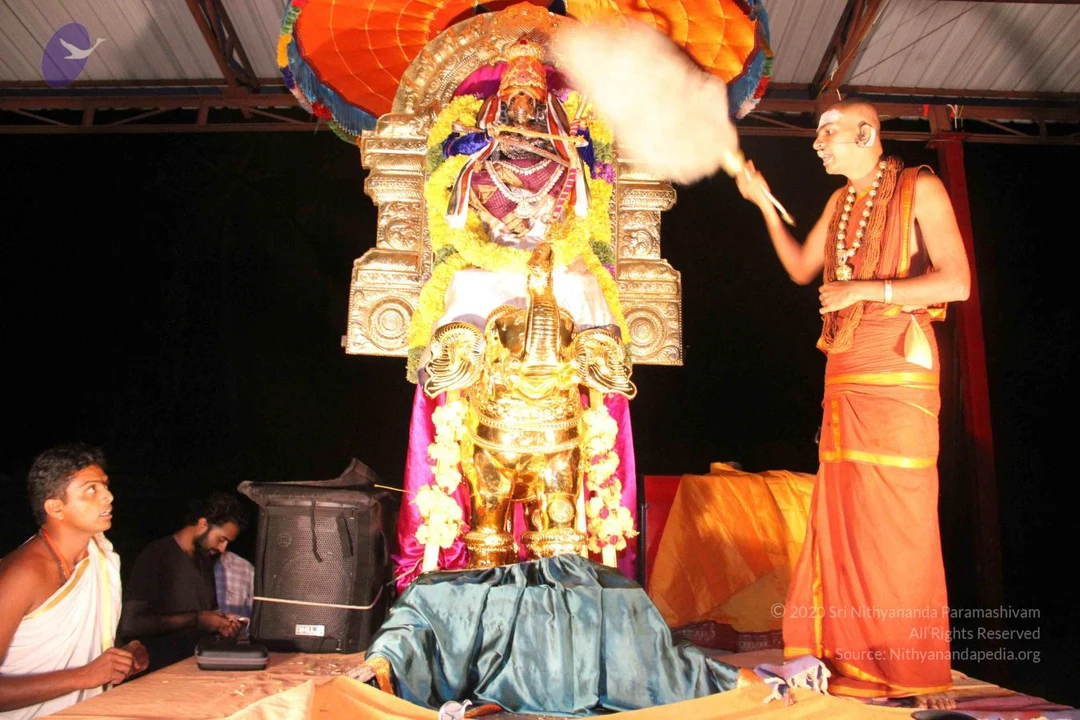
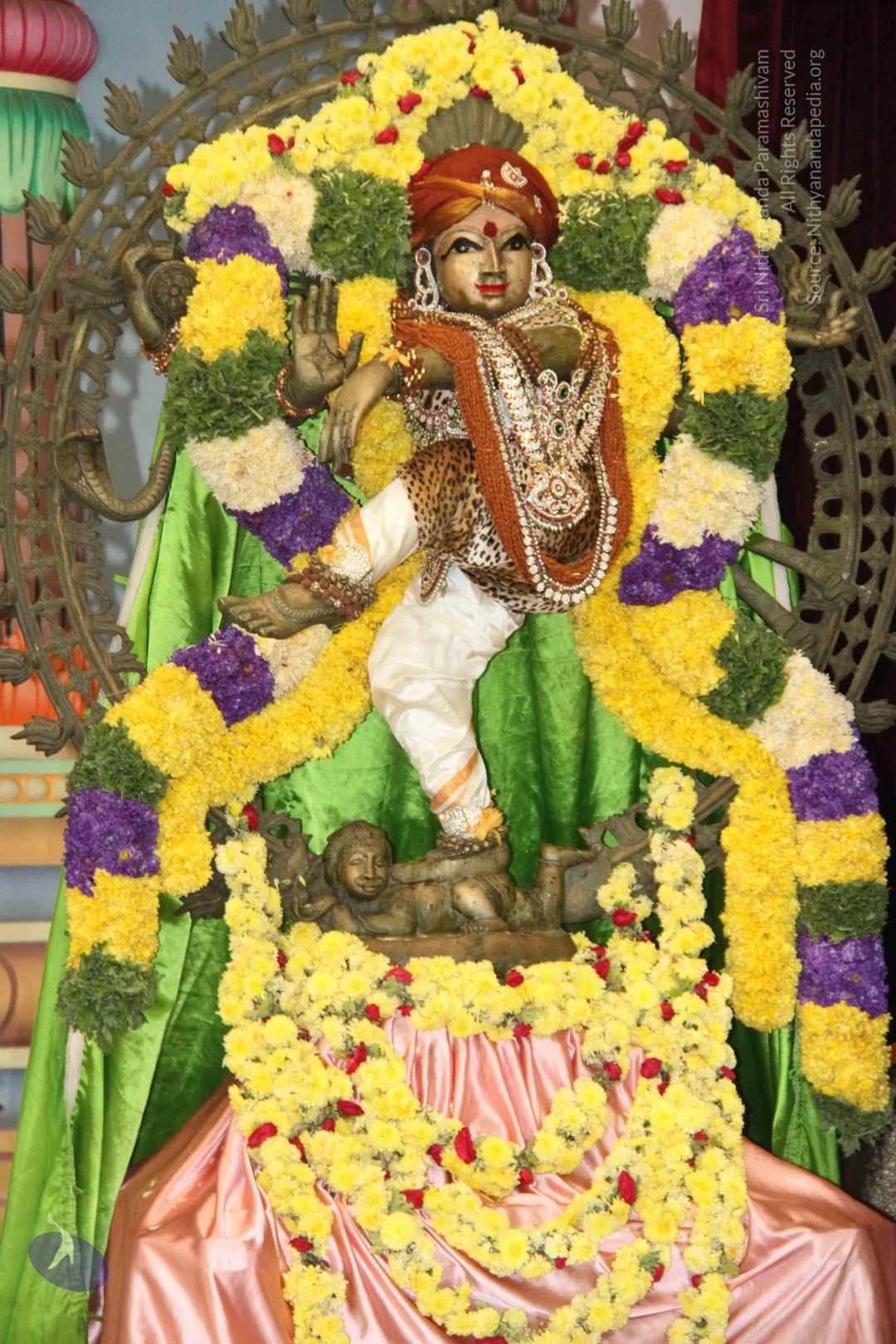
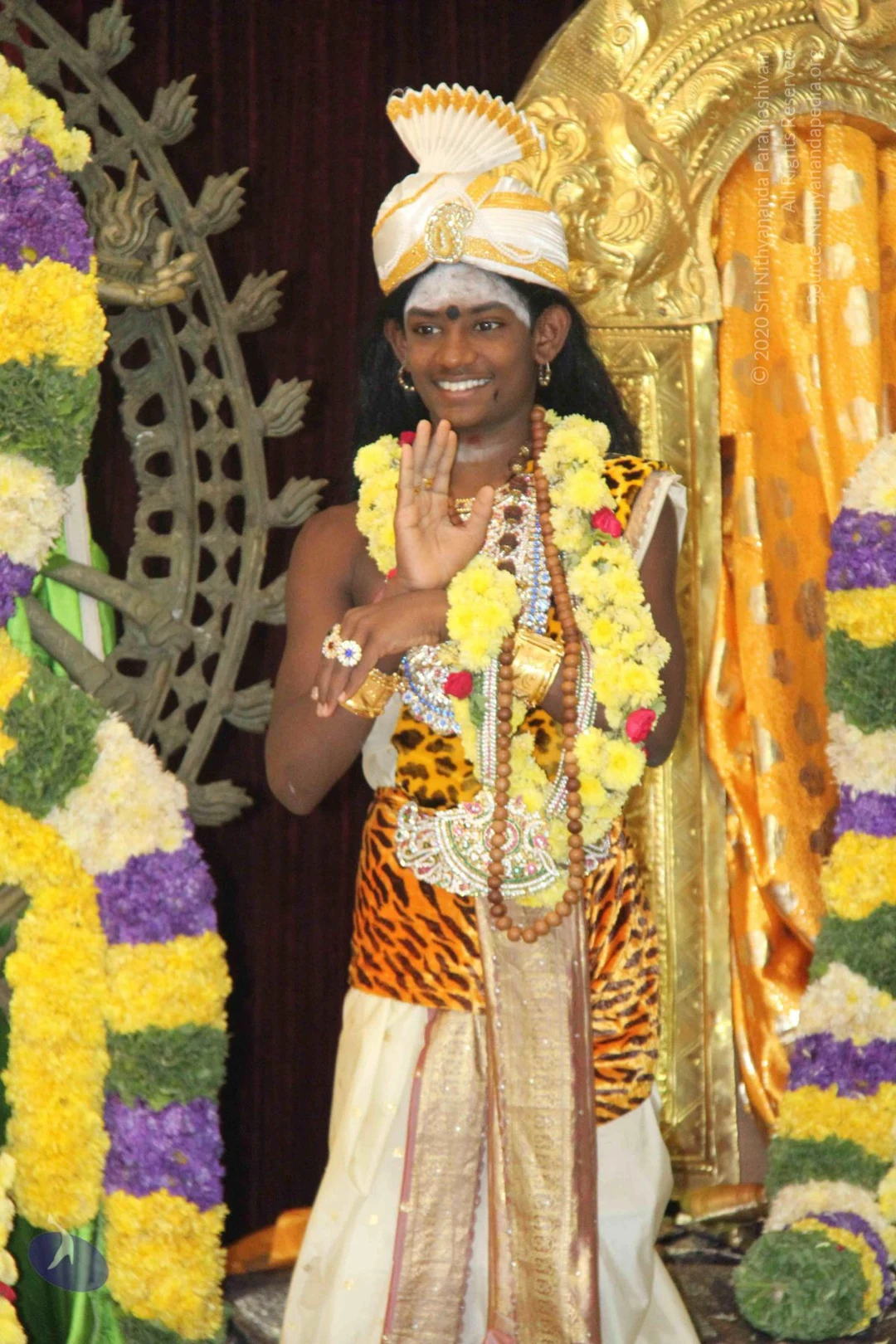
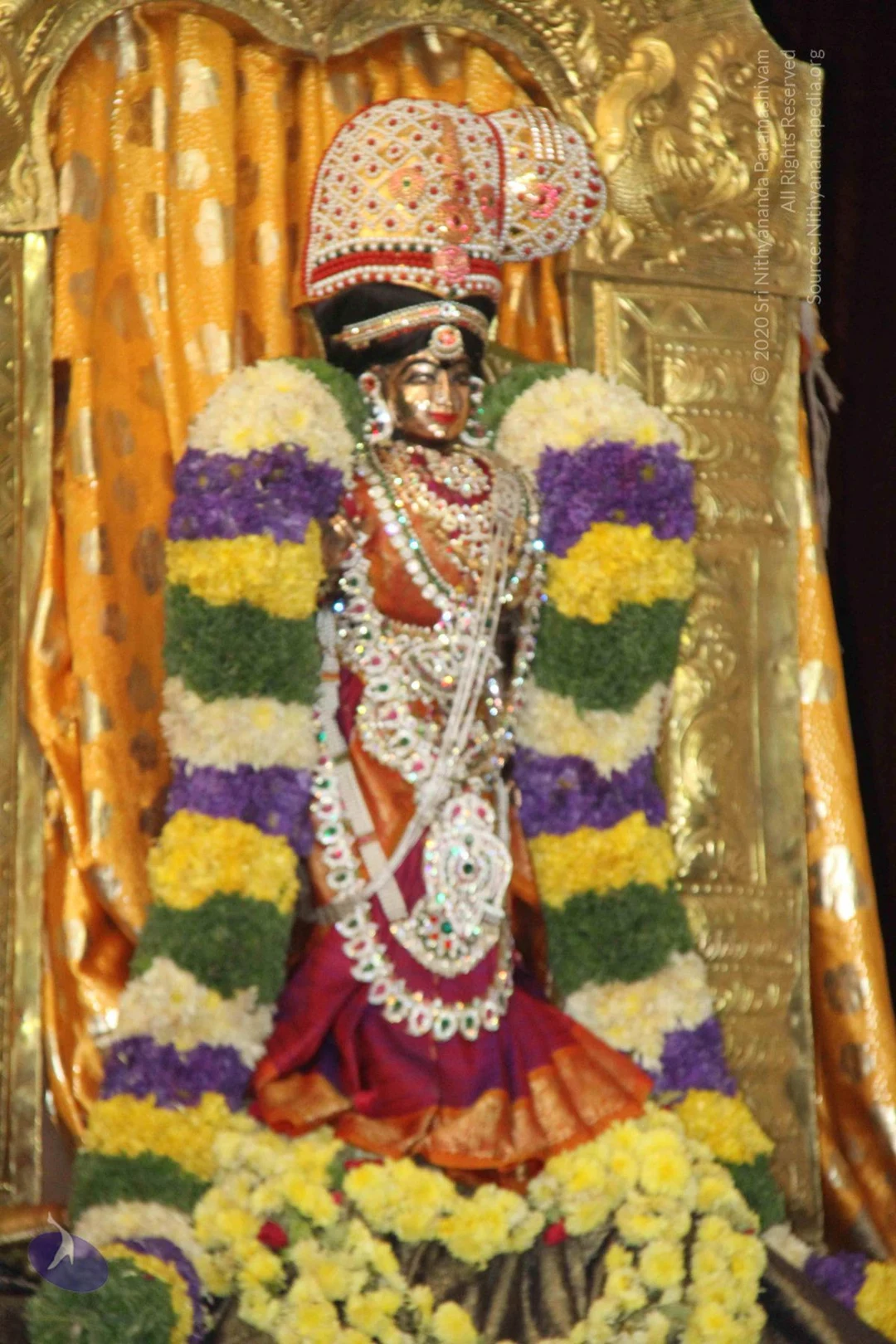
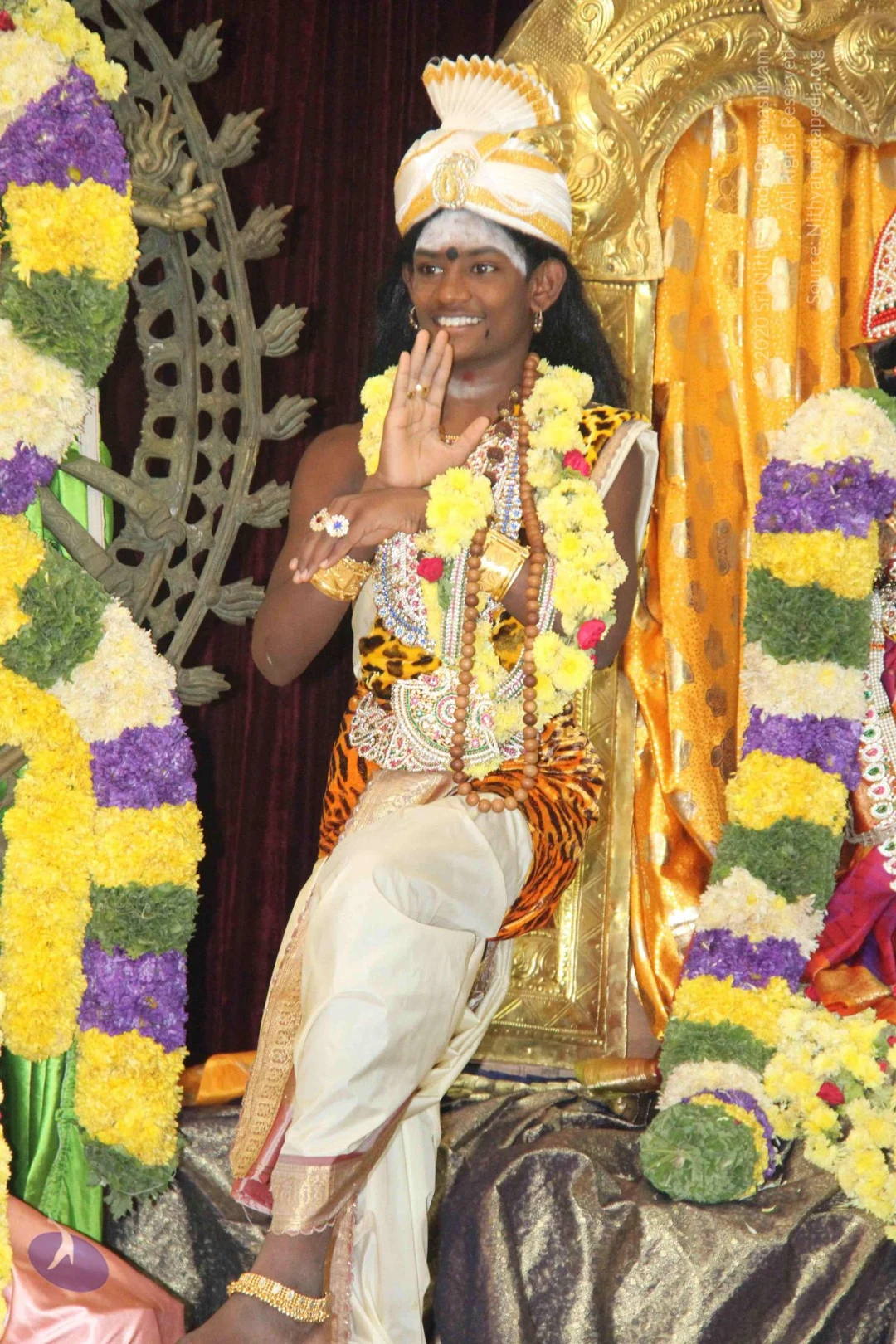
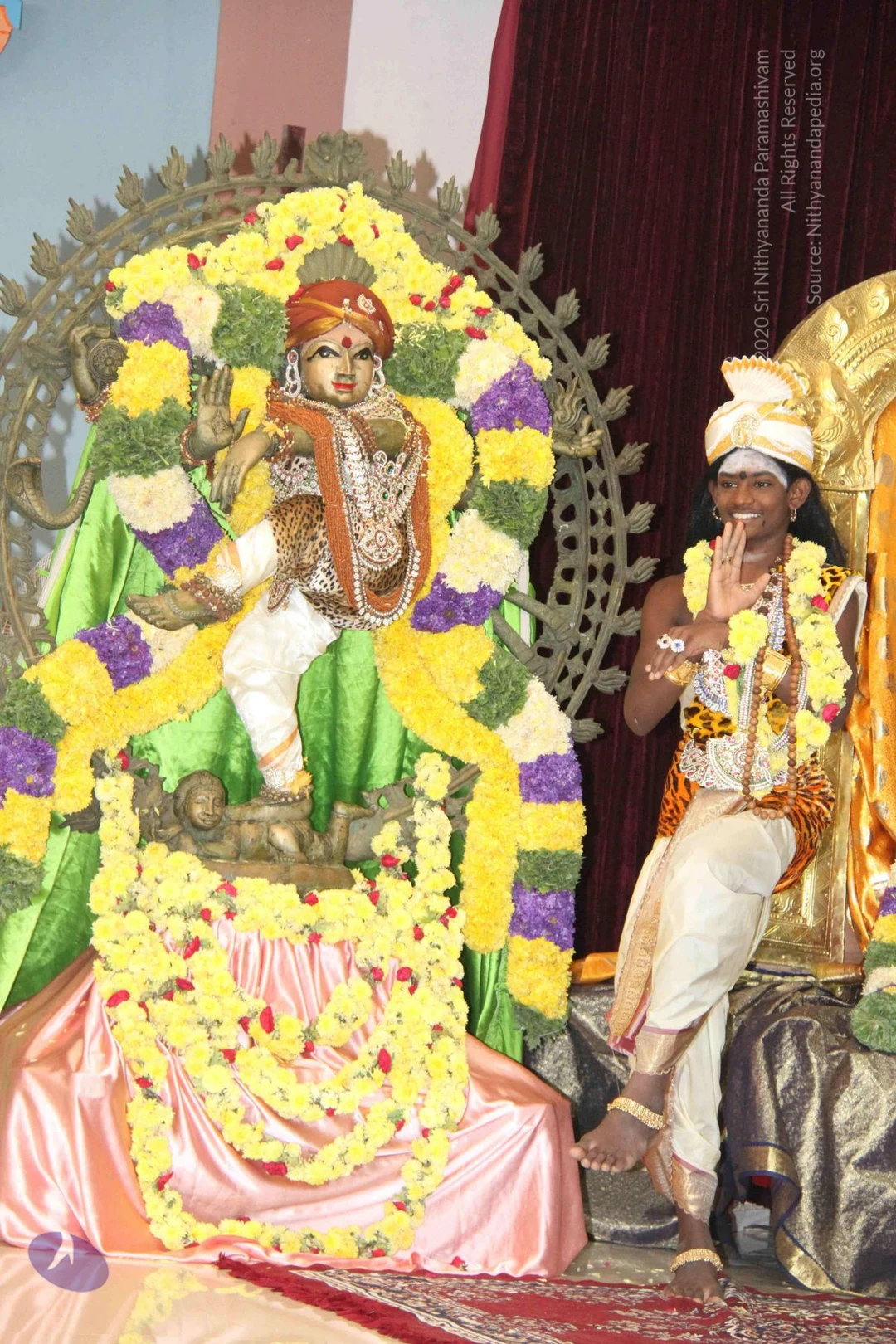
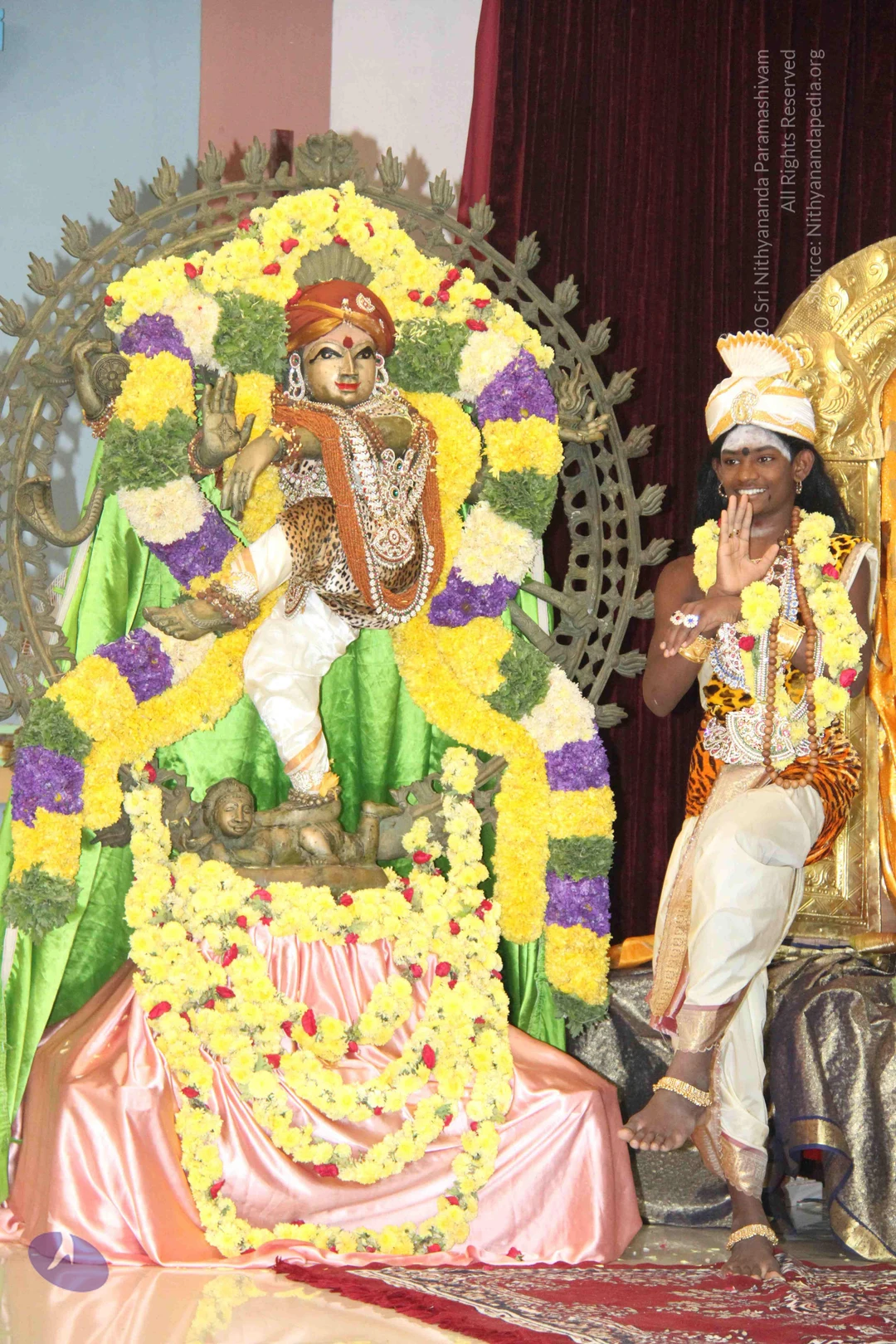
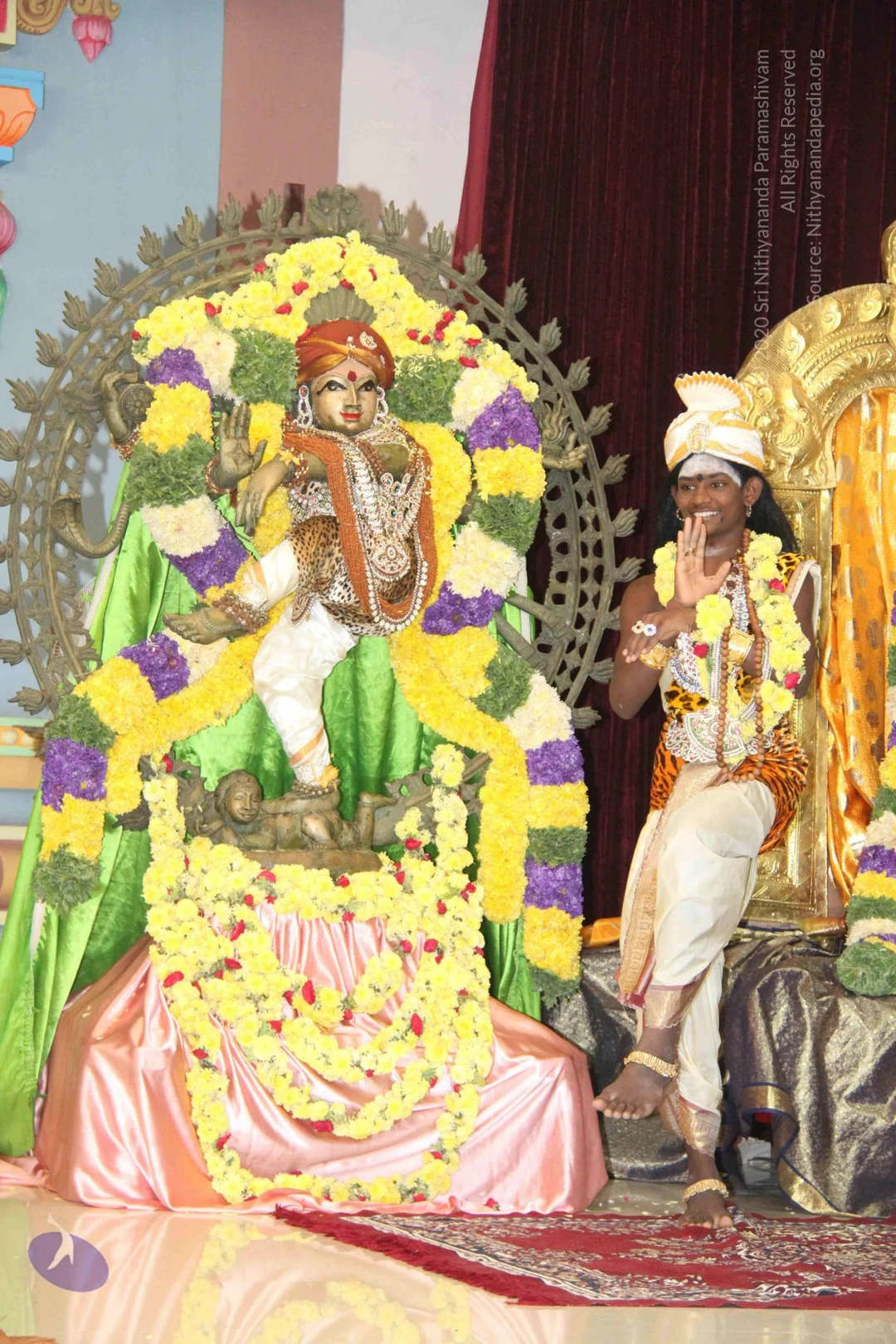
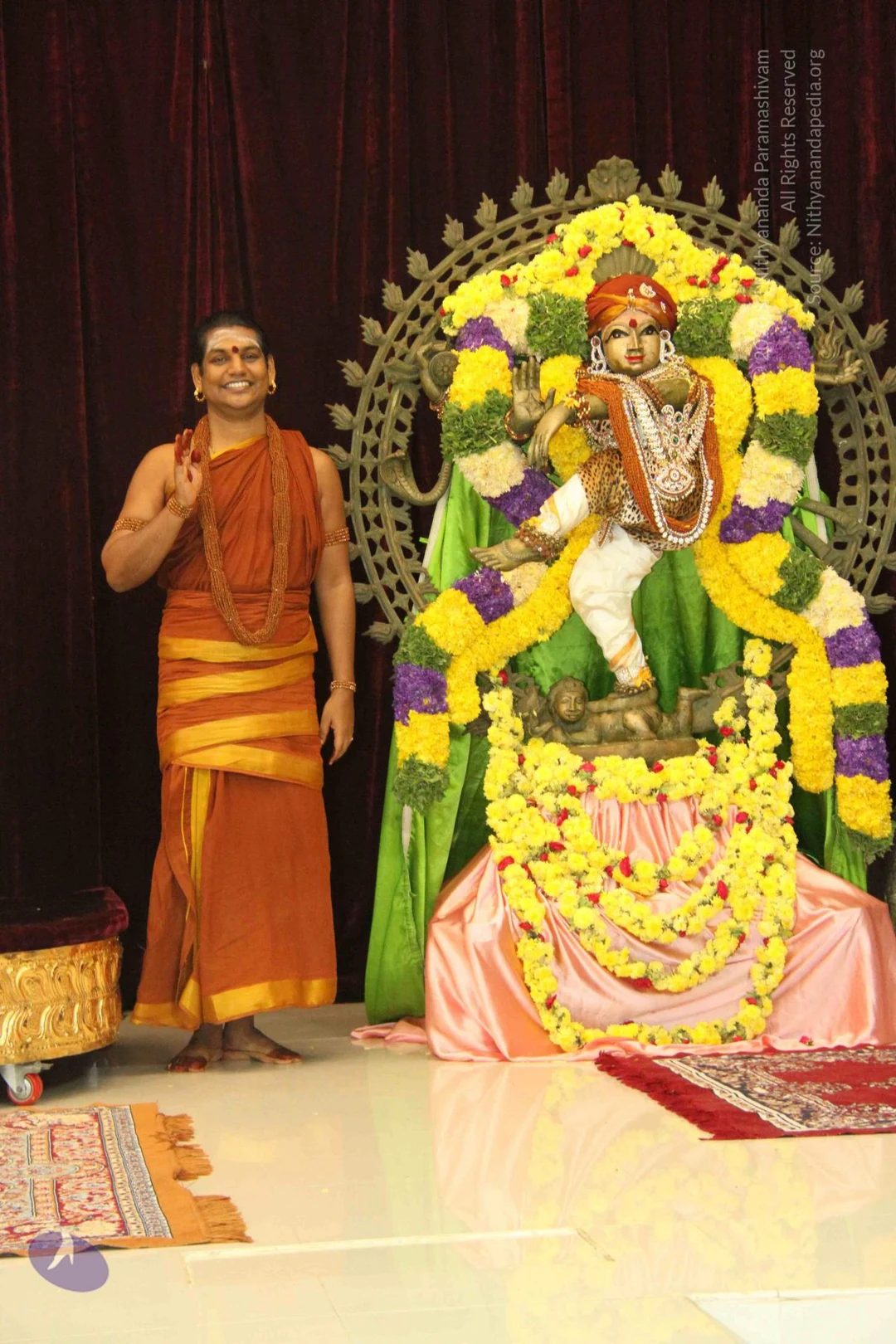
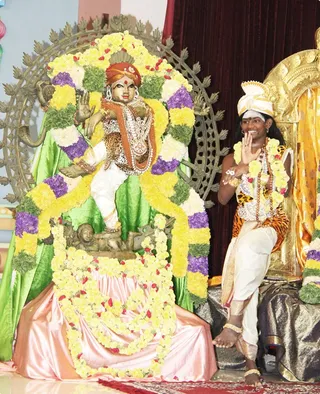
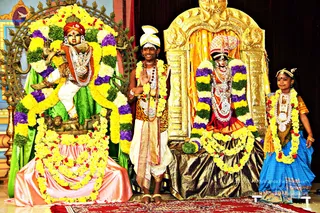
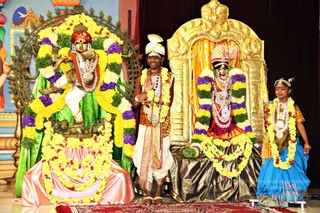
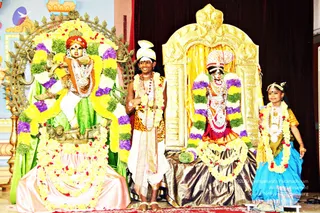
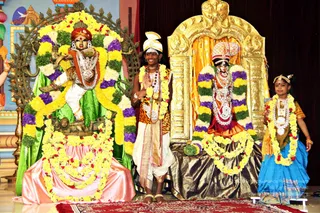
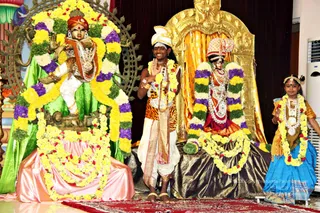
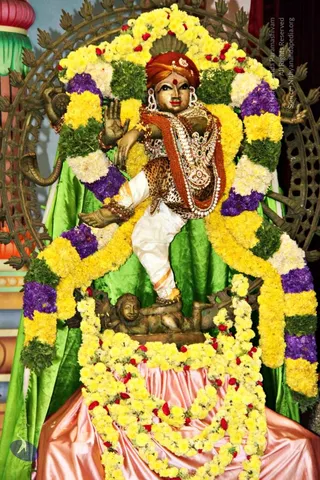
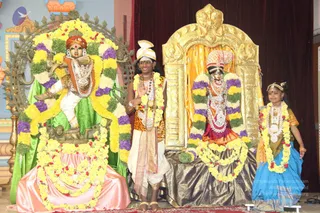
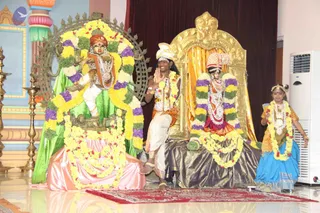
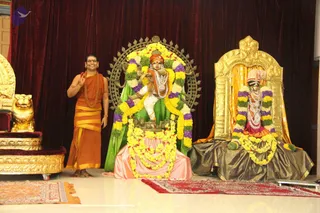
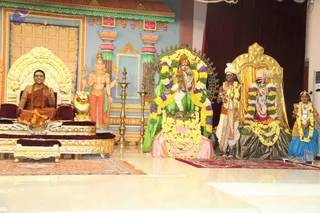
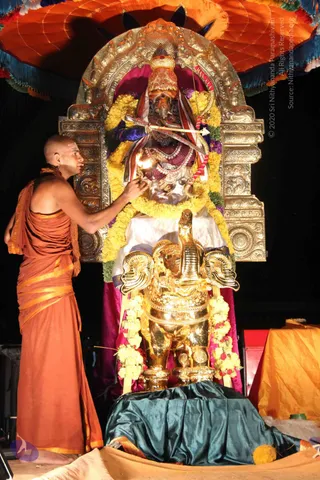
Today, Mahadeva is gracing us in the “VELLIAMBALATHIL NATANAM AADIYA LEELAI”.

See, after the marriage of Meenakshi and Sundareshwara –the great devotees of Shiva, Patanjali and Vyaghrapada, these two Rishis had also come for the wedding – Sundareshwara says after the wedding, ‘All of you please go and have the wedding feast.’

This Patanjali and Vyaghrapada, they say, ‘Unless we see the dancing of Shiva’, – you see, every day they see the “Ananda Natana”, dancing in Chidambaram; they both lived in Chidambaram. – They said, ‘unless we have His darshan of dancing, we will not eat!’

This means, historically Chidambaram Temple is older than Meenakshi Temple, Madurai.

So, Mahadeva says, ‘Alright, I myself will show you guys Ananda Natana.’

And He dances for the sake of Patanjali and Vyaghrapada in Madurai itself. After that they go and eat! That is the scene. That is the Leela “Velliambalathil Natanam Aadiyadhu”.

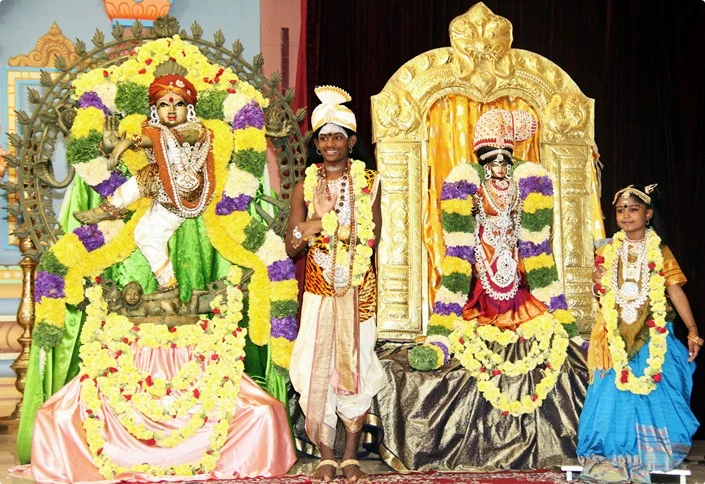
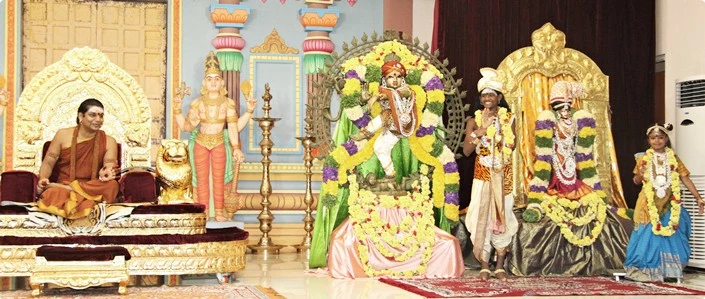
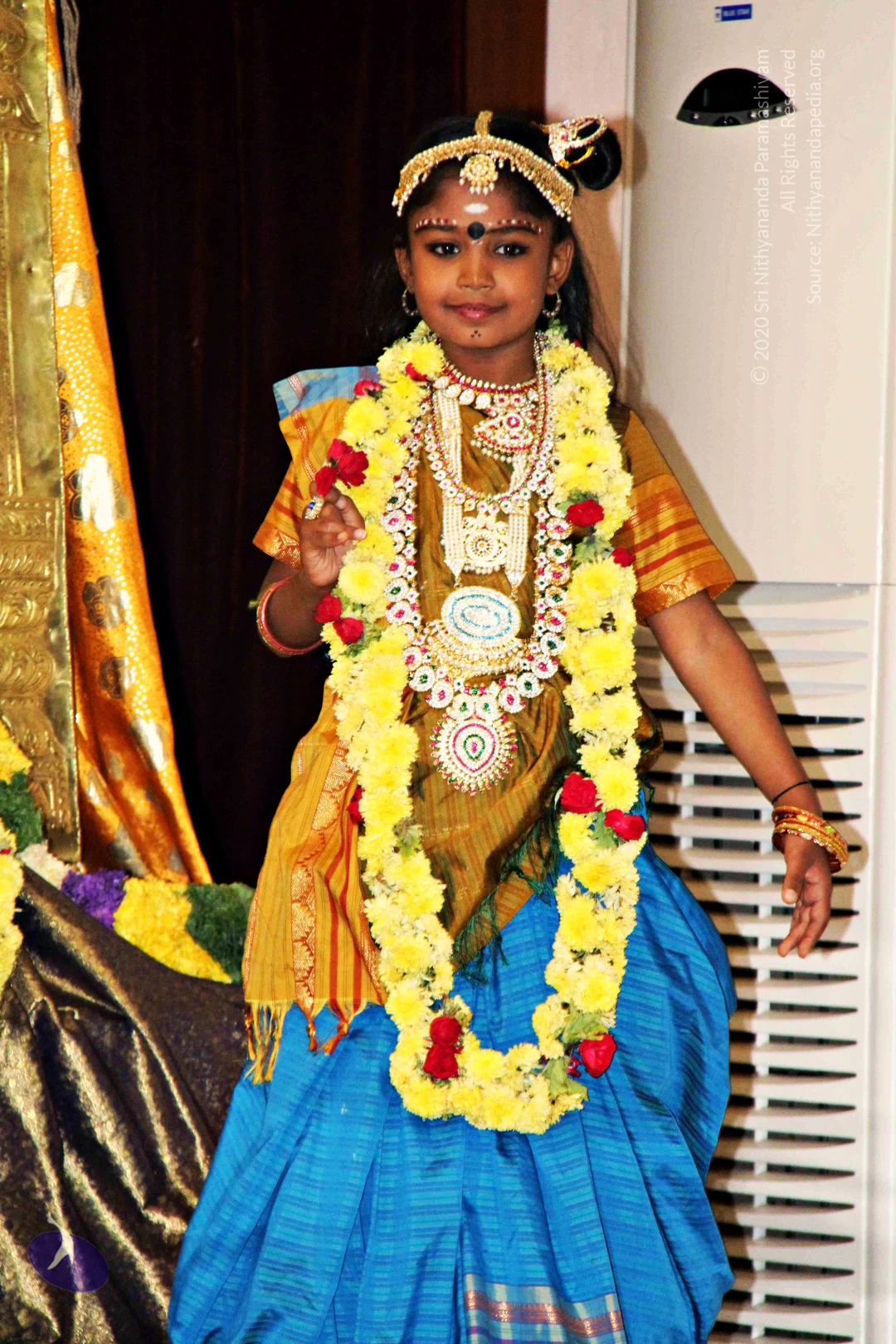
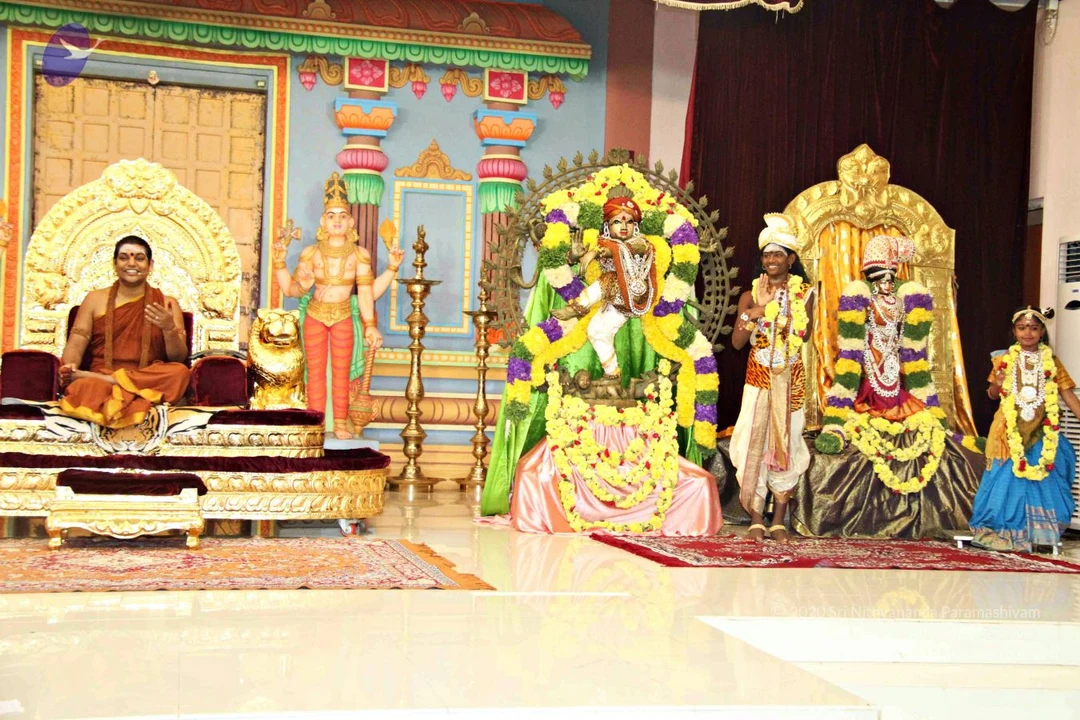
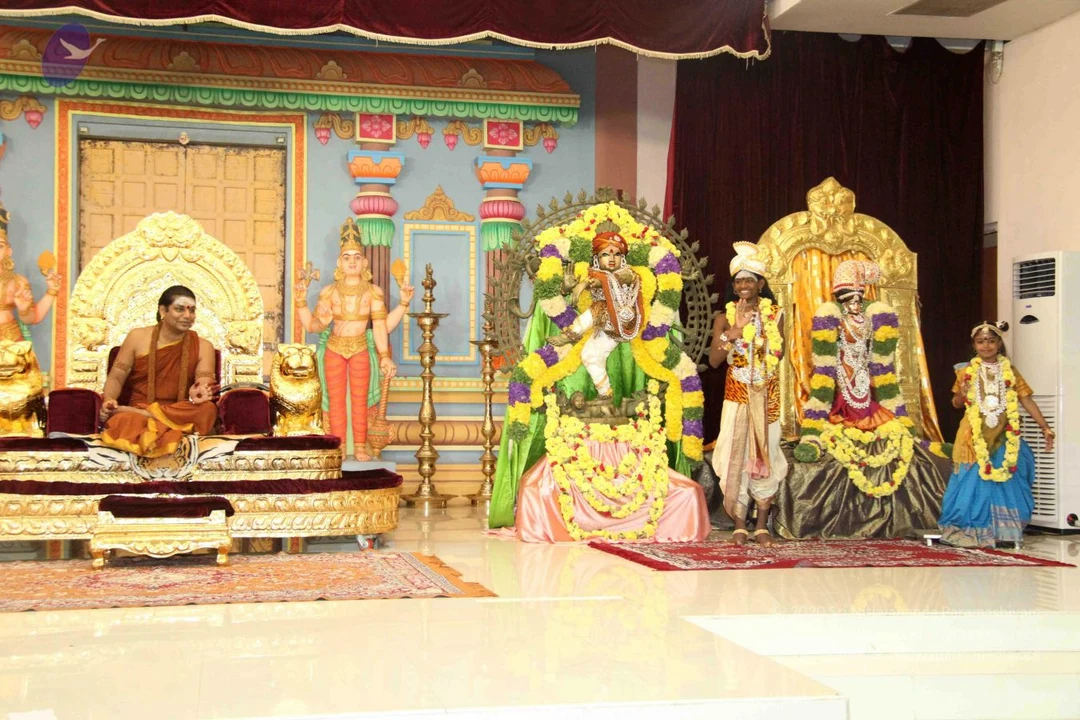
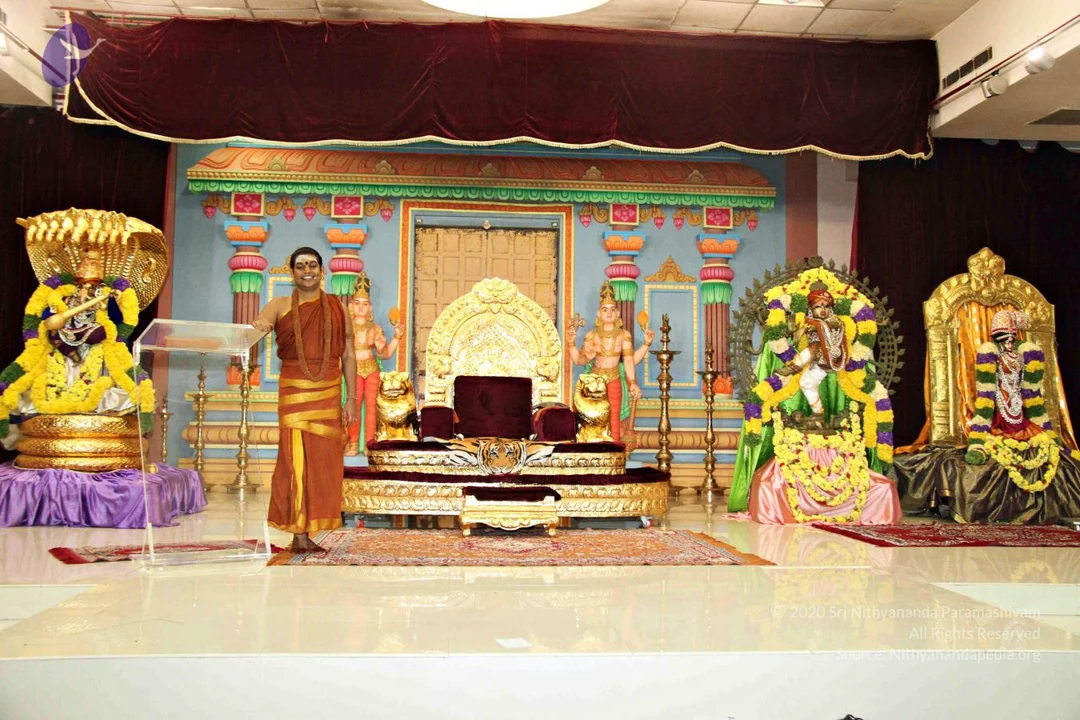
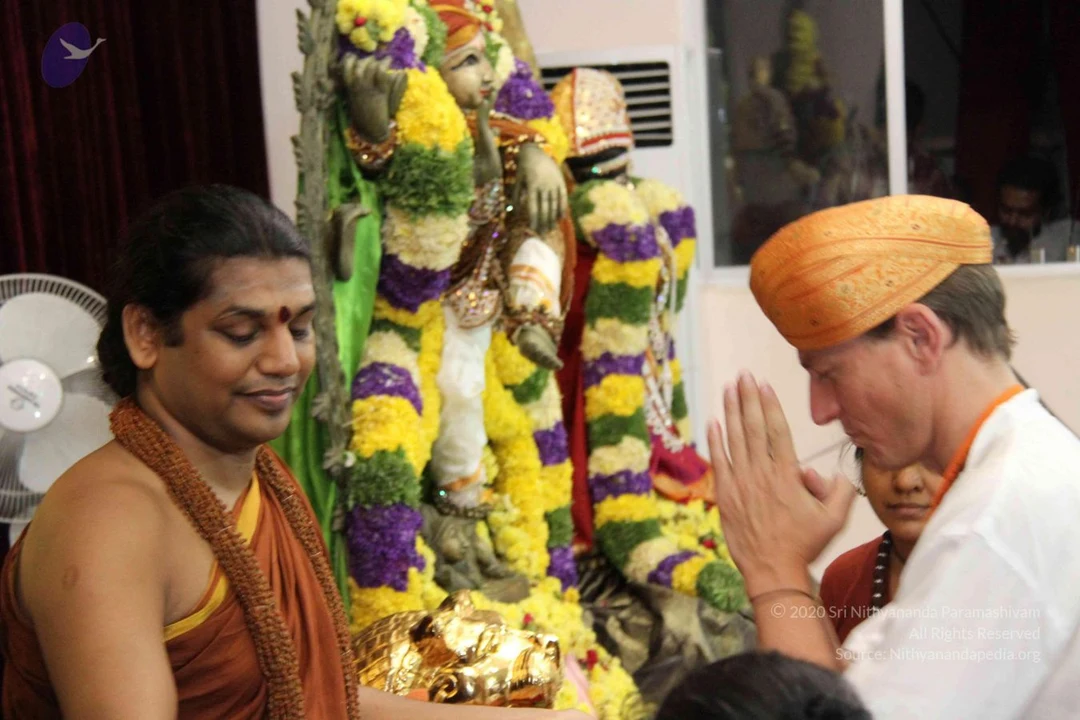
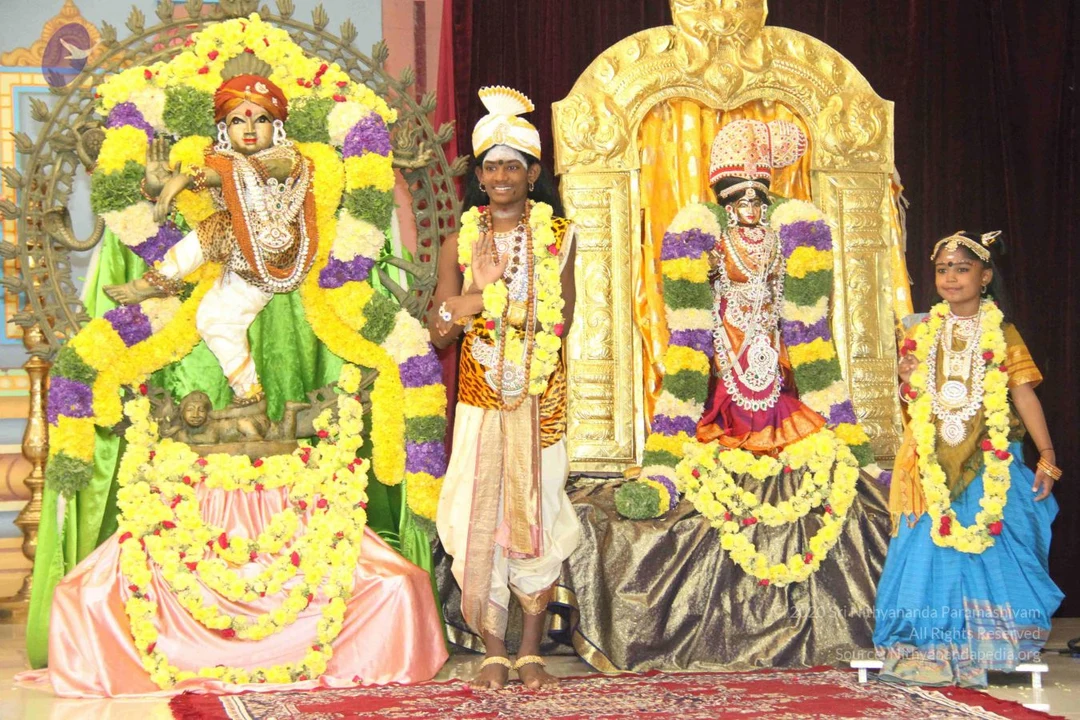
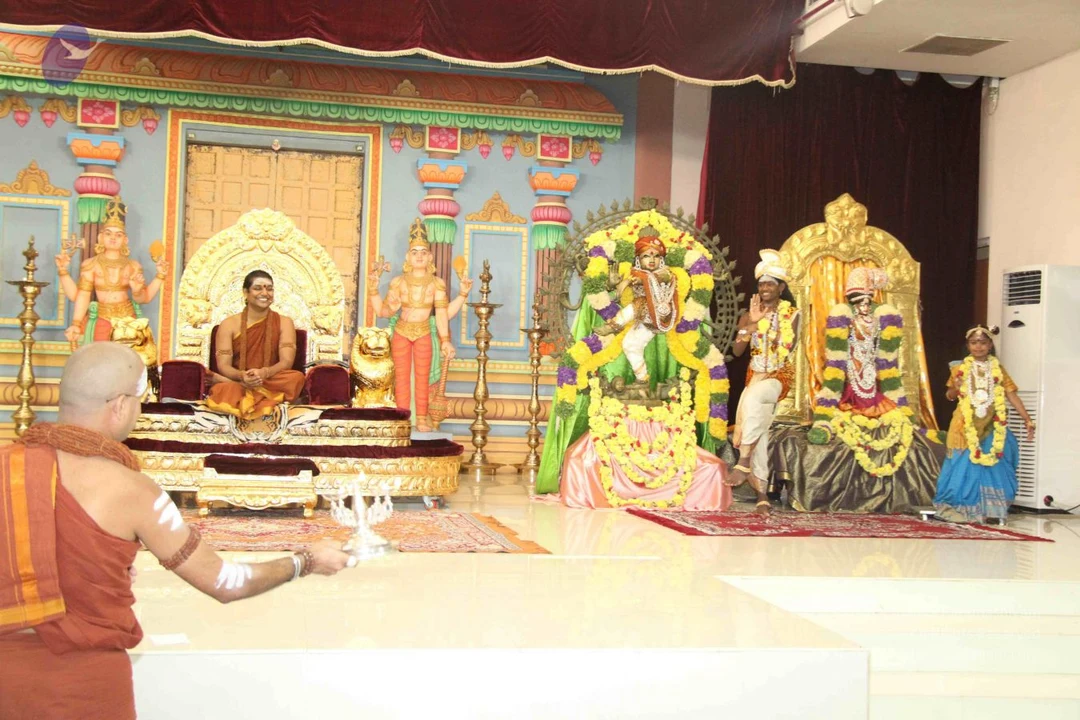
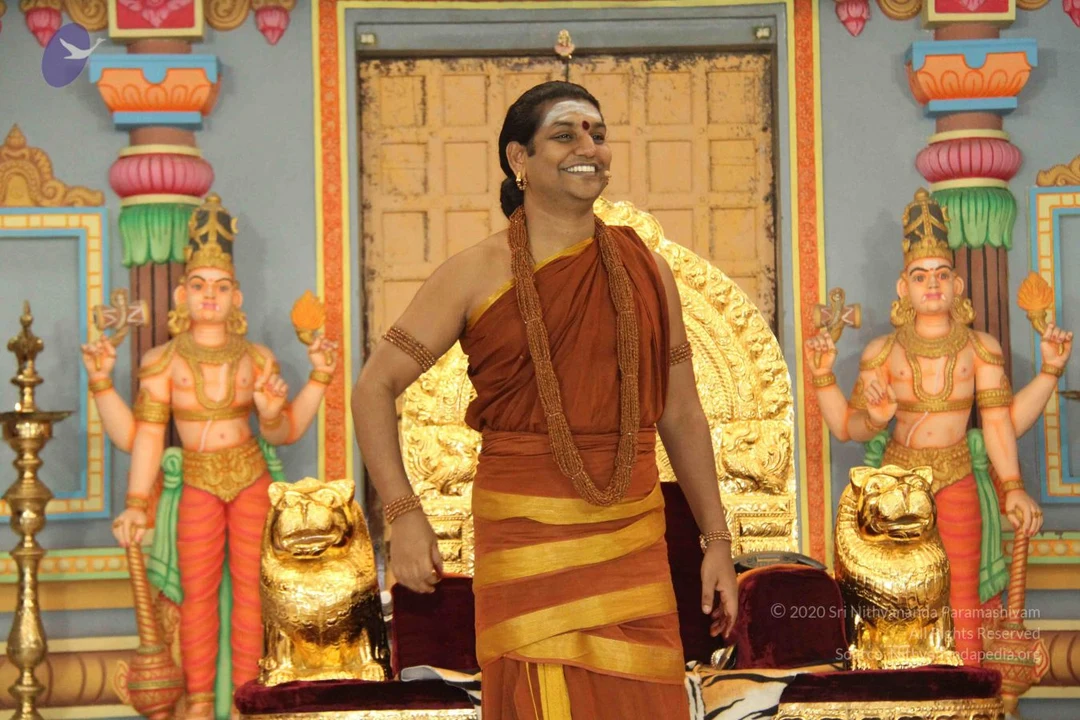
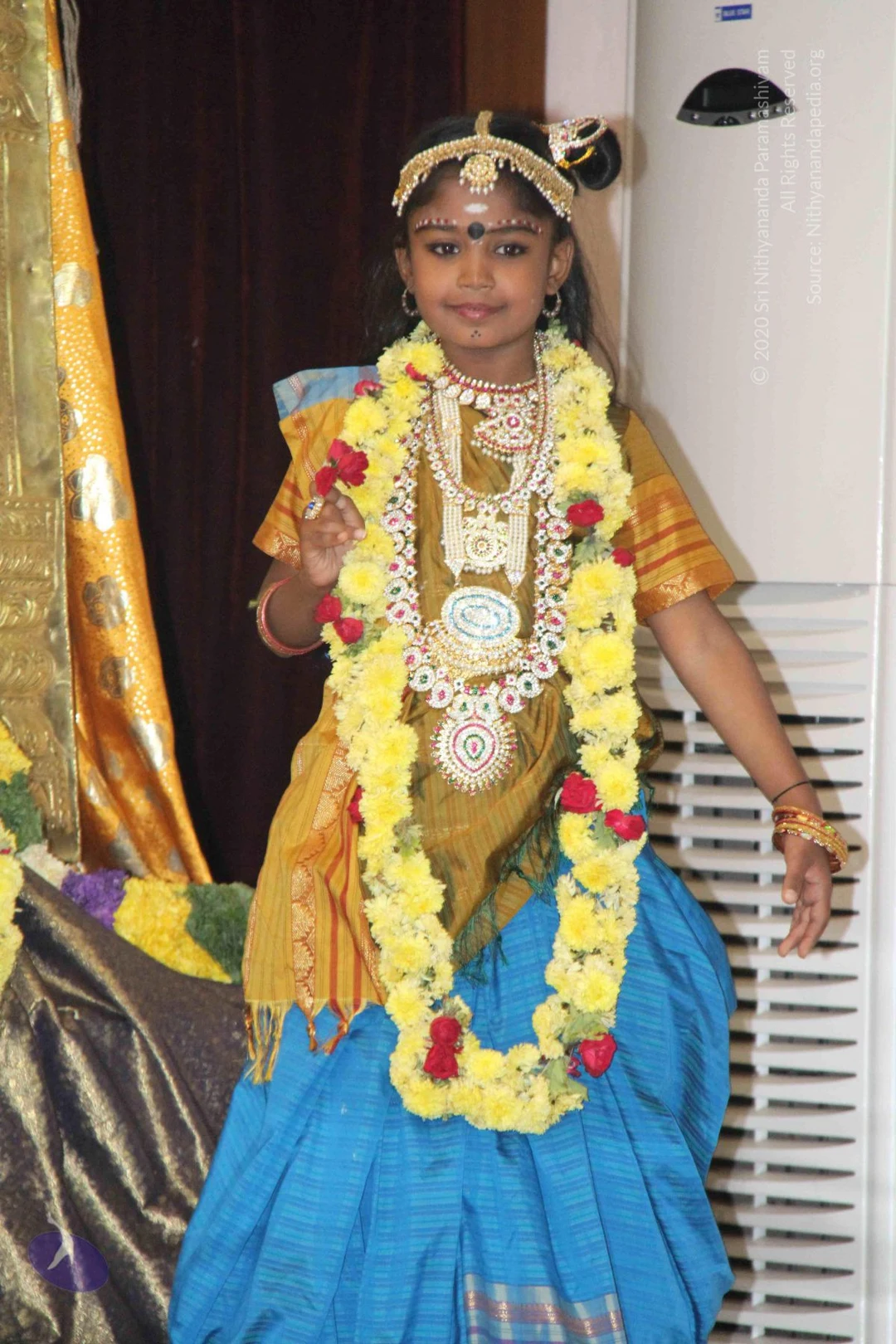
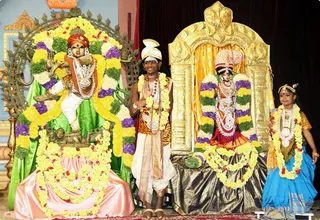
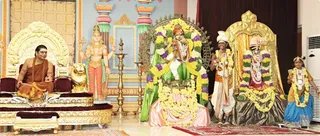
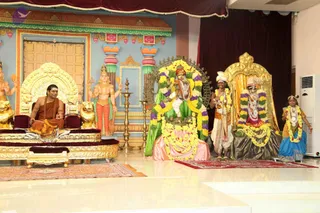
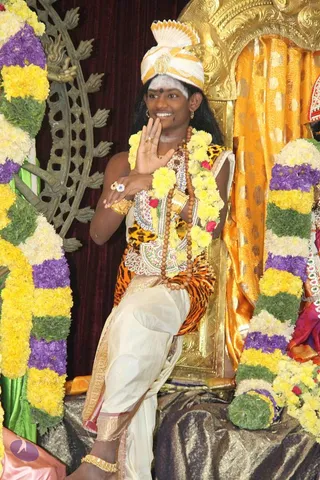
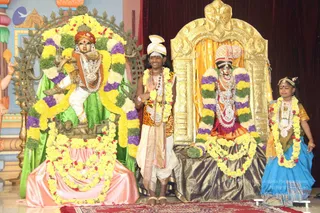
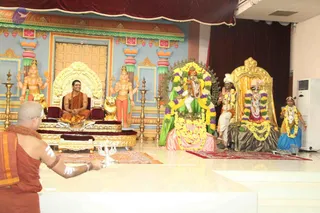
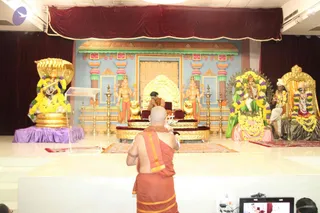
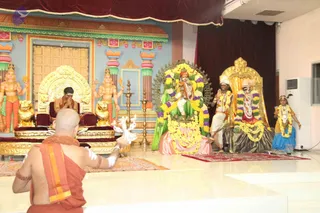
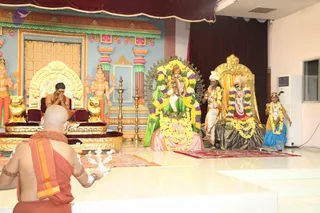
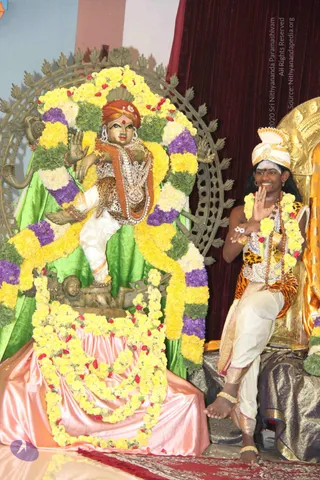
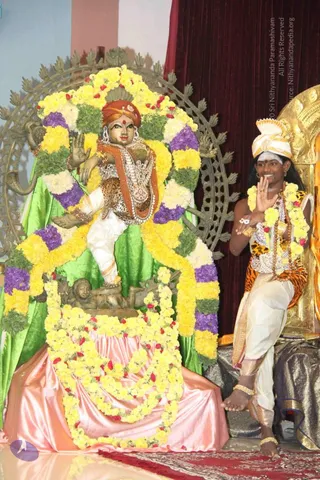
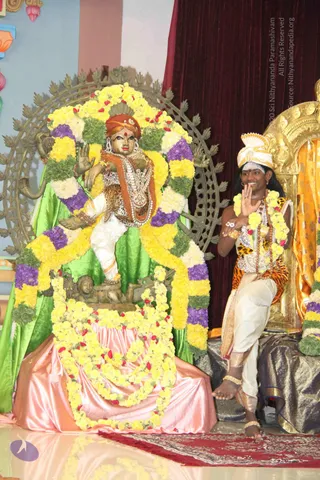
Today, as per the Madurai tradition, two of our gurukul kids are enacting Sundareshwara and Meenakshi. Sundareshwara is enacted by Sundareshwara himself (gurukul kid by the name of Sundareshwara). Nithya Priya is enacting Meenakshi.

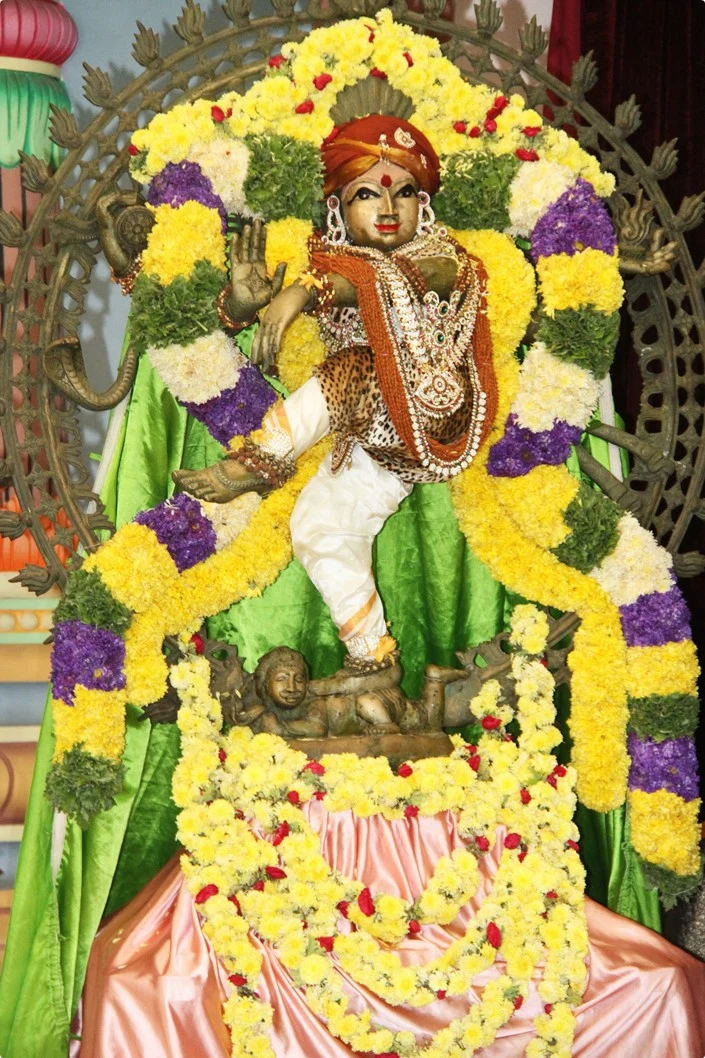
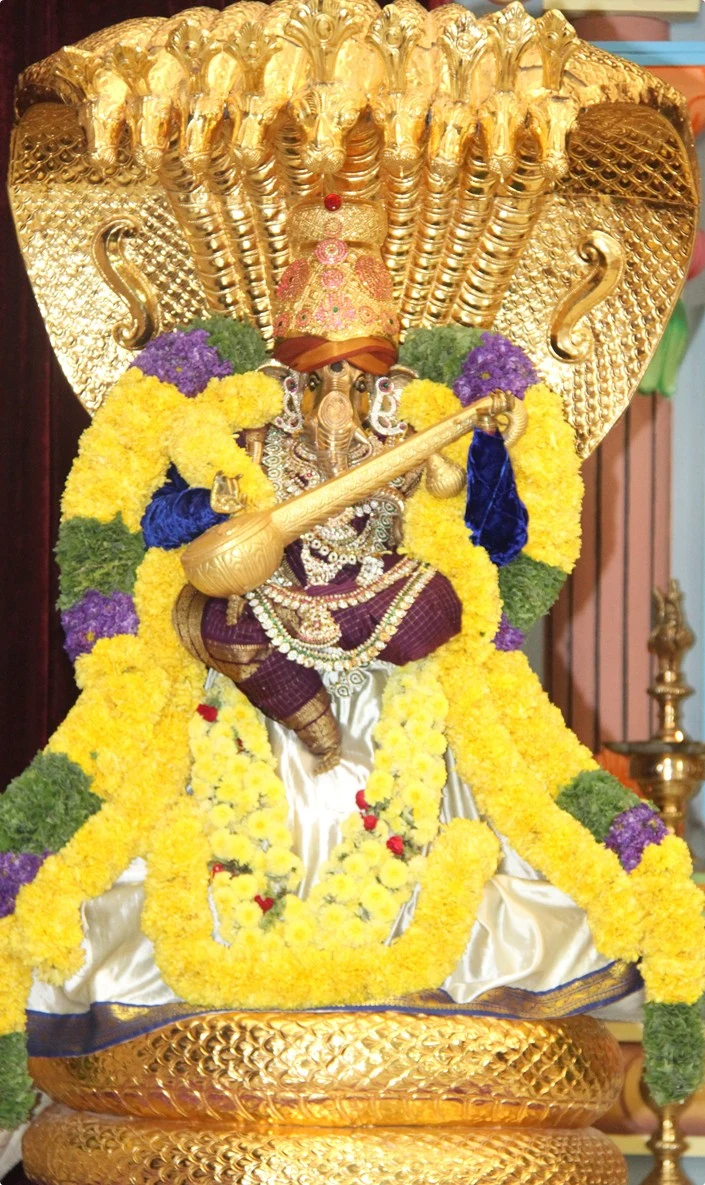
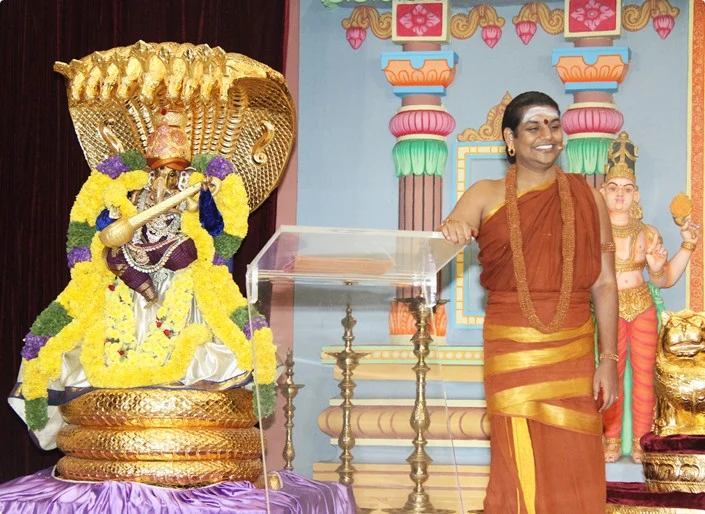
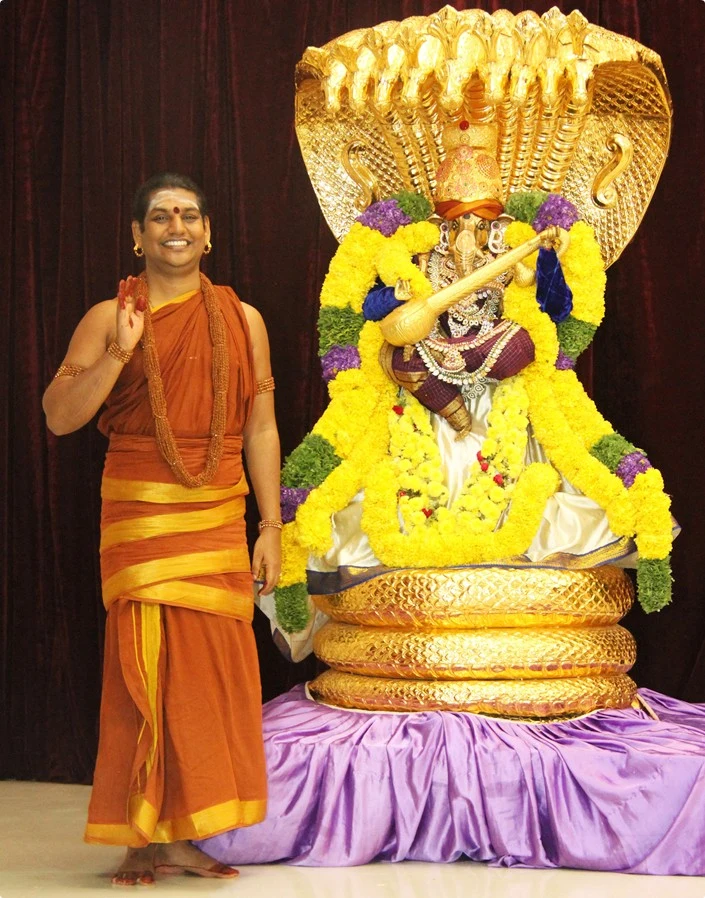
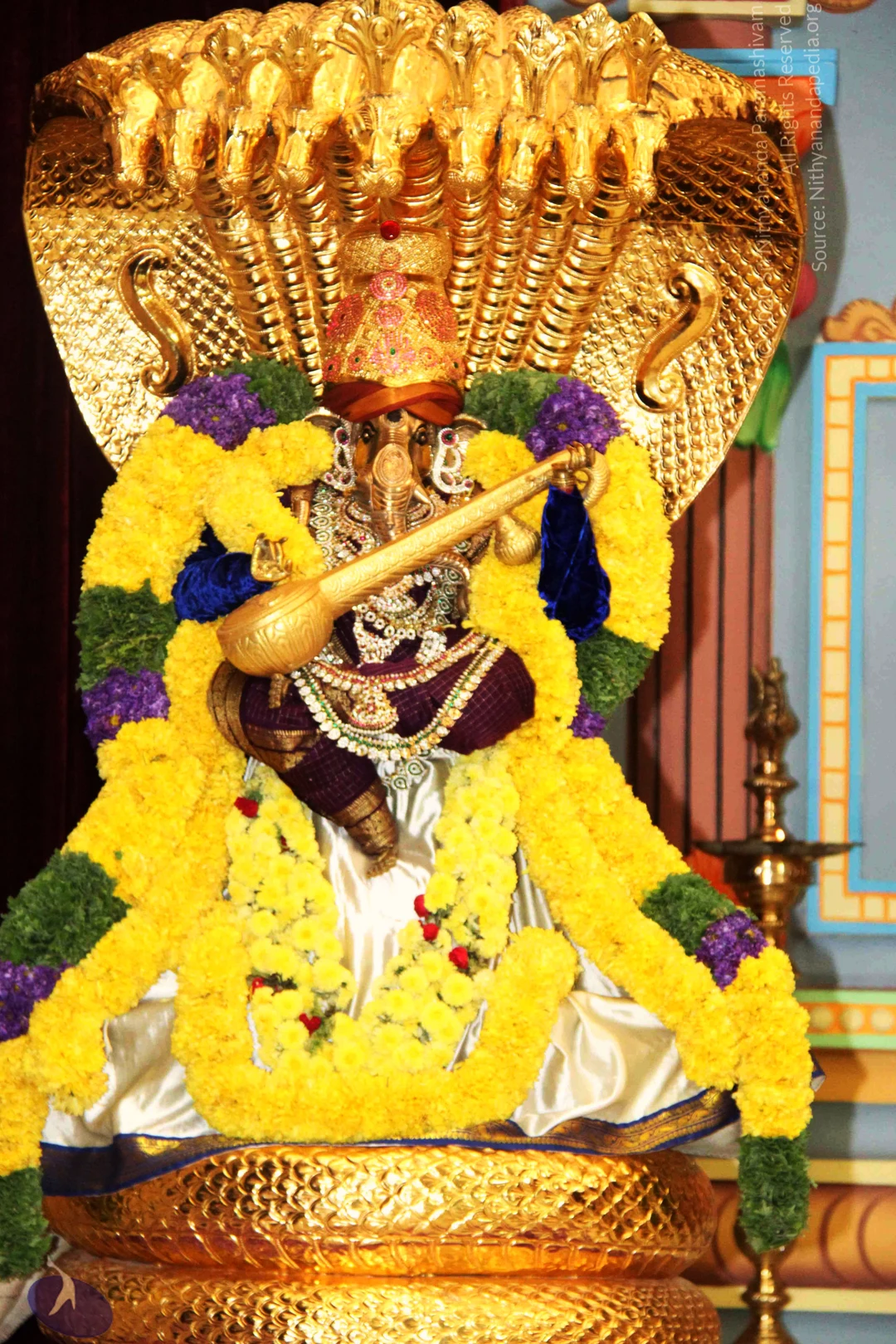
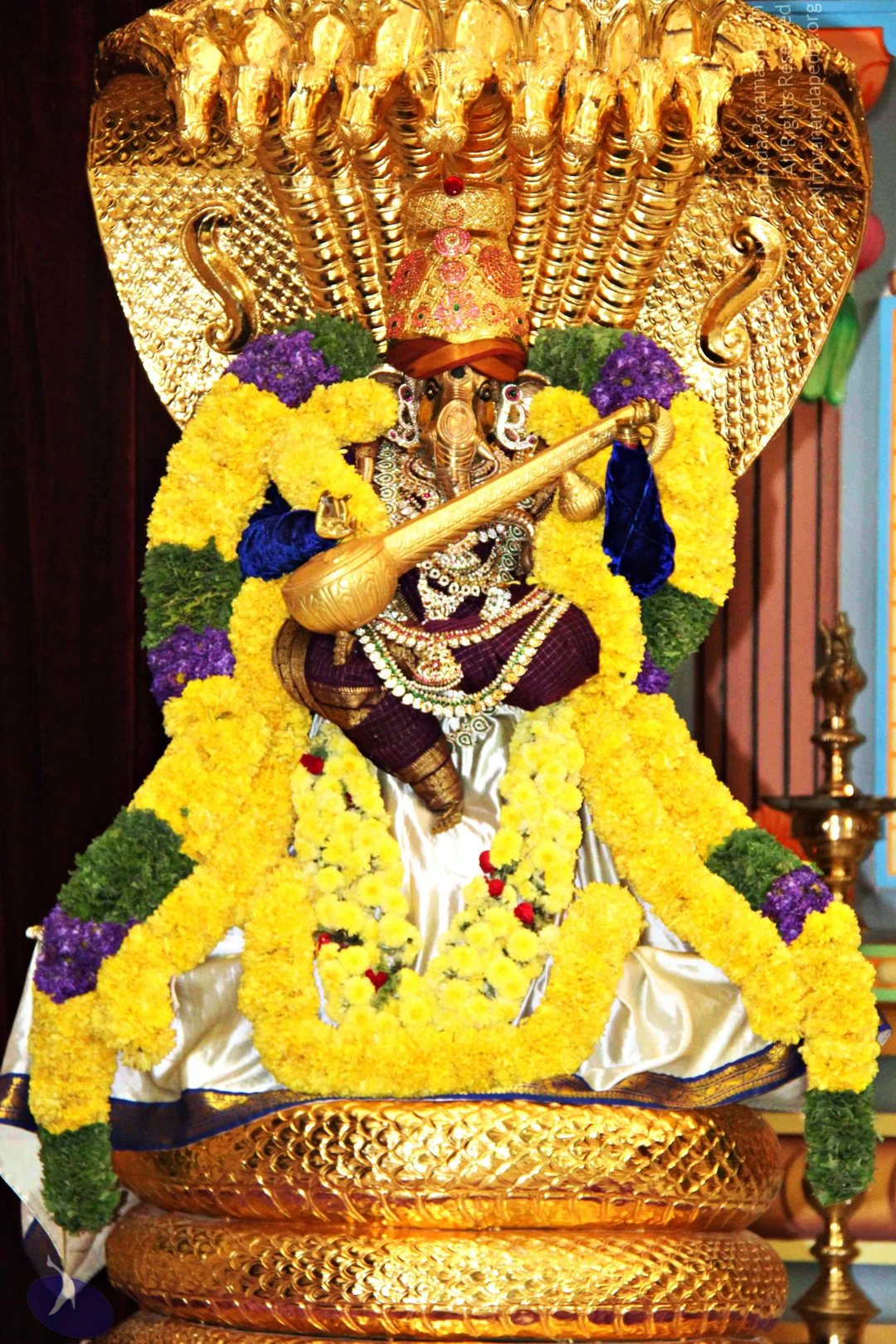
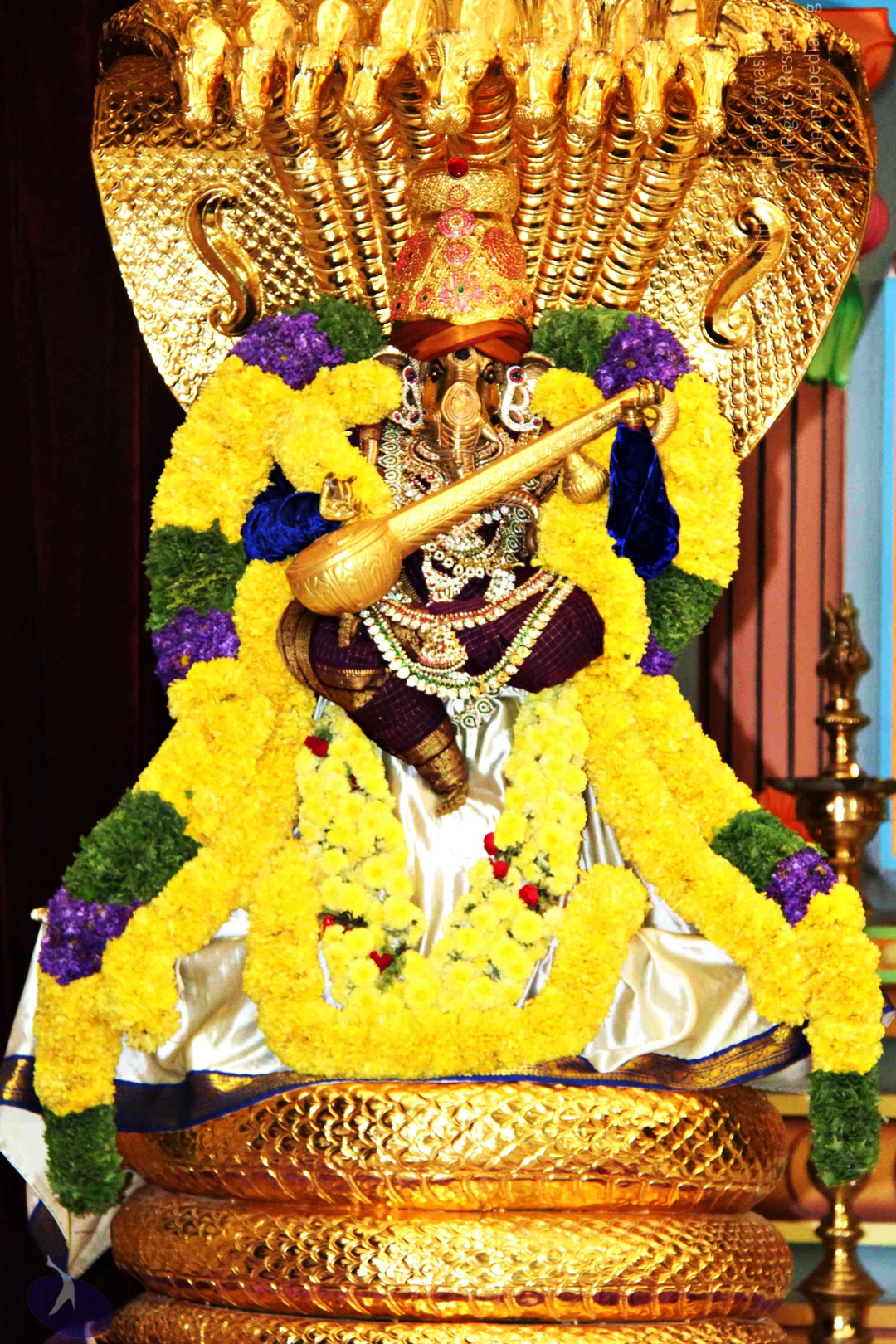
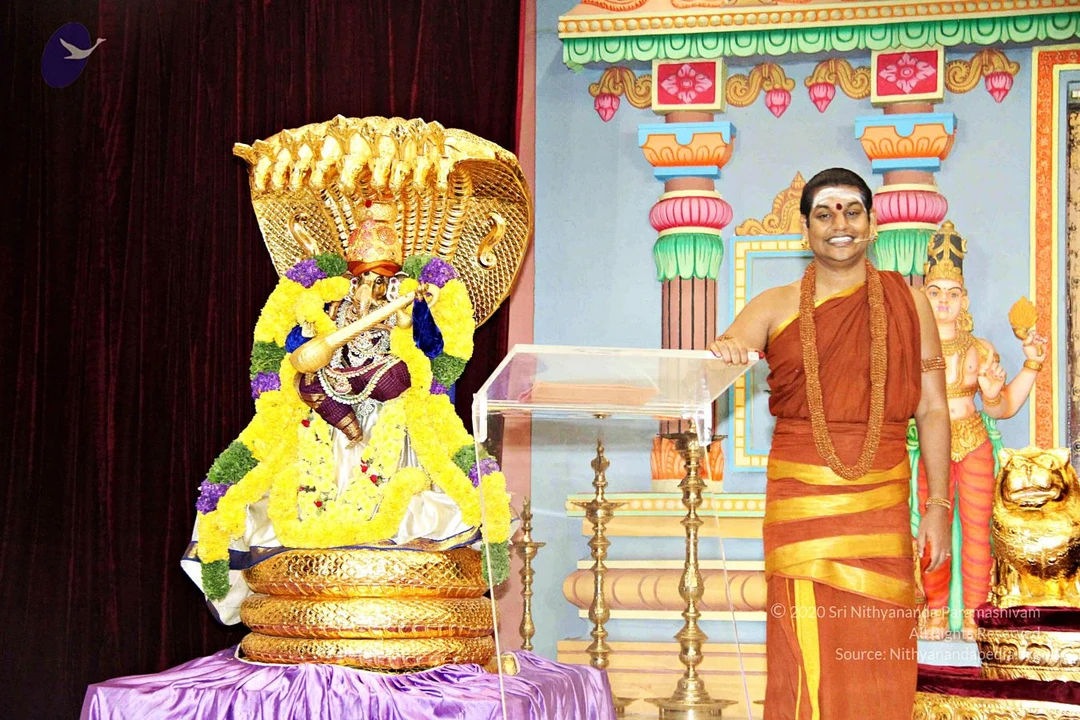
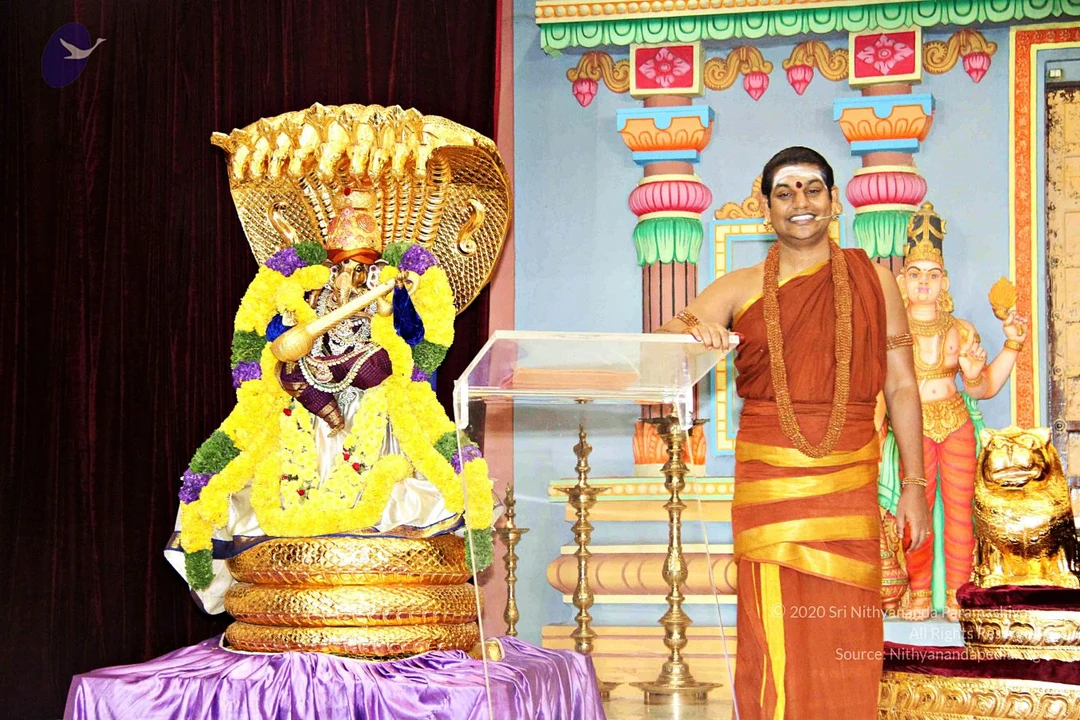
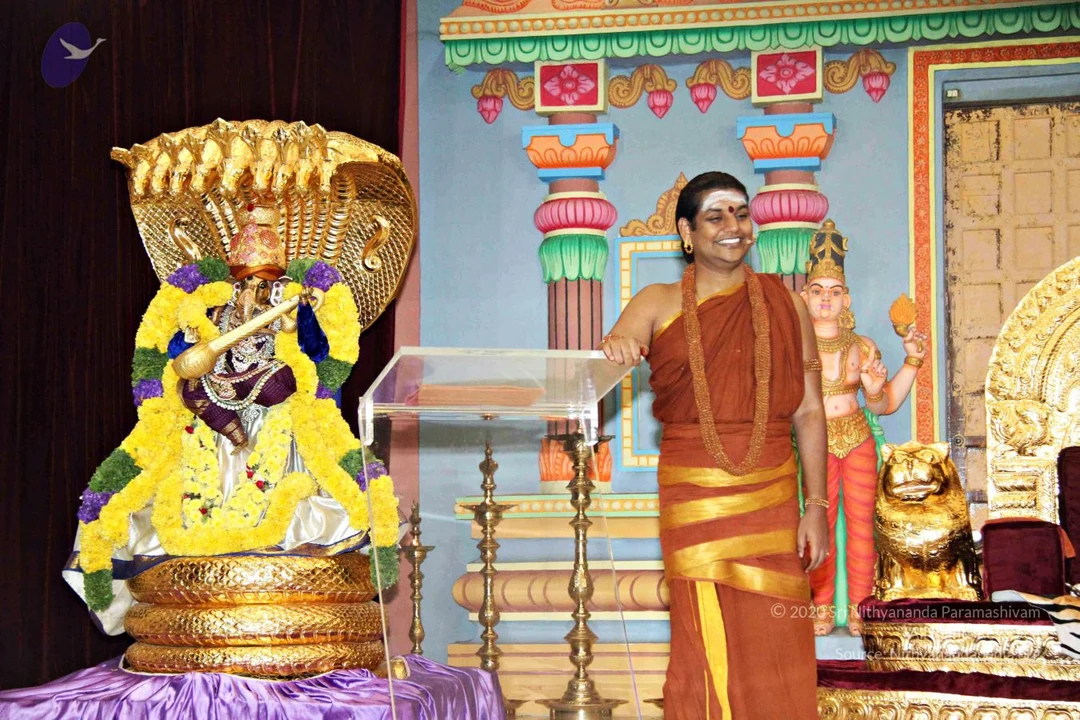
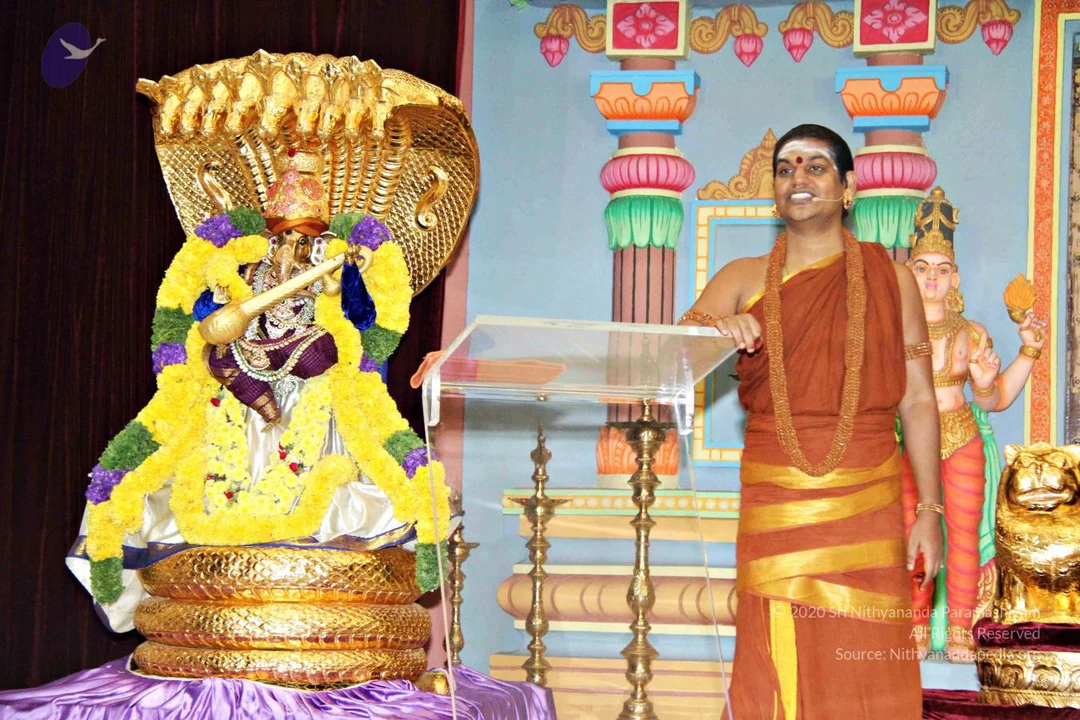
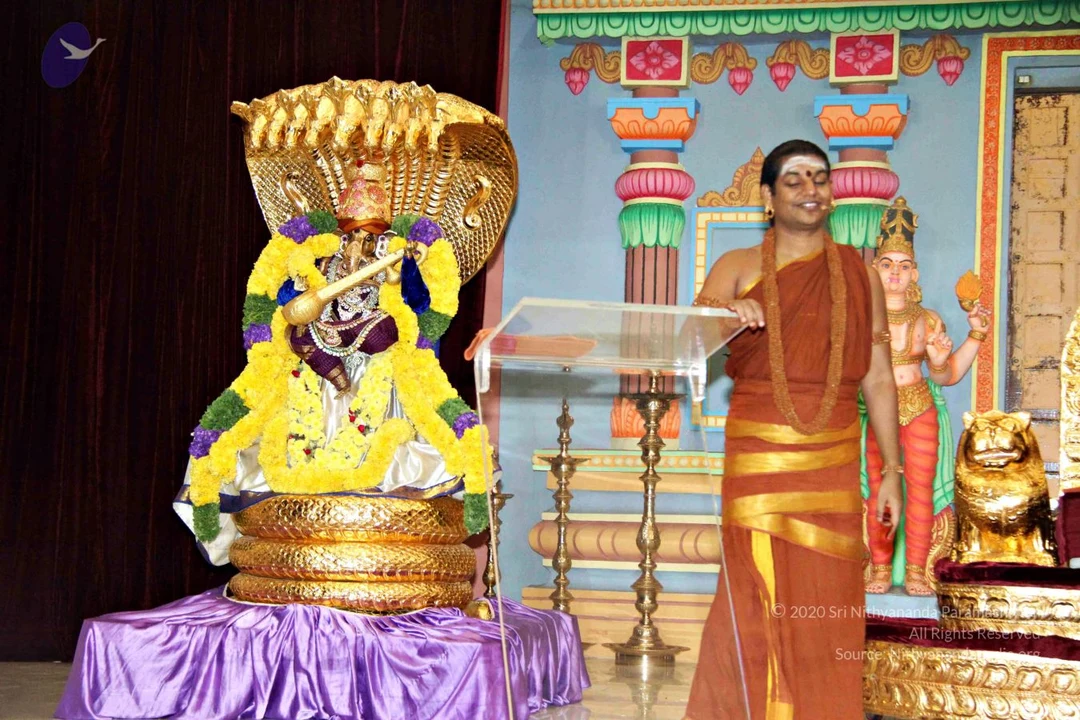
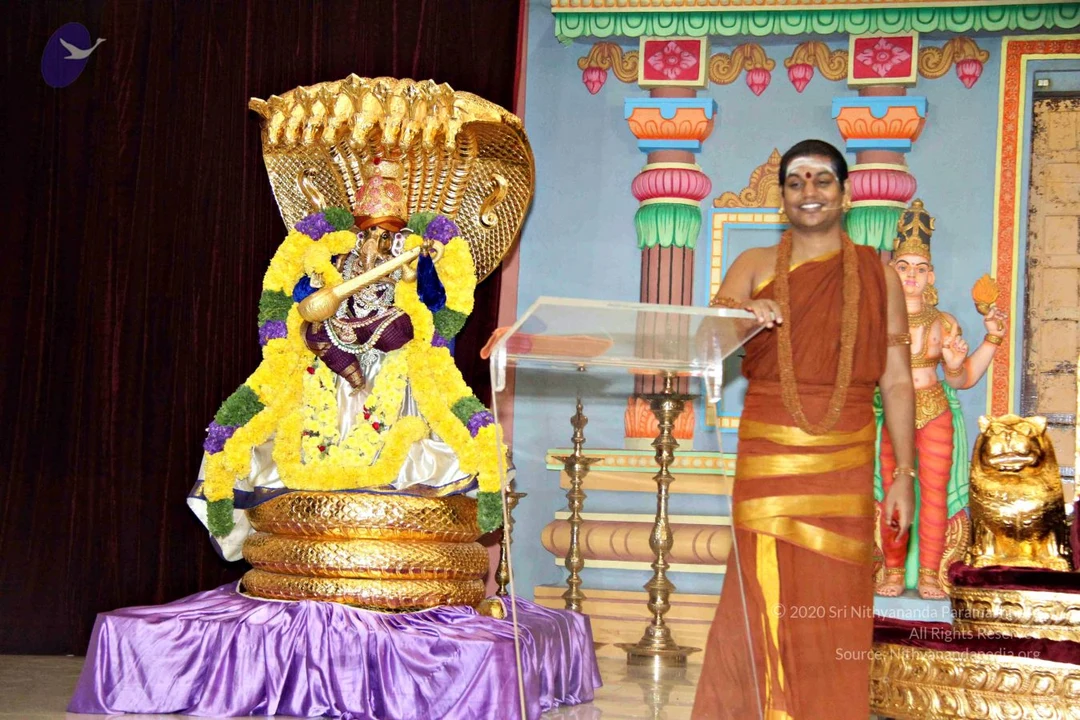
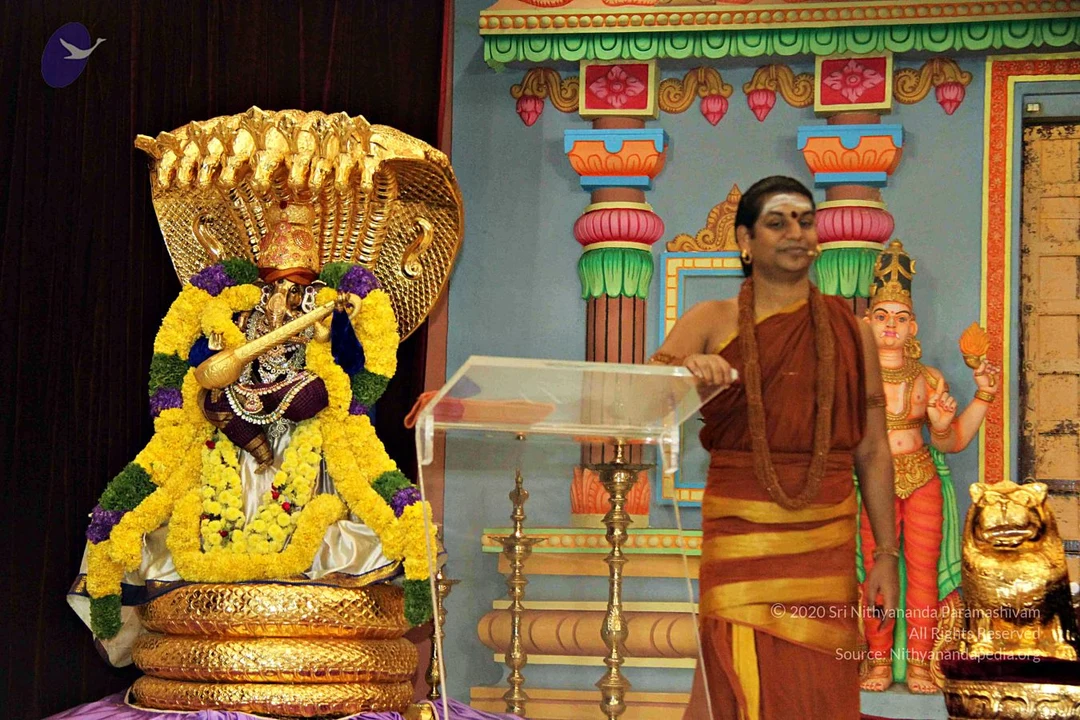
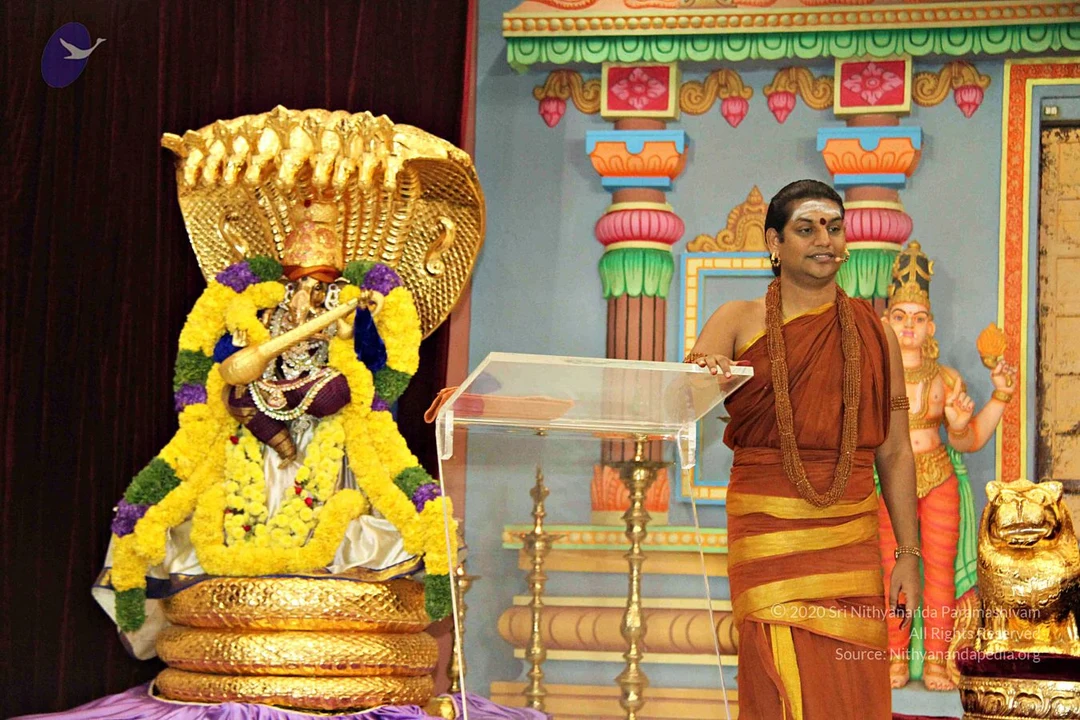
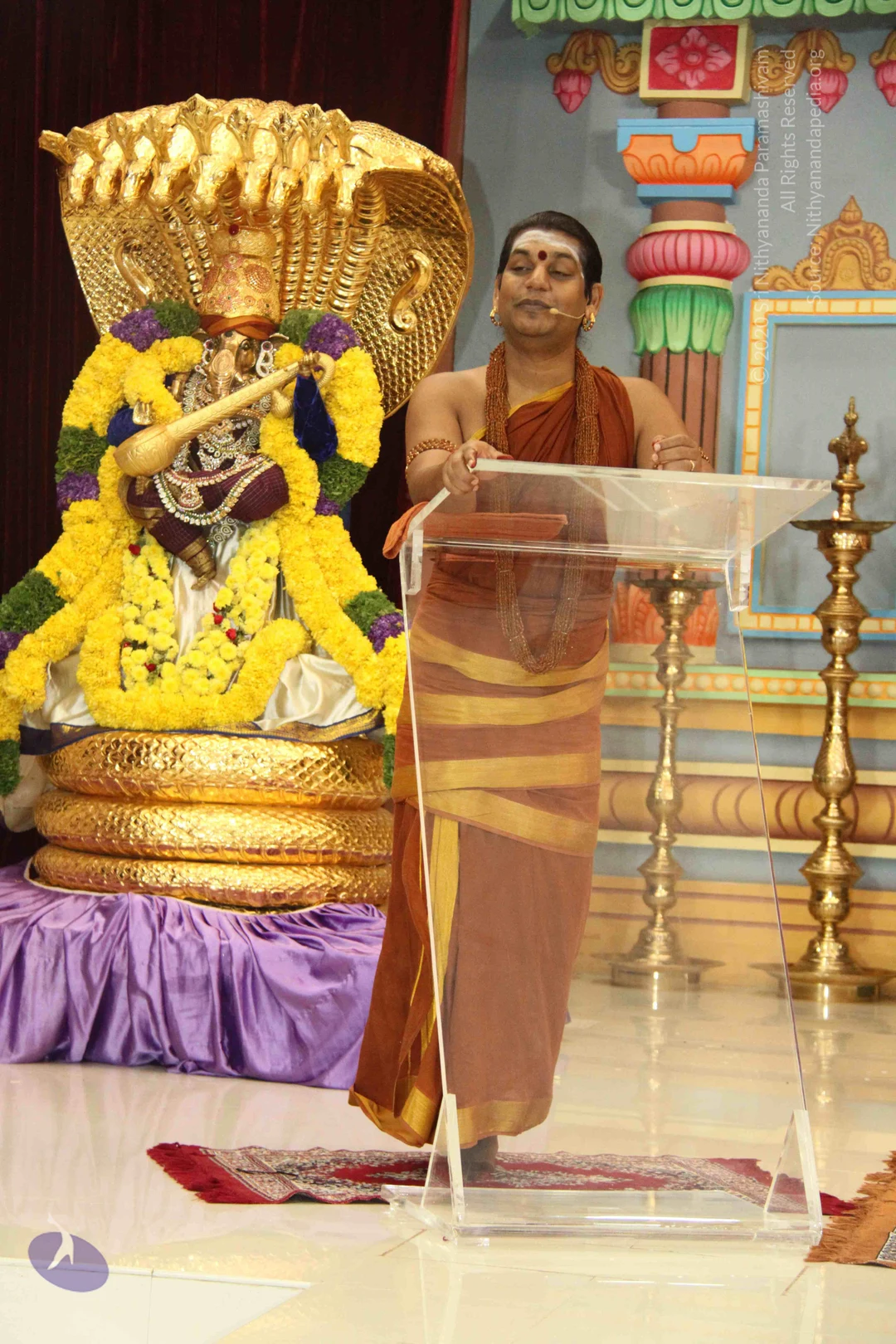
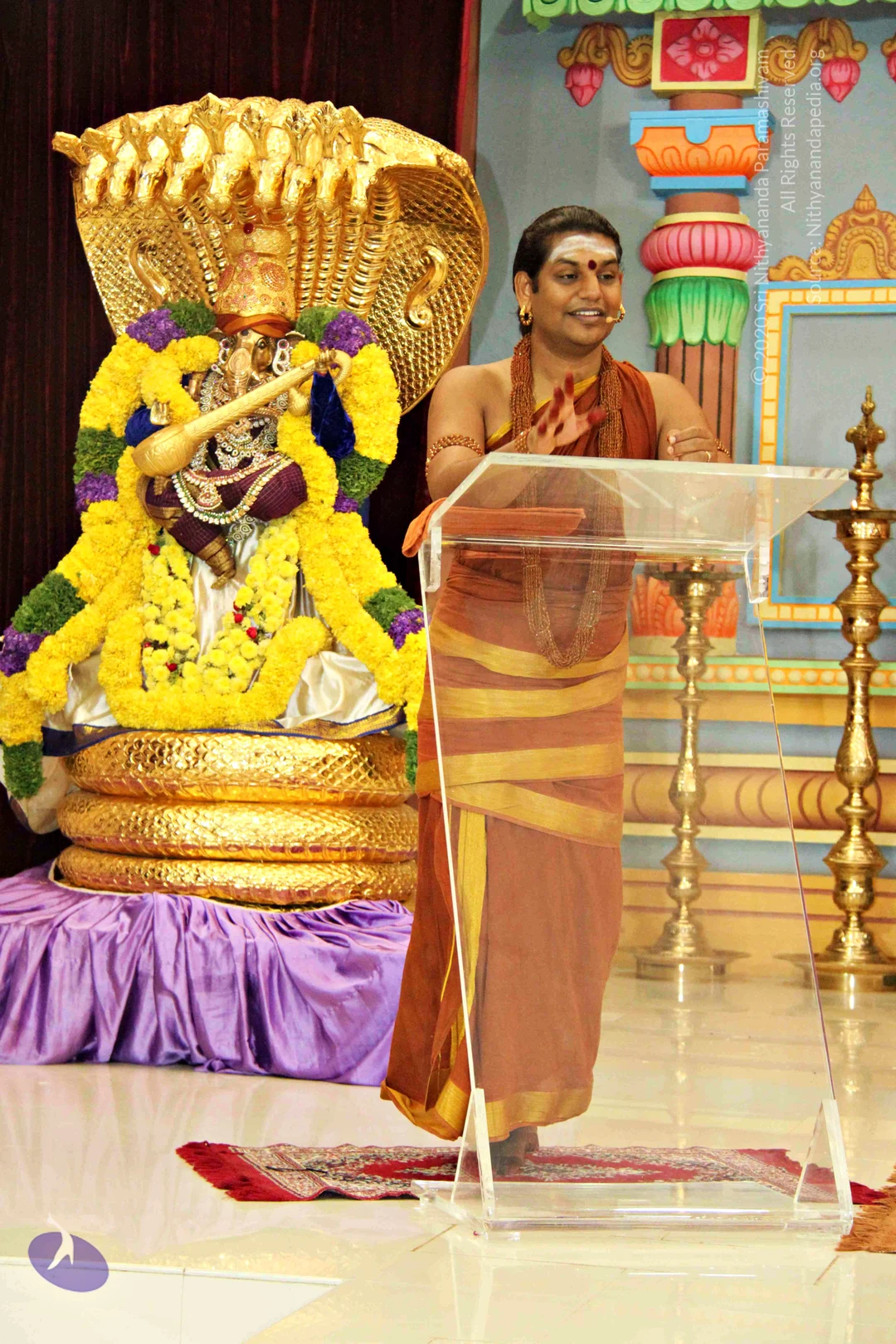
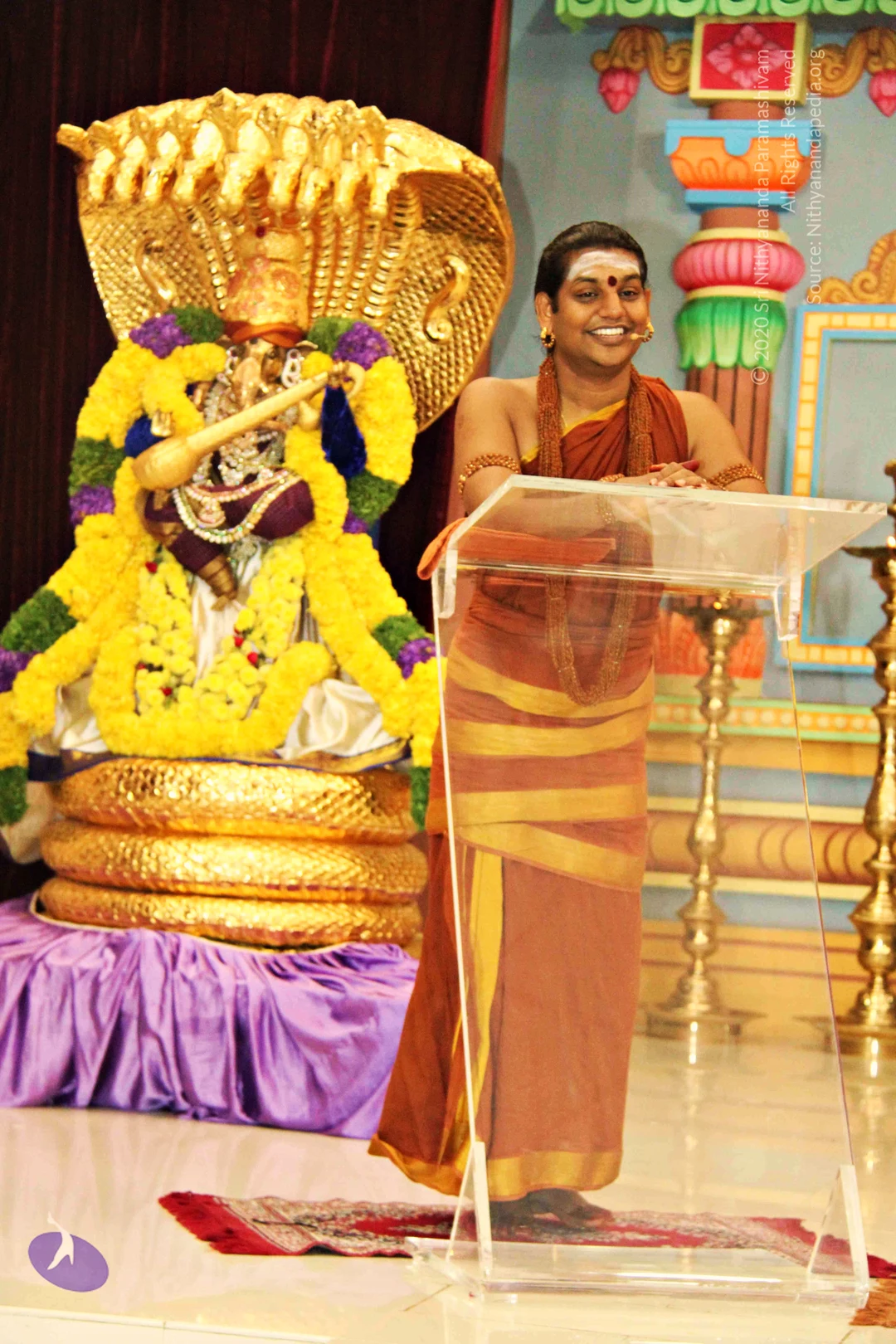
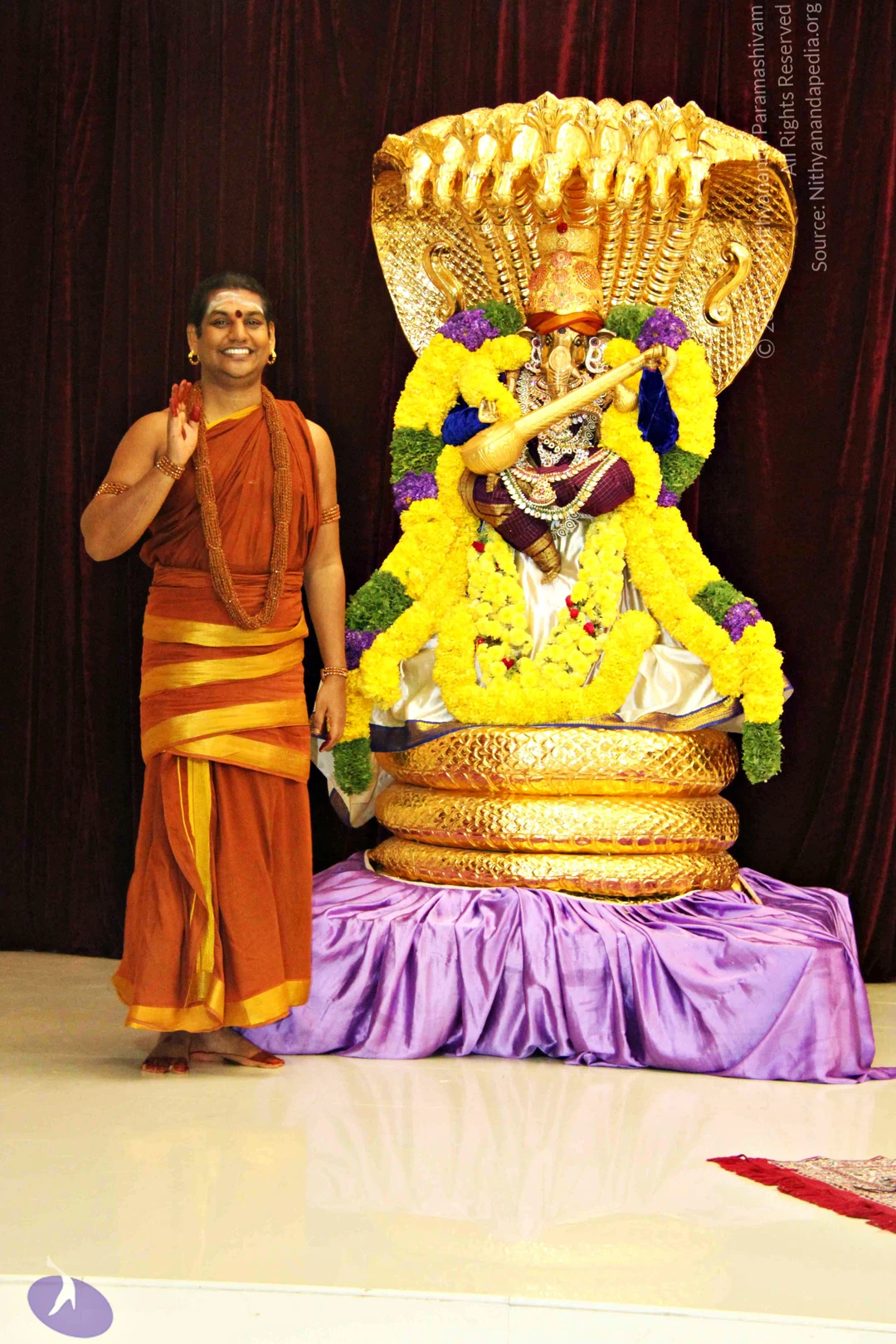
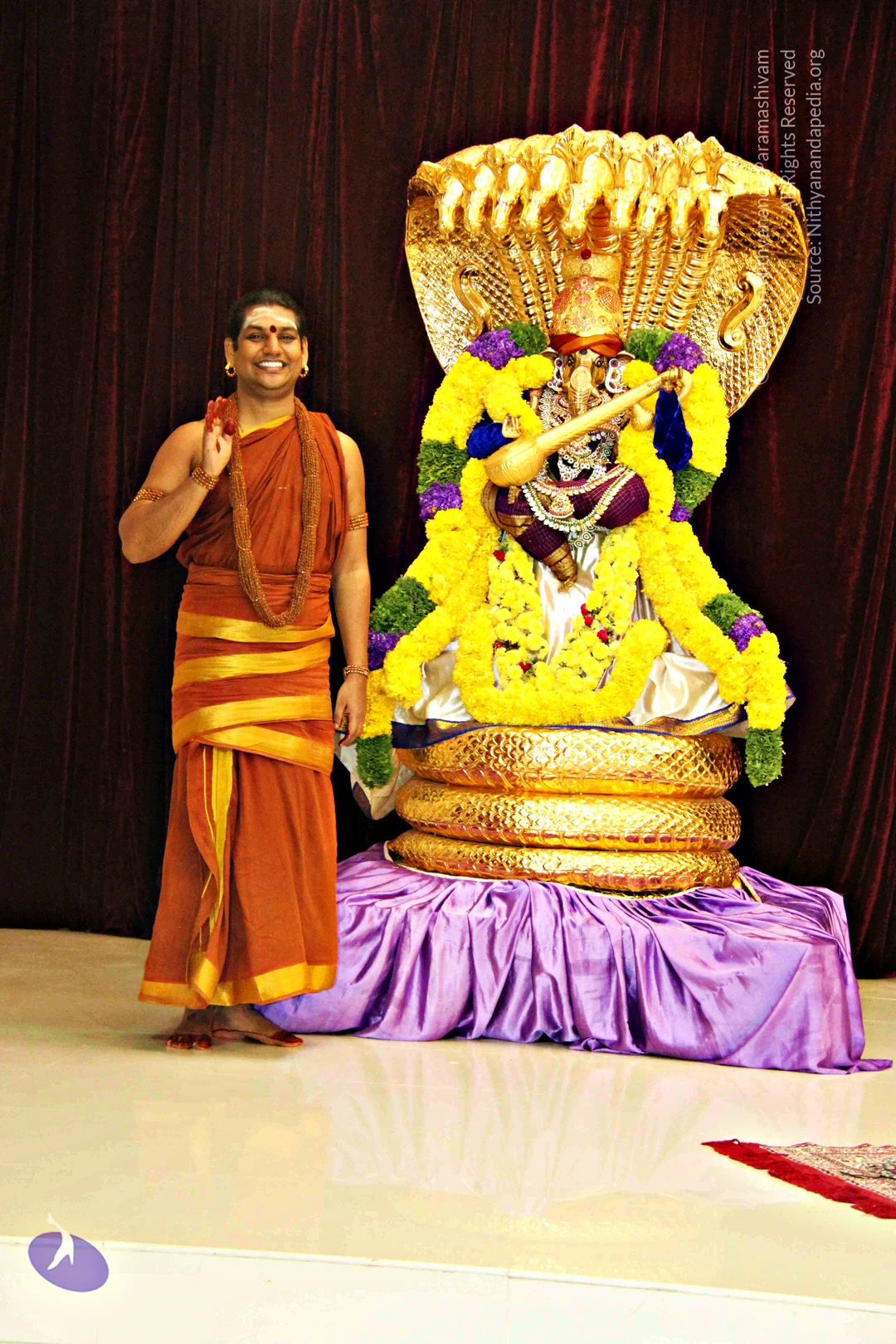
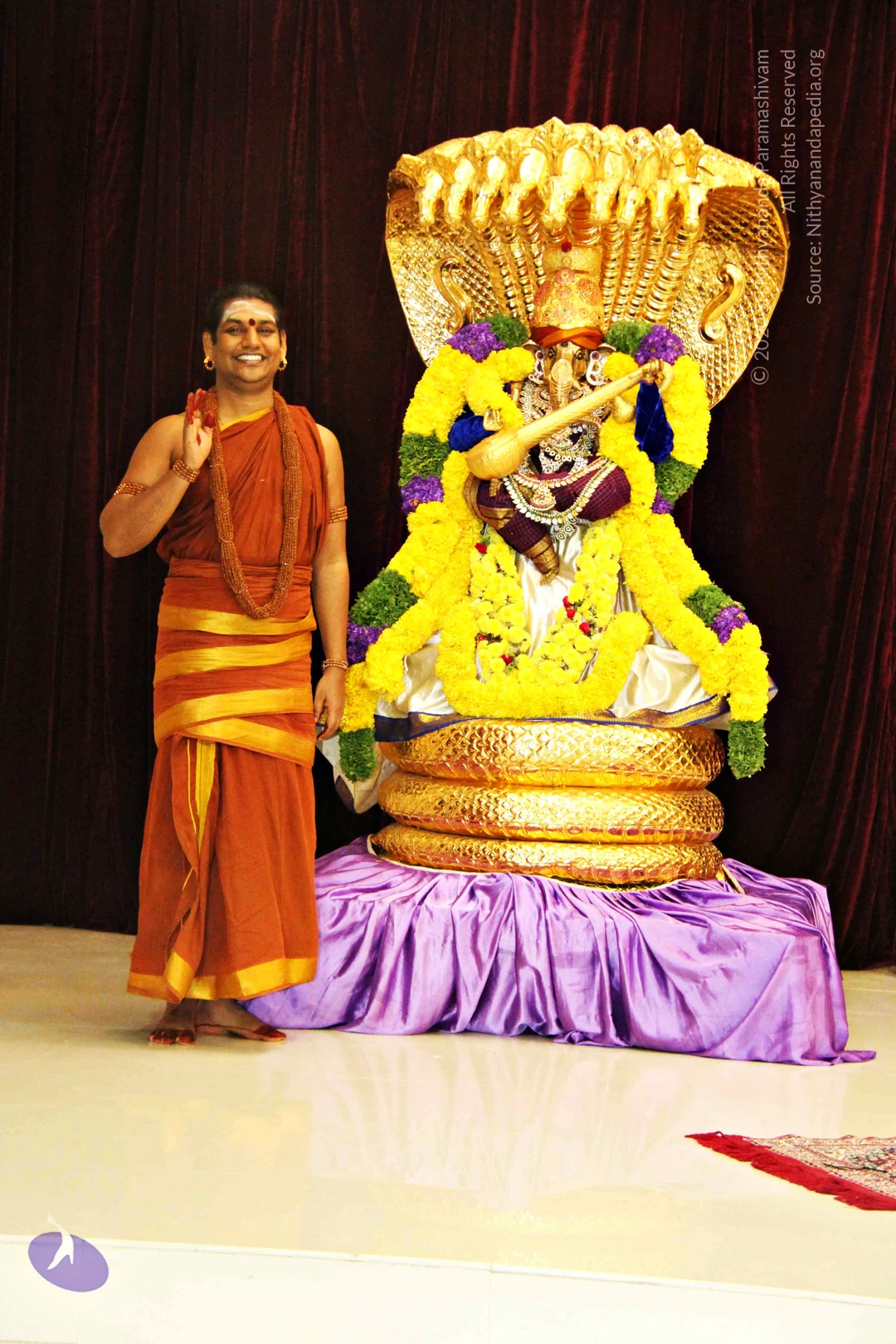
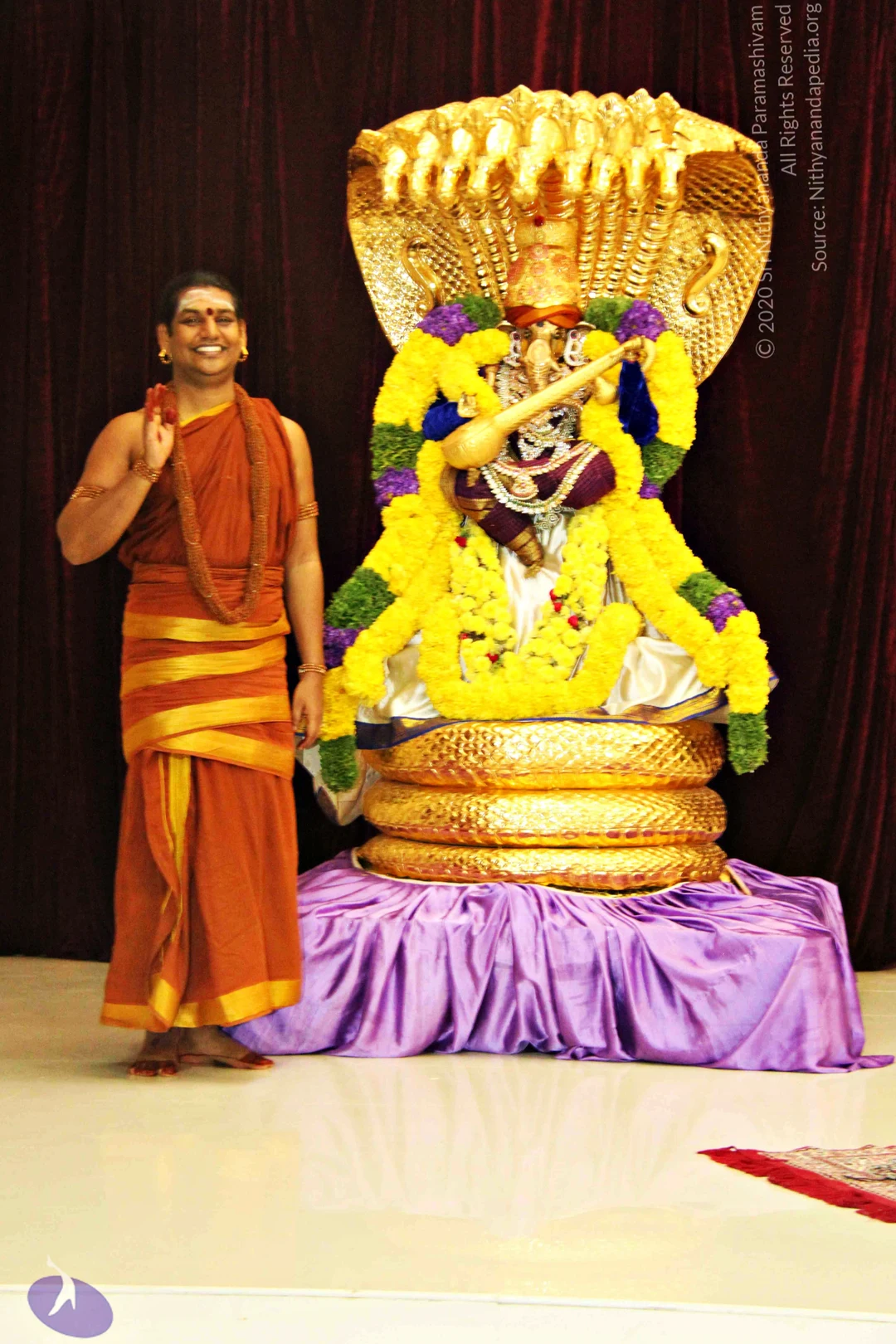
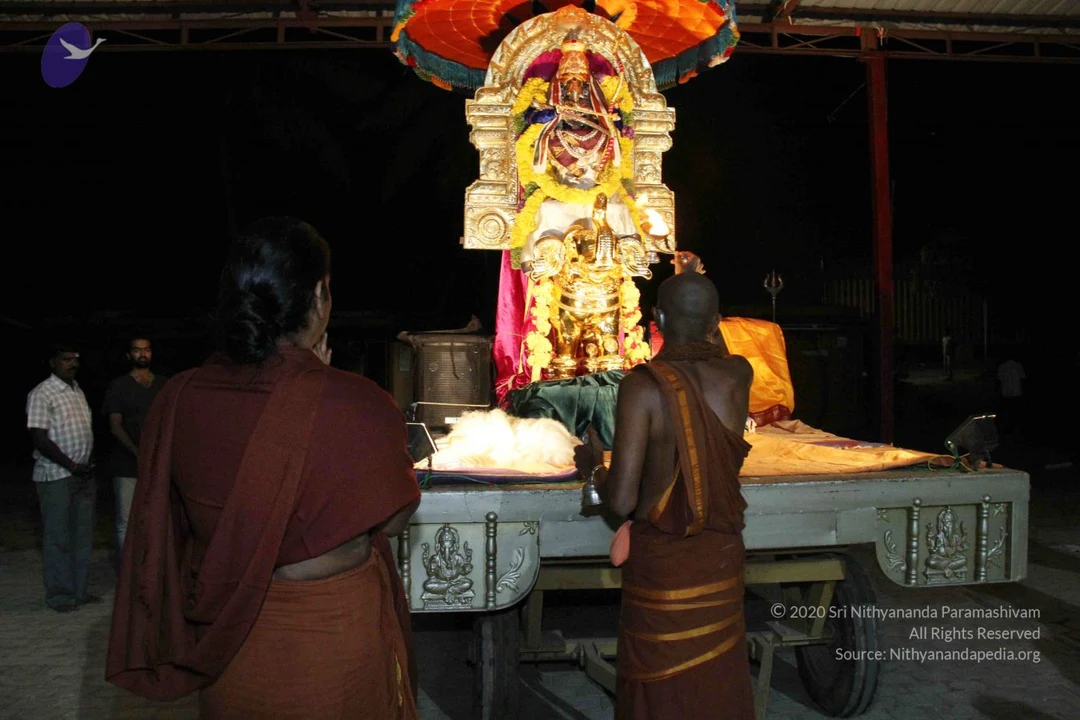
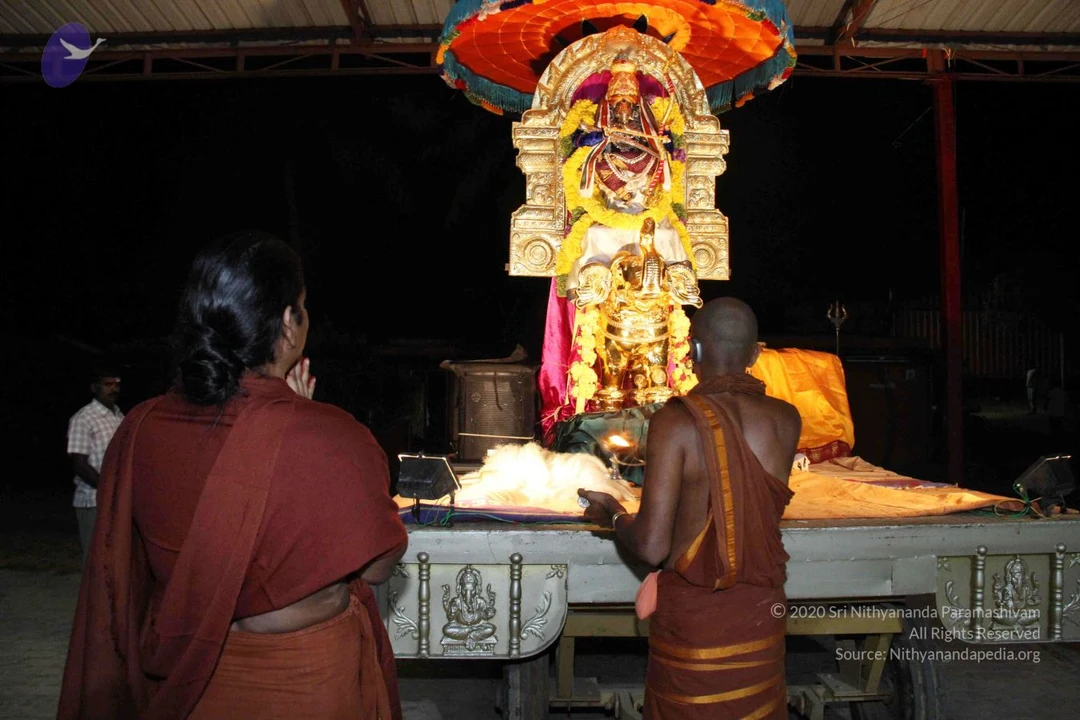
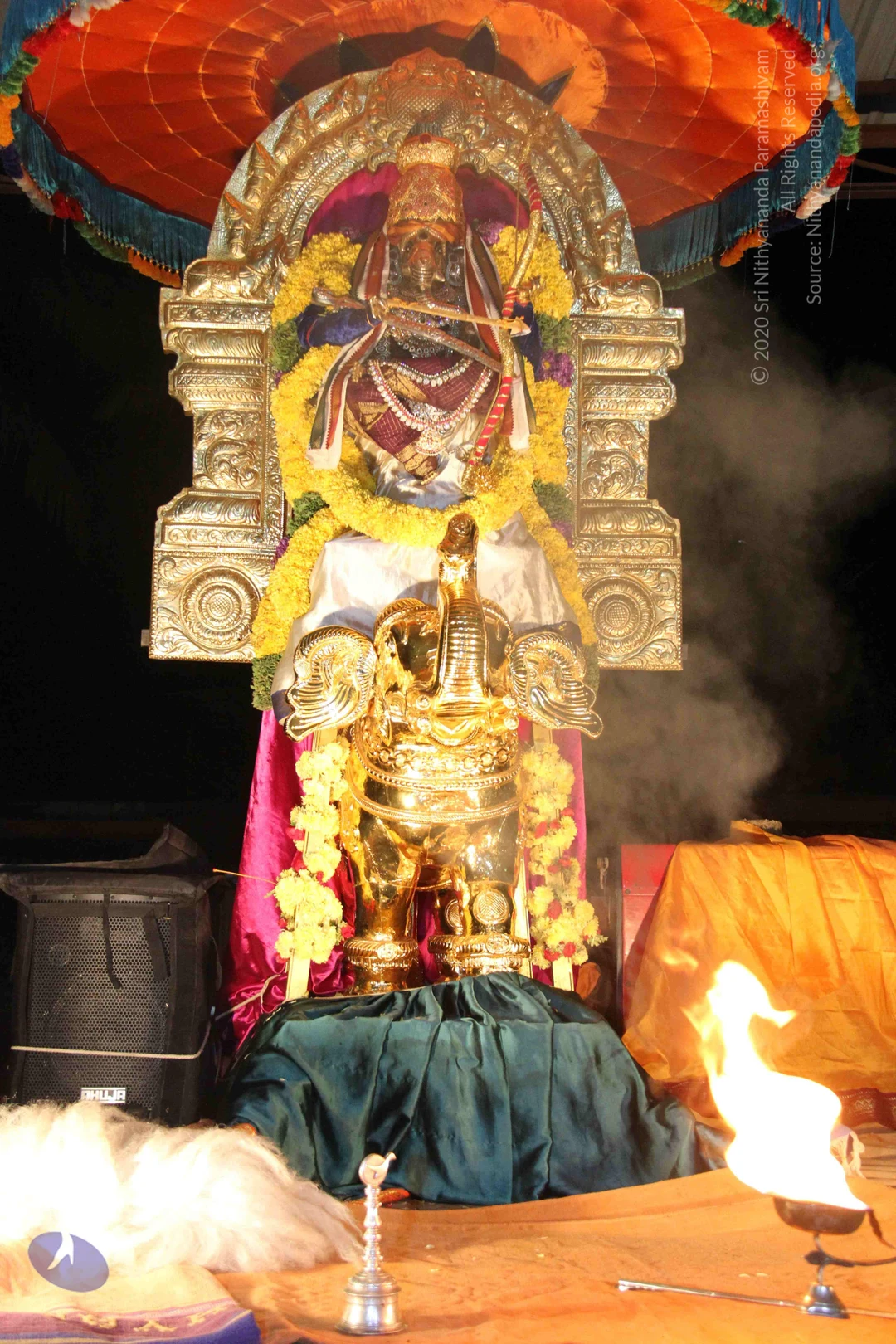
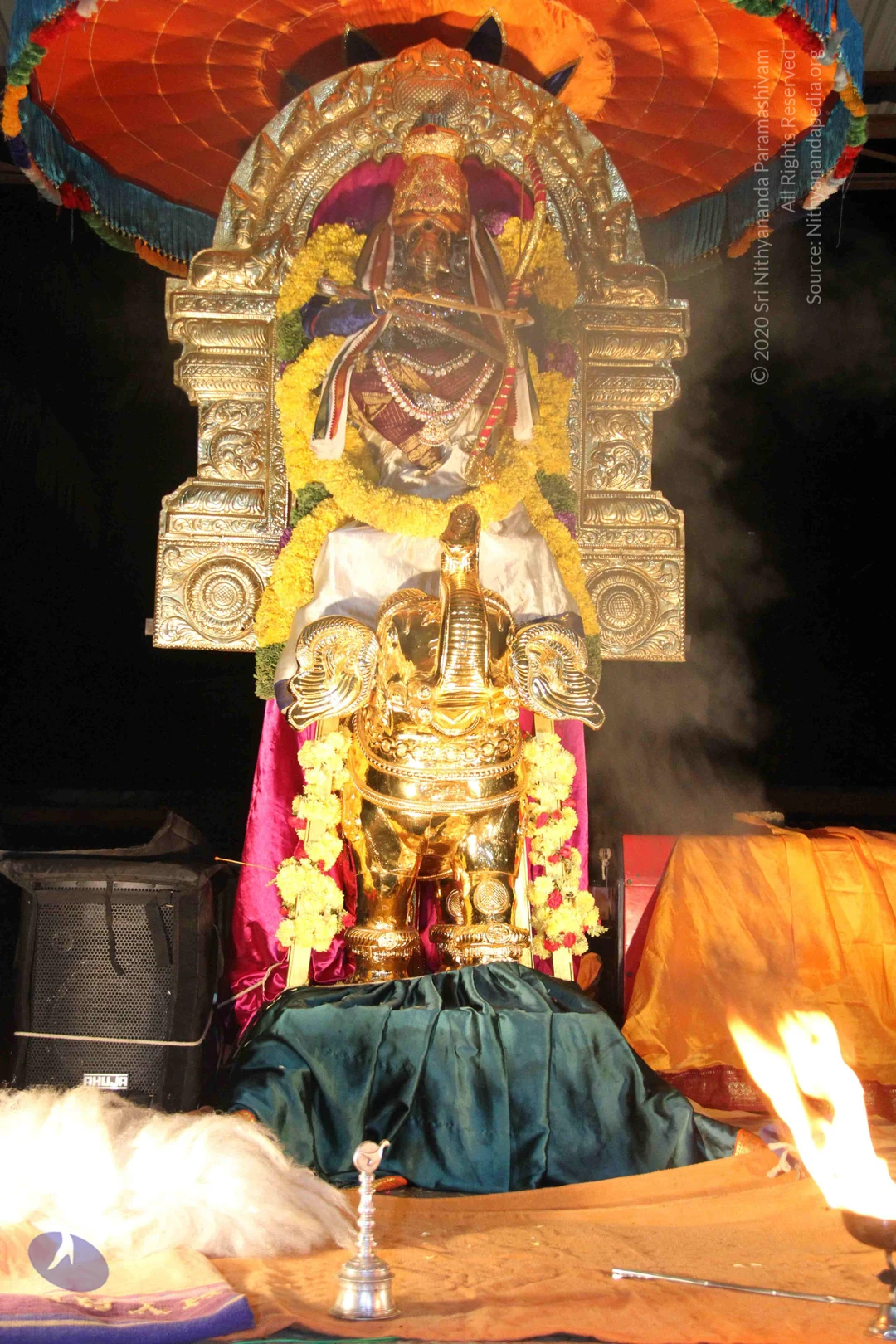
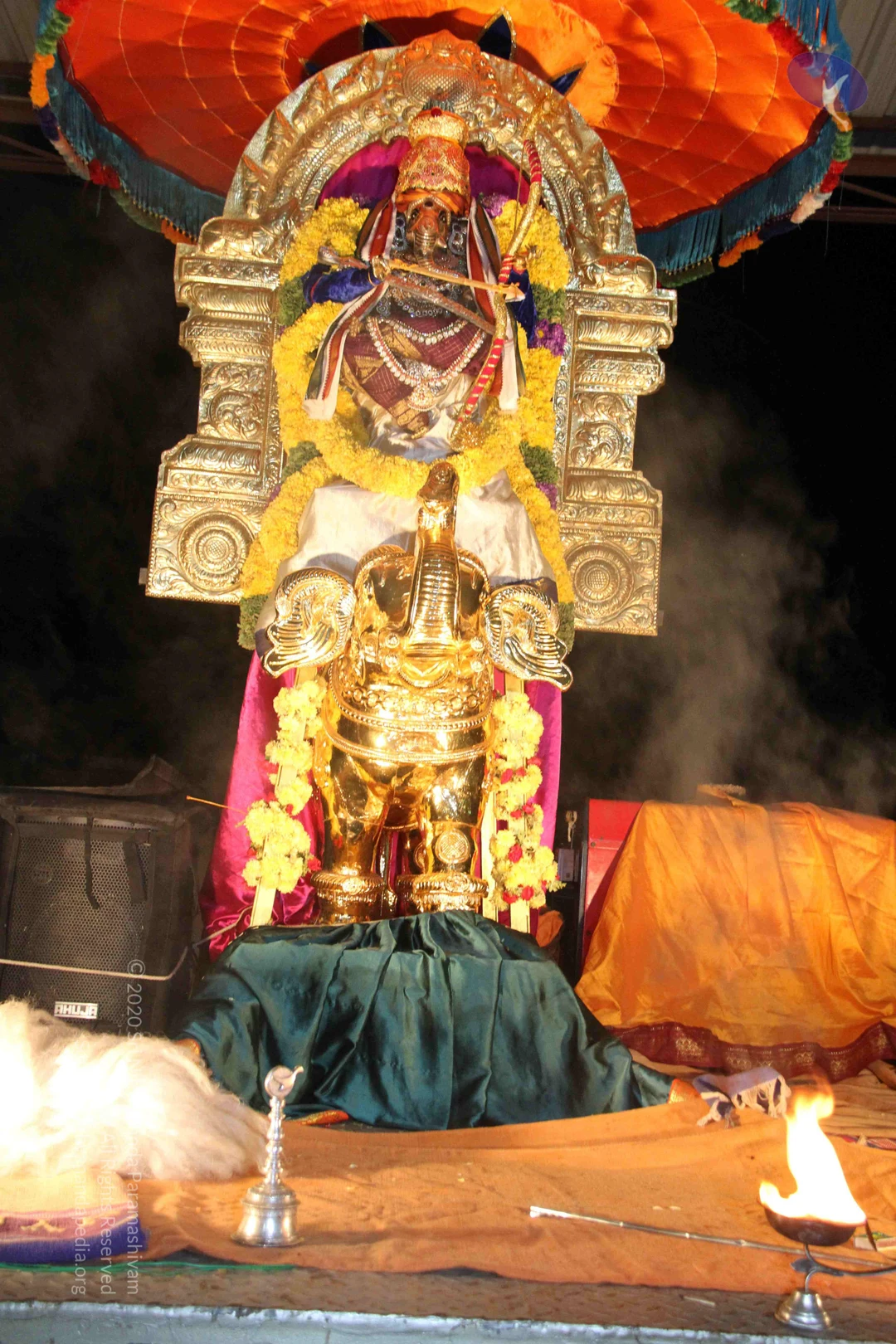
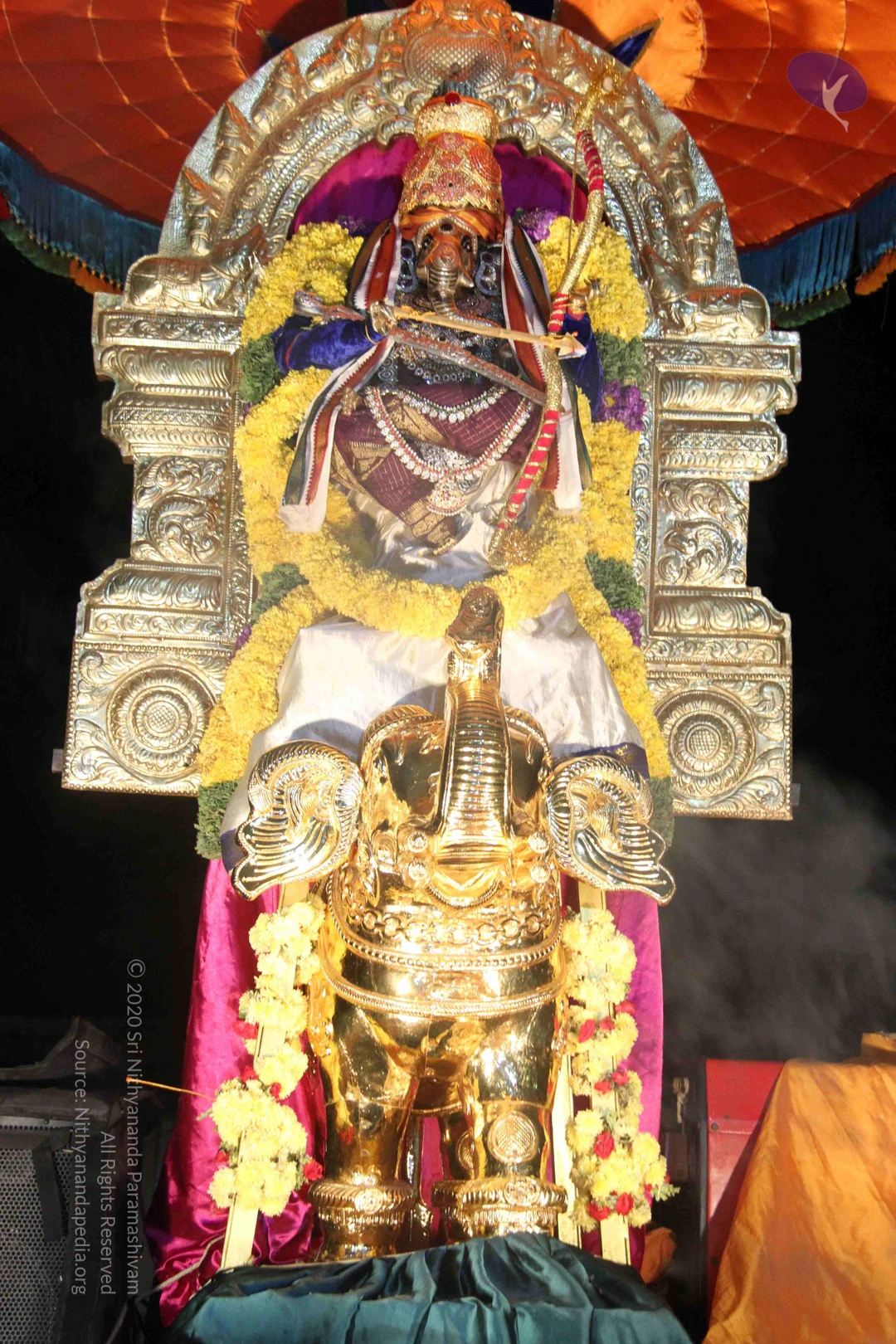
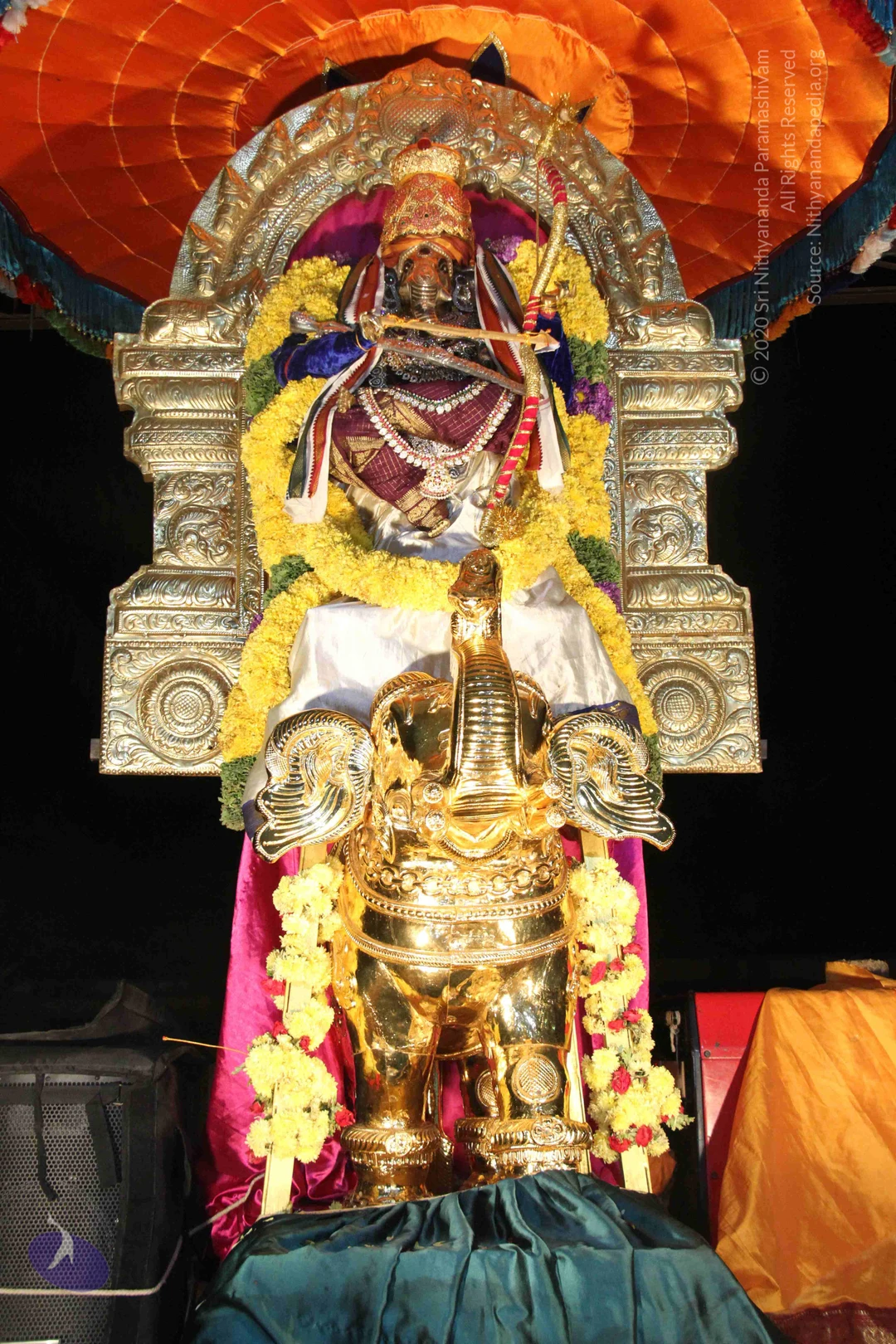
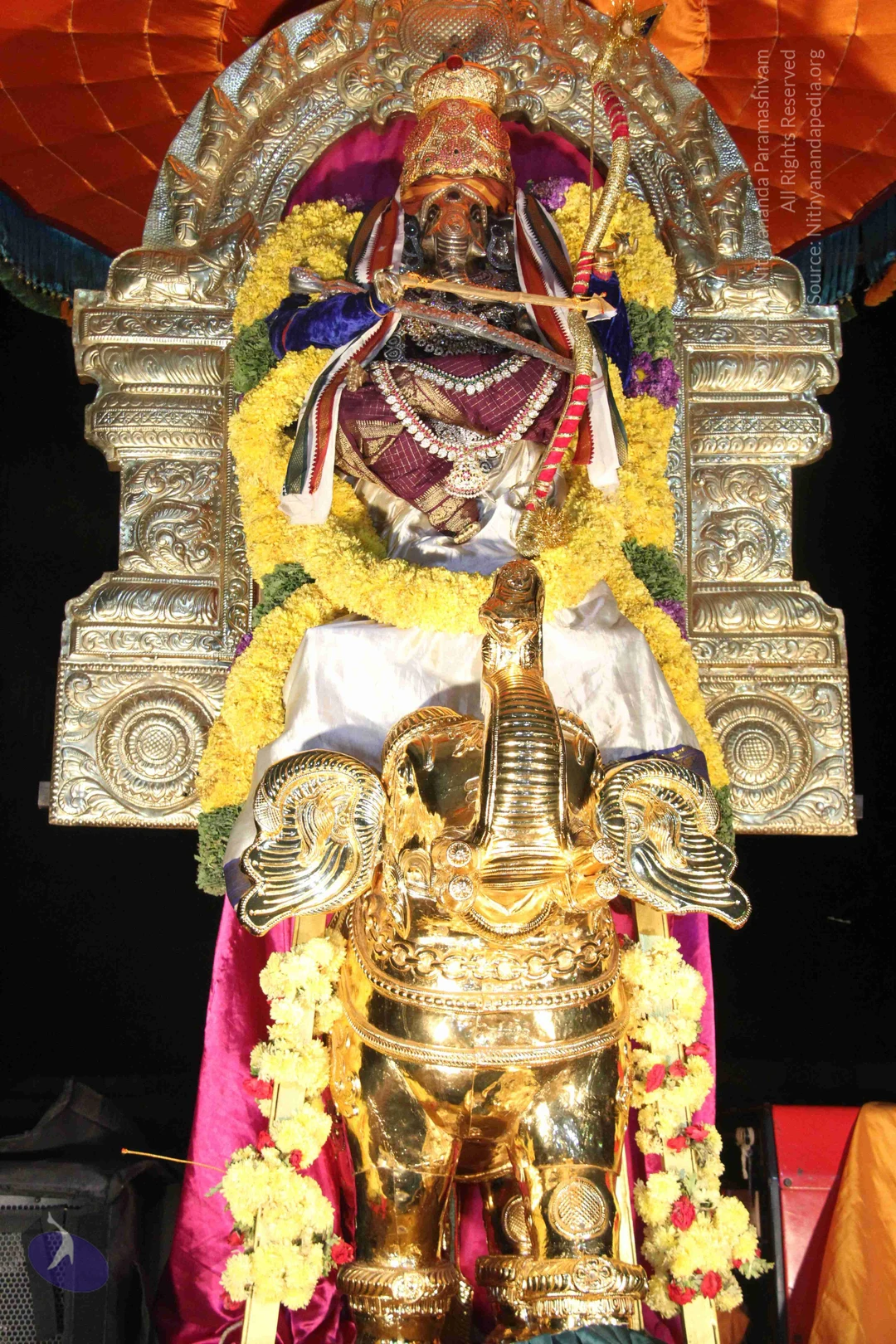
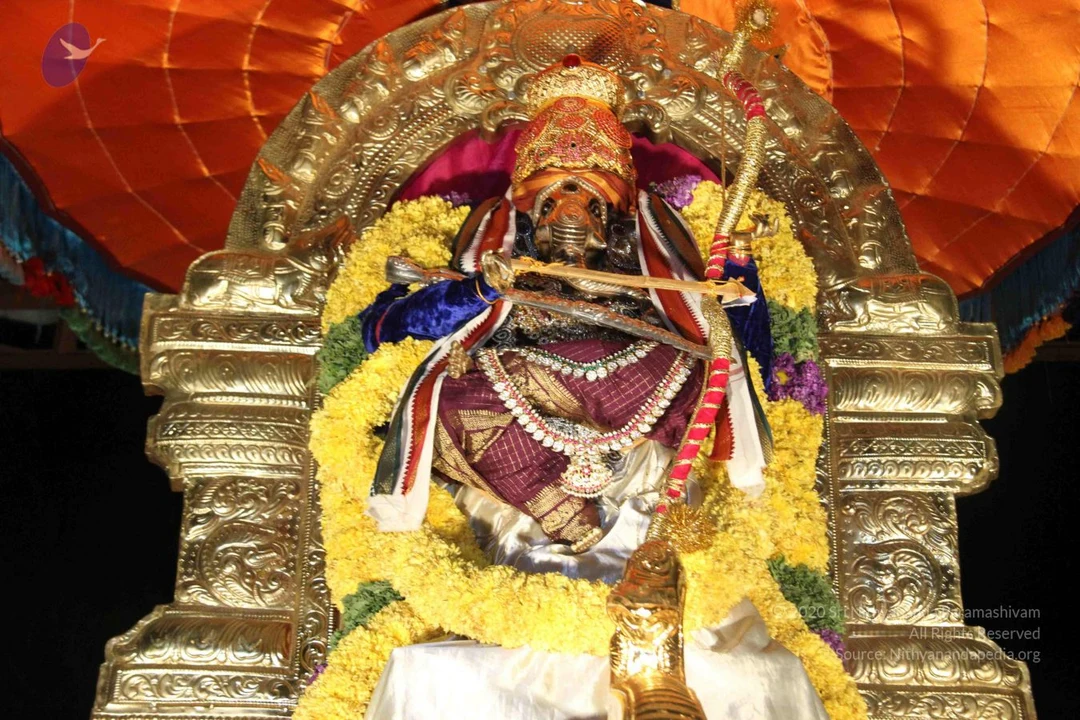
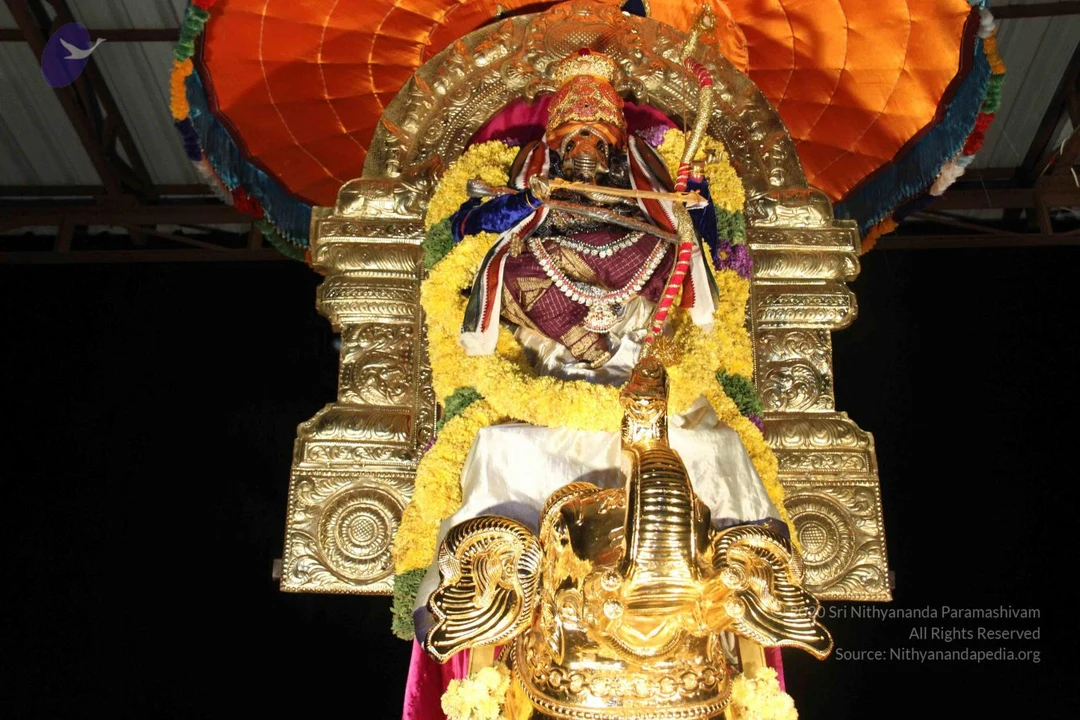
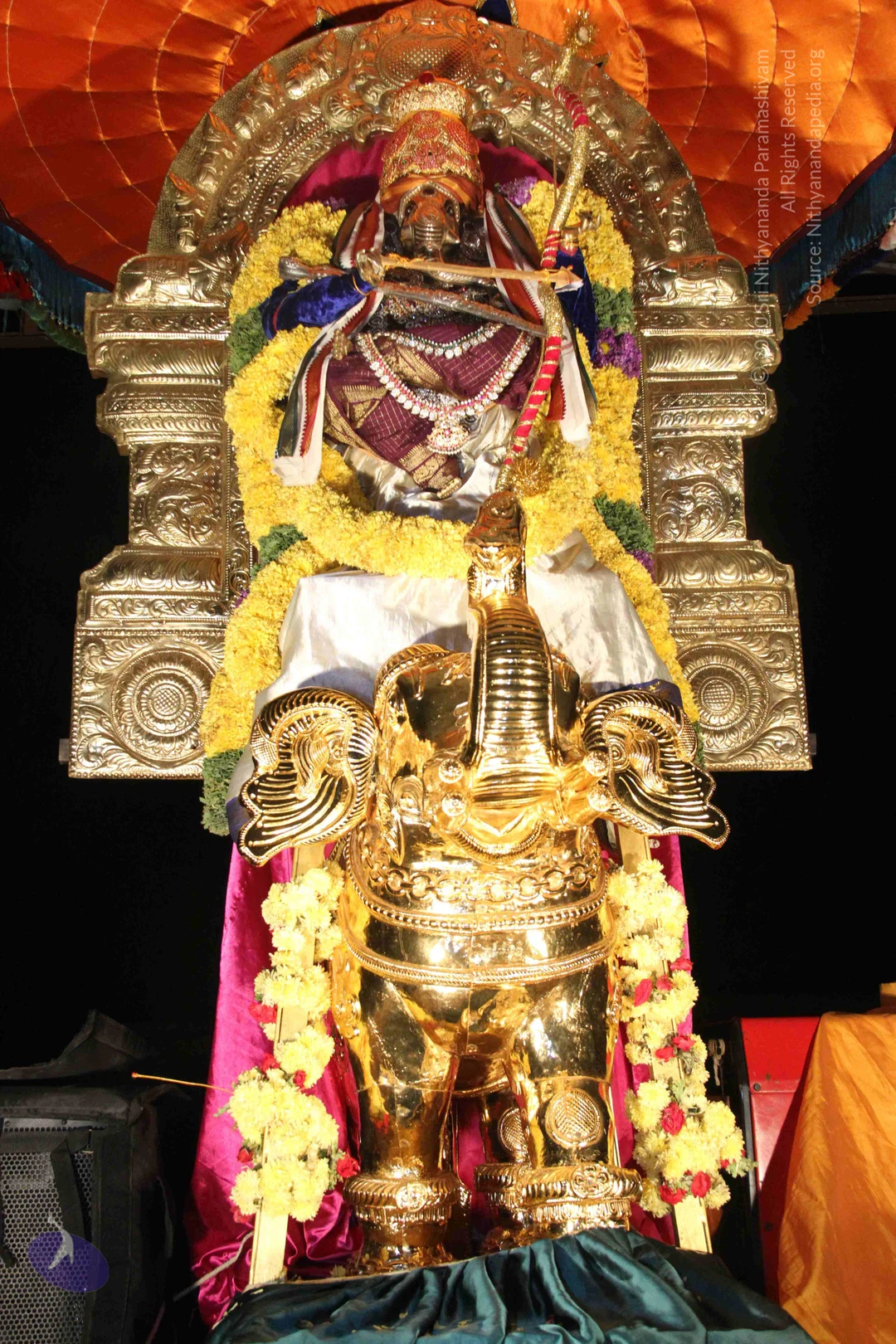
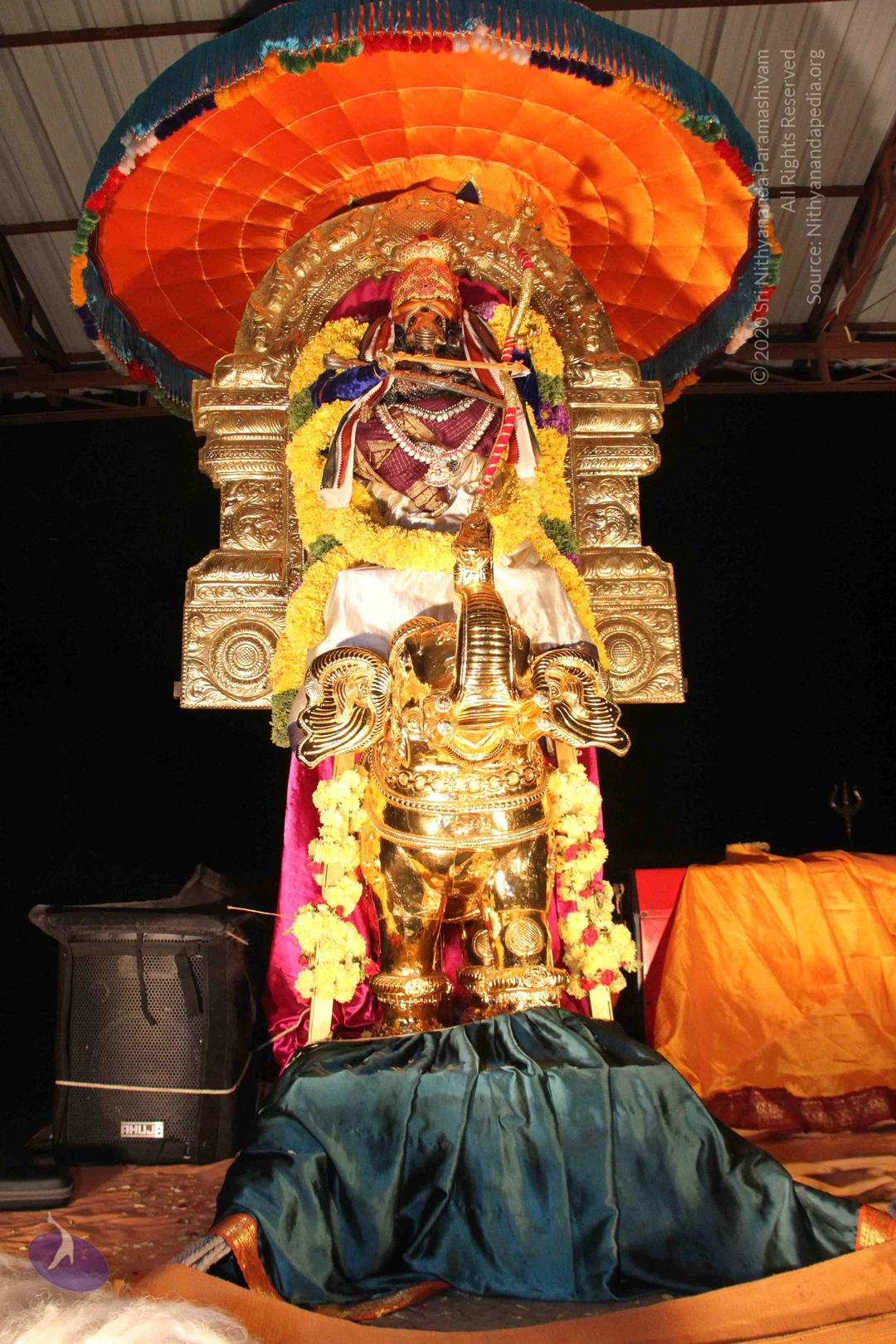
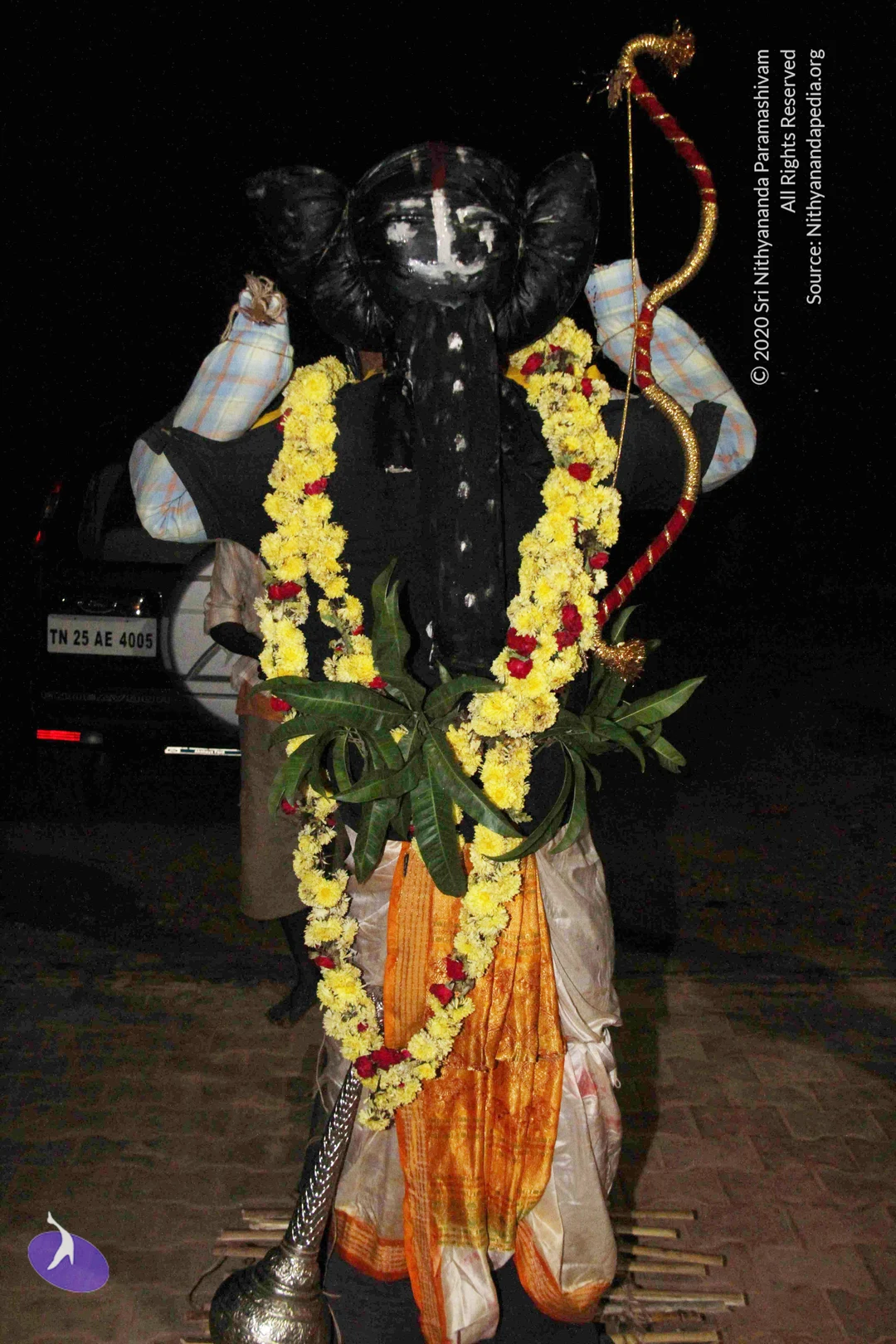
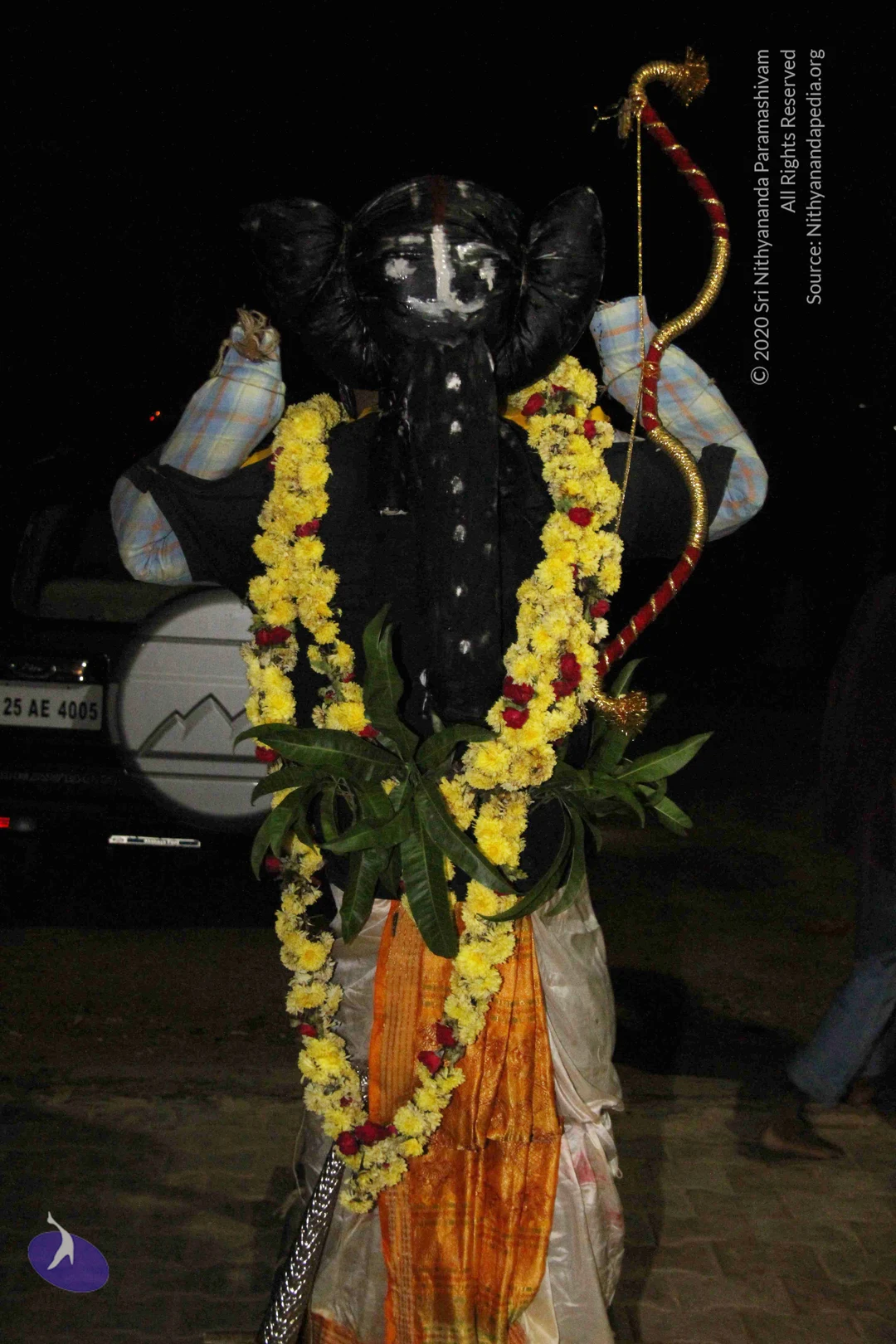
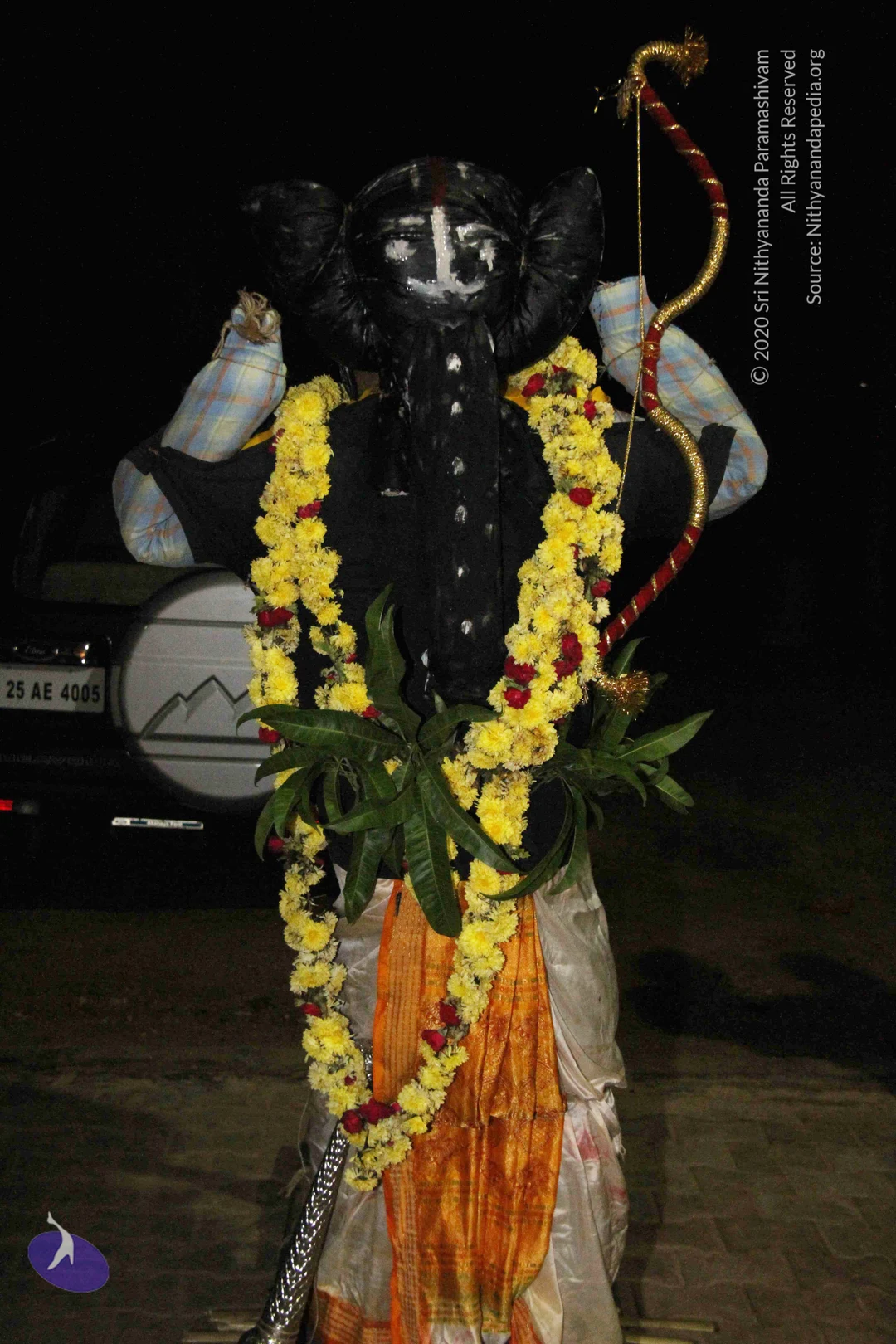
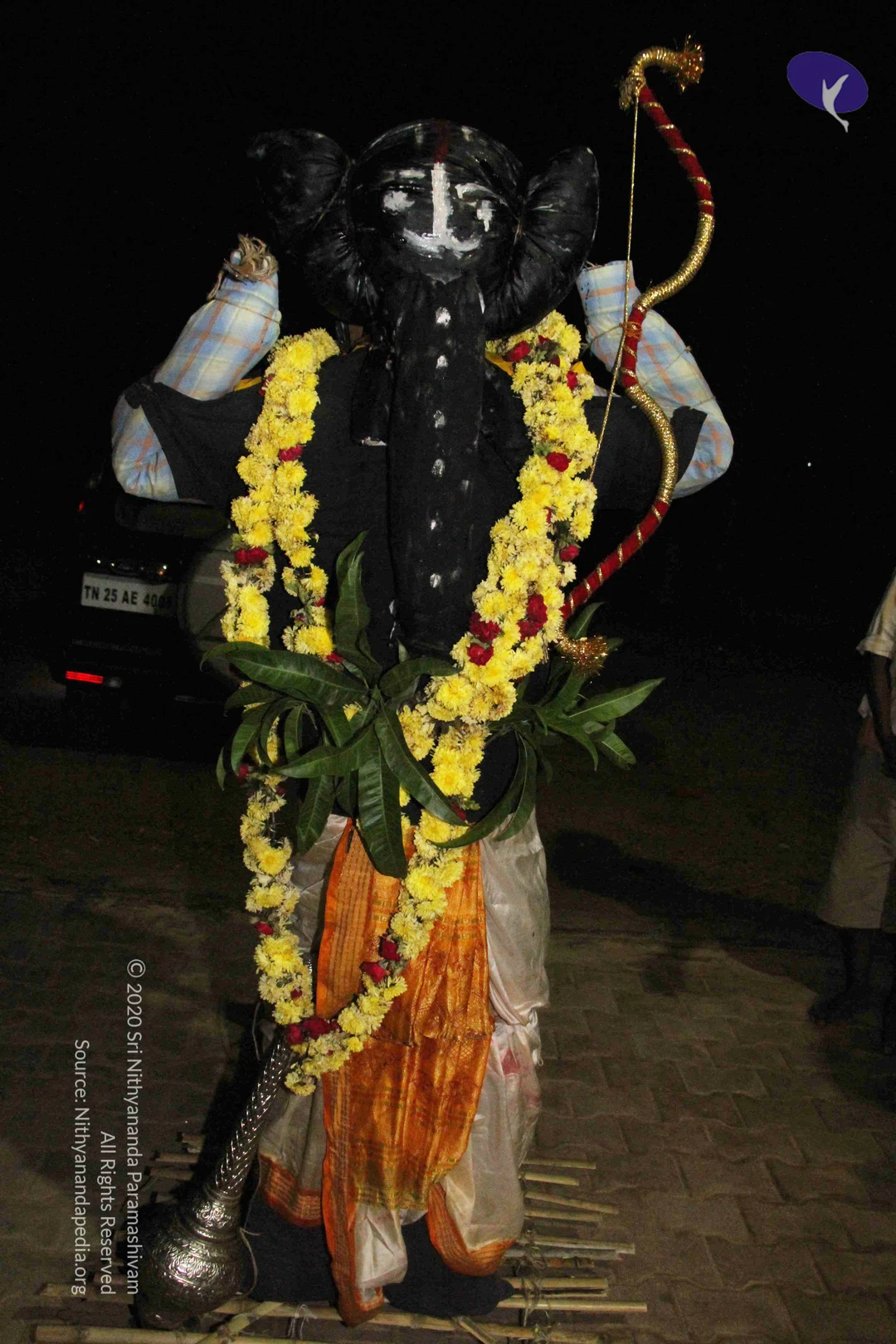
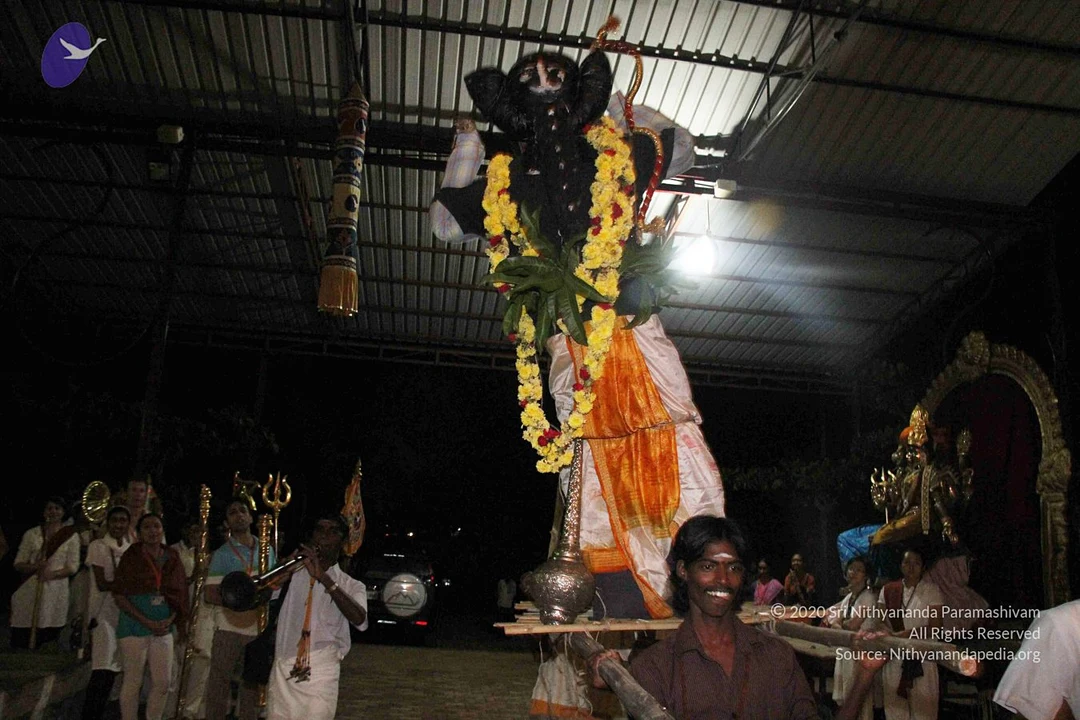
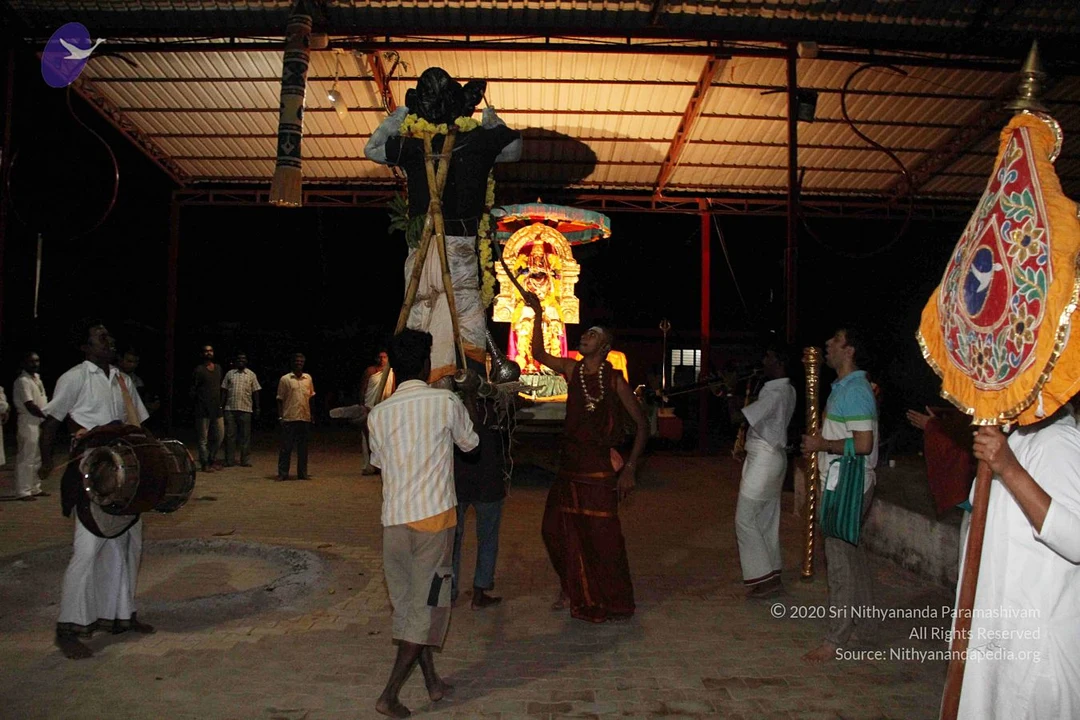
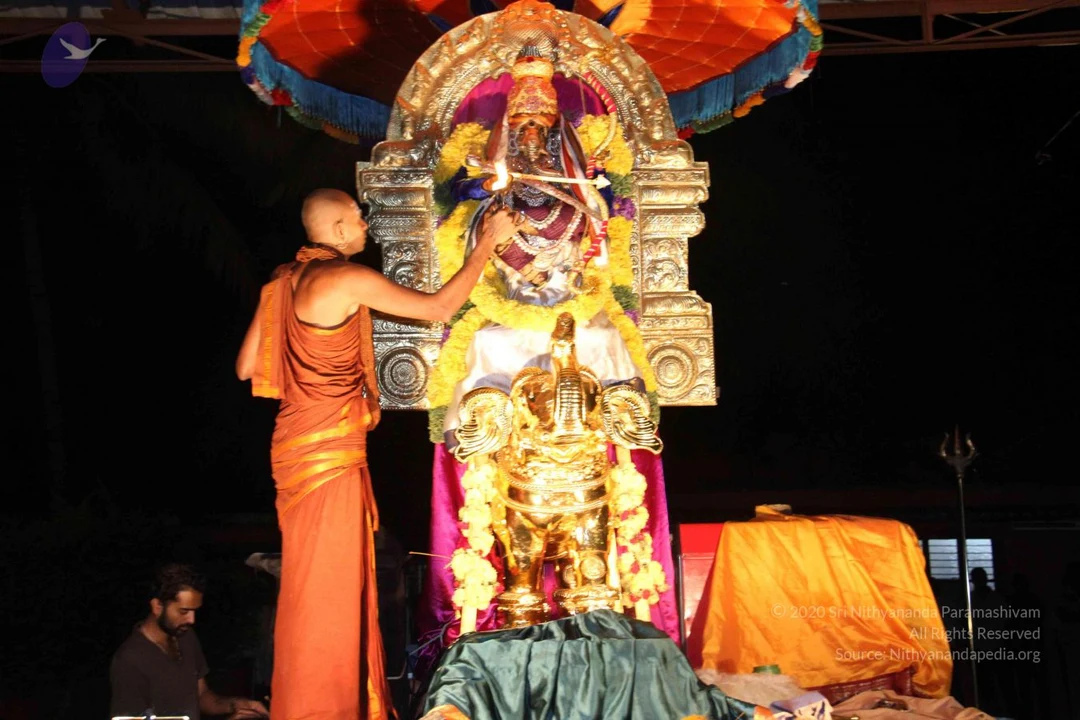
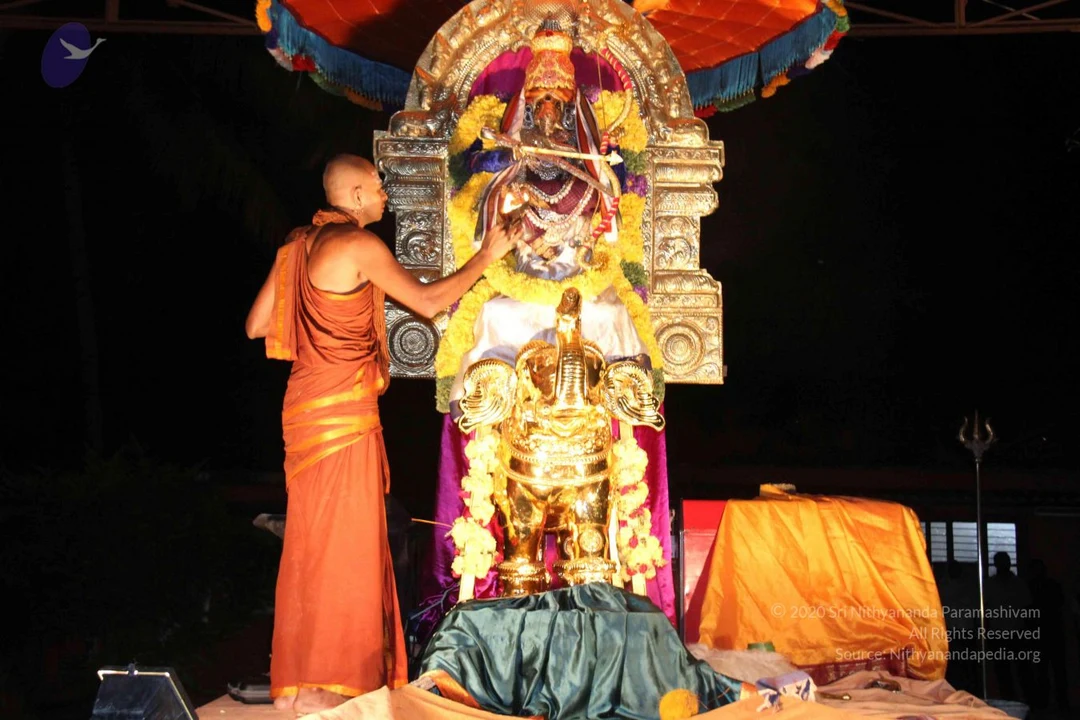
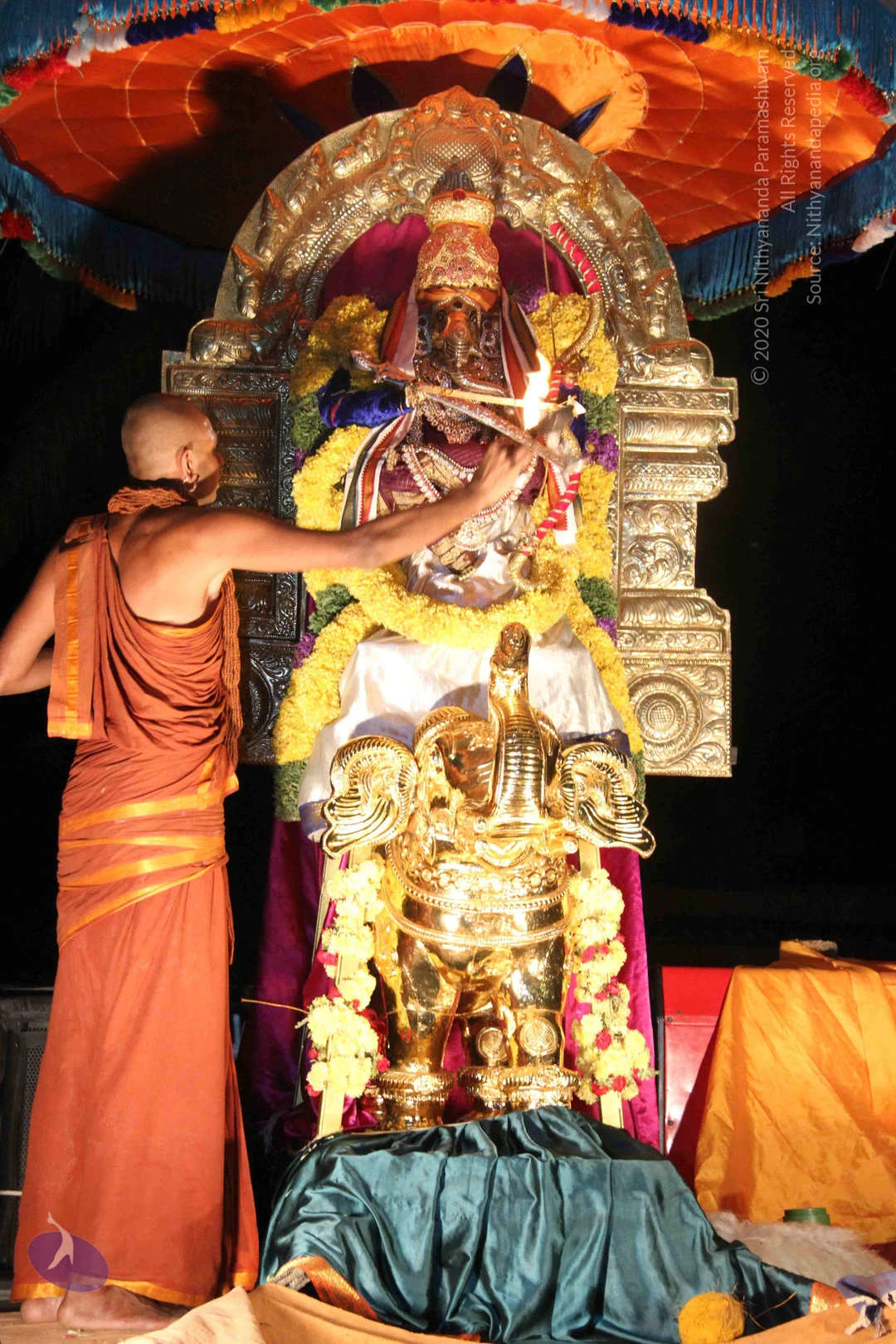
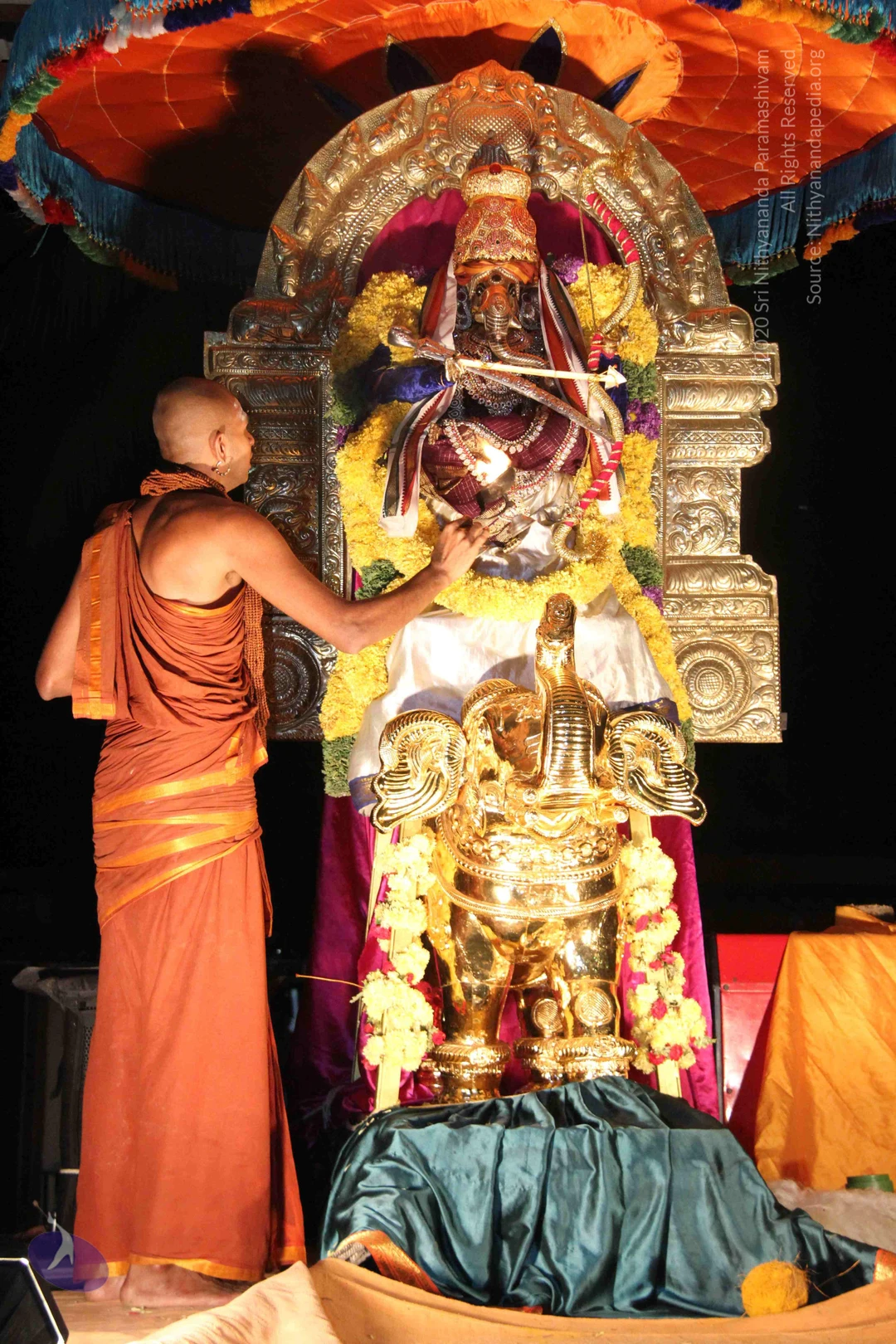
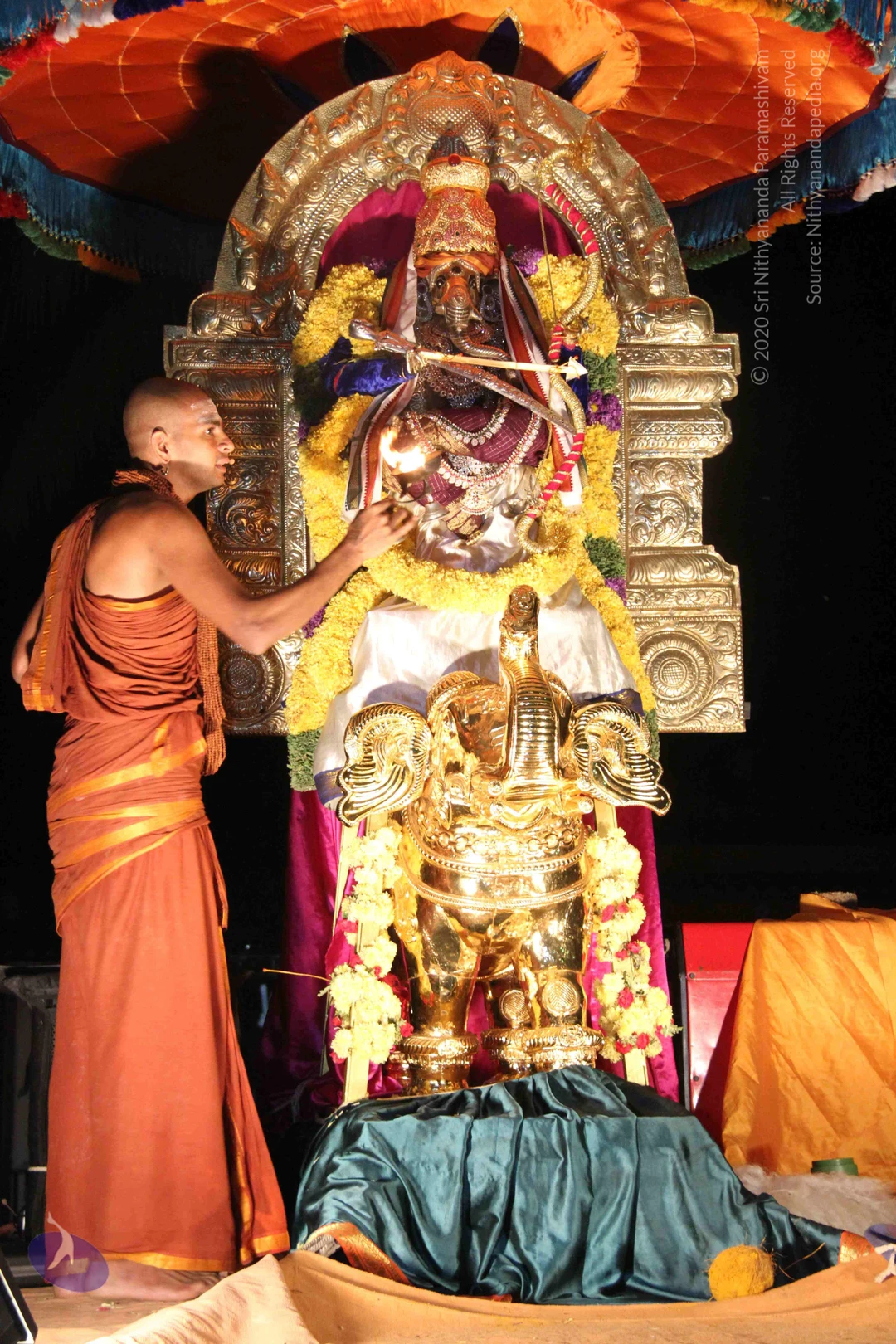
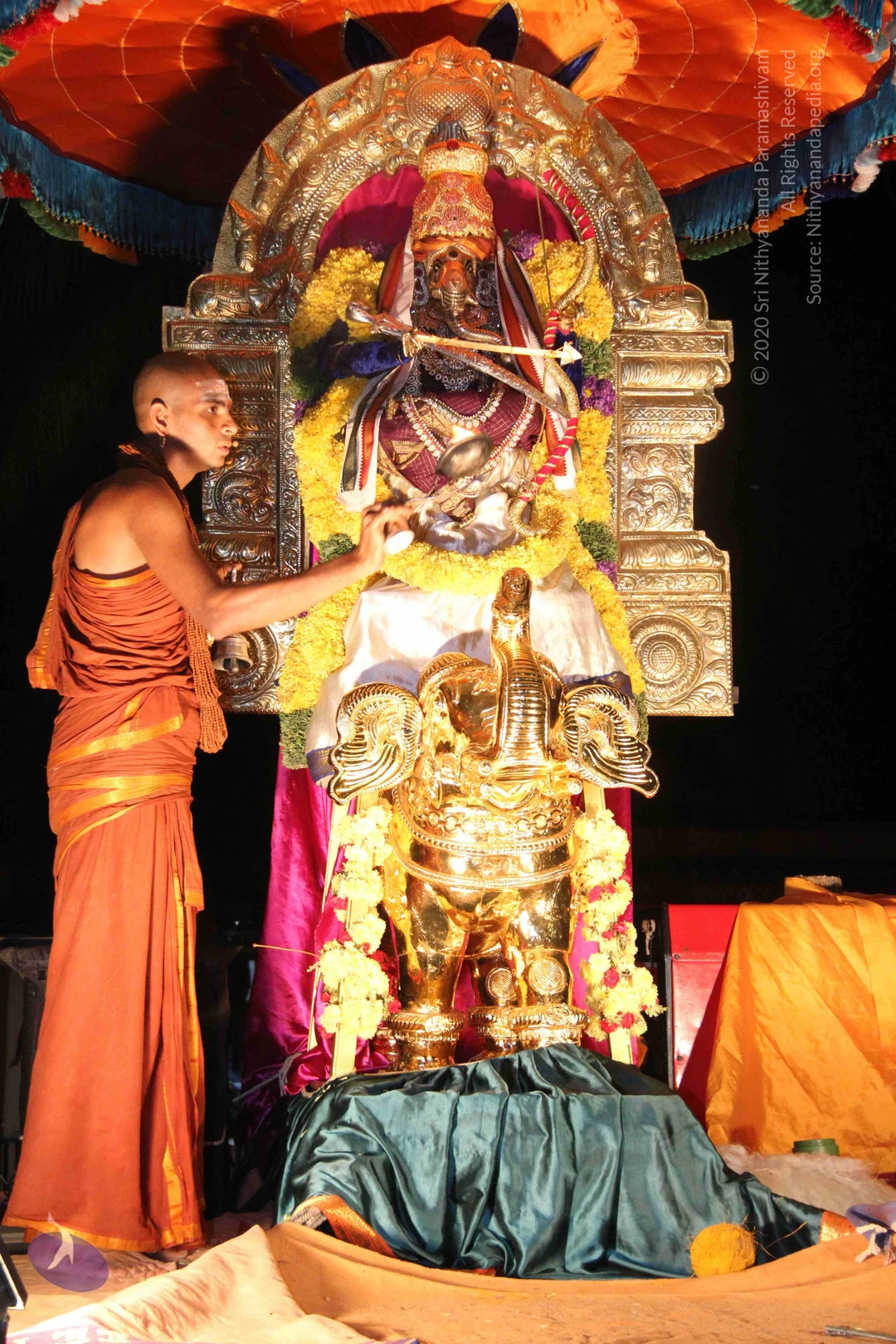
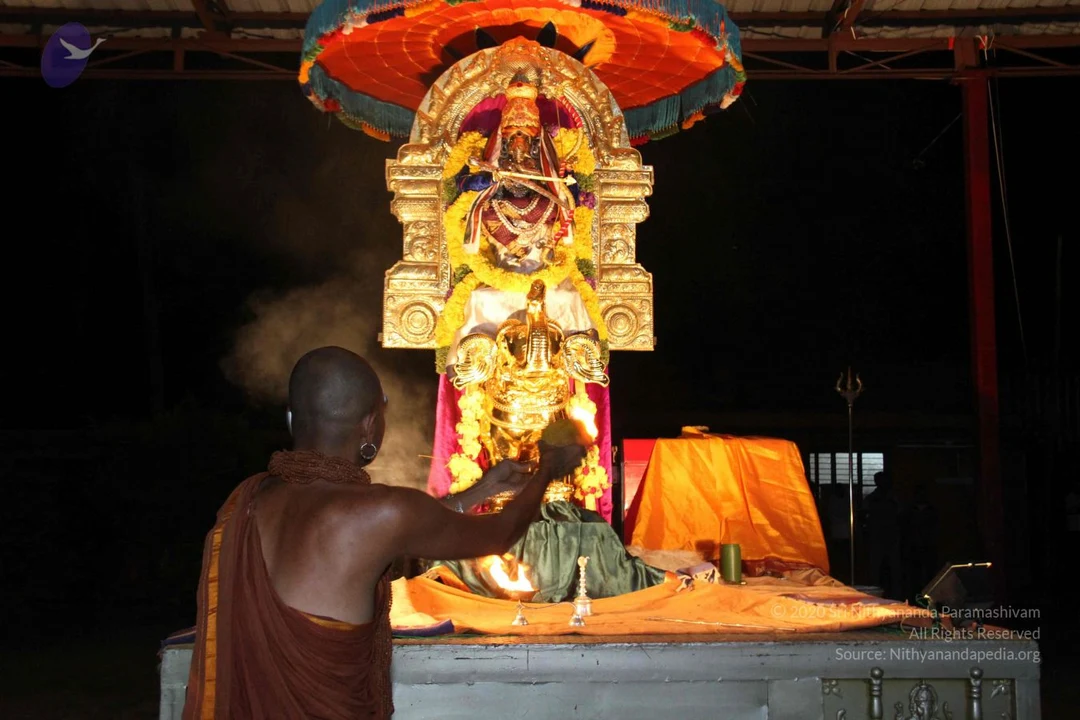
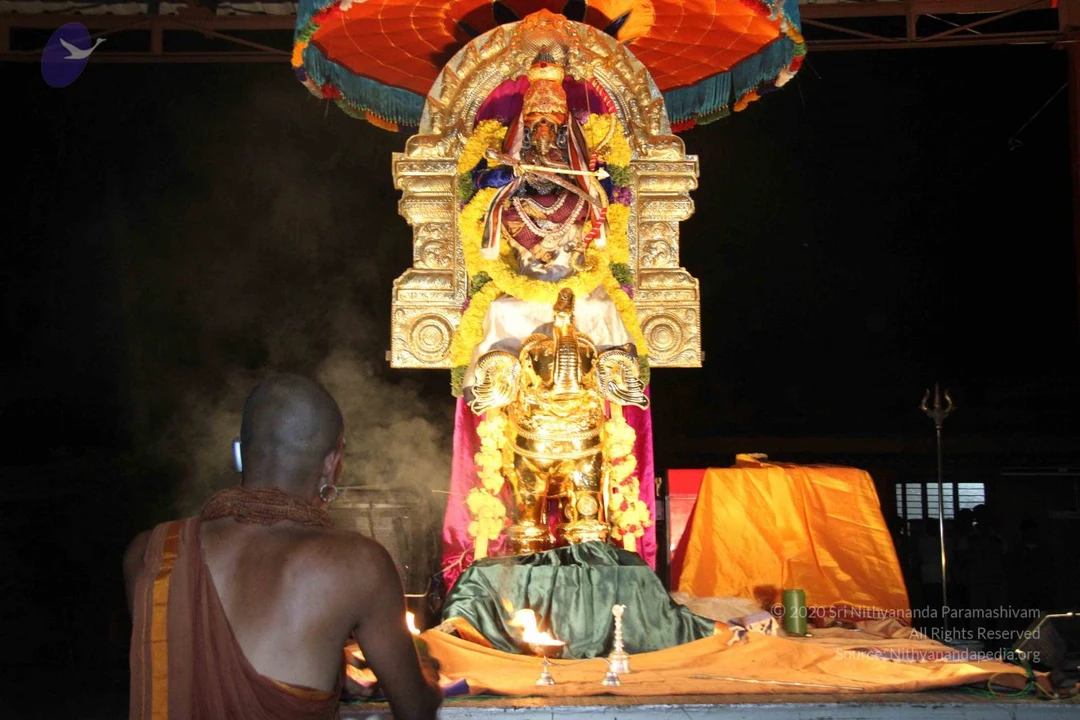
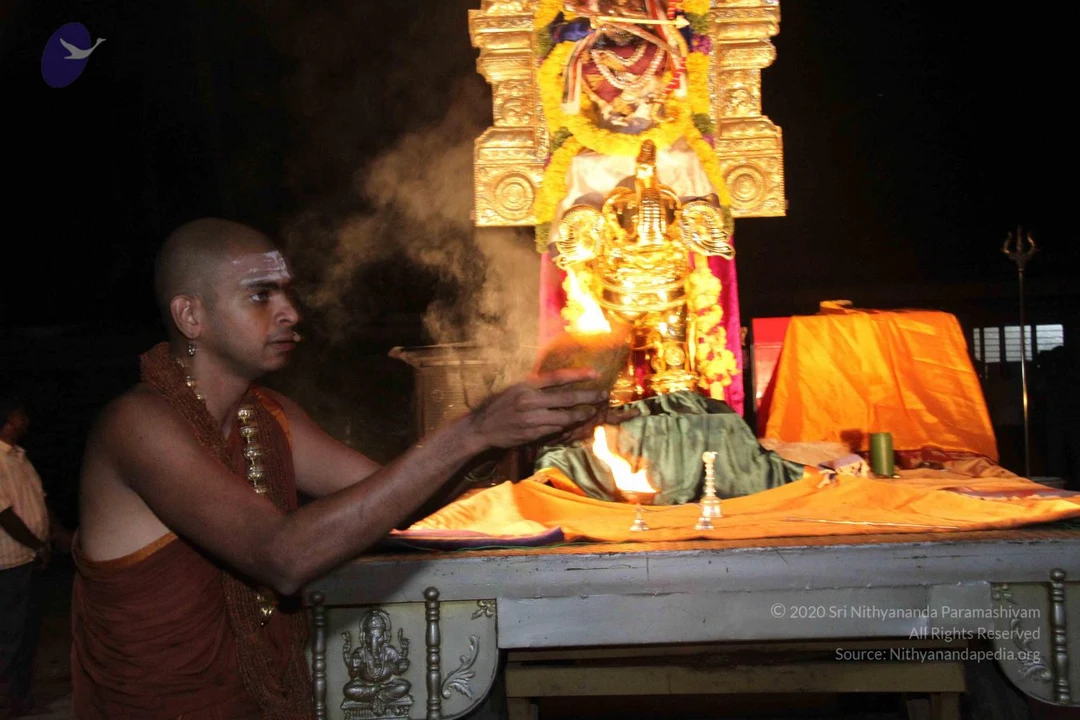
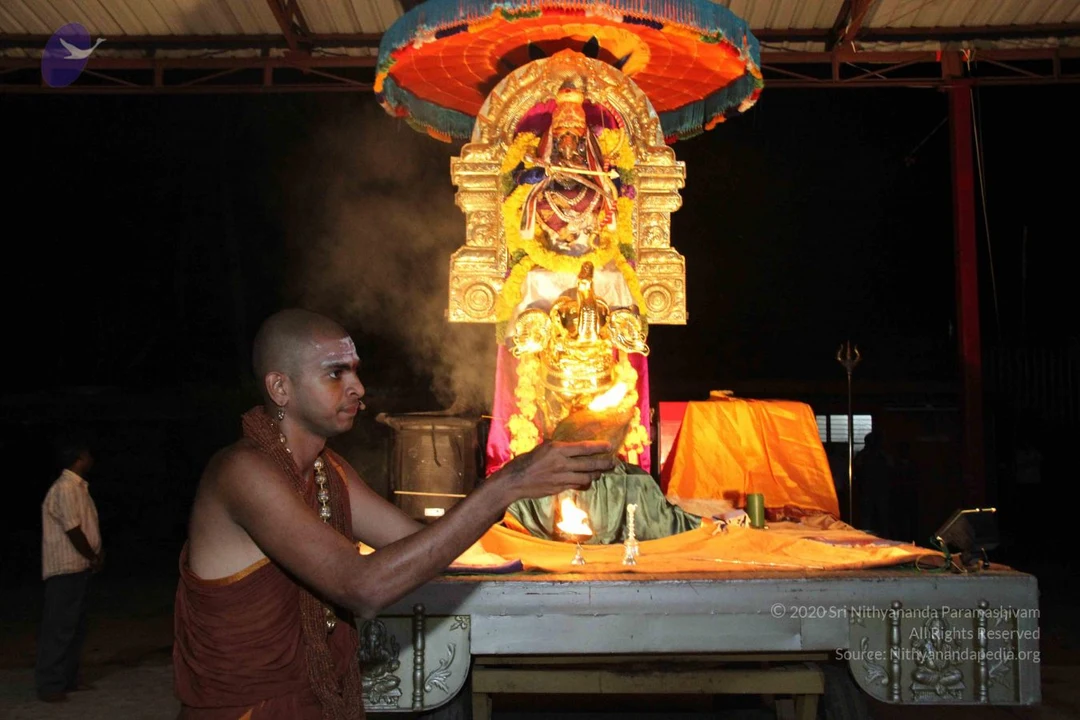
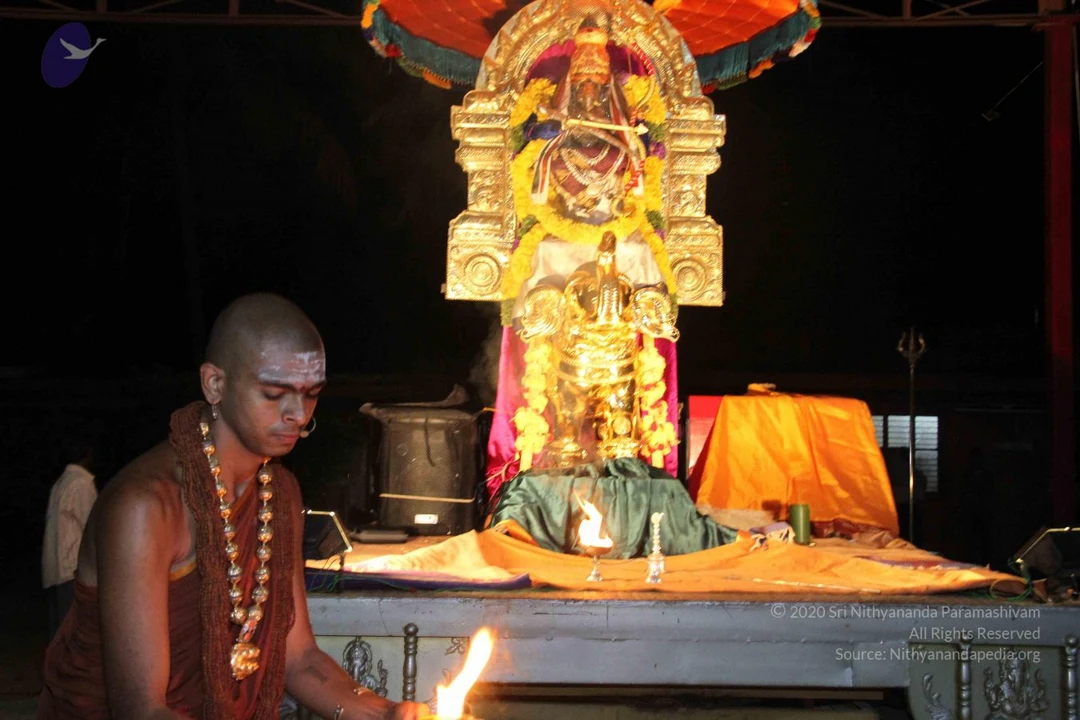
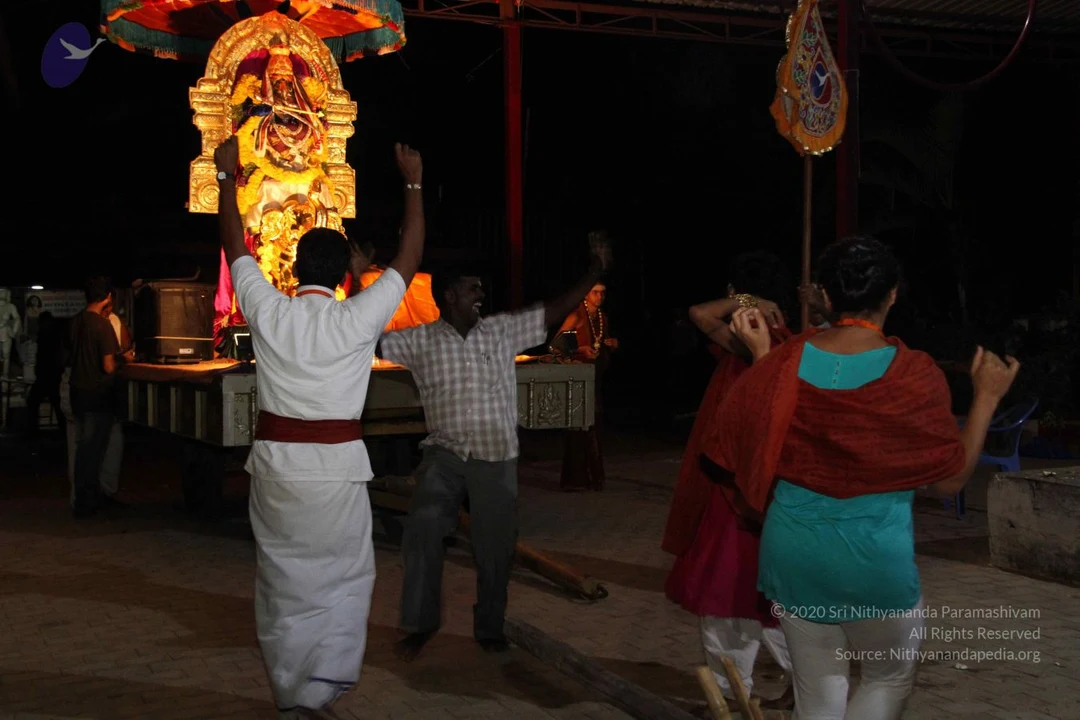
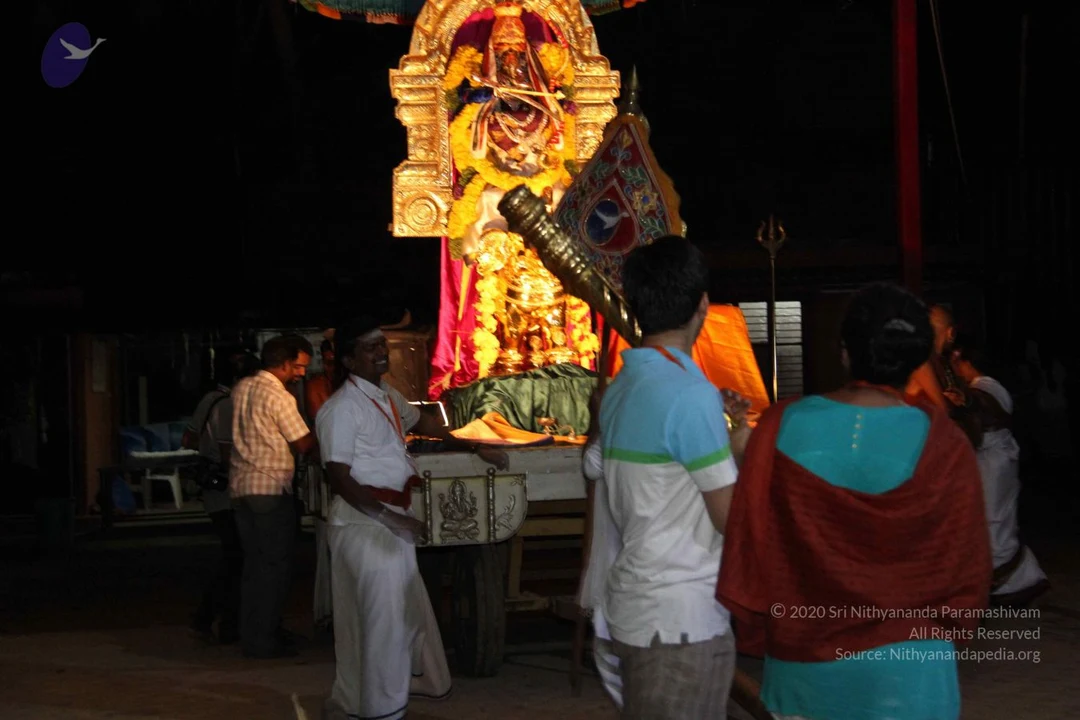
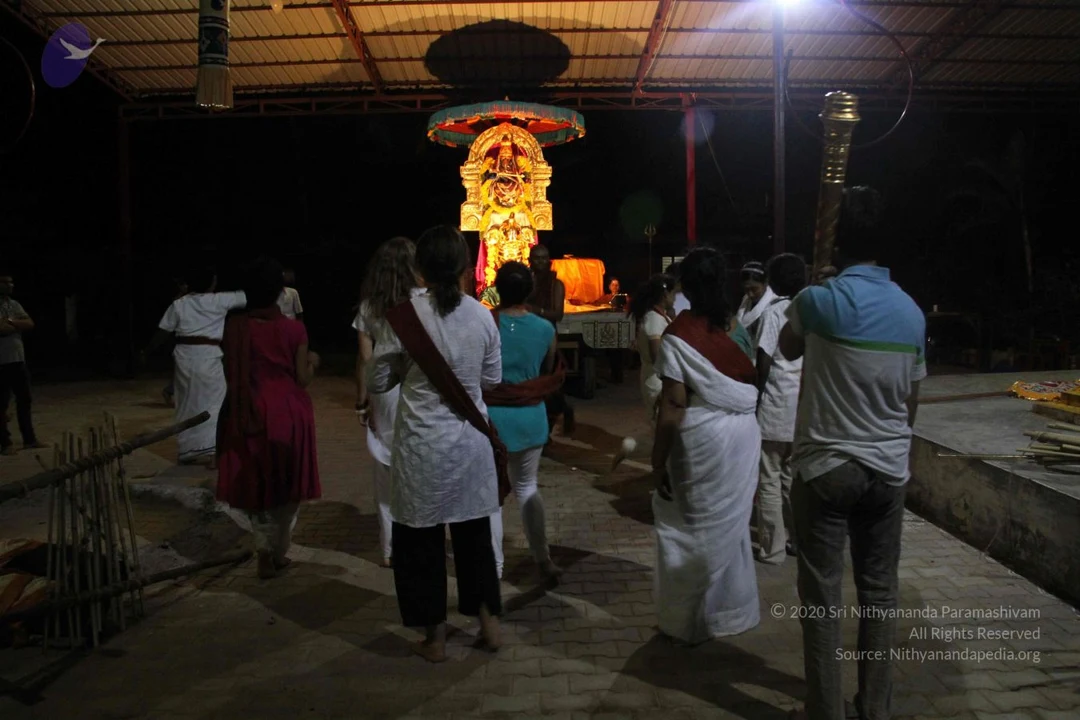
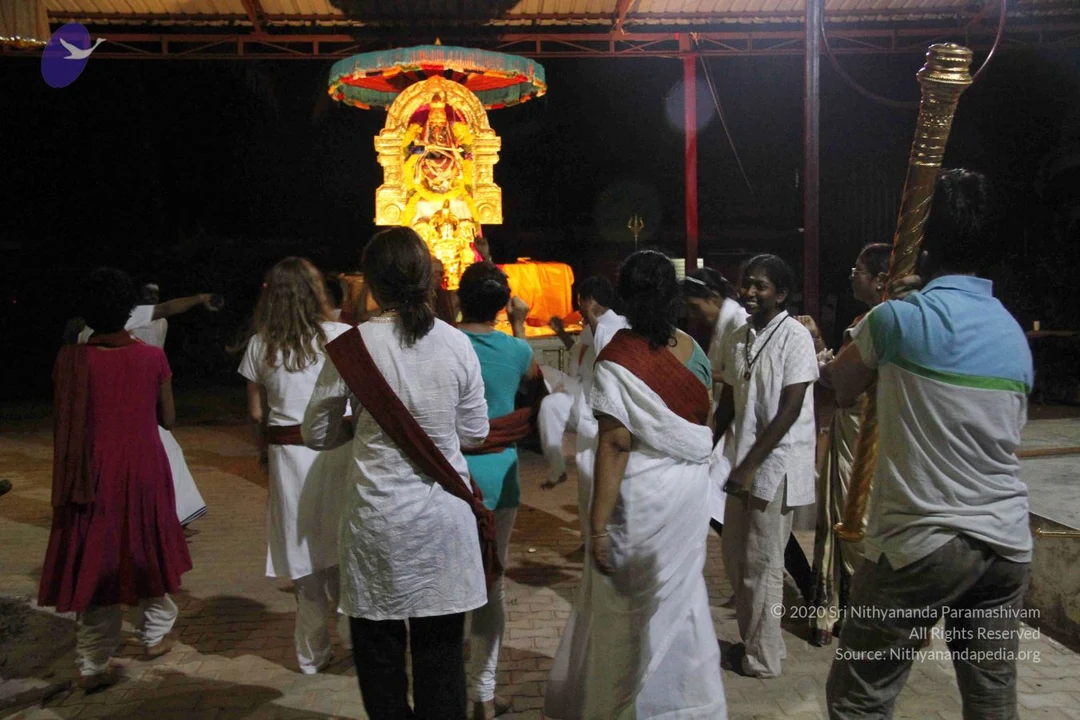
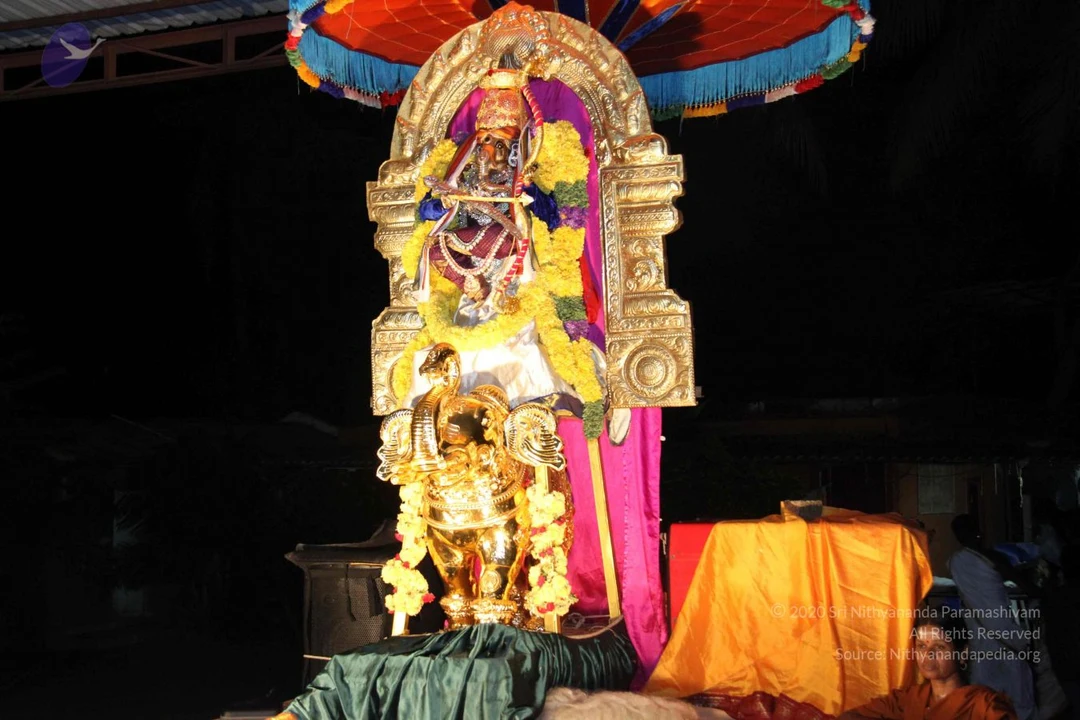
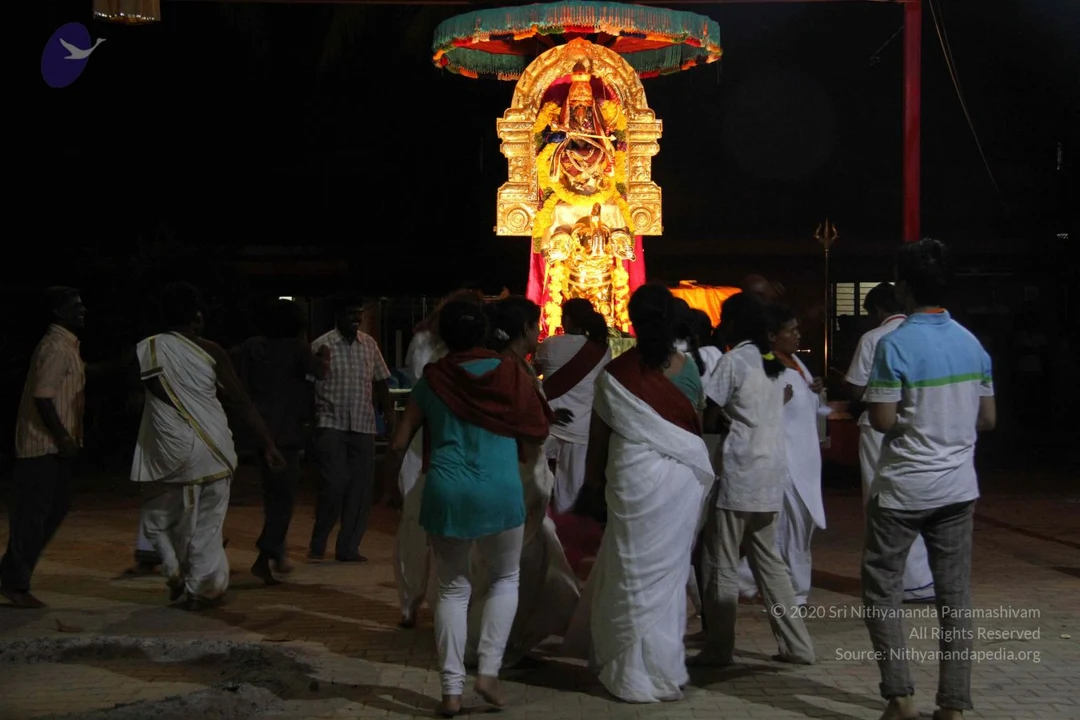
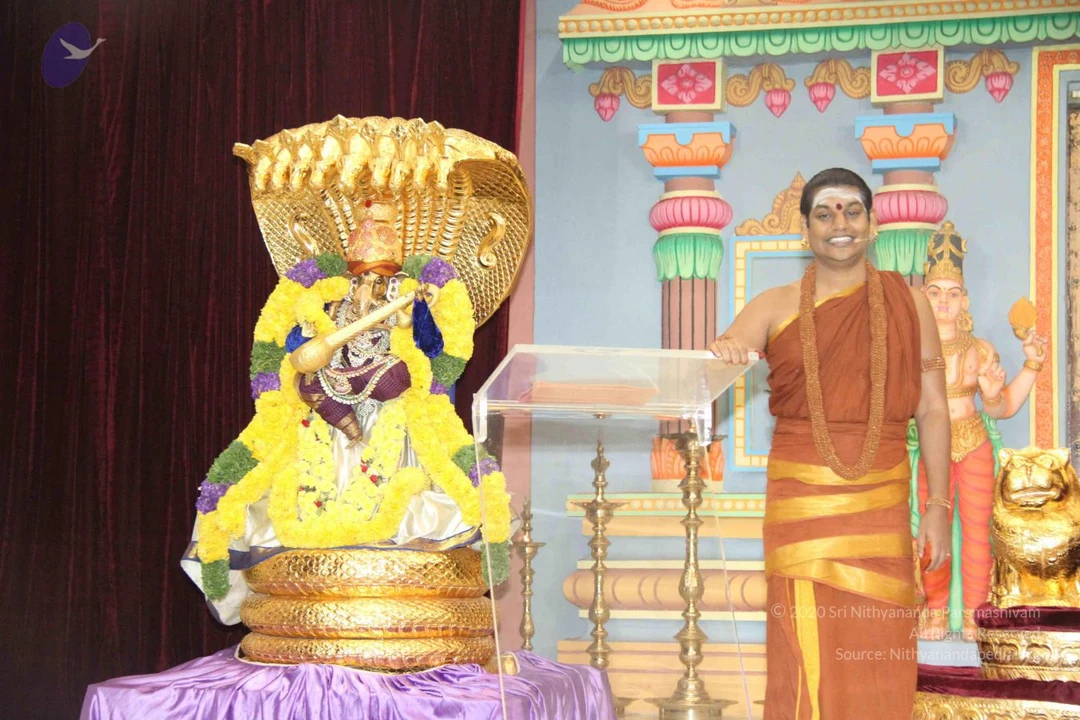
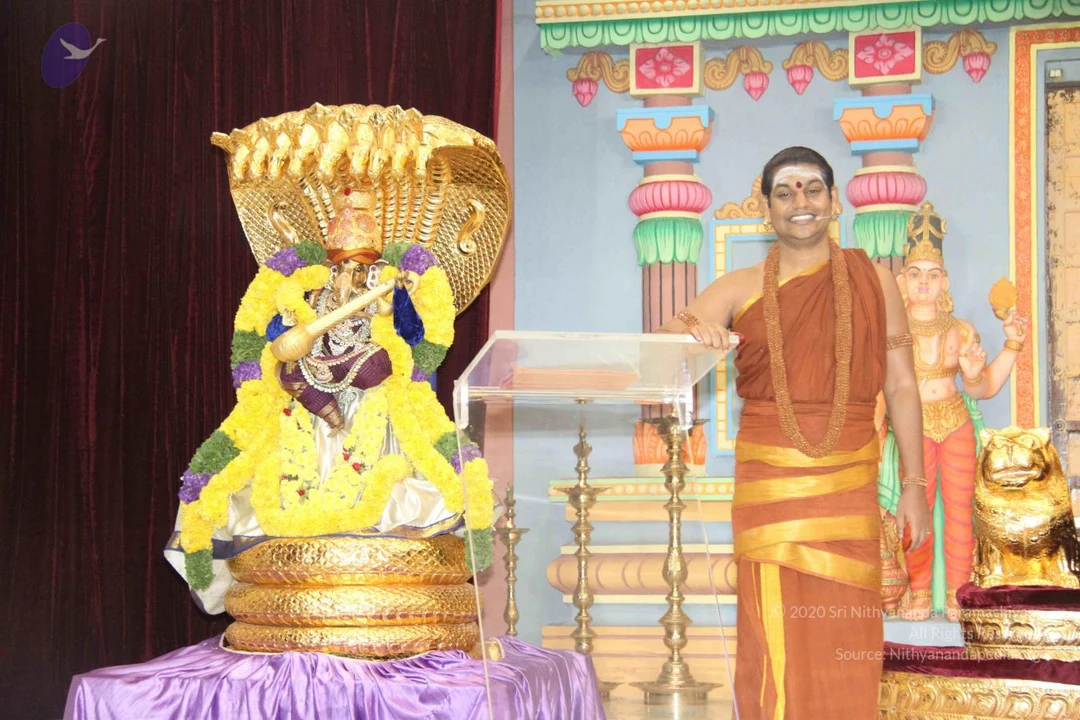
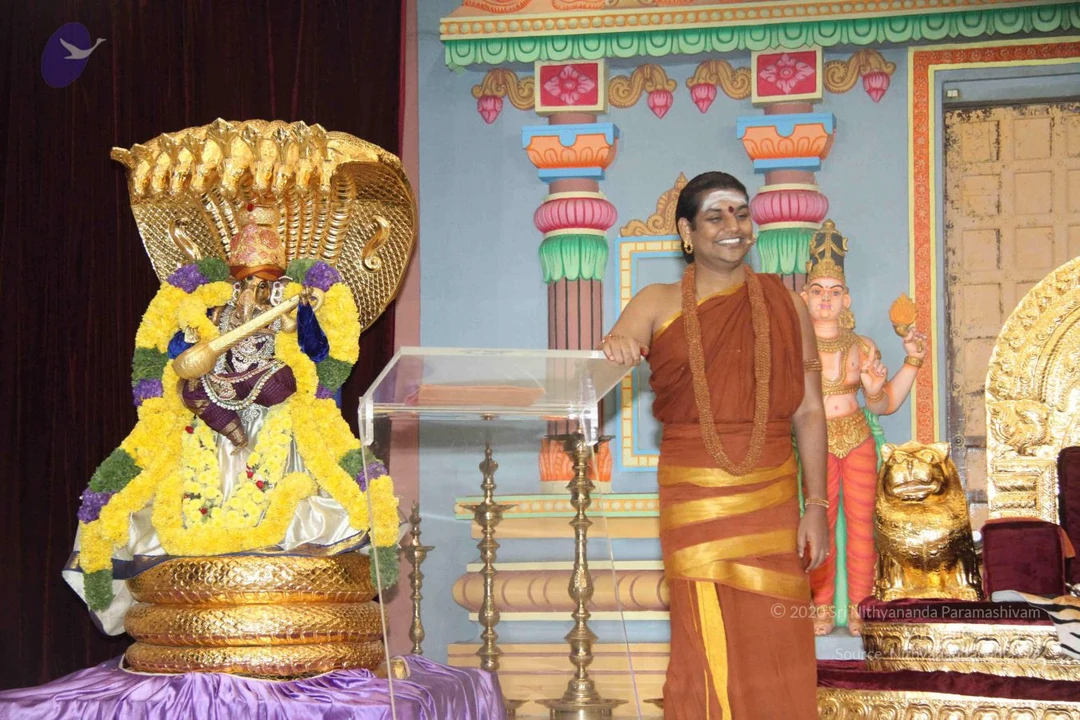
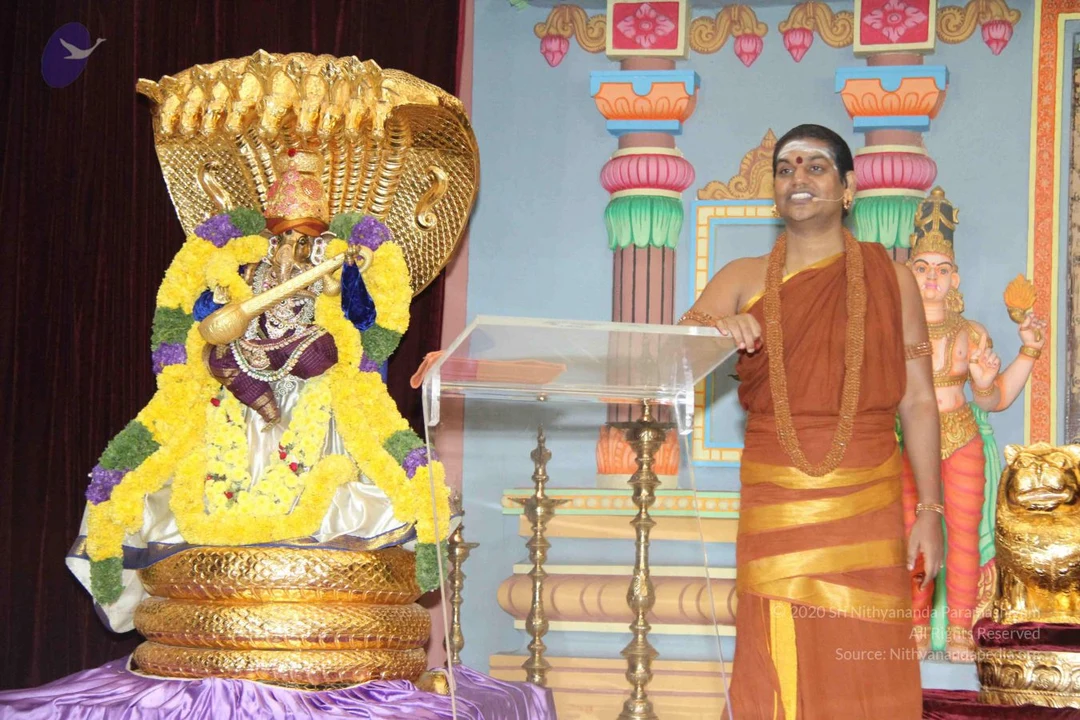
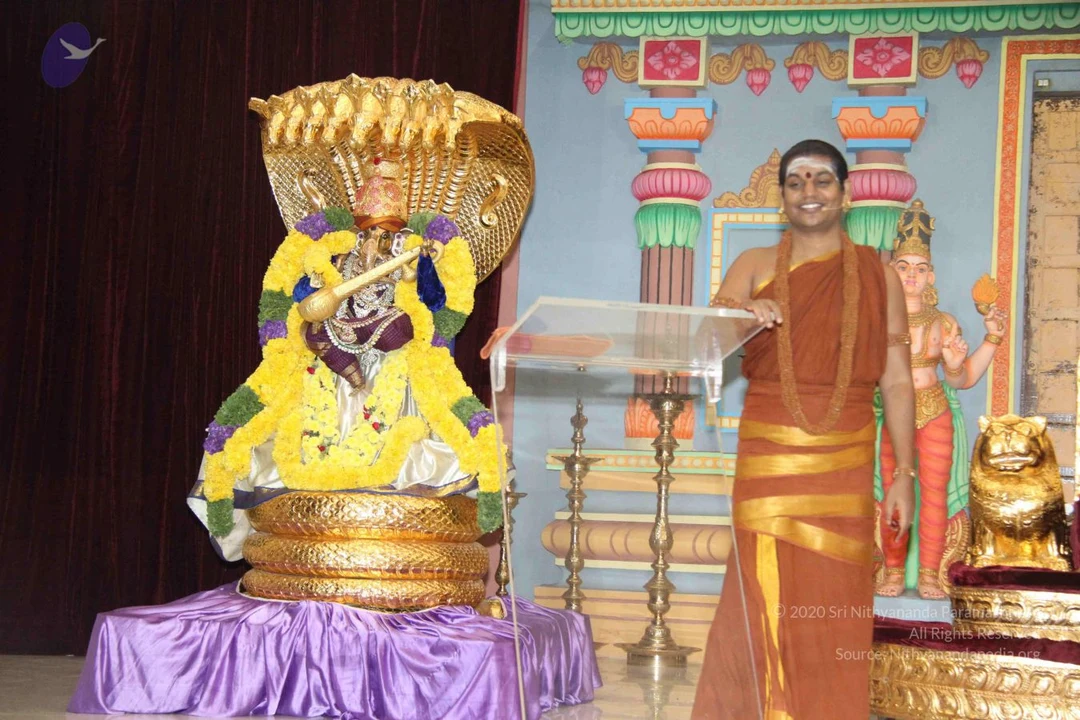
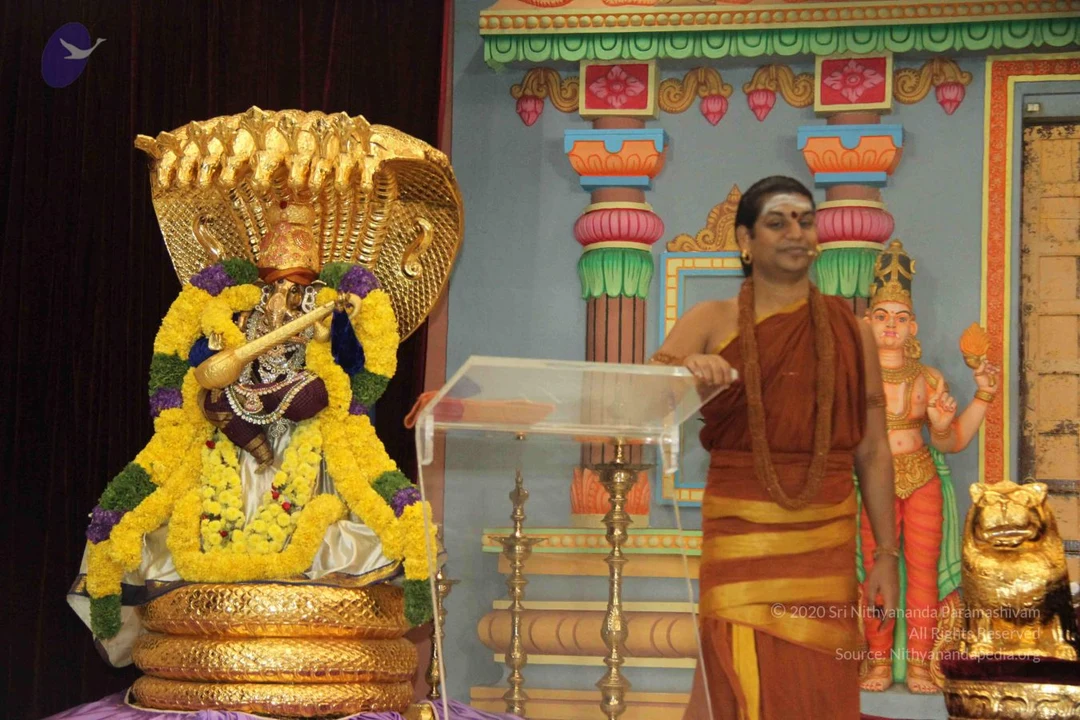
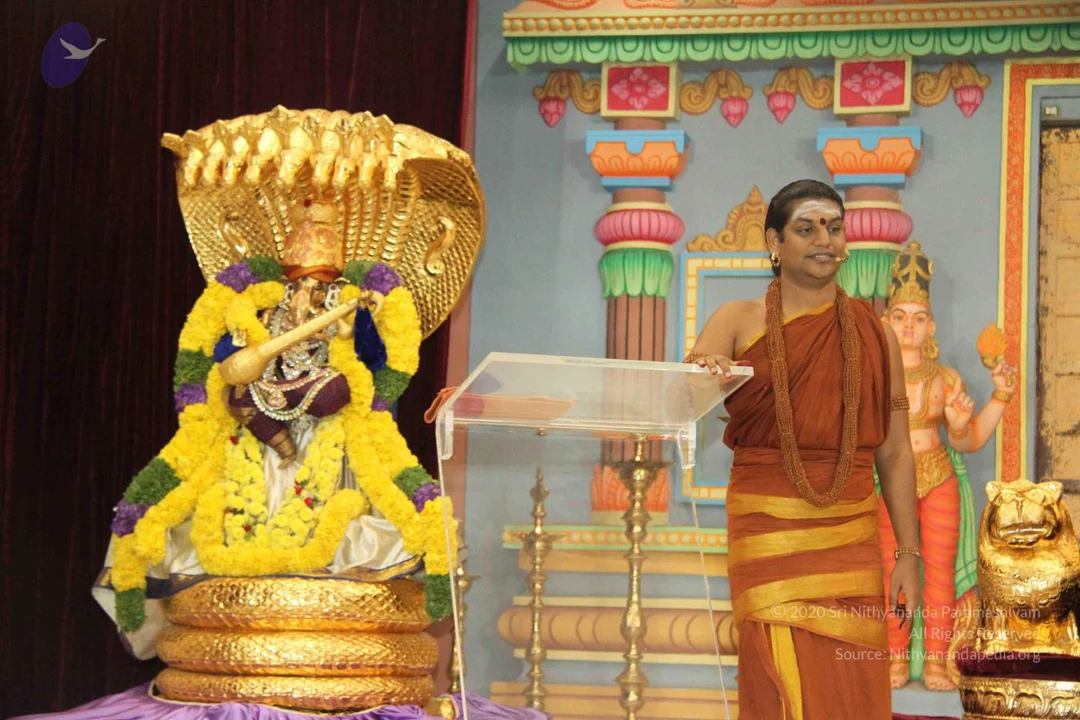
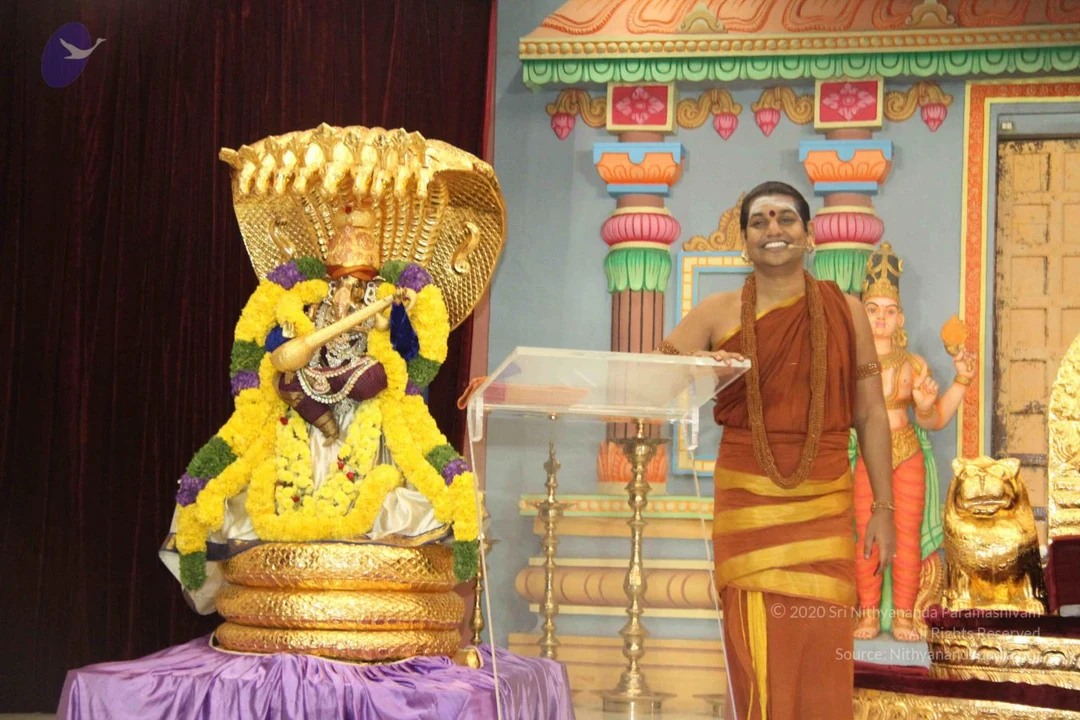
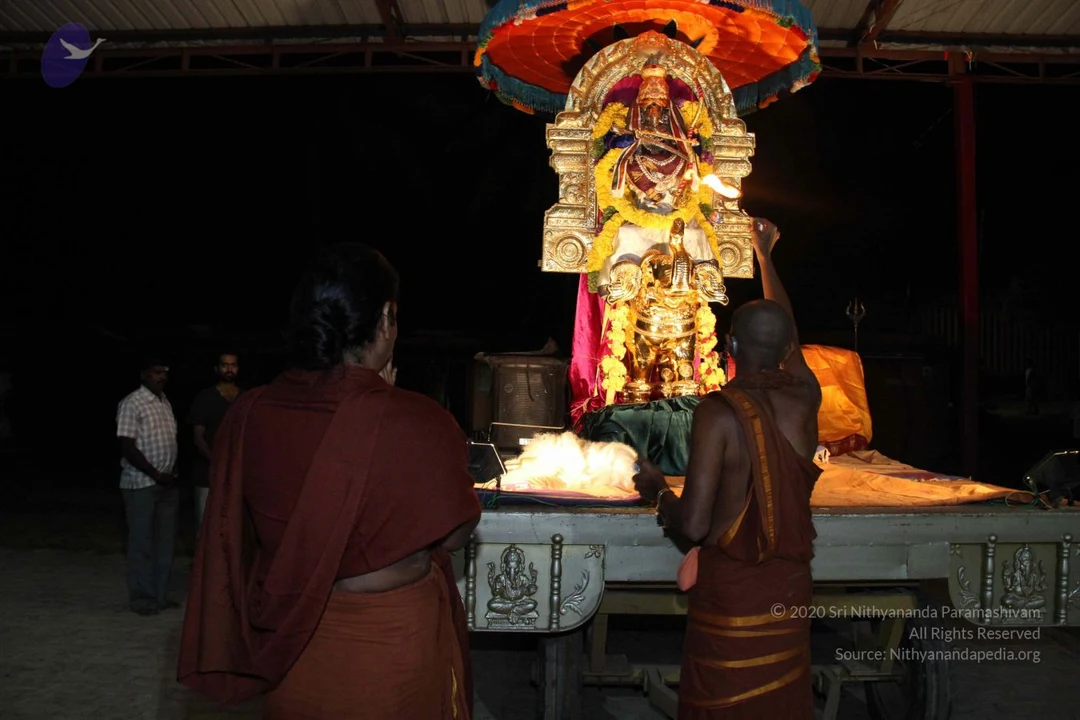
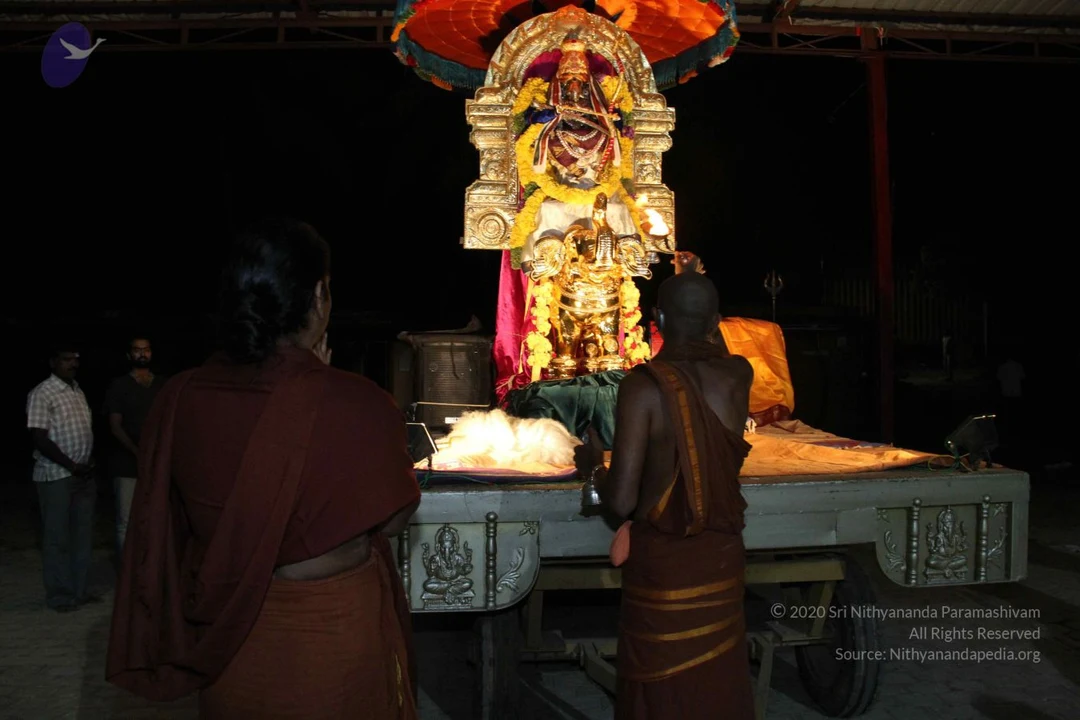
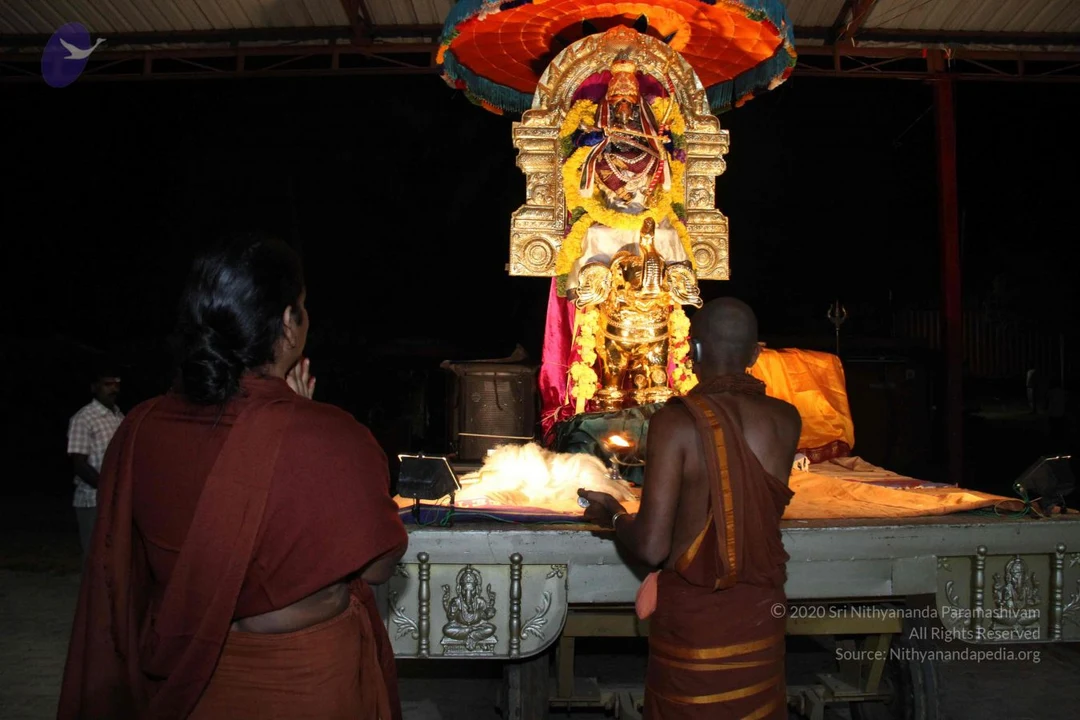
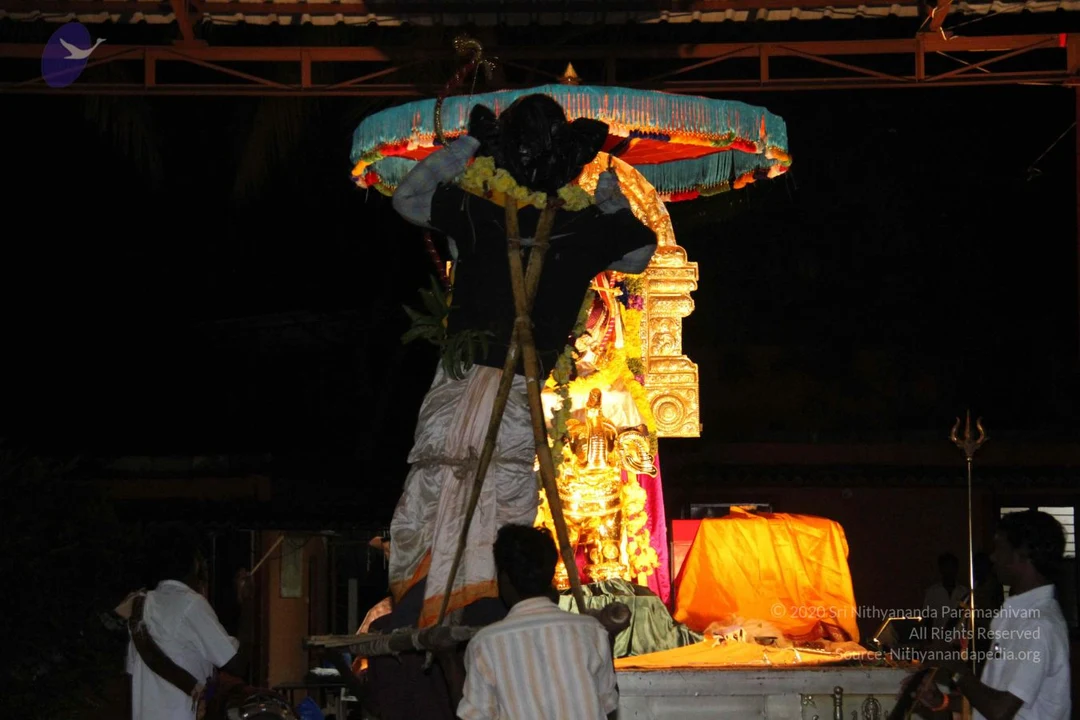
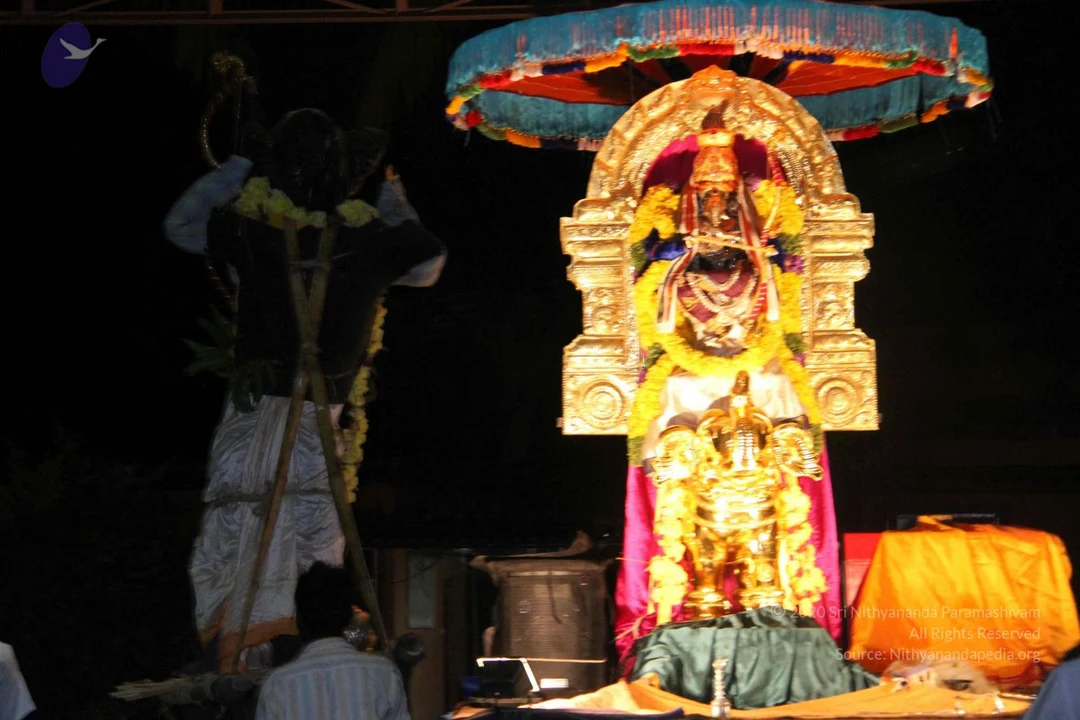
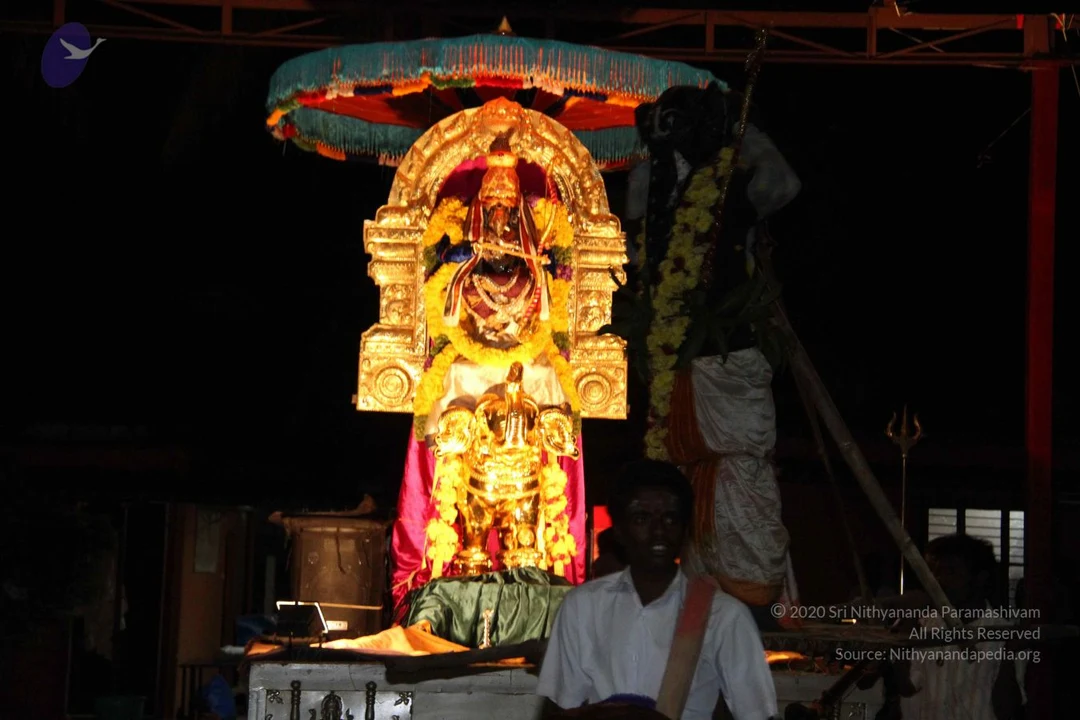
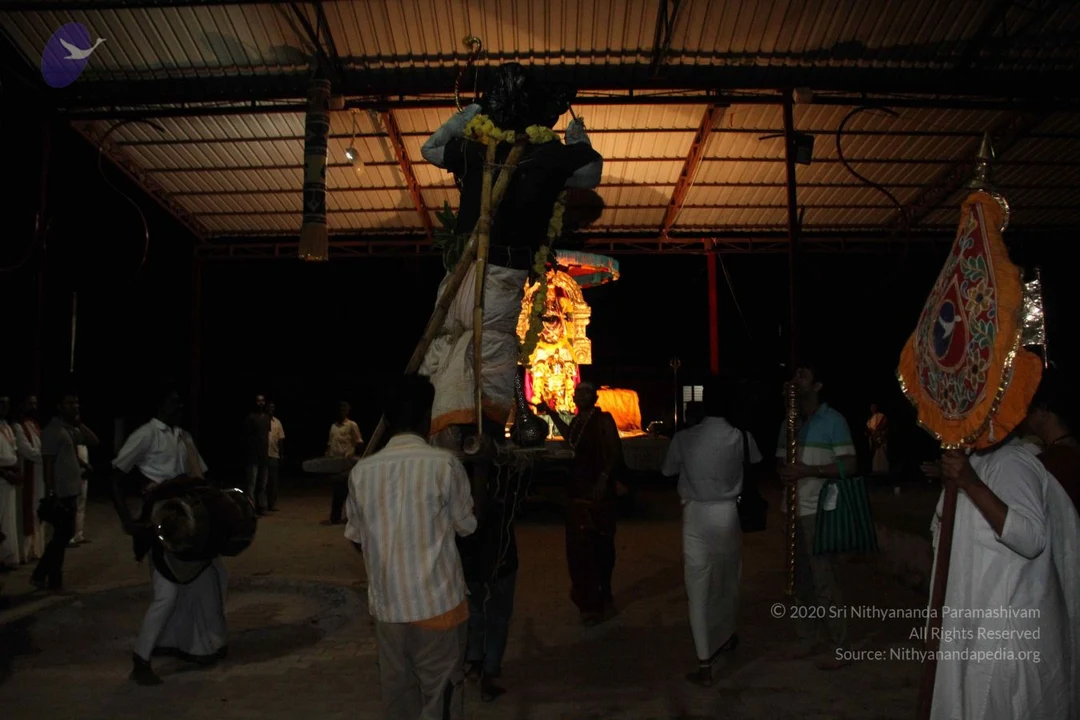
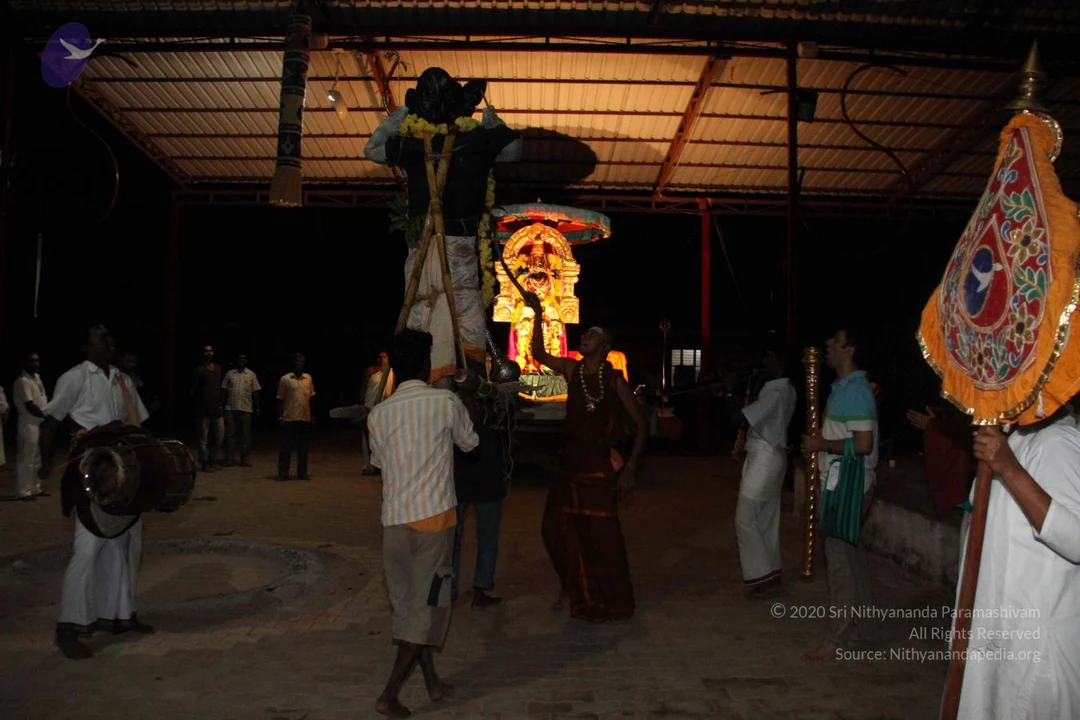
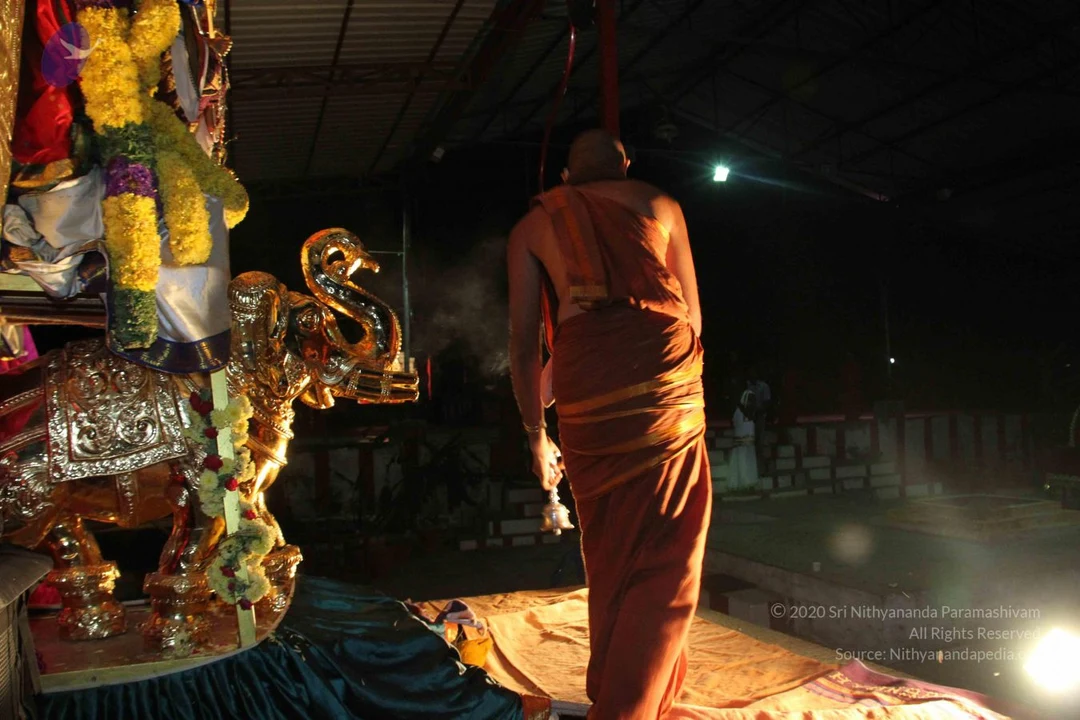
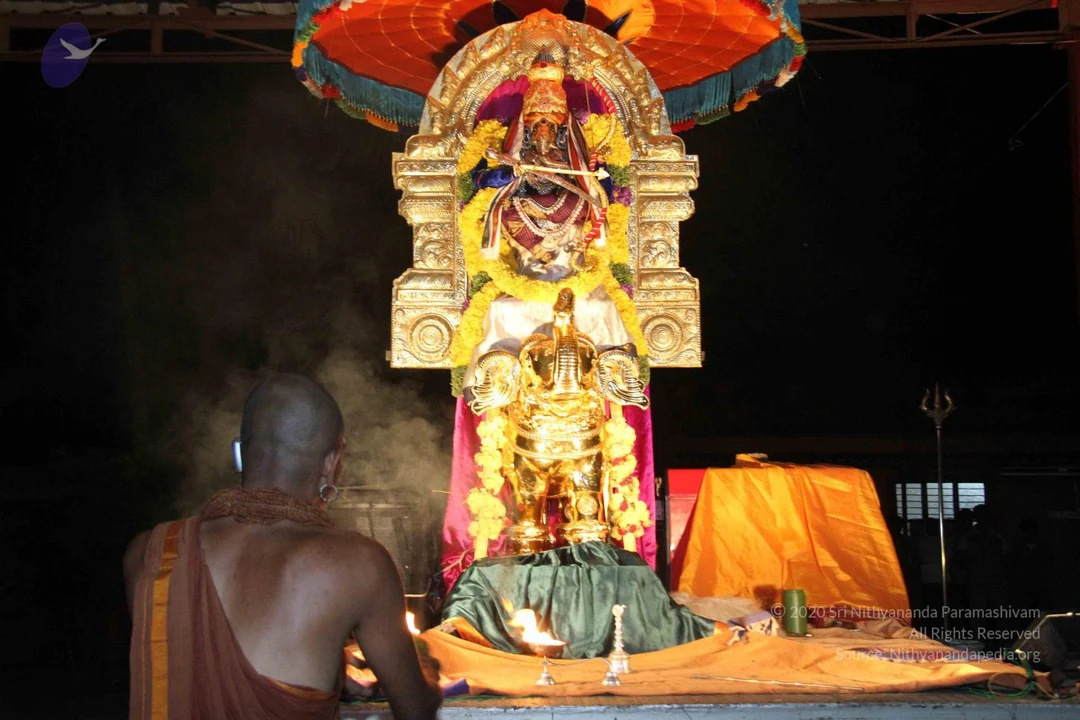
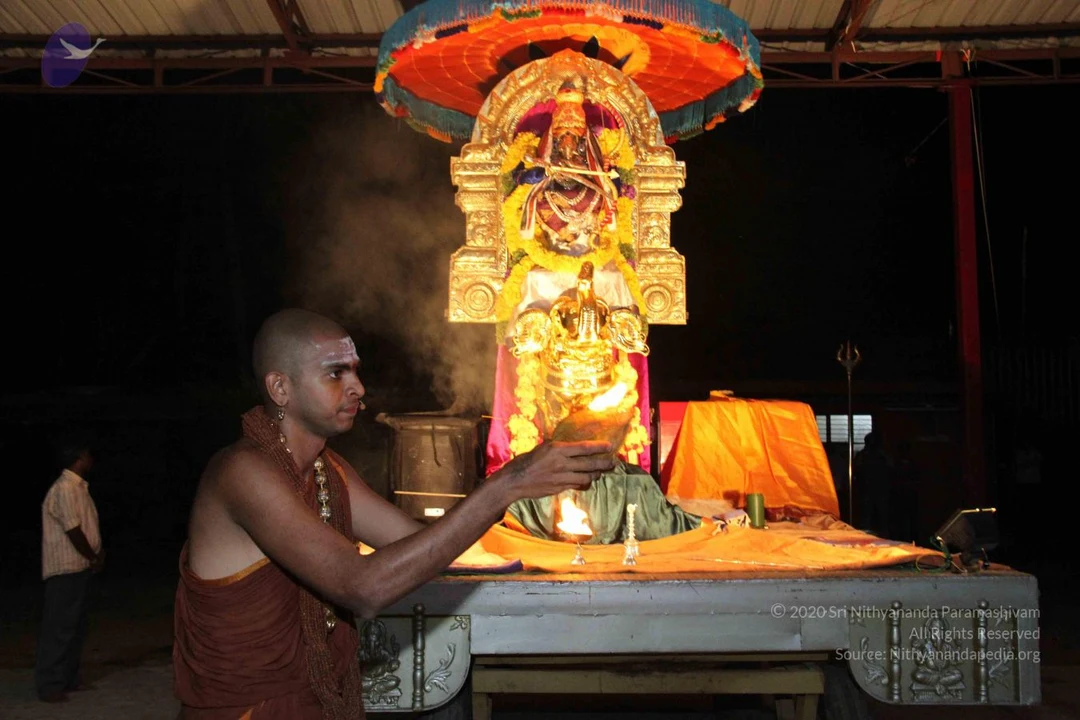
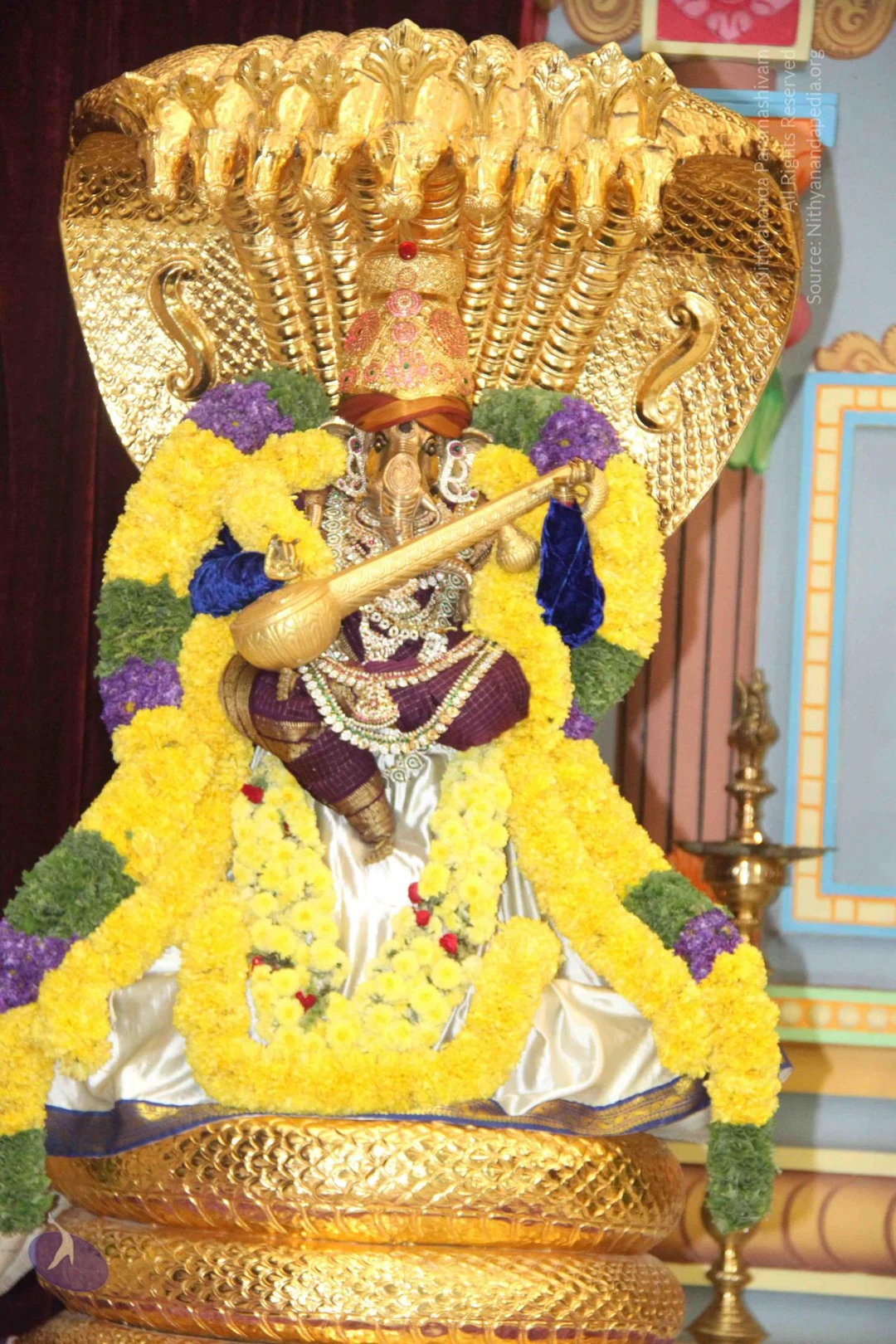
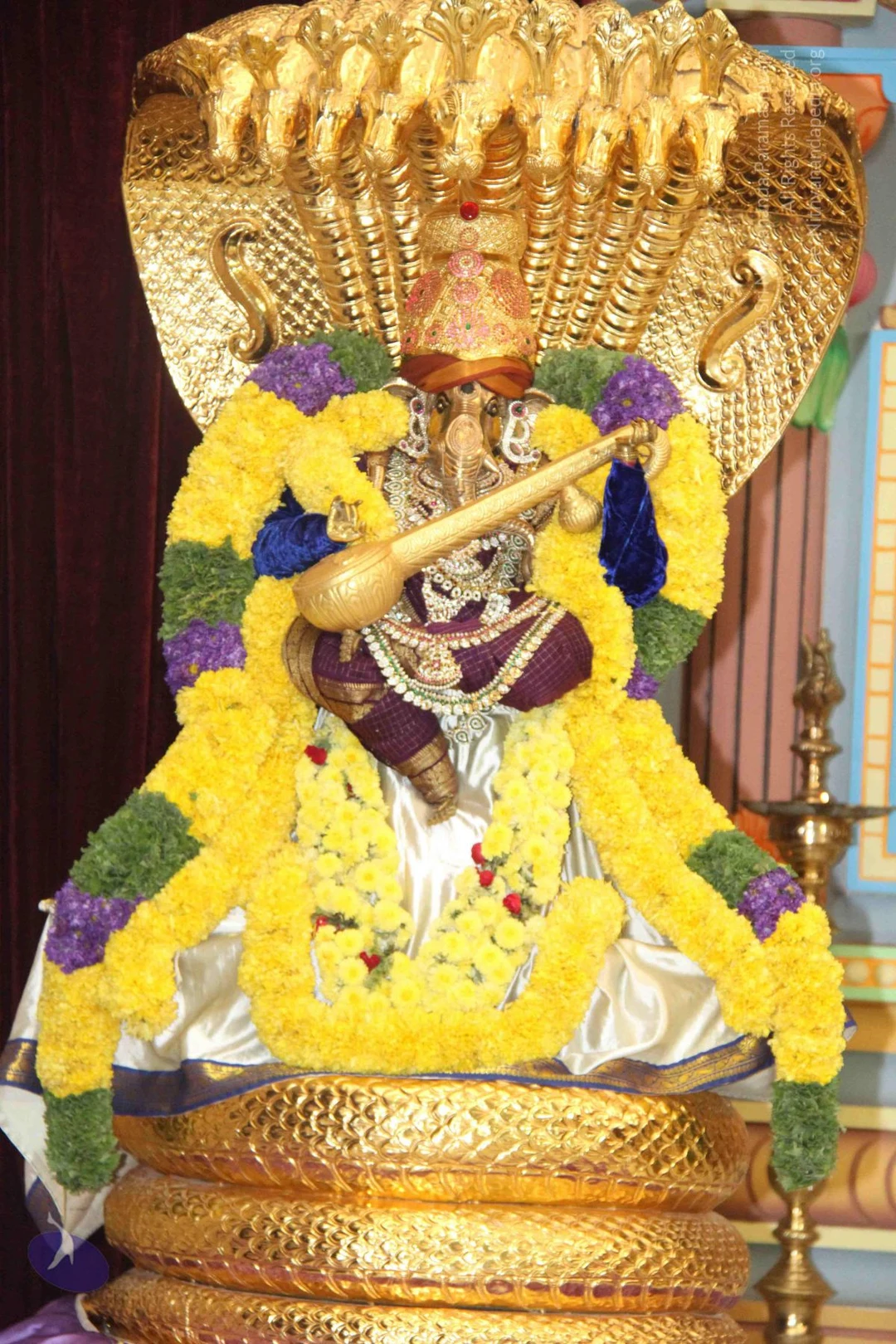
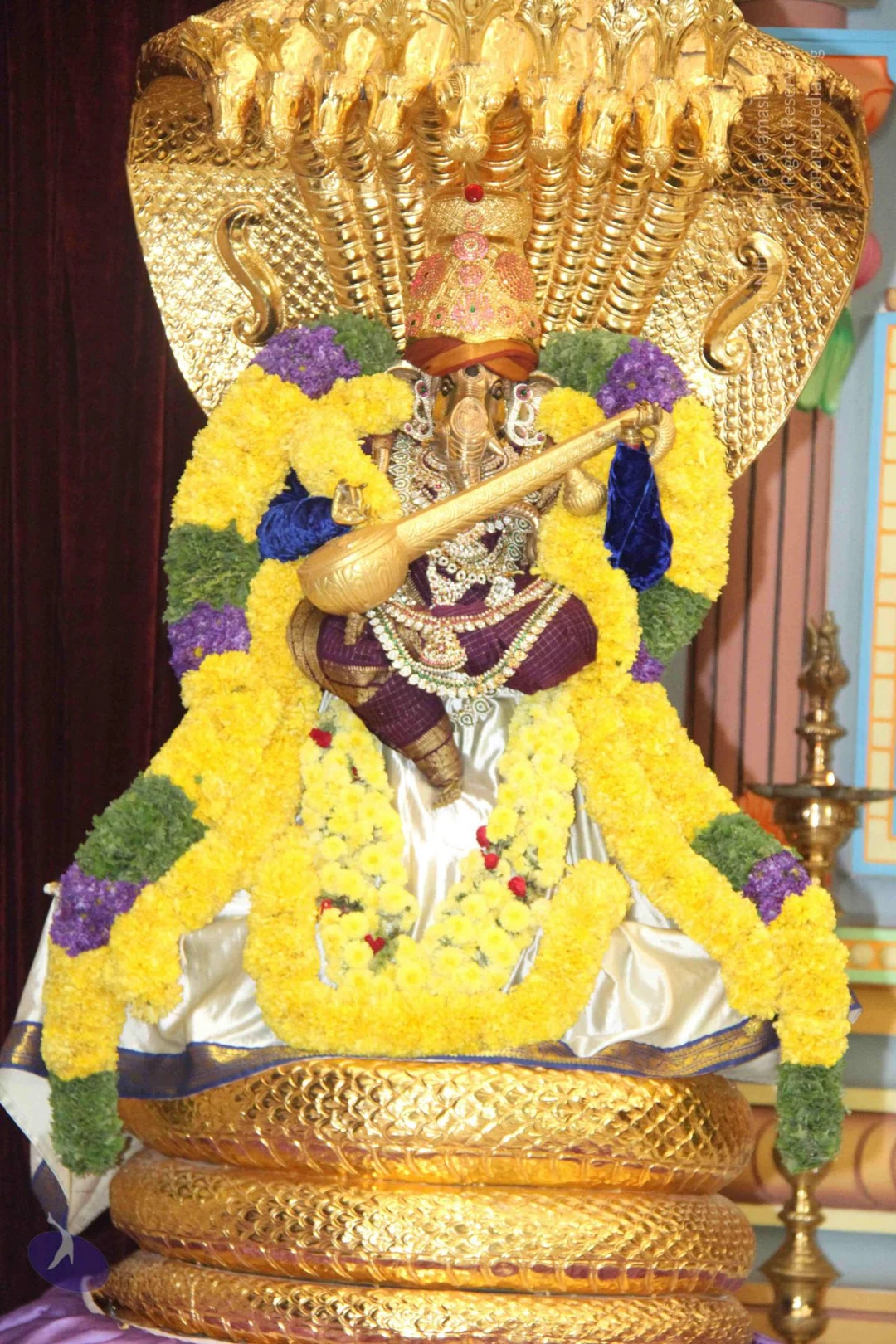
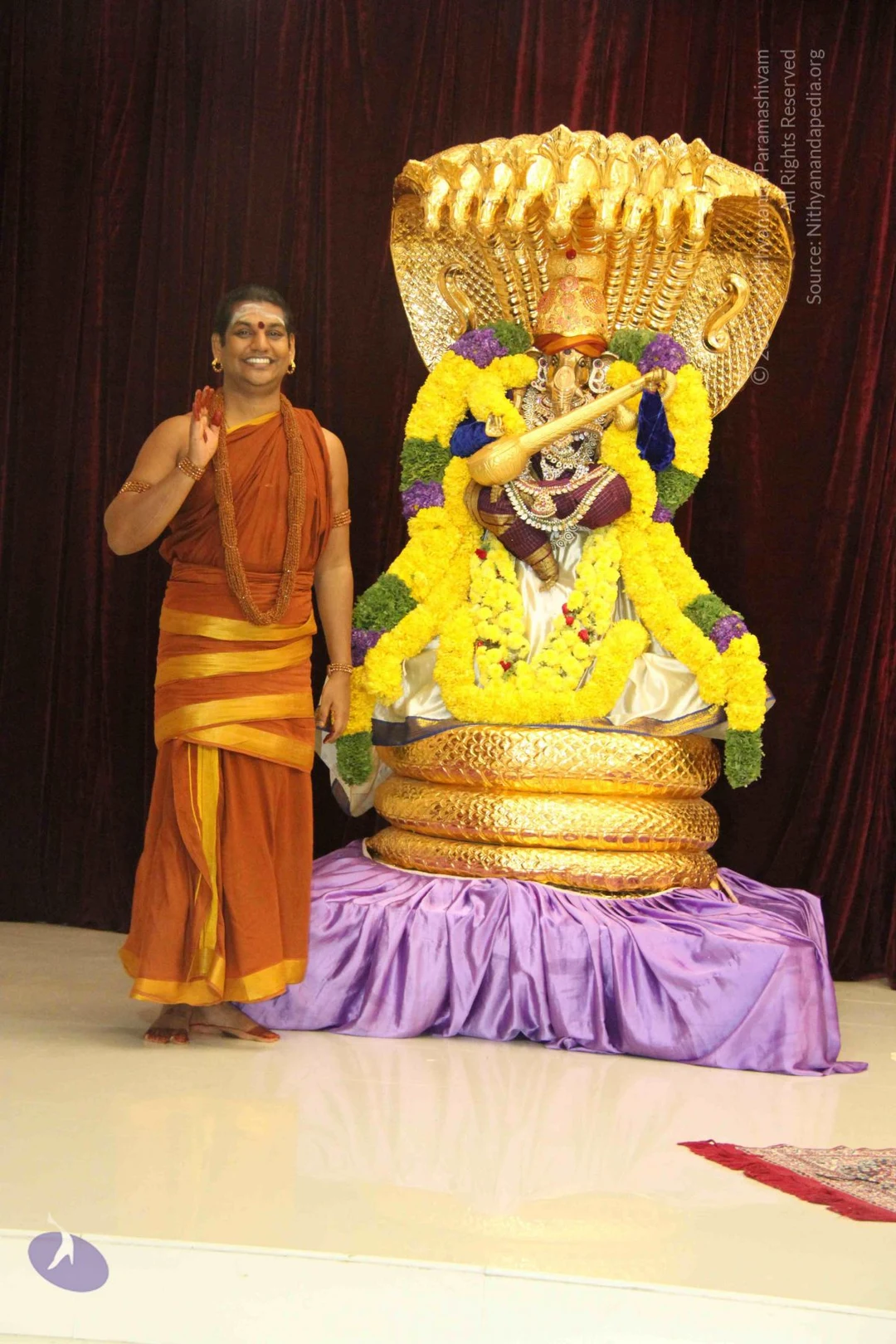
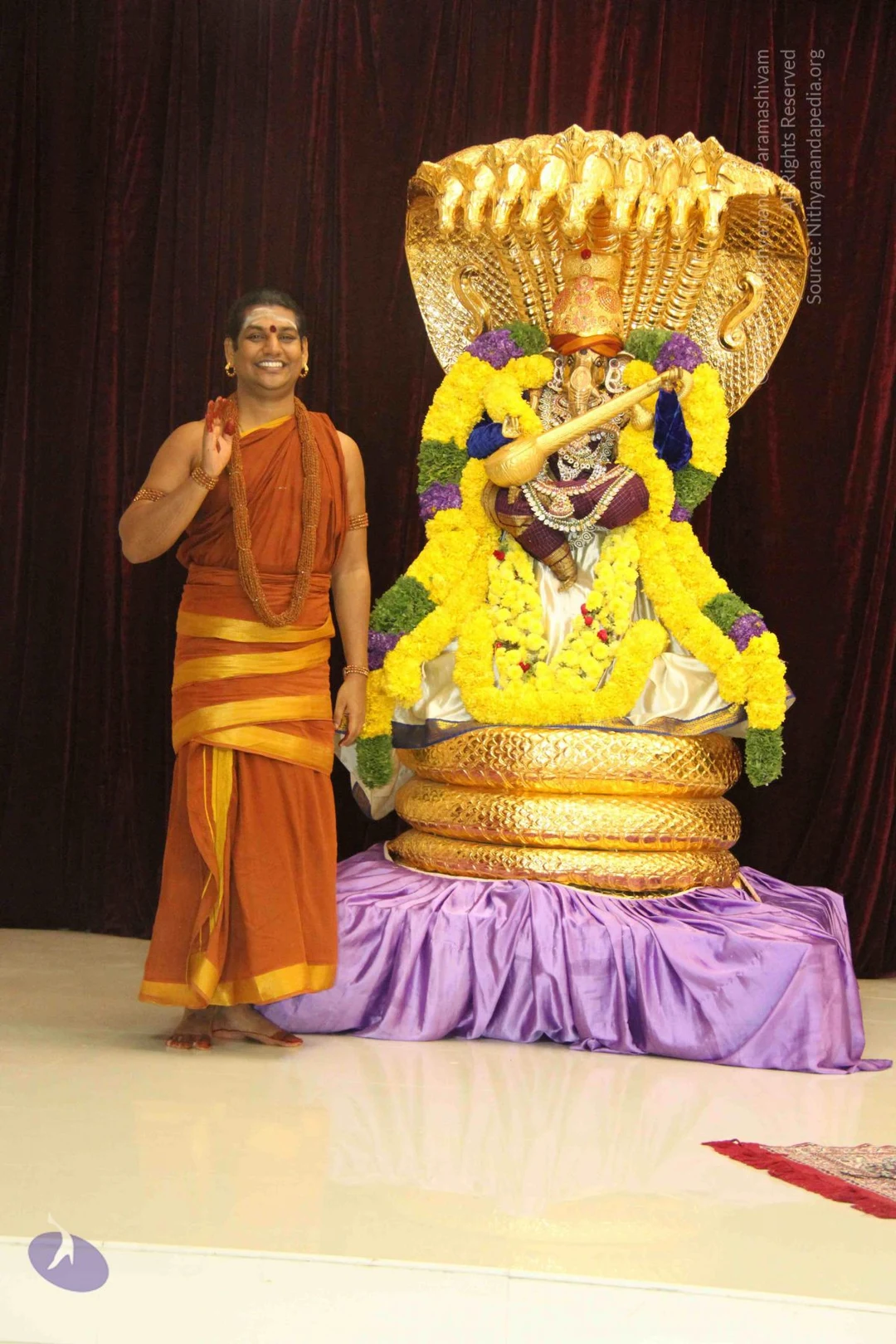
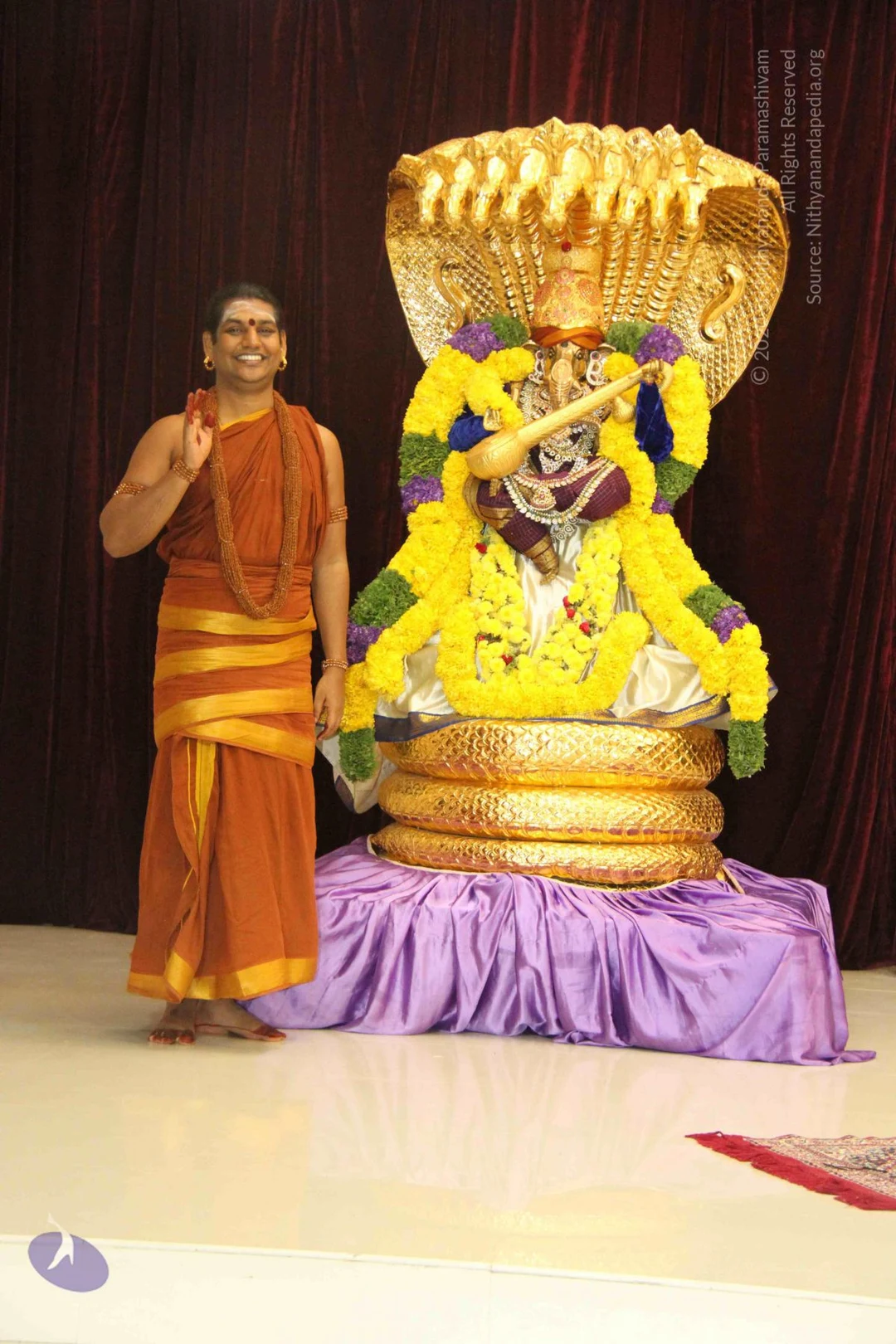
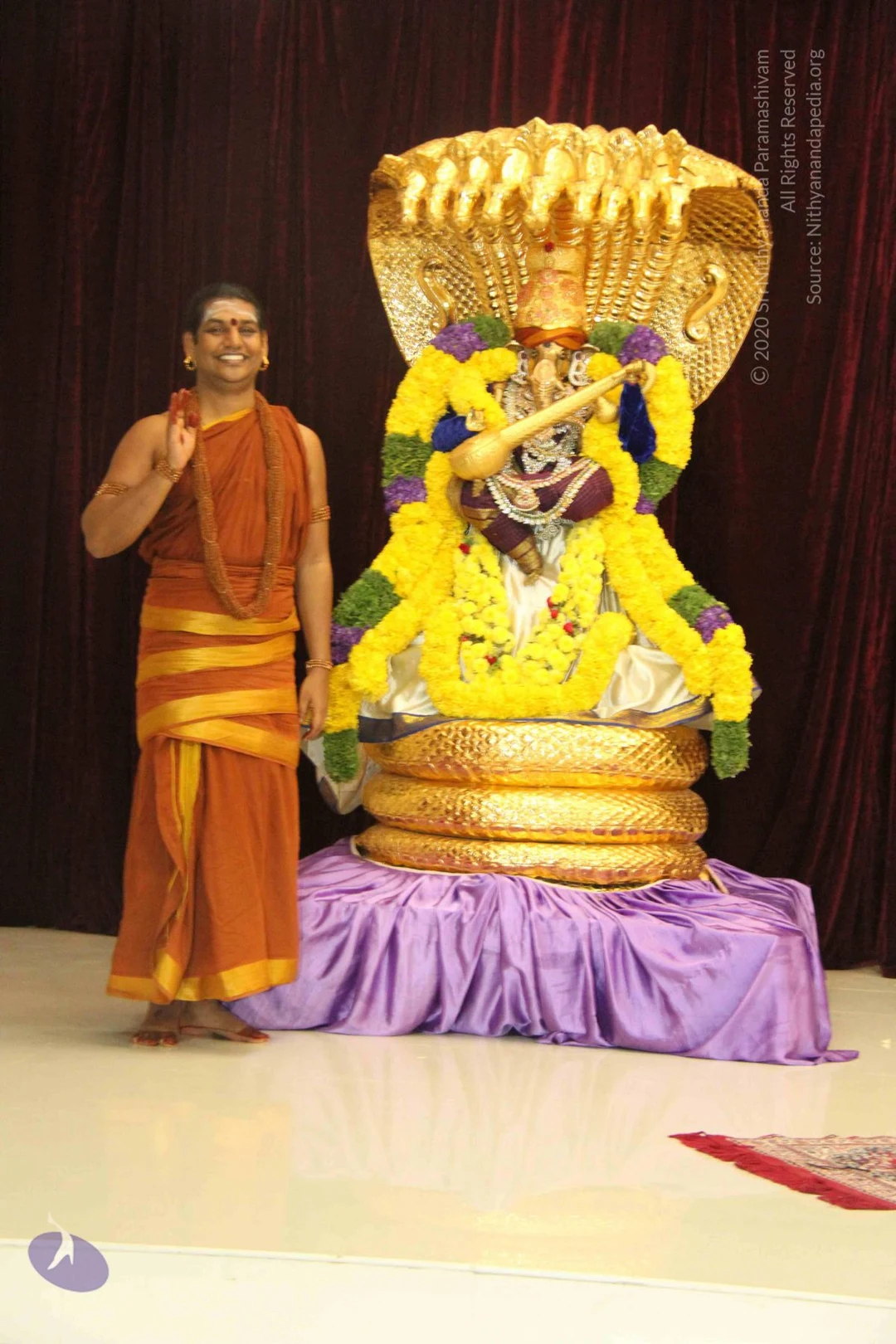
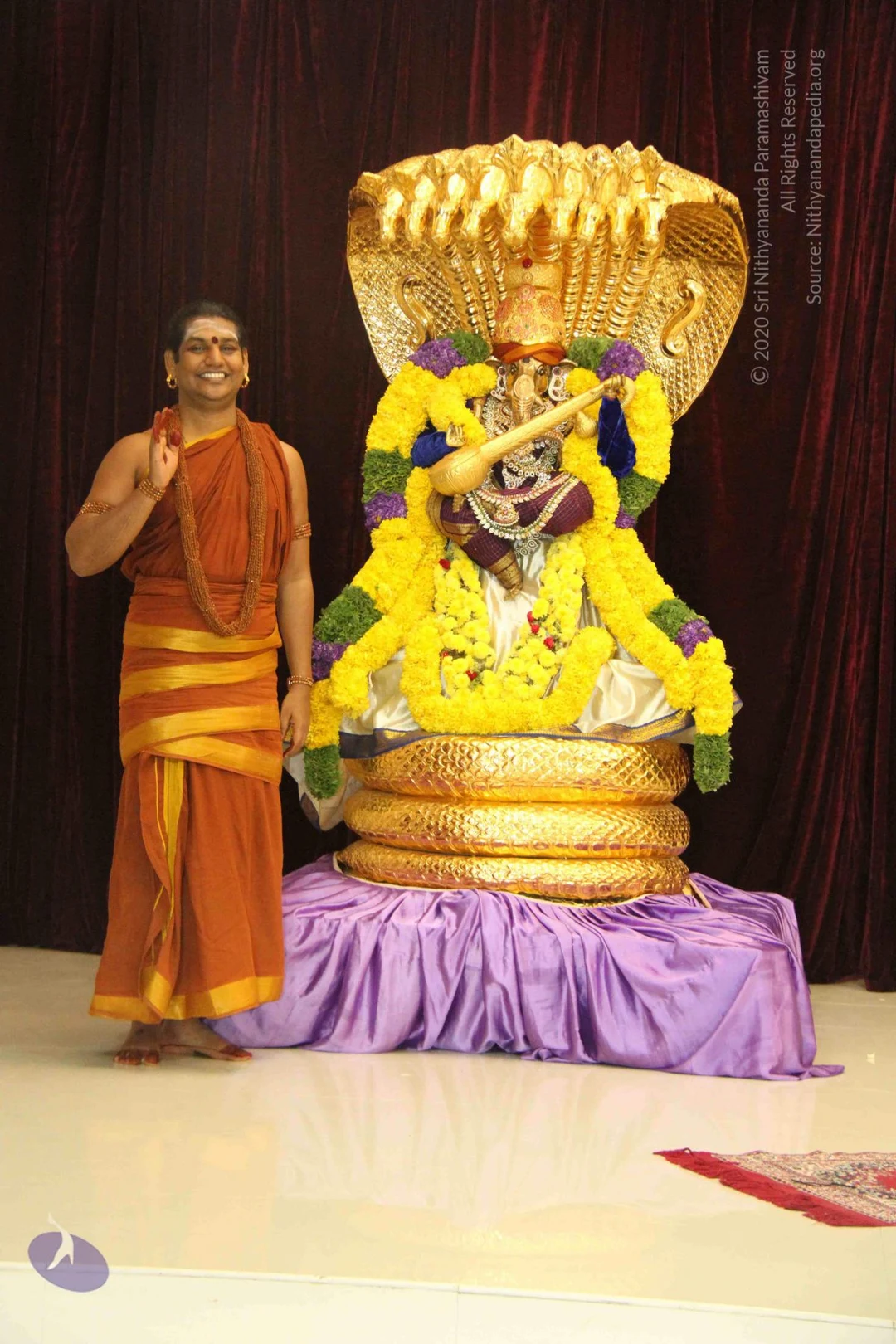
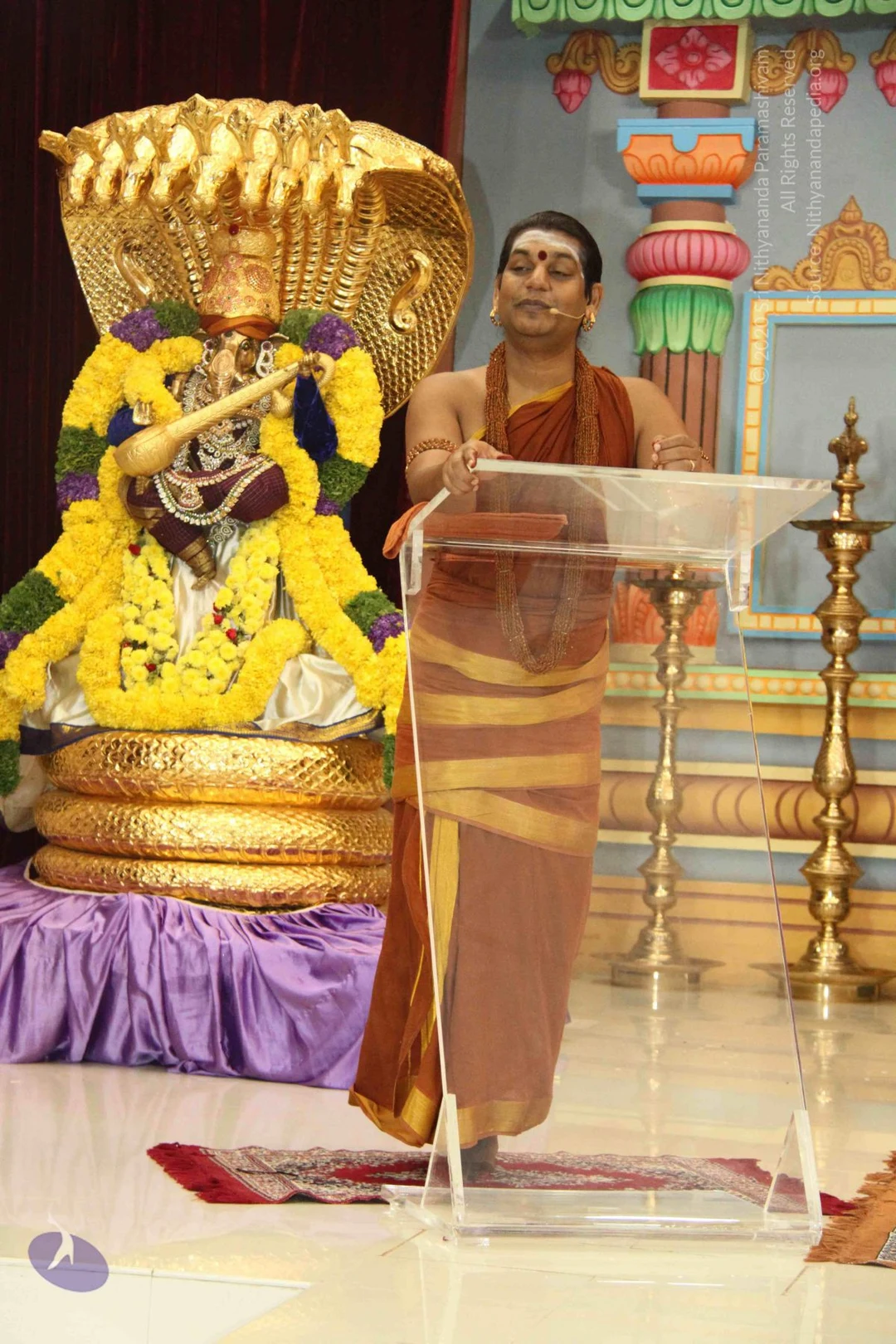
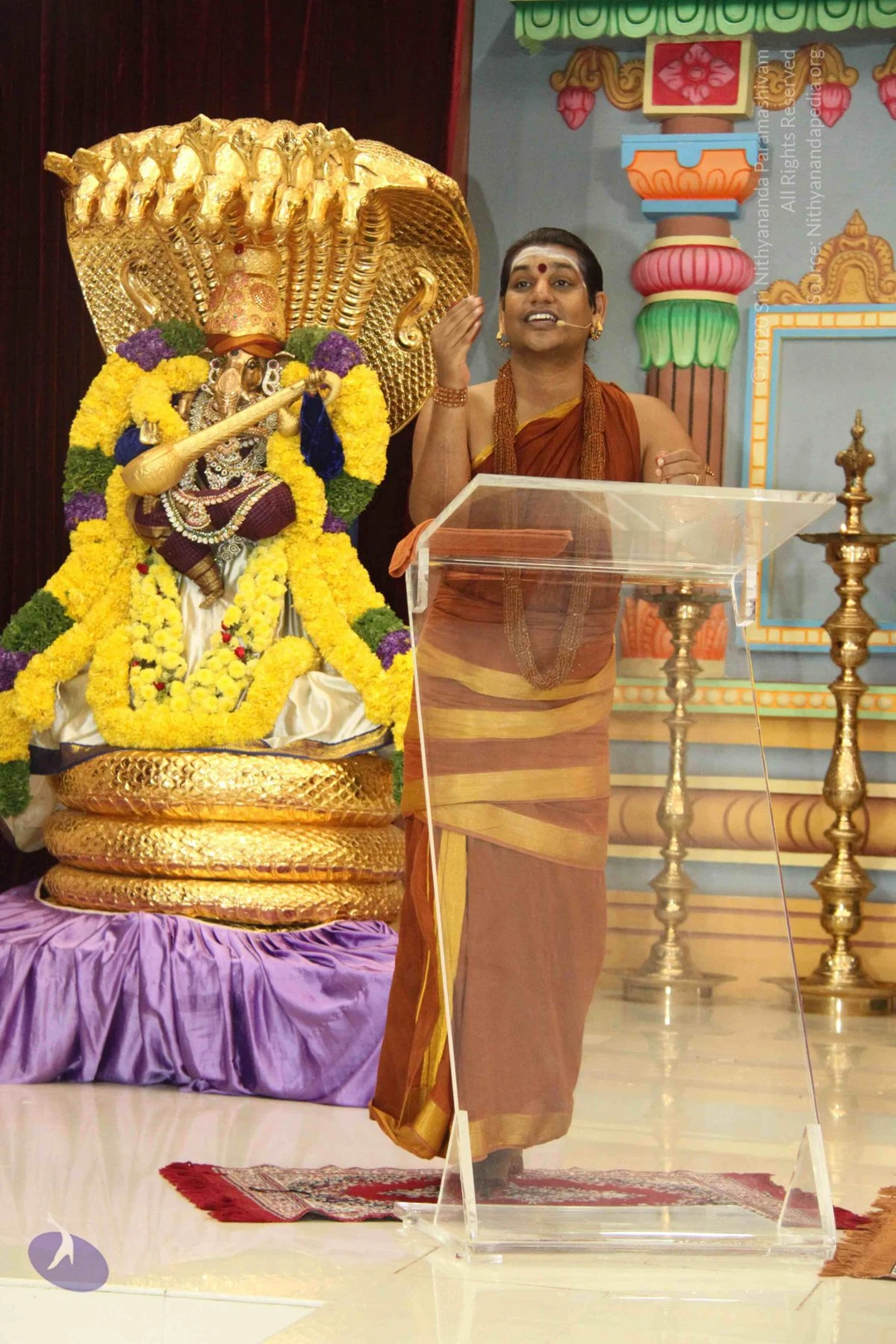
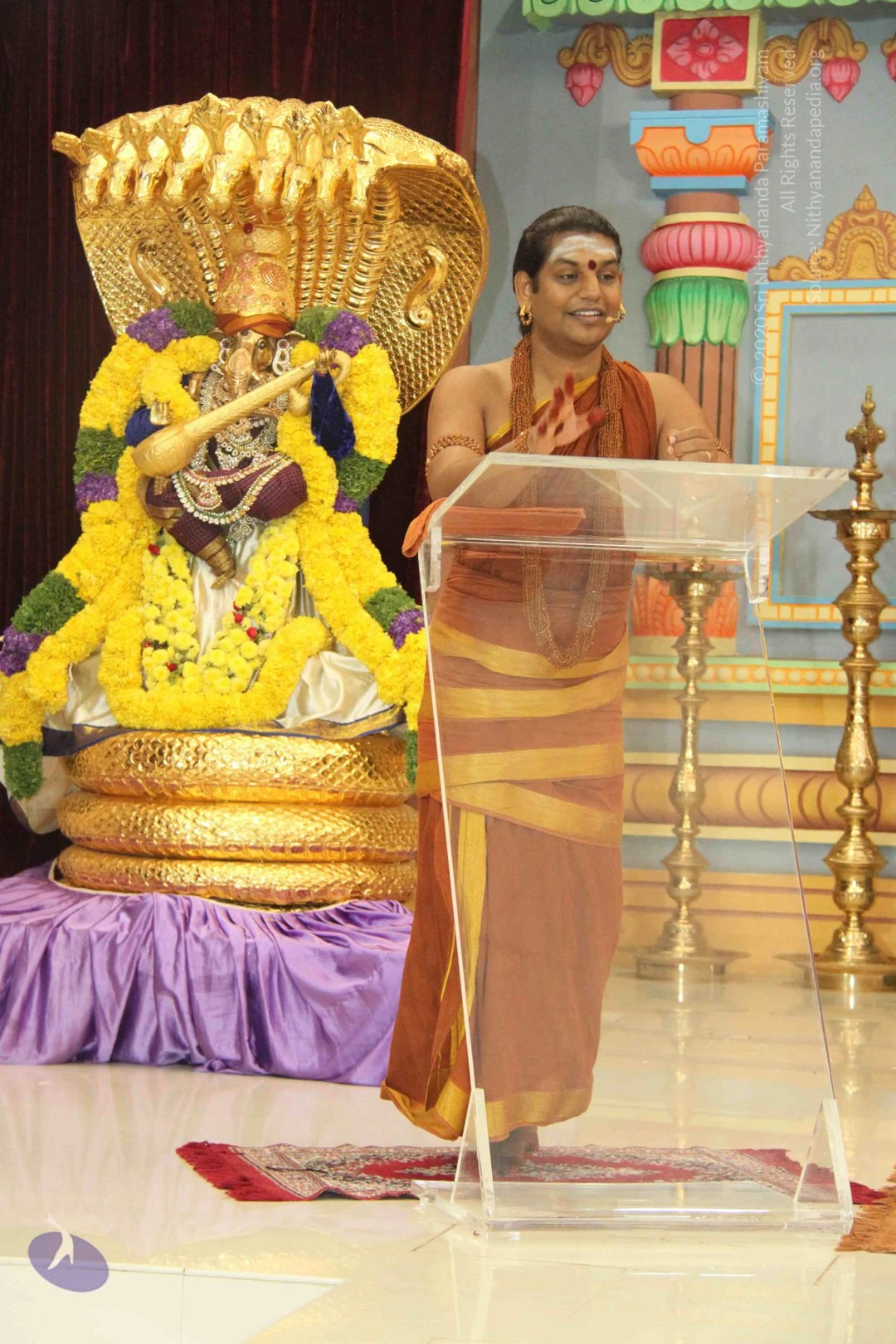
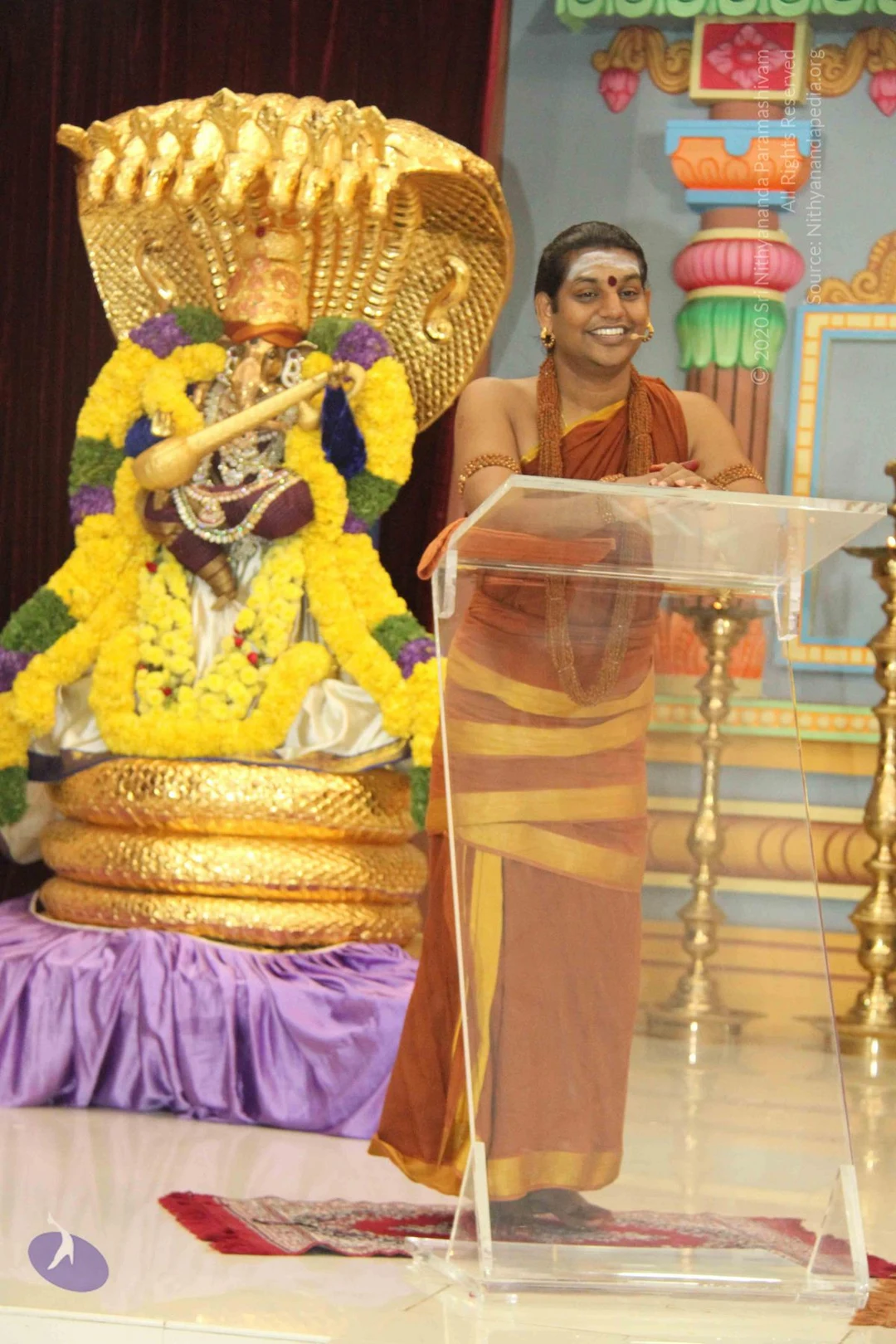
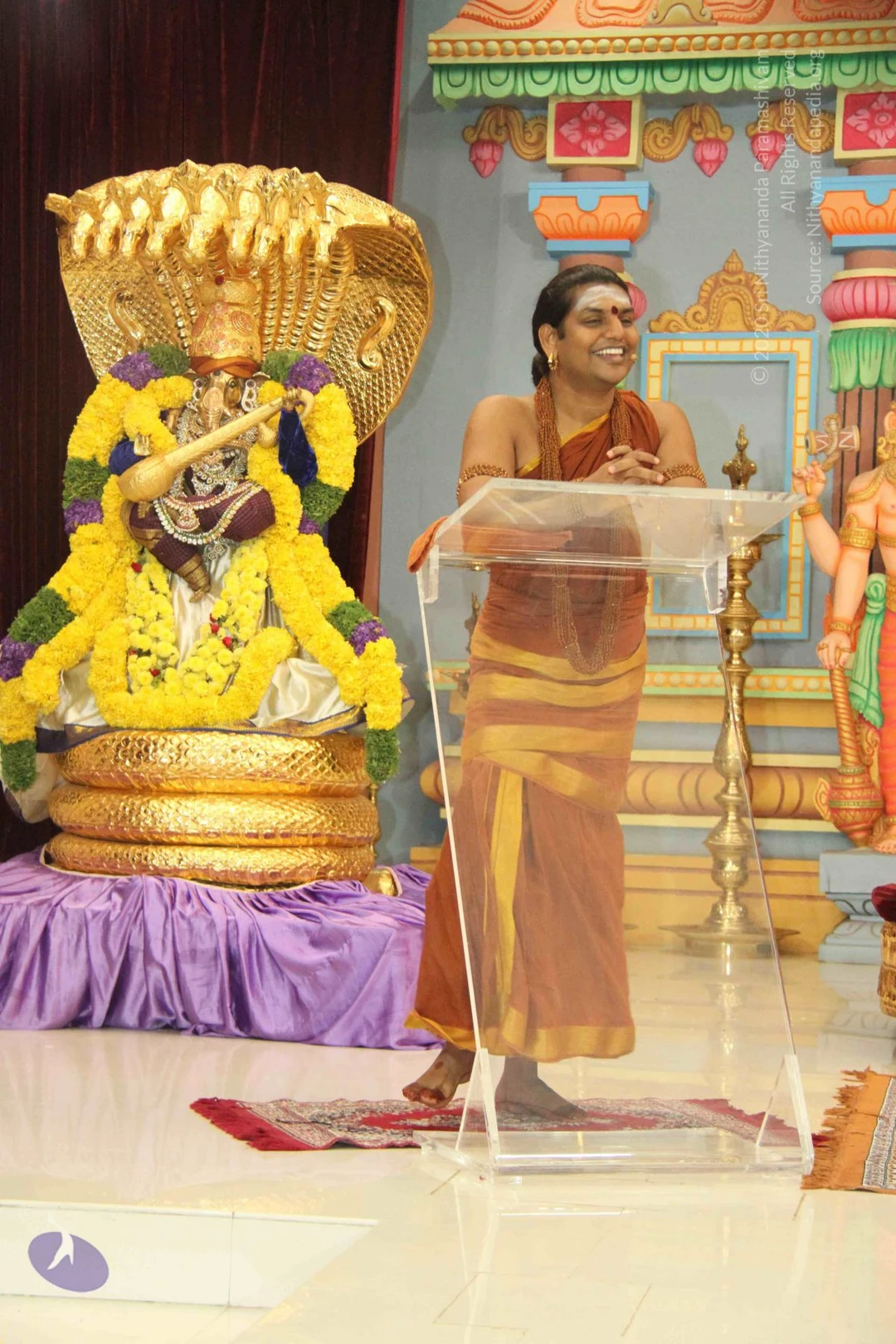
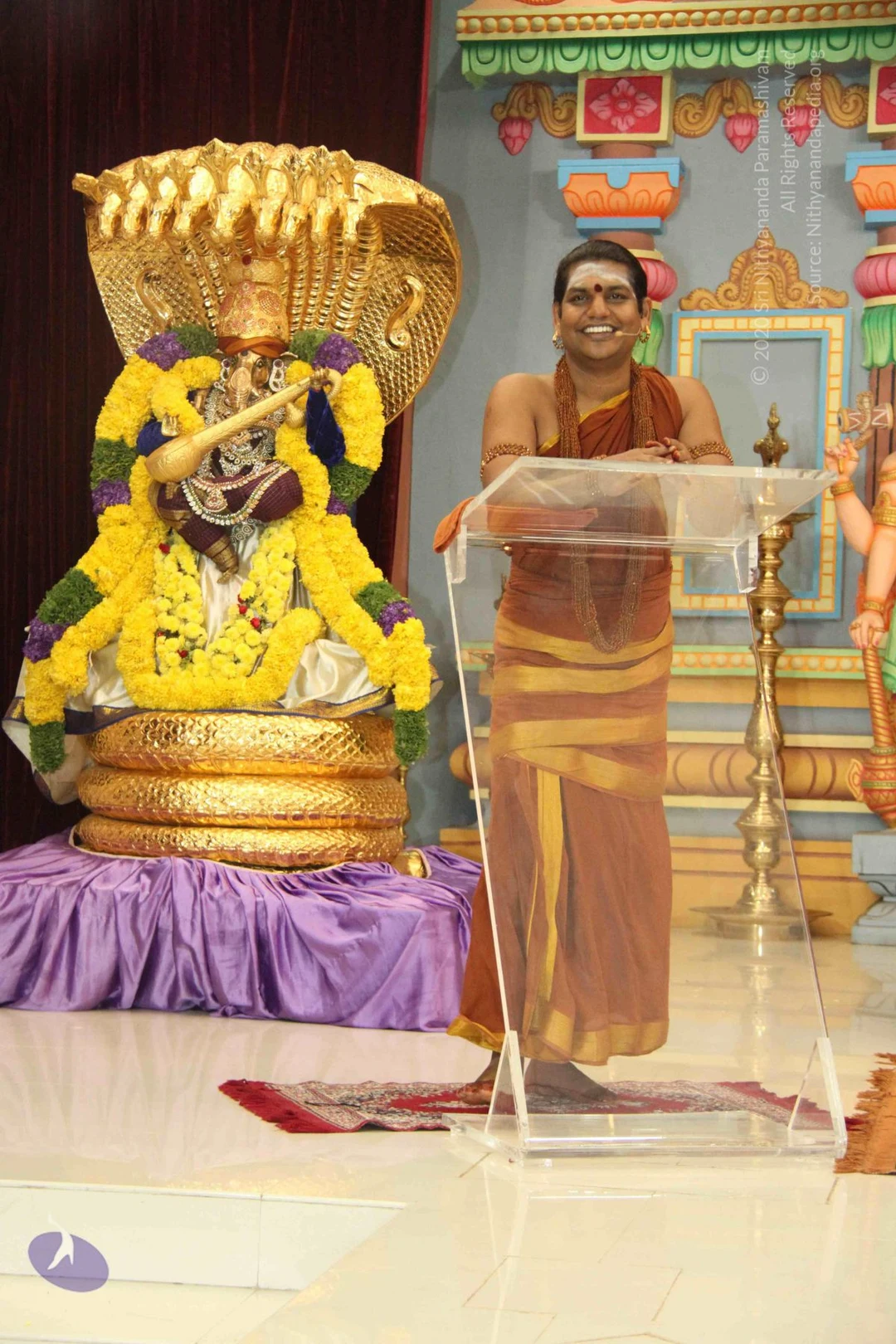
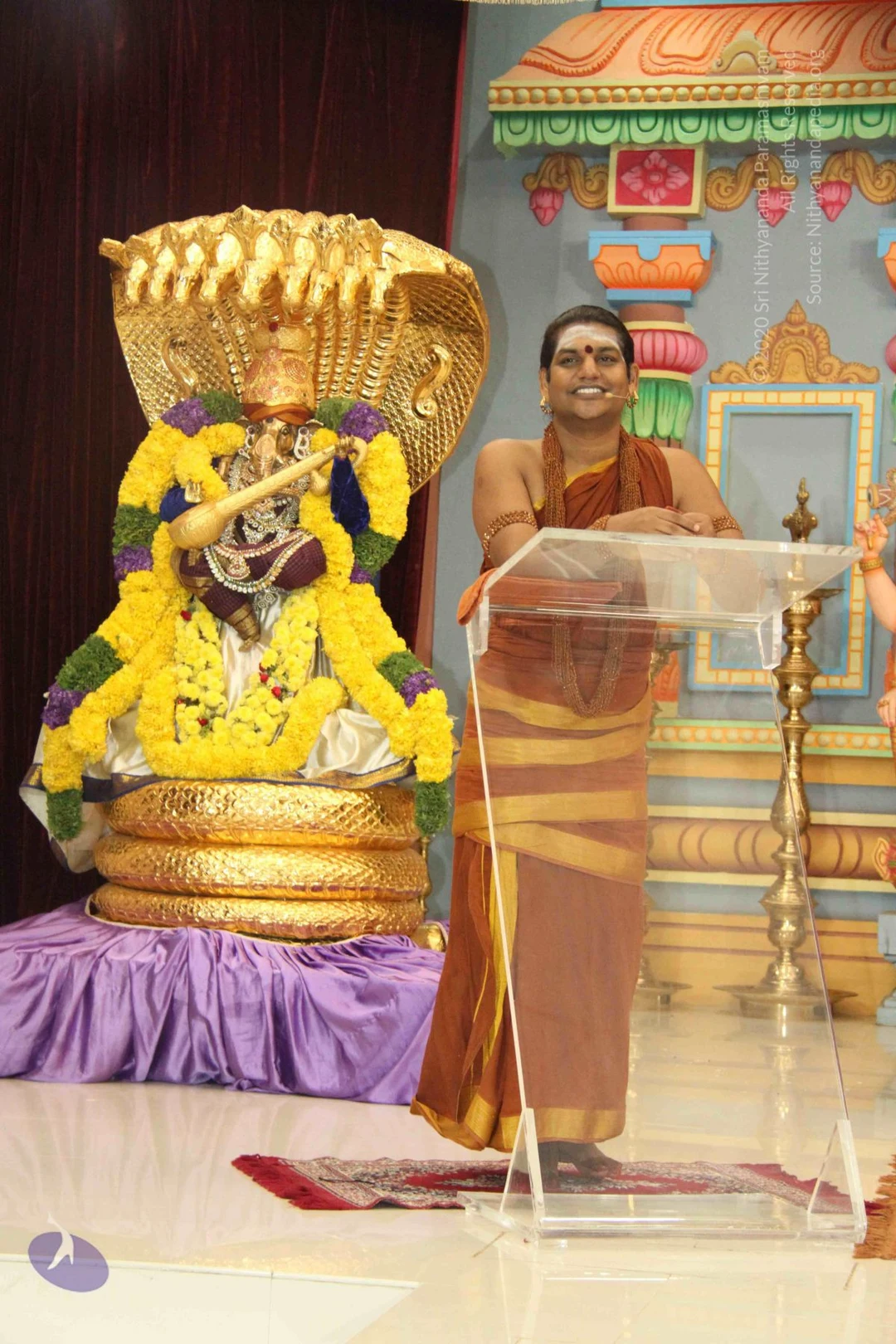
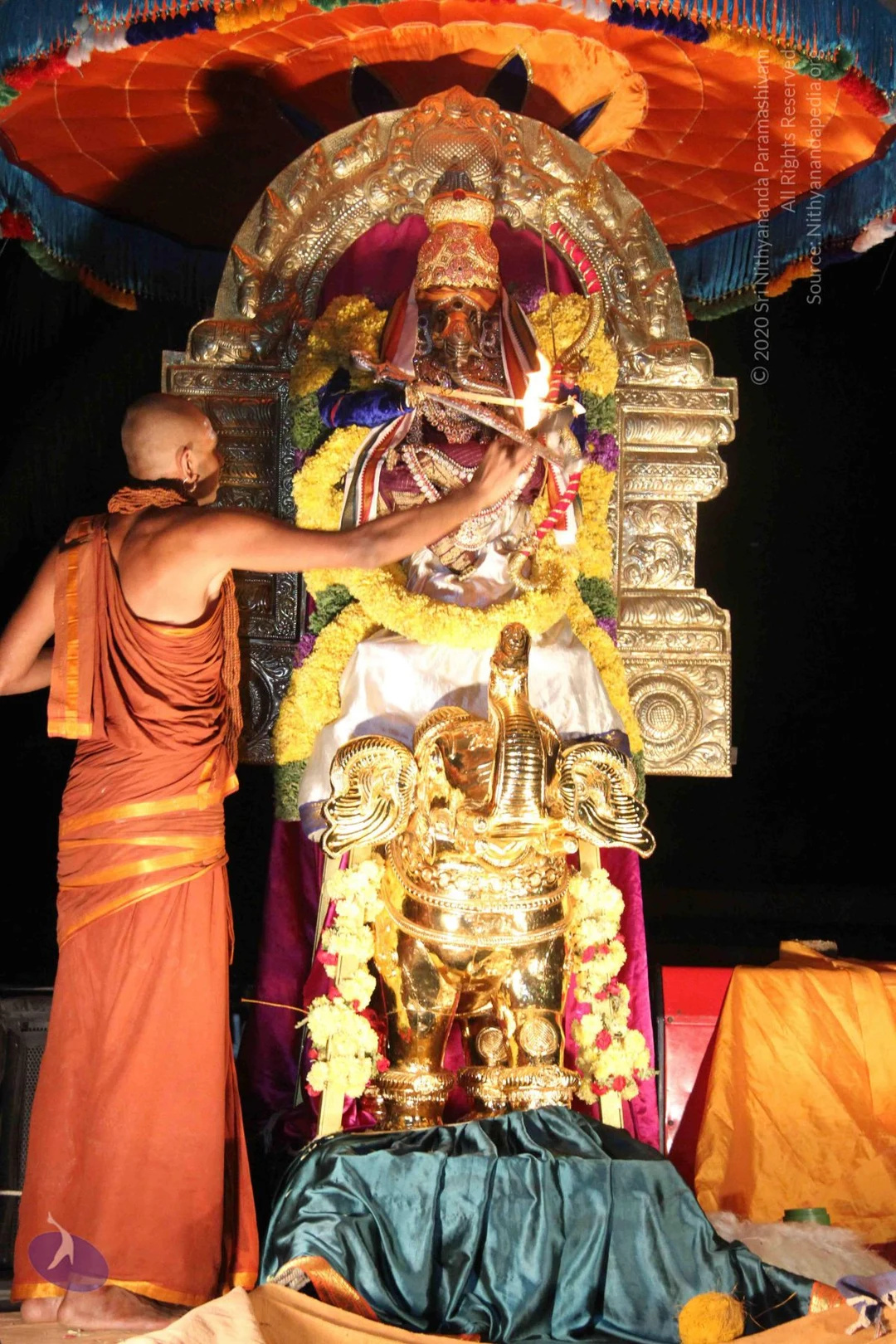
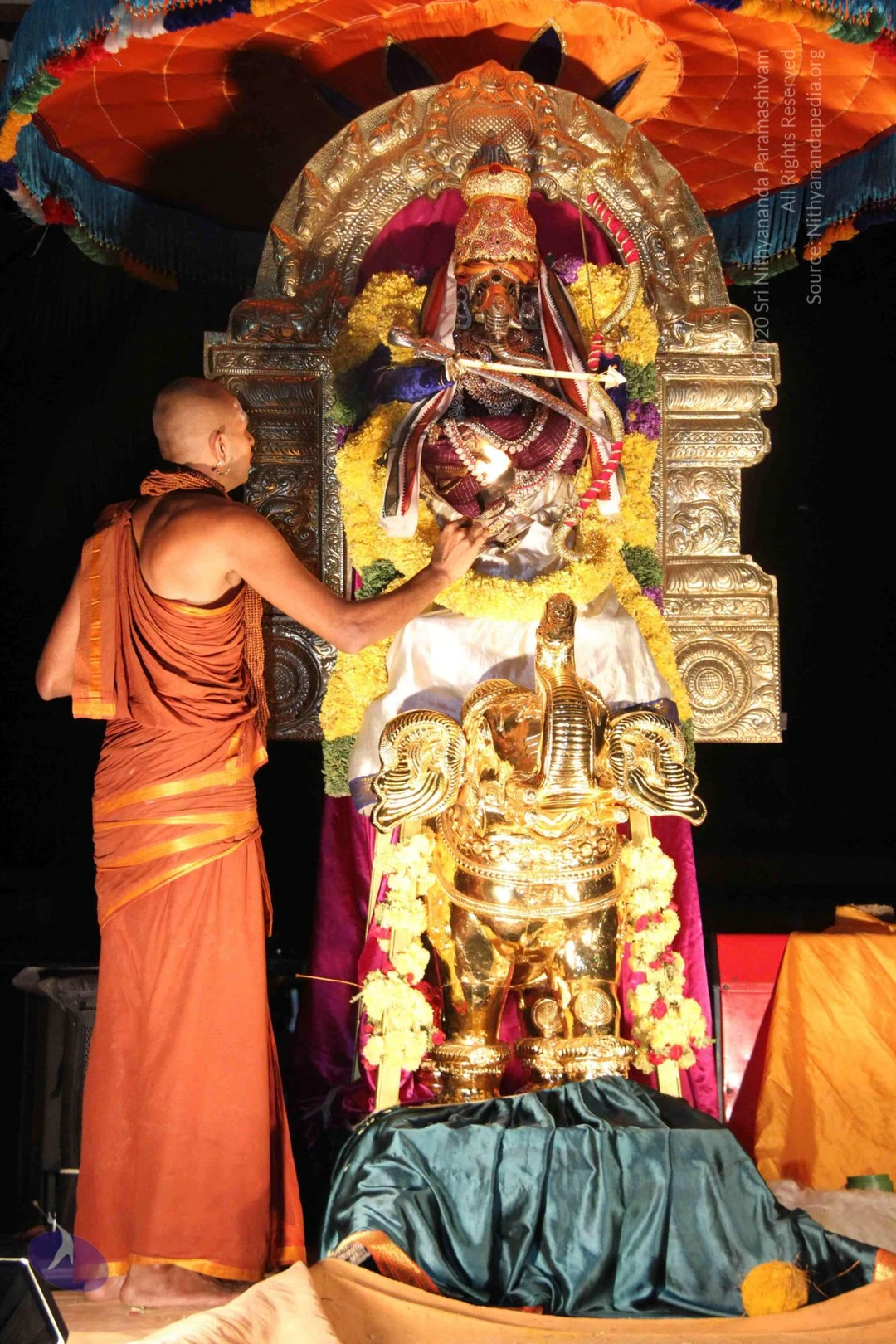
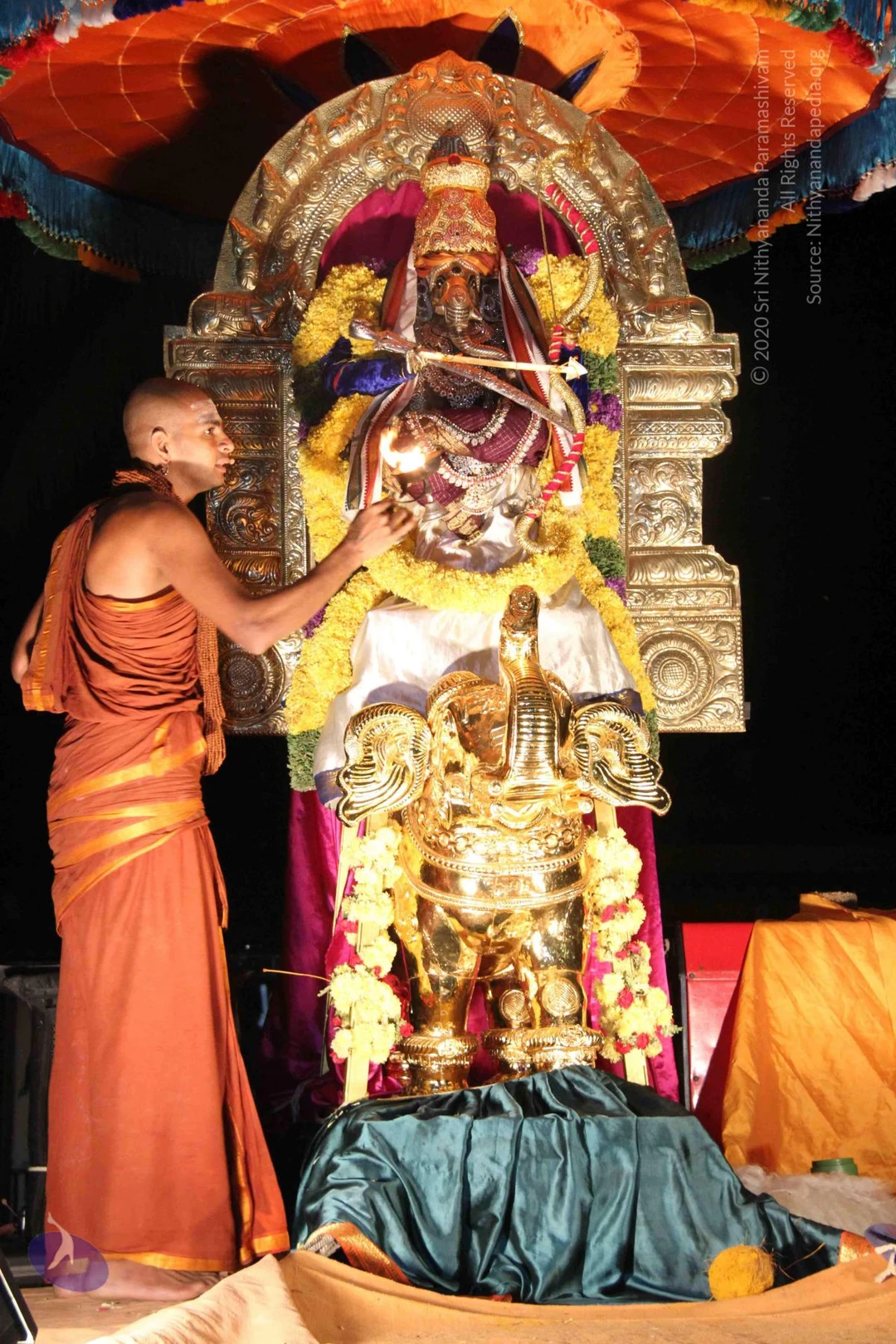
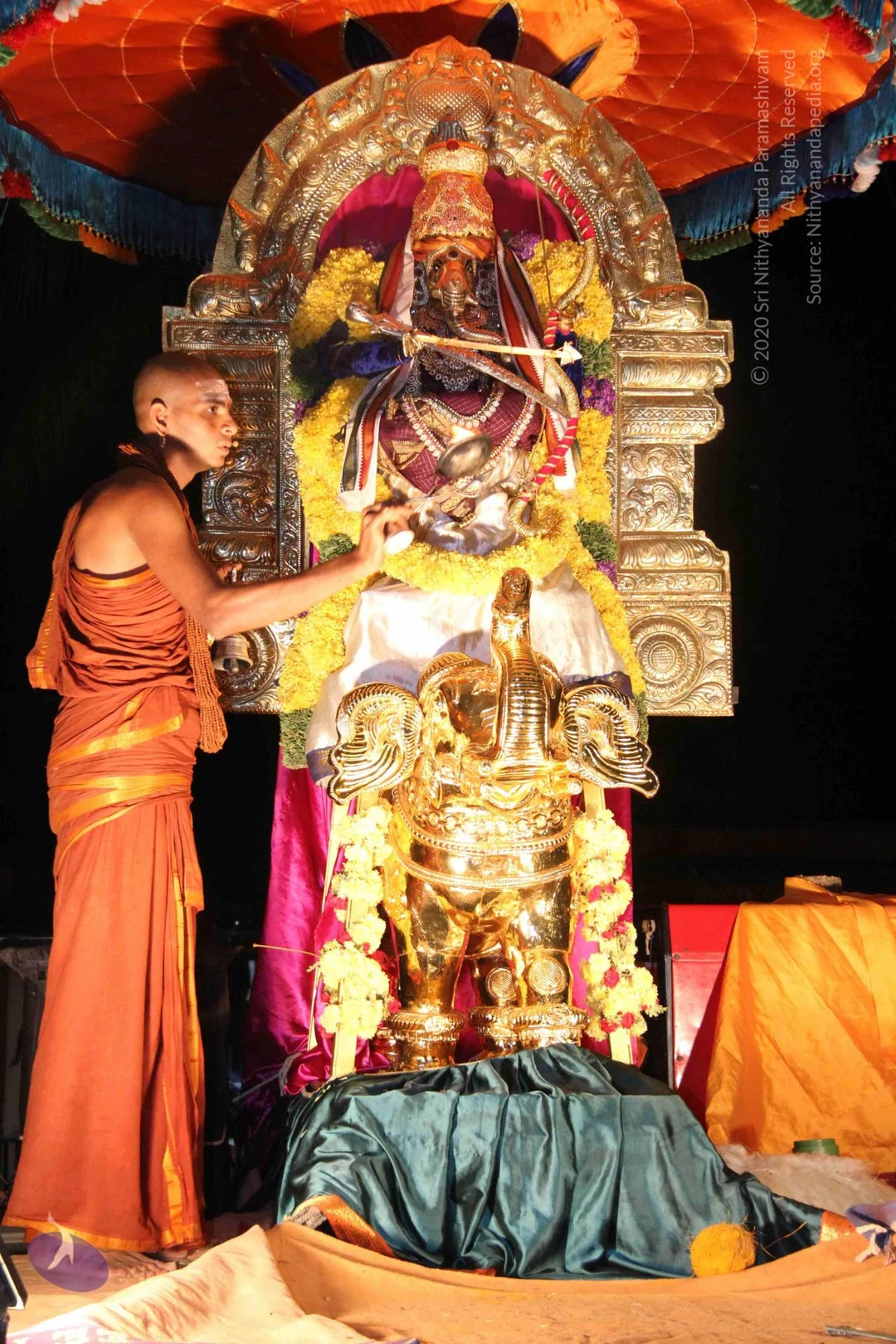
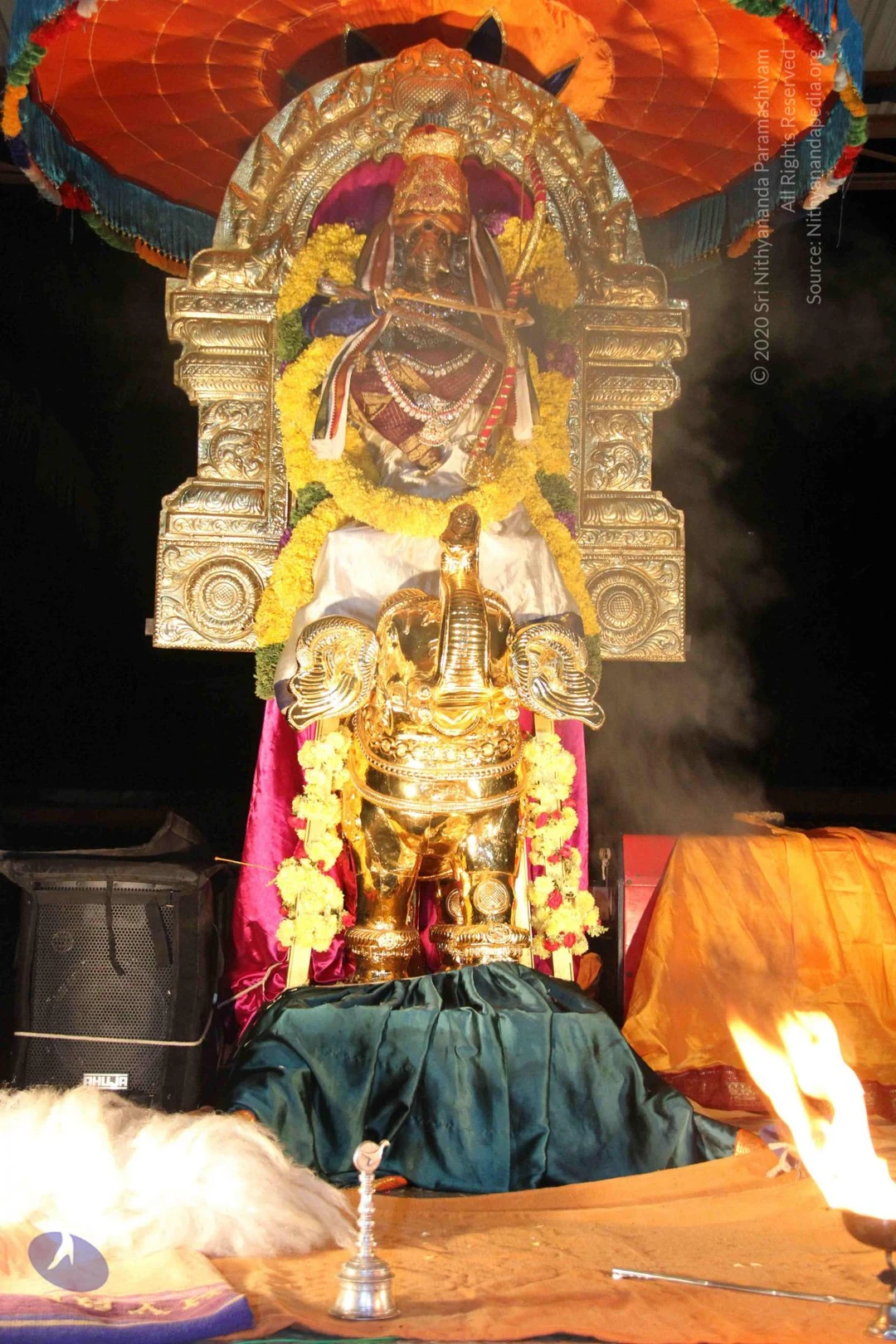
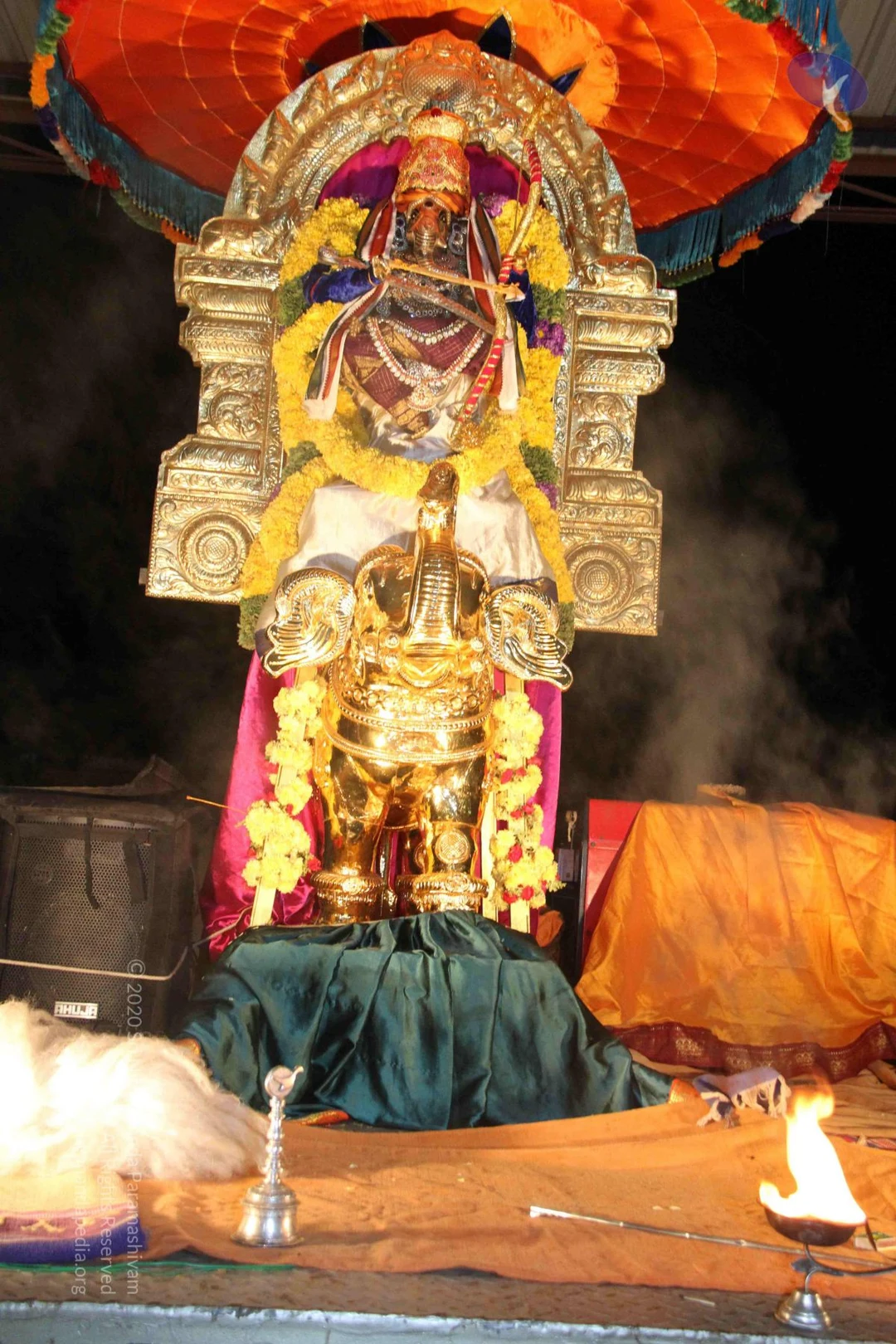
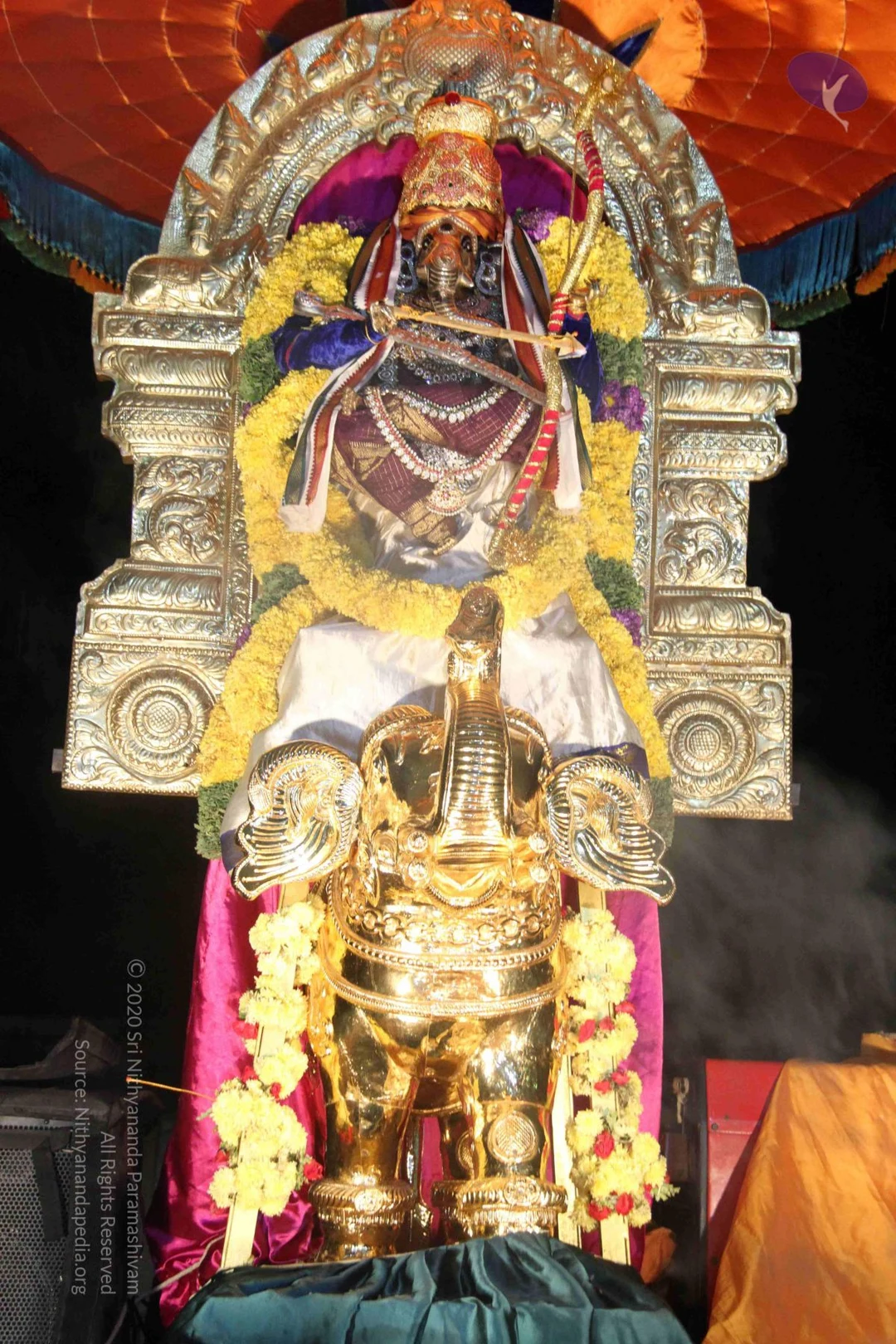
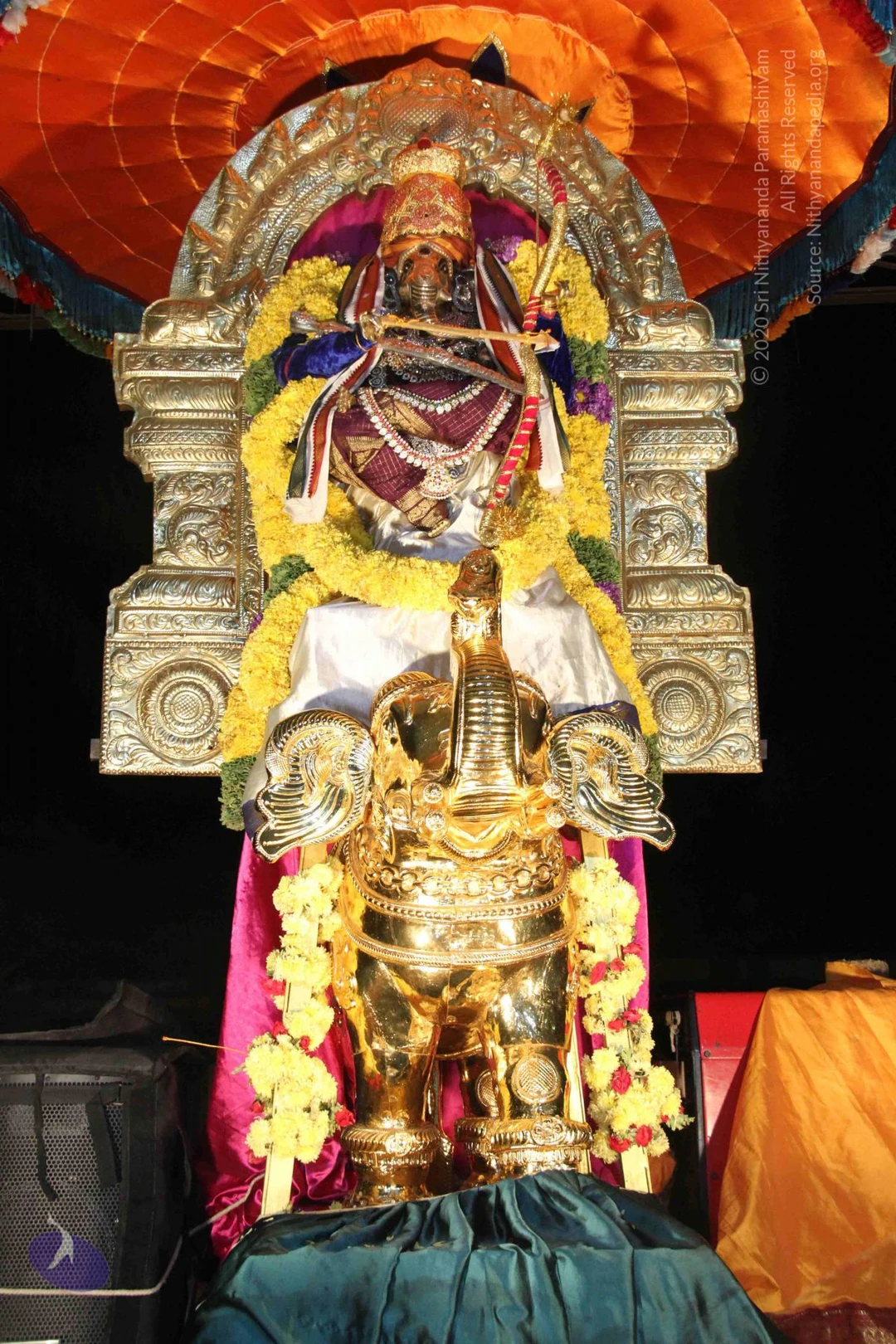
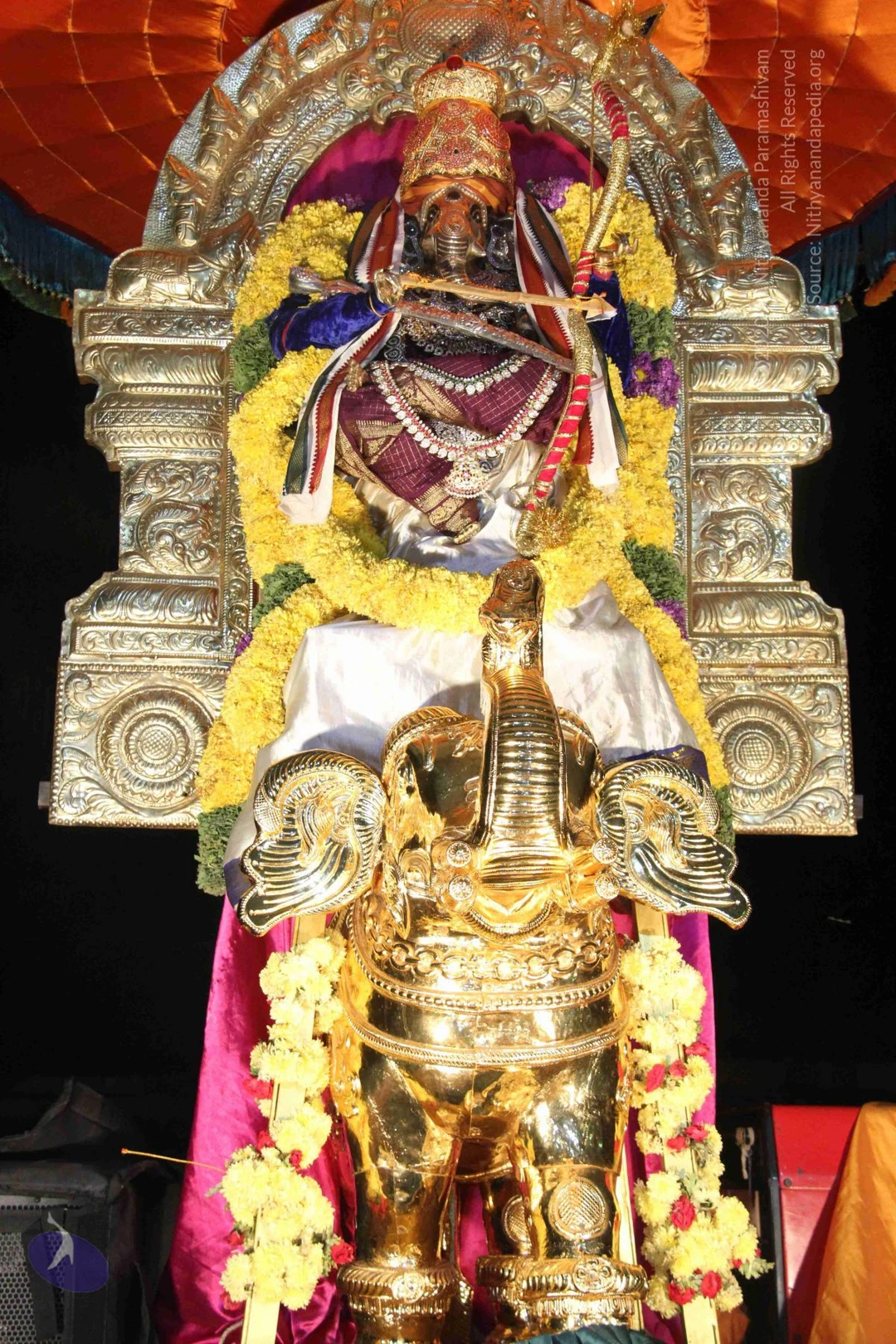
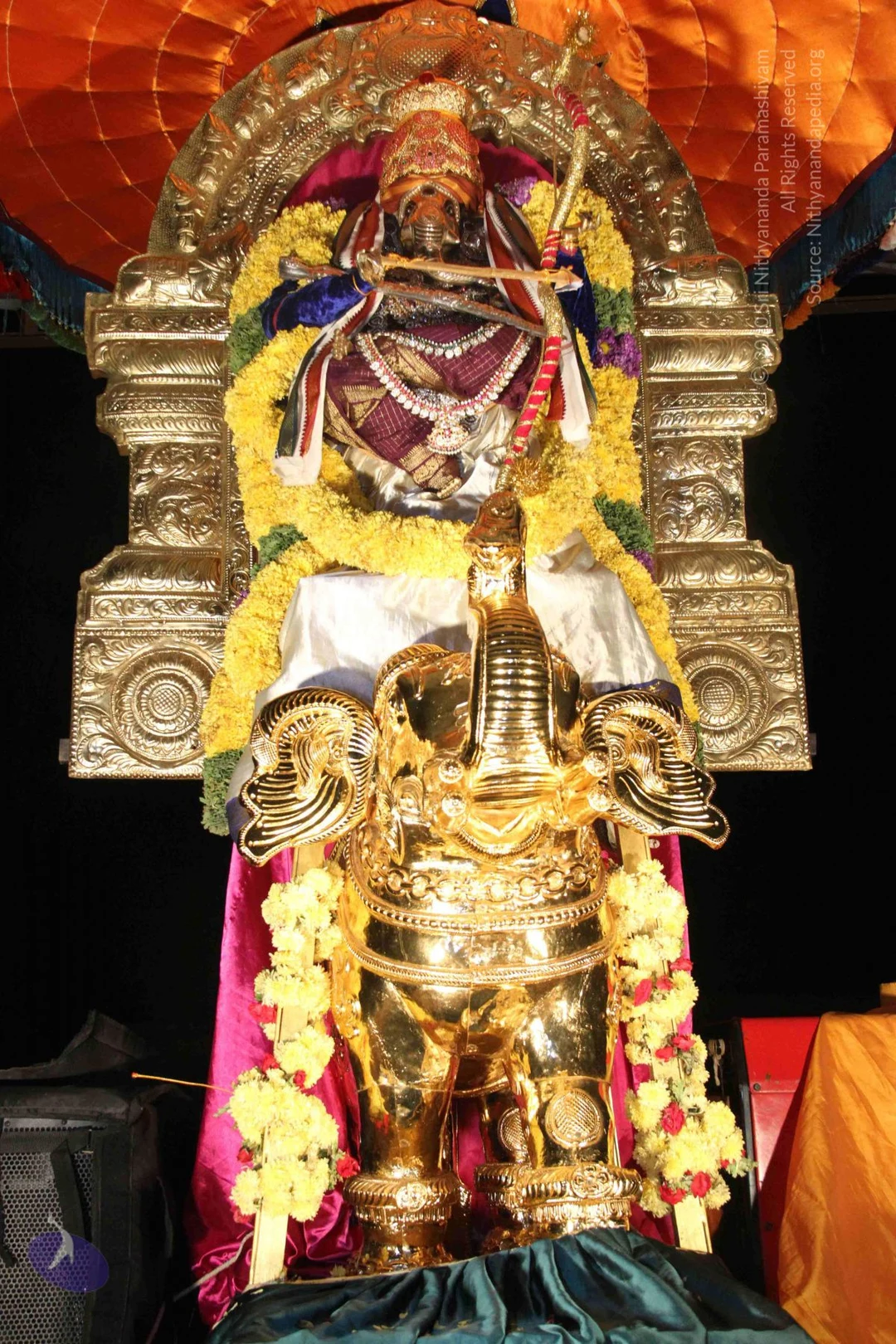
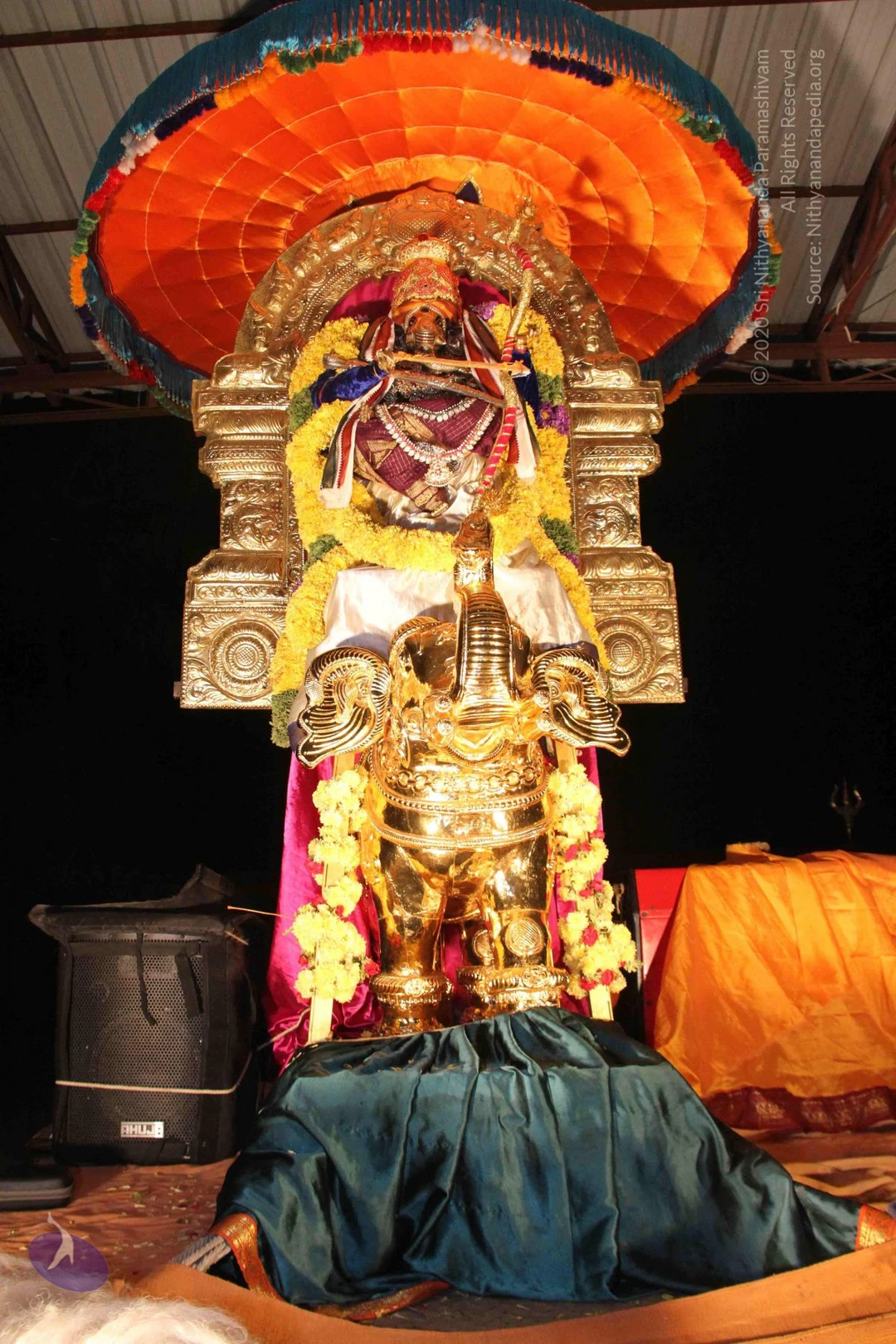
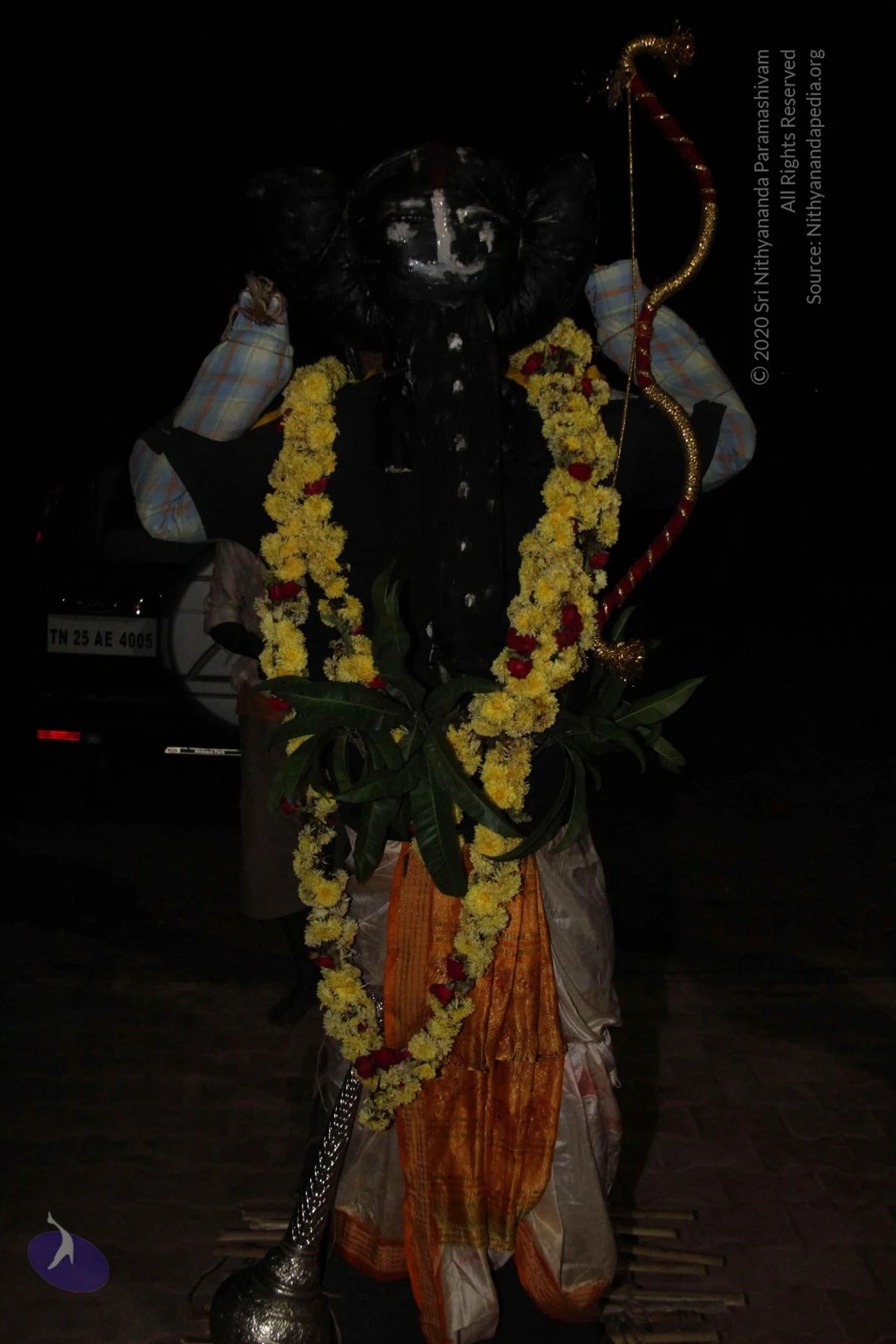
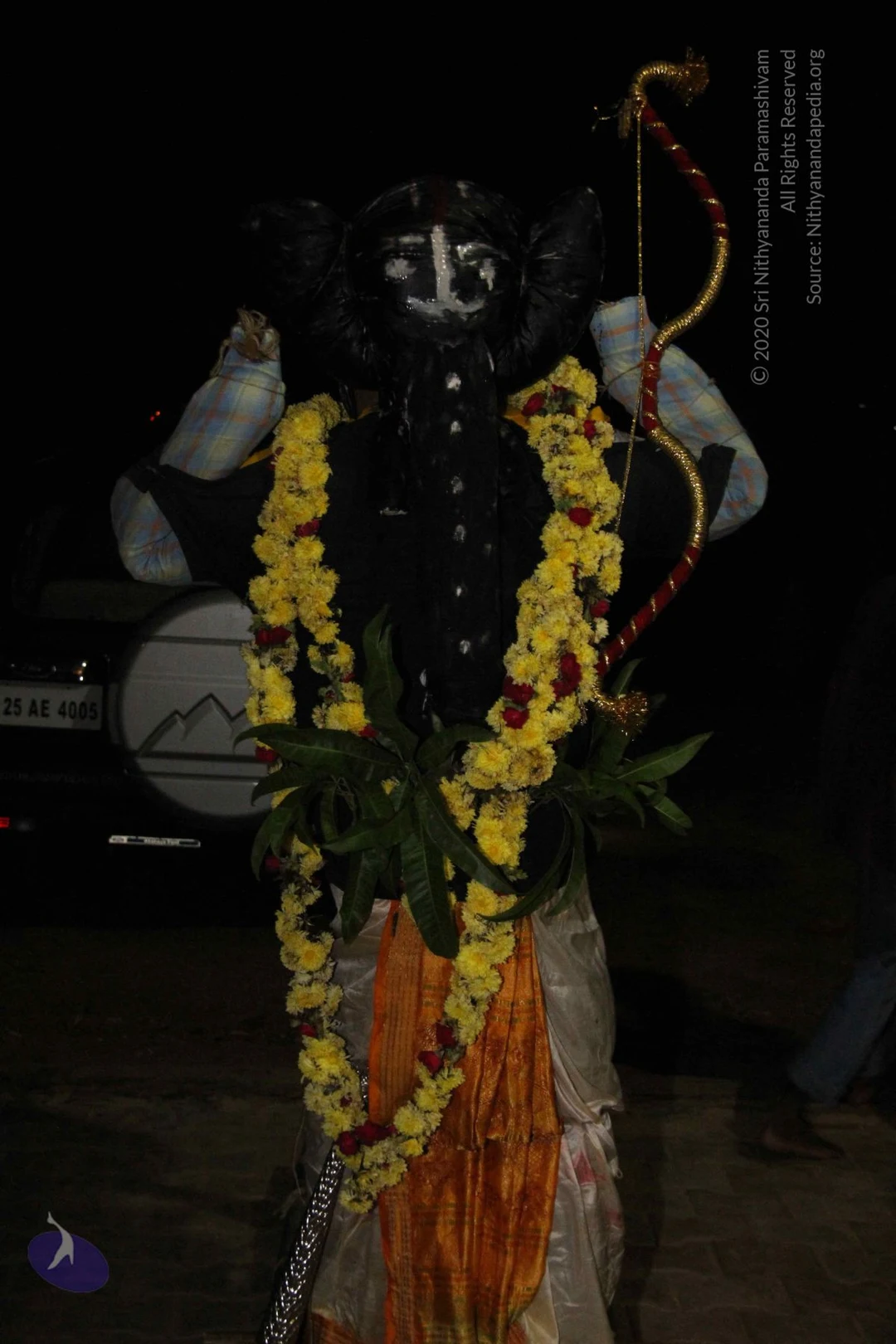
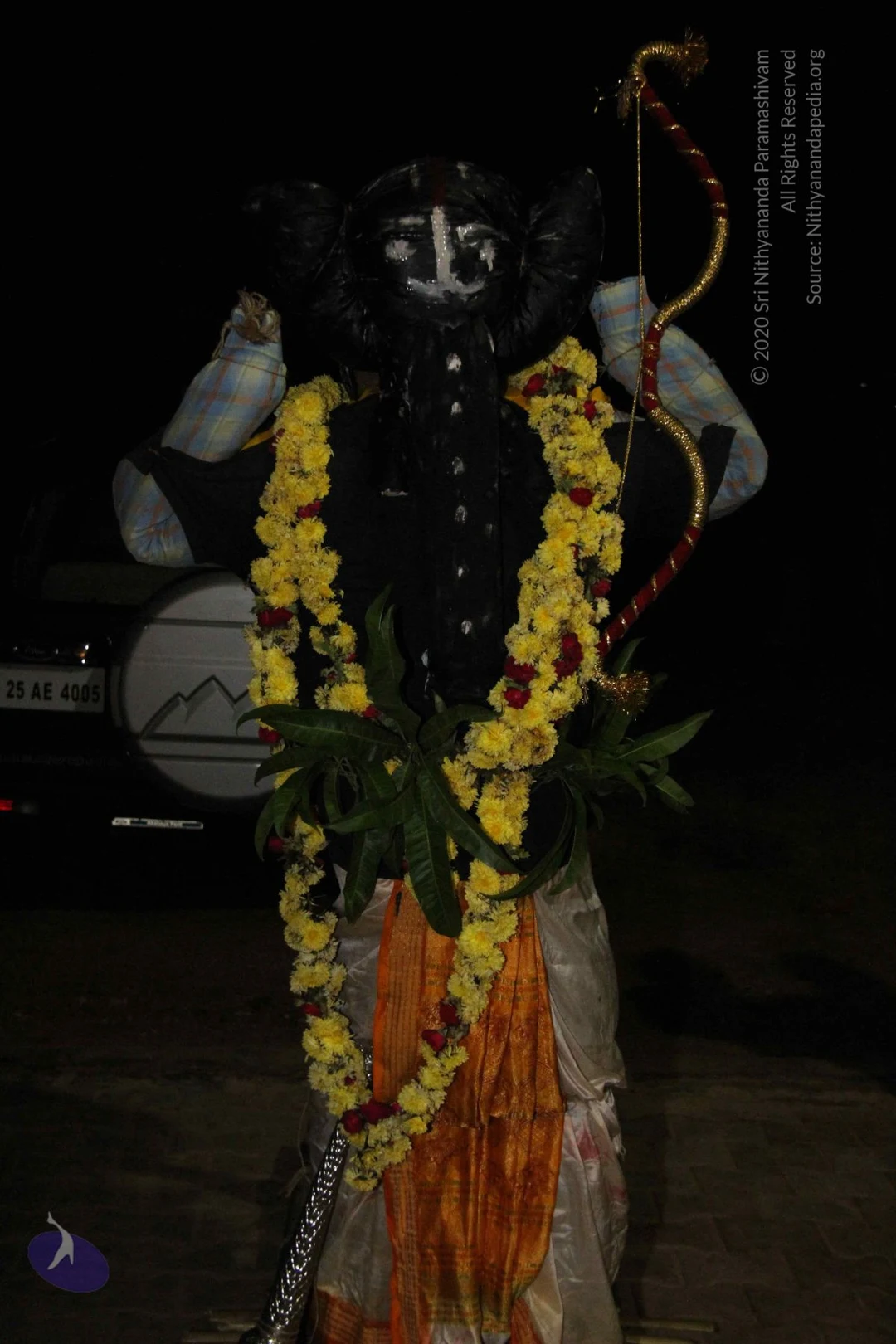
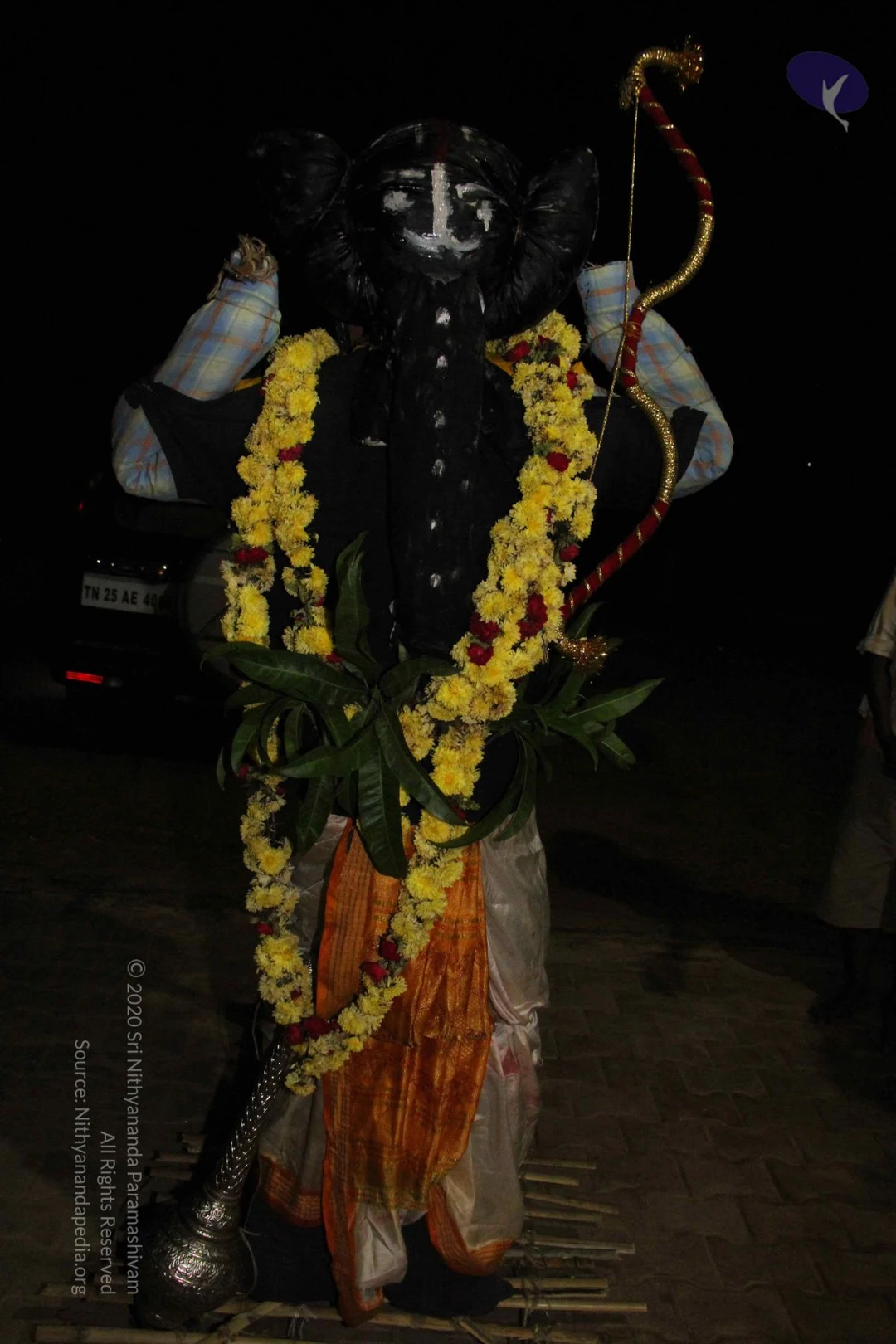
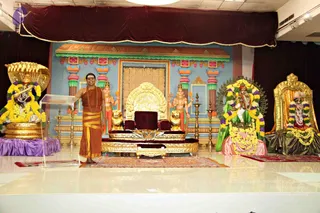
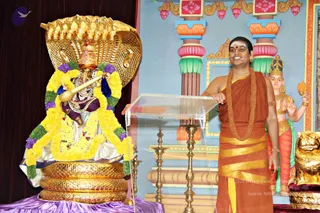
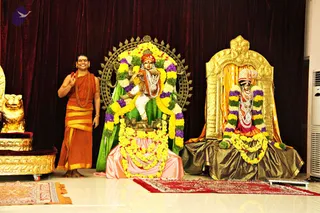
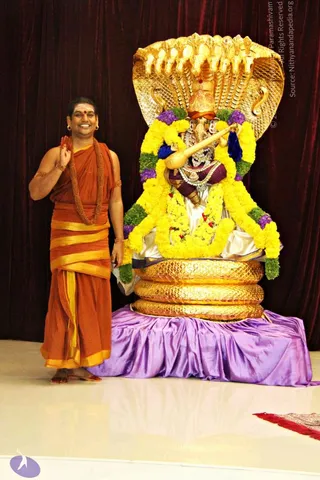
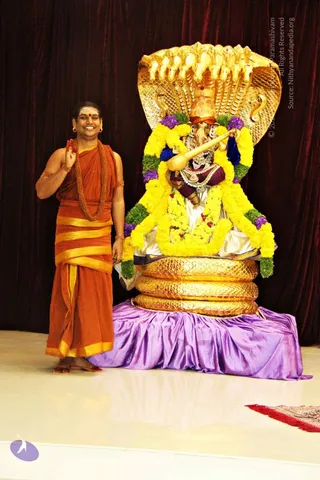
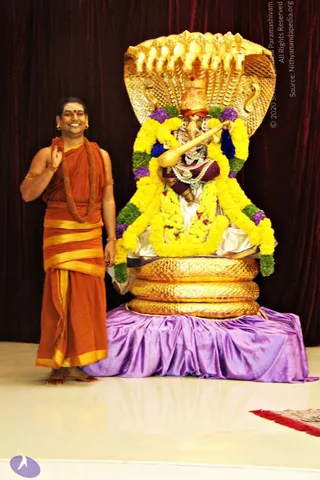
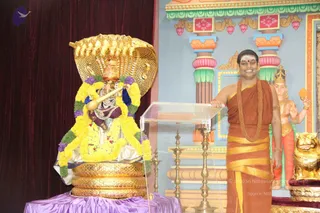
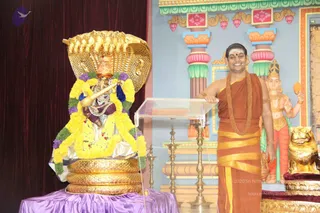
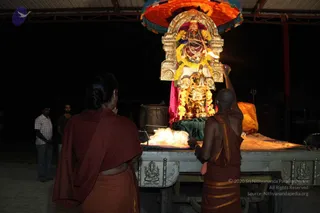
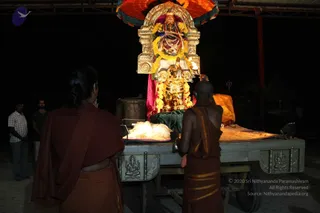
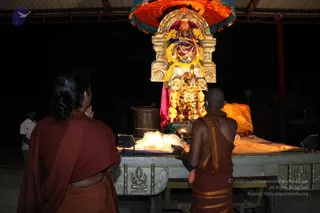
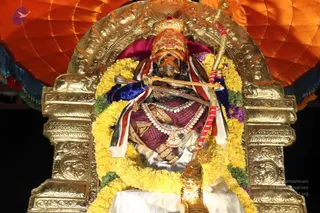
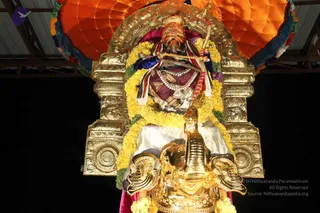
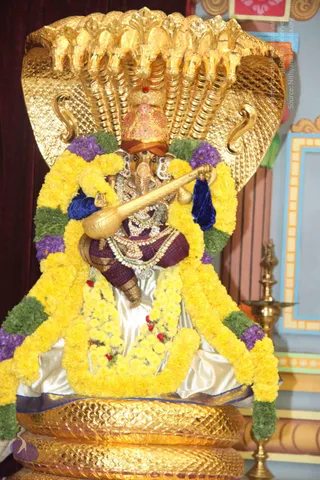
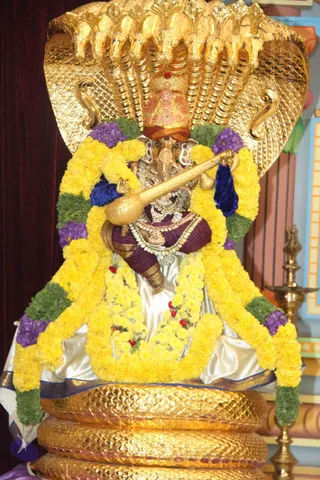
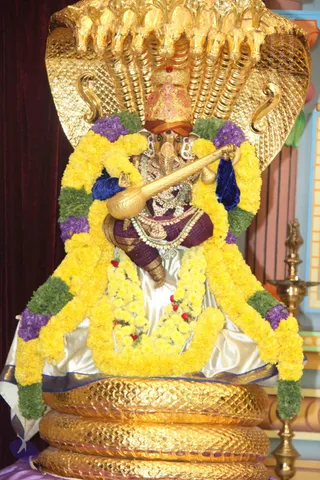
And Ganapathi, Ganesha is gracing us on the “Naga Váhana”, “Sesha Váhana”, with Veena Alankara (with the stringed instrument “Veena” in his hands), as part of Ganesha Brahmotsava, ten days’ festival.

Hey Nithya Priya, see all your mom, dad, grandparents, all of them are seeing you from Charlotte!

We’ll start the Nithya Satsangh today!

I will continue to expand on the subject I was expanding on yesterday: “RECLAIMING YOUR INNER SPACE” which is occupied by self-doubt.

I tell you, so many times, just because of the self-doubt, you lose the Master, your life, God. Even when the great things happen in your life; even when some of the great things happen in your life, just because of the self-doubting pattern and the ripple effects of the self-doubting pattern, you miss God, Master and very auspicious things, very many things. You miss so badly; not in an ordinary way, very badly you miss!

How to complete with self-doubt? You need to understand the zone from where the self-doubt starts happening.

Please all of you sit straight, come to the space of listening!

I know everyone is tired after melting and molding the great Meenakshi deity for Seattle Temple,

Yesterday, till night 12 o’clock, in the ashram there was a beautiful event happening – melting and creating the Meenakshi deity for Seattle Temple. Around one ton, means, 2,200 pounds – 1,000 kg – panchaloha was melted and poured into the mold to make a beautiful Meenakshi deity for Chidambaram, Seattle-Chidambaram. Five-metal alloy was melted and poured and the deity was created. I think the people who have seen all this became tired. Large size event, which your brain feels difficult to catch, even seeing will make you tired!

In my life, only once like that I felt tired, which my brain was not able to comprehend – Delhi Akshardham! I can say this is the greatest credit I’ll give, this is the best statement I can make about Delhi Akshardham! Even Rajaraja’s Tanjore temple was not as mind-boggling to me as Delhi Akshardham. It was so mind-boggling! I’ll sincerely recommend all the devotees, disciples, viewers, visitors, at least once have the darshan of Delhi Akshardham. You will understand the power and glory of building temples!

I always used to have that one soft pride, the great Tamils because they build amazing temples; but when I saw the Delhi Akshardham, I understood they crossed the great Rajaraja, I can tell you! Hats off to Pramukh Swami Maharaj and Swaminarayan Sangha! They crossed what Rajaraja did! Of course, Rajaraja had one plus point: In his time, there was no machinery. But even with all that, what Delhi Swaminarayan Sangha created as Delhi Akshardham, unimaginable!

I could see yesterday so many people fell into that state. When the metal was about to be poured, many people were just struck, where they were standing! I think still some of you have not come out of that zone. You need to come out of that zone. How many of you were wonderstruck yesterday? You all need to know, it is only one small deity for one temple being made. Seattle has taller than this size Nataraja already sitting. And, now only Devi is getting ready to go to Seattle. Anyhow! Come down from that feeling of wonderstruck or awestruck! Let’s start looking into the truths we need to study.

Listen! Yesterday, when you saw the metal being poured into the mold, you would have seen lot of air bubbles coming out. If those air bubbles stay inside and get caught inside the mold, the deity will be very weak. When you transport or move it, suddenly it may give way and break. Air bubbles can’t be inside the deity, inside the mold. Self-doubt can’t be inside you. Self-doubt is like that air bubble.

Understand, a deity, a statue with air bubble can’t be trusted. It may give way at any moment, any place, unexpected! A person with self-doubt cannot be had as an assistant or secretary or servant or in any trustworthy, reliable place. Please understand, anybody wants to be a leader, understand this principle: if you are with self-doubt, you need to know you are not worthy of being trusted even by you. If you are a person with self-doubts, even you should not trust even you! And make sure, persons with self-doubt are never part of your decision-making team or top advisors or top consultants or coterie. Don’t have people with self-doubt as part of your coterie. First of all, drill yourself with so much of completion. Drill yourself with completion. Only then you will be out of self-doubt!

Yesterday, you would have seen, when there were air holes in that deity, when they were pouring the metal, they poured more metal. And immediately, the air holes started coming out and they started churning the metal with a rod, then the air holes started coming out. Doing completion is the churning your inner space with metal rod so that all the air holes can come out. I tell you this is one of the important thing you need to know. When you’re doing completion, literally your stomach will feel the churning and the air will come out, literally it’ll happen because the stomach ulcer, gastric, everything is related to the incompletions you carry! When you complete, when you start completing with yourself, the completion with the self, releases all those self-doubts.

I tell you really, life without self-doubt, NO ONE can break you! You have to be very clear, if your Mamakaara, inner image, is in self-doubt, and outer image is without self-doubt, and you try to show as if you don’t have self-doubt, you will be a failure. No! The game won’t be successful. Even in the inner image, complete with all the self-doubt pattern and drop it. Complete it. Even in the inner image, be without any self-doubt. It is not something too big, too complicated, understand. Just declare completion with all your self-doubting patterns.

Sometimes you feel, ‘I can be without any self-doubt only if I am perfect.’ How to be without self-doubt when you make mistakes in your day-to-day life? Listen! Self-doubt is a space you carry which is completely unrelated to your perfection or imperfection. I am not saying you continue to be imperfect and you can create the space without self-doubts. But I tell you, if you start creating the space without self-doubts, you will simply become perfect. Create the space! It is like the egg came first or the chicken came first? Egg or chicken? You say, ‘No, no, no! Let me become perfect, I will be without self-doubts.’ Your inner space says, ‘First become without self-doubt, then you will become perfect.’ Who is going to break the cycle? Who will take the responsibility?

Understand, completion with self-doubt simply starts the moment you declare to you consciously. When you declare, even about that declaration you will have doubt! Don’t worry about that. Declare even about that doubt. See, when you sit and declare, ‘yes, I am declaring completion with all my self-doubts.’, one part of you will say, ‘No, no, no! Still I am carrying self-doubts, I don’t think this declaration will become a reality. Many times we did declaration like this, but it all became failure.’ Declare, ‘Even this is one more self-doubting pattern; I am declaring completion with it.’ Declare layer by layer completion. Once you declare completion with the self-doubt, one more layer will open, no, no, no, no! I have some more doubt, then declare completion with that also. You will have some more doubts. Declare completion with that also. Understand, the moment you consciously declare completion with your self-doubts, even if you have self-doubts about that completion, your completion will be the more powerful force driving you, not the self-doubt about that completion, self-doubt which happens about completion that self-doubt. By the second layer, third layer, self-doubt will lose power over you. Start with completion, because people who started trying to be perfect and thinking that ‘with perfection I will reach completion’, I have seen them, till the age of ninety-nine, they don’t feel they are perfect or they can be in the space of completion!

One young brahmachari goes to an old sadhu, ninety-seven years old, who lived a sannyasi’s life from the age of fifteen. This young brahmachari asks…..

It actually happened in one monastery. I won’t name the monastery. And I am not that young brahmachari! I wanted to make sure all the persons mentioned in this story are only imaginary.

This young brahmachari went and asked that Swami, ‘How to cross the lustful thoughts in the mind?’

The Swami looks up and says, ‘I do not know about it. But one thing I can tell you, till ninety-three, you can’t cross!’

No, understand, what he is telling is not true! Please understand, he has started with the pattern of “Let me become perfect; then I will not have self-doubt.” When you start with that pattern, you will become a failure like this only!

I tell you, start with the completion of self-doubt. From where you start is a very important thing when it comes to the spiritual practices. The context from which you start plays a major role. Right beginning, right starting, means ninety percent journey is over. Sometimes, with the right beginning, hundred percent journey is over! This sadhu has started from the wrong space of “Let me be perfect; then I will be complete.” That is why he is struggling and suffering.

I started from the other side – ‘Let me be complete; then I will be perfect”. If you start from this side, you will be like me! If you start from that side, you will be that way only (like the sadhu)!

Understand, when you bring completion, perfection starts happening in any field. When you try to bring perfection thinking the perfection will bring completion, you will bitterly fail and utterly fail!

Understand, start bringing completion in your inner space, you will achieve perfection in a few days, sometimes in a few hours; sometimes even in a few minutes, in any field!

I tell you from my experience: Bringing completion into your being, removes the self-doubt. I tell you when the self-doubt is removed, you start playing a very simple, straight forward life. A person who plays a simple straight forward life, even if people try to create complications around him, or against him, that just melts down! Melts down! When you bring completion inside you, you become such a beautiful “Bholenath” – the innocent being. Your life becomes so simple, non-complicated! Even people who try to create complications around you, just get automatically destroyed! The complications just melt down!

In my experience, the Masters who give immediate result even by just once praying and calling….. Of course, I am not supposed to grade them. We should not grade the Masters and Incarnations based on any scale. But I will make one statement with all my Integrity and Authenticity: The quickest Master to respond even calling only once or remembering only once or just trying to call, without seeing the depth of your devotion or the amount of perfection or imperfection in your devotion, the amount of self-centeredness, selfishness or unselfishness in your devotion, without judging you or without any this kind of waiting, nothing; even your remembrance and calling, immediately responding, I’ll grade the number one as Shirdi Saibaba! Number one in responding to people! He is the “spiritual 911”. I tell you, how in America the 911 responds; 911 doesn’t see whether you are a criminal or illegal immigrant, 911 is not bothered about all that, if you call them they are there to take care of you….. See, whether you are an illegal immigrant, you have not paid the tax, you have escaped from jail, you have done some other crime, all that they will check later on, those are different departments, but if you call them, they are there to take care of you!

I tell you, Shirdi Baba is like a spiritual 911. He will not bother about all the other things, whether you are imperfect…..in that line; you are a little imperfect…..in that line; your vibhooti was not straight, straight when you applied the vibhooti, your kumkum was not that perfect when you applied the kumkum; when you remembered the Master you were not that perfect; on the way you, in between, you are remembering your wife also, or you had a distraction of your mind! Nothing! Nothing!

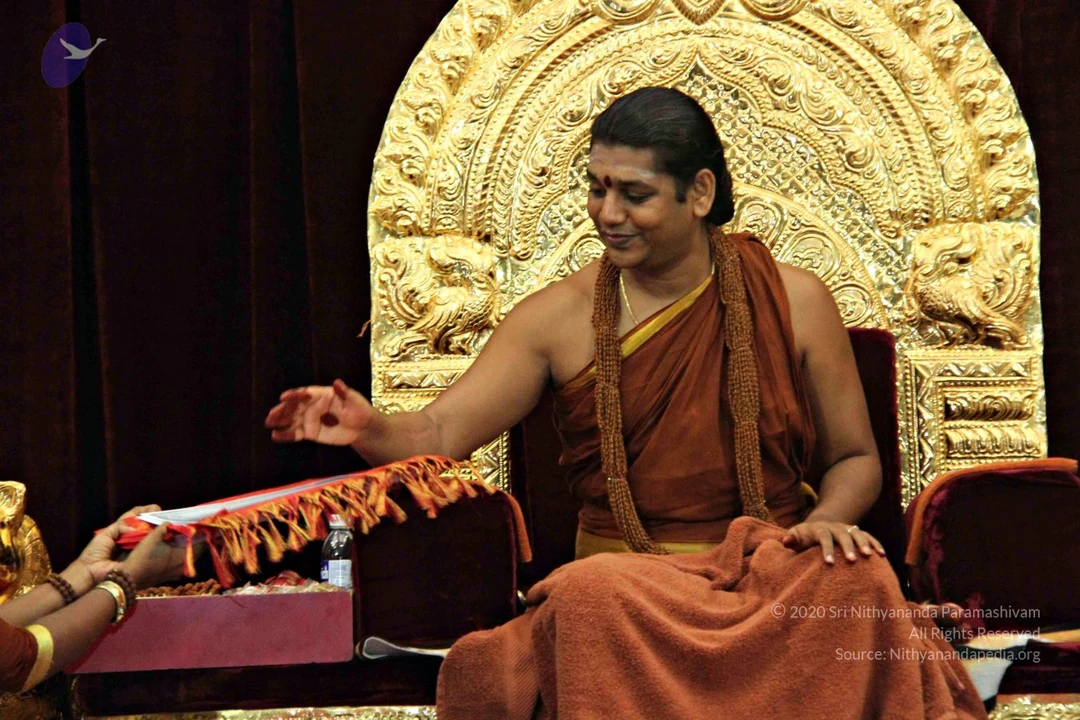
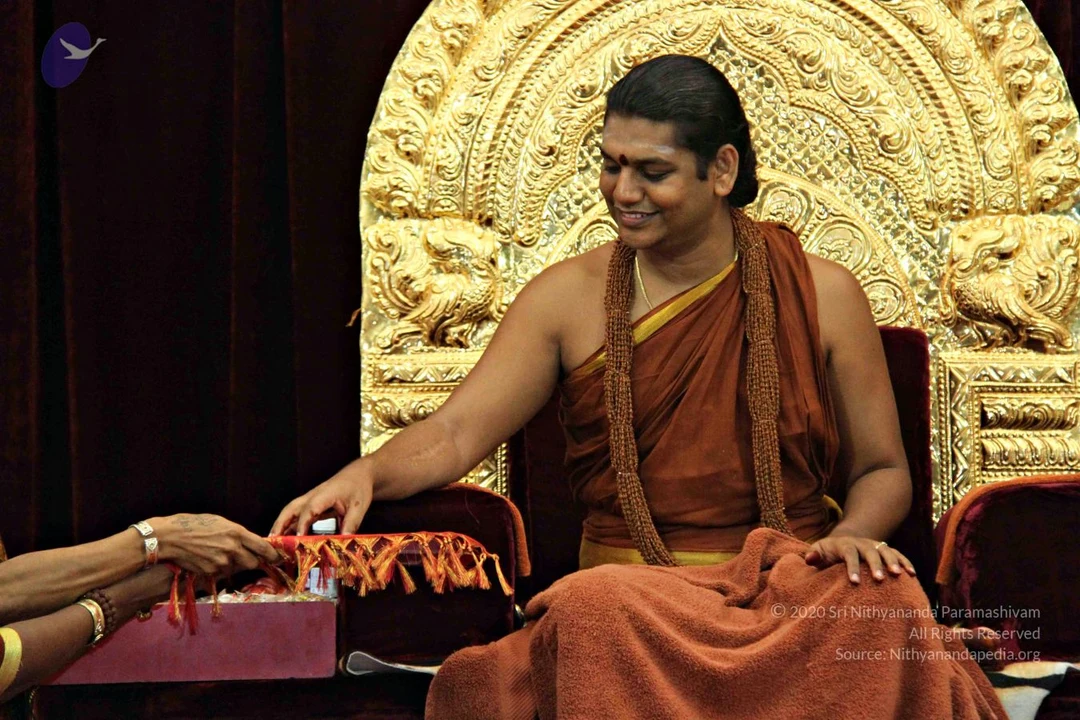
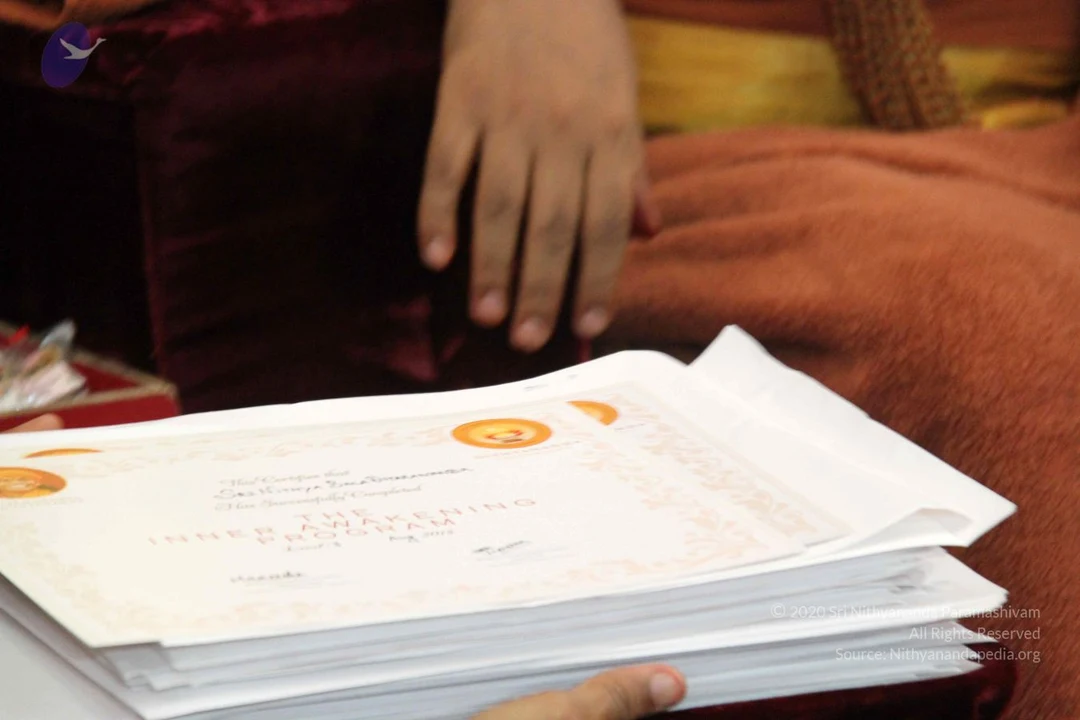
I tell you, please understand! Now listen to the next statement. Among the Masters, I will say, Shirdi Baba is the Master who responds immediately to your call, for your remembrance, to your prayer. Immediately he will attend. Same way, among the processes, among the techniques, among the methodologies, Completion is the process which immediately responds to you, immediately creates the positive things, right things in your life, and immediately starts building the reality you wanted! I tell you, among the Masters, Shirdi Sai is the Master who responds immediately. Among the methods and techniques, processes, Completion is the process which immediately responds to you and brings the auspiciousness, the right and auspicious results. And, among the programs, Inner Awakening brings immediate effect and initiates you, initiates you into the space of Completion. Understand, there is no marketing in it. With Integrity and Authenticity, I am talking to you!

Bringing completion inside you makes you such a simple being, Bholenath. See Mahadeva’s life; He is such a simple being. This fool, Bhasmasura, comes, he is such a complicated fellow, and asks the boon, ‘On whoever’s head I put my hand, they should be burnt to ashes! They should be destroyed!’ This Bholenath (Mahadeva) doesn‘t even bother what will happen if this fellow pus his hand on my head! And he says, ‘Tathaasthu!’ And that fellow (Bhasmasura) chases Him (Mahadeva) and He runs. But the space of innocence, completion Mahadeva carries is so powerful, never Bhasmasura can reach Mahadeva. Before he even reaches, Bhasmasura puts his hand on himself and gets destroyed…!

Bring Completion in your life, all the unnecessary complications will disappear! One of the important complications you carry in your life is, doubt about yourself and doubt about your Master. Please understand, self-doubt, you will project that on your Master. Complete with the self-doubt, only then you will have a complete relationship with the Master! I tell you, Completion with the Master is Enlightenment! If you just have completion with the Master, nothing else is required! His space will just gush into you! His space will just raise your inner space!

When you have self-doubt, you will create only more and more complications! More and more difficulties. More and more destruction to yourself!

Understand self-doubt: don’t allow consciously self-doubt to engulf you, envelope you! Even you declaring consciously, ‘I’m not going to allow this self-doubt to engulf me, envelope me’, is enough!

Do not allow self-doubt to engulf you, envelope you; you will see life in a completely new way!

The essence of today’s satsang:

Bring completion within you. All the self-doubts will melt down. The complications you create within you and outside you will melt down. You will have the innocent, simple, beautiful life of Mahadeva, Bholenath.

I bless you all with my Integrity, Authenticity, Responsibility and Enriching! Let you all be awakened and experience Kundalini awakening to produce the energy directly from space and live health, bliss and enlightenment! Namah Shivaya!!

I bless you all with Integrity, Authenticity, Responsibility and Enriching! Let you all radiate with Integrity, Authenticity, Responsibility and Enriching, with eternal bliss, Nithyananda! Thank you!

Photos From The Day:
Photos Of The Day:

Leela_Alankar_Deities

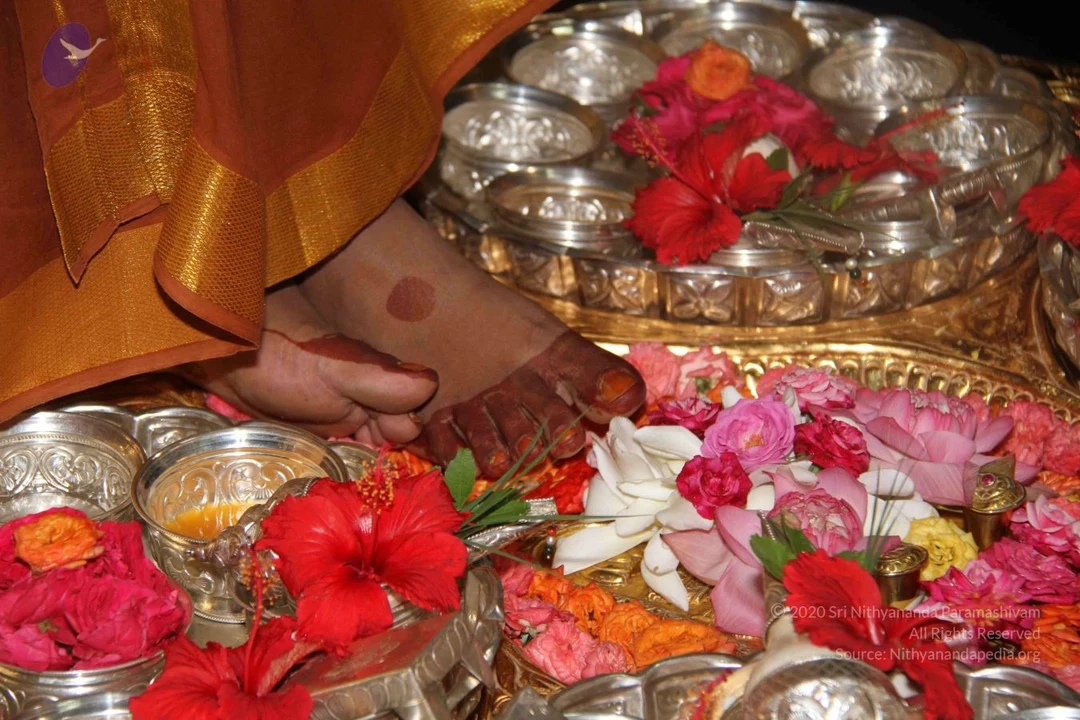
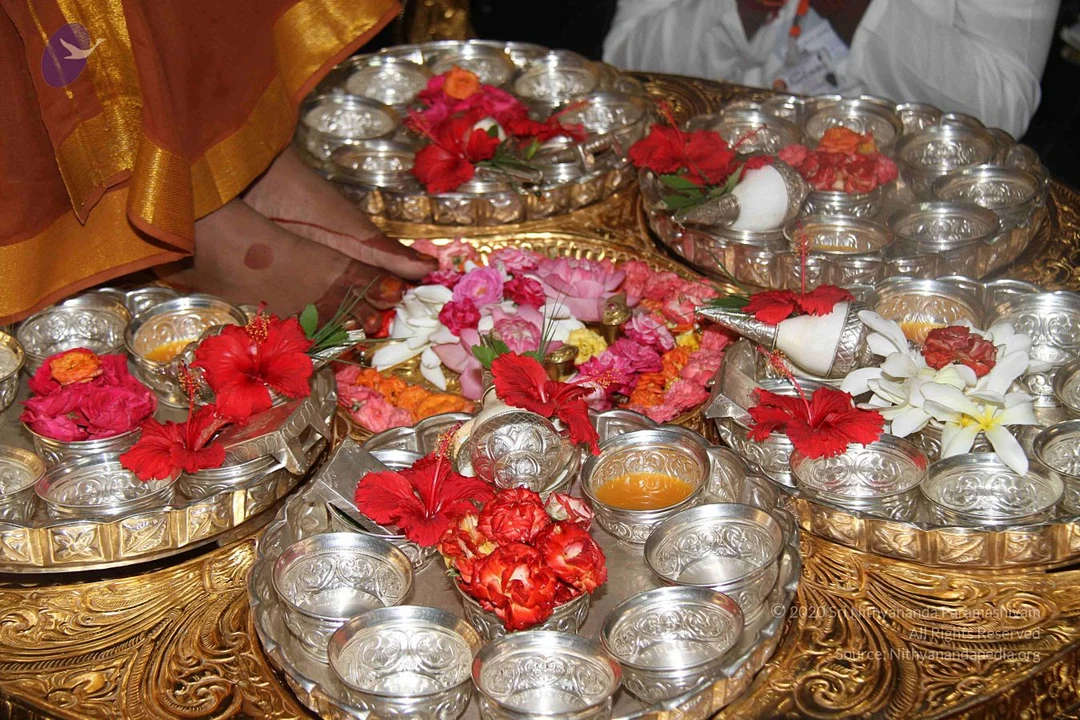
PratyakshaPadaPuja

Swamiji_Deities_Aarthi

Swamiji_Satsang

SarvaDarshan

FinalBlessing_Swamiji_Deities

IA_Day21

Ganamukhasura Samhara_Ganeha_Brahmotsav

Tags:

Paramahamsa Nithyananda, self-doubt, completion, master, God, life, enlightenment, relationship

Photos Of The Day:

Leela-Alankar-Deities

PratyakshaPadaPuja

SarvaDarshan

Swamiji-Satsang

FinalBlessing-Swamiji-Deities

Swamiji-Deities-Aarthi

Ganamukhasura-Samhara-Ganeha-Brahmotsav

IA-GraduationDay

IA-21Naivedyam-Pictures

IA-Darshan

Photos Of The Day:

Leela-Alankar-Deities

SarvaDarshan

Swamiji-Satsang

FinalBlessing-Swamiji-Deities

Swamiji-Deities-Aarthi

Ganamukhasura-Samhara-Ganesha-Brahmotsav

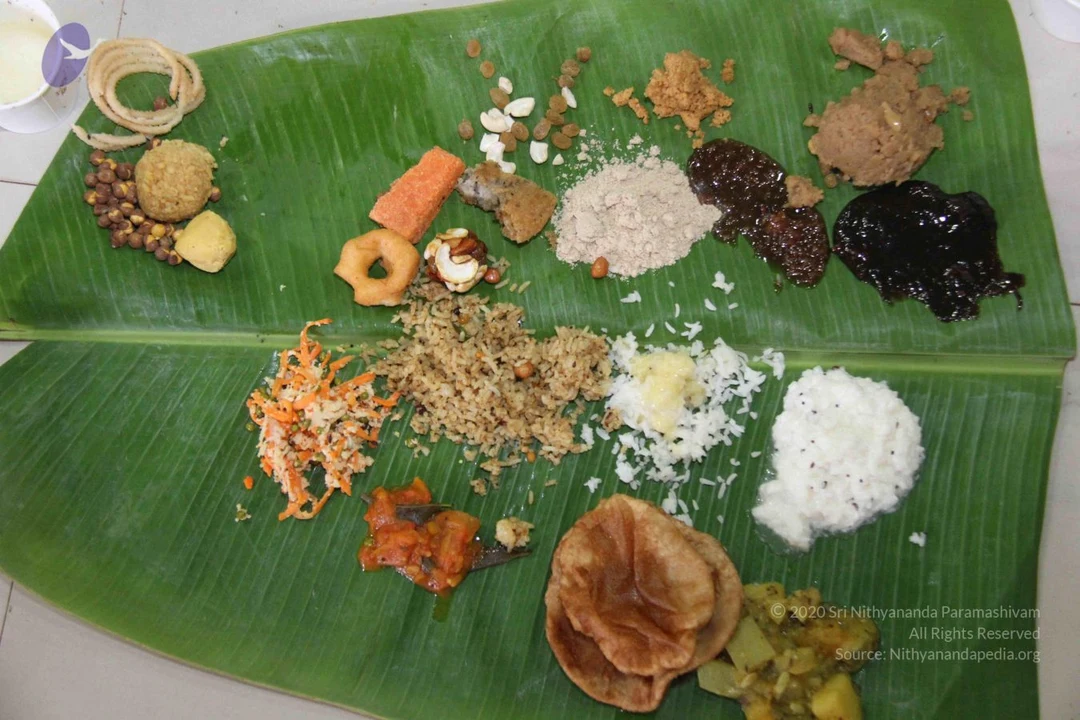
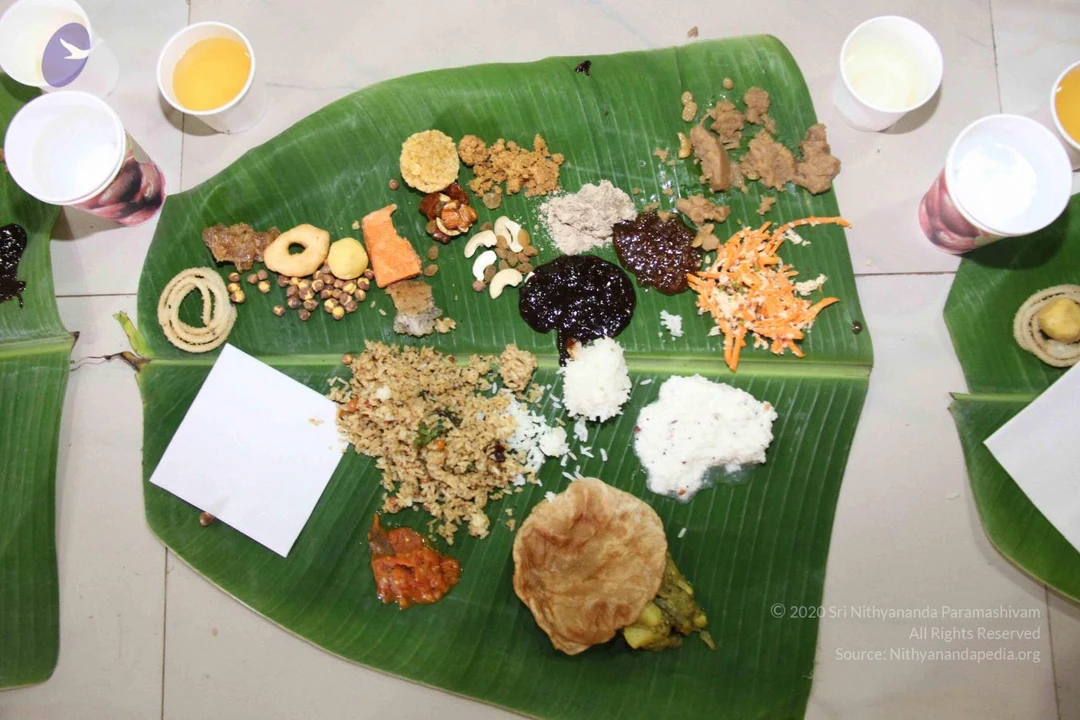
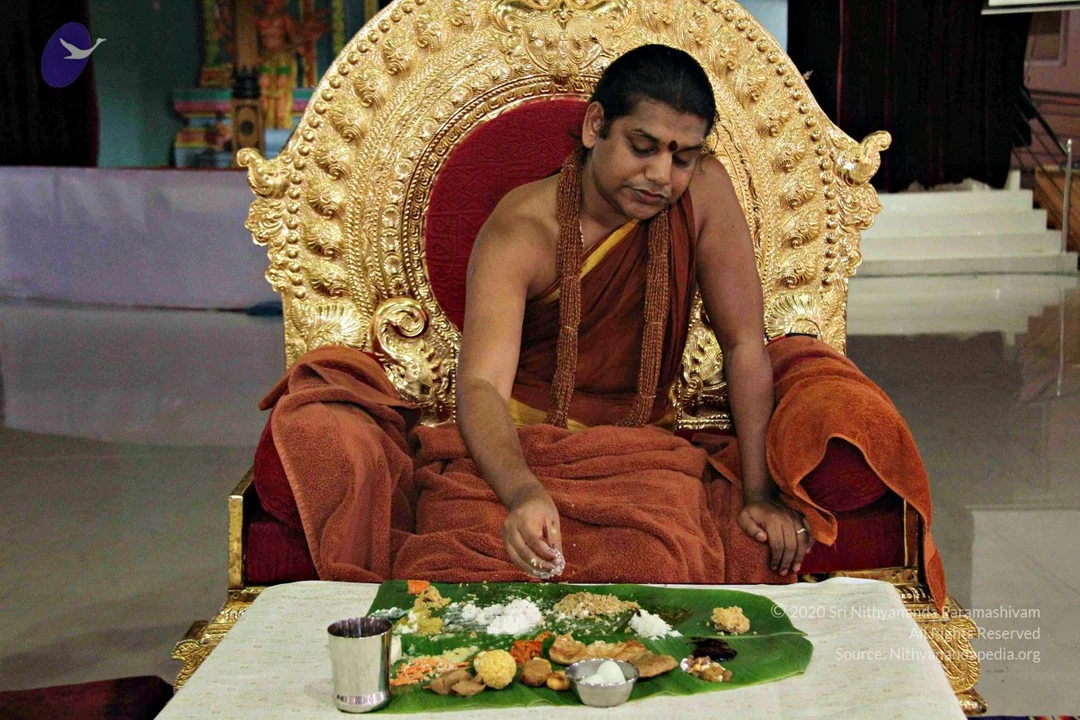
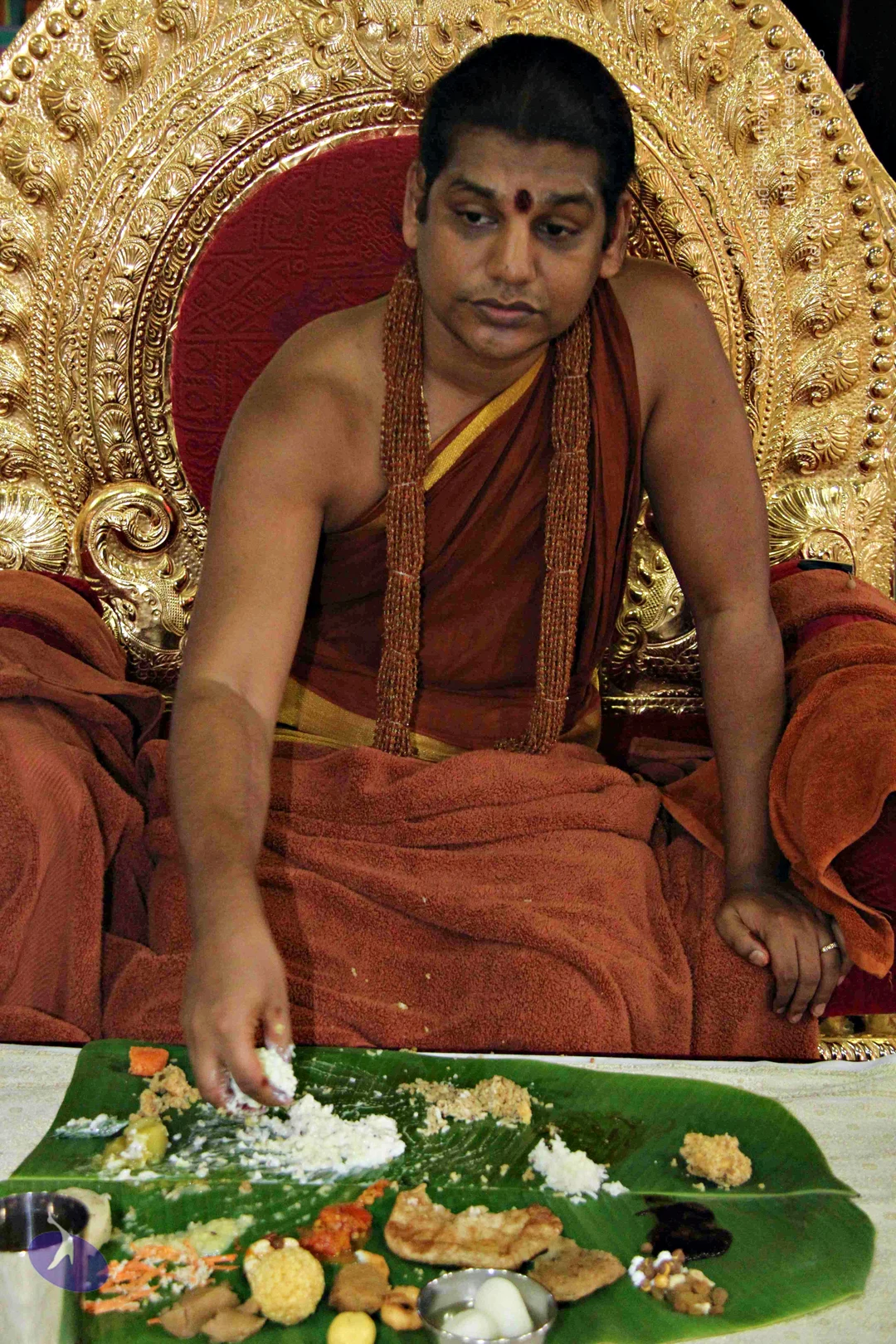
IA-21Naivedyam-Pictures

Photos from this day

View all 392 photos

Photos From The Day:
20 photosSource gallery
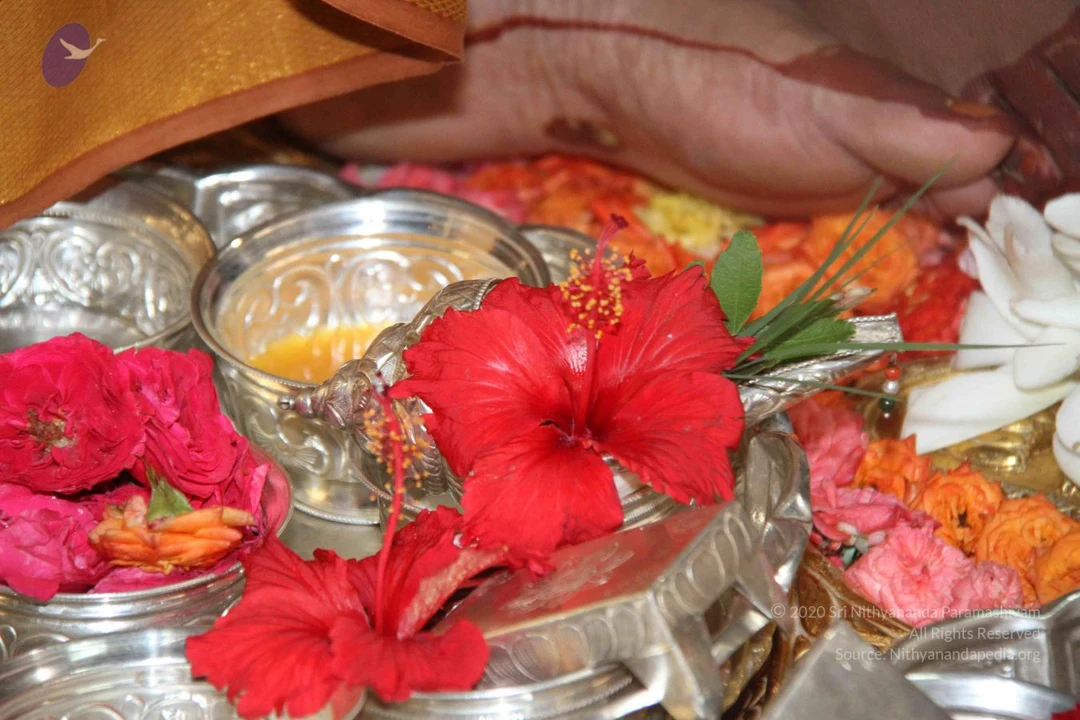
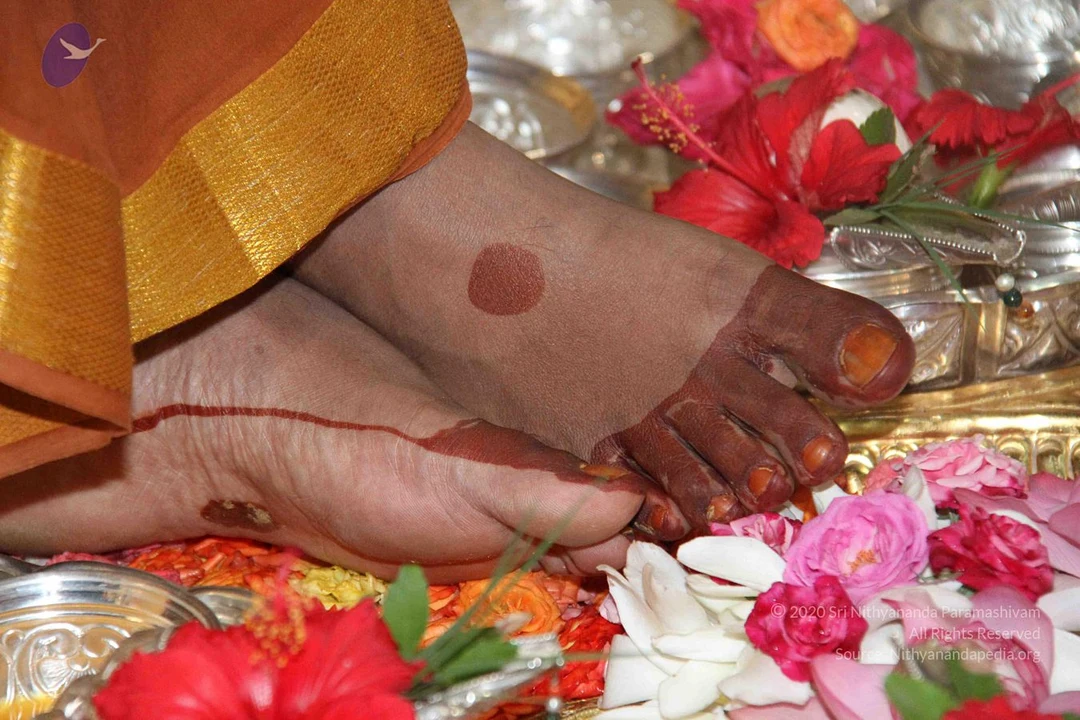
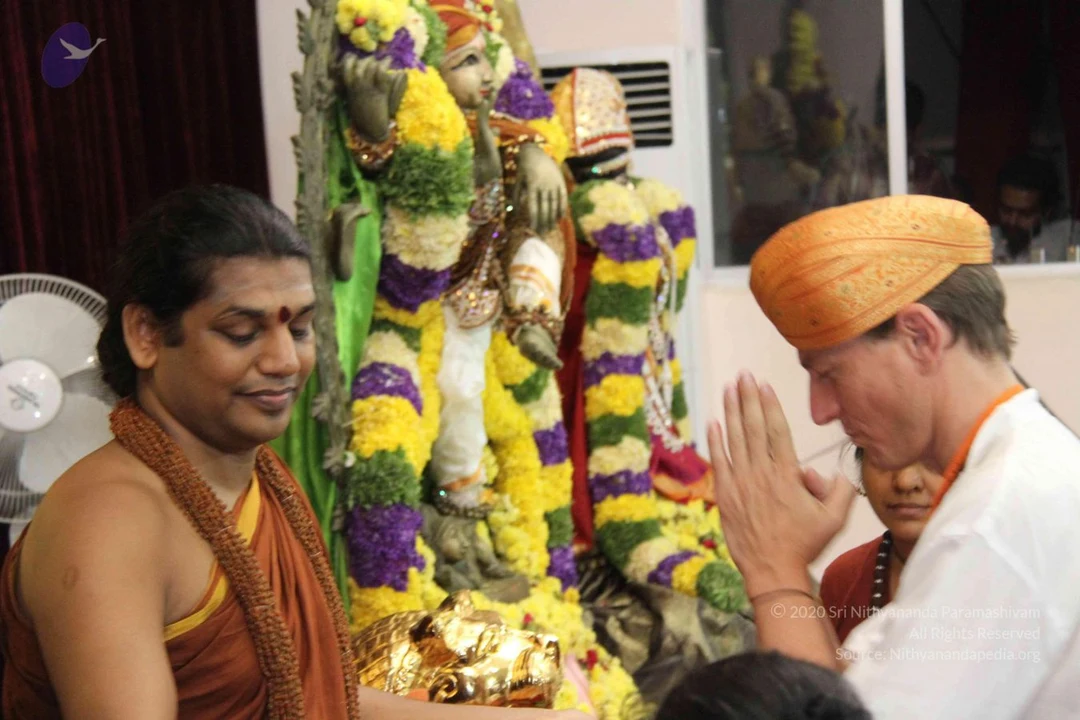
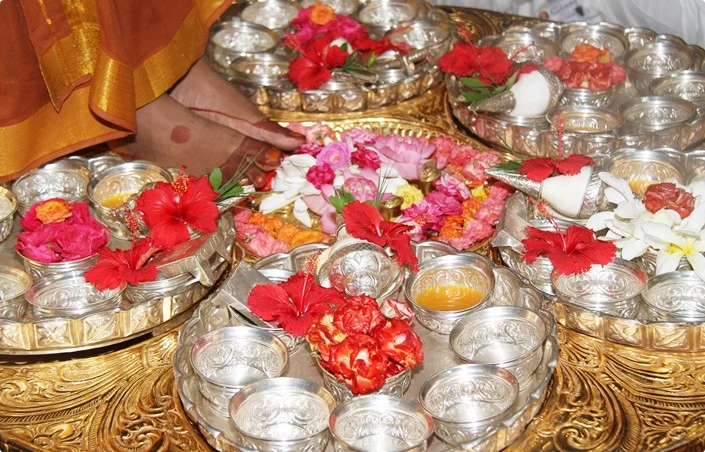
Close view of a ceremonial puja offering arranged on ornate gold trays. Silver bowls and cups hold yellow liquid or paste, red hibiscus flowers, pink and orange blossoms, and white flowers and a conical white offering. A person in an orange-and-gold silk sari with a red bindi stands at the top left, with only the feet visible at the edge of the frame. No recognizable face is shown and no candidate for a person is visible in the image.A photograph of a seated man in orange-saffron robes with a yellow inner cloth, long swept-back hair, a white tilak mark on his forehead, and a rudraksha mala draped over his shoulders, seated on an ornate golden throne carved with a lion's head and a tiger-striped cloth. Behind him a wall is decorated with dense garlands of yellow, white, red and purple flowers, and brass lamps and hanging bells surround him. At the lower right a second man in a white shirt sits with hands folded in añjali, with brass plates of flowers and offerings arranged in front of the throne. Swamiji (probable) is seated on the throne, identified by the saffron robes, swept-back hair, rudraksha mala and ornate gold seat cues.A photograph of a seated man with long dark hair swept back, wearing an orange-saffron shawl over his shoulders and a rudraksha mala with a gold-toned ornament, smiling while his hands rest in his lap. He sits on a cream-upholstered golden throne with a carved golden lion-head armrest and a tiger-striped cloth draped on the seat. Behind him are floral garlands of red, yellow and white flowers and hanging brass oil lamps. In the lower right, a younger man in white clothes sits with palms pressed together in namaste before trays of flowers. Probable Swamiji (probable) is seated on the throne, with the appearance cues of long swept-back hair, saffron clothing and rudraksha mala.A staged dance tableau on a stage at a temple-style event. Two large decorated deity murti figures sit on raised seats, one on a green-draped throne and one on a golden arched throne, both heavily garlanded with yellow, purple and green flowers. In front, a young boy stands in the centre wearing a white turban-style headdress, orange and white dhoti-style garment, rudraksha-style beaded necklaces and a flower garland, with his hands folded in anjali. To the right, a girl in a blue and yellow costume with a flower garland and gold headpiece stands beside the golden throne. Red and pink floral offerings lie at the bases, and a dark curtain backs the stage.A temple-hall photograph of a ceremonial stage. On the left, a seated man in saffron-orange robes sits on an ornate gold-and-maroon throne, with a gilded lion figure beside him. Behind him stands a gold statue of a deity with a raised hand. At centre, a deity murti is heavily garlanded with yellow and purple flowers and sits on a decorated seat. To its right, a young boy in white dhoti and shawl, wearing a flower garland, stands beside a gold-decorated throne holding a garlanded figure. At far right, a girl in a blue dress with a floral garland stands near the stage. Brass oil lamps stand on the floor and an air conditioning unit is visible on the right wall.A photograph of a festival tableau in a temple-style hall. On the left, a bronze-coloured Nataraja-style murti of a dancing deity stands on a pink satin-draped platform, encircled by a large arch of yellow marigold garlands and purple and green flowers, with a small figure under its feet. On the right, a young man in white dhoti and white turban, with a leopard-print and orange-striped top, a layered beaded necklace and a flower garland, sits on a golden throne-like seat with his hands raised in a blessing gesture. A large ornate metal prabhamandala halo stands behind the murti and a red curtain behind the seat.

Leela_Alankar_Deities

16 photosSource gallery
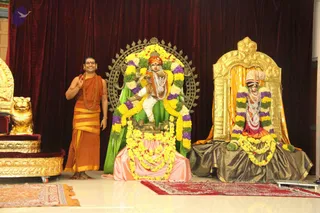
A photograph of a ceremonial stage with two deity murtis and a standing young man in front. Left, a murti garlanded with yellow, white and purple flowers and green leaves, with a red crown, bejewelled necklaces and green cloth backdrop. Centre, a young man in white ceremonial dhoti and white turban with striped orange-and-gold upper cloth, rudraksha mala and flower garland, raising his hand in greeting. Right, a murti in a gold arched shrine with purple and yellow garlands and a jewelled necklace. Far right, a young girl in a blue skirt and orange-gold blouse with a flower garland and necklace. Gold-patterned backdrop and red carpet below.A stage tableau in a temple-style hall with two garlanded deity murtis flanking a young man. On the left, a dancing Nataraja-style murti stands on a pink satin cloth with a green backdrop, wreathed in yellow marigolds, purple flowers and green leaves. On the right, a seated goddess murti in red and gold sits on a golden throne arch, decorated with a crown, a white and gold necklace and a purple-and-yellow garland. In the centre, a smiling young man in white dhoti and a white turban, wearing a striped orange-and-black upper cloth, rudraksha-style beads and a flower garland, stands with palms joined in greeting. To his right, a young girl in a blue skirt and orange blouse with a gold headpiece and garland performs a dance pose. Red carpet covers the floor.A stage tableau at a KAILASA event shows two decorated deity murti, each wrapped in yellow, purple and green floral garlands. The left murti is a standing figure with a red headdress and jewelled ornaments on a pink-draped pedestal. In the centre a young male performer in a white crown, orange-and-gold patterned upper garment, white dhoti and rudraksha-style beaded necklaces stands with palms pressed together in namaste, smiling. To his right a seated goddess murti in a red and gold sari, with a tall ornate crown and layered necklaces, sits before a gold arched backdrop. A young girl in a blue skirt, gold blouse and garland stands at the right edge.A photograph on a stage with a festive temple-style backdrop. In the centre stands a young man in white dhoti and a white-and-yellow headcloth with a saffron-and-white cloth over his shoulder, wearing a rudraksha mala and gold necklaces, with hands raised in greeting and a yellow-and-purple flower garland around his neck. Behind him is a gilded ornate arch and a seated deity murti in red and gold with a crown, draped in garlands of yellow, purple and green flowers. To the left, a murti with a dark-green cloth, yellow flower garland and a red cloth is seated on a platform, and on the right a young girl in a blue skirt and gold blouse stands with a garland. The central figure's appearance does not clearly match the a person cues, so his role is described only as a stage participant.A festival stage photograph with three garlanded figures and a young girl. On the left, a seated deity murti with a red-orange headdress, ornate necklaces and a yellow-and-purple flower garland, its base draped in pink satin and yellow flowers. In the centre a young man in a white dhoti and white head-cloth wears an orange-and-black tiger-striped shawl, layered beaded necklaces and a yellow garland, raising one hand in blessing while standing on a red carpet. On the right a second deity murti in a red-and-white outfit and tall crown sits before a golden arched throne with a dark cloth, garlanded with purple, yellow and green flowers. A girl in a blue skirt and gold blouse with a yellow garland stands at right, also raising a hand. The background is a golden temple-style arch and a wall air conditioner.A photograph of a Nataraja-style deity murti in a dancing pose, standing on a small demon figure, with a red and orange turban, bindi, large jewelled necklaces, a leopard-print garment, white dhoti and red sash. It is adorned with thick garlands of yellow marigolds, purple flowers and green leaves, with red rose petals scattered at its base. It is set against a green silk backdrop, an ornate bronze arch with a pink satin draped platform, and no physical people are visible.

PratyakshaPadaPuja
28 photosSource gallery
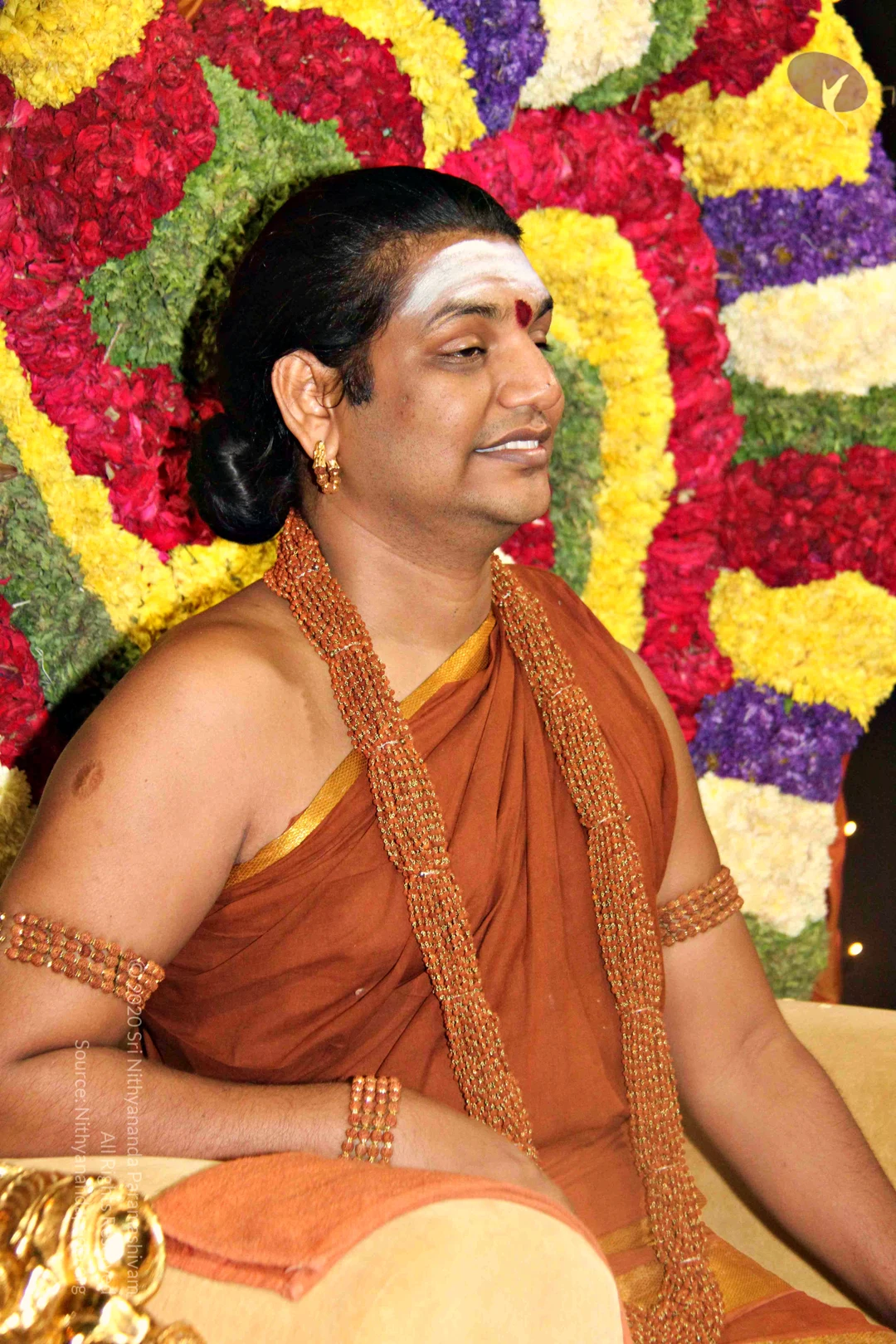
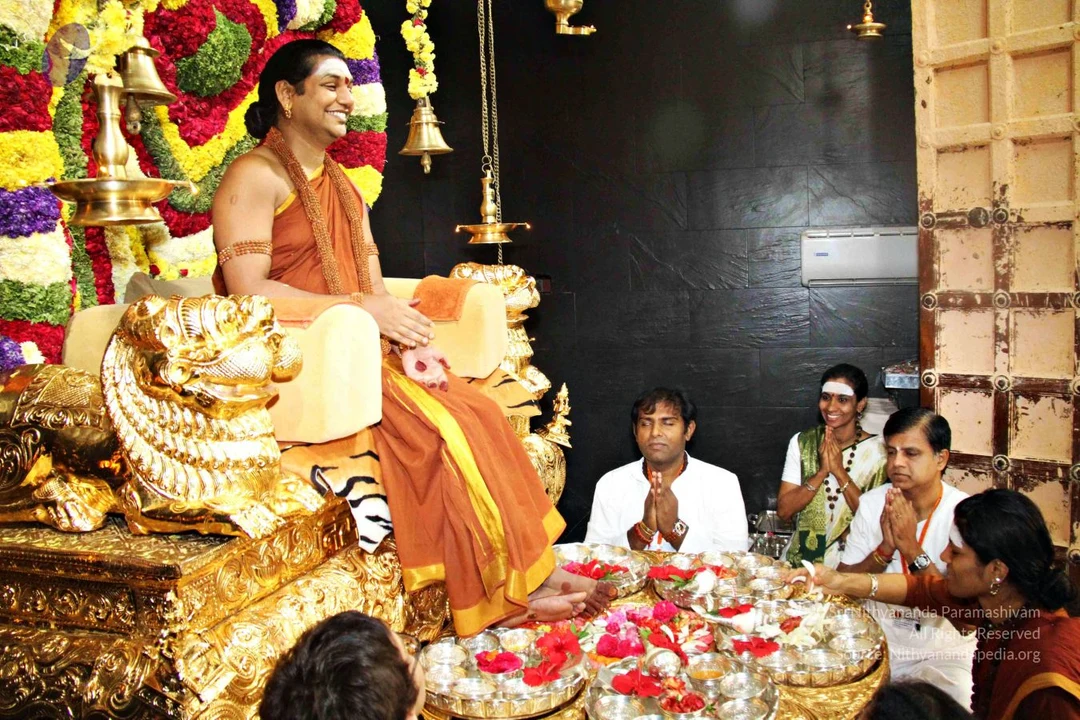
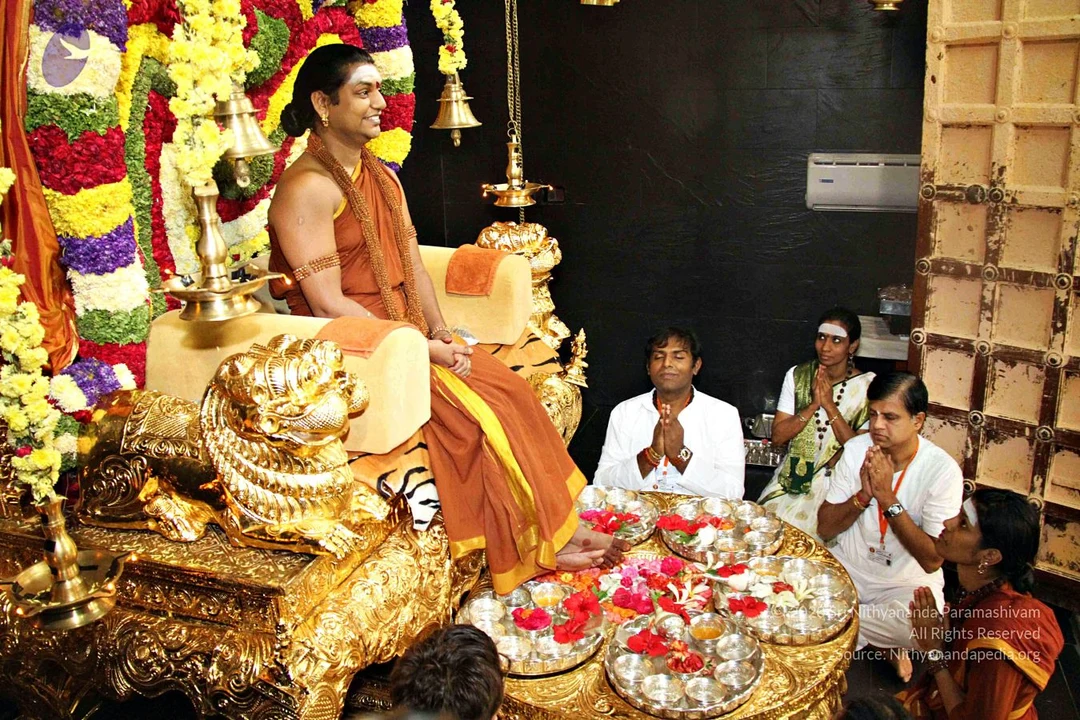
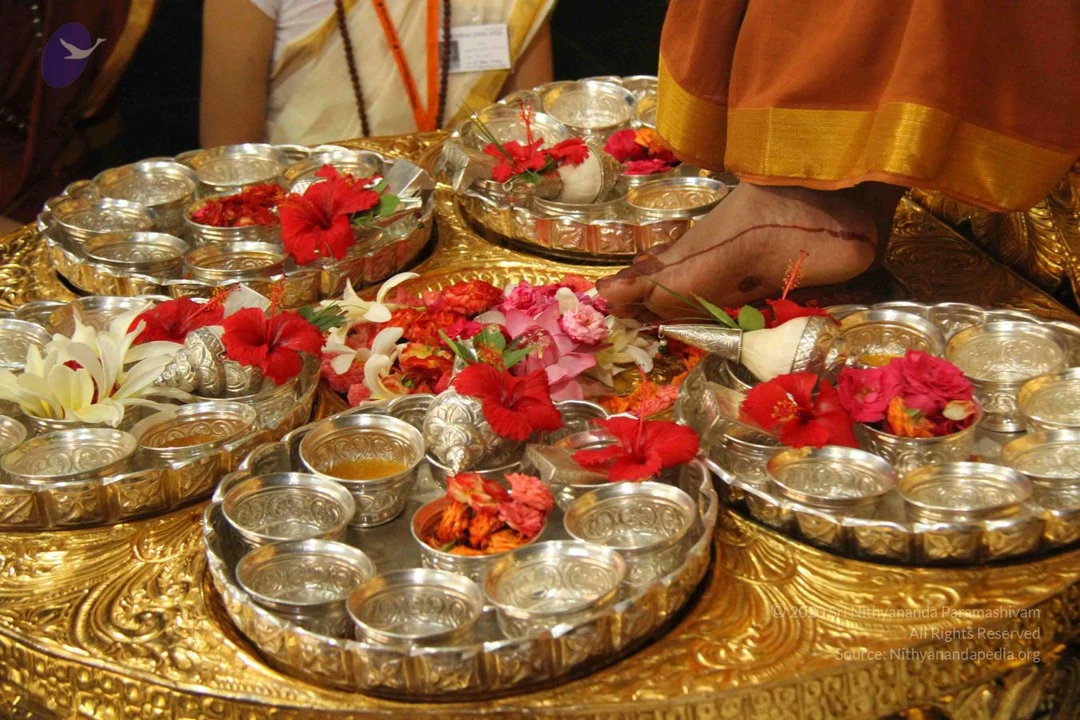
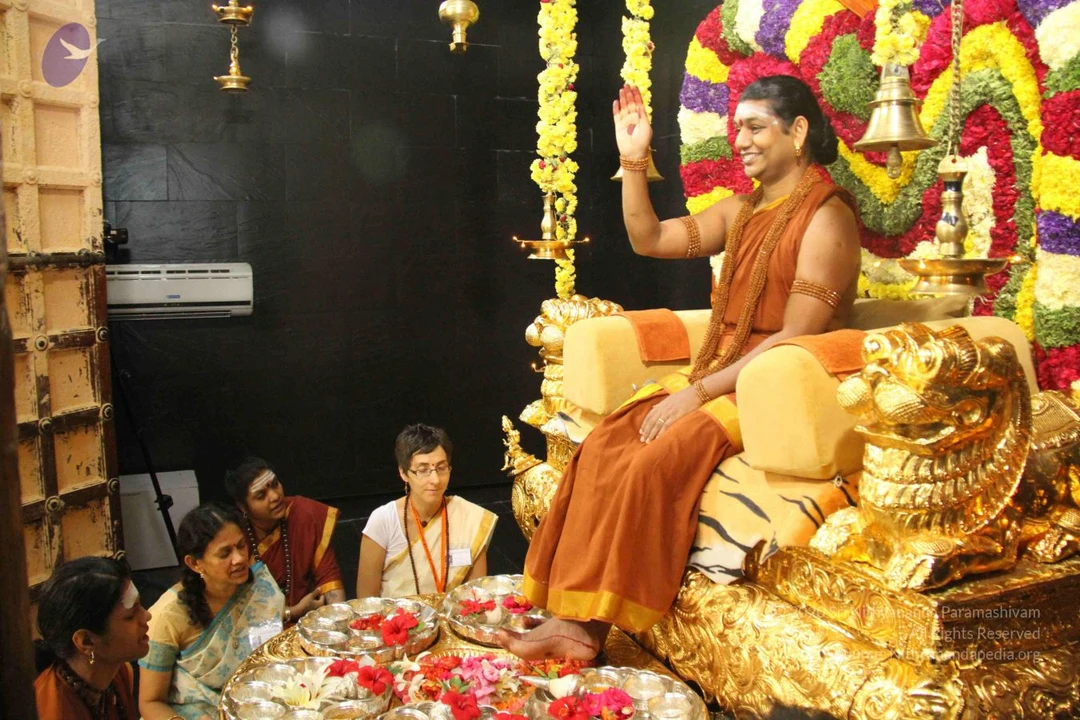
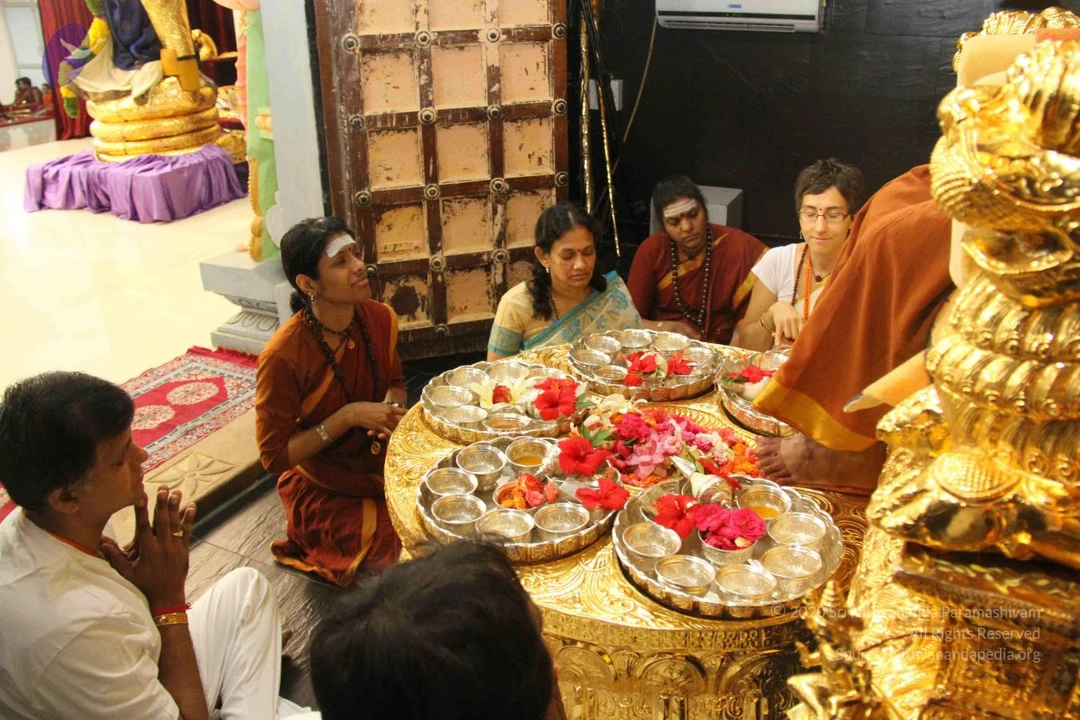
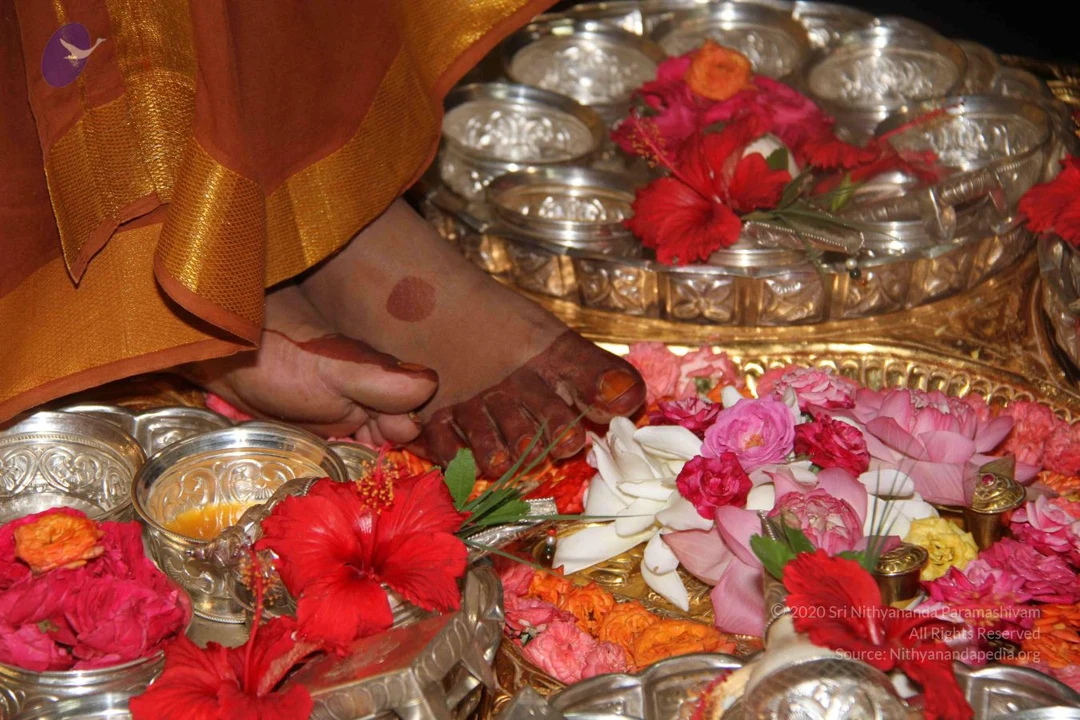
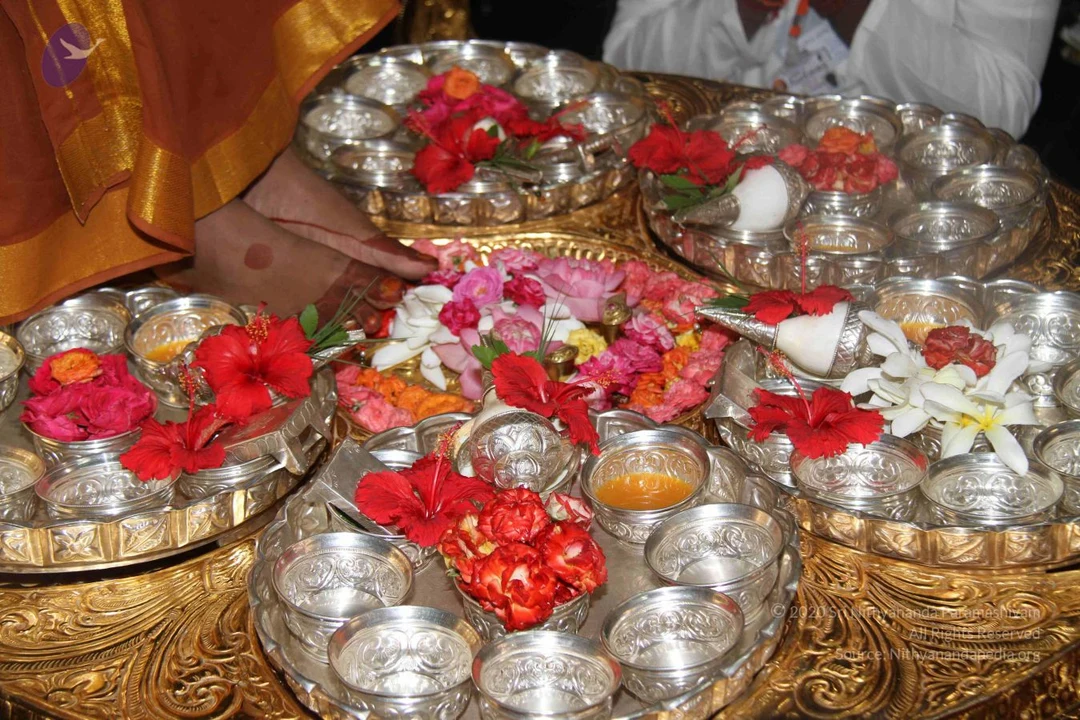
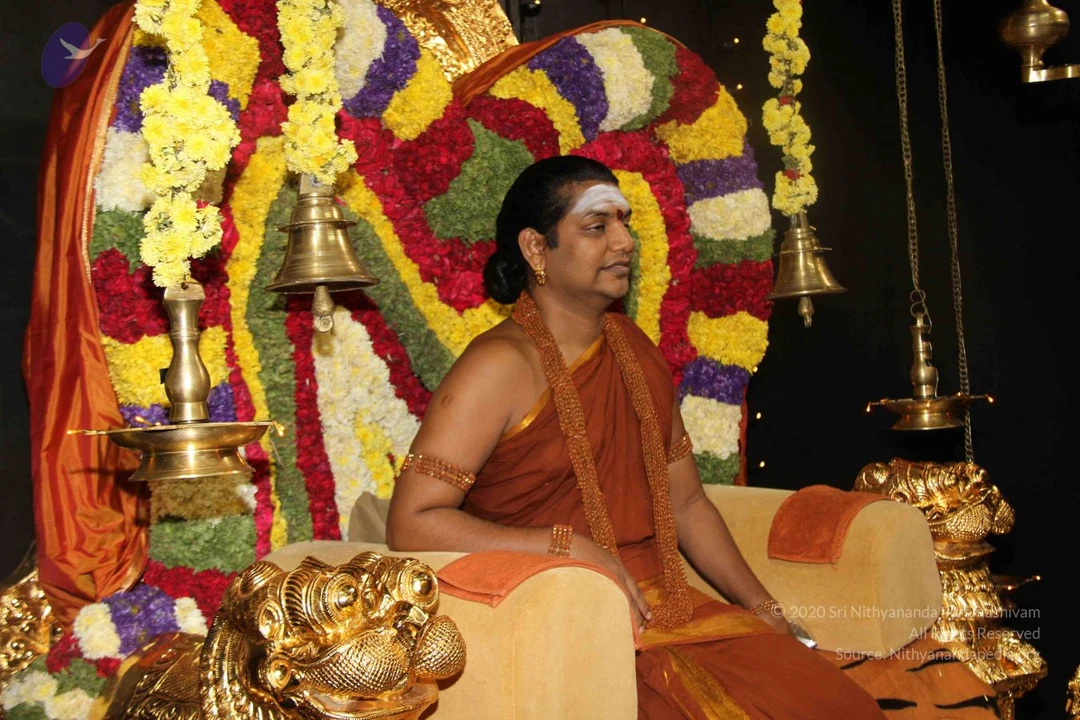
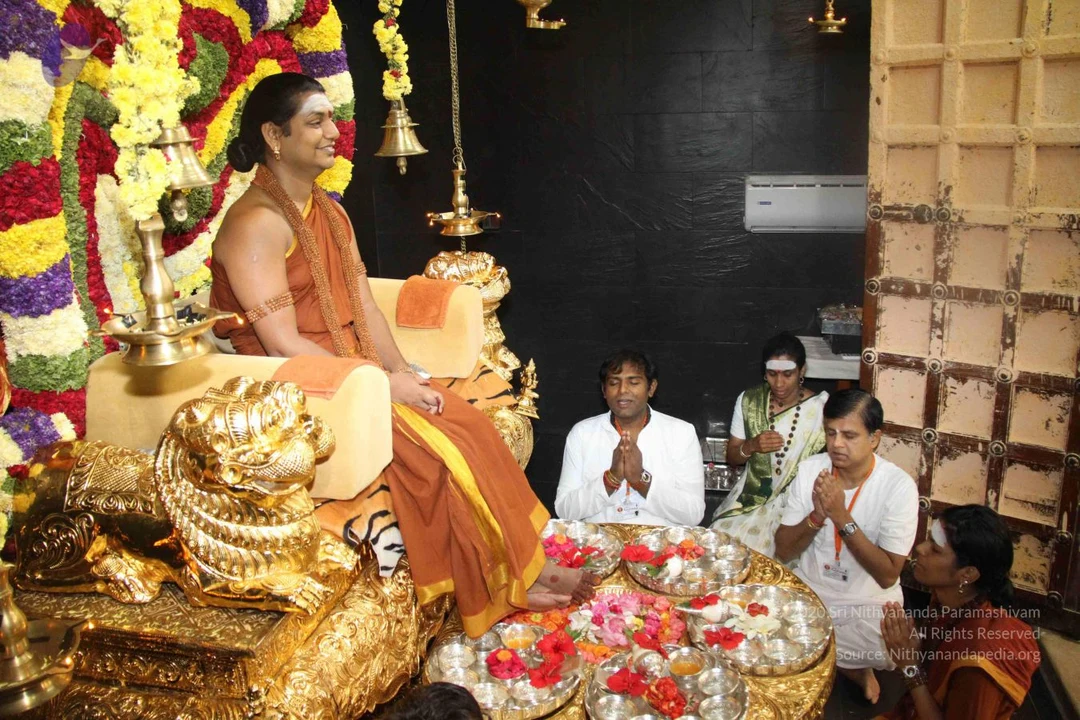
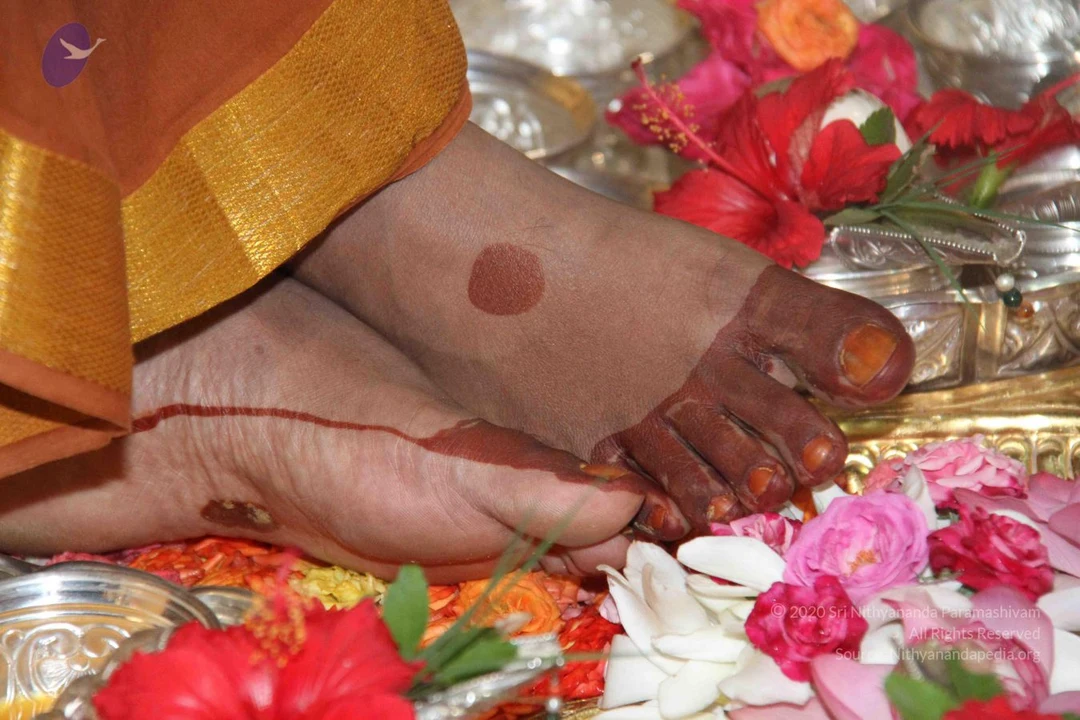
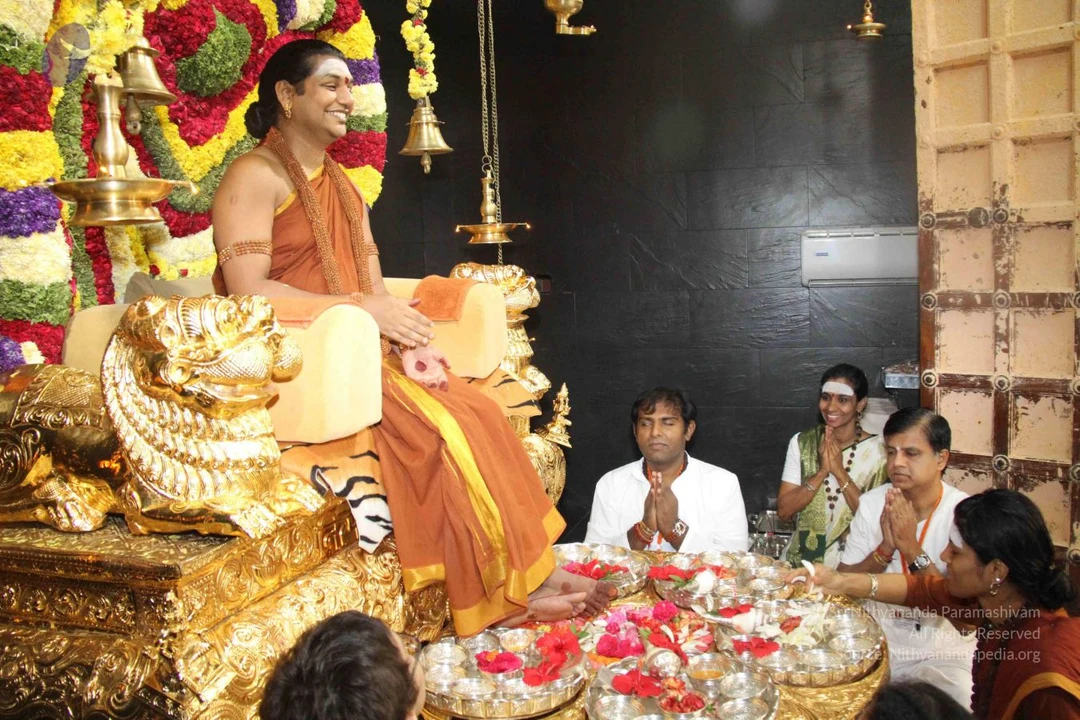
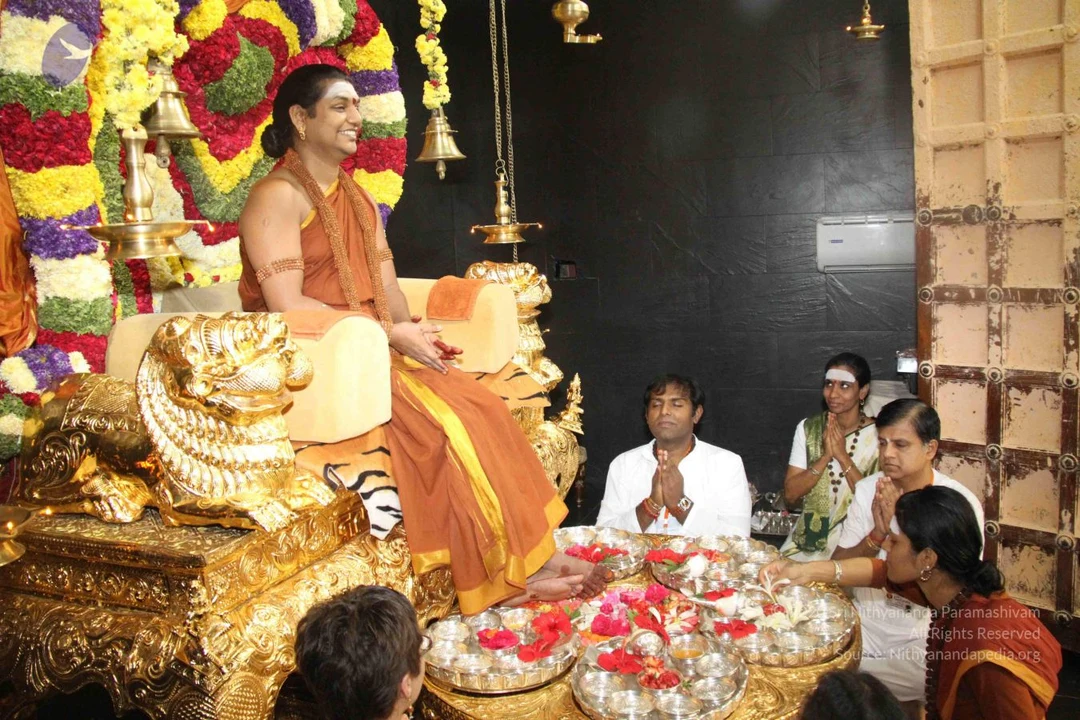
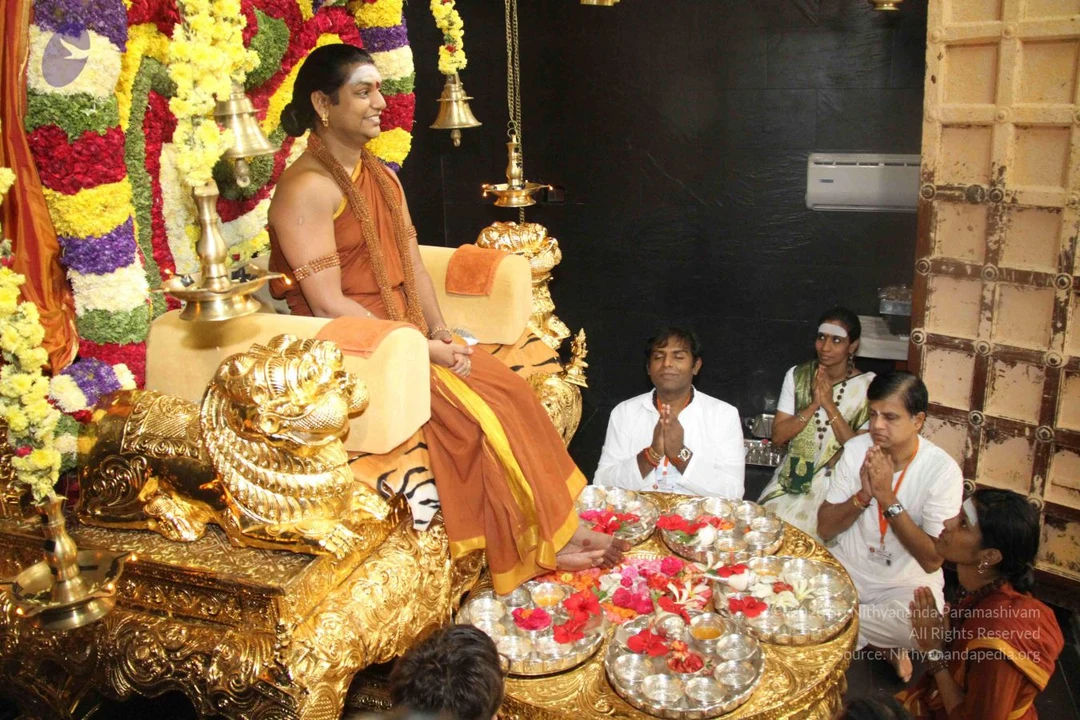
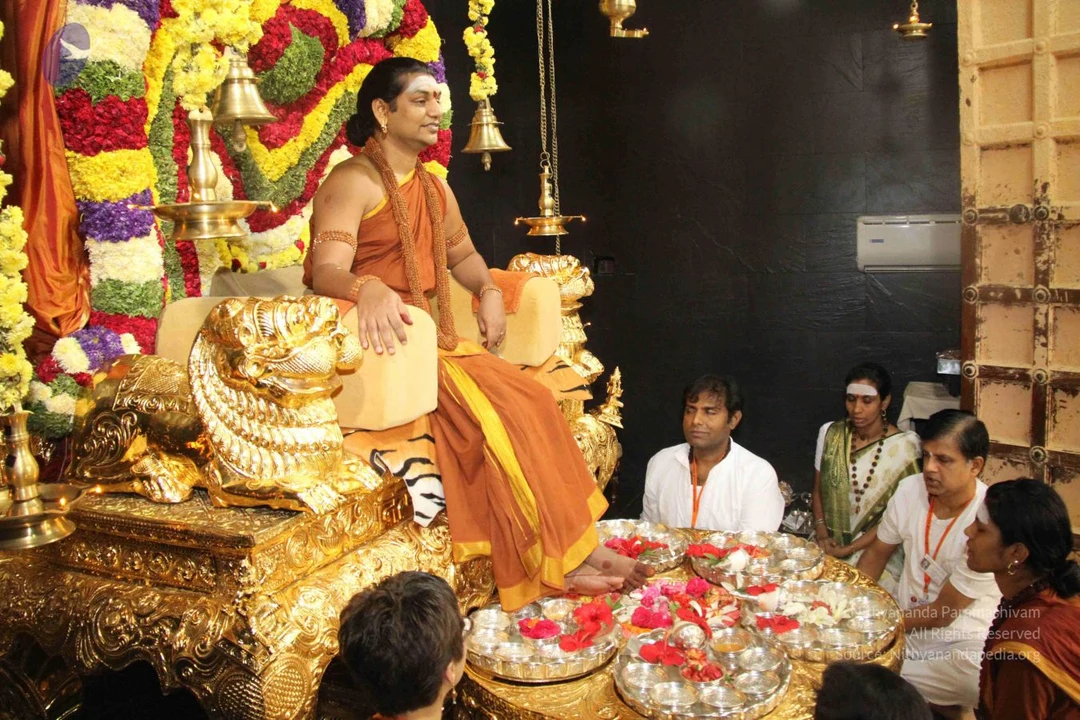
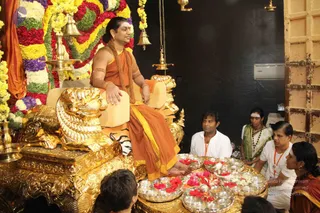
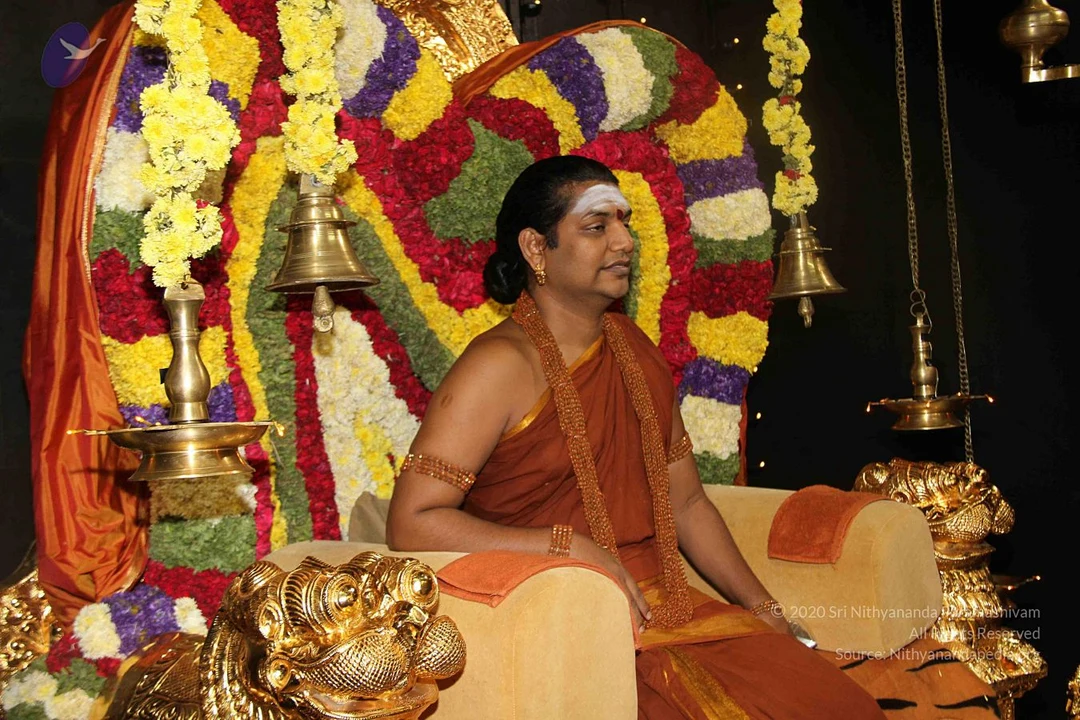
A seated man in saffron-orange robes smiles while seated on a cream upholstered throne draped with orange cloth. He wears a long gold-beaded necklace, gold beaded armlets and wristlets, a white vertical tilak with a red bindi, and gold earrings, with hair in a bun. Behind him is a dense backdrop of red, yellow, white, green and purple flower garlands, and a brass bell hangs at right. a person appears in an appearance-based cue match: ornate gold beads and saffron robes, while the printed caption identifies a portrait.Close view of a bare foot with reddish dye and a red dot resting on a gold tray filled with pink, white and orange flower petals and red hibiscus blossoms. A woman's orange sari with a gold border is visible at the top left, and silver bowls holding offerings sit in the background. The scene suggests a padapuja, the washing and worship of feet, with flowers arranged around the foot. No face is visible. a person is not clearly present in this image.Close view of an elaborate ritual arrangement on an ornate gold-tone base. Multiple silver-toned plates hold small silver bowls filled with orange turmeric paste or yellow offerings, arranged around red hibiscus flowers, pink and red roses, white plumeria, and marigold-like orange blossoms. Conical white offerings topped with red hibiscus sit on several trays. A person in an orange and gold-bordered garment stands at left, with a hand reaching toward the arrangement; a white-clad figure is partly visible at top right. Appears to be a puja or abhishekam preparation with flowers and turmeric offerings.A photograph of a man seated on a gold-trimmed cream throne with lion-head armrests, in front of a backdrop of garlands of red, yellow, white, purple and green flowers. He wears an orange-brown robe with a gold border, a long gold-beaded necklace, gold bangles and a white vertical forehead mark, and his hair is tied in a bun. Brass hanging bells and a brass oil lamp stand flank the throne. Two other people are not visible. The seated man is a candidate a person by appearance, with a shaved-free bun, orange robe and ornate gold cues, but the image is not conclusive.A photograph of a seated man on an ornate gold throne with carved lion-head armrests and a tiger-skin covering, in front of a floral backdrop of marigolds and roses in yellow, red, orange and purple. He wears a saffron-orange garment with a golden-yellow border, a long rudraksha-style mala with a gold clasp, a gold armband and white tripundra on his forehead, with long hair swept back in a bun. Hanging brass bells, brass oil lamps and a kalasha-style lamp surround the throne. In the foreground, two people in white and a woman in a green sari sit with palms pressed together, and a tray of flower petals and fruit sits before them. Swamiji (probable): the seated man has long swept-back hair, saffron clothing and rudraksha mala, with the ceremonial throne setting.A seated man in an orange saffron robe with a yellow border sits on an ornate gold throne carved with lion heads, draped with an orange cloth and a tiger-striped skin beneath his feet. He wears a long rudraksha-style necklace, armlets and has long swept-back hair, with a gold-toned bell and a row of brass lamps hanging behind him. In front, devotees in white and cream clothes sit with hands folded in anjali before brass plates of flowers, fruit and offerings. A woman in a green sari with a white forehead band and another woman in orange sit at right. Garlands of red, yellow, purple and white flowers decorate the backdrop, and a dark wall with a patterned wooden door completes the room.

Swamiji_Deities_Aarthi

1 photoSource gallery
Stage photograph in a temple-style hall with ornate gold and blue painted backdrop, carved columns and a maroon velvet valance. Centre, a deity murti is decorated with yellow and purple garlands and a green cloth backdrop. To its right a standing man in white dhoti with an orange sash and a flower garland holds his hands together, and a child in a blue costume with a flower garland stands at the far right. Beside the murti sits a figure in red and gold garments and a headdress on a throne draped in purple-garlanded silk. Brass oil lamps stand on the floor and a tall white air conditioner is at the right edge.

Swamiji_Satsang

17 photosSource gallery
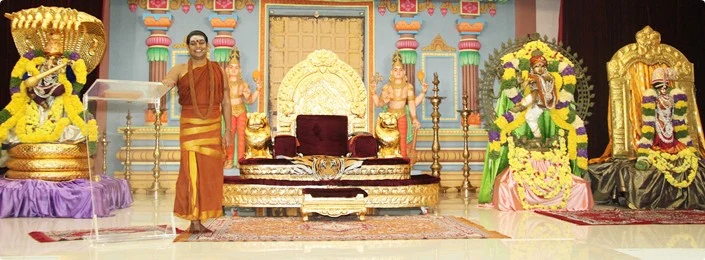
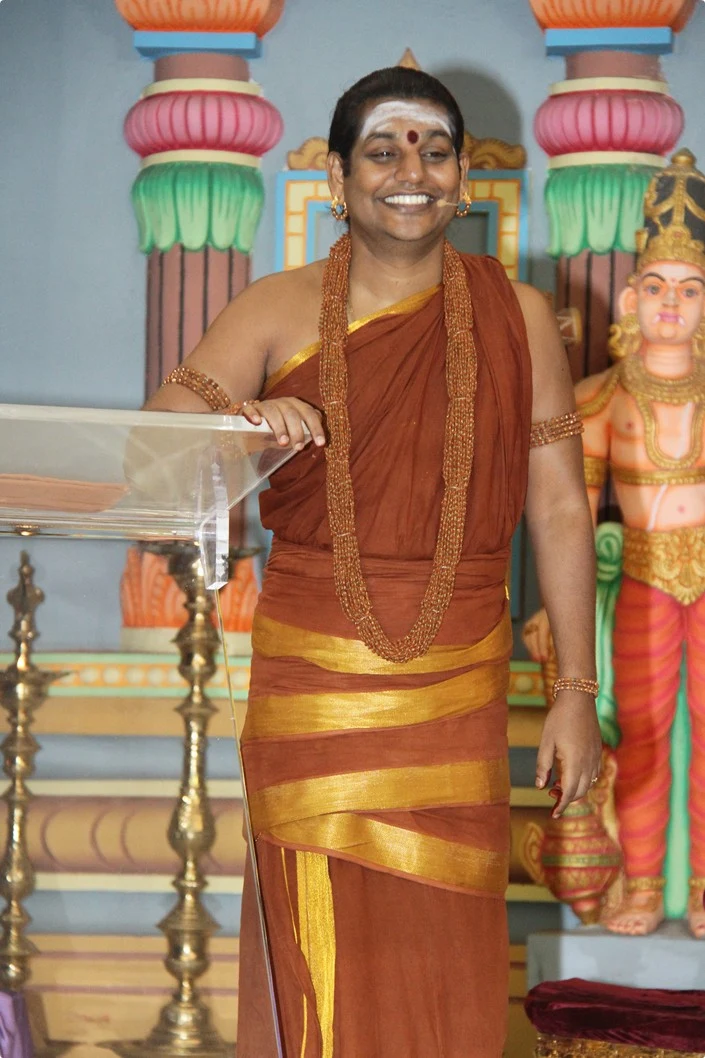
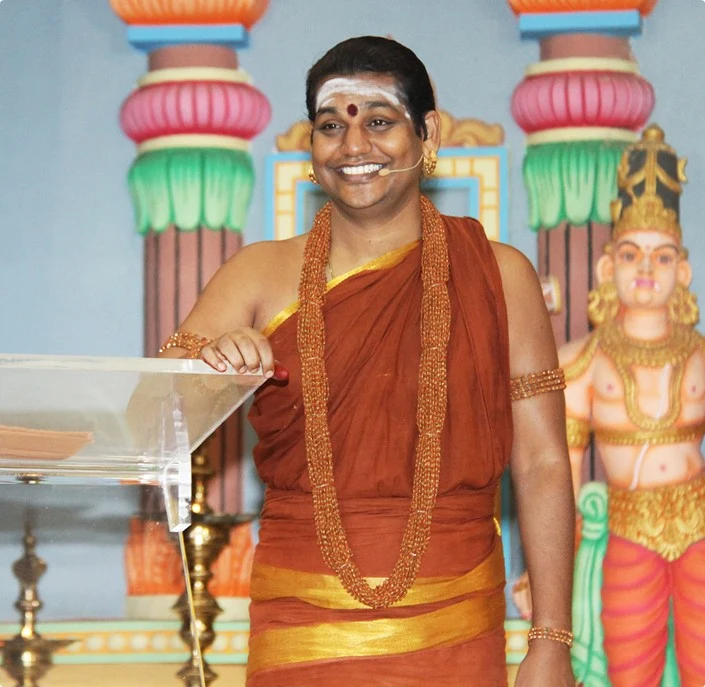
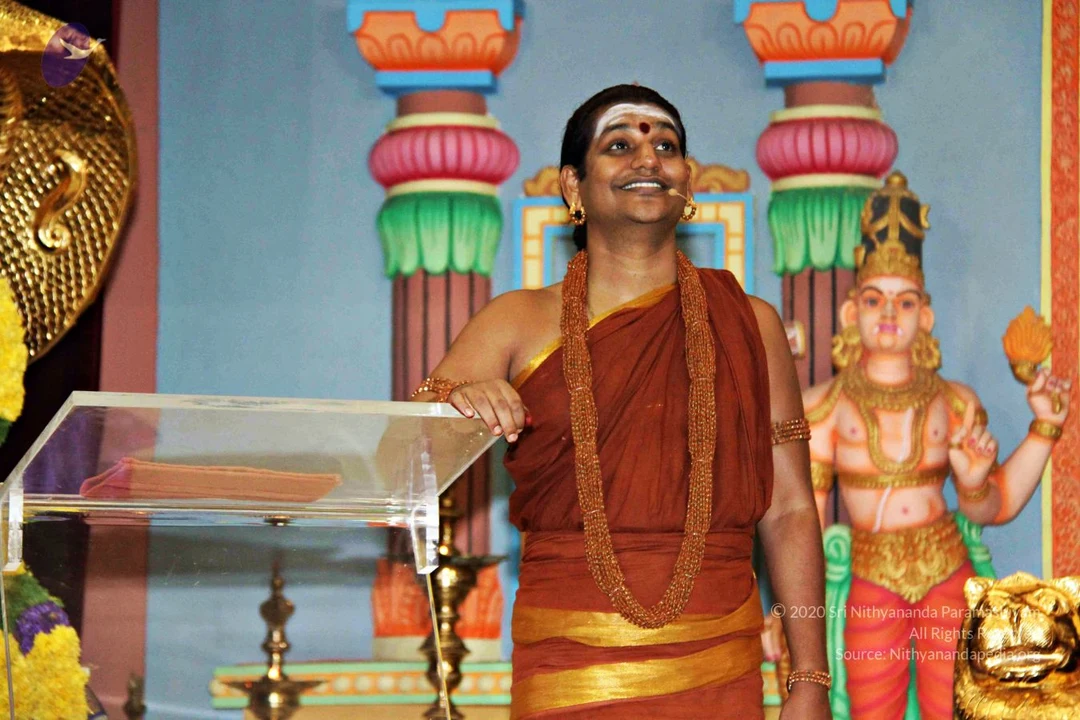
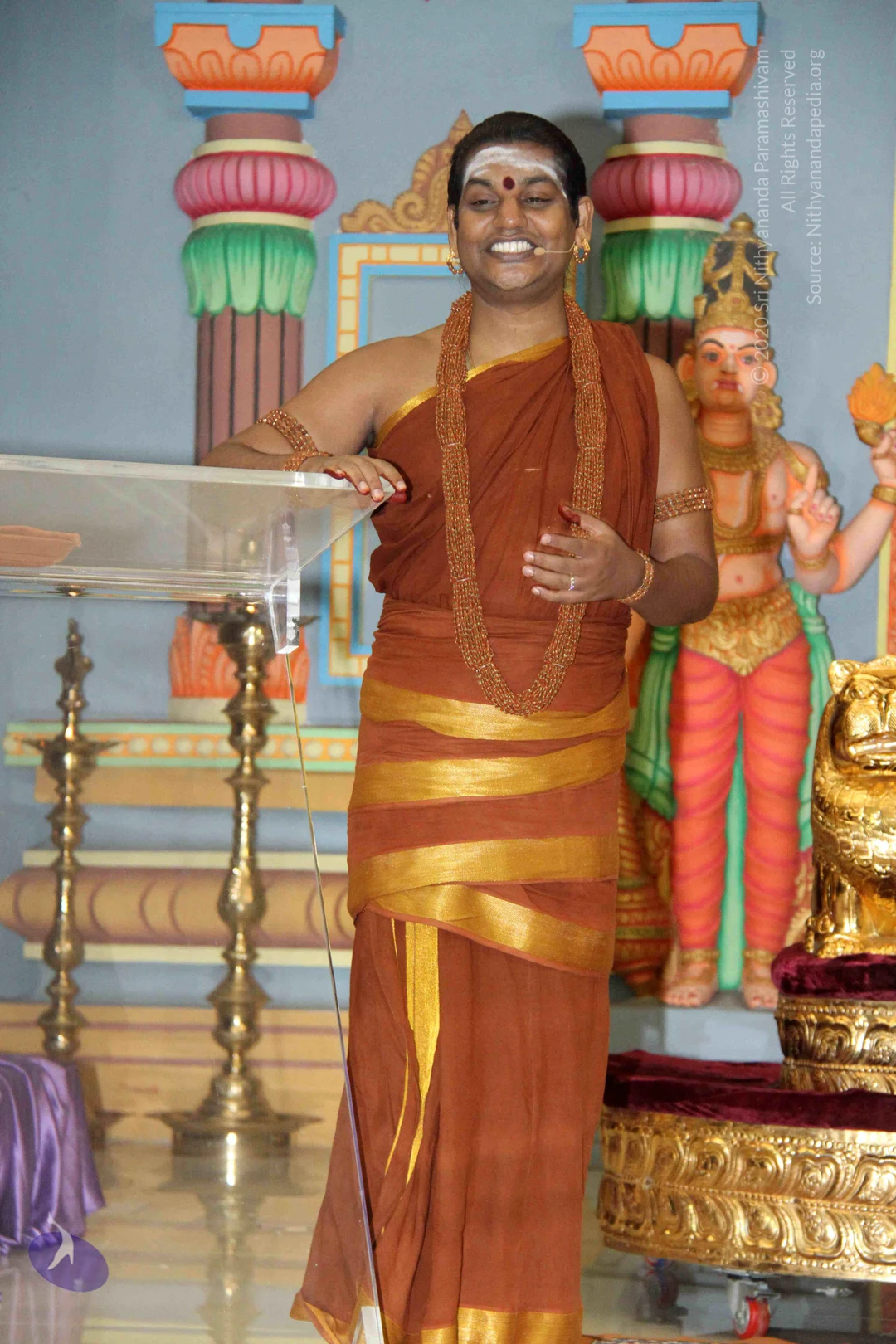
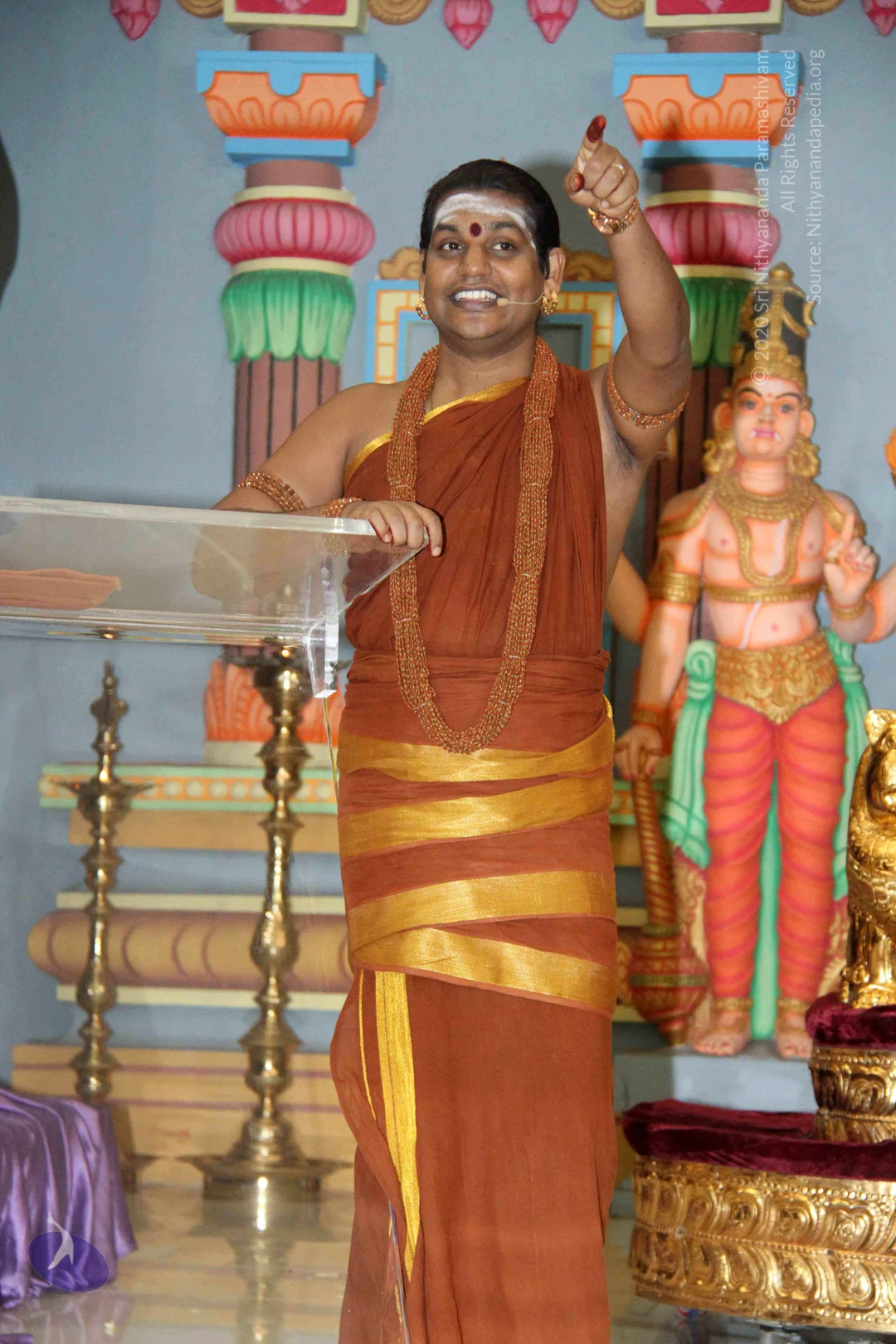
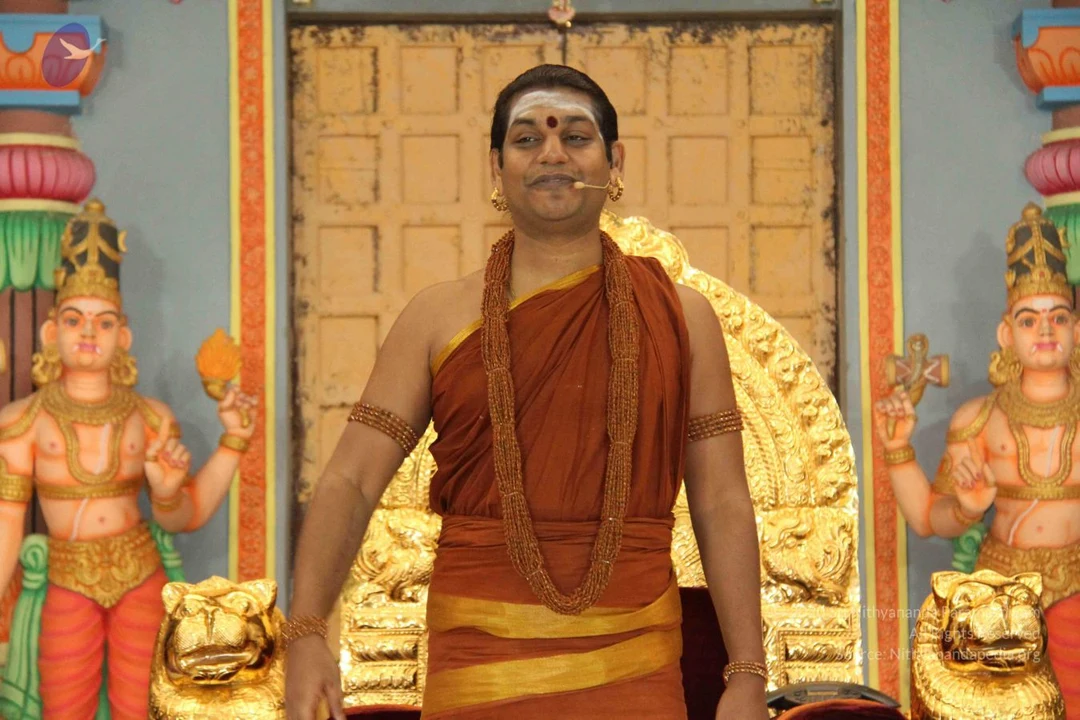
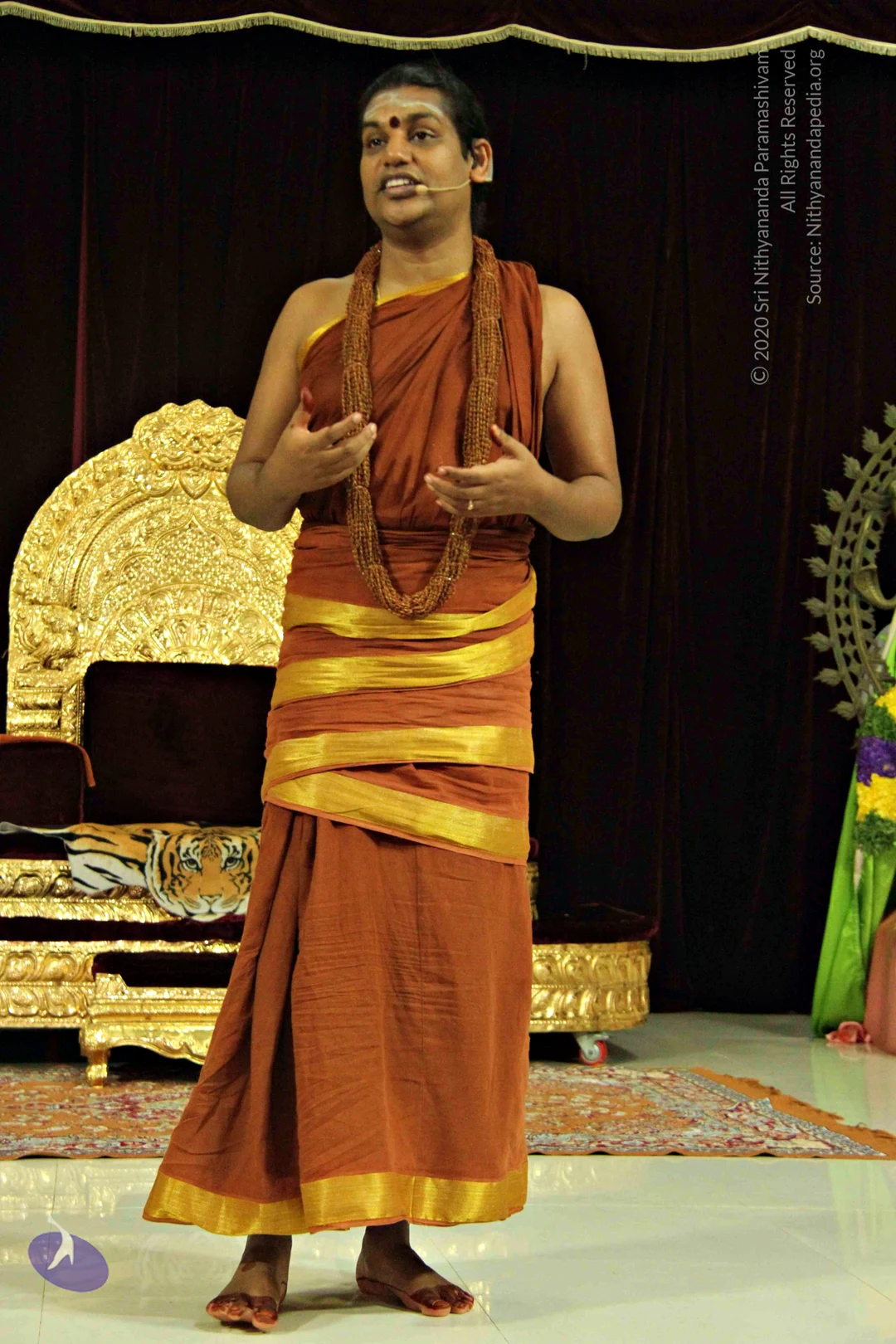
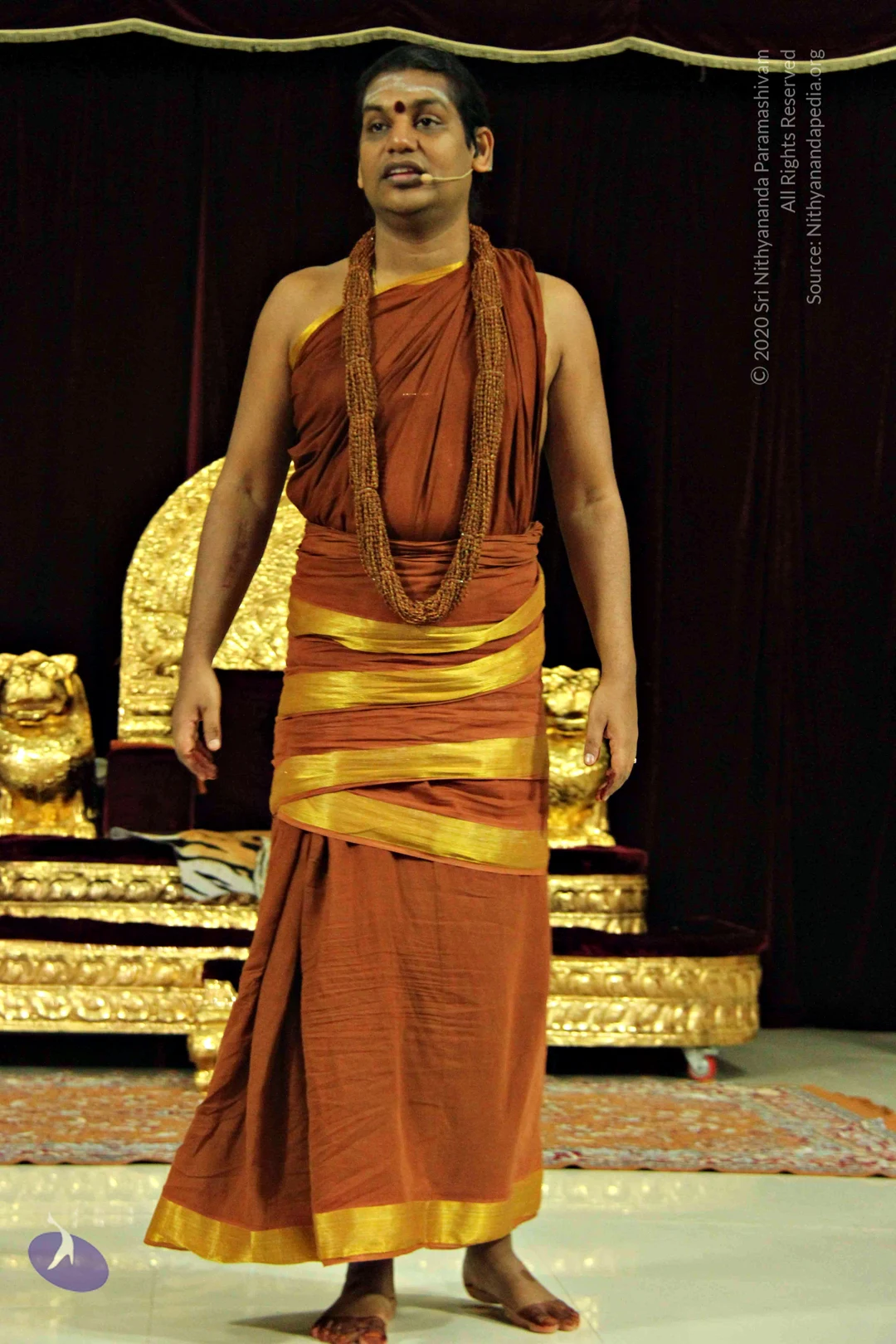
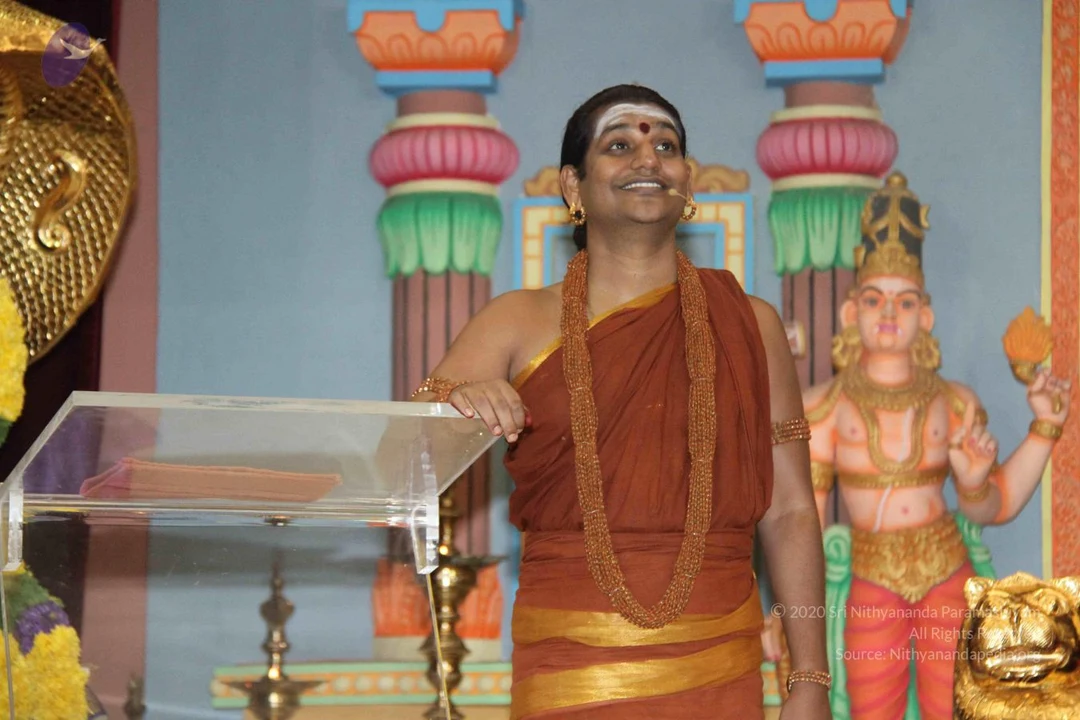
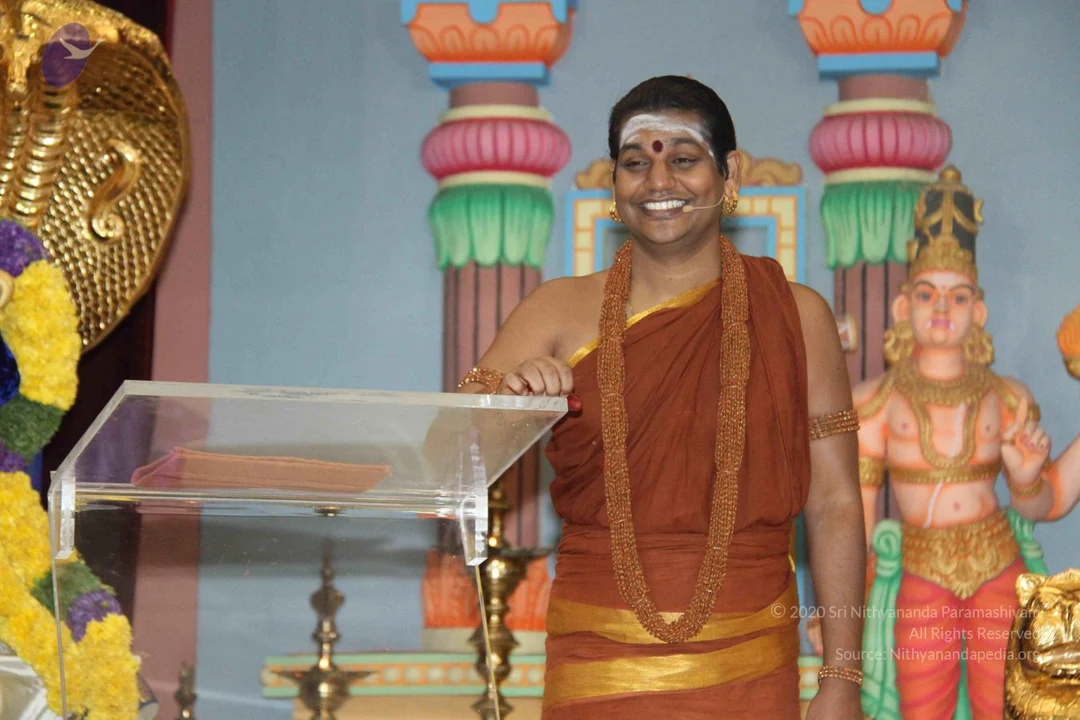
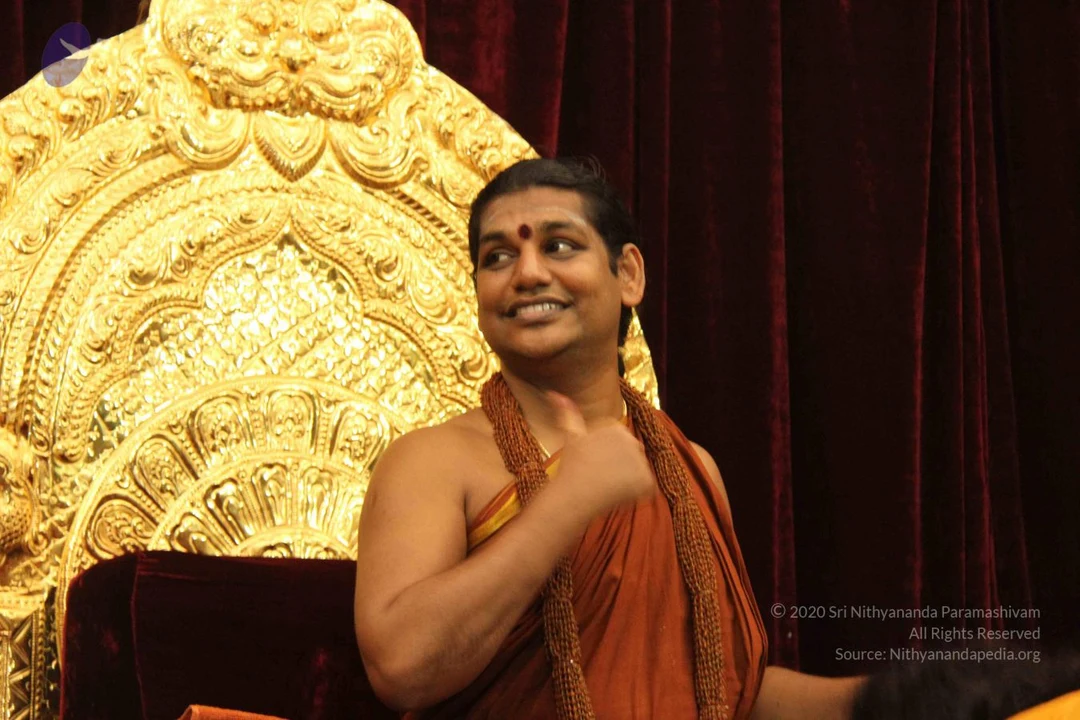
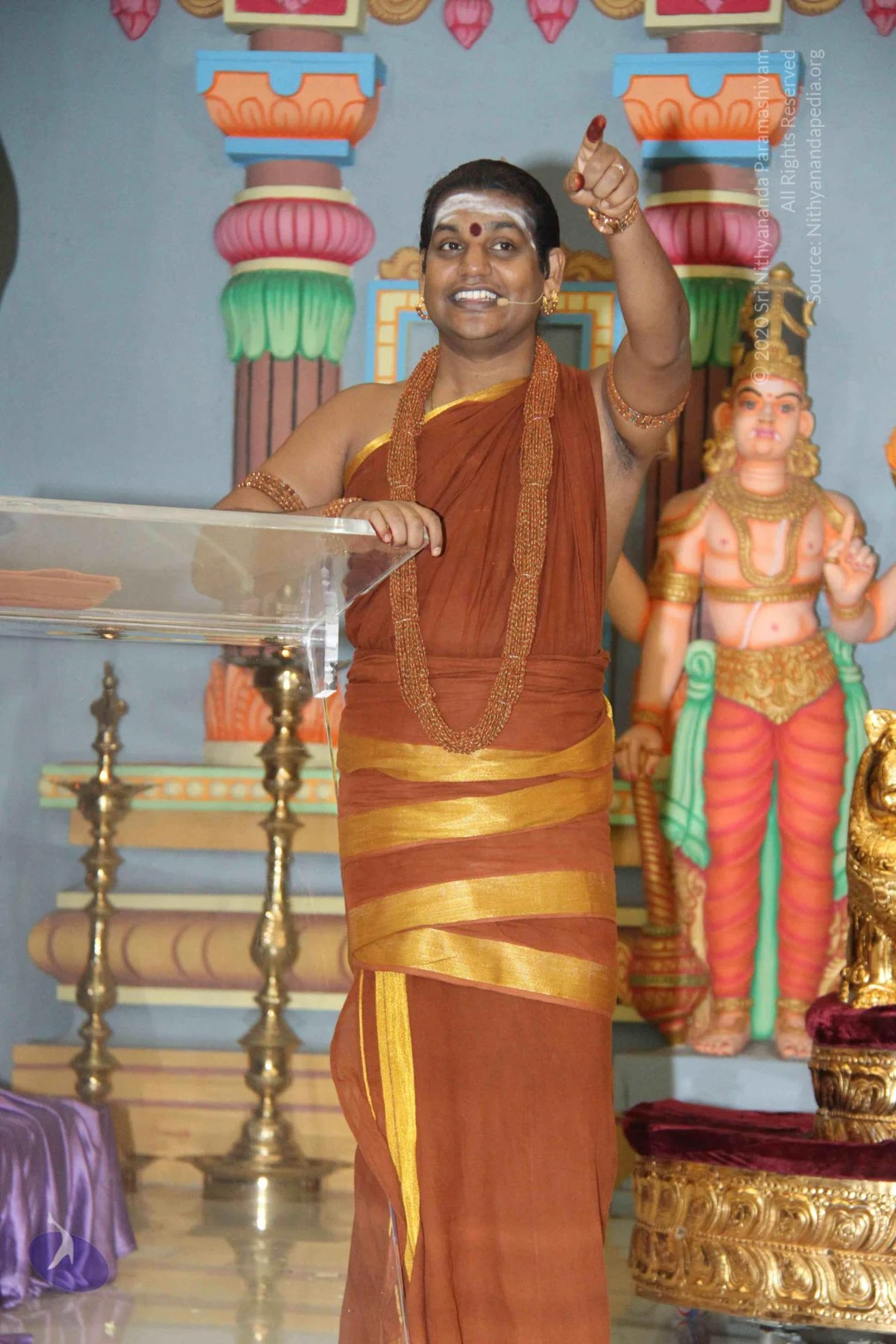
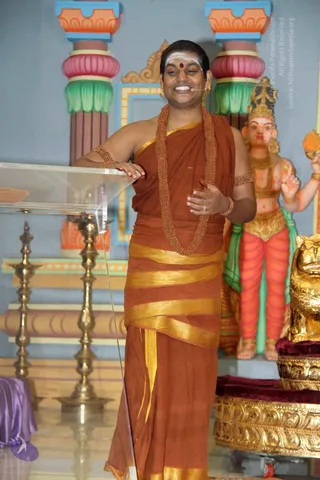
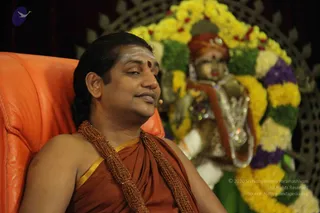
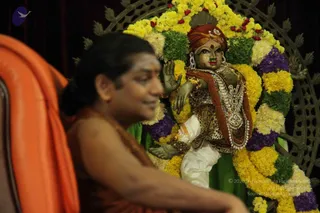
A seated figure on a gilded throne raises one hand in blessing, smiling. He wears a white and gold turban, rudraksha mala, a tiger-striped shawl over white dhoti with gold border, ornate jewelled necklaces, gold bangles and a ring. Vertical garlands of yellow, purple and green flowers frame him, with a golden throne and orange drape behind. Appearance-based candidate, Swamiji (probable): long swept-back hair, turban, rudraksha mala, ornate jewelled necklaces and tiger-striped shawl.A smiling man in saffron-orange robes with a gold-toned shawl and a long gold beaded mala stands beside a clear acrylic lectern at a temple-style stage. He has a sandalwood tilak on his forehead and gold bangles on his wrist. To his left, a Ganesha murti with a golden multi-hooded naga canopy is adorned with yellow and purple flower garlands, holding a veena. Behind him stand brass lamps and a painted pillared backdrop with a gold lion-shaped seat in the foreground.A photograph of a stage set with ornate deity murti and a gilded throne. A man in an ochre-orange dhoti and matching shawl stands at a clear acrylic lectern on the left of the stage, one arm extended. He has a beaded rudraksha-style mala around his neck and bare arms, with an orange-red cloth draped over one shoulder. Behind him stands a gold-painted throne with red velvet cushions flanked by lion figures, between two standing murti of divine figures with crowns and raised arms. On the left, a seated murti under a multi-hooded serpent canopy is garlanded with yellow and purple flowers. On the right, a seated deity murti in green and gold is garlanded, next to a gilded niche with a seated figure in red garlanded with flowers. Brass oil lamps stand near the throne. Blue and orange painted panels form the backdrop, with a maroon velvet valance above.A smiling man in a rust-orange dhoti and shawl stands at a clear acrylic lectern, one hand resting on it. He wears a long multi-strand gold-toned mala, gold bangles and an armlet, a white vertical forehead mark with a red bindi, and a small earring with a lapel microphone. Behind him are blue and pink decorative pillars with lotus-style capitals, a gold cobra hood at the left edge, a multi-armed deity murti in gold ornaments on the right, and yellow and purple flower garlands along the left side. A brass oil lamp stands near the lectern. The man is a person, with long swept-back hair and rudraksha-style malas, speaking in what looks like a discourse setting.A man in an orange-saffron robe with a gold-bordered dhoti and a long gold-beaded mala stands at a clear acrylic lectern, smiling and speaking into a headset microphone. He wears a red tilak on his forehead and gold armbands. Behind him, a painted backdrop of pink and green pillars and a standing female deity figure with a raised hand holds a golden lion statue at right. At left, a deity murti of Ganesha seated with a veena, draped in yellow and purple marigold garlands and crowned by a large golden multi-headed cobra hood, rests on a golden coiled base over a purple cloth. Gold brass lamp stands flank the lectern.A smiling man in a rust-orange dhoti and shawl with gold-bordered wrap stands at a clear acrylic lectern, speaking on stage. He wears a long rudraksha-style mala, gold bangles and armlets, a vibhuti horizontal mark and red kumkum bindi, with a small headset microphone. Behind him stands a painted deity figure with a crown, orange-pink dress and raised hand holding a flame, beside a gilded lion-shaped throne and brass lamps. The page identifies this as a person and the setting appears to be a satsang discourse, but the visible cues are not distinctive enough for a firm identification, so the speaker is described by role only.

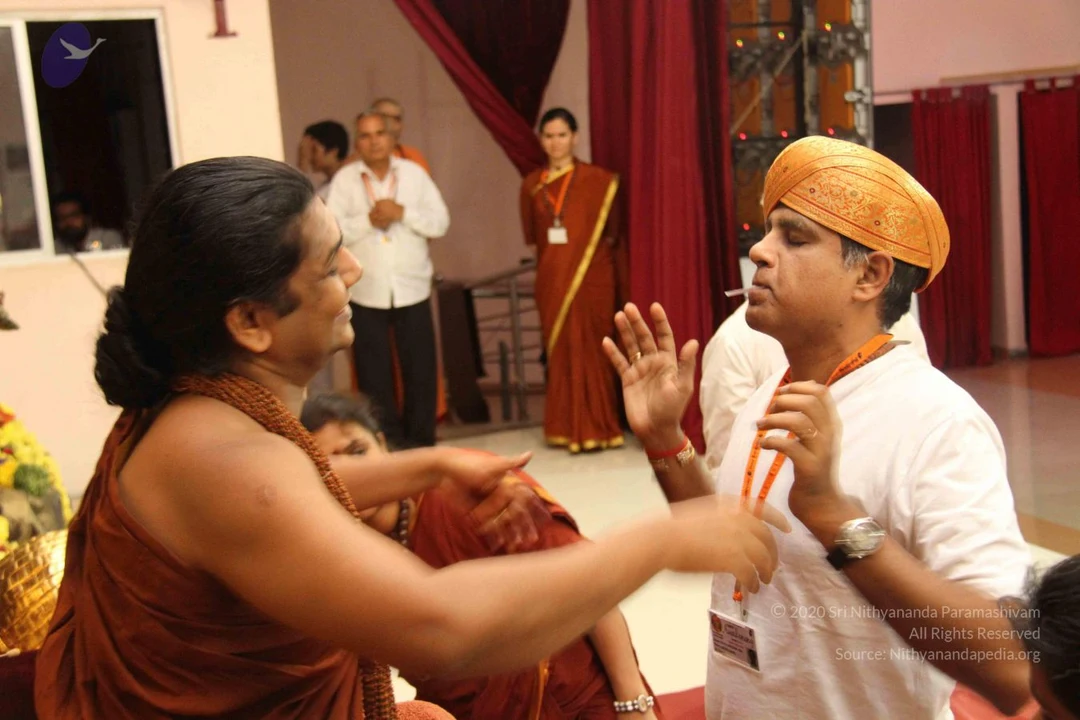
SarvaDarshan

5 photosSource gallery
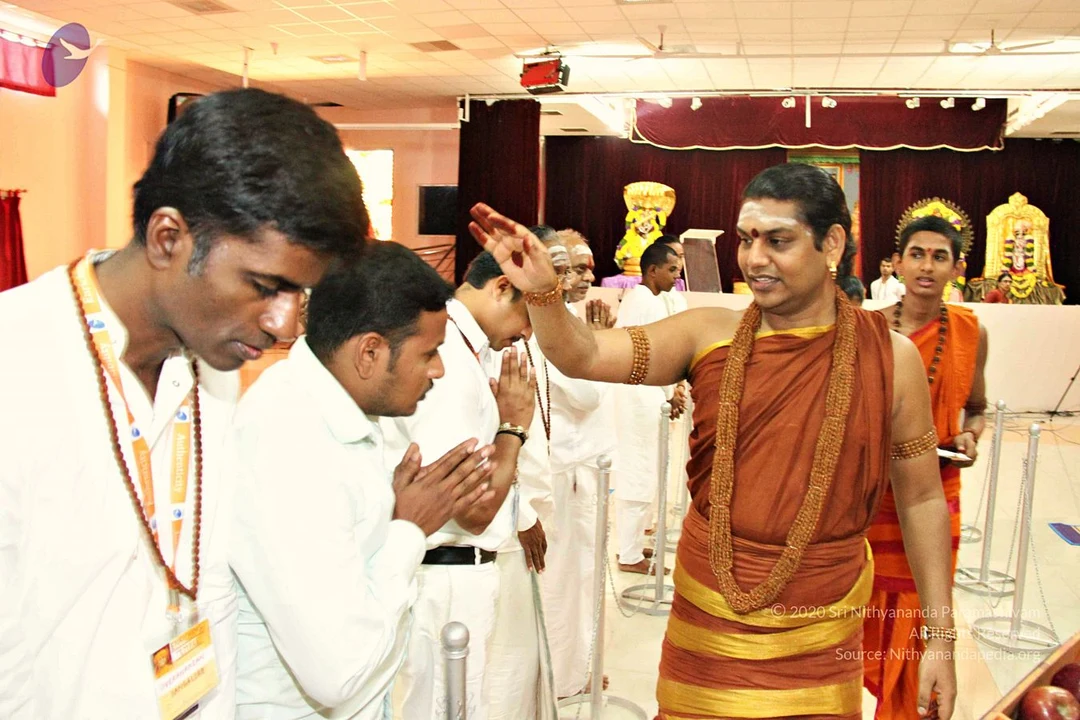
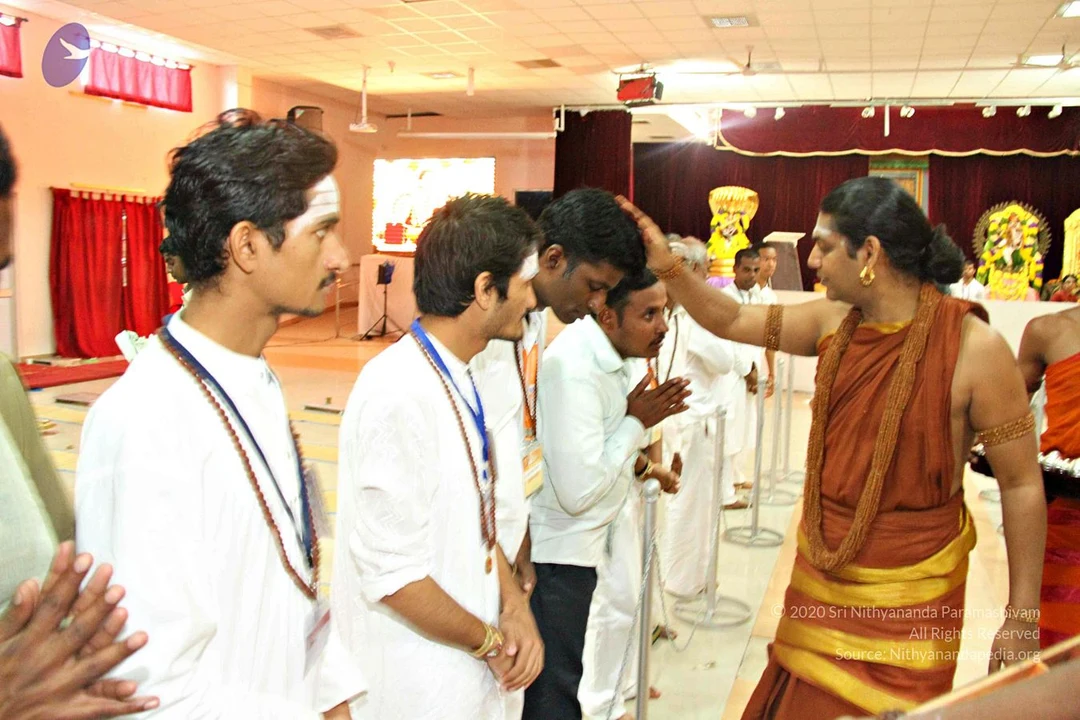
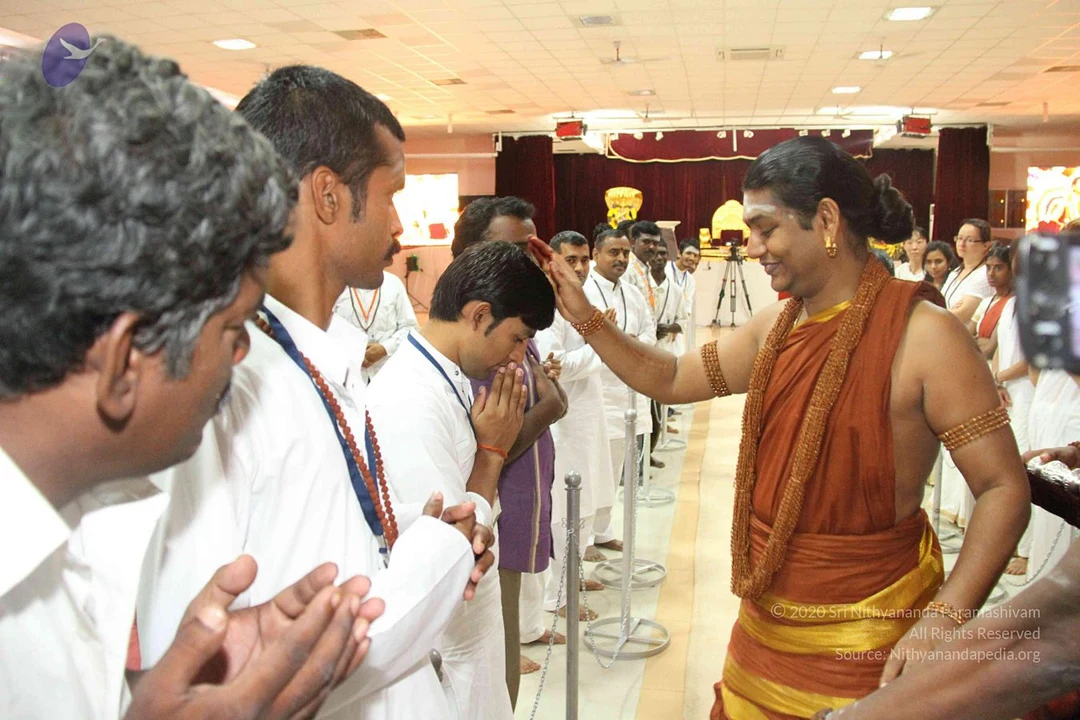
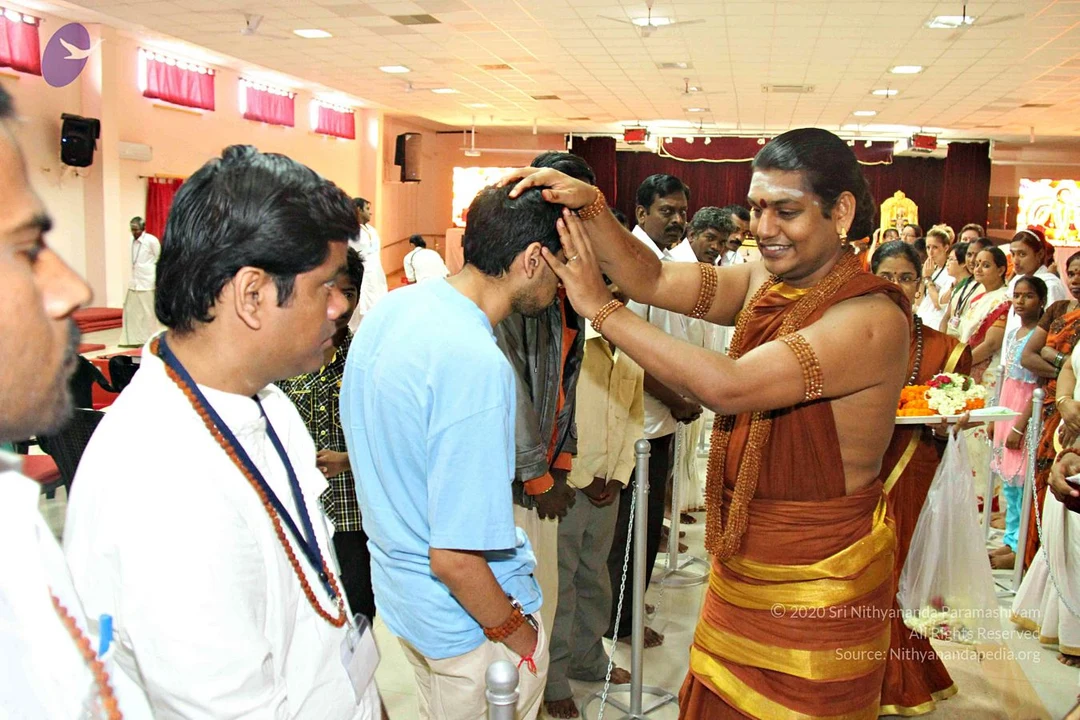
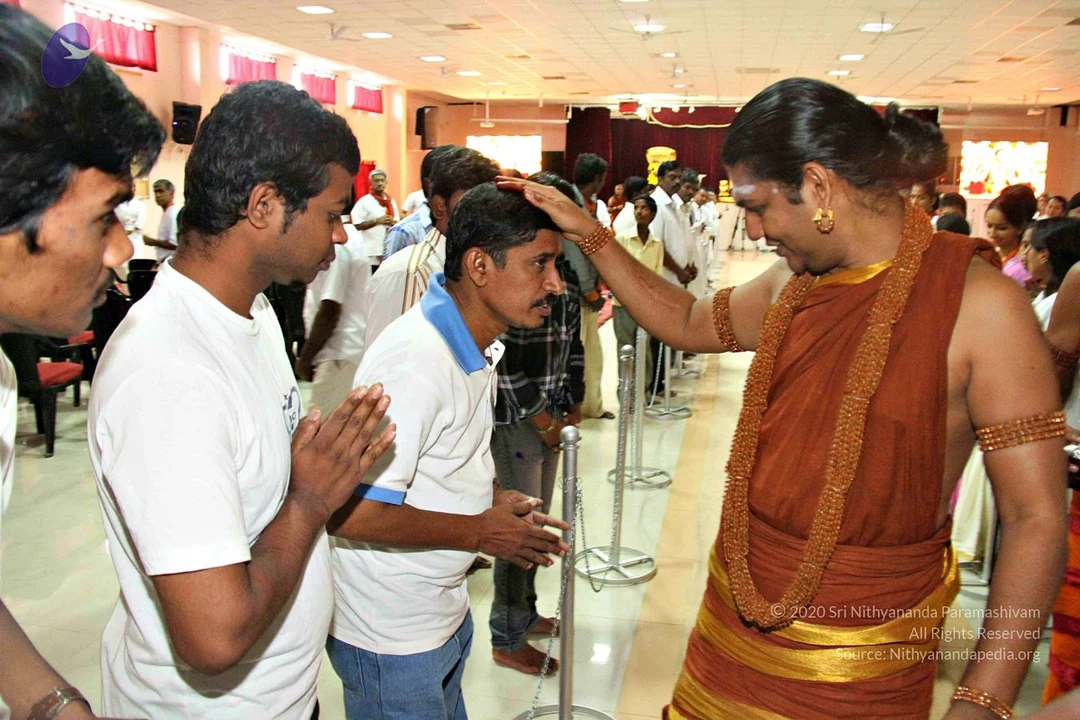
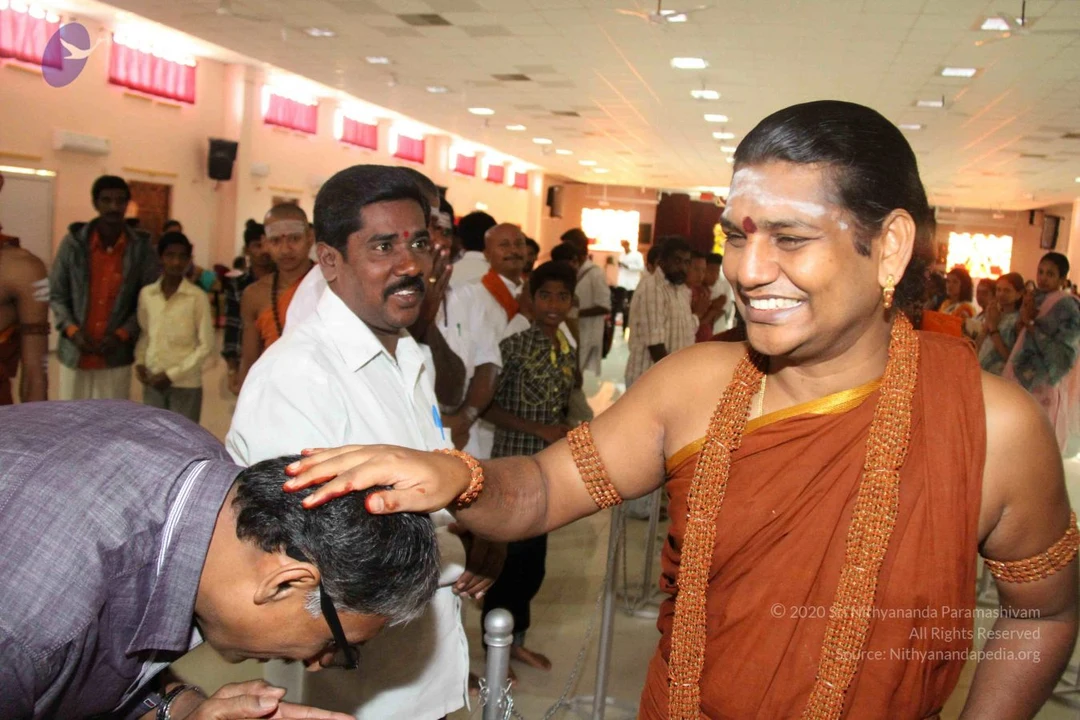
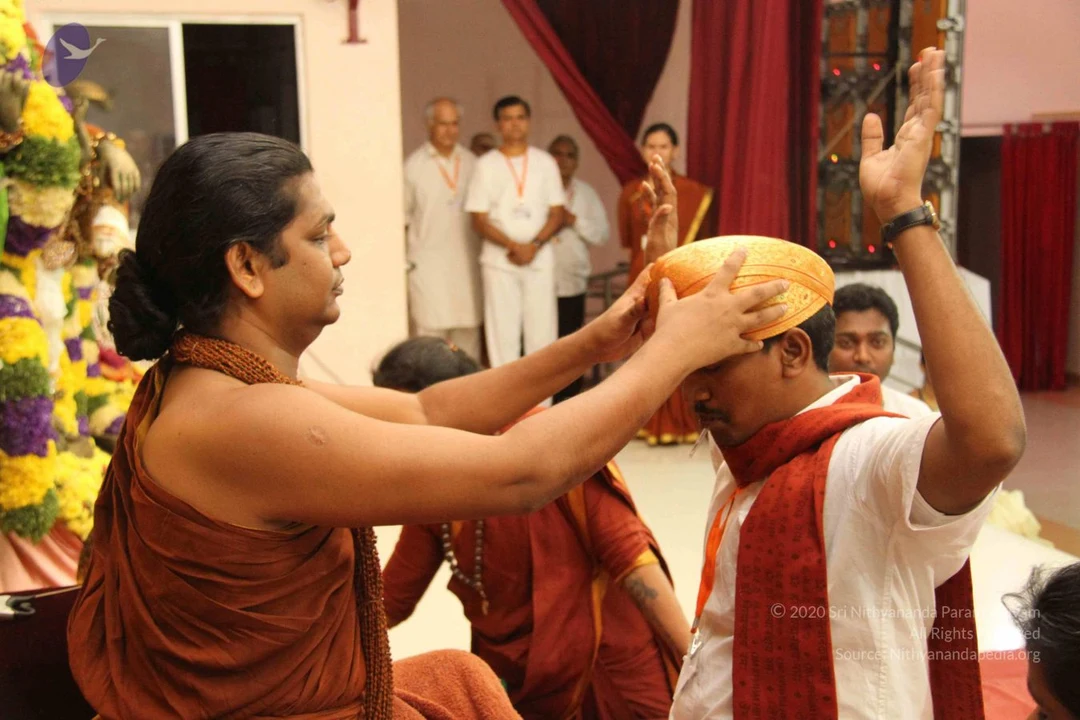
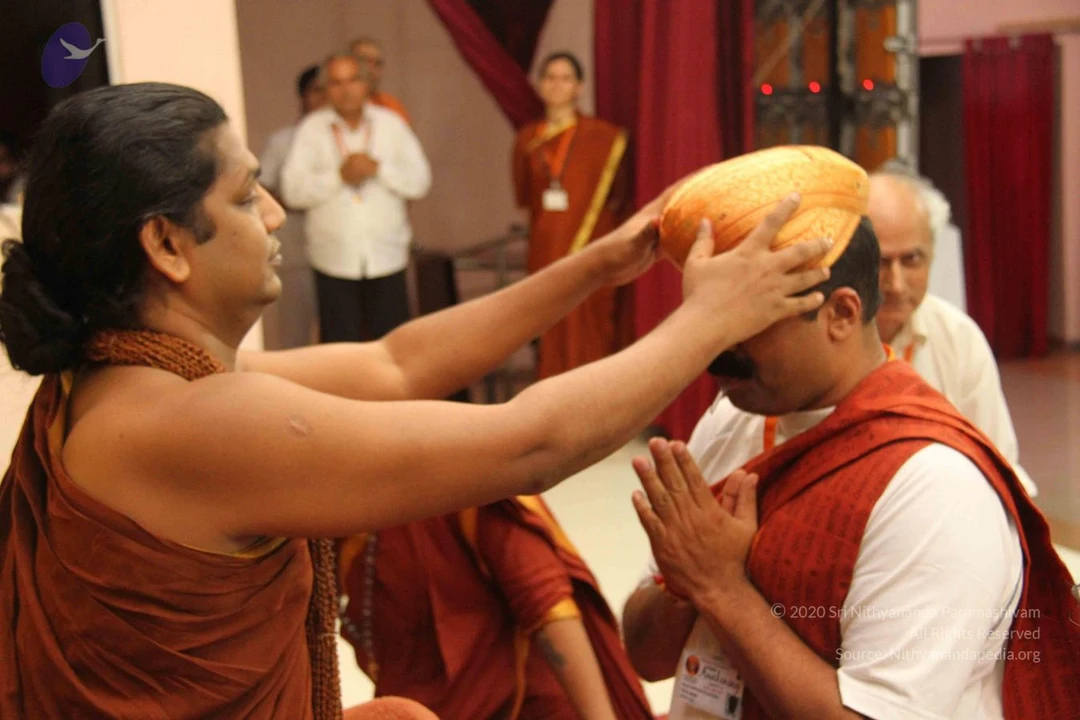
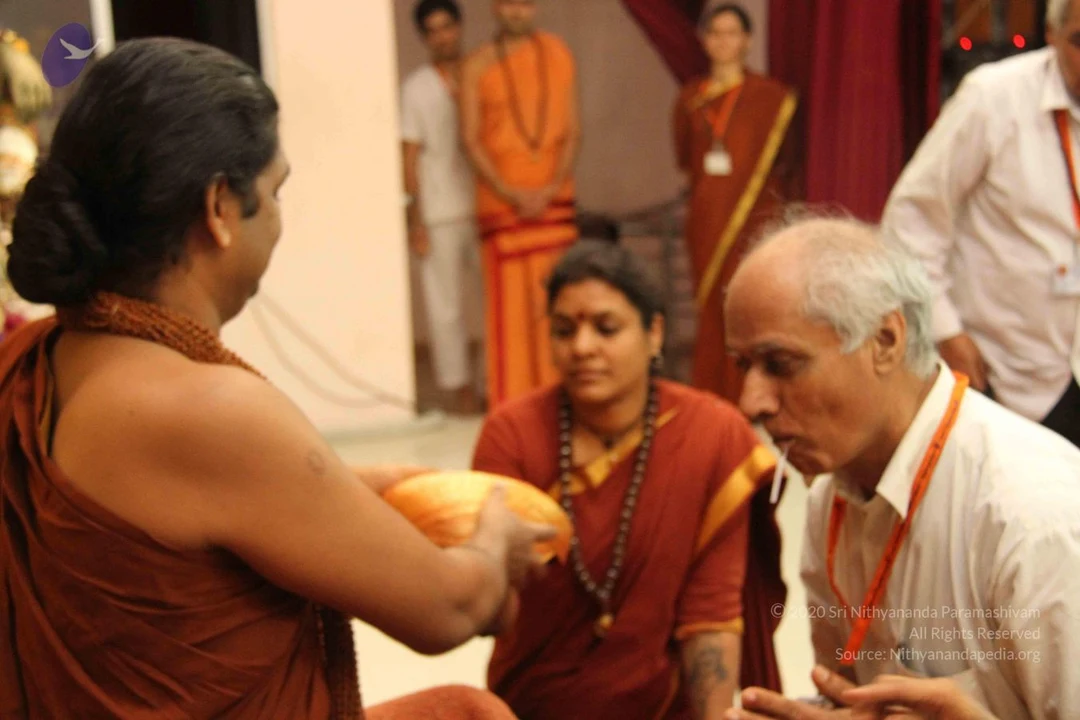
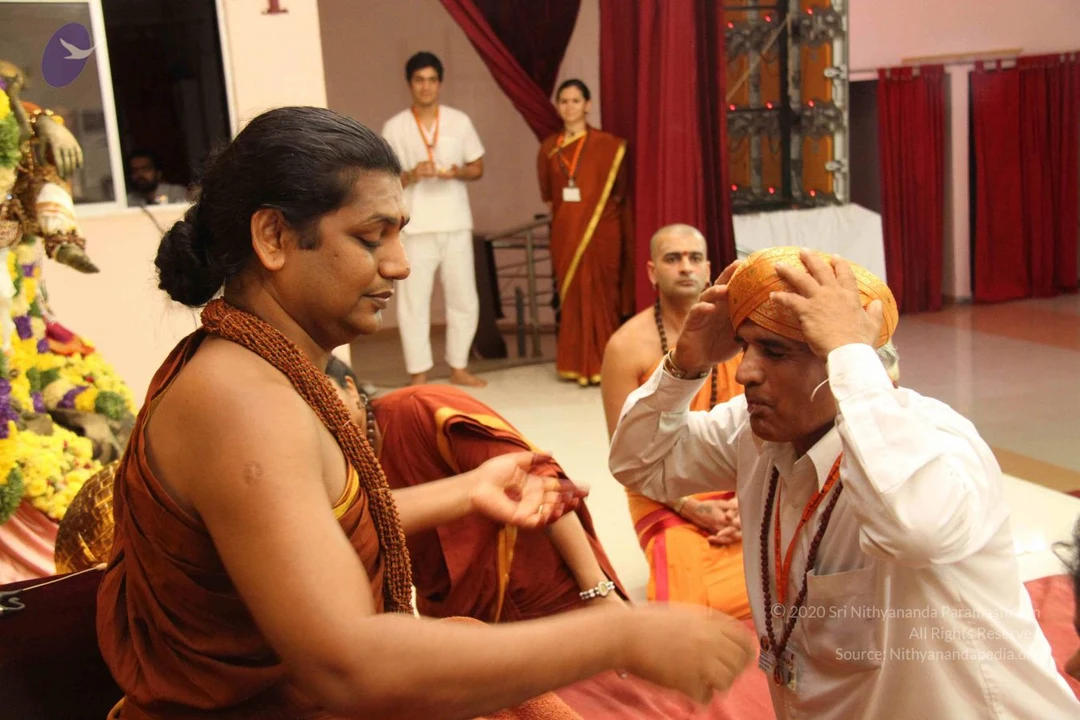
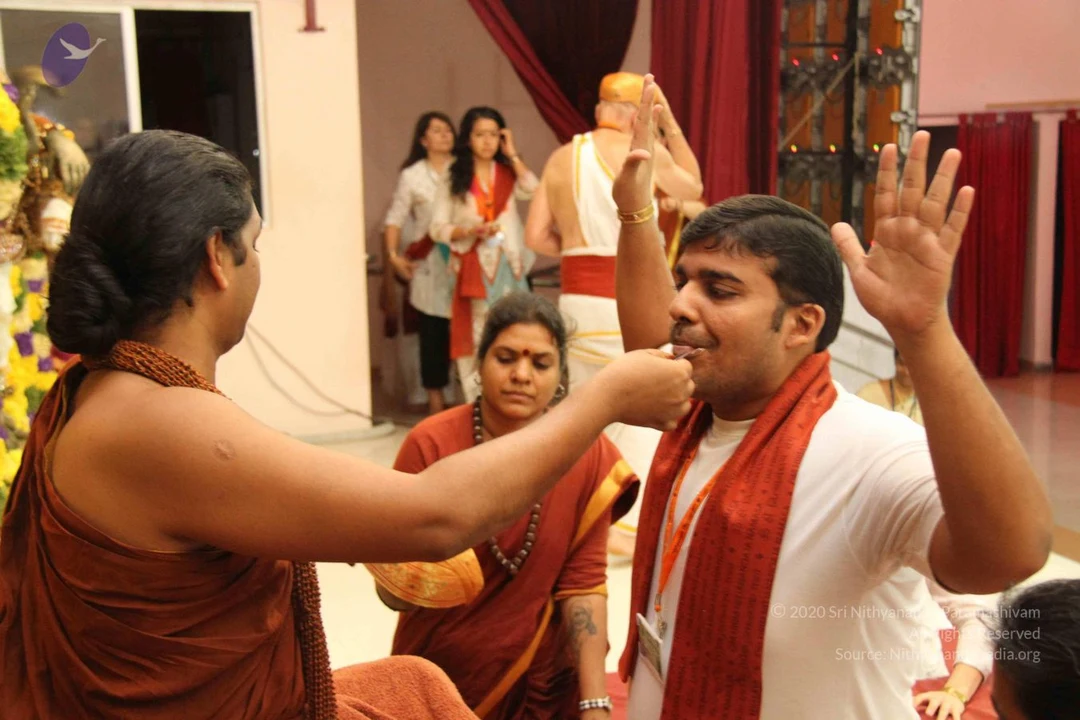
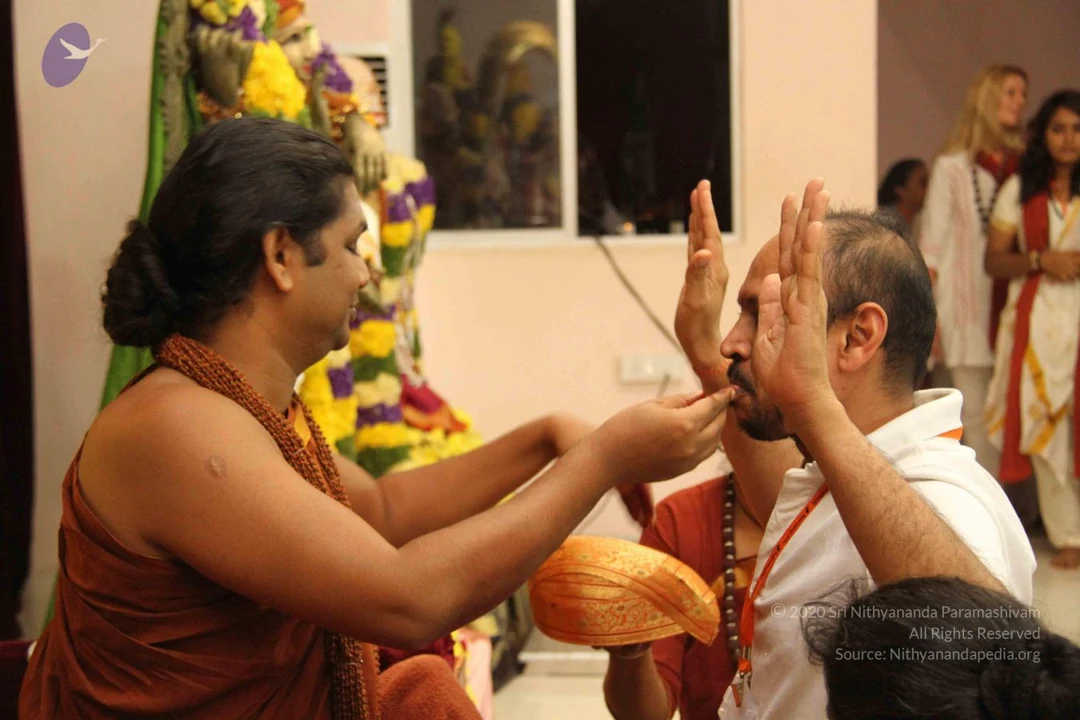
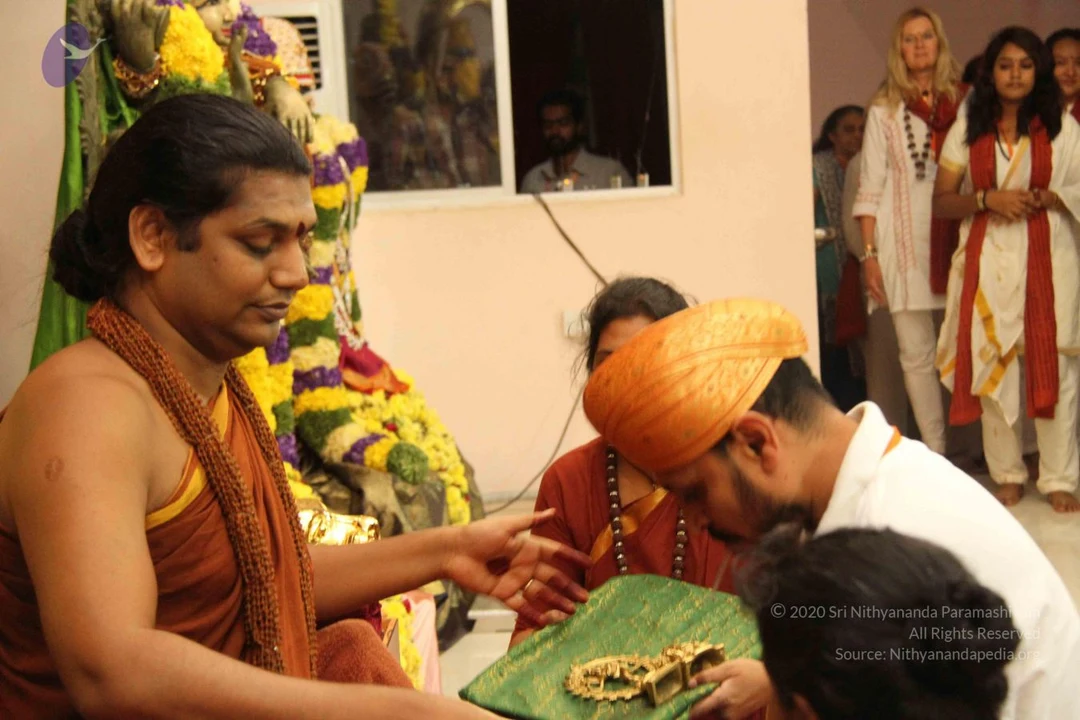
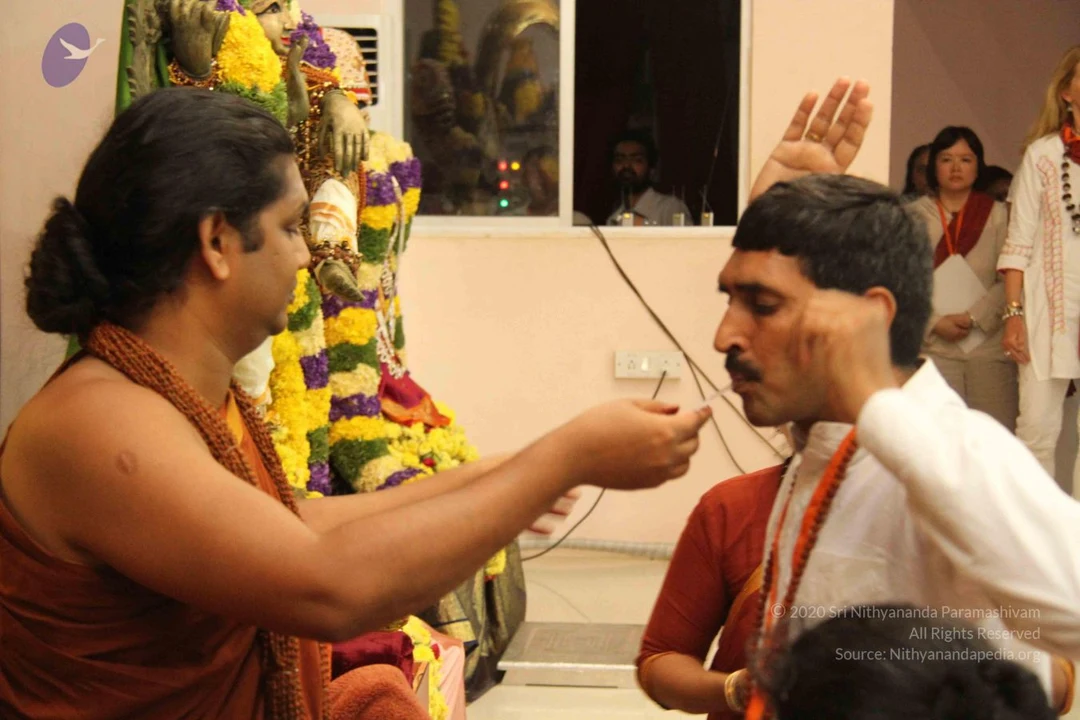
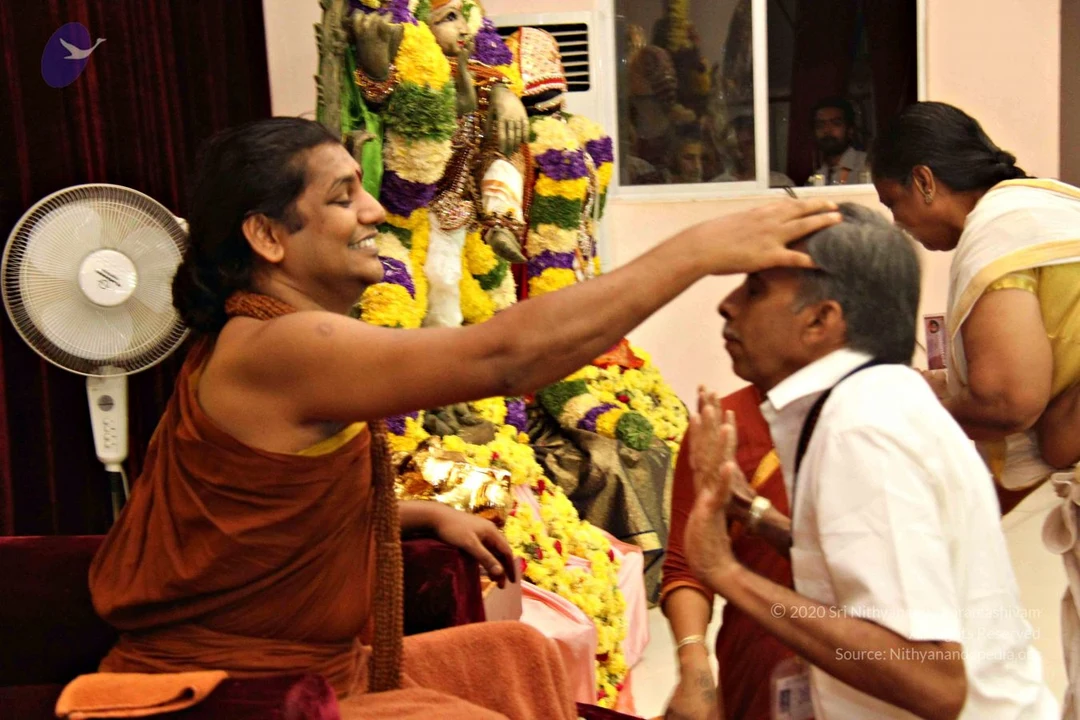
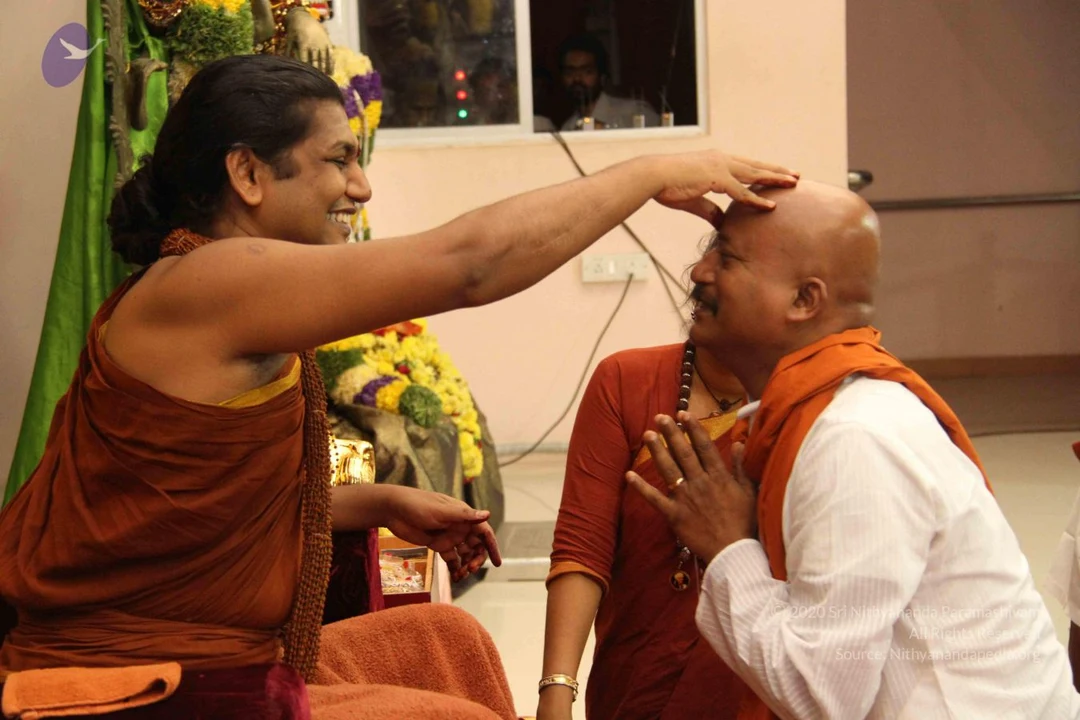
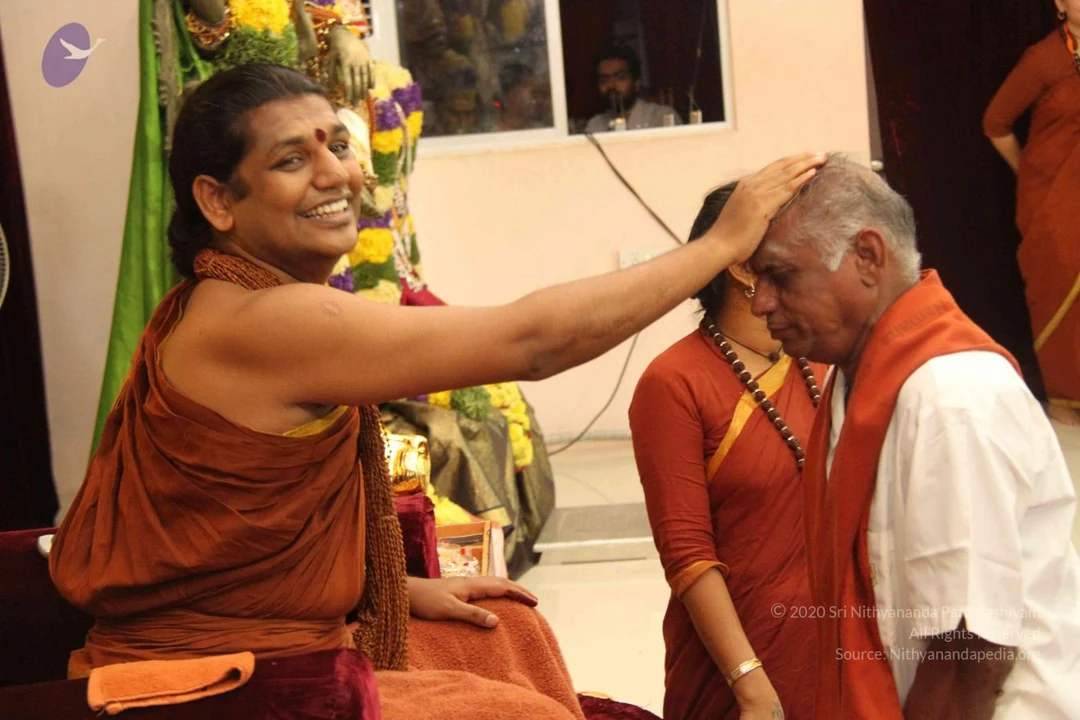
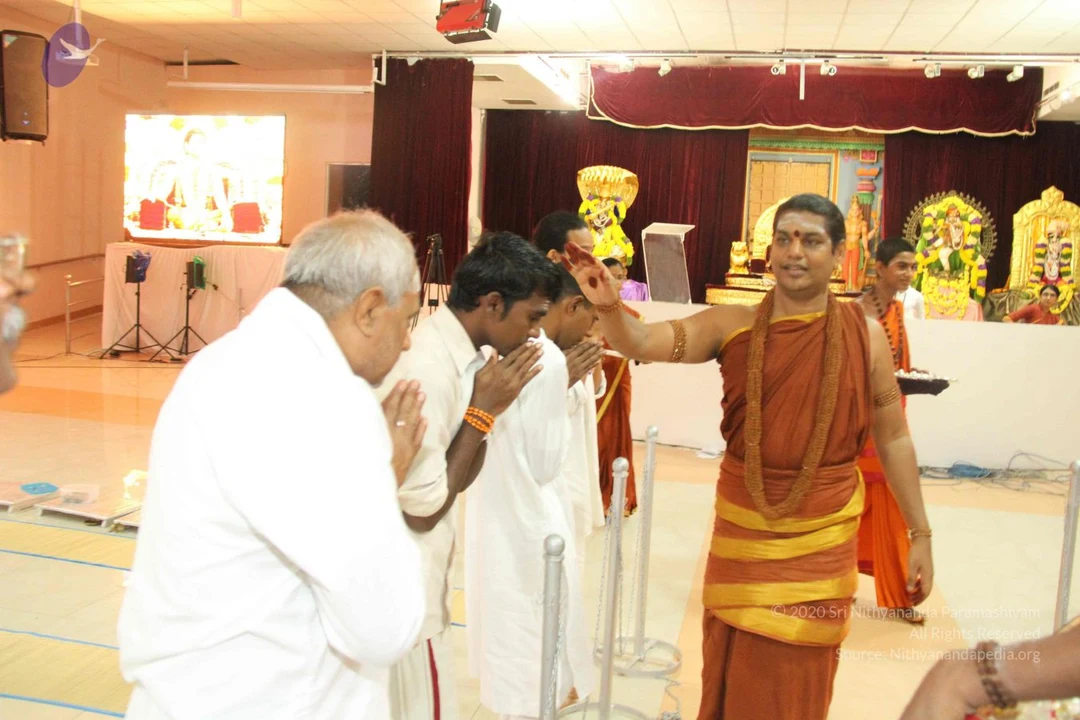
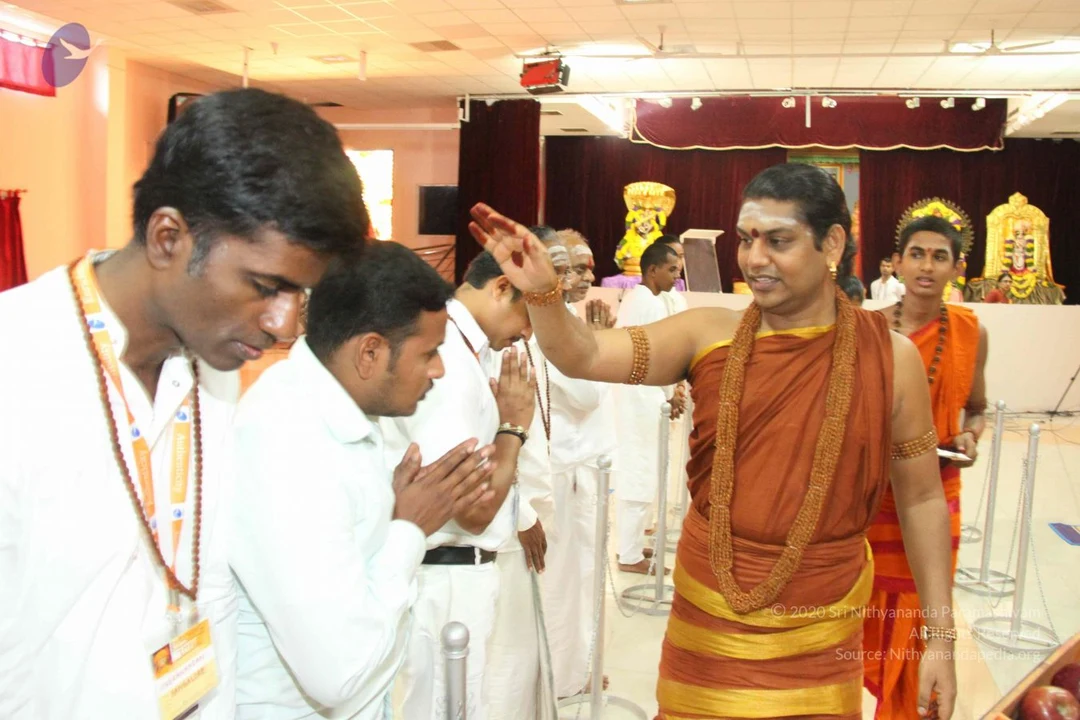
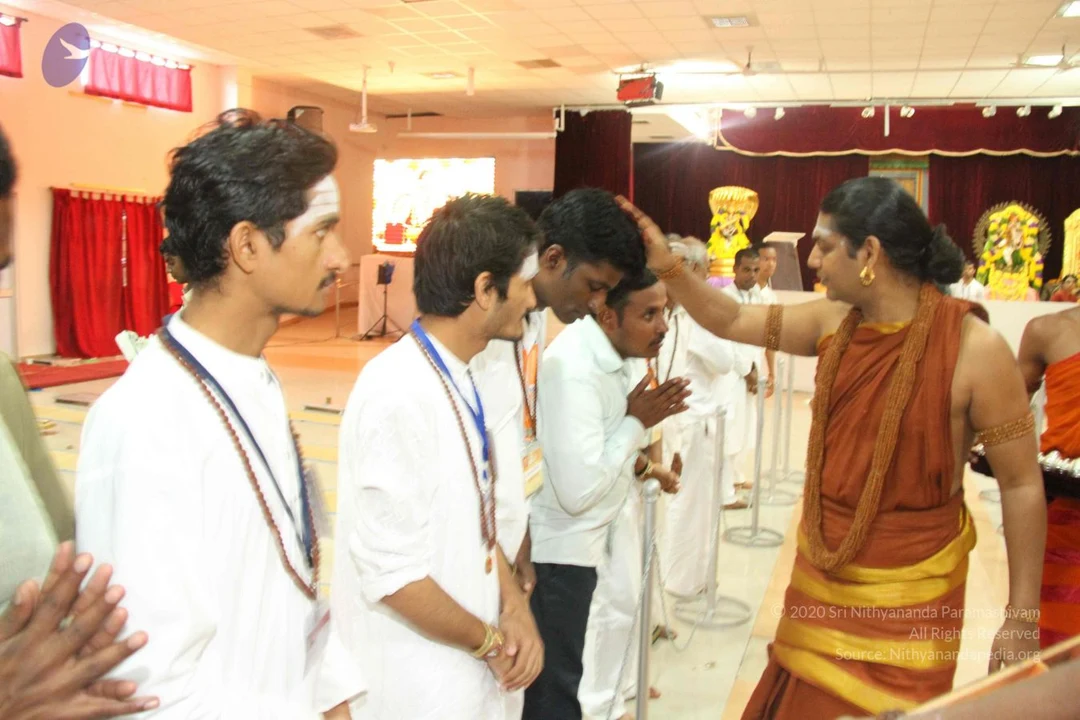
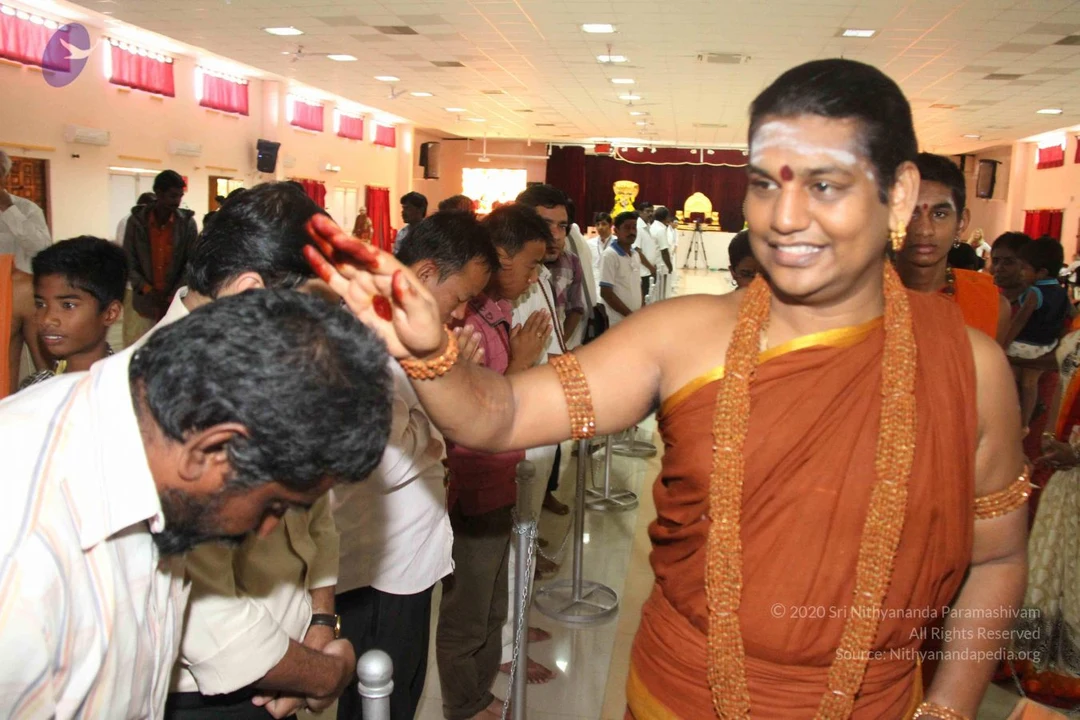
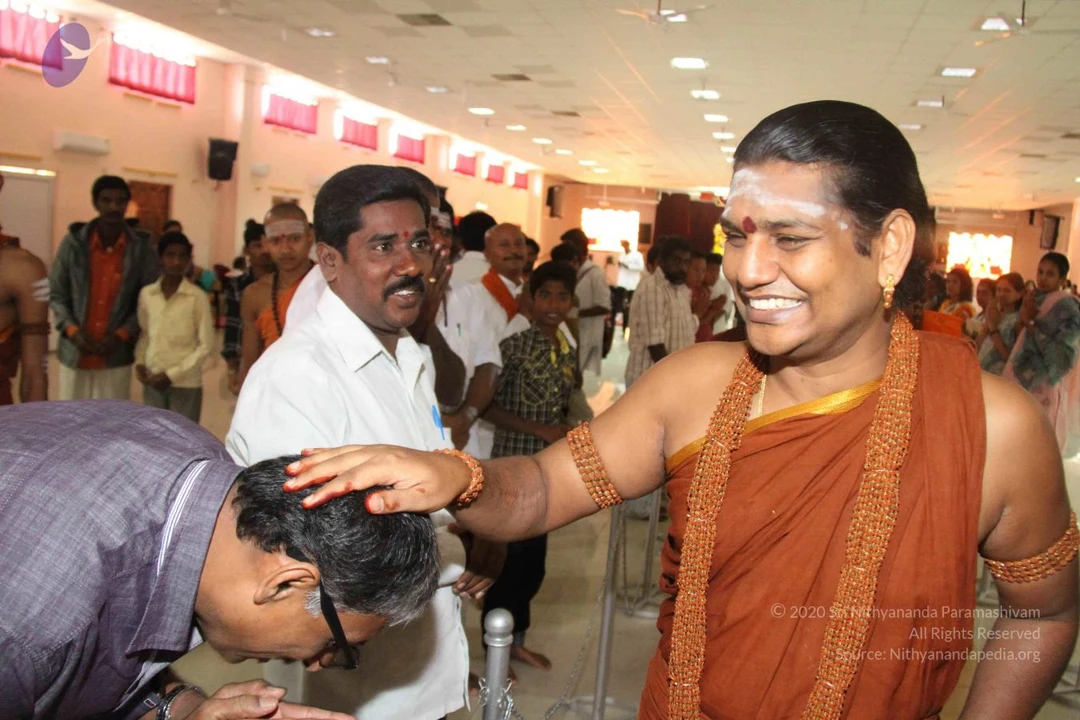
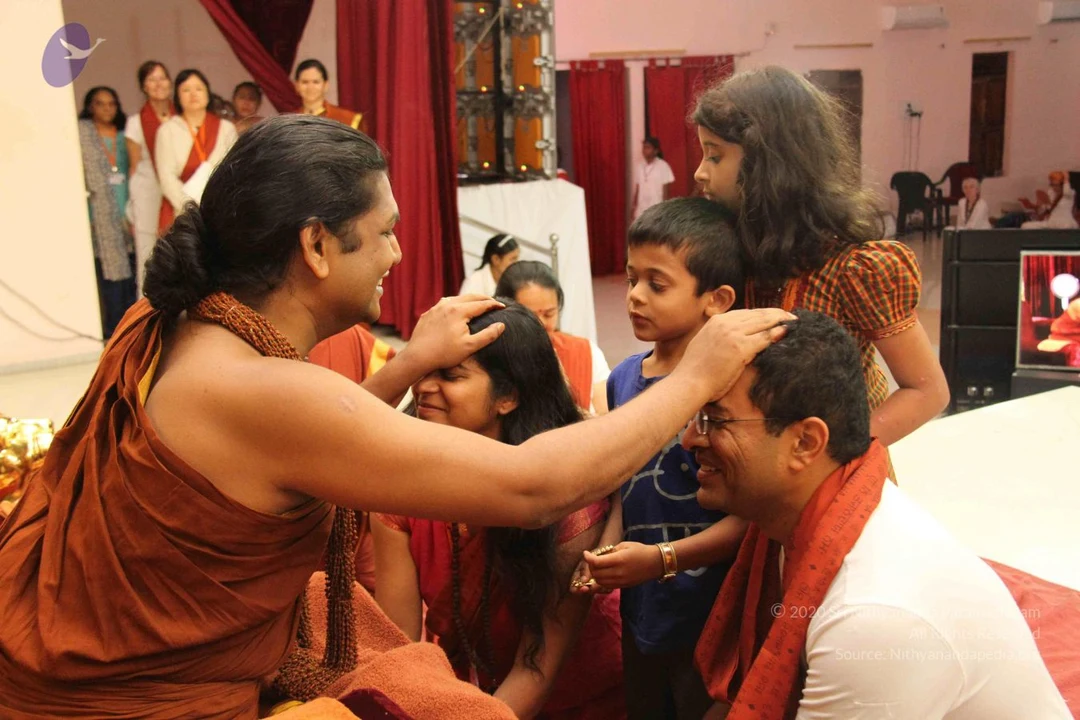
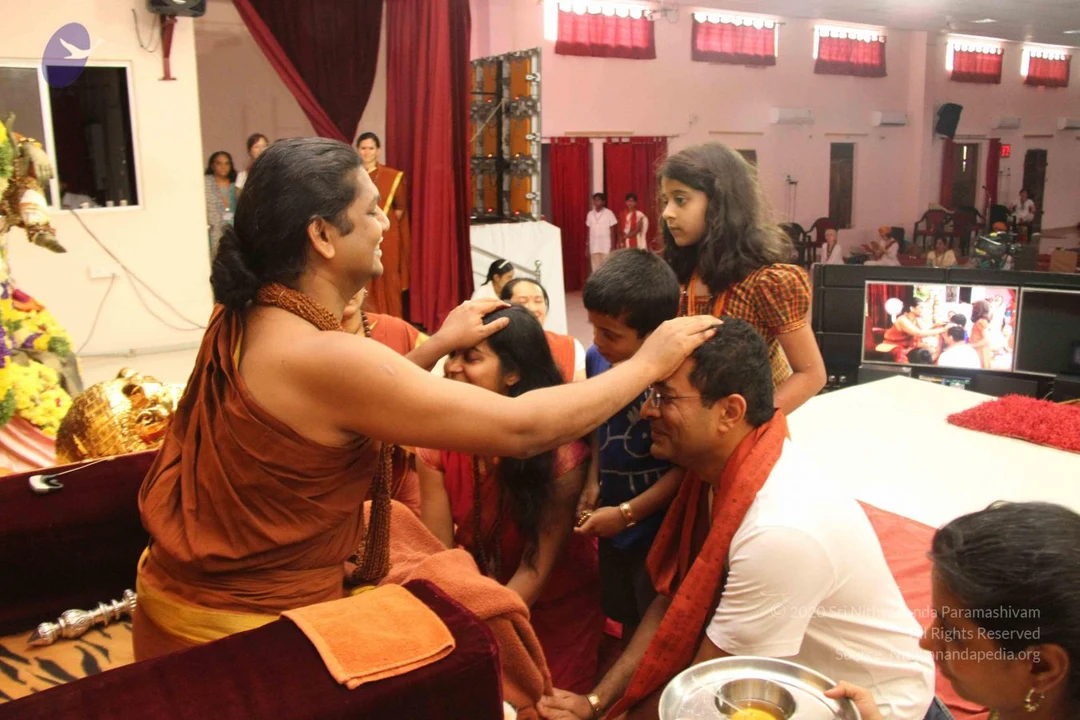
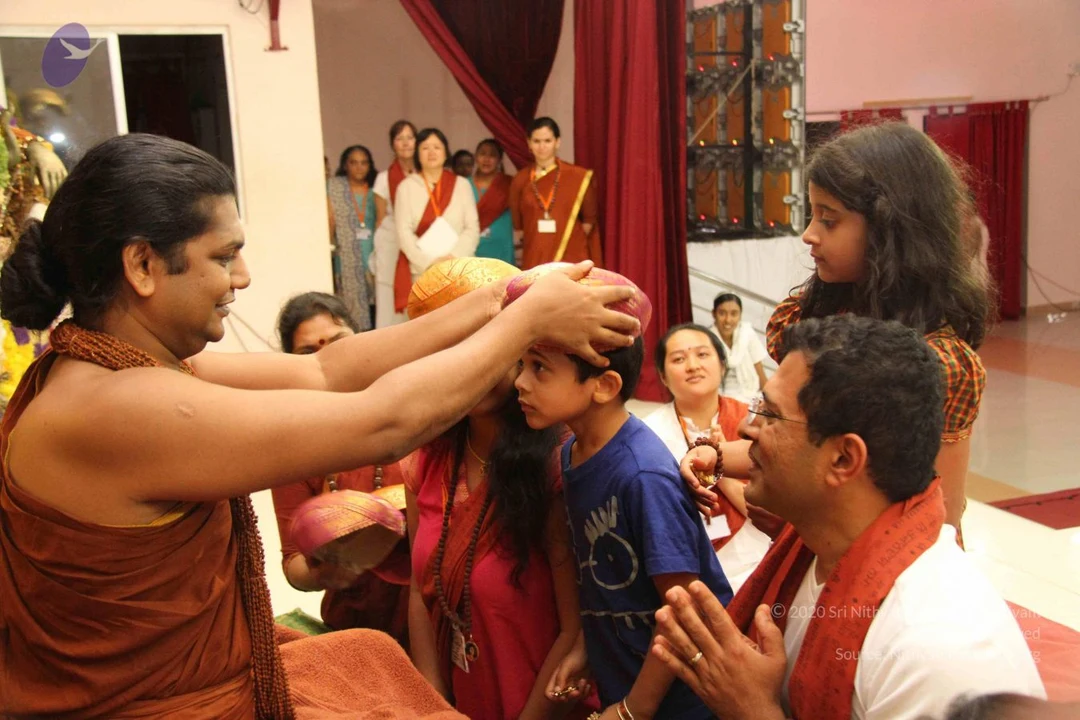
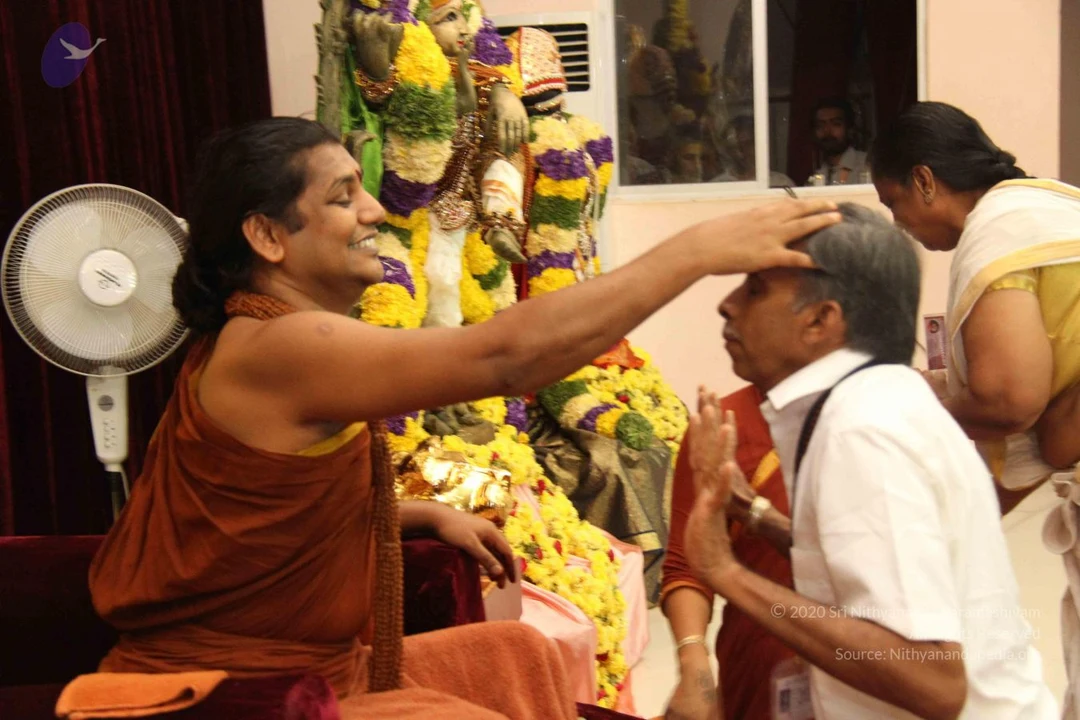
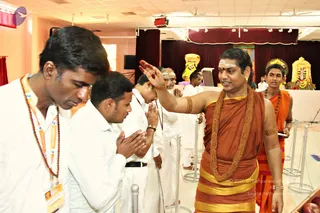
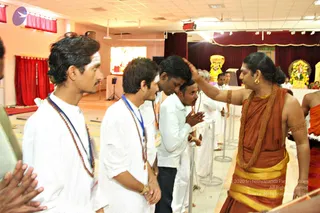
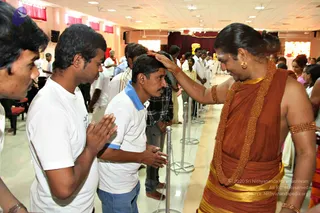
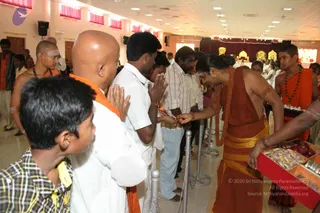
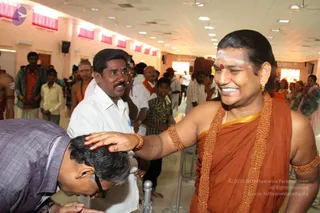
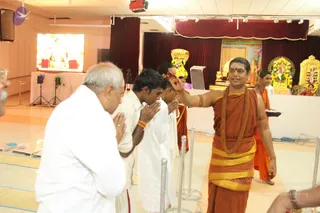
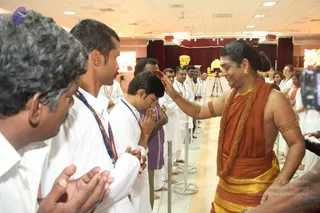
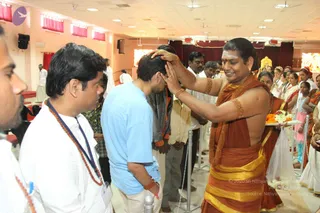
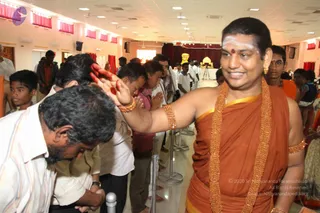
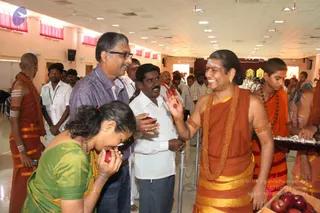
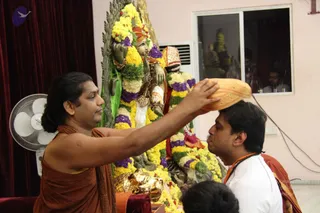
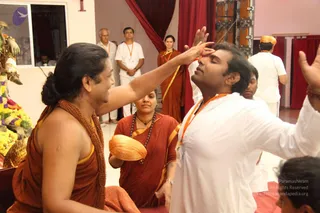
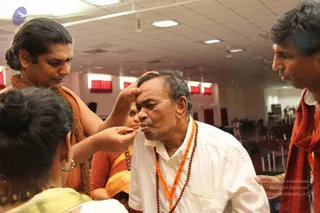
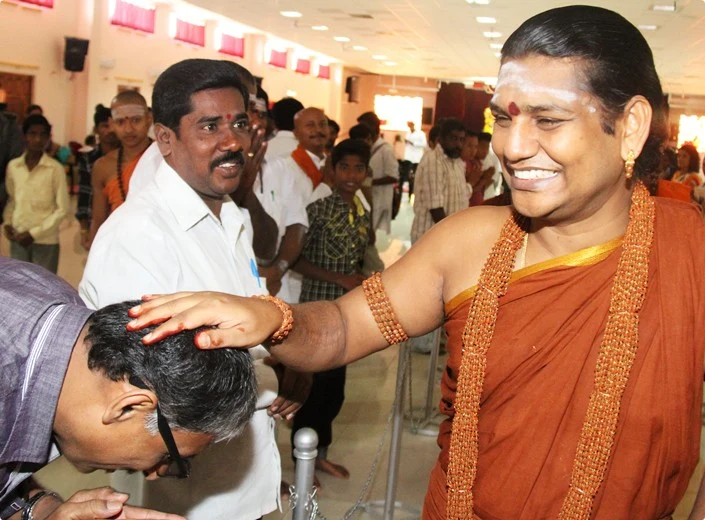
Photograph of a hall with a white ceiling and red curtains, where a man with a shaved head, white tilak, and long rudraksha-style gold beaded necklace wears an orange-brown robe and gold-banded waist cloth while raising his right hand in blessing. Beside him an attendant in an orange robe with a beaded mala stands, and several men in white shirts and white dhotis stand with hands folded or heads bowed in namaskar, one wearing a lanyard badge. Behind them are golden ornate deity murti figures on pedestals and a draped lectern area, with silver stanchions along the walkway.A photo in an indoor hall with pink walls, red curtains and ceiling lights. On the right, a figure in an orange-brown saffron robe with a gold-edged waist sash, a long rudraksha-style mala necklace, gold bangles and gold earrings reaches out to place a hand on the head of a younger man who bows with his head lowered. Several men in white kurta-style clothes stand in a line behind a rope barrier, some with white tilak markings on their foreheads, rudraksha malas and blue lanyards; one has hands pressed together in namaste. Decorated deity murti altars with yellow and gold floral garlands are visible in the background. The figure in orange is a probable Swamiji match on appearance cues of saffron clothing, long-hair bun, rudraksha mala and gold ornaments, while the others are devotees.A photograph inside a large hall with white tiled floor and red curtains, where a robed figure in orange-brown saffron cloth with a gold waist band and a long rudraksha-style bead mala places his right hand on the head of a man in a white polo shirt. The figure has long dark hair tied up, gold earrings, bangles and a forearm band, and a ceremonial gold necklace. A man in a white shirt on the left stands with palms pressed together in namaste, and another man in a white shirt with a blue collar and a man in a checked shirt stand nearby in a line of devotees behind chrome stanchions. Several people in white clothes stand in the background near a stage with a deity image and a yellow arrangement.Indoor hall with white tiled floor and red valances; a line of devotees waits at metal stanchions. A saffron-robed monastic in a rudraksha mala and gold-trimmed cloth holds a tray of sweets and small packets toward the queue. Beside them, a white-clad man with folded palms, a man in a striped shirt, and a boy in a checked shirt wait. Several shaved-headed monastics in orange and tilak stand in the background near illuminated altar displays with deity murti and lamps. A bald man in white with an orange shawl stands at left.A smiling person in a saffron-orange robe and multiple rudraksha-style beaded necklaces stands on the right, with white ash lines and a red dot on the forehead and a gold earring visible. He places his right hand on the head of a man bending forward at the lower left, who wears a grey-striped shirt. Behind them, a standing crowd in white shirts, orange shawls and saffron dhotis watches in a bright, pale-pink hall with red curtains and lit lamps. The overall setting suggests a blessing or darshan moment.

FinalBlessing_Swamiji_Deities

5 photosSource gallery
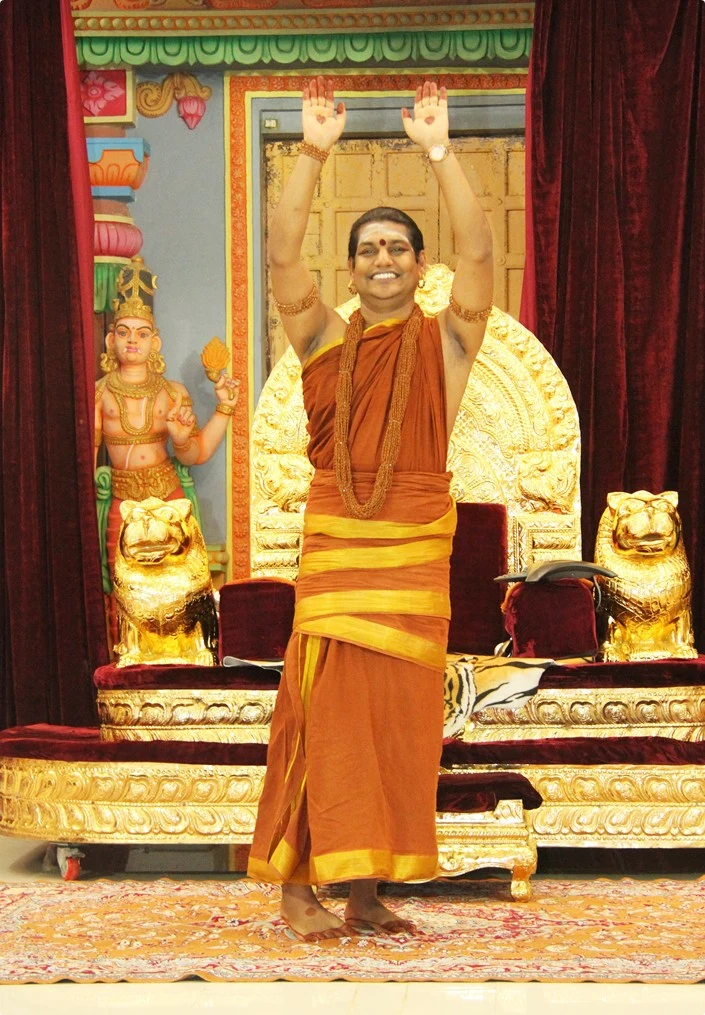
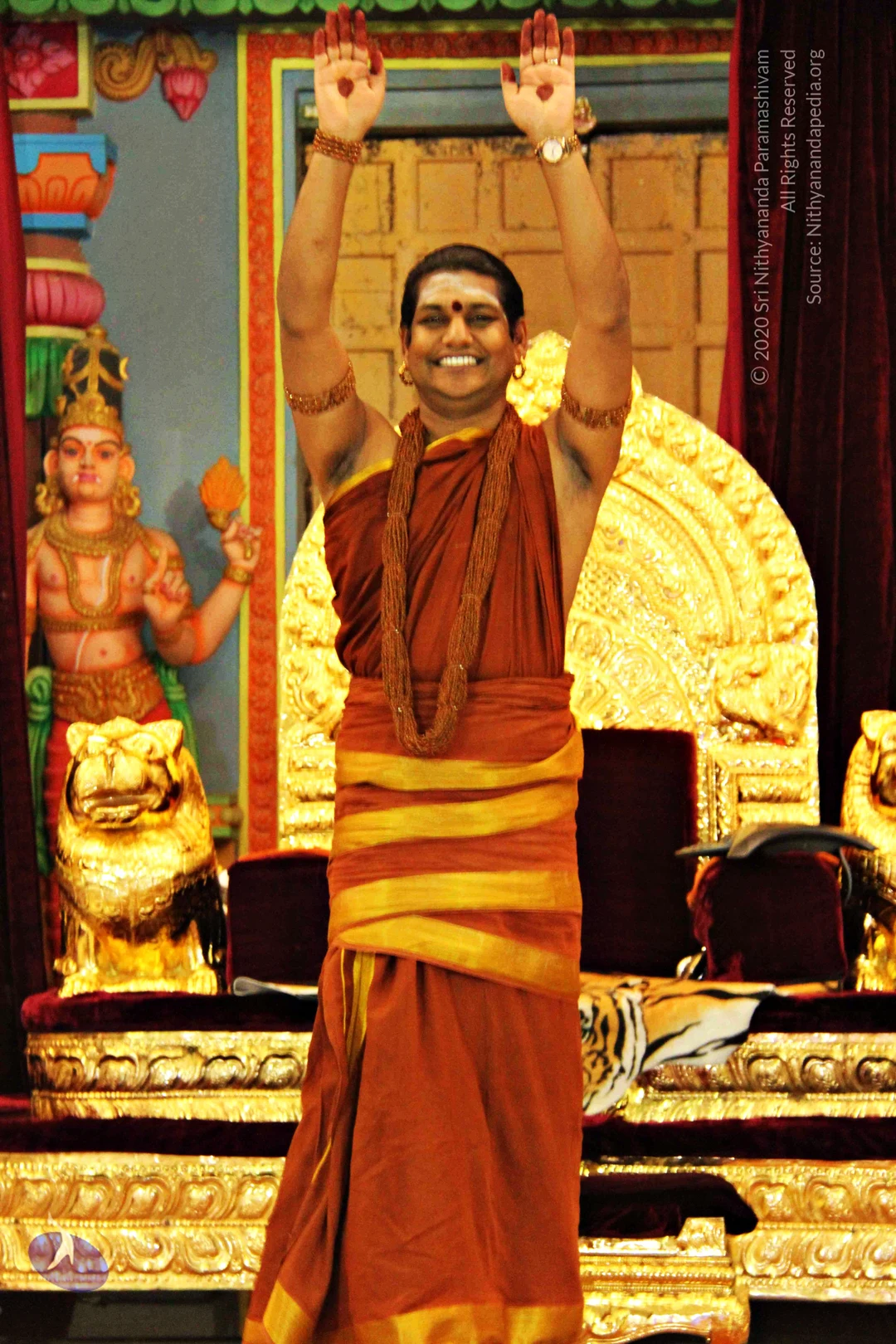
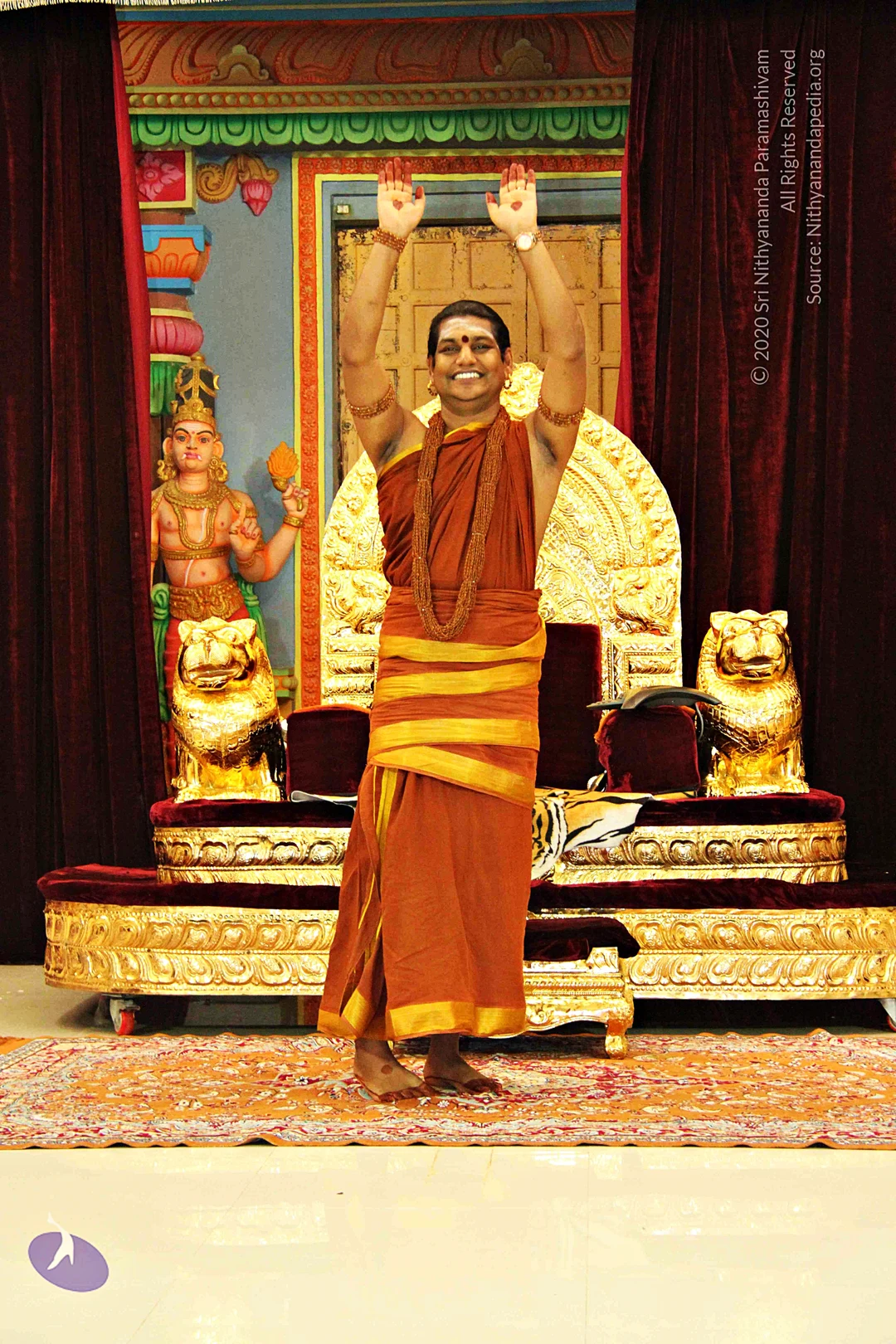
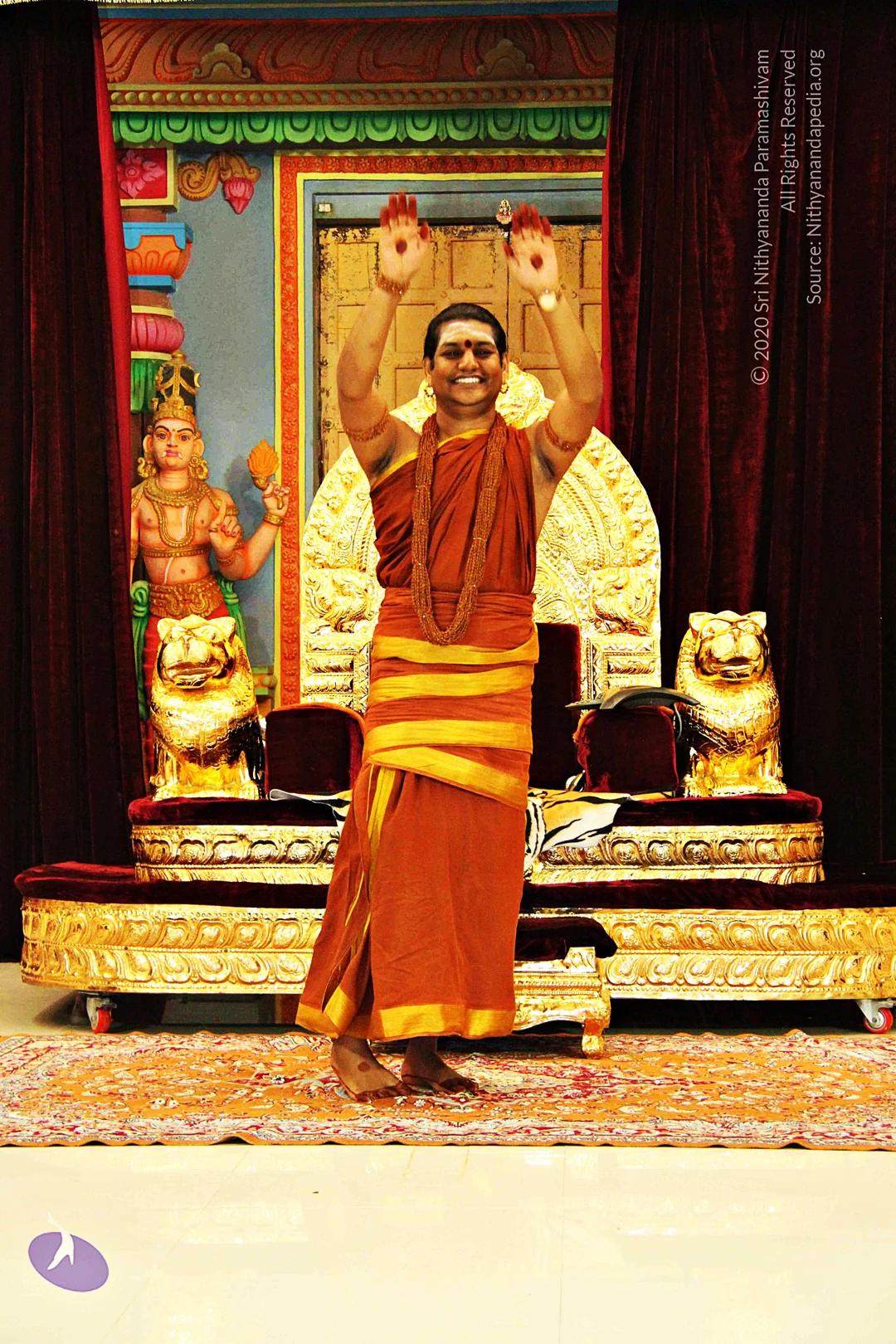
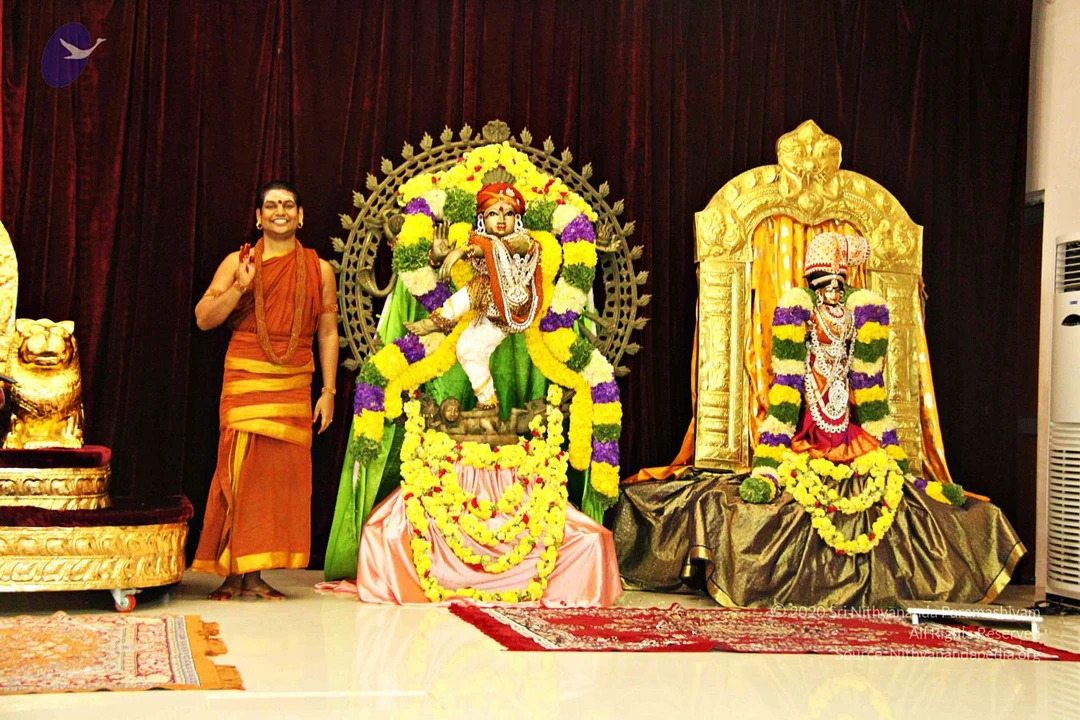
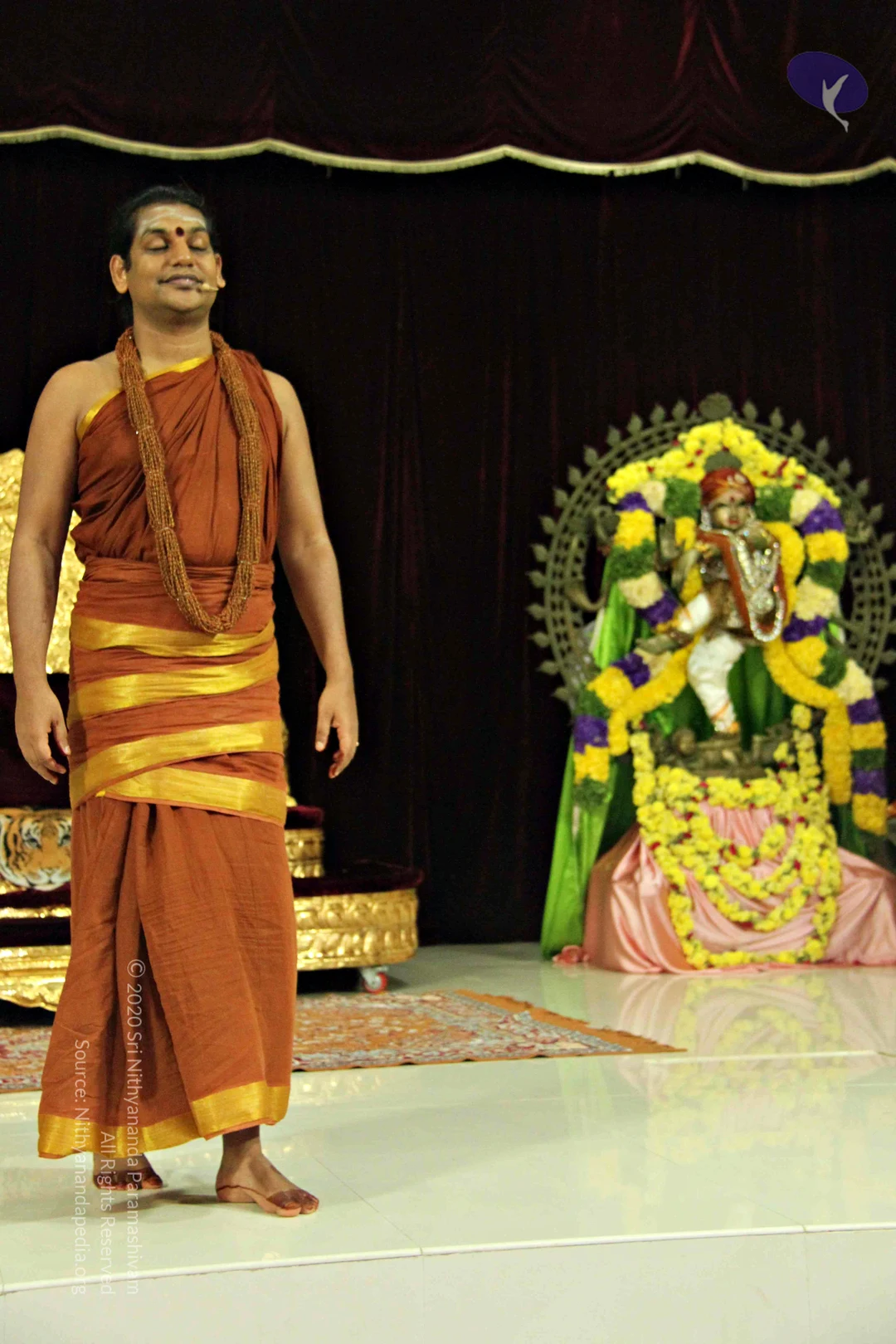
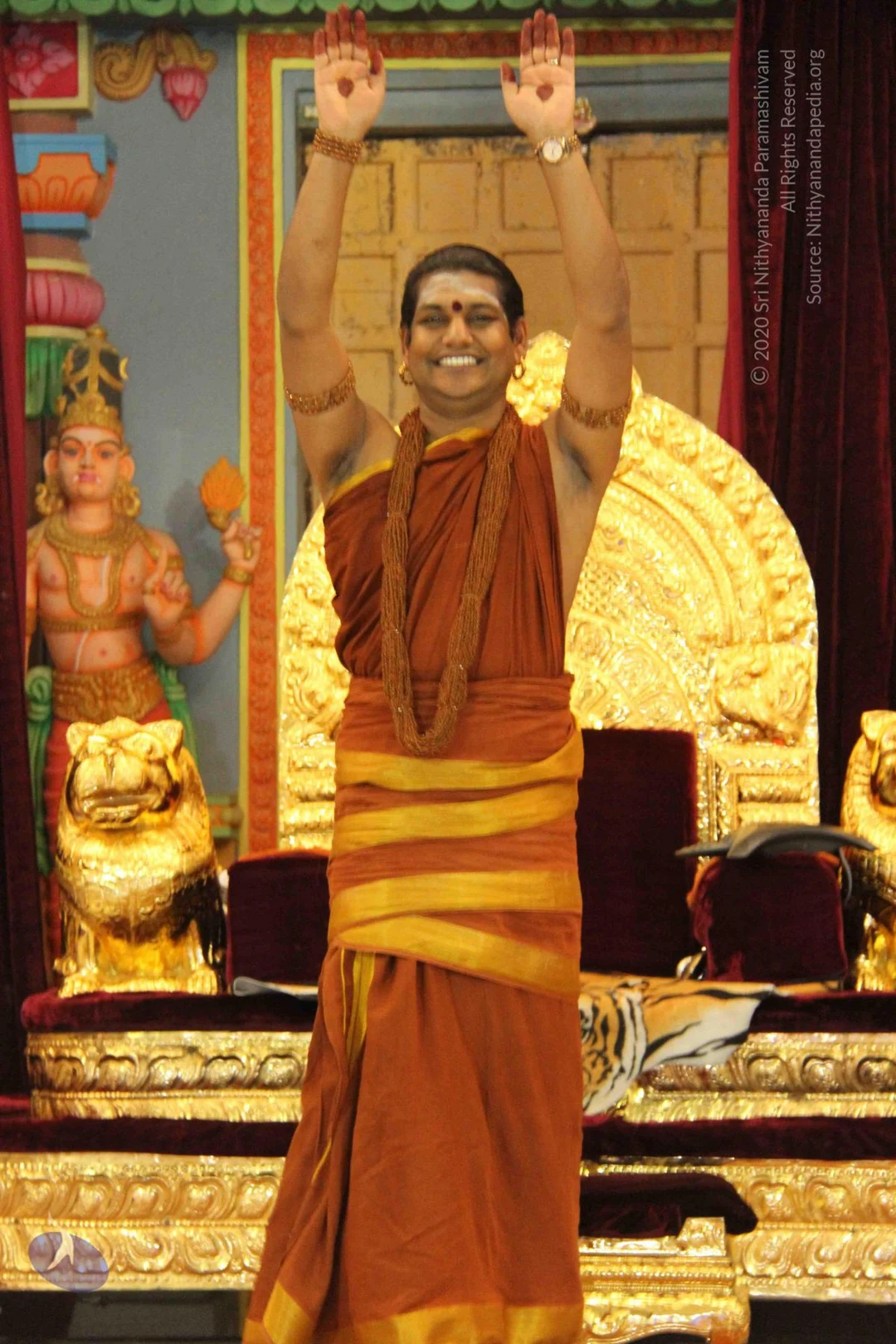
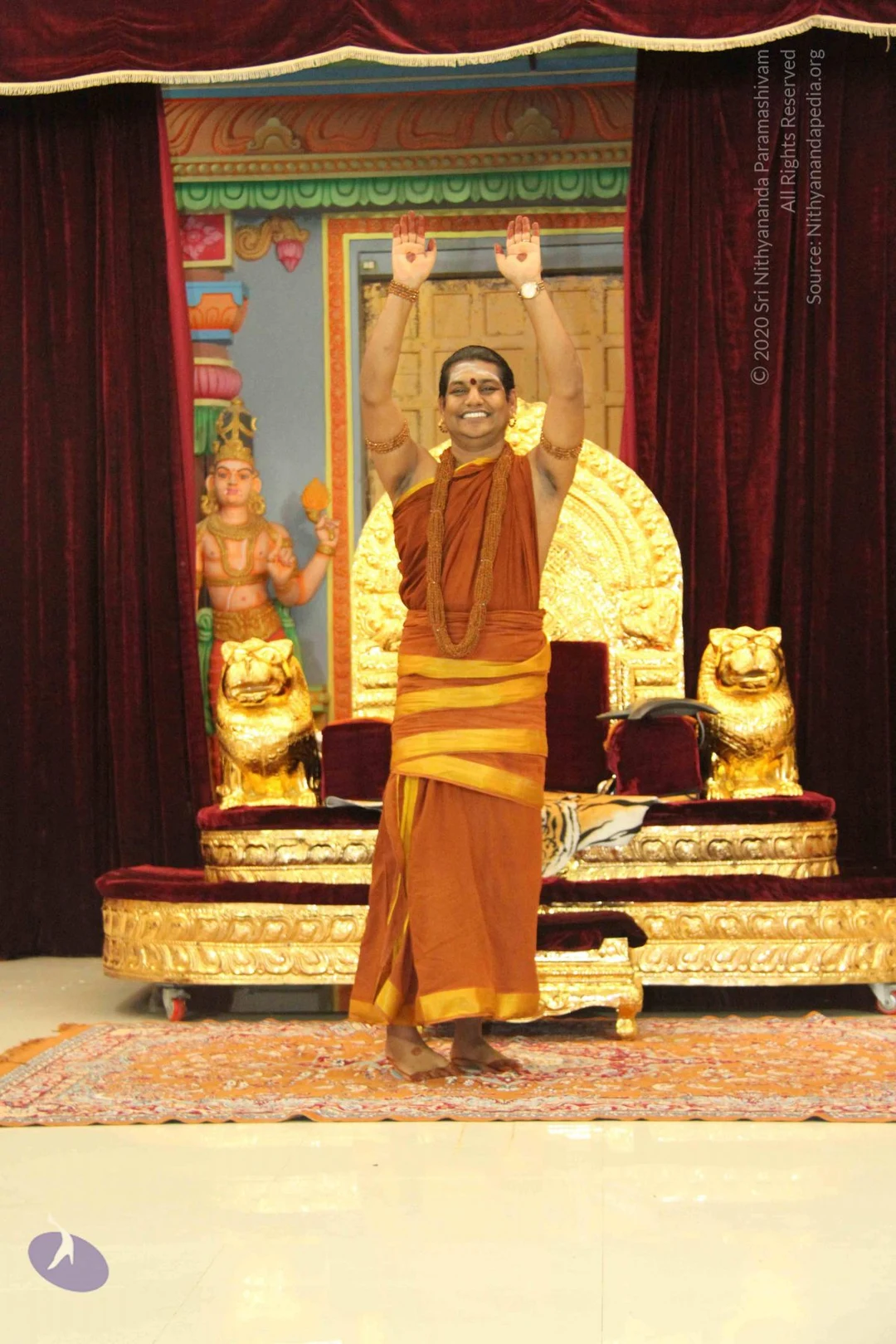
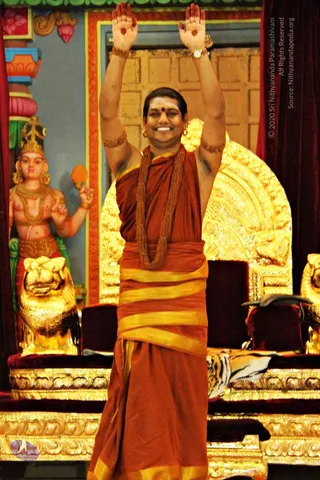
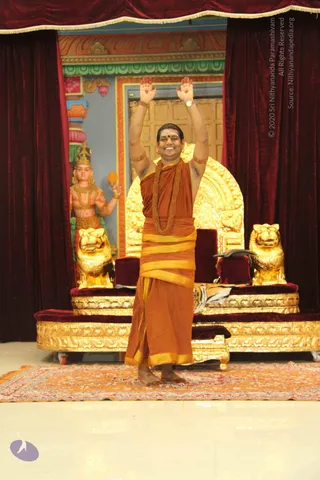
A smiling man in rust-orange robes with a gold-banded sash stands before a gilded throne, arms raised with palms open. He wears a rudraksha mala around his neck, gold armbands and a red bindi with white vibhuti markings. Behind him a golden lion-armed throne with a tiger-skin cover sits beside a painted deity statue holding a lotus. a person shown in ceremonial posture with distinctive orange robes and rudraksha mala, in_person candidate.A standing man in an orange-saffron robe with a gold-bordered dhoti and a long rudraksha mala stands at left, smiling with raised right hand in blessing and vibhuti on his forehead. Beside him, a bronze Nataraja murti in a dance pose is garlanded with yellow, white and purple flowers inside a circular prabhavali, set on a pink silk base. At right, a gold-framed shrine holds a small deity murti in a crown and jewelled garlands, also heavily garlanded, with a dark gold cloth backdrop. A gold lion-form throne and a red-and-cream carpet sit at the sides of a dark velvet curtain. The scene is a temple-style stage display.Standing on a white stage before a deep red velvet curtain, a smiling man in an orange-red saffron dhoti and shawl with gold borders raises his right hand in greeting. He wears a long beaded rudraksha-style mala, gold bangles and armlets, a red bindi and a tilak, with gold earrings. Beside him is a large gilded statue of a multi-hooded cobra canopy over a seated deity murti playing a veena, decorated with yellow marigold garlands, purple flowers and green leaves, on a golden coiled base over a lavender cloth.A smiling man stands on a stage in front of a large golden deity murti, a Ganesha-like form with an elephant head seated on a coiled golden serpent hood and base, holding a veena and surrounded by yellow marigold garlands with purple and green flowers. The standing man wears an orange-saffron dhoti and shawl with gold borders, a rudraksha mala draped across his chest, gold bangles and earrings, and a red bindi with white forehead markings. He raises one hand in a blessing gesture. A deep maroon velvet curtain backs the stage, and a purple satin cloth drapes the base of the murti. Appearance-based candidate: a person, standing as the central figure with a rudraksha mala and saffron-orange clothing.A smiling man in a saffron-orange dhoti and shawl with gold borders stands at left, raising one hand in a blessing gesture. He wears a rudraksha mala, gold bangles and a red forehead mark. Beside him stands a large gold-painted deity murti of Ganesha seated atop a coiled gold naga hood with multiple snake heads, holding a veena. The murti is draped in yellow, green and purple marigold garlands and sits on a lavender satin cloth over gold coils, in front of a deep maroon curtain.

IA_Day21

117 photosSource gallery
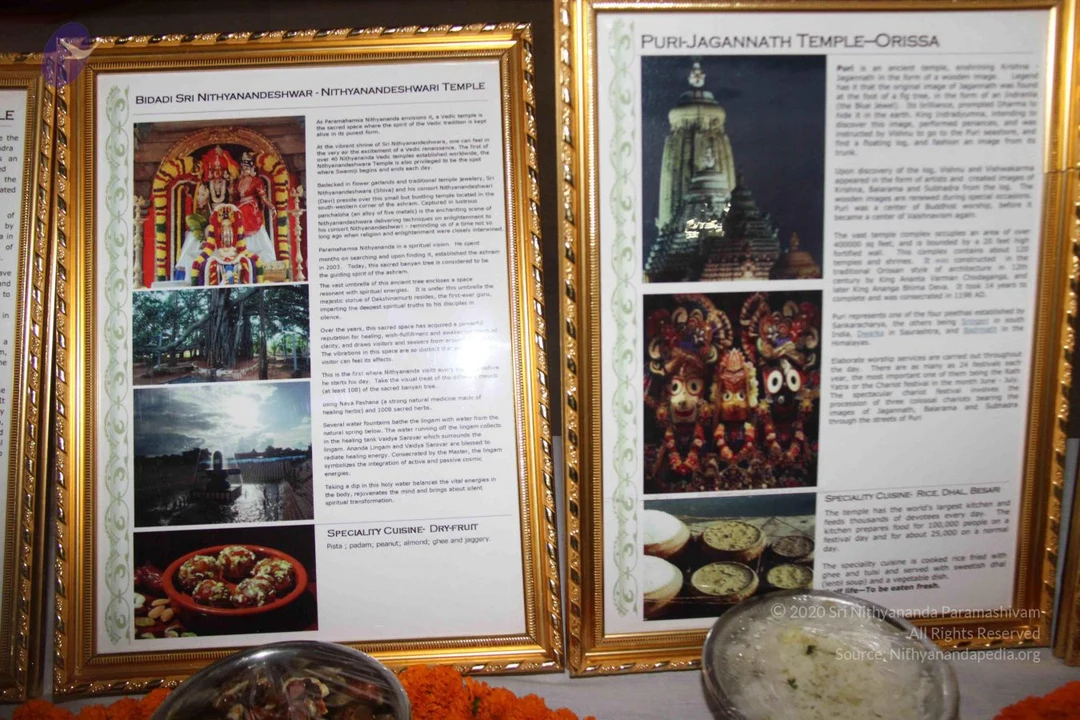
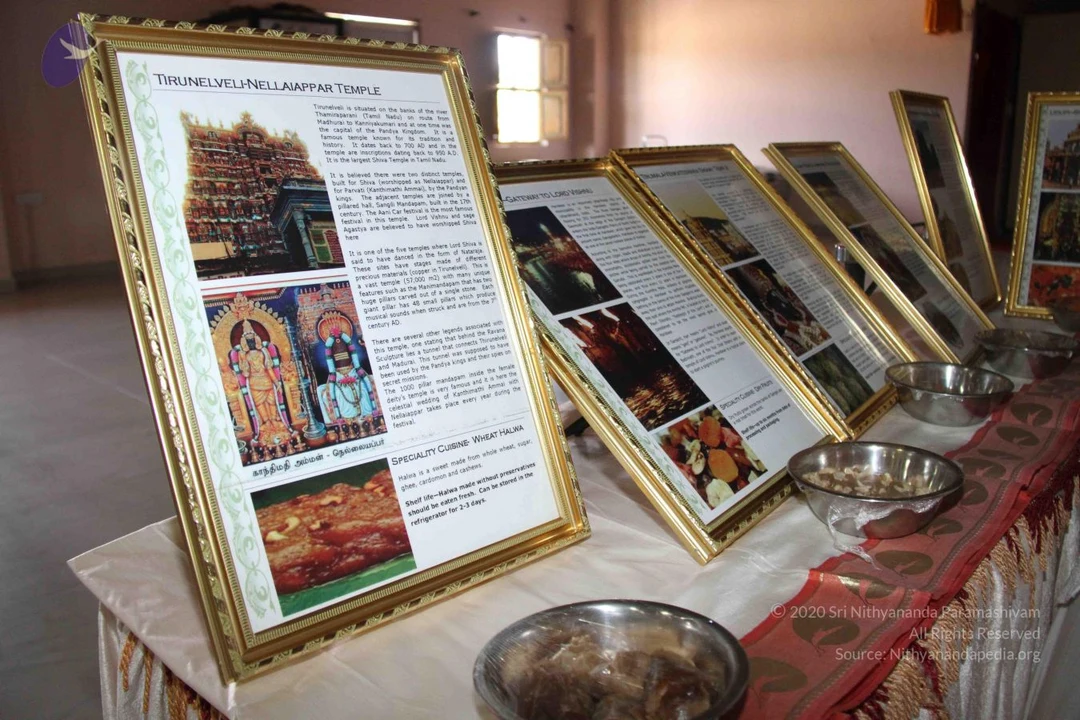
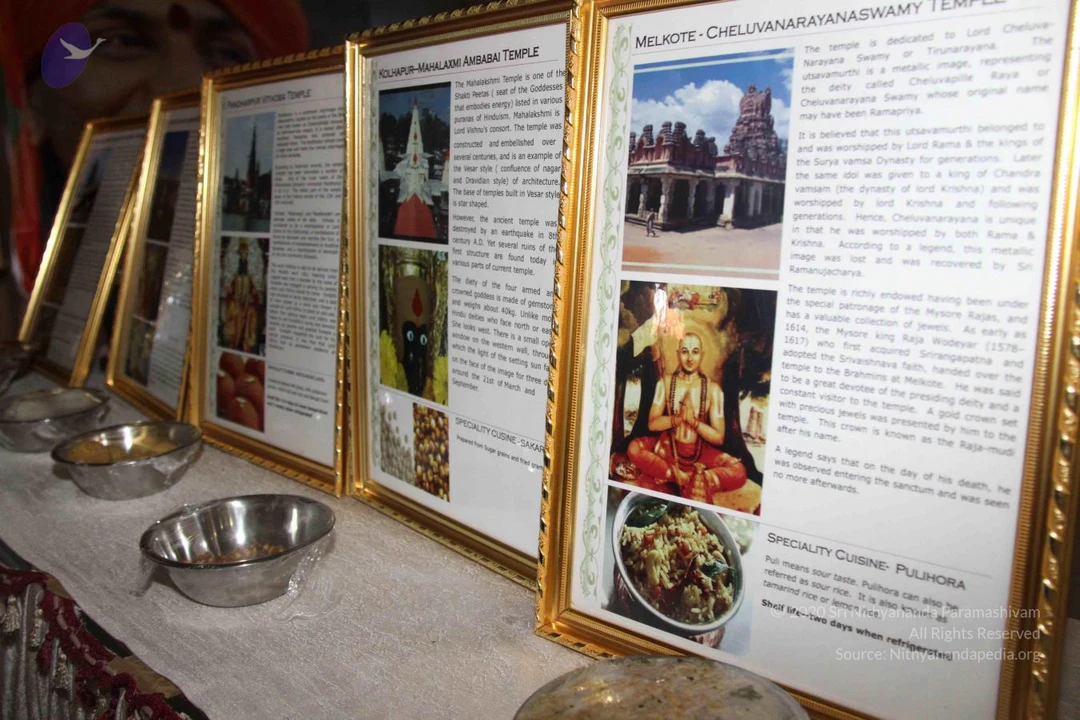
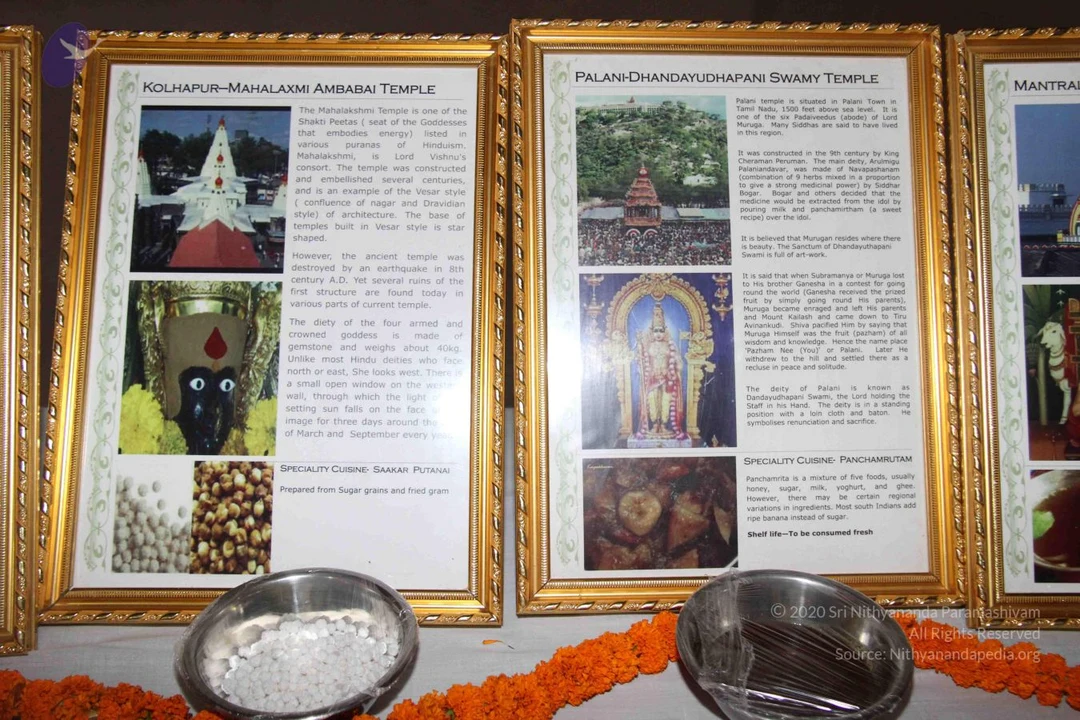
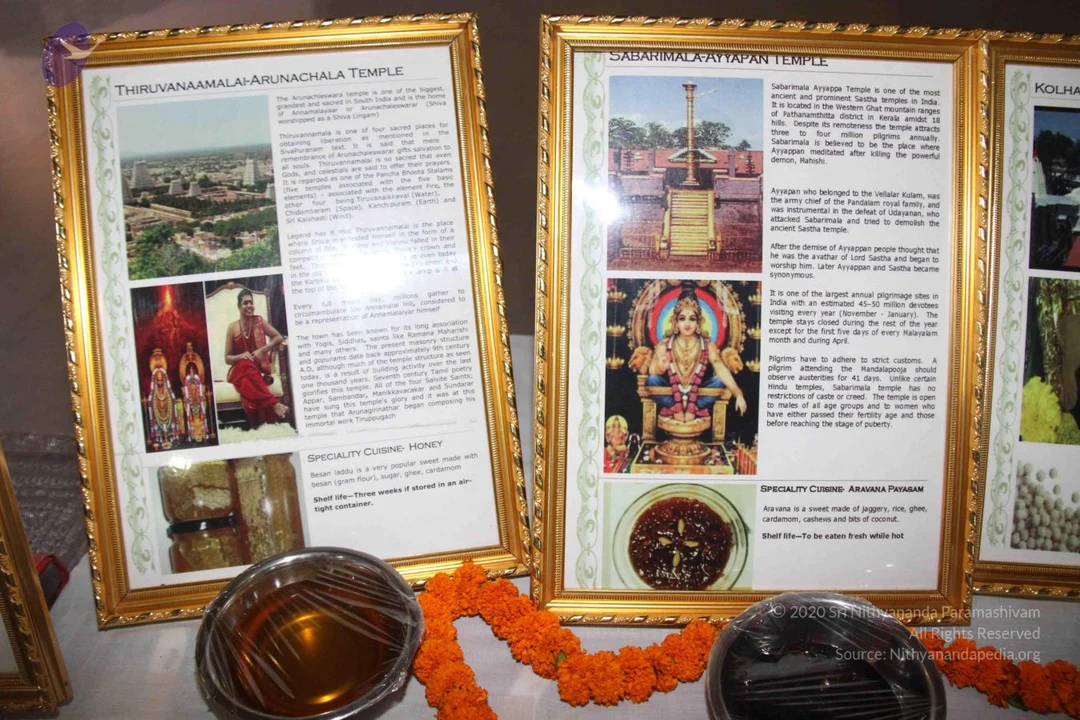
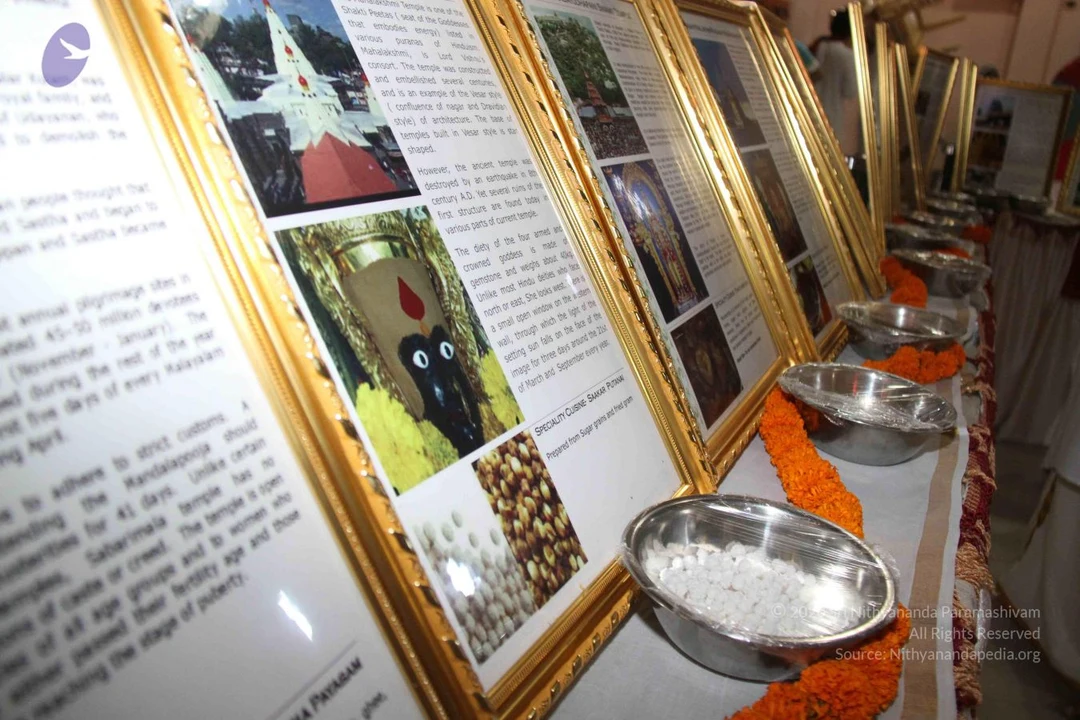
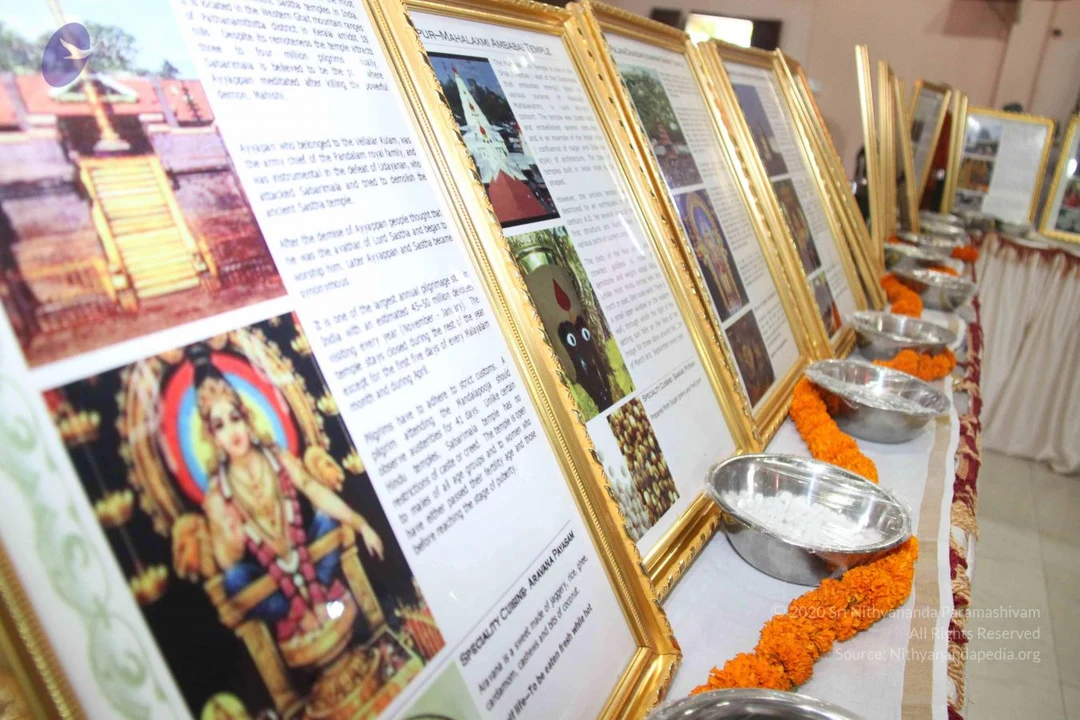
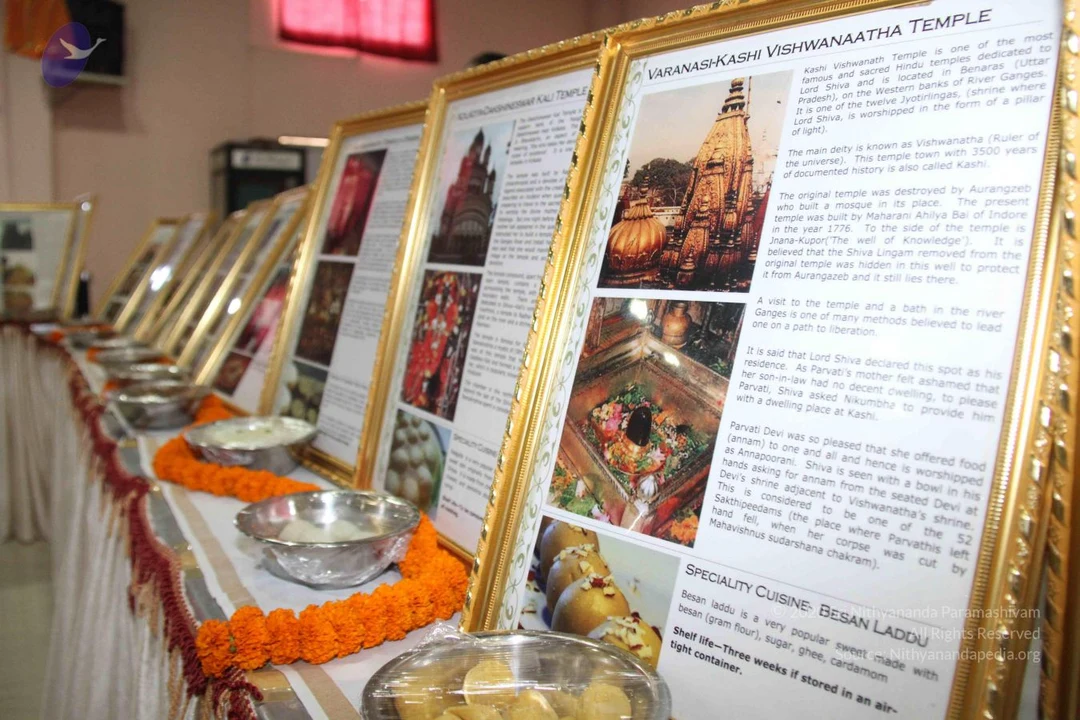
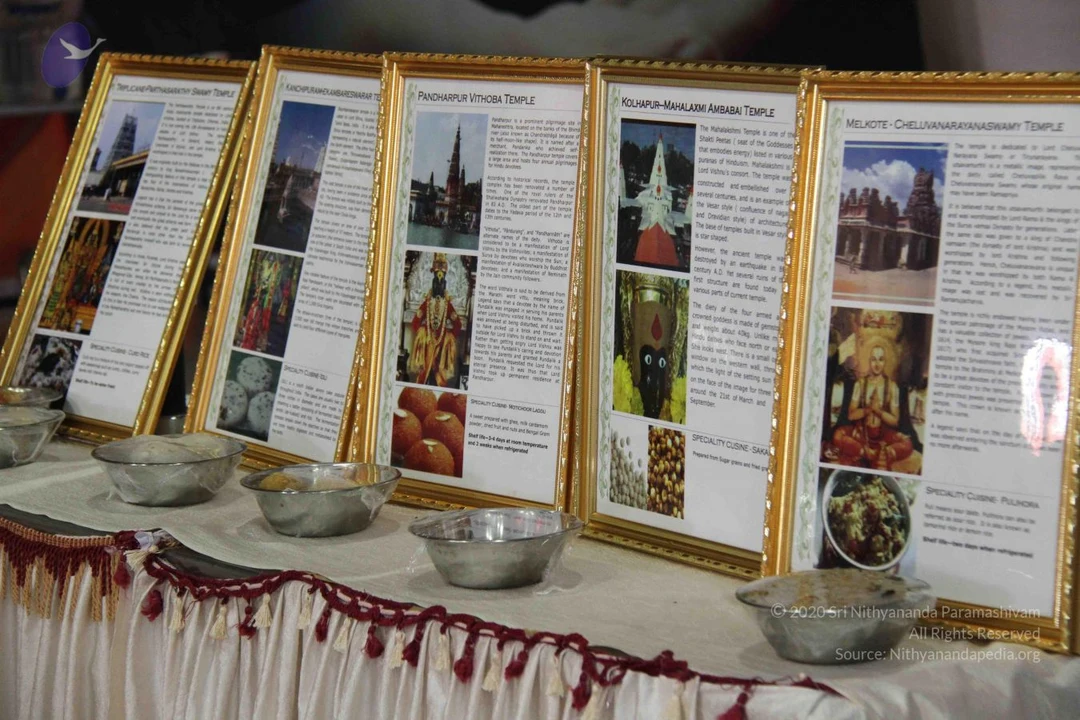
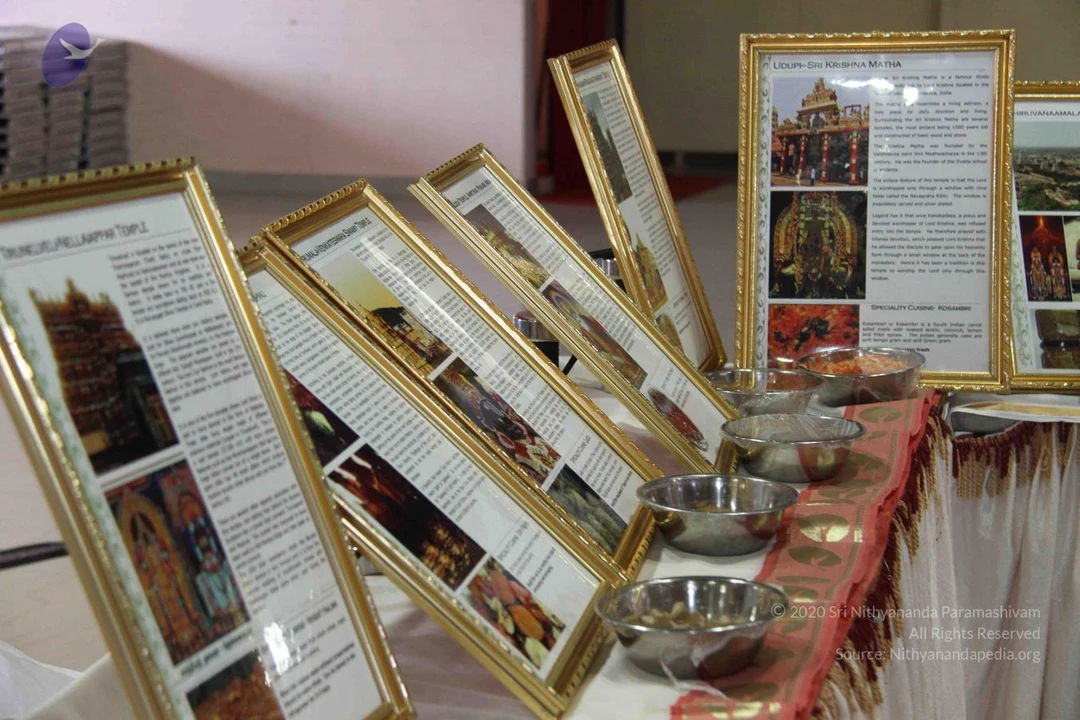
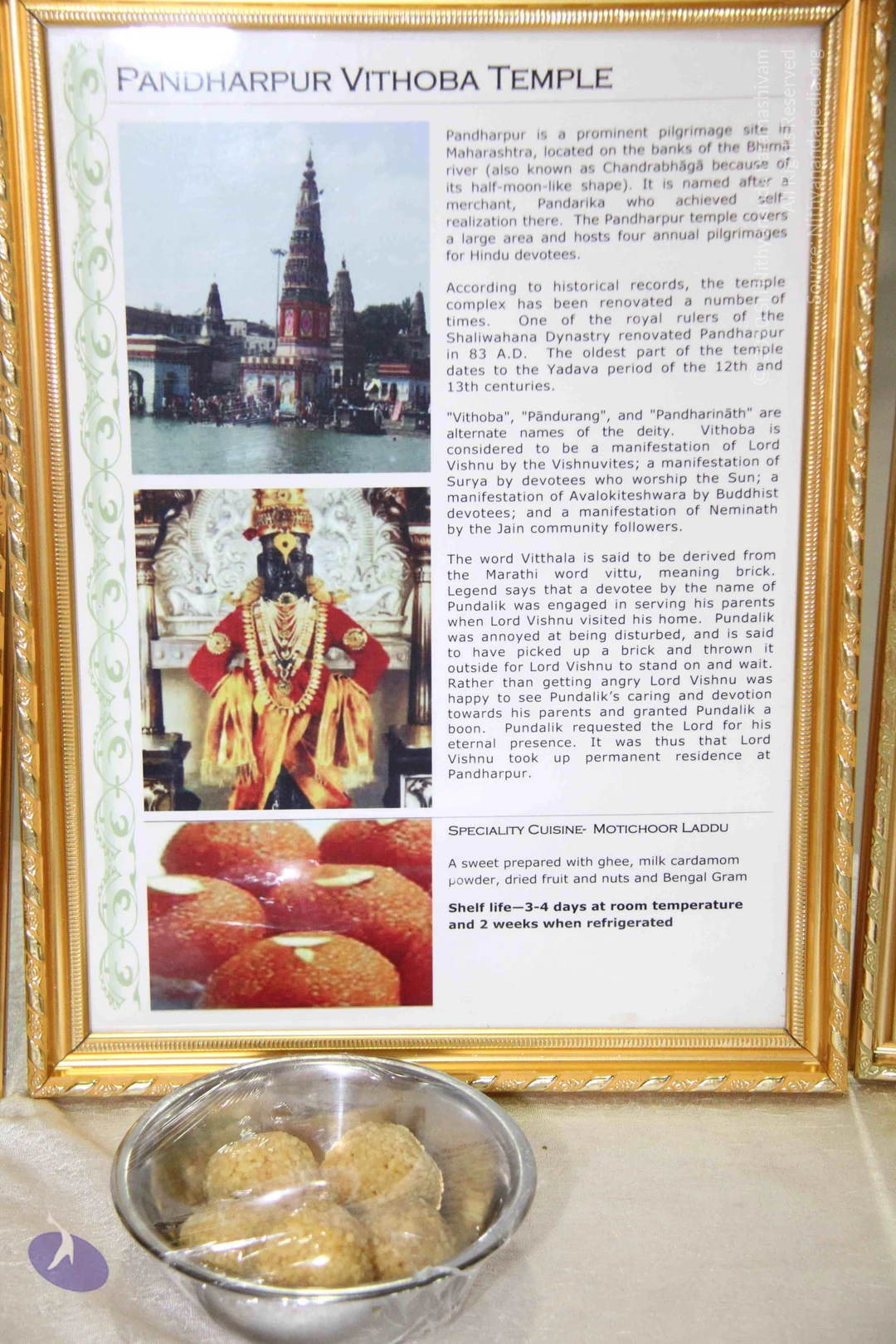
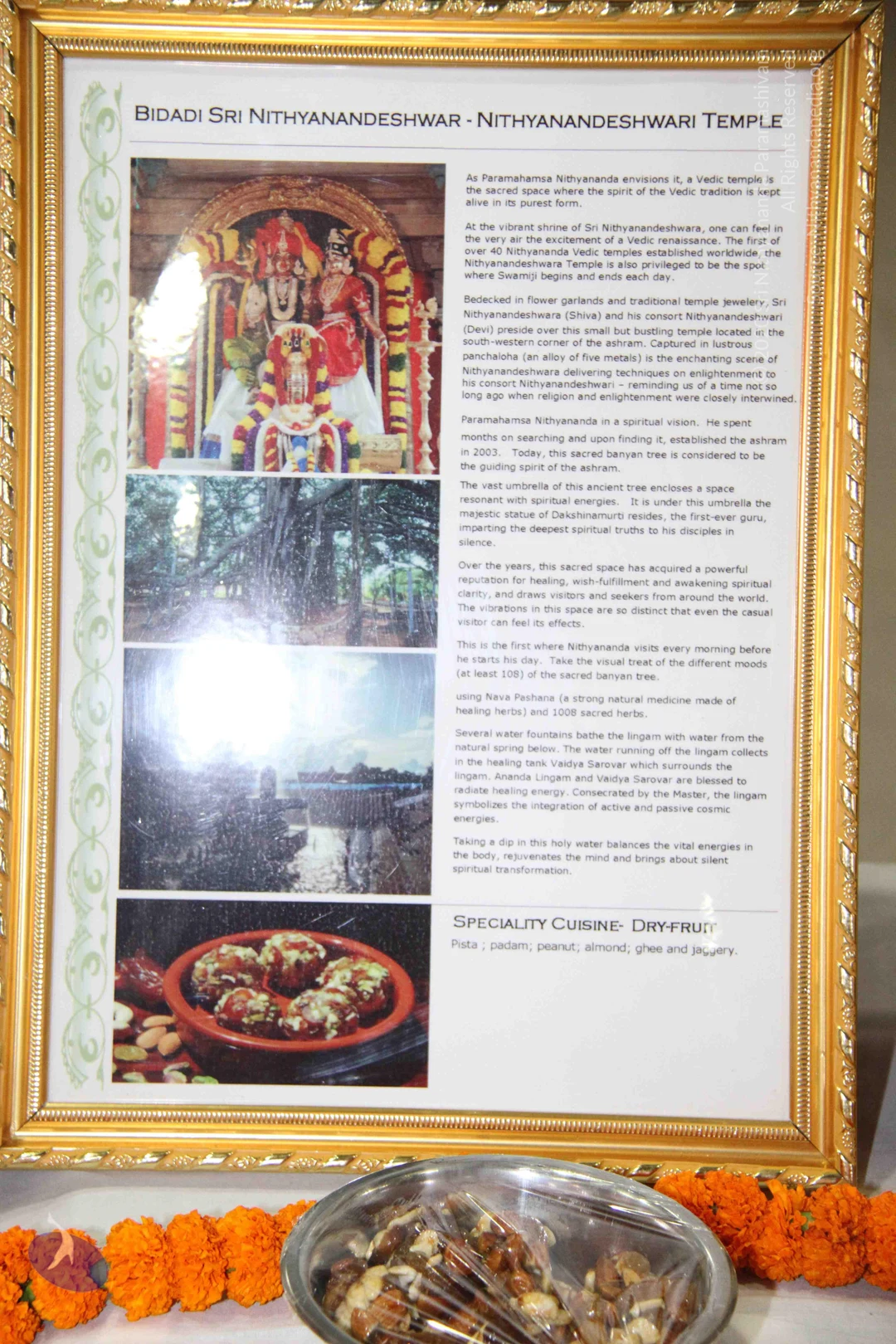
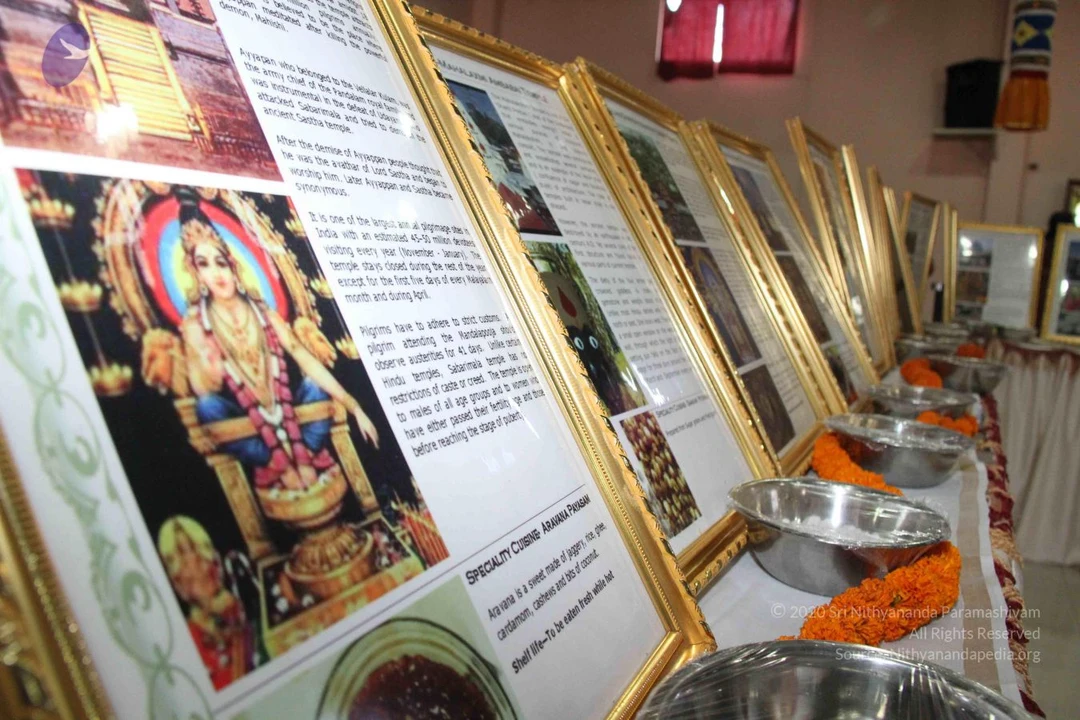
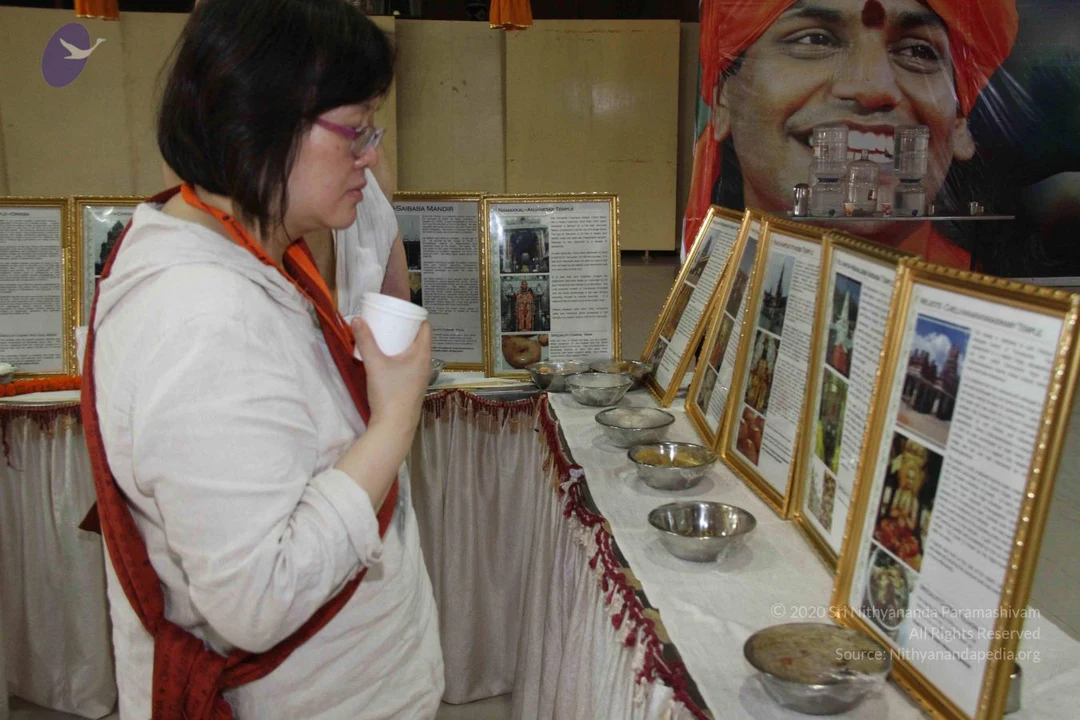
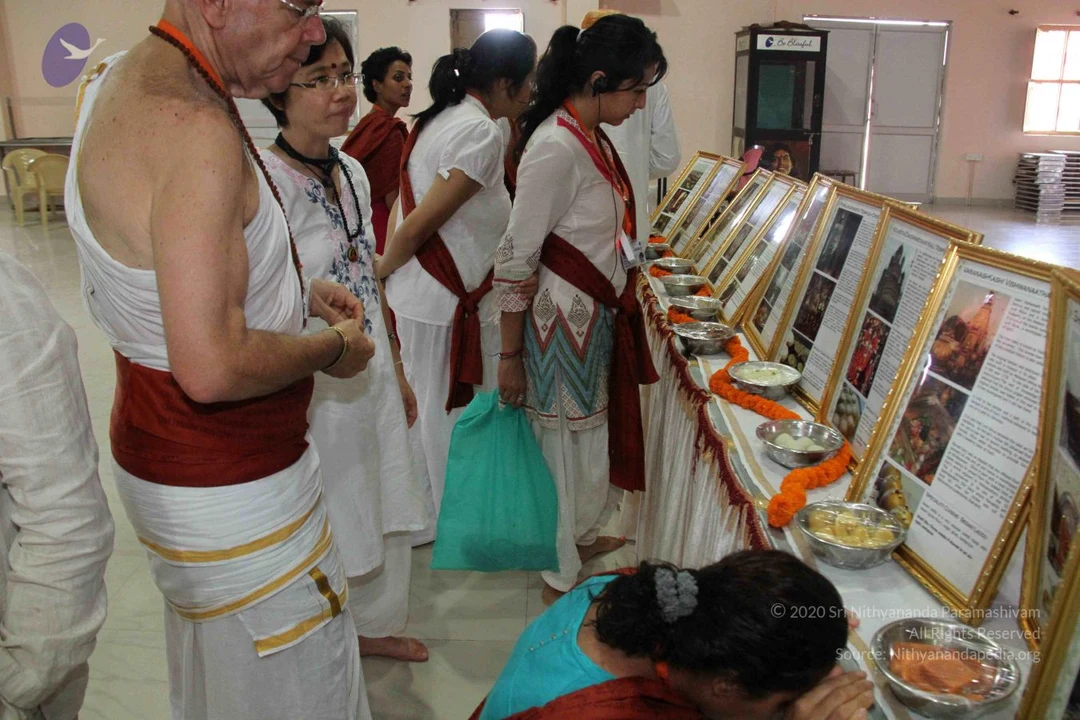
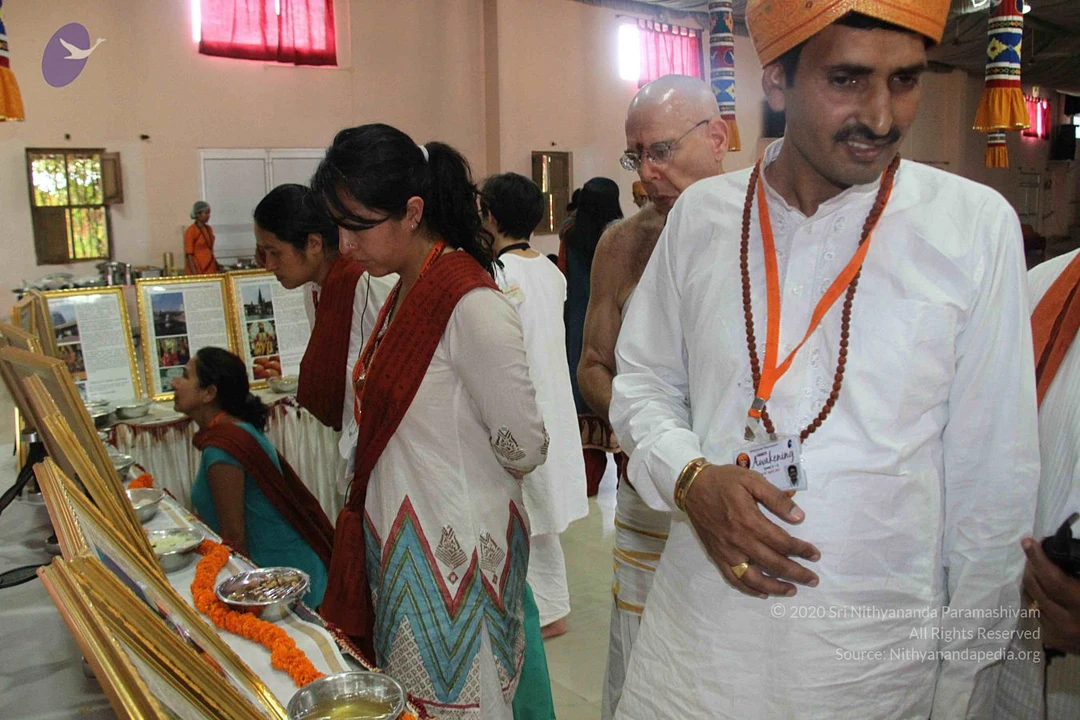
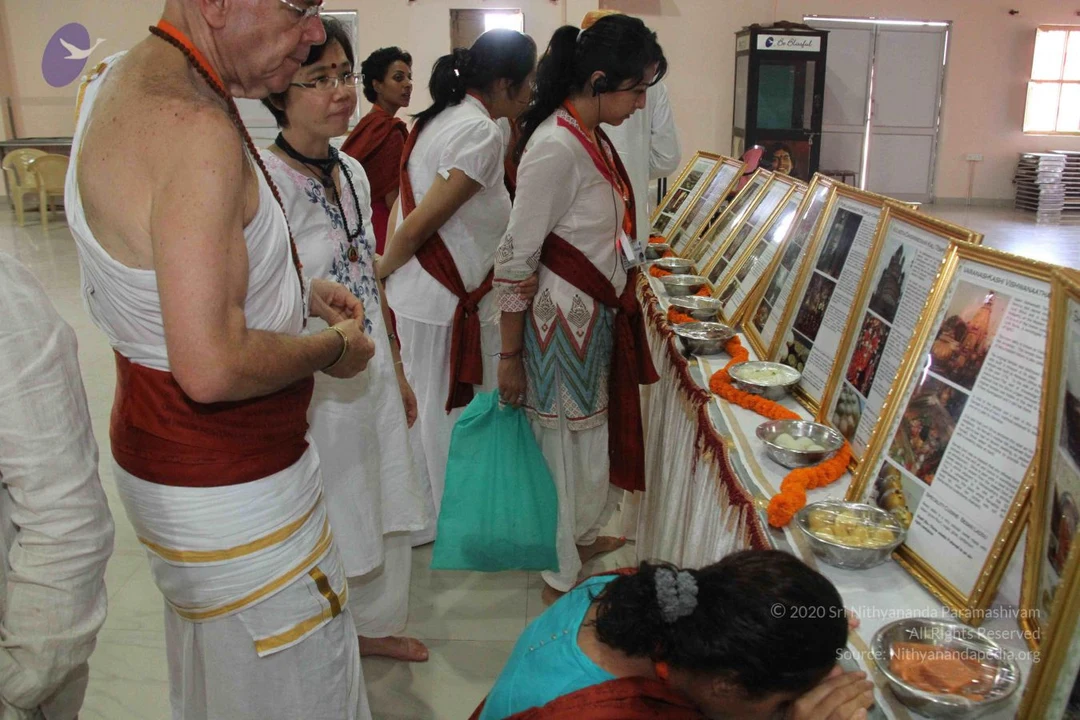
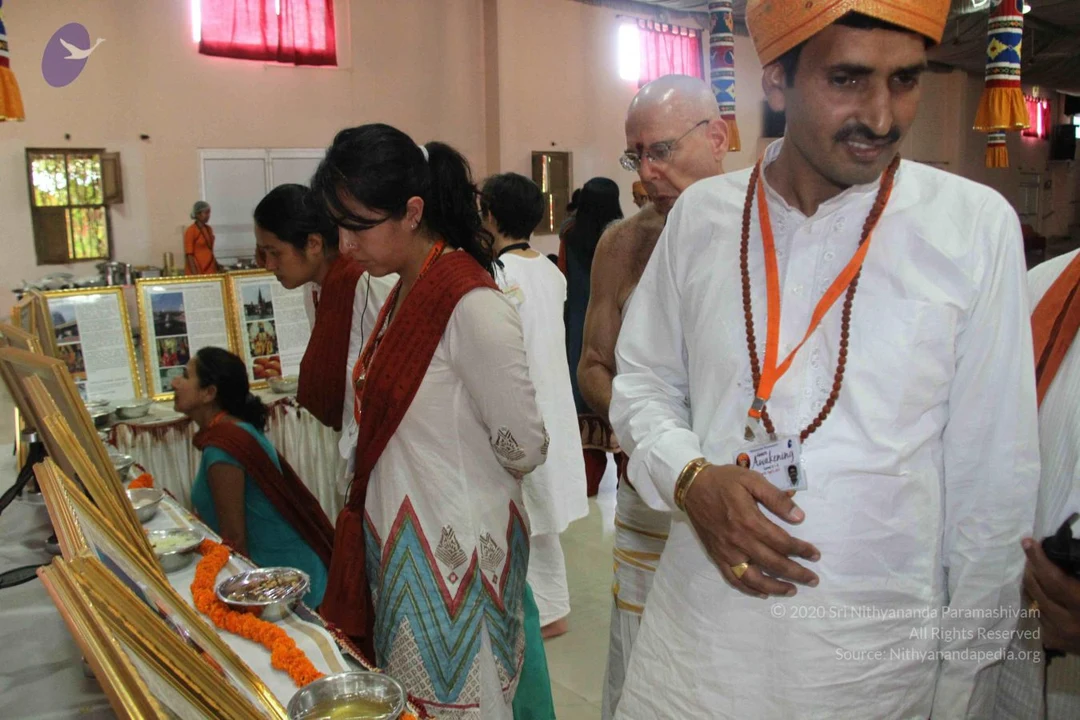
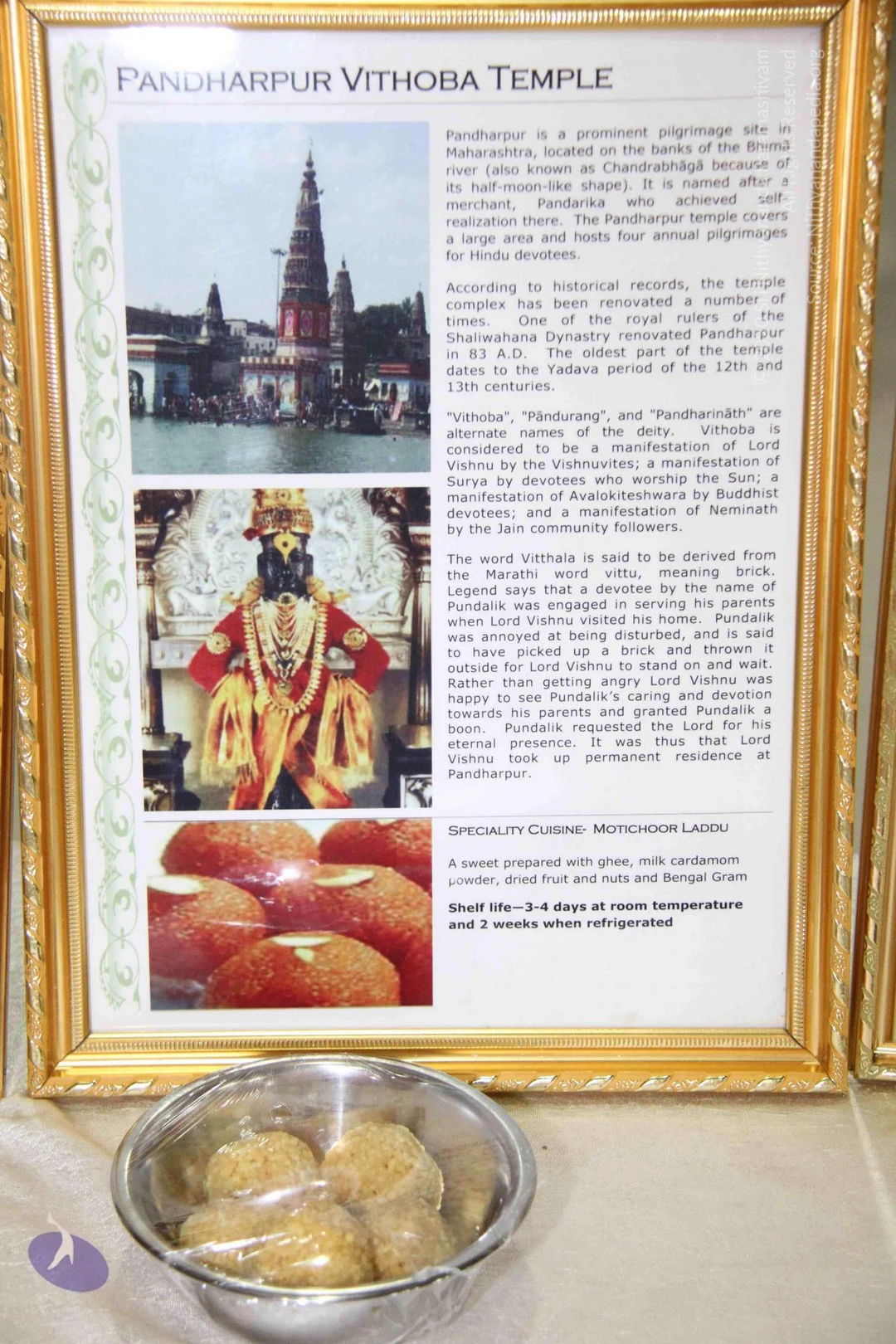
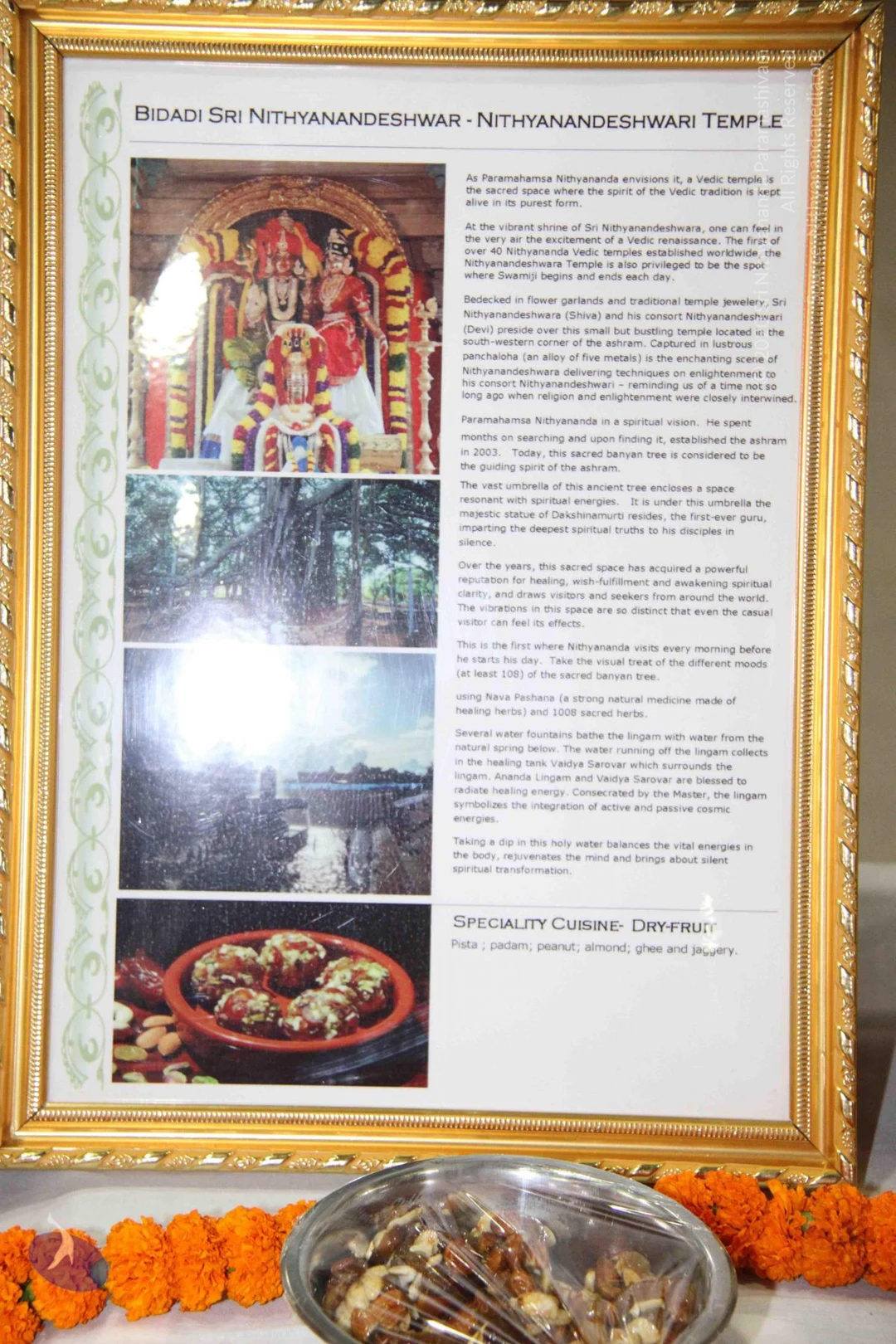
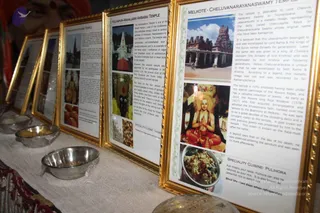
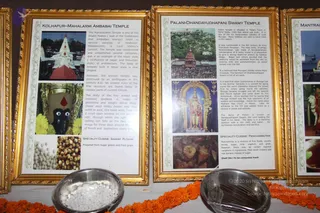
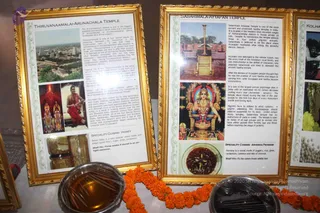
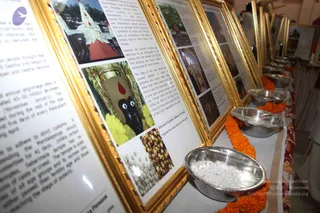
Framed informational boards displayed on a table draped with orange marigold flowers. The left board, headed Bidadi Sri Nithyanandeshwar - Nithyanandeshwari Temple, shows a photo of a deity pair decorated with flower garlands and an illustration of a temple, a tree, a water scene and a dry-fruit dish. The right board, headed Puri-Jagannath Temple-Orissa, shows a temple tower, three painted wooden deity figures with large round eyes, and a plate of rice dish, with explanatory text. Metal bowls of food sit in the foreground. No people are visible.A photograph of a display table in an empty hall showing framed informational panels in gold frames about Tirunelveli-Nellaiappar Temple, with photos of a gopuram, deity sculptures and a section on a speciality cuisine, wheat halwa. Several framed panels stand in a row behind silver bowls of halwa and dried fruit on a white cloth with a red and gold runner. No people are visible; no a person candidate appears.A row of framed information panels displayed on a draped white cloth, with polished silver bowls in the foreground. The largest panel on the right covers the Melkote Cheluvanarayanaswamy Temple, with photographs of the temple tower, a seated figure with folded hands in red and gold attire, and a bowl of Pulihora rice. Beside it, panels describe the Kolhapur Mahalakshmi Ambabai Temple and the Padmanabhaswamy Temple, with photos of a deity murti and a bowl of food. A figure in red cloth is partly visible at the left edge. No people are clearly seated or active in the scene.Framed informational display boards with gold frames stand behind marigold garlands and two steel bowls, one holding white sugar grains and the other covered in plastic. The left board, titled Kolhapur-Mahalakshmi Ambabai Temple, shows a white temple tower, a dark face of the goddess with a red mark, and a speciality cuisine photo of sugar grains and fried gram. The centre board, titled Palani-Dhandayudhapani Swamy Temple, shows a hilltop temple, a painted deity holding a staff, and a speciality cuisine photo of panchamrutam. No people are visible; the scene is a static exhibit display.Framed gold-bordered information posters on a table display temple histories. The left poster covers Thiruvannamalai-Arunachala Temple with aerial temple photos and a photo of a woman in red sari beside a deity image. The centre poster covers Sabarimala-Ayyappan Temple, showing a temple shrine, a seated Ayyappa deity in gold with garlands, and a bowl of aravana payasam. Marigold garlands and small glass bowls of honey and sweets sit in front. No physical people are shown in the scene, and no candidate for a person appears in person; the posters are printed displays.A photo of a display exhibition with framed informational panels mounted in gold frames along a white-draped table. The panels contain photographs of a temple tower, a dark idol face with a red tilak and yellow flowers, and grains; printed text describes a temple's history and a specialty cuisine. Silver bowls holding white sweets and grains sit on the table, edged with orange marigold garlands. No people are visible.

Ganamukhasura Samhara_Ganeha_Brahmotsav

46 photosSource gallery
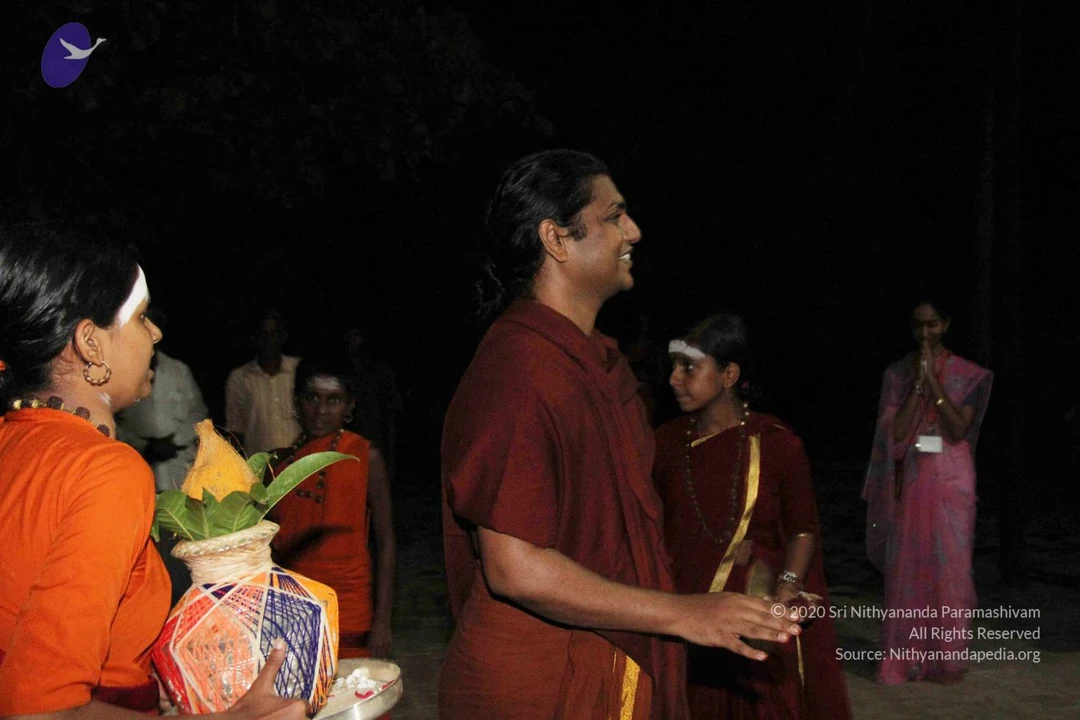
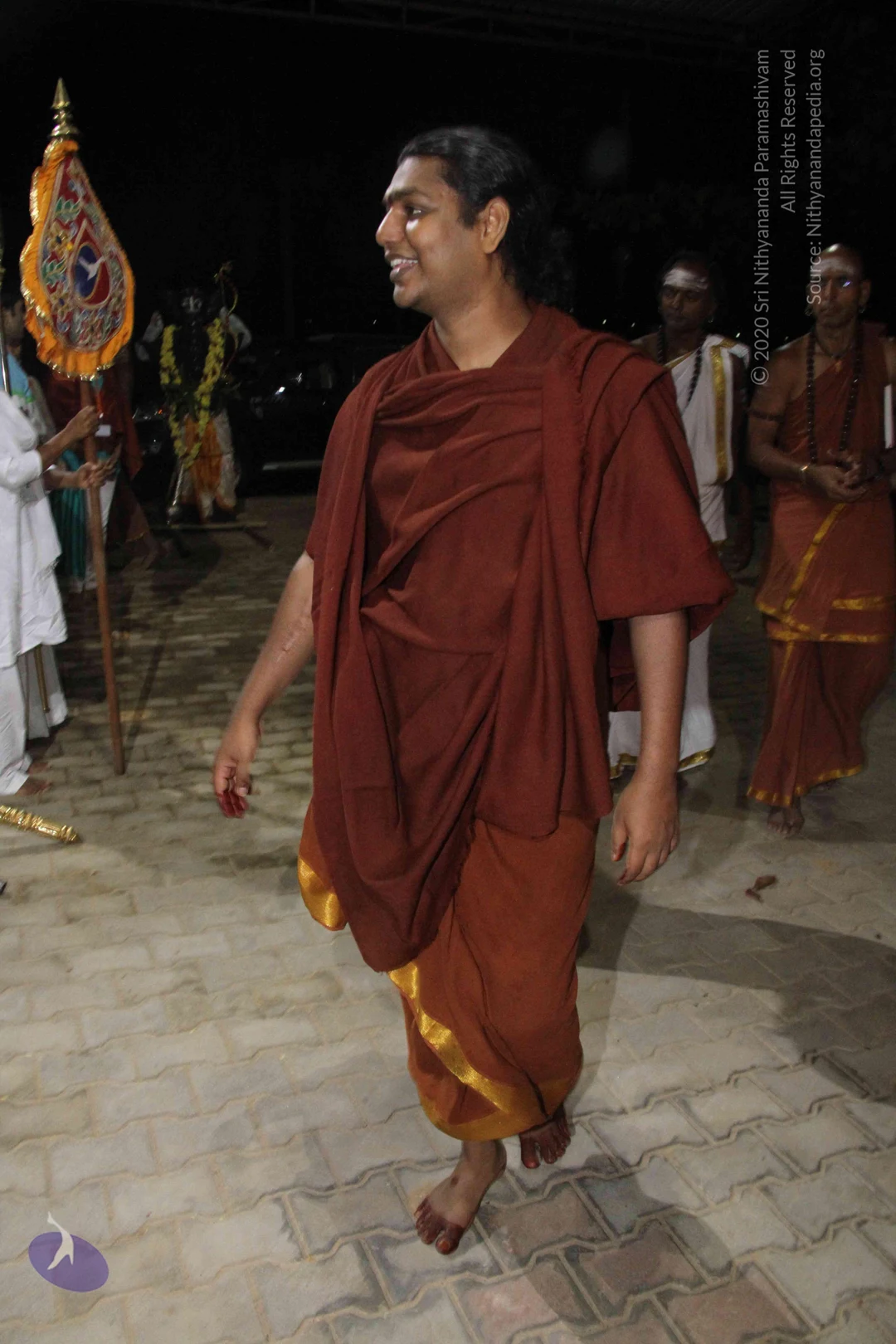
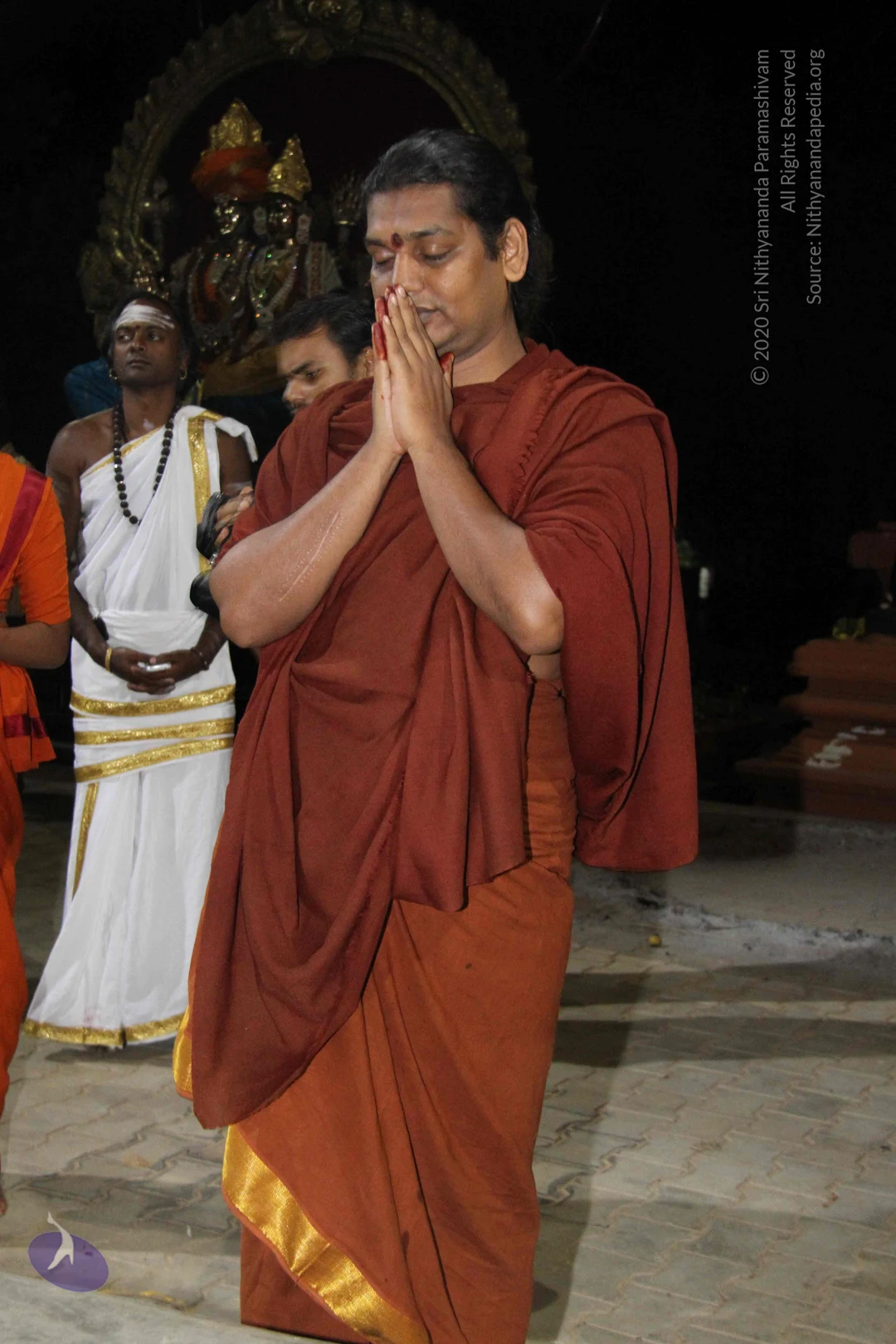
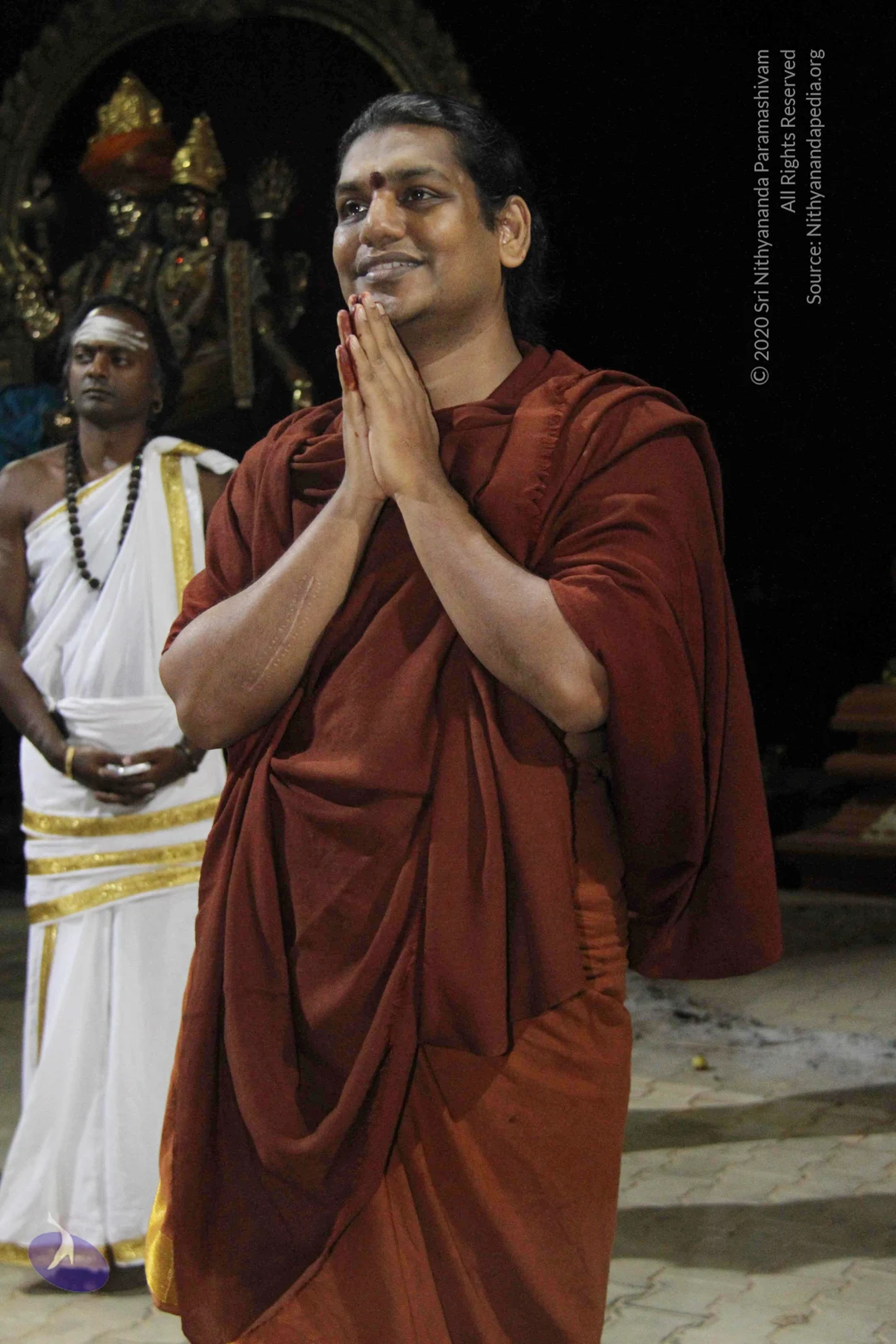
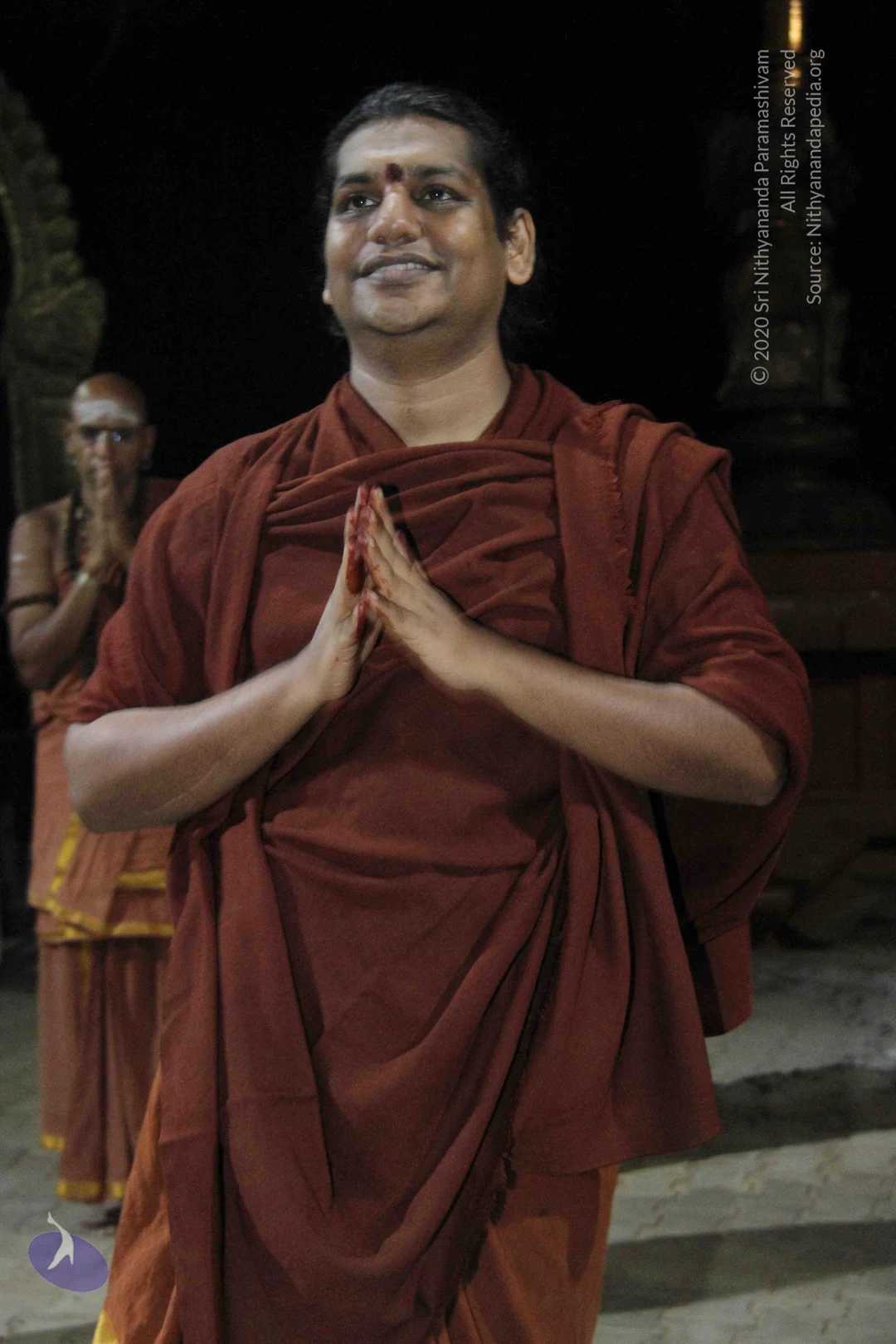
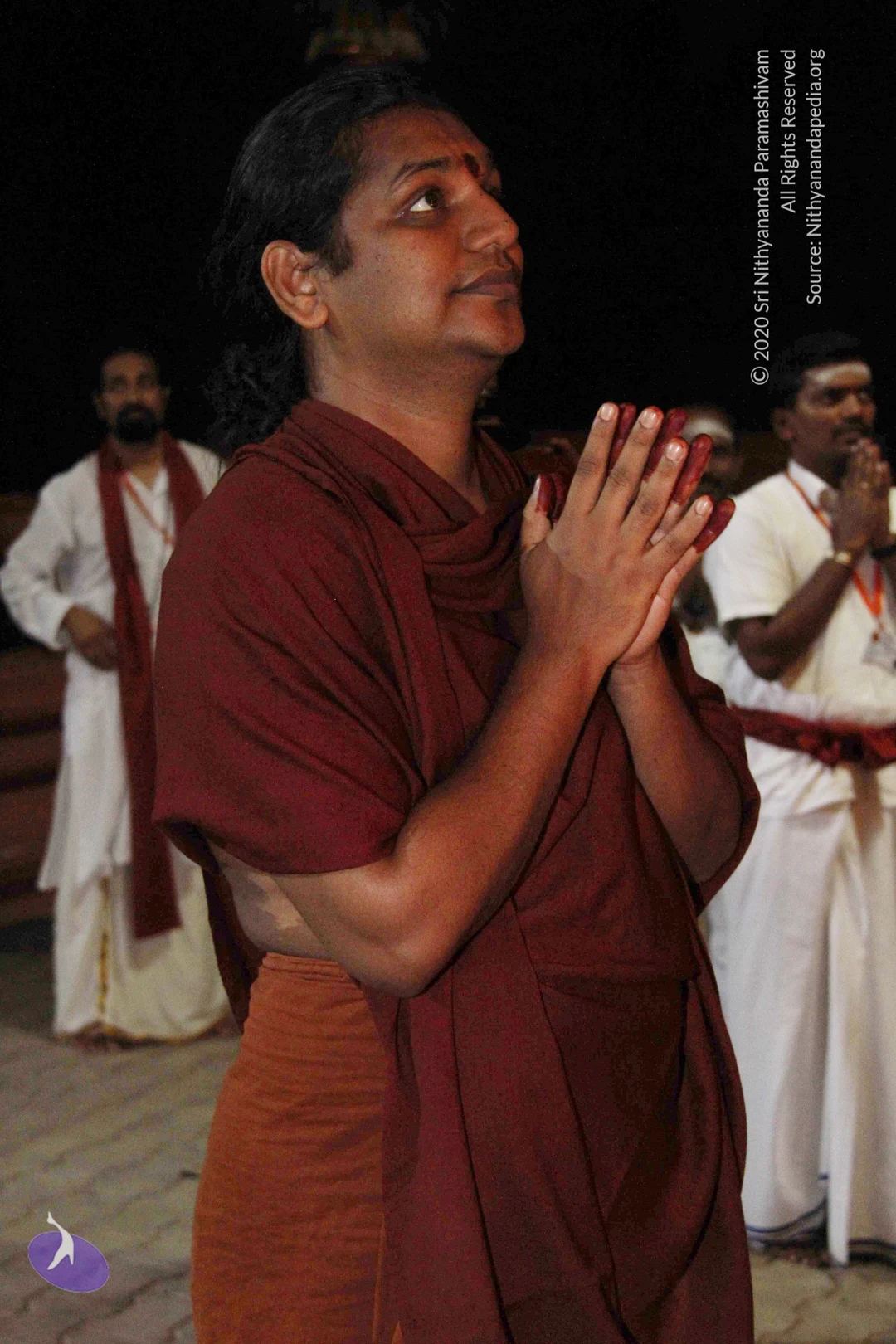
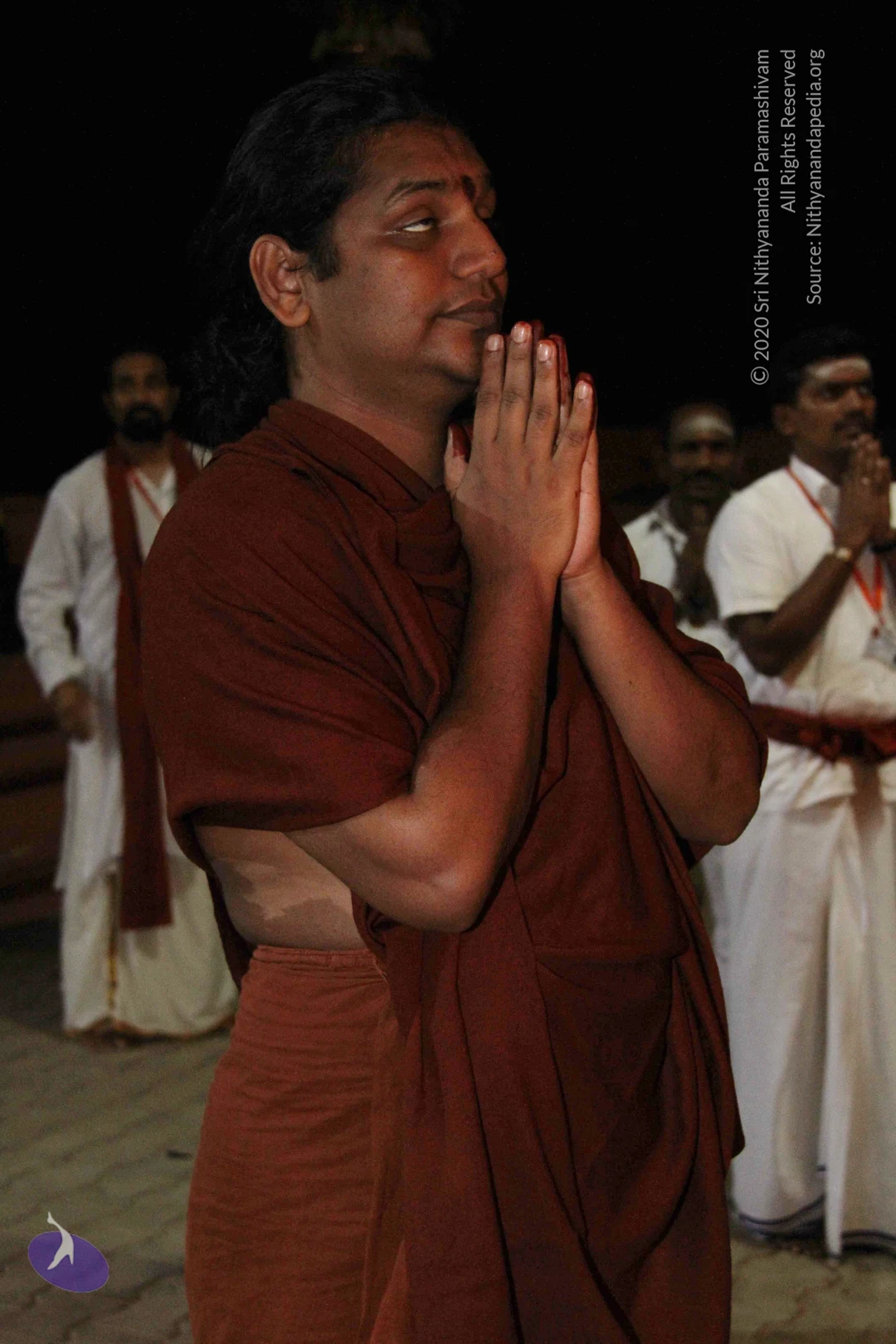
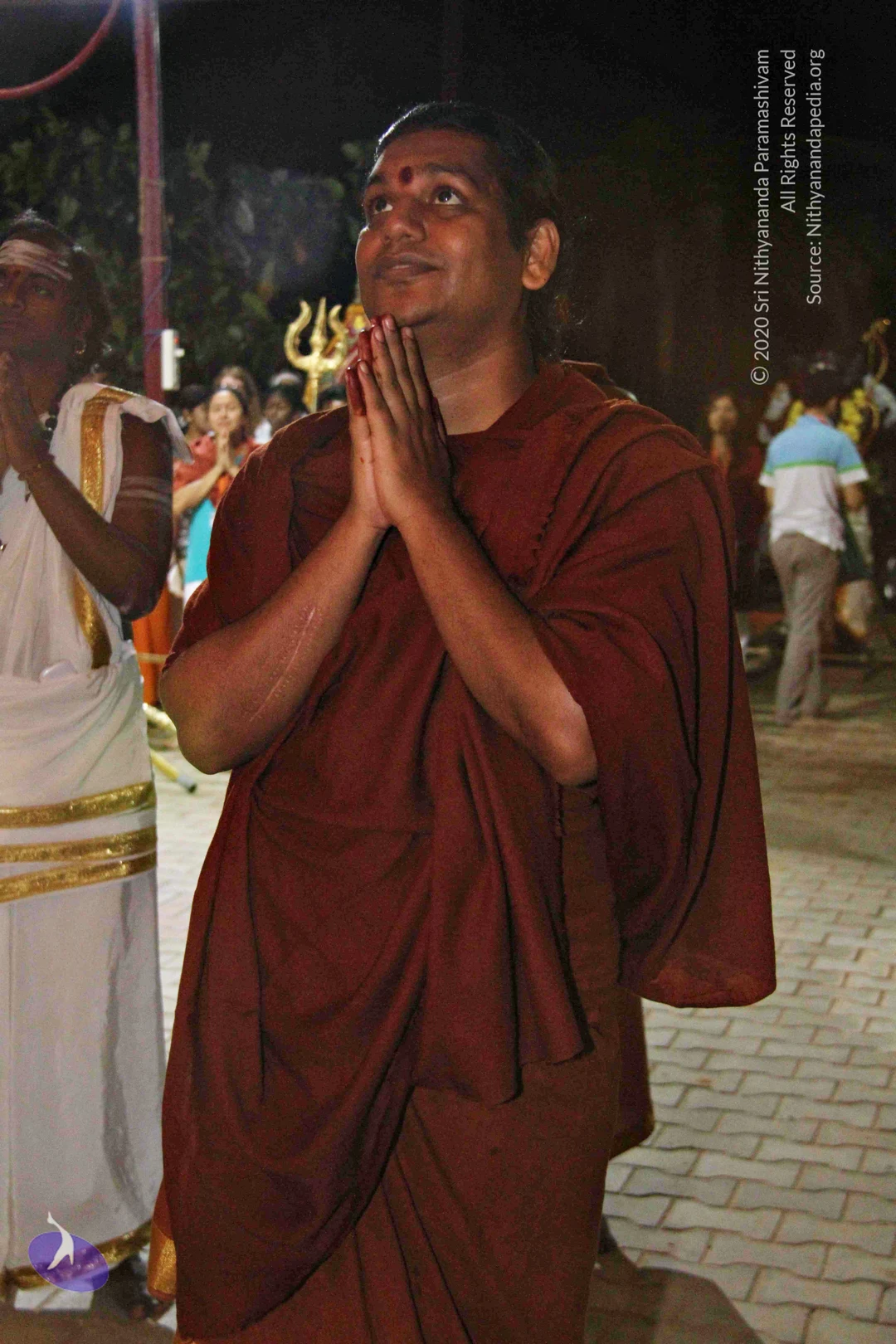
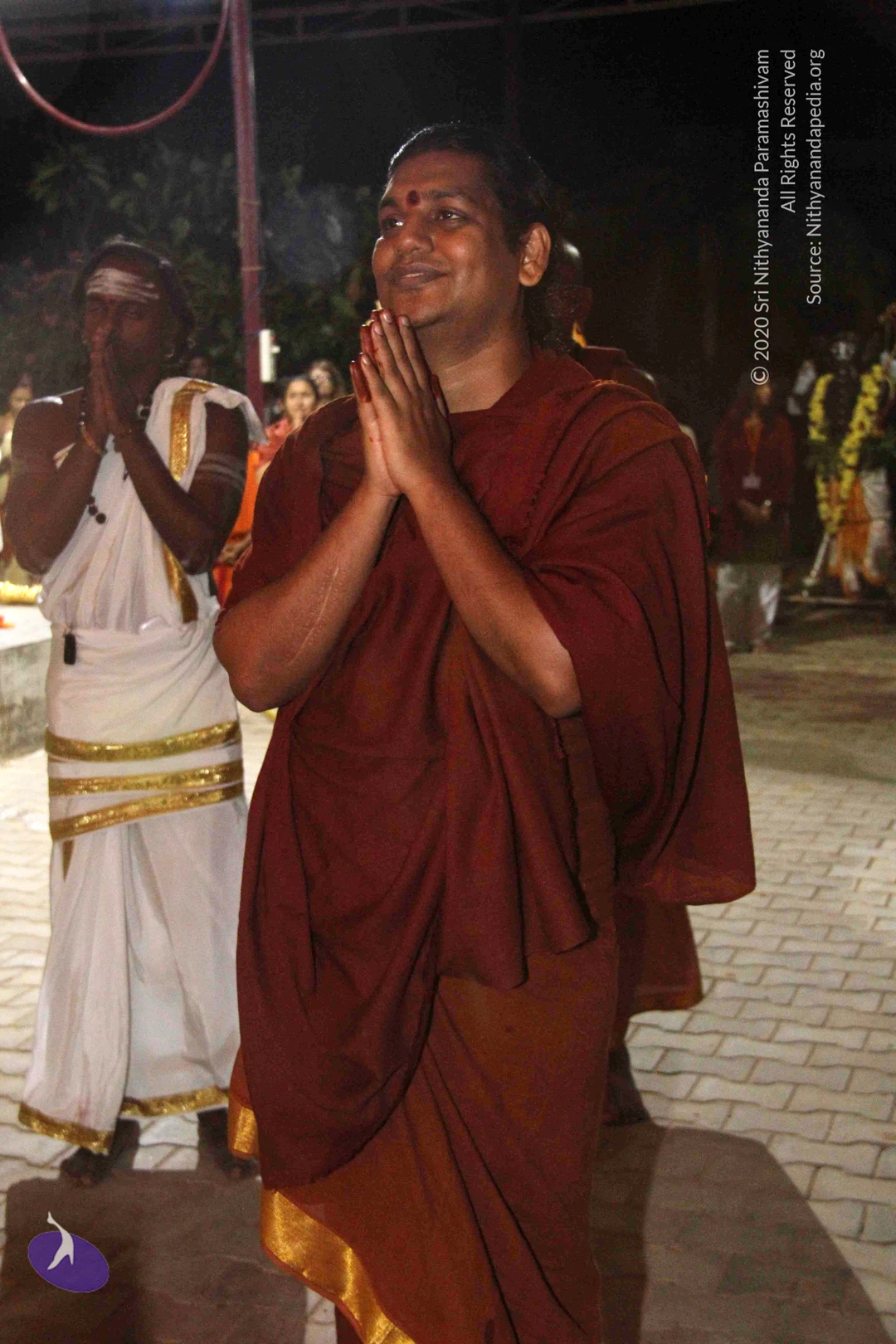
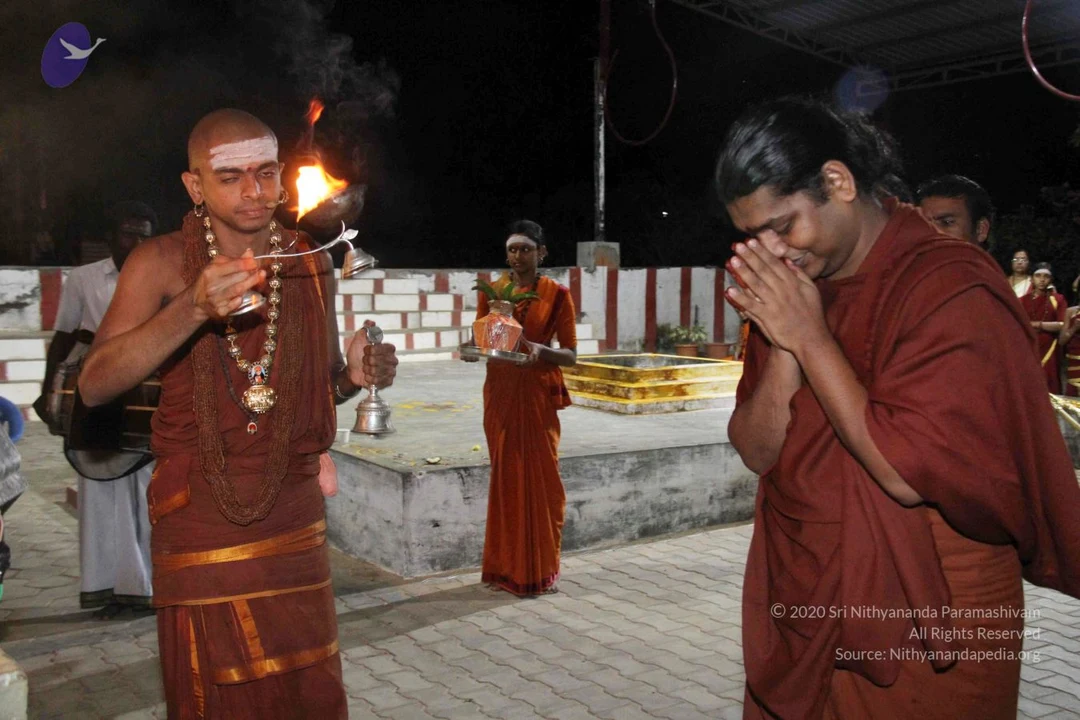
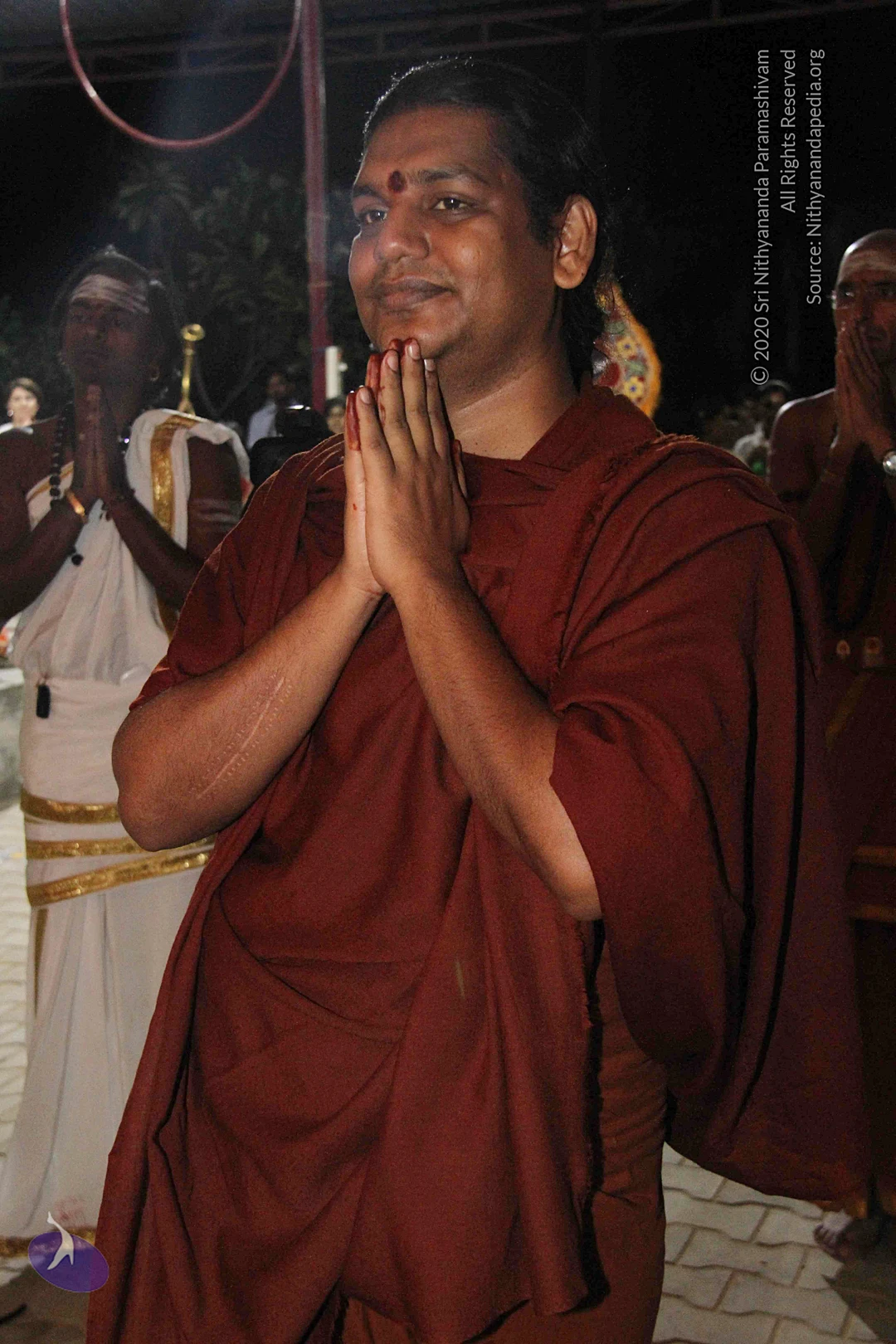
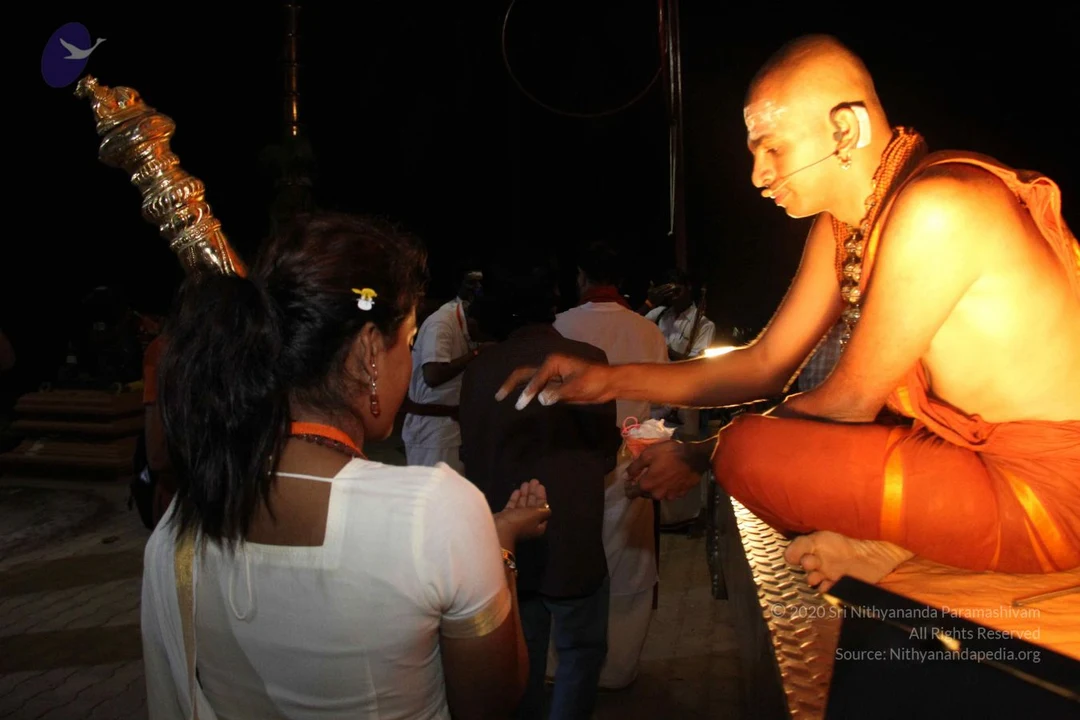
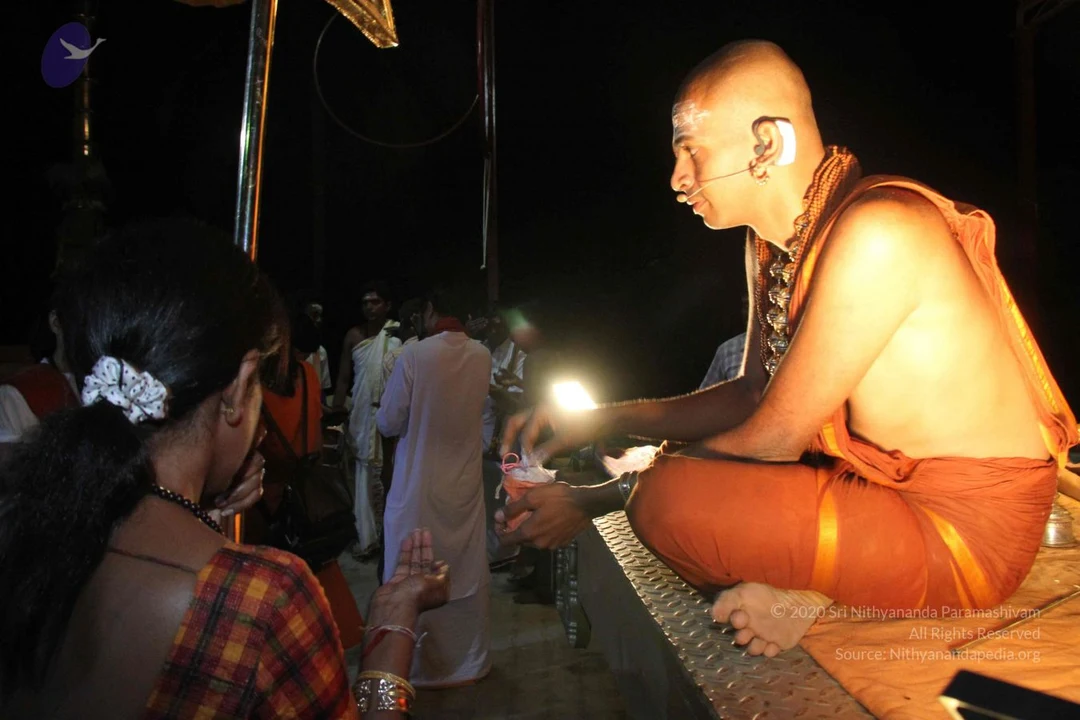
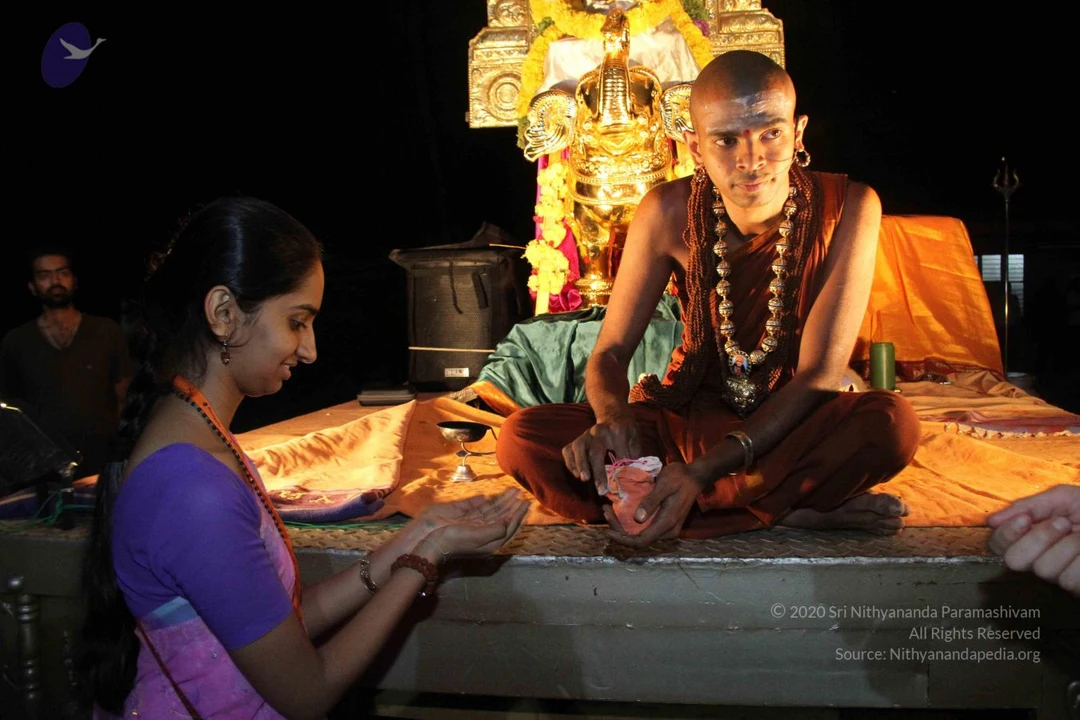
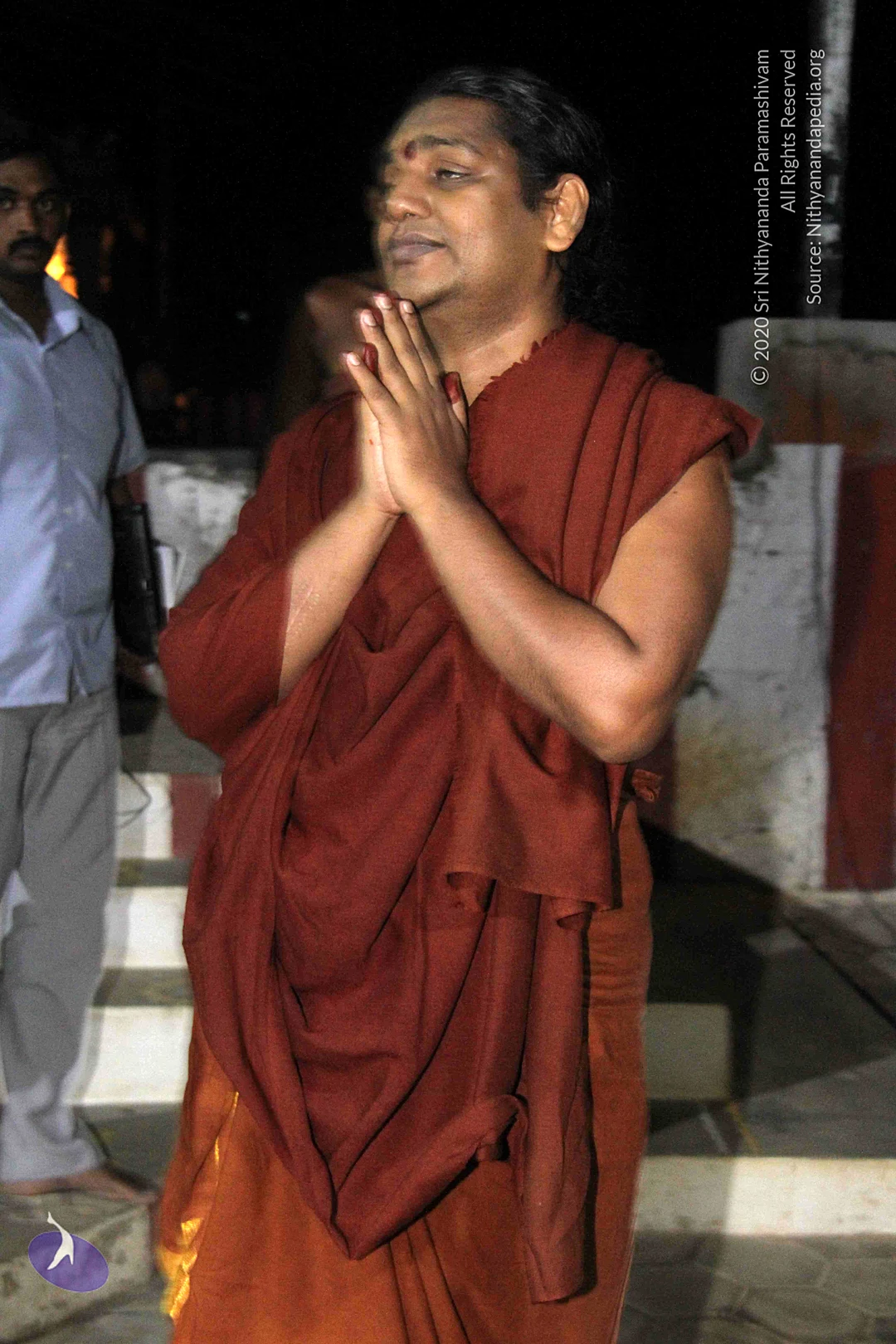
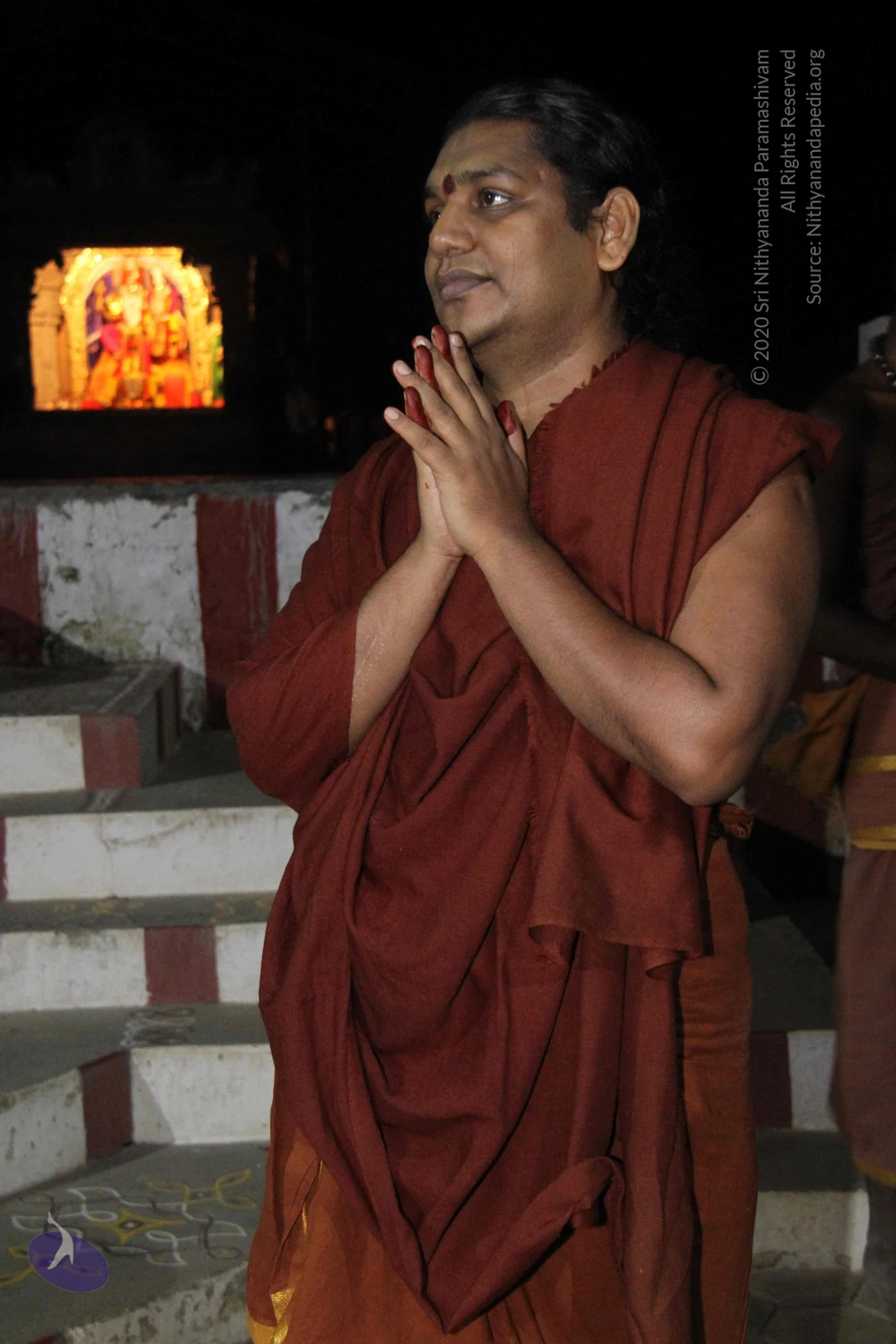
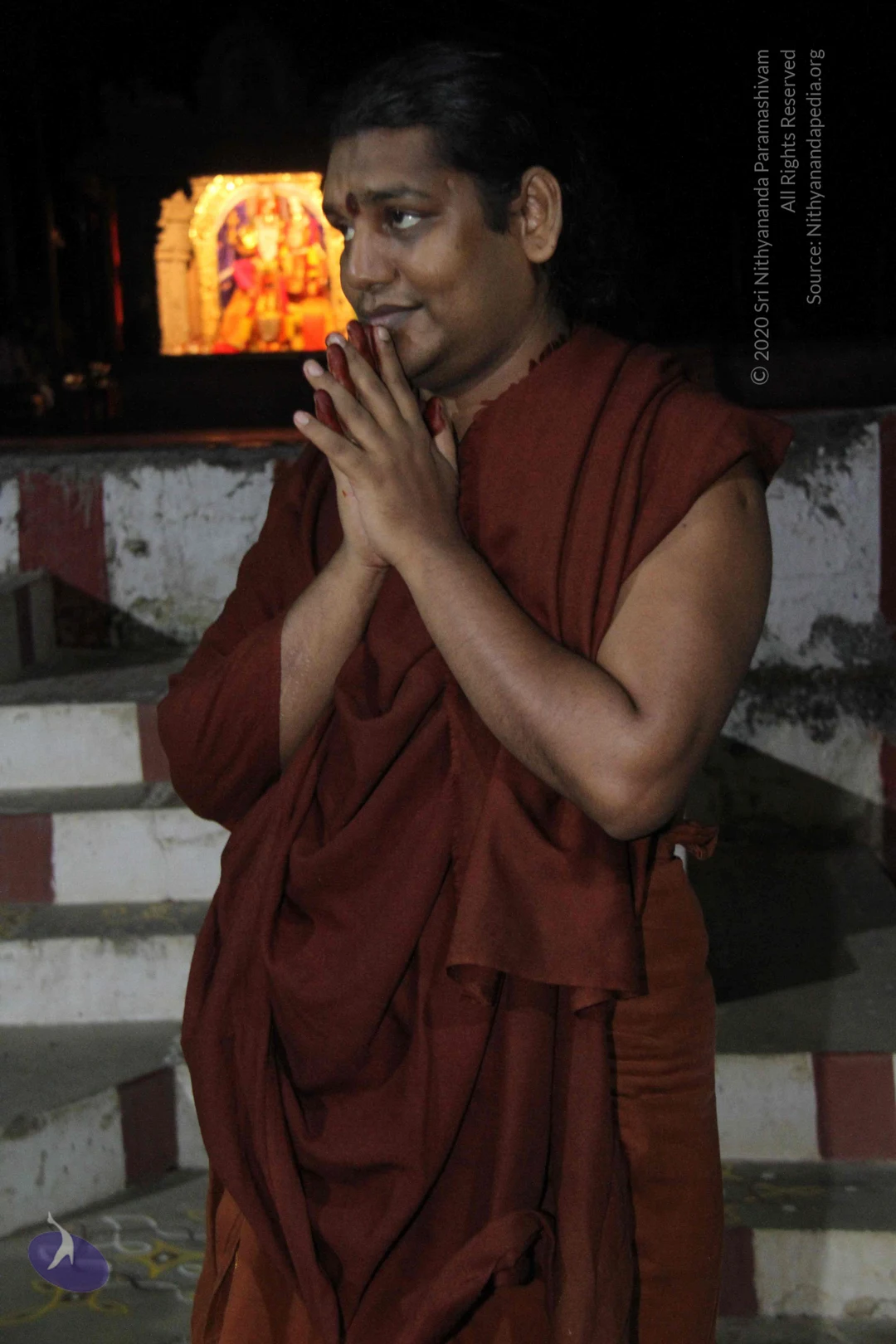
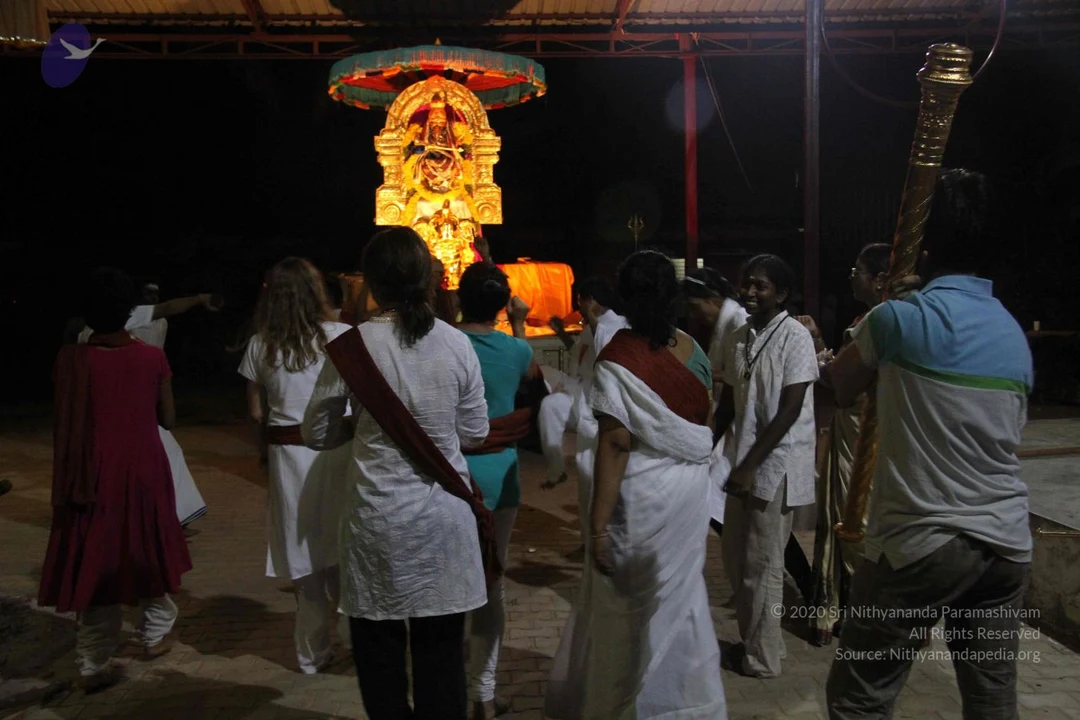
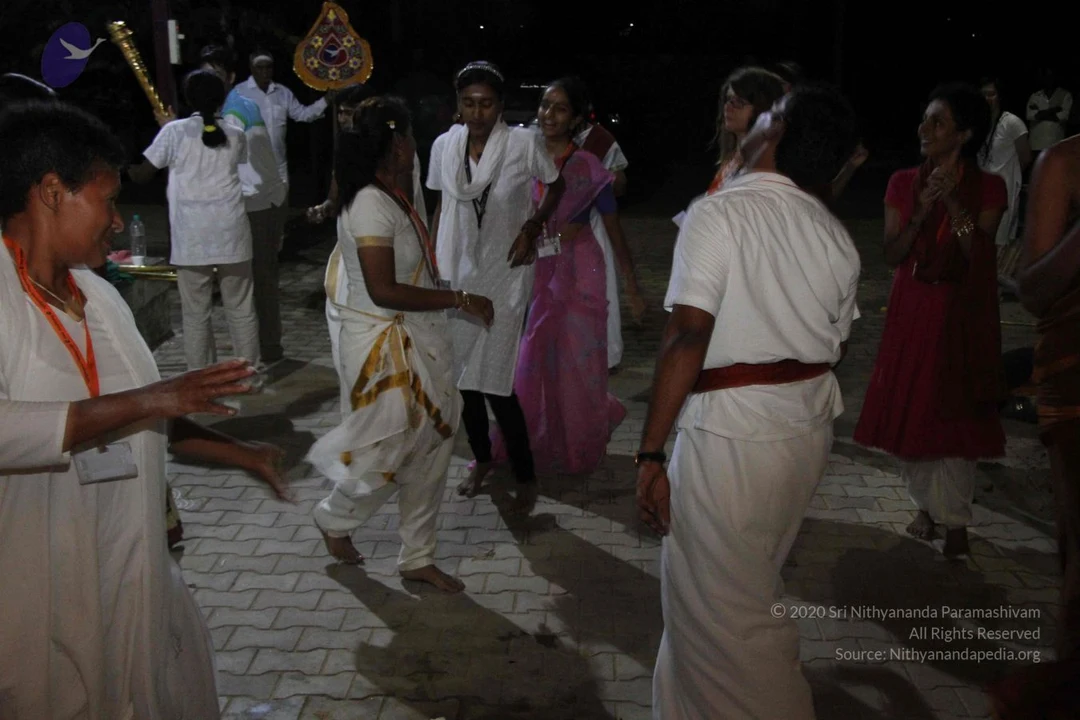
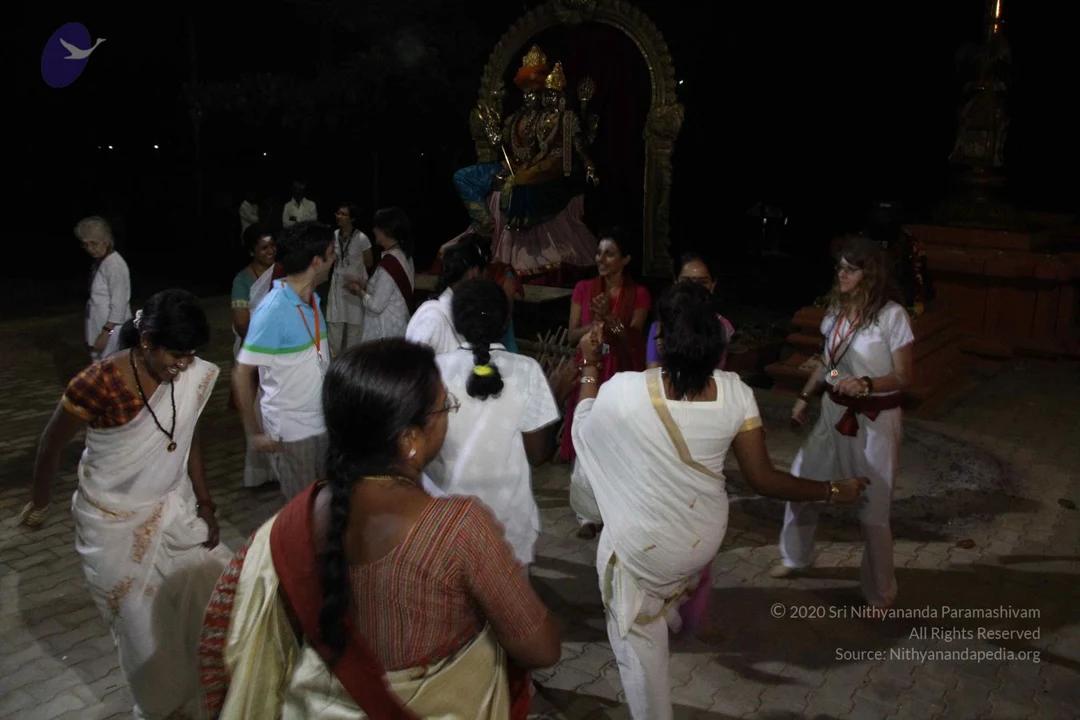
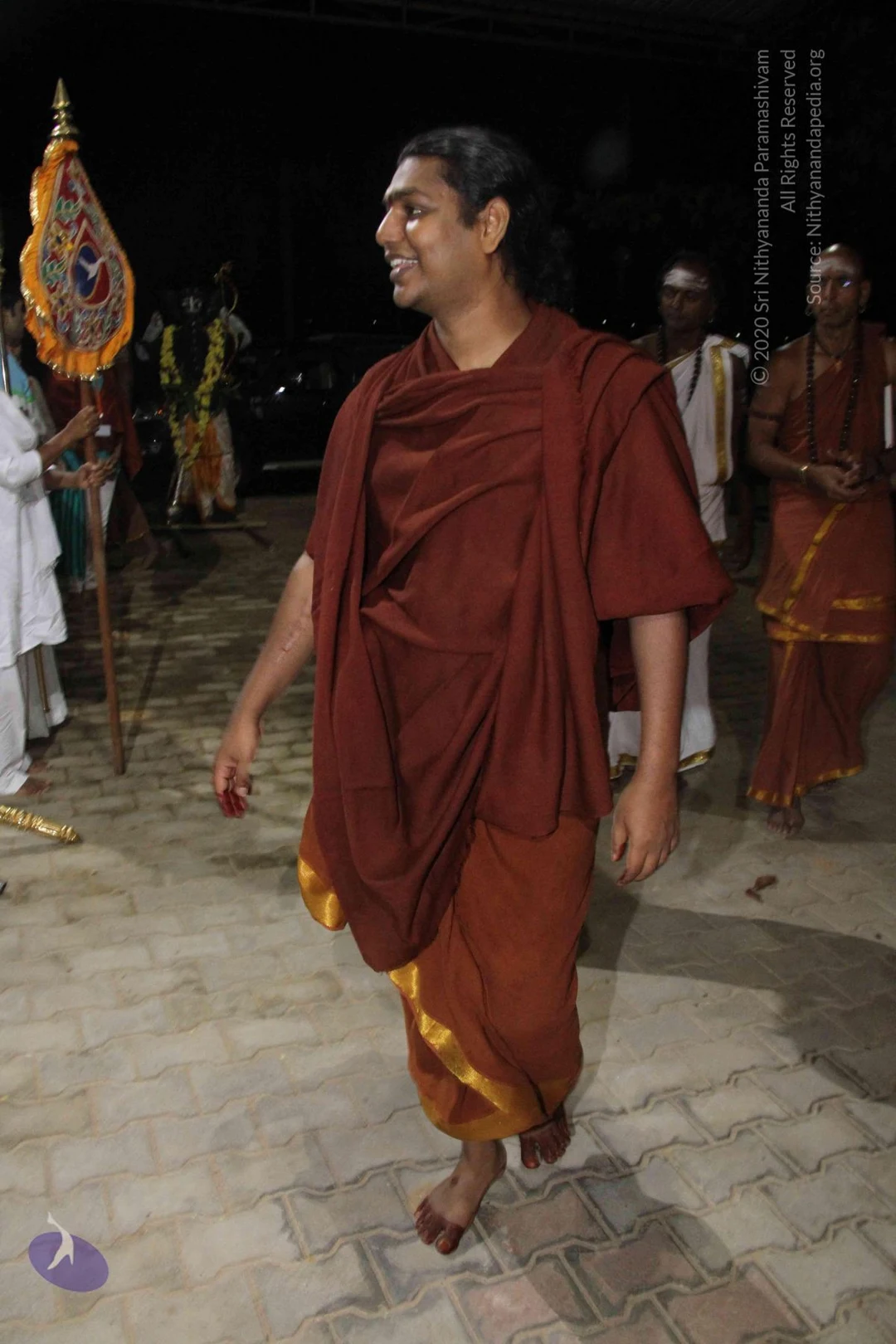
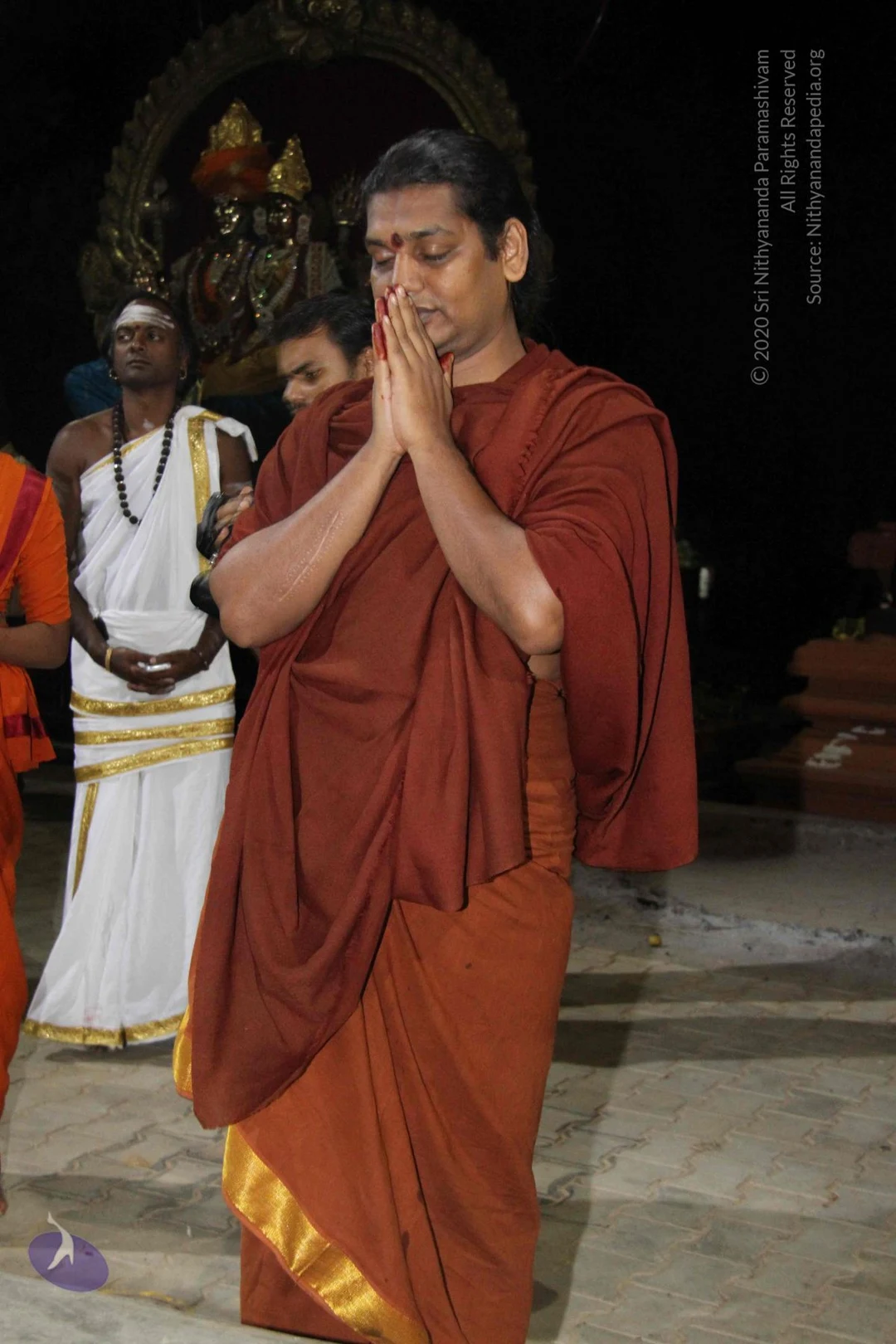
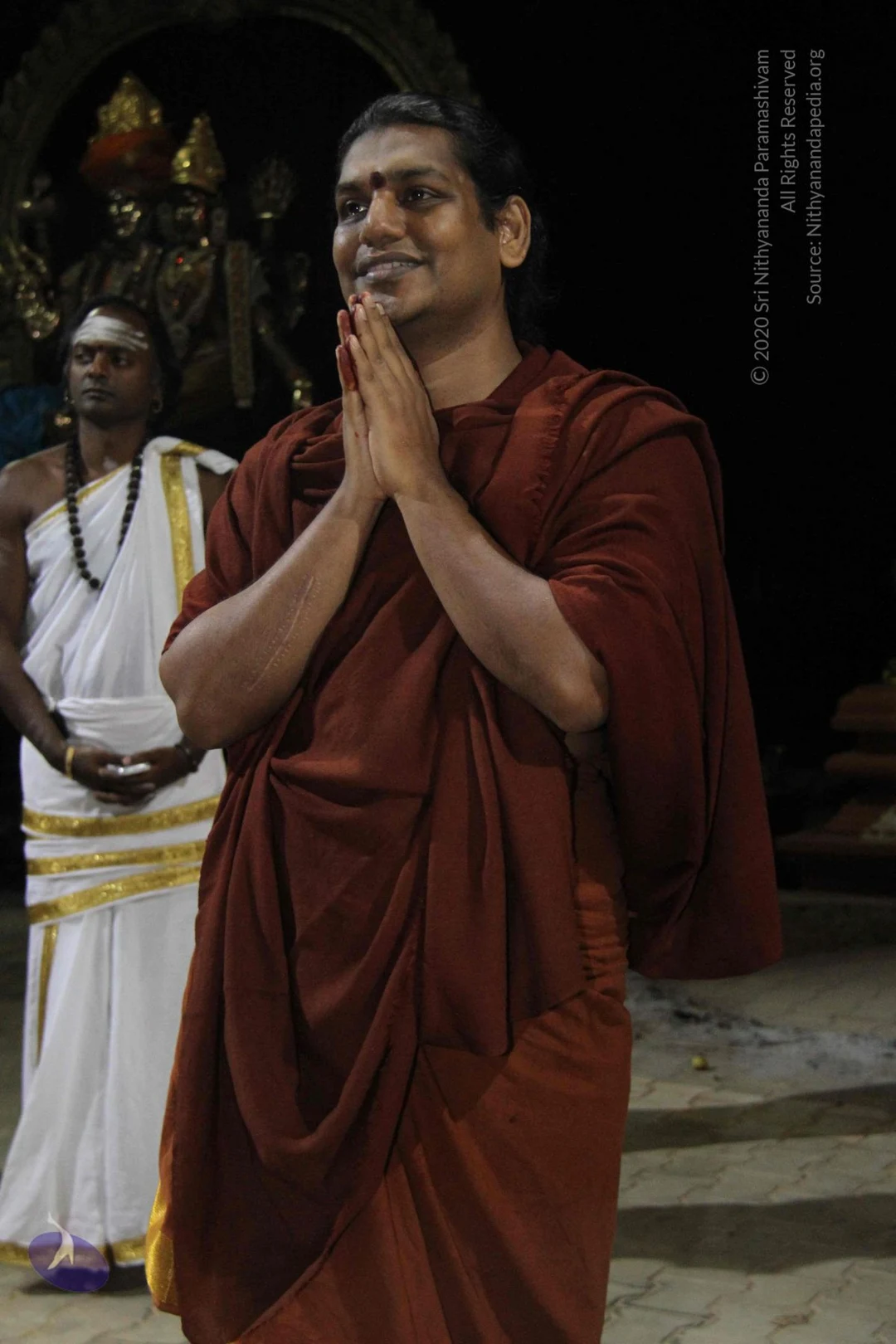
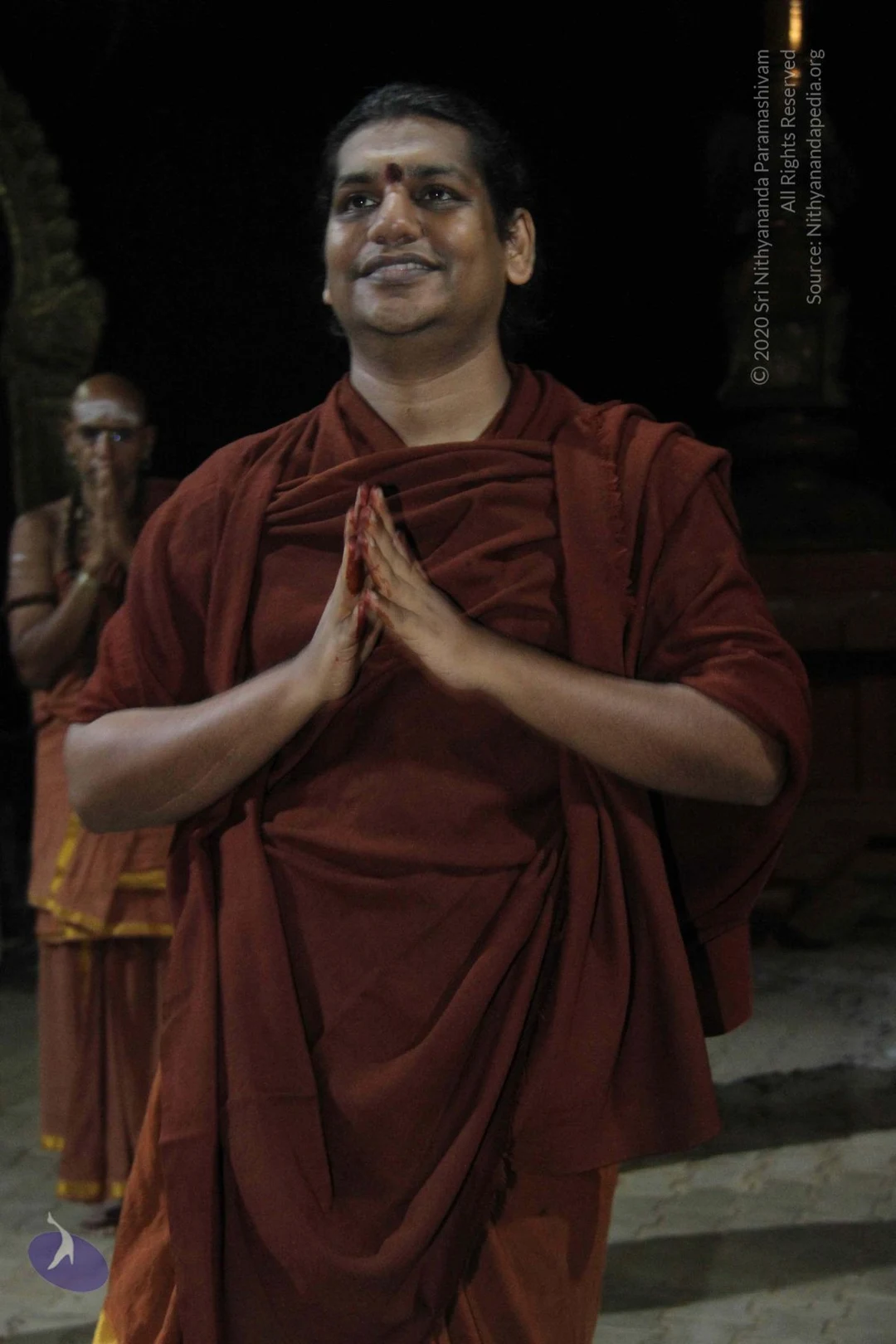
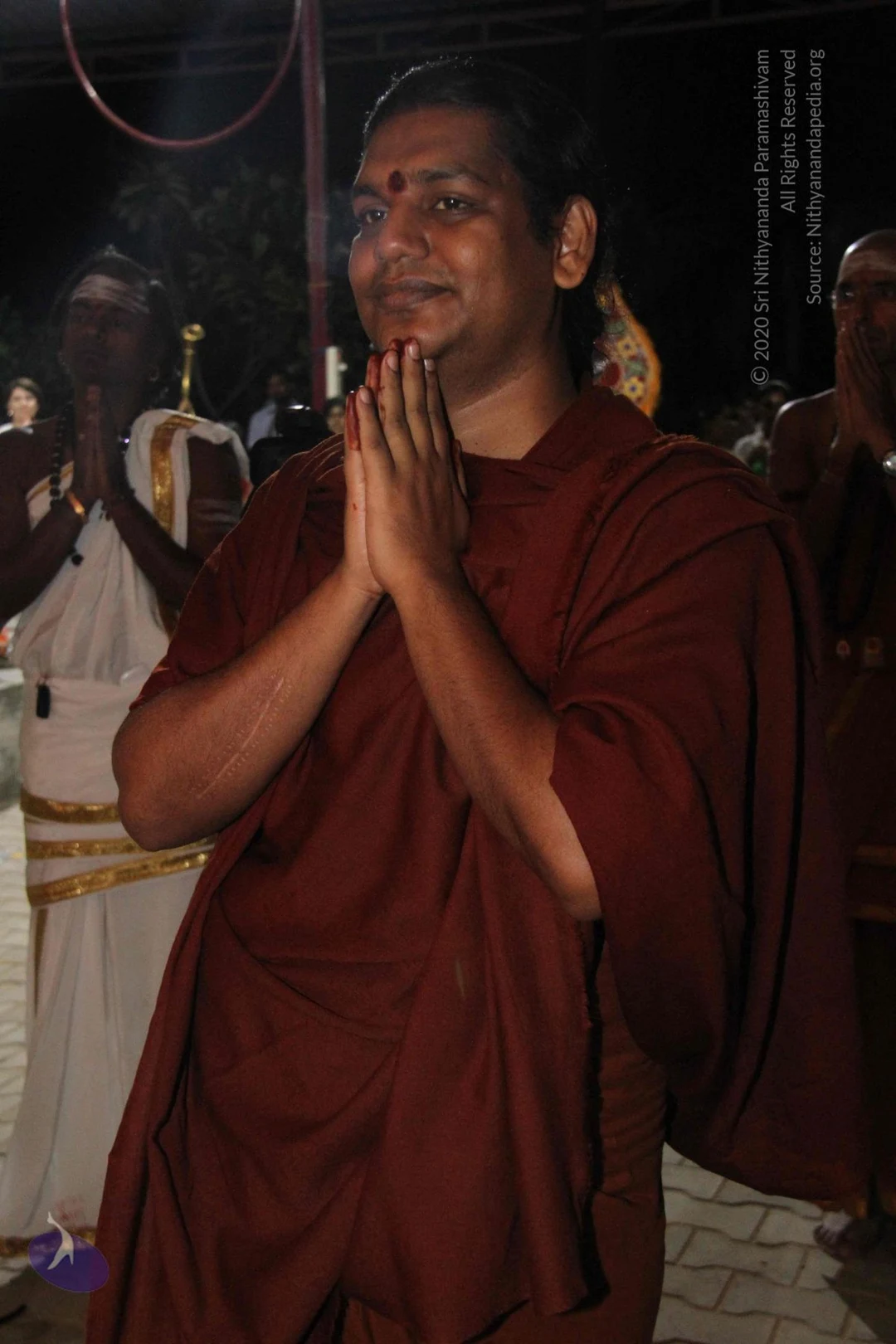
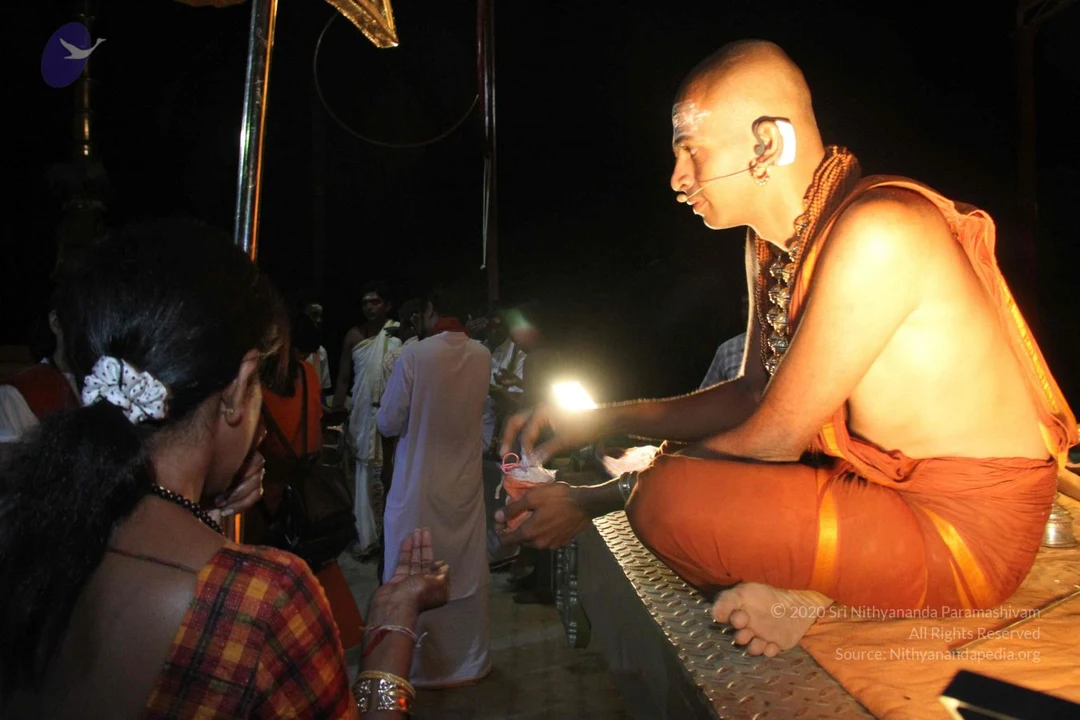
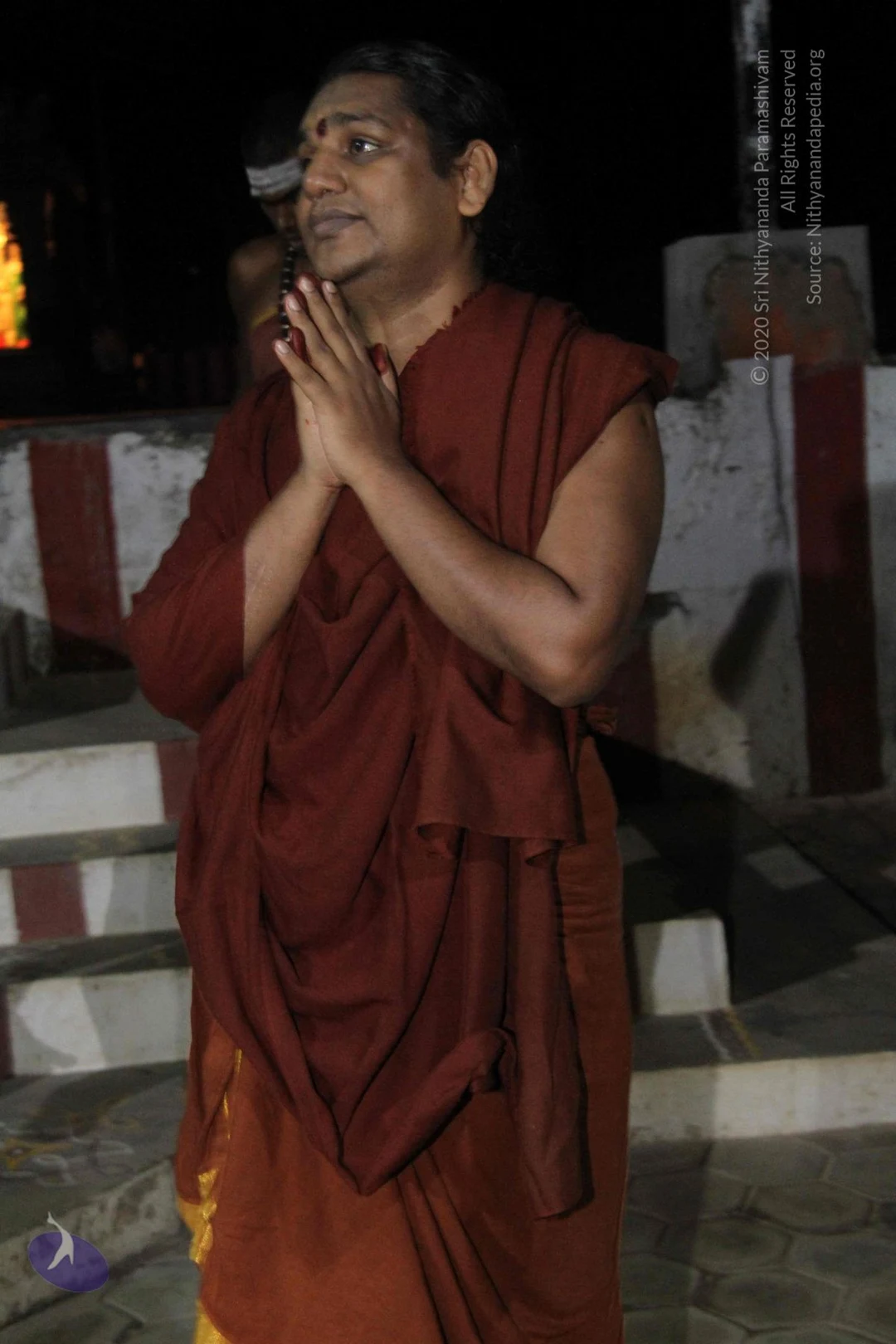
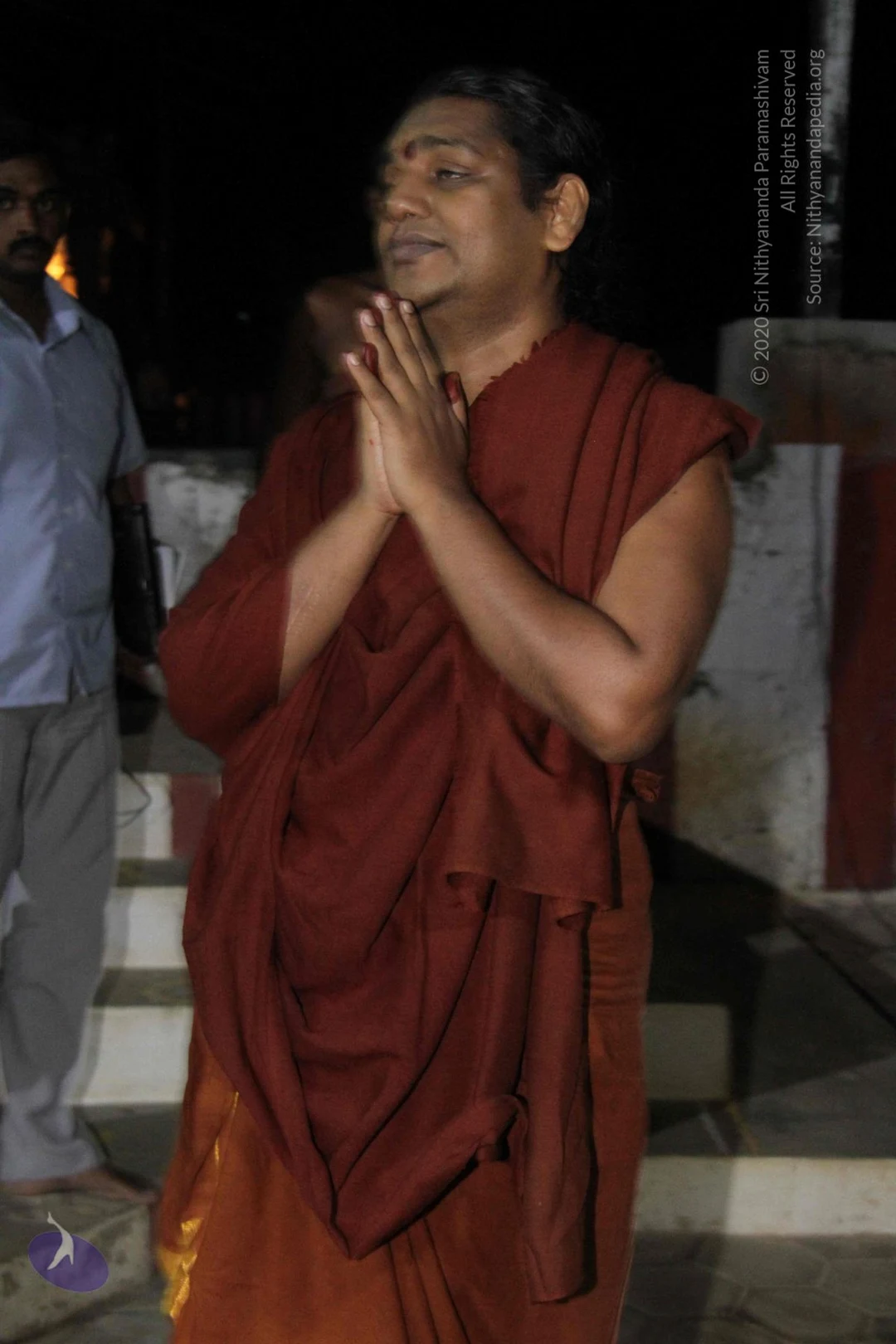
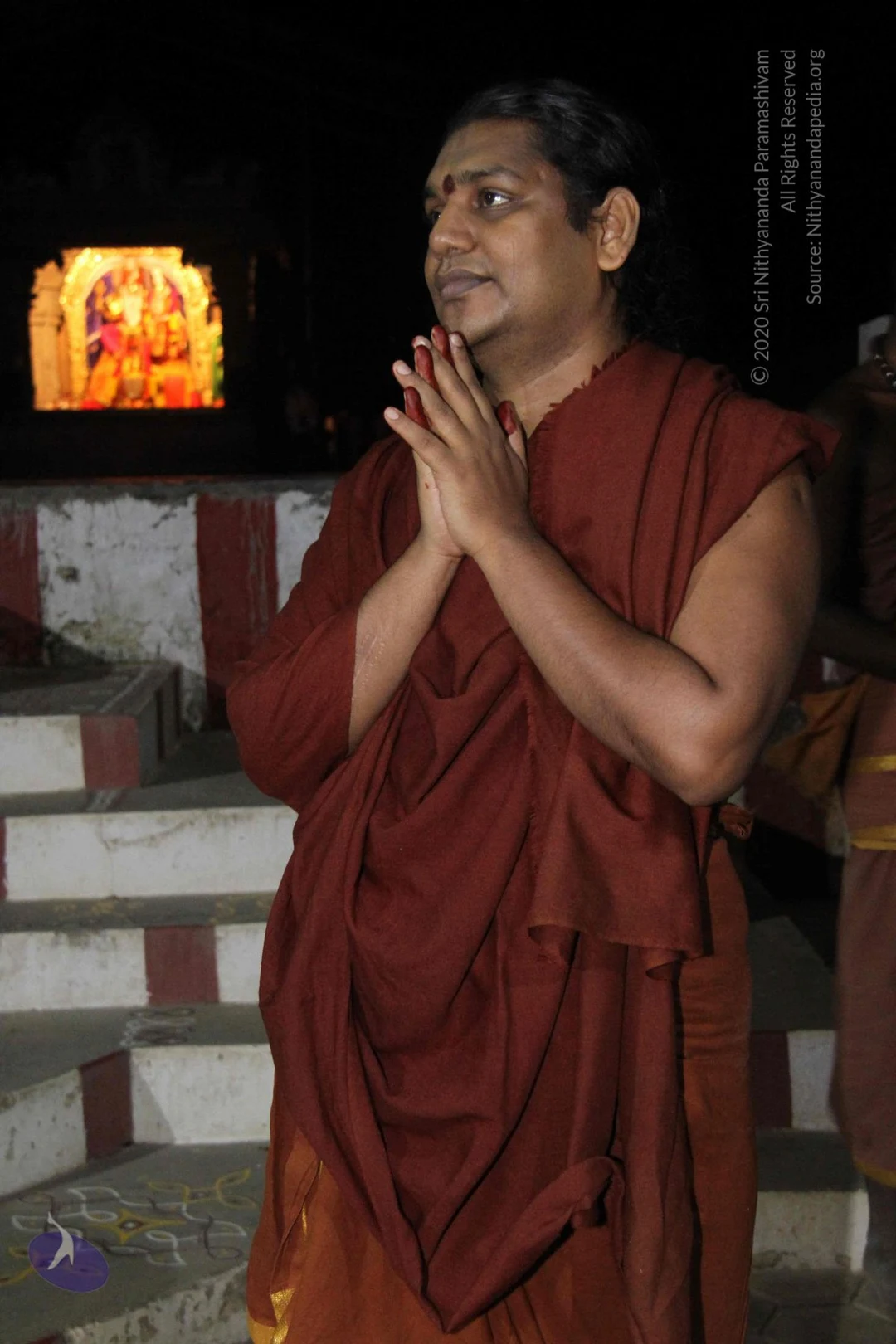
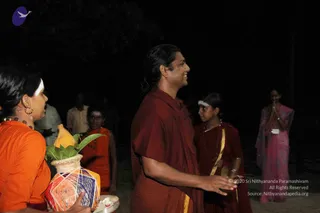
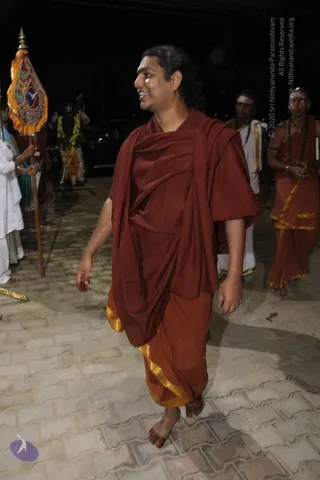
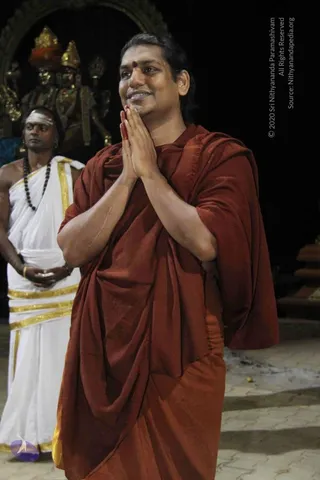
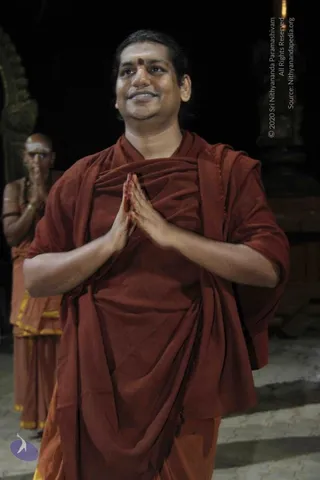
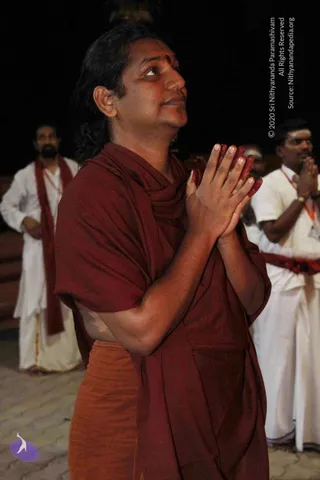
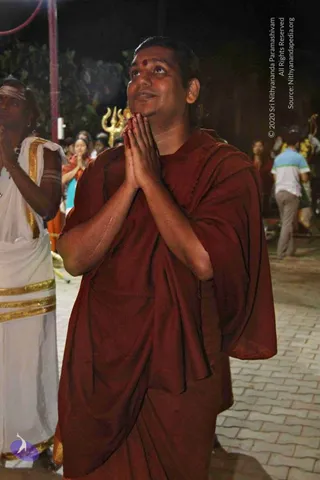
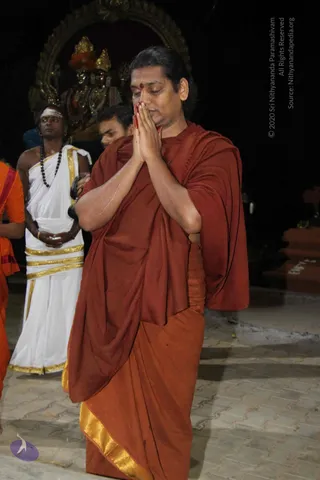
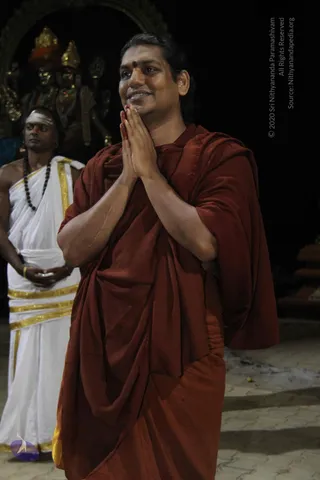
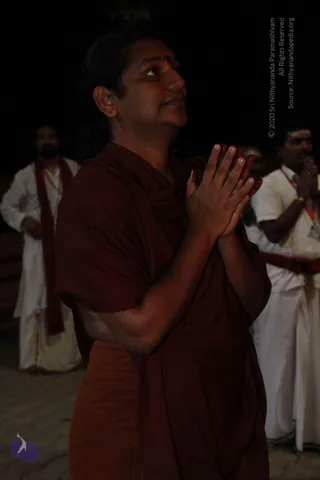
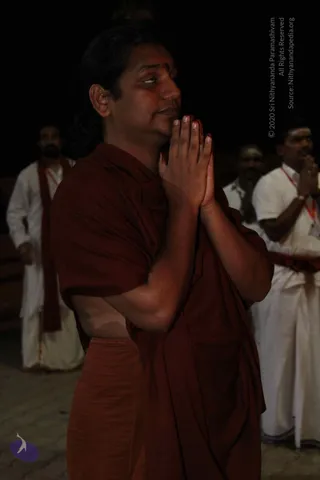
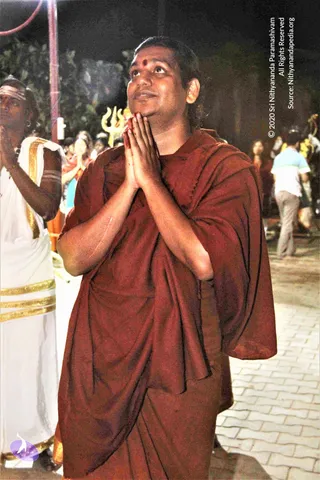
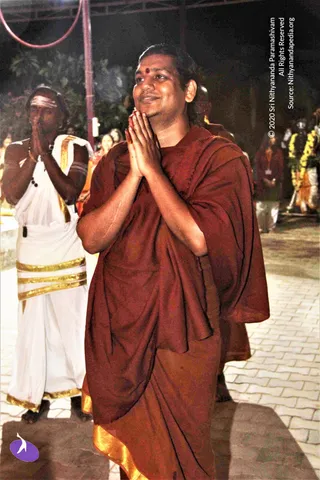
Night-time outdoor photograph of a ritual welcome. In the centre, a man with long dark hair pulled back wears a plain maroon/rust robe over one shoulder and smiles while extending his right hand toward a woman on the left. She wears an orange blouse and sari with a white forehead mark and holds a decorated woven pot with a bunch of green leaves and a yellow fruit on top, plus a brass plate of flower petals. Behind them, a young girl in a maroon sari with a gold border and rudraksha-style beads, with a white forehead mark, stands beside other women in orange and maroon. On the right, a woman in pink sari stands with palms pressed together in namaste. Other figures stand in the dark background. Setting appears to be an open ground at night with trees.Night photograph of a man walking barefoot on a brick-paved courtyard, smiling and looking to his left. He wears a rust-red shawl draped over his shoulders and body over a rust-orange dhoti with a gold border, with long swept-back dark hair, and his feet are reddened. Behind him, two men in rust-orange robes with rudraksha malas stand with hands folded, and a man in white dhoti with gold border walks behind. On the left, a tall pole carries an orange and red embroidered banner with a gold finial, and a garlanded deity murti stands in the background.Photograph of a man in a rust-red saffron-toned draped robe standing with palms pressed together in namaste at chest level, a small red bindi on his forehead, dark hair swept back, smiling. Behind him to the left stands a second man in a white dhoti with gold borders, a rudraksha mala around his neck and white vibhuti lines on his forehead, hands folded. In the background are golden deity murti figures with crowns and a trident-like staff under a dark arched shrine. The floor is light tiled with a few scattered petals.A person in rust-red monastic wrap cloth stands at night with palms pressed together at chest in anjali namaskar, smiling and looking upward; a small red bindi marks the forehead and hair is pulled back. Behind, a second figure in orange-red robe with gold border also stands with hands folded near a dark temple doorway with carved stone.Night outdoor photo of a man with swept-back dark hair and a vertical tilak on his forehead, wearing a maroon-red shawl over an orange-saffron lower garment, standing with palms pressed together in anjali mudra and gazing upward. Behind him, a man in white dhoti and shirt with a red-orange scarf stands with hands folded, and another man in white with a white-and-red border cloth and orange sacred thread also joins palms. Dark background with a small glowing lamp at top. Three to four people are visible.A man in a rust-red monastic robe stands outdoors at night with palms pressed together in anjali mudra, gazing upward with a small red bindi on his forehead. Behind him, a figure in white dhoti with gold borders and a tilak on the forehead also holds hands in prayer. In the background are a golden trident and a blurred crowd of devotees, with a paved walkway and dark foliage. The scene suggests a procession or outdoor puja.

Leela-Alankar-Deities

4 photosSource gallery
A stage tableau at a Hindu festival presentation. Centre, a young performer in a white turban with a striped orange-and-black sleeveless blouse, white dhoti, rudraksha-style beaded necklaces and a garland of yellow and white flowers stands with hands folded in greeting. To the left, a garlanded deity murti of Krishna in green and white garments with a peacock-feather crown and a yellow-and-purple flower garland, playing a flute. To the right, a garlanded deity murti in red and gold with ornate jewellery, seated before a gold arch. A young girl in a blue skirt and yellow blouse with a flower garland stands at far right. A pink satin cloth lies below the Krishna murti, and a painted backdrop of lotuses and temple motifs frames the stage.A stage tableau of a Hindu devotional drama with garlanded murti figures. On the left, a metal-bodied deity figure with a red-orange turban and a rudraksha-style necklace is decorated with yellow and purple flower garlands and sits atop a pink satin cloth. In the centre, a young male performer in a white turban and white dhoti, with a striped orange-and-black tiger-print shawl and flower garland, stands with palms joined. Behind him, a second garlanded figure in red and white with ornate jewellery sits on a golden throne-like arch. On the right, a young girl in a blue and gold costume with a gold headpiece and flower garland stands smiling. A red carpet covers the stage floor and a green backdrop frames the scene.A stage photograph of a festival tableau with two garlanded deity murtis and a young performer in costume. On the left, a bronze-coloured murti of a dancing deity in saffron and white dhoti is decked with yellow, purple and green flower garlands and a pearl necklace. In the centre, a young male performer in a white and gold turban, orange and gold striped costume, rudraksha-style beaded necklaces and garlands stands with palms joined in a greeting. Behind him, a deity murti in a red and gold dress with a crown sits on a golden throne framed by garlands. On the right, a young girl in a blue skirt and gold-trimmed top wears a pearl necklace and a garland, standing beside the throne. A dark red curtain and a decorated backdrop complete the stage.A staged devotional scene in an ornate hall. On the left, a figure with a painted face, orange-red crown and turban, wearing a saffron-orange garment and a multi-strand beaded necklace, sits on a pink cloth-draped seat fully covered in yellow and purple garlands, with one hand raised. Centre, a young man in a white dhoti and cream turban, wearing a garland and beaded necklace, stands beside a gold throne backed by a golden arch, holding his palm up in greeting. Right, a child in a blue skirt and golden-yellow top with a garland and a headpiece, and a seated figure in a red and white costume with a tall red-and-gold crown, both draped in yellow and purple garlands. A red carpet lies on the floor, with brass oil lamps at the left edge.

PratyakshaPadaPuja
7 photosSource gallery
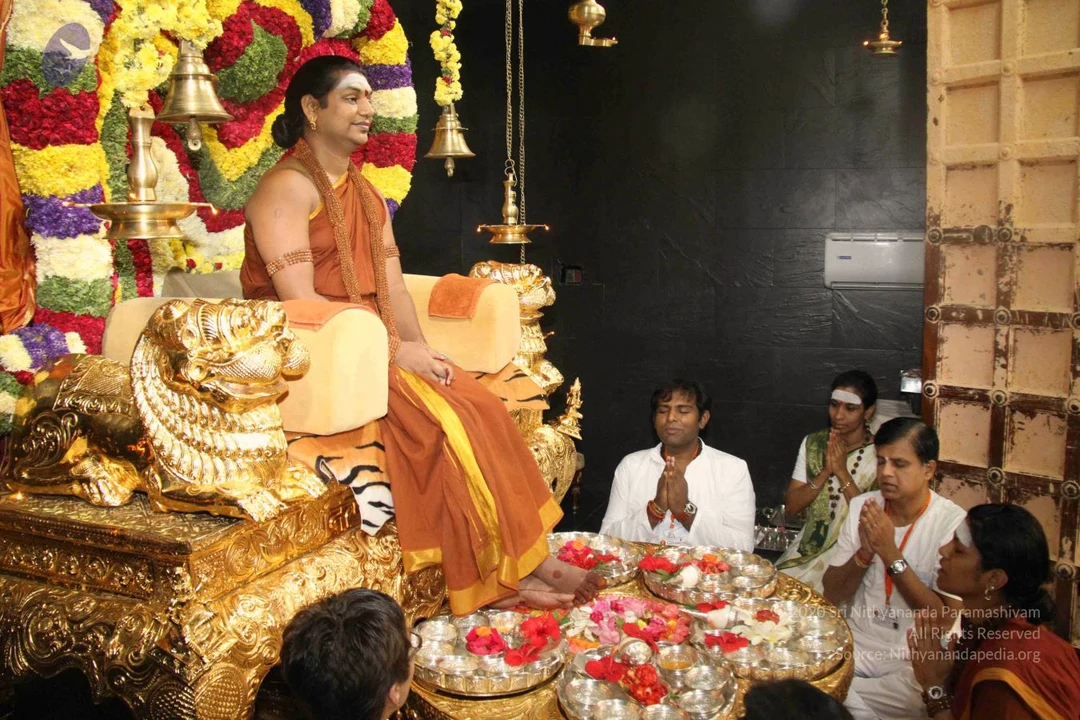
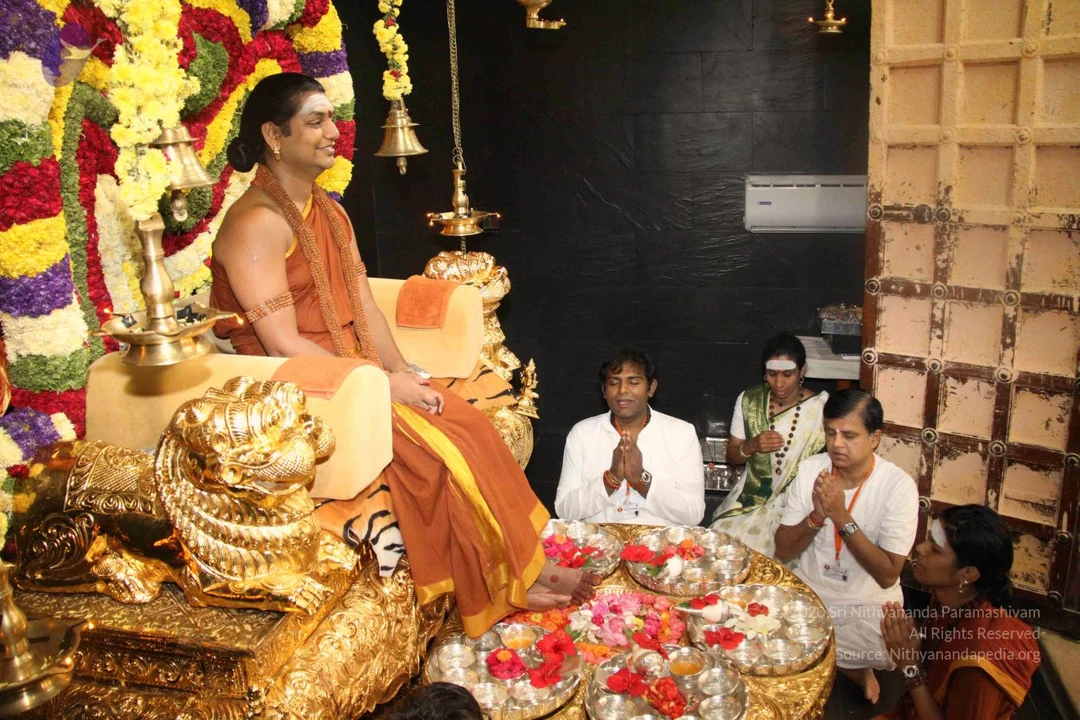
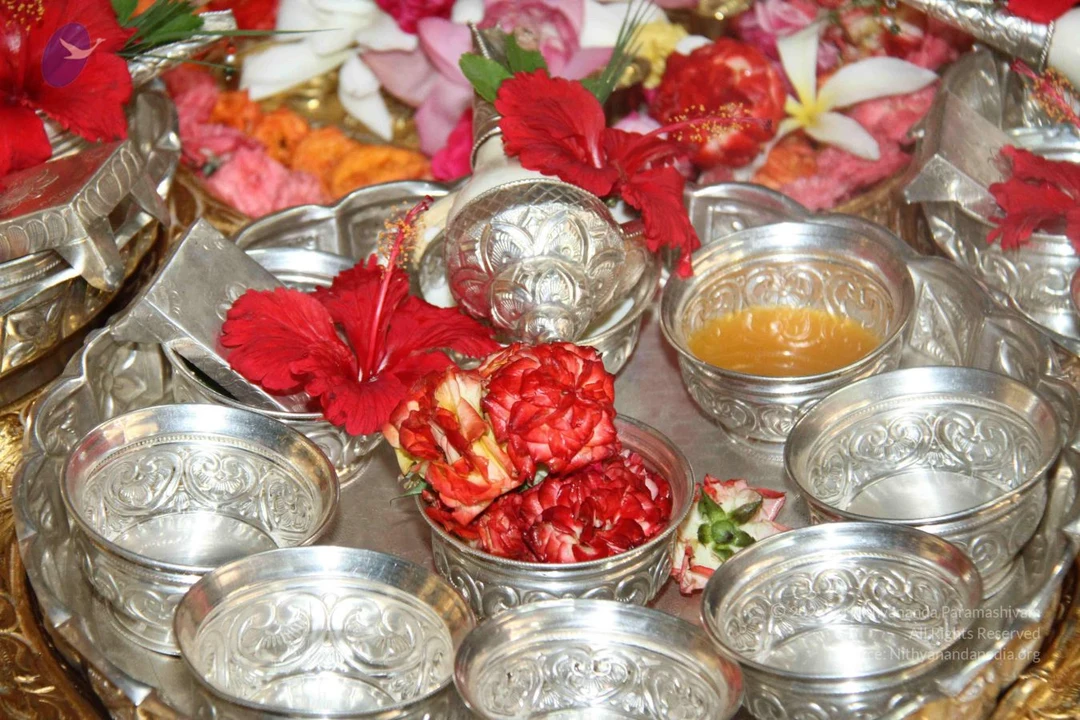
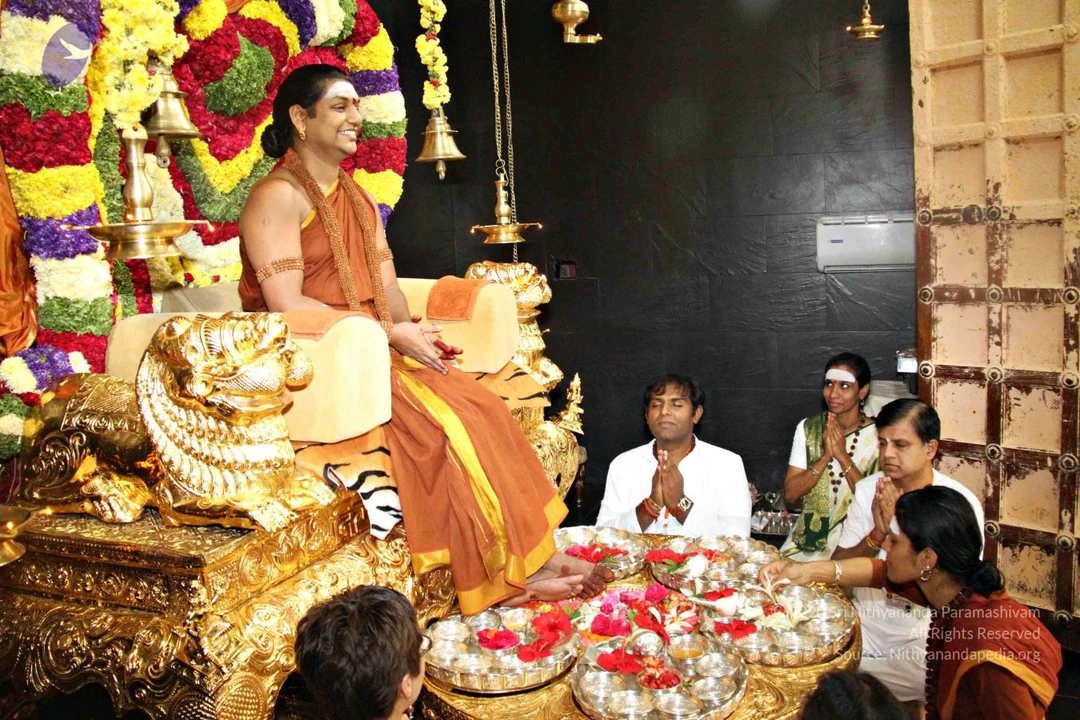
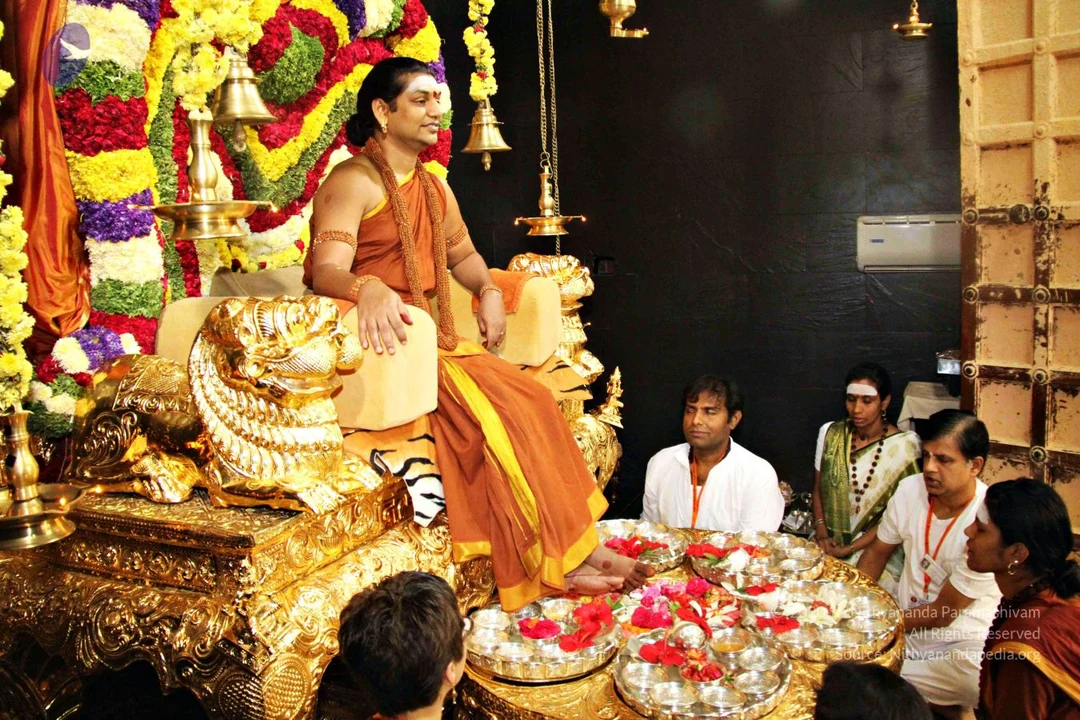
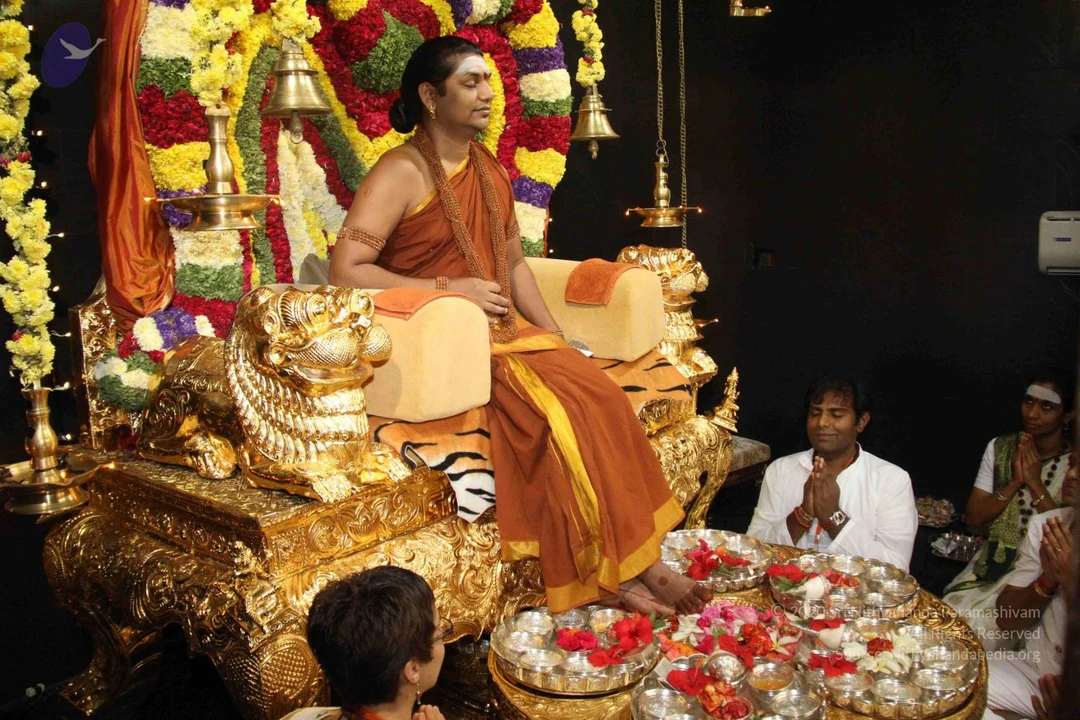
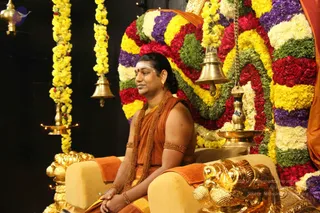
A photograph of a seated man in a saffron-orange robe and gold-toned shawl sits on an ornate gold throne carved with a lion-head armrest, draped with a tiger-striped cushion. He wears a rudraksha mala with a gold necklace and a vertical white-and-red forehead mark, and his hair is swept back in a bun. Behind him a garland wall of red, yellow, purple and green flowers hangs beside hanging brass bells and oil lamps. In front, brass trays hold flower petals, red blossoms and small lamps. A white-clad man sits at right with palms pressed together, a woman in a green sari with a white forehead band also sits with hands folded, and another woman in a white top sits at the far right edge. A figure's head is visible at lower centre. The setting shows an ashram ritual reception with flowers and oil lamps.Close-up photo of an ornate silver ritual tray arranged for worship. Several embossed silver bowls hold offerings including a yellow paste or sweet, pale and ruby-red petals, and rolled red blooms. Large red hibiscus flowers and a white frangipani-like flower lie among the bowls, and a small silver vessel with a spout sits at the centre. No people are visible, and the tray rests on a gold-patterned surface.Close-up photo of a silver puja tray arranged with red hibiscus flowers, a silver bowl of yellow liquid or paste, pink and red rose petals, orange marigold blossoms and white flowers. A person's pale hand with a red-stained fingertip and a saffron-gold cloth edge appear at the top. No people's faces are visible, and no one is clearly identifiable as a person.A photo of a seated figure in a saffron-orange robe with a yellow sash, long swept-back hair, a white forehead mark and a rudraksha-style beaded necklace, smiling on a gilded throne with a carved lion-face armrest and an orange cushion. Before him stand silver and brass thalis of flowers, fruit and lamps, with a brass hanging lamp above. Garlands of yellow, red, purple and white flowers decorate the background. Three devotees sit with palms joined: a man in white, a woman in a green-bordered sari with a white forehead mark, and a man in white with an orange shawl and mala. A woman in orange lower right also has palms joined. Dark wall, air conditioner and an ornate wooden door complete the hall.A photograph of a seated man on a gilded throne with a carved lion-head armrest, wearing an orange-saffron dhoti and shawl, a rudraksha mala with a gold-toned necklace, and gold armbands. He sits with bare feet resting on a golden platform, smiling and gazing to his left. Behind him stands a large backdrop of red, yellow, orange and purple flower garlands, with brass oil lamps and bells hanging nearby. In front, brass trays of red and white flowers and offerings are arranged. A man in white with an orange-and-white sash kneels at the trays, a woman in a green sari with a white headband sits behind, and another man in white with an orange sash sits at right with a woman in a red top; devotees' heads are visible at the bottom edge.A photograph of a seated figure on an ornate golden throne with carved lion-head armrests, set against a wall of garlands in yellow, red, purple, white and green flowers. The seated person wears an orange-saffron garment draped over one shoulder, a rudraksha-style beaded mala necklace, beaded bracelets on the upper arms, red forehead mark and gold earrings, with hands resting in the lap. Hanging brass bells and brass oil lamps (deepa) with flower strands frame the scene.

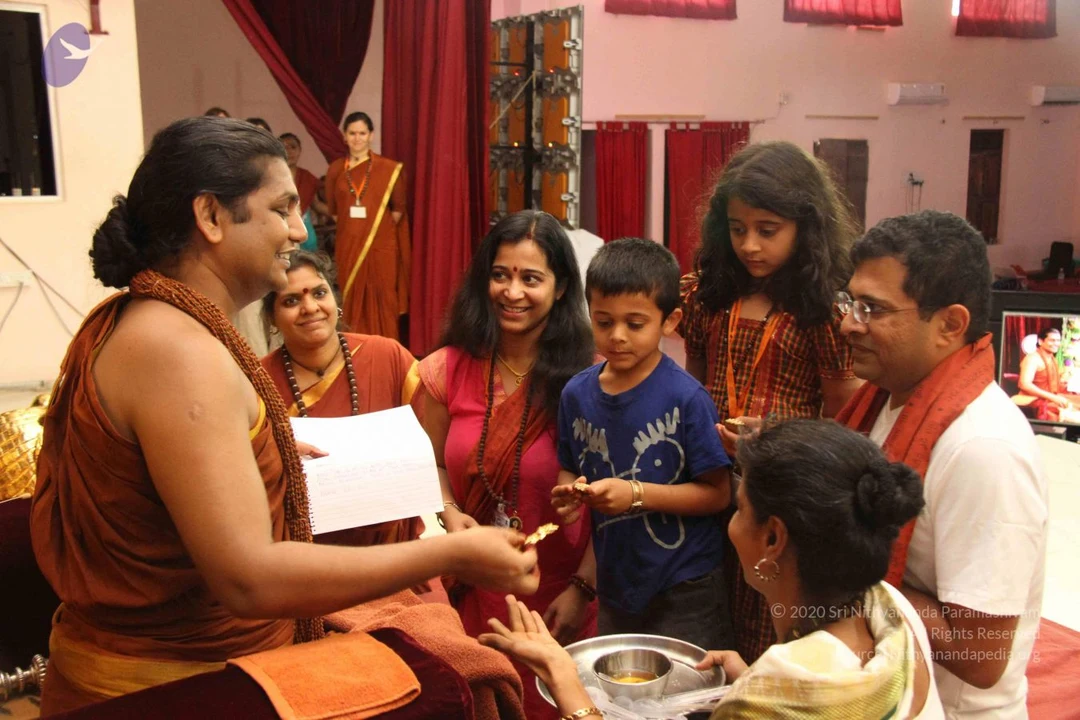
SarvaDarshan

6 photosSource gallery
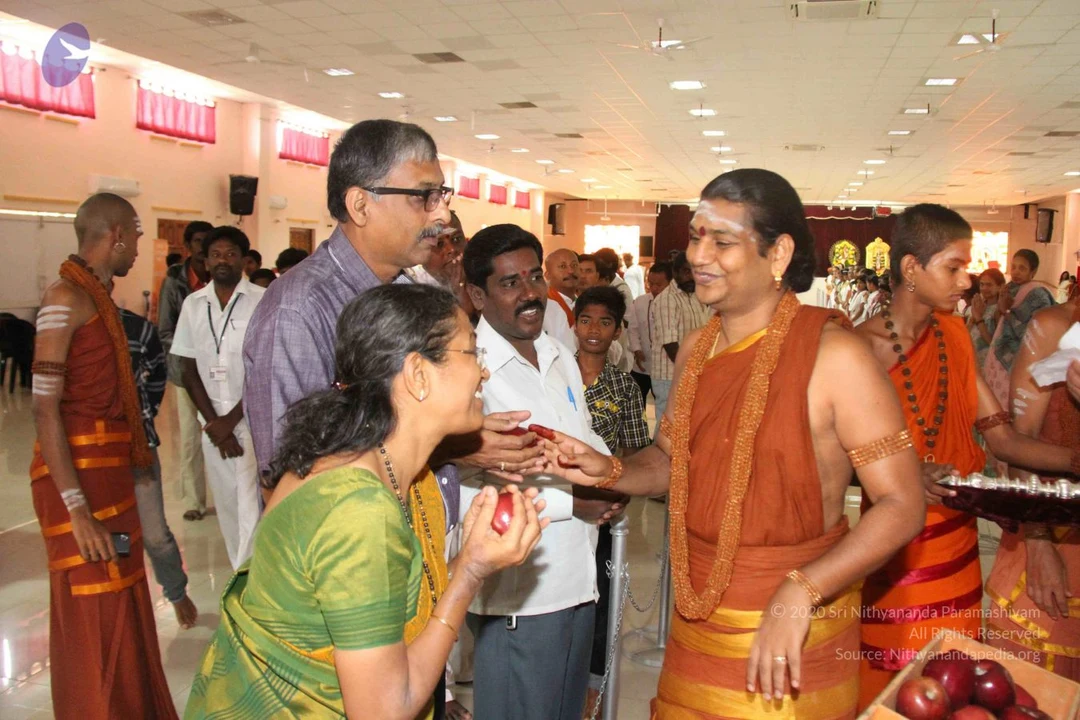
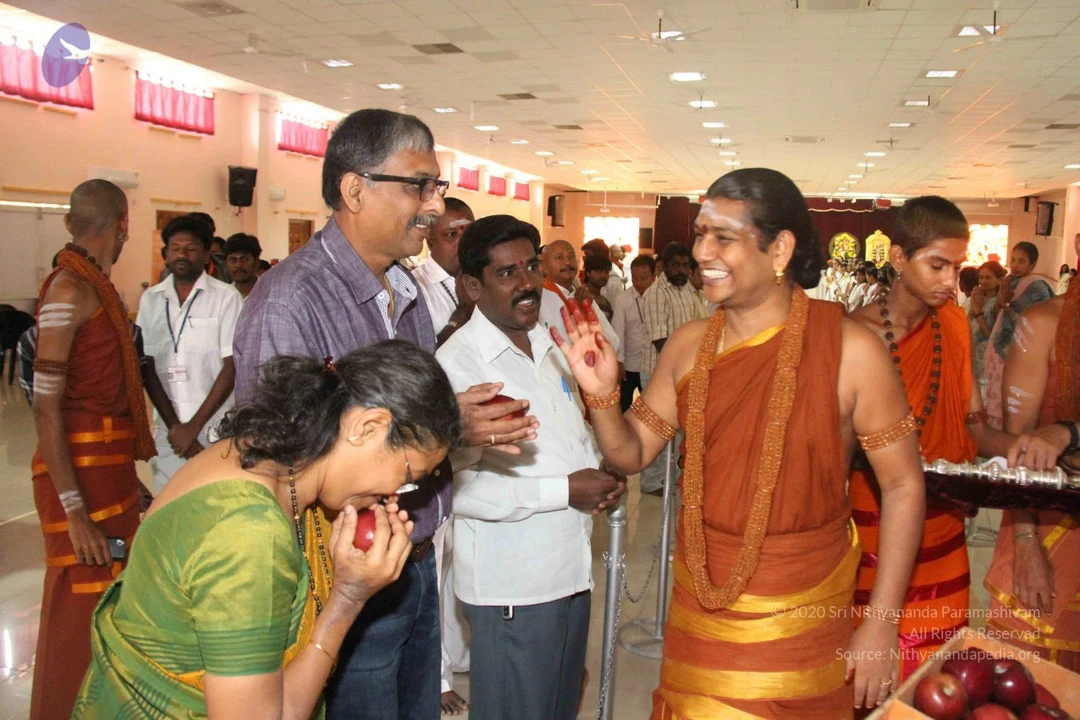
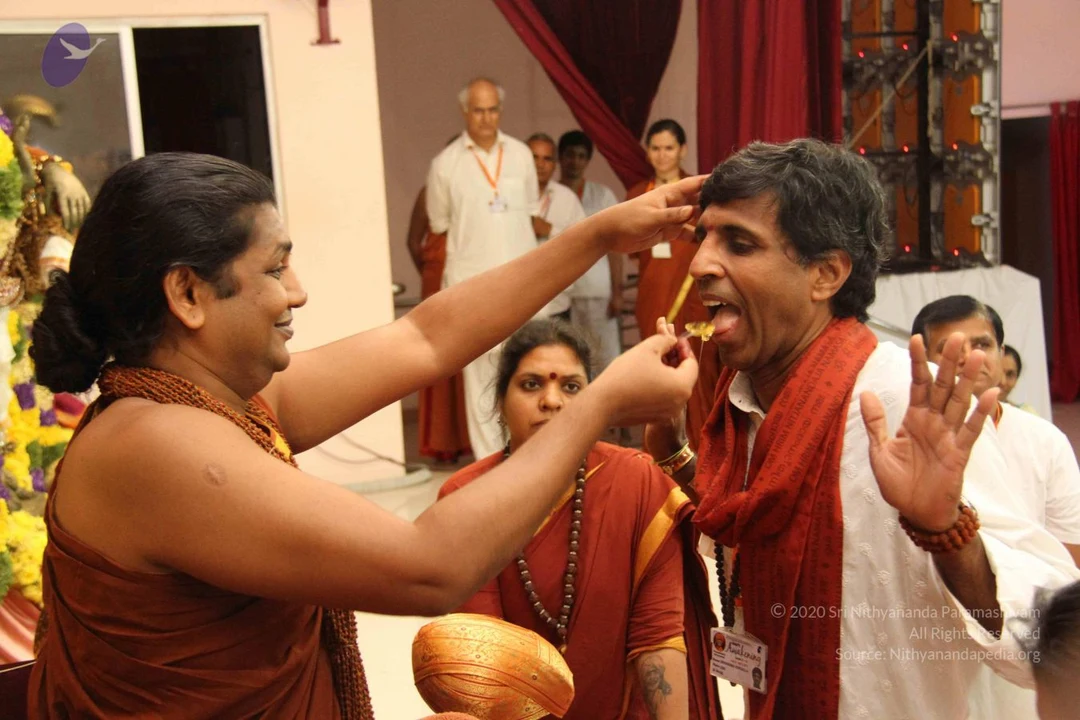
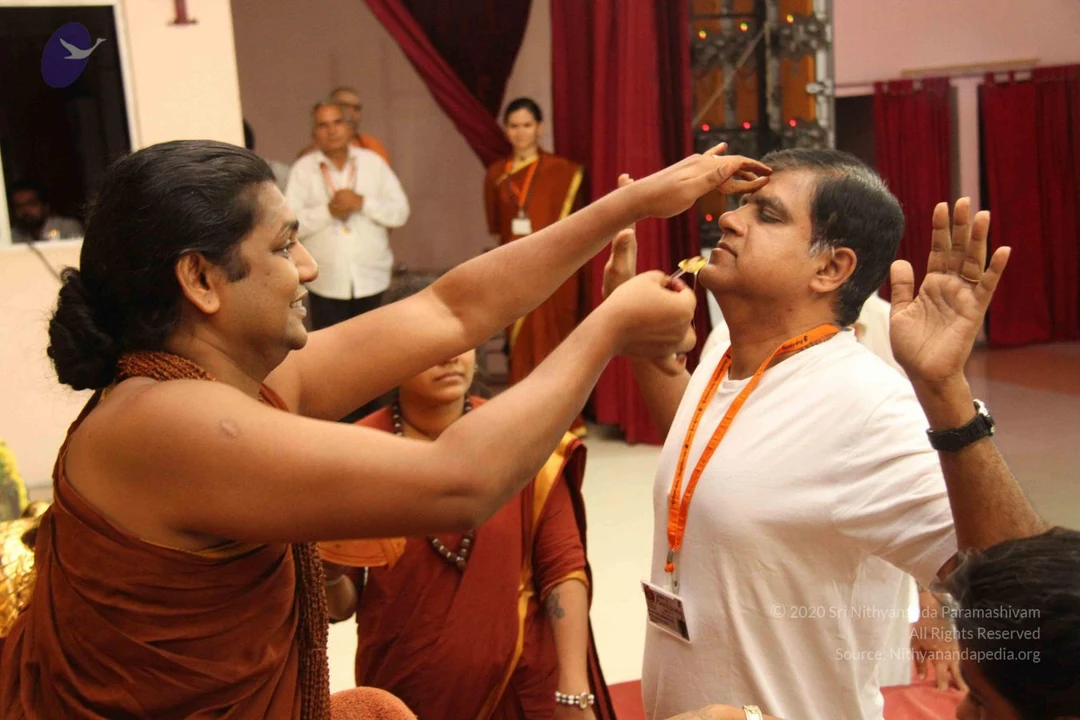
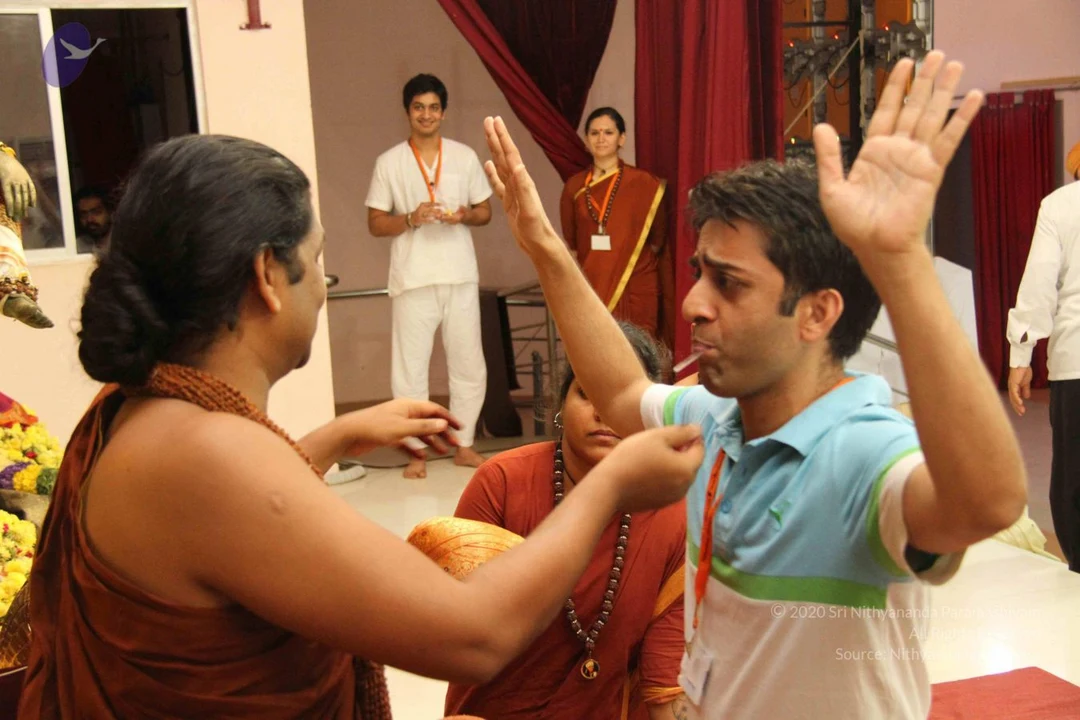
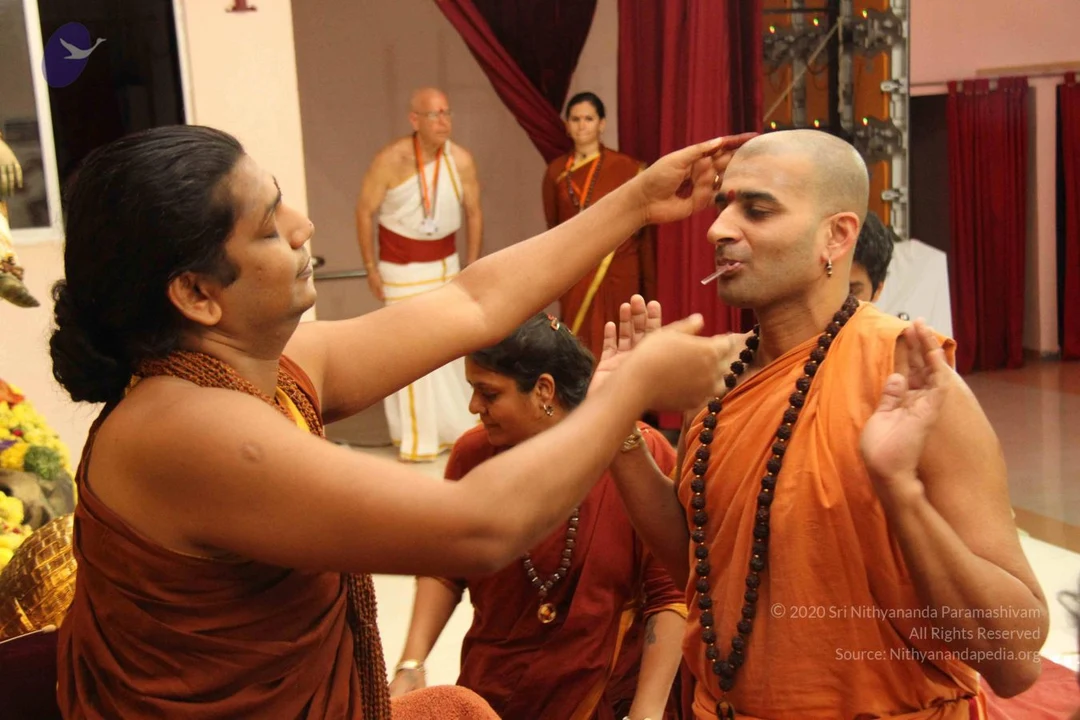
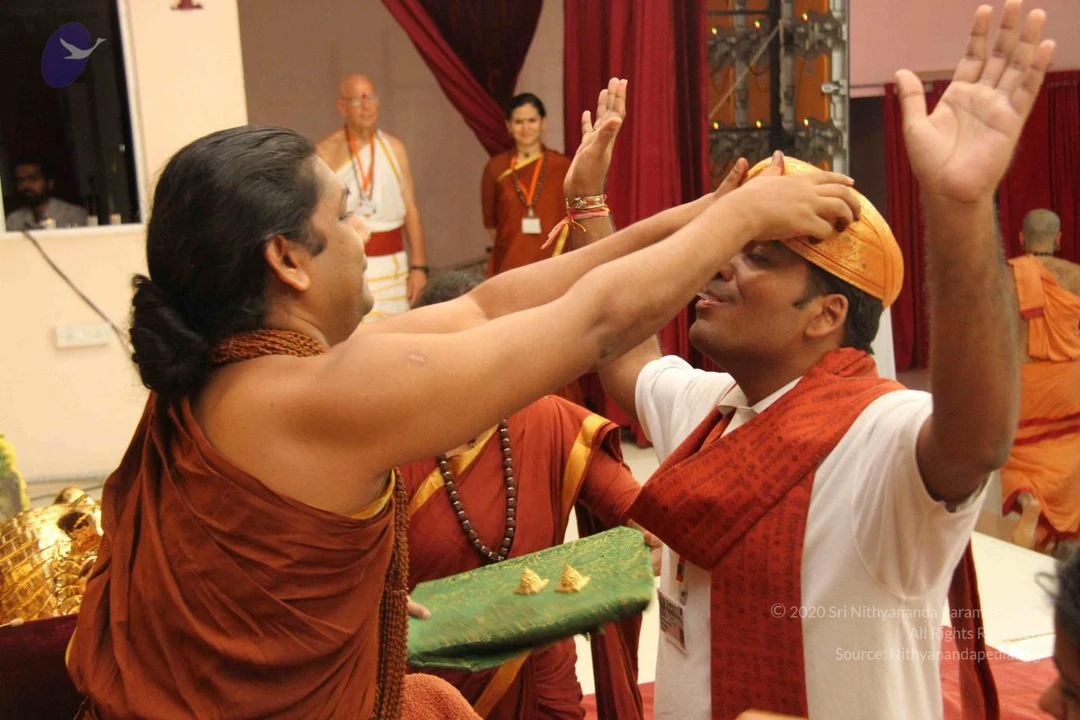
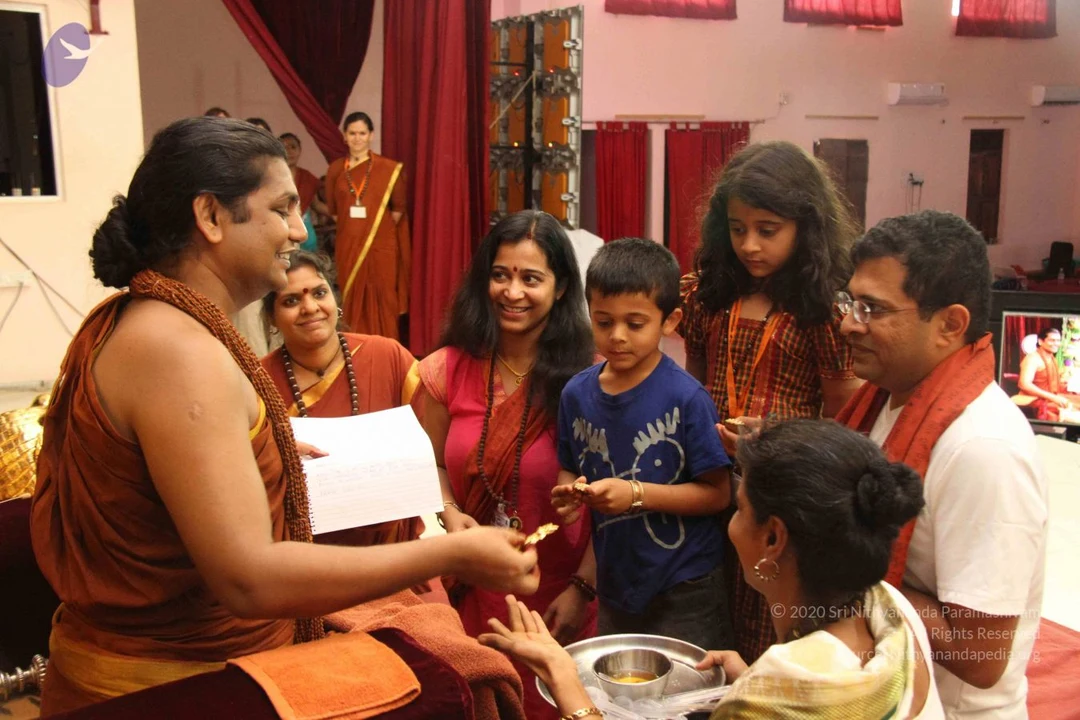
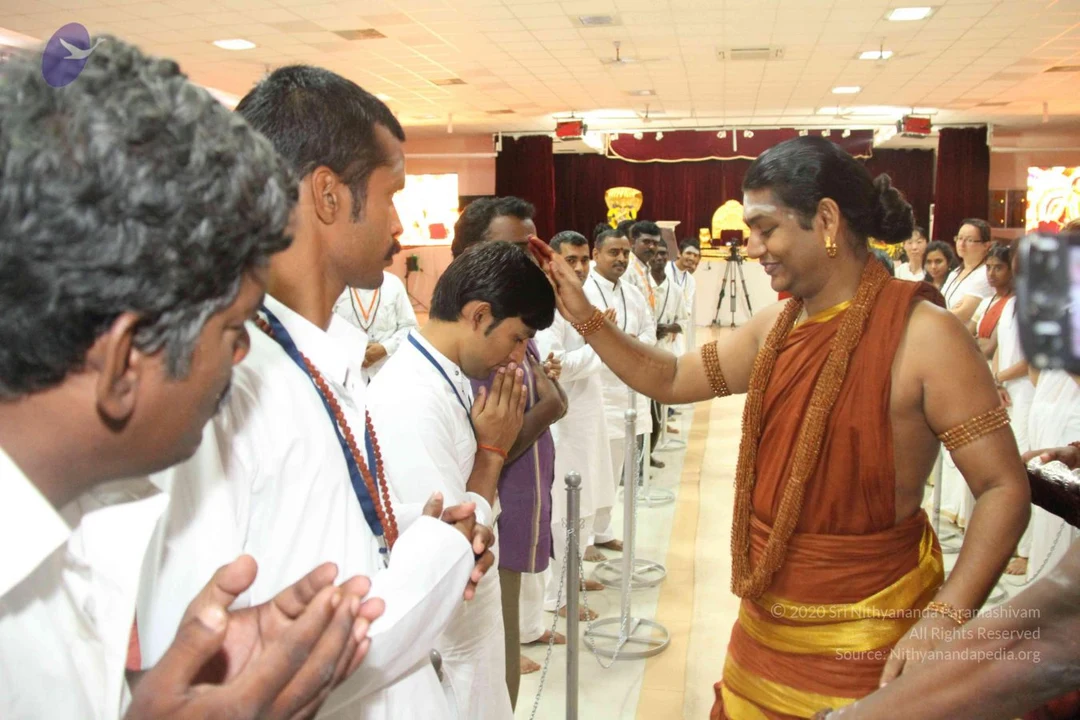
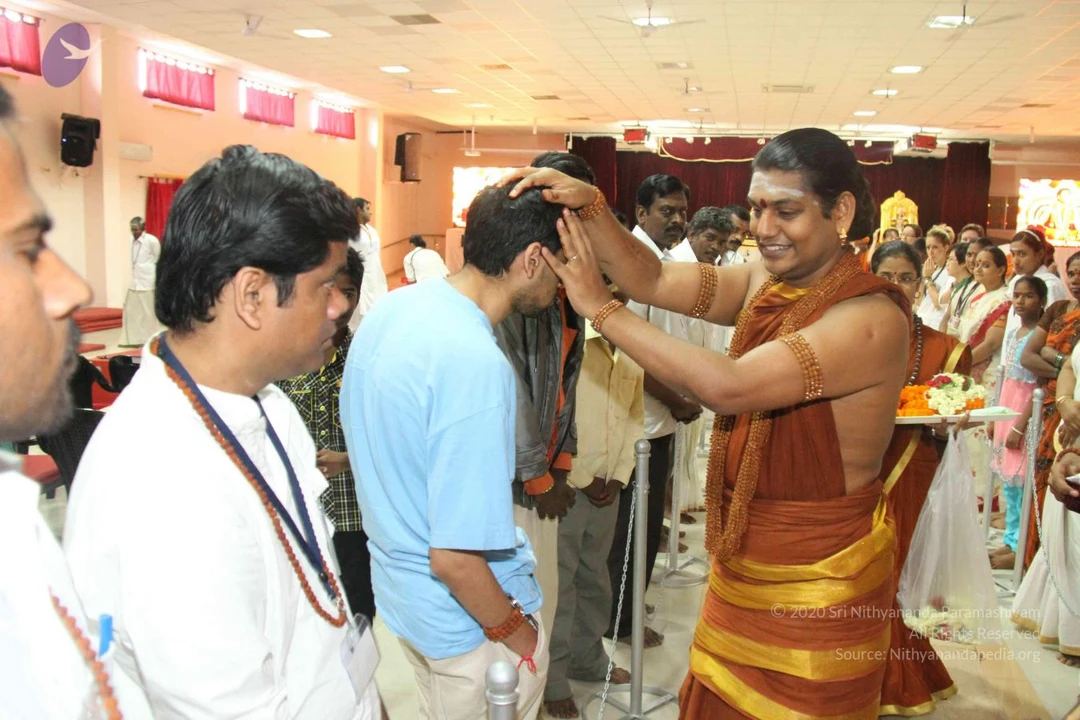
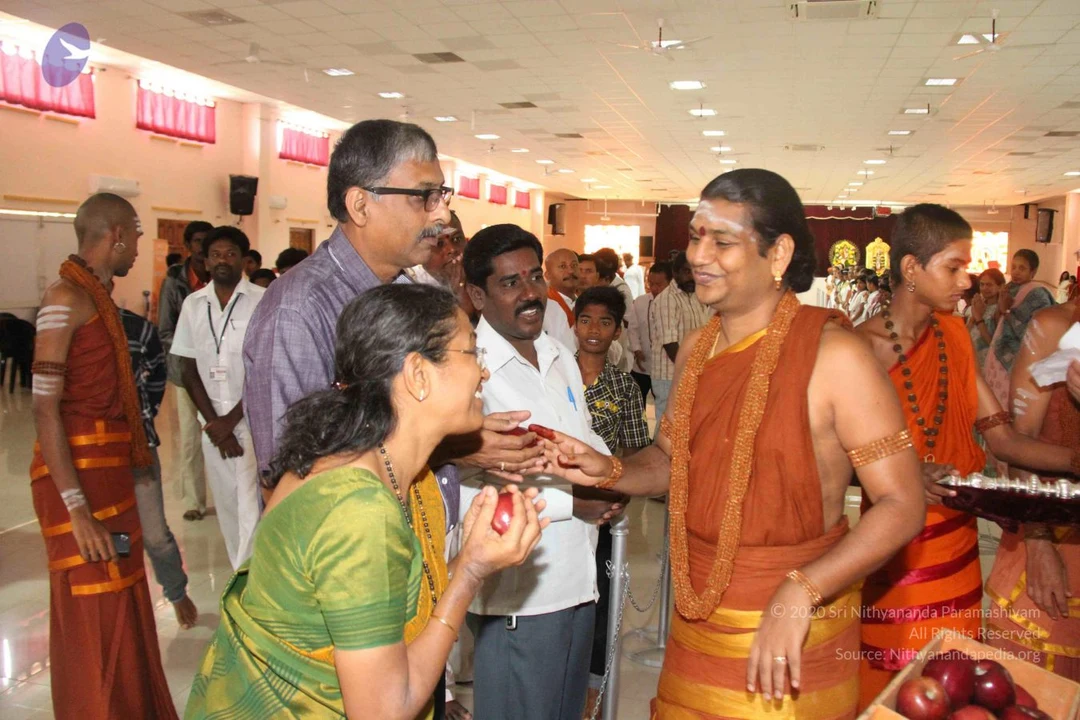
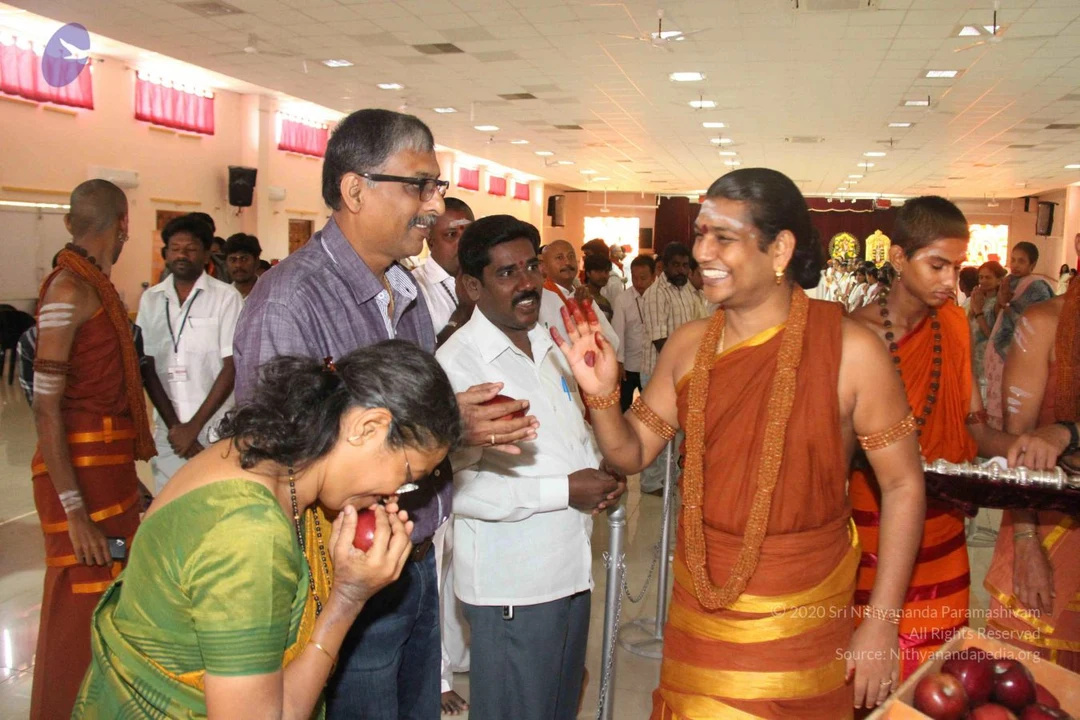
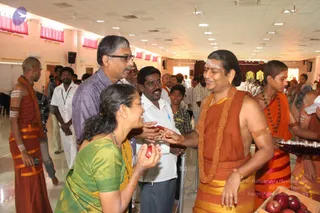
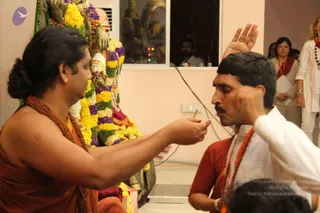
A photograph in a hall with peach walls, a red curtained stage and a large screen showing a colourful image. A man in an orange-saffron dhoti and shawl with a long rudraksha-style bead necklace and gold armlets raises one hand in blessing toward a line of people. Two men in white dhotis and shirts stand with palms pressed together in namaskar, one in white hair and glasses at left, with the others bowing heads. Behind them, a second figure in orange clothing holds a tray, and gold-decorated deity murti with garlands are visible on the stage.Photograph of a devotee receiving a blessing in an indoor hall. A bare-chested figure in orange-red robes with a yellow-gold waist cloth, a long rudraksha-style bead mala and gold armlets, with hair knotted at the back, presses a hand to the forehead of a young man with hands folded in prayer. Around them, men in white dhotis and shirts, some wearing blue lanyards, stand in a line with palms joined. A camera and tripod appear at right, and a golden decorative backdrop stands in the background beneath red curtains and warm lights. The figure's appearance matches the page's a person reference through distinctive ceremonial cues, so the identification is appearance-based and probable.Indoor hall event with a photo of a figure in saffron-orange robes with a gold-bordered orange dhoti and a rudraksha mala, bare-chested with a long swept-back hairstyle and a tilak, placing both hands on the head of a young man in a light blue t-shirt who bows his head. a person in saffron and rudraksha, performing a blessing on a devotee. Around them, men in white shirts and dhotis with rudraksha malas and women in saris stand watching. A flower tray with orange and white garlands sits at right, and red curtains and a lit deity display frame the background.A photograph in a large hall with red-curtained windows and a gold-framed altar in the background. A smiling man in an orange saffron robe with a long rudraksha-style bead garland and orange bangles stands on the right, a sacred ash mark on his forehead and a red dot at the centre. He extends his right hand, palm open, toward a line of devotees. A man in a white shirt bows low on the left and others in white shirts and a maroon shirt stand with hands folded in prayer behind a metal barrier. Some children are visible at the edges.A photo of a large indoor hall with cream walls, a white drop ceiling and red banners on the upper wall. In the centre, a man in an orange-saffron dhoti and shawl with a long gold-coloured garland and a white-and-red forehead mark stands smiling and reaching out a hand to take an apple from a woman in a green sari and gold jewellery. A man in a grey-striped shirt and glasses stands behind her, and a man in a white shirt and grey trousers is nearby. To the right, a young man with a shaved head wears an orange dhoti and a beaded mala, holding a silver tray. Several other people in orange dhotis with white body markings stand around the room, and a tray of red apples sits in the lower right foreground. a person candidate is visible in the centre, shown by his long swept-back hair, saffron clothing and gold garland. He is receiving a fruit offering from a devotee.Indoor hall scene with a woman in a green sari bending to bite an apple held by a man in a blue-grey shirt and glasses. A person in a saffron-orange dhoti and shawl with a long rudraksha-style garland and yellow borders stands smiling with raised hand, a gold bangle on the wrist. Two other saffron-clad men with white body markings stand nearby, and a man in a white shirt watches. Red apples sit in a basket at the lower right, and a decorated shrine with lamps is visible in the background.

Swamiji-Satsang
10 photosSource gallery
A photograph of a temple-style stage with painted pillars and a gold-framed ornate backdrop. Seated on a gold throne at left is a man in saffron-orange robes with a swept-back hairstyle; the presentation is consistent with a person, with a large throne, orange robes and an attendant nearby. In front of him a priest in orange cloth with white sacred ash marks on his arms and body holds a lamp toward the stage. At right, a gold-and-red throne holds a garlanded figure beside a seated man in white dhoti with a white turban, and a young girl in a blue skirt with a flower garland stands at the edge. A central deity murti decorated with yellow and purple garlands and a green cloth sits on a pink base, with brass lamps flanking the scene.A photograph of a stage event with a golden cobra-hooded deity murti seated on a gold base draped with yellow and purple garlands, holding a veena-like instrument. Beside it stands a smiling man in a saffron-orange robe with a gold-toned rudraksha-style mala necklace and a gold waist sash, with a red forehead mark, standing next to a clear acrylic lectern with brass lamp stands. Behind him are painted pillars in pink, orange and green, and a female deity statue holding a lotus. A golden lion-like statue sits at the right edge. The man is the only physical person visible.A man in an orange-brown saffron robe with a gold-striped border and a long rudraksha mala stands beside a clear acrylic lectern, smiling, with a red bindi and white markings on his forehead. A golden cobra-hooded deity murti wrapped in yellow and green flower garlands and blue-purple cloth sits on a purple draped pedestal to the left. A golden lion statue and a painted goddess figure holding a fan appear at the right, against a painted temple-style backdrop with pink and blue columns.A man in rust-orange robes stands at a clear acrylic lectern in front of a stage backdrop of blue pillars with orange and green lotus capitals. He wears a white vertical forehead mark with a red dot, a thick orange-brown beaded necklace, gold earrings and gold bangles, and holds a microphone near his face while smiling and looking upward. To his right stands a painted deity murti with a gold crown, gold jewellery and an upraised hand holding a lotus. Marigold garlands decorate the lectern and a golden lion figure sits at the lower right. a person is shown, with an orange robe, a rudraksha-style beaded necklace and a bare-armed ceremonial appearance cues that suggest a discourse setting.A smiling man in saffron-orange robes stands beside a clear acrylic lectern on a stage. He wears a long beaded necklace of rudraksha-style beads, gold bangles and an armlet, a white tripundra and red bindi on his forehead, and a small microphone at his cheek. Behind him are pink and green pillars and a painted deity figure with a gold crown and jewellery. Yellow and purple flower garlands hang at the left edge, next to a golden cobra hood. The lectern has a folded pink cloth on it. The man's name is not printed in the frame and his identity is not established from appearance, so no a person label is applied here.A smiling man stands at a clear acrylic lectern on a stage, speaking into a headset microphone. He wears a rust-orange dhoti and shawl with a thick gold-toned beaded necklace, gold bangles on his upper arm and wrist, and white tripundra with a red bindi on his forehead. He rests one hand on the lectern, which has a folded orange cloth on top. Behind him stands a painted deity murti with a crown, gold jewelry and an orange body, beside a golden cobra hood. Purple and yellow flower garlands frame the left edge and brass oil lamps stand near the lectern. a person: the man has a shaved-looking short hairstyle with white tripundra and orange-saffron robes, a discourse setting consistent with the page, so the candidate is present in person.

FinalBlessing-Swamiji-Deities

2 photosSource gallery
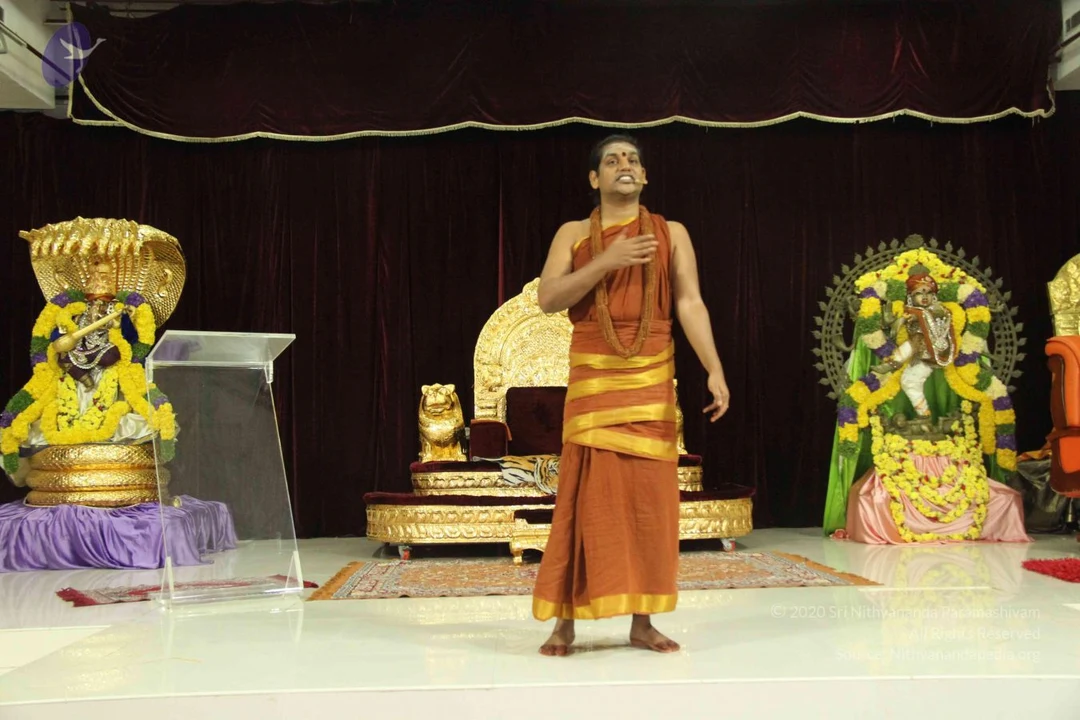
A standing man in an orange-saffron dhoti and shawl, with a long rudraksha mala around his neck, raises one hand in a blessing gesture at the left of a temple-like hall. Behind him stands a gold-and-yellow flower-garlanded deity murti of Nataraja-style form with a crown, flanked by a second garlanded deity figure seated under a gold arch. A large gold lion-footed throne and maroon velvet drapery frame the stage, with red and patterned rugs on the white floor. The main figure is described as a probable Swamiji by appearance cues: long swept-back hair, saffron clothing, and rudraksha mala.A standing man in orange-saffron robes with a gold-bordered dhoti and a long saffron shawl over one shoulder, wearing a beaded rudraksha-style necklace, stands on a stage at left, gesturing with one hand. Beside him is a gold lion-armed throne with red velvet cushion. Behind them a deep maroon velvet curtain hangs. Center stage, a bronze Nataraja-style deity murti with a prabhamandala halo is garlanded with yellow, purple and green flower garlands, and seated on a pink satin cloth. At right, a deity murti in a gold arched shrine niche with orange drapery is garlanded with flowers and wears a crown.

Swamiji-Deities-Aarthi

4 photosSource gallery
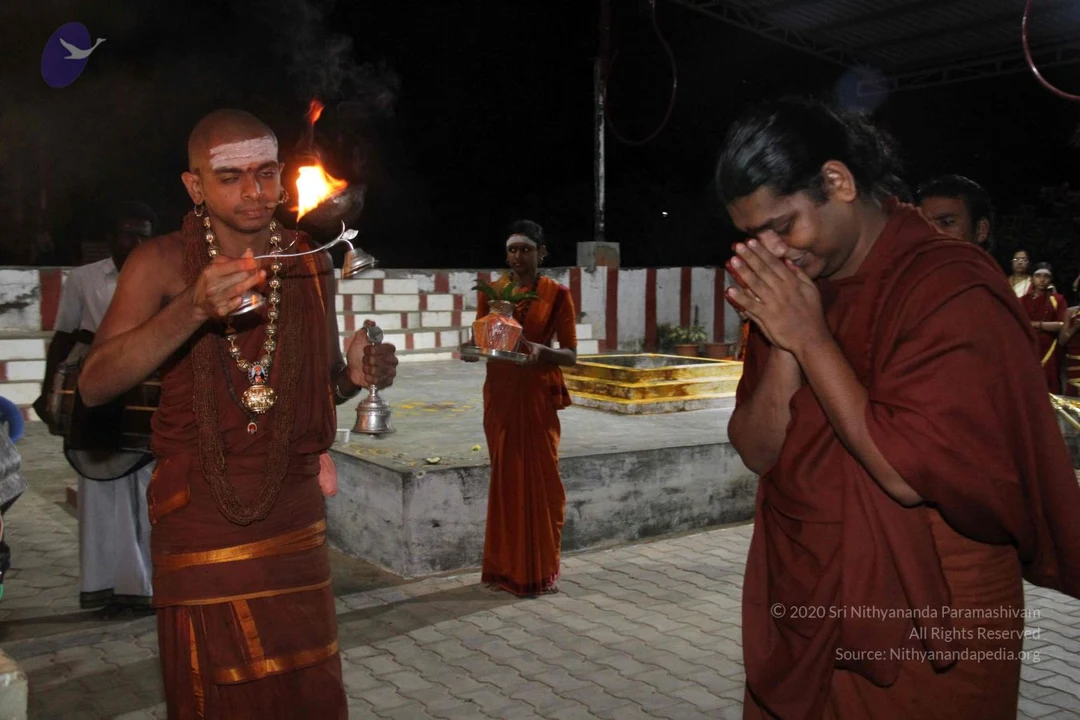
Beside him stands a painted statue of a multi-armed deity in orange dhoti. At centre, a deity murti dressed in green cloth and garlanded with yellow and purple flowers sits in front of a golden arch-shaped backdrop. To the right, a young male performer in a striped tiger-pattern dhoti, white turban and flower garlands stands beside a female performer in a dark gold sari with purple-and-yellow garlands and a large headdress. Brass oil lamps stand on the floor and a child in blue skirt with garlands is at far right.Photo of a temple-style stage with a painted blue and gold backdrop, golden deity murtis garlanded with yellow and purple flowers, and a golden naga-hooded figure on the left. A seated figure in orange robes sits on a golden throne flanked by two gold lion-footed pillars and two standing deity figures. In the foreground a bald man in an orange dhoti and orange shawl with a sash stands with his back to the camera, facing the stage. A clear acrylic lectern stands on the left and a monitor shows a live feed at the lower right. Ornate gold lamps and a red curtain frame the scene.Photograph of a temple-style stage performance with a painted backdrop of pillars and a golden doorway. In the centre, a deity murti in a garland of yellow and purple flowers sits on a green and pink draped platform, flanked by a lit brass oil lamp. On the left, a man in white ritual clothing sits on a gold throne, and two painted attendant figures with fly whisks stand beside it. A shaved-headed priest in an orange shawl, seen from behind, holds a ceremonial item near the stage edge. On the right, a man in white with a saffron turban and a garland sits with hands folded, next to a costumed figure on a gold throne. A young girl in a blue skirt and yellow garland stands at the far right. a person candidate not established by appearance; role-based description only.A photograph of a temple-style stage decorated with painted pillars and a maroon valance. A devotee in saffron robes with a bald head stands in the foreground, facing the stage and holding a lit camphor flame. On the stage, a seated man in saffron clothes with folded hands sits on a gold throne flanked by two painted dvarapala guardian figures. At right, a richly garlanded metal deity murti is adorned with yellow and purple flower garlands on a green and pink base, while two performers in ceremonial costume stand near a gold throne, one in white dhoti with a garland and the other in a dark robe with a crown, and a young girl in a blue skirt with a yellow garland stands at the far right. Brass oil lamps stand on the floor between the figures.

Ganamukhasura-Samhara-Ganeha-Brahmotsav

36 photosSource gallery
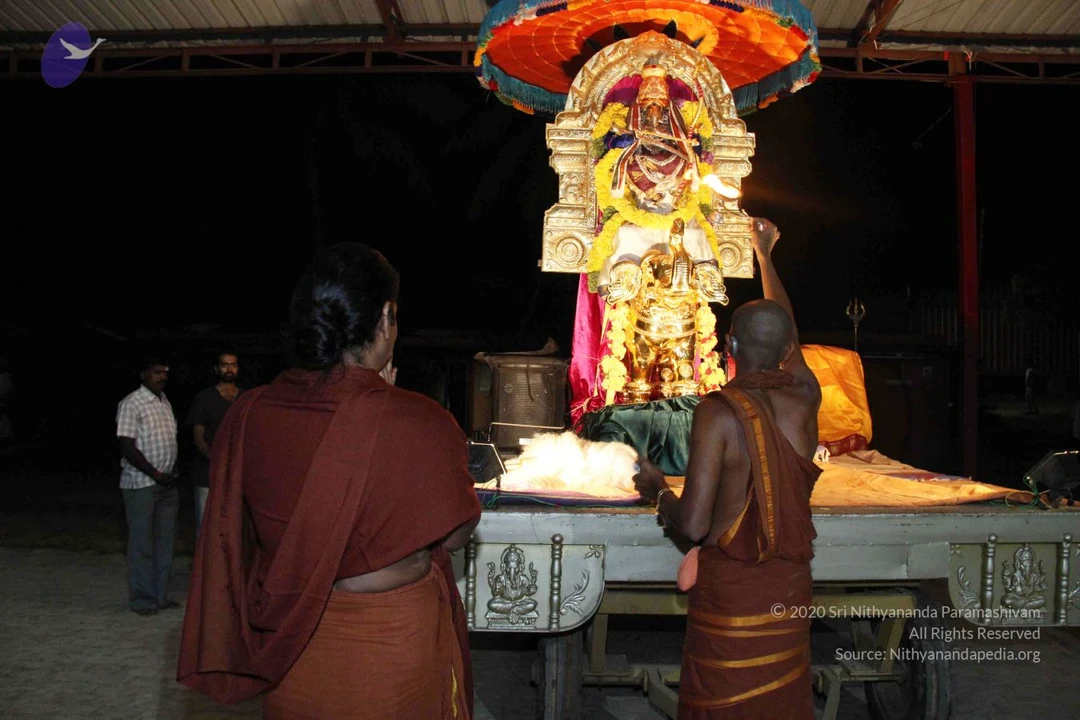
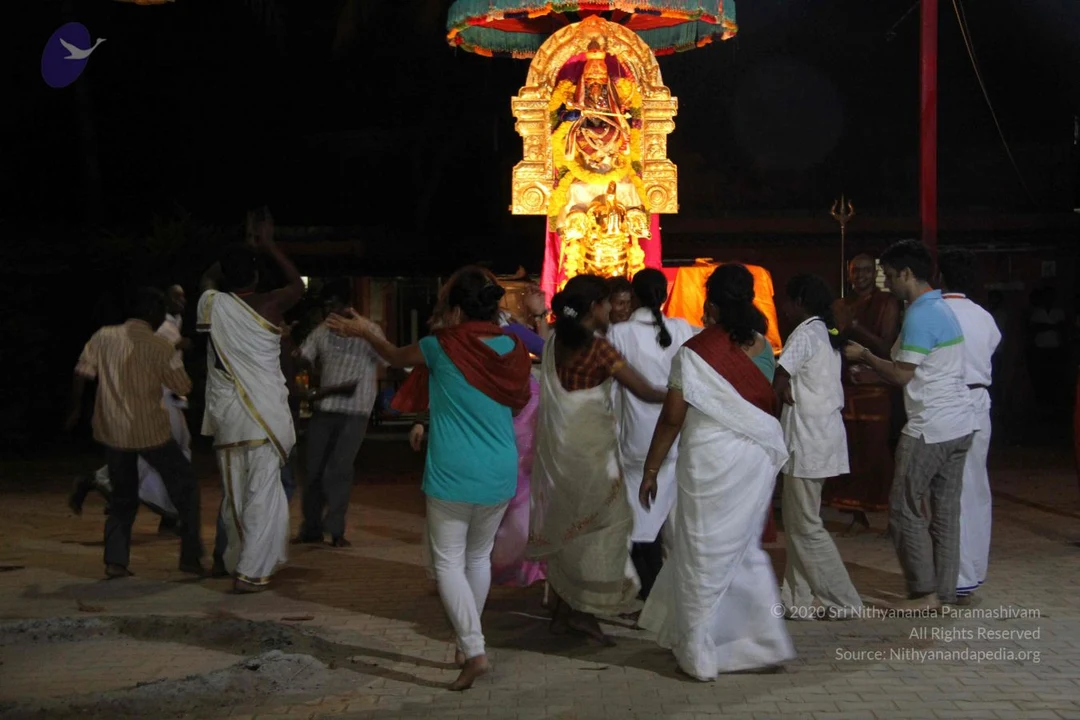
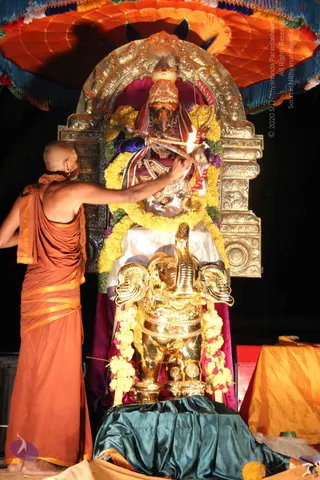
Night outdoor photo of a deity murti decorated with yellow and orange marigold garlands, seated on an ornate silver-framed throne under a large orange and red canopy on a wooden cart with carved Ganesha panels. Two people stand in the foreground: a figure in maroon robes with hair tied back on the left, and a shaved-headed priest in orange-brown dhoti and shawl on the right who is raising a lamp toward the murti. Fire or light glows near the base, and a few onlookers stand in the dim background at left.Night photograph of a ceremonial procession cart with a metal-decorated front panel showing seated Ganesha reliefs. On it stands a deity murti under an ornate golden arch and a large orange-and-red canopy, draped in yellow and orange marigold garlands and a red cloth, with a golden kalasha-like vessel at its base. In the foreground two people in maroon-brown robes face the cart, one holding a lit lamp or flame. Two men in casual shirts stand at the left edge under dark surroundings. Oil lamp light and small fires illuminate the scene.Night photograph of a decorated deity murti on a ceremonial cart or platform, framed by an orange and red umbrella canopy with fringe and gold arch. The murti wears yellow and orange marigold garlands and a rich gold-toned ornamented setting. In the foreground, two figures in ochre and rust robes face the deity from behind: a woman with dark hair in a bun pressing her palms together in prayer, and a shaved-headed person in ochre garments with gold border stripes holding an oil lamp. A brass ganesha relief decorates the cart's front panel, and white cloth and an orange cloth lie on the platform. A man in a checked shirt stands at the left edge.A photograph of a deity murti, a metal-cast idol seated in a golden arched shrine with a gilded frame. The murti wears a tall gold crown, a maroon and white striped garment, a silver-and-red jewelled necklace, and blue draped cloth, and holds a long staff wrapped in red and a bow-like implement. Thick garlands of yellow marigolds and green leaves surround the figure, and a large orange canopy with fringed edges stretches overhead against a dark background. No physical people are visible.A festival deity murti is carried or displayed on a gold-framed palanquin-style throne with an arched gold backdrop and a large orange umbrella canopy with blue and green tassels above it. The murti wears a purple and maroon garment with red and white banded sashes, a layered gold crown, a trident-like staff and a rudraksha-style mala, decorated with yellow marigold garlands and green leaves. A gold vahana-like base with elephant-trunk style ornaments sits in the foreground, and the setting is a dark indoor hall. No physical people are visible.A heavily overexposed outdoor photograph with a bright white glare washing out most of the frame. A faint outline of palm fronds appears at the upper right, and a lit string of lights or garland curves across the centre. A dark arm or sleeve extends from the left edge, but no face or full figure is clearly visible. No clear ritual, person or event can be identified with confidence.

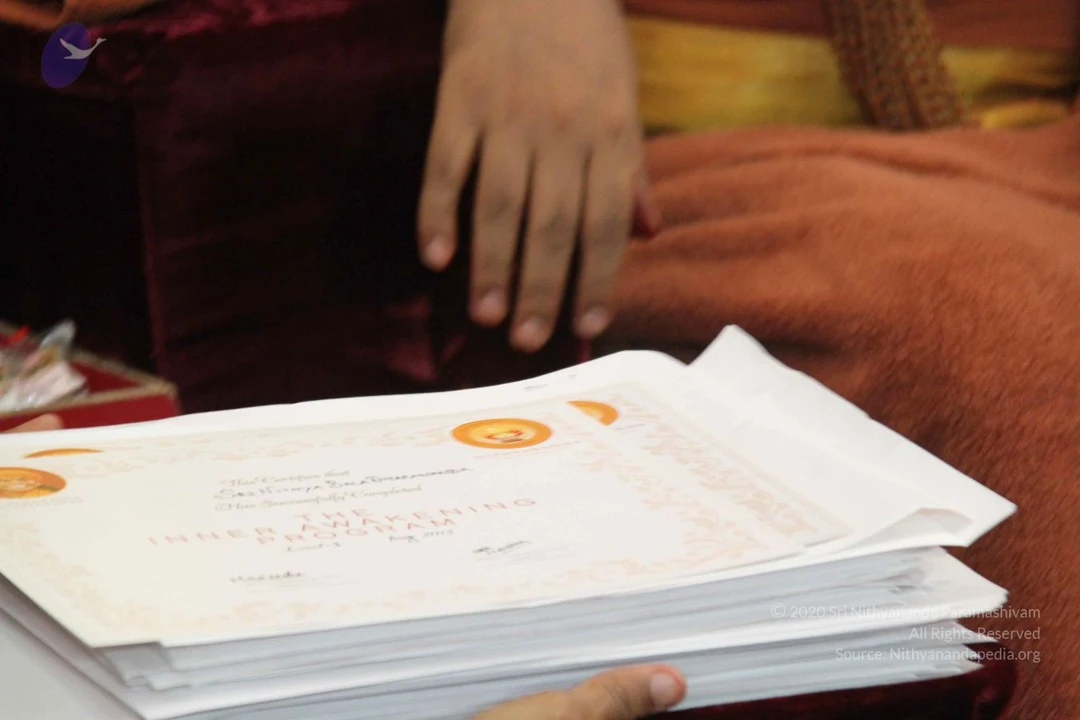
IA-GraduationDay

6 photosSource gallery
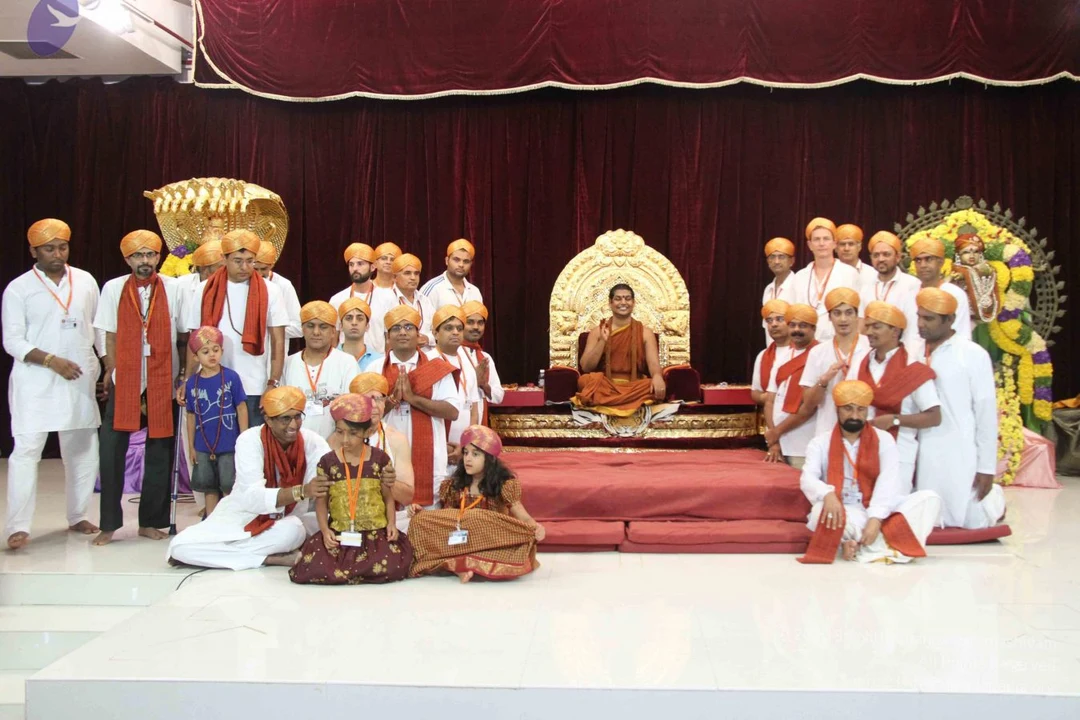
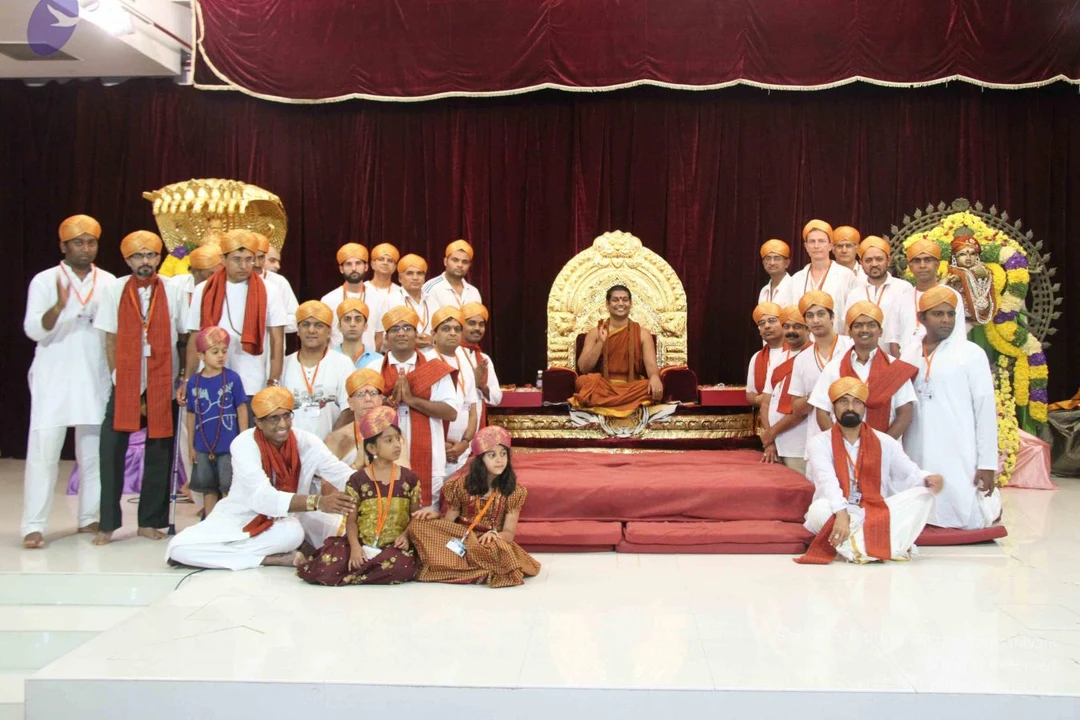
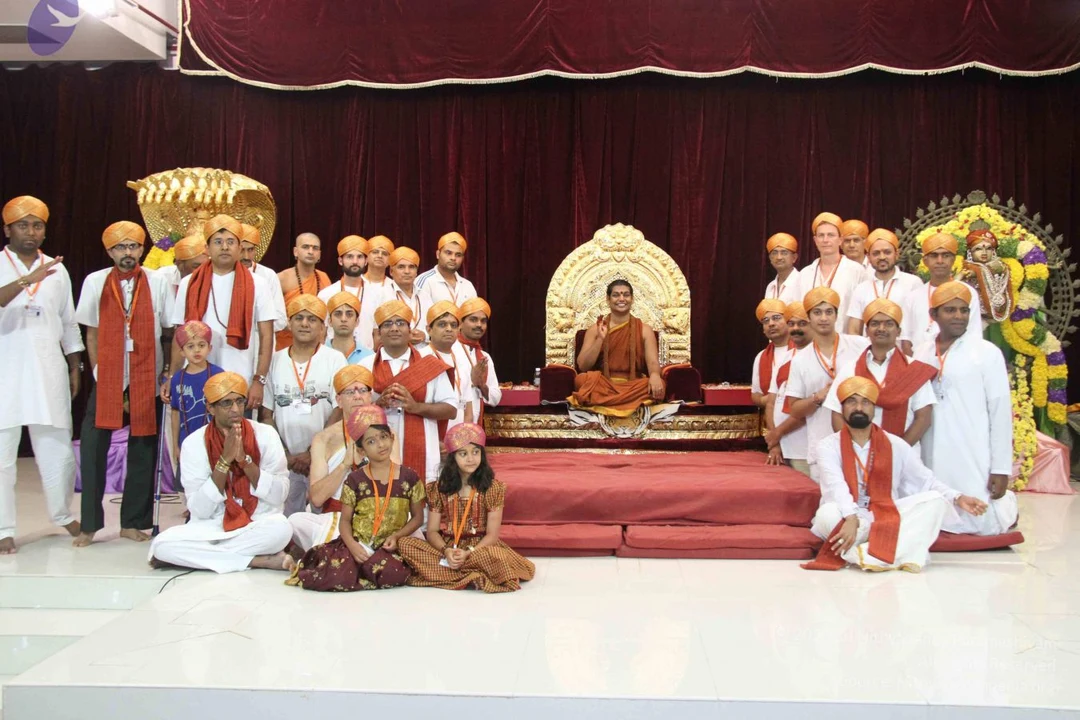
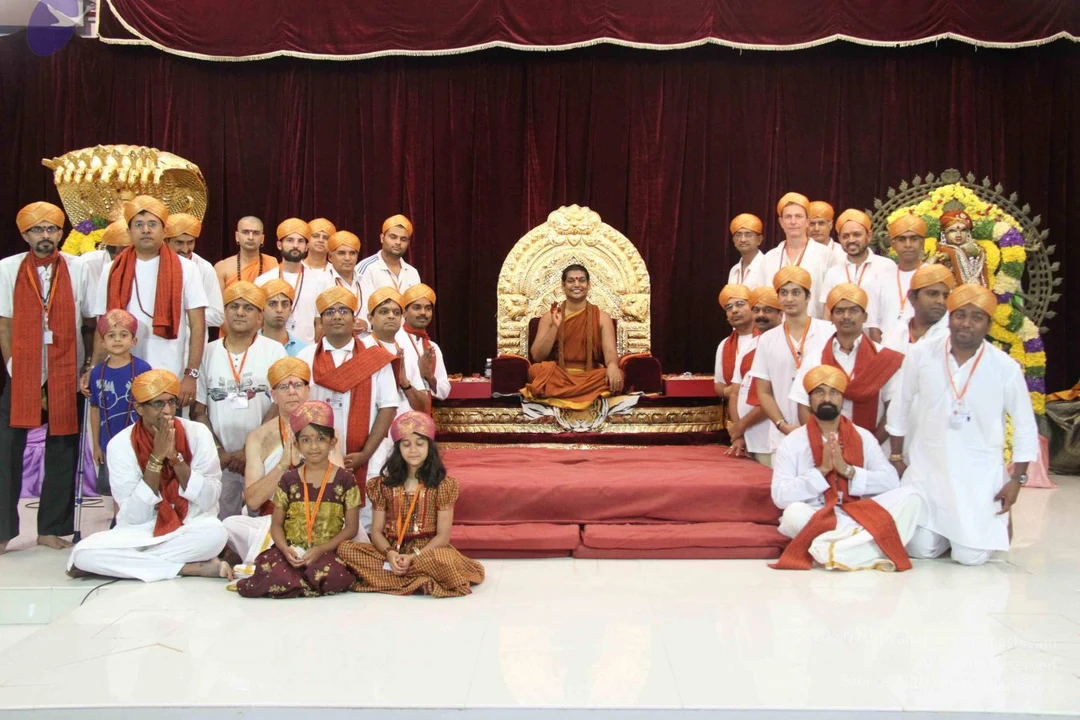
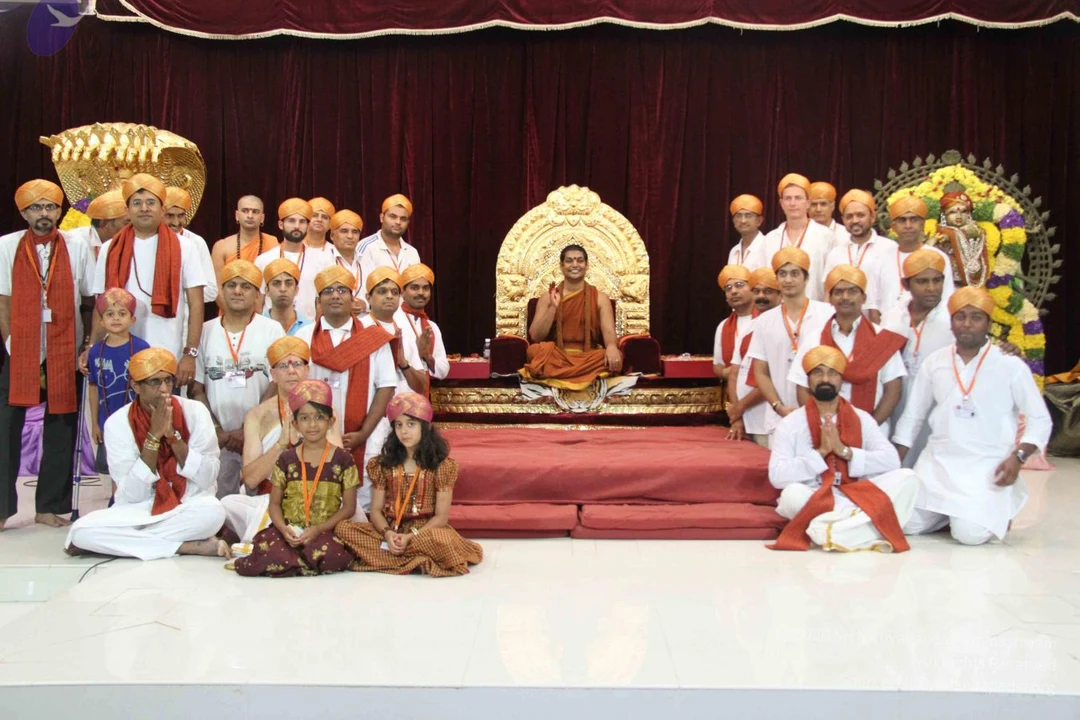
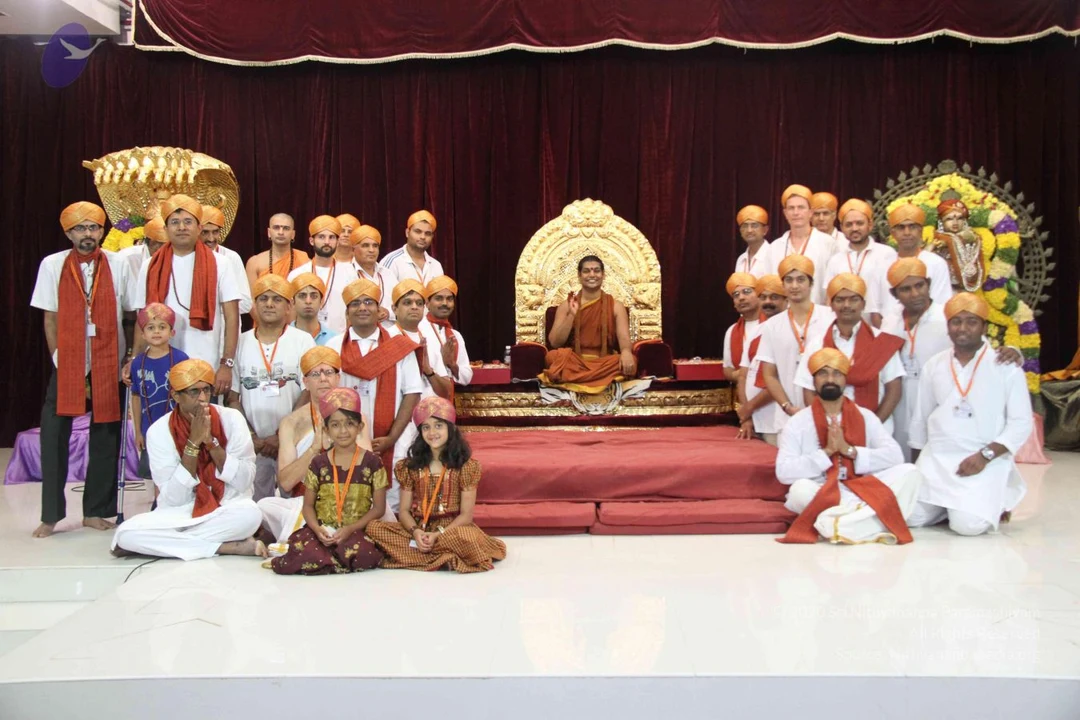
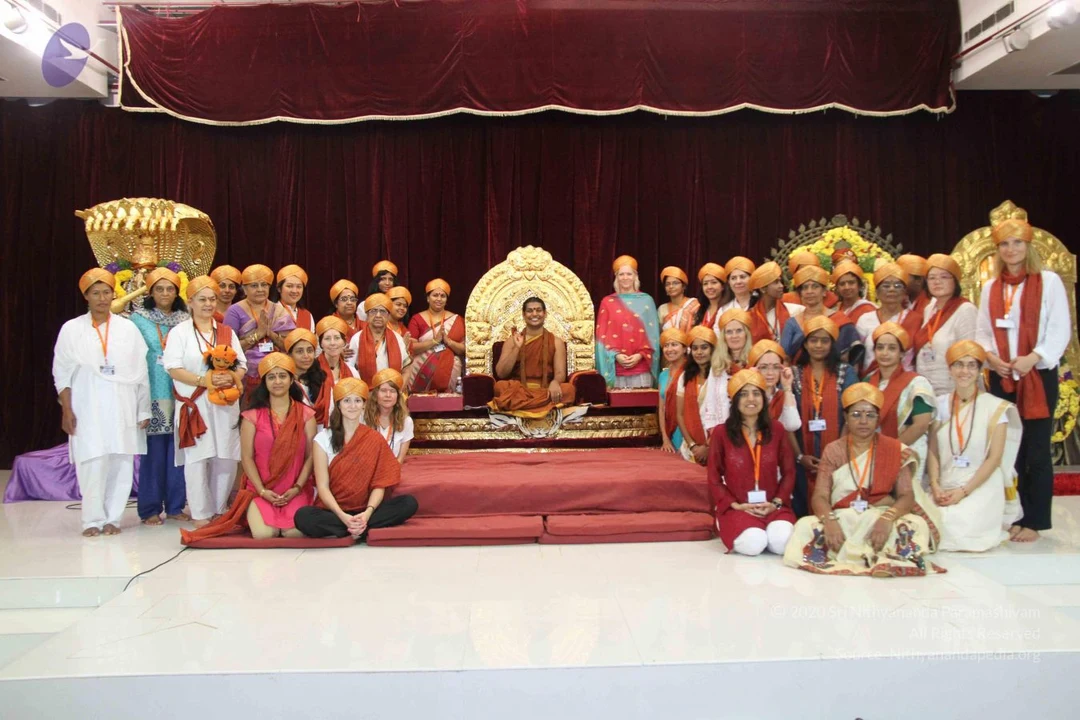
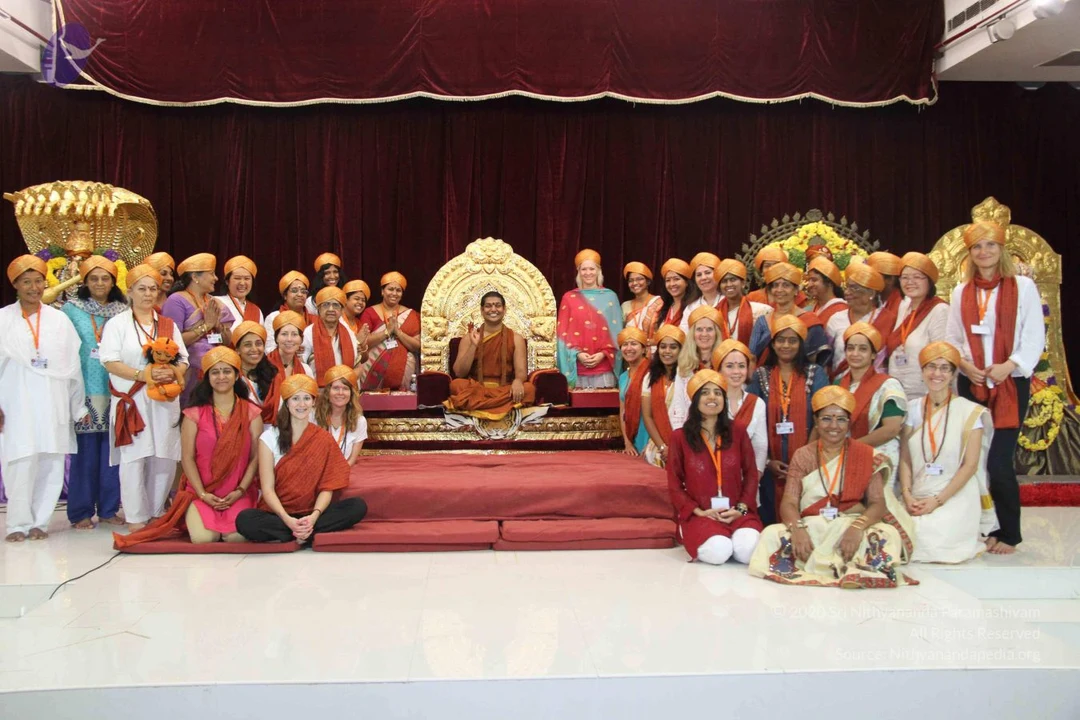
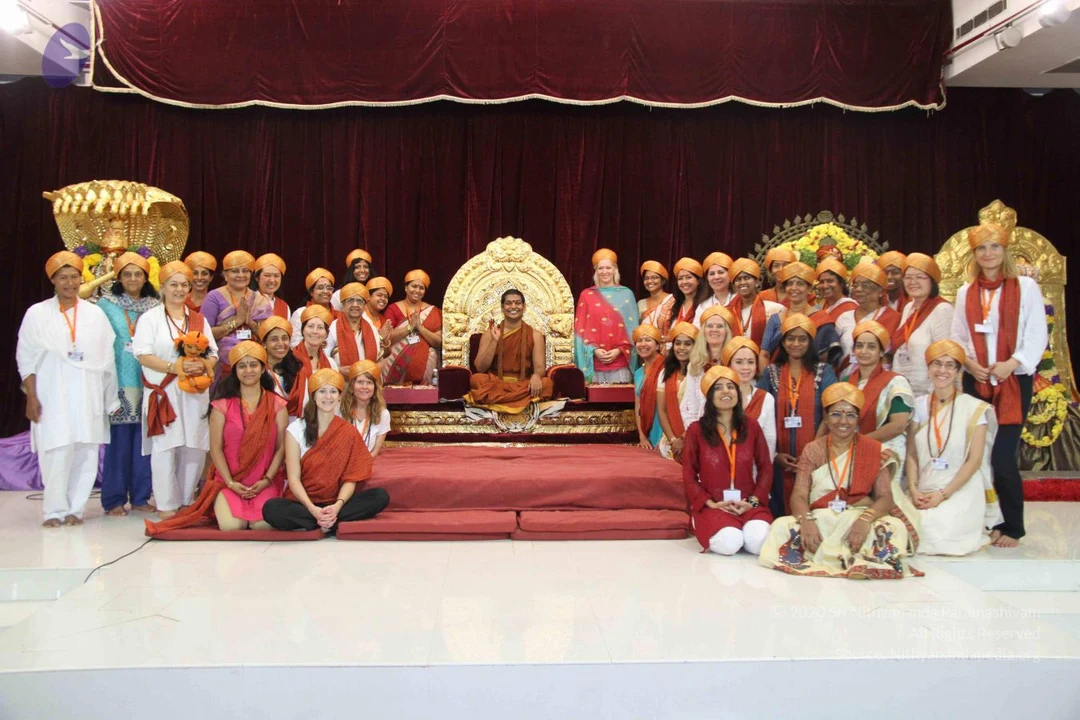
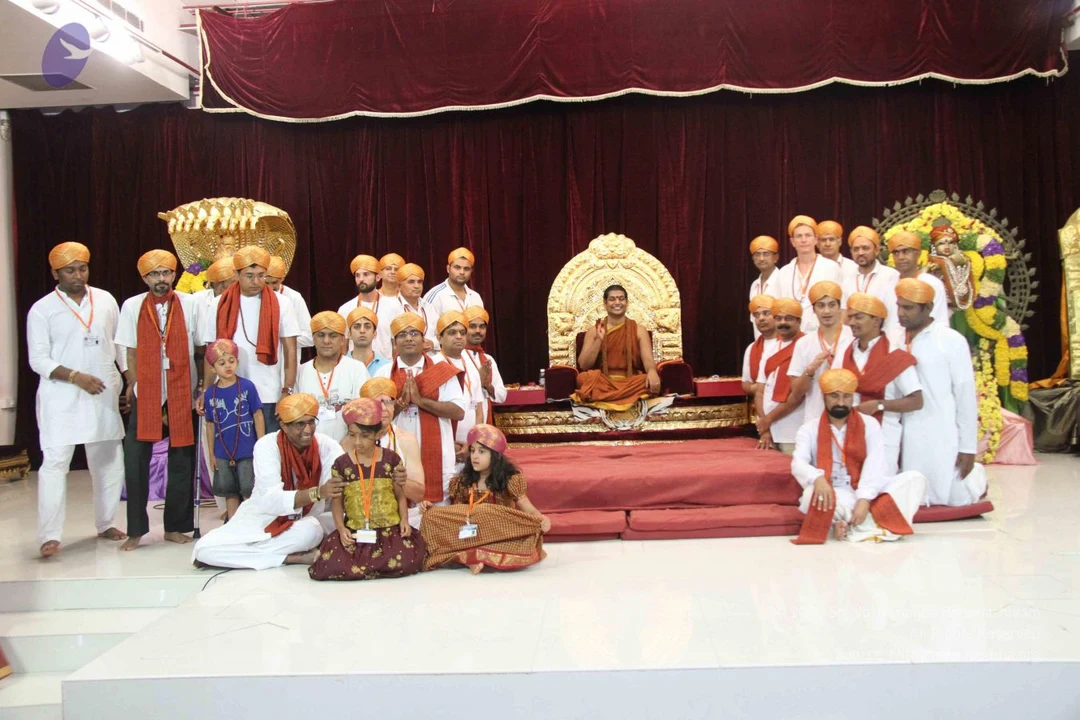
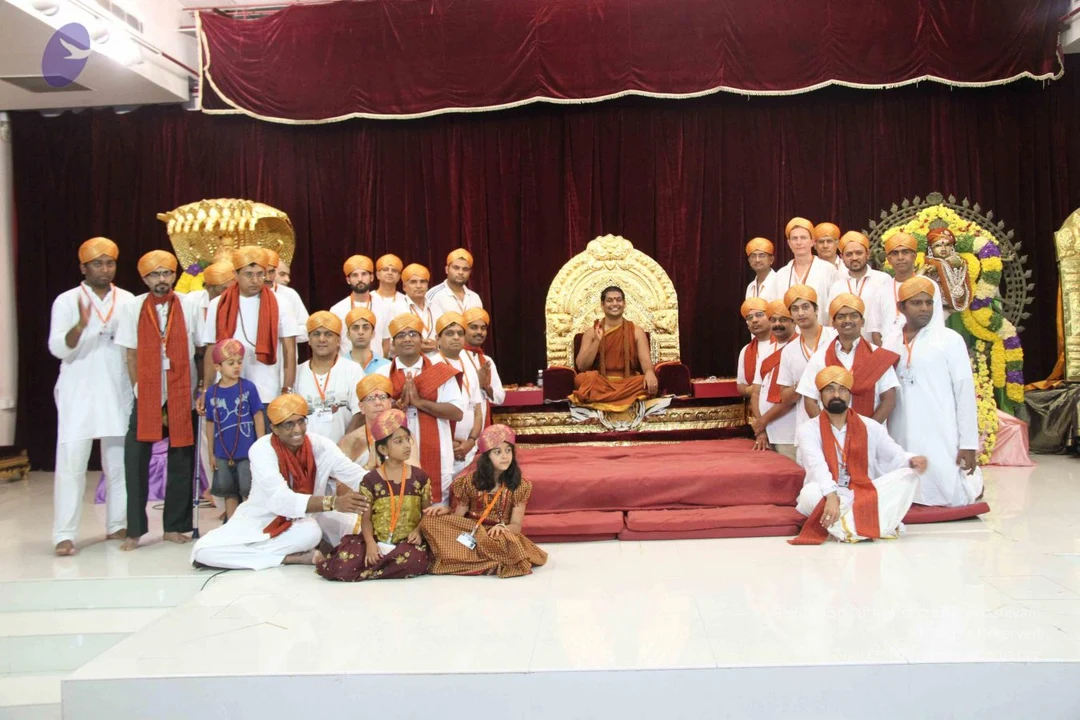
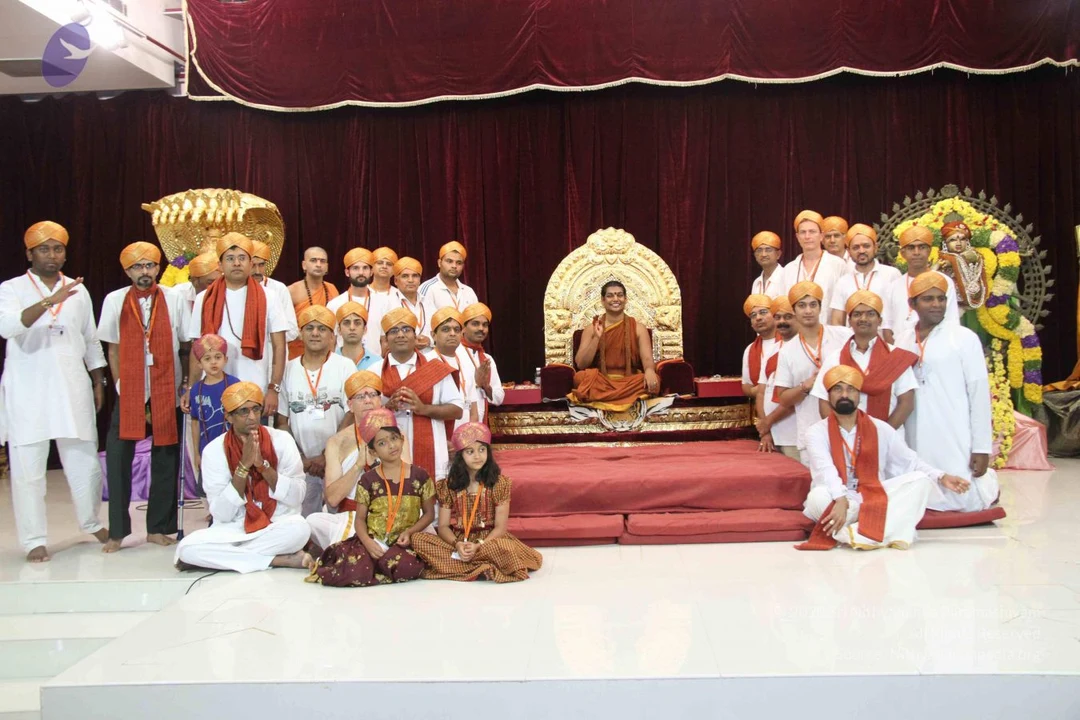
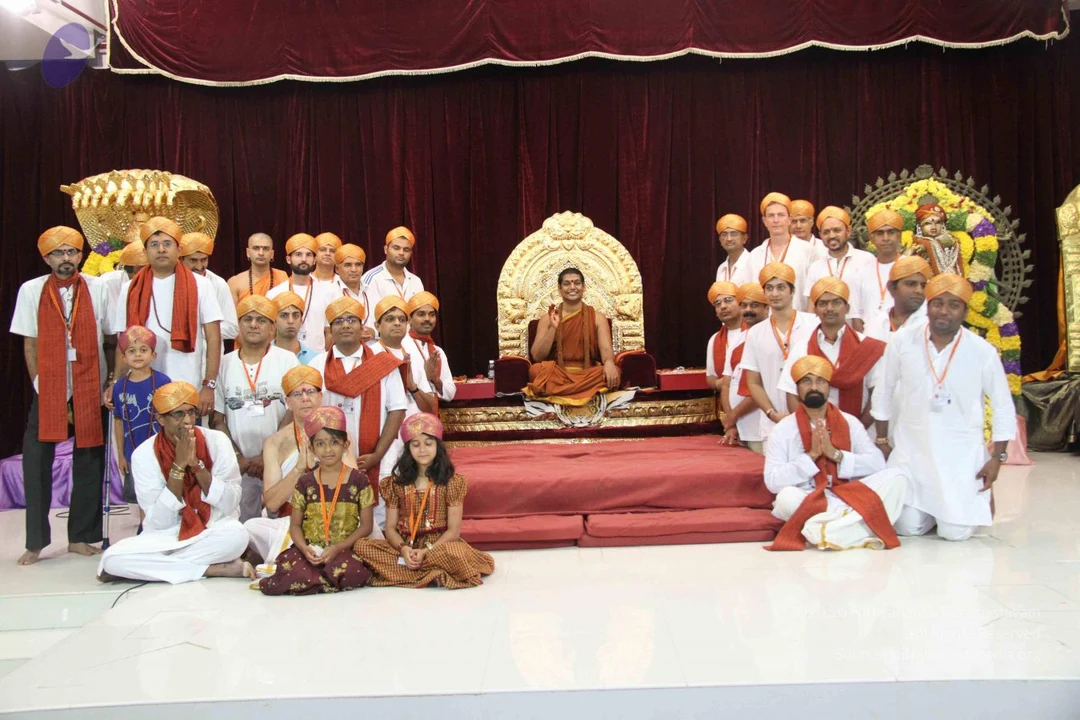
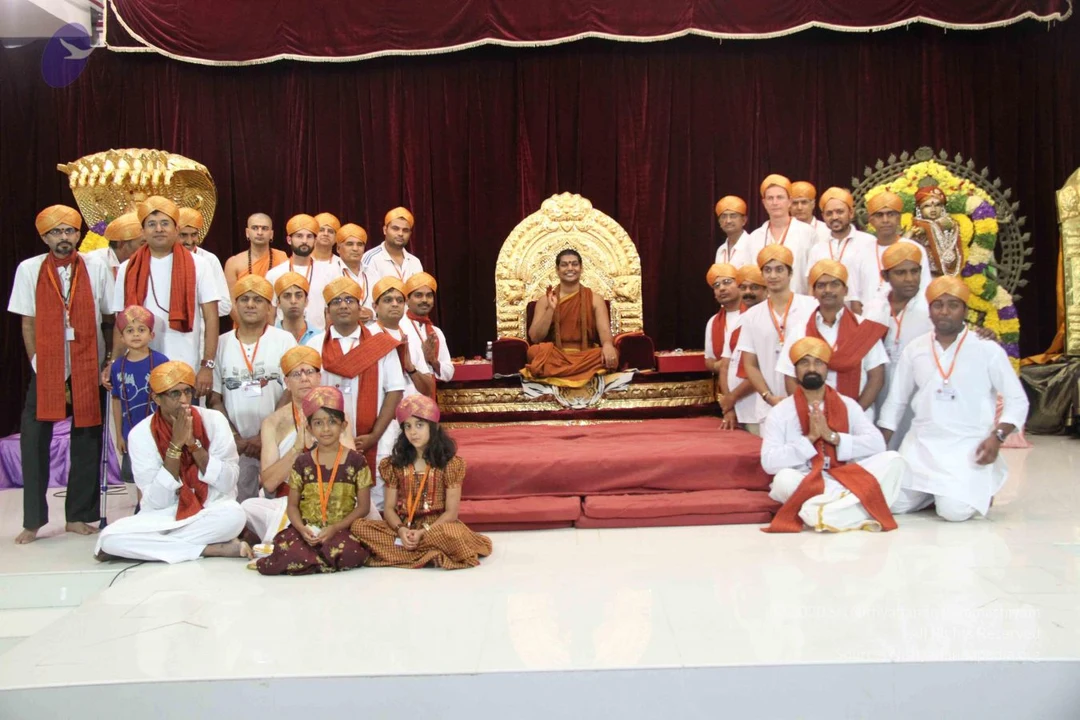
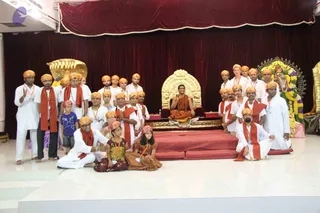
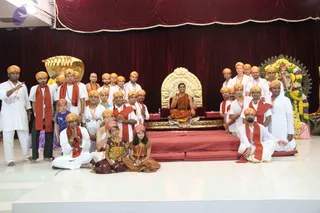
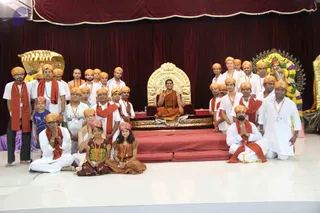
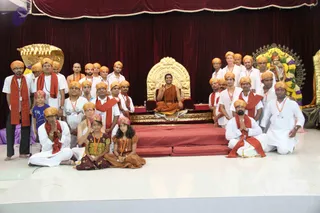
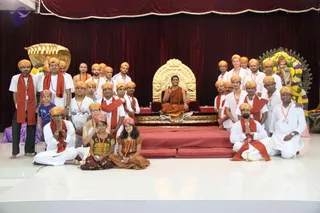
Group photograph on a stage before a deep red velvet drape. A seated figure in saffron-orange robes sits on an ornate golden throne with a carved arched back, one hand raised in blessing. Around him stand about two dozen men in white kurta-style clothing, orange-yellow turbans and red shawls, many wearing orange lanyard badges; two younger girls sit in the front on the red-cushioned platform, one in a patterned pink-and-gold outfit. A golden cobra-hooded throne stands to the left, and a large floral garland arrangement with a small deity figure is on the right.A group photograph on a stage before a deep red velvet drape. A seated man in saffron-orange robes sits on a gold throne with a gold canopy, raising one hand in blessing. Around him stand and kneel roughly two dozen men in white kurta-style clothes with orange turbans, many wearing red-orange shawls and orange necklaces. Two young girls in gold-and-brown embroidered dress sit in front, and a small boy in a blue shirt stands at left. On the right a deity murti is decorated with a large garland of yellow and orange flowers, and a gold kalasha-like ornament rests at left. White flooring and a red cushioned seat are in the foreground.Group photograph on a stage with dark red velvet drapes. A seated figure in saffron-orange robes sits on an ornate gold throne with a red cushioned dais in front. Around him stand and kneel many men in white kurtas with orange-saffron turbans and red-orange shawls, some with orange lanyard badges, and several children in orange and patterned clothes sit in front. A gold cobra hood ornament stands at upper left and a floral garland decorated backdrop with a deity image hangs at right. Many people are visible, all counted here, and the seated figure's identity cannot be confirmed from appearance.A group photograph on a stage draped with deep red velvet curtains. A seated figure in saffron-orange robes sits on an ornate gold throne with a red cushioned base, raising one hand in blessing. Around him stand many men in white kurta-style clothes, most wearing orange-and-yellow turbans and red or orange shawls with lanyards, some with hands folded in namaskar. Two young girls in patterned orange-and-brown dresses sit at the front, and a small boy in blue stands at left. Behind the throne is a flower-decorated arch with a garlanded deity murti at right, and a gold-and-flower decorated structure at left. A man in a white shirt and lanyard stands at the right edge. a person seated on the throne wears saffron robes, with hair not clearly visible, so identity is uncertain.A group photograph on a raised white stage before a dark red velvet drape. A seated man in saffron robes sits on an ornate gold throne with a carved arched back, one hand raised in blessing. Around him stand and kneel about two dozen devotees in white kurtas and dhotis with saffron-orange turbans and orange-red shawls, many with orange lanyards; a few kneel with palms pressed together. Two young girls in colourful traditional dress sit in front. Behind the throne is a flower-decorated frame with a deity image, and a gold hooded serpent canopy stands at the left edge.A group photograph on a raised stage with a dark red velvet curtain backdrop. A seated figure in the centre sits on an ornate gold throne with a gold canopy, wearing an orange-saffron robe and a cloth draped over the shoulders, hands raised in a blessing gesture. Around him stand many men in white kurtas and white dhotis with orange-saffron and red shawls and orange-saffron turbans, several wearing orange garlands; two young girls in patterned orange and maroon dresses sit at the front, and a man in white kneels with hands folded. A gold cobra-hood canopy stands at the left and a floral-decorated deity murti with flower garlands at the right. Red cushions cover the stage floor in front of the throne.

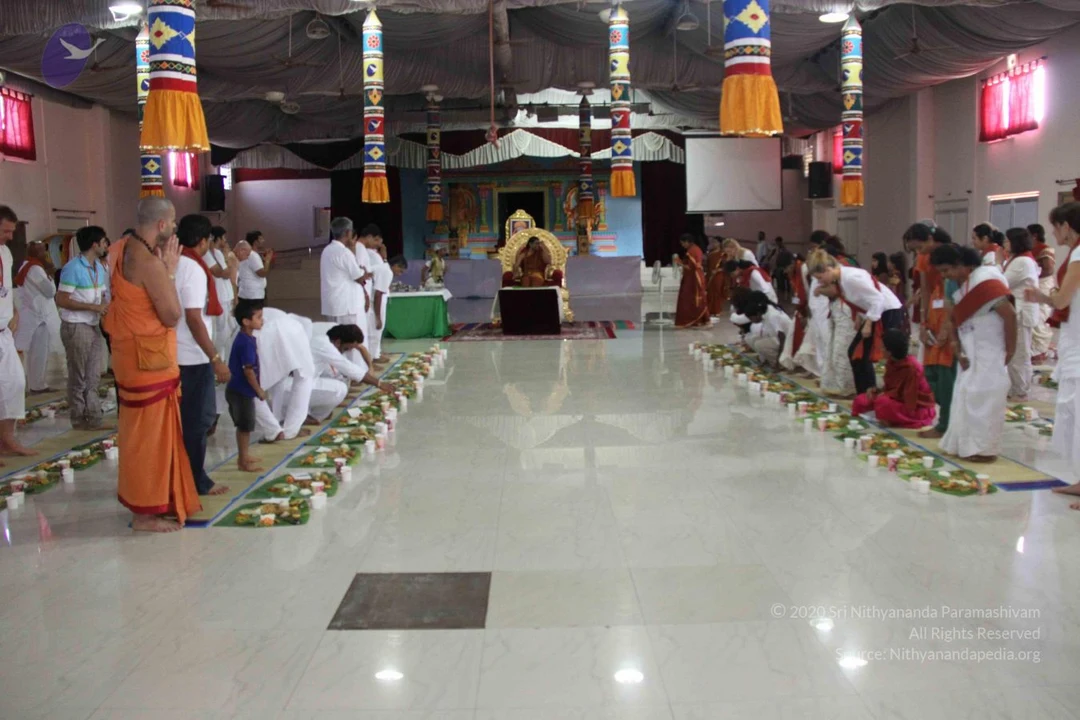
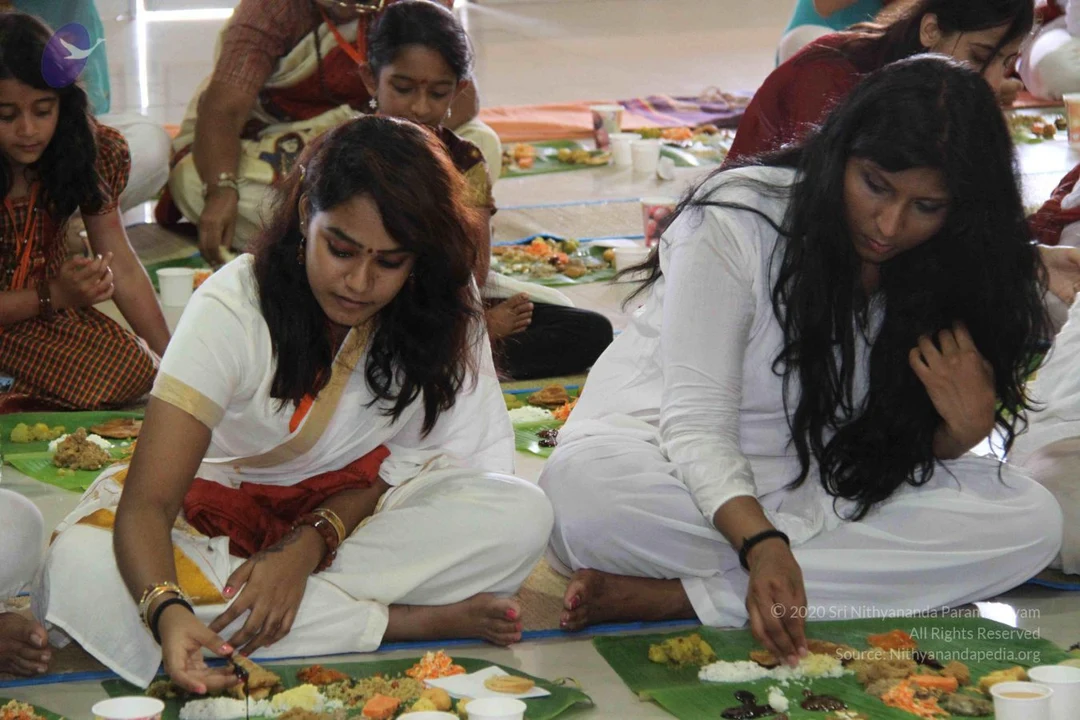
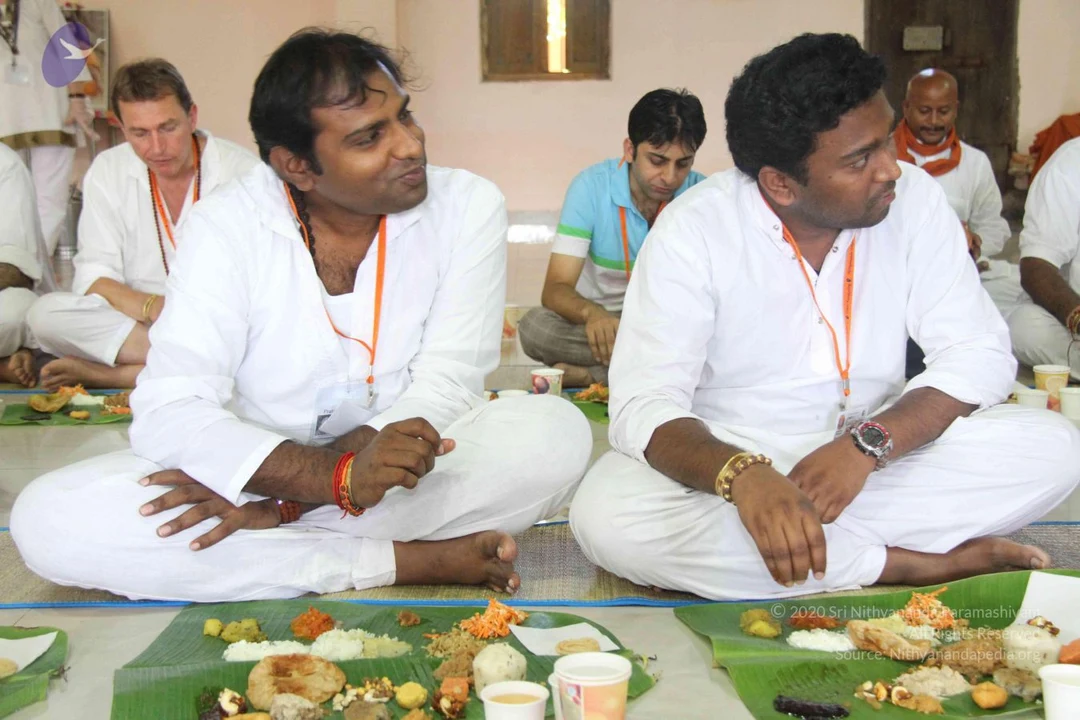
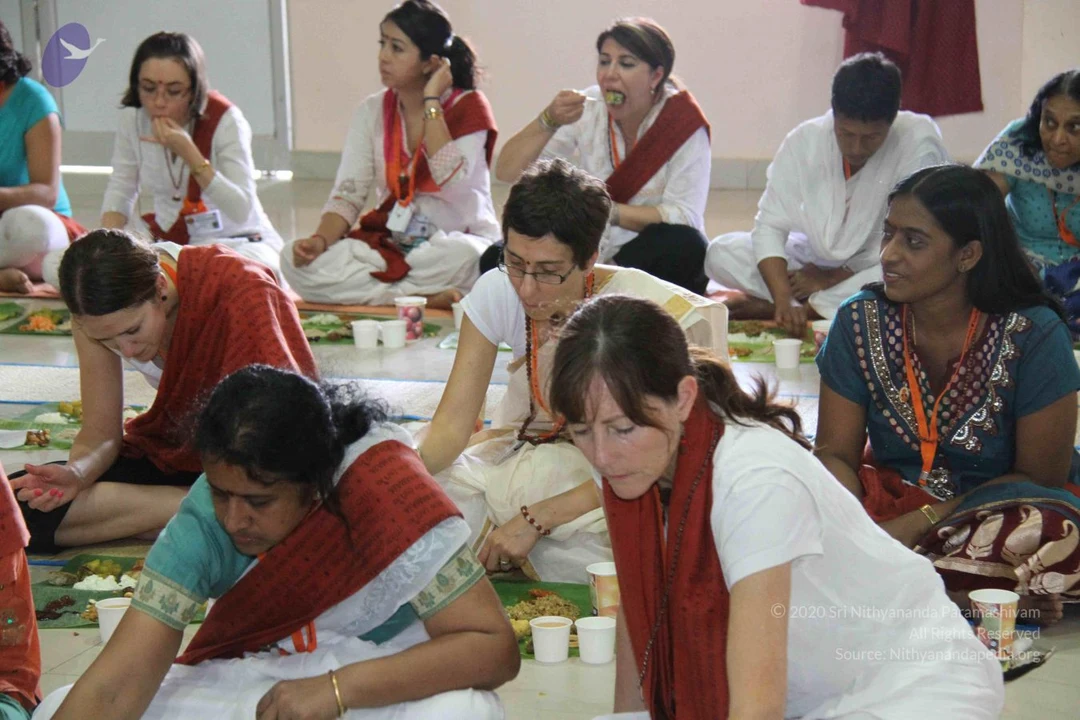
IA-21Naivedyam-Pictures

38 photosSource gallery
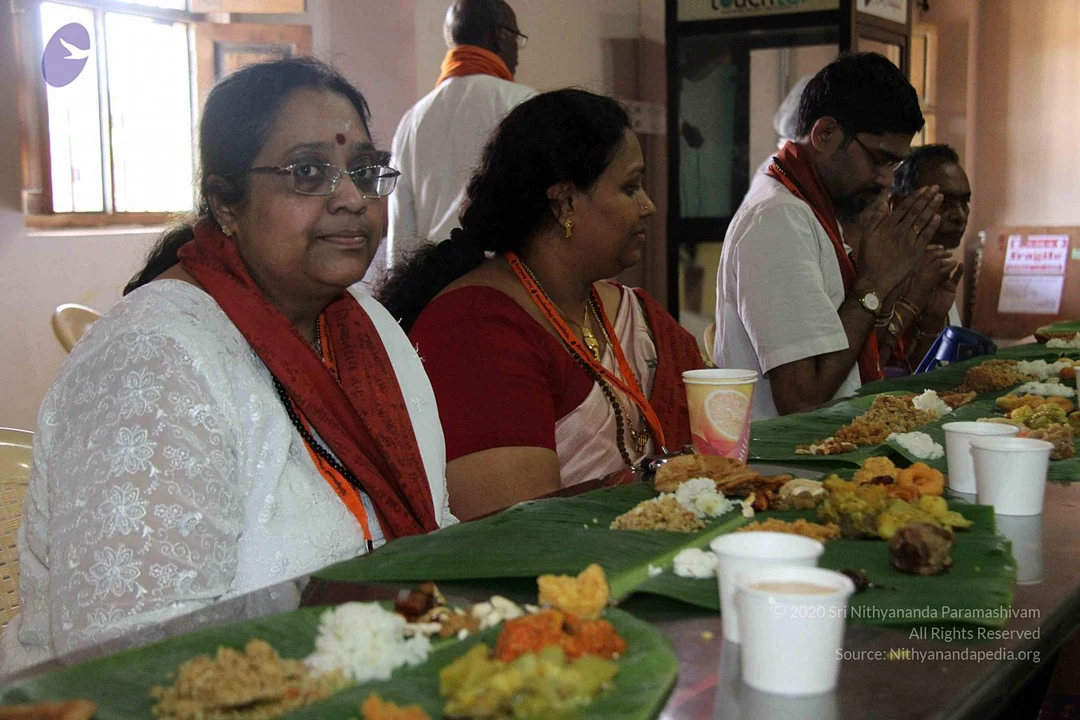
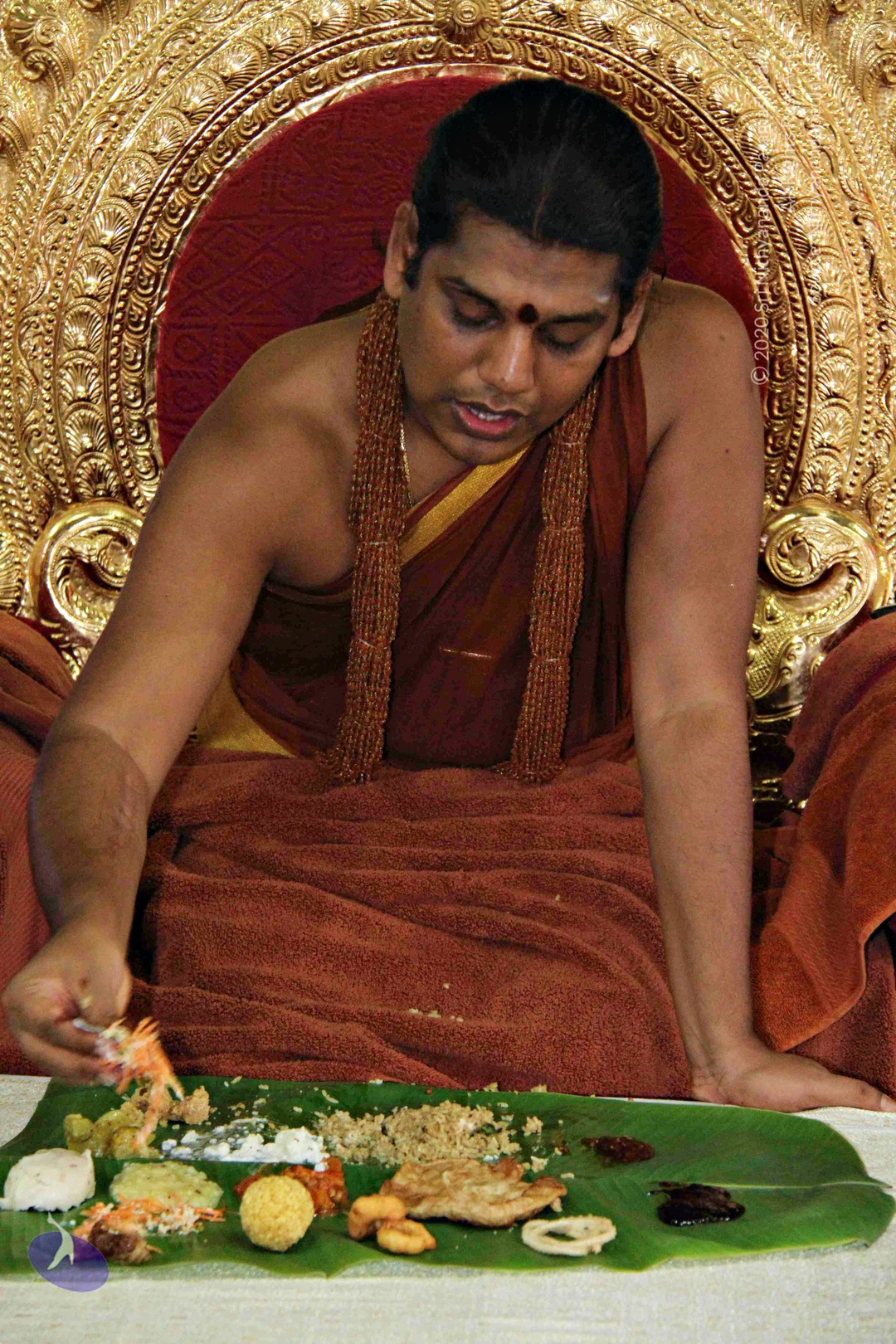
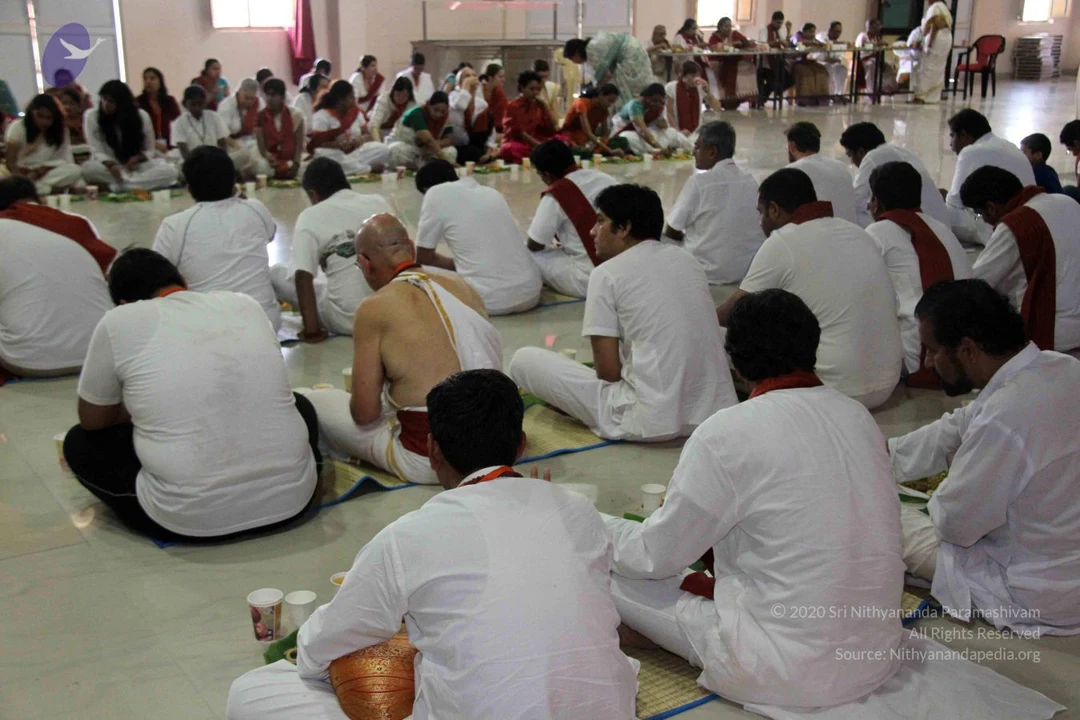
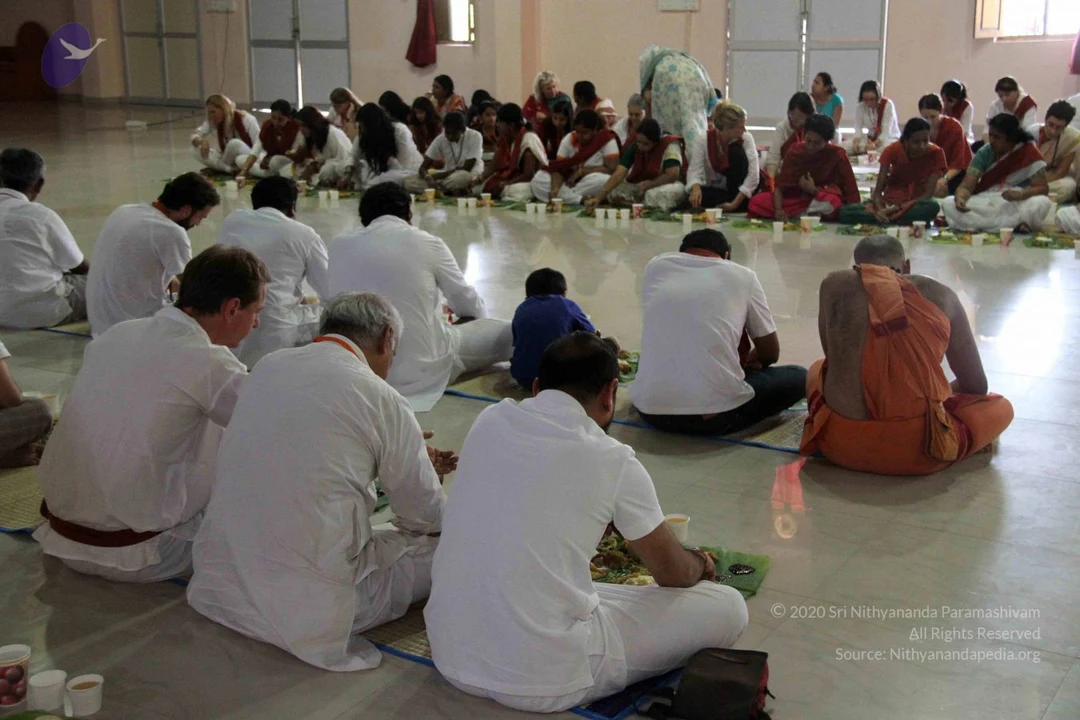
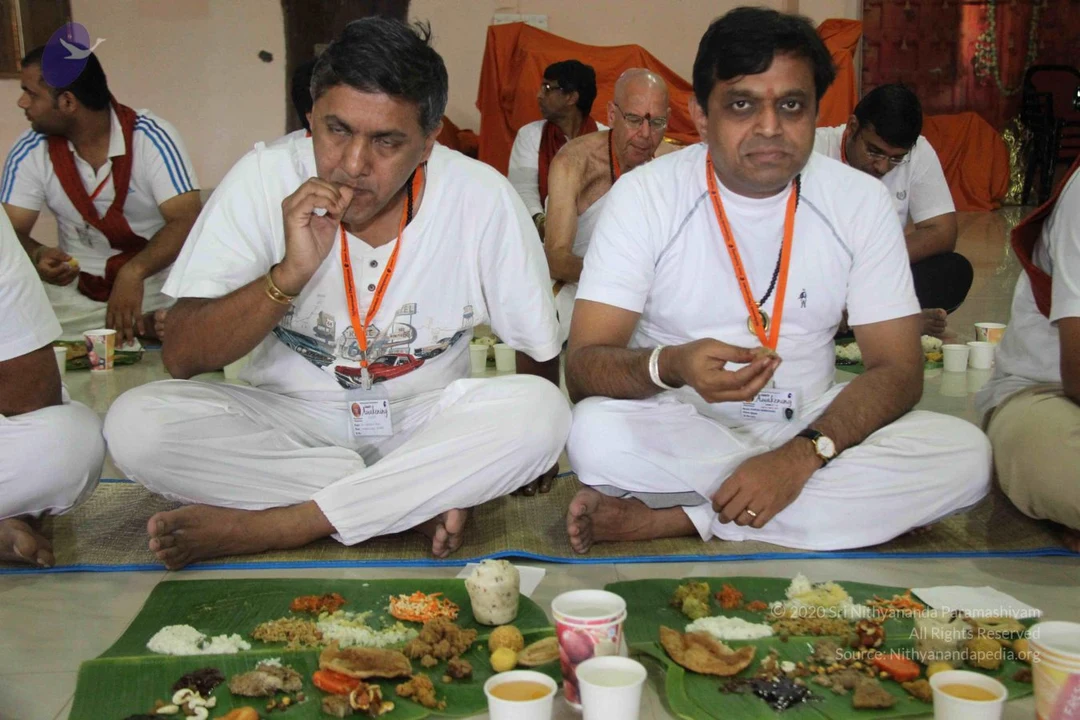
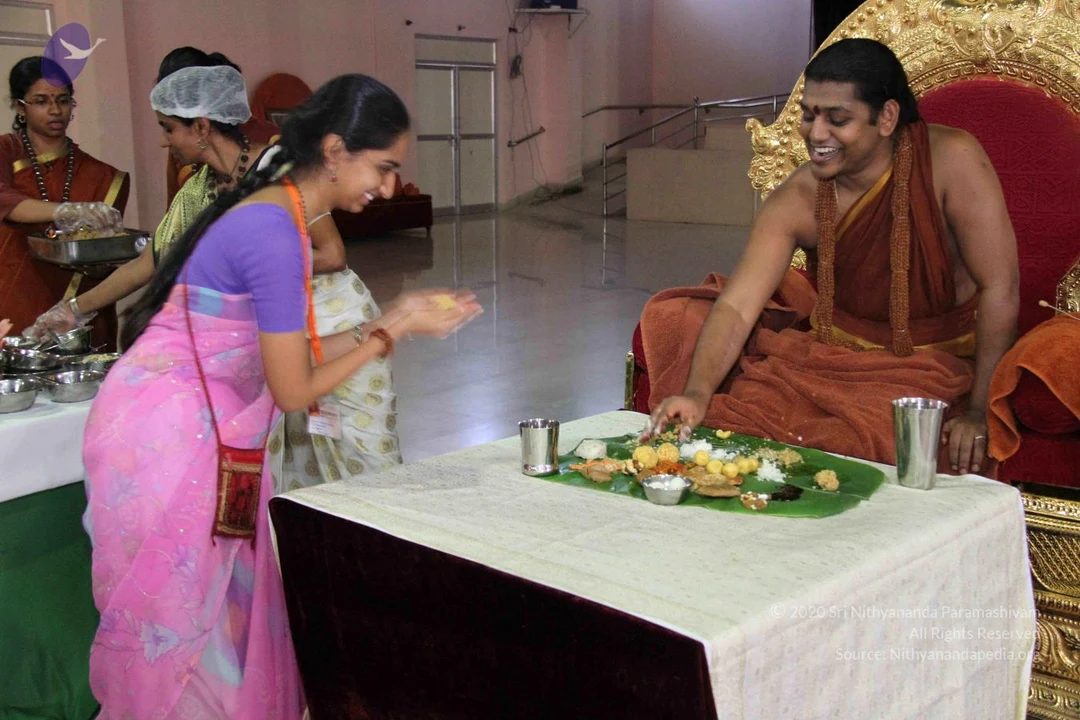
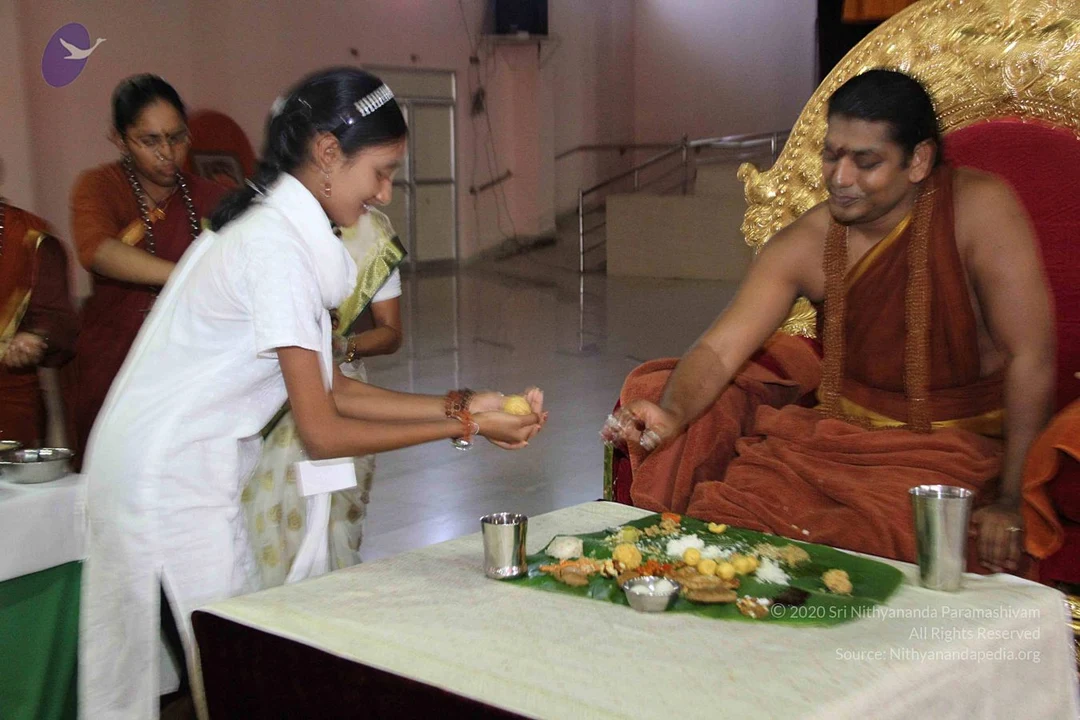
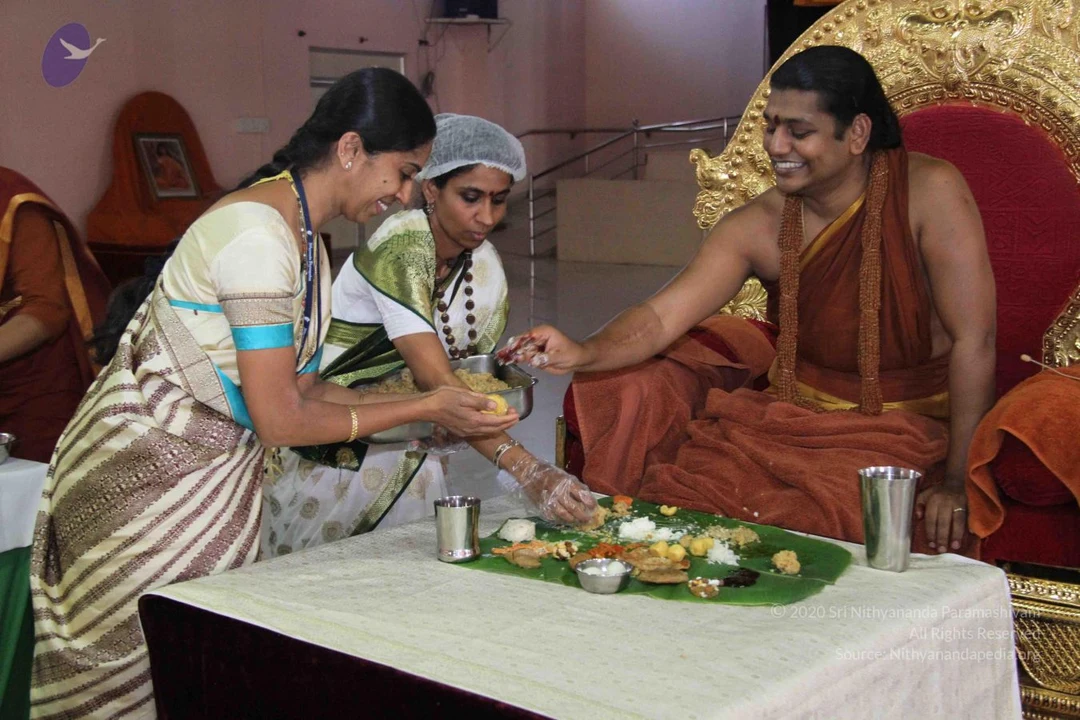
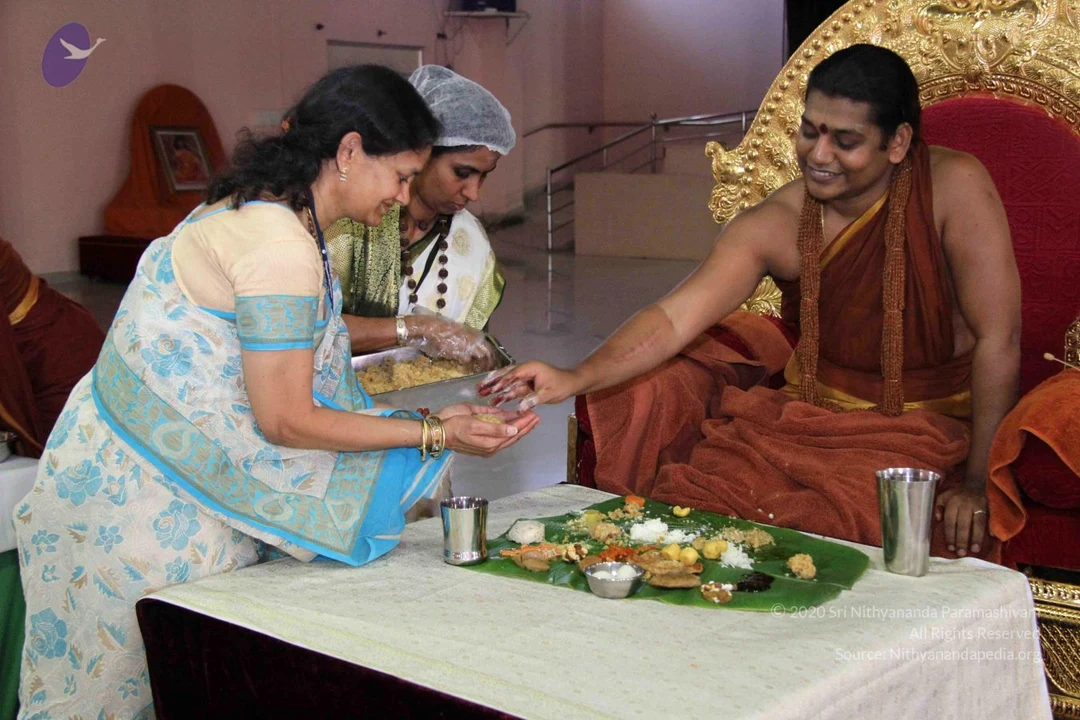
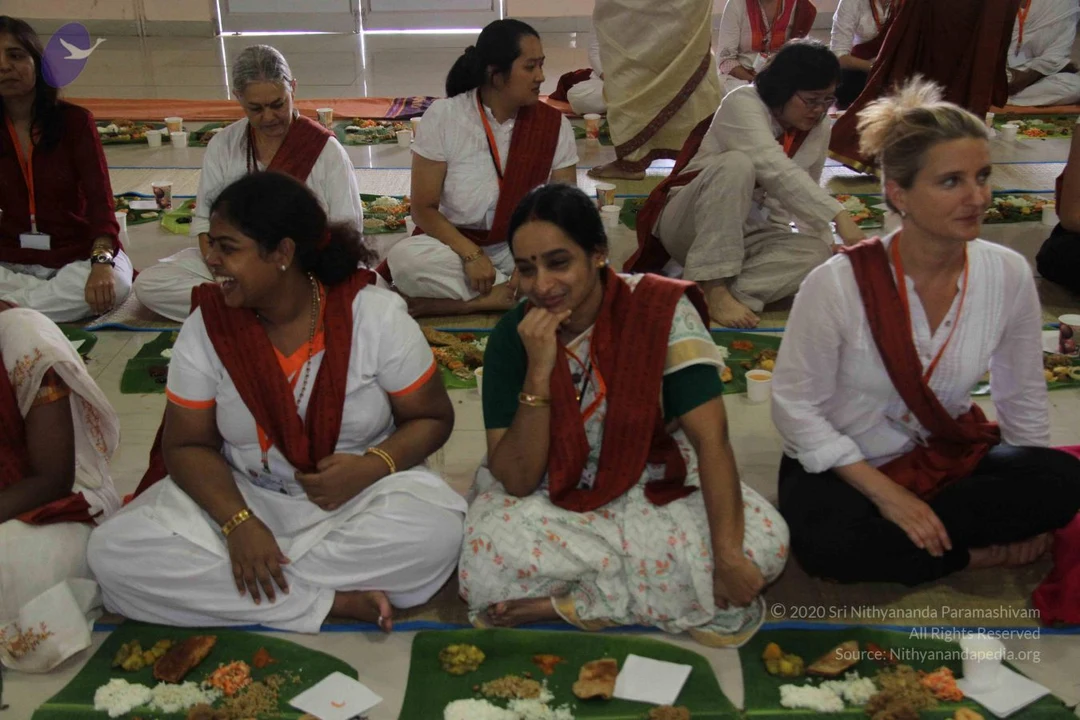
Framed informational boards displayed on a table draped with orange marigold flowers. The left board, headed Bidadi Sri Nithyanandeshwar - Nithyanandeshwari Temple, shows a photo of a deity pair decorated with flower garlands and an illustration of a temple, a tree, a water scene and a dry-fruit dish. The right board, headed Puri-Jagannath Temple-Orissa, shows a temple tower, three painted wooden deity figures with large round eyes, and a plate of rice dish, with explanatory text. Metal bowls of food sit in the foreground. No people are visible.A photograph of a display table in an empty hall showing framed informational panels in gold frames about Tirunelveli-Nellaiappar Temple, with photos of a gopuram, deity sculptures and a section on a speciality cuisine, wheat halwa. Several framed panels stand in a row behind silver bowls of halwa and dried fruit on a white cloth with a red and gold runner. No people are visible; no a person candidate appears.A row of framed information panels displayed on a draped white cloth, with polished silver bowls in the foreground. The largest panel on the right covers the Melkote Cheluvanarayanaswamy Temple, with photographs of the temple tower, a seated figure with folded hands in red and gold attire, and a bowl of Pulihora rice. Beside it, panels describe the Kolhapur Mahalakshmi Ambabai Temple and the Padmanabhaswamy Temple, with photos of a deity murti and a bowl of food. A figure in red cloth is partly visible at the left edge. No people are clearly seated or active in the scene.Framed informational display boards with gold frames stand behind marigold garlands and two steel bowls, one holding white sugar grains and the other covered in plastic. The left board, titled Kolhapur-Mahalakshmi Ambabai Temple, shows a white temple tower, a dark face of the goddess with a red mark, and a speciality cuisine photo of sugar grains and fried gram. The centre board, titled Palani-Dhandayudhapani Swamy Temple, shows a hilltop temple, a painted deity holding a staff, and a speciality cuisine photo of panchamrutam. No people are visible; the scene is a static exhibit display.Framed gold-bordered information posters on a table display temple histories. The left poster covers Thiruvannamalai-Arunachala Temple with aerial temple photos and a photo of a woman in red sari beside a deity image. The centre poster covers Sabarimala-Ayyappan Temple, showing a temple shrine, a seated Ayyappa deity in gold with garlands, and a bowl of aravana payasam. Marigold garlands and small glass bowls of honey and sweets sit in front. No physical people are shown in the scene, and no candidate for a person appears in person; the posters are printed displays.A photo of a display exhibition with framed informational panels mounted in gold frames along a white-draped table. The panels contain photographs of a temple tower, a dark idol face with a red tilak and yellow flowers, and grains; printed text describes a temple's history and a specialty cuisine. Silver bowls holding white sweets and grains sit on the table, edged with orange marigold garlands. No people are visible.

IA-Darshan

26 photosSource gallery
A smiling man sits on an orange leather throne-style chair in front of a gold-ornate backdrop with a decorated deity murti behind him, wearing a red-brown saffron-toned dhoti-style garment with a yellow border, a long rudraksha mala draped over his shoulders and a gold chain at the neck. He has white vibhuti lines and a red kumkum bindi on his forehead and a small microphone clipped near his mouth. a person is described by the page; appearance cues include the long rudraksha mala, saffron garment and ornate setting, though identity remains uncertain. The scene appears to be a satsang or discourse on a dais.A man seated in an orange leather armchair, wearing a rust-orange sannyasi wrap with a gold-yellow border and a long rudraksha-style brown bead mala across his chest, bare-shouldered. He has white vertical tilak marks and a red bindi, and his long dark hair is swept back. He faces to the side with a slight smile, a small headset microphone near his face. Behind him stands a deity murti decorated with a red-orange cloth and silver ornaments, framed by a large garland of yellow marigolds, purple flowers and green foliage. Appearance-based label: a person, shown in person in a discourse setting.A blurred close view of a man seated on an orange-upholstered chair in the foreground, wearing an orange-brown robe with a bare upper arm and a white tilak on his forehead, looking to the right. Behind him stands a deity murti decorated with a dense garland of yellow marigolds, purple flowers, red blossoms and green leaves, with a red-and-gold turban, jewelled necklaces, earrings and a red shawl. The murti's hand is raised in blessing. The seated man appears as a person by his orange robe and tilak, but the image is too blurred to confirm the appearance. Dark drapery forms the backdrop.A seated man in saffron-orange robes sits before an ornate gold throne with carved lion figures and a golden arched backrest, against dark red drapes. He wears a long rudraksha mala with a gold chain at his neck, a red bindi on his forehead, and has both arms spread open in an expansive gesture while speaking. A water bottle and flowers rest on the platform in front. a person is shown in an in-person setting, appearance-based cues being the saffron robes, rudraksha mala, and gold chain.A photograph of a ritual blessing inside a room with pink walls. A man with long dark hair, wearing an orange-brown saffron-toned cloth over his shoulders and a rudraksha mala, stands on the left with his right hand raised, holding a flat orange-brown object over the head of a kneeling man in a white shirt and orange shawl who bows forward. Behind them, a deity murti is decorated with garlands of yellow, white, purple and green flowers and wears jewelry and a red-and-white turban. A golden object and a fan are visible in the foreground, and a window with a reflection of people sits in the background.A photograph in an ashram hall with red drapes. A man with long dark hair tied back, bare-chested under an orange-saffron wrap and wearing a rudraksha mala, sits and raises his right hand to the forehead of a smiling man in white kurta with an orange shawl-like sash. Behind them a woman in a rust-red sari and rudraksha mala holds a small golden bell-shaped object, and a man in white with an orange lanyard stands nearby. A flower-decorated deity murti stands at left, and a person in orange is visible at right. Several people are present.
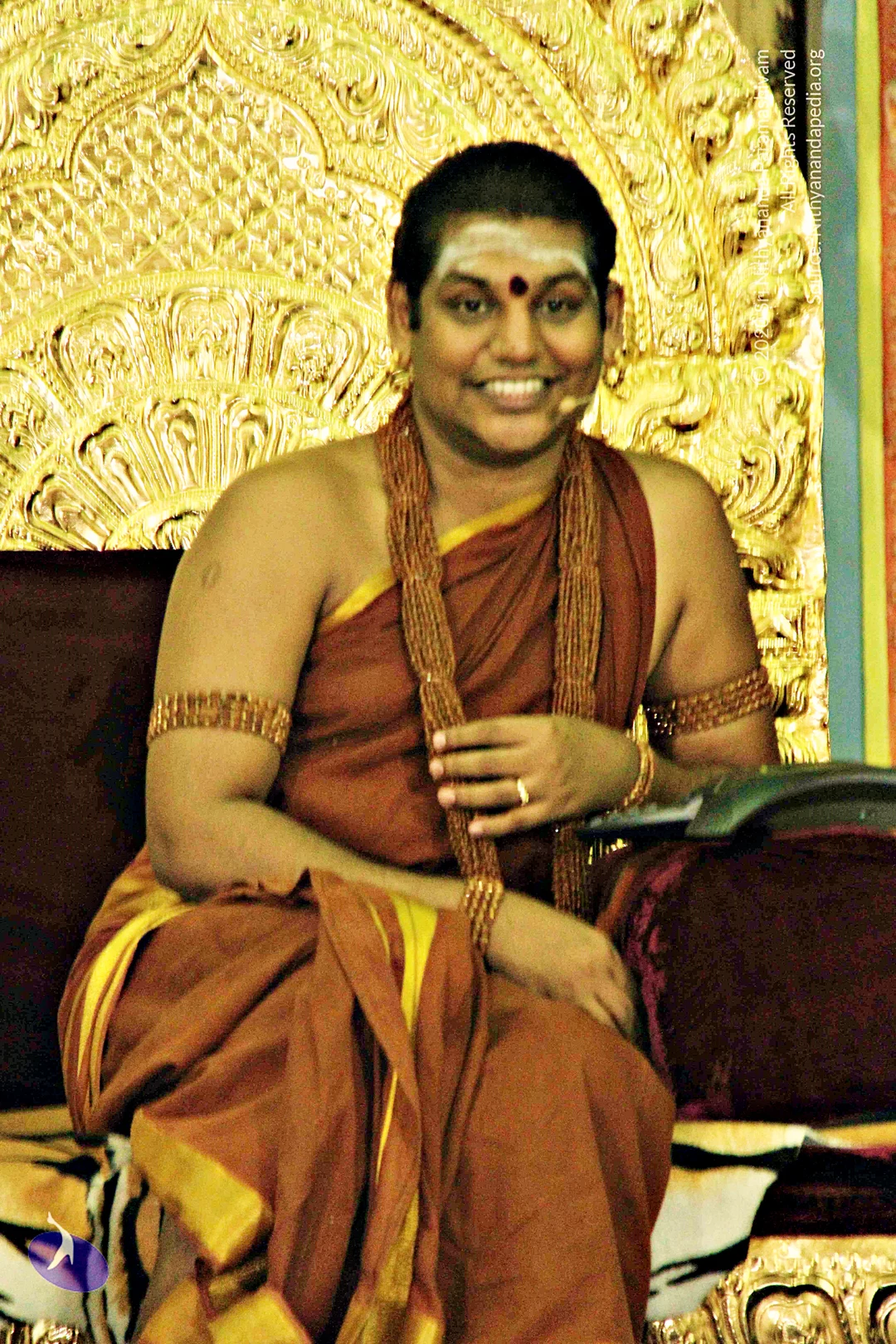
Leela-Alankar-Deities

11 photosSource gallery
A photograph of a seated man in white dhoti and white turban with a vibhuti mark on his forehead, wearing a leopard-print garment, rudraksha mala and ceremonial necklaces, smiling and raising his right hand in greeting beside a garlanded metal deity murti. The murti stands in a dancing pose with a raised hand and wears an orange-red turban, a leopard-print wrap and rich jewellery, set against yellow, purple and green flower garlands and a pink satin cloth.A photograph of a decorated stage with a bronze-finished statue of Nataraja-style dancing deity murti, shown in dance pose atop a pink satin draped pedestal, wrapped in yellow and purple flower garlands and green fabric, framed by an ornate metal arch. To the right a standing person in a white dhoti, white-and-gold turban, orange and cream patterned top, rudraksha mala and flower garland, with white vibhuti marks on the forehead, raises one hand in greeting. The person's appearance is not established as a person, so the identity is unsure. Red cushioned mats cover the floor and a gold throne-like chair stands behind.A photograph of a stage with a large floral-garlanded statue of the dancing deity Nataraja, standing on a dwarf figure, wearing an orange turban and an ornate white and gold dhoti with a leopard-print shawl, surrounded by yellow and purple flower garlands and a bronze prabhamandala behind. To the right, a smiling young man in a white turban and white dhoti with a leopard-print wrap, rudraksha mala and flower garland sits on a gilded throne, raising one hand in greeting. Pink satin draping and a red carpet fill the foreground.A photograph of a decorated deity murti, an elephant-headed figure seated beneath a large golden multi-hooded serpent canopy. The murti holds a golden veena, a stringed instrument, and wears a purple garment, jewelled necklaces and a red-and-gold crown. It is adorned with thick garlands of yellow marigolds, purple flowers and green leaves, and sits on a golden serpent-coiled base. A brass oil lamp stands at the right against a painted blue and orange wall. No physical people are visible.A golden deity murti of Ganesha seated on a coiled golden serpent base, with a hooded golden naga canopy of multiple heads behind him. He plays a golden veena held across his lap and wears a maroon dhoti, a gold crown with red and green stones, and layered gold and jewelled necklaces. He is decorated with yellow marigold garlands, green and purple flower garlands, and a white silk cloth beneath him. A brass oil lamp stands to the right against a painted wall. No people are visible.A photograph of a golden Ganesha murti seated on a coiled golden serpent base, with a hooded naga canopy of golden cobra heads behind it. The deity holds a golden veena across its body, wears a gold crown with red and pink jewels, and is dressed in a purple garment with heavy jewelled necklaces. It is decorated with garlands of yellow marigold and purple flowers, with a blue velvet cloth draped at the sides. A brass oil lamp stands to the right against a painted wall. No physical people are visible.

SarvaDarshan

8 photosSource gallery
A photograph of a devotee receiving prasad at an indoor ceremony. A person in a rust-orange robe with a rudraksha mala and a dark topknot, shown in profile at left, feeds a small golden spoonful of offering into the open mouth of a smiling man in a white kurta with a red-orange shawl and an event badge. Behind them a woman in an orange sari and beads watches, and a golden vessel sits at lower left. Garlanded flowers and a deity murti are visible at left, with several white-clad and saffron-clad attendees standing in the background. The robed figure's face and features are not clearly identifiable enough to confirm the a person candidate, so the appearance is uncertain.A photograph of a bearded man with short dark hair seated with eyes closed and a red tilak mark on his forehead, wearing a white shirt and an orange-red shawl printed with dark mantra script. A hand from the left touches or supports his chin while another hand reaches in from the upper left. In the background a woman with dark hair is partly visible at the left edge, and a person in white and red clothing stands in a hall. The setting is an indoor ashram-style hall with pink walls and red curtains.A photograph of a man in a golden-yellow embroidered turban and an orange-red scarf printed with small script over a cream shirt, eyes lowered and holding a thin stick between his teeth. A woman with dark shoulder-length hair and a red bindi, wearing an orange-red shawl, stands blurred in the left foreground. Red curtains and pale walls form the background, with other people seated further back.A seated older man in a white shirt with an orange lanyard and a rudraksha mala is receiving a ritual touch on his forehead from a person in orange and saffron robes with a long rudraksha-bead necklace. Another person in orange and a woman in a red and orange sari stand near him, and a man in orange-red shawl at right holds his shoulder. A woman with a bun in the foreground wears gold jewellery and a yellow sari. Behind them a hall with red curtains and ceiling lights.A seated man in an orange-brown dhoti and a dark rudraksha mala with a long swept-back hairstyle reaches toward a green silk cloth holding a gold ornament. Before him, a man in an orange turban bends forward with his head lowered in reverence, while a woman in a red-brown garment and rudraksha mala sits nearby. Behind them stand devotees in white and red shawls, and a background altar is decorated with yellow and purple flower garlands and a deity murti. The setting is an indoor ritual space.A photograph of an indoor puja setting with a deity murti decorated with yellow and purple flower garlands behind. A man in an orange-brown robe with a rudraksha mala and bare upper body stands on the left, holding out an offering toward a seated man in a rust-red shirt and white shirt with orange mala at right, who raises his hand. Other people stand in the background, including a woman in a white top and a woman in red scarf.

Swamiji-Satsang
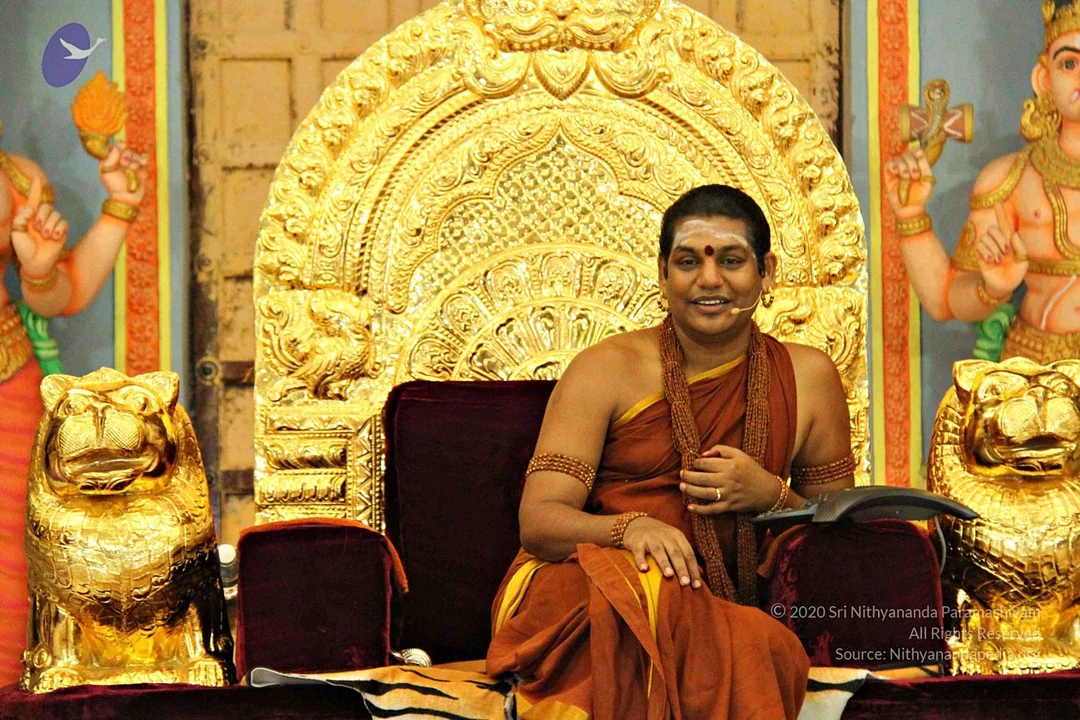
17 photosSource gallery
A smiling man in an orange-brown sannyasi robe with a wide gold border wrapped around his body stands at a clear acrylic lectern on a stage. He wears a long multi-strand rudraksha-style beaded mala necklace, beaded bracelets and an armlet, and gold earrings, with white vertical tilak and a red bindi on his forehead. Behind him stand painted temple pillars and a colourful painted deity figure with a gold crown and gold jewellery. A small lapel microphone is visible near his face.A smiling person in rust-brown and gold-bordered draped robes stands beside a clear acrylic lectern, one hand resting on it. The person wears a white vertical tilak with a red dot, gold hoop earrings, a long brown beaded mala reaching the waist, and gold-beaded bangles on the upper arm and wrist. Behind is a painted temple backdrop with pink and green pillars, a painted deity murti in orange with gold crown and jewellery, a golden lion-shaped figure at right, and brass oil lamps at left. The setting suggests a satsang or discourse hall.A smiling man stands beside a clear acrylic lectern in a temple-style hall, one hand resting on the lectern. He wears a rust-brown unstitched cloth wrapped with gold borders, a long multi-strand rudraksha-style bead mala, beaded armlets and a small red bindi with white forehead markings. Behind him, a painted deity murti with a gold crown and gold jewellery stands beside a pillar in pink and green, and brass oil lamps stand near the lectern. A microphone is visible near his face. A printed photo caption on the image reads Sri Nithyananda Paramashivam.A man in rust-orange robes with gold borders stands at a clear acrylic lectern, one hand resting on it, eyes lowered and smiling. He wears a rudraksha mala, a white vertical tilak with a red dot on the forehead, gold bangles and armlets. Behind him stands a painted deity statue with an ornate gold crown, orange-red dhoti and gold jewellery, beside brass oil lamps and pillars in pink and green. The setting appears to be a discourse hall.A smiling man in a rust-orange dhoti and shawl with gold borders stands beside a clear acrylic lectern on a white floor. He wears a gold-bead mala, a white forehead mark with a red dot, and bangles. A gold-hued cobra hood and yellow marigold garlands frame the left side. Behind him are a painted pillar and a painted deity murti with a crown, holding a flame, and a gilded lion on a red-cushioned throne. Brass lamps stand near a purple draped seat and a red carpet.A smiling man in an orange-brown dhoti-style garment with gold-striped borders stands at a clear acrylic lectern, raising his right index finger. He wears a long multi-strand rudraksha-style mala, gold bangles, a white vibhuti line and a red bindi on his forehead, and a small headset microphone. Behind him stands a colourful deity murti with an ornate crown, gold jewellery and a green sash, beside pink and orange temple pillars and brass lamp stands. A dark red cushioned throne with gold trim sits at the right edge. Appearance-based label: a person, giving a discourse, based on the saffron-orange robes, rudraksha mala and ceremonial gold adornments.
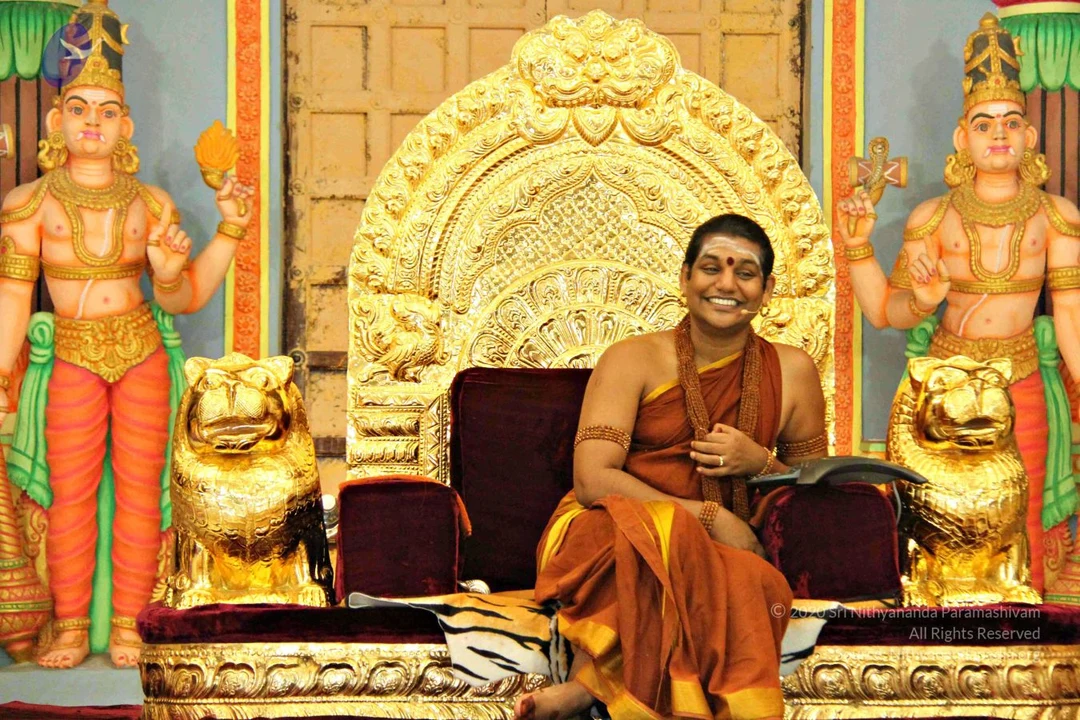
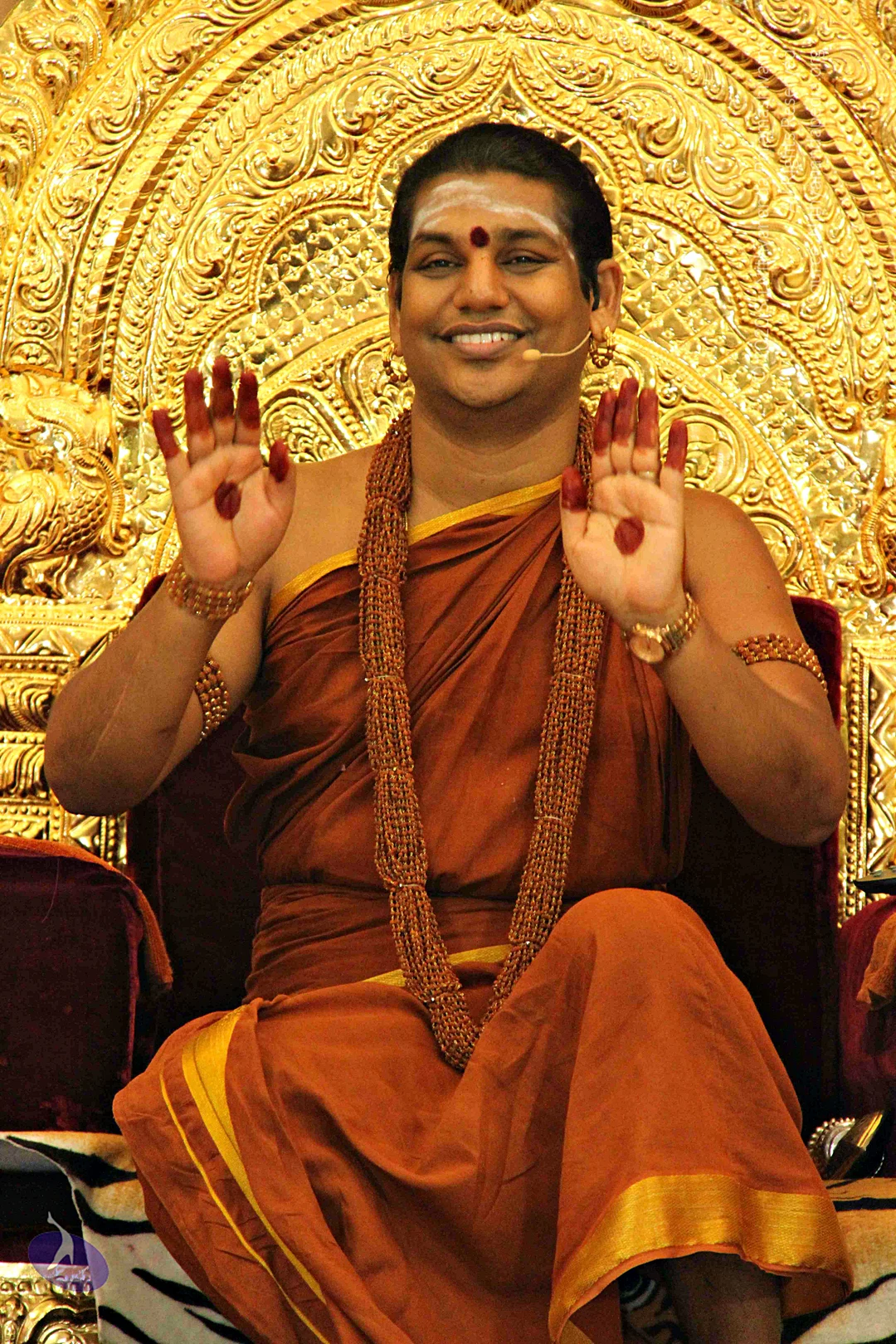
FinalBlessing-Swamiji-Deities

3 photosSource gallery
A man stands barefoot on a patterned rug before a gilded throne flanked by golden lion figures, with red velvet drapes behind. He wears an orange-saffron dhoti and shawl with yellow borders, a long rudraksha mala, bangles and a wristwatch, and raises both hands palms-forward above his head while smiling. Behind him stands a multi-armed deity murti with a crown and a golden necklace, holding a lotus. The throne has a tiger-skin draped over its seat.A smiling man in an orange-red dhoti-style robe with yellow borders stands barefoot on a patterned rug, raising both hands above his head with palms open. He wears a beaded rudraksha-style mala necklace, bangles, a wristwatch and a red bindi. Behind him stands a golden throne flanked by two golden lion figures, with red velvet cushions and a tiger-skin draped over the seat. A painted deity figure holding a flame stands to the left beside red velvet drapes. The white-tiled stage has a pale floor. a person is the central figure, identified by the orange robe, rudraksha mala and throne setting.A smiling man in an orange-saffron dhoti and shawl with yellow borders stands barefoot on a patterned rug, arms raised with palms open in a welcoming gesture. He wears a long rudraksha mala, a red tilak on his forehead, and bangles. Behind him is a golden ornate throne flanked by two golden lion figures on red velvet cushions, with red velvet drapes and a painted statue of a four-armed deity holding a flame-like object and a trident beside the throne. Appearance-based label: a person, shown in person in a stage setting with a throne.

Swamiji-Deities-Aarthi

2 photosSource gallery
A shaven-headed man in orange saffron robes, with a rudraksha mala around his neck and a gold-bordered orange cloth draped over one shoulder, stands at the left with his back partly to the camera and holds a lit flame or lamp to a large decorated deity murti. The murti is adorned with a tall golden crown, a red and white sash, pearl-like necklaces and a dense garland of yellow and white flowers. Behind it is an ornate silver-gold arched backdrop, and above hangs a large orange and blue canopy with tassels. In front, a golden elephant-shaped vessel or kalasha, also garlanded with yellow flowers, sits on a draped white cloth, and a teal cloth lies on the floor. The setting is a night ritual in front of a dark background.Night ceremony at a decorated shrine: a shaved-headed priest in saffron-orange robes with a rudraksha-style cord stands at left, holding a lit oil lamp toward a large ganesha-form deity murti. The deity wears a tall gold crown, ornate jewelled garlands, a red-and-white garland and dhoti-like cloth, with a golden elephant-shaped pedestal and yellow marigold garlands draped around the altar. An ornate silver-gilt arch and an orange canopy frame the scene. The clothing is saffron and orange, and the altar is accented with magenta and teal cloth. The lamp suggests an aarti. No other people are visible.

Ganamukhasura-Samhara-Ganesha-Brahmotsav
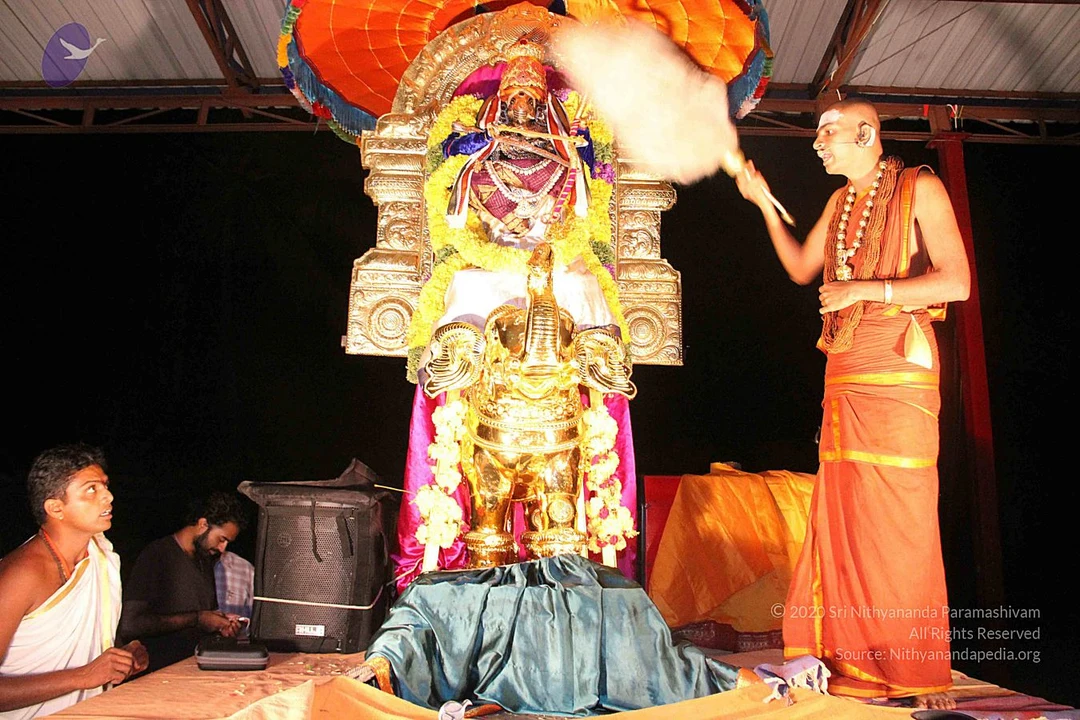
20 photosSource gallery
A man in a rust-orange draped garment stands with palms pressed together in namaste at his face, eyes closed, with a red bindi on his forehead. Behind him, a man in a white dhoti with gold borders and a rudraksha mala stands with hands folded, and a partially visible person in orange is at the left edge. In the background, a gilded deity murti with a crown is lit in a dark shrine. The scene appears to be a devotional or ritual moment at night on a paved floor. a person is probable based on the page caption and the saffron-orange robe with the mala-adorned devotee nearby; appearance cues are limited.Photograph of a man in a rust-red saffron-toned robe with a draped shawl, standing with palms pressed together in namaste and a small red bindi on his forehead, smiling upward. Behind him at left stands a second man in white dhoti with gold borders, a white headband and a rudraksha mala. In the background is a gilded deity murti with a crown and trident-like emblems, set against a dark temple interior with a stone floor. The primary figure has long swept-back hair and saffron robes; the page associates him with a person, but identity is not established from appearance alone.A night-time outdoor photograph of a man with long dark hair and a vibhuti/kumkum mark on his forehead, wearing a maroon shawl over an orange lower garment, standing with palms pressed together in namaskar while gazing upward. Behind him, blurred devotees in white dhotis and orange-red shawls also stand with hands folded in prayer. Four people are visible in total.Night photograph of a man in a rust-red saffron-toned robe with bare right shoulder and a tilak on his forehead, standing with palms pressed together in anjali namaskar, eyes lifted upward. Behind him, several men in white dhotis and white shirts with orange-red lanyards stand on a paved surface, also with hands folded in prayer. Dark background, dim evening setting.Night-time outdoor photograph of a man in a rust-red monastic robe standing with palms pressed together in anjali mudra, gazing upward with a serene expression and a red bindi on his forehead. Behind him, a second person in a white dhoti with gold border and a white head-band stands with hands folded, and a metal trident is visible in the background among a crowd of onlookers. Paved ground and dark foliage surround the scene.Night outdoor photograph on a paved courtyard. A man in a rust-red monastic robe with a gold-bordered lower cloth stands at centre with palms pressed together in anjali at his chest, a red bindi on his forehead and a soft smile, gazing upward. Behind him to the left, a man in white dhoti with gold border and white forehead markings also holds palms together. Figures and garlanded people stand in the background near dark trees and a pole.

IA-21Naivedyam-Pictures
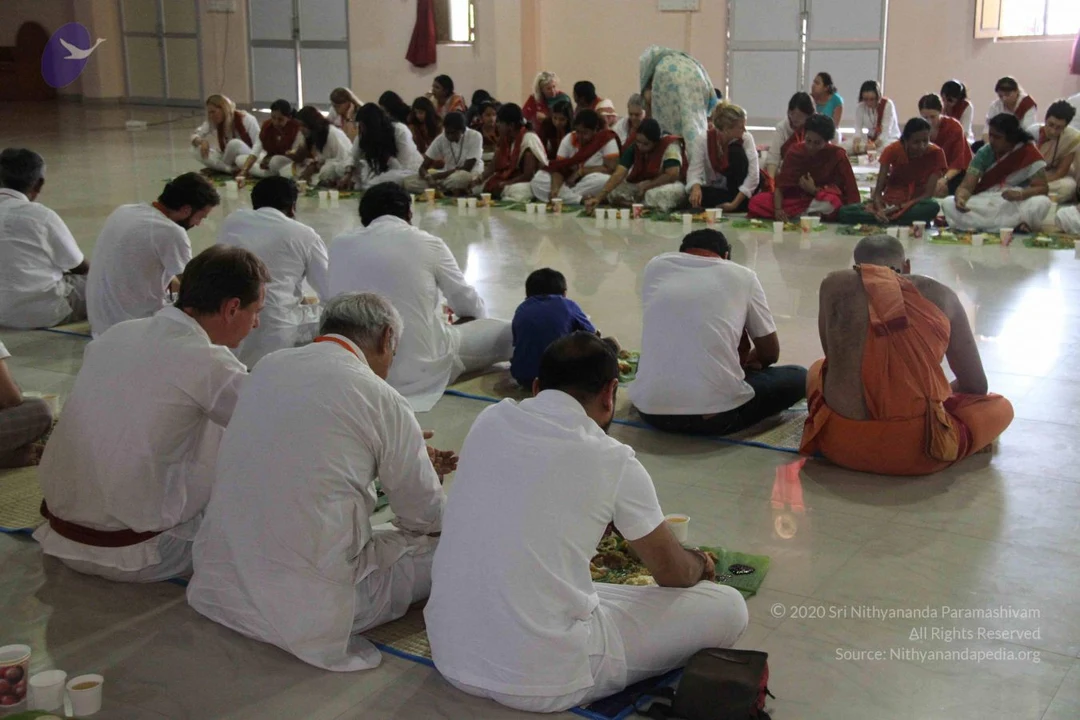
15 photosSource gallery
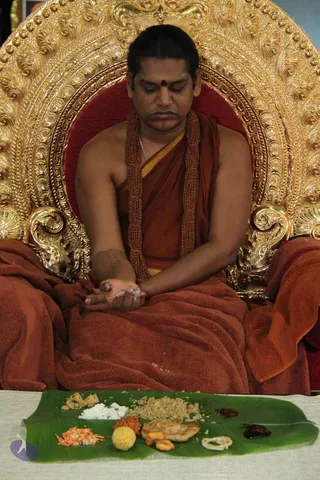
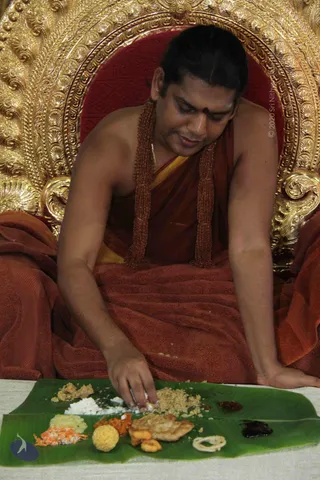
A seated man in rust-orange robes sits on an ornate gold throne with a red cushion and gilded floral carving. He wears a long rudraksha mala draped over his chest, a red bindi on his forehead, and has his eyes lowered. His right hand is cupped and holds small food morsels while a banana leaf spread before him carries rice, a white mound, shredded carrot salad, a yellow sweet ball, fried items, a red chutney and a pickle. Crumbs lie on the cloth. The page identifies the event as a person's, and his appearance shows a rudraksha mala and saffron-orange robes on the throne, so this is a person in person. The setting suggests a ritual meal offering.A seated man in rust-orange robes and a long beaded rudraksha-style mala sits on an ornate gold throne with a red cushion, leaning forward to touch a meal served on a green banana leaf. The leaf holds rice, a yellow lentil dish, carrot and vegetable poriyal, a fried item, a round sweet, fried snacks, a pappadum-like wafer, and dark and red chutneys. The man has a red-orange tilak on his forehead and a gold chain. The image is a photograph with one physical person.A man with short dark hair and a red bindi sits on an ornate gold throne with a red cushioned back, eating with his right hand from a green banana leaf spread in front of him. He wears a rust-orange wrap over his shoulders and bare upper arms, with long rust-coloured rudraksha-style beaded malas hanging to his chest and a gold trim at the neck. The banana leaf holds rice, a mound of grated vegetables, fried items, a yellow sweet ball, pickles and chutney. Swamiji (probable): long swept-back hair, rudraksha malas and saffron-orange wrap, seated on a golden throne, appearance-based label only.A man in a rust-red robe with a gold border sits on an ornate gold-and-red throne with a carved arched backrest. He wears long rudraksha-style beaded malas over his shoulders and a red tilak on his forehead, and leans forward with his right hand over a banana leaf. The leaf holds a meal of rice, a small pile of white rice, fried items, a yellow sweet ball, pickles, shrimp-like pieces, and a small ring of fried snack. The person is shown eating or serving the food.A man seated on a large ornate gold throne with a red cushioned back, wearing a rust-orange unstitched robe with a gold border and a long rudraksha mala draped over his shoulders, with a red bindi on his forehead. He holds a small piece of food in his right hand while looking to his left. In front of him, on a green banana leaf laid over a white cloth, are served portions of rice, a yellow sweet ball, fried pieces, vegetable curry, shredded carrot, a small steel cup, and a steel bowl with boiled eggs. The setting appears to be a ritual meal or prasadam offering. The page indicates a person is present, but the appearance is only partially confirmable, so the seated man is described by role.A photograph of a seated man in rust-orange sannyasi robes with a gold-bordered shawl and a long tulasi-like beaded mala draped over his shoulders, a red bindi on his forehead, and his hair swept back. He sits on an ornate gold throne with a red cushion and reaches with his right hand toward a green banana leaf spread on a white cloth. The leaf holds a meal of rice, fried papad, yellow sweets, carrot and vegetable preparations, pickles, a small steel tumbler, and a steel bowl with white items. Visible cues: the seated figure wears saffron-orange robes, a beaded mala, a bindi and a golden throne, a presentation consistent with the page's reference to a person, though his face is not used for identification.