Skip to content
Wednesday

4 September 2013

Enrich your Inner Space.

Dated photos
404
Source pages
1
Media
2
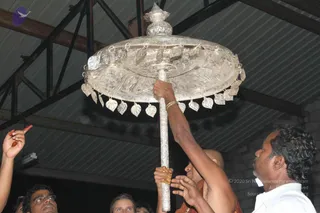
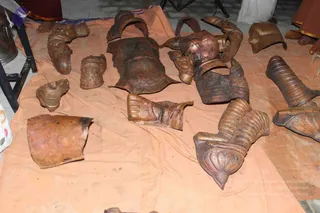
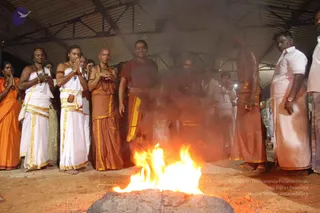
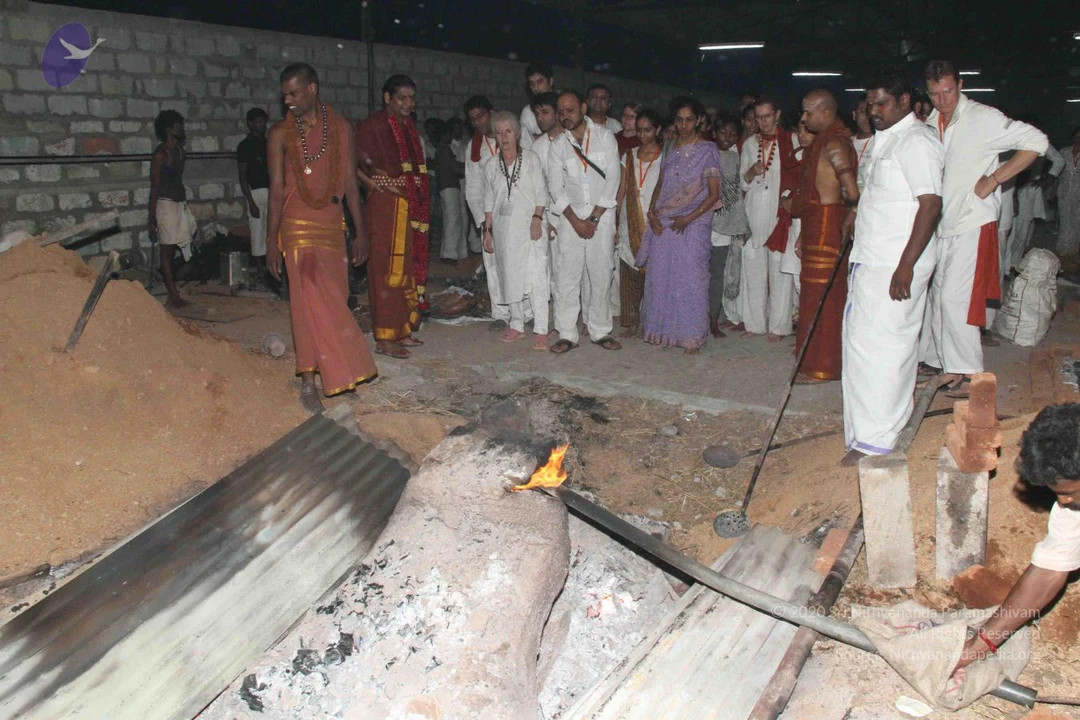
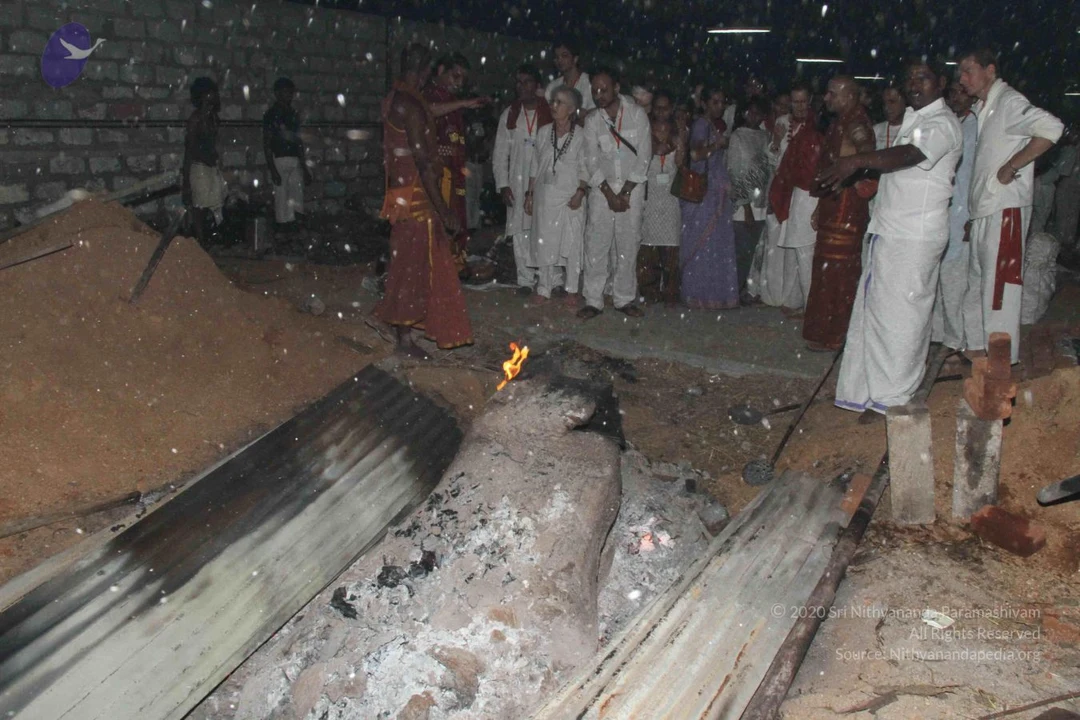
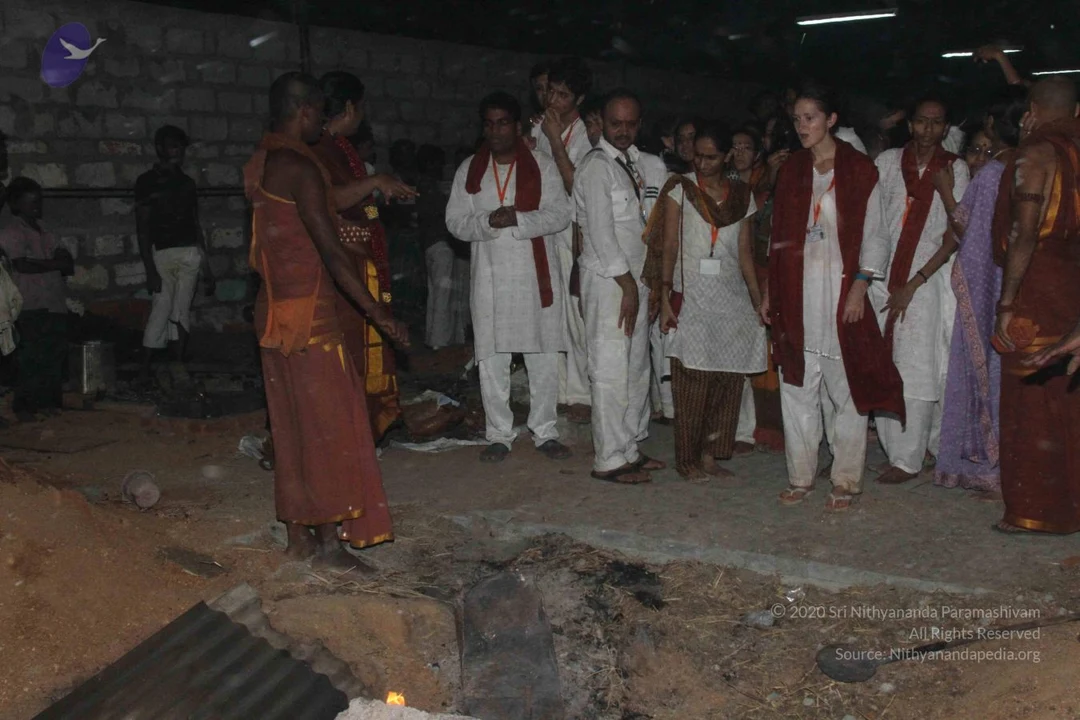
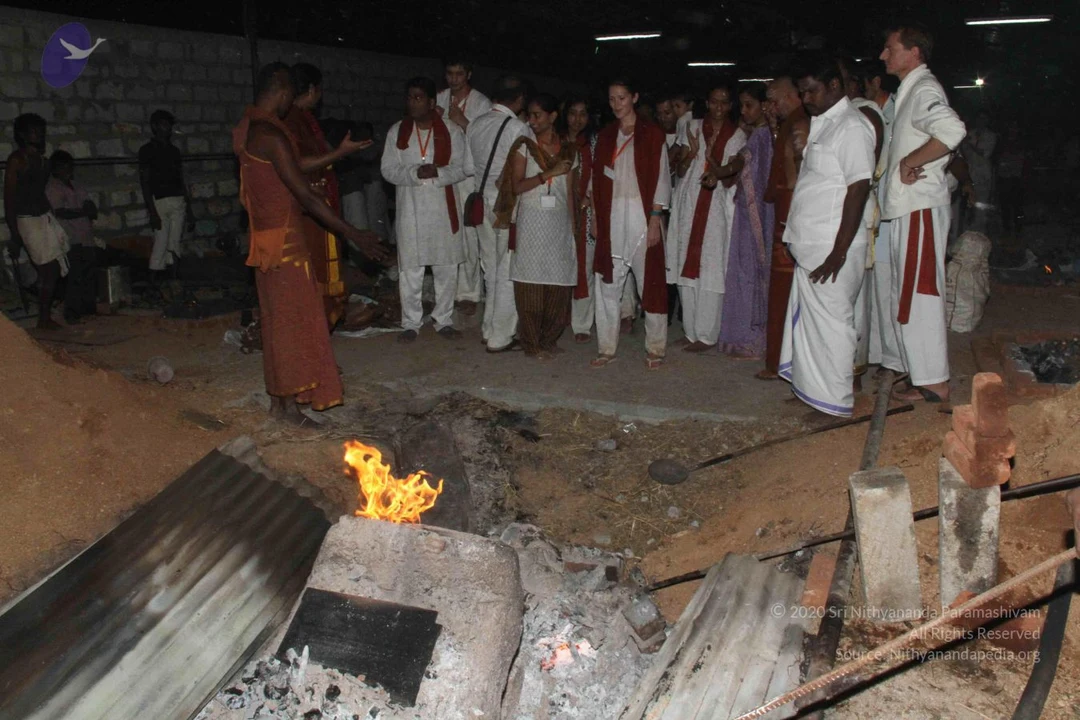
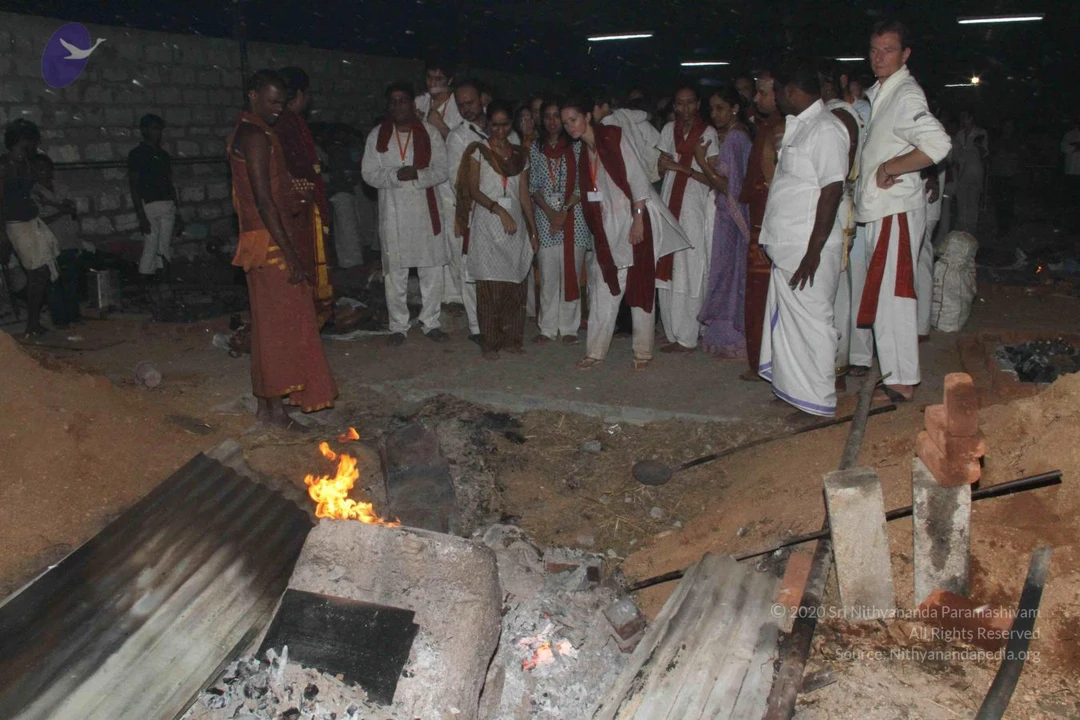
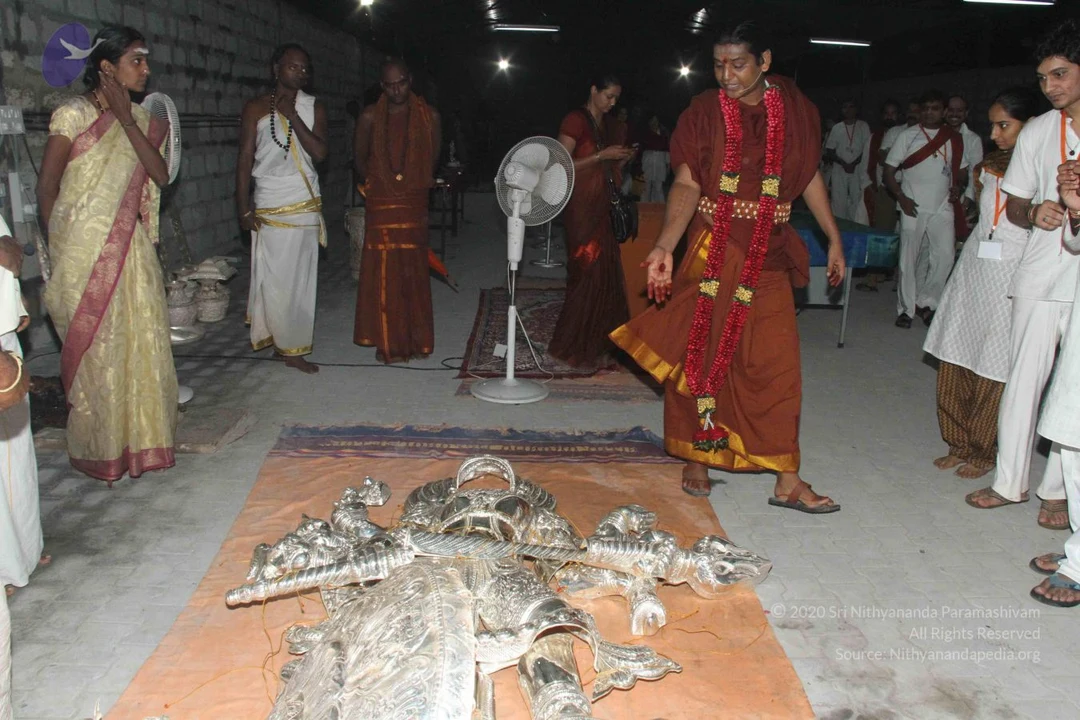
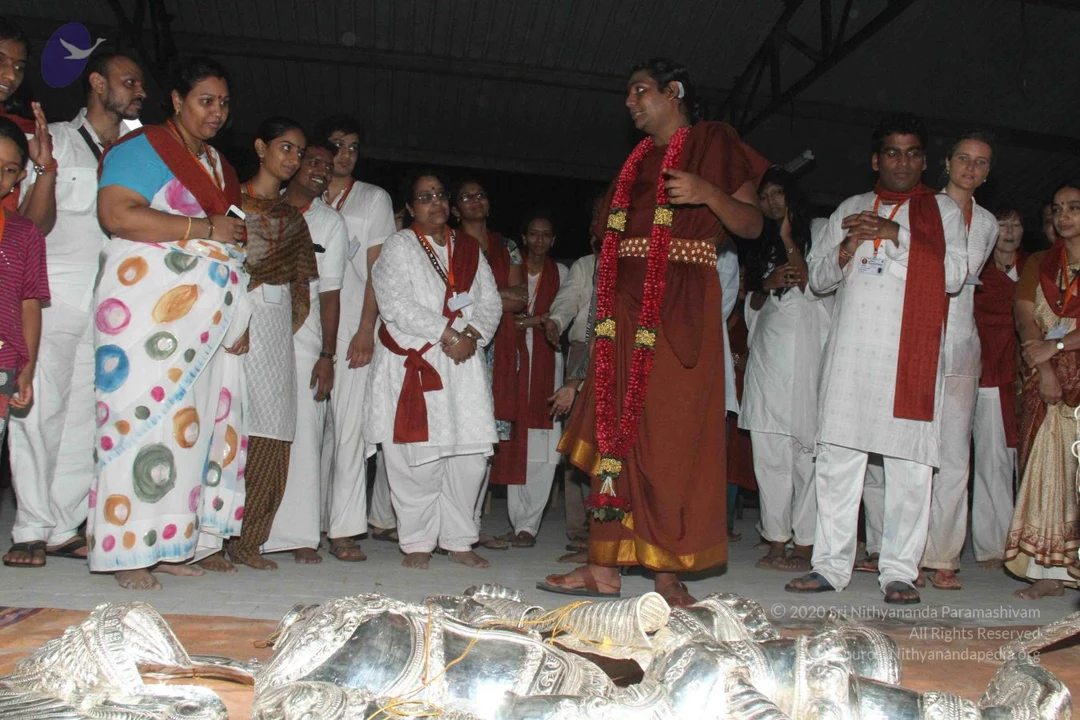
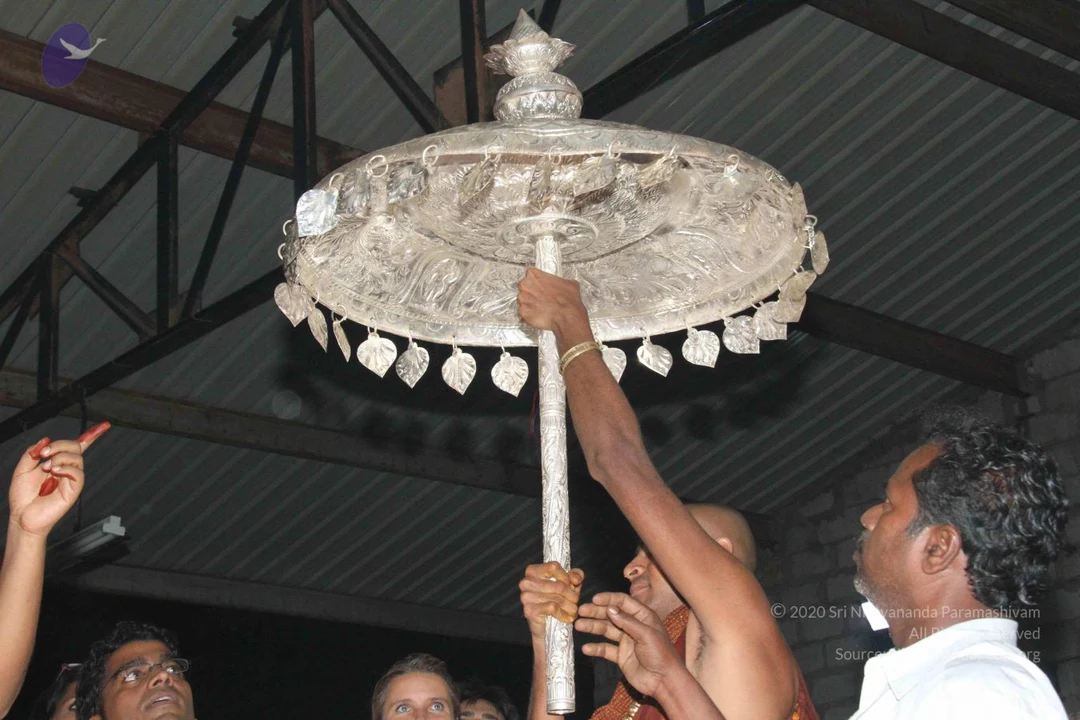
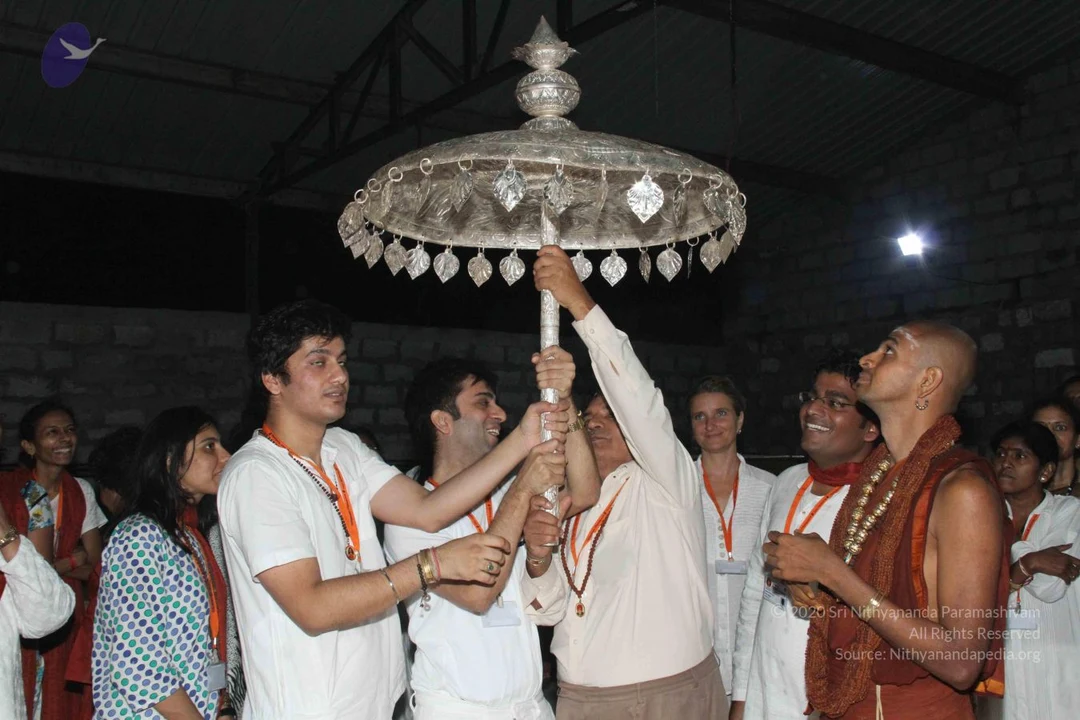
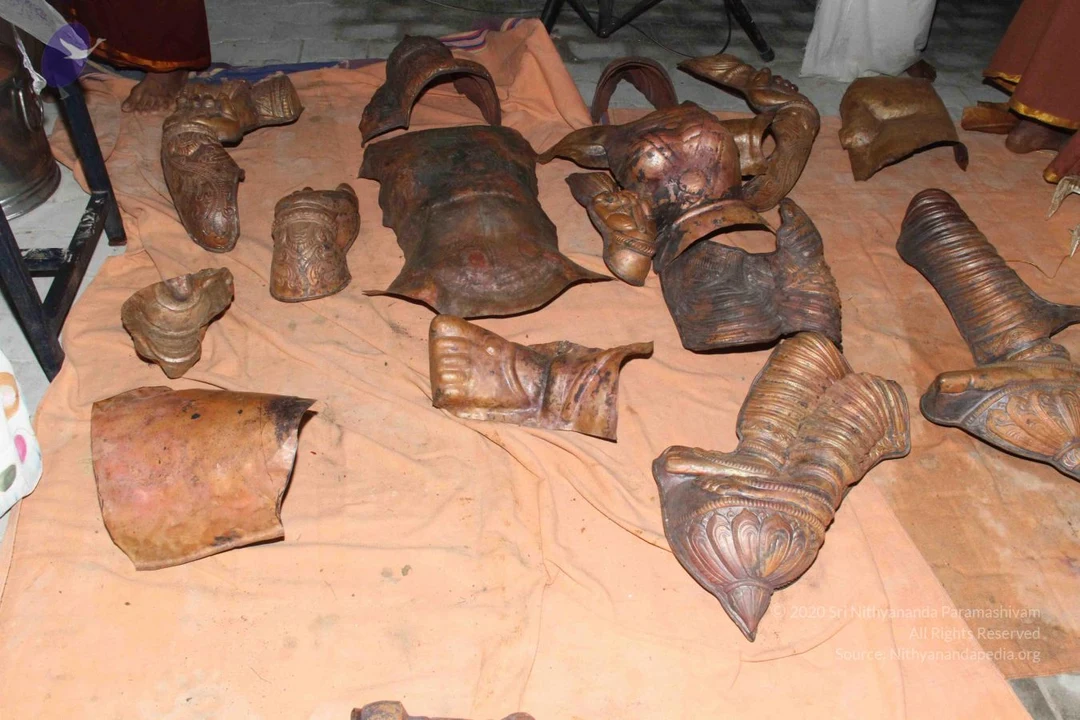
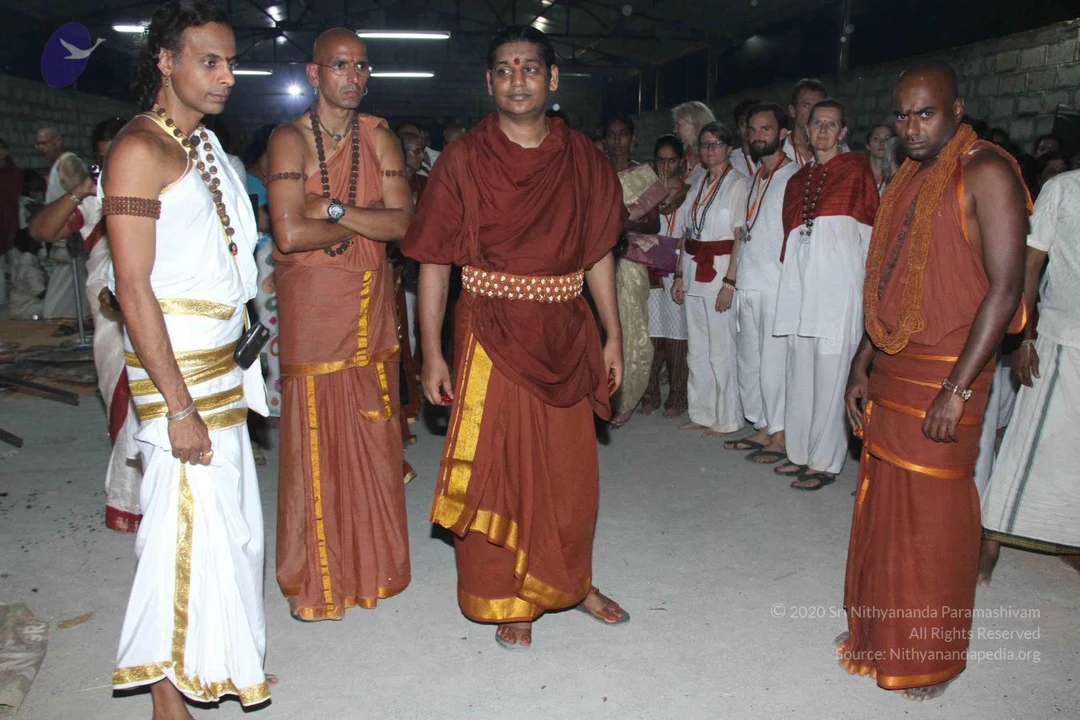
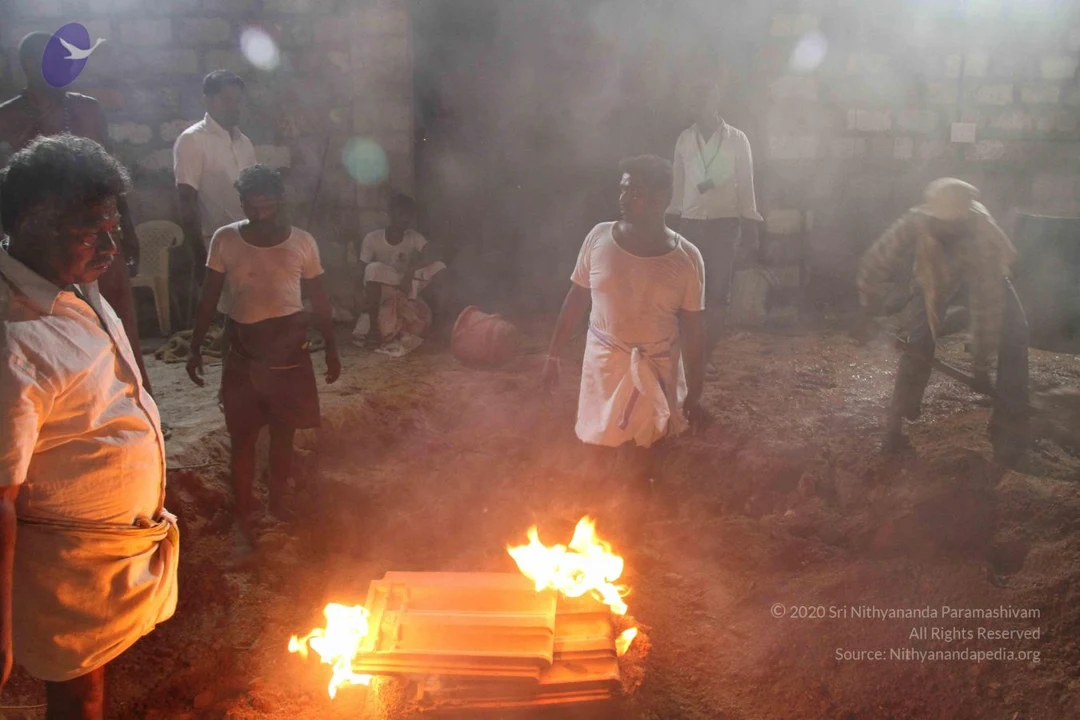
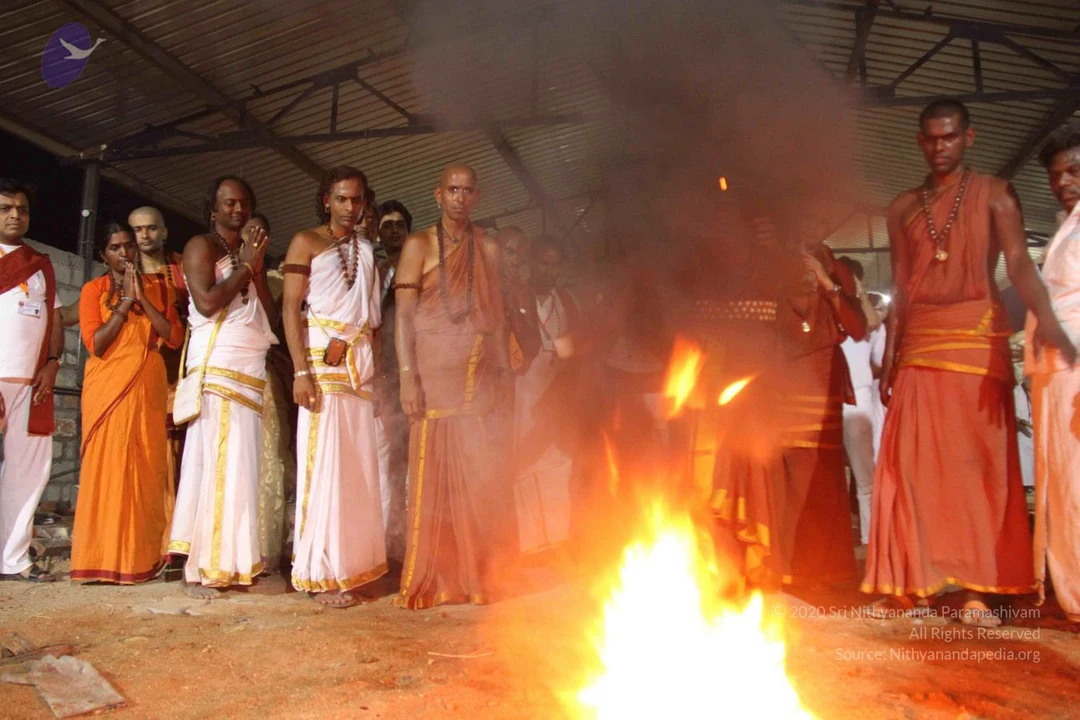
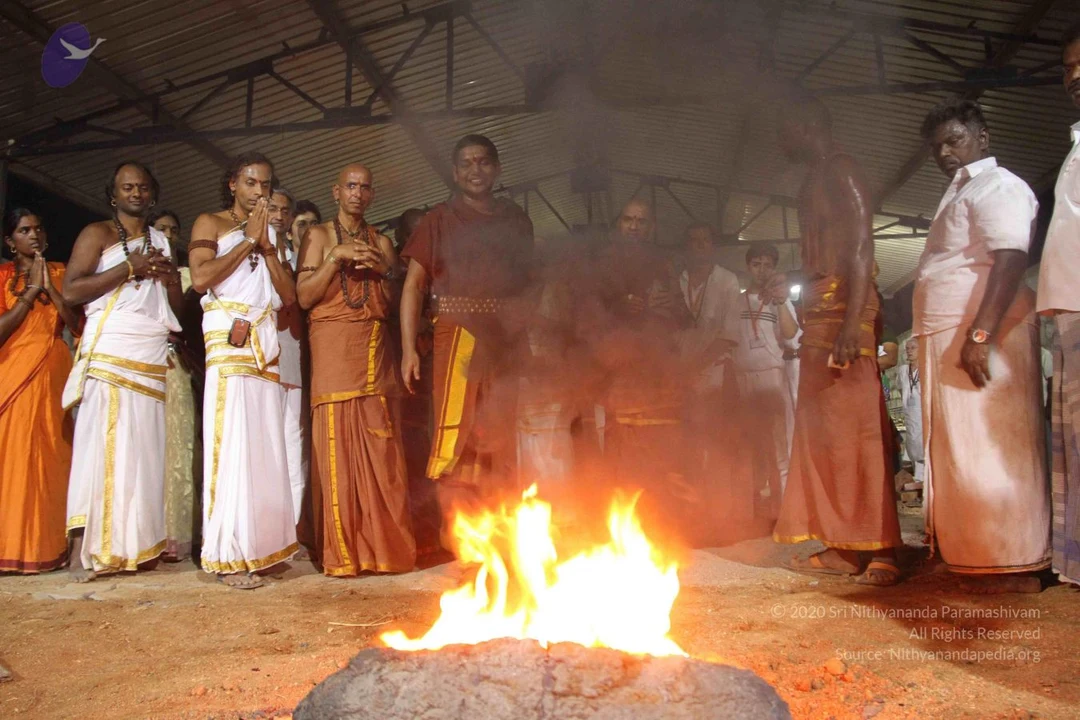
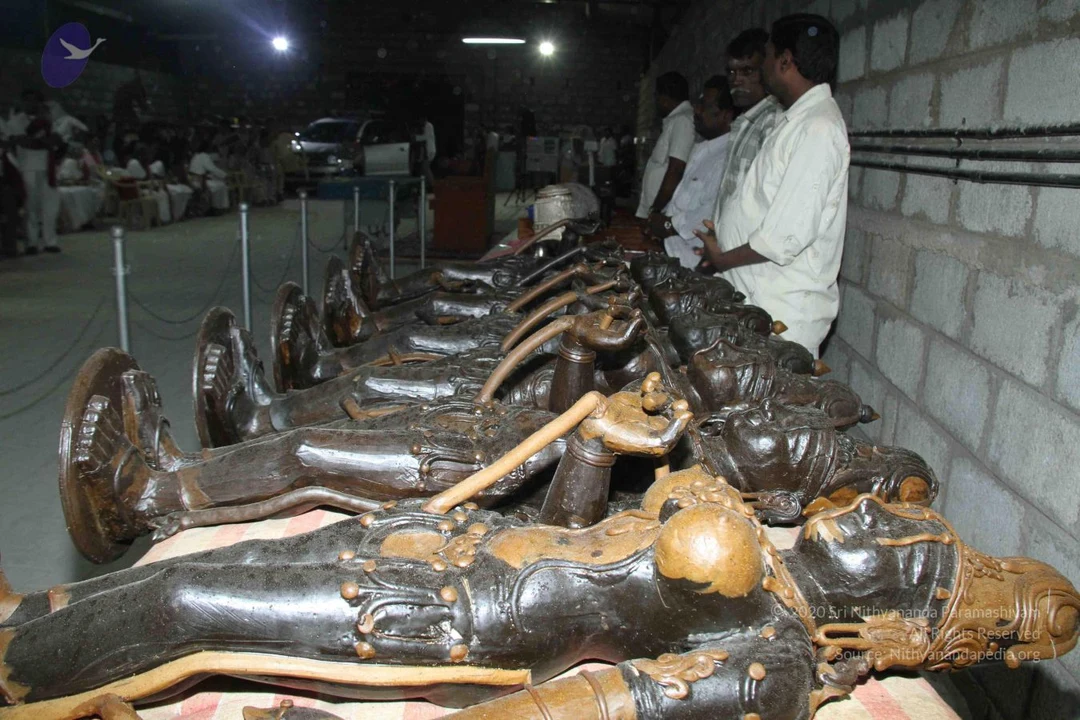
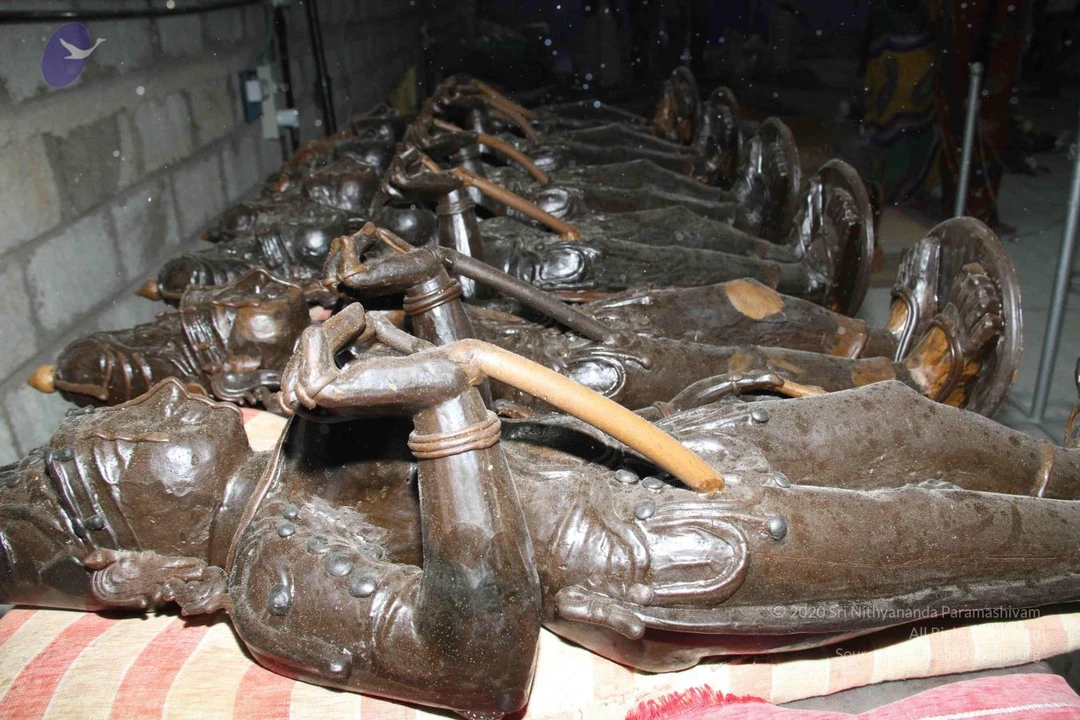
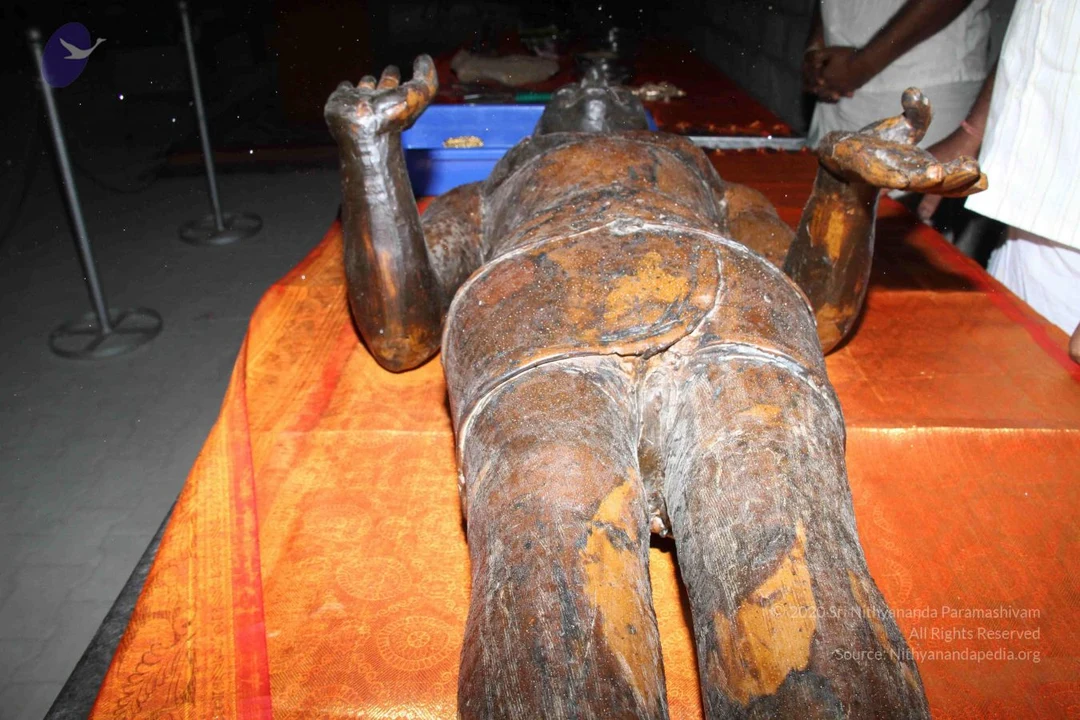
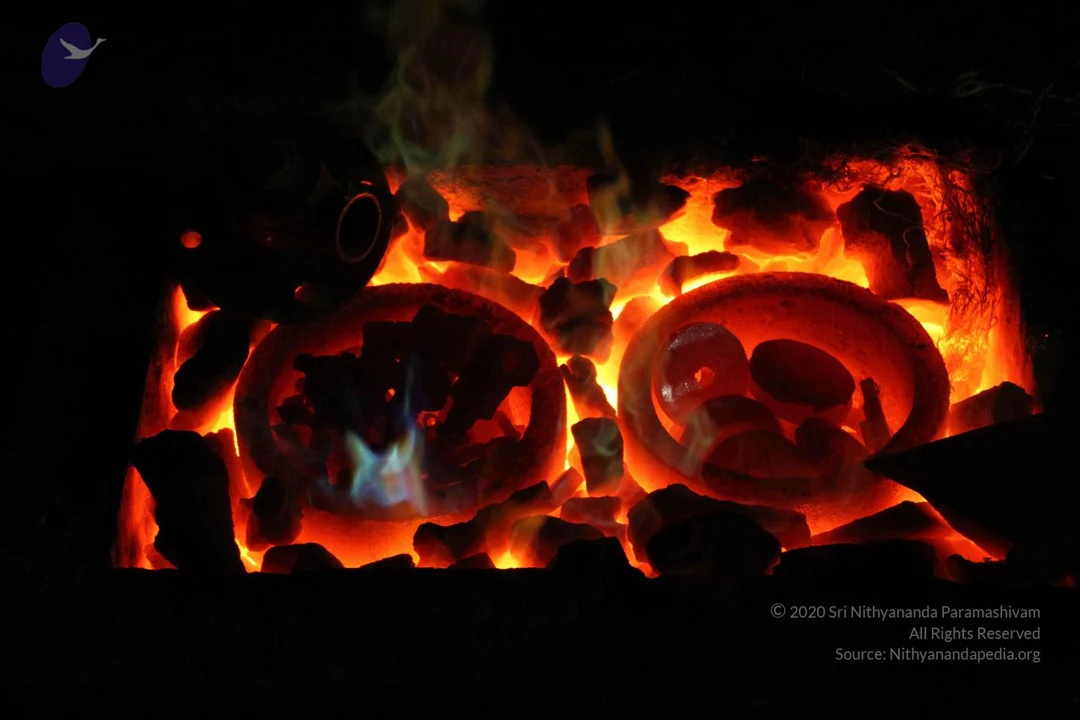
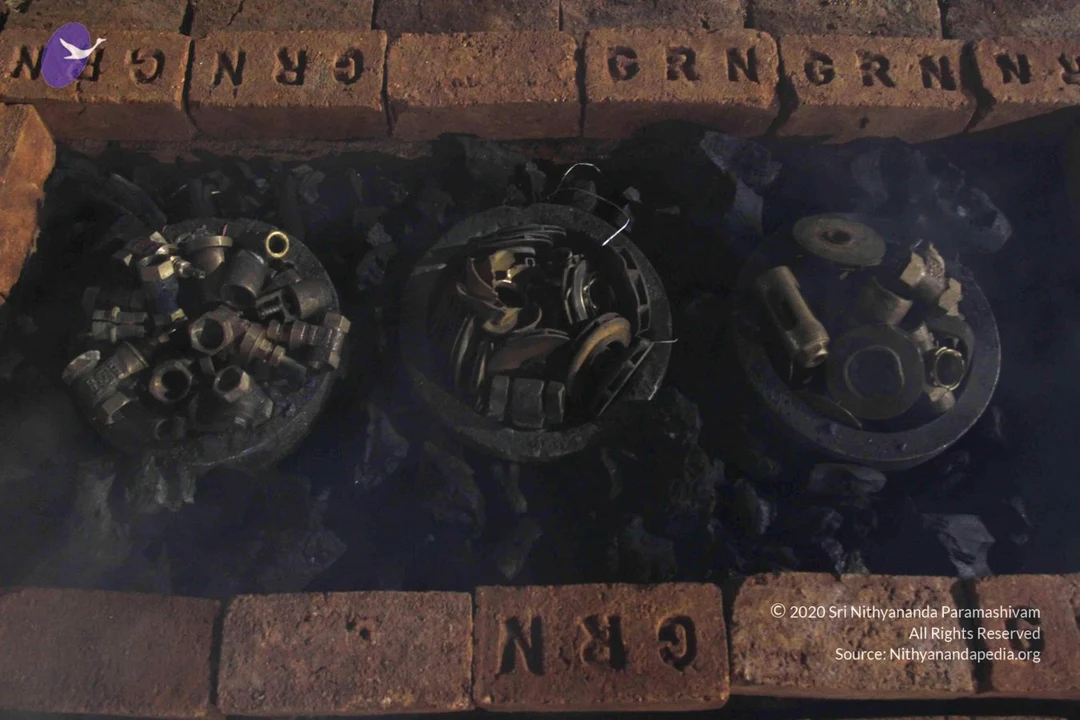
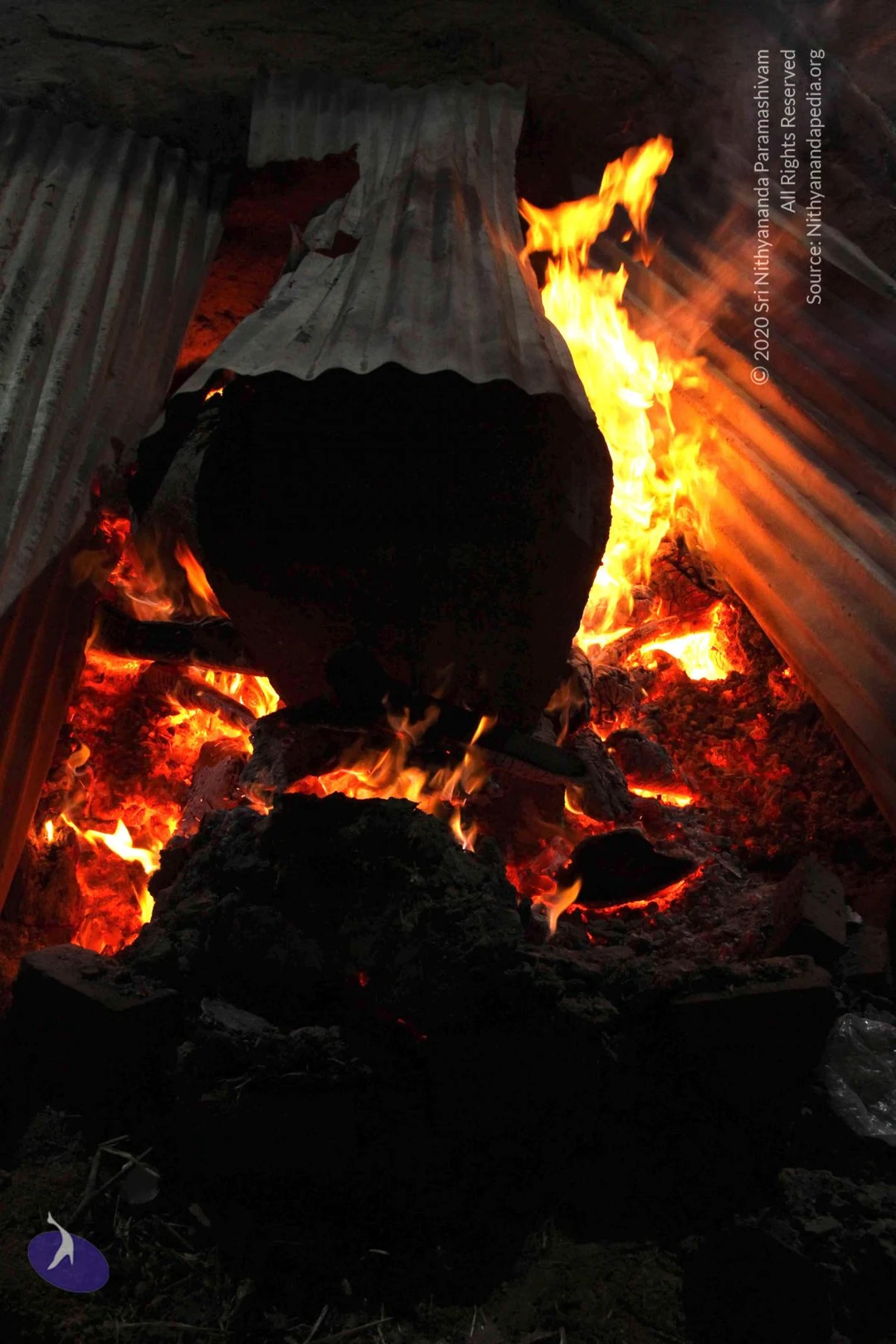
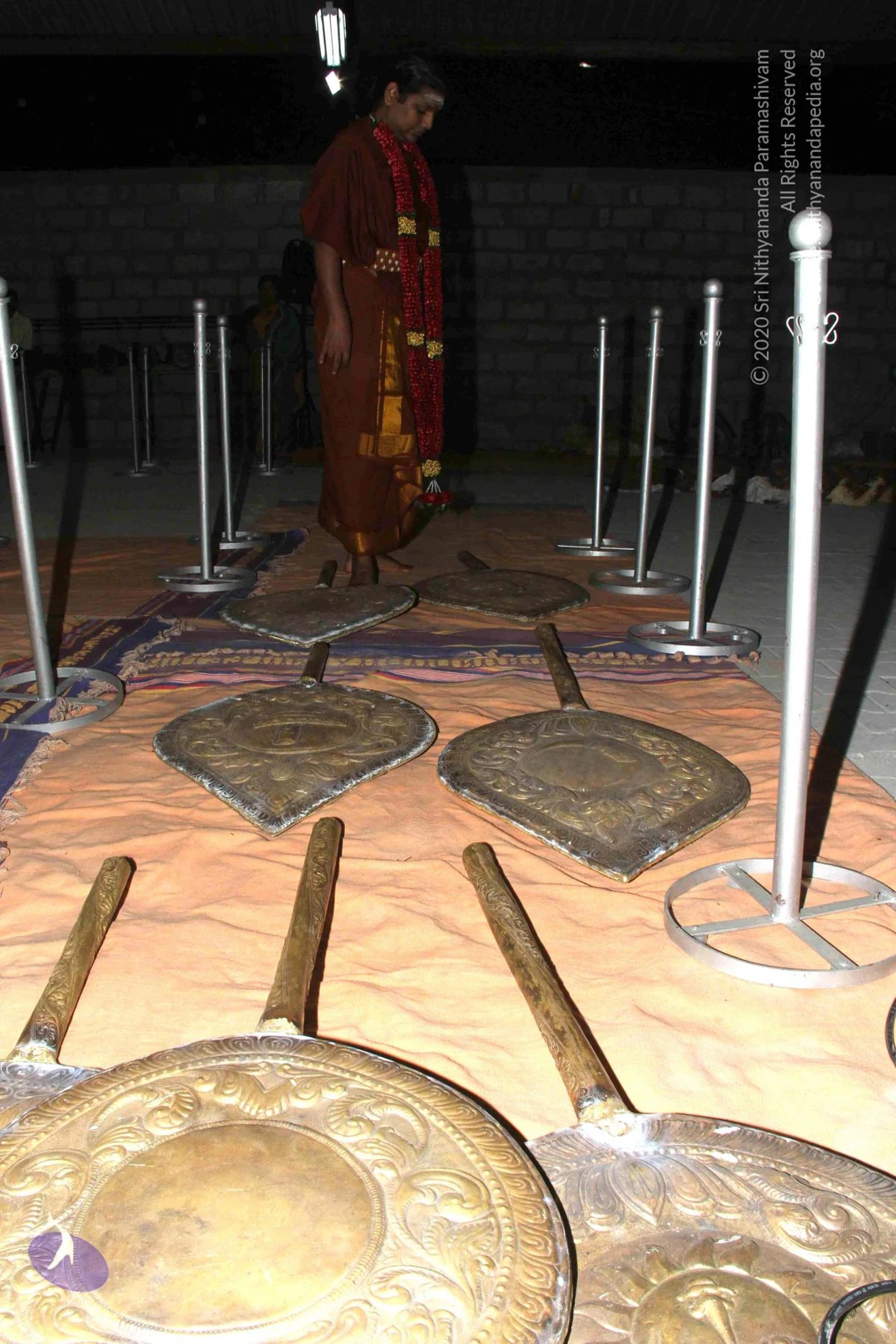
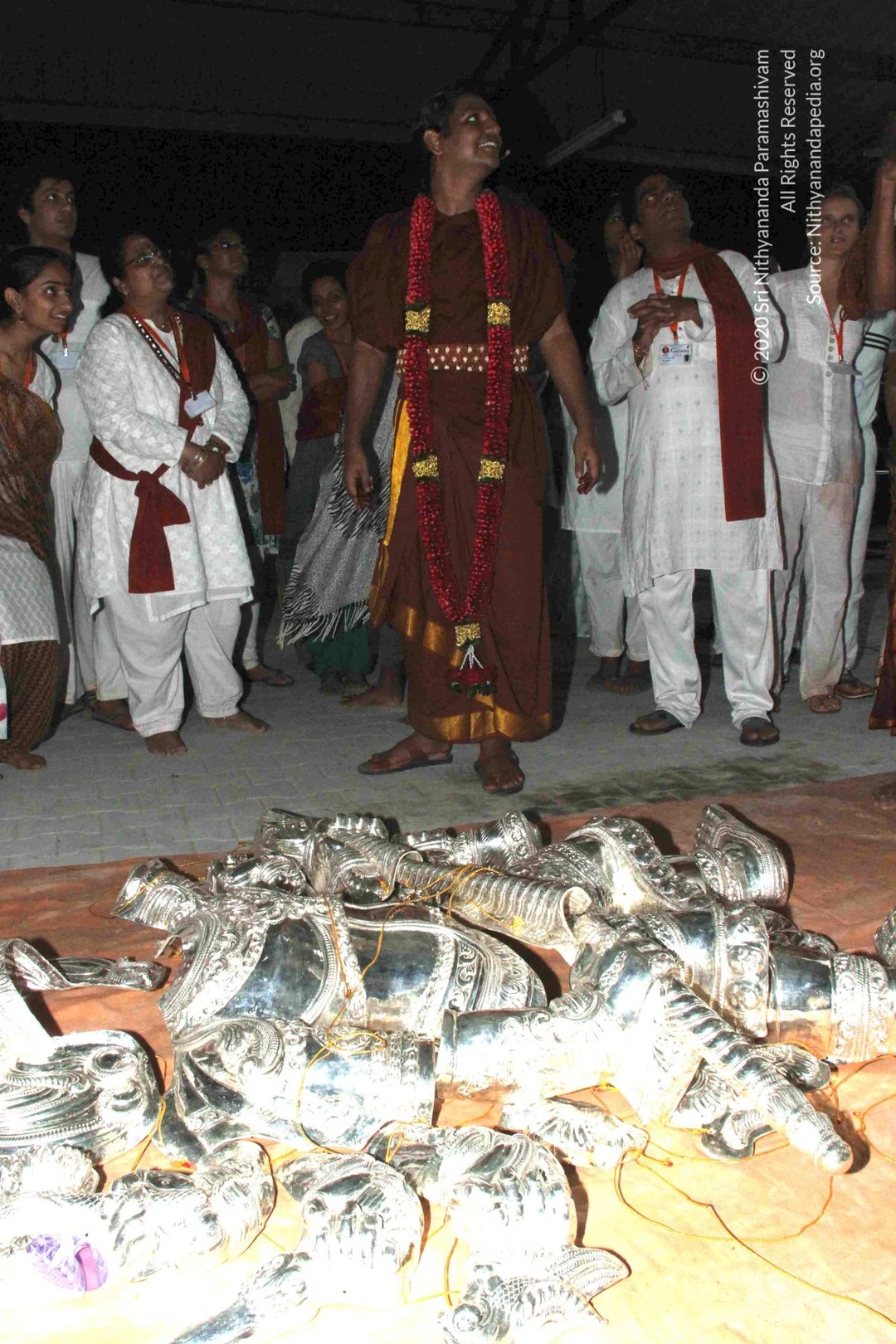
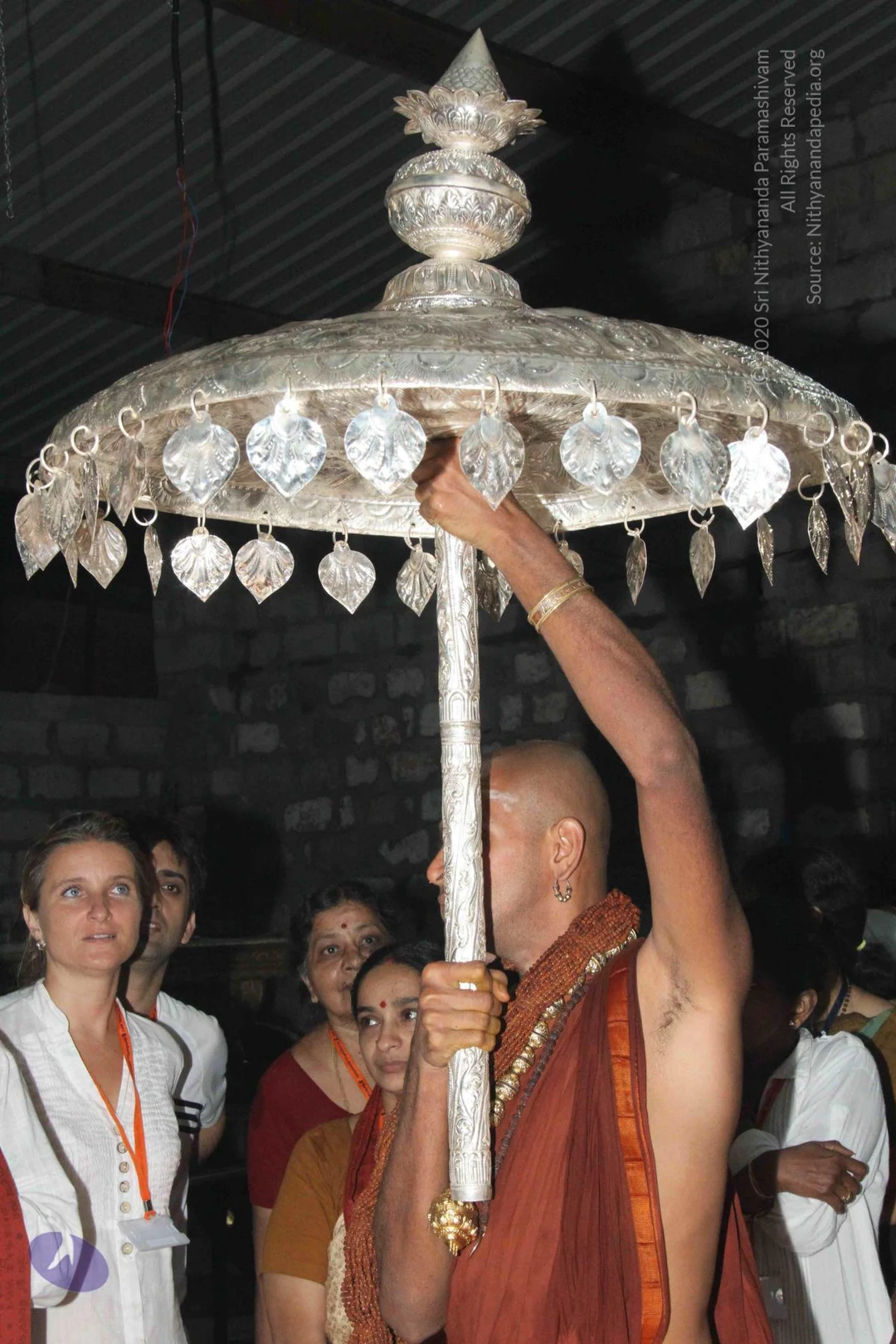
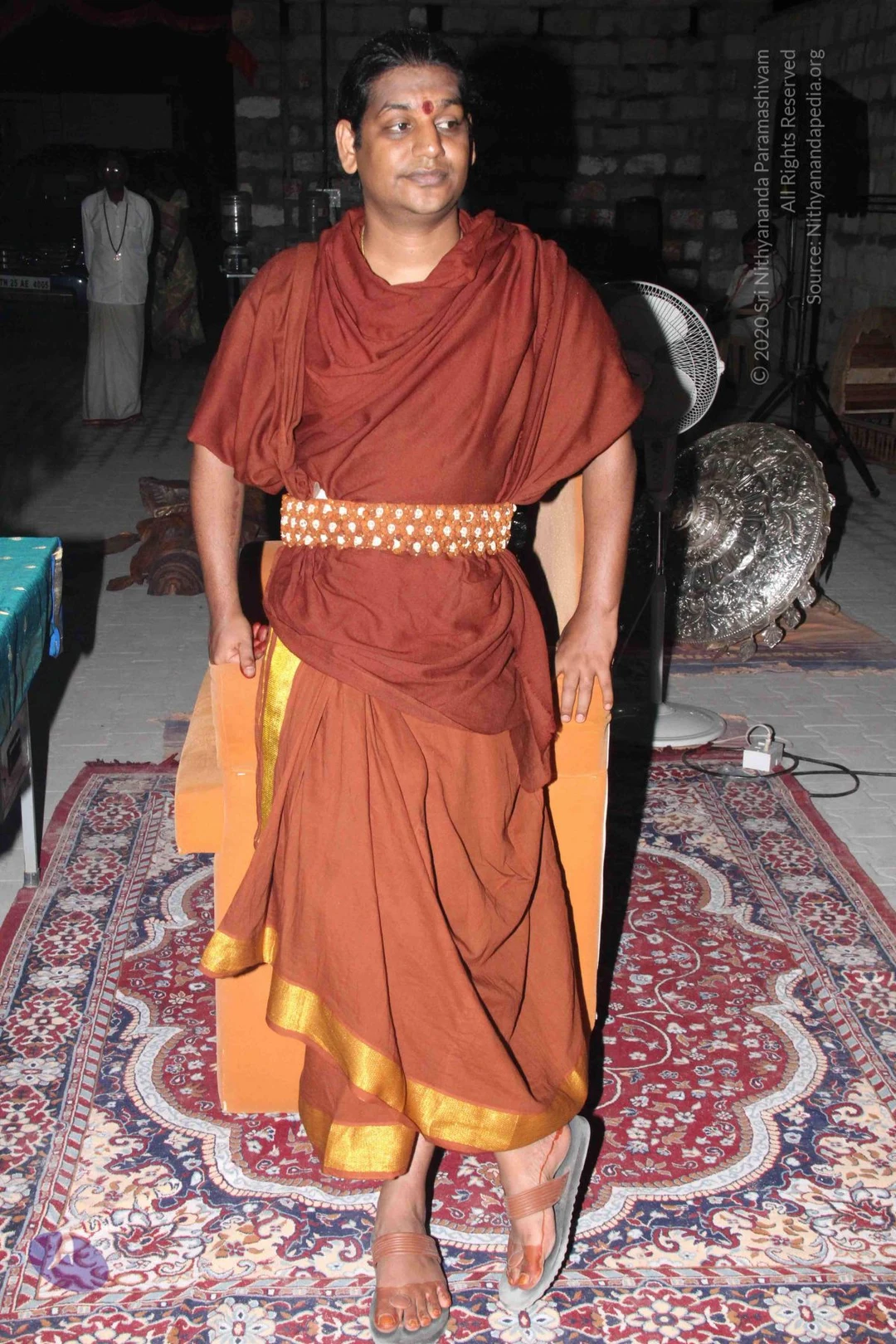
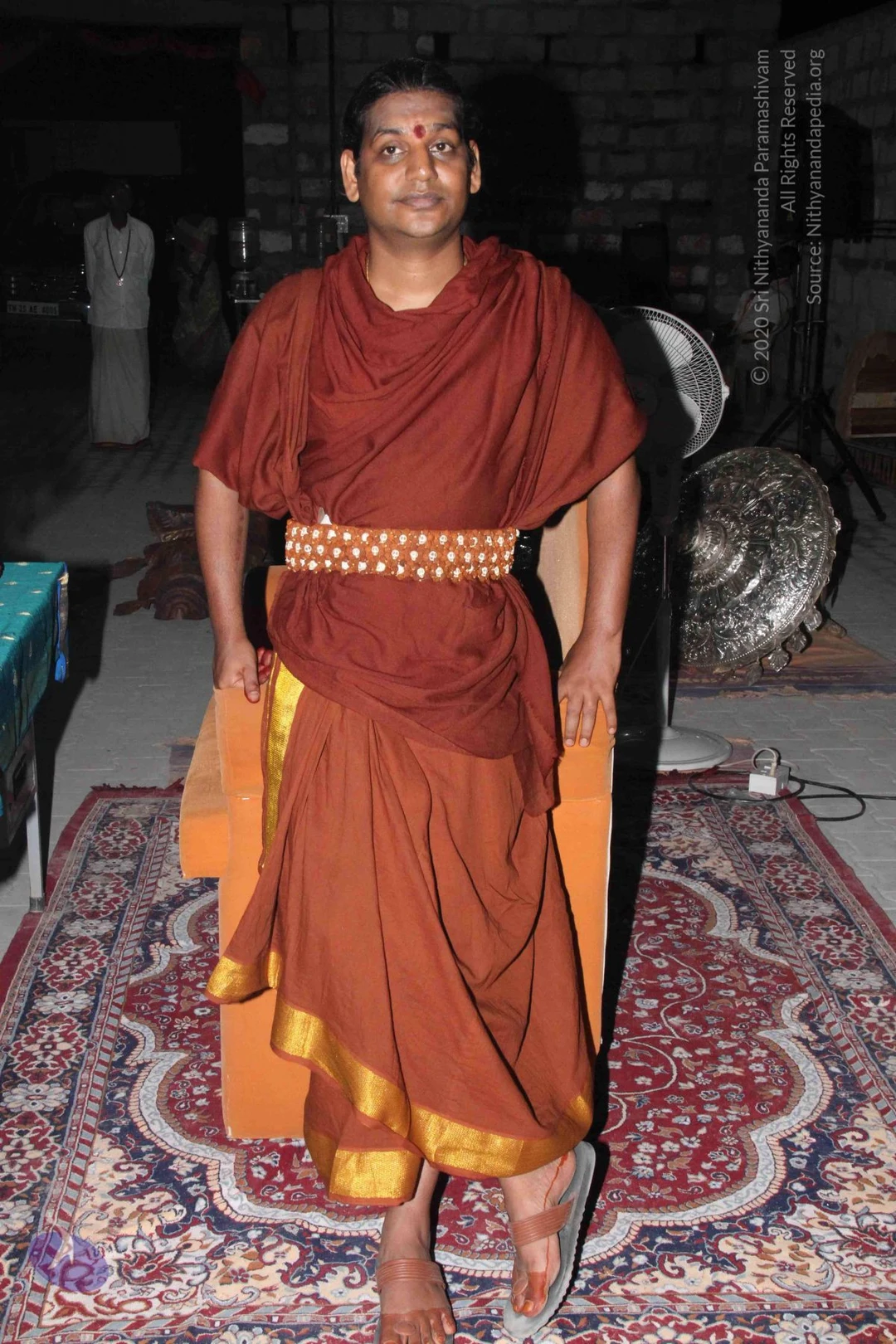
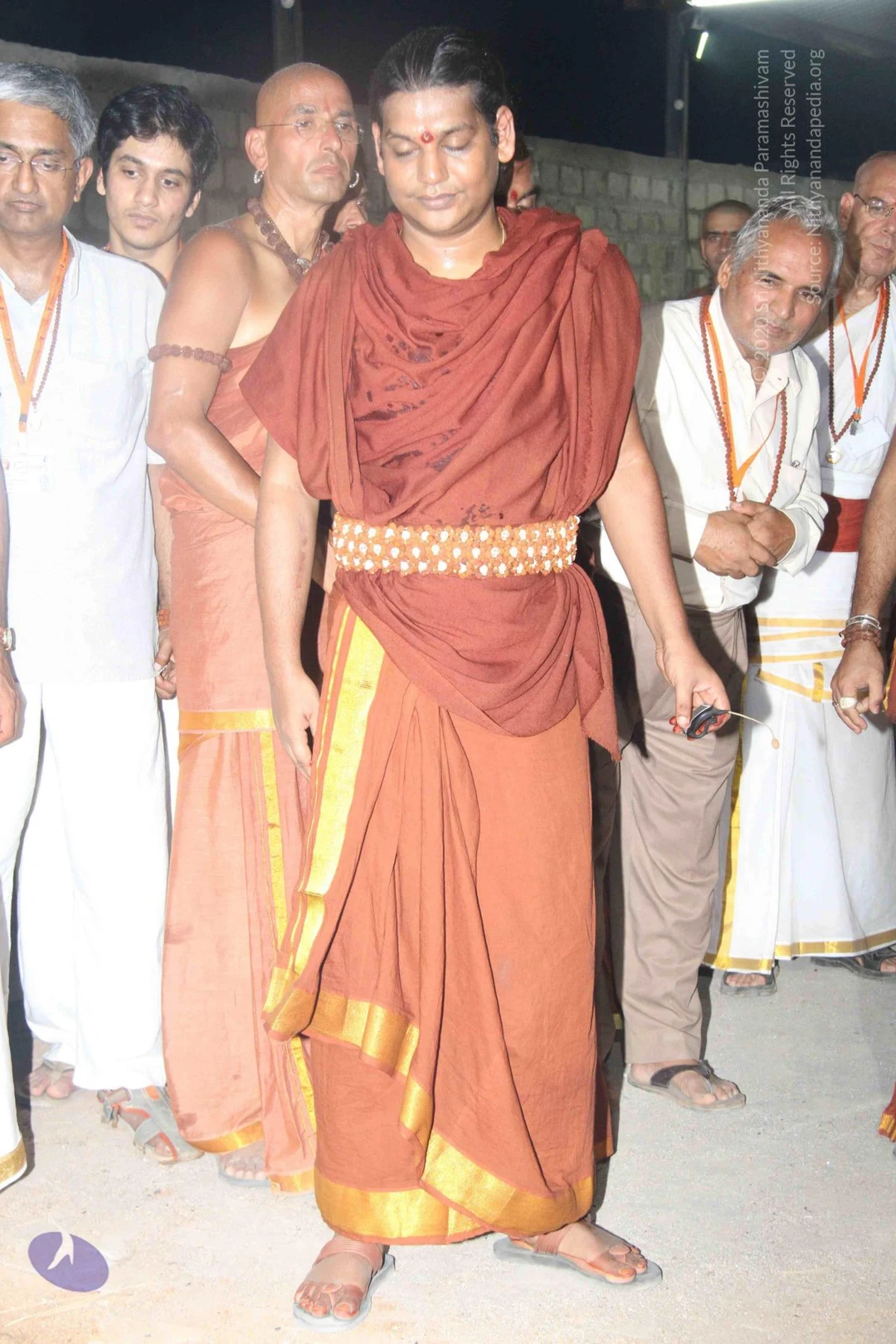
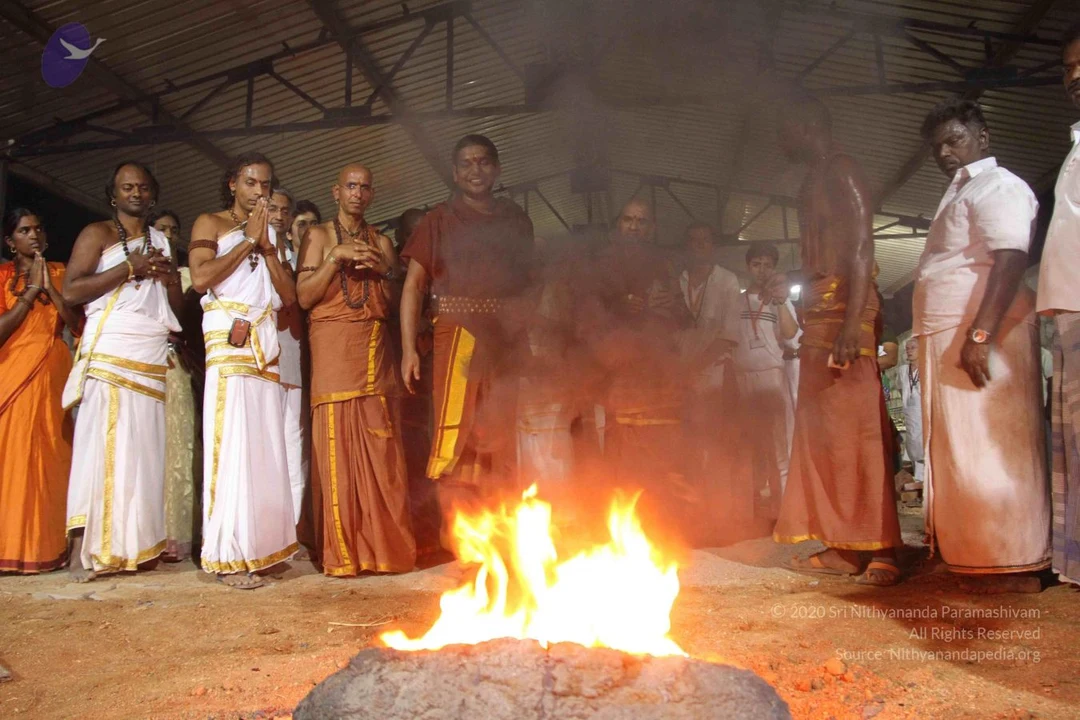
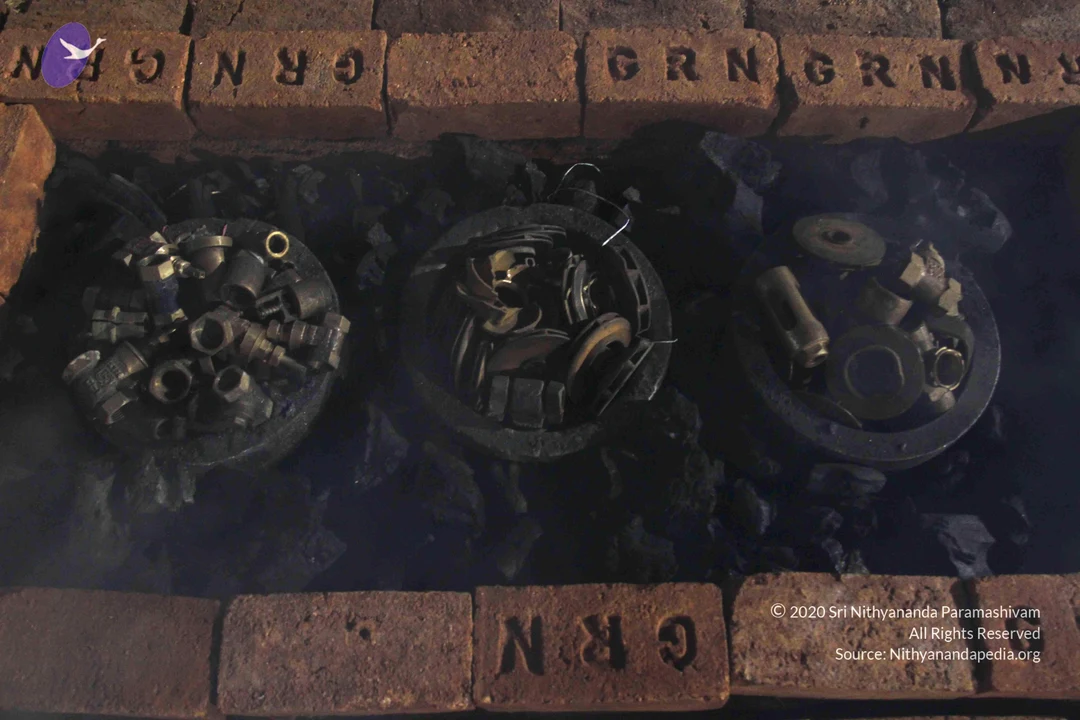
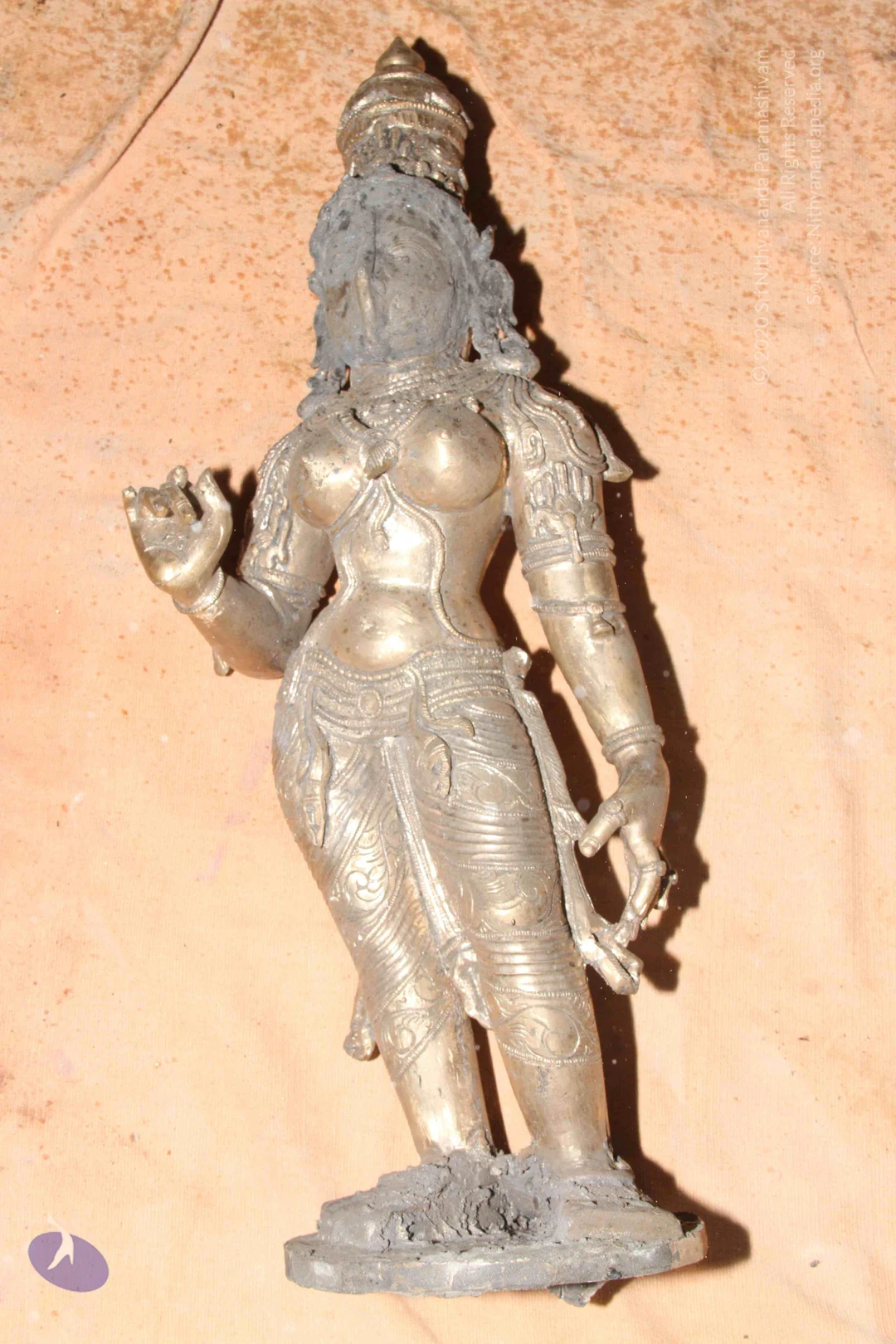
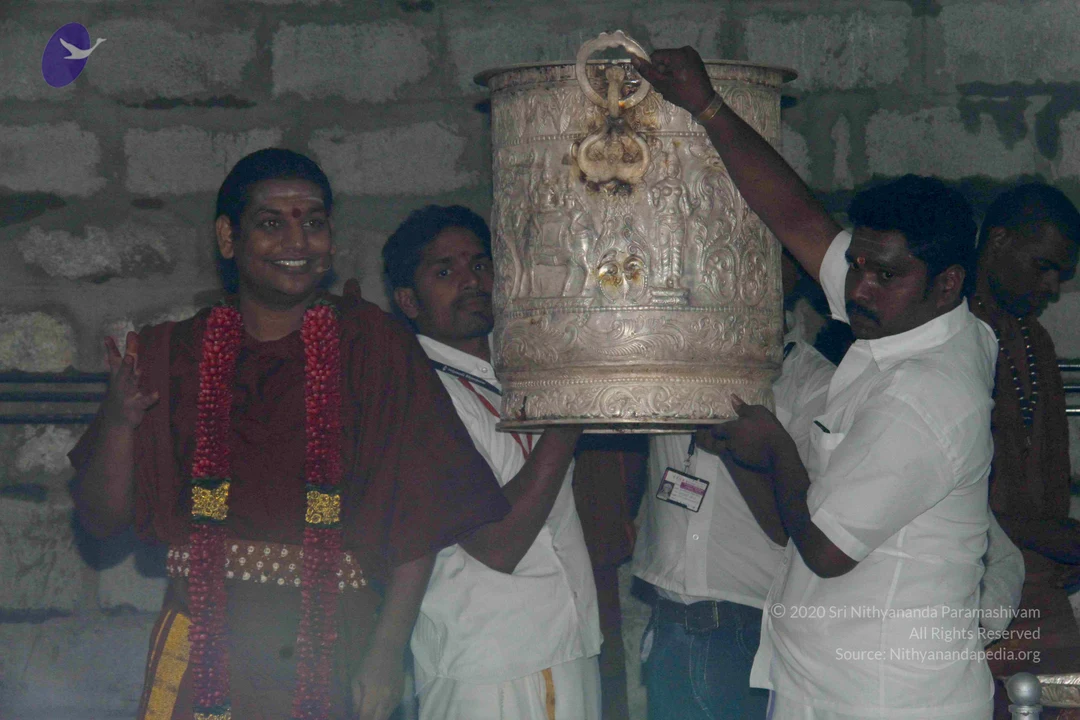
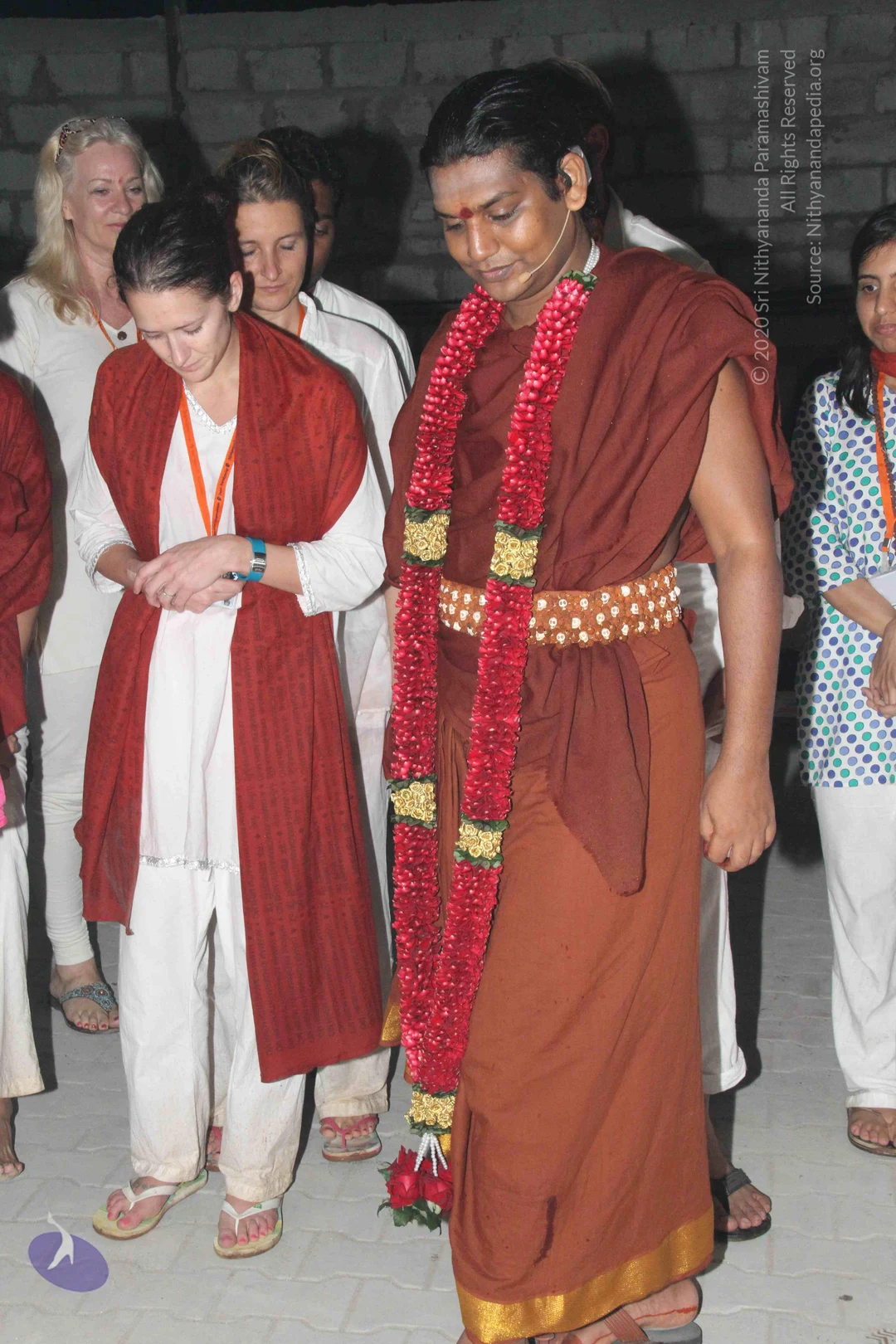
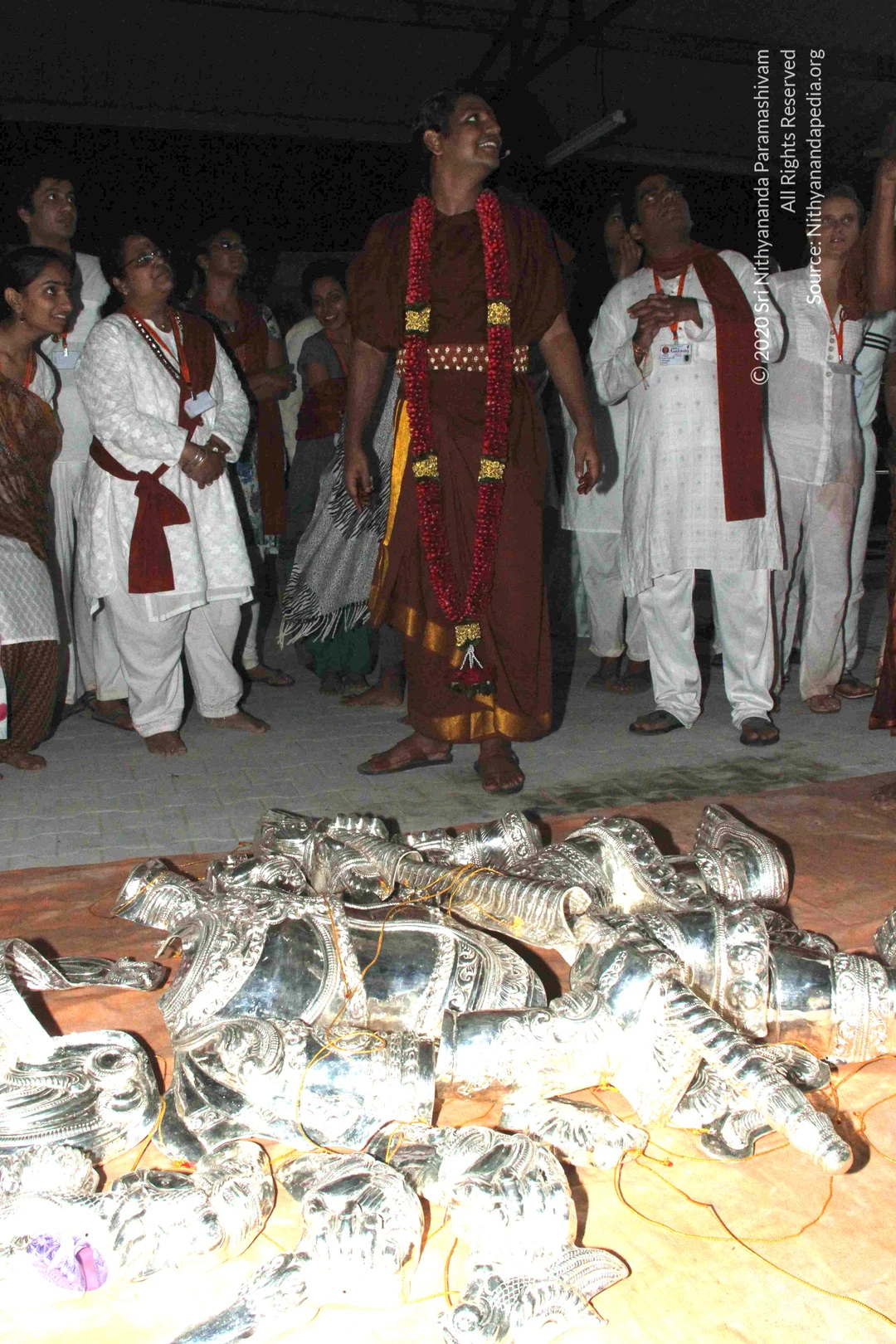
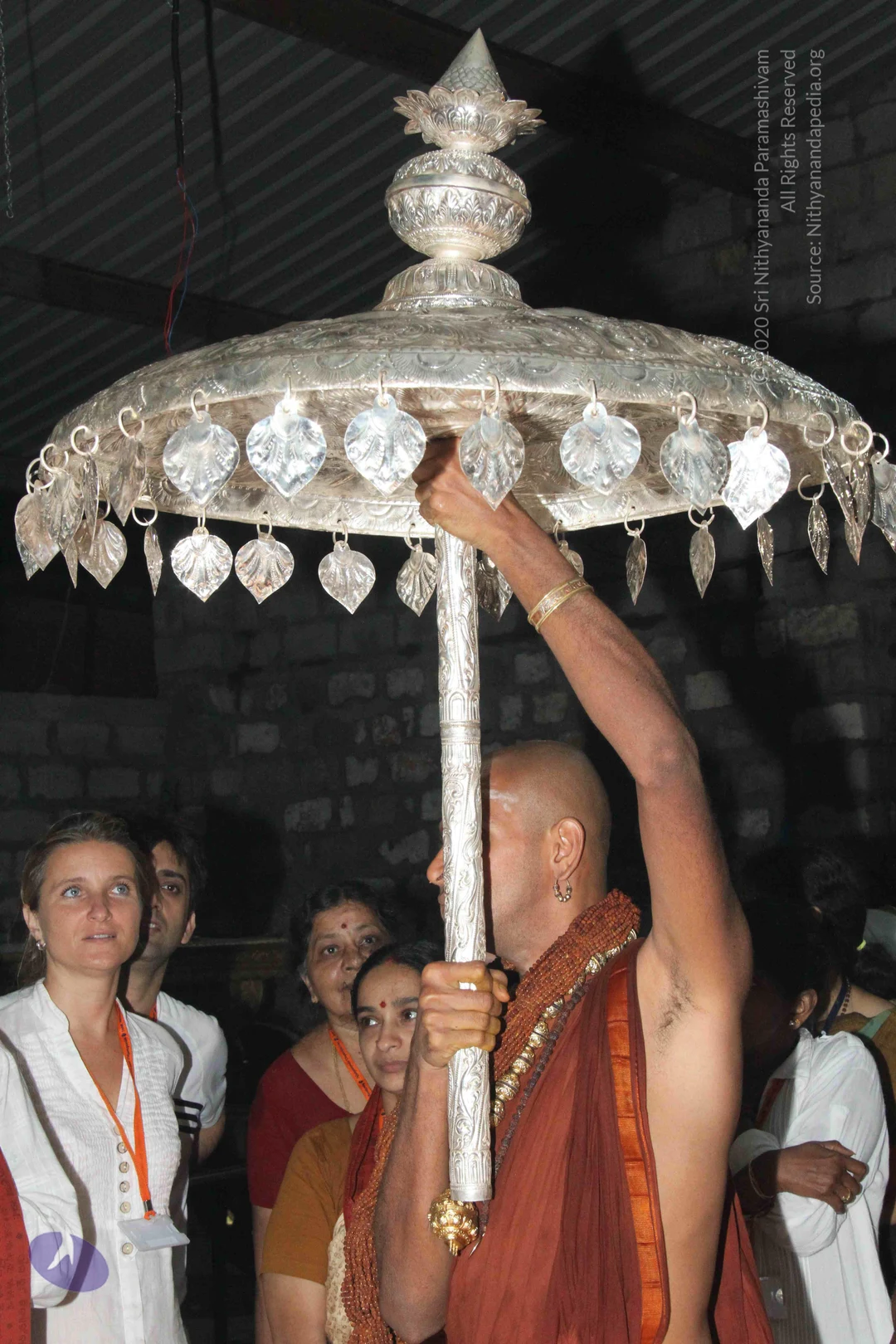
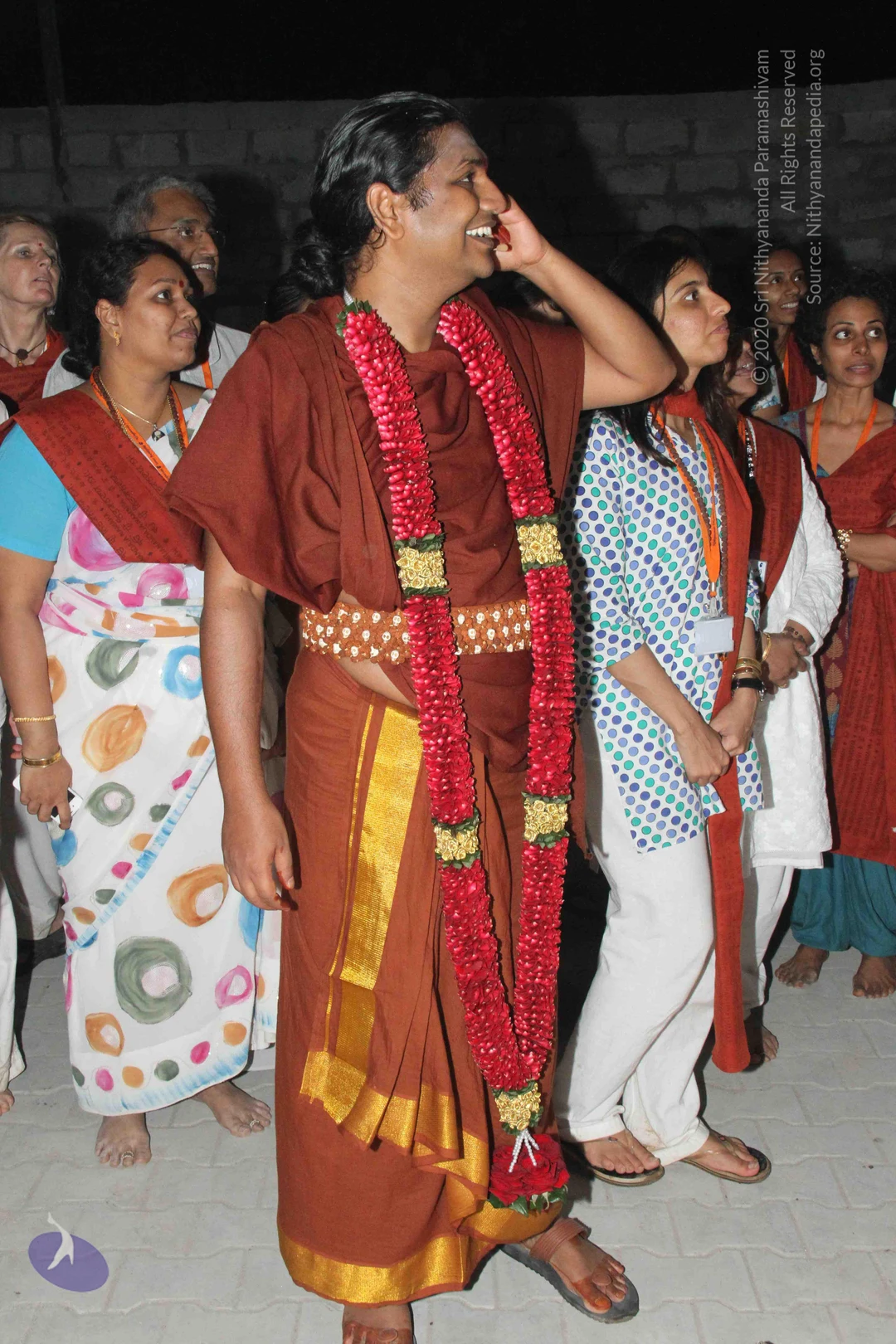
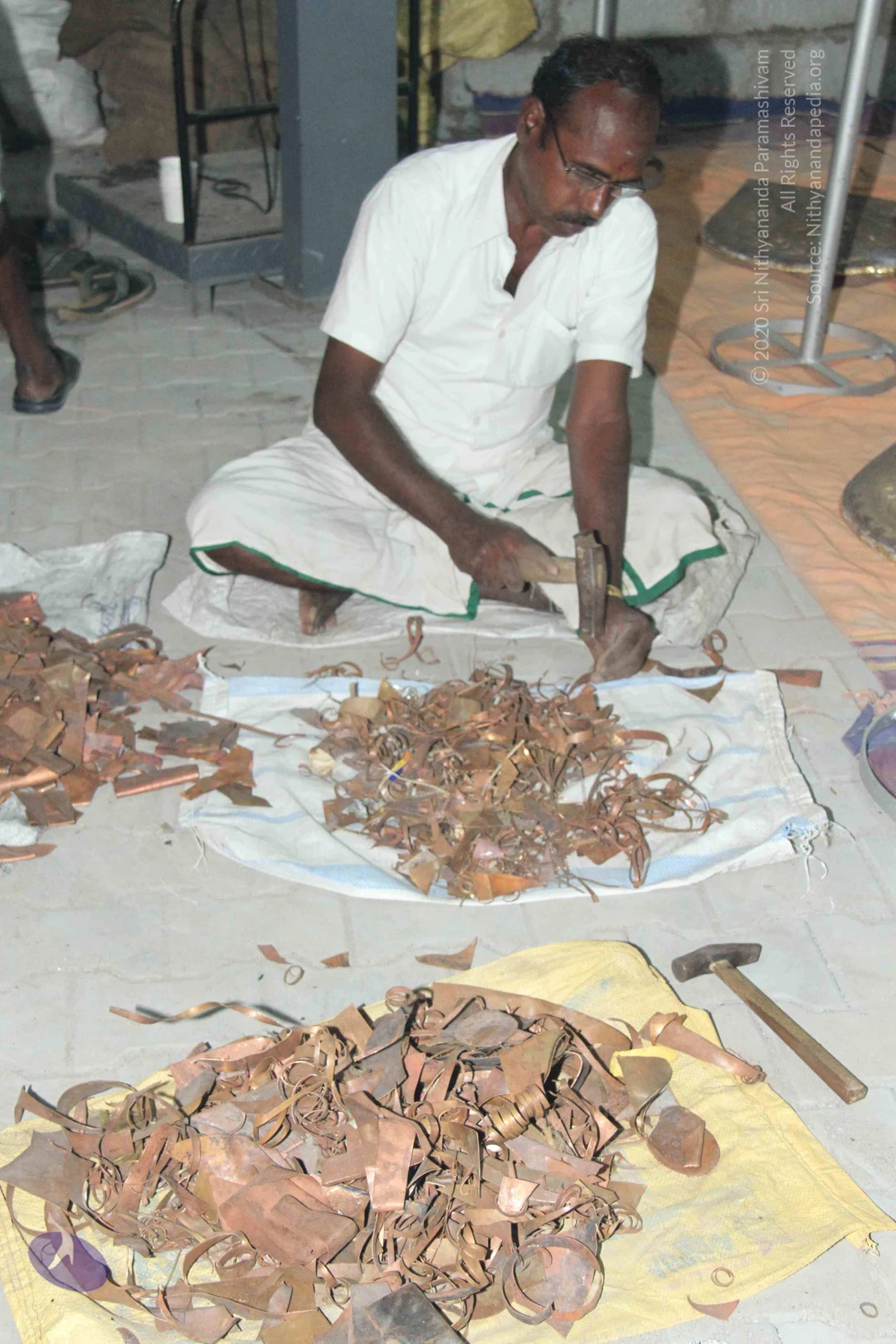
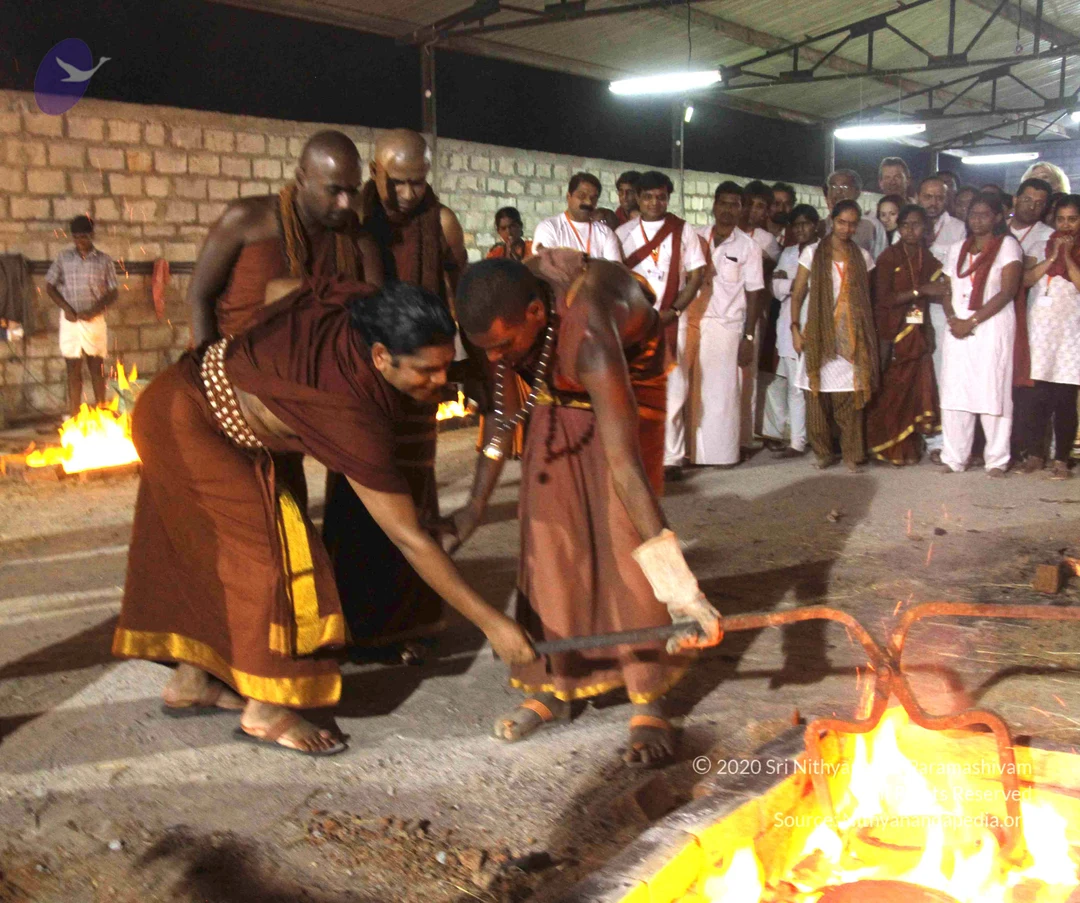
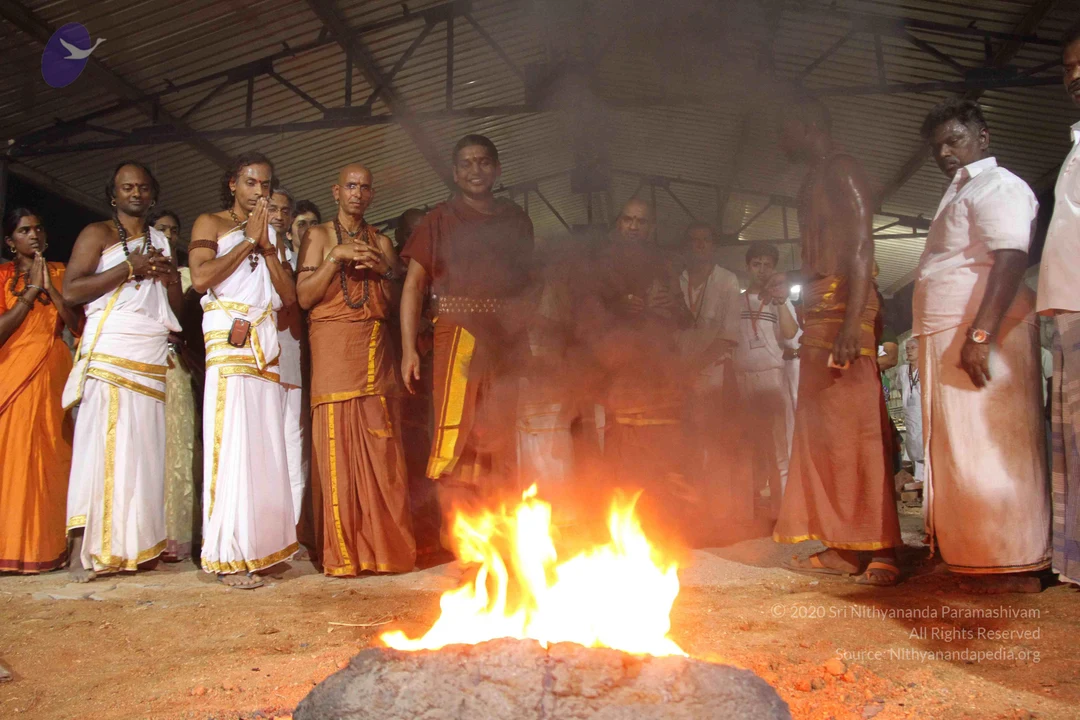
A photograph of an ornate silver ceremonial parasol, or chatra, with a finial on top and dangling leaf-shaped silver pendants along its rim, being raised high on a long silver pole by several hands. Two hands grip the pole near the centre; a bare-armed man with a shaved head wears an orange-red cloth wrapped at the waist. To the right a man with curly hair and a grey beard wears a white shirt. People at the lower left and bottom watch upward, including a man with glasses and a woman with light hair. The setting is a roofed hall with metal roofing and exposed steel beams. There are seven visible people in total.A photograph of broken, weathered bronze or copper metal fragments laid out on an orange cloth on the floor. The pieces appear to be parts of a deity murti or ritual sculpture: a curved arm or limb, ornate carved panels, a lotus-shaped base piece, a torso fragment with engraved patterns, and a tall tubular section. Patina and dark discolouration are visible across the pieces. Edges of maroon or saffron-coloured cloth are visible at the top corners, and a metal bucket sits at the left. No people are visible in the frame.A photograph of a night fire ritual under a corrugated metal roof. A bright fire burns in a low stone-rimmed pit in the foreground, with smoke rising. Several men stand around it with palms pressed together in namaste. The man second from left wears a white dhoti with gold borders and a white upper cloth, with rudraksha beads around his neck. Beside him a man in a saffron-orange upper cloth and a bare-chested man stand with hands folded. At left edge a woman in an orange sari also folds her hands. Several men in brown and rust-coloured robes with gold-bordered cloths stand in the background. On the right, a bare-chested man in a golden-bordered orange dhoti stands near a man in a white shirt and checked lungi. A purple logo appears at top left.

September 04 2013

Original wiki page
Contents

Title:

Enrich your Inner Space.

Description:

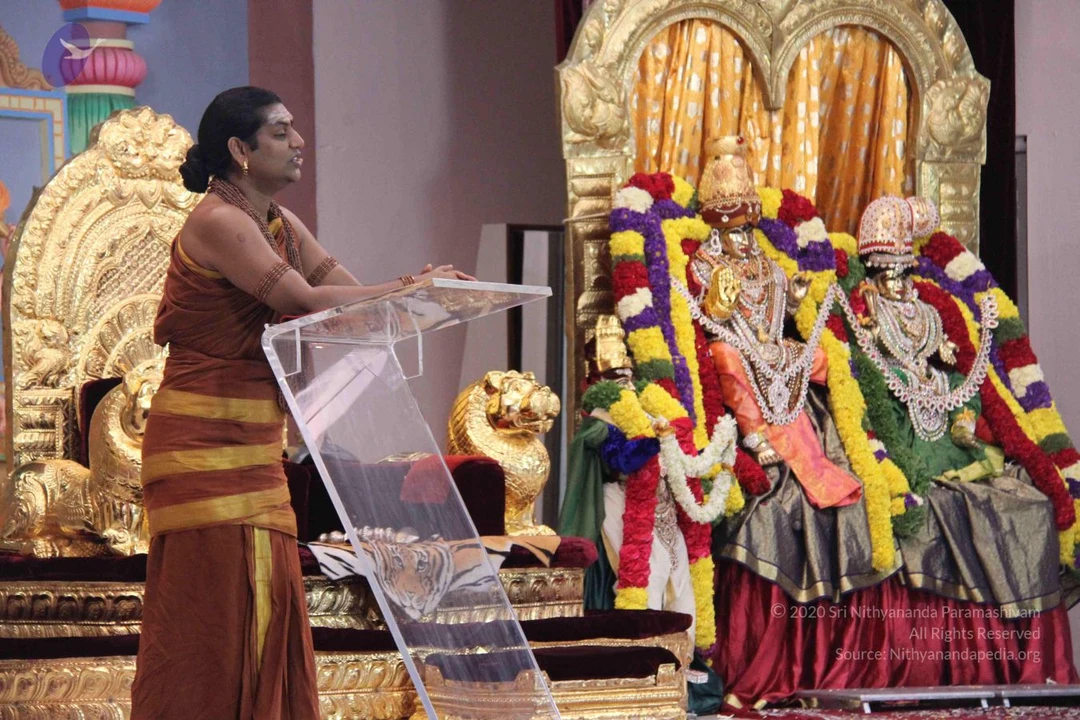
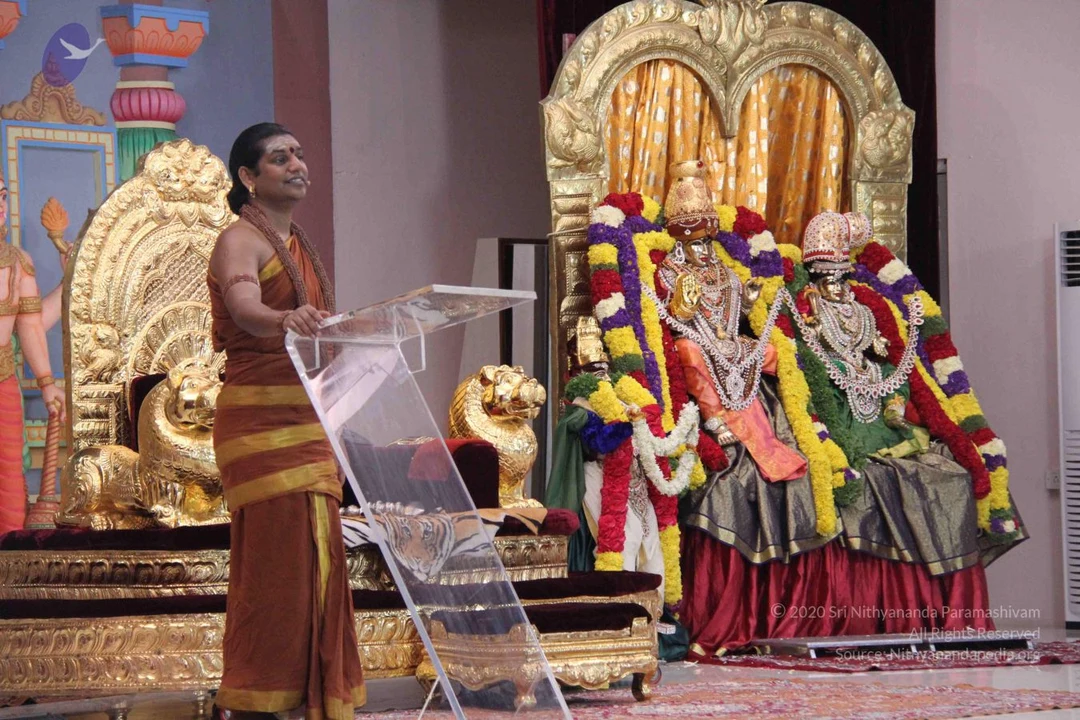
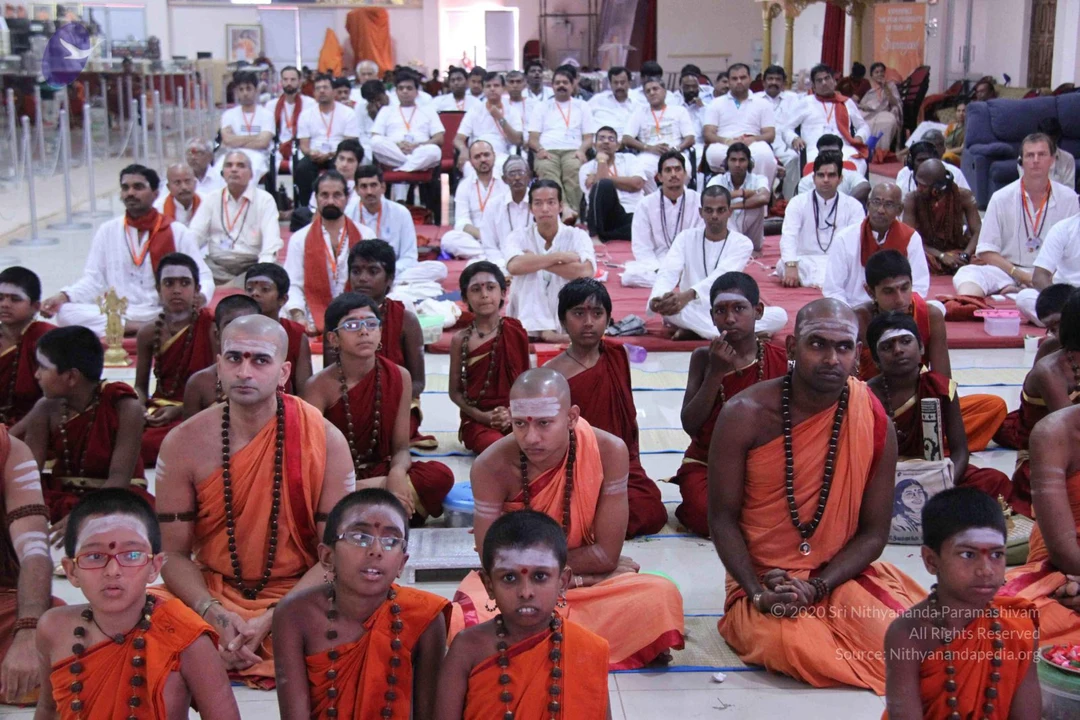
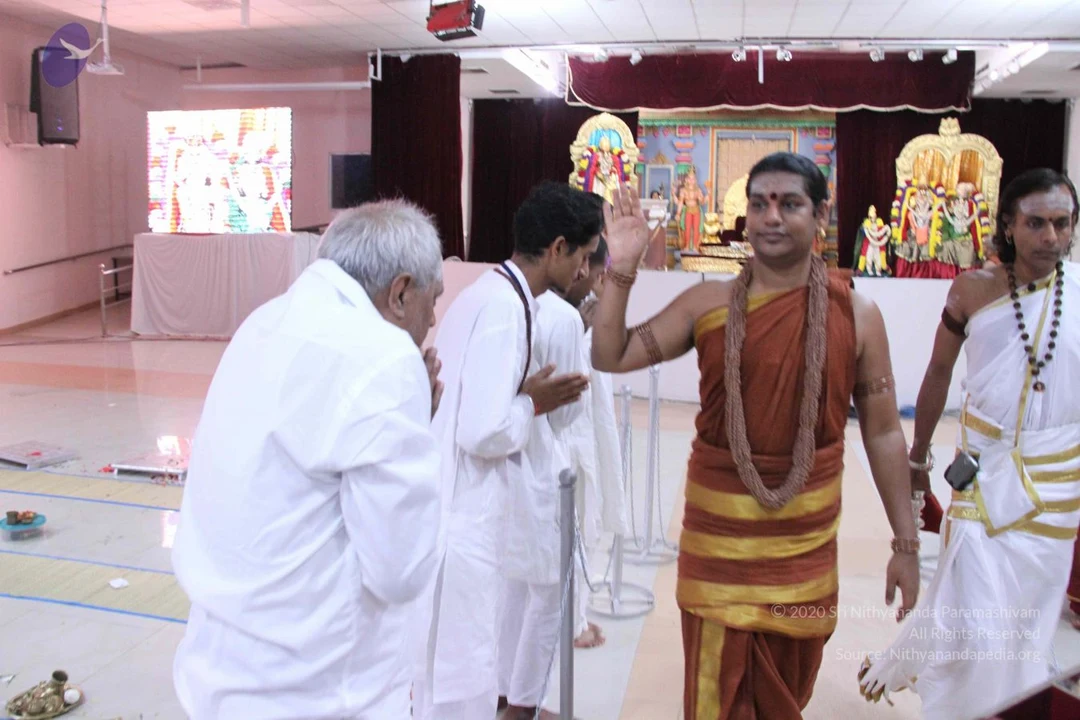
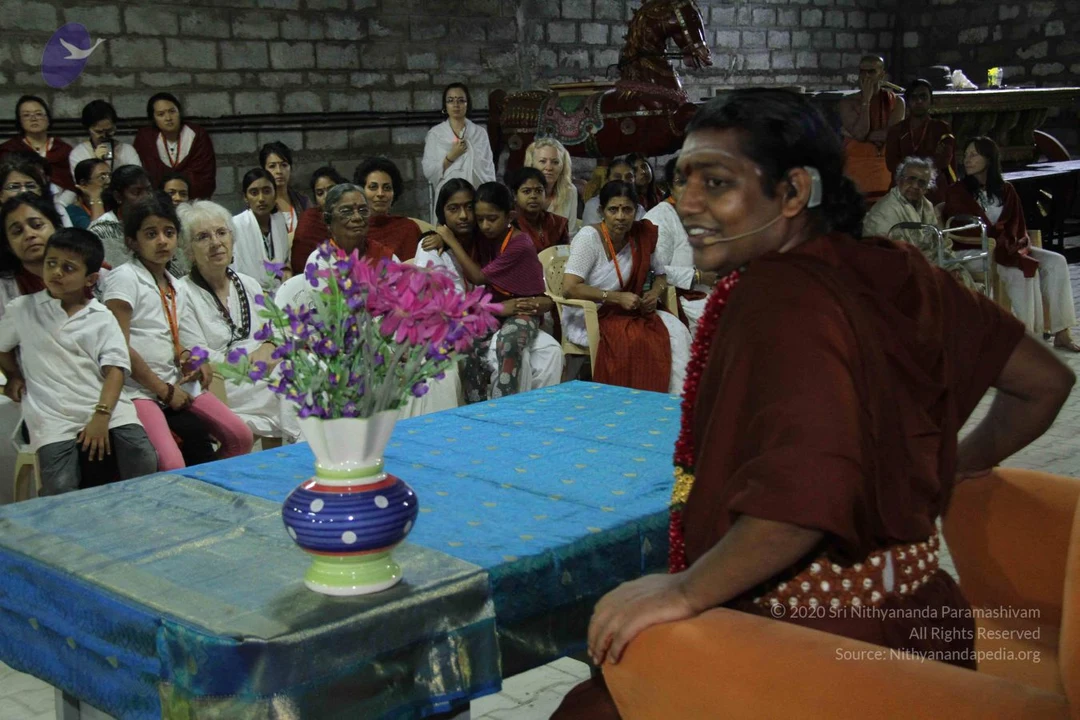
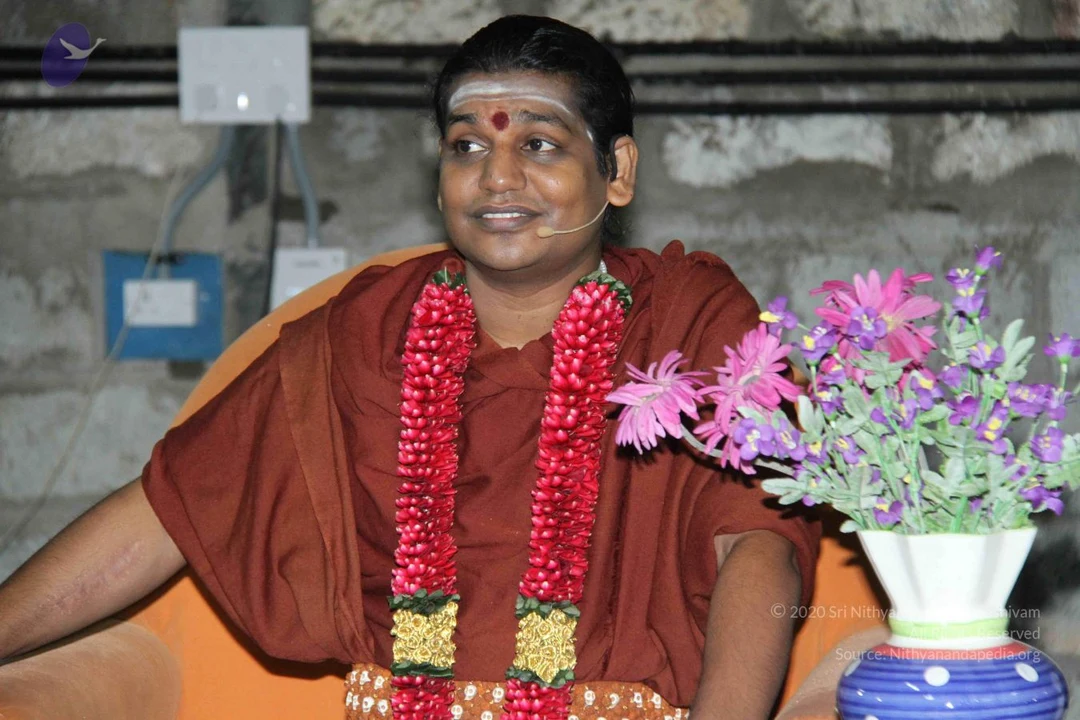
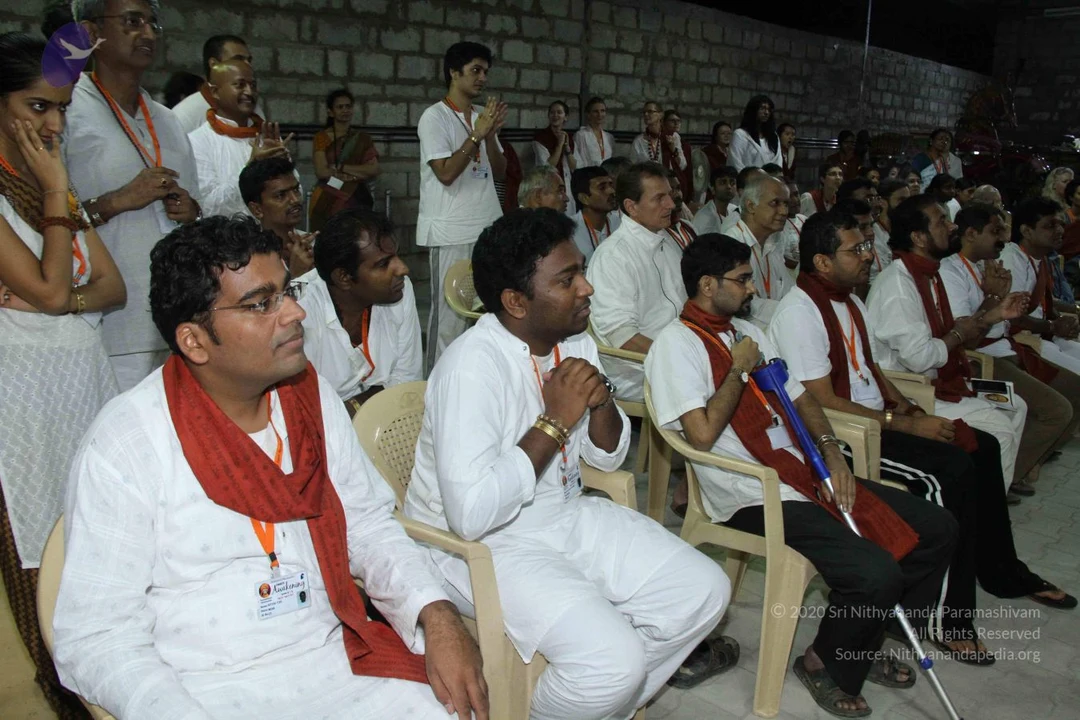
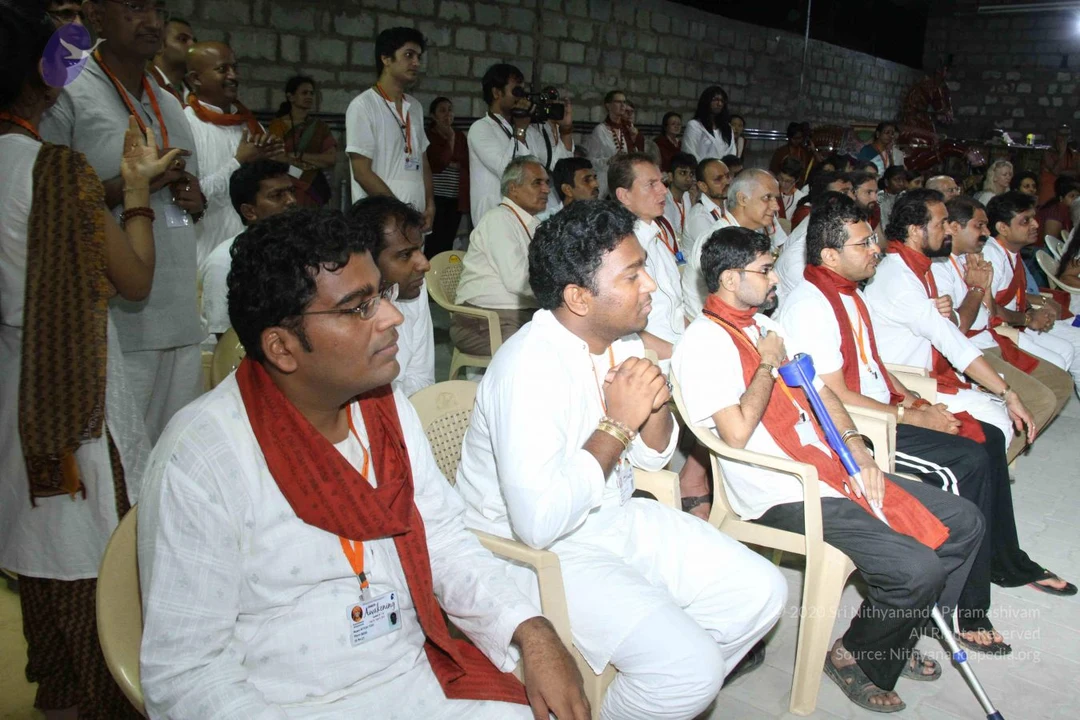
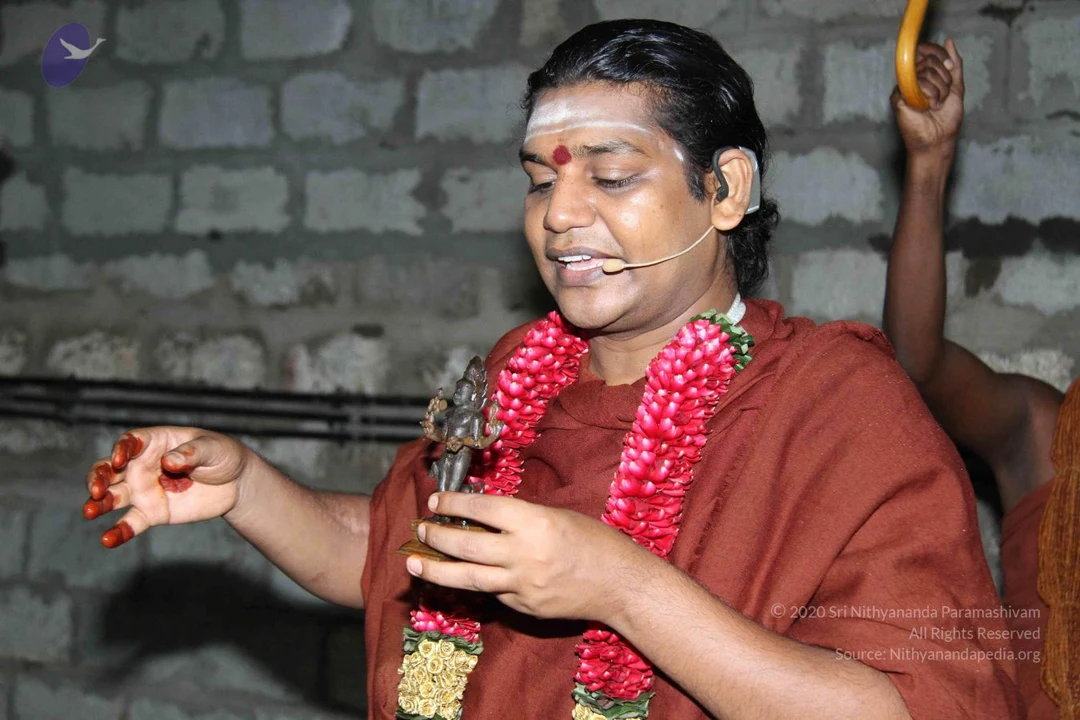
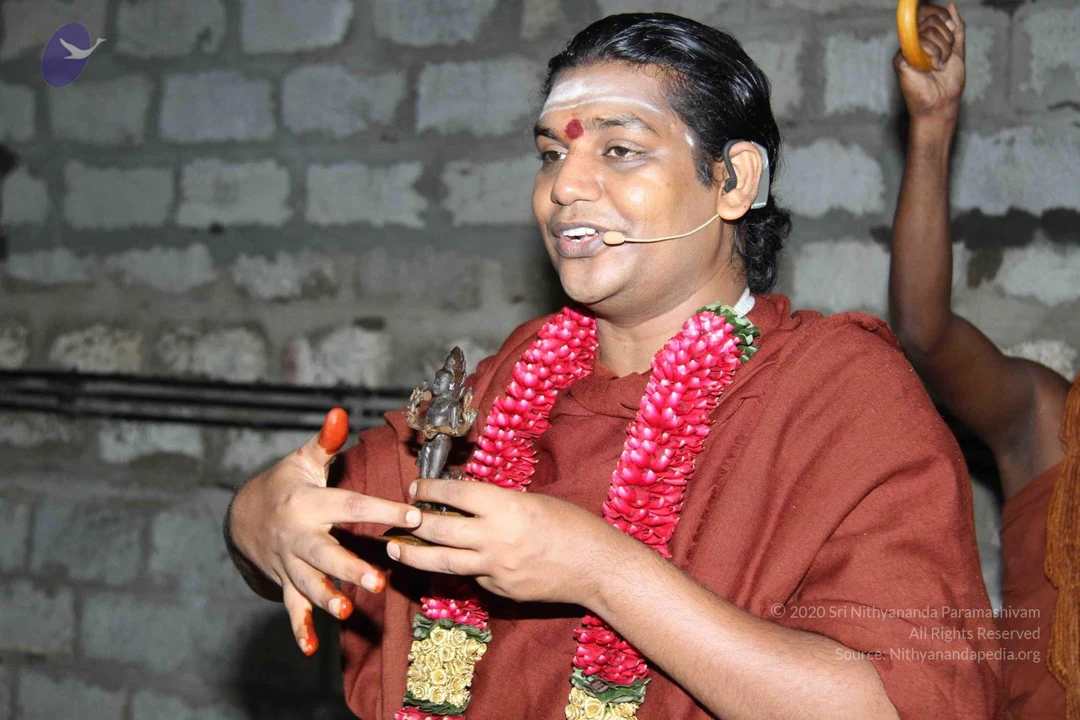
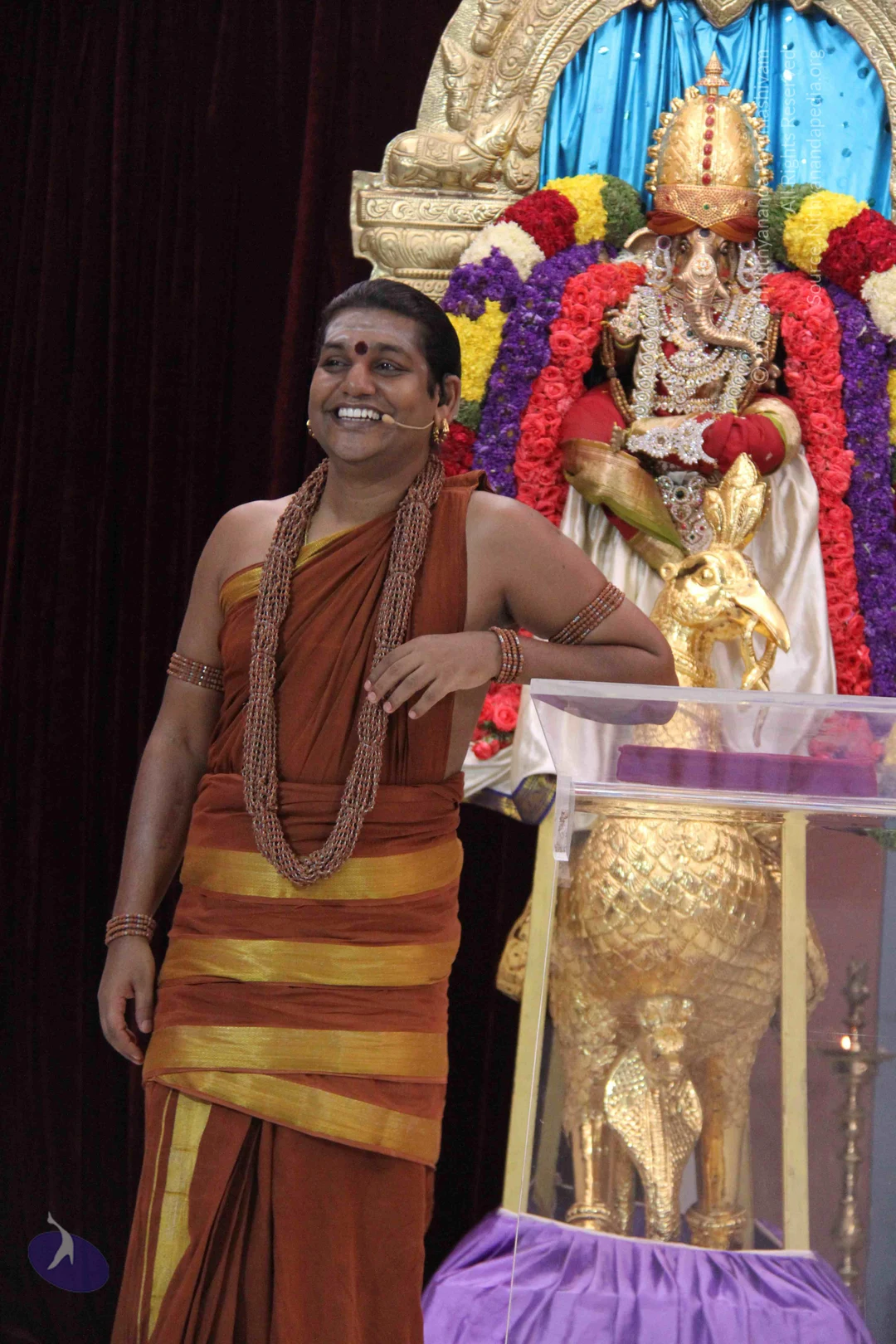
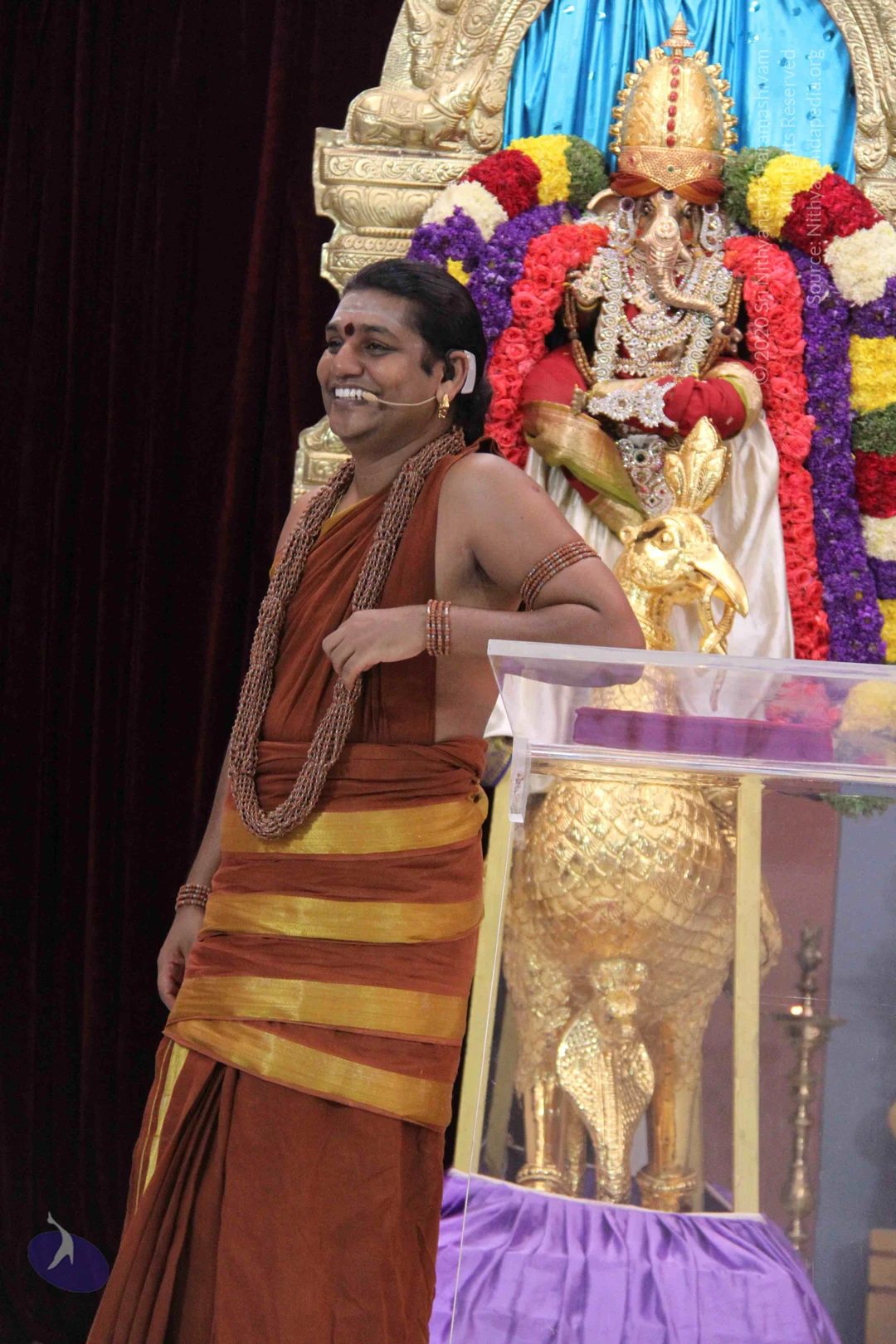
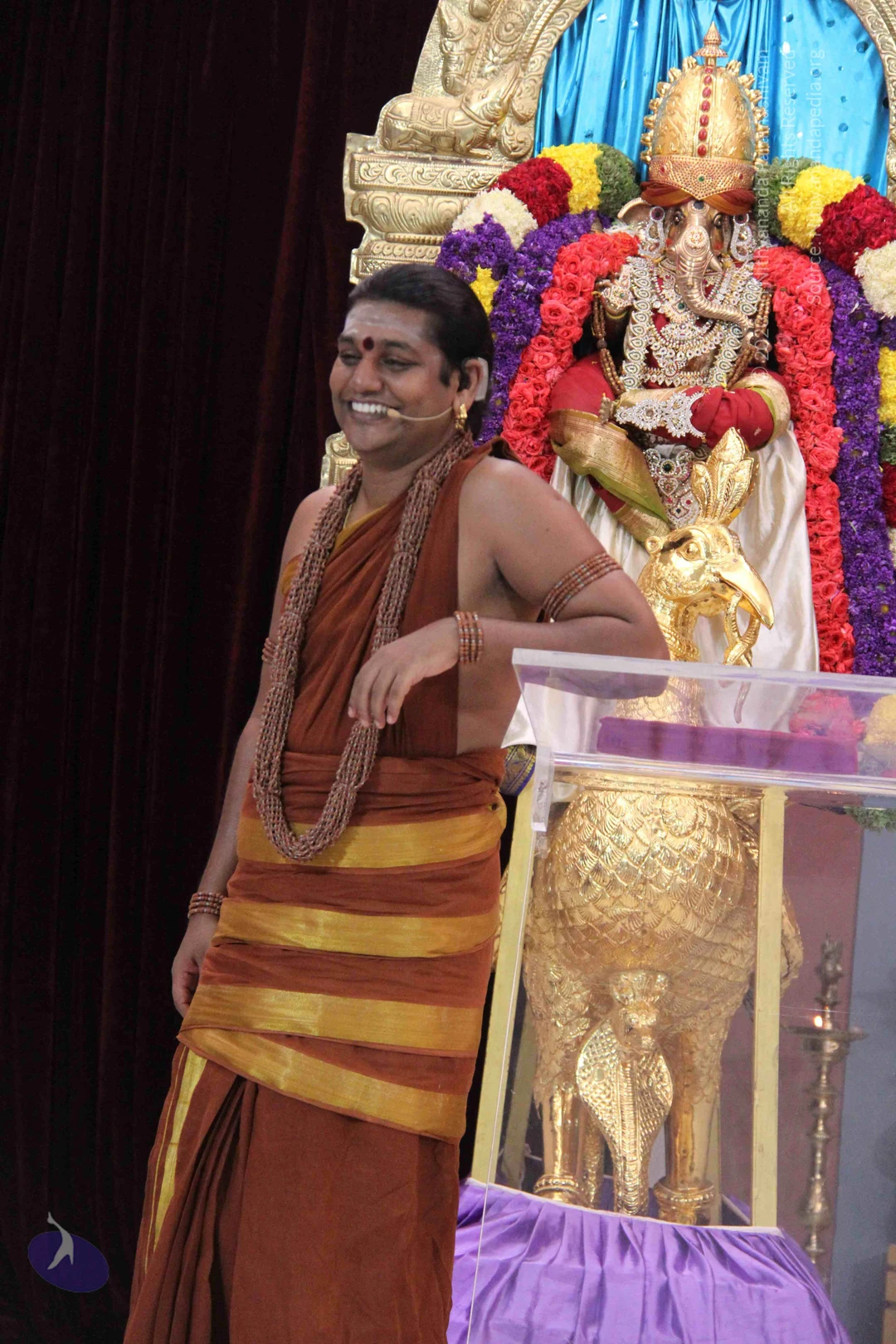
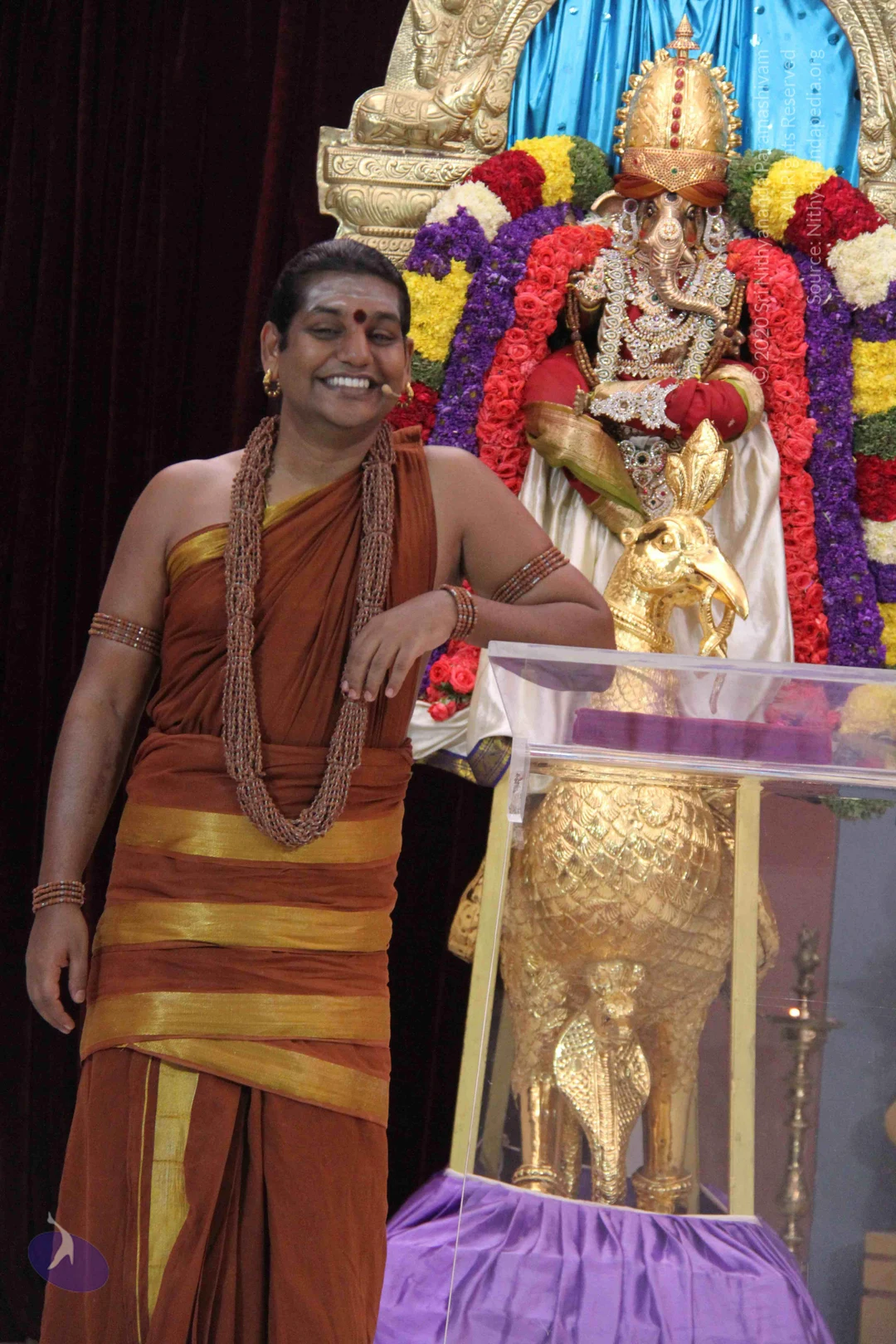
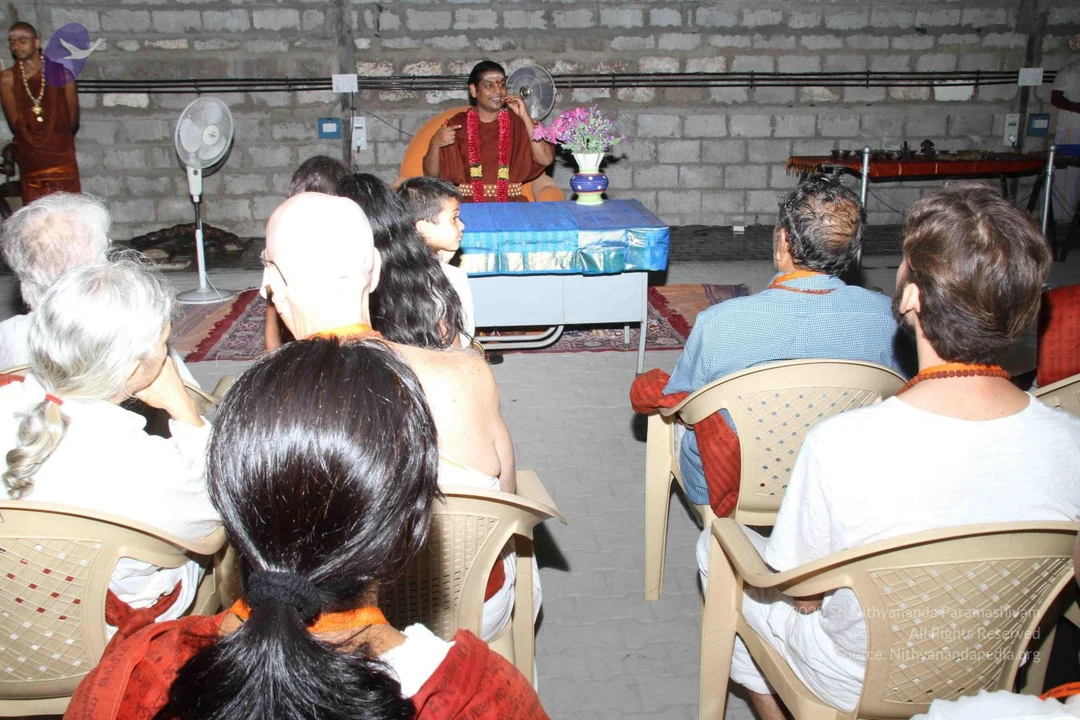
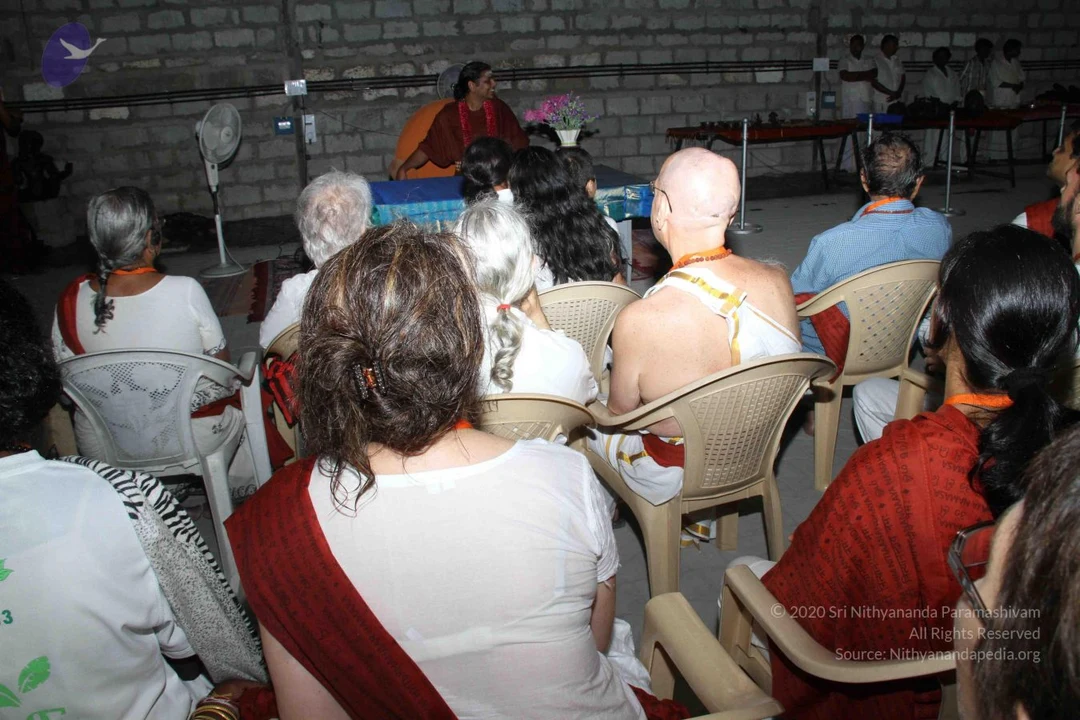
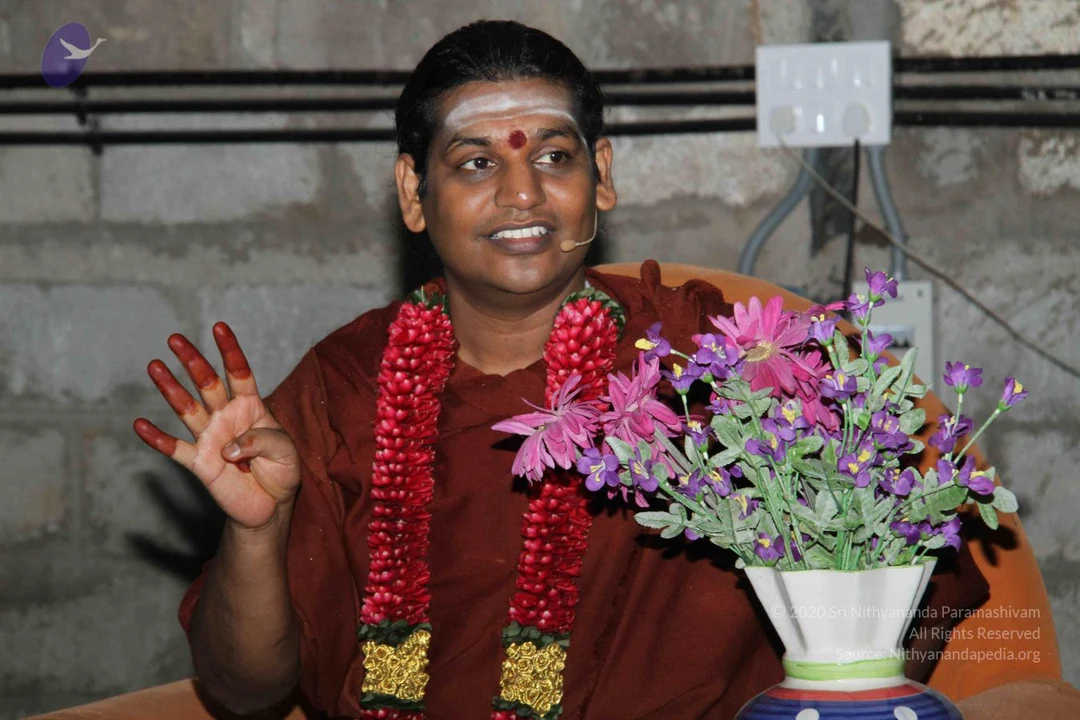
Today Swamiji spoke about Enriching. He explained how our inner Space has 2 parts. One part is filled with struggles, patterns and Incompletions. the other part is Free Space, the source of all solutions to the happenings and situations of our lives. Swamiji went on to explain that Self-doubt is like a balloon starting from the incomplete part of our inner space and extending into the Free Space. the more the balloon is blown up...the bigger it gets the less Free Space we have. the Free Space Should be always expanding but Self-doubt takes away more and more space .With Self Doubt you become a traitor to yourself. It is Swayam Droha. Self Destruction.When we have self doubt we are not useful to ourself or others. it is a waste of life, of existence. When you Enrich others it destroys self-doubt. In fact Enriching others is the only and best way to clear self doubt. Enriching others is something each of us should do every day to clear the self doubt and free up the Free Space in our Inner Space and keep it expanding.

Link to Video:

VideoAudio

Transcript:

Nithyanandeshwara Samaarambhaam Nithyanandeshwari Madhyamaam | Asmath Aachaarya Paryanthaam Vandhey Guru Paramparaam ||

I welcome all of you with my love and blessings.

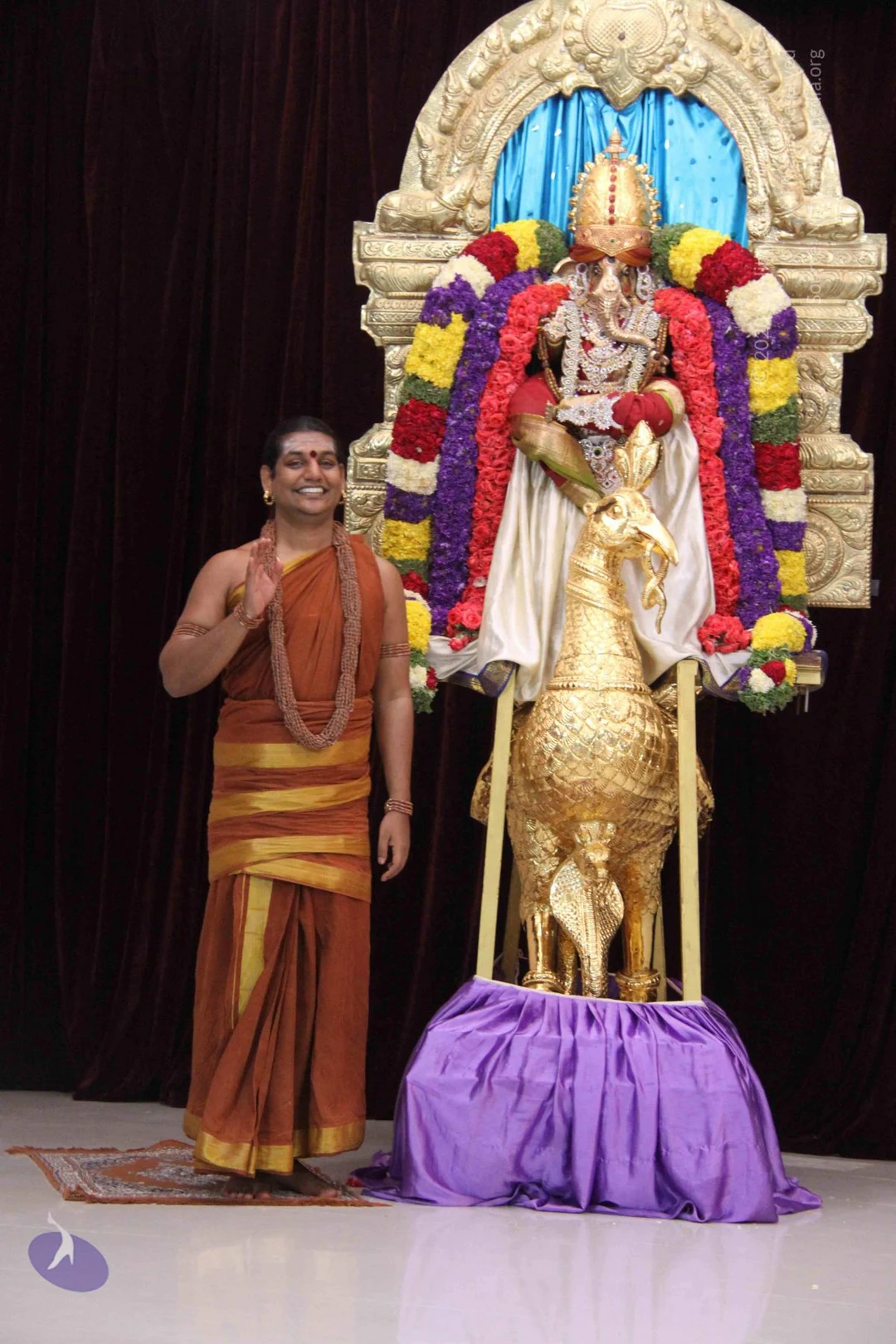
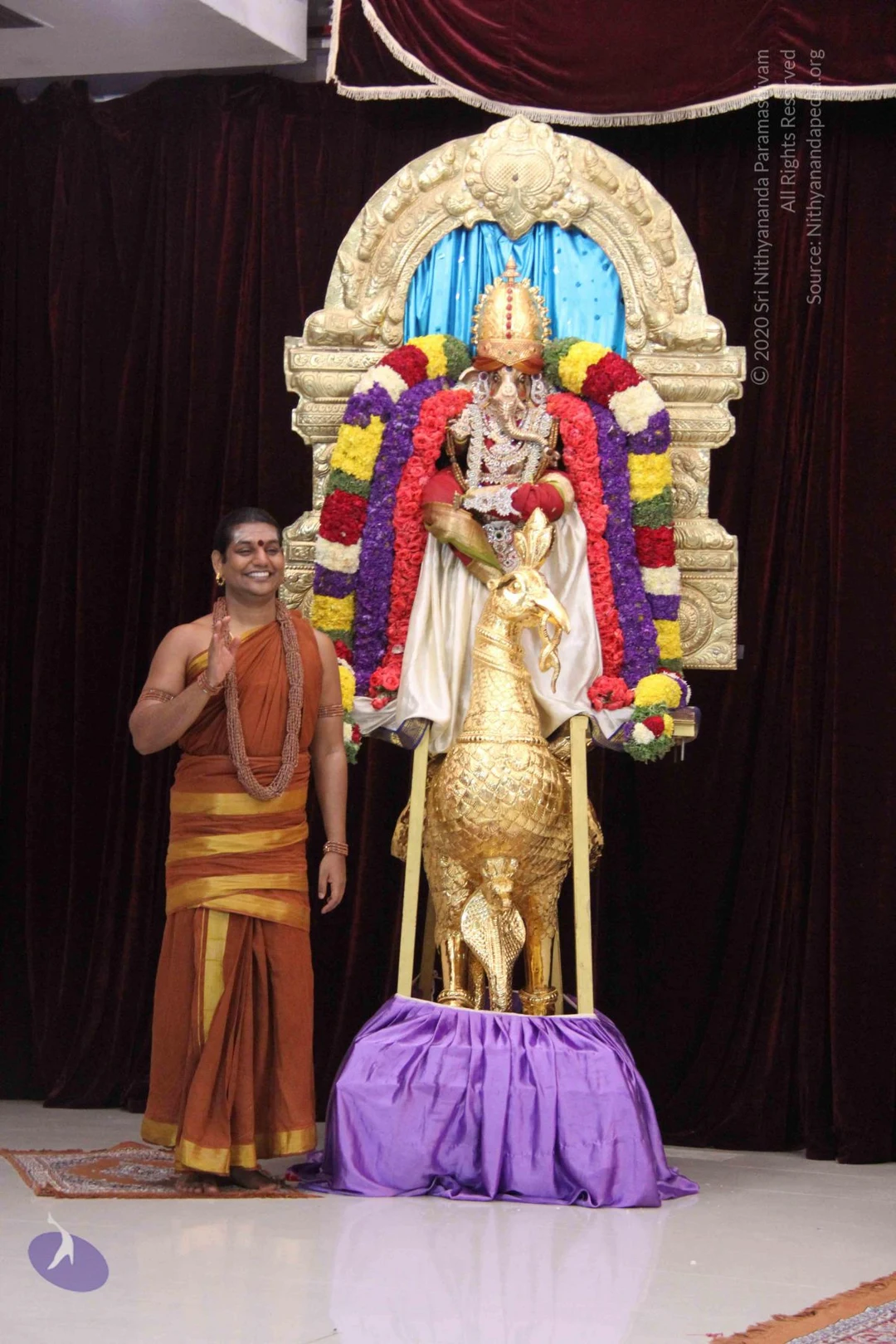
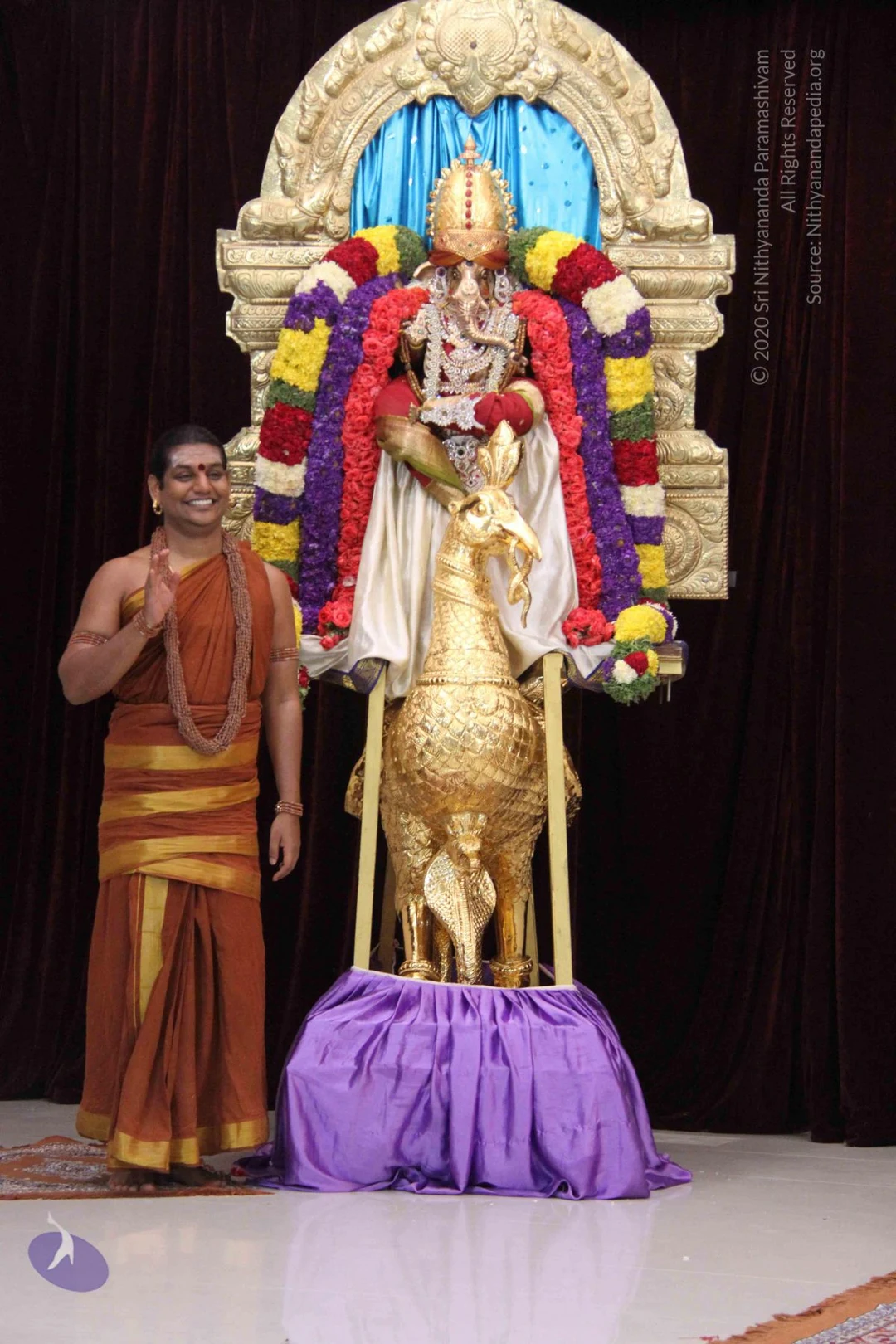
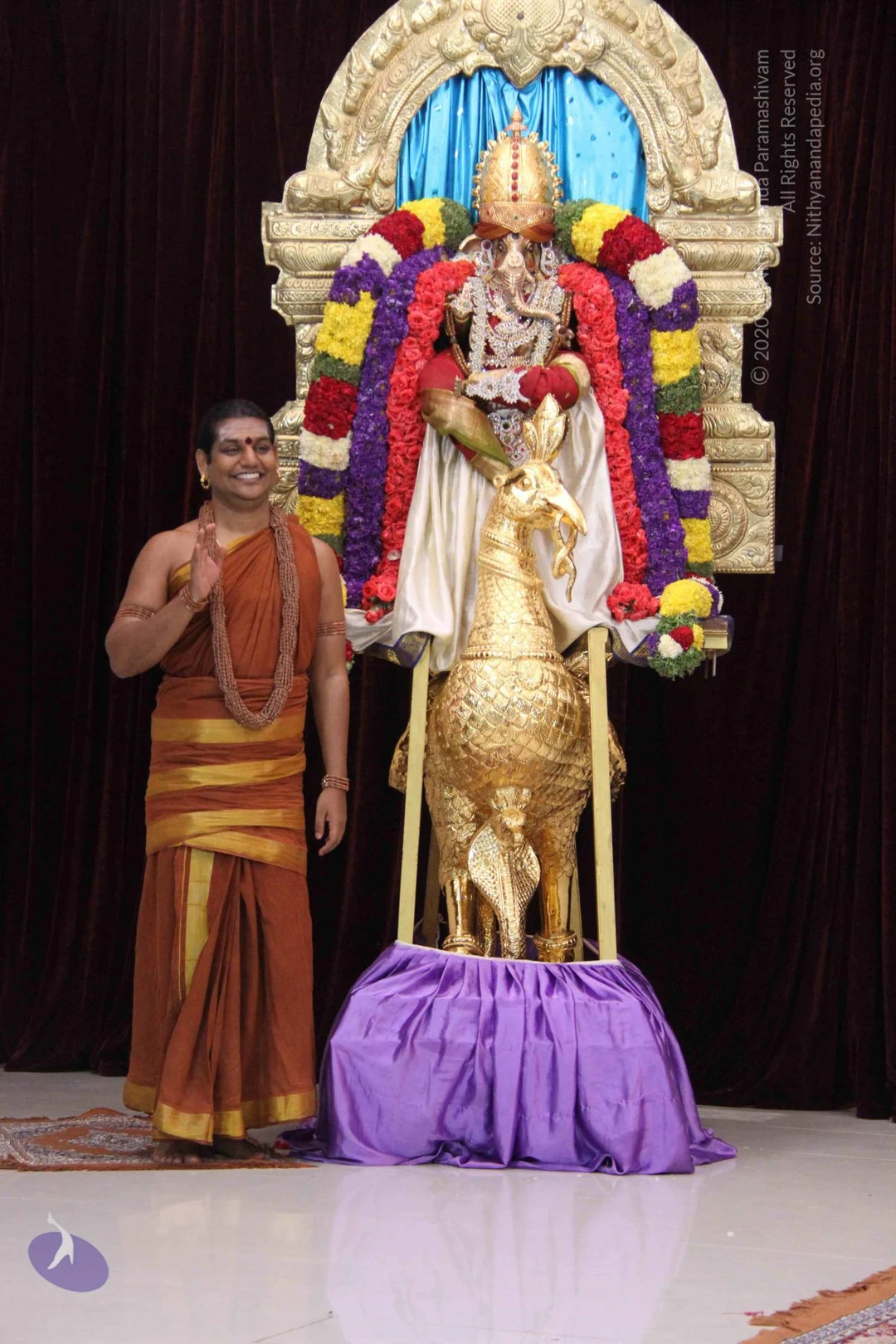
Today, Mahadeva is gracing us in the beautiful Leela “INDRANUKKU SHAAPAM THEERTHA PADALAM”.

Means the, removing the curse on Indra after accepting the worship of Indra, is the Leela.

Indra once got the sin, curse of killing a Brahmin.

This Indra has no brain this fellow will go around and do all nuisance and come back. These fools will go around and do all nuisance and Mahadeva has to bear with that and clear all the nuisance they create and Indra could not get out of his “Brahma Hathya Dosha”. He was roaming around all over Planet Earth.

Suddenly when he entered Kadamba Vana, Madurai, he could experience that dosha, that curse, has lost its power. He started recovering.

Then he finds a Shiva Linga in that area, a Swayambhu, starts worshipping that Shiva Linga.

Immediately after that worship, Shiva appears and removes the curse of Indra. Indra becomes complete and his curse is cleared.

Then Indra leaves his Indra Vimana , the flight, as a protection for that Shiva Linga. That is why, still Madurai Sundareshwara, Garbha mandir of Sundareshwara is Indra Vimana. It is held by eight elephants and it is exactly in the form of Indra Vimana.

So today Mahadeva is gracing us removing all our incompletions and all our curses.

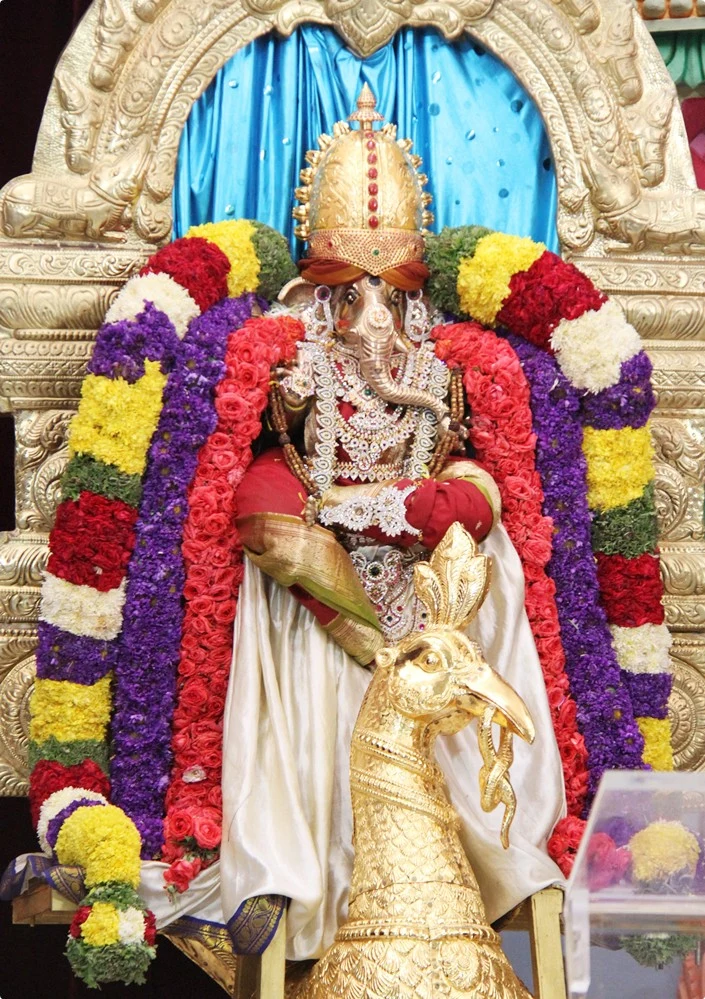
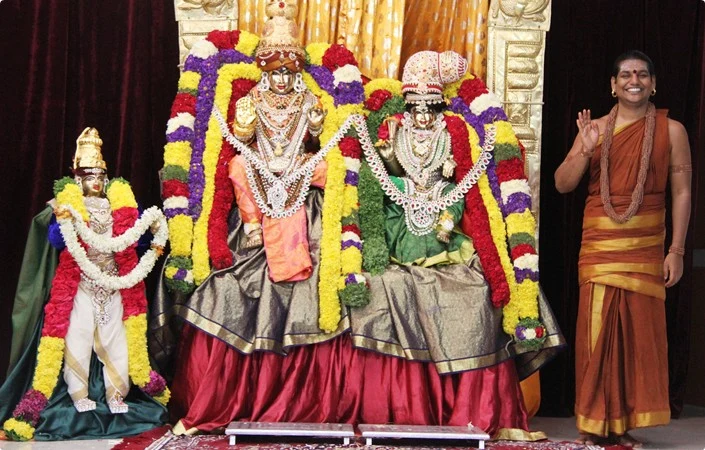
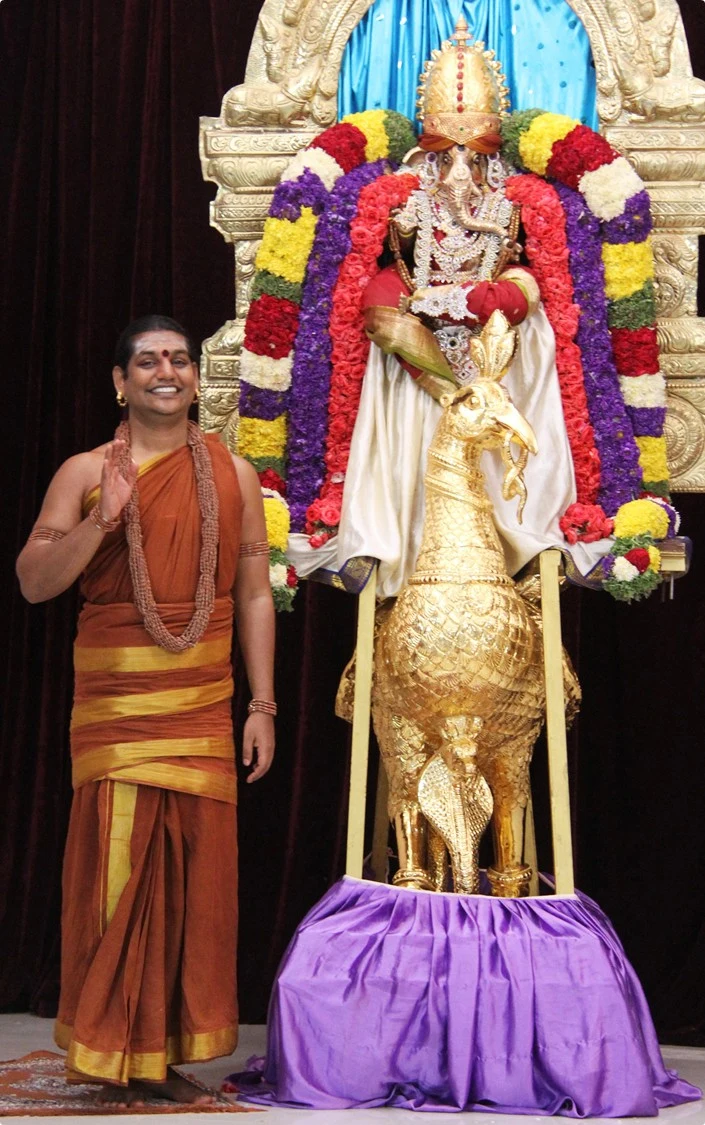
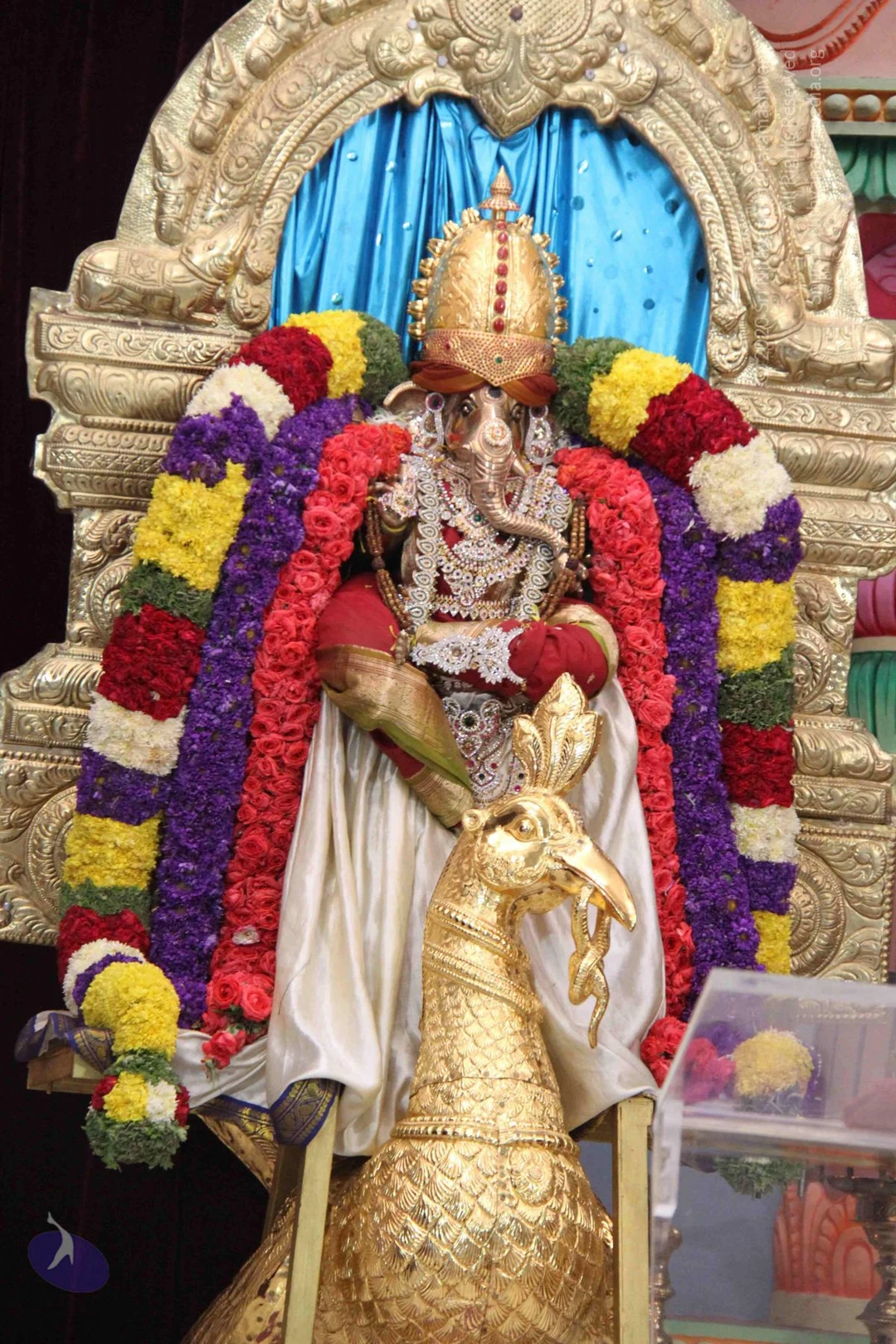
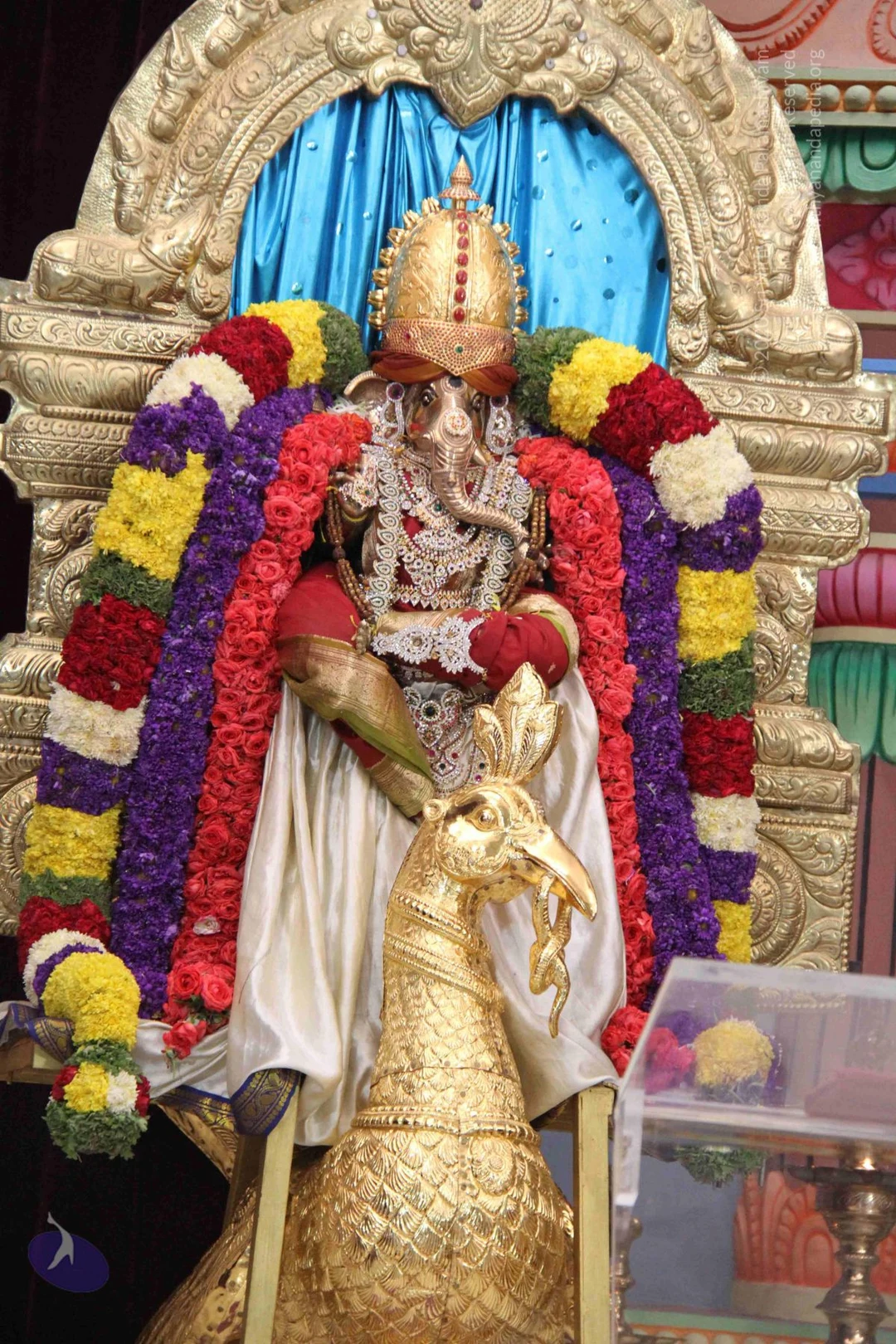
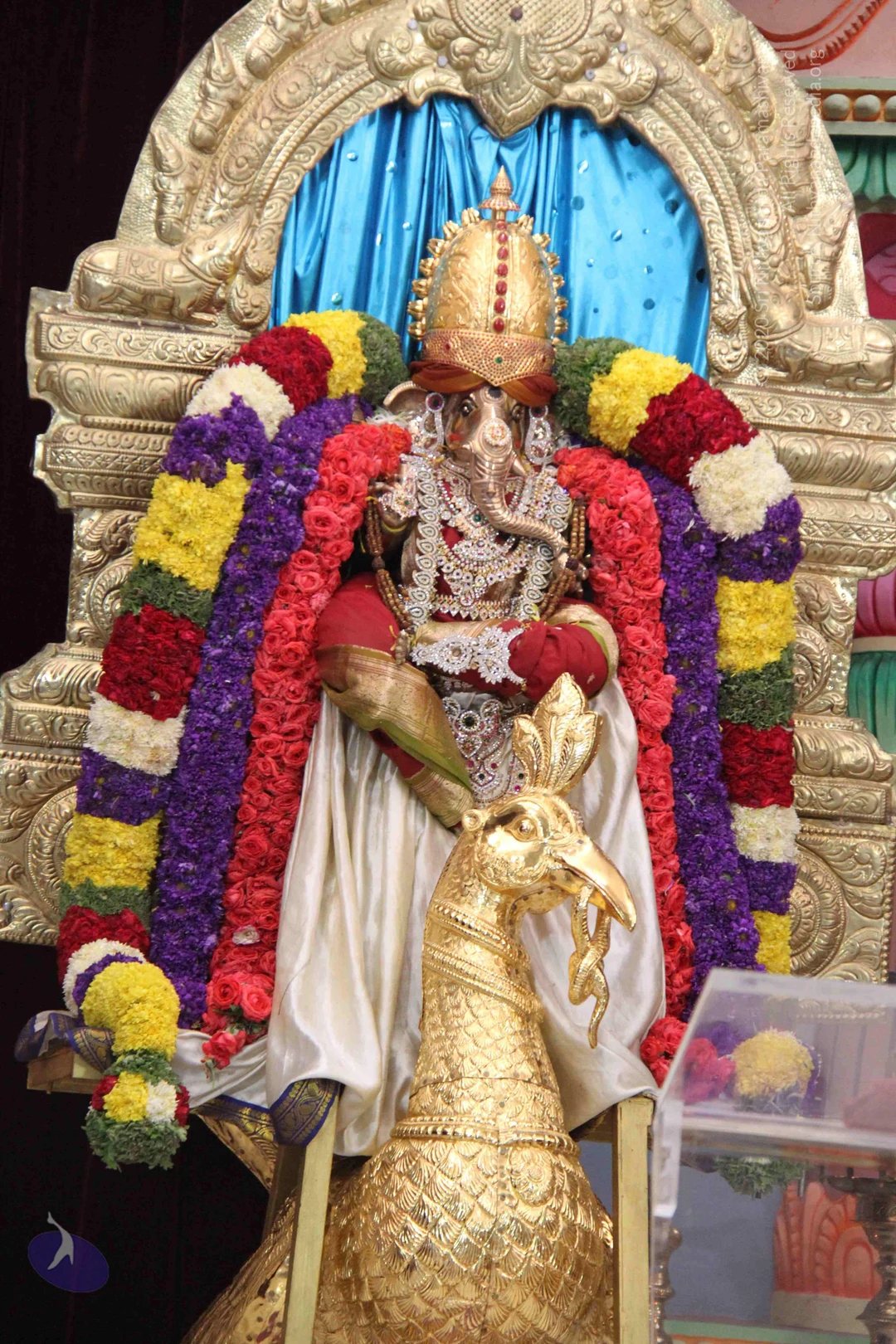
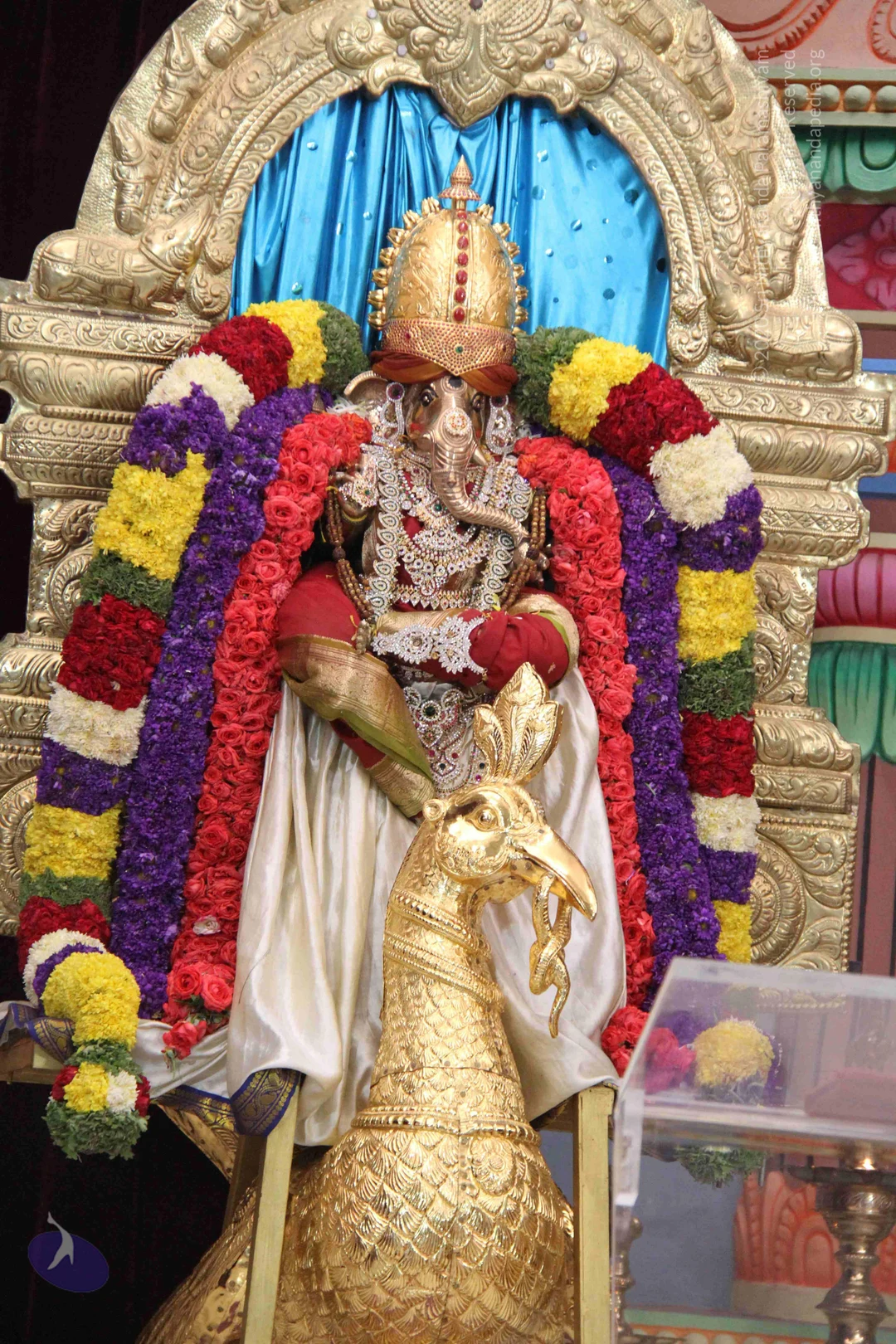
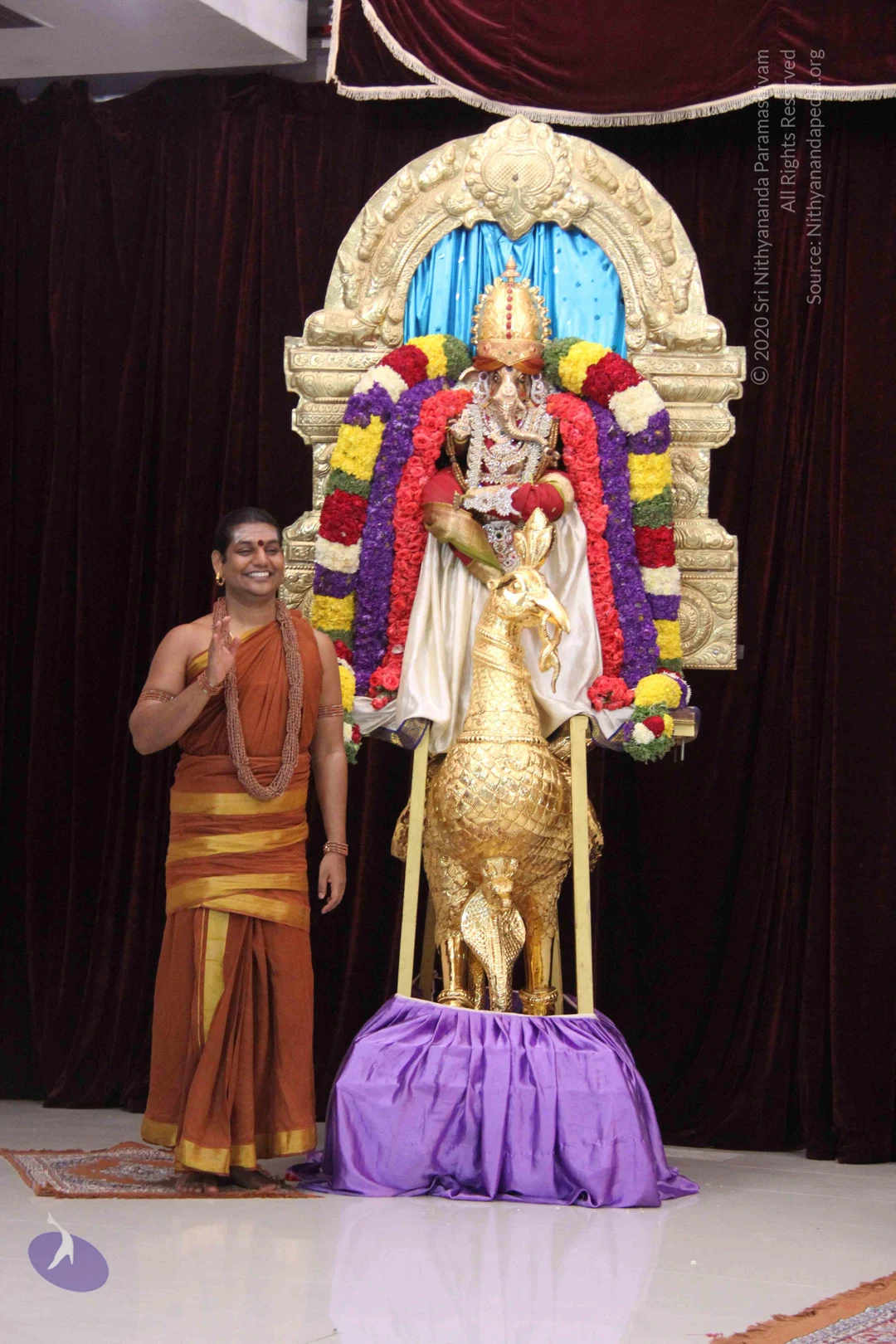
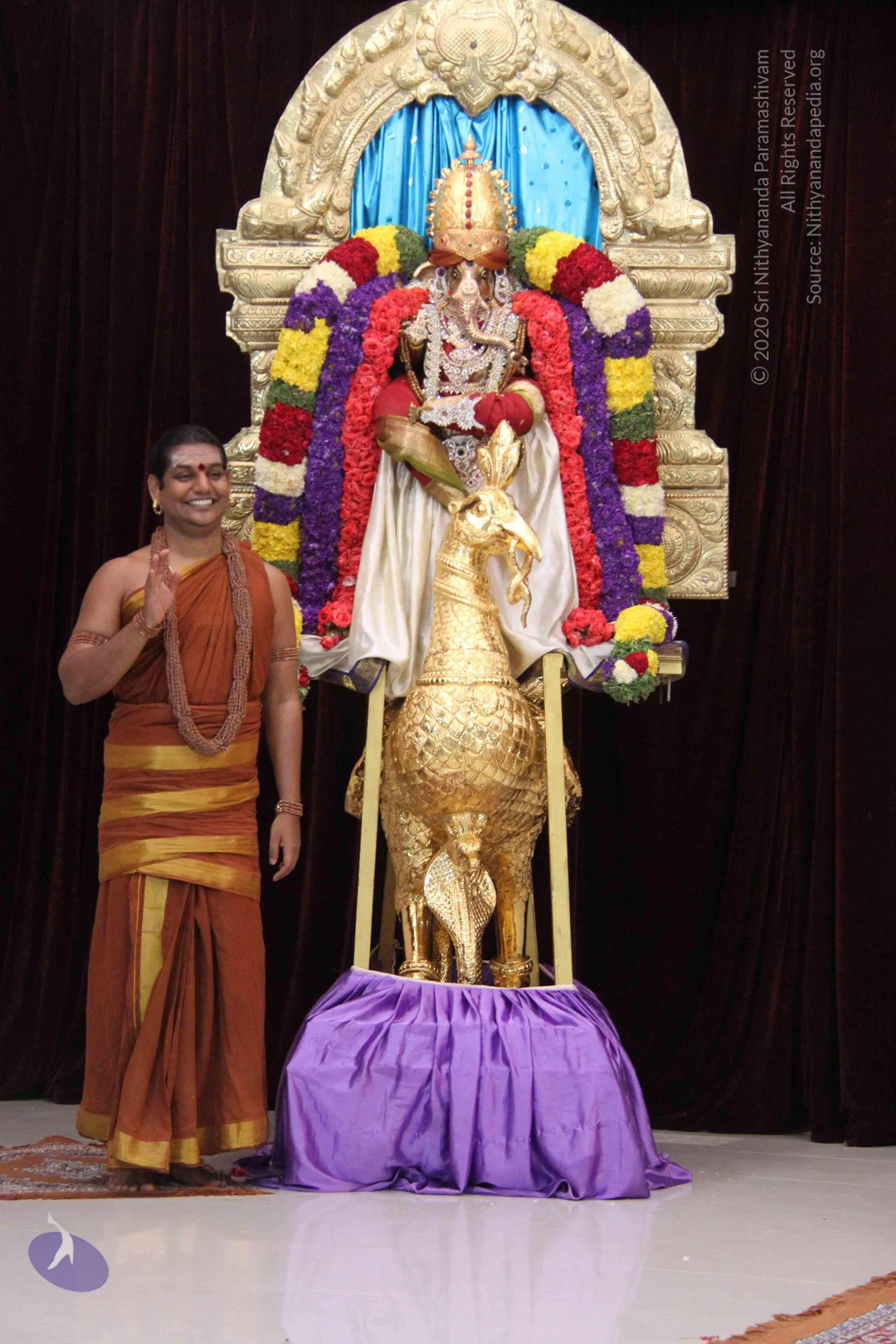
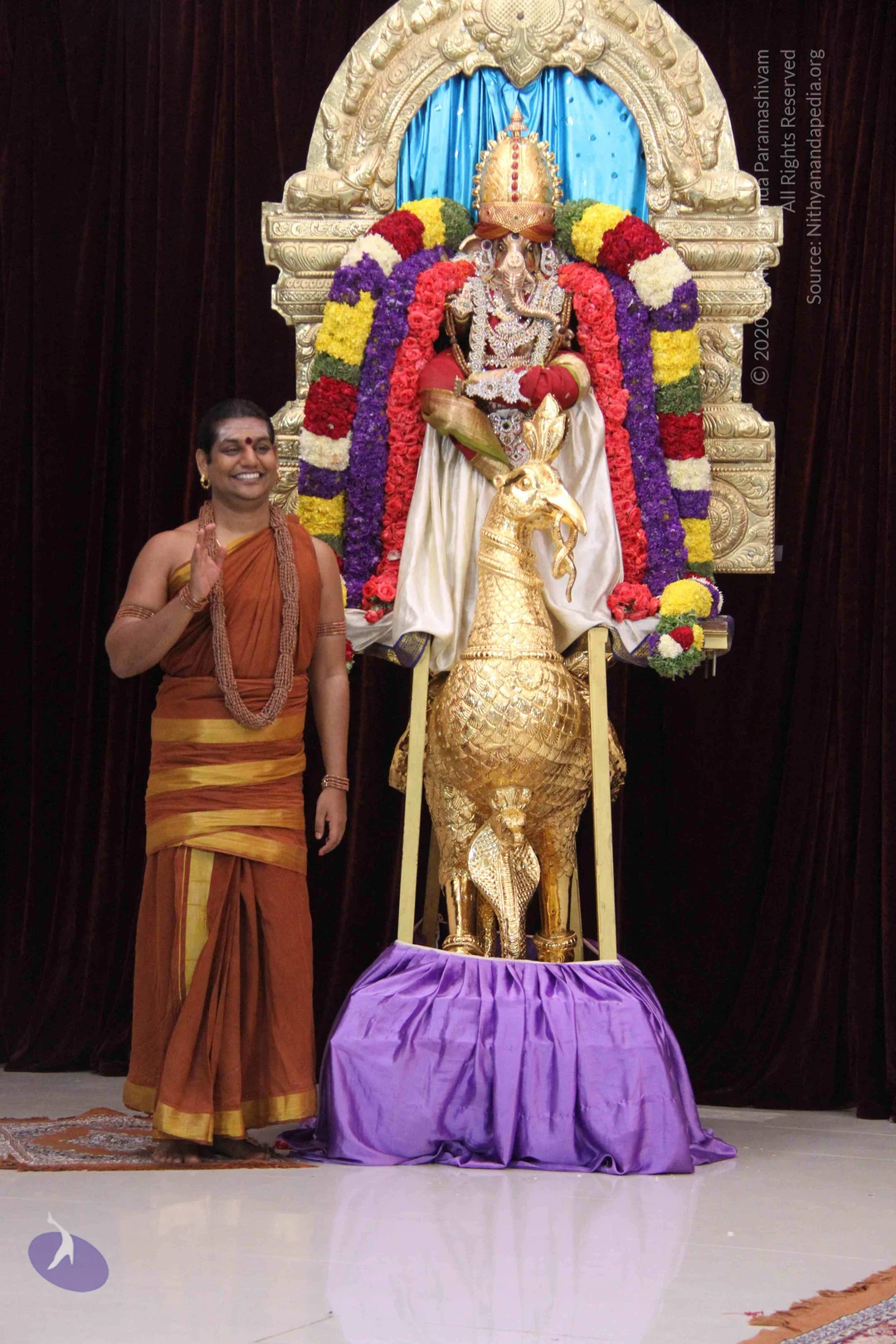
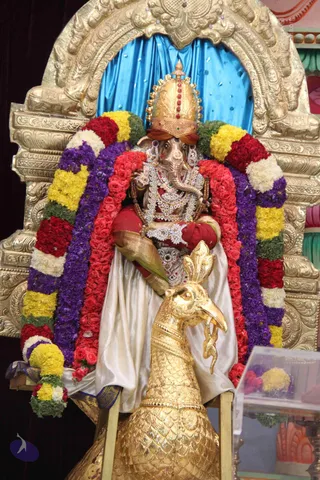
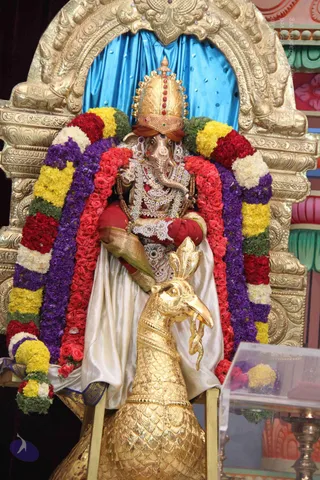
And Ganesha part of the sixth day of Brahmotsava, is gracing us on the Peacock Vahana, “Mayil Vahana”.

I’ll enter into Nithya Satsang.

Today I’ll expand on “Enriching, the Science of Enriching”.

Please understand, as you all may be aware, we are in the Aapyaayana Rithu. The ability you are able to enrich other only is the free space available to you for your victory. Please listen, your inner space is divided into two parts. One part is filled with all your patterns and internal struggles, your childish struggles – whether I should wash my body with right hand or left hand. I have not said what all of you understand. Many a time, many things can be made to understand without uttering a word.

Listen, one part of you is occupied by all your incompletions, patterns, with useless struggles. Listen, the other part is available as a complete space, free space, free energy for you to handle life spontaneously, continuously. Whenever you handle, you look at the life from that free space, you find more and more solution. When you look at life from that patterned space, you find more and more complication. That is why, whatever may be others’ problem, huge like mountain, you will give a solution just like that, because you are looking at that problem from the free inner space, not from the patterned space.

Listen, one part of you, your inner space, is divided as two, but not equally, not equally. For some people, the patterned space is 2%. For some people, the patterned space is 98%. I know, everyone thinks ‘My patterned space must be 99.9%.’ How many of you think? So, all of you have self-doubt pattern. Work on it. Nobody’s patterned space can be 99.9%, because if that is the way, you will have wheezing and die. You cannot even breathe. You will just have wheezing and die! So, the moment you know you don’t have wheezing and you are not dead already, your inner space does not have 99.99%. So, don’t worry.

Listen your inner space is divided into two. One, the space pattern, full of patterns. The other, space freely available for you to move around, go around in the life, see things spontaneously and make decisions. The gurukul is nothing but my effort to create the beings with 100% free space with no patterns.

Understand there is one more important thing you need to know. There is a part of you which has no patterns, free space, but pushed into the territory of patterns due to the self-doubt you carry. It is like you own twenty-five acre, your enemy owns twenty-five acre; but in your twenty-five acre, because you have not built your building, you are not going and claiming your ownership, your enemy has swallowed twenty more acre. Then how many acres are you owning? Only five! That twenty more acre which he is owning because you don’t own, is “self-doubt” part, understand? Because you have not exerted power over it, you have not asserted, the self-doubt declares that part as dispute land, dispute property, disputed zone. I tell you, whoever reclaims that self-doubt zone to their side, they win the war. They win the war. How to reclaim that self-doubt zone into your side? The area which you already have in your control, use it powerfully. Use it powerfully.

I have a story:

A local charity organization realized that their organization had never received a single donation, single penny from the town’s most successful lawyer-cum-politician. The charity organization representative, the person in charge of contributions called that lawyer-cum-politician to persuade him to contribute.

This guy goes to his house and the guy asks, ‘Sir, our research shows that out of a yearly income of at least one million dollar, you have not given a penny to charity. Would not you like to give back to the community in some way?’

The lawyer mulled over this for a moment and replied, ‘Tell me, ‘He is talking that guy back. ‘Tell me your research showed I have one million dollar income. Did your research show that my mother is dying of a long illness and has a medical bill several times her annual income?’

The charitable organization guy, he was really embarrassed and he started mumbling, ‘Umm no.’

The lawyer interrupts, ‘Did your research show that my brother, a disabled veteran, is blind and confined to a wheelchair?’

The charity organization representative was shocked. He was really shaken. He was about to stammer an apology.

Again the lawyer says, ‘Do you know, did your research show you my sister’s husband died in an traffic accident leaving her penniless with three children?’

By now, the charity organization guy who came, he said in a very apologetic tone, ‘Sorry, Sir, I did not know all this…’

Immediately the lawyer stood up and cut him off once again, ‘So, if I don’t give any money to any of them, why should I give to you?’

Understand person infected with self-doubt will neither be useful to himself nor to others.

So, I tell you, completing with the self-doubt should be the top priority and completing with the self-doubt, please listen, the spiritual practice for completing with the self-doubt is enriching others. Spiritual practice for completing with self-doubt is enriching others. Start enriching others; you will see, the self-doubt gets destroyed. Self-doubt can never be destroyed by anything else, anybody else, any other practice. The only practice which can destroy self-doubt is enriching others. Please understand, the only practice which can destroy self-doubting pattern is enriching others. You cannot complete with your self-doubt, you need to understand. How much ever completion you try to do, you will suspect, you will have doubt even about that completion. How will you clear?

Ramakrishna says beautifully, ‘If somebody is possessed by ghost, you can throw sesame seed on him and throw the ghost away. But if the ghost enters inside the sesame seed, how will you drive the ghost using the sesame seed? He is sitting inside the sesame seed!’

So, if you have any incompletion, you can do the completion process and complete it, get rid of it, get rid of the incompletion, but self-doubt is such, the doubt in the very completion process itself. So, the incompletion has entered into your completion! Then how that completion is going to remove the incompletion?

I tell you, the one and only way to get rid of the self-doubt is enrich, enrich others. Enriching is not marketing. Enriching is not converting. Because, converting others, the result is external. Marketing is, the result is external. For the sake of the results outside, you do marketing or converting but here, with enriching, the results are inside. Whether the one person attends, one person you enrich for Inner Awakening, or two persons you enrich for Inner Awakening, or three persons you enrich for Inner Awakening is not the thing, the number. It is the intensity you carry and enrich others. Understand, if you can enrich your spouse for Inner Awakening, it is equal to 108 people being enriched for Inner Awakening, because amount of effort you need to put. The amount of effort you need to put. I don’t know why Mokshapriyan is laughing. He’s giving a primal scream from.

Enriching is not old wine in the new bottle – the old pattern of marketing or converting with new title. No. I tell you, if you think it is old wine in a new bottle, you are wrong. It is a new Ganga Jal with an old bottle. May be, the outside bottle may look different but inside it is Ganga Jal, the water of the Ganges. Enriching is actually aiming at the space you live. Whether you are able to enrich the other person or not it’s only a verification of the power of the space you carry, strength of the space you carry. But the actual enriching itself happens in your inner space. It is not related to something external. Its results may be in the external. See, the external results are only a scale to verify whether you really carry the space of enriching or you are continuously cheating yourself. Just for that only the outward, external results are used. External results are used more like a scale but, but the result of enriching is clearing the self-doubt in you.

I tell you from my own experience, I would have realized my avataric mission; I would have become enlightened more quickly, much more early, if I would have listened to both my mentors. How much it took for both of them to convince me and start sharing this energy with others. I tell you, in the young age, I used to do a lot of these miracles. Whenever I was initiated by my mentors, teachers, into a new spiritual power, I’ll go around, do left and right like a magic, circus. I’ll do all sorts of things using these miracle powers. Still many people associated with my young age are there in Tiruvannamalai. If you see them and ask them, they will tell you tons and tons of stories of me demonstrating extraordinary powers but everything was not from the context of enriching. It was in the context of just playfulness, playfulness, or I got something new, trying to test it out of curiosity. They used to tell me again and again, ‘Share this knowledge, share this science, now you have a clear understanding. Do this for enriching people.’ I never listened. Either I’ll use those powers to test it, whether it really existed or not, out of curiosity. It took a long time for me to understand the concept of enriching. I tell you from my experience, when you start enriching others, all the auspicious qualities start happening in you, including the knowledge, understanding, everything.

Enriching, enriching is the spiritual practice to conquer the self-doubting pattern and self-doubting pattern is the most powerful demon sitting inside you. I tell you, self-doubting is Maya; self-doubting is Mara, self-doubting is devil, self-doubting is demon; self-doubting is Ravana; self-doubting is Hiranyaksha; self-doubting is Hiranyakashipu; self-doubting is Kumbhakarna. Enriching is the only and best way, enriching is the only and best way to clear the self-doubting patterns, to clear self-doubts.

25:10 Hindi -27:09

I wanted the whole Sangha, all my disciples, all my followers to learn this one lesson today. Please understand, start enriching. Only then you will come out of self-doubt. You will complete with self-doubt only BY enriching. In the whole Sangha, the most fortunate Ashramites, Sannyasis in my whole Sangha, are the people in the Enriching Temple. Their whole day activities become the spiritual practice, if they do it, that’s the punch line.

I tell you, Enrich, Enrich, Enrich!

Beautiful possibility to get out of your self-doubt is presented in front of you. Walk this path and save yourself and achieve Completion and Enlightenment.

Live health, bliss and enlightenment Nama Shivaya!

Let you all achieve, experience, live express radiate share and explode in eternal bliss , Nithyananda

Photos From The Day:
Photos Of The Day:

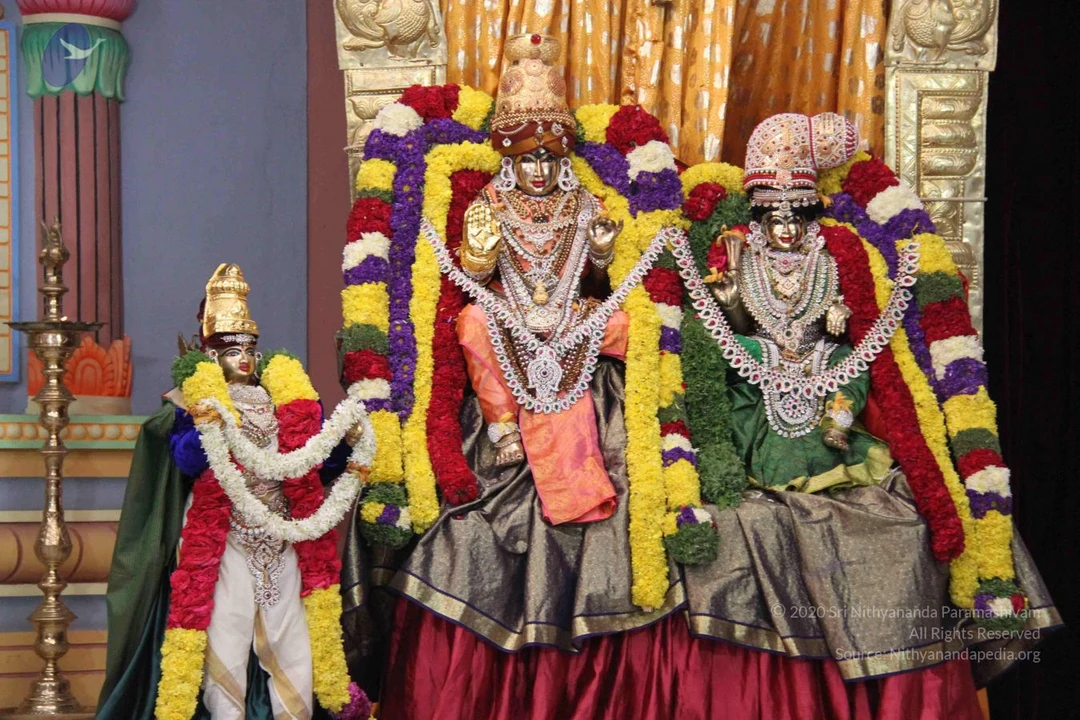
Leela_Alankar
Satsang_Swamiji_Crowd
SarvaDarshan_Pics
Deities_Swamiji_FinalBlessing
Swamiji_Krishnappa&Guests

IA_Day20

SacredArts_Pictures

Swamiji_FootPrint_Kumkum

Tags:

Paramahamsa Nithyananda, enriching, incompletion, pattern, solution, self-doubt

Photos Of The Day:

Deity-Darshan

Nithya-Satsang

Sarvadarshan

Swamiji-Krishnappa-and-Guests

Inner-Awakening-Day-20

Sacred-Arts

Swamiji-footprint-kumkum

Kalabhairava-Darshan

Photos Of The Day:

Deity-Darshan

Nithya-Satsang

Inner-Awakening

Sacred-Arts

Kalabhairava-darshan

01--Deity-Darshan

02--Nithya-Satsang

05--Inner-Awakening

06--Sacred-Arts

08--Kalabhairava-darshan

Photos from this day

View all 404 photos

Photos From The Day:

8 photosSource gallery
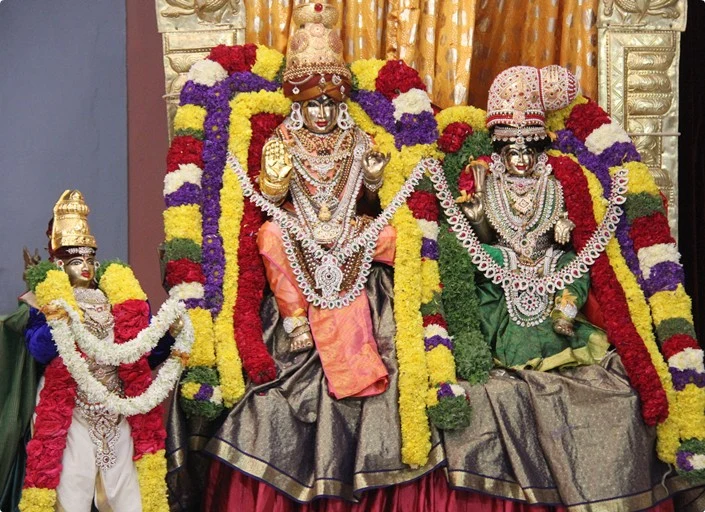
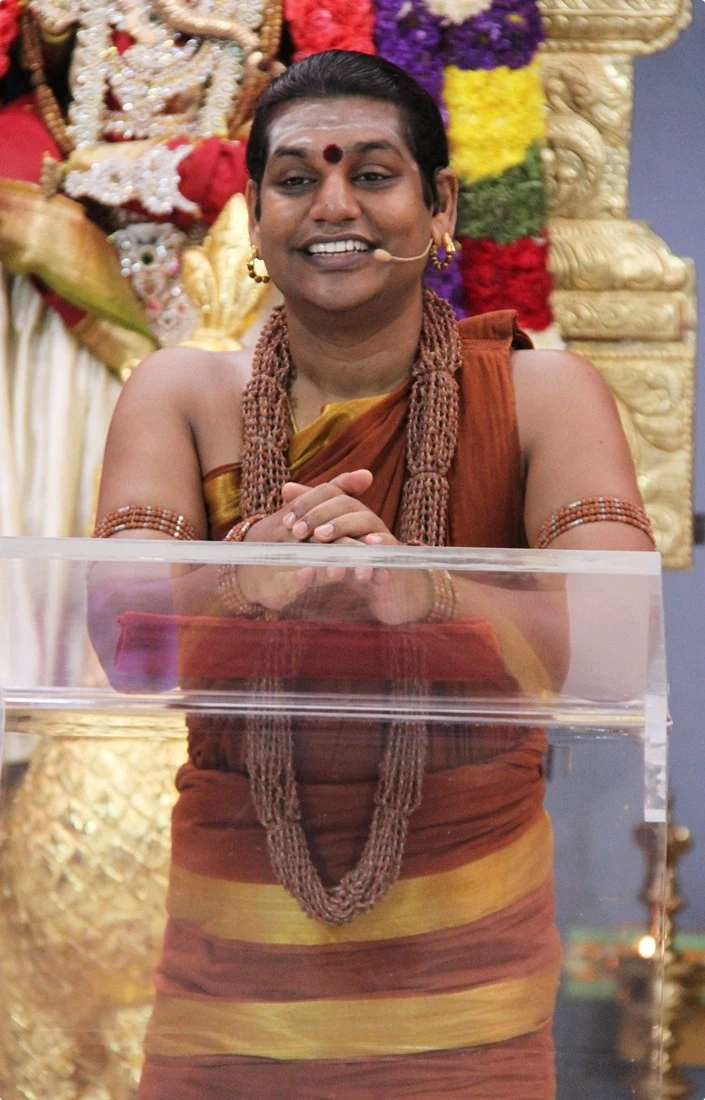
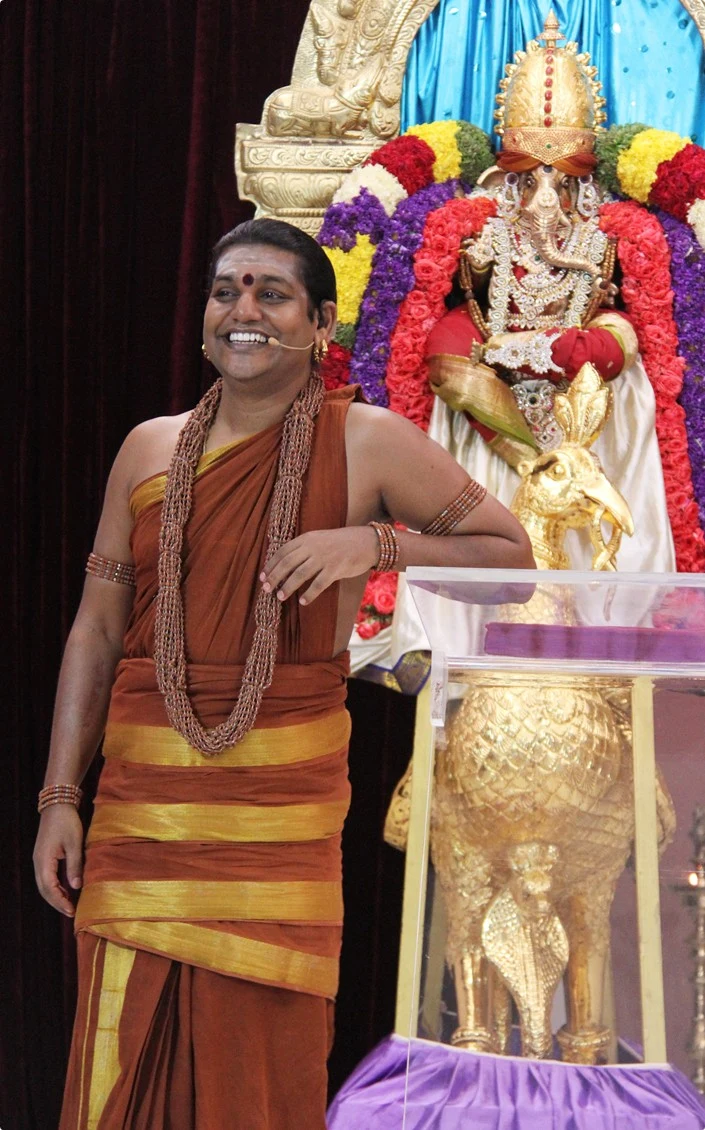
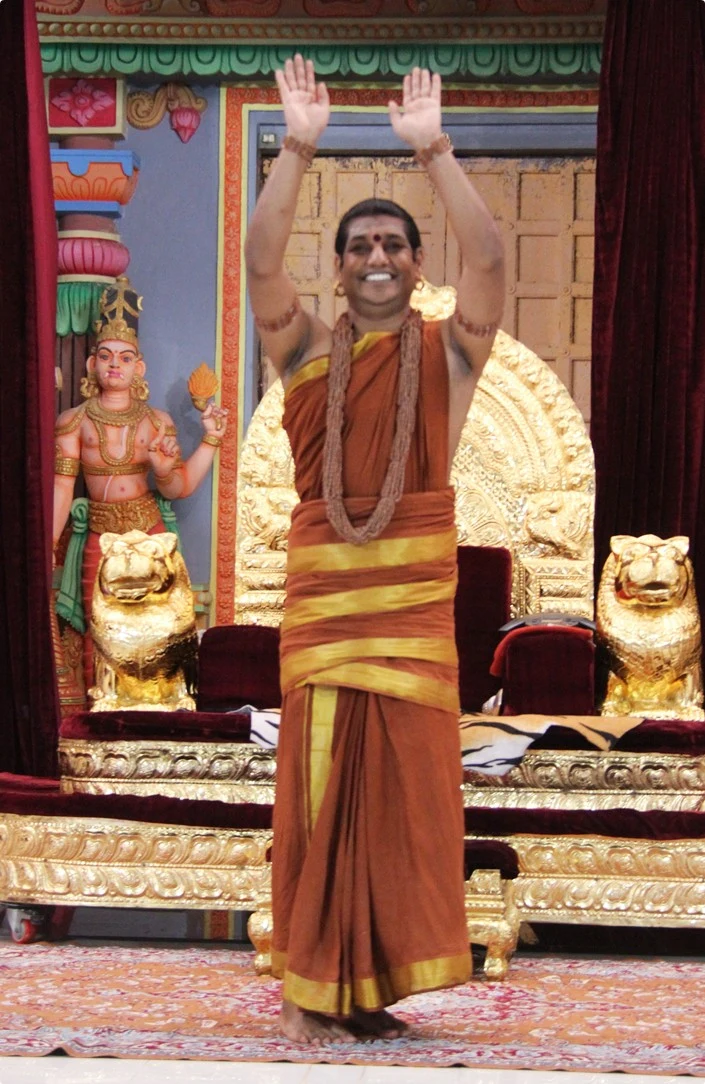
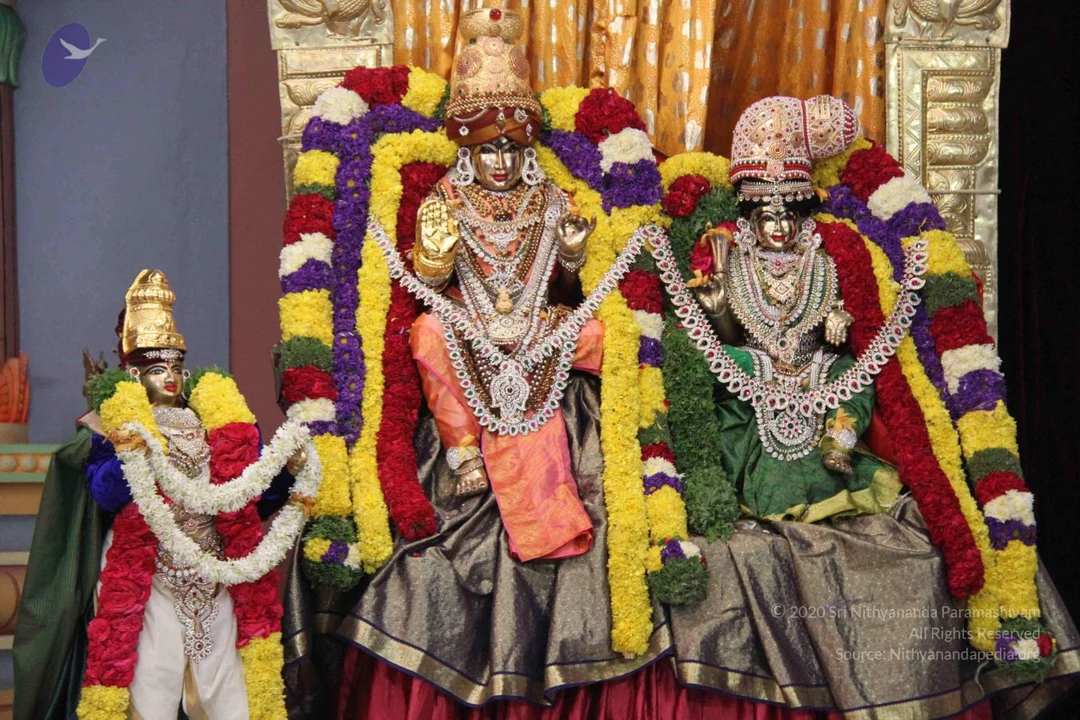
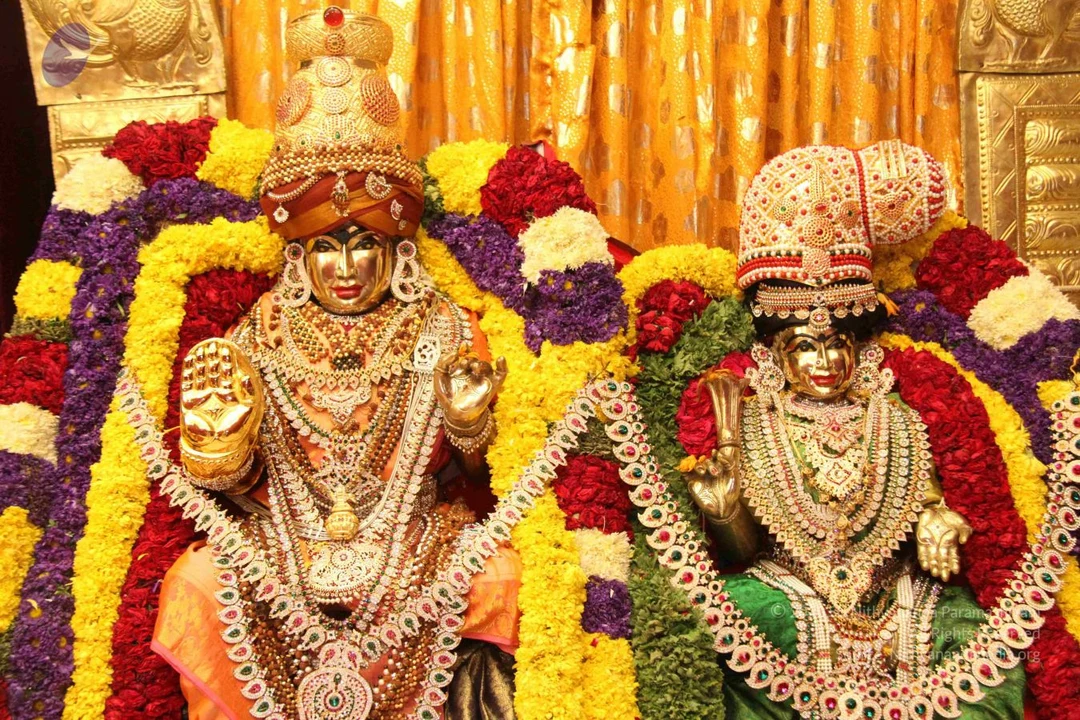
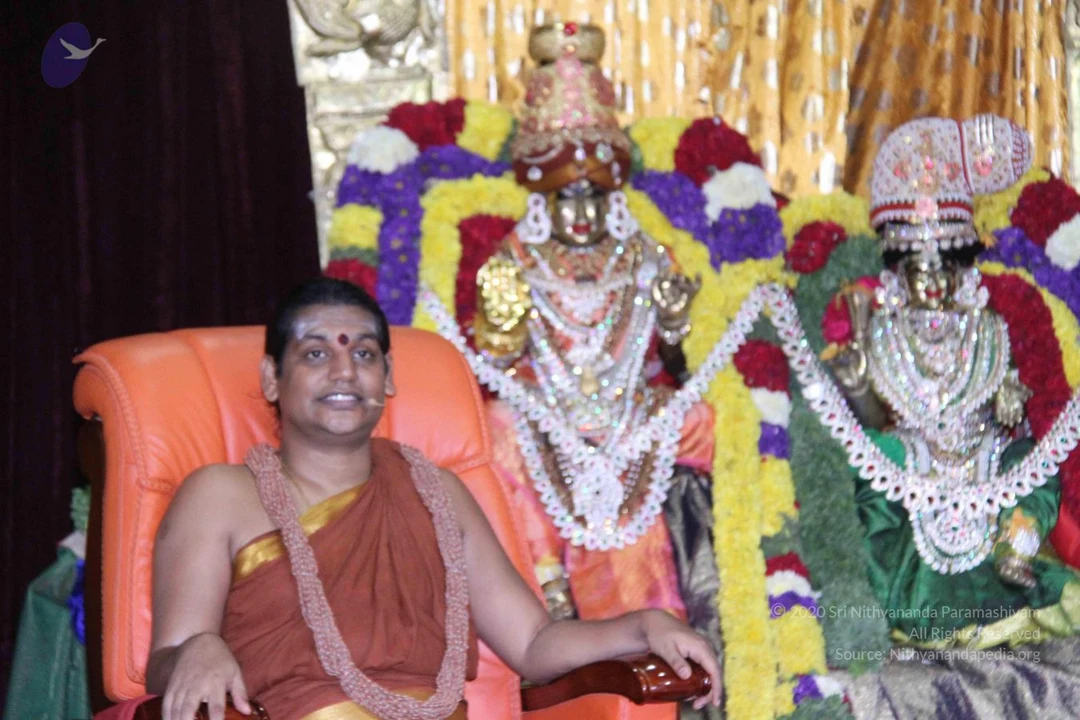
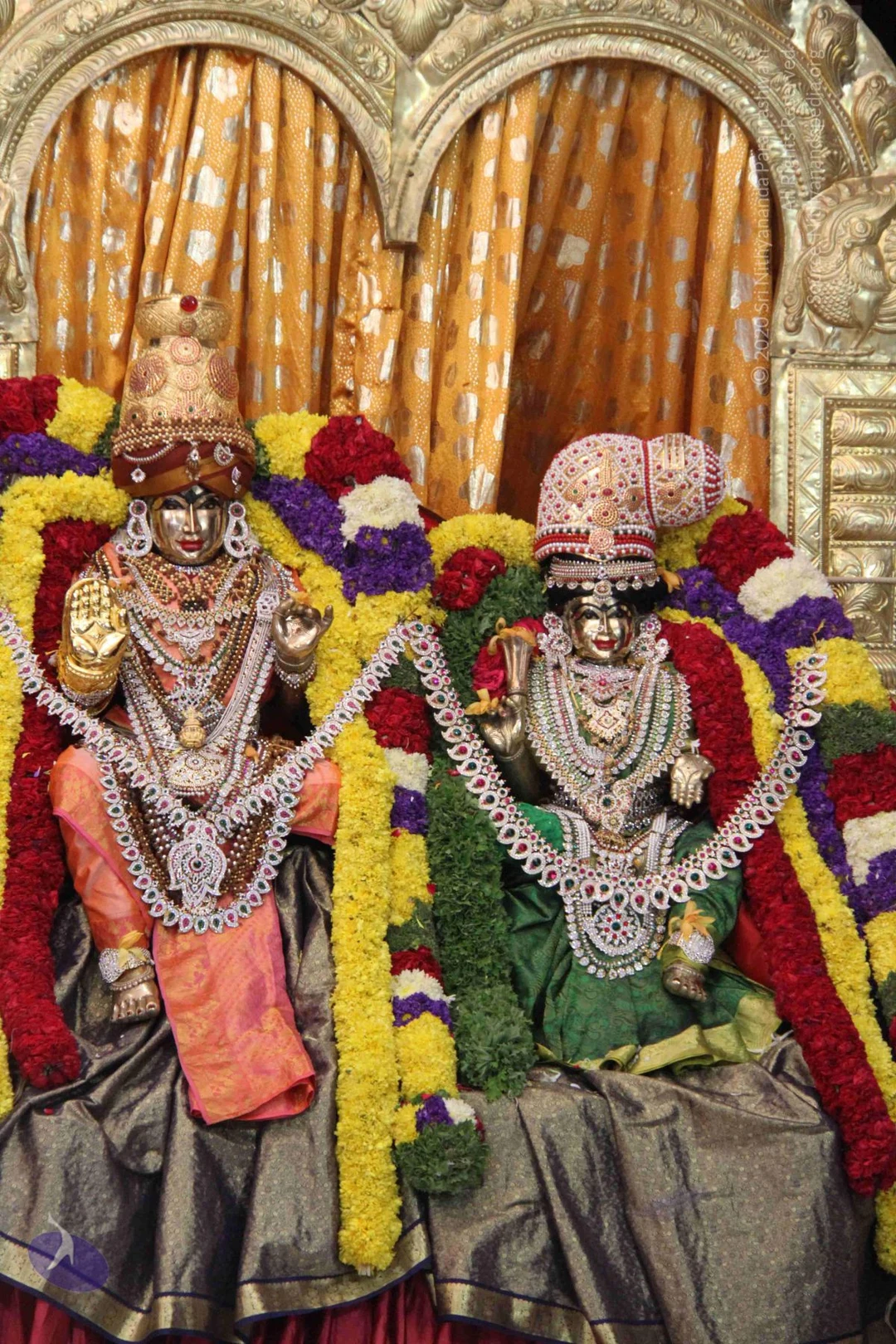
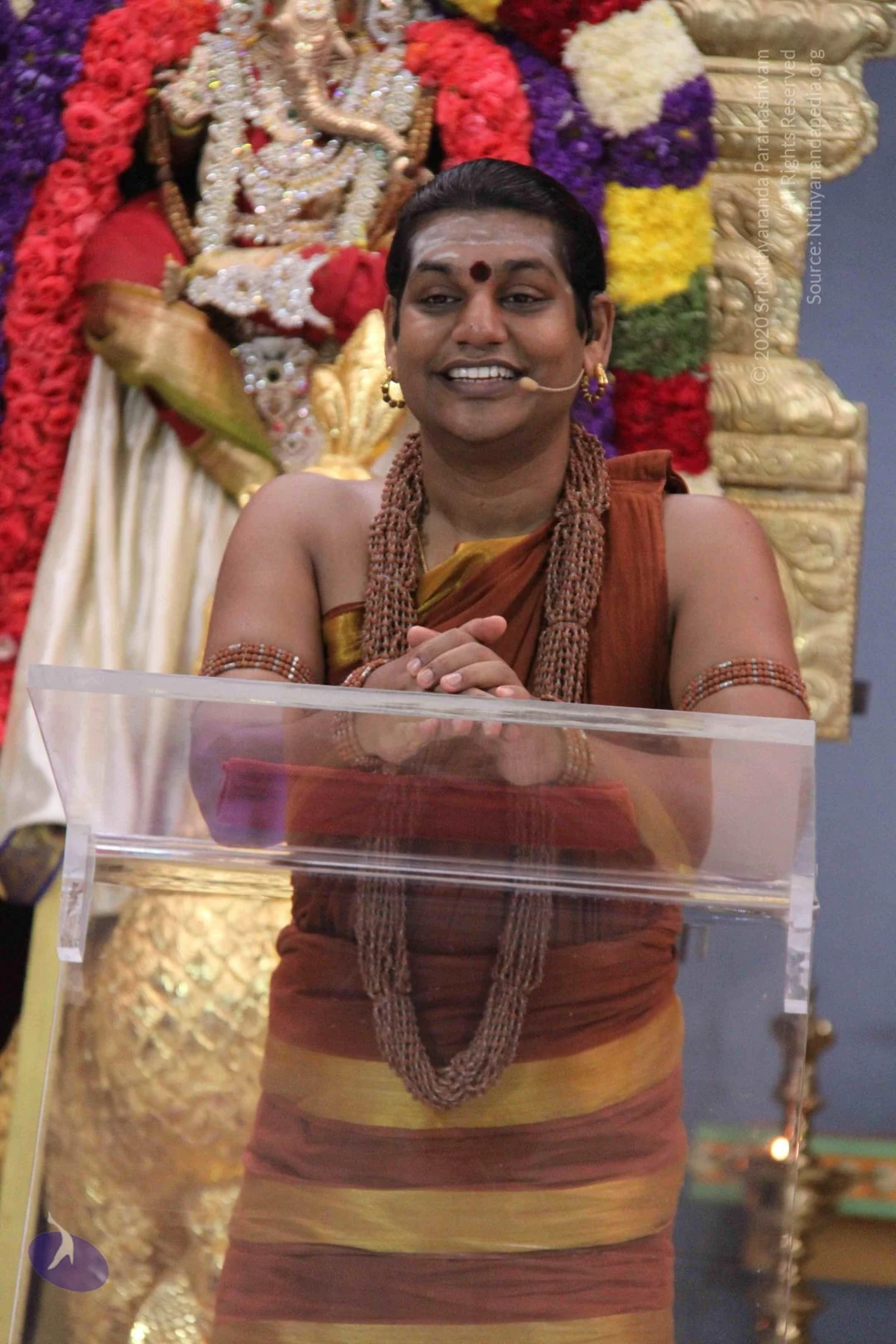
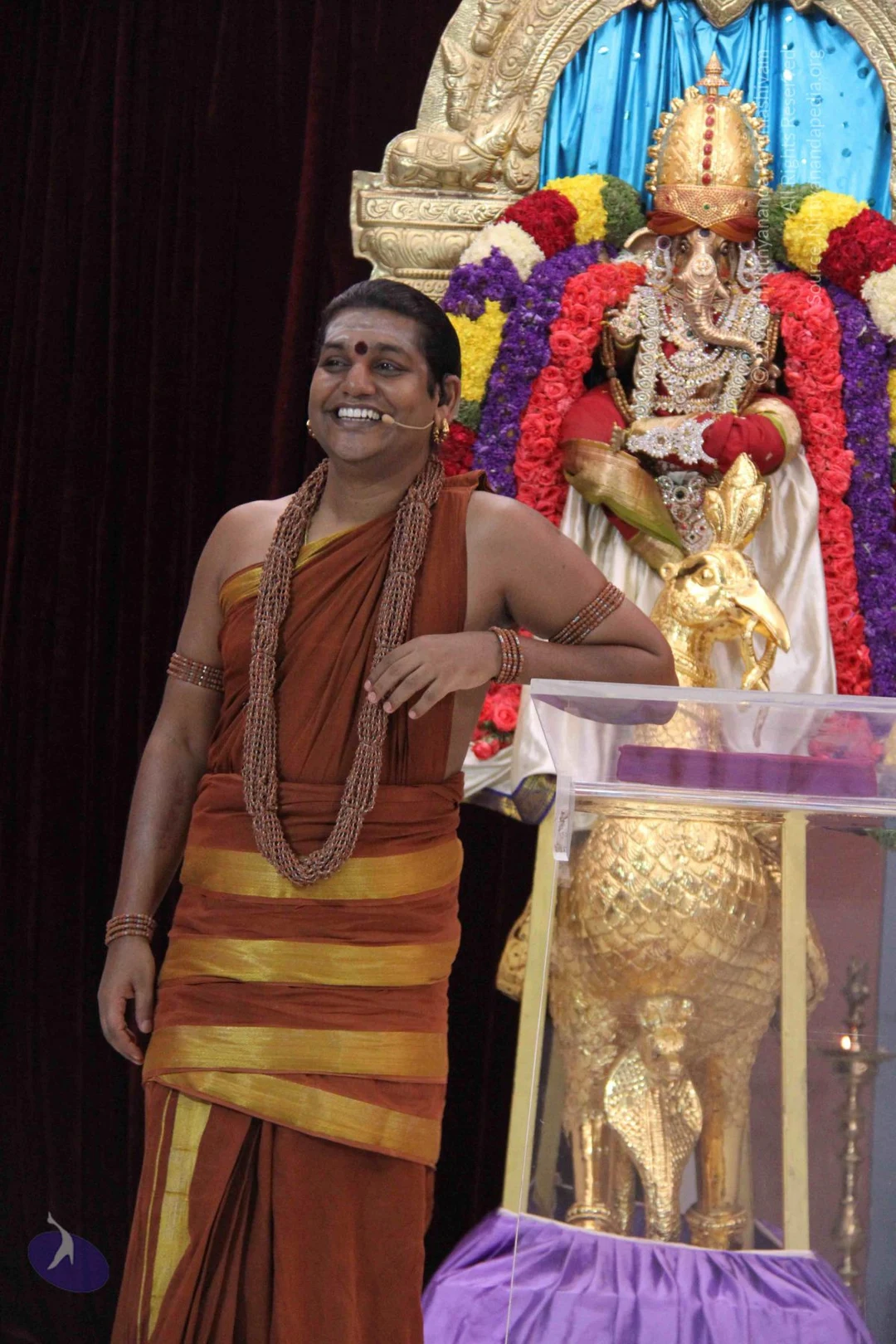
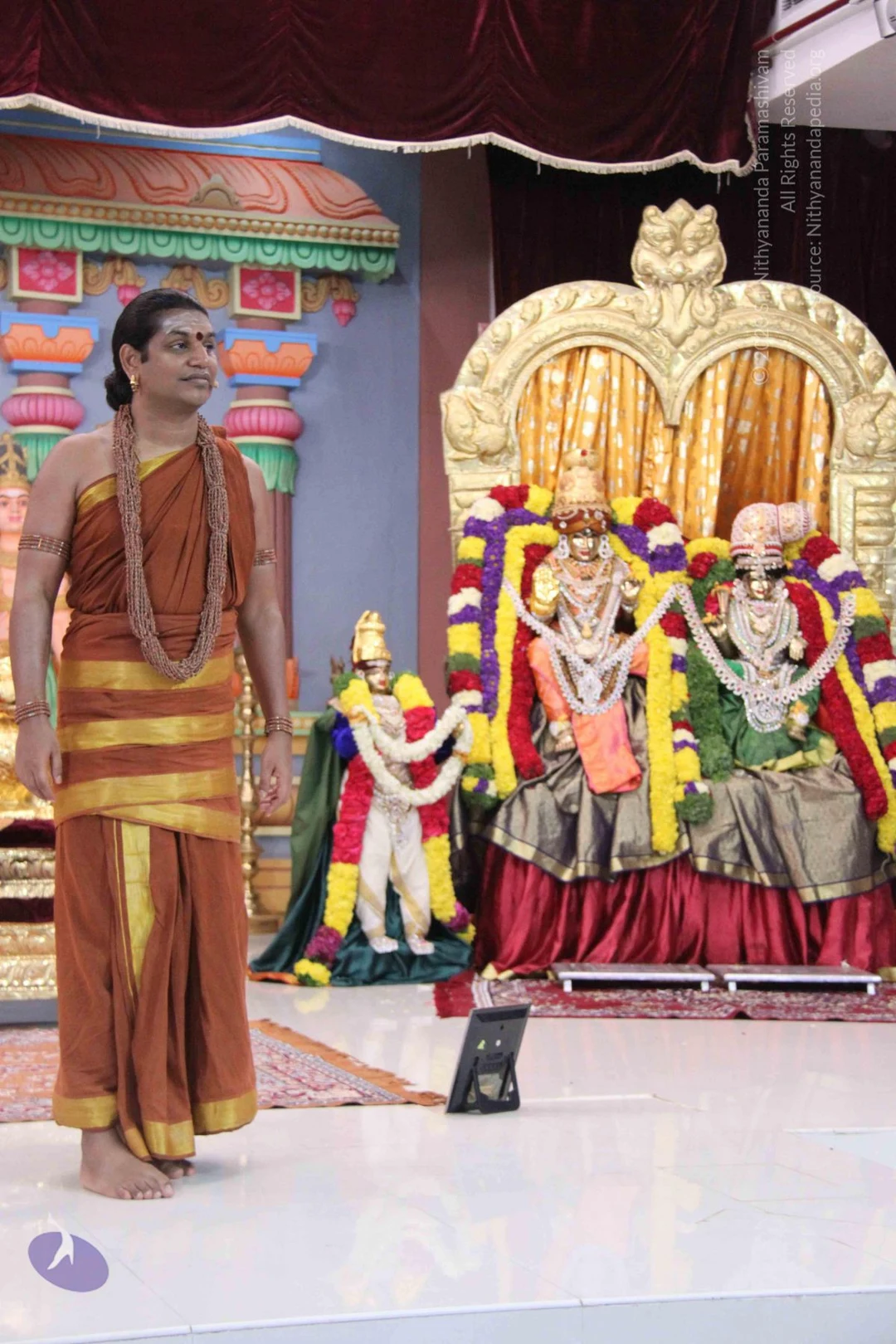
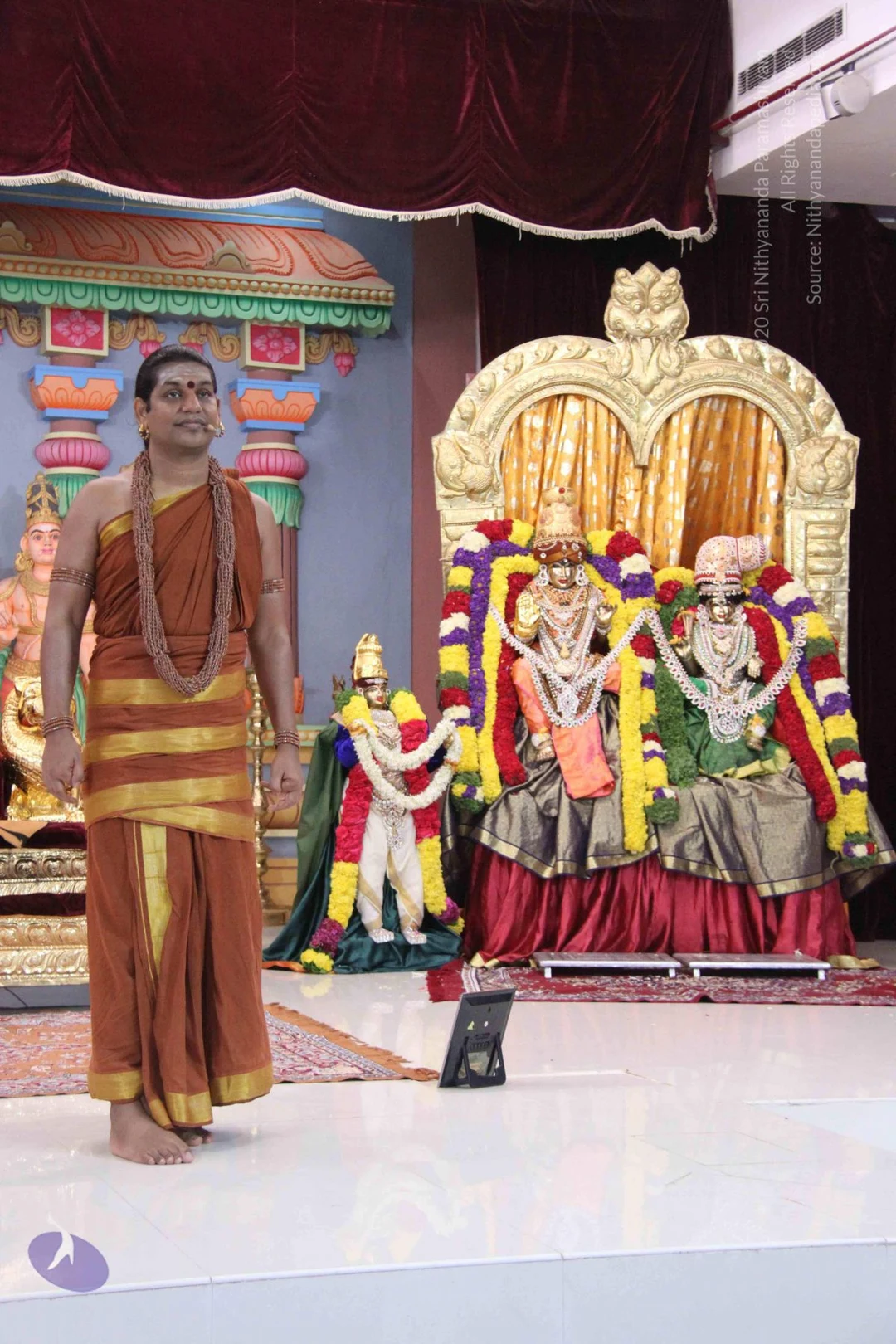
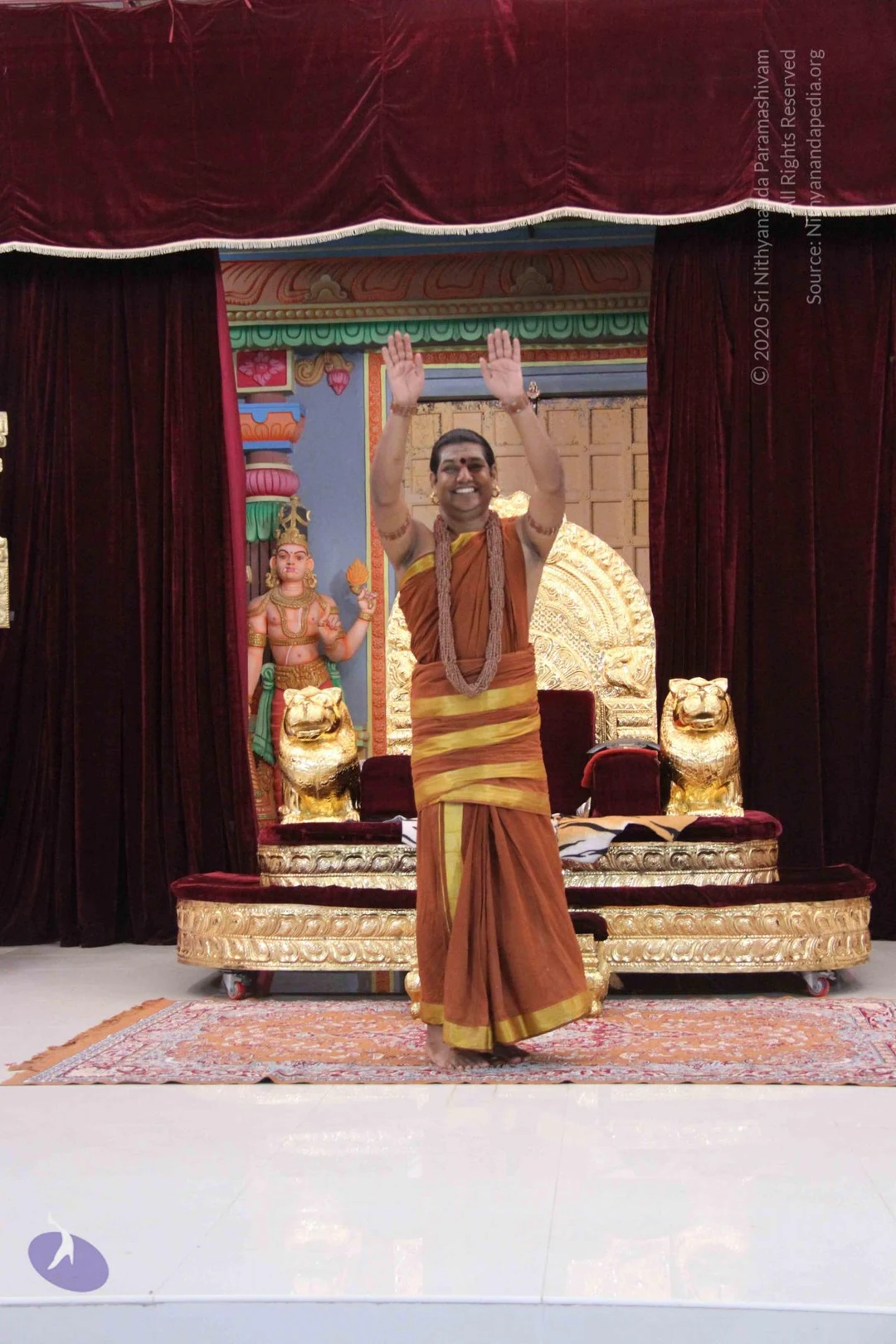
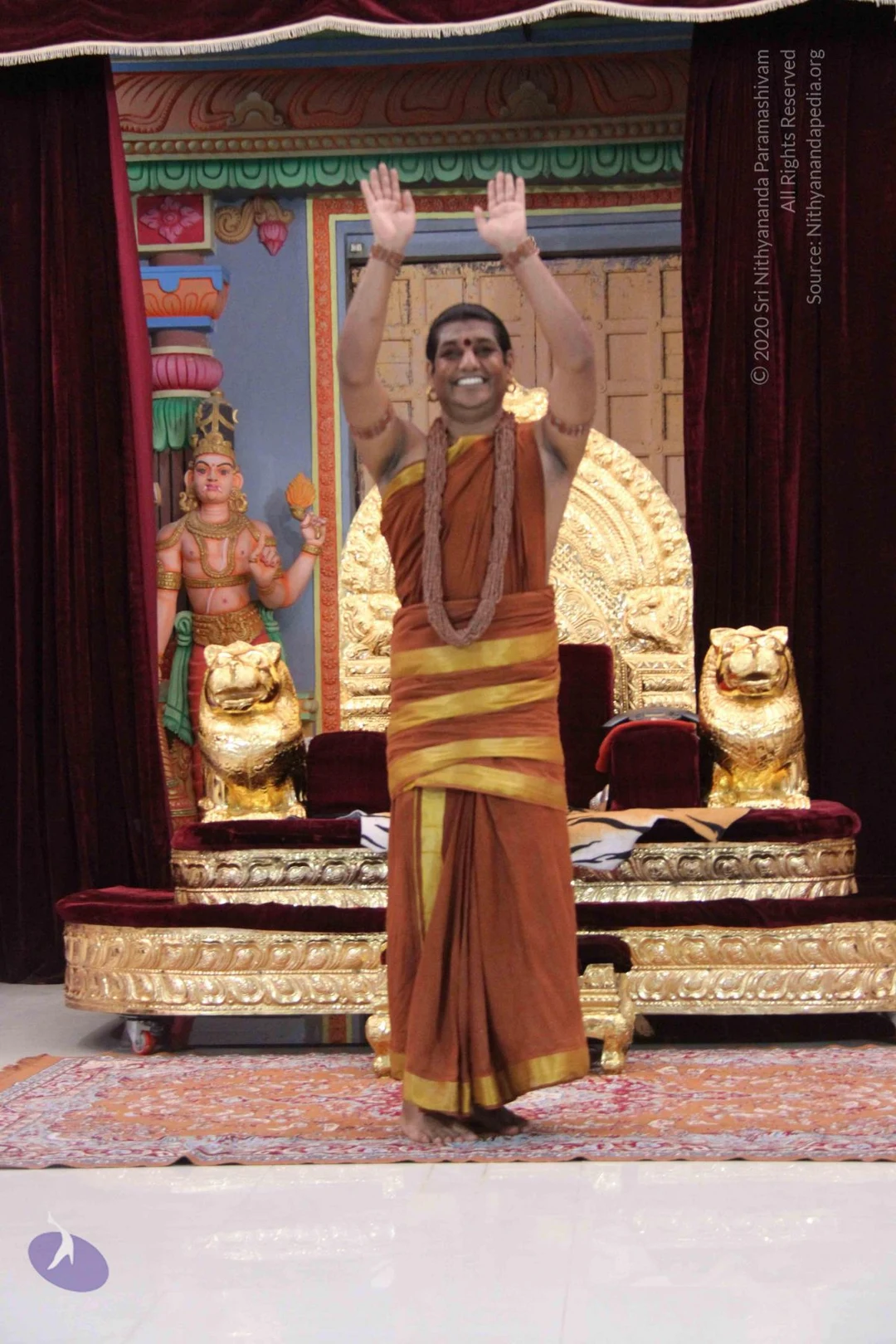
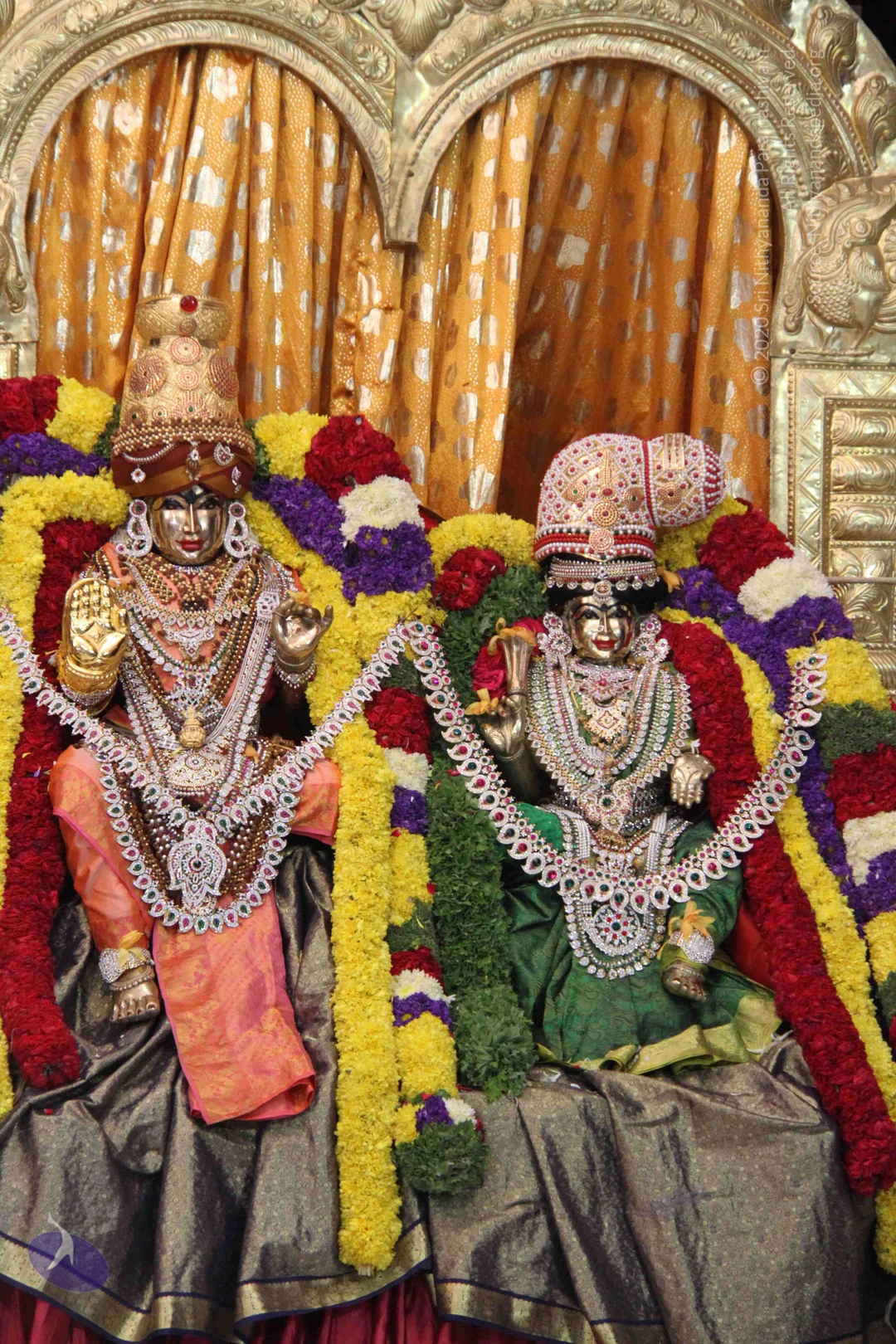
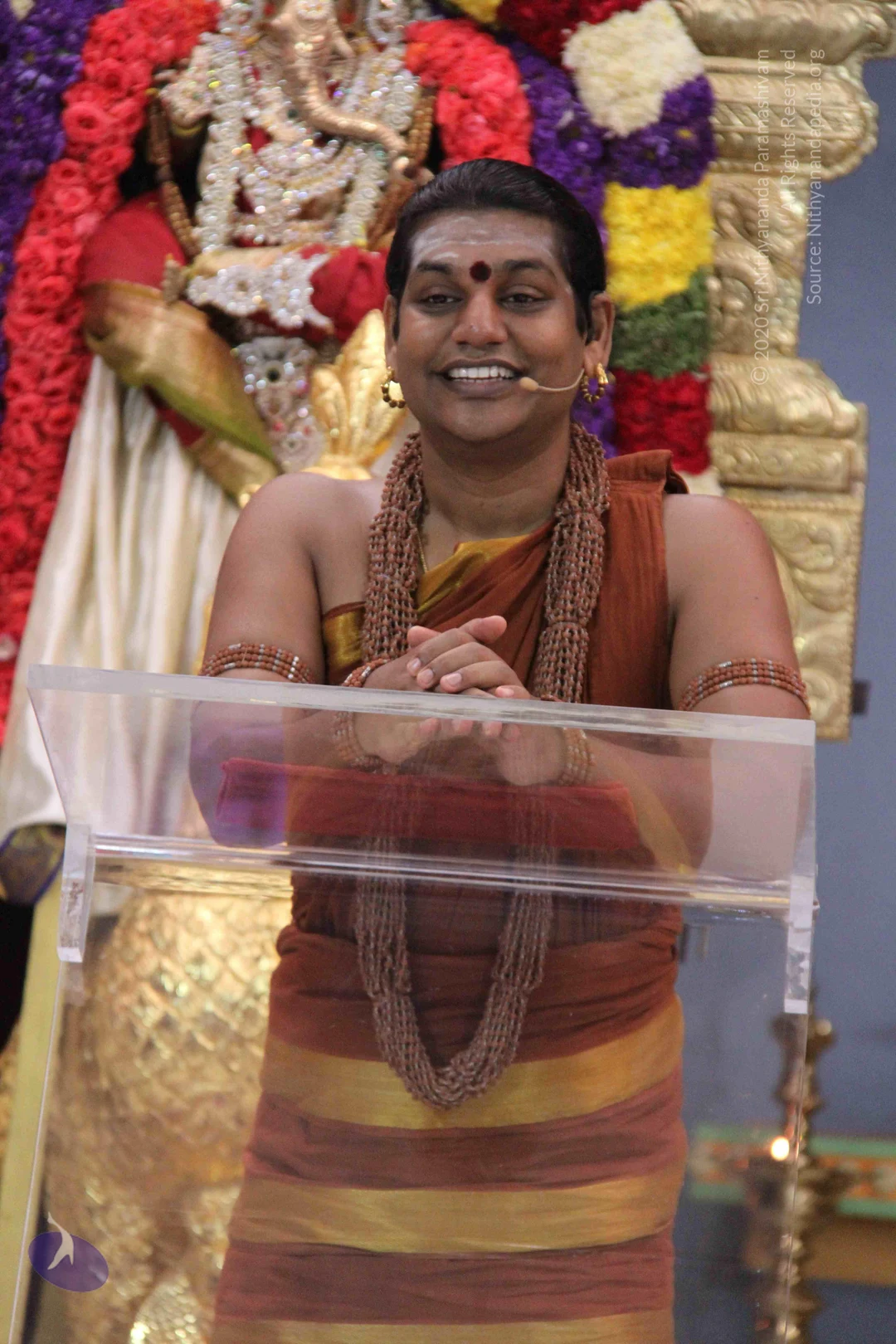
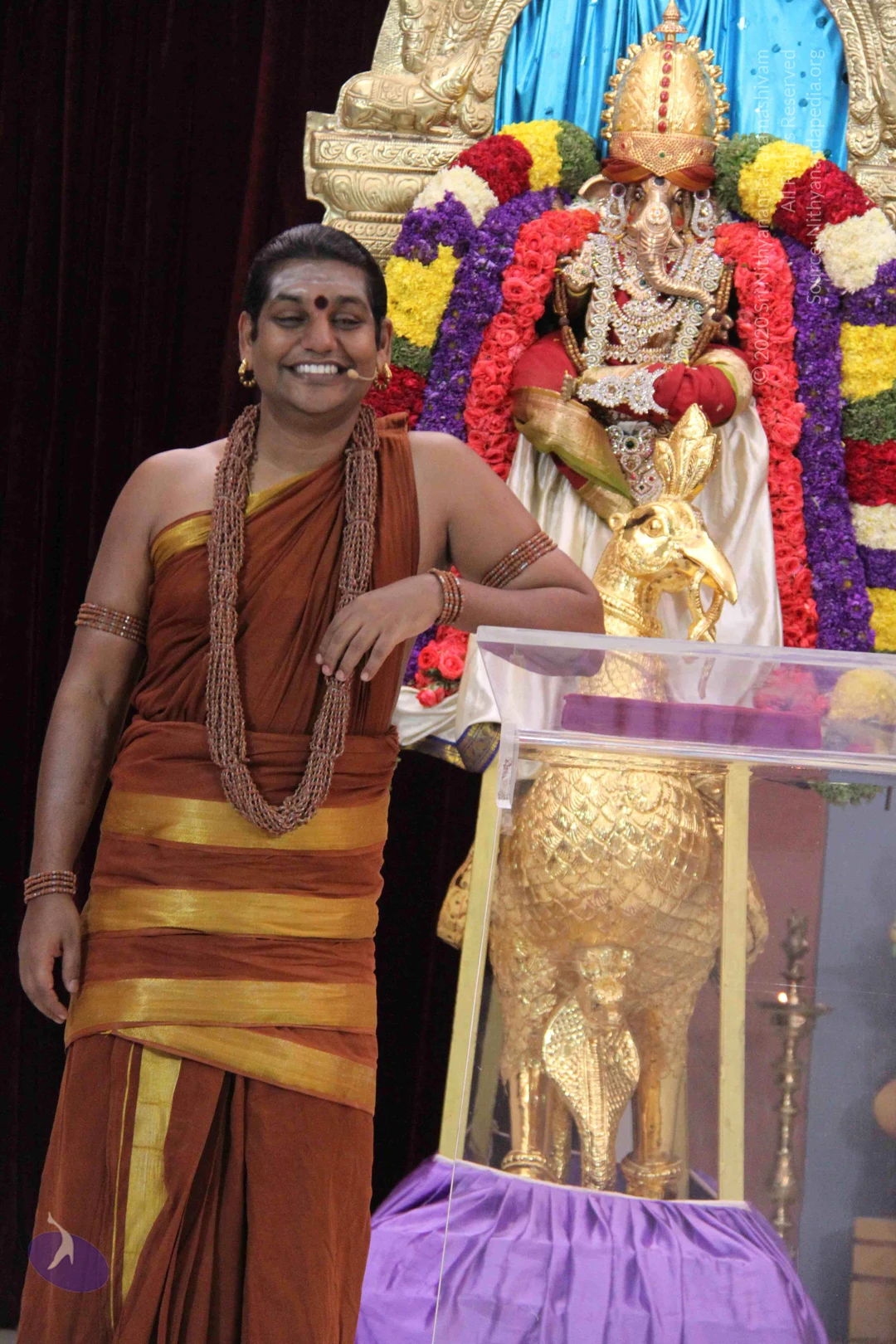
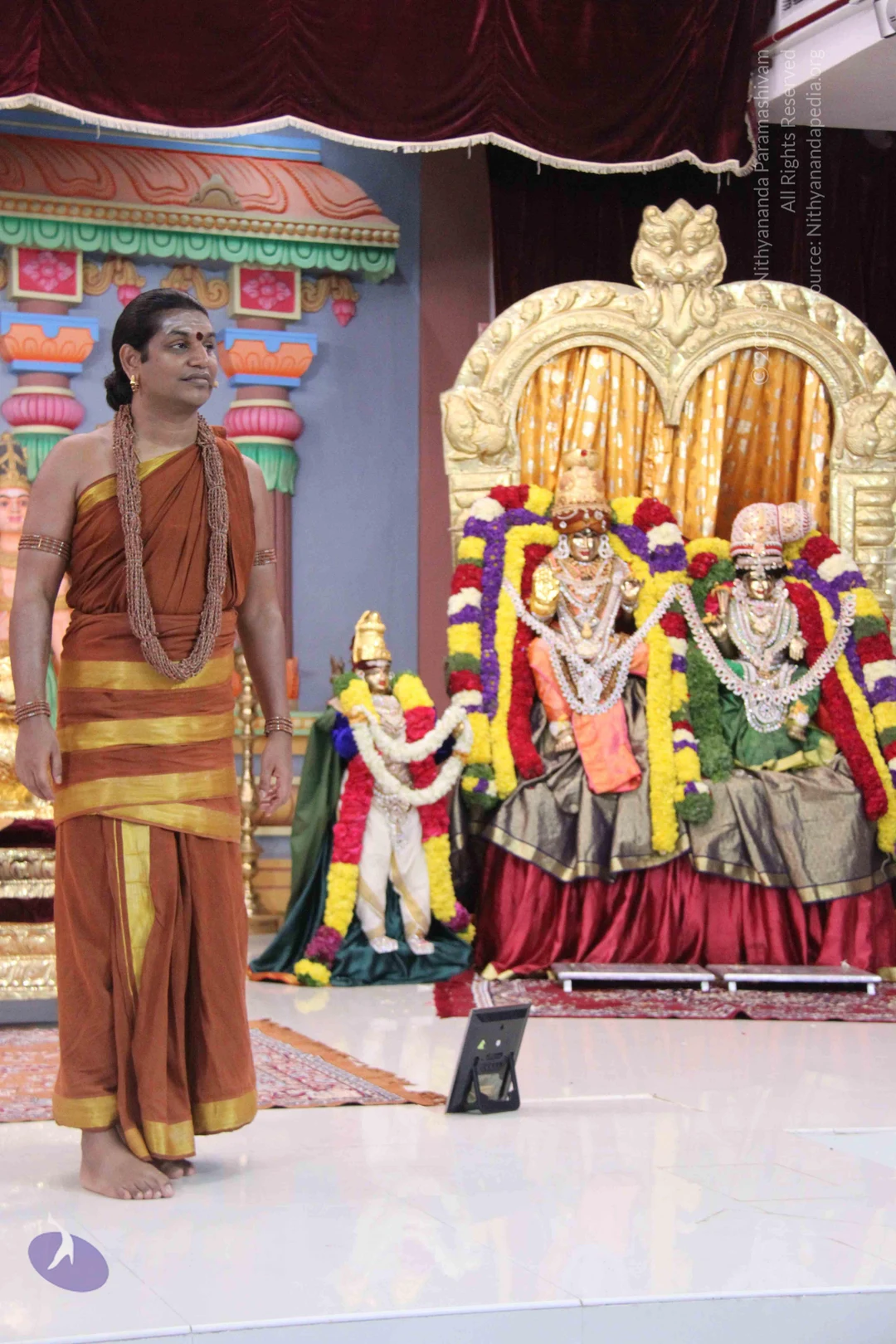
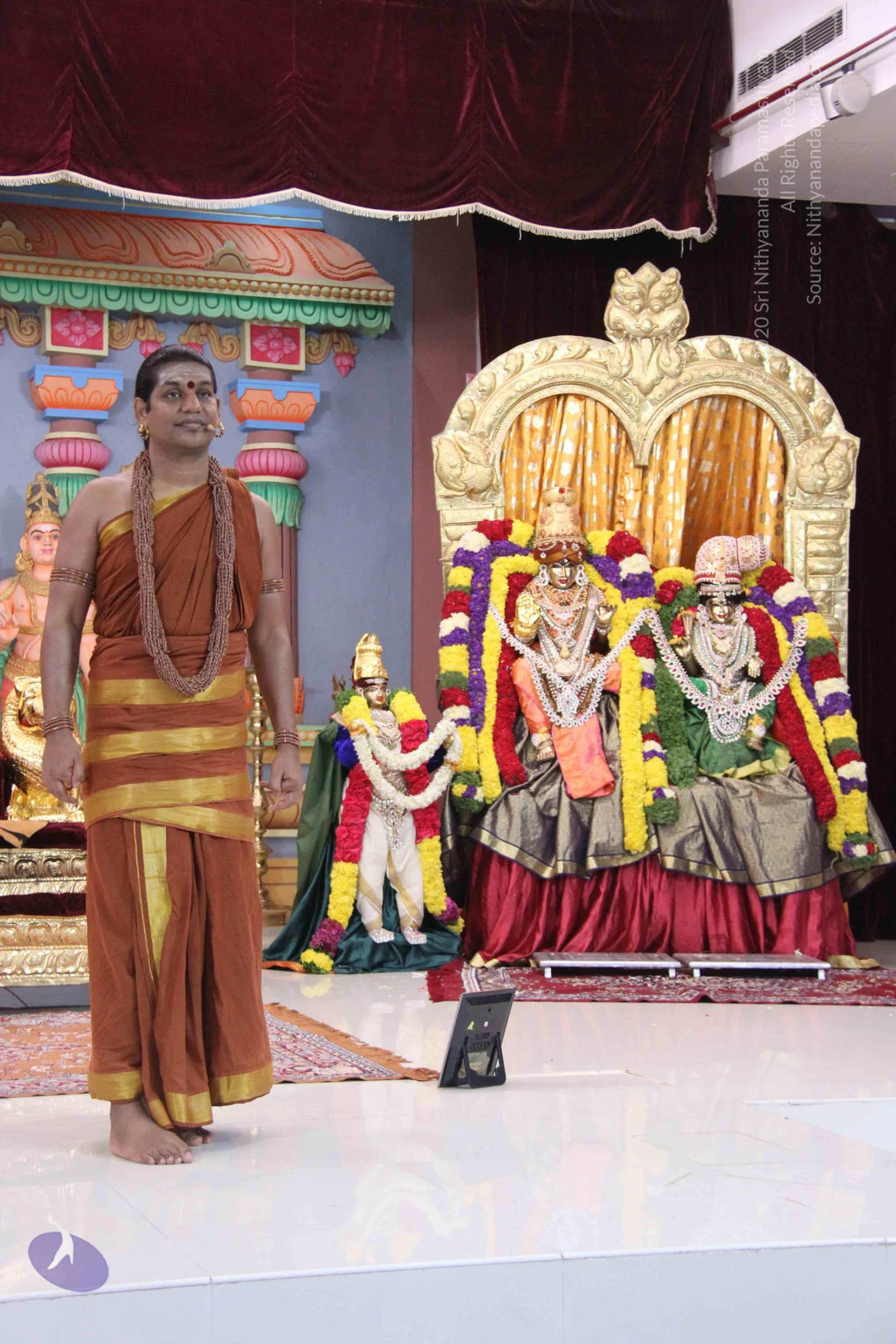
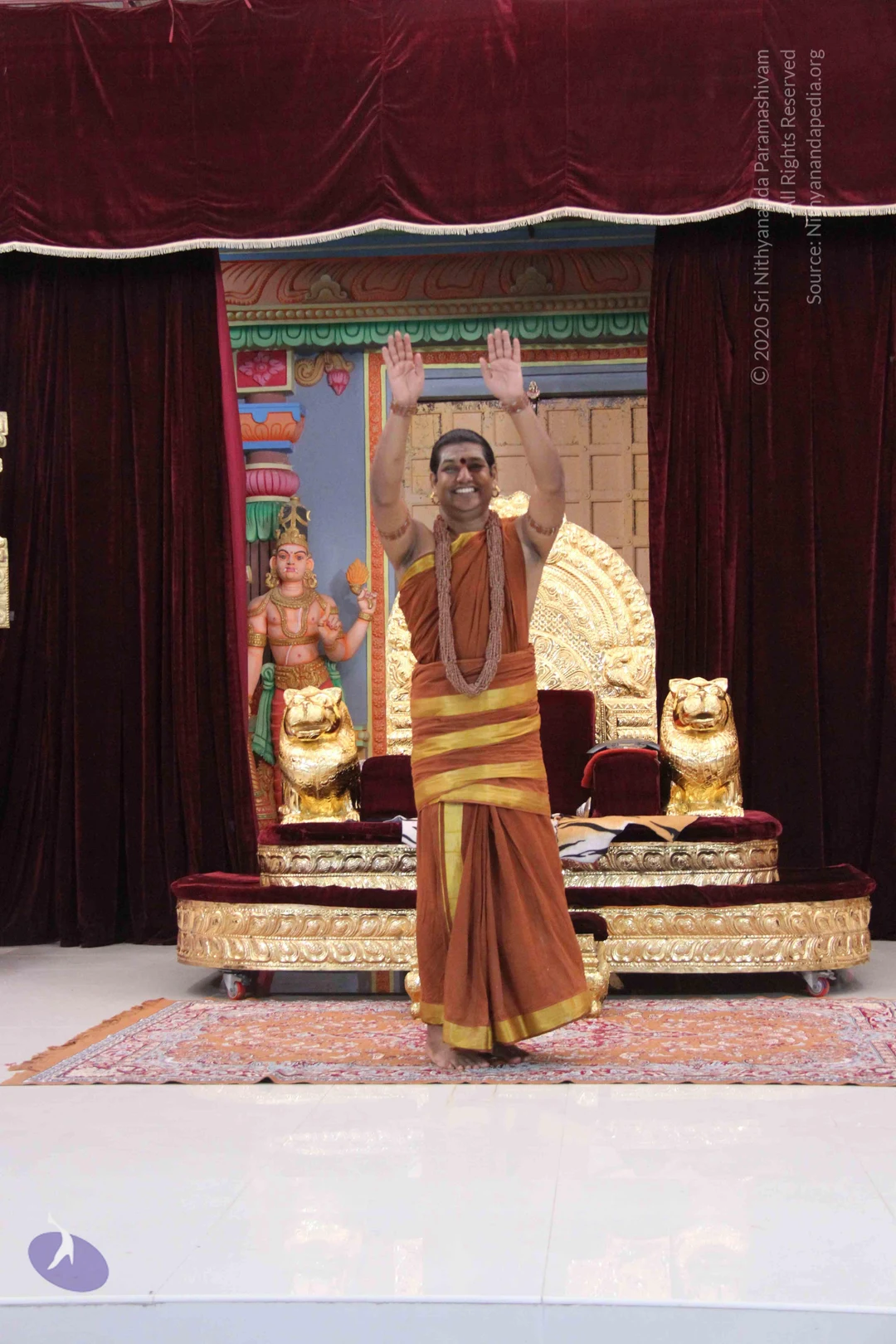
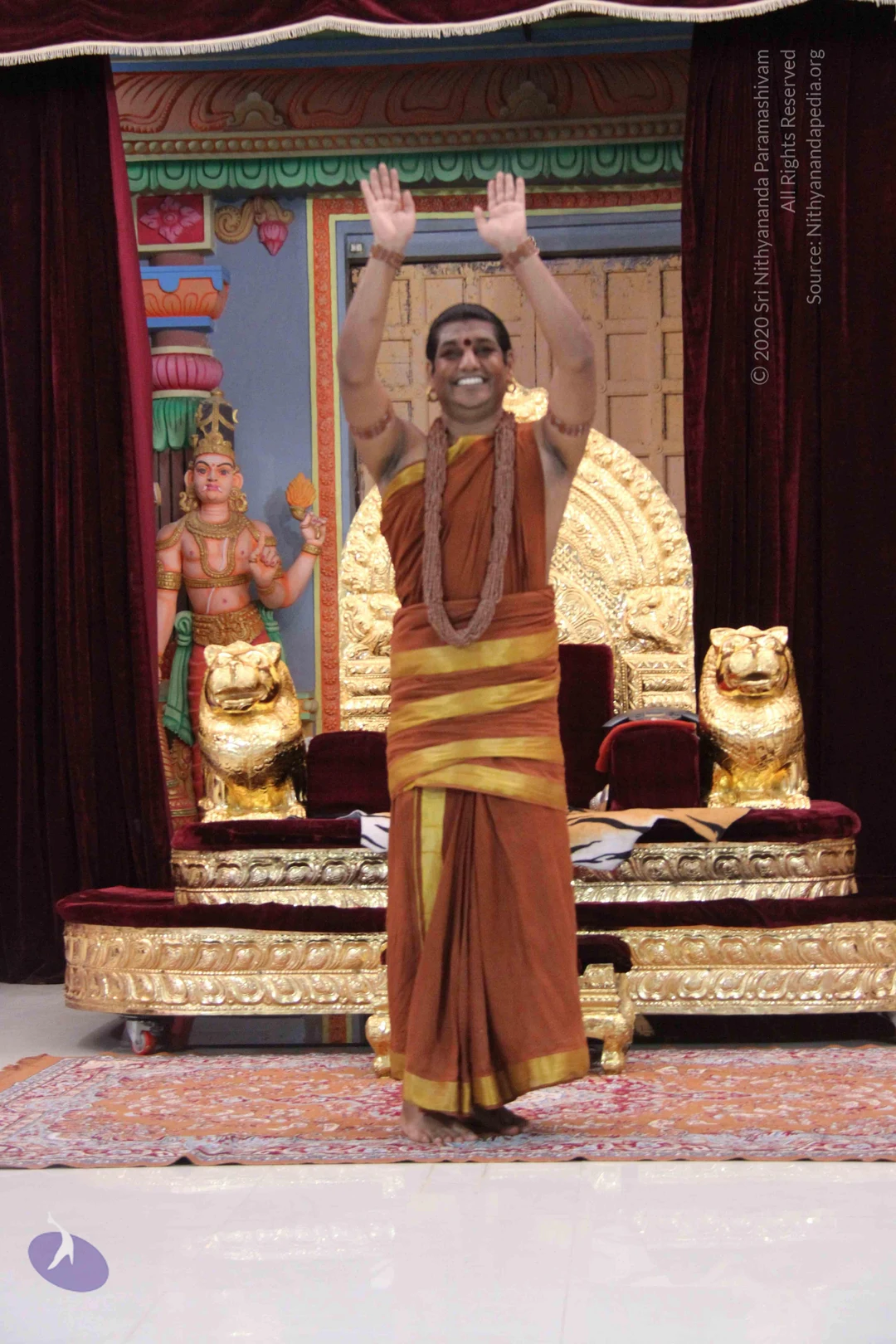
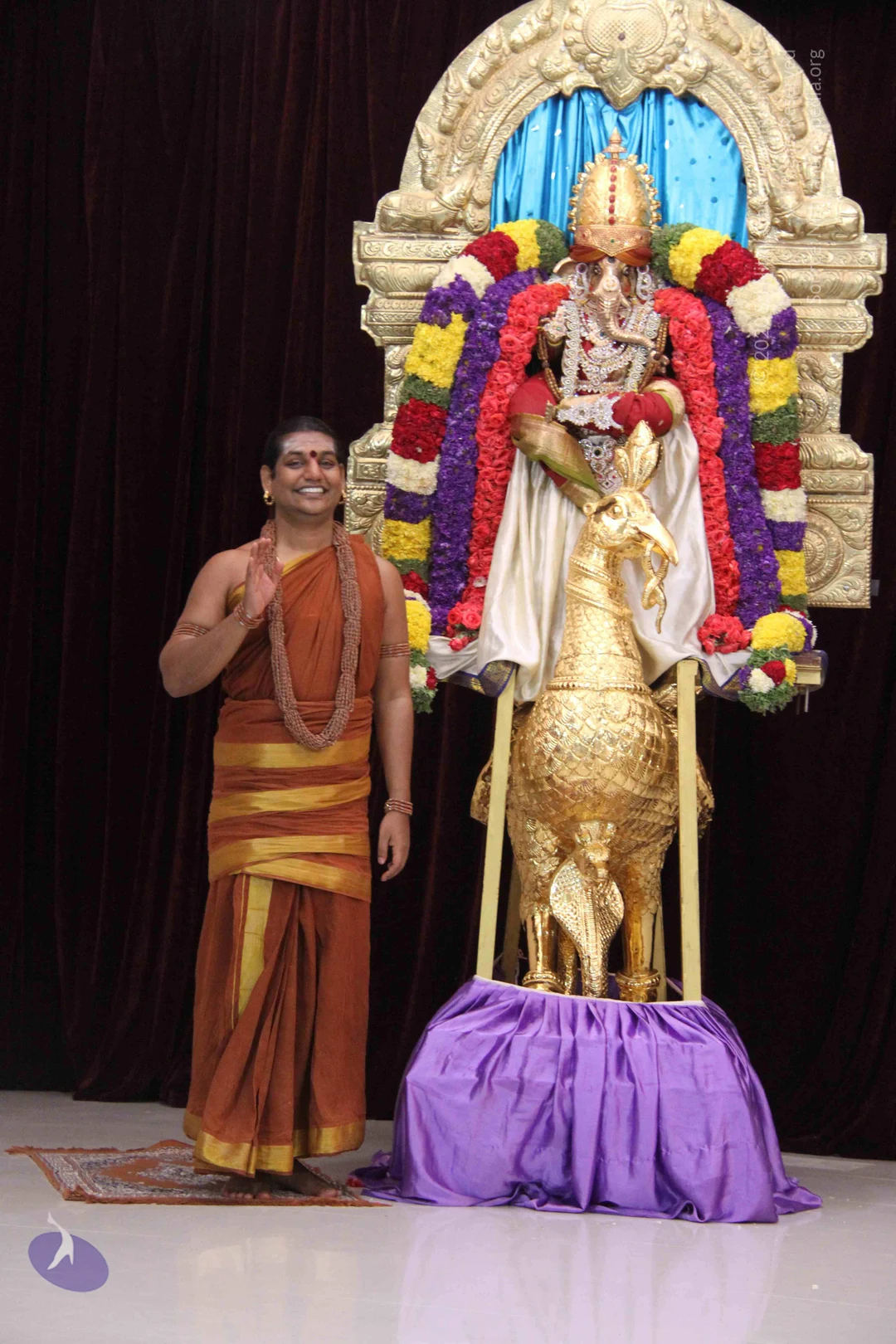
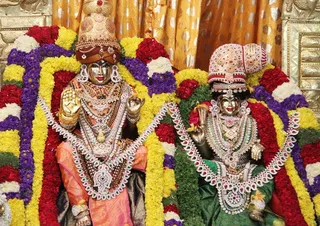
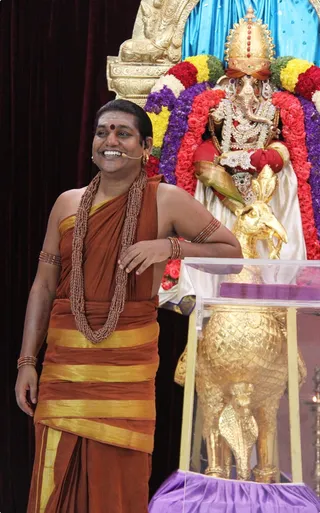
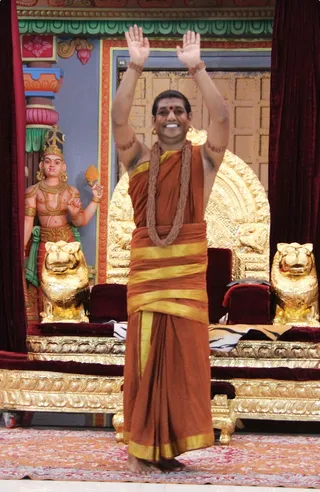
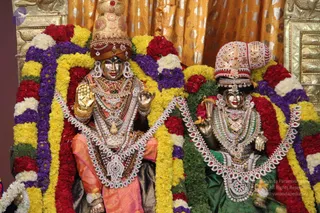
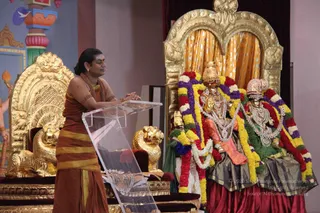
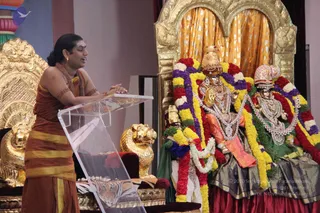
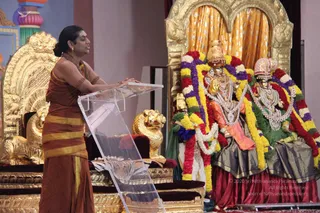
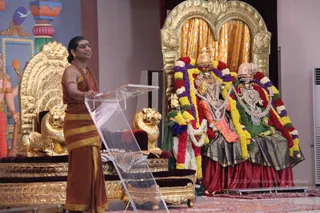
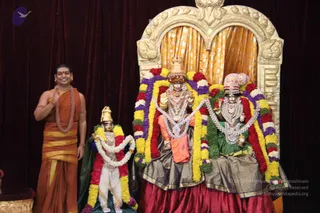
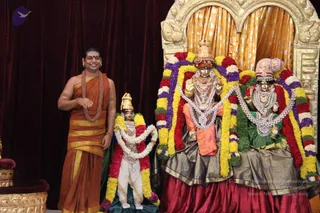
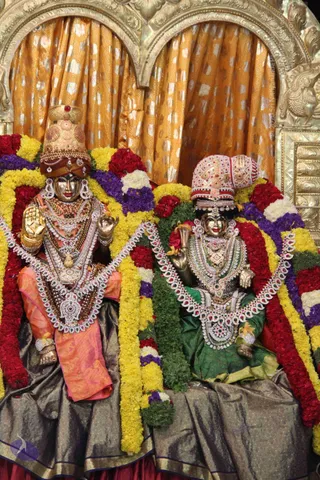
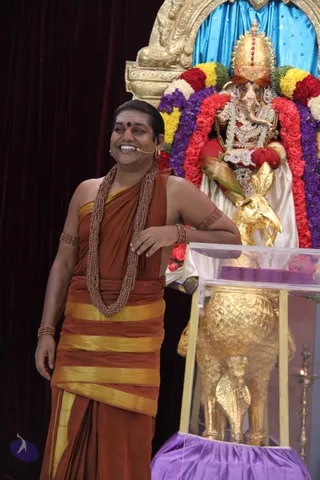
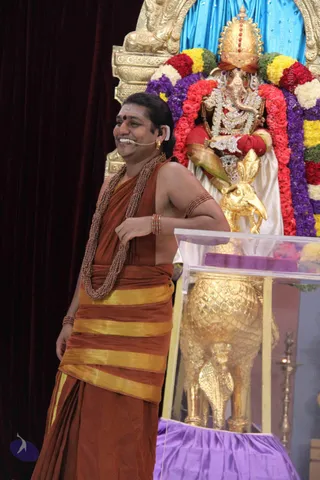
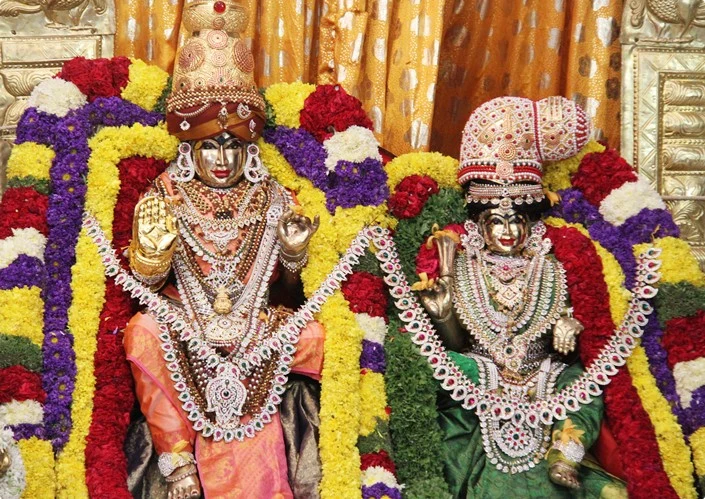
Two ornately decorated metal murti figures are seated side by side, framed by thick garlands of yellow, red, purple and white flowers. The figure on the left wears a peach-pink garment, a tall gold crown with red stone accents, layered jewelled necklaces and a white bead-and-stone chest garland, with one hand raised in abhaya mudra. The figure on the right wears a green garment, a red and white jewelled crown and similar layered necklaces, with one hand holding a small object. A gold-toned curtain and gilded wall panels form the backdrop. No physical people are visible.A photograph of a ceremonially decorated Ganesha murti seated on a throne-like seat before a gilded arch and blue silk backdrop. The deity has a gold crown with red and green jewels, a silver face with an elephant trunk, and a white dhoti-like cloth with a red and gold border. He wears layered silver and jewelled necklaces and a red sash. A large arc of red roses, yellow and white marigolds, and purple flowers surrounds the figure. A golden peacock-shaped stand sits in front. No physical people are visible.Photograph of a decorated deity murti pair seated on a dais before a gold curtain, adorned with multicoloured garlands of yellow, red, purple and white flowers. The seated central murti wears a pink-and-gold crown, layered silver necklaces and an orange-pink garment over a grey-gold skirt, with one hand raised in blessing. The seated figure to the right wears a pink crown, ornate necklaces and a green garment over a grey-gold skirt. A smaller standing figure on the left wears a gold crown, white dhoti-style garment and a white garland, and is also adorned with flower garlands. No physical people are visible.A smiling man in saffron-orange and gold cloth stands behind a clear acrylic lectern with hands pressed together, wearing a headset microphone, a red bindi, rudraksha mala necklaces and beaded armlets. Behind him is a gold-and-colour deity murti decorated with garlands in red, yellow, green and purple, and a small oil lamp is visible at right. a person is the speaker, based on his saffron clothing, beaded malas and ceremonial presentation; the page lists him at this event.A smiling man in rust-orange draped robes with gold borders stands at the left, wearing a long rudraksha-style bead mala around his neck and beaded bangles on his arms, with a small red bindi on his forehead and a small headset microphone at his mouth. Behind him is a deity murti adorned with red, yellow, purple and white flower garlands and jewelled ornaments, and a golden mythical bird sculpture stands in a glass display case on a purple cloth at the right.a person stands barefoot on a red carpet before a golden throne, arms raised high with palms open, smiling. He wears a saffron-orange dhoti and shawl with gold-bordered folds, a long rudraksha mala around his neck, gold bangles and a red bindi. Behind him a golden lion-armrest throne with red cushions and a tiger-skin cover sits beside a painted statue of a deity with gold jewellery and a lotus in hand, and deep red curtains frame the stage.

Leela_Alankar

5 photosSource gallery
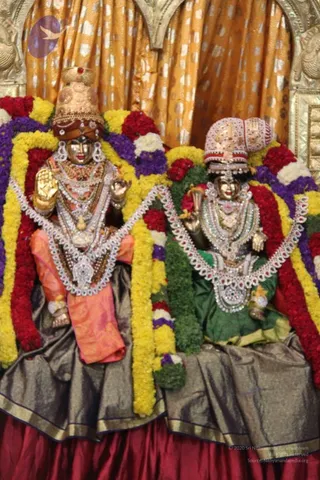
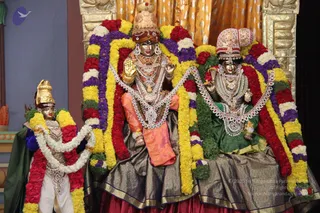
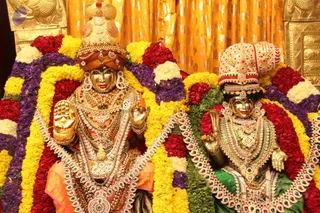
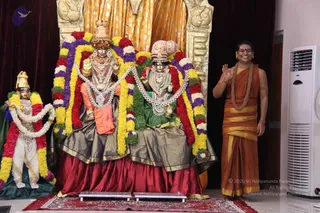
A photograph of three decorated deity murti in a temple shrine, with no living people visible. Two larger seated murti sit side by side on a throne-like seat draped with garlands of yellow, red, purple and white flowers. The figure on the left wears a pink-orange sari, a gold crown, layered silver necklaces and gold hand ornaments. The figure on the right wears a green sari, a pink and gold crown and layered silver jewelry. A smaller standing murti at the left wears a gold crown, a green cloak and a garland of white and red flowers. A brass oil lamp stands at the left edge, and a gold-and-orange curtain forms the backdrop.Two metal murti figures of a seated divine couple, decorated for worship on a red-draped platform in front of golden curtains. The figure on the left wears a tall gold crown with red stone, an orange-and-peach garment, and layered necklaces and beaded garlands; its right hand is raised in a blessing gesture. The figure on the right wears a white-and-red ornate crown, a green garment, and heavy jewelled necklaces, holding a lotus-like object. Both are framed by garlands of yellow, red, purple and white flowers and silver-edged ornaments.Two metal deity murtis, one in gold-toned finish wearing an orange-pink garment and heavy layered silver-and-gem necklaces, the other in dark green garment with ornate jewelled crown and necklaces, seated side by side on a flower-decorated throne. Garlands of red, yellow, purple and white flowers frame them, and a gold patterned curtain and carved gold panel form the backdrop. No physical people are visible.Photograph of a decorated deity murti group on a raised platform, garlanded with bands of yellow marigolds, red roses, white flowers and purple blossoms. The central seated figure wears an orange and pink garment, a gold crown, a red and gold turban-like headpiece, and layered gold and jewelled necklaces. Beside it a seated consort figure wears a green garment, a jewelled crown and layered silver-toned necklaces. A smaller standing attendant figure on the left wears white clothing, a gold crown and white flower garlands. Gold-toned curtains and a golden backdrop frame the scene. No physical people are present.Two golden murti statues are seated side by side on a decorated platform, draped in dense garlands of yellow marigolds, red roses, purple flowers and white blossoms. The left figure wears an orange-and-gold turban-style crown, an orange garment and layered jewelled necklaces, with one hand raised in blessing. The right figure wears a red, white and gold jewelled crown and a green garment with ornate necklaces and jewelled borders. A golden curtain and gilded wall panels form the backdrop. No living people are visible, and the image shows statues only, so no a person candidate is present.

Satsang_Swamiji_Crowd

6 photosSource gallery
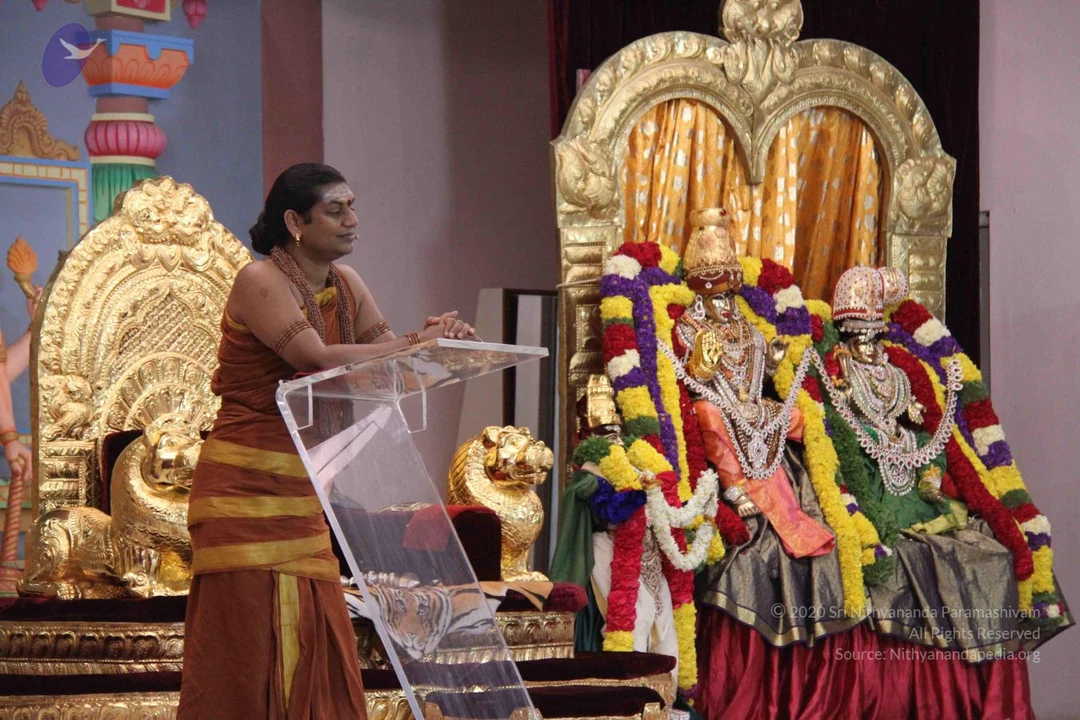
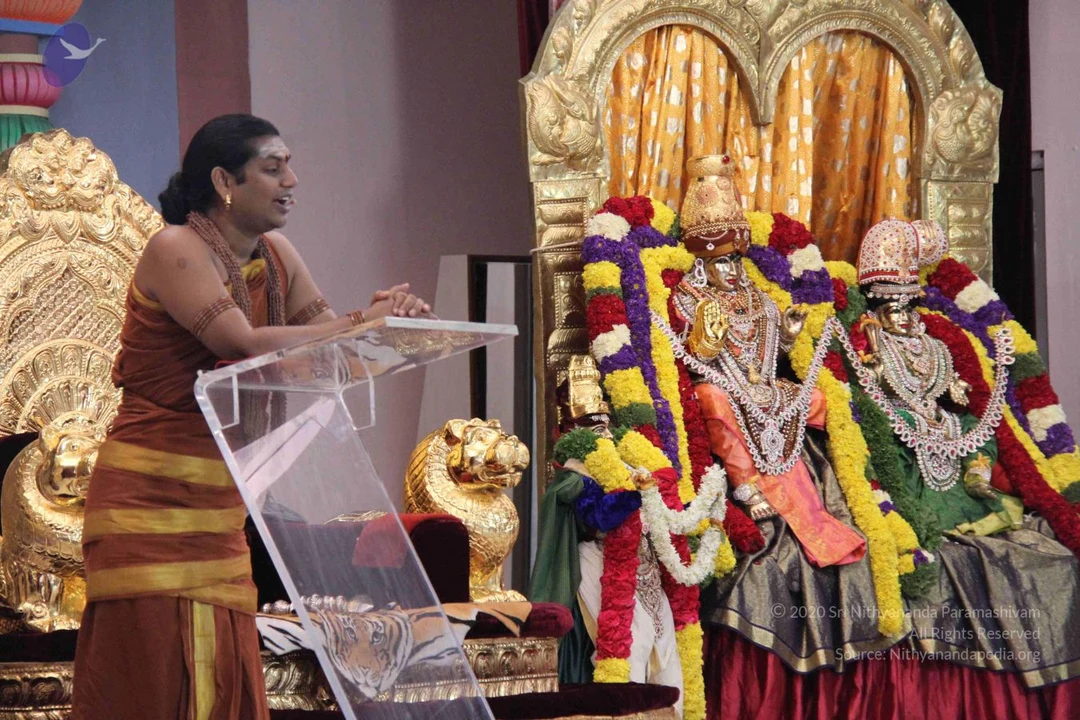
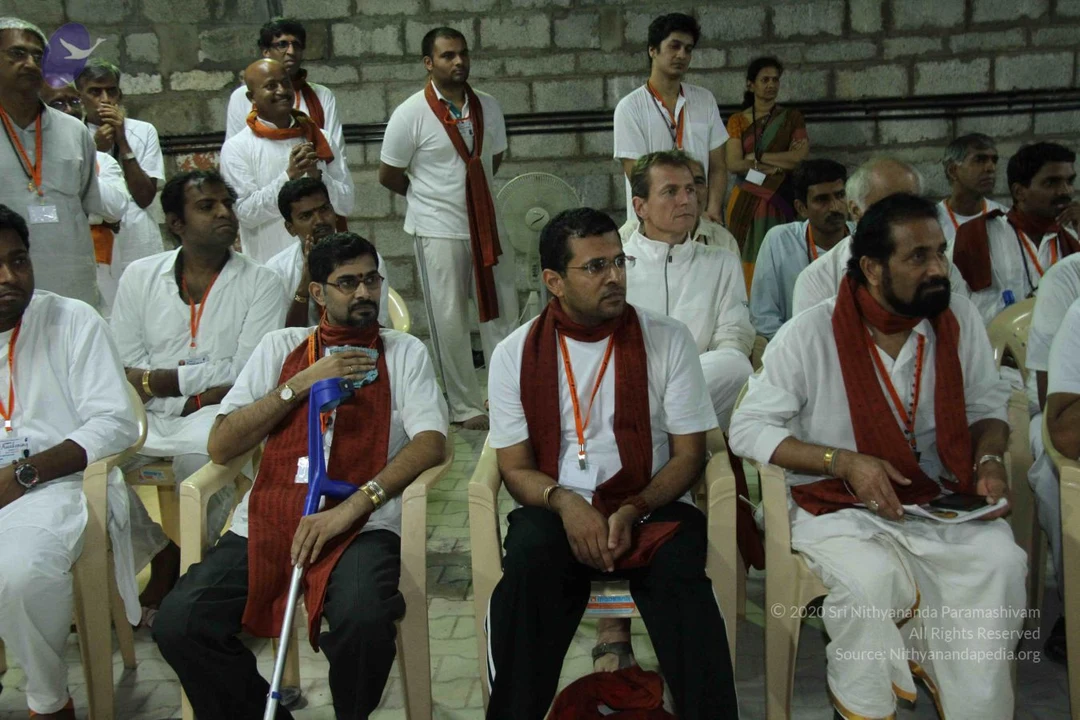
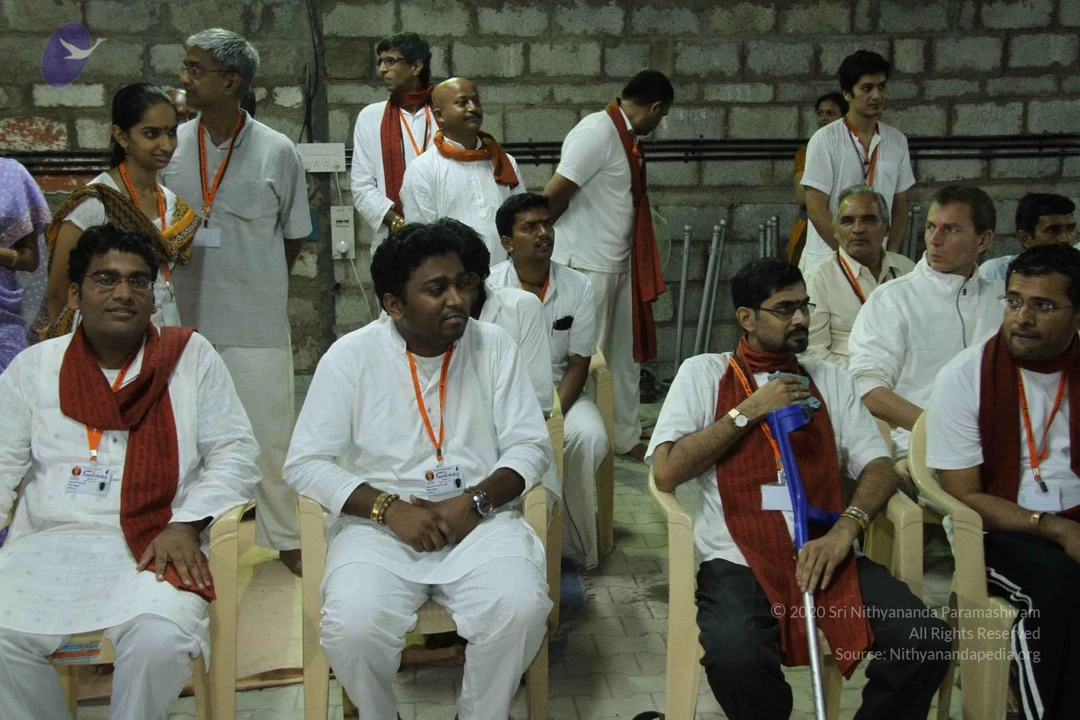
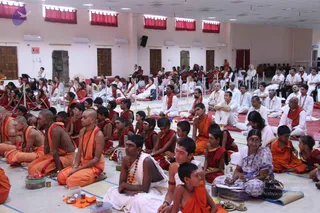
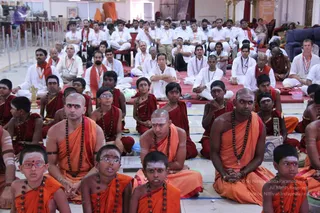
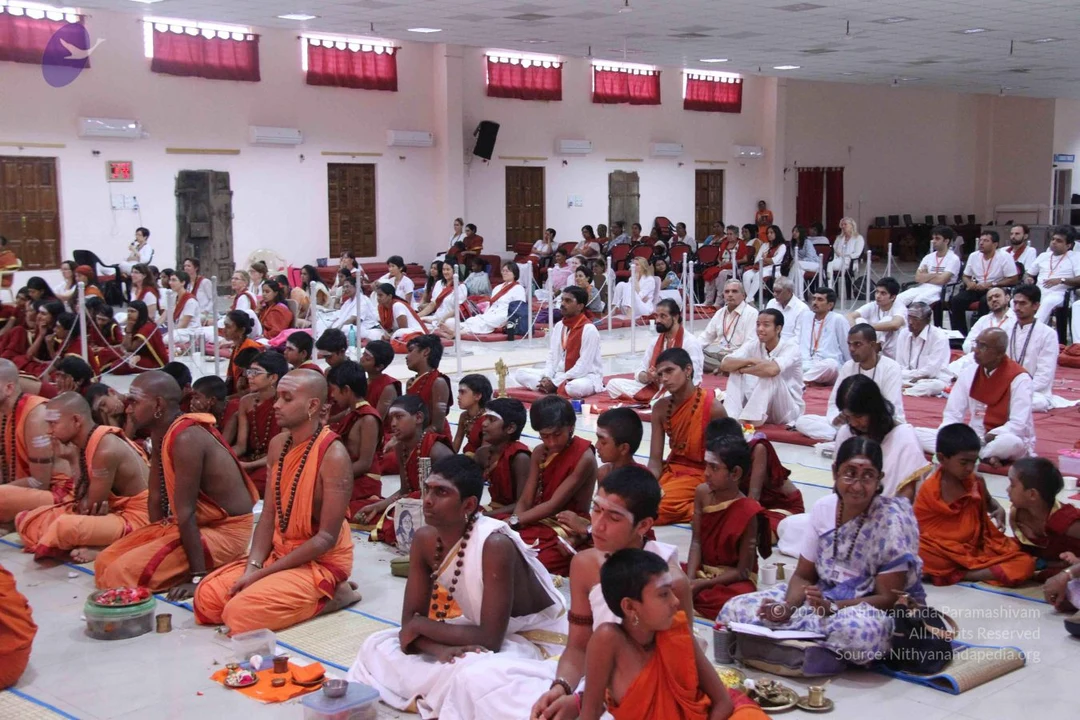
A wide photograph of a large hall with pink walls, red curtains and wall-mounted air conditioners, where a crowd of several dozen seated people sits on red mats and white sheets in rows. In the foreground, shaved-headed young men in saffron-orange robes and rudraksha malas sit cross-legged beside boys in red-orange cloth and white-clad men. A woman in a blue-and-white sari with a bindi sits near a small brass plate with offerings. Behind them, rows of seated devotees in white and orange fill the room, with a speaker mounted high on the wall and a few people sitting near the back. No clearly identifiable a person figure is visible in the front rows.A man in saffron-orange and gold striped dhoti and shawl stands at a clear acrylic lectern, hands clasped, speaking to an audience. He wears a rudraksha mala and gold necklace and gold armlets. Behind him, two deity murtis are seated on a golden throne with a gold-framed arch and gold curtain, adorned with bright garlands of red, yellow, green and purple flowers, pearl necklaces and crowns. A gilded lion-armrest chair is at left, with a painted pillar behind. Appearance-based candidate: a person, speaking at a discourse.A man in orange-and-saffron robes with a gold-striped wrap and rudraksha beads stands at a clear acrylic lectern on a stage, speaking with his hands clasped on the podium. Behind him, two deity murti figures sit on a golden throne beneath a gold arched canopy with a yellow curtain. Both murti are draped in fresh garlands of yellow, red, purple and white flowers, wear crowns and silver-white jewelled necklaces, and one is dressed in pink, the other in green. Golden lion sculptures flank the throne, and a tiger-striped cloth lies on the stage edge. The stage is decorated with a pastel pink and blue backdrop.A man with long dark hair tied back in a bun stands at a clear acrylic lectern, speaking with his hands resting on its edge. He wears a rust-brown and mustard-yellow dhoti-style garment draped over his bare chest, a rudraksha-style mala necklace, bangles and small earrings. Behind him sits a golden throne with lion-carved armrests and a red cushion. To the right, two ornately adorned deity murtis are seated on a golden dais, garlanded with red, yellow, purple and white flowers, wearing jewelled crowns and heavy silver-and-gold necklaces, with a gold curtain behind. A tiger-print cloth is draped over the lectern area. The a person cues are the long hair, distinctive adornments and the speaking pose at the lectern, which suggests a discourse setting.A man in a rust-orange and gold-bordered dhoti and wrap stands at a clear acrylic lectern on a stage, speaking with a microphone and holding the lectern with both hands. Behind him stands a gold-framed throne with lion-form armrests and a deep red cushioned seat. To the right, two deity murtis in ornate gold and red garments wear crowns and layered pearl and bead necklaces, framed by garlands of red, yellow, purple and white flowers. Behind them hangs a gold and orange curtain, and a painted pillar with floral motifs stands at the left edge. A wall air conditioner is visible at the right edge.A seated assembly of many devotees in a bright hall, many dressed in white kurtas and dhotis with saffron-orange shawls and orange lanyards. In the foreground, several young boys in saffron-orange robes and red shawls wear rudraksha malas and white ash marks on their foreheads. A few older men in orange robes sit with rudraksha malas, and a shaved-headed man in orange sits near the centre. Behind them, rows of people sit on red mats, with a golden figure and orange drapery visible at the back. The scene looks like a formal satsang or discourse gathering.

SarvaDarshan_Pics

11 photosSource gallery
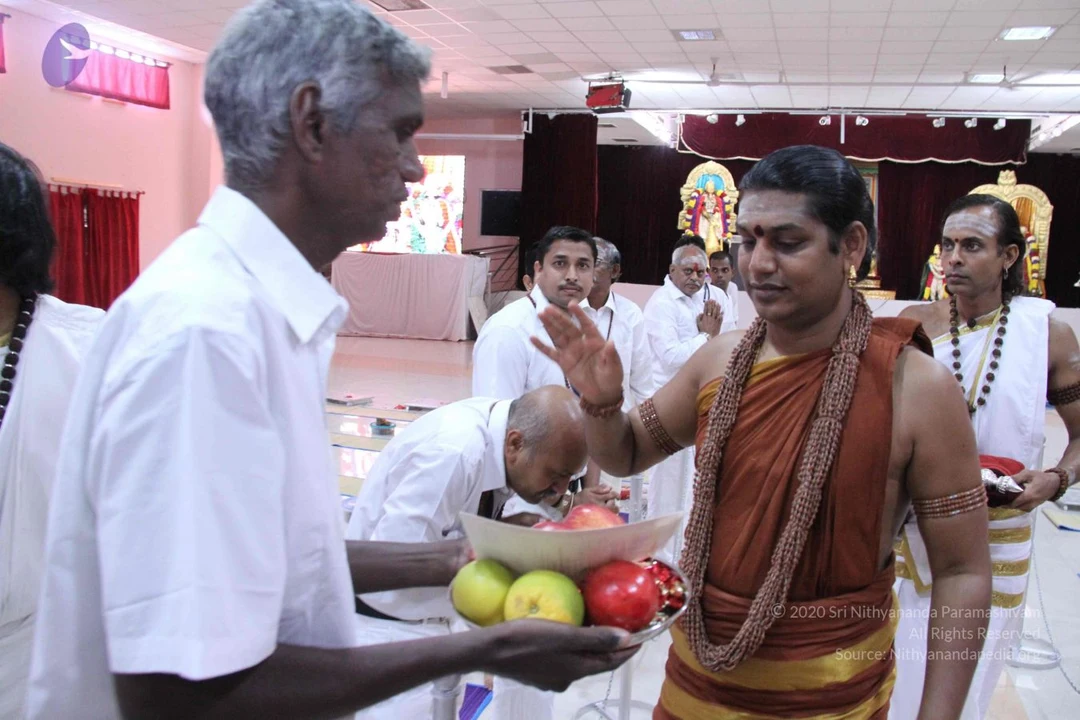
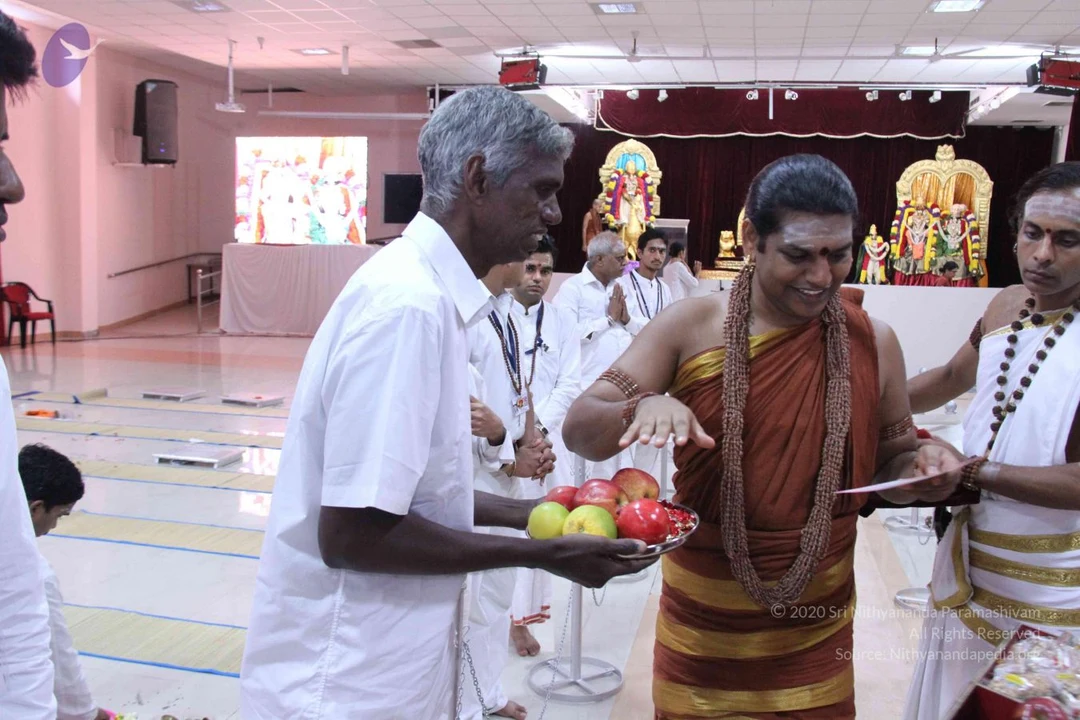
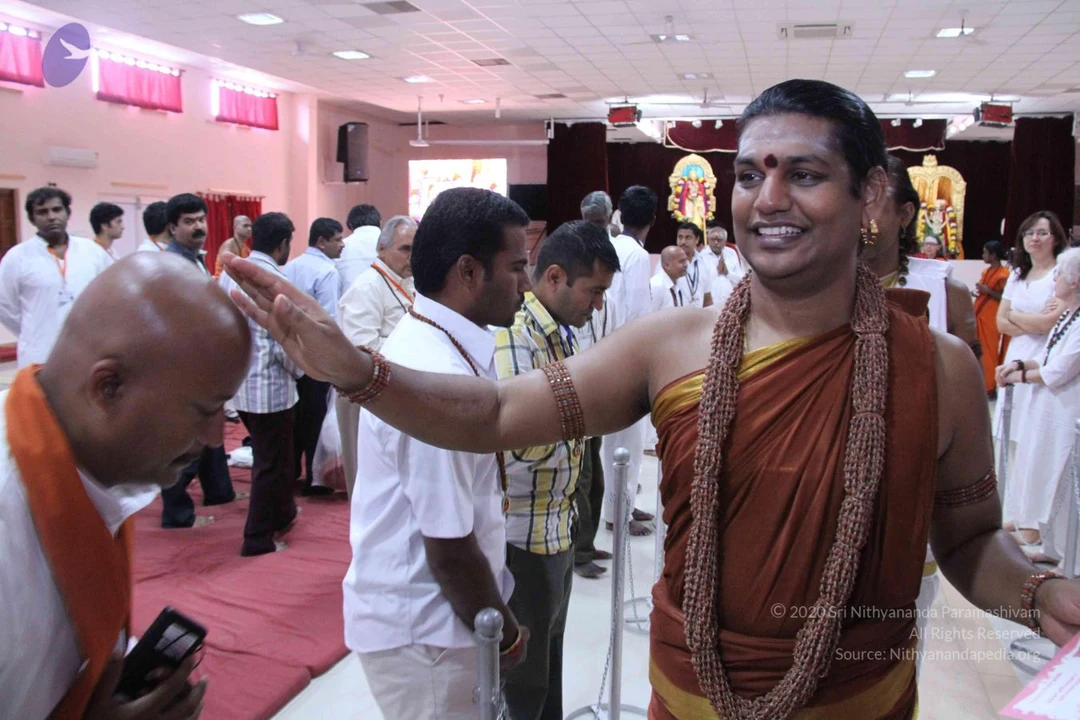
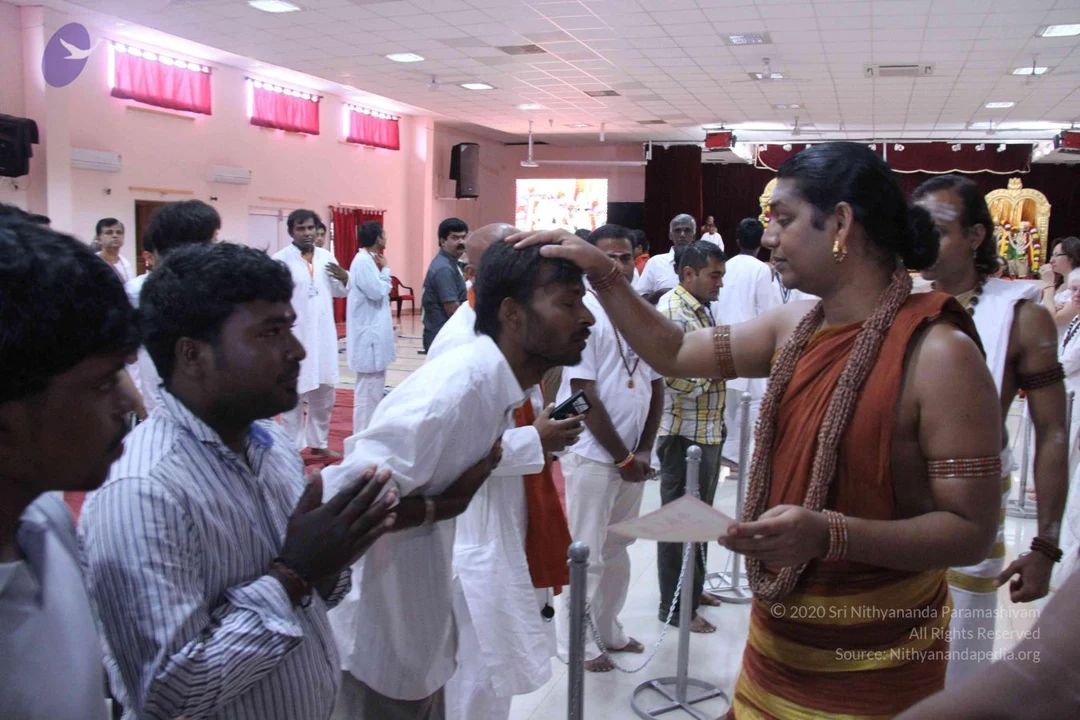
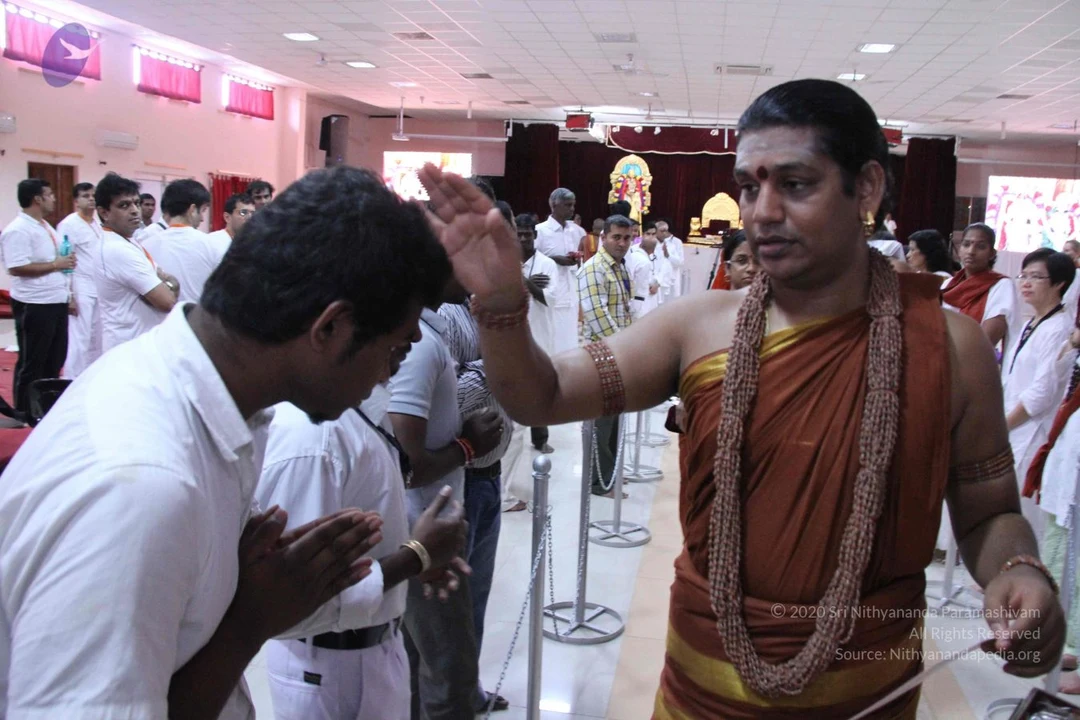
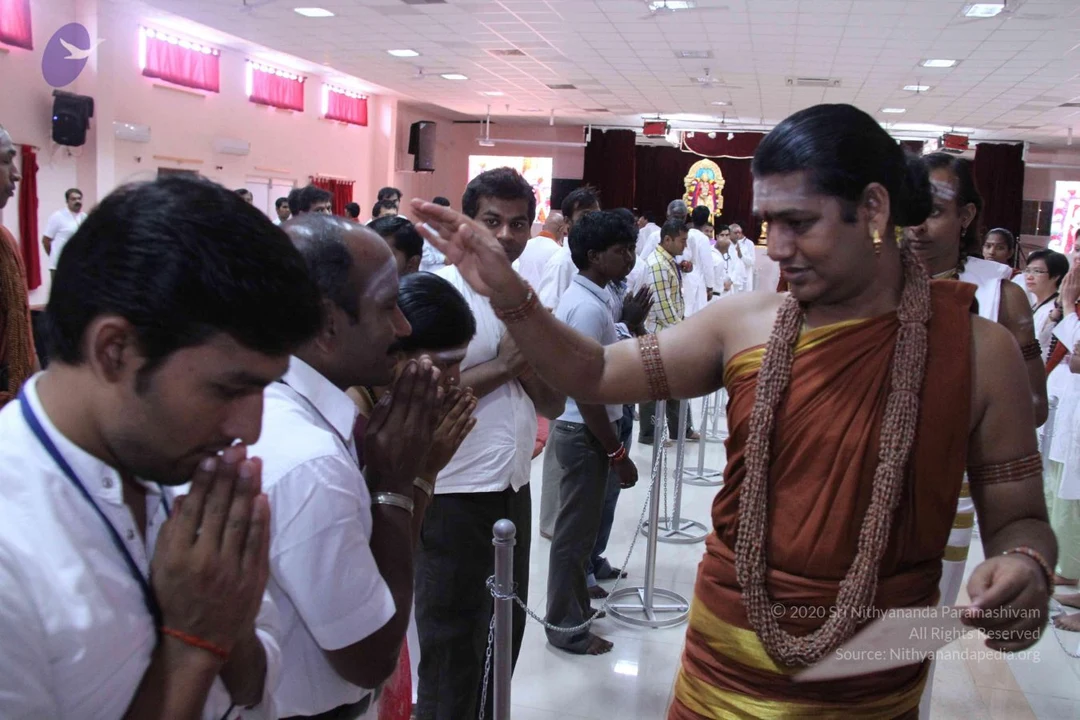
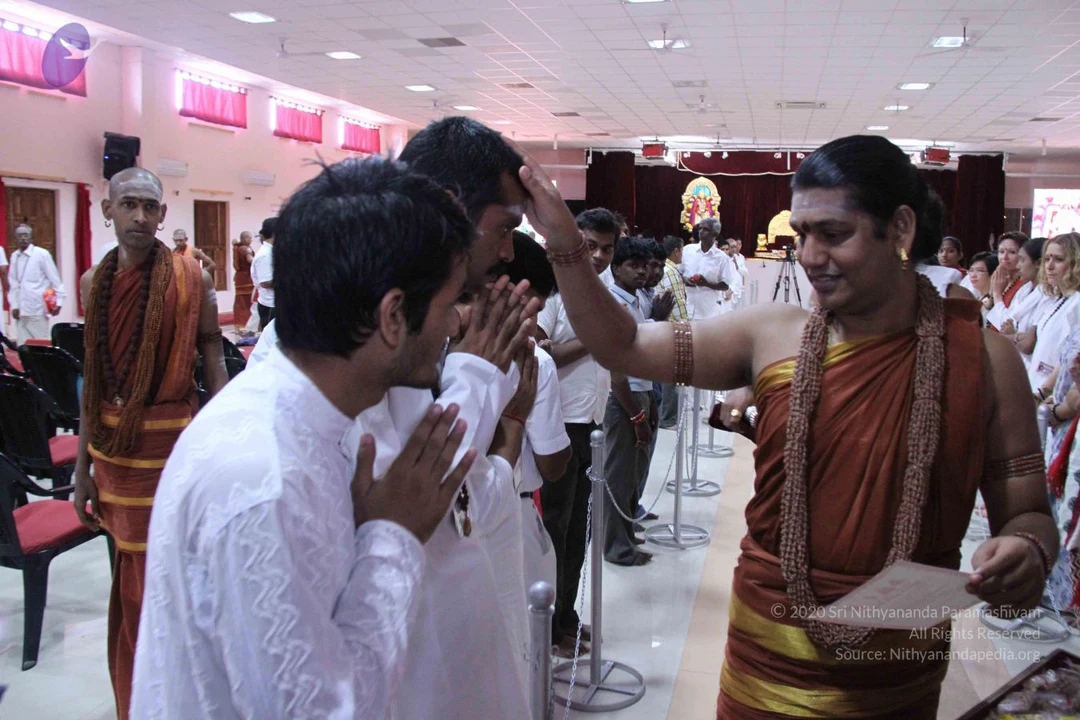
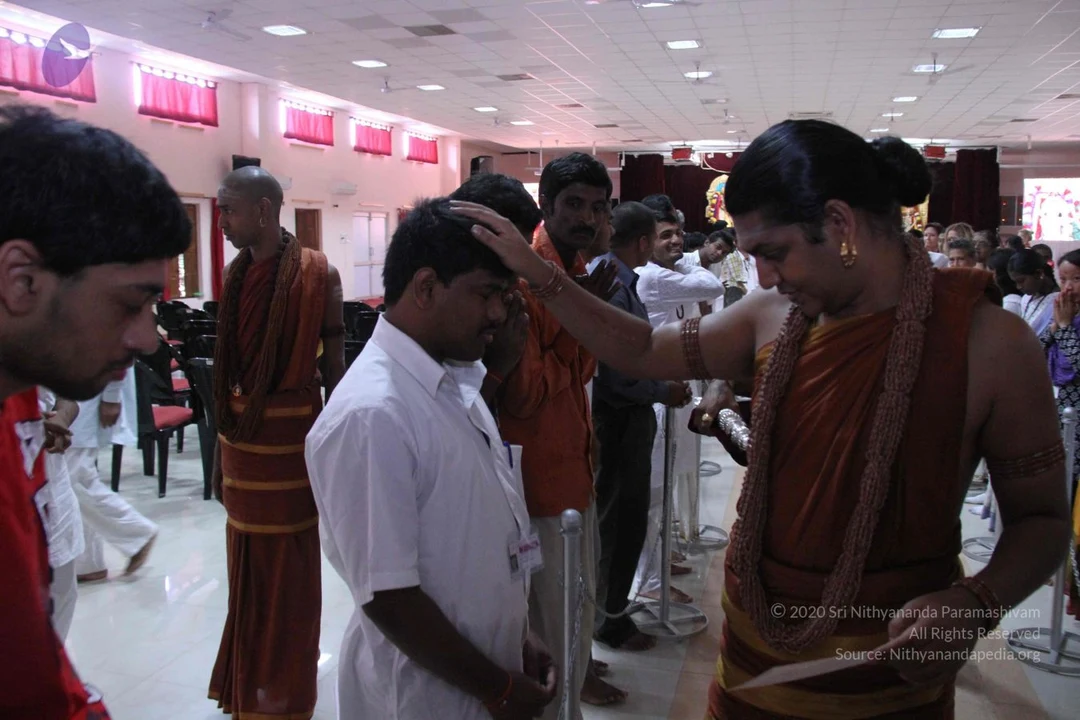
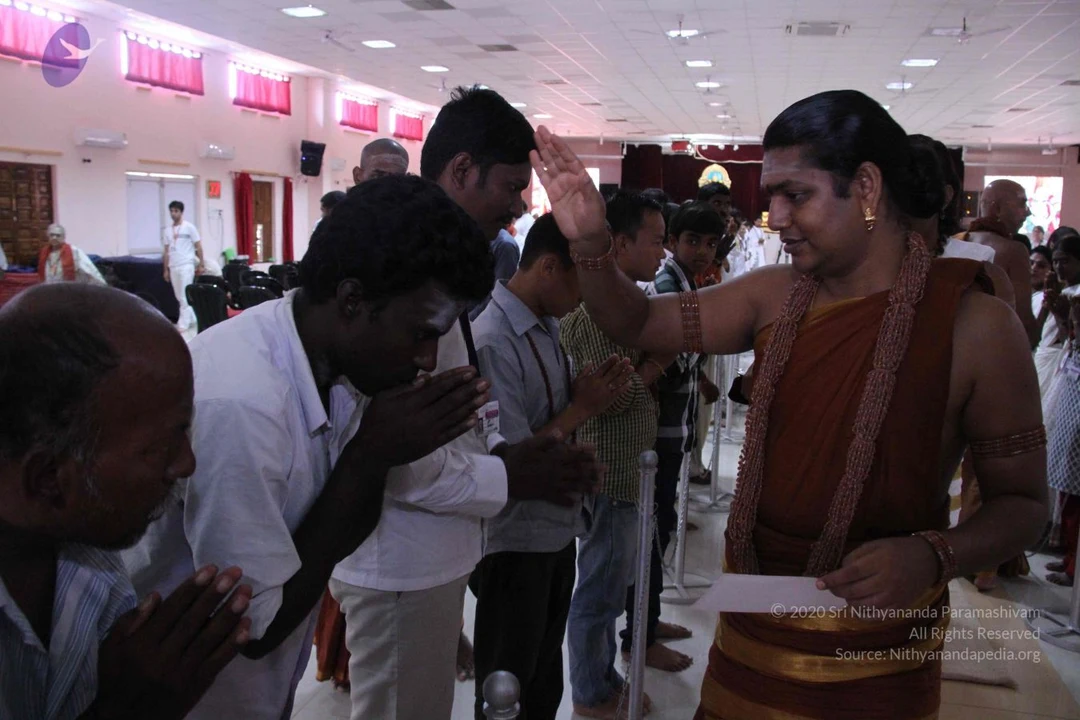
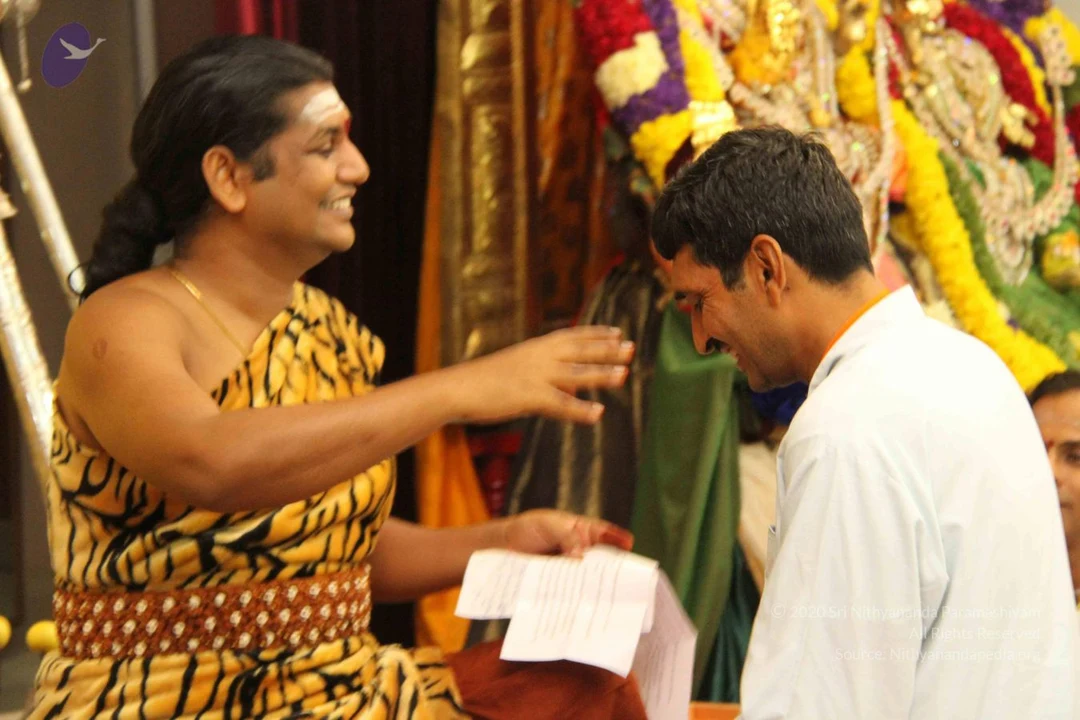
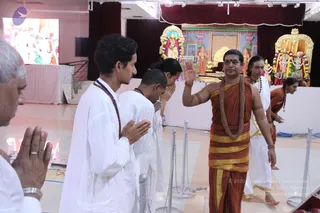
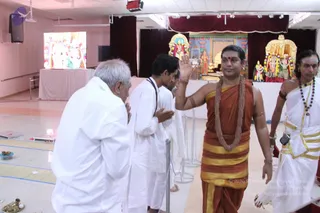
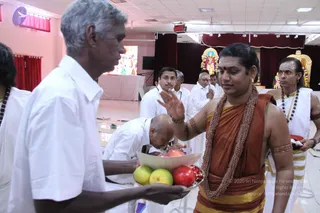
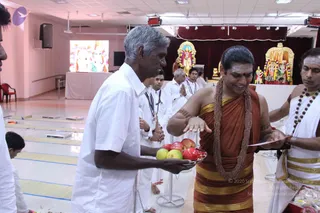
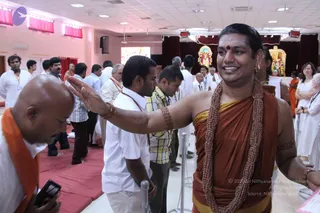
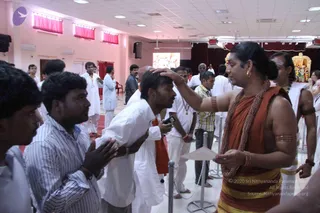
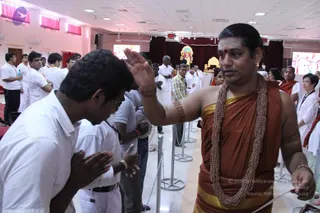
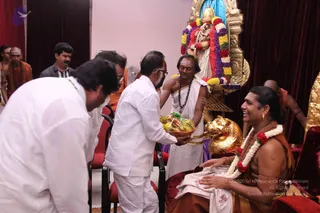
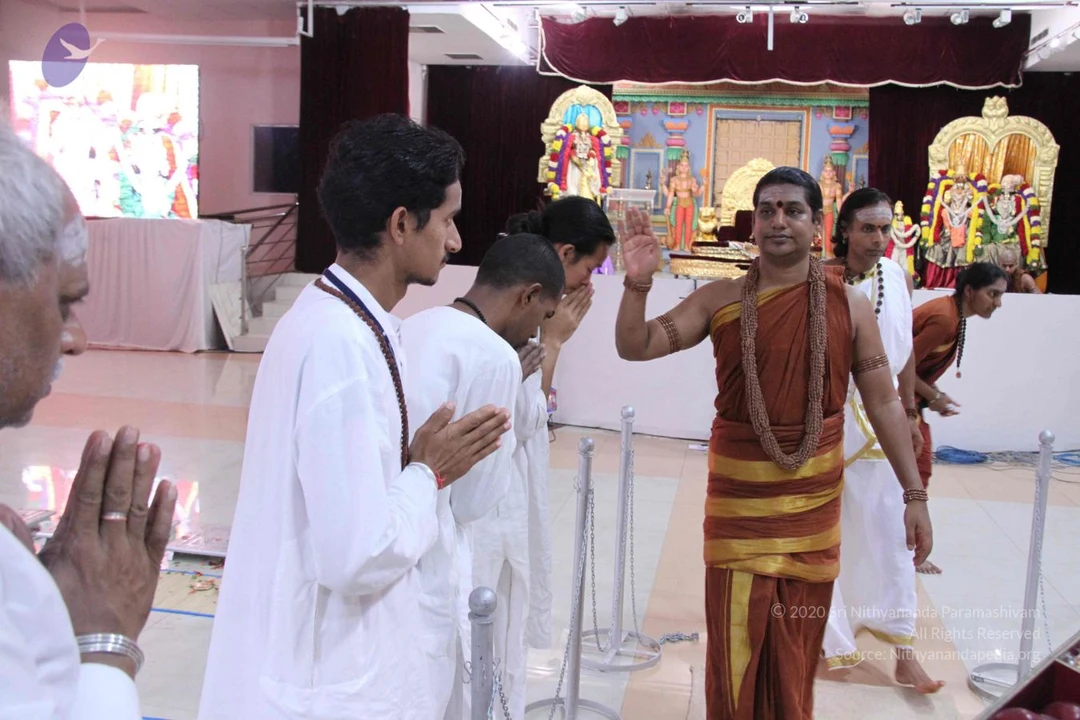
A photograph inside a hall with a tiled floor and a maroon curtain valance. A man in a saffron-orange dhoti and shawl with a long rudraksha mala raises his right hand in greeting as he walks forward. Several people in white clothing follow behind him, some with hands folded in namaste, and a figure on the left edge also has hands folded. Behind them stands a decorated altar with gold-framed deity images, garlands of red and white flowers, and a large colourful painted backdrop. Chrome stanchions with chains line the walkway.A photograph inside a hall with pink walls and a maroon stage curtain. In the centre, a man in a saffron-orange and gold-bordered dhoti and shawl, wearing a rudraksha-style brown bead necklace and a red bindi, raises his right hand in blessing as he walks. Behind him, a line of men in white dhotis and white shirts pause with hands folded, and an older man in a white shirt bows with palms together at the left edge. On the right, a man in a white dhoti with gold borders and a beaded mala stands near a rope barrier. On the stage, deity murtis and decorated shrines with garlands and a backdrop painting are visible, and a lit screen shows colourful imagery. Brass items sit on the floor at lower left.A photo of an indoor ritual gathering in a hall with pink walls, red curtains and ceiling lights. In the foreground a man in a white shirt holds a tray of apples and other fruit toward a man in an orange-saffron dhoti and shawl with a thick rudraksha mala and a red tilak, who raises one palm in blessing. Behind him a younger man in white with a rudraksha mala stands beside him, and another devotee in white bends low at the tray. Several other men in white stand in the background near a decorated altar with deity murti and gold-framed pictures. The saffron-clad man is shown in appearance-based likeness to Swamiji (probable), wearing a crown-less ochre shawl, rudraksha mala and tilak.A photograph in a bright hall with a tiled floor and a stage backdrop of maroon drapes and gold-framed deity murtis decorated with flower garlands. A man in a white shirt and white dhoti holds a silver tray of apples and red fruit toward a figure in a saffron-orange dhoti and shawl with a thick rudraksha-style mala and gold-coloured bands on the arms. The figure, with a shaved-looking head and white and red markings on the forehead, smiles and reaches toward the fruit. Behind them, several men in white dhotis and shirts stand with folded hands, one wearing a blue and gold lanyard, and a young man on the right wears white with a beaded mala. A projection screen on the left shows colourful images.A photograph of a busy indoor hall with a red carpet and pink-walled stage area. In the foreground, a smiling man with dark hair, a red bindi and a rudraksha mala draped over his shoulders wears an orange-brown wrap over a gold-bordered garment, with a bangle on his wrist and his arm extended forward in a blessing gesture. A bald man in a white shirt and orange shawl bows his head toward him, and a man in a yellow-striped shirt stands nearby. Behind them, white-clad devotees and men in white shirts stand along a barrier, and deity images decorated with gold and flowers are visible on the stage. Several people in white and orange clothing fill the background.A photograph inside a bright, pink-walled hall with red curtains and white ceiling lights. In the foreground, a person in a white kurta leans forward with hands pressed together as a bare-chested figure in orange-saffron cloth with a long rudraksha mala and gold-toned bangles, hair in a bun, presses a hand to his head in a blessing. The blessing figure holds a folded paper in the other hand. Around them, several men in white kurtas and striped shirts stand and watch. On the right, a golden decorated shrine with deity murti is visible, and a large screen glows in the back. Several people stand near metal stanchions across the hall.

Deities_Swamiji_FinalBlessing
9 photosSource gallery
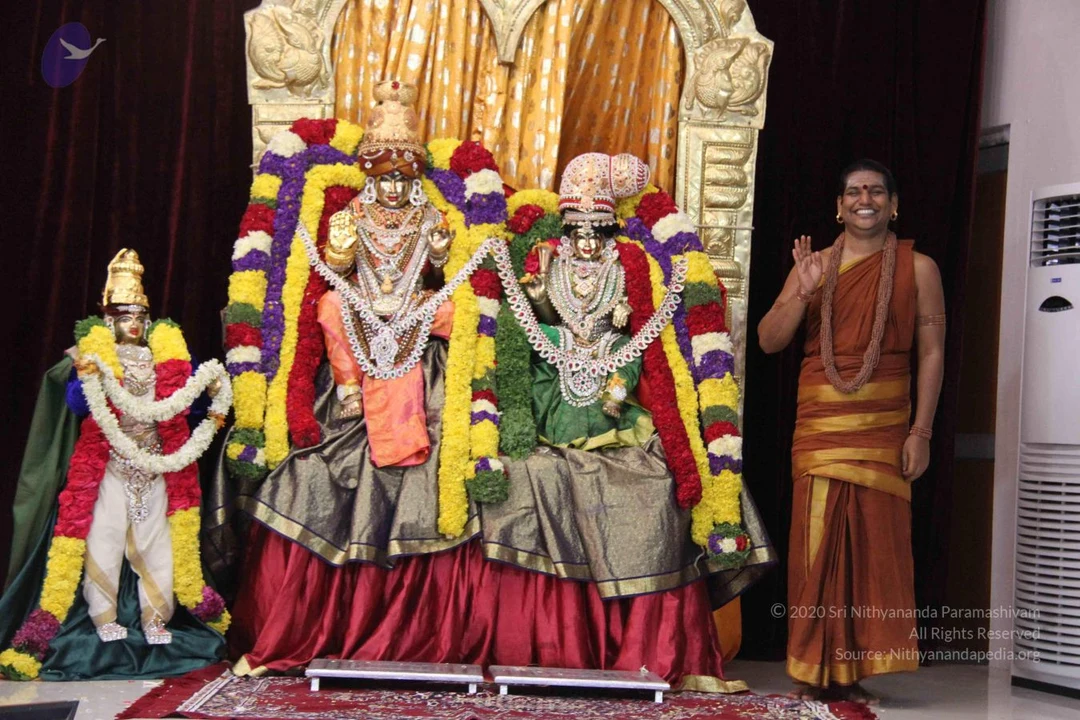
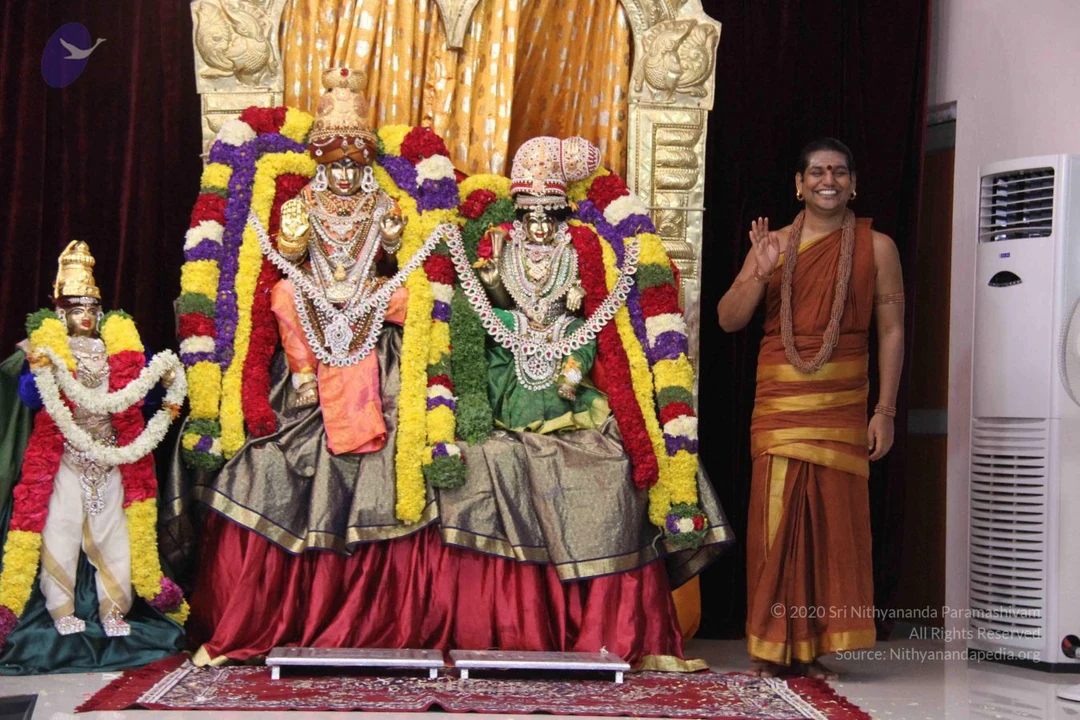
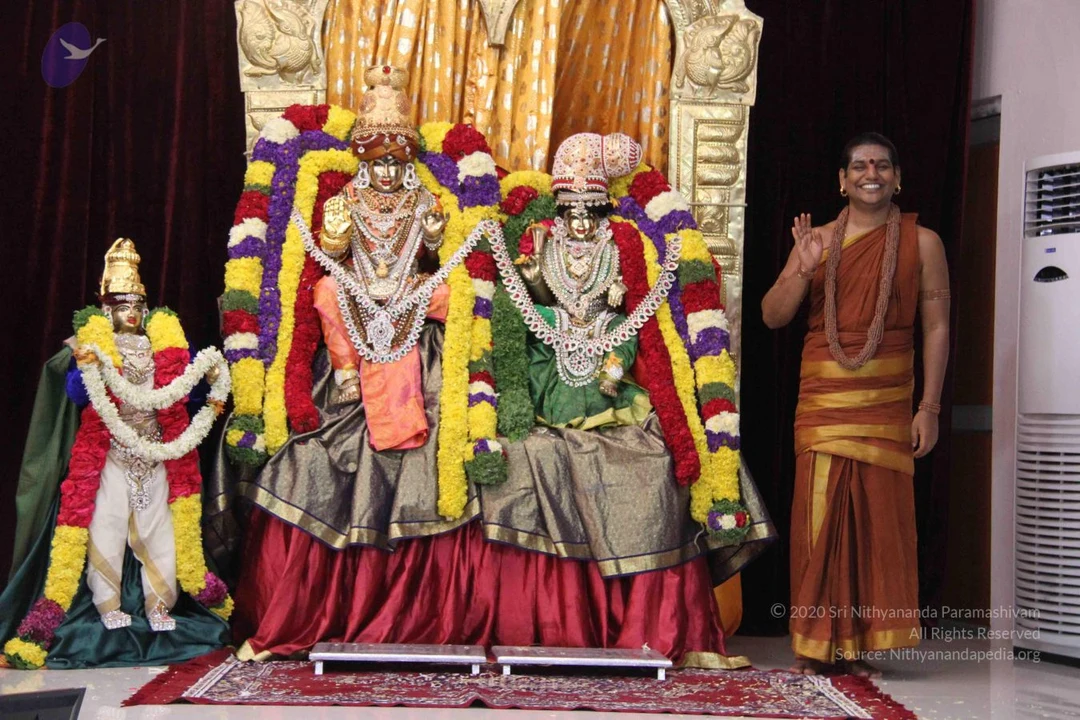
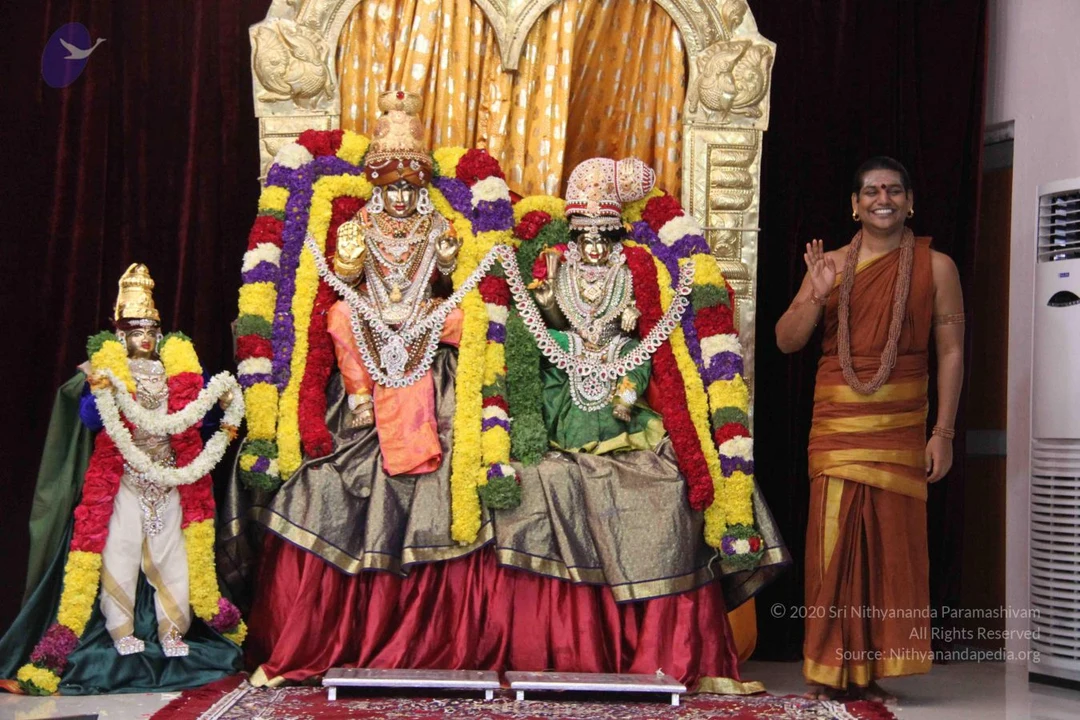
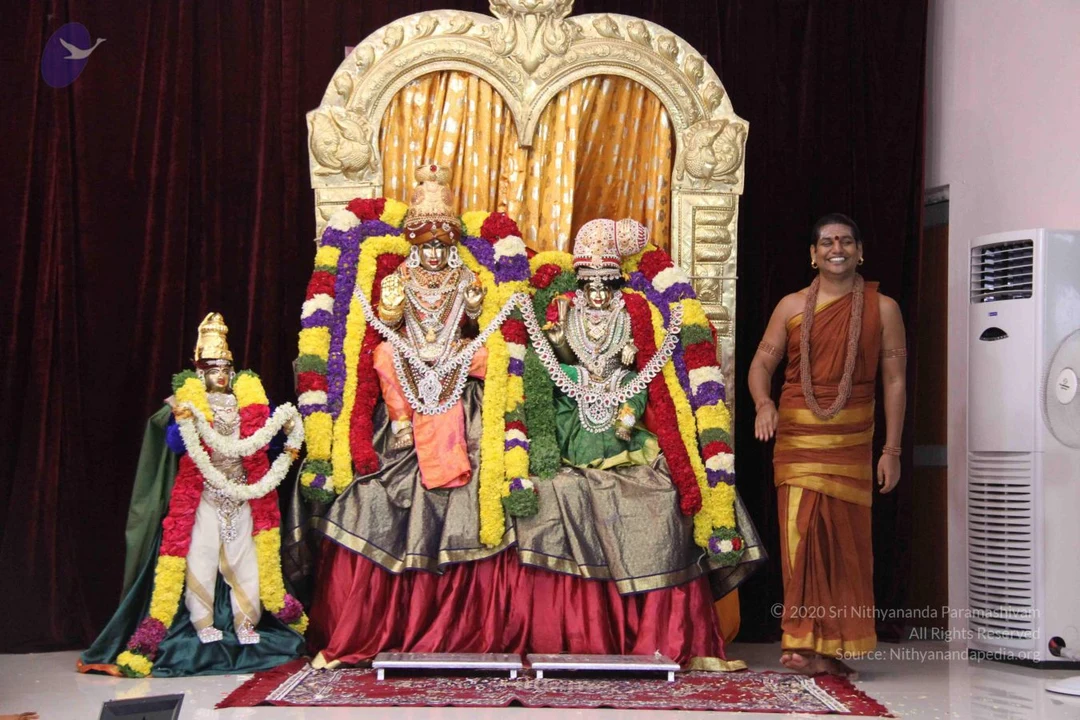
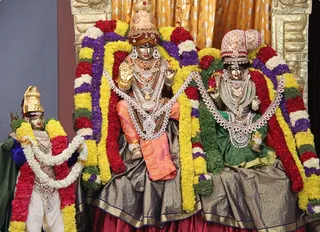
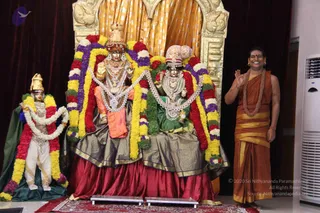
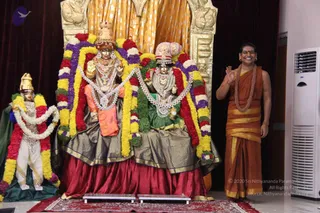
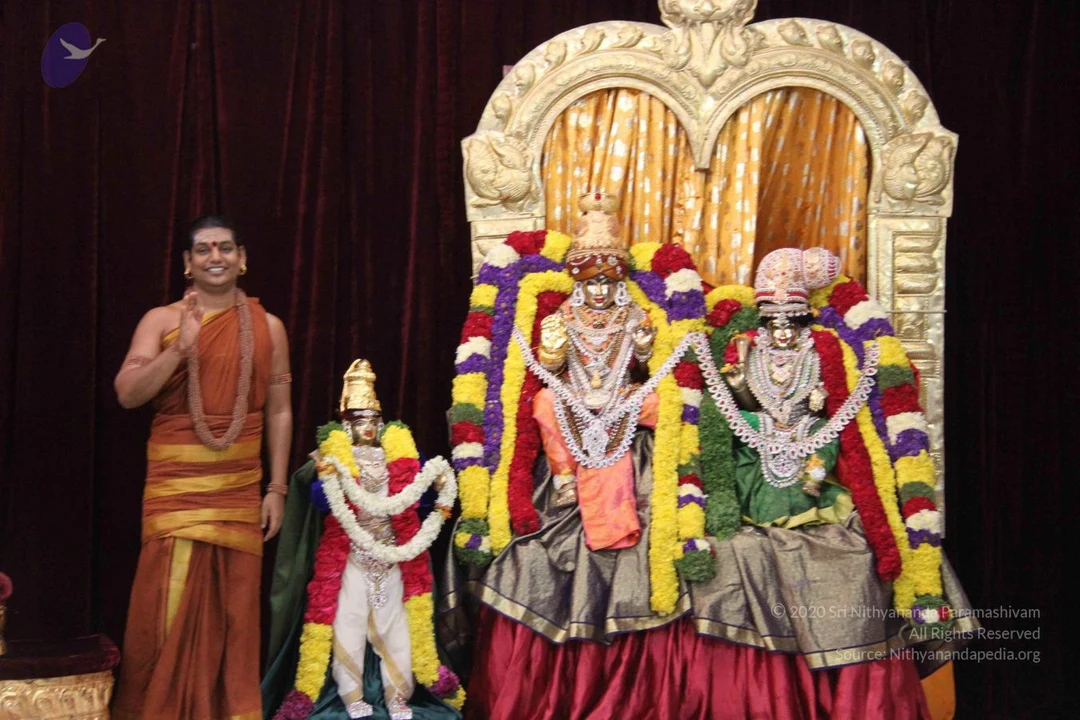
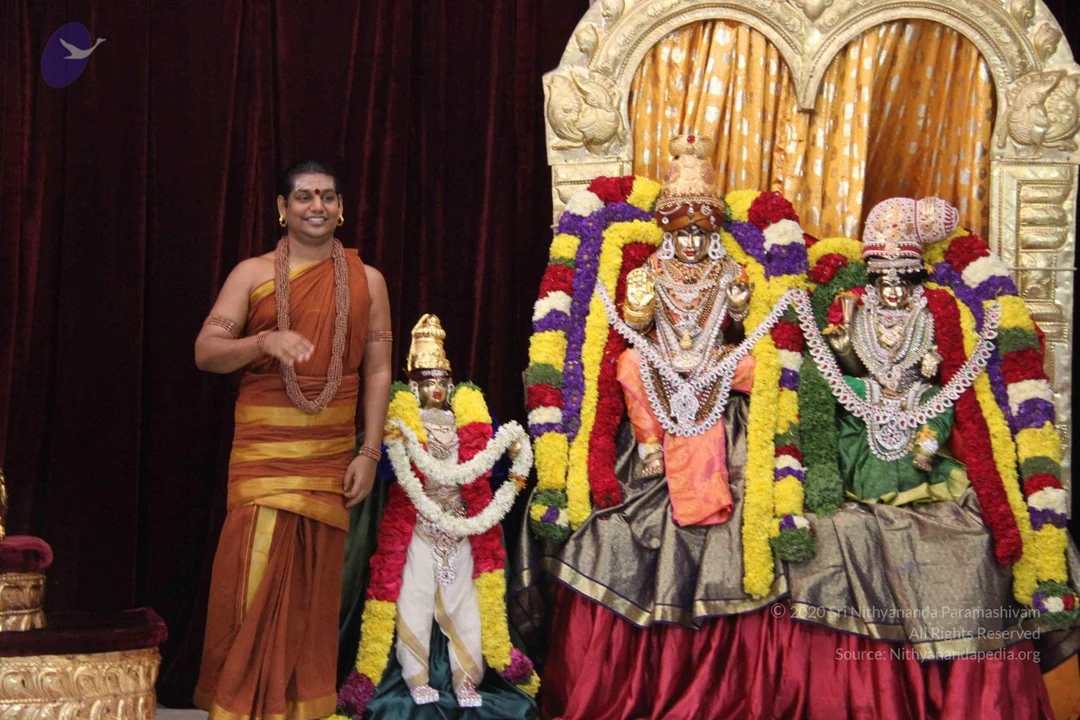
A standing man in saffron-orange robes with a gold-striped wrap and a rudraksha mala stands at the left, smiling and raising one hand in greeting. Beside him are three decorated deity murtis on a dark maroon backdrop with a gold arched frame: a small standing figure wearing a gold crown and white dhoti, and two larger seated murtis adorned with thick garlands of red, yellow, purple and white flowers and layered silver-white necklaces. The murtis sit on a golden throne-like peetha behind gold curtains. The scene looks like a temple or ashram worship setting.A standing man in an orange-saffron dhoti and shawl, with a long rudraksha mala and gold bangles, gestures with his right hand beside three decorated murti figures. Two larger metal deity figures seated on a silver-trimmed throne with a gold crown, ornate necklaces and garlands of yellow, red and purple flowers; the right figure wears a green and red sari. A smaller standing child-sized deity figure with a gold crown and white dhoti is garlanded in the centre. Dark red velvet curtains and a gold-patterned backdrop frame the scene, with a gold peetha chair at the left edge.A smiling man in an orange-brown sannyasi-style wrap and a rudraksha mala stands at right, raising one hand in greeting beside a dais. On the dais, two deity murtis with crowns and jewelled necklaces sit side by side, adorned with garlands of yellow, red, purple and white flowers. A third small standing murti at far left wears a green cloth and a flower garland. A gold arched backdrop and a pink-and-gold cloth frame the scene, with a red carpet below.A photograph of a standing man in saffron-orange robes waving and smiling beside a decorated shrine. He wears a rudraksha mala around his neck and has a red bindi on his forehead. Behind him, two seated deity murtis are dressed in orange and green silks and heavily adorned with gold jewellery, crowns and white and red garlands. A smaller standing deity murti in green and white robes with a gold crown stands at the far left, draped in flower garlands. A golden arch and a red curtain frame the shrine, and a white air conditioning unit stands at the right edge. The man is a person by appearance: long swept-back hair, saffron clothing and a rudraksha mala, but the image is uncertain.A standing man in an orange-saffron dhoti and shawl, with a red-beaded rudraksha-style mala around his neck and bangles on his wrist, smiles and raises his right hand in a greeting or blessing beside a decorated stage. Two seated deity murtis, a larger one in orange and gold with a crown and a smaller one in green with a pink crown, are dressed in silver-white necklaces and ornaments and garlanded with yellow, red, purple and white flower garlands on a golden shrine backdrop. A third standing murti in white with a gold headdress and garland stands at the left. A white floor-standing air conditioner is at the right edge and a red patterned rug covers the floor.A photograph of a temple-style shrine with two large deity murtis seated on a dais, garlanded with yellow, red, purple and white flower garlands and wearing heavy jewelled necklaces and crowns; the figure on the left wears an orange-pink dress and the one on the right a green dress. A smaller standing murti in a crown and white dhoti stands at far left, draped in a green cloth. To the right, a standing man in an orange-saffron dhoti and shawl, with a rudraksha mala, bindi and armbands, smiles and waves his right hand. A gold-patterned curtain and a wall-mounted air conditioner are visible behind. Two small wooden platforms sit before the dais, with a red rug on the floor.

Swamiji_Krishnappa&Guests
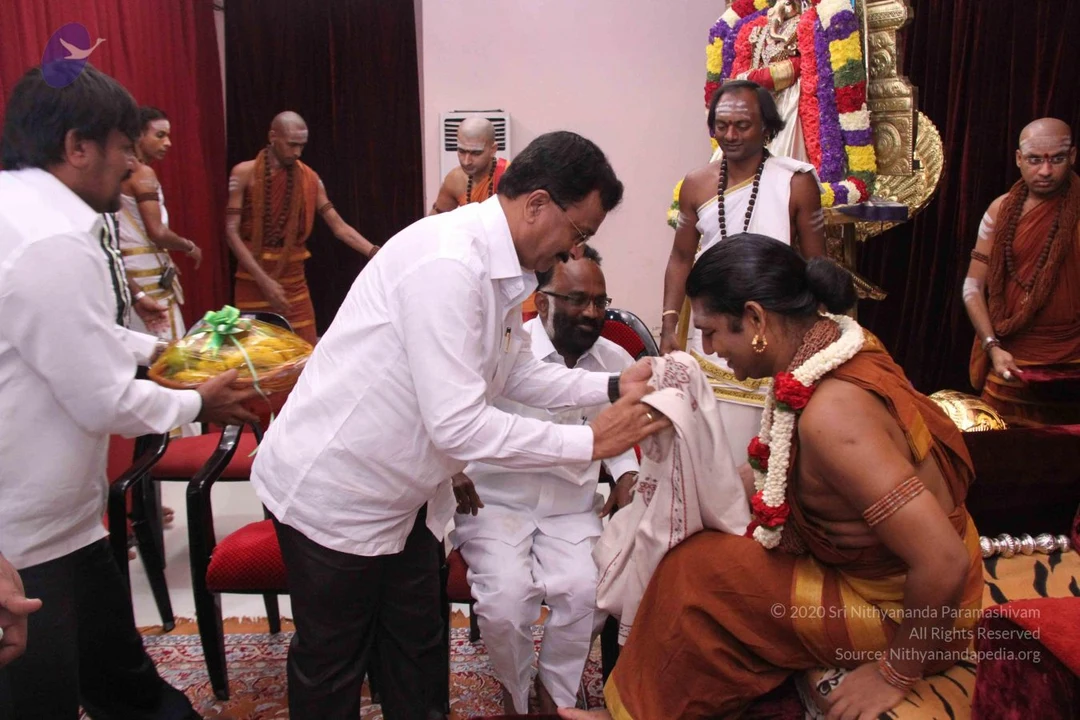
11 photosSource gallery
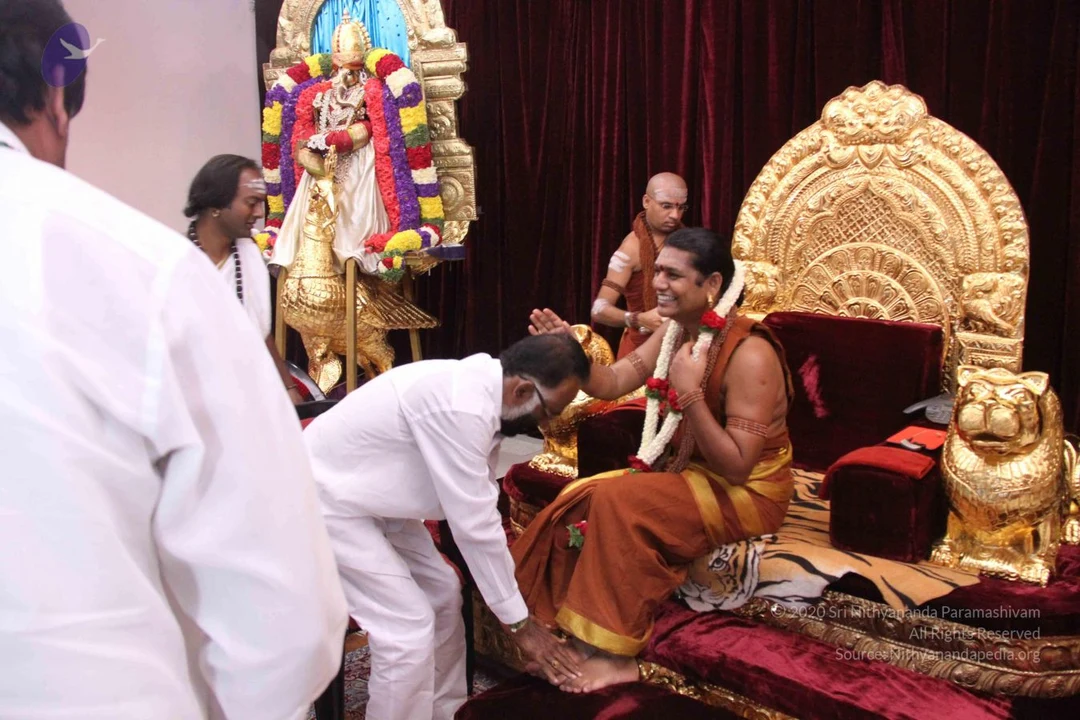
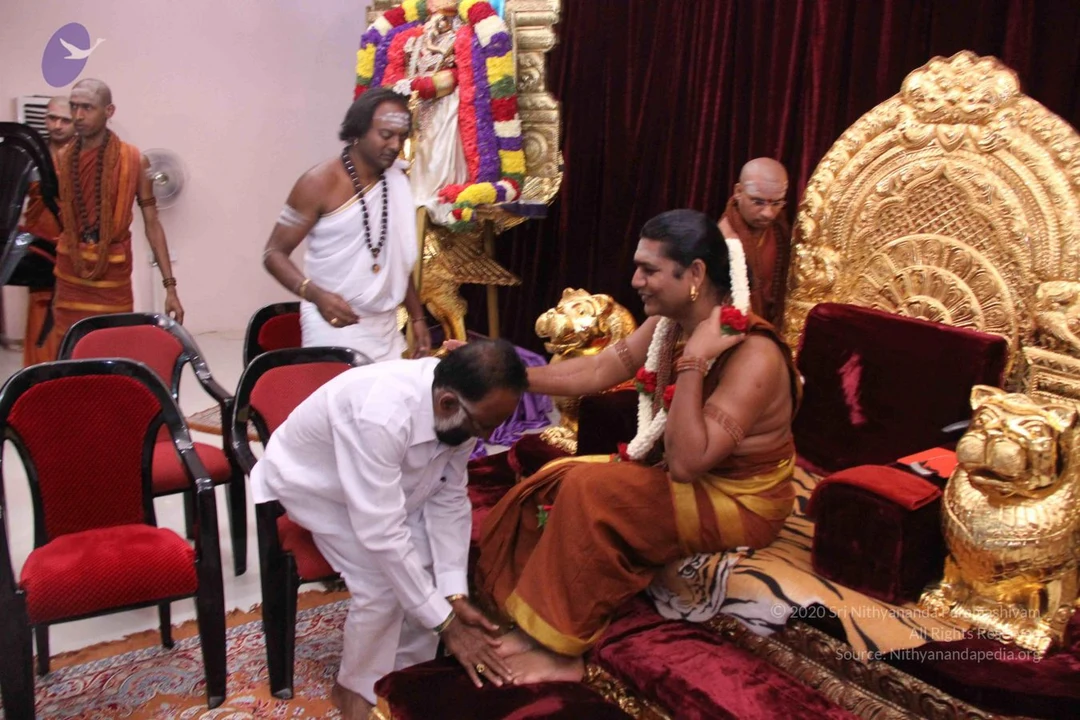
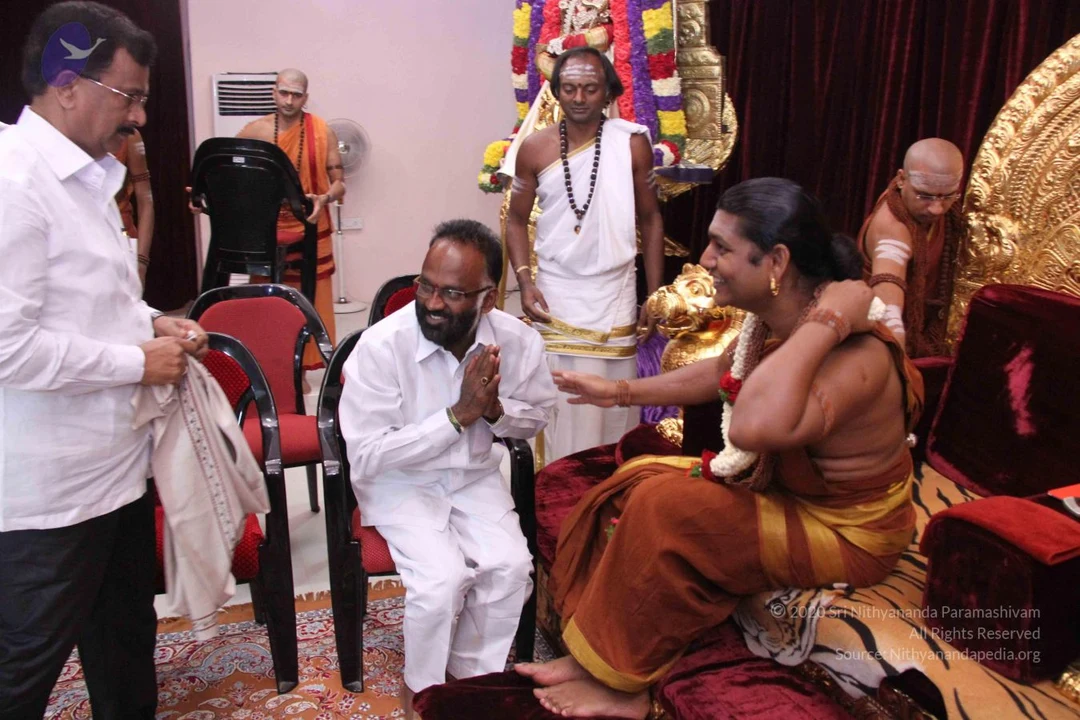
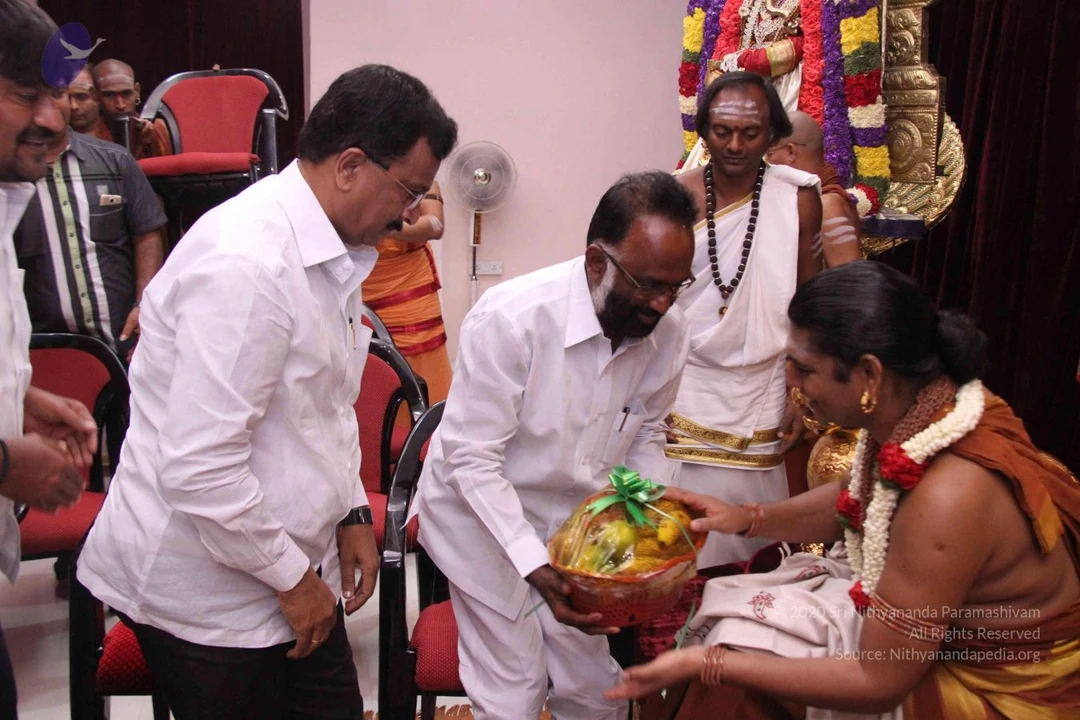
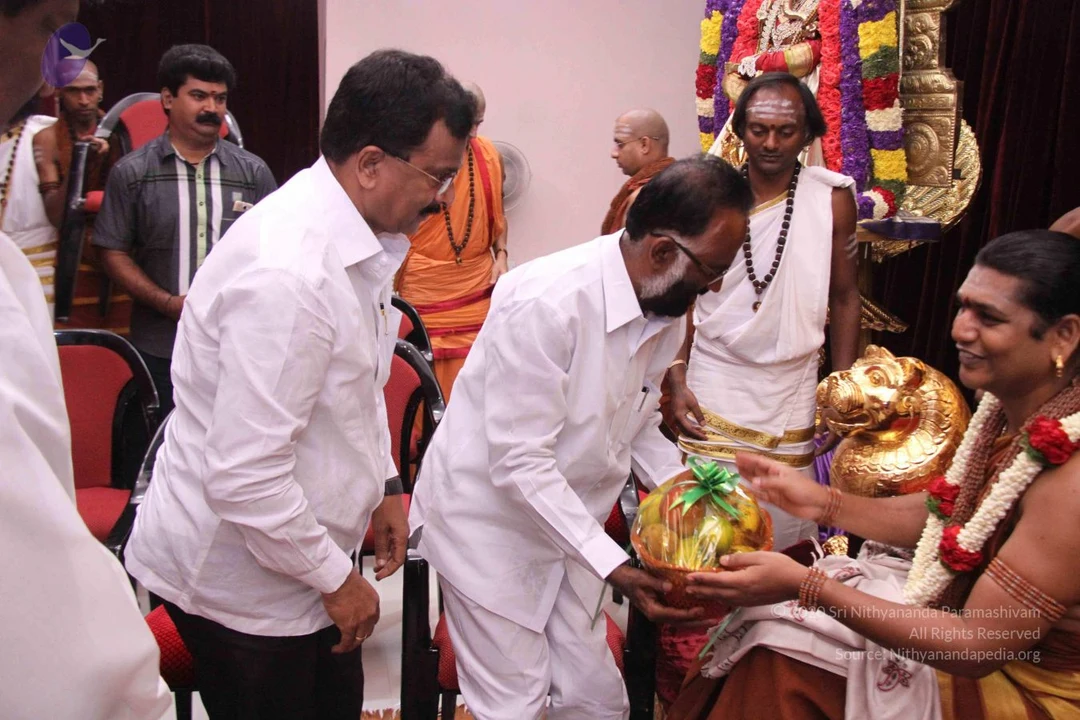
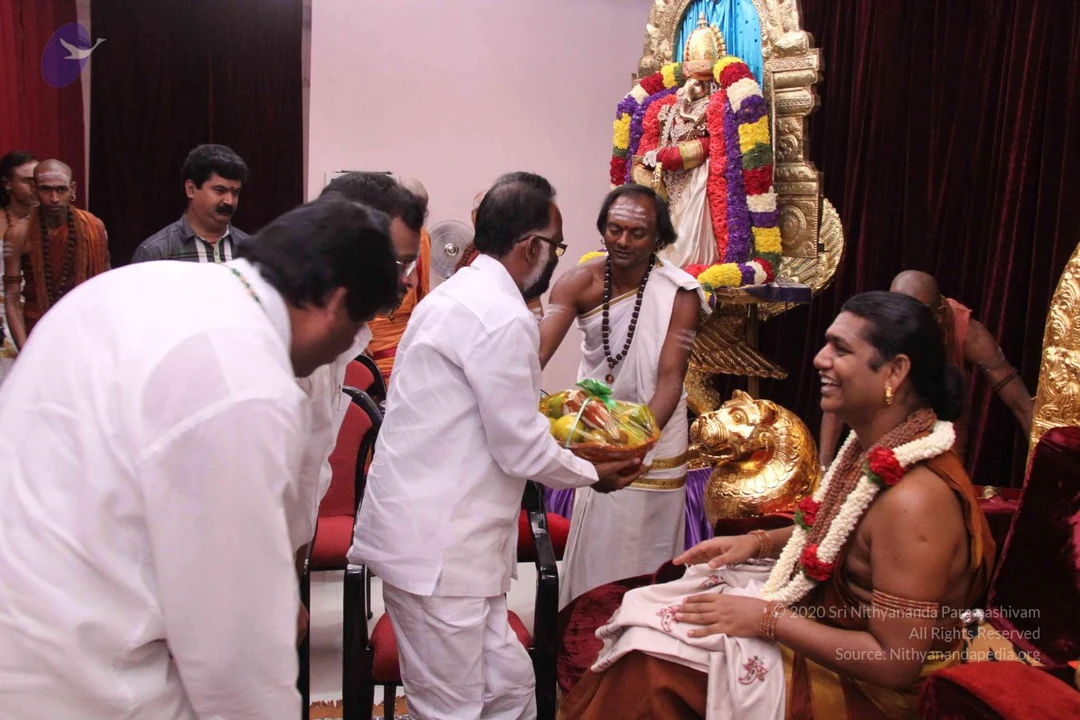
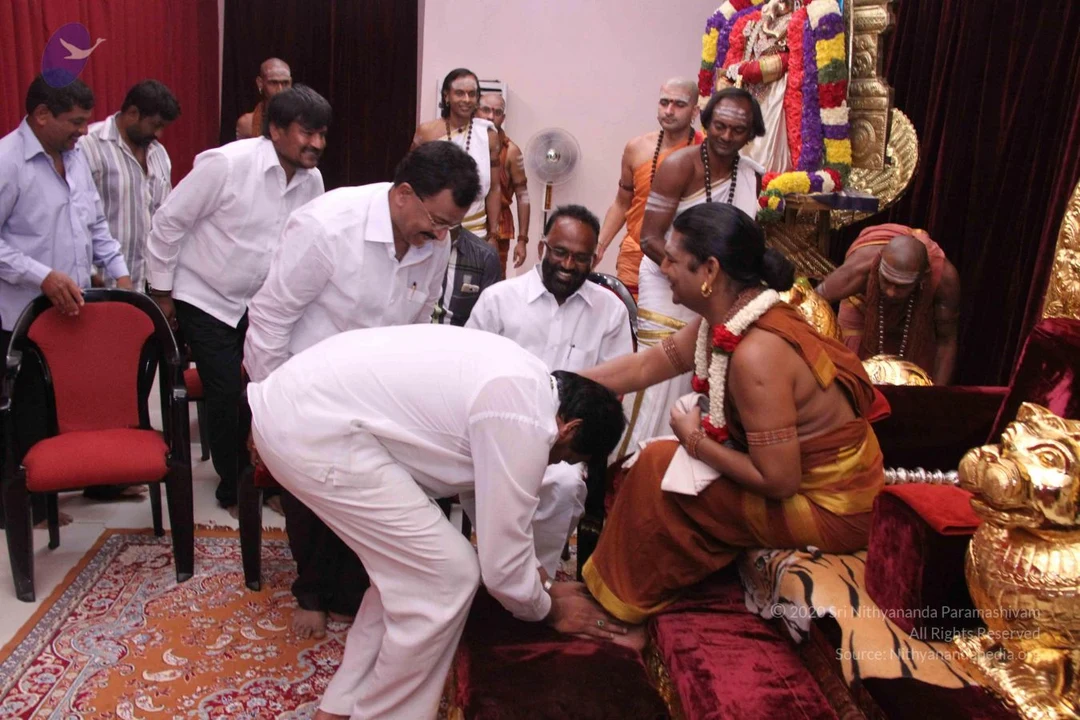
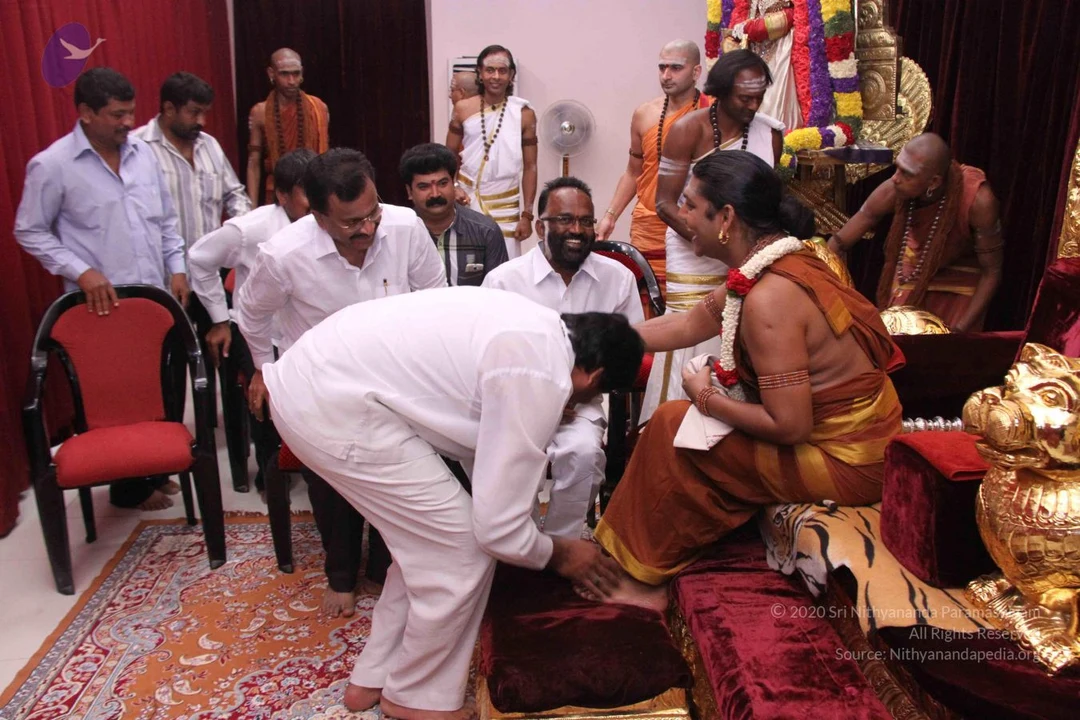
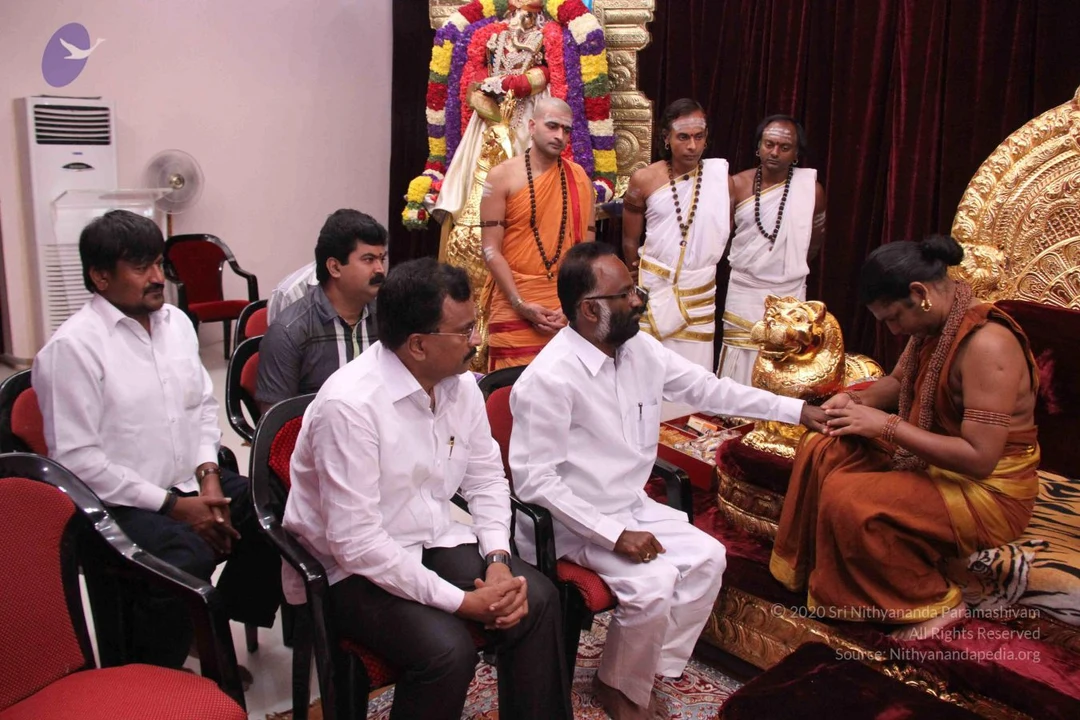
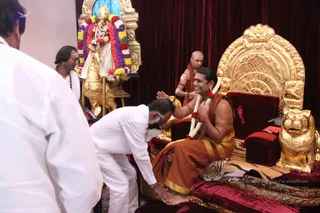
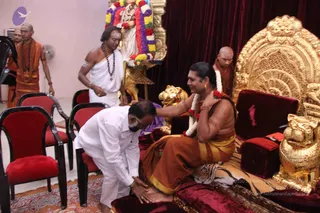
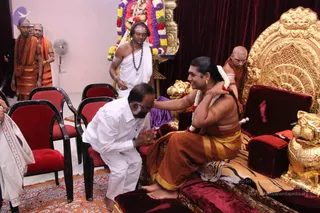
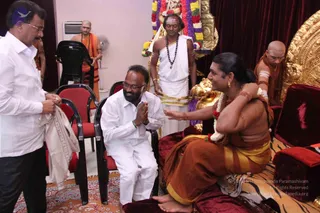
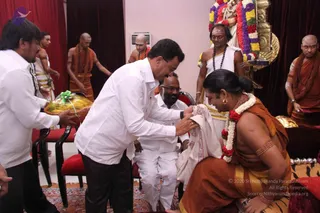
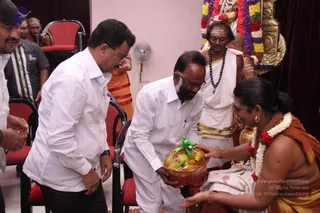
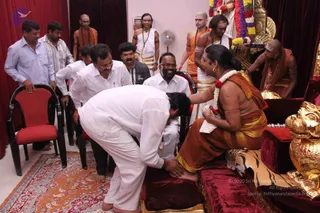
Indoor ritual scene in front of a golden throne with red velvet cushions and a golden lion-head armrest, draped with a striped tiger-skin cloth. Seated on the throne is a man in saffron-orange robes with a gold-edged dhoti, wearing a white and red floral garland, bangles and armlets, with a shaved head and a warm smile. A devotee dressed in white kneels and bows low to touch his feet. Behind them a bald attendant in orange stands near a deity murti decorated with garlands in red, yellow, purple and white, seated on a golden base. A third man in white stands at the left edge, and a man with a white tilak and rudraksha mala stands beside the murti. The background is deep red velvet drapery.A seated figure in a saffron-orange robe with a gold-bordered cloth sits on a richly ornate golden throne with lion-form armrests and red velvet cushions, a tiger-striped cloth draped beneath. The seated figure wears a white and red flower garland, gold bangles and an upper-arm band, and has long hair swept back. A man in a white dhoti and shirt bends low, touching the seated figure's feet in reverence. Behind them stands a man in white with a white sash, a rudraksha mala and sandalwood markings, and a golden deity murti decorated with multicoloured floral garlands stands on a stand. Two more men in saffron robes with white forehead markings stand in the background and to the left, beside red-cushioned chairs on a patterned carpet.A photograph in a hall with red chairs and a red patterned rug. A seated man in a saffron-orange dhoti and shawl, with a white flower garland and bangles, sits on an ornate gold throne draped with a tiger-skin cloth, his bare feet on a red cushion. An elderly man in white shirt and trousers bends forward to touch his feet in reverence. Behind them a bald attendant in saffron stands, and a second robed man in white dhoti wears a rudraksha mala. A large floral garland decorates a deity murti in the background, with a gold lion figure at the throne's side.A photograph of an indoor ashram-style room with red-cushioned chairs and a patterned rug. On the right, a seated figure with long dark hair and a crown-like headdress sits on a gold-and-red throne draped with a tiger-stripe cloth, wearing an orange-brown robe, gold border and a garland, smiling and extending an arm toward a bearded man in a white shirt and white dhoti who sits with hands folded in anjali. A third man in a white shirt stands at the left holding a white shawl. Behind them a standing man in white ritual dress with vibhuti marks and a rudraksha mala is near a deity murti and a golden kalasha-like ornament draped with purple and orange flower garlands. Orange-robed attendants with shaved heads stand in the background. Four to six people are visible.A photograph of a formal reception in an indoor room with red curtains and a red-cushioned chair. A man in a white shirt and dark trousers bends forward to hand a folded white cloth to a kneeling woman in an orange-brown sari with a white and red flower garland and bangles. Behind her, a seated man in white clothes watches. On the left, a man in white holds a gift bag wrapped in yellow cellophane with a green ribbon. On the right and in the background, several saffron-robed men with shaved heads and rudraksha malas stand near a golden throne-like seat decorated with garlands in red, white and purple.A photograph of a devotee in a white shirt and white dhoti bending forward to offer a decorated basket of fruit and flowers to a seated figure in orange-and-saffron robes with a red and white flower garland. Beside them stands a man in a white shirt with glasses and a bearded man in white. Behind them, a shaved-headed priest in white dhoti with gold border and rudraksha mala stands before a deity murti draped in flower garlands of purple, yellow and red. Red chairs line the room and a pedestal fan is visible. Five people are visible.

IA_Day20
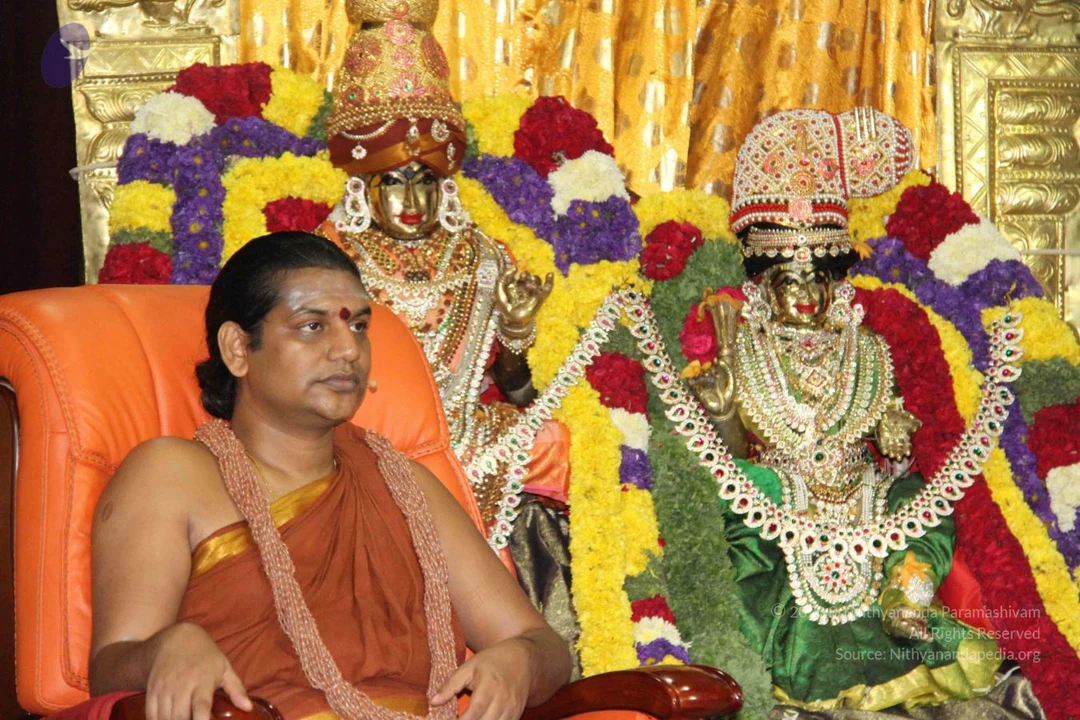
22 photosSource gallery
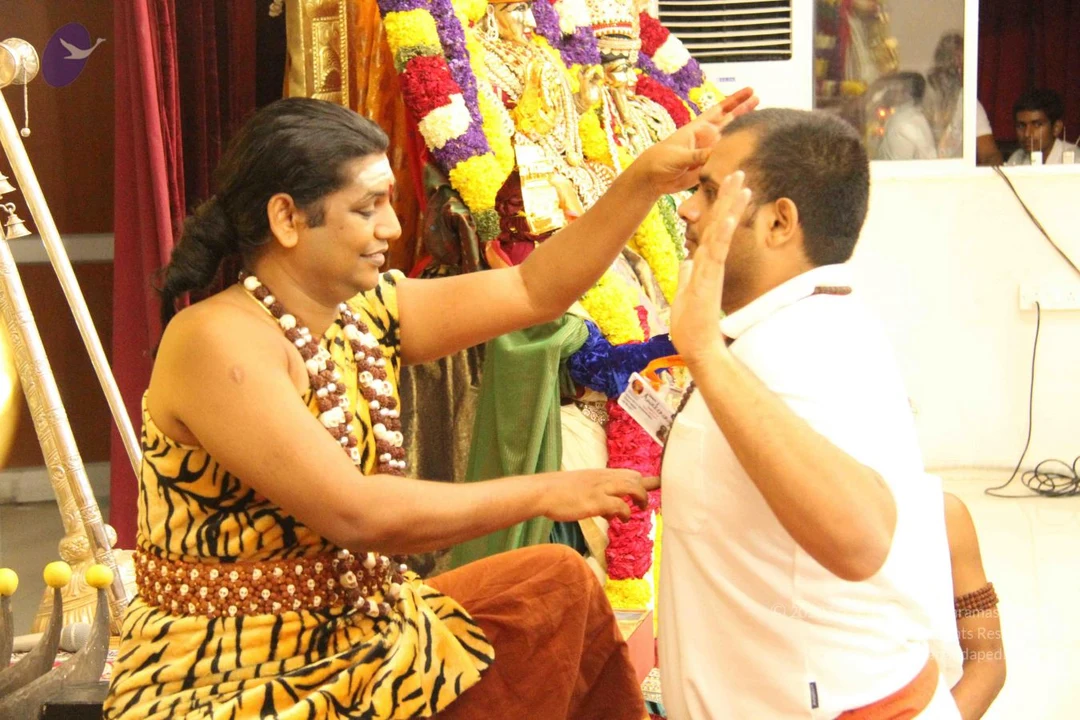
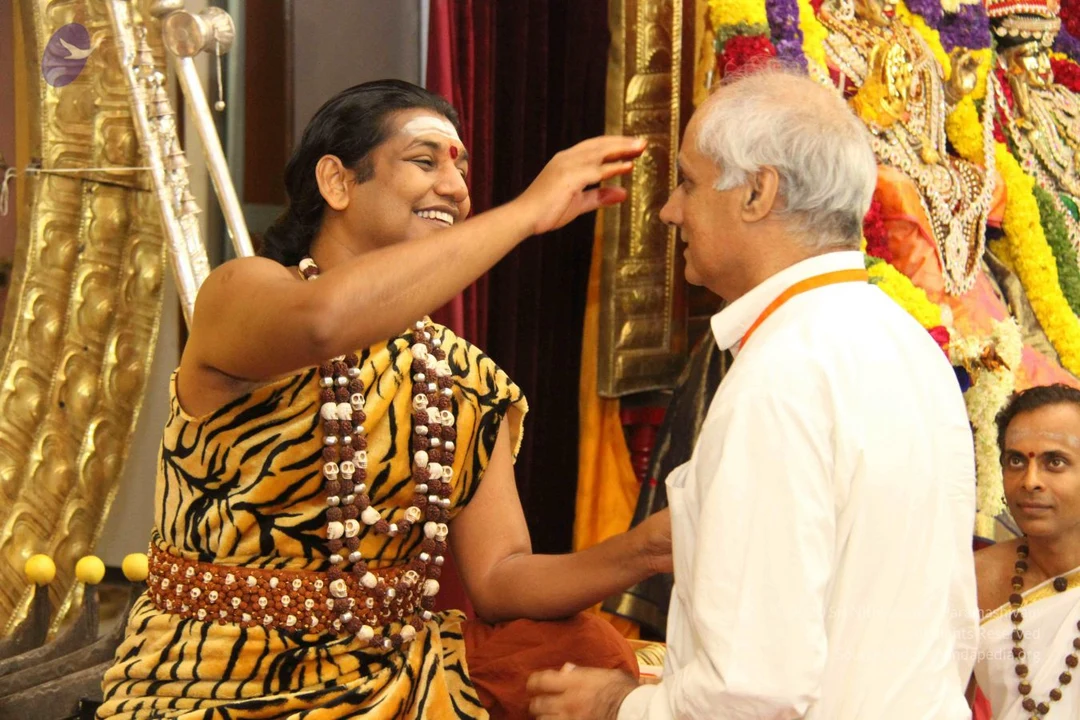
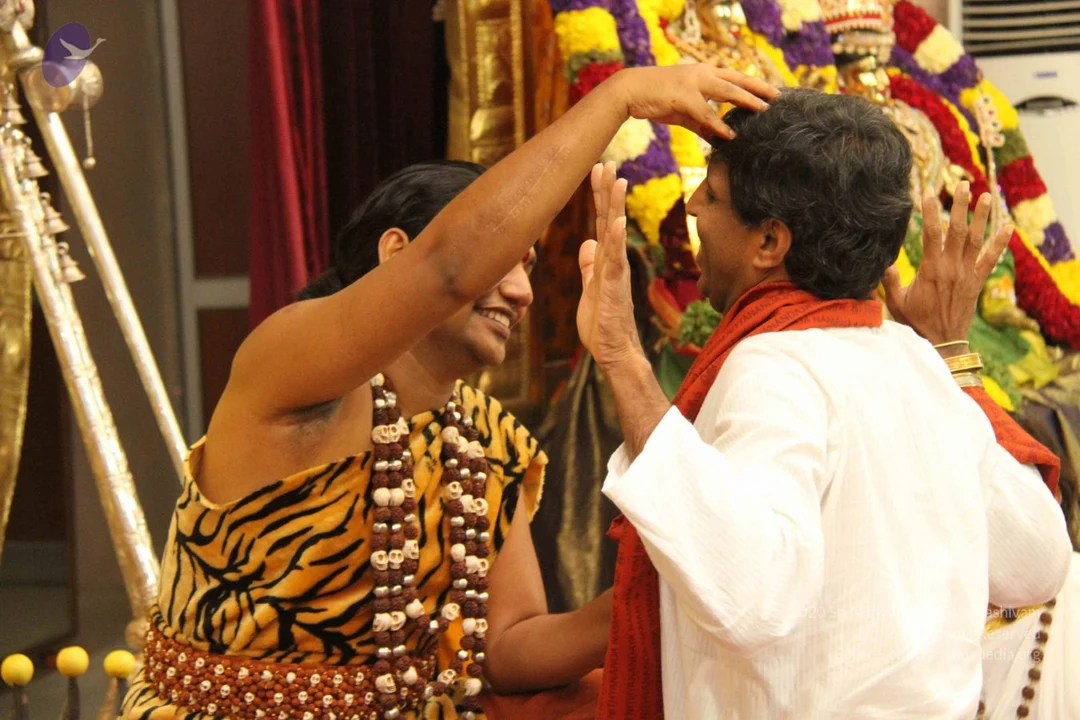
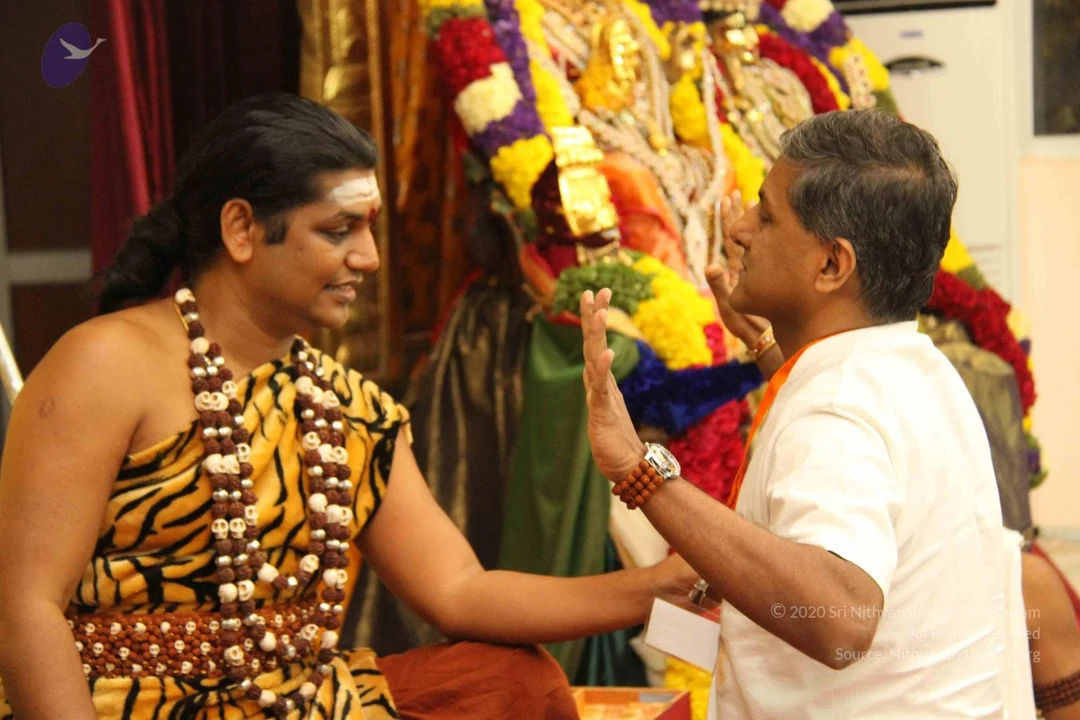
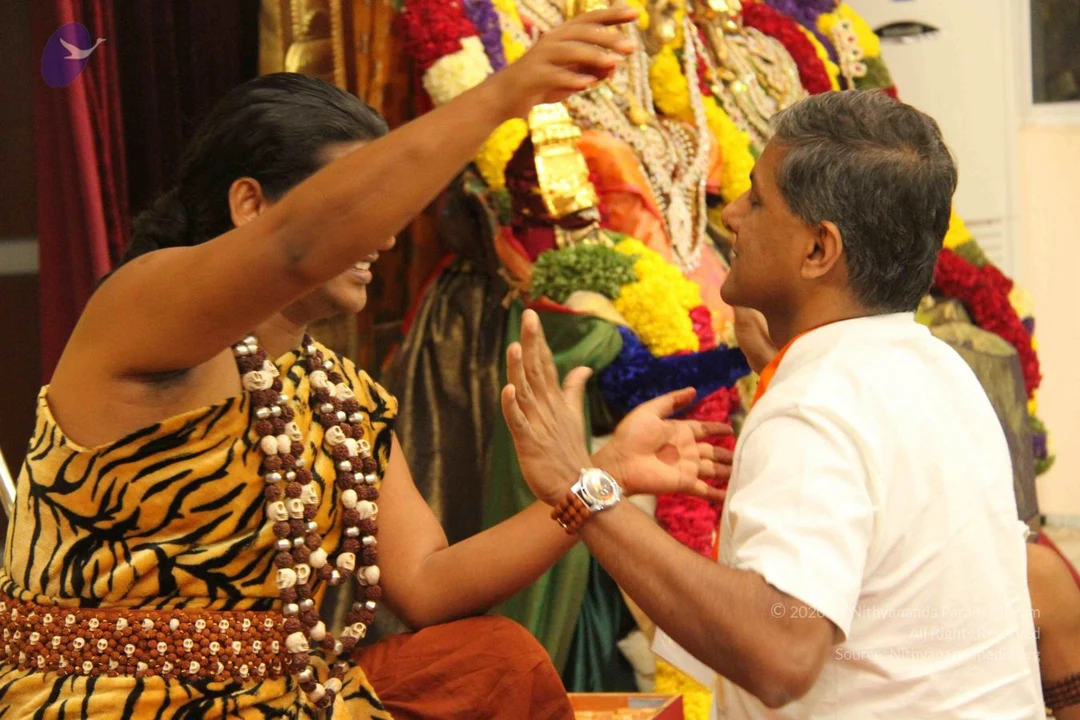
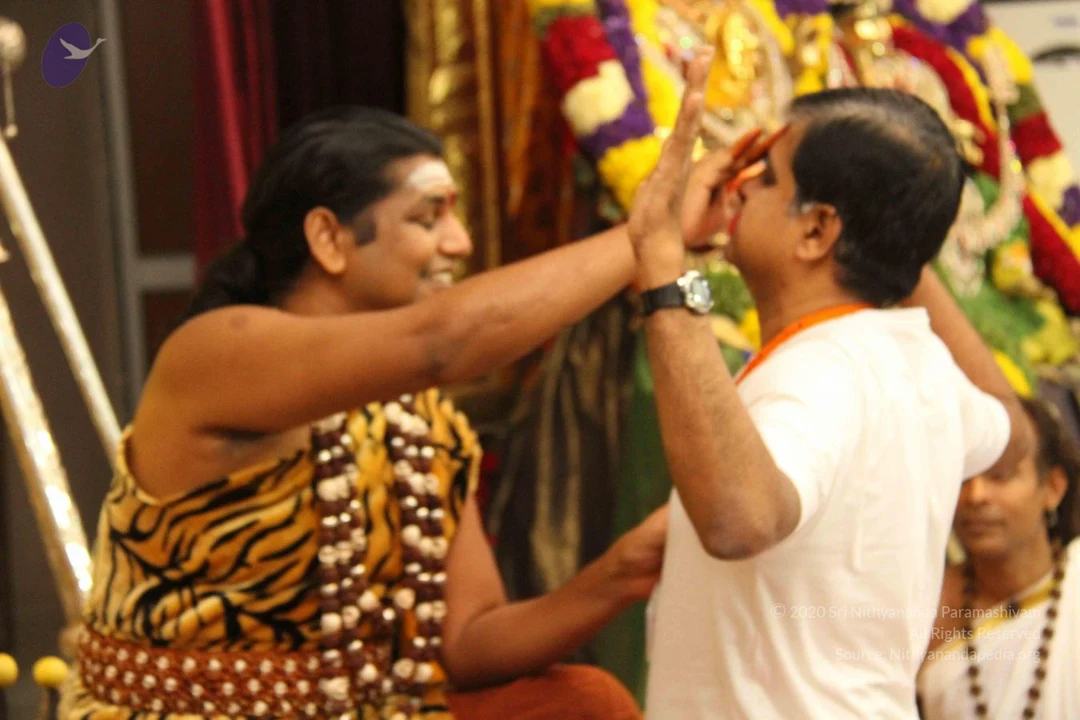
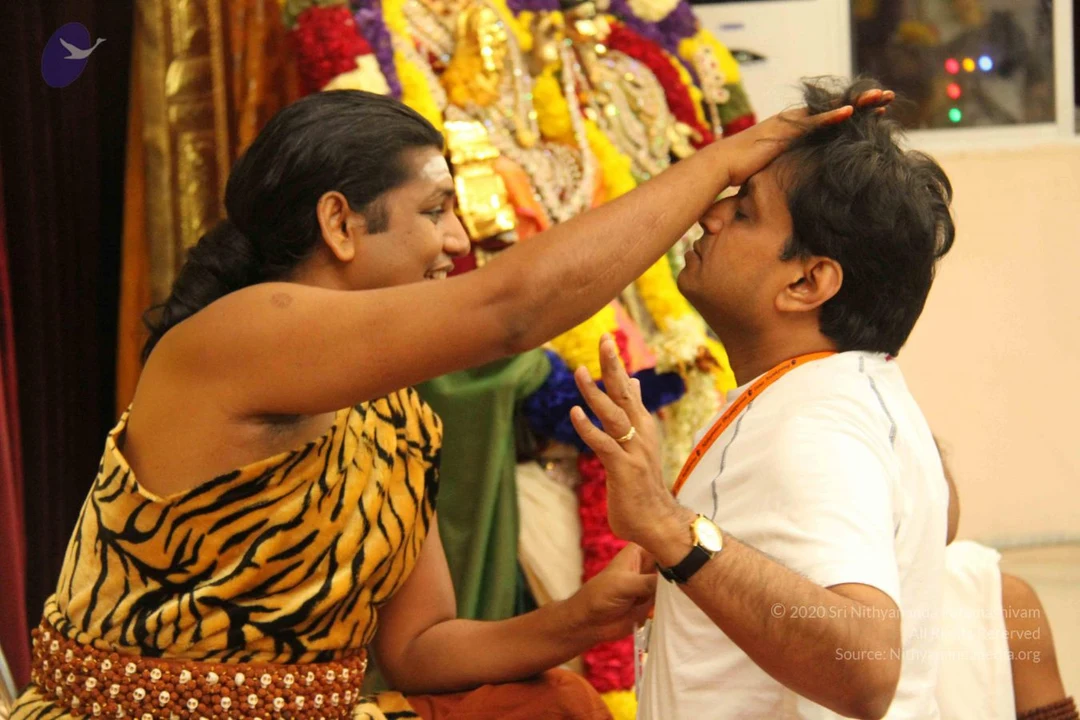
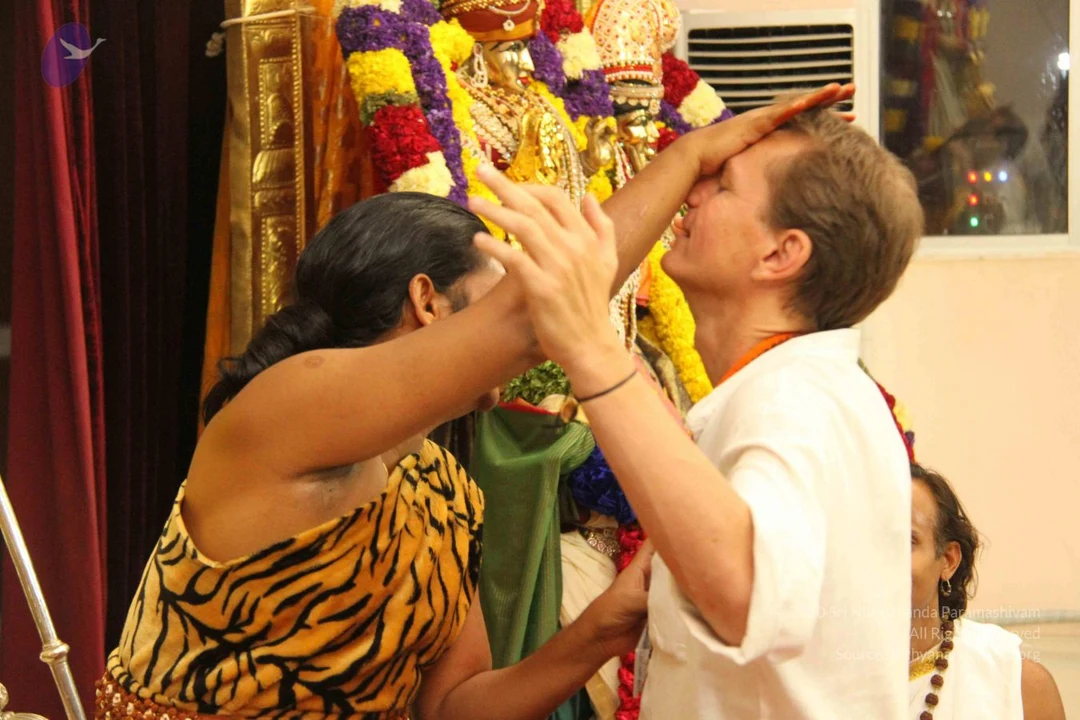
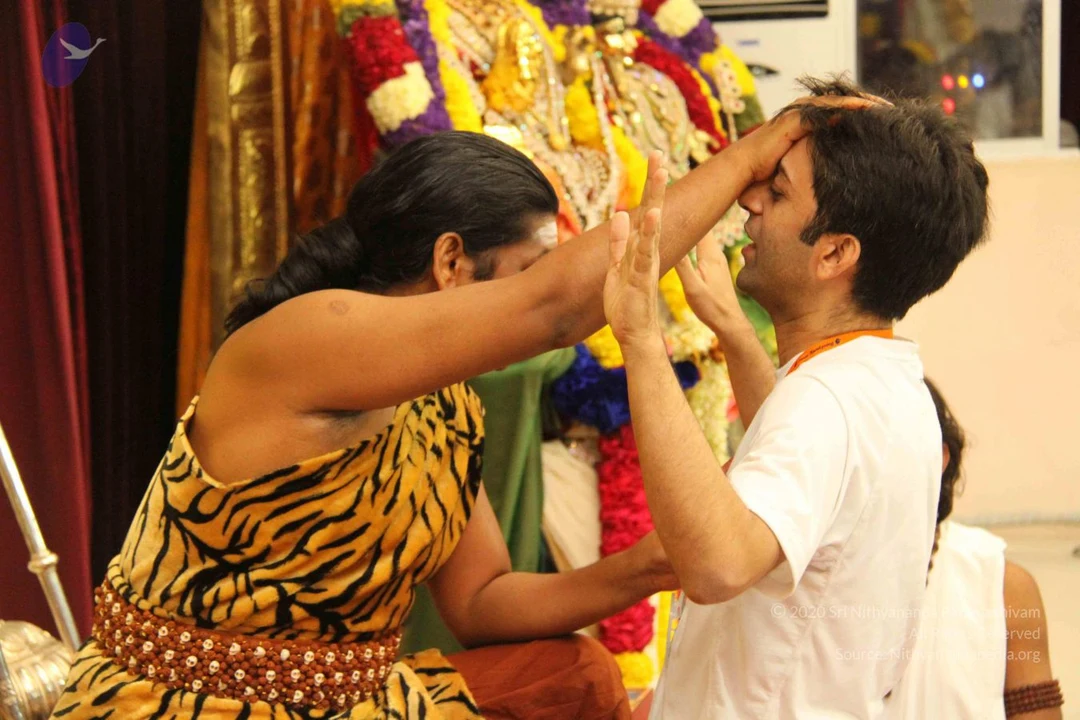
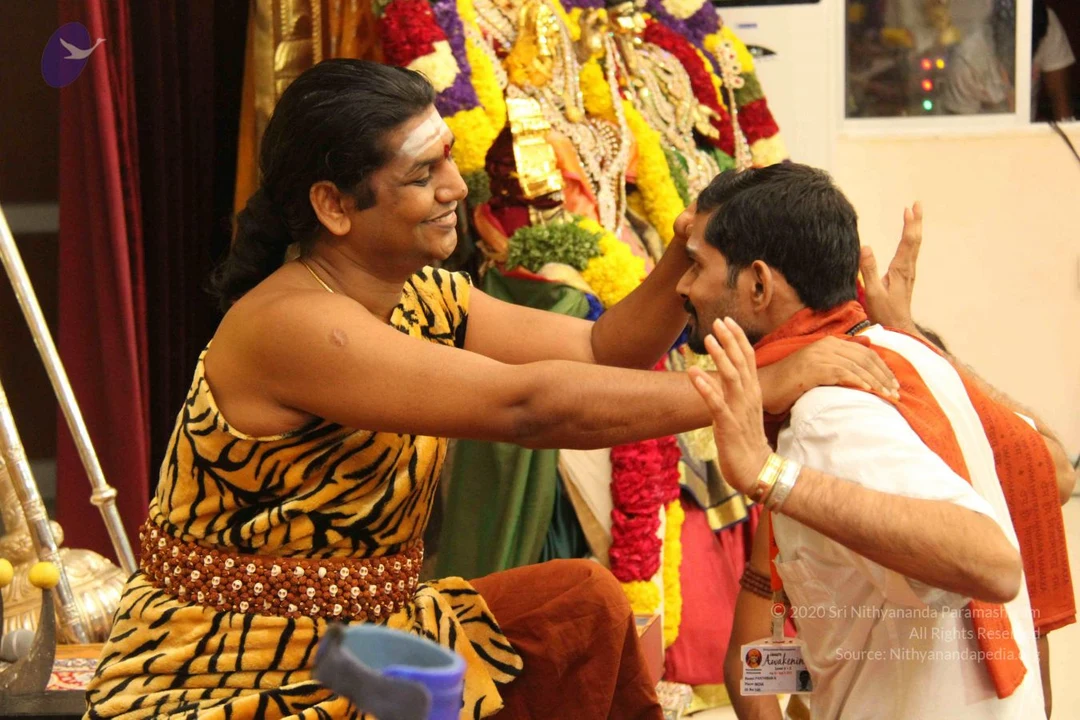
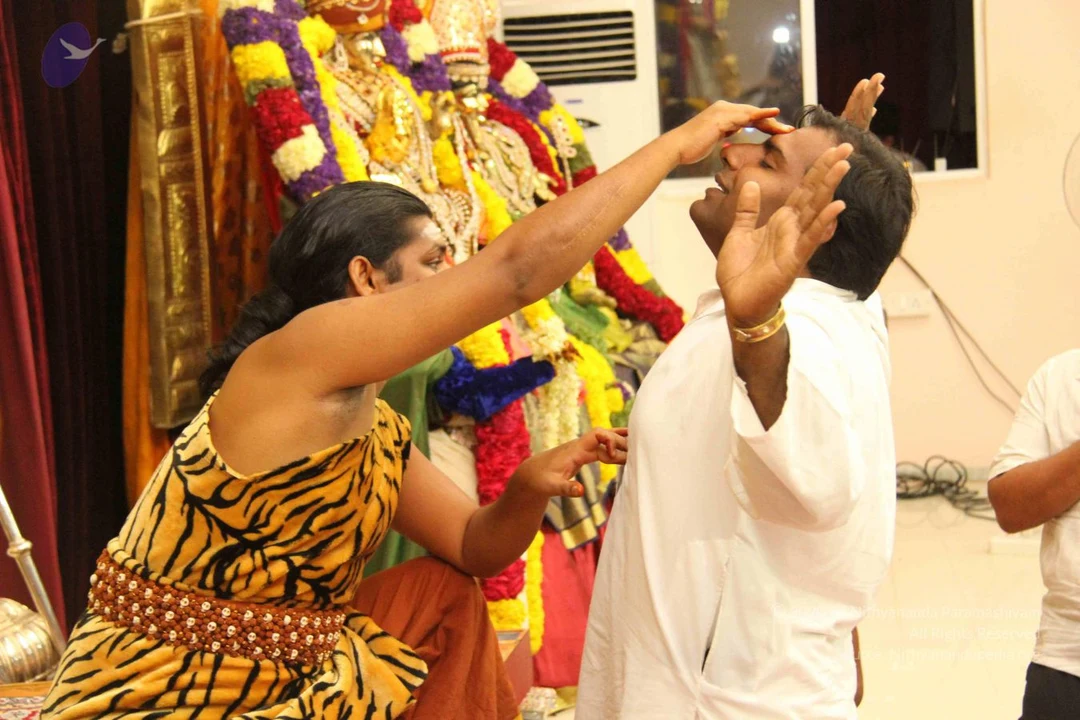
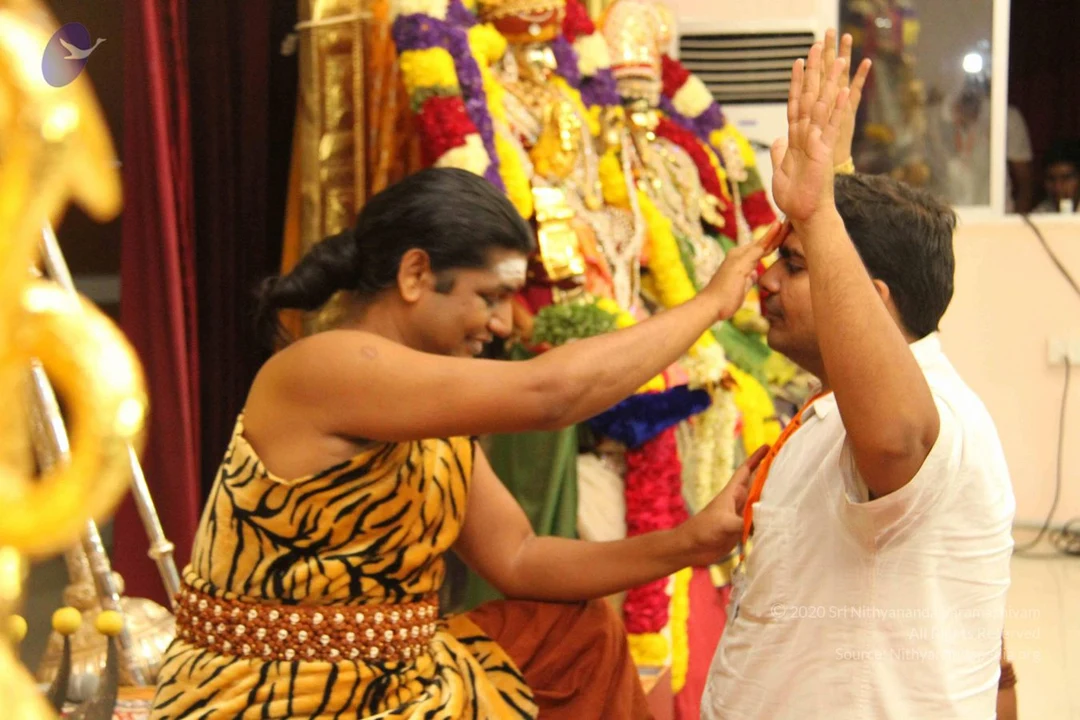
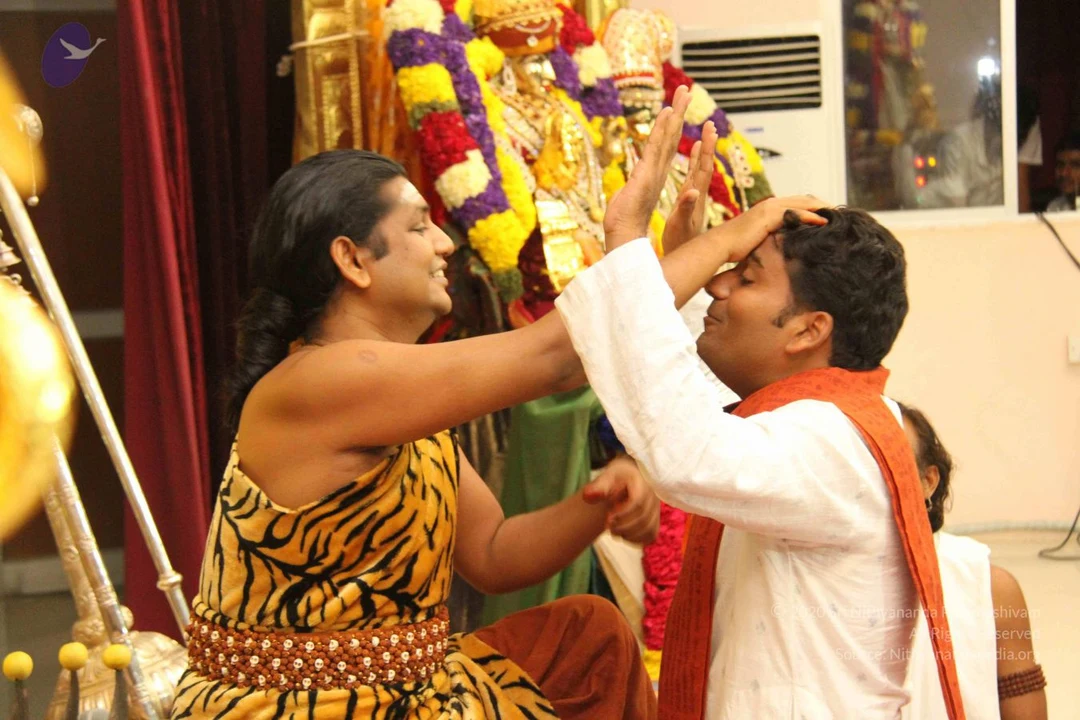
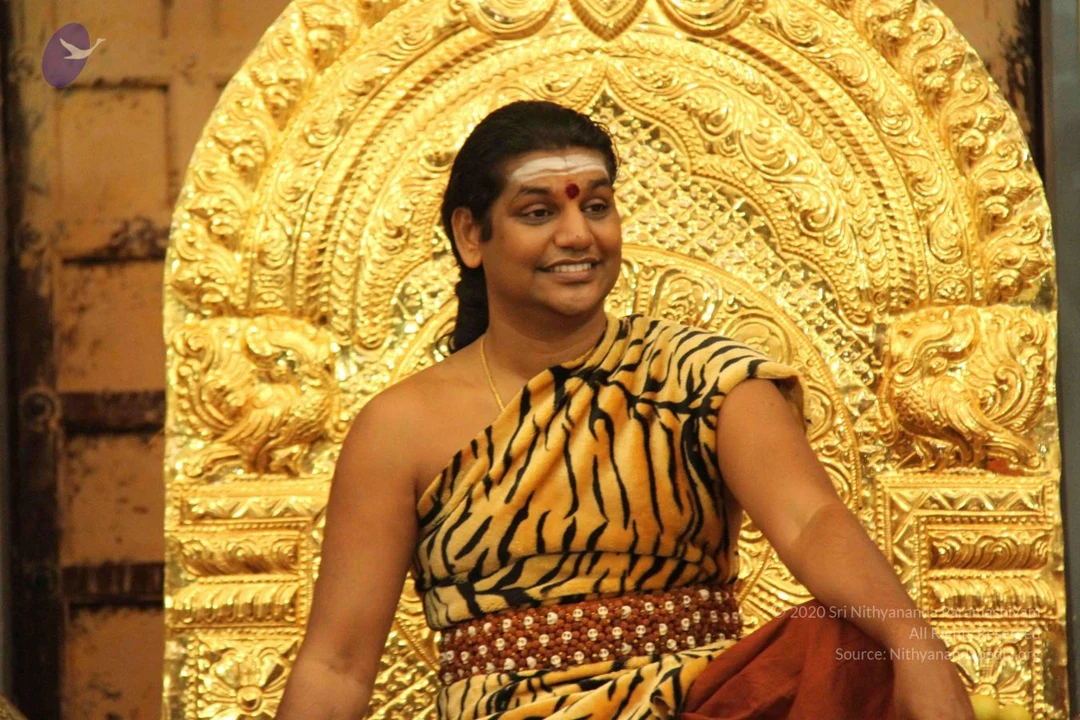
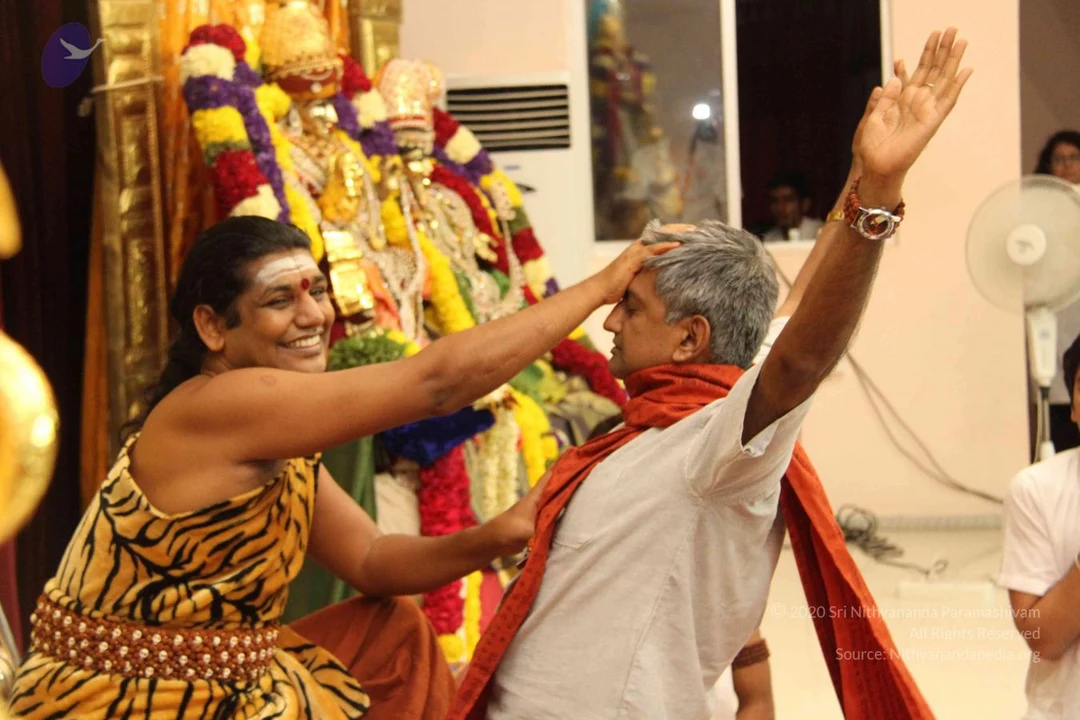
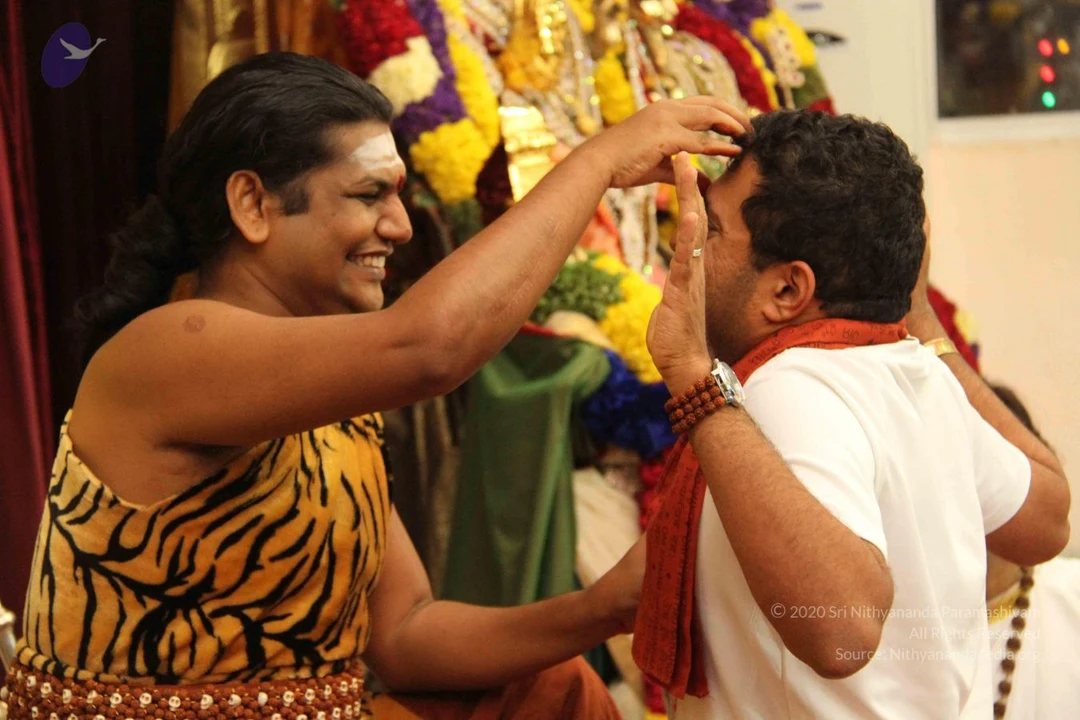
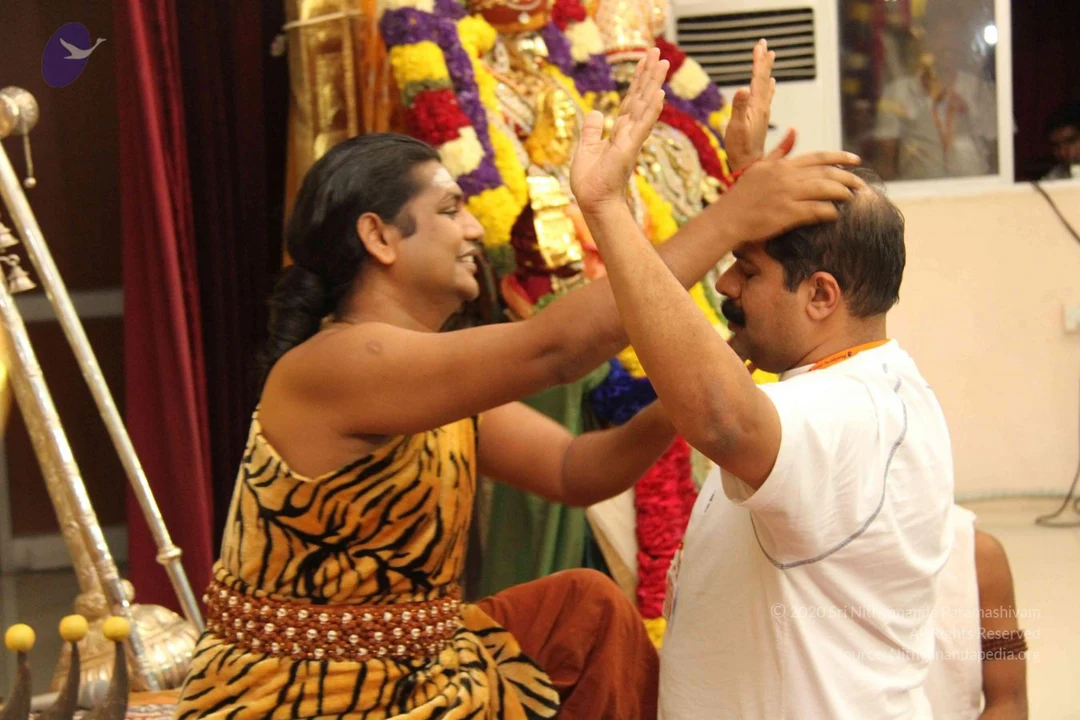
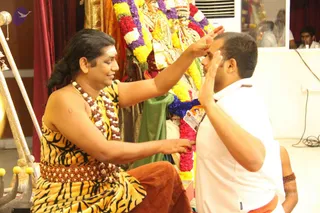
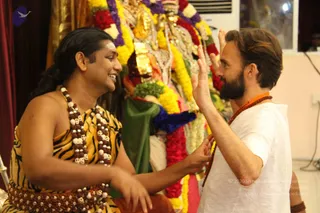
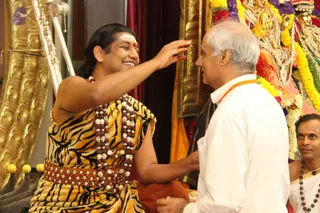
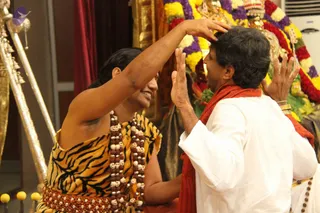
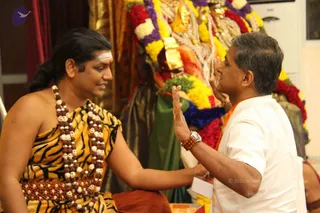
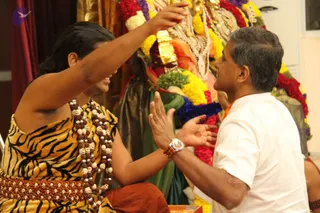
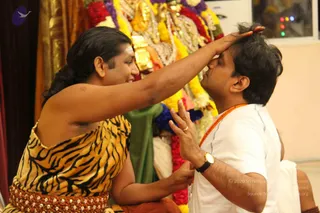
A seated man in a yellow and black tiger-striped garment and a rudraksha mala with a rudraksha belt blesses a standing man in a white shirt by placing his right hand on the man's forehead. The seated man has long hair tied back and a white forehead mark. Behind them, a deity murti is draped in garlands of yellow, purple, red and white flowers, with a green cloth and gold ornaments. Two people are partially visible in the background. a person in the seated role of giver of blessing, with long swept-back hair, a rudraksha mala and rudraksha belt. The standing devotee wears a white shirt and a visible identity badge.Indoor photo of a long-haired man with a white tripundra mark on his forehead, bare-chested in a yellow and black tiger-striped cloth, wearing long rudraksha and white bead necklaces and a beaded waist garland, seated and smiling while he gently touches the face of a bearded man in a white t-shirt with a red-orange shawl and rudraksha mala. Behind them is a deity murti decorated with yellow, red, and purple flower garlands, gold ornaments and a green cloth backdrop. The seated man has distinctive adornments and long swept-back hair, consistent with a person in the presence of a devotee.A photograph of a seated man with long dark hair, a white tilak and red bindi, wearing a tiger-striped yellow and black shawl and multiple rudraksha malas with beads. He smiles broadly while reaching out to touch the forehead of an older white-haired man in a white shirt with an orange lanyard. Behind them stands a golden ornate palanquin-style seat and a deity murti draped in garlands of yellow and red flowers. A third man in a white dhoti and rudraksha mala is partly visible at the right edge.A photograph of two men standing close together in a temple-like hall with flower garlands and gold-trimmed decor behind them. The man on the left wears an orange and black tiger-striped garment and a dark rudraksha mala with beads, and reaches up to touch the head of the man on the right, who wears a white kurta, a red shawl over his shoulders and gold bangles, and holds his palms open toward the other man. Behind them stand floral garlands in purple, yellow and red, and a ceremonial golden umbrella-like pole frame on the left.Photograph of two men facing each other in close conversation before a richly decorated deity murti hung with marigold and red flower garlands and gold ornaments. The man on the left has long dark hair swept back, a white tripundra mark on his forehead, and wears a single-shoulder yellow and black tiger-striped garment with layered rudraksha and white bead malas. His arm is extended toward the other man. The man on the right has short grey hair and wears a white shirt with an orange shawl and a red-brown beaded bracelet, with his hand raised in a gesture toward the first man's face. Swamiji (probable) on the left, given his long swept-back hair, tripundra, tiger-striped garment and rudraksha malas. Behind them stands a white air conditioning unit and purple curtain.A photograph of a seated figure in a tiger-striped yellow and black shawl, wearing a long rudraksha and white bead mala and a matching beaded waist belt, with an arm raised high and holding something above their head. Opposite, a man in a white shirt with an orange cloth at the neck and a wristwatch stretches his hands toward them in a gesture of reverence. Behind them, a deity murti or altar is decorated with garlands of yellow, red and purple flowers, gold ornaments and layered silk cloth. Both are smiling.

SacredArts_Pictures
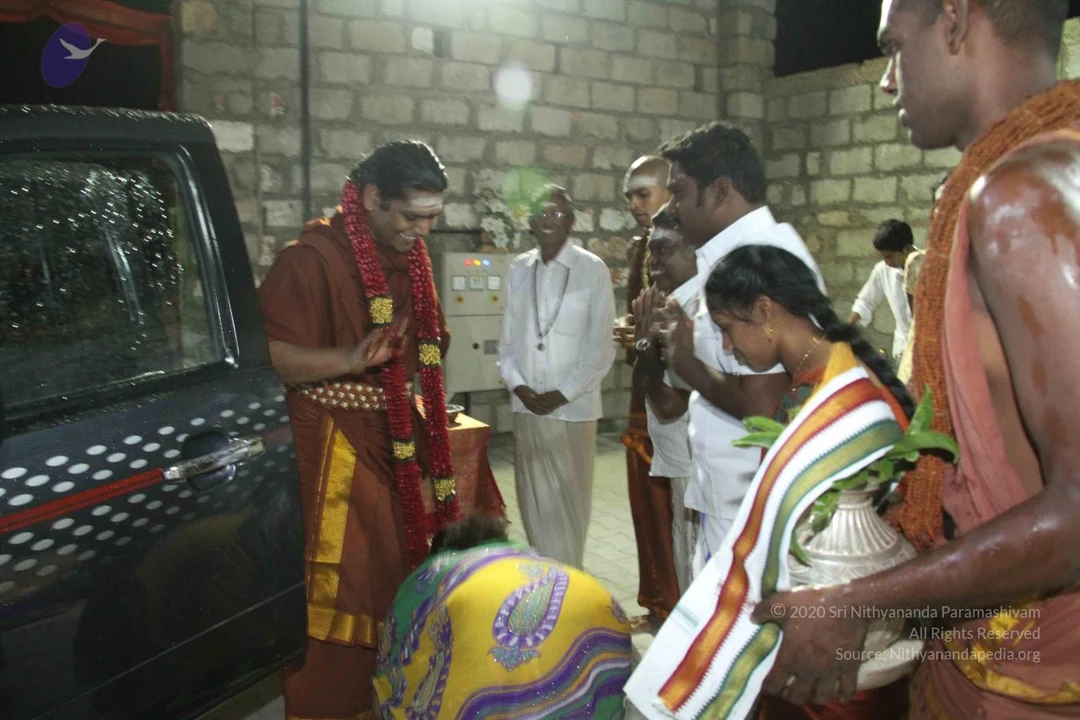
234 photosSource gallery
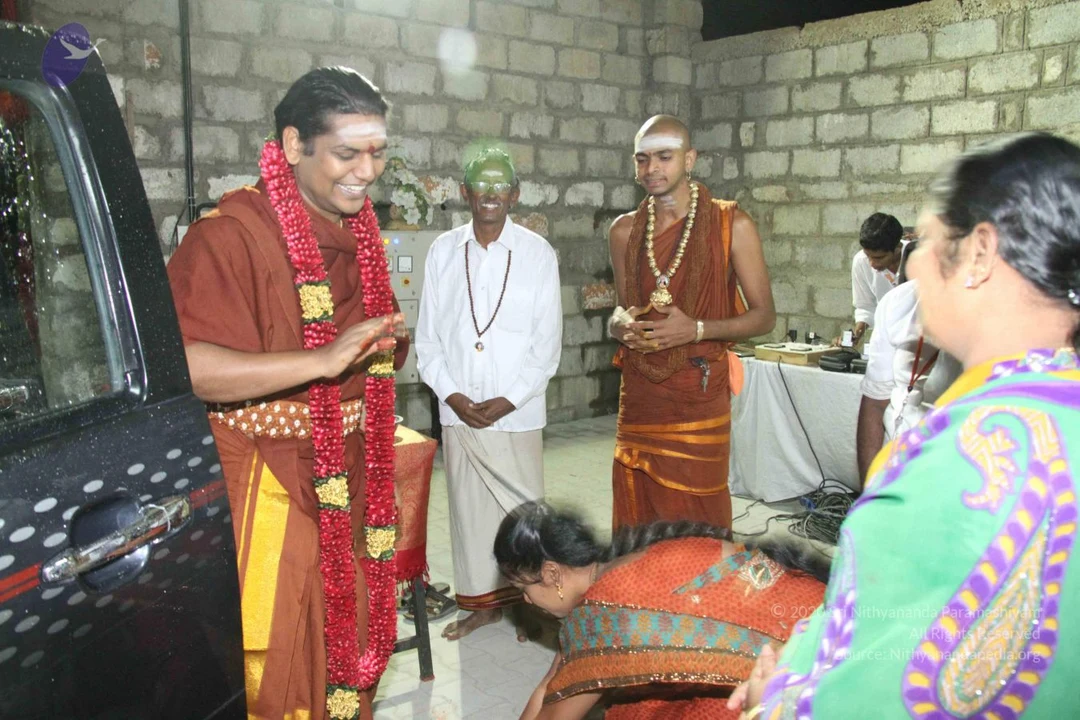
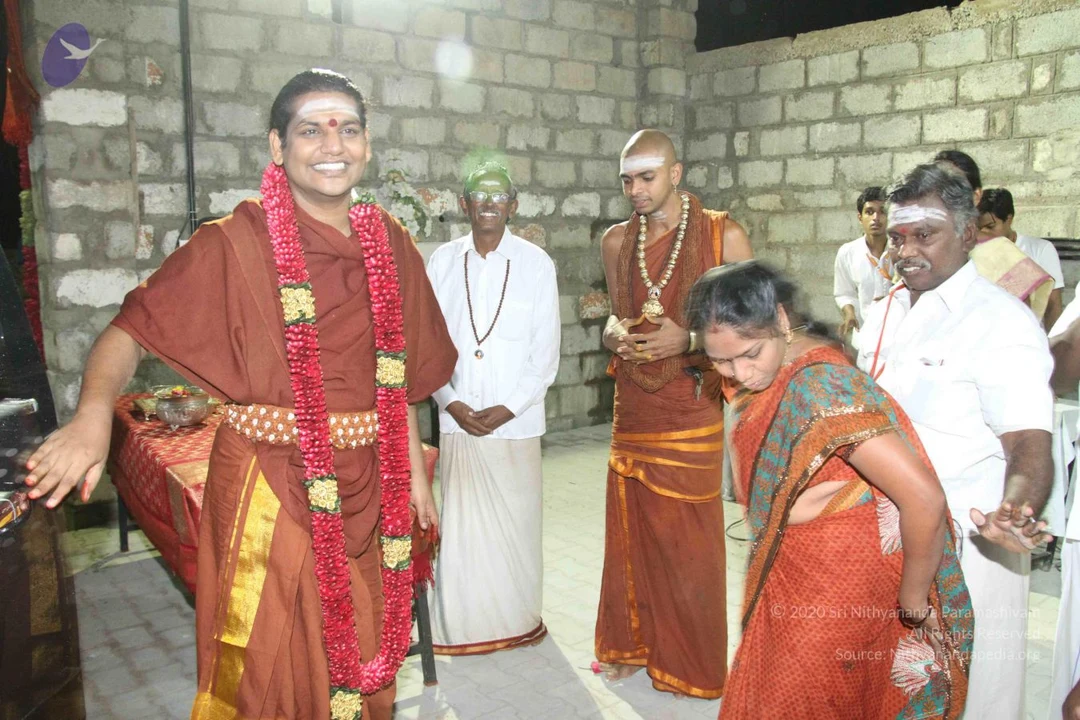
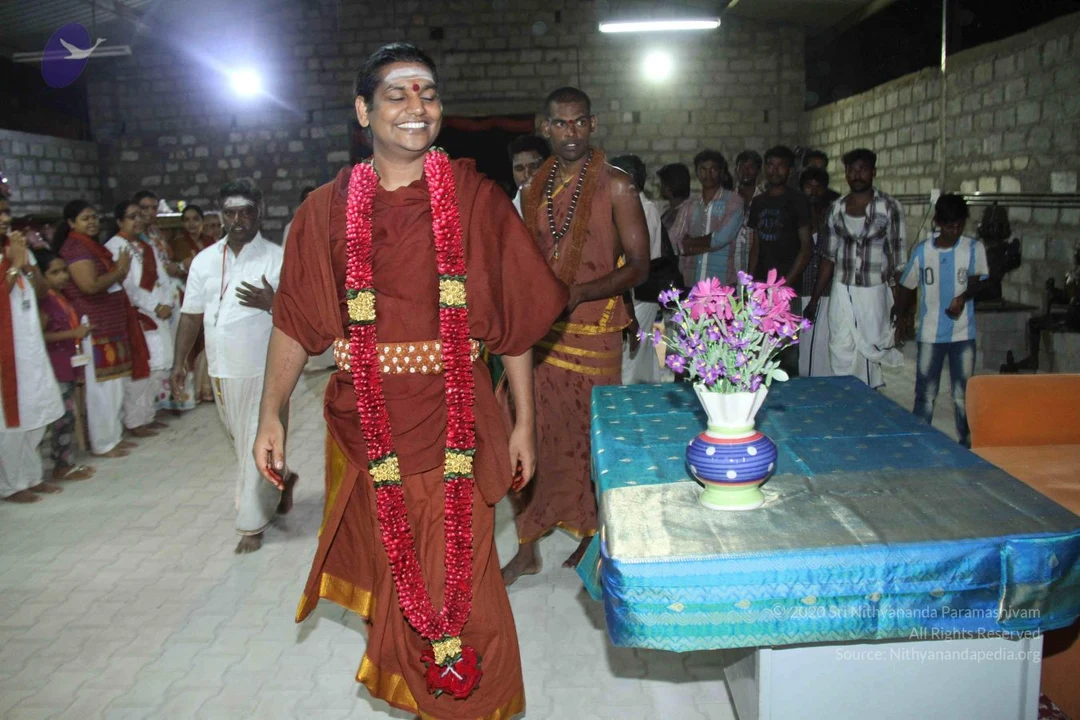
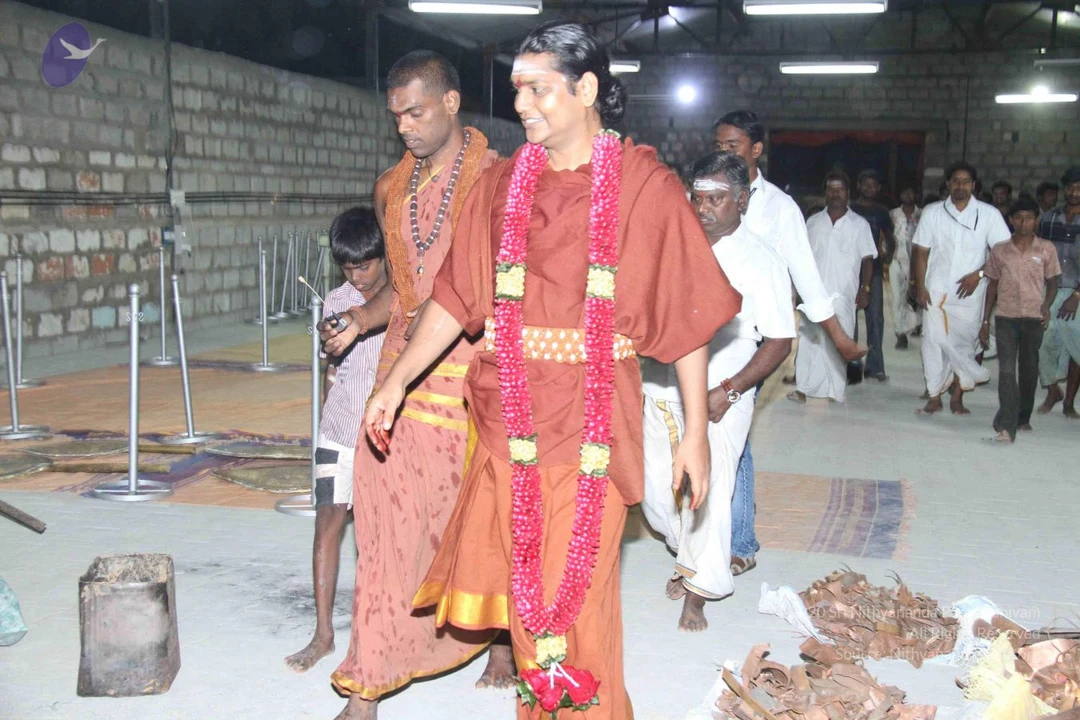
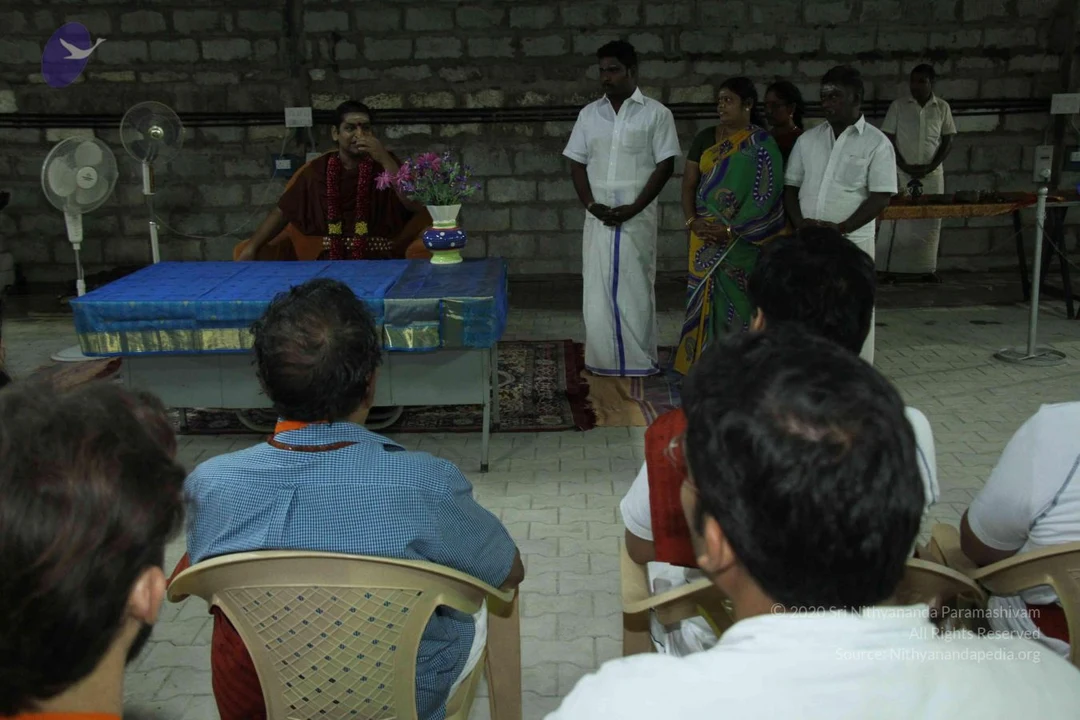
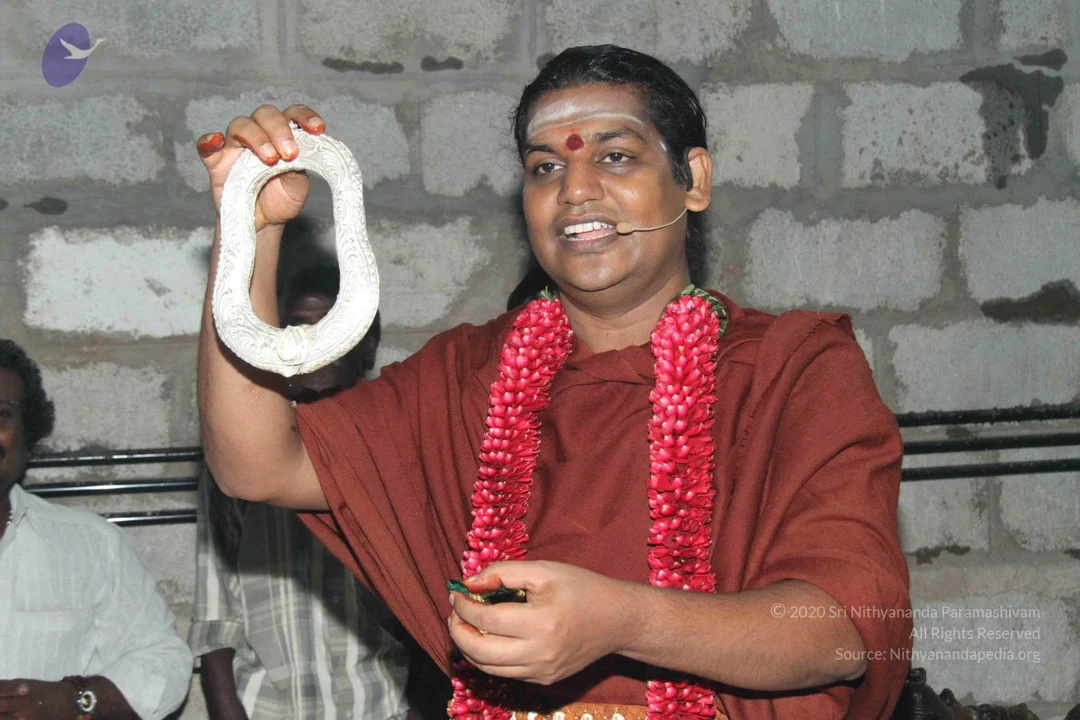
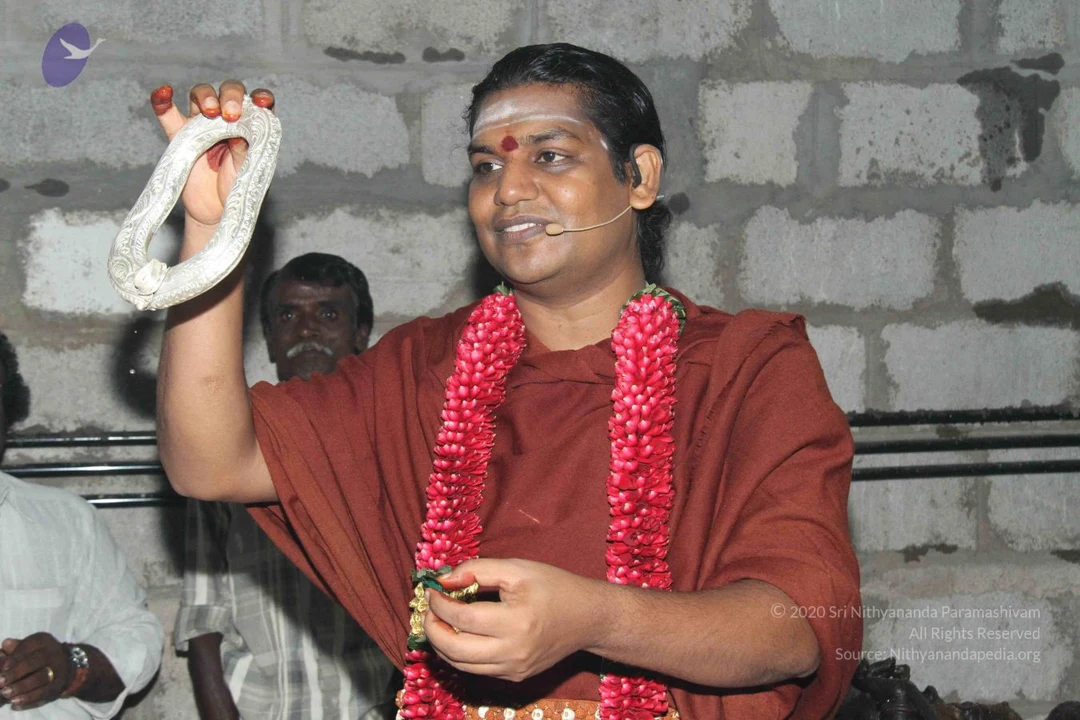
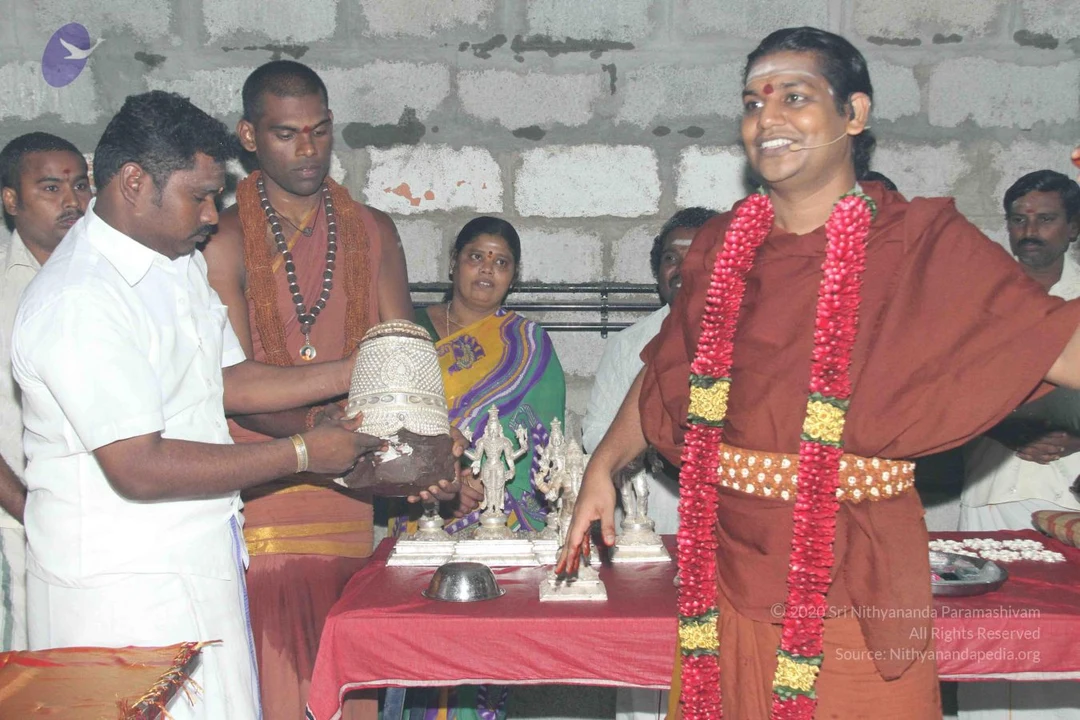
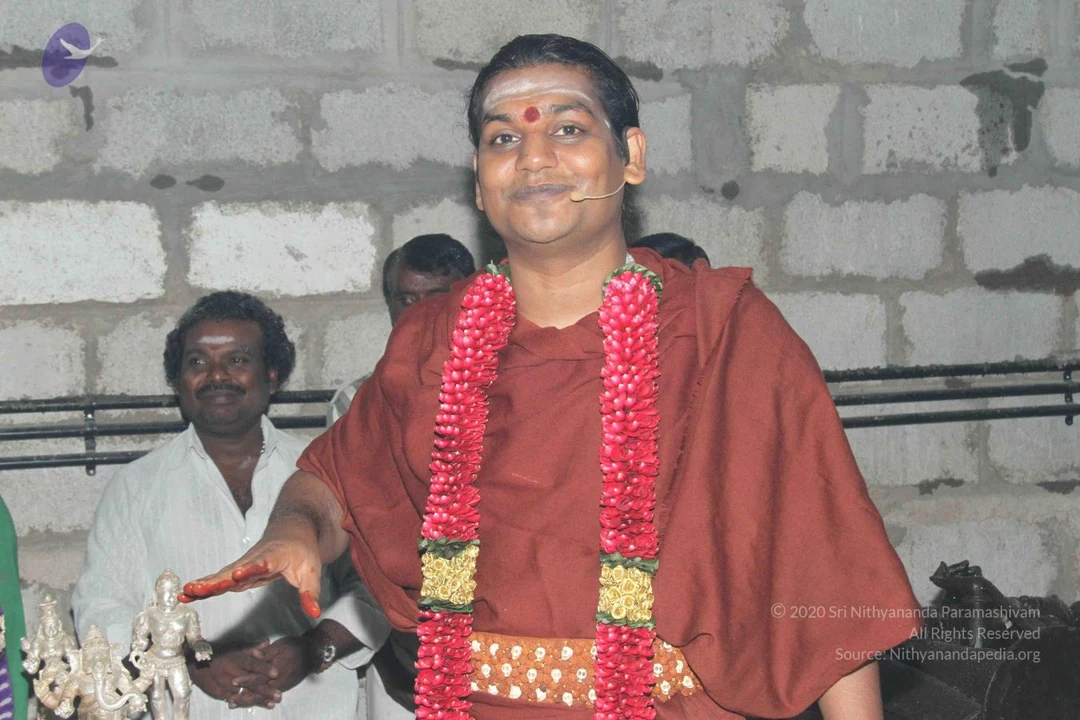
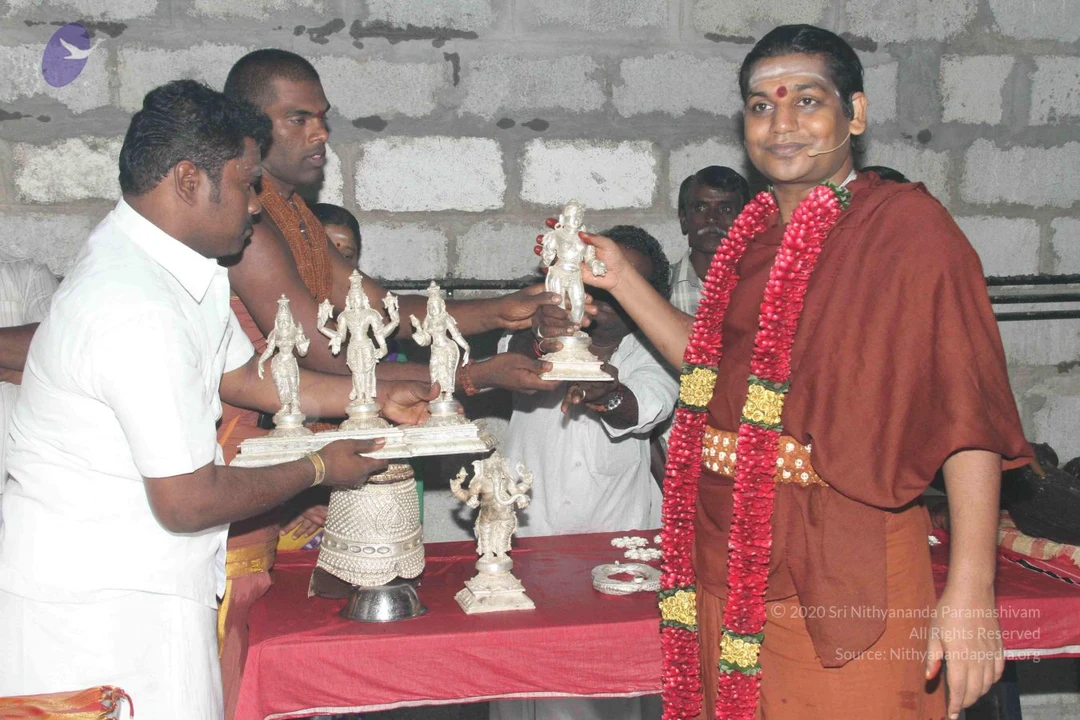
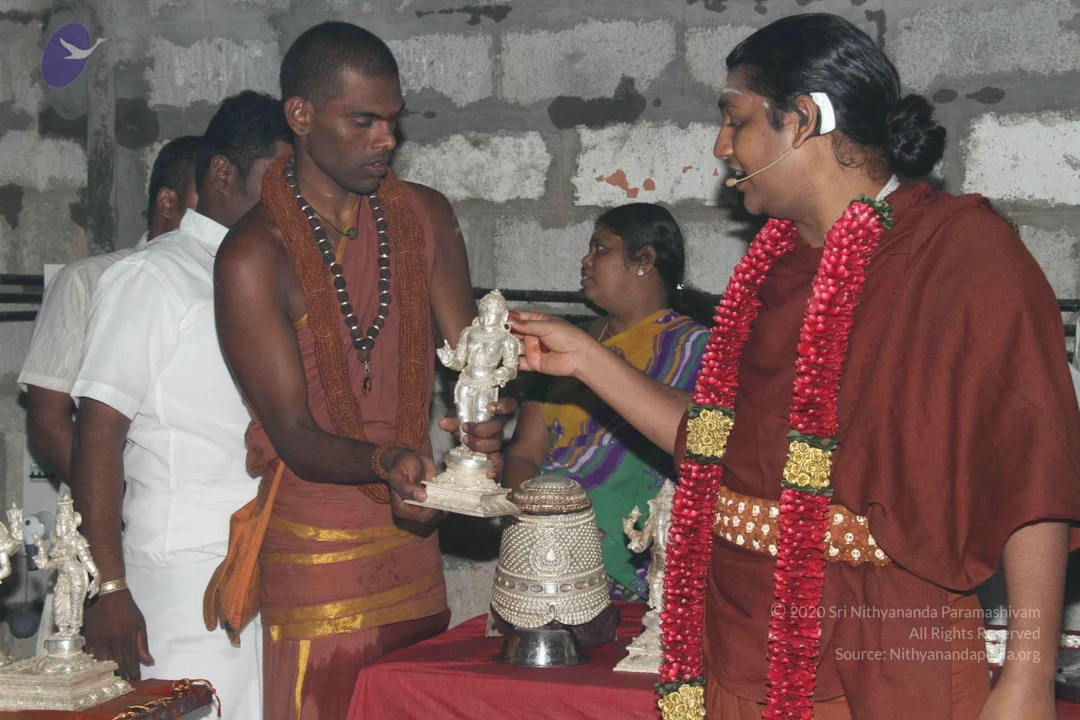
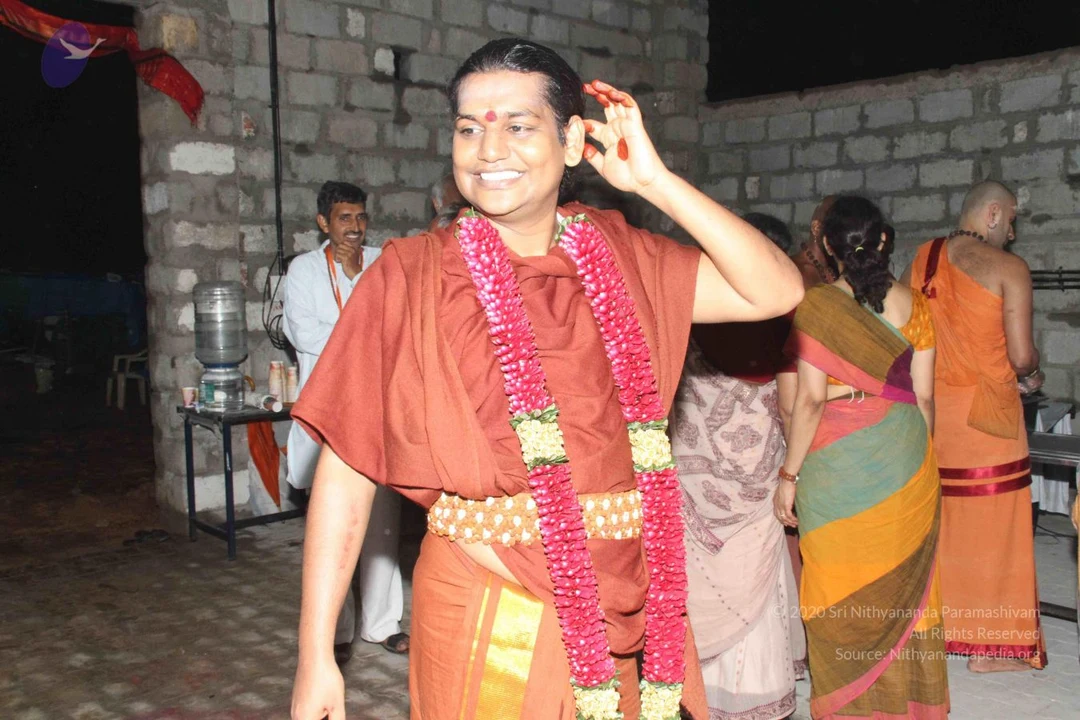
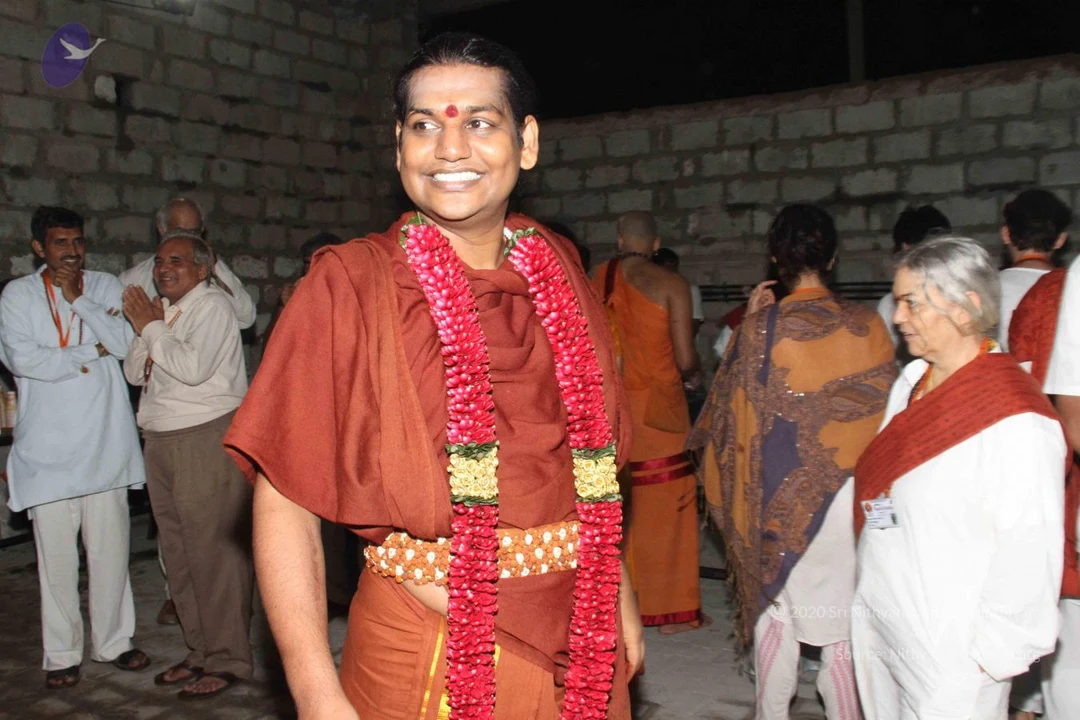
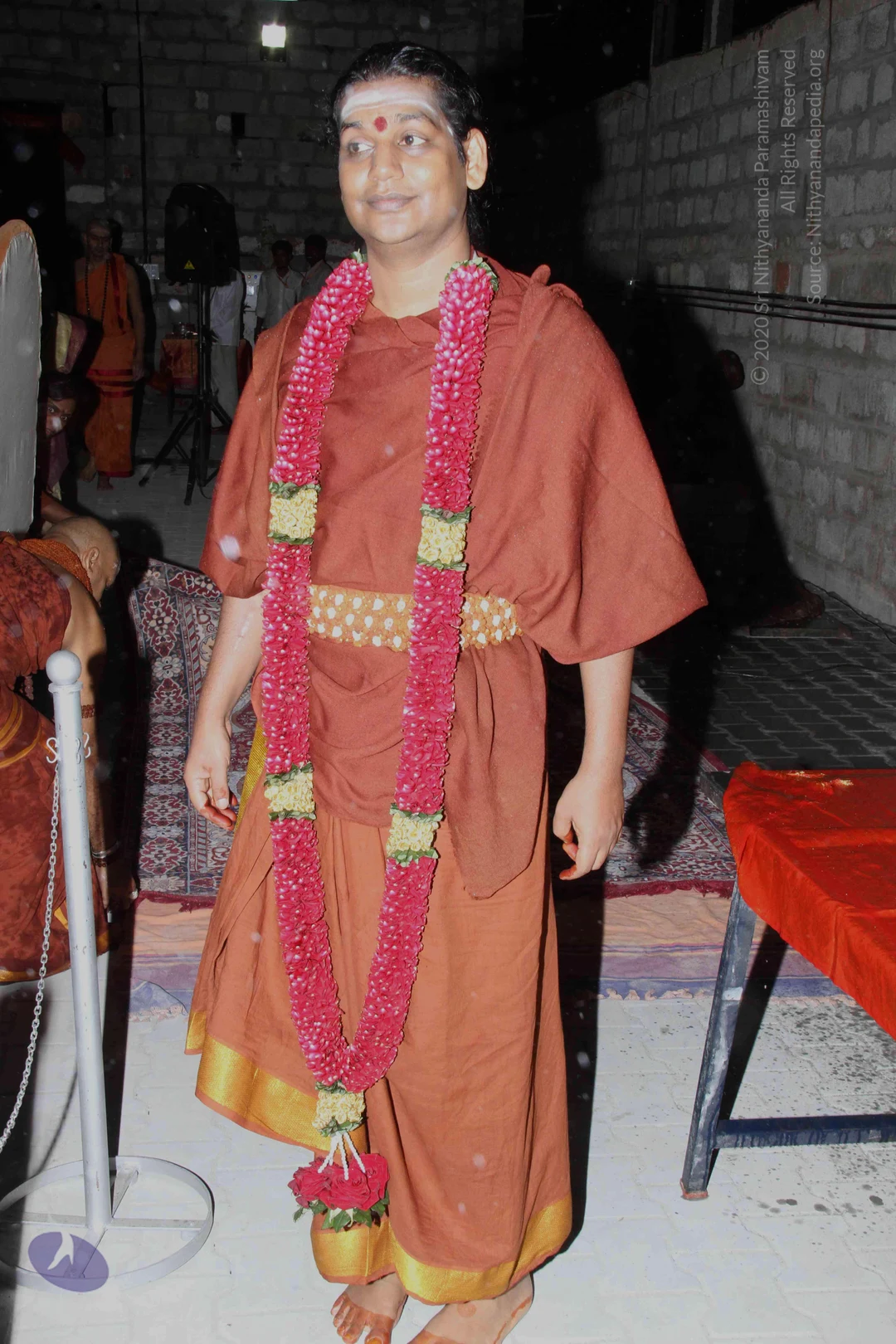
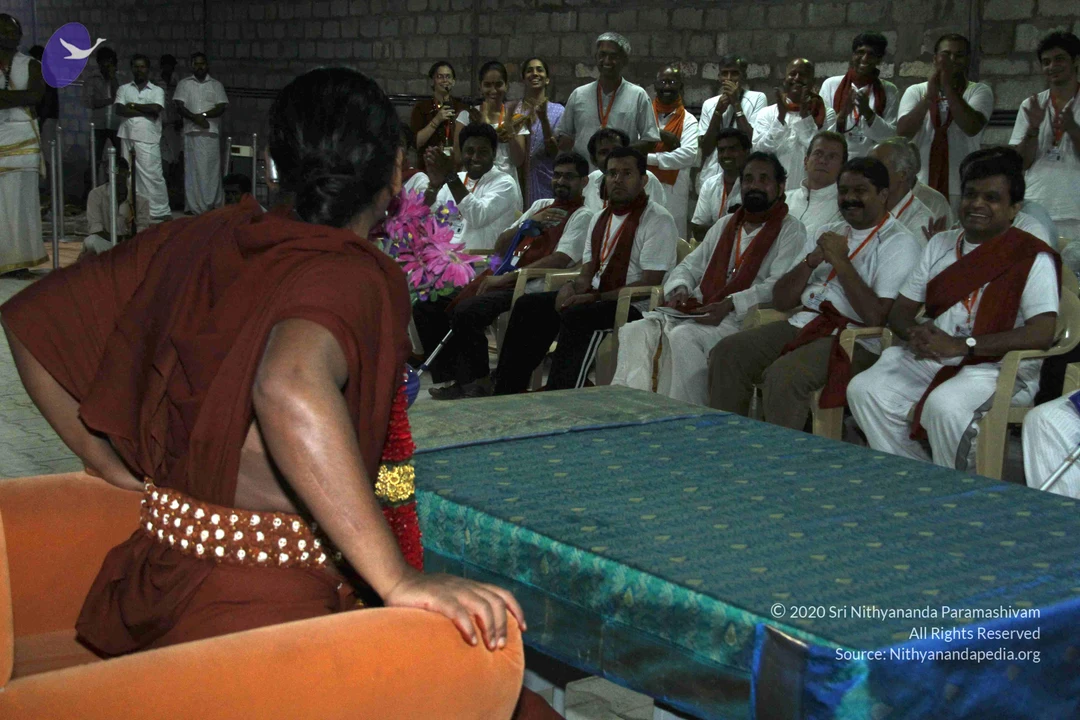
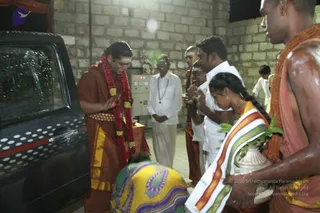
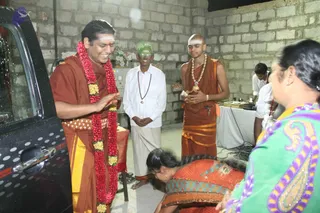
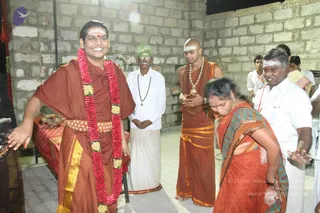
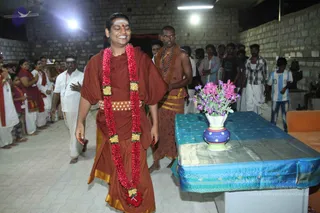
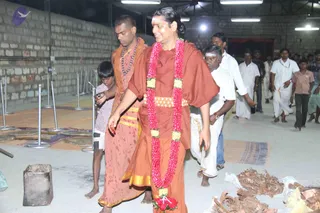
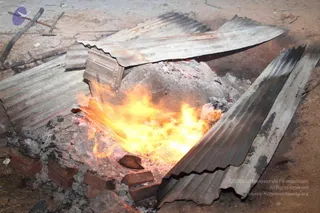
Night-time photograph of a welcome ceremony beside a black vehicle with white dots. A man in a rust-brown robe with a red flower garland and gold-coloured pendants stands at left, hands raised in greeting, with a sandalwood-marked forehead. In the foreground a woman in a yellow and purple patterned sari bends forward, and a woman in a white and multicoloured bordered sari holds a white vessel with green leaves. Other men in white dhotis and orange-clad attendants stand near a grey brick wall and a metal control panel, with a bare-chested man in orange at right. Four to five men appear and one woman plus a kneeling figure, so about six people are visible.Indoor photograph in a plain room with grey breeze-block walls. A smiling man with a red and white flower garland and a saffron-orange robe with a gold-patterned sash stands at left beside a black car, hands pressed together. Behind him a bald young man in orange robes wears a long beaded necklace and holds a small object. A man in white shirt and dhoti wears a rudraksha mala and stands at centre, while a woman in a green blouse stands at right foreground. In front, a woman in an orange and red sari bends low, touching the floor. A table with equipment and cables is at right.Indoor photograph in a plain brick-walled room with a small table draped in red cloth holding a brass bowl and offerings at left. A man with a shaved head and white vibhuti marks wears an orange-brown robe, a gold-and-beaded garland and a waist sash, standing with hands folded near the centre. To the left, a smiling person with long hair, a red bindi and tilak wears an orange-brown robe, a red-and-gold flower garland and a patterned belt, with arms outstretched. Beside them, an older man in white dhoti and shirt with a rudraksha mala stands watching. At right, a woman in an orange and teal sari bows forward while a man in white with a white tilak stands nearby. Several other people in white clothing appear in the background.A photograph of a smiling man in a rust-brown saffron-toned robe with gold-edged dhoti, wearing a long red and white flower garland with gold ornaments and a gold-studded belt, walking through a bare brick hall with a painted tilak on his forehead. Behind him, a man in an orange-brown cloth with a rudraksha mala walks alongside, while a row of people in white and red clothing stands along the left and back wall, some with hands in añjali. A blue embroidered cloth covers a table holding a blue-and-white vase of purple and pink flowers.A photograph inside a plain hall with breeze-block walls and fluorescent ceiling lights. In the centre, a man in a rust-orange robe and gold-trimmed orange waistcloth wears a long pink and yellow flower garland and carries red flowers in his hand. He has swept-back hair and a tilak on his forehead, and walks forward. Beside him, a younger man in an orange robe wears a rudraksha mala and a gold-bordered shawl. Behind them, several men in white dhotis and shirts follow, and a boy in a striped shirt stands at left near metal stanchions. Scattered dried leaves and a metal container lie on the floor at the bottom of the frame.A photograph of an outdoor earthen cooking or fire setup on bare ground. Bright orange flames burn in a dark clay pot or vessel, surrounded by ash and glowing embers. Corrugated metal sheets, tilted and angled, shield the fire on several sides. Red brick blocks form the base and a small clay container sits at the fire's edge. Scattered sticks and debris lie on the dirt. No people are visible in the frame.

Swamiji_FootPrint_Kumkum

2 photosSource gallery
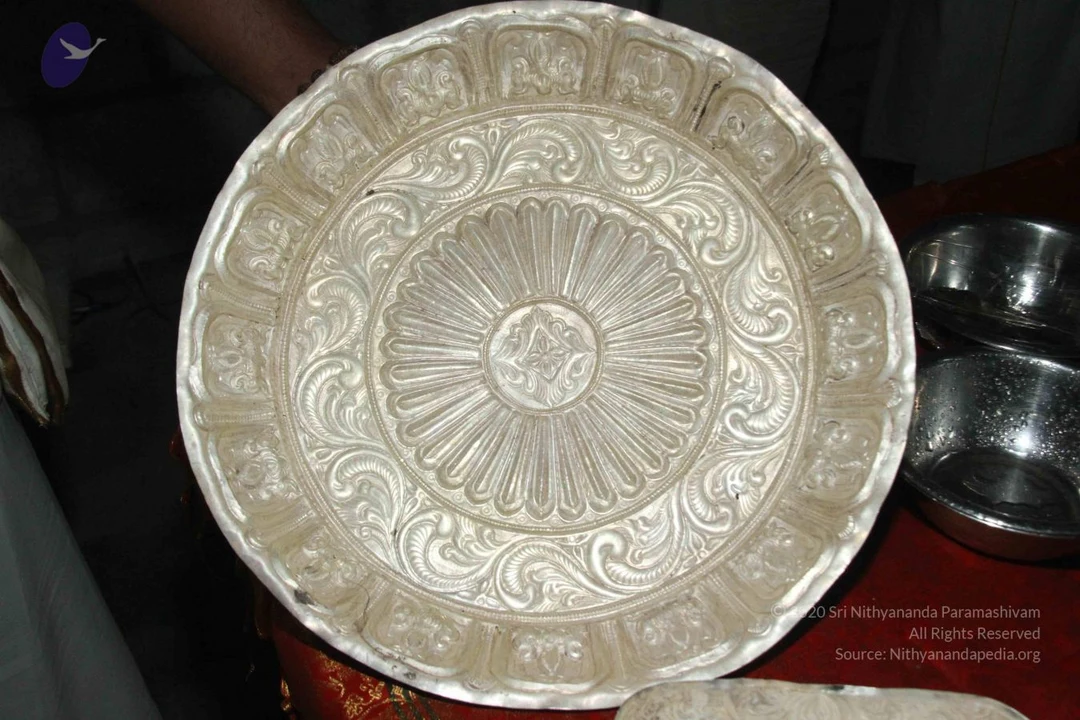
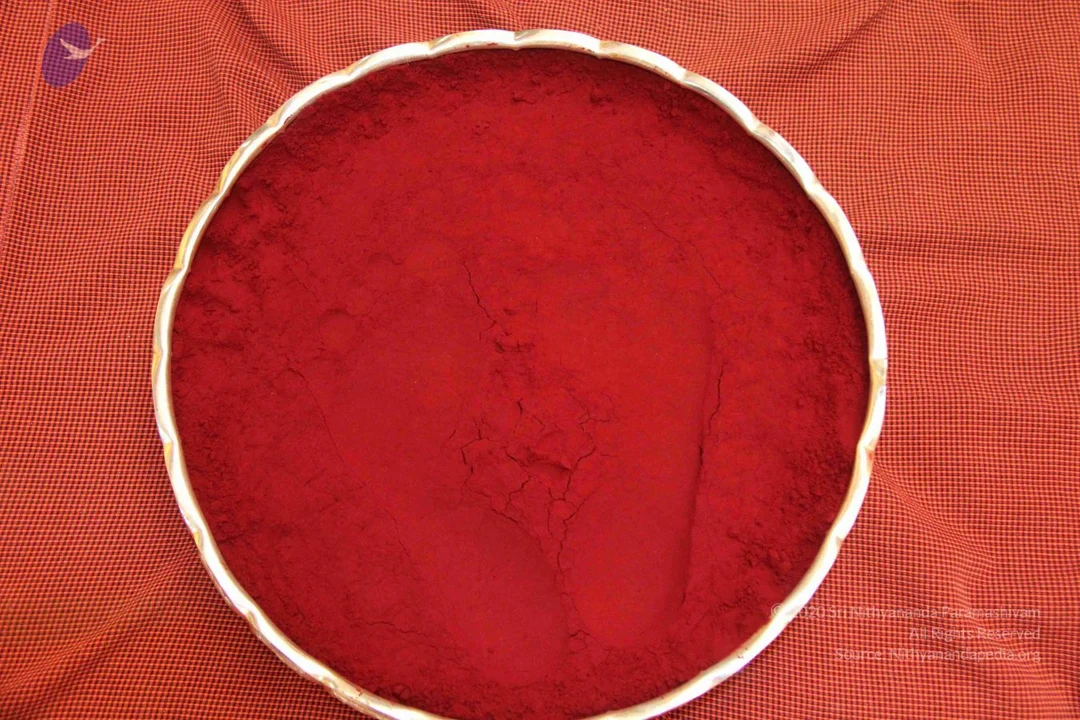
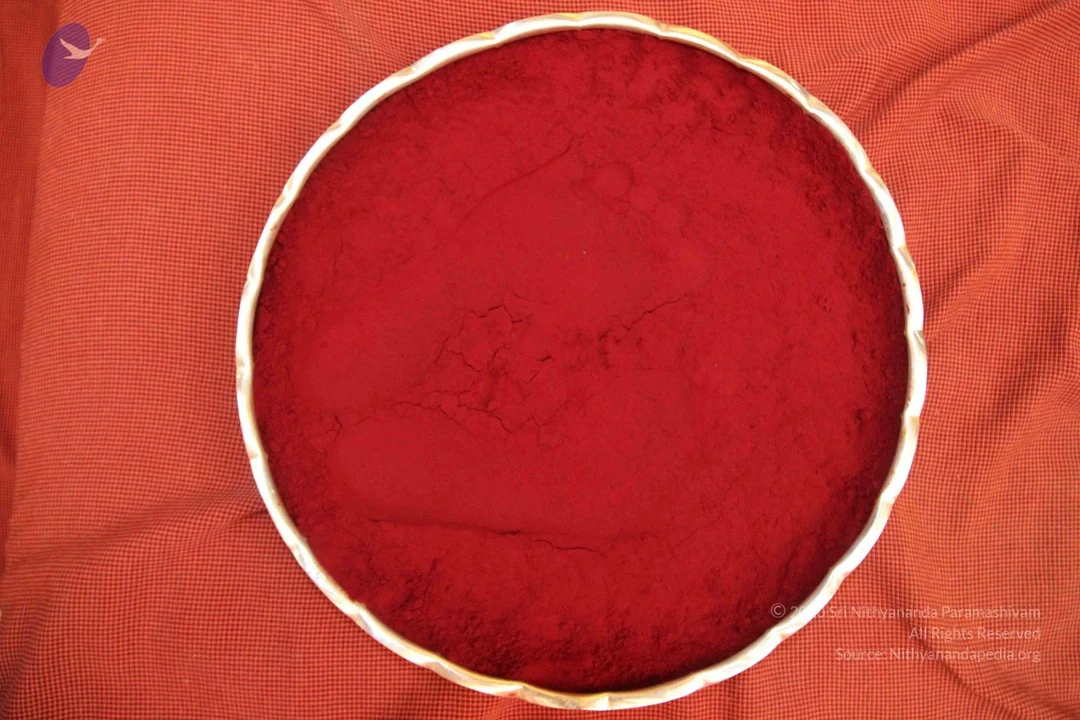
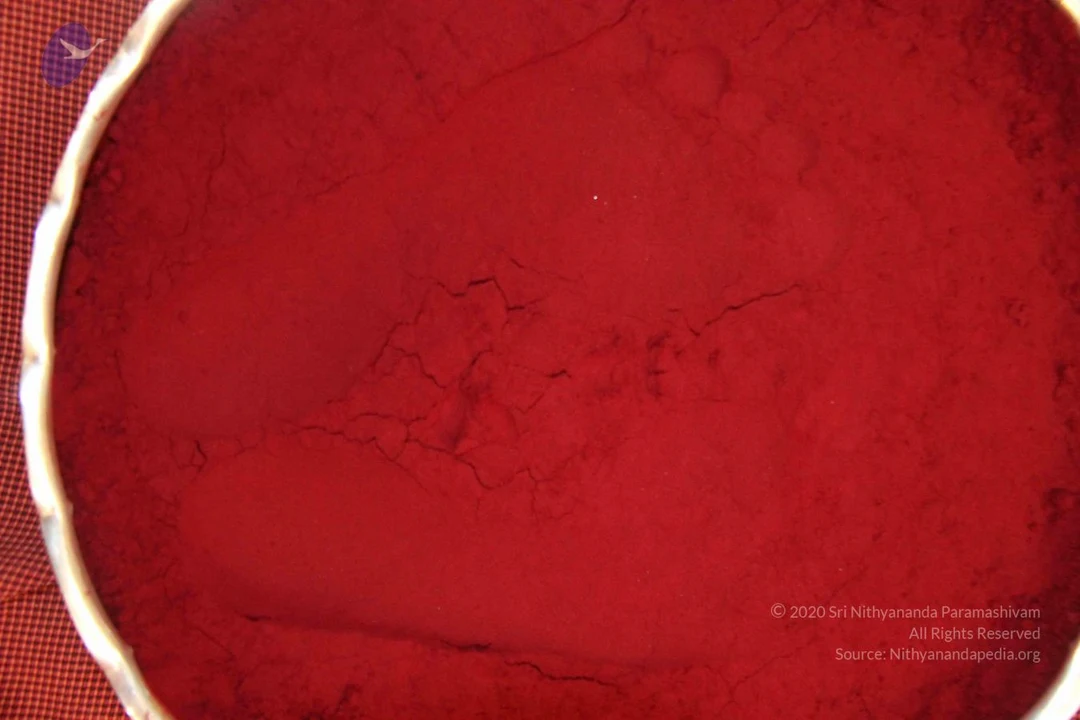
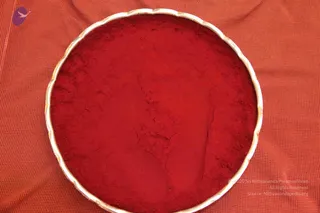
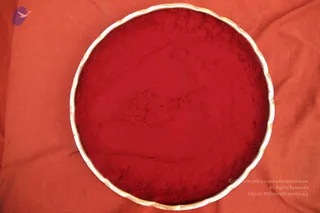
A photograph taken from above of a large round silver-toned metal tray filled with fine bright red powder. The tray rests on a red and orange checked cloth. No people, deities or ritual activity are visible.Overhead view of a round silver-rimmed tray filled with fine bright red powder. No people visible. The powder has a smooth surface with faint cracks and shallow ridges. The tray's scalloped silver edge frames the vivid red mass.

Deity-Darshan

5 photosSource gallery
A photograph of three decorated deity murti in a temple shrine, with no living people visible. Two larger seated murti sit side by side on a throne-like seat draped with garlands of yellow, red, purple and white flowers. The figure on the left wears a pink-orange sari, a gold crown, layered silver necklaces and gold hand ornaments. The figure on the right wears a green sari, a pink and gold crown and layered silver jewelry. A smaller standing murti at the left wears a gold crown, a green cloak and a garland of white and red flowers. A brass oil lamp stands at the left edge, and a gold-and-orange curtain forms the backdrop.Two metal murti figures of a seated divine couple, decorated for worship on a red-draped platform in front of golden curtains. The figure on the left wears a tall gold crown with red stone, an orange-and-peach garment, and layered necklaces and beaded garlands; its right hand is raised in a blessing gesture. The figure on the right wears a white-and-red ornate crown, a green garment, and heavy jewelled necklaces, holding a lotus-like object. Both are framed by garlands of yellow, red, purple and white flowers and silver-edged ornaments.Two metal deity murtis, one in gold-toned finish wearing an orange-pink garment and heavy layered silver-and-gem necklaces, the other in dark green garment with ornate jewelled crown and necklaces, seated side by side on a flower-decorated throne. Garlands of red, yellow, purple and white flowers frame them, and a gold patterned curtain and carved gold panel form the backdrop. No physical people are visible.Photograph of a decorated deity murti group on a raised platform, garlanded with bands of yellow marigolds, red roses, white flowers and purple blossoms. The central seated figure wears an orange and pink garment, a gold crown, a red and gold turban-like headpiece, and layered gold and jewelled necklaces. Beside it a seated consort figure wears a green garment, a jewelled crown and layered silver-toned necklaces. A smaller standing attendant figure on the left wears white clothing, a gold crown and white flower garlands. Gold-toned curtains and a golden backdrop frame the scene. No physical people are present.Two golden murti statues are seated side by side on a decorated platform, draped in dense garlands of yellow marigolds, red roses, purple flowers and white blossoms. The left figure wears an orange-and-gold turban-style crown, an orange garment and layered jewelled necklaces, with one hand raised in blessing. The right figure wears a red, white and gold jewelled crown and a green garment with ornate necklaces and jewelled borders. A golden curtain and gilded wall panels form the backdrop. No living people are visible, and the image shows statues only, so no a person candidate is present.
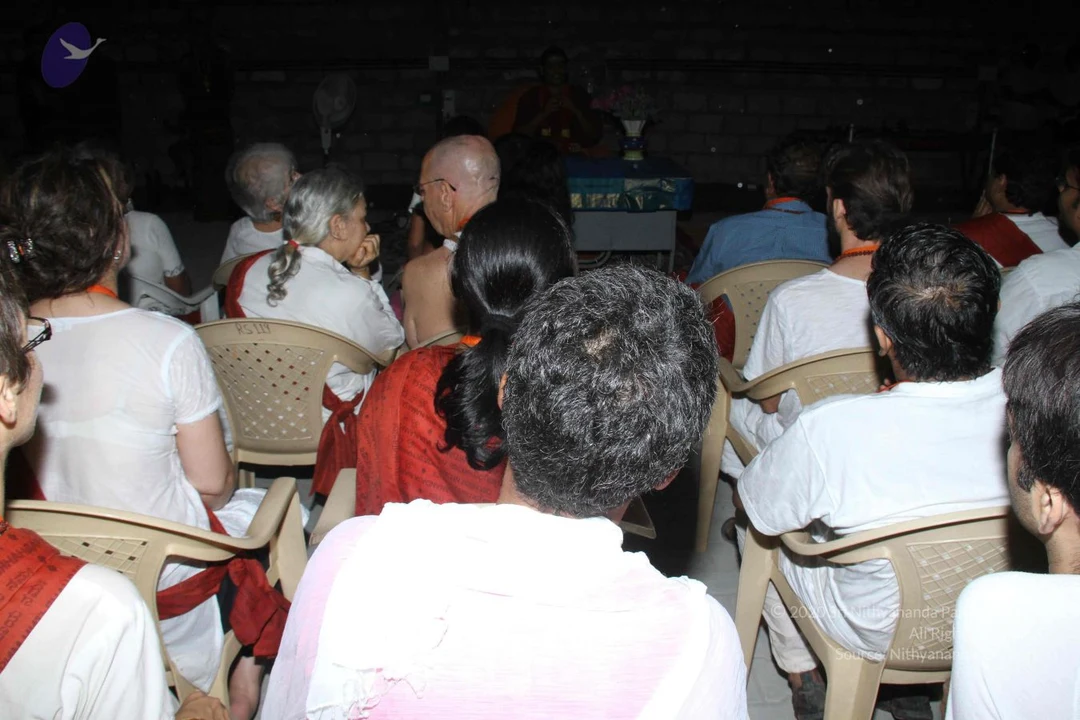
Nithya-Satsang

5 photosSource gallery
A wide photograph of a large hall with pink walls, red curtains and wall-mounted air conditioners, where a crowd of several dozen seated people sits on red mats and white sheets in rows. In the foreground, shaved-headed young men in saffron-orange robes and rudraksha malas sit cross-legged beside boys in red-orange cloth and white-clad men. A woman in a blue-and-white sari with a bindi sits near a small brass plate with offerings. Behind them, rows of seated devotees in white and orange fill the room, with a speaker mounted high on the wall and a few people sitting near the back. No clearly identifiable a person figure is visible in the front rows.A man in saffron-orange and gold striped dhoti and shawl stands at a clear acrylic lectern, hands clasped, speaking to an audience. He wears a rudraksha mala and gold necklace and gold armlets. Behind him, two deity murtis are seated on a golden throne with a gold-framed arch and gold curtain, adorned with bright garlands of red, yellow, green and purple flowers, pearl necklaces and crowns. A gilded lion-armrest chair is at left, with a painted pillar behind. Appearance-based candidate: a person, speaking at a discourse.A man in a rust-orange and gold-bordered dhoti and wrap stands at a clear acrylic lectern on a stage, speaking with a microphone and holding the lectern with both hands. Behind him stands a gold-framed throne with lion-form armrests and a deep red cushioned seat. To the right, two deity murtis in ornate gold and red garments wear crowns and layered pearl and bead necklaces, framed by garlands of red, yellow, purple and white flowers. Behind them hangs a gold and orange curtain, and a painted pillar with floral motifs stands at the left edge. A wall air conditioner is visible at the right edge.A seated assembly of many devotees in a bright hall, many dressed in white kurtas and dhotis with saffron-orange shawls and orange lanyards. In the foreground, several young boys in saffron-orange robes and red shawls wear rudraksha malas and white ash marks on their foreheads. A few older men in orange robes sit with rudraksha malas, and a shaved-headed man in orange sits near the centre. Behind them, rows of people sit on red mats, with a golden figure and orange drapery visible at the back. The scene looks like a formal satsang or discourse gathering.A smiling man in an orange-brown sannyasi-style wrap and a rudraksha mala stands at right, raising one hand in greeting beside a dais. On the dais, two deity murtis with crowns and jewelled necklaces sit side by side, adorned with garlands of yellow, red, purple and white flowers. A third small standing murti at far left wears a green cloth and a flower garland. A gold arched backdrop and a pink-and-gold cloth frame the scene, with a red carpet below.

Sarvadarshan

10 photosSource gallery
A photograph inside a hall with a tiled floor and a maroon curtain valance. A man in a saffron-orange dhoti and shawl with a long rudraksha mala raises his right hand in greeting as he walks forward. Several people in white clothing follow behind him, some with hands folded in namaste, and a figure on the left edge also has hands folded. Behind them stands a decorated altar with gold-framed deity images, garlands of red and white flowers, and a large colourful painted backdrop. Chrome stanchions with chains line the walkway.A photo of an indoor ritual gathering in a hall with pink walls, red curtains and ceiling lights. In the foreground a man in a white shirt holds a tray of apples and other fruit toward a man in an orange-saffron dhoti and shawl with a thick rudraksha mala and a red tilak, who raises one palm in blessing. Behind him a younger man in white with a rudraksha mala stands beside him, and another devotee in white bends low at the tray. Several other men in white stand in the background near a decorated altar with deity murti and gold-framed pictures. The saffron-clad man is shown in appearance-based likeness to Swamiji (probable), wearing a crown-less ochre shawl, rudraksha mala and tilak.A photograph in a bright hall with a tiled floor and a stage backdrop of maroon drapes and gold-framed deity murtis decorated with flower garlands. A man in a white shirt and white dhoti holds a silver tray of apples and red fruit toward a figure in a saffron-orange dhoti and shawl with a thick rudraksha-style mala and gold-coloured bands on the arms. The figure, with a shaved-looking head and white and red markings on the forehead, smiles and reaches toward the fruit. Behind them, several men in white dhotis and shirts stand with folded hands, one wearing a blue and gold lanyard, and a young man on the right wears white with a beaded mala. A projection screen on the left shows colourful images.A photograph of a busy indoor hall with a red carpet and pink-walled stage area. In the foreground, a smiling man with dark hair, a red bindi and a rudraksha mala draped over his shoulders wears an orange-brown wrap over a gold-bordered garment, with a bangle on his wrist and his arm extended forward in a blessing gesture. A bald man in a white shirt and orange shawl bows his head toward him, and a man in a yellow-striped shirt stands nearby. Behind them, white-clad devotees and men in white shirts stand along a barrier, and deity images decorated with gold and flowers are visible on the stage. Several people in white and orange clothing fill the background.A photograph inside a bright, pink-walled hall with red curtains and white ceiling lights. In the foreground, a person in a white kurta leans forward with hands pressed together as a bare-chested figure in orange-saffron cloth with a long rudraksha mala and gold-toned bangles, hair in a bun, presses a hand to his head in a blessing. The blessing figure holds a folded paper in the other hand. Around them, several men in white kurtas and striped shirts stand and watch. On the right, a golden decorated shrine with deity murti is visible, and a large screen glows in the back. Several people stand near metal stanchions across the hall.Indoor photo in a large hall with pink walls, red curtains and ceiling lights. In the right foreground a man in an orange-saffron dhoti-style garment with a gold border and a long rudraksha mala raises his right hand in a blessing gesture. He wears a red-orange wristband and a gold earring. In front of him a man in white shirt and white trousers bows with palms pressed together. Behind them, a row of people in white and grey clothes stands along metal stanchions and chain barriers. A golden deity murti and a gold throne-like seat are visible in the background, with a large framed picture on the wall to the right.

Swamiji-Krishnappa-and-Guests

4 photosSource gallery
A photograph in a hall with red chairs and a red patterned rug. A seated man in a saffron-orange dhoti and shawl, with a white flower garland and bangles, sits on an ornate gold throne draped with a tiger-skin cloth, his bare feet on a red cushion. An elderly man in white shirt and trousers bends forward to touch his feet in reverence. Behind them a bald attendant in saffron stands, and a second robed man in white dhoti wears a rudraksha mala. A large floral garland decorates a deity murti in the background, with a gold lion figure at the throne's side.A photograph of a formal reception in an indoor room with red curtains and a red-cushioned chair. A man in a white shirt and dark trousers bends forward to hand a folded white cloth to a kneeling woman in an orange-brown sari with a white and red flower garland and bangles. Behind her, a seated man in white clothes watches. On the left, a man in white holds a gift bag wrapped in yellow cellophane with a green ribbon. On the right and in the background, several saffron-robed men with shaved heads and rudraksha malas stand near a golden throne-like seat decorated with garlands in red, white and purple.A seated figure in saffron-orange robes with a white-and-red flower garland and rudraksha beads sits on a golden throne with a golden lion-head armrest, smiling and resting his hands on a white cloth. Before him a man in a white shirt and white dhoti holds out a basket of fruit and sweets wrapped in cellophane, while another man in white leans forward to receive it. Behind them a priest in white with a bare chest and rudraksha mala stands near a deity murti decorated with a multicoloured flower garland and gold ornaments. Other men in white and saffron stand in the background against red curtains.A photograph of a devotional darshan in a room with red velvet drapes and a patterned rug. A seated figure in an orange-and-gold silk garment with a white-and-yellow flower garland and a white cloth in hand receives a man in a white shirt and white trousers who bends forward to touch her feet. Behind them, a standing group of men in white dhotis, orange robes and rudraksha malas watch, one smiling. A golden lion-shaped object and a deity murti decorated with garlands stand at the right, with a tiger-skin cloth on the seat. Several other men in white and striped shirts stand at the left beside red-cushioned chairs. Roughly eleven people are visible.

Inner-Awakening-Day-20

10 photosSource gallery
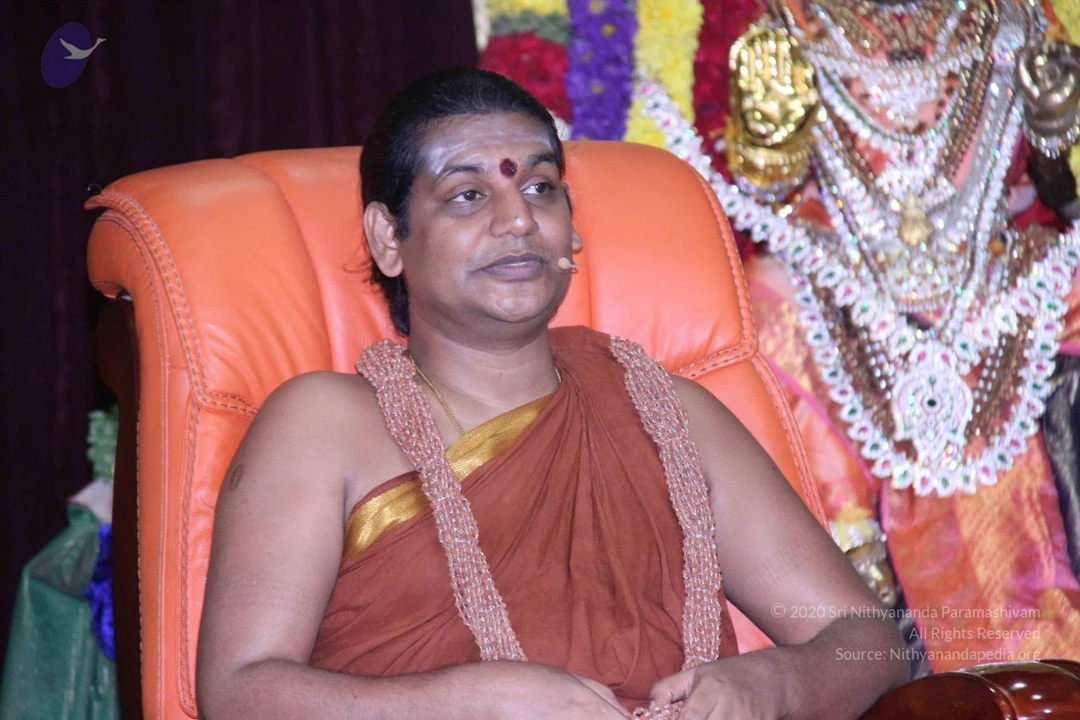
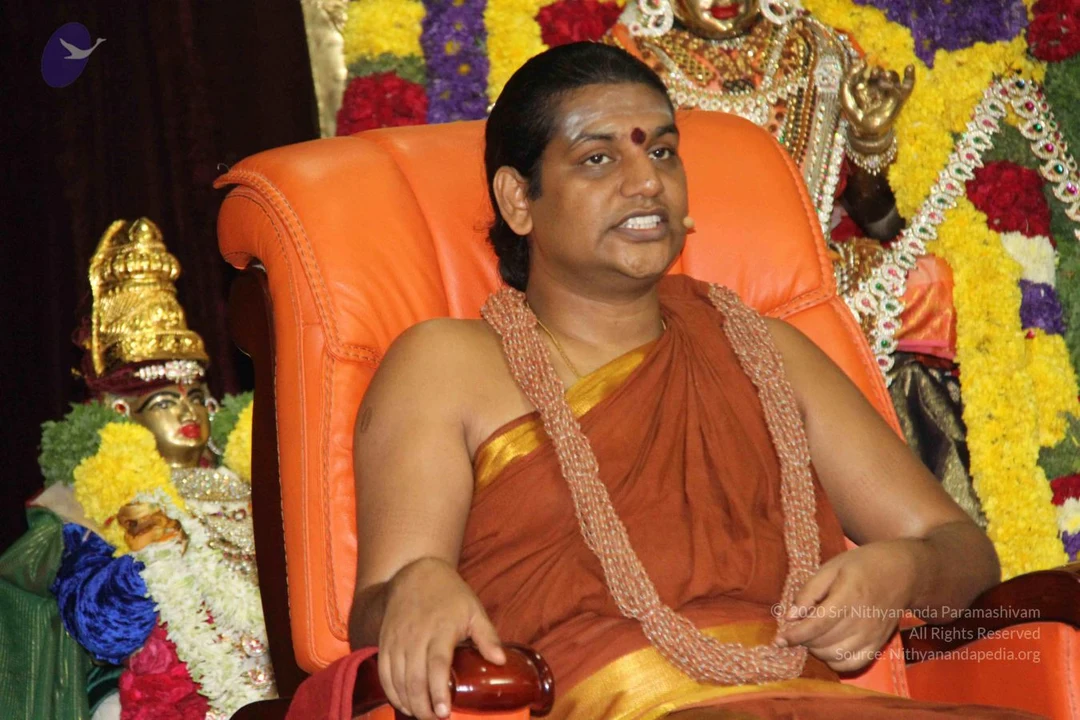
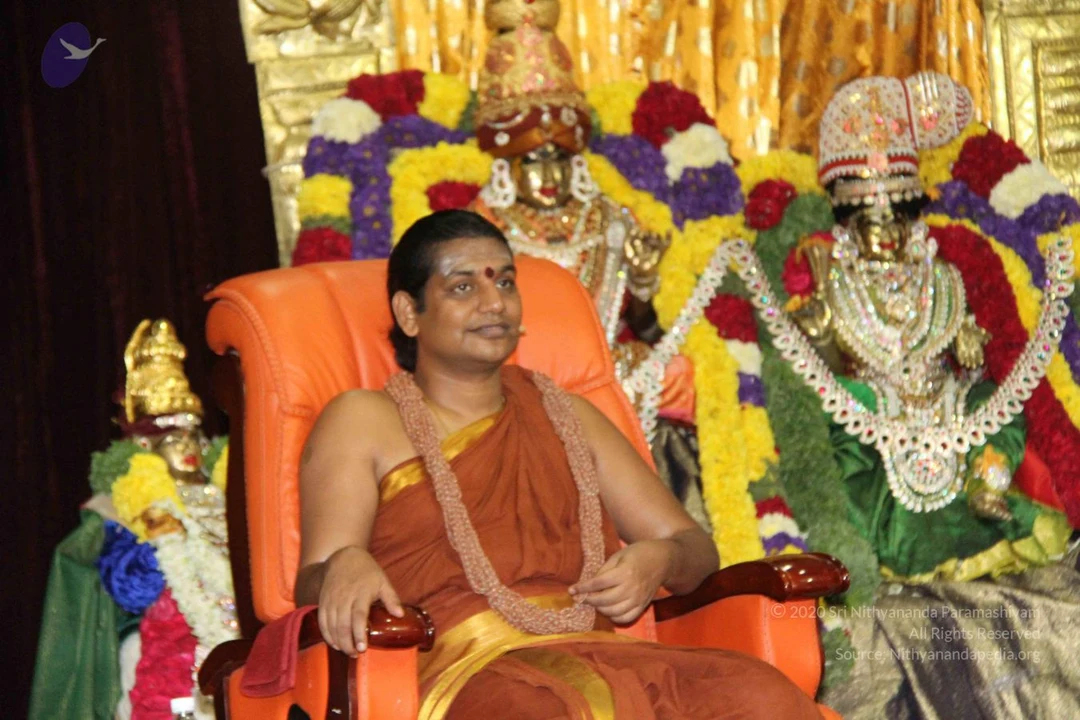
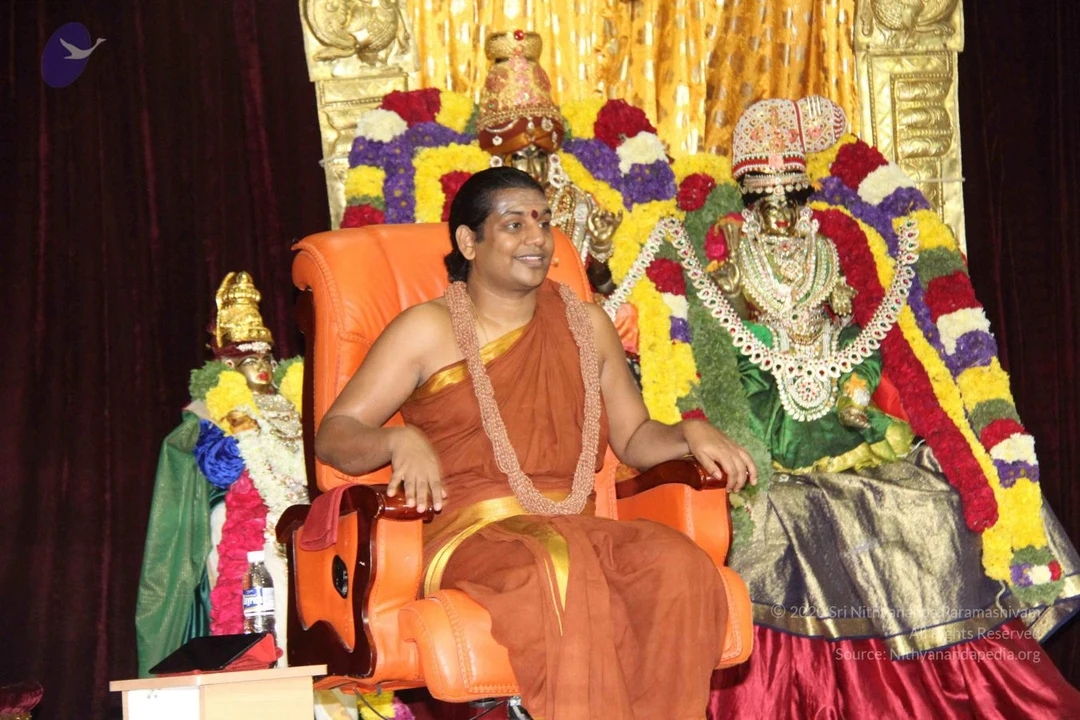
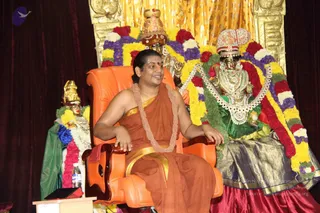
A man in saffron-orange robes sits in an orange leather armchair on a stage, smiling and gesturing with his hands. He wears a rudraksha mala and a gold-edged saffron shawl, with a red bindi on his forehead. Behind him stand two deity murti, one with a crown and a green silk garment, both garlanded with yellow, red, purple and white flowers and ornate jewelled necklaces. Gold and red draping forms the backdrop, and a small wooden lectern and water bottle sit at the lower left.A seated man in a yellow and black tiger-striped garment and a rudraksha mala with a rudraksha belt blesses a standing man in a white shirt by placing his right hand on the man's forehead. The seated man has long hair tied back and a white forehead mark. Behind them, a deity murti is draped in garlands of yellow, purple, red and white flowers, with a green cloth and gold ornaments. Two people are partially visible in the background. a person in the seated role of giver of blessing, with long swept-back hair, a rudraksha mala and rudraksha belt. The standing devotee wears a white shirt and a visible identity badge.A photograph of a seated man with long dark hair, a white tilak and red bindi, wearing a tiger-striped yellow and black shawl and multiple rudraksha malas with beads. He smiles broadly while reaching out to touch the forehead of an older white-haired man in a white shirt with an orange lanyard. Behind them stands a golden ornate palanquin-style seat and a deity murti draped in garlands of yellow and red flowers. A third man in a white dhoti and rudraksha mala is partly visible at the right edge.A photograph of two men standing close together in a temple-like hall with flower garlands and gold-trimmed decor behind them. The man on the left wears an orange and black tiger-striped garment and a dark rudraksha mala with beads, and reaches up to touch the head of the man on the right, who wears a white kurta, a red shawl over his shoulders and gold bangles, and holds his palms open toward the other man. Behind them stand floral garlands in purple, yellow and red, and a ceremonial golden umbrella-like pole frame on the left.Photograph of two men facing each other in close conversation before a richly decorated deity murti hung with marigold and red flower garlands and gold ornaments. The man on the left has long dark hair swept back, a white tripundra mark on his forehead, and wears a single-shoulder yellow and black tiger-striped garment with layered rudraksha and white bead malas. His arm is extended toward the other man. The man on the right has short grey hair and wears a white shirt with an orange shawl and a red-brown beaded bracelet, with his hand raised in a gesture toward the first man's face. Swamiji (probable) on the left, given his long swept-back hair, tripundra, tiger-striped garment and rudraksha malas. Behind them stands a white air conditioning unit and purple curtain.A photo of two men in close indoor contact. On the left, a bare-shouldered man in a tiger-striped yellow-and-black garment with a rudraksha-bead belt has long swept-back hair and a white tripundra on his forehead; he is placing his right hand on the crown of the head of a man on the right, who has his eyes closed, short dark hair, a white shirt and an orange lanyard. The man on the right holds his hand up in a respectful gesture. Behind them stands a deity murti decorated with yellow, orange, red and purple flower garlands and gold jewellery. Other people partly visible at the right edge.

Sacred-Arts

174 photosSource gallery
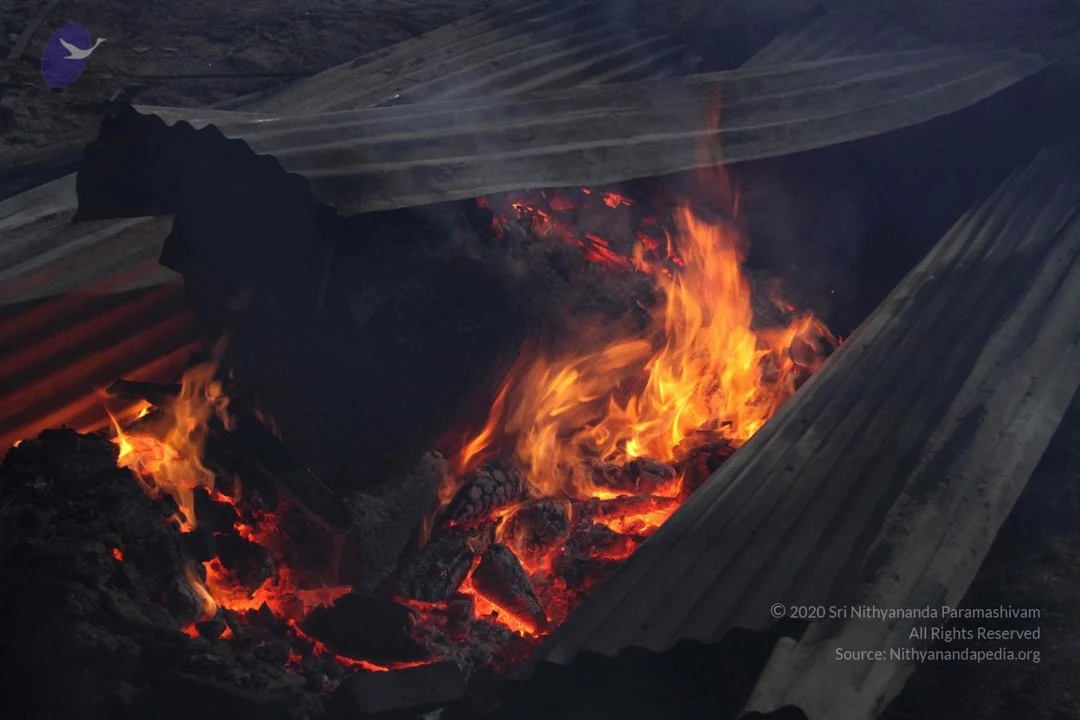
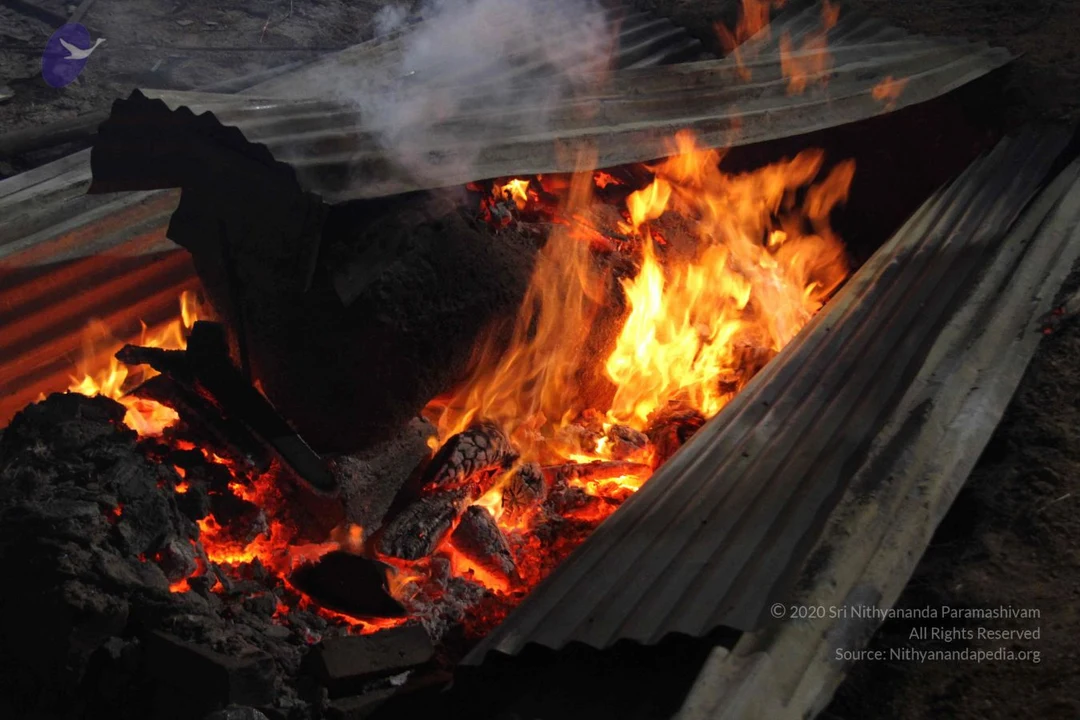
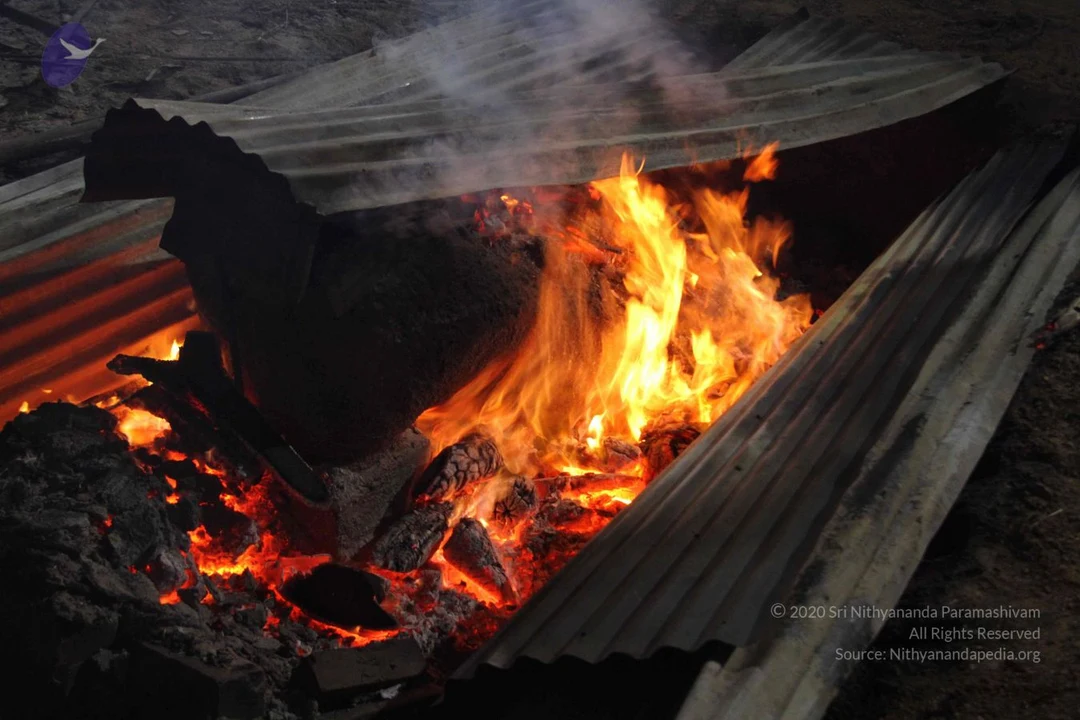
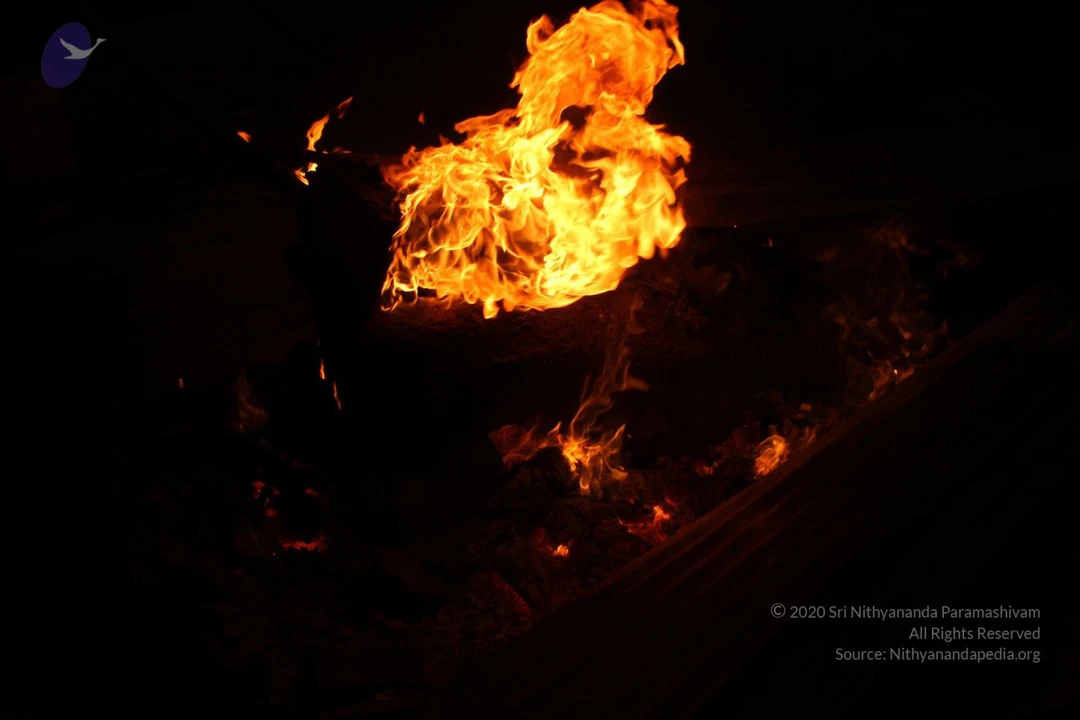
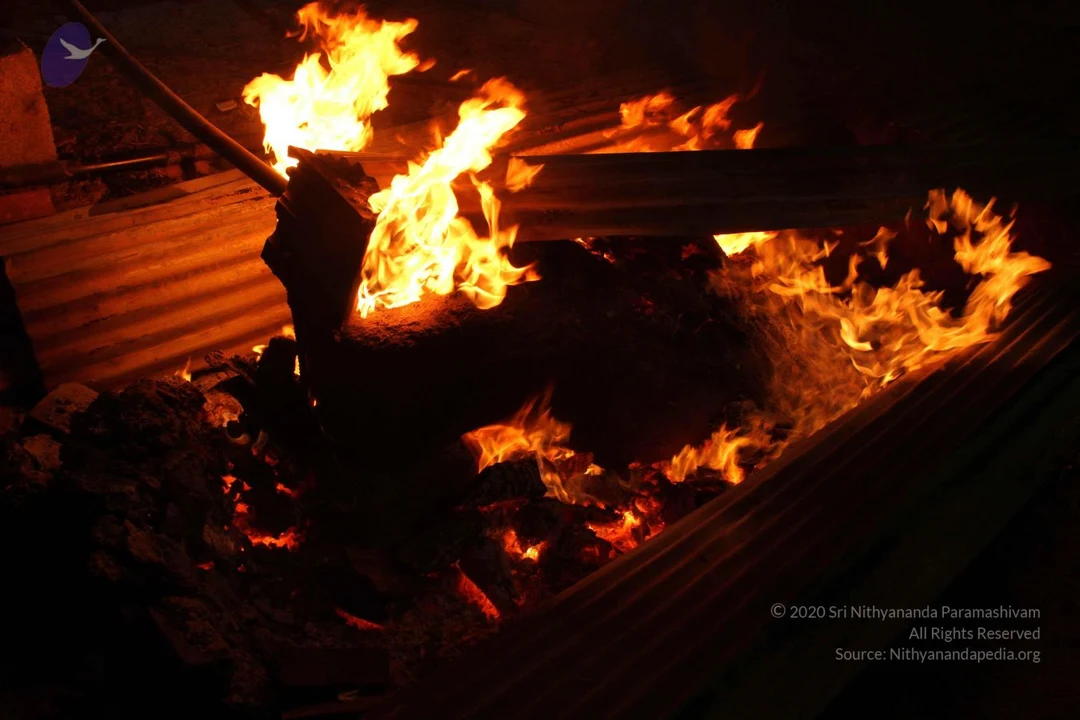
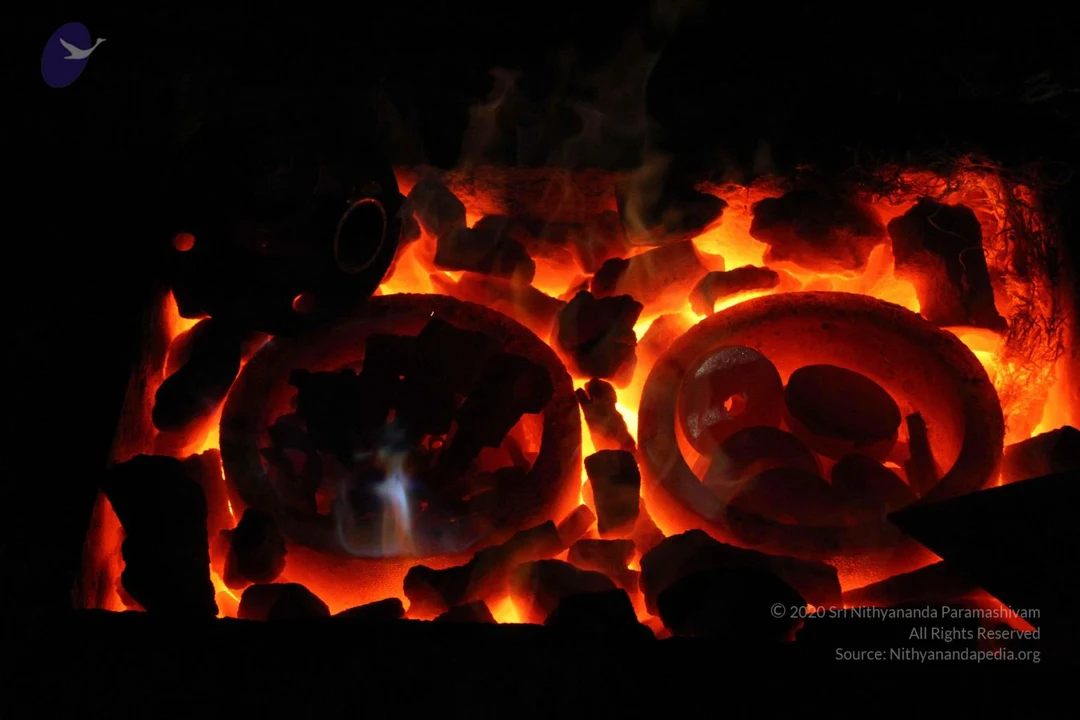
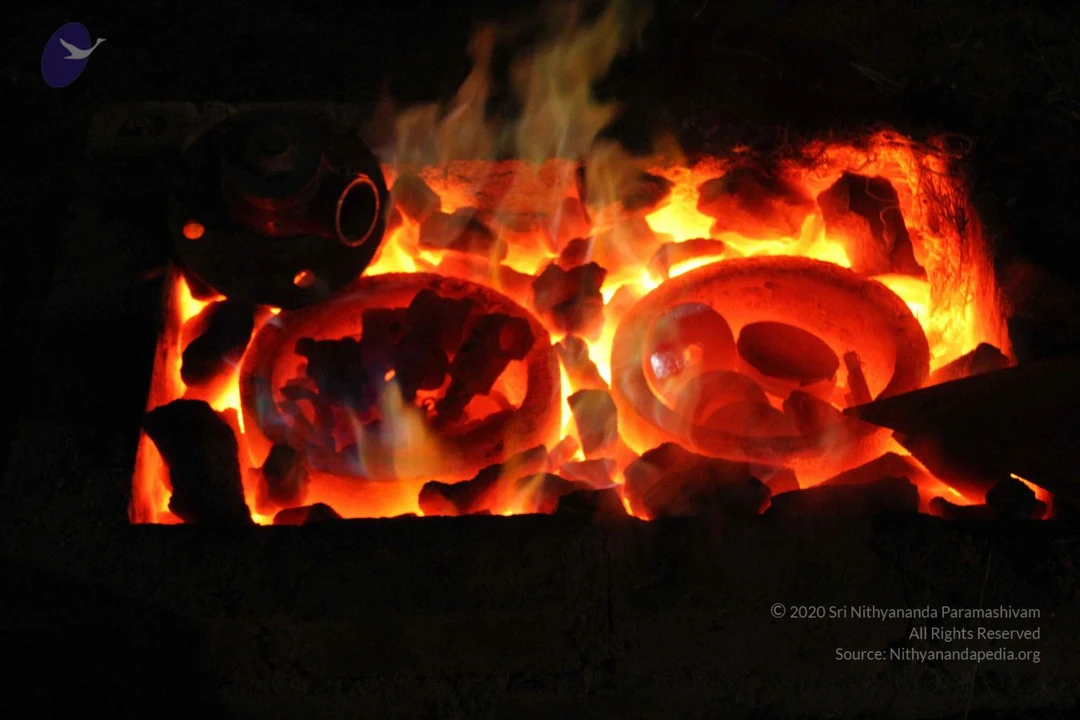
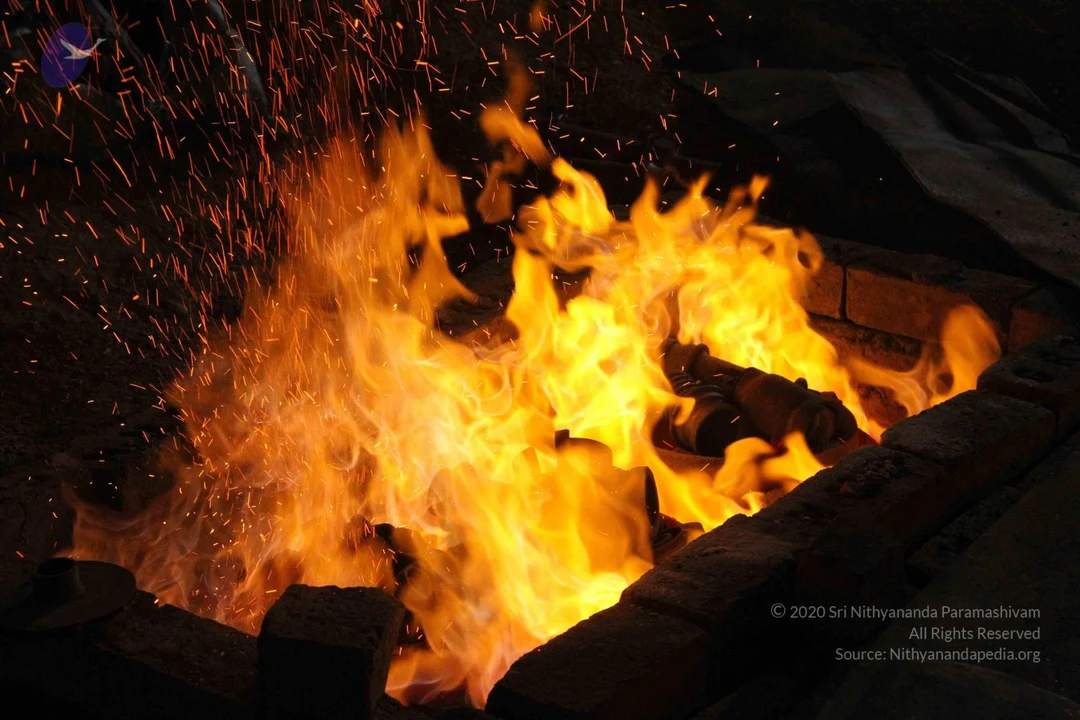
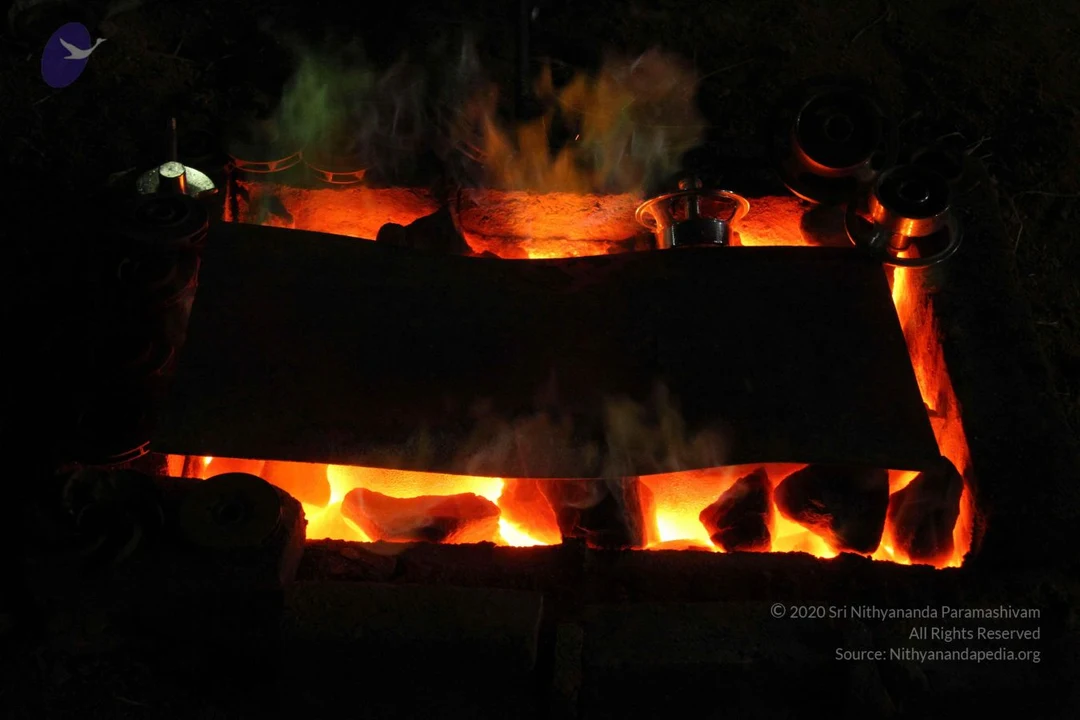
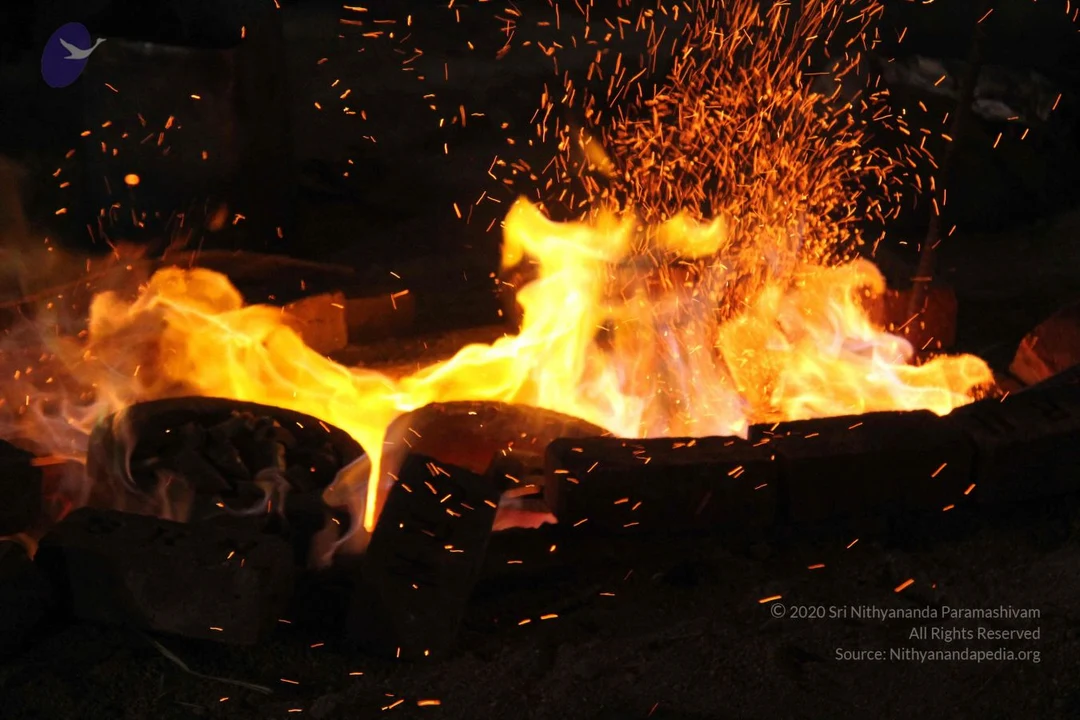
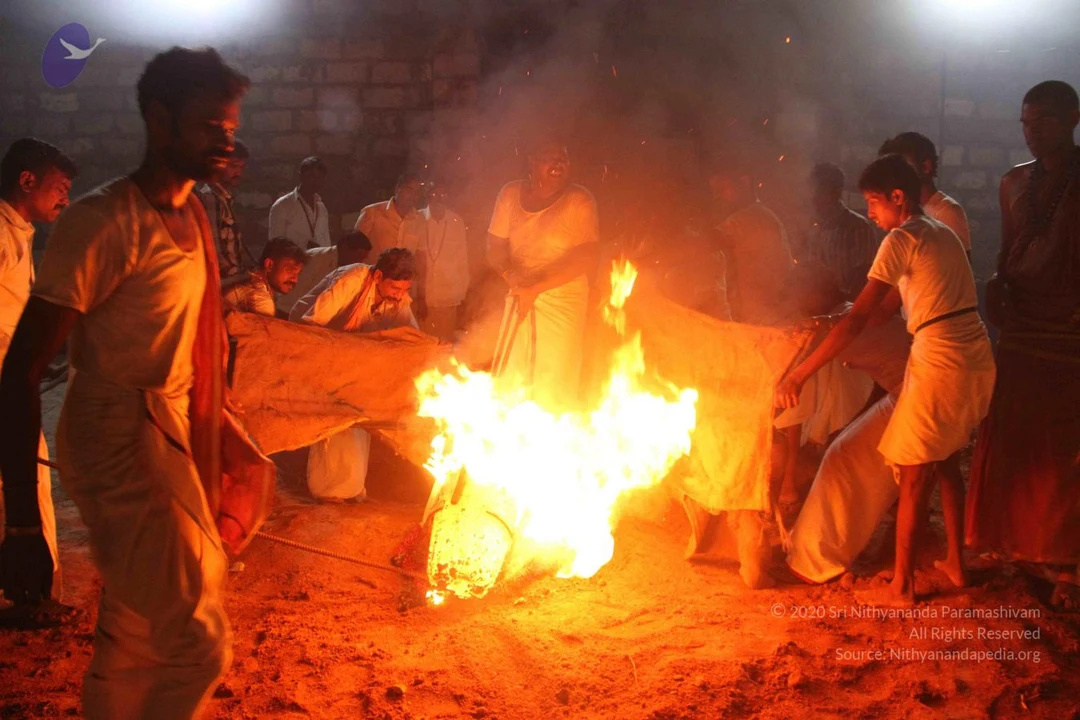
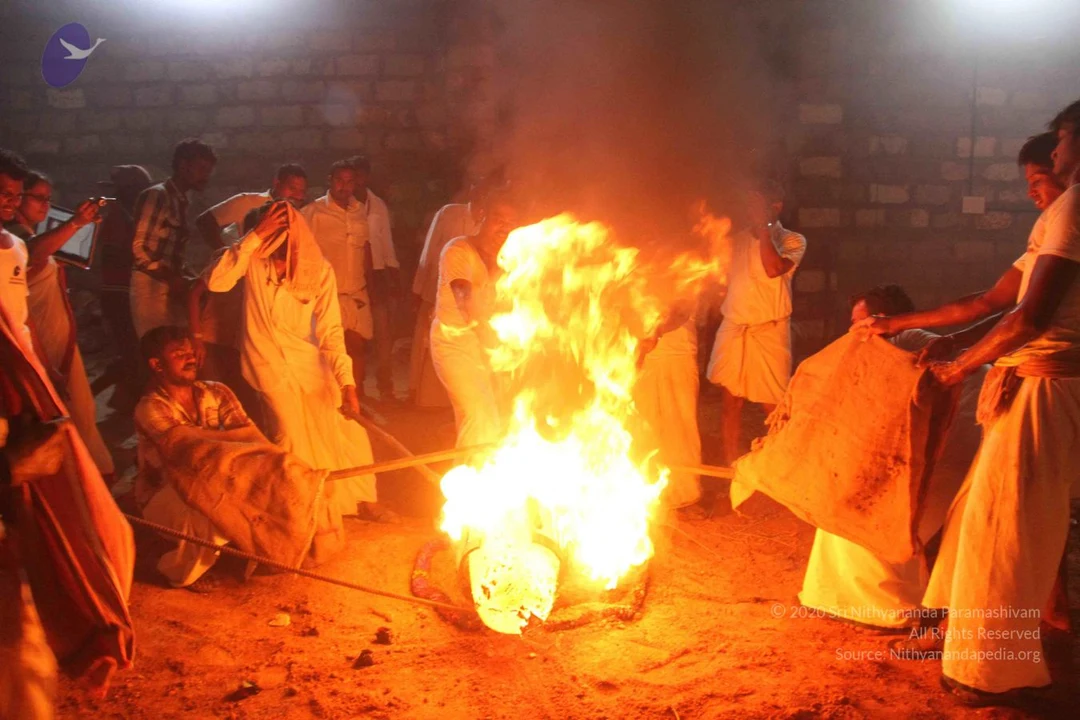
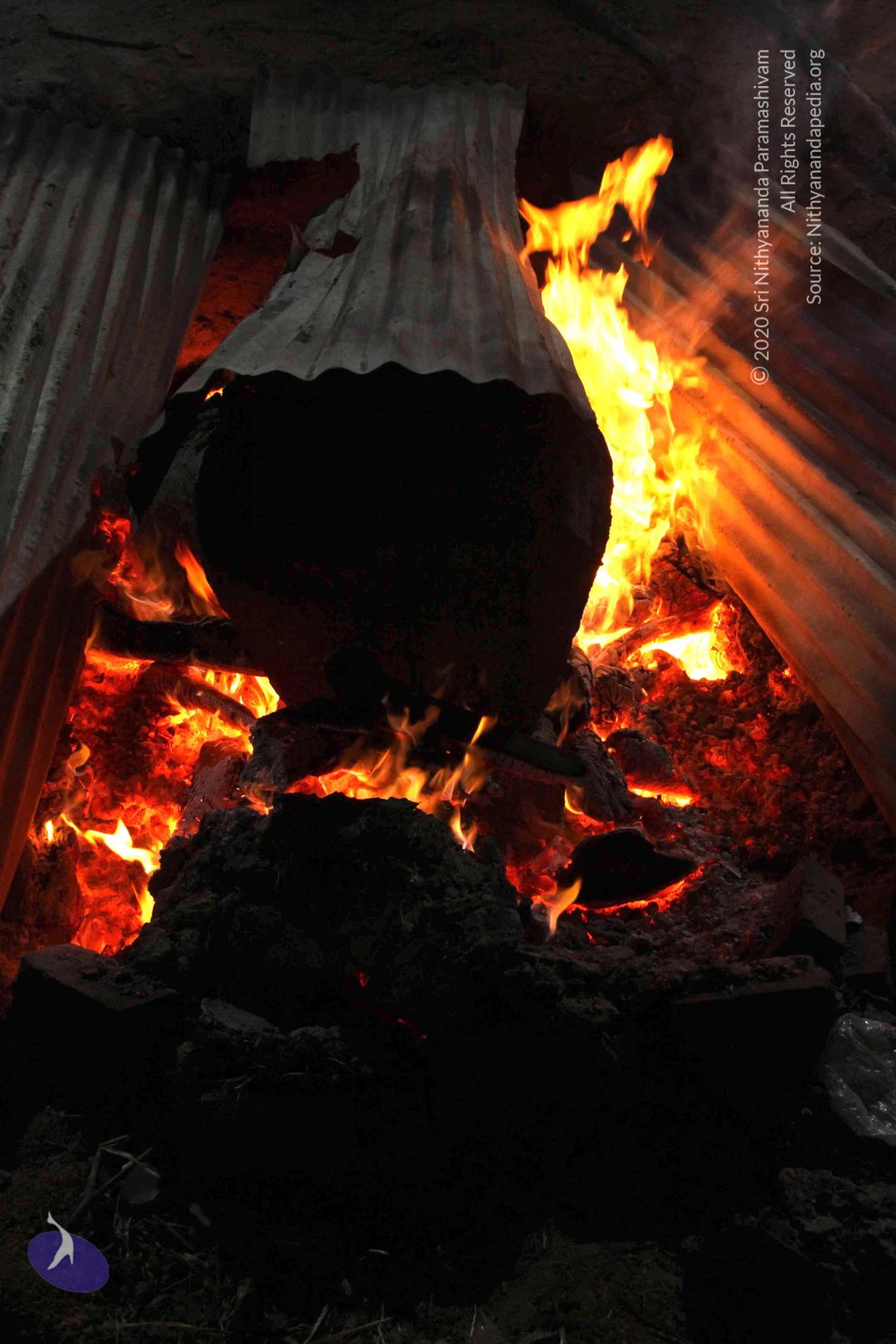
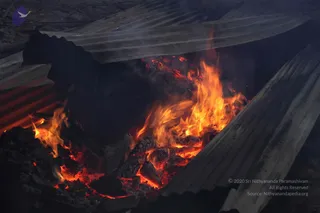
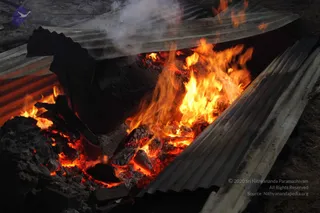
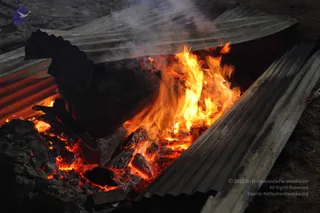
Indoor photograph in a plain brick-walled room with a small table draped in red cloth holding a brass bowl and offerings at left. A man with a shaved head and white vibhuti marks wears an orange-brown robe, a gold-and-beaded garland and a waist sash, standing with hands folded near the centre. To the left, a smiling person with long hair, a red bindi and tilak wears an orange-brown robe, a red-and-gold flower garland and a patterned belt, with arms outstretched. Beside them, an older man in white dhoti and shirt with a rudraksha mala stands watching. At right, a woman in an orange and teal sari bows forward while a man in white with a white tilak stands nearby. Several other people in white clothing appear in the background.A photograph inside a plain hall with breeze-block walls and fluorescent ceiling lights. In the centre, a man in a rust-orange robe and gold-trimmed orange waistcloth wears a long pink and yellow flower garland and carries red flowers in his hand. He has swept-back hair and a tilak on his forehead, and walks forward. Beside him, a younger man in an orange robe wears a rudraksha mala and a gold-bordered shawl. Behind them, several men in white dhotis and shirts follow, and a boy in a striped shirt stands at left near metal stanchions. Scattered dried leaves and a metal container lie on the floor at the bottom of the frame.A photograph of an outdoor earthen cooking or fire setup on bare ground. Bright orange flames burn in a dark clay pot or vessel, surrounded by ash and glowing embers. Corrugated metal sheets, tilted and angled, shield the fire on several sides. Red brick blocks form the base and a small clay container sits at the fire's edge. Scattered sticks and debris lie on the dirt. No people are visible in the frame.A photograph of a fire burning at night beneath overlapping corrugated metal sheets that form a slanted roof-like cover. Bright orange flames rise from glowing embers and charred logs on the ground, with dark smoke drifting upward. No people or deity forms are visible in the scene.A photograph of a fire pit at night with bright orange flames rising from burning logs and glowing embers. Corrugated metal sheets form walls around the fire, with smoke rising above. A dark cloth or sack lies draped over part of the pit. No people are visible in the frame.A close view of an open fire burning in a pit lined with corrugated metal sheets. Bright orange flames and glowing embers rise among charred logs, with smoke drifting upward. No people are visible; the scene shows a homa fire pit in the open air at night, with dark ground around the metal edges.

Swamiji-footprint-kumkum

3 photosSource gallery
A photograph taken from above of a large round silver-toned metal tray filled with fine bright red powder. The tray rests on a red and orange checked cloth. No people, deities or ritual activity are visible.Overhead view of a round silver-rimmed tray filled with fine bright red powder. No people visible. The powder has a smooth surface with faint cracks and shallow ridges. The tray's scalloped silver edge frames the vivid red mass.A close-up photograph of a bowl filled with fine bright red powder. The powder's surface shows soft ridges and cracks. No people or deity forms are visible.

Kalabhairava-Darshan

7 photosSource gallery
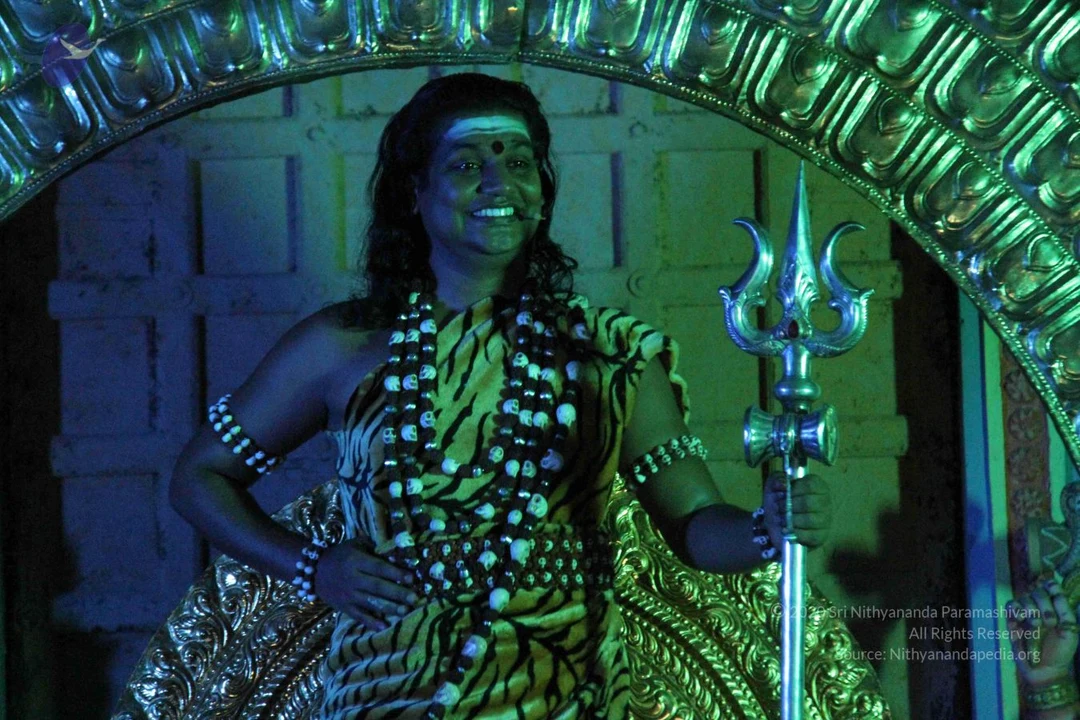
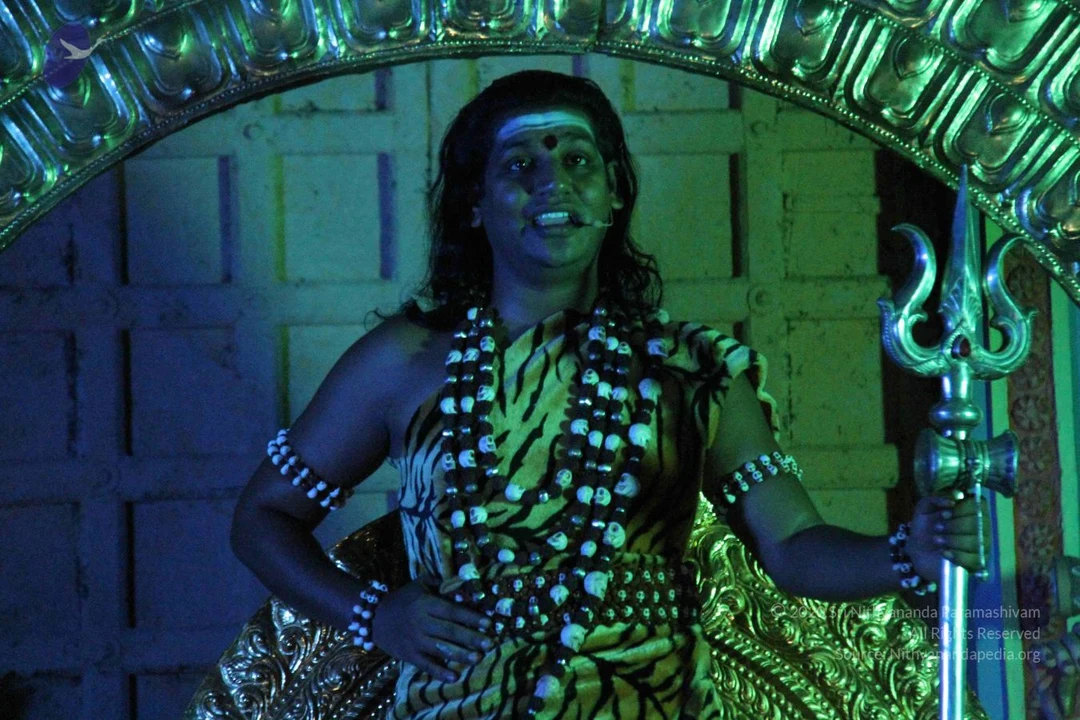
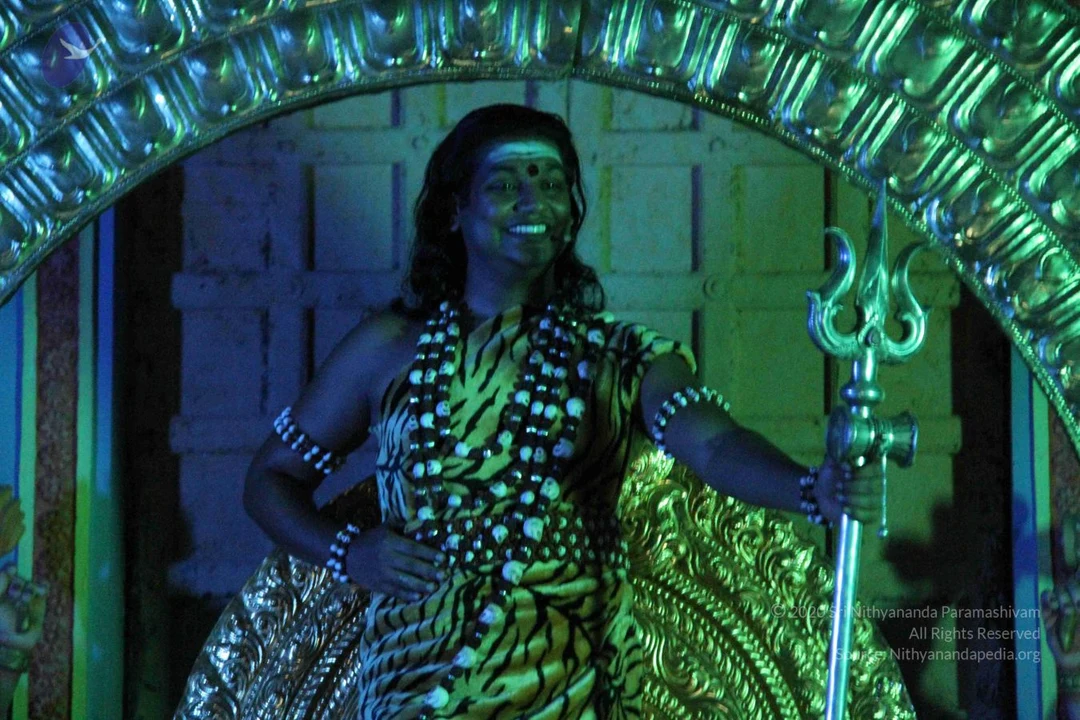
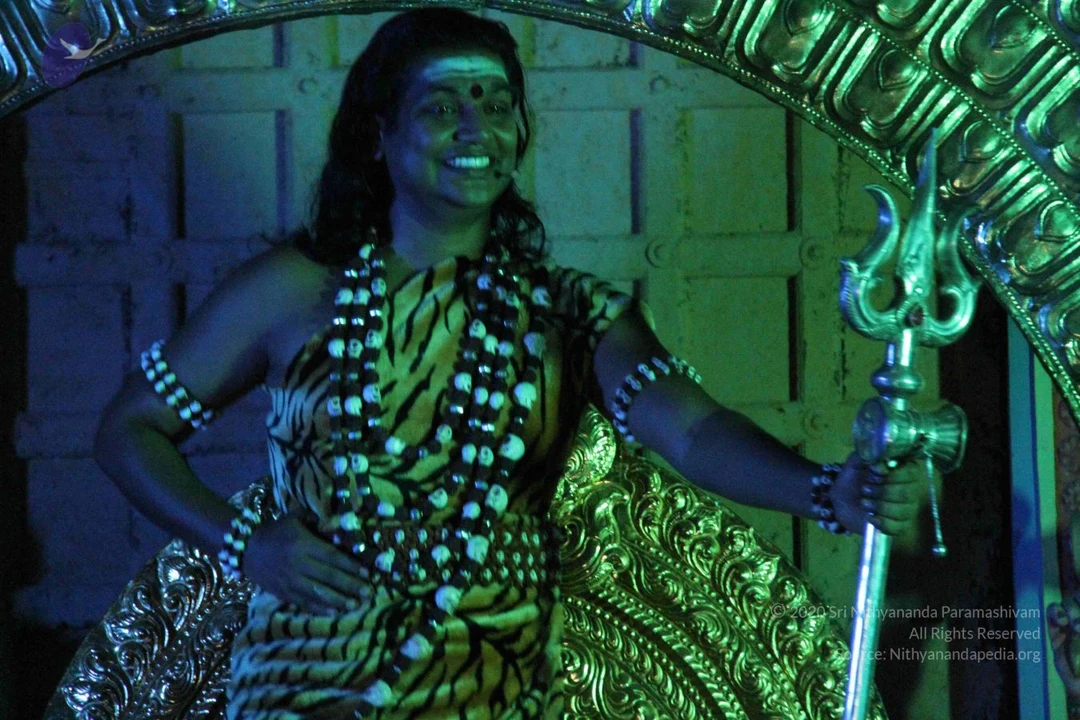
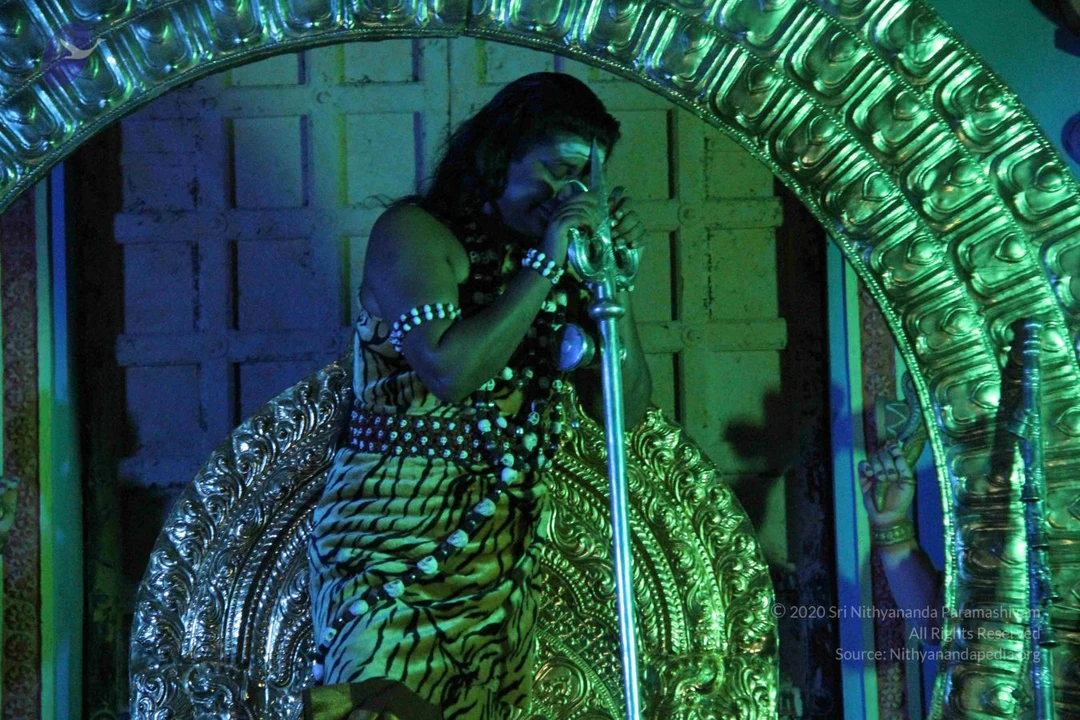
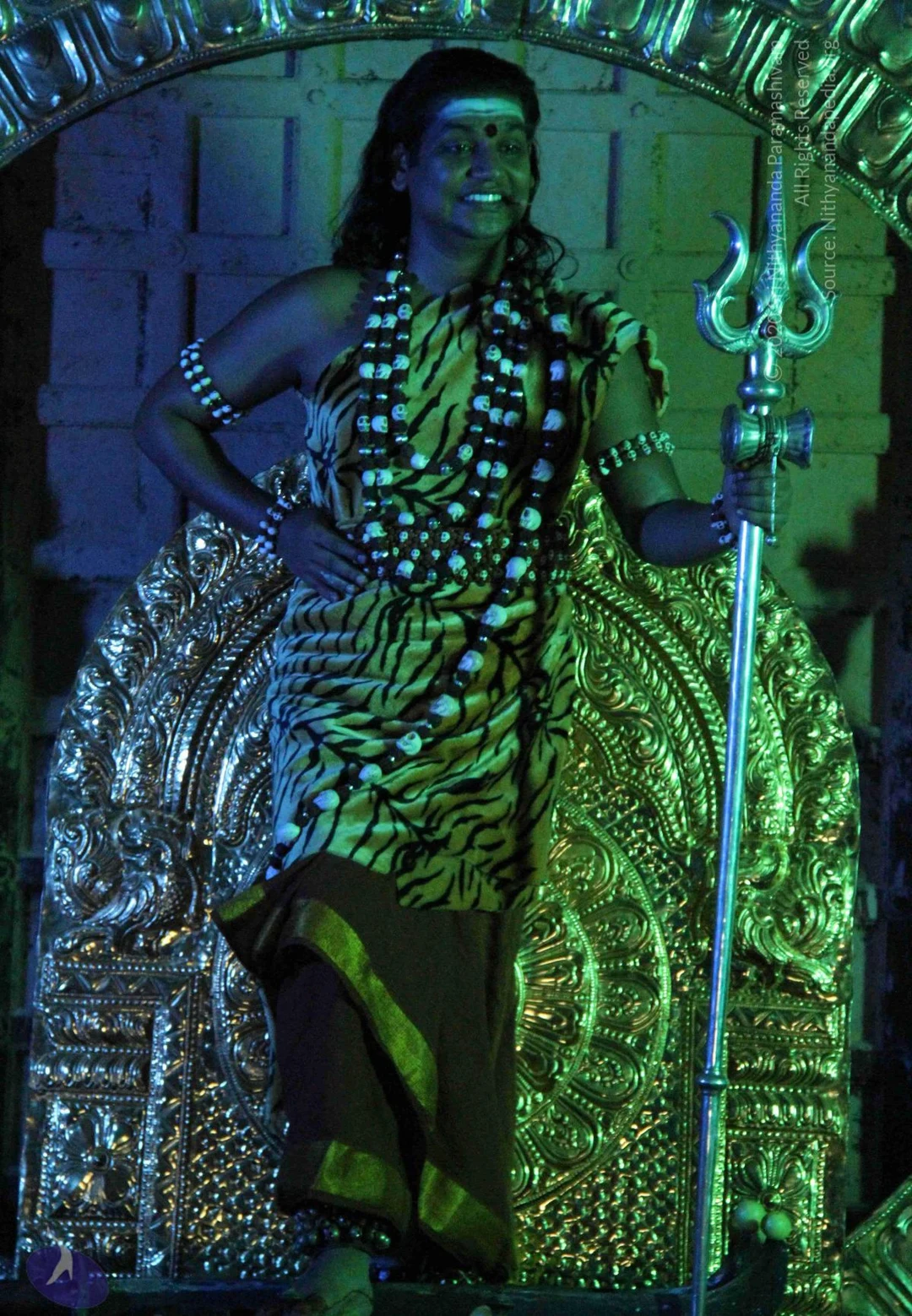
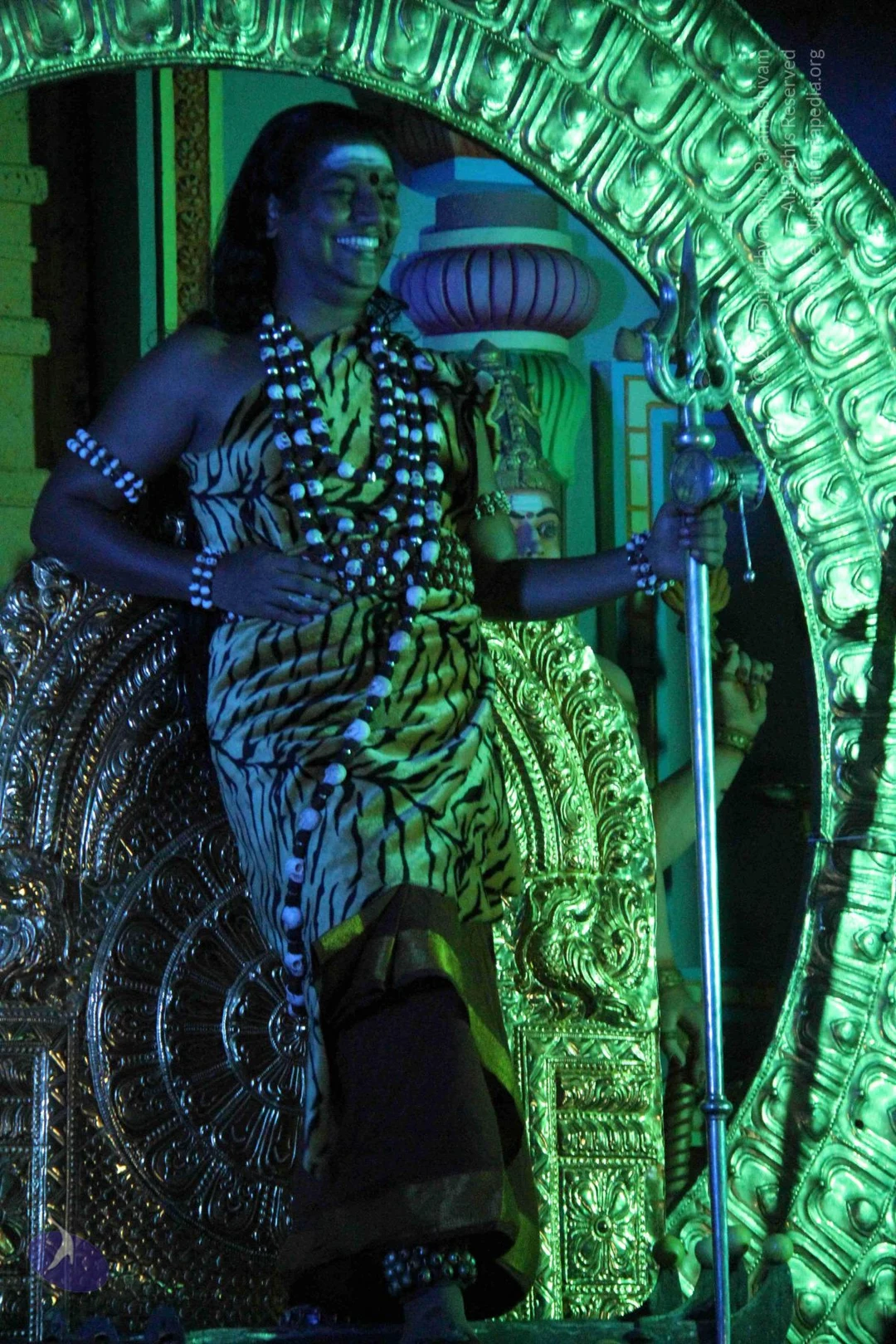
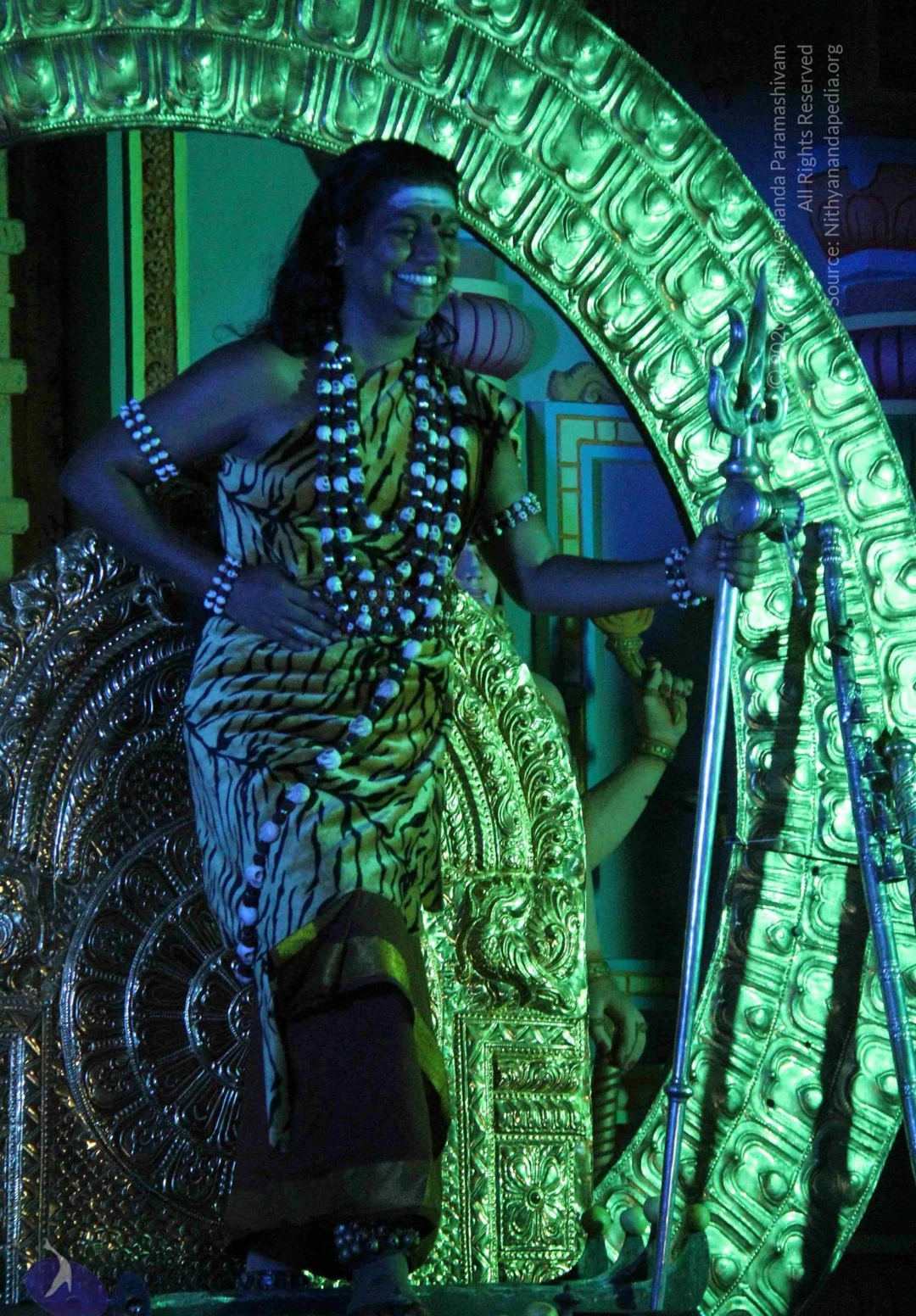
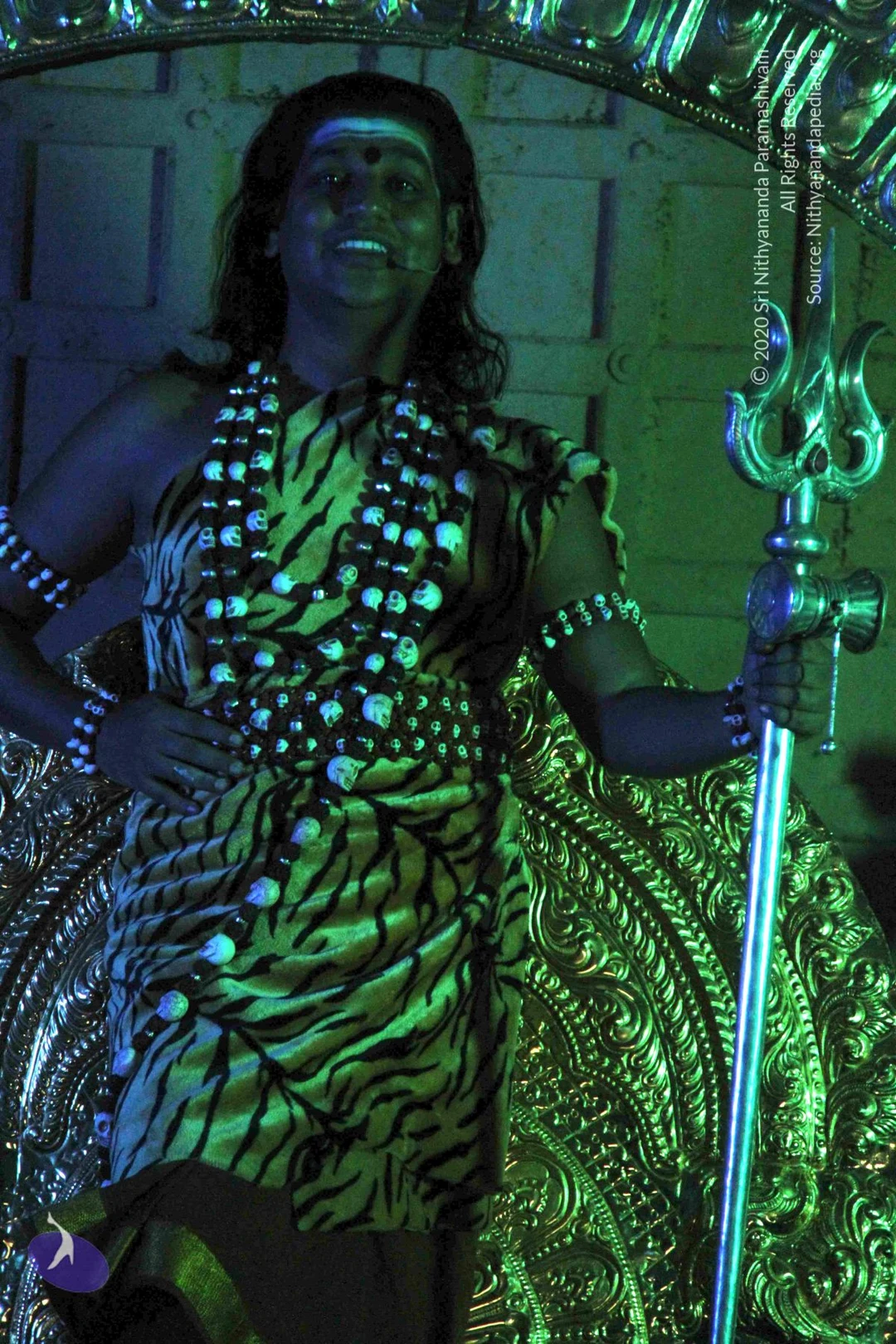
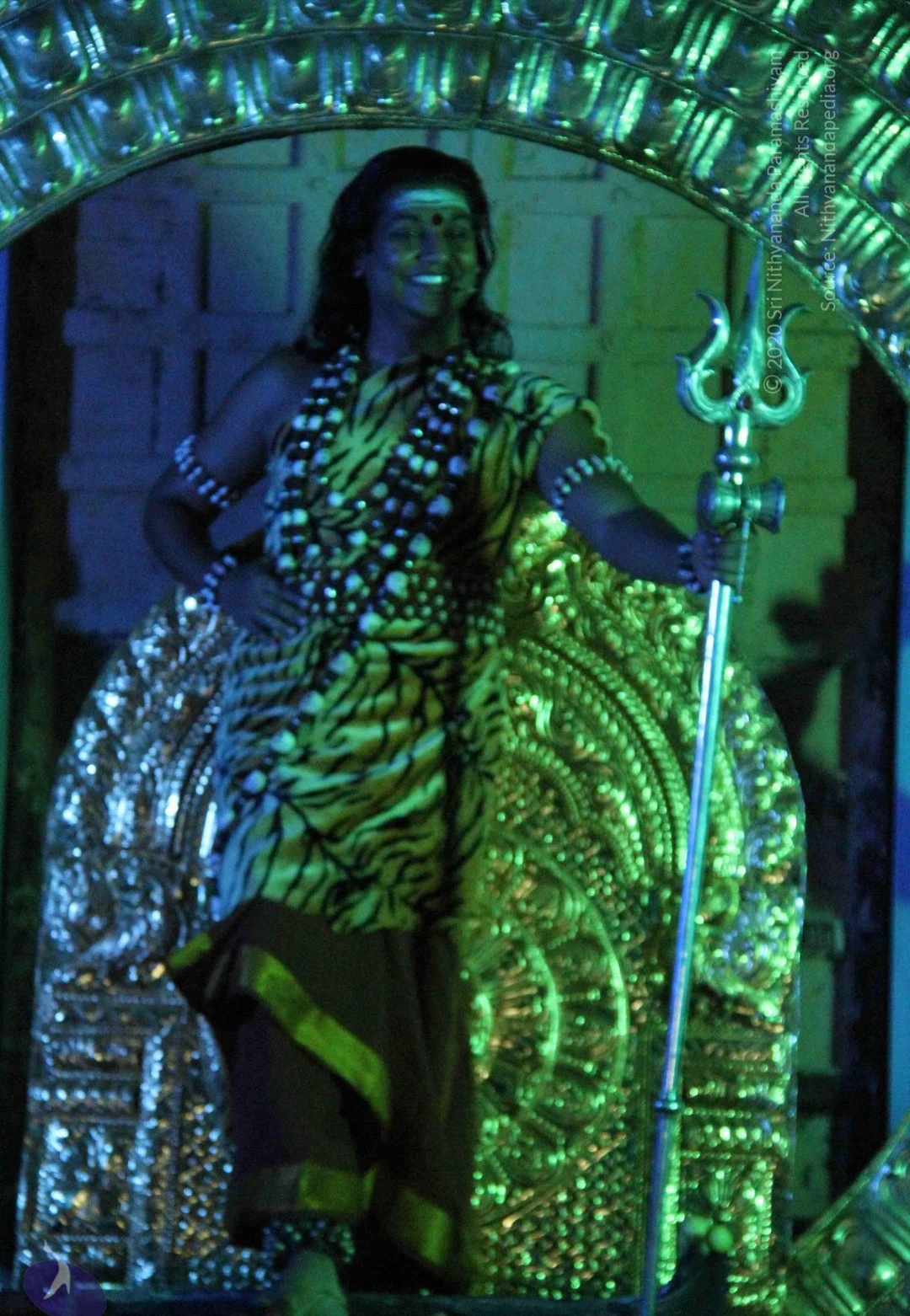
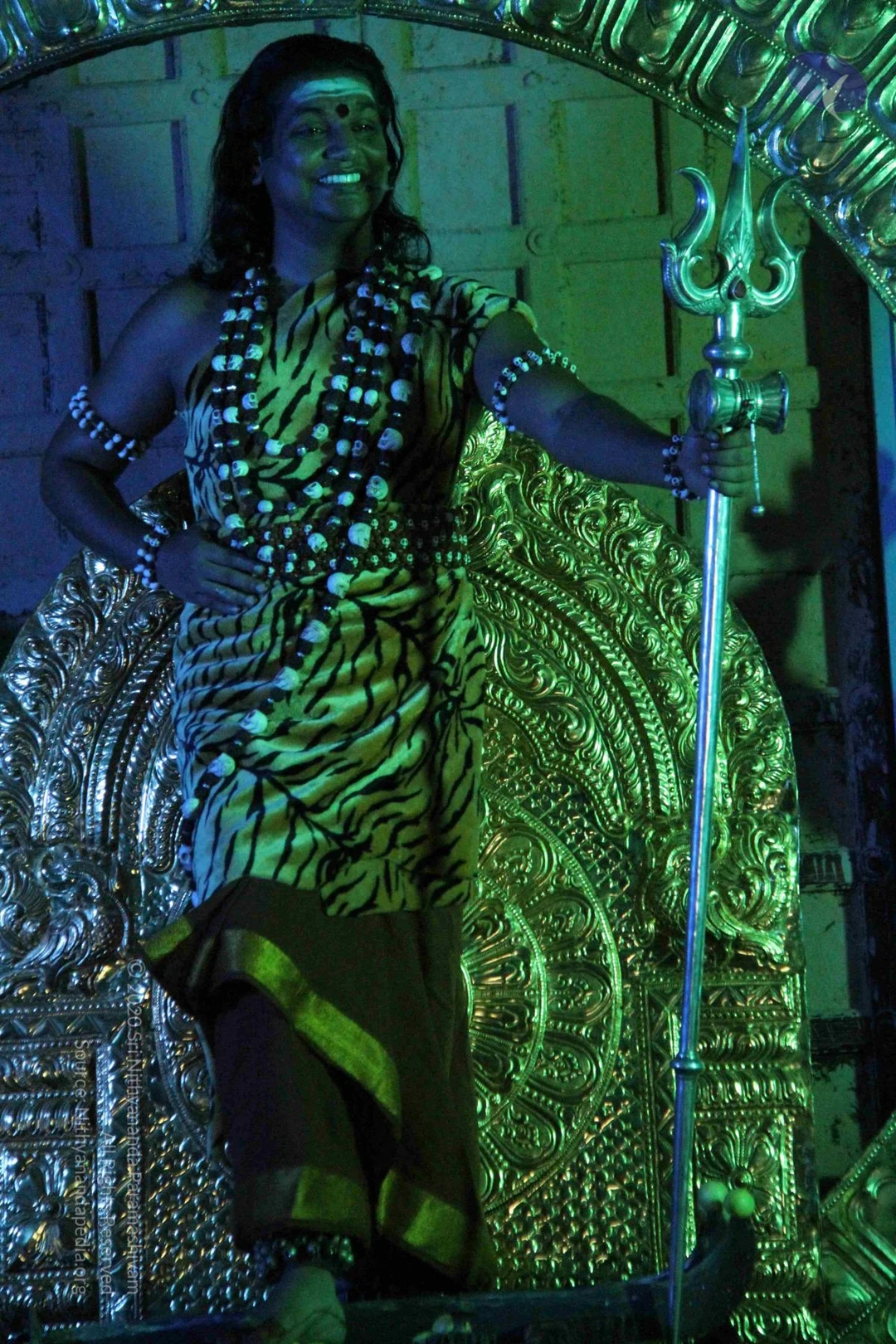
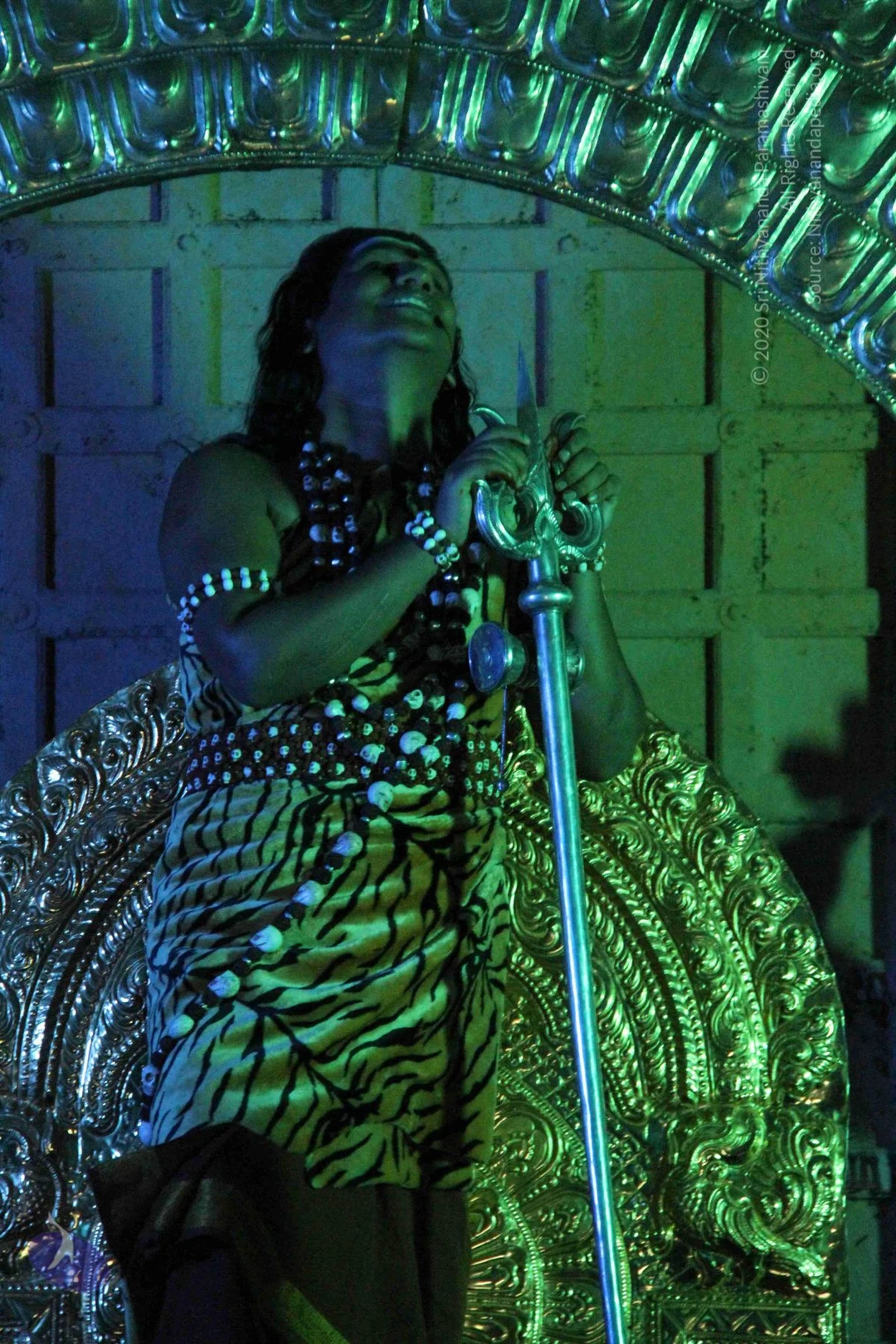
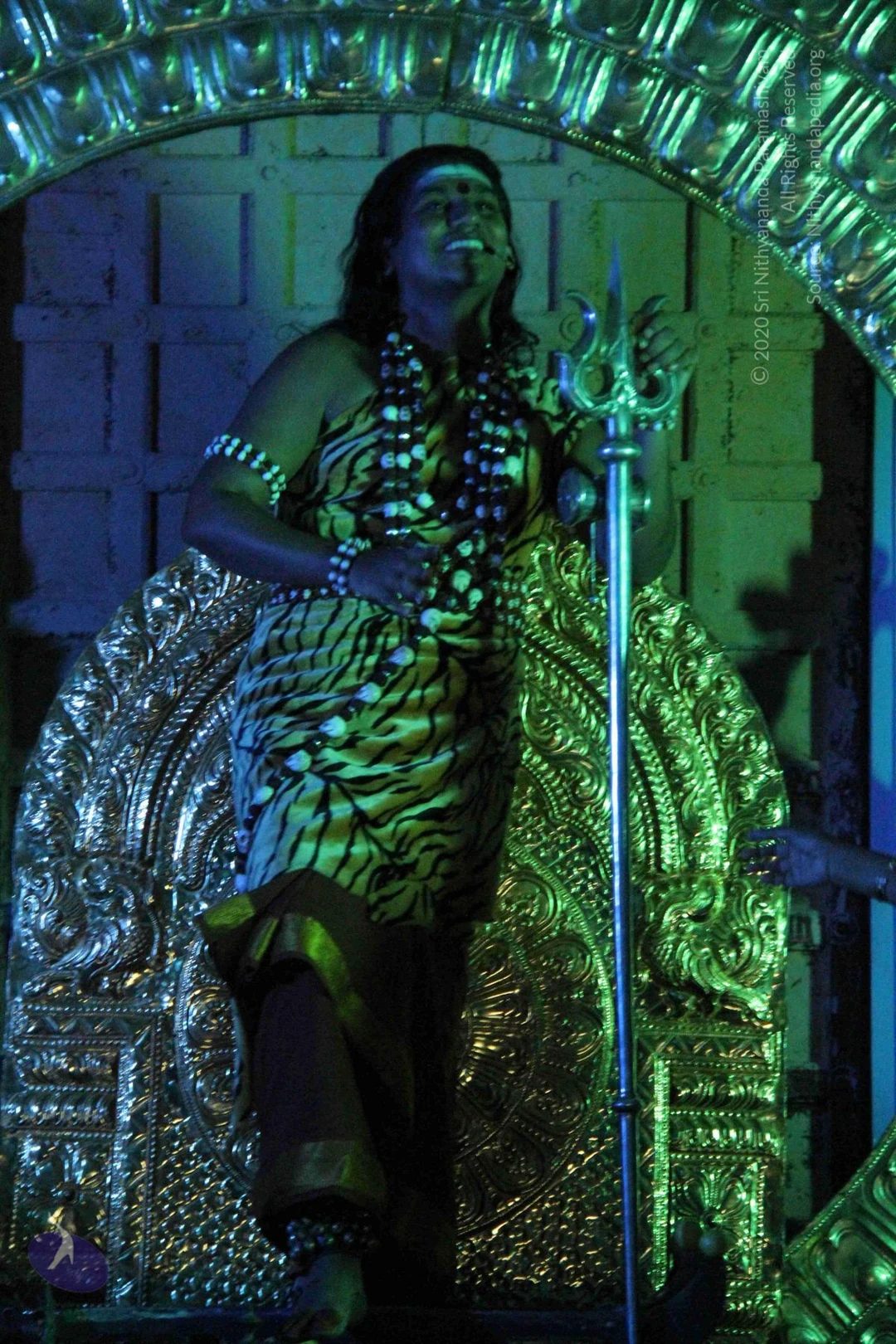
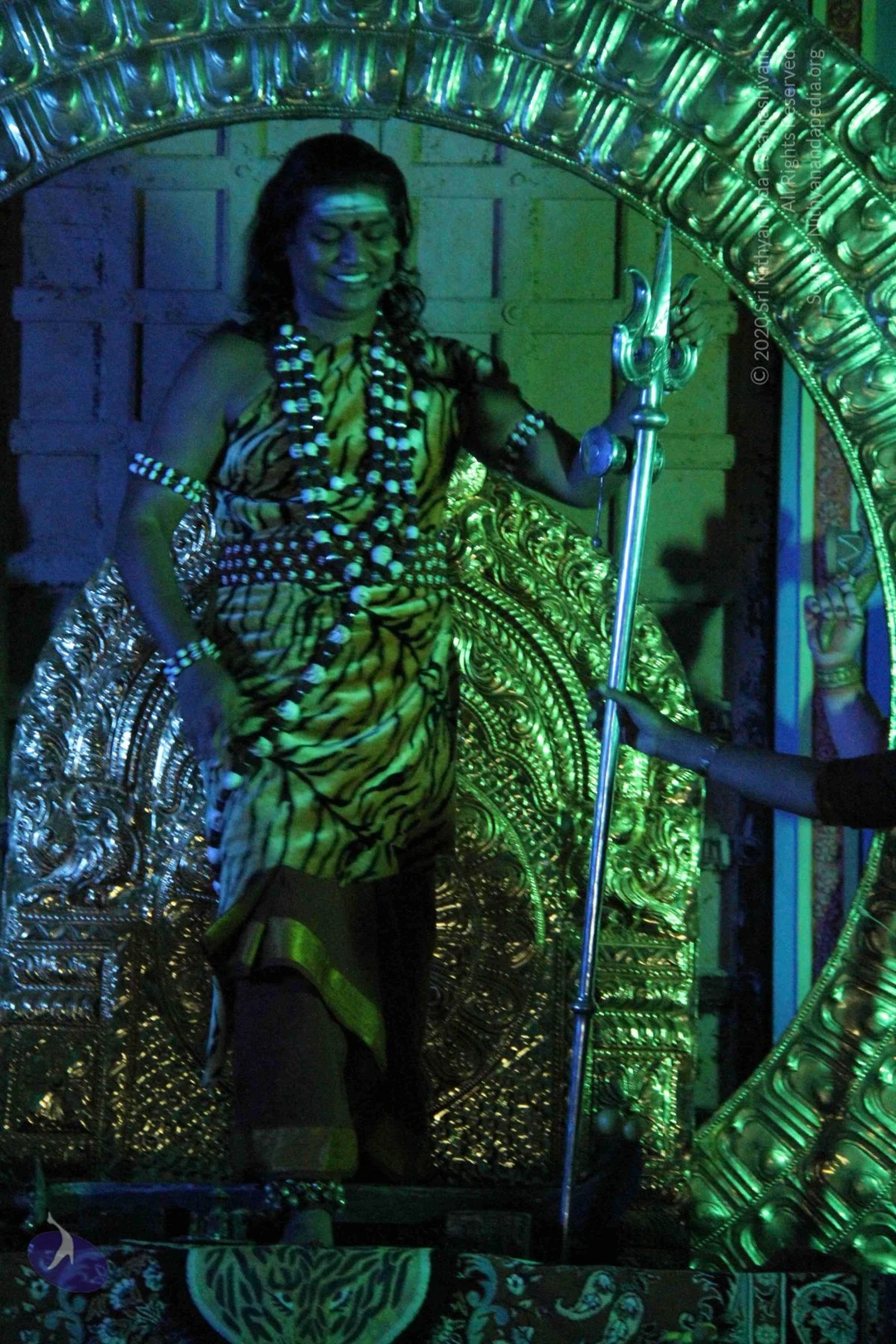
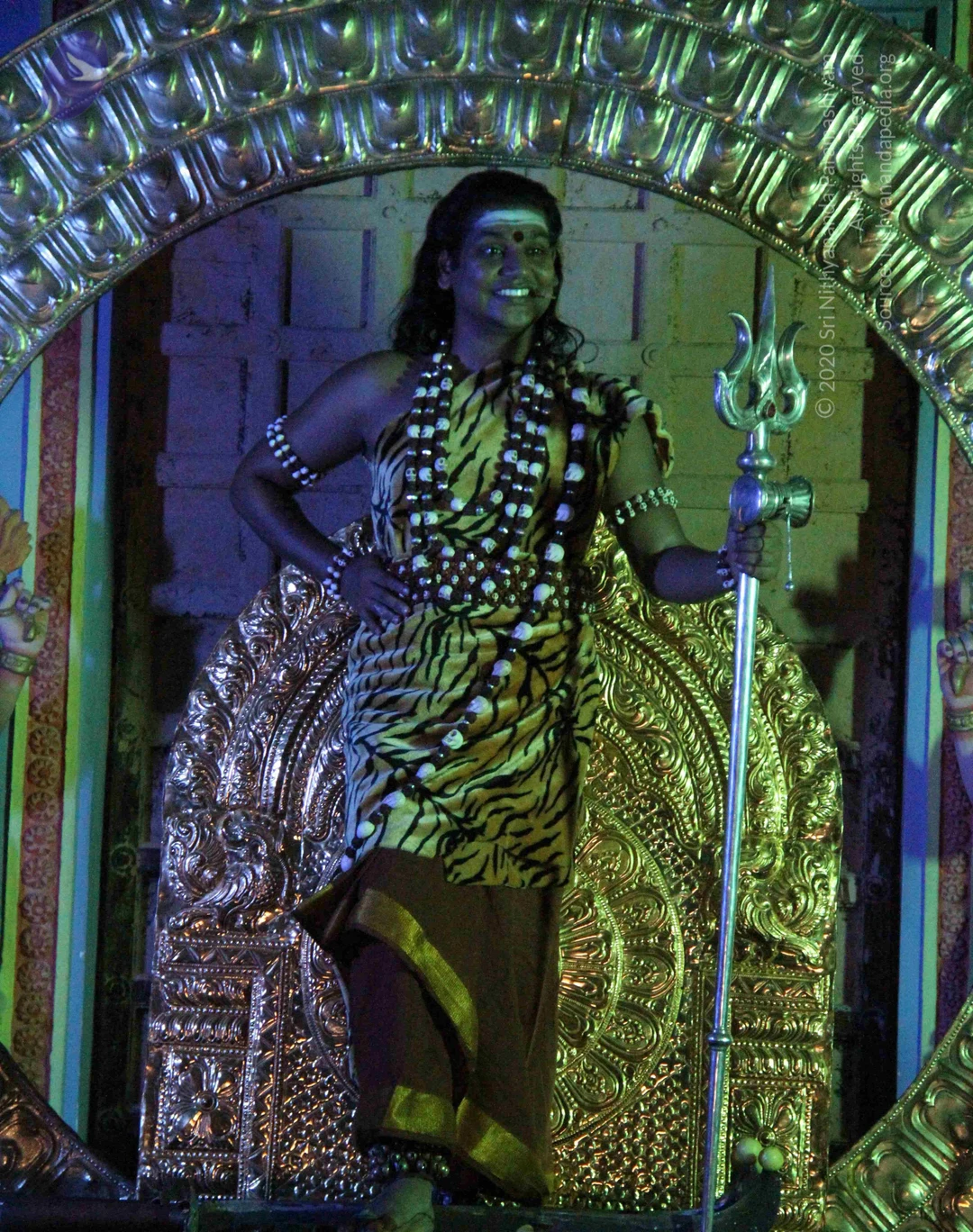
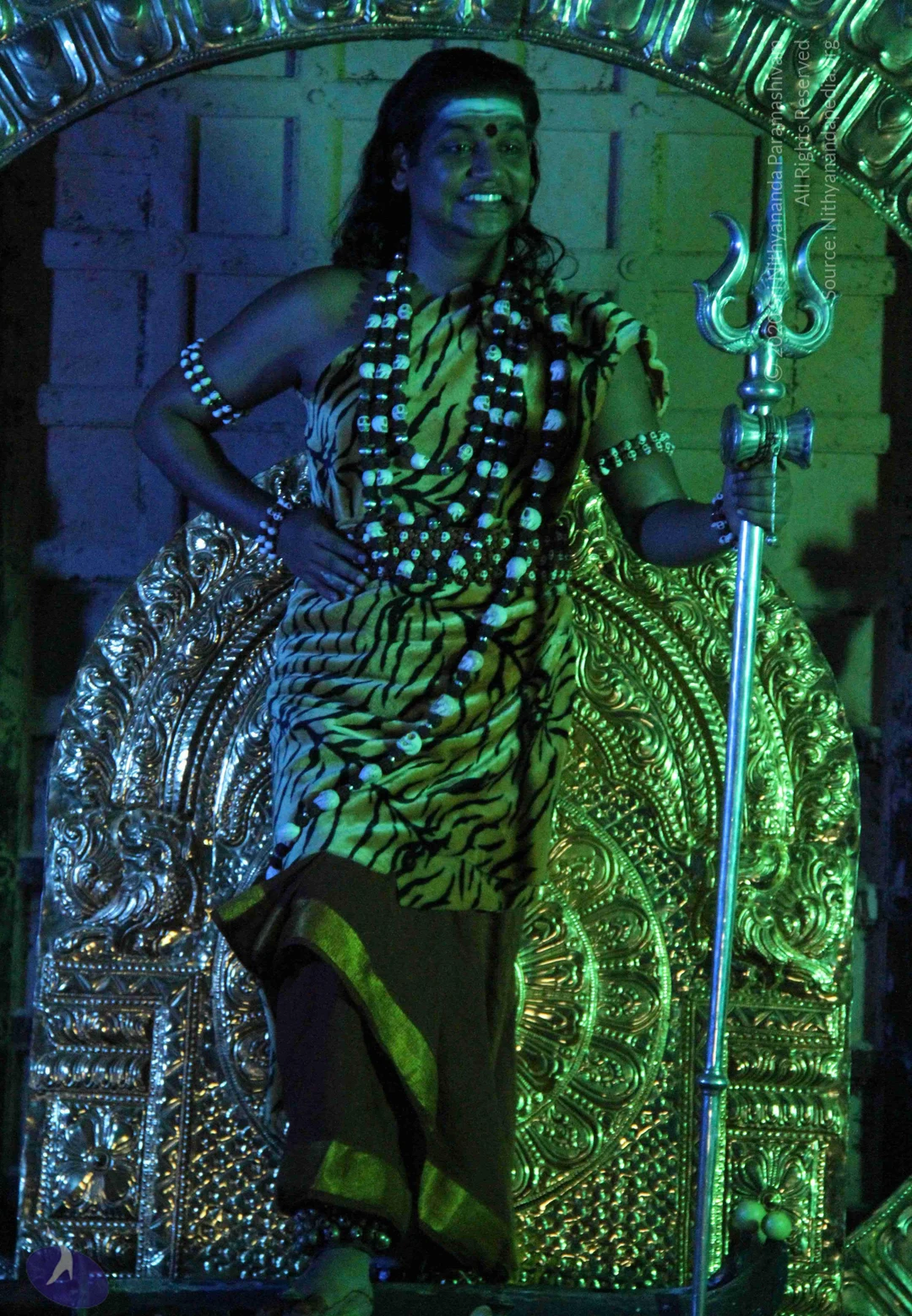
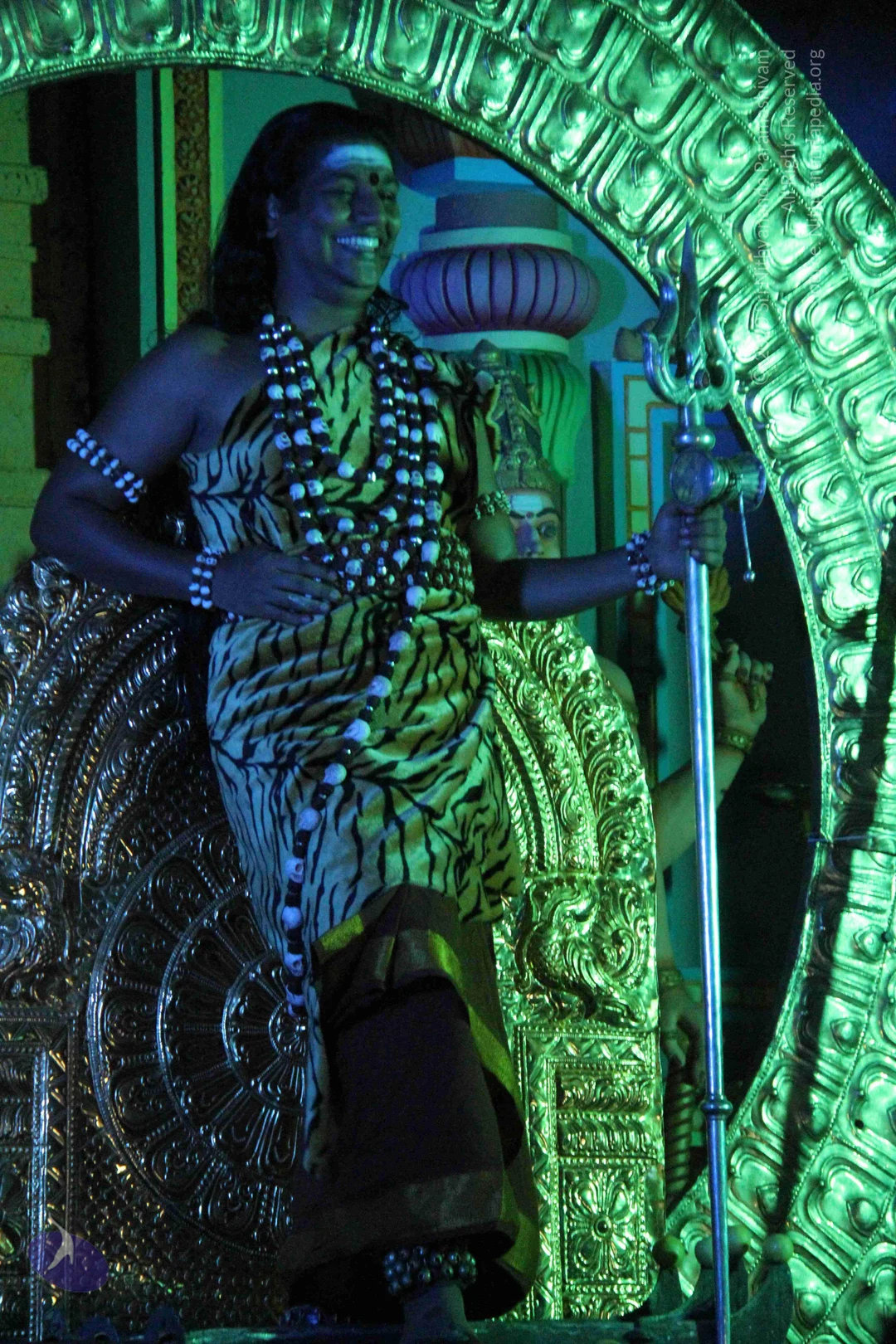
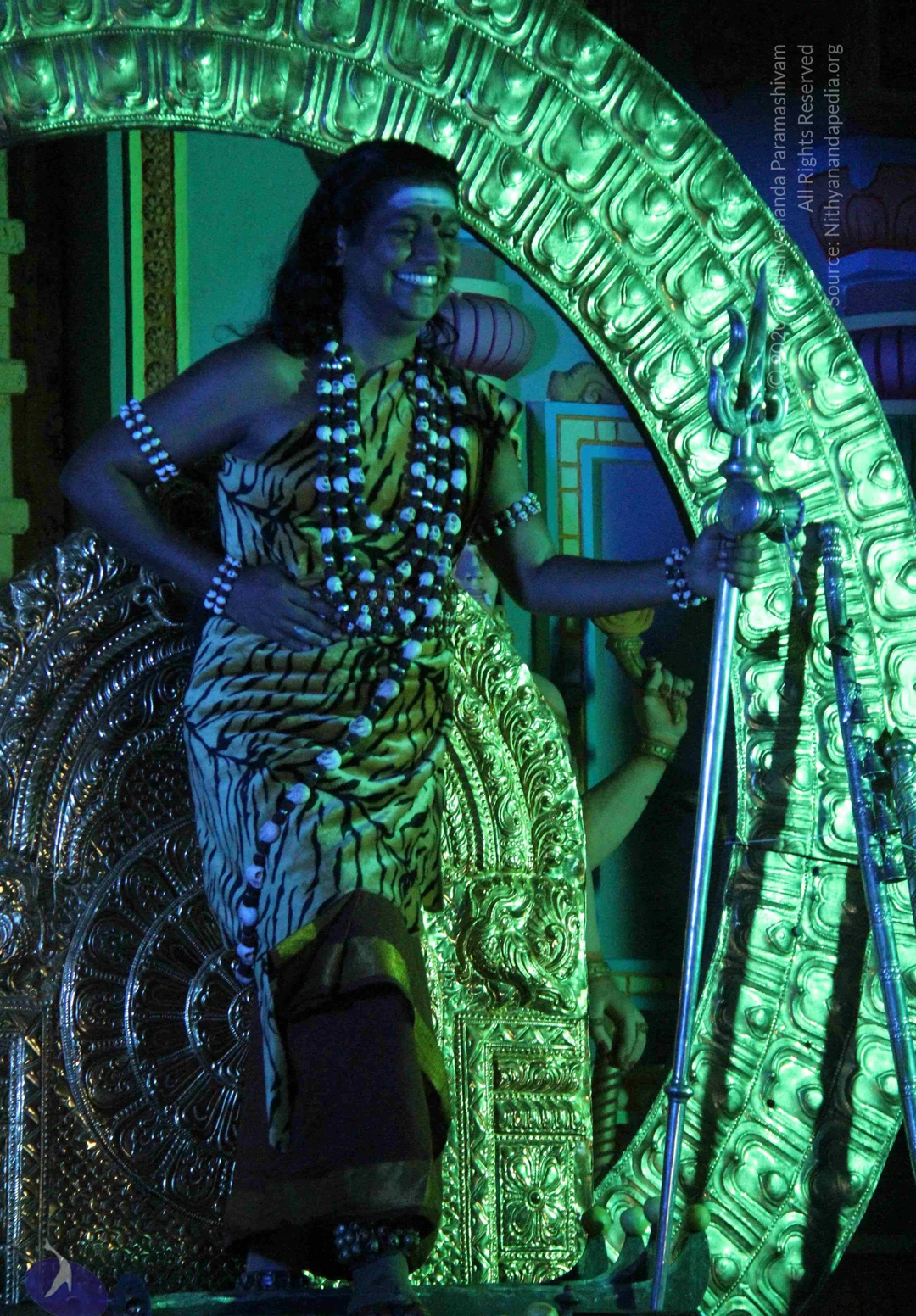
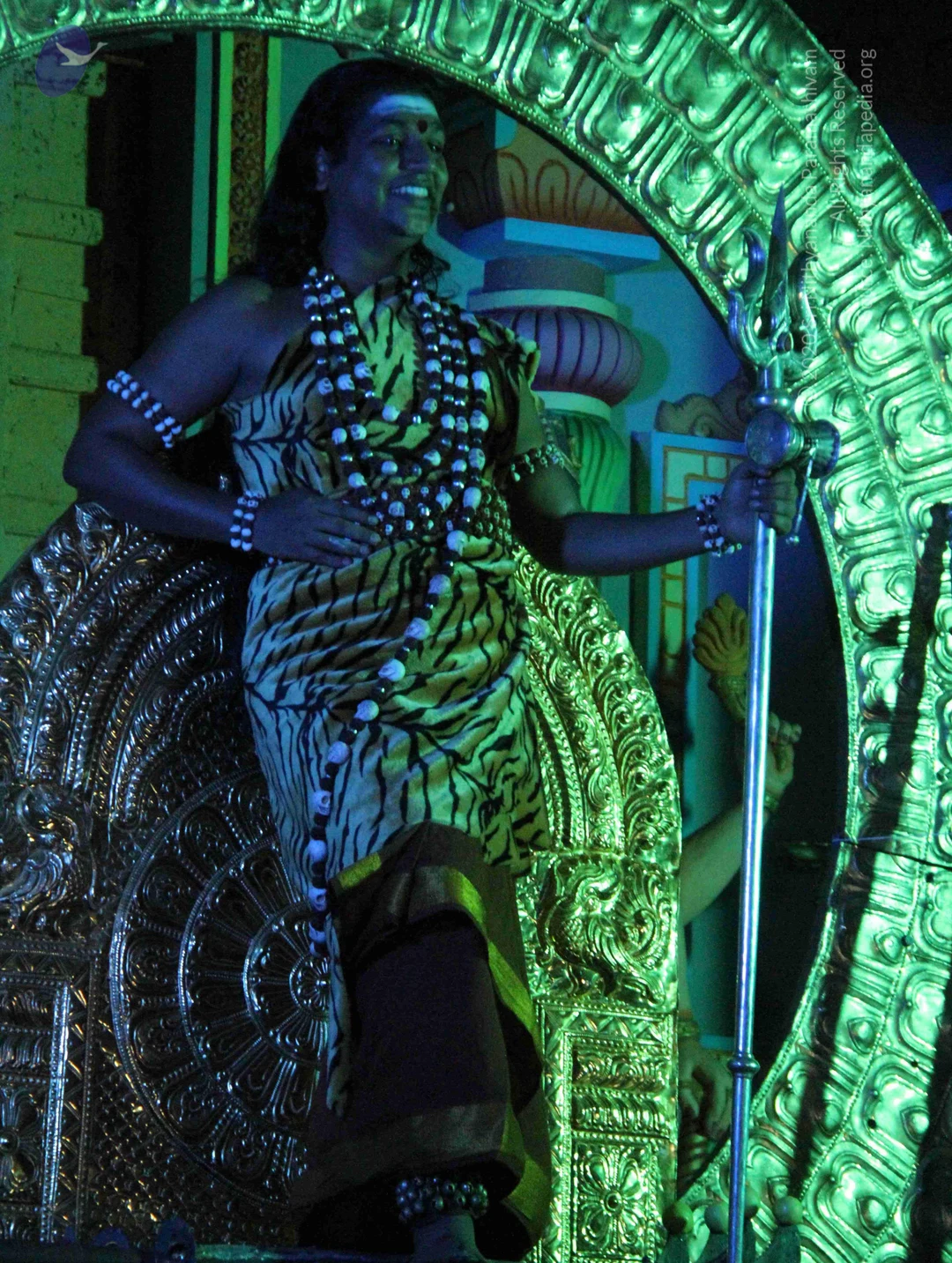
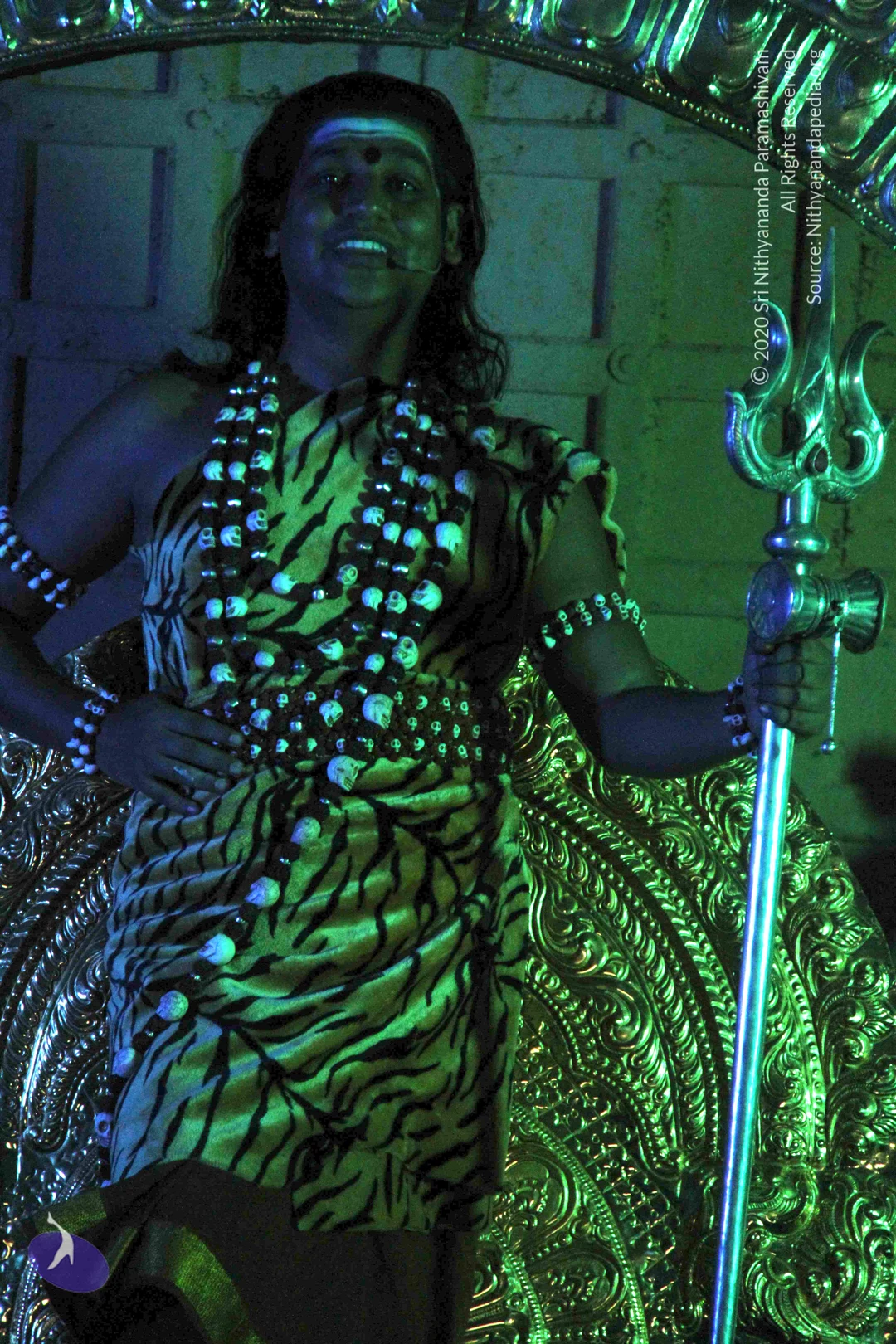
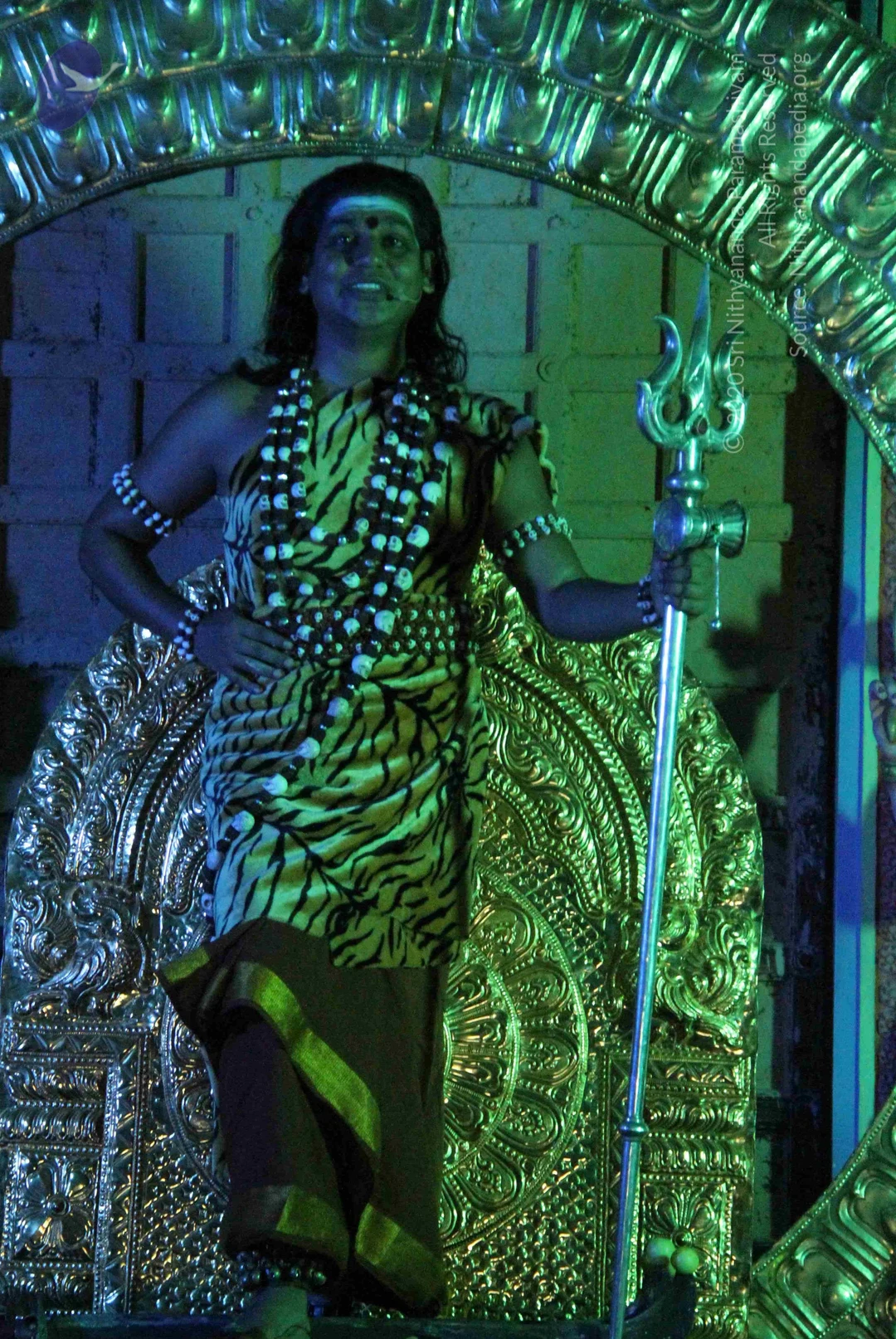
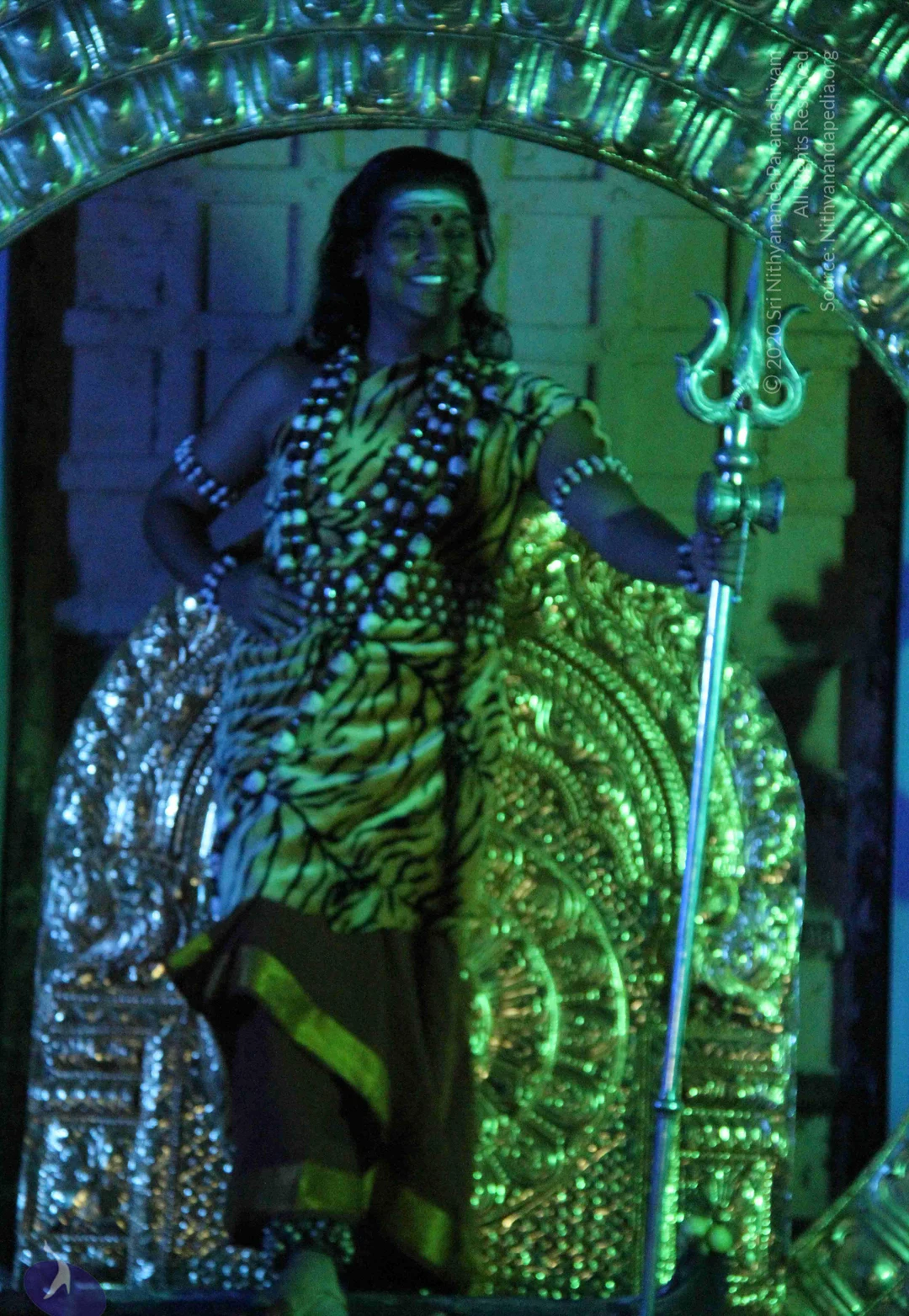
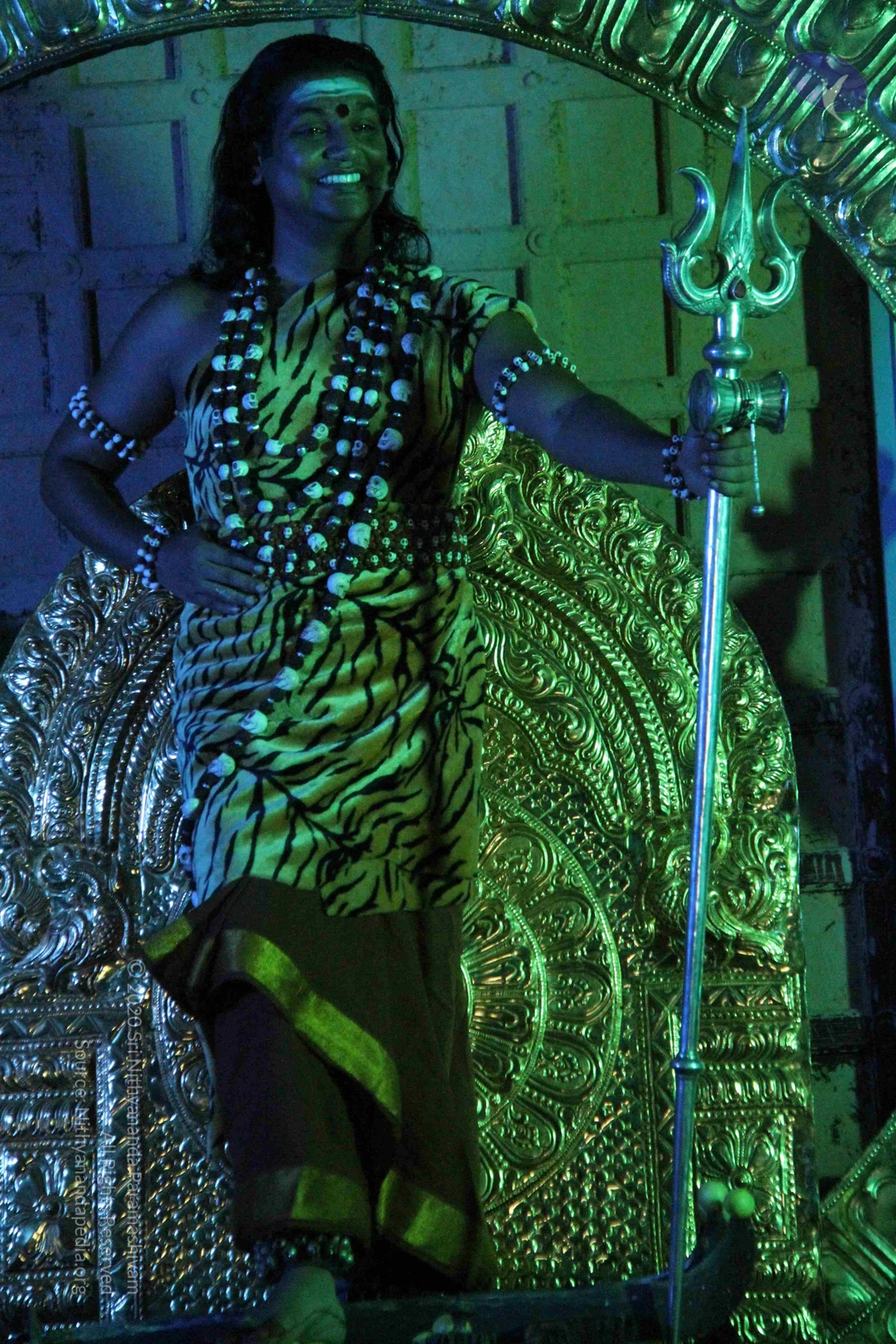
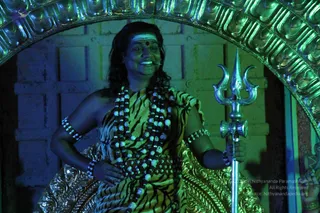
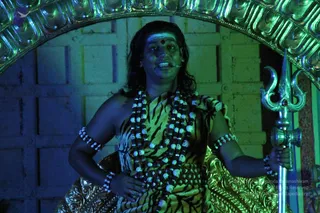
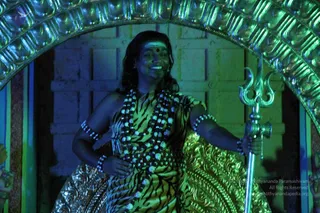
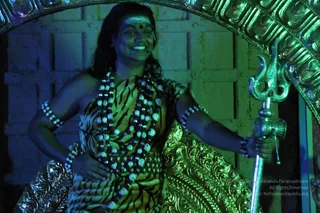
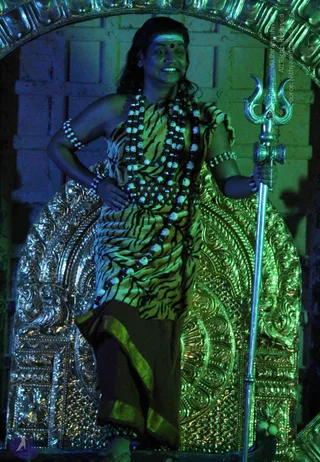
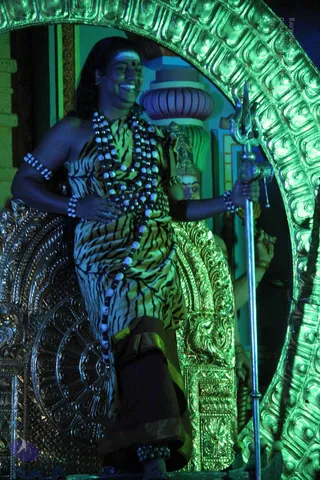
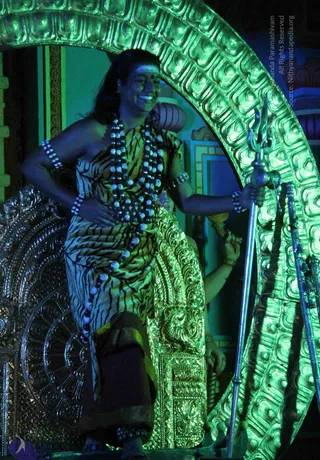
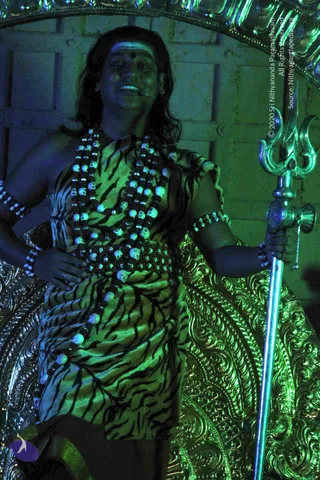
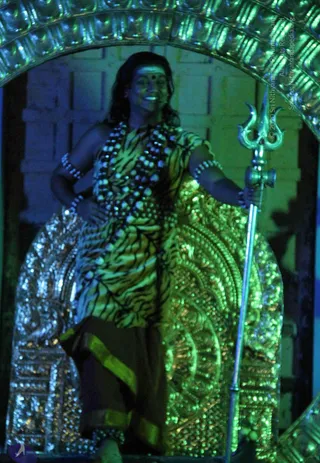
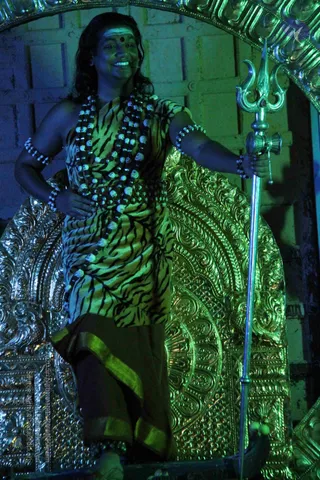
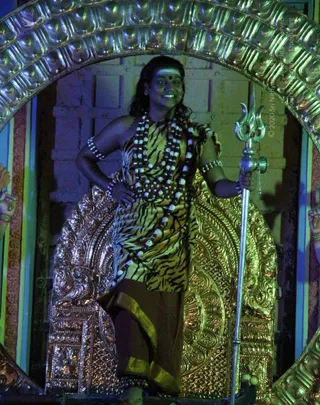
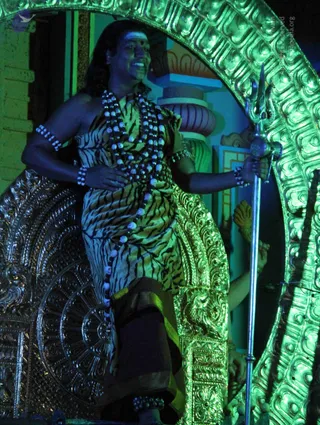
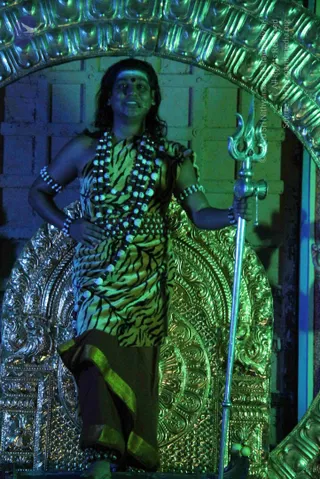
A man seated on an ornate silver-and-gold throne beneath a metallic arch, lit in blue-green stage light. He wears a yellow garment with black tiger-stripe pattern, an elaborate rudraksha-style mala of beads across his chest, beaded bracelets on his arms, and a bead belt at the waist. He holds a large silver trident, the trishul, upright in his right hand while his left hand rests on his hip, and he smiles broadly with a red bindi on his forehead. Long dark hair falls to his shoulders. The backdrop is a light-colored brick-like wall.A dim, blue-green lit scene in which a video camera's flip-out screen shows a lit deity murti standing within an arched frame of illuminated lights. The screen image shows a figure in a green and gold garment flanked by ornamental pillars. The background is blurred with glowing green and blue light arches. No people are clearly visible in the frame.A photograph of a projected or screen image in a dark room, showing a deity murti or statue framed by a large illuminated circular arch. The figure stands with a trident-like staff and wears a garland and ornate jewelled dress in green and silver tones, lit in blue and green light. Ornate temple-style pillars and carved niches surround the central figure. No physical people are visible in the scene.A man stands in a stage-like setting lit with green and blue light, framed by an ornate silver-coloured arch. He wears a tiger-striped yellow and black garment, a white bead bracelet on each upper arm and wrist, and layered black and white rudraksha-style mala necklaces. A red dot marks his forehead, and he holds a silver trident in his right hand, with a silver throne visible behind him. Appearance-based label: a person, shown in person with long swept-back hair and ceremonial adornment.A smiling figure with long, swept-back dark hair and a red bindi stands in a gilded arched doorway under green and blue stage lighting. He wears a tiger-striped golden garment, multiple strands of rudraksha beads and skull-like beads across the chest, and beaded bracelets on both arms. He holds a polished silver trident in his right hand, while the left arm is extended outward. Behind him are a patterned wall and ornate gold-toned frame.A smiling person stands in a green-blue lit setting in front of a pale brick-patterned wall, framed by an ornate gold-toned arch. The figure wears a tiger-striped gold and black garment draped over the shoulders with a gold brocade cloth, long rows of rudraksha-style beads and bead necklaces, beaded bracelets on both wrists, and a tilak with a red dot on the forehead. The right hand holds a silver trident (trishul) upright, and the left hand rests on the hip. Probable Swamiji cues: long swept-back hair, ornate gold clothing, rudraksha malas and a trident. Single person; no other people visible.

Deity-Darshan

3 photosSource gallery
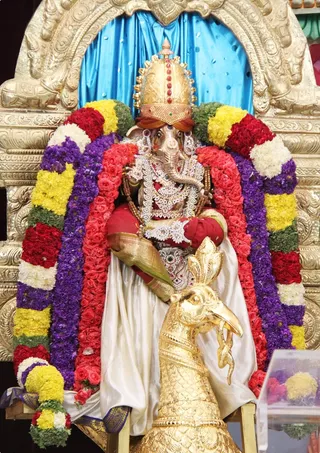
A decorated Ganesha murti seated on a golden peacock vahana against a gilded arch with carved elephant reliefs and a blue fabric backdrop. The deity wears an ornate gold crown with red and green stones, silver and jewelled necklaces, and a red-and-gold shawl. Garlands of red roses, purple and yellow marigolds, and white flowers drape around the figure. A glass display case of flowers sits to the right. No physical people are visible.A ceremonially decorated Ganesha murti seated on a golden peacock vahana in front of an ornate gilded arch with a blue backdrop. The elephant-headed deity wears a gold crown, a red cloth, and layered silver and jewelled necklaces, with a red garment draped over the lap. Thick garlands of red roses, yellow marigolds, white and purple flowers frame the figure in rainbow bands. A clear acrylic case with flowers sits at the right edge. No people are visible.

Nithya-Satsang

17 photosSource gallery
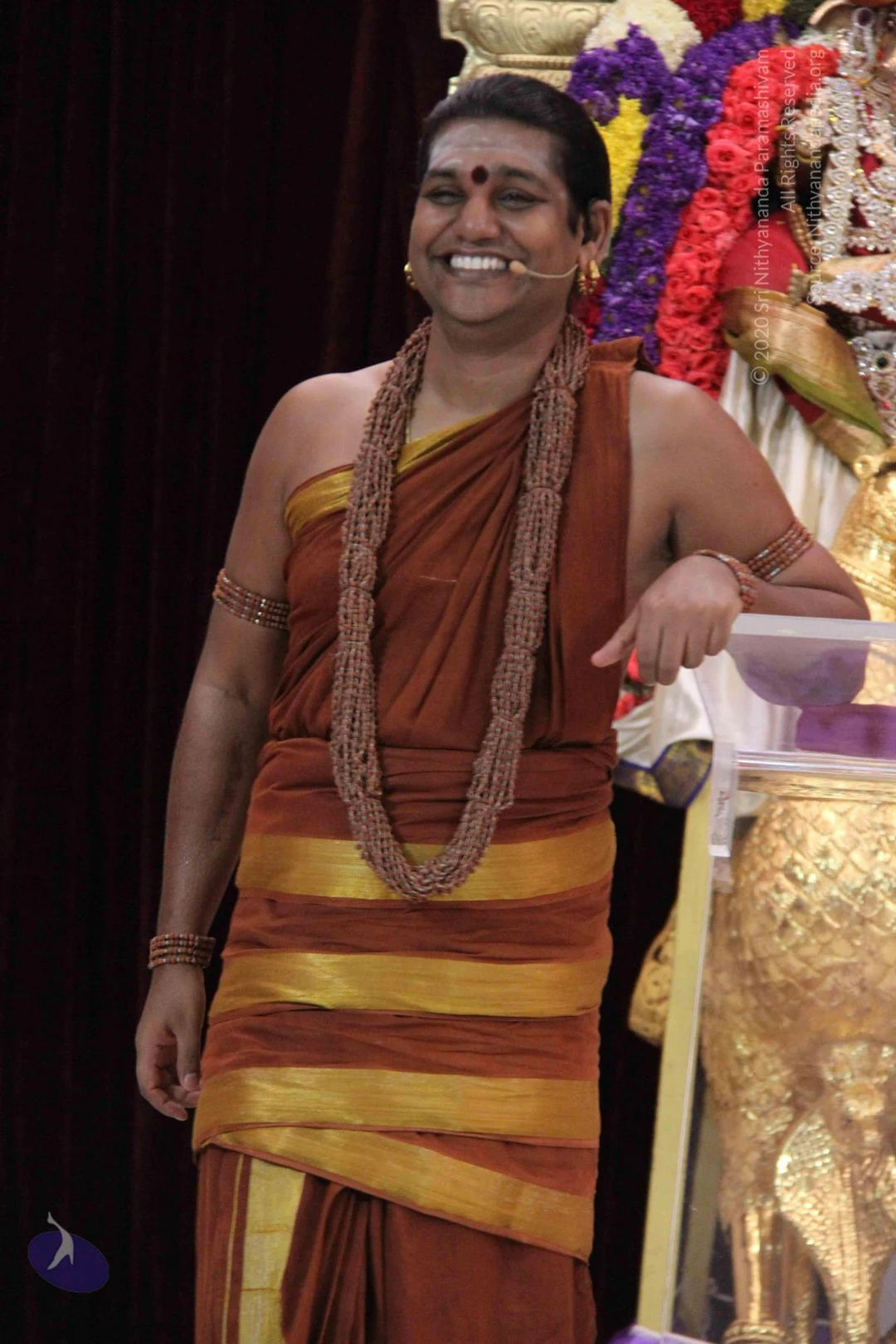
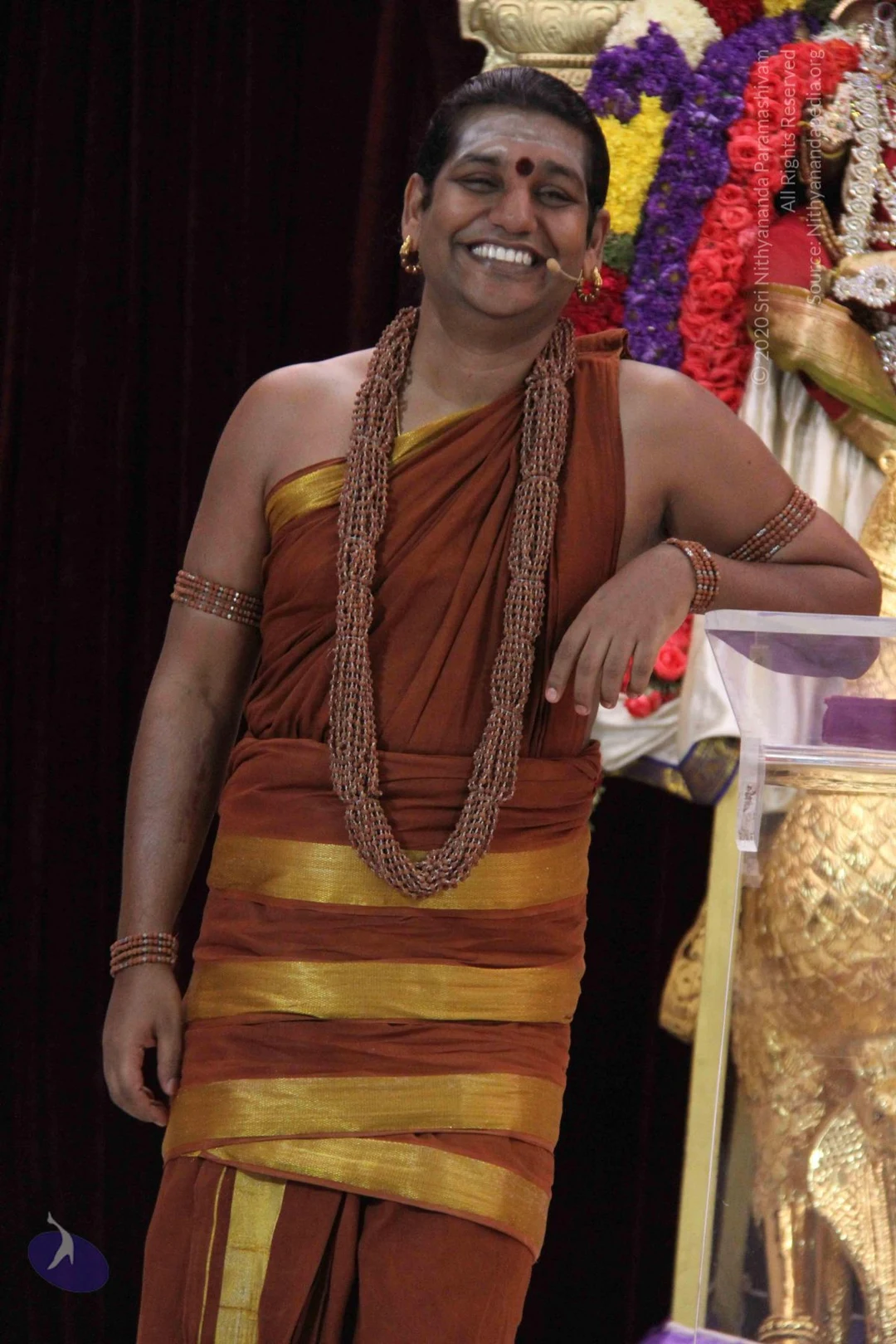
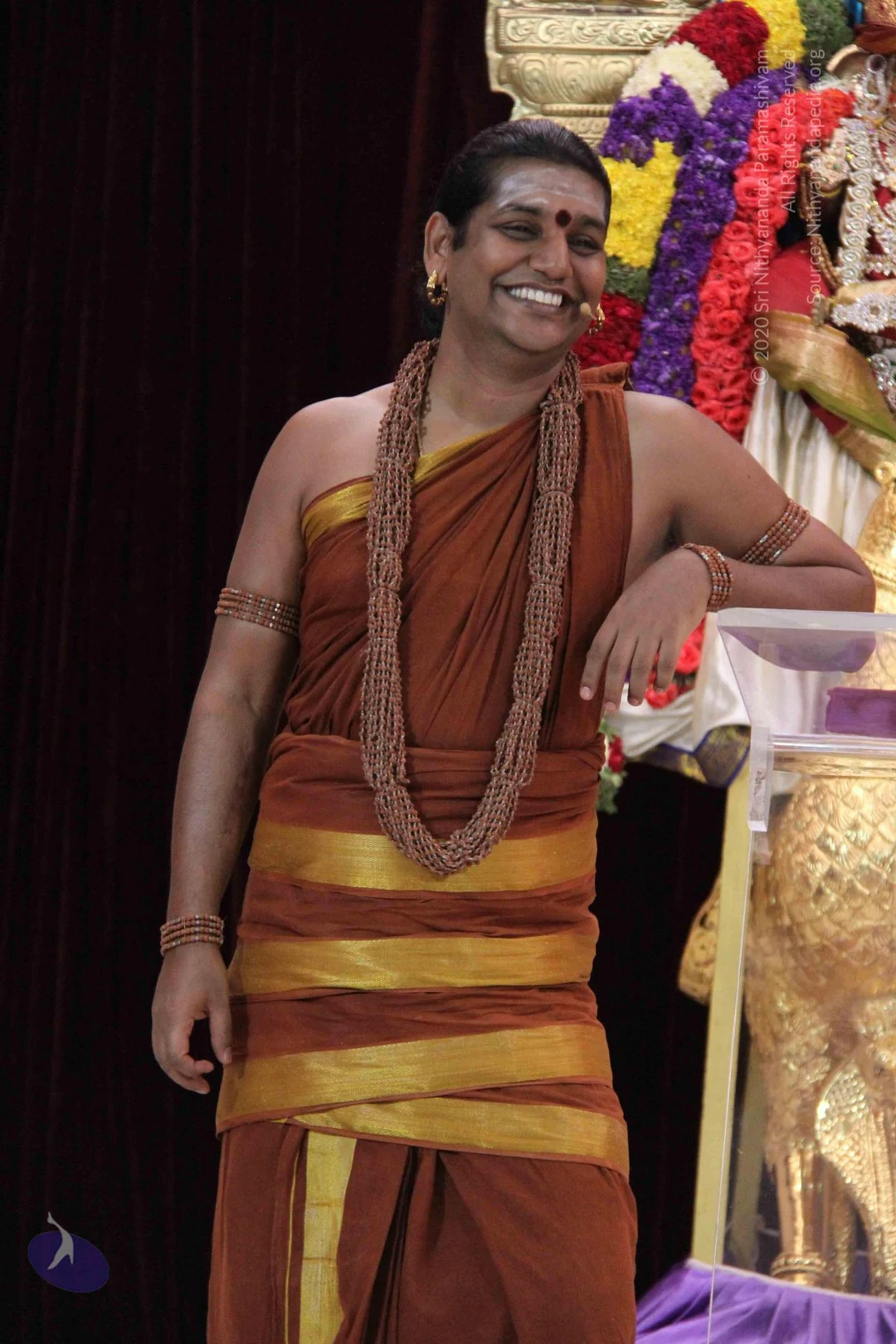
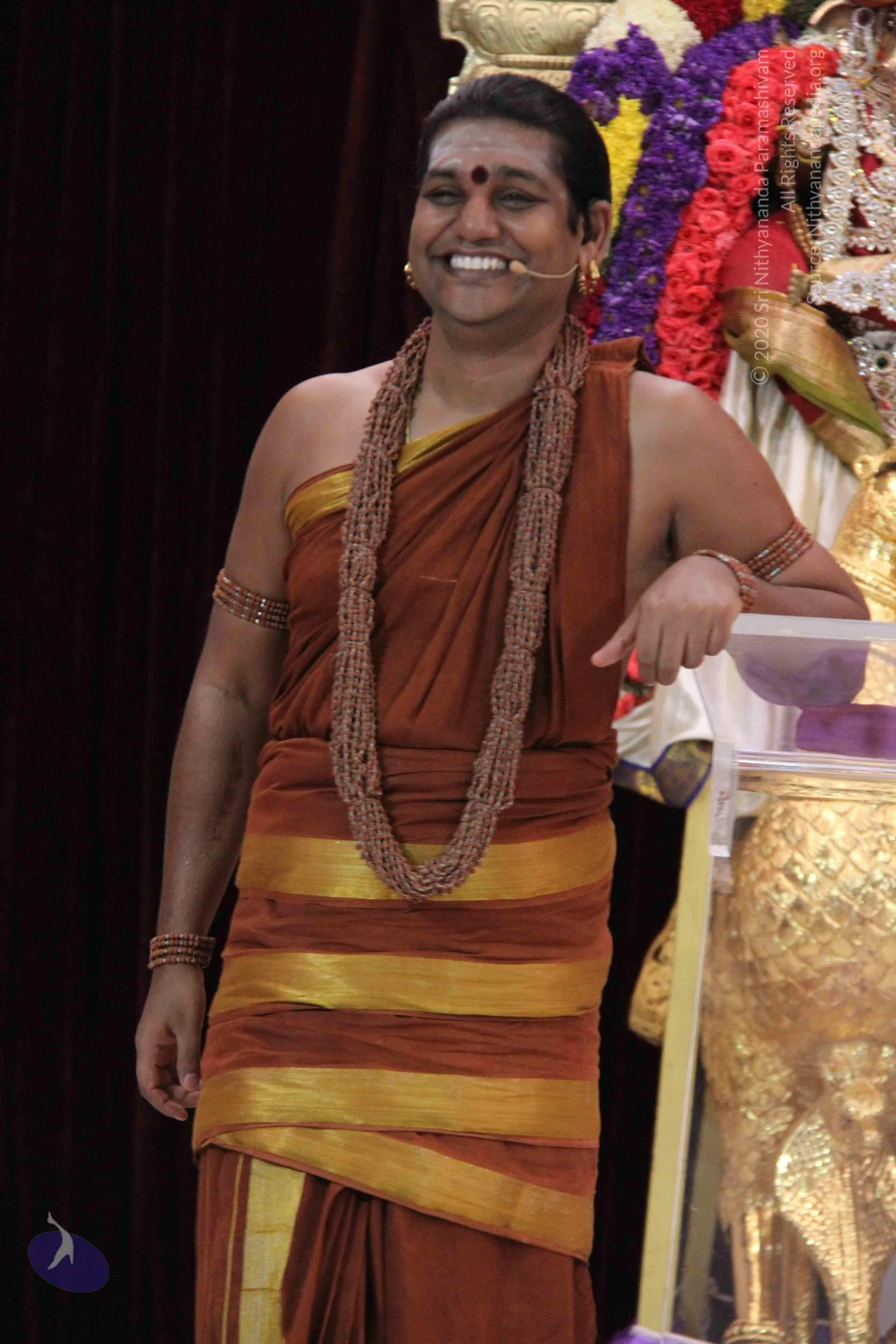
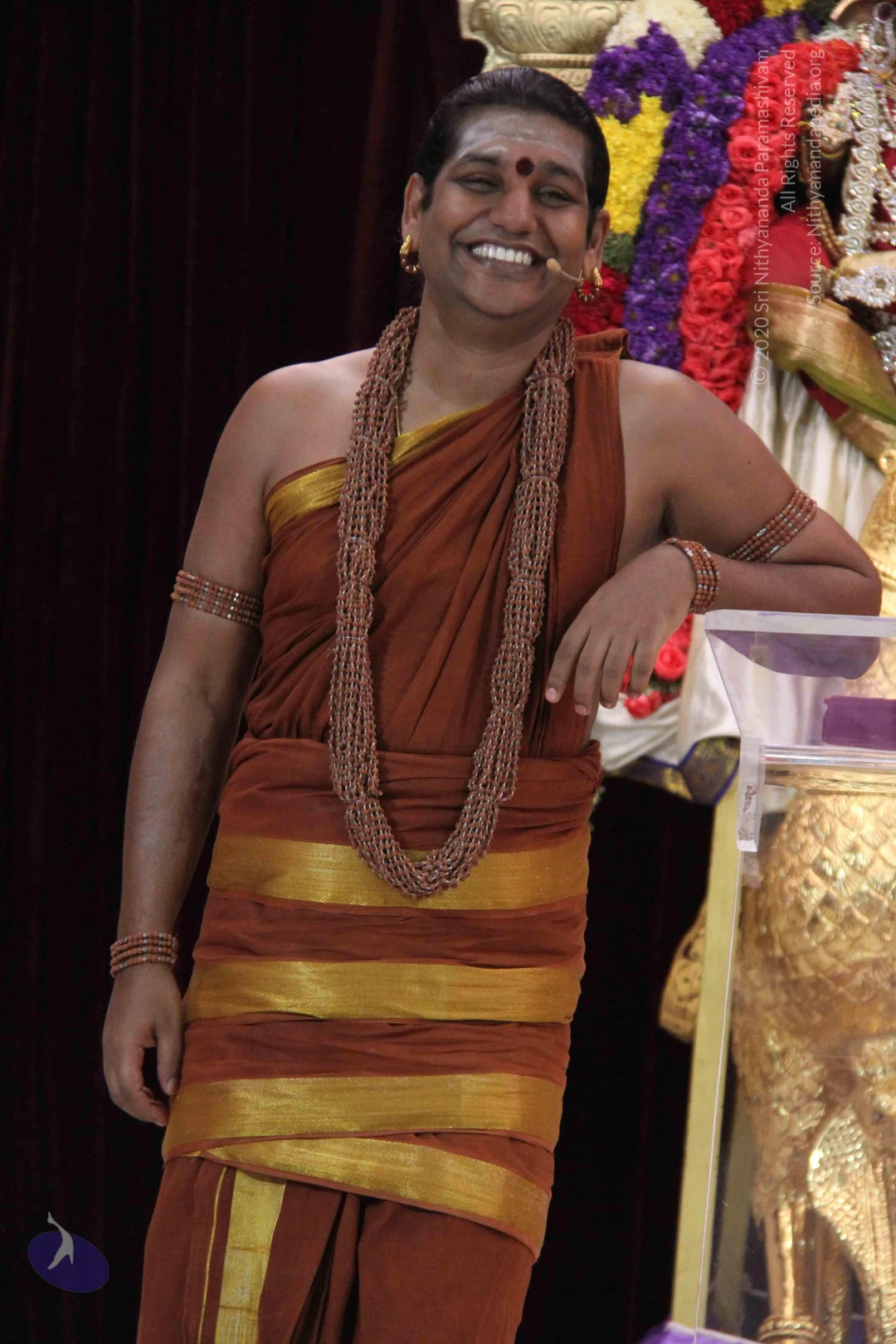
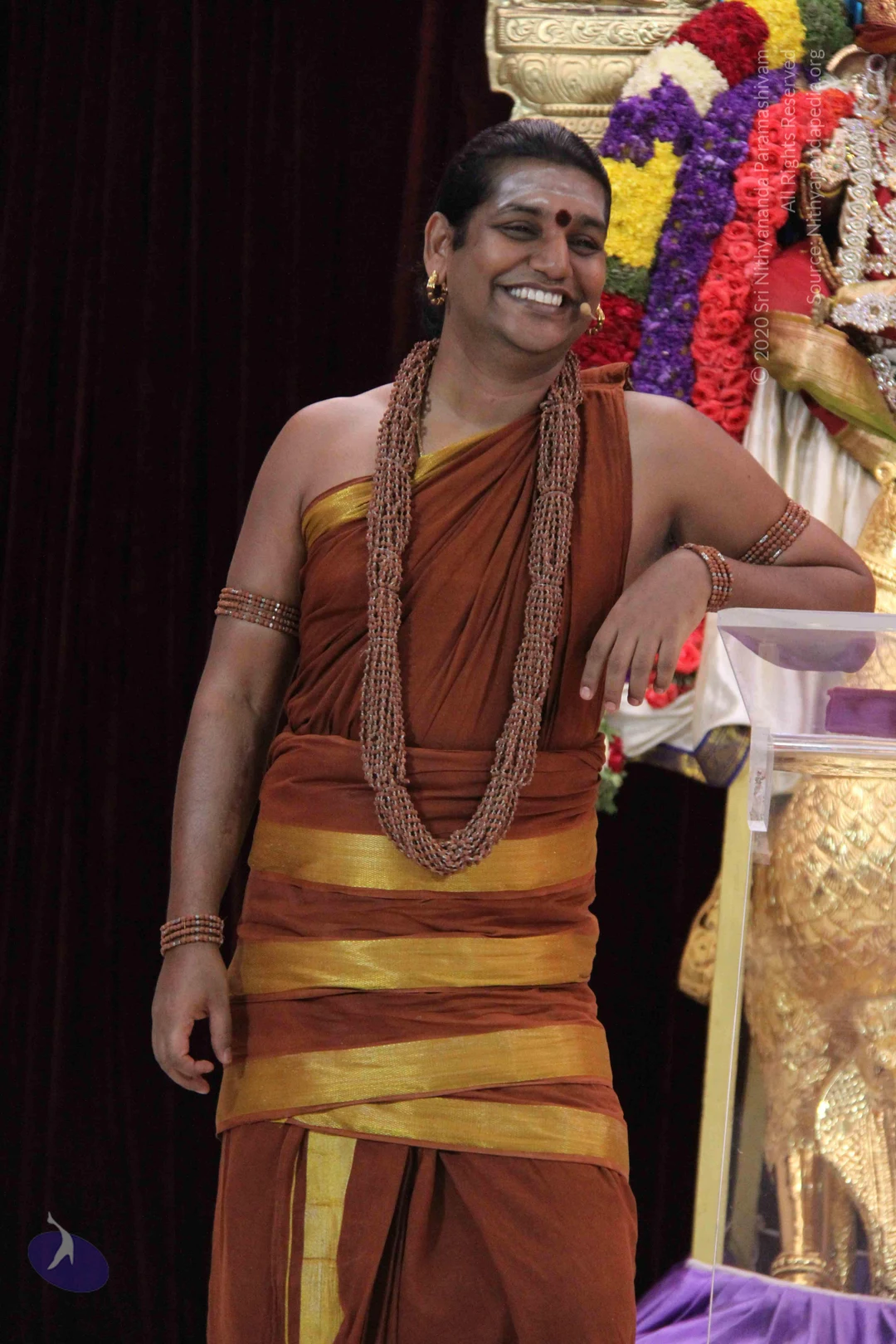
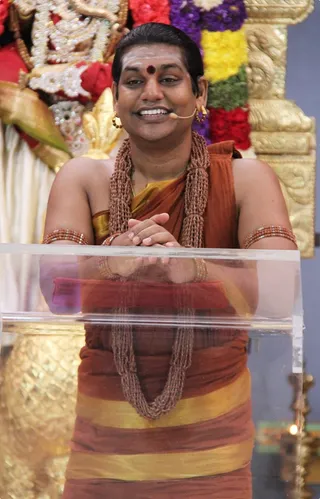
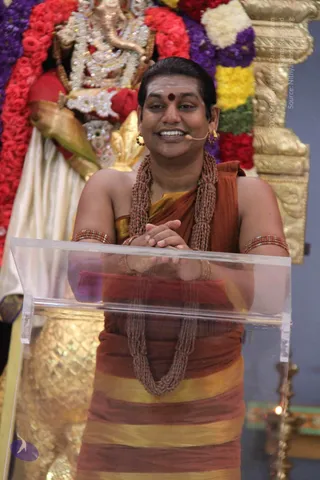
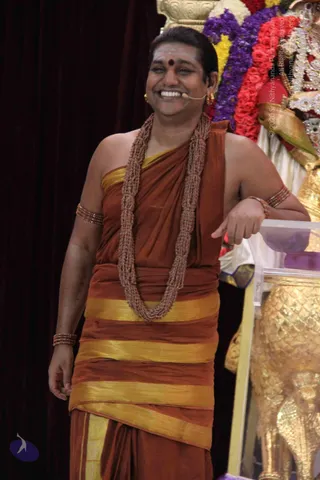
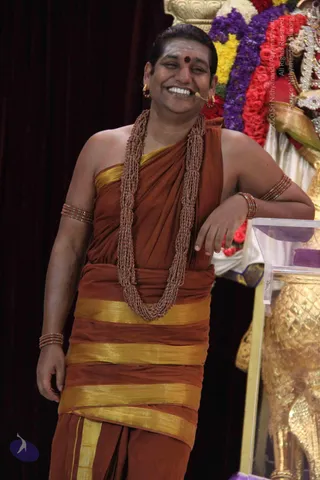
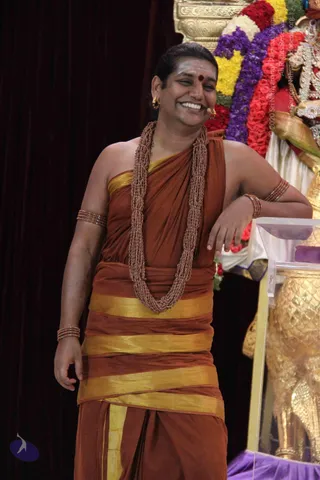
A smiling man in an orange-brown robe with gold borders stands at the edge of a stage beside a gilded structure. He wears a long multi-strand rudraksha mala, beaded armlets and bracelets, and a red bindi, and has a headset microphone at his cheek. Behind him are garlands of purple, yellow and red flowers and gilded deity ornaments. The page describes a person as present; the appearance cues of rudraksha malas, saffron-orange clothing and ornate beaded armlets make him a person.A smiling man stands at a clear acrylic lectern with a headset microphone, wearing a rust-orange draped garment with gold-striped borders and a beaded rudraksha-style mala necklace, plus matching beaded bracelets and armbands. Behind him are a dense arrangement of purple, red and yellow flowers and a large gold ornate deity murti with decorated shoulders. A red bindi marks his forehead and he wears small gold earrings. Swamiji (probable): long swept-back hair, ornate gold-bordered orange robes, rudraksha malas and ceremonial jewelry match the expected cues for the teacher, shown in person giving a discourse.

Inner-Awakening

2 photosSource gallery
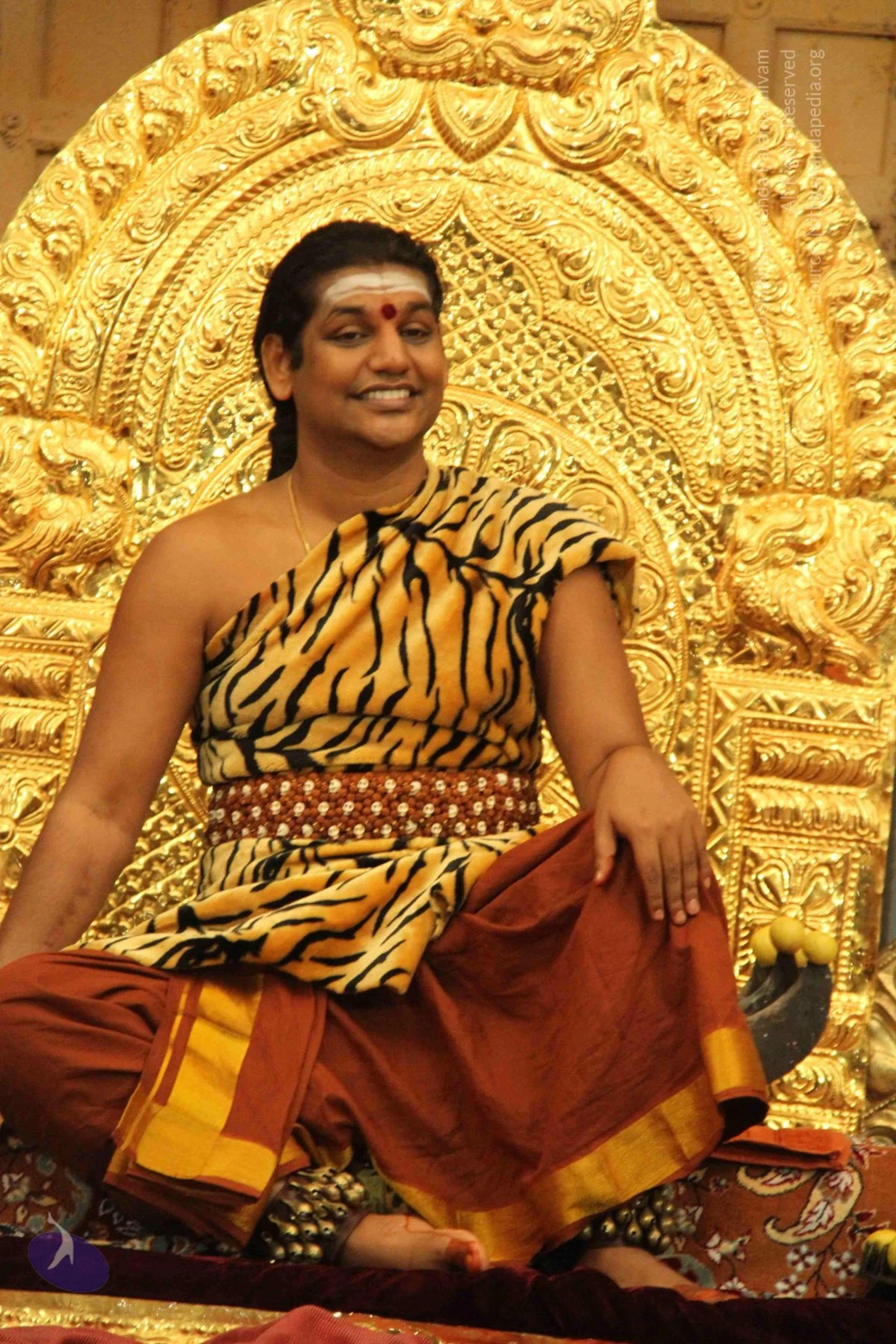
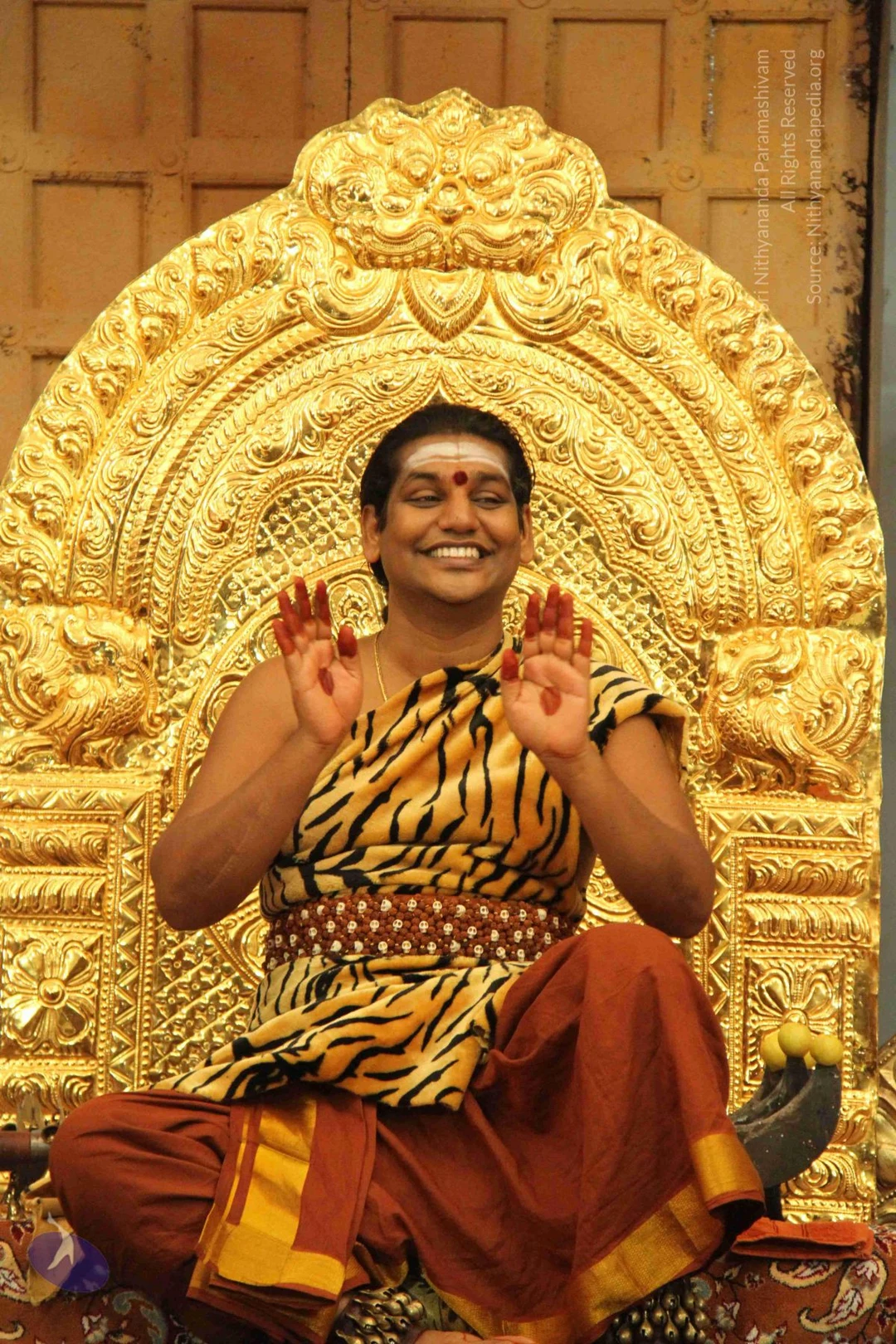
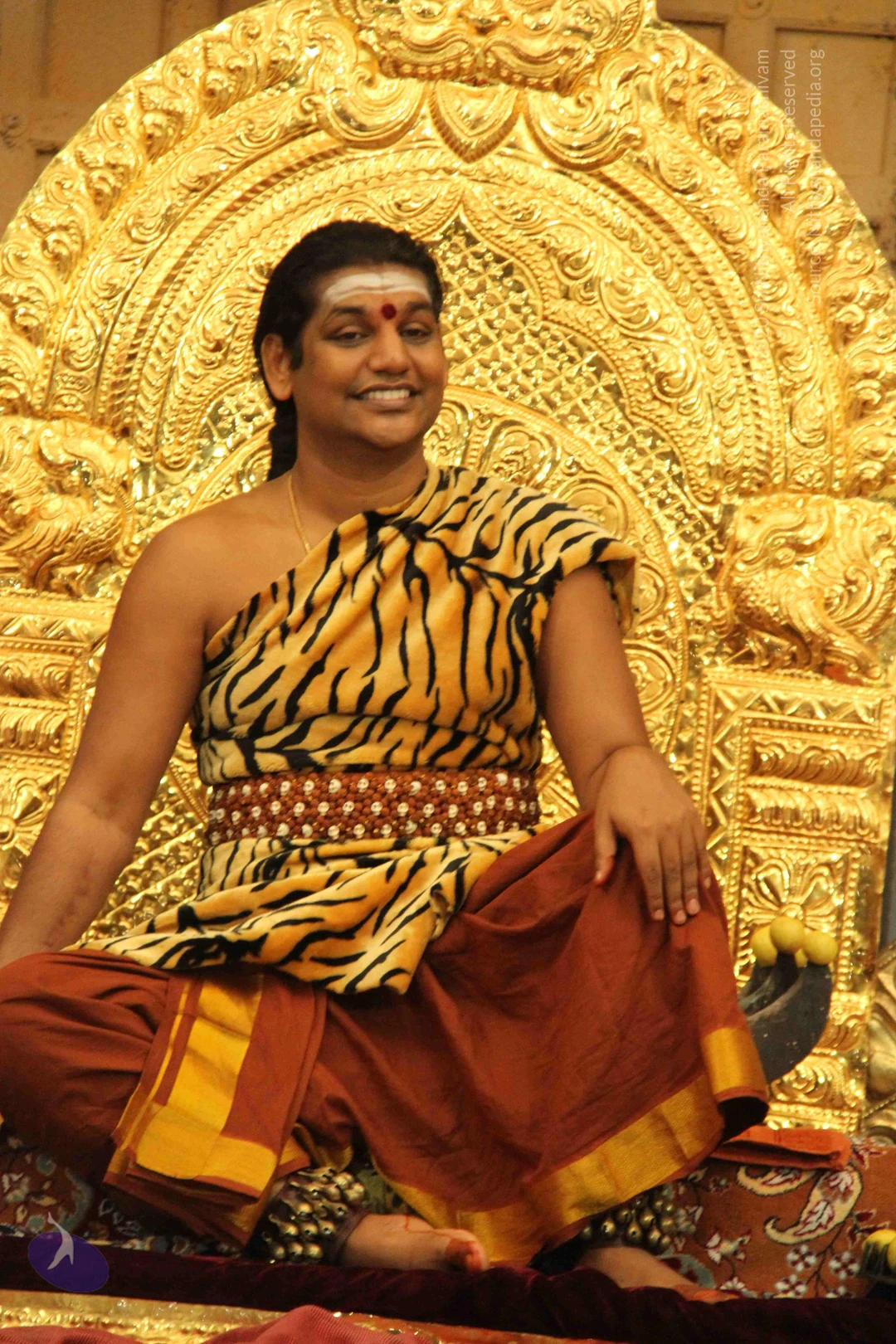
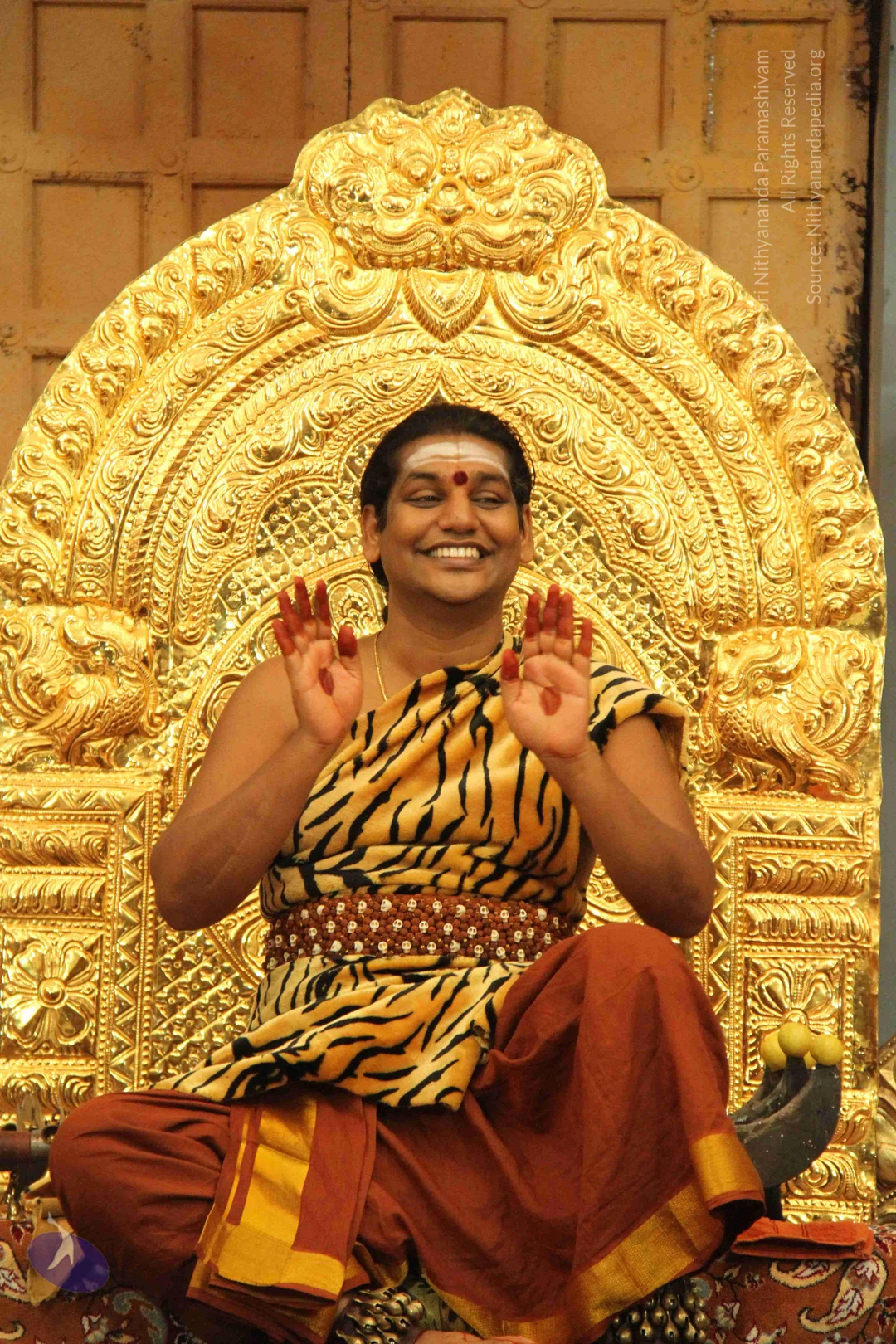
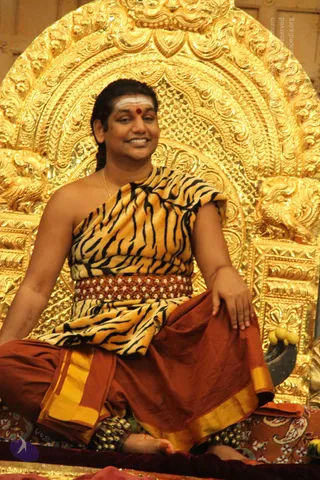
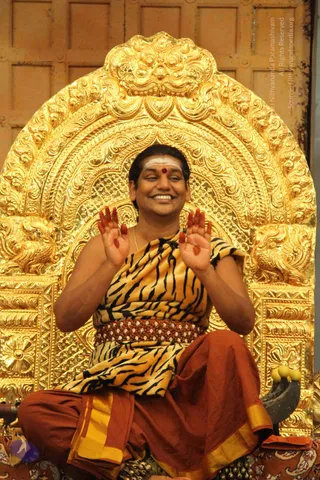
A man with swept-back dark hair, white and red forehead markings, a tiger-striped yellow and black shawl over his shoulder, a beaded rudraksha-style waist belt and rust-orange dhoti with gold border sits cross-legged on an ornate gold throne with carved floral and animal motifs, smiling. Bare feet rest on a patterned cloth.A seated man in a tiger-striped saffron shawl and rust-red dhoti sits before an ornate gold-leaf arched throne. He wears a white vertical tilak with a red bindi, a beaded rudraksha-style waist belt, and a thin gold chain. He smiles broadly with both palms raised and fingers open in a gesture of blessing or discourse. The throne's repousse gold carvings fill the background, with a patterned carpet at the bottom edge. Swamiji (probable): long dark hair, saffron-and-tiger shawl, rudraksha belt and ceremonial gold chain, seated on a throne as the speaker.

Sacred-Arts

45 photosSource gallery
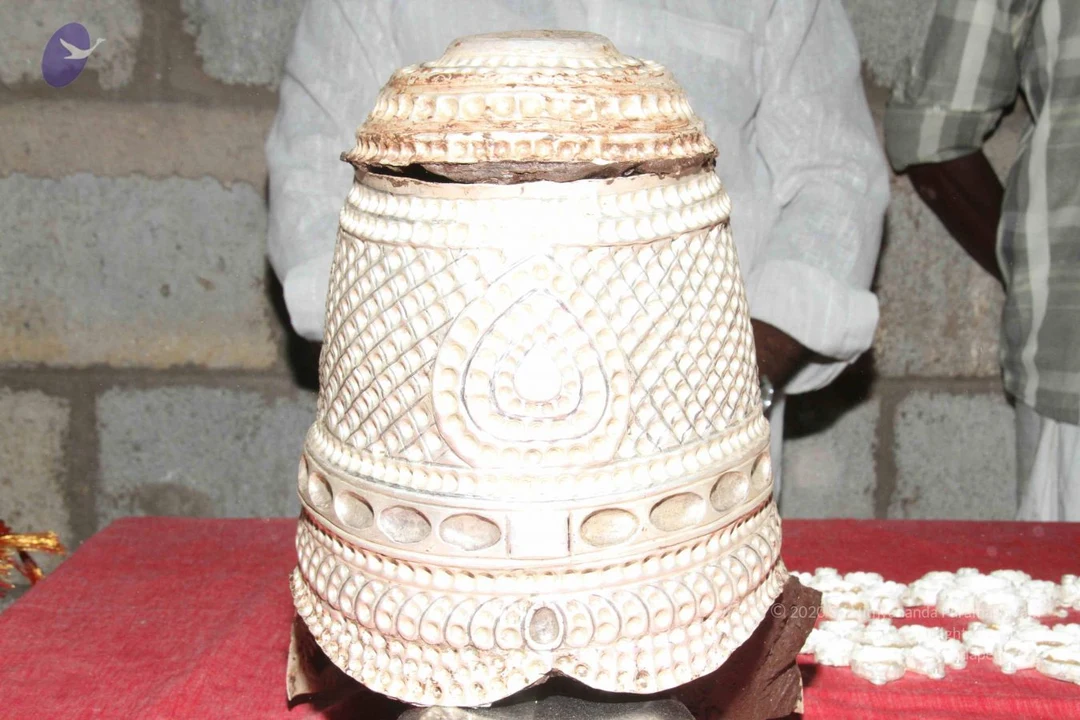
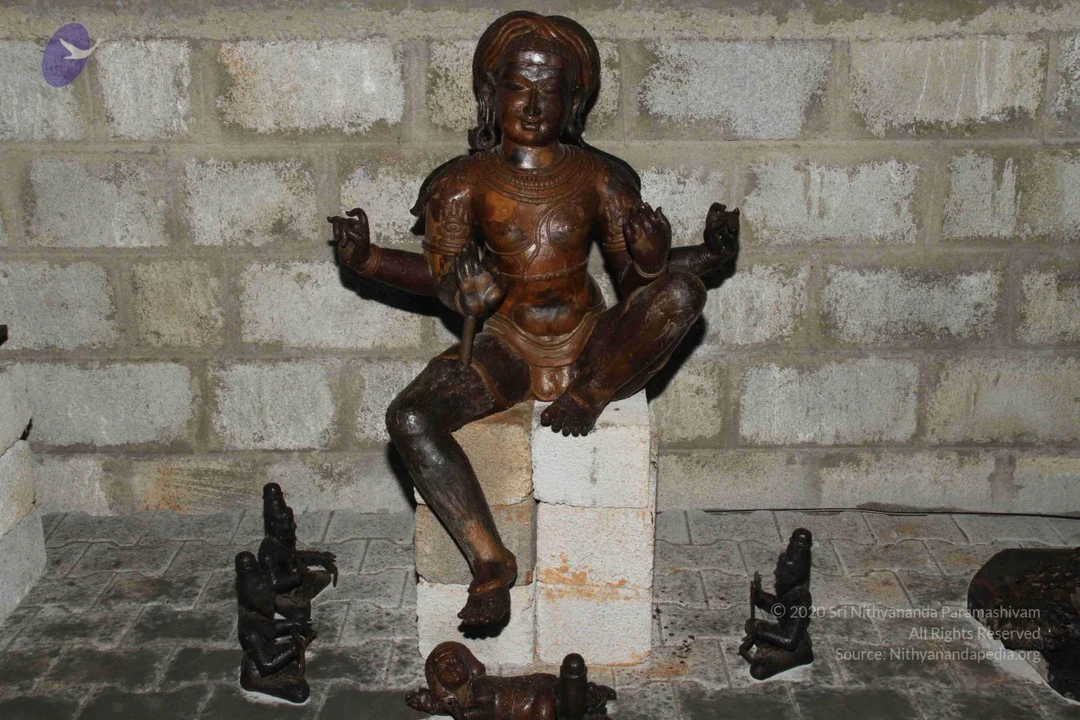
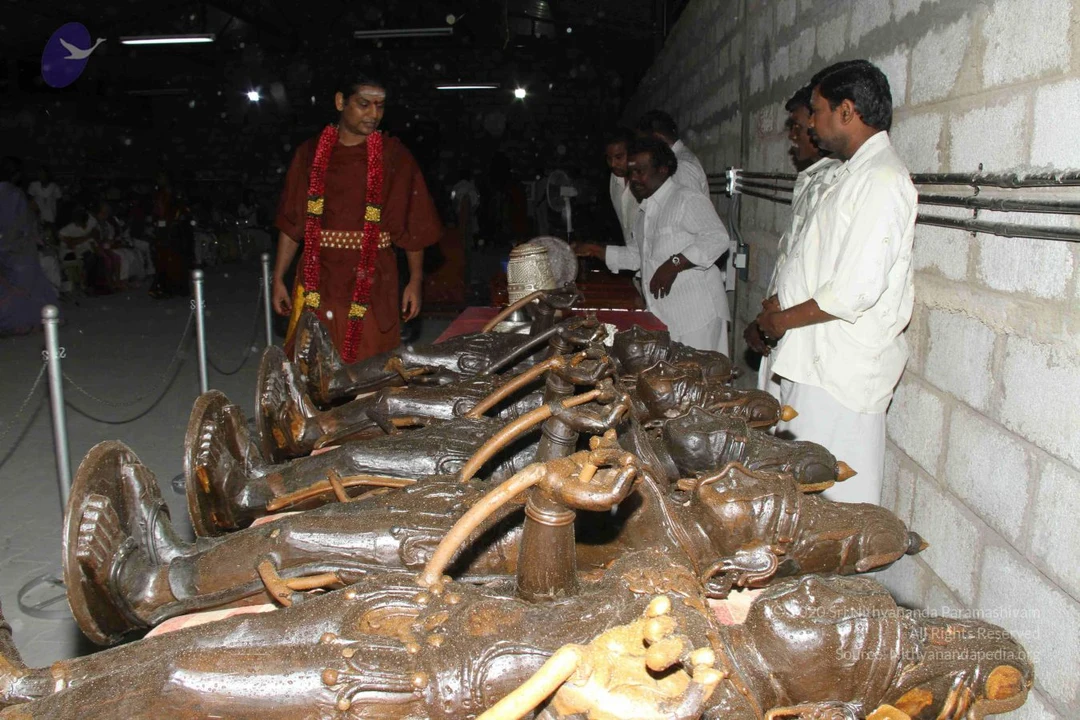
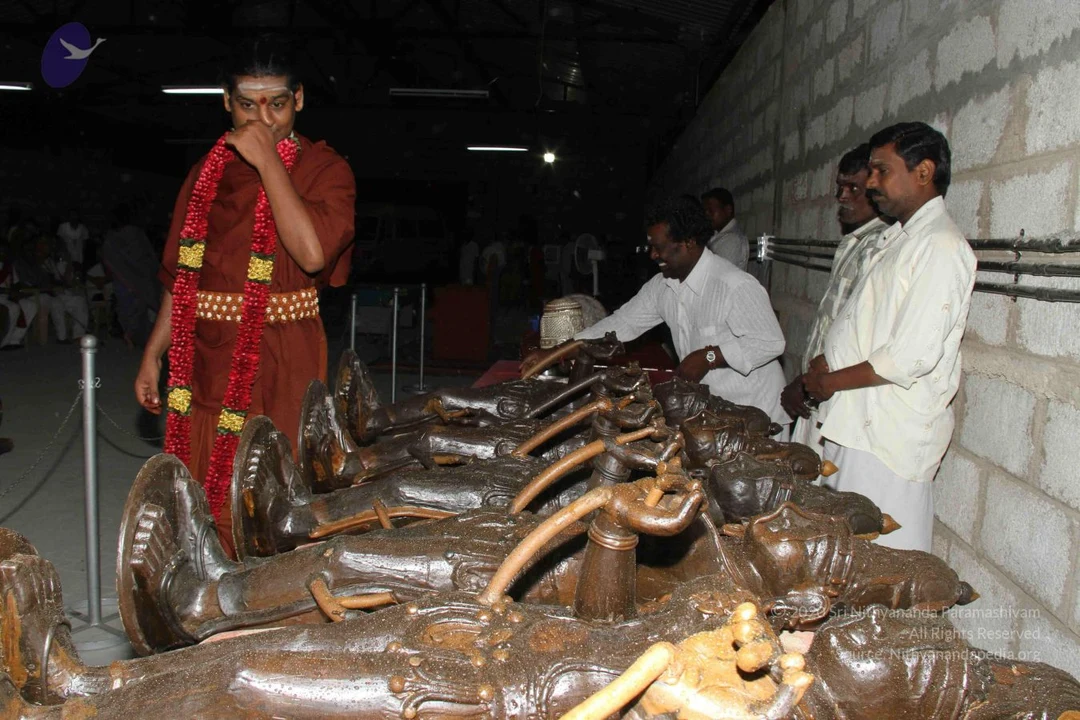
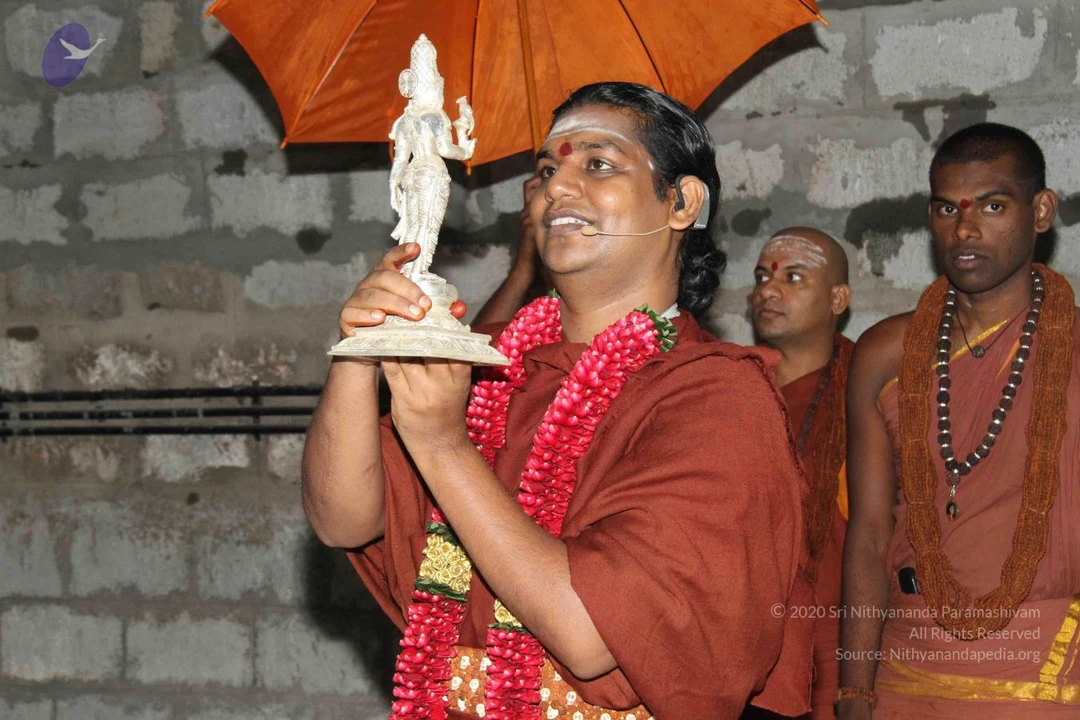
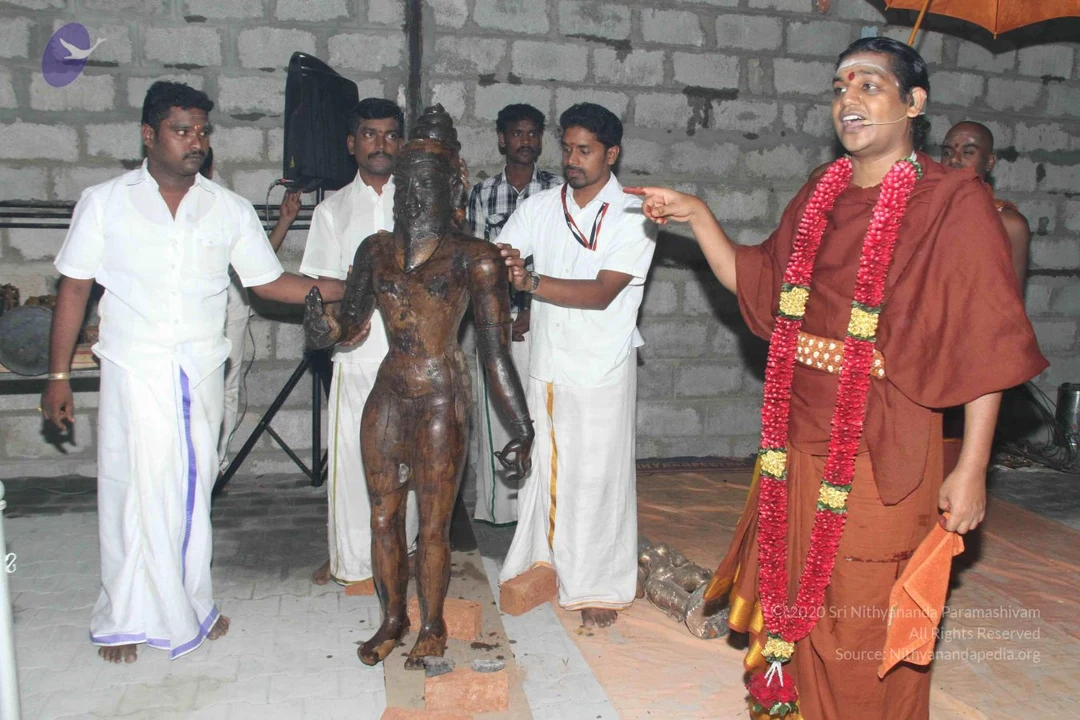
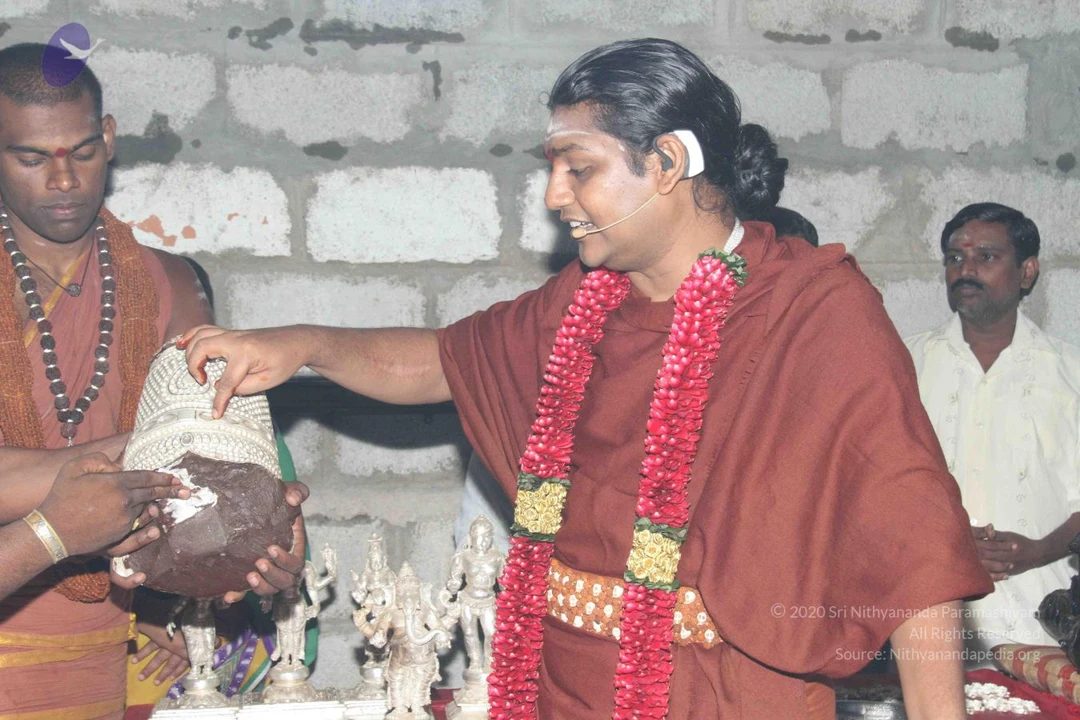
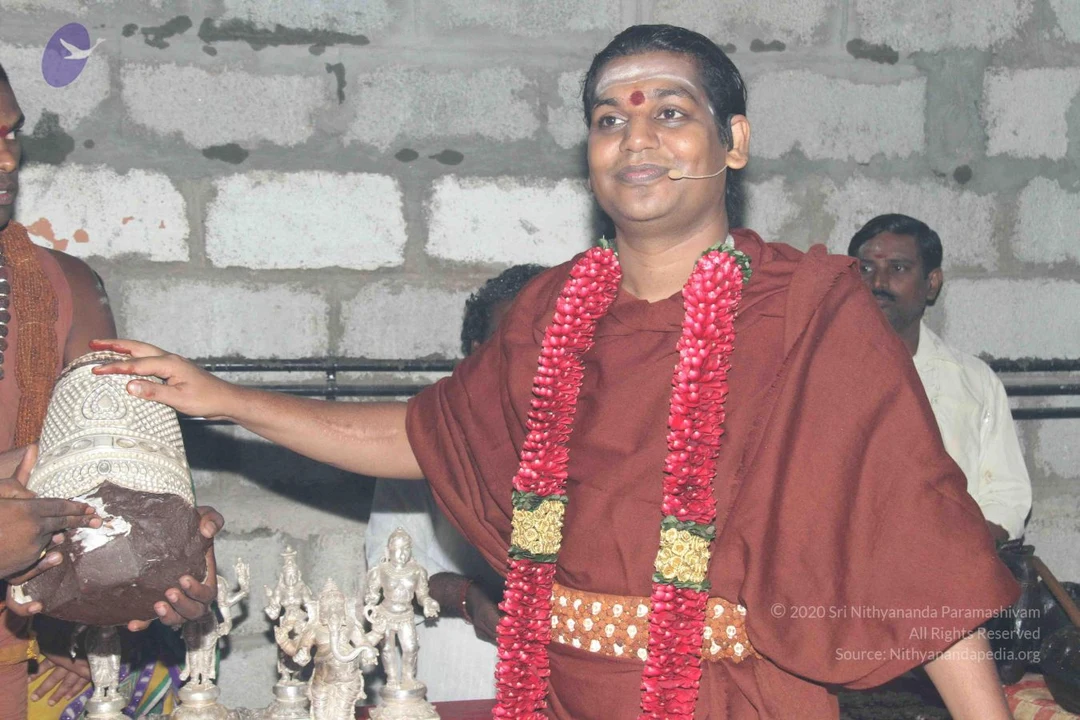
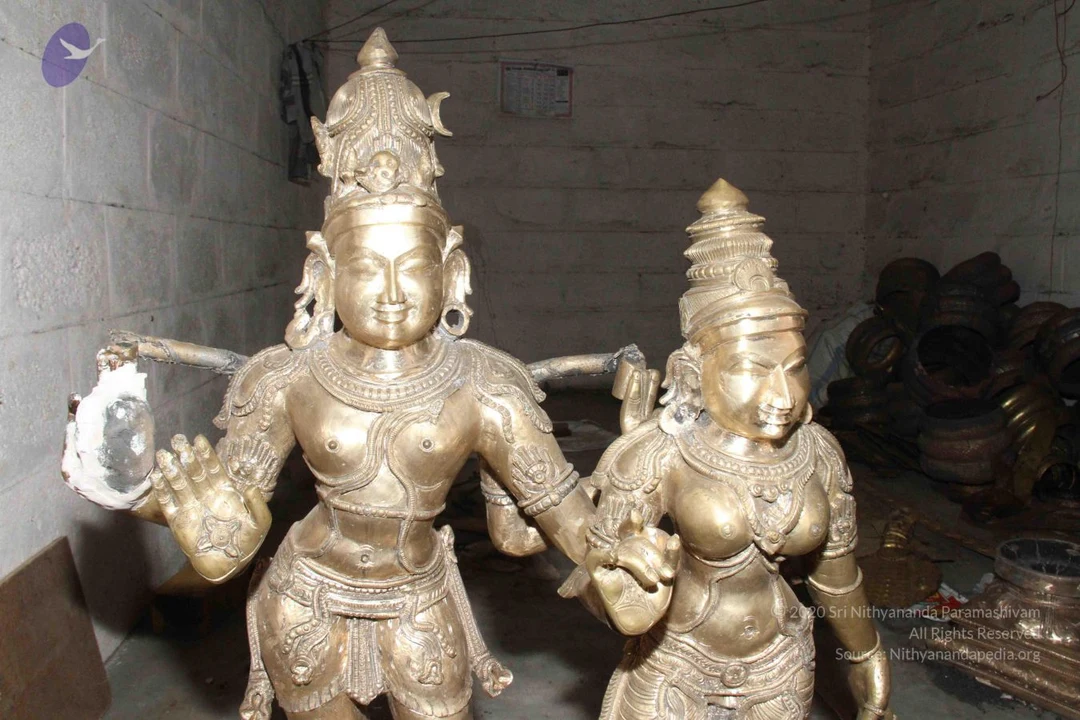
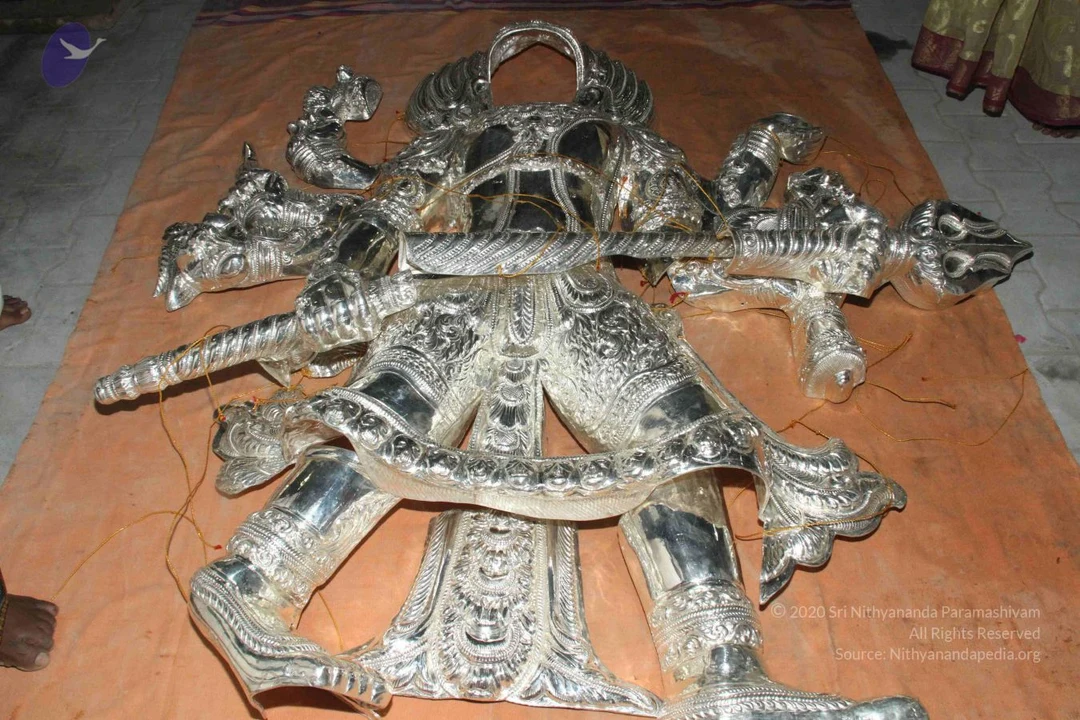
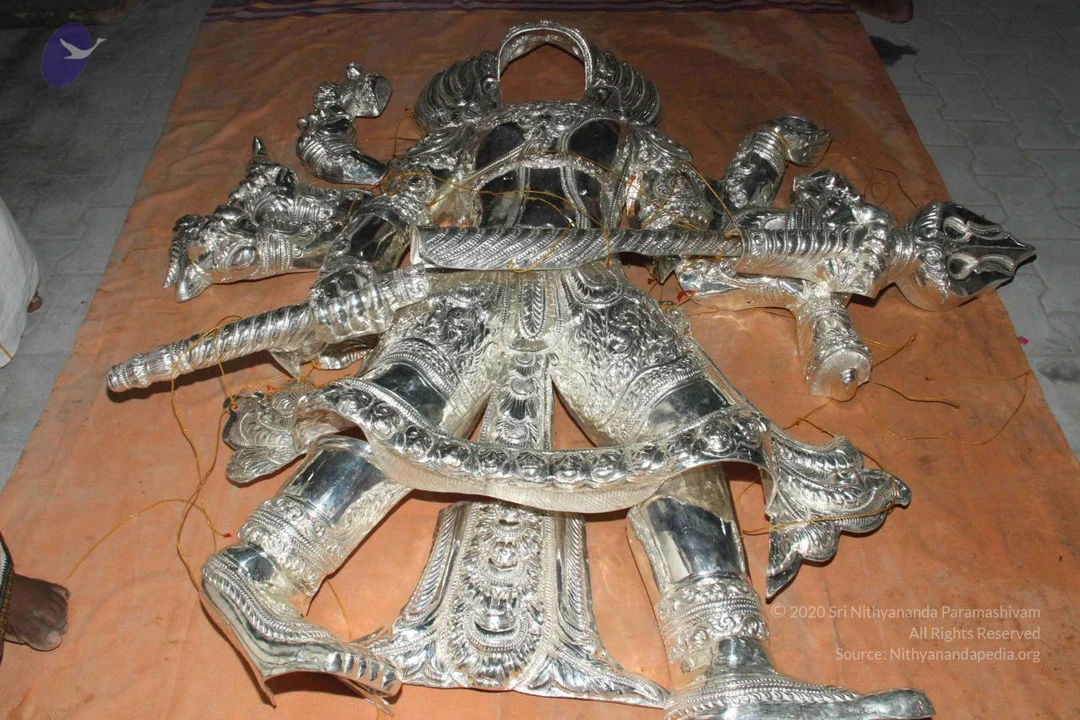
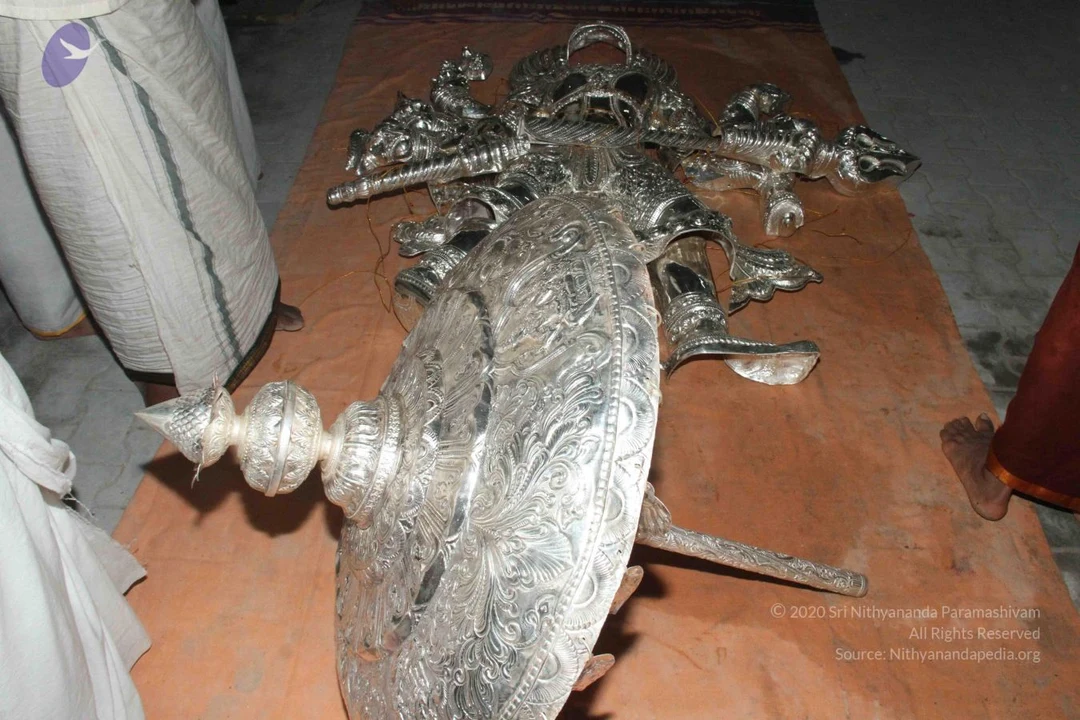
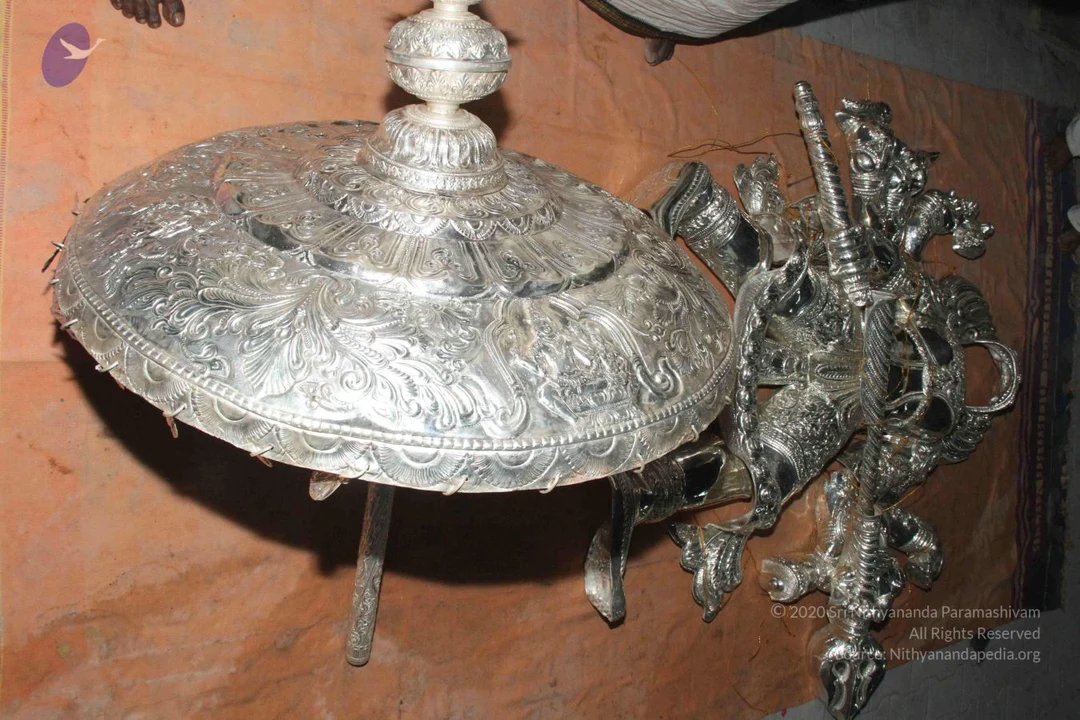
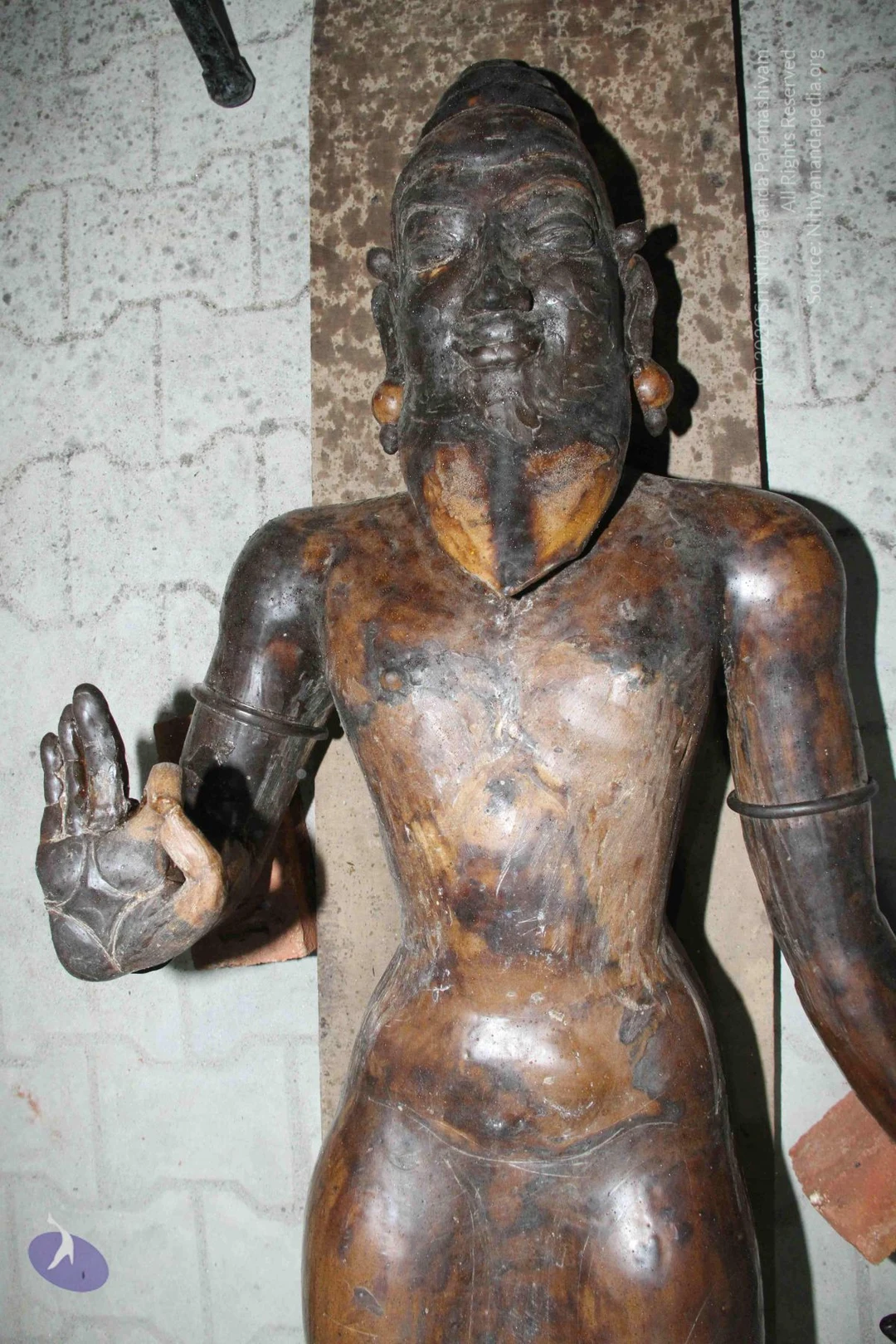
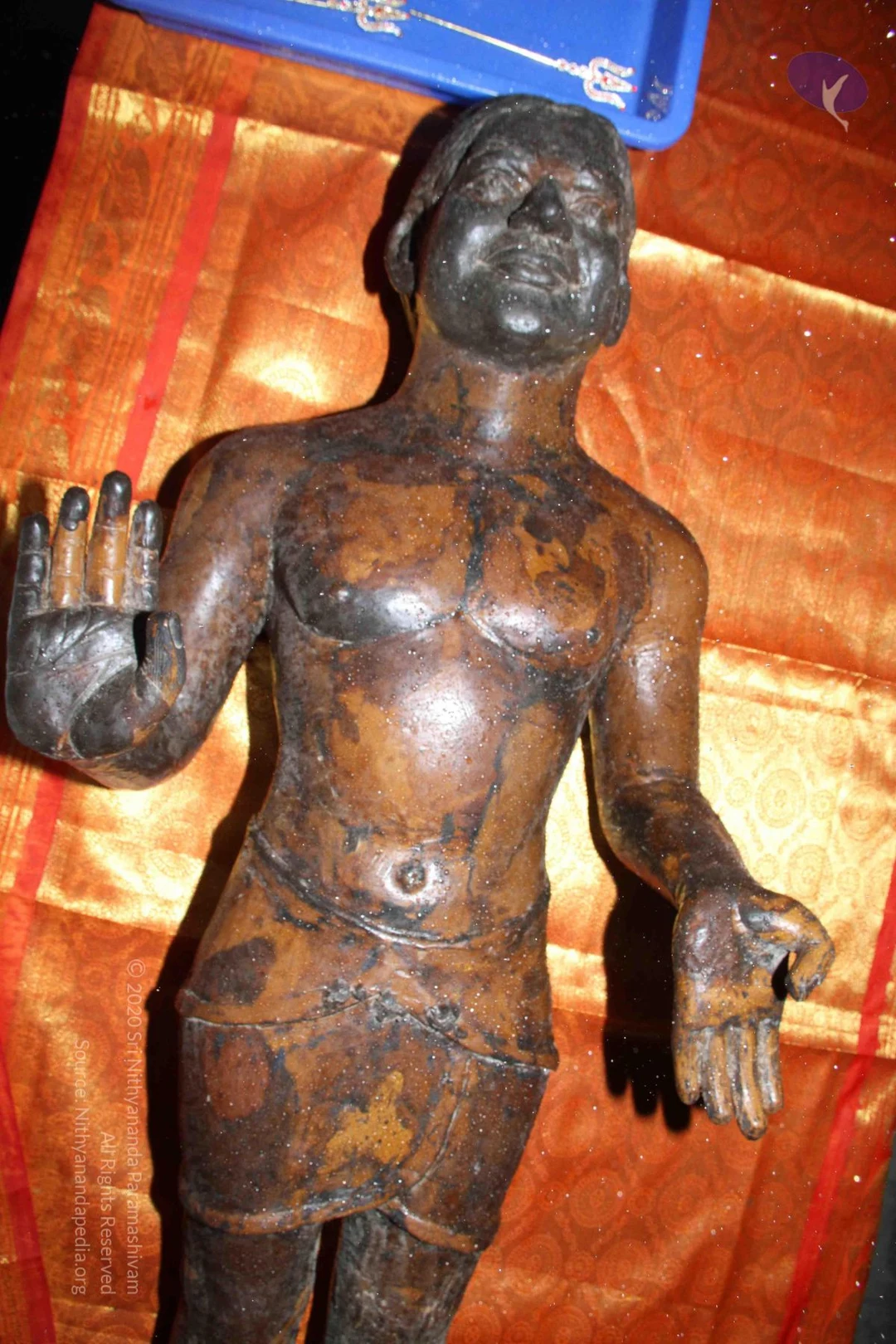
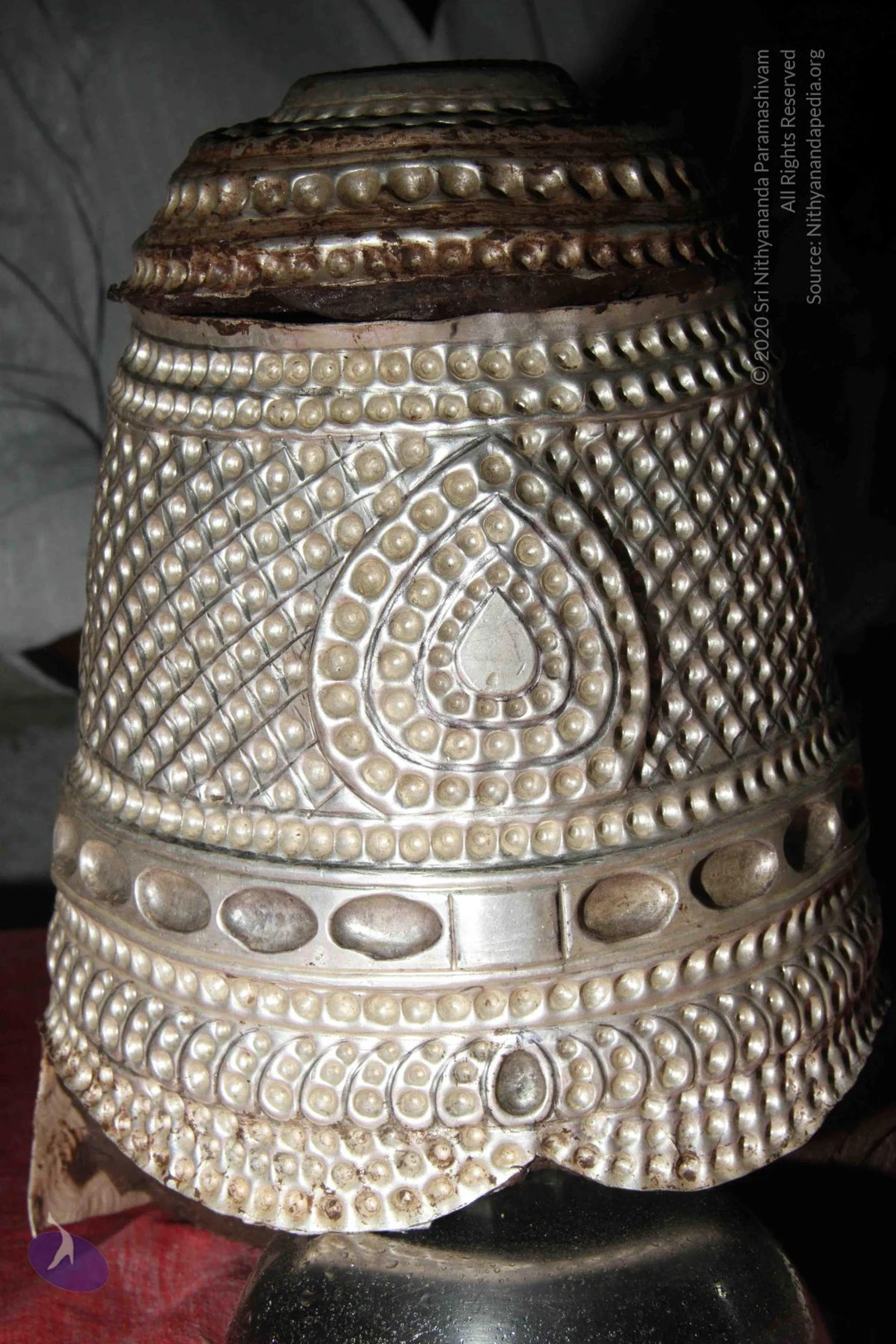
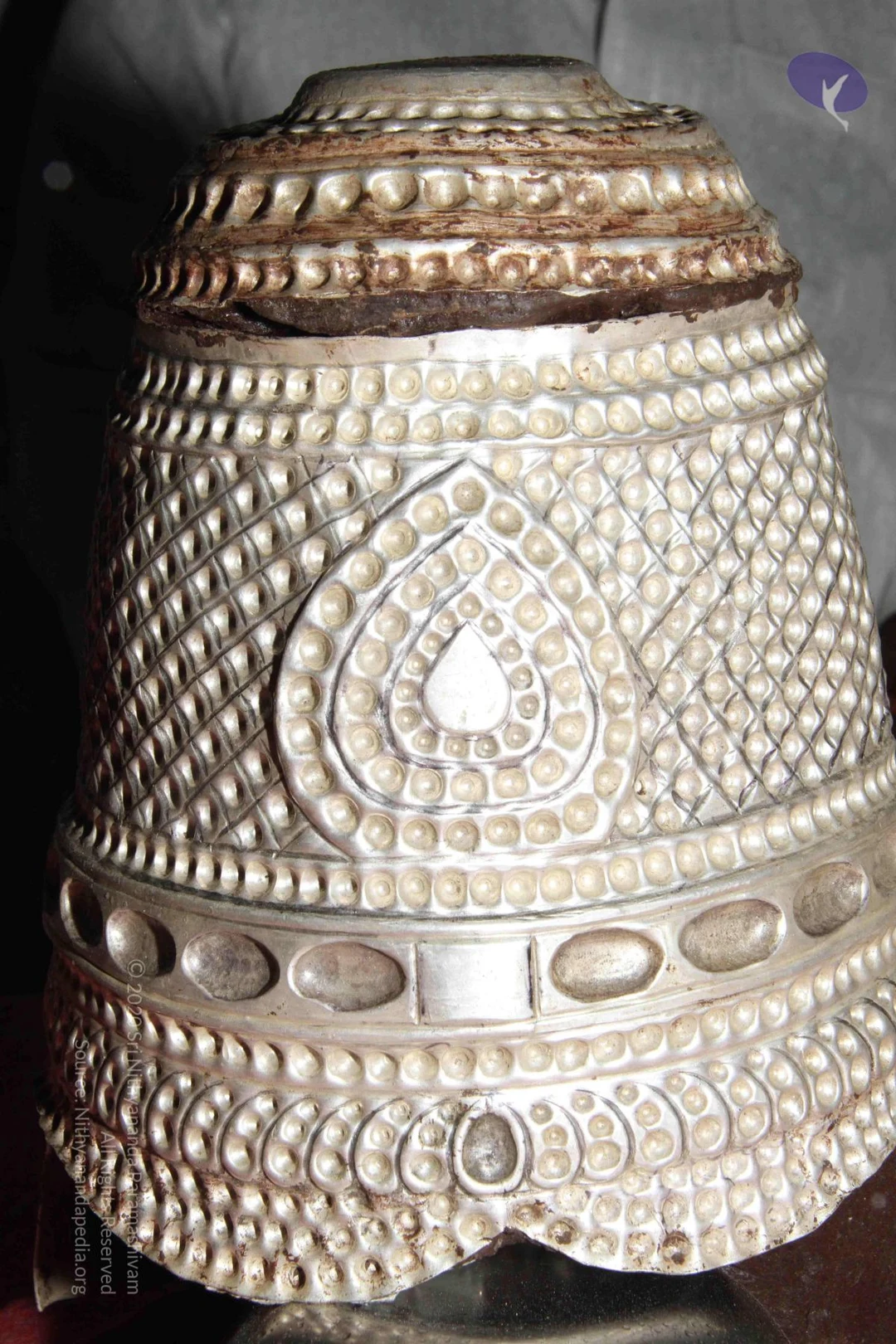
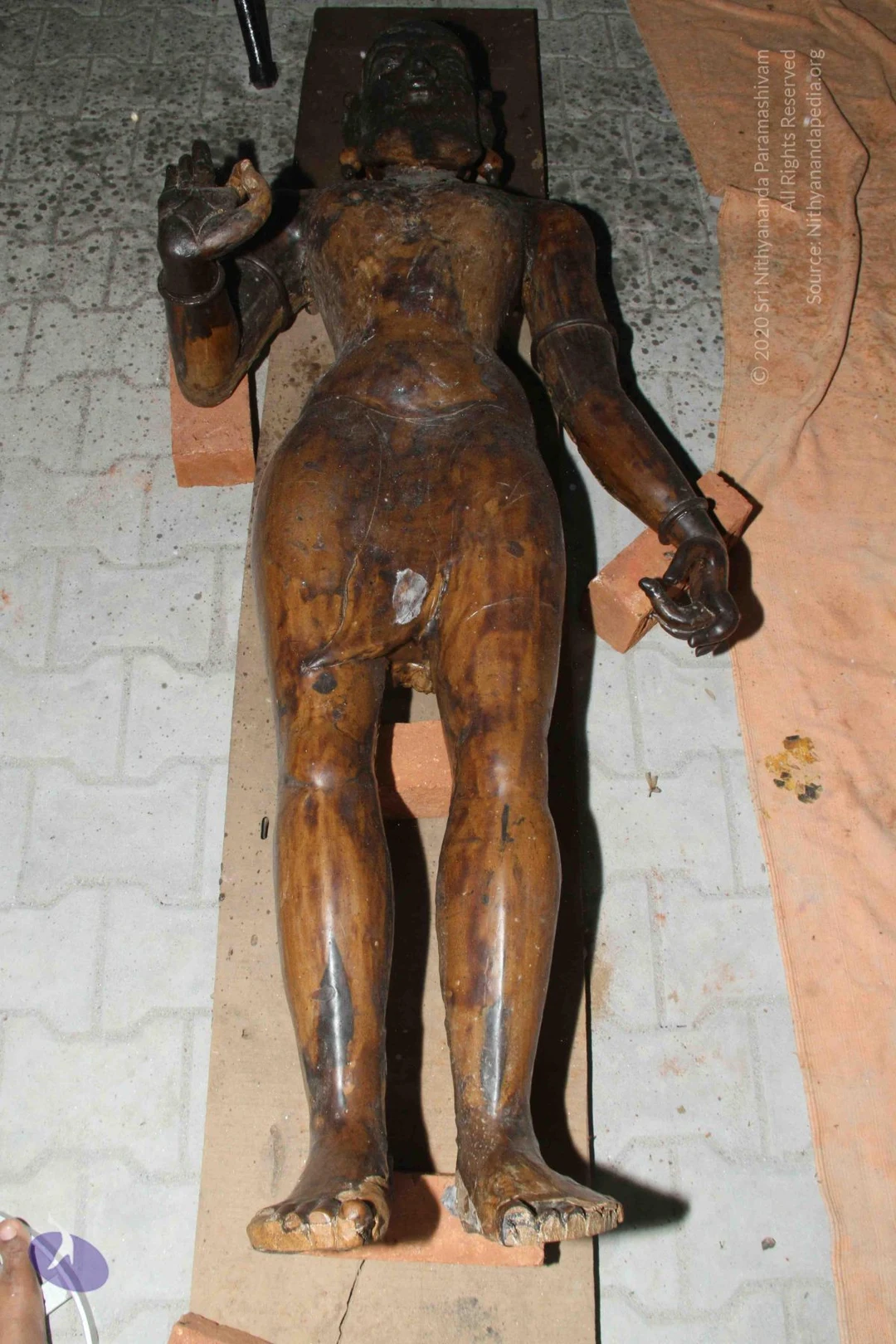
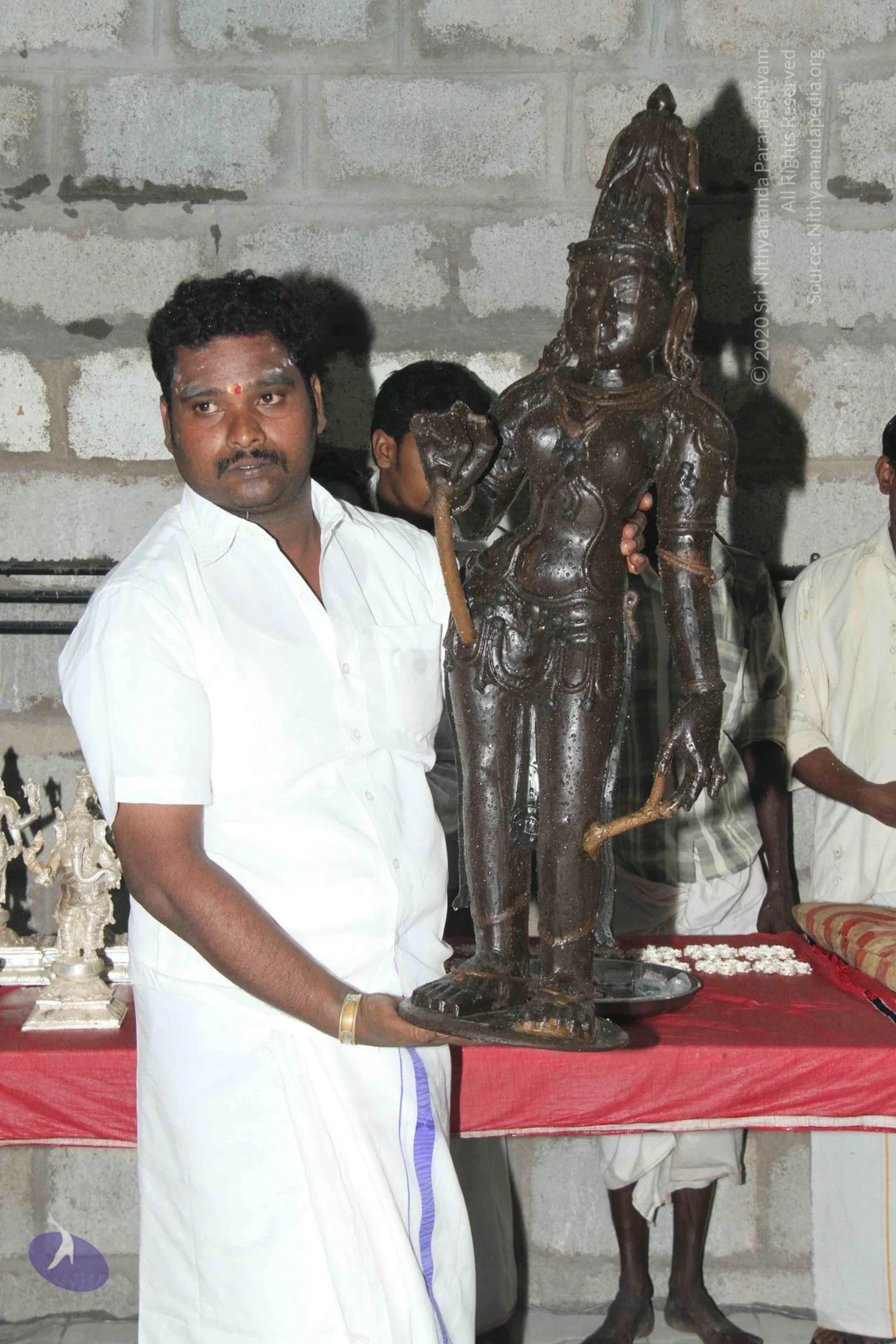
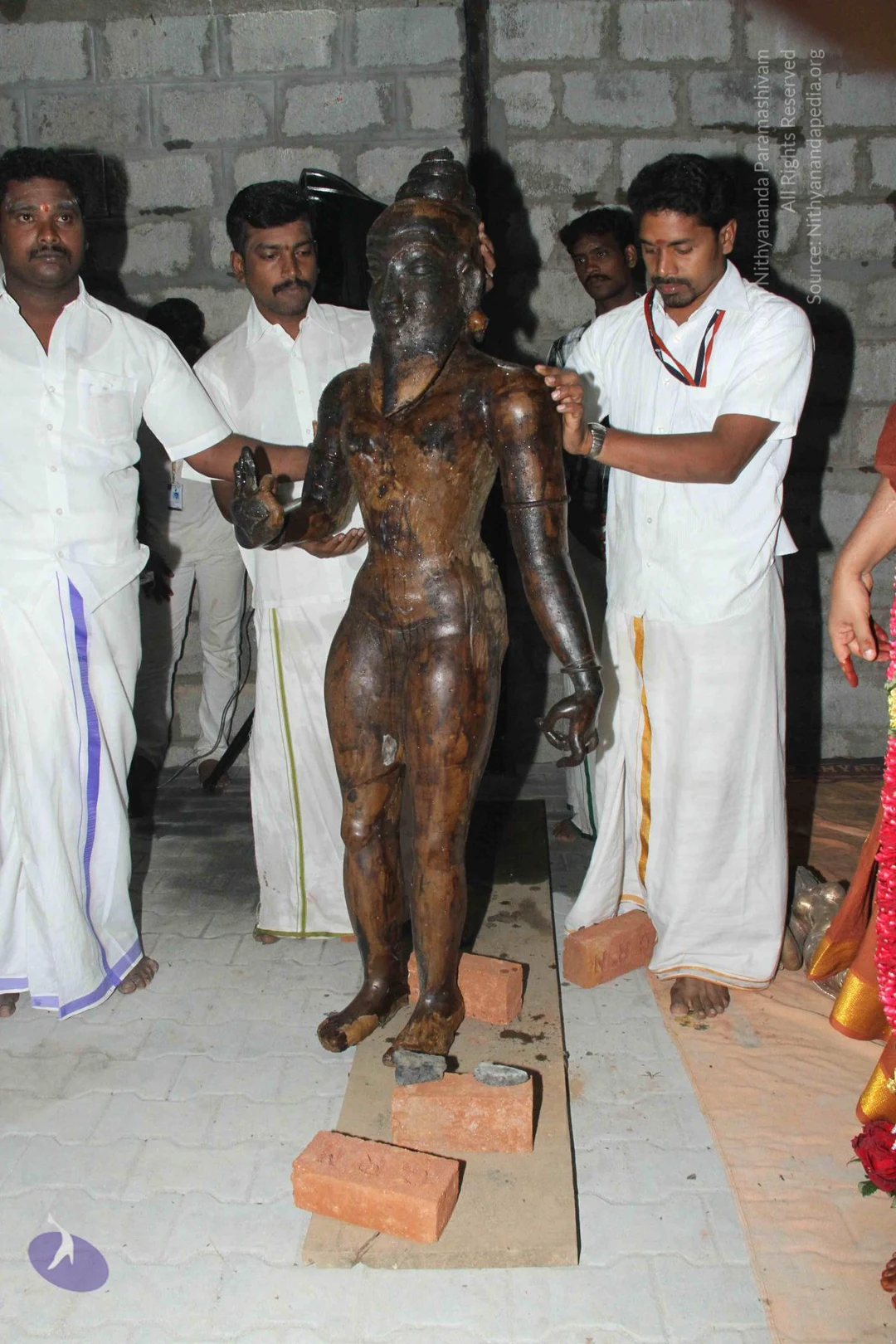
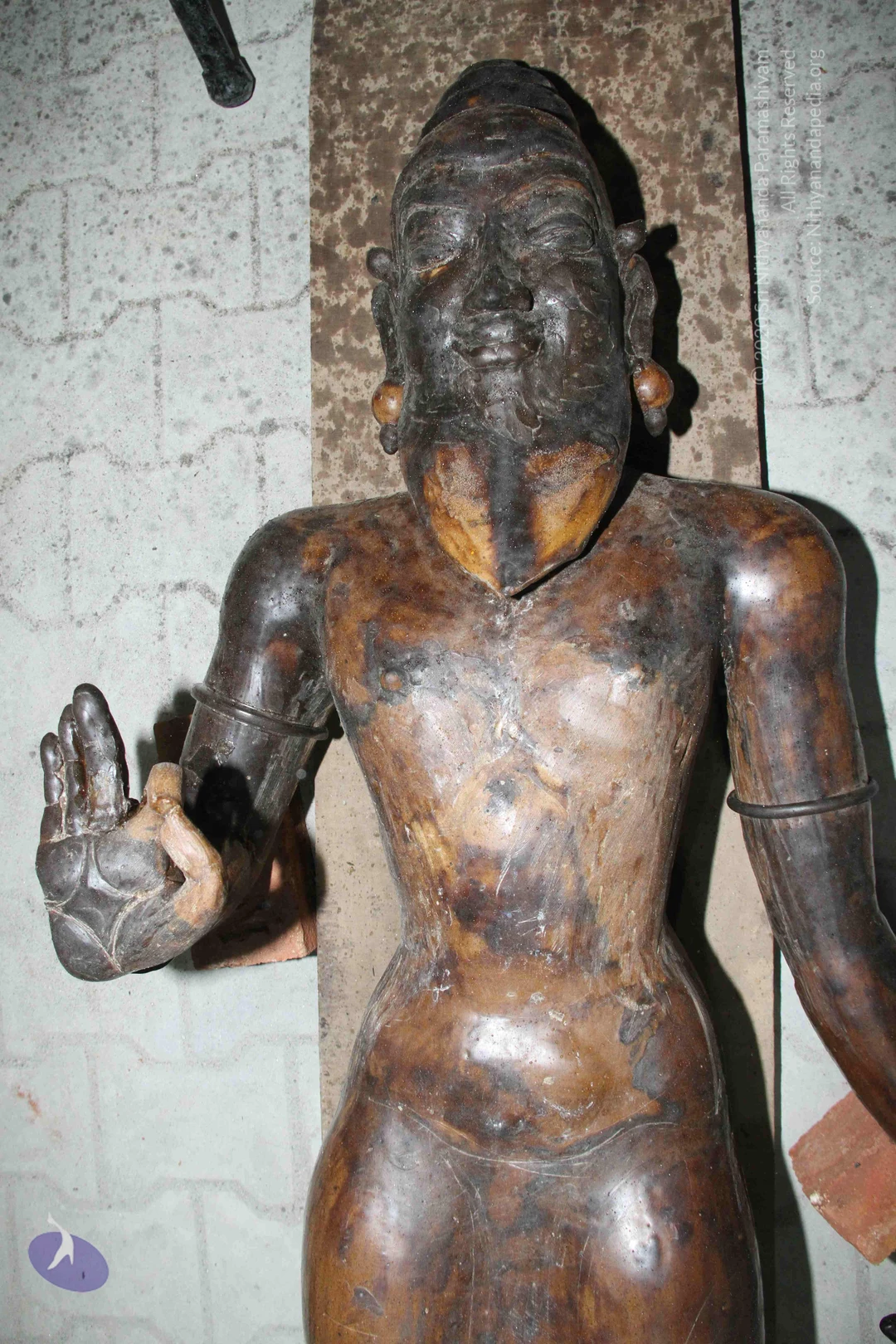
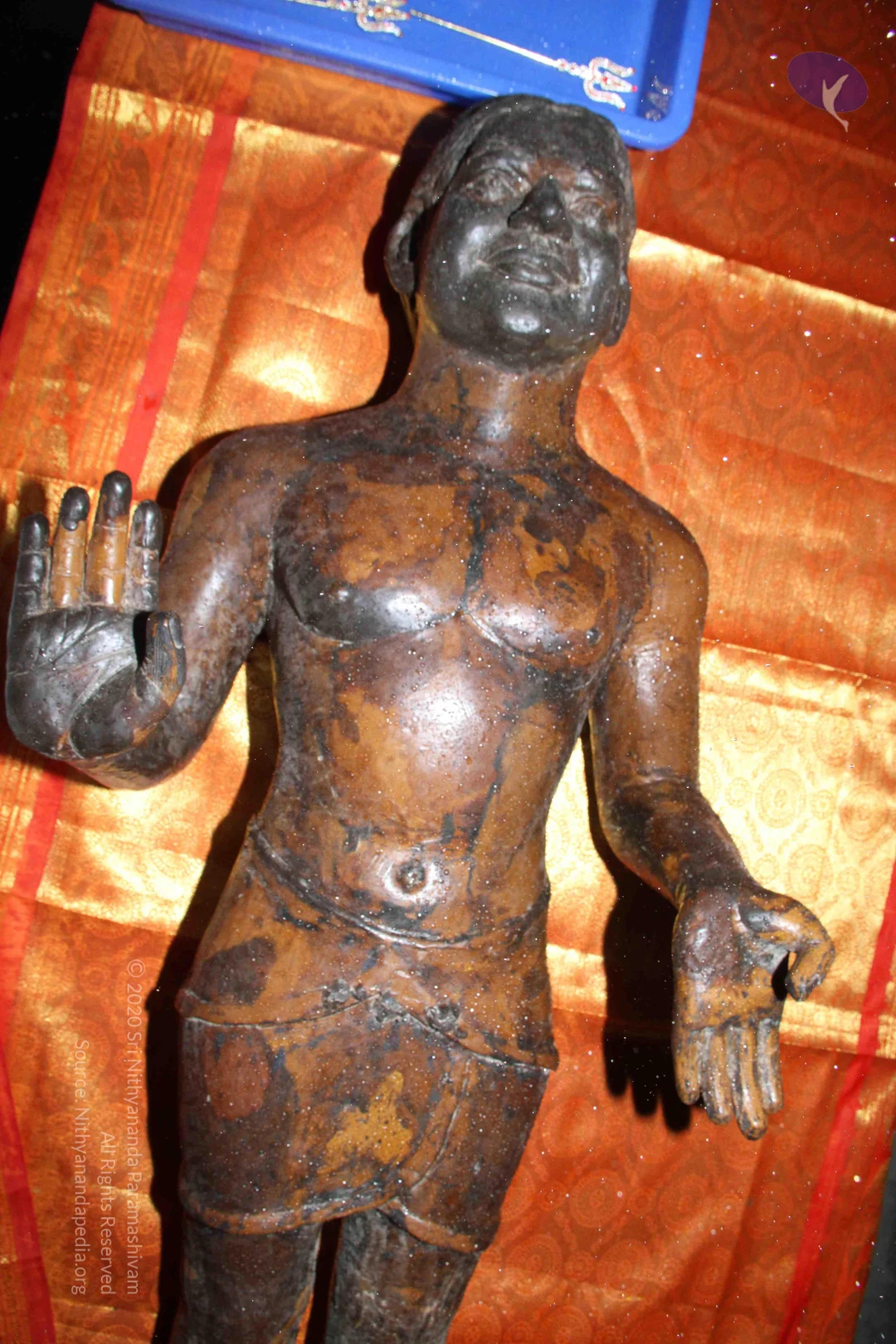
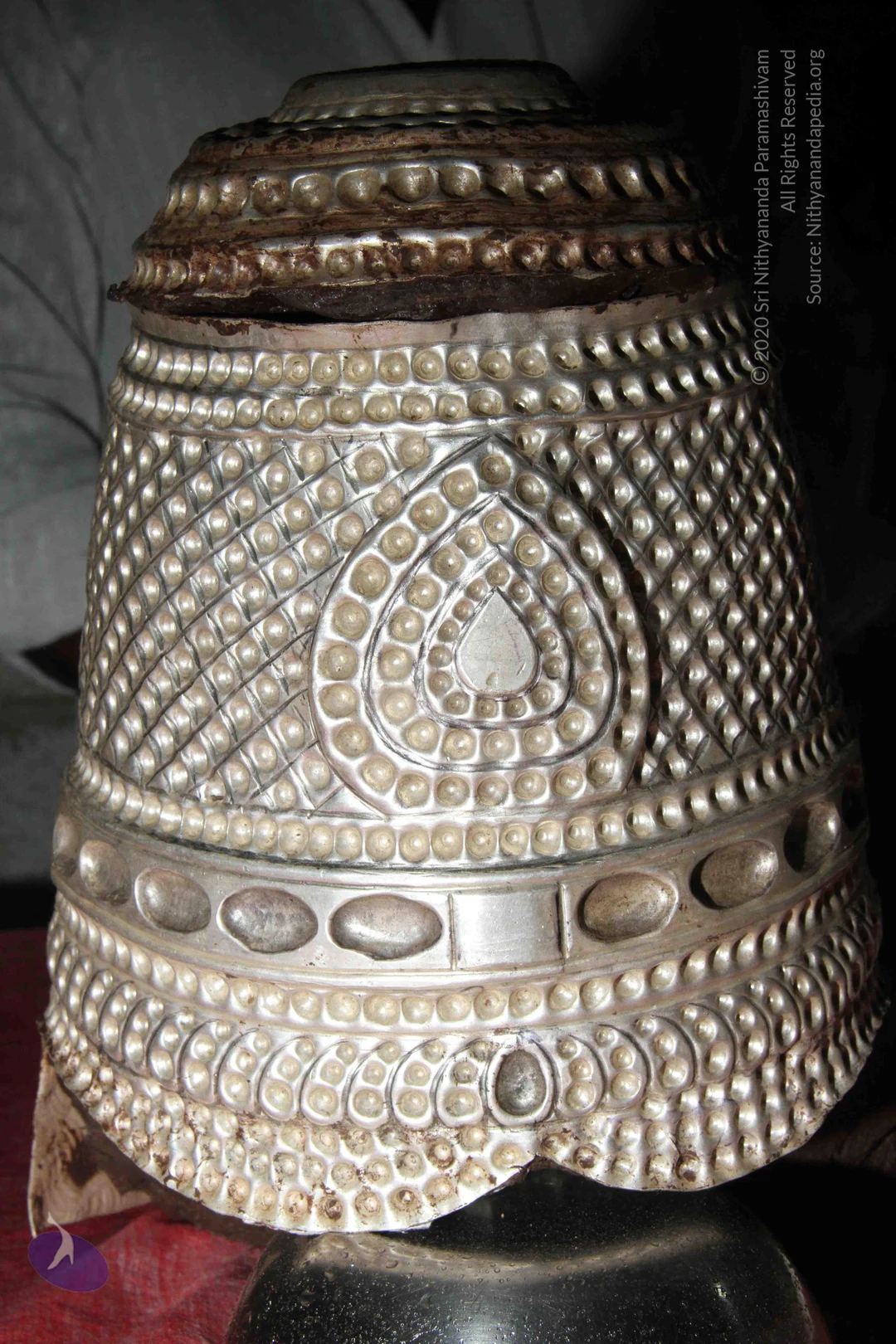
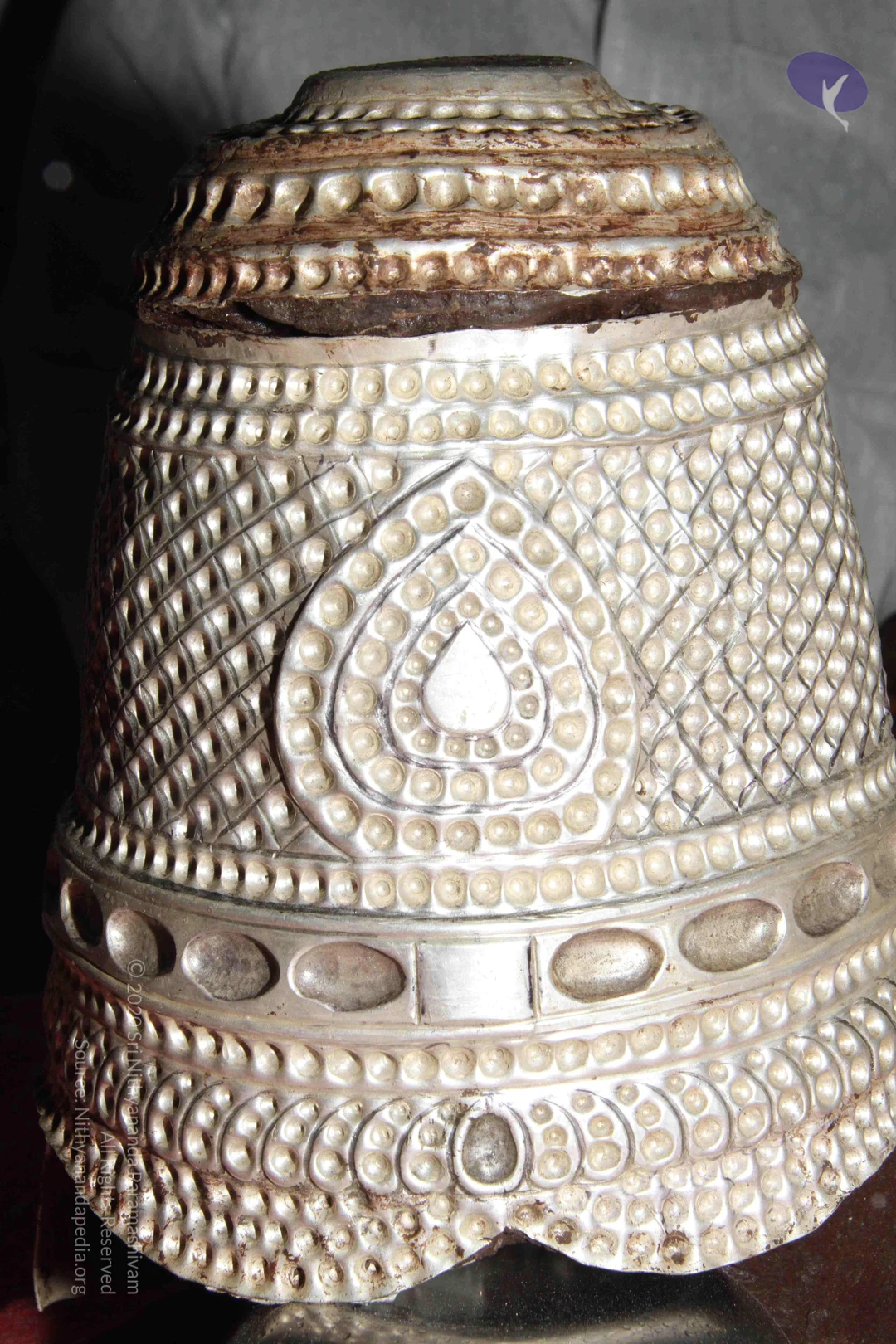
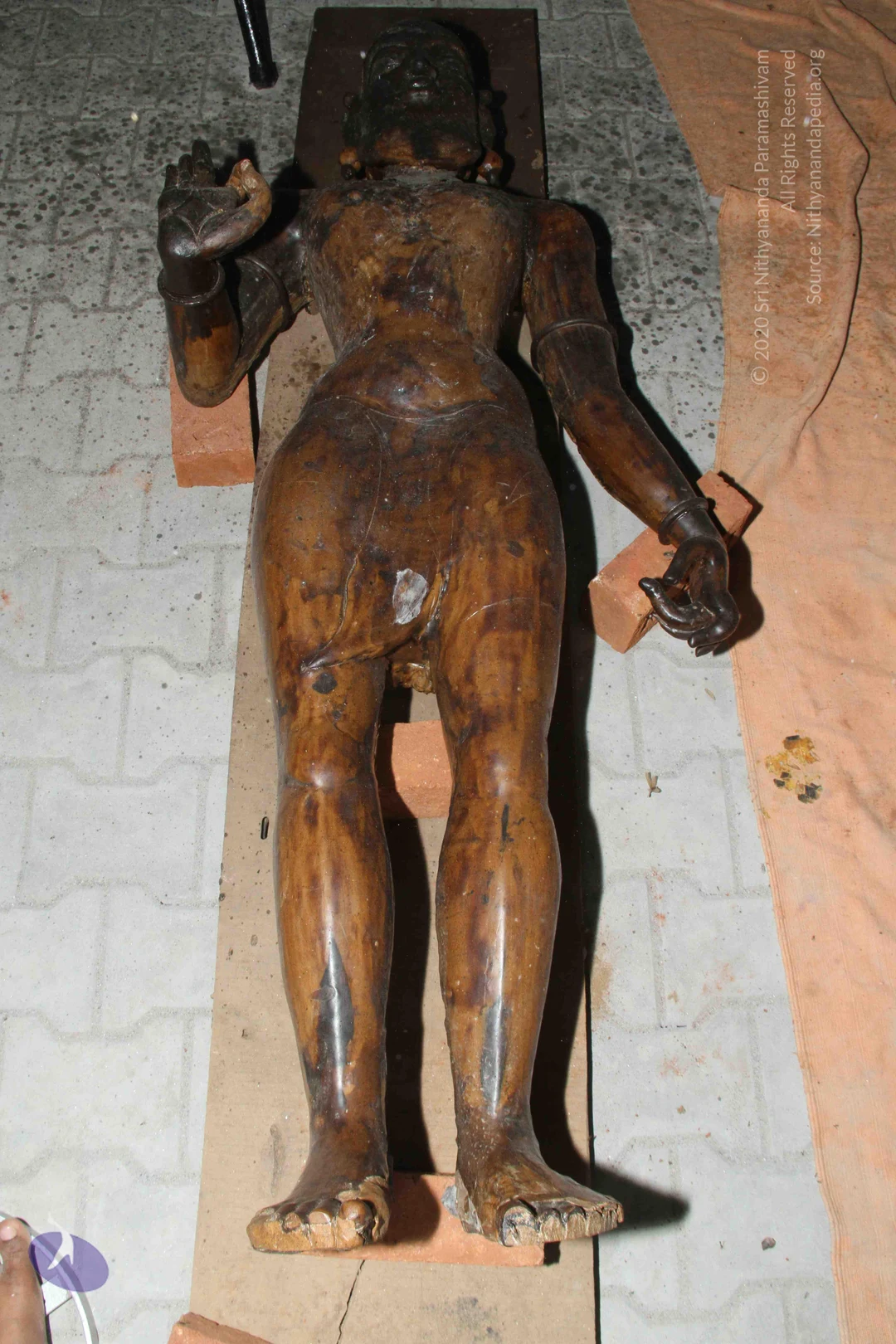
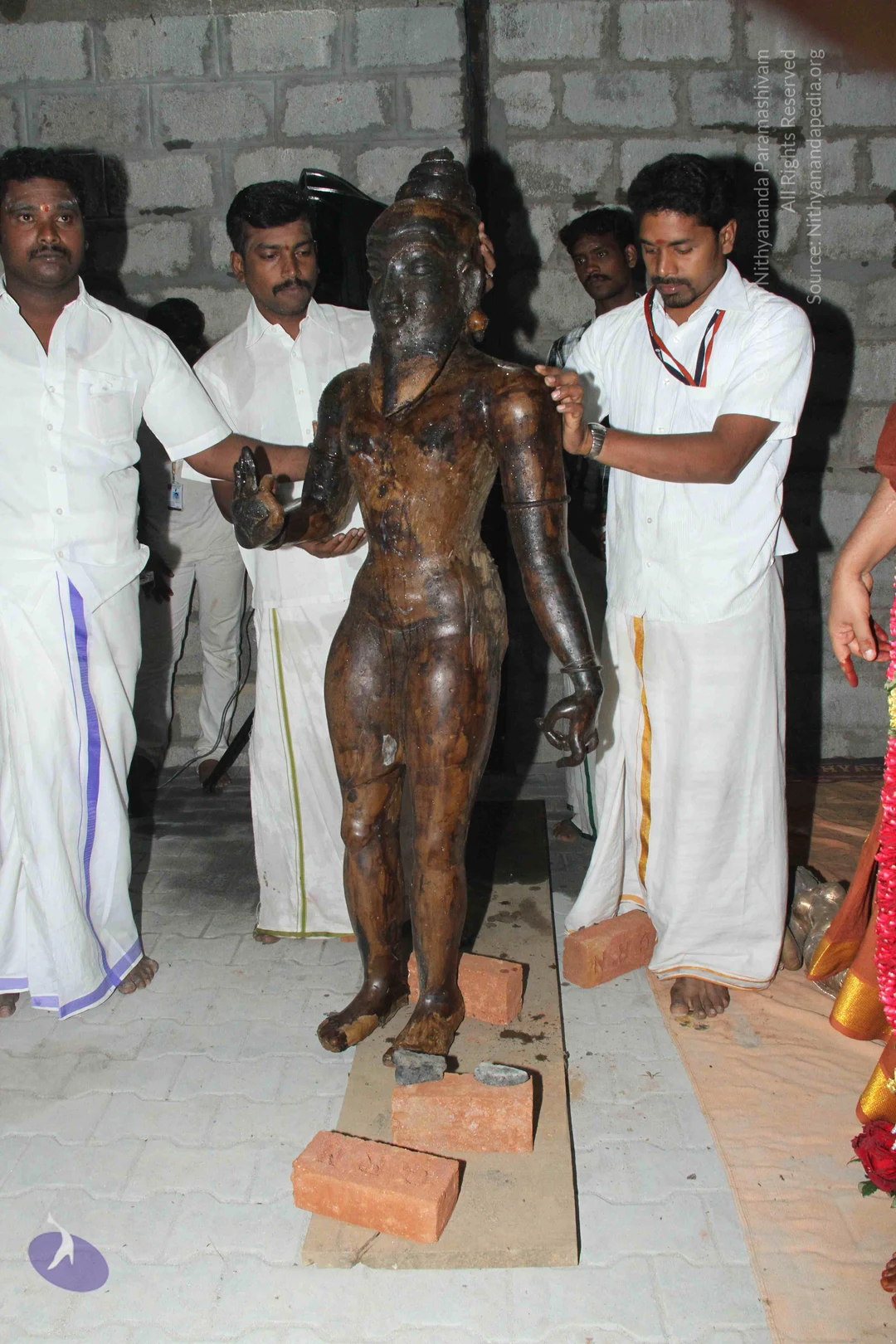
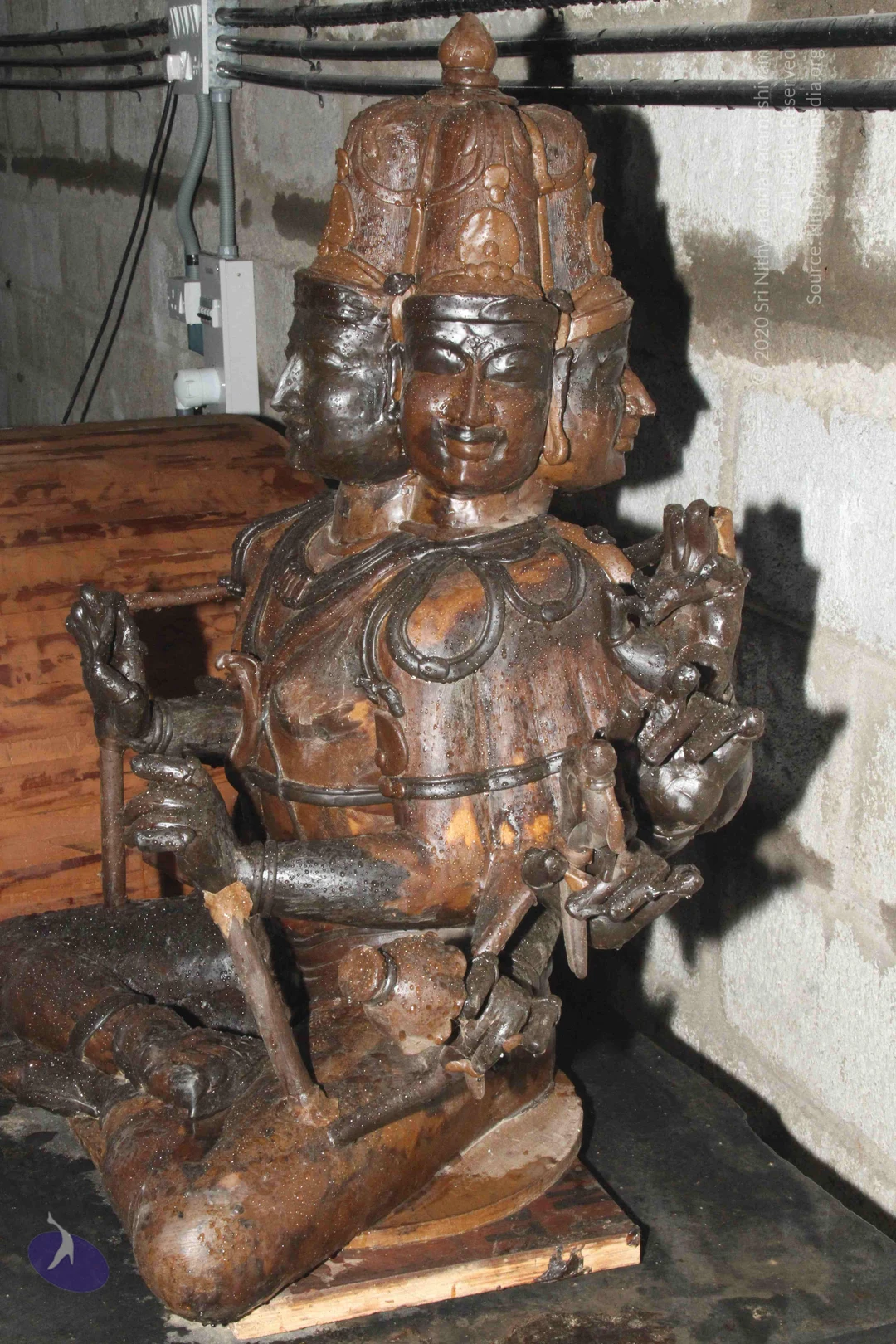
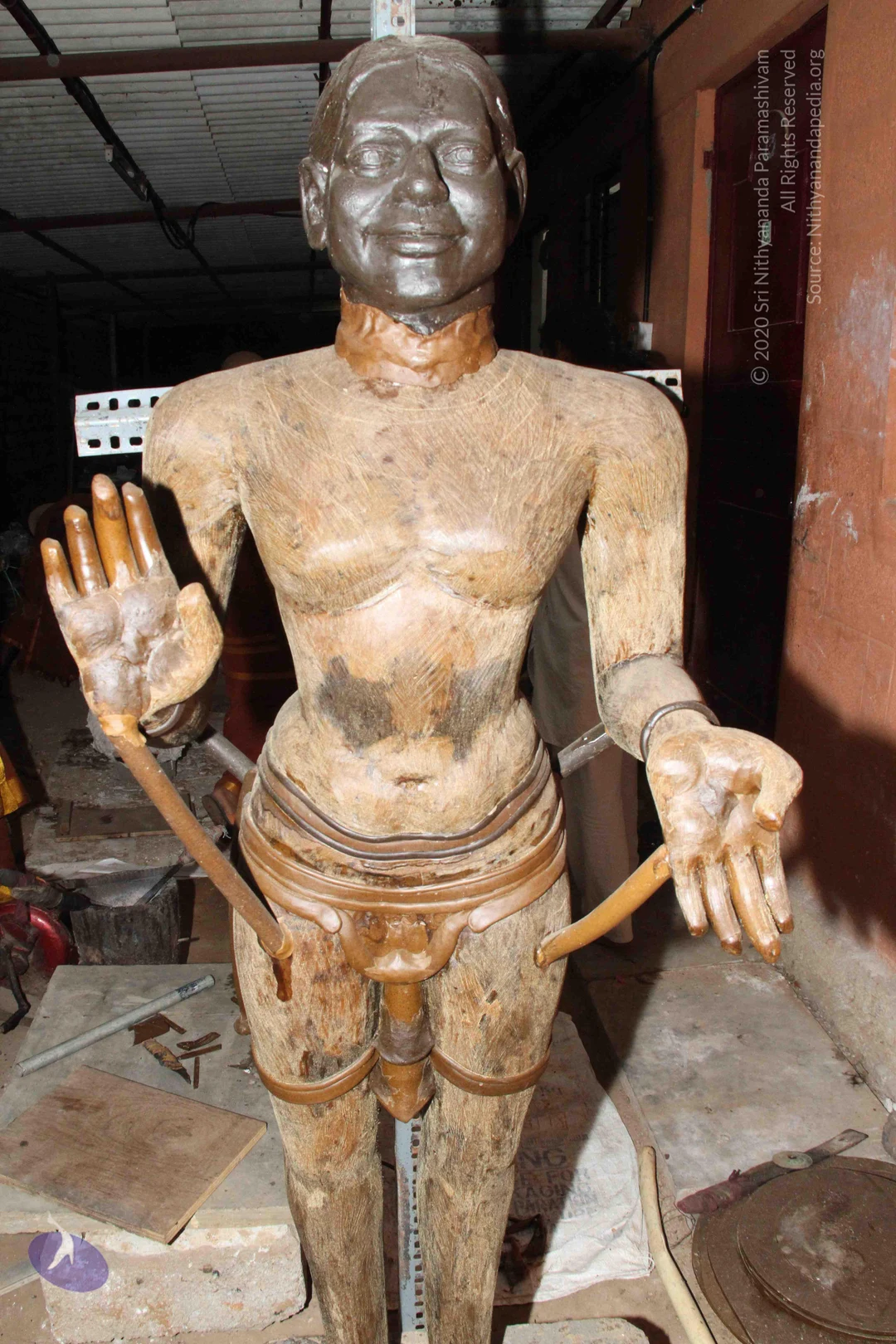
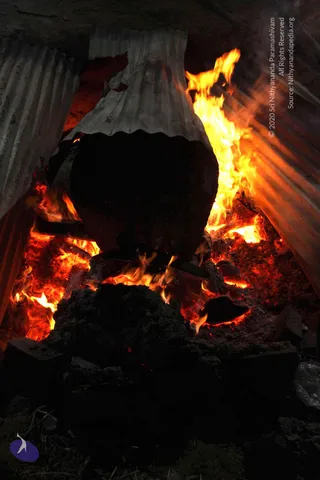
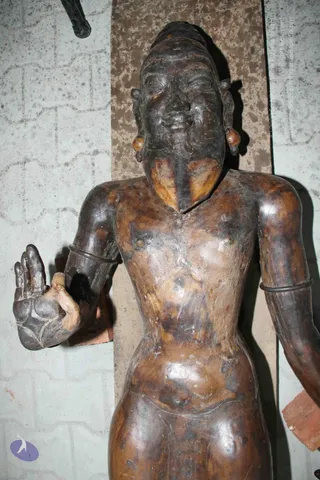
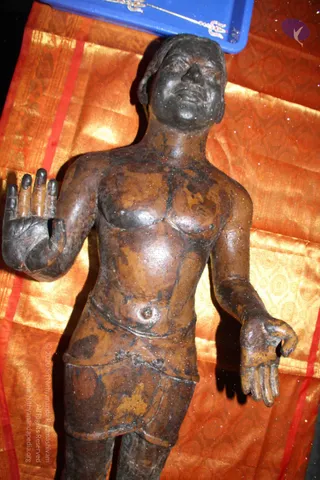
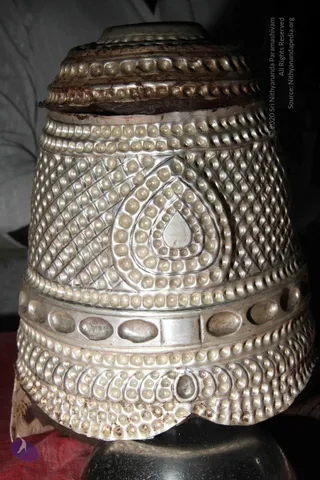
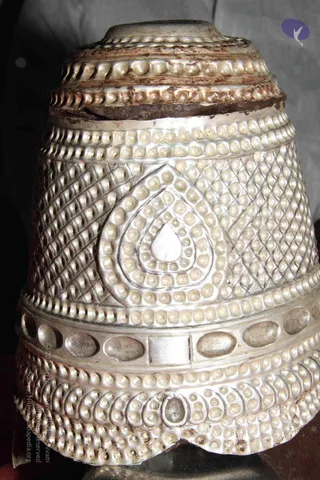
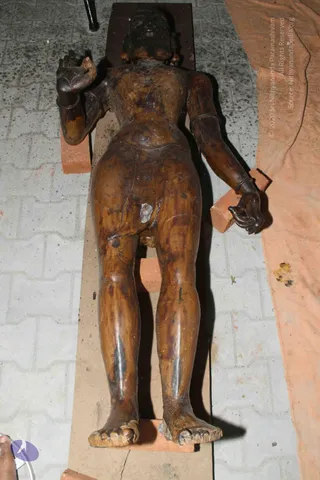
Close view of a large dark clay pot set over a bed of glowing red-orange embers and open flames, enclosed by corrugated metal sheets that form a narrow fire enclosure. Charred wood and ash lie around the base, with a dark mound of material in the foreground. No people are visible; the scene appears to be a traditional clay-pot firing or cooking fire.Close photograph of a dark, weathered bronze-toned standing statue set against a pale brick wall. The figure is bare-chested with a narrow waist, wears armlets on both upper arms and large round earrings, and has a hair bun on top of the head. Its right hand is raised in a mudra with fingers partly curled. A worn wooden board stands behind the figure, and a small purple-and-white logo appears in the lower left corner. The figure is a statue, not a living person.Close photograph of a dark bronze or metal statue of a standing bare-chested male figure with a short waist cloth, one hand raised with palm outward in an abhaya-like gesture and the other hand lowered. The statue rests on a bright orange and gold brocade cloth with red borders, and a blue tray with gold trim sits at the top edge. No physical people are visible; the figure is a statue.A close-up photograph of an ornate silver-toned metal object, appearing to be a decorative cap or cover with a flared, scalloped lower rim, raised beaded borders, a teardrop-shaped motif, and oval cabochon-like studs in bands around its body. It rests on a dark base against a red cloth background. No people are visible.Close-up photograph of an ornate silver-toned metal crown or headpiece, shaped like a tapering cone with a flared scalloped lower rim. Its surface is covered in raised dots and beaded bands, diagonal lattice patterning, and a large teardrop-shaped motif with concentric outlines in the centre. Oval cabochon-like studs sit in a horizontal band around the middle. The metal shows some tarnish and rust near the top edge. No people are visible, and the object rests against a grey fabric background.A large dark wooden statue of a standing deity lies horizontally on a cardboard sheet over a grey paved floor, photographed from behind. The figure has bare back and legs, a raised arm bent at the elbow with the hand open, and the other arm extended to the side with a bangle. Terracotta bricks prop up the body and an orange cloth lies at right. The statue shows cracks, pale patches and wear. No living people are visible, only partial feet at the lower left corner.

Kalabhairava-darshan

9 photosSource gallery
A smiling man with long dark hair and a red bindi stands on an ornate silver-and-gold repoussé throne against a plain brick wall, lit in green and blue tones. He wears a tiger-striped garment, a dense multi-strand rudraksha-style mala with skull-like beads, beaded bracelets, and a dark dhoti with a green border. He holds a tall silver trident. a person: long swept hair, ornate clothing, and rudraksha mala are visible cues of the presented figure. One person is visible in the photograph.A photograph of a smiling person standing on an ornate golden-silver arched platform under green stage lighting. The figure wears a tiger-striped yellow and black wrap over the shoulder, brown lower cloth, layered dark beaded rudraksha-style malas, and beaded bracelets on the wrists and arms. The right hand holds a tall silver trident (trishul). A large silver-gilt decorative archway frames the scene, with a painted temple backdrop and a deity murti figure visible behind. The figure's appearance is consistent with a distinctive ceremonial presentation, so this may be a person in a stage or festival tableau setting.A smiling performer in a tiger-striped garment and multiple strands of white skull-like beads stands within an ornate golden arch lit with green light. She holds a silver trident and wears white bangles on her arms, a dark patterned cloth at the waist. Behind her, a silver-and-gold decorative backdrop and a second figure's arm holding an object are partly visible. The appearance is not sufficient to identify the performer, so no identity is asserted.A man stands in front of an ornate silver-embossed throne under green and blue stage lighting. He wears a tiger-striped garment, layered black and white skull-bead malas across his chest and waist, matching skull-bead bracelets and armlets, and holds a polished silver trident in his right hand. He has long swept-back hair, a white tilak with a red bindi on his forehead, and smiles toward the audience. The scene appears to be a staged performance of a Shiva-associated form. a person: long hair, rudraksha-style malas and a trident mark him as a candidate for the a person role, though the appearance is not conclusive.A photograph of a life-size figure standing in an ornate silver-and-gold arched alcove lit with green and blue light. The figure has long dark hair, a red bindi on the forehead, and wears a striped green and black garment, a dense rudraksha-style bead mala across the chest, and beaded bangles on the wrists. It holds a tall silver trident (trishul) in the right hand. The figure is a statue or murti-style tableau rather than a living person, and no one else is visible. A large ornamented silver frame with embossed patterns surrounds the figure. The image is a photo.A photograph of a smiling figure standing before an ornate gold and silver repoussé backdrop under green and blue stage lighting. The figure wears a tiger-striped saffron-and-black wrap, a dark lower cloth with a gold border, layered dark rudraksha-style beaded necklaces, and beaded bracelets on both arms, with a red bindi on the forehead. The figure holds a tall polished silver trident with a brass-coloured shaft and rests the other hand on the hip. a person wearing distinctive ceremonial adornments and a trident is shown in this performance-style setting; the figure is a deity-form costume with an ornate throne-like backdrop.

05--Inner-Awakening

2 photosSource gallery
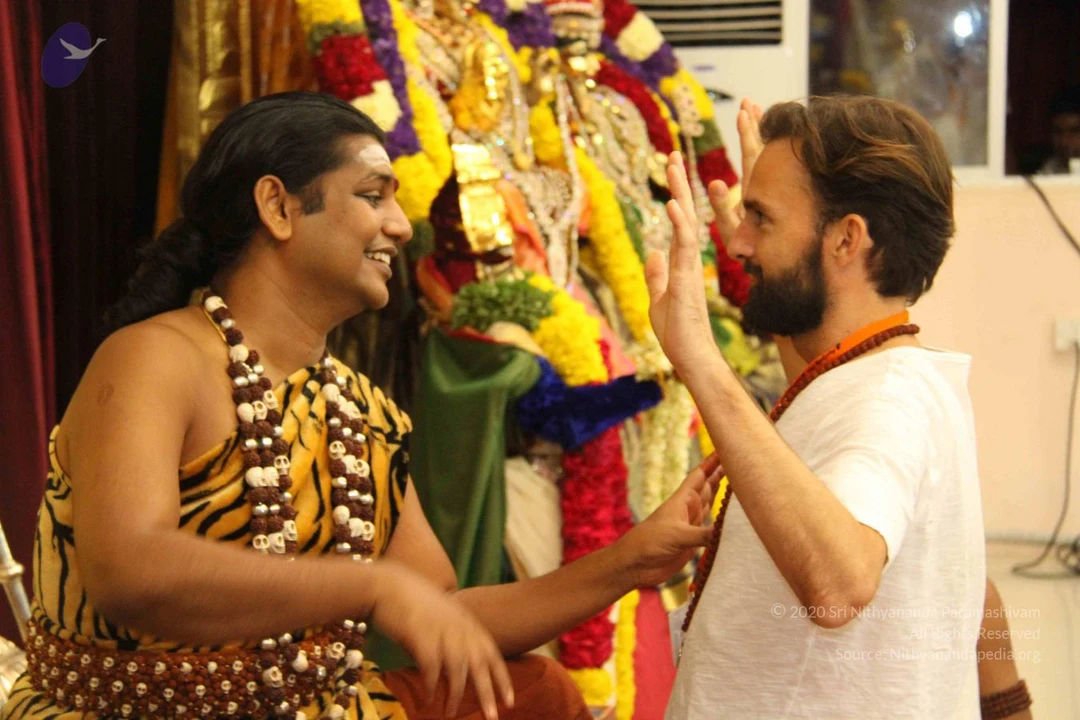
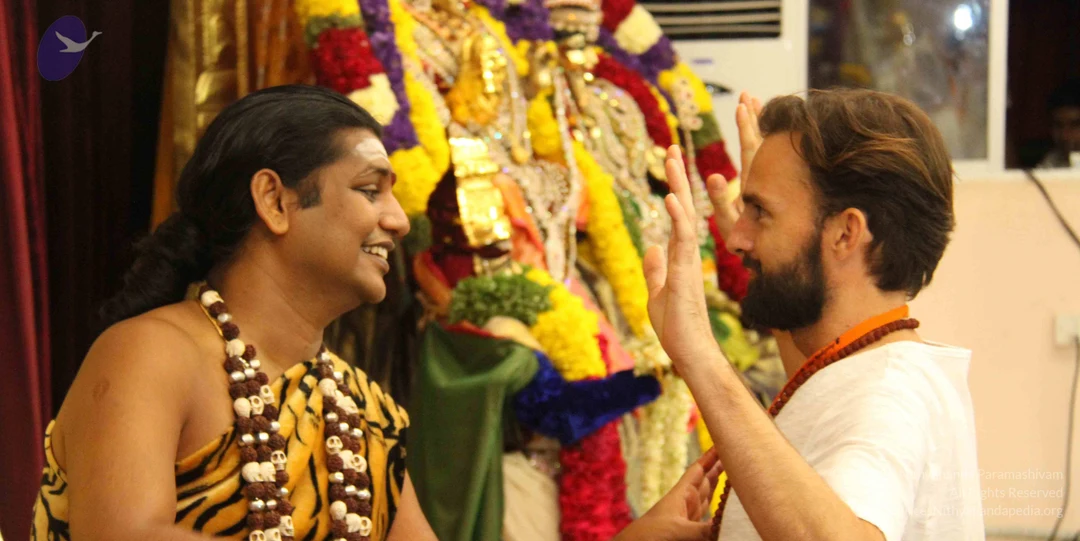
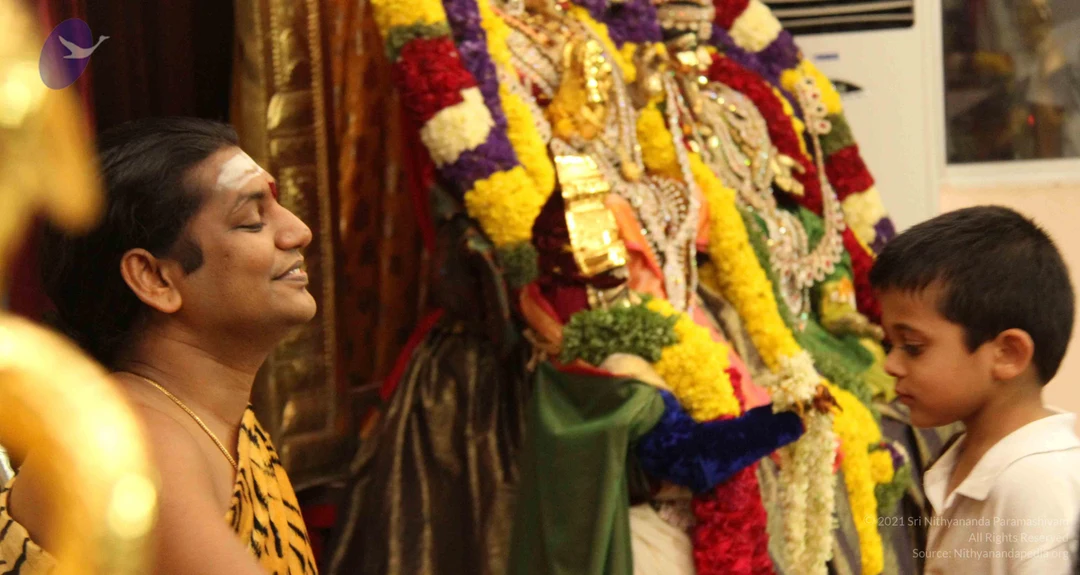
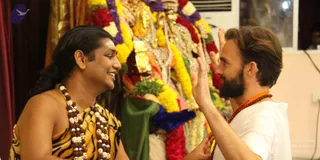
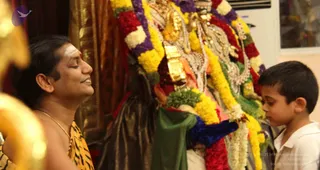
Two men stand face to face in front of a deity murti draped with garlands of yellow, red, purple and green flowers and gold ornaments. The man on the left has long dark hair swept back, a white tripundra on his forehead, a tiger-striped yellow and orange cloth wrapped over his shoulders and a rudraksha mala with white beads, and he smiles warmly. The man on the right has a full brown beard and short wavy hair, wears a white t-shirt and an orange-beaded rudraksha mala, and raises his palm toward the other man's face in a blessing gesture. Their appearance does not clearly match a known candidate, so the left man is described by role only.A photograph of a man with a white vibhuti line and red kumkum mark on his forehead, wearing a gold necklace and a yellow-and-black striped shawl over bare shoulders, standing in profile with eyes closed and a faint smile before a richly decorated deity murti. The murti is adorned with garlands of yellow, red, purple and white flowers, gold ornaments, and jewelled necklaces. A young boy in a white shirt stands beside him, looking down toward the murti. Background includes a brown and gold drape and an air conditioner. Performing puja or darshan at a temple shrine.

06--Sacred-Arts

3 photosSource gallery
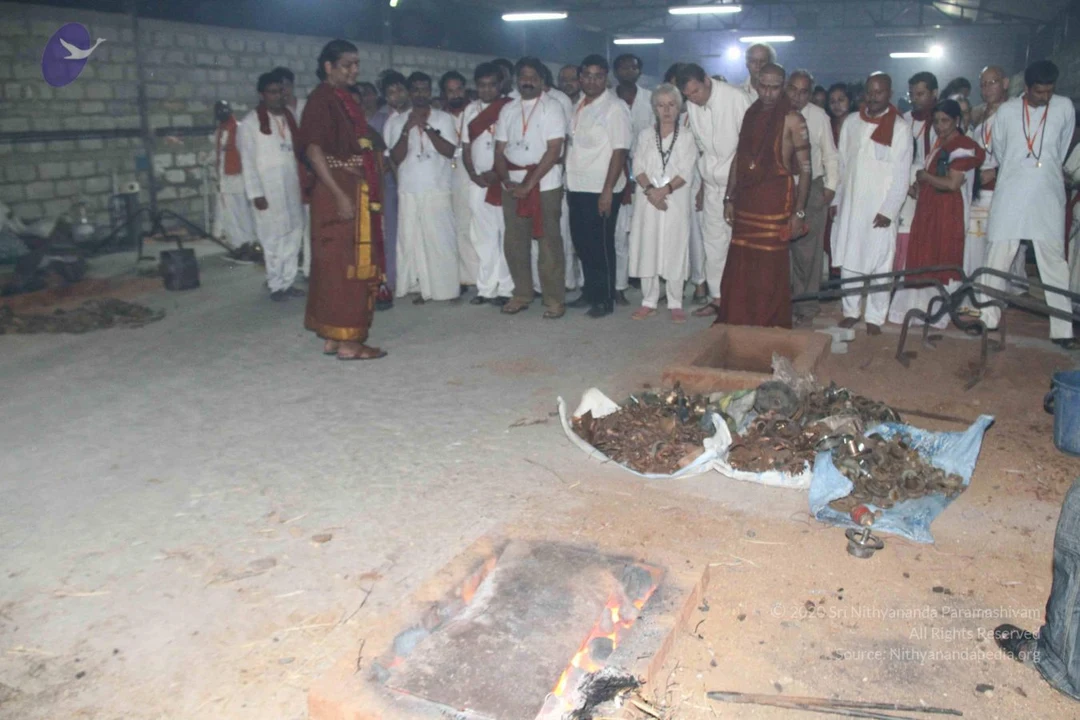
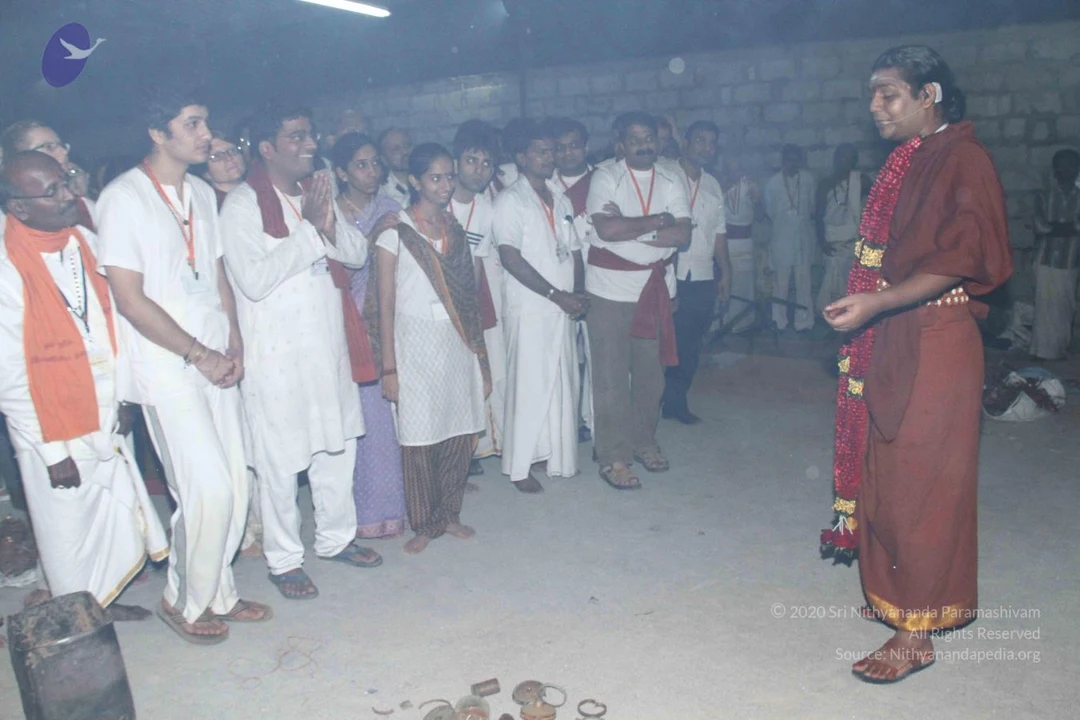
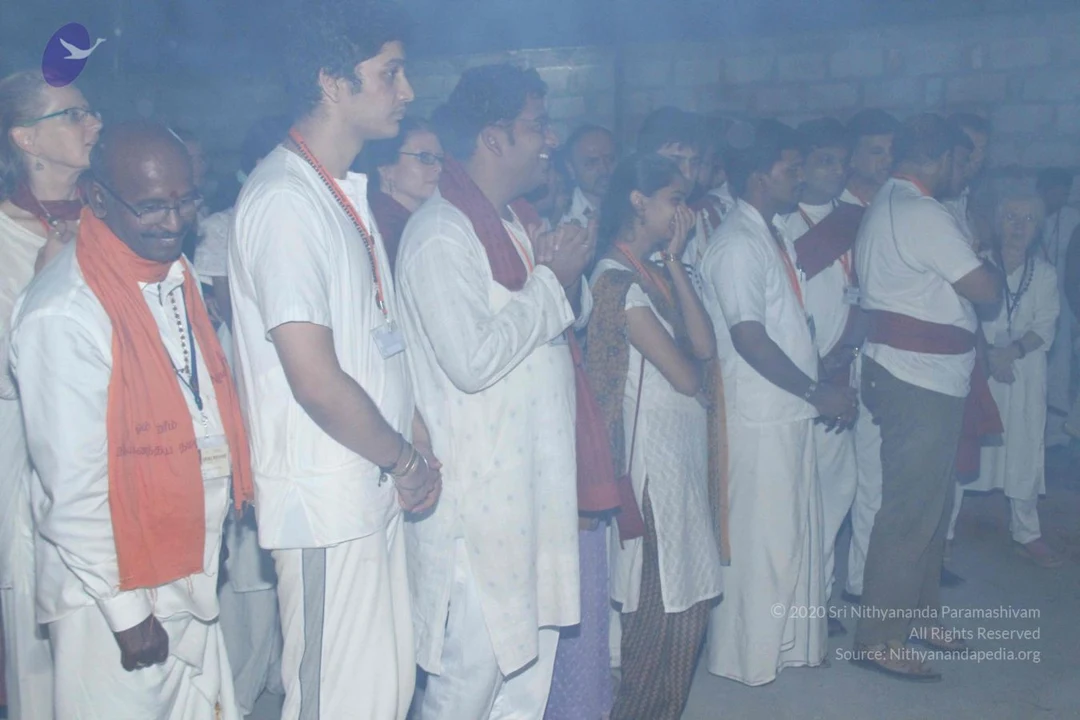
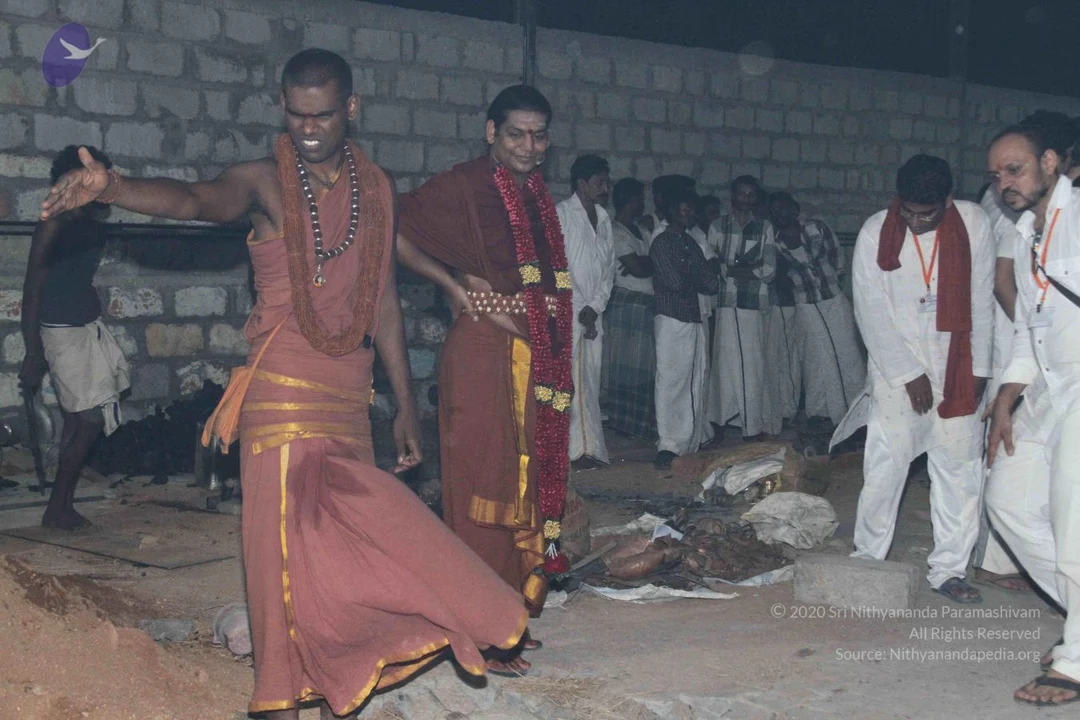
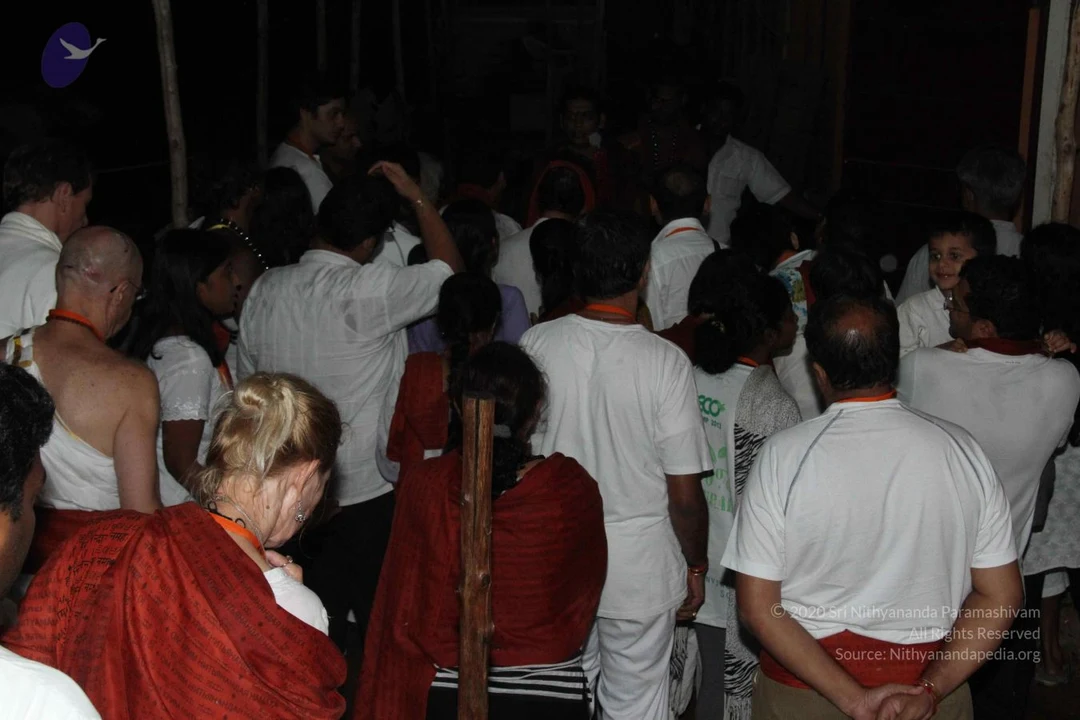
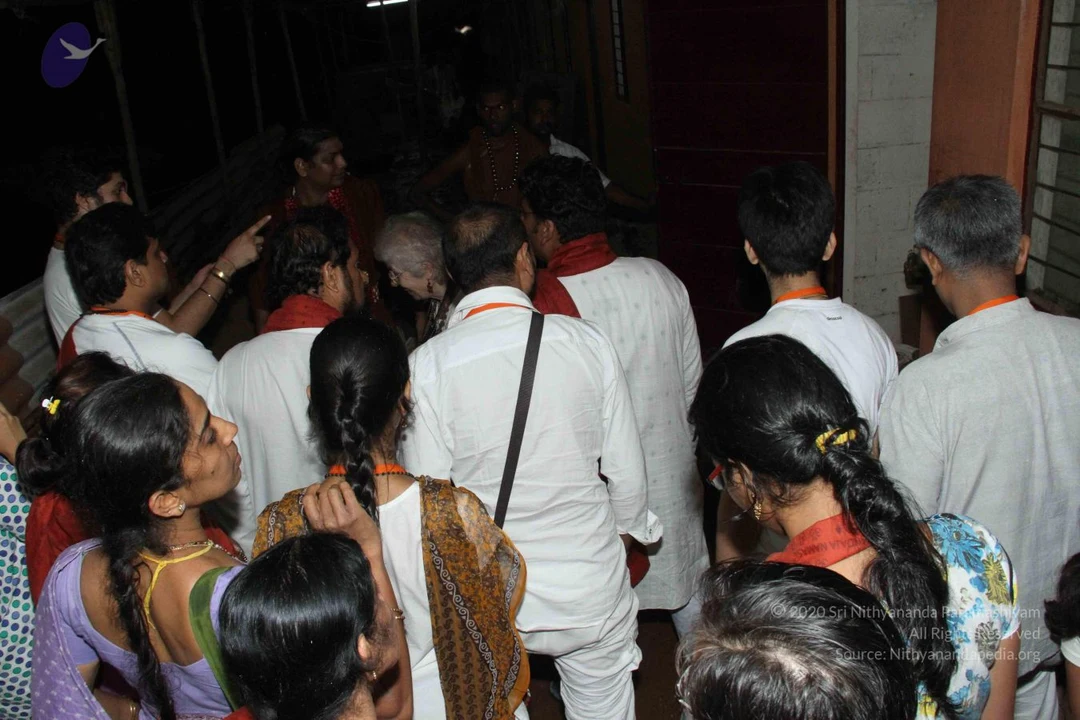
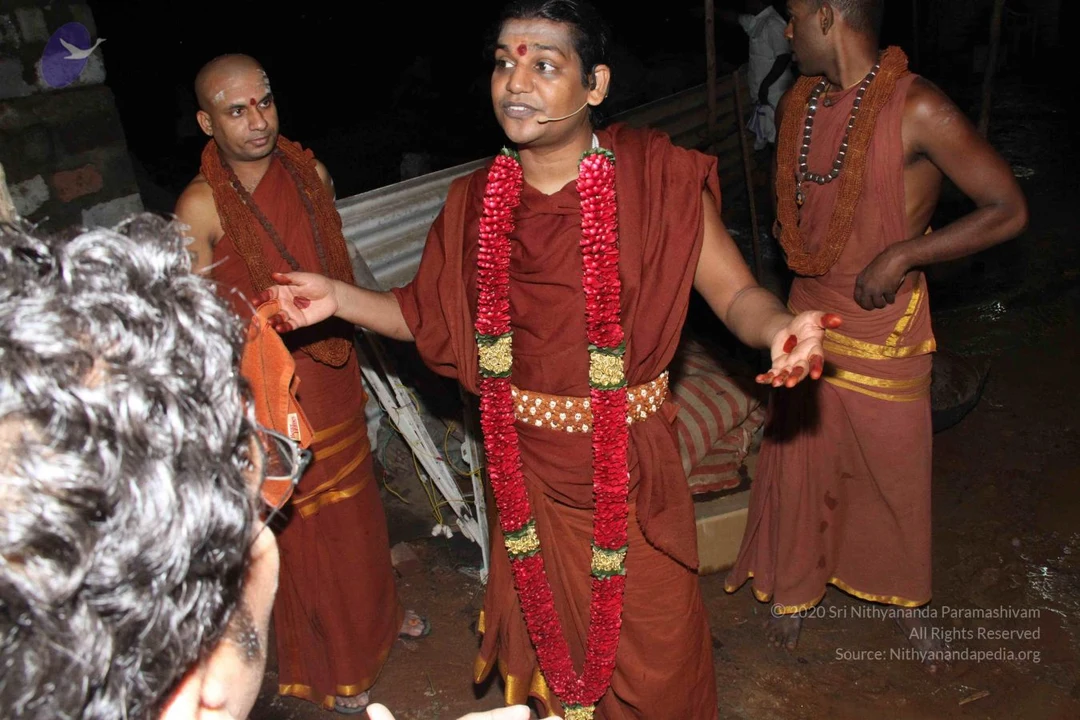
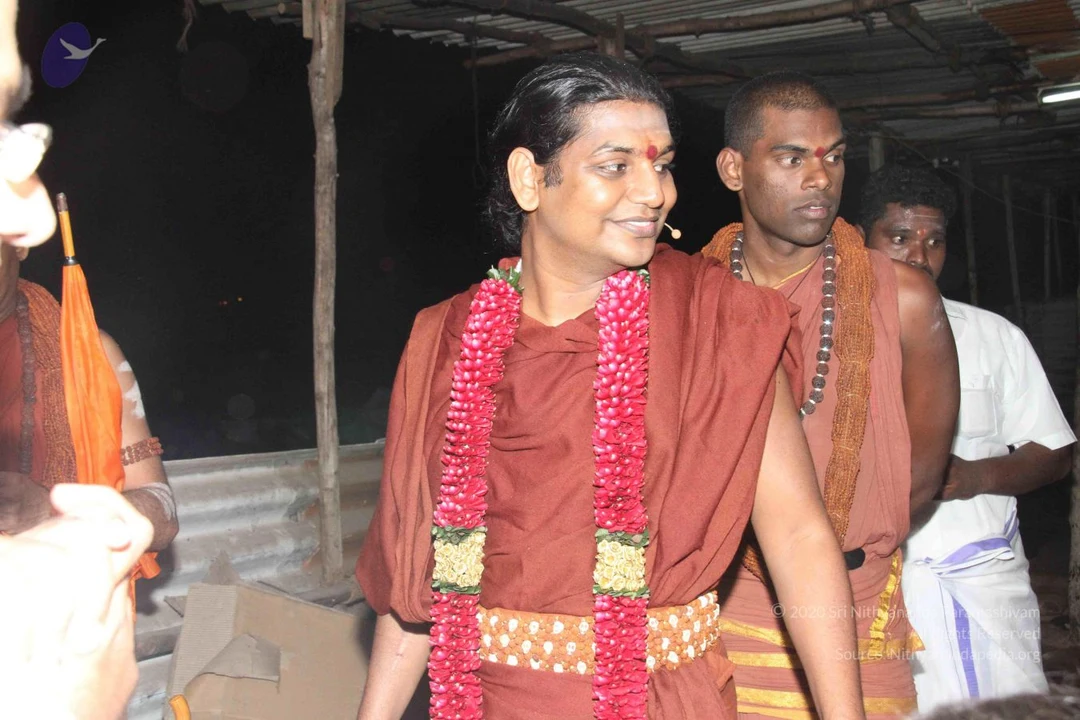
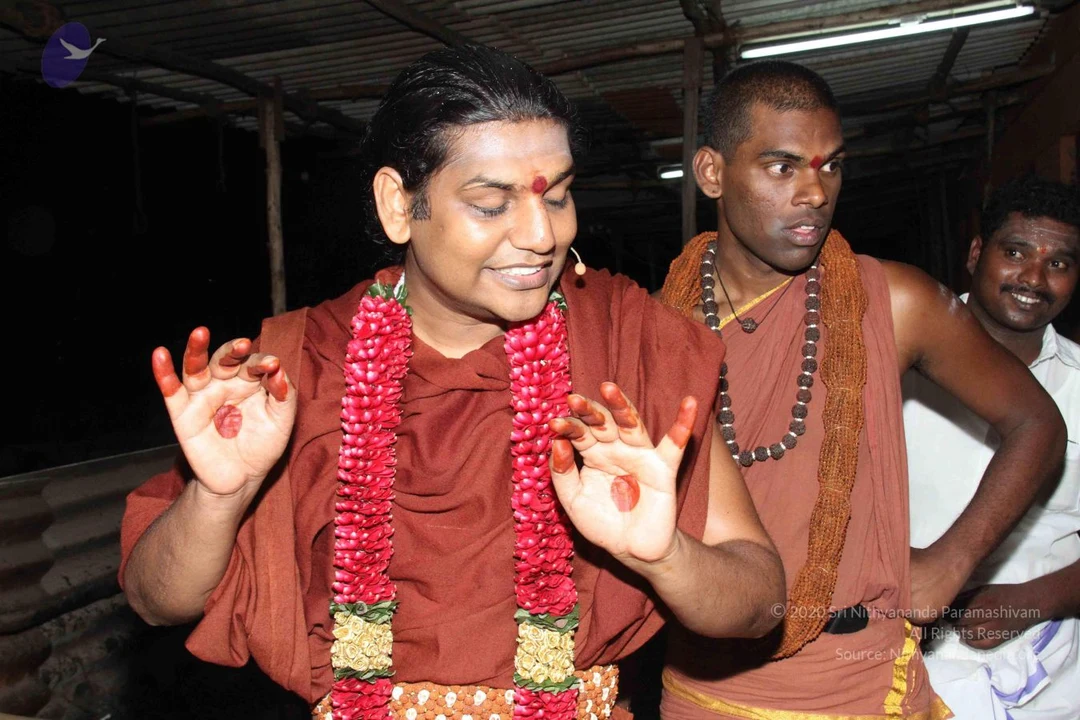
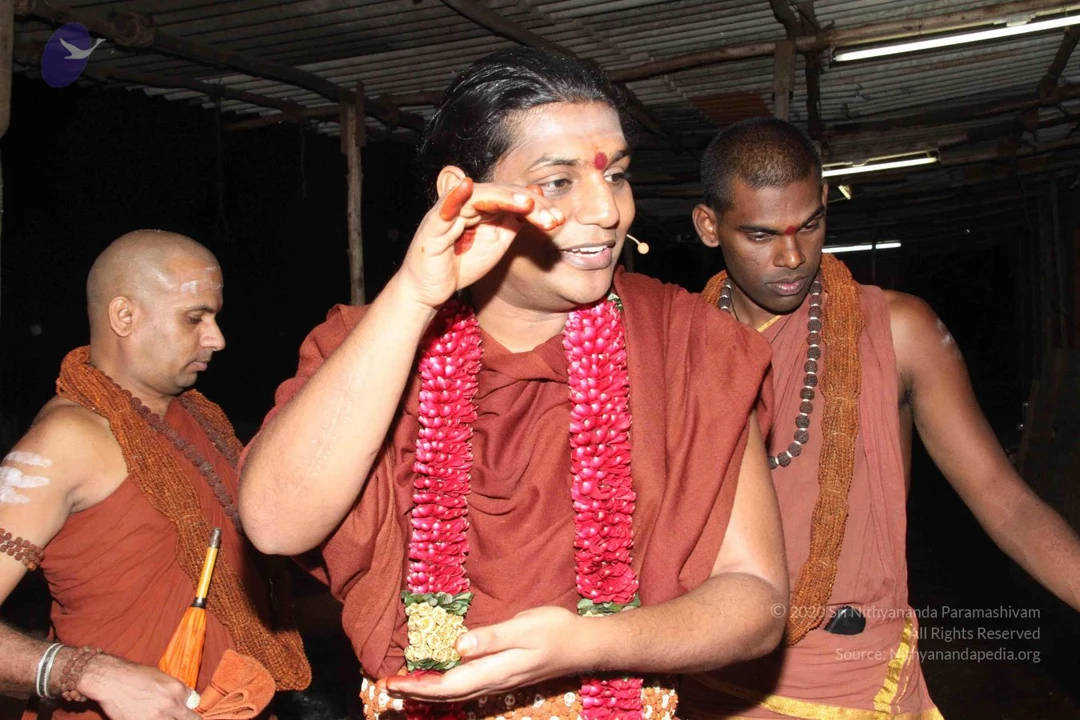
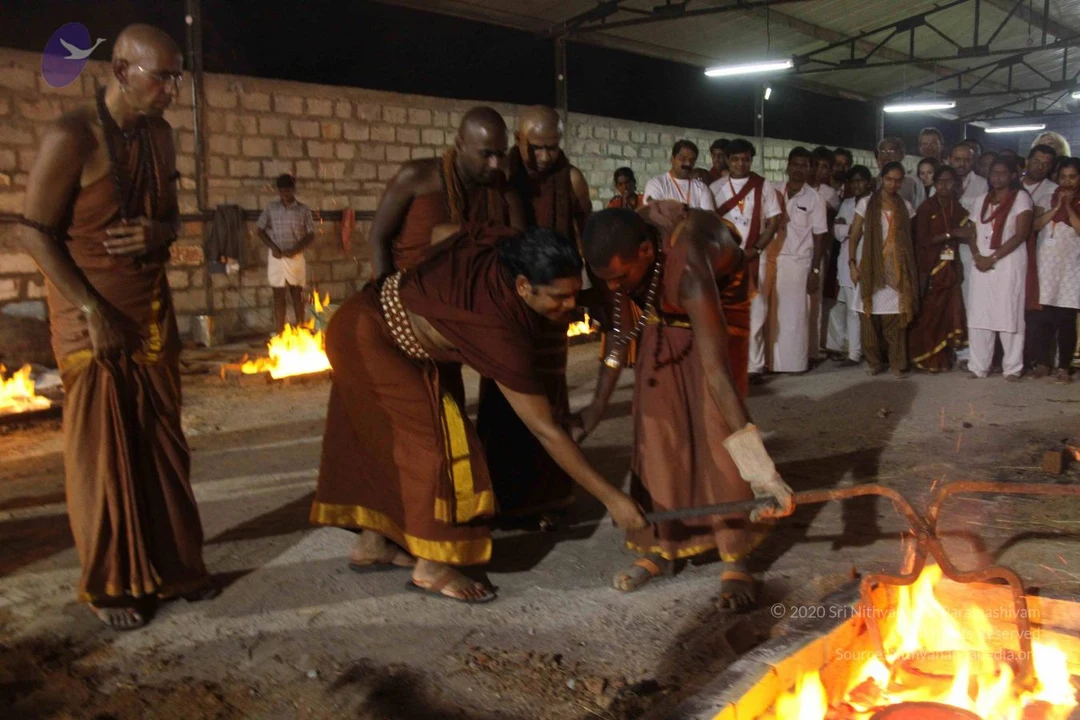
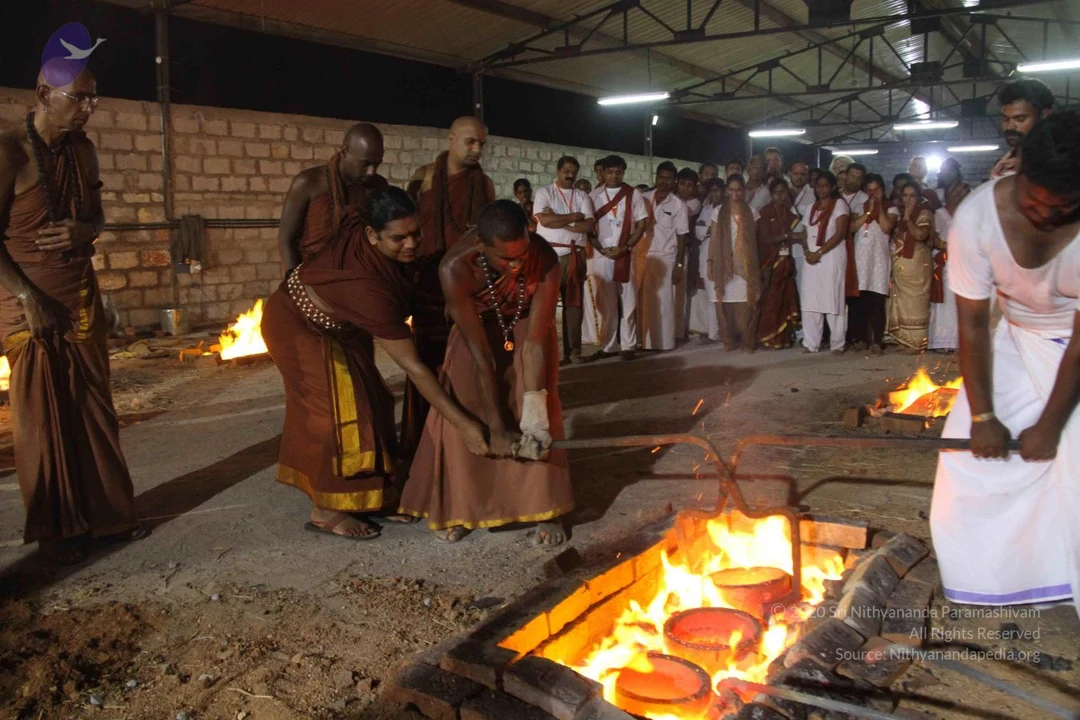
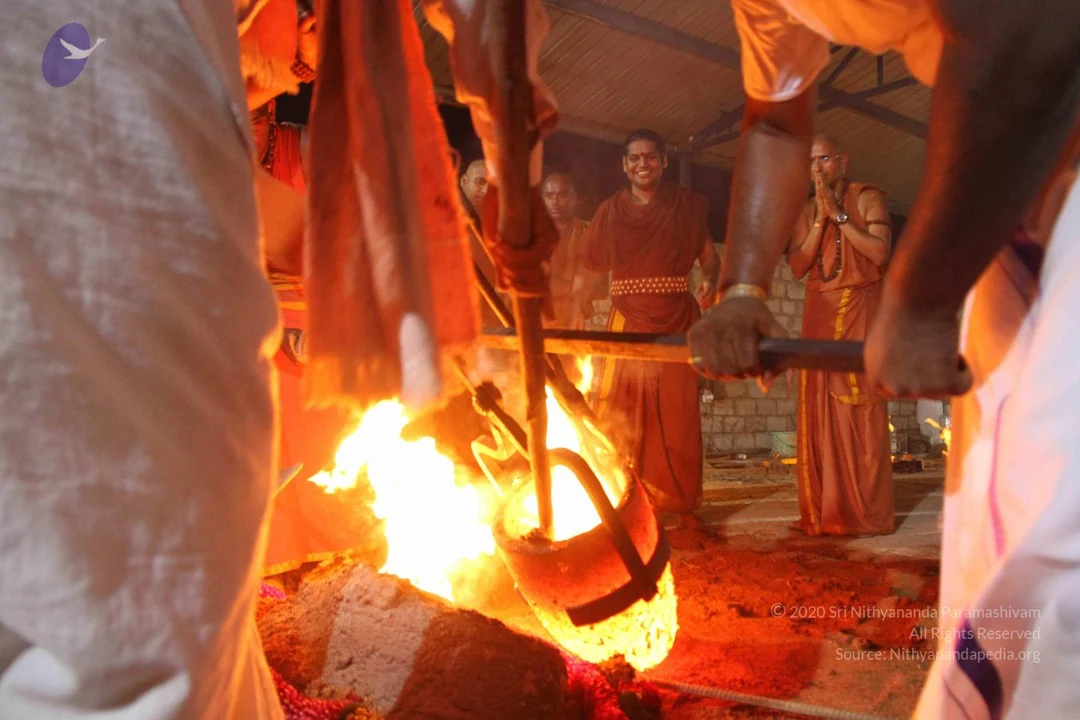
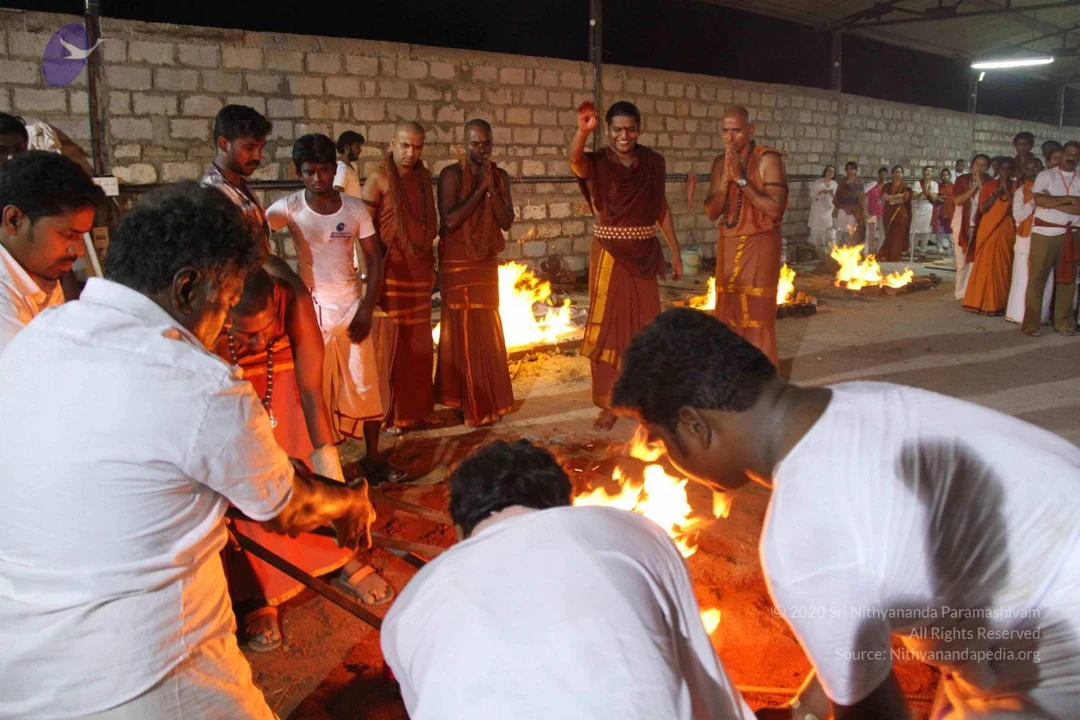
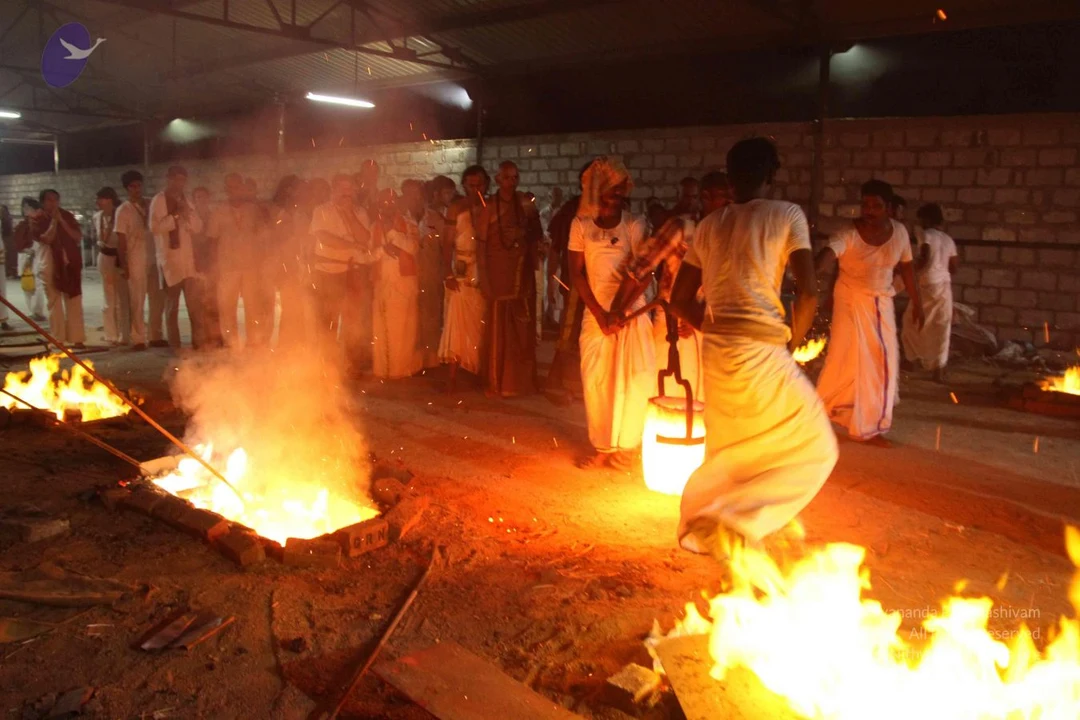
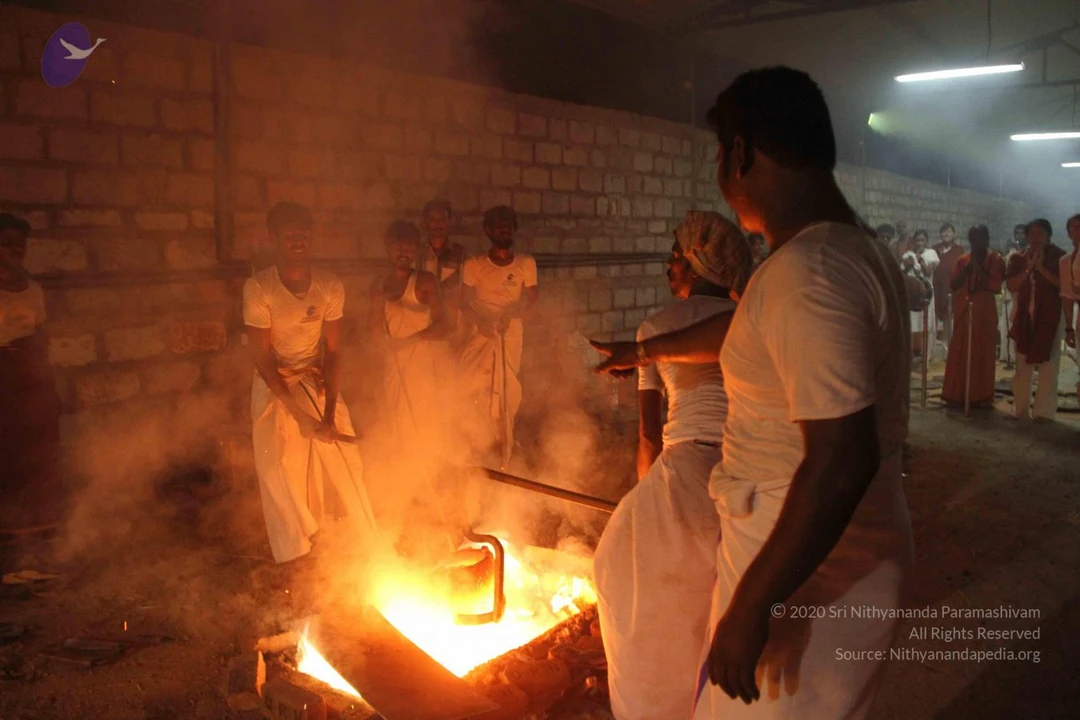
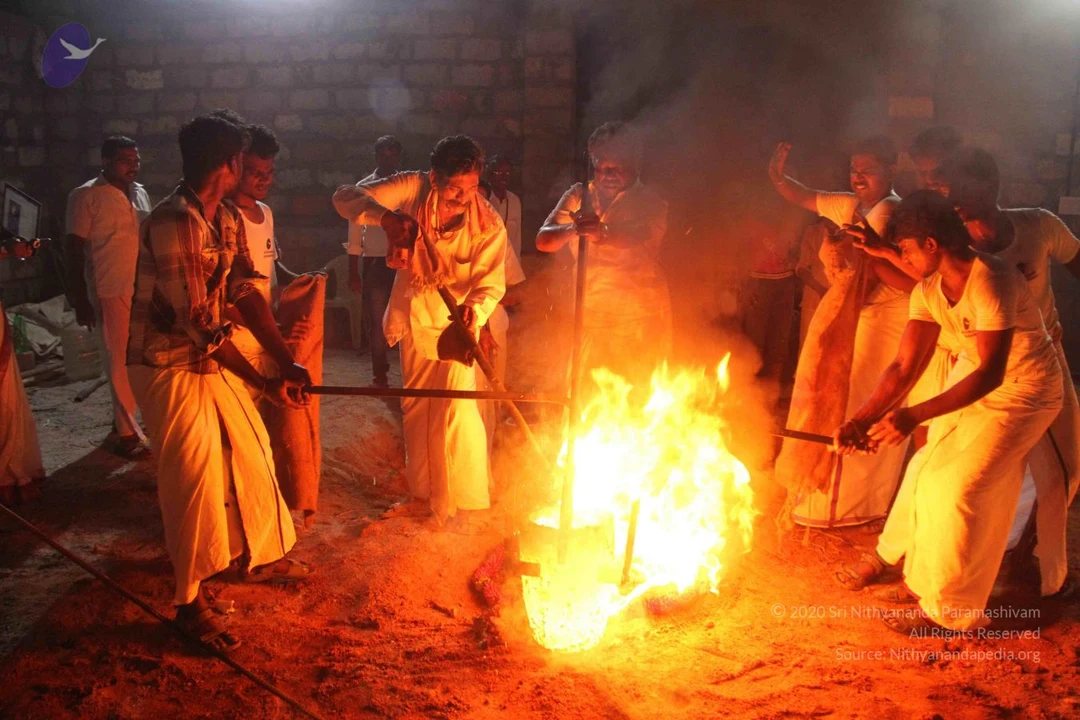
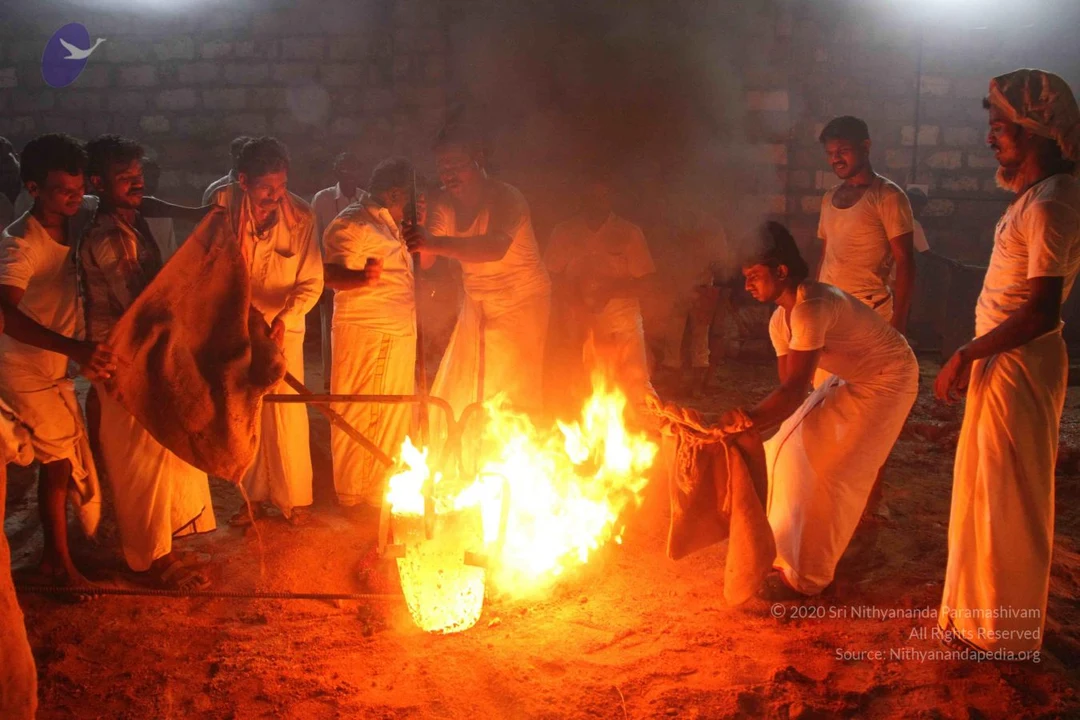
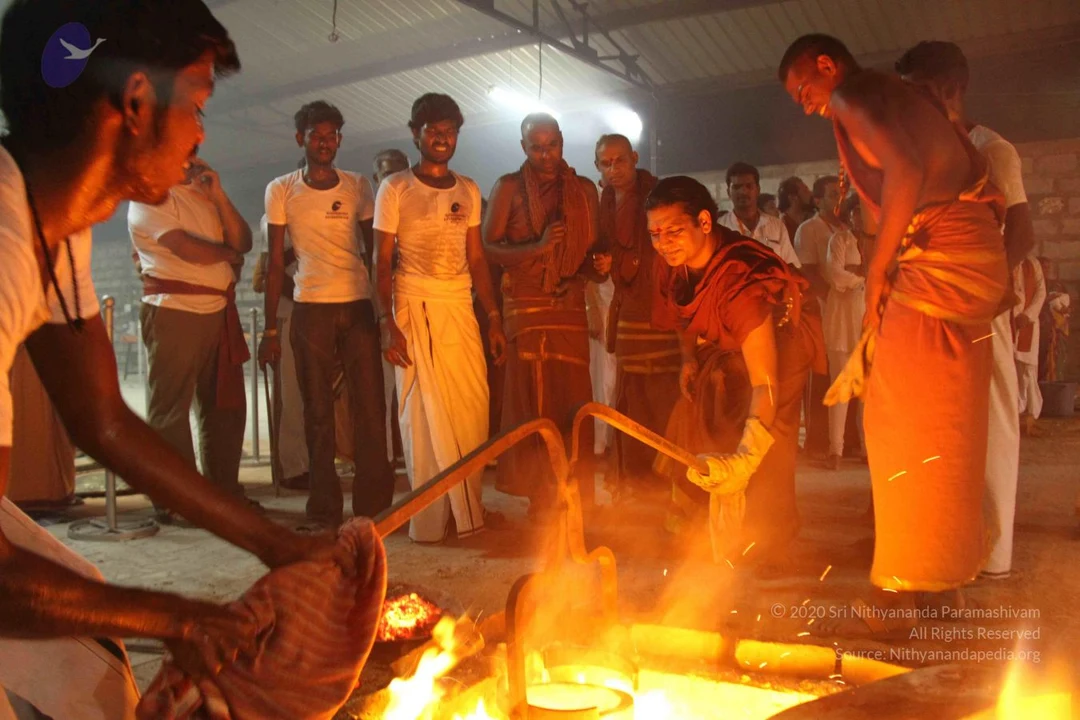
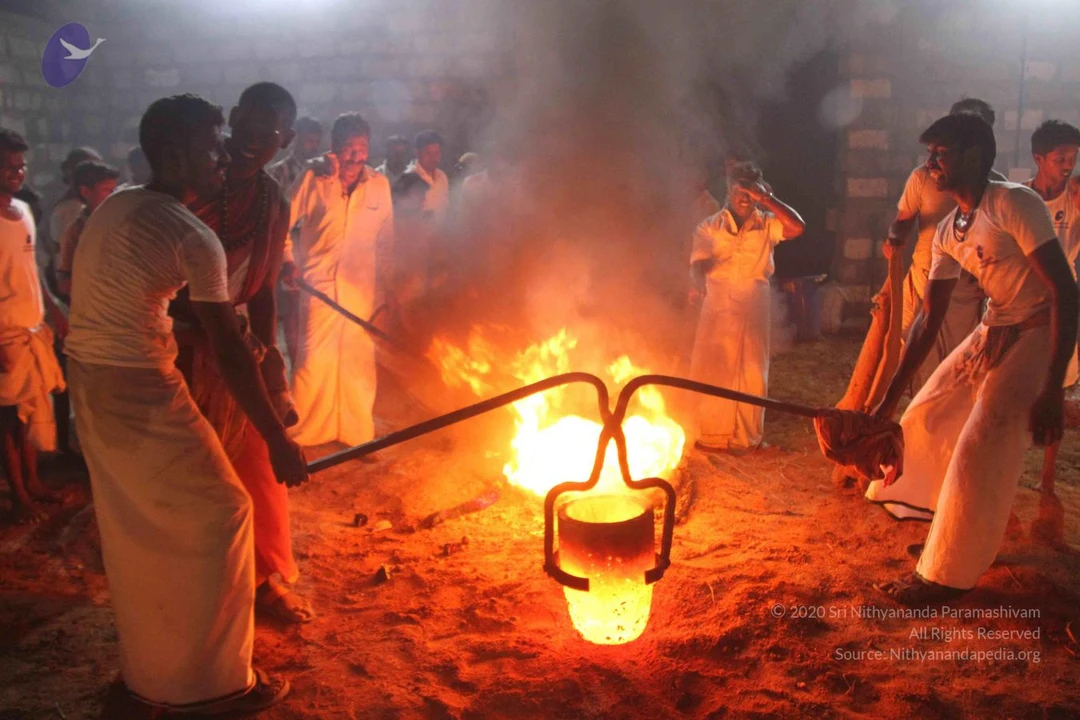
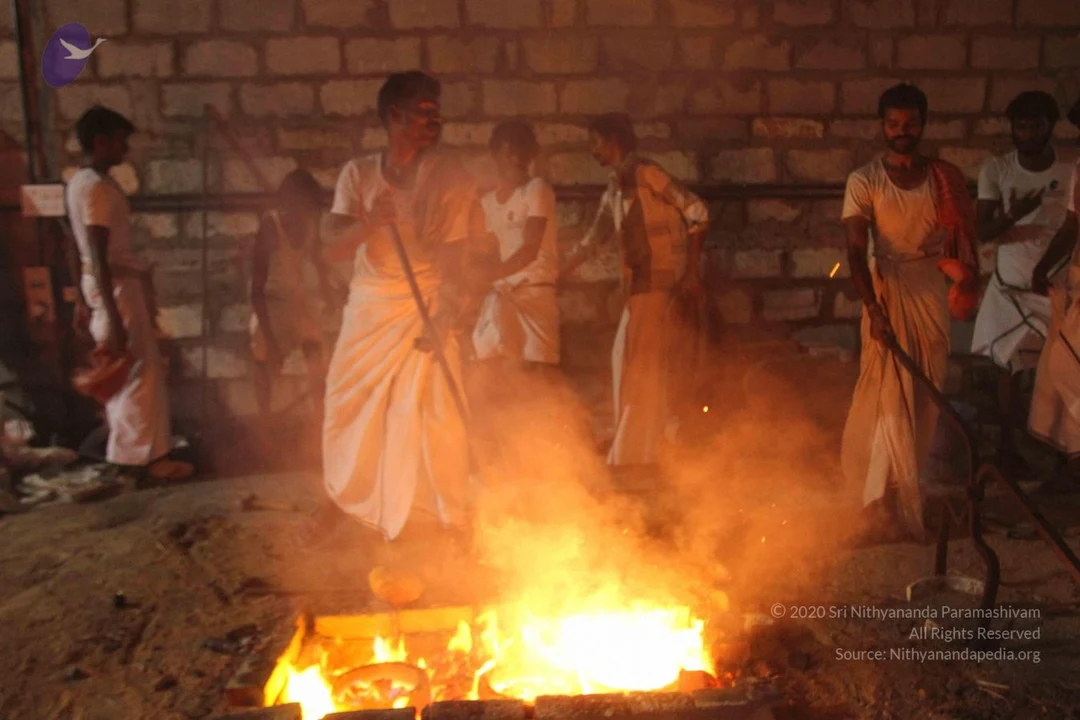
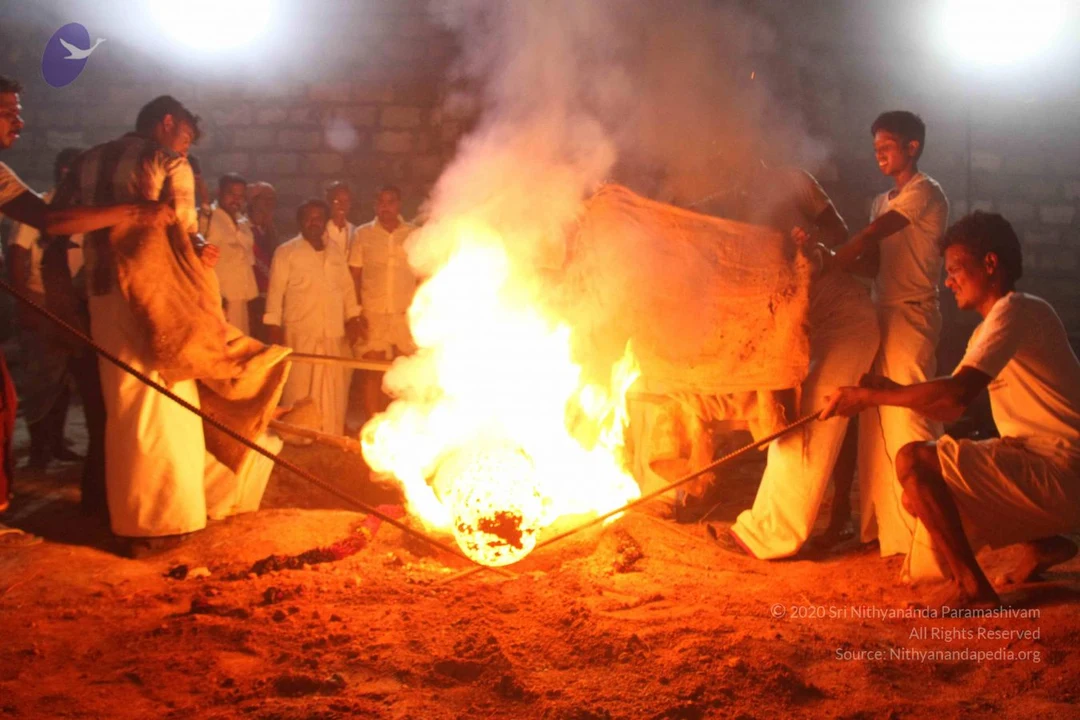
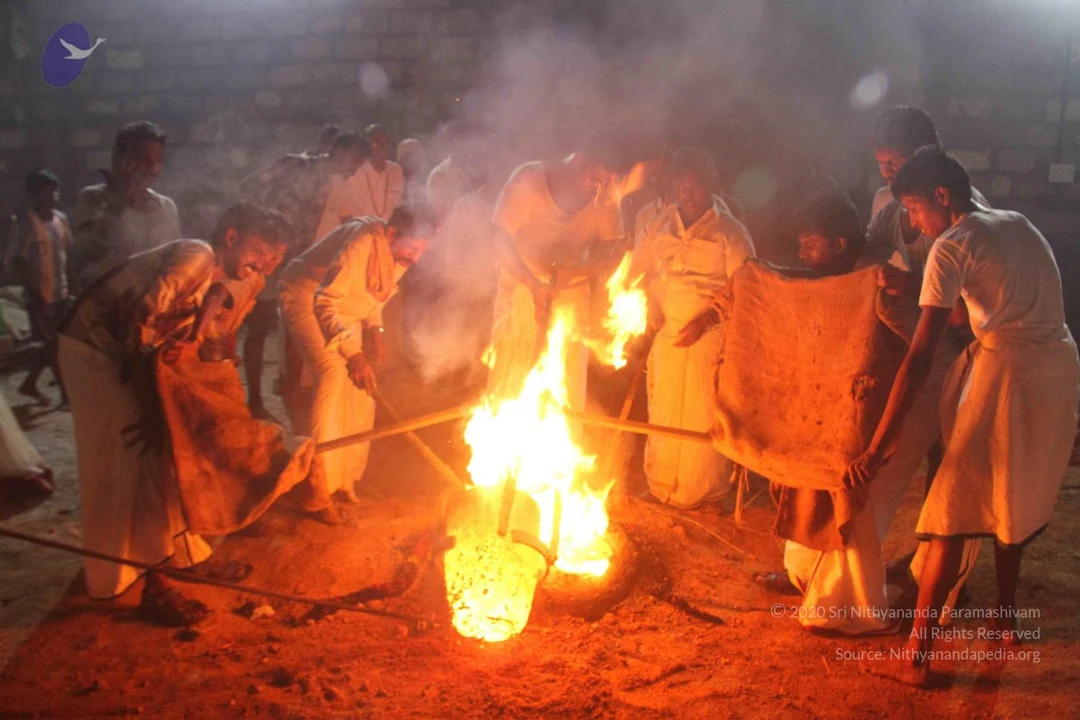
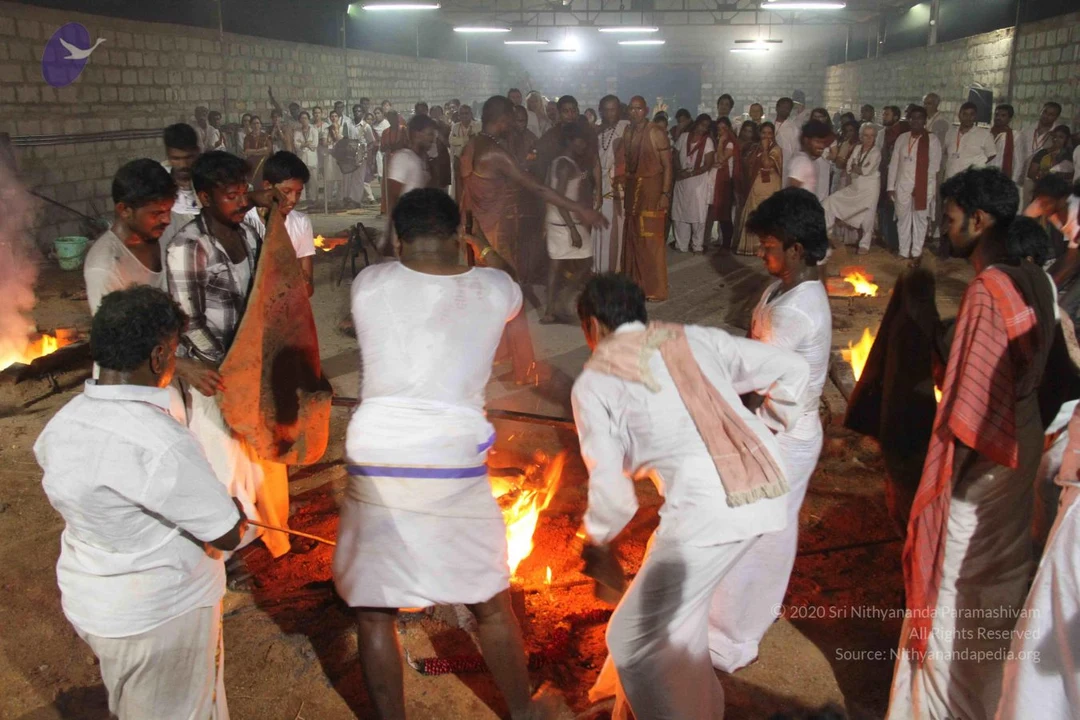
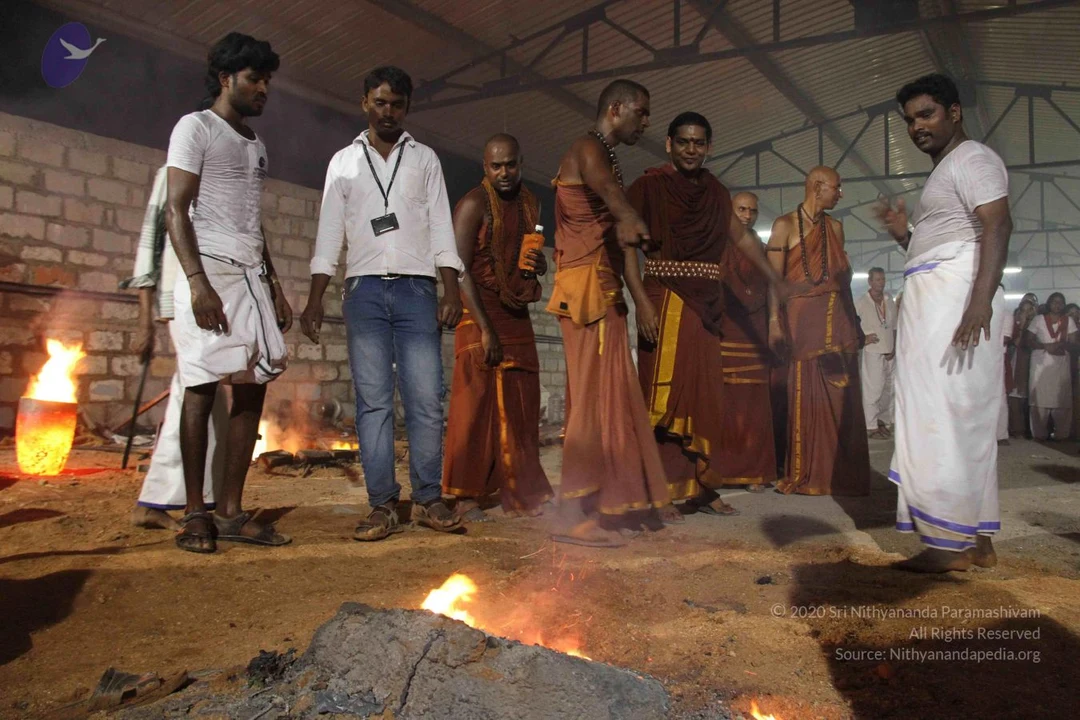
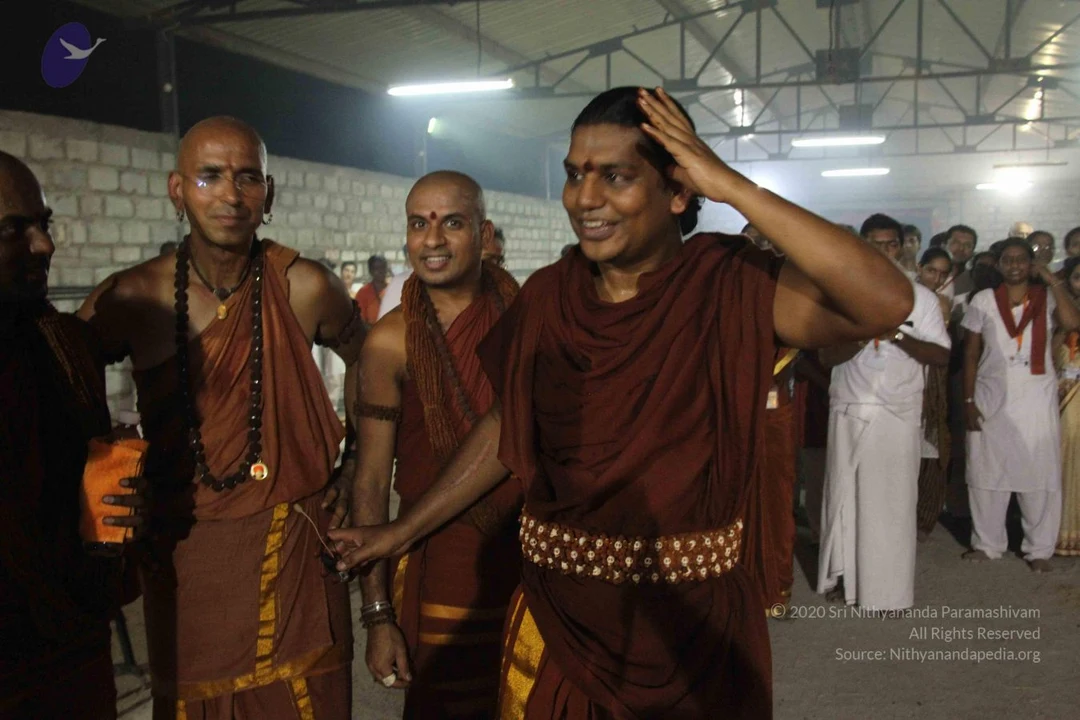
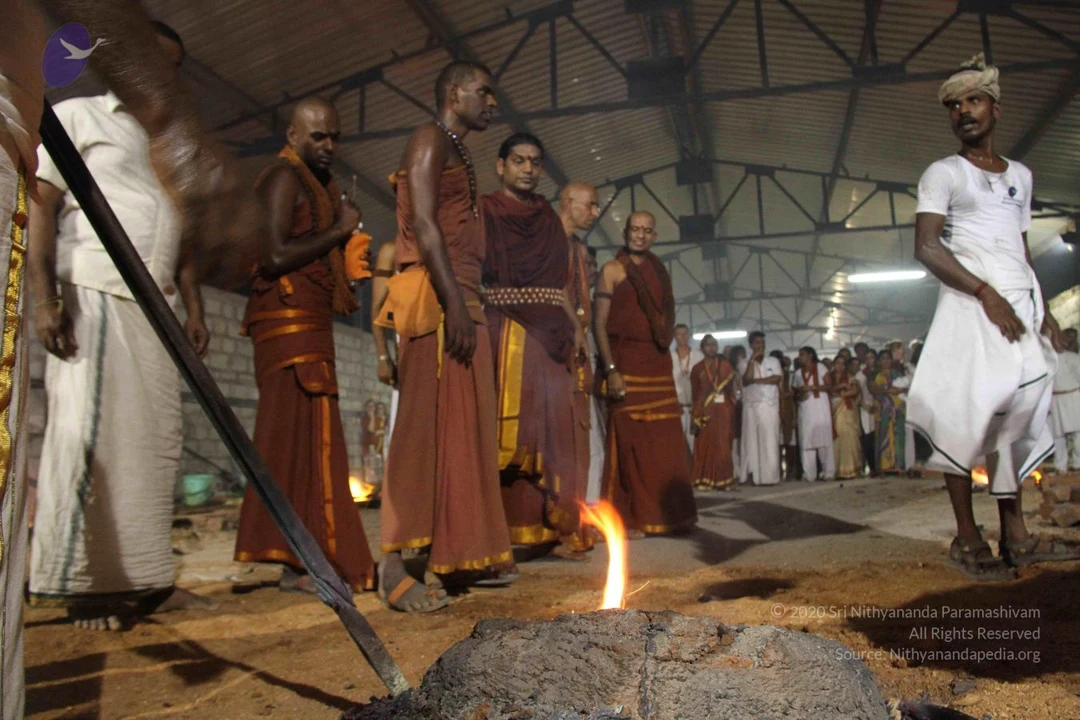
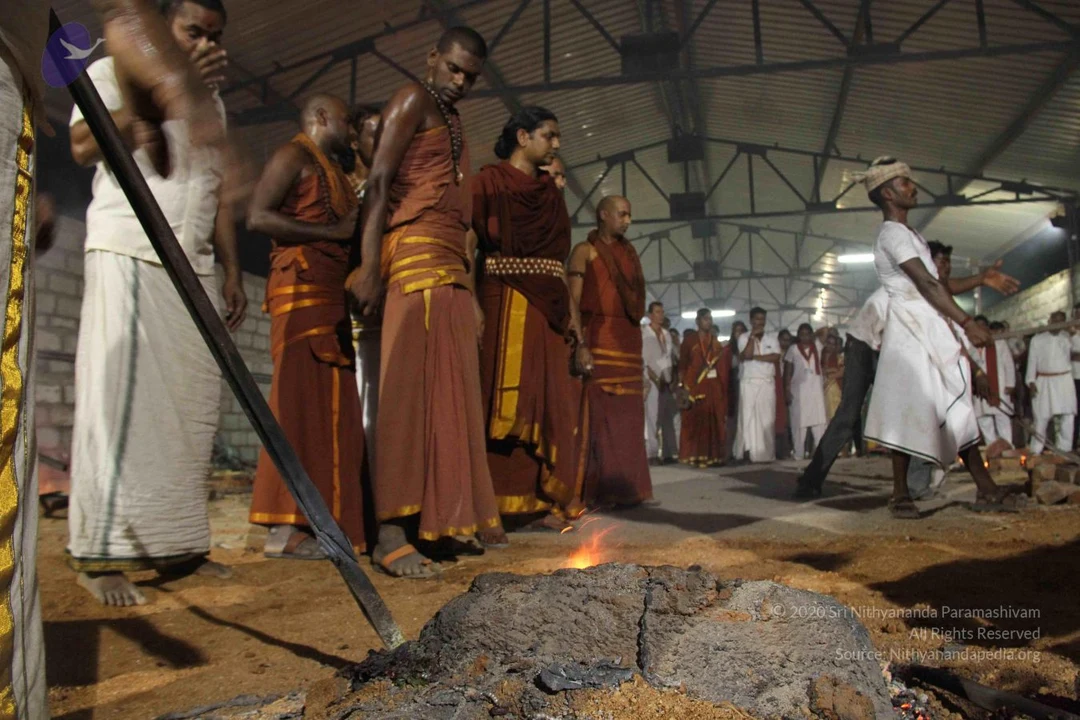
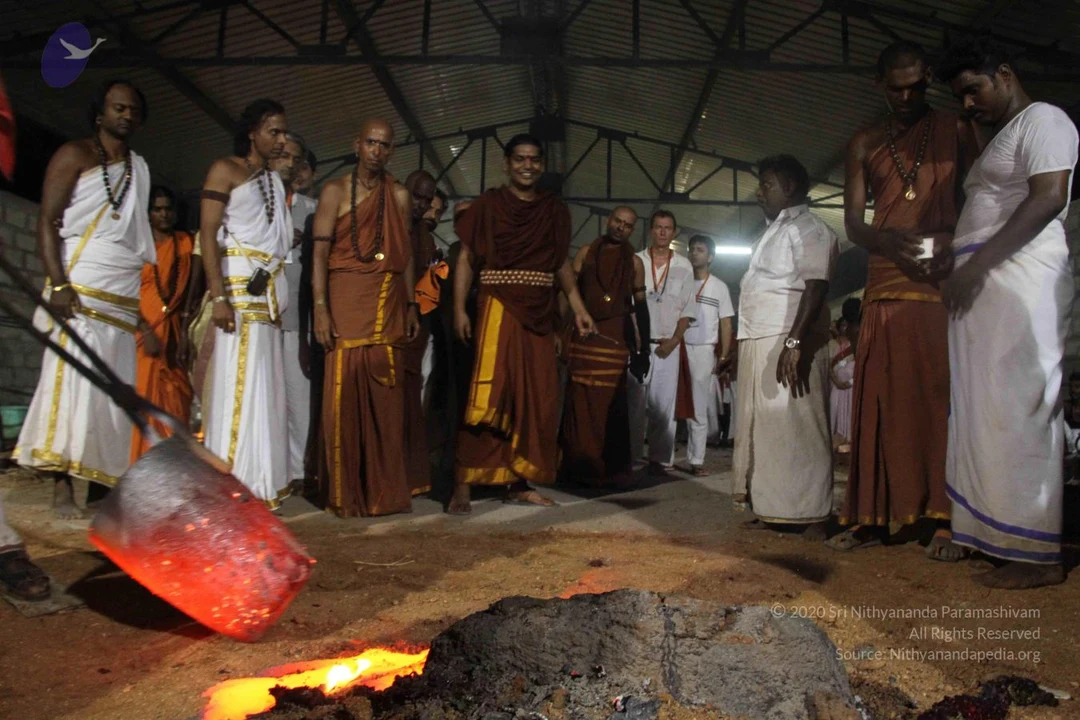
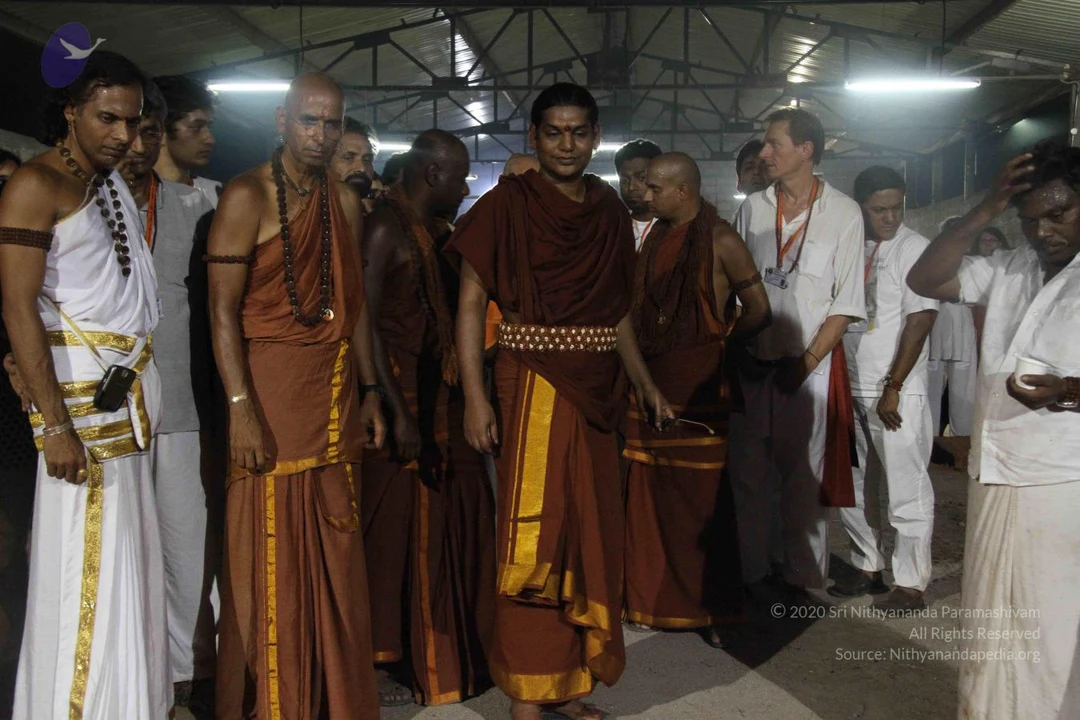
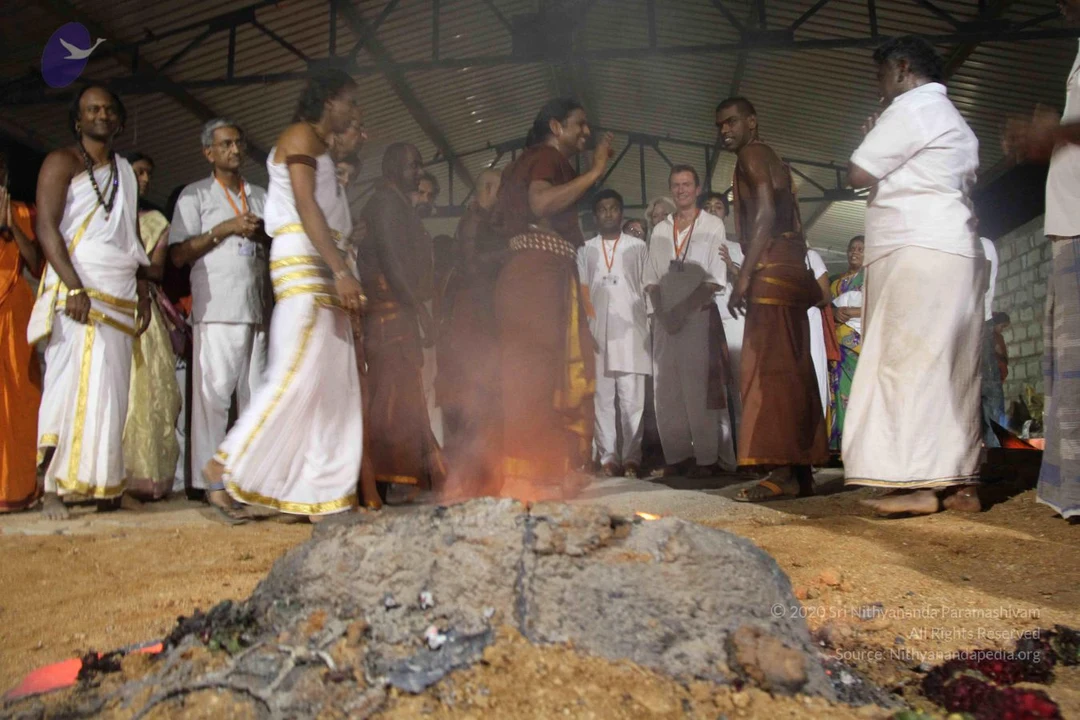
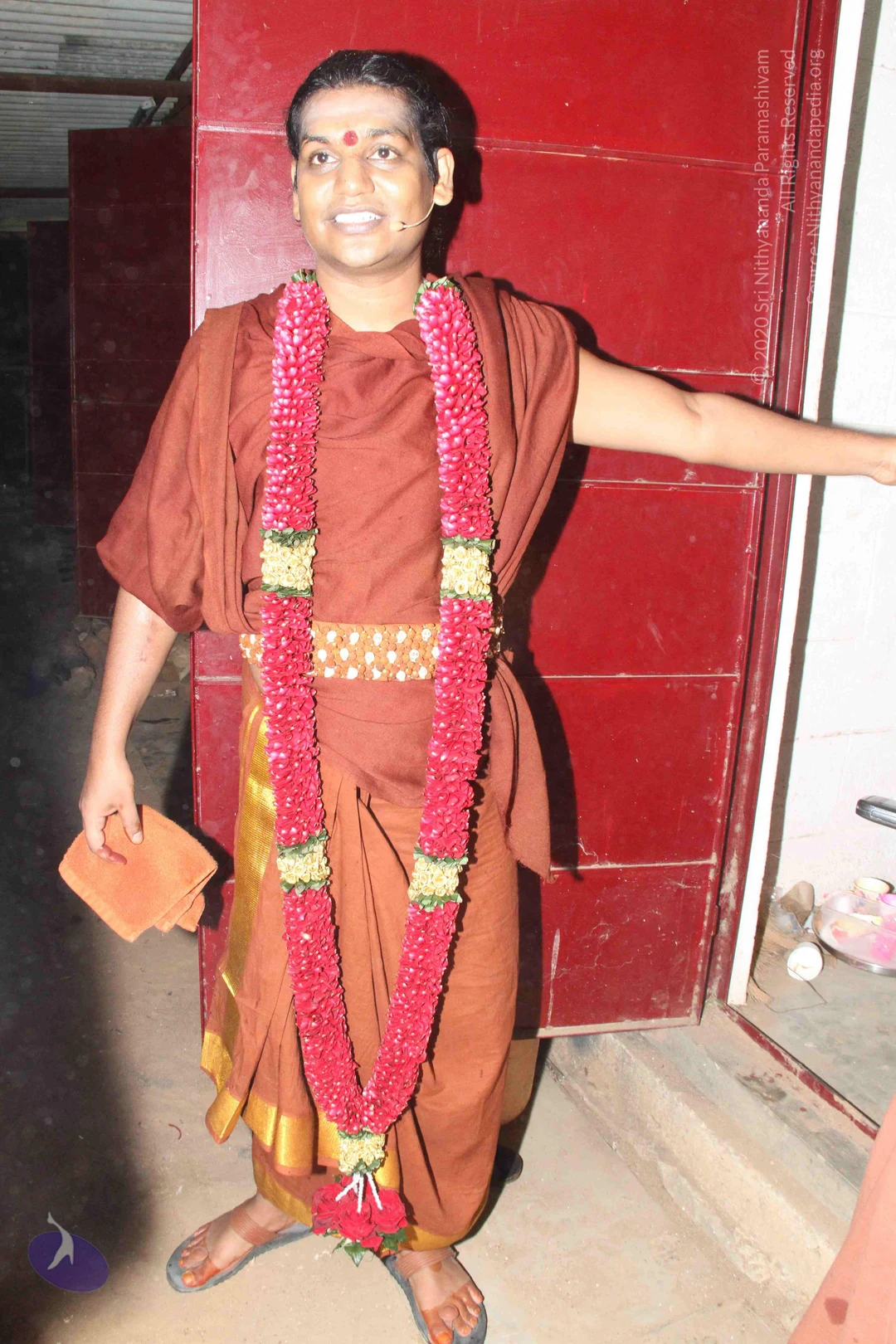
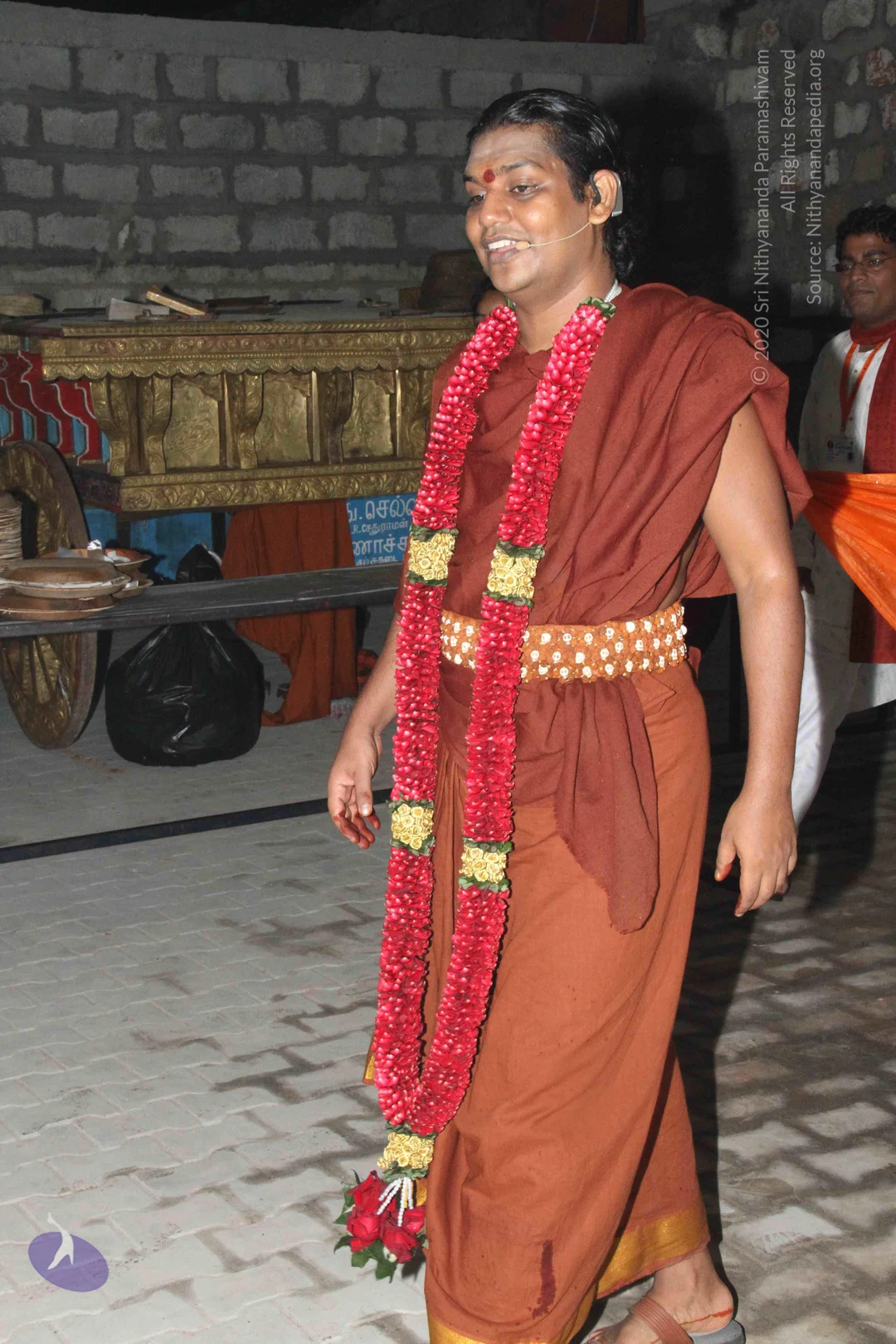
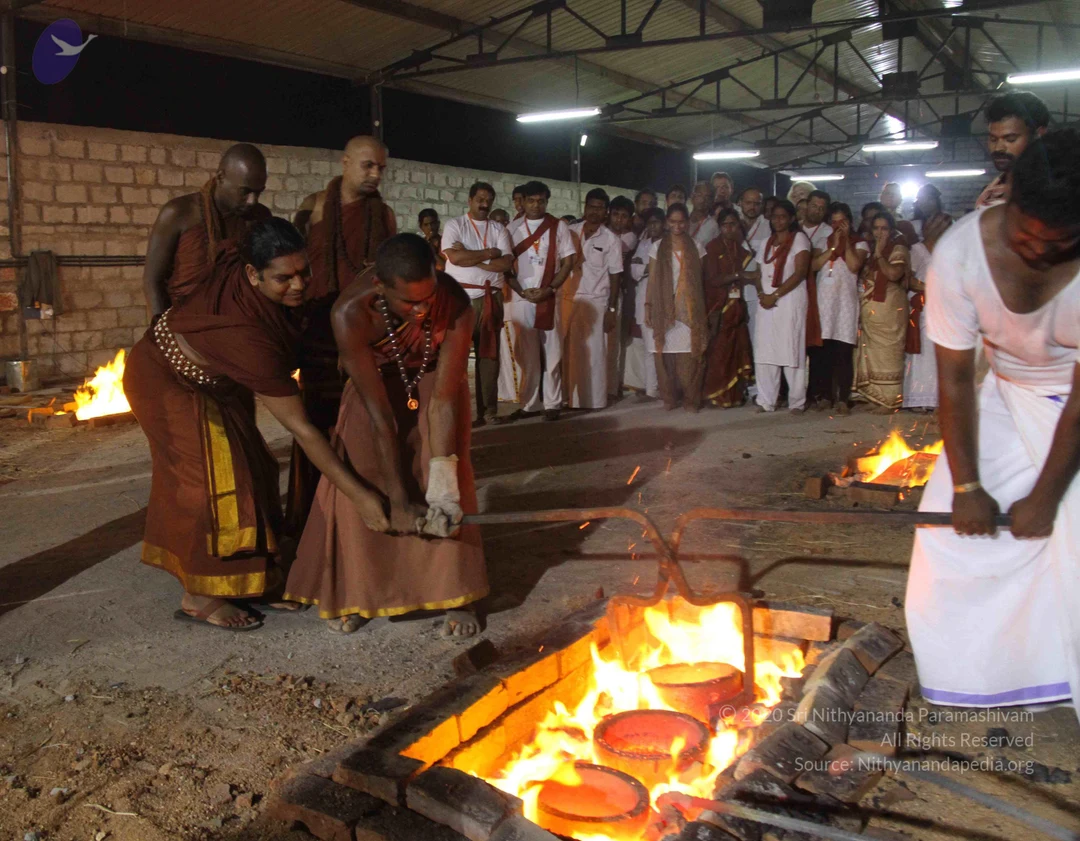
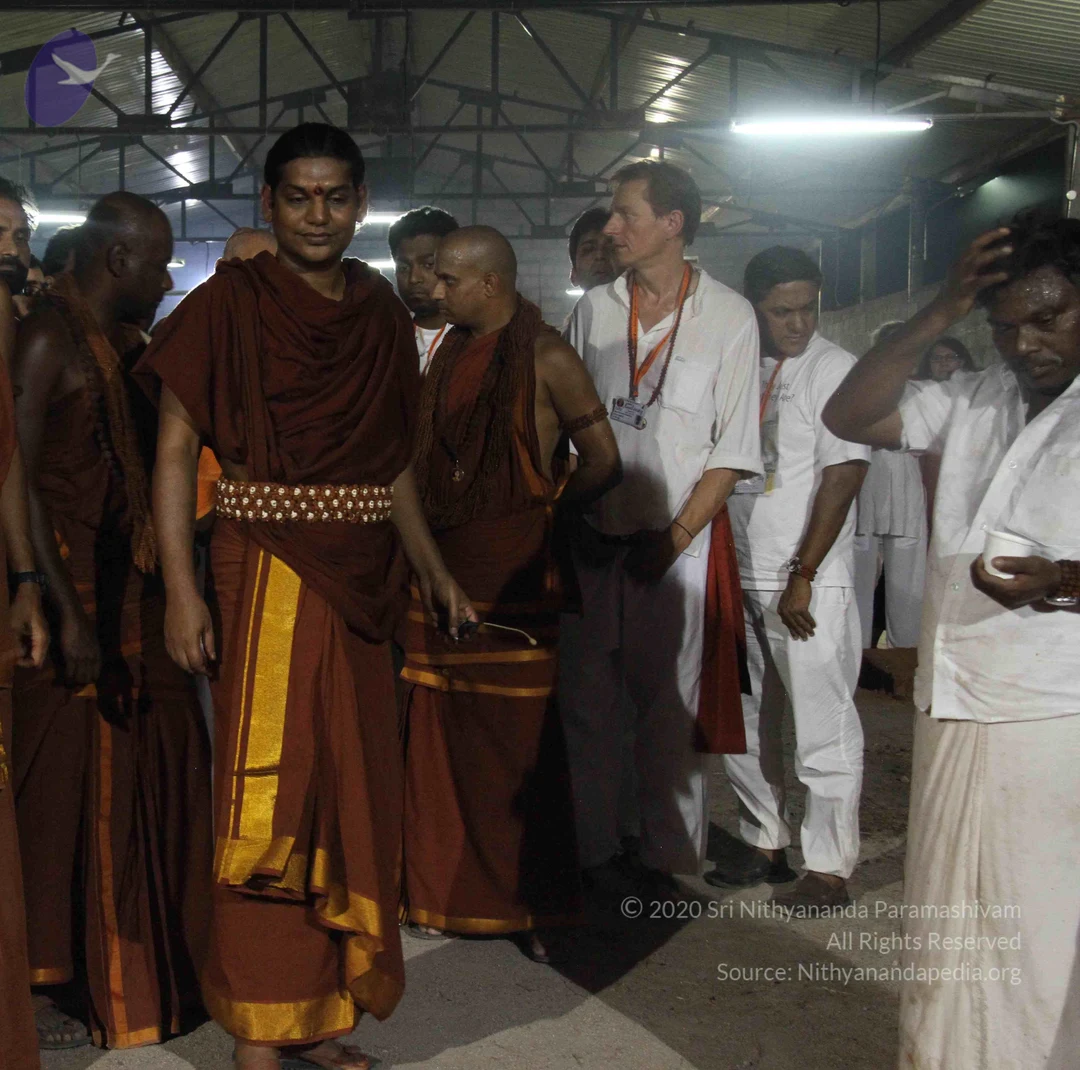
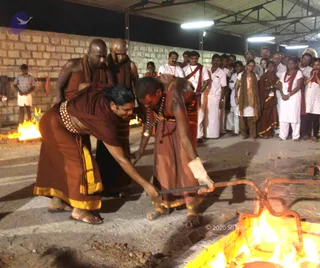
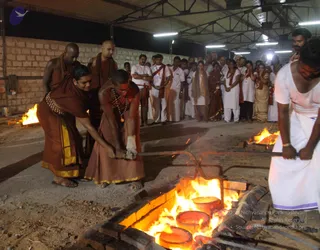
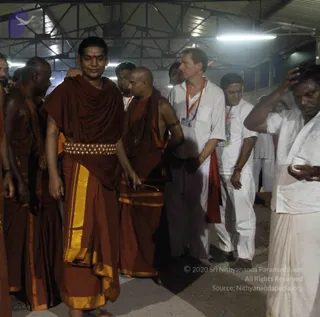
Night photograph of a homa or fire ritual under a corrugated roof beside a low brick wall. In the foreground, three men in rust-brown and saffron-bordered dhoti-style robes bend over an iron fire pit, one holding a long iron rod to tend the flames. One man wears a white cloth wrapped around his hand and a beaded waist cord. Behind them stand about two dozen people in white dhotis, white kurtas, saffron shawls and rudraksha-style malas, watching in silence. Bright tube lights hang overhead and small fires burn on the left.A covered outdoor ritual space at dusk, with a brick-walled back and fluorescent tube lights under a corrugated roof. In the foreground, several men in rust-brown and maroon robes with gold-bordered cloth, one wearing a rudraksha mala and a silver-studded waist cord, lean over a brick-lined fire pit. One holds a long iron rod with a handle to tend small clay pots set among bright flames. A bald man in brown robes stands behind them, and another man in white dhoti with a purple border stands at the right edge gripping the rod. Behind them, a standing crowd of about 20 people in white kurtas, cream shawls and maroon scarves watches quietly. Smaller fires burn at the left and right edges. This is a fire ritual.A photograph in a covered open-sided hall with fluorescent lights and a corrugated metal roof. In the centre a slim man with short dark hair and a red bindi wears a rust-orange robe with gold-bordered cloth, a studded gold-toned belt, and carries a small ritual object in one hand. Beside him a bald man in similar rust-orange robes with a cord and rudraksha-style beads stands in front. Behind them a man in a white shirt and an orange lanyard, plus several men in white shirts and white dhotis, stand in the background; one man at right holds a paper cup.
08--Kalabhairava-darshan

3 photosSource gallery
A standing man in a tiger-striped yellow and black garment with brown lower cloth bordered in gold, wearing layered rudraksha malas and beaded bracelets, holding a silver trident in his right hand and resting his left hand on his hip. He has long dark hair and a red bindi on his forehead, and stands before an ornate gold and silver arched backdrop with a golden throne-like seat behind him, under purple and green stage lighting. Appearance-based a person cues: long swept-back hair, rudraksha malas and trident-bearing attire with a tiger-print garment, presented in a Shiva-like pose. No other people are visible.A man with long dark hair and a red bindi stands in an ornate silver-gold arched frame lit with green light on a stage. He wears a tiger-striped wrap garment, multiple rudraksha malas with bead necklaces and bead bracelets, and holds a tall silver trident in his right hand. He appears to be mid-step, smiling, with a carved decorative backdrop of painted pillars behind him. The pictured figure resembles the Swamiji candidate by appearance (long hair, rudraksha malas, tiger-striped garment, trident), so this is a probable identification from visual cues only.A figure with long dark hair and a red bindi stands on an ornate silver-and-gold repoussé throne framed by a silver arch, under green and blue stage lighting. The person wears a green and black tiger-stripe garment, a dark skirt-like cloth with a green border, and layered rudraksha-style beaded malas around the neck and waist, with beaded armlets. In the right hand is a silver trident (trishula) held upright. A microphone is visible near the face. The figure appears to be a person (appearance-based candidate, with long hair, rudraksha malas and tiger-striped clothing), posing on the throne during a stage presentation.