Skip to content
Sunday

8 December 2013

Nithyananda Diary | Bali Inner Awakening Day -8 | Padapuja | Satsang | Meditation | Dial the avatar | Sarvadarshan

Dated photos
241
Source pages
1
Media
3
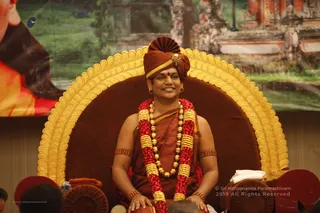
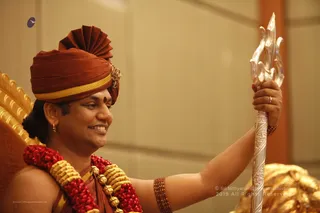
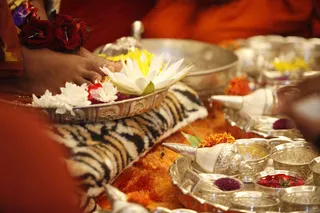
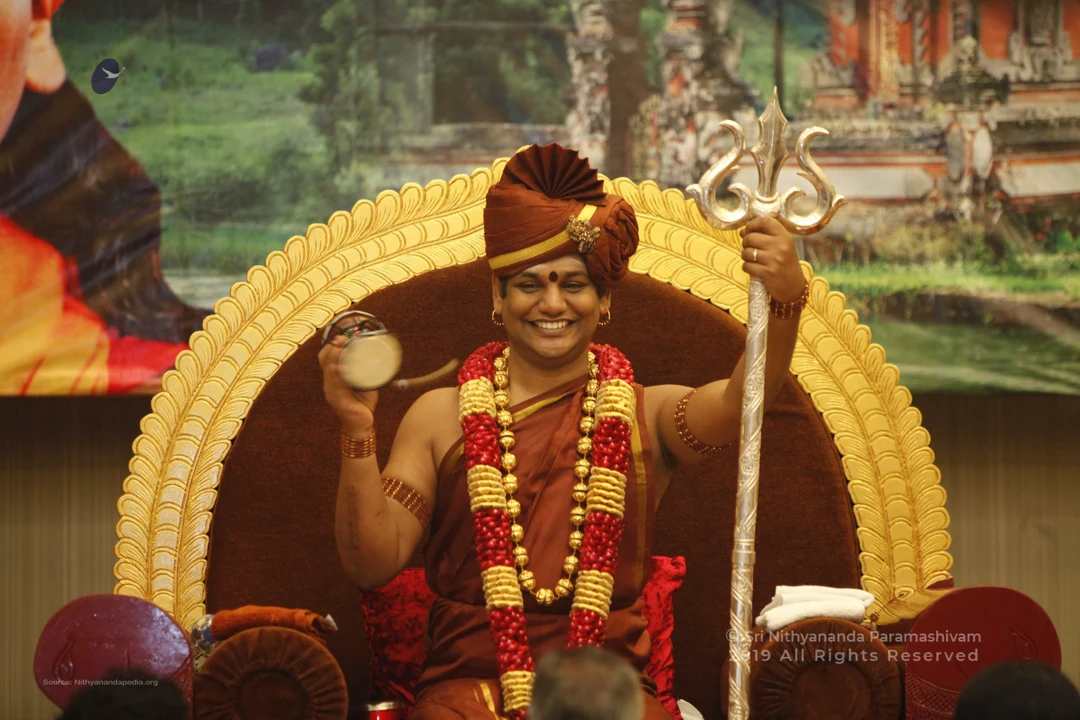
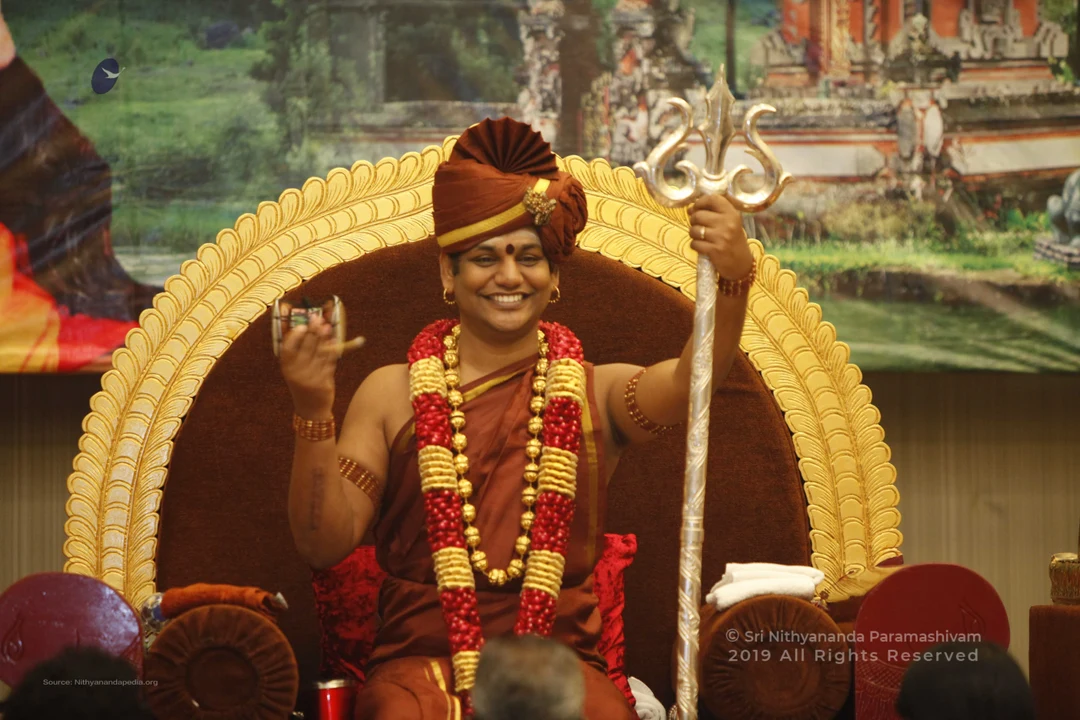
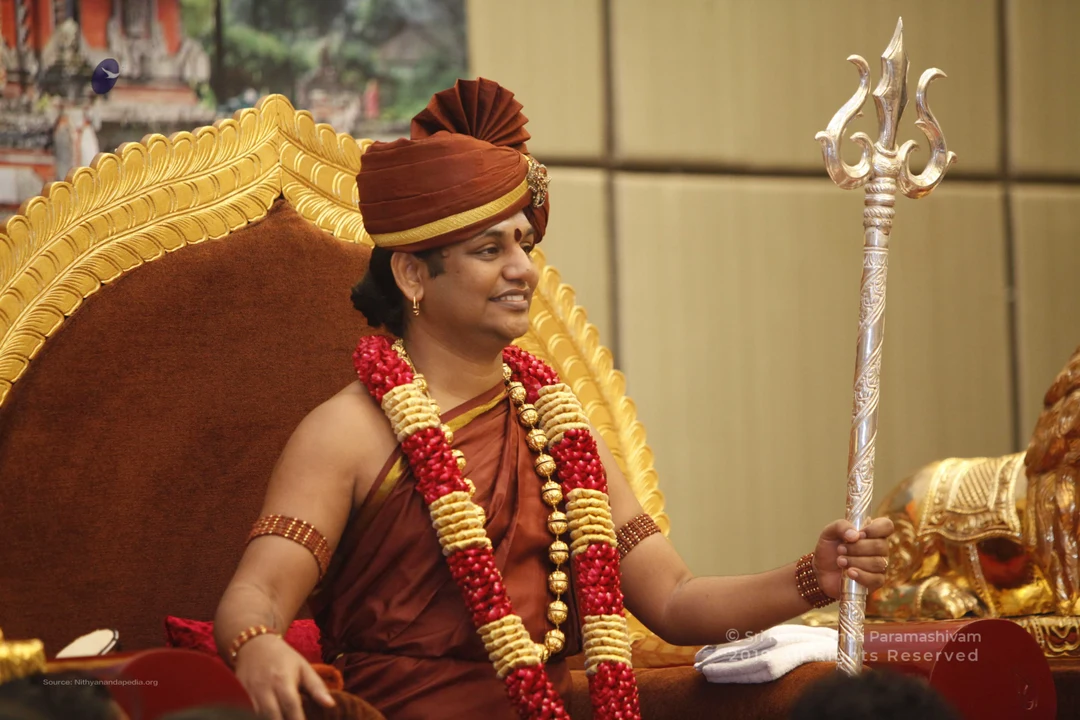
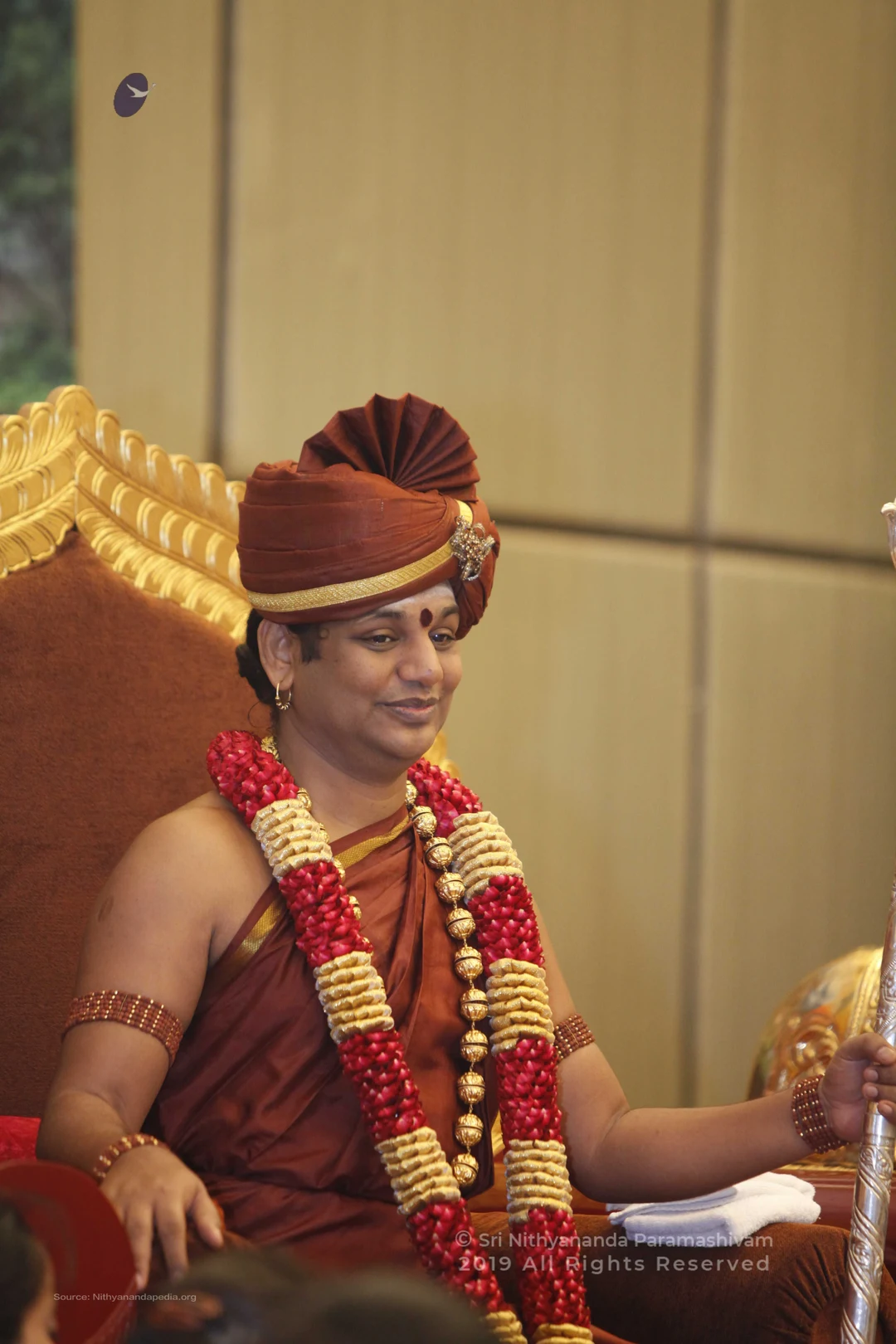
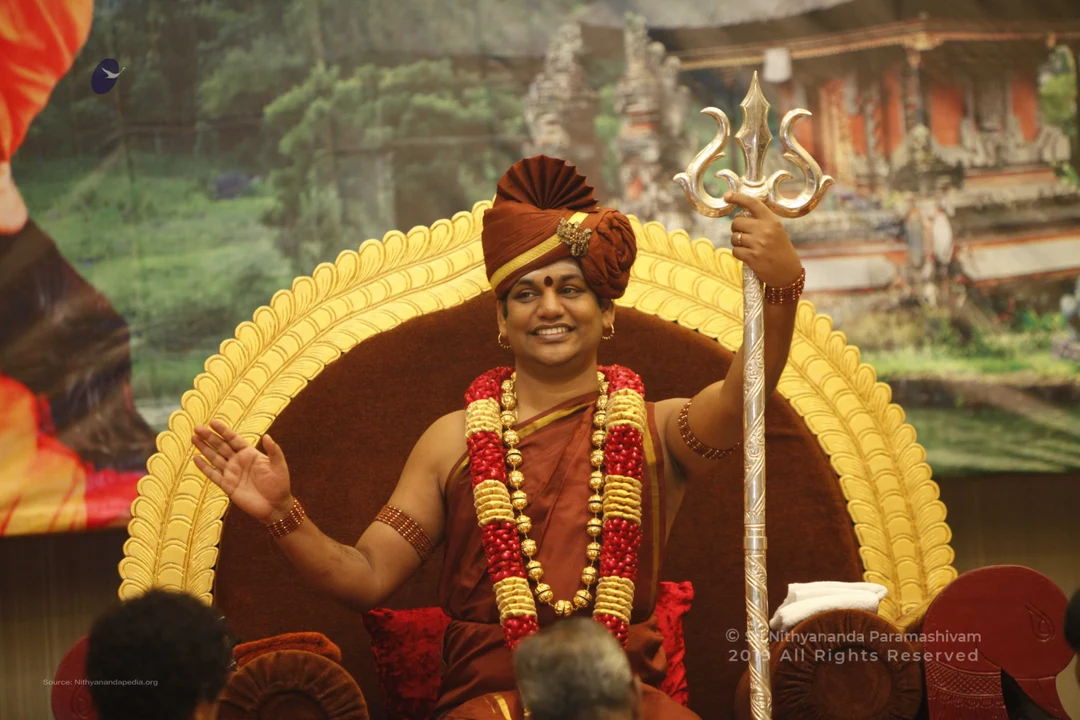
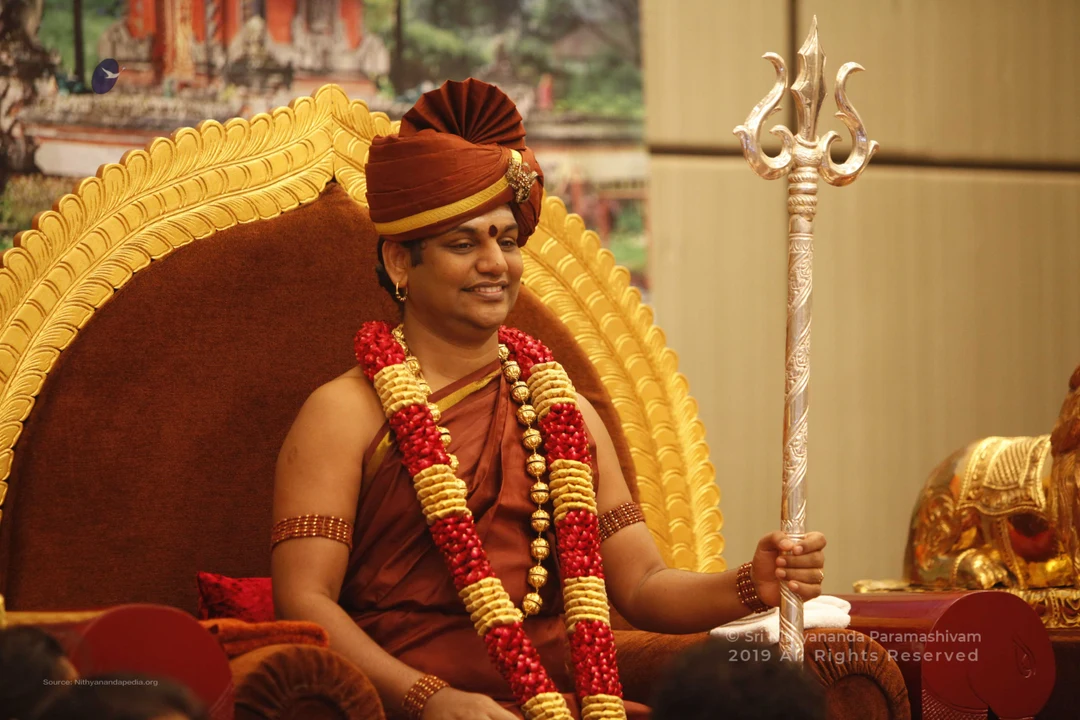
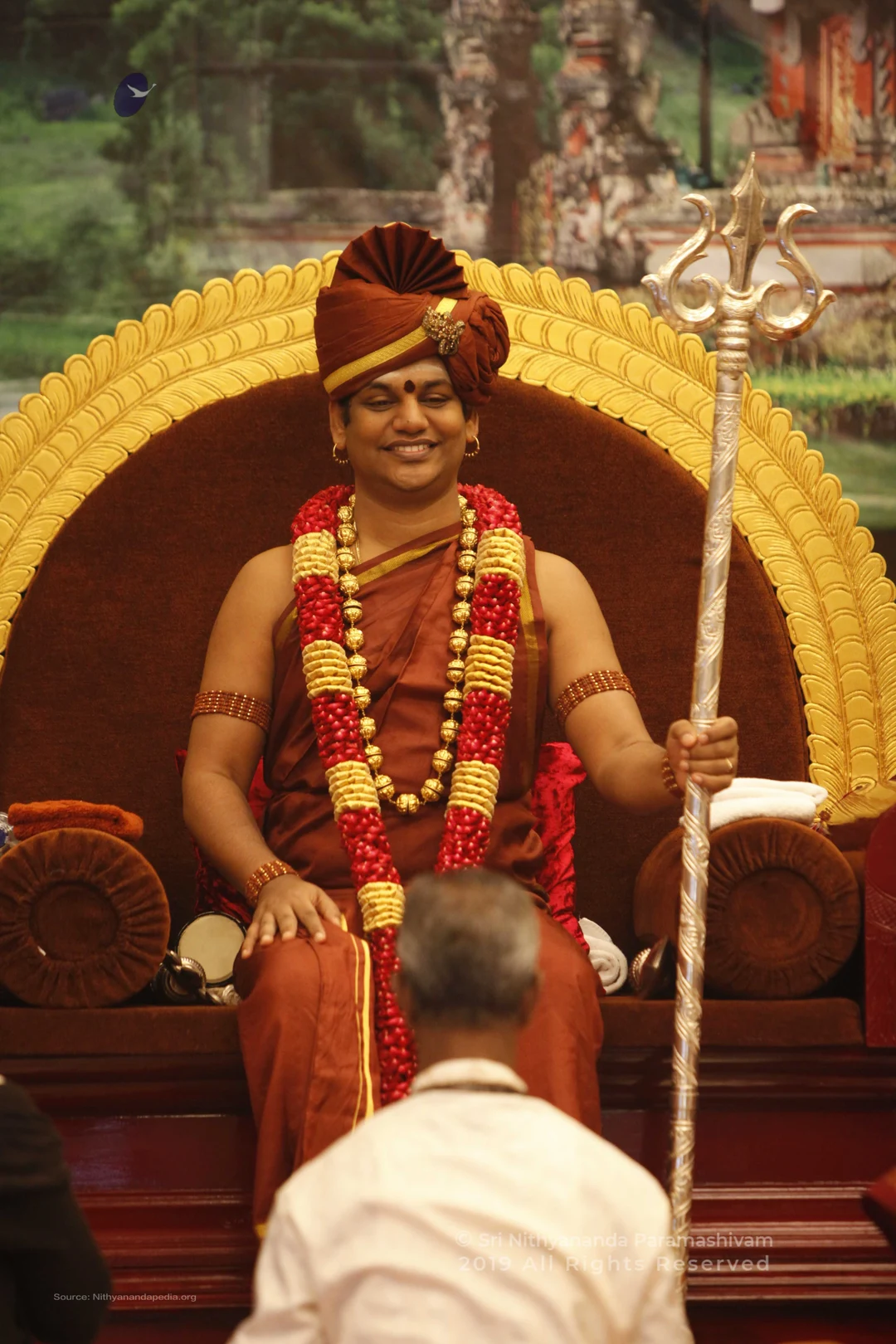
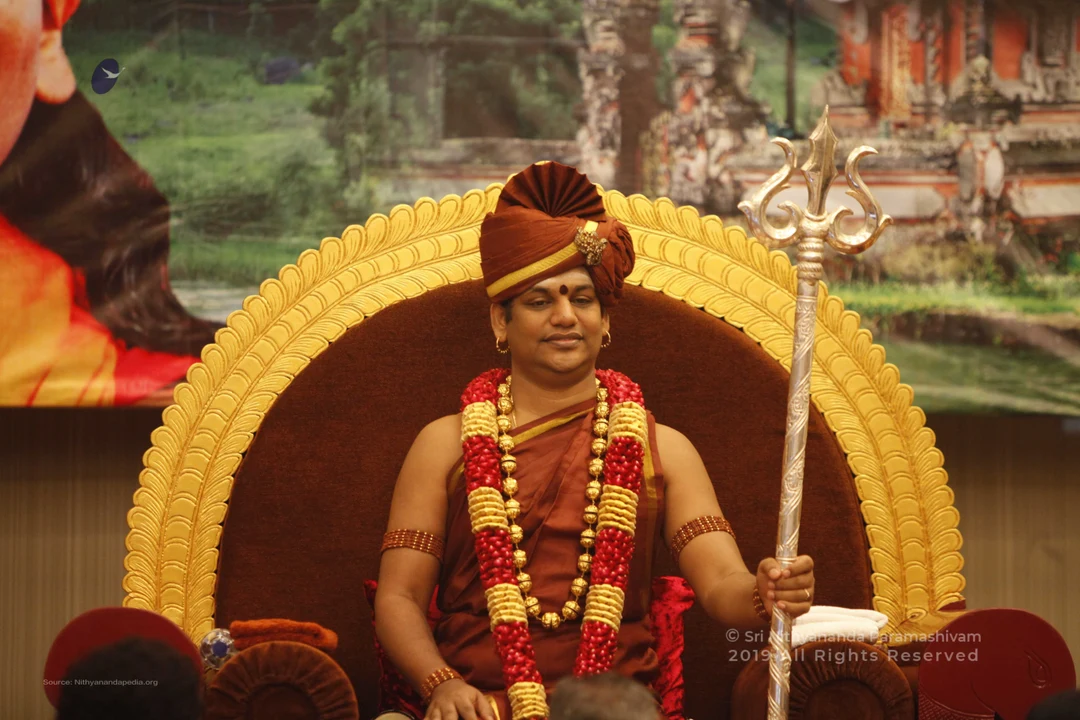
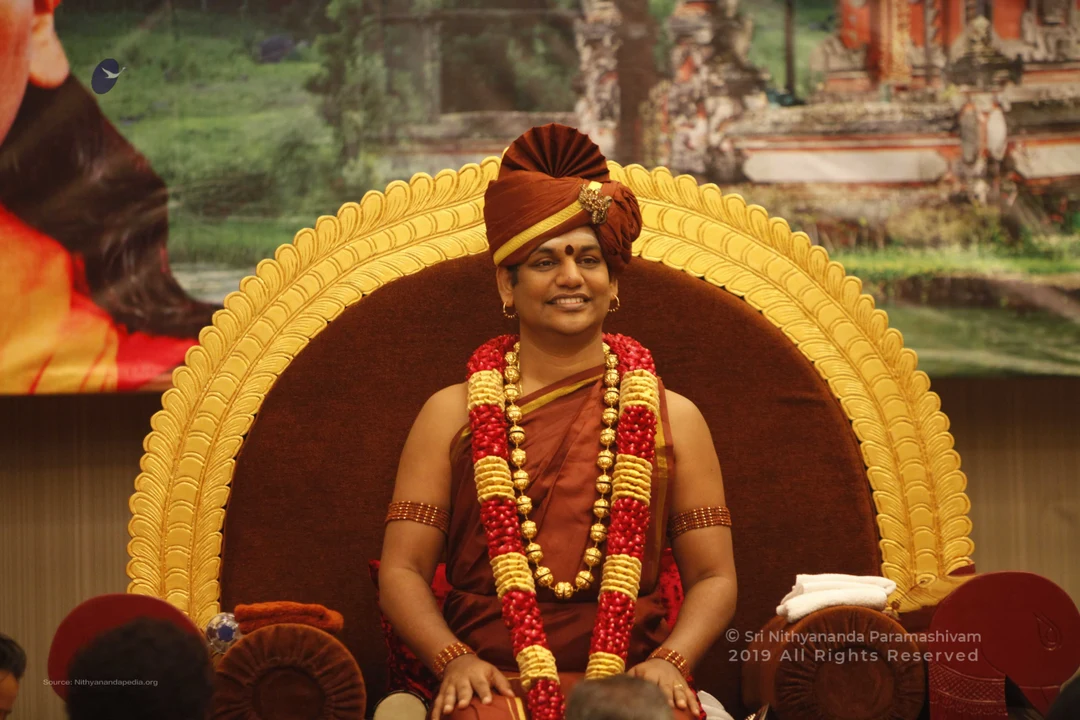
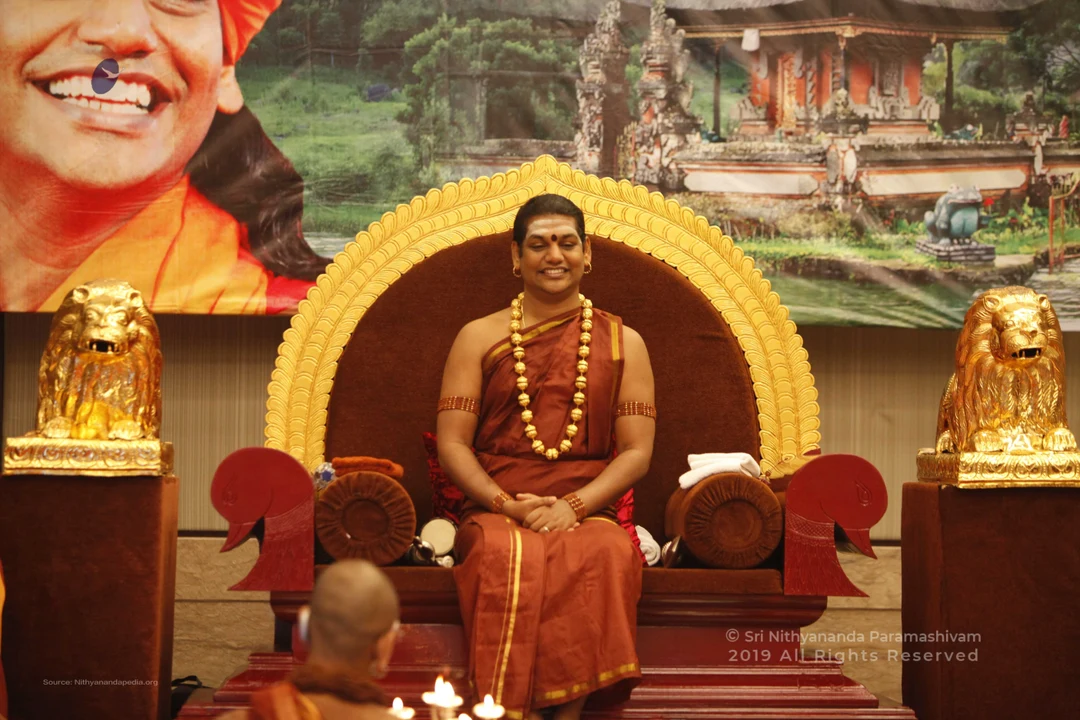
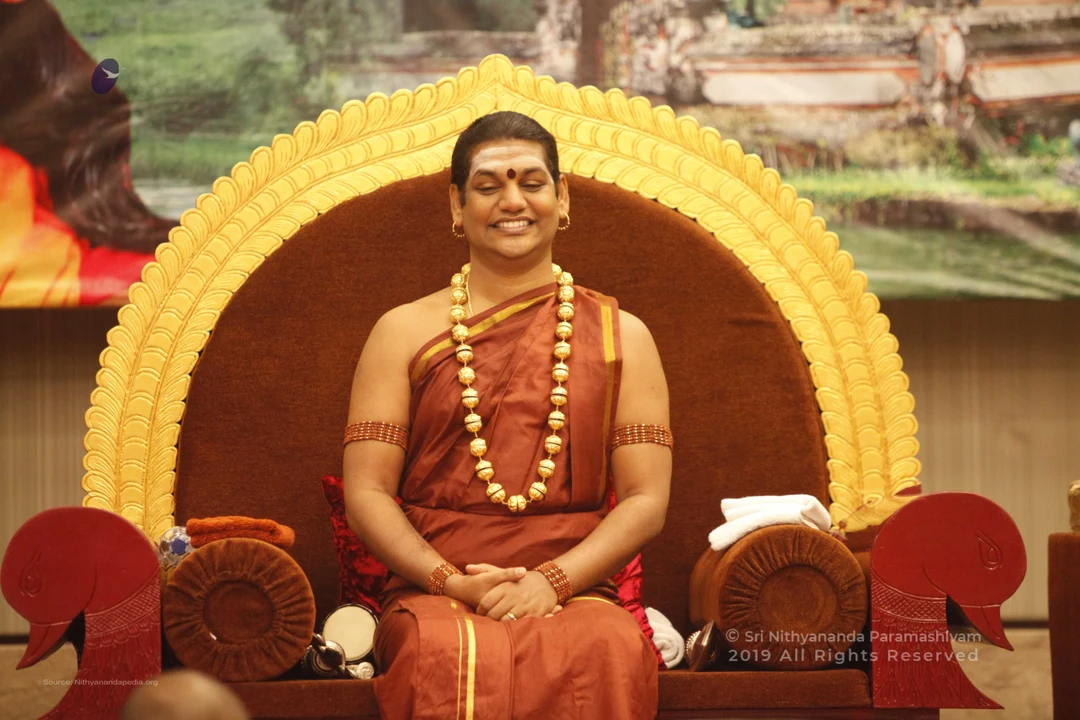
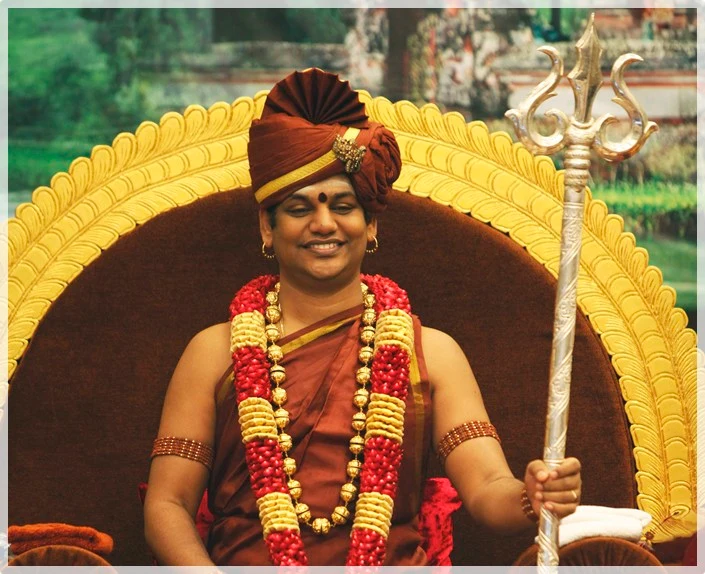
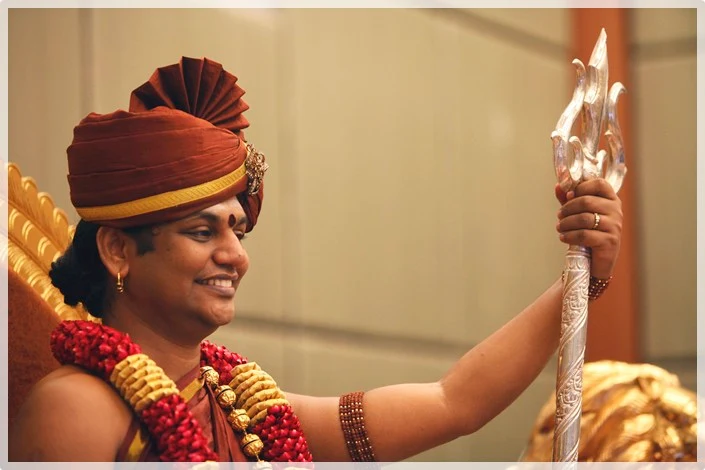
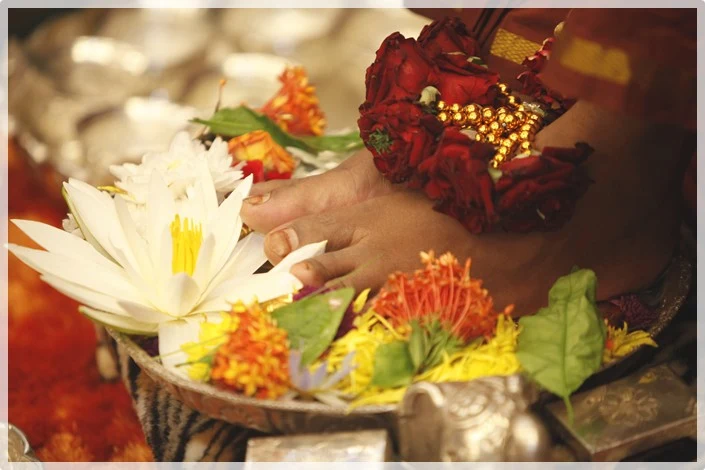
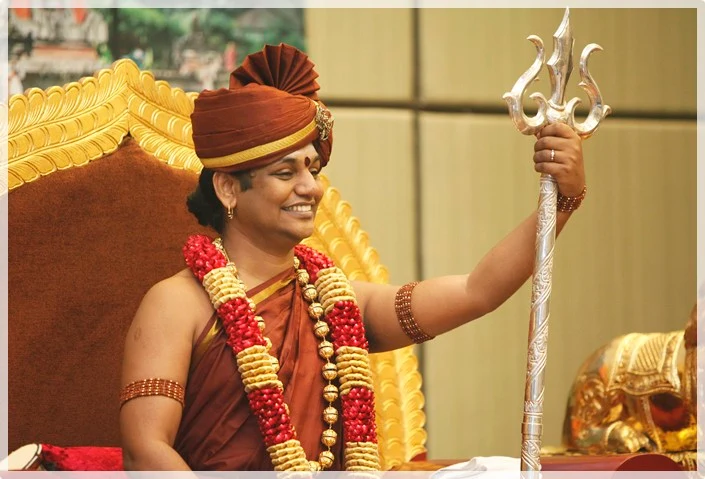
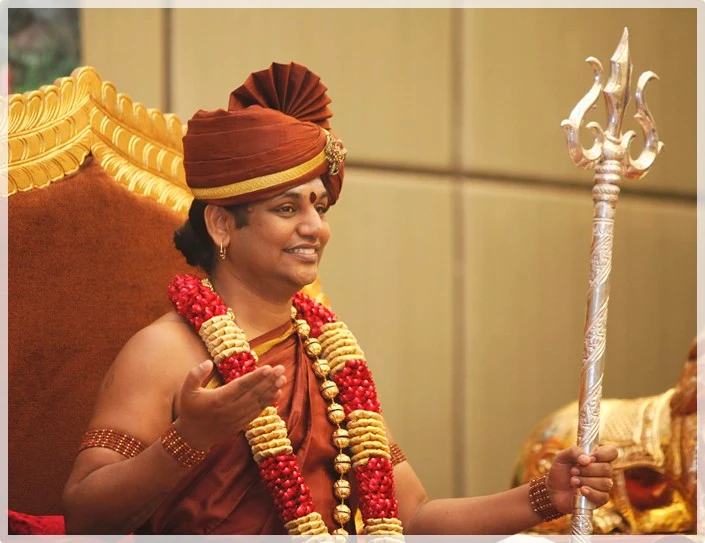
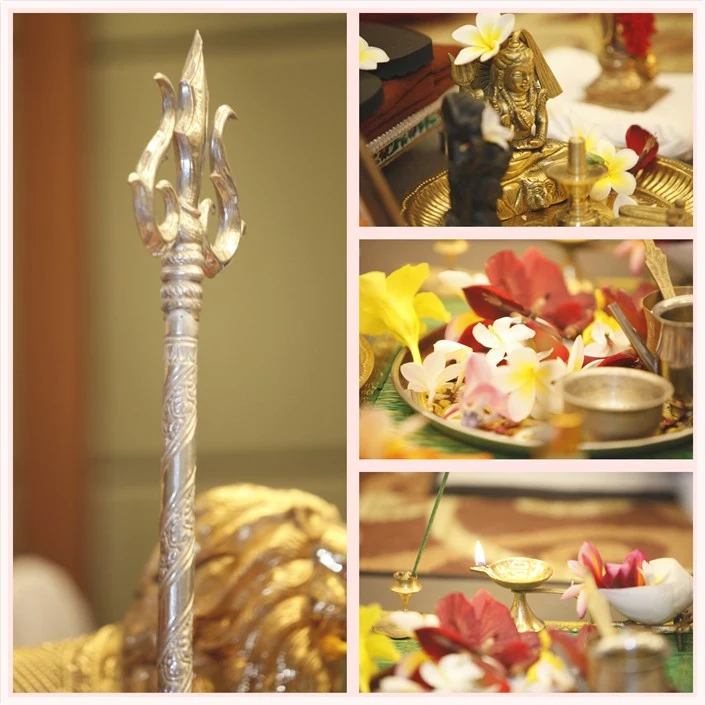
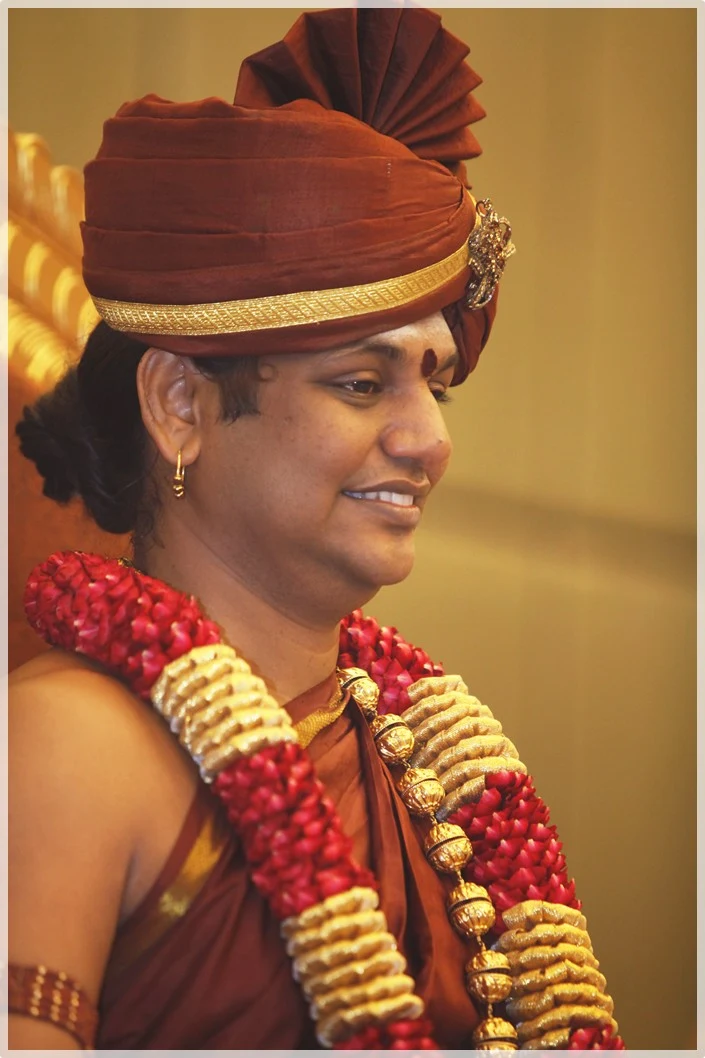
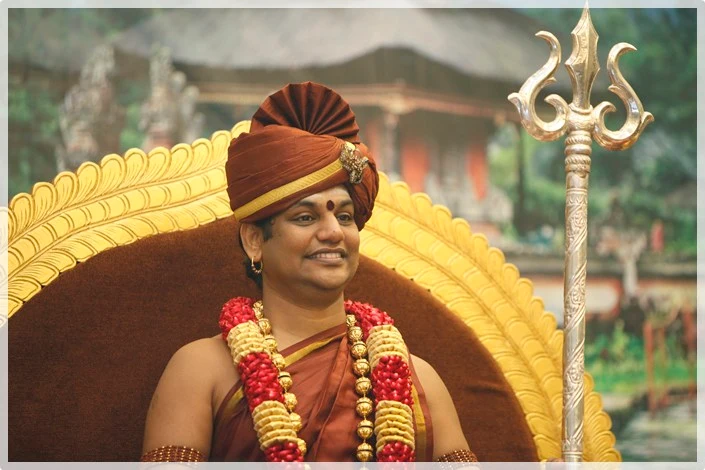
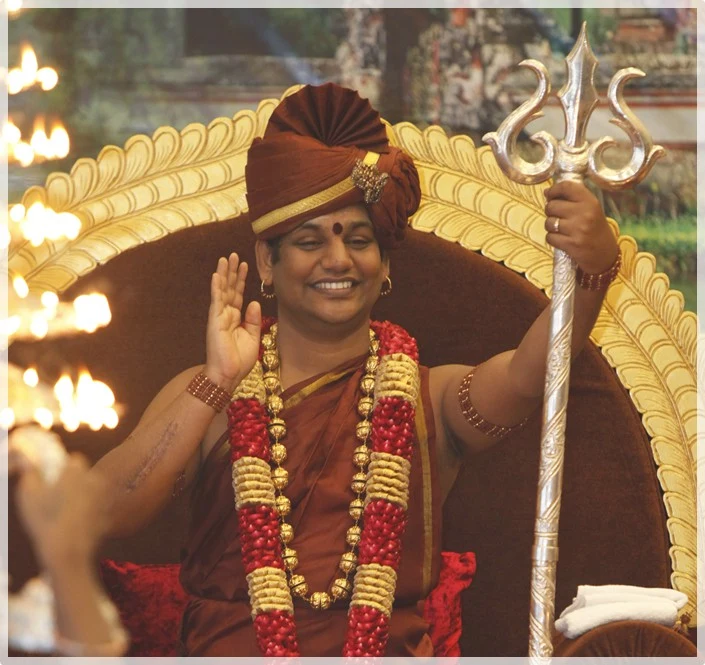
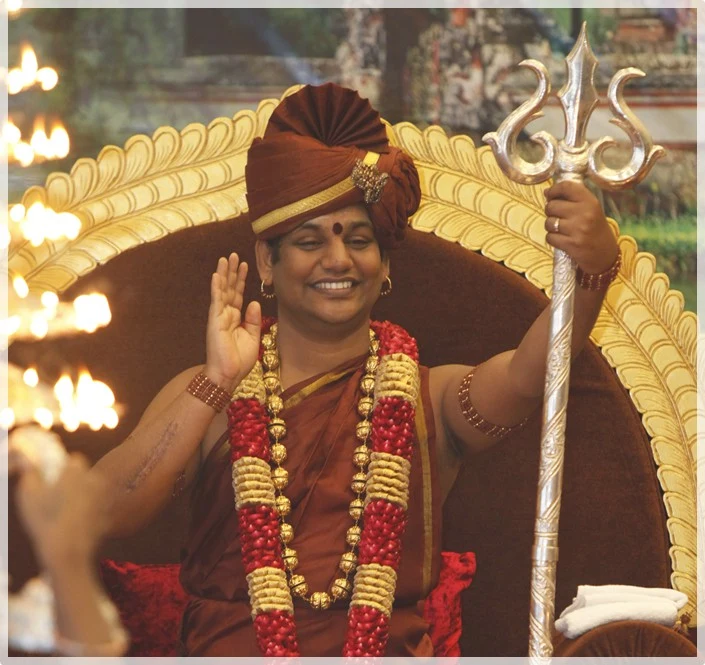
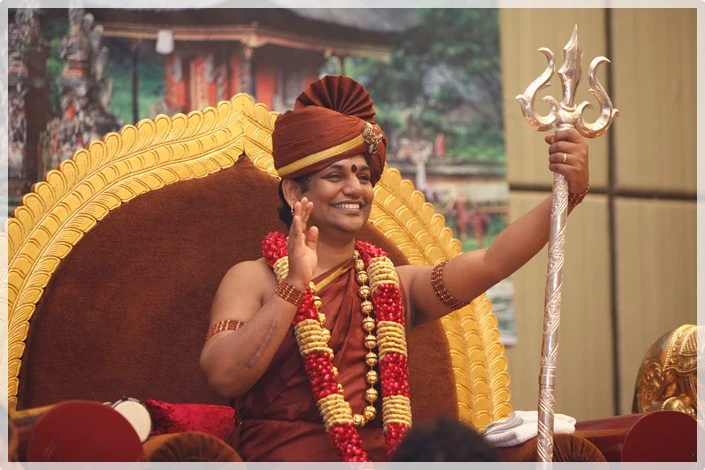
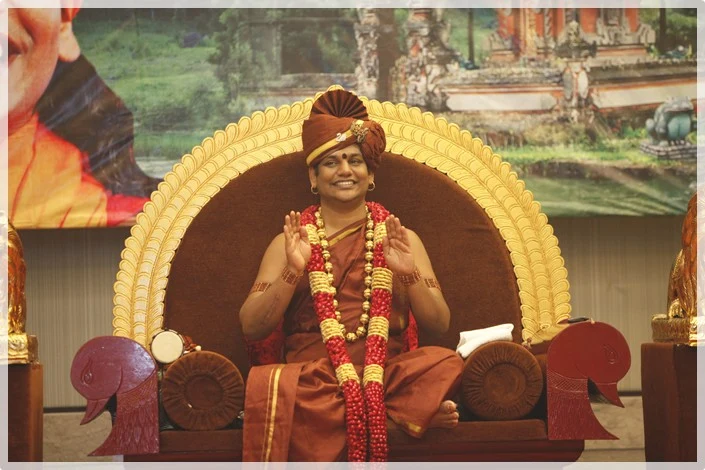
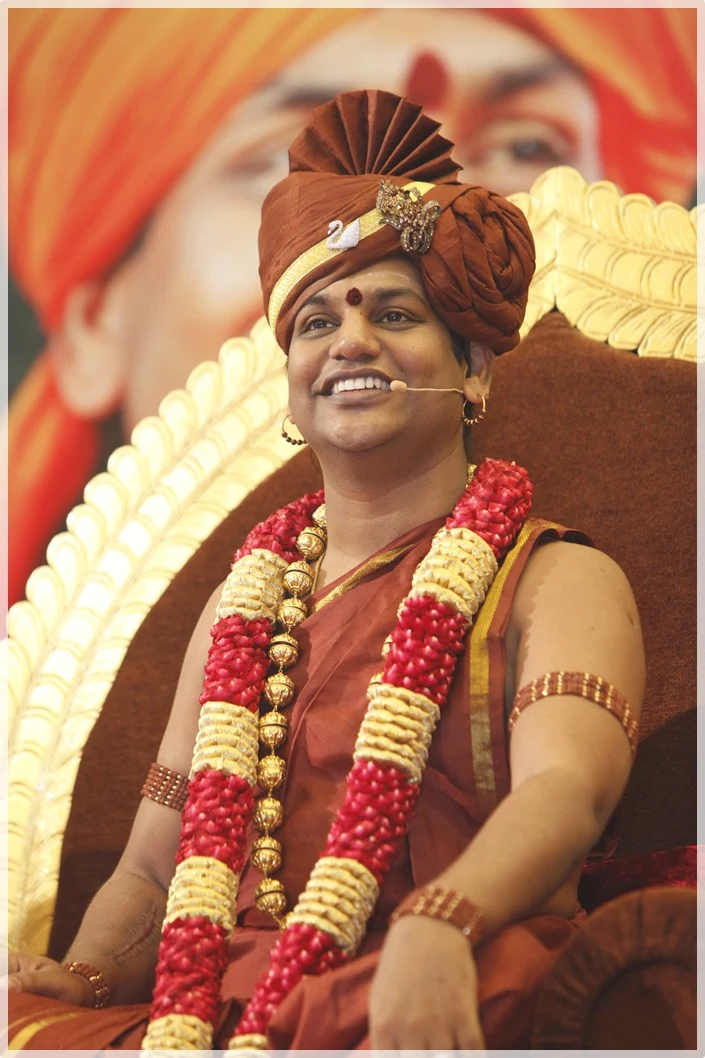
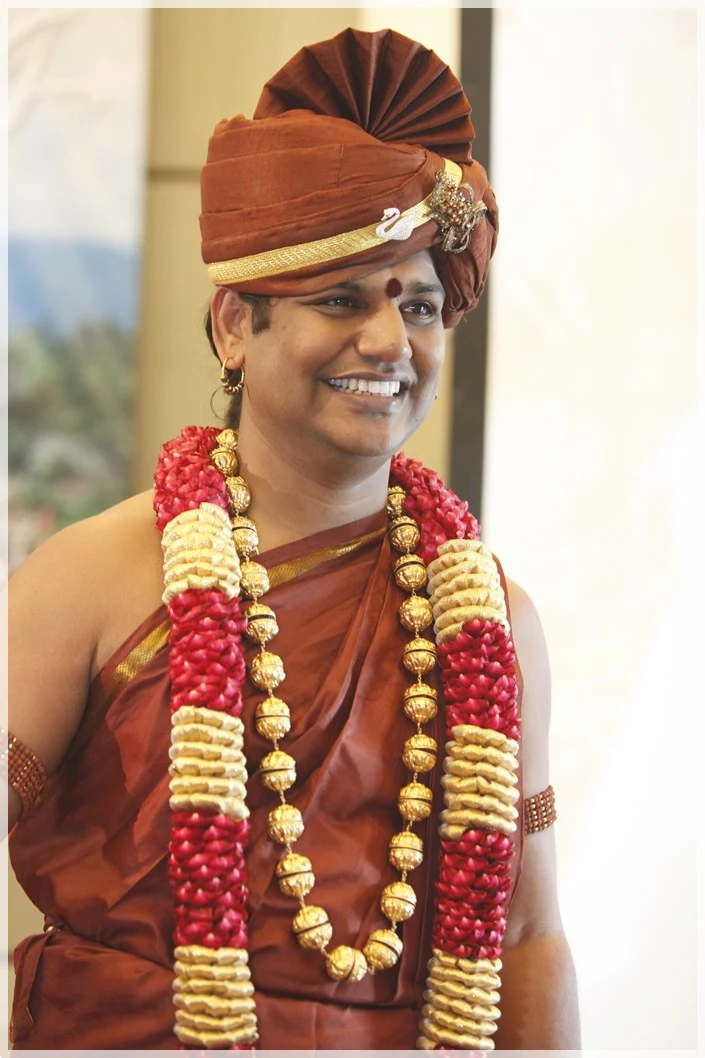
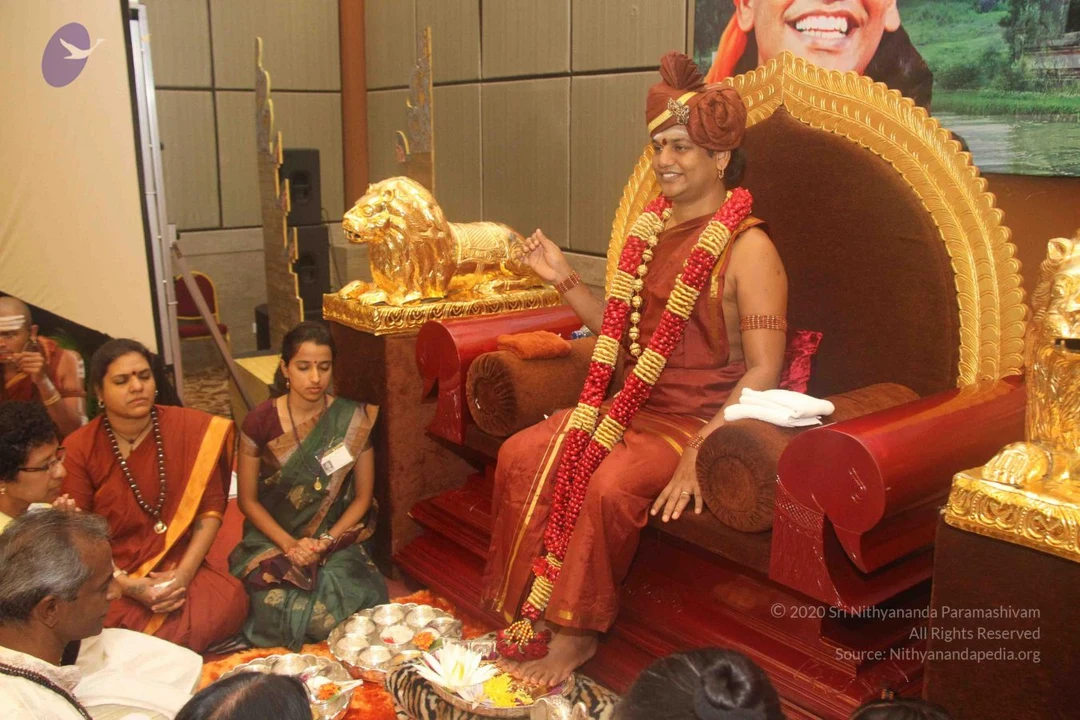
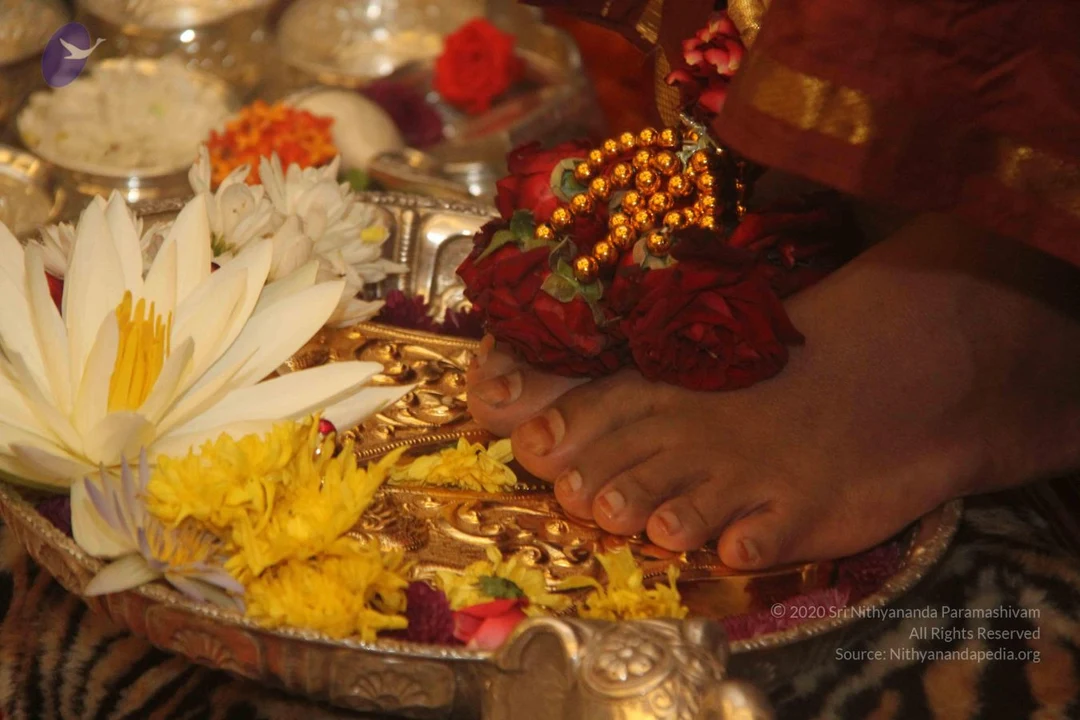
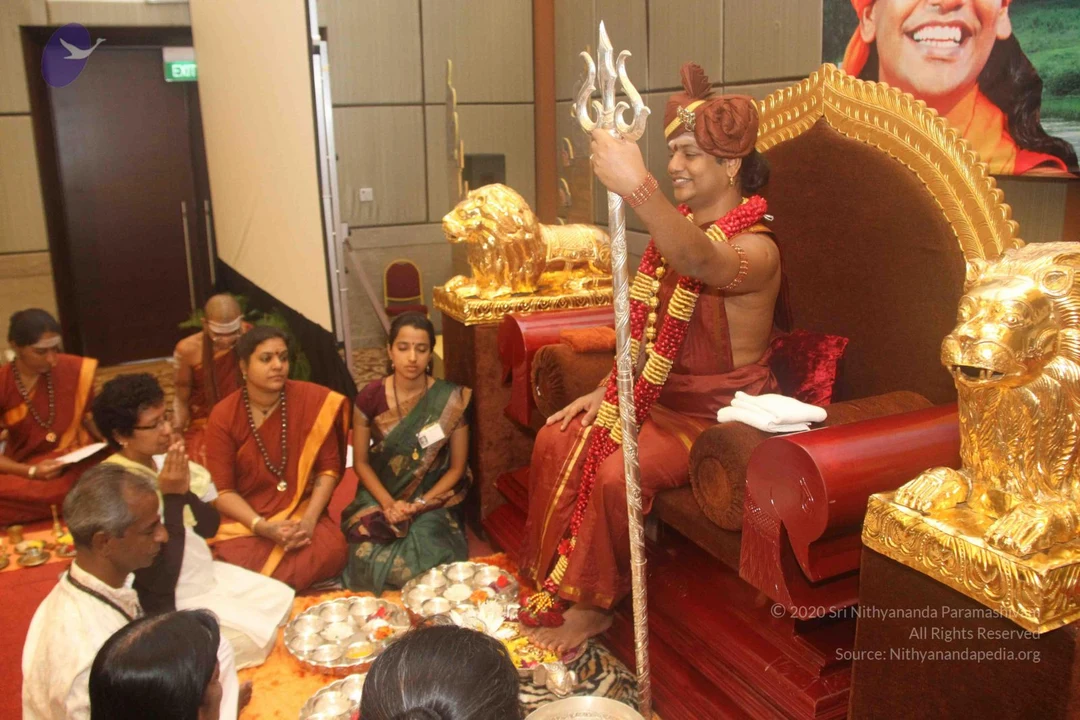
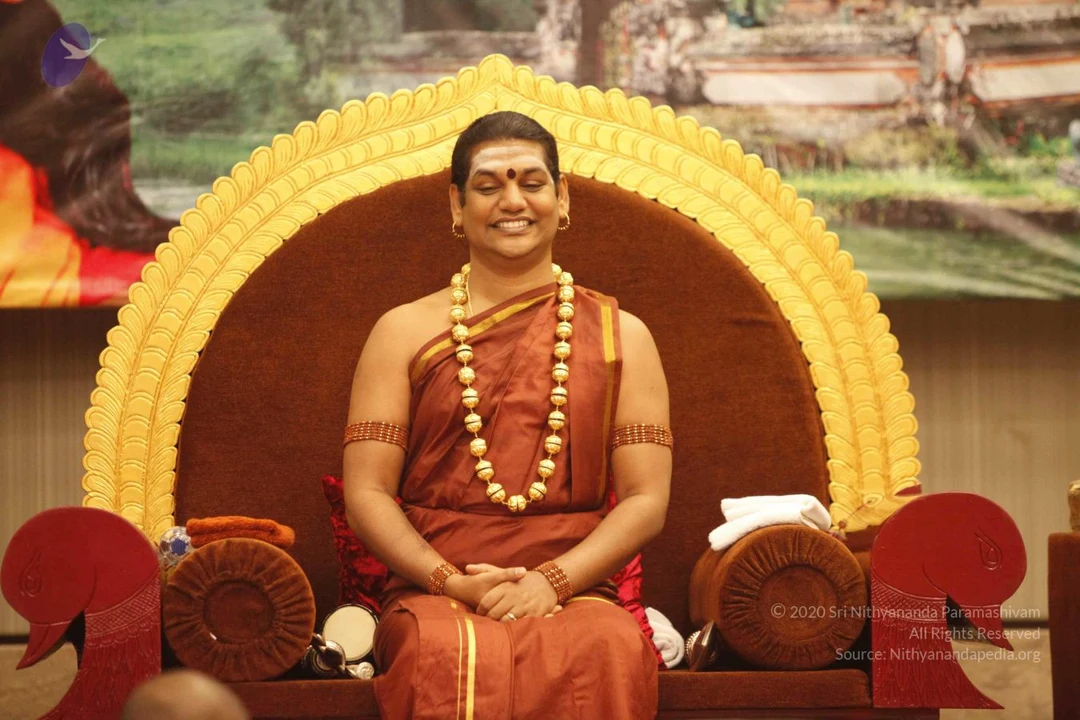
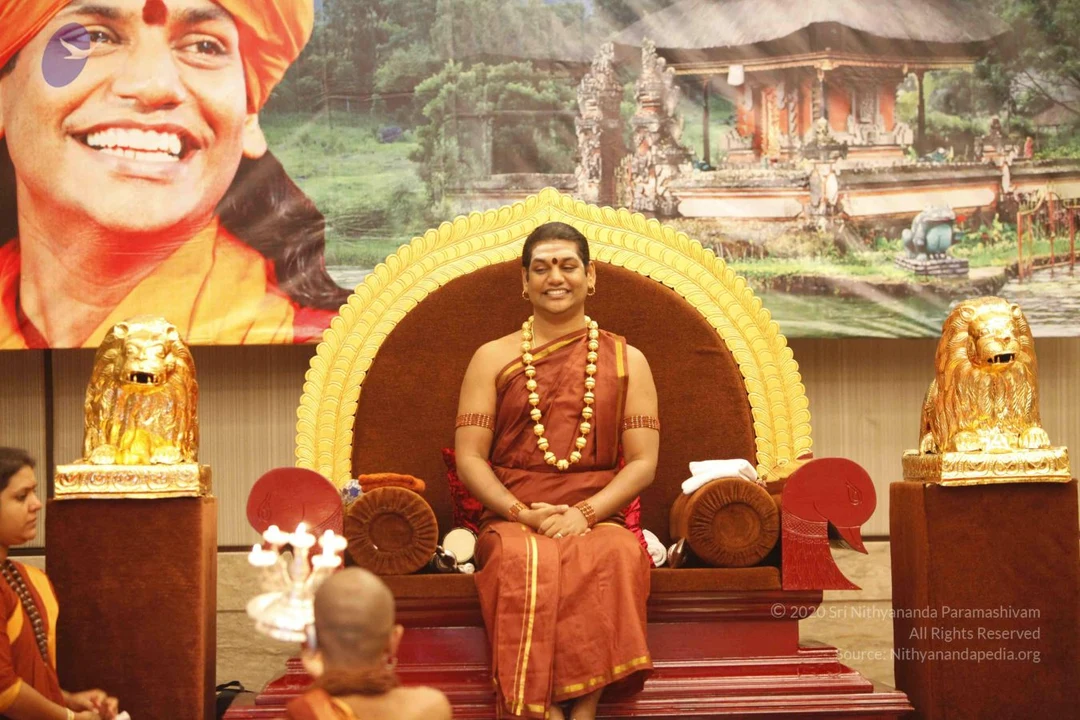
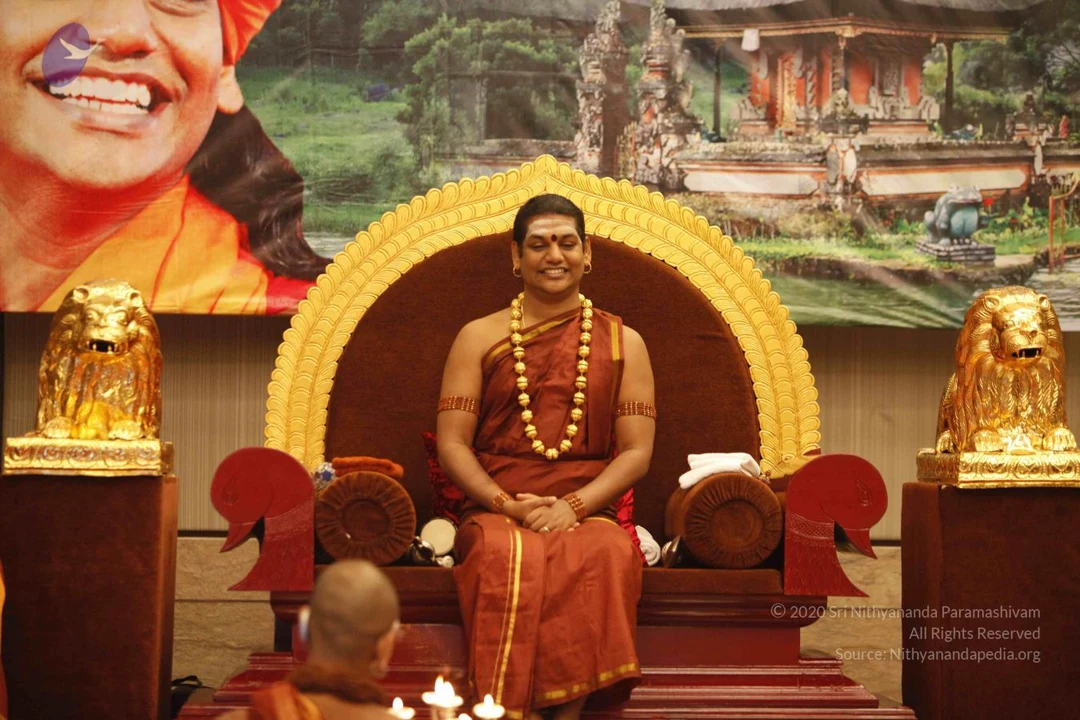
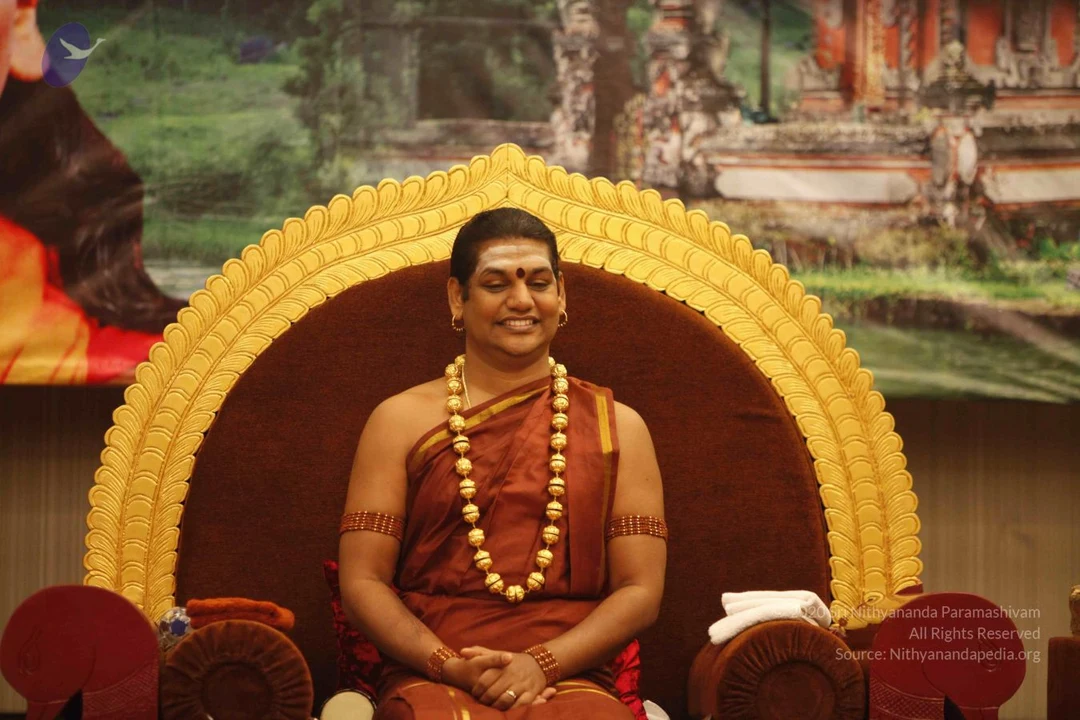
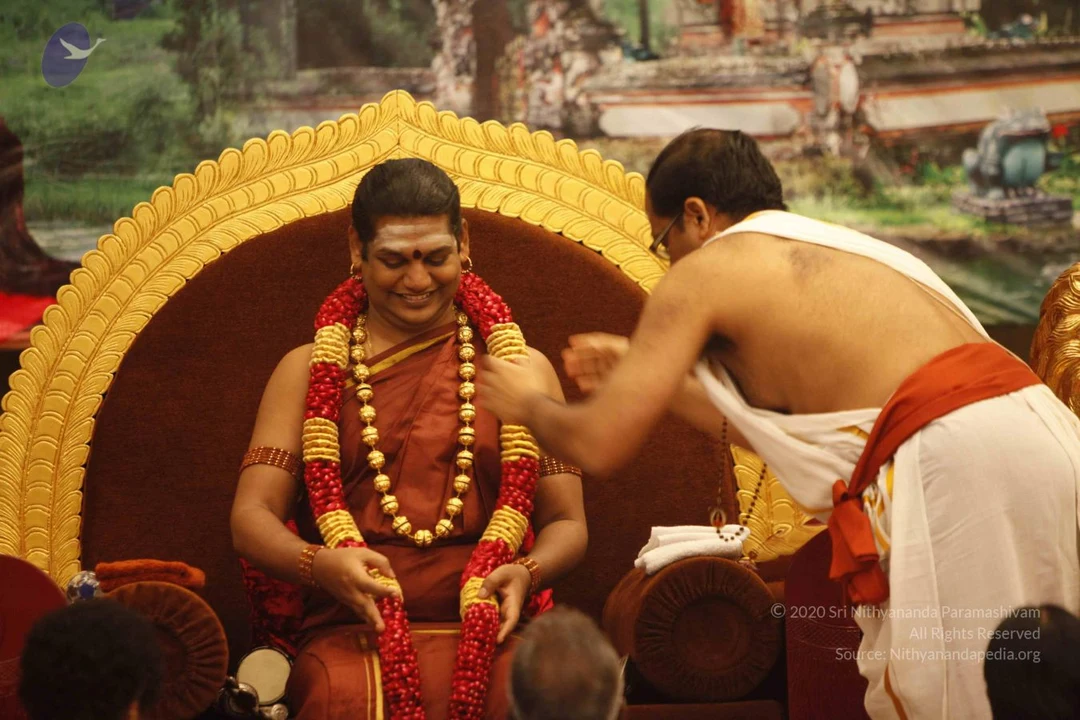
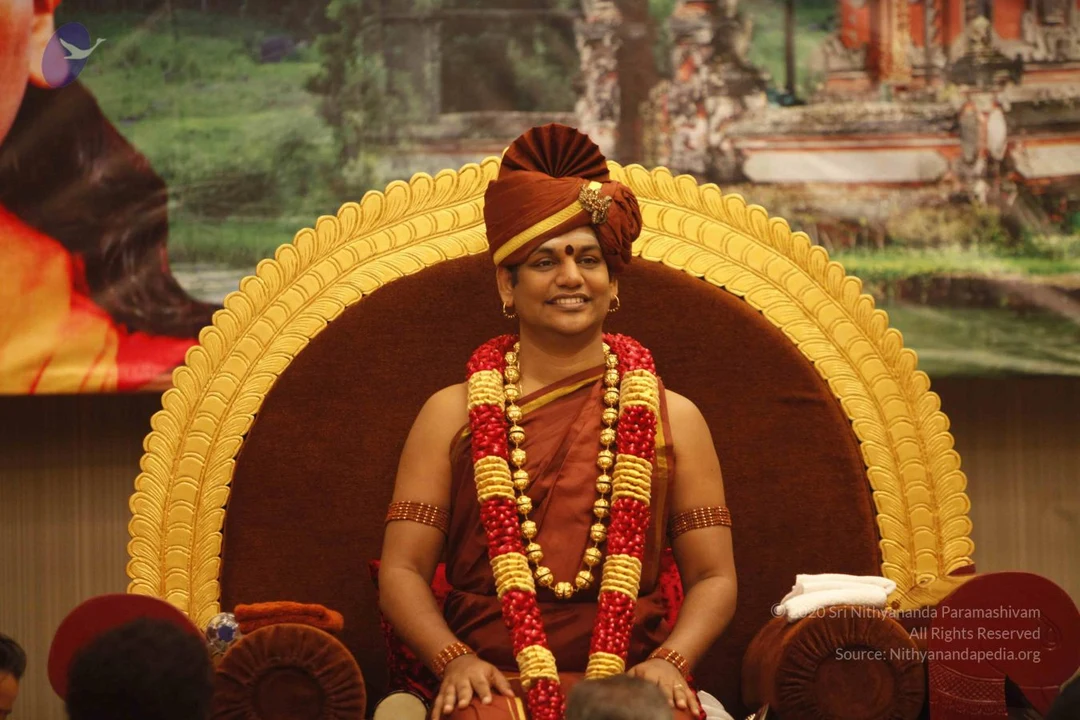
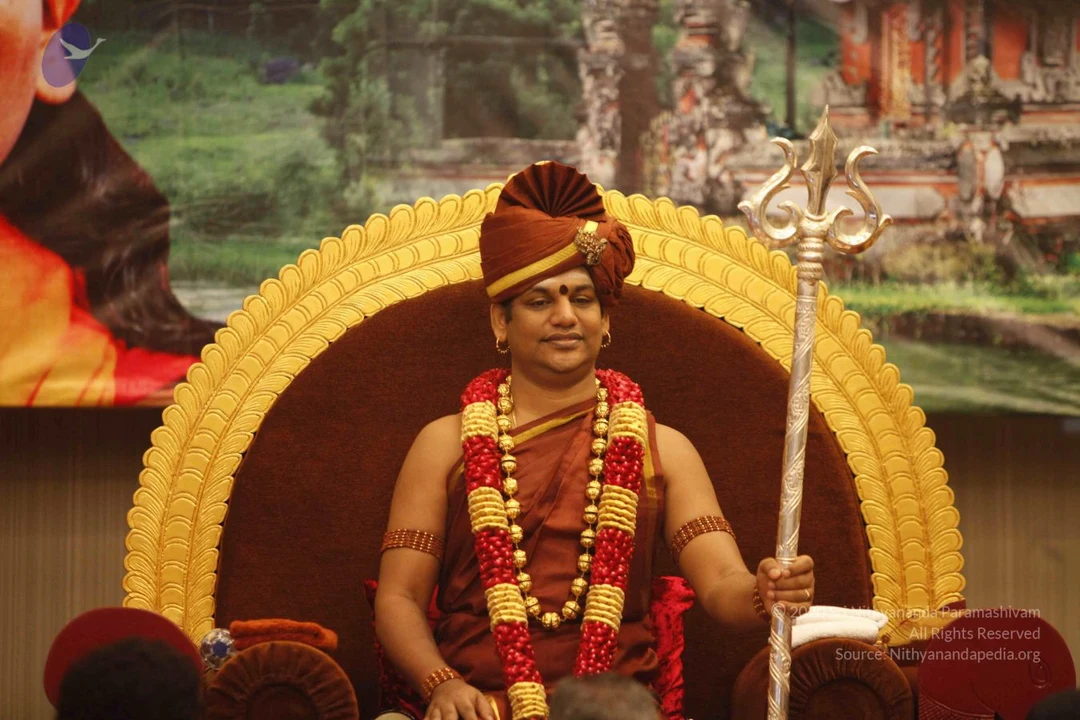
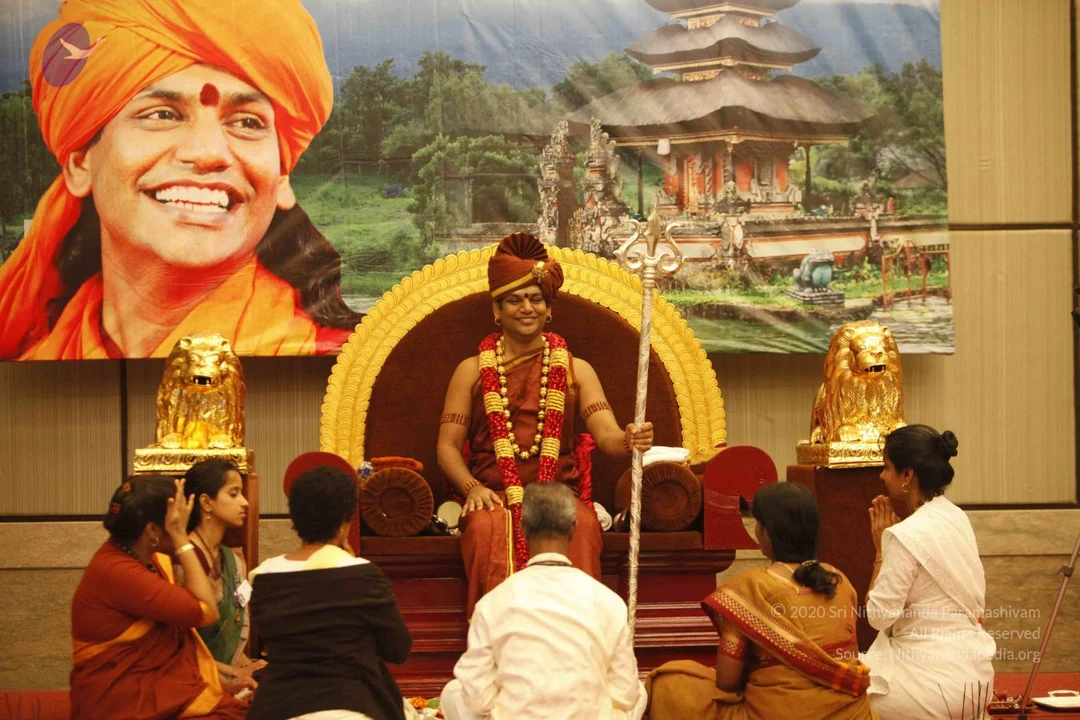
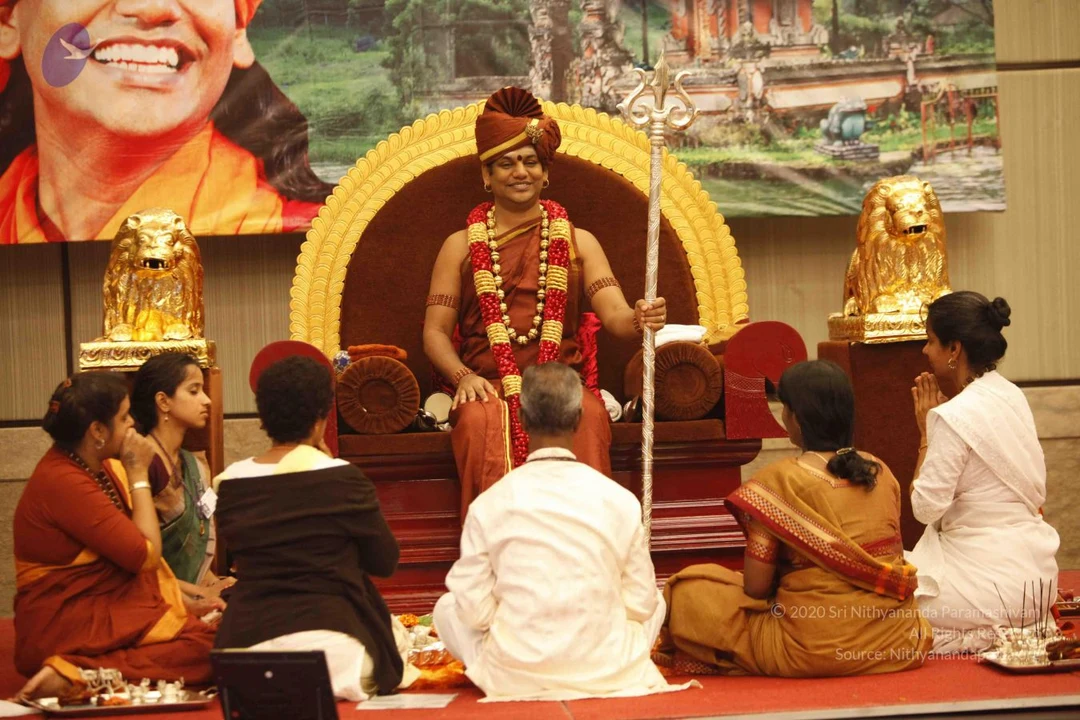
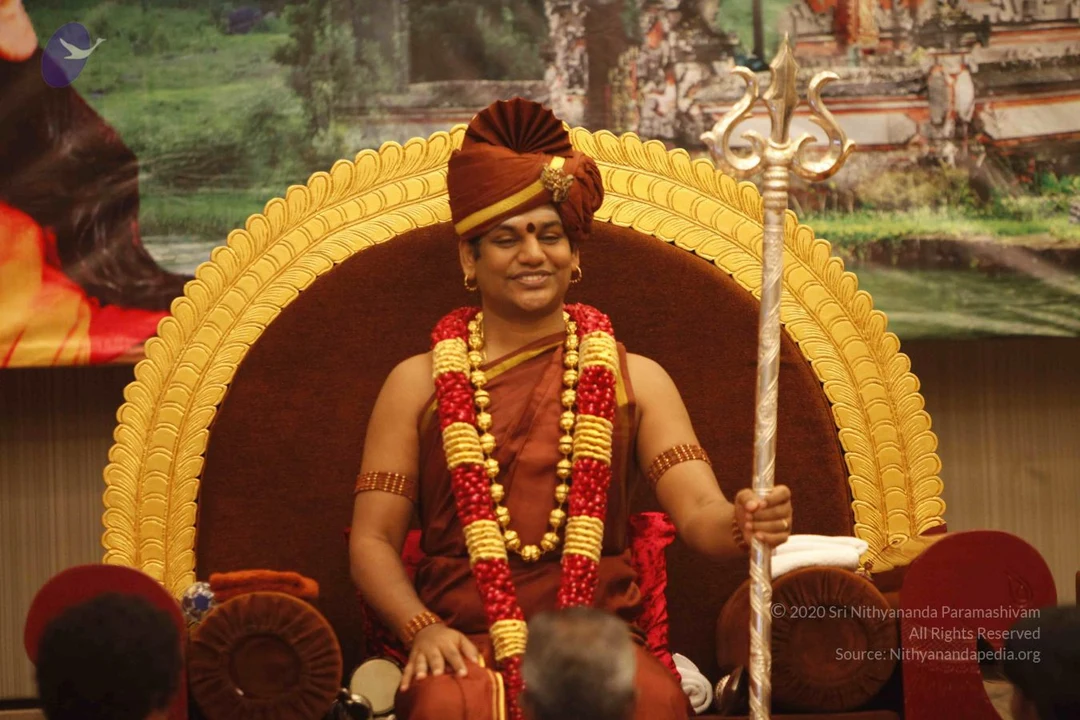
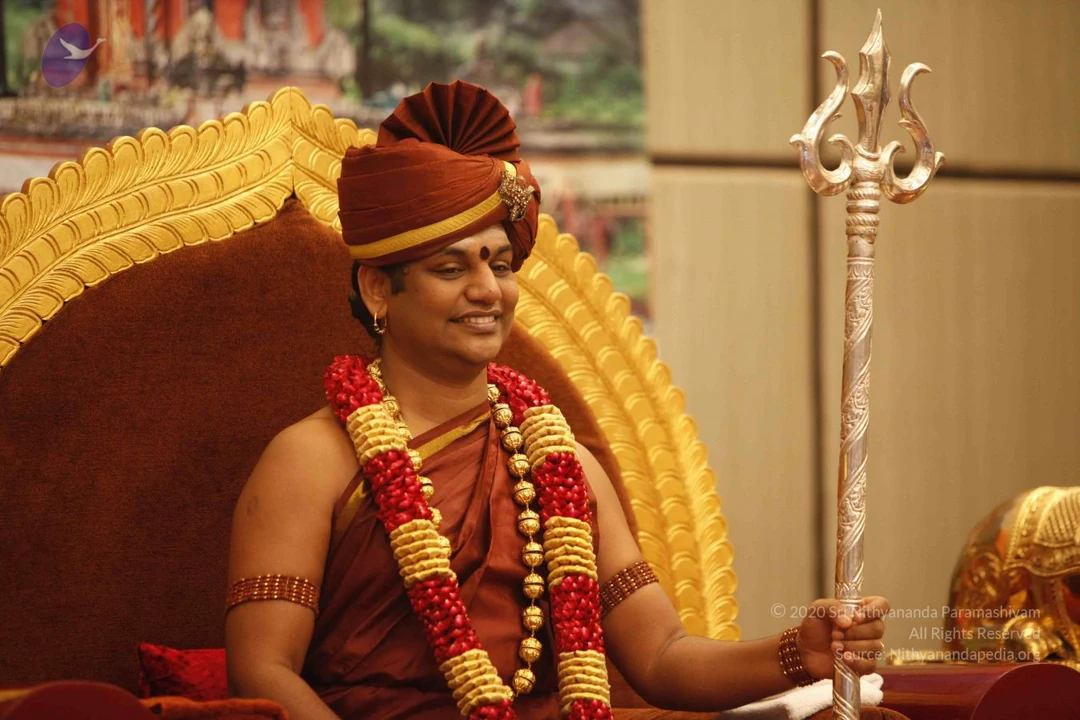
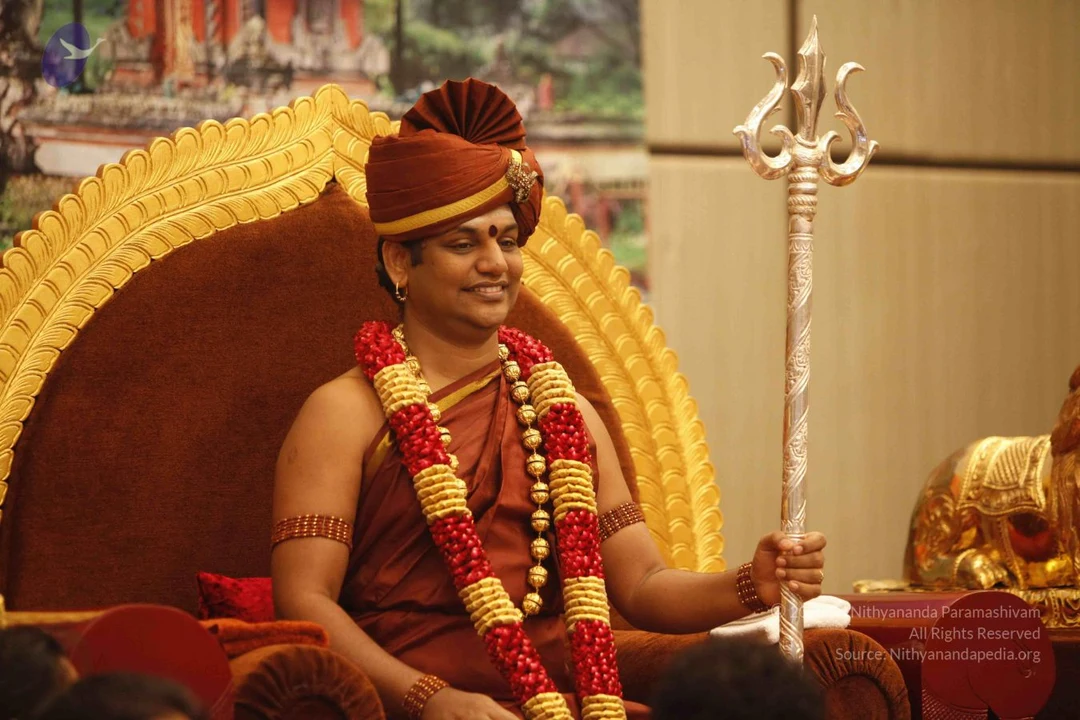
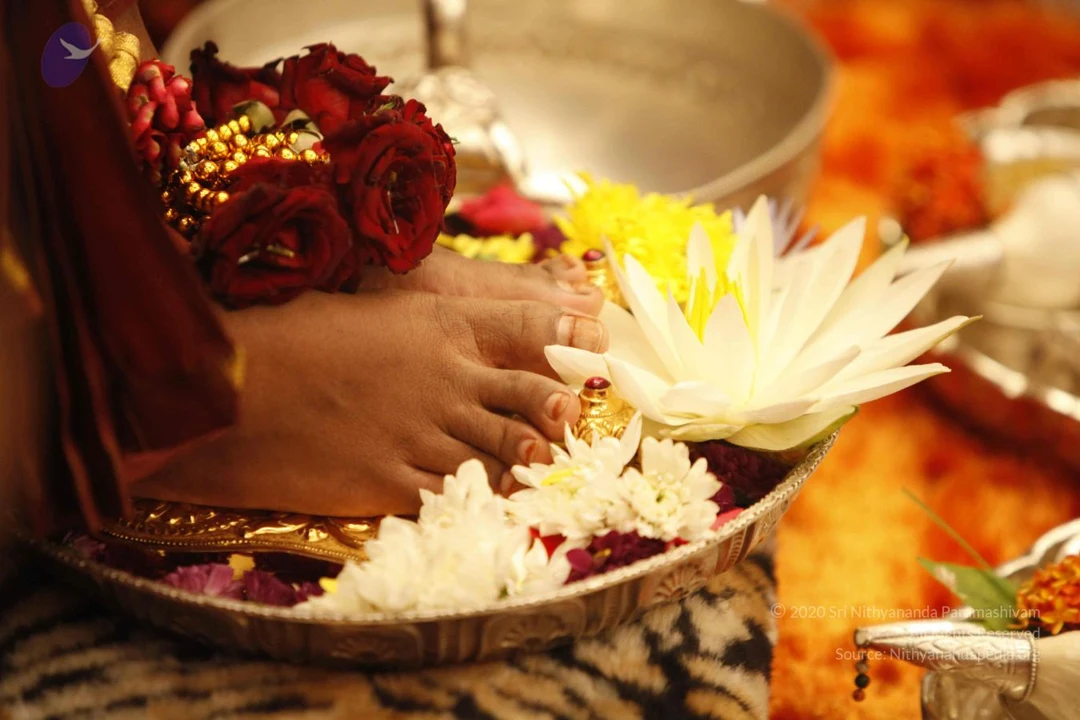
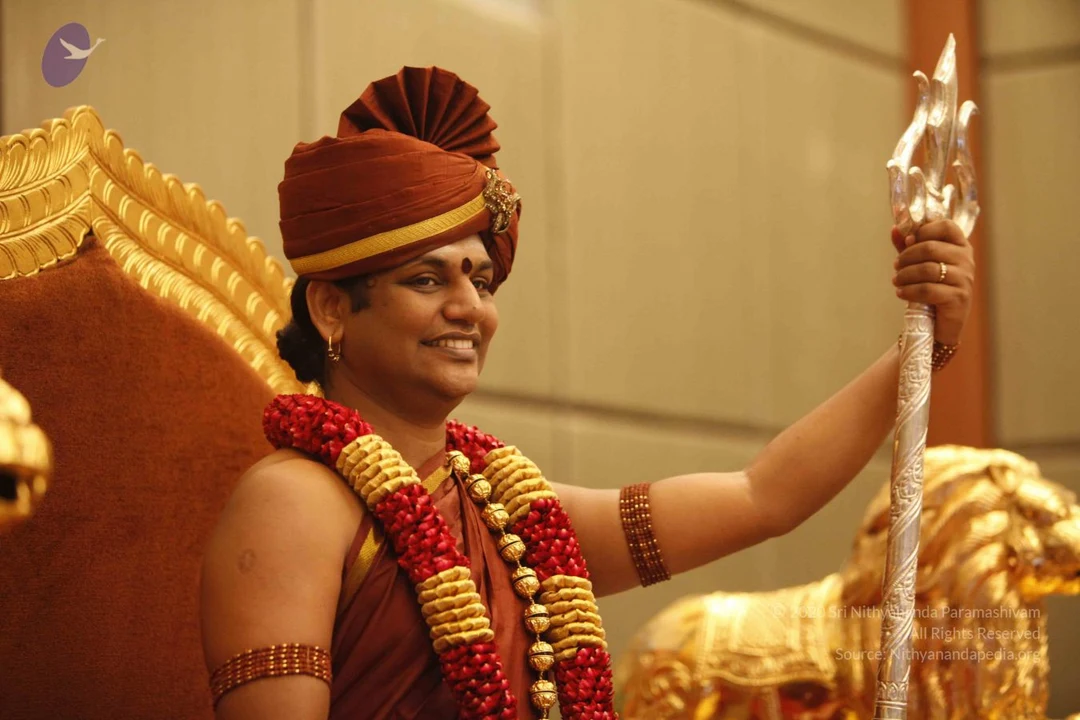
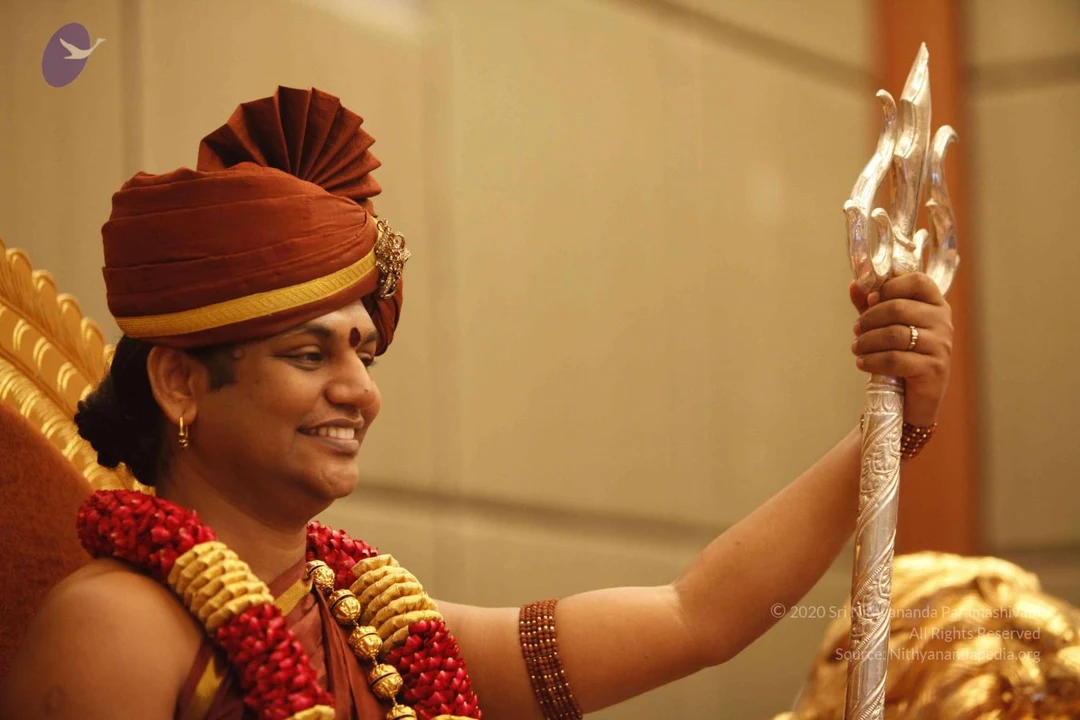
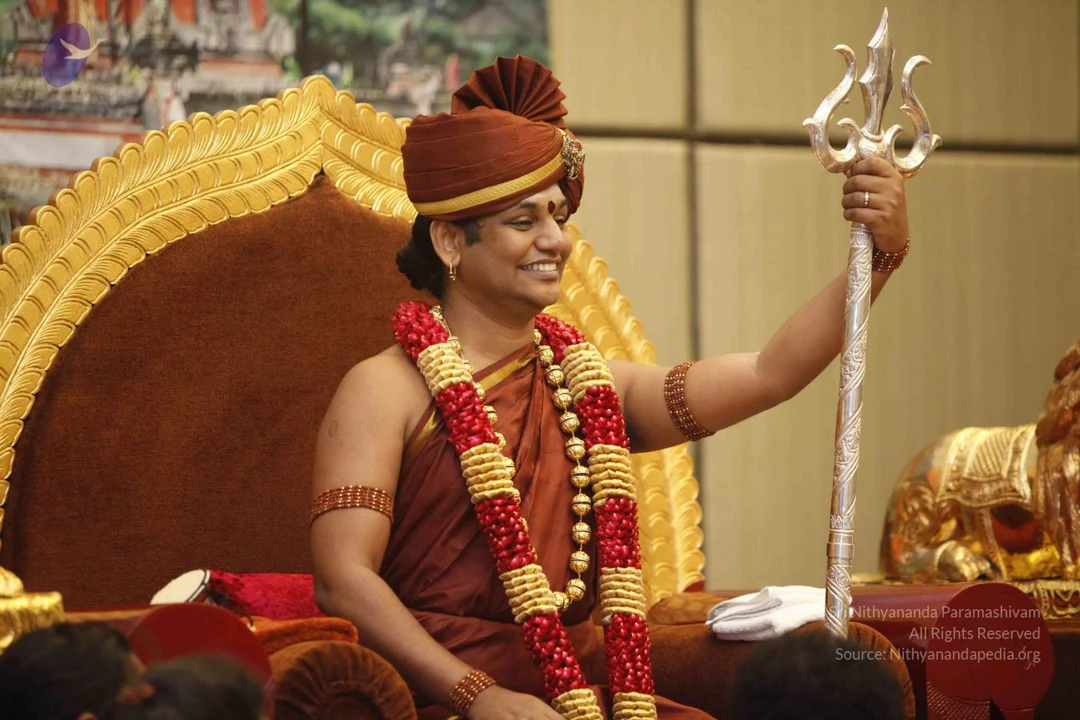
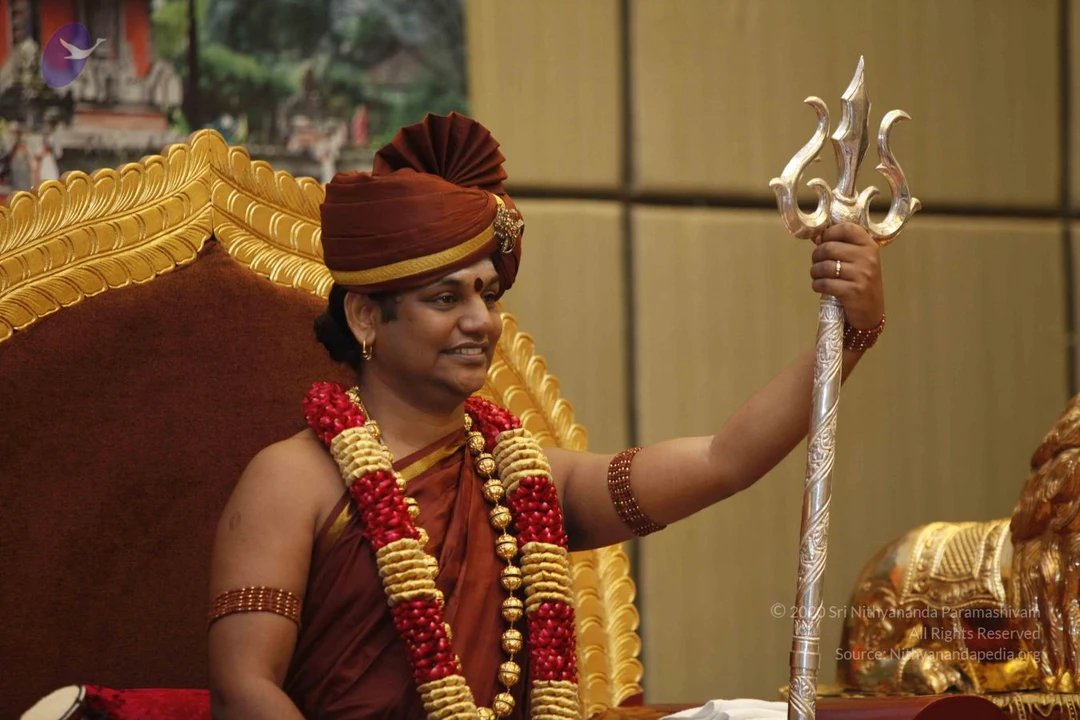
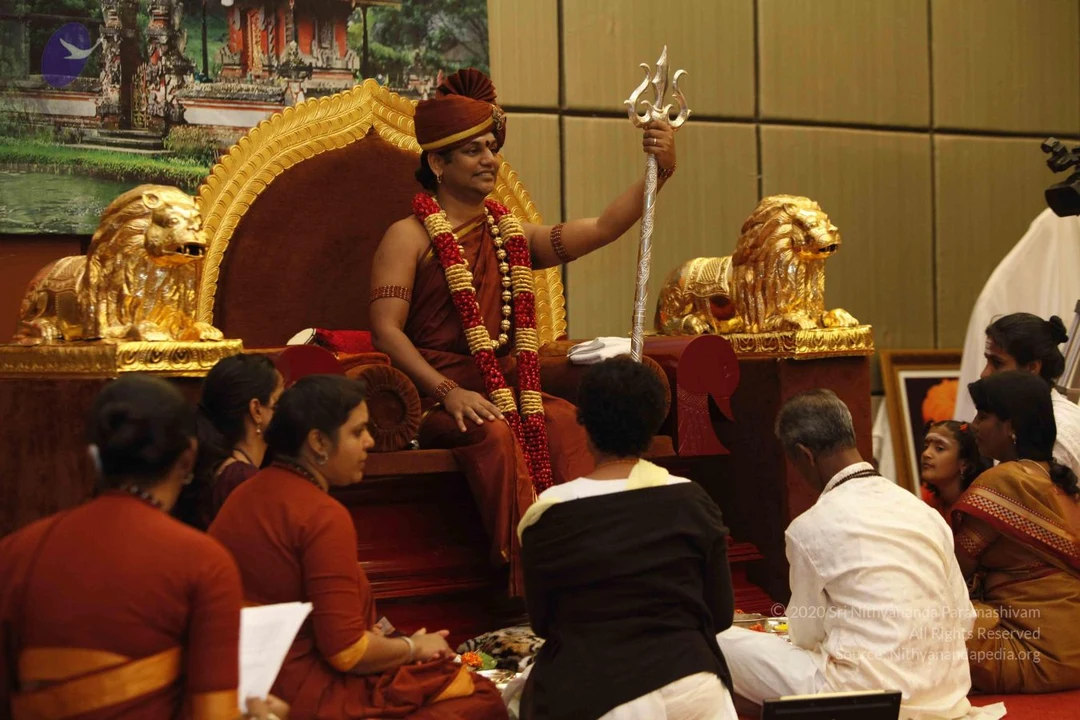
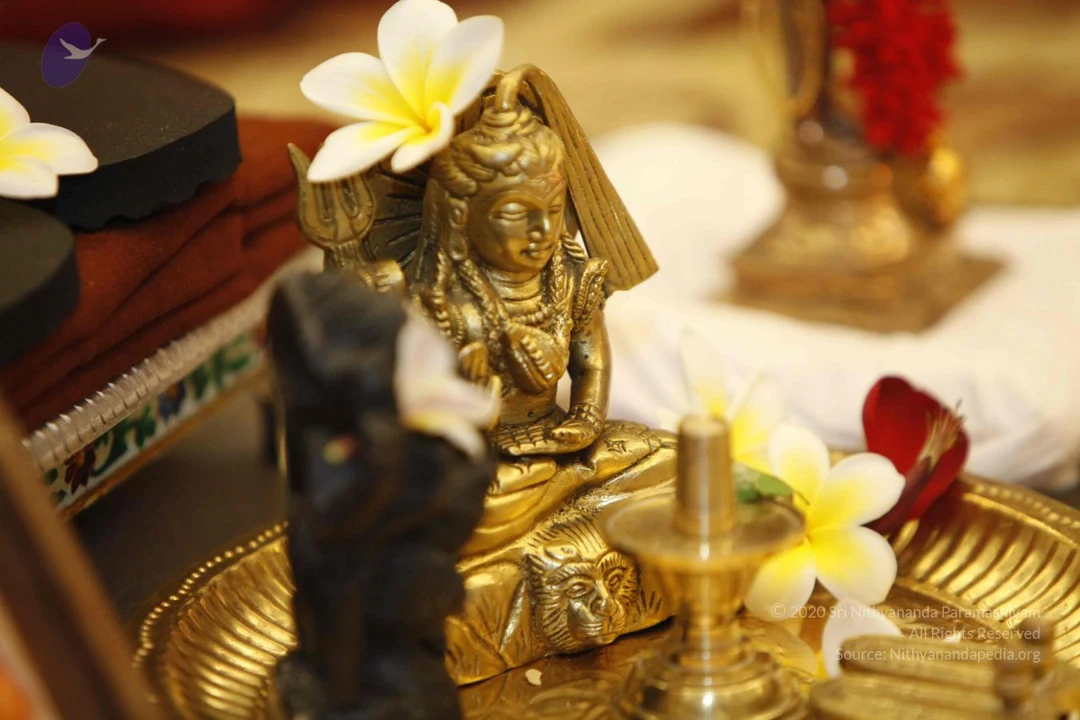
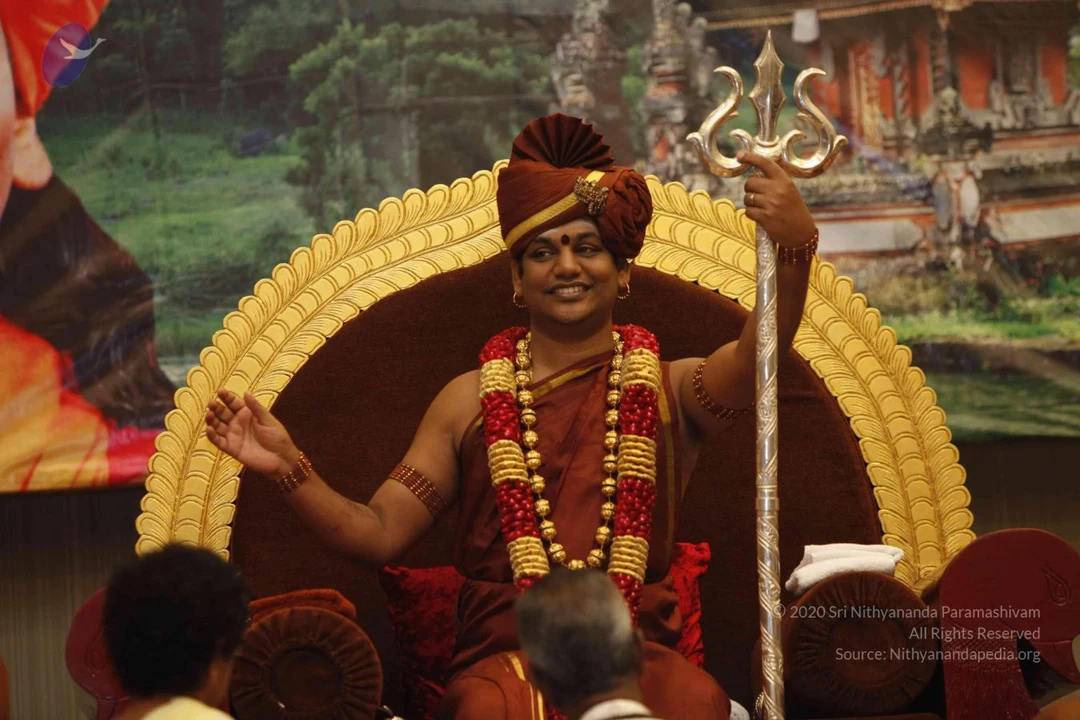
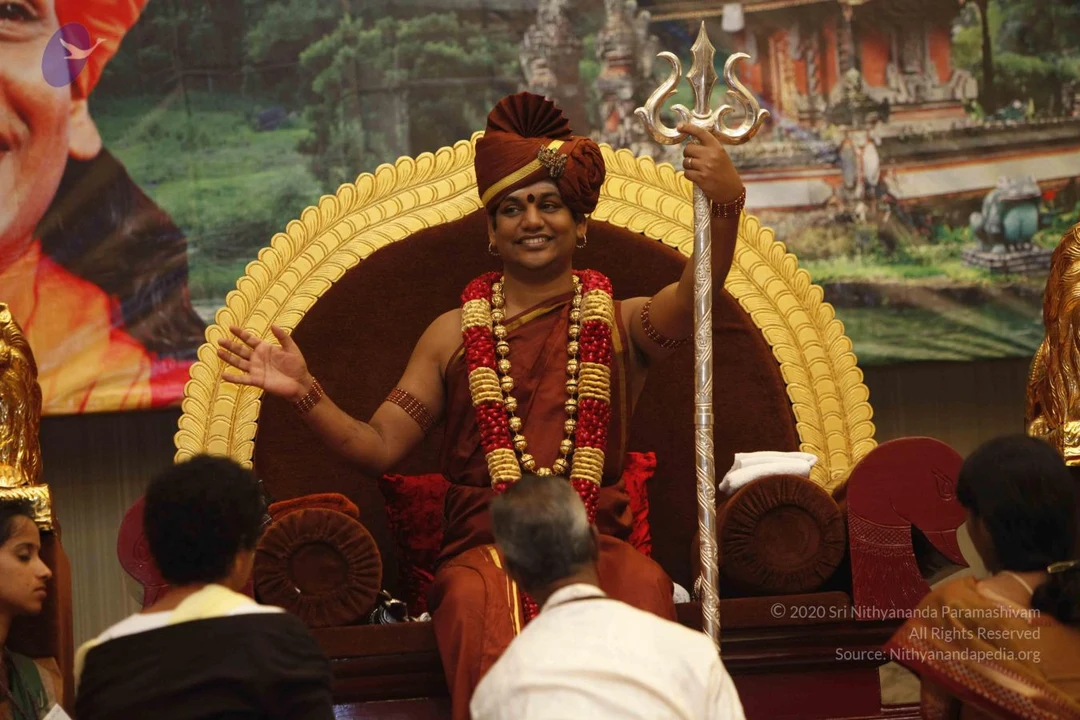
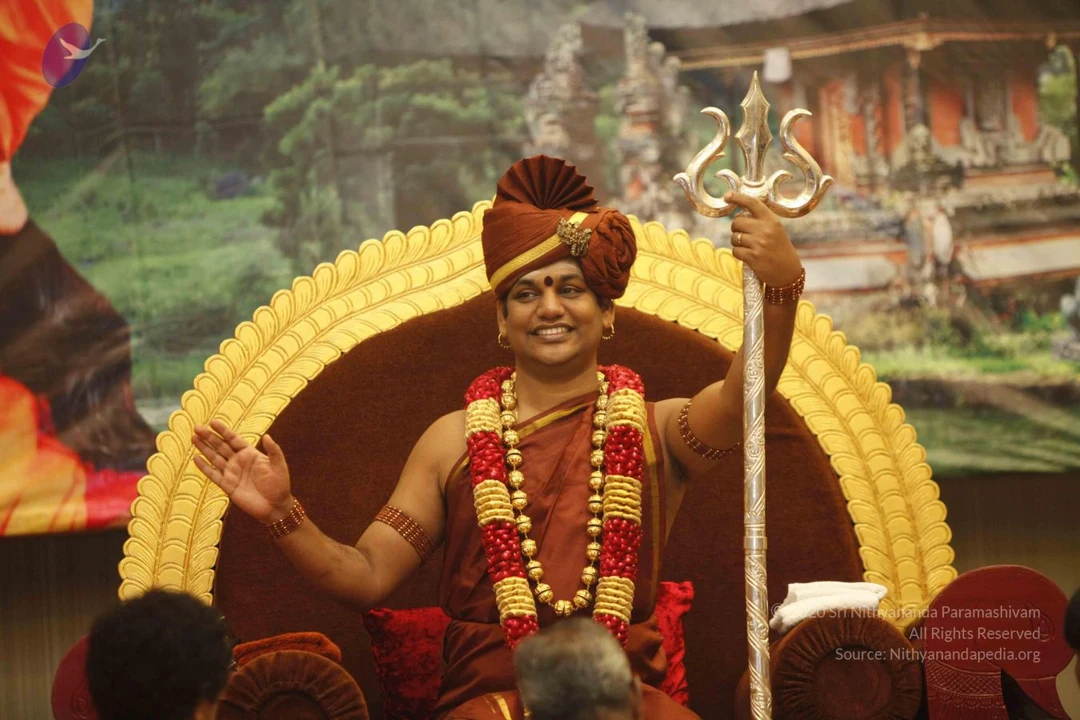
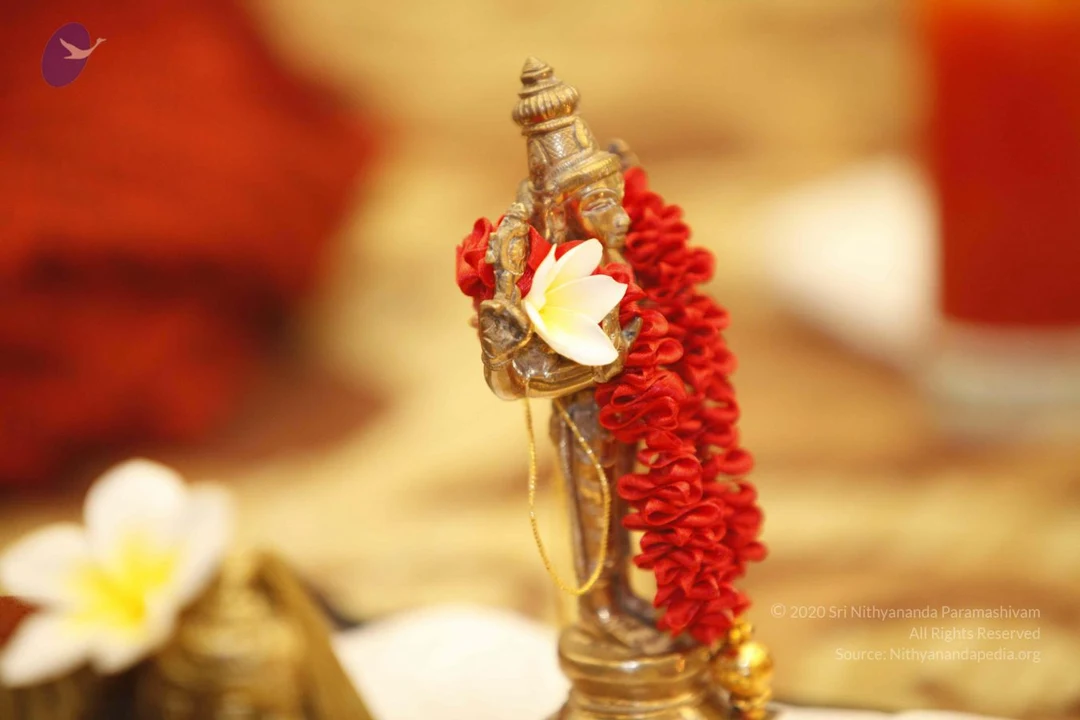
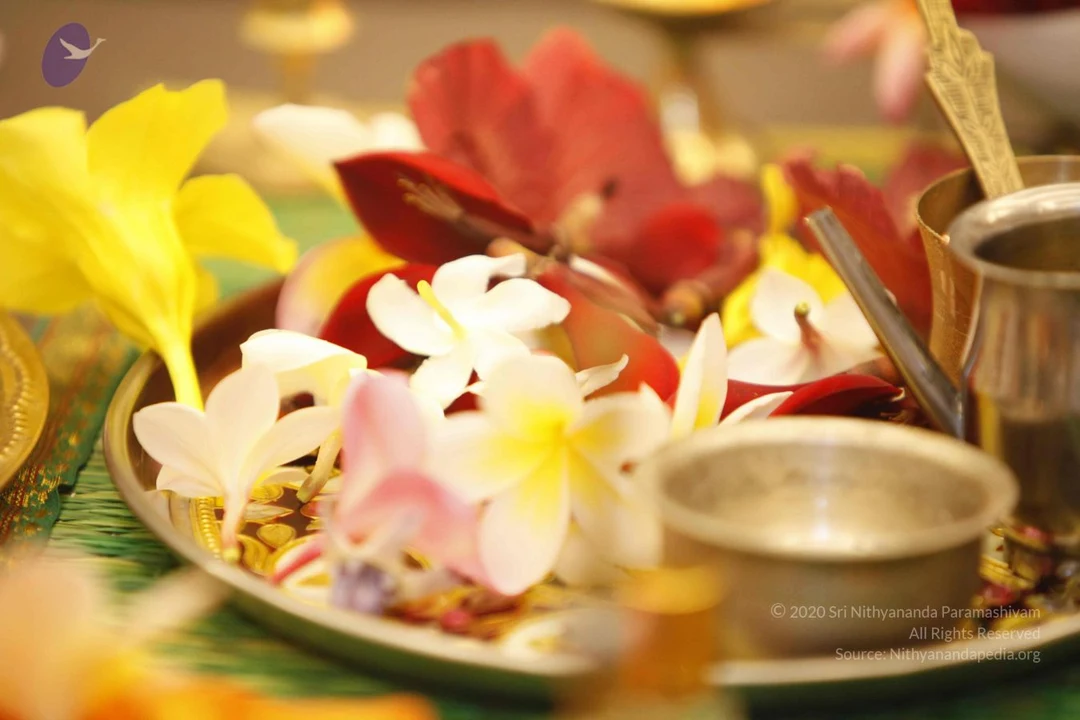
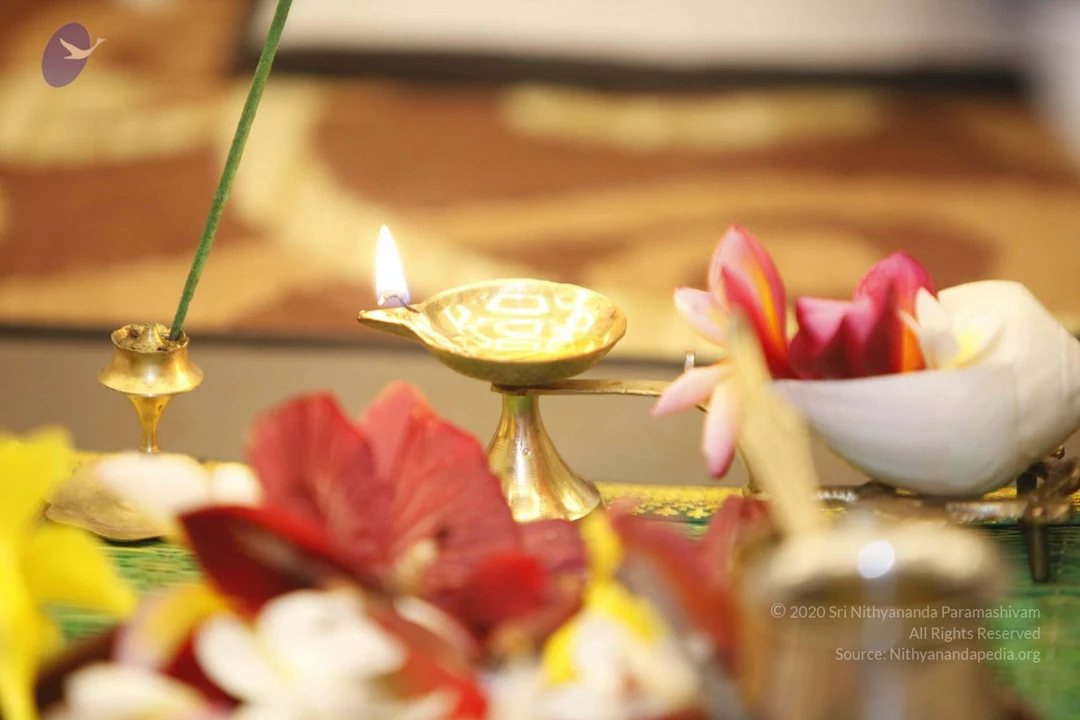
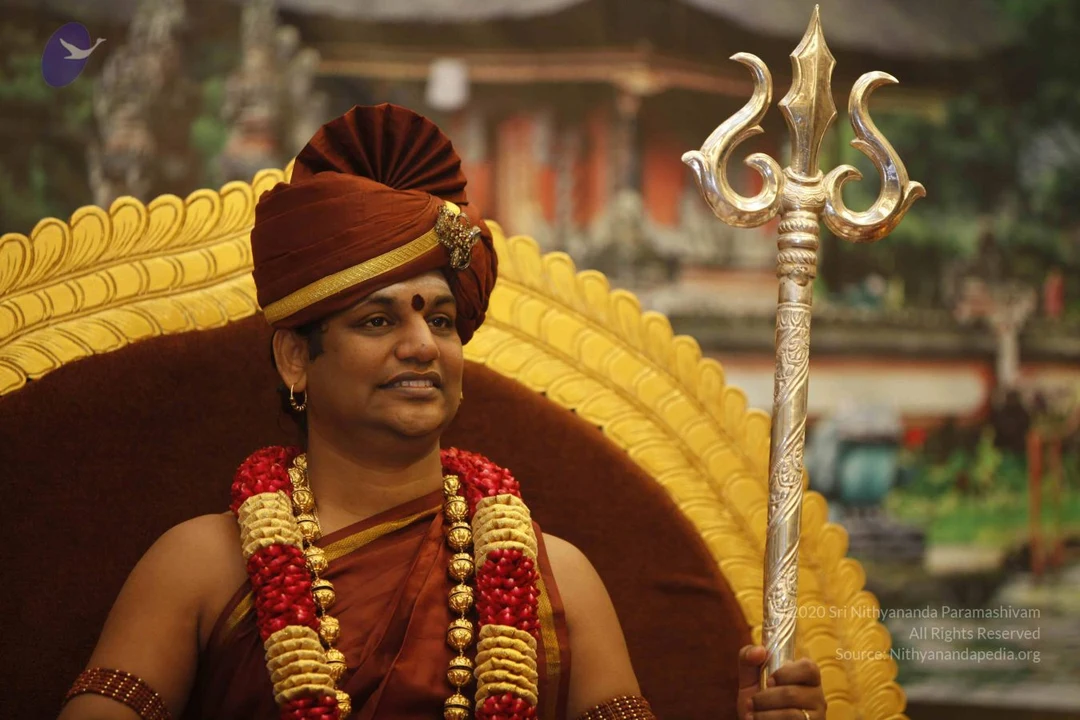
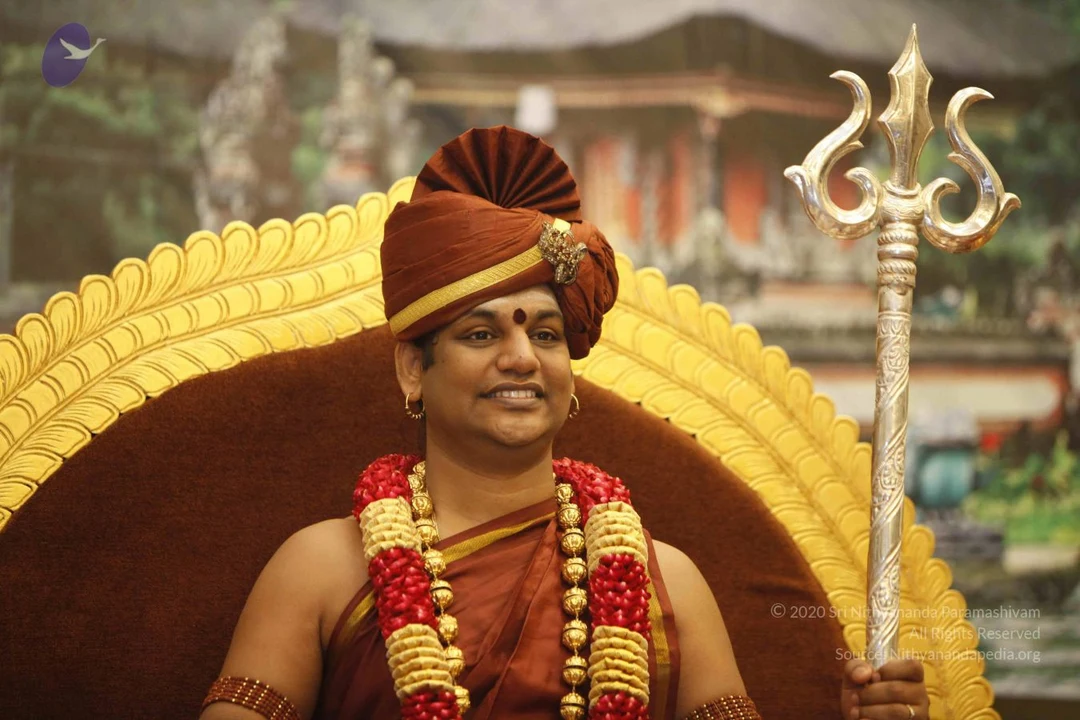
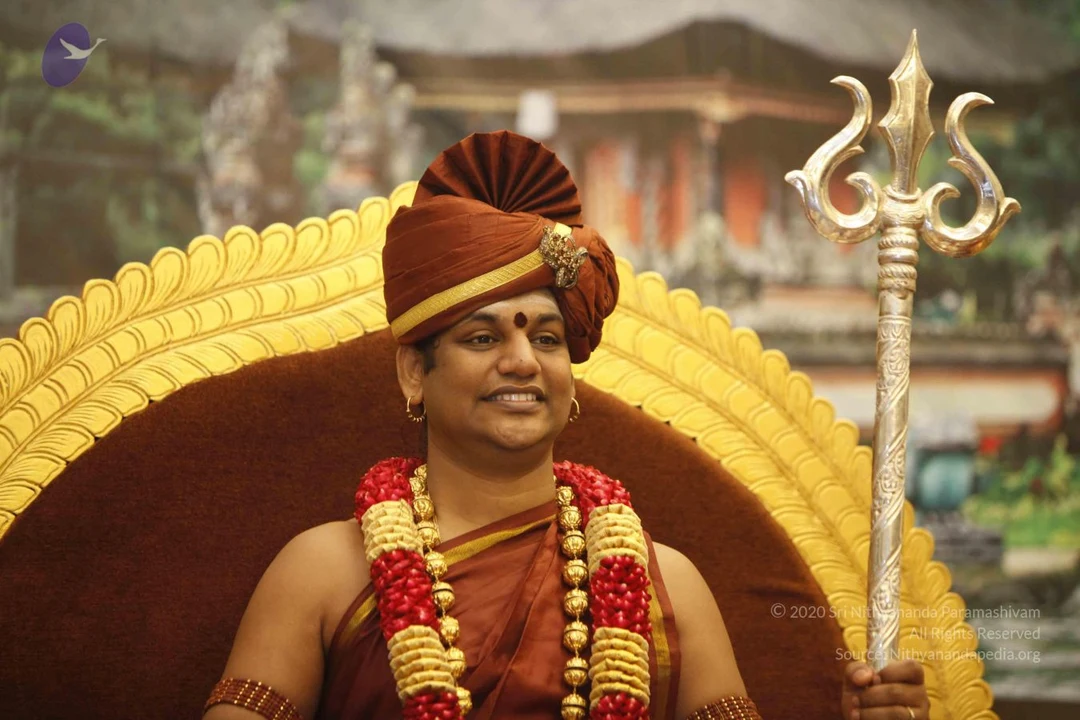
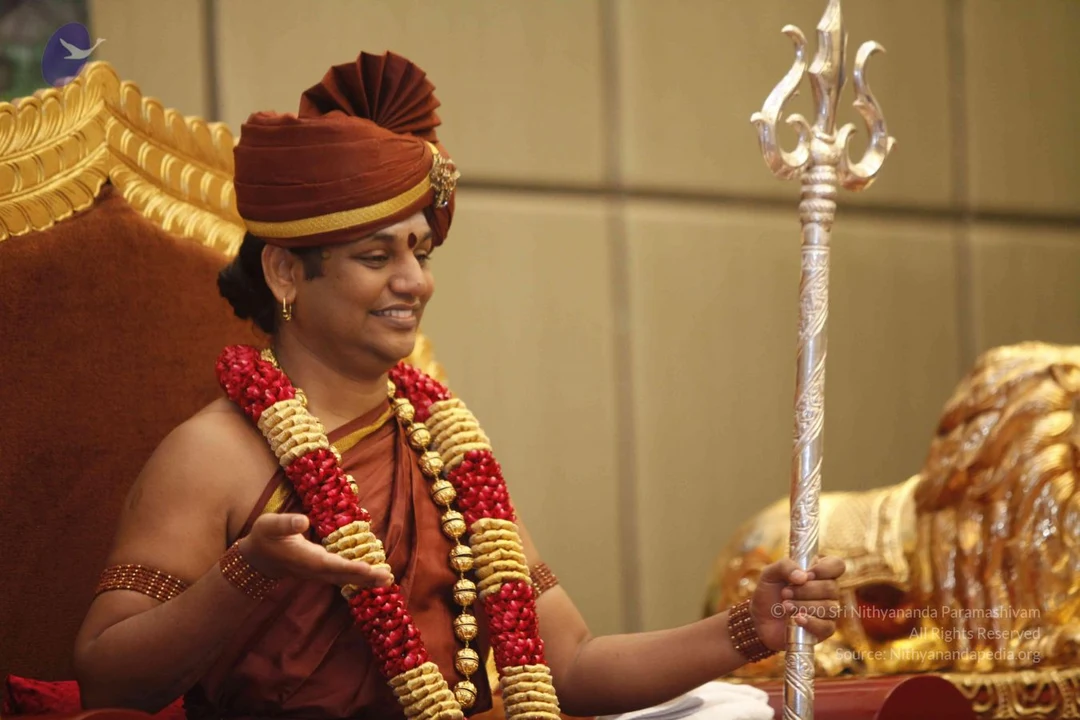
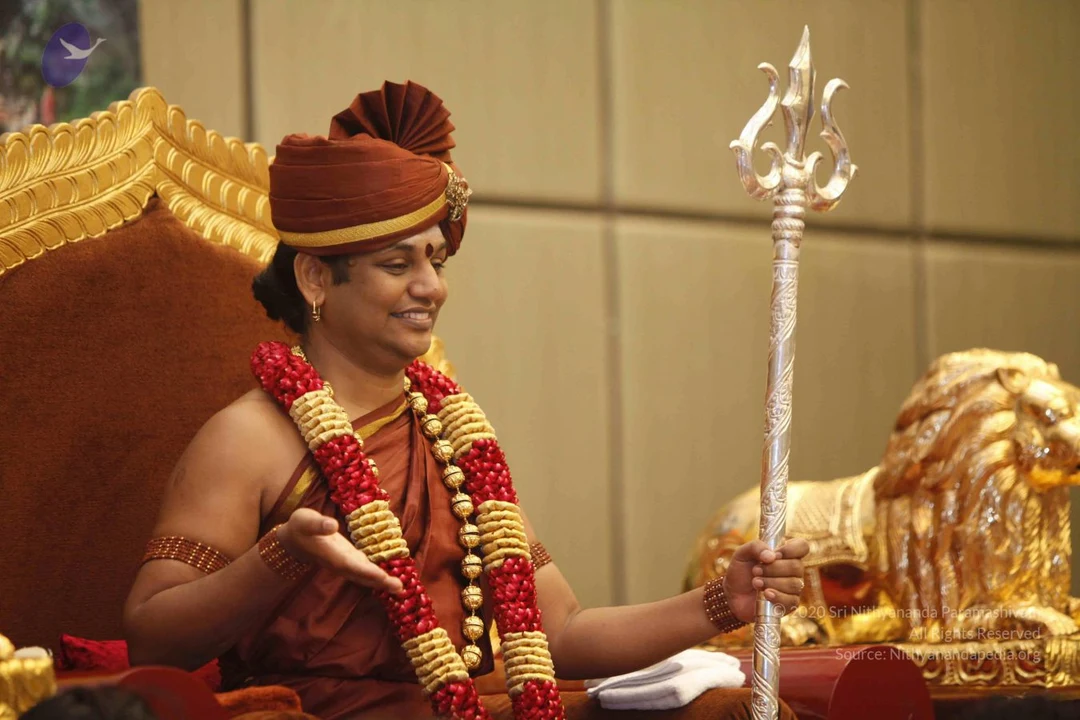
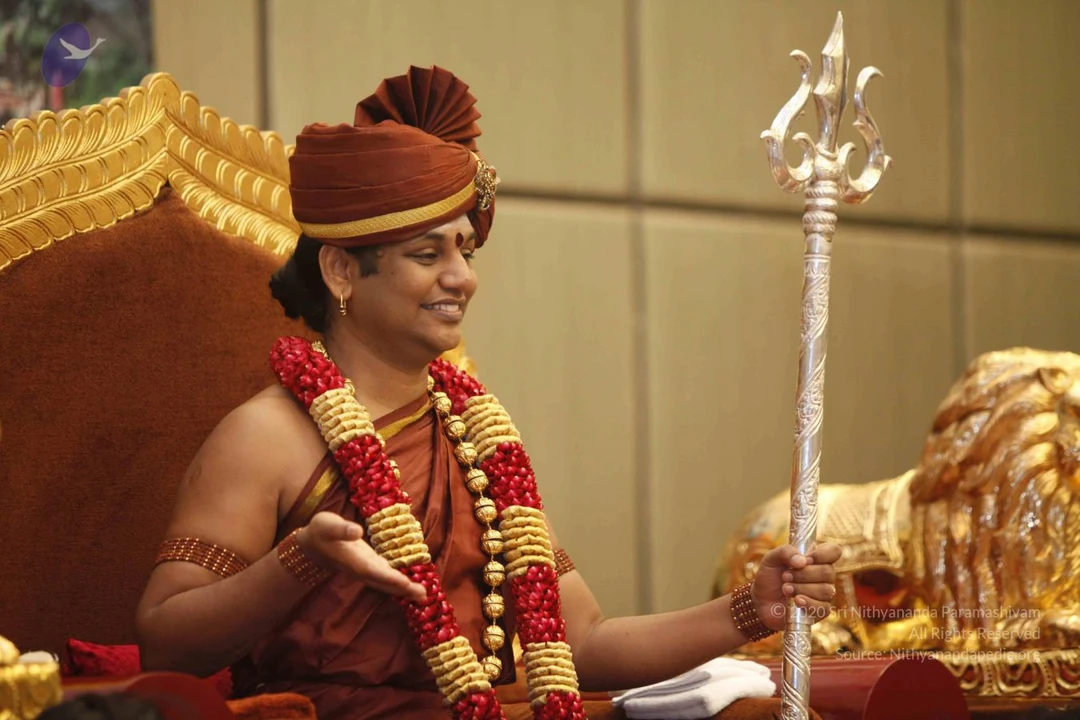
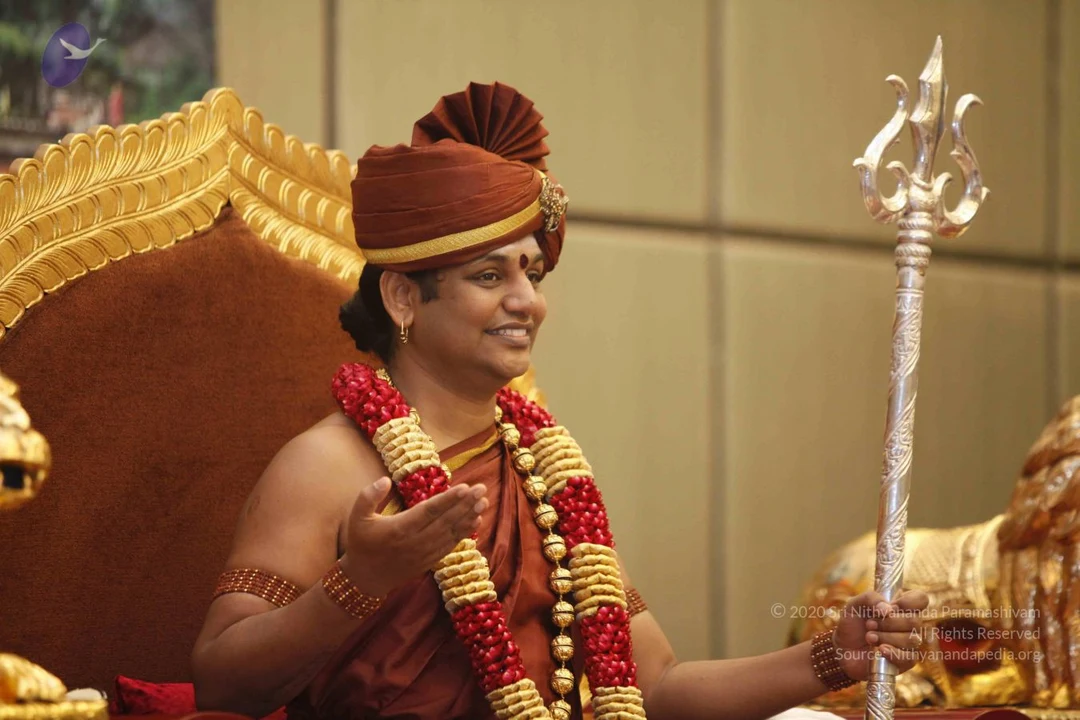
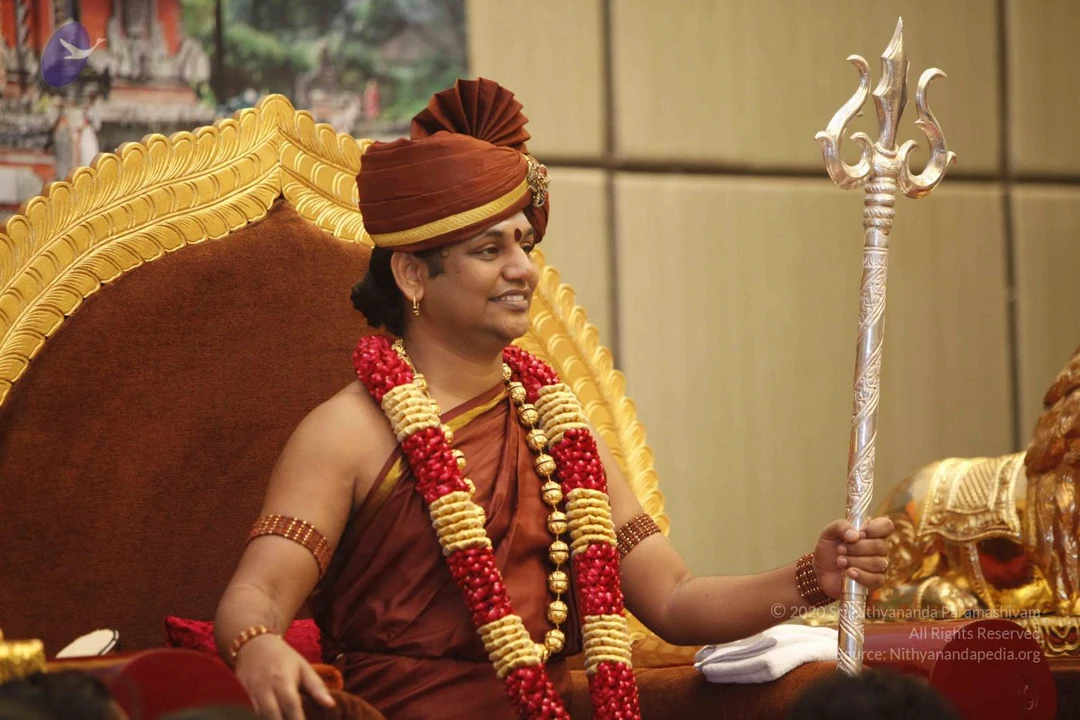
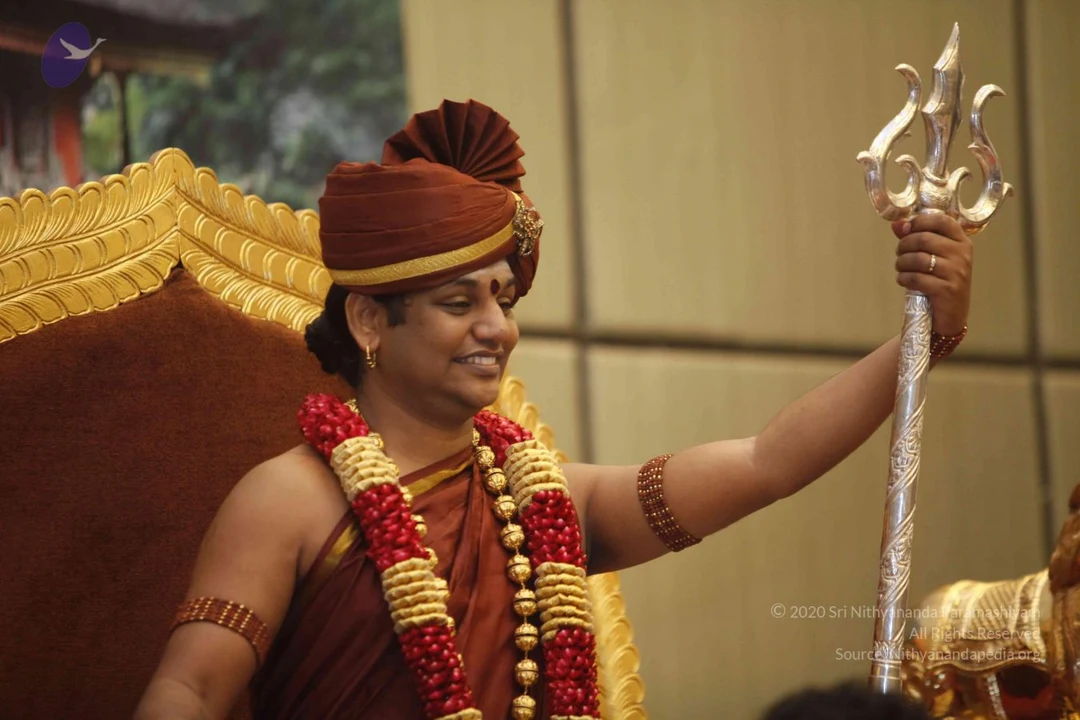
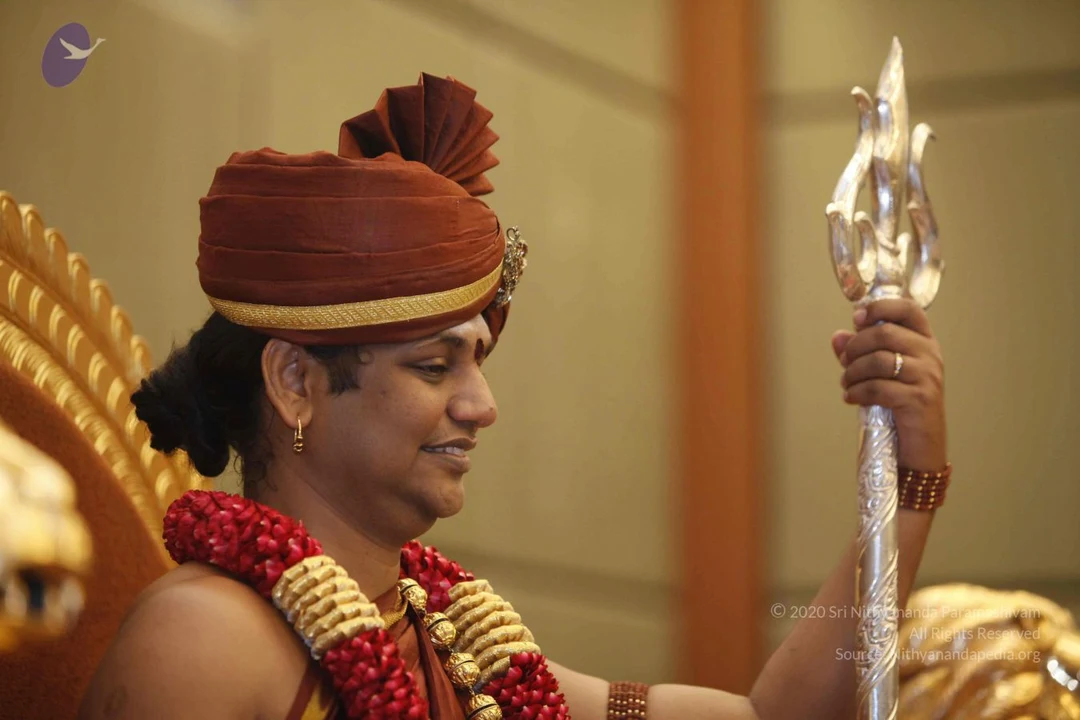
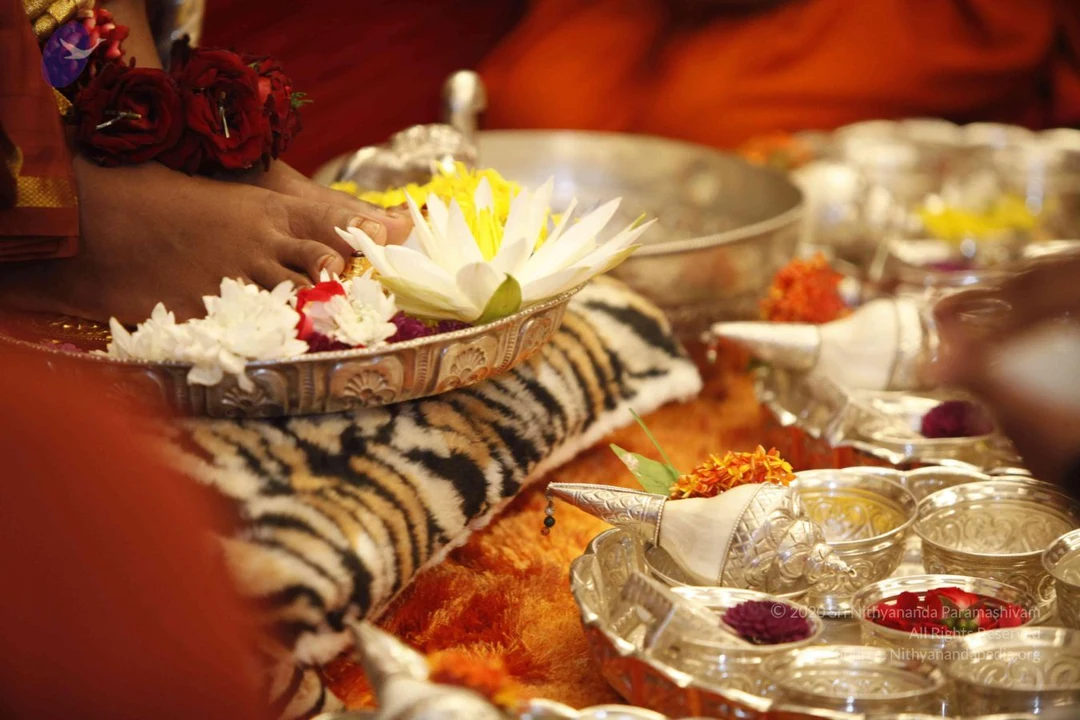
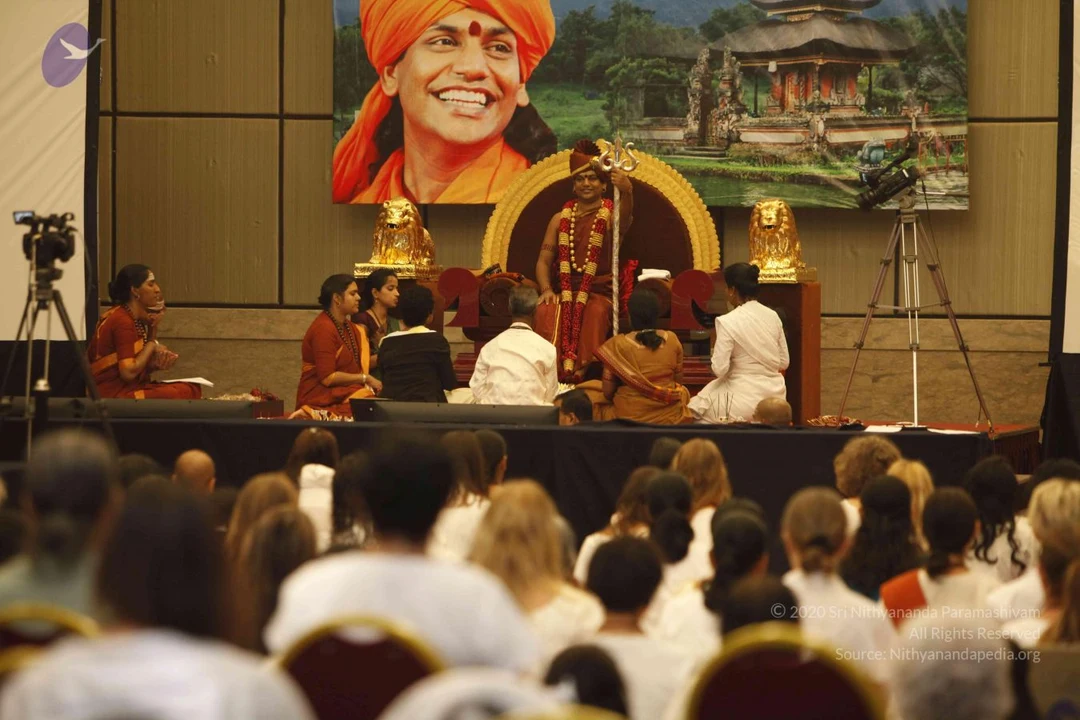
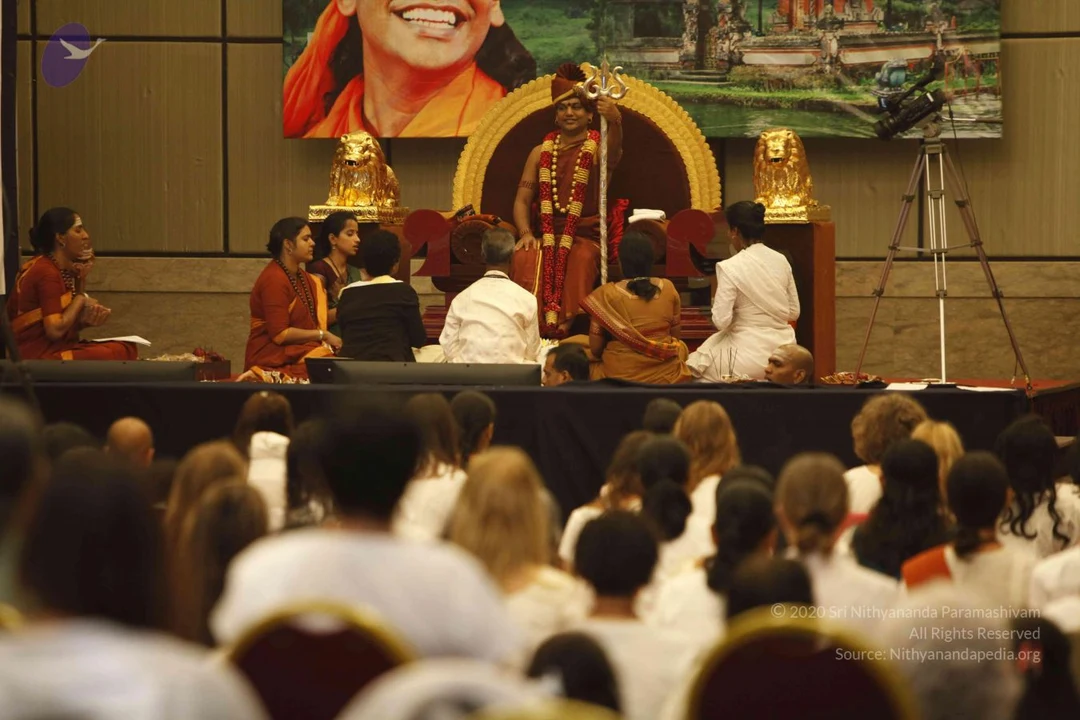
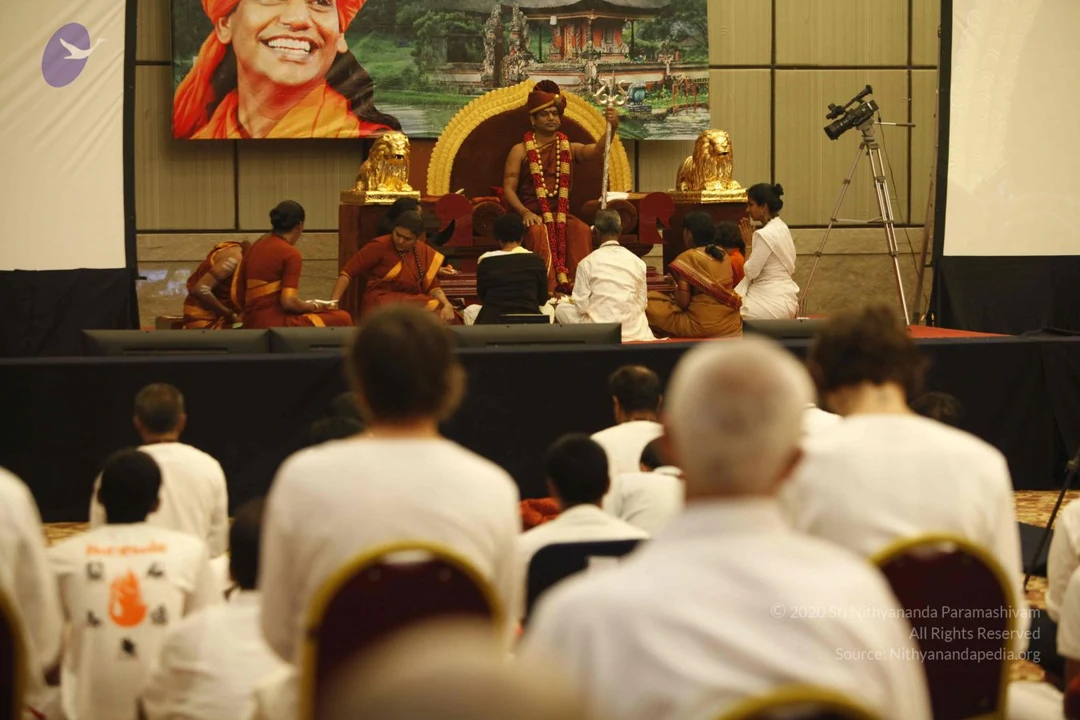
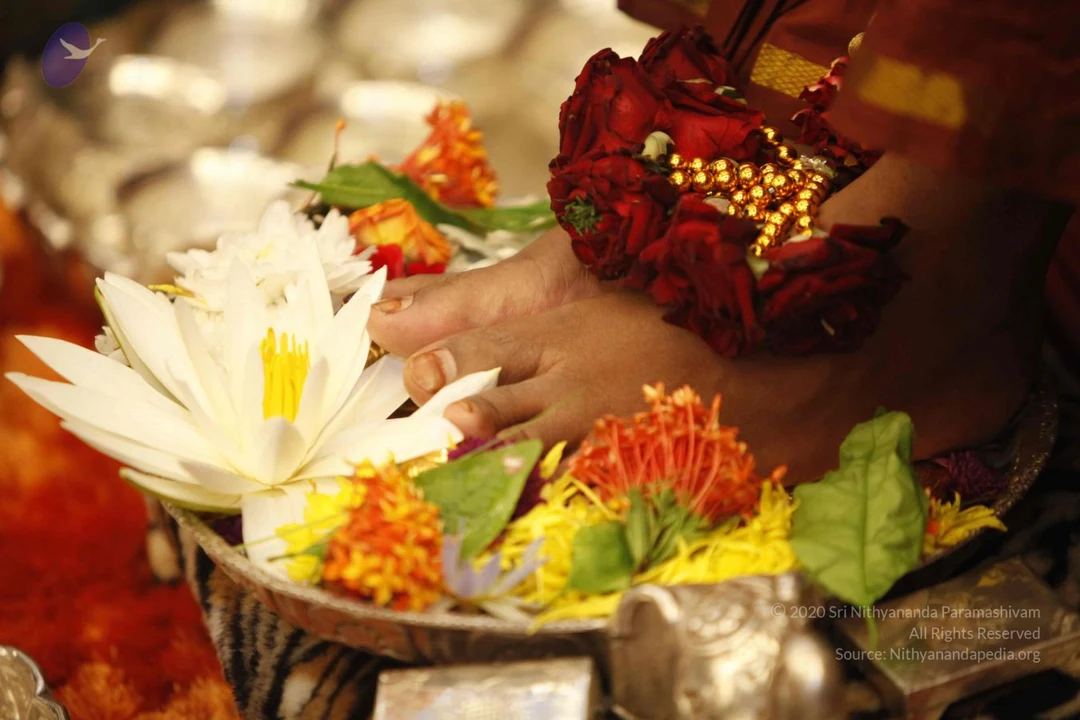
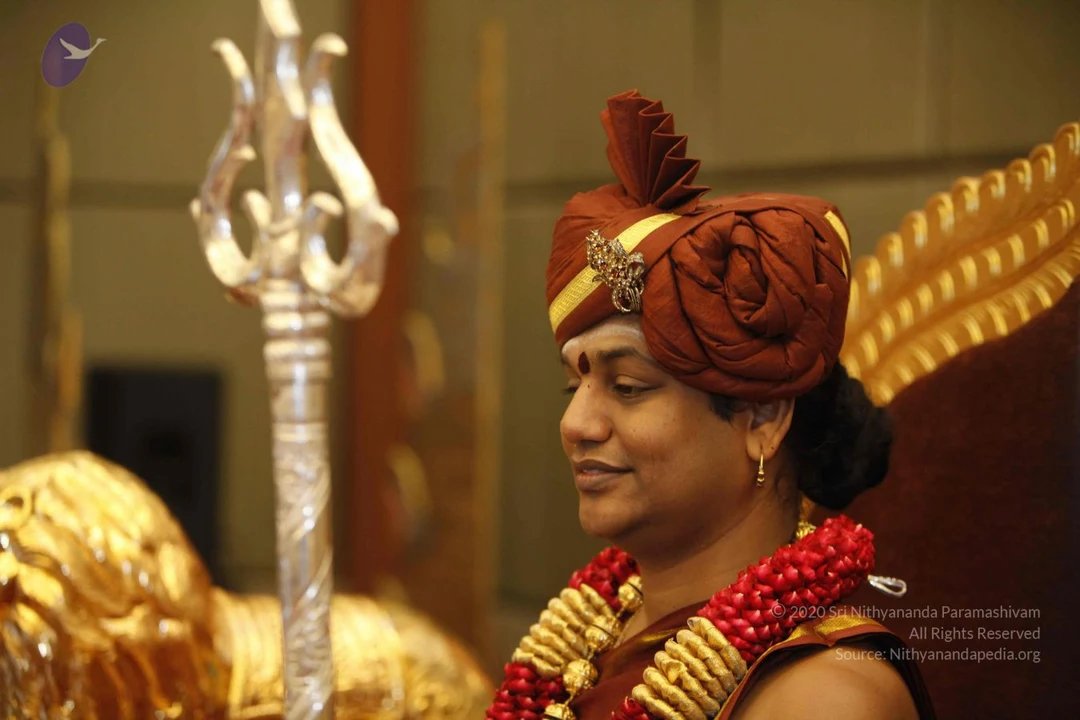
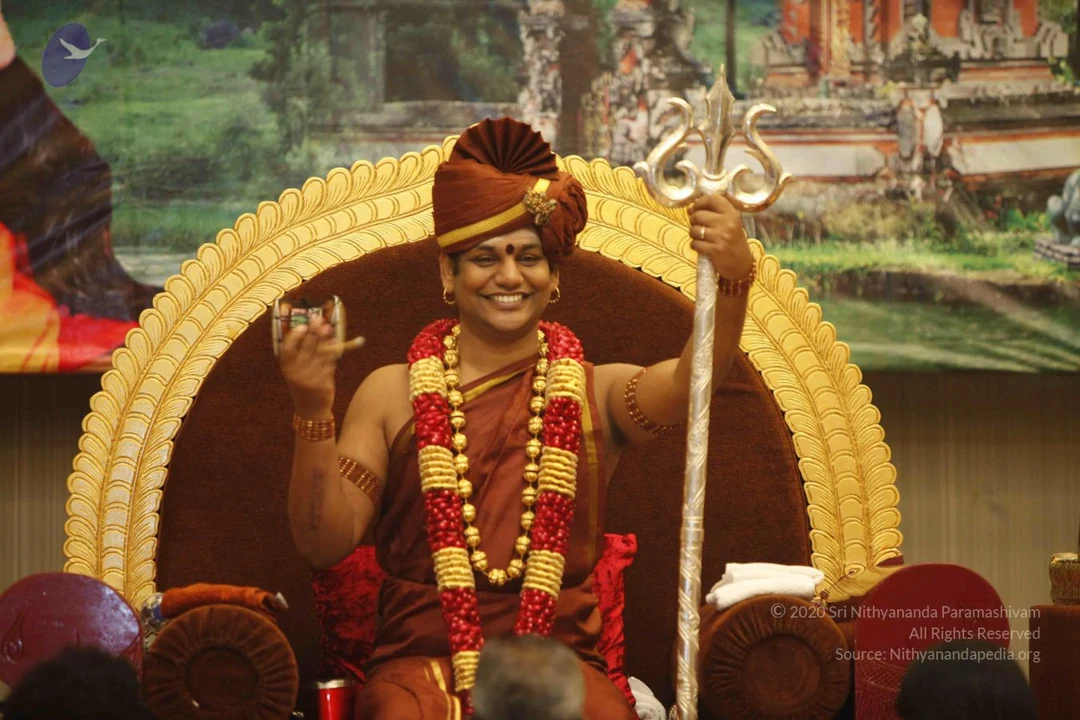
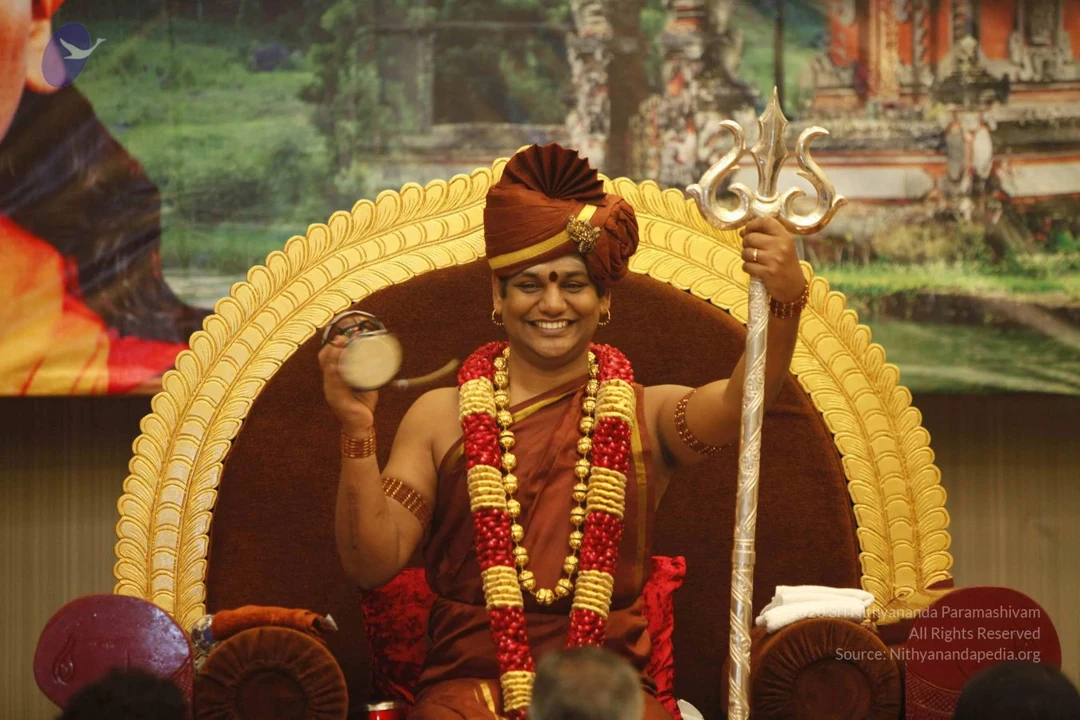
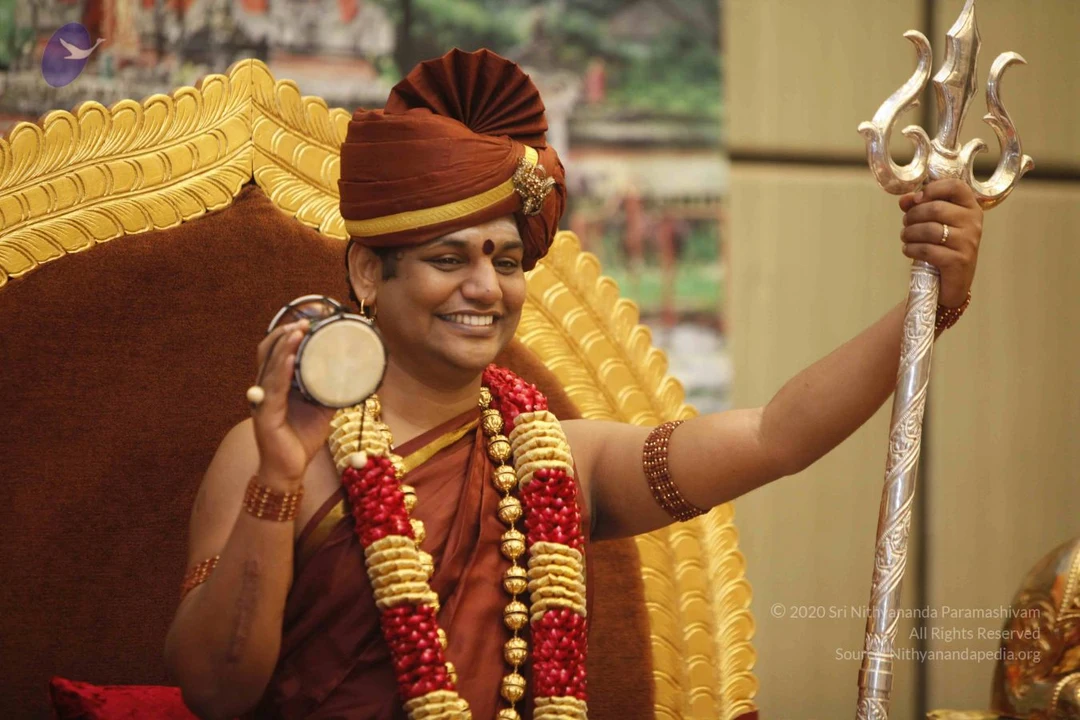
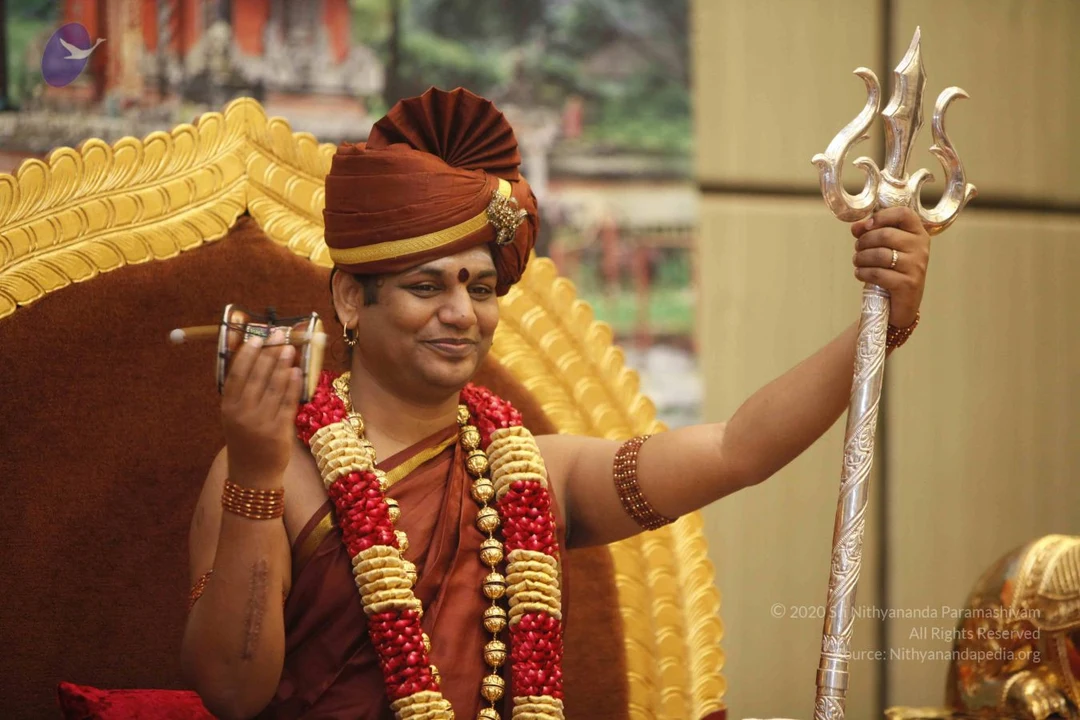
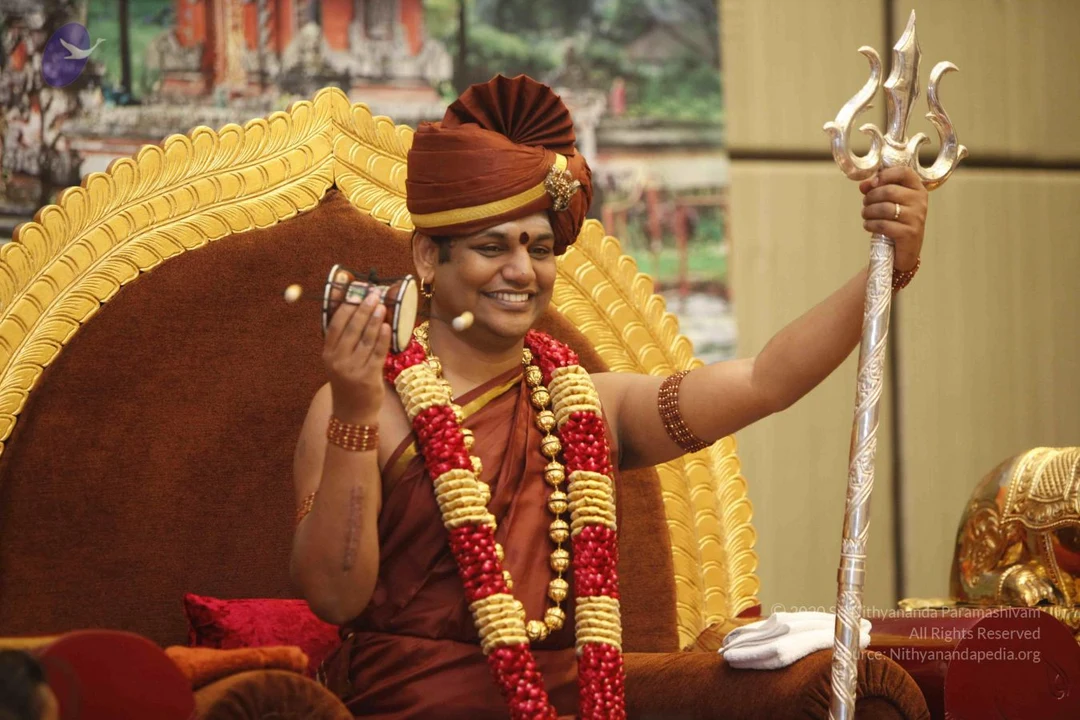
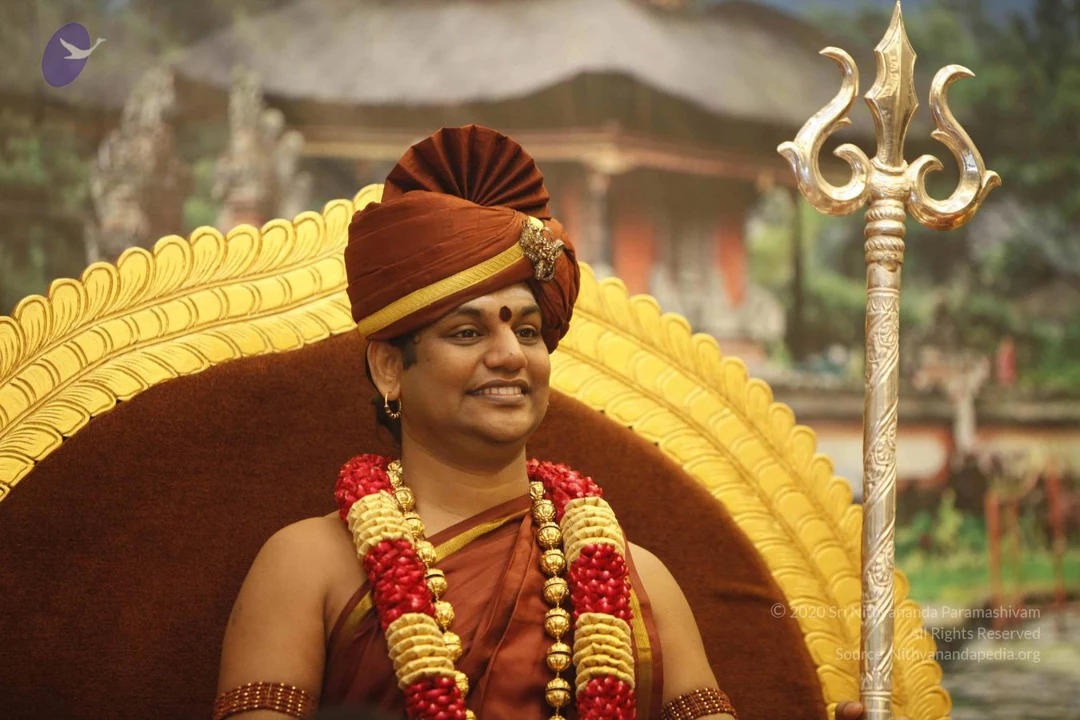
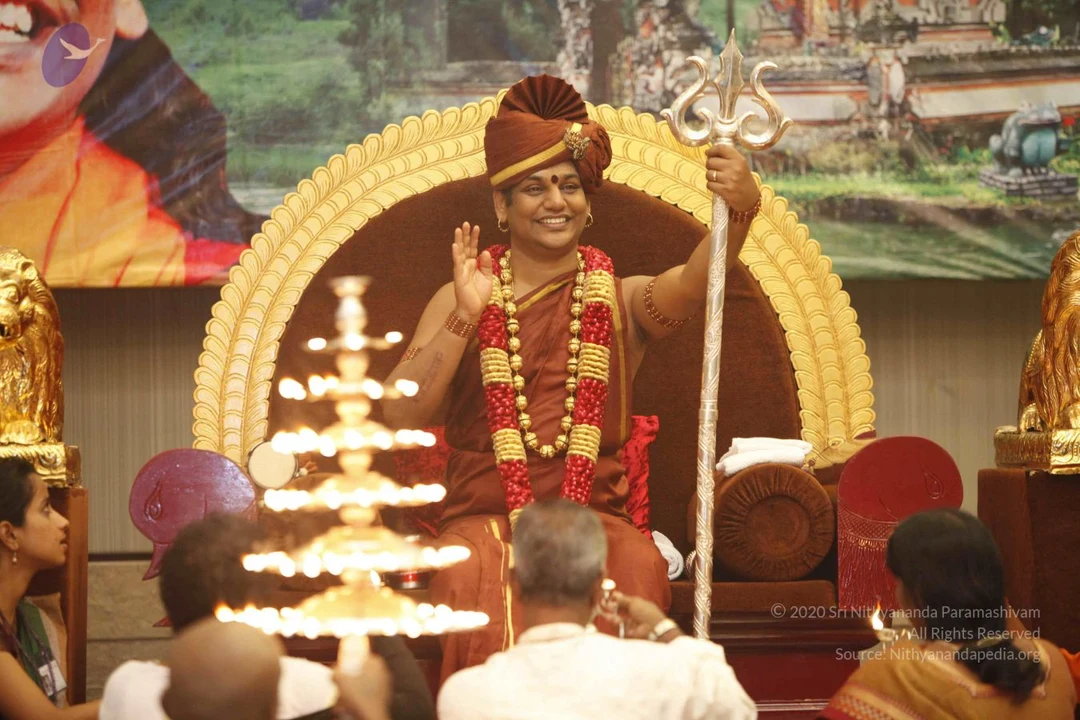
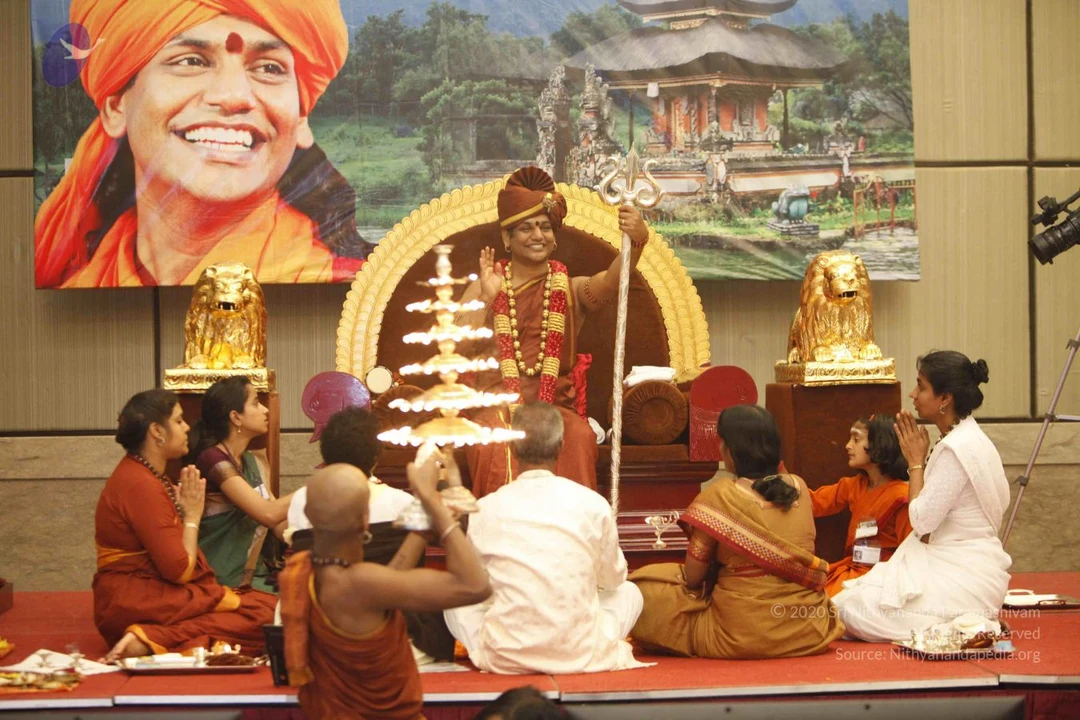
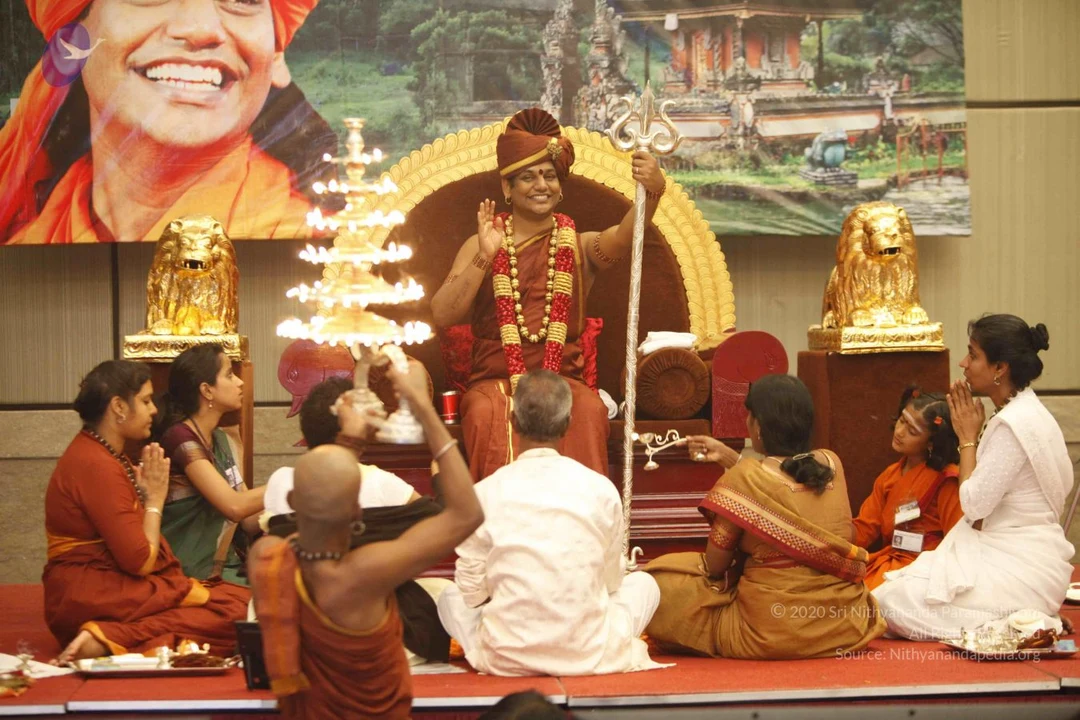
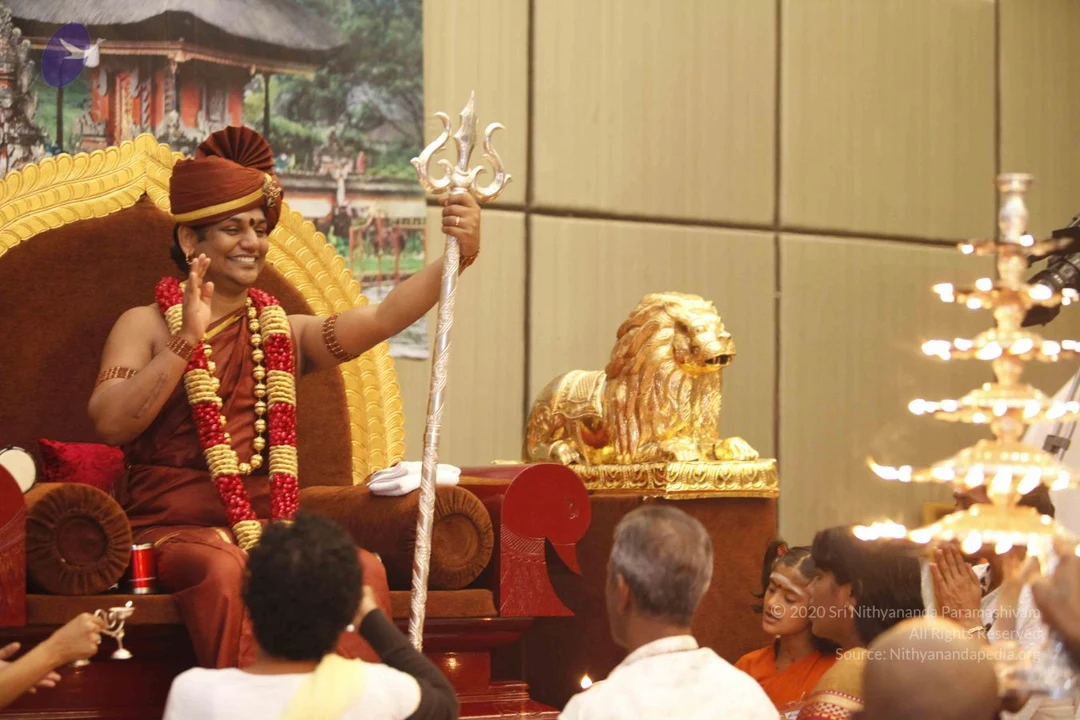
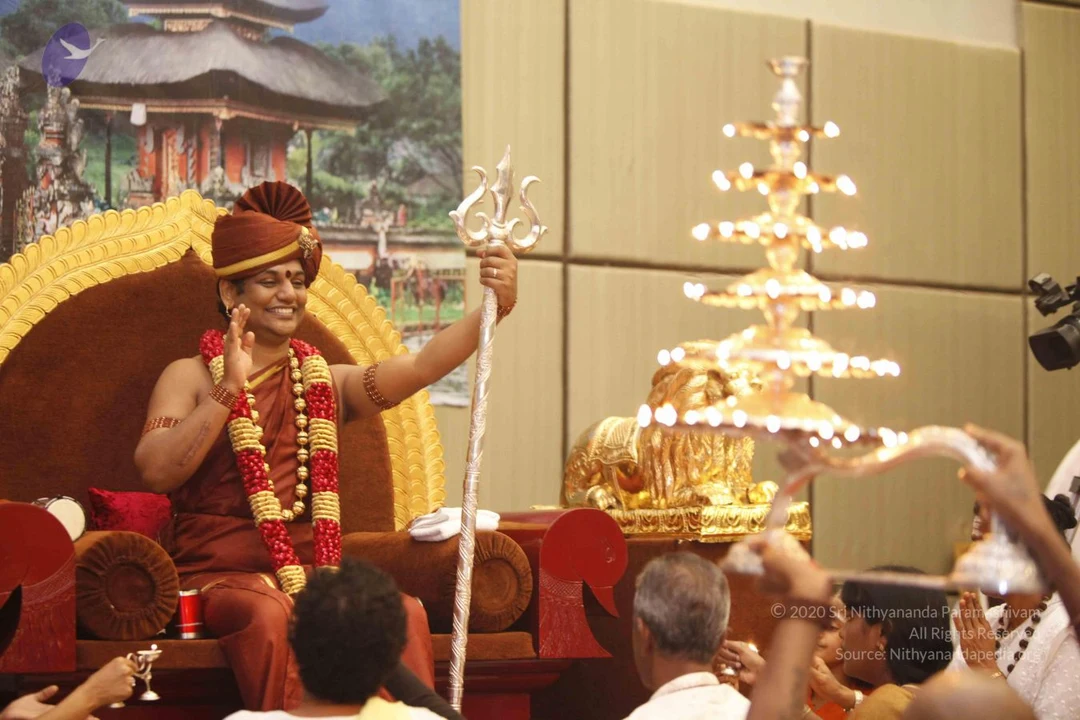
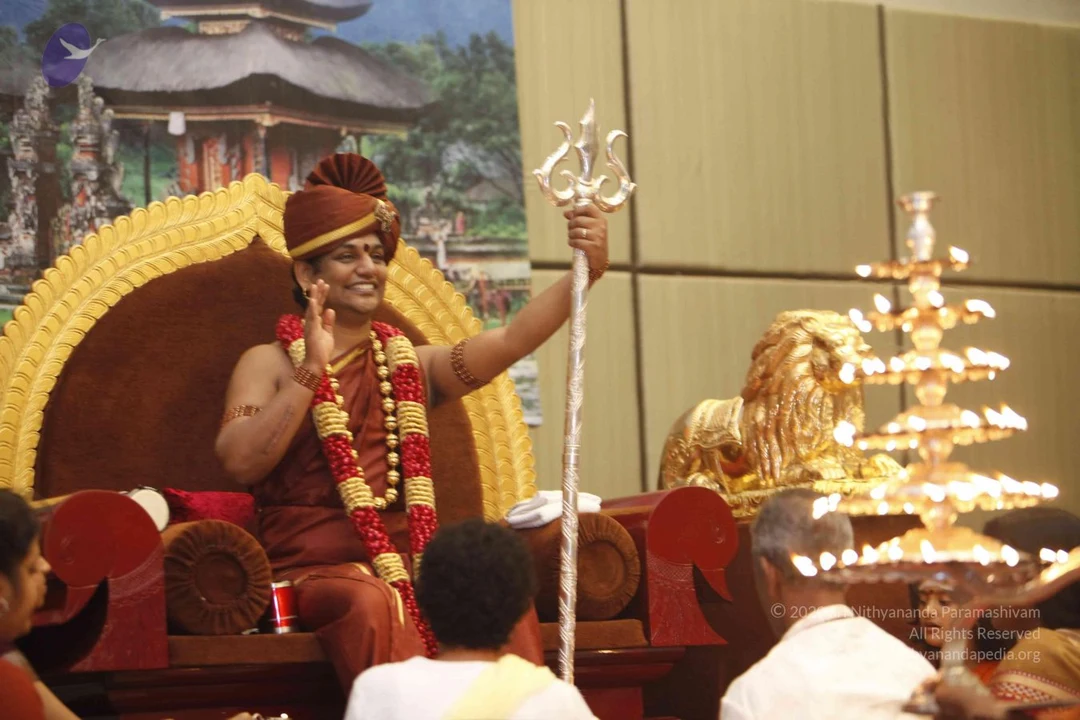
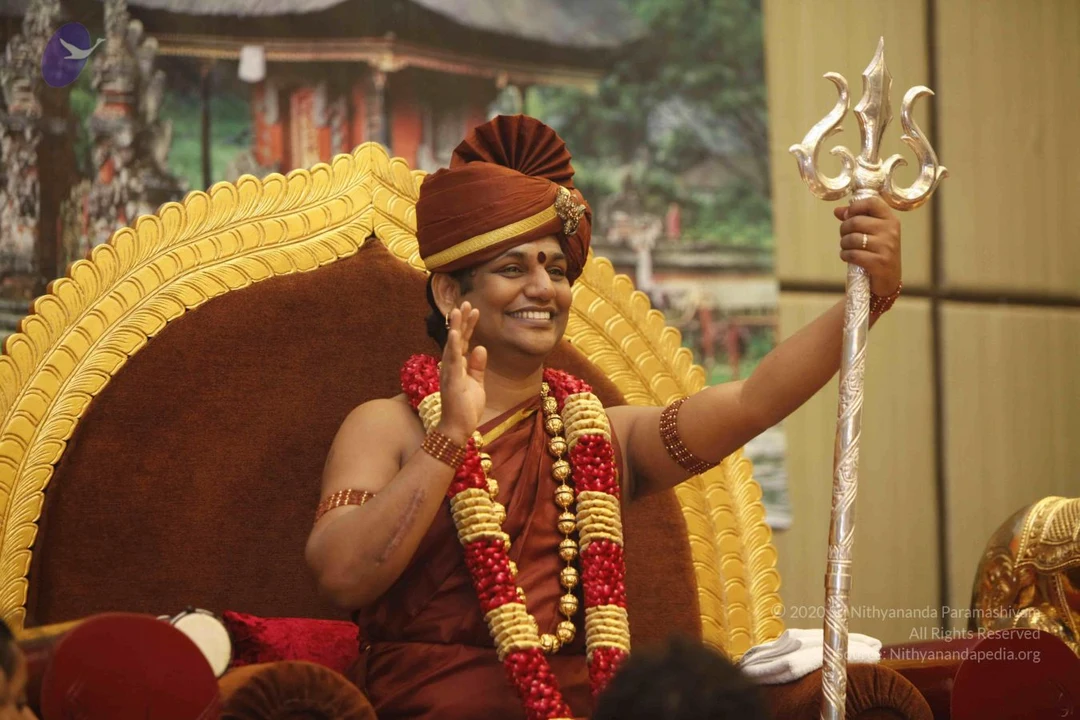
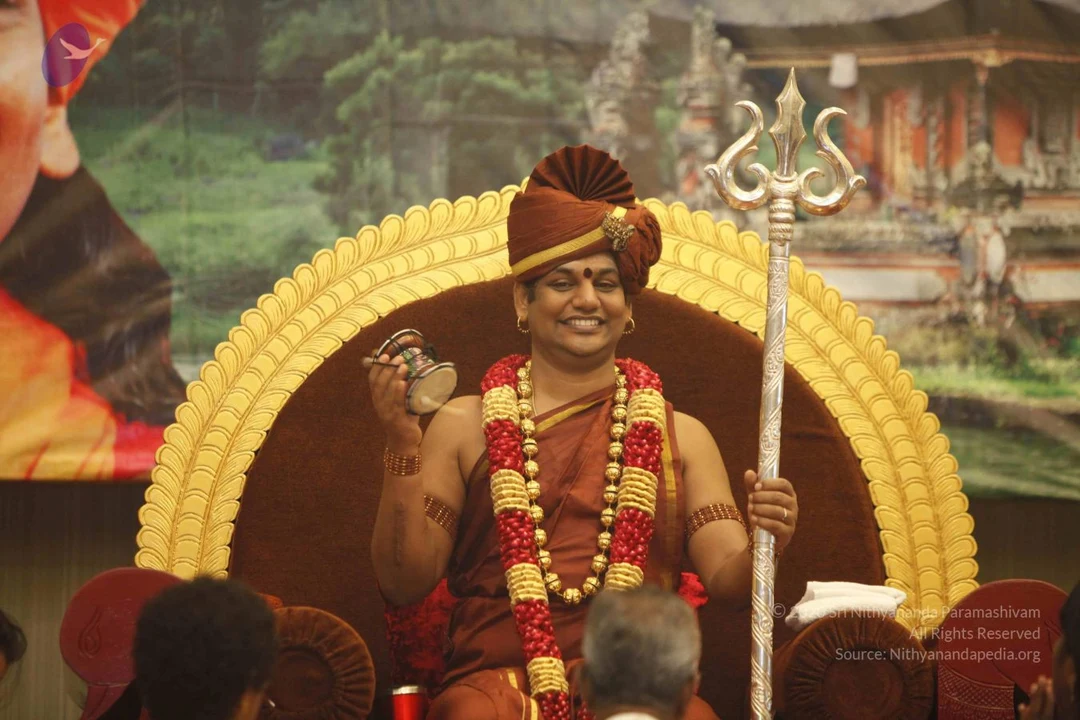
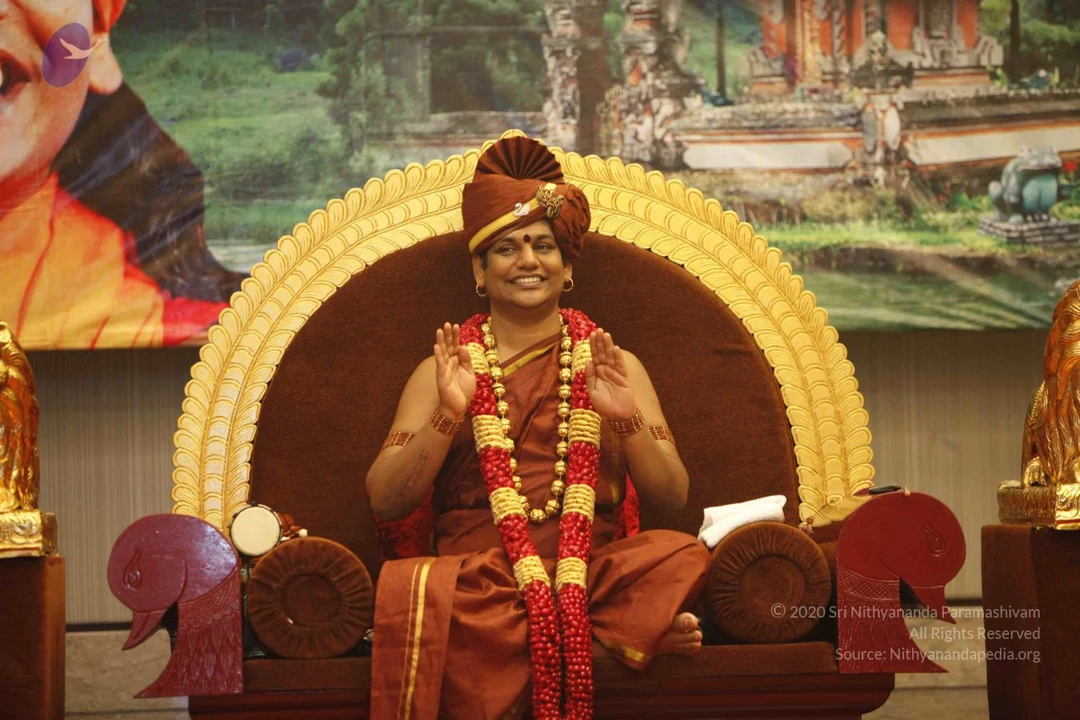
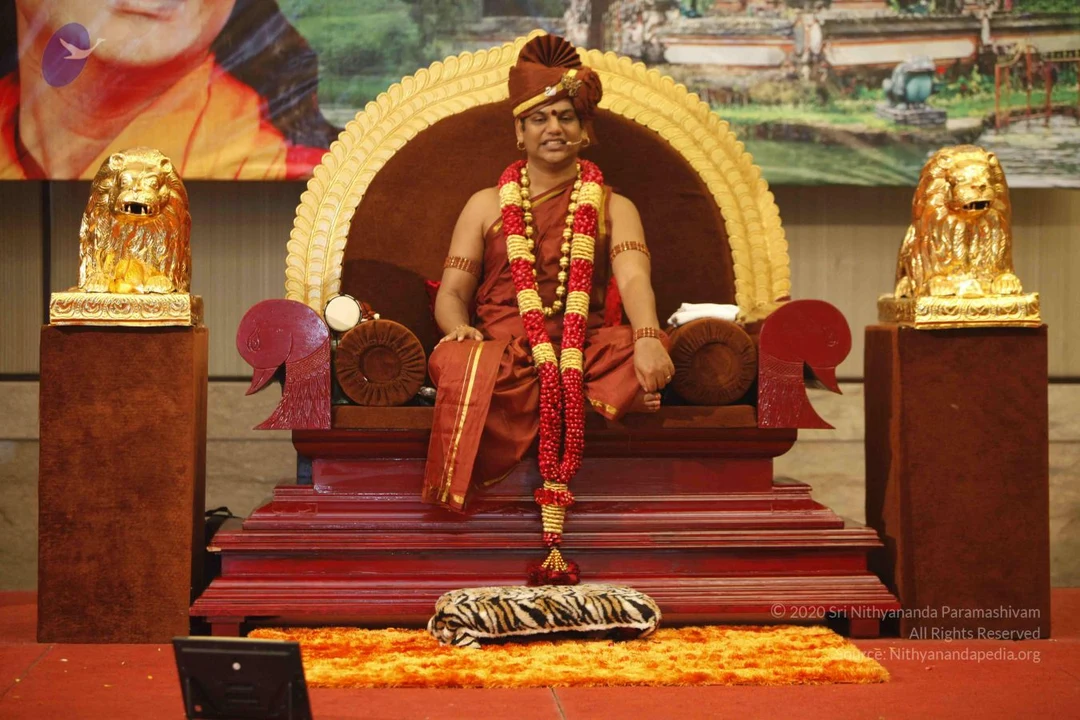
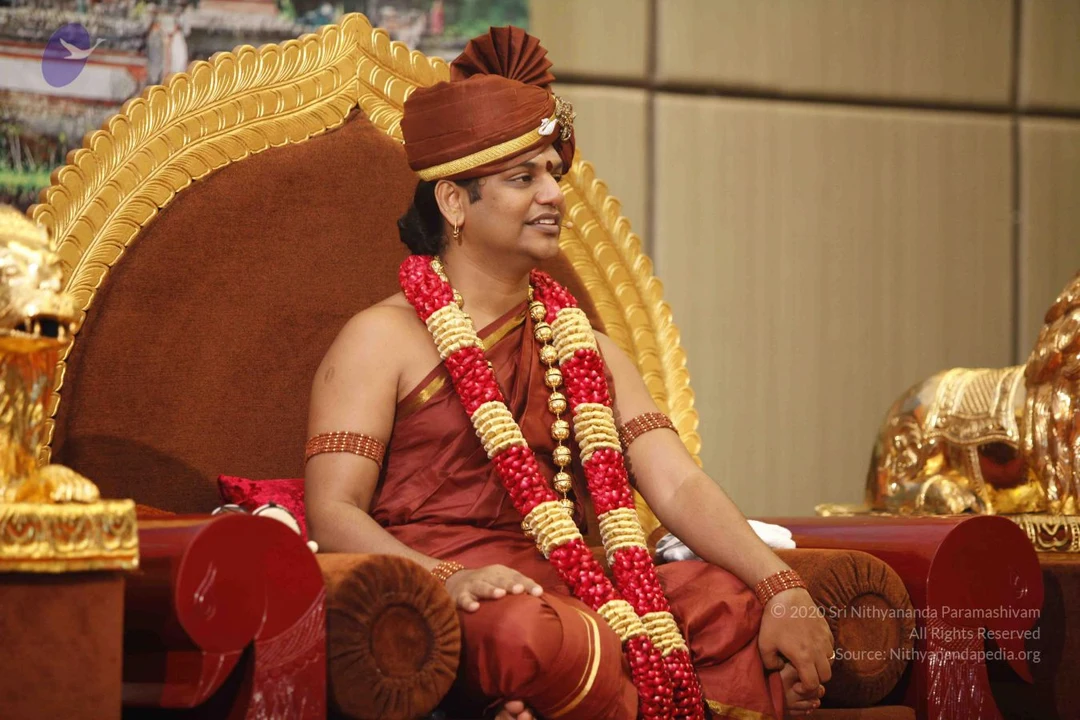
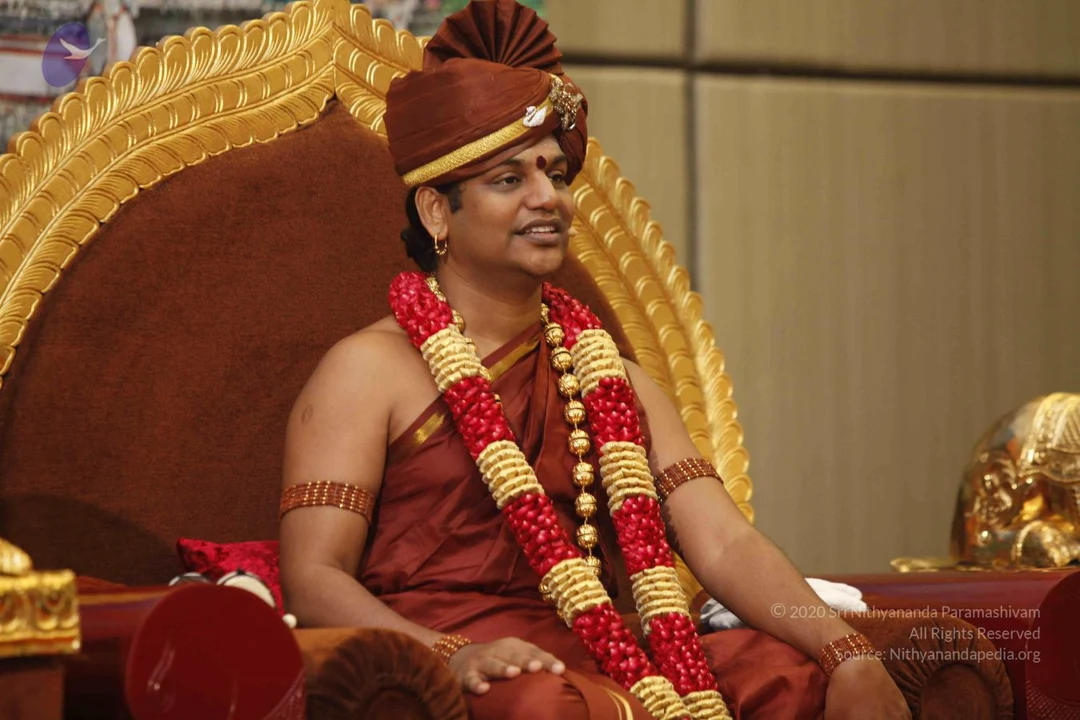
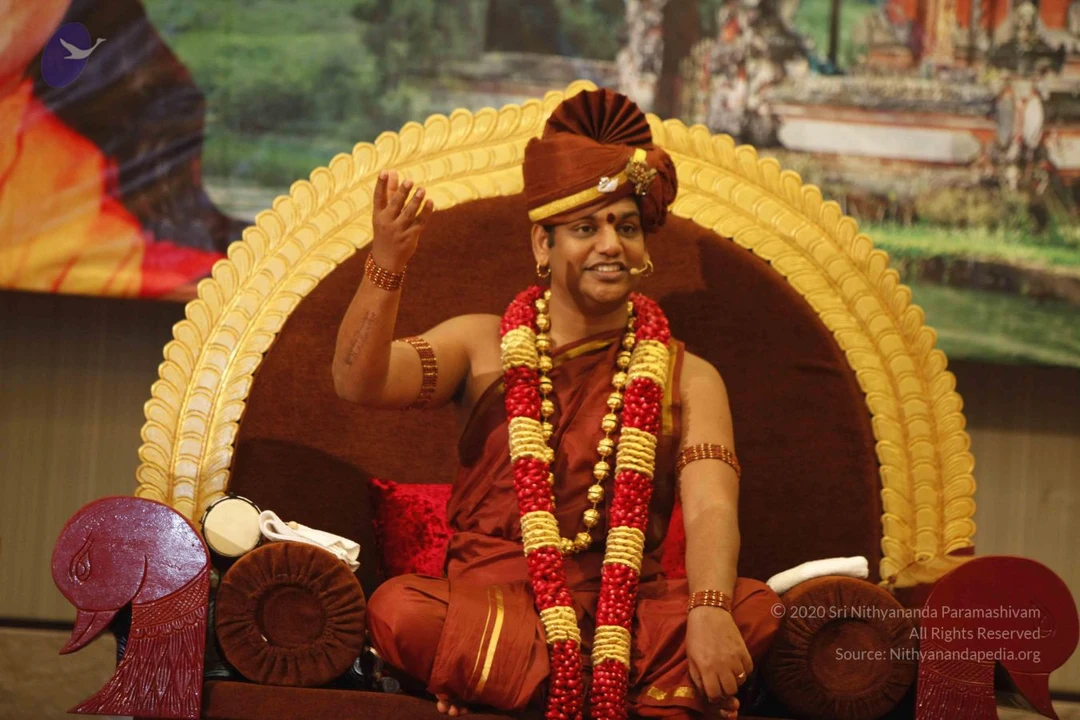
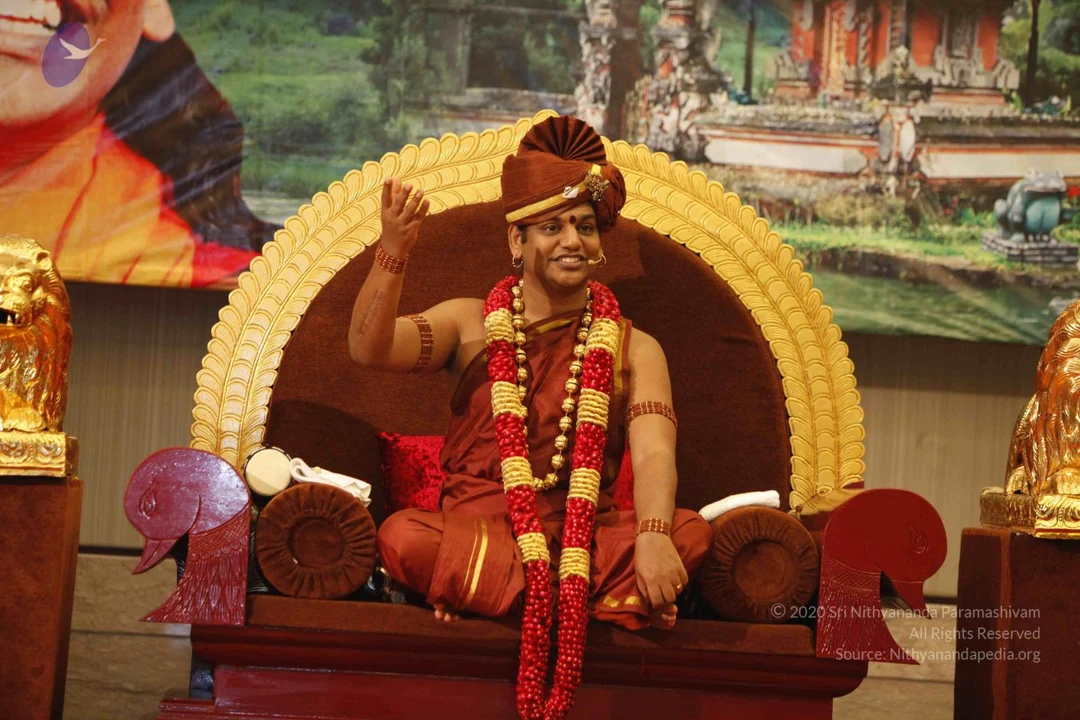
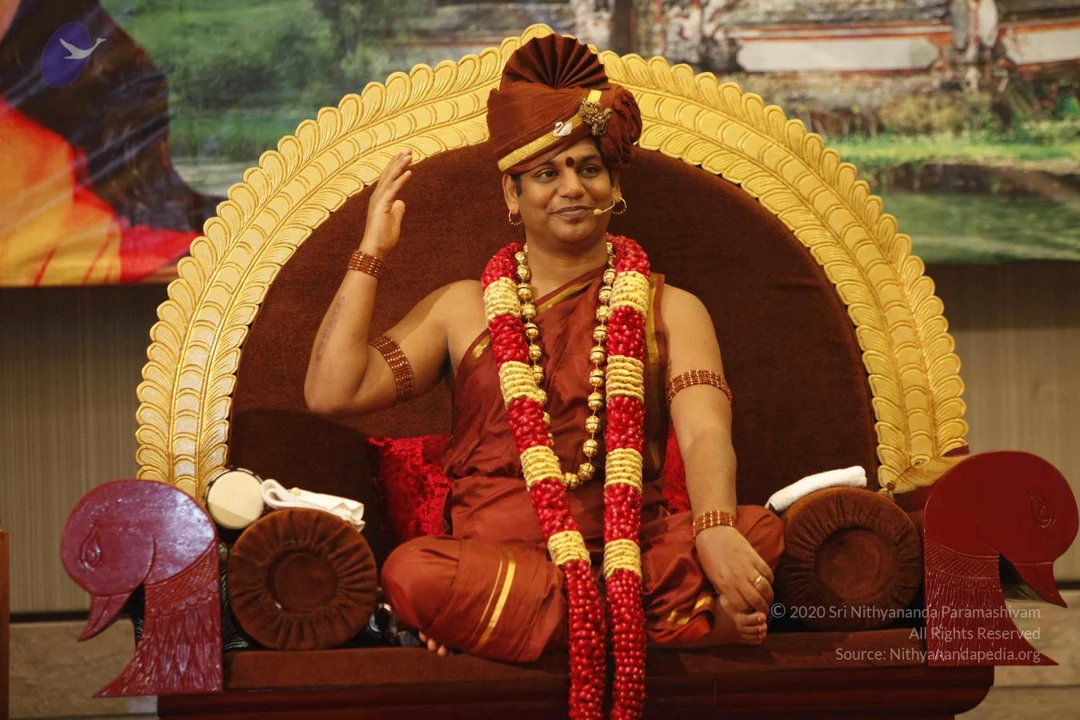
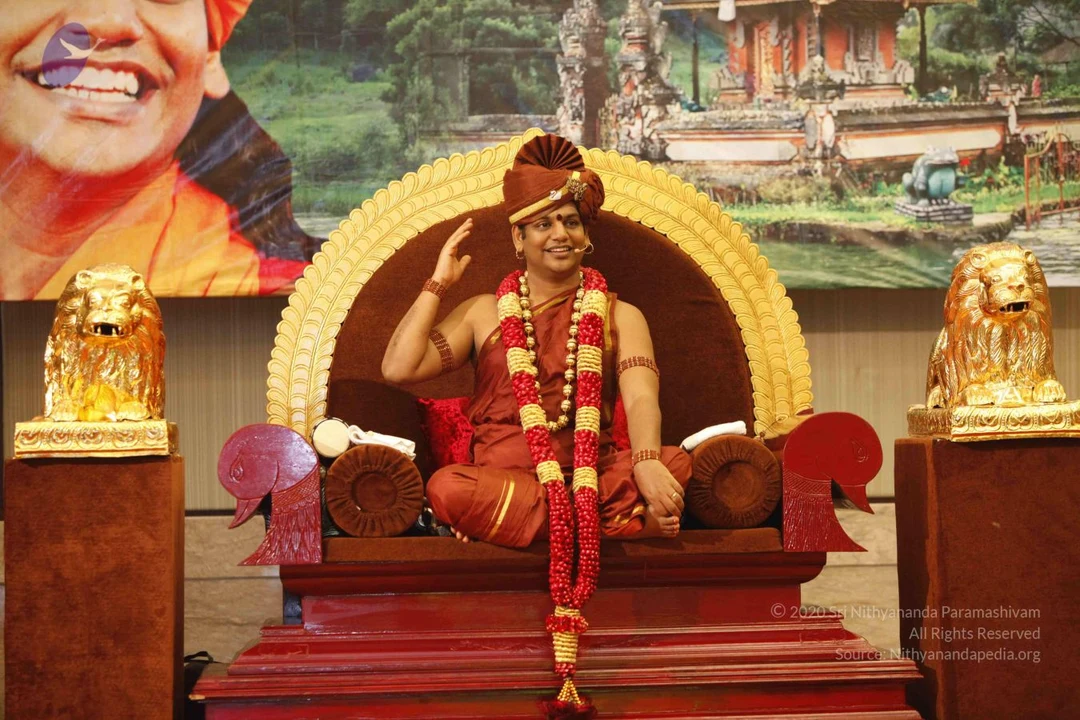
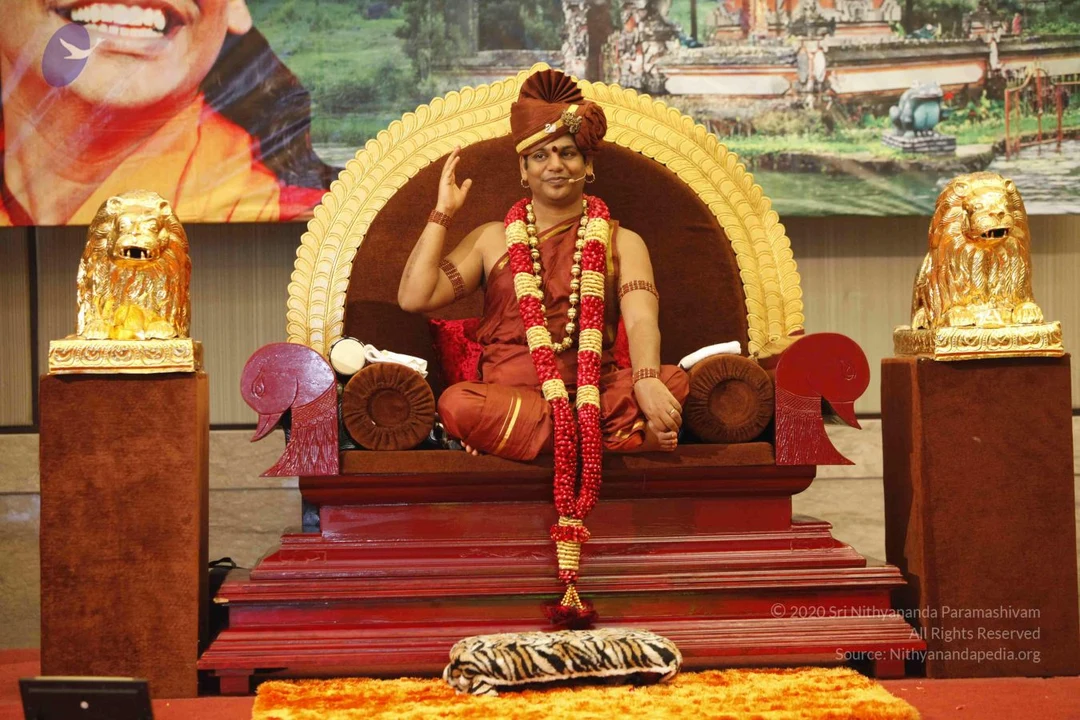
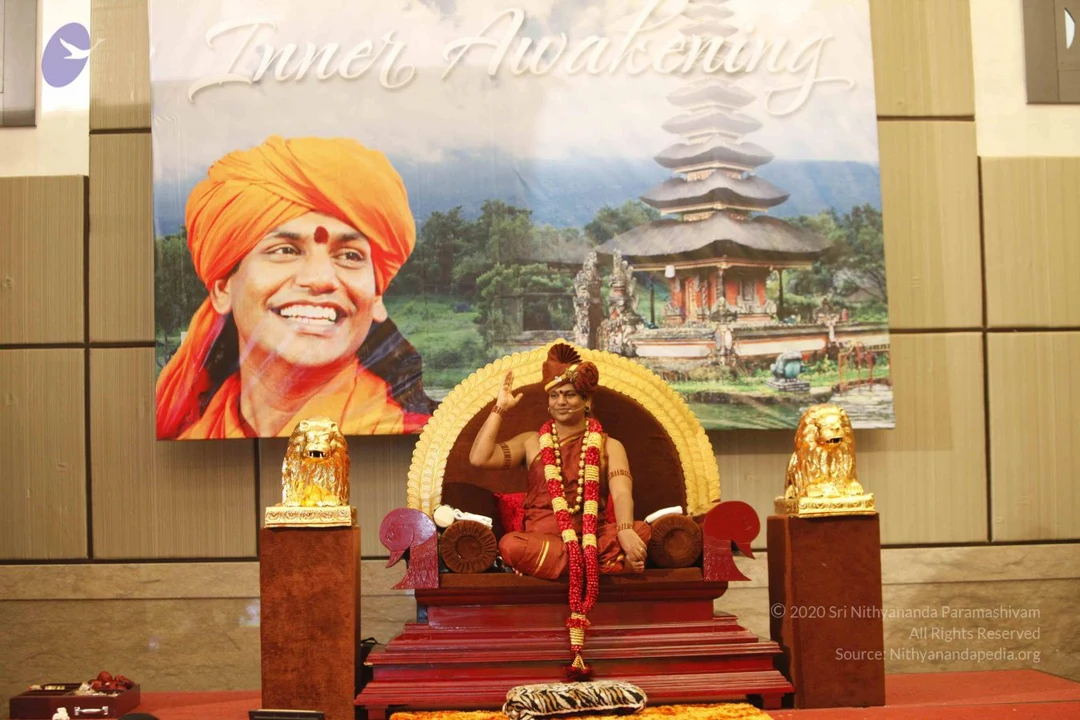
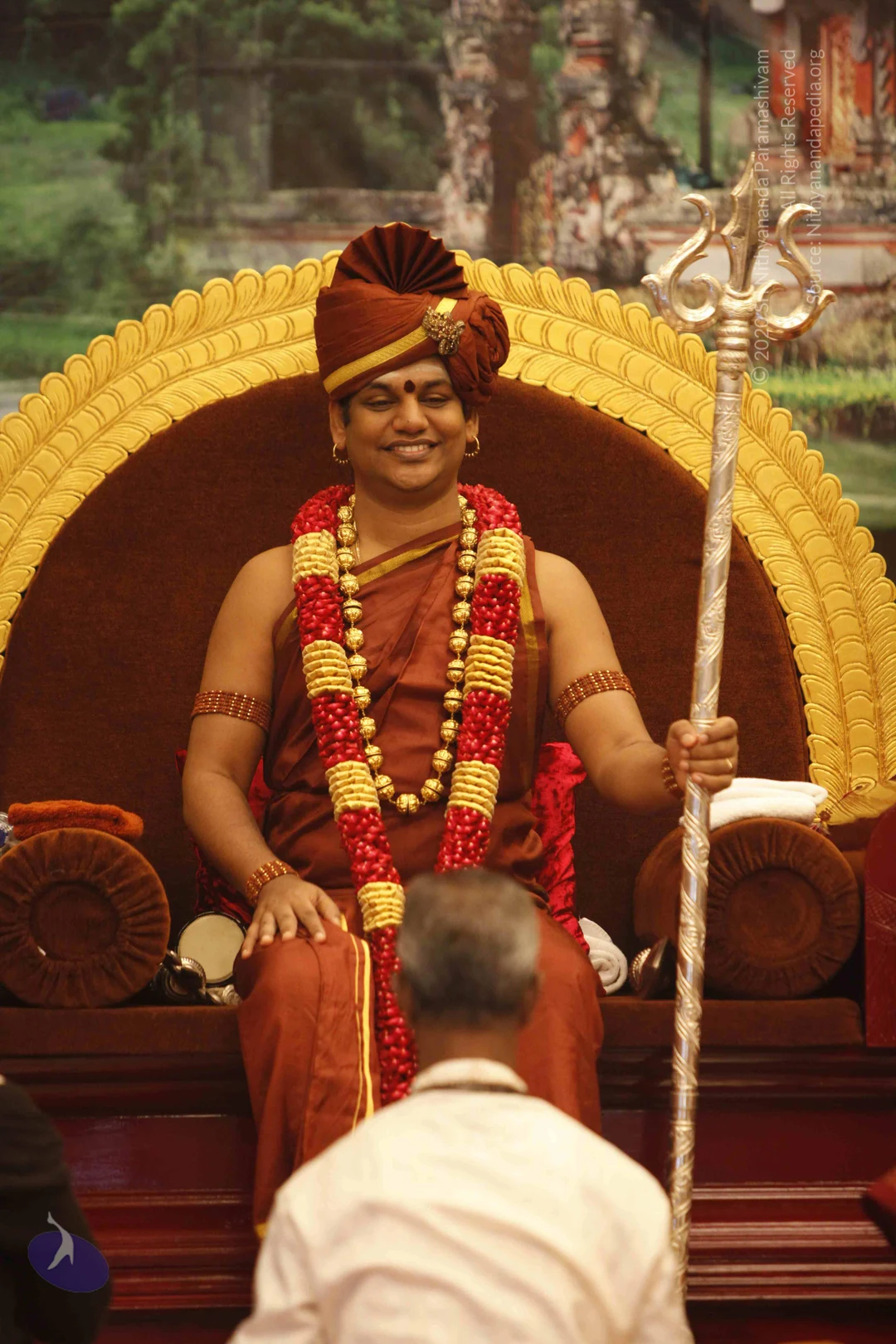
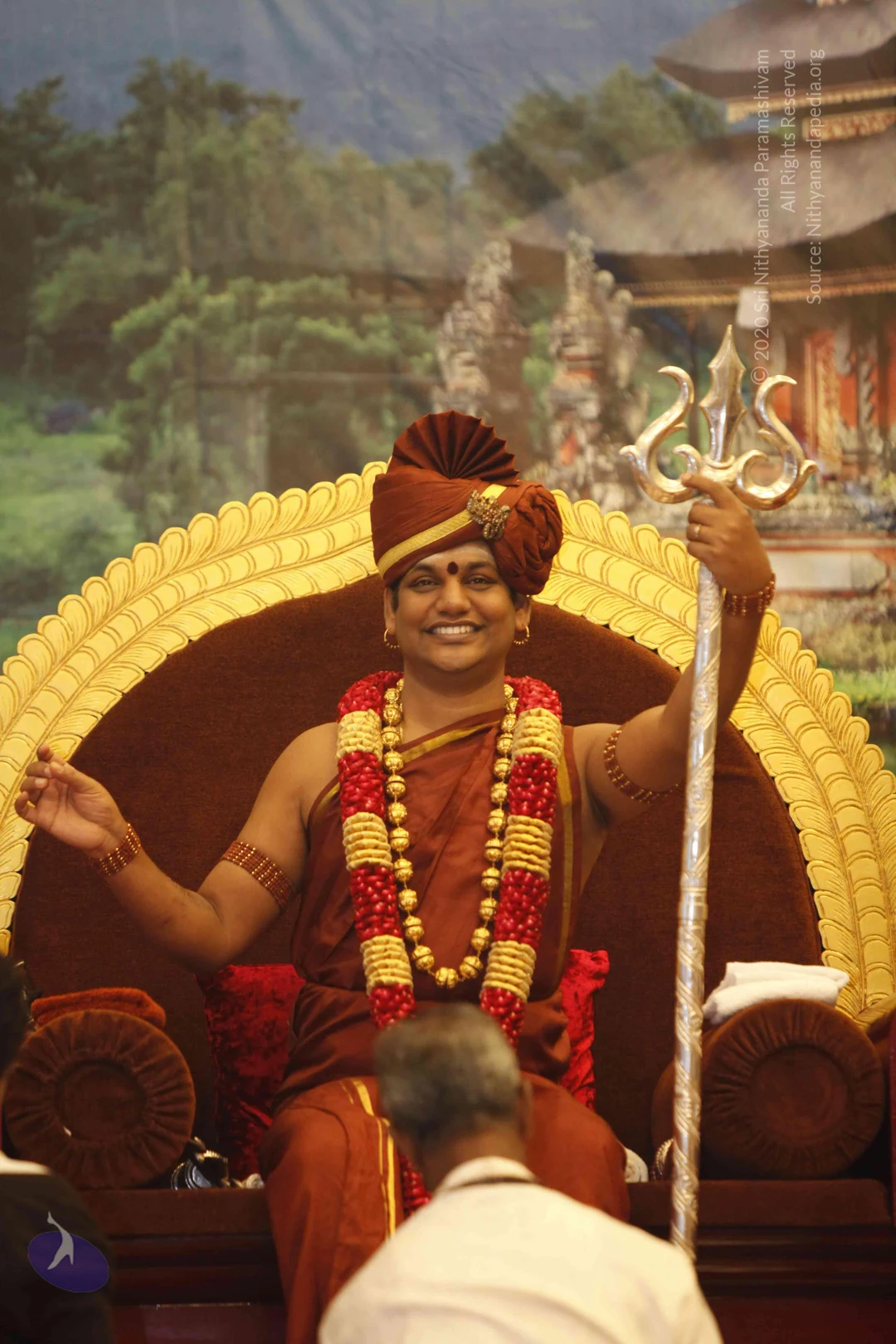
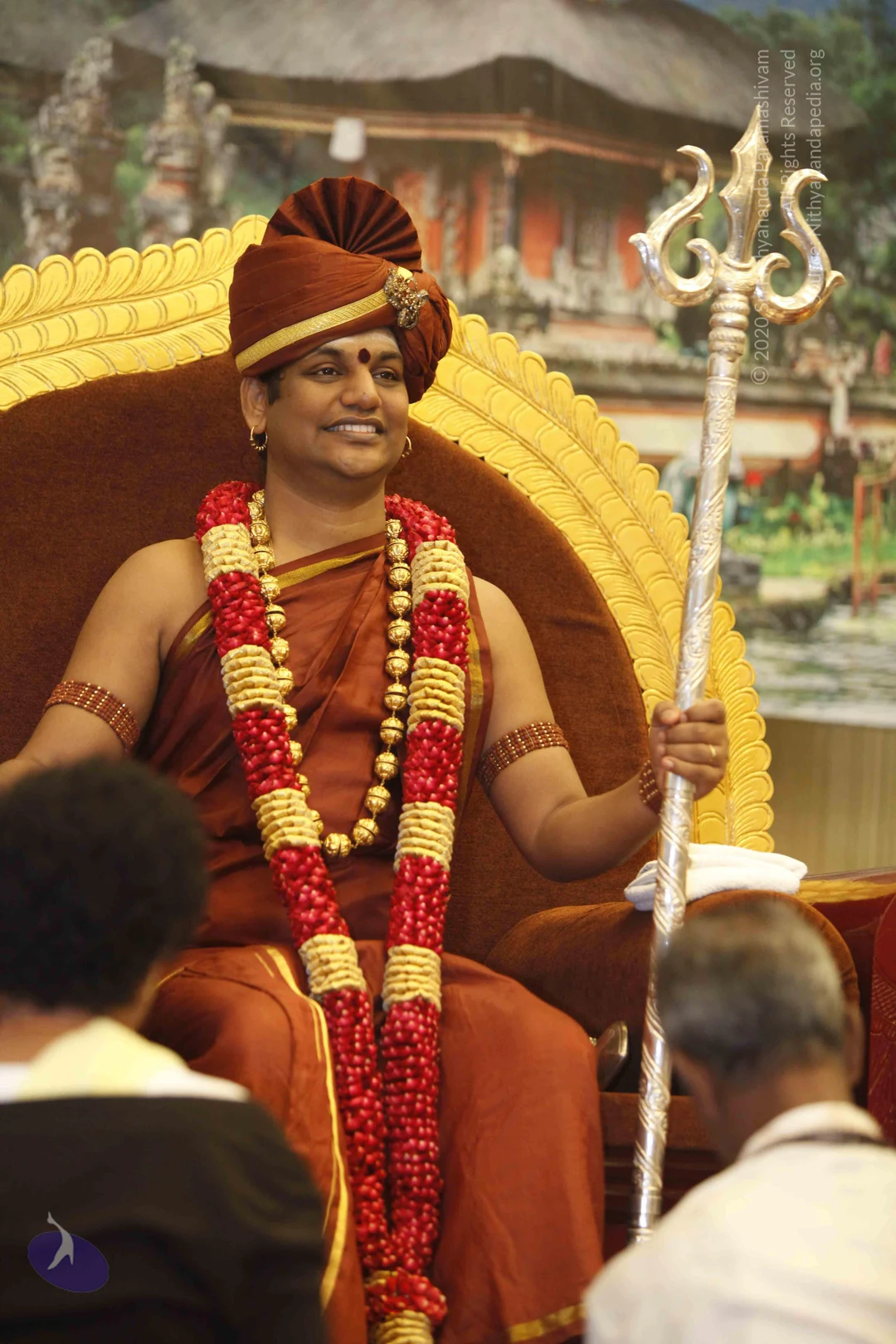
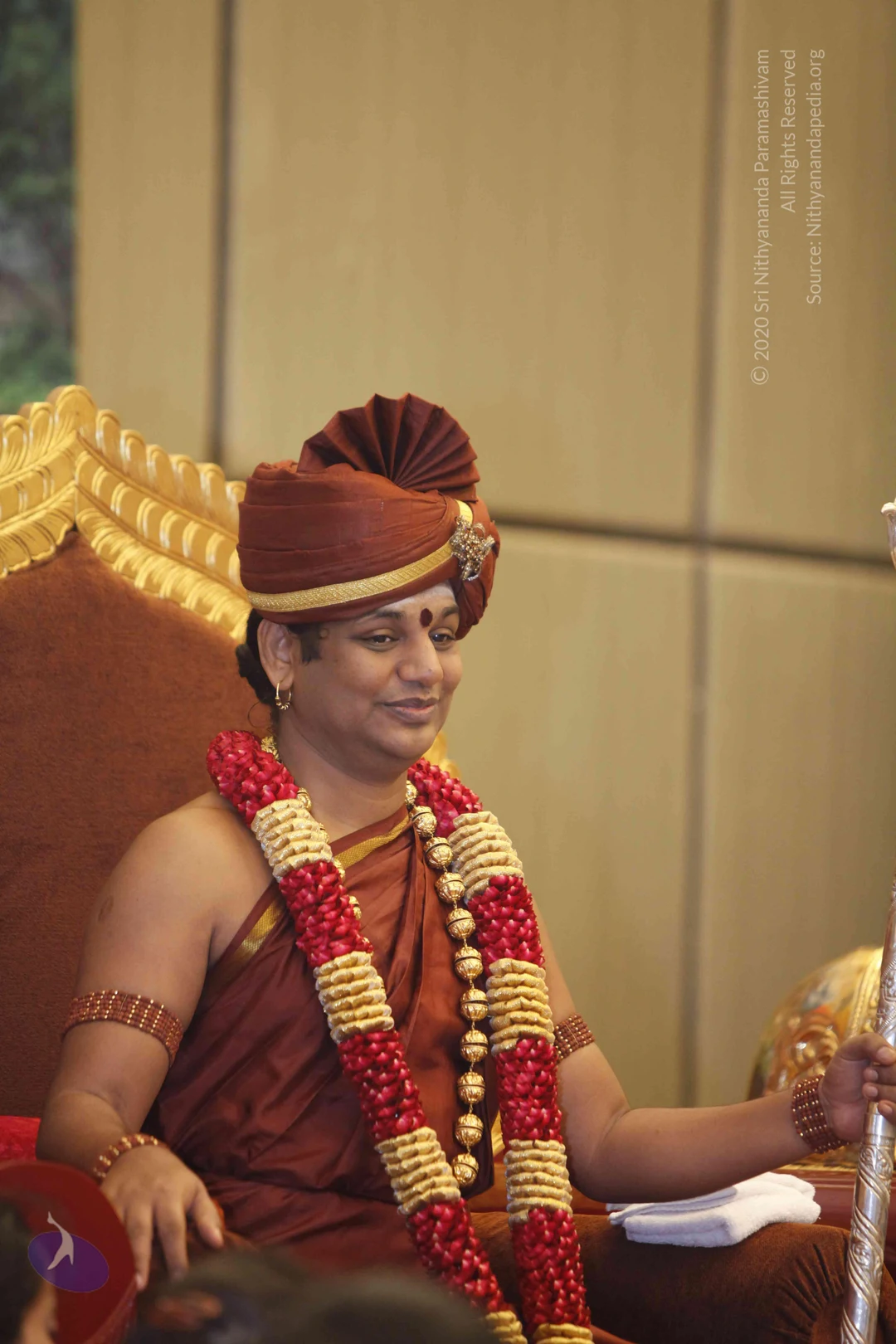
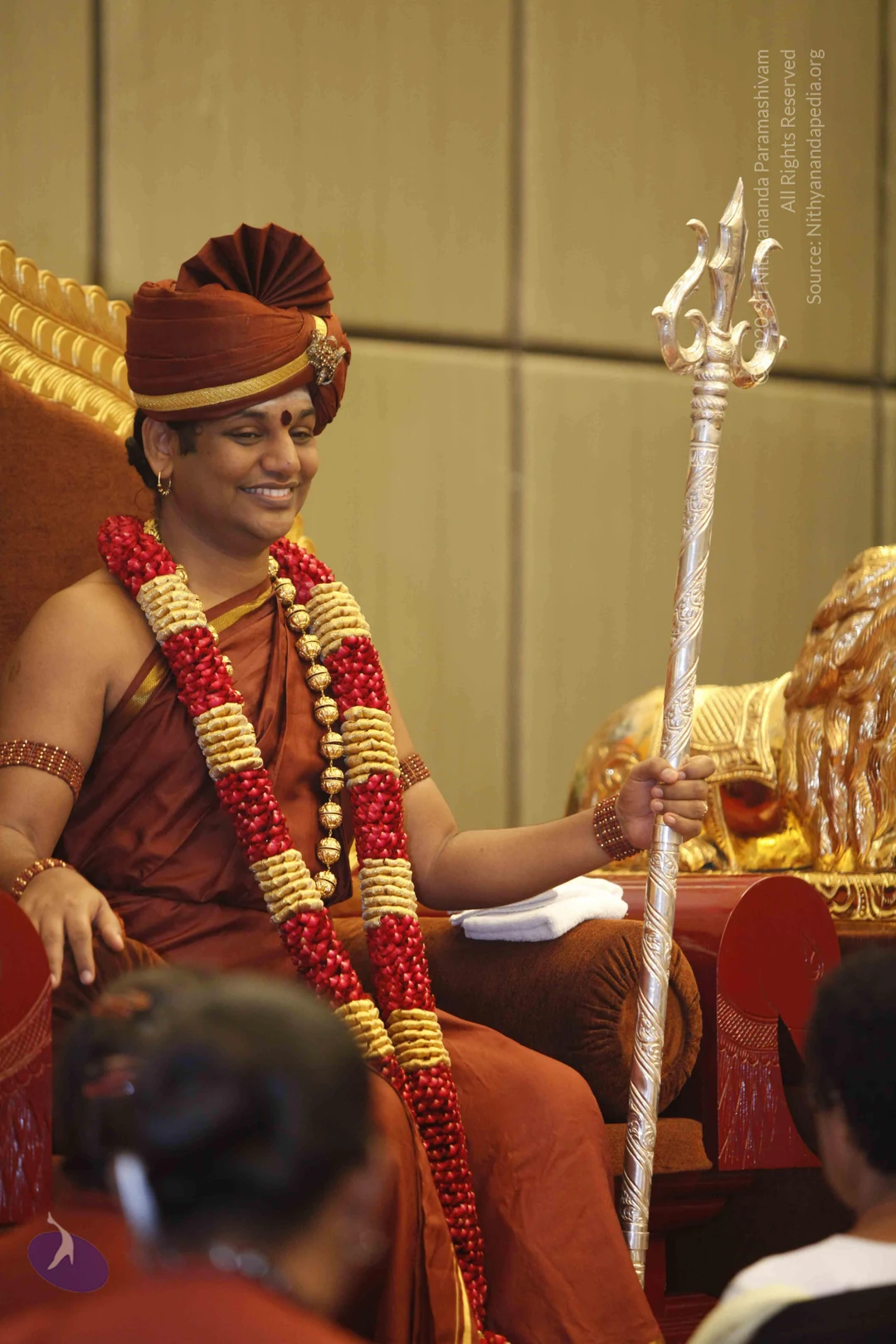
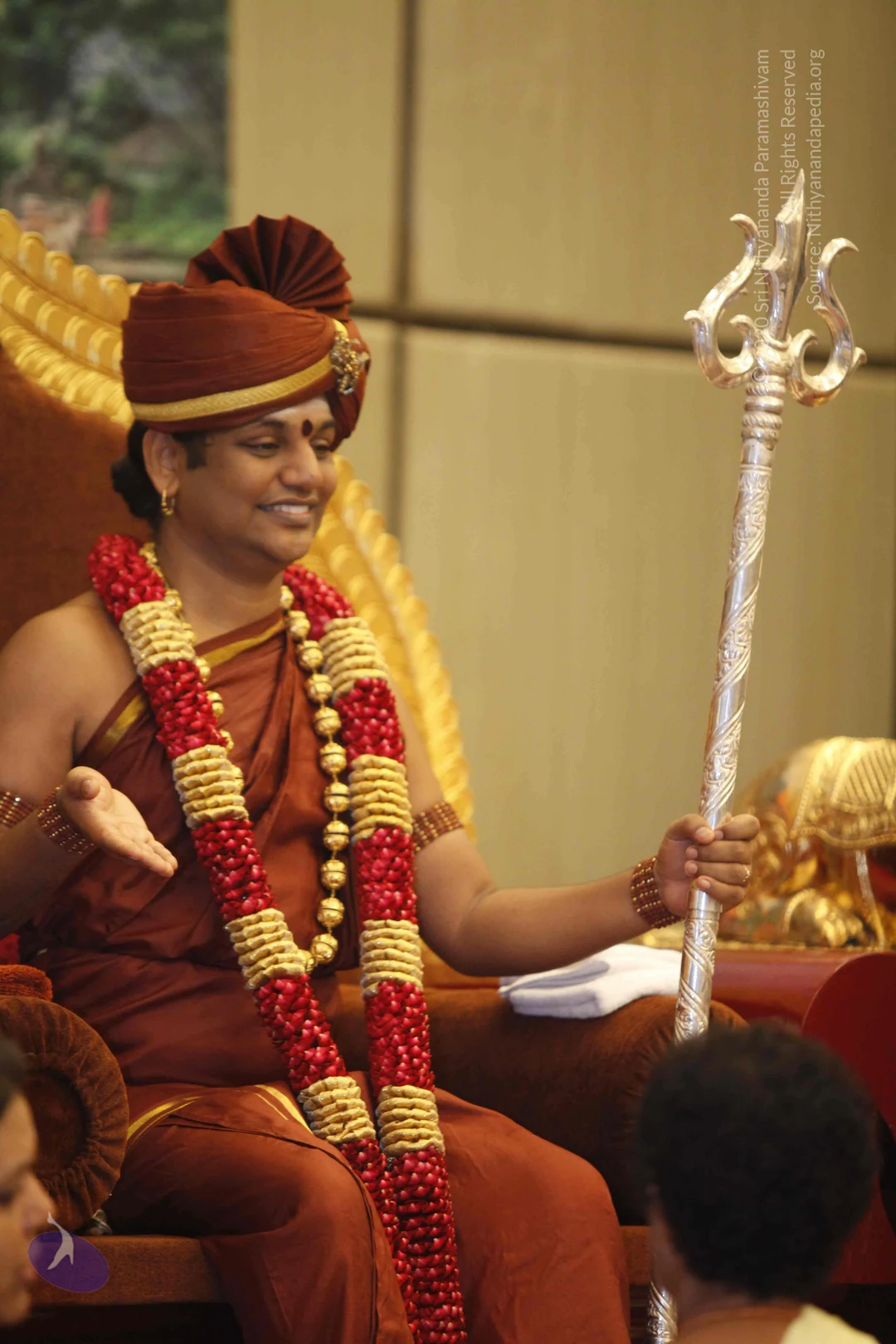
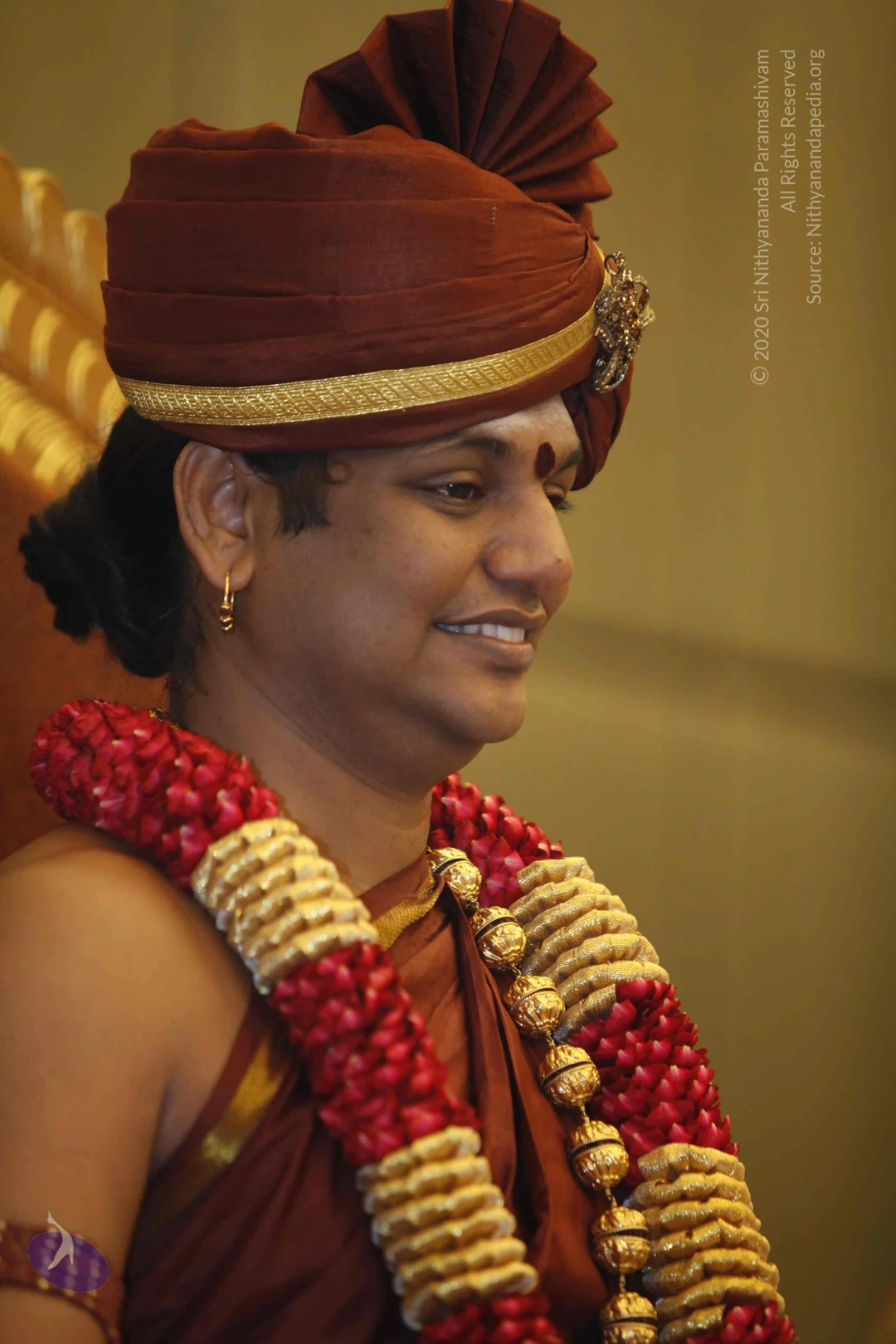
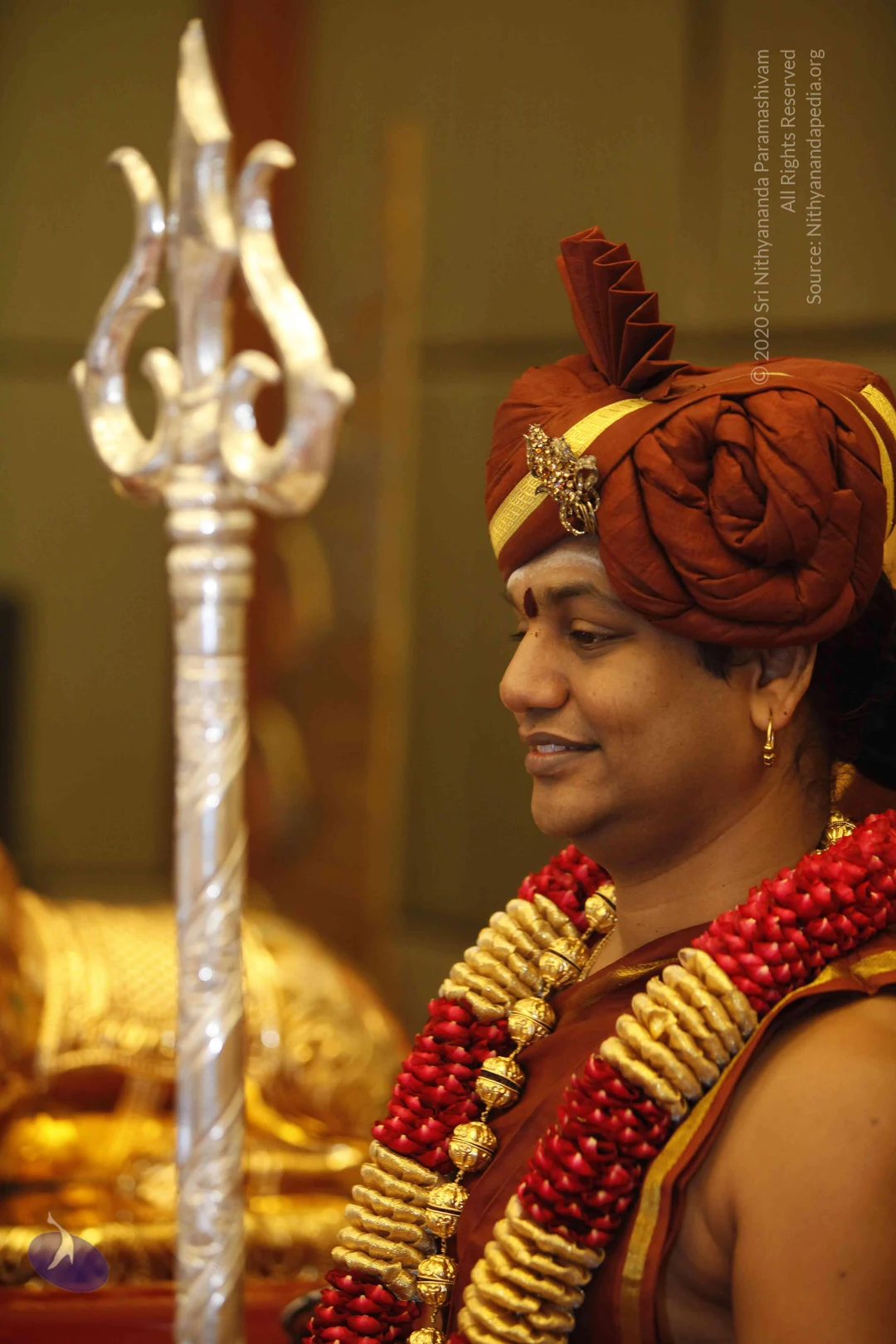
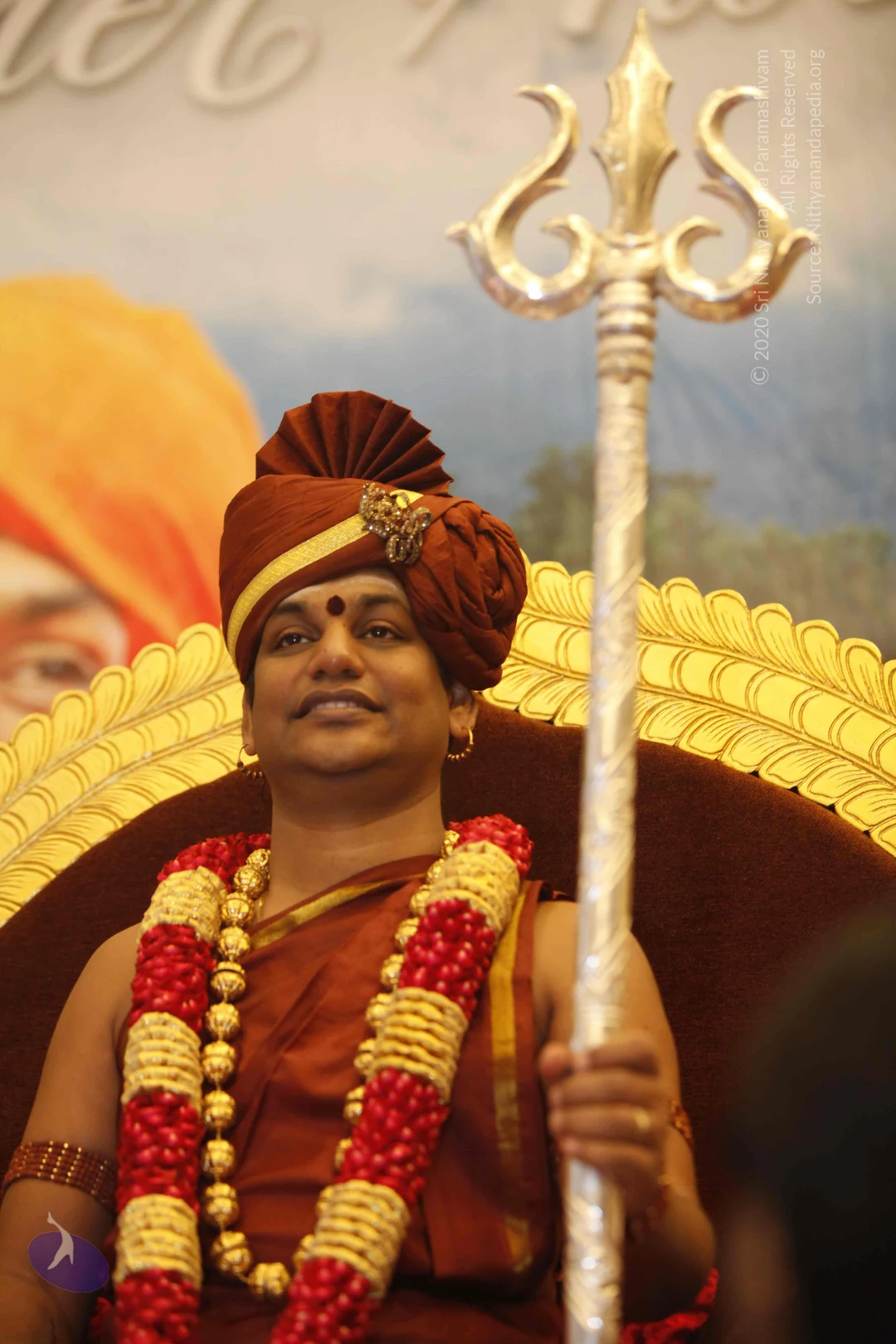
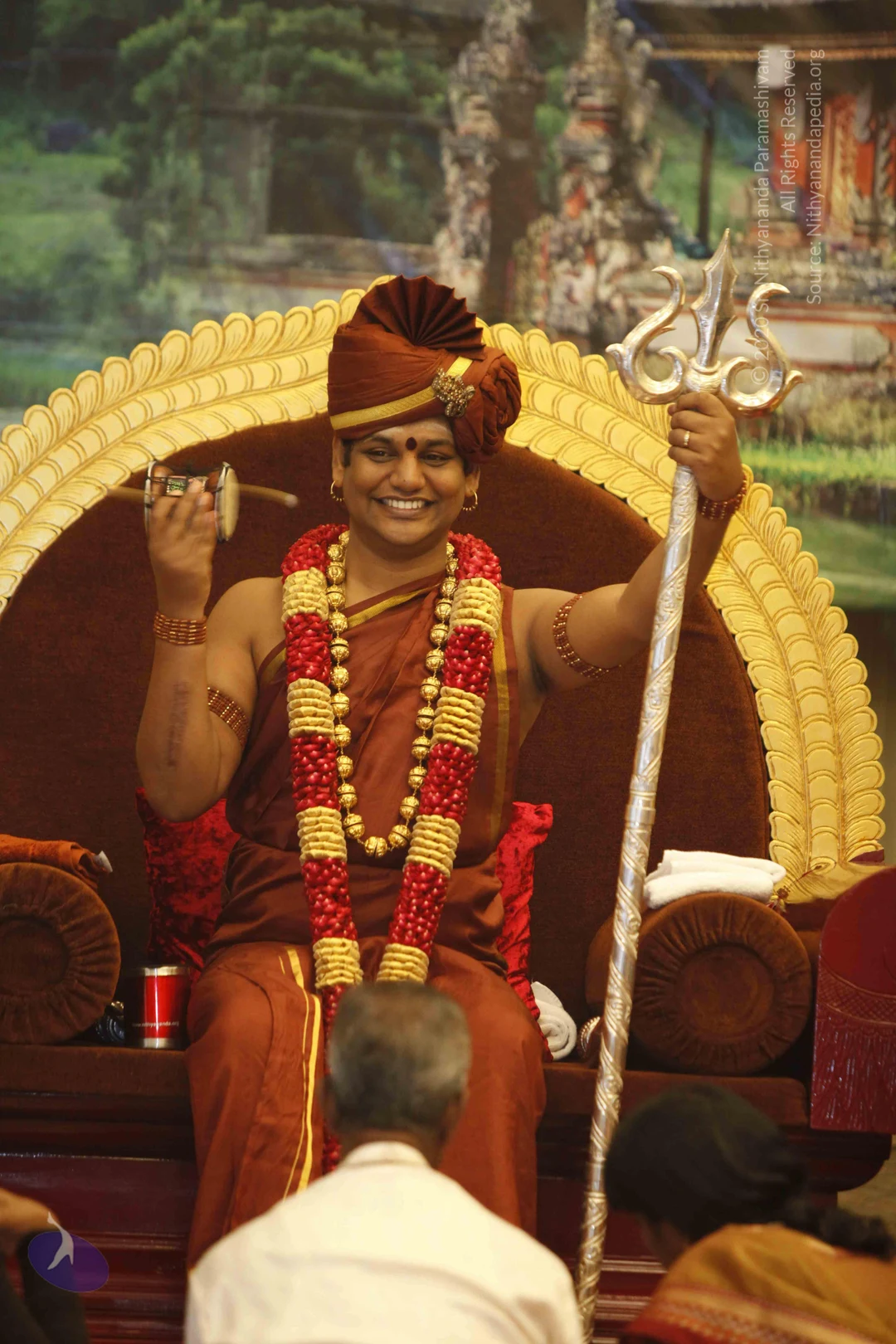
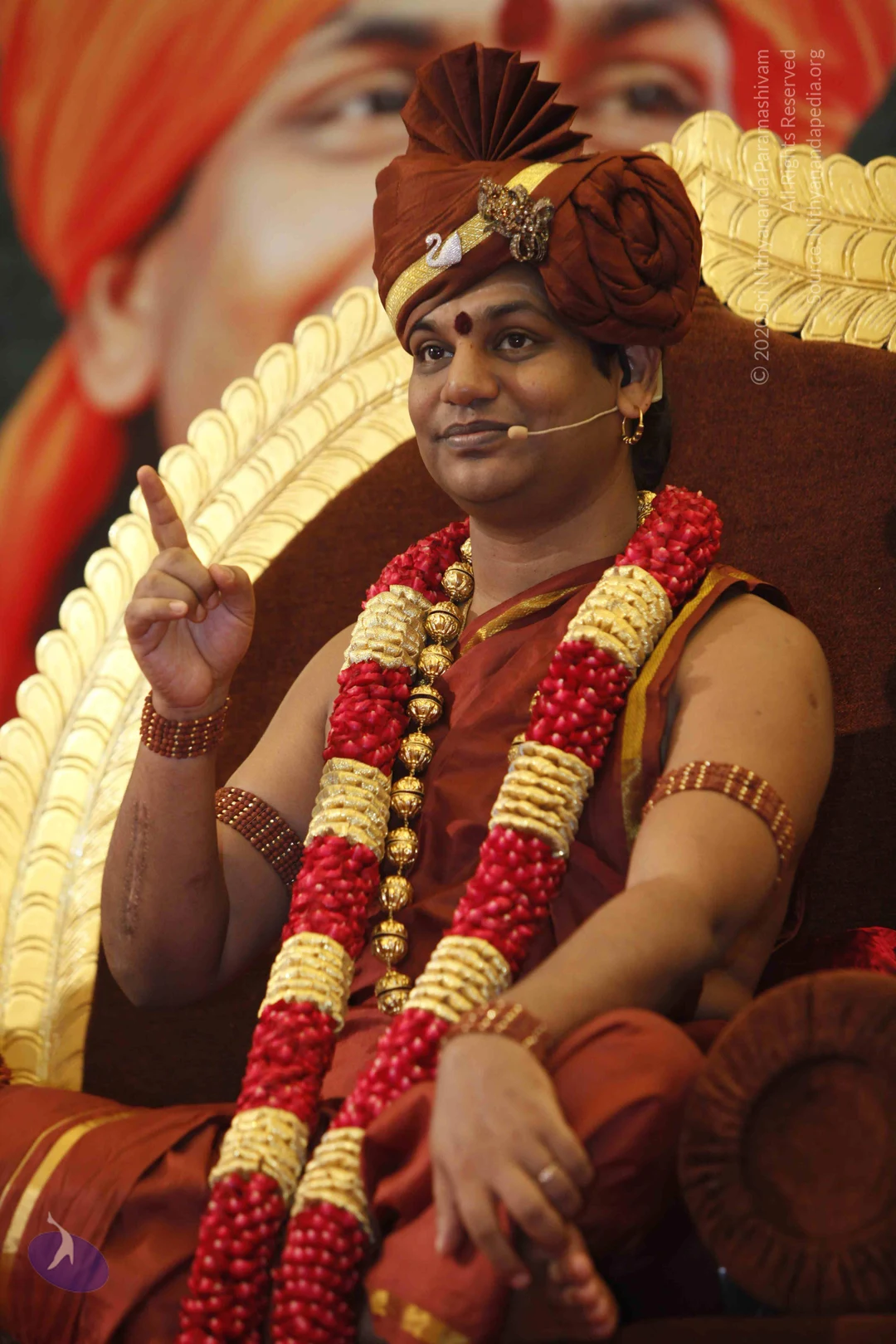
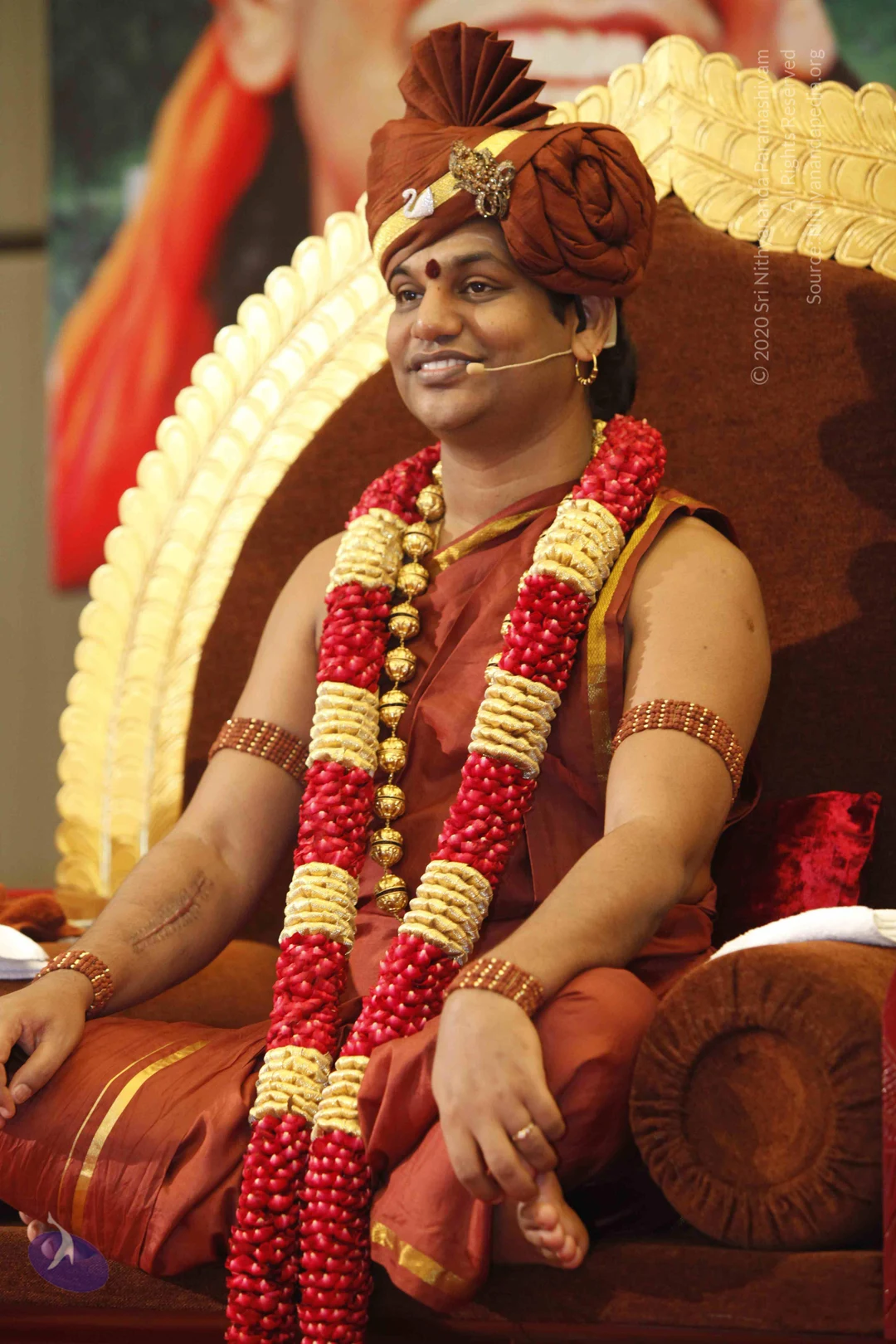
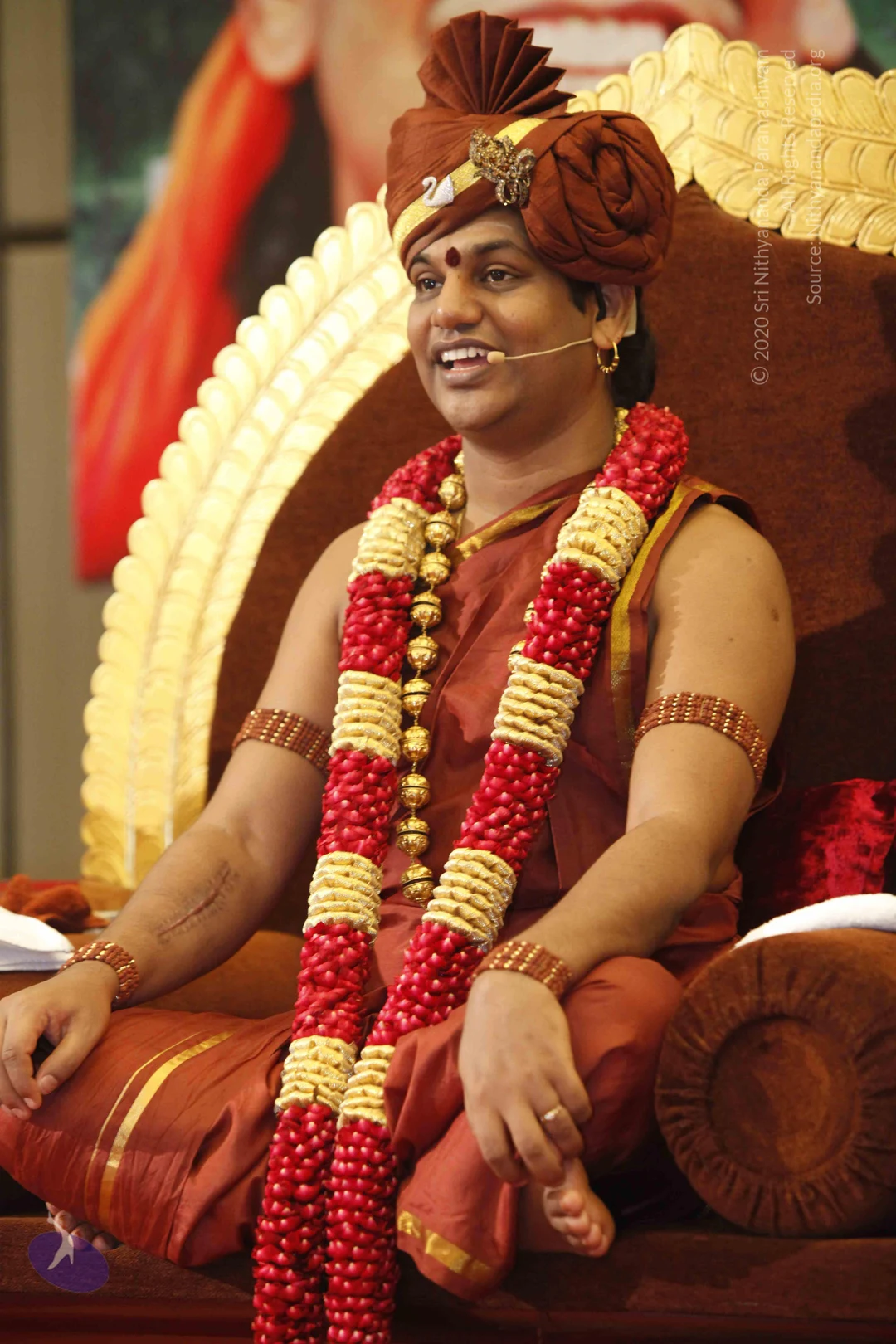
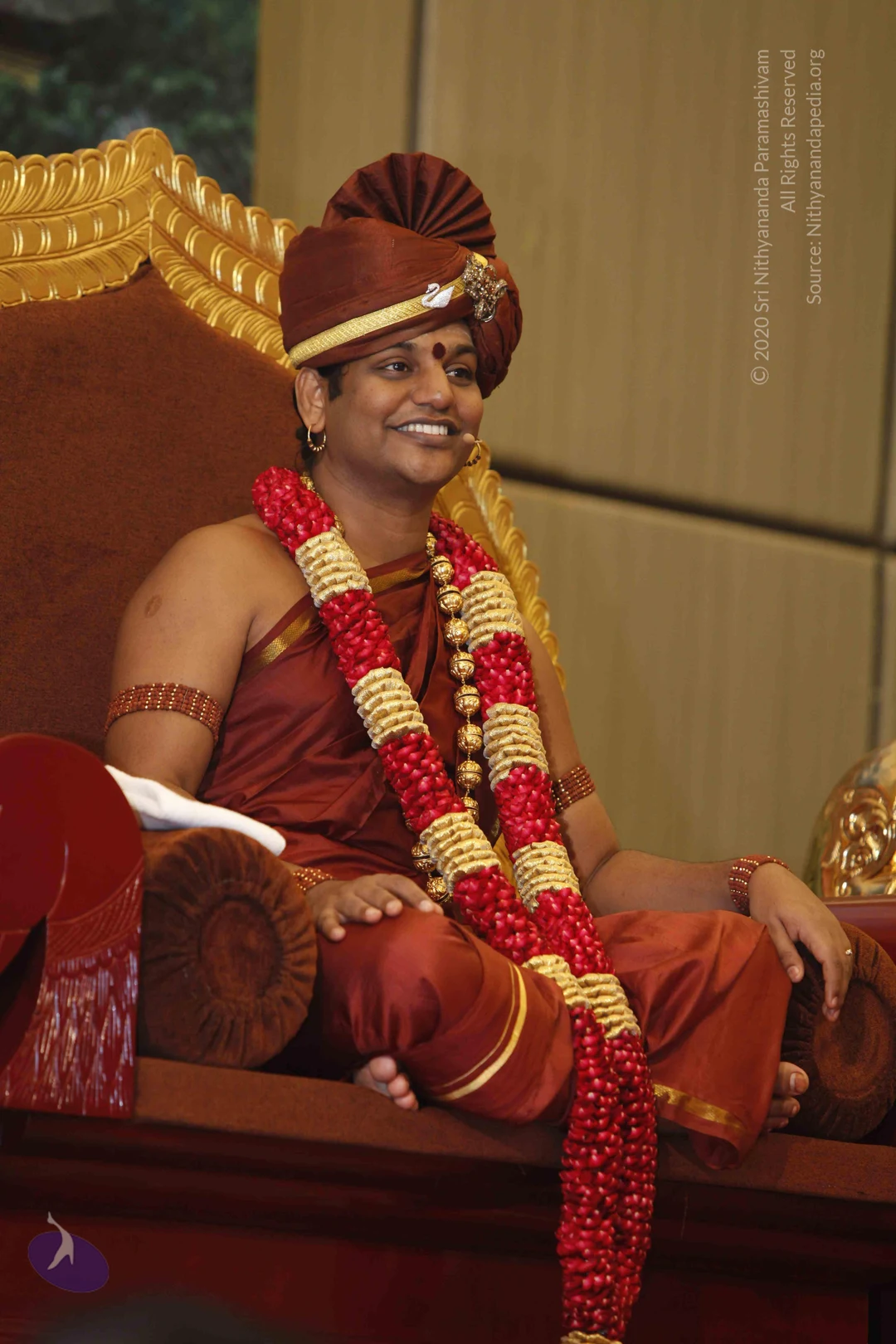
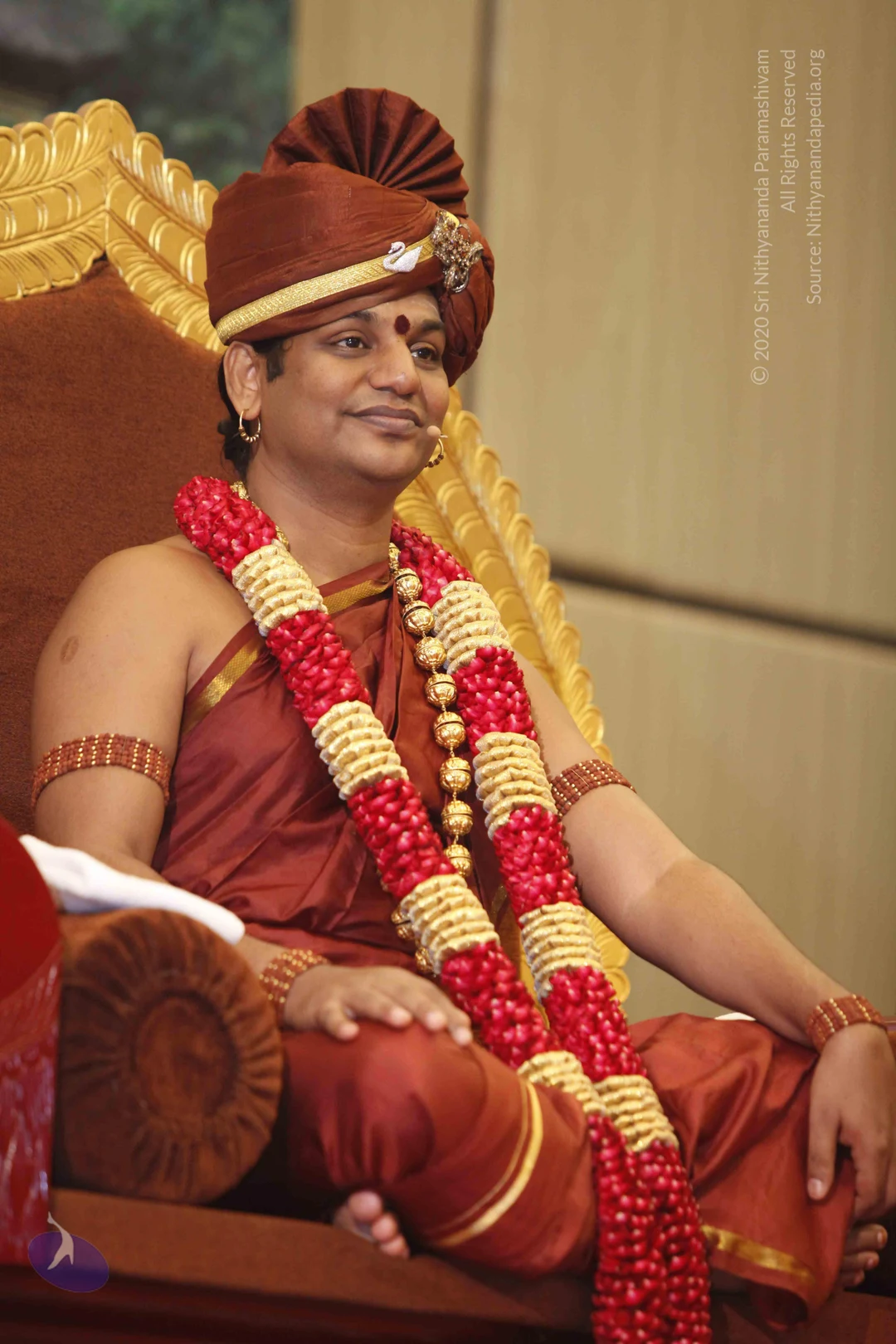
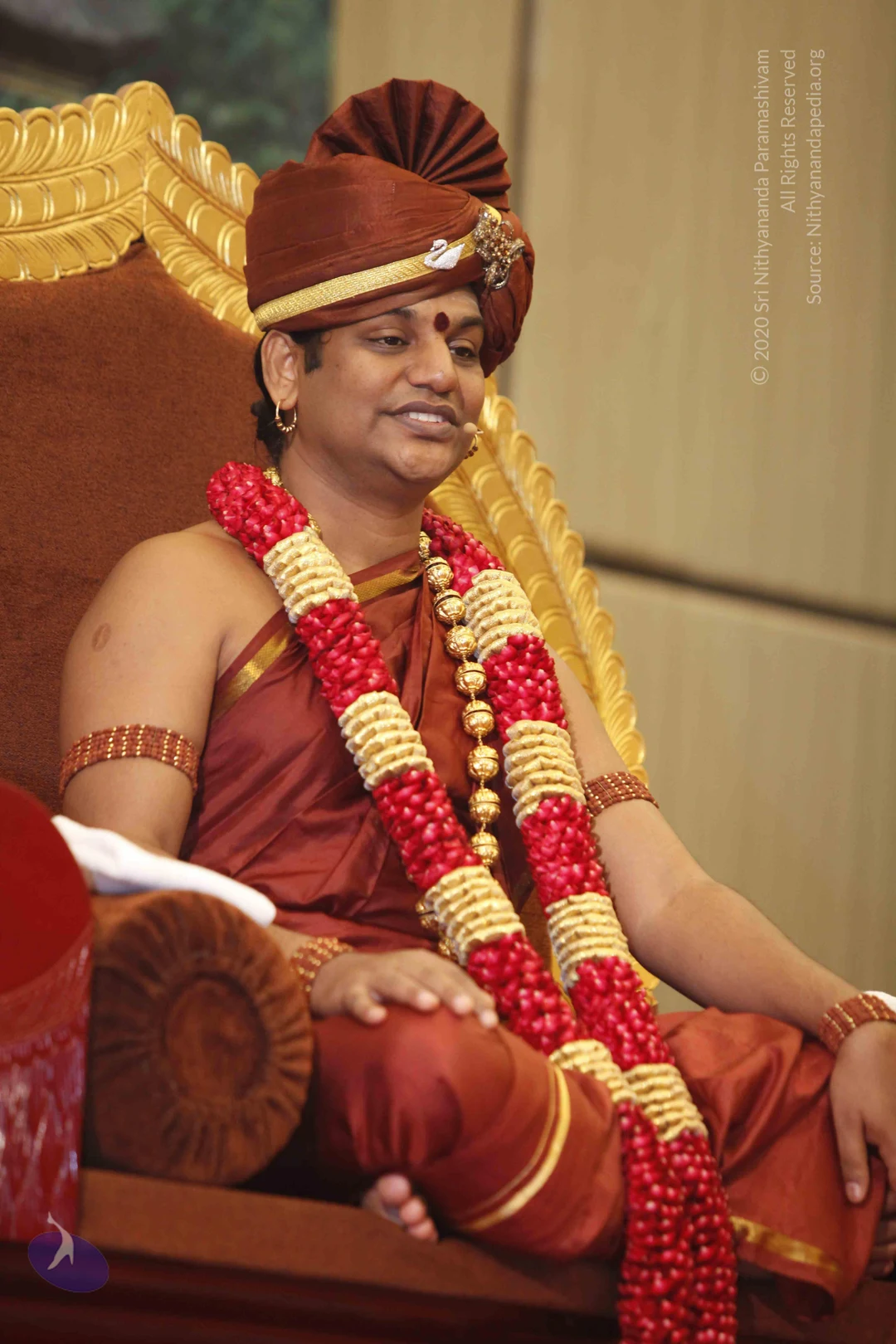
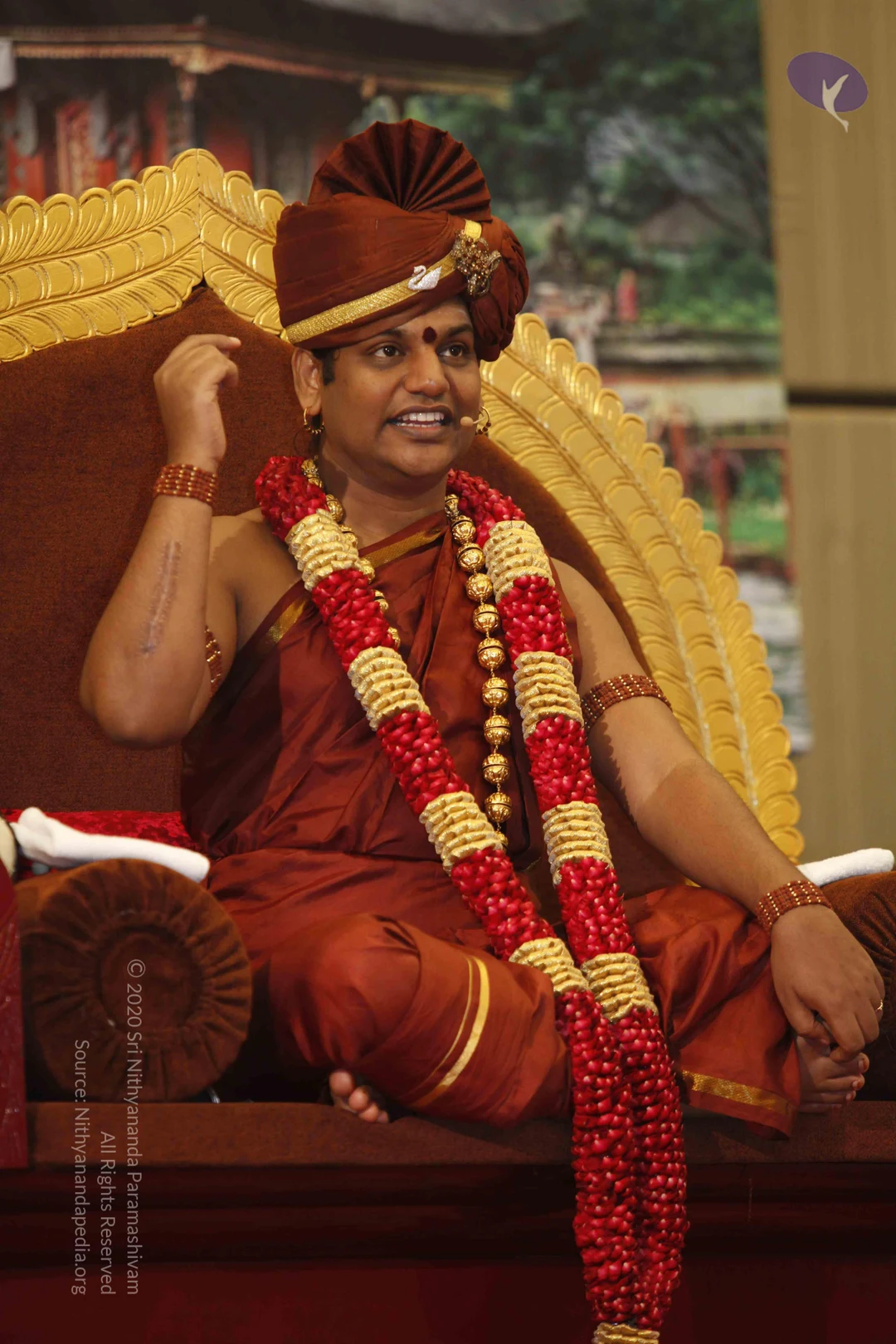
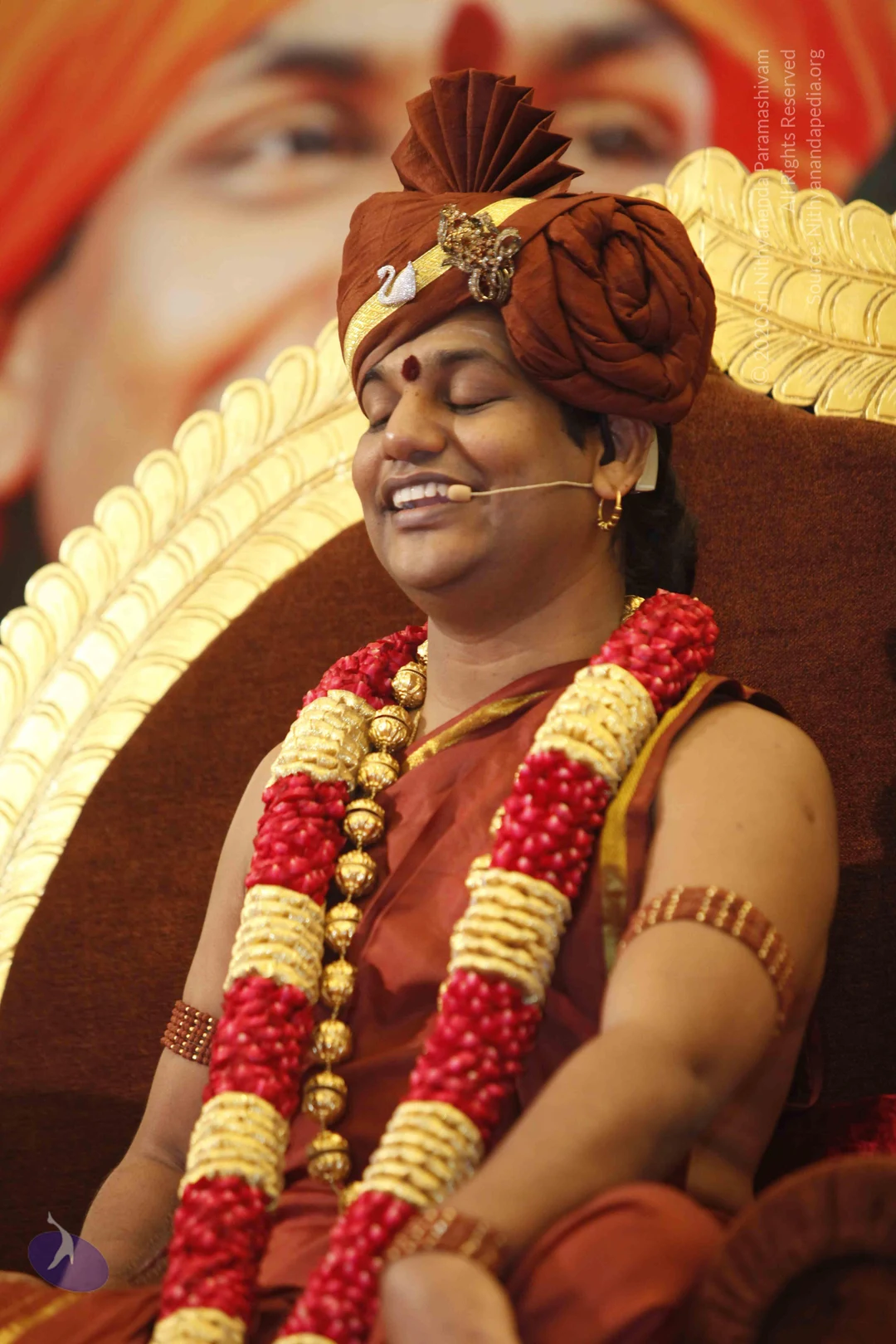
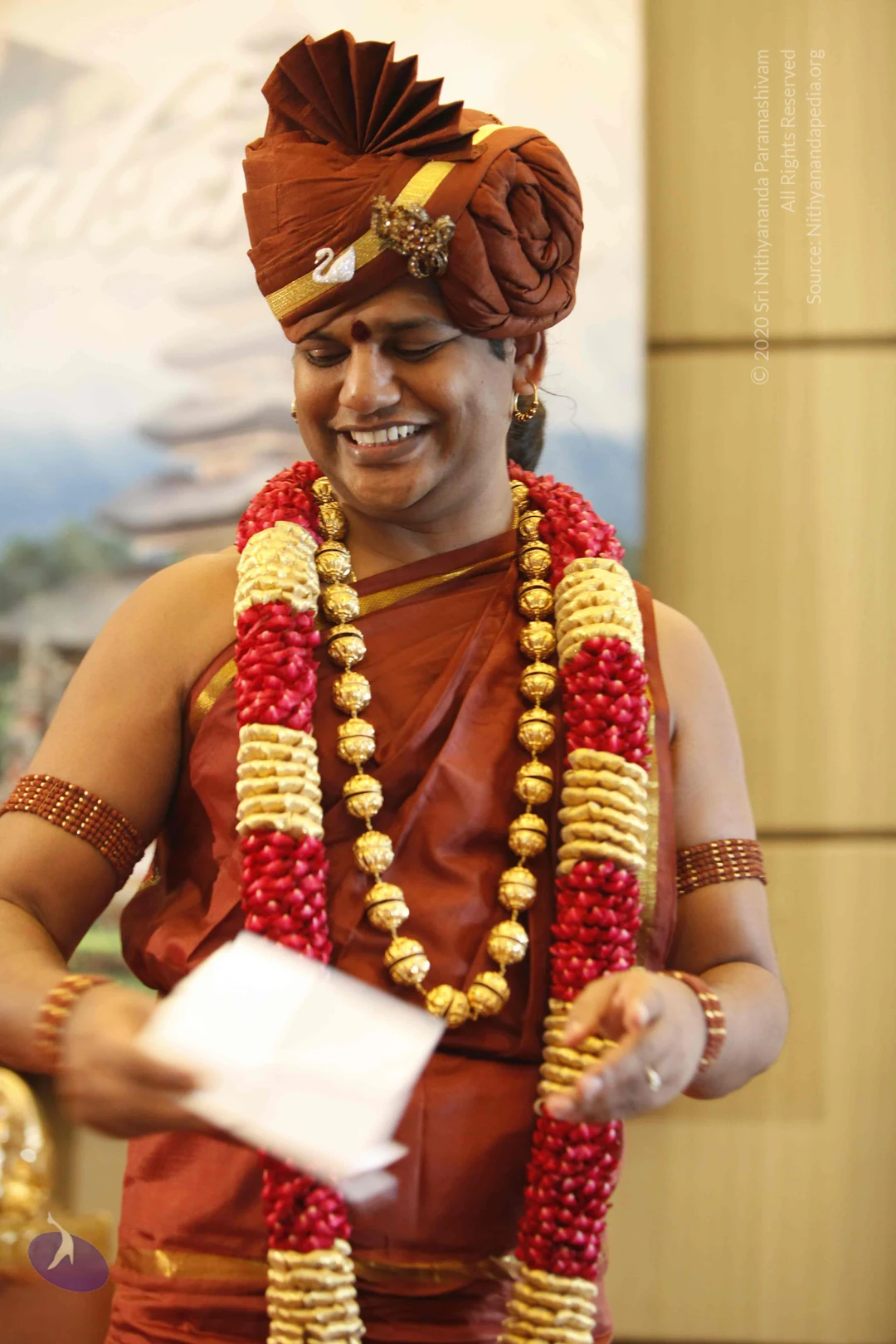
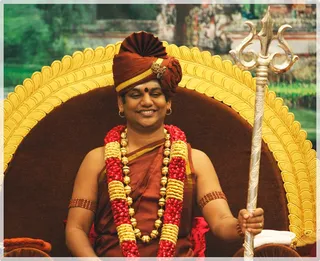
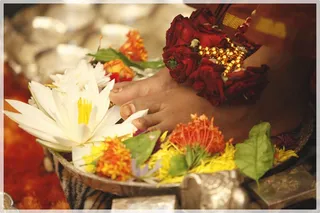
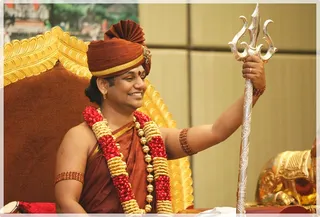
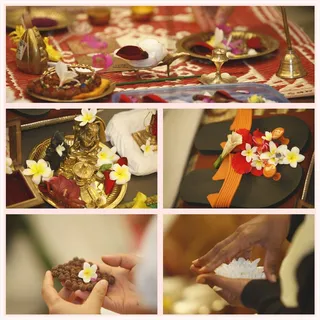
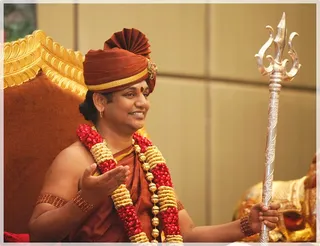
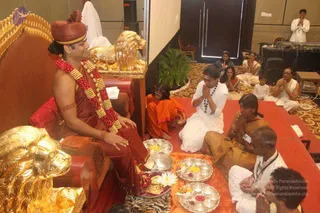
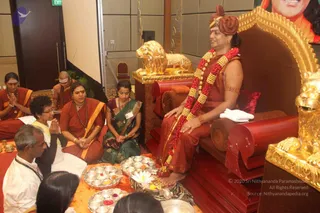
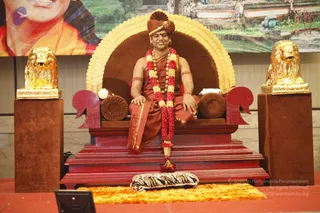
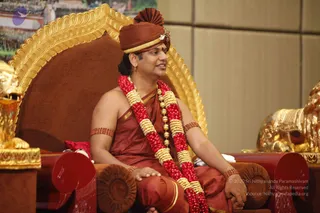
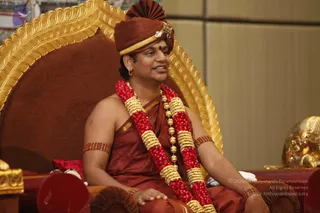
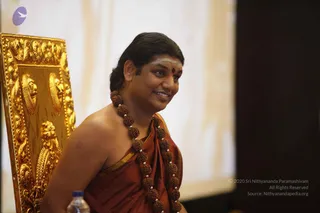
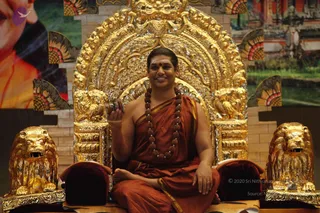
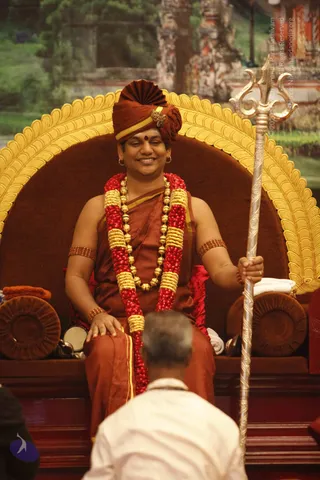
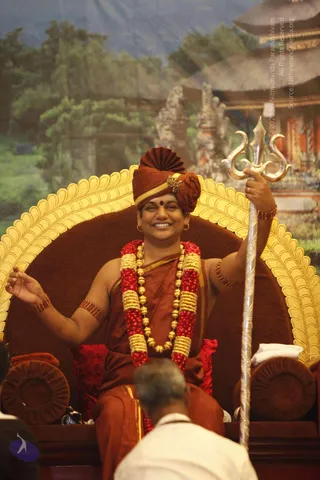
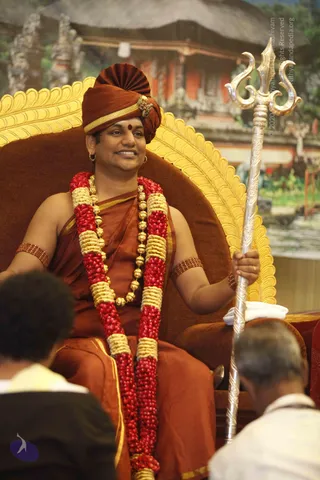
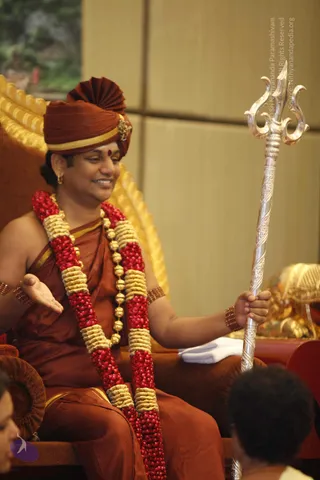
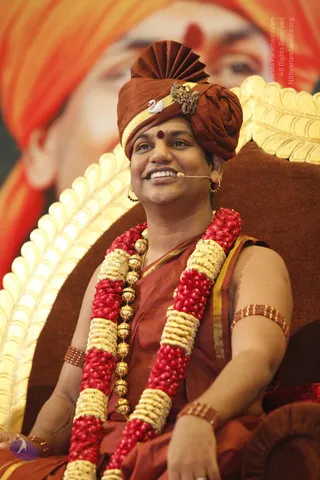
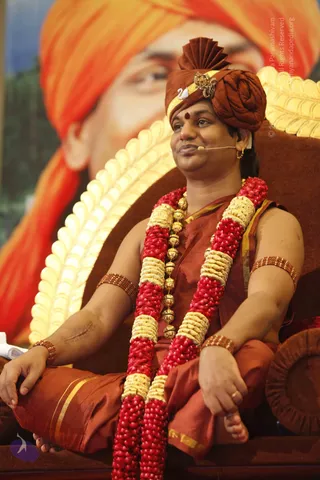
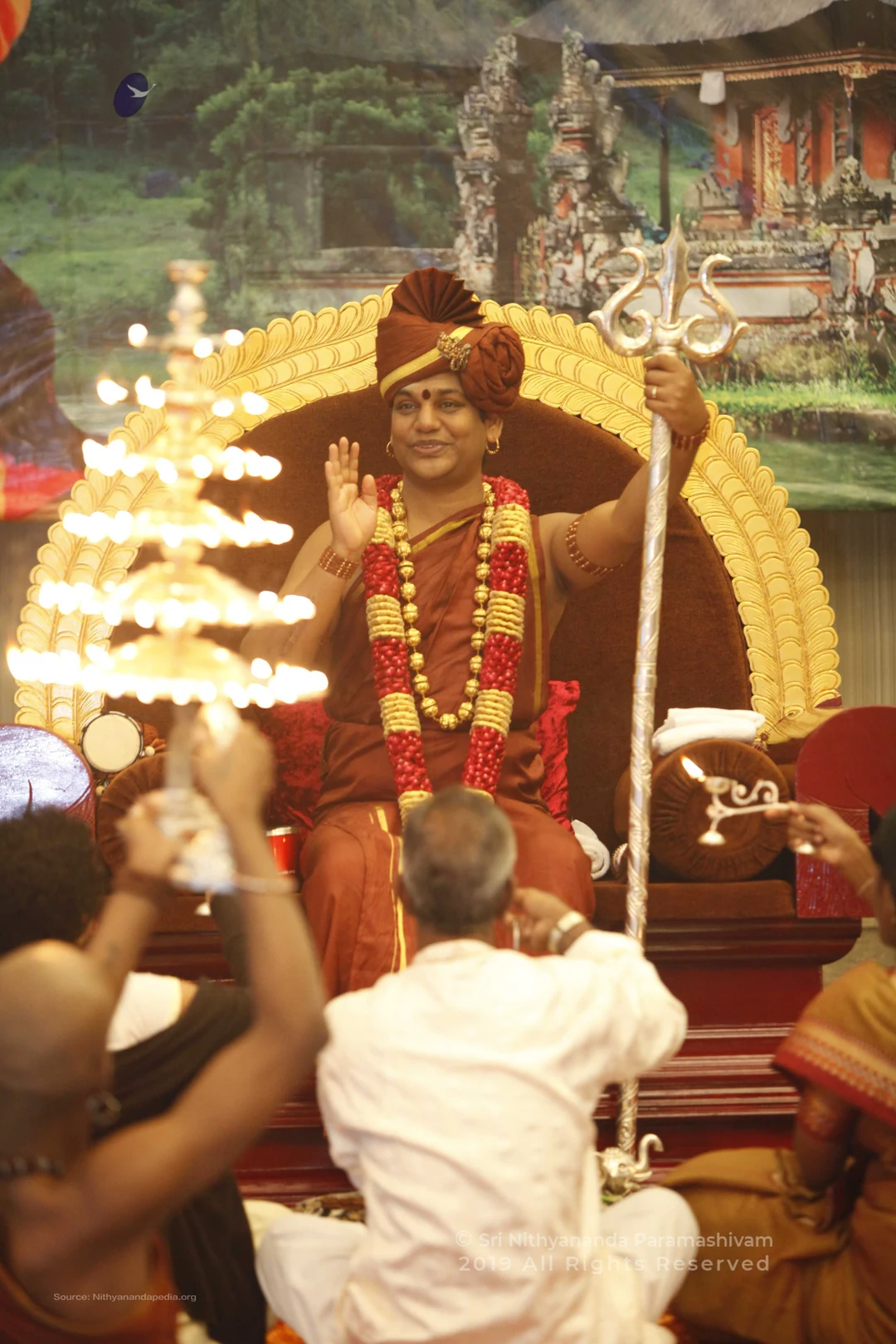
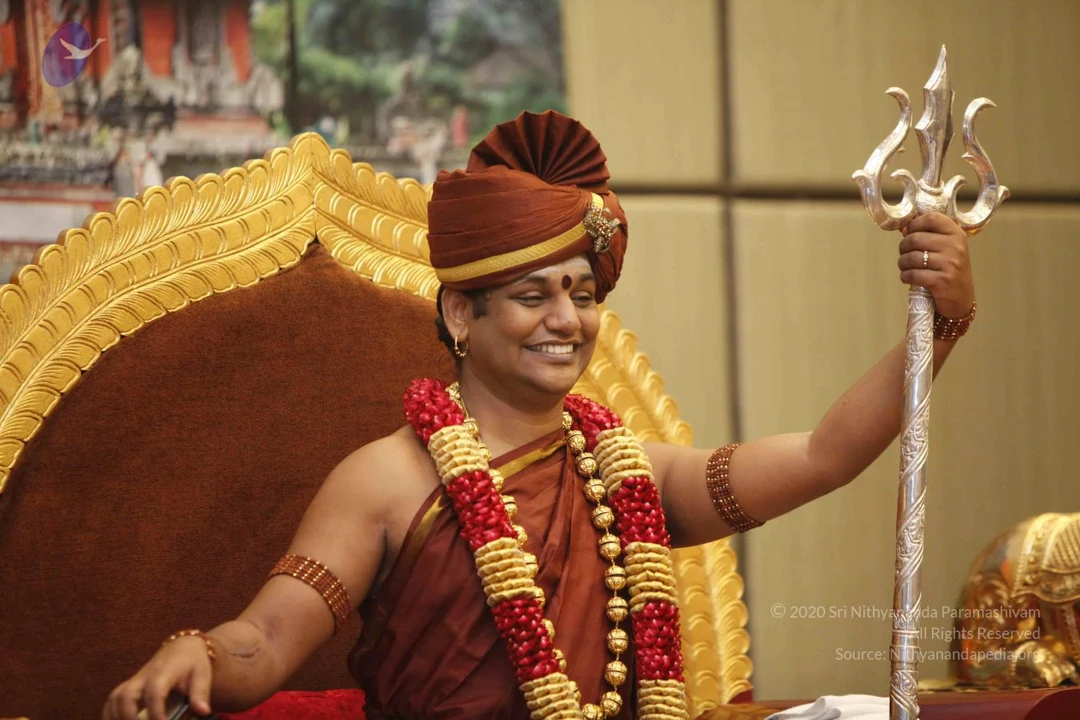
A smiling man in a maroon turban with a dark red-brown dhoti-style wrap and a long gold-bead necklace with red and yellow flower garlands sits on a large ornate golden-rimmed throne with brown upholstery. Gold armbands are on both upper arms and a red bindi marks his forehead. Blurred heads of audience members are visible in the lower foreground, and a large screen behind shows a temple and green landscape.A smiling man in a rust-red turban with a gold-trimmed band and a gold ornament at the temple sits on an ornate gold throne, bare-shouldered in rust-red cloth. He wears a thick red and gold garland with rudraksha-style beads and red bangles, and holds a tall silver trident in his raised right hand. A gold-embossed chair back and gold drapery are visible against a plain beige wall. Only one person is physically present.Close photo of a padapuja ritual: bare feet resting on a silver tray filled with white jasmine-style flowers, a white lotus, red roses and purple blossoms. The feet, wrapped in red floral garlands and gold ornaments, rest on a tiger-striped cloth over an orange floor covering. On the right, silver bowls and a conch-shaped vessel hold orange marigolds and purple flowers, with a silver kalasha-like vessel behind. Orange-robed figures sit in the background.

December 08 2013

Original wiki page
Contents

Title:

Nithyananda Diary | Bali Inner Awakening Day -8 | Padapuja | Satsang | Meditation | Dial the avatar | Sarvadarshan

Description:

In today’s morning satsang from Bali Paramahamsa Nithyananda gave a historic definition of advaitha. He revealed that it is not oneness or monism. Hindus do not believe in one god; they believe in infinite gods each one of which is infinitely powerful with no need for one all powerful godhead. He encouraged us to complete with others and experience Nithyanandam, the experiential expression of infinity.

Link to Video:

VideoAudio

Transcript:

Nithyanandeshwara Samaarambhaam Nithyanandeshwari Madhyamaam | Asmath Aachaarya Paryanthaam Vandhey Guru Paramparaam ||

I welcome all of you with my love and respects. I welcome all the devotees, disciples, samajis, satsanghis sitting with us around the world at this moment through Nithyananda TV, Lotus News Channel, Sadhna TV, Janashree TV, Eshwar TV, and through two-way video-conferencing in forty-two places having Nayana Deeksha, in twenty-six countries around the world as per the statistics.

Cities sitting with us through two-way video-conferencing: Toronto-Kailasam, Guadeloupe-Rameshwaram, Los Angeles-Arunachalam, San Jose-Madurai, Nithyananda Nagaramu-Hyderabad, Nithyananda Nagara-Bidadi, Atlanta-Ujjaini, Washington DC-Sripuram, New York-Varanasi, Ohio-Prayag, St. Louis-Tirumala, Seattle-Chidambaram, Bangalore North, Singapore-Singapuram, Port Washington-New York, Austin, Hyderabad-Gupta Kashi, Mulund-Mumbai, Dakota Dunes, Bangalore-North, Bangalore-Malleshwaram, Devon-UK, New Zealand-Adi Arunachalam, San Diego-Tirualavai, Bogota-Colombia, Austin, Paris-Home Temple.....................

I welcome all of you with my love and blessings.

Today, 8th day! COMPLETION WITH OTHERS! Not just other human-beings in our life, but with everything! You will talk to the trees, ocean, hill, pets, friends, relatives. Actually, all of them are....some are trees in your life, some are ocean in your life, some are pets in your life. There is no difference actually inside. So, inside how you feel with the pet as you complete with others and life today. Actually, yesterday’s Vaak Siddhi initiation is specially to complete with others and life today. I programmed in such a way that all of you will complete today with everyone in your life with the power of your words, shift the listening of the listener. And even if you want to complete with me, today finish it. I am always complete, so don’t worry. So I am not going to sit and listening to you. May be, sit in front of my photograph and finish if you have any incompletions; complete with that also.

Complete with everything, everyone; when I say me, I mean all that I represent, everything unknown in your life. I am totality of unknown your life. So whatever you call life, god, nature, if you are not able to pinpoint anybody as a reason for your incompletion, put that on me. That’s all. See, I am the vyakta of avyakta for all of you. I am the manifest of un-manifest for all of you. So naturally all the unknown incompletions dump it on me and complete with it. Be complete with it. I am almost like a large size dustbin for all of you to dump all your incompletion – unknown. Actually master is expected to play that job. And its my responsibility to complete all your unknown incompletions. Like if you are depressed, moody for no reason and you are not able to find any reason, then naturally on who the incompletion falls? Me only!

So, all the unknown incompletions, incompletions which you are not able to pinpoint, Avyaktha, put all that also and complete. Try your best to complete with as many persons and as many things as possible. Completion with others will make you experience Shuddha Advaitha, the pure oneness, or non-dual experience. Even “oneness” is not the right word; it looks like “ekathwa” No, oneness is not the right word. Non-dualness, Advaitha, means non-dual, you will experience infinite under your ability to grasp. Please listen, today I am defining “non-duality”. Non-duality is not oneness. Non-duality means: “Infinite, but able to grasp”. You will expand to grasp the infinite; that is Advaitha, non-duality. It is the intellectual criminals like Max Mueller and Max Muellerian translation of our Vedas to abuse our Vedas, that non-duality has been translated as oneness, which is not right. They tried to translate by using the word “monism”. No! Advaitha is neither monism nor oneness. Advaitha means “non-dual”. “A” + “Dvaitha”, see these two, “no two”, does not mean “one”. “Neither one nor two”. Uncountable! Infinite becomes your experience!

Understand, today what you are listening is going to be one of my breakthrough contributions to the whole Hindu philosophy, Sanatana Dharma, because the whole modern-day neo Hindus are suffering without understanding this word “non-dualism”. Tons of questions! ‘If non-dualism means, then how so many gods can be there?’

If I have to translate the word “Advaitha” with the clear meaning and interpretation of the practical experience, this is the experiential interpretation, expression, experiential expression of Advaitha: “Advaitha does not mean oneness, Advaitha does not mean monism, it means there is no two, there is no one, infinite; but infinite, everything is infinitely powerful”. That is why the Sanatana Hindu Dharma allows all of us to be gods and not fight with each other. All of us are gods and we don’t need to fight with each other, we don’t need any superior body to guide all of us, to rotate all of us, or to put a traffic signal for all of us. All the planets are having any traffic policeman to put signal? No! They are all independently intelligent! Independently intelligent all of them exist.....all of them exist and all of them are ultimate. No need for the superior body. Same way, all of us are gods and no need for superior body. You realize your potentiality, you establish yourself in the space of Completion, you are God! That’s all!

These religious terrorists forcing their beliefs about one god on Sanatana Hindu Dharma either by conversion or terrorist activities, or by intellectual terrorism, force us to believe Hinduism also believes in one god. As the apolitical, legitimate, clear voice of Hinduism, and as the Mahamandaleshwar, do not believe in one god! Ultimate experience of Hinduism, Advaitha, does not support the idea of one god! All Advaitha, the experiential expression of Advaitha, is infinite gods, all infinitely powerful, without any need for any one superior or supreme personality or supreme godhead! Because your logic cannot grasp it before you experience it, we reduce to the understanding of our logic. Understanding reduced to the understanding of our logic is not ultimate truth. As an experiential expression of Advaitha, Vedanta and Advaithic principles, today I wanted to make this understanding to all of you, and this will be the stand for all the questions related to God officially by Nithyananda Dhyanapeetam. This is the stand of all the Vedic rishis. Only this experiential expression answers all the questions created, all the questions comes up by all philosophers.

Understand, with this experiential expression – “infinite gods, each one of them infinitely powerful” – you can answer all the philosophical questions of Visishta Advaitha, Dvaitha, Shuddha Advaitha, Bheda-Abheda, Advaitha, Advaitha Siddhanta, Advaitha Vedanta, Shaiva siddanta, Sankhya, Darshana, Patanjala, Yoga, Uttara Mimamsa, Poorva Mimamsa, Nyaya, Vaiseshika, all the principles, all the philosophies, all their questions about God, including agnostic philosophies like Buddhism, Jainism, and atheistic principles like..... All the questions, the Sanatana Hindu Dharma’s basic truth, only this can answer all the philosophical queries, questions and complications created about God.

And, I tell you, in the future I will be remembered, known for this experiential expression, contribution, because if you have a little intellectual background, you know the whole Hindu pundit community is suffering with these questions. Most of them just give up these questions and just get stuck with their family beliefs or the monastery they are associated with, or the tradition they are associated with. They just live with that belief and die without seeing the end of their seeking. Today, I am revealing one of the highest experiential expressions of pure Advaitha, non-dualistic philosophy’s truth, which forms the core of Sanatana Hindu Dharma. Hinduism believes in infinite gods. All of them infinitely powerful without any requirement of one superior person, body, godhead, personality to guide or regulate the infinitely powerful infinite number of gods. When you complete today with everyone; this will be your realization!

I break the myth of oneness, I break the myth of supreme personality of godhead, I break the myth of requirement of a supreme personality. Please understand, I break the myth of supreme personality of godhead, I break the myth of oneness, I break the myth of the necessity for a supreme personality. The truth, the experiential expression of Shuddha Advaitha which I experienced, which I am imparting to all of you, which all of you will experience, the truth, only this truth can solve all the intellectual queries, questions: ‘Is there a God? Is there multiple gods? Is there one God? Then who is multiple? Who are all multiple? Who is one? And who is superior? Then who selects who is going to be superior? How can one be superior? Then what about the Devi Bhagavatham which delcares that only Devi is superior and all 10 incarnations came out of the nails of Devi? And what about the Vishnu Purana which declares all the gods and goddesses, including Devi, everybody is just one of the dreams of Vishnu? And what about the Shiva Purana which declares that all gods and goddesses are just dust which flies when Mahadeva walks?’ Where is the answer for all these questions? ‘Then what about Guru Gita which declares that all the gods and goddesses are just the “Charanamrutha” of the Guru?’ Where is the answer for all these questions? Then are we a completely confused religion.....just a bunch of few old people who drank “somarasa” and their illusions and fantasies? No! We are the most powerful, most sophisticated, most intelligent, most cutting-edge presentation of the truth left with the possibility to evolve more and more, open for the possibility of updation! I tell you, to evolve to this understanding, to evolve to this realization, the whole Hinduism was working. It may look like a very simple declaration, as one of the every day morning satsang, today what I am speaking; but you will see, the whole of Hinduism is going to be revolutionized by this understanding! The whole humanity is going to be revolutionized by this one understanding of infinite god of infinitely powerful, without the need for a supreme personality of godhead, or a supreme authority to guide. You will see, the whole concept of God is going to be re-written by Himself! The experiential expression of this truth will answer tons and tons of questions, confusions.

I tell you, these confusions led many people to become atheists, or many people stopped seeking, and they don’t care anymore about these intellectual debates, because it is too confusing too much, it is going above the head. So they decided “No! Enough!” No, really! It is almost like the expression you give when your wife argues with you. I tell you, any debate.....I am giving you the definition of how the judgement should be given in any debate. Please listen! First truth you need to know: No debate can be solved! That is why it is “debate”. Which argument leads to the further possibility and which is the highest in helping you for the further exploration should be declared as the final word of any argument.

Debates are not for solution, but to find the final word. Please listen. Debates are not for judgement, but to find what is the final word. Final word of any debate should be: What is the statement which allows the possibility of further exploration? The statement which allows the possibility of further exploration should be the final word of any debate.

I tell you, if we re-Cognize all the greatest intellectual questions of all the greatest intellectual philosophies on Planet Earth with this experiential expression of the declaration about God – “without any need for one supreme personality of godhead guiding or ruling” – with this experiential expression if you start answering, re-Cognizing all the intellectual questions of all the great philosophies on Planet Earth, one, you will have intellectual clarity, and second, you won’t give up your seeking; you will be going to the next level of spiritual understanding.

An incarnation’s responsibility is to lead humanity to the next level. I have to raise you in all the uncertain, at least one level further to certainty. I have to lead you into the unknown, at least making one level further making it as known to you; at least one aspect of the unknown I should make it known to you. I should lead you at least to certain level into uncertainity. Vast “Avyaktha”, I should make it at least one bit further “Vyaktha” to you. If you already know many things, I should lead the world at least one step further; I should add to your known. I tell you, I am satisfied I have done this job just by this today’s one declaration. I have job satisfaction just because of this one declaration. This solves all the questions of all the fights, all the debates, all the conflicts, all the controversies related to God. I name this experiential expression as “NITHYANANDAM”. Giving this experience to all of you is the purpose of the program “Nithyanandam”. Inner Awakening will be known from now onwards with the Sanskrit subtitle – “Nithyanandam”. The program will be known in Sanskrit as “Nithyanandam”. And the purpose of this program is to give this experiential expression as your experiential expression.

Complete with others and life; you will experience what I declared today as “Nithyanandam”. When you experience this great truth, in tons of ways your life will change, because you are going to experience you are God, you are going to experience your worst enemy in life is God, you are going to experience you best friend in life is God, you are going to experience your pet is God, you are to experience everything in and around you is God! Not equally powerful, but infinitely powerful! Understand, I am not saying all of us are equally powerful, I am saying all of us are infinitely powerful! It is up to us to express our infinite power.

Each time when the human brain evolves to the next level.....evolves to the next level and evolves to grasp the next level of understanding, a person opens up and reveals the knowledge of the next level. That person who jumps out and reveals the knowledge is called “Incarnation”!

With this experiential expression, now start re-Cognizing all the questions which you left unattended with this expression ‘aaah....ohh...hmmm’, now start re-Cognizing them with the expression of ‘chak...chak...chak...chak’. You don’t need to carry the expression of ‘aaaah....ohhh....hmmm’; you can now re-Cognize with the expression of ‘chak...chak...chak...chak’. The online cities, if you have the question of what is this ‘chak...chak...chak...chak’, come to the next Inner Awakening Level-4 to Bali and get the answer! Till then let this be a suspense! HAHAHAHAHAHAHAHAHAHAHAHAHAHAHAHAHAHAHAHA...!!!!!!!!!

I don’t want to name this as a philosophy; I only want to call this as an experiential expression of infinity. Nithyanandam is the experiential expression of infinity –with the revelation of this great experiential expression, from this context, I bless you all, do Completion with others and yourself; you will experience this experience! Today, from this context, all of you sit. And I commit with you all, I will mirror my neuron activities into your brain!

I will move to the meditation process or the mirroring neuron process. I will call this process as “Upanishad”. “Upanishad” is nothing but a Master gets into a space and lets the disciples sit around and mirror his neuron activity in their brain. That is Upanishad. So, sit in Upanishad with Nithyananda for “Nithyanandam”!

I bless you all! Let you all radiate with Integrity, Authenticity, Responsibility and Enriching, with eternal bliss, Nithyananda! Thank you!

Photos
Title

Serina's Inner awakening Sharings

Description

Inner awakening sharings

Link to Video:

Tags:

Paramahamsa Nithyananda,Advaitha, Infinite gods, infinitely powerful, complete, experience, Nithyanandam, infinity.

Photos Of The Day:

Pada-Puja
Temple
Photos Of The Day:

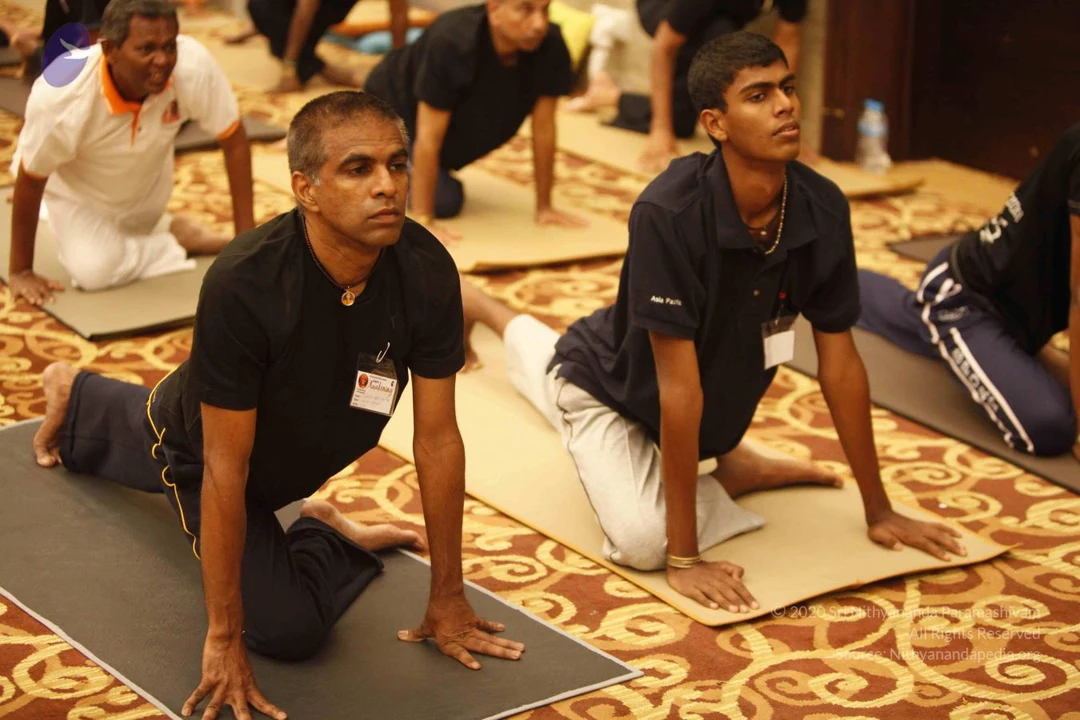
IA-YOGA
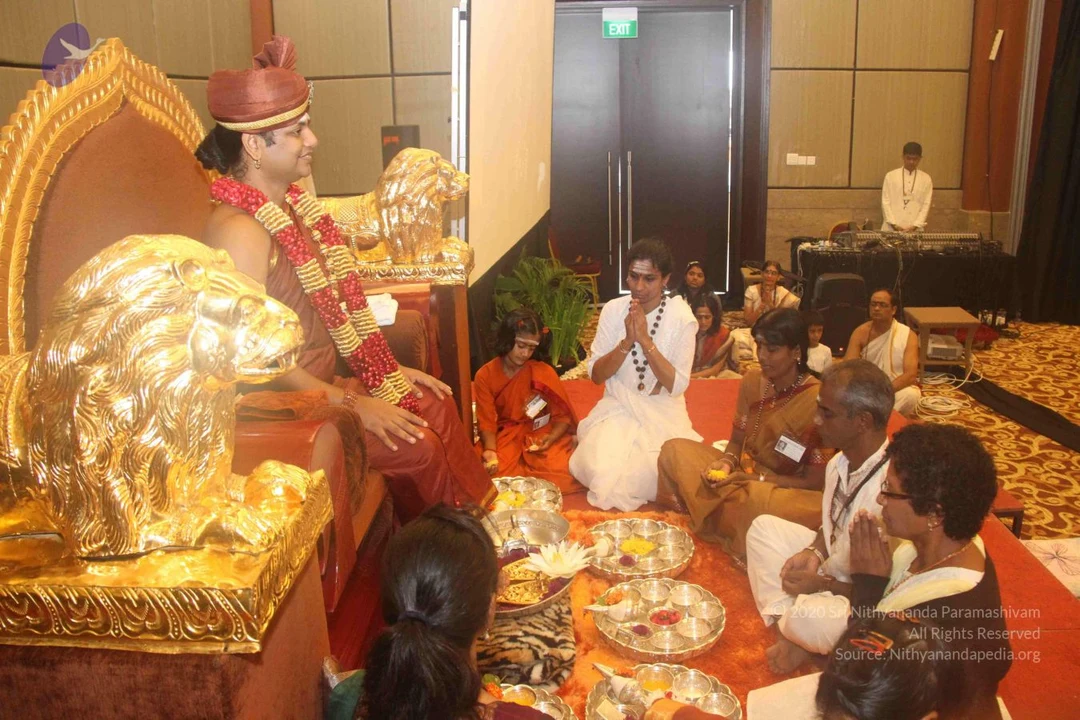
PRATHYAKSHA-PADA-PUJA
NITHYA-SATSANG

IA-SHARING

IA-DARSHAN

1-PRATHYAKSHA-PADA-PUJA

2-NITHYA-SATSANG

3-IA-DARSHAN

Photos from this day

View all 241 photos

Photos

3 photosSource gallery
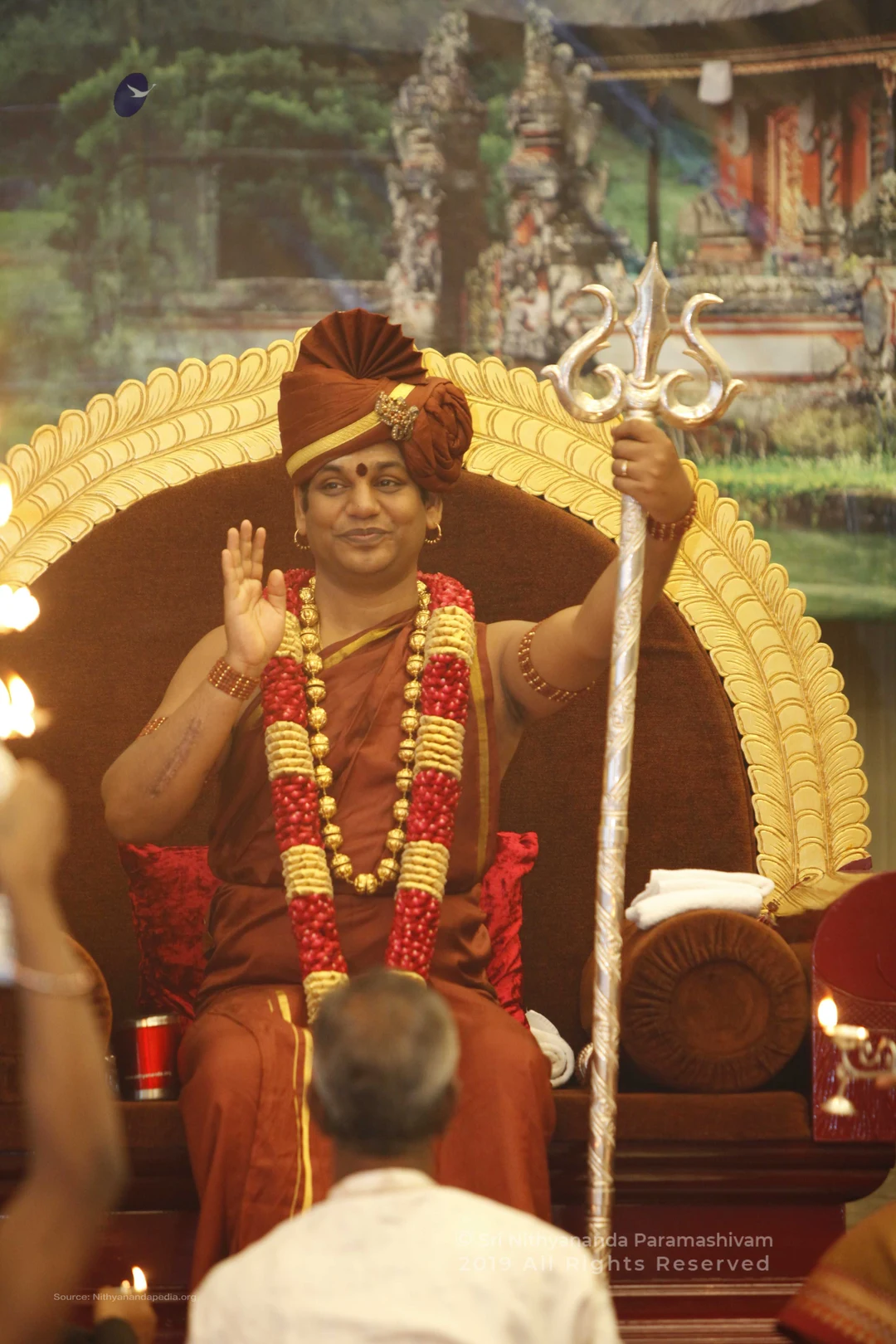
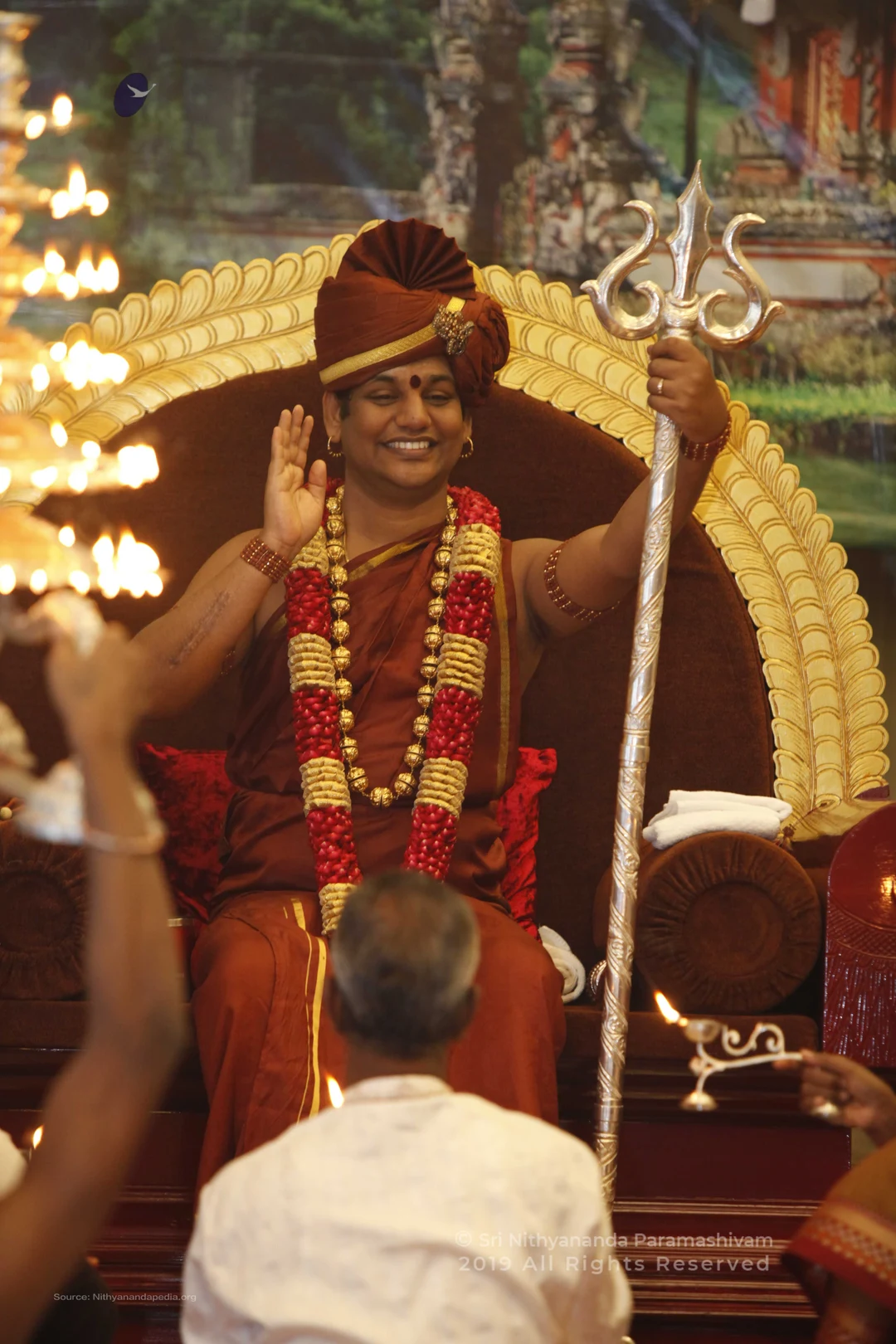
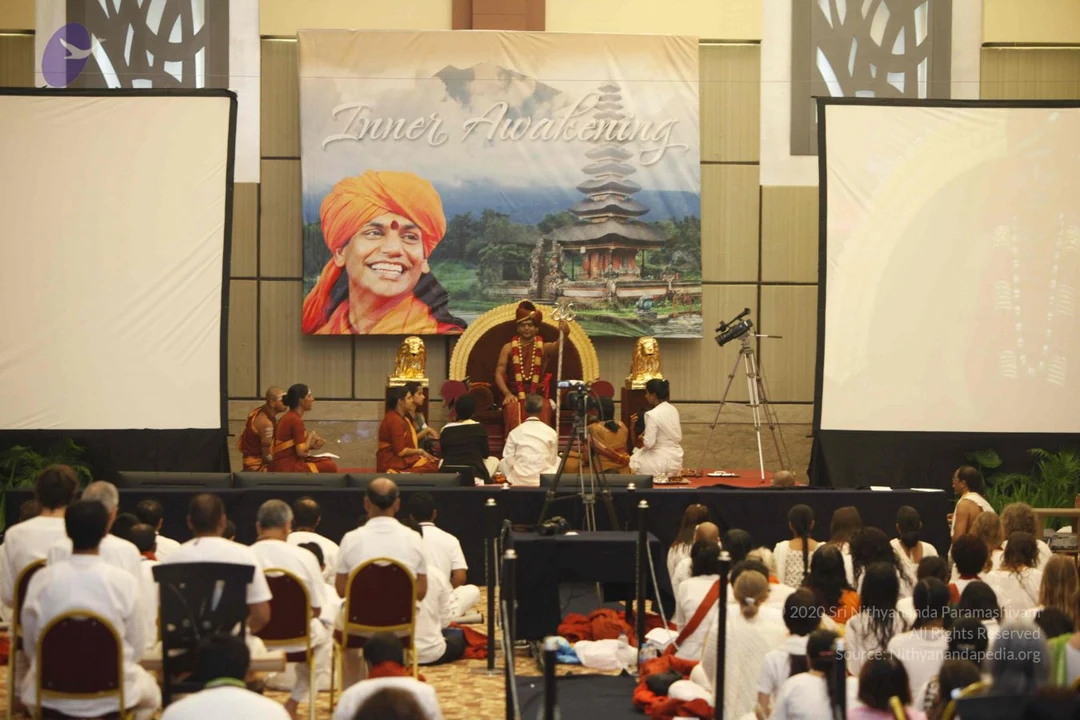
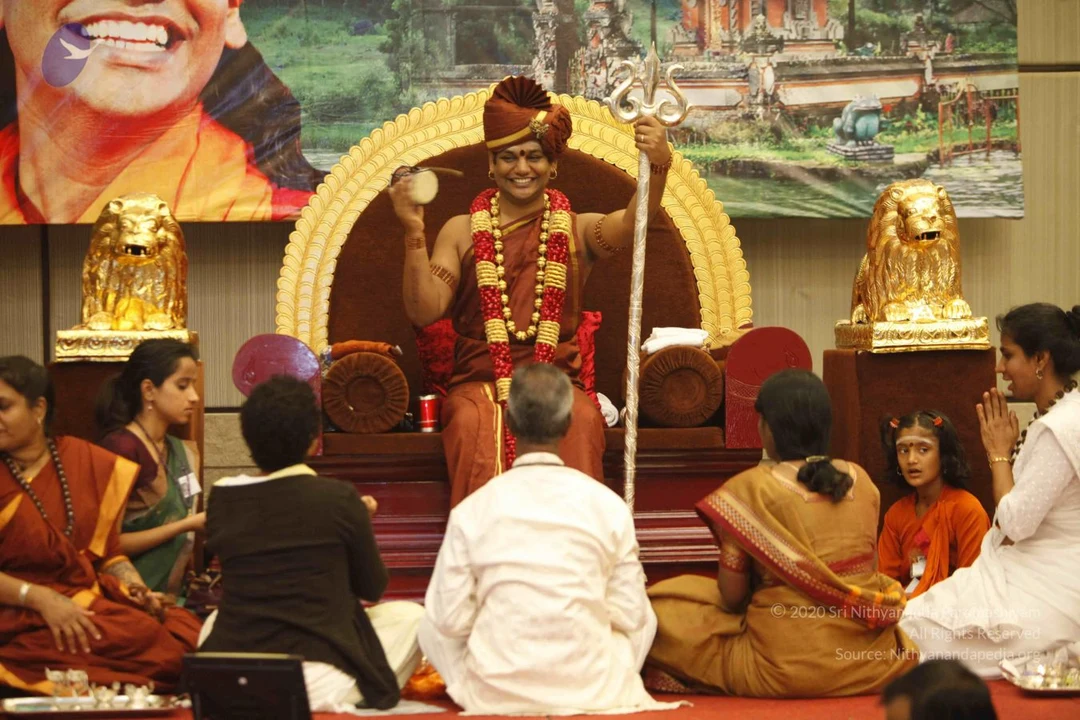
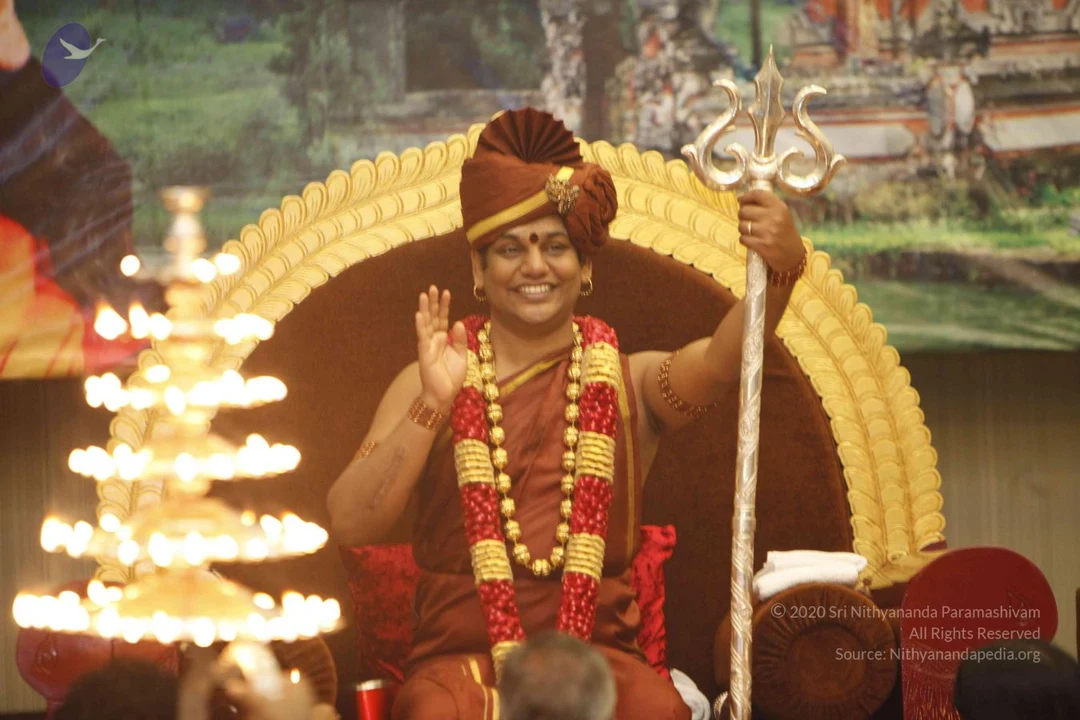
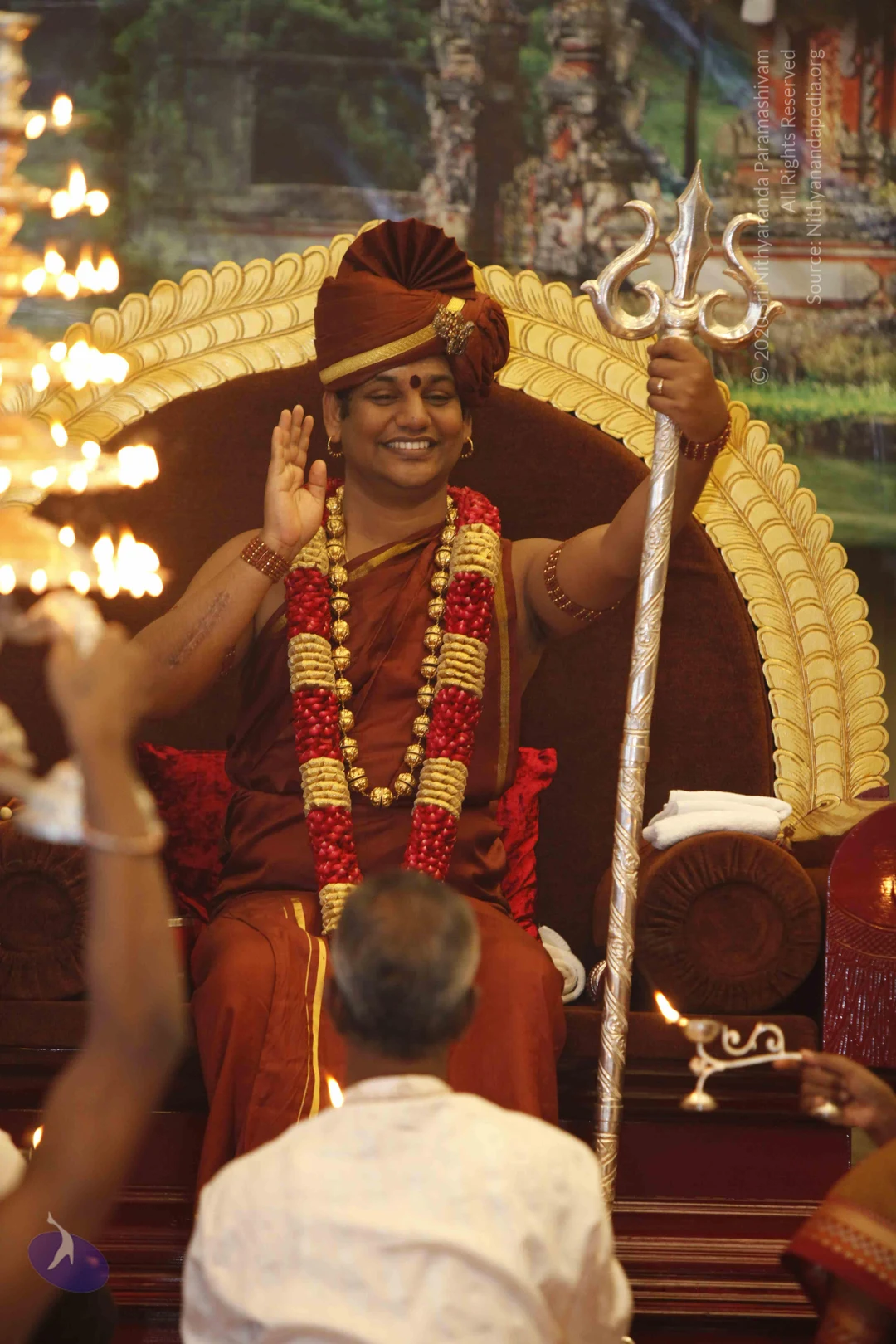
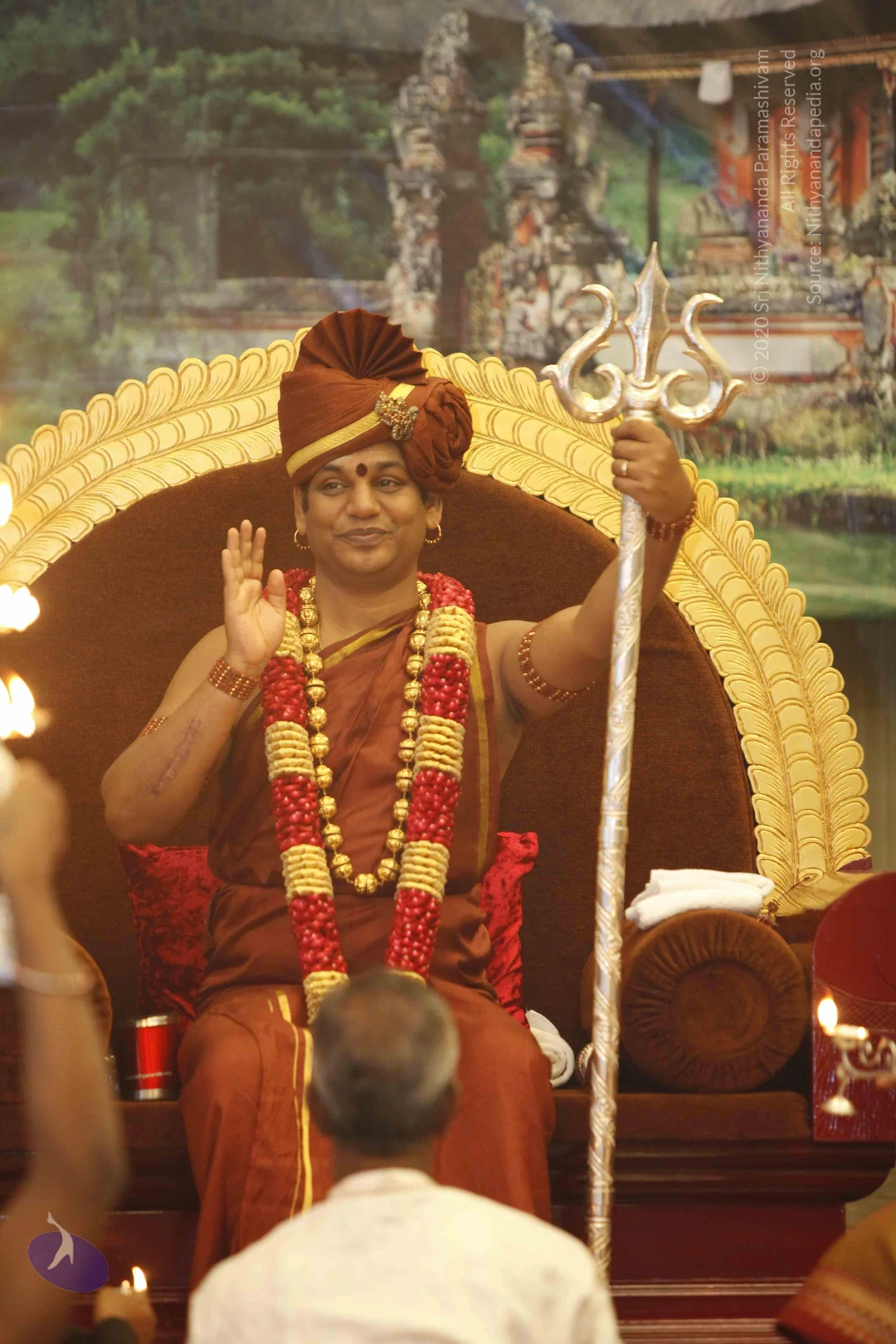
A seated man in a rust-red turban and reddish-orange robe sits on an ornate golden-winged throne with a red cushion, raising one hand in blessing and holding a tall silver trident with a trishul top. He wears a red and gold flower garland, a gold bead necklace, bangles and earrings, with a red bindi on his forehead. In front, people in white and orange clothing hold up a tiered silver aarti lamp with many flames, and one person lights a small silver oil lamp near the throne. The backdrop shows a painted temple scene with Balinese-style architecture and greenery. The seated figure fits the Swamiji (probable) appearance cues: a turban, ornate clothing, a garland and a ceremonial trident, shown on a throne receiving aarti.A smiling man in a rust-red turban with a gold-trimmed band and a gold ornament at the temple sits on an ornate gold throne, bare-shouldered in rust-red cloth. He wears a thick red and gold garland with rudraksha-style beads and red bangles, and holds a tall silver trident in his raised right hand. A gold-embossed chair back and gold drapery are visible against a plain beige wall. Only one person is physically present.A smiling man in a maroon turban with a dark red-brown dhoti-style wrap and a long gold-bead necklace with red and yellow flower garlands sits on a large ornate golden-rimmed throne with brown upholstery. Gold armbands are on both upper arms and a red bindi marks his forehead. Blurred heads of audience members are visible in the lower foreground, and a large screen behind shows a temple and green landscape.

Photos

11 photosSource gallery
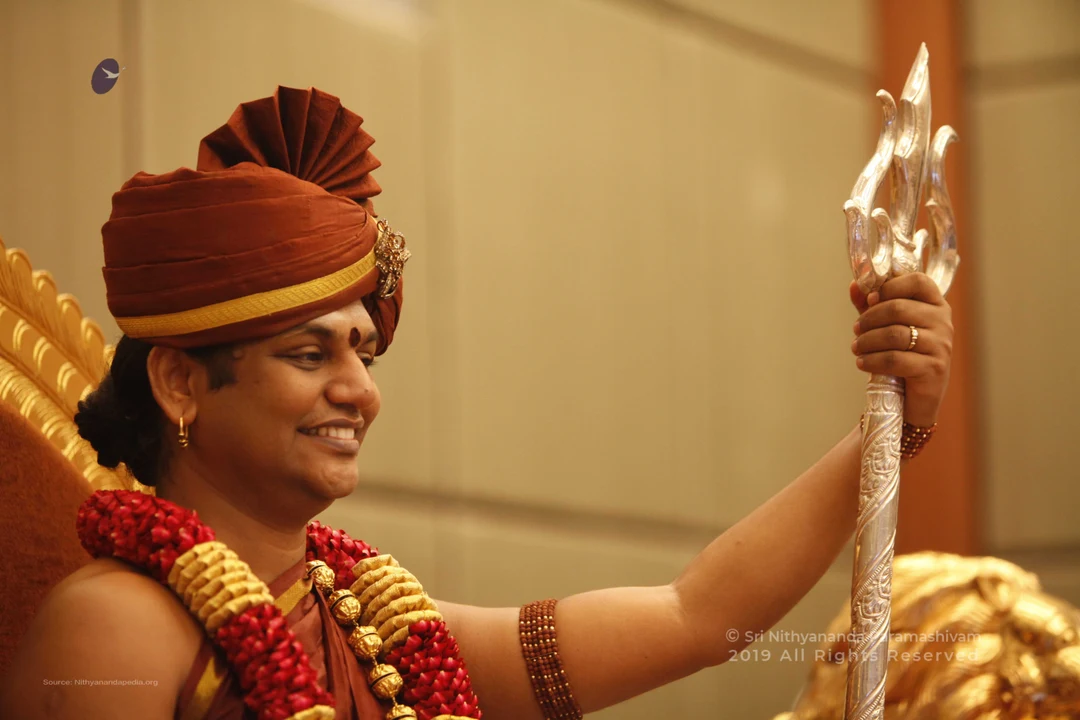
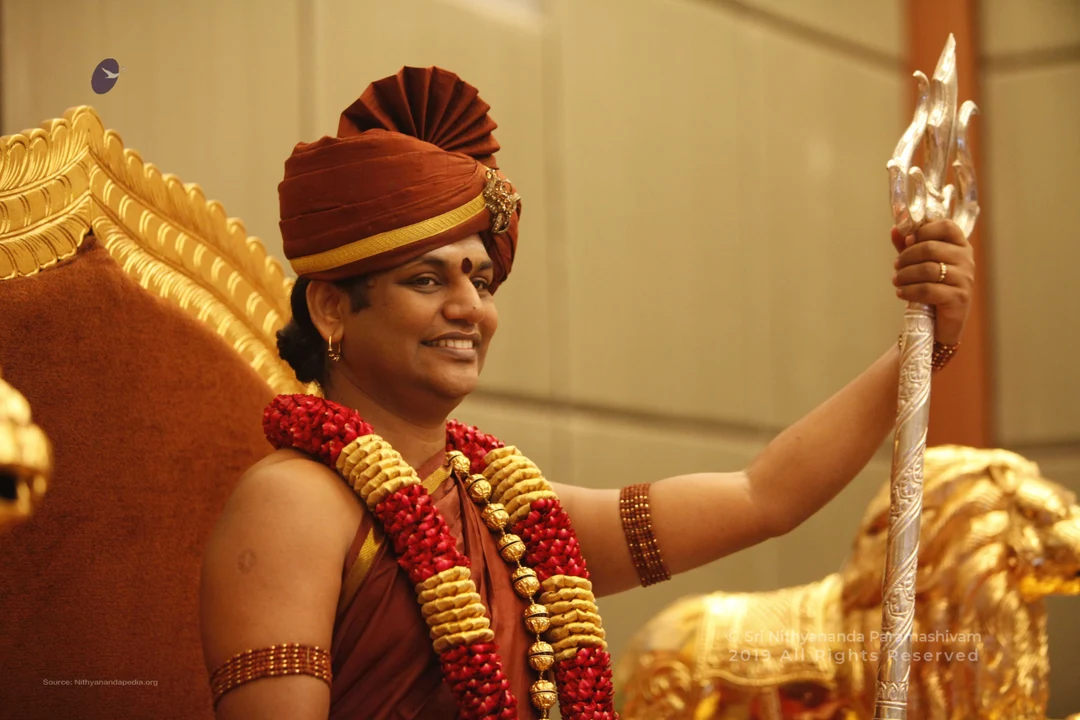
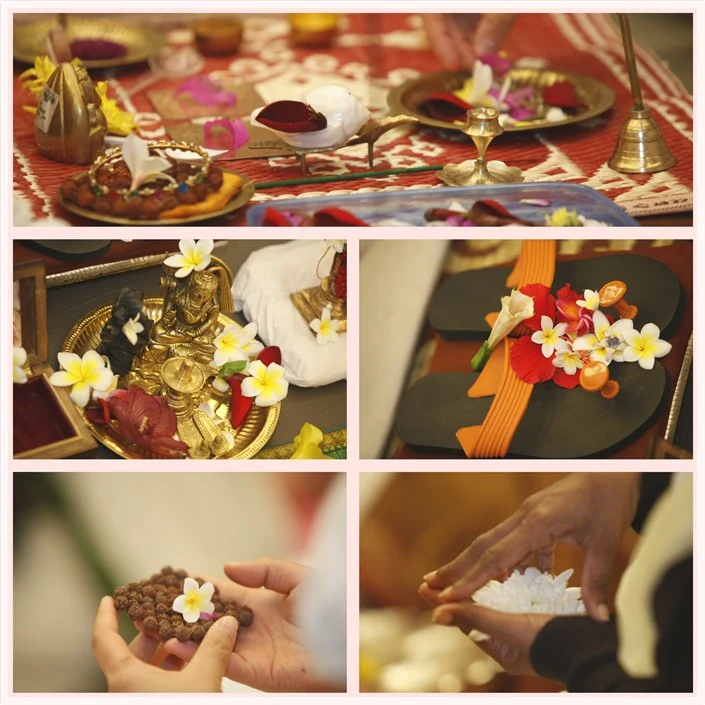
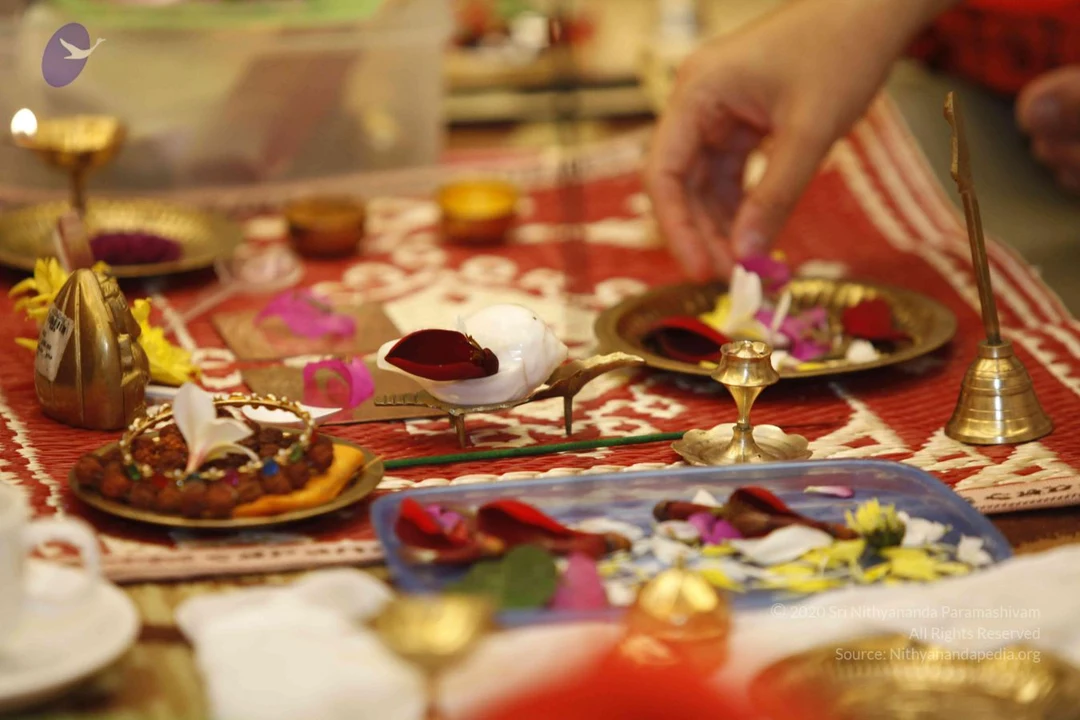
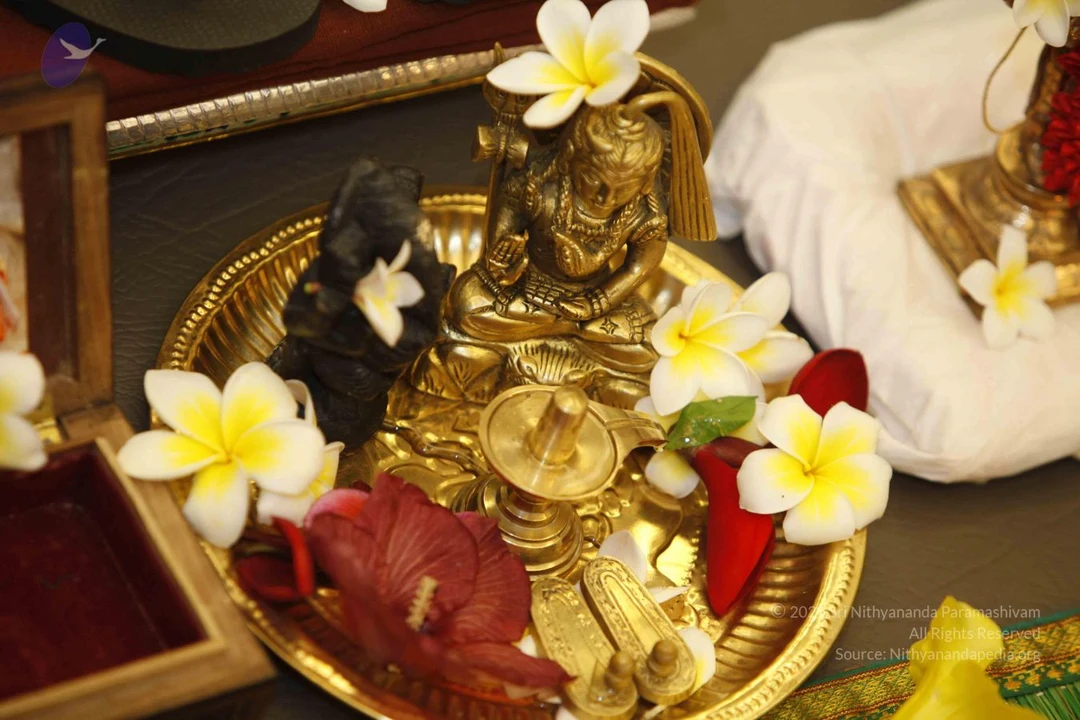
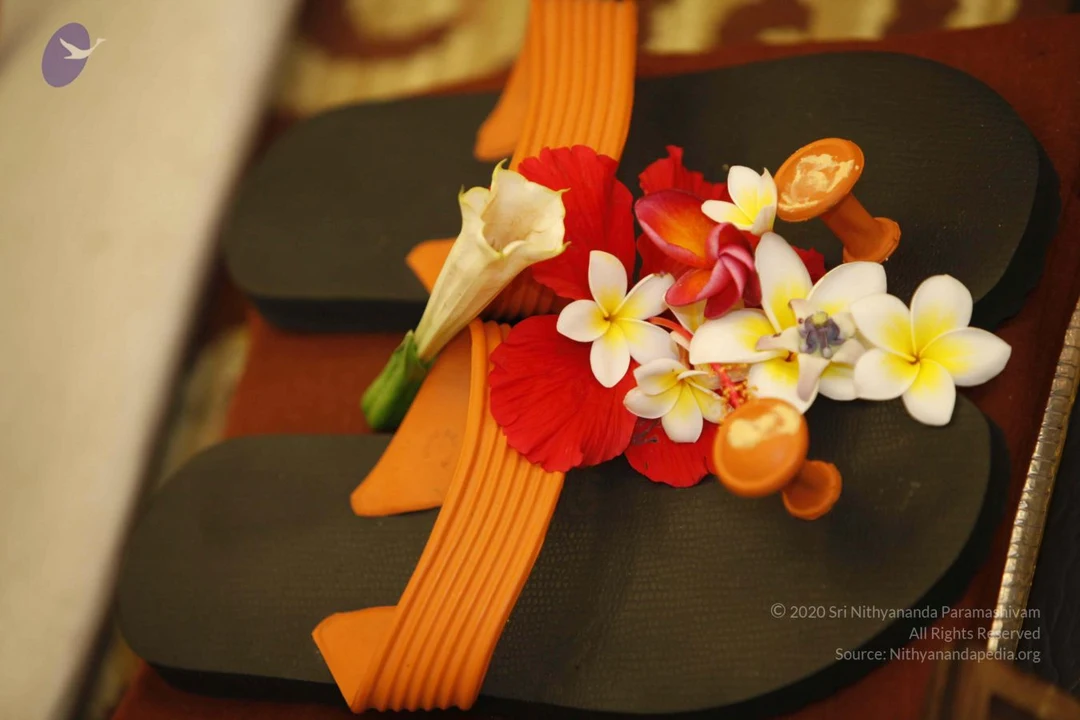
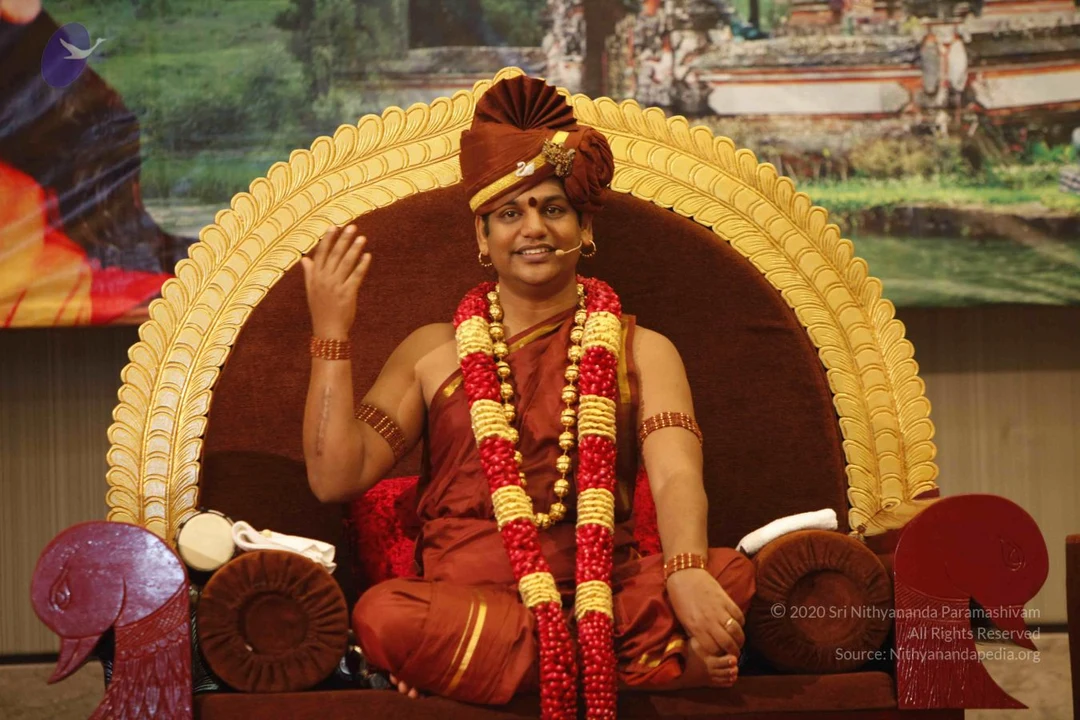
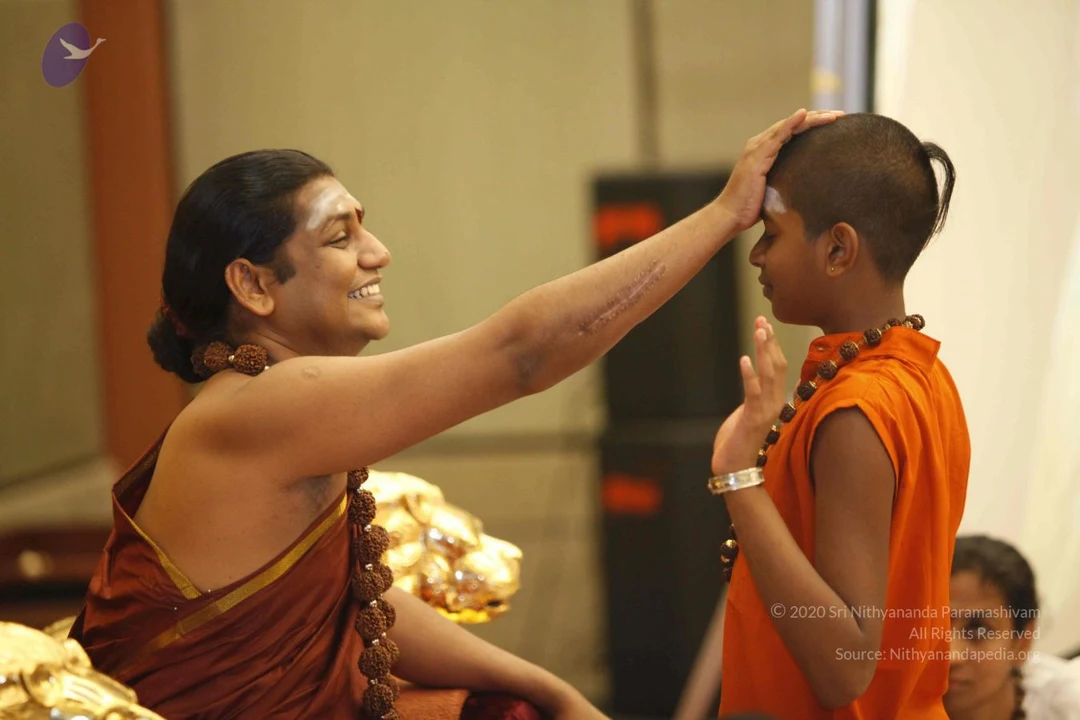
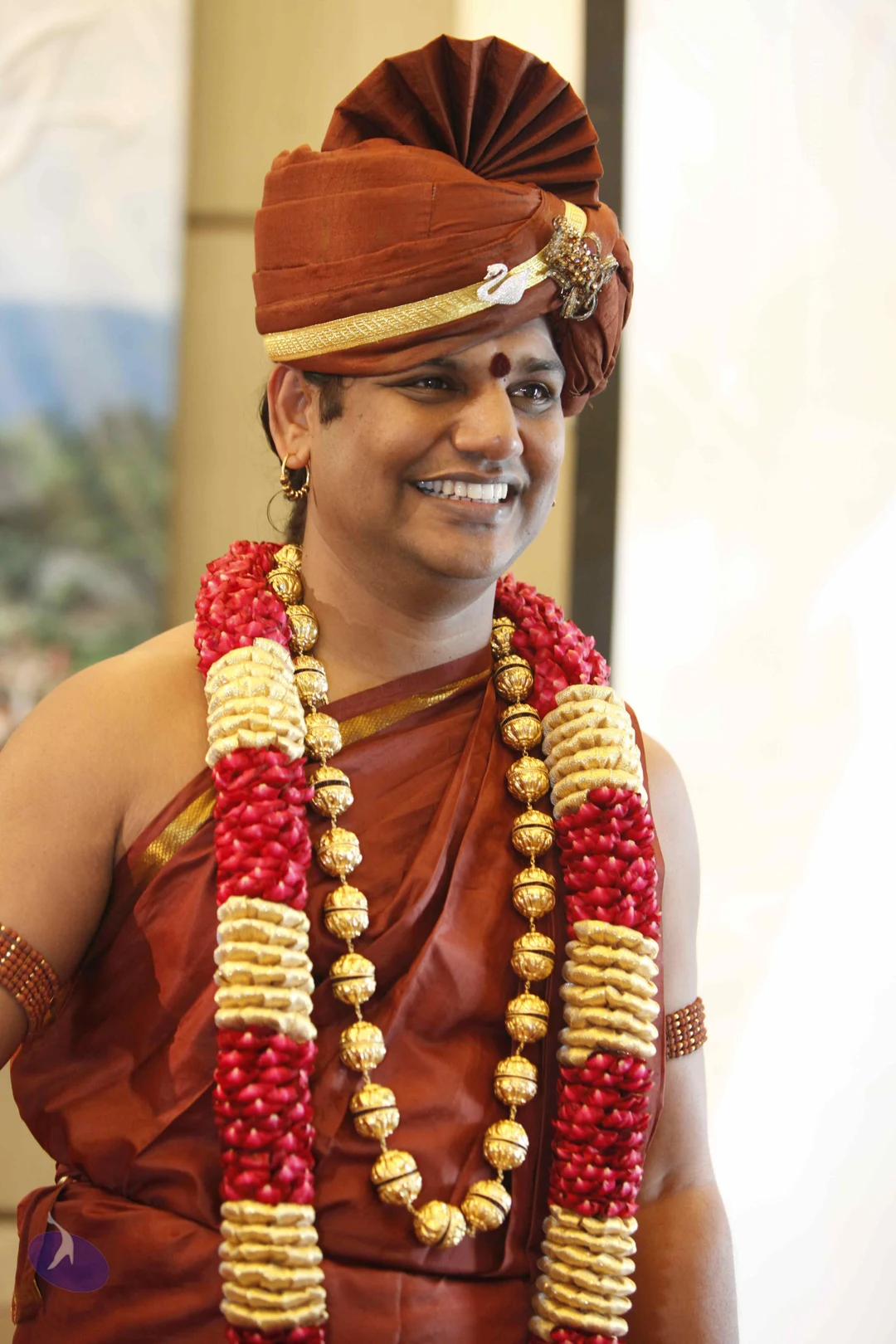
A four-panel photo collage of a yoga session in a carpeted hall with red chairs. Participants in black t-shirts and dark trousers perform yoga poses on grey and tan mats: some in forward bends with hands on the floor, one in a plank-like push-up pose, and others stretching with legs raised. The large lower panel shows dozens of people in a child's pose kneeling forward over their mats in rows. No person is clearly identified as the a person; the page label is not visual evidence.A smiling man sits on an ornate brown and gold throne with a carved golden backrest that has feather-like scrolls. He wears a maroon turban with a jewelled brooch, rust-brown robes, a garland of red and yellow flowers, and a heavy gold bead necklace with gold armlets. He holds a silver trident staff in his right hand. Behind him is a green painted backdrop of trees and a temple-like structure. a person: the figure has the ornate throne, trident, layered garland and maroon turban associated with his role, but the appearance is only partly distinctive, so the label is an appearance-based candidate. Count is one physical person.Close photo of a padapuja offering: a pair of bare feet resting on a silver tray filled with white lotus flowers, orange marigolds, yellow petals and green leaves. Red roses and a strand of gold beads are draped over the feet, and a red-and-gold garment edge is visible at the top right. Only the feet and offerings are visible; no full body or face appears in the frame.A smiling man seated on an ornate golden throne with carved gold panels and a deep red upholstered back. He wears a rust-orange turban with a gold-trimmed fold, a rust-orange cloth wrap, and layered garlands of red and gold beads with gold bead strands across his chest. He wears gold bangles on his upper arm and wrist, and a gold earring. He raises a tall silver trident in his right hand, with a ring on his finger. Beside him on the right is a large gold-coloured ornate object, and a backdrop with a painted scene is visible at the top left. a person: the figure is a bare-shouldered man in rust-orange turban, garlands and gold ornaments seated on a throne, matching the page's reference to a person at this event.A four-panel collage of padapuja-style ritual details, with no visible people's faces. Top: brass plates holding flower petals, a small brass bell and lamp, and a brass dish of sweets on a red patterned cloth. Upper left: a golden deity murti surrounded by white plumeria flowers, with a red hibiscus beside it. Upper right: a pair of black sandals decorated with orange ribbon, red and orange petals and white plumeria, arranged as an offering. Lower left: hands holding brown rudraksha beads with a single white flower. Lower right: hands holding white flower petals. No physical people are counted; the hands shown belong to unseen participants.A smiling man seated on a plush brown throne with gold trim, wearing a rust-orange turban with a gold-edged band and a matching orange-brown wrap over bare shoulders. He wears layered red and gold flower garlands, gold bangles on his upper arm and wrists, and a gold necklace. In his right hand he holds a tall silver trident (trishul) with ornate engraved shaft, while his left hand is raised in a gesture of speech. Behind him a gold-and-red decorated element is visible. a person (long-established ceremonial presentation: turban, garlands, trishul and throne), shown in person at a satsang setting; only one person is visible.

Pada-Puja

10 photosSource gallery
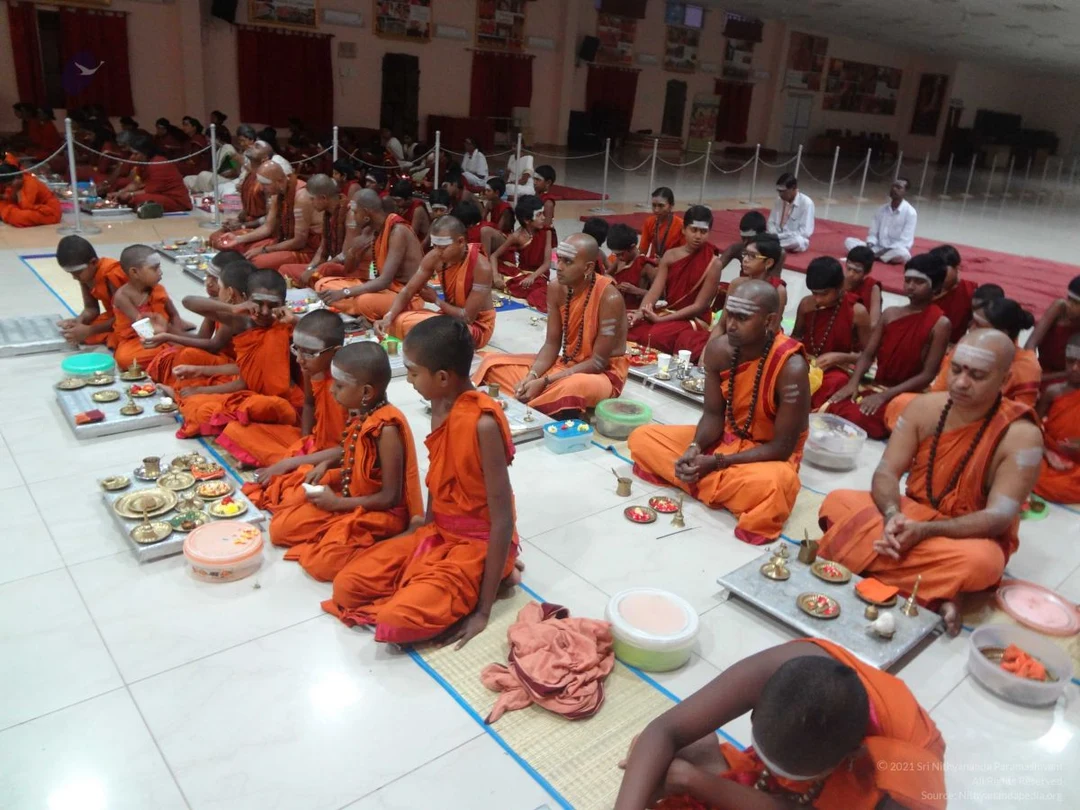
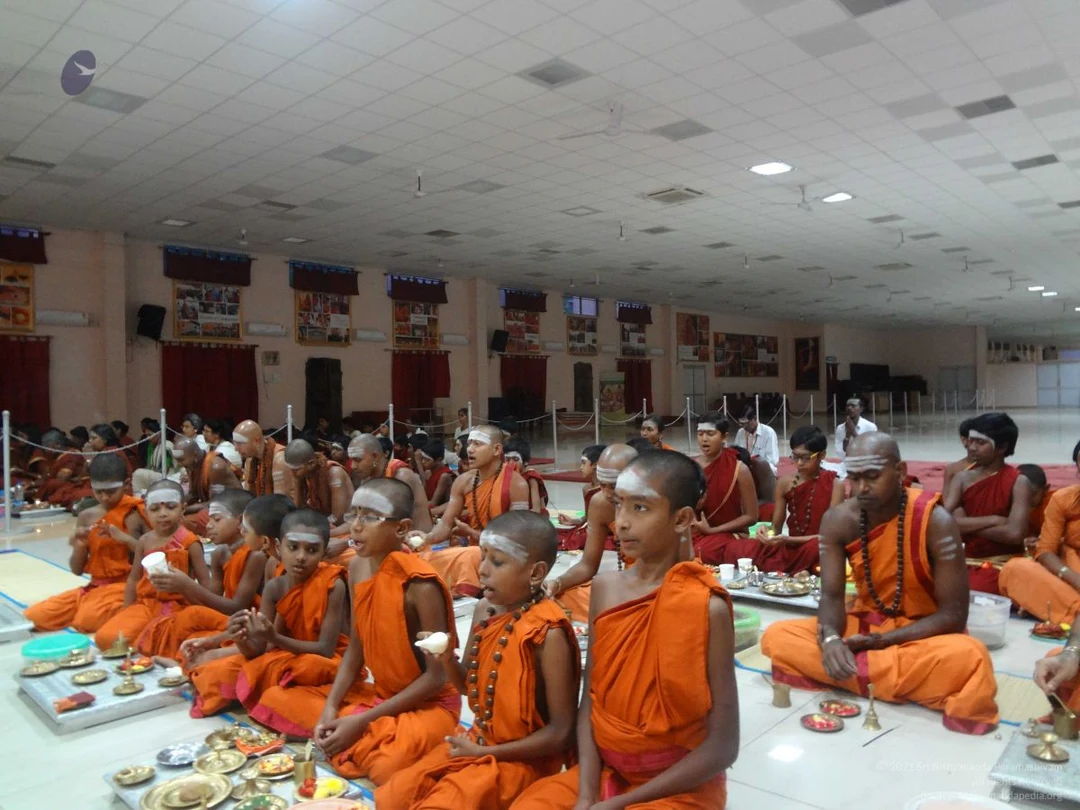
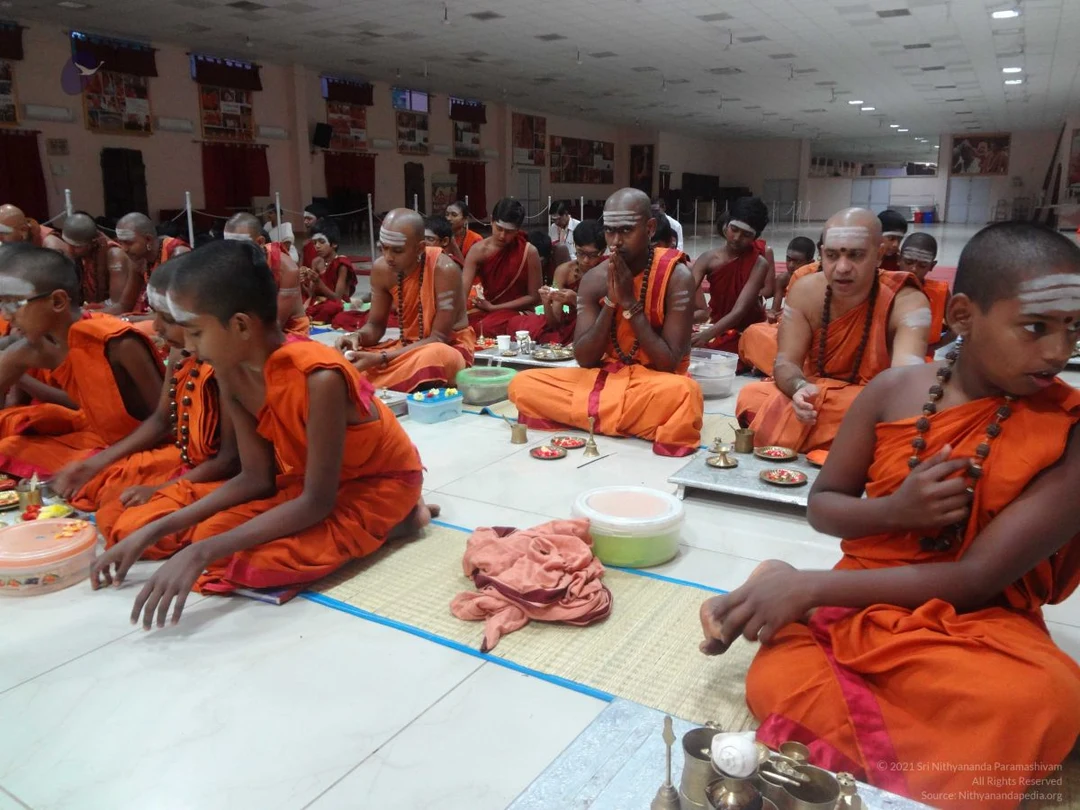
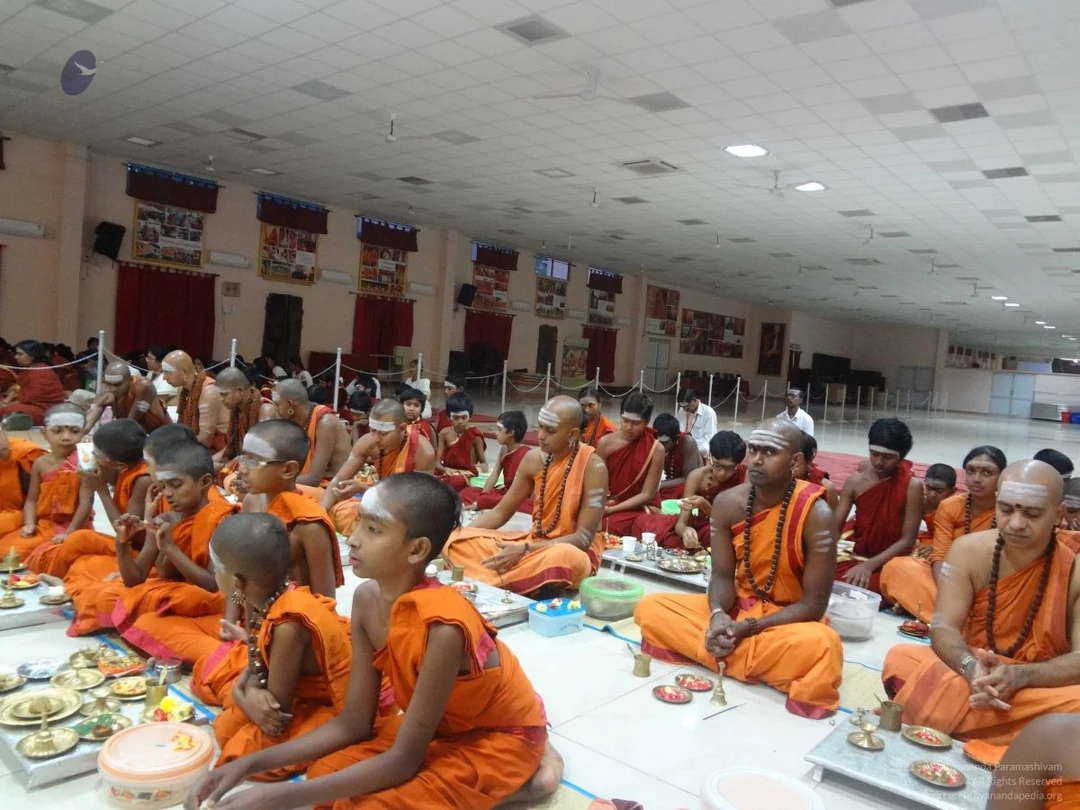
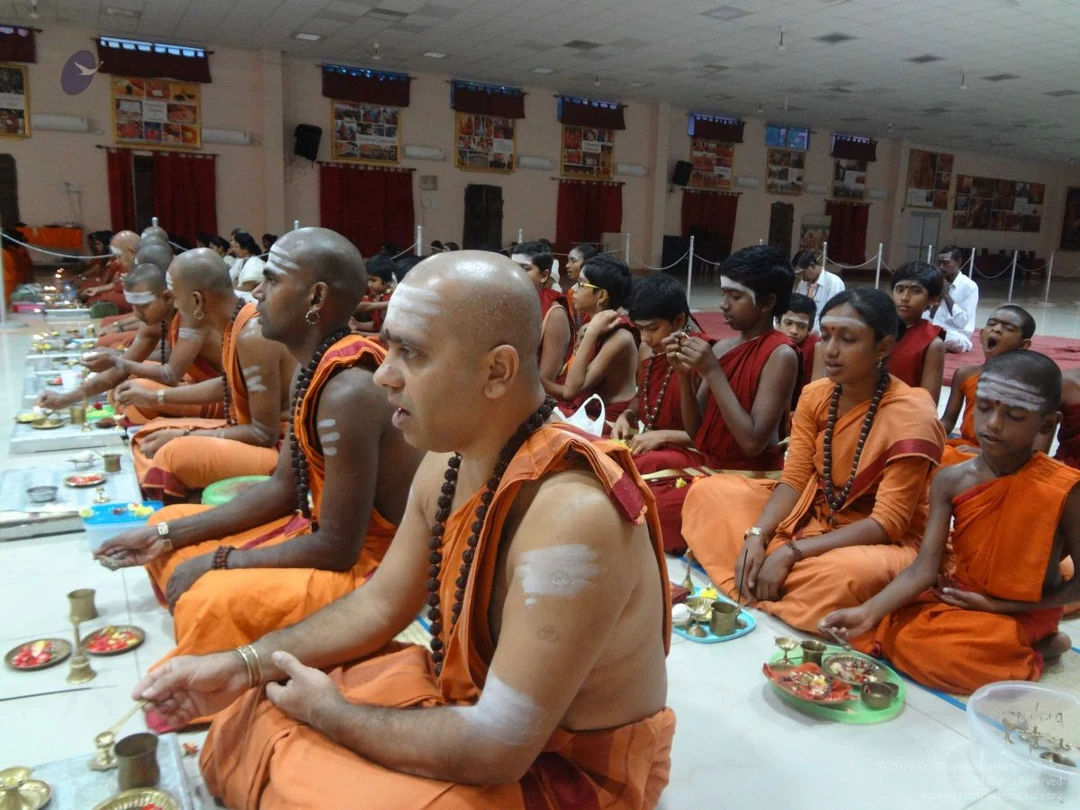
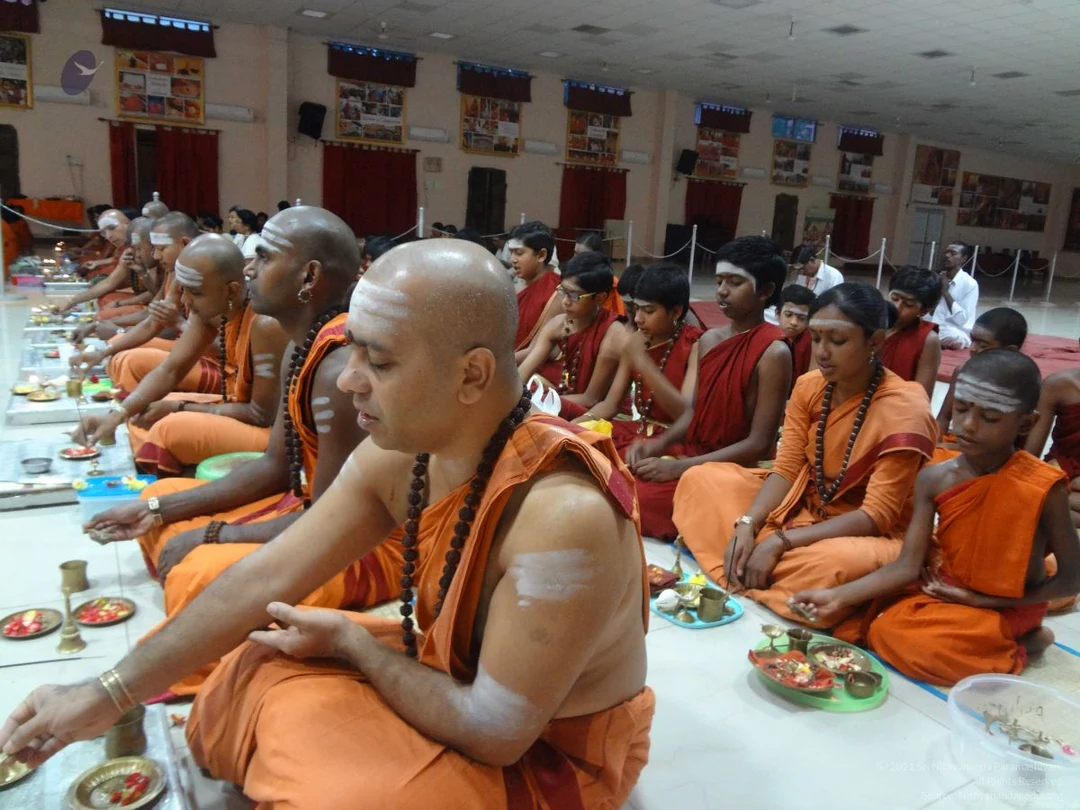
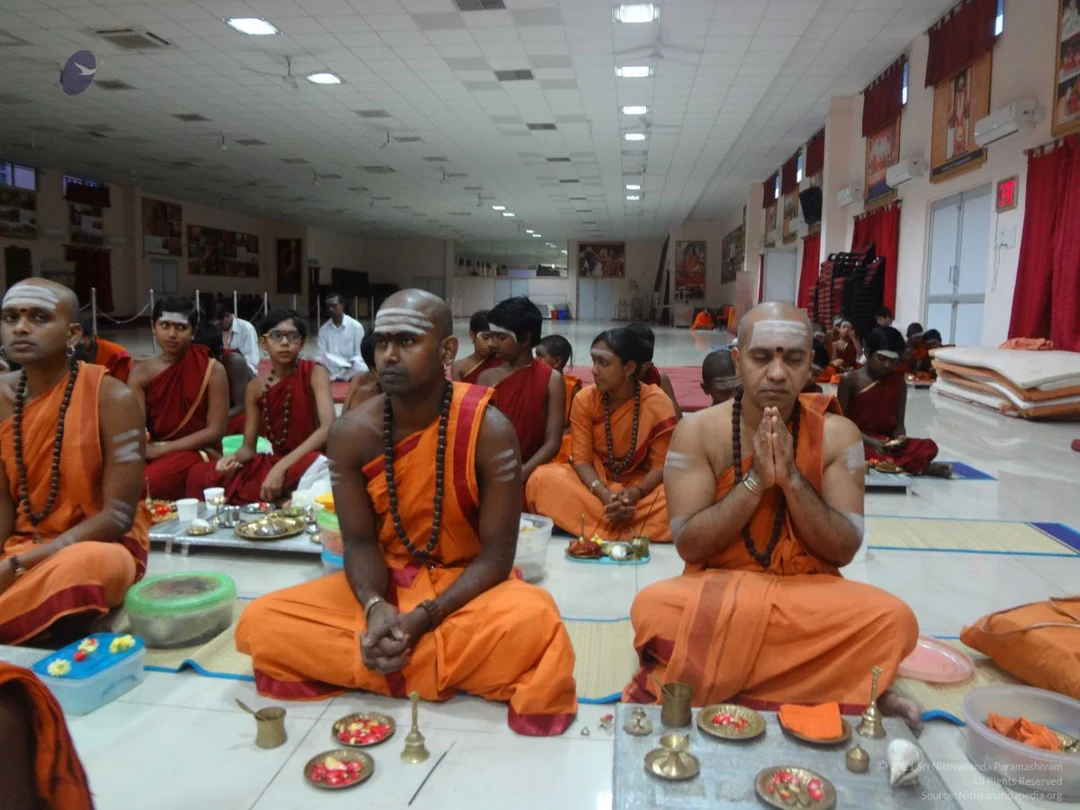
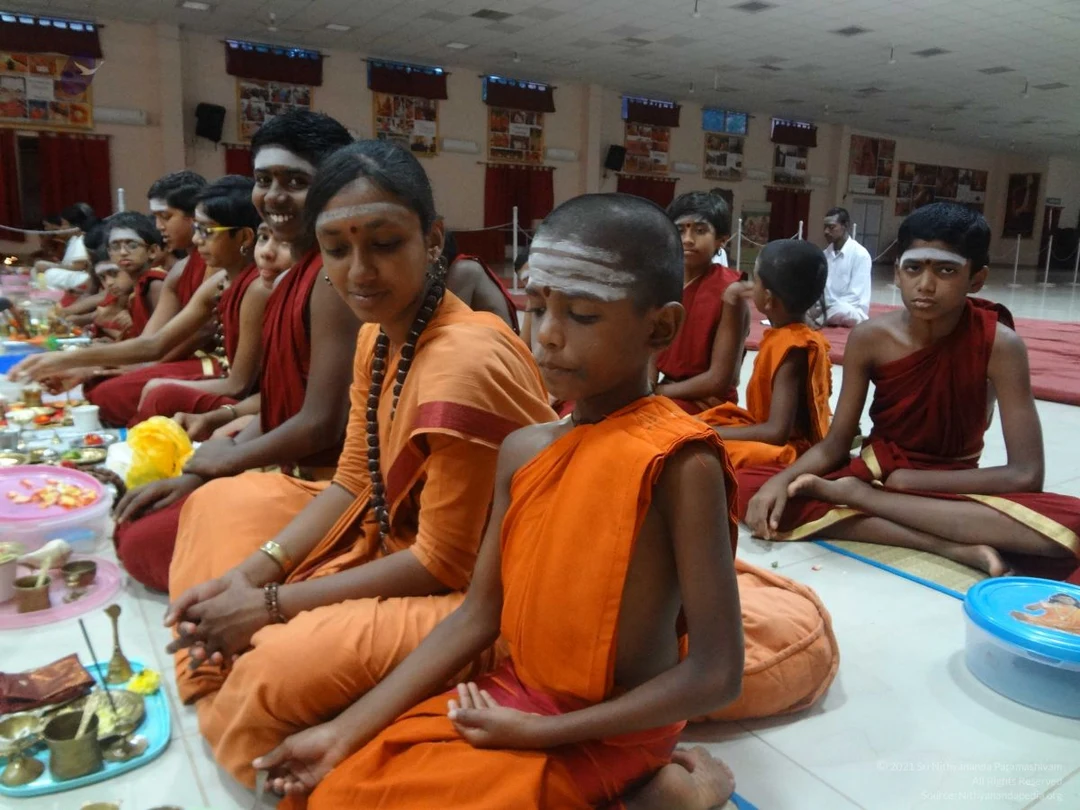
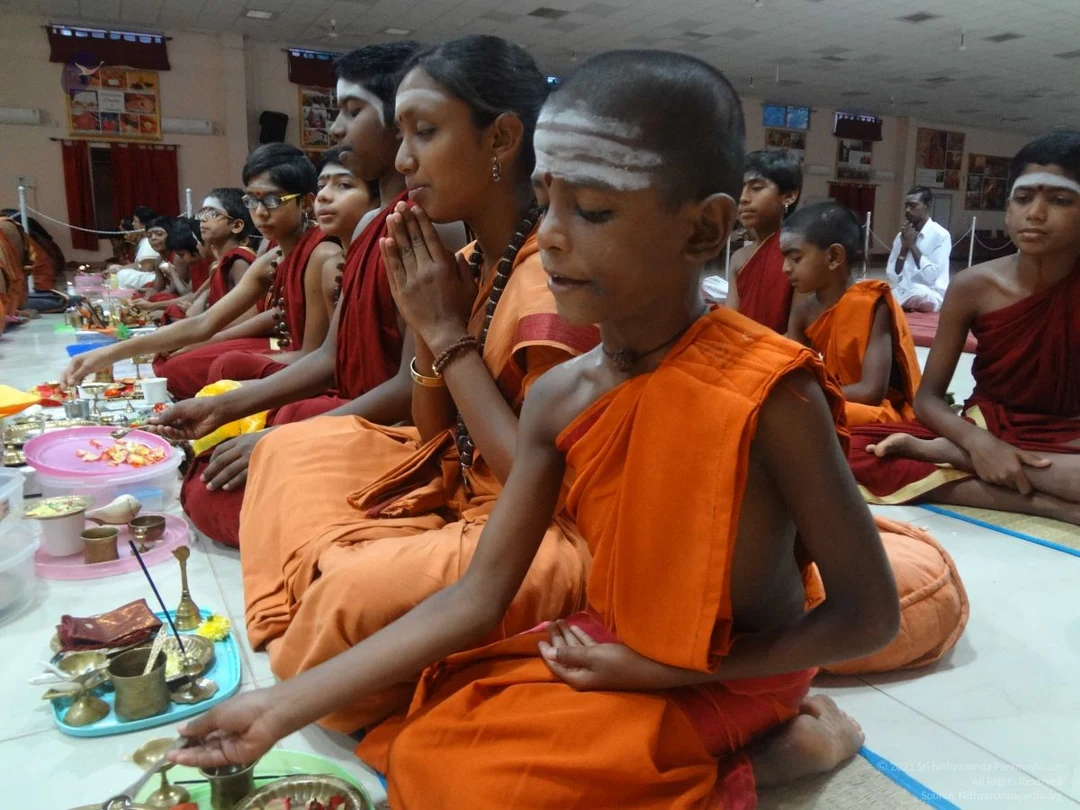
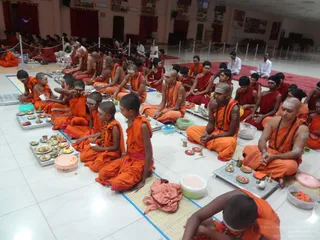
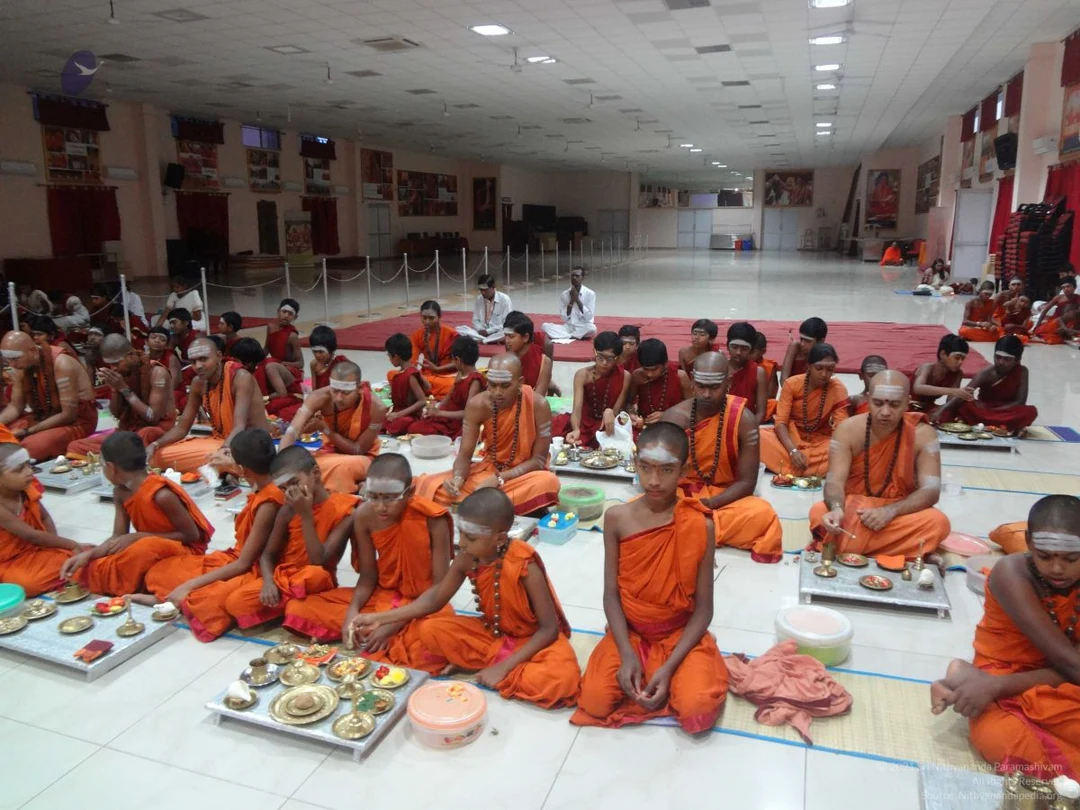
A large hall with cream walls, red curtains and framed pictures shows a seated group of young and adult sannyasis in saffron-orange robes with white tilak marks and rudraksha malas. Many sit cross-legged on mats, each before a brass puja plate holding small brass bowls, lamps, fruit and sweets, while others sit on a red mat at the back. Two men in white clothing sit near the middle of the hall. The scene looks like a ritual padapuja or group puja with offerings arranged in front of each participant. A rope barrier and tall posts run across the floor, and a few people stand at the right edge.Large hall with rows of young and adult monks in saffron-orange robes seated on the floor for a puja. Many have white tilak lines and rudraksha malas. Brass plates with lamps, bowls, flowers and offerings sit before them on low trays. A few men in white clothes sit near a red carpet at the far right, and more people in the background are seated in rows behind rope barriers. The walls show framed pictures and red drapes.A large indoor hall with tiled ceiling and fluorescent lights shows many saffron-robed monks and young novices seated cross-legged on the floor in rows, many with white vertical tilak markings on their foreheads and rudraksha malas around their necks. Brass plates with small oil lamps, bowls and offerings sit in front of them, and some hold small items in their hands. Along the walls hang framed banners and red curtains, and a man in white clothing stands at the right edge. The seated group numbers many dozens, so the count range is 21-100 or more; the visible crowd is best described as a sizable assembly of sannyasis and novices.Photograph of a large hall with a white tiled floor where many saffron-robed monks and young novices sit cross-legged on mats in rows, performing a puja. Several shaved-headed men wear orange robes, rudraksha malas and white tilak markings on their foreheads and arms; younger boys wear similar orange garments with white forehead marks. Brass bowls, small brass bells and trays of offerings with red-and-white items sit before them. A pink cloth lies on the floor, and red-curtained wall panels and framed images line the back wall. No single figure is clearly identifiable as a person from appearance, so the scene is described by roles only.A large hall with cream walls and red curtains holds a seated congregation of saffron-robed monks and boys during a padapuja-style ceremony. Foreground boys wear orange robes with white forehead markings, and several seated monks in orange and red robes wear rudraksha malas. Brass plates, cups and small bells are set on white cloths before them, with fruit and sweets on red-rimmed plates. Framed photographs hang on the back wall and ceiling fans and tube lights are visible. Sunny ceiling-lit space with many seated participants.A photograph of a large hall with rows of seated sannyasis and young disciples performing a ritual. In the foreground, a shaved-headed man in orange robes and rudraksha malas sits with white ash markings on his arms and forehead, hands raised in a mudra. Beside him, seated rows of orange-robed men and boys, some in red and orange cloth, hold brass bells and cups; metal plates with flowers, kumkum and offerings lie on mats in front. Red curtains and framed banners line the walls behind them, with people in white standing near the back. Printed text on the photo reads Bali Inner Awakening Day.

Temple

7 photosSource gallery
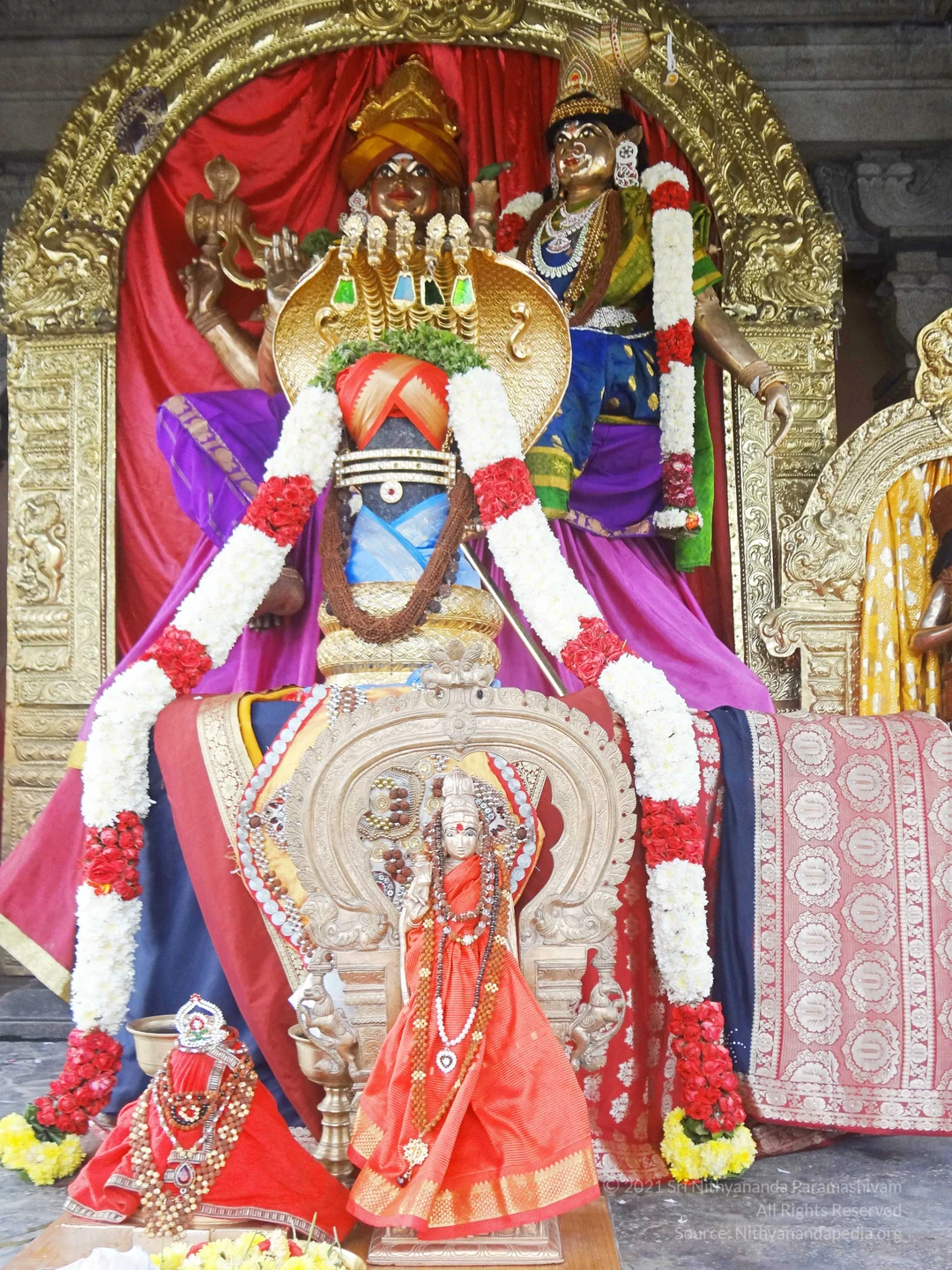
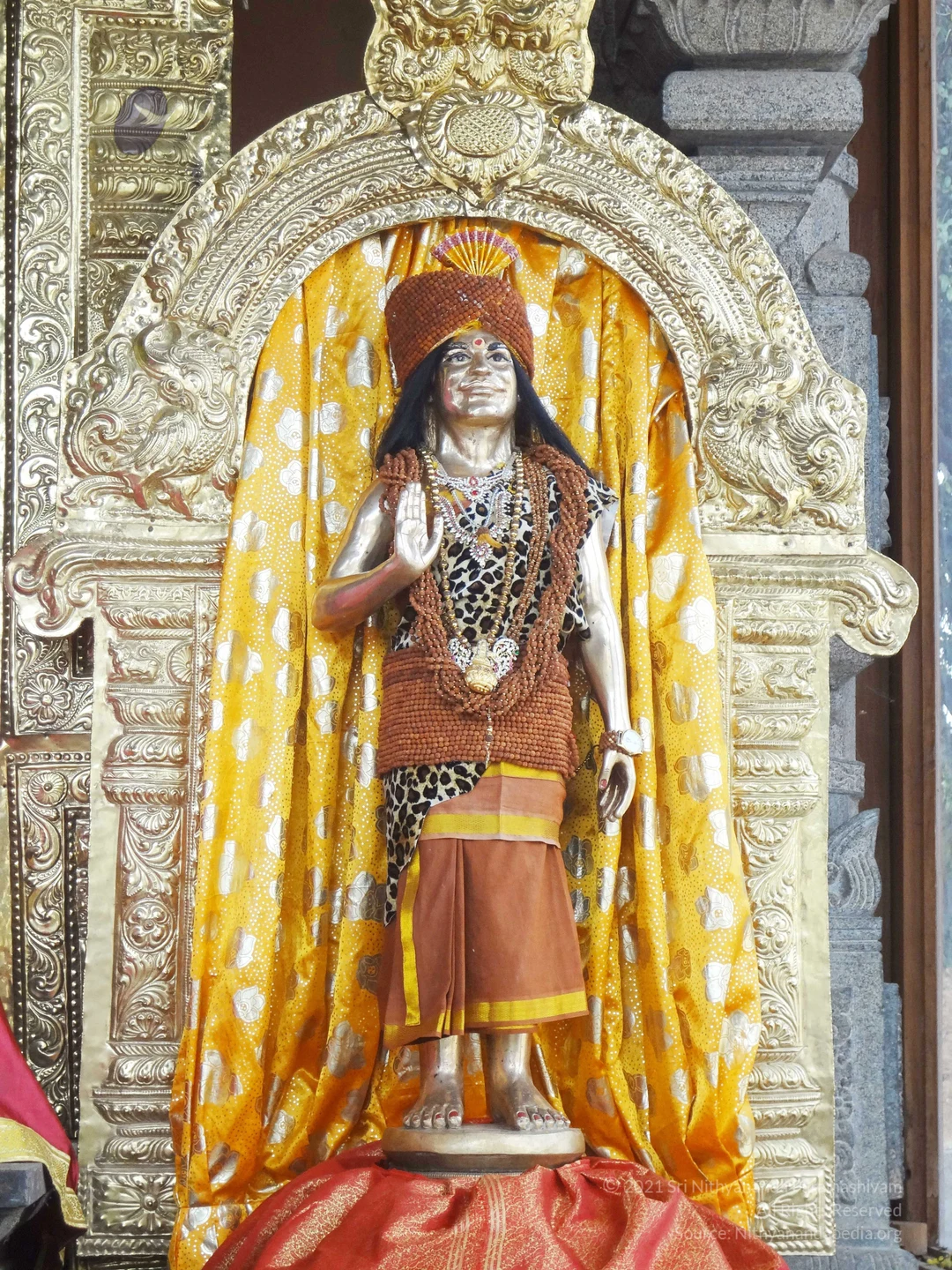
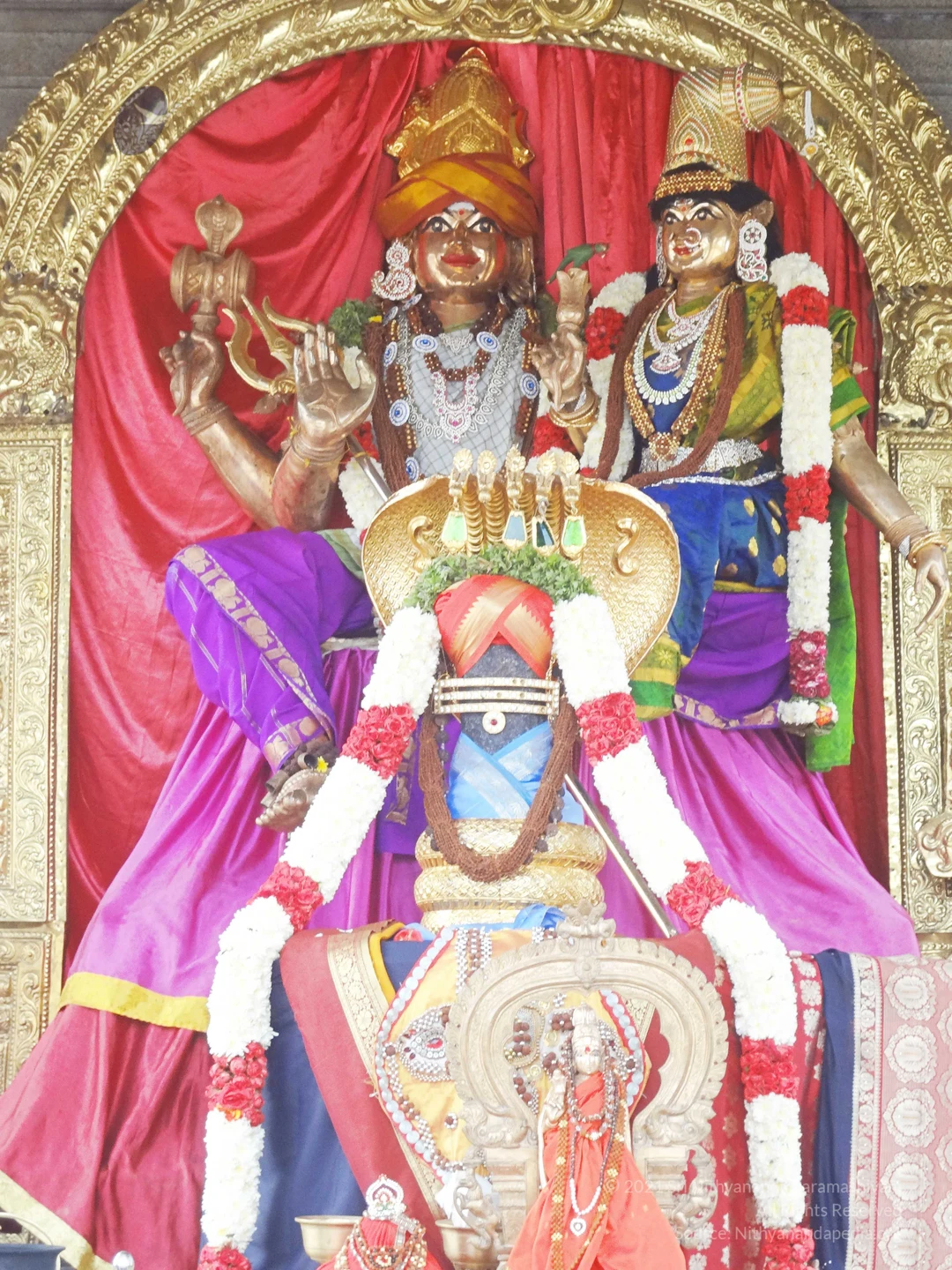
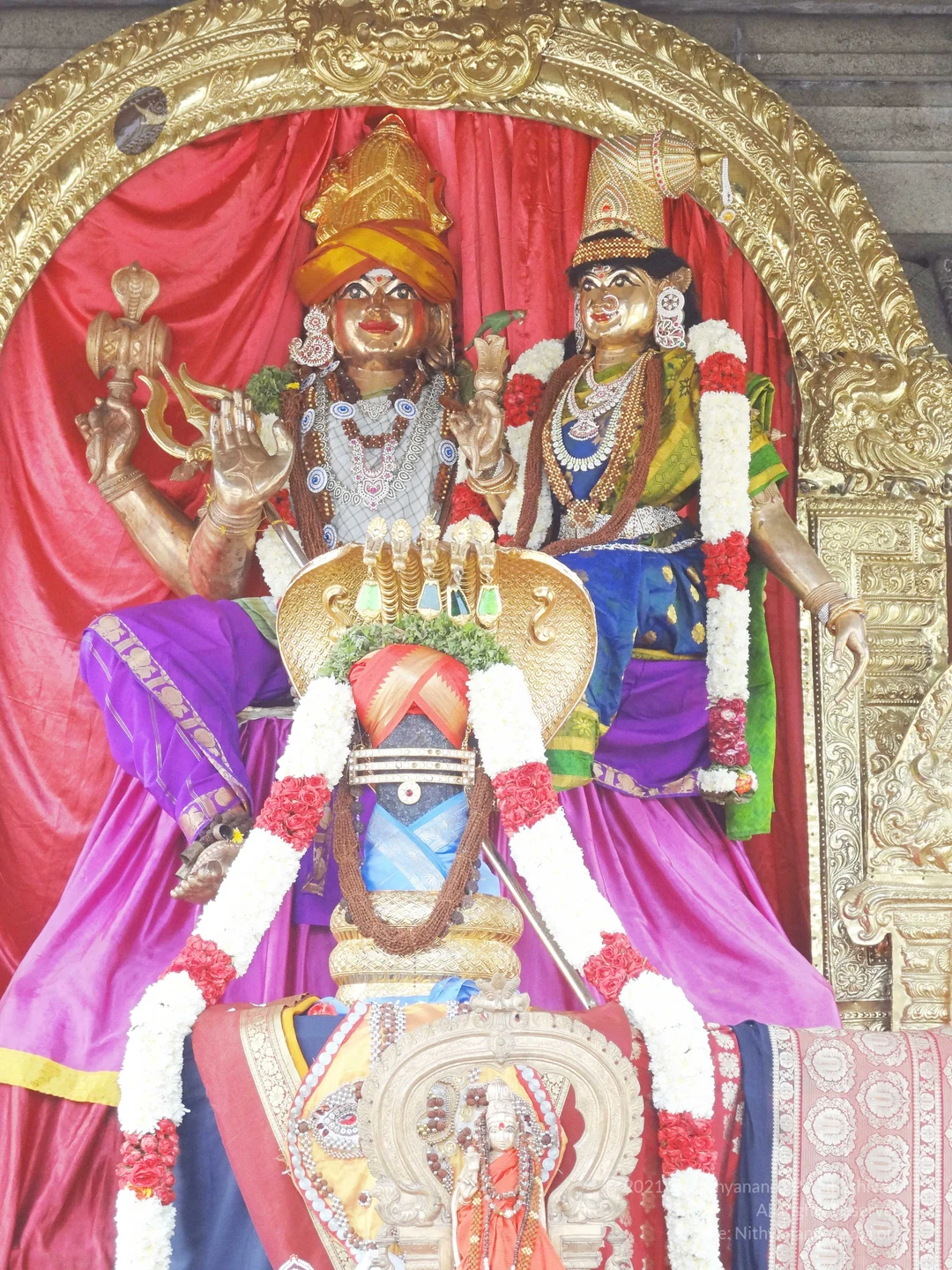
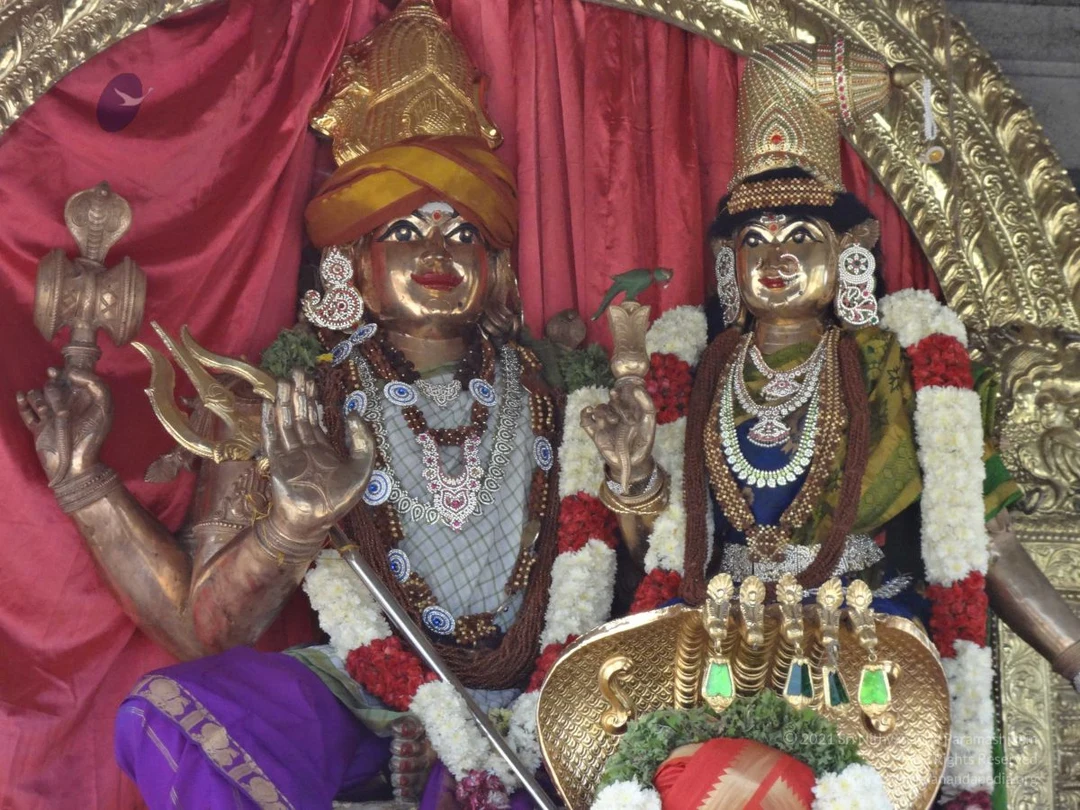
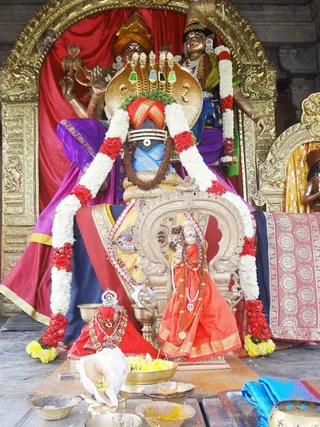
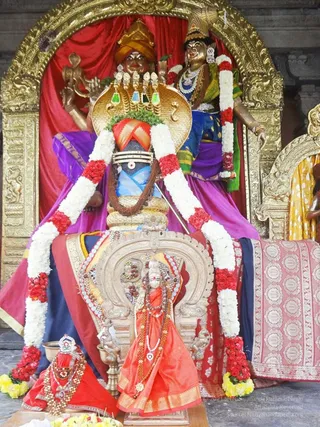
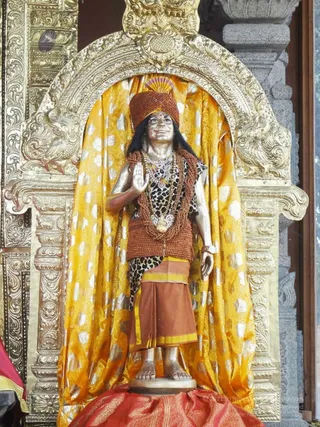
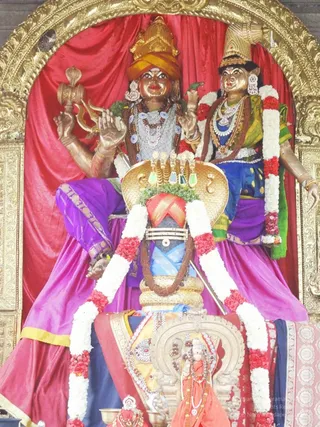
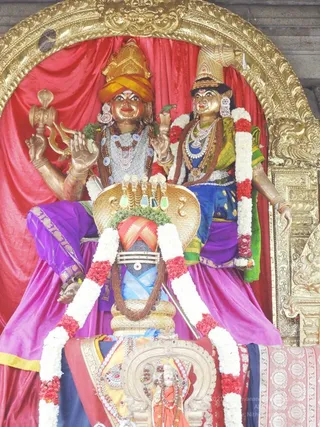
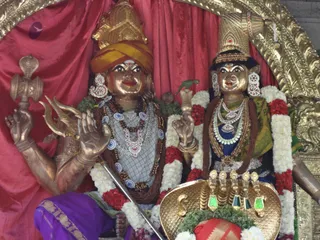
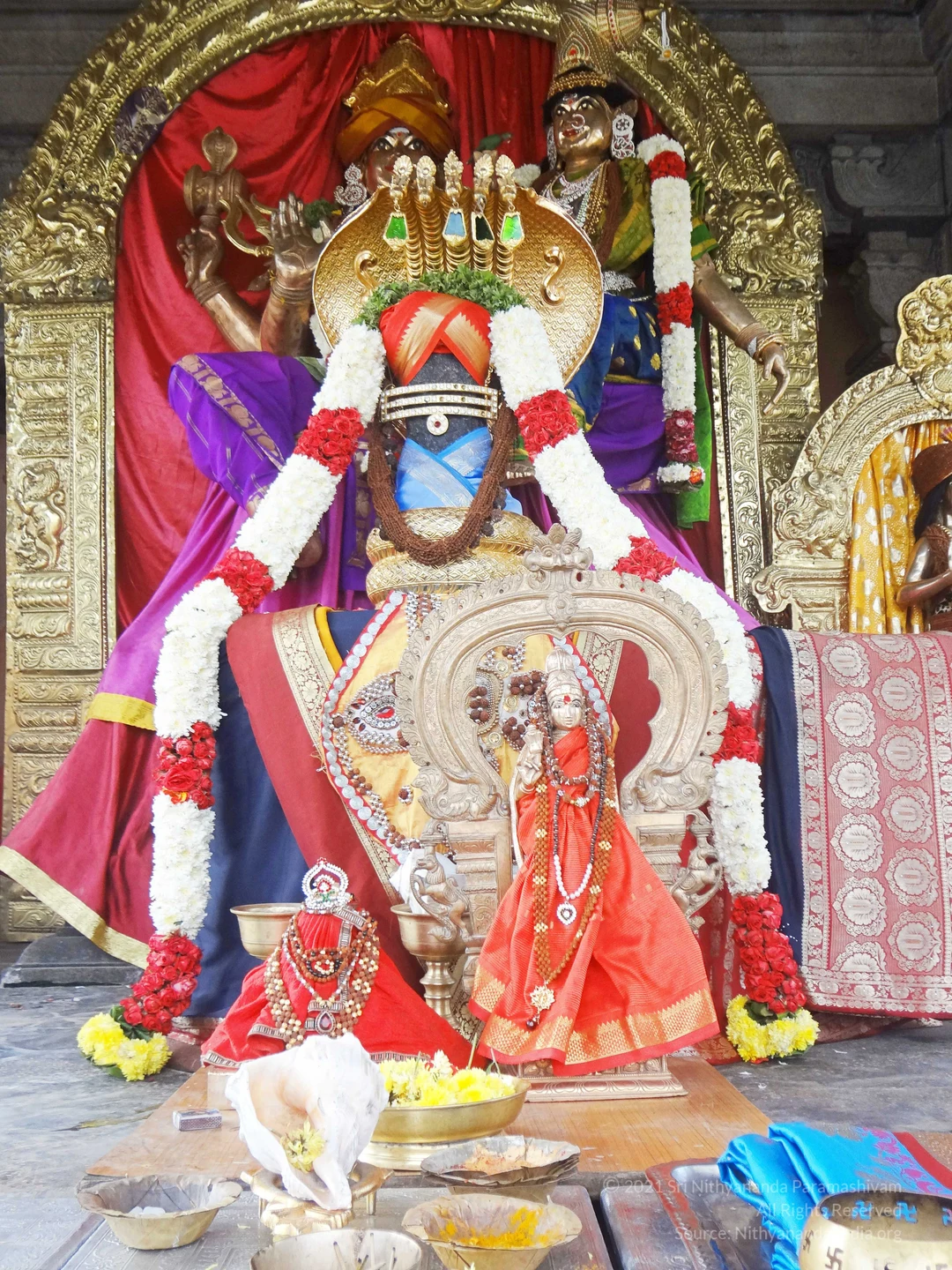
A decorated deity murti is seated on a golden throne in a temple shrine, with a dark stone face, red and orange turban-like headdress, blue garment and a brown rudraksha-style necklace. Garlands of white jasmine and red roses hang from its shoulders. Behind it stand two golden metal figures with ornate crowns, earrings and necklaces, and a red velvet curtain frames the arch. In front, a smaller red-and-gold clad metal figure stands beside a bronze lamp, with brass bowls of yellow flowers, petals and offerings laid on the wooden altar and a blue cloth at the lower right. No living people are visible.A decorated deity murti, a dark stone form wrapped in a blue cloth and a red-and-gold turban with a green leafy crown, sits on a golden throne-like seat backed by a red and purple drape. White jasmine and red rose garlands hang from its shoulders to the floor. Behind it, two gilded standing figures in ornate crowns and jewellery flank the altar, and a seated female figure in a red sari and bead garlands sits in front. A golden arched frame surrounds the shrine, with a brocade cloth draped to the right. No living people are visible.A standing statue, not a living person, of a long-haired figure with a red-brown rudraksha-bead turban topped by a fan-shaped ornament and a red tilak on the forehead. The figure wears a leopard-print garment under a thick brown rudraksha mala vest, layered beaded necklaces, a large pendant, and a brown dhoti with yellow border, and raises one hand in blessing. The statue stands in a niche framed by ornate gold-toned metal arch work, draped with a yellow silk cloth printed with silver motifs, and a red cloth sits at its base.A photograph of a shrine in a gilded arched niche with red drapery, showing a large deity murti of a four-armed male figure with a golden crown, holding a trident and a snake-topped staff, adorned with rudraksha beads and jewelry, beside a female figure in green and blue robes with silver jewelry. In front is a dark stone linga draped in a red and white cloth, crowned with greenery and garlanded with white jasmine and red flower strands. Below stands a small figure in orange robes and beads, with brass lamps and offerings at the base. No living people are visible.Golden murti of a deity pair seated on a throne-like dais before red draped cloth within an ornate gold arch. The male figure wears an orange-yellow turban and a rudraksha mala, holds a trident and a small drum-like object, and is adorned with white and red flower garlands. The female figure beside him wears a green and blue sari, layered silver and gold necklaces and a crown. In front, a shivalinga-like form draped in blue cloth and a garland sits on a golden pedestal, with a small red-robed figure in the lower foreground. No living people are visible.Golden metal statues of a deity couple seated on a golden throne before red drapery, decorated with white and red flower garlands. The male figure wears a golden crown and orange-gold turban, holds a trident and a cobra-topped staff, and wears rudraksha malas with white beaded necklaces. The female figure wears a gold crown, green and gold sari, layered jewelled necklaces and green-stoned gold armlets, with a green parrot perched above. The statues are framed by an ornate gilded arch; this is a deity murti display, with no physical people visible.

IA-YOGA

19 photosSource gallery
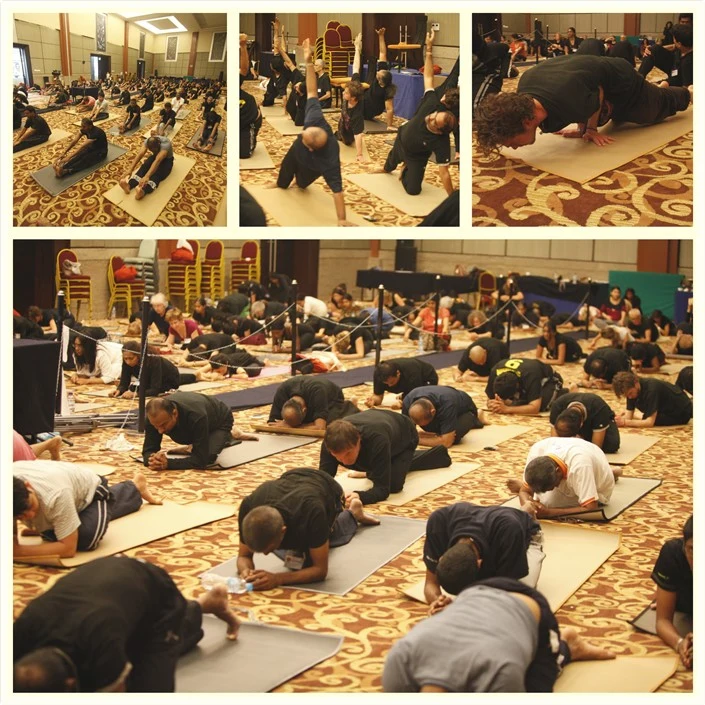
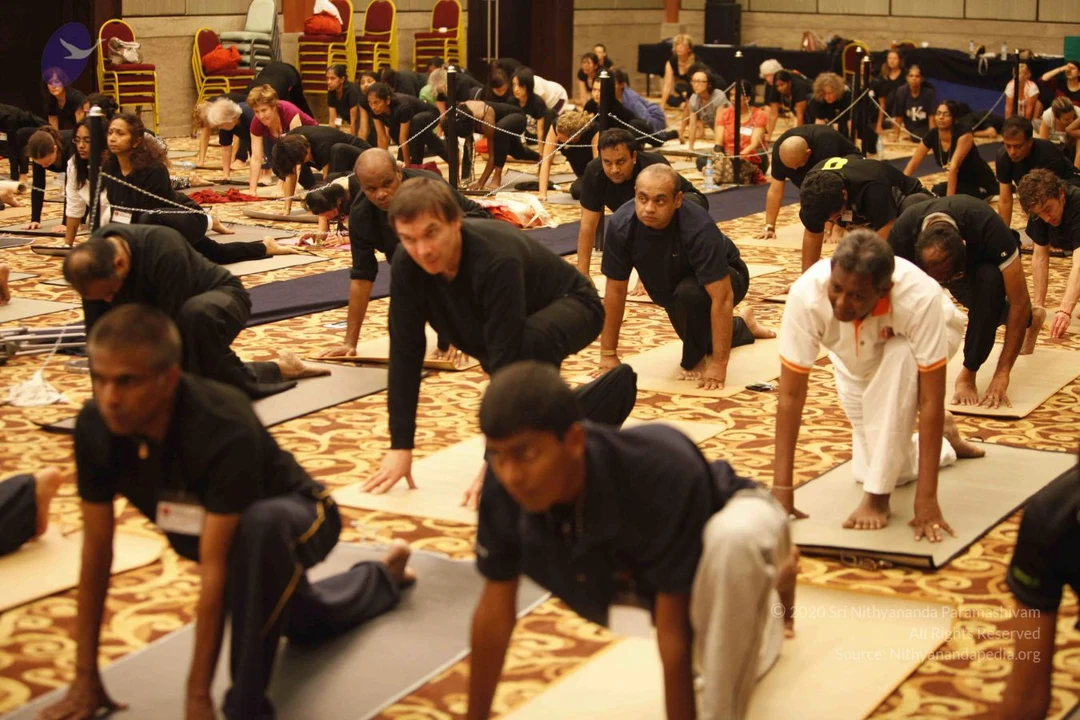
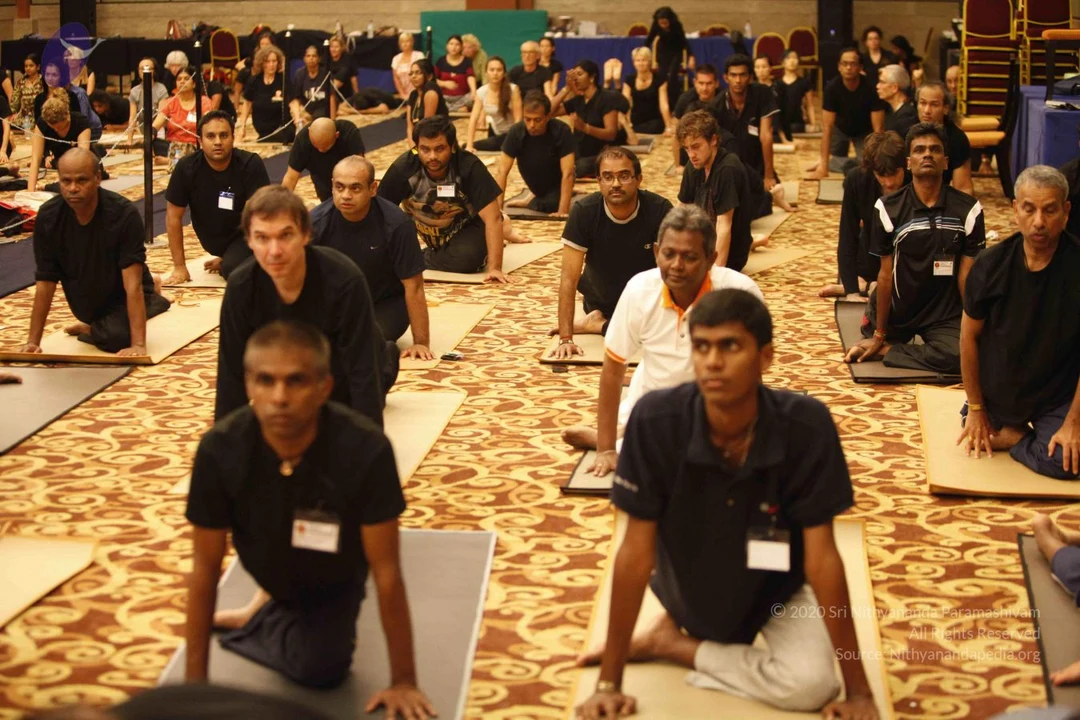
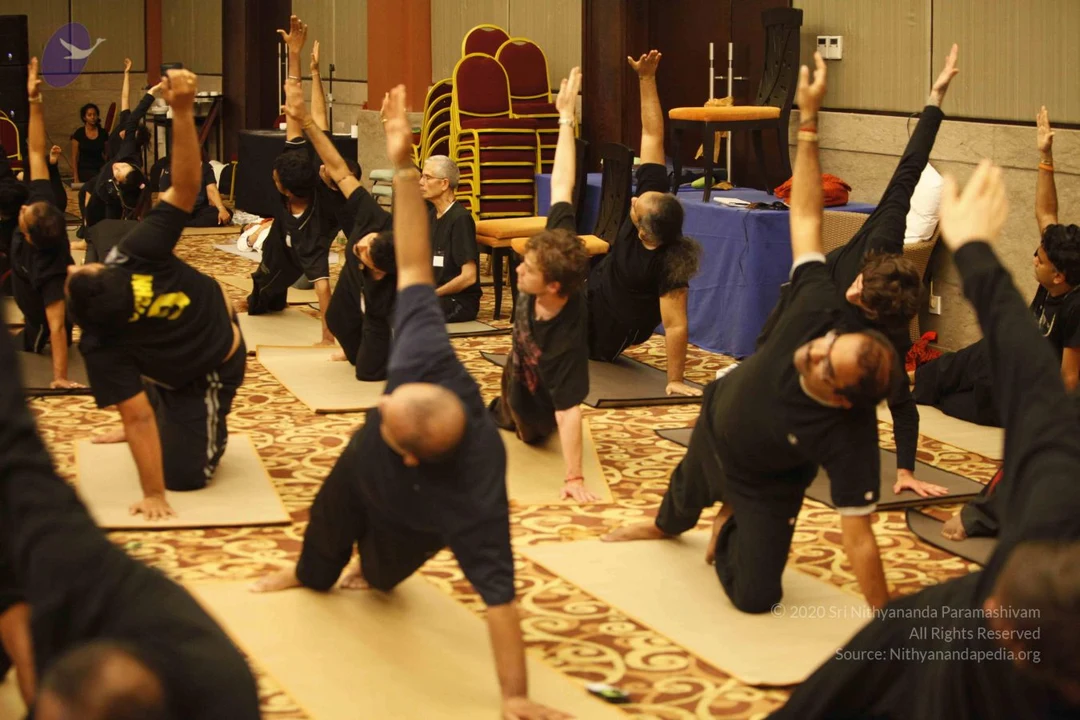
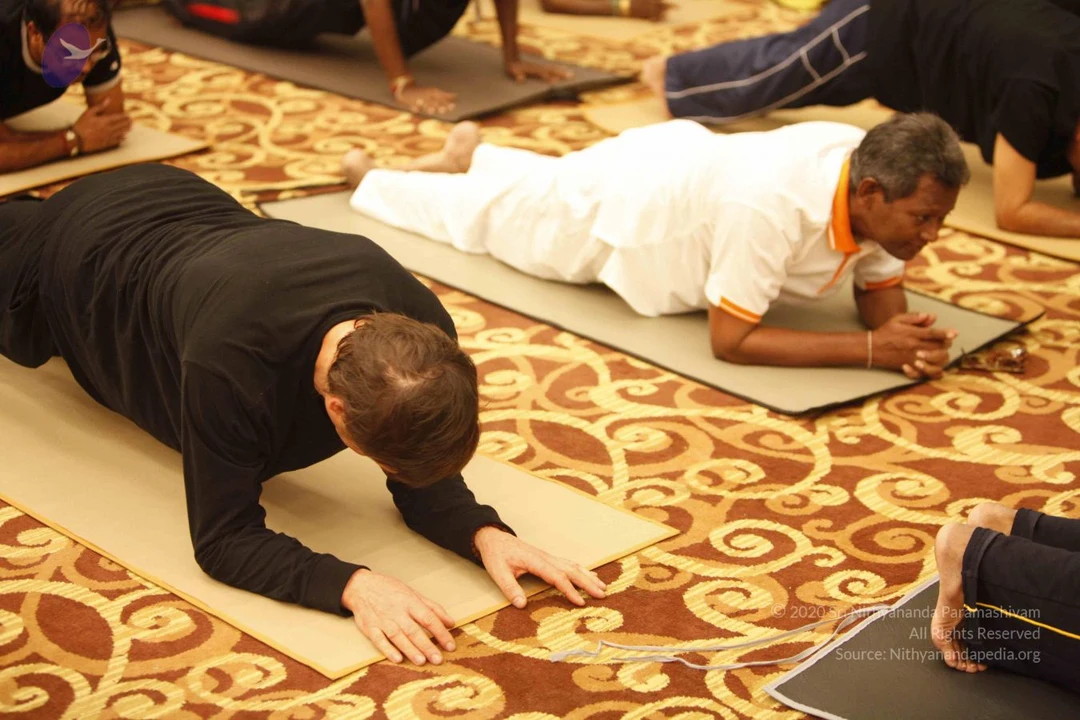
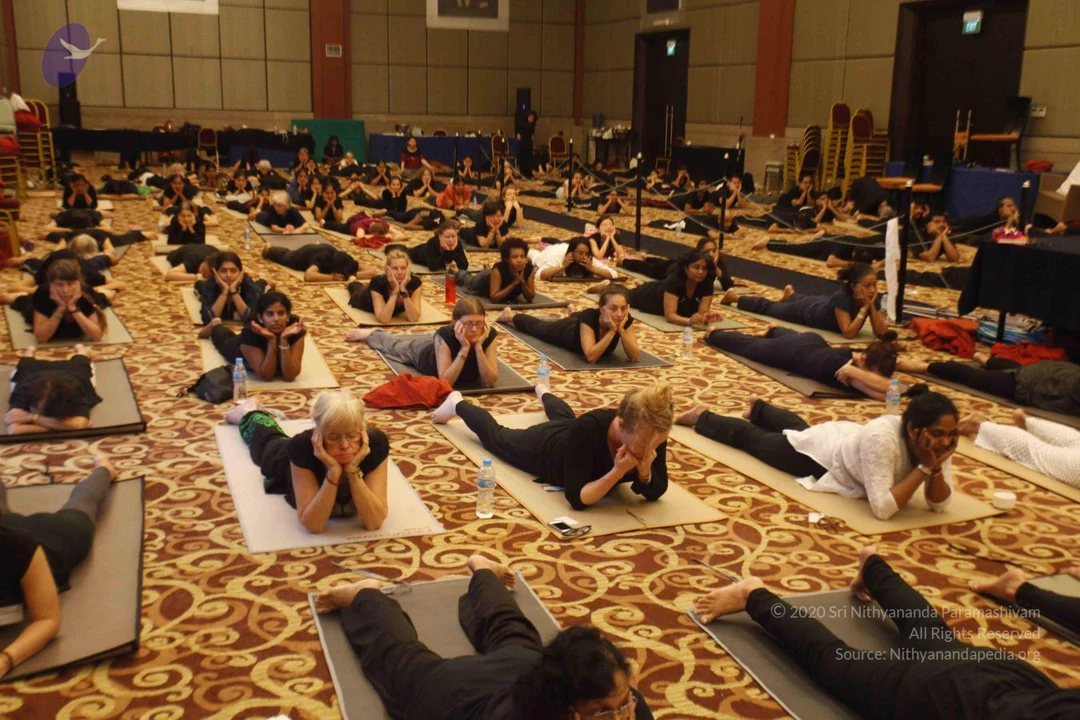
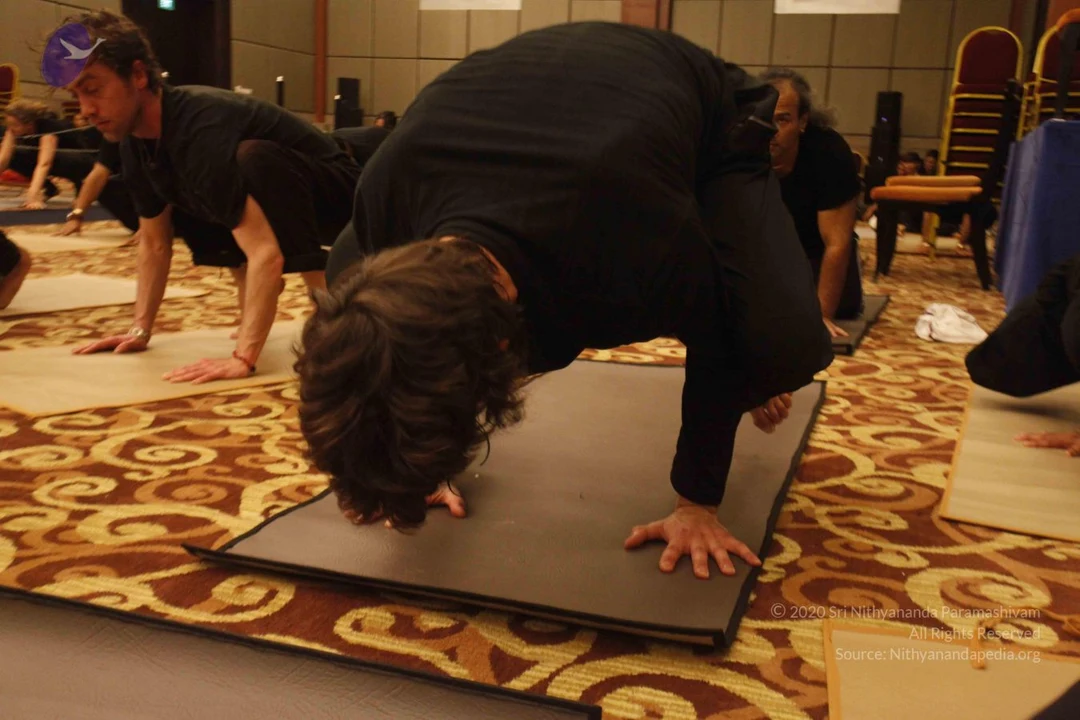
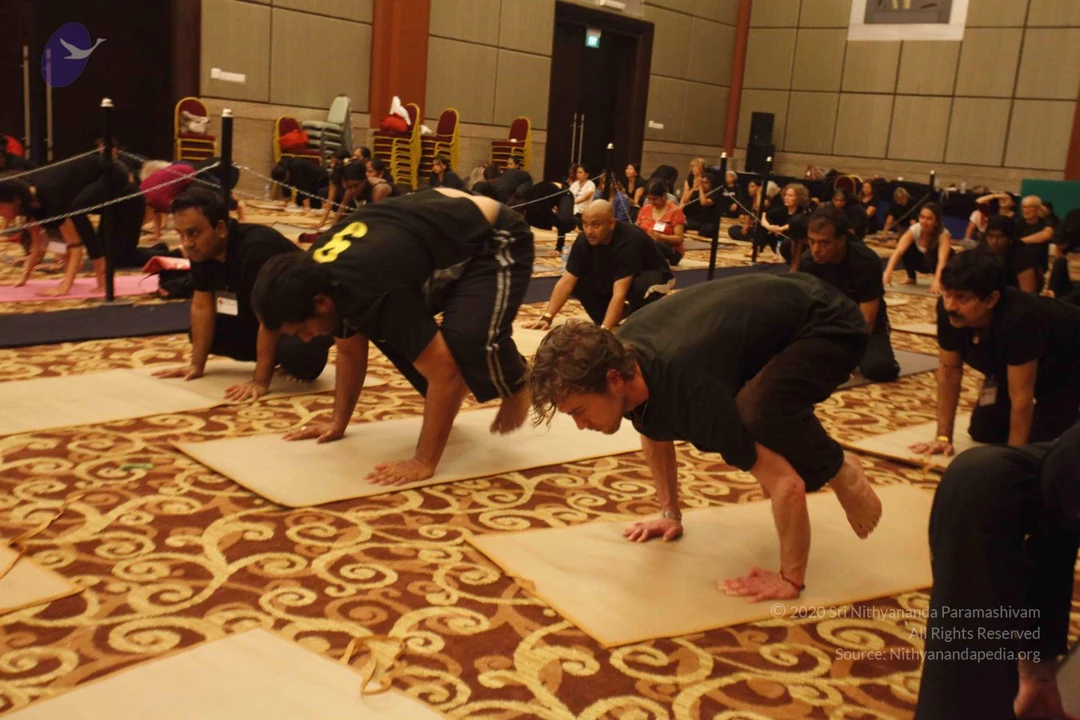
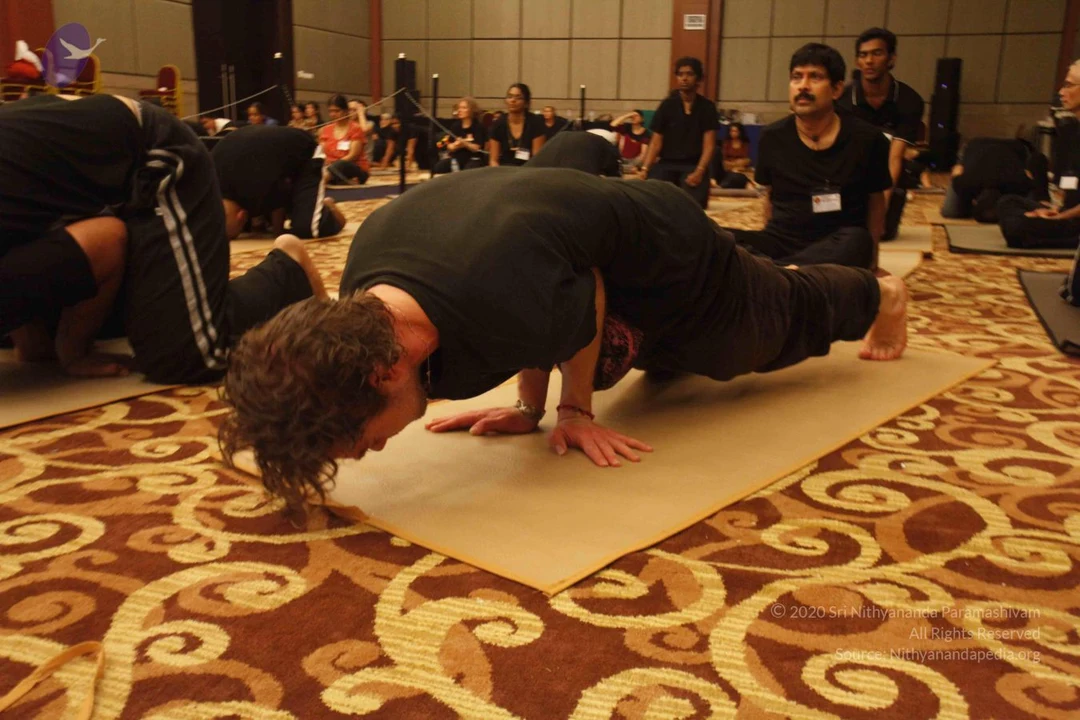
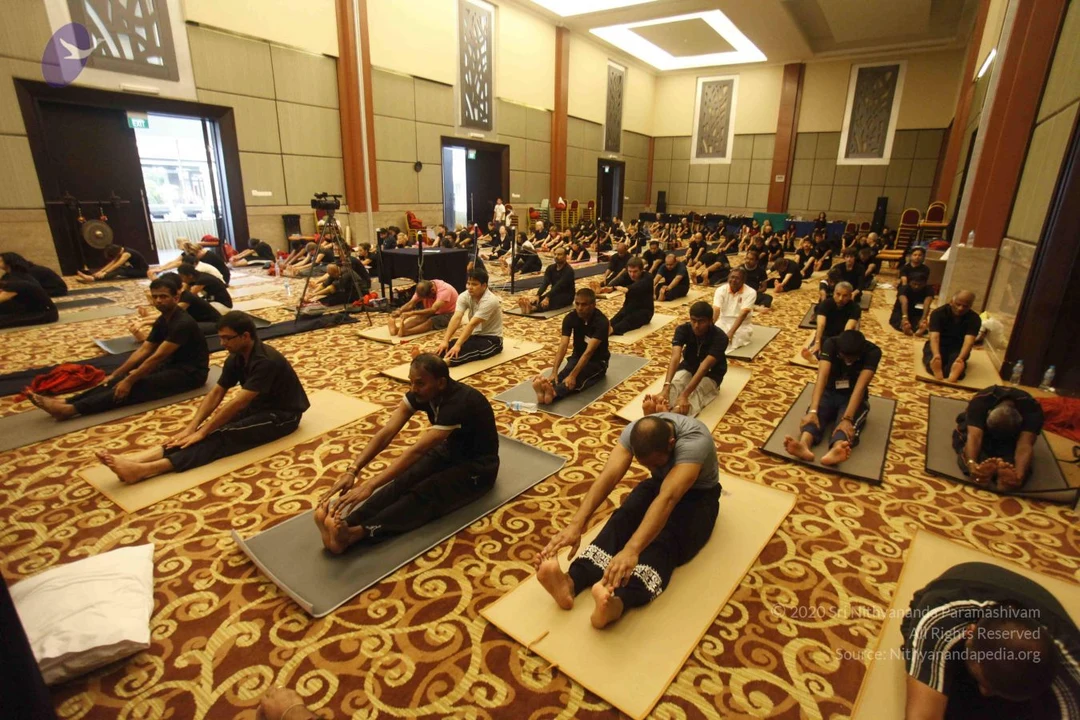
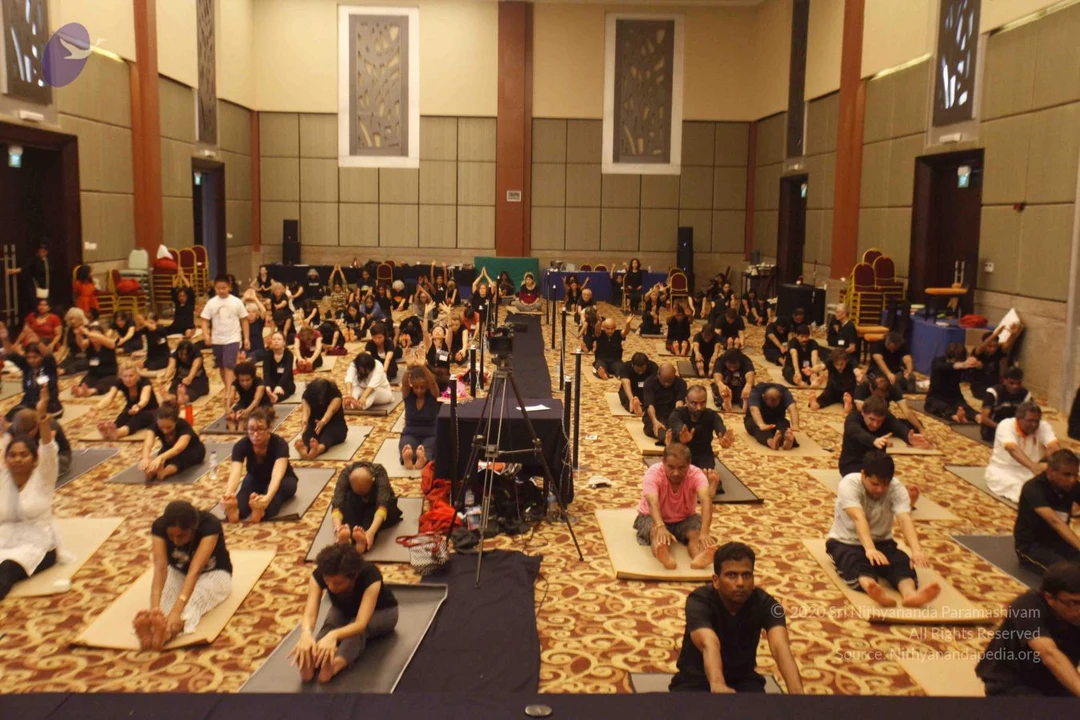
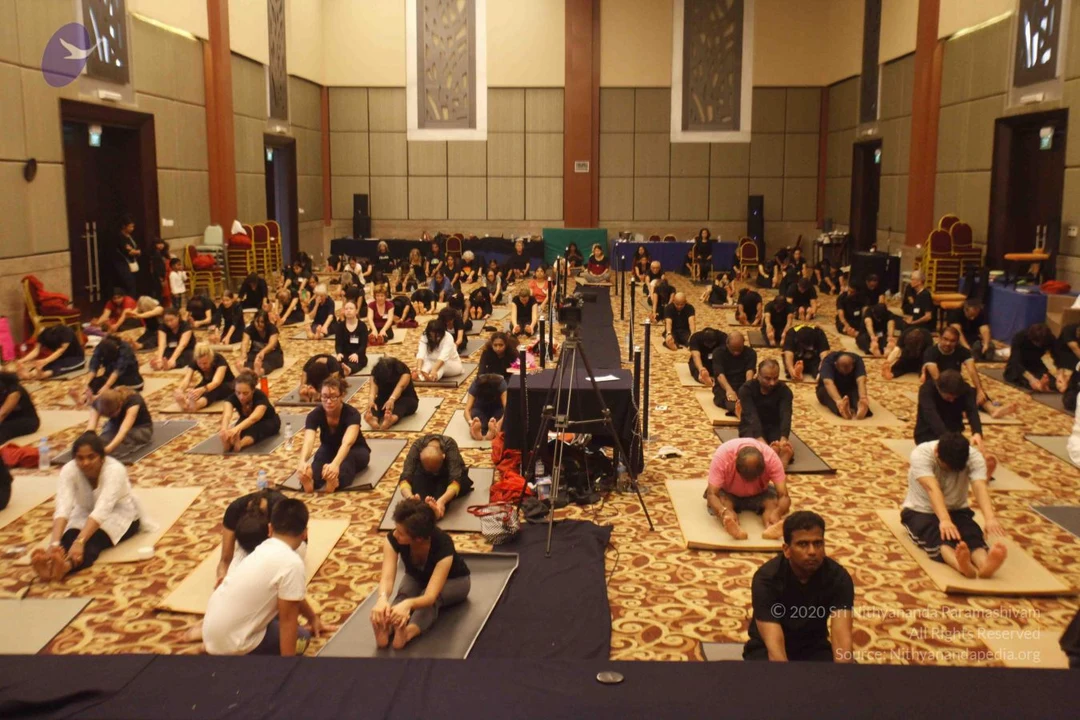
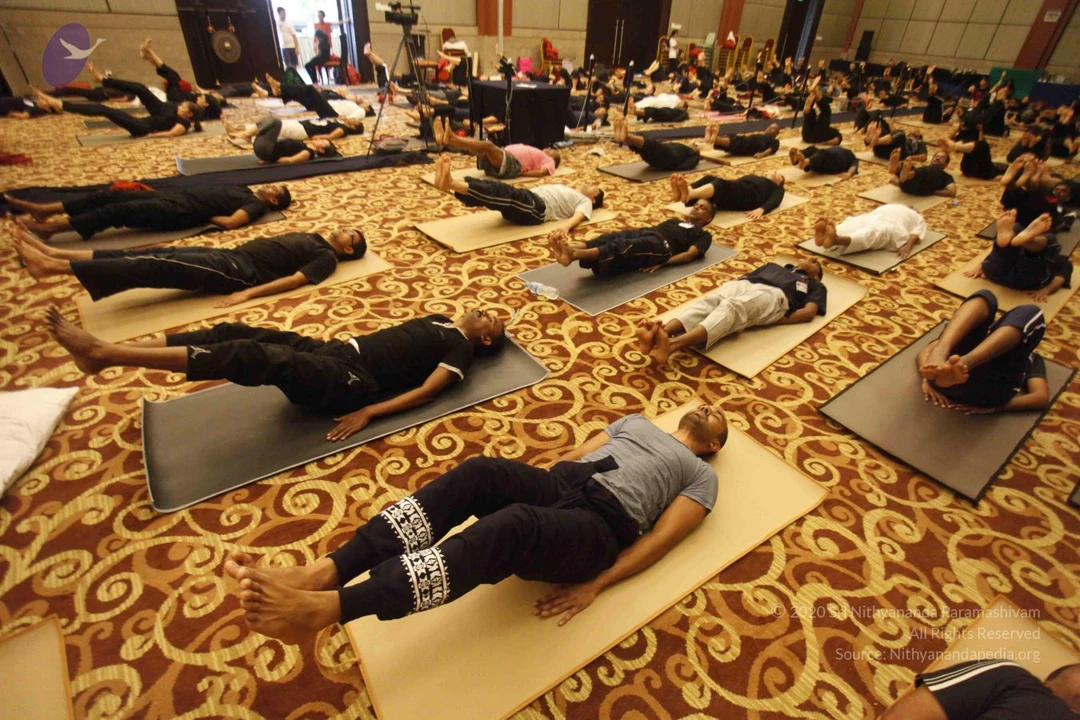
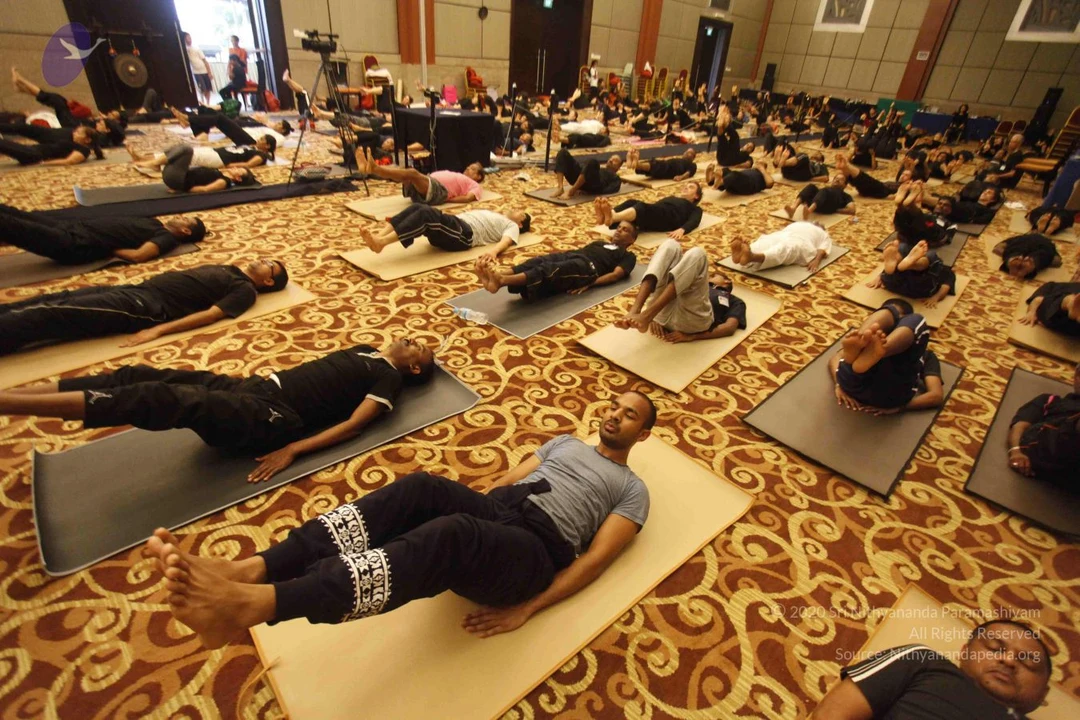
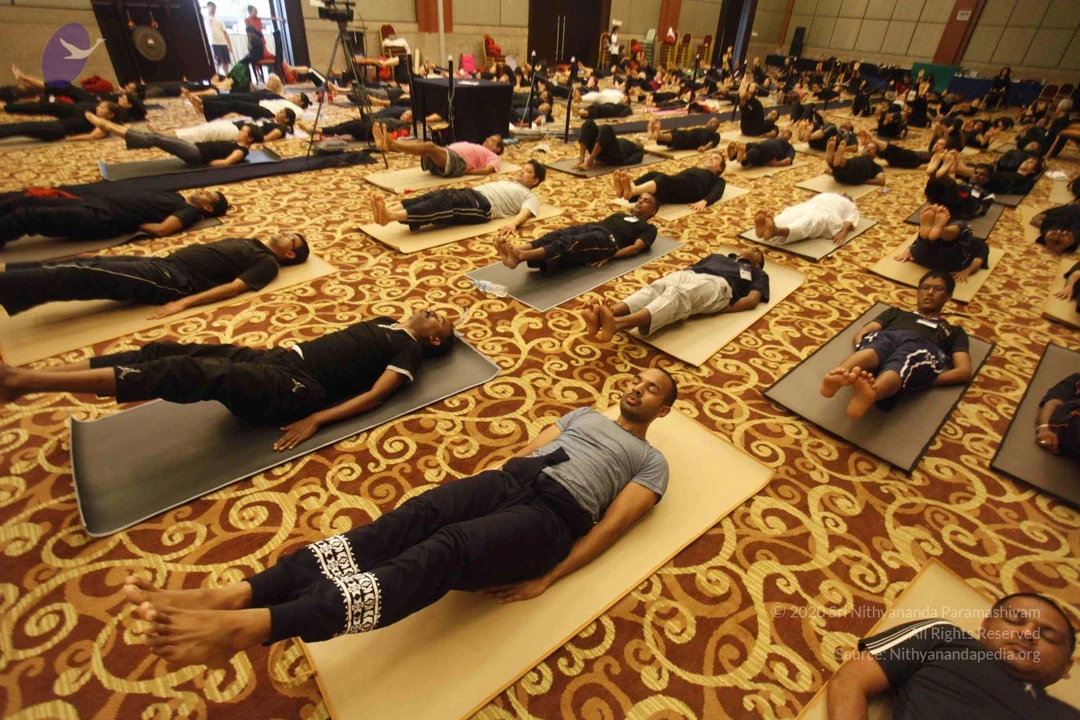
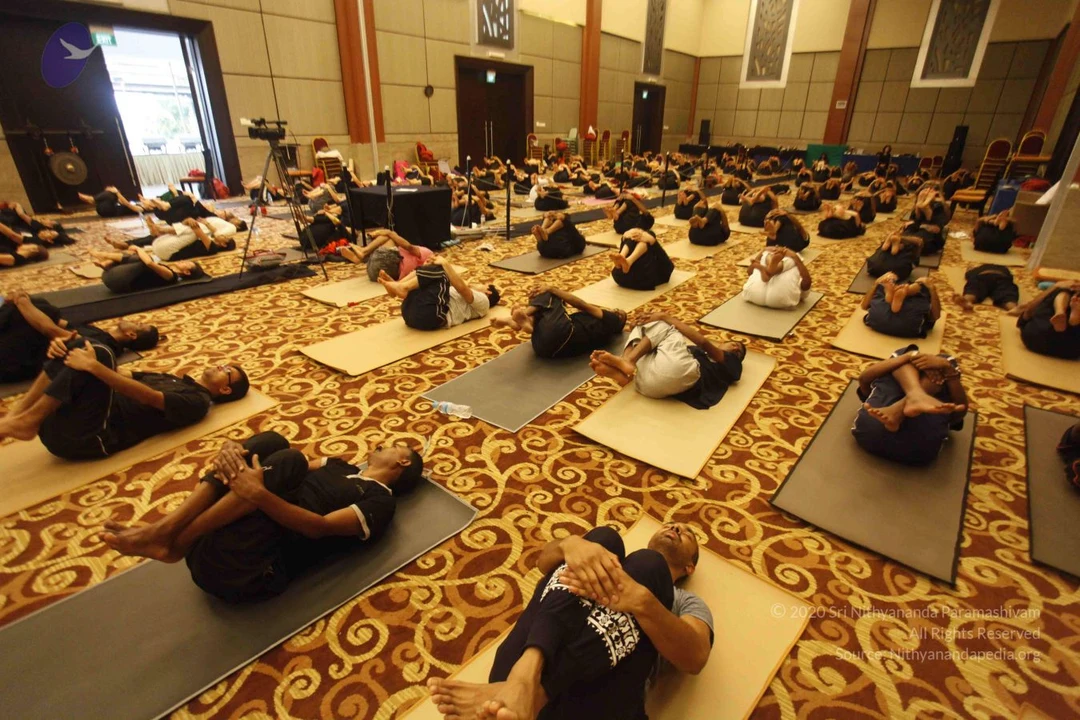
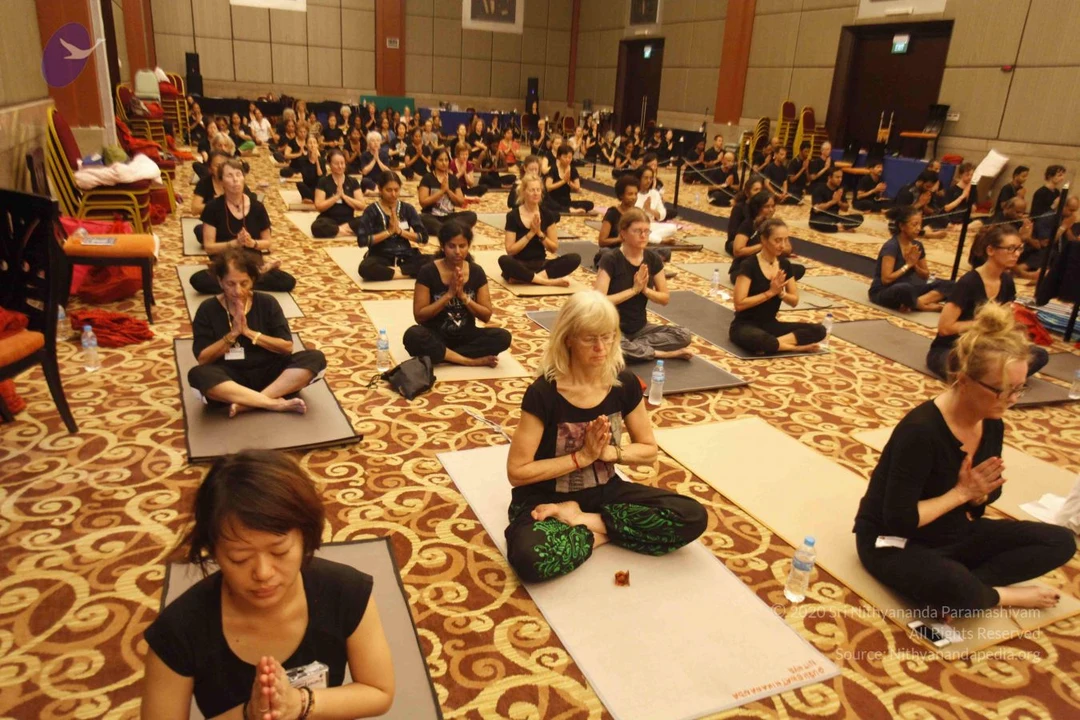
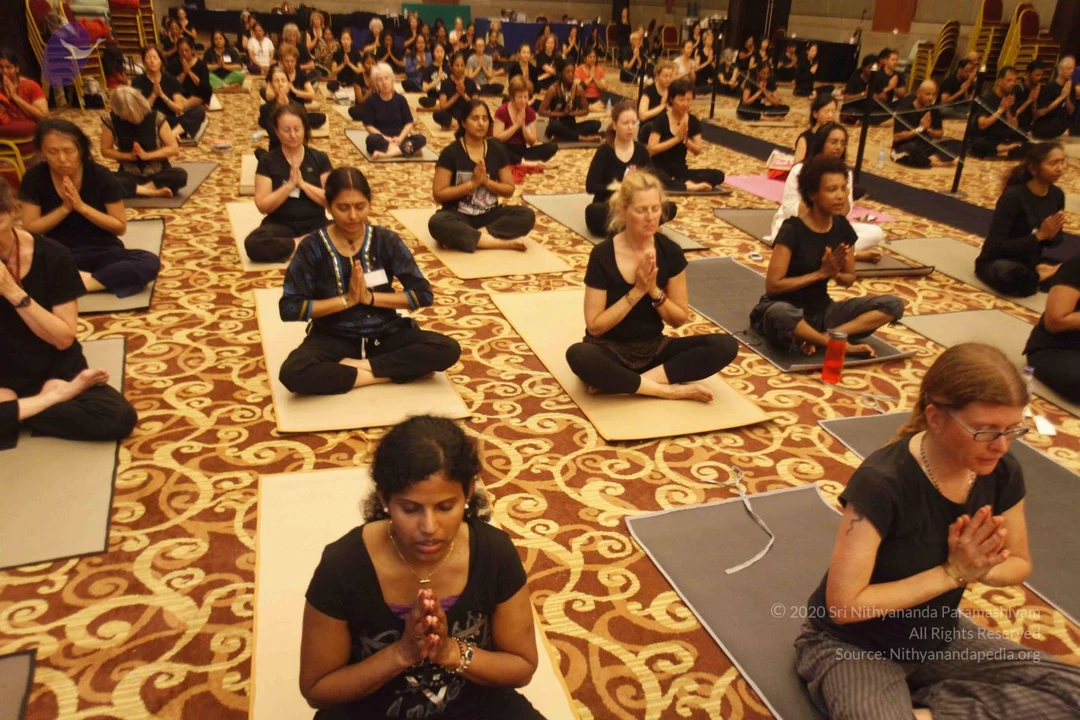
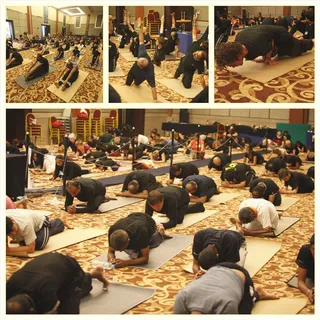
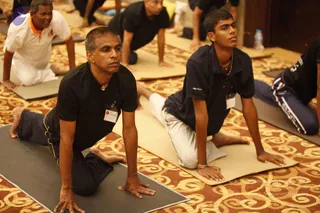
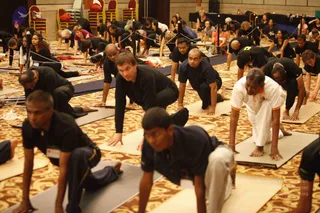
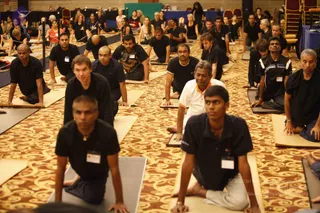
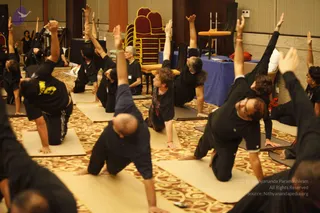
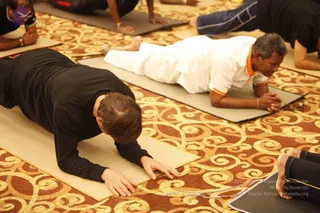
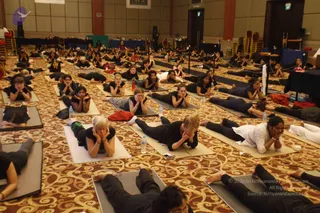
A group yoga session on a patterned carpet in a hall, with participants in dark sportswear on yoga mats performing a backbend or cobra-style pose with hands planted on the mats. In the foreground a middle-aged man in a black polo shirt with a pendant necklace and an event badge holds the pose beside a younger teenage boy in a navy polo and white trousers wearing a gold bangle and lanyard badge. Behind them more participants, one in a white shirt with orange trim, are visible on mats. A water bottle sits on a side table at the right.Photograph of a large indoor yoga or meditation session on a patterned carpet, with rows of participants in a downward-facing or crouched posture on pale yoga mats. Many participants wear black tops and dark trousers; a man in the right foreground wears a white kurta with orange trim and white trousers. Rope barriers and chairs with red seats are visible in the background, and a few people in the back rows have grey or white hair. No one with a clear identifiable role is shown as a person; no individual's appearance supports that label.A photograph of a large indoor hall with a patterned gold-and-brown carpet where many people sit on yoga mats in a kneeling or cobra-style posture, facing forward. Most wear black shirts and some have name badges on lanyards; one man in the middle wears a white polo with orange trim, and another front-row man wears a black shirt with white stripes. Behind them, others sit at tables and a green stage backdrop is visible.A group of about twenty people in matching black clothes practise yoga on beige mats in a hotel ballroom with patterned carpet. Most are kneeling on hands and knees with one arm raised straight up, backs arched, in a side-stretch pose. Behind them stacked red-and-gold chairs, a blue-covered table and a wooden chair are visible. The left and right foreground show raised arms and partial figures. No single figure is identifiable as a person from appearance, so no candidate is named.Several people perform a prostrate yoga posture on grey and black exercise mats over a patterned gold-and-brown carpet with swirling motifs. In the foreground a man in a black long-sleeved top lies face down with palms on the mat. Behind him a man in white clothes with orange trim, short grey hair and a bangle on his wrist rests on his forearms with hands joined, and further back other participants in dark clothing are in the same position. Four people are visible in the scene, and a fifth set of bare feet appears at the lower right edge.Large hall with a patterned carpet where many participants lie prone on yoga mats in rows, chins resting on clasped hands, most dressed in black or white. Water bottles sit beside several mats, and tables with blue cloths and stacked chairs line the back of the room. No one in the scene is clearly identifiable as a person; the figures visible are participants in the prone resting posture.

PRATHYAKSHA-PADA-PUJA
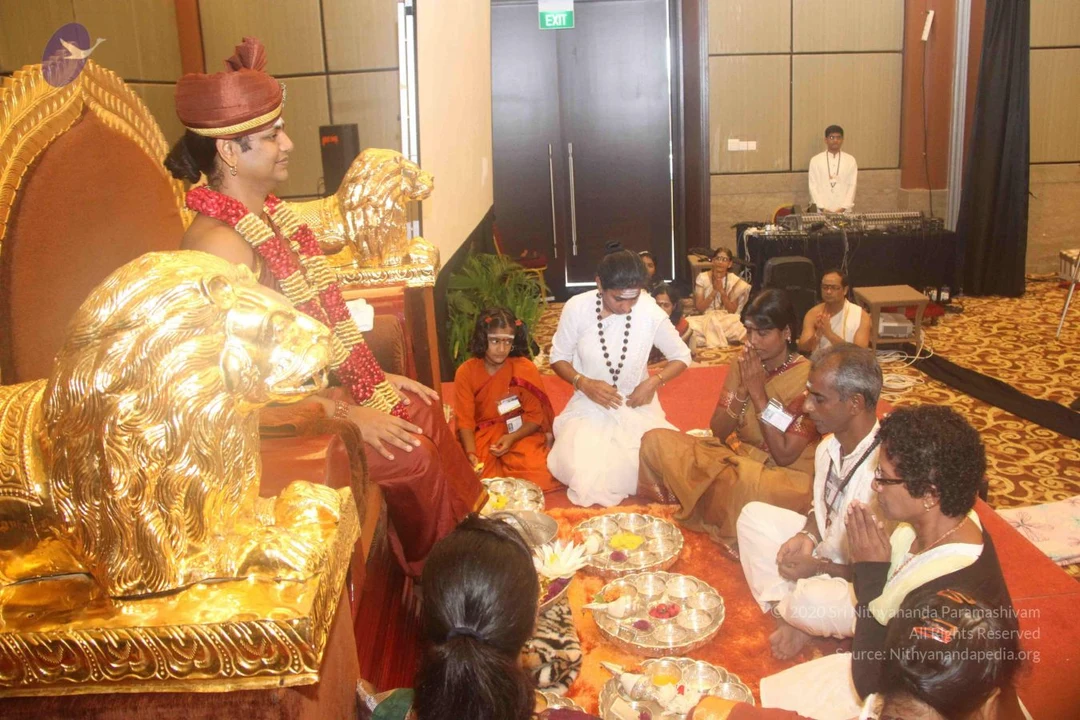
97 photosSource gallery
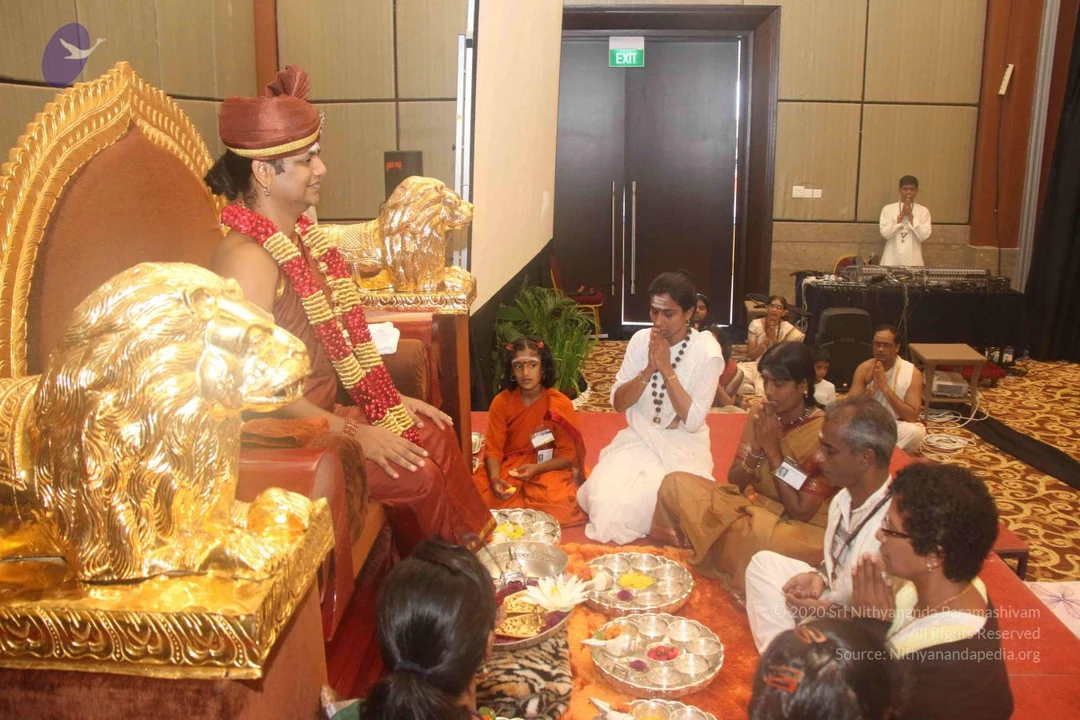
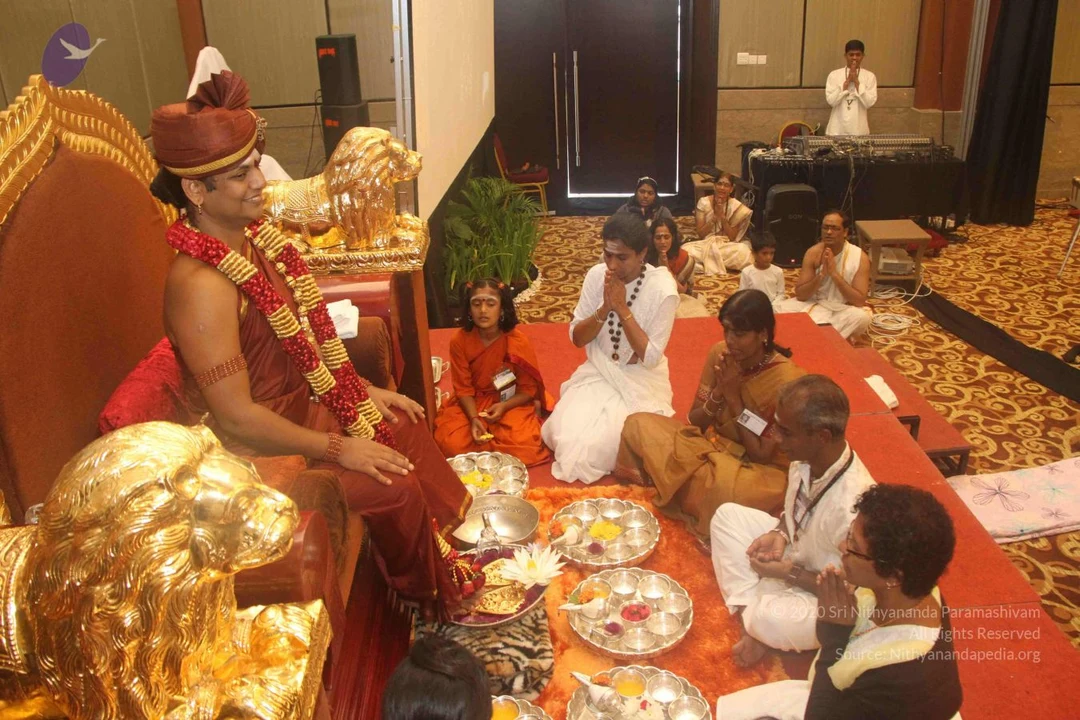
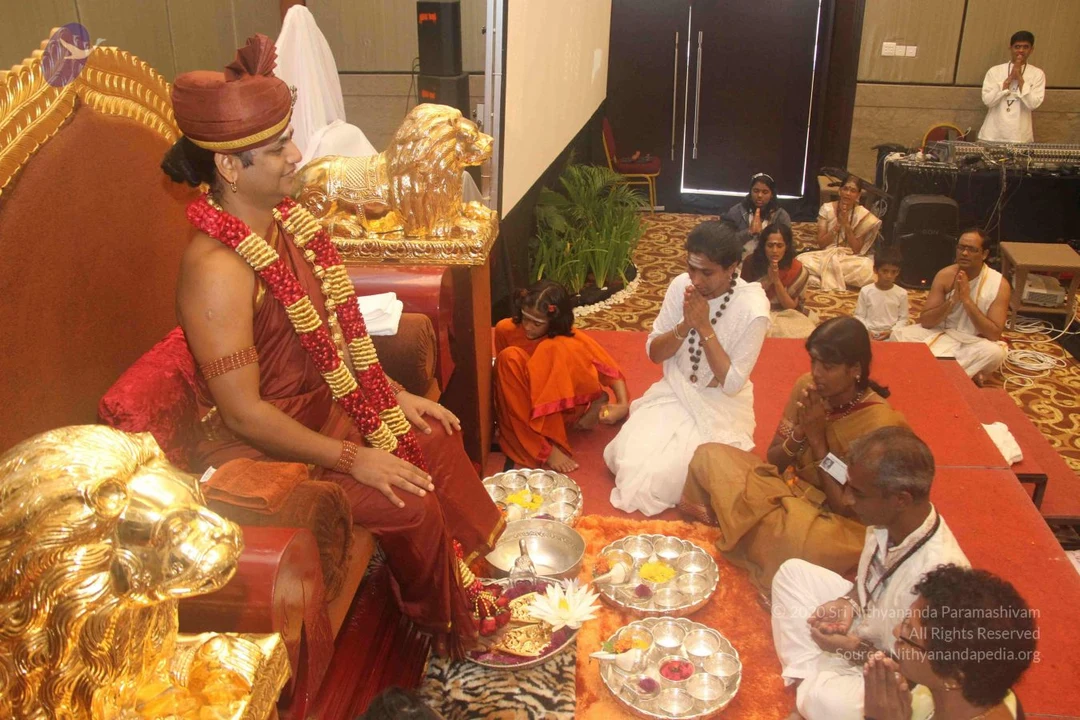
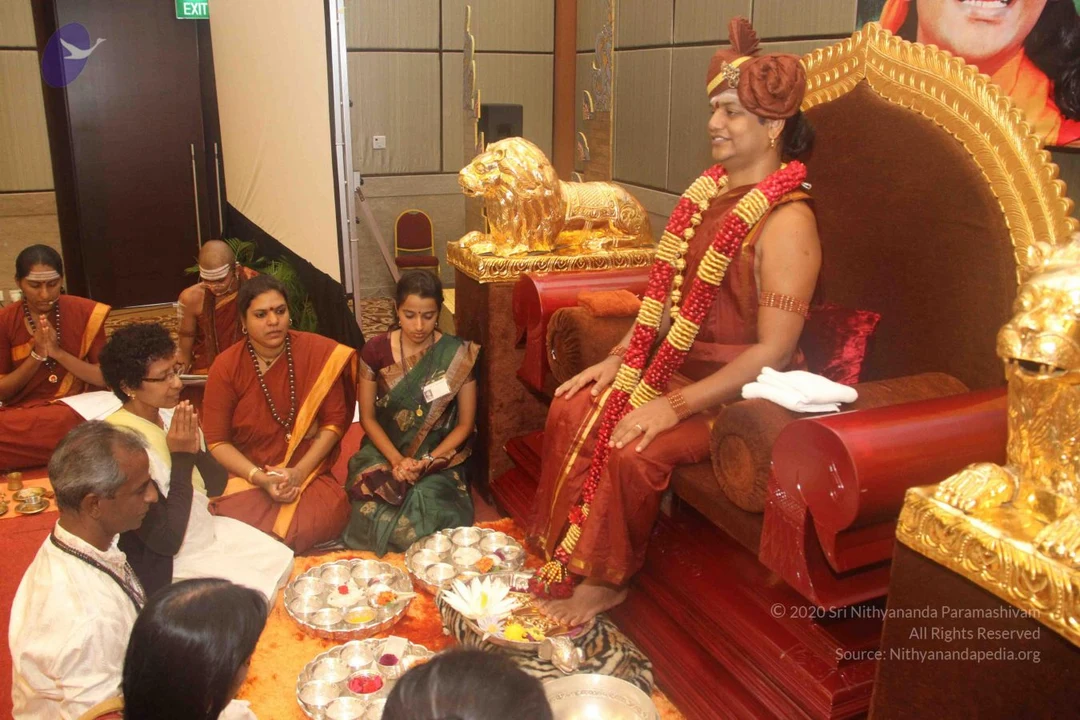
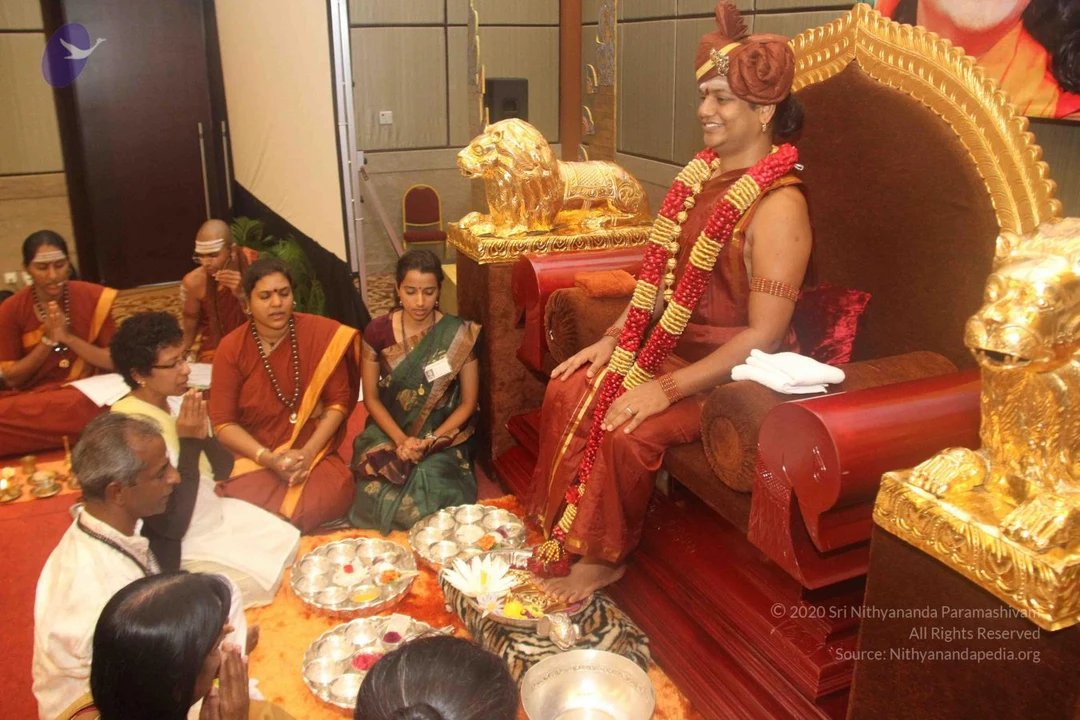
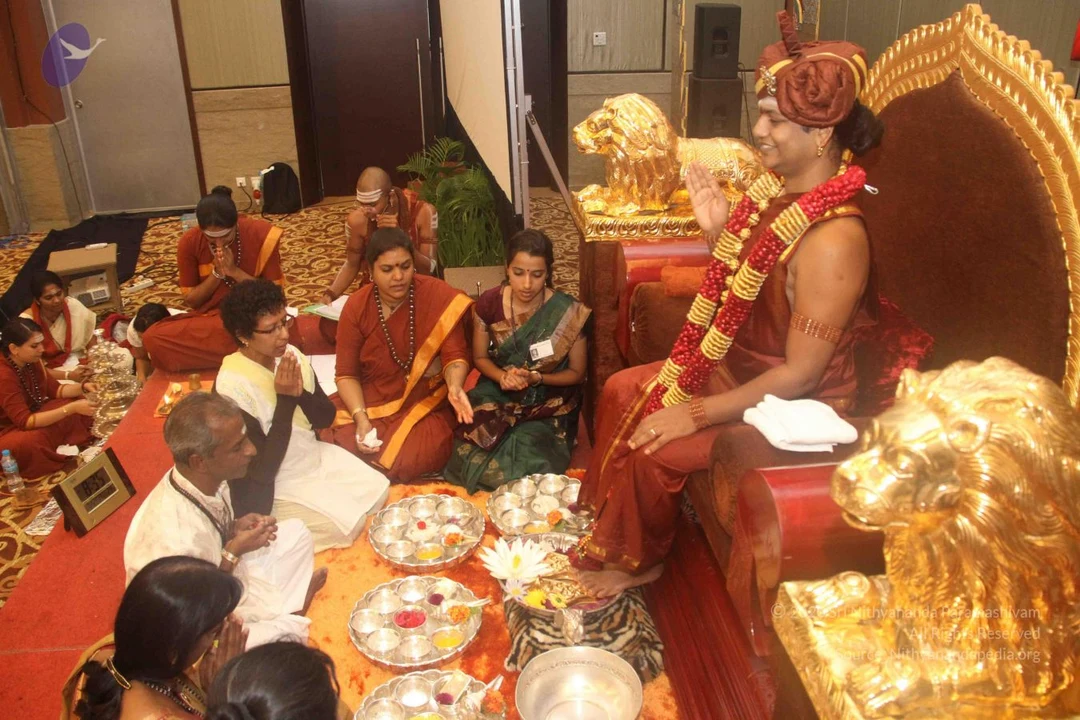
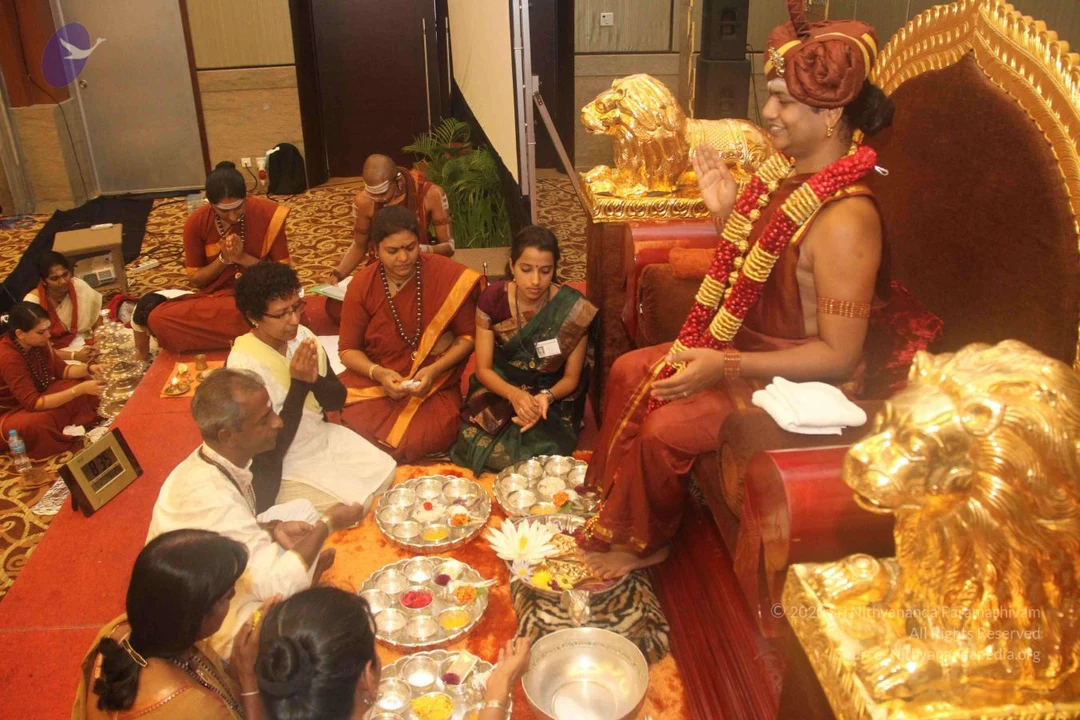
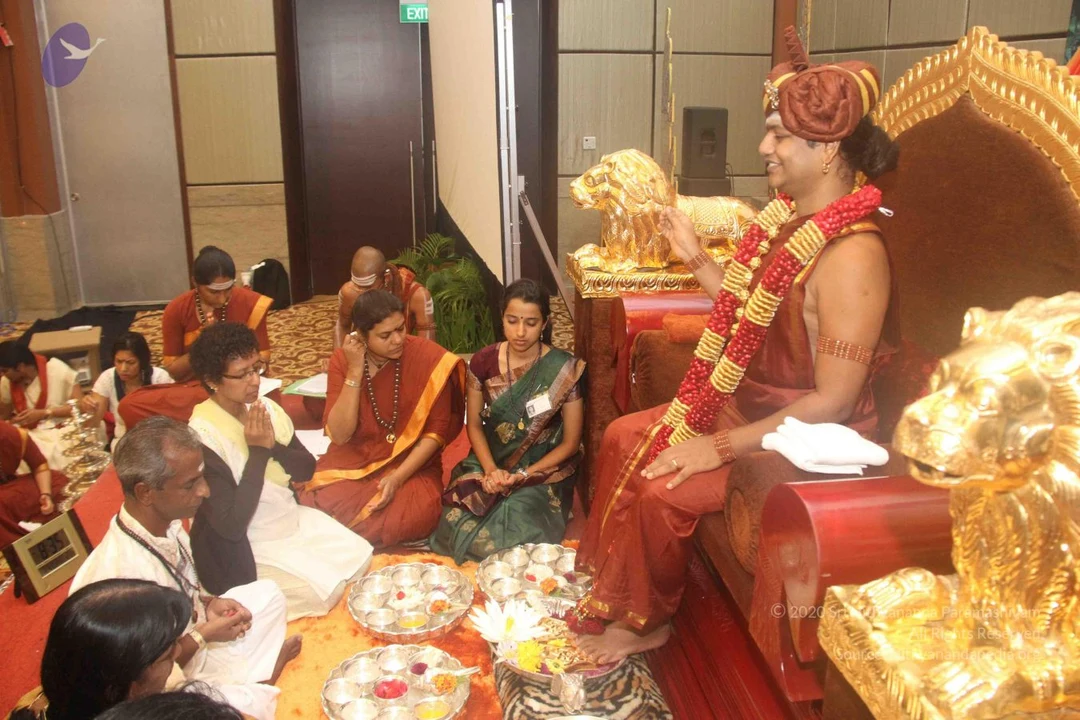
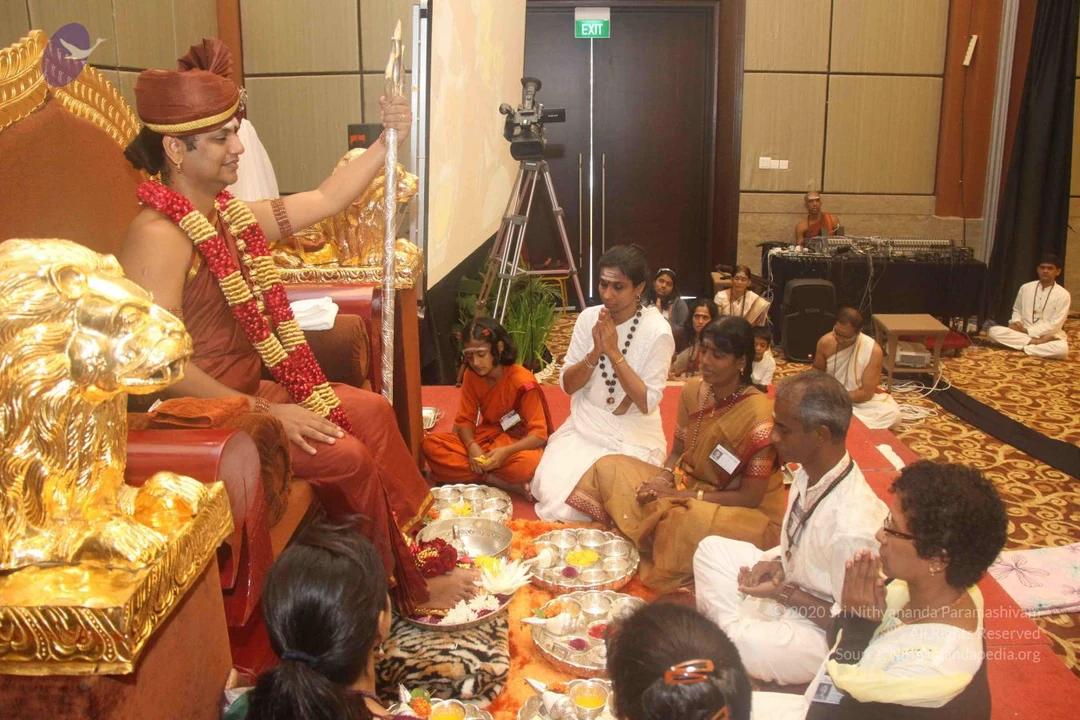
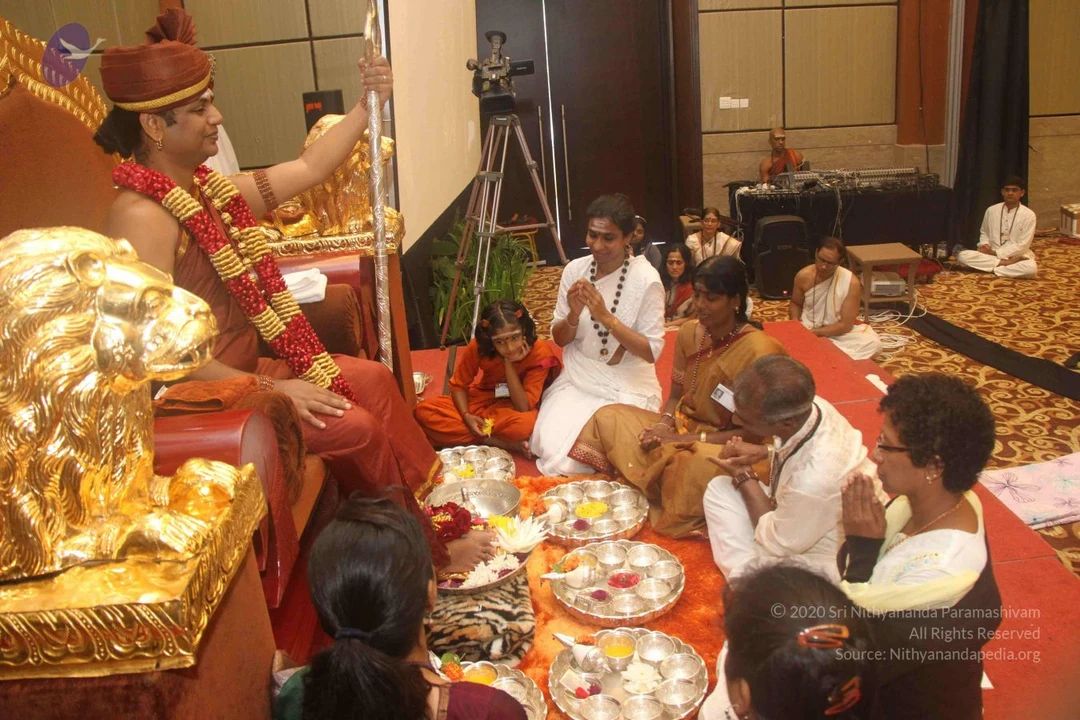
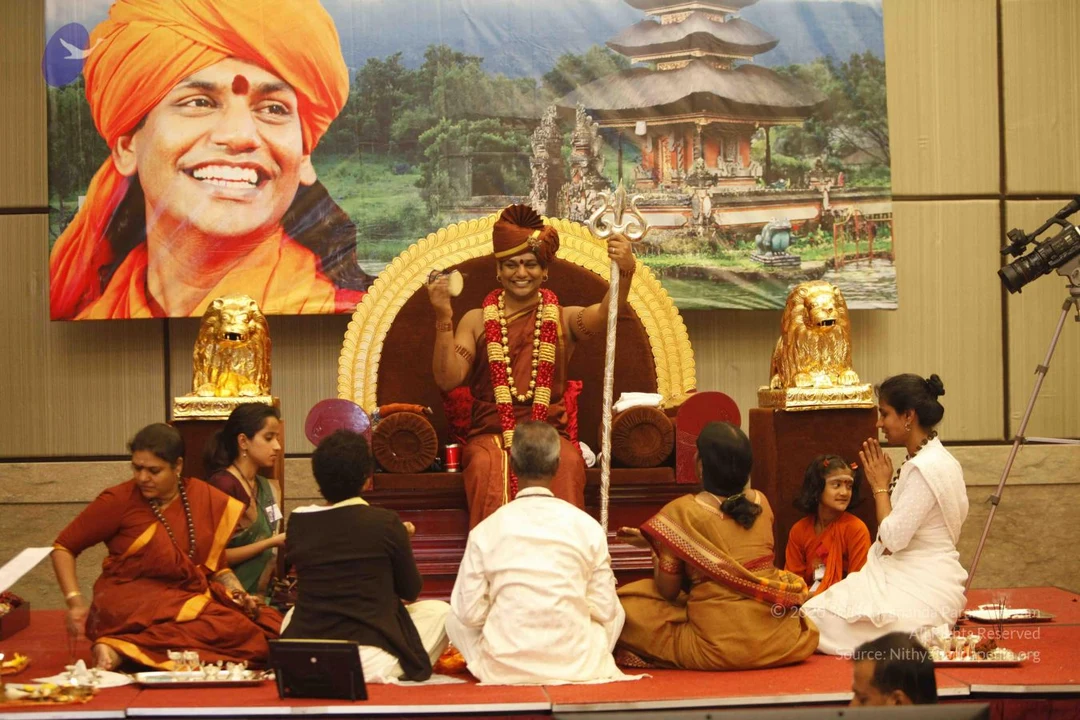
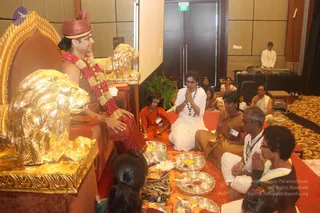
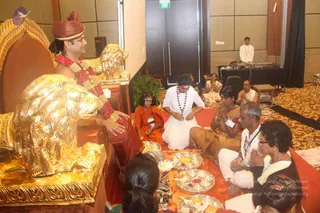
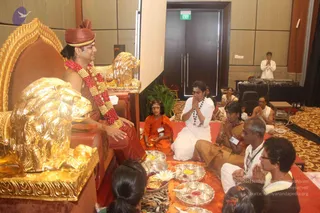
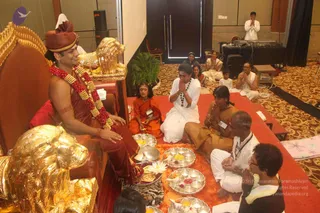
A seated man on a golden lion-armed throne wears a maroon turban, a red and white garland, and a saffron-maroon garment, smiling as he receives devotees. Around him on an orange-red carpet, a woman in a white sari and several devotees sit with brass thalis of offerings, flowers, lamps and vermilion-coloured items. A man in white with rudraksha beads and a woman in a brown sari hold their hands in anjali; a person in orange robes sits nearby. A woman in a sari sits at the centre-left, and a man in white stands by the far wall near a sound console. Inside a hotel conference hall with an exit sign, potted plants and gold-trimmed black doors.A seated figure on a golden lion throne with carved lion heads receives a padapuja from devotees on a red mat. The figure wears a maroon turban, a red and white flower garland and a maroon wrap, and has long dark hair. Seated before the throne is a child in orange robes. A man in white with a rudraksha mala kneels nearby, and devotees in saffron, gold and white clothing sit around the mat with folded hands. Brass thalis hold flower petals, lamps and offerings, and a lotus blossom rests on the mat. A standing attendant in white stands near a sound console in a hall with an exit sign. The figure's identity is uncertain from appearance and no name is printed in the scene.Indoor ceremony in a hotel-style hall with a red carpet. On the left, a man in an ornate maroon-and-gold turban, a long red and white flower garland and rust-coloured robe sits on a golden lion-armed throne, his hands resting on the armrest. Before him, a young girl in saffron-orange robes with a red forehead mark kneels beside a woman in white with a rudraksha mala, both with hands folded in namaste. Brass trays hold flowers, lamps and offerings. Seated devotees in saris and white shirts, some with event lanyards, pray with palms together. A man in white stands in prayer near the entrance, with an EXIT sign above the doors. a person appearance is a probable match: long swept-back hair, turban and garland on the throned figure.A seated man on an ornate golden-and-red throne flanked by golden lion figures wears a maroon-and-red turban, a long red and white flower garland, and a saffron-brown robe, with gold bangles on his wrist. Before him on a red-draped platform, devotees sit in prayer: a young girl in orange robes with a forehead mark, a man in white with a rudraksha mala, a woman in a mustard sari with folded hands, and a man in white clothes. Silver plates with oil lamps, flowers, fruits, a conch-shaped bowl and a white lotus form a puja offering in front of them. Another person in white stands with palms joined at the back of the hall beside sound equipment. The image may show a padapuja-style offering, and a Swamiji (probable) appears on the throne in a saffron robe, turban and garland.A seated man on a golden lion-armed throne, wearing a maroon turban, maroon robe and a long red and white flower garland, with gold armbands, receives reverence. Before him on a red-and-orange cloth, devotees in white and cream clothes sit with hands folded in anjali. Brass plates hold flowers, yellow petals and red kumkum, and a white lotus lies on a tiger-skin rug. A girl in orange sits at the side, and several people in white kneel in the background near a sound desk. The scene suggests a padapuja in a hall. The seated man's identity cannot be confirmed from appearance here, so he is described by role only.A seated man on a red and gold throne with lion-carved armrests receives a padapuja in a hall. He wears a rust-orange turban, an orange-brown robe and a long red and yellow flower garland, with bare feet and gold armbands. Before him, several devotees sit on a red cloth: a woman in a dark green sari with a white flower, women in orange-brown robes with rudraksha malas, and a man in white with a shaved head. Brass thalis holding flowers, red kumkum and offerings sit on the floor, with a golden lion statue behind. The appearance is consistent with a person candidate by the turban, garland and throne cues, though it cannot be confirmed from appearance alone, so the a person field is unsure. A framed portrait with a smiling face hangs in the upper right corner and an EXIT sign is visible at top left.

NITHYA-SATSANG

13 photosSource gallery
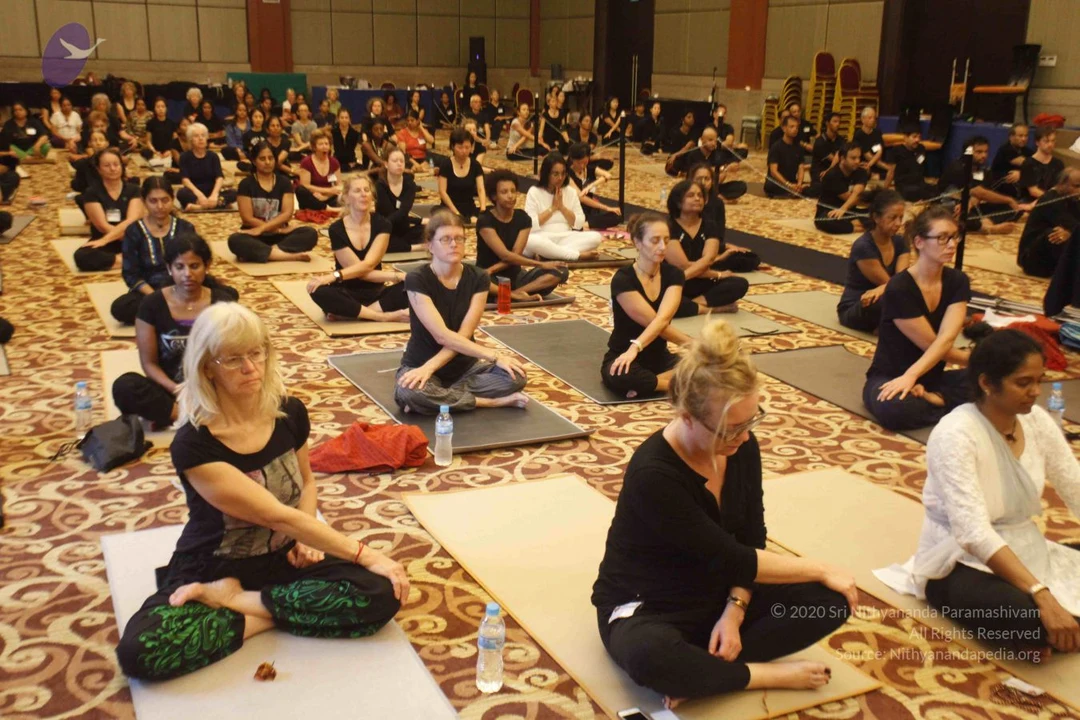
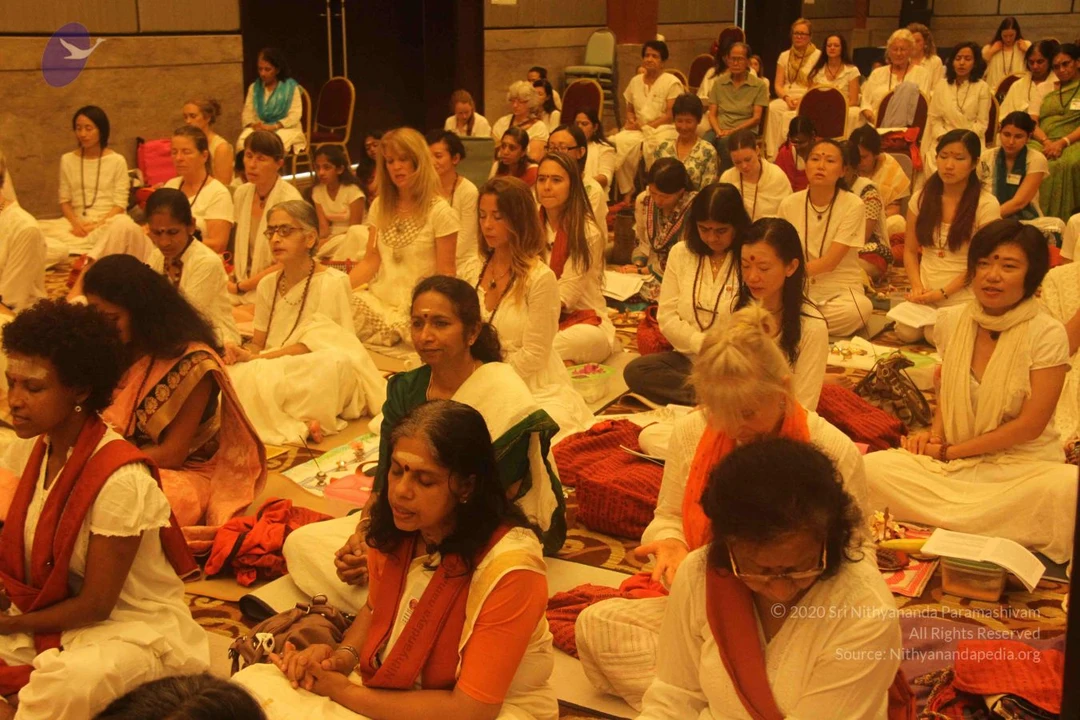
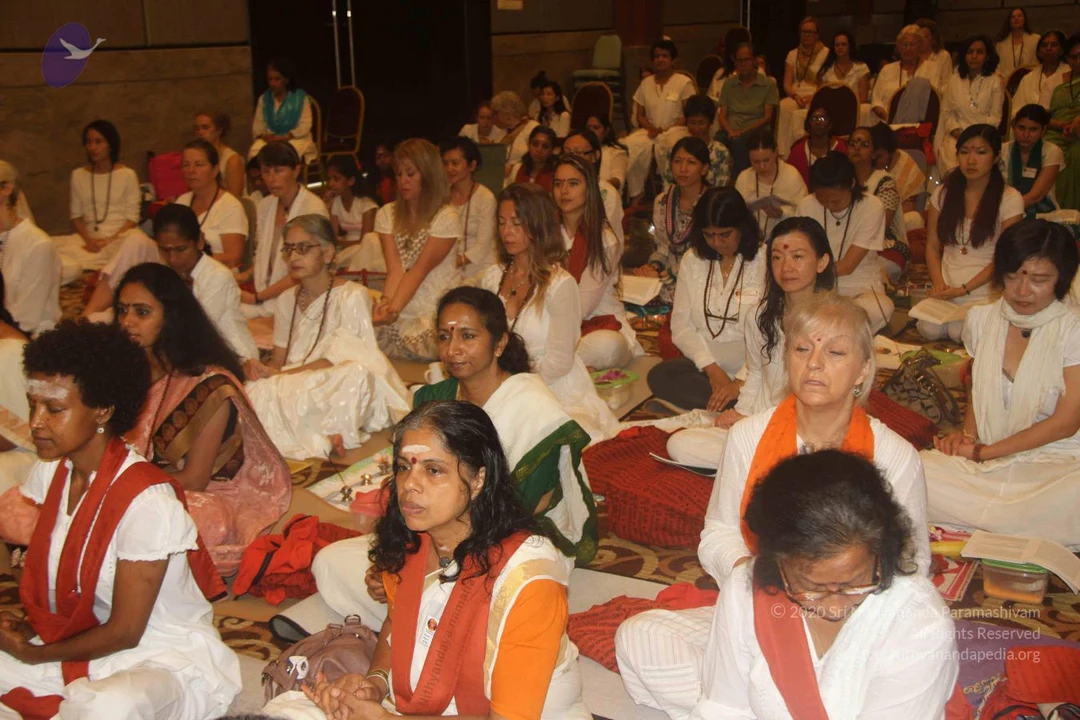
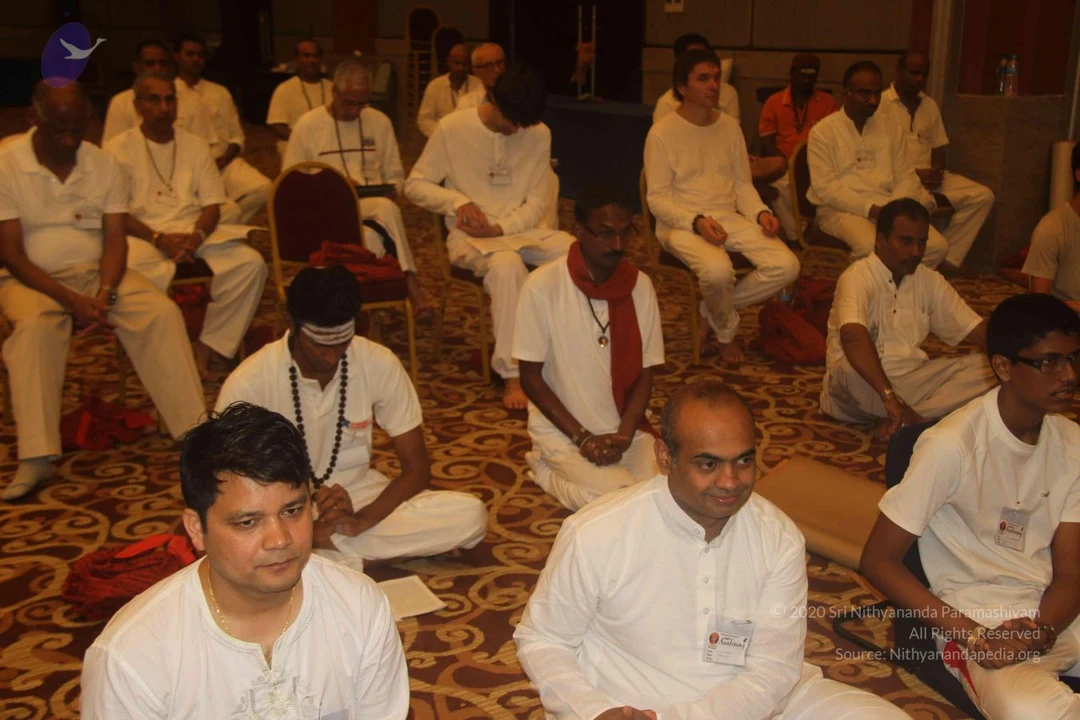
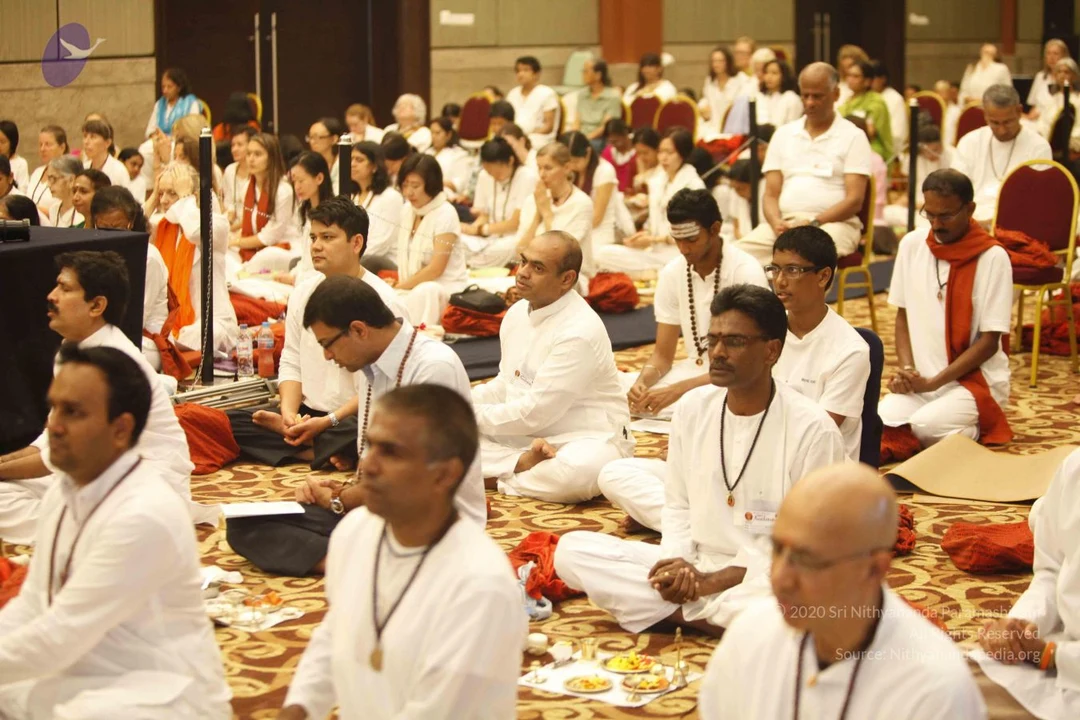
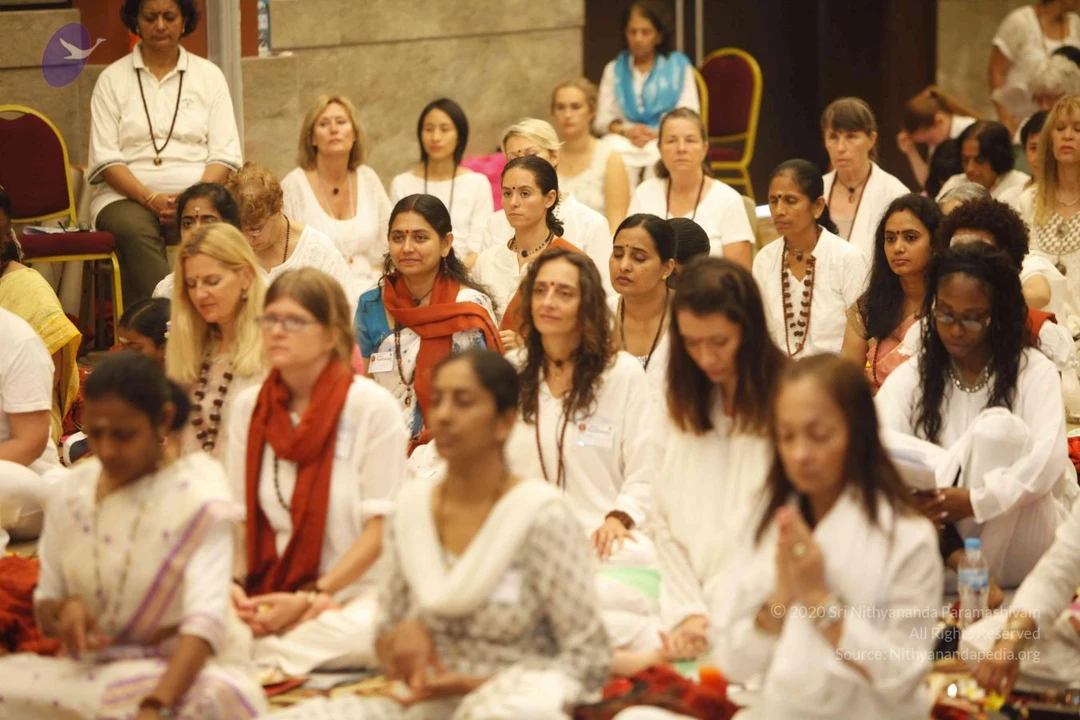
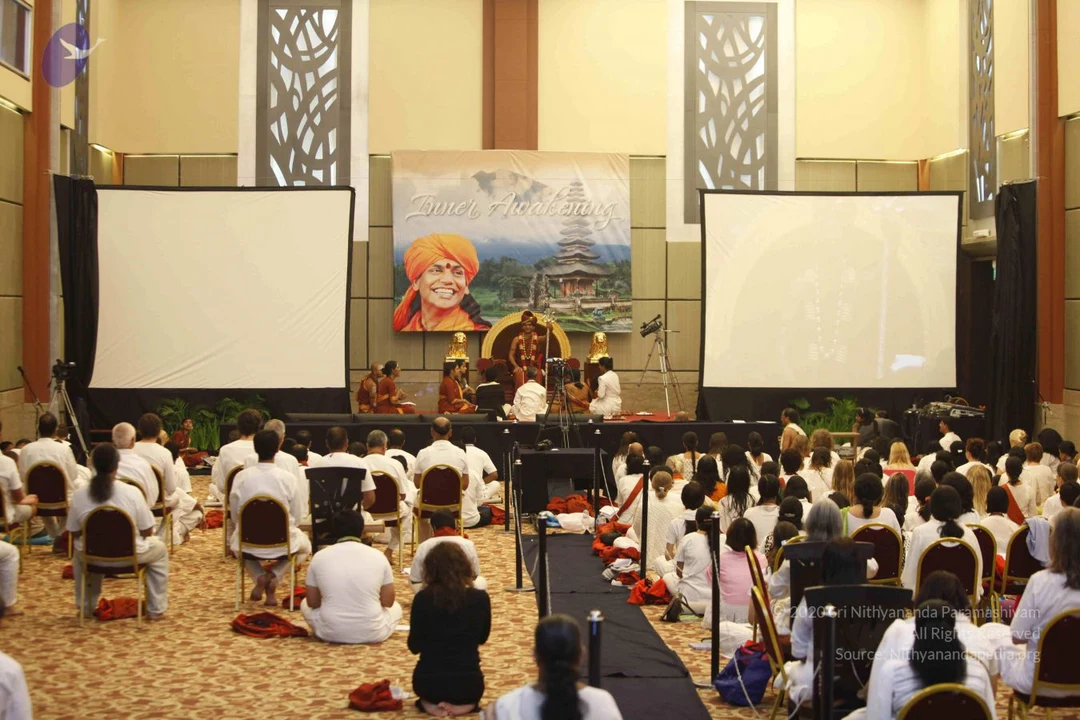
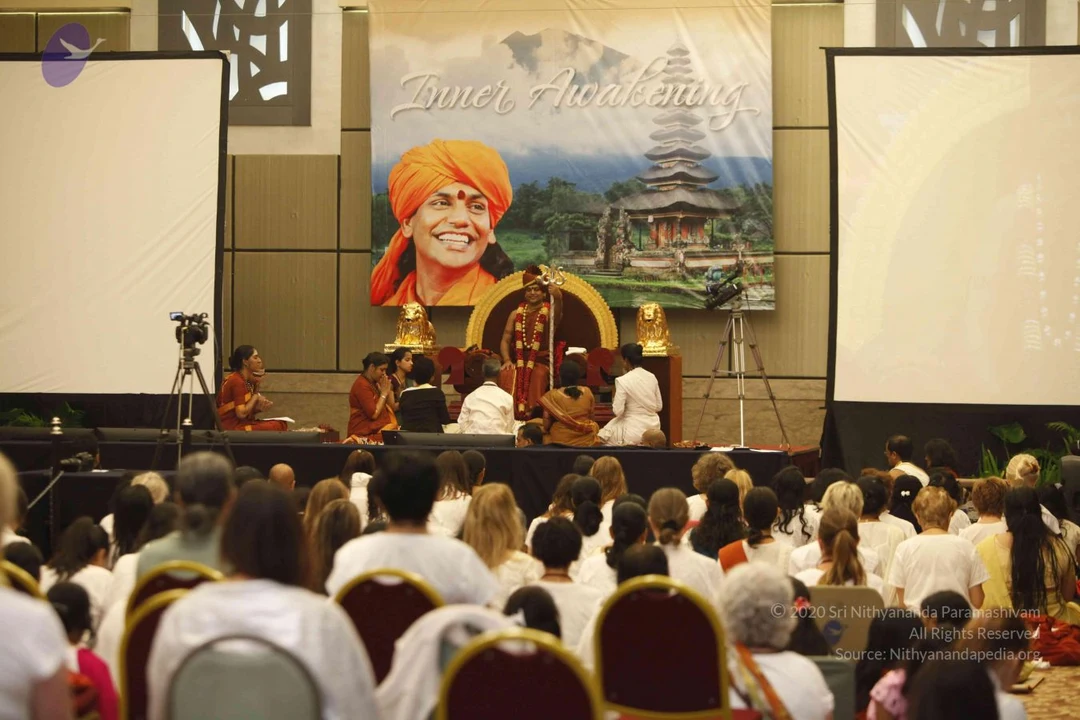
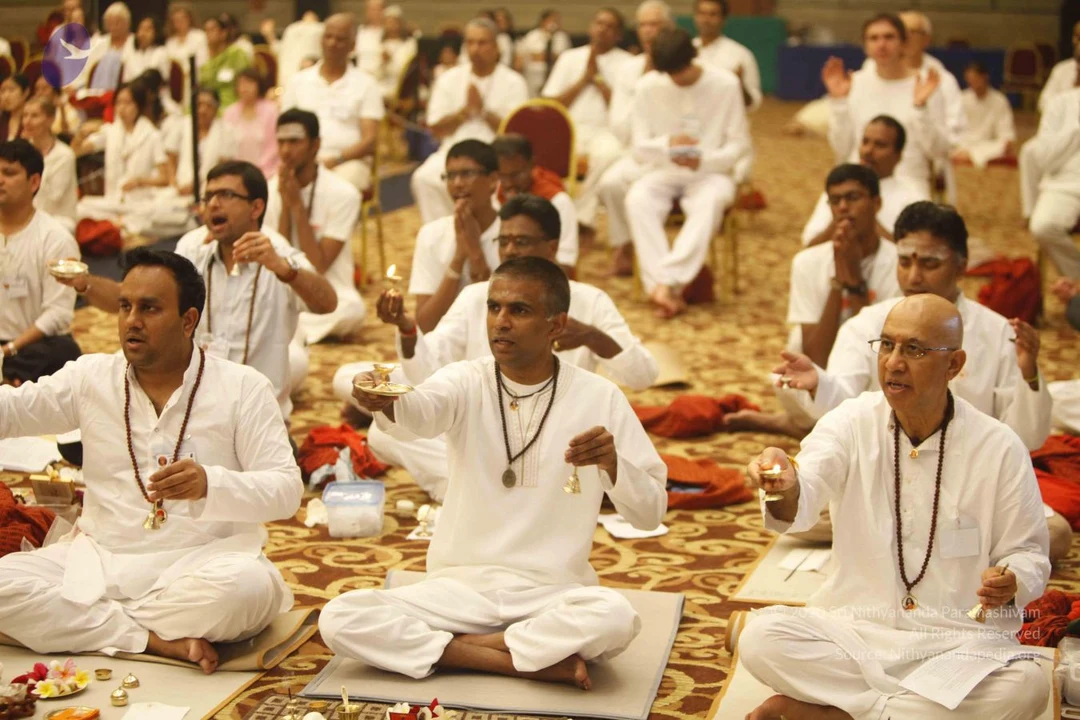
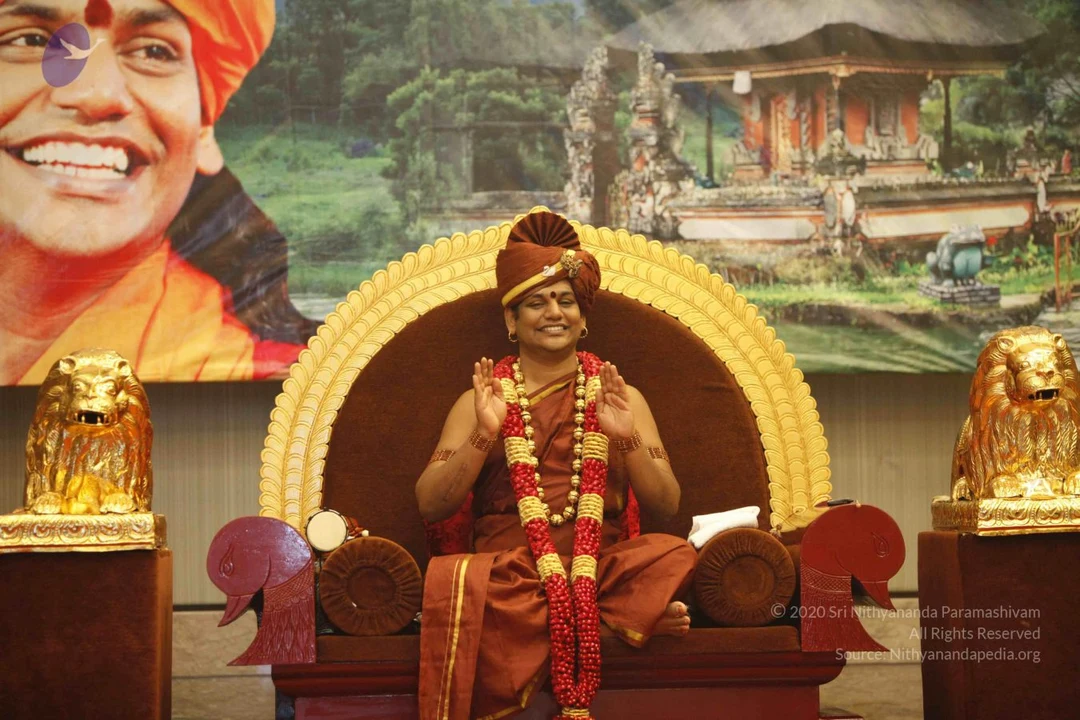
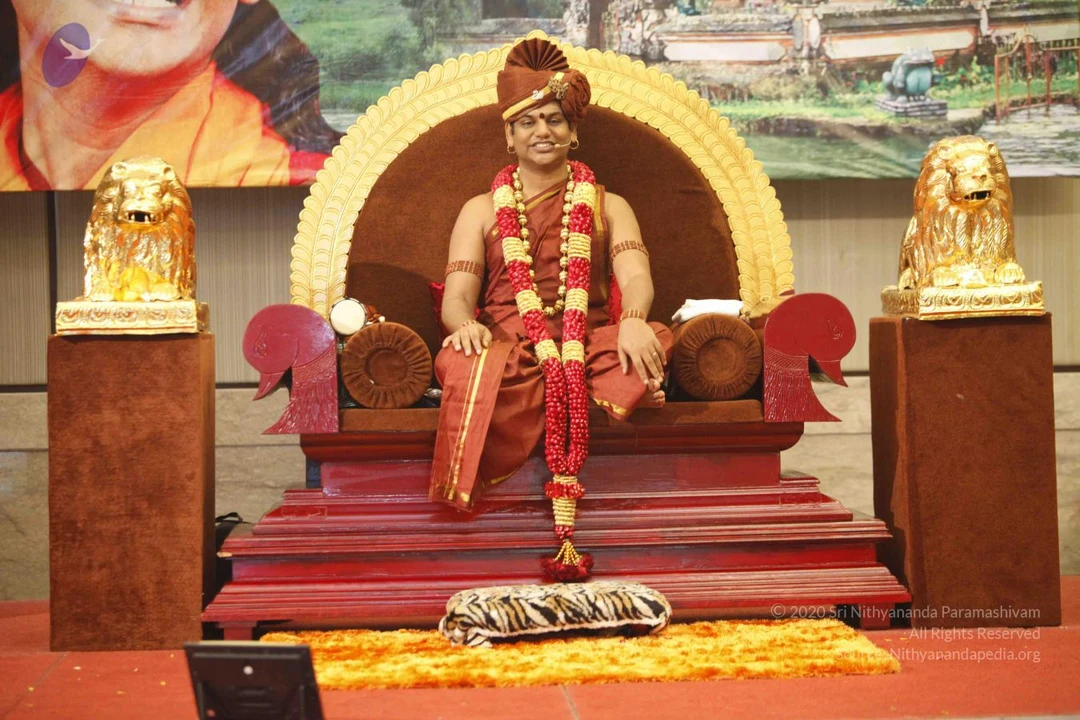
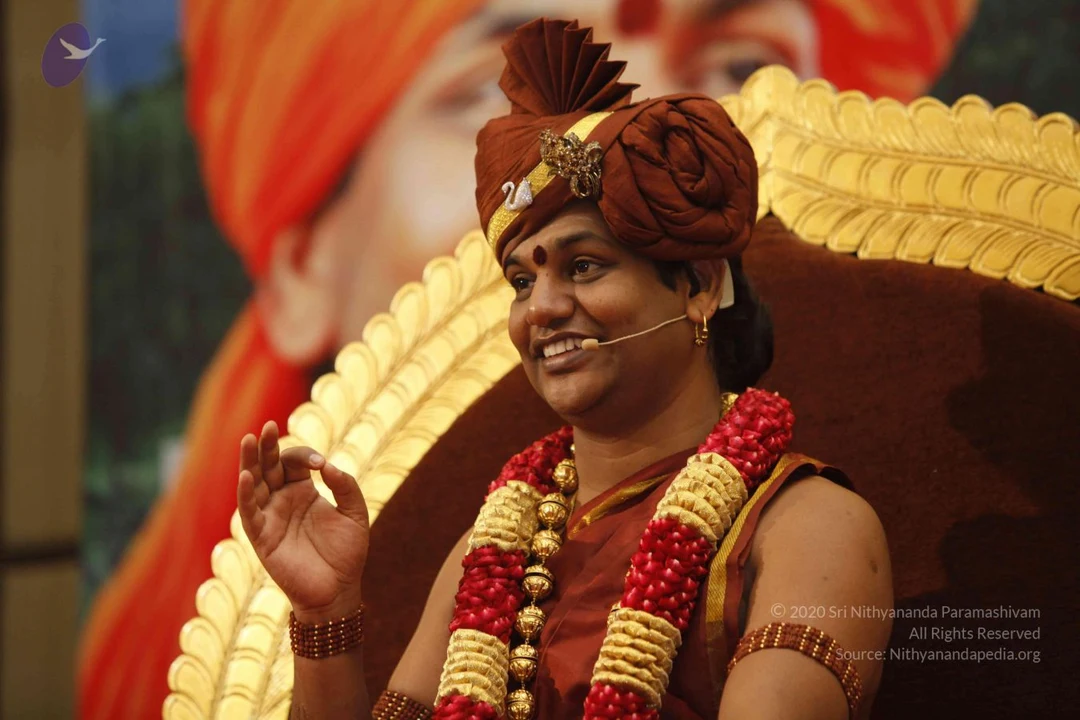
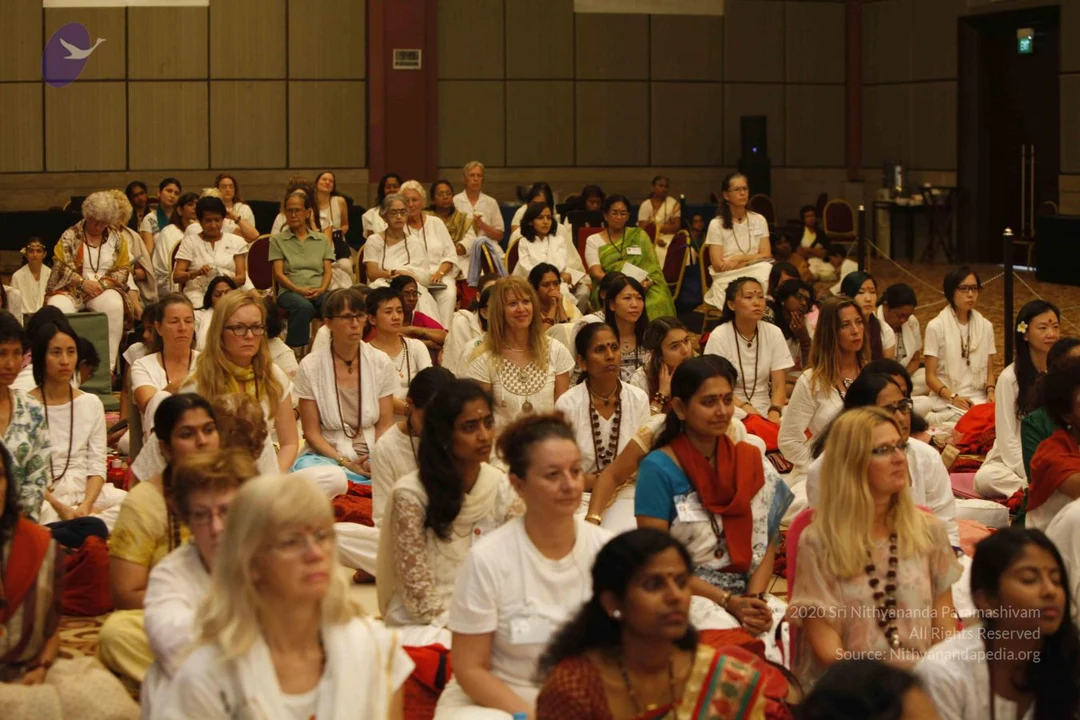
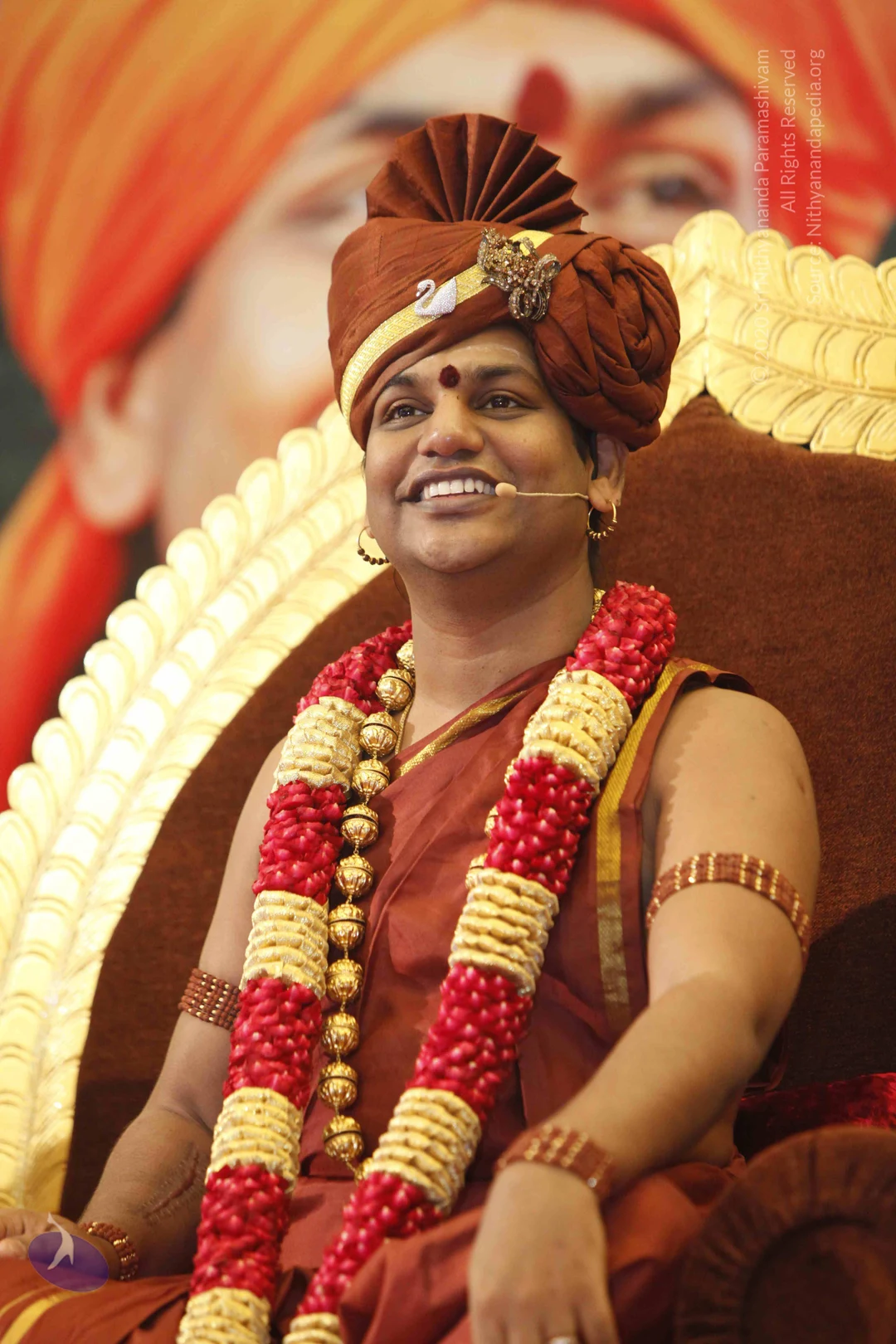
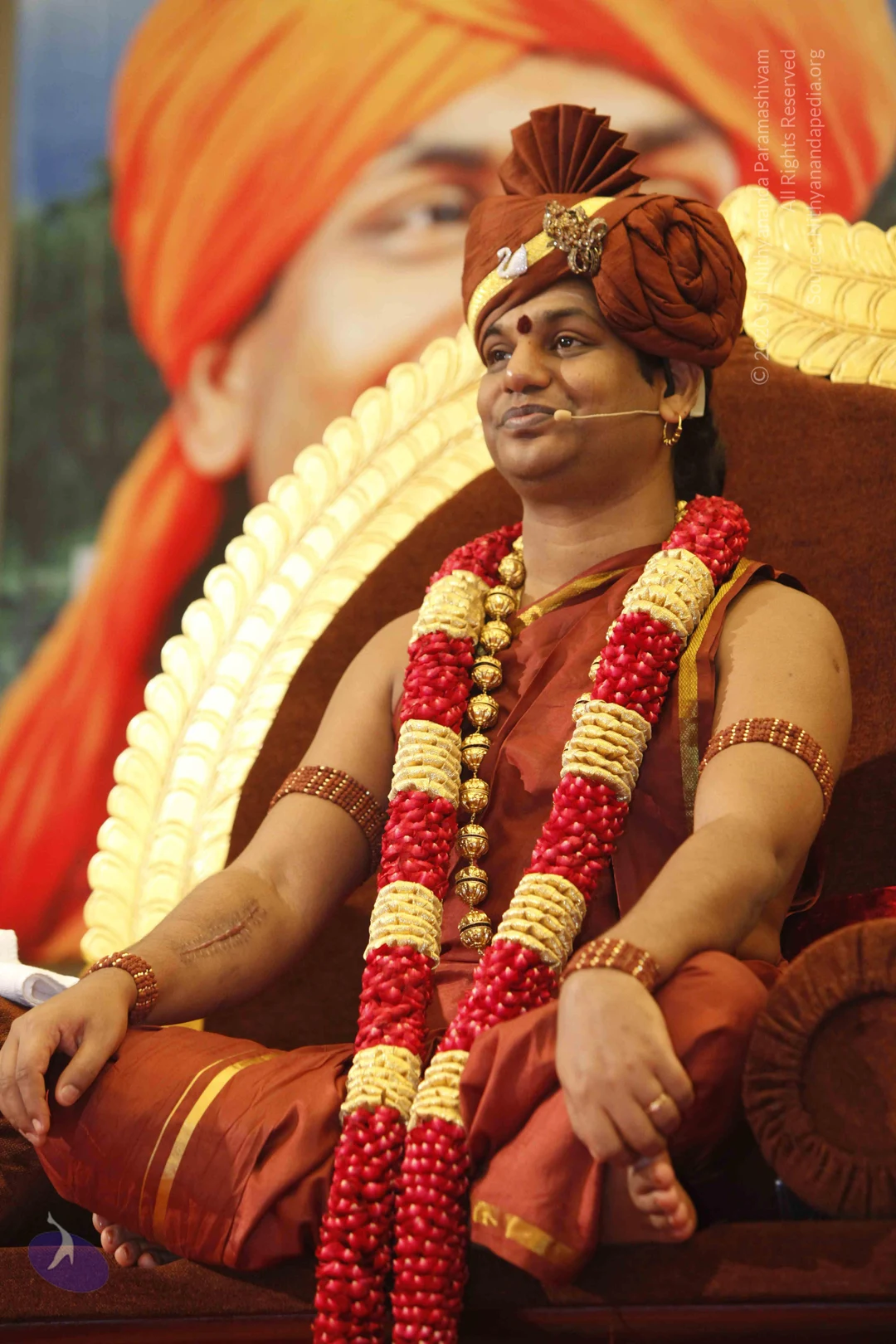
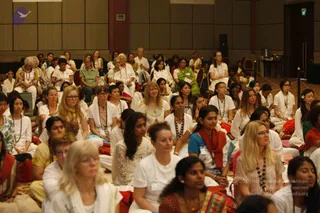
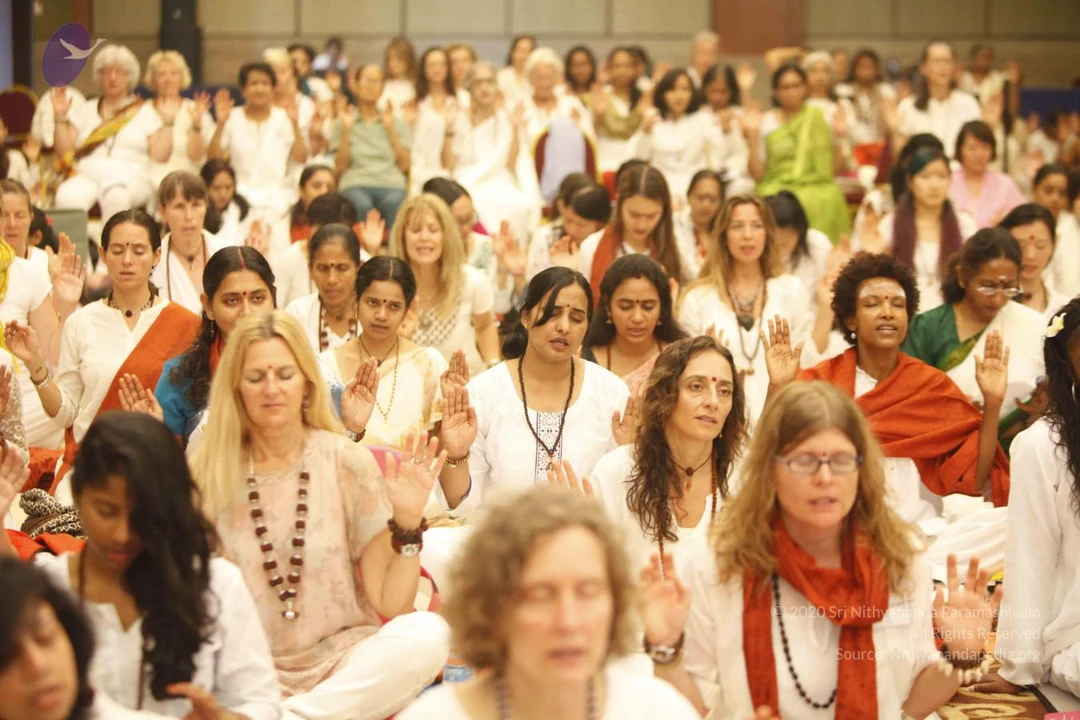
A seated figure on an ornate red and gold throne with a golden lion statue on each side, a large gilded arched backrest, and a tiger-skin cushion on the red carpeted step below. The man wears a dark red-brown turban, a rust-orange dhoti-style garment with gold border, a long red and gold garland of flowers, and gold armlets. Behind him a large banner shows a portrait and a painted or photographic landscape with a temple complex, a pond and trees. Swamiji (probable): the figure wears a turban, orange-red robes, a flower garland and ornate gold adornments on a throne, consistent with the page's description of the speaker.A seated man in a maroon and gold robe and matching maroon turban sits on an ornate dark red throne with a gold scalloped back, flanked by two golden lion statues on red pedestals. He wears a long red and gold garland, gold bangles and a gold necklace, and his hands rest on his lap. A tiger-striped cushion and an orange marigold rug lie on the red stage in front of the throne. Behind him a large painted backdrop shows a temple-like courtyard with a printed portrait at the upper left. Swamiji (probable): the seated figure has a maroon turban, ornate gold necklace and ceremonial garland, and sits on the throne as a presiding teacher.A seated man in a maroon-red turban and red-brown silk robe sits on an ornate golden throne with carved gold scrollwork and a brown upholstered back. He wears a long necklace of red and gold-beaded flowers, gold beads, a gold earring, and red-brown armbands, with his hands resting on his knees. Beside him a gold lion sculpture rests on a red pedestal.A man seated on an ornate golden throne with a carved leaf-patterned back and red velvet cushioning, wearing a maroon-brown turban with a fan-pleated top and a small gold brooch, a maroon-brown silk garment draped over his shoulder with a gold border, gold bangles on his arms, and long necklaces of red flower garlands alternating with gold beads and gold ornaments. He has a red tilak on his forehead and gold earrings, and he looks to the side while smiling. A golden figurine sits on the right edge and a red-cushioned armrest is visible in the foreground. Appearance-based candidate: a person, seated in the ceremonial pose with saffron-maroon turban and garlands. Wall panels are beige in the background.A seated man on an ornate brown and gold throne speaks while gesturing with his raised right hand. He wears a rust-brown turban with a gold ornament and a swan emblem, a red bindi, gold earrings, a small microphone clipped near his face, a red and white flower garland, a multi-strand bead necklace, and a brown robe with gold trim. A large painted portrait of a saffron-turbaned figure stands behind him. a person is seated in the centre of the frame. Single person visible.A large seated audience of devotees fills a hotel ballroom with beige panelled walls and a dark ceiling. Most people wear white or cream ritual clothing with rudraksha malas, and some wear saffron, red or colourful saris and shawls. Many sit cross-legged on mats and cushions, attentive and facing forward toward an unseen stage, with a few women at the front wearing glasses and blonde or grey hair. A small purple logo appears in the upper left corner.

IA-SHARING

5 photosSource gallery
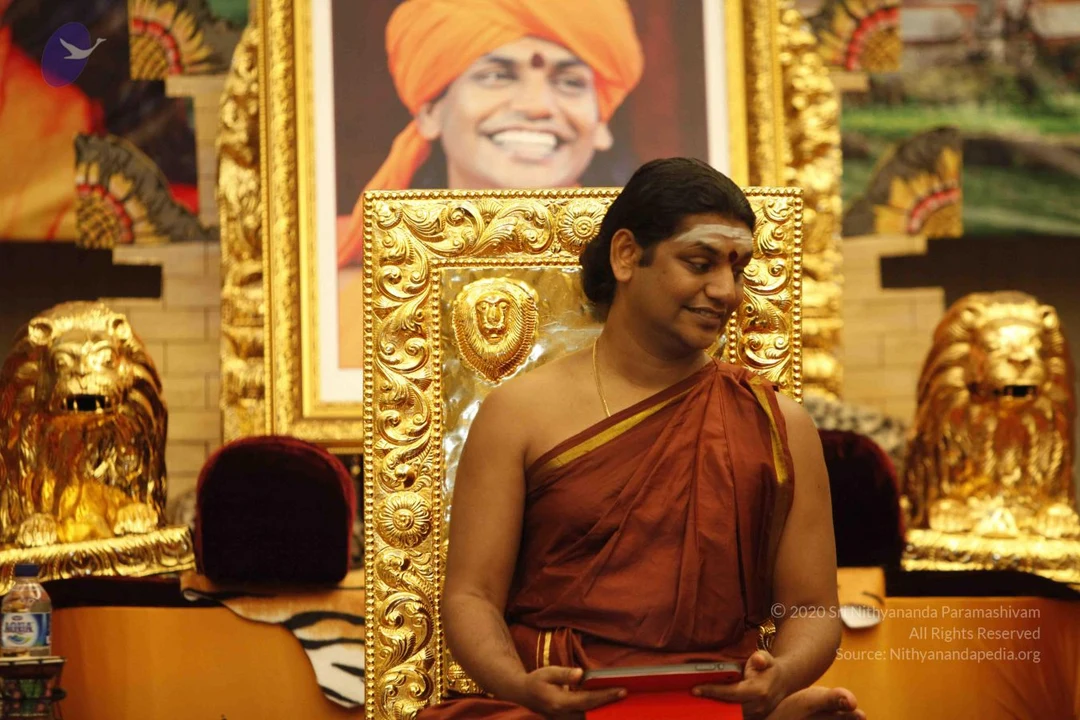
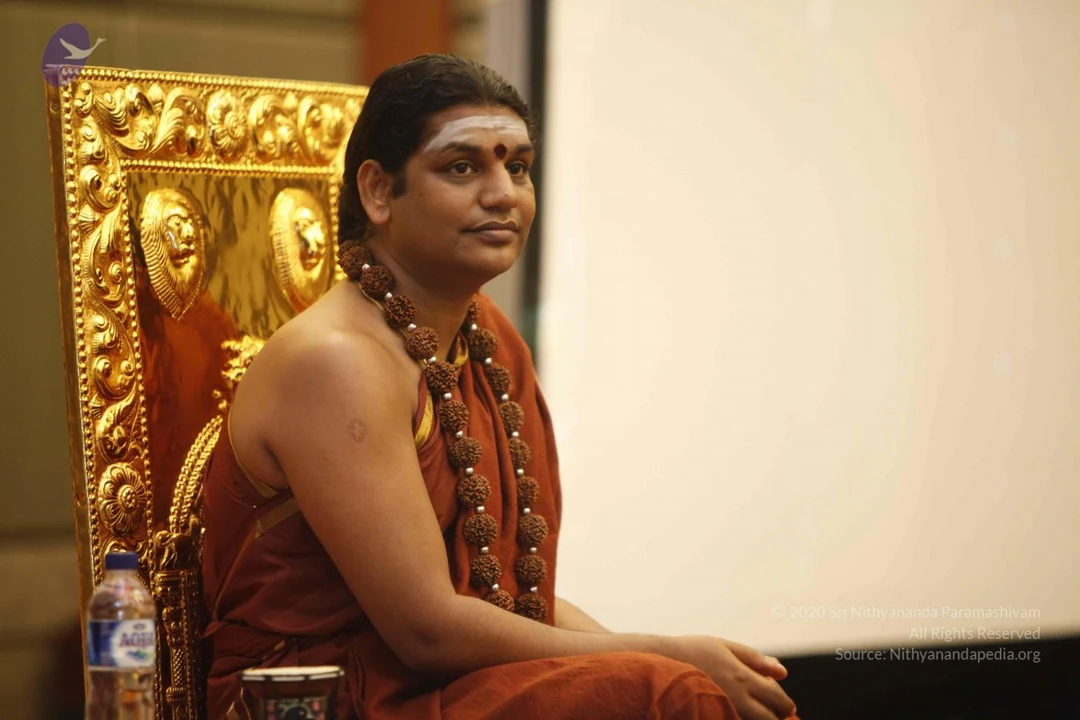
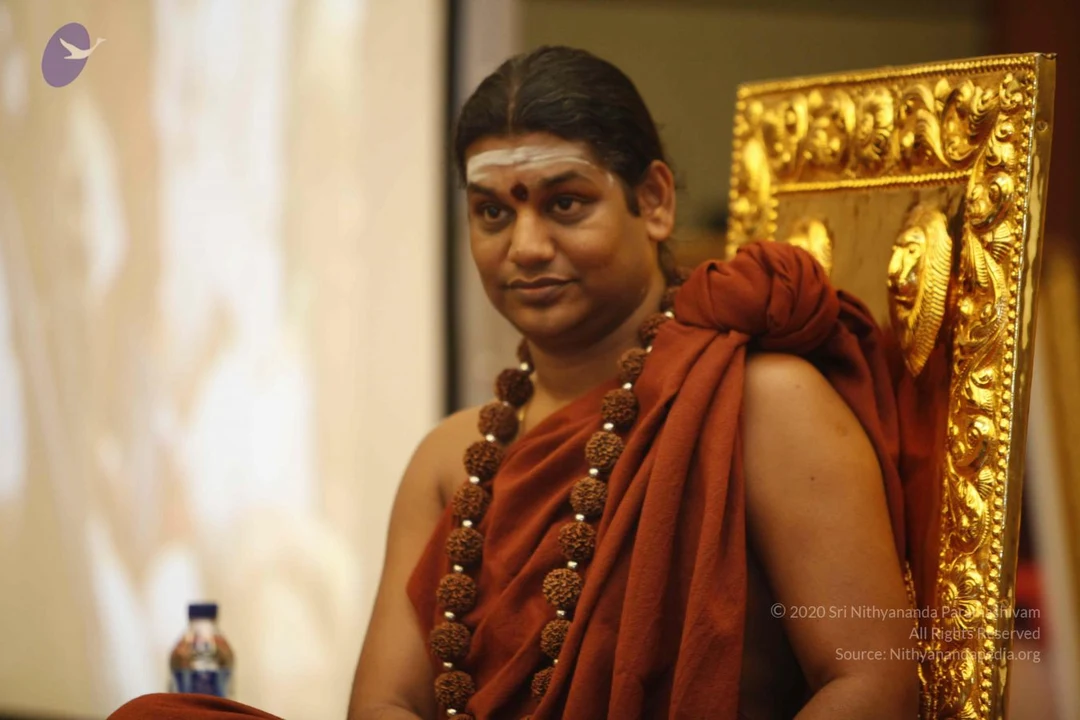
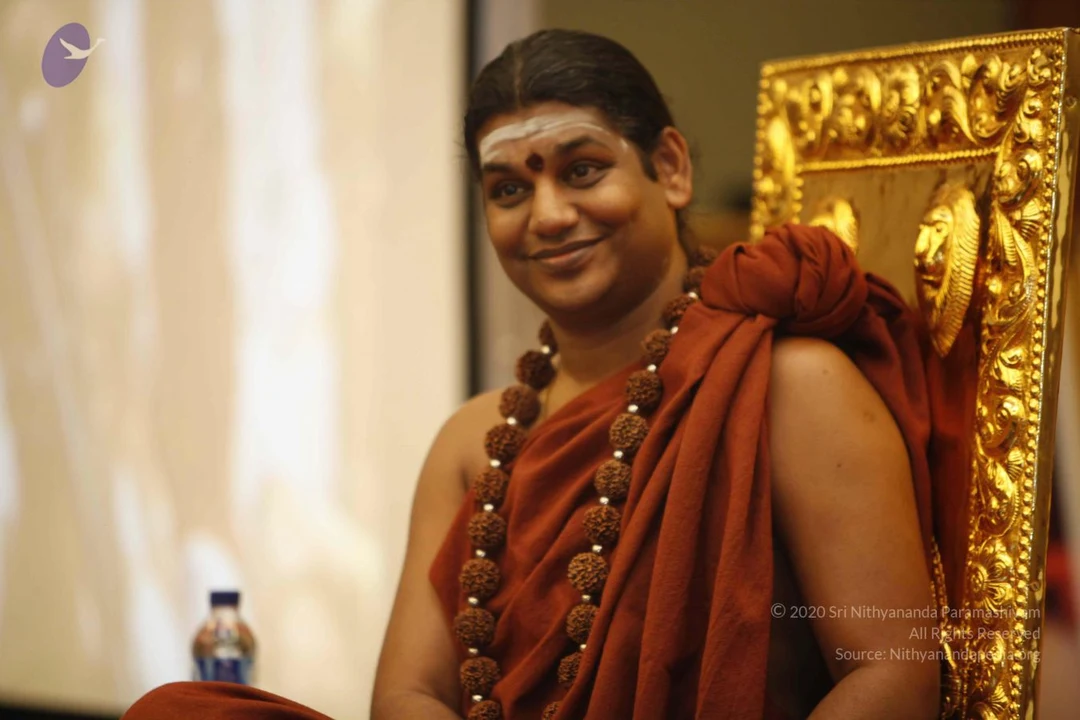
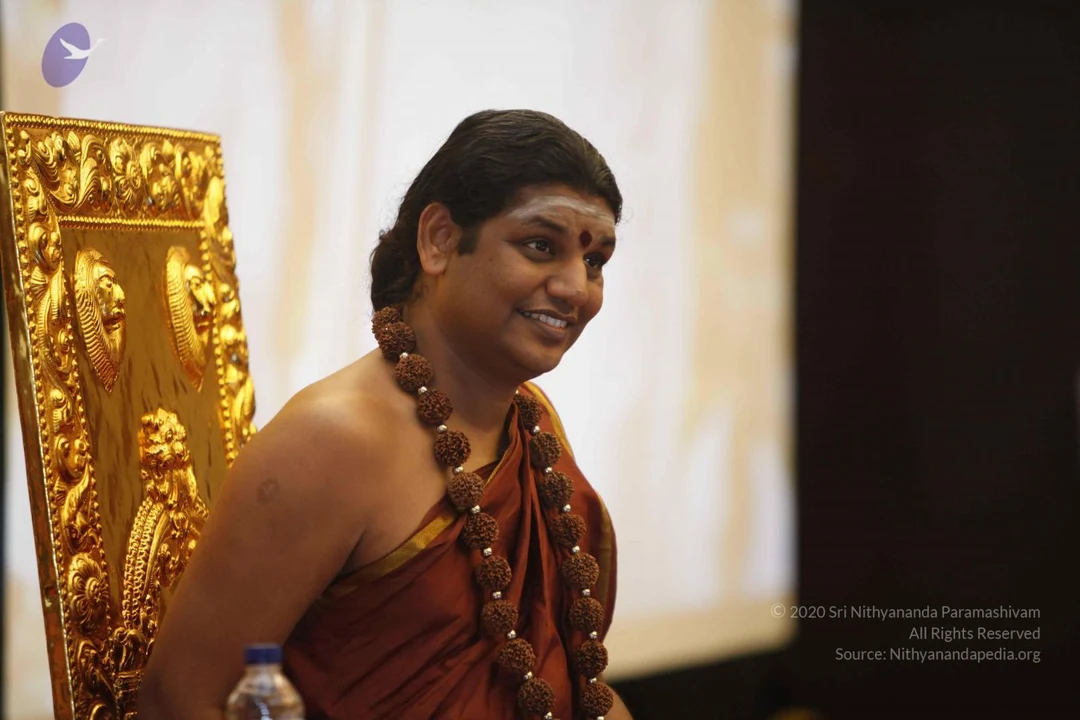
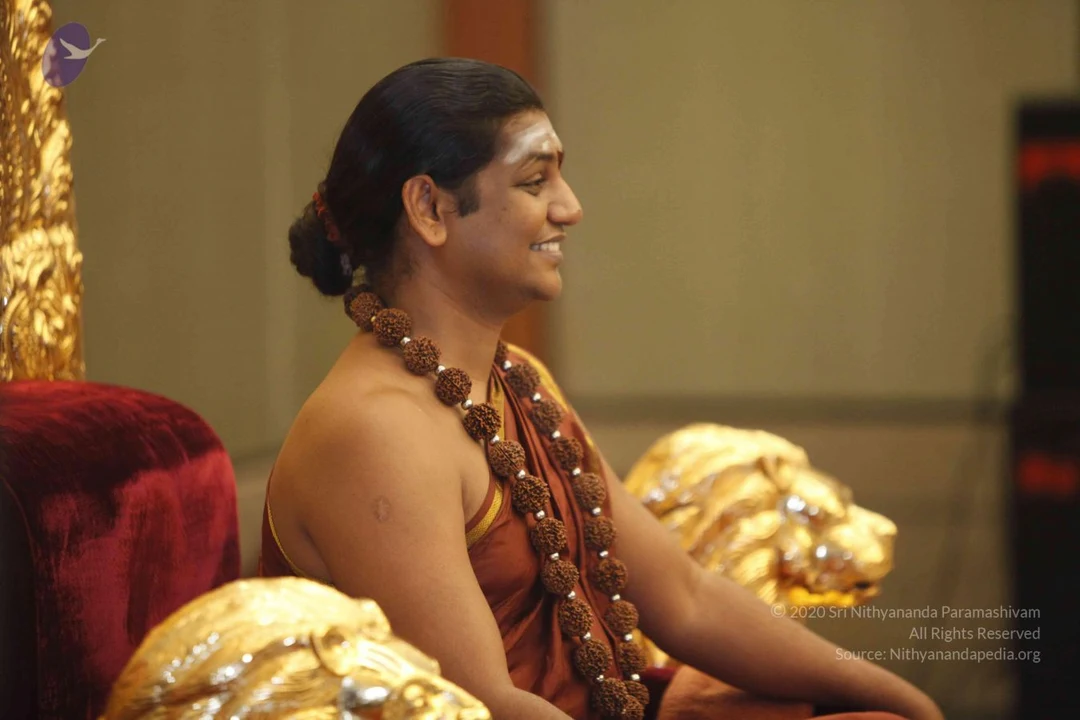
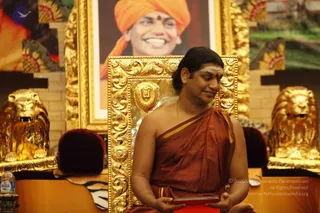
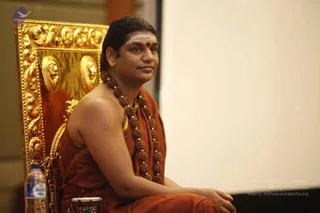
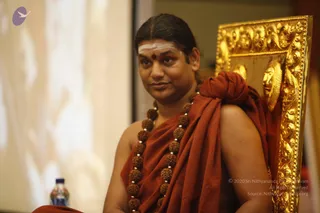
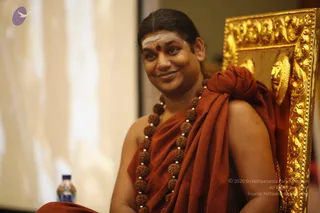
A man seated cross-legged on an ornate gold throne with carved floral borders and a gold lion emblem at its centre, flanked by two gold lion statues. He wears a rust-red draped cloth with a gold border, a thin gold chain, a white tilak on his forehead and a red bindi, and holds a red book in his lap. Behind him hangs a large framed portrait of a smiling man in an orange turban with a red mark on his forehead. Water bottles and a tiger-striped cloth are visible at the lower edges.A seated man in an ornate golden throne-style chair with carved lion heads and floral scrollwork is shown in profile-three-quarter view. He wears an orange-red shawl draped over his left shoulder and a long necklace of brown rudraksha beads, with a white horizontal line and a red dot on his forehead. A clear water bottle and a glass sit on a table in the foreground, with a blank white screen behind him. Appearance cues include the rudraksha mala, orange-red wrap and throne, which fit the a person label; the image is a photograph of him seated in a satsang setting.A man with long dark hair swept back sits in a gold-carved ornate chair, wearing a rust-orange shawl draped over one shoulder and bare on the other, with a long rudraksha mala of brown beads across his chest. He has a white sandalwood line and red bindi on his forehead. Behind him is a pale wall, and a water bottle sits in the lower left. The appearance is consistent with a person, seated on a peetha/throne, in a satsang setting.A smiling man with swept-back dark hair and a white tilak with a red bindi on his forehead sits on an ornate gold throne carved with lion-faced motifs. He wears a rust-orange wrap draped over his shoulder and bare upper arm, with a long rudraksha mala of brown beads hanging across his chest.A man with swept-back dark hair sits on an ornate gilded throne carved with lion heads and floral scrollwork. He wears a red-orange saffron wrap with a gold border and a long multi-strand rudraksha mala of brown beads around his neck, plus a red bindi and white vibhuti marks on his forehead. He smiles and looks to his side. A water bottle sits near the chair, and a pale screen forms the backdrop. a person is seated in the chair, identified by the swept hair, saffron wrap, rudraksha mala and gilded throne.

IA-DARSHAN

44 photosSource gallery
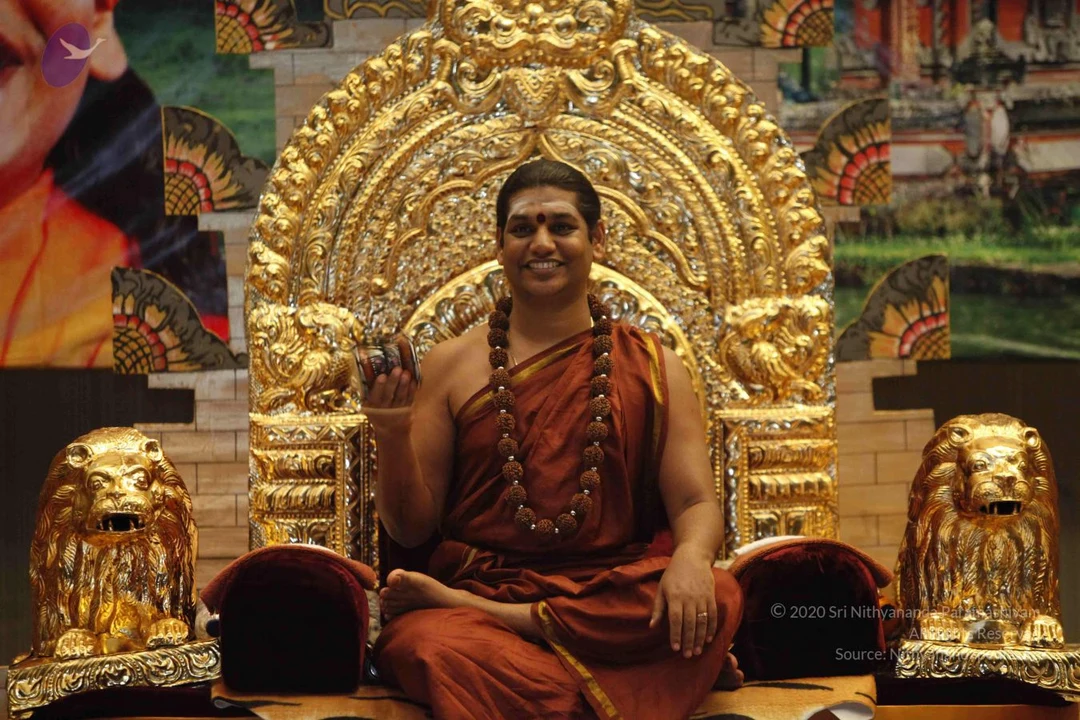
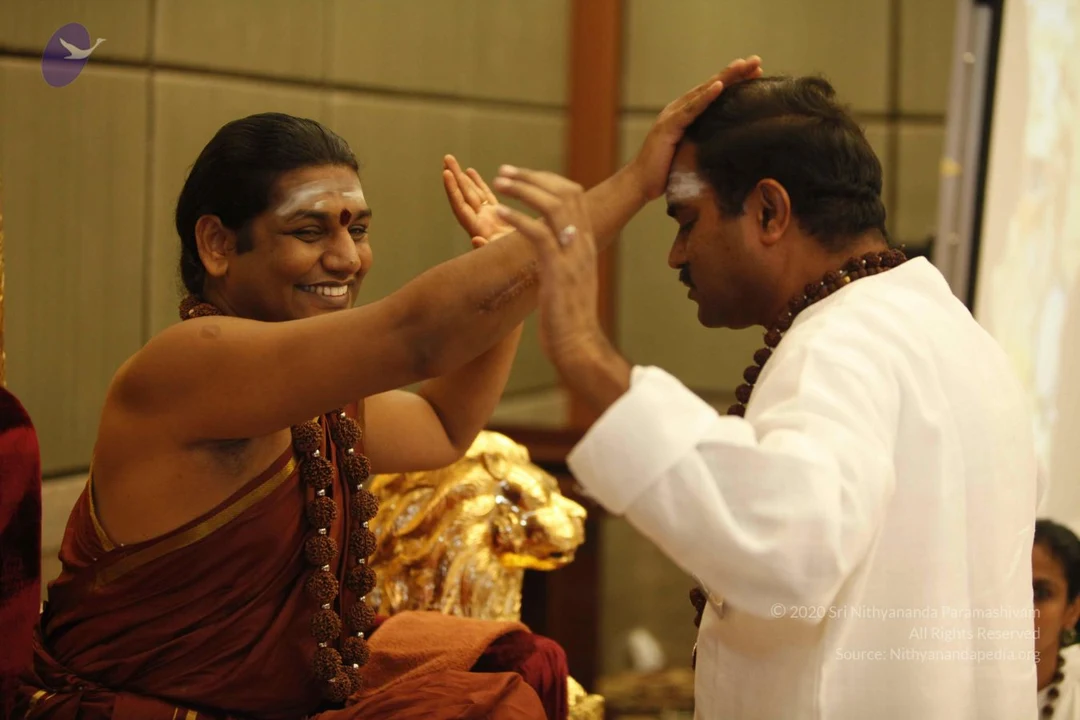
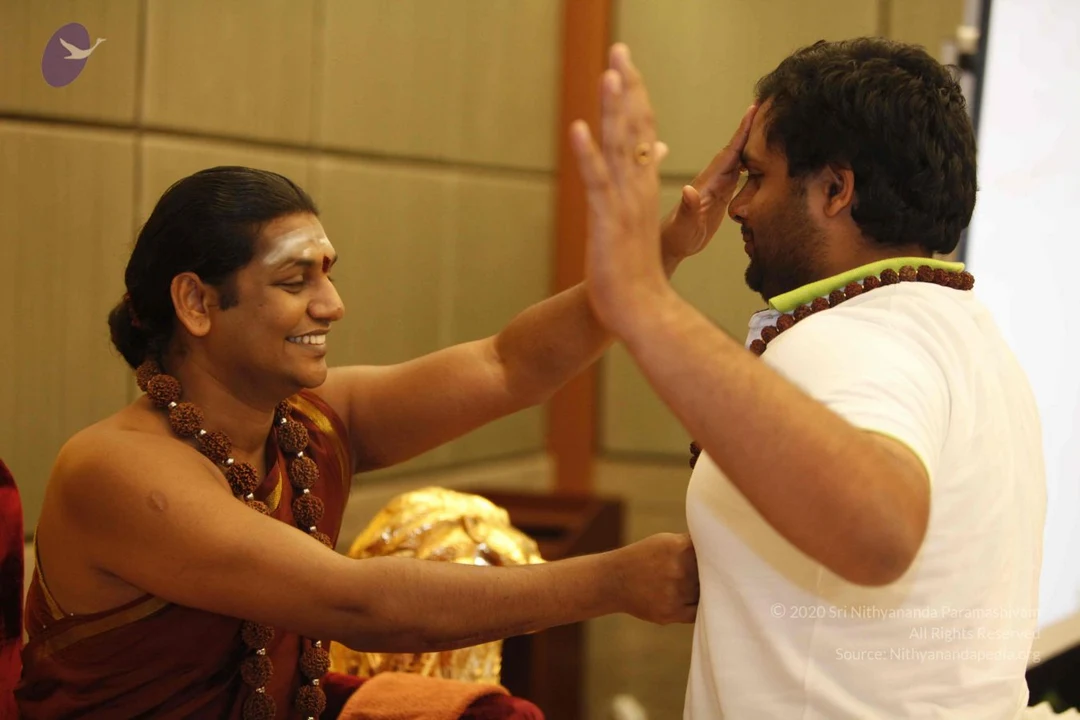
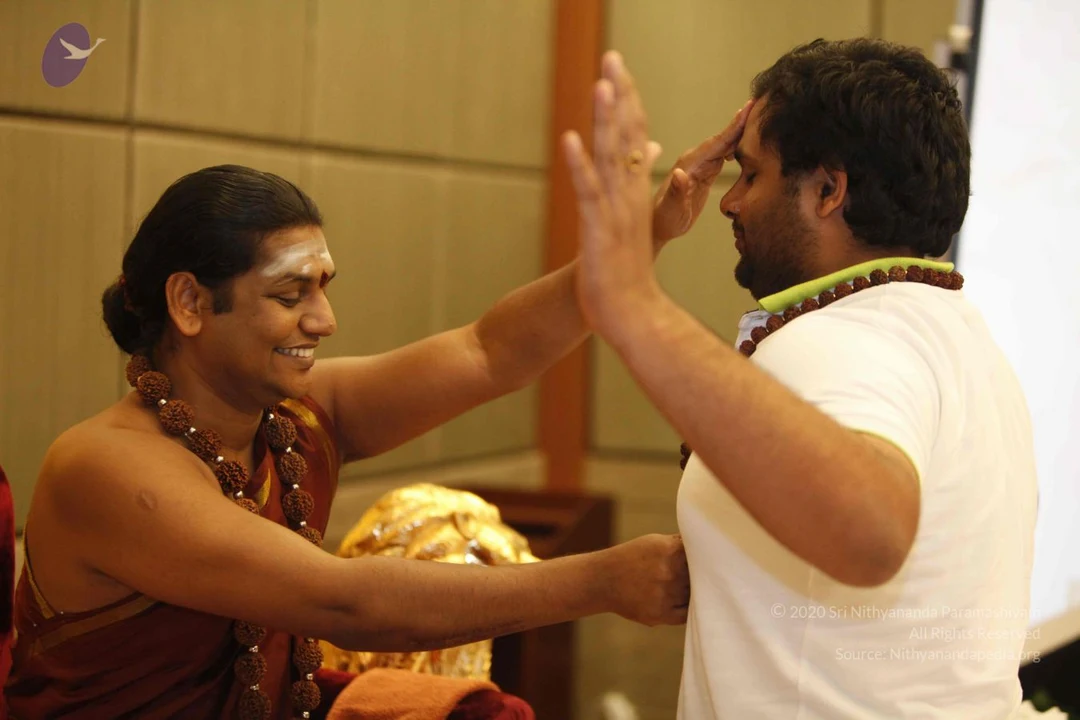
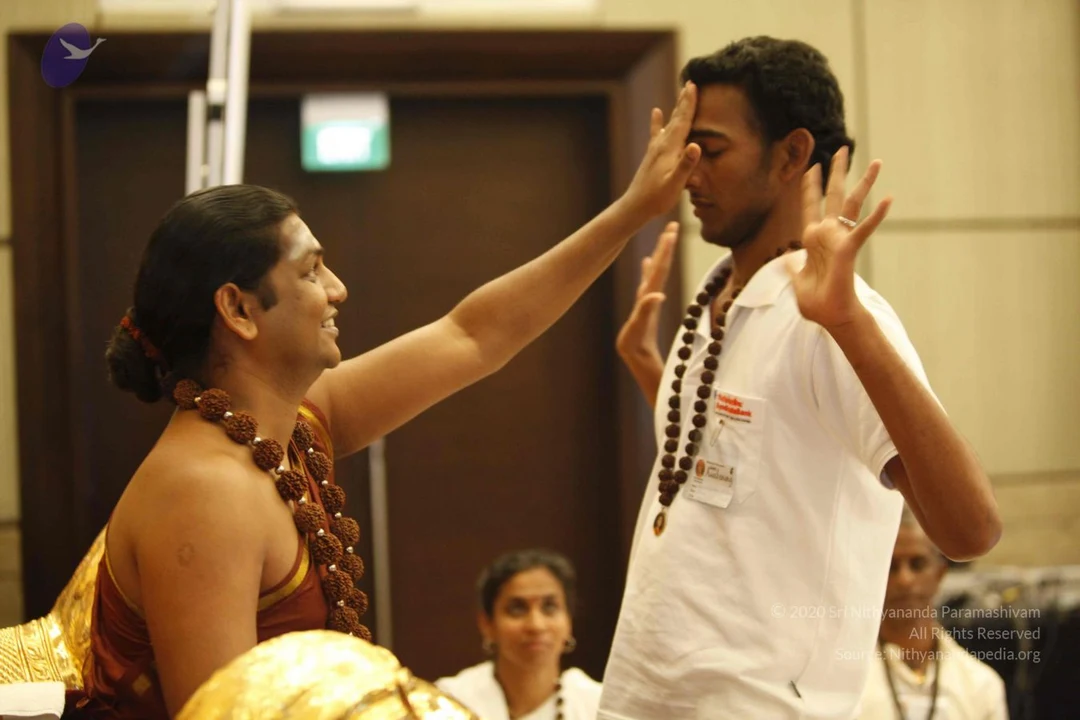
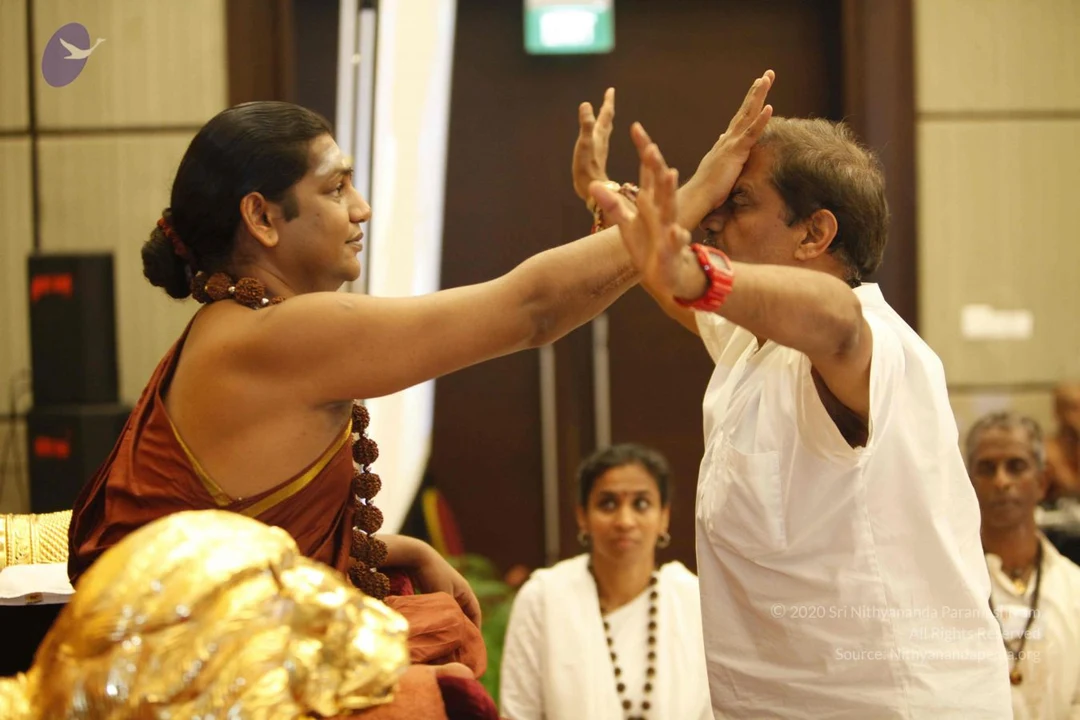
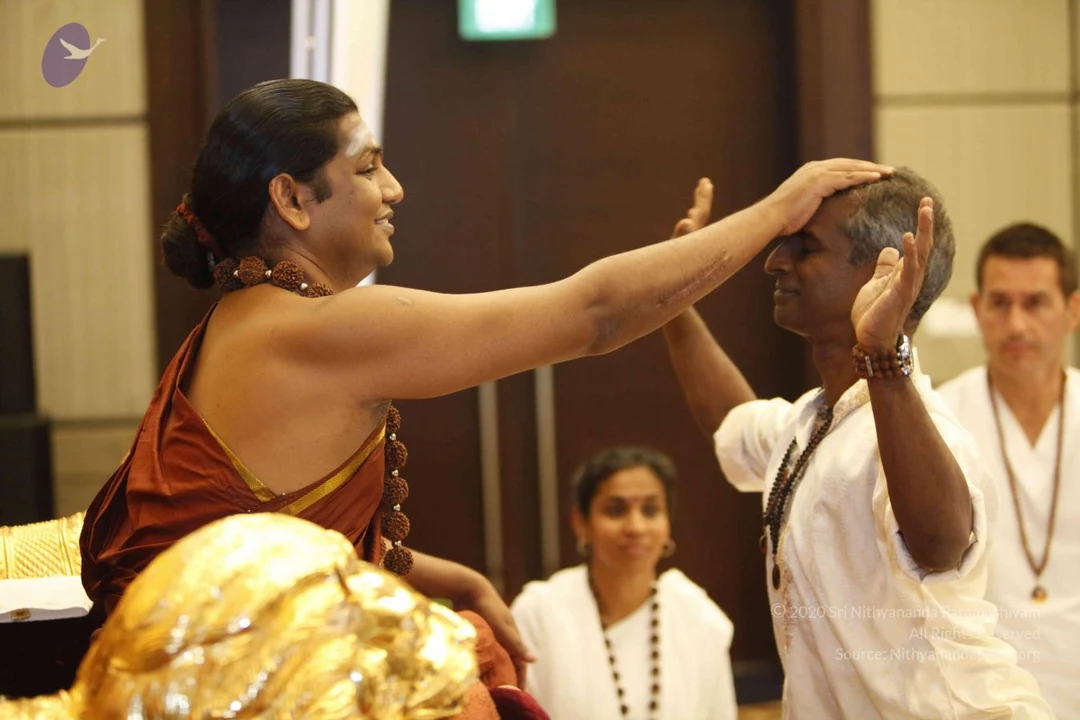
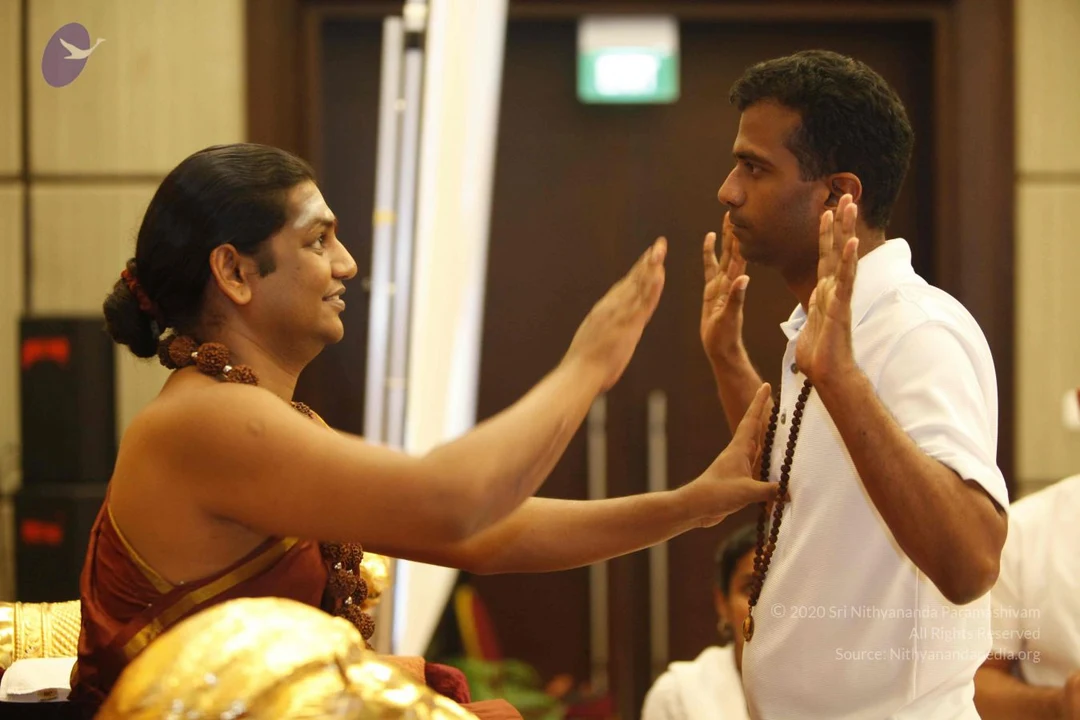
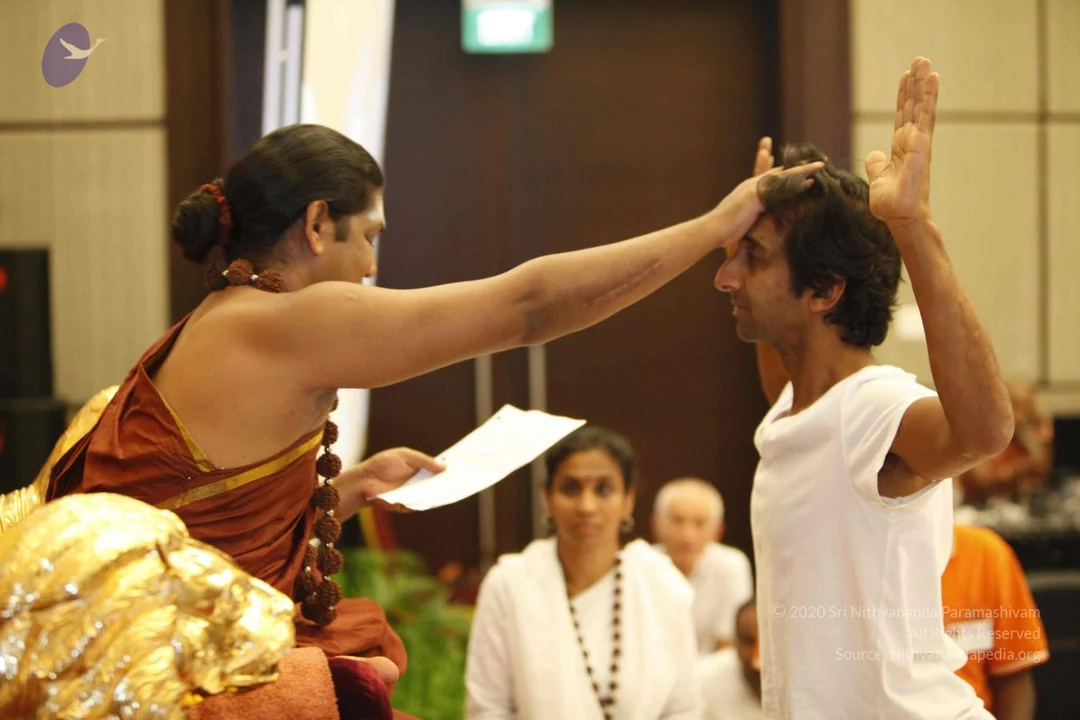
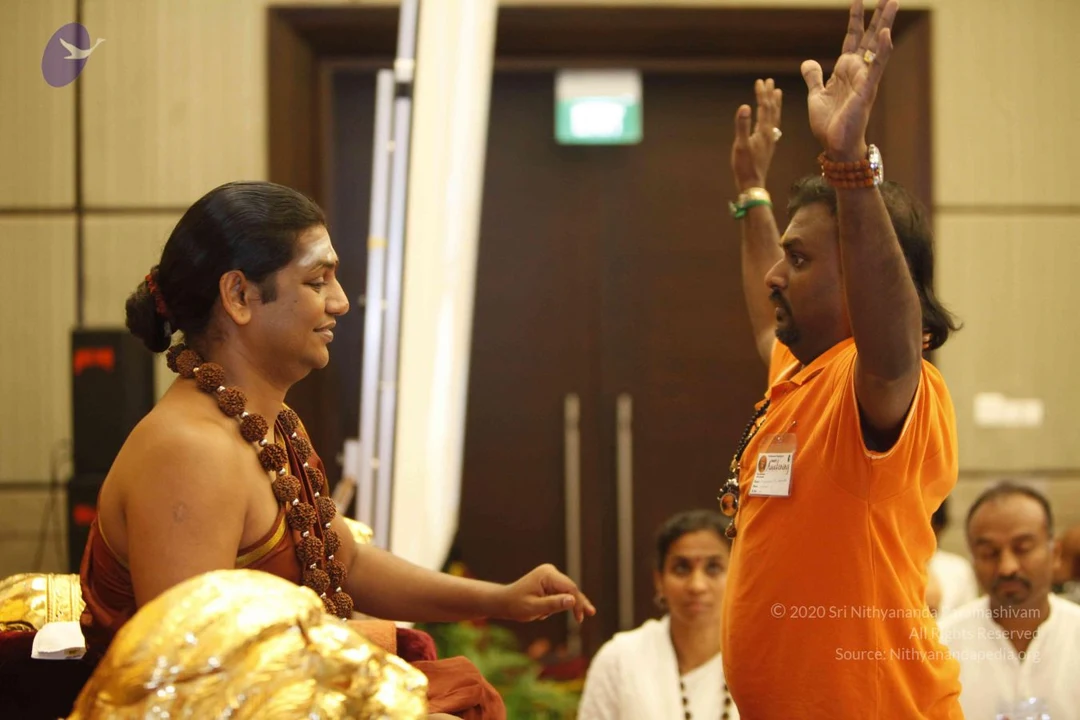
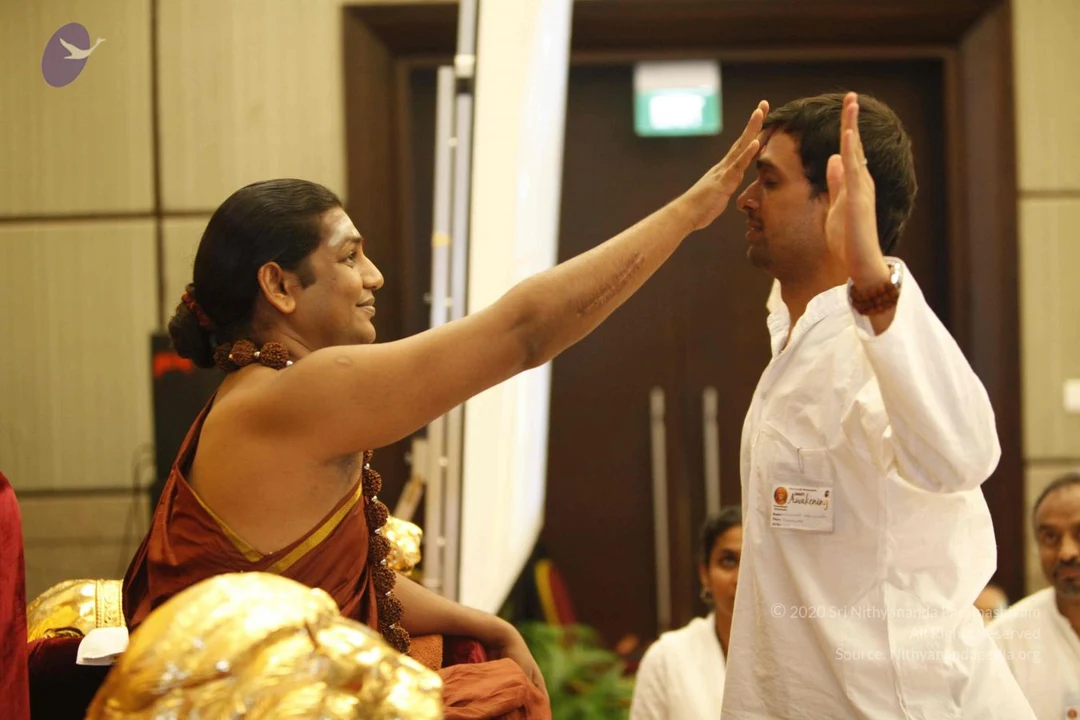
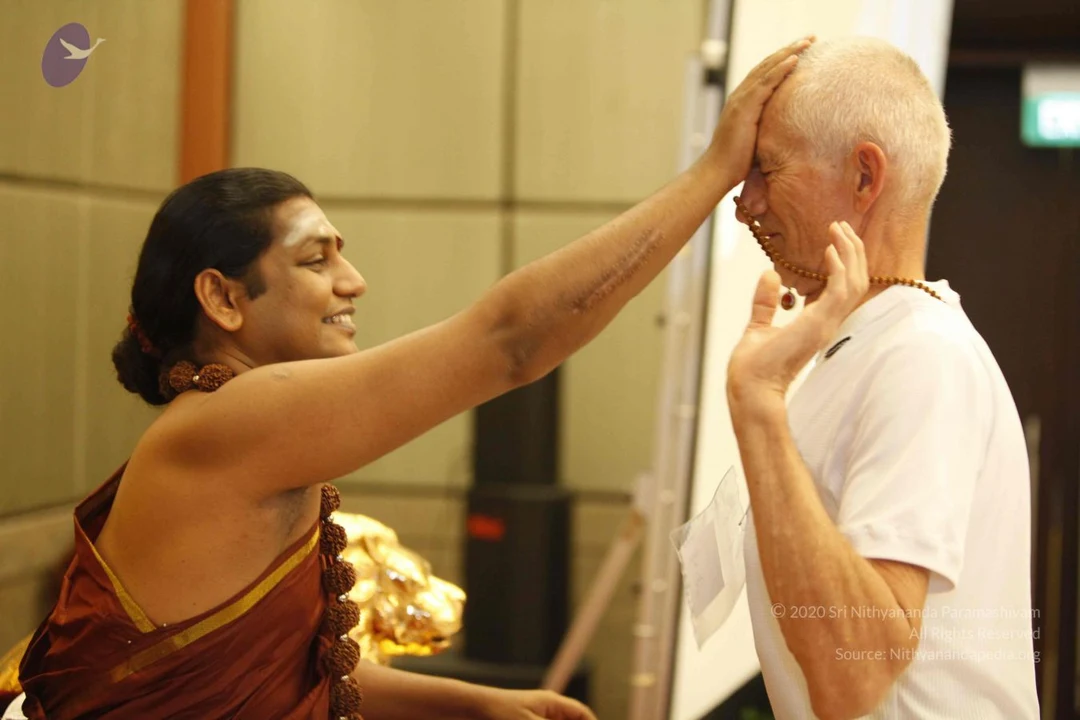
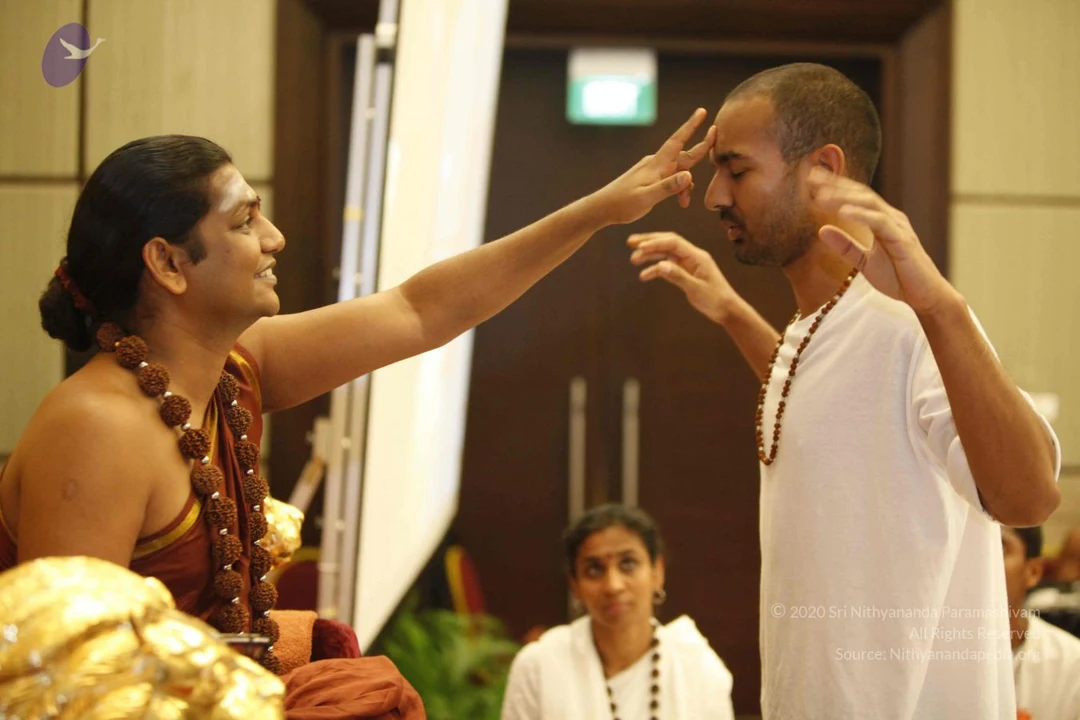
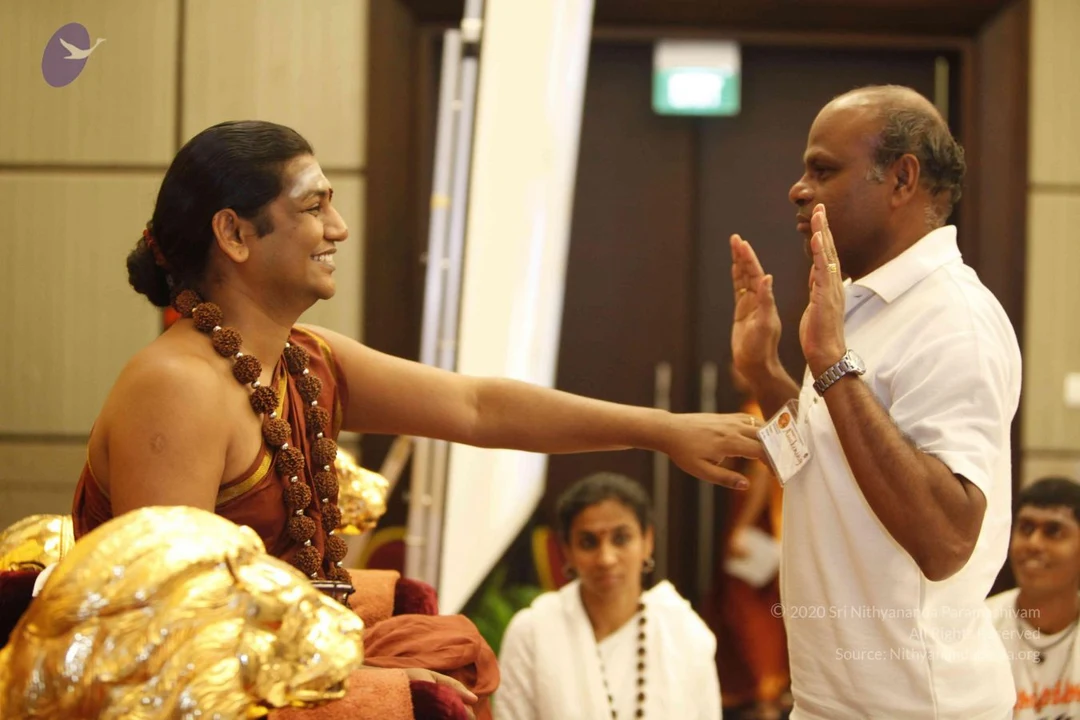
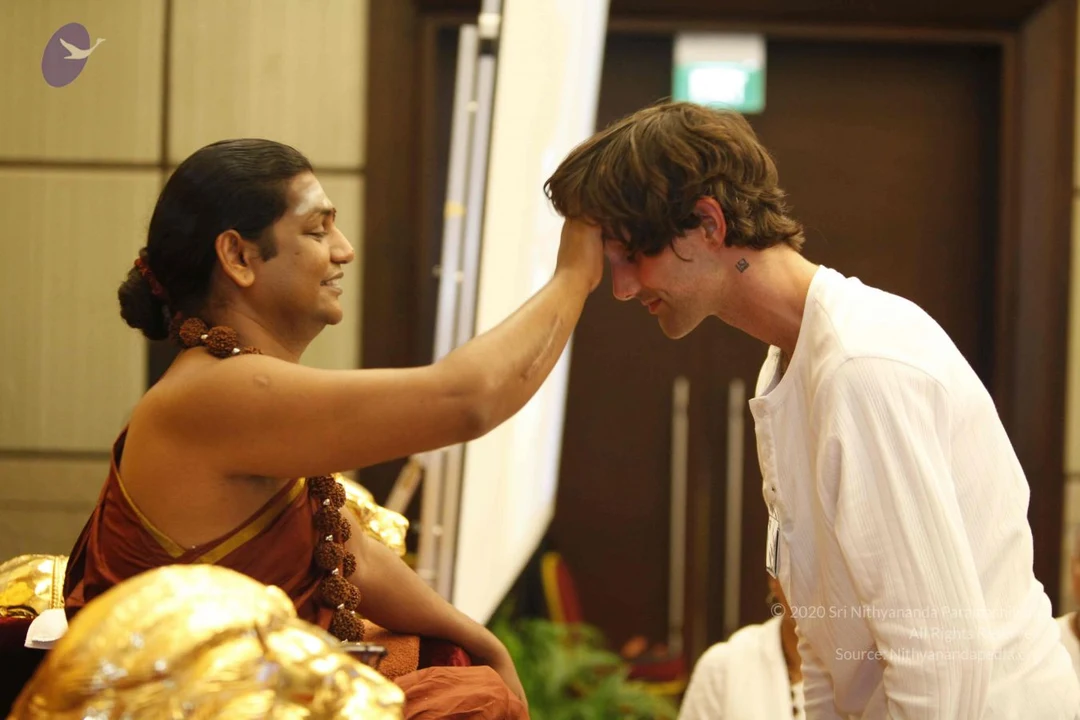
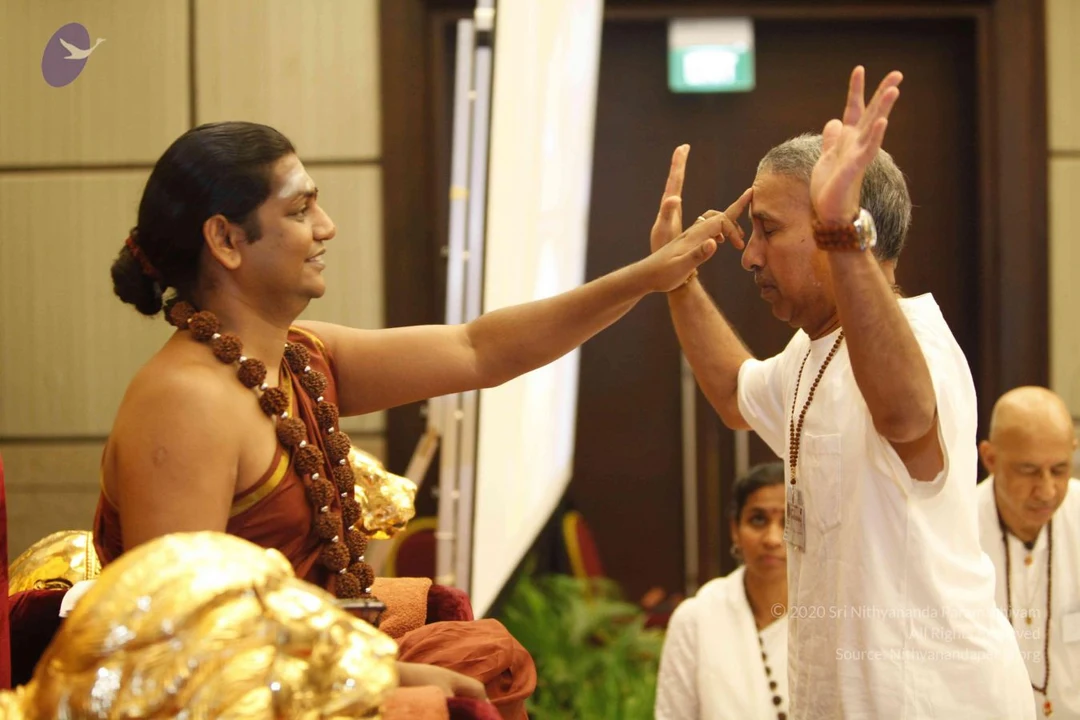
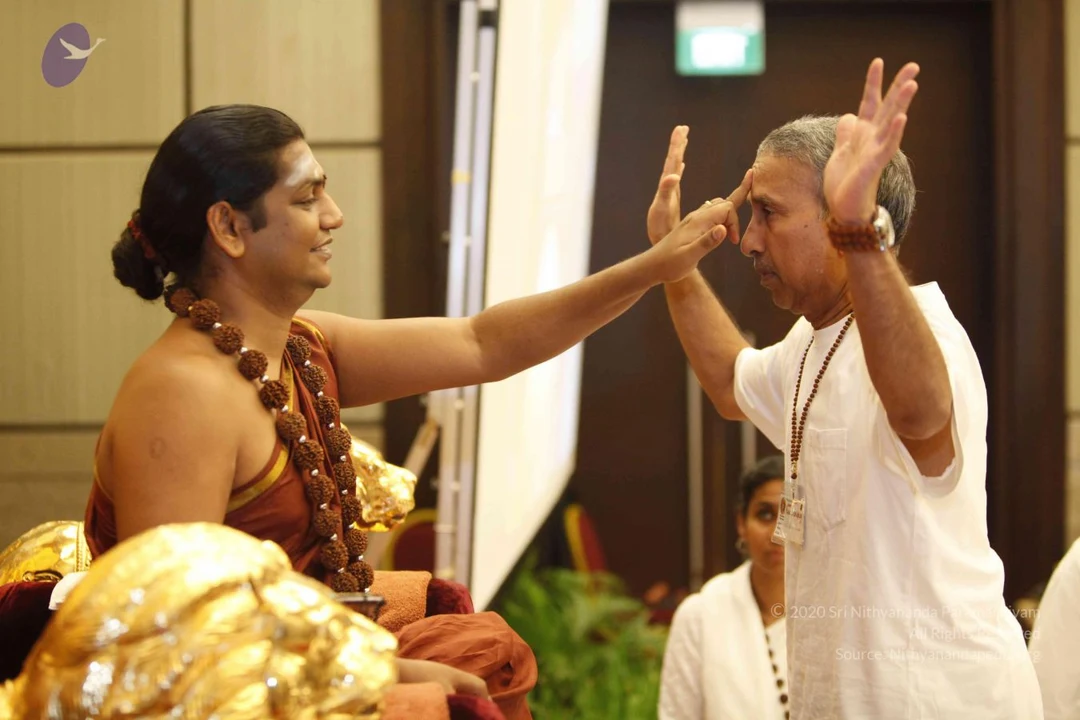
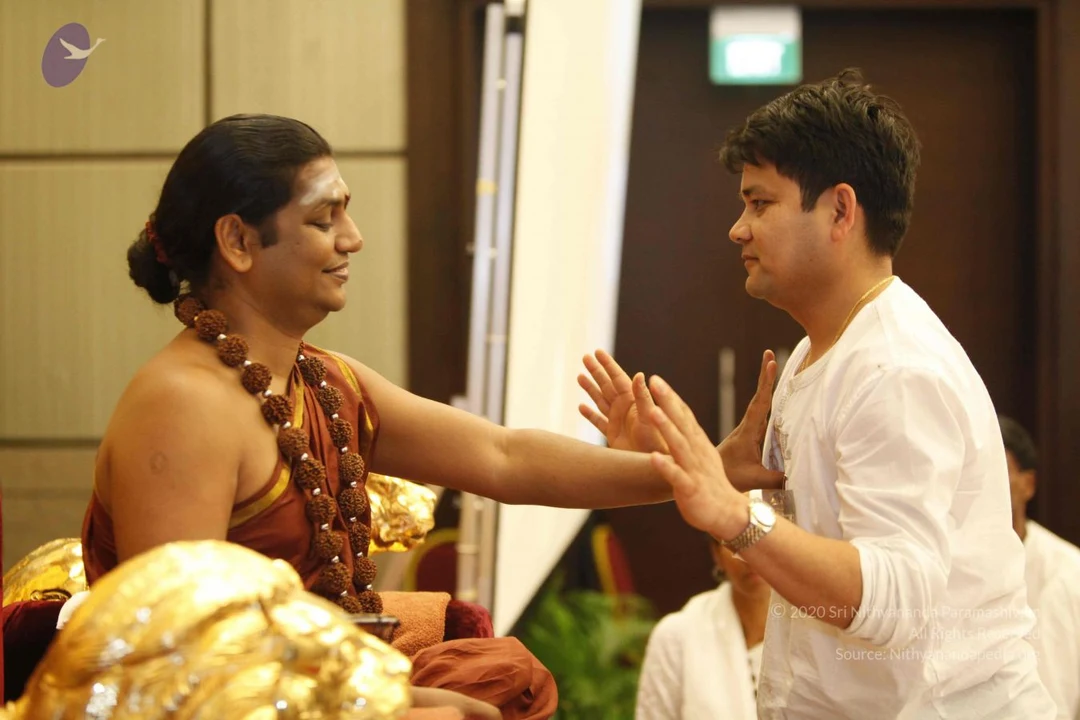
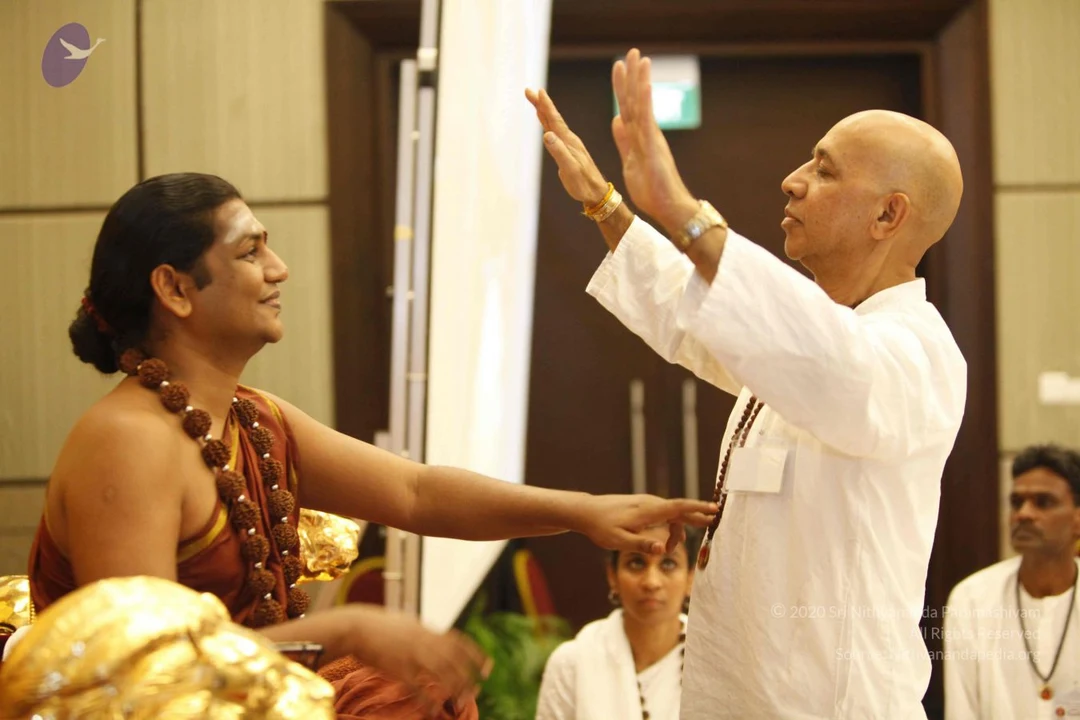
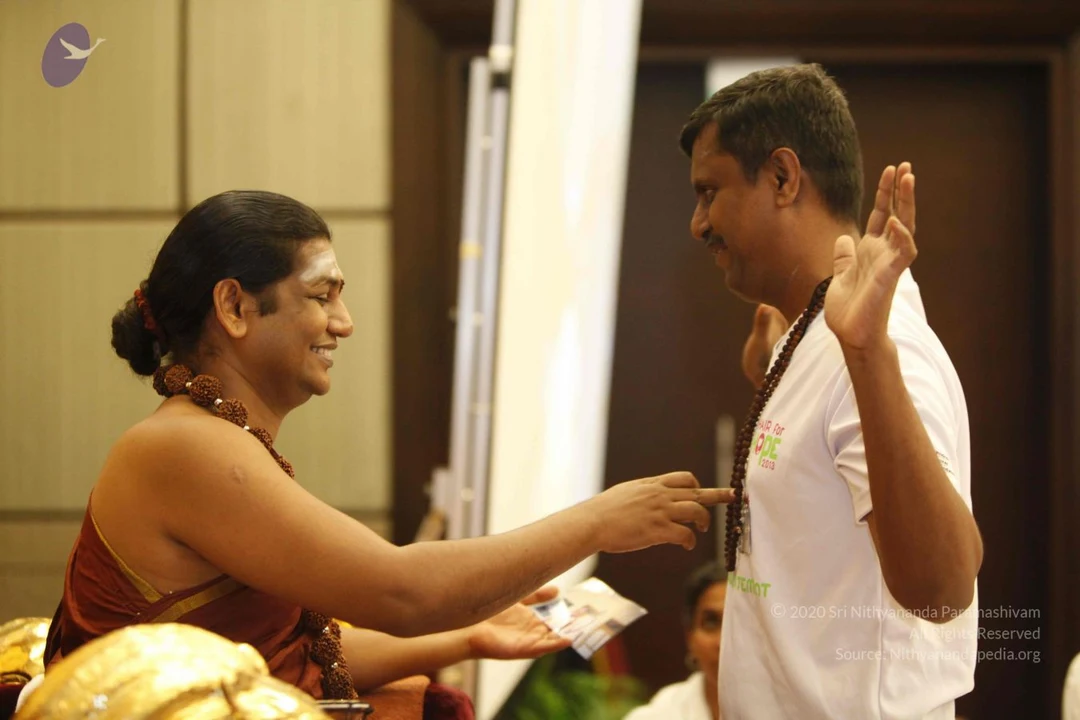
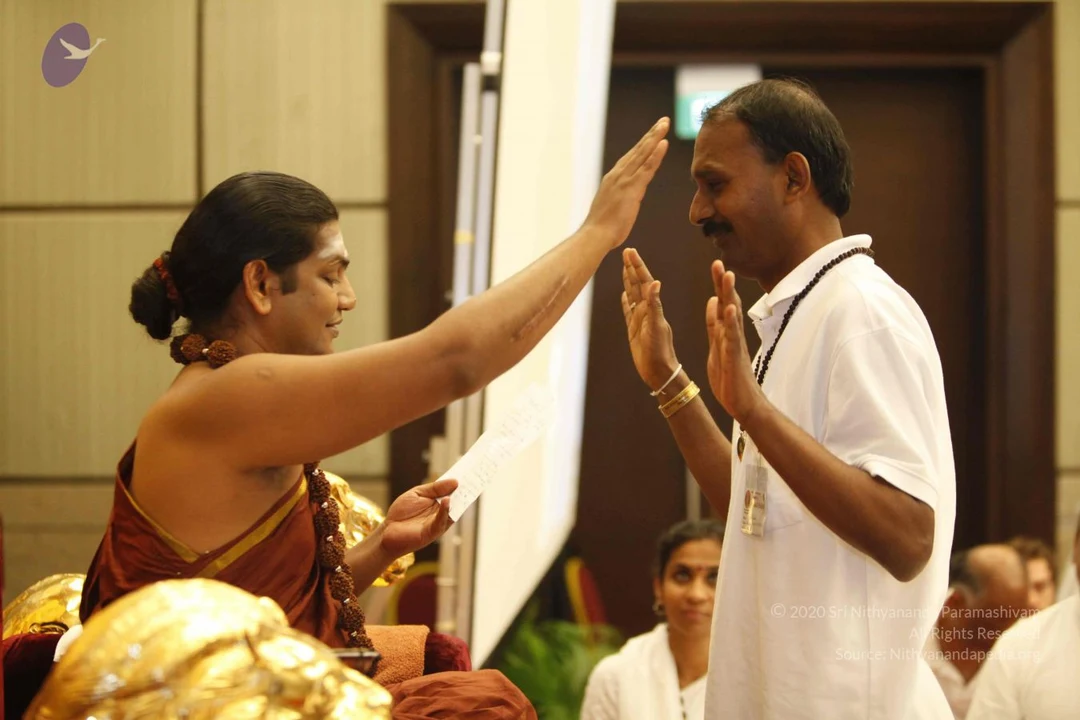
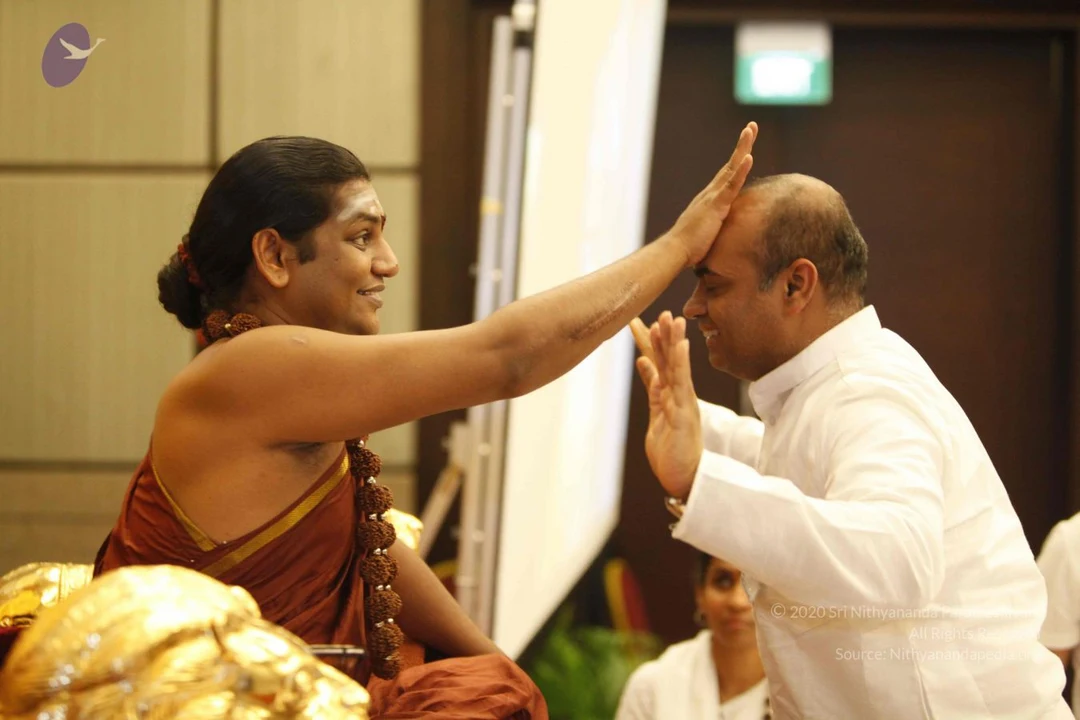
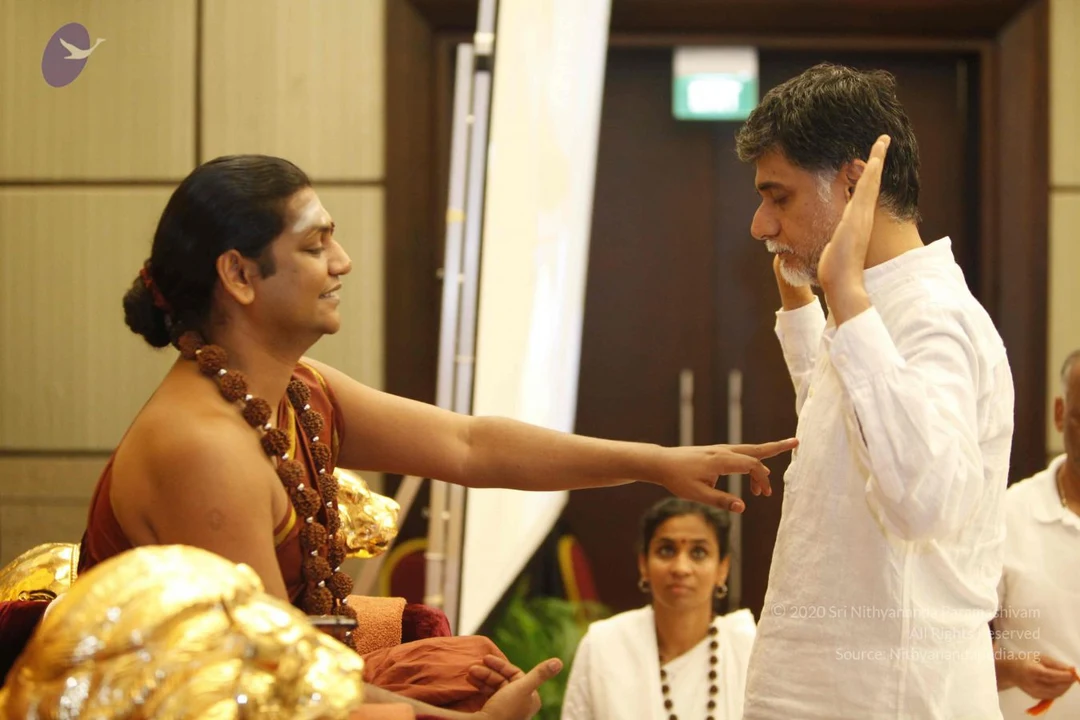
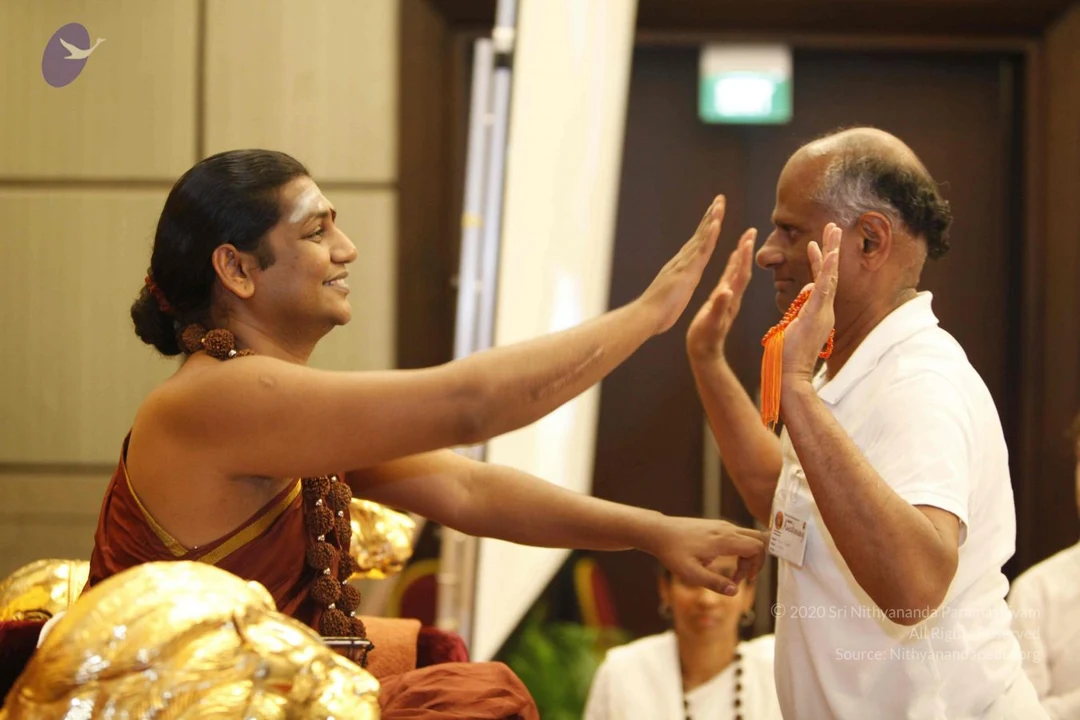
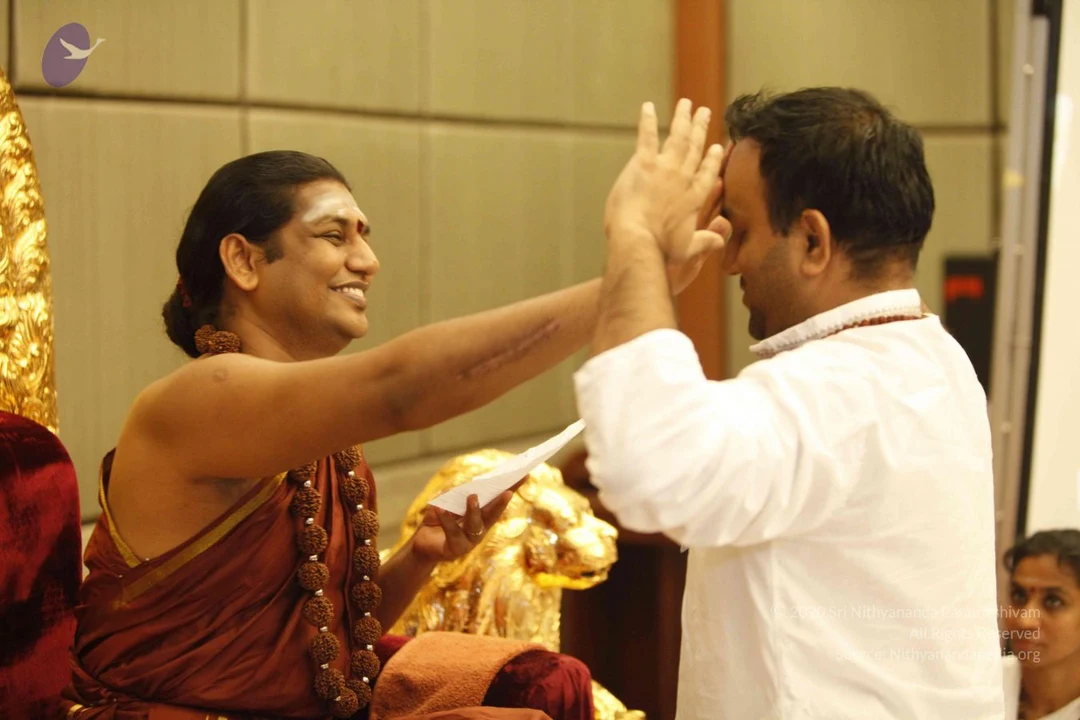
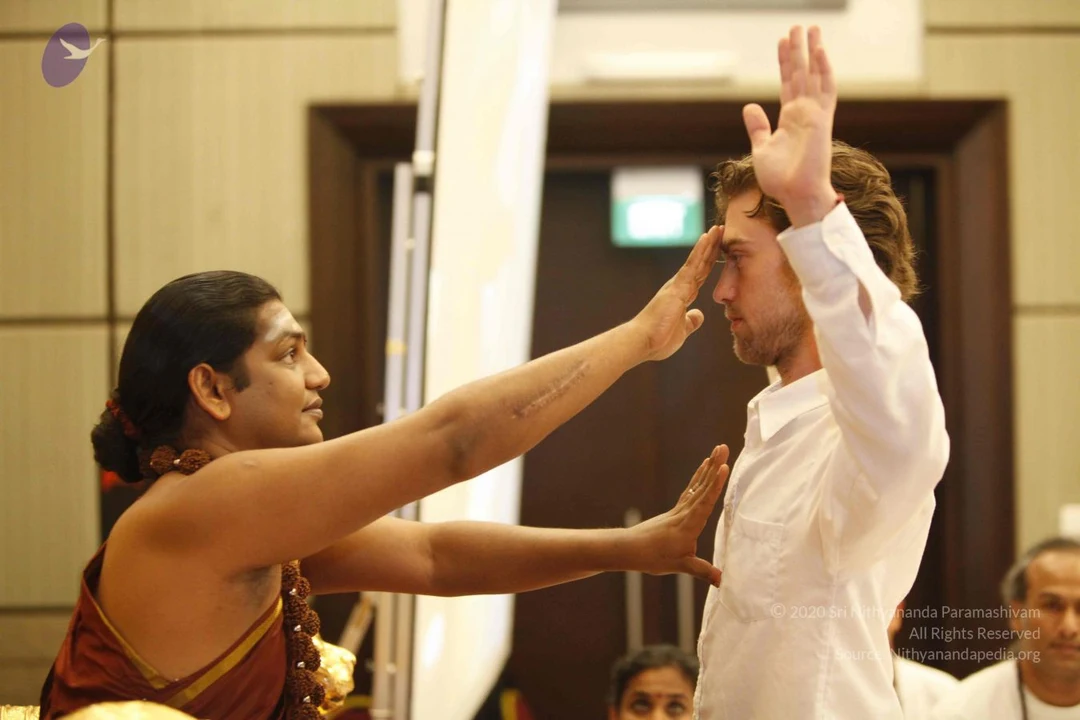
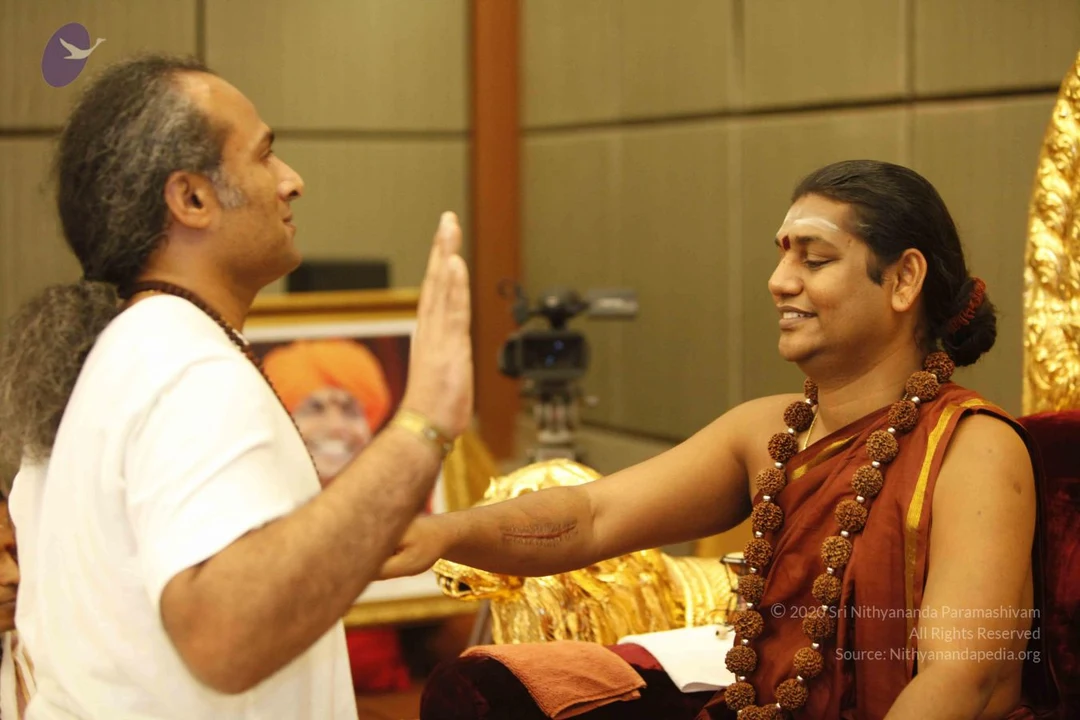
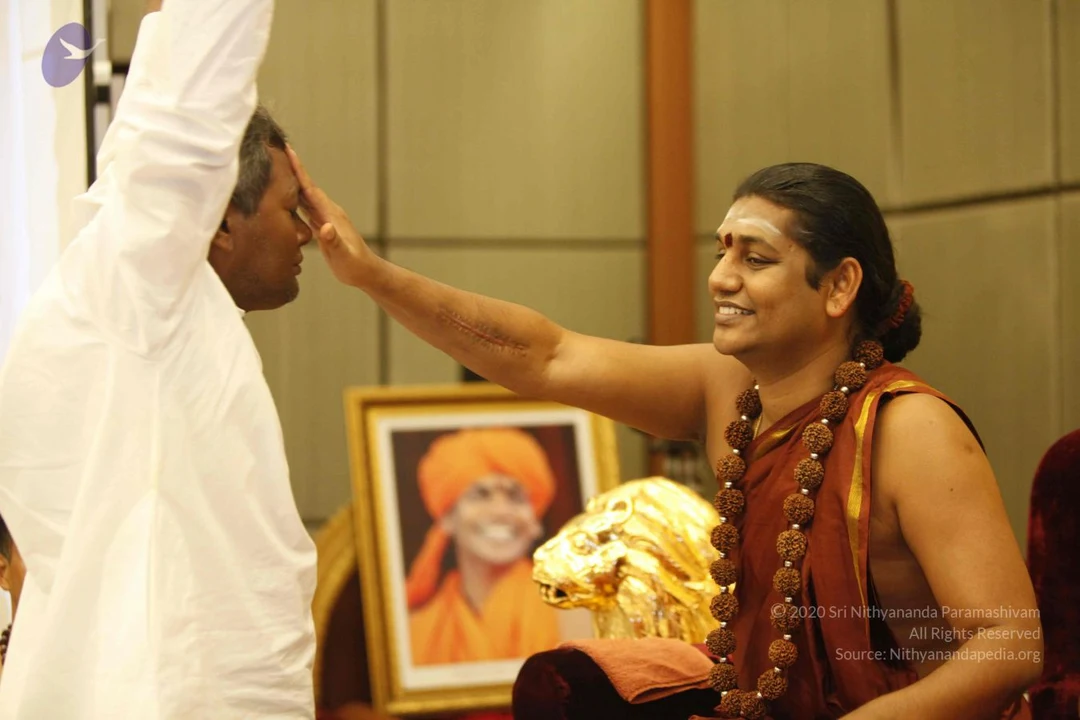
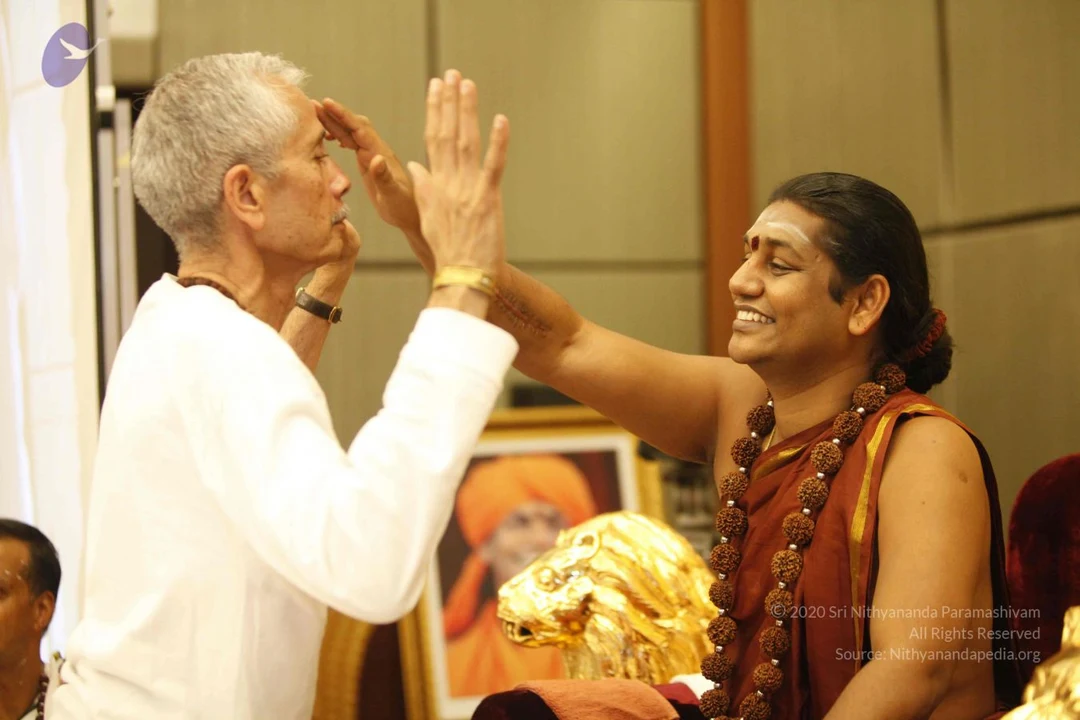
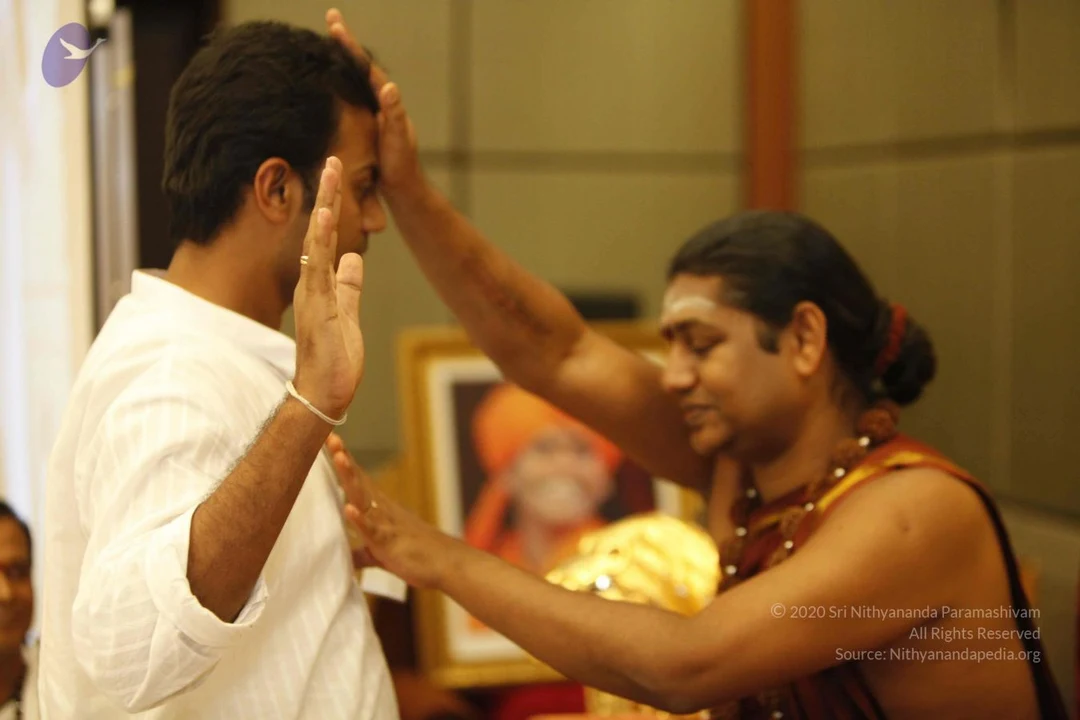
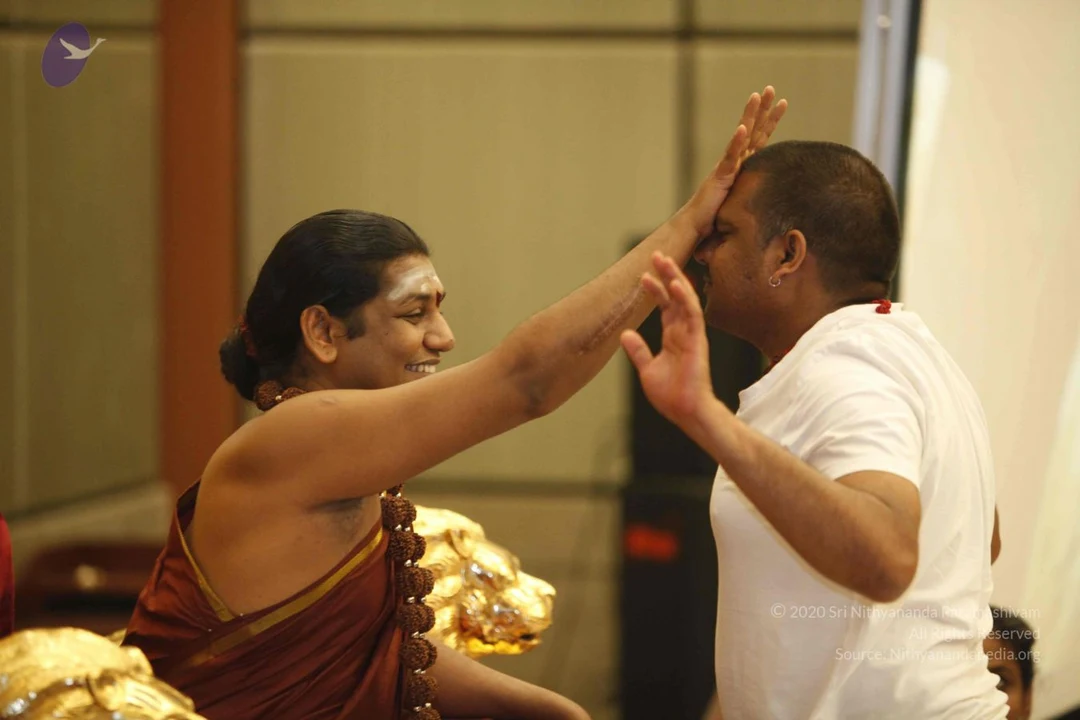
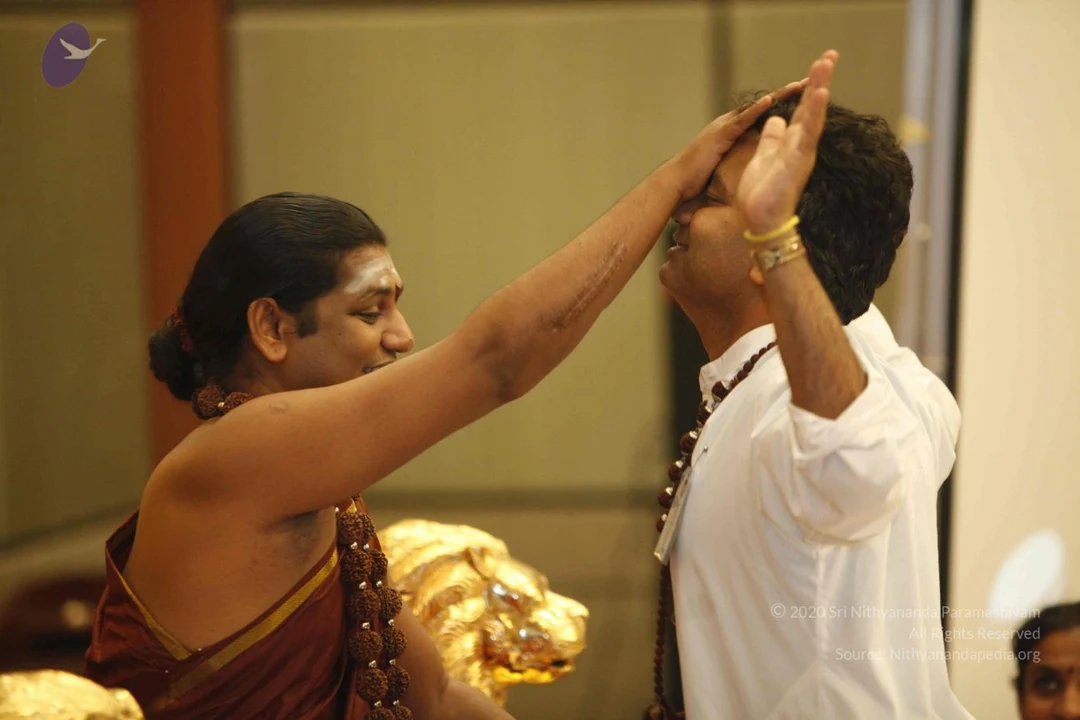
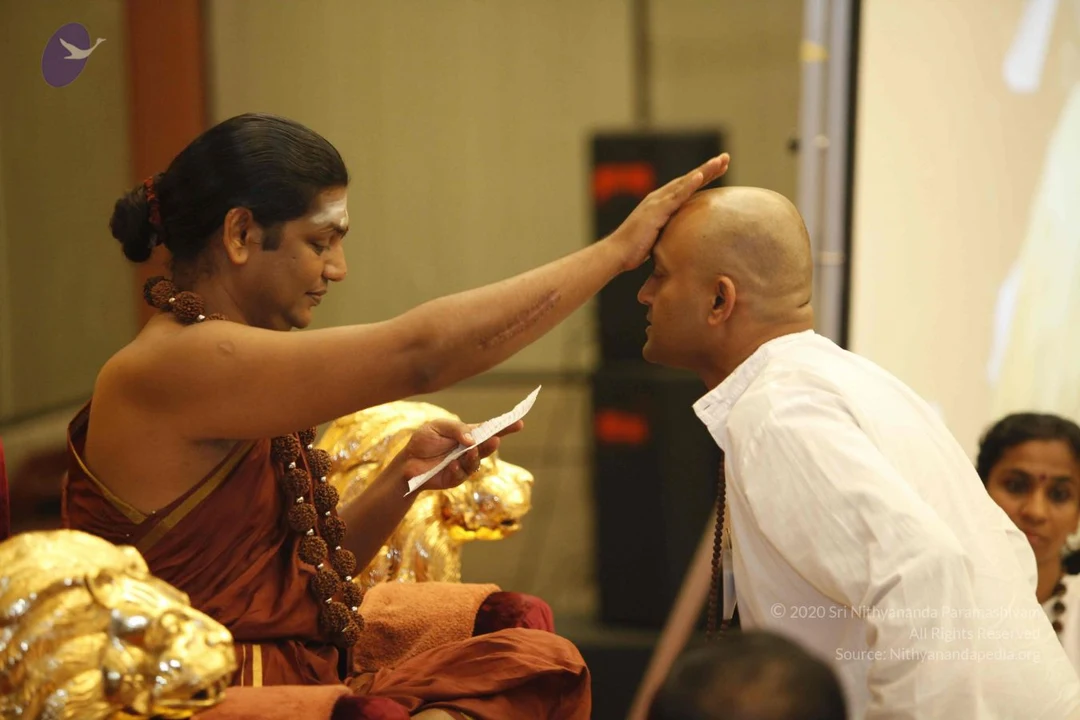
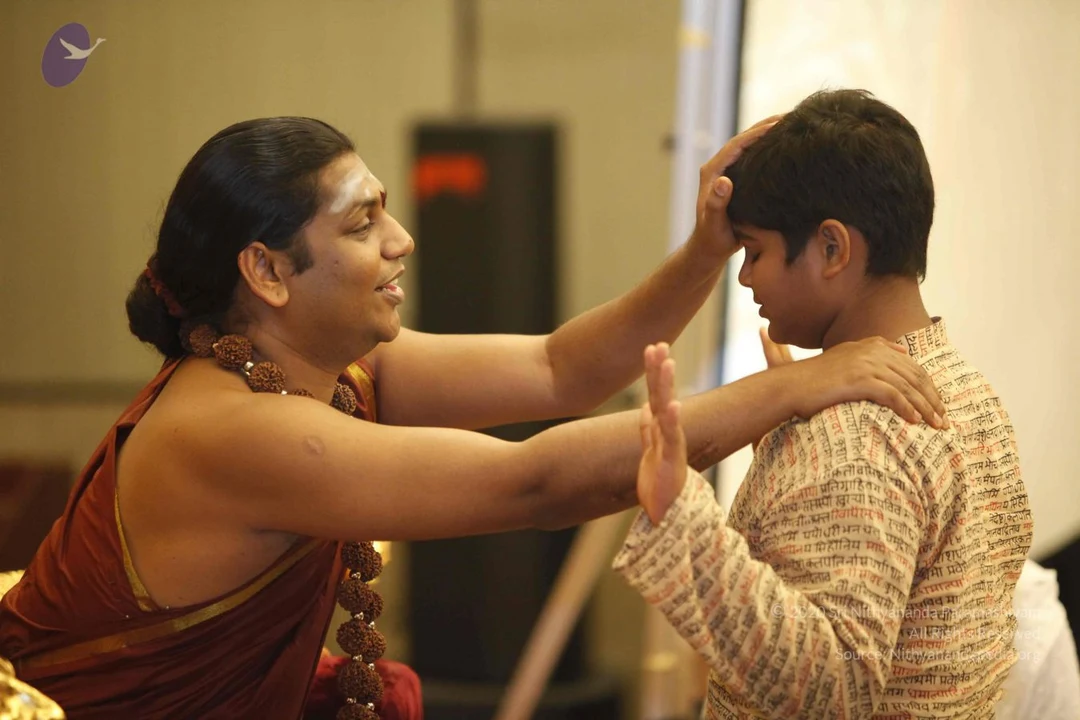
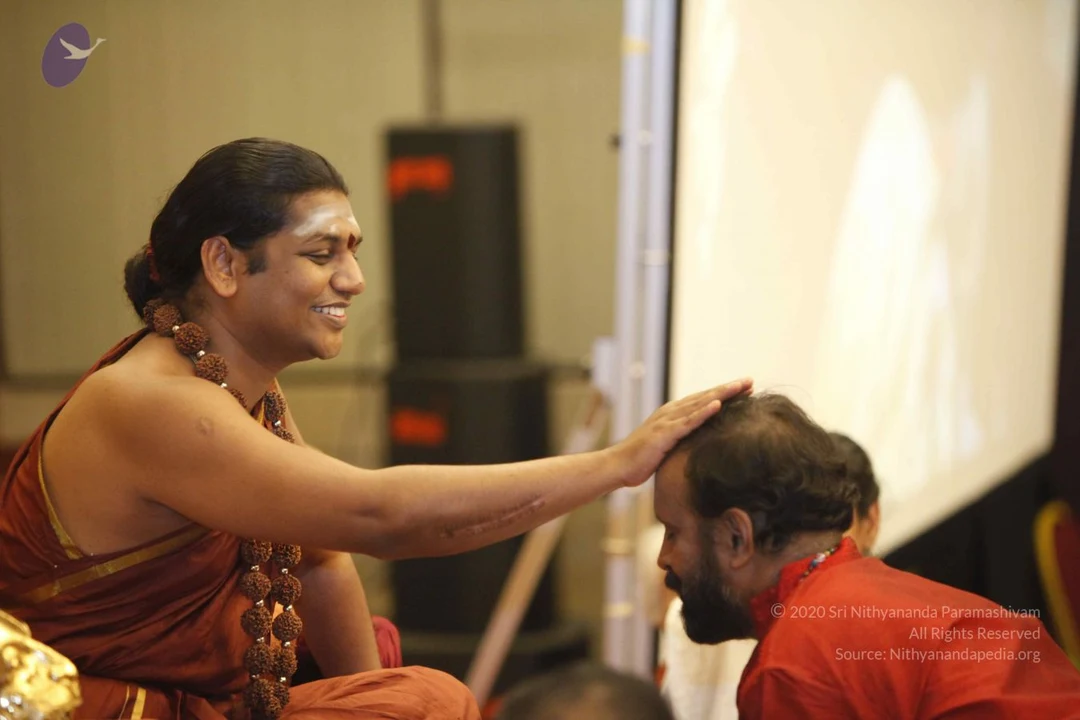
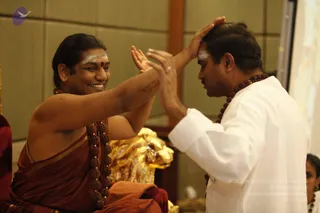
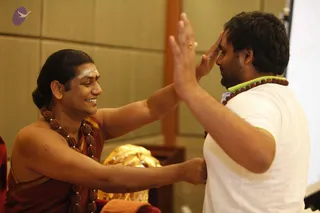
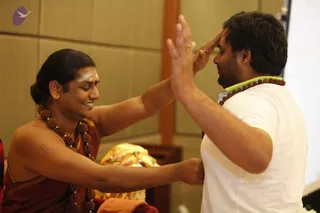
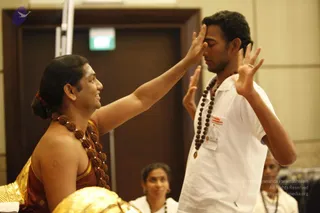
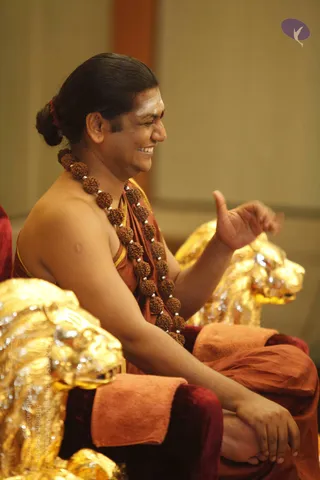
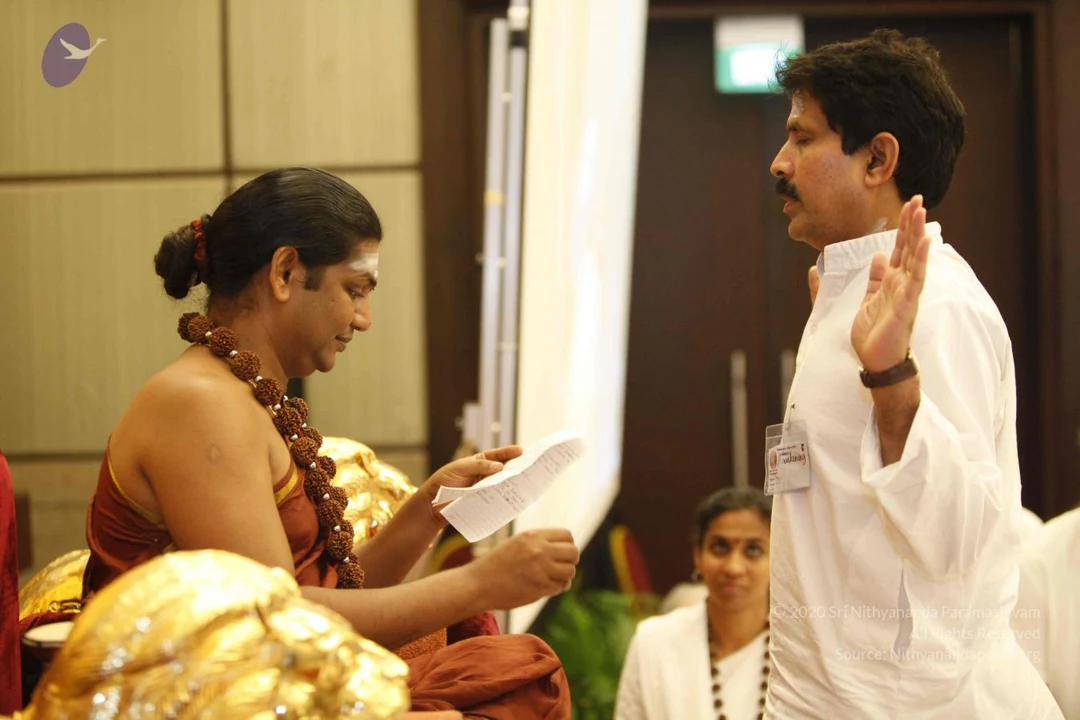
A man sits cross-legged on an ornate gilded throne with a large arched back and two golden lion sculptures flanking the seat. He wears a rust-orange robe with gold borders and a long rudraksha mala necklace, with a red-brown tilak on his forehead and a small cup held in his right hand. Behind him, a large backdrop shows a partial portrait of a man in orange clothing on the left and a temple scene on the right.A seated man with swept-back dark hair and a white-painted forehead wears a rust-red and orange shawl over bare shoulders, with a long rudraksha mala draped across his chest and a red bindi. He smiles broadly while raising his arms to touch the forehead of a man in a white kurta with a rudraksha mala, who bows his head and receives the blessing. A golden lion figure stands behind them, and a woman in white is partially visible at the right edge.Photograph of a seated man in a rust-red shawl with a bare chest, long swept-back hair, white vibhuti lines on the forehead, a red kumkum dot and a rudraksha mala, smiling as he raises his hands to the head of a man in a white kurta who wears a rudraksha mala and white forehead marks and bows forward. A golden lion figure stands behind them against a beige wall. The seated man has distinctive long hair and adornments, which supports a probable identification as a person, the in-person presence described on this page, while the second man is a devotee receiving blessing.Indoor photo of two men in close interaction. On the left, a bare-chested man in a reddish-brown cloth wrapped at the waist wears multiple rudraksha malas and has white vertical and red tilak markings on his forehead; his hair is swept back in a bun. He smiles while placing his hands near the shoulder of a second man, who wears a white t-shirt and a rudraksha mala with a green-edged collar, and whose palm is raised toward the first man's forehead in a blessing gesture. A golden kalasha-like object and wooden furniture sit in the background against tan wall panels.A photograph of two men in an indoor hall with beige wood-panelled walls. On the left, a smiling man with a topknot, white forehead markings, a rudraksha mala necklace and a bare shoulder wrapped in a maroon and gold shawl, is gently pressing his palm against the forehead of a man on the right. The recipient wears a white t-shirt, a green-edged white collar and a rudraksha mala, with eyes closed. A golden cloth-covered object sits in the background.A seated man with dark hair swept into a low bun, wearing a rust-red garment with gold trim and a long rudraksha mala of brown beads, extends his right hand to touch the forehead of a young man in a white collared shirt with a brown rudraksha mala and a name badge. The young man stands with eyes closed and palms raised in a mudra. A woman in white and a man in the background look on. Indoors, with a brown door and exit sign behind, and a gold cushion visible at the lower left. a person: the seated man wears rudraksha malas and a red garment with gold trim, and is in a seated teaching or blessing posture.

1-PRATHYAKSHA-PADA-PUJA
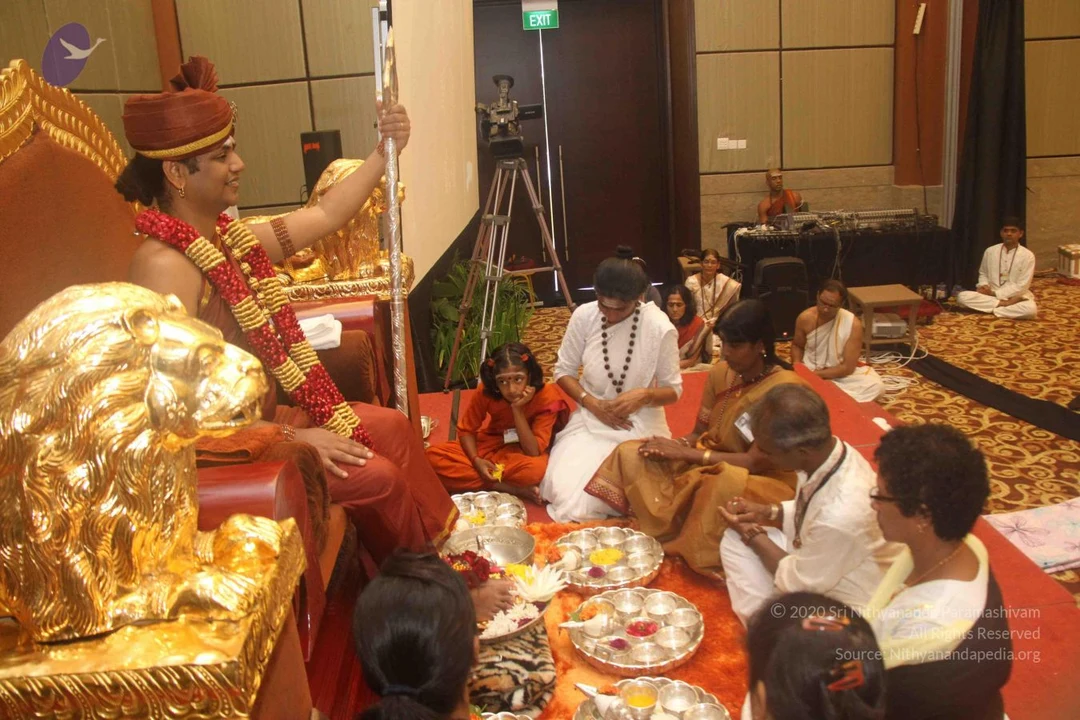
12 photosSource gallery
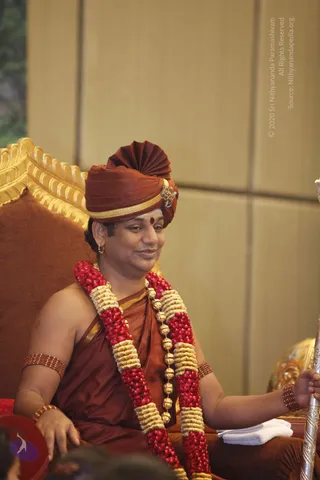
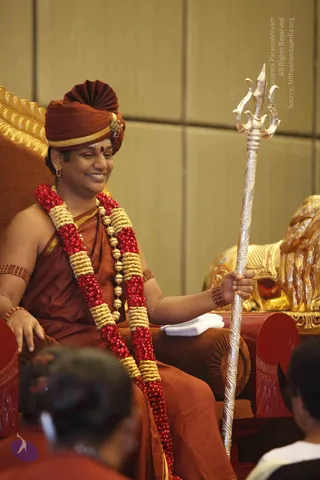
A seated man in a maroon turban with a gold brooch, red-brown silk robe with gold border, and a long red-and-gold garland with gold bead necklaces sits on an ornate throne with gold scalloped backrest. He holds a silver trident staff upright in one hand and smiles. In the foreground, a person in white kneels or bows with their back to the camera, facing the throne. Behind the throne is a large printed backdrop of a temple gopuram and green rice fields. The seated man is an appearance-based probable candidate for a person, with a turban, saffron-toned robe, rudraksha-style gold necklaces and a trident, but identity is uncertain from appearance alone.A smiling man seated on an ornate gold-and-brown throne with a golden leaf-patterned backrest, wearing a rust-red turban with a brooch, red-and-gold garland, gold bead necklace, and rust-red robes. He holds a silver trident in his raised right hand and gestures with his left. Below, a bald man in a white shirt bends forward in front of him. Behind is a painted backdrop of green trees and a temple pavilion. The man in the foreground may be a devotee; the seated figure with the trident has appearance cues consistent with the page's a person reference.A smiling man seated on an ornate gold-and-brown throne with carved peacock-feather style backrest, wearing a maroon-red turban with a gold-trimmed fan-like top and a jewelled brooch, a red bindi, a rust-orange robe with gold border, a red and gold garland, and a long gold bead necklace. He holds a polished silver trident (trishul) in his right hand, with a white cloth draped over the armrest. Two partially visible people, one in the lower left and one in the lower right foreground, are seen from behind. Behind the throne is a painted backdrop of a traditional temple-style building with thatched roof and greenery. The appearance and attire match the a person with a trident, garland and throne, so this is an in-person candidate, though the appearance is not fully conclusive.A seated man on an ornate gold-and-brown throne wears a rust-red turban with a gold brooch and a red bindi, plus a rust-red shawl edged in gold. He wears a double garland of red and white flowers with gold beads and a gold bead mala, gold hoop earrings and red bangles. He holds a silver staff in his right hand and smiles gently. Behind him is a beige wall and a window. a person: the figure is a seated person in ceremonial clothing with a turban, garlands and gold beads, consistent with a senior ashram leader on a throne.A smiling man seated on an ornate golden-and-red throne, wearing a rust-red turban with a gold band and brooch, rust-red robes, and a long necklace of red flower garland with gold beads. He holds a tall silver trident (trishul) in his right hand, with a white cloth on the armrest and a gold lion sculpture beside the throne. Swamiji (probable): the seated man wears a red turban, rudraksha-style gold bead necklace and flower garland, and is seated on a throne holding a trident, matching the page's Swamiji presence flag.A seated man on a golden throne wears a deep red turban with a gold-edged band and a red-orange sannyasa-style robe with gold trim. He is draped in a long red and gold garland and a gold bead necklace, with red bangles on his wrists. He holds a tall silver trident (trishul) in his right hand and gestures outward with his left palm open, smiling. Two partly visible people sit in the lower corners of the frame, and a golden deity murti or ornate object is visible at the right. Swamiji (probable): the long-established presentation with turban, saffron-orange robe, garlands and trident matches the candidate appearance, though his face alone is not used for identification.
2-NITHYA-SATSANG

16 photosSource gallery
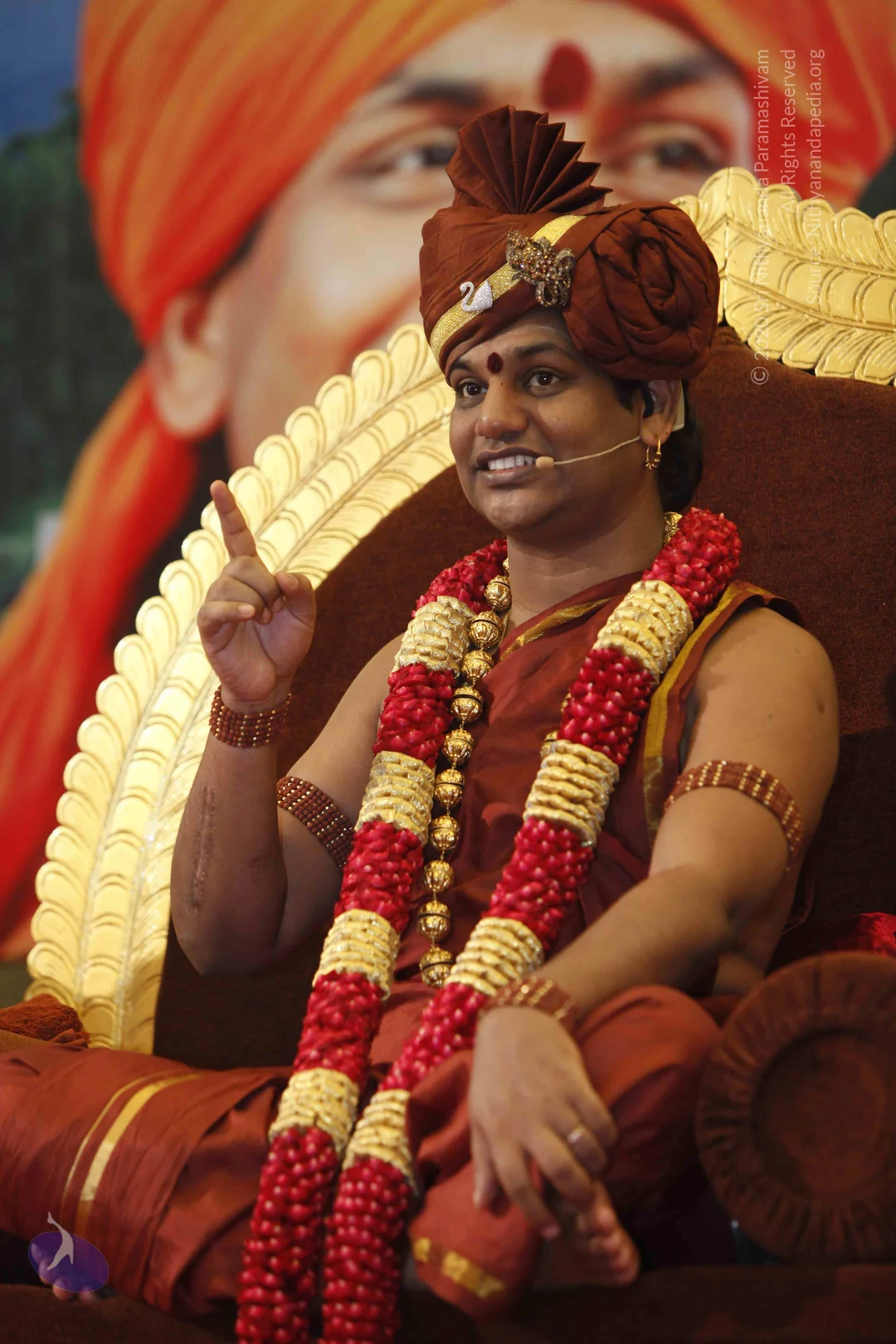
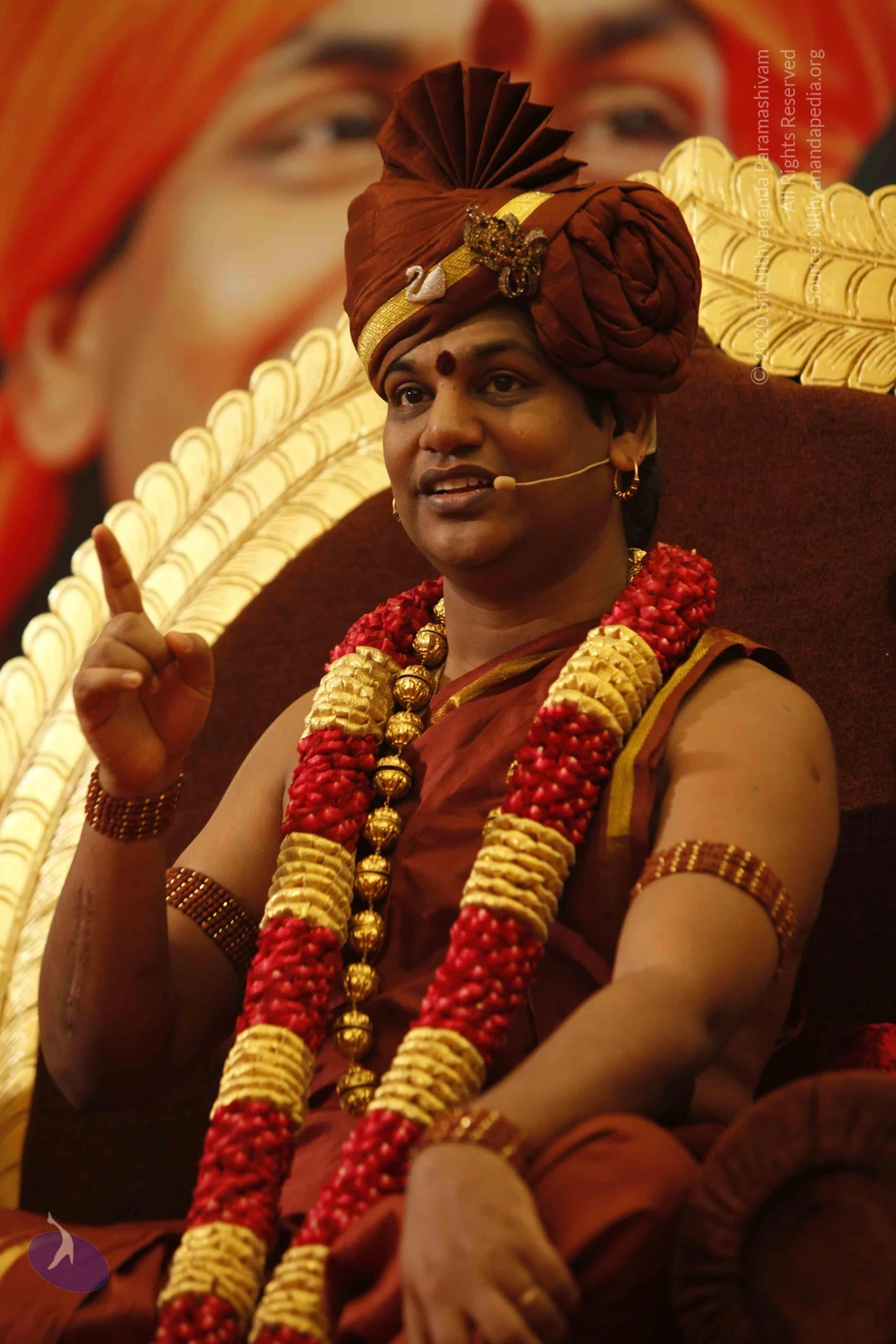
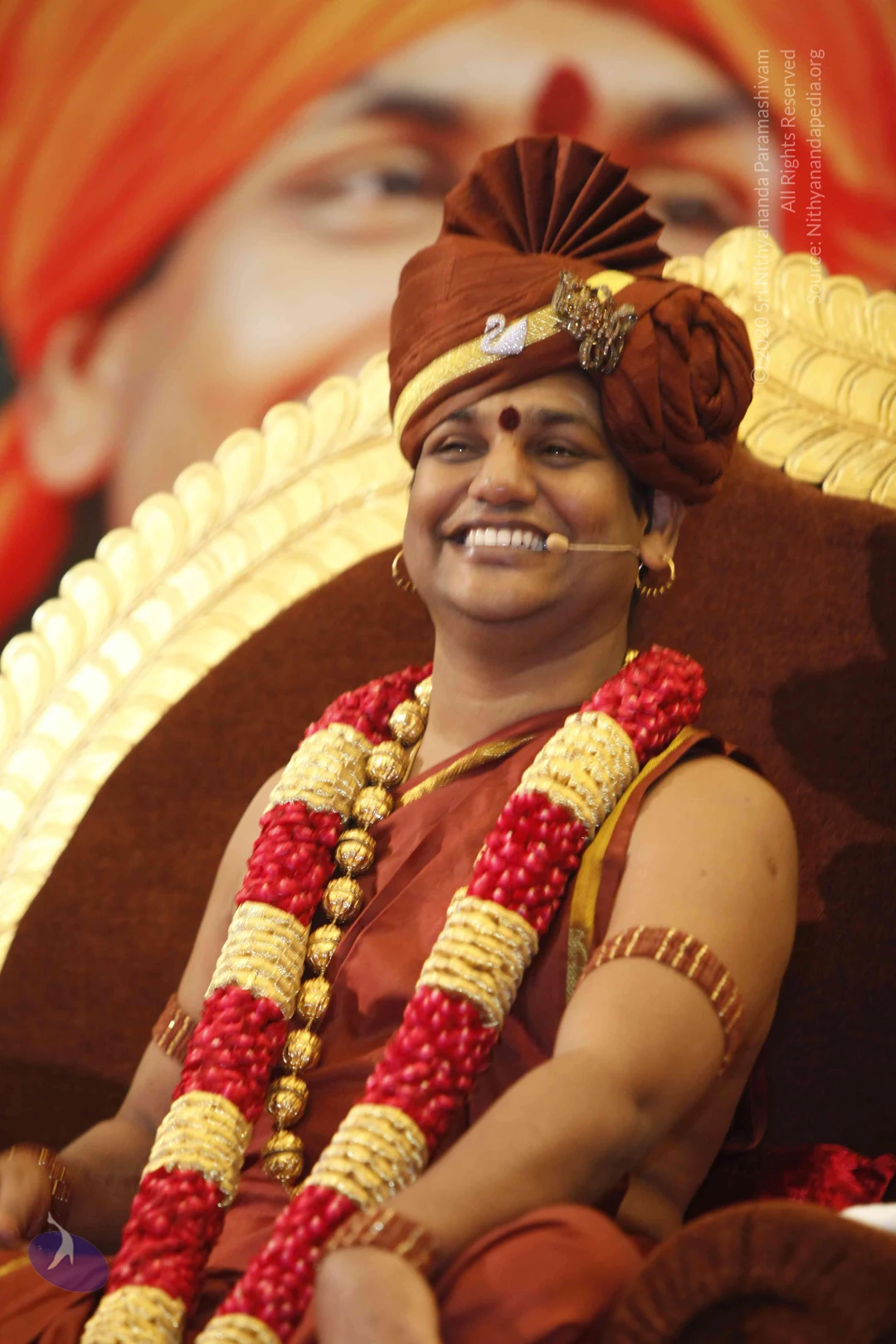
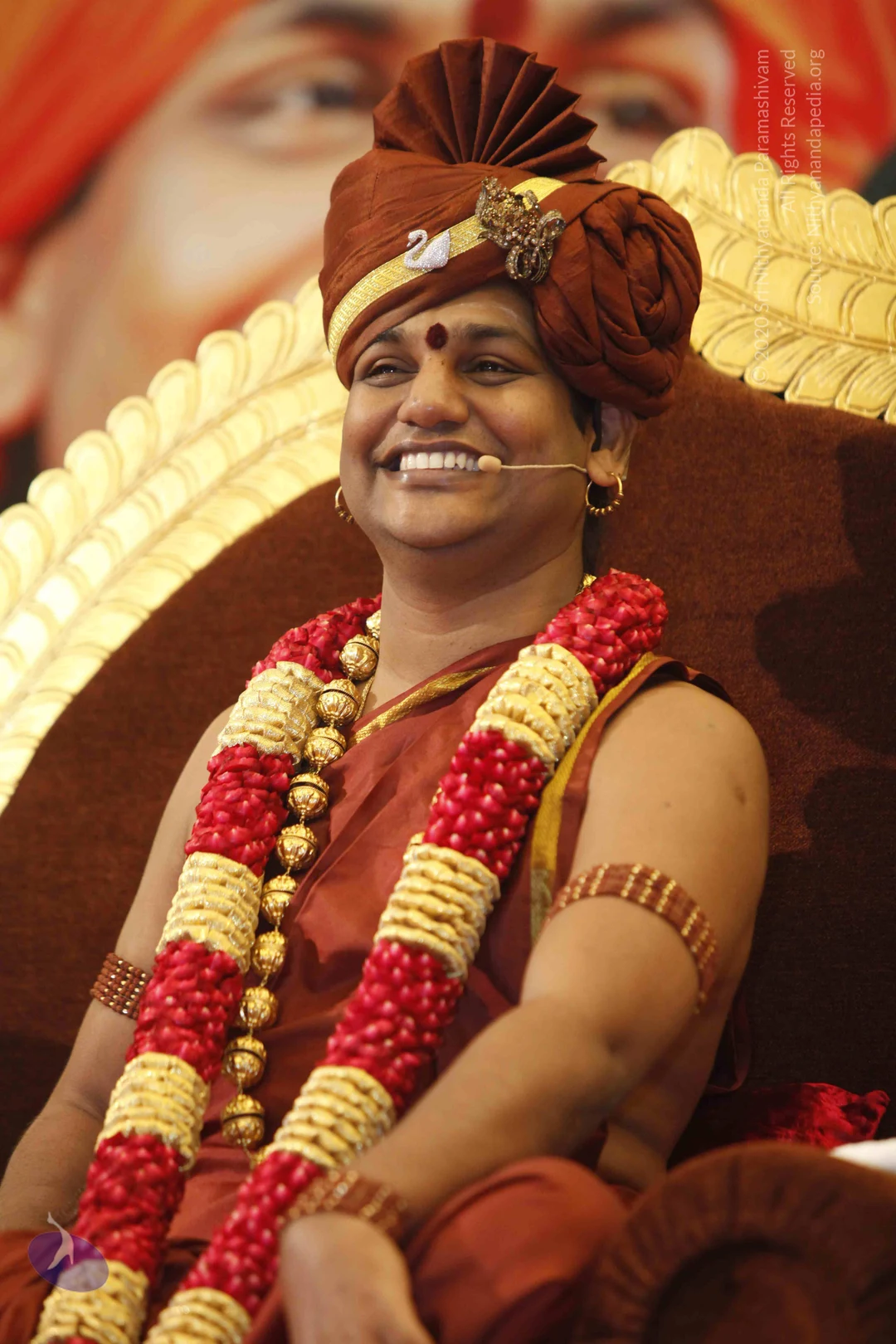
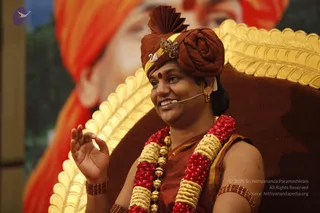
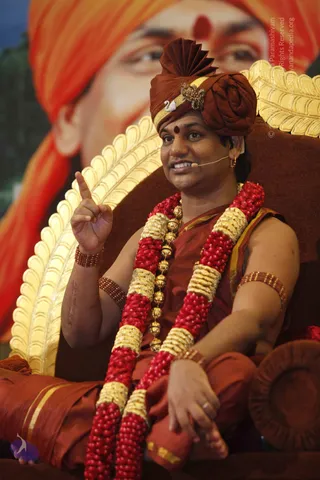
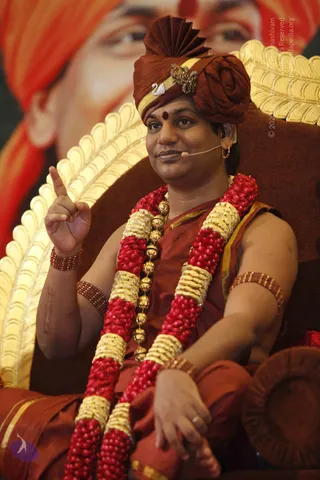
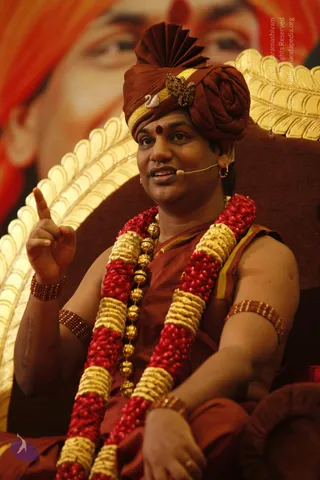
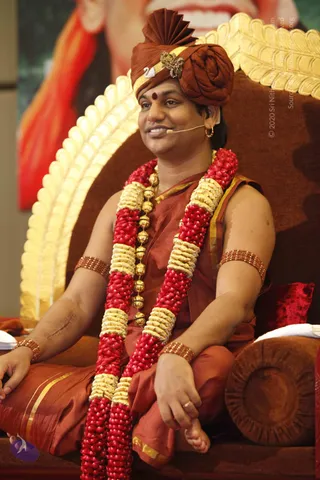
A seated figure in a maroon-brown turban with a gold-and-jewelled ornament and a fan-folded fan of pleats on top, wearing a maroon-brown robe with gold trim, red and gold garlands, gold beaded necklace, and red beaded bangles. He raises one index finger while speaking into a headset microphone, seated on a dark brown throne with gold leaf carvings. Behind him a large painted portrait shows a figure in an orange turban with a red tilak.A seated man in a dark red-brown turban with a gold band and a swan emblem wears a matching red-brown robe with gold trim. He is draped in long red and gold beaded garlands and a gold bead mala, and wears a red bindi, gold earrings and red beaded bracelets. He raises one index finger while speaking into a headset microphone from a throne with a cream feather-patterned back. Behind him, a large painted portrait shows a figure in an orange turban and red-orange clothing. The portrait behind him is a depiction, and the seated man is an appearance-based probable Swamiji candidate given the turban, red-orange robes, garlands and throne, so the identity is probable rather than certain.A seated person in a maroon turban with a gold brooch and a swan emblem, wearing a maroon garment with gold border, red and gold garlands and gold bead necklaces, and red beaded bangles. A headset microphone is on their face, and the raised index finger gestures while speaking from a gold-carved throne-like chair. Behind is a large painted portrait with orange-red fabric and a gold frame. Single physical person.A smiling person seated on an ornate golden-and-brown throne, wearing a rust-brown turban with a gold band and jeweled brooch, a red bindi, gold earrings, and a rust-red sleeveless garment with gold border. Two thick garlands of red flowers and gold beads hang across the chest, with a gold bead mala and bangles on the arms. A headset microphone is worn.A seated man in a maroon-brown turban with a fan-pleated crest and a small jewelled brooch, wearing a rust-red silk garment and red-and-gold garlands of beads with gold bead strands, sits on an ornate brown throne with golden leaf carvings. He wears a headset microphone, a gold hoop earring, beaded bracelets on his upper arms and wrists, and a red bindi. He is smiling and gazing to the side. Behind him is a large painted portrait of a man in a bright orange turban.A seated man in a rust-red turban with a gold brooch and a red bindi sits on an ornate brown throne with gold leaf-carved backrest. He wears a rust-orange sleeveless garment with gold border, long red and gold garlands, gold beaded necklace, and beaded red-gold armbands, with a headset microphone. A red cushion and a large red painted backdrop figure appear behind him. Appearance-based label: a person, in a seated satsang-style setting.

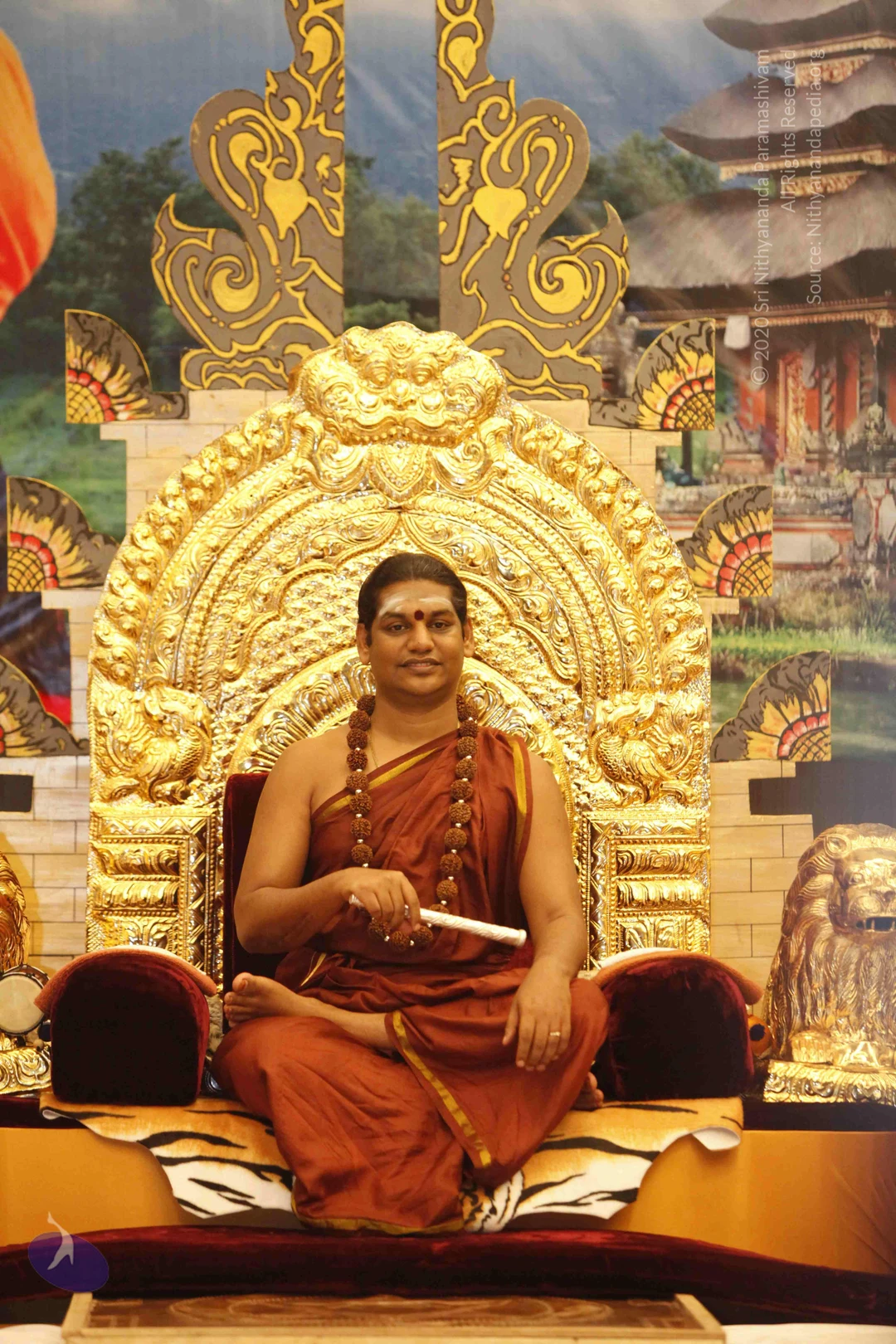
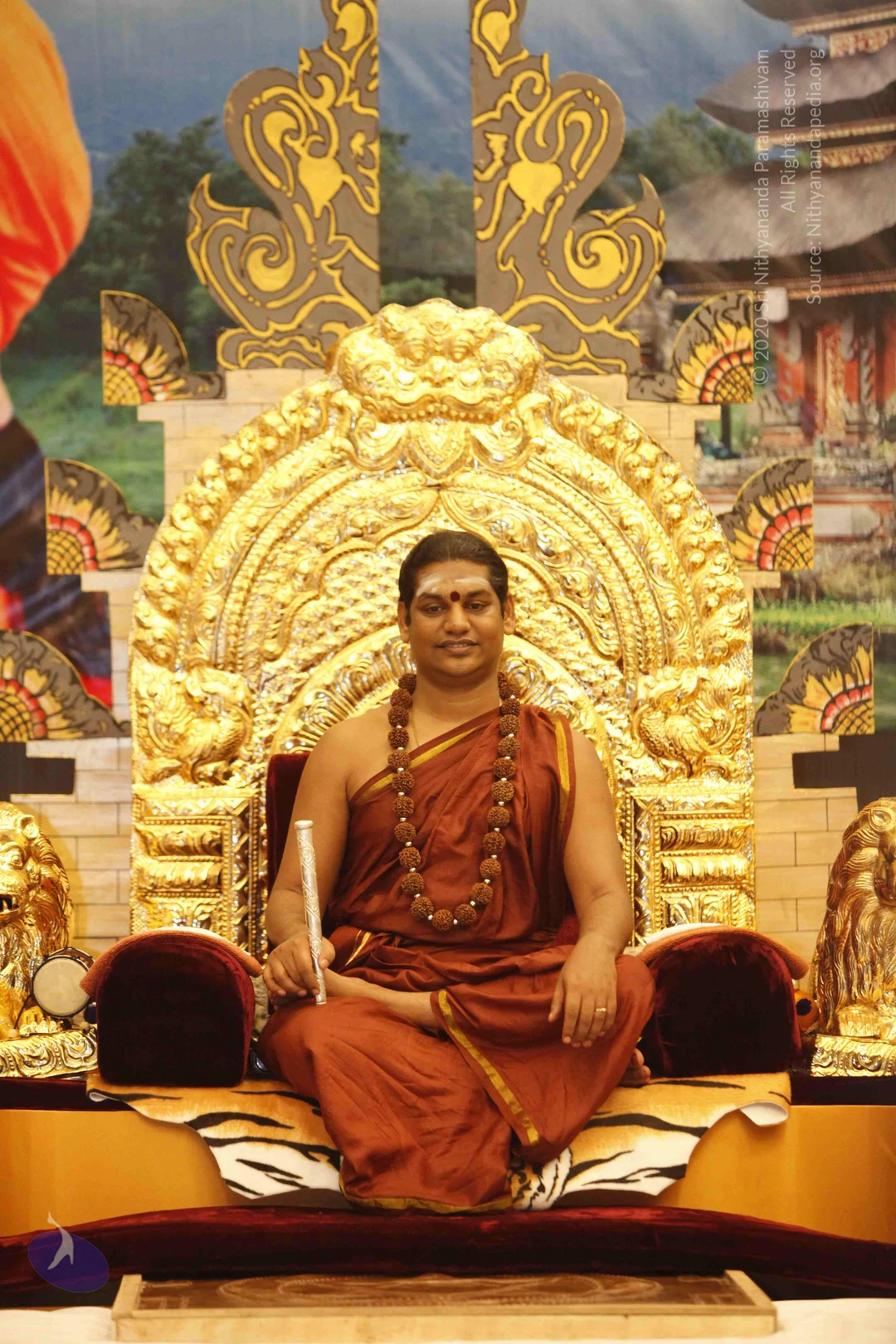
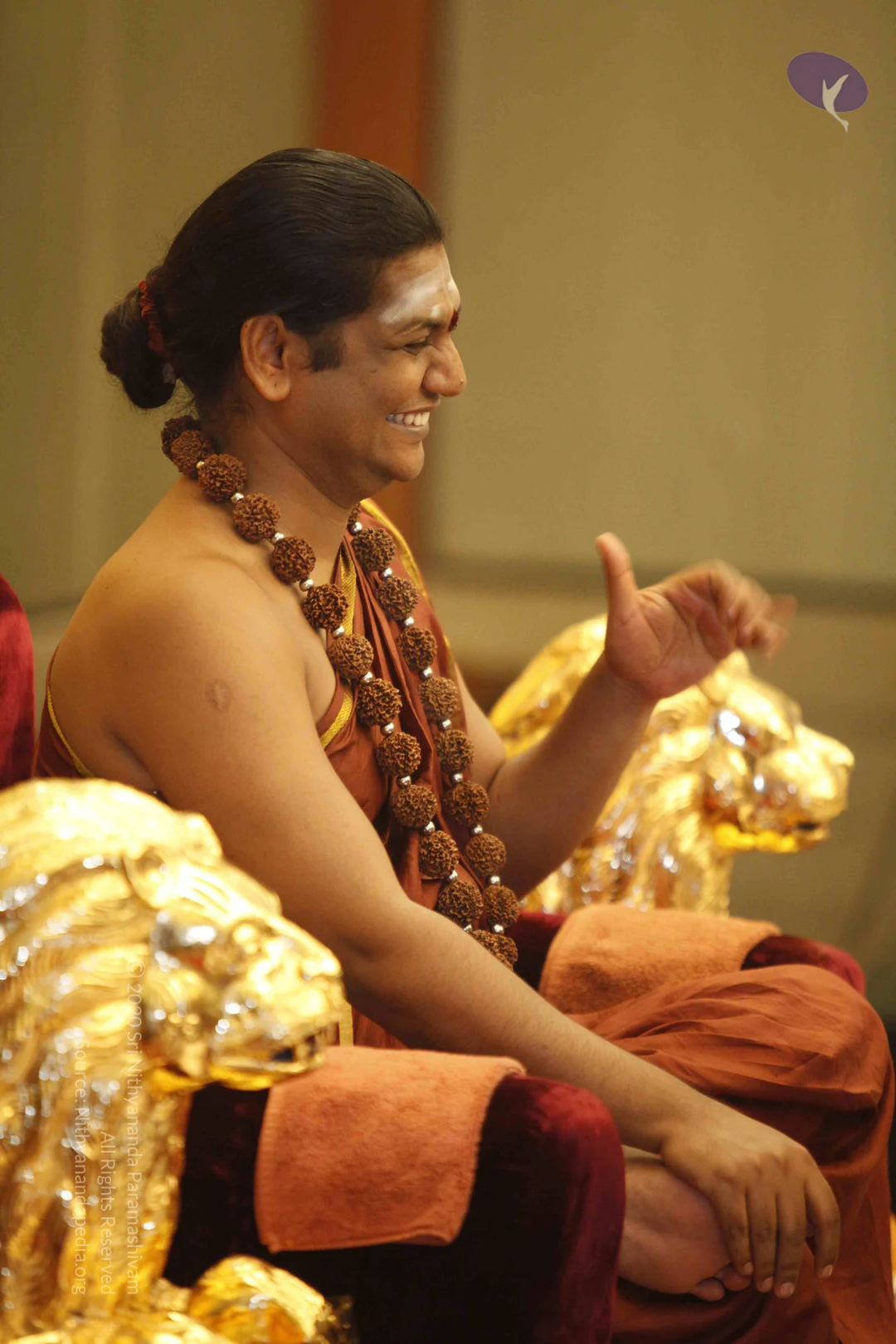
3-IA-DARSHAN
4 photosSource gallery
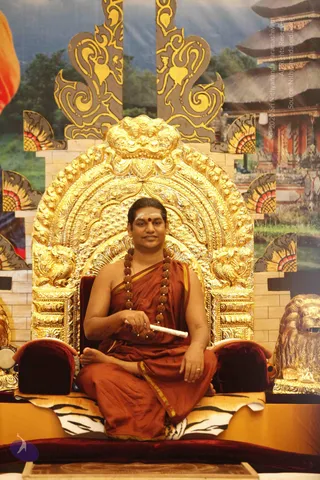
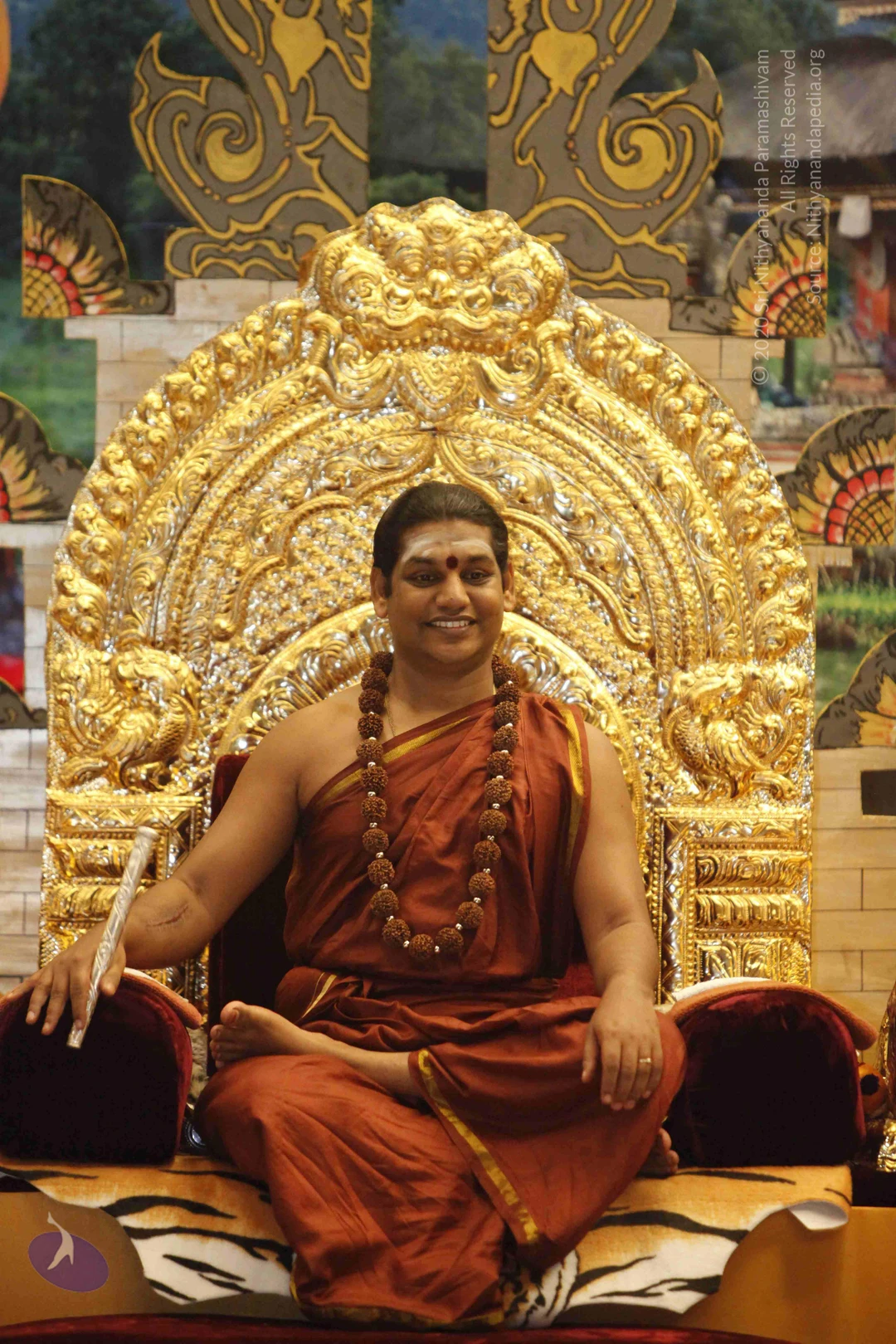
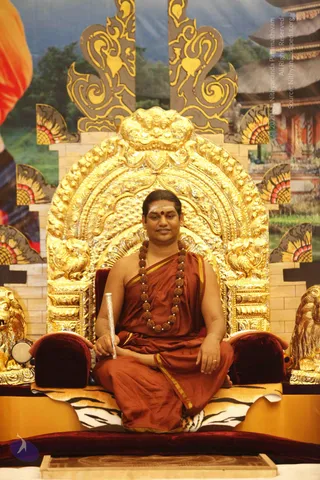
A smiling man with short dark hair sits cross-legged on an ornate gilded throne with a tall, richly carved silver-and-gold arched back and dragon-like finials. He wears a rust-orange wrap with gold borders and a long rudraksha mala with a ceremonial gold chain, and has a red bindi and white forehead markings. He holds a silver ceremonial staff in his left hand, and a tiger-striped cloth covers the seat. The background shows painted carved panels and greenery.A man seated cross-legged on an ornate gold throne with a carved arched back and gilded lion figures, on a tiger-skin covered dais in front of a painted backdrop of a Balinese temple and green landscape. He wears a rust-orange robe with gold borders, a long rudraksha mala necklace, and a red bindi with white forehead markings, holding a white cloth or fan. A golden lion statue stands at the right edge. The man is an appearance-based a person candidate with long swept-back hair, rudraksha malas and saffron robes, seated on a throne in the central position. Only one physical person is present.A man in rust-red saffron-toned robes with gold-edged borders sits cross-legged on an ornate gilded throne with a carved arched back and lion-head crest. He wears a long rudraksha mala with silver spacer beads, a red bindi and white forehead markings, and holds a silver staff across his lap. A tiger-striped cloth covers the seat, golden lion statues flank the throne, and a painted backdrop shows a temple pagoda and green landscape. a person: the seated man wears rudraksha malas and saffron-toned robes on a ceremonial throne, consistent with the page's description of the event.A smiling man with swept-back dark hair in a bun and white and red marks on his forehead sits on a red velvet throne with gilded lion carvings. He wears an orange-brown garment over his bare shoulder and a long necklace of rudraksha beads, and raises one hand in a gesture while speaking. Swamiji (probable): the seated figure has long swept-back hair, rudraksha mala and saffron-orange clothing, matching the page's Nithyananda discourse context. A gilded lion figure sits beside the throne and another in the foreground.