Skip to content
Monday

30 September 2013

Technique For Graceful Ageing.

Dated photos
446
Source pages
1
Media
4
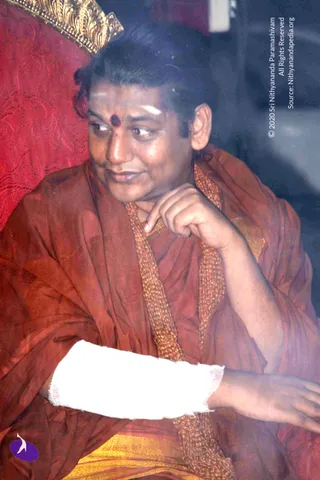
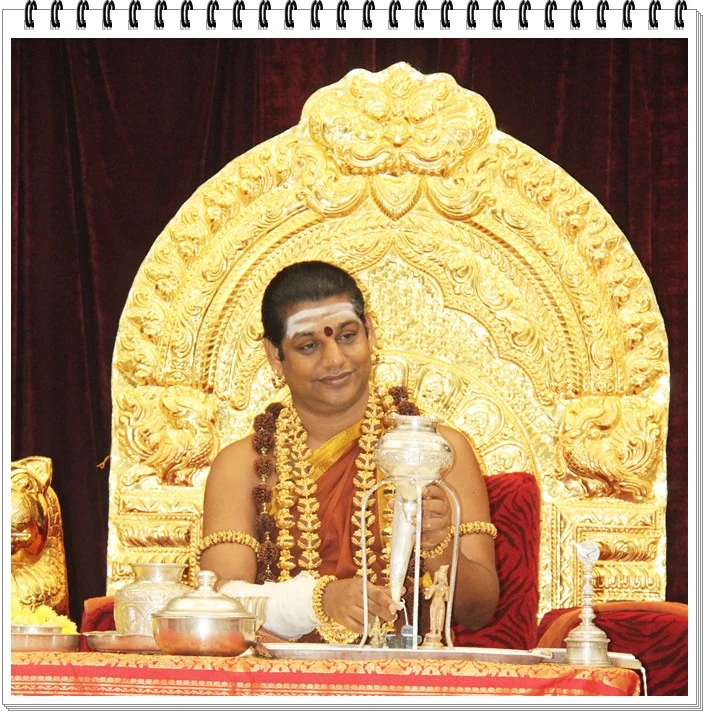
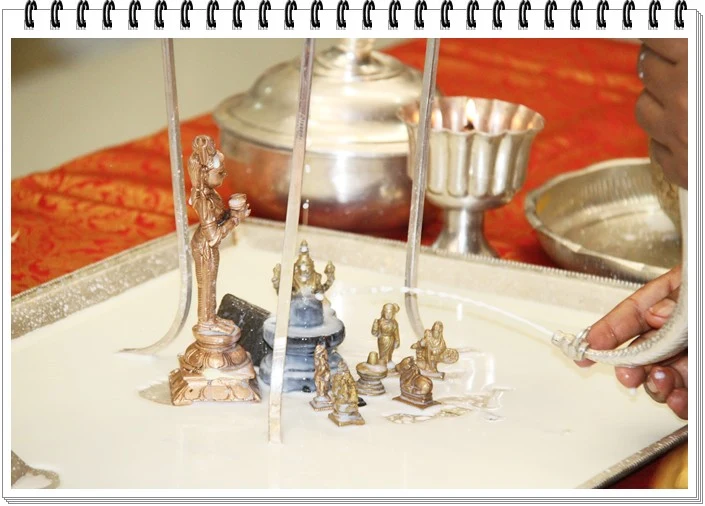
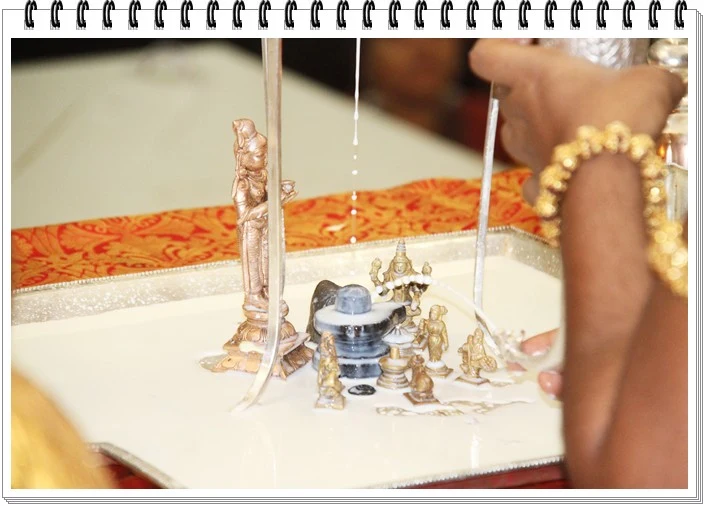
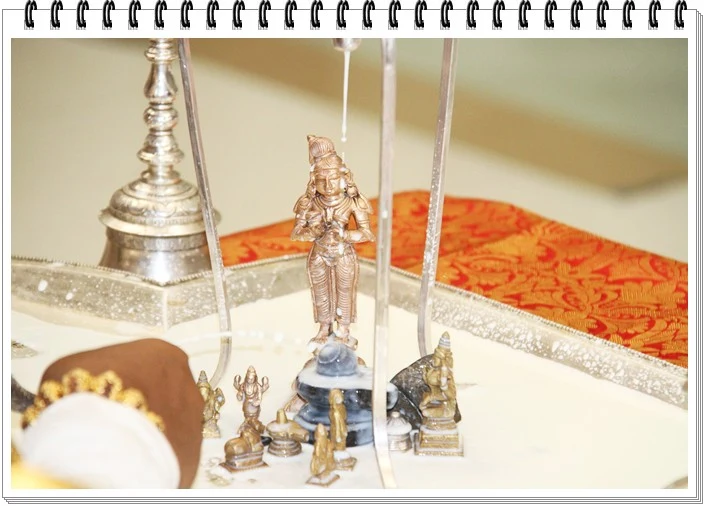
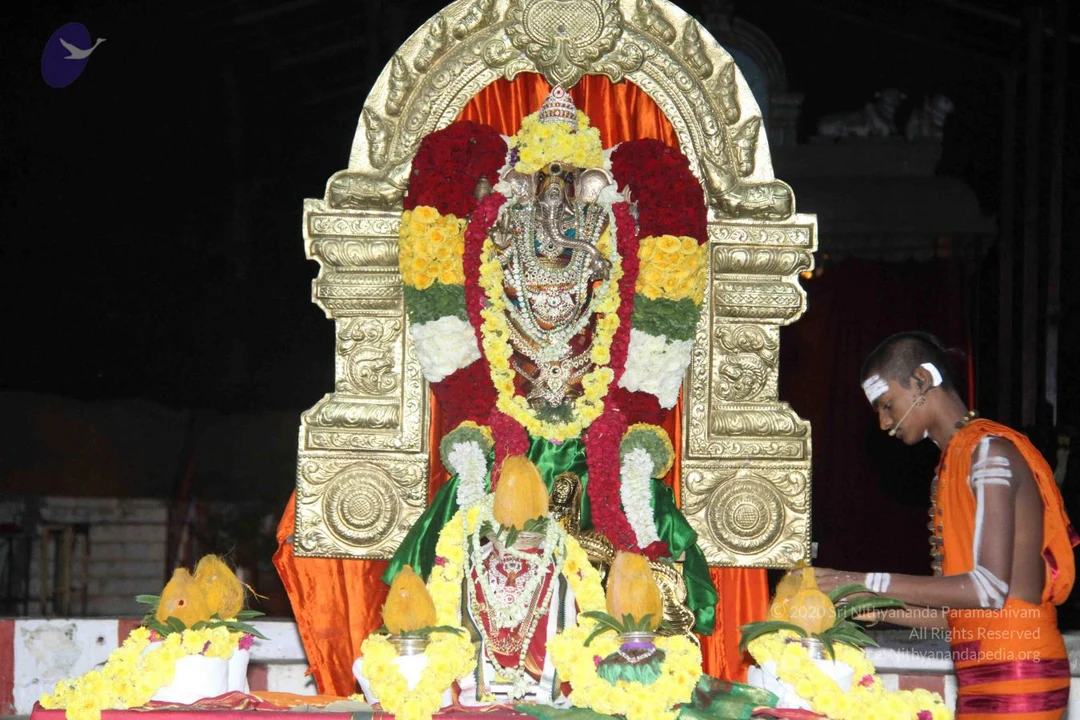
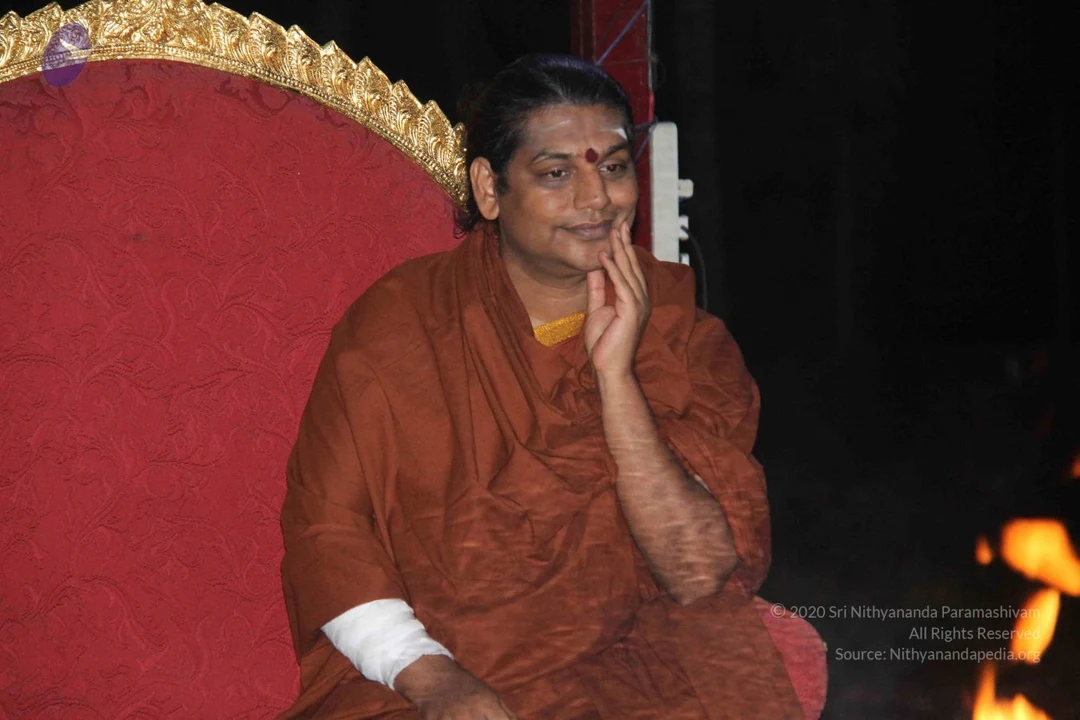
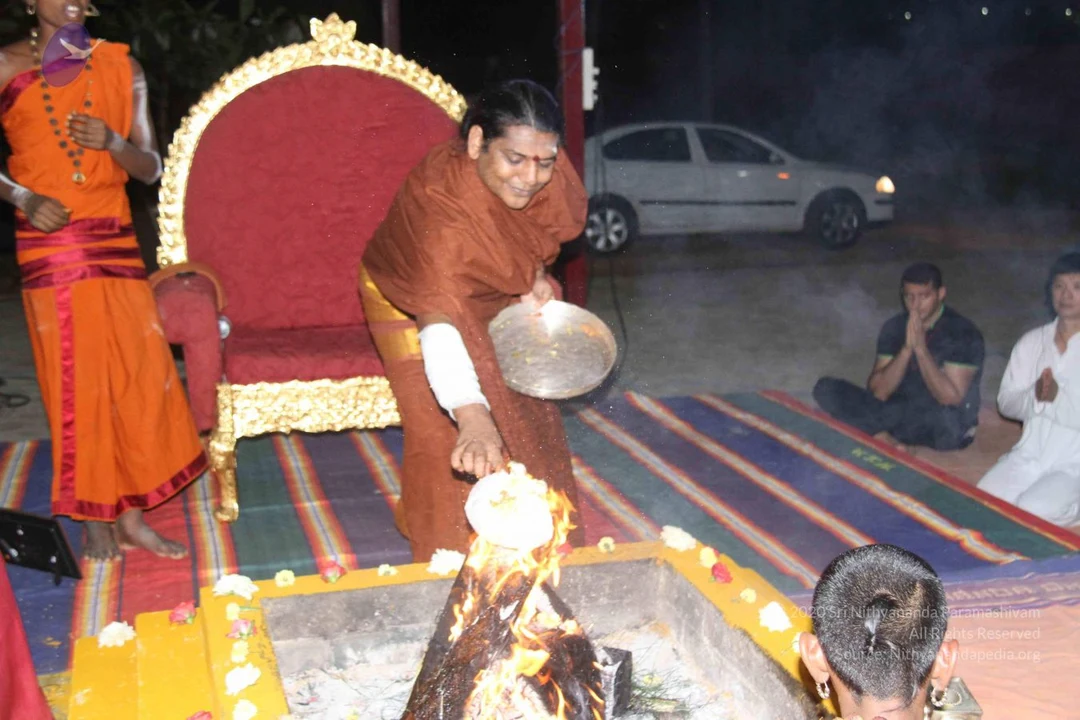
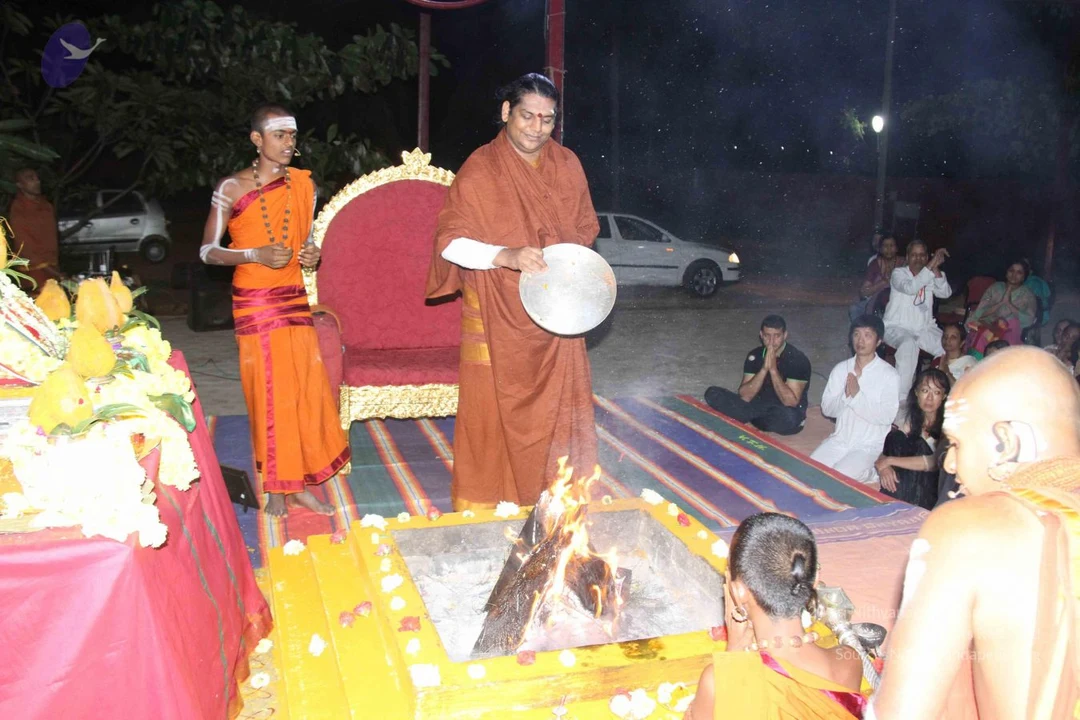
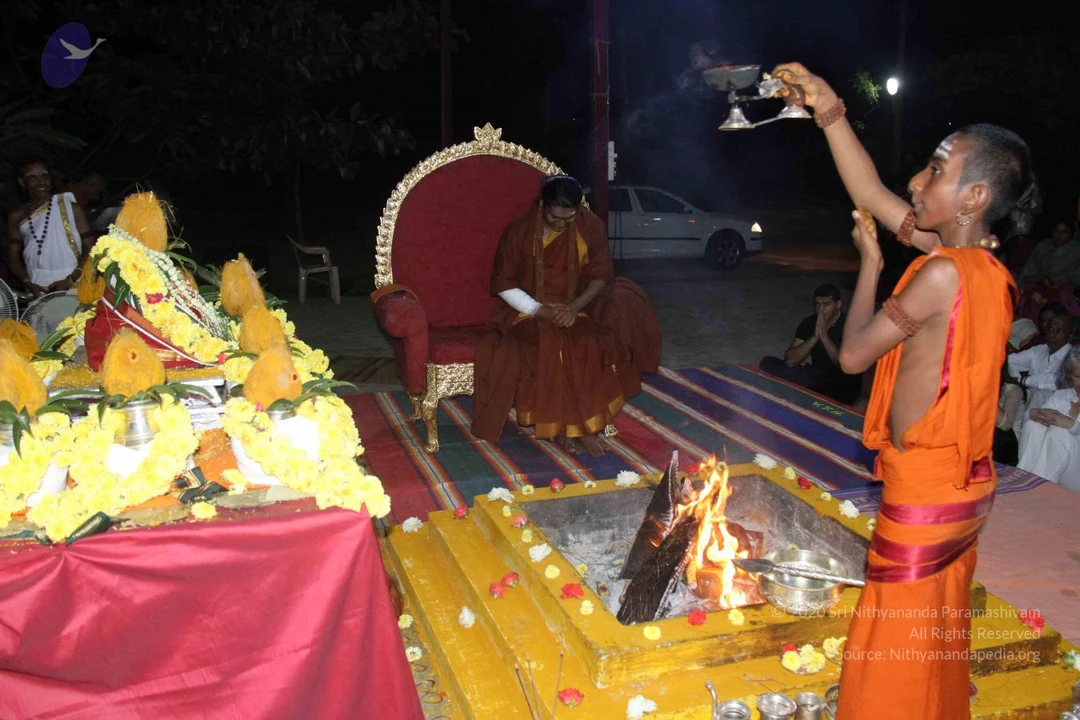
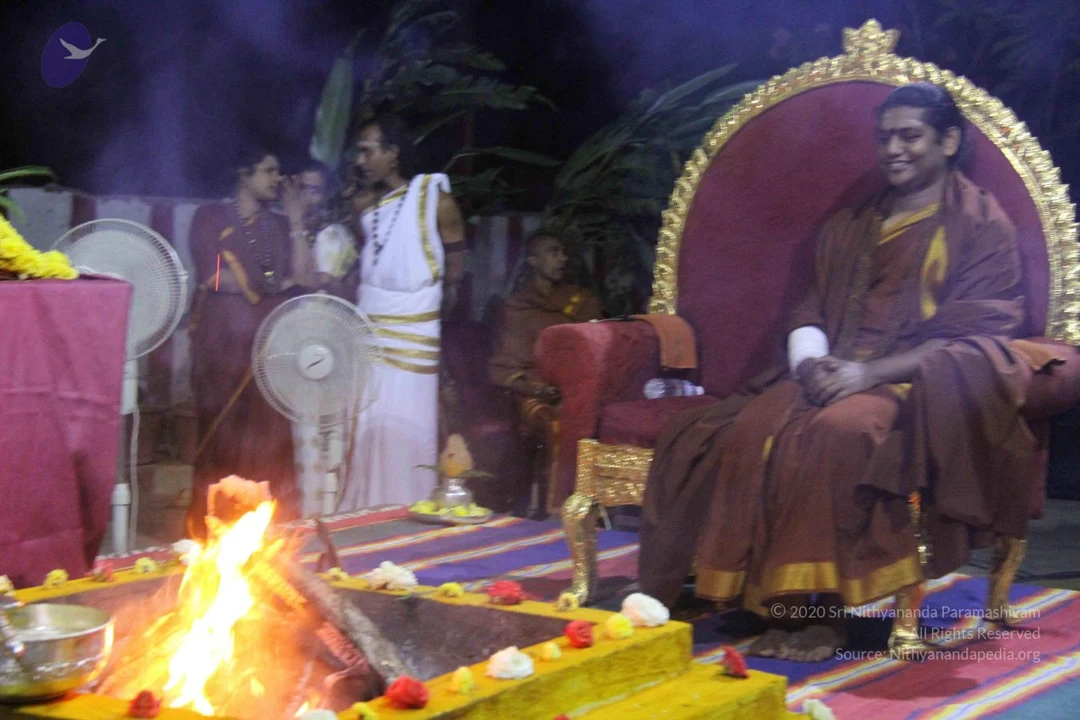
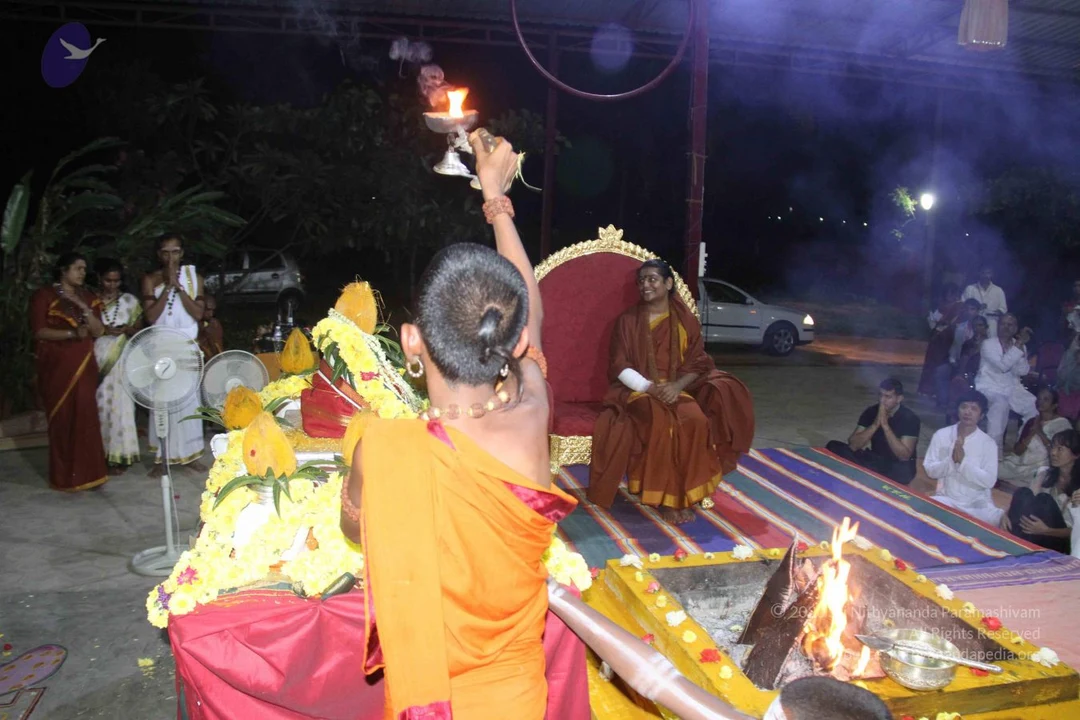
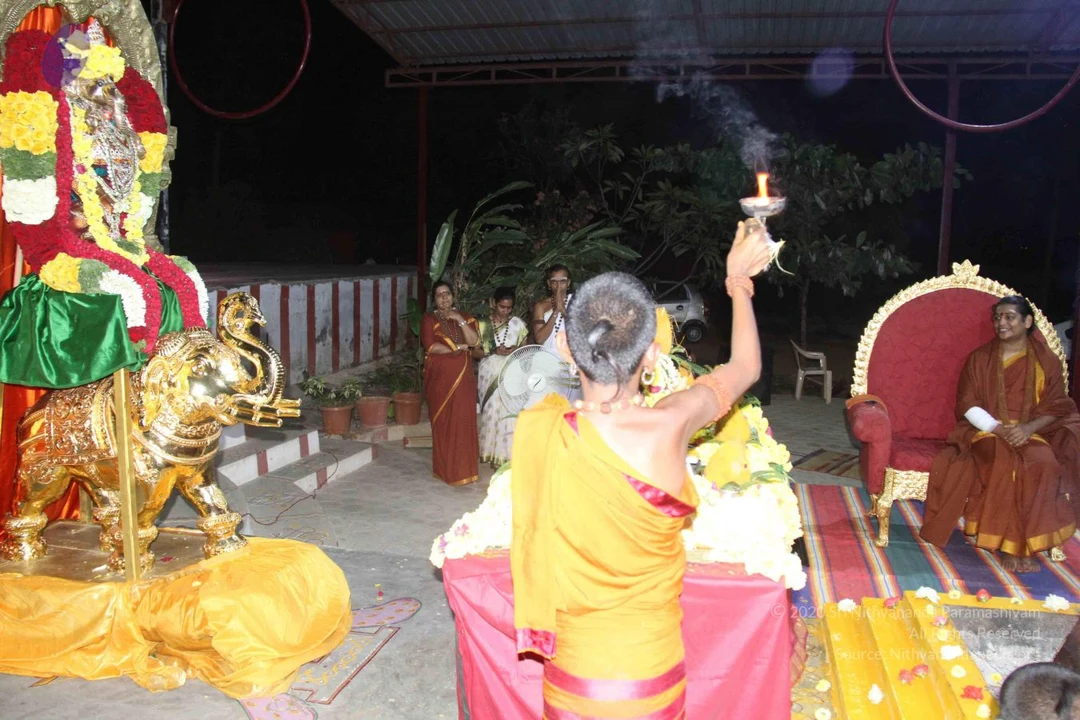
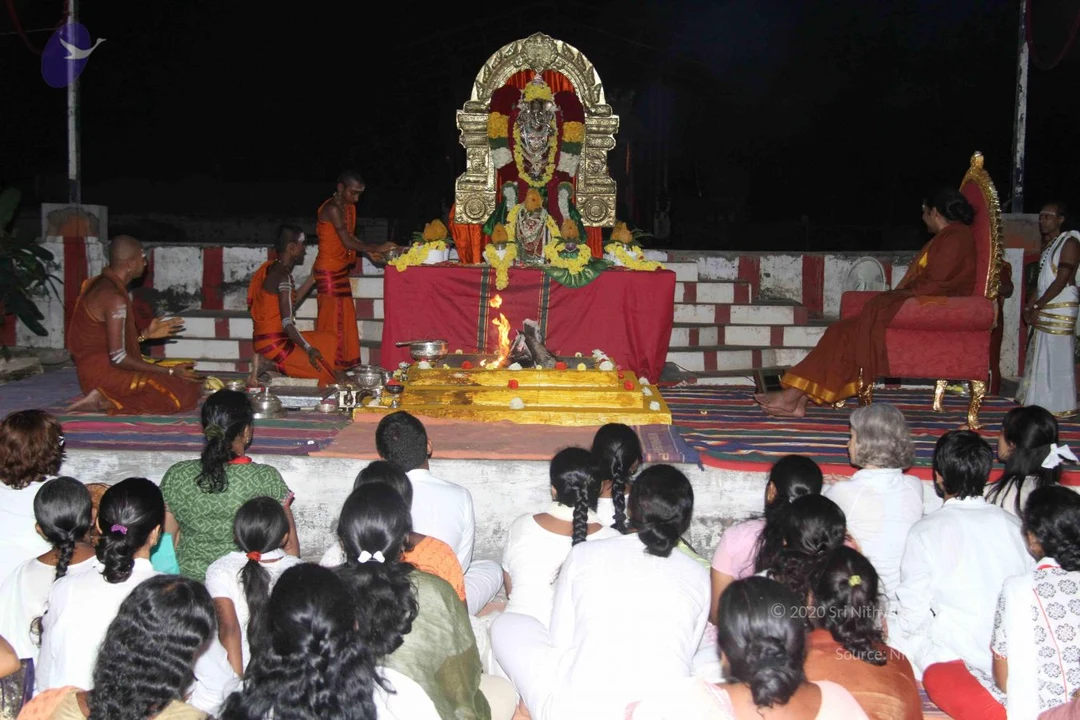
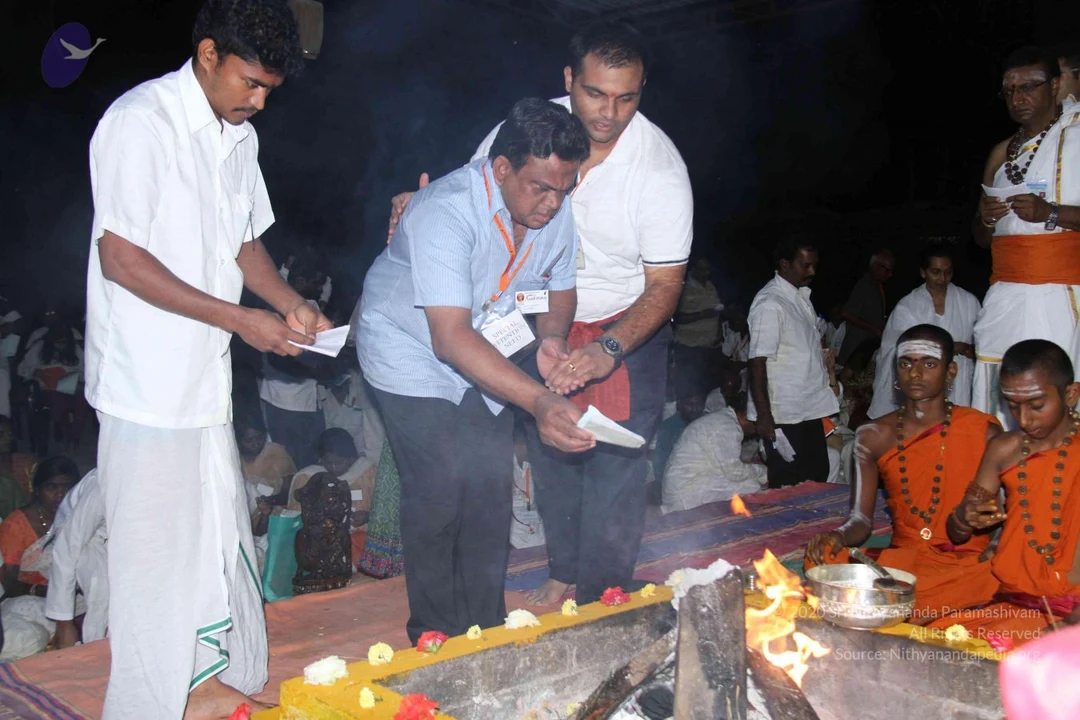
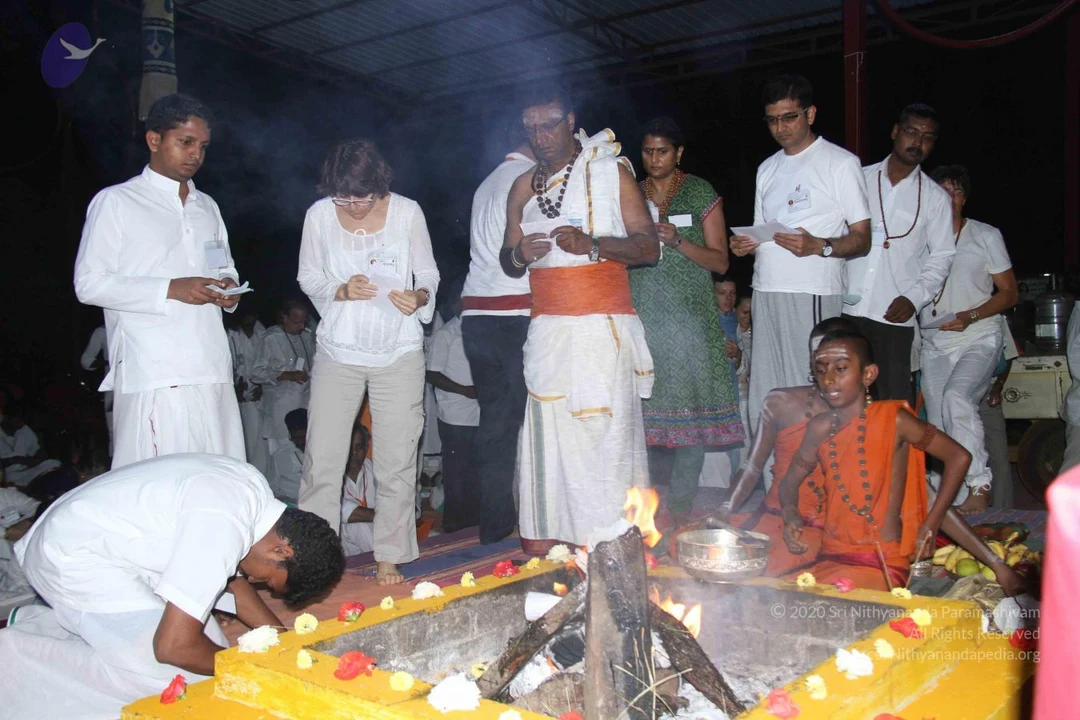
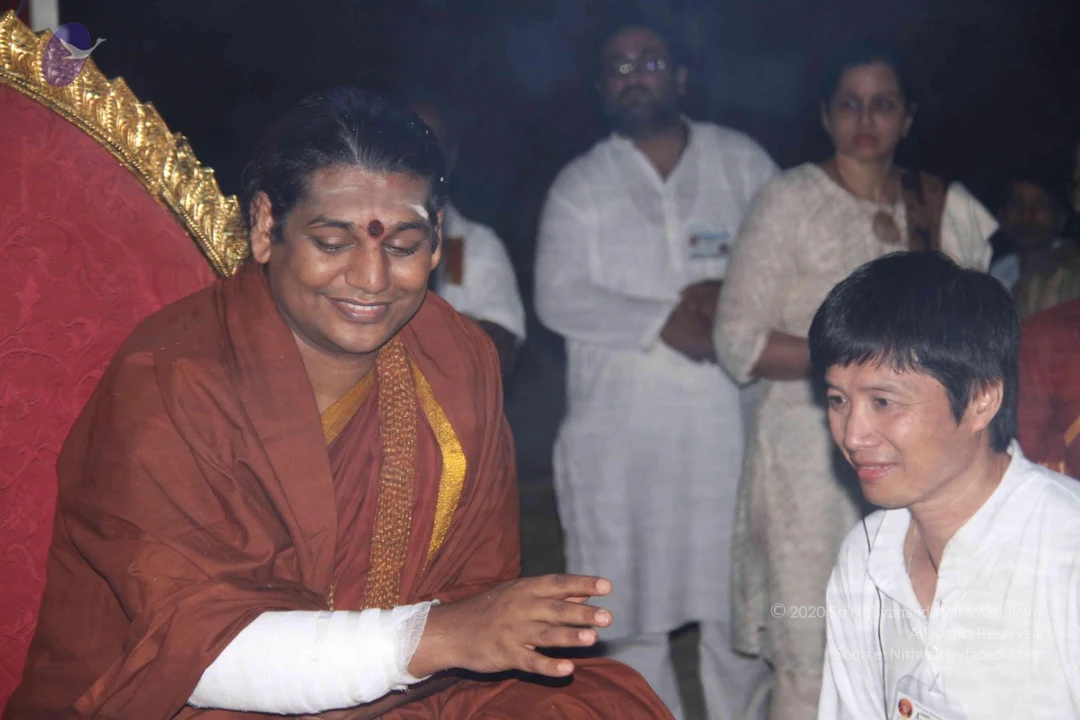
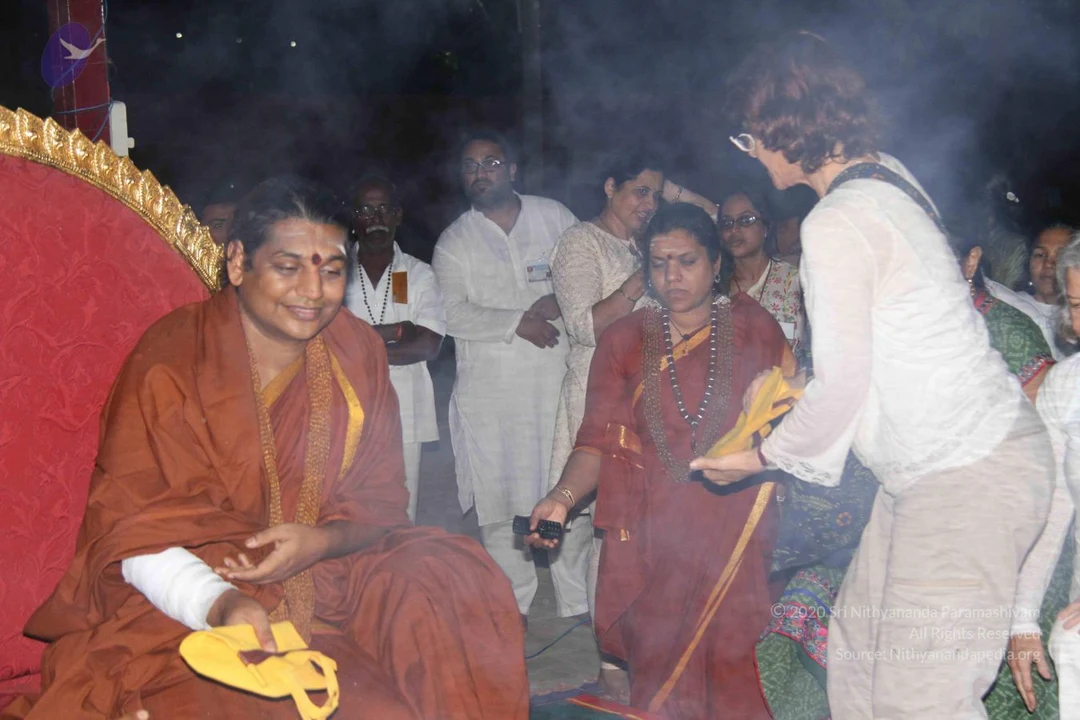
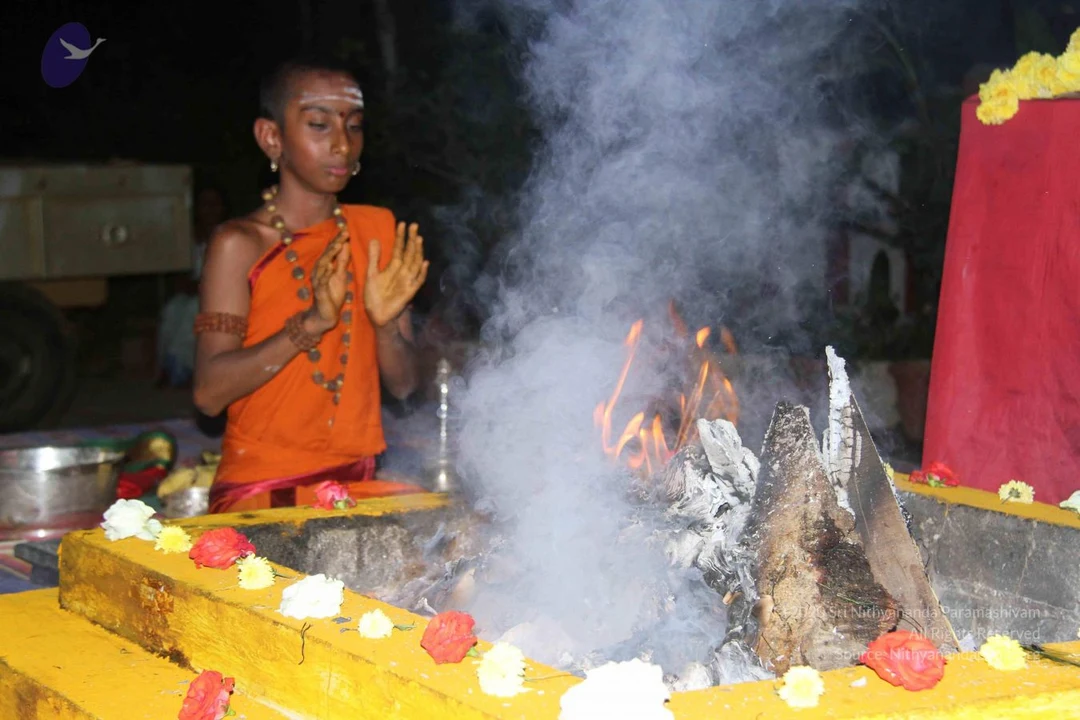
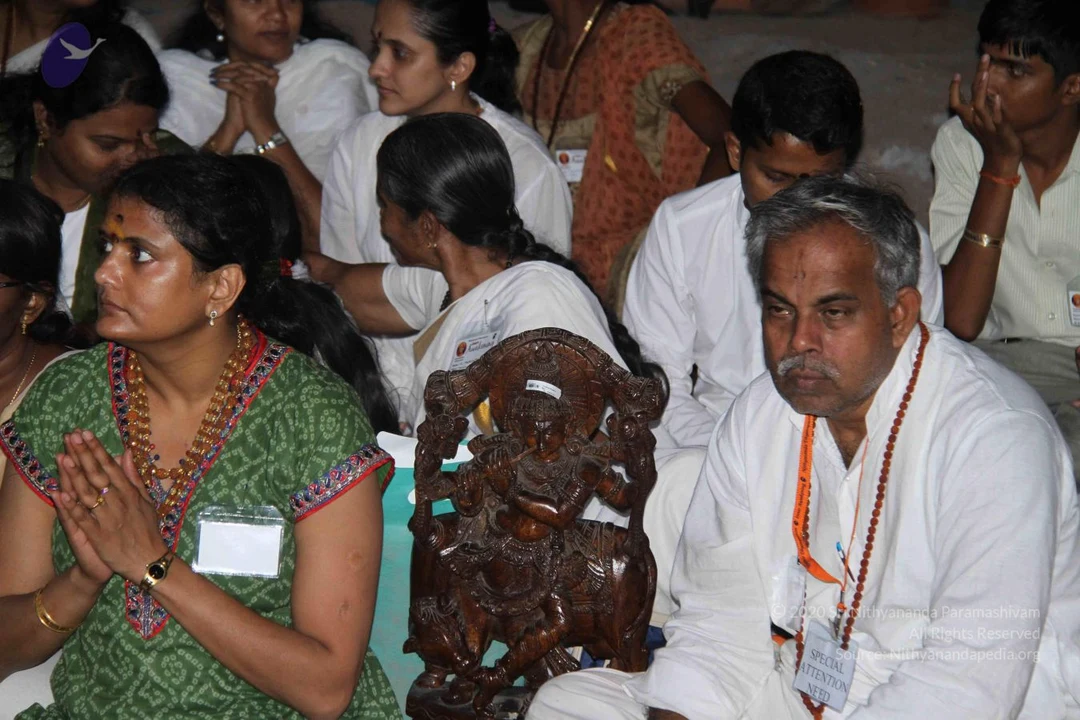
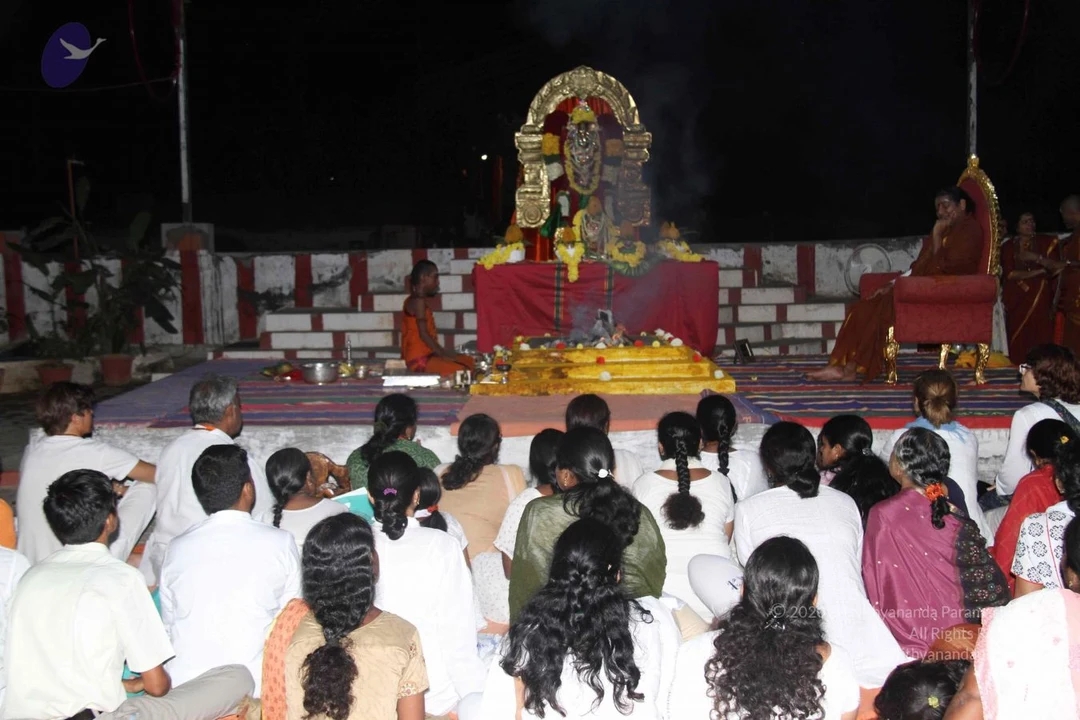
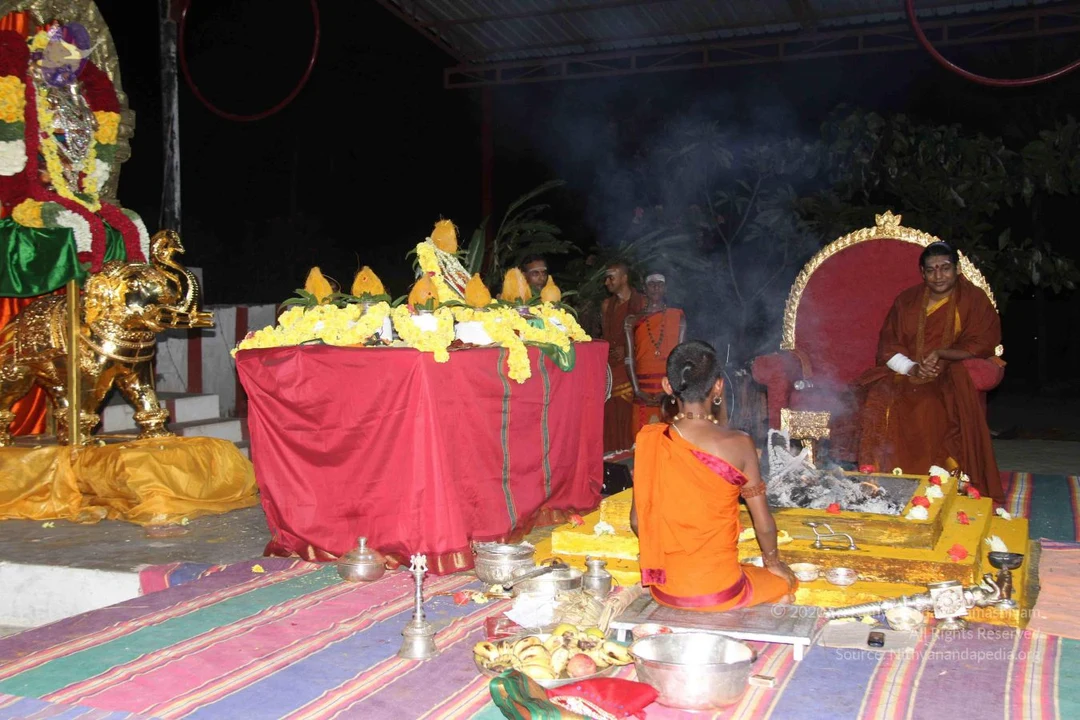
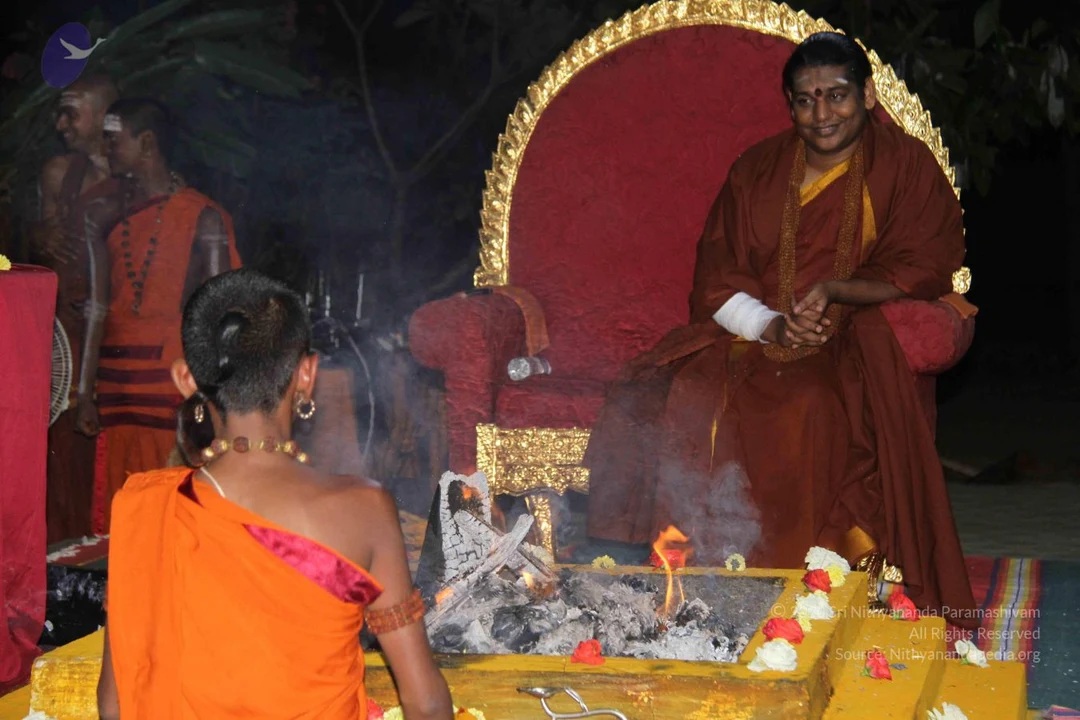
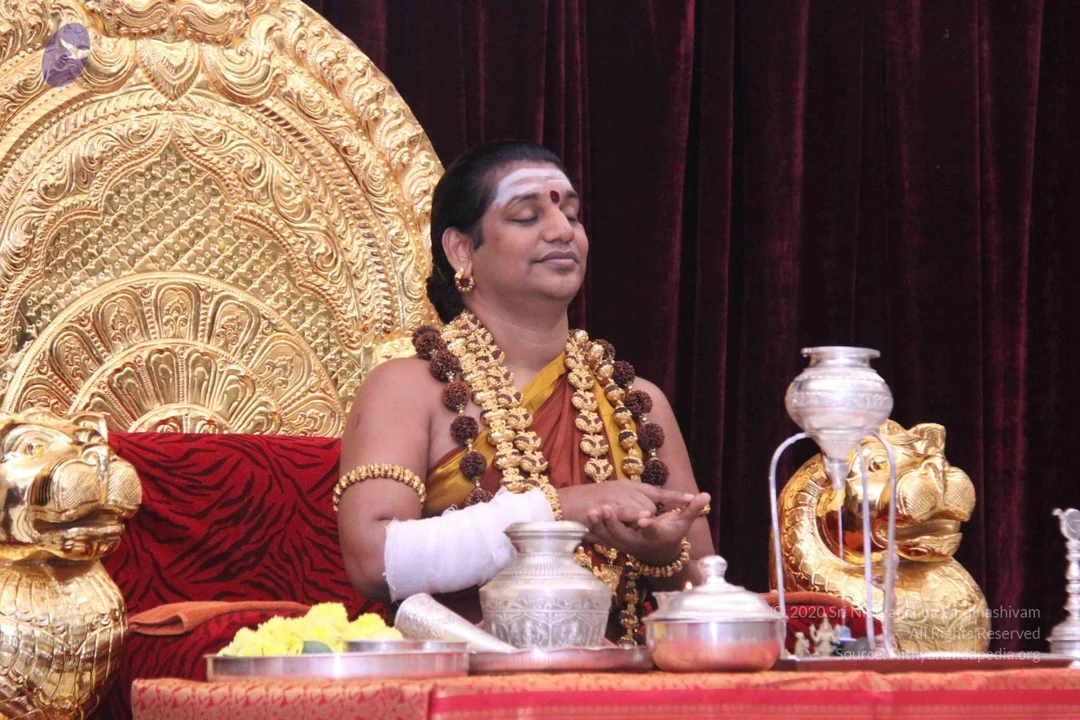
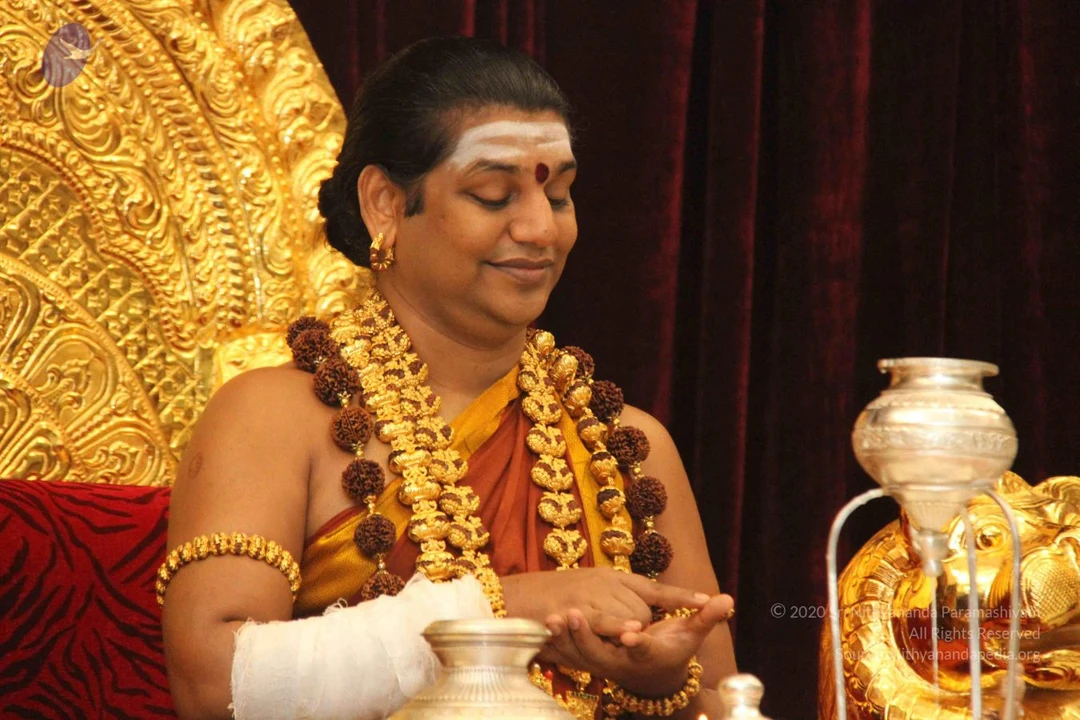
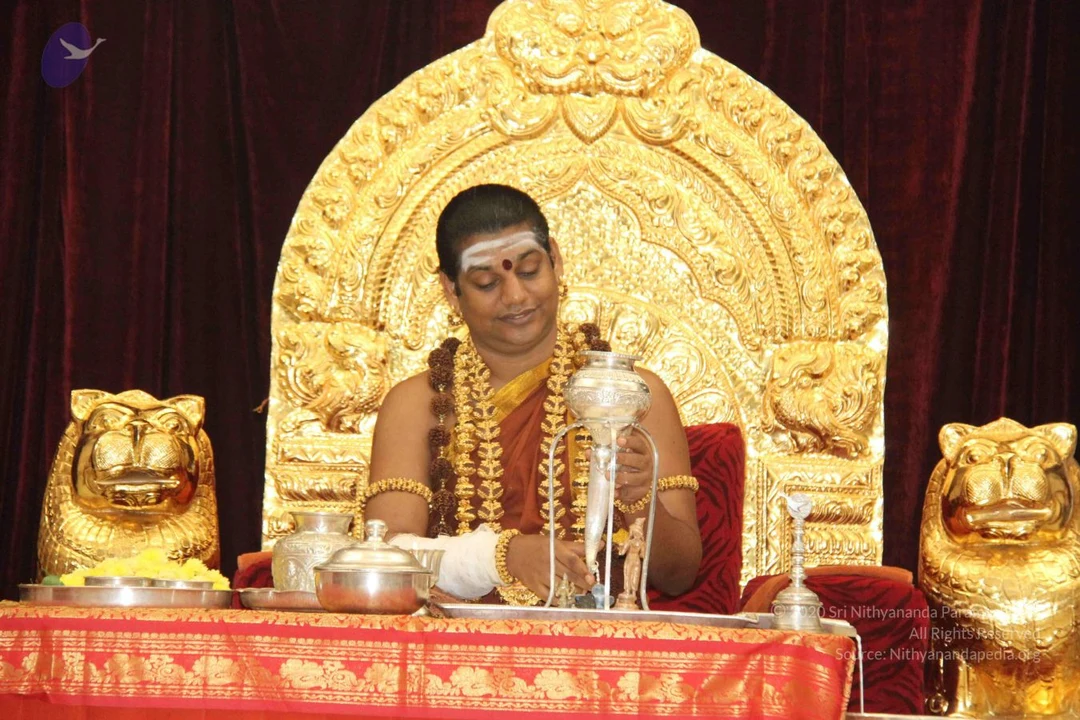
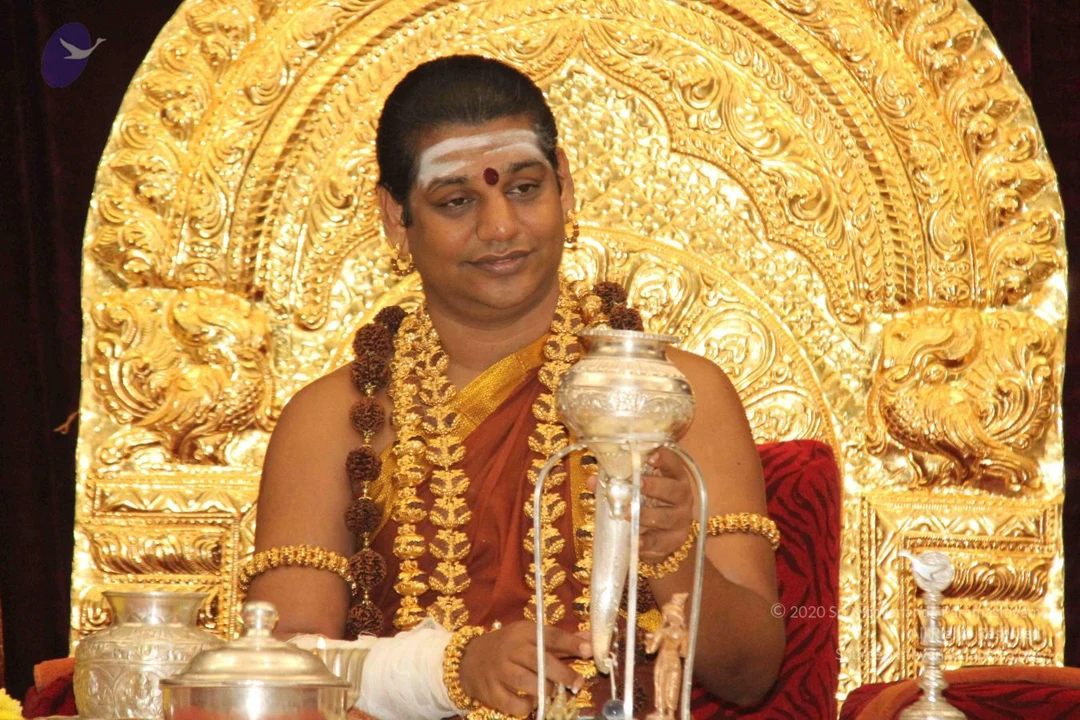
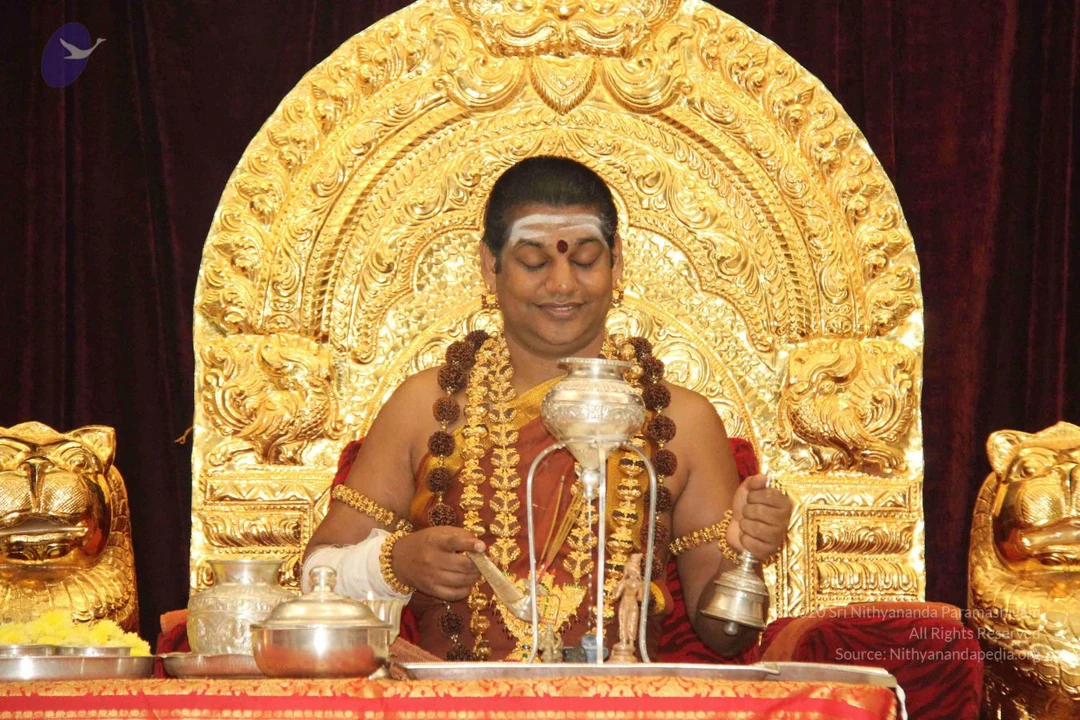
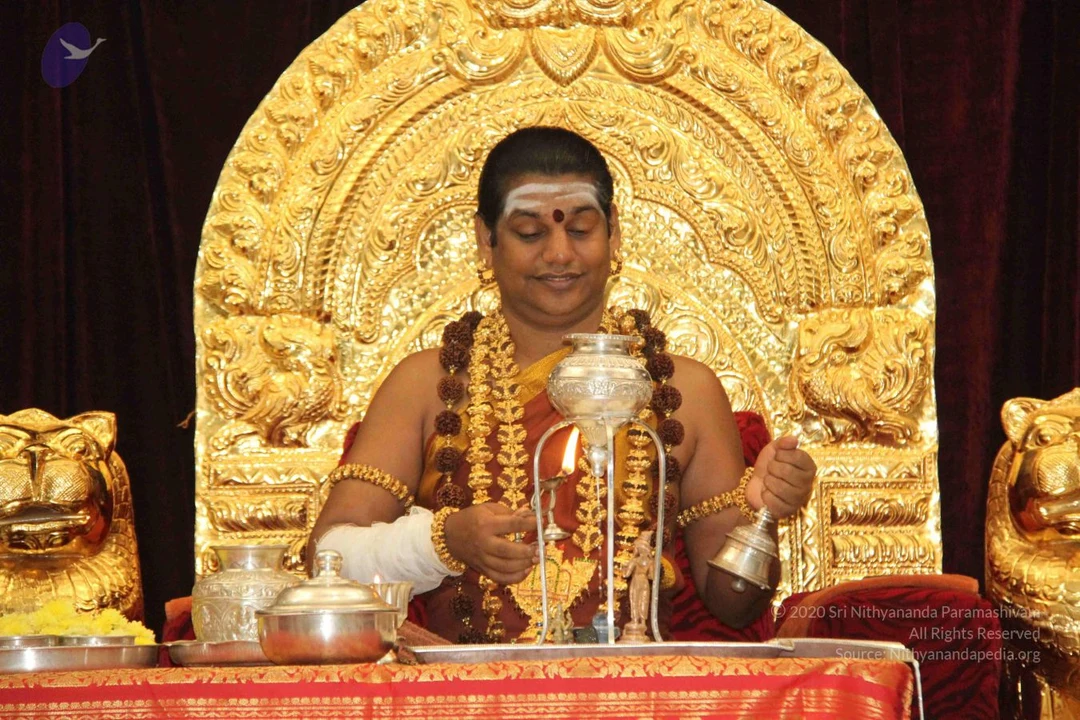
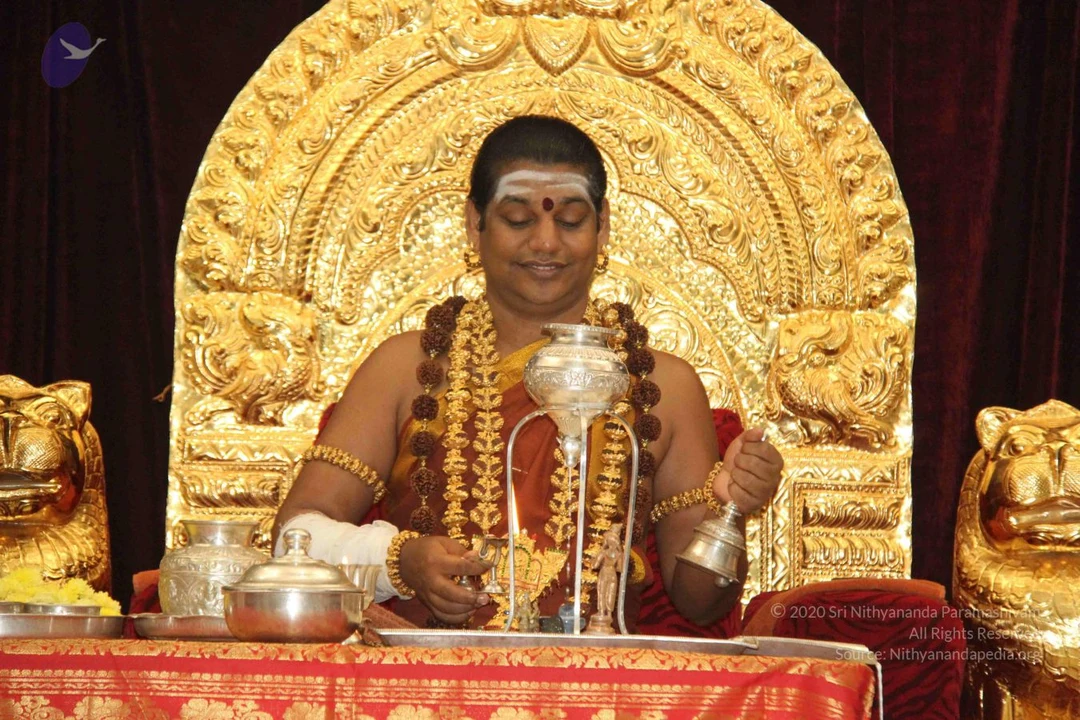
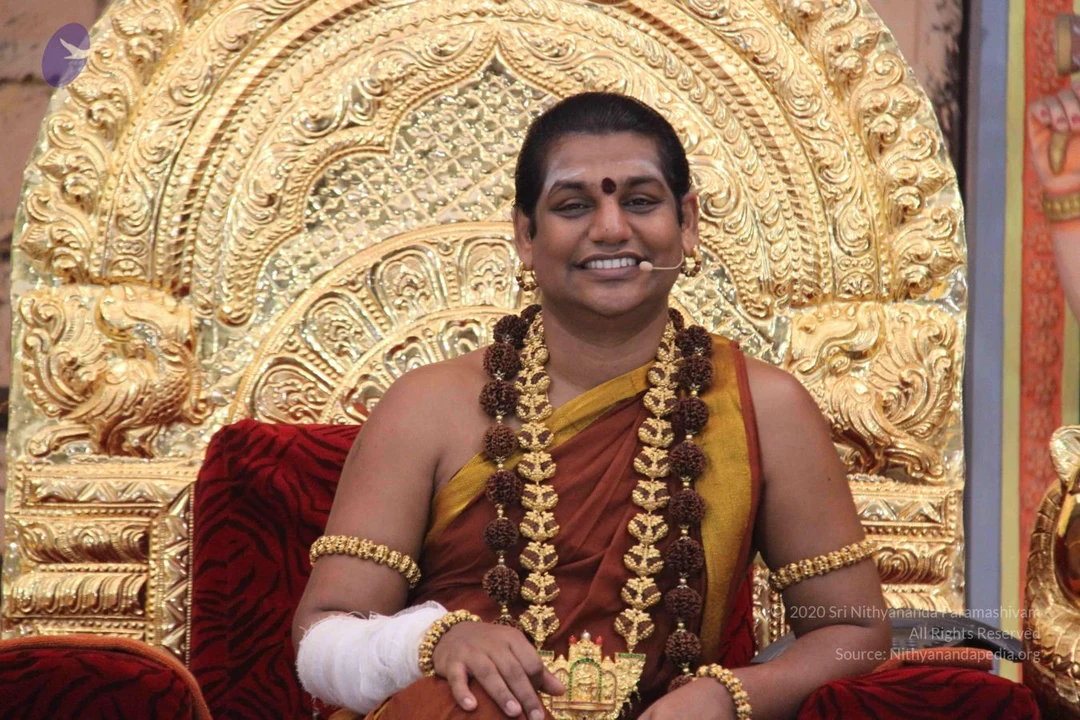
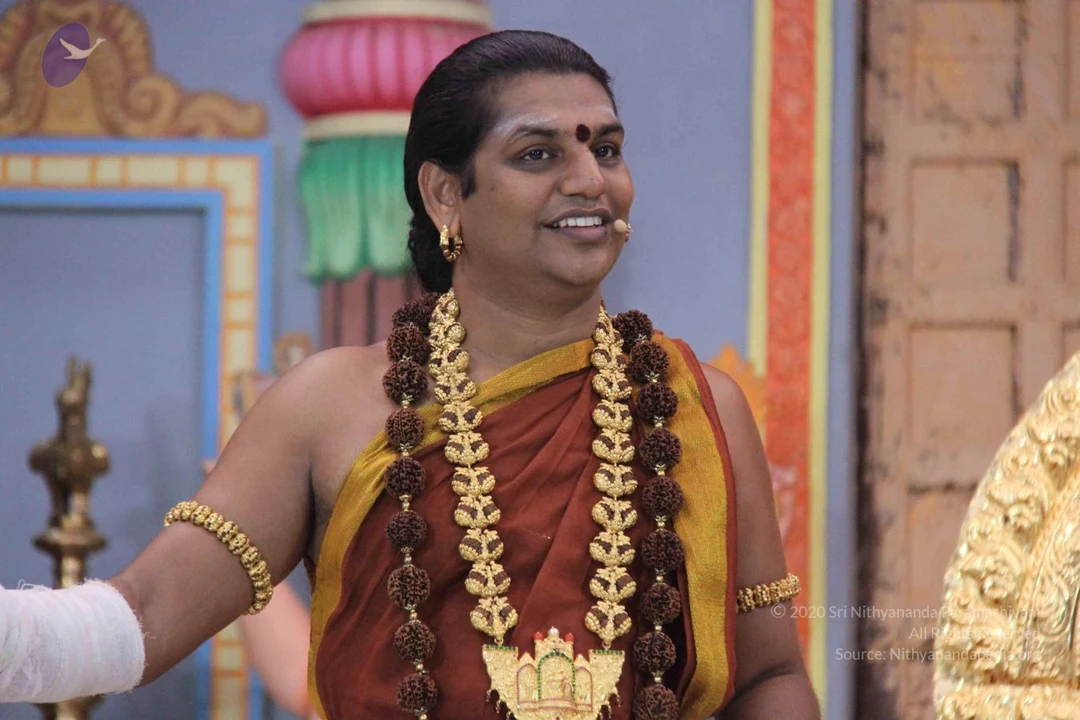
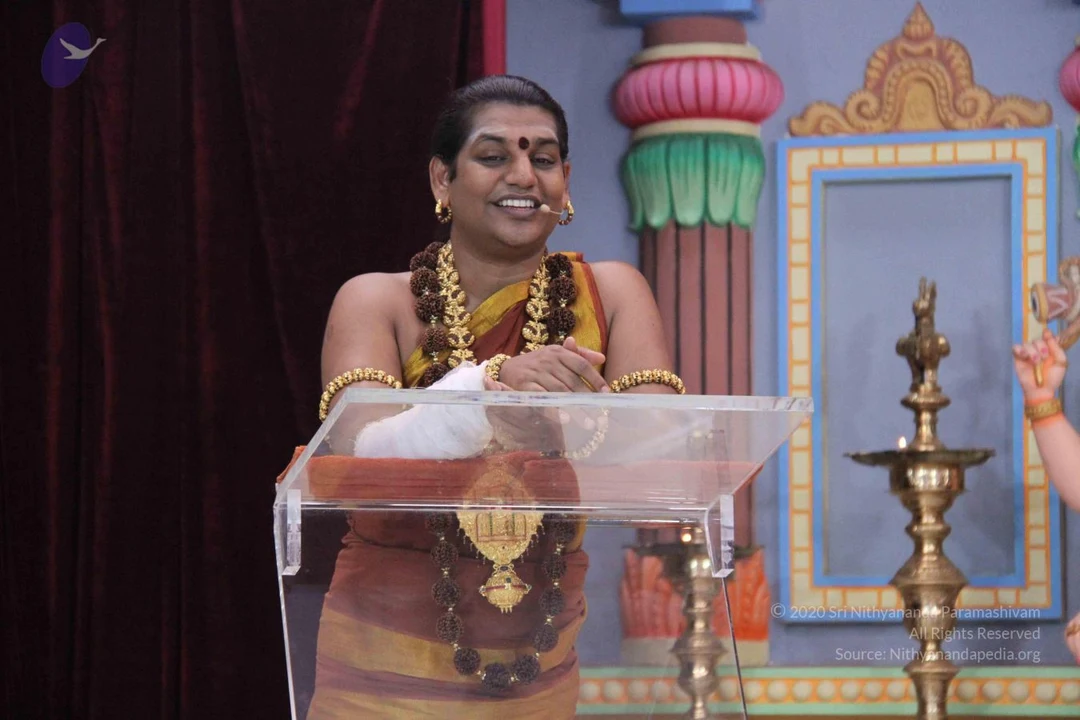
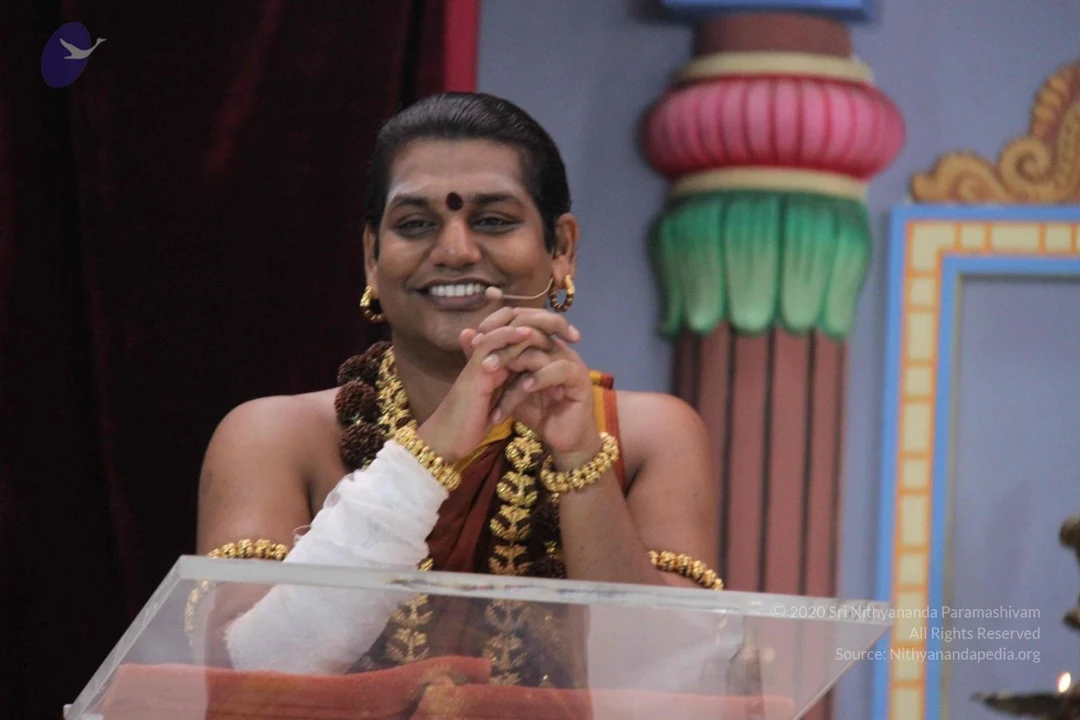
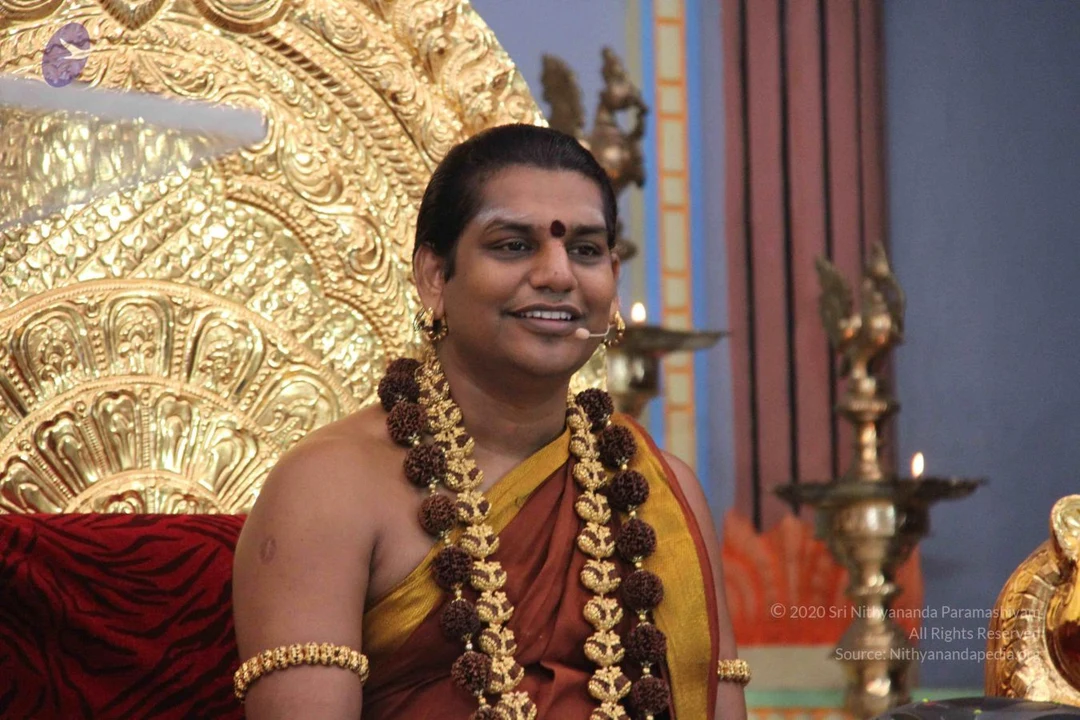
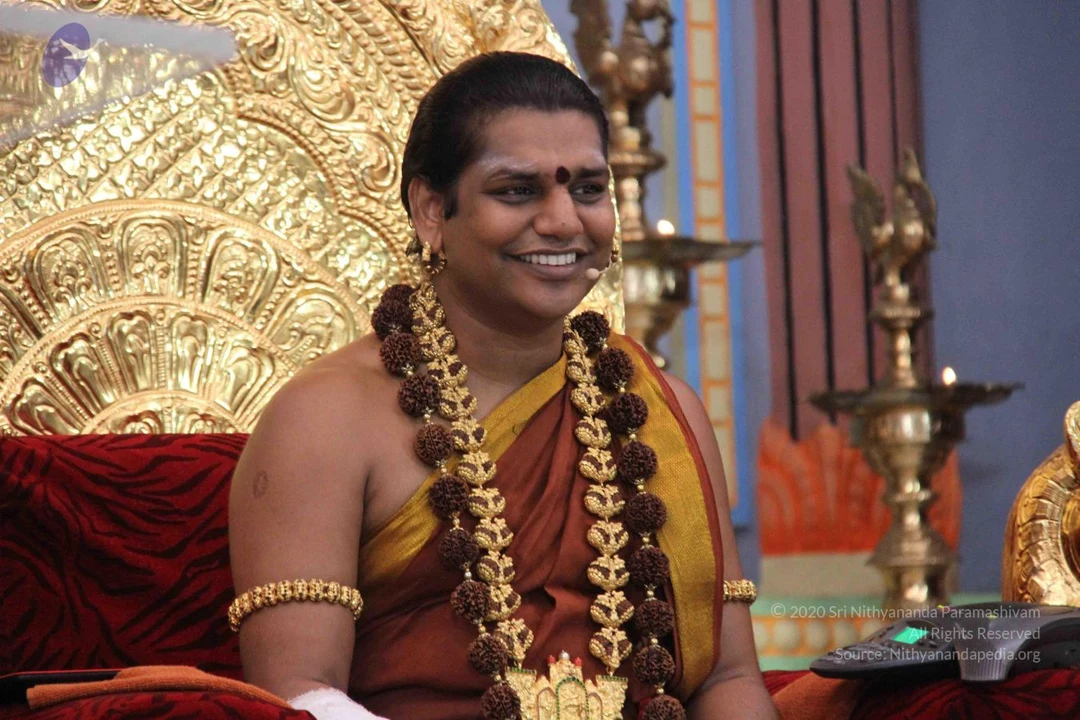
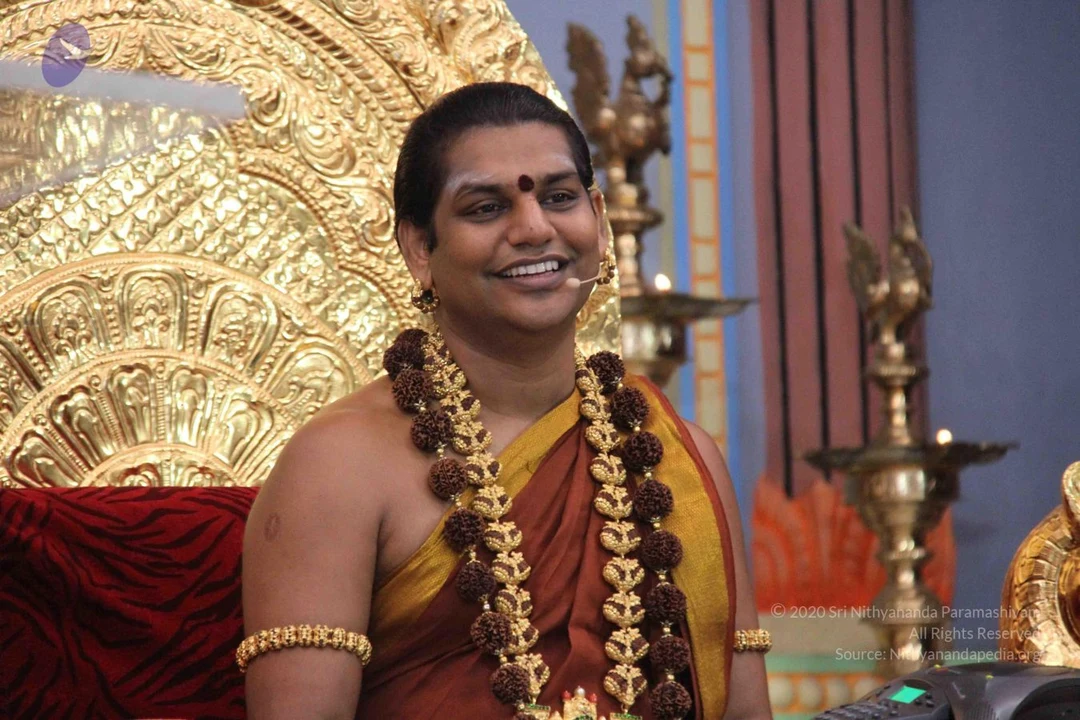
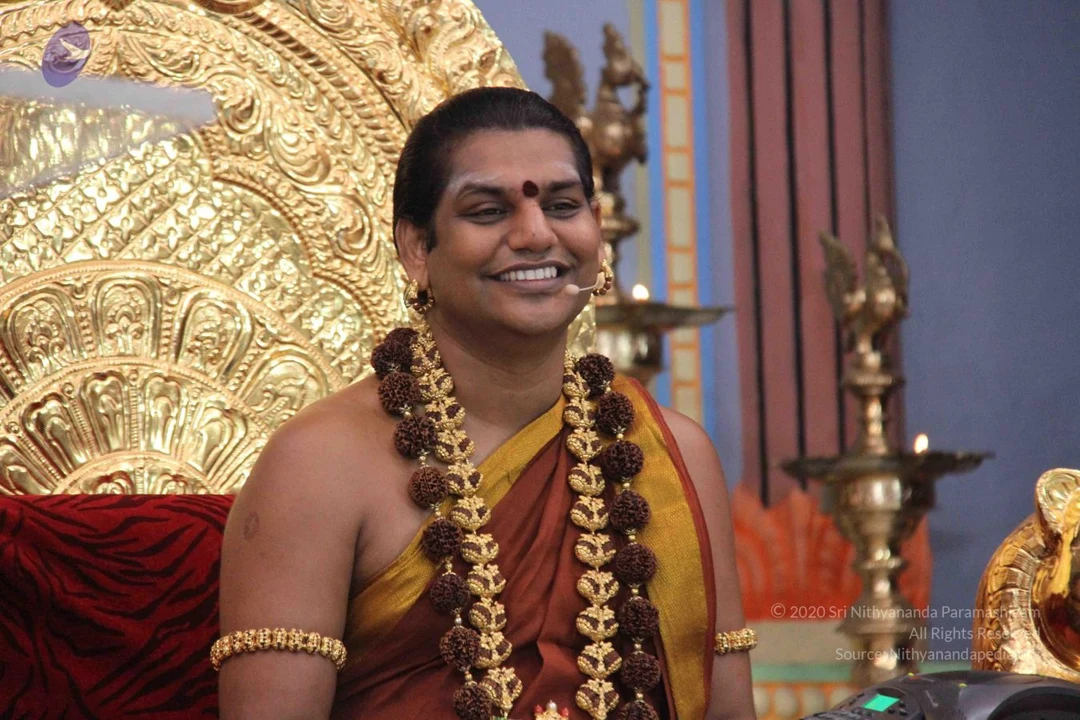
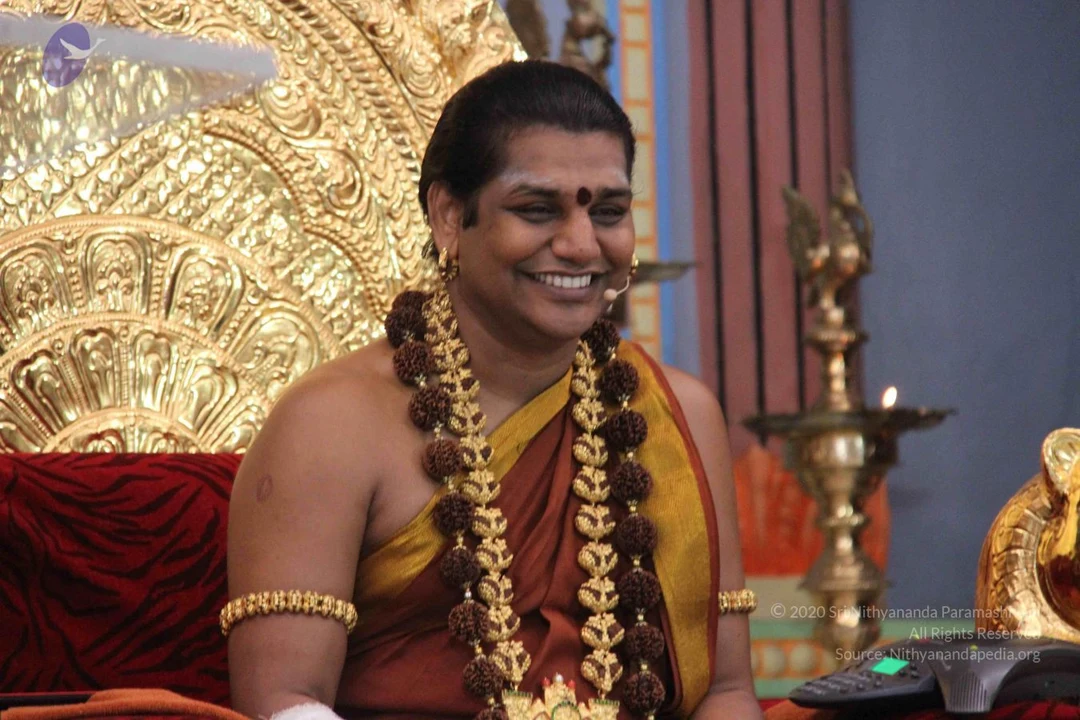
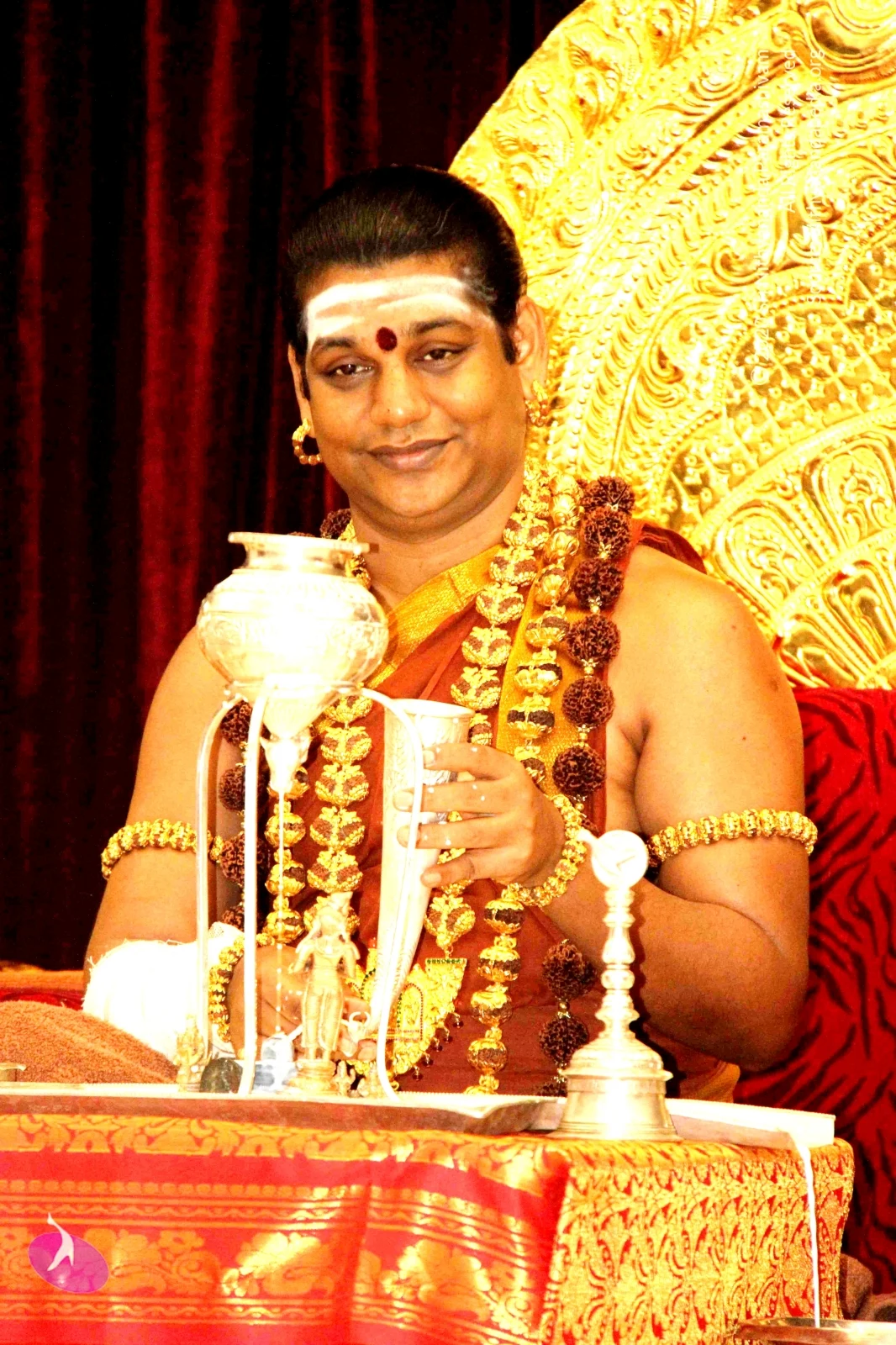
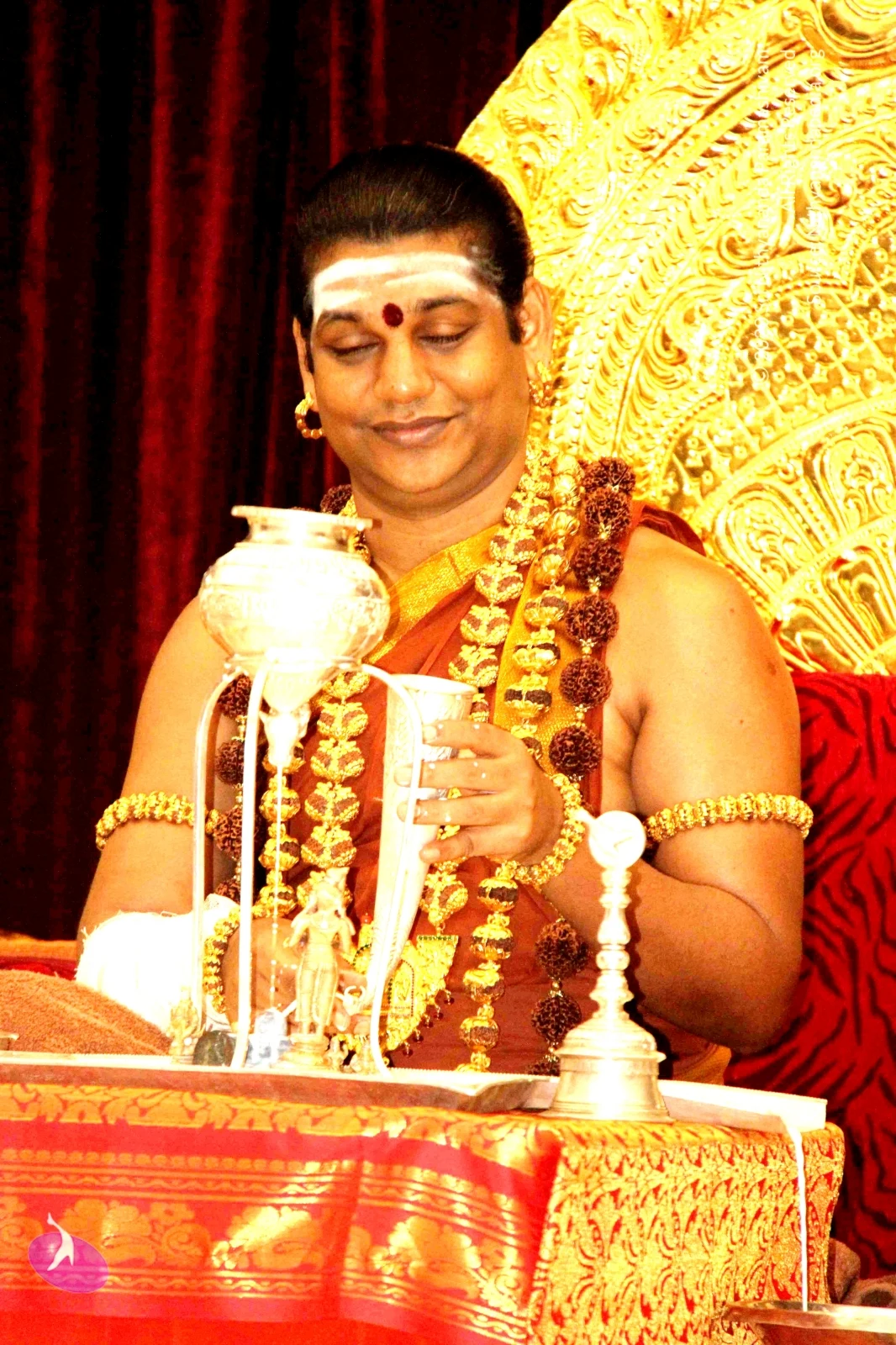
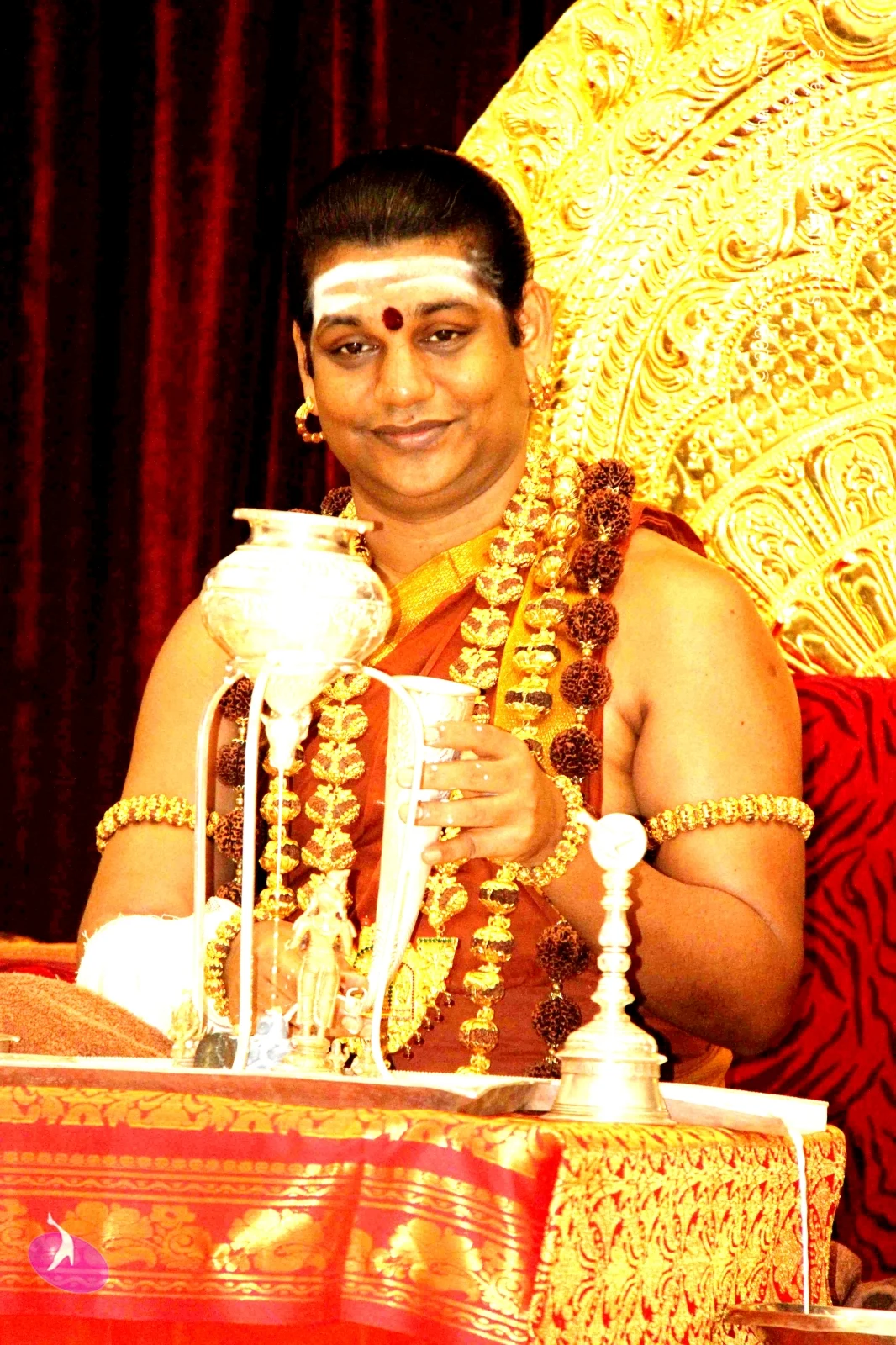
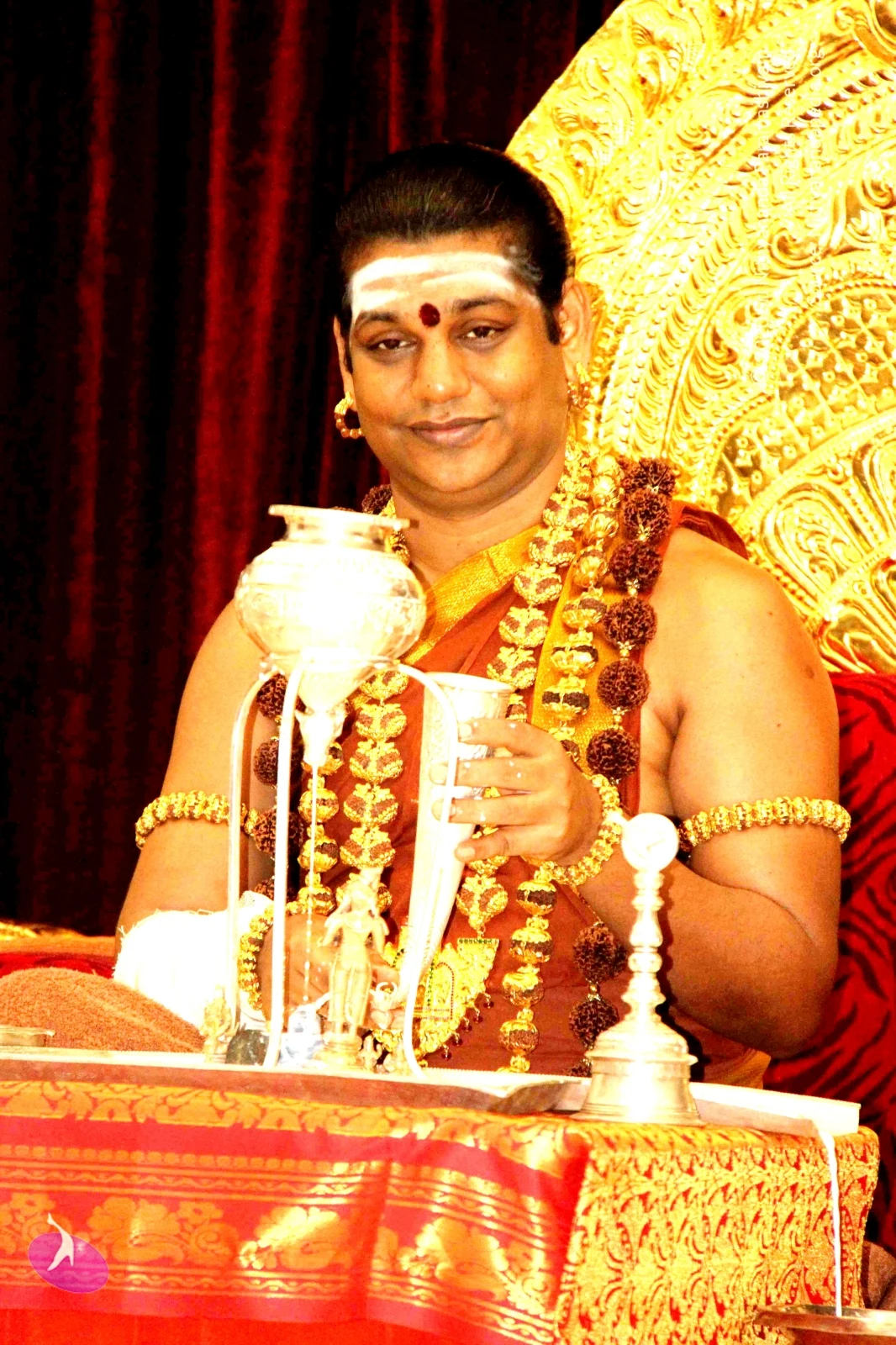
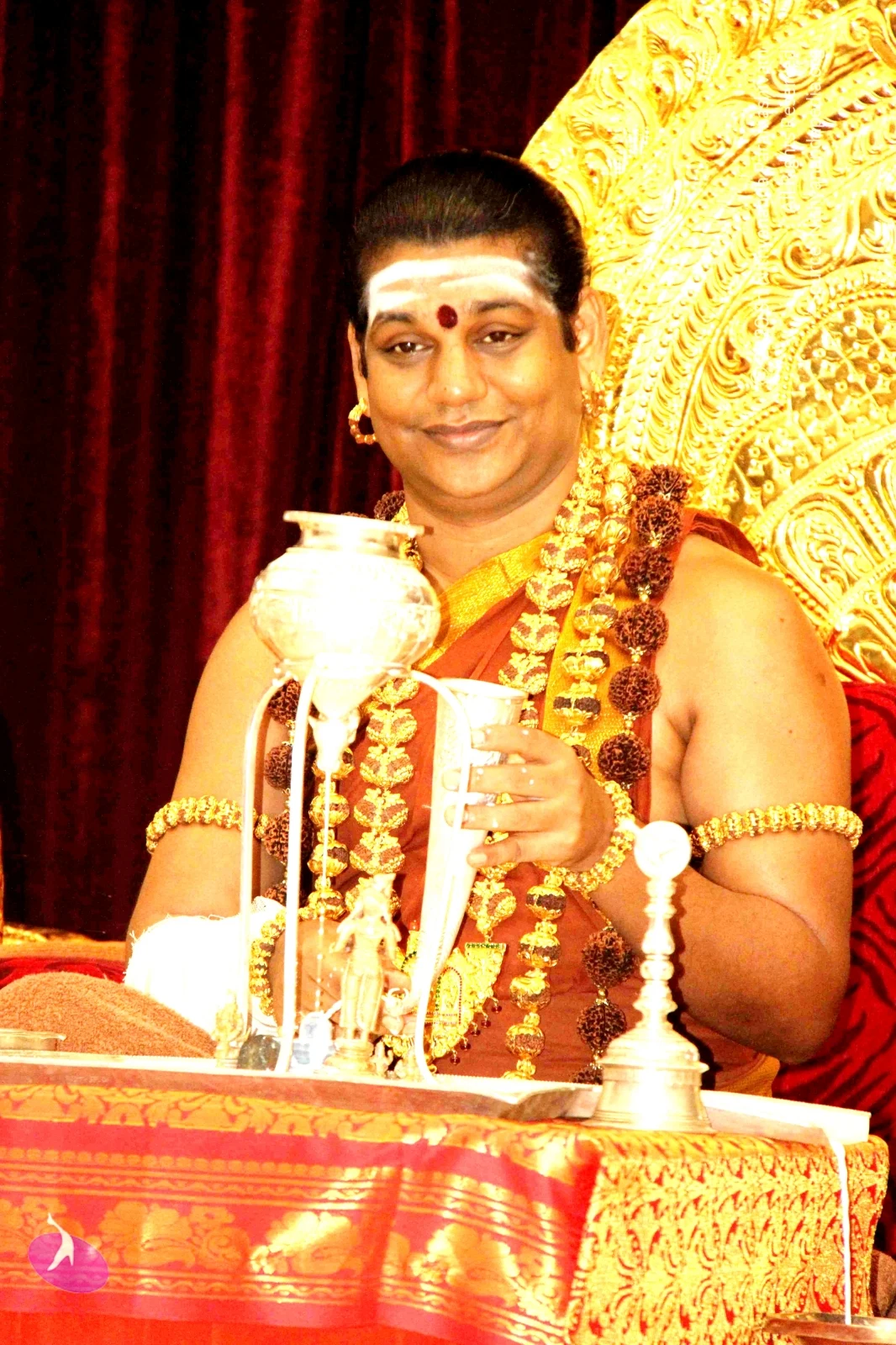
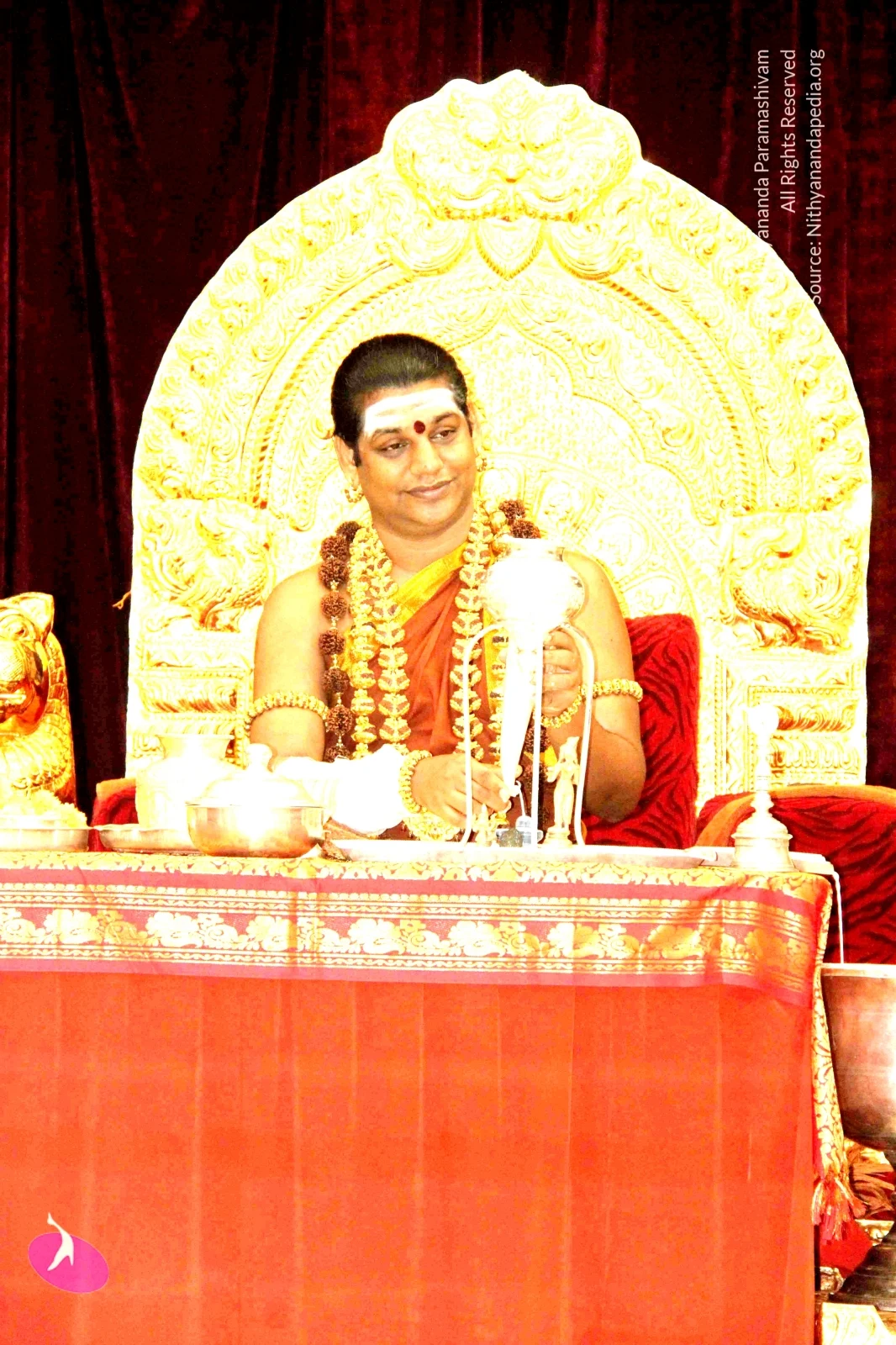
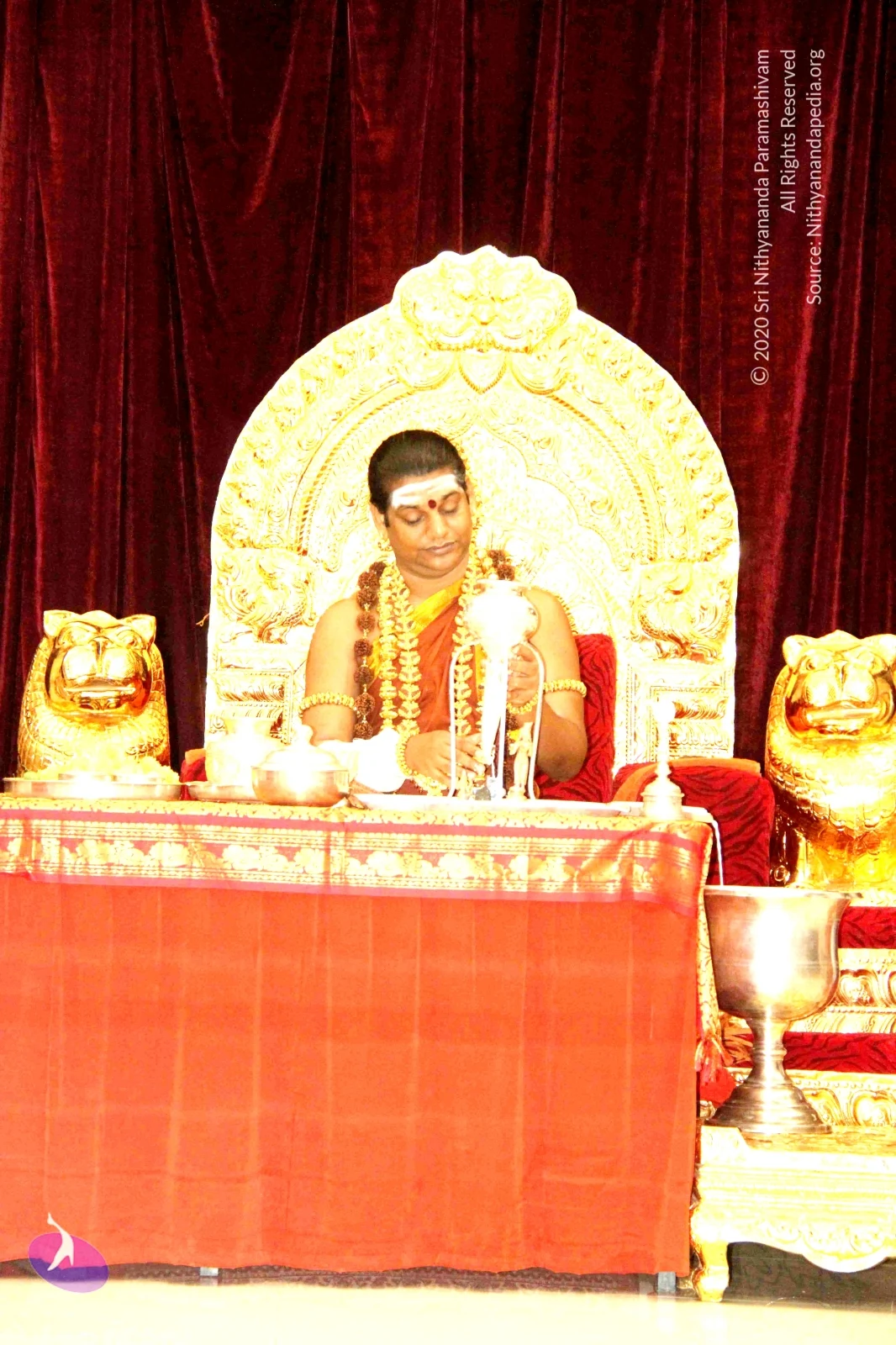
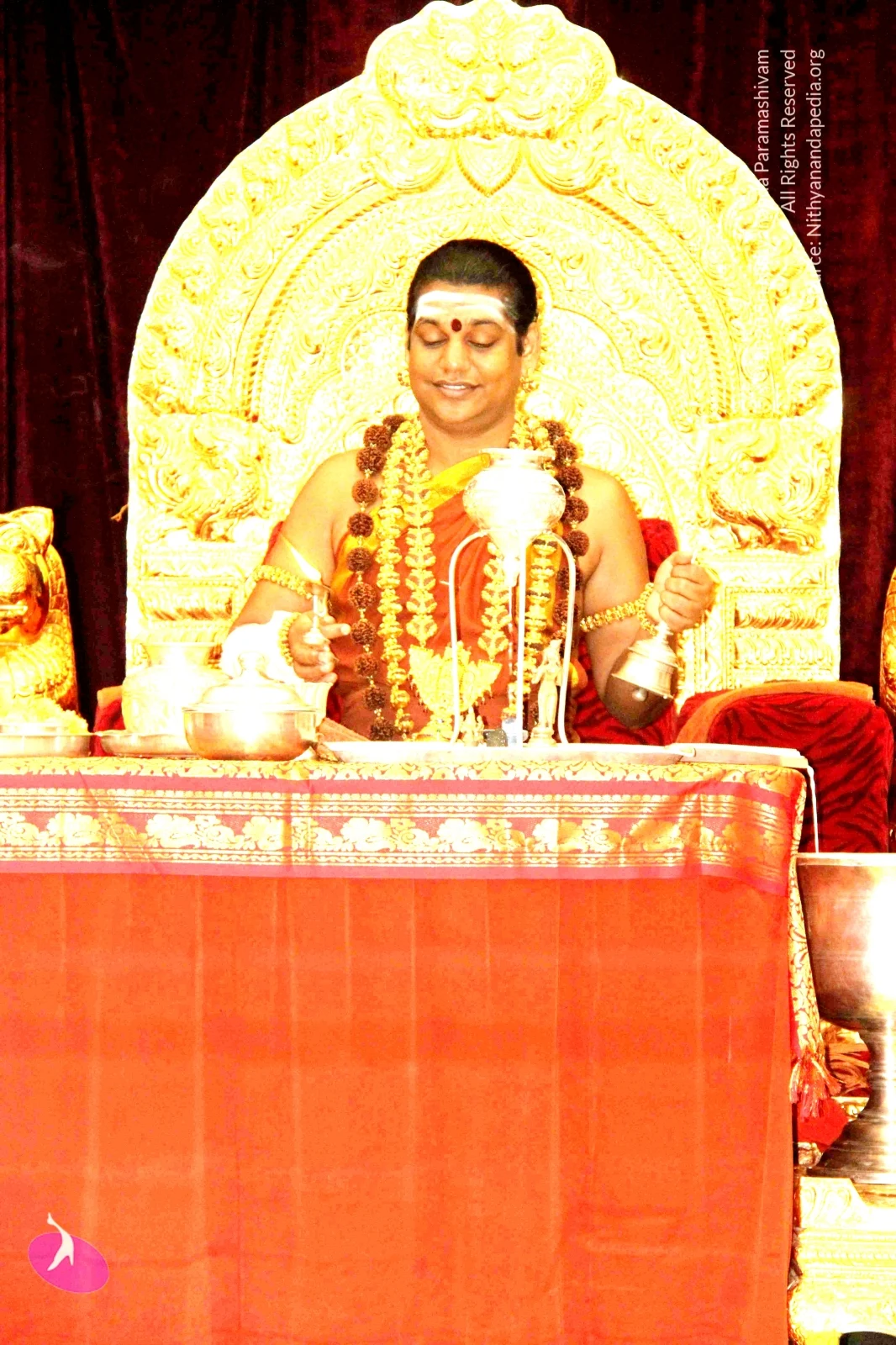
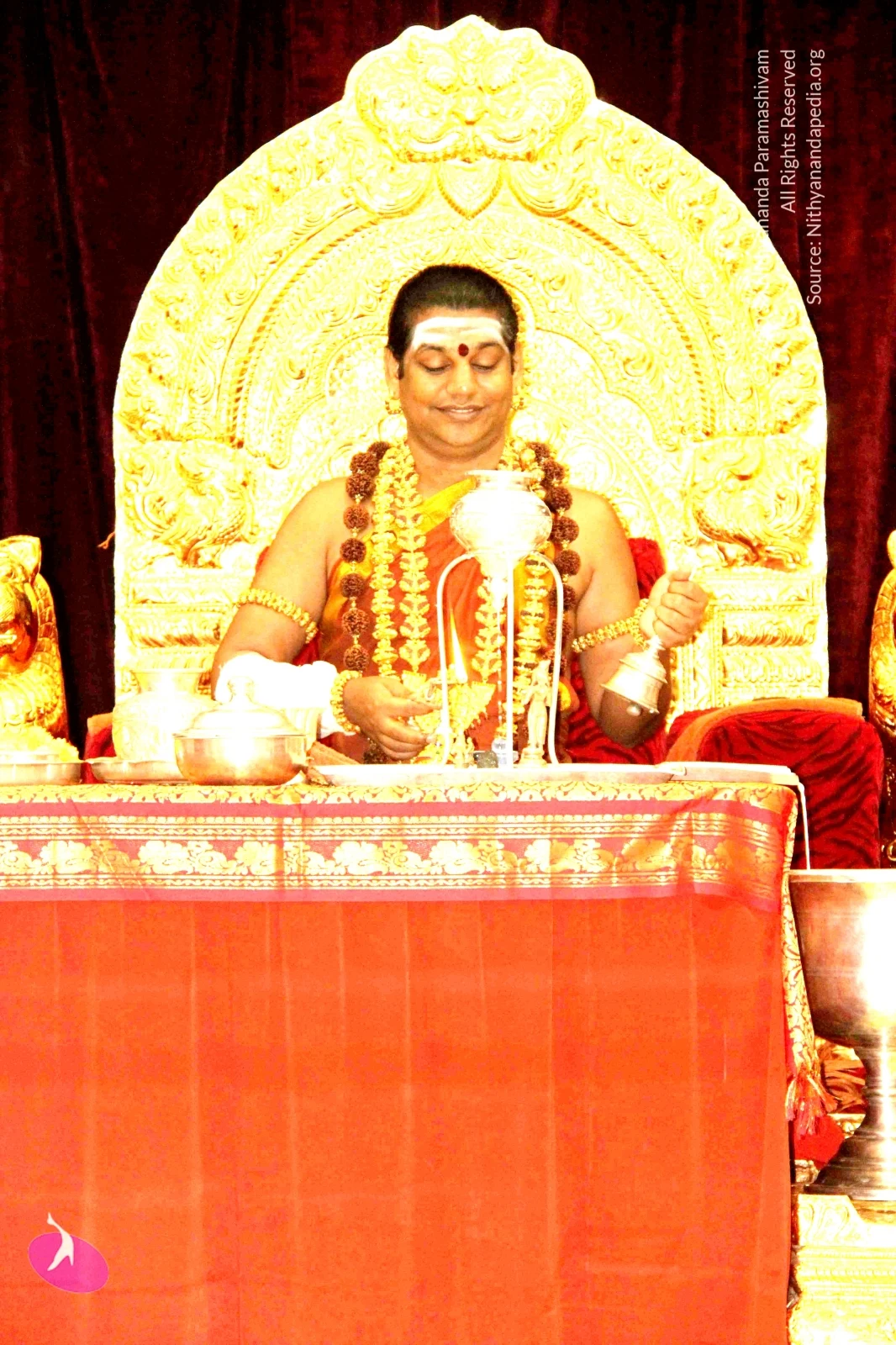
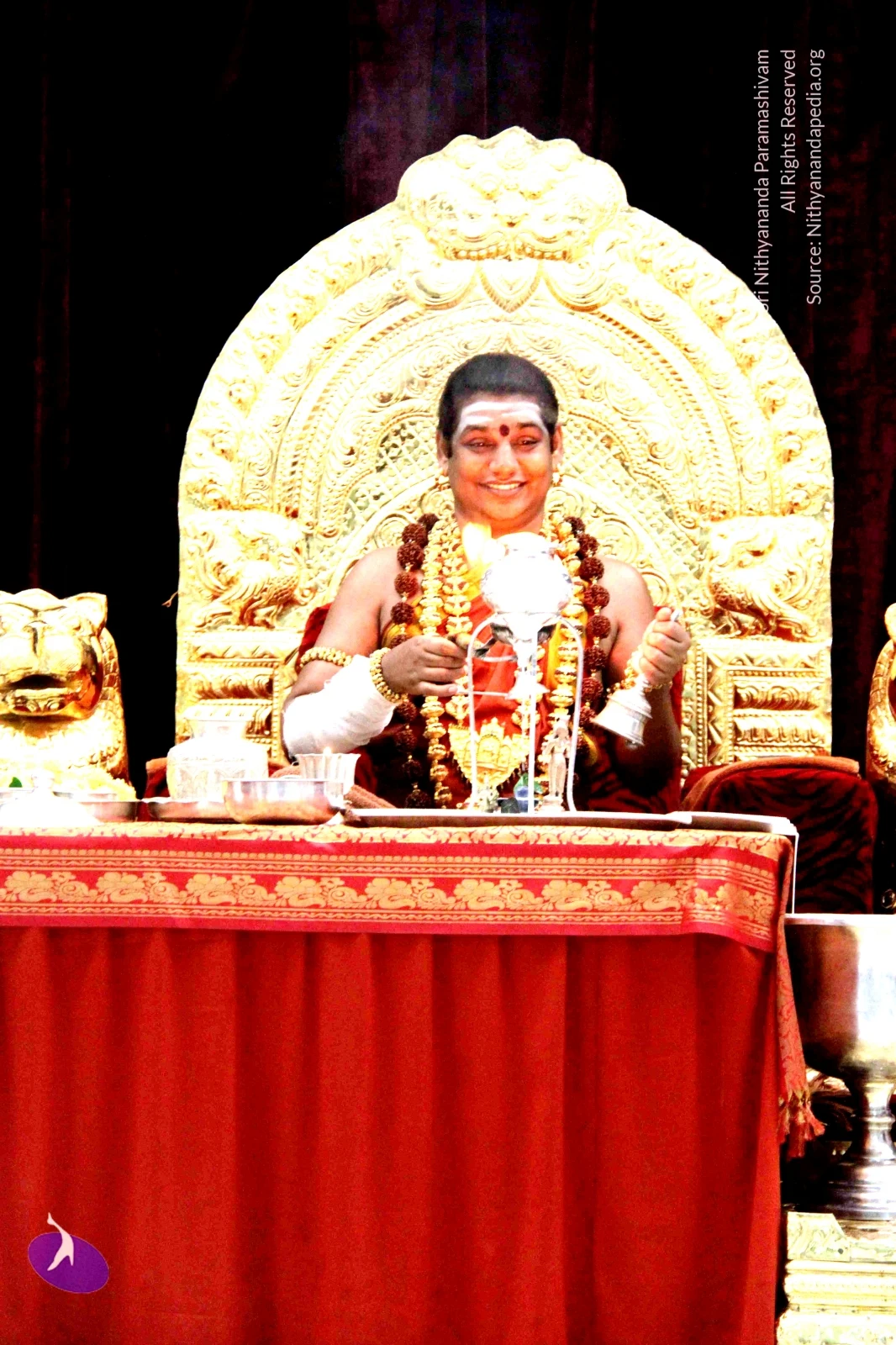
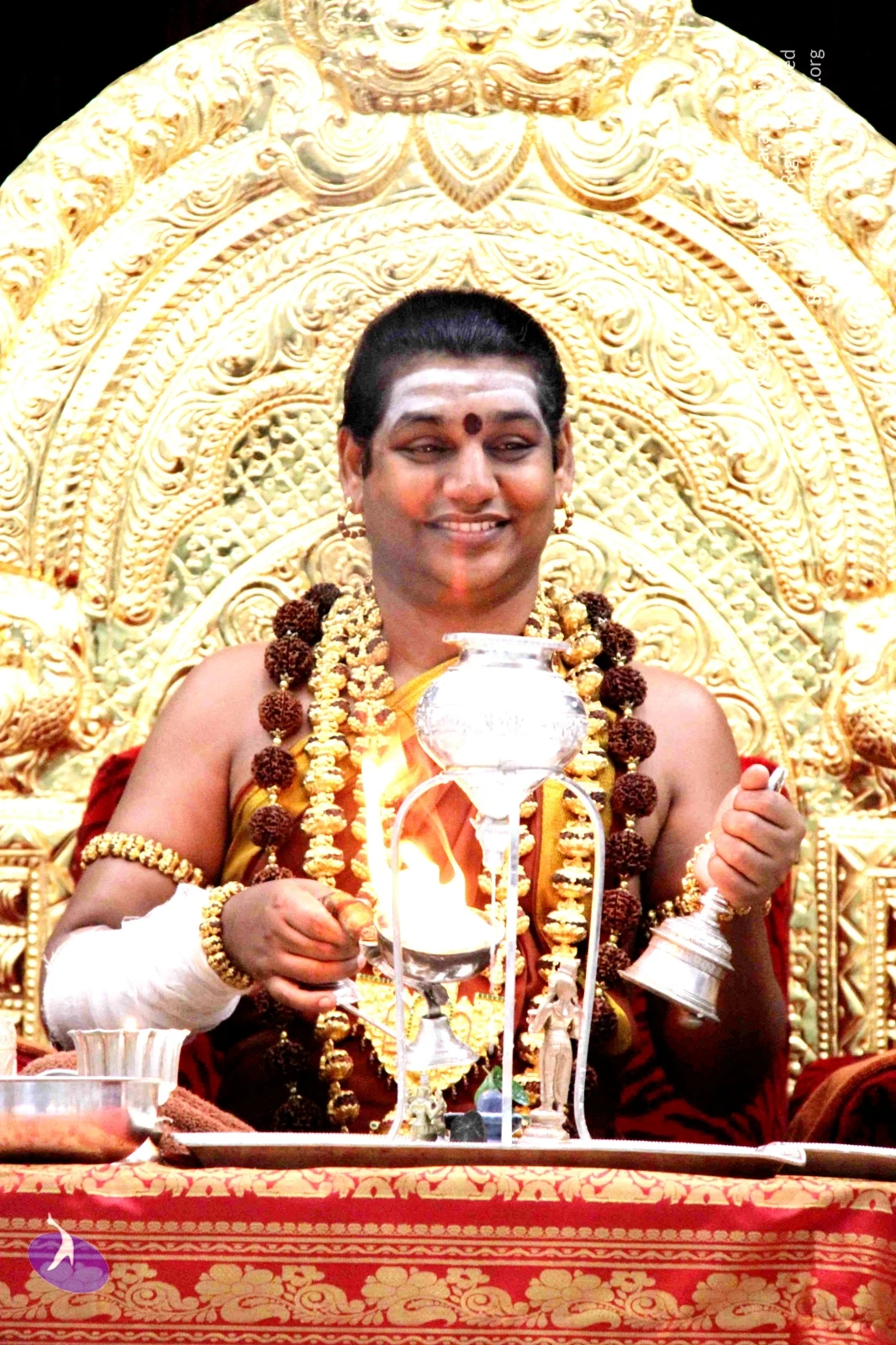
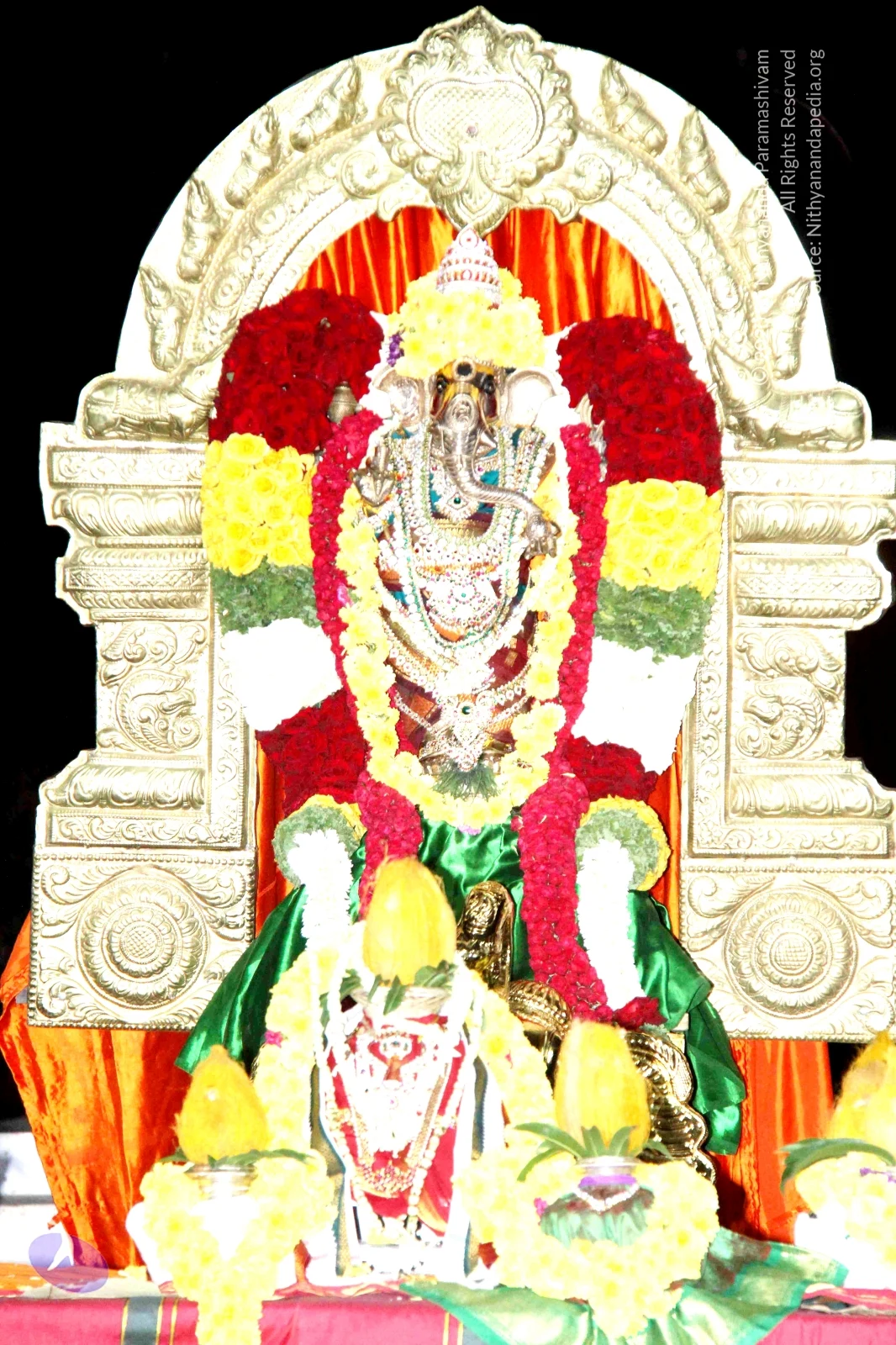
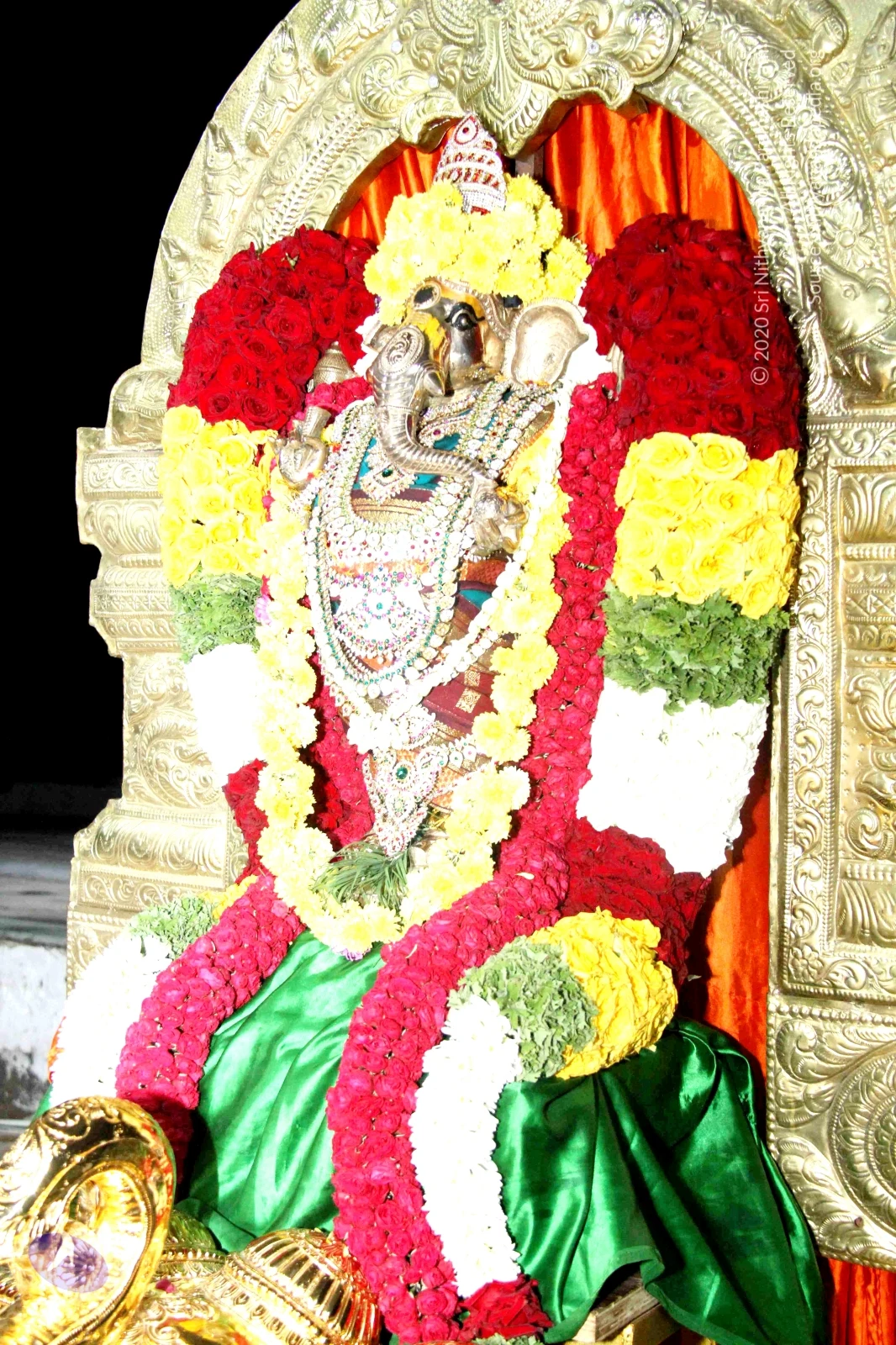
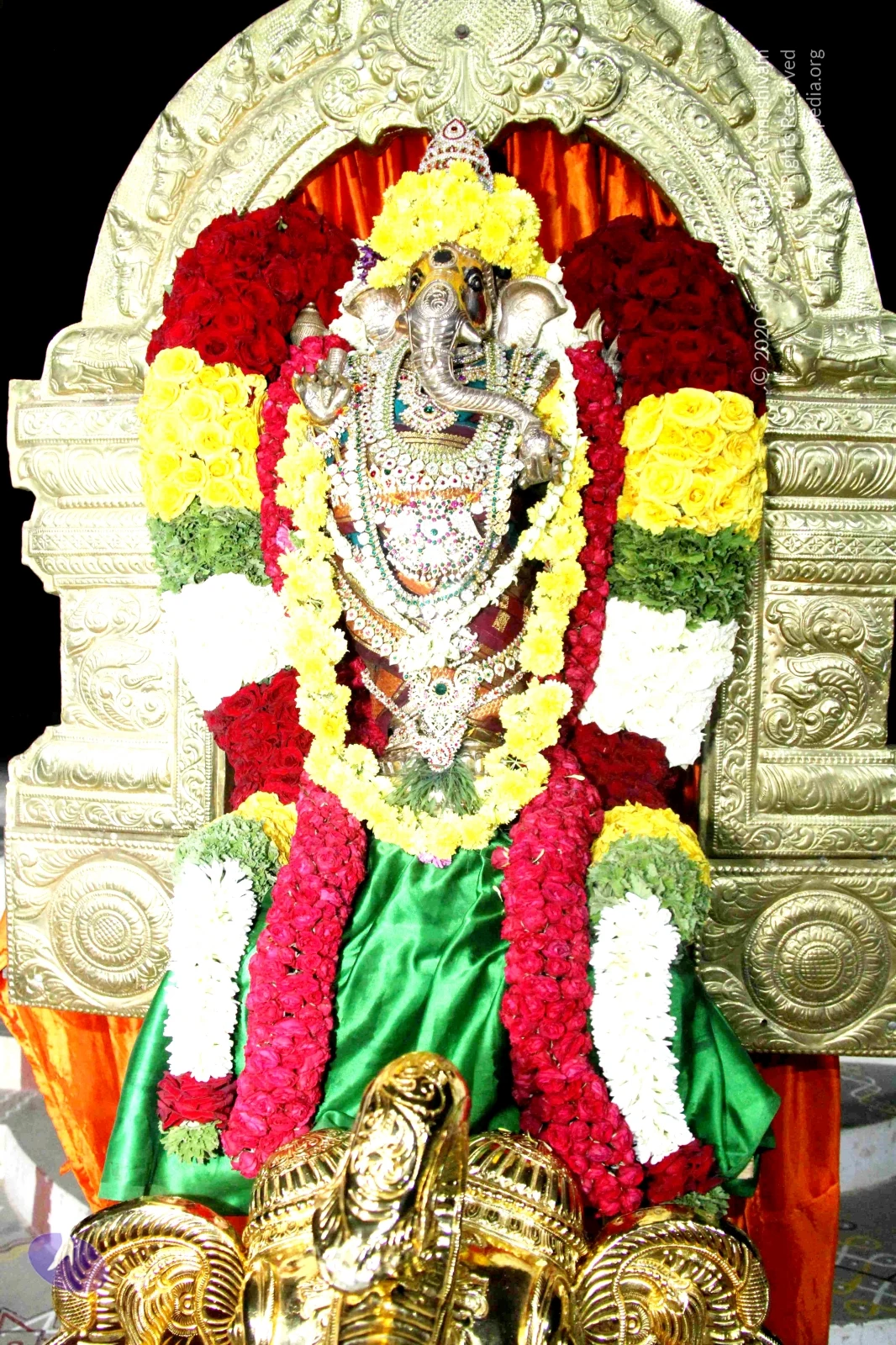
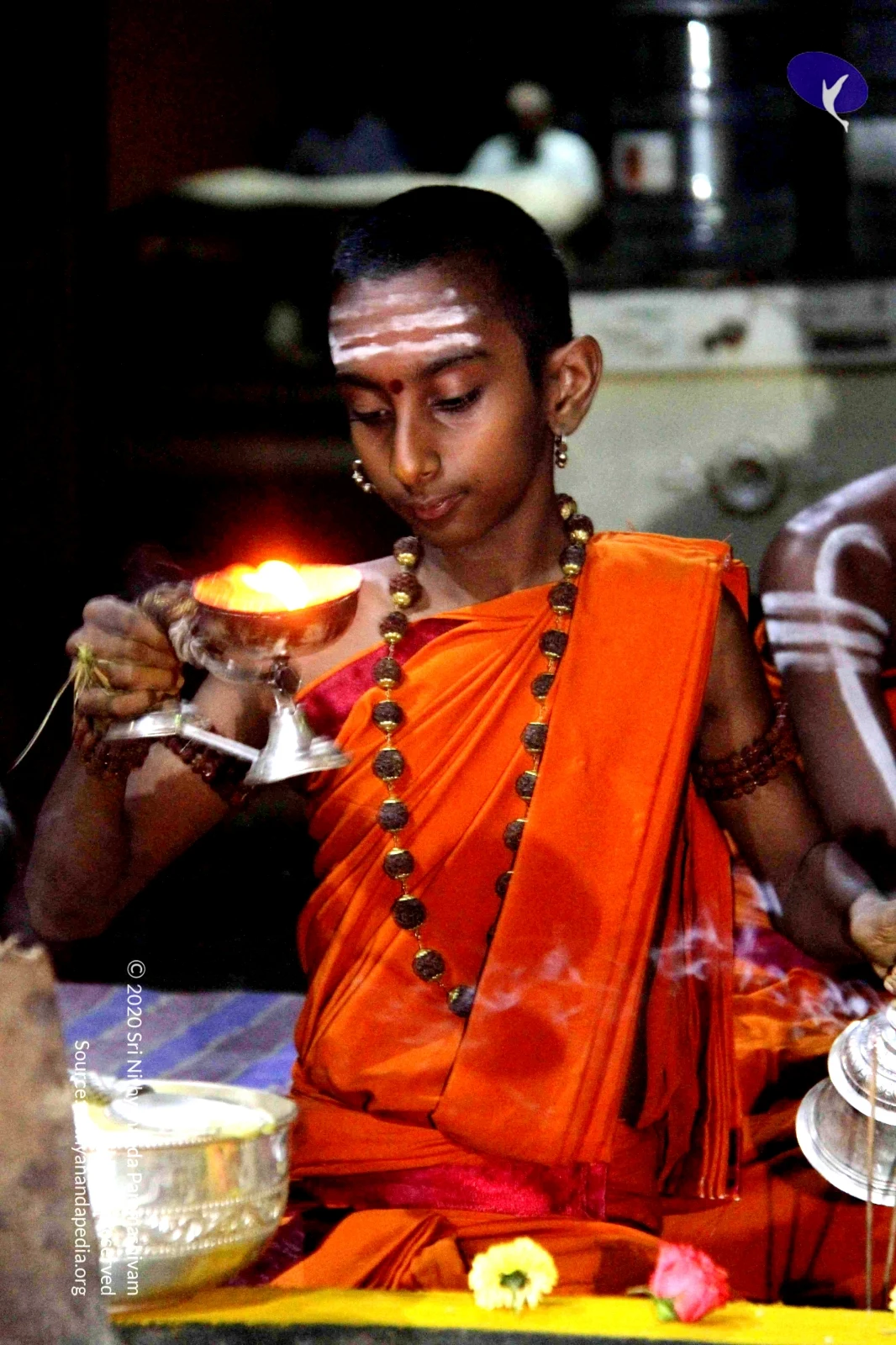
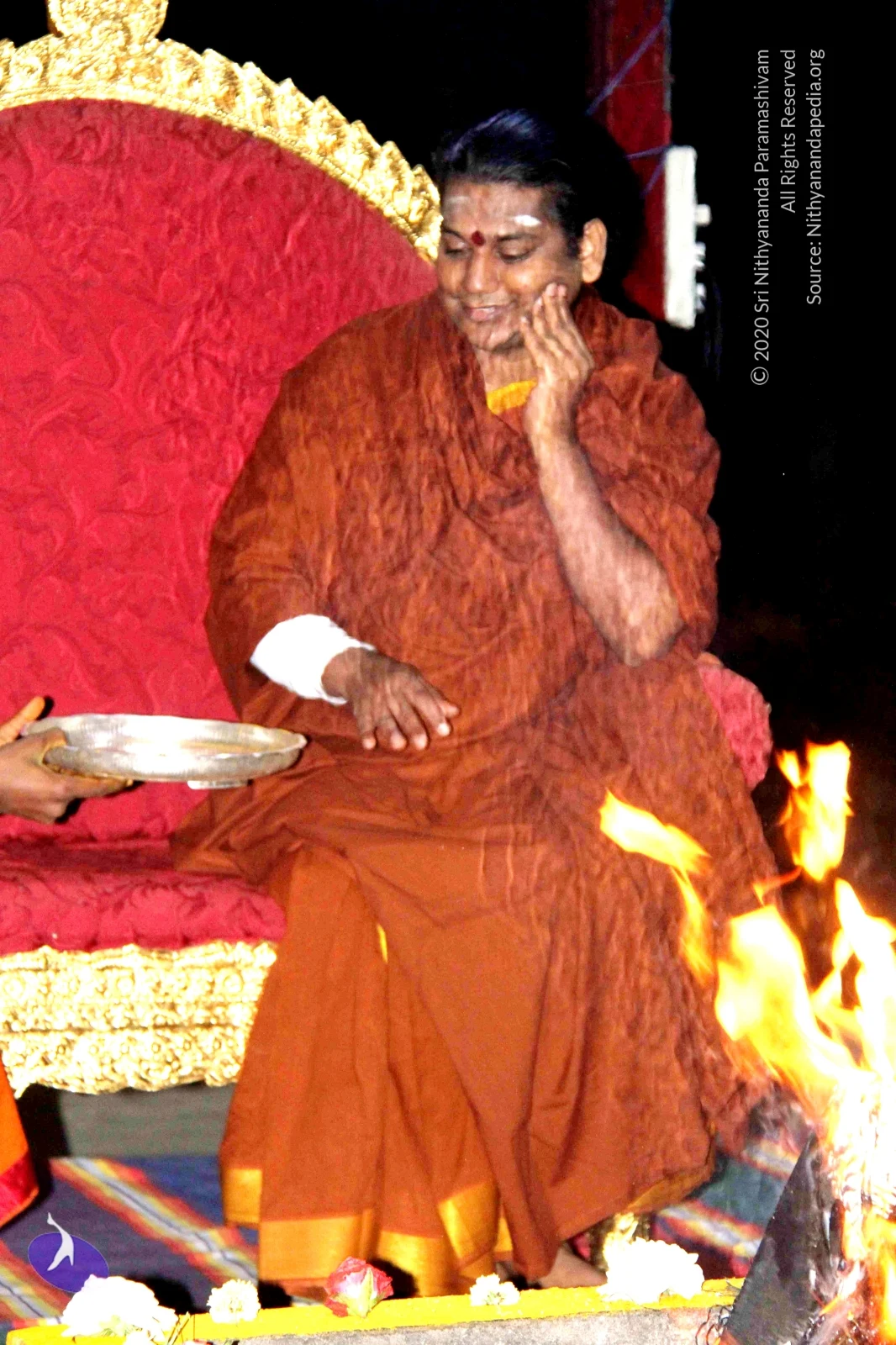
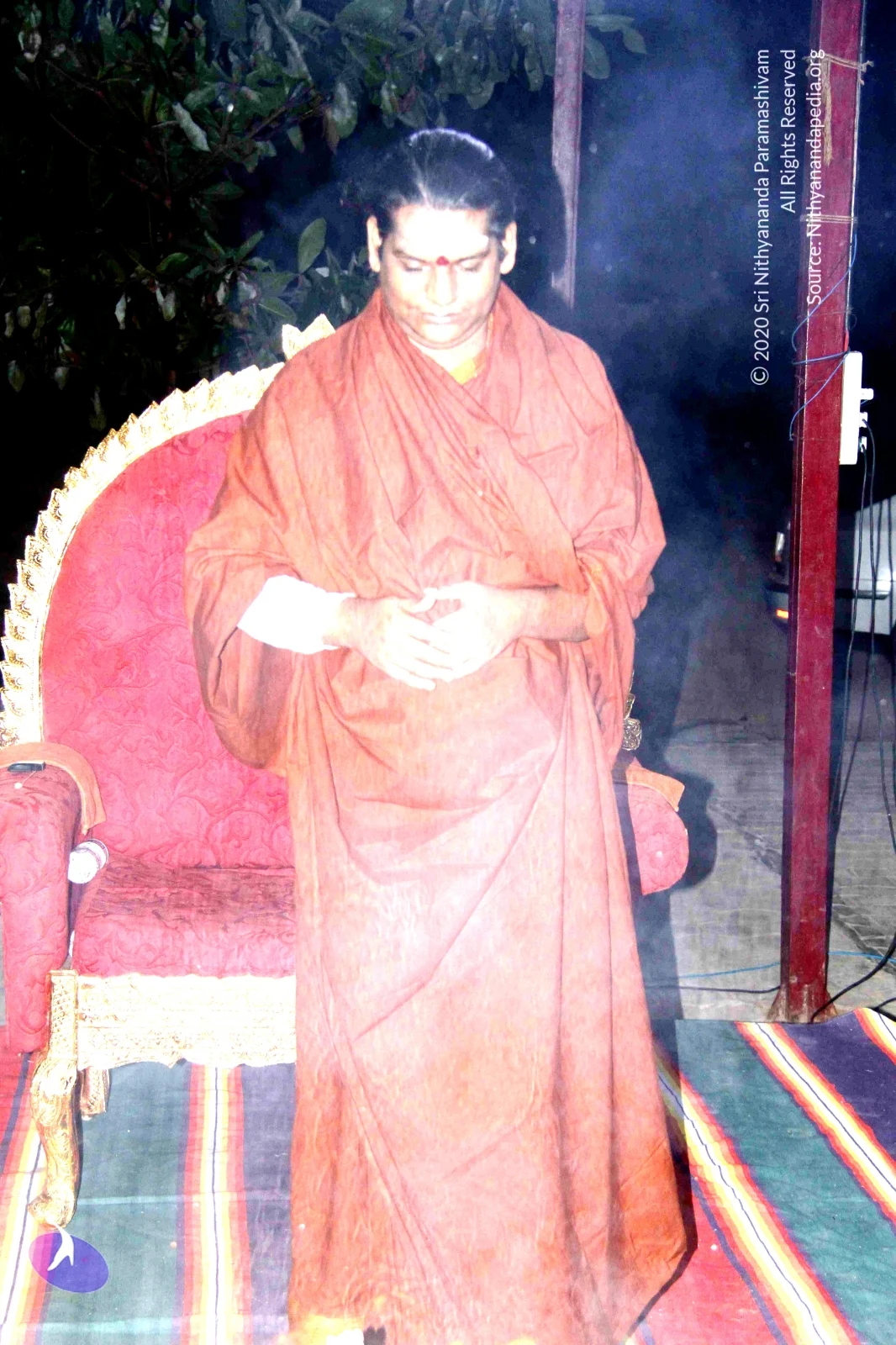
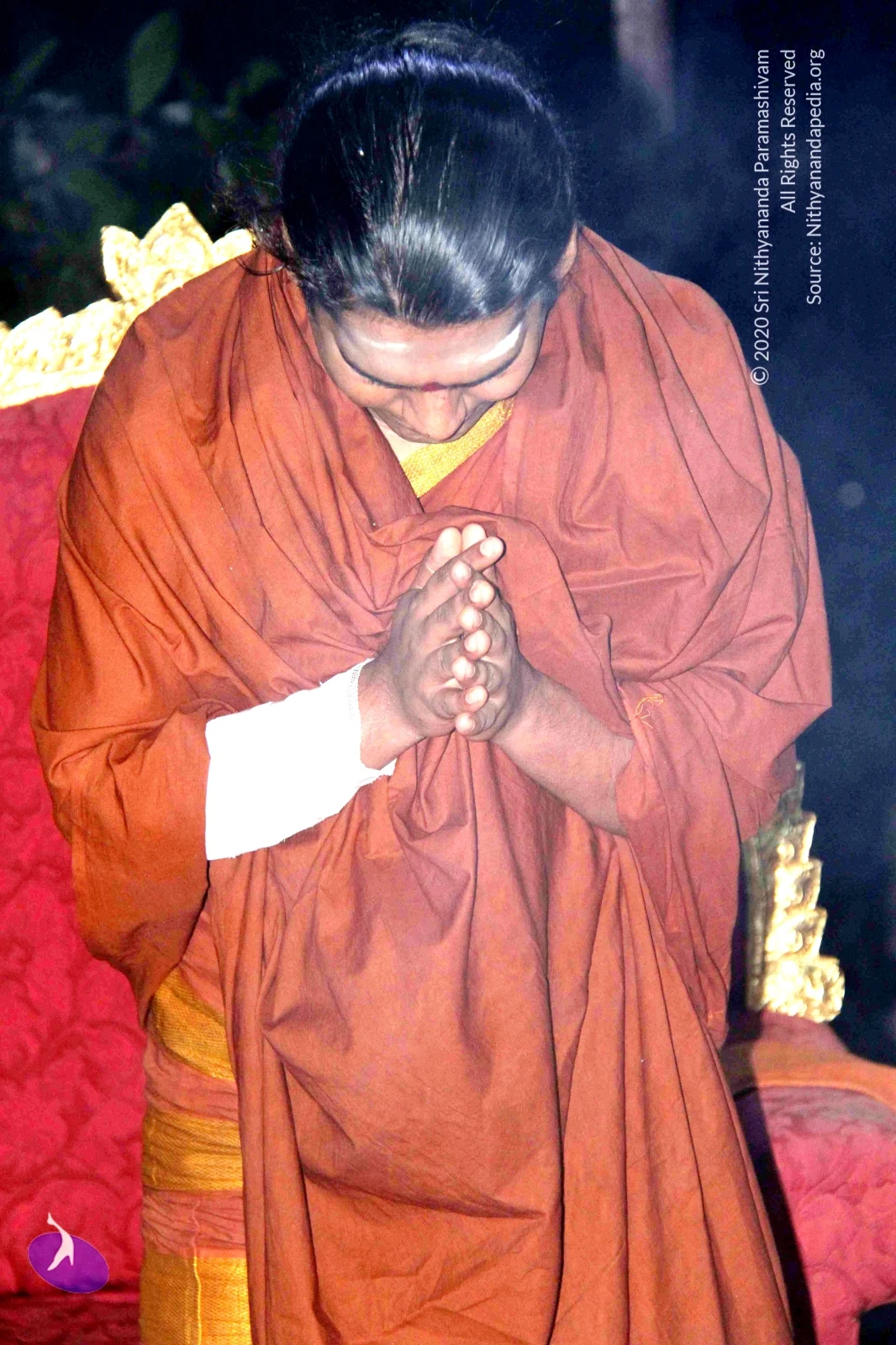
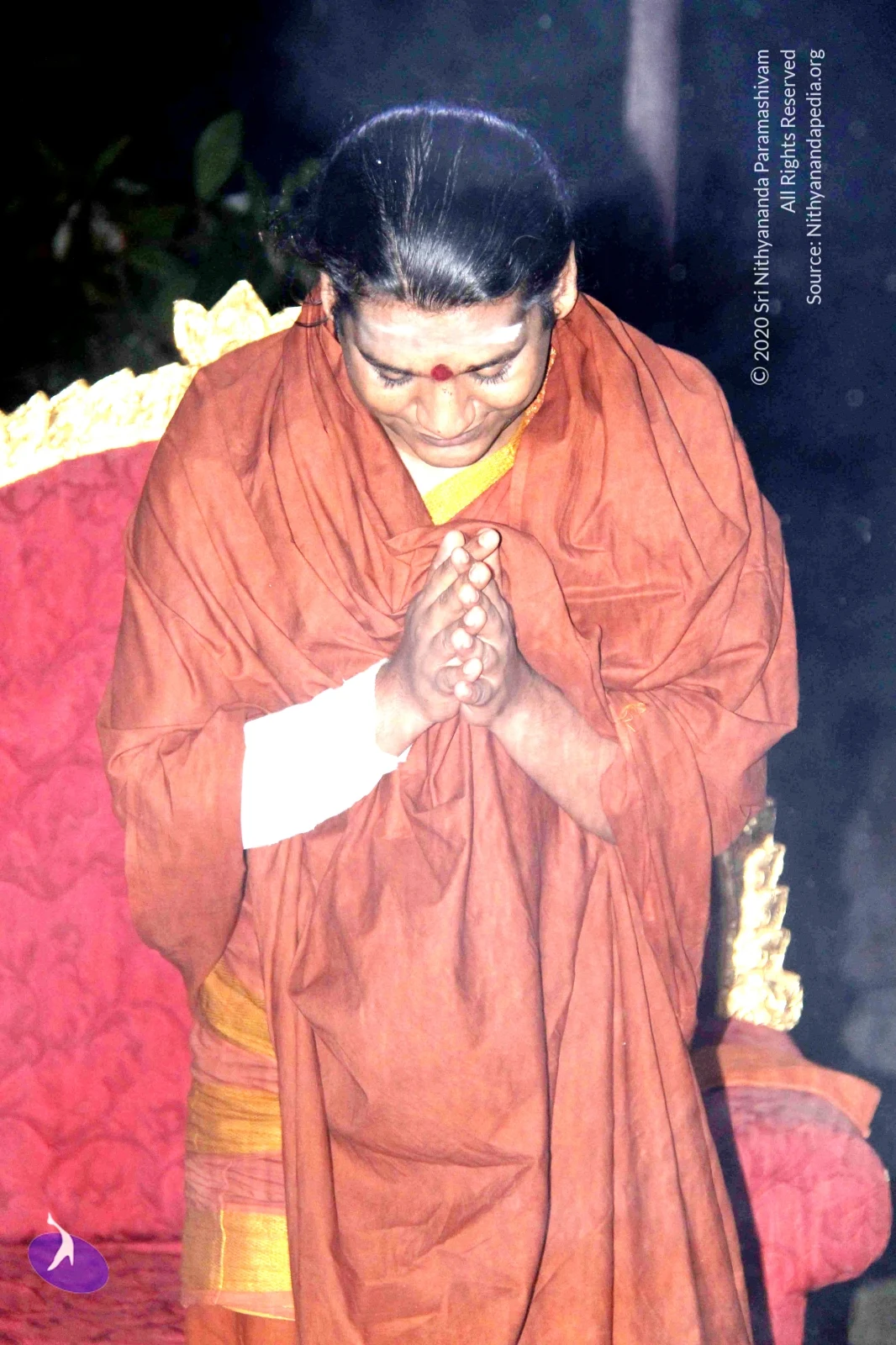
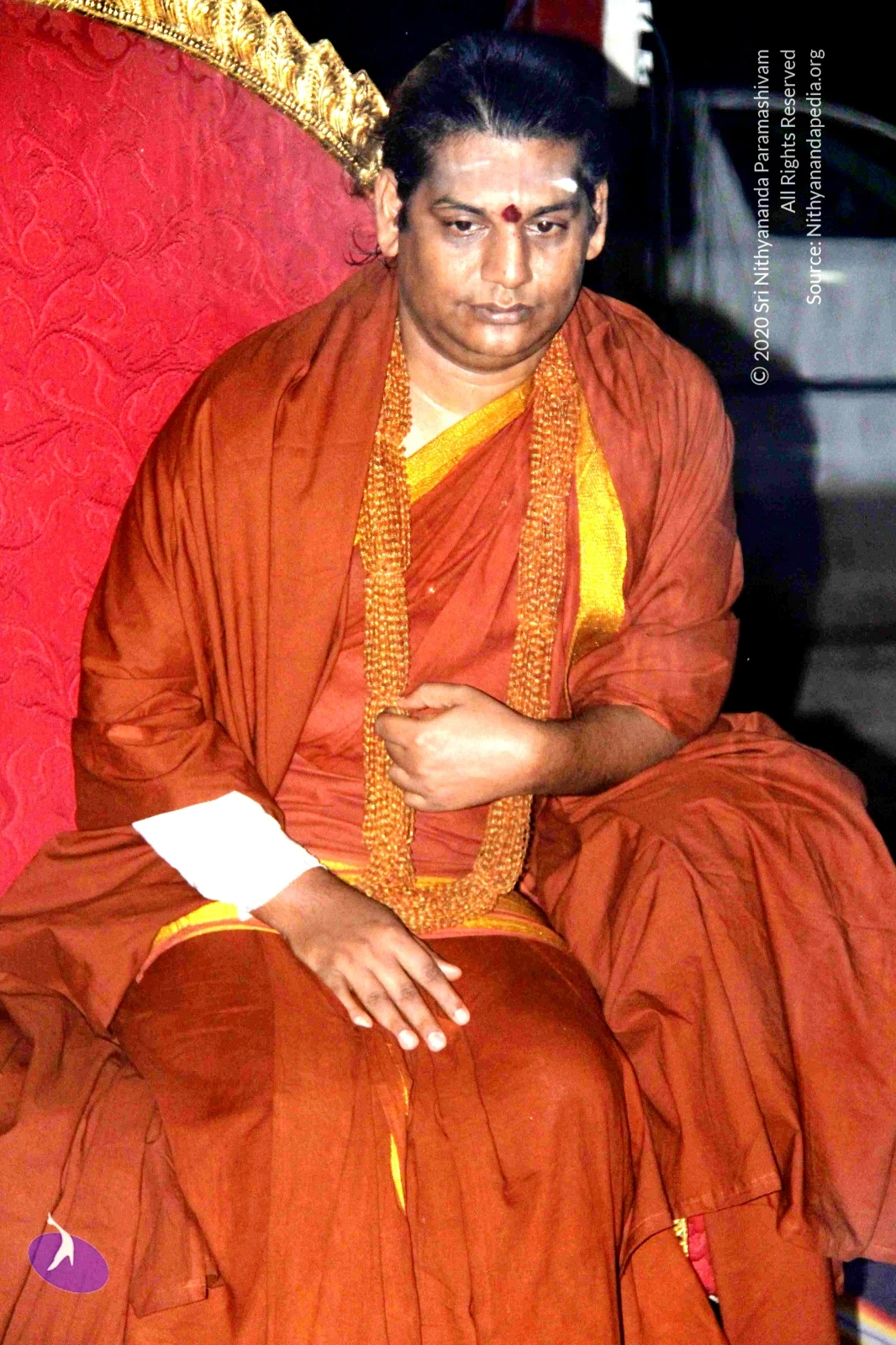
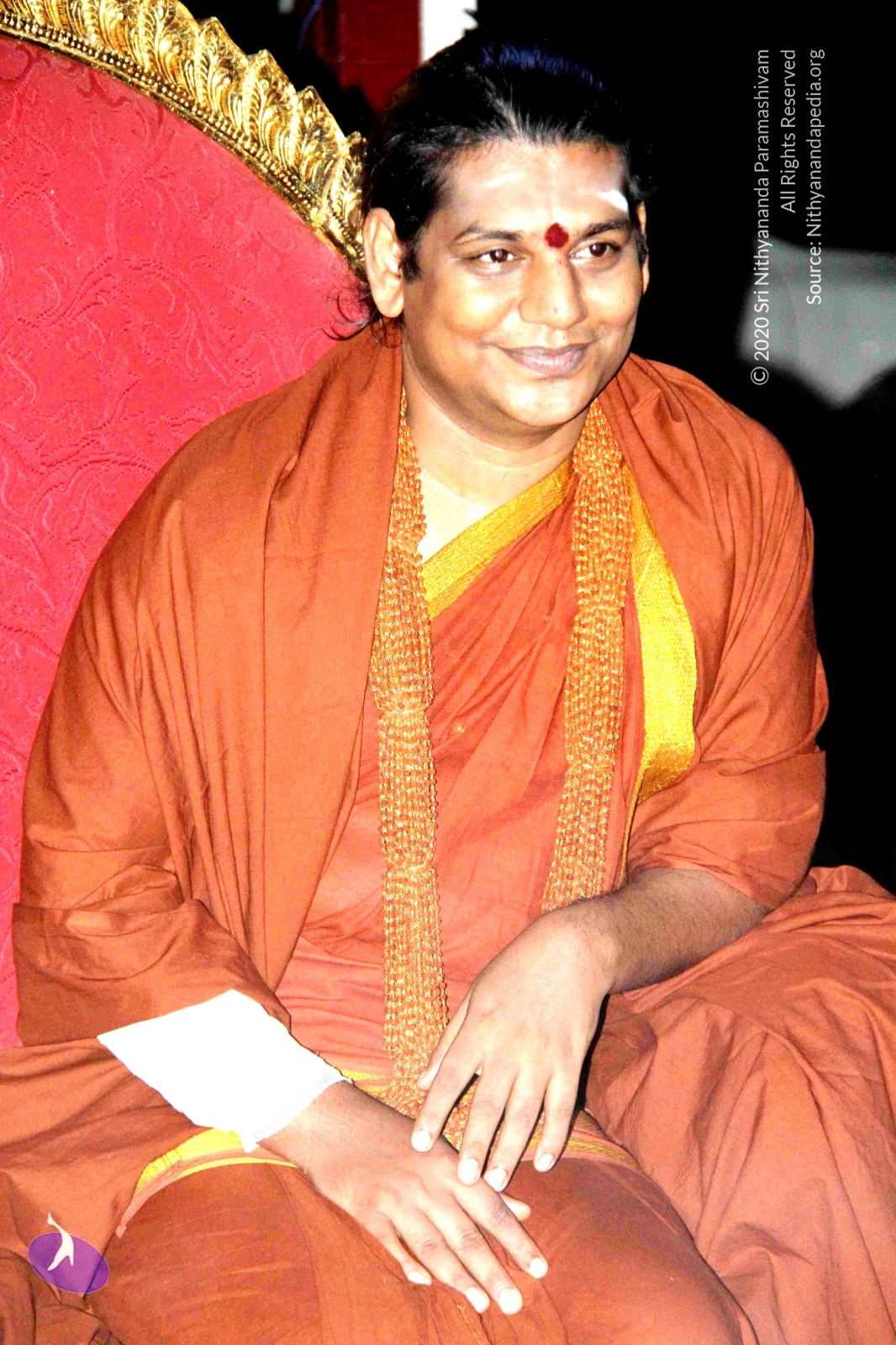
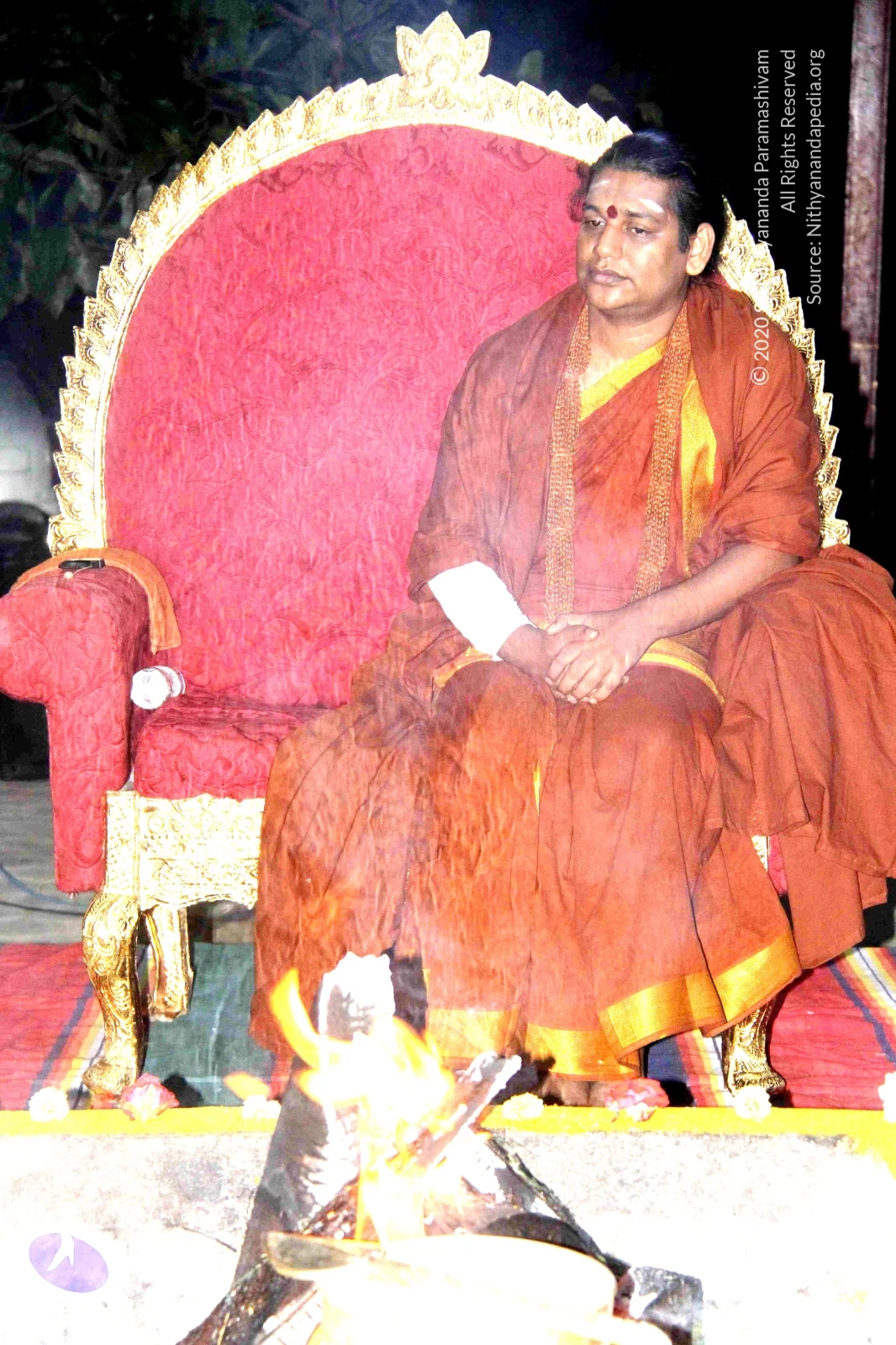
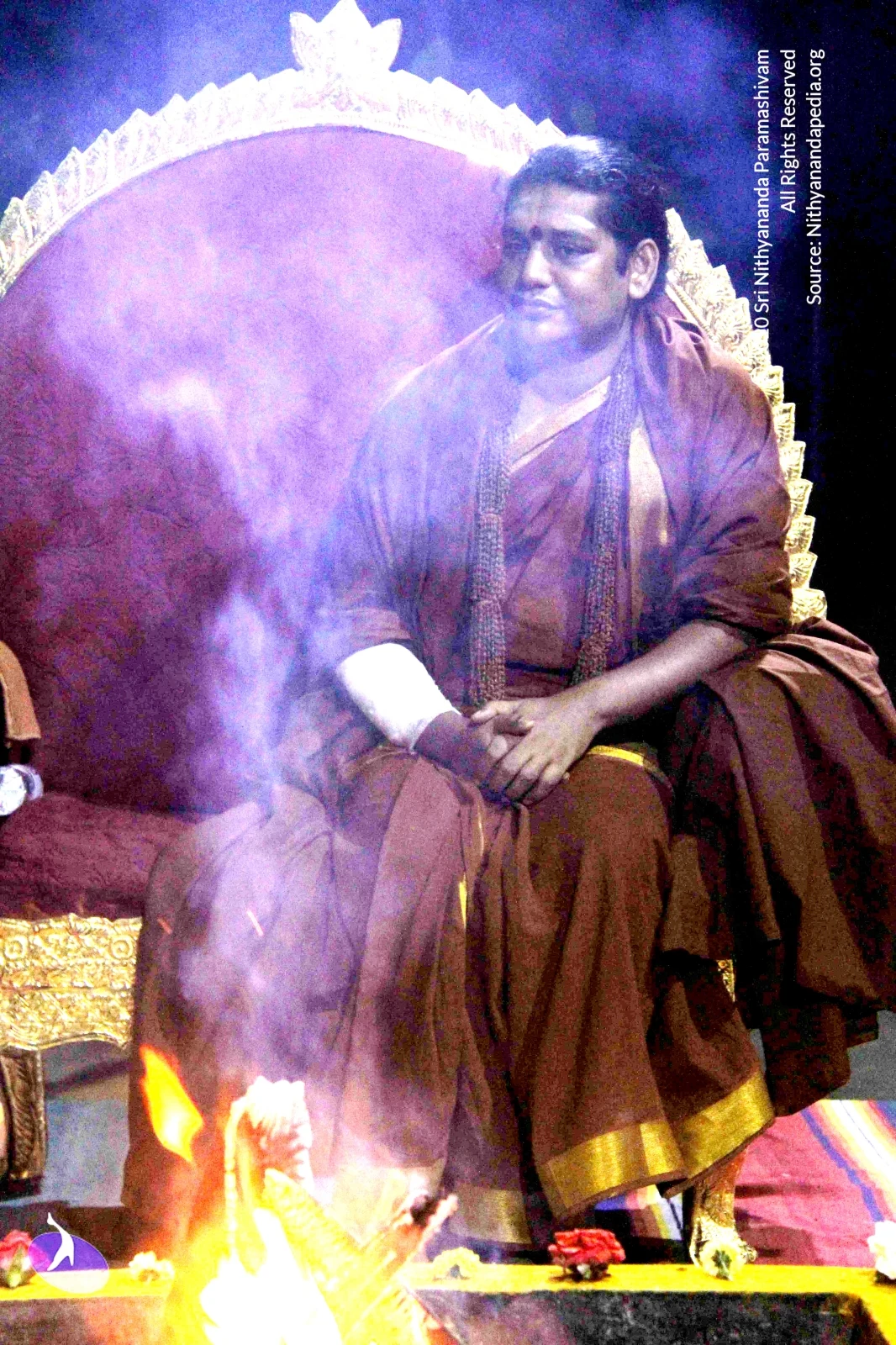
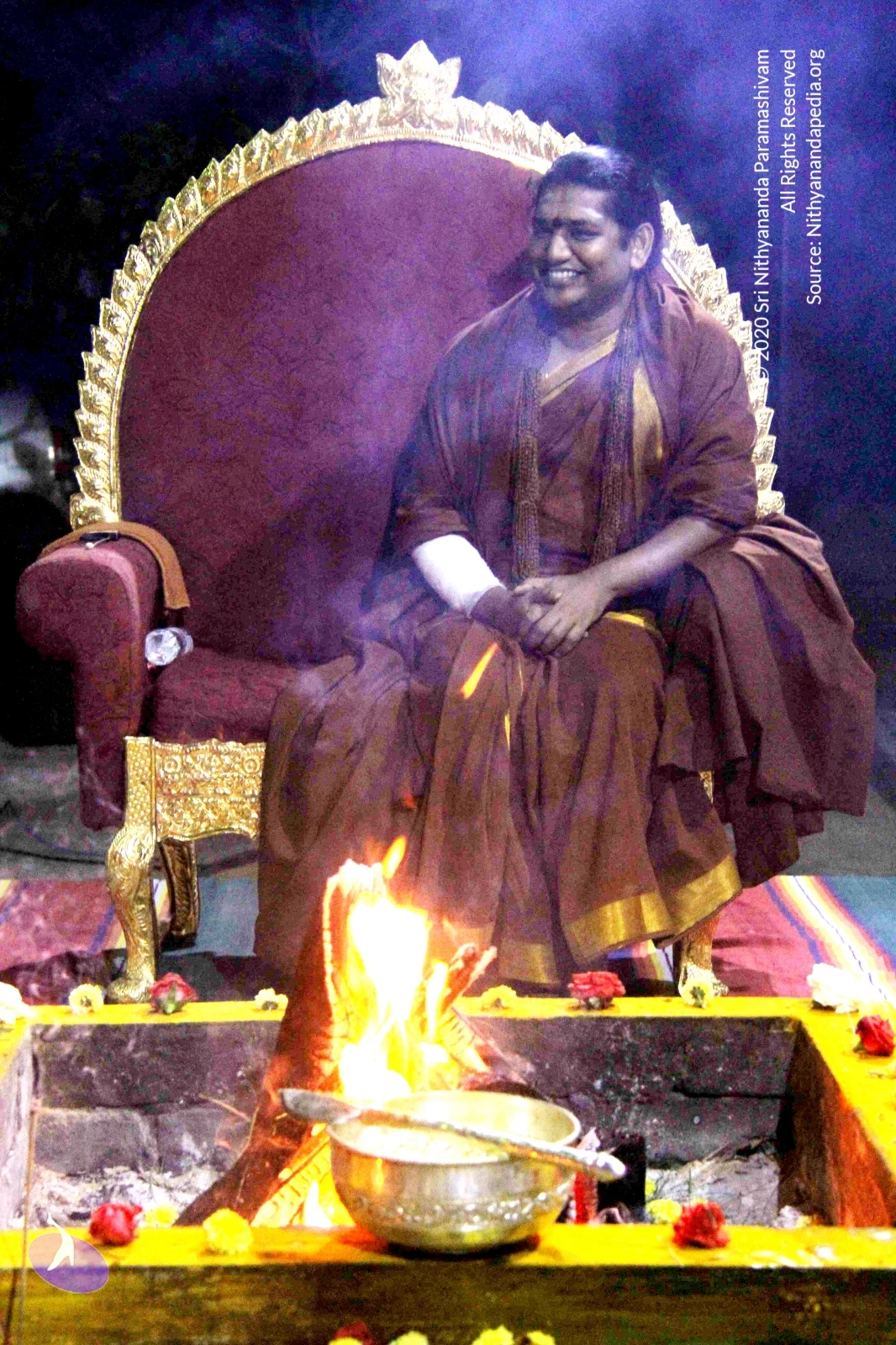
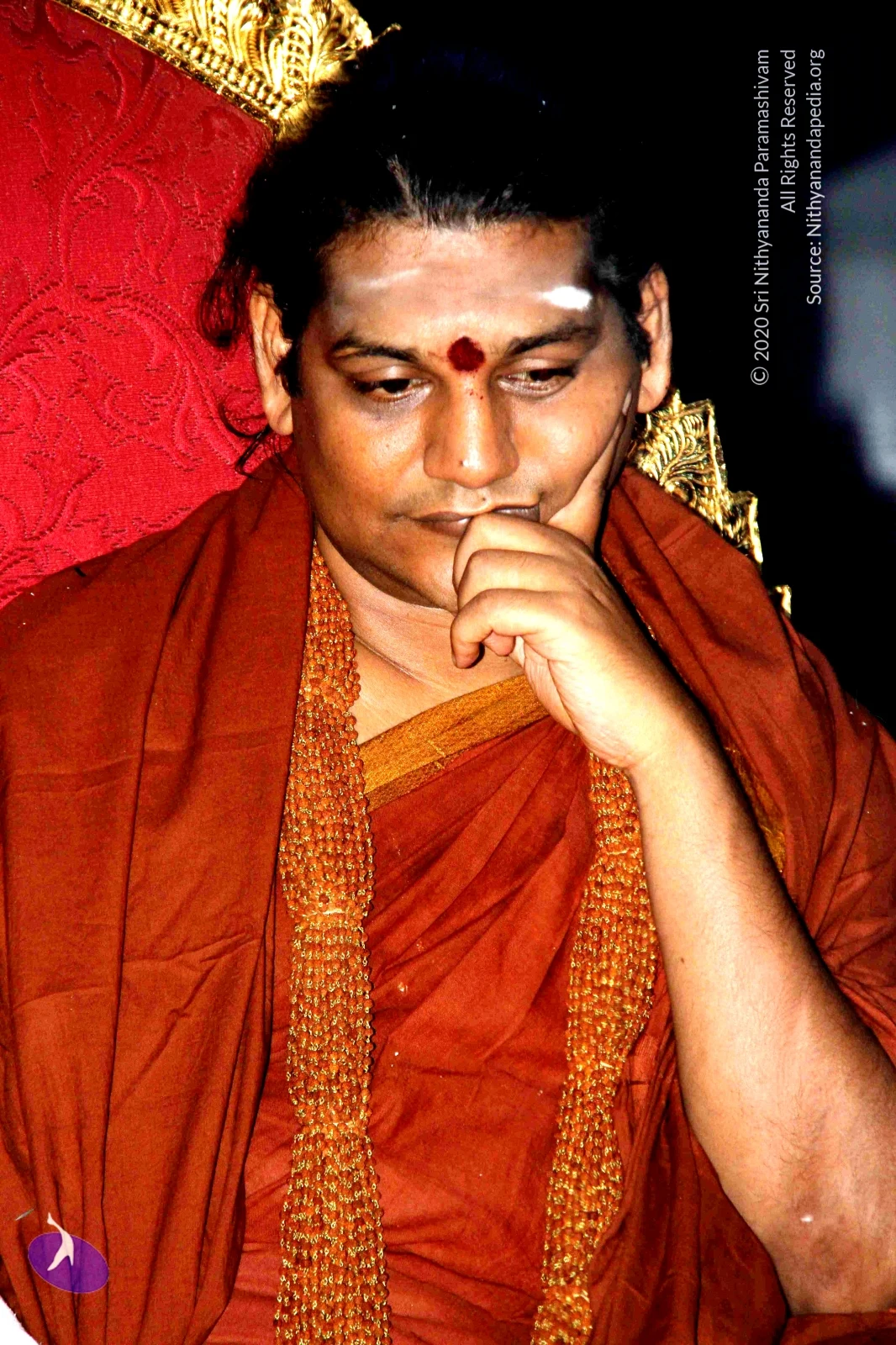
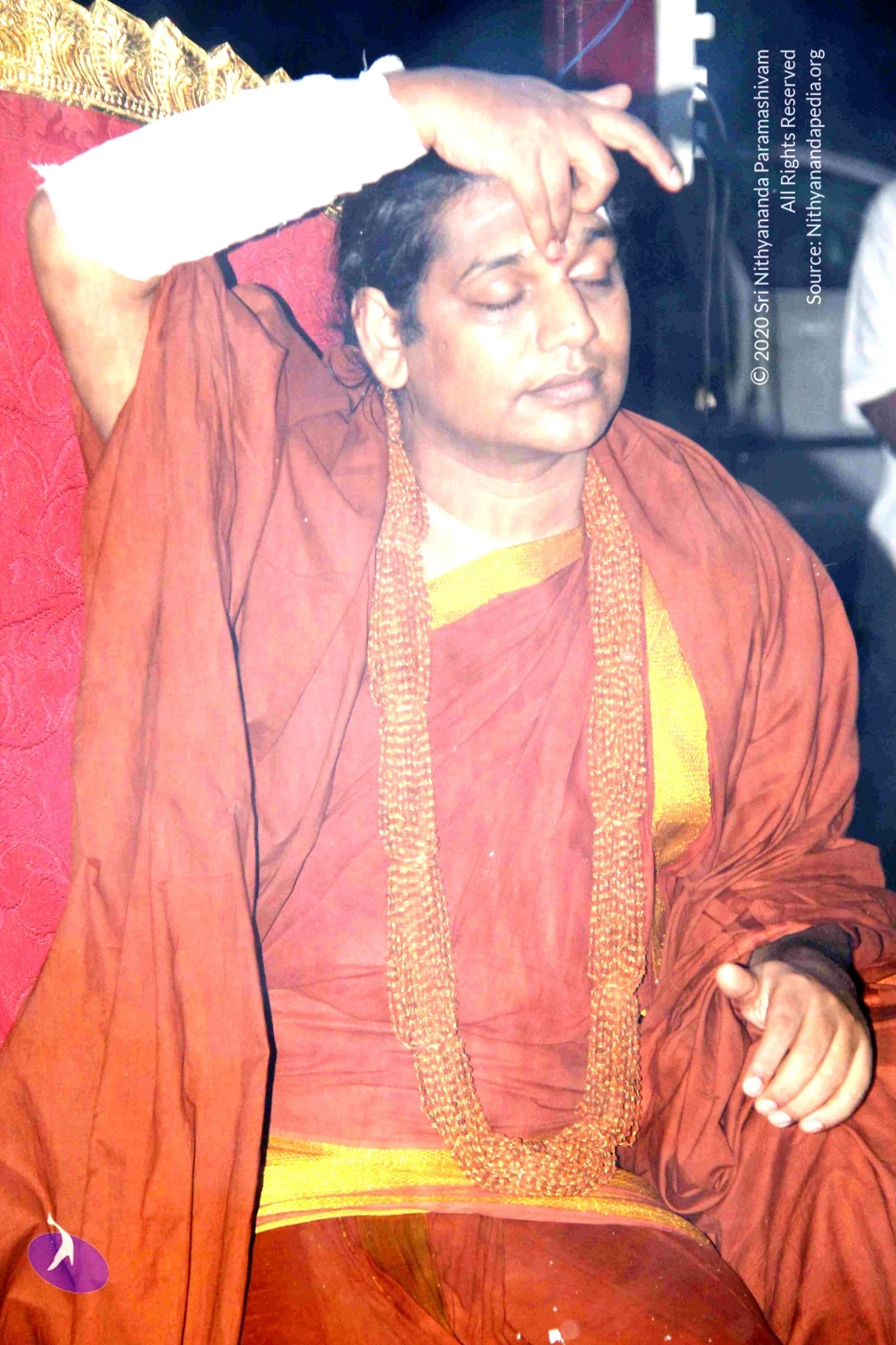
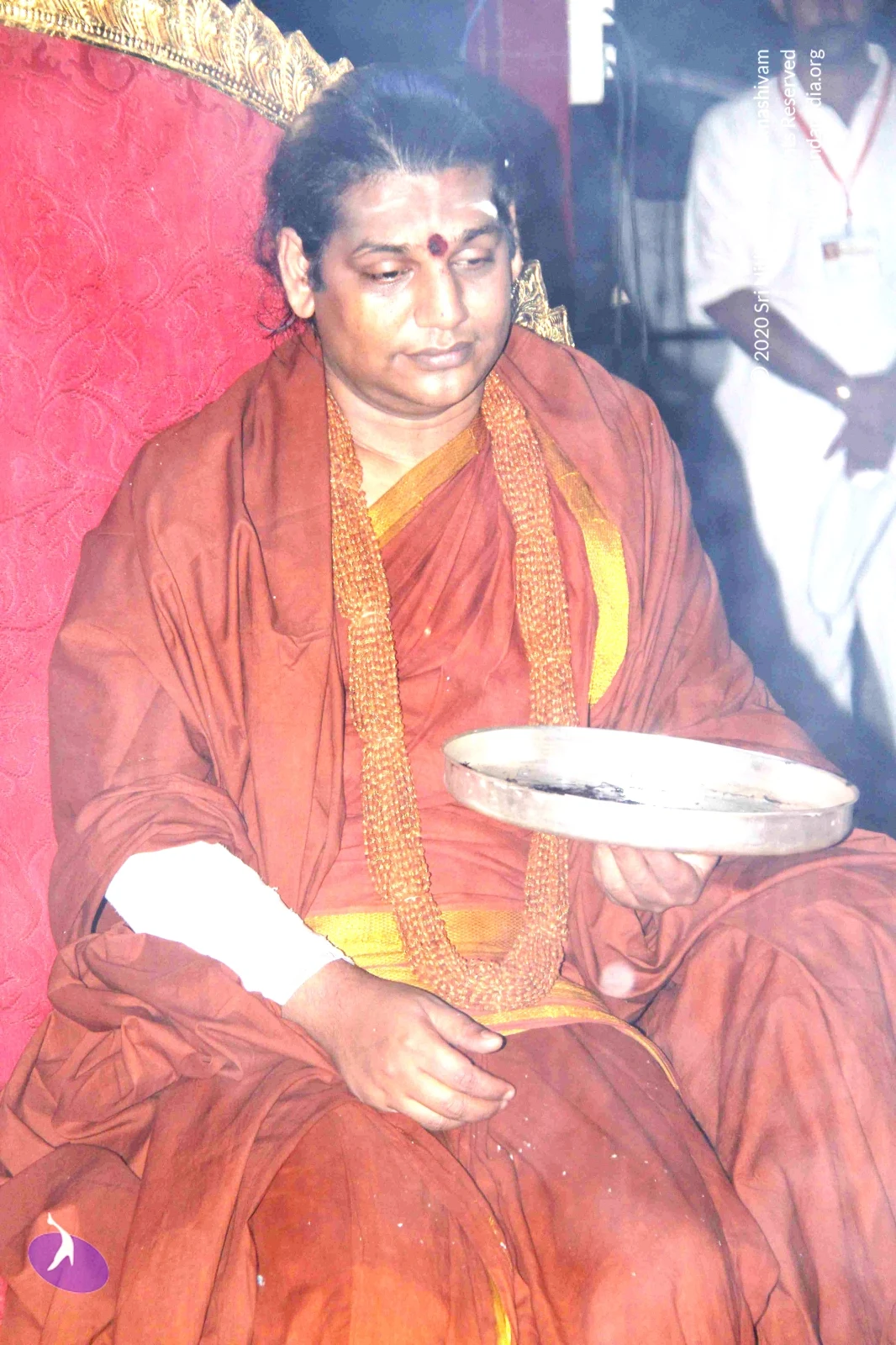
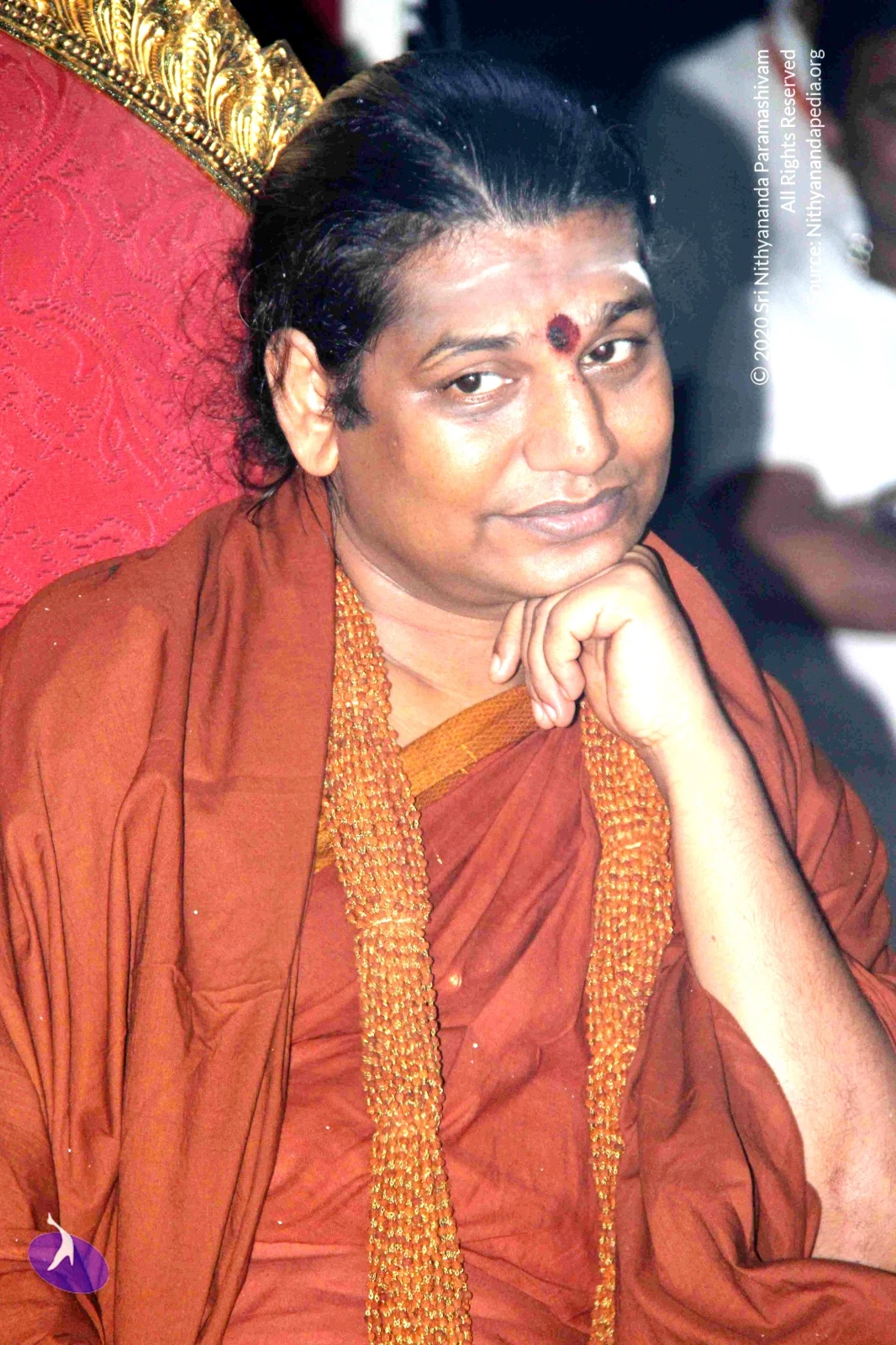
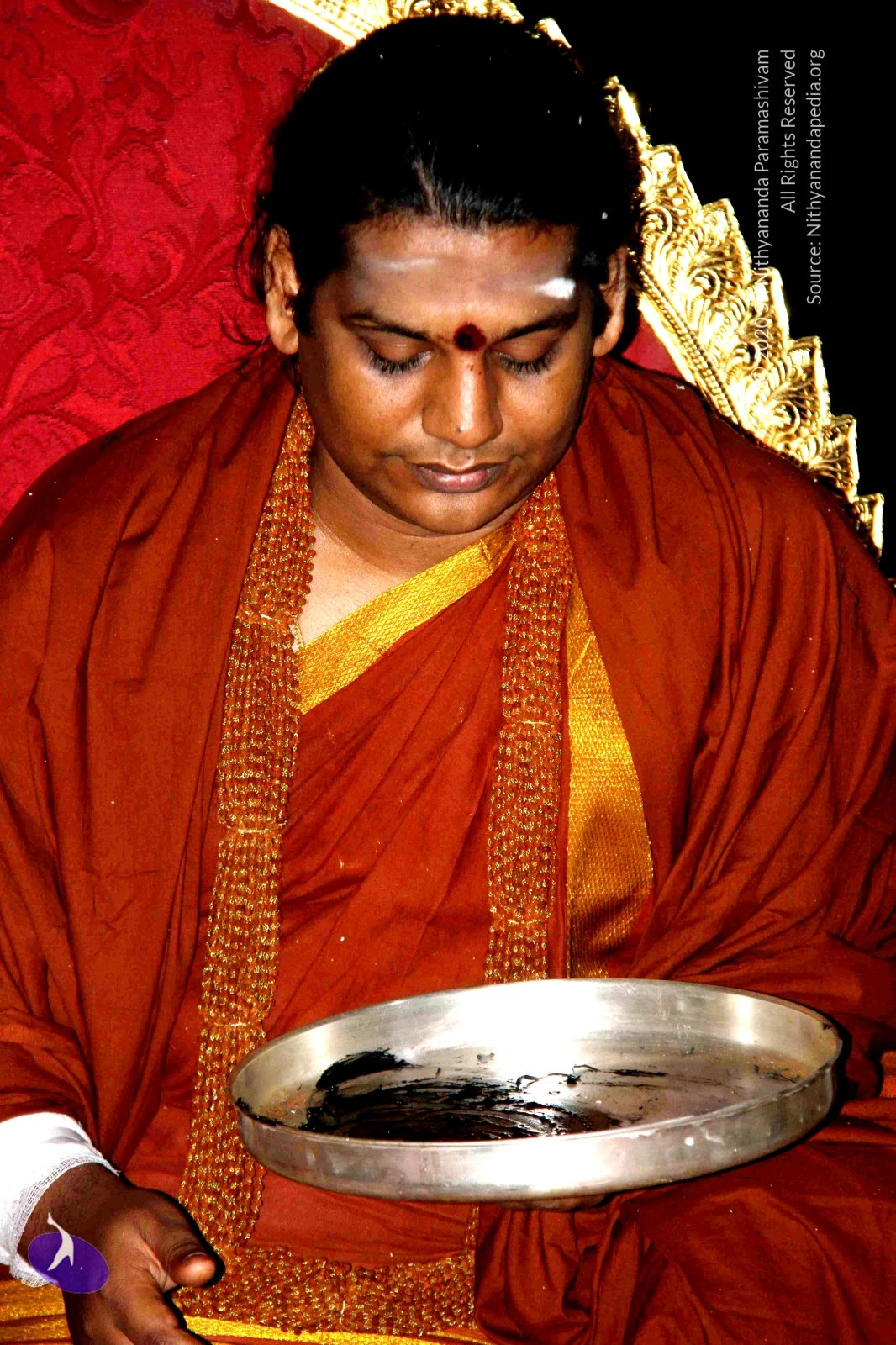
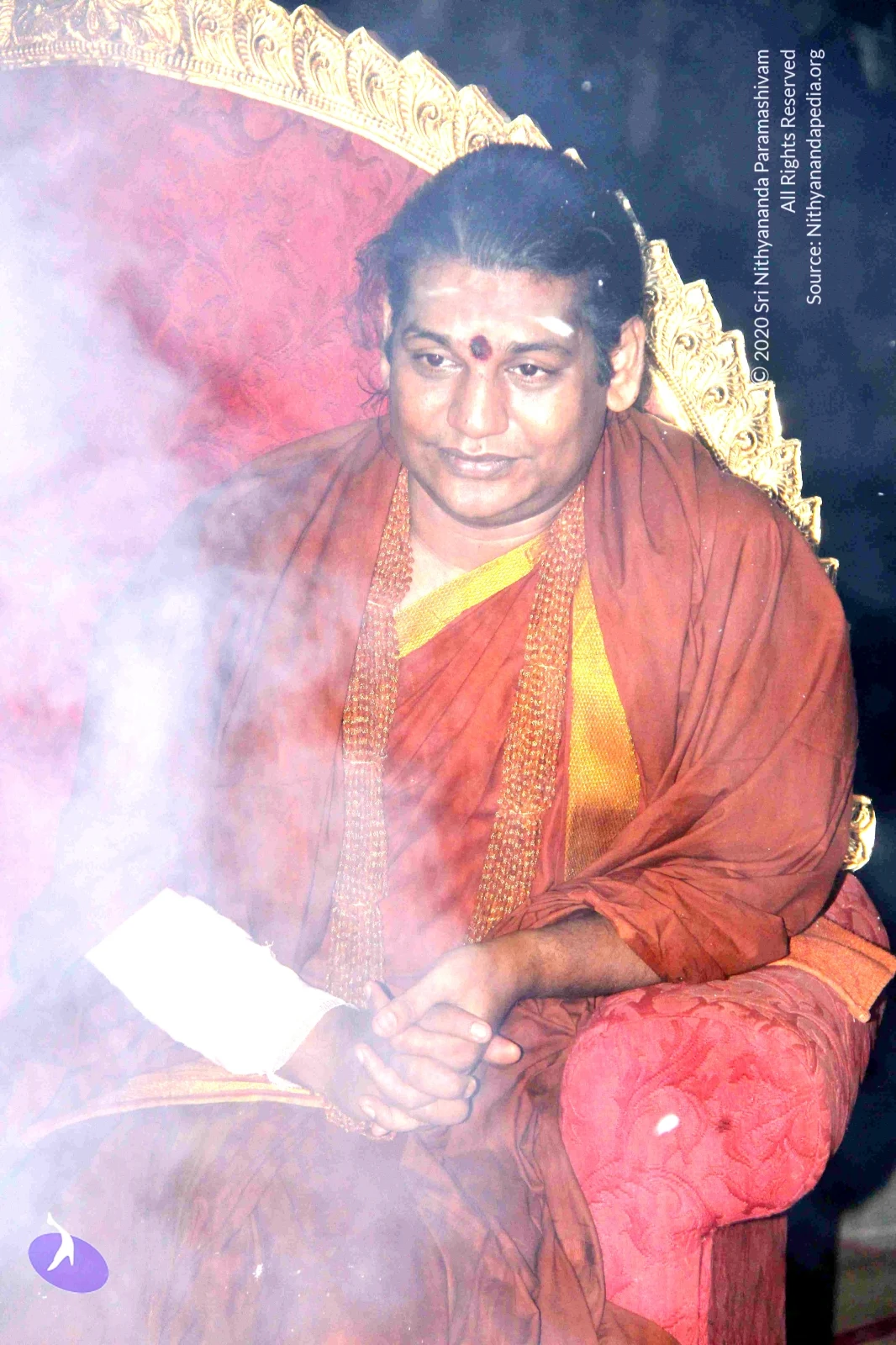
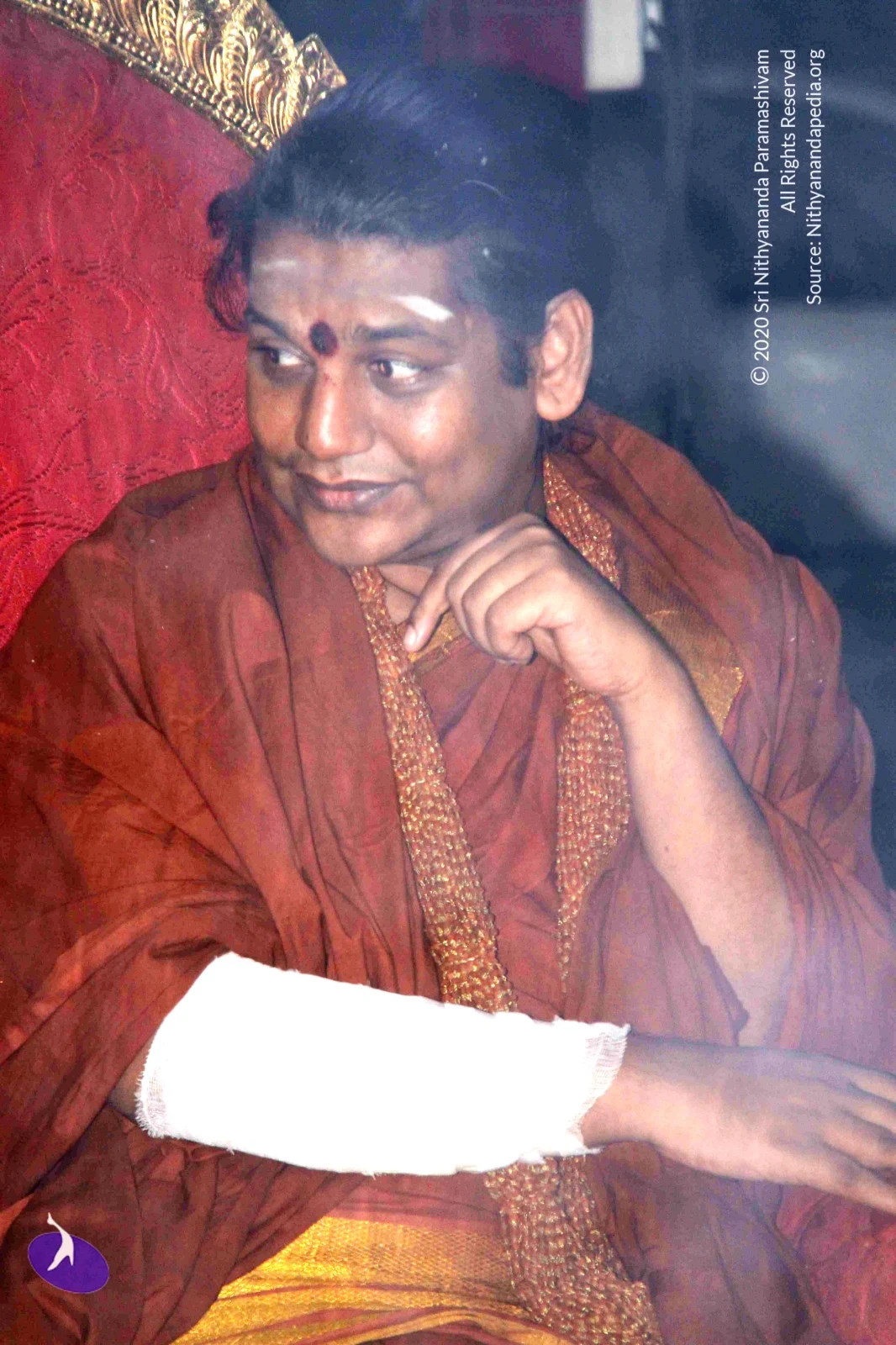
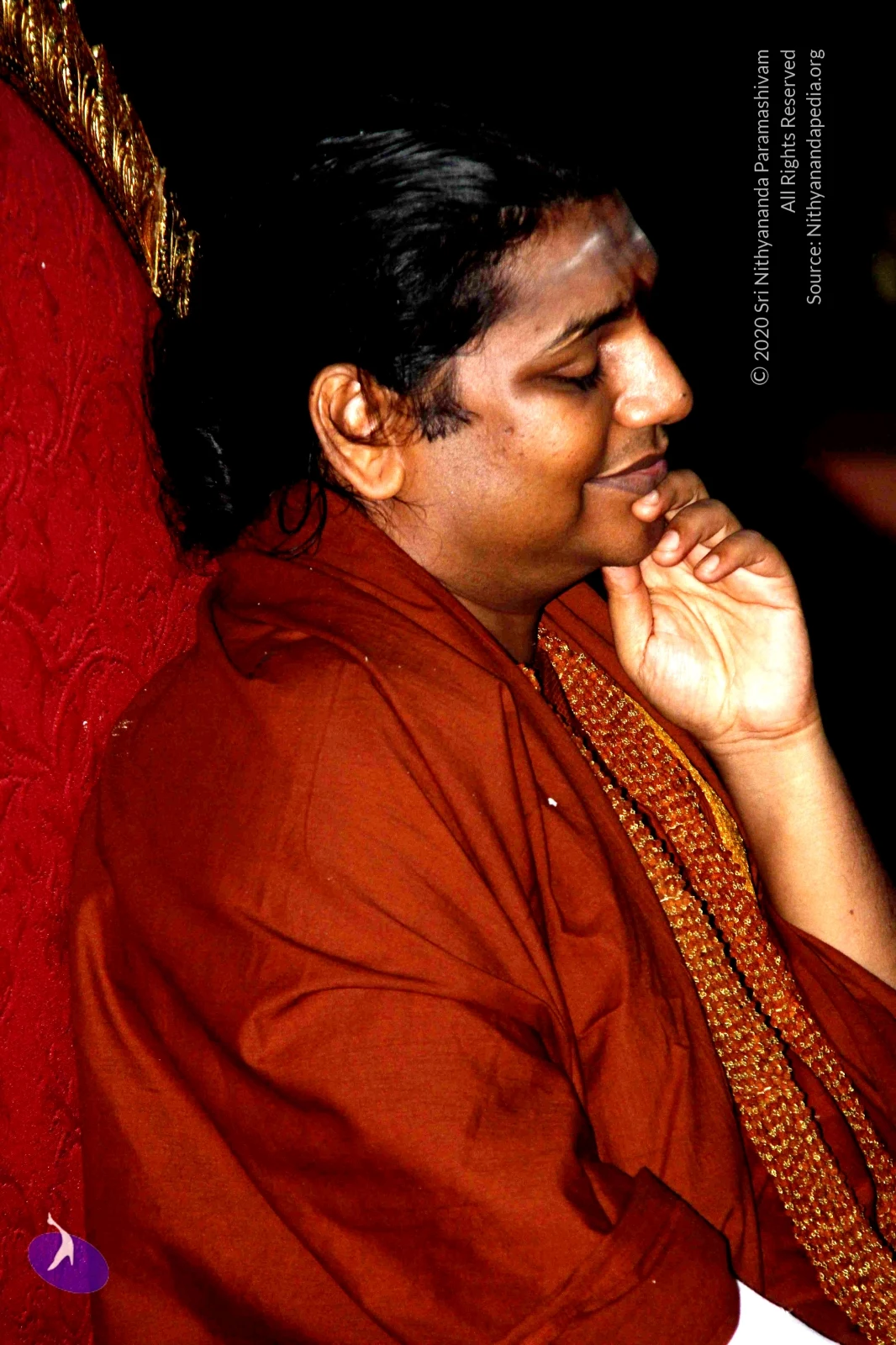
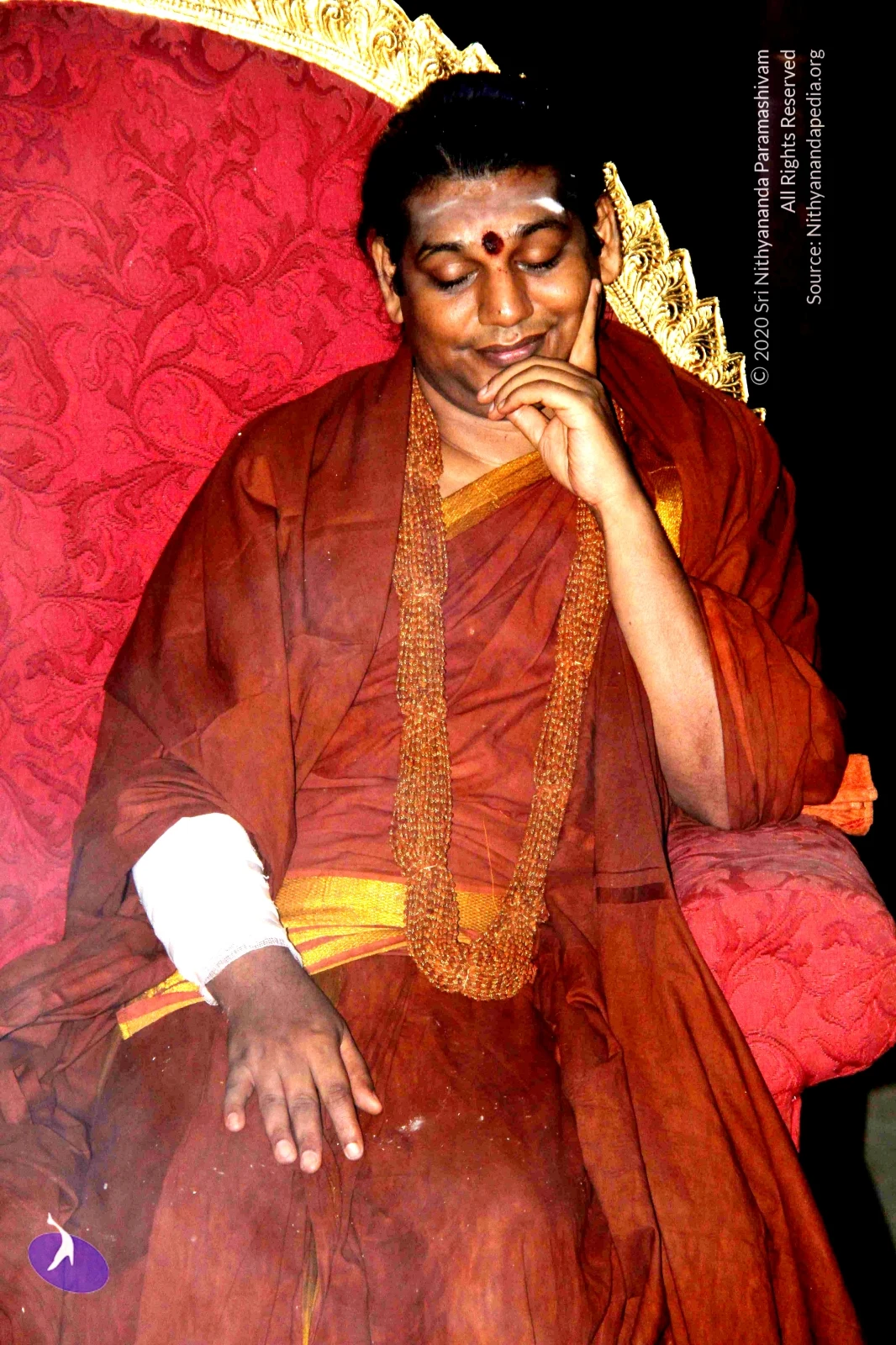
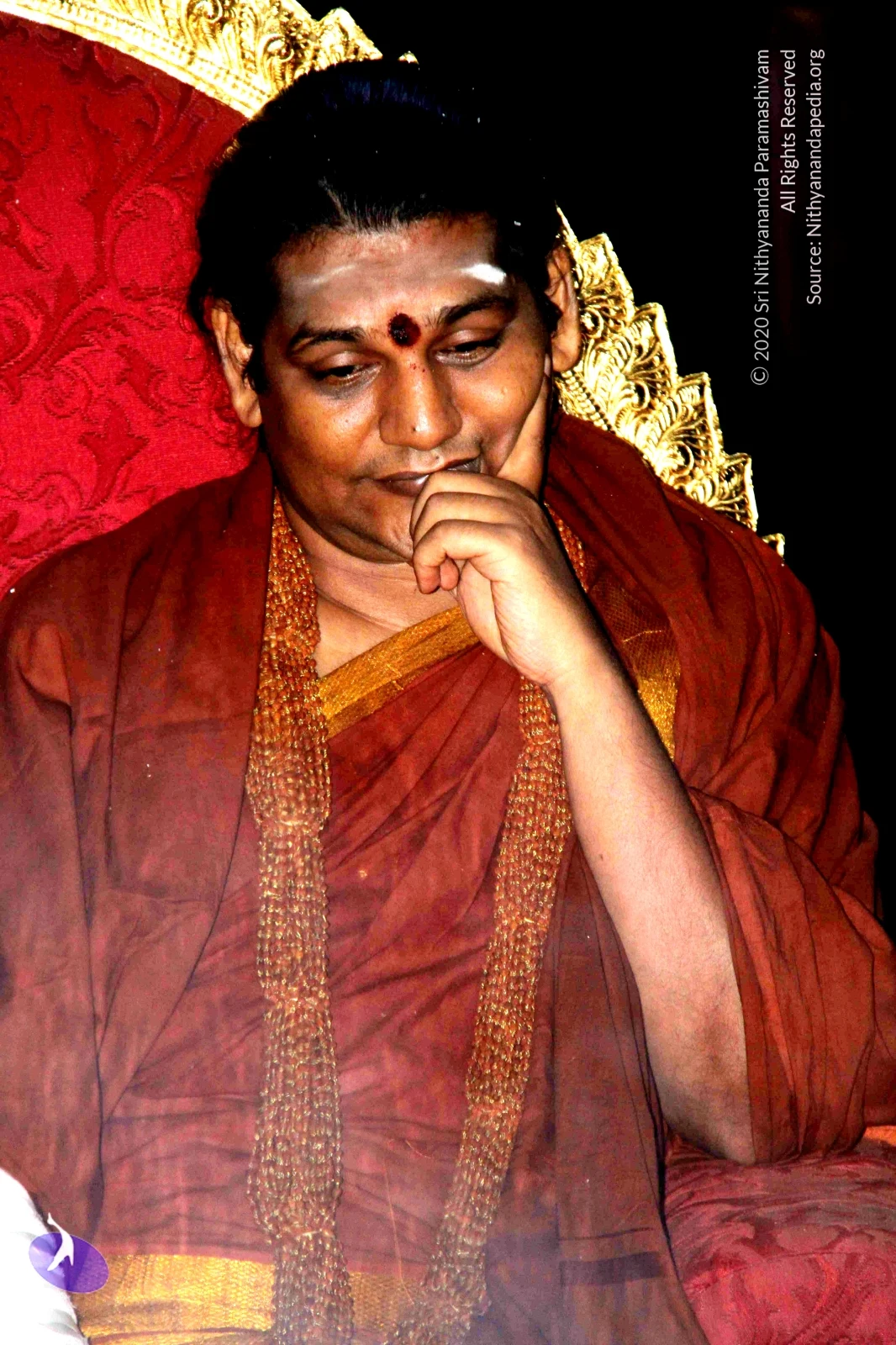
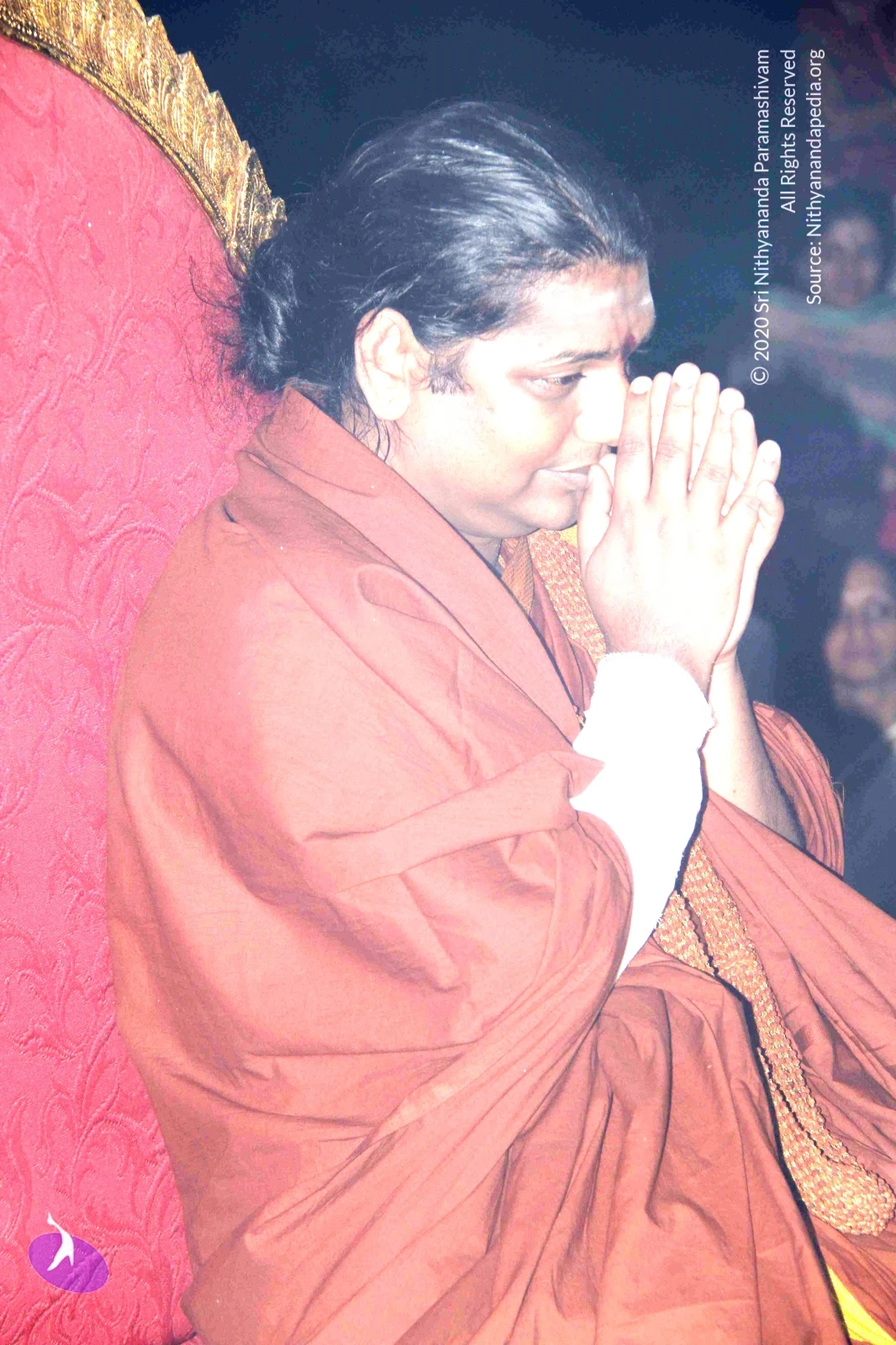
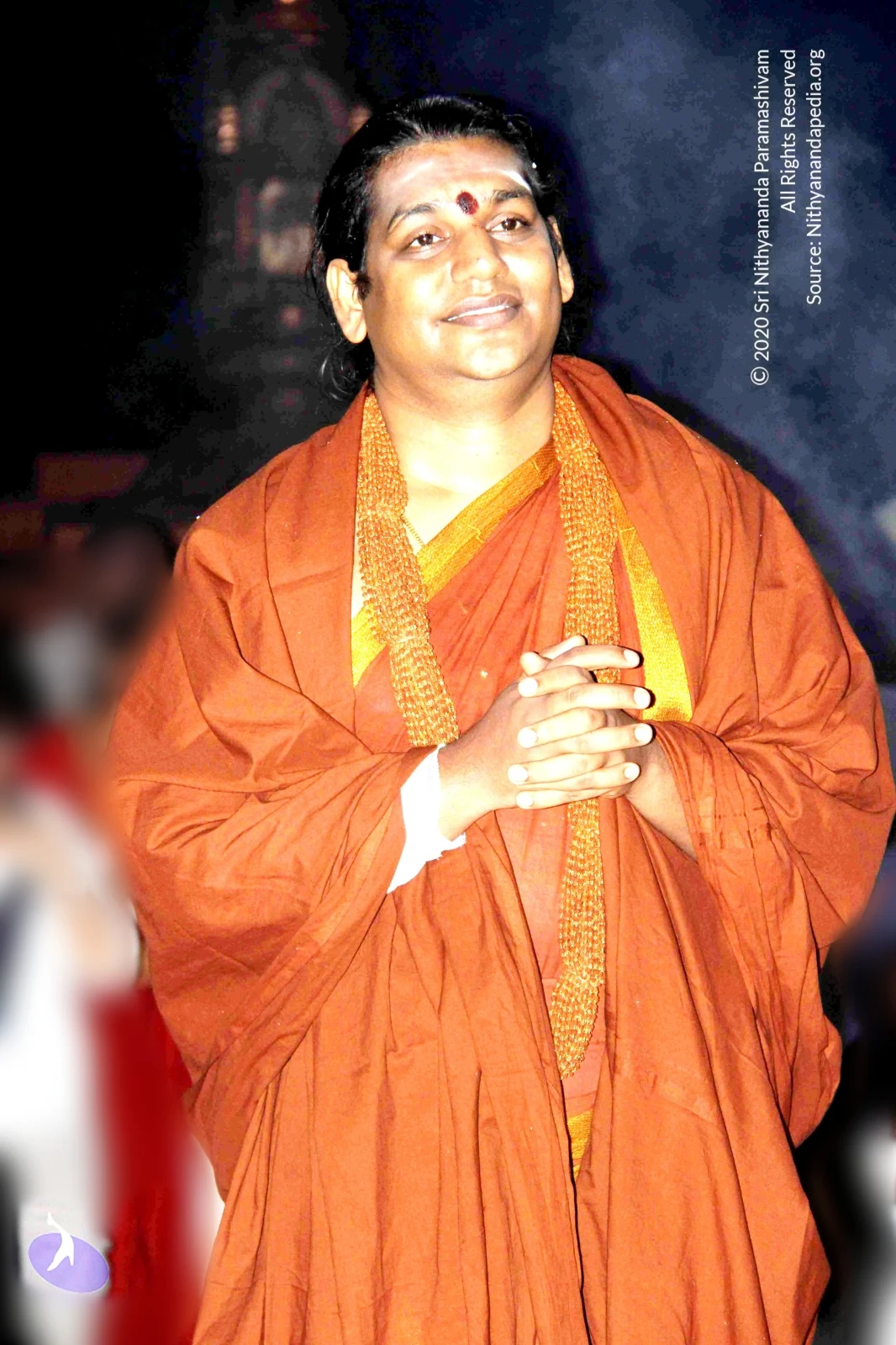
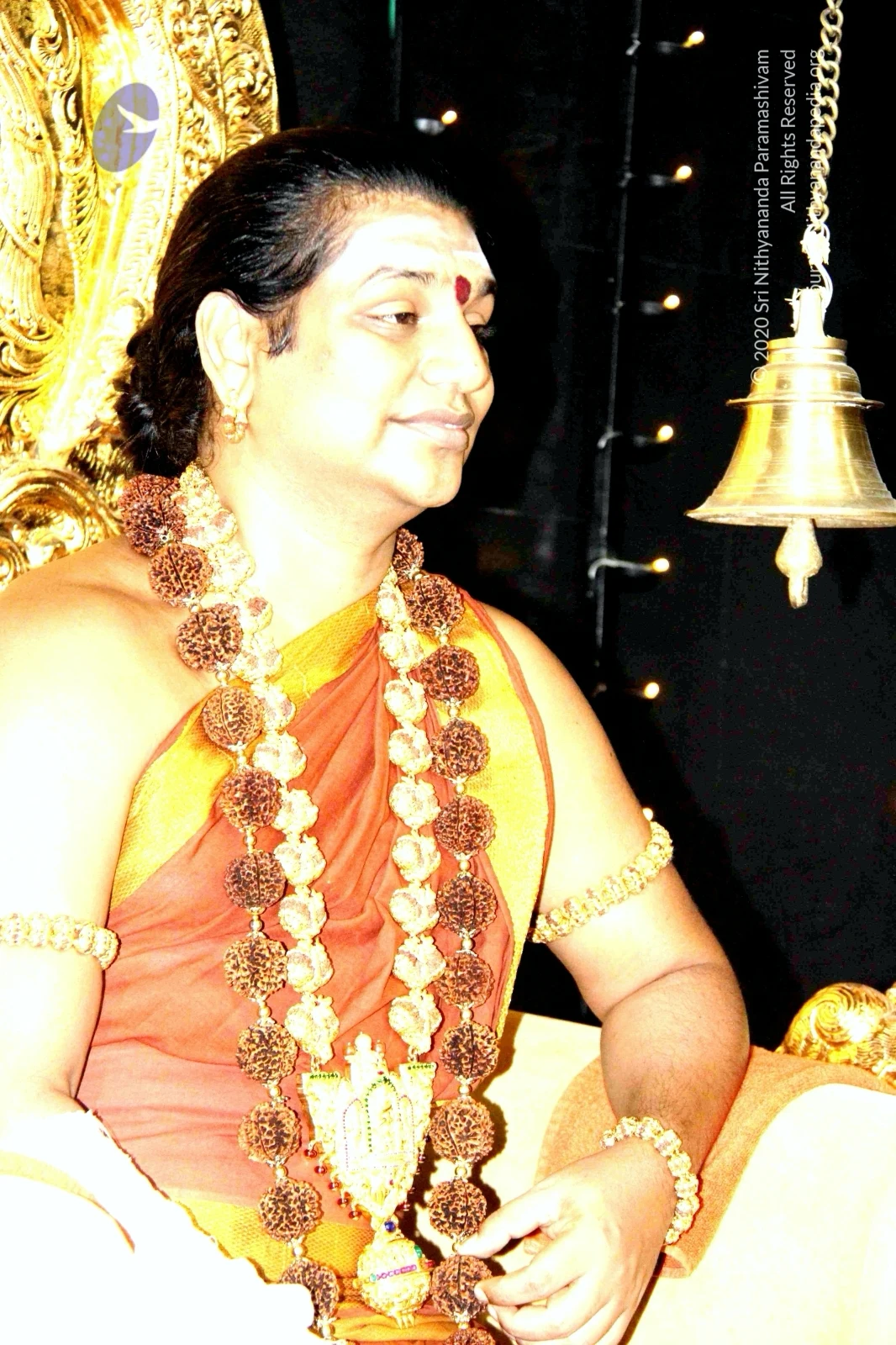
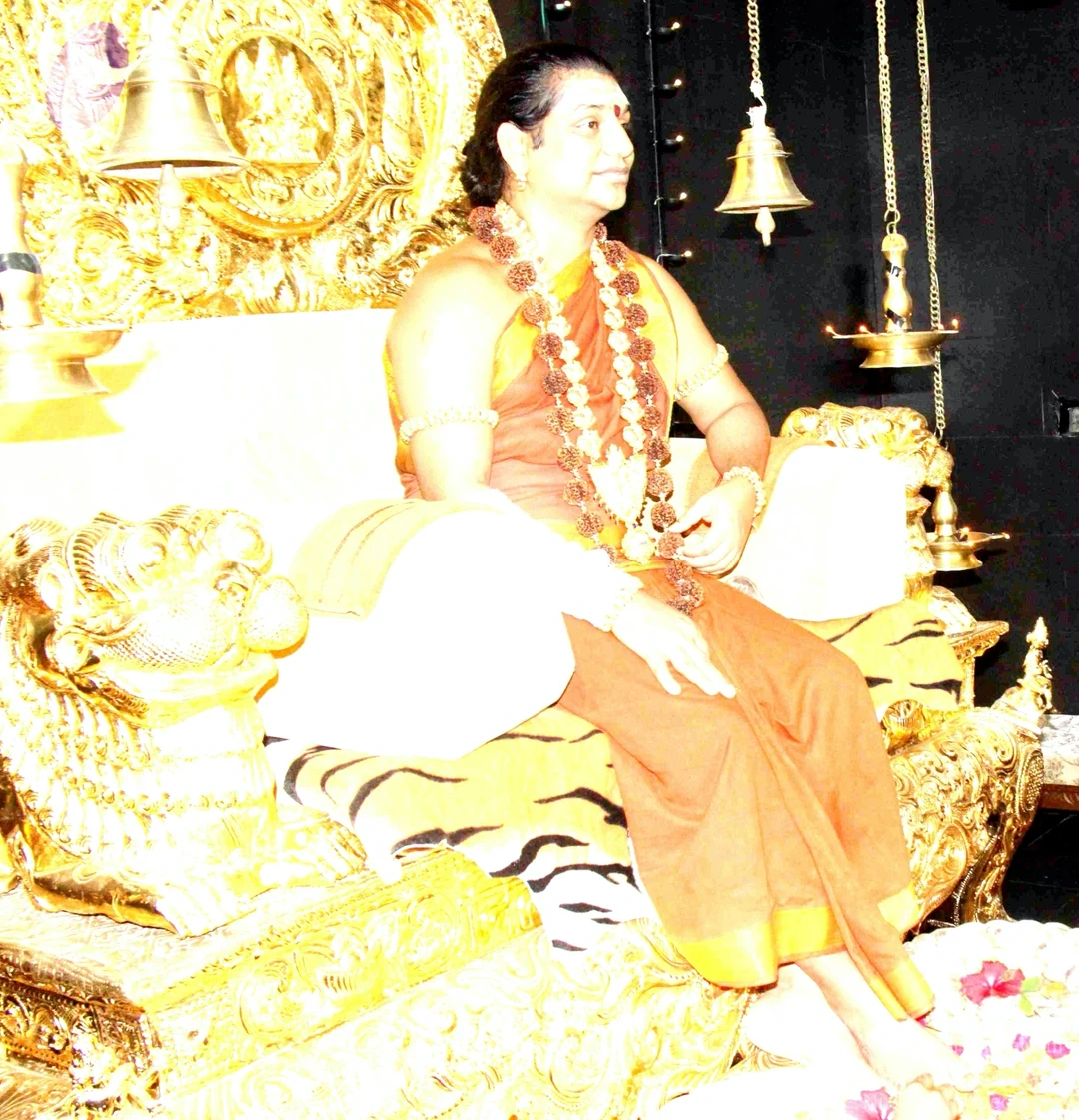
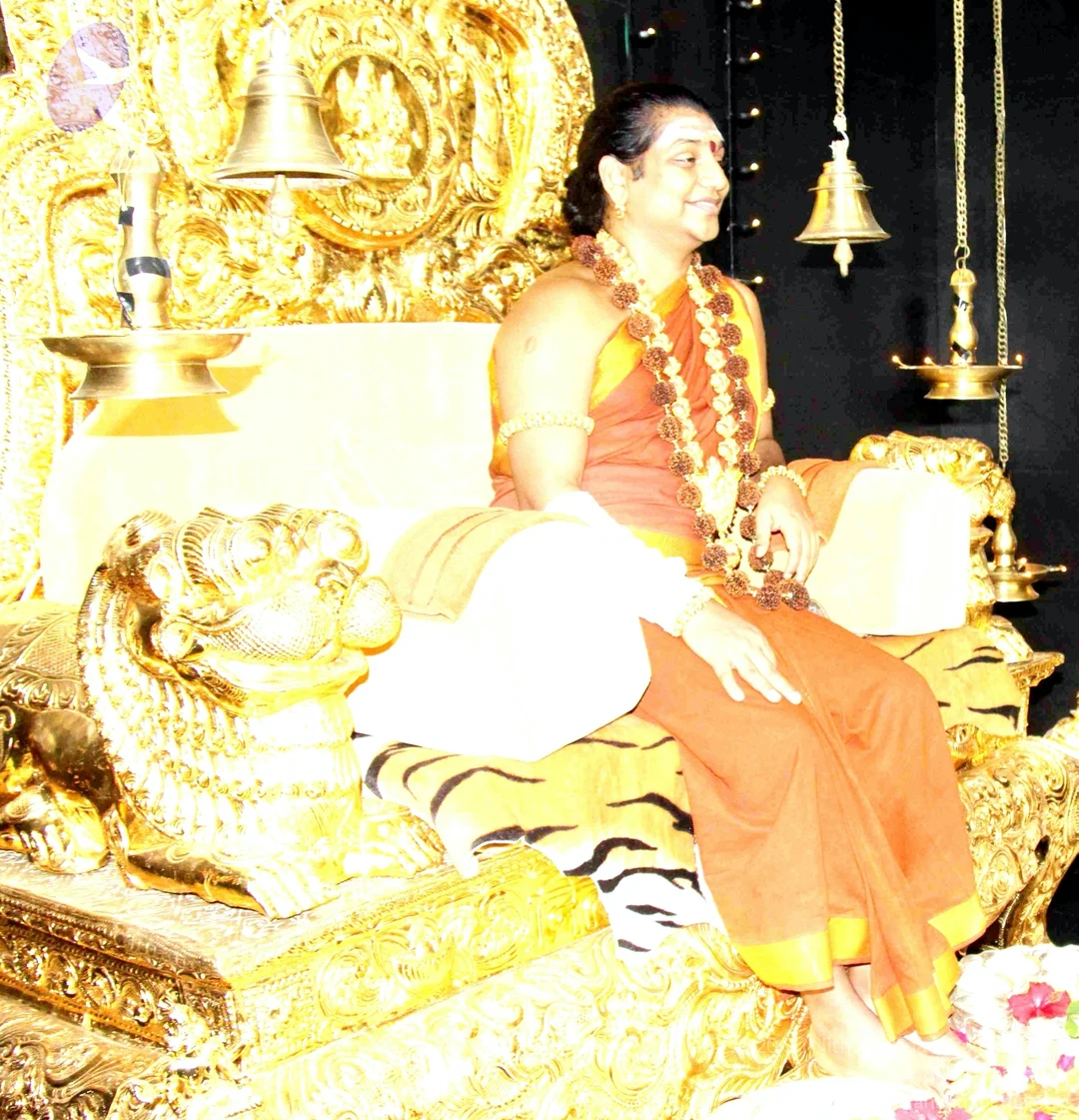
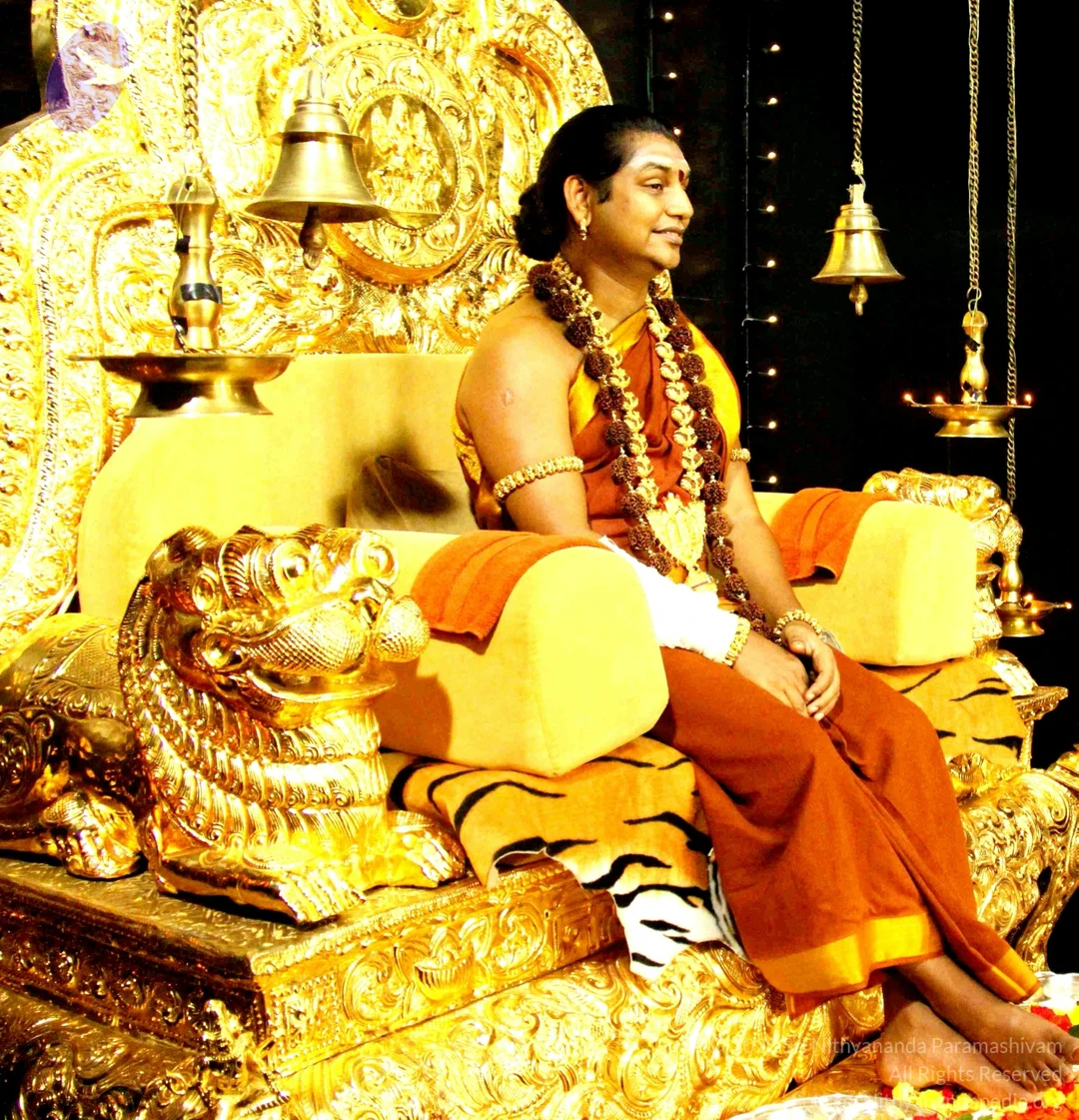
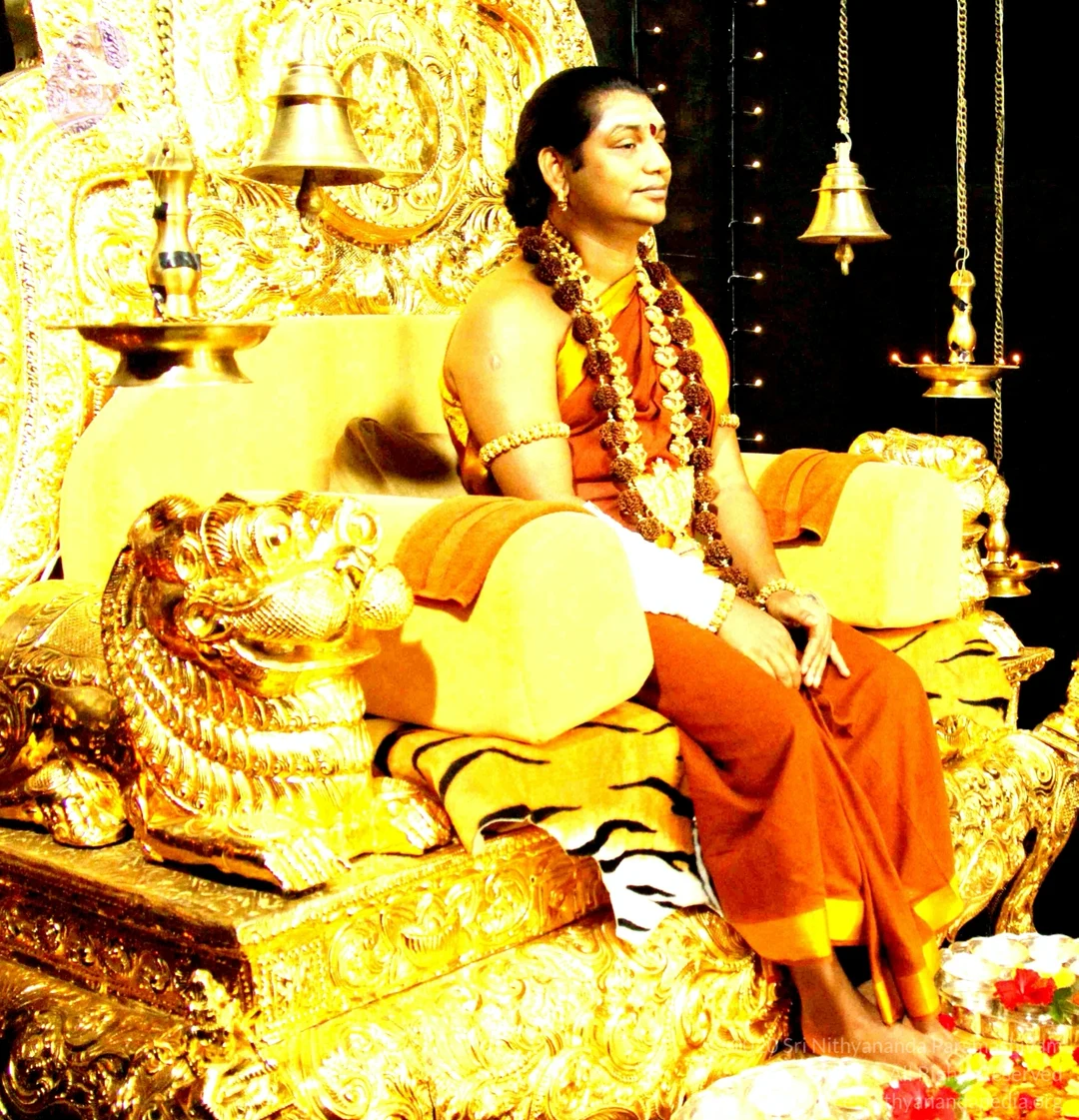
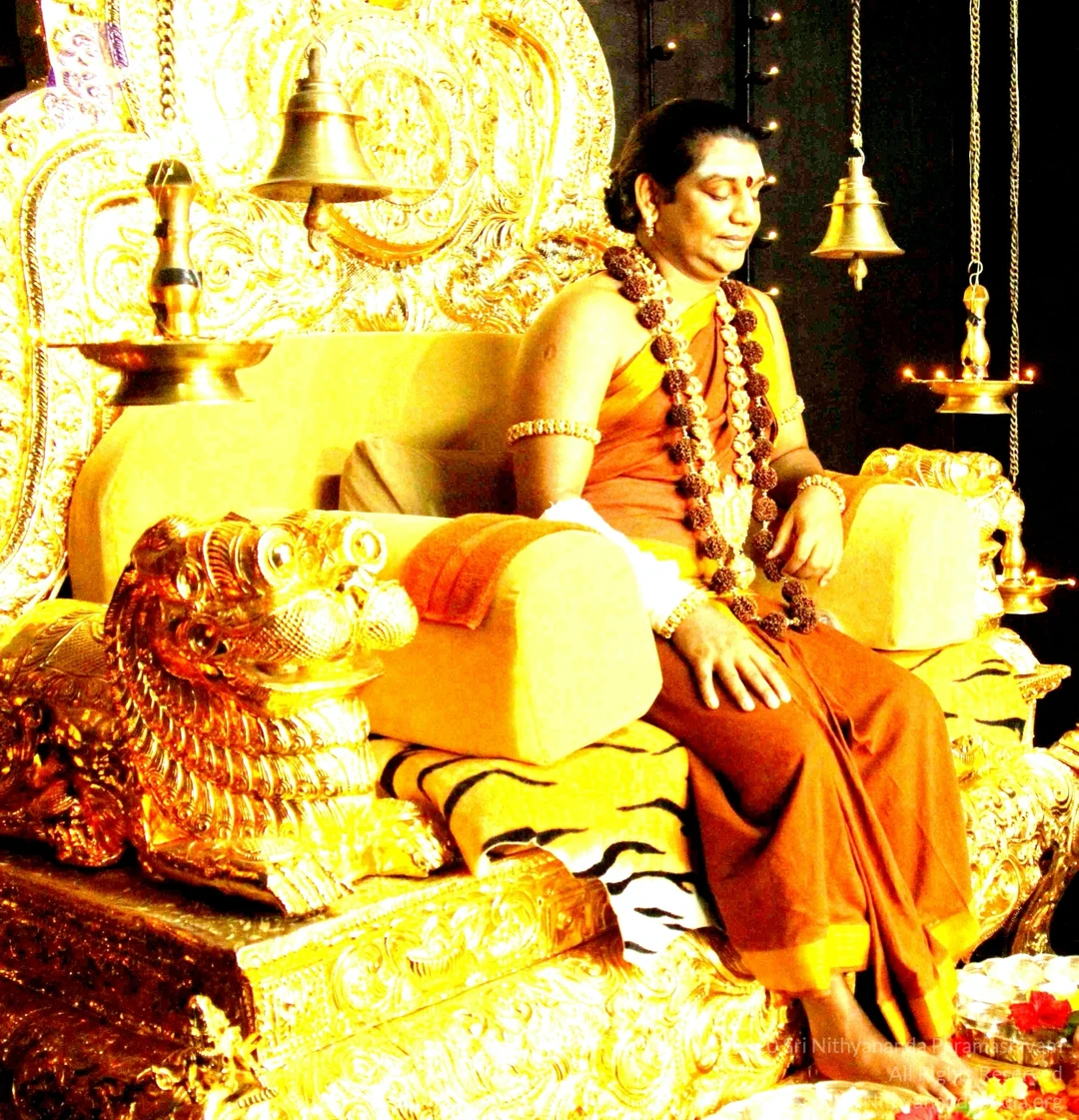
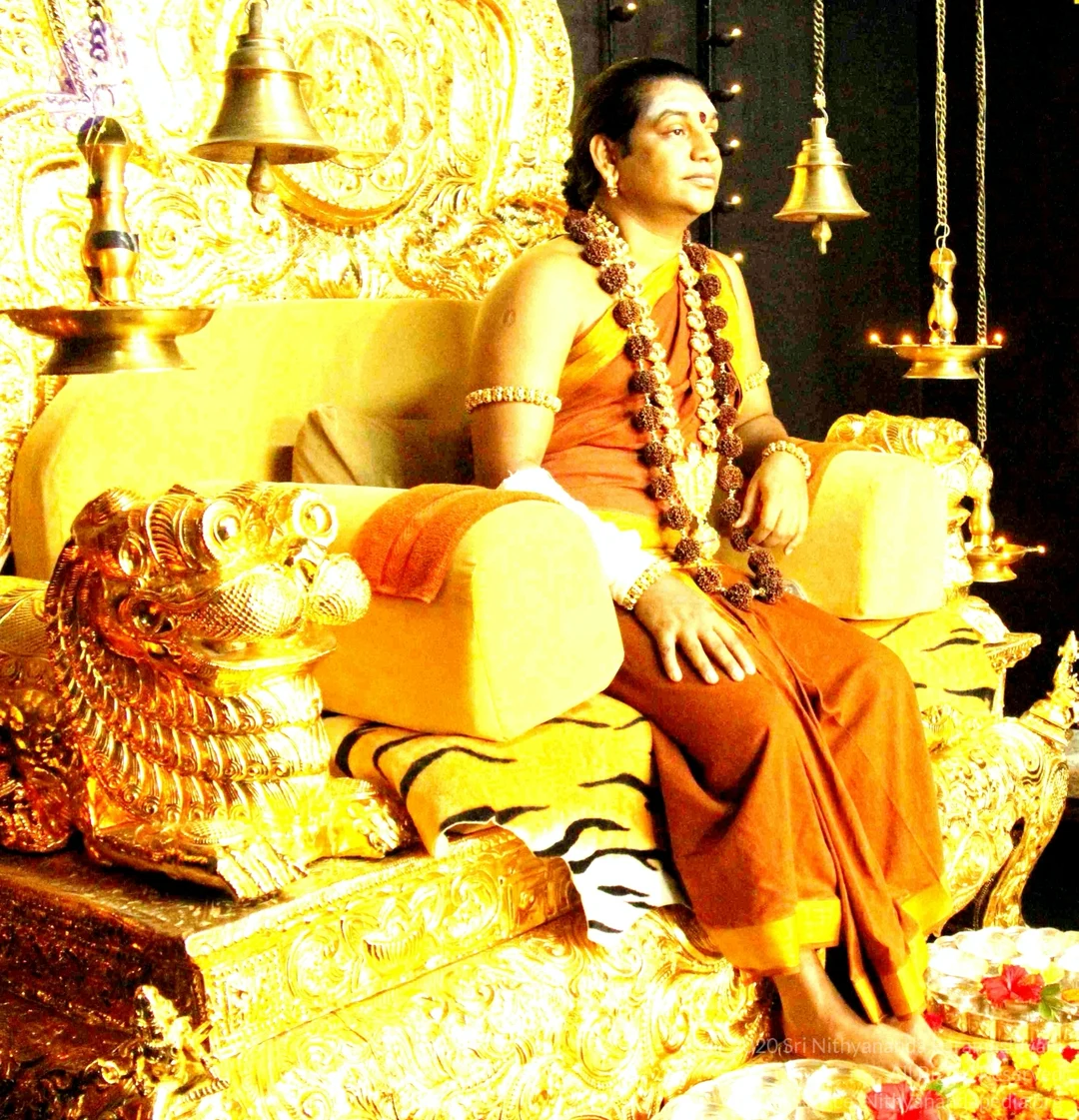
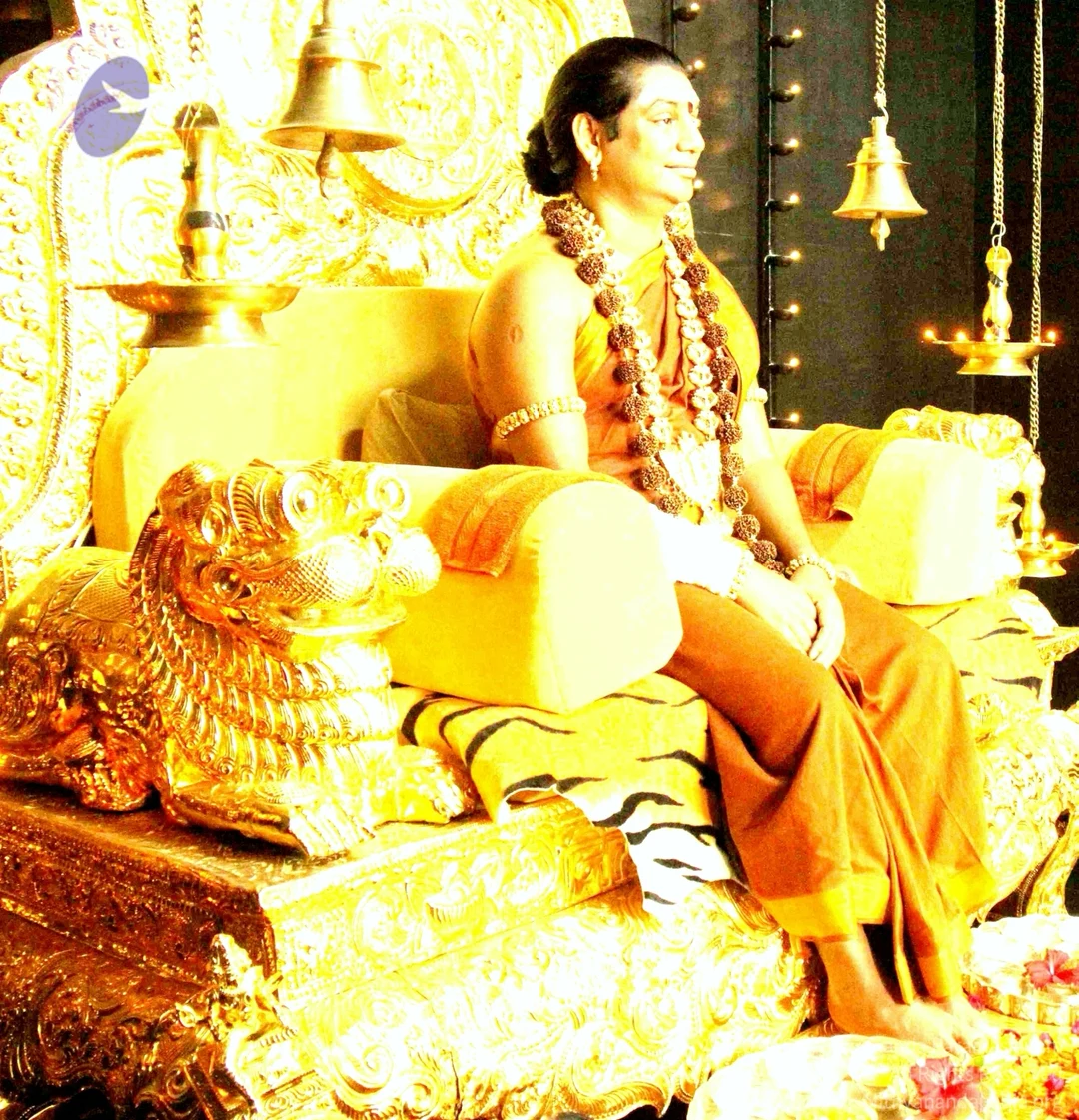
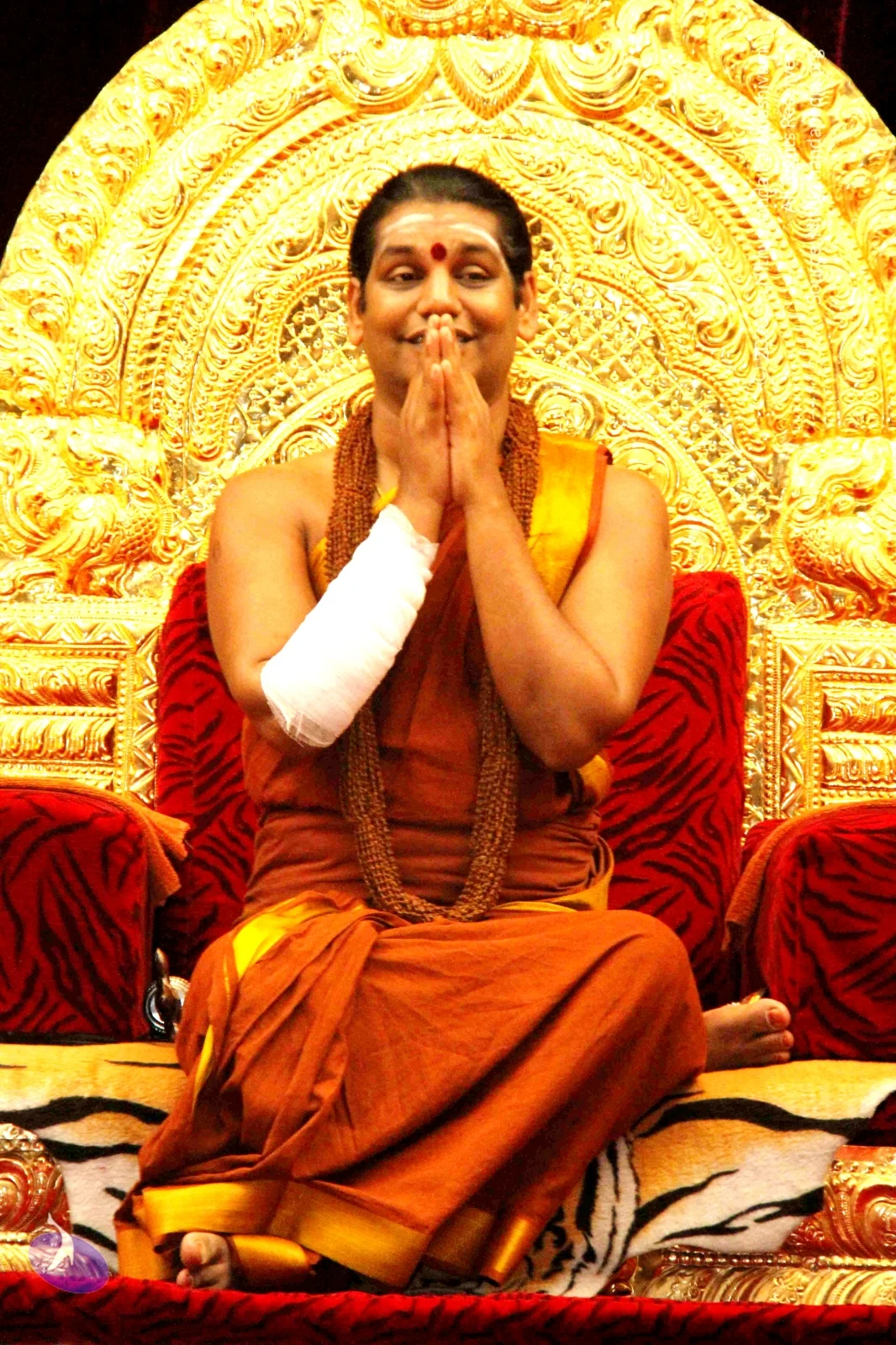
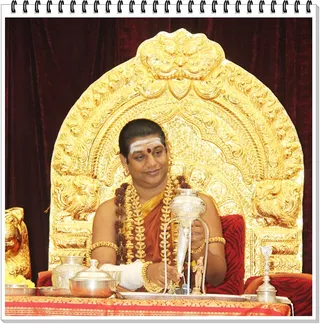
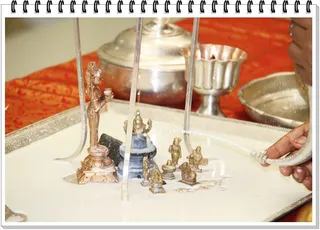
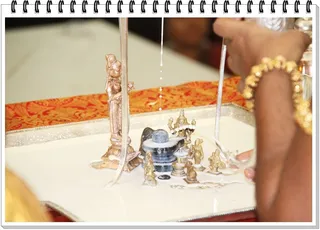
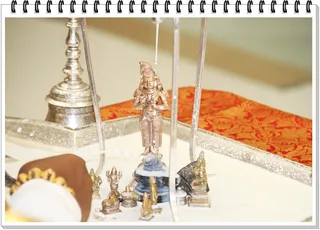
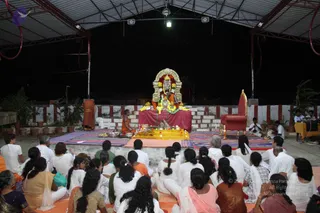
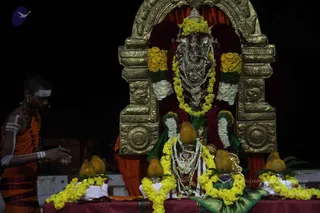
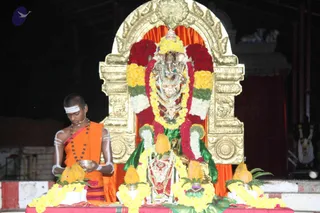
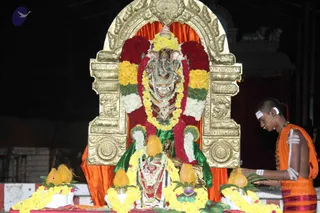
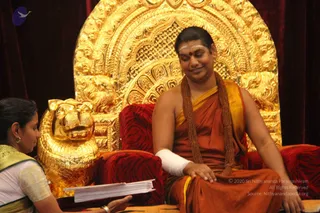
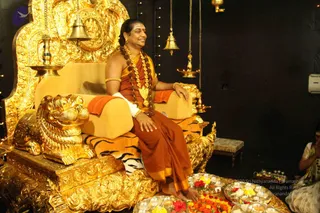
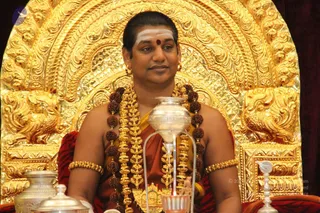
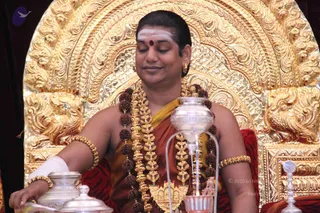
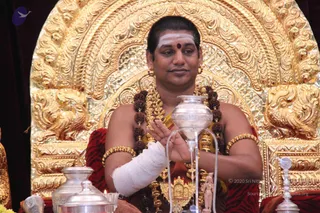
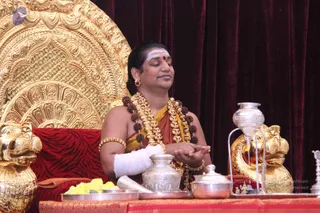
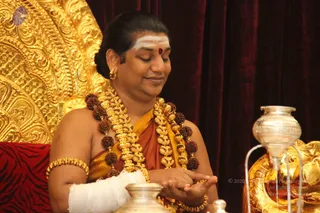
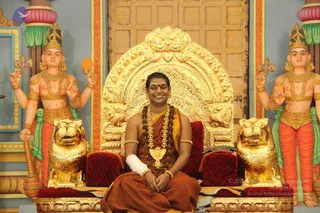
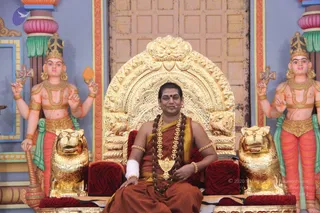
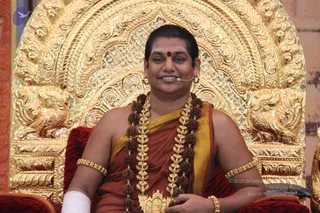
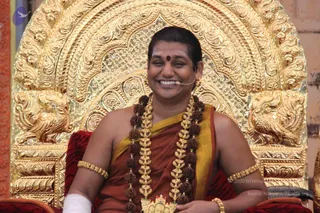
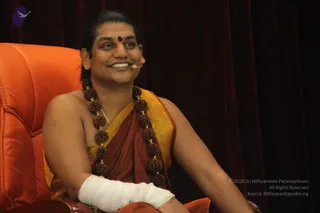
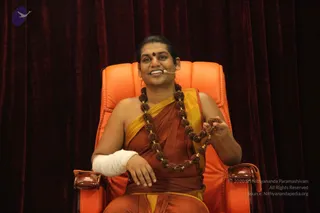
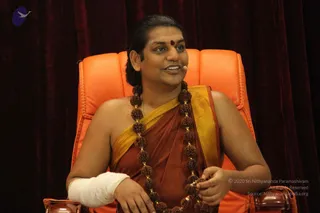
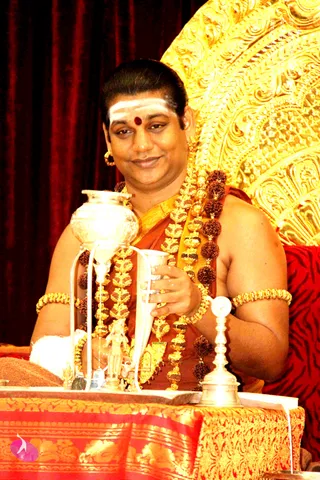
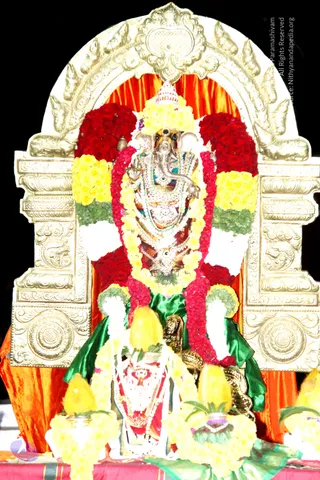
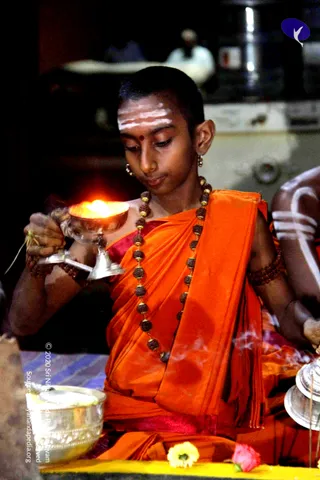
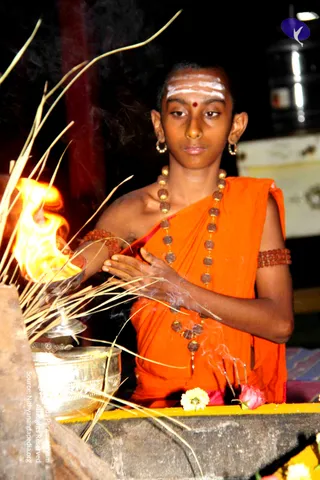
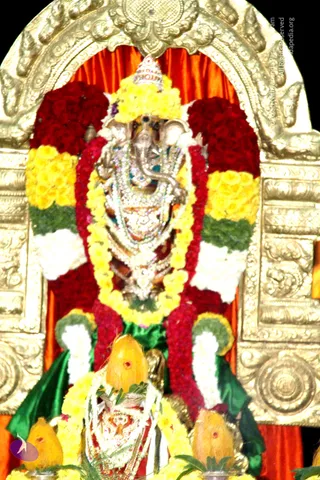
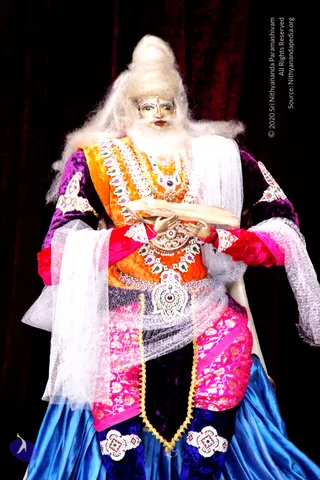
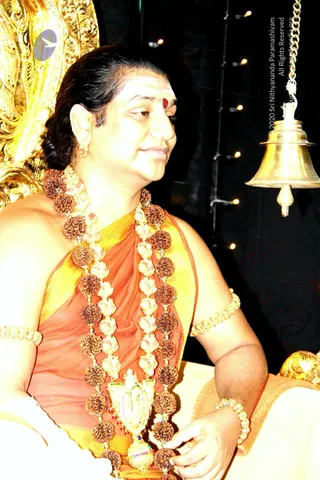
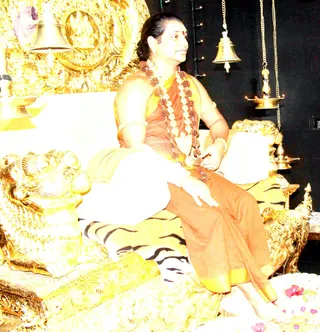
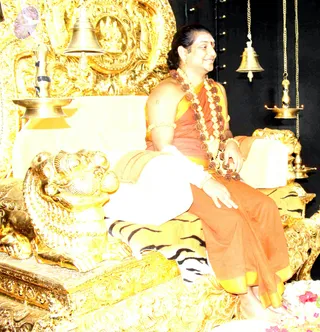
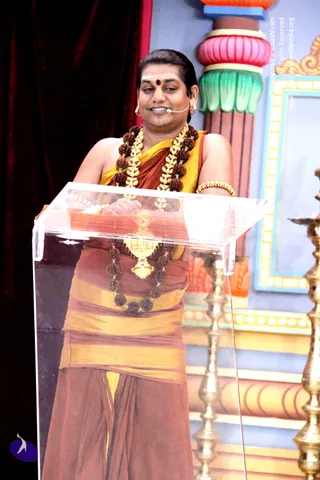
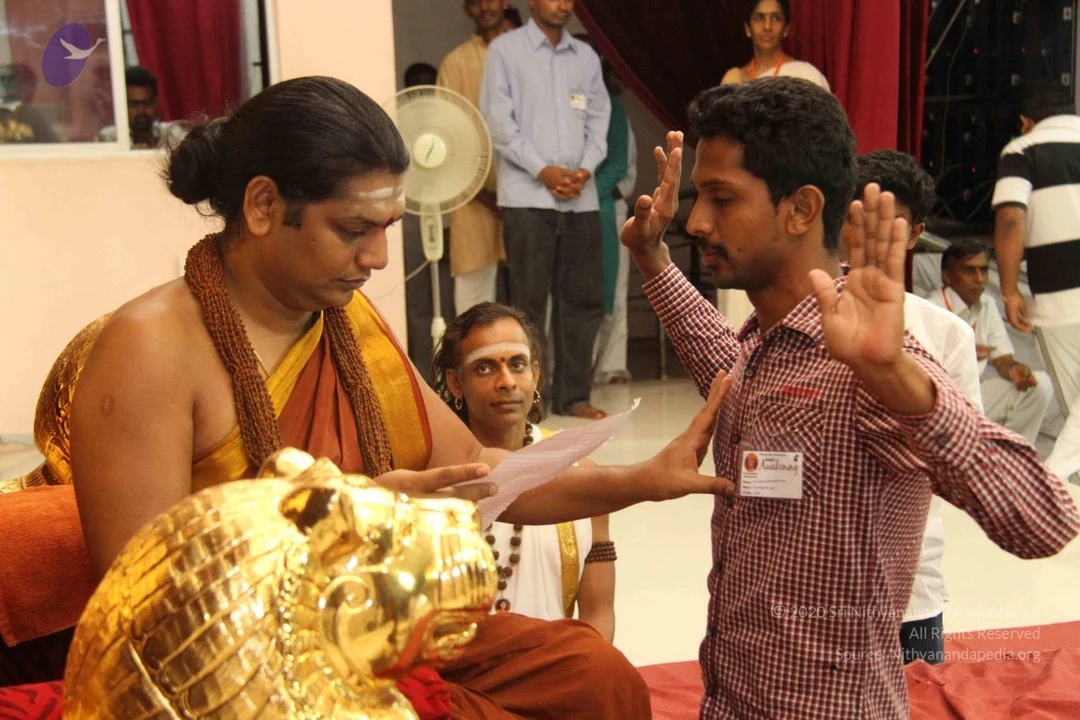
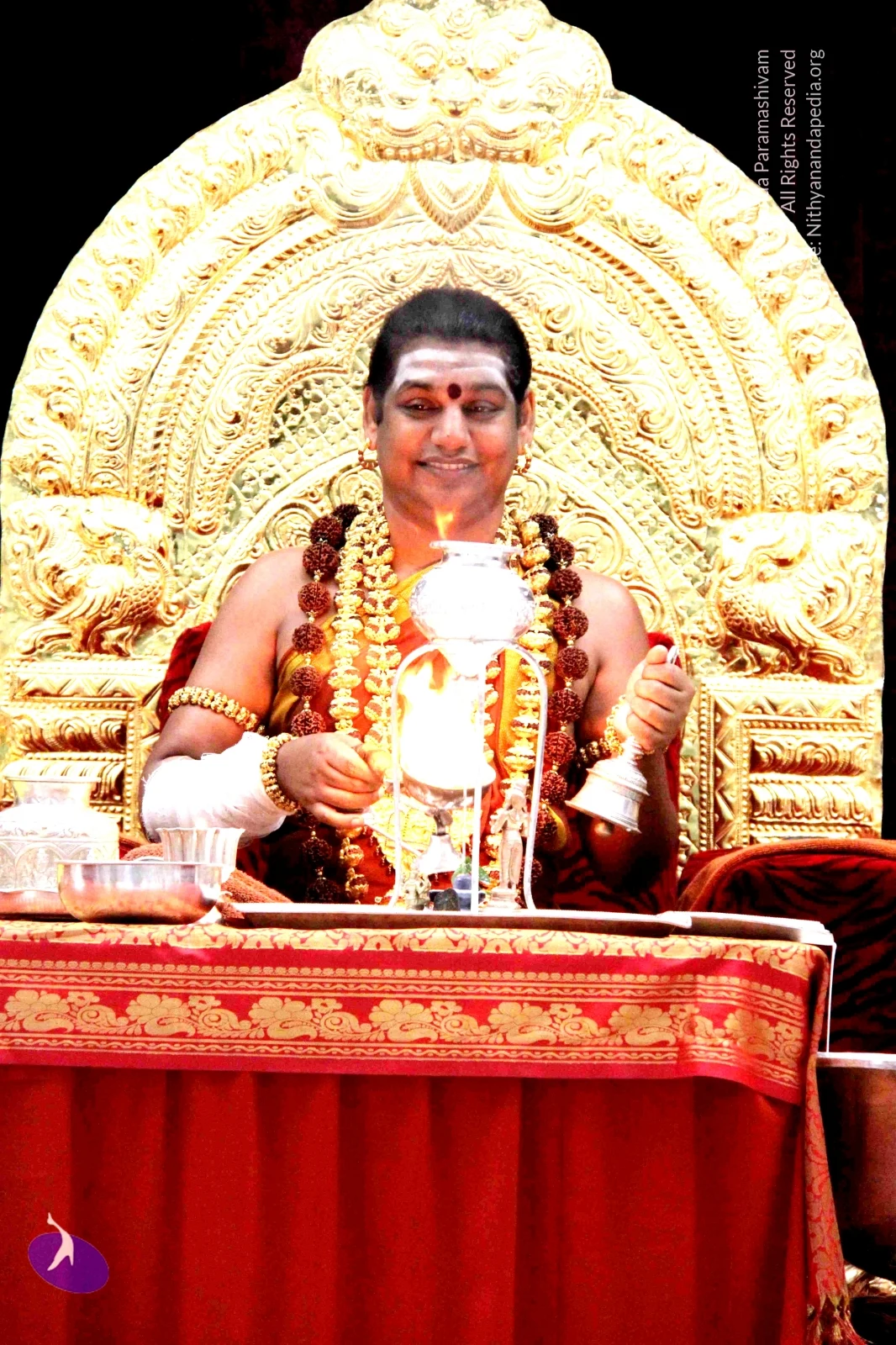
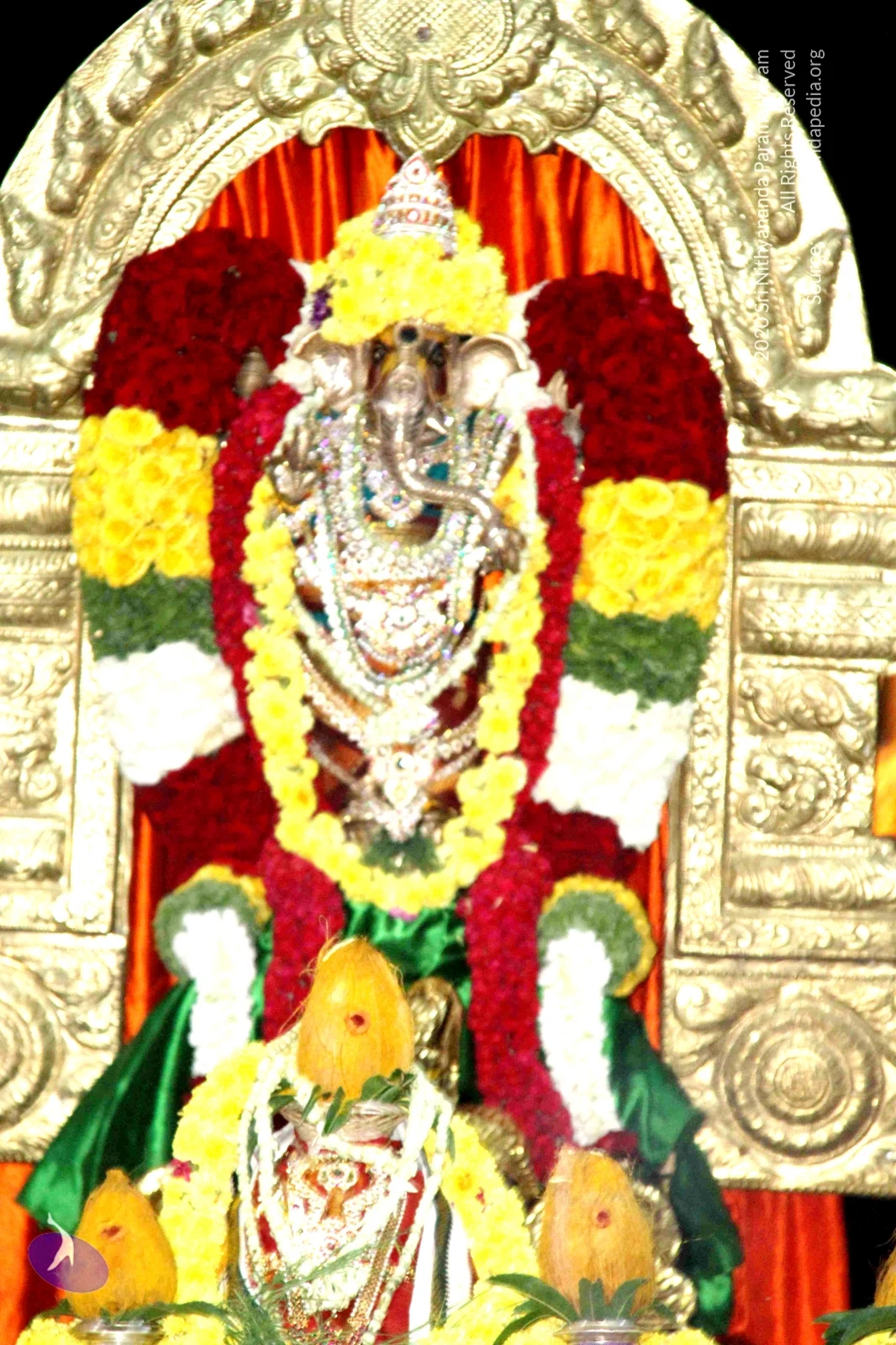
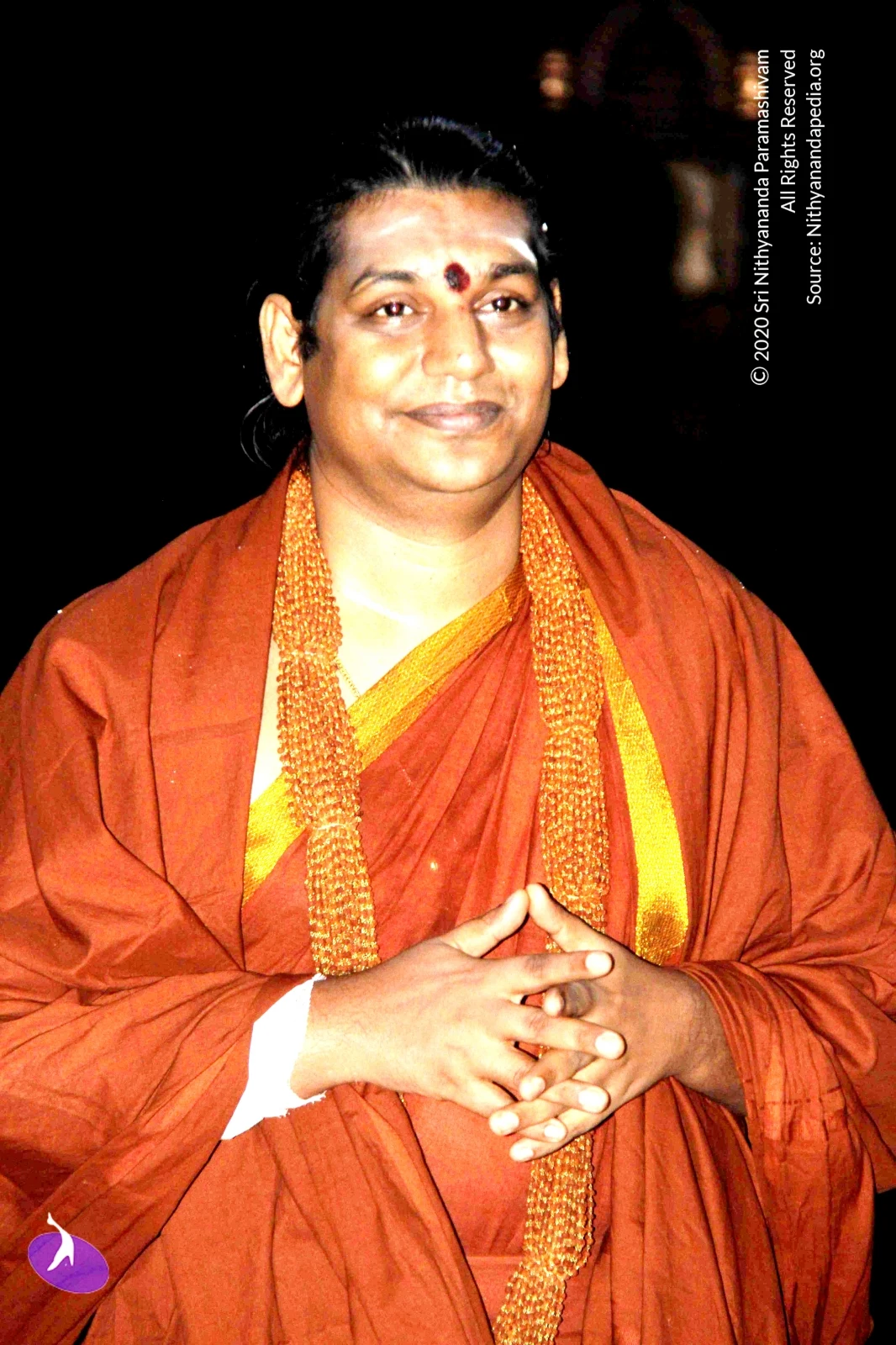
A seated man in a rust-orange and maroon robe with a gold-threaded border sits against a red upholstered throne with a gold carved crown finial at top left. He rests his right hand against his chin and his left forearm, wrapped in a white bandage, extends across his lap. A red bindi and white forehead markings are visible. A single person is present in the photograph.A night-time temple photograph of a priest in an orange-saffron dhoti and orange upper cloth, with a white tilak on his forehead and bangles on his wrist, raising a silver aarti lamp toward a deity murti. The murti is an elephant-headed Ganesha form decorated with a gold-and-red garland, yellow marigold garlands, white flowers and a green silk cloth, set within an ornate golden arched shrine frame. Mango-like yellow offerings and small brass vessels sit on a red-draped altar in front, with more marigold garlands. Behind on the right, other deity figures are visible under a green and gold drape.Night-time ritual fire ceremony. A young shaven-headed boy in orange robes, with a red-and-white tilak on his forehead, rudraksha malas and wrist beads, holds a ladle or offering vessel over a fire, with a sheaf of dry grass and flower garlands nearby. Behind him a bald priest in orange cloth with white forehead markings holds a brass vessel, and a seated person in white garments sits beside them. Red and white flowers decorate a pink-draped altar at right. Smoke rises from the fire pit.

September 30 2013

Original wiki page
Contents

Title:

Technique For Graceful Ageing.

Description:

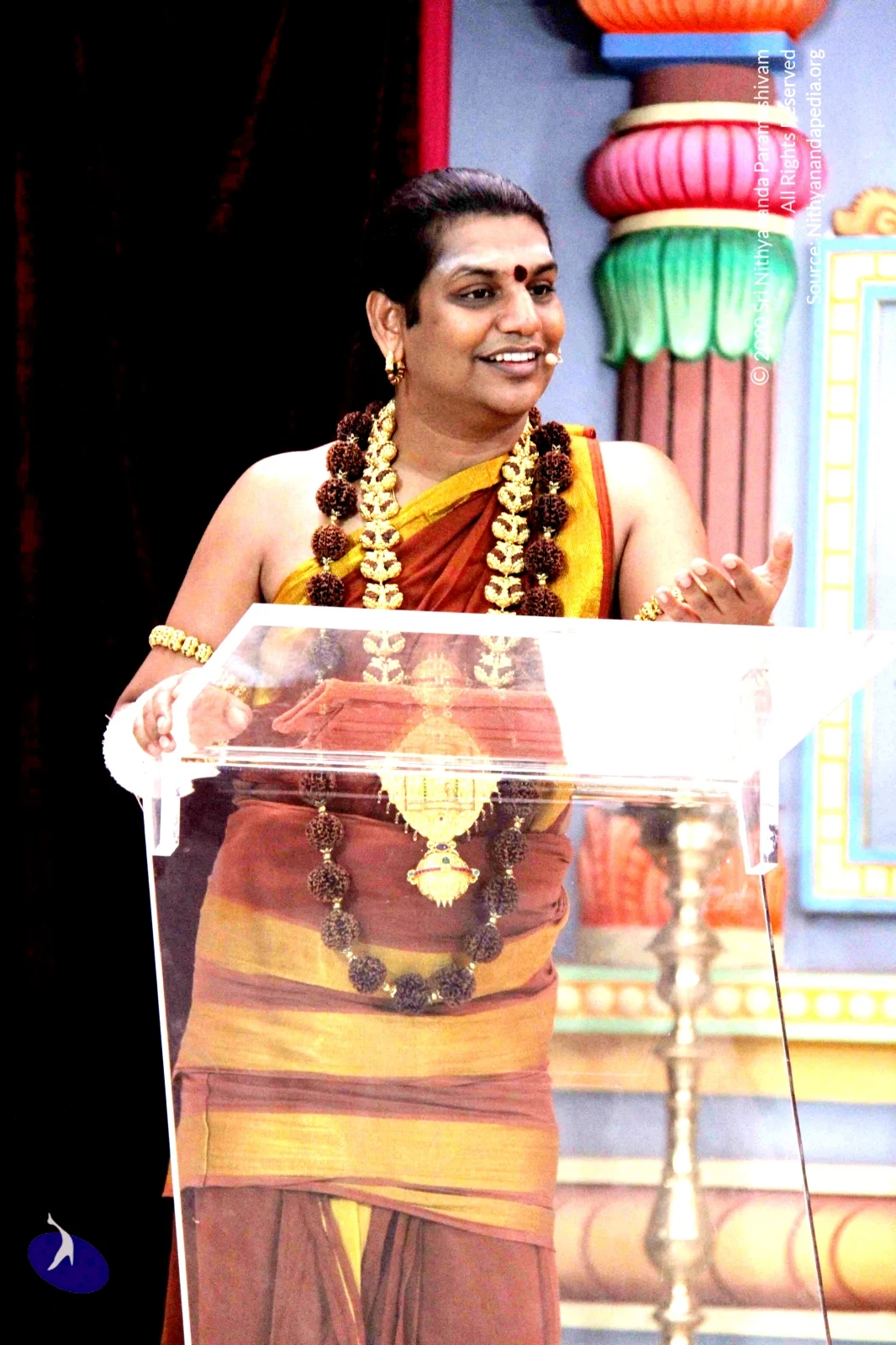
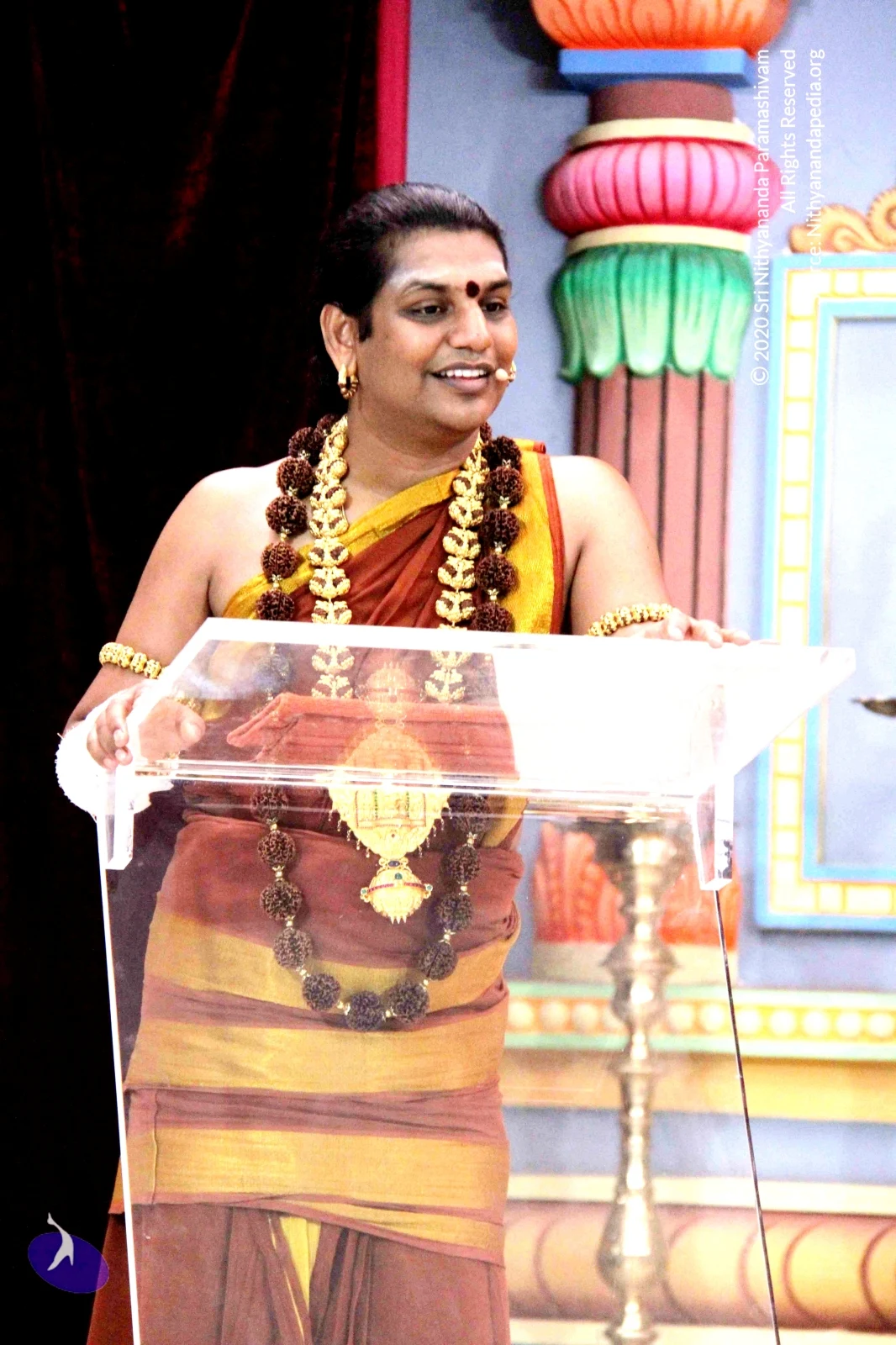
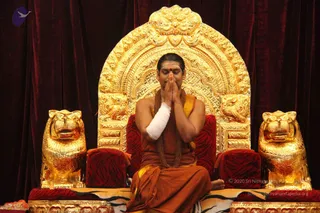
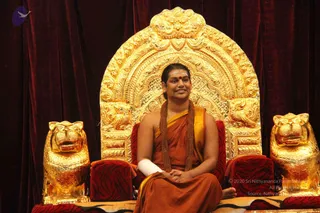
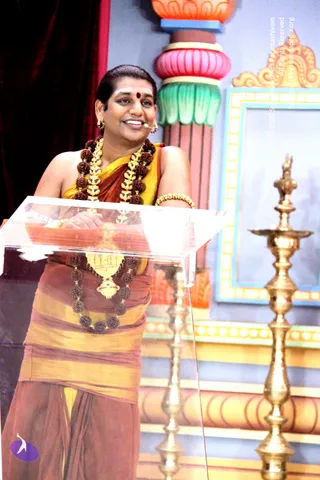
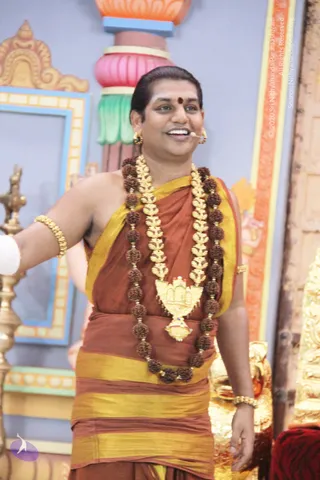
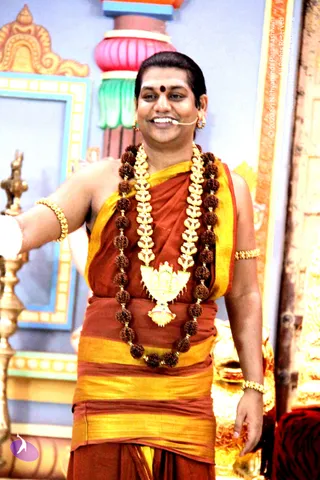
In today’s morning Satsang, Paramahamsa Nithyananda shares with us that the secret for aging gracefully is to complete with our pain body. If we attend pain in one part of the body, the pain moves to another part of the body. The secret is that pain feeds off of unconsciousness and causes aging. The remedy is to bring completion to the pain, treating it with awareness, and healing it with consciousness. Don’t allow pain to drain your brain! Complete with pain and age gracefully!

Link to Video:

VideoAudio
VideoAudio

Transcript:

Nithyanandeshwara Samaarambhaam Nithyanandeshwari Madhyamaam | Asmath Aachaarya Paryanthaam Vandhey Guru Paramparaam ||

I welcome all the devotees, disciples, samajis, satsangis sitting with us all over the world through Nithyananda TV, Lotus TV, Sadhana TV, and two-way video-conferencing.

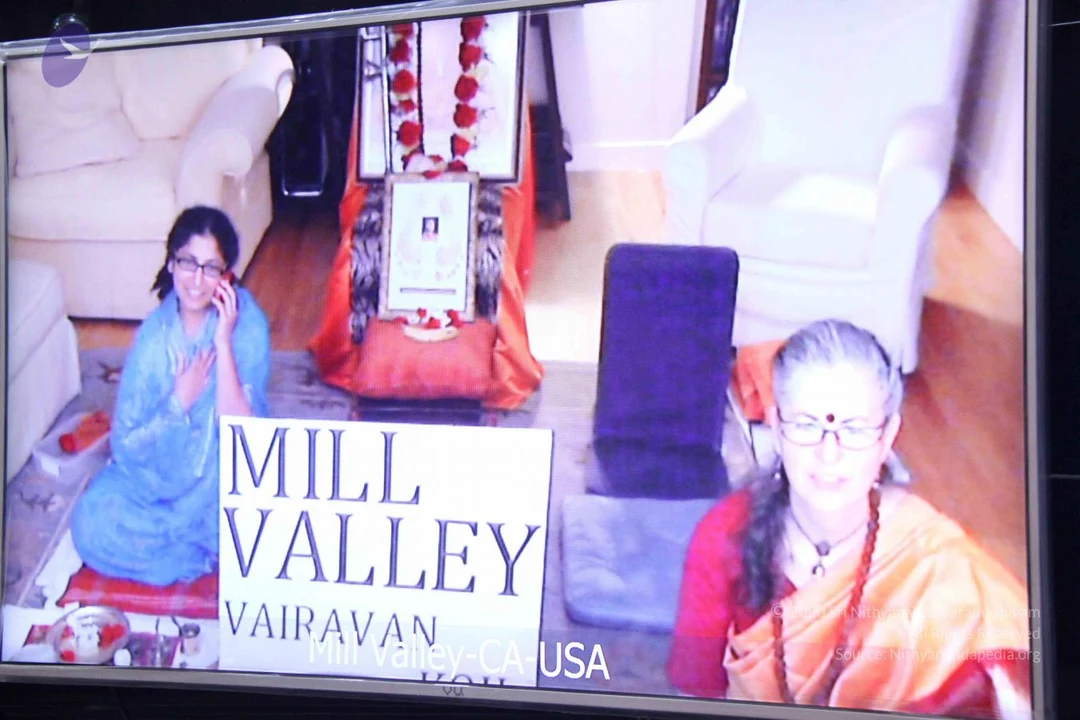
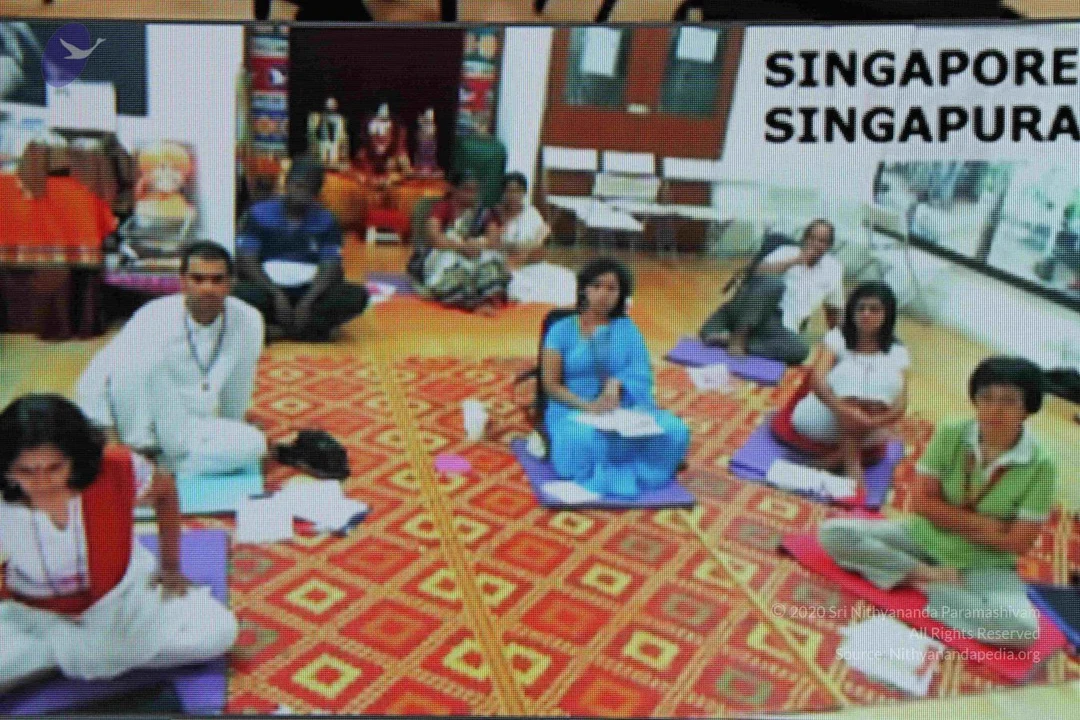
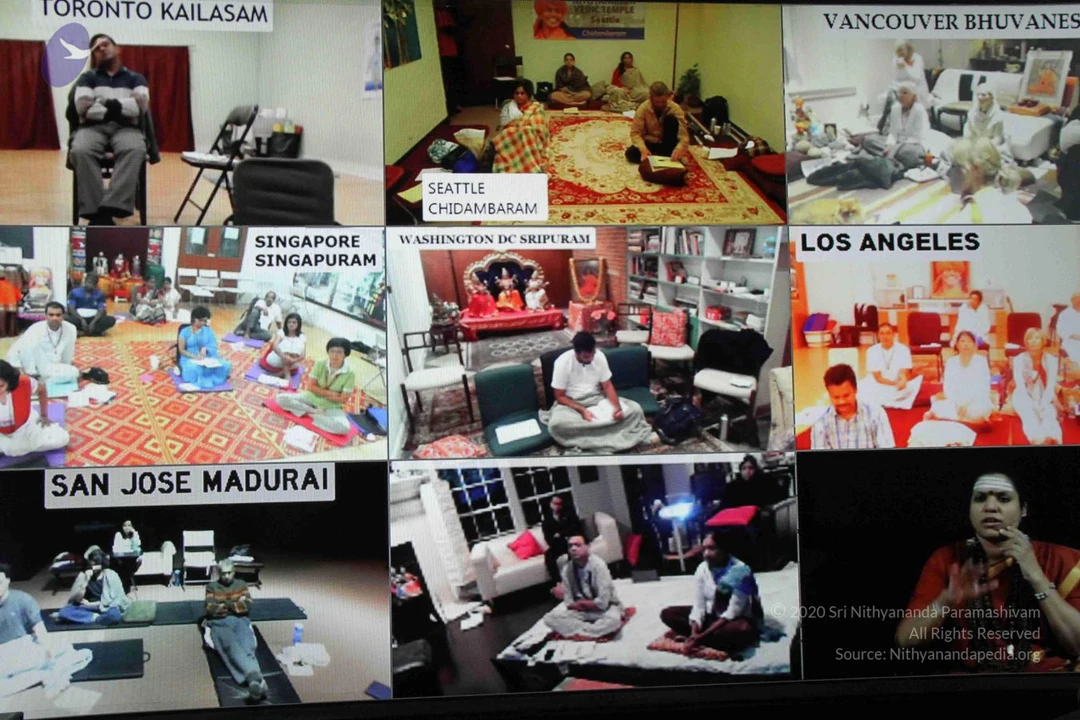
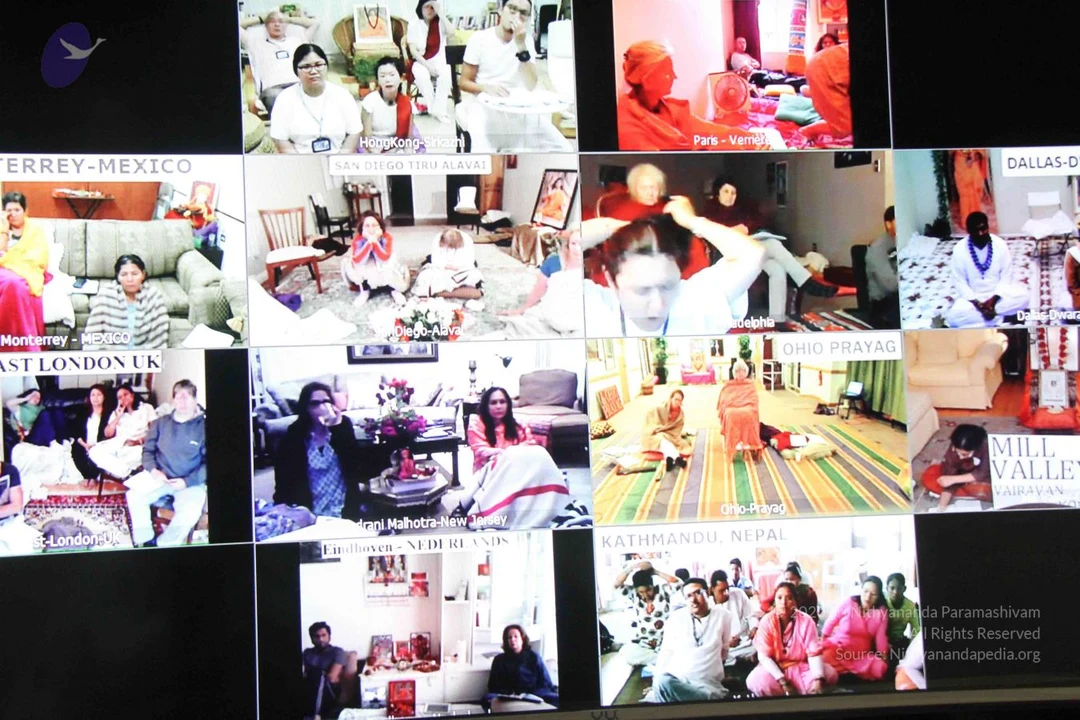
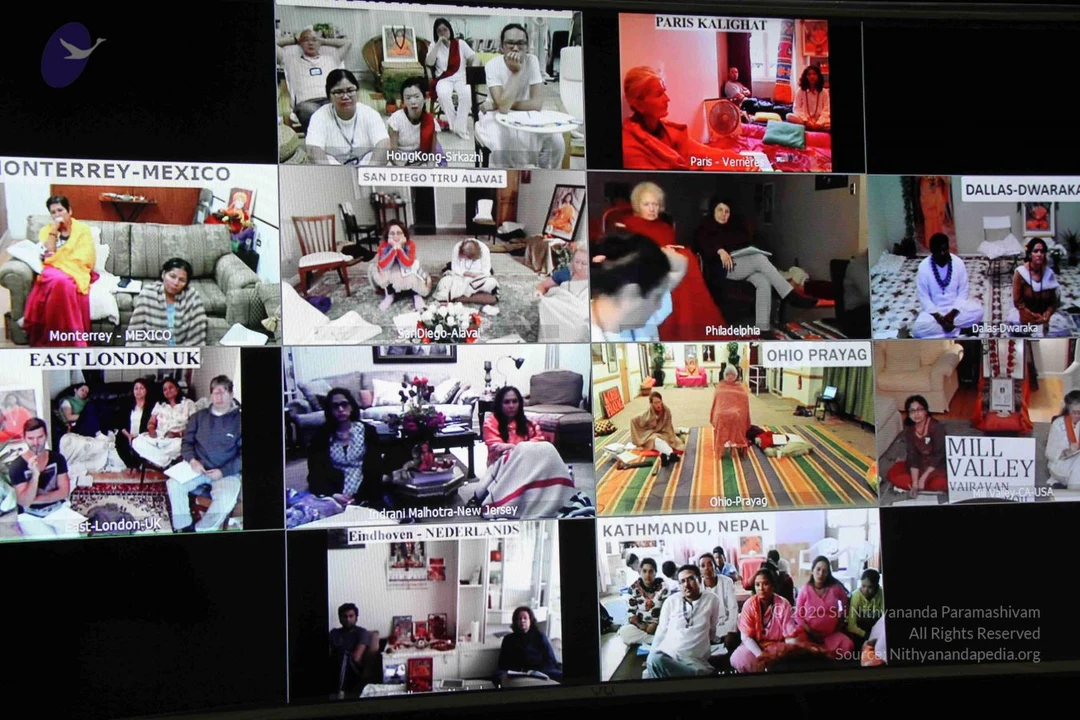
Cities sitting with us in two-way video-conferencing having Nayana Deeksha all over the world: Los Angeles, Kuala Lumpur-Palani, Enriching Temple-Bidadi, Oklahoma-Somanatham, Guadeloupe-Rameshwaram, Houston-Kalahasti, Washington DC-Sripuram, Toronto-Kailasam, Ohio-Prayag, Charlotte-Srisailam, Paris-Kalighat, Seattle-Chidambaram, Singapore-Singapuram, Vancouver-Bhubaneshwar, San José-Madurai, Dallas-Dwaraka, Devon-UK, New York-Varanasi, Kathmandu-Nepal, Slovakia-Shivaloka,Tiruvanmiyur-Chennai, Austin, Hong Kong-Sirkazhi, Hyderabad-Gupta Kashi, Port Washington-New York,Mill Valley-Vairavan Koil, San Diego-Tirualavai, Dubai-Vaidyanatham, East London-UK, Netherlands,Philadelphia, Oman-Sivagangai………..

I welcome all of you with my love and blessings.

Today is:

• 960th Nithya Satsang, excluding all the satsangs I delivered before 2010, and evening satsangs. Still they have not come up with the right number.

• 20th batch Inner Awakening, 4th day.

• 17th batch eN-Genius, 4th day.

• 19th batch Nirahara Samyama, Level-2, 1st day.

• 9thbatch The Samyama, 4th day.

I’ll move to the morning Satsang, Nithya Satsang:

Today, I will expand on “PAIN BODY”, why we human-beings keep the pain body alive and continue to suffer with it.

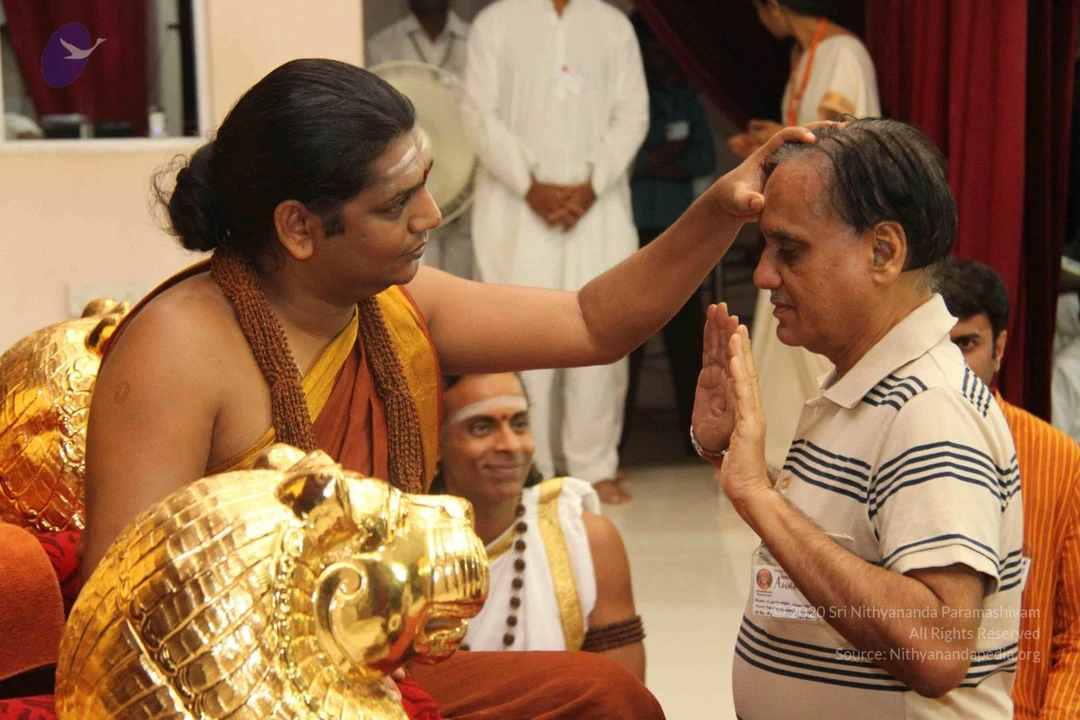
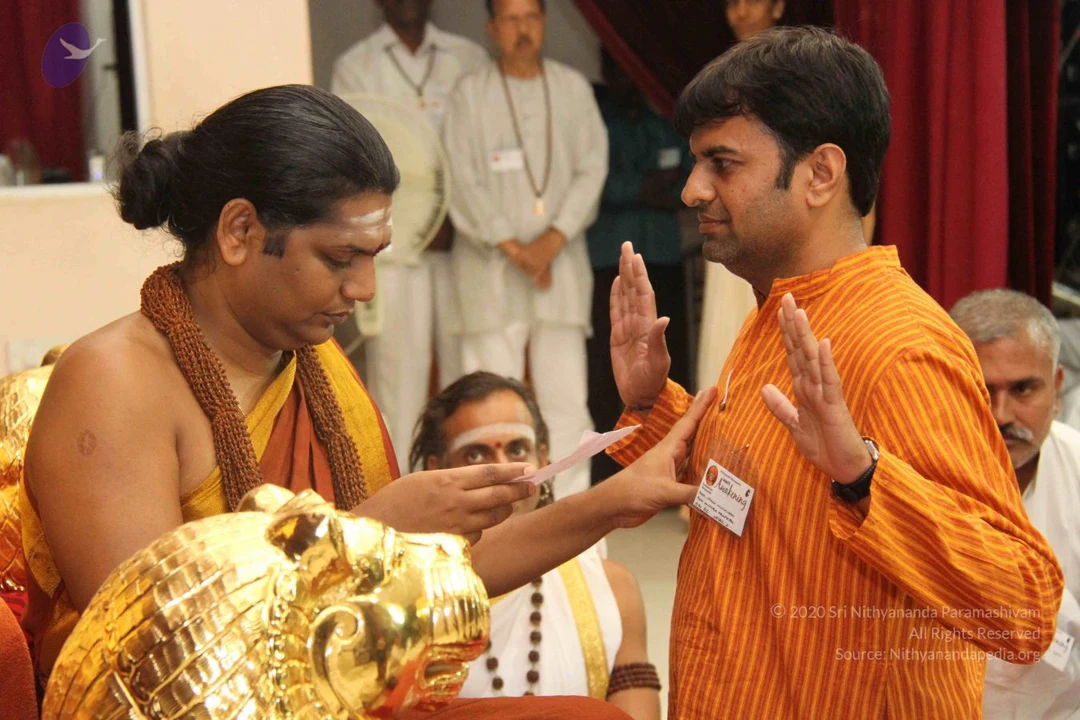
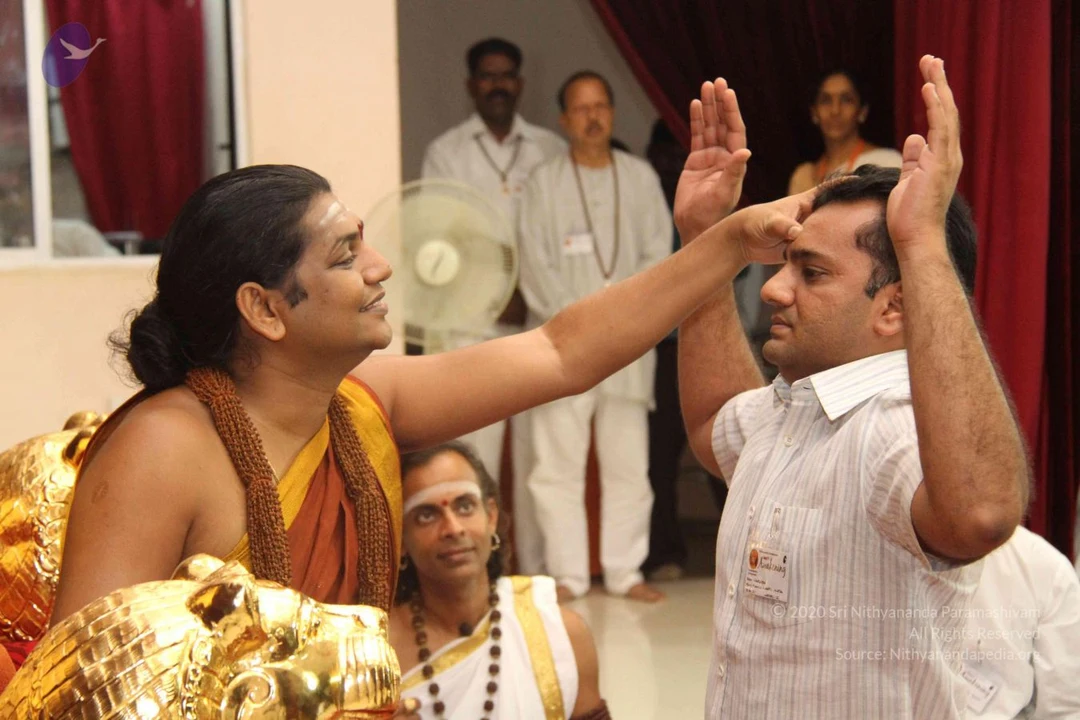
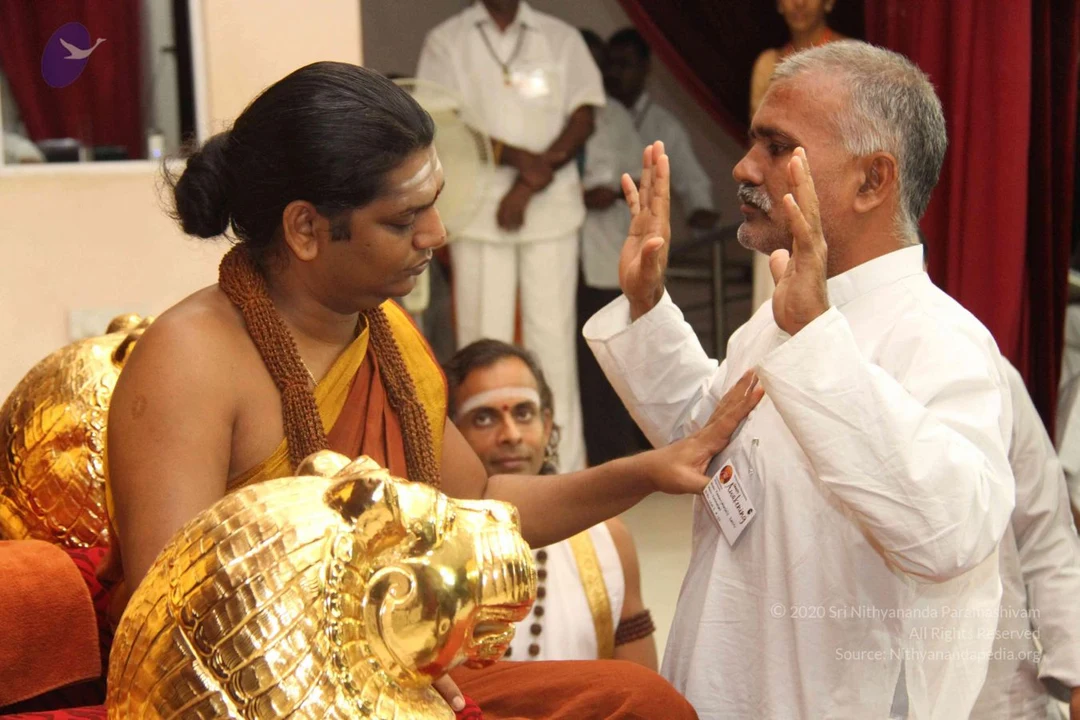
In the Inner Awakening, today’s session is about pain body. Today, whole day, we will be working on completing with all the pain samskaras, pain patterns. See, pain pattern is the expression of root-pattern. Root-pattern is the root, but pain pattern is the tree. Today, we will be working on the tree. Yesterday, we worked on the root; means, we poured acid in the root of suffering. Today, we will burn the whole tree of suffering. It’s a whole day process, a very powerful process, but most extraordinary process.

I have seen, these two-three processes in the Inner Awakening – completing with your bio-memory,completing with your fear and death fear, completing with your pain pattern – these sessions literally awaken your whole Kundalini energy and consciousness! Today, we are going to enter into that important session.

All the Inner Awakening participants, please listen! Listen!

First thing, pain needs unconsciousness to exist. Listen! Pain needs unconsciousness for its existence. If you are conscious, pain cannot live inside you. If you are conscious, you HAVE to be happy! Nothing can be done about it! If you are unconscious, you HAVE to be in pain! Nothing can be done about it!

Pain cannot be driven out of your system by attending to one part of you. If you have knee pain you attend to that, it will become stomach pain. If you have stomach pain, you give medicine and do what you want, it will become neck pain. If you drive that also out, it will become back pain. If you drive that also out, it will become a headache. If you drive that also out, it‘ll become your wife!

HAHAHAHAHAHAHAHA! But, whatever, it will be there in your life! Of course, when I said “wife”, I meant “spouse”. It’s not only for women, it’s for men also. But, please understand, pain cannot be attended to partially. That is the law of life. Pain cannot be attended to partially.

Please understand, any attempt to attend to the pain partially leads to more and more powerlessness. For example, I have seen people, first they try to give medicine to the stomach pain; then when it becomes a back pain, they try to give medicine for that; then it moves to neck pain, then they give medicine for that; after two-three years, they start living with the pain! They start living with the pain!

It is now almost like they are experienced; pain becomes their life and experience.

Somebody was asking, ‘Why in Hinduism we pierce the ears of men before marriage?’

Actually, in Hinduism, traditionally, before marriage all men should have their ears pierced and wear yajnopavitha. Whatever community you may be, you should be given the yajnopavitha, piercing of the ears and shaving the head.

Somebody asked me, ‘Why men have their ears pierced?’

Preparing them for marriage! I said, ‘it is two things: They have experienced pain and bought jewelry.

So, now they are ready for marriage!’

If you have missed, you missed! HAHAHAHAHAHAHAHAHAHAHAHAHA….!

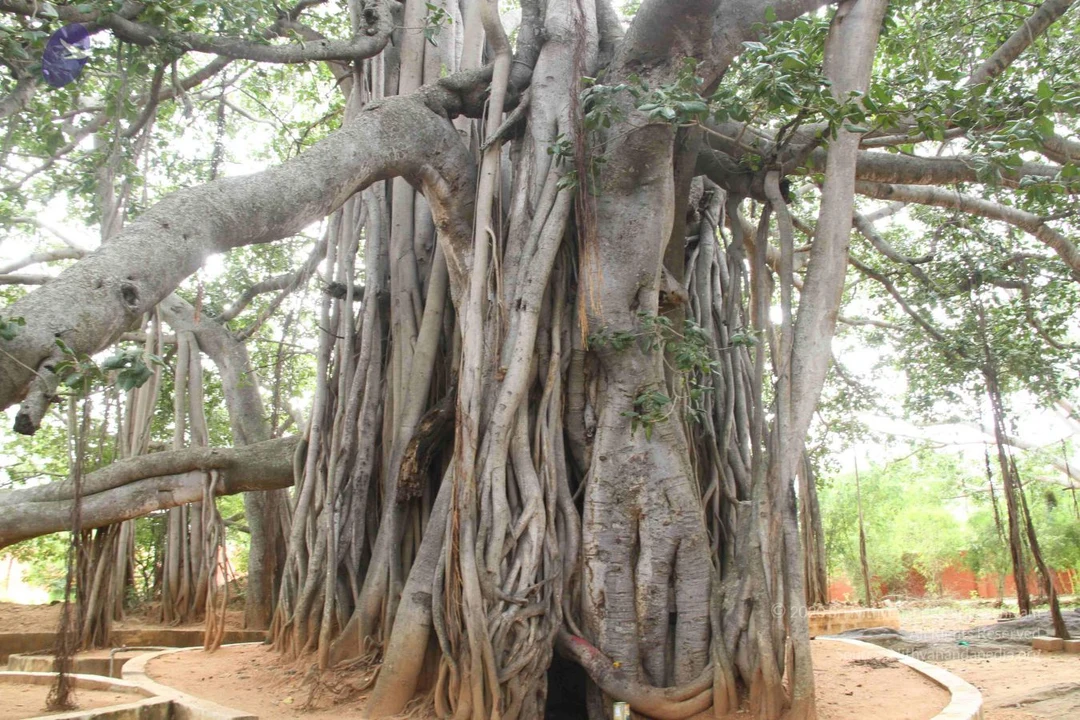
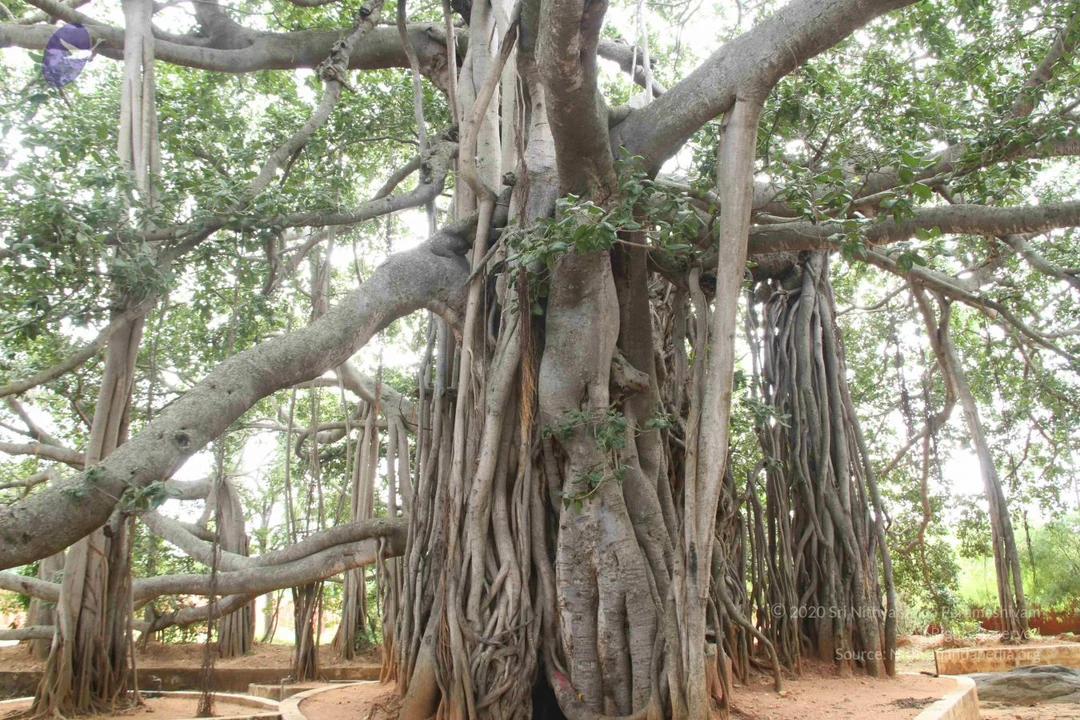
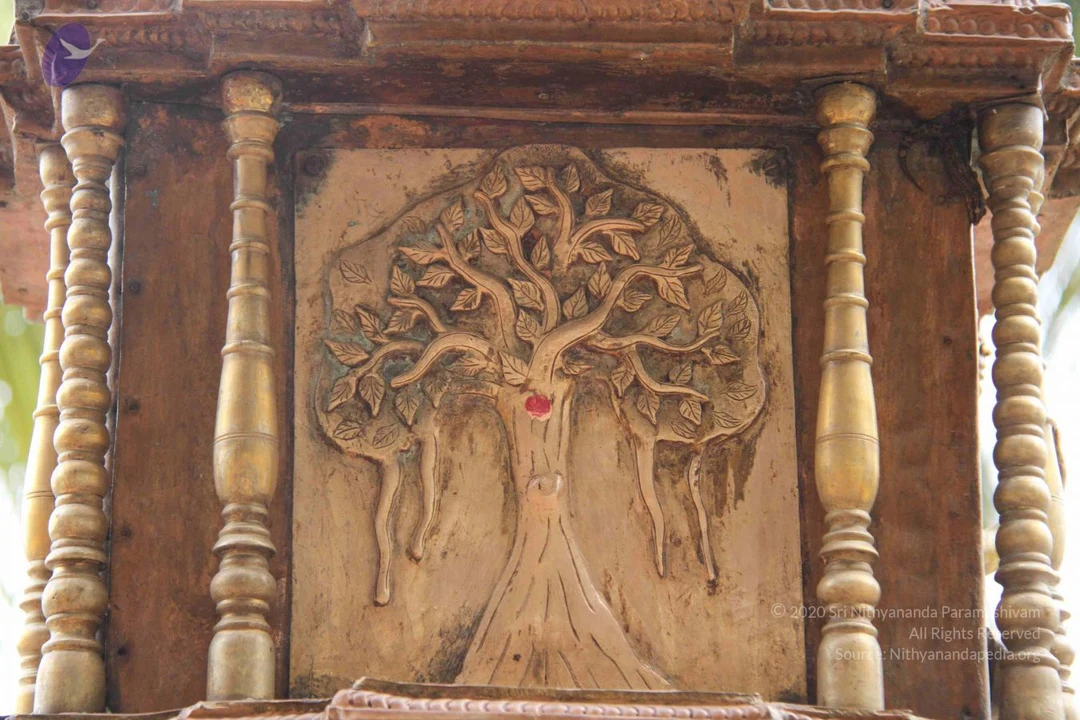
Unfortunately, we get settled with pain. Please listen! If you settle with pain, you age in such a bad way, pulling, pushing, and dragging. I tell you, complete with pain; you will age very gracefully. Aging gracefully should be taught as a mandatory lesson for anybody who has crossed forty. Actually, we should have clear Universities! This should become a compulsory education! By the age of seven, one year-the child should learn about life and living with Completion. By the age of fourteen, one year-the child should learn completely about the next level root-patterns. Please understand, the preliminary root-pattern will always be based on fear and anxiety. The hanging root patterns….I am giving you the example of banyan tree. If your life is like a banyan tree, the root of the banyan tree will always be fear and anxiety. The hanging root of the banyan tree will be the lust. When it starts hanging itself if you attend and complete it, it will not get grounded and become one more root pattern! So, at the age of fourteen, a child should be taught about his hanging root-pattern. See, with the hanging roots, if you attend to them immediately, they will not get rooted in the ground; they will not become one more root-pattern. But if you don’t attend to them properly, if you don’t complete them, they will reach the ground and they will become rooted and they will become one more root. Lust by its nature cannot be the original root-pattern. The original root-pattern will always be fear and anxiety based. And, pain is the leaves. Pain can never be a root-pattern; that is the good news. Bad news is, it flourishes from the fear. Understand, I am explaining the whole science of how you develop your mind without even you being aware of it.

At the age of seven, a child should be taught the Science of Completion. At the age of fourteen, the child should be taught the Science of Completion with the hanging root-patterns, means, the patterns which will be getting developed in the child; the lust pattern. At the age of twenty-one, the child should be taught to live with enlightenment, means, various relationships, various dimensions of life.

I am again defining, please understand: Having Completion in all your dimensions is enlightenment. If you are complete in your health, you are enlightened. If you are complete in your relationships; if you are complete in your Integrity; if you are complete with your health; if you are complete with your wealth; if you are complete in all dimensions of your life, you are enlightened!

At the age of twenty-one, the child should be taught to live with enlightenment. At the age of twenty-eight, the child should be taught the Science of Enriching. Please listen. At the age of thirty-five, the child should know life has no other purpose than enriching. And, at the age of forty-two, the child should be taught to complete with the pains, pain patterns, so that he ages gracefully.

And I commit with Veda Matha again, I will make a University where all these programs will be available like a three-months, six-months, two-years, one-year, one-month, like these courses, where people can come and get prepared experientially, learn this science to live their life. We Indians are so foolish, just for this nonsense cricket we have votes and crores of property is getting wasted. But, we don’t have a University for Yoga. It is very recently in Gujarat the first Yoga University has started. There is a small one in Bangalore, but very small; the infrastructure is too small. It is time we create a University for Inner Sciences!

Completing with the pain helps you to age gracefully. Aging gracefully, I tell you….. I always tell all my disciples, ‘When you are young, go wherever you want. Go to any country you want. Go to any State you want. Go anywhere, make money. Hold big, big posts. Go and become judge in the US Supreme Court. Go and become head of the Chamber of Commerce in Malaysia. Go and become the top guy in Wall Street in New York. Go and do whatever you want when you are young. But, when you want to retire, come back to your old Indian village. That is the best place to age gracefully. That is the best place to age gracefully. I tell you, come back to your old ancestral village, relax with life.

This aging gracefully is one of the important things, very important things in a human’s life. Don’t live in a place where you worked when you are retiring, after you retire. I tell you, psychologically you cannot handle that place, because now you are not directly useful in their field. The attention given to you, the respect given to you, the pride given to you, all will reduce, which your heart cannot handle. For aging gracefully, come back to your rural Indian ancestral village. And I always tell people, to age gracefully,Indian villages are the best places! Indian villages are the best places to age gracefully!

Completing with your pain helps you to age gracefully!

20:00

I have a story about aging gracefully. Please listen.

The pain, when you don’t complete with the pain body, you do not feel you lived. So, naturally, aging gracefully does not happen.

One lady, who is not willing to age gracefully, is pushed and she is almost seventy, but spends all the husband’s income on lipstick, make-up, the miracle products, age miracle products from head to toe, as many spare parts as possible, as many polishing coats as possible.

One day, after emptying the husband’s whole salary, means retirement income, with the full make up, she comes and stands in front of the husband and asks, ‘Honey, with all this make-up, tell me, how I look?’

He said, ‘Amazing!’ He can’t tell anything else. He says, ‘If I just see your hair, you are only twenty. If I just see your cheek, it is only twenty five. If I just see your skin, you are less than eighteen. If I see your eyes and the lips, less than twenty.

She was floored and blushing. She said, ‘Stop honey, you are too much.’

He said, ‘Wait, wait wait dear, I have not counted everything together. I have not added all!’

So, you have to wait till he adds everything.

Aging gracefully happens when you complete with pain. Please understand, Completion with the pain body is one of the basic requirement for any adult, which we will be doing today. When there is incompletion in your pain body, continuously you will be so agitated, the whole day you will be running here, there, here, there, here, there. Literally like a headless chicken. I have seen people, they can’t live in peace without problem. No, really, they cannot live in peace without problem, problems are basic requirement for them. Problems should be a basic requirement for them. They can not live without problems.

I tell you, you don’t need problem as your basic survival need. Complete with your pain body. Completing with your pain body will bring so much of fulfillment inside you, such joy inside you. When you don’t complete with your pain body and leave it, aging will become more and more difficult and complicated. As I said, aging in the downtown New York will be very difficult. Aging in the downtown Mumbai will be very difficult. Aging in the downtown Bangalore or Delhi is very difficult. Any , any country, in the downtown, aging will never be graceful.

I have seen some of my own disciples telling, ‘Swamiji, you are talking about make up.’ Sixty, Seventy-year-old ladies, they say, ‘Swamiji what to do? In this country we have to compete with youngsters.’

I tell you, need to compete with youngsters is the most disgrace thing that can happen to elders.

In India, I can guarantee this one we have not given up the elders always respected. That is why I tell you, to age gracefully come back to Indian village. I have already decided I am going to age only in Tiruvannamalai. I already bought the land and kept it ready. I bought the land far away from the city, because by the time the city would grow. I don’t want to be in the center of the city. I want to be in the village, so far away. Where my Akshardham will be, I have not decided. Where this body will reside forever I have not decided but where I will age, I have already decided.

Understand, completing with the pain bodies is almost like completing with all the wounds you created while you started living with incompletions. Because of the root, leaves grow, because of the root-patterns, pain grows. You have to complete the root and complete the leaves. Your words are the seeds which puts more and more incompletion in others. So, you have to complete even with that.

29:05 Hindi - 31:23

Listen, allowing the pain body inside you is like allowing the ghost to live inside you. You will not know why you are doing what you are doing. Otherwise, why will you steal in your own house and destroy your future? I have seen people just plan for foolish few hundred rupees, sometimes crores, and destroy their great future, possibility. Understand, pain body takes away your intelligence. Pain drains your brain. Pain drains your brain but for some people, that problem is not there because first of all, you need to have brain to get drained.

All the Inner Awakening participants get ready for a powerful session today.

I request all the devotees and visitors and viewers, everyone, to follow today’s Somavara Vrata; means, fasting, Monday fasting which we do for Mahadeva, and do ajapa japa of Nithyanandeshwara’s mantra – Om Hreem Nithyanandeshwaraya Namaha. This Monday fasting you can do even if you are less than eighteen, because it is only one day – till sunrise to sunset. It is sunrise to sunset. Anyone can do this fasting. Till sunrise to sunset you will not have any solid food. I request sincerely everyone to do this Monday fasting. It’s like giving holiday to your stomach so you are fresh, alive. Monday, naturally, you have to do a lot of work. You are fresh, alive, to start your week. You can’t be weak to start your week.

34:53 Hindi-35:22

So, today, in the Inner Awakening, we will complete with our pain body, all the pain experiences.

The essence of today’s satsangh:

Your pain drains your brain and trains to be in more pain. Your pain drains your brain and trains your heart to be in more pain. Your brain, please listen, your pain drains your brain, and trains your heart to be in more pain.

Let you all achieve, experience, live, express, radiate, share and explode in eternal bliss, Nithyananda.

36:30

Photos From The Day:
Photos Of The Day:

DialtheAvatar

Nature_cows

DEVI ALANKAR

HOMA

IA DARSHAN

PPP

RUDRABHISHEKAM

SARVA DARSHAN

SATSANG

SWAMIJI SESSION

TEMPLE

TWO WAY

Tags:

Paramahamsa Nithyananda, completion, pain body, unconsciousness, remedy, awareness, healing, consciousness.

1-Rudra-Abhishekam

10-Homa

11-Deities

2-Pratyaksha-Pada-Puja

3-Nithya-Satsang

6-Final-Blessings

7-IA-Darshan

7-IA-Darshan_Photo_1000_IMG_0109_CMP_WM

8-Temple

Photos from this day

View all 446 photos

Photos From The Day:
28 photosSource gallery
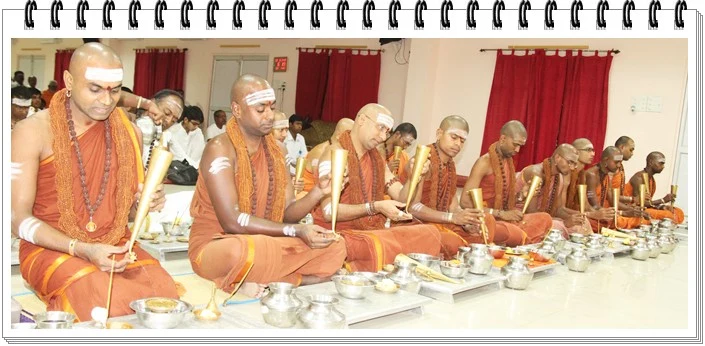
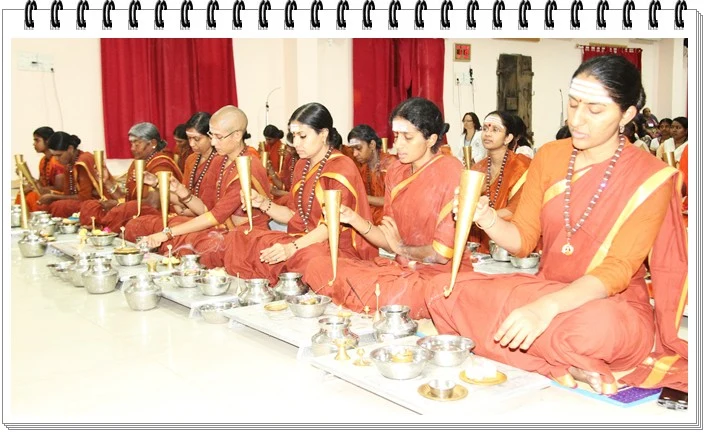
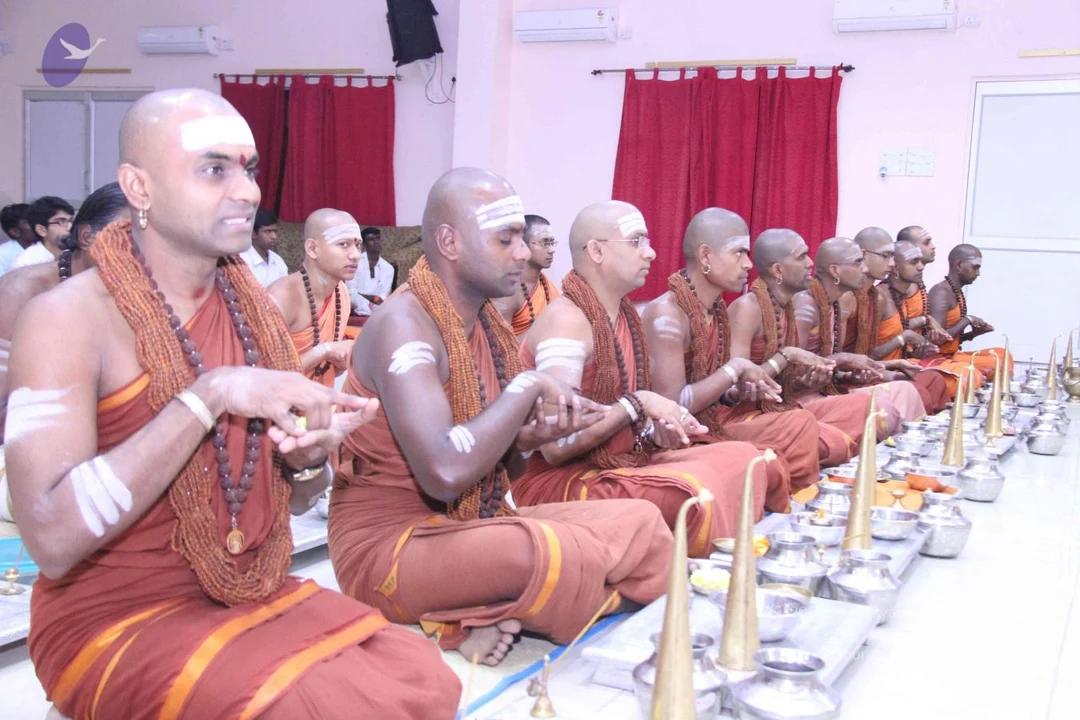
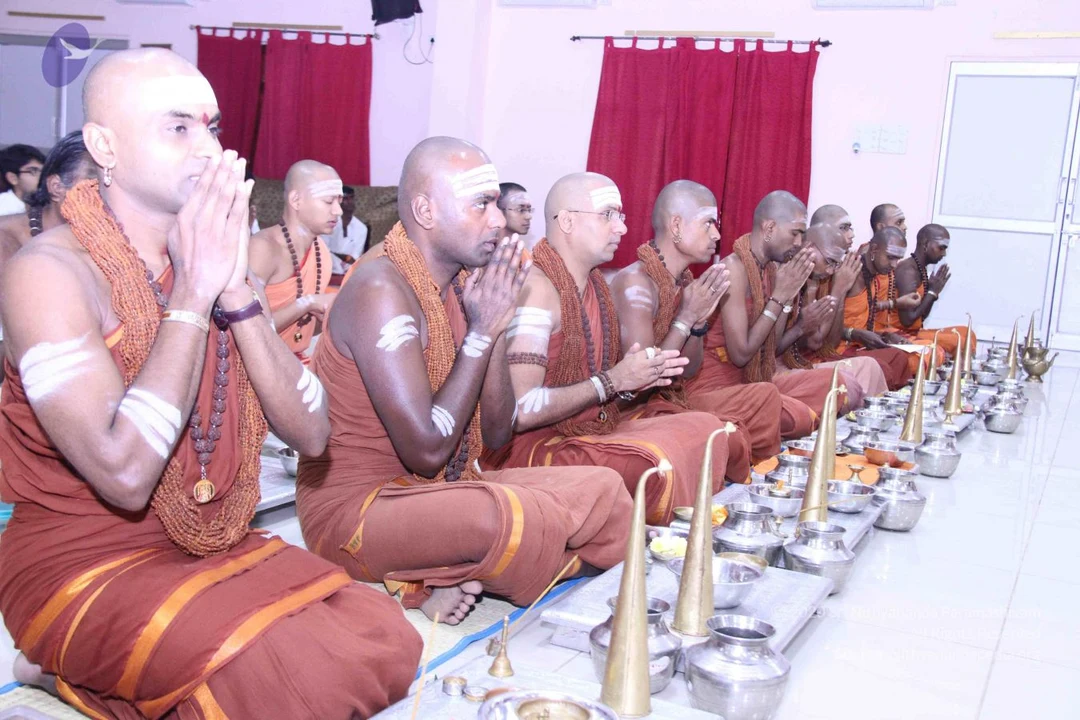
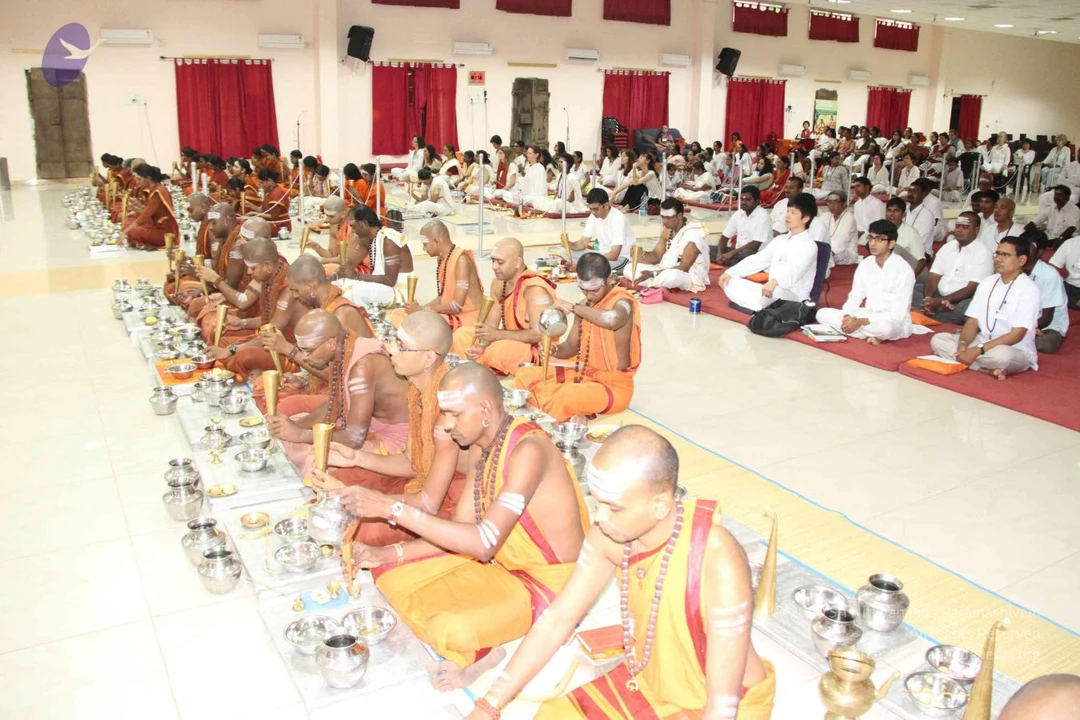
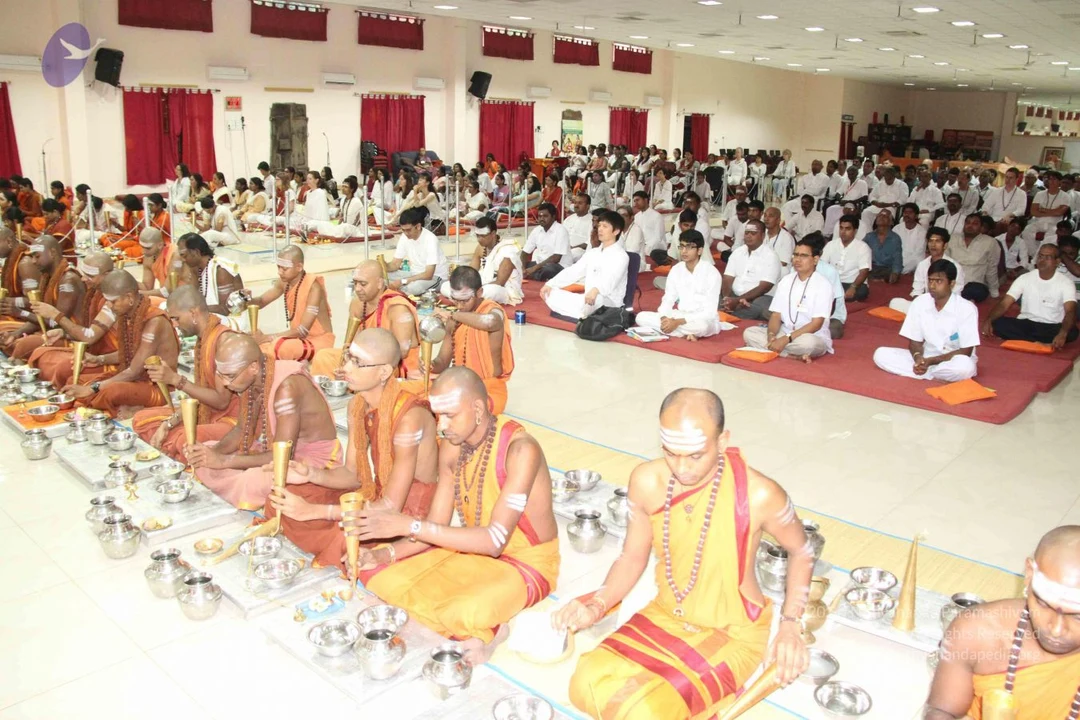
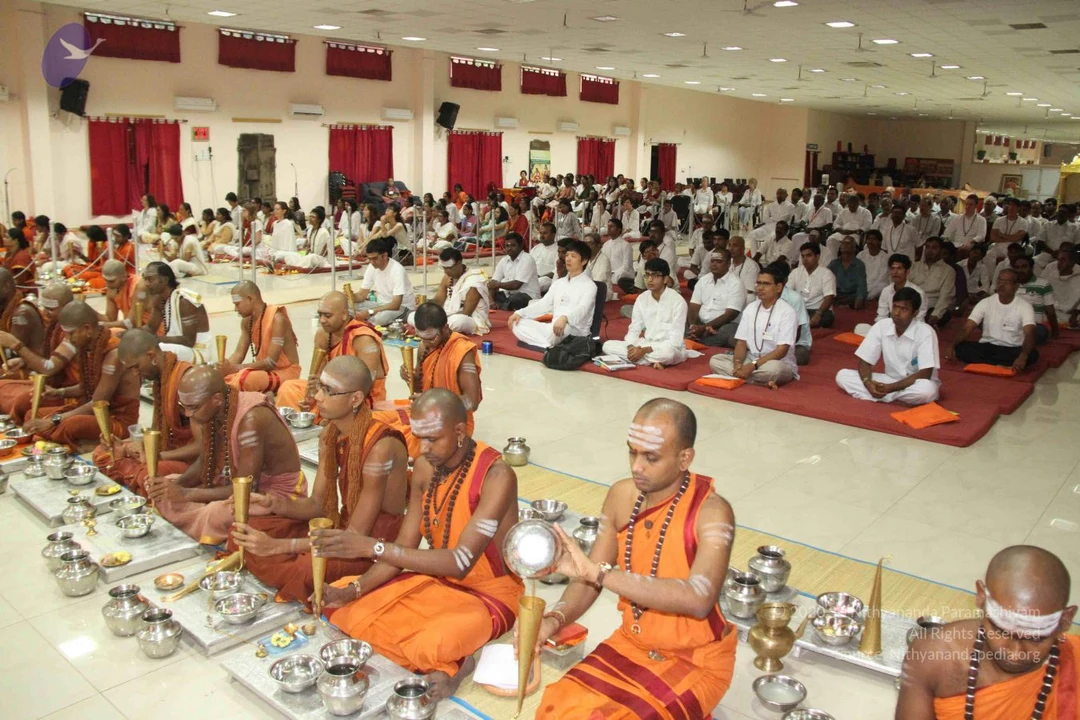
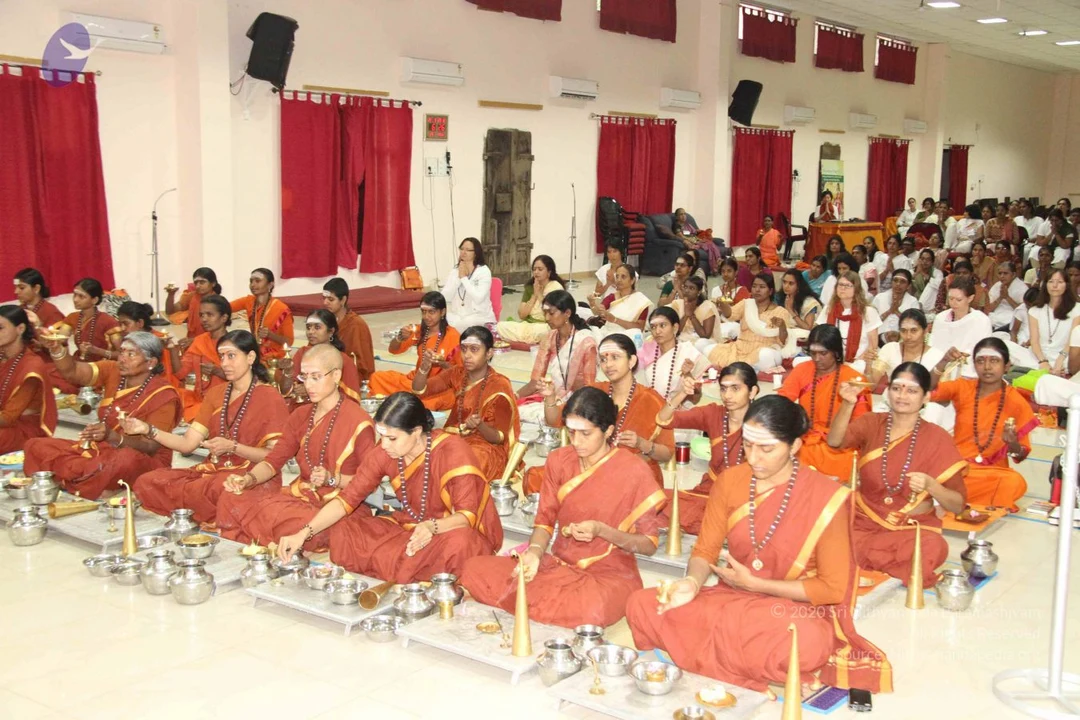
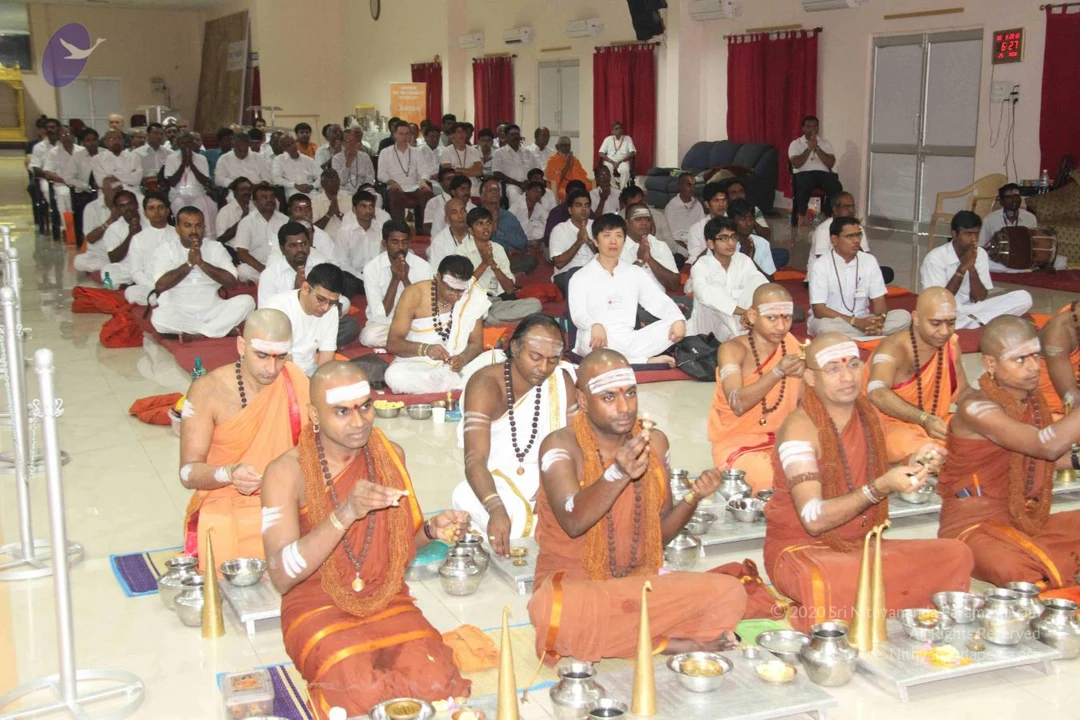
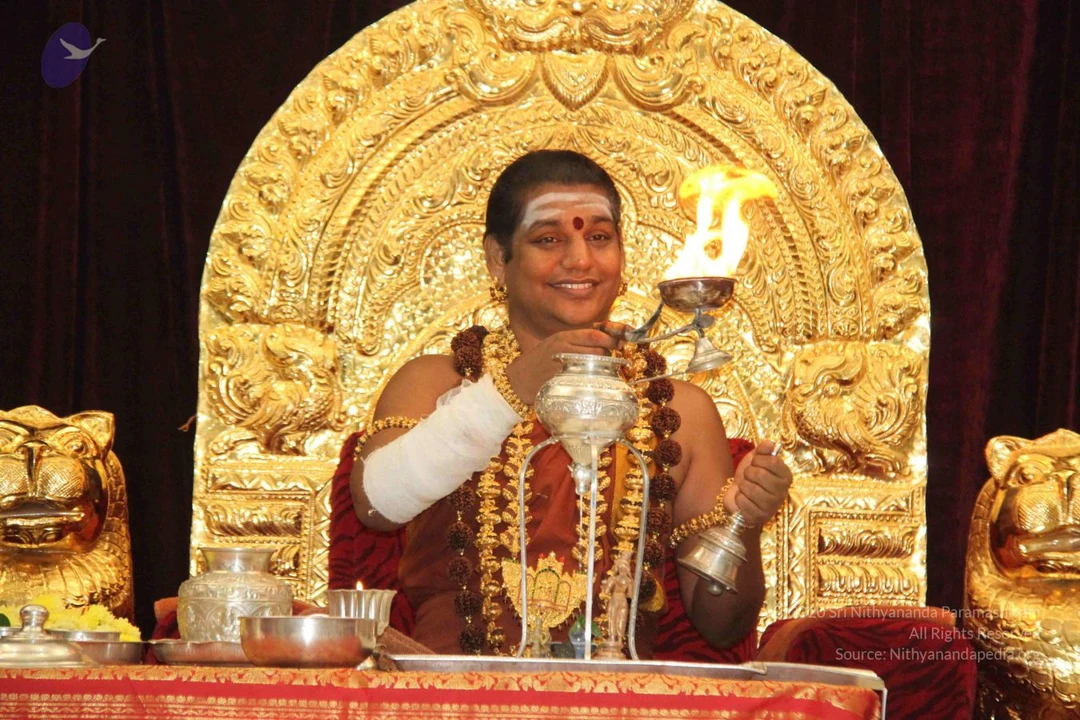
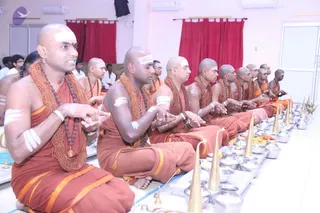
A photograph of a row of shaved-headed men seated cross-legged on the floor, facing right, in saffron-orange dhotis and shawls with rudraksha malas and white tripundra markings on their foreheads and arms. Several have their hands folded or pressed together in prayer. In front of them, a long low tray holds numerous silver and steel bowls and tall brass horn-shaped vessels. A red curtain hangs behind them, with a white wall and light fixture at the upper right. The men appear to be priests or sannyasis taking part in a ritual or puja.A photograph of a seated row of women in rust-red and saffron-bordered sarees, many with rudraksha malas, sitting with palms pressed together in anjali mudra. Brass vessels, small metal bowls and brass kalashas-style cones sit on low tables in front of them. Red curtains hang at the back of a bright hall and a sheet of spiral-bound notebook paper frames the top edge. Several women wear vertical tilaka marks on their foreheads. Multiple figures are visible across the row and in the background.A seated man in orange-saffron robes sits on a gold-carved throne with a deep red velvet backdrop. He wears a white-and-red forehead mark, layered gold and rudraksha-style garlands, gold armbands, and a white bandage on one wrist. He holds a silver pitcher-like vessel with a spout above a red-and-gold draped table, with silver bowls, a small lamp and marigold flowers nearby. The appearance of this man matches a person, seated in ceremonial attire with ornate gold garlands and saffron robes; the throne and ritual setting are visible. This is a photograph of a seated ritual or satsang setting.A photograph of a ritual abhishekam on a white tray covered in milk or liquid. Several small brass deity murtis stand in the liquid, including a standing figure holding a small cup on the left, a shivalinga on a blue-grey base at centre, and seated figures and a Nandi bull. A silver covered vessel and a silver oil lamp with a lit flame sit on a red-orange cloth behind. A person's hand pours liquid from a white tube on the right. No people's faces are visible and no a person candidate is visible.A close view of a ritual abhishekam on a white tray draped with an orange-and-red patterned cloth. A thin stream of liquid pours down onto a Shivalinga and a cluster of small brass and silver figurines, including a standing deity murti on the left and smaller figures around the lingam. A person's hand wearing gold bangles holds a vessel at the top right, and another hand is visible at the lower right. No person's face is visible, and no one is identifiable as a person in this image.A photograph of a ritual abhishekam setup on a glass-topped table. A standing bronze deity murti with a tall crown and hands joined in front stands at centre on a small blue-grey lingam-shaped base, with a thin stream of liquid falling from above. Around it are small brass figurines, a brass bell or lamp stand at left, and a red and gold brocade cloth draped behind. No people are visible, so a person is none.

DialtheAvatar

1 photoSource gallery
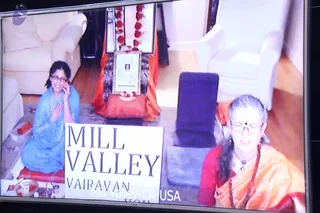
A screen shows a video-conference feed from a Mill Valley location, with two women seated on a light carpet in a living room. The woman on the left wears a blue sari and glasses and sits with hands near her chest. The woman on the right wears an orange sari with red blouse, glasses and a red bindi, sitting beside a purple cushion. Behind them stands a small altar with an orange cloth, a framed portrait with flower garlands, and a red-and-white floral arrangement.

Nature_cows

18 photosSource gallery
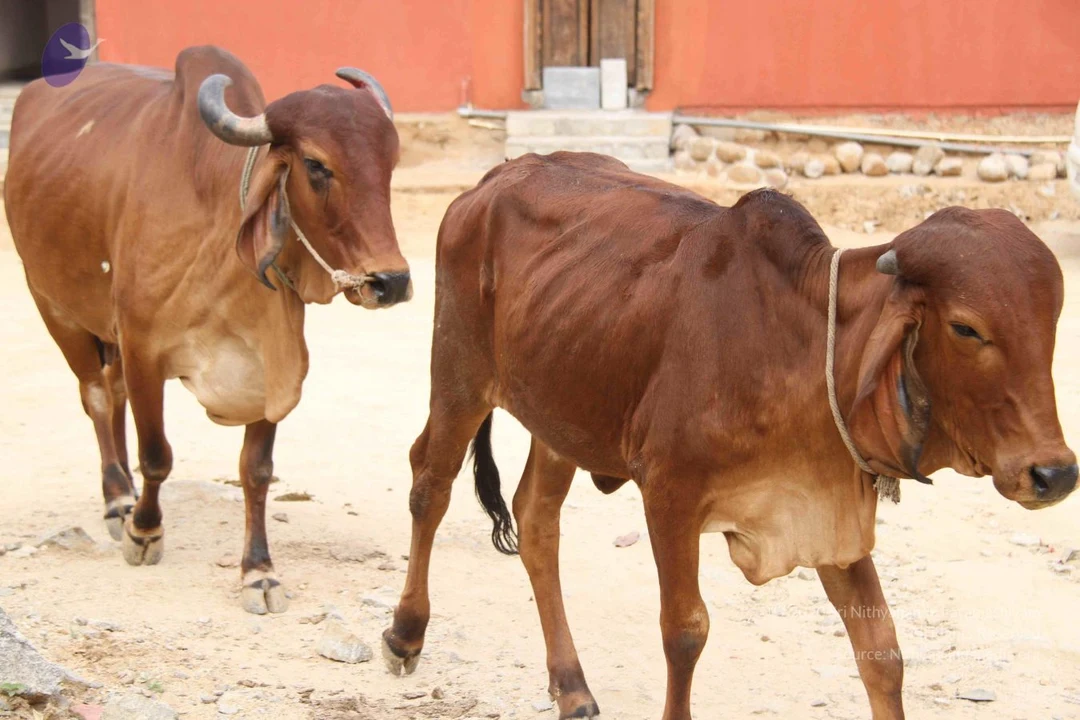
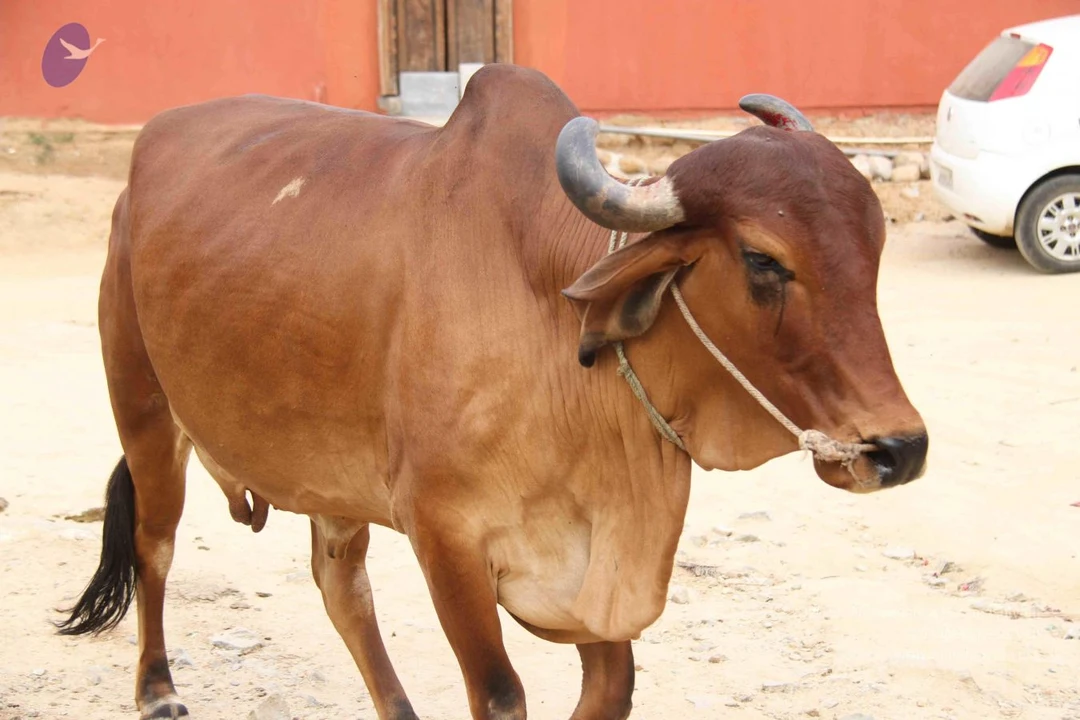
A close photograph of a shrub with dense clusters of small bright orange berries hanging among glossy dark green oval leaves, with thin branches and a blurred green background. No people are visible.A photograph of a small mottled lizard with a long tail and yellow-streaked back, climbing across a grey weathered rock surface with patches of pale lichen. Its legs are splayed on the stone and a dry leaf lies at the top edge of the frame. No people or ritual setting is visible.A photograph of a small mottled lizard with a long, thin tail, lying on a weathered grey stone surface with pale patches and a dried brown leaf nearby. Its body shows brown and yellowish markings along the back, and its legs are spread against the rock. No people or ritual scene is visible.A reddish-brown young calf lies on its side in tall green grass dotted with small white wildflowers. A rope is tied around its neck and it faces left with its ears lowered. No people are visible; the scene is a rural pasture outdoors.A young reddish-brown calf lies in green grass dotted with small white wildflowers. It wears a braided rope around its neck with a knotted, frayed end hanging down. Its large ear is turned outward and its dark eyes look sideways.A young reddish-brown calf lies on green grass dotted with small white wildflowers. It has a rope tied around its neck, large drooping ears, and its legs folded beneath its body. The calf faces left and appears to be resting outdoors in a pasture setting.

DEVI ALANKAR

5 photosSource gallery
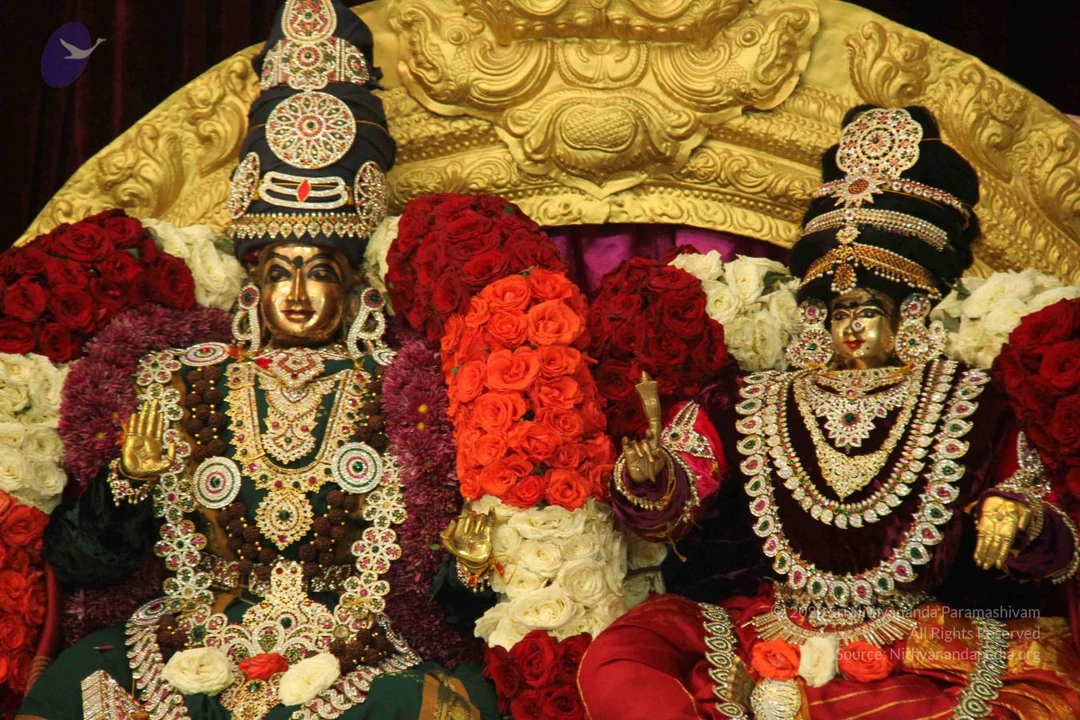
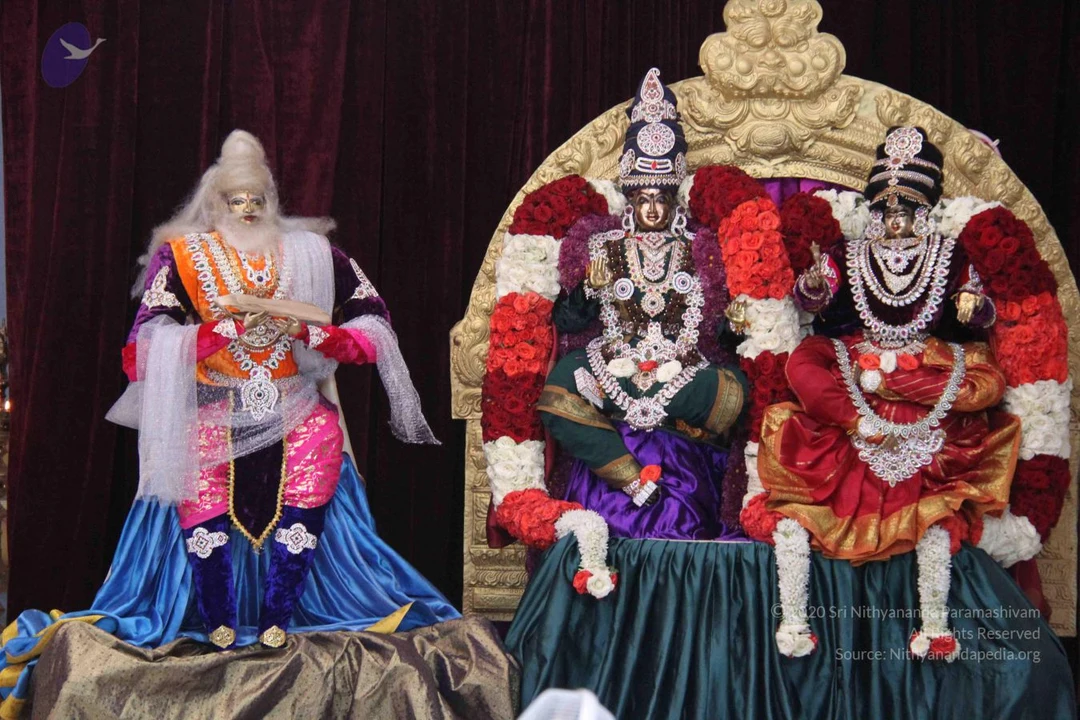
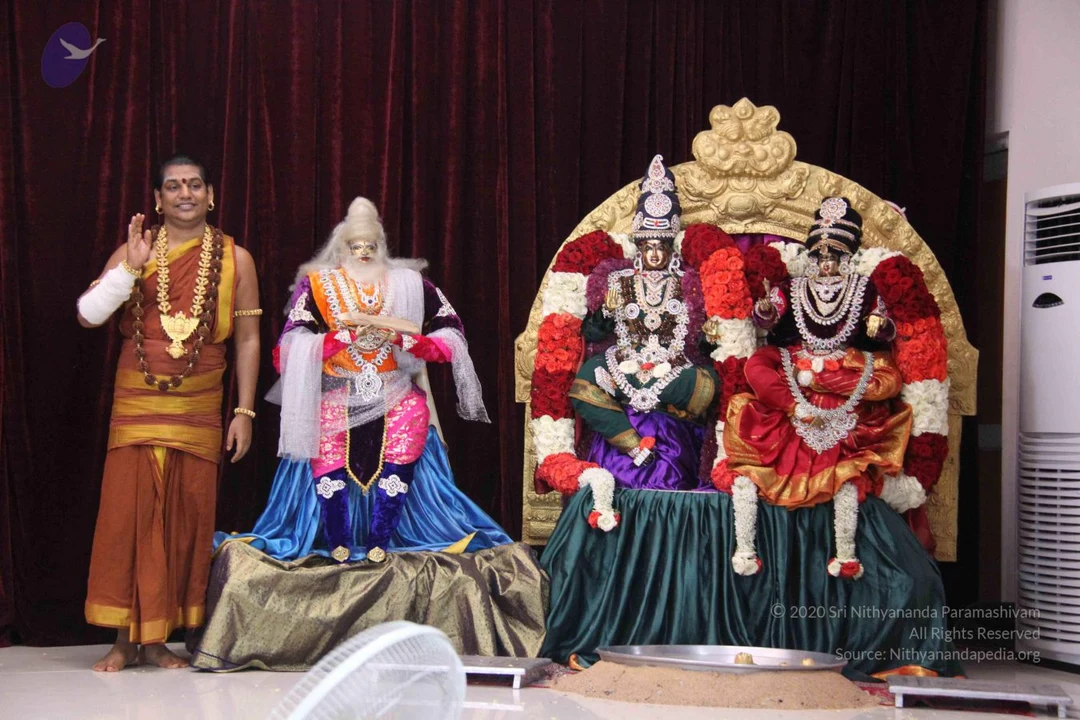
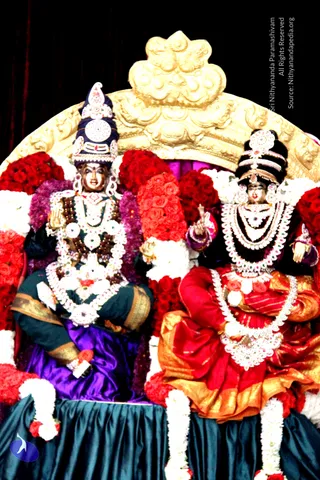
A photograph of two deity murti seated side by side on a golden throne-like backdrop with ornate carved gold relief. The figure on the left has a gold face, a tall dark conical crown with a red-stone Shiva-lingam motif, a dark green garment, a rudraksha mala and layered gold and jewelled necklaces, with one hand raised in abhaya mudra. The figure on the right wears a black crown with jewelled ornaments, a deep maroon garment, layered jewelled necklaces and a golden hand. Both are surrounded by garlands of red and white roses and purple flowers. These are statues, not living people.Close view of two deity murtis (golden metal images) seated side by side on a gold throne, adorned for worship. The figure on the left wears a tall black crown with jeweled ornaments and a red stone, a green garment, layered gold necklaces, and rudraksha-style beads, its right hand raised in abhaya mudra. The figure on the right wears a black crown with jeweled head ornaments, elaborate crystal necklaces and earrings, and a red silk garment, holding a small ceremonial object. Both are surrounded by abundant red roses, white flowers and purple blossoms as garlands. The ornate gold backdrop and floral arrangements indicate a temple decoration or puja setting. No living people are visible.A photograph of a temple-style stage with three figures. On the left, a white-haired, white-bearded figure in an orange, pink and purple embroidered garment with blue skirt and sheer white shawl holds a book and sits on a brown cloth-covered seat; the figure appears to be a statue or mannequin rather than a living person. Centre and right, two seated deity murti figures sit on a teal-draped dais under a gold arched backdrop framed with red roses and white garlands; the central figure wears a tall crown, blue-green and purple robe and layered pearl-like necklaces, and the right figure wears a red and gold sari with a crown and multi-strand necklaces, hands raised in mudra. Deep maroon velvet curtains form the backdrop.Two deity murtis seated side by side on a golden throne with ornate gold relief carving behind them. The figure on the left wears a tall dark blue crown with a white and gold ornament and a dark green garment, draped in silver-white jewelled necklaces and garlands, with its right hand raised in abhaya mudra. The figure on the right wears a dark crown with a silver ornament, a red and gold garment and layered jewelled necklaces, with a gold hand raised holding a small object. Both are surrounded by red roses, white flowers and purple blossoms in dense garlands.A standing man in orange and saffron robes, with a rudraksha mala and ceremonial gold necklace, raises his right hand in greeting on a stage. Beside him seated figures are dressed in ornate garments and crowns, with a deity murti shown in garlanded red and white flowers within a golden arch. Figures in a blue and orange ensemble and a green-and-purple ensemble sit on satin draped seats. A small plate of offerings and sand sits in front of them, with a fan and an air conditioner at the edges.

HOMA
76 photosSource gallery
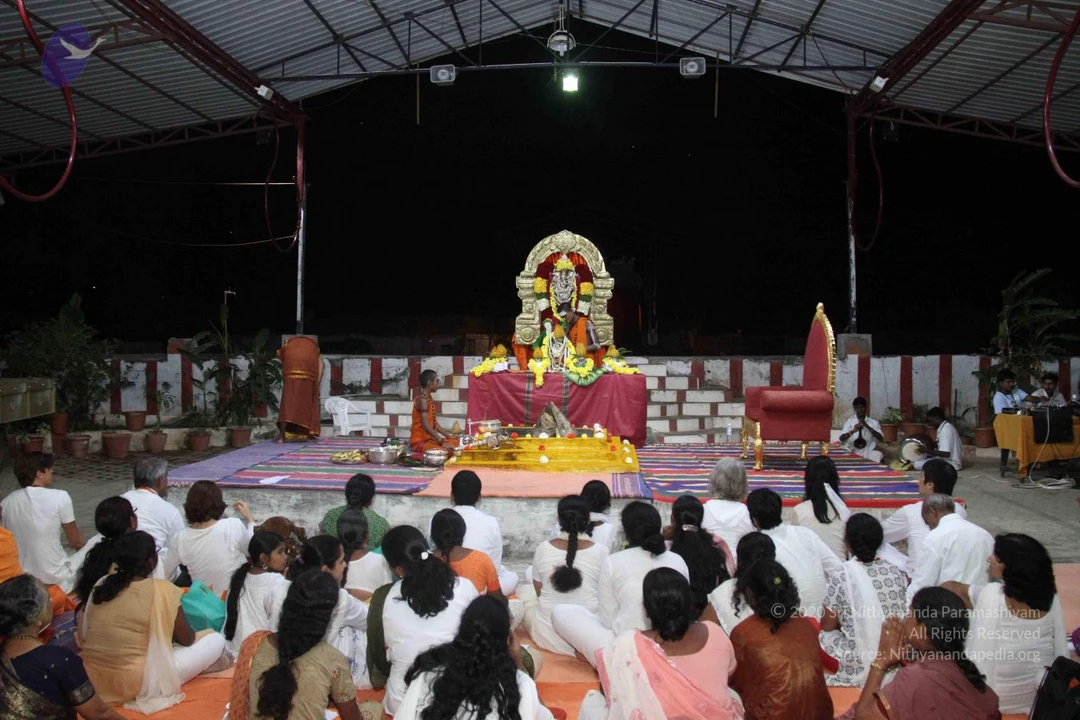
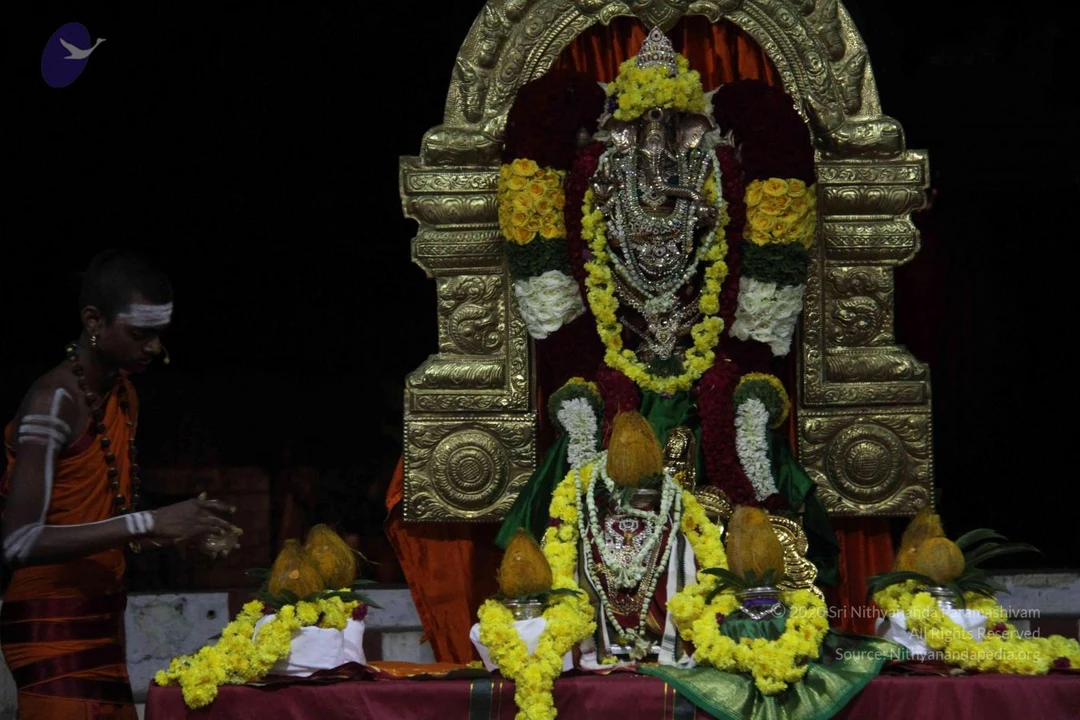
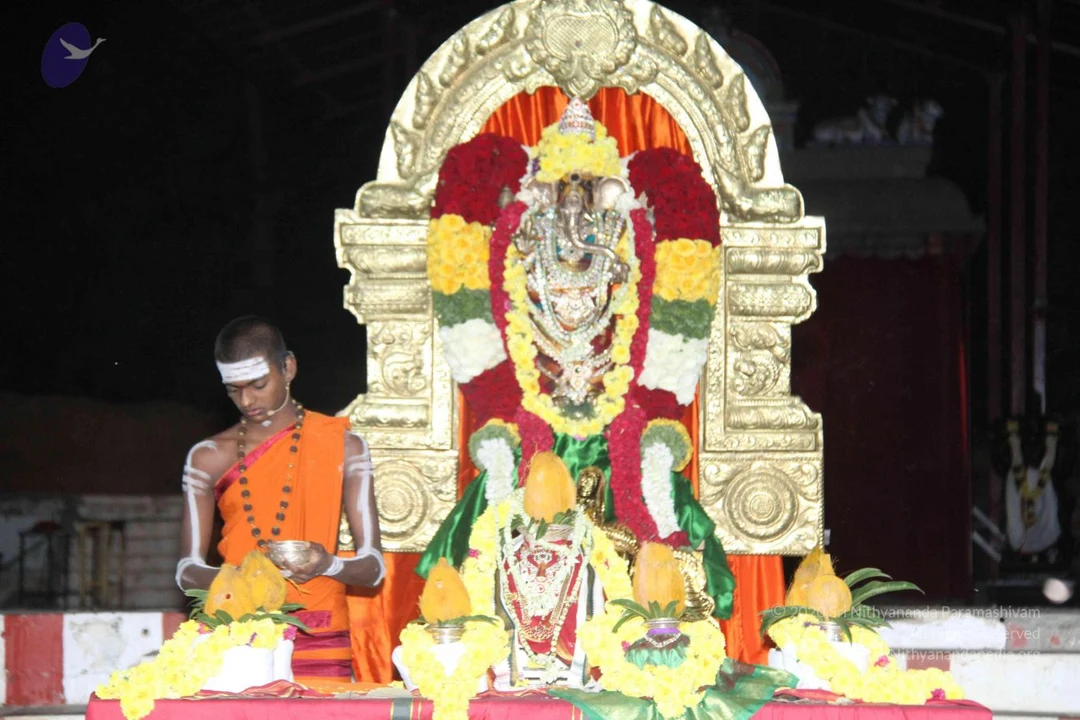
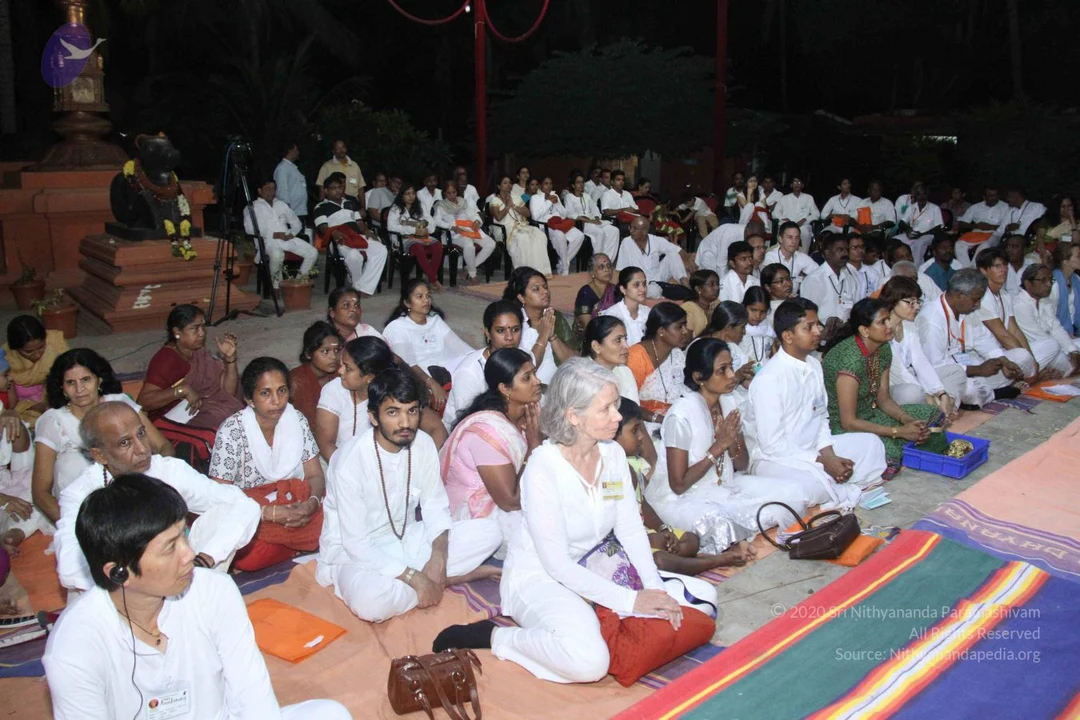
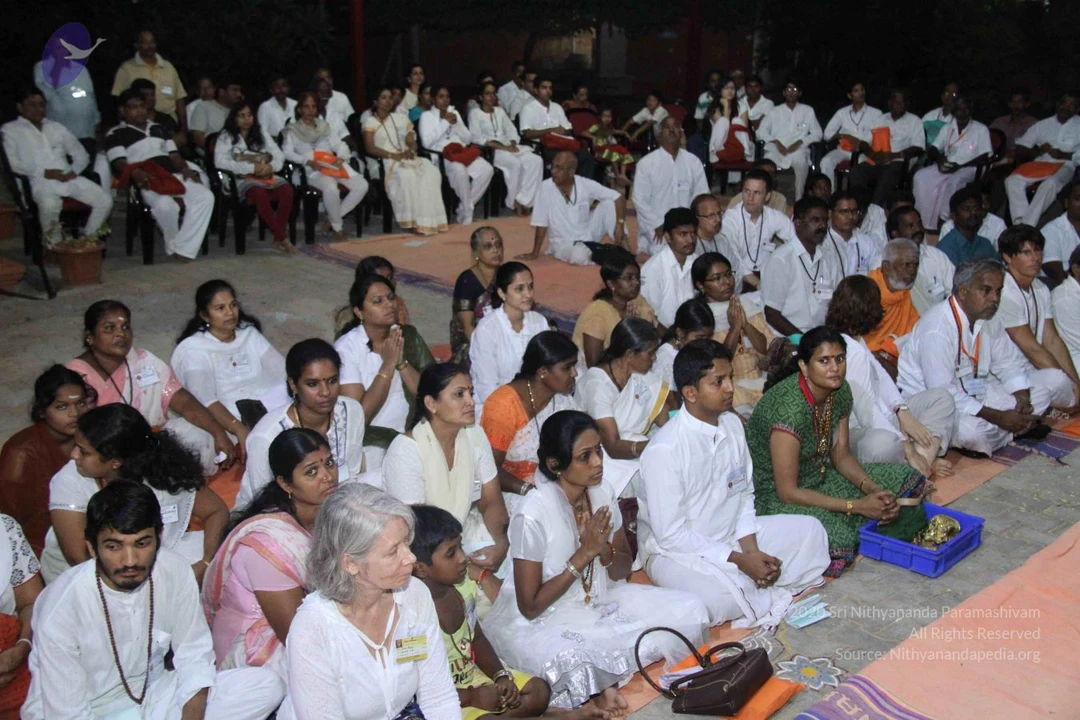
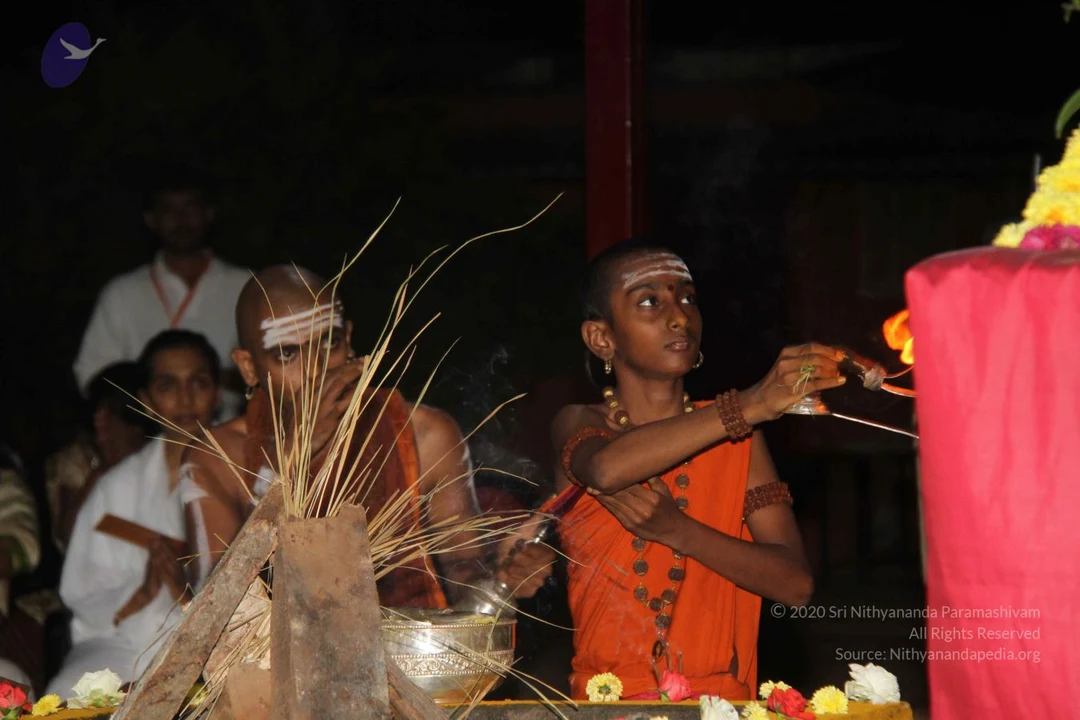
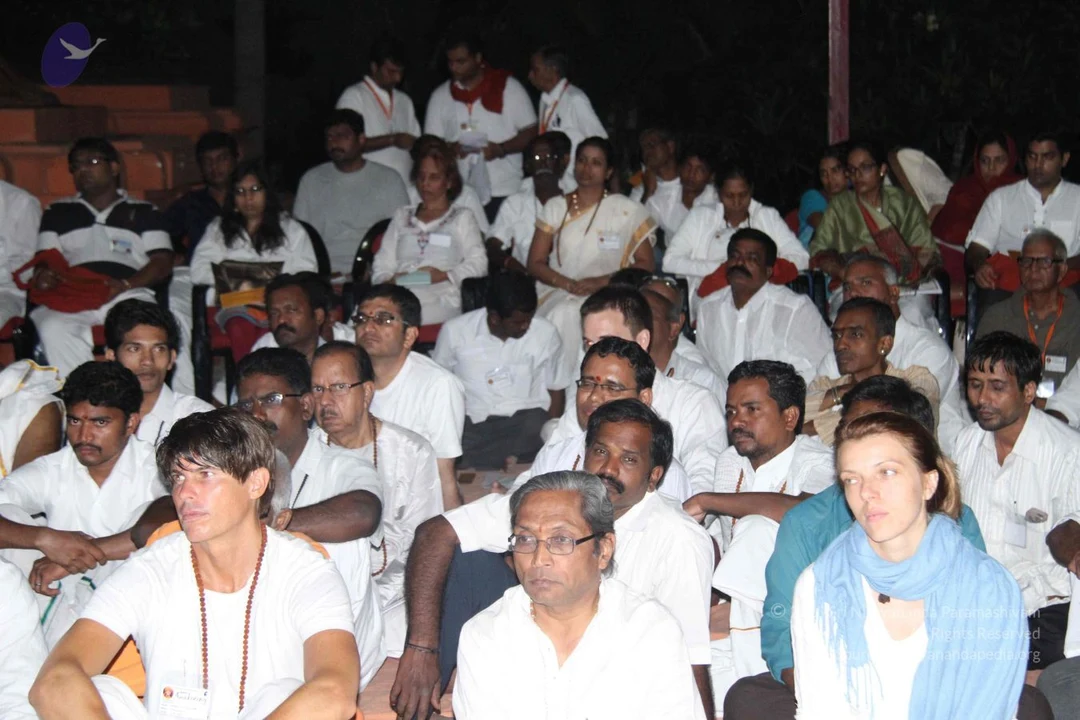
Night-time outdoor puja in an open-sided pavilion with a corrugated roof. Devotees in white clothes sit cross-legged on orange mats facing a raised platform. Centre stage a deity murti is adorned with garlands and a gold arched backdrop, with a red-draped altar, brass vessels and a yellow-draped table in front. A woman in orange robes performs the ritual at the left of the altar; a robed attendant stands behind. A red and gold throne stands empty at the right, and musicians sit at the far right with drums and harmonium. Many devotees are seated in the foreground, mostly women, some with hair in braids, and several older men in white. No identifiable a person figure is visible on the throne, so no candidate is marked.A photograph of a temple shrine with a silver-adorned Ganesha murti (deity murti) framed by a gilded arch and draped in marigold and rose garlands. In front, a kalasha-like coconut arrangement and several small pots rest on a maroon cloth with yellow flower garlands. On the left, a shaven-headed priest in an orange dhoti and white tripundra marks on his forehead and arms stands at the edge of the frame, his hands extended over the offerings in a puja. The background is dark. The image is credited to the archive.A photograph of a night-time ritual before a decorated Ganesha murti under a gilded arch. A young priest in an orange-saffron dhoti and shawl, with a white vertical tilak on his forehead, rudraksha mala and white painted arm markings, stands at left holding a small silver bowl and looking down. The deity is garlanded with red, yellow and white flowers and dressed in silver ornaments, with an orange cloth backdrop. In front lie yellow-orange fruits, banana leaves, green cloth and yellow marigold garlands on a red-edged platform. The priest is the only visible person and appears to be performing puja or offering. The priest's appearance does not match any a person cues, so no candidate is identified.Photograph of a Ganesha deity murti decorated for worship, set within an ornate gold arch-shaped frame against an orange and red drape. The elephant-headed deity wears a silver-toned crown and layered garlands of red roses and yellow and white flowers, with green silk draped below. Mango fruits and yellow flower garlands are arranged on the altar in front. At right, a young priest in an orange dhoti and orange shawl with white tilak markings on his forehead and arms makes an offering to the deity. No identifiable a person is visible in the scene.Evening satsang outdoors at an ashram, with a large seated audience in rows on orange, red and multicoloured mats. Most attendees wear white, with some in saffron-orange shawls, red and green saris and salwar kameez. Many sit with palms pressed together in prayer or hands resting in lap. A black stone Shivalinga or deity murti draped with garlands sits on an orange stepped pedestal at left, near a stand holding a video camera on a tripod. Several people in front wear rudraksha malas and carry small handbags. Dark trees and a red pillar frame the background.Crowded outdoor satsang at dusk with a large seated audience on orange and pink mats. Most attendees wear white ritual clothing, many with white lanyard badges and some with orange scarves. A woman in the front centre sits with palms joined in anjali, and a man in white with a rudraksha mala sits at left. A blue plastic tray holds small brass items near a seated man in white. A woman in a green saree with gold jewellery sits at right. The audience faces away from the camera toward an unseen teacher's seat.
IA DARSHAN
56 photosSource gallery
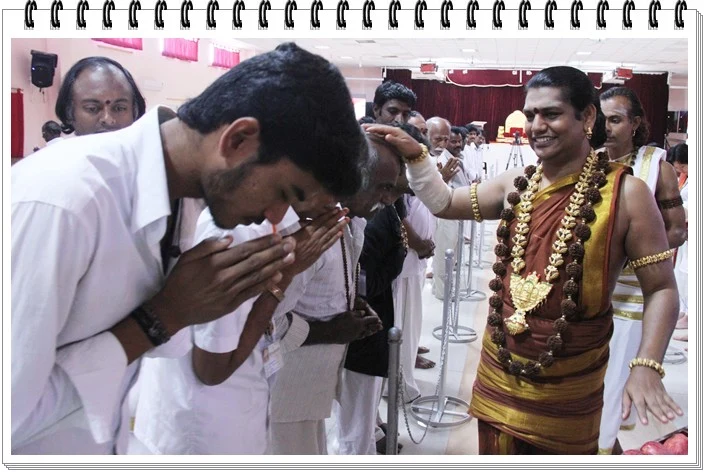
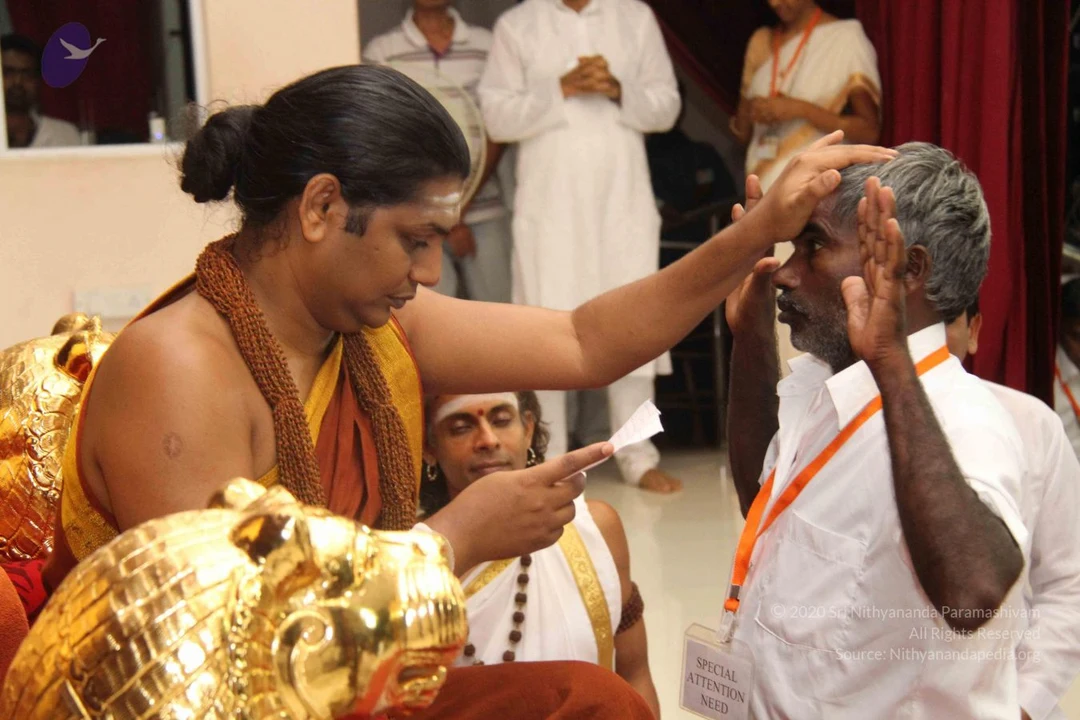
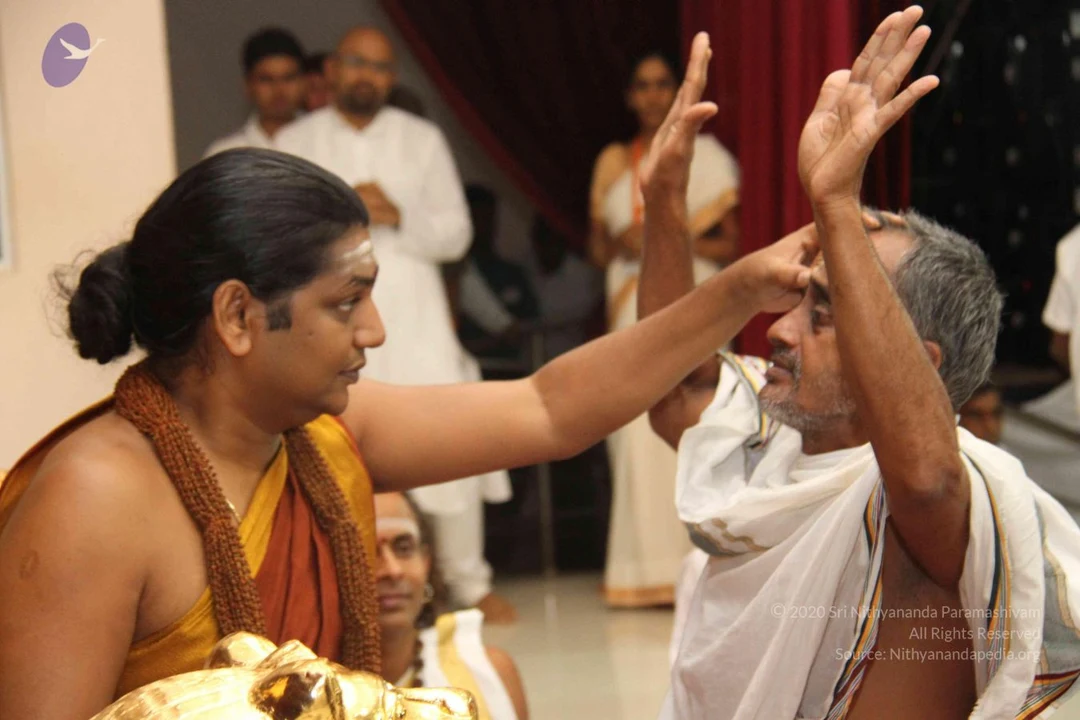
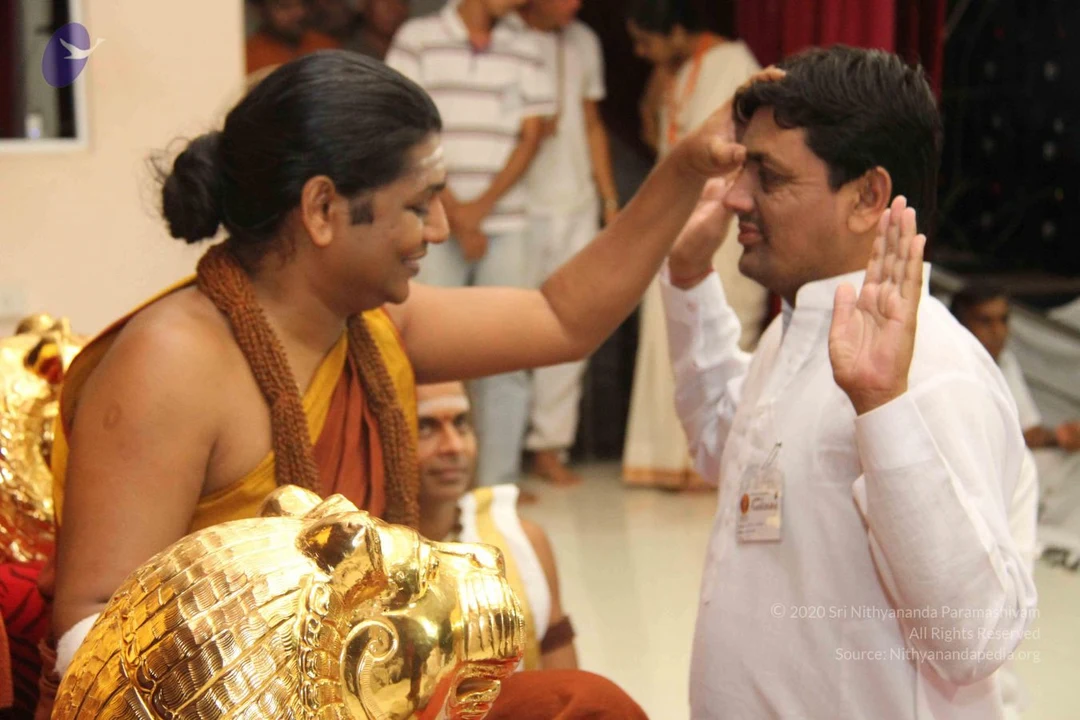
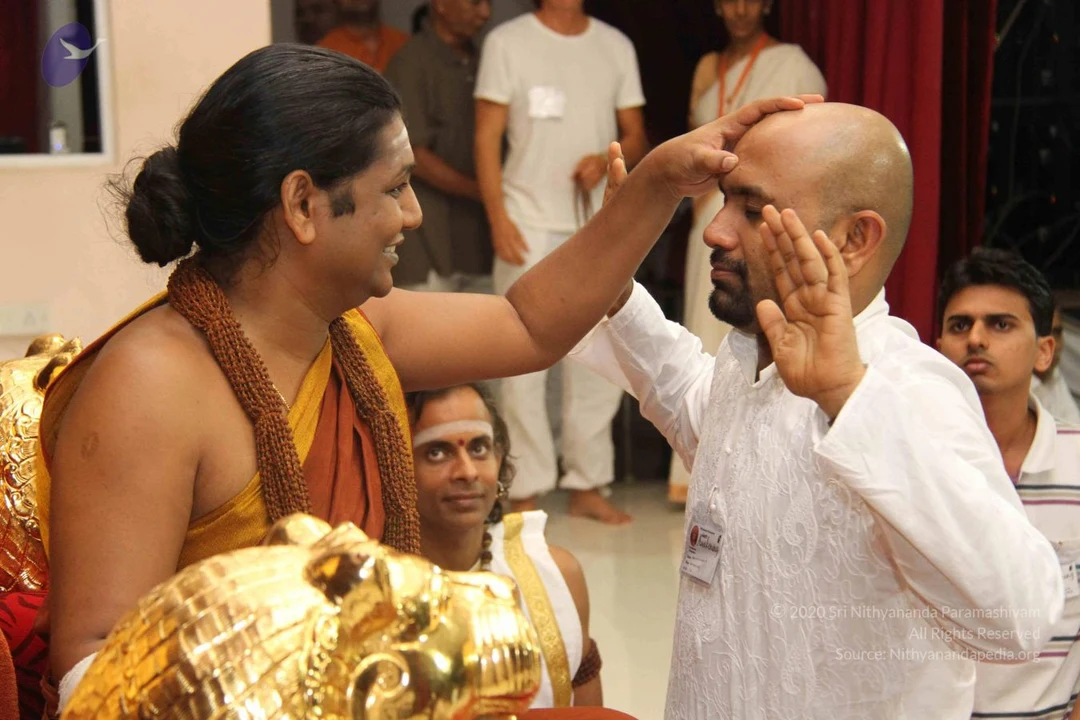
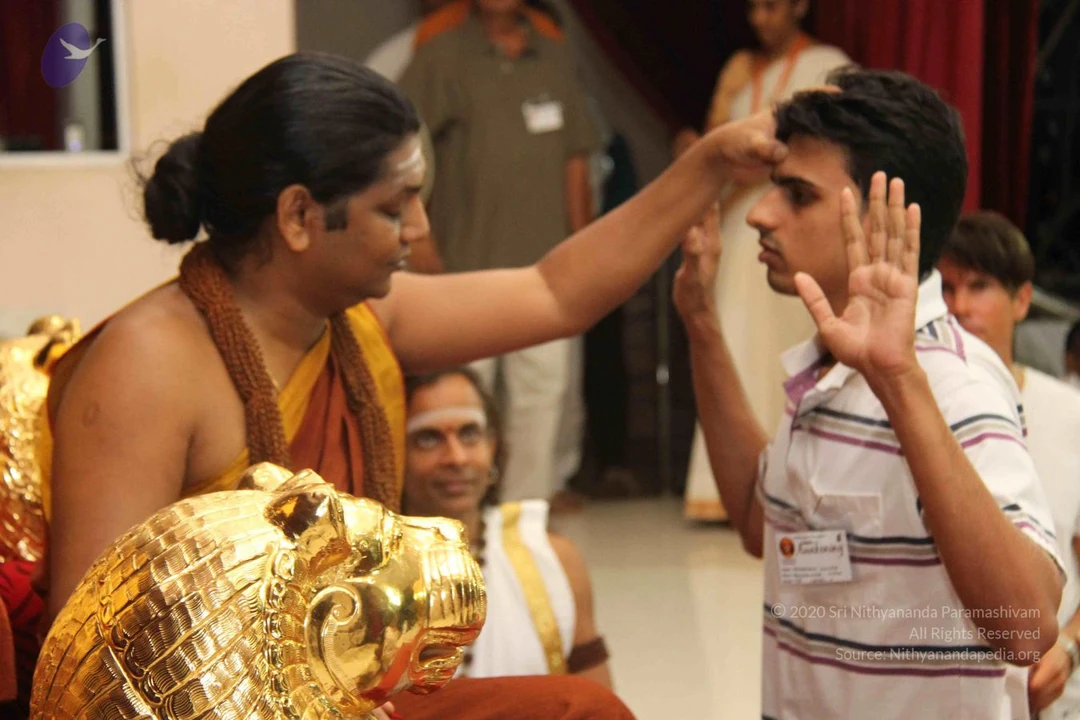
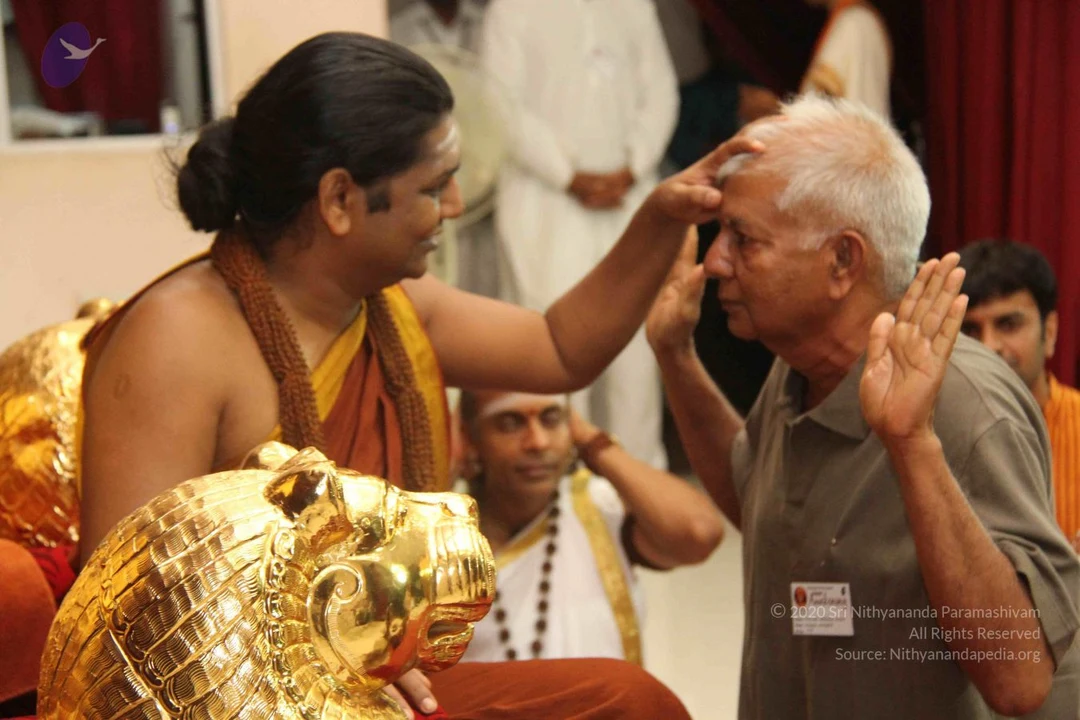
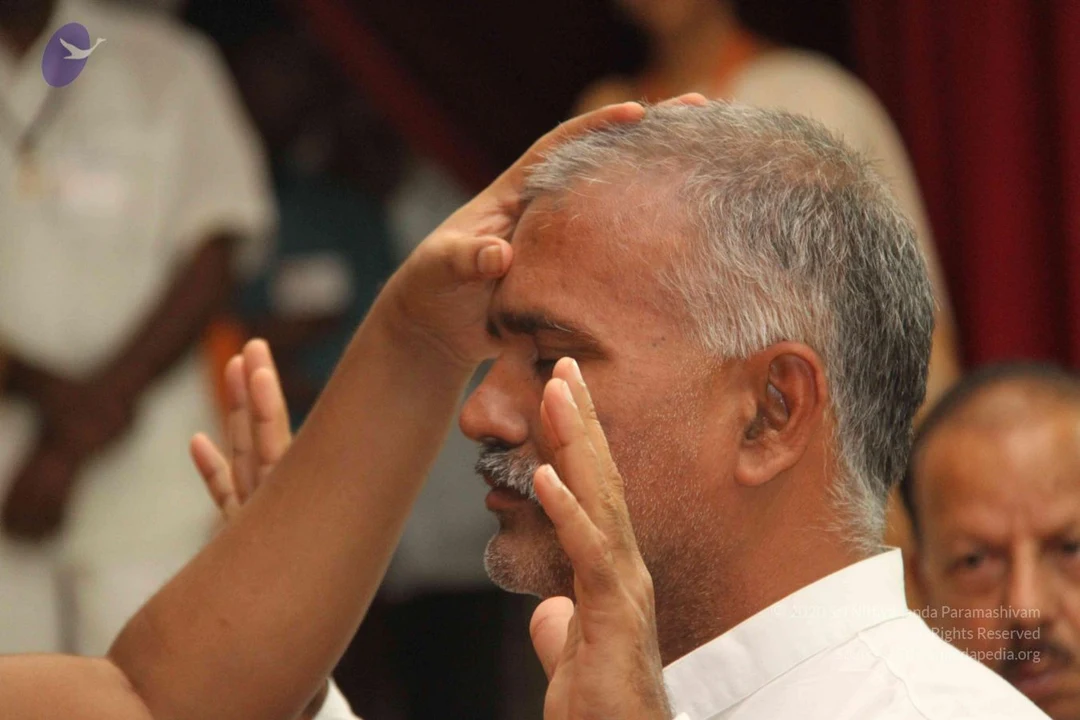
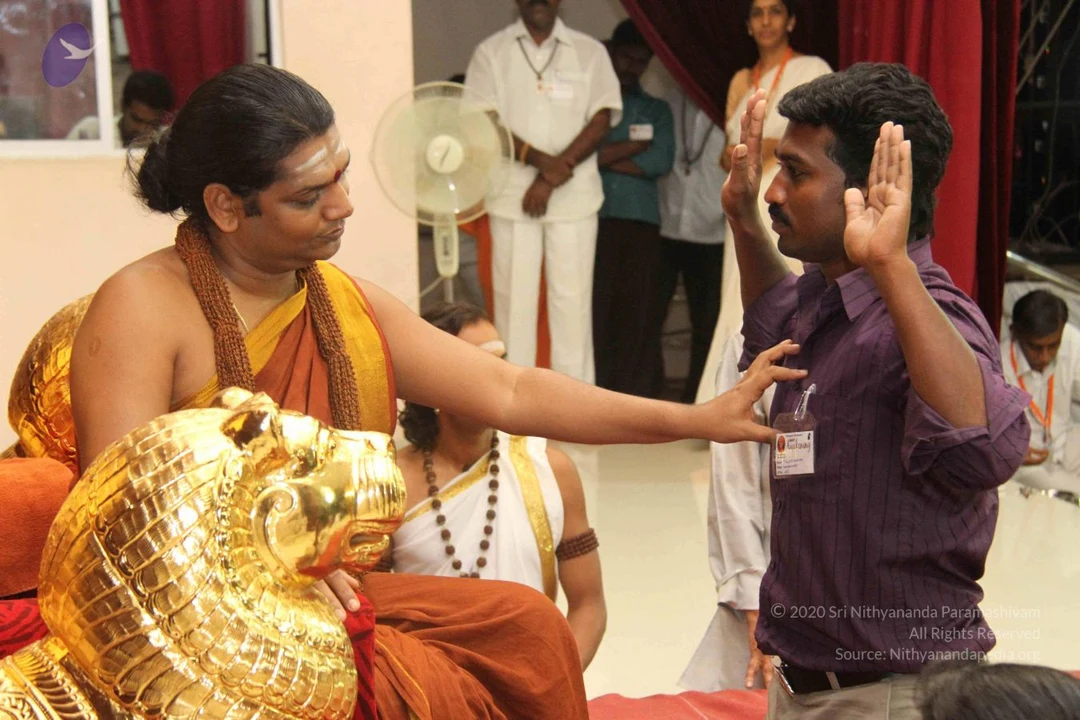
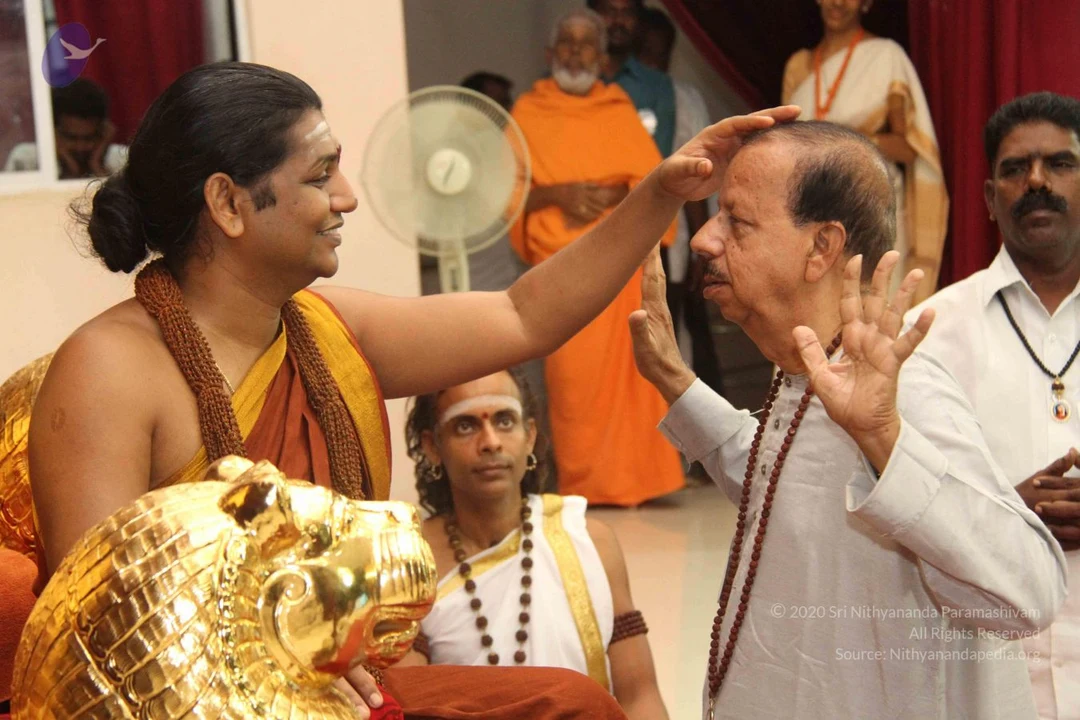
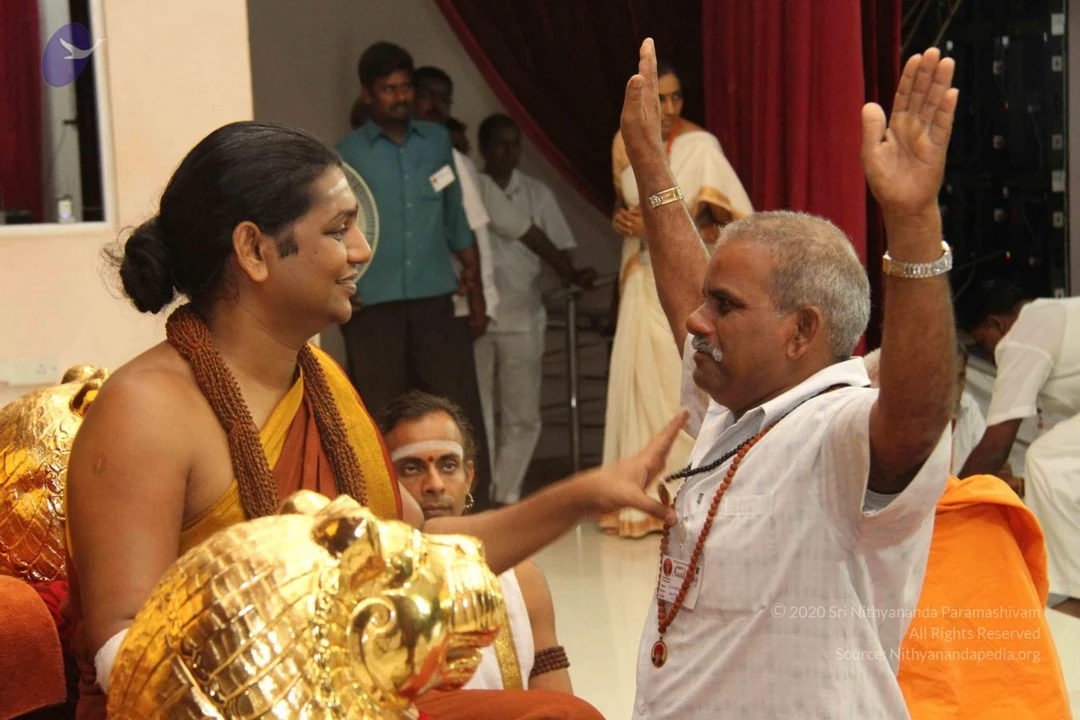
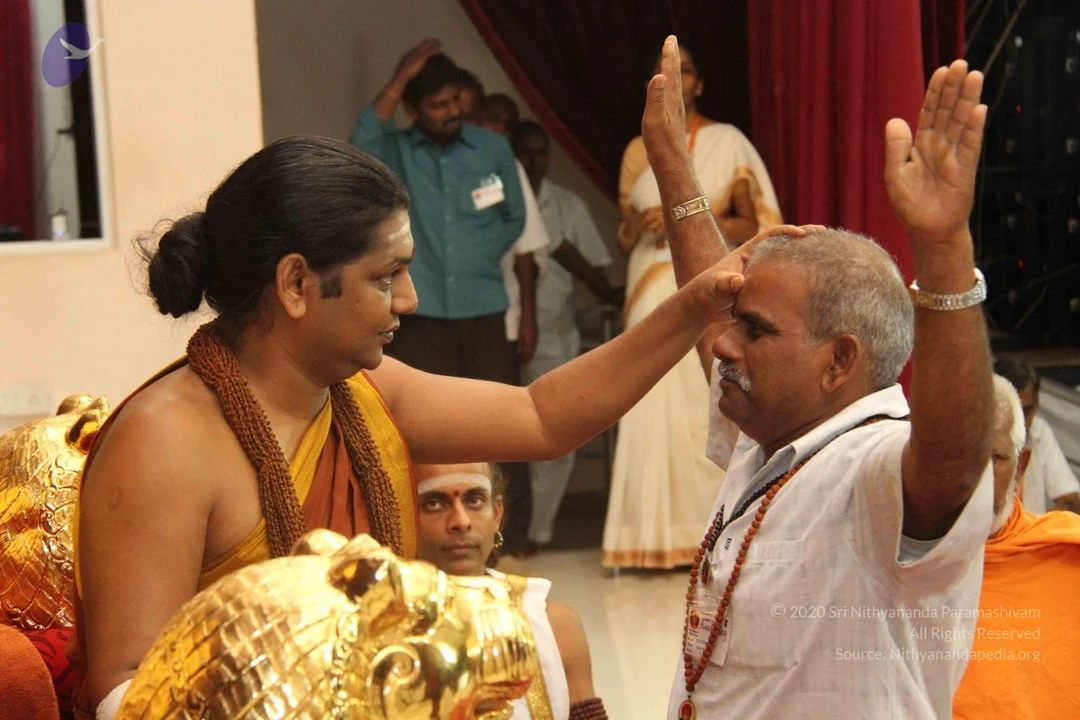
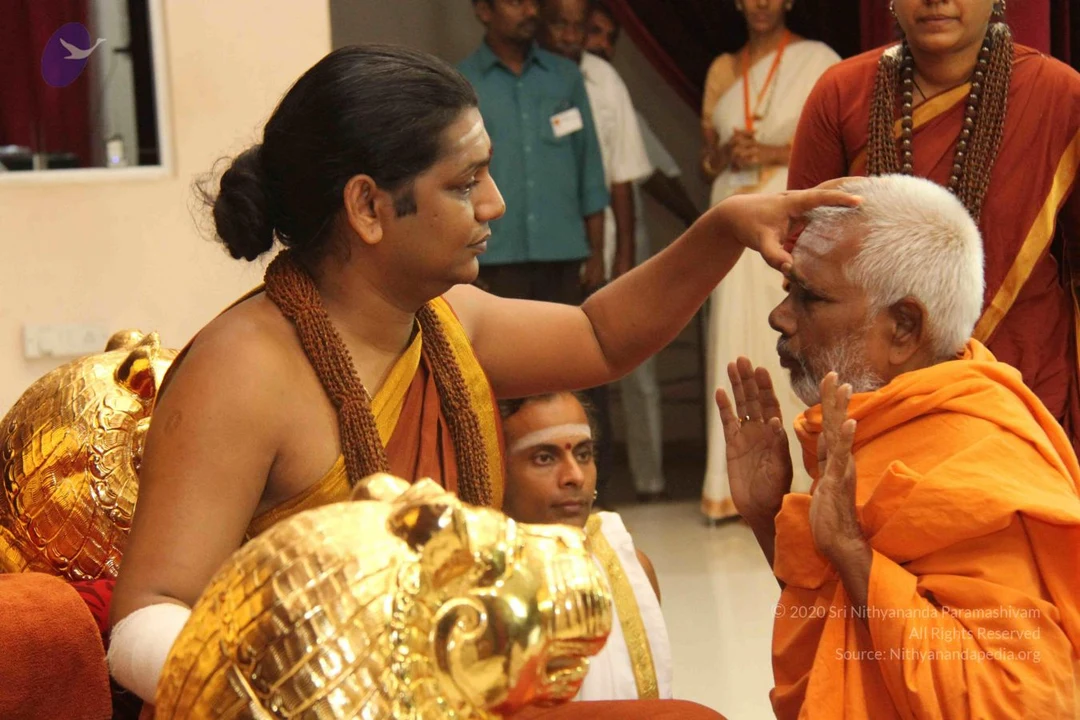
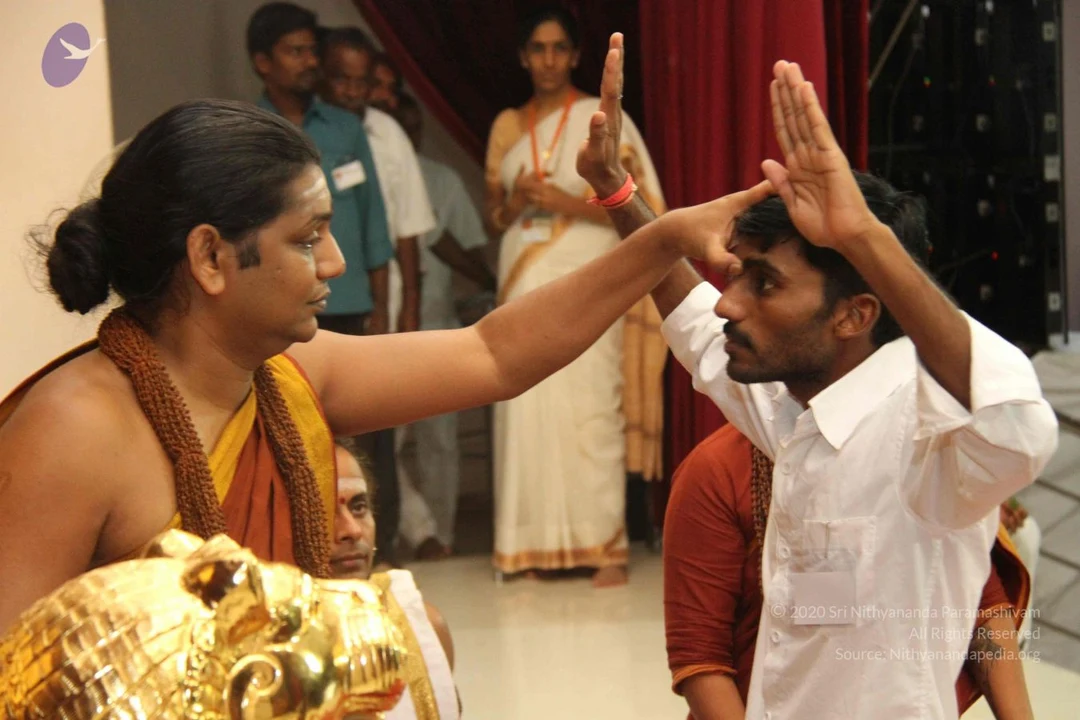
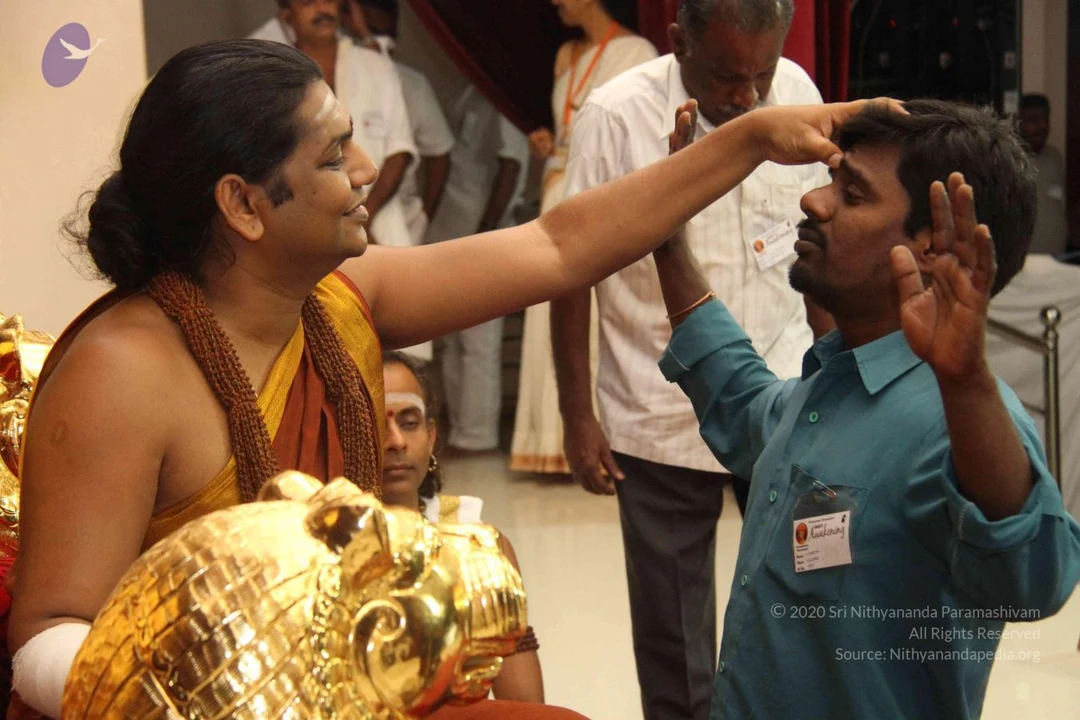
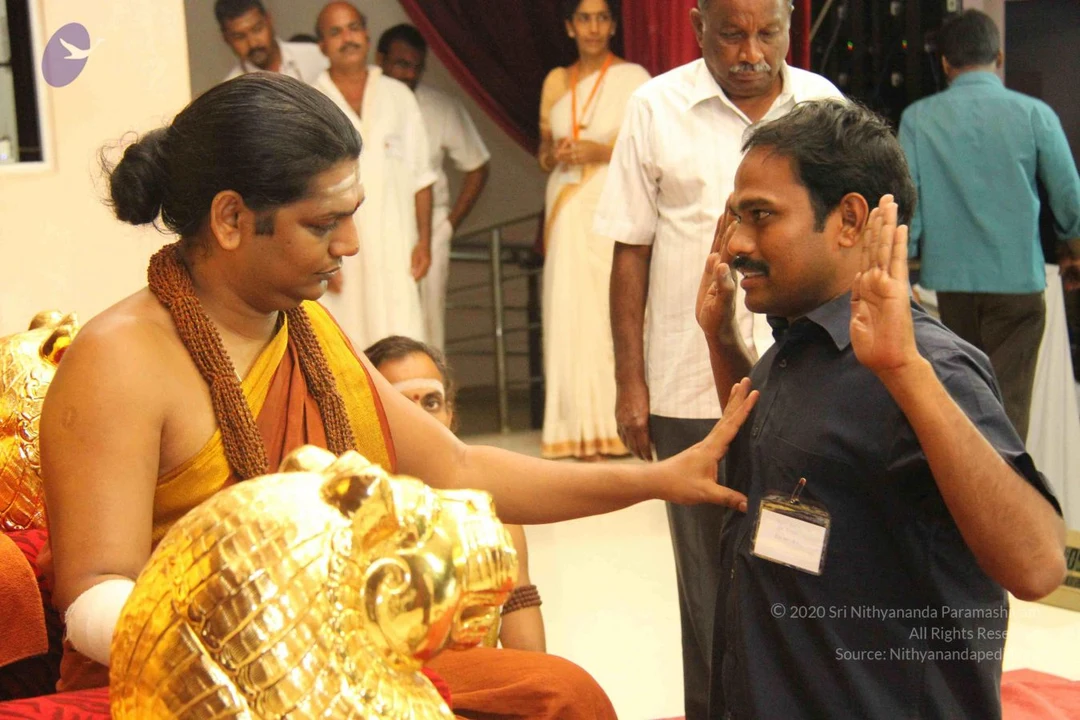
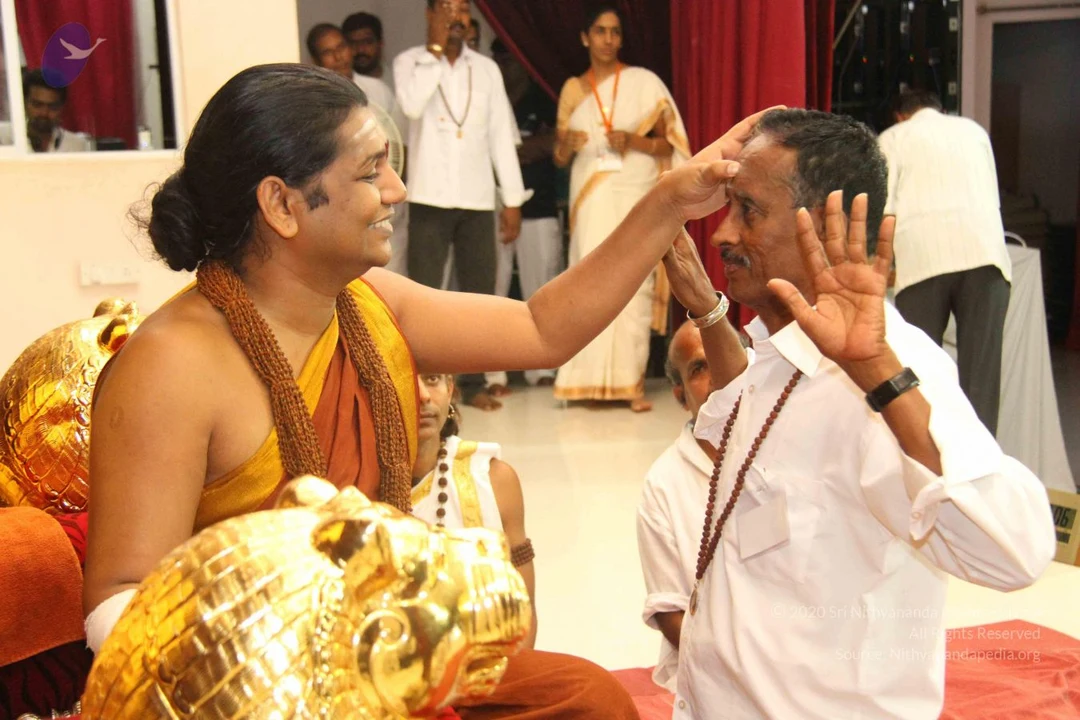
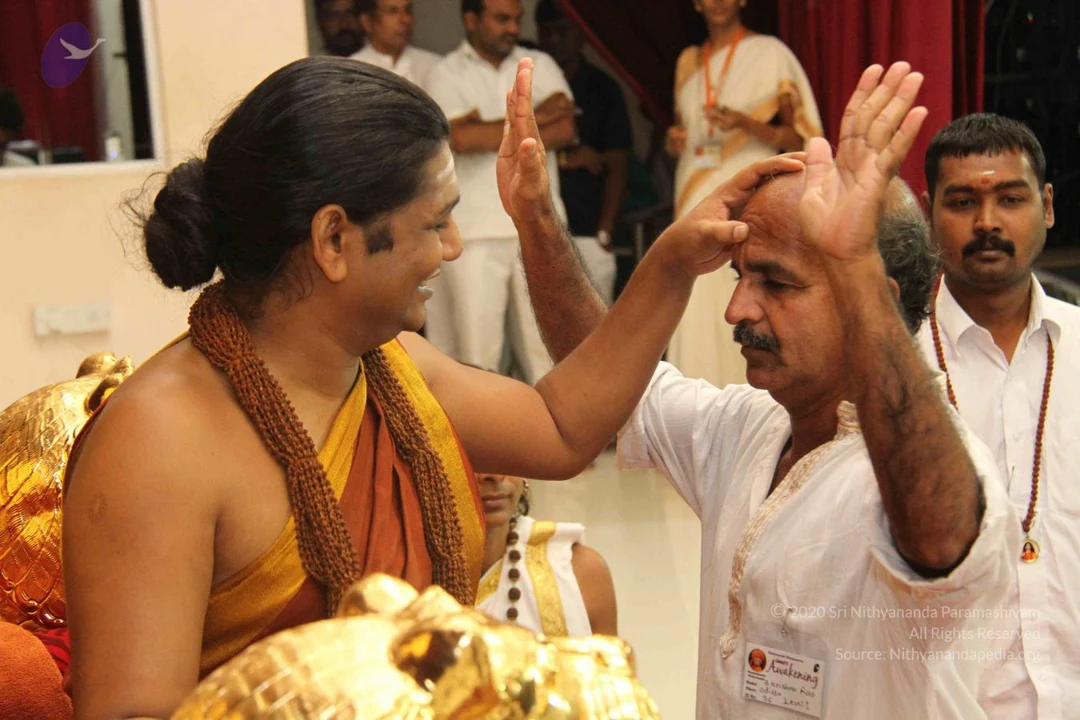
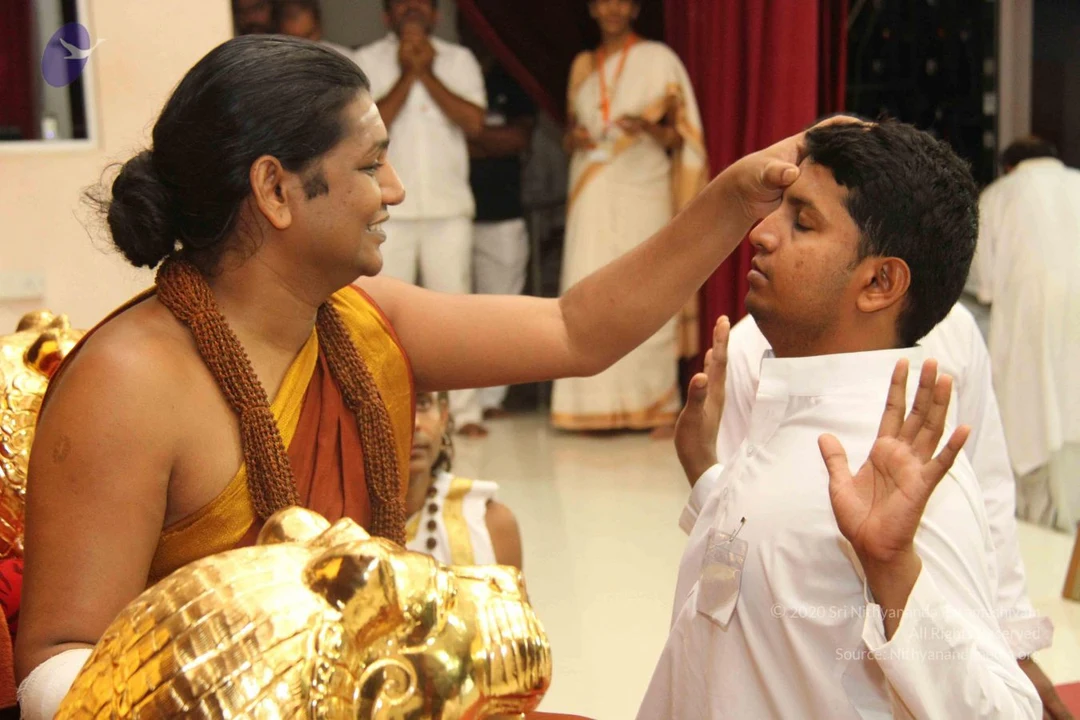
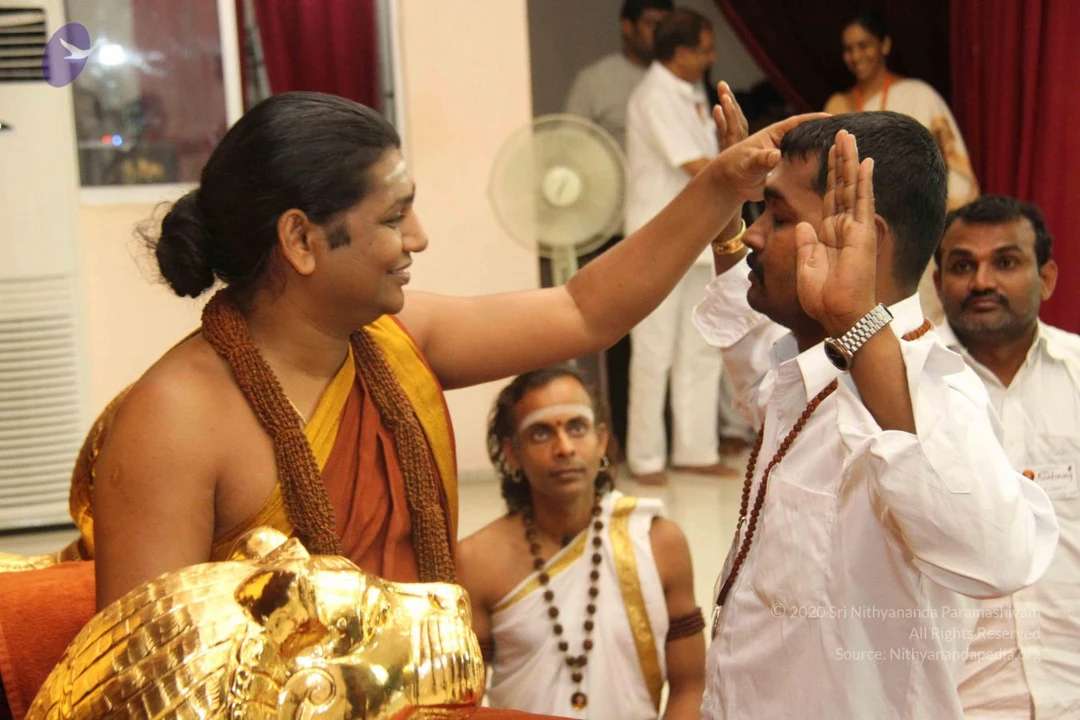
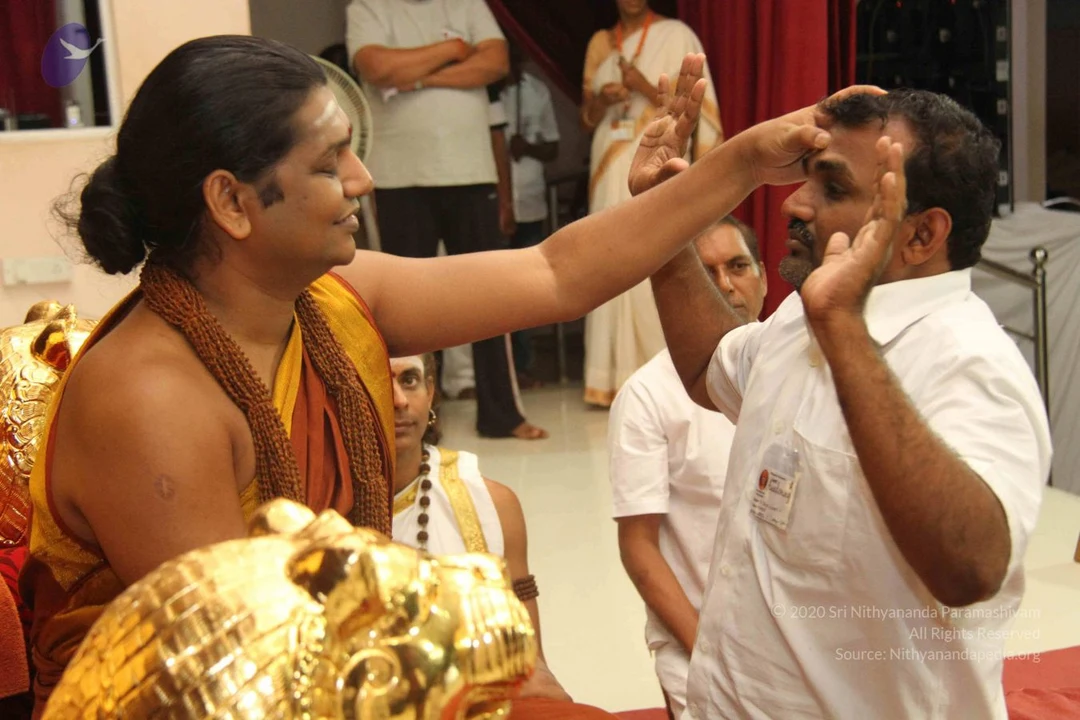
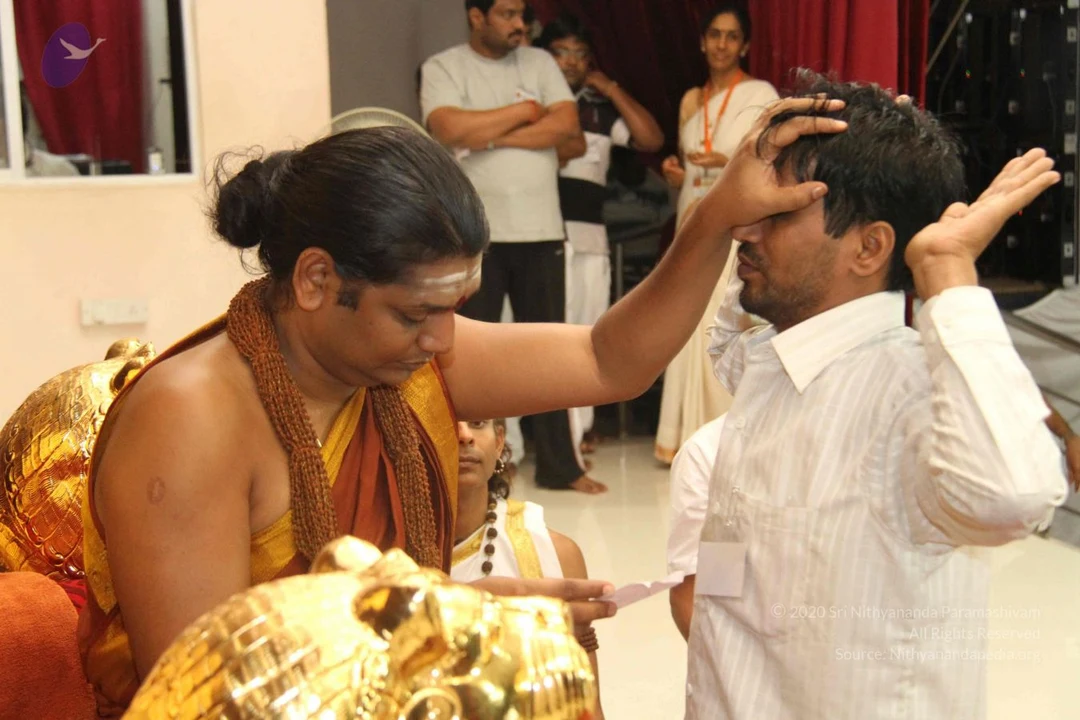
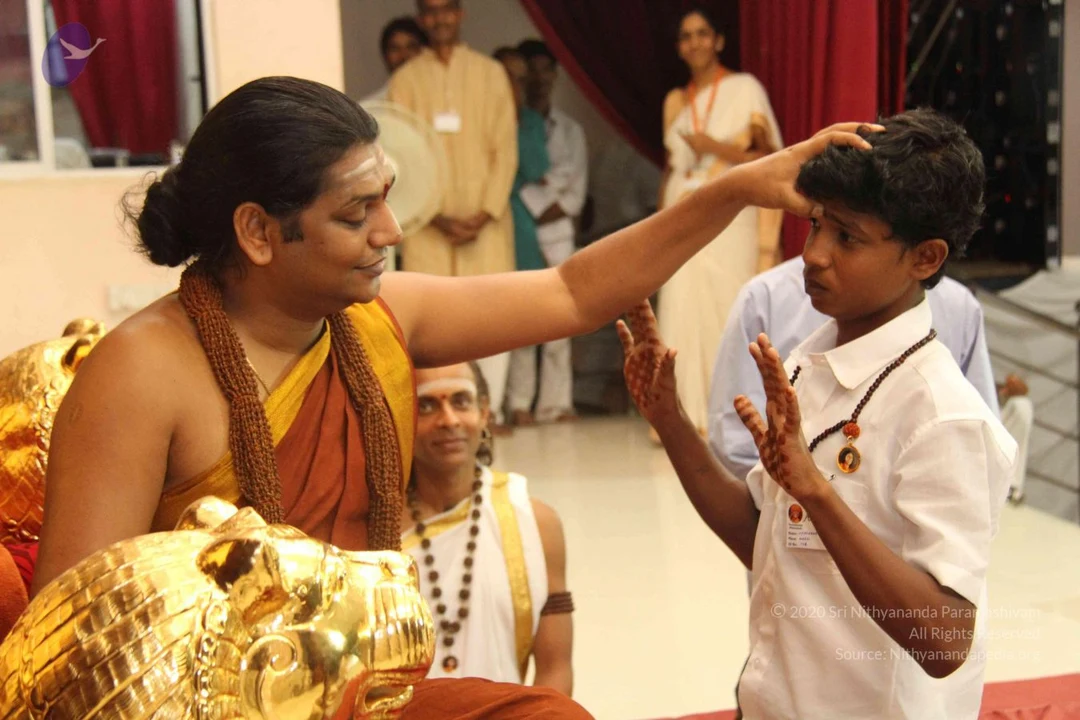
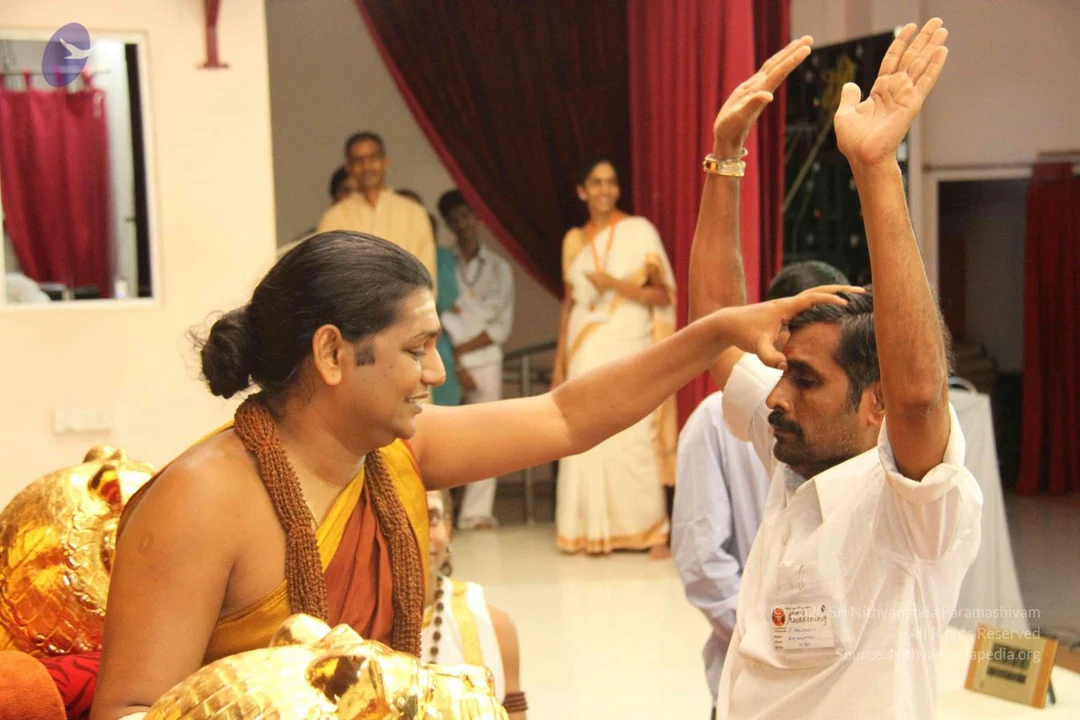
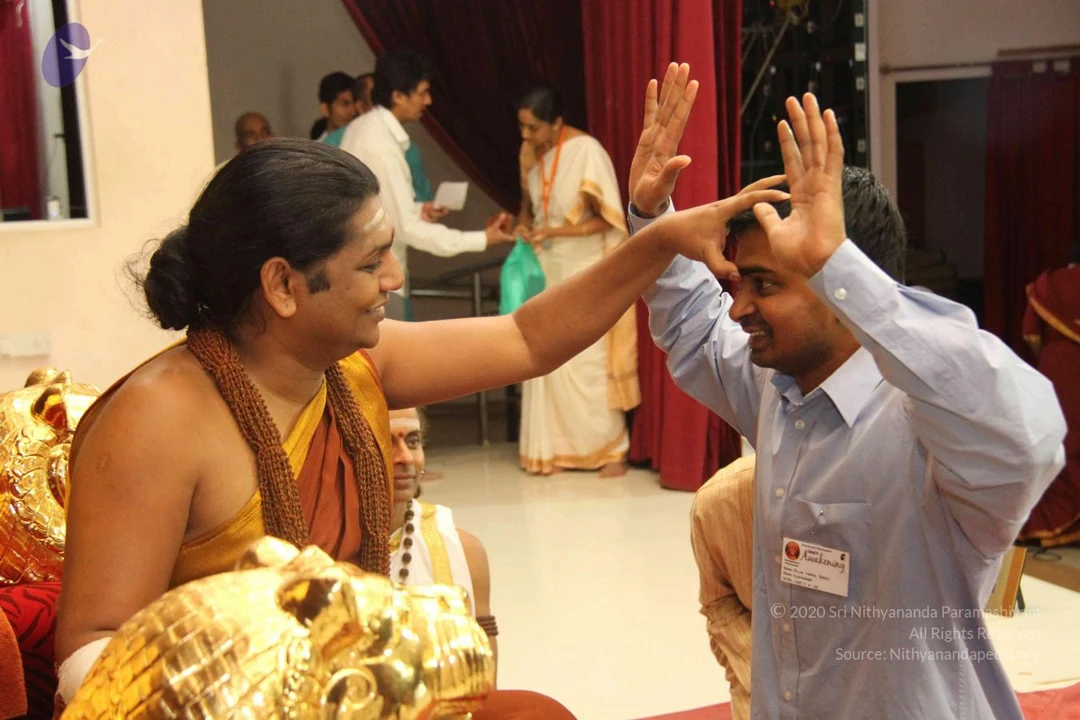
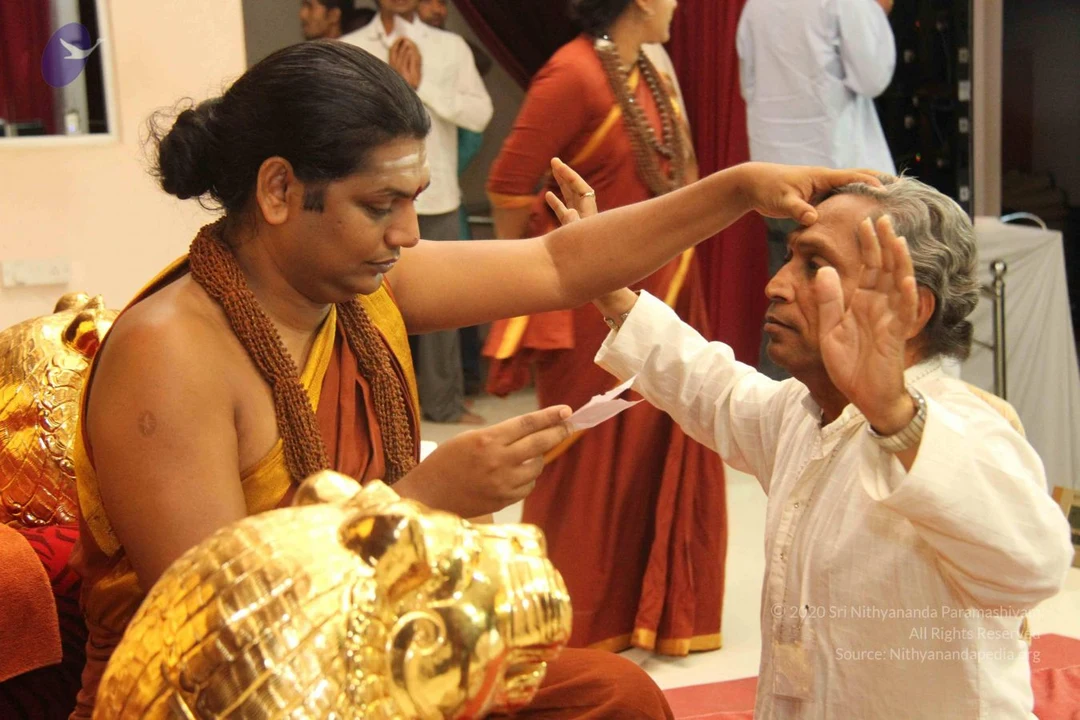
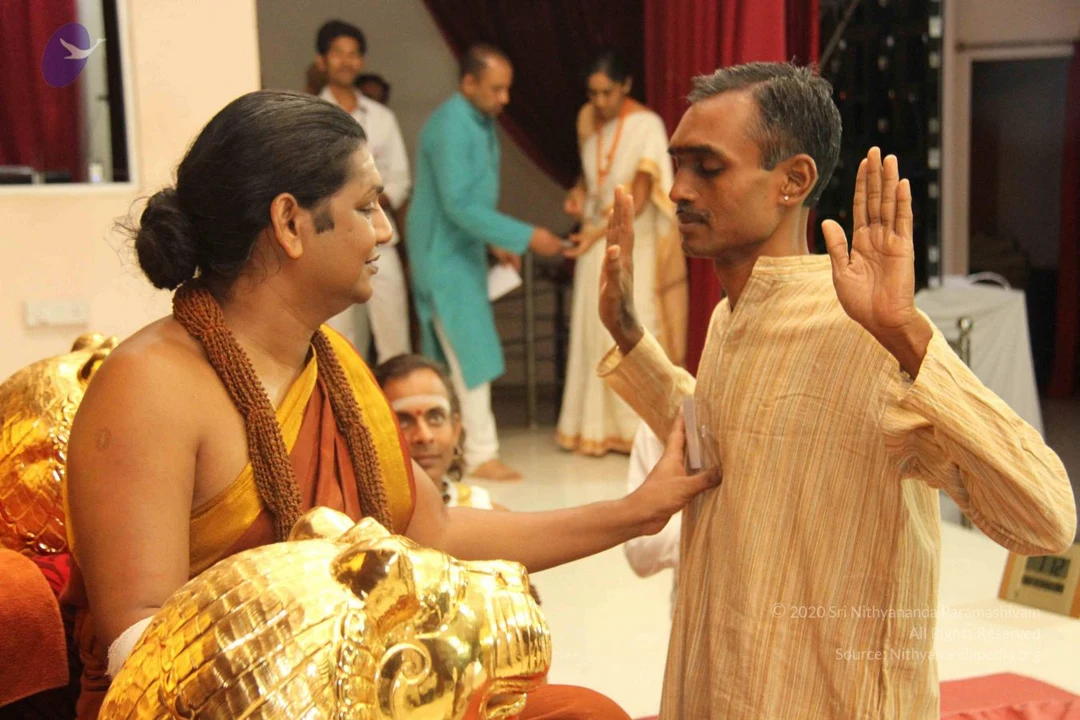
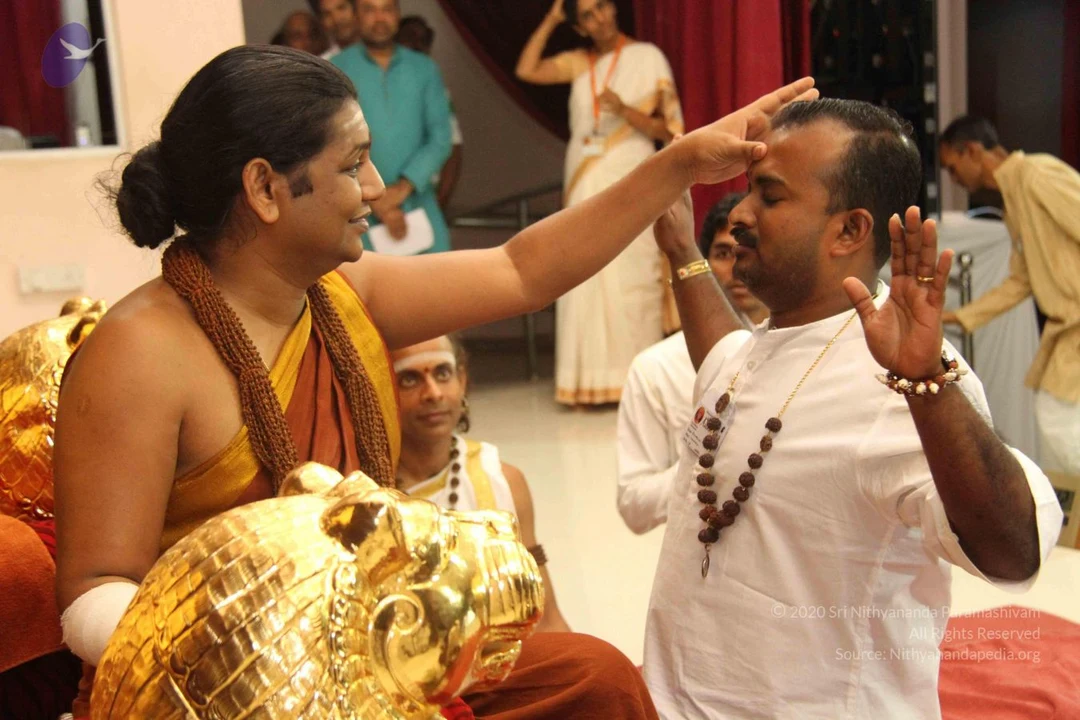
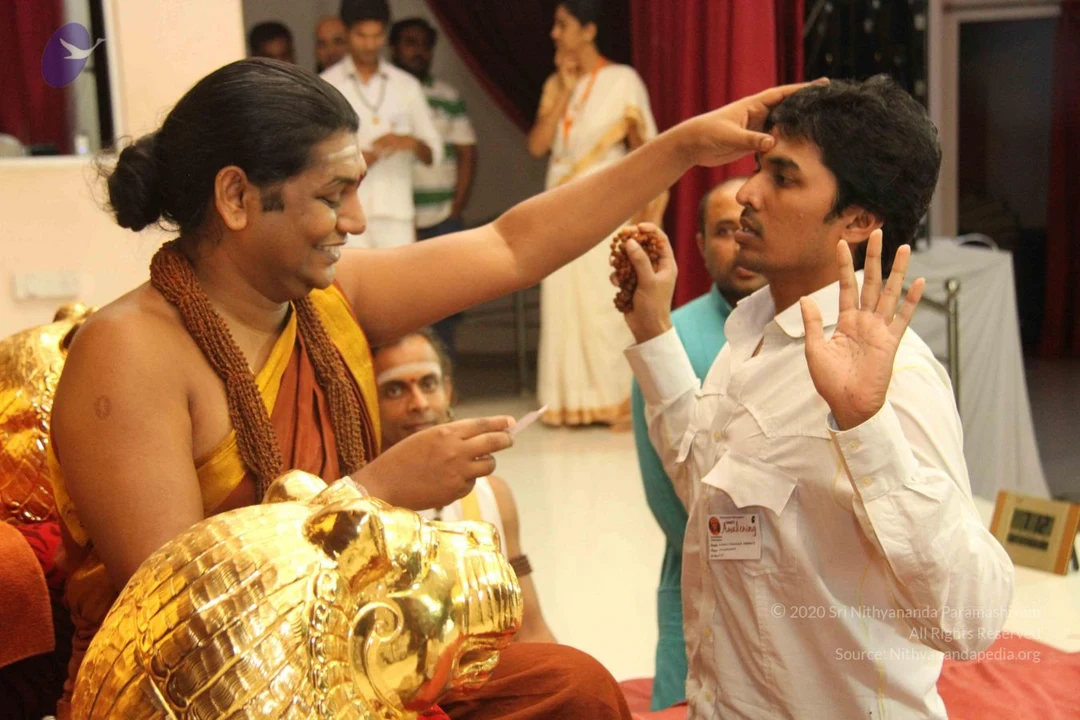
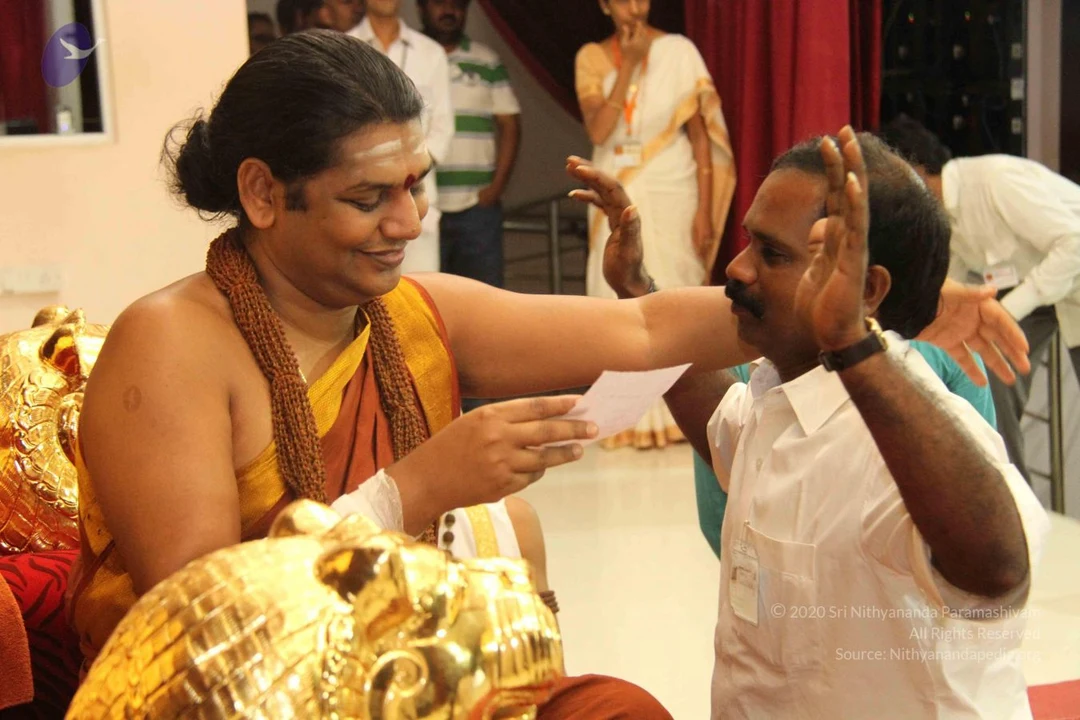
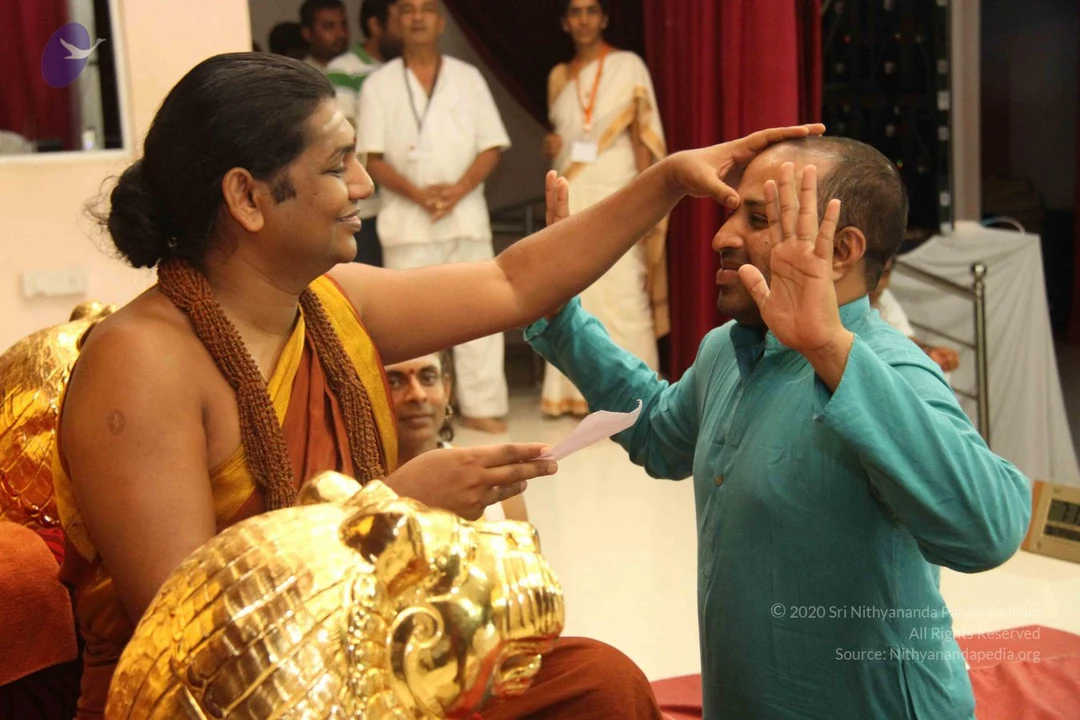
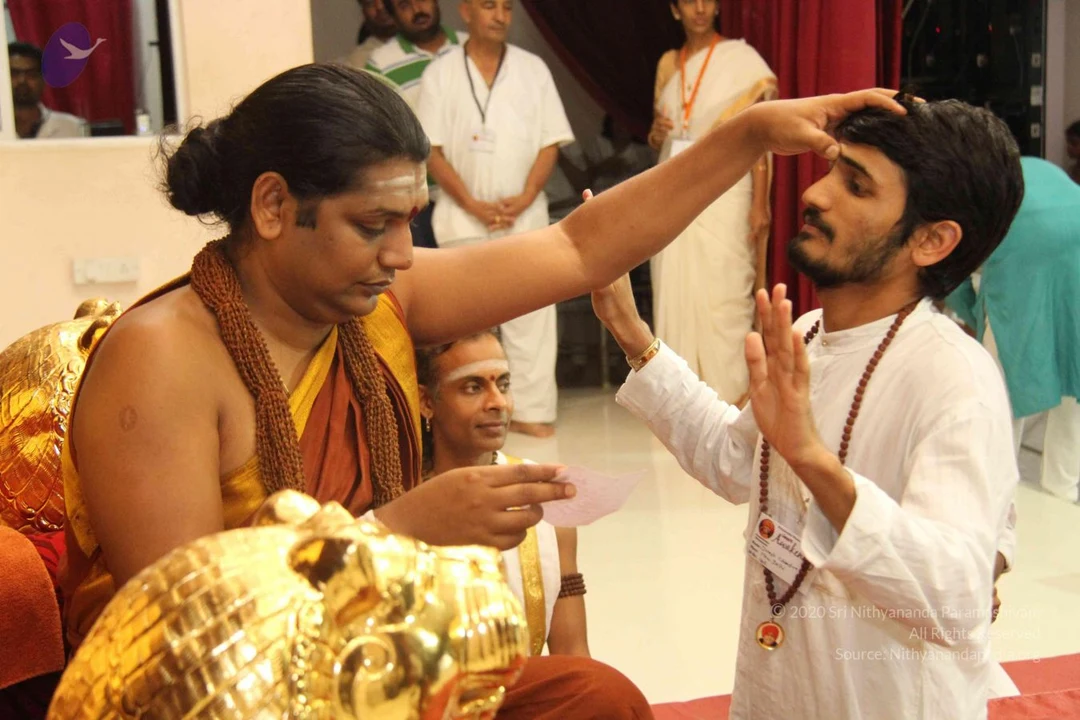
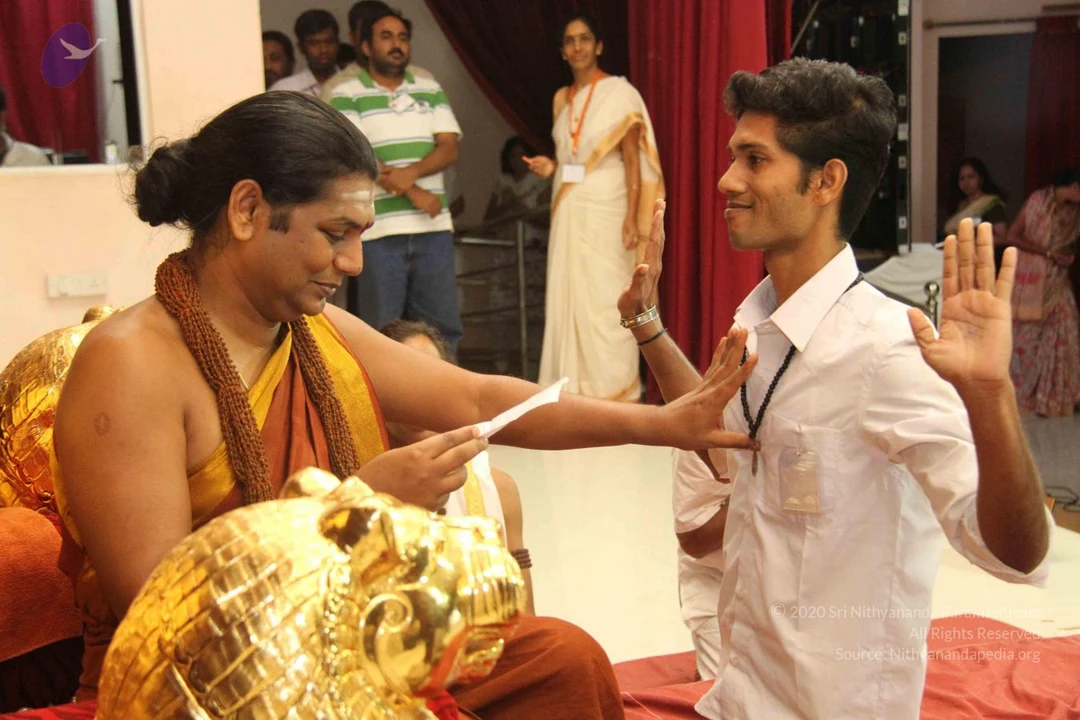
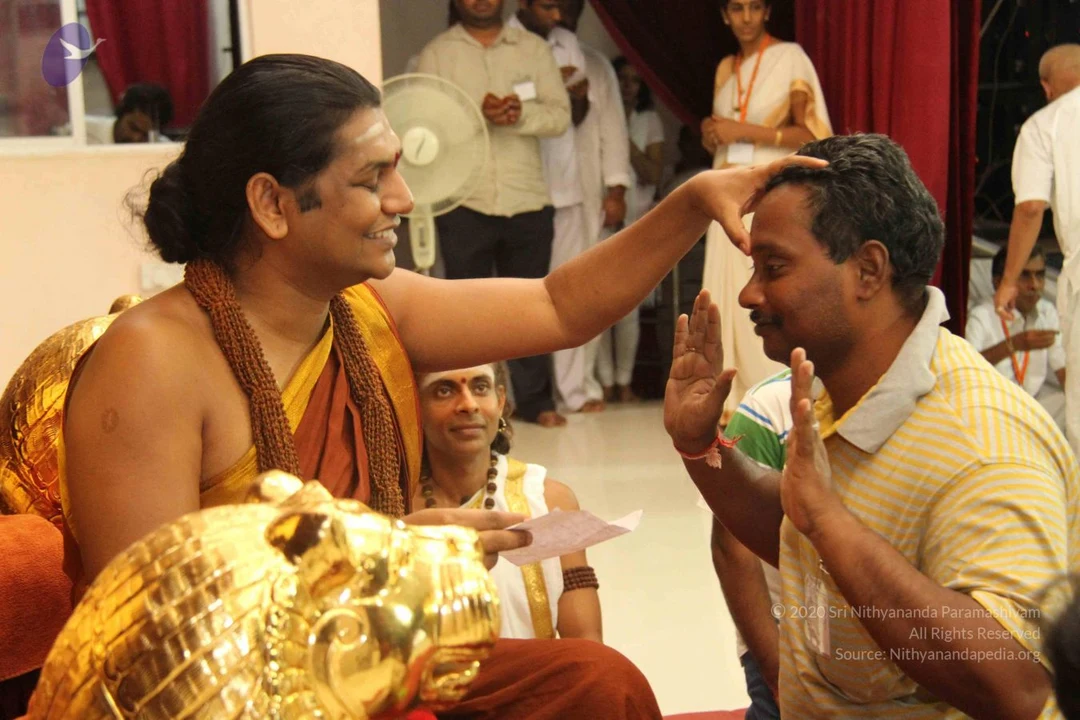
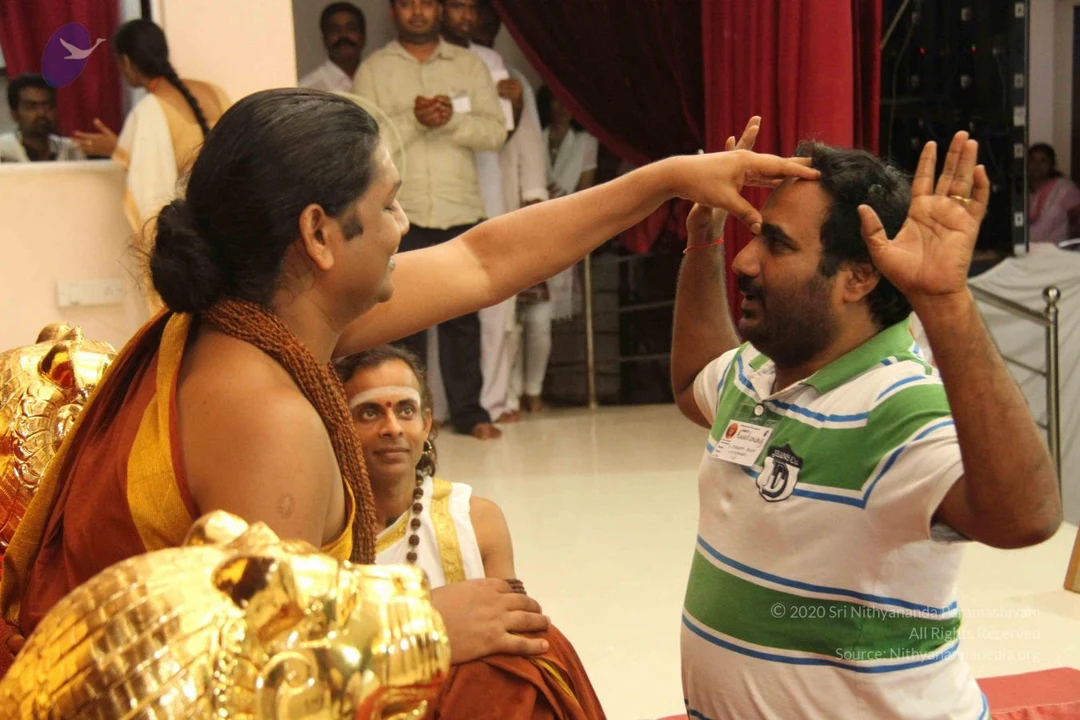
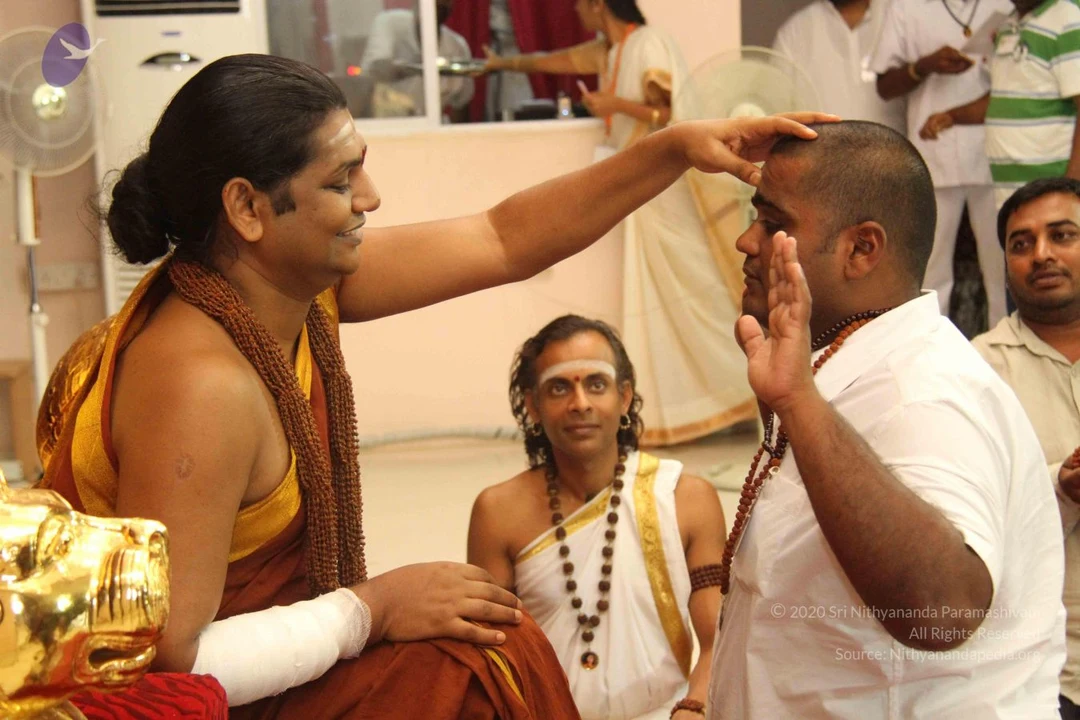
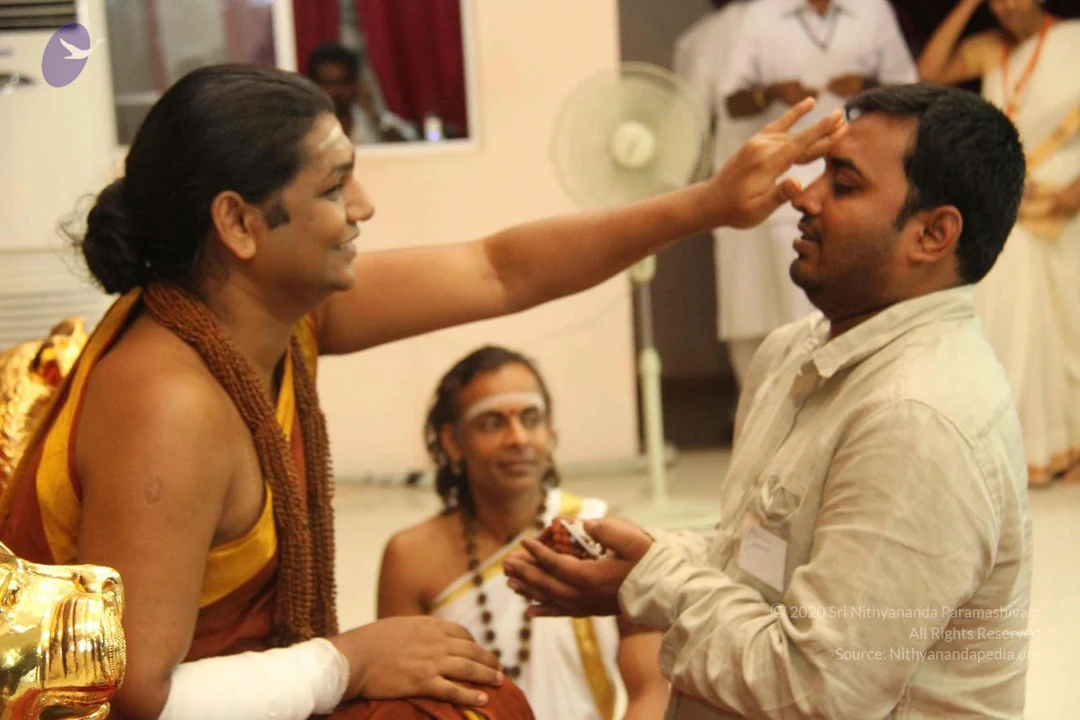
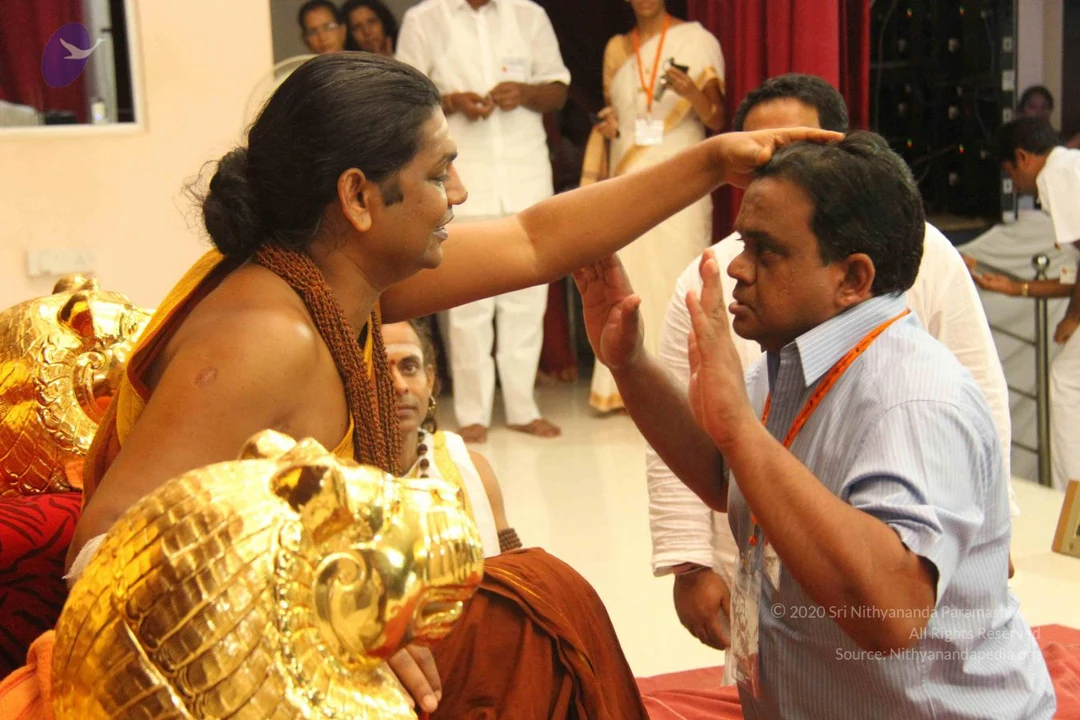
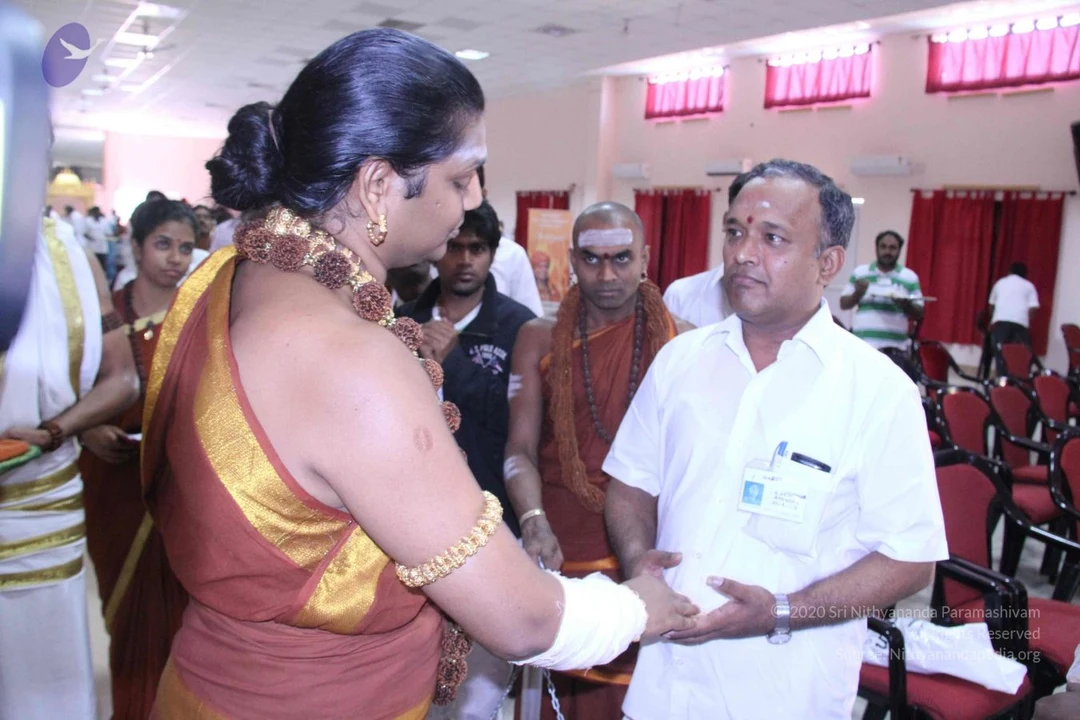
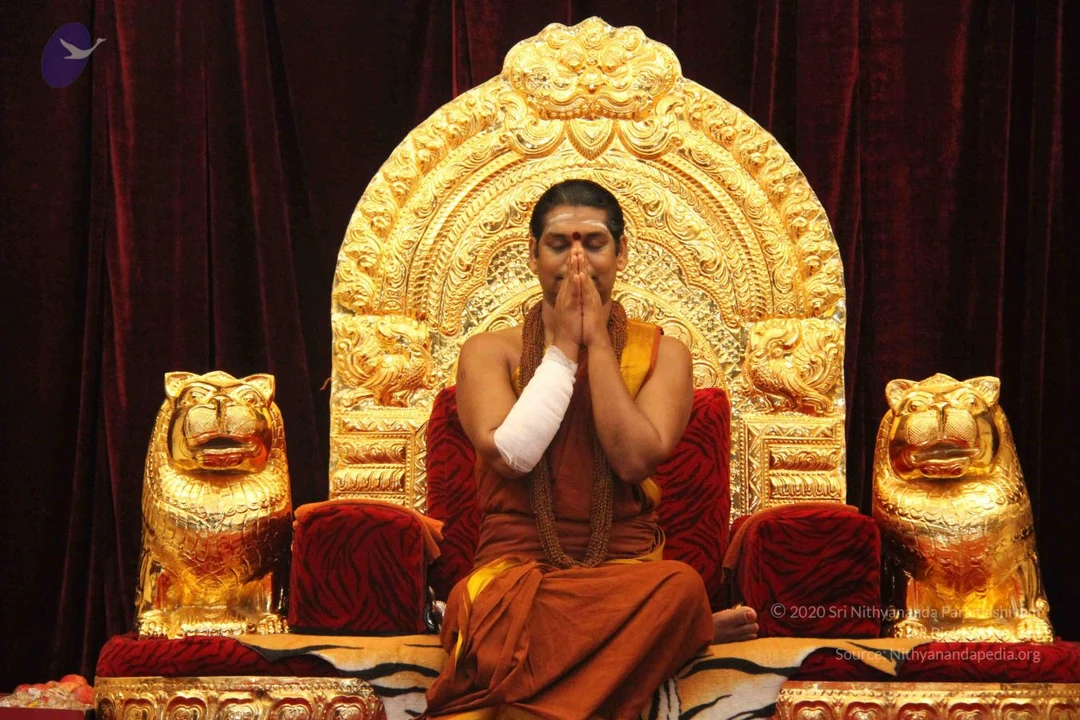
A seated man in a rust-orange robe with a gold-and-amber rudraksha-style bead necklace sits on an ornate gold throne with a carved arched back and red tiger-striped cushions. His hands are pressed together in anjali mudra, eyes closed, with a red bindi on his forehead and a white bandage on his right forearm. Two gilded lion figures flank the throne against a deep red velvet backdrop. The scene is a stage-like setting with the throne as the central focus.A seated man in saffron-orange robes with a gold-yellow shawl sits on an ornate gold throne with an arched back and carved lion-head armrests flanking it. He wears a long rudraksha mala necklace, has a red bindi on his forehead, and his left forearm is wrapped in white bandage. His hands rest together in his lap, and he is barefoot on a tiger-striped red cushion against dark red velvet drapery. Gold lion statues stand beside the throne.A seated man in saffron-orange robes with a golden-yellow border sits on a red velvet-upholstered throne with an ornate gold backrest and a gold lion-head armrest. He wears a long beaded rudraksha-style mala, a white bandage wraps his right forearm, and a red bindi and white tripundra mark his forehead. A woman in a white sari with a green-and-gold border leans in from the left, holding a thick stack of papers while he looks down toward the pages. Red velvet curtains frame the background. a person appears to be the seated man, given the saffron robes, mala and throne setting; the page indicates a satsang discourse.A photograph of a man in an orange-and-saffron robe with a long hair bun and a rudraksha mala, seated and placing his right hand on the forehead of a young man in a white shirt who raises both hands in a gesture of reception. Behind them, a standing figure in a white garment with a gold-bordered sari-style cloth and another seated man in orange clothing are visible near a red curtain. Golden lion-shaped ornaments are in the foreground. Several people are partially visible in the background. The man in orange is the candidate described on the page; his appearance is consistent with long swept-back hair, saffron clothing and a rudraksha mala, so this is a probable identification. He is giving a blessing to the young man in white.A seated figure with hair tied in a bun, a horizontal white tilak on the forehead, and bare shoulders wears a saffron and gold-bordered shawl over an orange dhoti, with a rudraksha mala around the neck. He presses his palm to the forehead of a grey-haired man in a white shirt with an orange lanyard, while holding a small folded white paper in his other hand. A man in white with a rudraksha mala and yellow-bordered cloth sits beside him. Behind, standing devotees in white and a woman in a cream sari watch, and a gold lion-headed armrest is at the left edge. a person is the central figure, identified by ornate saffron attire and rudraksha malas as a presiding teacher giving blessing to a devotee.A photograph of an indoor ritual exchange. On the left, a person with hair tied in a bun, a vibhuti mark on the forehead, a brown rudraksha mala and a saffron-gold garment touches the forehead of a kneeling older man with grey hair and stubble, who raises both hands in greeting and wears a white dhoti and shawl with coloured borders. Behind them, a standing man in white and a woman in a white sari with an orange border watch, and a red curtain hangs in the background. A golden object is visible at the lower left. The scene reads as a blessing or darshan moment.

PPP

9 photosSource gallery
A man seated on an ornate gilded throne with carved lion-head armrests and a tiger-striped cushion, wearing an orange-red dhoti and shawl, a long rudraksha mala and a heavy gold necklace, gold bangles, and a white cloth bandage on one forearm. Swamiji (probable) by appearance cues: swept-back hair, saffron-orange clothing, rudraksha and ceremonial gold necklace, seated on a throne. Brass hanging lamps with chains and a bell hang above. Brass and silver plates with flower petals, marigolds and red blossoms sit at his feet. On the right edge a seated woman in a cream sari with folded hands is partly visible. Ritual devotional setting, possibly a satsang or darshan.Close view of bare feet of a person in orange and gold silk clothing resting on a golden platform above a floral arrangement of orange, yellow and red marigold petals and red hibiscus flowers. Around it are polished silver puja trays and small silver bowls holding yellow marigold garlands, white flowers, kumkum and offerings, with silver kalasha-like vessels and a pancha-patra style item. No face is visible.Close-up of a silver puja thali tray with embossed floral scrollwork, holding small silver bowls. Yellow marigold-type flowers and a white flower sit in one bowl, a red hibiscus bloom with green leaves rests on the right, and an orange flower and a small silver spoon-like implement lie in another bowl. A yellow paste or turmeric-coloured substance fills a bowl near the top, and golden ornamental metalwork and more yellow flowers appear at the edges. No people are visible.Close-up photograph of ritual offerings arranged in silver vessels. A red hibiscus flower rests atop an ornately engraved silver kalasha-style pot, surrounded by silver bowls, a small silver container with a floral motif, a bowl of yellow liquid, and yellow and white flowers. Behind them, a large bed of orange, yellow and red marigolds and roses fills the frame. No people are visible; the scene reflects temple puja preparation with flower offerings.Close-up photograph of a pair of bare feet resting on a silver puja tray during a padapuja ritual. The feet are adorned with red nail polish and wear green leaves and a small beaded ornament across the toes. Surrounding the feet are red hibiscus flowers, yellow and red rose petals, and silver ritual vessels. Only the feet and lower legs are visible; a golden-yellow garment edge appears at the top of the frame.Close-up photo of a ritual offering arrangement on silver plates. A repoussé silver kalasha-style vessel is topped with a red hibiscus flower and green leaves. Around it lie red roses, a white flower, and yellow marigold heaps, with more silver bowls and trays in the background. No people are visible in the frame; the blurred background suggests a temple or ritual setting.

RUDRABHISHEKAM

70 photosSource gallery
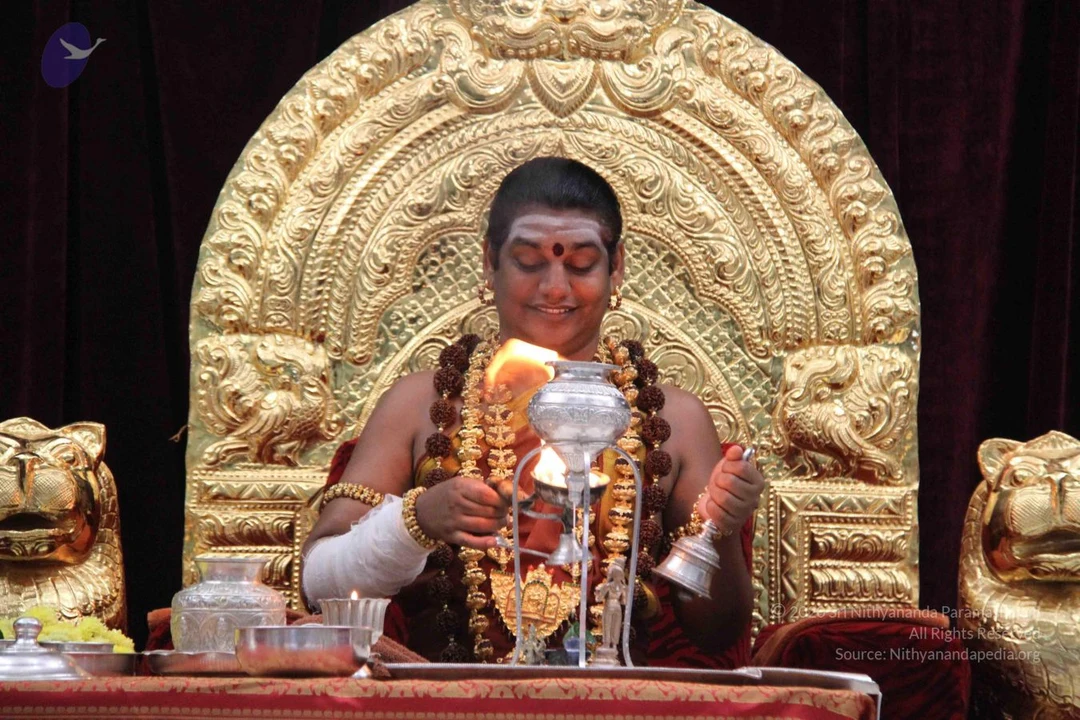
A photograph of a seated figure on an ornate gold-leaf throne with carved lion-like motifs. The man wears a rust-orange shawl, a long multi-strand gold necklace, and many dark rudraksha beads on his chest and arms. He has white and red forehead markings, gold armlets and earrings, and bare shoulders. In front of him stand silver vessels, including a tall silver kalasha-style pot with a silver spout and a small silver lid. Red velvet cushions and a dark curtain frame the scene. The appearance is a person seated in a peetha throne, presented with rudraksha malas and ceremonial gold, consistent with the page's identification of a person.A photograph of a seated man on an ornate gilded throne with a large carved golden arch behind him. He wears a short-cropped... wait, he has slicked-back hair, a white vertical tilak with a red dot on the forehead, and is bare-chested with a reddish-brown and mustard-yellow cloth draped over his shoulder. He wears long layered gold necklaces with rudraksha malas, gold armlets and bangles, and his eyes are gently closed with a calm smile. In front of him stand silver ritual vessels, a silver kalasha-style pot with a tall stand, and a silver lamp. The setting suggests a satsang or puja on a peetha, with a visible gold-and-silver ornamented backdrop. a person: the seated man wears rudraksha malas, gold ornaments and a saffron-red shawl on a golden throne, appearing in the role of a seated guru receiving ritual offerings.A seated man sits before an ornate gilded throne backdrop with floral and mythical-creature relief carvings. He wears white vibhuti marks with a red bindi on his forehead, multiple rudraksha mala necklaces, a gold ceremonial necklace, gold armlets and earrings, and an orange-gold garment with a red-and-brown striped cloth draped over the seat. His right forearm is bandaged in white. He holds a silver kalasha-style vessel with an open hand gesture above silver ritual items and brass lamps in the foreground. a person appears here, seated in a ceremonial role as a teacher giving a satsang-style blessing.A man seated on an ornate gold throne with a red tiger-striped cushion, eyes closed, in front of dark red velvet drapes. He wears an orange-saffron dhoti and shawl, multiple rudraksha malas and a gold-beaded ceremonial necklace, gold bangles, earrings, and a white bandage on his forearm. A white and red forehead mark is visible. His right hand is open, palm up, over a silver puja table holding a silver kalasha, a silver bowl with lid, a metal vessel, and yellow flowers. Gold lion-form armrests flank the throne. Appearance-based candidate: a person, seated on the throne with malas and ceremonial gold necklace.A photograph of a seated figure with shoulder-length swept-back dark hair, a white tripundra and red bindi on the forehead, and ornate gold earrings. He wears a saffron-orange garment with a gold border, many rudraksha malas and heavy gold ceremonial necklaces, and a gold armlet. A white bandage covers one forearm, and his eyes are closed as his hands rest over a silver vessel. Behind him is an elaborate gold throne and deep red velvet drapery, and a gold-and-silver ritual pot and vessels sit in the foreground. Given the page's Swamiji flag and the qualifying cues of long hair, rudraksha malas and ornate gold adornment, this is a Swamiji (probable) seated in person at a satsang-style event.A photograph of a row of shaved-headed men in saffron-orange dhoti-style garments seated cross-legged on a white floor in a plain room with red curtains and air conditioners. Most wear white vertical tilak marks on their foreheads and arms, and many wear rudraksha malas or orange-beaded necklaces. The foreground priest on the left and the seated men beside him have hands folded or raised in ritual gesture. In front of them stands a long line of silver and brass vessels with orange offerings, and tall brass kalasha-style vessels rise along the floor. a person is not visibly identified in this group.

SARVA DARSHAN
9 photosSource gallery
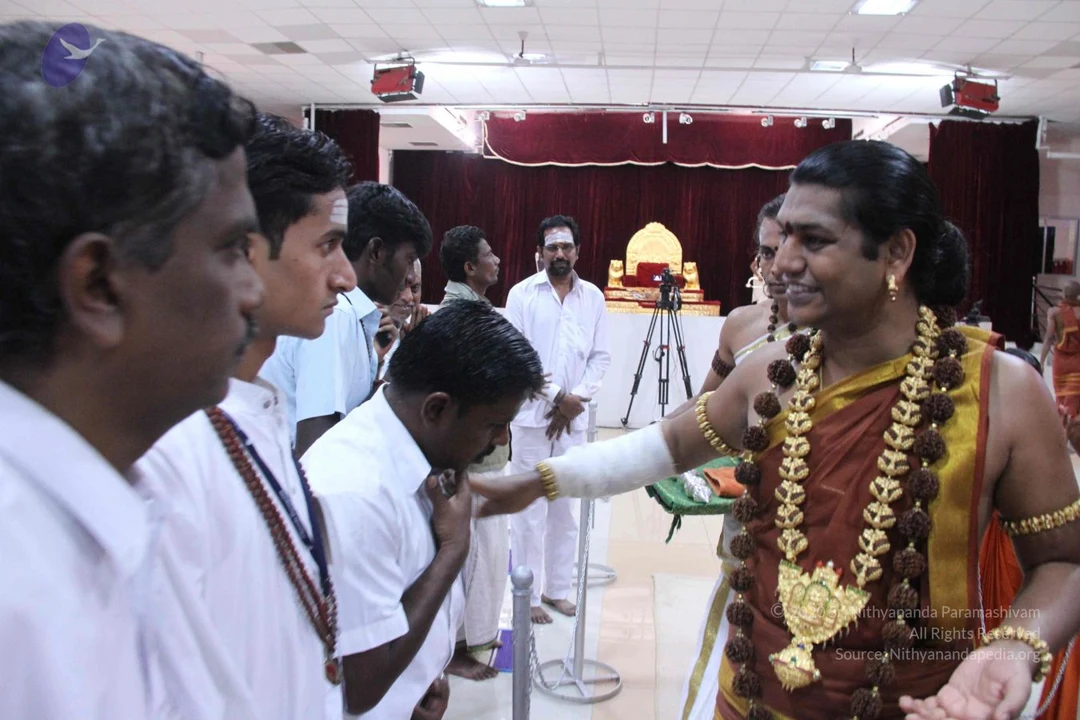
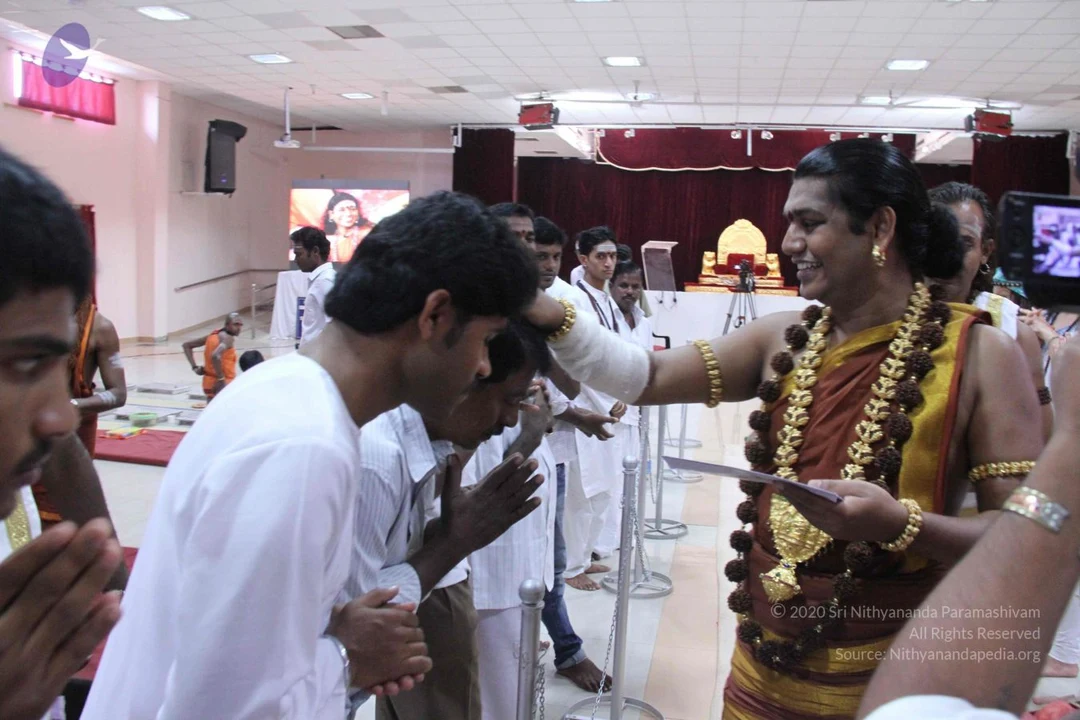
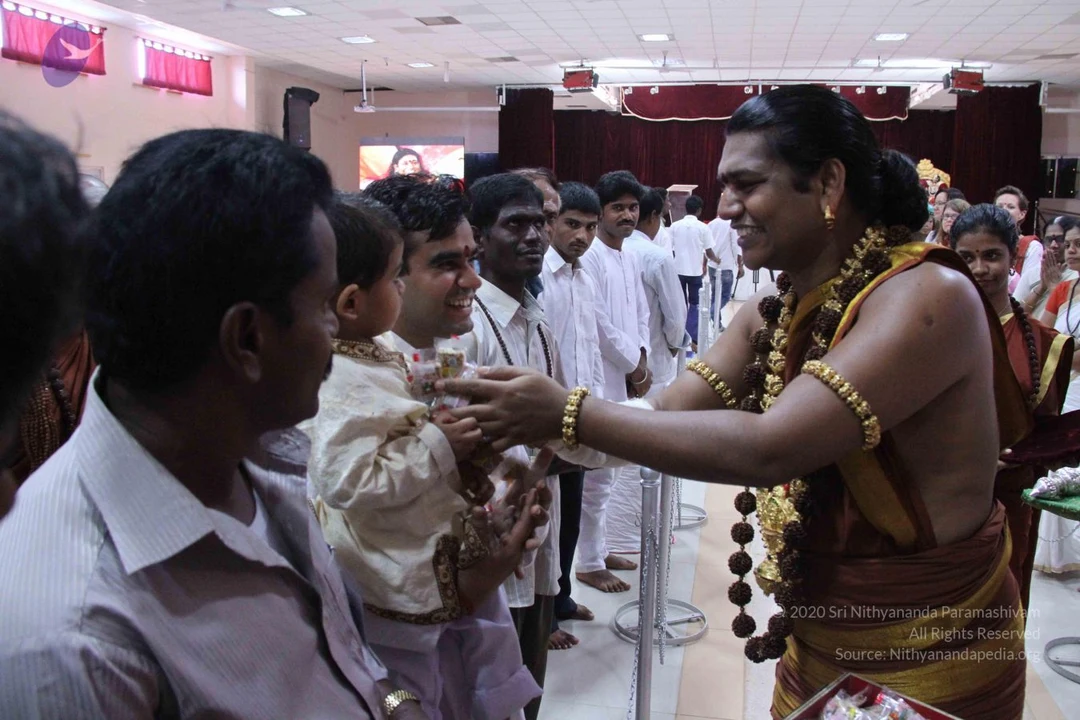
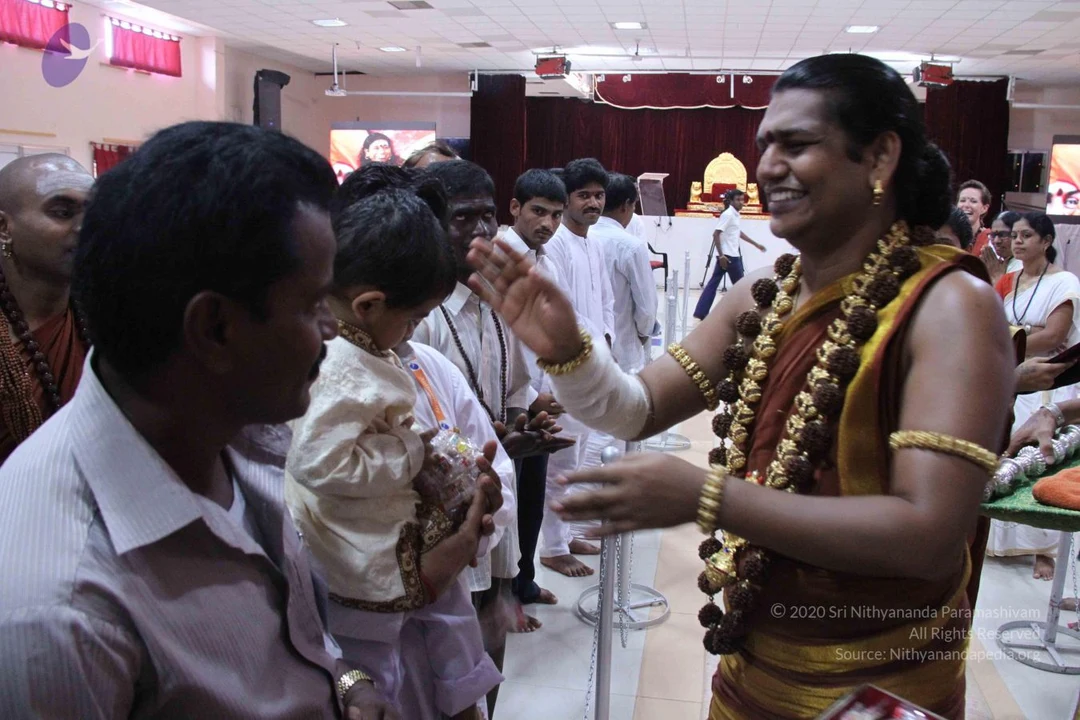
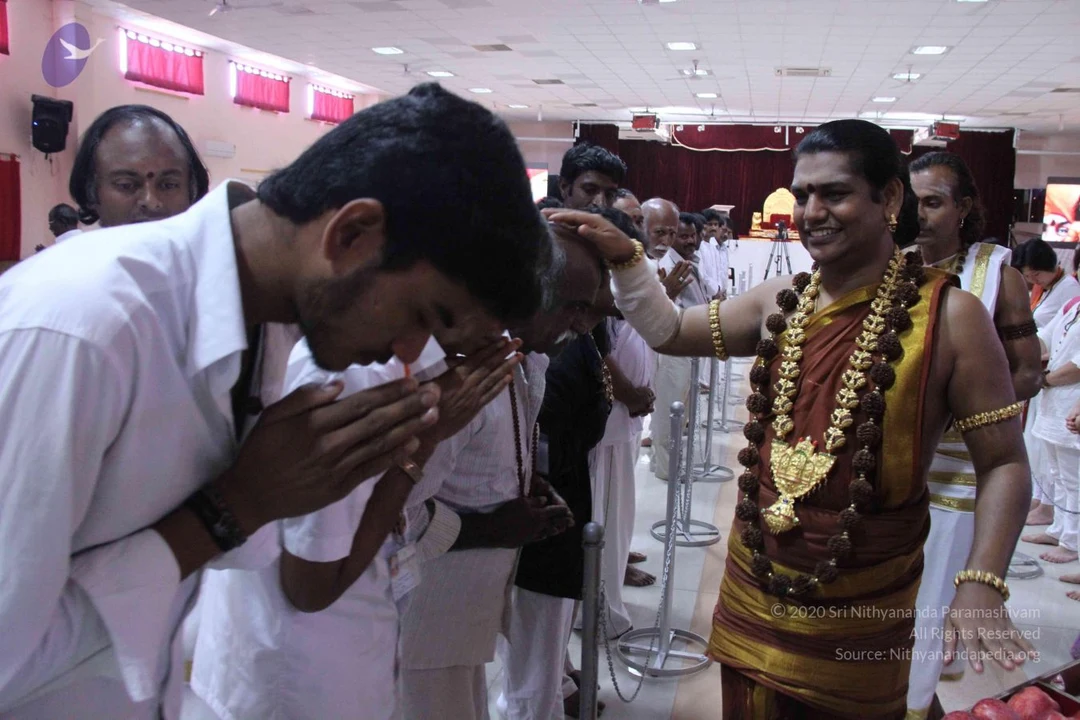
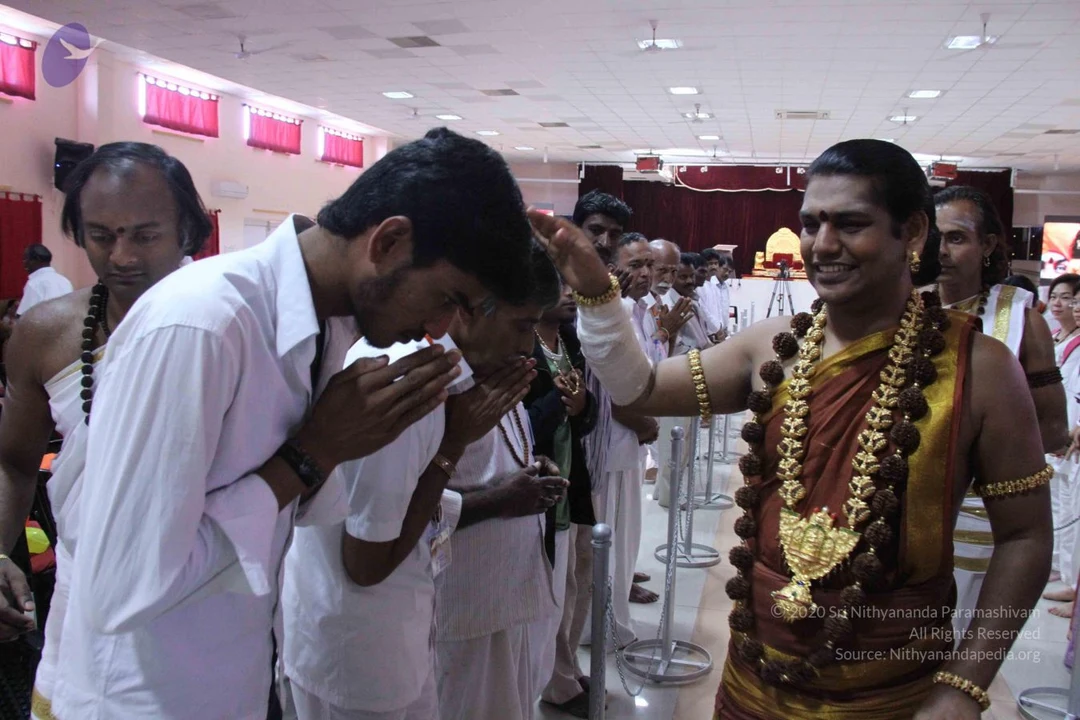
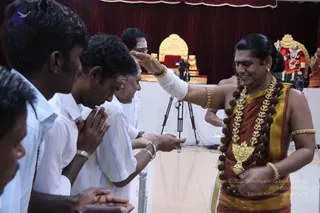
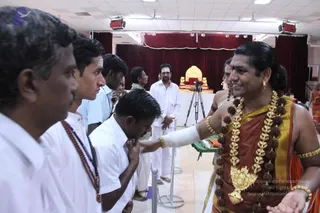
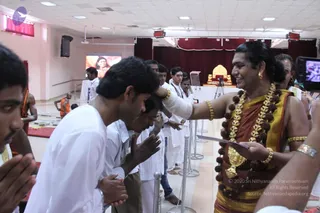
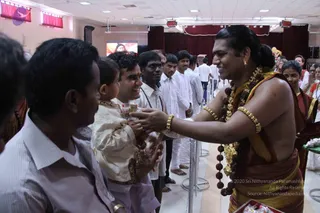
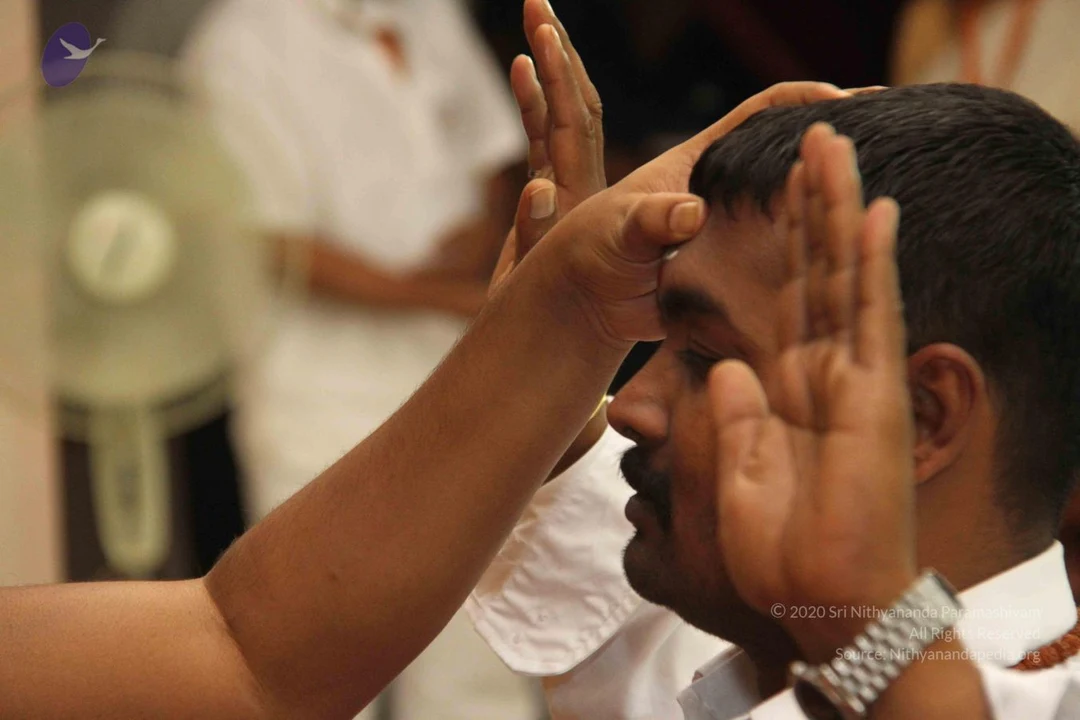
A photograph of a ritual blessing in a temple-style hall with a red curtain backdrop and a gold throne with a lion motif in the background. A person in a rust-red and gold dhoti-style garment with layered rudraksha malas and a gold pendant necklace raises a hand in blessing toward a line of devotees in white and pale-striped shirts, several with white vibhuti marks on their foreheads. The devotees stand with palms pressed together or held out, and a camera on a tripod and a gilded deity shrine with a murti appear in the scene. Five to six visible people in total.Indoor hall with red curtains and a golden throne-like seat with red cushion in background. In the right foreground, a man with swept-back hair, gold earrings, a gold ceremonial necklace, and a long rudraksha mala wears an orange-red and gold-bordered garment and gold armlets, extending a bare arm with a white bandage toward a man in a white shirt who bends forward to touch or kiss it. Other men in white shirts and white dhotis stand along a barrier rail, and a camera on a tripod is visible near the throne. a person is the central figure in orange-red robes receiving the gesture, with rudraksha malas and ornate gold jewelry as identifying cues. The scene resembles an informal darshan or blessing gesture.A photograph of a hall with a red-curtained stage and a gold-and-red throne at the back. In the foreground, a man in a long-sleeved white kurta bows forward with hands folded while another devotee in white bends his head, and a man in red-brown and gold ceremonial dress with a rudraksha mala and gold ornaments, bangles and earrings places his hand on the devotee's head. Several other men in white stand behind the barrier rope, and a figure in orange cloth is visible at left. A video camera is at right.Indoor hall scene where a man with long hair swept into a bun, wearing a bare chest with an orange-brown dhoti-style garment, gold armlets and a heavy garland of rudraksha beads and gold pendants, smiles while handing a small object to a child in a cream and gold kurta. Around them, devotees in white and cream kurtas and a woman in a yellow sari stand in a line. A red curtain, pink wall lights and a screen showing a deity image appear in the background, with a tray of offerings on a table to the right. a person cues: long swept-back hair, rudraksha malas and gold ornaments, though the figure is distributing items to devotees.A photograph inside a hall with red curtains and a gold-and-red throne on a stage in the background. In the foreground a smiling person with long hair swept back, wearing an orange-brown dhoti and shawl, rudraksha mala beads and gold ceremonial necklaces, extends a hand toward a man in a light striped shirt. A small child in a cream kurta with gold trim stands beside him. Behind them devotees in white kurtas and orange-brown robes queue near a green-draped table, and a few people stand on the right. Large screens on the walls show a portrait. Probable Swamiji (long swept-back hair, rudraksha malas and gold necklaces) is the central figure, in person.A photograph inside a large hall with white walls, red curtains and ceiling lights. A man in a white shirt and white dhoti bows with palms pressed together, head lowered. Beside him an older man in white clothes and a rudraksha mala also bows, and a row of devotees in white stands behind a line of metal stanchions. On the right, a smiling man with long swept-back hair wears an orange-brown and gold silk dhoti, a heavy gold necklace with a large pendant, rudraksha beads and gold bangles. He extends his right hand in blessing toward the bowing devotee's head. Another man in a white dhoti with an orange shawl stands at right. Red fruit and offerings are visible at the lower right edge. Probable Swamiji (appearance cues: long swept-back hair, ornate gold necklace, rudraksha mala and saffron-gold clothing) is performing a blessing for devotees.

SATSANG

30 photosSource gallery
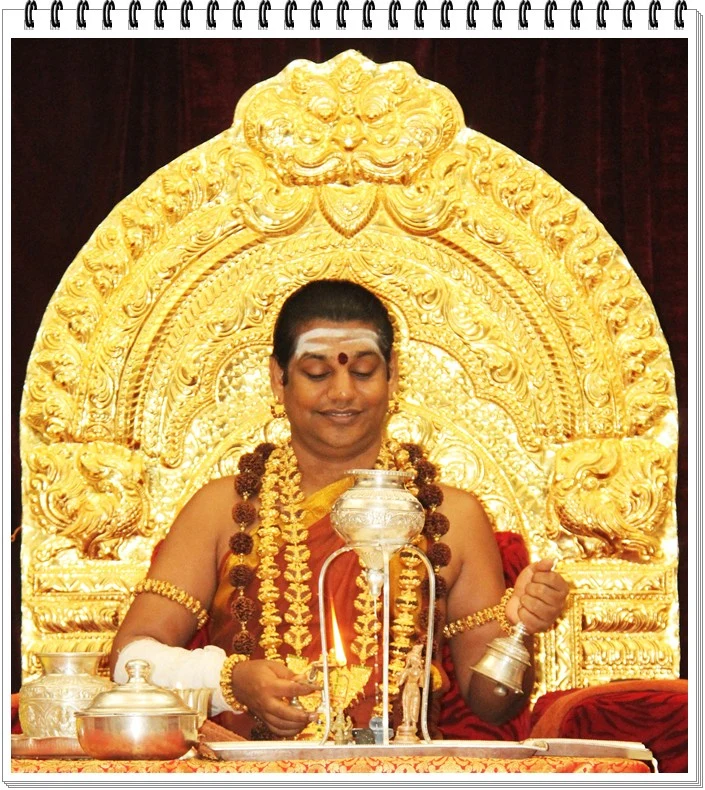
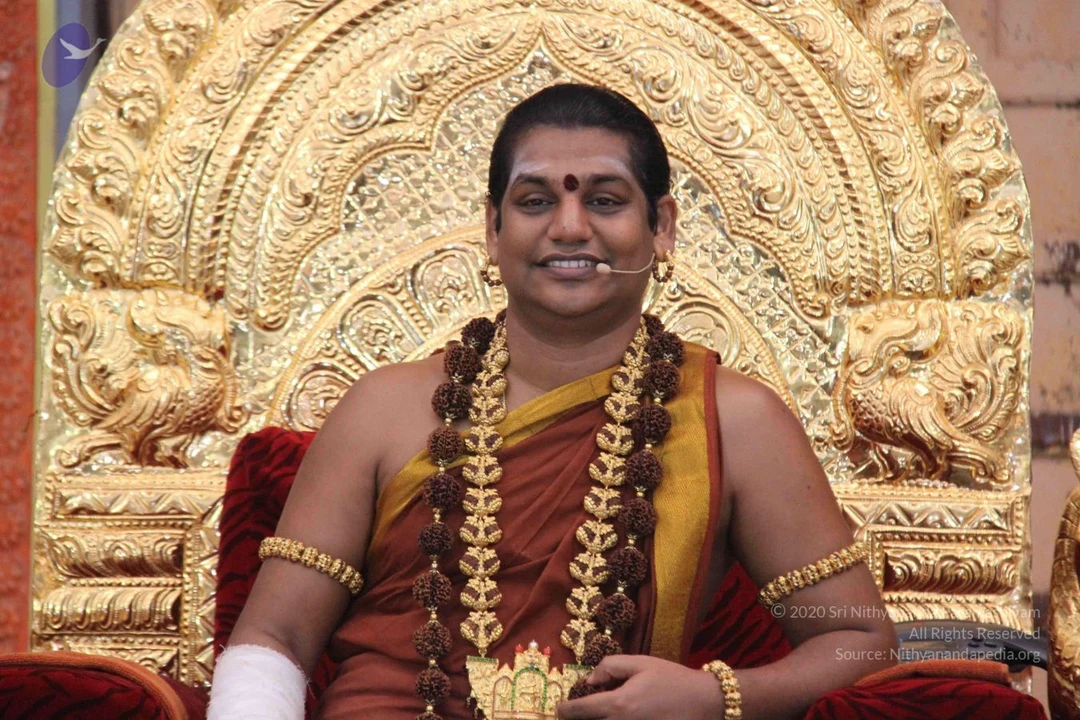
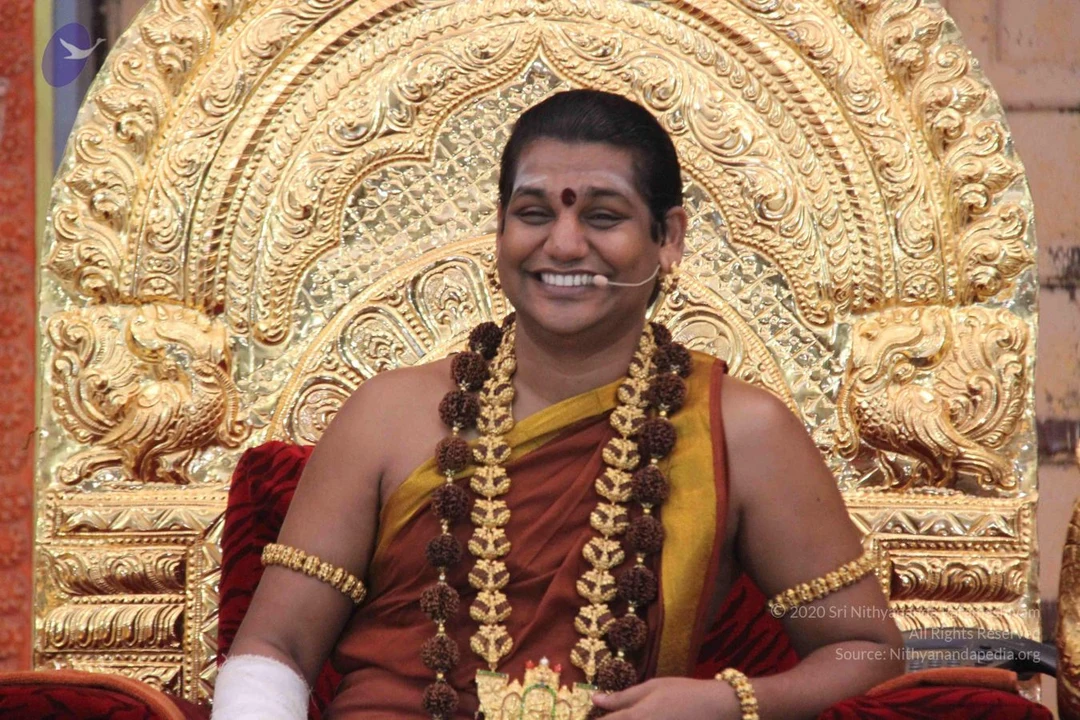
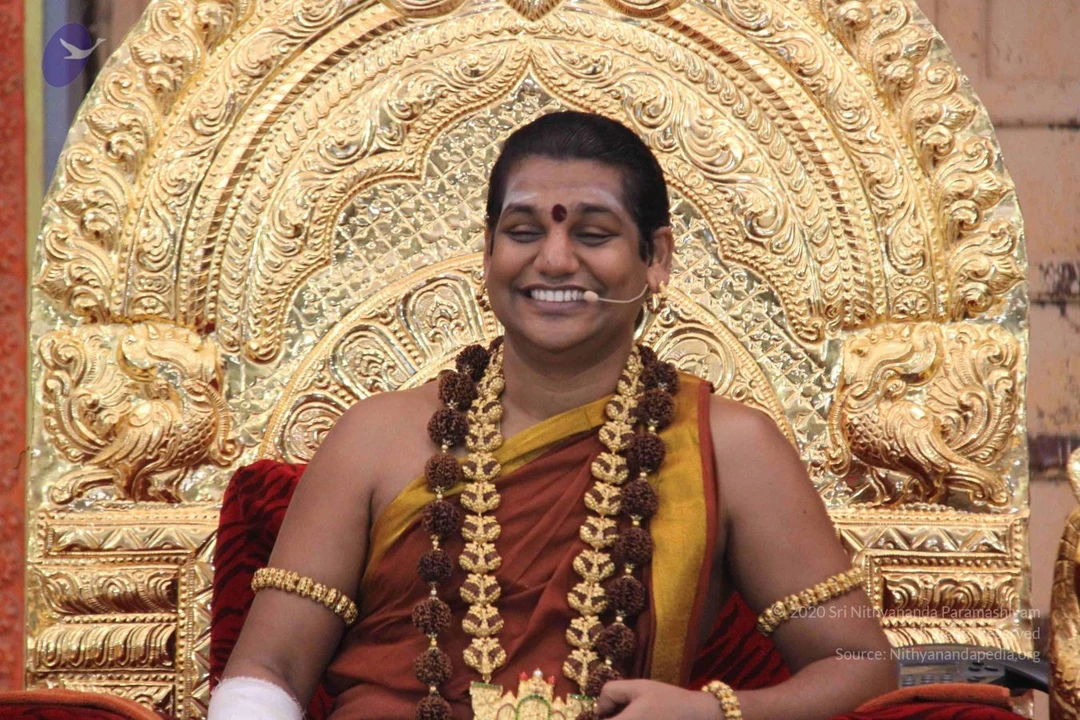
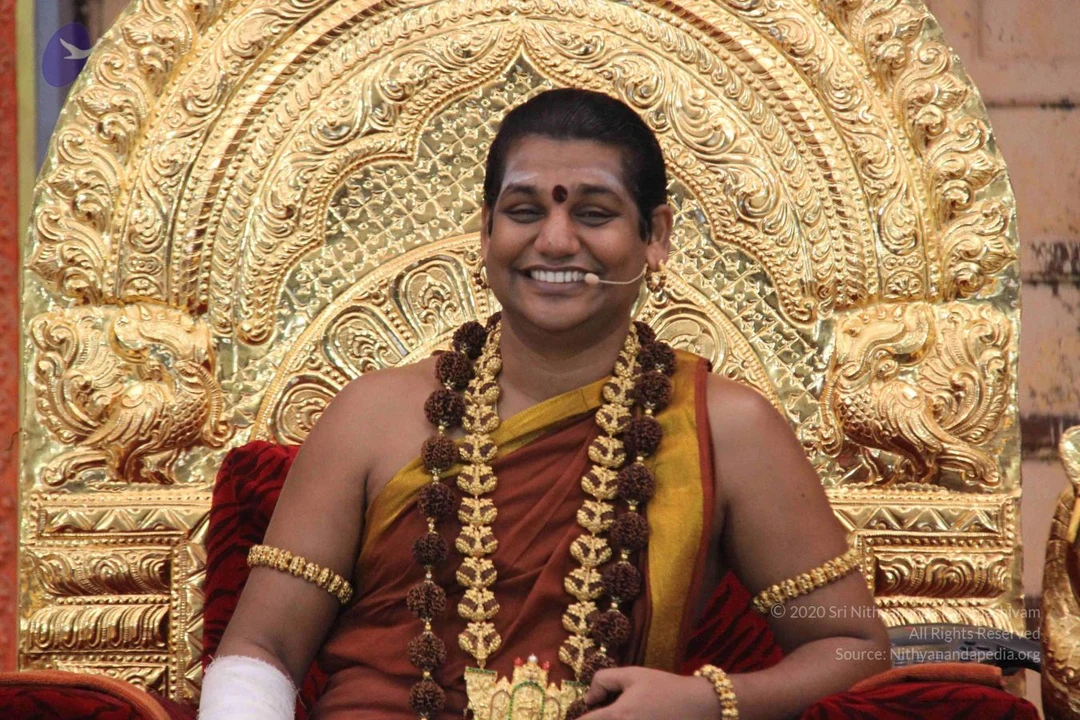
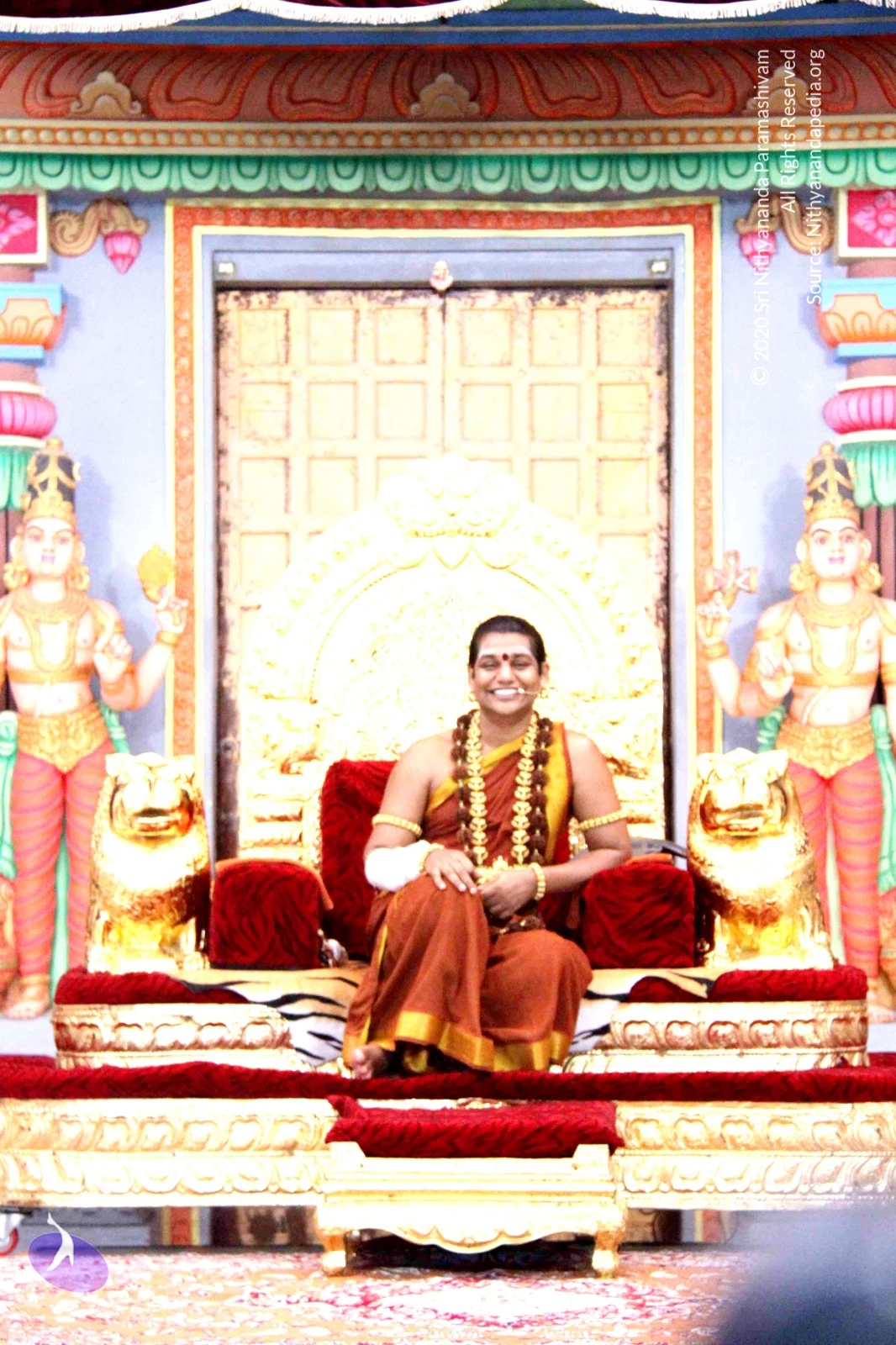
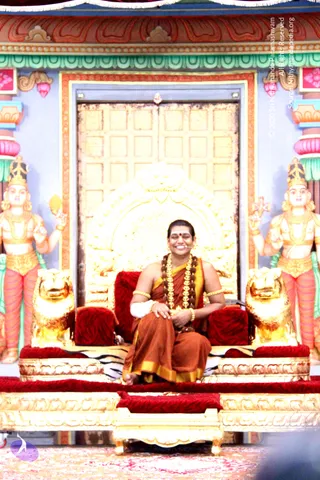
A seated man in saffron-red robes sits smiling on an ornate gold throne with a golden arched back and two gold lion-head armrests, before a carved wooden door. He wears a rudraksha mala, a long gold ceremonial necklace with a lotus pendant, gold armbands, and a white bandage on his left forearm, with his hands folded in his lap. Flanking him are two large painted gold-and-orange guardian figures with crowns, multiple arms and ornate green sashes, each holding a ceremonial object. Red velvet cushions and gold lion statues sit at the base. a person: the seated man has a distinctive presentation of saffron robes, a rudraksha mala and a ceremonial gold necklace on a throne, so the appearance-based label applies.A seated man in a maroon-and-saffron robe sits on an ornate gold throne with carved arch and lion-figure armrests, smiling with hands folded in his lap. He wears a long rudraksha mala and a gold ceremonial pendant necklace, bangles on his wrists, a white bandage on one forearm, and a red bindi. Flanking him are two painted deity murti figures with multiple arms holding ritual objects, and two gold lion statues sit at the throne's base. A brass oil lamp stands at the left edge. a person is seated on the throne, identified by the cues of rudraksha mala, gold necklace and saffron robe, with the page's a person attribution, so a person is marked in_person.A smiling man with short dark hair sits on an ornate gold throne with a carved arched back and lion-head armrests, set before a golden wooden door. He wears a saffron-orange cloth over one shoulder, a rudraksha mala and a ceremonial gold necklace, with a white bandage on his left forearm. Two painted deity statues stand on either side in orange and green garments, holding ritual objects, flanking the throne in a temple-like hall. a person cues: the seated figure wears saffron clothing, rudraksha and gold adornment on a throne, though the appearance is only partly distinctive.A man seated on an ornate golden throne with lion-shaped armrests and red cushions in a temple-style hall. He wears an orange-saffron dhoti and shawl, a rudraksha mala, a long gold necklace with a pendant, gold bangles and a white bandage on his left wrist, with a red tilak on his forehead. Two large painted deity figures with four arms stand on either side in pink and green dress, holding ritual objects, and a carved wooden door is behind the throne.A seated man in a rust-brown robe with a gold-bordered yellow shawl sits on an ornate gold throne with carved lion-like side panels and a large gold arch behind him. He wears layered rudraksha malas and a long gold ceremonial necklace, gold bangles on both upper arms, and a red bindi on his forehead. He holds a small gold crown-shaped object in one hand while smiling, with a headset microphone clipped to his face. A white bandage covers his other forearm.A smiling man sits on an ornate golden throne with a gilded arched backrest carved with floral scrolls and mythical lion-like figures, draped in red velvet. He wears a rust-orange and yellow shawl over bare shoulders, multiple rudraksha malas with dark beads, and a heavy gold ceremonial necklace with a central pendant. Gold armlets and a bandaged forearm are visible, with a red bindi on his forehead and a small headset microphone at his mouth. a person: the cues are the rudraksha malas, saffron-orange robe and ornate gold regalia on a throne, but the face is not clearly distinct.

SWAMIJI SESSION
8 photosSource gallery
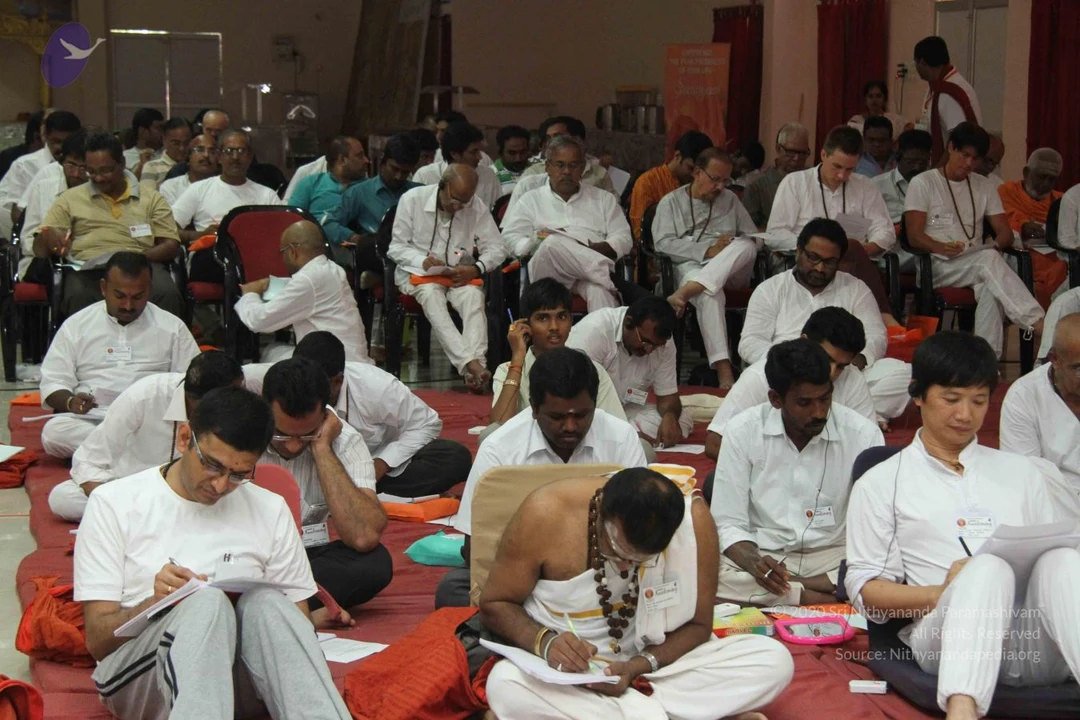
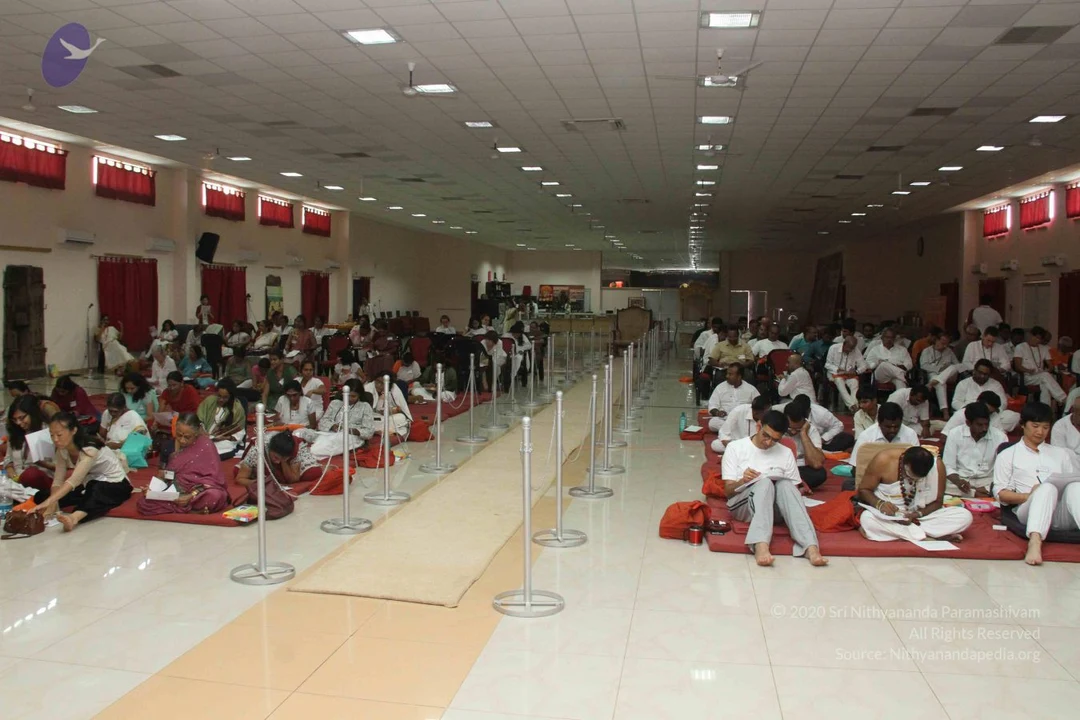
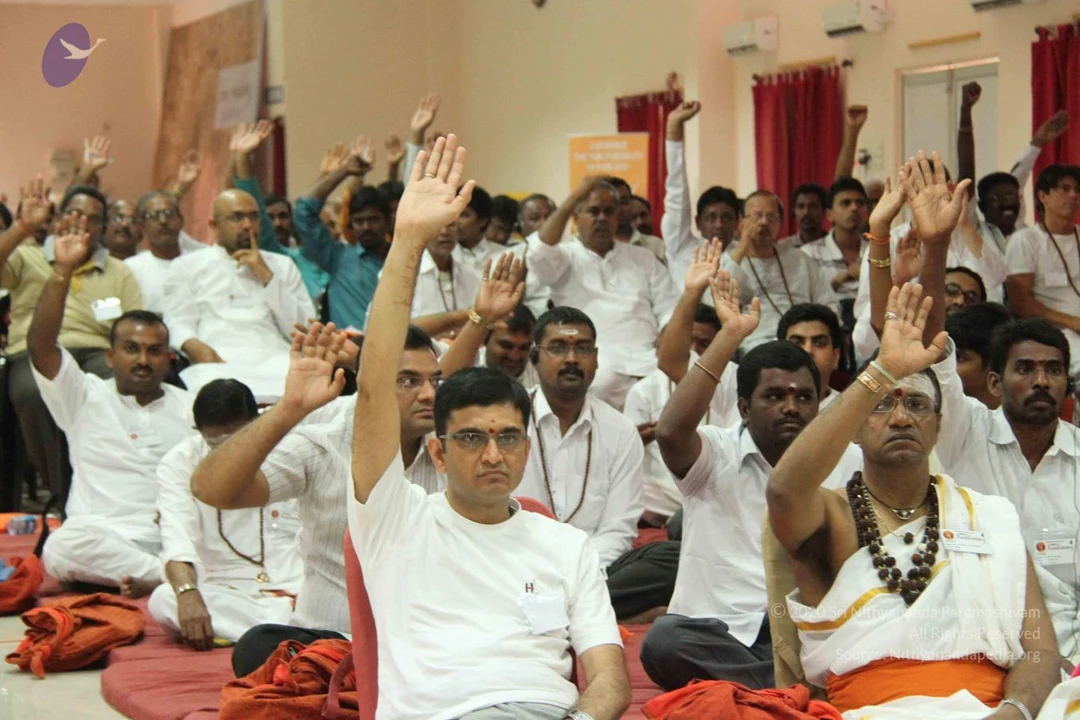
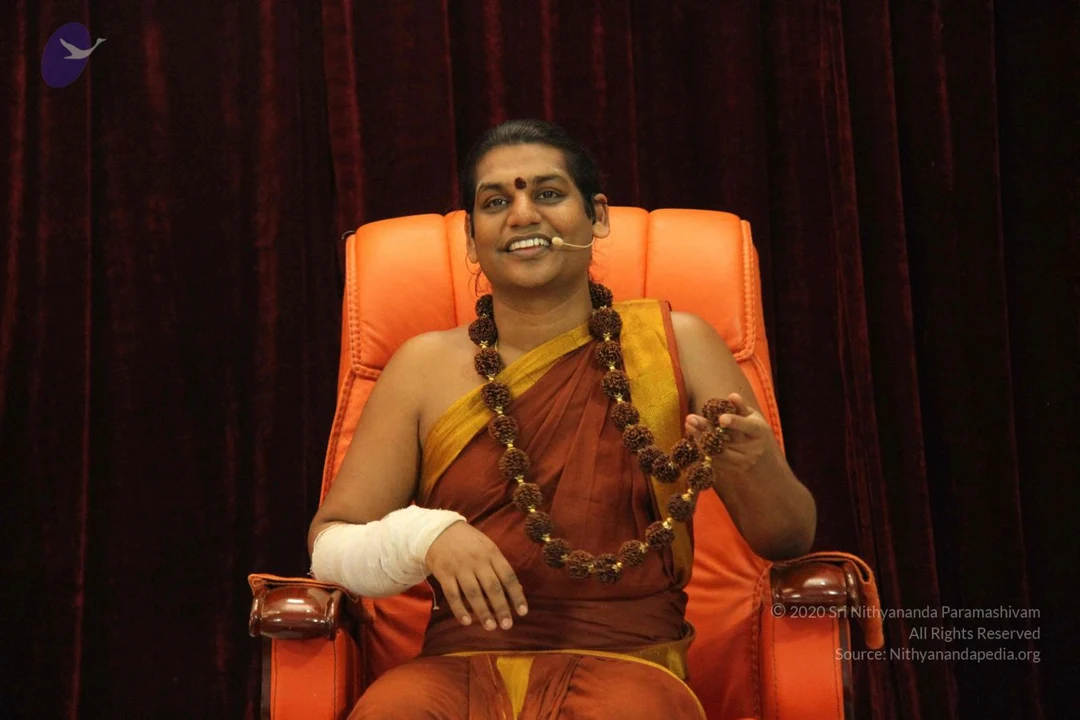
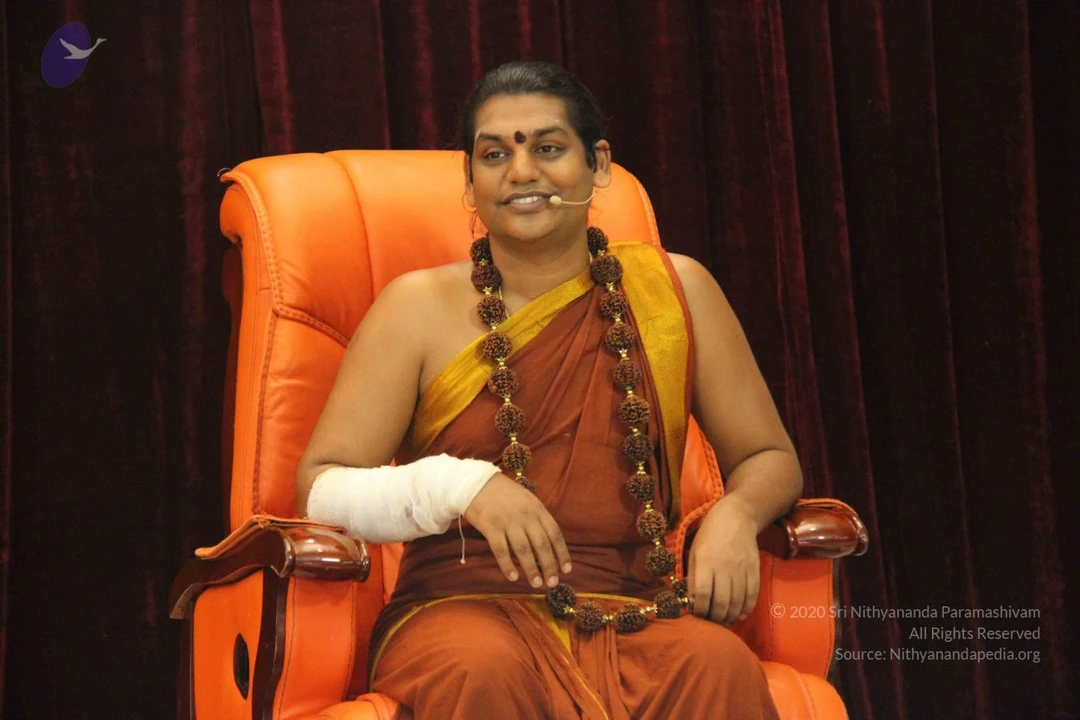
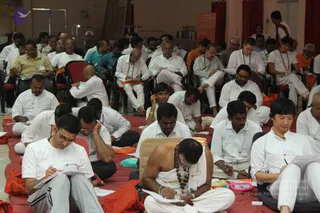
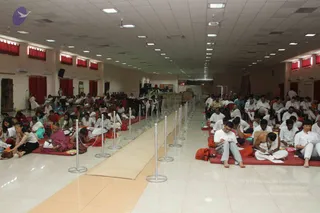
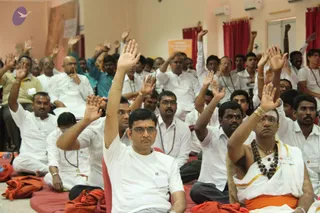
A smiling man sits in a tall orange leather chair against deep red velvet drapes, wearing a small red bindi, a clip-on headset microphone, and a long string of large dark rudraksha beads. He wears a rust-red garment over a golden-yellow shawl draped across his bare shoulders, and a white bandage wraps his forearm resting on the armrest. Appearance-based probable Swamiji (long swept-back hair, rudraksha mala, saffron-and-gold clothing) seated on a throne-style chair at a satsang setting. The photograph is taken at a discourse stage.A photograph of a seated assembly of devotees in a hall with red curtains and red floor mats. Most attendees wear white kurta-style clothing, some in grey or colored shirts, and many are writing in notebooks with pens. A man in the foreground wears a grey tracksuit and glasses, writing on a sheet. Center front, a man wearing a white dhoti-style cloth, rudraksha mala and sacred marks writes on paper while seated on a chair. Badges hang from many participants' necks. A banner at top reads a message about the pure freedom of spirituality. The setting appears to be a satsang or discourse session.A large hall with cream walls, red curtains along the windows and ceiling spotlights shows many devotees seated on red mats on a tiled floor. Most wear white clothes, with some in saffron and pink saris. Some are writing on paper while others sit in rows facing a stage at the far end. A central aisle is lined with silver stanchions and a beige runner. Many people are visible, forming a sizeable satsang gathering.A seated crowd of devotees in a hall with red curtains and cream walls, many with raised hands. Most wear white shirts or white dhotis; several have rudraksha malas. In the foreground a man in a white t-shirt raises his right hand, and at right a man in a white dhoti with orange border and a rudraksha mala and gold chain raises his hand while looking forward. Orange cloths lie on the floor. Many people in the back row also have hands up in response to a question.A seated man in an orange-red saffron-style robe with a gold-bordered shawl sits in a large orange leather chair against dark red velvet drapes. He wears a long rudraksha mala with gold beads, a red bindi on his forehead, and a small headset microphone. His right forearm is wrapped in white bandage, and he gestures with his left hand while smiling during a talk. A small purple bird logo appears in the upper left corner. Swamiji (probable): the seated speaker shows long swept-back hair, a rudraksha mala, and saffron robes, consistent with the page's reference to a satsang discourse.A seated man speaks during a satsang, sitting on an orange leather armchair before dark maroon draped curtains. He wears a rust-red robe with a gold-bordered yellow shawl across the chest and a long rudraksha mala with gold spacers. A small red bindi marks his forehead, a headset microphone is at his ear, and his left forearm is wrapped in white bandage. He holds a rudraksha bead in his right hand.

TEMPLE

20 photosSource gallery
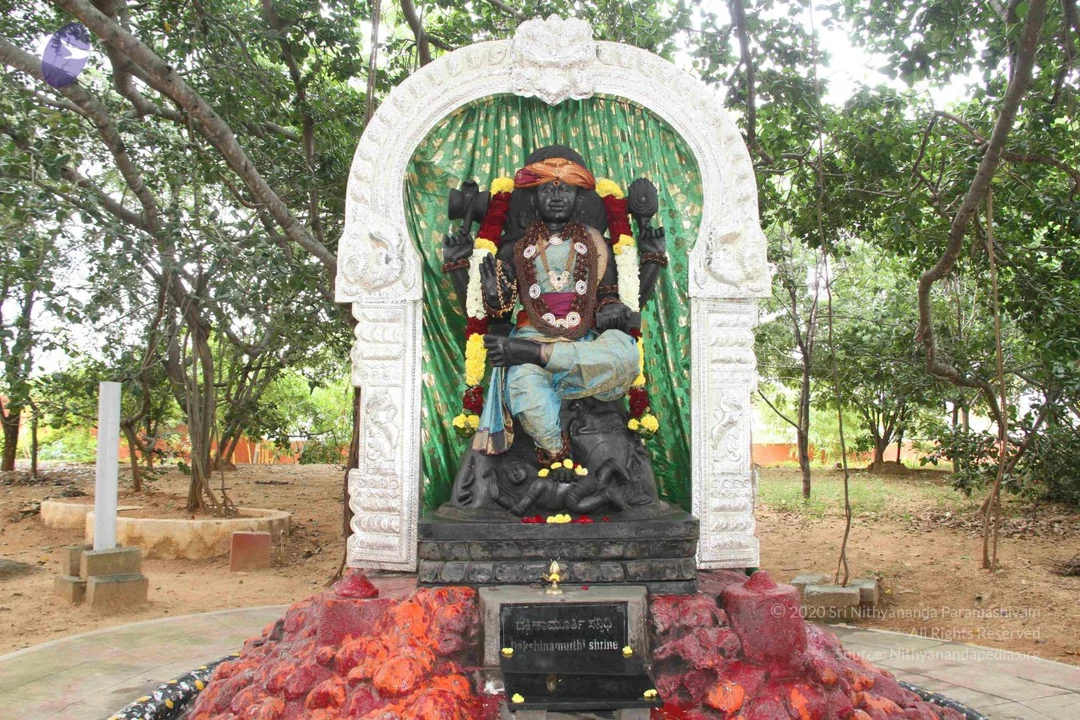
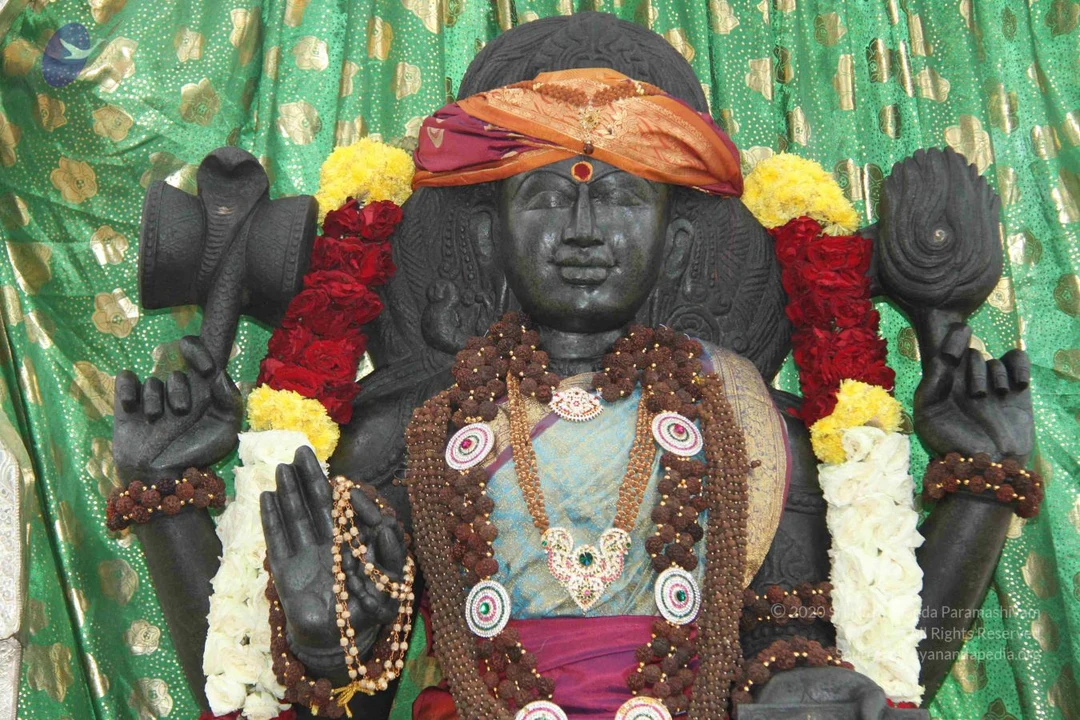
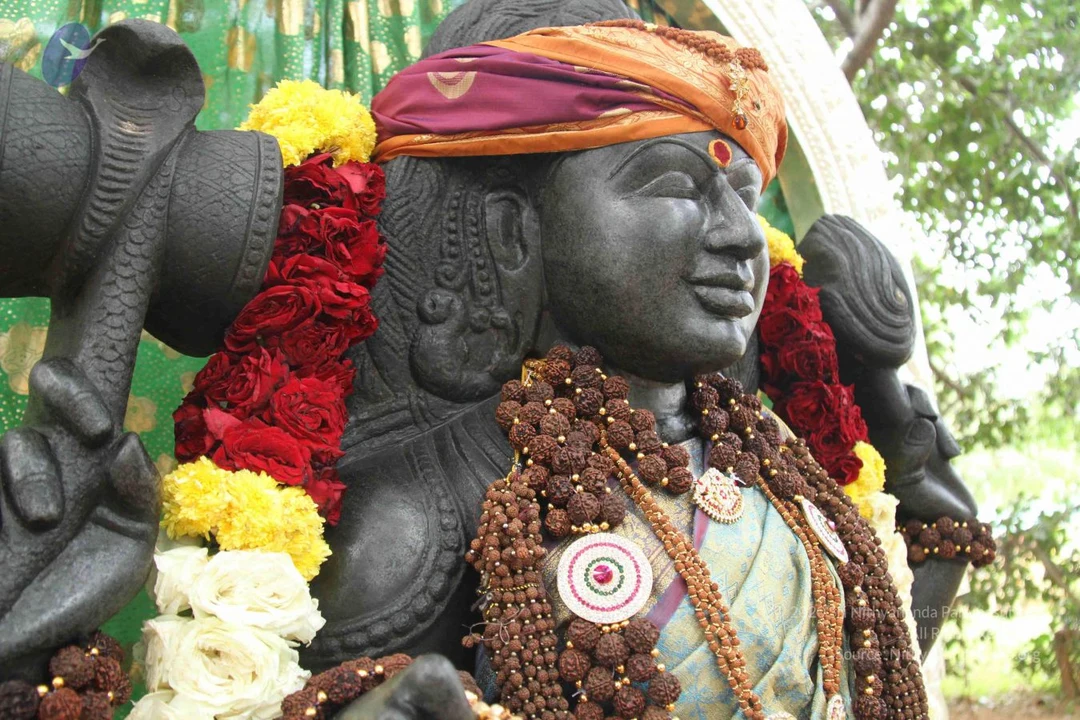
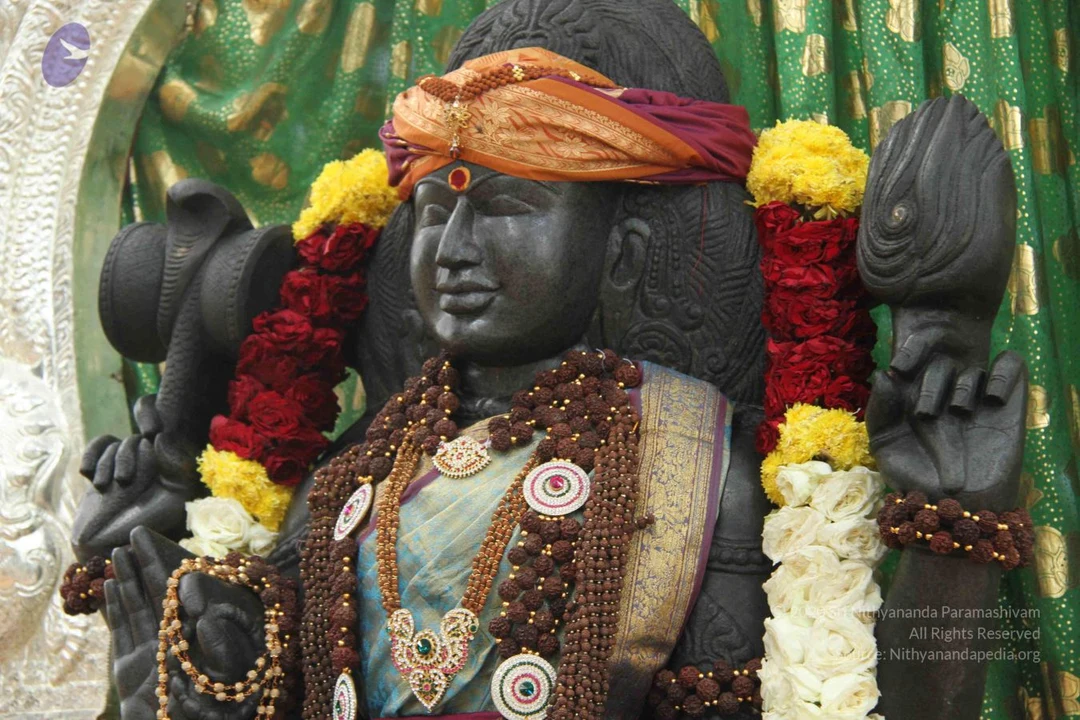
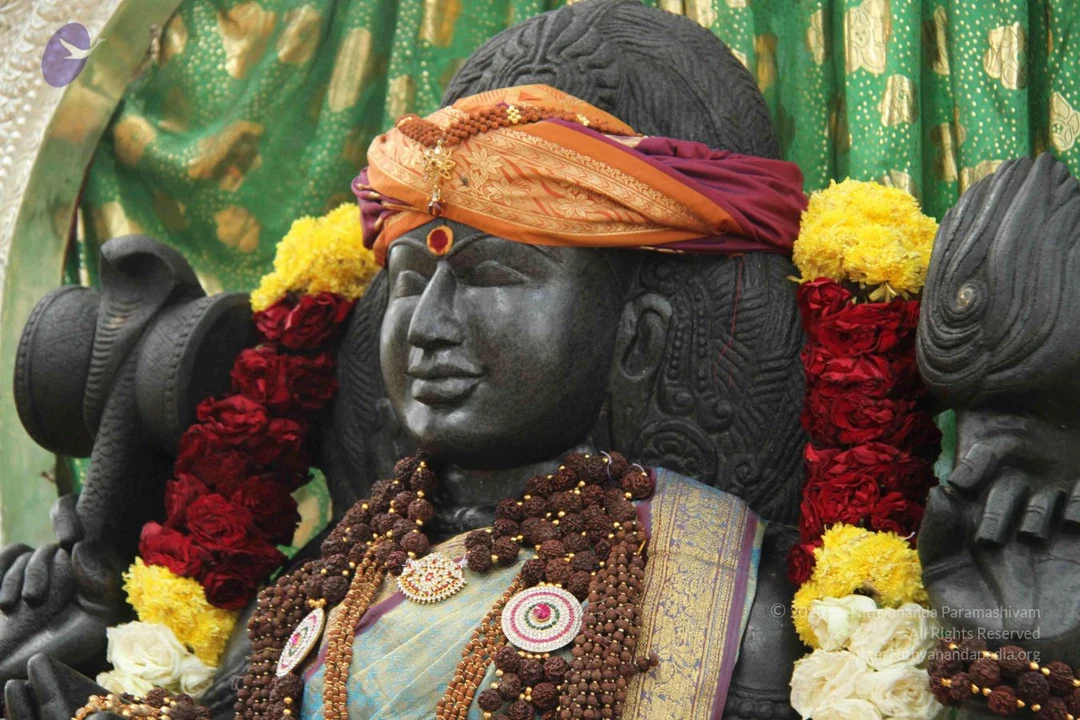
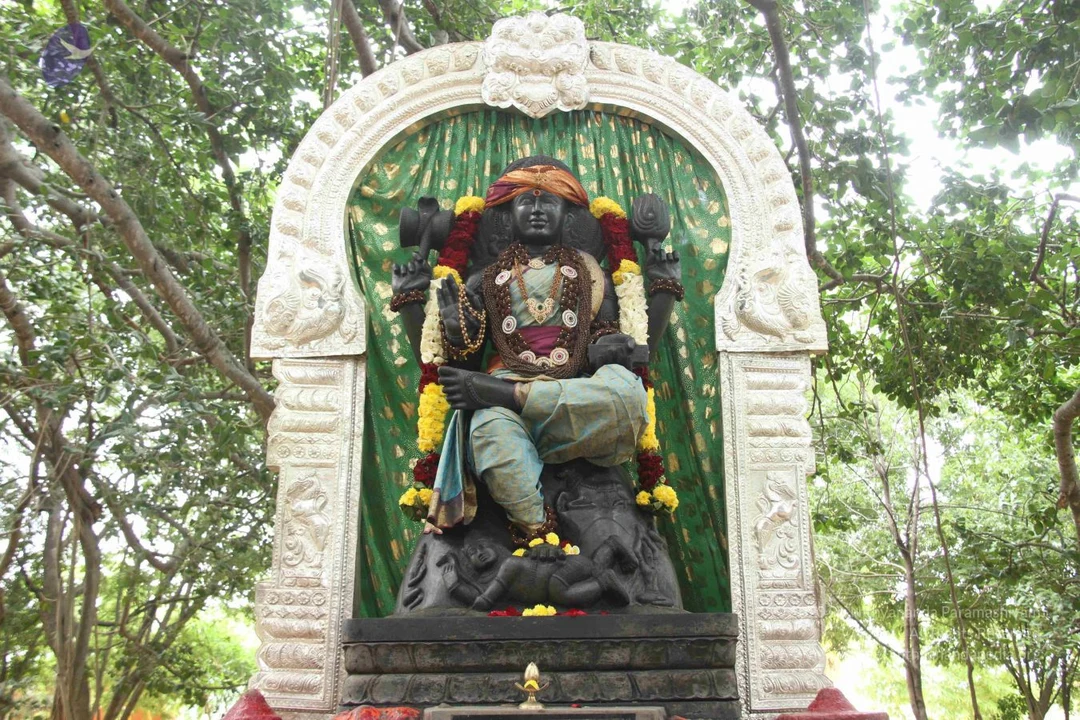
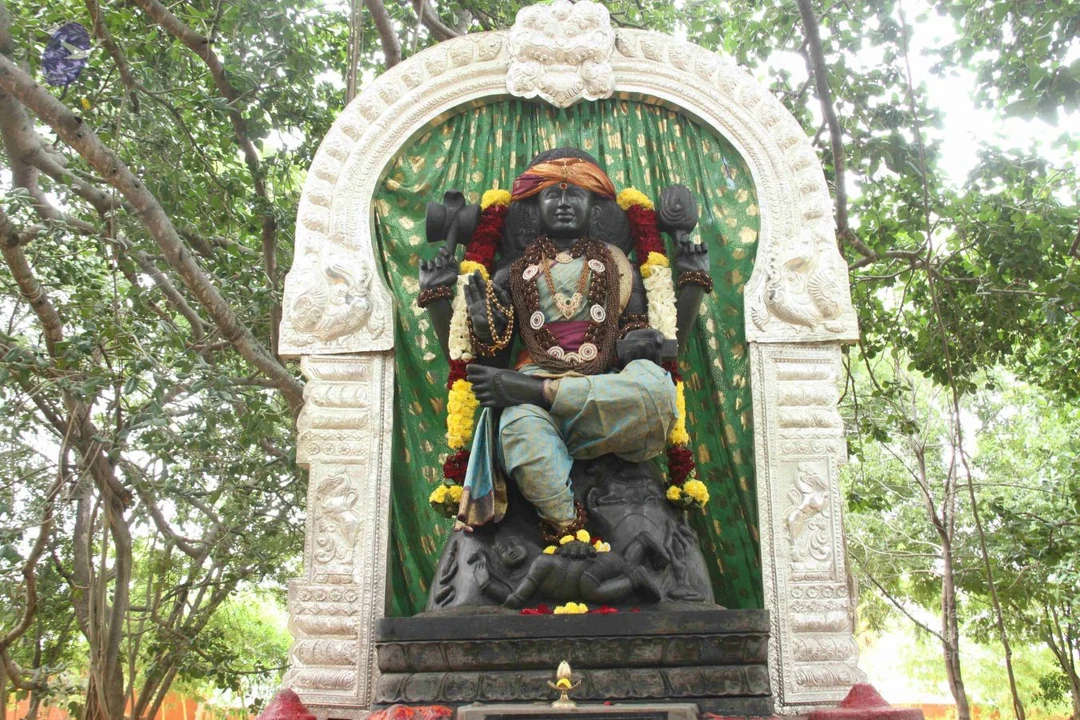
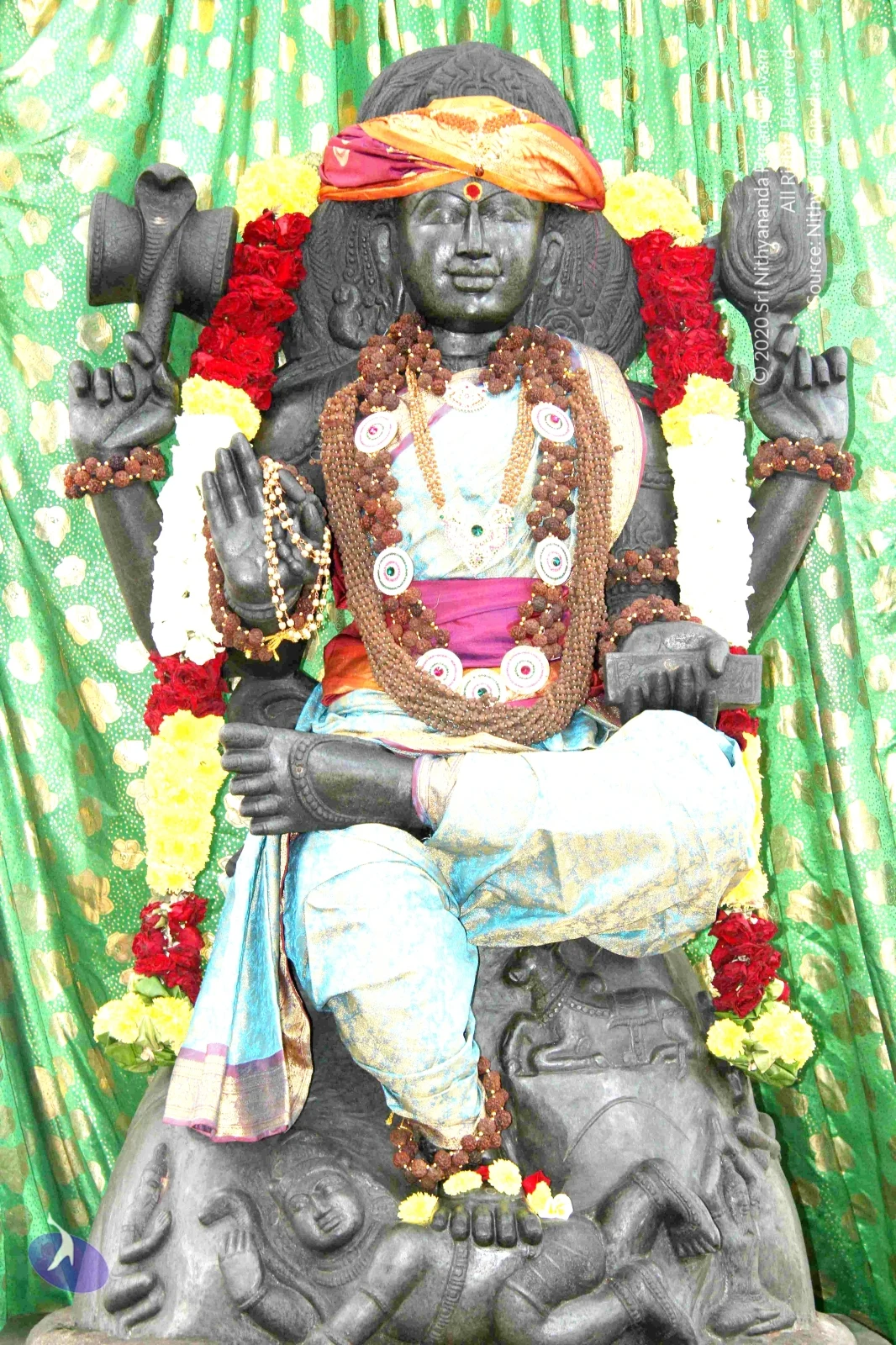
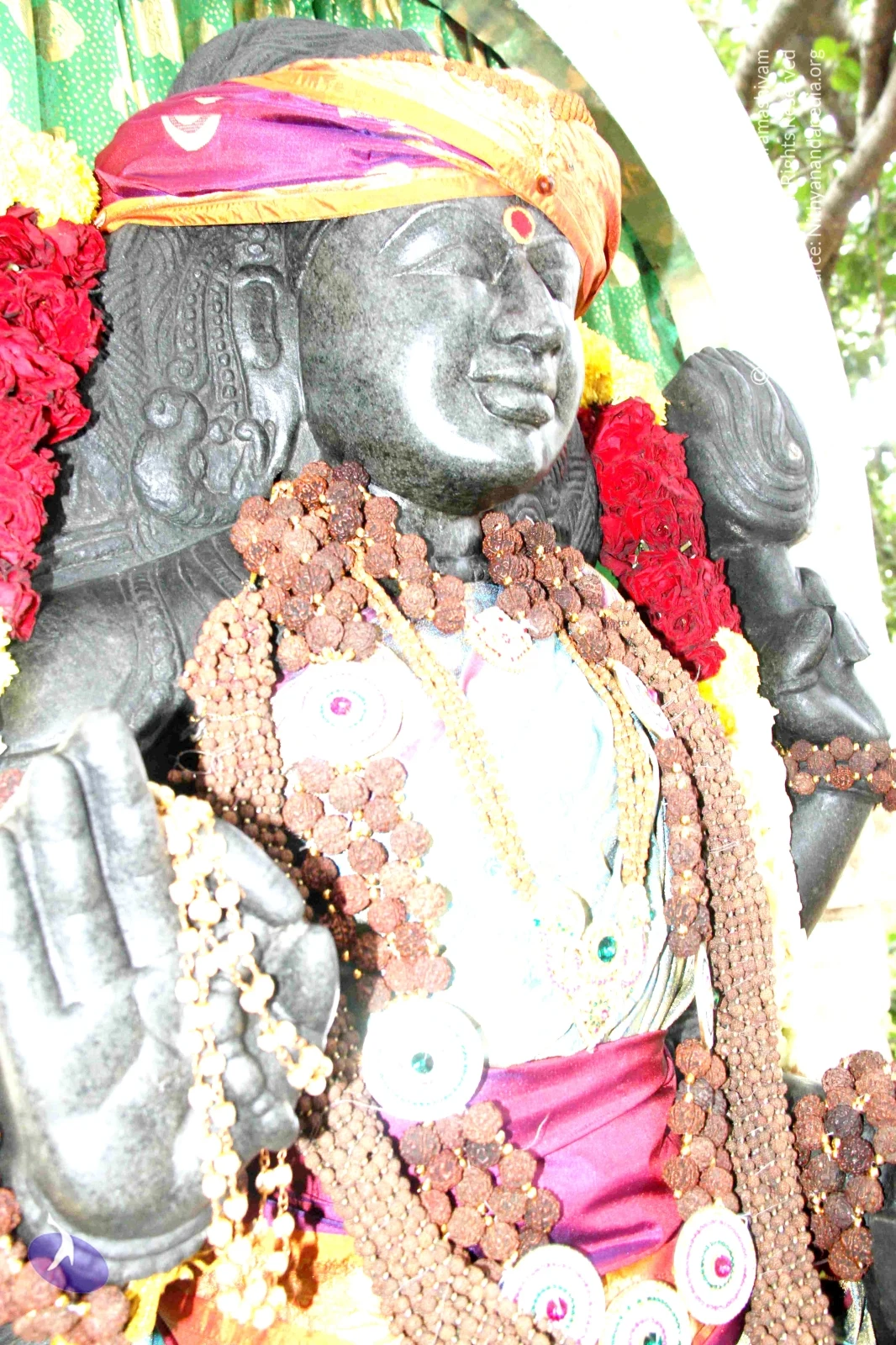
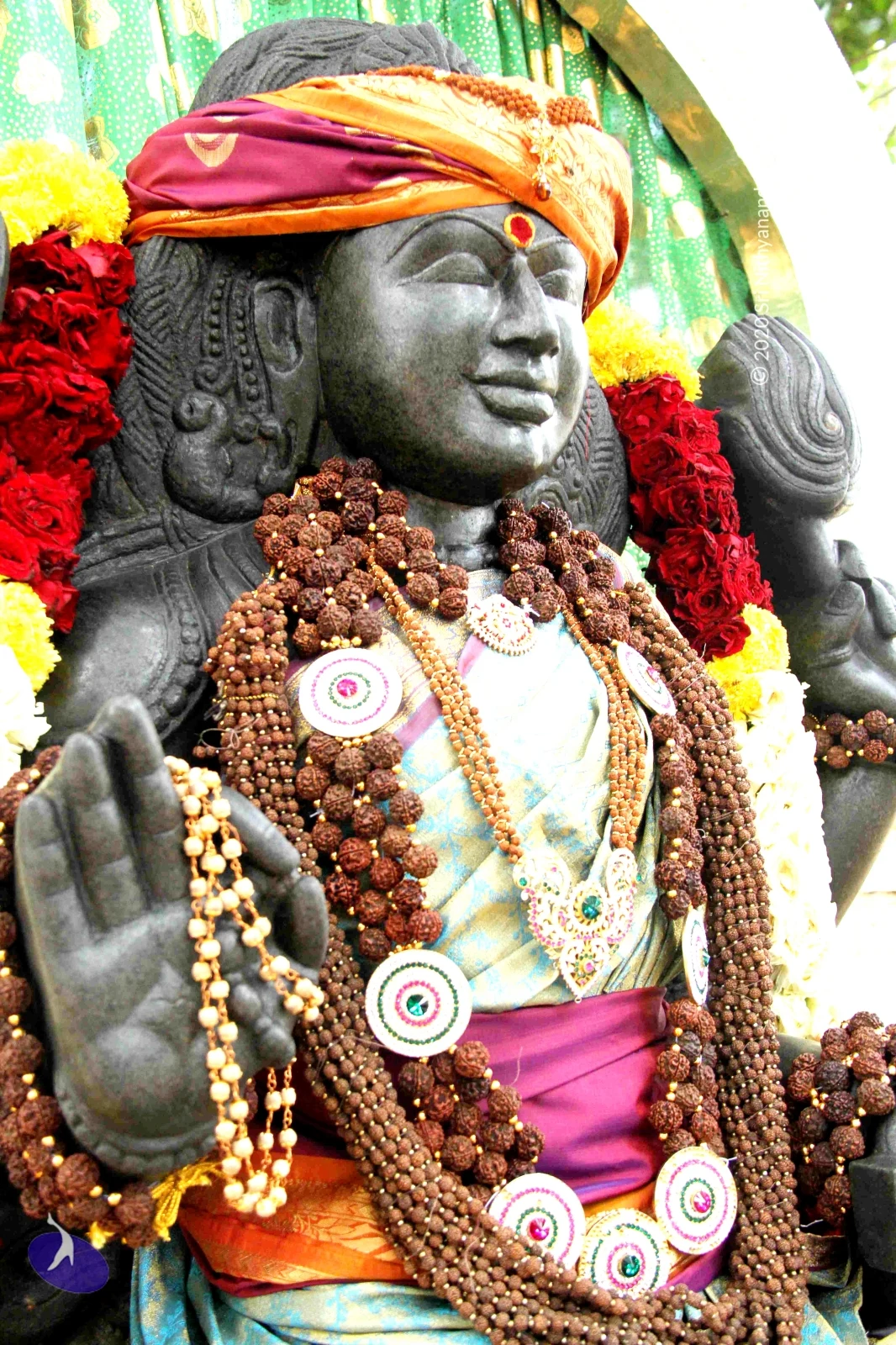
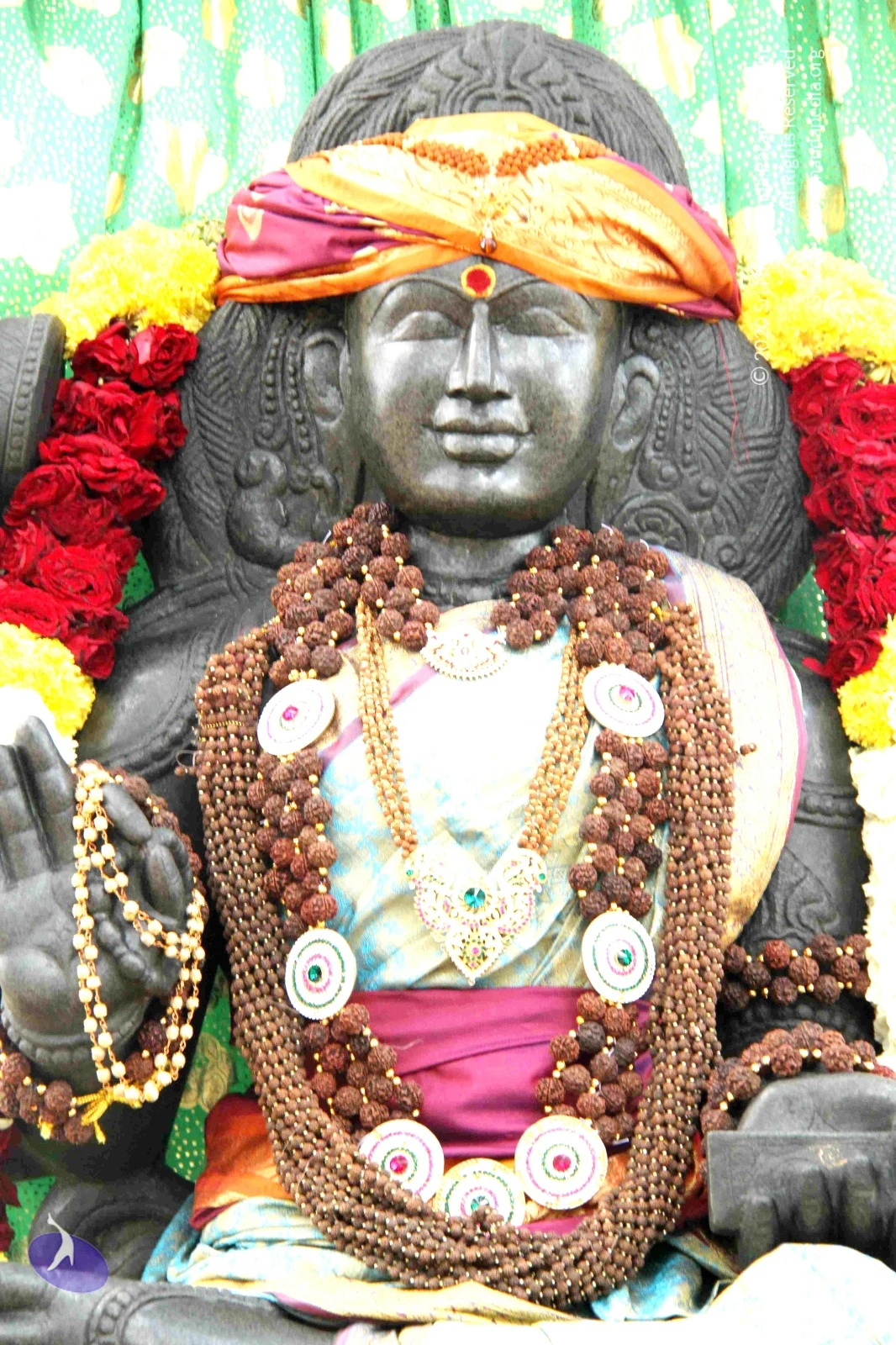
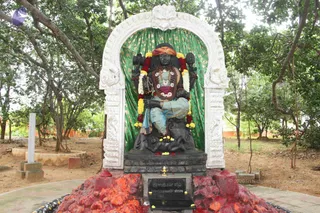
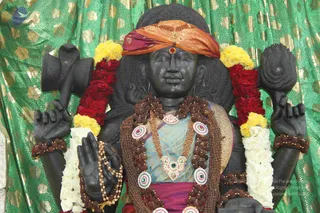
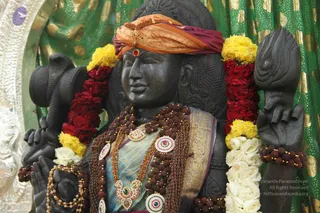
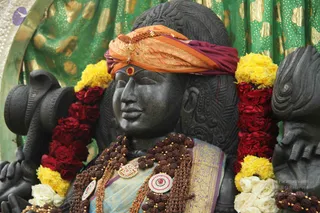
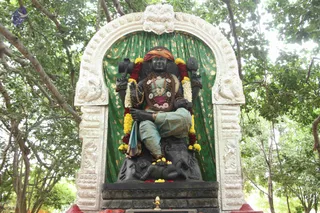
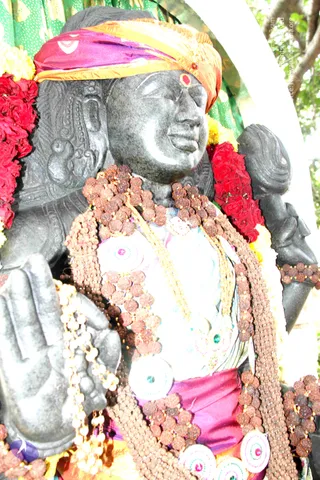
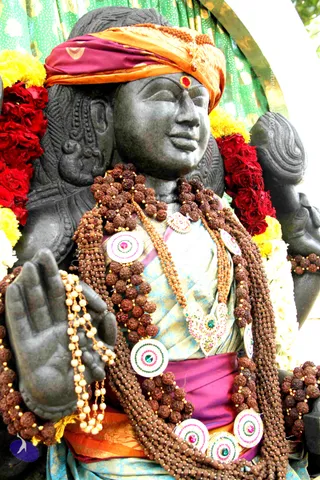
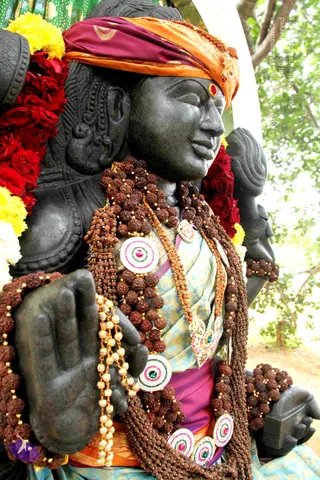
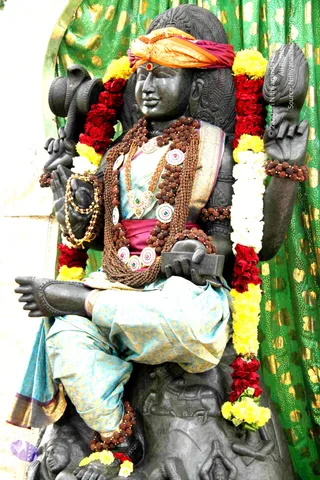
An outdoor shrine in a garden setting shows a dark stone statue of a seated figure, Dakshinamurthy-style teacher form, dressed in a blue-green cloth with a rudraksha mala and ornate necklaces, with an orange-and-red cloth wrapped on the head and garlands of yellow and red flowers draped over the arms. The statue sits in a white arched stone frame before a green patterned backdrop, on a dark pedestal and a base of red-orange stones with scattered marigolds. Trees and dry earth surround it, and a small oil lamp rests at the front. No physical people are visible.A dark stone murti of a four-armed deity, adorned for worship with garlands of red roses, yellow marigolds and white jasmine. The figure wears an orange and magenta turban with a red bindi, rudraksha malas across the chest and arms, and a blue and magenta silk drape with white and multicolour round ornaments. Its upper hands hold a trident-like staff and a conch-like object, while the lower hand is raised in abhaya mudra. Behind it is a green cloth with gold floral print. No people are visible.A dark stone statue, a sculpted murti of a figure with a serene face and a red bindi, wearing an orange and maroon turban-like headwrap. Thick strands of rudraksha malas hang across the chest, with a round white-and-green embroidered medallion, a gold pendant and a pale blue silk garment. Garlands of red roses, yellow marigolds and white blooms drape the statue, and a sculpted hand with a raised finger is visible at left against green drapery and trees. The statue is a sculpted figure, not a living person, so no physical people are present.A dark stone statue of a deity murti dominates the frame, adorned with yellow and red marigold and rose garlands, white flower strands, and multiple rudraksha malas across the chest. The head wears an orange and maroon turban with a red bindi, and the statue wears a teal and gold-bordered silk garment. Raised hands hold ritual objects, and a green gold-patterned cloth forms the backdrop. No physical people are visible; the figure is a sculpted statue, so a person is none.A dark stone sculpture of a deity bust is the main subject, wearing an orange and maroon turban with a red bindi on the forehead. It is adorned with layered rudraksha malas, a gold-bordered blue and gold silk shawl, and a jewelled pendant. Garlands of red roses, yellow marigolds and white flowers drape the figure, set against a green and gold brocade backdrop. Carved stone hands and a serpent-like element appear at the sides. No physical people are visible; the figure is a statue.A black stone statue of a seated deity murti sits within a white carved arch set against a green gold-speckled cloth backdrop, surrounded by green trees. The figure wears an orange-and-maroon head covering, a brown rudraksha-style bead necklace, multiple beaded garlands of yellow marigolds and red flowers, and light blue draped cloth. Its hands are held in front of the chest and at the sides, and a small brass oil lamp rests on the pedestal below. The setting appears to be an outdoor shrine.

TWO WAY

4 photosSource gallery
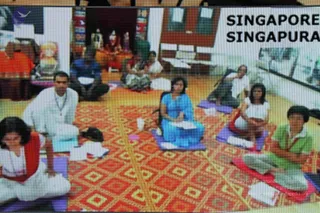
A photograph of a video-conference screen showing a satsang group seated on a red and yellow patterned floor mat in Singapore. A woman in a blue salwar kameez sits centre, holding papers, with a woman in white and a red top on the left, a man in white on the left edge, a woman in white on the right, and a man in a green polo shirt on the right. Behind them are deity murtis and framed images on a shelf, and an orange-robed figure stands at the far left edge. The on-screen caption reads SINGAPORE SINGAPURA.A photograph of a screen showing a grid of nine live video-conference panels, each labelled with a city, of devotees sitting in satsang or meditation in different rooms. Top left, a man in dark clothes sits in a folding chair with his head tilted back. Centre panel labelled Seattle Chidambaram shows people seated on a red and gold rug before a small shrine. Right panel labelled Los Angeles shows seated devotees in white and red. Centre-left panel labelled Washington DC Sripuram shows a deity murti on a red altar beside a seated man in white. Bottom left panel labelled San Jose Madurai shows people on mats, one in a grey robe. Bottom right shows a woman with white forehead markings and a red garment speaking into a microphone. A copyright notice is printed over the lower right. No identifiable a person is confirmed in the panels, so the figures are described by role and location.A photograph of a large wall screen showing a grid of live video-conference tiles of devotees gathered in homes and centres. Labelled tiles include Monterrey-Mexico, San Diego Tiru Alavai, Dallas, Philadelphia, East London UK, Eindhoven Nederlands, Ohio Prayag, Mill Valley, and Kathmandu Nepal. In the Ohio Prayag tile, a saffron-robed figure sits on a striped mat in a living room with a shawl draped over the shoulders and a seated audience around. In the Paris-Vernet tile, a saffron-robed figure with a head wrap sits on a bed. In the Kathmandu tile, people in pink and white clothing sit on the floor. The screens are mounted over a dark wall and the tiles show people on screens, not physical people in this room.A photograph of a large screen displaying a video-conference grid of satsang participants from many cities, each tile labelled with a location caption such as Monterrey-Mexico, East London UK, Ohio-Prayag, Mill Valley-Vairavan USA, Kathmandu Nepal and Paris Kalighat. Participants sit in homes and rooms, mostly in white, orange and red clothing, some with garlands and shawls, with framed pictures and flowers visible. A top-centre tile shows a woman in orange robes seated in a room in Paris Kalighat. Tiles show about twenty visible people across the grid, with the Kathmandu tile showing a group of several people seated together.

1-Rudra-Abhishekam
25 photosSource gallery
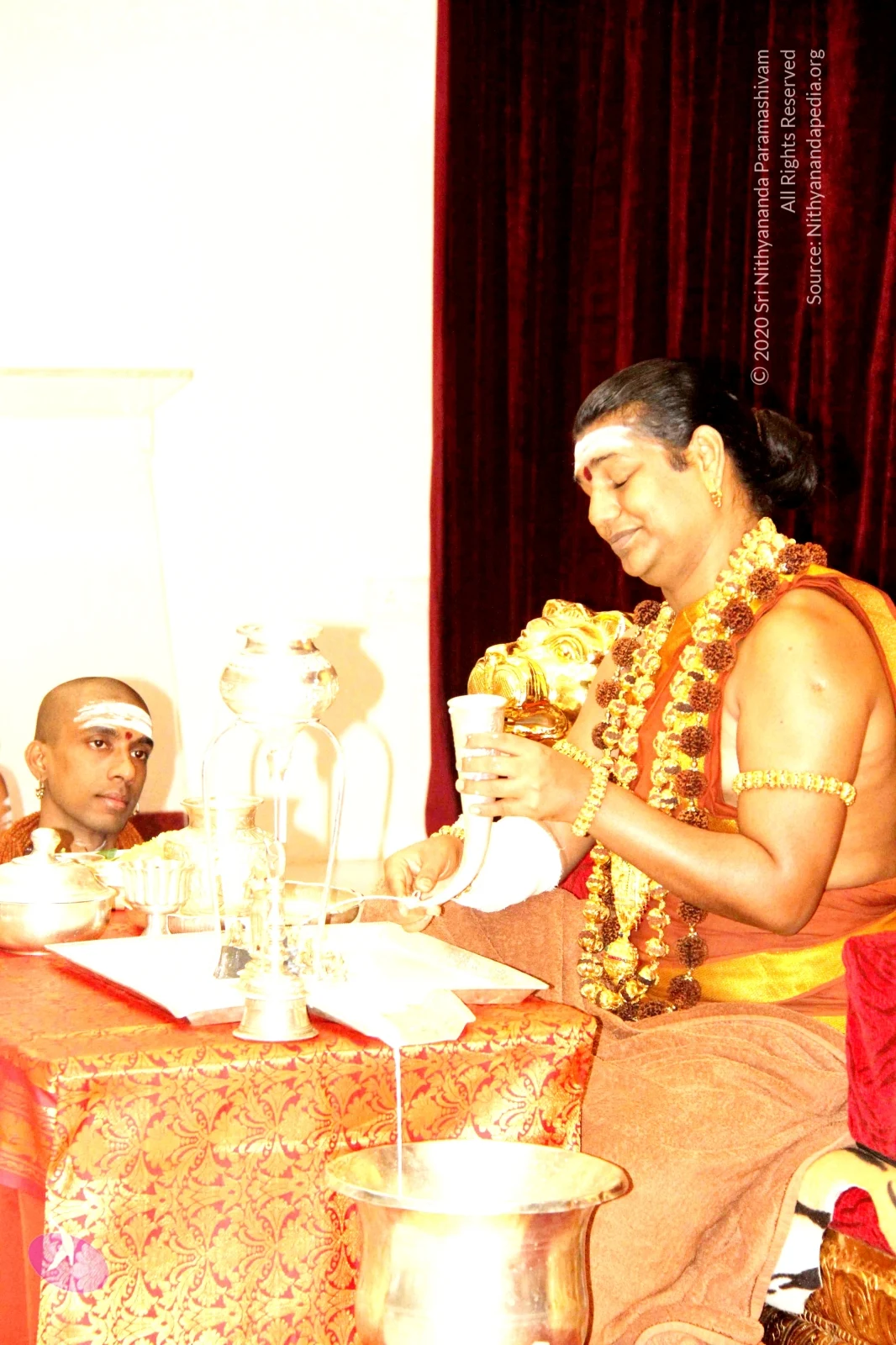
A seated man in orange and saffron robes with a red-gold shawl and long rudraksha and gold bead malas pours liquid from a golden kalasha-style vessel through a white conch-shaped spout during abhishekam at a table draped in gold-and-red brocade. Silver vessels and a silver pot stand on the table and below it, while a shaved-headed priest in orange wraps with white tilak sits at left. A deep red velvet curtain hangs behind.Photograph of a man in an orange-saffron garment with a white vertical forehead mark and red bindi, wearing layered gold-beaded rudraksha malas, gold armlets and bangles, and gold earrings. He holds a white conch-shaped vessel with a sipping cup in one hand while a second hand holds the horn-like base; a gold-coloured bull or deity murti sits behind him against a dark red curtain. The setting suggests an abhishekam or puja offering. a person: the saffron clothing, rudraksha malas and ceremonial gold ornaments are present, and the page identifies a person at this event.A photograph of a man performing an abhishekam-style ritual at a table draped in gold-and-red brocade in front of a deep red velvet curtain. He wears a red-orange garment with gold border, multiple strands of rudraksha malas and gold-coloured ceremonial necklaces, gold bangles and a white forehead band with a red bindi. He holds a silver vessel and pours liquid through a silver spout onto a silver shivalinga-style object on a tray. A large gold pot stands behind him, and a silver lota with tubing sits on the table. a person is shown performing the ritual, with visible cues of rudraksha malas, ornate gold jewellery and orange clothing.Photograph of a man in saffron-orange draped clothing, with a white horizontal forehead band and red bindi, wearing layered gold-coloured floral necklaces and many rudraksha malas, gold armbands and a gold earring. He looks down while holding a silver-rimmed cup over a conch or horn-shaped vessel, with a brass or gold ritual vessel and a lamp-like object at the left edge. Dark red drapery forms the background. a person: the orange garments, multiple rudraksha malas and ceremonial gold ornaments fit the page's description of the event, and he is performing a ritual pouring.A man seated before an ornate gold throne performs an abhishekam ritual at a table draped with red and gold brocade. He wears a saffron-red garment with a gold border, rudraksha malas and gold necklaces, gold armlets and earrings, a white tripundra and red bindi on his forehead, and his eyes are closed. He pours from a silver kalasha with a stream of liquid onto a small deity murti, while holding a silver cup in his other hand. A silver bell lies on the table beside him. Dark red curtains form the backdrop. The figure matches the a person appearance cues: rudraksha malas, ceremonial gold ornaments and a throne, and he is performing a ritual before the murti.A photograph of a seated man in saffron-orange robes with a bare chest and a gold-bordered shawl, wearing layered rudraksha and gold-bead malas, gold armlets and gold earrings. He has a white horizontal forehead mark with a red dot and smooth swept-back hair, holding a silver pot-shaped vessel and a silver cup. Before him on a red and gold cloth-draped table stand a silver bell and a small silver figure. Behind him is an ornate gold throne-back against a deep red curtain.

10-Homa
39 photosSource gallery
A decorated Ganesha murti stands at the centre of a silver arched shrine framed by a repoussé silver torana with lion and floral motifs. The deity is heavily adorned with red, yellow and white flower garlands, jewelled necklaces and a crown, set against orange and green silk drapes. Below, a red-clad figure of a deity with a mask-like face is decorated with garlands and flanked by two tall yellow-green coconuts placed on silver pots. Two seated golden figures appear behind the offerings. No people are visible.A photograph of a Ganesha murti dressed for worship, its silver trunk and face framed by heavy garlands of red roses, yellow marigolds, white jasmine and green leaves. The deity wears layered jewelled necklaces and a silver crown, and sits before a gold-embossed arch with an orange cloth behind it and a green satin drape below. Gold ritual vessels appear at the lower left. No people are visible.A photograph of a Ganesha deity murti set in an ornate gilt arched shrine frame. The silver-faced murti wears a heavy jewelled silver necklace and crown, and is draped in a green satin cloth. Garlands of red roses, yellow marigolds, white jasmine and green leaves surround the figure, with clusters of yellow and red roses flanking the arch. A golden kalasha-style vessel sits in the foreground. No physical people are visible.A young shaven-headed ritual attendant in an orange saffron cloth and a long rudraksha mala sits at a homa or puja setting, holding a silver vessel with a lit oil lamp in his right hand. He wears white horizontal tilak lines and a red bindi, with rudraksha bracelets on his wrists. A silver bowl, a yellow flower and a pink flower sit on the yellow-draped table in front of him, with smoke rising. Another person in white ritual clothing with white body markings is partially visible at the right edge.A young male priest in an orange saffron cloth and multiple rudraksha malas stands at a stone altar during a fire ritual. He has white tripundra lines and a red bindi on his forehead, gold hoop earrings, and rudraksha bands on his upper arm and wrist. He holds dried grass stalks over a flame in a brass vessel while burning incense, and a pink rose and white flowers rest on the stone ledge. The scene is lit warmly against a dark background.A decorated Ganesha murti, silver-toned with a trunk, is framed in an ornate gold arch against red and orange drapery. Garlands of yellow marigolds, red flowers, green and white blooms cover the deity, with layered silver and jewelled necklaces. Several yellow-orange coconuts with red tilak marks sit before the image, decorated with flowers and green leaves. No people are visible.
11-Deities
2 photosSource gallery
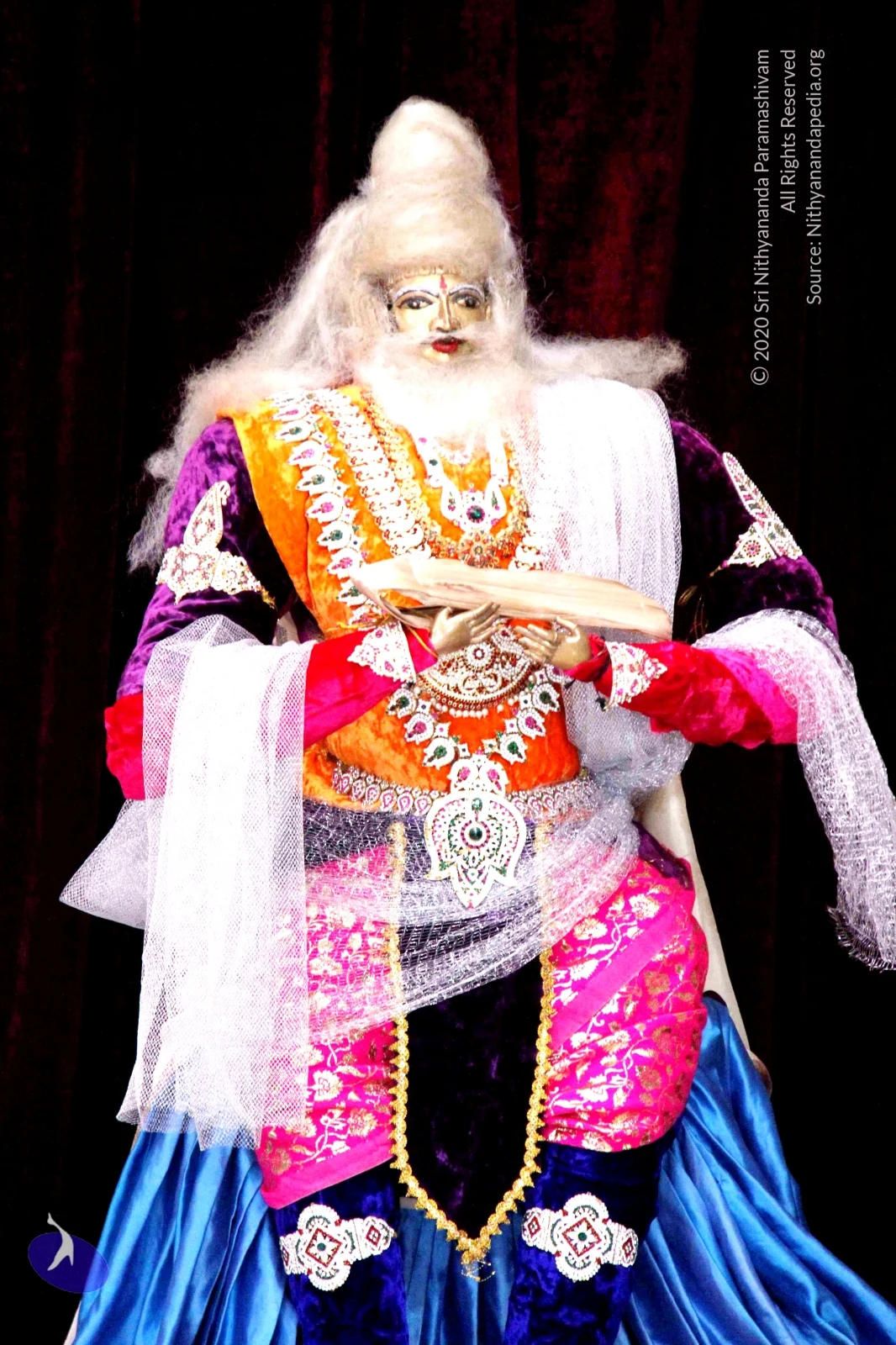
A life-size statue of a white-bearded sage with tall white hair piled on the head, painted golden face with red lips and a tilak mark, stands before a dark red velvet curtain. The figure wears a purple velvet tunic with a bright orange velvet vest, layered gold and jewelled necklaces, sheer silver net shawls, a pink brocade sash and deep blue velvet trousers with jewelled ankle bands, and holds an open book or palm-leaf-like tome against the chest. It is a statue, not a living person.Two ornately decorated deity murti figures seated side by side on a golden arched throne-like backdrop, surrounded by red roses, white and purple flower garlands. The figure on the left wears a dark teal crown with white ornamentation, a purple skirt-like drape, a teal garment with gold border and layered pearl-and-stone necklaces. The figure on the right wears a black and gold crown, red and gold sari with pearl garlands, and raises one hand in blessing. Both are gold-trimmed and richly adorned, with green satin drapes below.

2-Pratyaksha-Pada-Puja

14 photosSource gallery
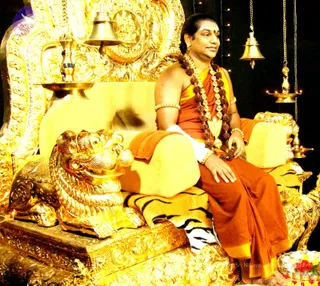
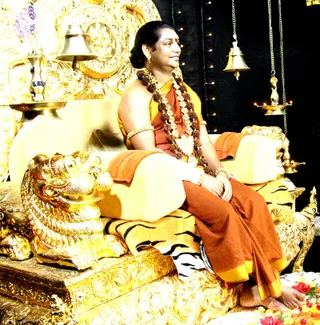
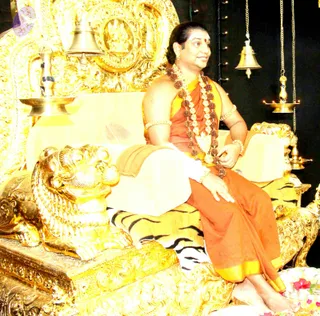
A man in orange-saffron robes sits on an ornate gold throne carved with lion heads and floral reliefs, draped with a tiger-striped cloth. He wears a long rudraksha mala with a gold pendant, gold armbands and bangles, and a red tilak on his forehead; his hair is swept back. Brass bells and a hanging brass lamp hang beside the throne, with a tray of flowers and lamps at the lower right. This is a person depiction by appearance cues, seated as the central figure in a ceremonial setting.A seated man on an ornate gold throne carved with lion-head armrests, draped in a tiger-striped cloth. He wears a rust-orange and gold-bordered robe, layered rudraksha malas, a gold necklace, gold armbands and bangles, and a red tilak on his forehead. Brass bells and hanging brass lamps are suspended behind him, and flower petals lie on the floor at his feet. He sits with his hands resting in his lap. The appearance is consistent with Swamiji (probable), based on the swept-back hair, saffron-orange robe, rudraksha malas and gold ornaments, and the page indicates he is present at the Pratyaksha Pada Puja event. He is seated in the position of a guru receiving puja.A seated man in an ornate gilded throne with a lion-head armrest, draped in a tiger-skin cloth. He wears orange and saffron robes with a gold border, multiple rudraksha malas and a white flower garland, plus white bangles and a red bindi, with his hands resting on the armrest. Brass bells and oil lamps hang and sit beside the throne against a dark backdrop, and flowers lie at the base. The man matches the Swamiji page cues of long swept-back hair, saffron clothing and rudraksha malas, so he is a probable Swamiji candidate seated in person on the peetha.A photograph of a person seated before an ornate gold throne-like backdrop, wearing an orange-red shawl with a gold border, long rudraksha malas with gold beads and a large gold pendant, gold armlets and bangles, and a red bindi with white markings on the forehead. A brass bell hangs from a chain at right against a dark background with small lights. The person is smiling and gazing sideways. Appearance-based label: Swamiji (probable), given long swept-back hair, rudraksha malas, ceremonial gold ornaments and saffron-orange clothing.A seated man in an orange-saffron robe with a gold-edged border sits on an ornate gold throne draped with a tiger-striped cloth. He wears a long mala of rudraksha beads and white flower garlands, white bangles on both wrists, and a vermilion tilak on his forehead. Two brass hanging bells and a lit brass oil lamp hang behind him against a dark wall, and white and pink flowers lie at the base of the throne. Swamiji (probable): a long swept-back hair style, saffron robe, rudraksha mala and ceremonial gold-throne setting are visible cues, consistent with the page's Pratyaksha Pada Puja event.A seated man in an ornate gold throne with carved lion-head armrests and a tiger-striped cushion is the central figure. He wears an orange-saffron robe with yellow trim, a long rudraksha mala with a ceremonial gold pendant, and white bangles, with a red-and-white tilak on his forehead and hair pulled back. Brass oil lamps and hanging bells surround the throne, and pink and white flowers lie at the base.

3-Nithya-Satsang
12 photosSource gallery
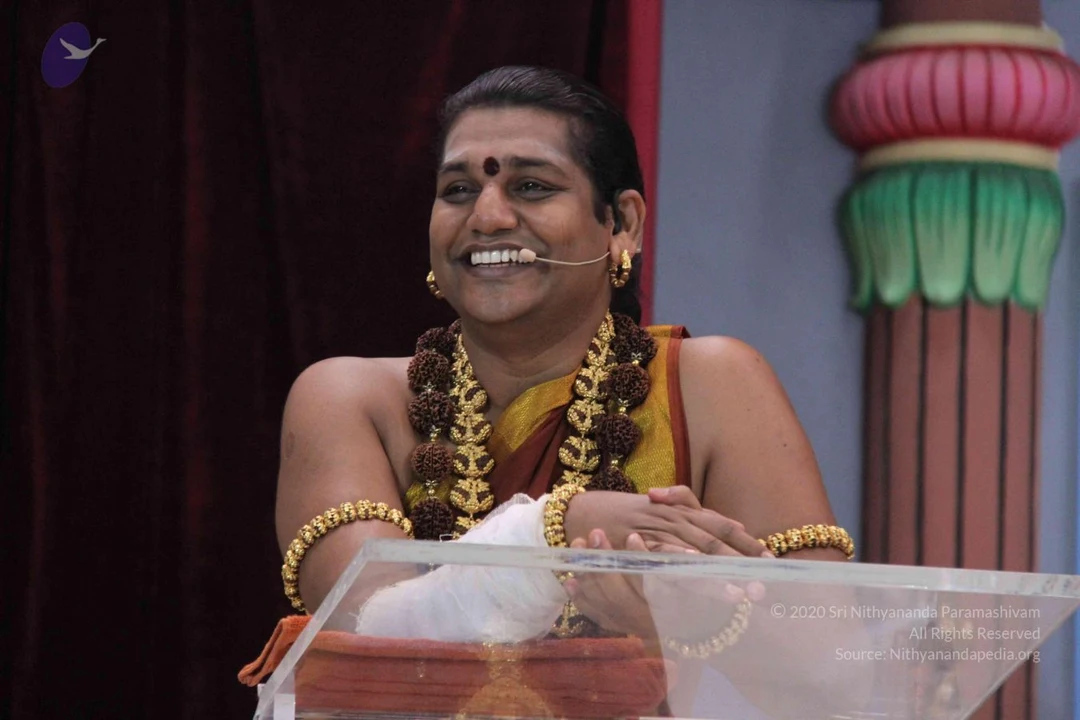
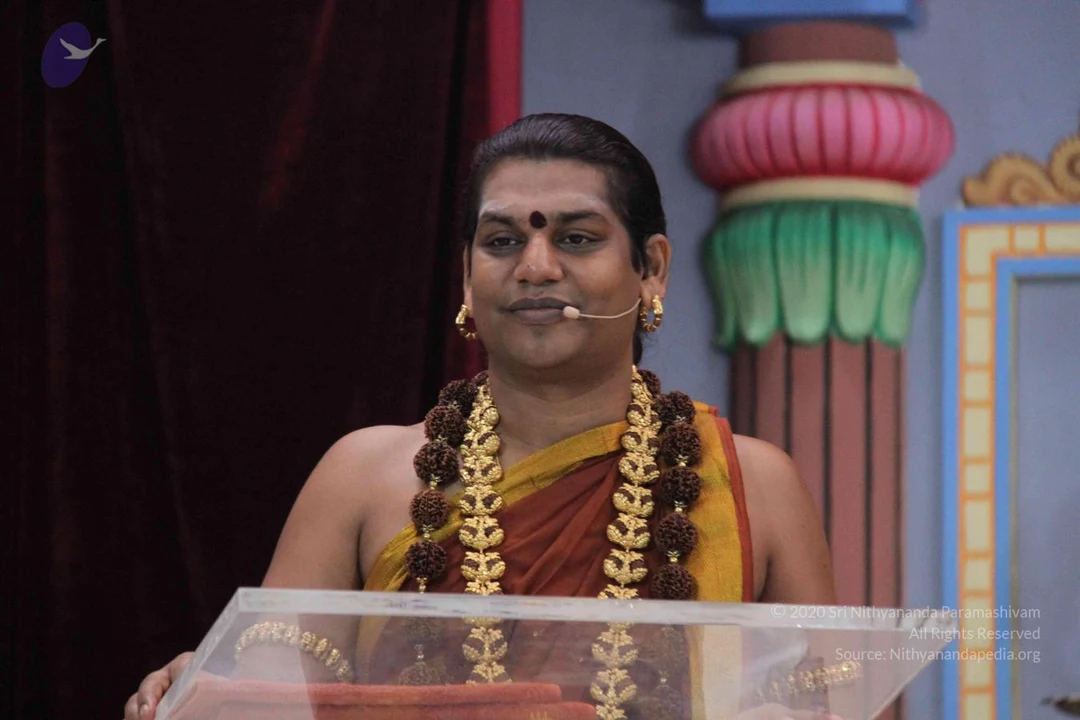
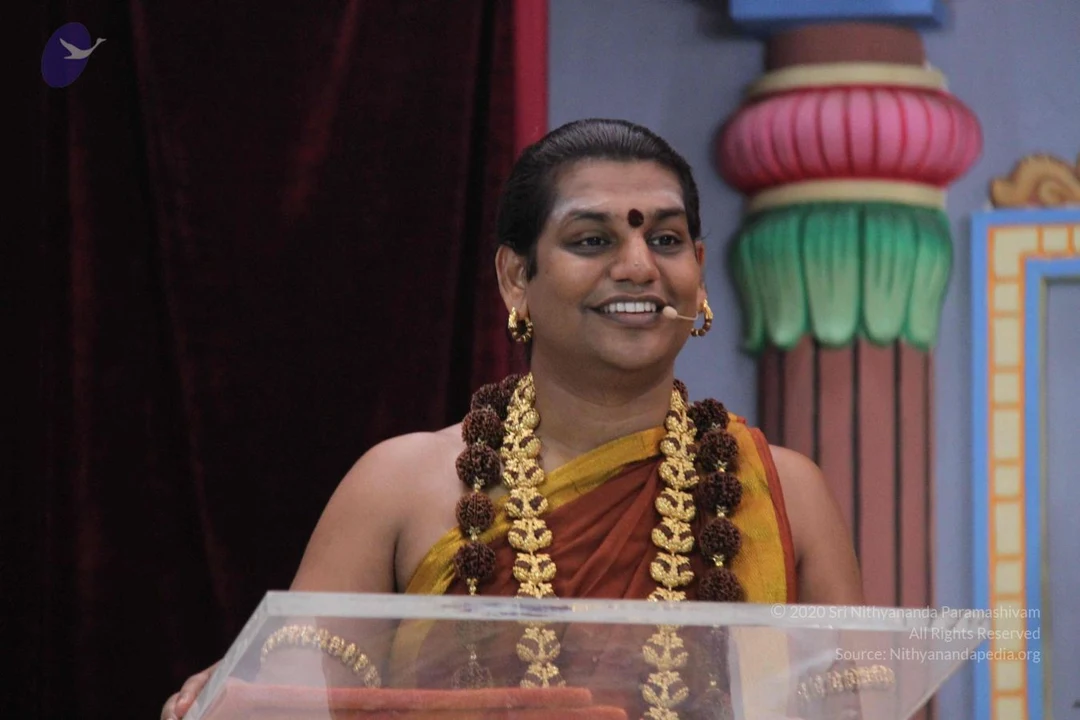
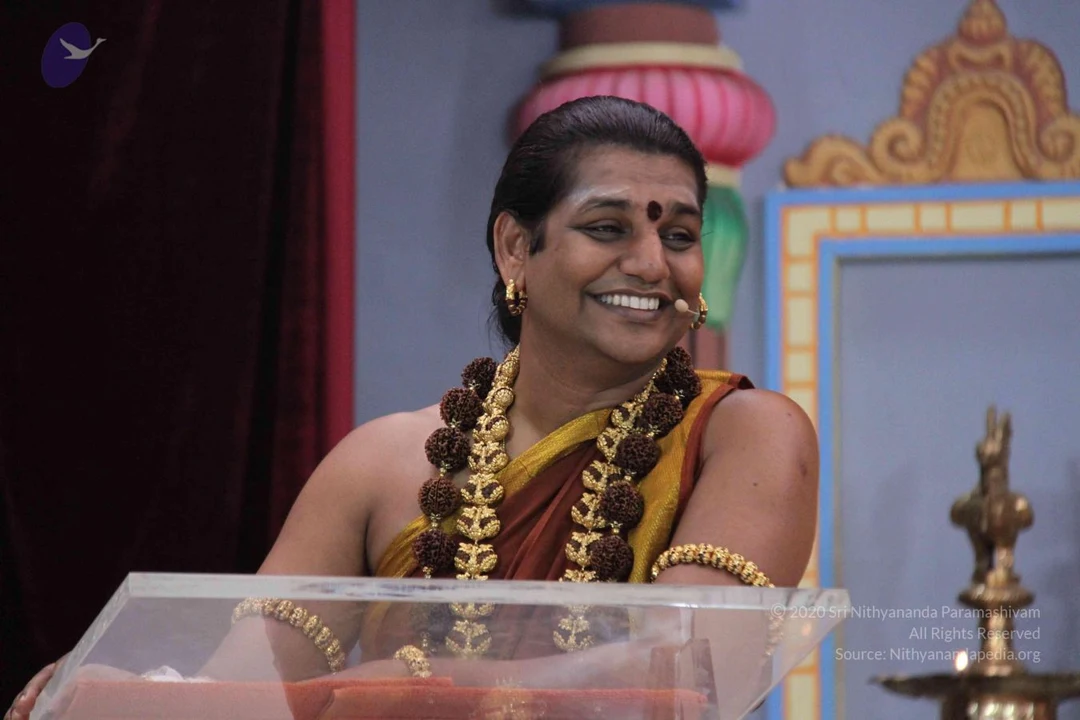
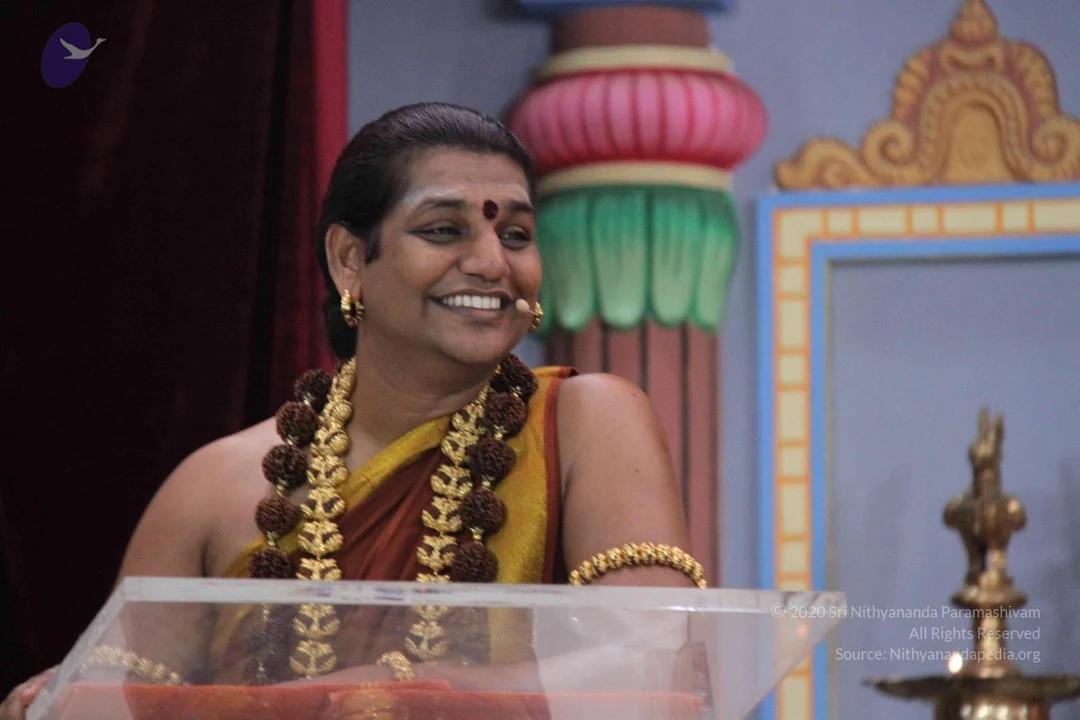
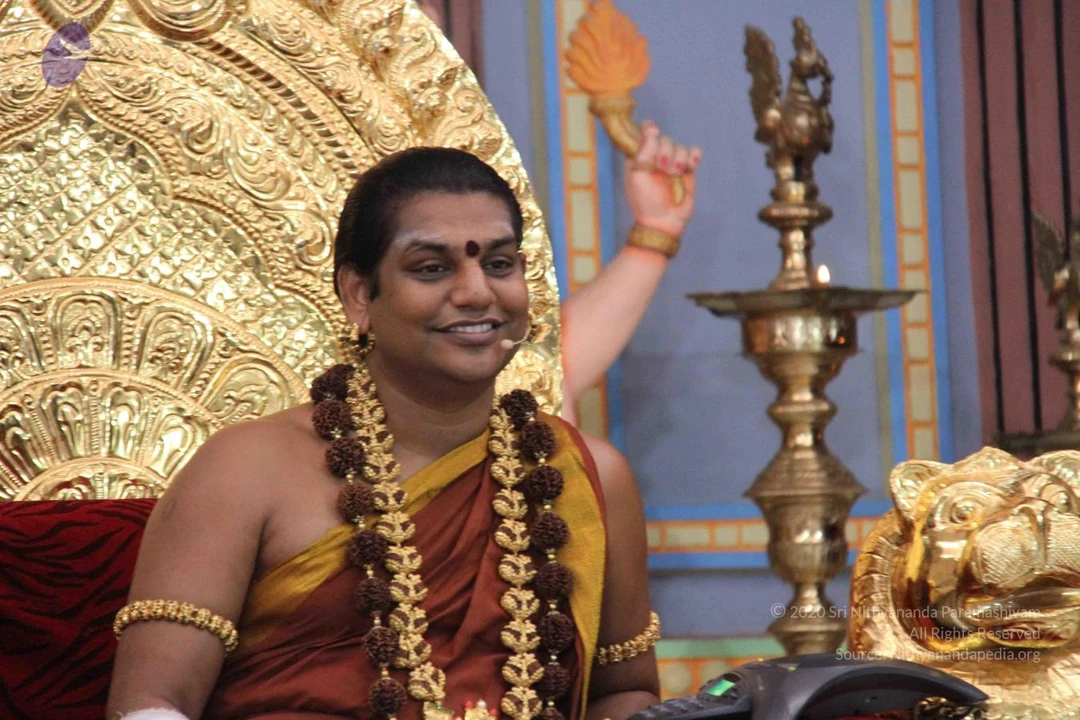
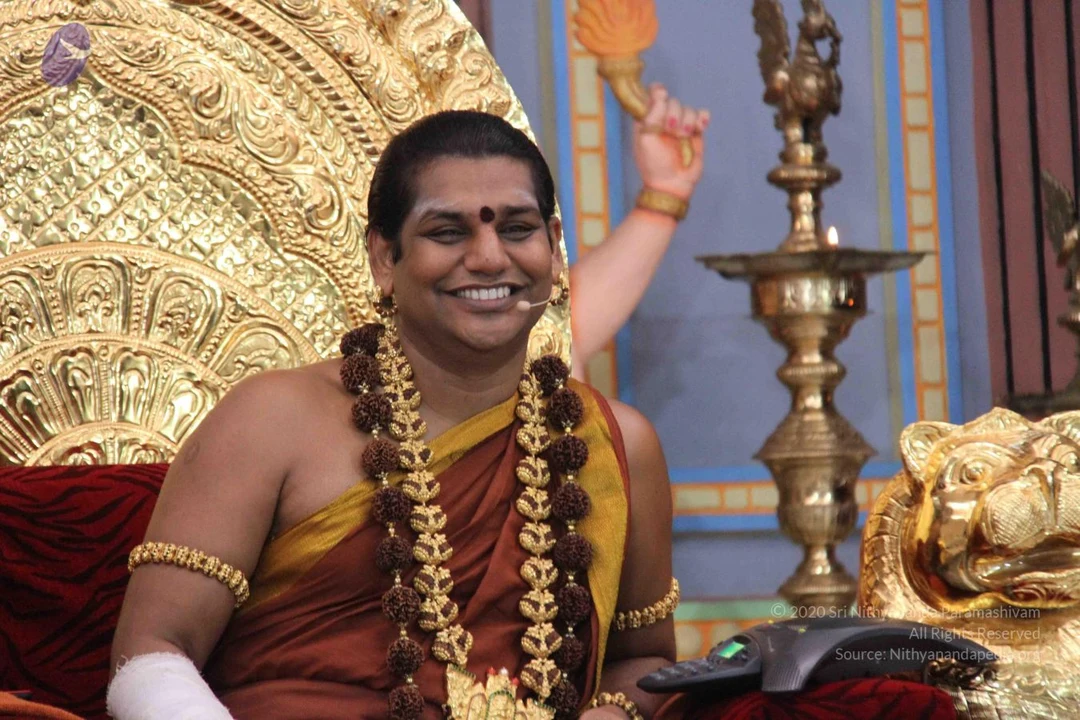
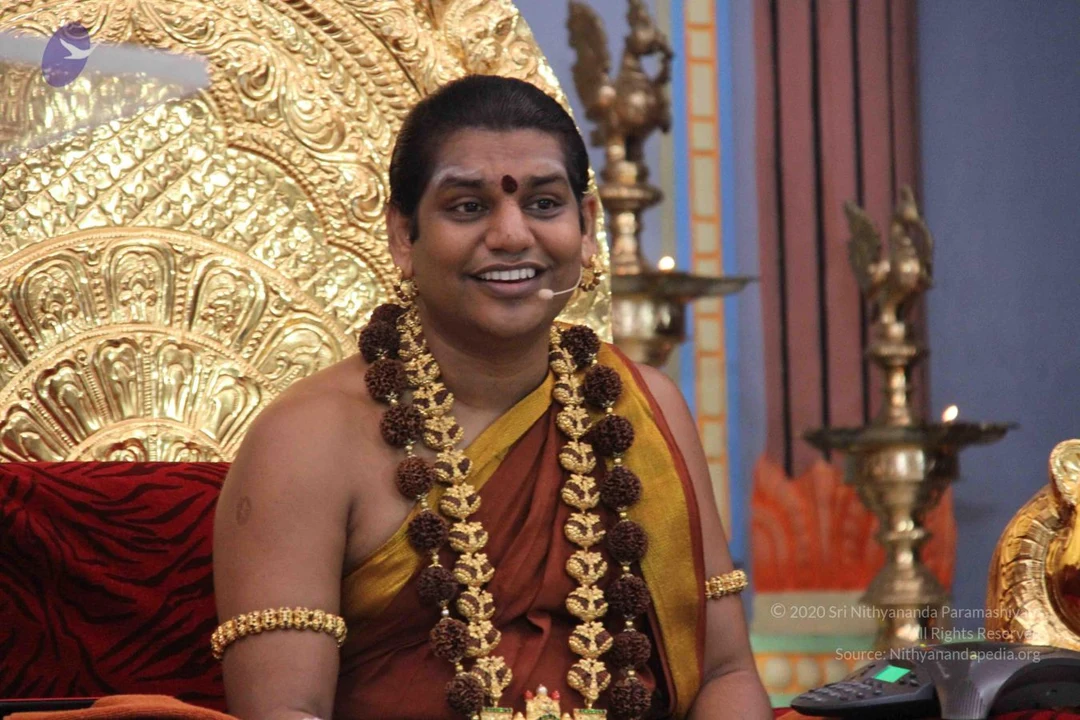
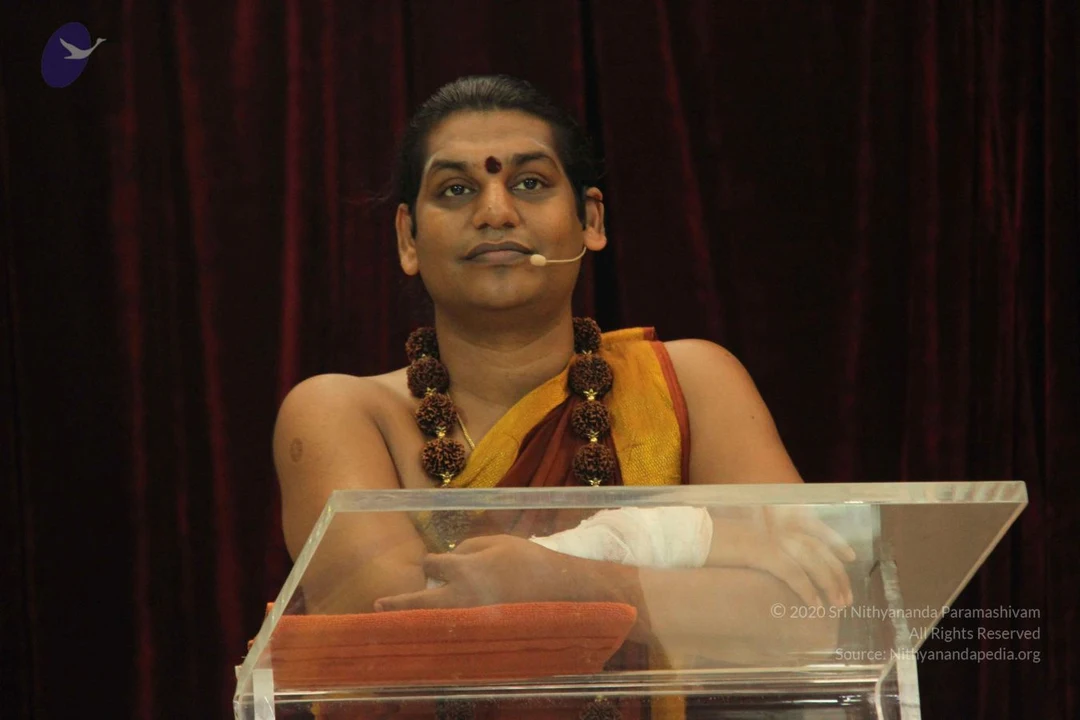
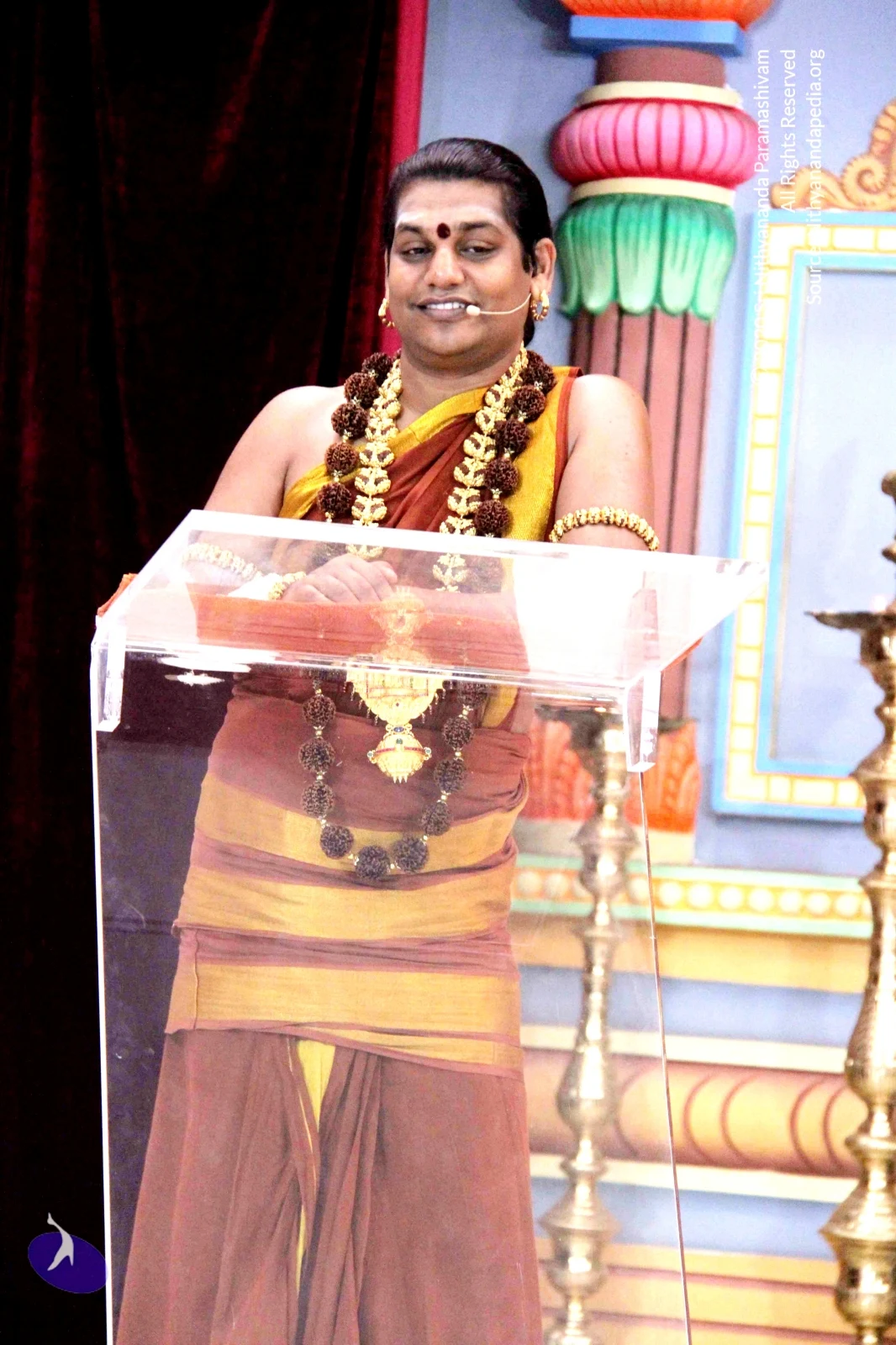
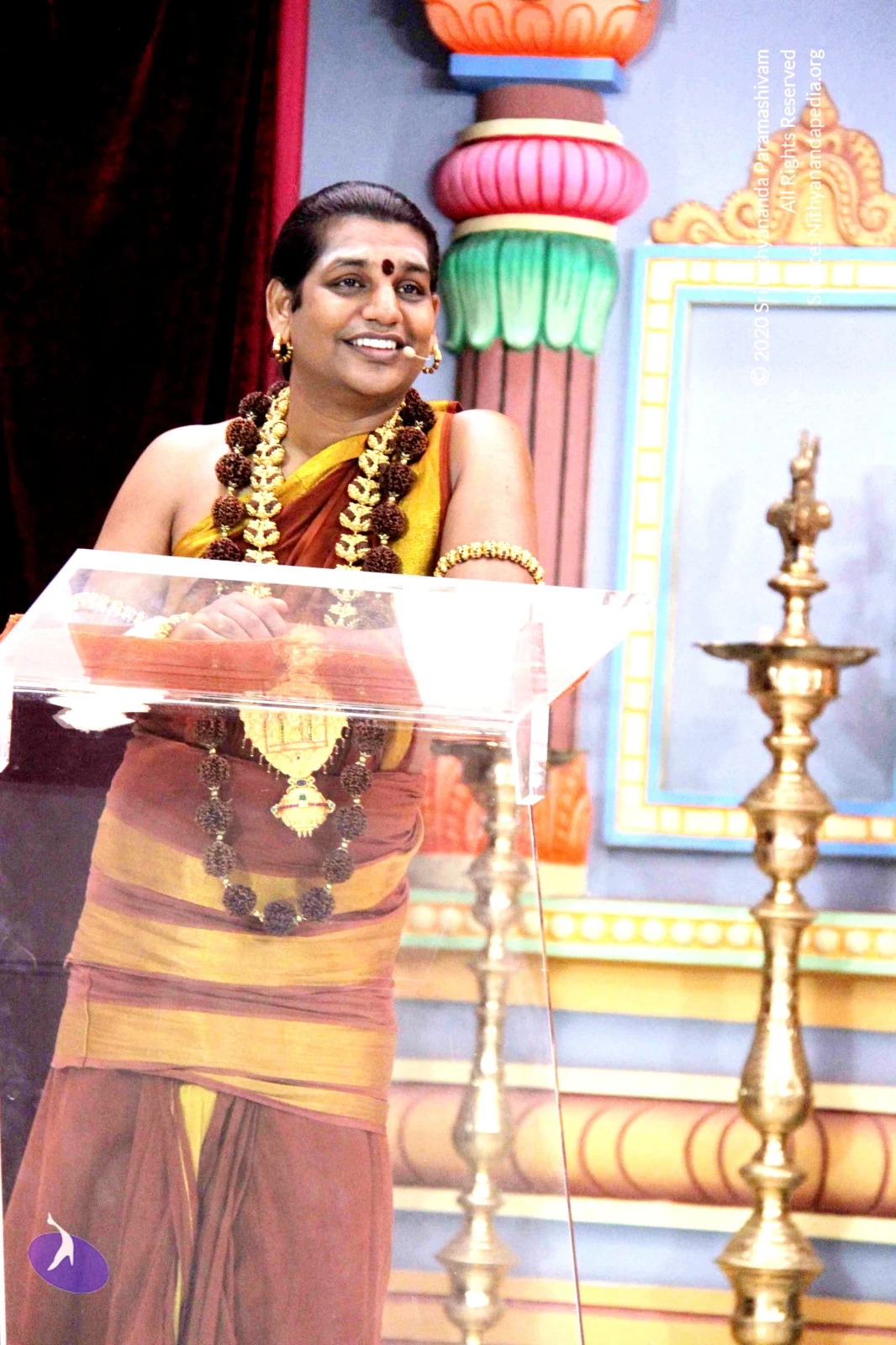
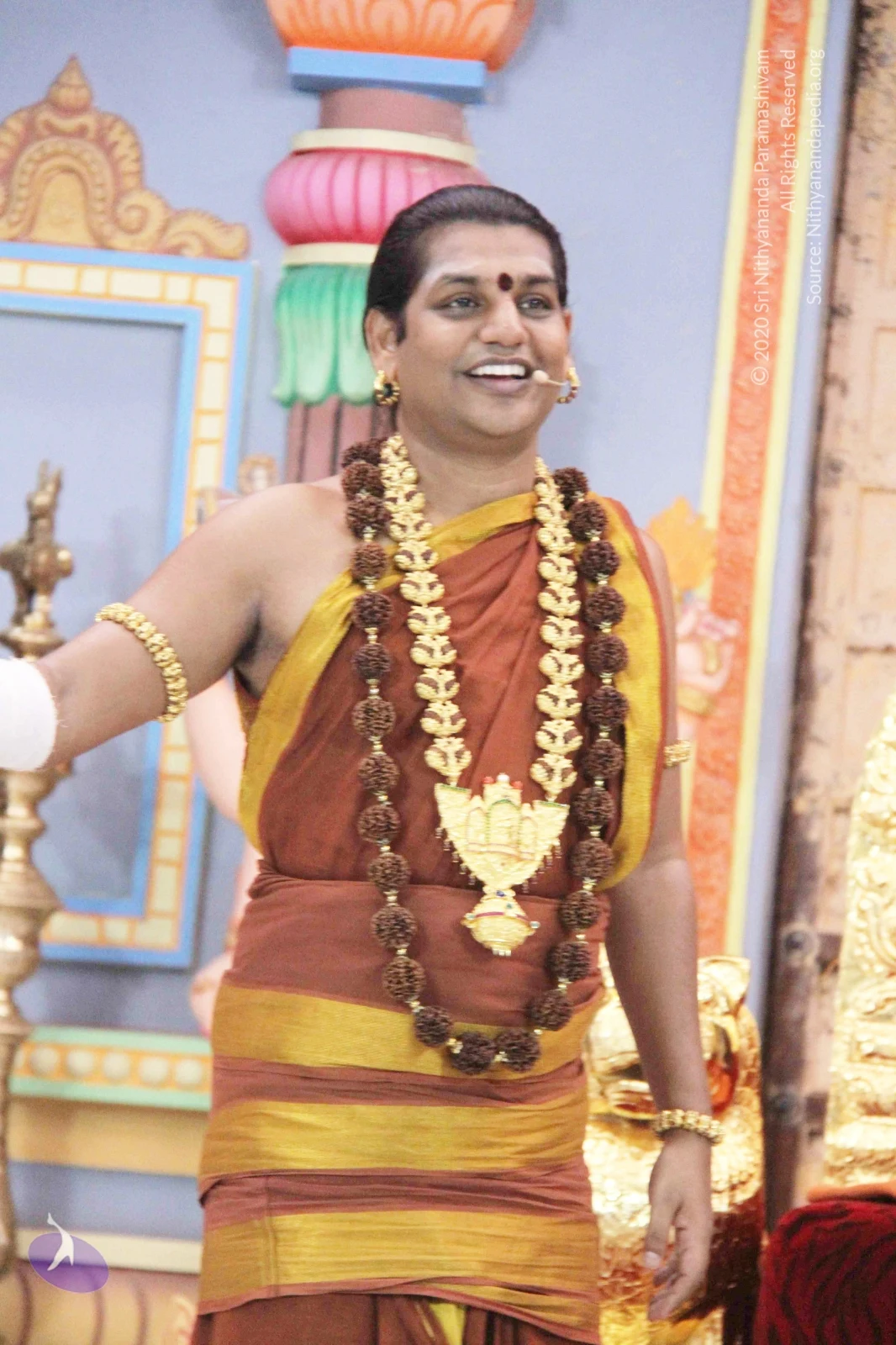
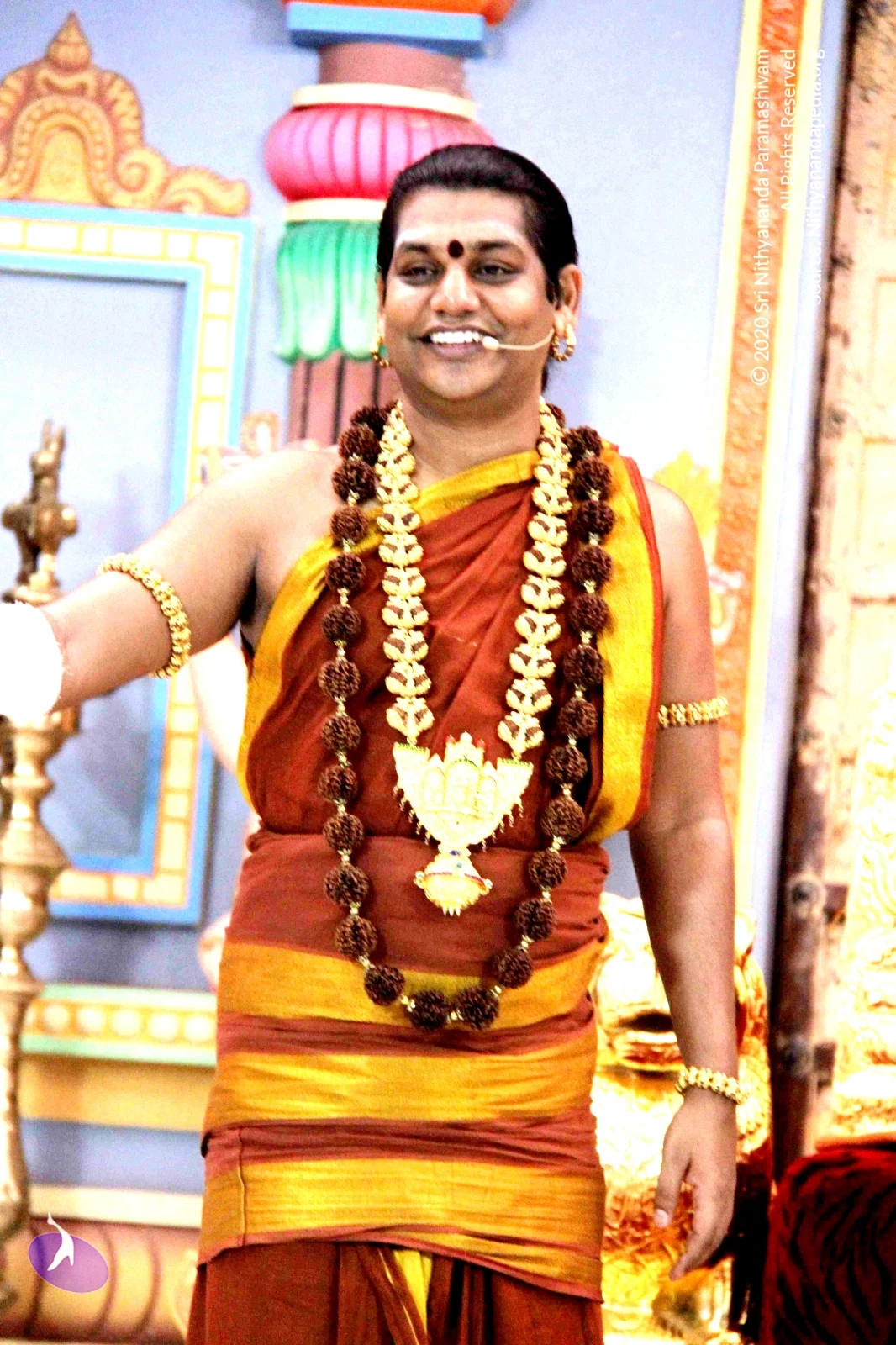
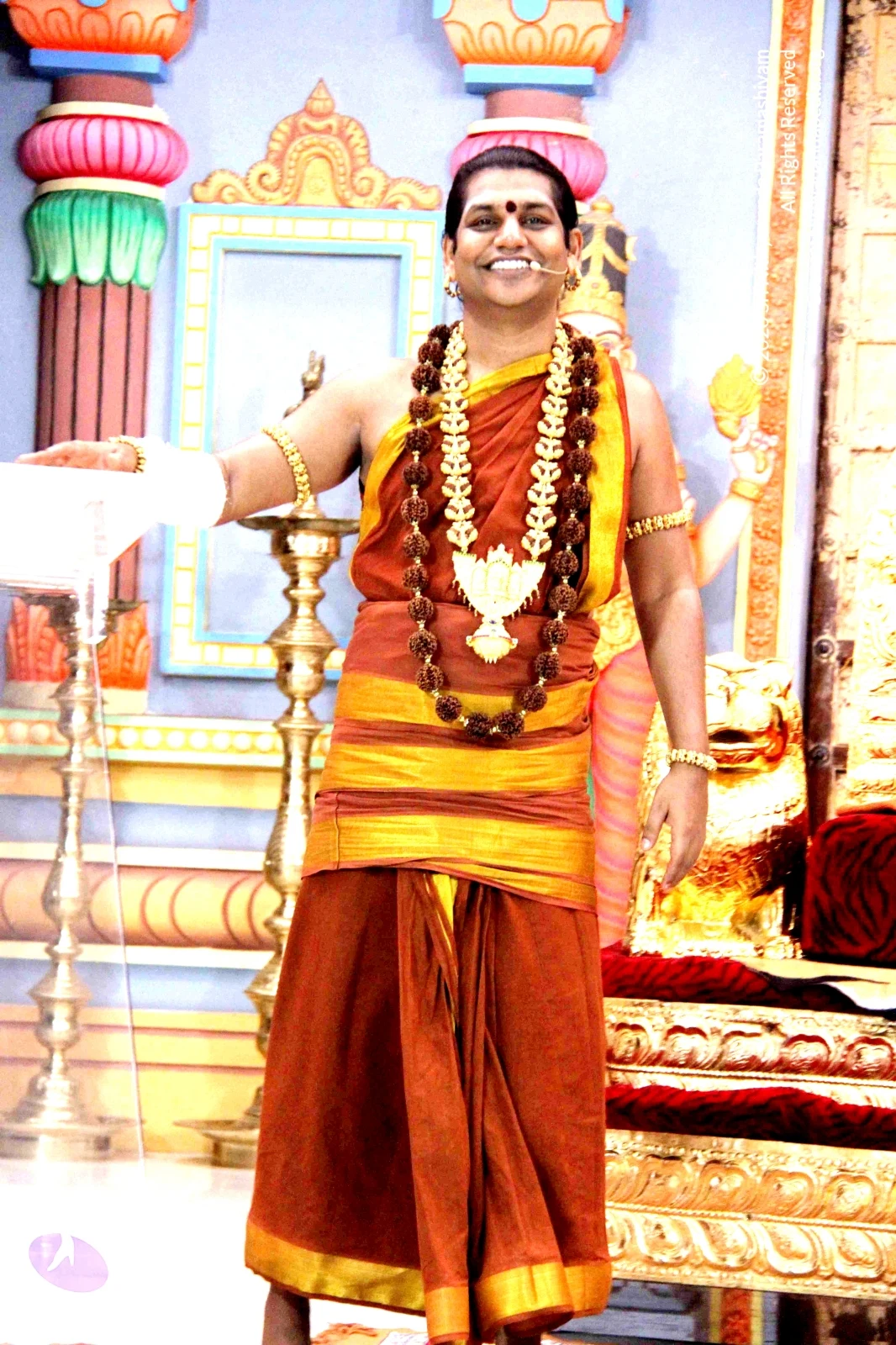
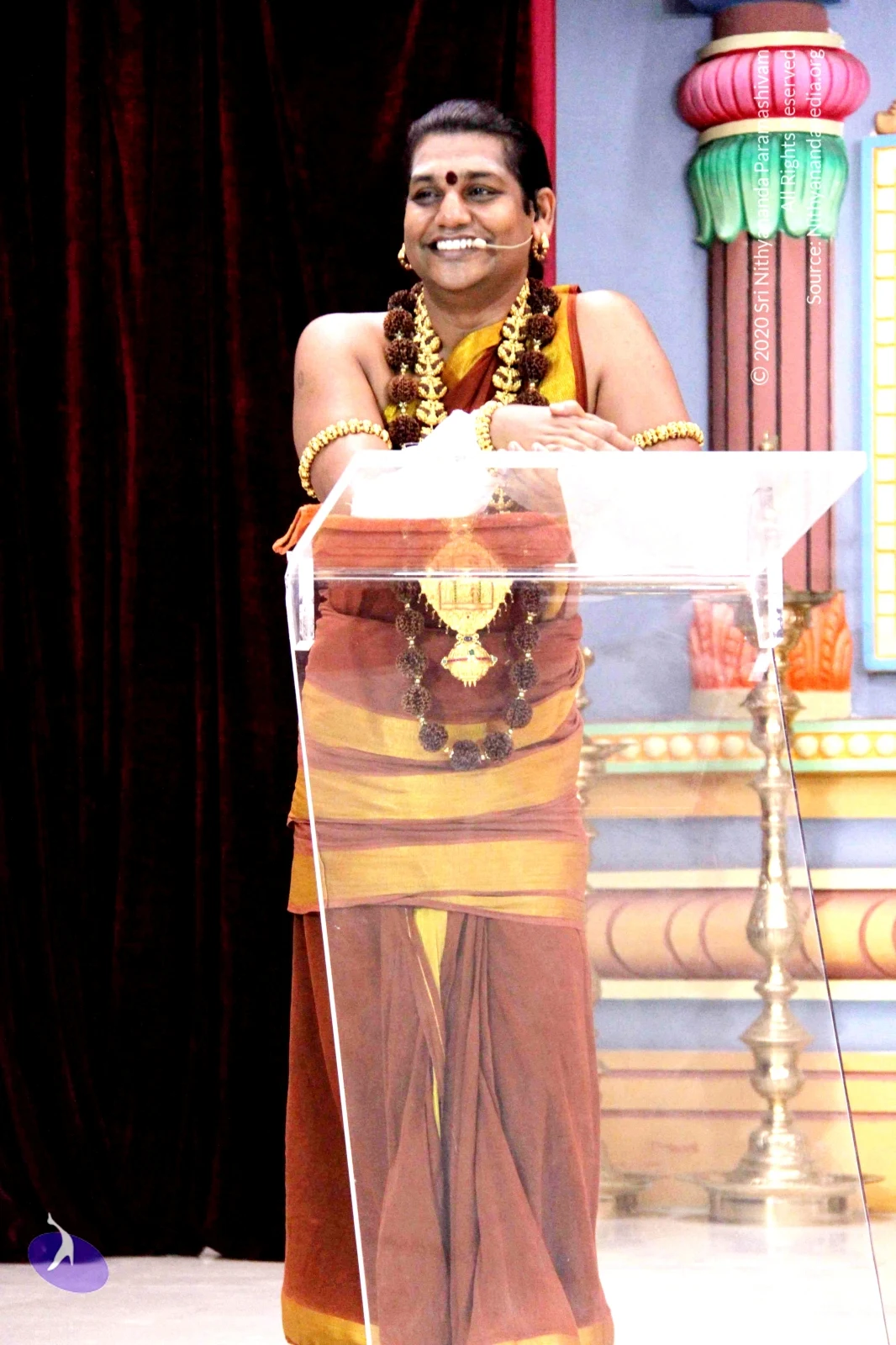
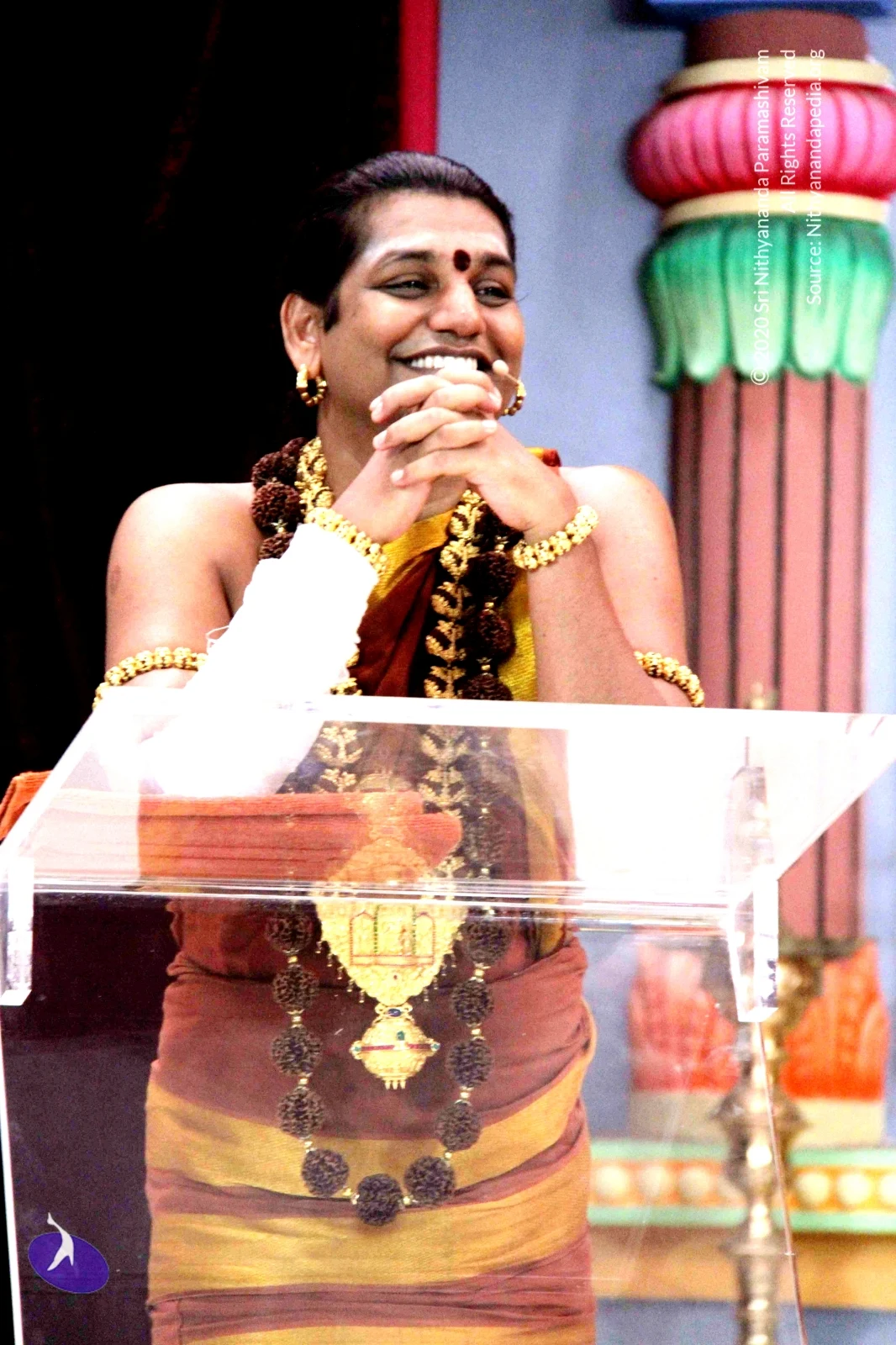
A smiling man with cropped dark hair, a red bindi and white forehead markings sits on an ornate gold throne with a red tiger-striped cushion. He wears an orange-saffron robe with a gold border, multiple rudraksha malas with gold leaf beads, gold armbands and bangles, and a headset microphone. His left forearm is wrapped in white bandage. a person is seated centrally, appearing to speak to an audience. A small blue logo appears in the lower left corner.Photograph of a seated man on an ornate golden-red throne in a temple-style hall, flanked by two painted guardian statues with gold crowns and by gilded lion-head armrests. He wears an orange-red dhoti and shawl with gold borders, a rudraksha mala with a gold necklace, gold armbands and bangles, and a red bindi, and he smiles with a head microphone visible. A gilded doorway with red velvet cushions and a tiger-striped throne cloth sits behind him.A man stands behind a clear acrylic lectern on a stage, smiling and speaking into a small headset microphone. He wears a rust-brown and gold-bordered cloth wrapped around his upper body and waist, bare-shouldered, with layered rudraksha malas and gold ceremonial necklaces, gold bangles on his arm, and a red bindi on his forehead. Behind him stand a tiered pink, green and gold decorative pillar and a blue-framed panel with ornate yellow trim; brass lamp stands flank the lectern. Swamiji (probable) is the speaker: long swept-back hair, ornate gold necklace and rudraksha malas.A man stands behind a clear acrylic lectern on a stage, smiling toward the side. He wears a red bindi, gold earrings, a gold-and-rudraksha mala garland, a gold pendant, a gold bangle, and a saffron-and-gold draped garment over his shoulder. Two tall brass lamps stand beside the lectern, with an ornate painted temple-style backdrop of pink and green lotus-like columns and a blue frame behind him.A smiling man stands in front of a painted temple backdrop of blue, pink and green with gold scrollwork. He wears a rust-brown and gold-bordered wrap over one shoulder, a long gold ceremonial necklace and multiple rudraksha mala strands, a gold bangle, gold earrings and a headset microphone, with a red bindi on his forehead. He extends one arm toward a brass lamp stand at the left edge. The image shows a person in ceremonial dress giving a speech or satsang; appearance-based candidate, a person with distinctive rudraksha malas, gold necklace and saffron-toned wrap.A smiling man stands at the centre of a decorated temple-style set, wearing a headset microphone. He has slicked-back hair, a red bindi and white forehead markings, and wears an ornate gold necklace with a lotus pendant over a long rudraksha mala. He is dressed in a rust-red and gold-bordered wrap, with gold bangles on his wrists and upper arm. His left arm extends toward an ornate brass lamp stand, and behind him are painted pillars and gilded panels. Appearance-based identification is ambiguous. a person cues include the rudraksha mala, ceremonial gold necklace and saffron-toned robe, but the specific identity cannot be confirmed from appearance alone.

6-Final-Blessings

2 photosSource gallery
A standing person with both arms raised high in an open-palmed blessing gesture stands barefoot on a stage before a golden-cream throne flanked by two gilded lion sculptures and red cushions. The figure wears a rust-orange and gold-bordered draped garment, a long rudraksha mala with a white floral garland, gold bangles and earrings, and a red bindi. Deep maroon velvet drapes form the backdrop. The person's face is smiling, and the scene is a stage darshan setting with a single person and no other people visible.A standing figure in a rust-red and saffron-gold draped garment with a gold border stands on a patterned carpet before a golden throne with lion-head arms and red tiger-striped cushions, backed by deep red velvet drapes. The person wears a long rudraksha mala and a white flower garland with a pendant, gold bangles and a white arm wrap, and has a red bindi and a smile.

8-Temple

17 photosSource gallery
A dark stone statue of a four-armed deity seated in a cross-legged pose on a carved rock base, shown frontally against a green cloth with gold dots. The murti wears an orange and magenta turban with a red dot on the forehead, garlands of red roses, yellow marigolds and white flowers, rudraksha malas across the chest and arms, and a light blue and gold dhoti with pink and orange waist cloth. One hand holds a japa mala, another a trident-like emblem, and the lower hand rests in an abhaya-like gesture. Carved figures and a bull relief decorate the pedestal.Close-up photograph of a dark grey stone statue of a deity murti decorated for worship. The figure wears an orange and magenta turban-like cloth with a red bindi on the forehead, layered rudraksha malas and pale beaded garlands across the chest, and a magenta silk dhoti at the waist. Red rose and yellow marigold garlands drape the shoulders and arms, and the raised hand holds a string of white beads. Green patterned cloth forms the backdrop beneath an arched niche with green foliage visible at the edge.A dark stone statue of a seated figure is adorned for worship. The head wears an orange and magenta turban with a red bindi, and the body is draped in a teal and gold silk cloth with a magenta waist sash. Many strands of brown rudraksha malas hang across the chest and shoulders, with circular white-and-gold ornaments and a jeweled pendant. Red roses and yellow marigold garlands frame the figure against a green cloth backdrop. The raised right hand shows an open palm, with a strand of pearl beads wrapped around the wrist. No people are visible; this is a statue.A close photograph of a dark stone statue of a seated figure, not a living person. The statue wears an orange and magenta turban with a red tikka mark on the forehead, heavy rudraksha mala necklaces, pearl and gold strands, and a blue and gold silk wrap. Red and yellow marigold garlands drape over its shoulders. Its raised right hand is held in a blessing gesture, and foliage sits in the background.A dark stone statue of a seated deity murti, adorned with red and yellow marigold and rose garlands, white flower garlands, and many brown rudraksha malas. It wears an orange and magenta head wrap, turquoise silk clothing with gold borders, and a magenta waist sash. Its hands hold a small trident-like object and a drum-shaped item, and it sits on a stone pedestal before a green curtain with gold dots. No living people are visible.A dark stone murti of a seated deity, adorned with yellow and red marigold and rose garlands, a white jasmine garland, and an orange and magenta turban with a red bindi. The figure wears layered rudraksha malas, gold necklaces with pendants, pearl bracelets, rudraksha bracelets, a blue-and-gold patterned dhoti and magenta sash, and holds a small object in one hand. Behind it hangs a green cloth with gold dots. Its appearance is that of a deity murti, not a living person, so no person is present in the scene.

September 30 2013

1 photoView all
A seated man in ochre-saffron robes sits on an ornate red and gold throne with a gilded arched backrest carved with scrollwork and lion motifs. He has his palms pressed together in namaste, a white bandage wrapped around one forearm, a red bindi and white tilak on his forehead, and a brown rudraksha mala draped across his chest. Tiger-striped cloth covers the seat and a yellow-bordered saffron shawl crosses his shoulder. Probable Swamiji by appearance cues: swept-back hair, saffron robes, rudraksha mala and ornate throne setting. One person is visible.