Skip to content
Tuesday

16 July 2013

COMPLETION - SMARTEST WAY TO RAPID ENLIGHTENMENT

Dated photos
294
Source pages
1
Media
2
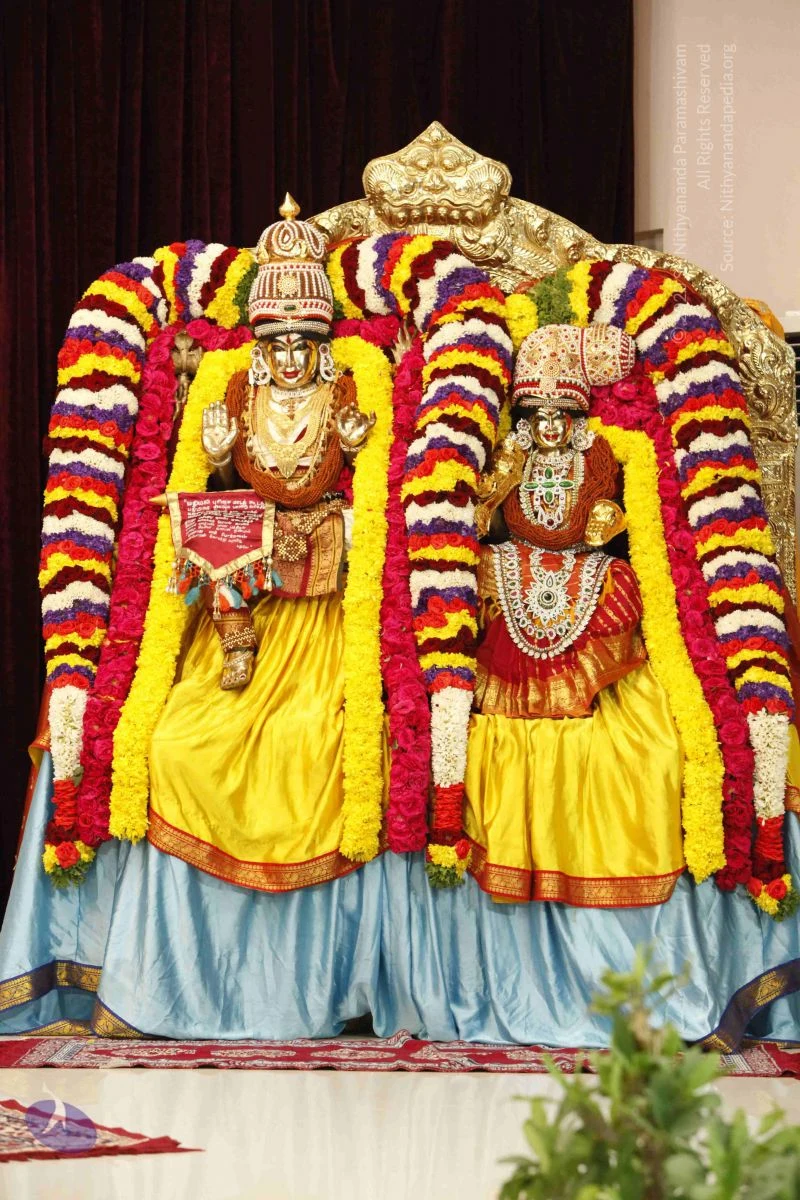
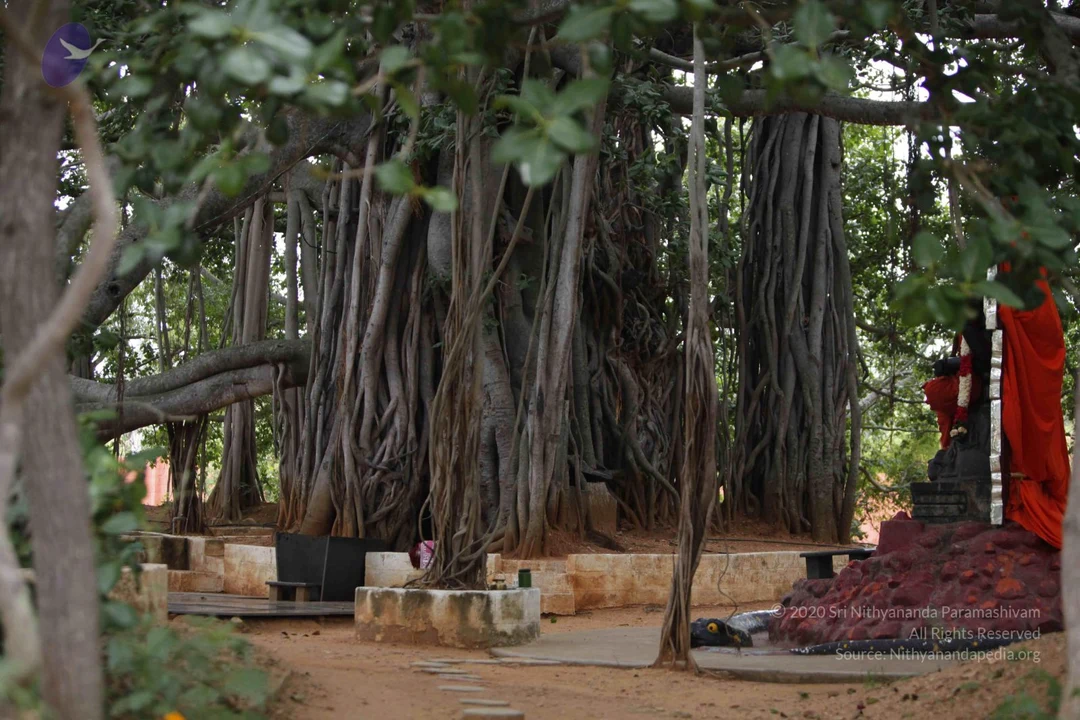
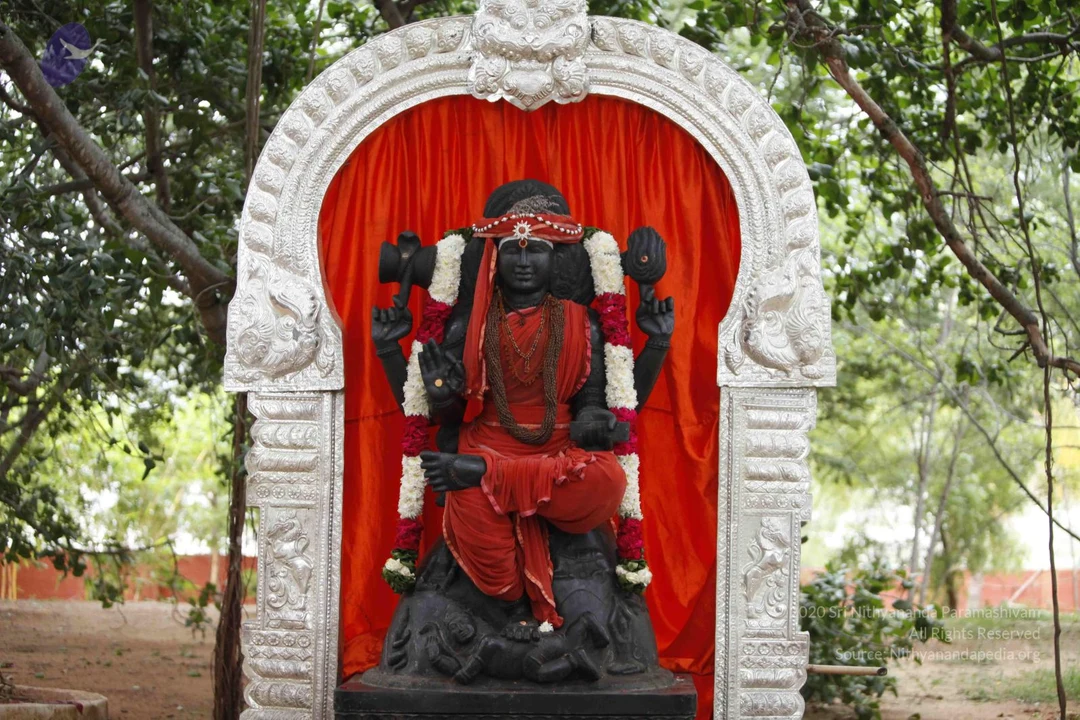
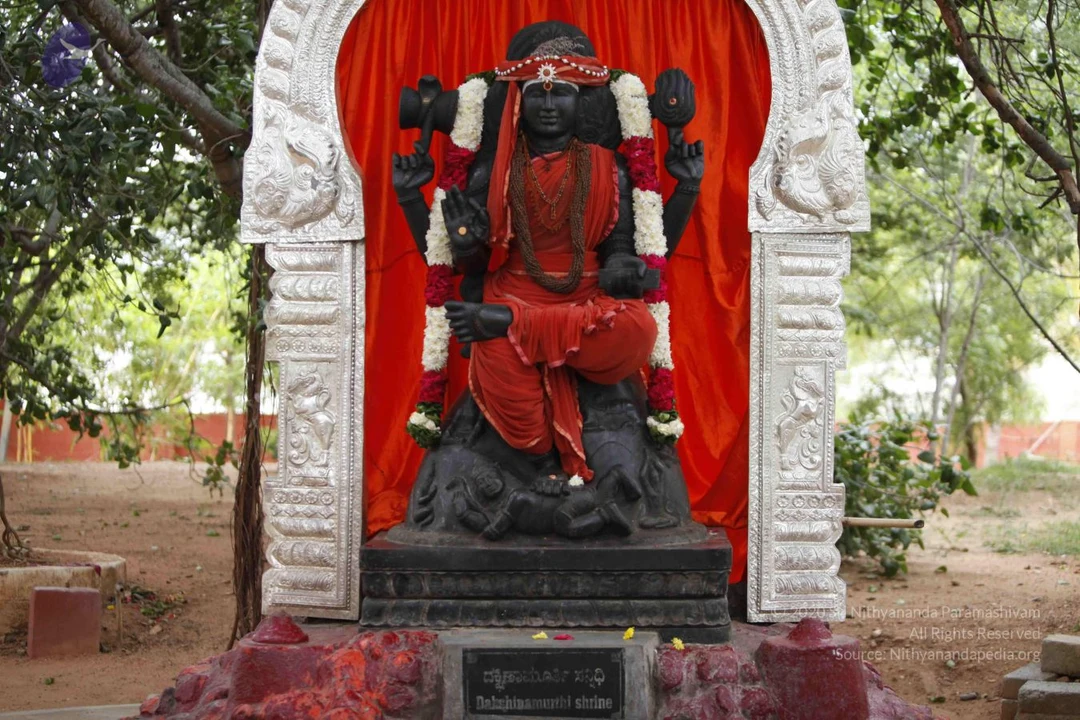
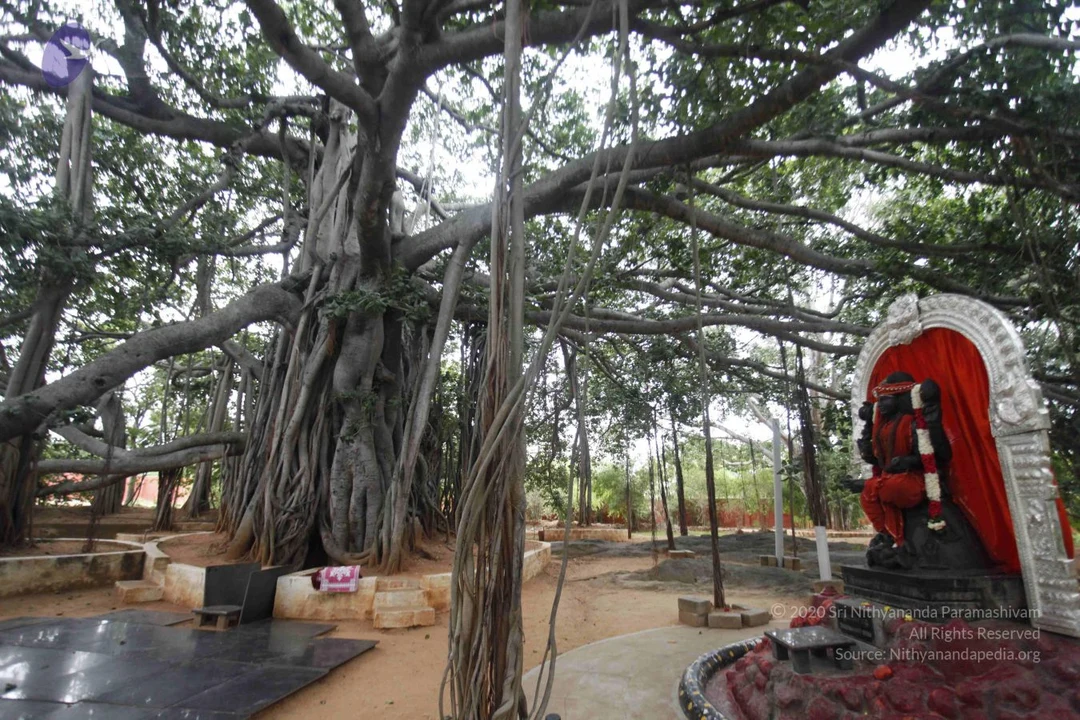
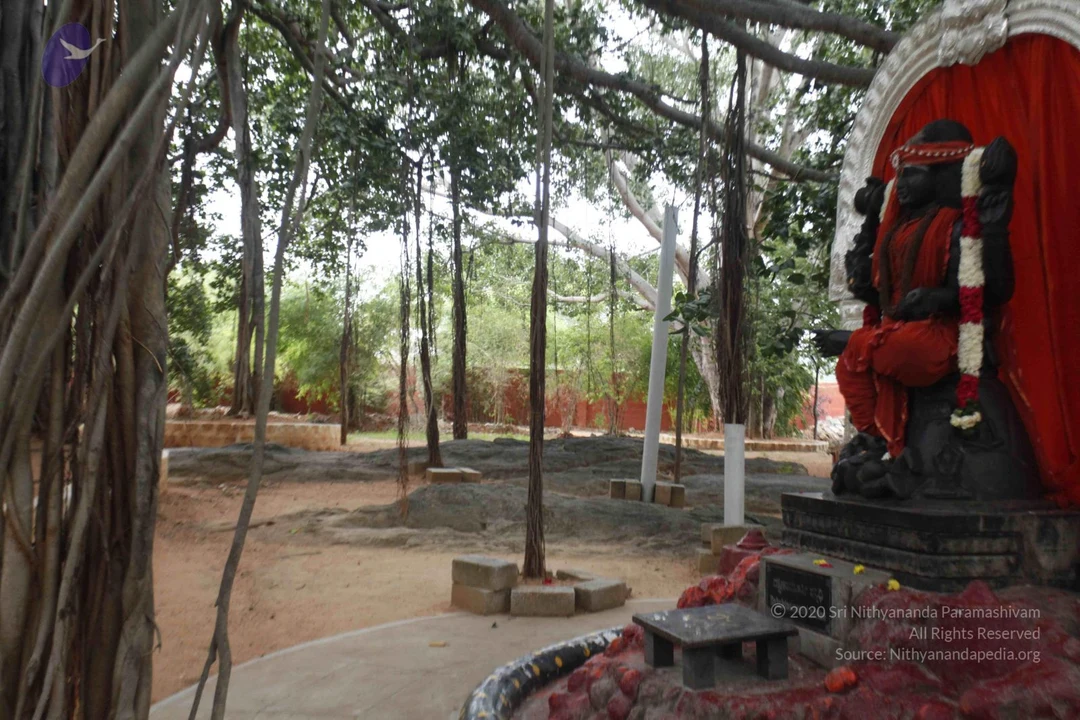
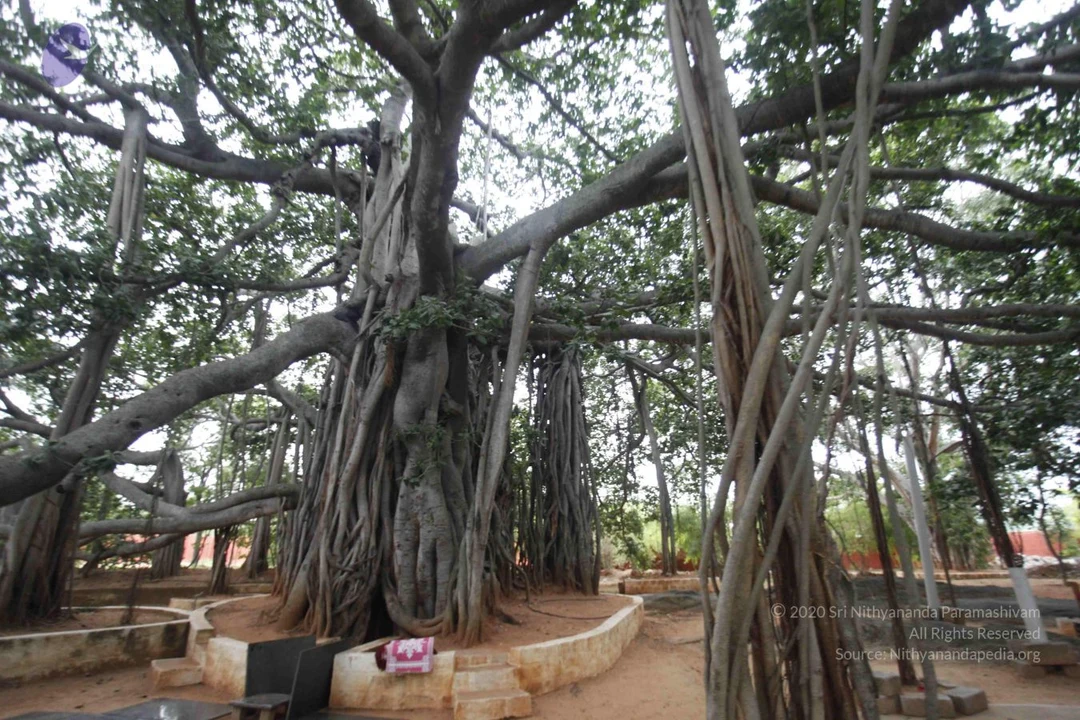
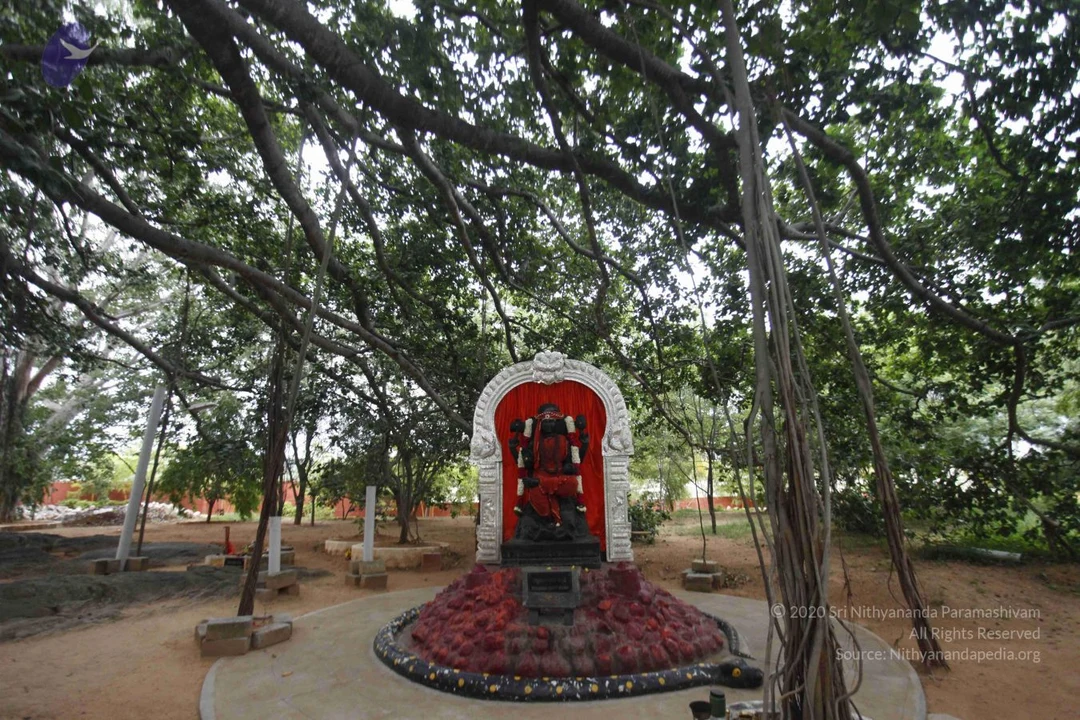
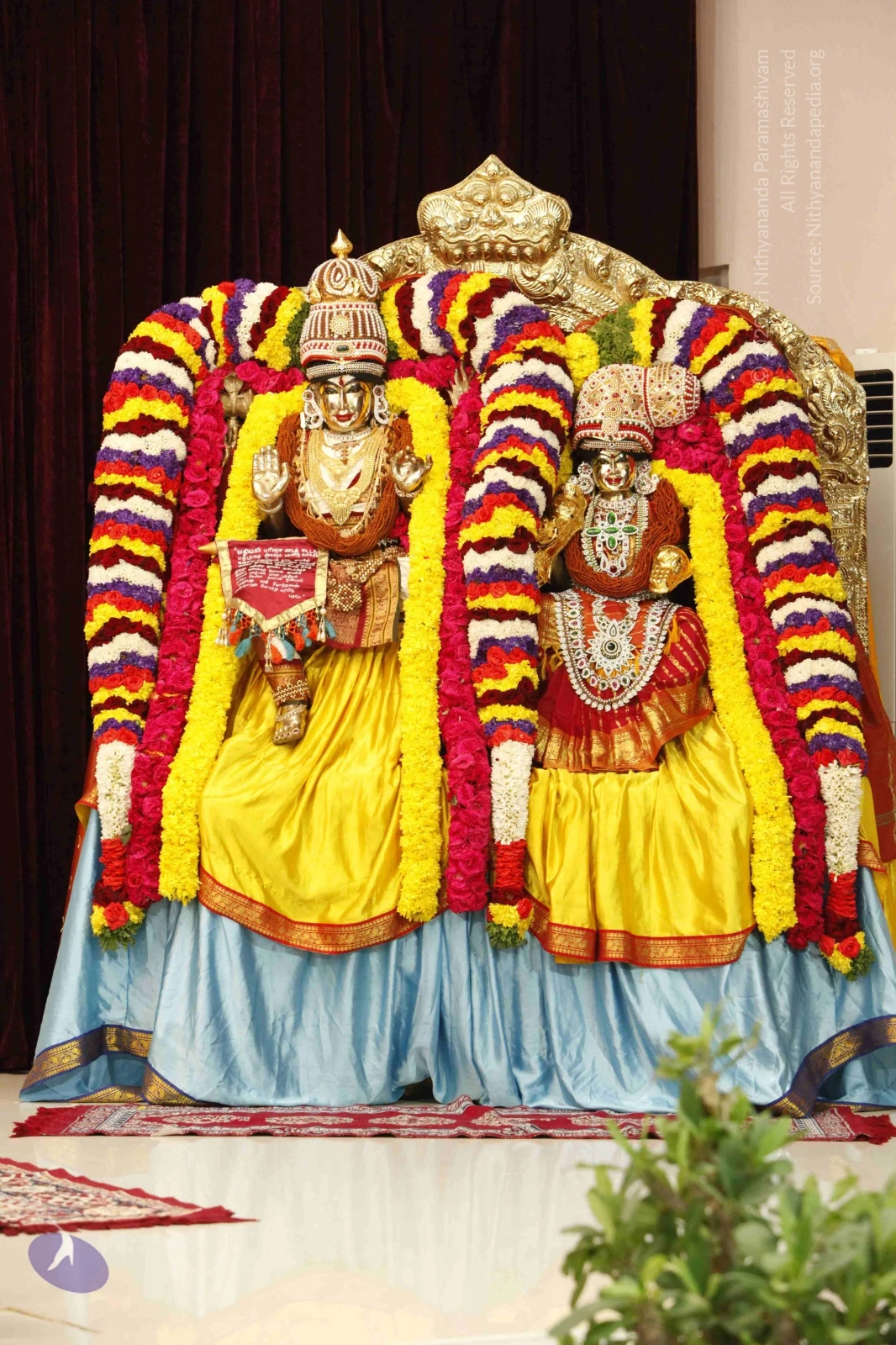
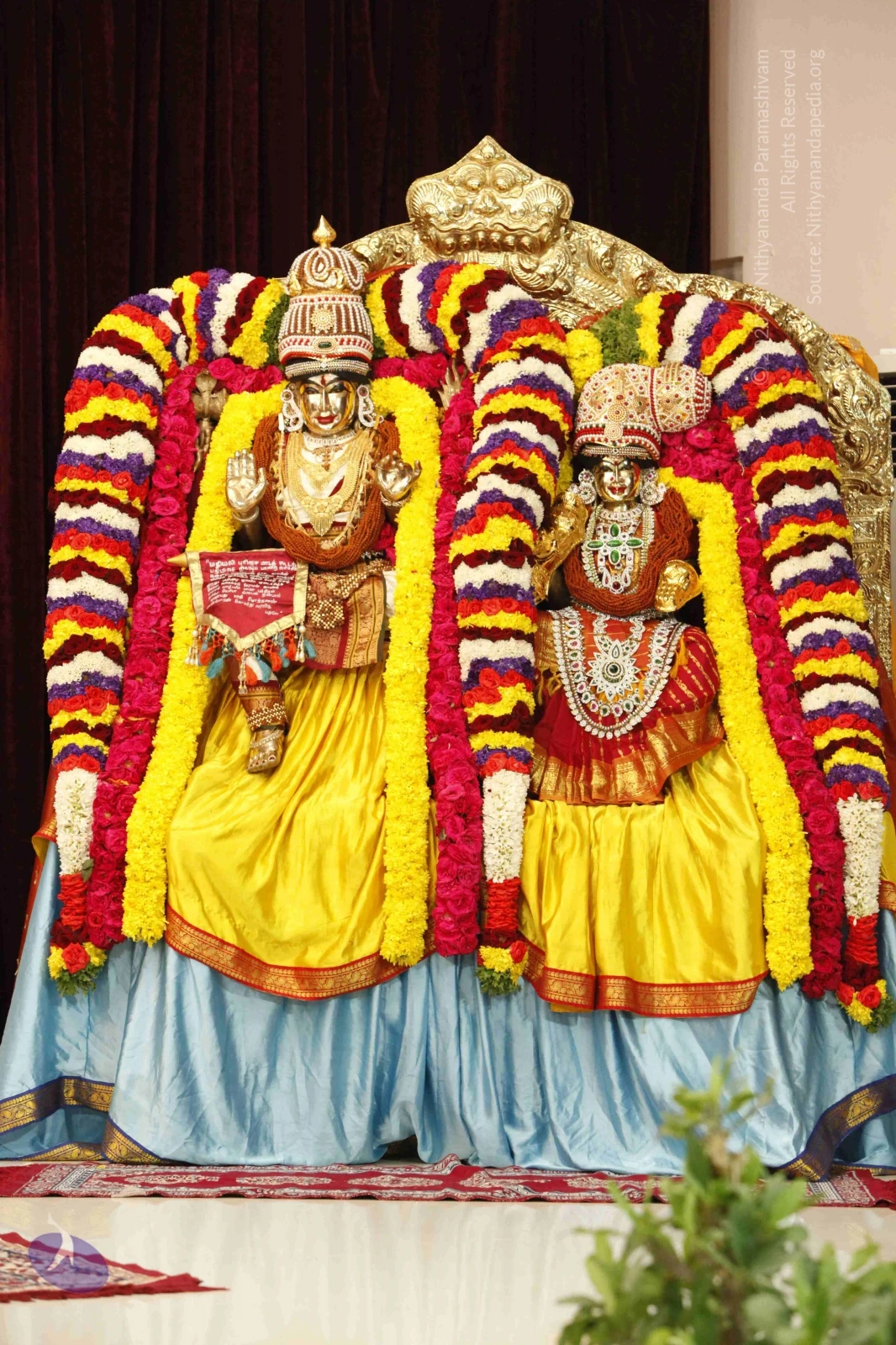
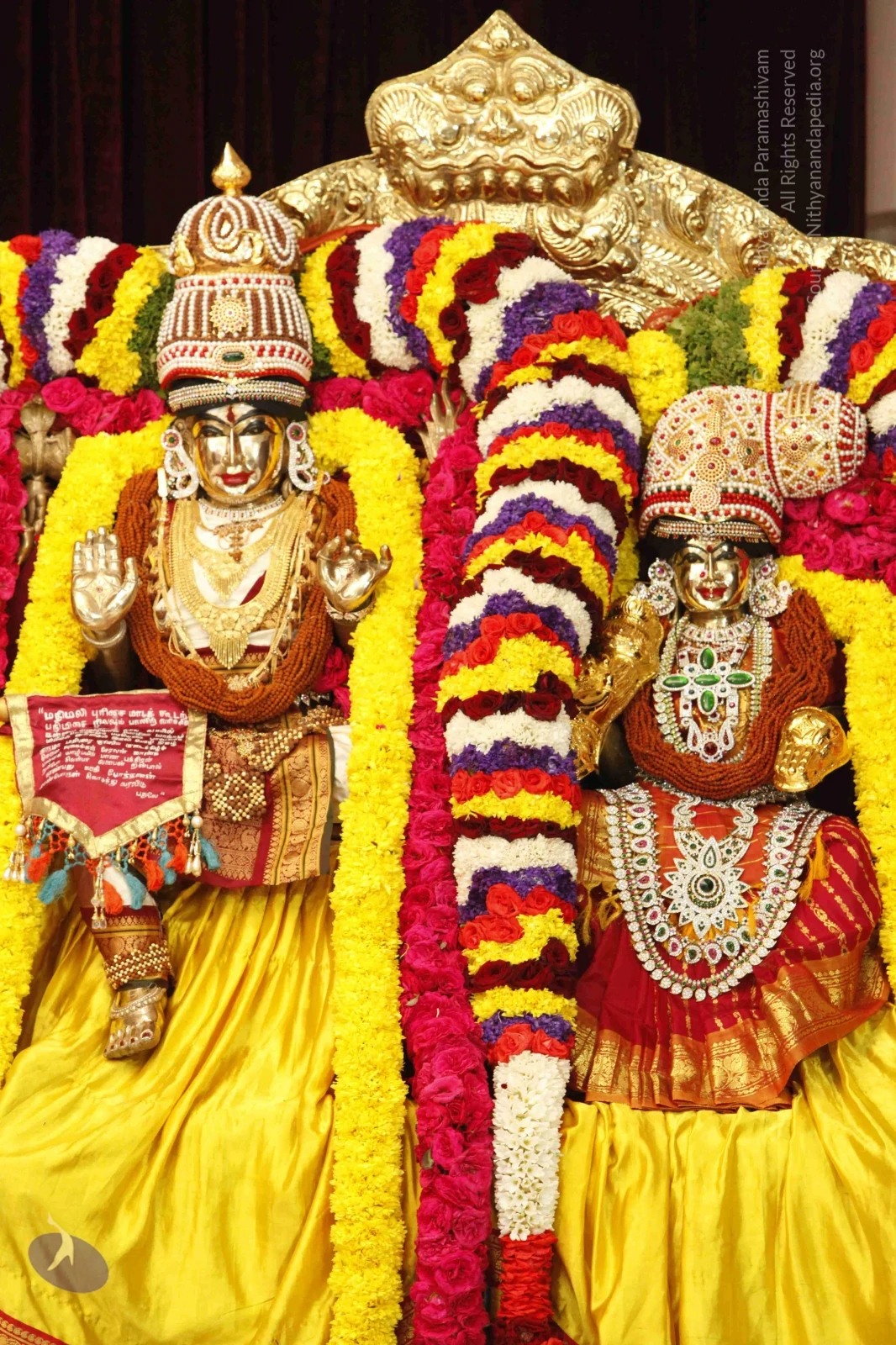
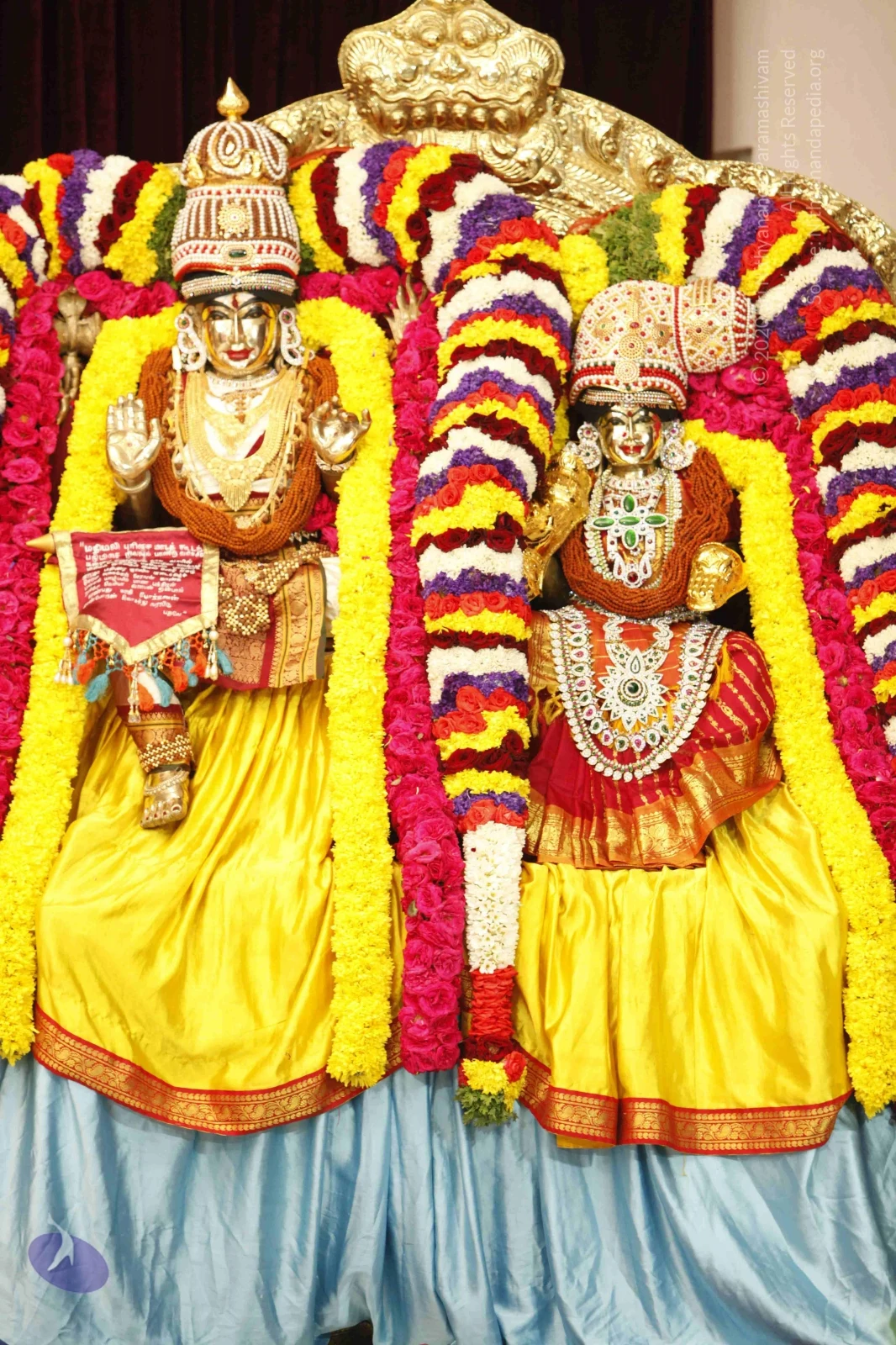
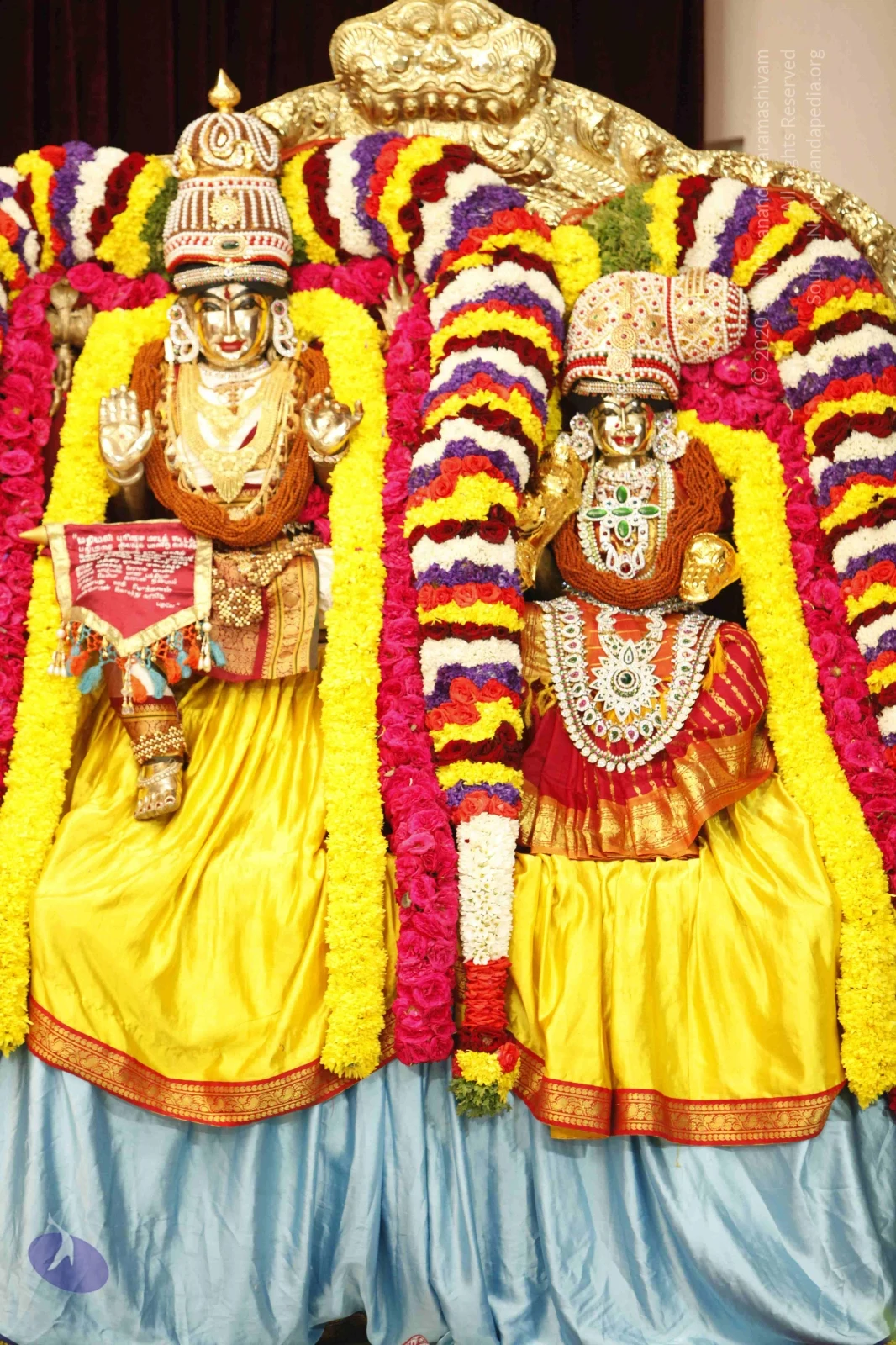
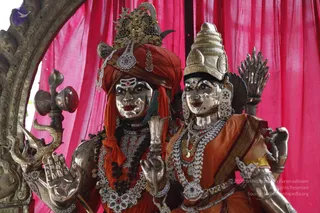
A seated group of devotees in an indoor hall, many wearing saffron and maroon garments with gold borders. In the foreground, a woman in orange robes and a rudraksha mala sits upright with white forehead markings and glasses, and a younger woman in orange with rudraksha beads sits beside her. Behind them, young women and girls in maroon and red dress with gold trim sit on mats, some with white vibhuti on their foreheads and bindi markings. A man in white clothing sits in the background. Brass plates with offerings and flower petals appear at the lower left edge, and white tent-style poles are visible above.A photograph of two decorated deity murti seated side by side on a golden throne, framed by a dense arch of marigold and rose garlands in yellow, red, pink, purple and white. The figure on the left wears a gold crown, gold jewellery and a yellow silk skirt, and holds a red cloth panel with a fringed edge. The figure on the right wears a red-and-gold blouse, a gold-and-jewelled crown, a large jewelled necklace and a yellow skirt with a red border. Both sit on a pale blue draped base. No physical people are visible.A dark stone statue of a seated deity murti sits within a silver-framed arched niche against a red-orange cloth backdrop, under trees in an outdoor garden. The figure wears a red and orange garment, a red headband with a white ornament, a rudraksha mala, and a white and red flower garland draped over the shoulders. It holds a trident-like implement and a drum in raised hands, with a serpent and small figures at the base. A black plaque at the front reads Dakshinamurthi shrine, with orange and yellow flower petals scattered on the pedestal. No people are visible.

July 16 2013

Original wiki page
Contents

Title:

COMPLETION - SMARTEST WAY TO RAPID ENLIGHTENMENT

Description:

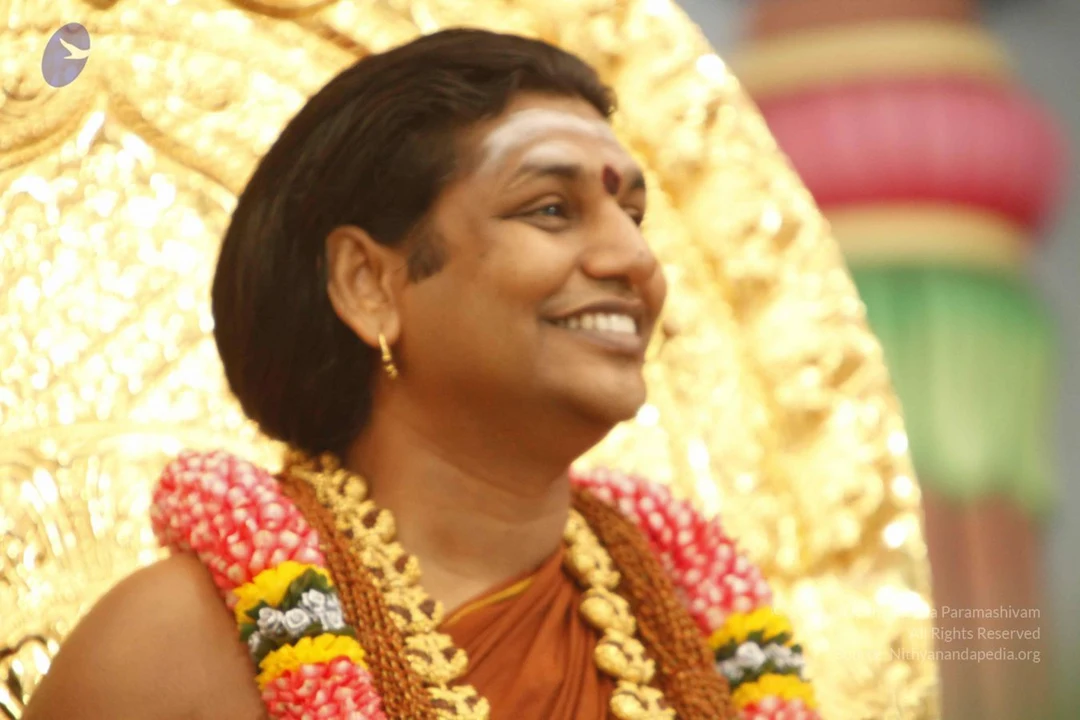
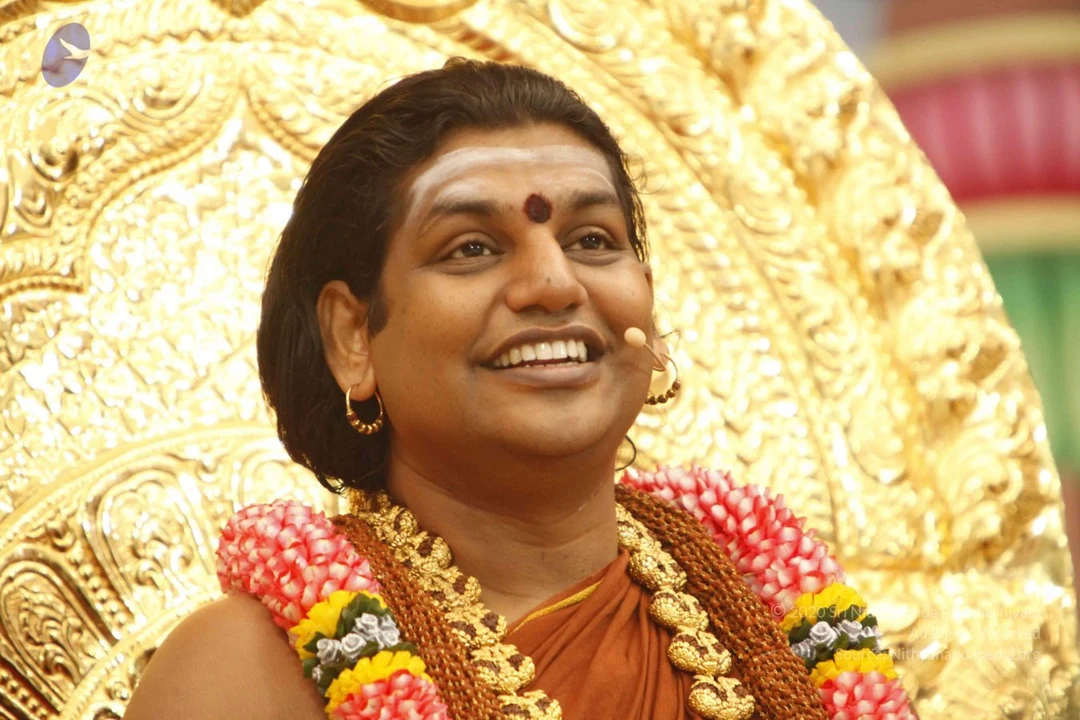
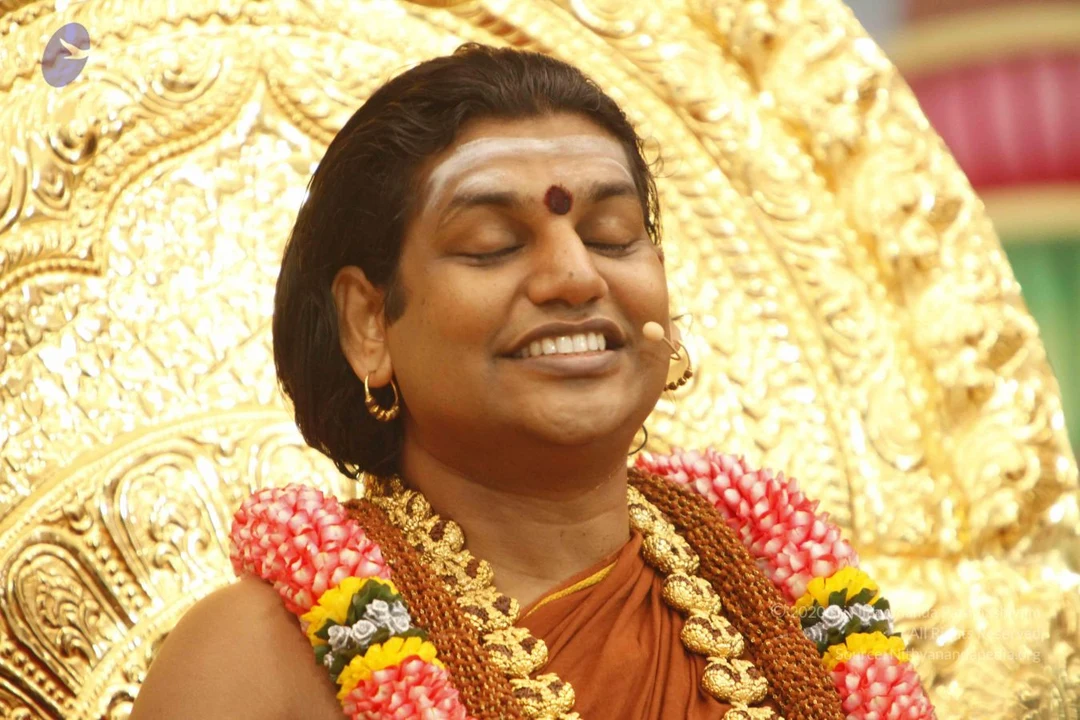
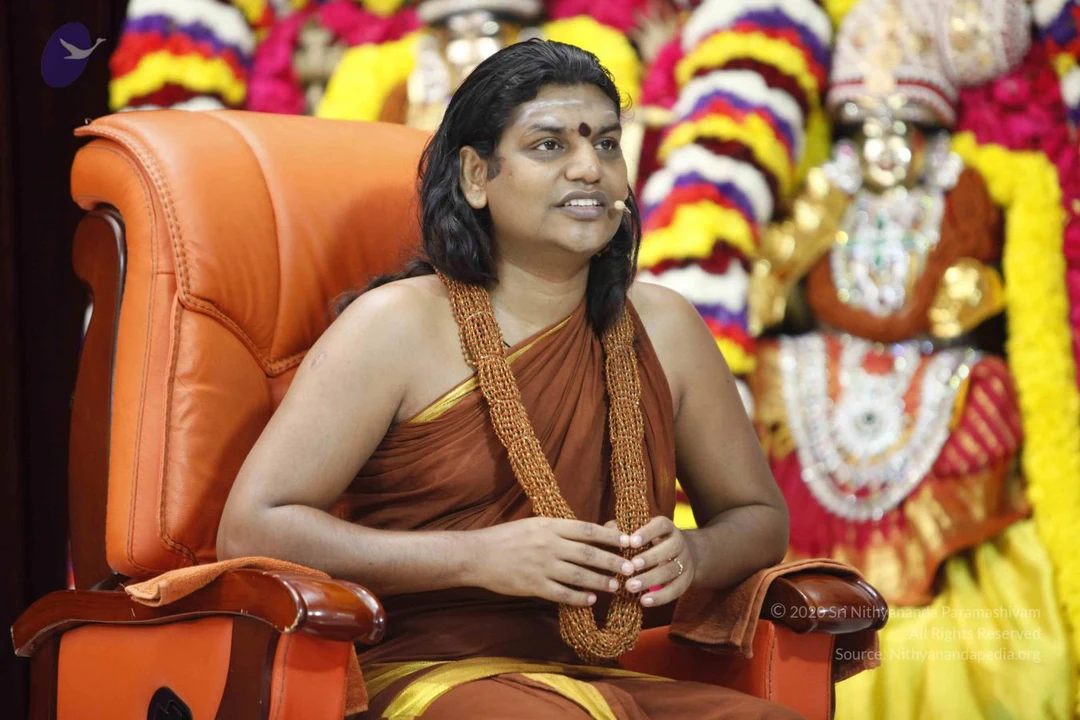
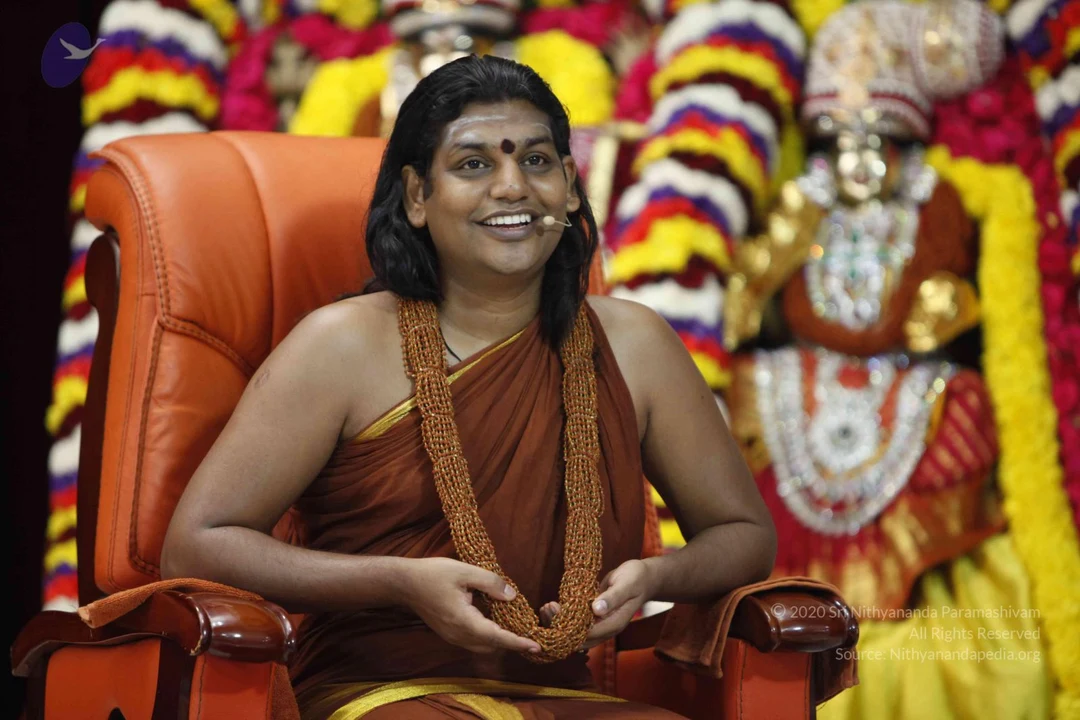
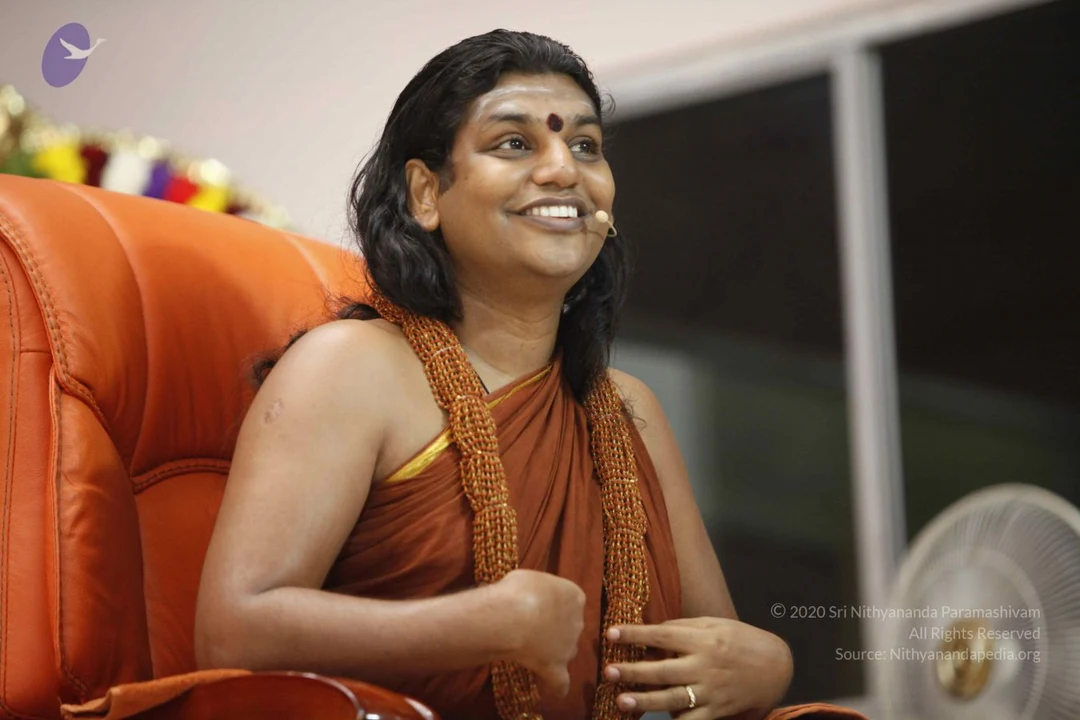
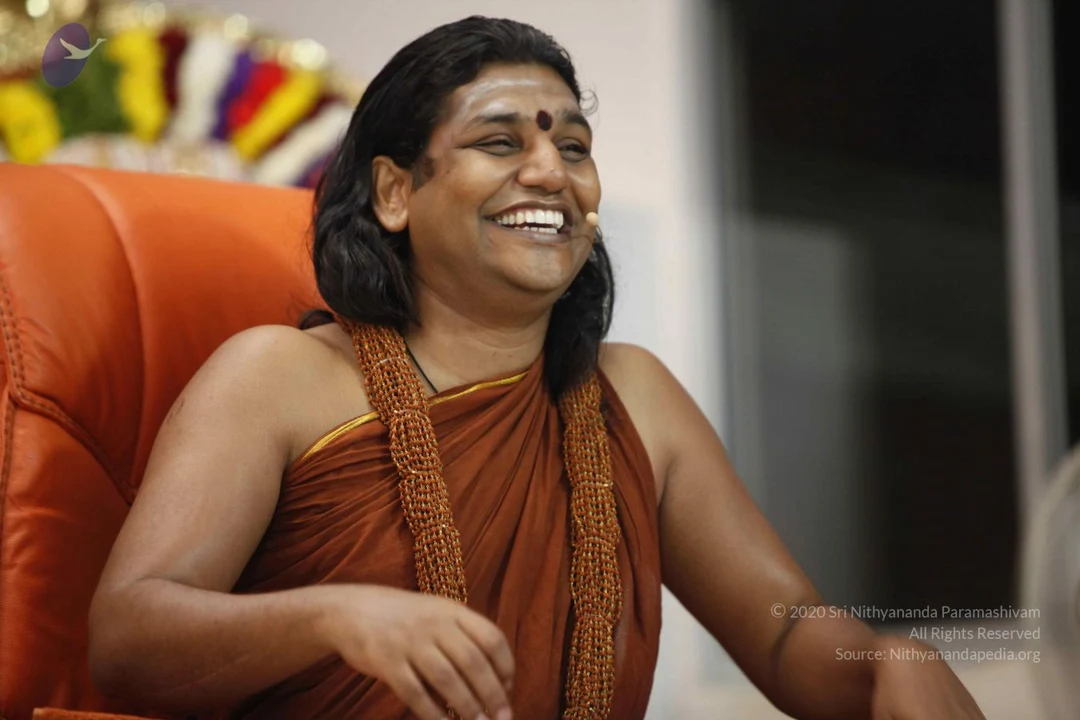
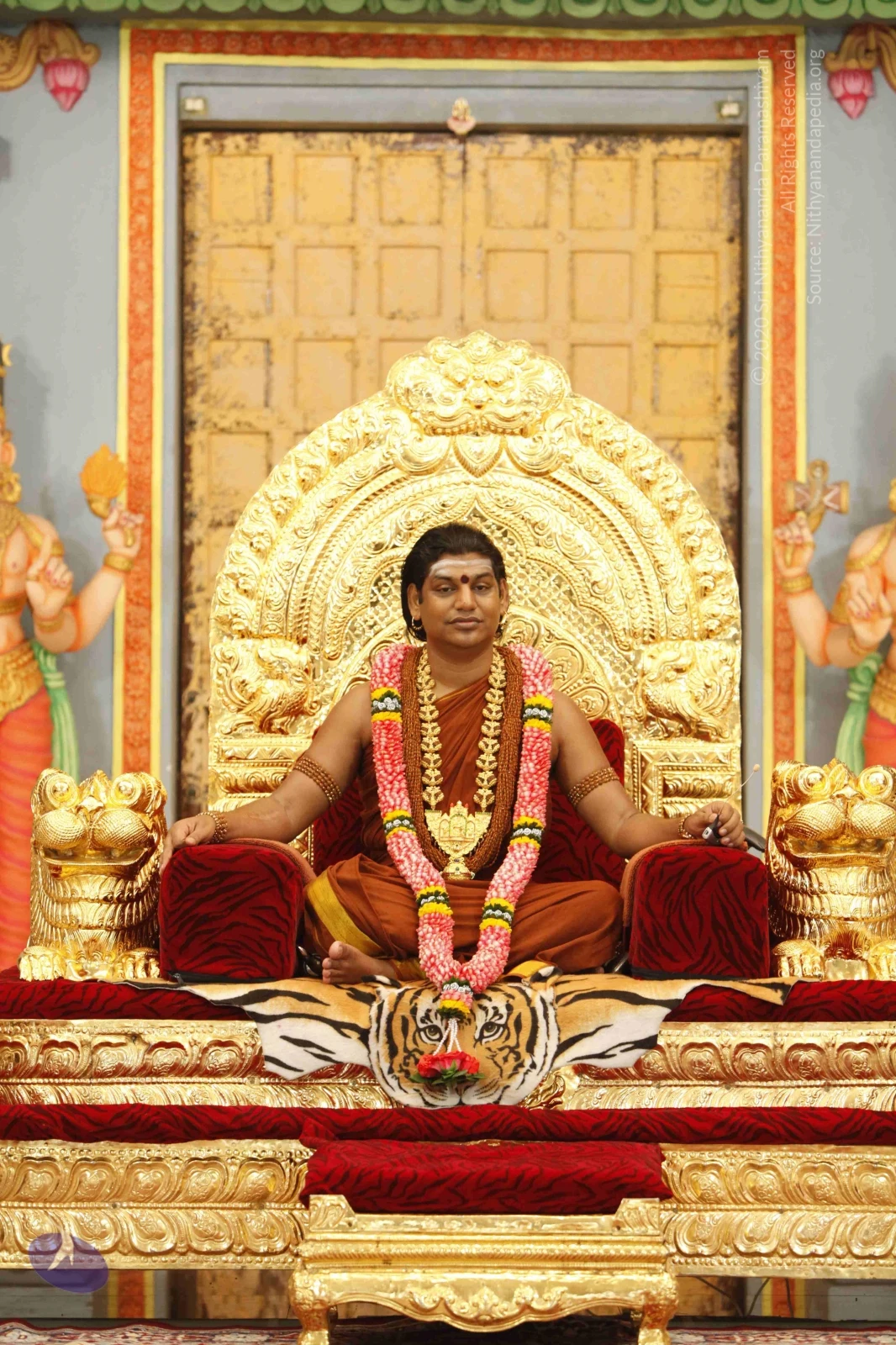
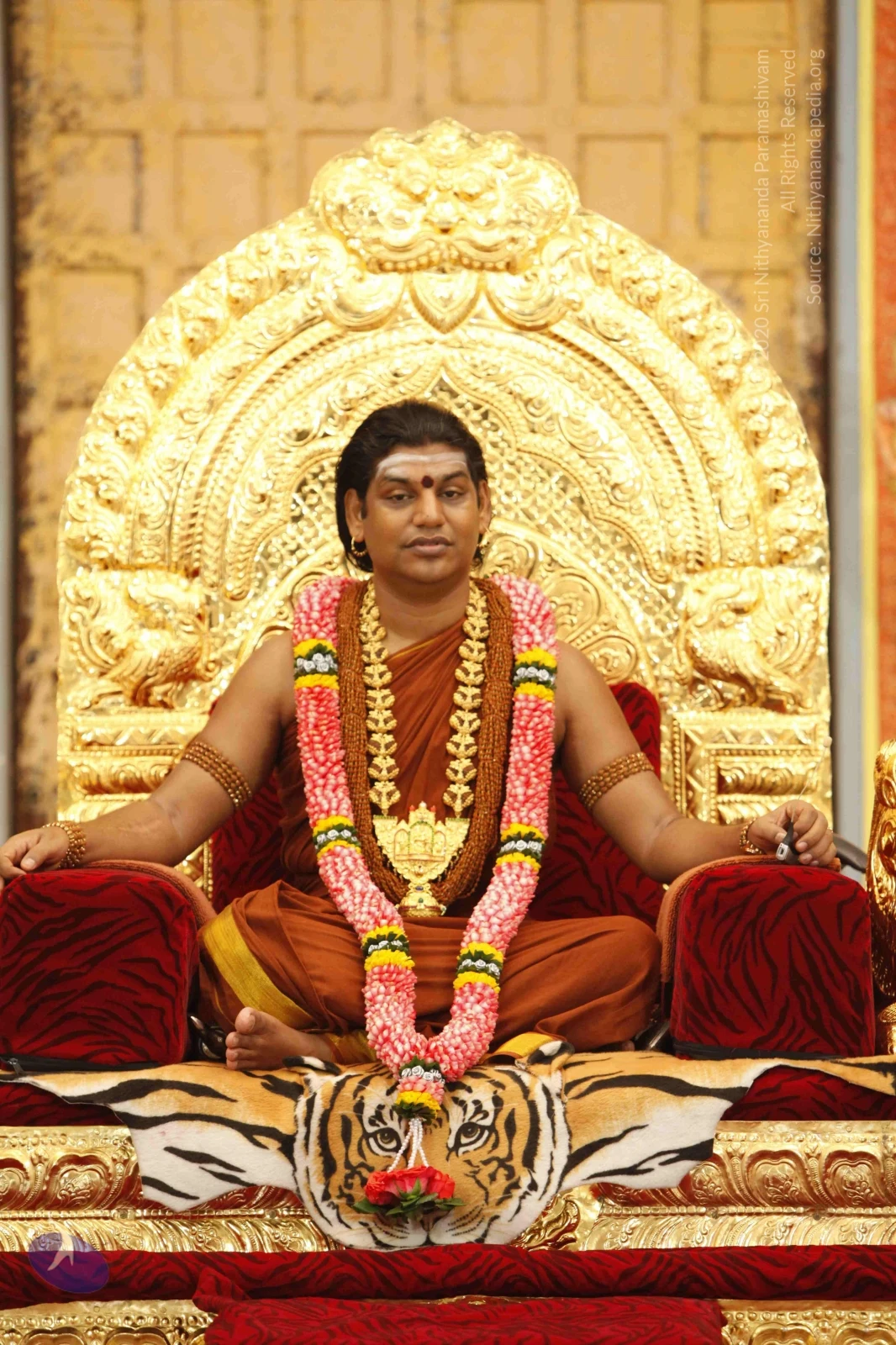
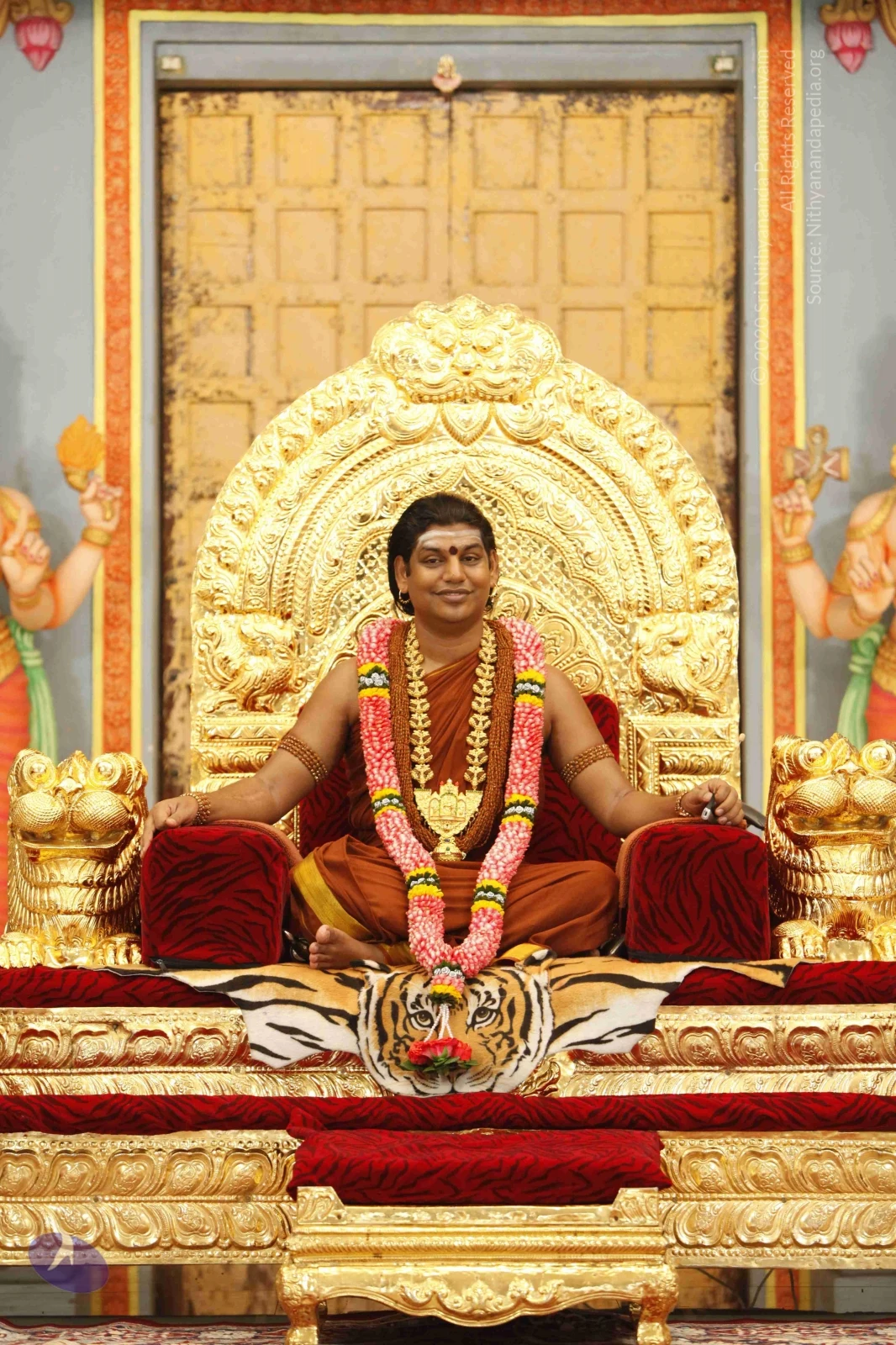
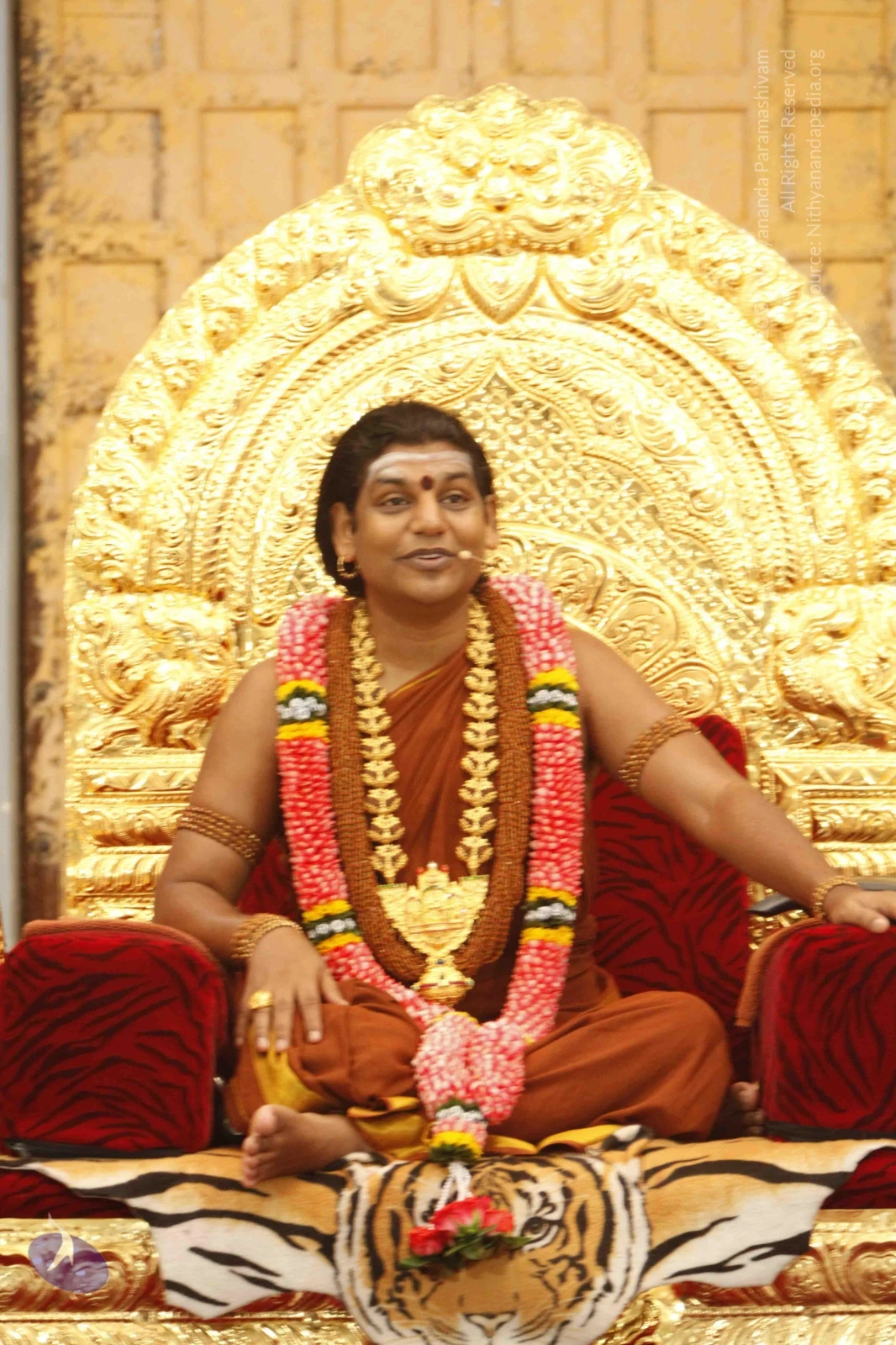
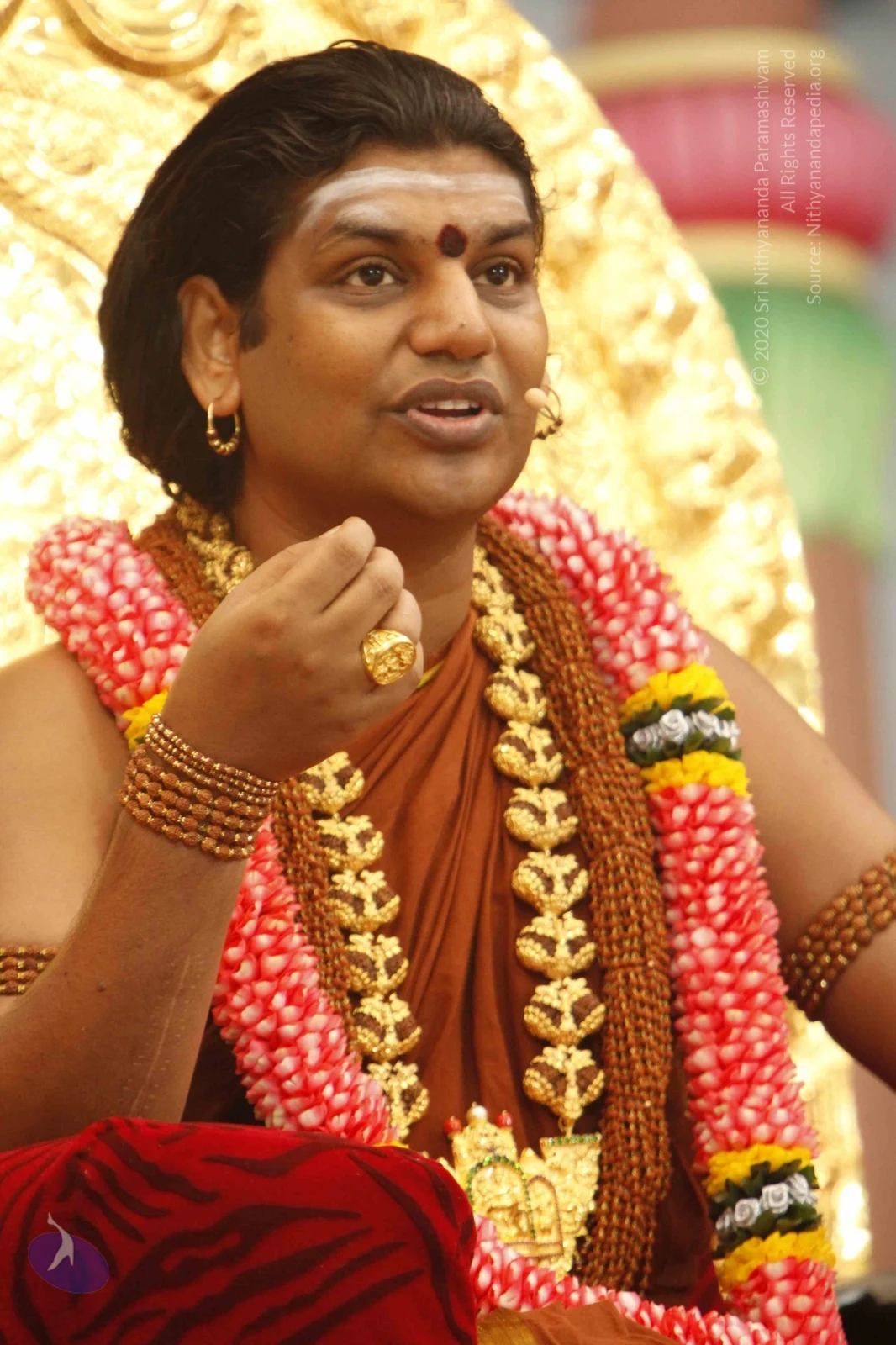
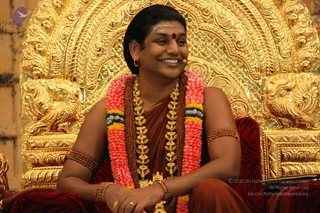
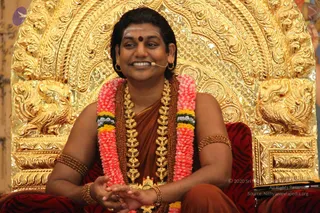
In today’s morning Satsang, Paramahamsa Nithyananda describes the importance of enriching and educating others, especially those that are in spiritual poverty, with spiritual knowledge and understanding. Sometimes our lives can become confusion and chaos. We start to accept pain as part of our lives and in some cases, we even enjoy it. We twist our suffering into pride, thinking it is like a metal that we earned. It is important that we share with other’s how they can transform their pain and suffering by reliving those moments and completing with them.

Link to Video:

VideoAudio

Transcript:

Nithyanandeshwara Samaarambhaam Nithyanandeshwari Madhyamam || Asmath Aachaarya Paryanthaam Vandhey Guru Paramparaam ||

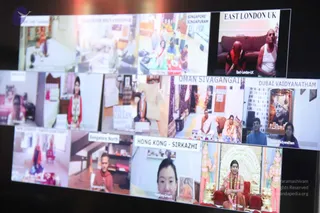
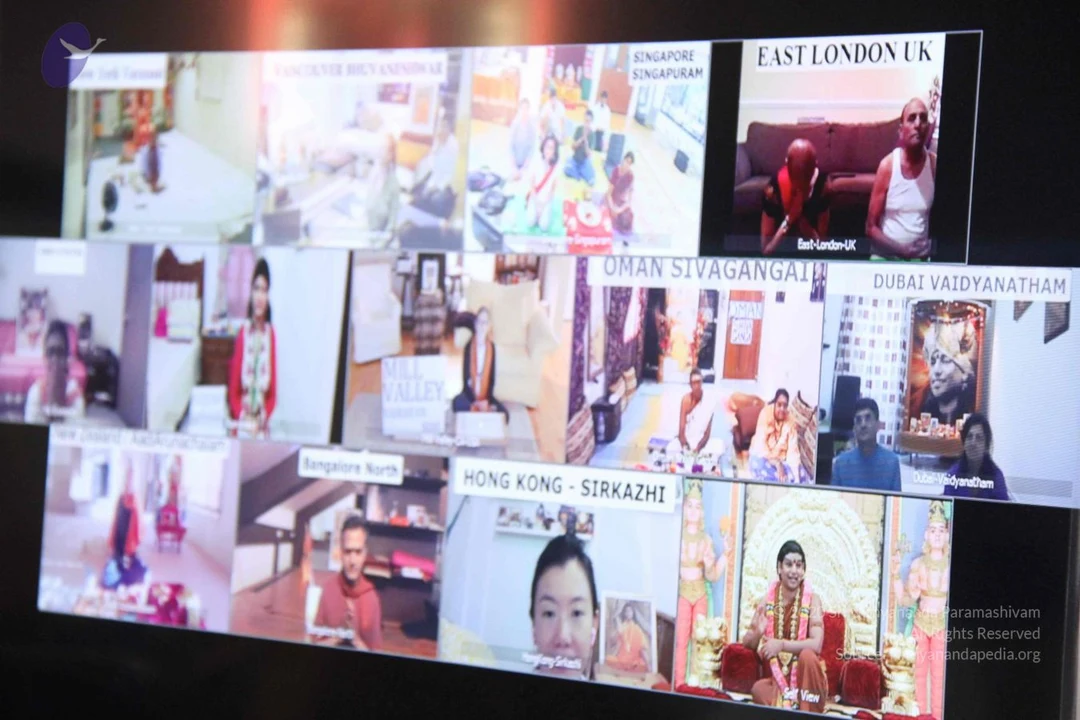
I welcome you all with my love and respects. I welcome all the devotees, disciples, samajis, satsanghis sitting with us all over the world through Nithyananda TV, Sadhana TV and Lotus News Channel, and two-way video-conferencing having Nayana Deeksha, and Eshwar TV, Twoway video conferencing cities sitting with us: San Jose, Ohio, Los Angeles, Varanasi, Seattle, Kulaambor, Toronto, Charlotte, Guadalupe, Huston, New York, Vancouver, Singapore, Mill Valley,Jefferson South Dakota, Hong Kong, East London, Oman Dubai, New Zealand, Dhyanapeetam, Tiruvannamalai, Hyderabad Gupta Kashi, Ohio Ma Shivananda, Bangalore North, Saint Crystal France, Scottsdale, San Diego Pacific Beach, Calgary, France, Philadelphia, Redmond Washington, Kathmandu Nepal, I welcome you all with my love and blessings.

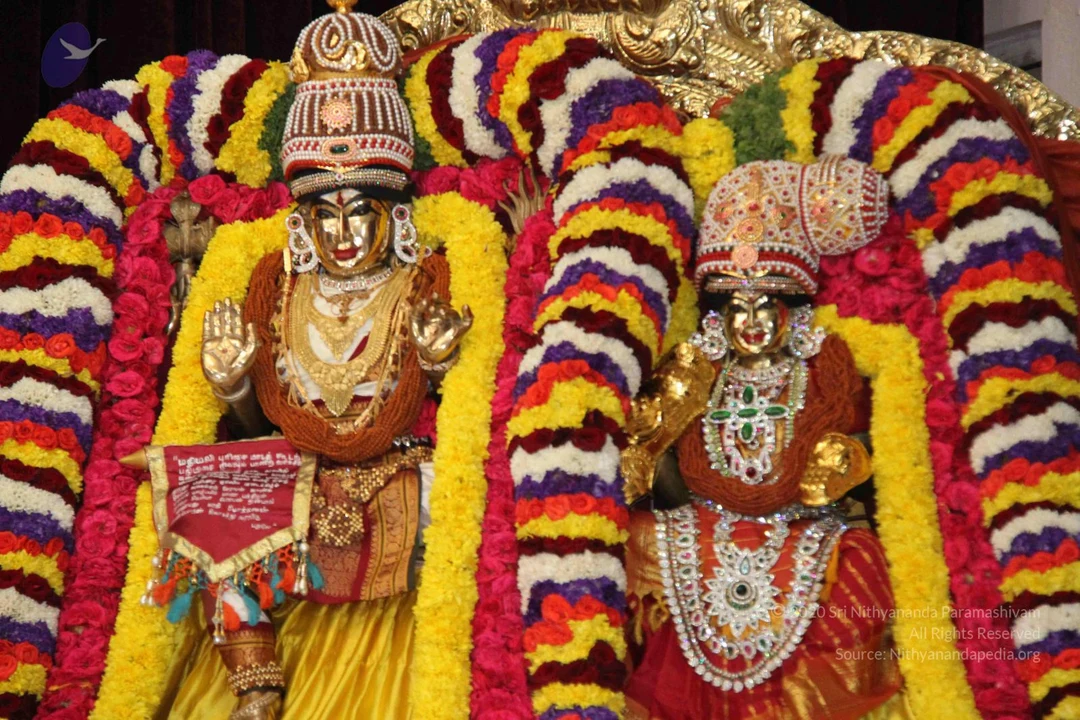
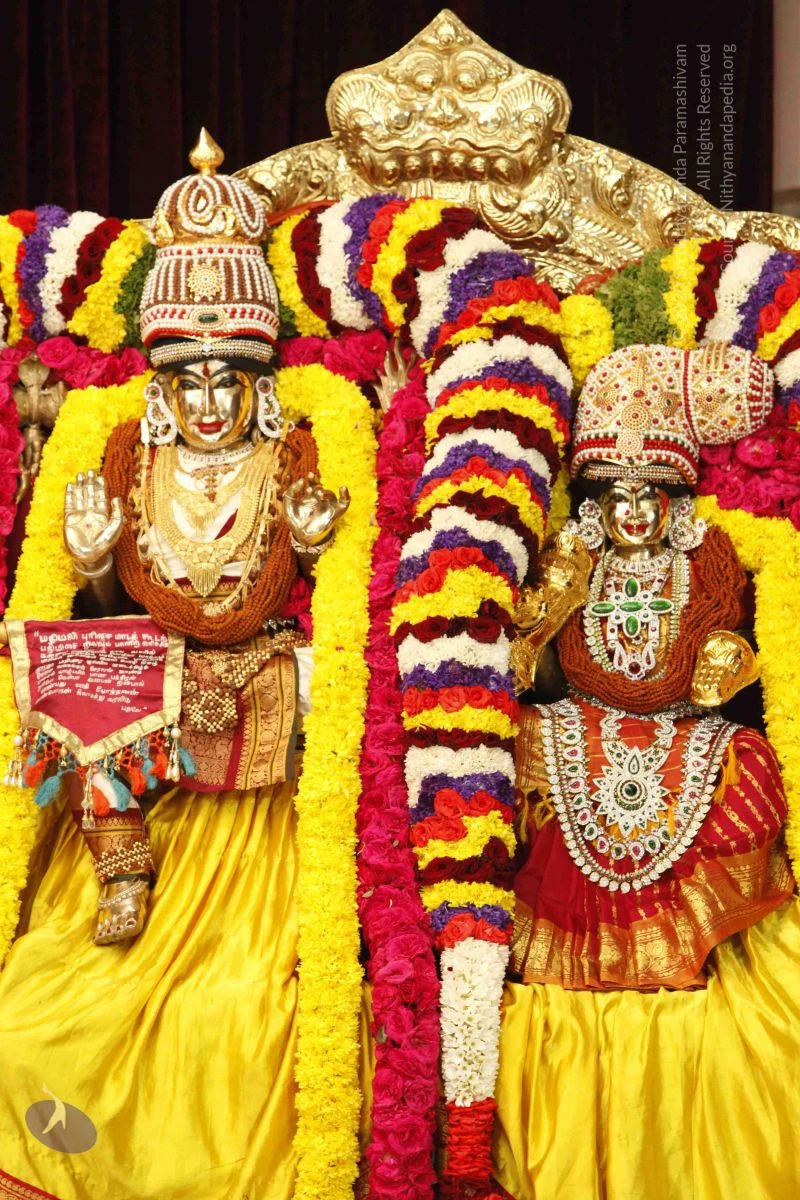
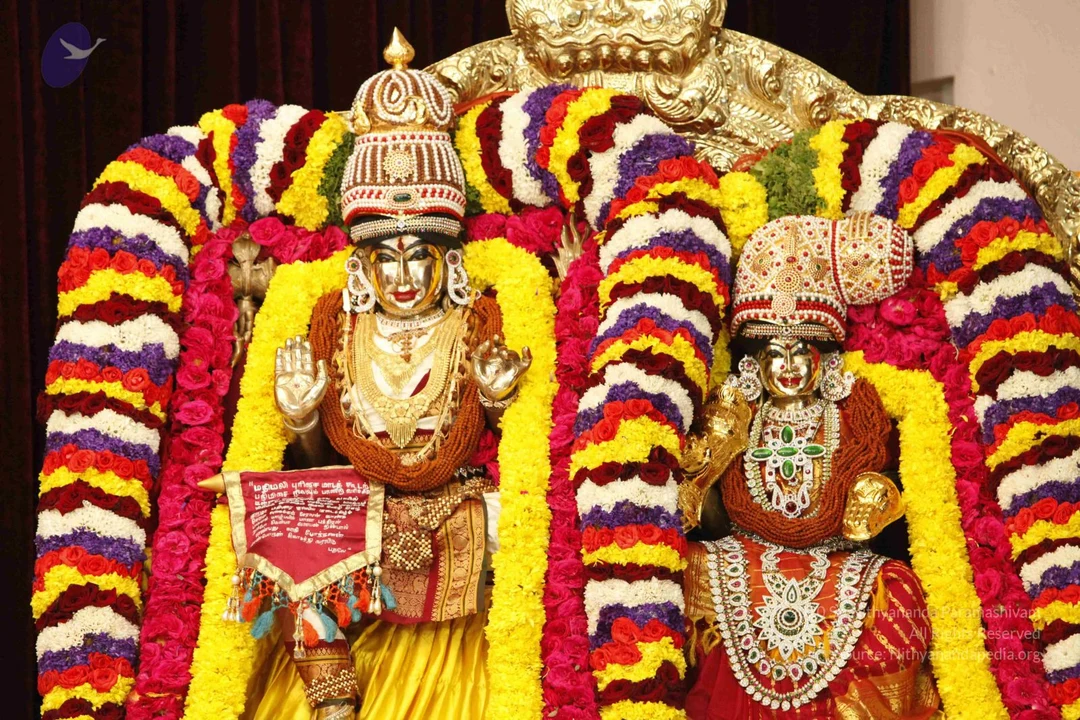
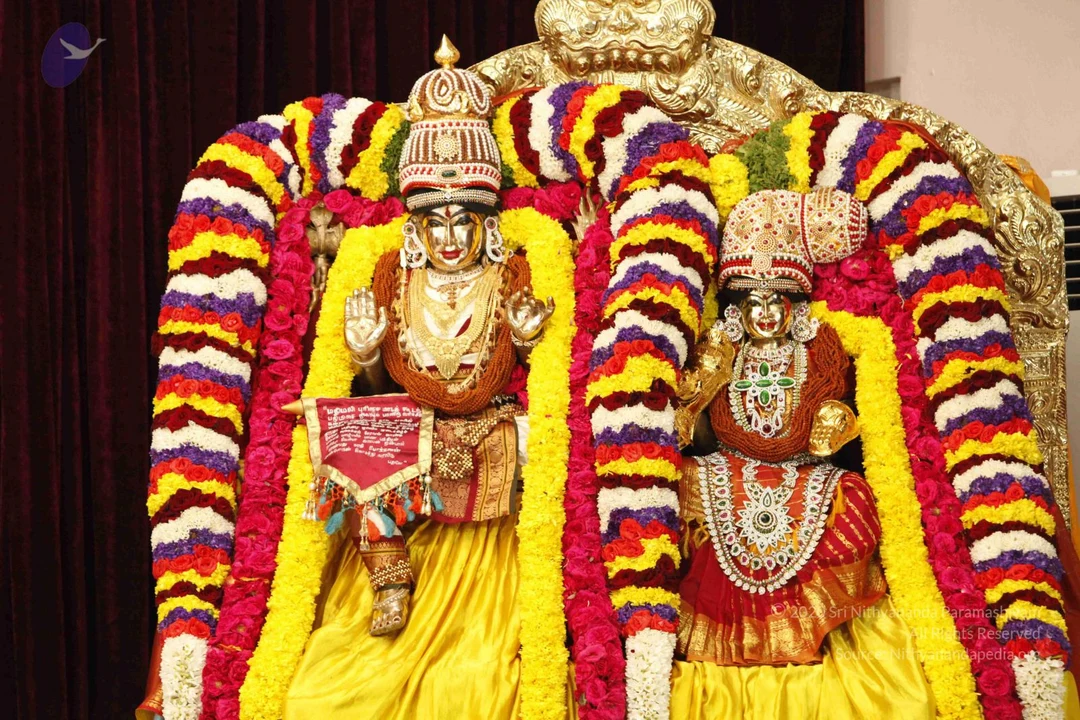
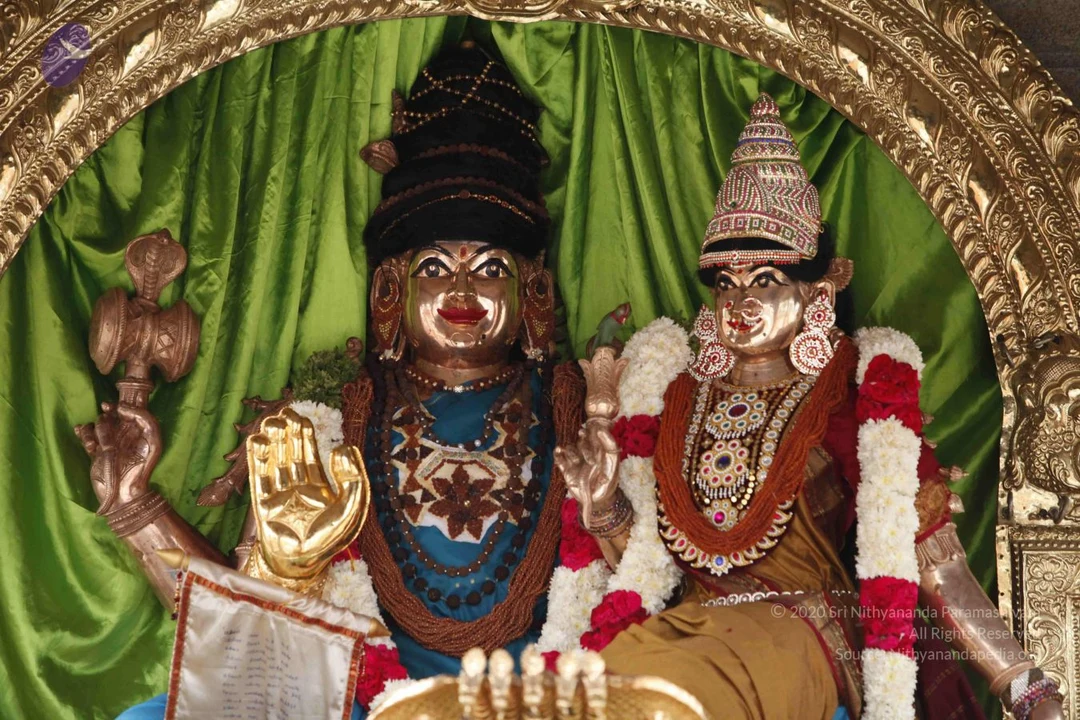
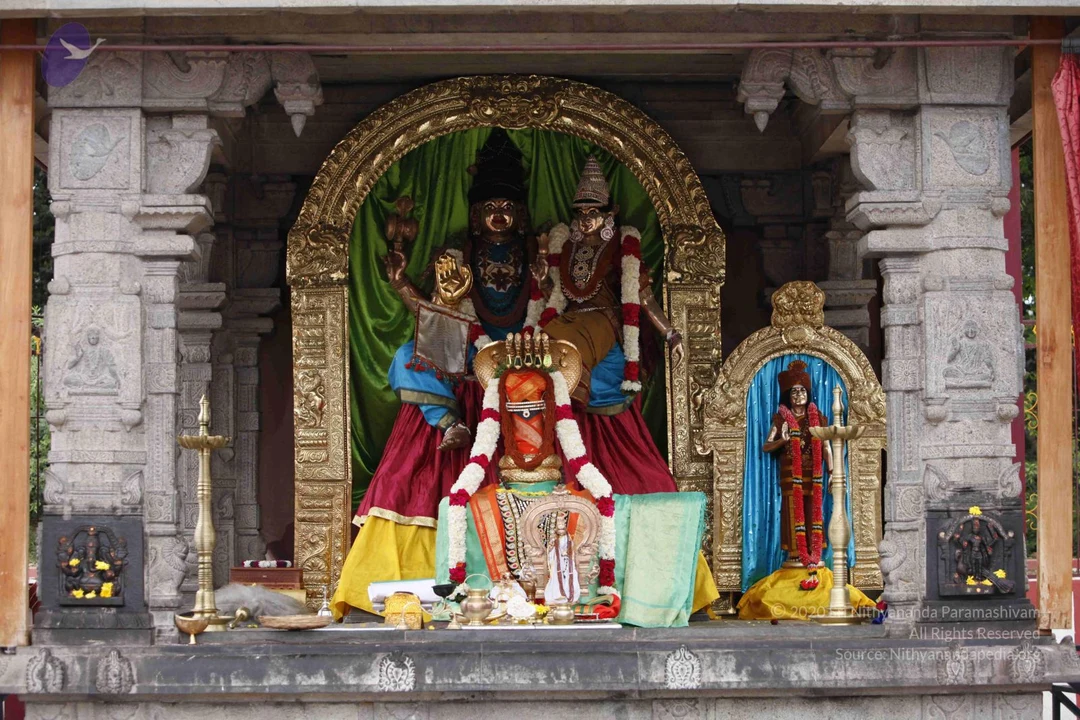
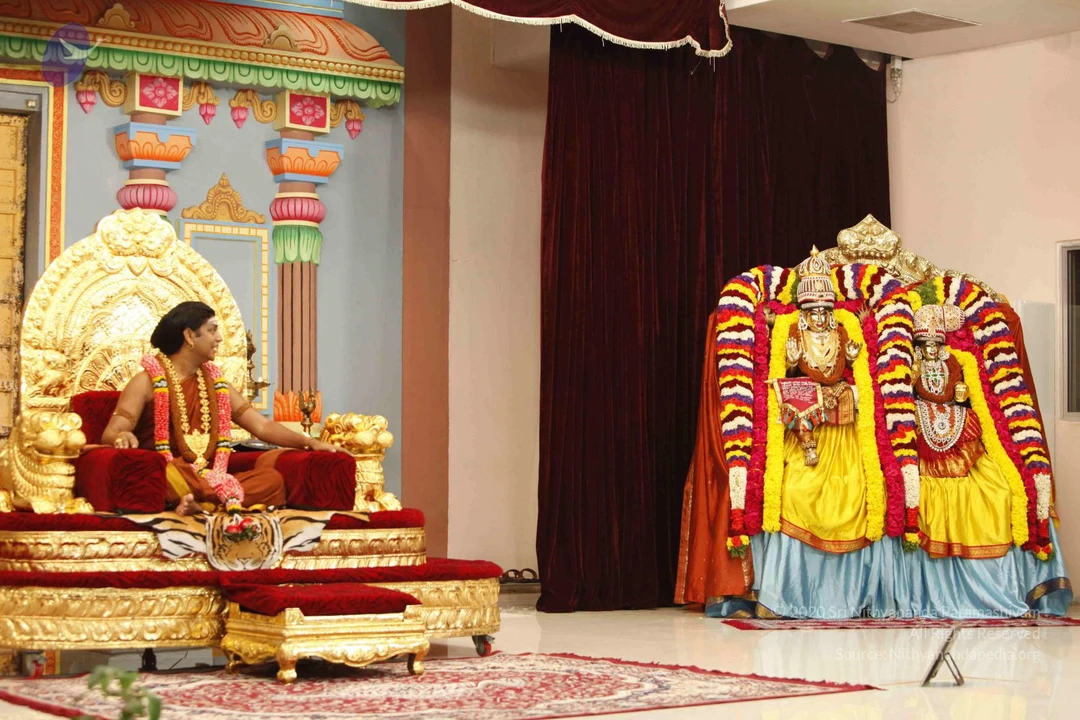
Today, Mahadeva is gracing us “Thirumugam Aruliya Leelai” means the leela of giving a reference letter a introduction letter. The story goes that once there was a great poet, Baana Bhadrar, who was the court poet of Varaguna Pandya, the king of the Pandya Kingdom because of the request of the king the poet was singing every day in the Mahadeva Temple,Somasundareshwara’s temple. Sundareshwara took jewellery from the treasury and gifted to Baana Bhadrar. One day to test the devotion of Baana Bhadrar, he stopped giving jewels but Baana Bhadrar continued to be never bothered about his poverty he continued his service of singing in Sundareshwara’s temple, then finally Sundareshwara comes down and gives an introduction letter, ‘Go and meet this Chera King with this letter, he will give you wealth.’ Maybe he wants to tell the world that Chera King’s devotion it was and he goes and apprises Chera also in the dream saying that ‘My devotee will come give him money, give him wealth.’ So, this guy, Baana Bhadrar goes with the letter of Mahadeva to Chera King.

Chera King threw the whole treasury open to him and said, ‘Take whatever you want’

Baana Bhadrar takes little to take care of his life and to do a little charity, and comes back and lives happily for a long time. Mahadeva comes down even to given an introduction letter, recommendation letter. Today, Mahadeva is gracing us in that leela, “Leela of giving recommendation letter”.

All right, I also wanted to share something from my own experience from today you will listen lot of stories practical stories of different people because from yesterday one of my very important new talk show is shooting is started. Yesterday night we had shooting, six hours shooting, eight to two and I don’t know what I am teaching to them but one thing I can say I am learning a lot. I am learning a lot, lot, lot. First of all I am learning patience to sit and attend and I am also learning how the great spiritual truths can be applied directly to the people who are on the ground level. Till now I was teaching solutions addressing attending to the upper middle class, middle class, sometime lower middle class, but now I am directly facing the people, not only economically poor, please understand, economically poor is different I have seen thousands of families economically poor total month income is hundred rupee, two hundred rupee, but culturally also poor.

Yesterday there was a show, means there was a shooting where I was attending two families husband and wife got separated after fourteen years of love marriage. Love marriage fourteen years they lived then they separated. They have two kids and the son is coming and crying to me and, ‘please unite my mother and father my life is getting wasted’ and after talking to both the kids I called the husband. This guy he comes and says the only problem I have is not big just I drink and sometime come and fight in the house. Please listen, come to the space of listening then once I called the wife she opens the whole Pandora box, please listen, she open the whole Pandora box she says ‘ this guy had an affair before our marriage then he developed another one affair recently’ and he’s handicapped, he’s handicapped guy. Then when she opens more and more I could understand fortunately or unfortunately I lived with millions of economically poor people but never went and lived with culturally poor people . When she opened up the whole story I could see very clearly, her mother who must be around seventy now is having extramarital affair at the age of sixty five , five years before, few years before she had extramarital affair. So when I was trying to solve one issue when I opened up I could see whole Pandora box coming out. First thing I thought, ‘I was, I am so happy for my gurukul kids’, because no I saw both the kids, actually first thing I felt I wanted to tell both the parents means husband and wife., ‘please send both the kids to my Gurukul’, but if I get both the kids to the Gurukul these guys won’t stay together and the family won’t happen. It was a chaos and this lady has tried to commit suicide two times and this guy is telling, ‘no, no she tried only once another time she acted.’ I asked ‘so once trying is OK for you?’ I could see all the whole culturally also poor people. First thing I was so happy that my Gurukul kids does not need to be in that atmosphere, they don’t need to listen to these stories other than when they want to solve these problems. Directly I put them in the space of solving all these issues. It took six full hours for me to sit and listen, listen, listen, listen, listen and listen out. Finally both of them have joined together, both of them have decided to live together. To make them understand I sat with the clear decision ‘I will not give up on both of them’ and you know when that lady came she came to the show only with one condition. ‘ I will not go back and live with him you talk to him and get my.’ She came with only one condition, ‘I will not go back and live with him you talk to him and get my settlement out of court.’ She has already filed divorce, she has already filed divorce, she said ‘ you get my share after the discussion’. She was very clear it took almost six hours for me to make both of them understand this guy because he is handicapped he carries so much of deep inferiority complex to find this guy’s mamakara ,ahankara and swa anyakara and to find this lady’s ahankara, mamakara and swa anyakara and to help them to understand their responsibility and uniting them was a great lesson for me but I tell you ,one thing I wanted to tell you this is the good news these tattvas and the principles I am teaching works for even the lowest ground level people on the planet. Understand no one can imagine, because here is somebody whose mother had extramarital affair at the age of sixty five and husband had one affair before marriage and she knows it and husband sells village arak and other drugs. The mother in law sells village arak and she says mother in law is the bigger drunkard than the husband, she drinks more than the husband and she uses all other drugs, who sells drugs. Once in every few weeks or few months they go to court or police. Actually when I heard the whole story for a few moment I thought, ‘no this isn’t going to work out, this girl is right that she only wants settlement.’ She wants only her share because if you go to court it takes so much of time, long time anything to , any settlement and whatever you get more than seventy percent will go to the court , the lawyer and remaining little bit will go to the police who gets the settlement done. So she came only to get the settlement without much expense and time and energy waste but when I started the show, first thing I decided I will not give up on them and I’ll see to it the conflict is resolved and both of them understand these principles. You see especially people who are culturally so poor who doesn’t have any idea why completion, why responsibility. Yes I was telling that lady you should be responsible for the family happen you should give him one more choice. Immediately she says, ‘if I am not responsible who would’ve made money every month, who would’ve worked hard and took care of my kids?’

20 min

See, responsibility means, she understand from only one direction that is: earning a little money and feeding the kids, that’s all! But I told her, ‘No! Understand, for your son and daughter to grow, just that money is not enough. They need father and mother, both!’ Then it was so difficult to make her understand. And then, finally, both of them have somehow finally realized, almost about to settle. Now comes the villain, the twist to the whole story. The wife’s mother comes and says, ‘No! I will not allow them to live together!’

I thought, ‘Oh, God! It is already six hours now! I have to start again! I have to restart! She says, ‘No! Even I may kill my daughter, but I will not allow her to go and live with her husband!’ Then I slowly started with that old lady. See, she did not have a husband. Her husband passed away at a very young age. I said her, ‘You brought up your daughter all by yourself without her father. See what you have done! At the age of fifteen your daughter ran away with this guy!’ Actually, they eloped at the age of fifteen. She was only fifteen! They eloped! I said, ‘see, what happened? Now, if your daughter brings up her daughter all alone without the father’s presence in the life, your grand-daughter also will be the same!’ Only then she slowly backed down. She thought, ‘yes’! I said, ‘for a family to happen, the presence of both is required. For a family to happen, the support of both is required. Nothing can happen by one, by only one person’s presence.’ Finally, they came to an understanding, ‘Yes’. And to make each person understand, “what is your responsibility, and what is your responsibility”…..! I told her, ‘Responsibility means allowing the possibility of re-starting.’ Please understand, allowing the possibility of re-starting is responsibility!

Everybody thinks, when you are in suffering, life is over! Yesterday, literally in those six hours, I had to give her the crash course of Inner Awakening! But I am happy I am successful! I am successful! I had to first start with listening. And I can guarantee that not with a single one of the Inner Awakening participants have I spent so many hours and listened! I listened! Not only listening, but making her understand the story from the right angle! When she started describing, I could see that because of her incompletions she started telling as if the husband has cheated her and got married.

I said, ‘No! You can use the word “you have been cheated” till you are eighteen, not after that!’ Now she is twenty-eight. So, after becoming a major also, eleven years she lived with him! I said, ‘then, you cannot use the word he cheated you’. That is wrong! That word is wrong! First three years only you can use that word; as long as you are a minor; not after you become a major!’ Finally, making her understand that carrying so much of pain! One fortunate thing is that they both are from Tamil Nadu. So they know all the suffering I went through. So I started sharing from my own experience.

Listen!

She says, ‘Everyone is talking about me and torturing me!’

I said, ‘Everyone talking about you is not torture. You talking it inside is torture!’ When I told her my life example, immediately she said, ‘that I understand!’ I can say that that was the turning point for her.

And after yesterday’s shoot, I really, very sincerely want even in the morning satsang, during the morning satsang, I should do this conflict resolution. Because, how these great spiritual principles are solving your day-to-day problems…! I made her understand the responsibility and risks. And I made him understand his responsibility and risks. Finally, I could see, the man, the man he may change, drop his habit of drinking and other habits, and may live a new life. But making the girl, wife, woman understand that you have to stop the pattern of suffering, see the pattern of suffering is worse than the pattern of drinking, the pattern of suffering is worse than the pattern of drinking. That was the real big job for me! That was the real big job, making the person understand! It is like, by the time you make both of them take the responsibility and understand, the third one comes! By the time I made everyone understand, I understood a lot of things about the human mind! When you have the pattern of suffering, even the smallest things can make a strong dent in you.

I have seen in India, the old Ambassador cars, it is so big and heavy, even in the big accidents only the front portion will be a little damaged. But nowadays cars have come like a soap box. Even inside the house if you reverse, if you hit this side or that side…..over! It is actually our capacity. Finally, I could see, the husband, whatever he does, all the problems he does, he forgets. And the wife, whatever problem is given, she multiplies it with ten-thousand! Reminding and making the husband responsible and the wife responsible, and finally awakening them to come to terms with the reality, awakening them to why stable relationships are important, why the life is important!

I can say, working with the minds which are in the down level, culturally poor, I can say, almost sharpens my ability to help, guide and support people.

Layers and layers of human unconsciousness! The only good news is even the layers and layers can be burnt, melted away by these great spiritual principles of Integrity, Authenticity, Responsibility and Enriching! To make these people come to that understanding, Integrity, Authenticity, Responsibility and

Enriching. Sometimes, people may look the same. But only when you open them….! Yesterday, it was an eye opener for me. A person who has lived in villages and ground for years, who has seen all types of people, even for me it was an eye-opener! And how each one perceived them, and perceived the other!

And the weight of the past not letting the future happening! When I saw both their lives, I saw very clearly the patterns of every one of our lives. I could connect with her; I could associate with him. I told her, ‘If I had a daughter, I won’t send her to live with this guy. But if my daughter had another daughter, I will send her to live with this guy, because, the past cannot destroy the future. Things may look the same, but it is not the same. Please listen, to every statement I am making! The past cannot destroy the future. Things may look the same, but it is not the same!

You may think how both are connected. I’ll tell you how both are connected. When you think the possibility for future transformation is not there, your past has destroyed the future. The future will be alive only with the clarity that the possibility of transformation is there, possibility for new is there.

I have a story for you:

Two men are dragging their feet in the park.

The first man points to his foot and says, ‘Vietnam, 1969!’

Understand, two men are approaching each other on a sidewalk in a park. Both are dragging their feet as they walk. One man looks at the other and knowingly points to his foot and says, ‘Vietnam, 1969! Vietnam war, 1969!’

The other man points to his foot and says, ‘Dog crap, twenty feet back!’

If you have not got it, you are sleeping!

Both may look the same, but they are not the same. Listen! Because the second man knows that after a few minutes his past is not going to affect his future. But the first man, his past is going to affect his future! The man who lost his leg in the war, his future is going to be affected by the past! And if you are lost in the past, you will only see war. And, I think, the man who lost his leg in the war, even his handicap became his pride, his suffering became his pride!

Life, in all its complications, chaos, confusions! And I could also see in the couple, after some time they started enjoying their pains and complications. And. All the pains and complications became almost like part of their life. Not only they started accepting, they started enjoying too! I could see this man, to forget his problems, he creates more problems! And, to forget his problems, he creates problems for his wife, and then he says, ‘I am solving her problems so that she will have a little sympathy!’

Finally, I could understand one thing, because I listened, listened, listened, allowed her to complete, re-live and complete, I could see the weight of her past dissolved. She decided to live with him. And he decided to drop his old patterns and life.

Originally, the shoot was planned for three hours, but I got so involved, and I decided, with this truth that, ‘I commit, till the case is solved, I am not going to get up!’ Above all, I have decided I will not to give up on both of them. And I could see, in the end, even they felt, ‘Wow!’ Not giving up on people is such an important truth, such an important necessary principle in the life!

Understand, I think everyone of our disciples, all our Spiritual Embassies should take up this as the real service. You should go to the areas, relate with people where people are culturally poor, spiritually poor, not just economically poor. I am not saying go to them and just give them a little medicine or, a little food and come away. That is a nice way of cheating and misbehaving with people. I tell you, going and giving food and a little medicine is the worst abusal you do to people! My sannyasis, our Sangha should take the responsibility of giving them the spiritual treasure, giving them the spiritual knowledge, spiritual culture, because their real problem is they are spiritually poor, culturally poor! If they spiritually become rich, culturally become rich, naturally, they will know how to become economically rich. I wanted all our Spiritual Embassies, ashrams, temples, home temples, Spiritual Embassies, to take this up as a lifestyle, send volunteers to the areas where spiritually poor people live, culturally poor people live, and educate them, give them spiritual culture, spiritual understanding, spiritual truths and spiritual strength!

The essence of today’s satsang:

If you can give spiritual strength to the culturally poor, spiritually poor people, I can say, you will never give up on you, you will learn all the knack, technique of not giving up on people and not giving up on you! Because I helped them yesterday by not giving up on them, now I know more and better ways of customizing, tailoring these truths to more people in a better way. And I even know how to handle me in a much better way!

I will move to the Nirahara Samyama.

With this I request all the Nirahara Samyama participants, please sit straight. Close your eyes and cognize you have become Bidadi Kalpavruksha. Inhale through both nostrils and the mouth. Hold as long as you can comfortably, and exhale through both the nostrils, as slowly as possible. I bless you all! Let you all experience Kundalini awakening and live health, bliss and enlightenment by producing the energy directly from space! Namah Shivaya!

I bless you all! Let you all radiate with Integrity, Authenticity, Responsibility and Enriching, with eternal bliss, Nithyananda! Thank you!

Transcript in Tamil

உங்கள் அனைவரையும் வணங்கி வரவேற்கின்றேன். இன்றைய வாழ்க்கை வாழ்வதற்கே நிகழ்வில் வாழ்க்கையை முழுமையாக வாழ்ந்த அவதார புருஷர்கள், வாழ்க்கையை வாழ்வதற்காக உலகத்திற்கு தந்த ரகசியங்கள் சிலவற்றை பார்ப்போம். விவேகானந்தர் ரொம்ப அழகா சொல்றார். ஒரு நூலகம் அளவிற்கு புத்தகங்களை படித்து கருத்துக்களை மூளையில் ஏற்றுவதைவிட வெறும் ஐந்தே ஐந்து சத்தியங்களை, ஐந்தே ஐந்து உண்மைகளை நடைமுறை படுத்தி வாழ்வோமானால், அது நமக்கு மிகப் பொிய வெற்றியையும், முழுமையையும் அளிக்கும். பல்வேறு விதமான தர்க்கரீதியான கருத்துக்களினால் உங்கள் மூளையை மூழ்கடித்து மழுங்கடிப்பதைவிட நேரடியாக நீங்கள் வாழ்க்கையில் கடைபிடிக்க கூடிய, கடைபிடித்தால் உடனடியாக உங்கள் வாழ்க்கையையே மாற்றக் கூடிய சத்தியங்களை உங்களோடு பகிர்ந்து கொள்கின்றேன். இன்றிலிருந்து இந்த வாழ்க்கை வாழ்வதற்கே நிகழ்ச்சியின் மூலம் வாழ்க்கையை வாழ்வதற்கான அடிப்படையான நான்கு சத்தியங்களையும், உங்கள் மூலமான கட்டுறுமனப்பாங்கு சுழழவ ியவவநசெ அதைக் கண்ணடறிந்து அதிலிருந்து உங்களை விடுபடுத்திக்கொள்வதையும் காண்போம். ஒரு நாட்டிலே வாழ வேண்டும் என்றால் அந்த நாட்டினுடைய சட்ட திட்ட விதிகளை சார்ந்துதான் வாழ வேண்டும். ஒரு நாட்டில ஏன் வாகனங்கள் சாலையில் வலது புறம் செல்கிறது அல்லது இடது புறம் செல்கின்றது அப்படின்ற கேள்வி உங்களுக்கு இருக்குமானால் அந்த நாட்டின் விதிகளை தொிந்து கொண்டால் இந்த கேள்விக்கு விடை கிடைக்கும். ஒரு நாட்டை பற்றிய எல்லா கேள்விகளுக்குமே, அந்த நாட்டினுடைய விதிகளை பற்றி தொிந்து கொண்டால் விடை கிடைக்கும். அதே போல இந்த பிரபஞ்சத்தில் உங்களுக்கு இருக்கும் எல்லா கேள்விகளுக்கும் பிரபஞ்சத்தின் விதிகளை தொிந்து கொண்டீர்களானால் விடை கிடைக்கும். இந்த பிரபஞ்சத்தின் விதிகள் நான்கு. ஏன் சிலர் ஏழையாகவே பிறக்கின்றார்கள், ஏழையாகவே இறக்கின்றார்கள்? ஏன் சிலர் பணக்காரர்களாகவே பிறக்கின்றார்கள், பணக்காரர்களாகவே இறக்கின்றார்கள்? ஏன் சிலர் பணக்காரர்களாக பிறக்கின்றார்கள், ஏழைகளாக இறக்கின்றார்கள்? ஏன் சிலர் ஏழைகளாக பிறக்கின்றார்கள், பணக்காரர்களாக இறக்கின்றார்கள்? ஏன் சிலர் உடல் நலத்தோடயே பிறந்து, வாழ்க்கை முழுவதும் ஆரோக்கியத்தோடும், நீண்ட ஆயுலோடும் வாழ்கின்றார்கள்? ஏன் சிலர் பிறந்த நாளில் இருந்து, இறக்கும் நாள் வரை வியாதியிலேயே தவித்து அல்ப ஆயுளிலேயே முடிந்து போகிறார்கள்? ஏன் சிலர் வாழ்க்கை முழுவதும் ஏமாற்றுகின்றார்கள். ஏன் சிலர் வாழ்க்கை முழுவதும் ஏமாறுகின்றார்கள்? ஏன் சில போ் சக்தி அற்றவர்களாகவே இருக்கின்றார்கள்? ஏன் சில போ் பலசாலிகளாக வாழ்கின்றார்கள்? வாழ்க்கையை பற்றி பிரபஞ்சத்தை பற்றி உங்களுக்கு என்ன கேள்வி இருக்குமானாலும், பிரபஞ்சத்தின் விதிகள் இந்த பிரபஞ்சத்தின் நான்கு விதிகளையும் தொிந்து கொண்டீர்களானால் அனைத்திற்குமான விடைகள் கிடைத்துவிடும். அதுமட்டும் அல்லாது எல்லா சூழல்களிலும் சக்திசாலியாக வாழுகின்ற தௌிவும் பிறக்கும். வாழ்க்கையில் ஒரு வினாடி கூட பலவீன தன்மை இல்லாமல் ிழறநசடநளளநௌள ஸே இல்லாம சக்திசாலியாக வாழ்வதைதான் ஜீவன் முக்தினு சொல்றேன். எந்த உழகெடைஉவள வந்தாலும் எந்த உழவெசயனைஉவழைெ வந்தாலும் எப்படி நாம உழசநெச பண்ணபட்டாலும் தன்னிலை தவறாது, தன்னிலை மாறாது, பலவீனத்தை தன் வாழ்க்கையாக உணராது, தன்னை பலவீனனாக உணராது ிழறநசடநளளநௌள-அ உணராம சக்திசாலியாய் உணர்வதும், சக்திசாலியாகவே வாழ்க்கையை வாழ்வதும், நடத்துவதும் தான் ஜீவன் முக்தி. இது போல் வாழ்வது தான் வாழ்க்கை. வாழ்க்கை இது போல் வாழ்வதற்கே. வாழ்க்கையை இது போல் வாழ வேண்டும் என்றால் இந்த நான்கு தத்துவங்களை உள்வாங்குங்கள். நான்கு சத்தியங்கள். இதுவரை உலகத்தில் தோன்றியிருக்கின்ற எல்லா குருமார்கள், எல்லா ஞானிகள், எல்லா ஆன்மீக புத்தகங்கள், எல்லா ஆன்மீக உபதேசங்கள் இவை அனைத்தின் சாரம் இந்த நான்கு தத்துவங்கள். ஒவ்வொரு முறையும் ஒரு புத்தகத்தோட சநஎளைநன நனவைழைெ வந்ததுன்னா முதல் புத்தகத்தில் கசைளவ நனவைழைெ ல சொல்லபட்டததை விட சில ஆழமான, அழுத்தமான கருத்துக்கள் சநஎளைநன நனவைழைெ ல வரும். டுயவநளவ சநஎளைநன நனவைழைெ ஐ எடுத்து பார்த்தீங்கனாதான் அந்த எழுத்தாளர் நமக்கு சொல்ல விரும்புகிற கருத்தை முழுமையா பார்ப்போம். அதேமாதிரி ஒவ்வொரு அவதார புருஷரும் சநஎளைநன நனவைழைெ. ராமருடைய சநஎளைநன நனவைழைெ கிருஷ்ணன். கிருஷ்ணருடைய சநஎளைநன நனவைழைெ புத்தன். புத்தருடைய சநஎளைநன நனவைழைெ ஆதிசங்கரர். ஆதிசங்கரருடைய சநஎளைநன நனவைழைெ ராமகிருஷ்ணர். ராமகிருஷ்ணருடைய சநஎளைநன நனவைழைெ ரமண மகரிஷி. அடுத்து அடுத்து வருகின்ற அவதார புருஷர்கள் சநஎளைநன நனவைழைளெ. பிரபஞ்சத்தின் எழுத்தாளனாகிய இறைவன் நமக்கு சொல்ல விரும்பும் கருத்துக்களுடைய சநஎளைநன நனவைழைெ தான் அவதார புருஷர்கள்.

ஆழமாக தொிந்து கொள்ளுங்கள். ஆழ்ந்து இந்த உண்மையை உள்வாங்குங்கள். உங்களுக்கு சொல்லப்பட வேண்டிய, உலகத்திற்கு சொல்லப்பட வேண்டிய, நம் எல்லோருக்கும் சொல்லப்பட வேண்டிய டயவநளவ சநஎளைநன நனவைழைெ உடைய சாரம் நான்கு சத்தியங்கள். சமஸ்கிருத்தில் சொல்லணும்னா சம்புர்த்தி, சிரத்தை, உபாயனம், அப்யாயனம். ஆங்கிலத்தில் சொல்லணும்னா வைெநபசவைலஇ யரவாநவெைஉவைலஇ சநளிழளெடைிடைவைலஇ யனெ நசெைஉாபைெ. தமிழில் அருமையான நான்கு வார்த்தைகள் ஒருங்குவித்தல், சிரத்தை, பொறுப்பெடுத்தல், வாழ்வை வளமாக்குதல். வாழ்வை வளப்படுத்துதல். நம்மையும், மற்றவர்களையும் கைவிடாது வாழ்க்கையை வளப்படுத்துதல். முதல் சத்தியம் வைெநபசவைல. ஆழ்ந்து கேளுங்கள். ஒரு மருத்துவர் தன்னை மருத்துவர் என்று சொல்லிக் கொள்வதில் பெருமையும் இல்லை. வெட்கப்படுவதற்கும் ஒன்றும் இல்லை. அது அவருடைய வேலை. அது அவருடைய தொழில். ஒரு என்ஜினியர் தன்னை என்ஜினியர்னு சொல்லிக்கிறதுல பெருமைபடுவதற்கும் ஒன்றும் இல்லை. வெட்கப்படுவதற்கும் ஒன்றும் இல்லை. அது அவருடைய வாழ்க்கை. அவருடைய வேலை. அதேபோல இறை சக்தியை தான் உணர்ந்து, மற்றவர்களுக்கும் அந்த அனுபவம் கிடைக்க வேண்டும் என்று உழைக்கின்ற ஒரு மனிதர் தன்னை அவதார புருஷர் என்று அறிமுகபடுத்தி கொள்வதில் பெருமையும் இல்லை, அதில் வெட்கப்படுவதற்கும் எதுவும் இல்லை. ஆழ்ந்து புரிந்து கொள்ளுங்கள். சத்தியங்கள், இந்த தத்துவங்கள் உங்களுக்குள் ஆழமாக புரியப்படும் பொழுது தான் சத்தியங்கள், தத்துவங்கள் உங்களுக்குள் ஆழமாக உணரப்படும்பொழுதுதான் அதை உங்களுக்கு உணர்த்துபவரின் நிலை, உணர்வு உங்களுக்கு புரியும். பிரபஞ்சம், பிரபஞ்சத்தின் எழுத்தாளன் உங்களுக்கு சொல்ல விரும்பும் கருத்துக்களின் டயவநளவ சநஎளைநன நனவைழைெ அதனுடைய சாரம் இந்த நான்கு தத்துவங்கள். நான்கு சத்தியங்கள். முதல் சத்தியம் வைெநபசவைல. ஆழ்ந்து உள்வாங்குங்கள். முதல் சத்தியம் வைெநபசவைல. இப்படின்னா என்னான்னா நீங்கள் உங்களுக்கும், மற்றவர்களுக்கும் கொடுத்து கொள்ளும் எண்ணங்களையும், வார்த்தைகளையும் வாழ்க்கையாகவே நினைந்து நிஜமாக்குவது. அதன் மூலமாக முழுமை தன்மையில் வாழ்வது. உங்களுக்கும், மற்றவர்களுக்கும் நீங்கள் கொடுத்து கொள்ளும் எண்ணங்களையும், வார்த்தைகளையும் நிஜமாக்கி வாழ்க்கையையே கொடுத்தாவது அந்த வார்த்தைகளை சத்தியமாக்கி அதனால் முழுமைத்தன்மையில் வாழ்வது. இத ஆழமாக புரிந்து கொள்ள வேண்டும். மற்றவர்களுக்கு நாம கொடுக்குற வார்த்தைகளை நிஜமாக்கனும் அப்படினு சமுதாயம் நமக்கு கத்து குடுக்குது. சமுதாயம் அதை மீண்டும், மீண்டும் நமக்கு சொல்லி கொடுக்கின்றது. ஏன்னா மற்றவர்களுக்கு நீங்க கொடுக்கிற வார்த்தைகளை நிறைவேற்ற கற்றுக்கொண்டால்தான், நீங்கள் ஒரு நல்ல தொழிலாளியாக, வியாபாரியாக மாற முடியும். சமூகத்திற்கு தொழிலாளிகள் வேண்டும். வியாபாரிகள் வேண்டும். உலகத்தோட நீங்க எந்தவிதத்துல உறவாடனும்னாலும் நீங்க மற்றவர்களுக்கு கொடுக்கிற வார்த்தைகளை நிஜமாக்க வேண்டும். இந்தக் கருத்தை மீண்டும் மீண்டும் நீங்கள் ஆத்திச்சுடியில் இருந்து படிக்கின்றீர்கள். சிறுவயதிலிருந்து இந்தக் கருத்து உங்களுக்குச் சொல்லித்தரப்படுகிறது. ஆனால் சமூகம் சொல்லித்தராத வாழ்க்கையின் மிக முக்கியமான விதி, பிரசஞ்சத்தின் மிக முக்கியமான ஒருவிதி நீங்கள் உங்களுக்கே கொடுத்துக்கொள்ளும் வாழ்க்கையாகக் கருதி நிஜமாக்குங்கள். சிலபேர் கேட்கலாம் எனக்கே நான் கொடுக்கிற வார்த்தையா? அப்படீன்னா என்னன்னு புரியலையே? சிறுவயதுல டாக்டர் ஆகனும்னு நினைச்சிருந்தீங்கன்னா, முடிவெடுத்திருந்தீங்கன்னா உங்களுக்கு நீங்களே டாக்டர் ஆகிறது என்கிற வார்த்தயை நீங்கள் கொடுத்துவிட்டீர்கள். டாக்டர் ஆகறது மருத்துவர் ஆகறது என்கின்ற விதியை உங்களுக்கு நீங்களே கொடுத்துக்கொண்டு விட்டீர்கள். உங்களுக்கு நீங்களே அந்த உறுதியைக் கொடுத்துக்கொண்டீர்களானால் வாழ்க்கையைக் கொடுத்தாவது அந்த உறுதியை நிறைவேற்ற வேண்டும். பிரச்சனை என்னன்னா, அதை நிறைவேற்றாமல் விட்டது மட்டுமன்று அந்த வார்த்தையிலிருந்து உங்களை விடுபடுத்திக்கொள்ள முழுமைப்படுத்தக்கூட நாம் நினைப்பதில்லை. ஒரு உதாரணம் உங்கள் நண்பர் ஒருவருக்கு 10லட்ச ரூபாய் அளிப்பதாக ஒருவாரத்தில் கொடுப்பதாக நீங்கள் உறுதி அளிக்கிறீர்கள். உங்கள் வாழ்க்கையையே கொடுத்தாவது அந்த வார்த்தையை நிறைவேற்றிவிட வேண்டும். ஒருவேளை உங்களால 1 வாரத்துக்குள்ள திருப்பிக்கொடுக்க முடியாதுன்னு உங்களுக்குத் தெரியவருது. வார்த்த குடுத்துட்டீங்க, ஆனா வாழ்க்கையையே குடுத்தாகூட அவருக்கு நீங்க அந்த 10லட்ச ரூபாய கொடுக்க முடியாதுன்னு உங்களுக்குத் தெரிய வந்ததுன்னா, அவர கூப்பிட்டு அந்தக் குறிப்பி்ட்ட நாளுக்குள், அவர கூப்பிட்டு, அவரை அழைத்து என்னால் கொடுக்க முடியாது, என்னை நம்பவேண்டாம் என் வாழ்க்கையையே கொடுத்தால்கூட என்னால் கொடுக்க இயலாது அப்படீன்னு உங்களுடைய இயலாமையைப் புரியவைத்து, கொடுத்த வார்த்தையை முழுமையாகவாவது மாற்றிவிடுதல். கம்ப்ளீஷனாவது பன்னிறனும். ஓன்னு அந்த வார்த்தைய ஹானர் பன்னனும் 10 லட்ச ரூபா கொடுக்கறேன்னு சொன்னீங்கன்னா குடுத்துட்டீங்கன்னா அது ஹானர் பன்றது, கொடுக்க முடியலன்ன தெரியவைத்தாவது விட்டீர்களானால், அவருக்கு சொல்லியாவது விடுவது. அவருக்குத் தெரியவைத்தாவது விடுவது அதையாவது செய்தீர்களானால் அது கம்ப்ளீஷன். கம்ப்ளீஷனும் இன்டகிரிட்டிதான். நீங்க ஒரு வாரத்திற்குள் குடுக்கறேன்னு சொன்னீங்கன்னா, ஒருவாரத்திற்குள்ளாகவே என்னால் இயலாதுன்னு அவருக்குப் புரிய வச்சி, நீங்க வேற ஏதாவது ஒர சோர்ஸ், வேற ஏதாவது ஒரு வழியைத் தேடுங்கள் அப்படீன்னு அவர்கிட்ட தௌிவா சொல்லி அந்த வார்த்தையை முழுமையாக்கிவிட்டீர்களானால், கம்ப்ளீஷன் பன்னிட்டிங்கன்னாலும் அதுவும் இன்டகிரிட்டிதான். அதேப்போல்தான் உங்களுக்கு நீங்கள் கொடுத்துக்கொள்ளுகிற வார்த்தைகள். நீங்கள் உங்களுக்குக் கொடுத்துக்கொள்கின்ற எல்லா வார்த்தைகளையும் வார்த்தையையே கொடுத்தாவது நிஜமாக்க வேண்டும். இல்லையென்றால் குறைந்தபட்சம் முழுமையாக்கவாவது வேண்டும். நாமெல்லாம் நினைக்கலாம், எனக்கு நானே குடுத்துகிட்ட வார்த்தைக்கு என்ன சாட்சியா இருக்குசாமி. விடுங்க..., பெரும்பாலானவர்கள் நமக்குநாமே கொடுத்துக்கொள்கின்ற வார்த்தைகளைப் பற்றி நினைத்துக்கூடப் பார்ப்பதில்லை. மறந்துவிடுகின்றோம். நல்ல ஆழமா புரிஞ்சிக்கோங்க. உங்க வாழ்க்கையில நீங்க எந்த பொிய முடிவு எடுத்தீங்கனாலும், எந்த பொிய சாதனை பண்ணணும்னு நினைச்சீங்கனாலும், எந்த பொிய பிளான் போட்டீங்கனாலும், உங்களுடைய மனதின் ஒருபாகம் உங்களை பார்த்து கேலித்தனமாக சிரிக்கும். கோமாளியை பார்ப்பது போல் பார்த்து சிரிக்கும். அதுக்கு காரணம் என்னன்னா, ஏற்கெனவே நீங்கள் உங்களுக்கே பலமுறை பல வார்த்தைகளை கொடுத்து அதை நிறைவேற்றவும் செய்யாது, முழுமை ஆக்கவும் செய்யாது வாழ்வதனால் உங்களுக்கு நீங்களே ஏதாவது வார்த்தைகள் கொடுத்து கொள்ளும்பொழுது, உங்களுடைய மனமே உங்களை பார்த்து சிரிக்கின்றது. இதுதான் மனச்சிதைவின் துவக்கம். உண்மையில பார்த்தீங்கனா, நாம எல்லோருமே மனச்சிலைவுல ளரககநச ஆகறோம். ஏன்னா ஆஸ்பிடலுக்கு போற அளவுக்கு மோசமா போகாம வீட்டுலயே வெச்சி மேனேஜ் பன்ற அளவுக்கு ளரககநச ஆகறோம். எப்படி டயபட்டீஸ் ஒரு அளவுக்கு மேல போனாதான ஆஸ்பிடலுக்கு அட்மீட் ஆகணும். ஒரு அளவுக்கு கம்மியா இருந்தததுன்னா, வீட்டுலயே வெச்சி மேனேஜ் பண்ணிக்க முடியும். அதே மாதிரிதான் இந்த மனச் சிதைவும். ஒரு அளவுக்குமேல போனாதான் ஆஸ்பிட்லுக்கு போகனும். பார்டர்லைன் பர்சனாலிட்டி அளவுக்கு இருந்தீங்கன்னா வீட்டுலயே வெச்சி மேனேஜ் பண்ணிடலாம். நம்மல்ல பெரும்பாலானவர்கள் வைெநபசவைல -யை ிசயஉவைஉந பண்ணலைனா வைெநபசவைல -யை வாழலைனா நம்மை ஒன்றாக்கி ஒருங்குவித்தல் என்கின்ற உணர்வை வாழவி்ல்லை என்றால் மனச்சிதைவுக்கு ஆளான மனிதர்களாகத்தான் இருந்து கொண்டு இருக்கின்றோம். மனச்சிதைவுக்கு ஆளான மனிதர்களாகத்தான் வாழ்ந்து கொண்டு இருக்கின்றோம். ஆழ்ந்து உள் வாங்குங்கள். எப்ப நீங்க உங்களுக்கு நீங்களே கொடுத்து கொள்ளுகின்ற வார்த்தைகளை, ஆழமா புரிஞ்சிக்கோங்க. உங்களுக்கு நீங்களே கொடுத்து கொள்கின்ற வார்த்தைகளை நிஜமாக்க துவங்குகின்றீர்களோ வாழ்க்கையையே கொடுத்து அத நிறைவேற்ற துவங்குகின்றீர்களோ, அப்ப என்ன ஆகும்னா இரண்டு விஷயம் நடக்கும். முதல்ல உங்களுக்கு நீங்களே கொடுத்துக்குற வார்த்தைகள் குறைய ஆரம்பிச்சிடும். ஏன்னா ஒவ்வொன்னையும் நீங்க நிறைவேற்றி ஆகனும் அப்படிங்கிற கட்டாயம் உங்களுக்கு இருக்குனு உங்களுக்கு தொியும். நிறைவேற்றி ஆகணுங்கிற கட்டாயம் இல்லைனா ரமண மகரிஷி ரொம்ப அழகா சொல்லுவாரு ஒரு உதாரணம் யானையி்ன் துதிக்கையிலே ஒரு பொிய பாரமான கட்டையை கொடுக்காவிட்டால் துதிக்கையை அசைத்து கொண்டே செல்லுமாம். தெருவிலே இருக்கிற மரத்தை கிளையை உடைக்கும். சாலையில் இருக்கின்ற கடைகளிலே தொங்குகின்ற வாழைப் பழத்தை பறிக்கும். செல்லுகின்ற நபர்கள் கொண்டு செல்லும் கைப்பைகளை பறிக்க முயற்சிக்கும். ஆனால் அதேத் துதிக்கையில் ஒரு பாரமான தேக்கு மரத்தை கொடுத்துவிட்டீர்களானால் அமைதியோடு அந்த மரக் கட்டையை தூக்கி கொண்டு ஒழுக்கத்தோடு செல்லும். அதனுடைய துதிக்கை நபெயபந ஆயிடுச்சினாலே பார்வையும் அங்க இங்கயும் போகாது. அதேமாதிரி நம்முடைய வாழ்க்கையிலும் நாம் நமக்கு கொடுத்து கொள்ளுகின்ற ஒவ்வொரு எண்ணத்தையும் நாம் நிறைவேற்றி ஆக வேண்டும் அல்லது முழுமைப்படுத்தி ஆக வேண்டும் என்கின்ற கட்டாயம் உழஅஅவைஅநவெஇ பழக்கம் வாழ்க்கை முறை நமக்கு வருமானால் தேக்குமரத்தை தாங்கிய யானையின் துதிக்கை அசைவில்லாமல் வாழ்க்கையை நடத்துவதுபோல, மனசுல சநளவடநளளநௌள இல்லாம தொடர்ந்து அலைபாய்ந்து கொண்டே இருக்கின்ற சநளவடநளளநௌள இல்லாம, வாழத் துவங்குவீர்கள். யோகசூத்திரத்துல ஒரு அருமையான ஒரு சூத்திரம் உண்டு. பதஞ்சலி சொல்றாரு "யோகஸ்ய பிரதமம் துவாரம் வாங்நிரோதகா". யோகத்தின் முதல்படி வார்த்தைகள் குறைவது. வார்த்தைகள் குறைவதுன்னா வெறுமனே மௌனம் எல்லாம் இல்ல. வாயல மௌனமா இருக்கிறது இல்ல. வாயினால் வார்த்தைகளை குறைப்பது மாத்திரம் அல்ல. வாய் வார்த்தைகள் குறைவது யோகம் அல்ல. எனக்குத் தெரிஞ்சு ஒரு ஆதீனம் வியாழக்கிழமை வியாழக்கிழமை பேச மாட்டார். ஆனா அவர் மக்களைப் பன்ற கொடுமையும் மற்றவர்களை செய்யற கொடுமையயைும் பார்த்தீங்கன்னா அவருக்கும் ஆன்மிகத்ததுக்கும் சம்மந்தமே இல்ல. வாயினால் வார்த்தகளைக் குறைப்பது மாத்திரமல்ல. வாய் வார்த்தைகள் குறைவது யோகம் அல்ல. மன வார்த்தைகள் குறைவது யோகம். ஐவெநபசவைல யை ீசயஉவைஉந பண்ண ஆரம்பிச்சீங்கன்னா நீங்கள் உங்களுக்கு கொடுக்கிற ஒவ்வொரு வார்த்தையையும் நிஜமாக்க வேண்டும், நிறைவேற்ற வேண்டும் அல்லது முழுமையாக்க வேண்டும் என்கிற உணர்வோடு நீங்கள் சிந்திக்க துவங்கினீர்களானால் இப்ப தினந்தோறும் 10,000 எண்ணங்களை சிந்திக்கிறீர்கள் அப்படீன்னா, ஐவெநபசவைல யை ீசயஉவைஉந பண்ண ஆரம்பிச்சீங்கன்னா பத்தாயிரம் எண்ணங்கள் பத்தாக குறைந்துவிடும். அப்ப என்ன ஆகும்ன்னா தௌிந்த சிந்தனை இருக்கும். சிந்திக்கின்ற ஒவ்வொன்றையும், நிஜமாக்குகின்ற சக்தி உங்களுக்குள் மலரும். சிந்திக்கின்ற ஒவ்வொன்றையும் நிஜமாக்குகின்ற சக்தி மலரும்பொழுது பலவீனம் என்பதையே ிழறநசடநளளநௌள அப்படிங்கறதையே உணராத ஒரு சக்திசாலியான வாழ்க்கையை வாழுவீர்கள். வார்த்தை. நல்ல ஆழ்ந்து புரிந்து கொள்ளுங்கள். உங்களுக்கு நீங்கள் கொடுக்கிற வார்த்தைகளை எல்லாம் நிஜமாக்கியே தீருவது அல்லது முழுமைபடுத்தியே தீருவது என்கின்ற தௌிவோடு நீங்கள் வாழத் துவங்கினீர்களானால், ஆழ்ந்து புரிந்து கொள்ளுங்கள் நீங்கள் மற்றவர்களுக்கு கொடுக்கின்ற எல்லா வார்த்தைகளும் தானாகவே நிஜம் ஆகும். நம்முடைய இந்து பாரம்பரியத்தில் சொல்லப்படுகின்ற வாக்கு சித்தி உங்களுக்குள் மலரும். ஆழமாக புரிஞ்சக்கோங்க. மூடநம்பிக்கையை வளர்ப்பதற்காகவோ, அல்லது என்ன வேண்டுமானாலும் பேசலாம் என்கின்ற பொறுப்பில்லா தனத்தோடோ நான் பேசவில்லை. கேட்கின்ற நீங்கள் அனைவரும் இந்த வார்த்தைகளை, என்னுடைய வார்த்தைகளை மிகவும் சிரத்தையோடு கேட்கின்றீர்கள், கடைபிடிக்க முயற்சிக்கின்றீர்கள் என்கின்ற பொறுப்போடு நீங்க கடைபிடிக்க முயற்சி பண்றீங்கனாலே உங்களோட பேசறதுக்கு நான் மிகப்பொிய பொறுப்போடு வார்த்தைகளை உதிர்க்க வேண்டும். யார் கேட்கப் போறாங்க அப்படீங்கிறதுனால என்ன வேன்னா பேசறது இல்ல. இல்லை, உண்மை எதுன்னு தொியாமலேயே என்ன வேன்னா அவதூறு பண்றதில்ல. உண்மைய என்ன வென்று தெரியாமல் என்னவேண்டுமானாலும் சொல்வதற்கும், பொறுப்பில்லாத் தனத்தோடு பேசுவதற்கும் நான் ஒரு சாதாரண ீசழபசயஅ நடத்தற ஊாயஅியசைநச இல்ல. கேட்கின்ற நீங்களும் ஒரு நுவெநசவயைெஅநவெ ீசழபசயஅ மாதிரி இத கேட்கவும் இல்ல. பொறுப்போடு சொல்லுகின்றேன். ஆழ்ந்து உள்வாங்கி கொள்ளுங்கள். மூடநம்பிக்கையையோ அல்லது மாய மந்திரங்களையோ பரப்புவதற்காக சொல்லவில்லை. உண்மையைச் சொல்லுகின்றேன். உங்களுக்குள் நீங்கள் உங்களுக்கே கொடுத்து கொள்ளுகின்ற எல்லா வார்த்தைகளையும் நிஜமாக்குவது, நிறைவேற்றுவது அல்லது முழுமையாக்குவது என்கின்ற தௌிவோடு வாழத் துவங்குவீர்களானால் நீங்கள் மற்றவர்களுக்கு கொடுக்கும் வார்த்தைகள் தானாகவே நிஜமாகிவிடும். உங்களுக்கு வாக்கு சித்தி மலரும். ஐவெநபசவைல. உங்களுக்குள்ள ஐவெநபசவைல -யை வாழத் துவங்கினீர்களானால் நீங்கள் மற்றவர்கள் எல்லோருக்கும் கொடுக்கின்ற எந்த வார்த்தையாக இருந்தாலும் இது தானாகவே நிஜம் ஆகின்றது. என்னுடைய அனுபவத்தில் இருந்து சொல்லுகின்றேன். ஞானசம்பந்தருடைய ஐவெநபசவைல ிழறநச தான் மடப்பள்ளி சாம்பலை அள்ளிக் கொடுத்து கூன்பாண்டியனுக்கு தீரட்டும் வியாதி என்ற மாத்திரத்திலேயே சுரம் மட்டும் அல்லாது கூனும் தீர்ந்து நின்றசீர்நெடுமாற பாண்டியனாய் மாறினான். ஞானசம்பந்தருடைய ஐவெநபசவைல யோட ிழறநச மற்றவர்களுக்கு அவர் கொடுத்த வார்த்தை உடனடியாக நிஜம் ஆகின்றது. வாக்குசித்தி. அது ஞானசம்பந்தரால மட்டும் தான் முடியும்னு நினைக்காதீங்க. அவரால மட்டும்தான் முடியும். அதுக்கு பிறகு யாராலயும் முடியாது சொன்னா நாம் உண்மையில் அவர் வழிபடவில்லை. அவரை வழிபடுவது மட்டும் வாழ்க்கை அல்ல. அவர் வழியில் படுவது வாழ்க்கை. ஐவெநபசவைல யோட வாழத் துவங்குங்கள். நீங்களும் யாருக்கு எந்த வார்த்தை கொடுத்தாலும் அது நிஜமாகத் துவங்கும். வாக்குசித்தி உங்களுக்குள் மலரத் துவங்கும். மற்றவர்களுக்குக் கொடுத்த வார்த்தையை நிறைவேற்ற முடியாவிட்டால் எப்படி முழுமைப்படுத்துவது, நமக்கு நாமே கொடுத்துக்கொள்ளும் வார்த்தைகளை நிறைவேற்றாவிட்டால் எப்படி முழுமைப்படுத்துவது? சிலபேர் கேட்கலாம், சாமி நான் சின்ன வயசுல இருந்தே ஒரு லாயரா மாறனும்னு நினைச்சேன், ஆனா மாறமுடியல இப்ப எப்படி எனக்கு நானே இன்டகிரிட்டிய எடுத்துட்டு வர்றது? எப்படி அந்த வார்த்தயை முழுமையாக்கிக் கொள்வது, இந்தக் கேள்விக்கான விடையயை நாளைய நிகழ்ச்சி வாழ்க்கை வாழ்வதற்கே நிகழ்ச்சியில் காண்போம்.

Tags:

Paramahamsa Nithyananda, enriching, spiritual, knowledge, confusion, pain, lives, pride, transform, completion

Photos Of The Day:

Leela Alankar
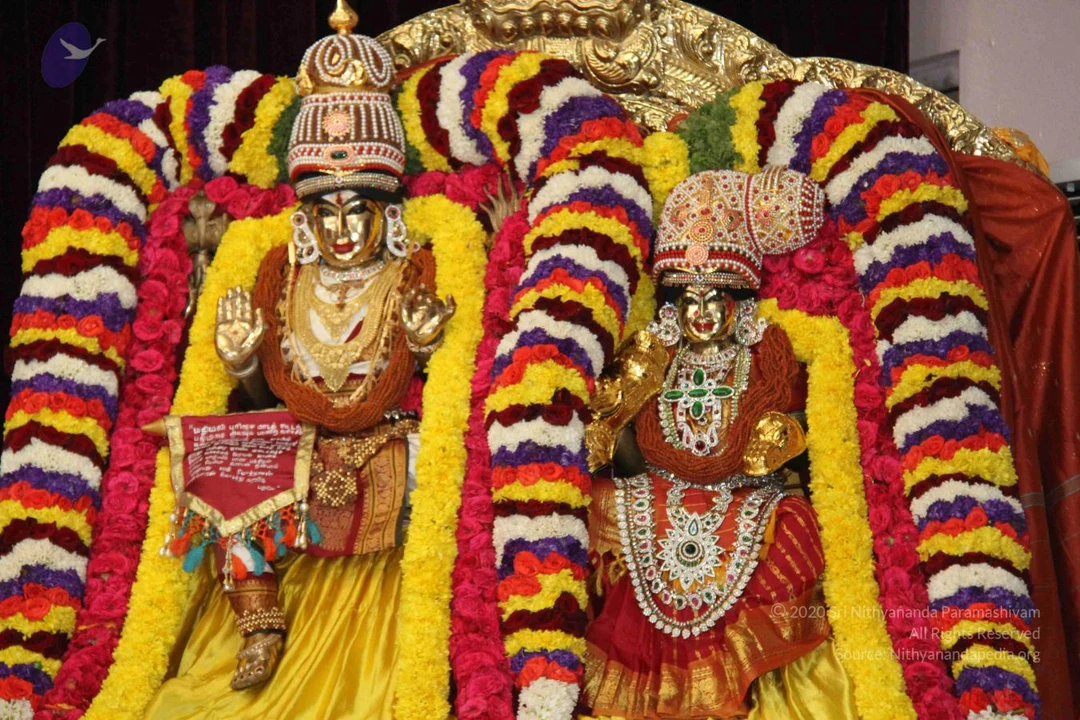
PadaPuja

Nithya-Satsang
Sarva-Darshan

Swamiji-Final-Blessings

Sacred-Arts-Univercity

Ashram-Nature

IA Session

IA-Darshan

Temple

01-Leela-Alankar

02-Pada-Puja

03-Nithya-Satsang

04-Sarva-Darshan

05-Swamiji-Final-blessings

08-IA-Session

09-IA-Darshan

09-IA-Darshan_Photo_1000__MG_7135_CMP_WM

10-Temple

Photos from this day

View all 294 photos

Leela Alankar

18 photosSource gallery
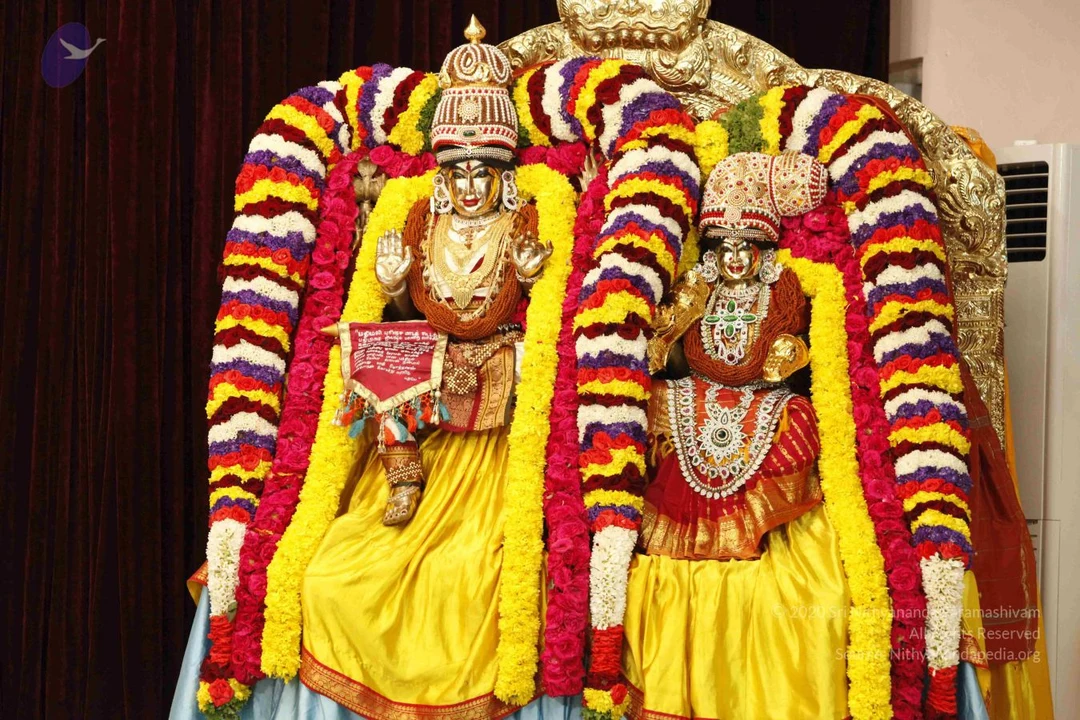
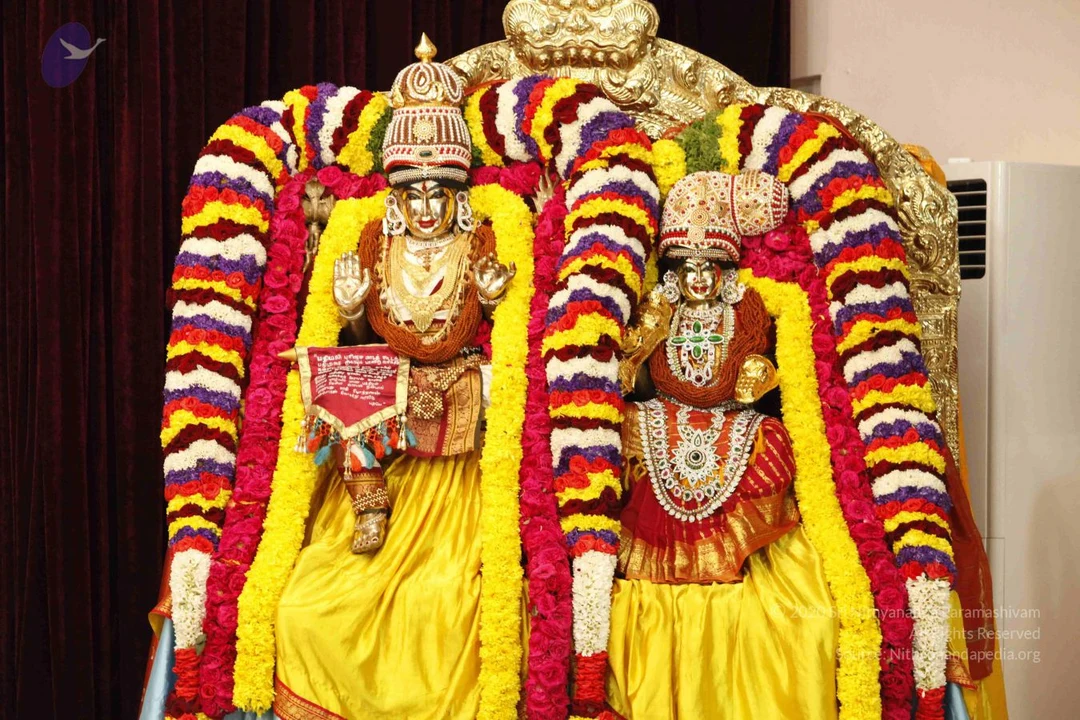
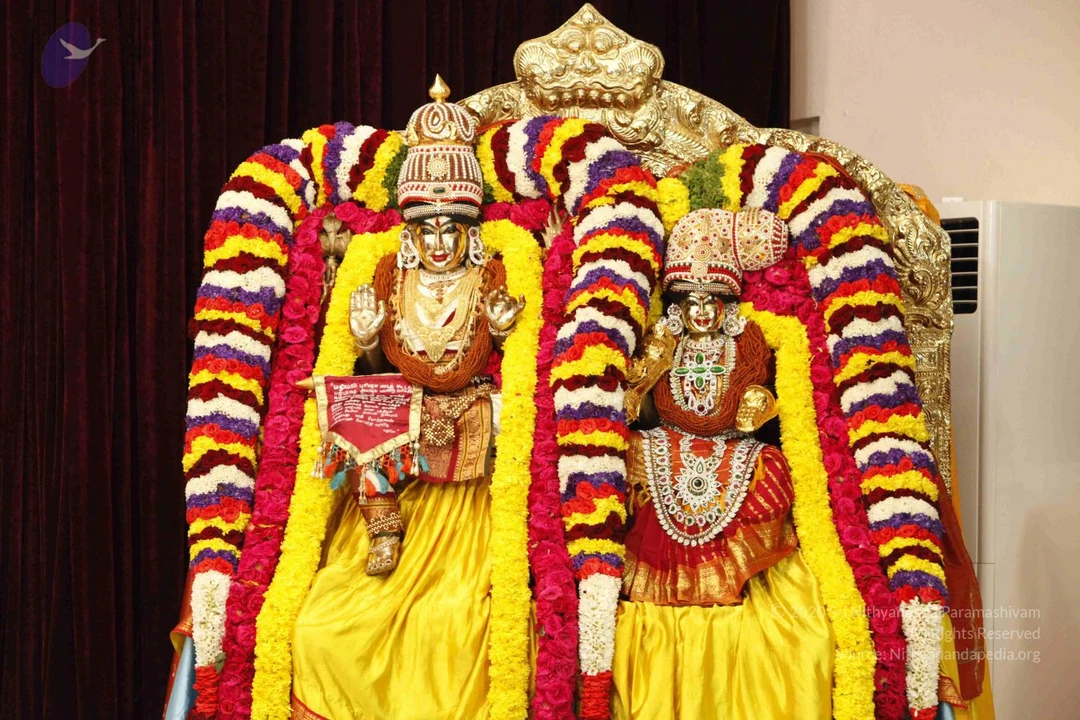
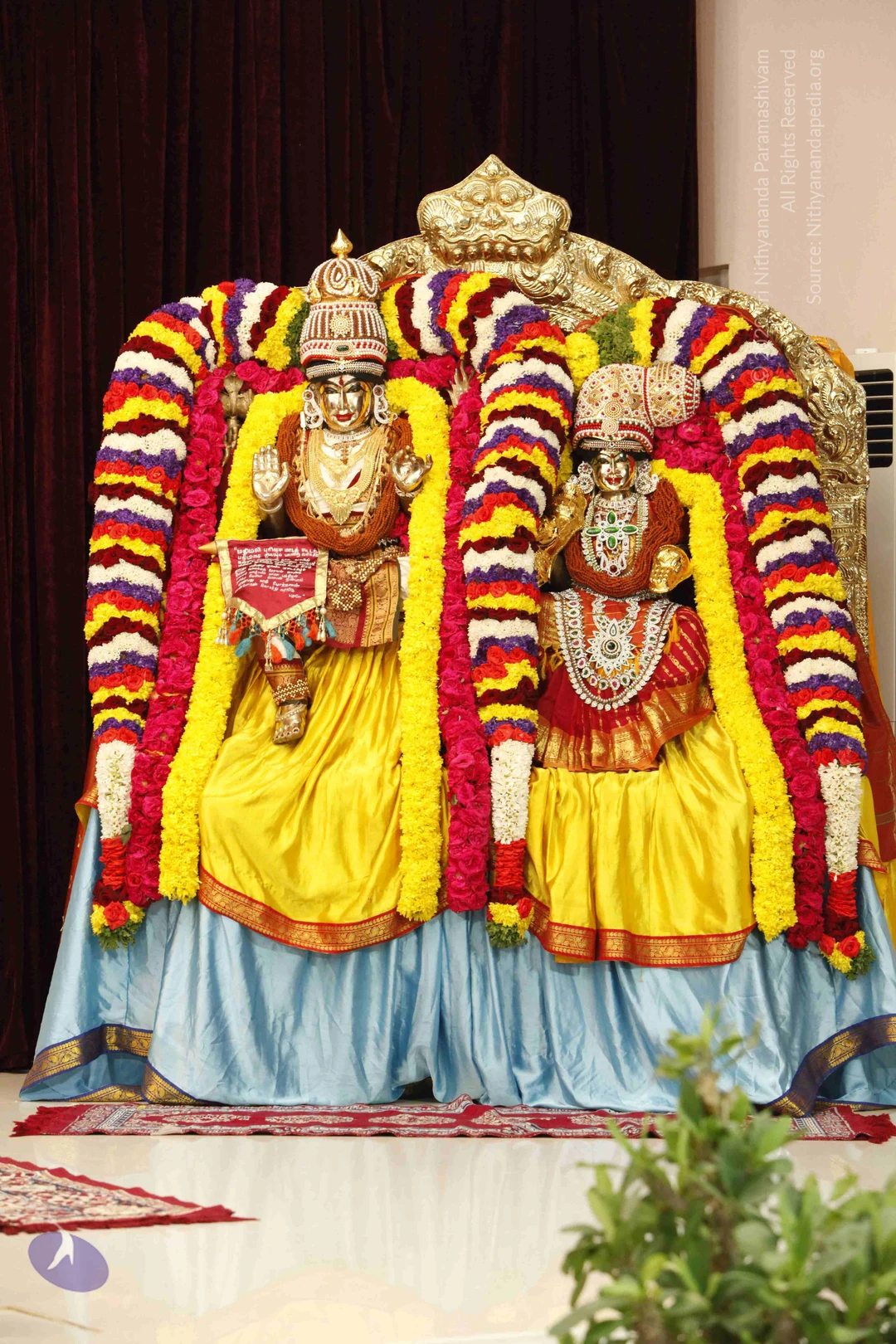
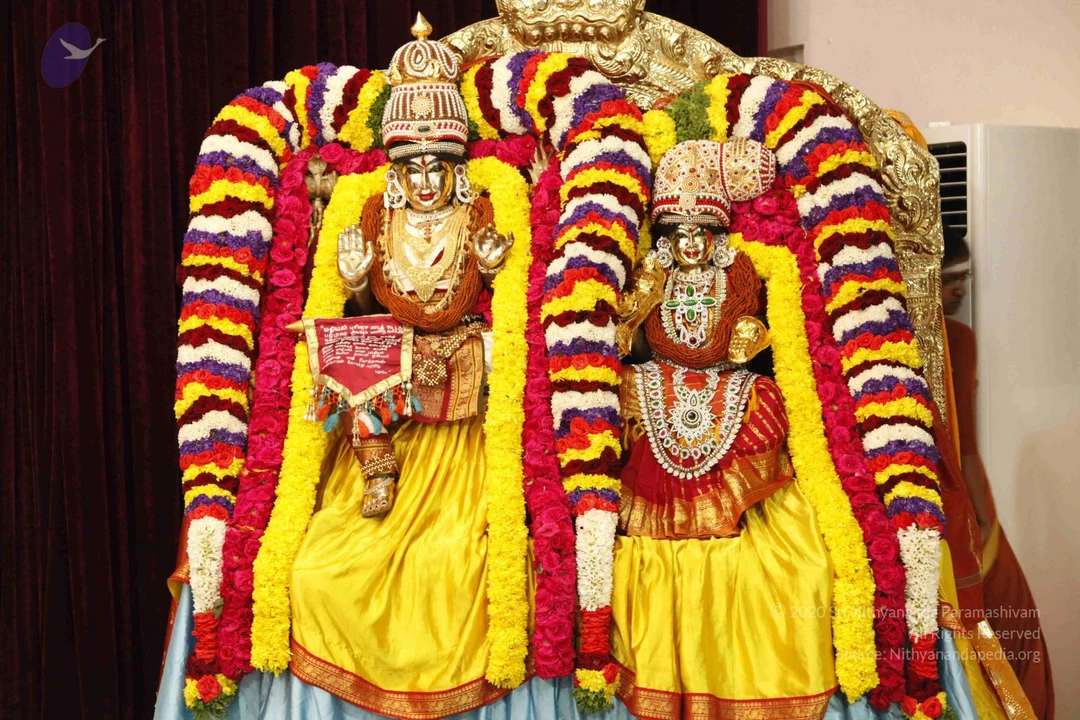
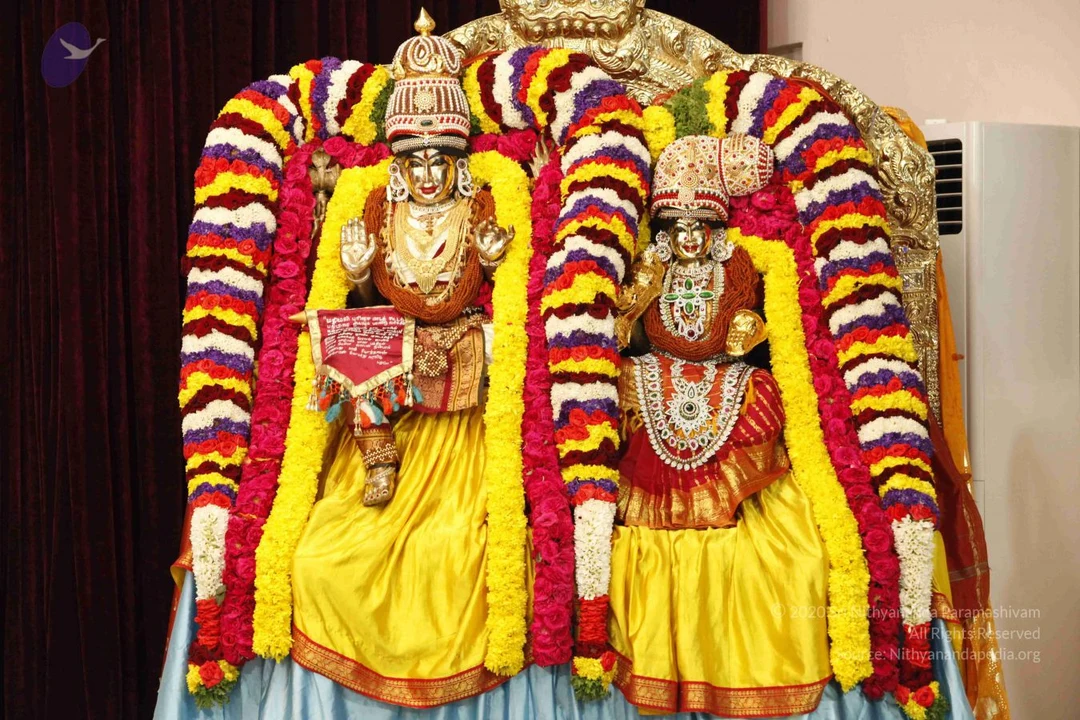
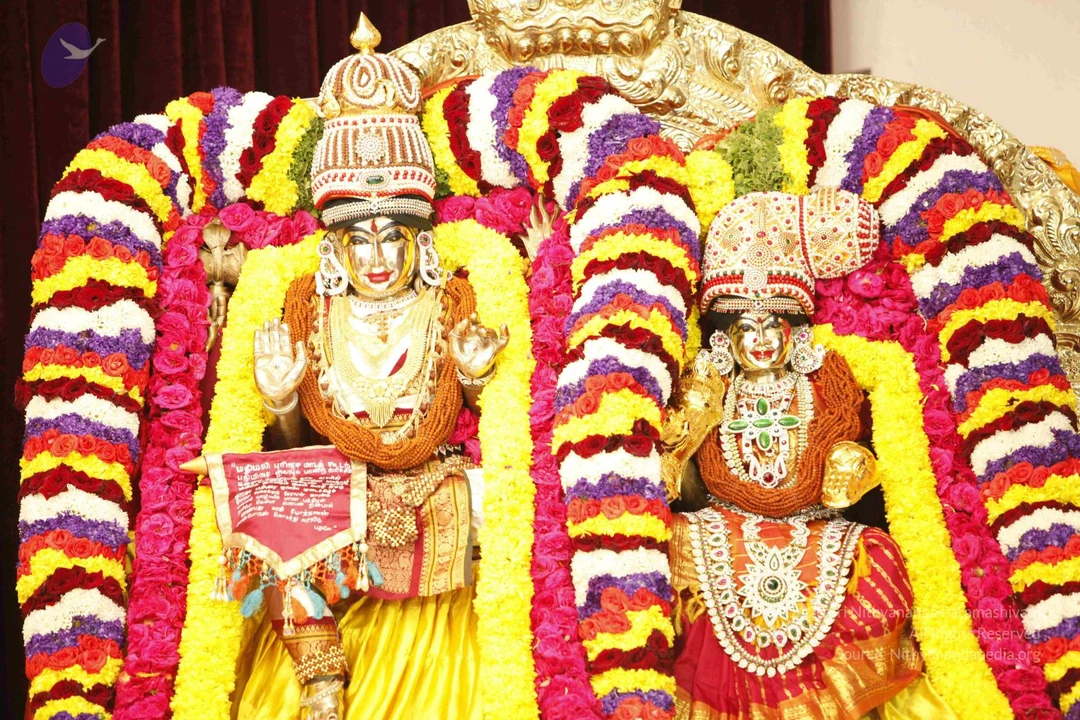
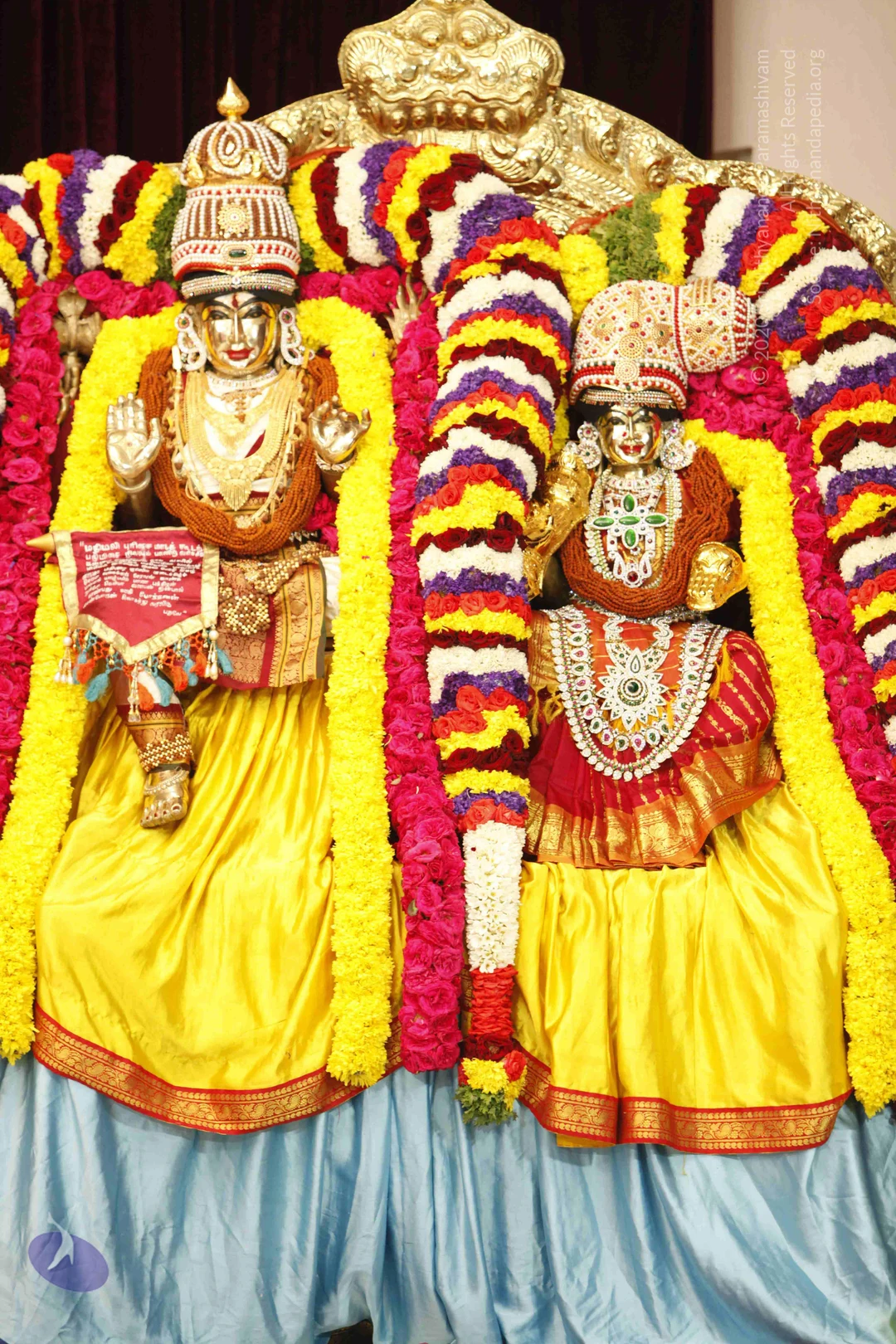
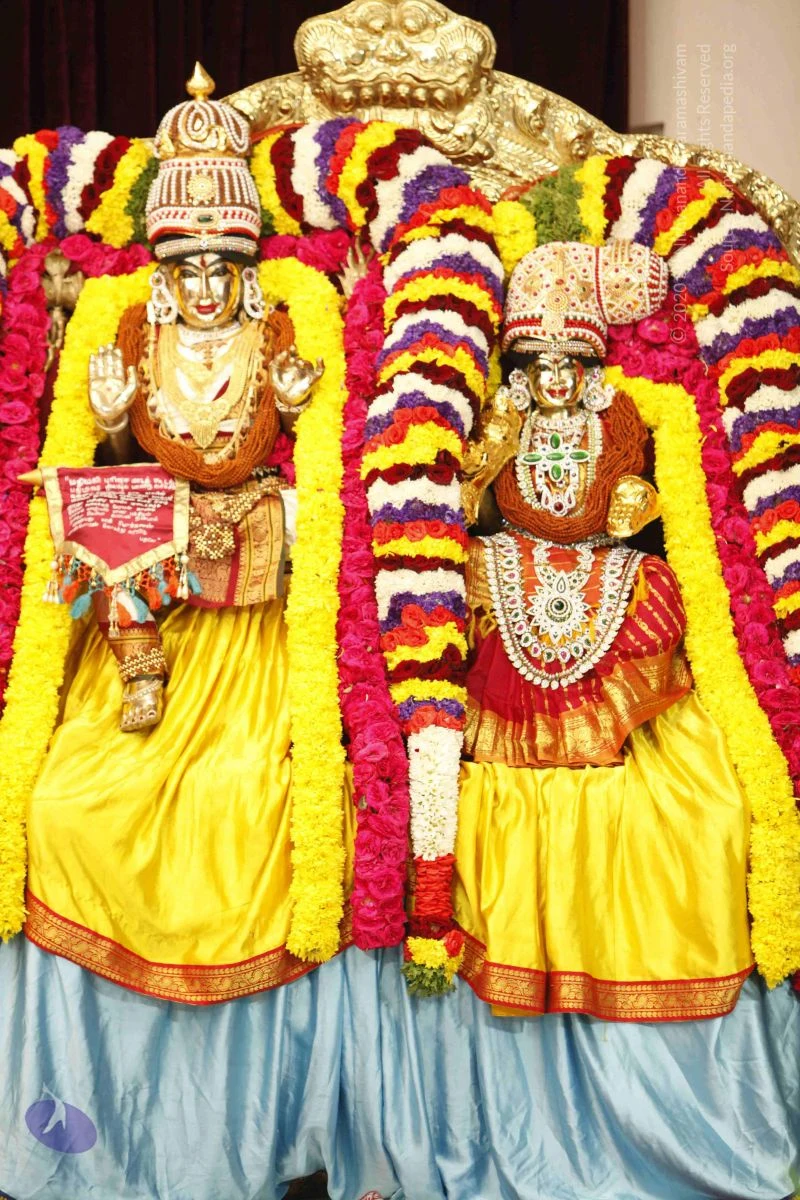
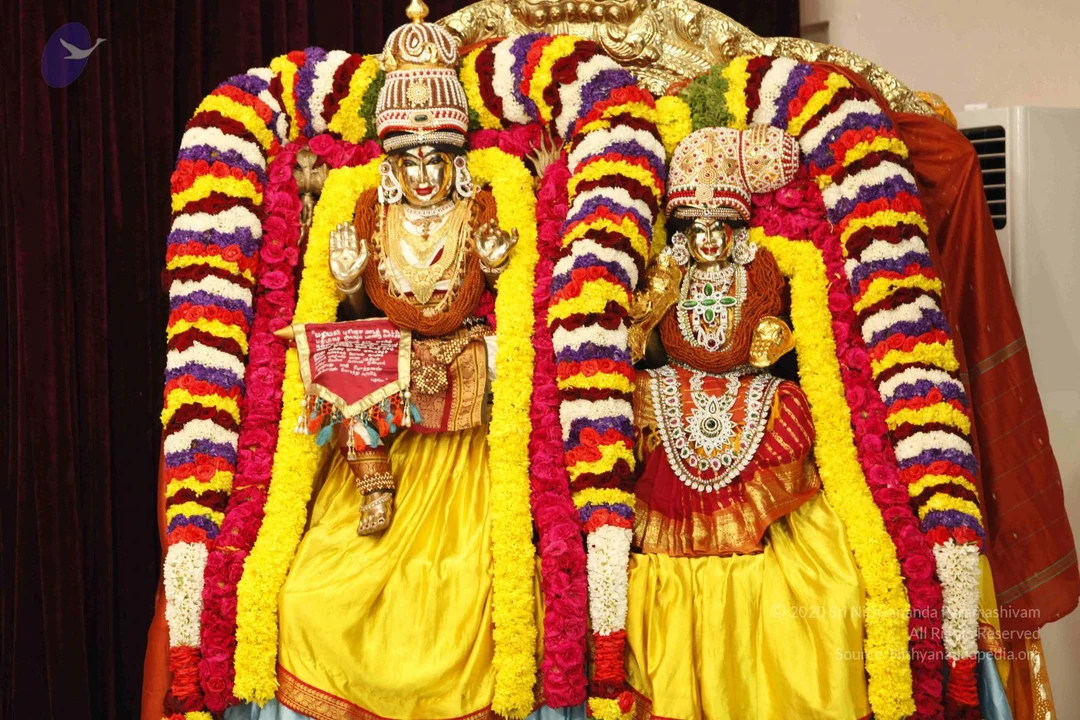
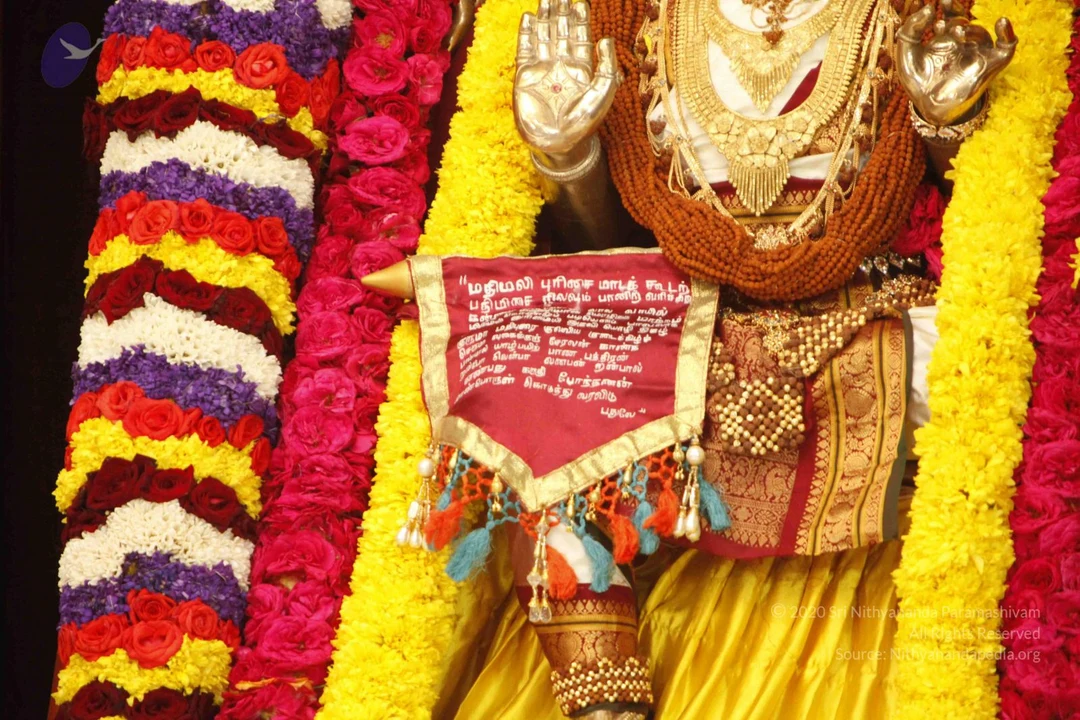
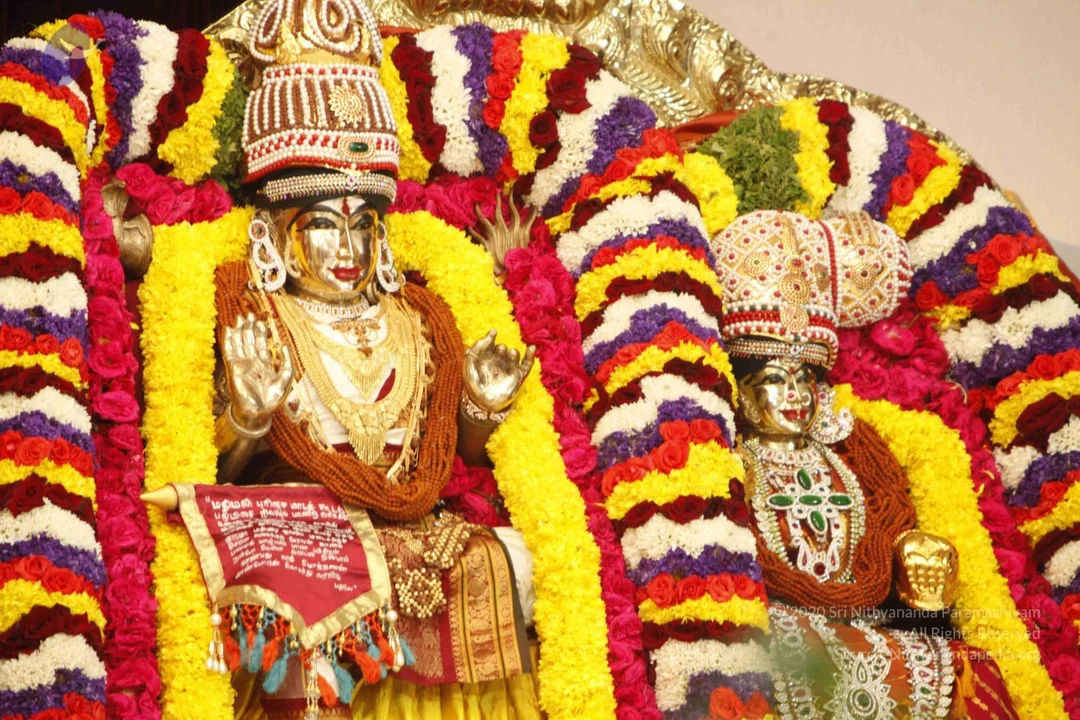
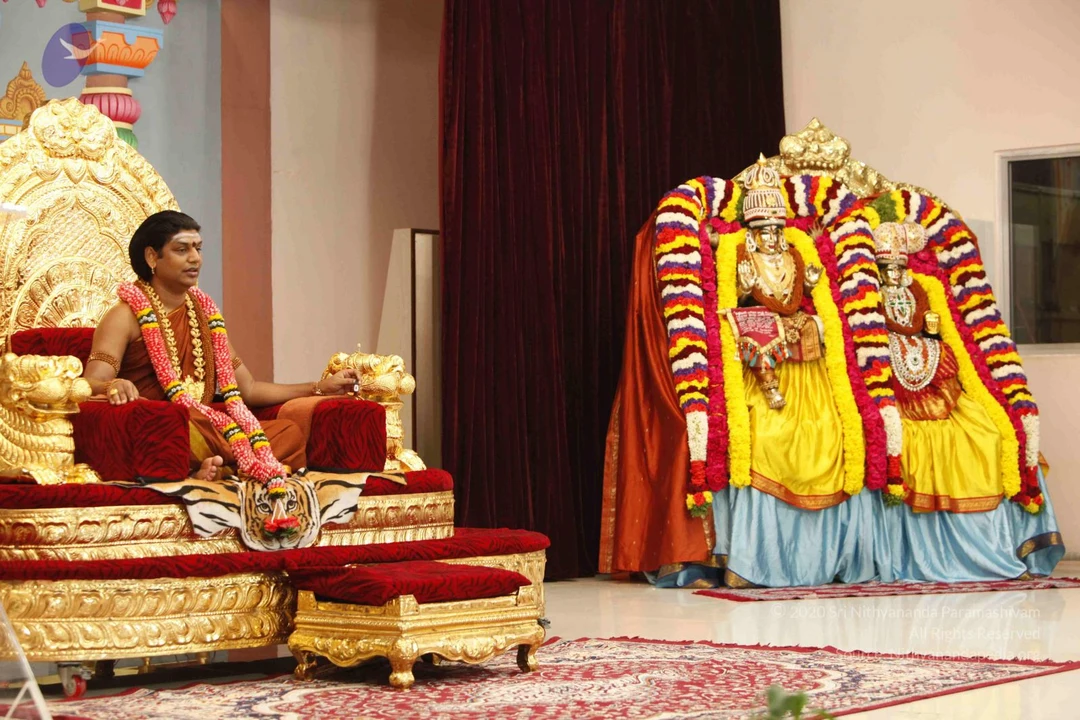
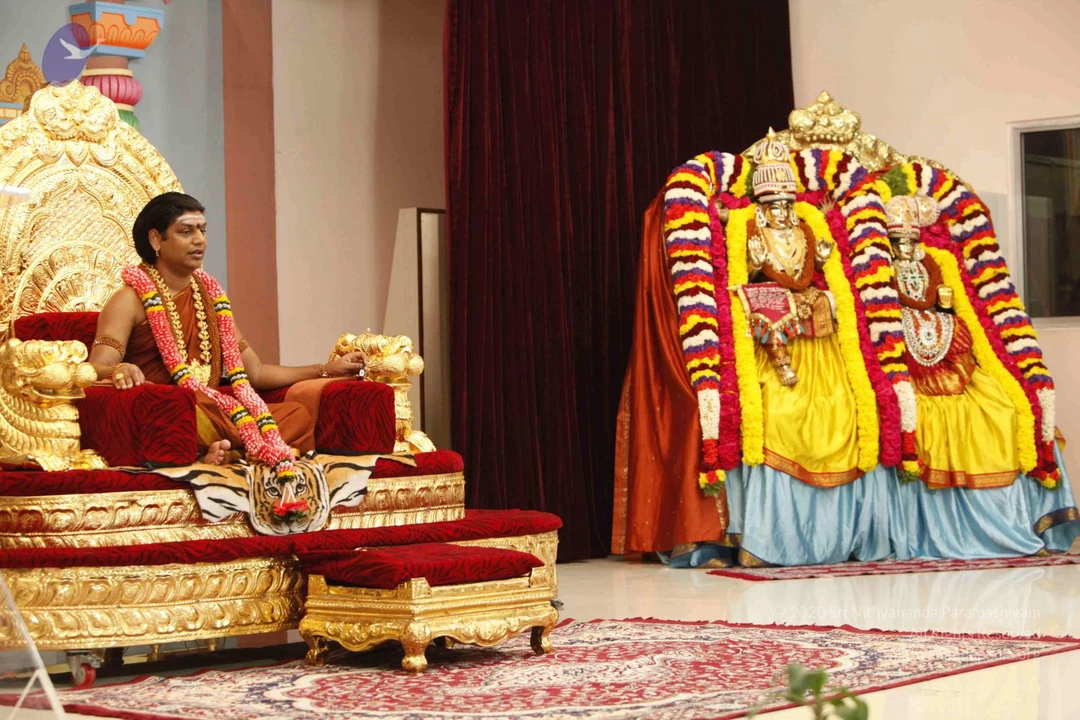
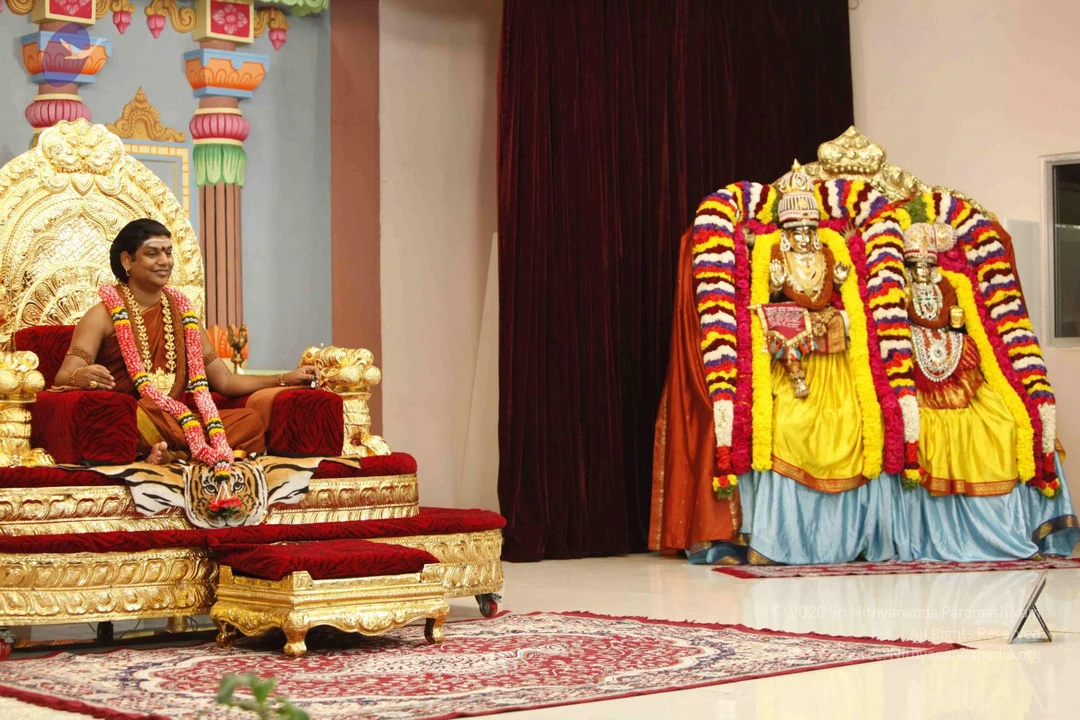
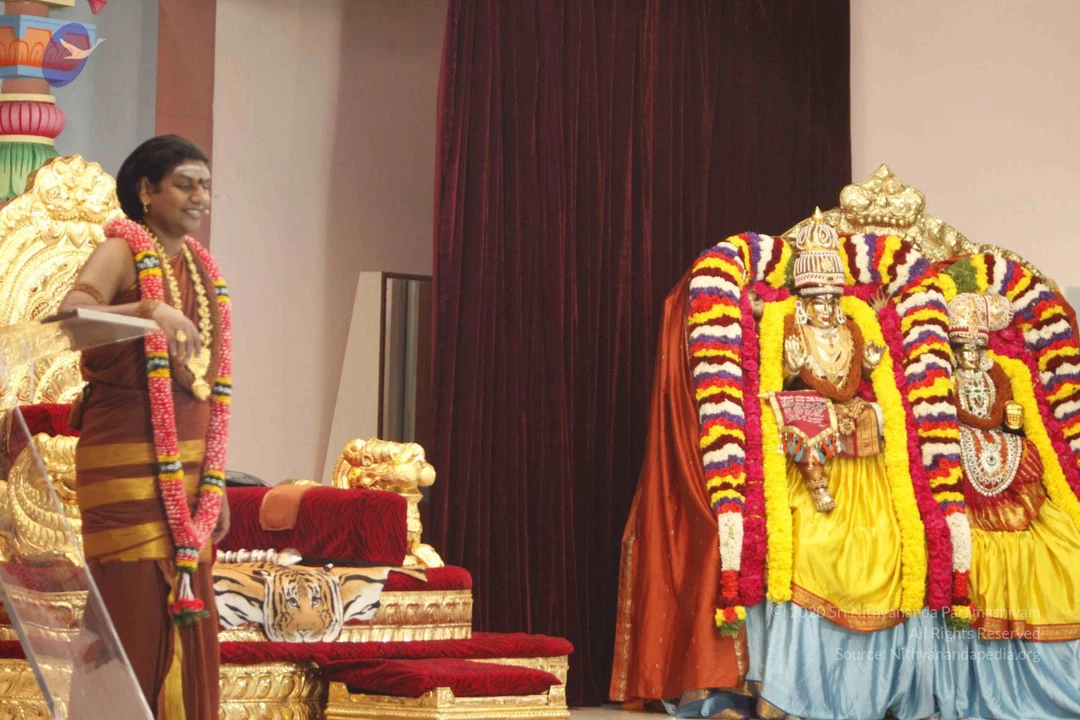
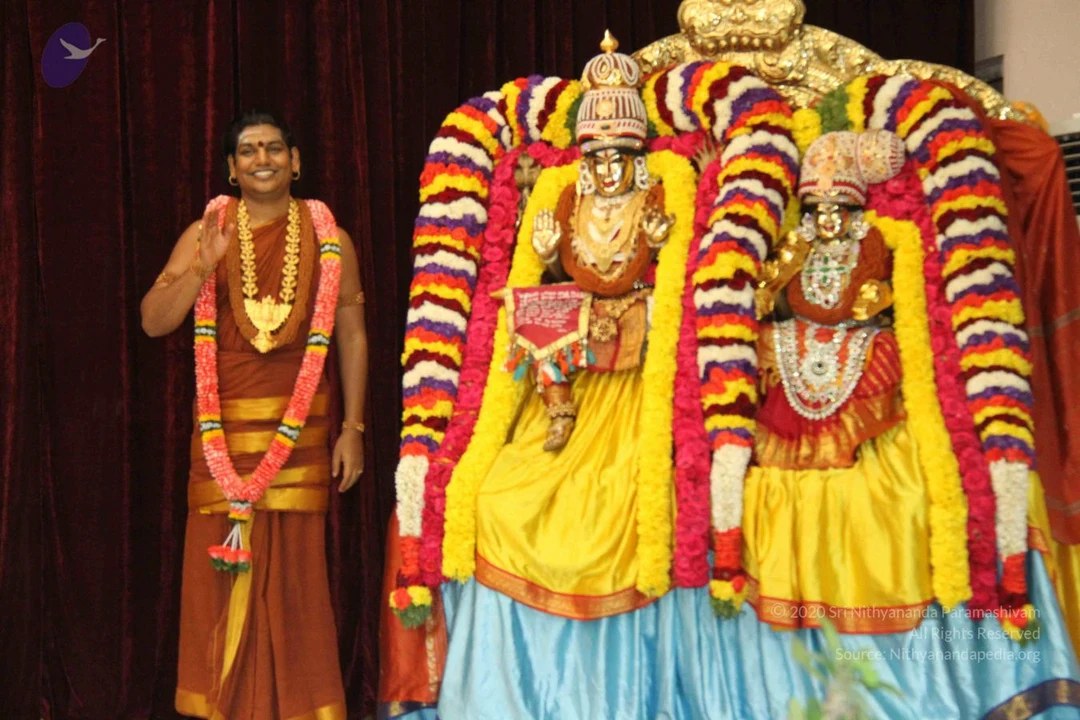
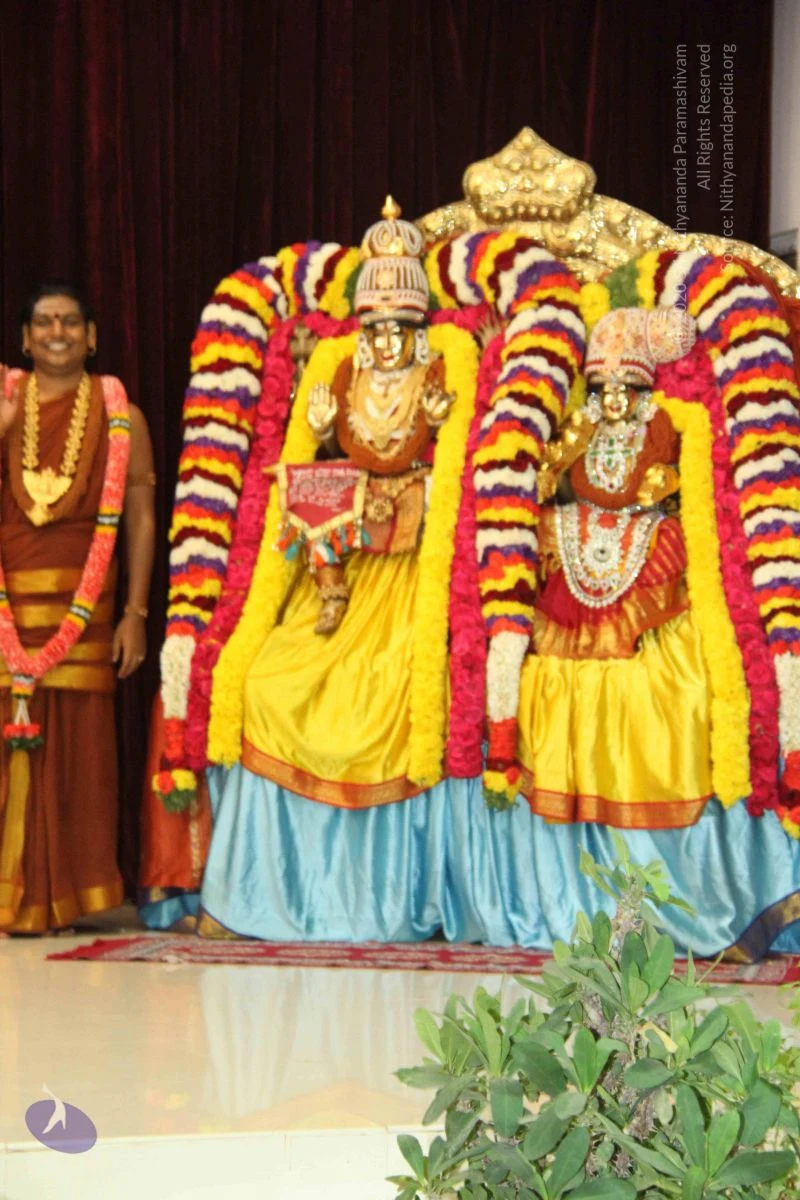
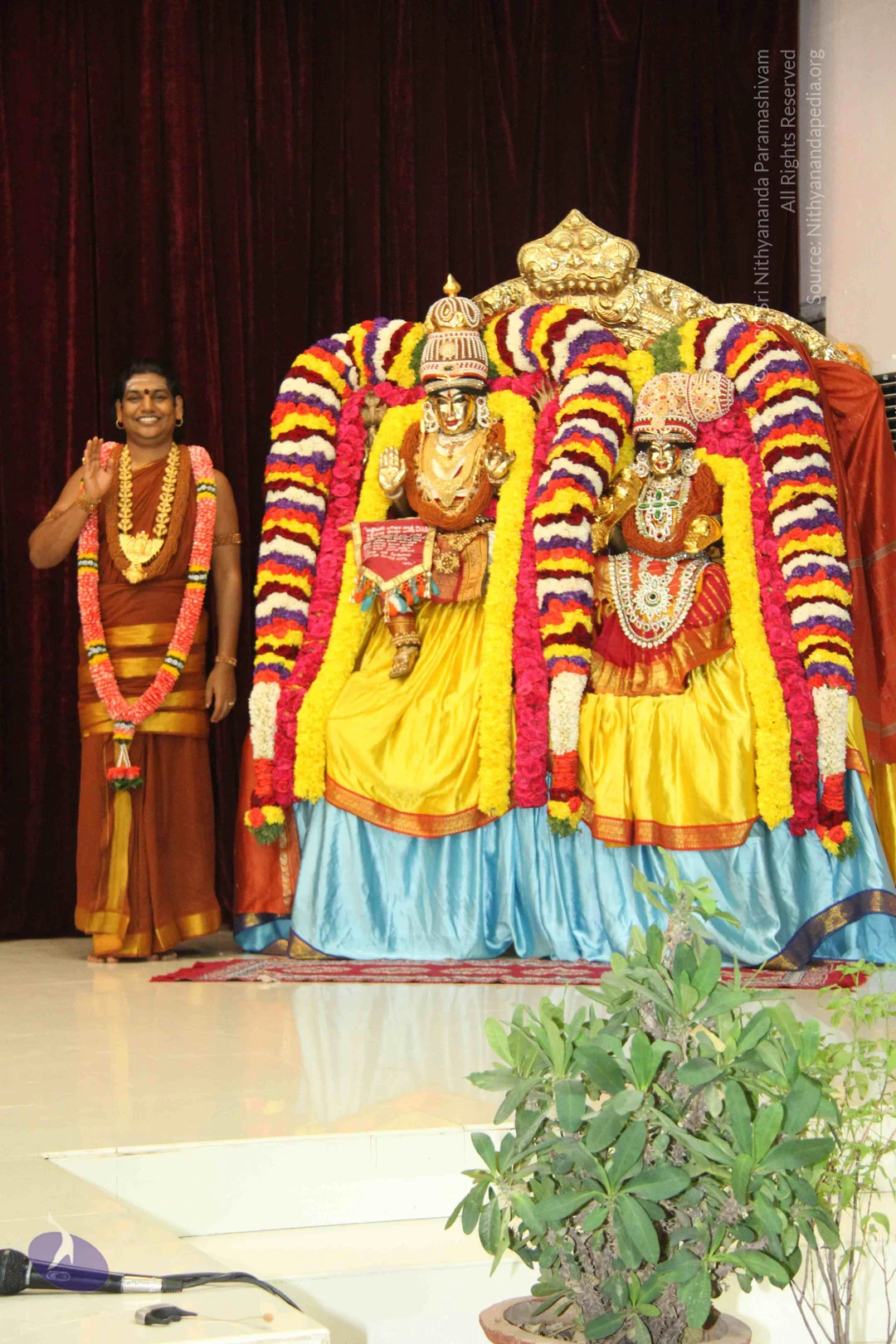
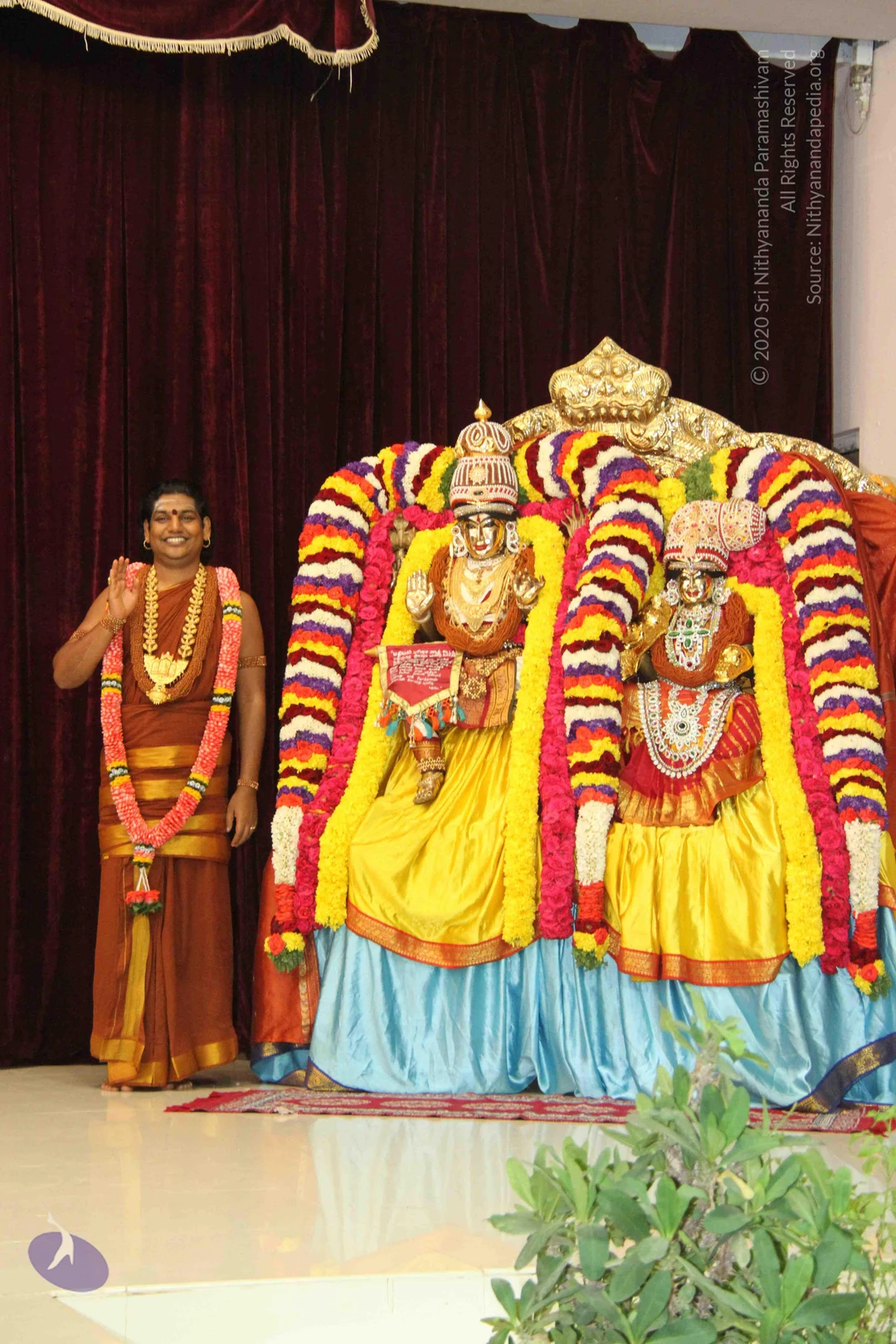
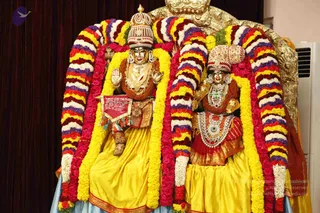
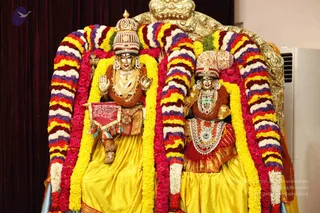
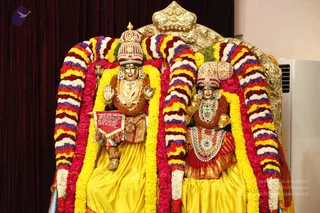
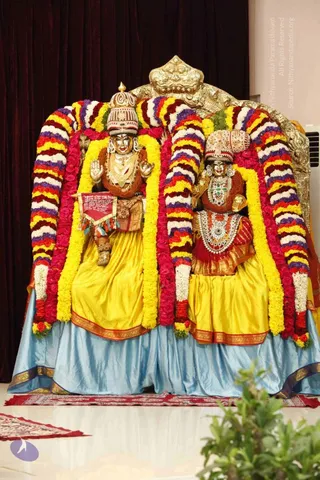
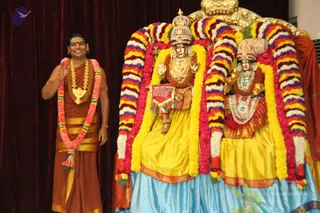
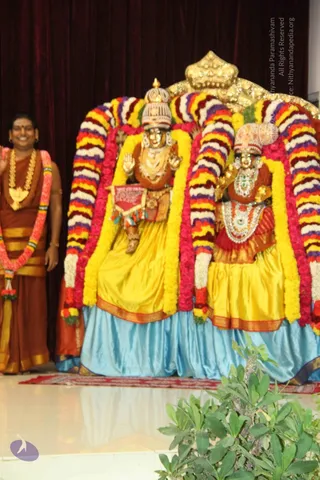
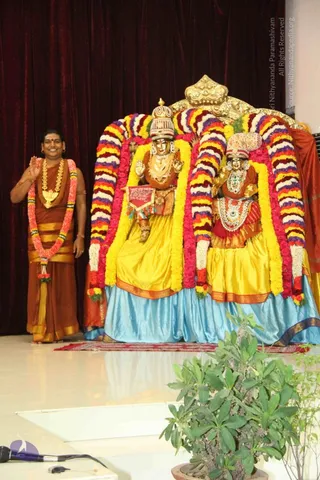
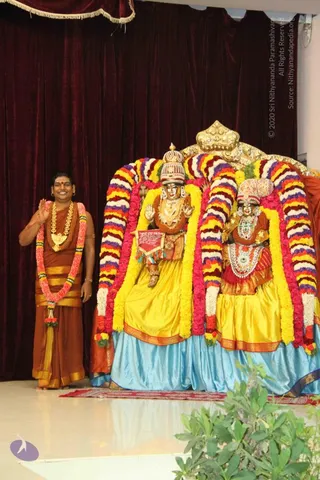
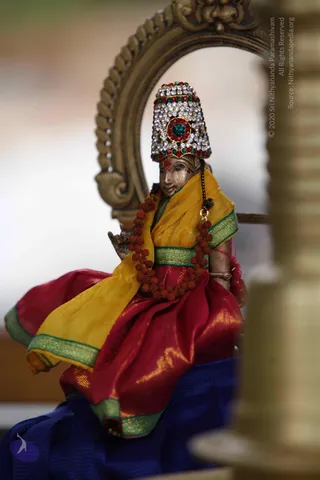
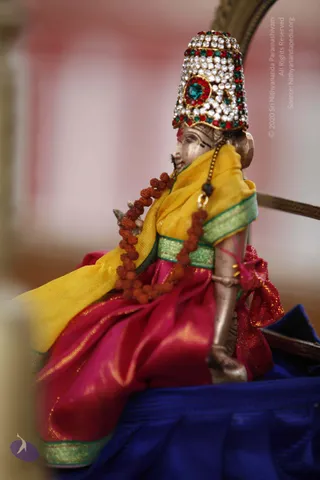
Two gilded deity murti figures seated side by side on a golden throne-like seat, heavily framed by a curved arch of multicoloured marigold and rose garlands in yellow, red, white and purple. The figure on the left wears a tall ornate crown, gold necklaces and a red sash over a yellow silk skirt, with one hand raised in blessing. The figure on the right wears a jewelled red-and-gold crown, a green-and-white stone pendant, layered pearl-and-stone necklaces and a red silk garment. A red placard with white printed script hangs at the lower left. A red curtain is visible at the right edge. These are statues, not living people.Two gilded deity murtis seated side by side on a throne-like altar, heavily decorated with multicoloured flower garlands in red, pink, yellow, white and purple forming an arch behind them. The figure on the left wears a tall ornate crown, gold jewellery and a golden yellow dhoti, holding one hand in abhaya mudra and the other holding a red palm-leaf style book with a fringed tassel. The figure on the right wears a red and gold crown, emerald-set necklace, pearl and gem-studded garland and a red silk garment. No physical people are visible; the statues are the only figures in the scene. Text on the red book is not legible enough to transcribe.A photograph of a pair of metal murti deities seated side by side on a golden throne, decorated with long garlands of red roses, yellow marigolds, white jasmine and multicoloured flowers. The figure on the left wears a tall crown, holds a book-like cloth, and is draped in yellow silk; the figure on the right wears a red and gold crown, a jewelled bridal-style necklace and a red silk garment with gold border. Behind them are a gold-carved backdrop, a maroon curtain and a white air conditioner unit. No physical people are visible.A photograph of two decorated deity murti seated side by side on a golden throne before a deep maroon velvet curtain. Both figures have gilded faces, jeweled crowns and heavy gold necklaces. The figure on the left wears a yellow silk skirt, holds a raised hand in blessing and holds a red cloth-wrapped book with a tassel. The figure on the right wears a red and gold embroidered blouse and a yellow silk skirt, and holds a lotus-like object. Both are framed by thick garlands of roses and marigolds in red, yellow, white and purple. No physical people are visible.Two ornately dressed deity murtis sit side by side on a golden throne-like seat, framed by long multicoloured flower garlands in red, yellow, white and purple. The figure on the left wears a tall crown, golden jewellery and a yellow silk dress, raising one hand in blessing and holding a red book wrapped with tassels. The figure on the right wears a jewelled crown, a large white and red beaded necklace, and a red and gold sari. Behind them hang deep maroon curtains and a gold-carved backdrop. The statues show no living people.Two metal murti of a deity couple sit side by side on a gilded throne-like seat with a carved golden arch behind them. Both are draped in multicoloured flower garlands of yellow, pink, purple, red and white blossoms. The figure on the left wears a tall ornamented crown, gold jewellery and a rust-coloured shawl, with a red cloth panel held in its raised hand. The figure on the right wears a red and gold crown, a green and white jewelled necklace and a red blouse over a yellow skirt. Both are seated on a pale blue and yellow cloth draped over a platform, with a red patterned rug in front and a potted green plant at lower right.

PadaPuja

12 photosSource gallery
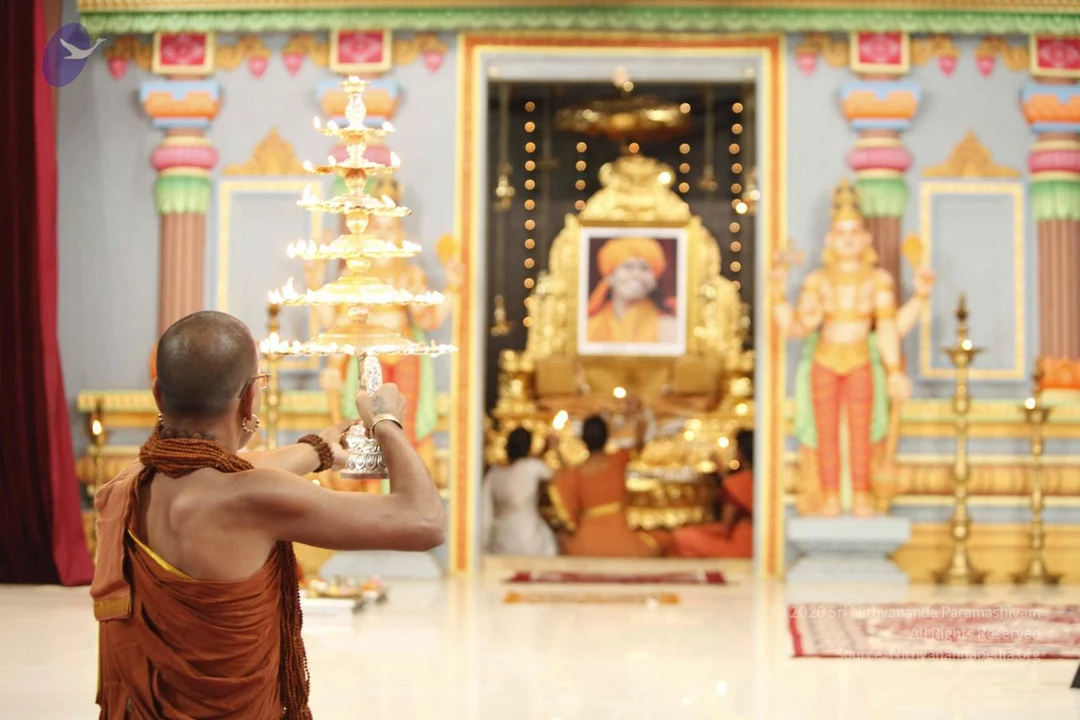
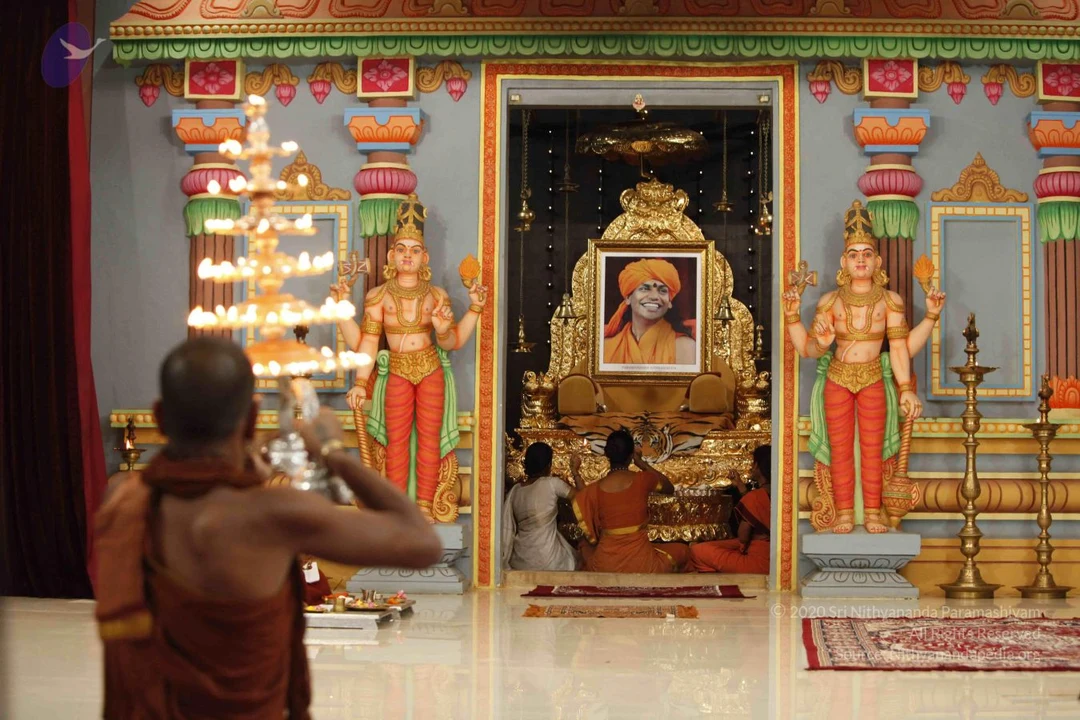
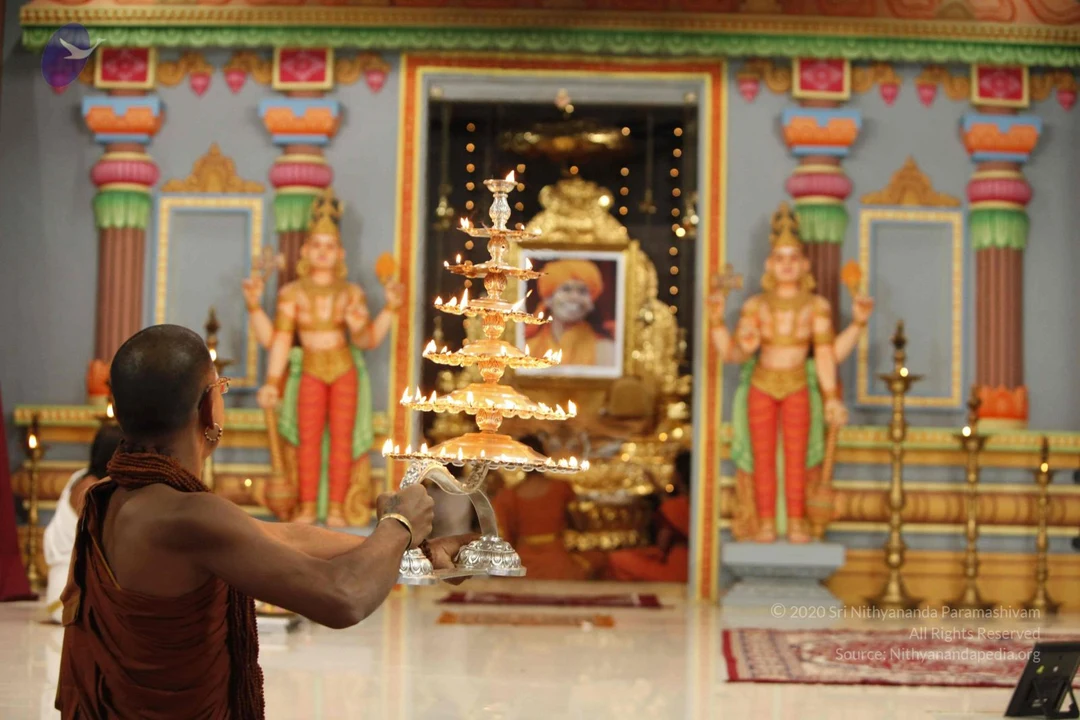
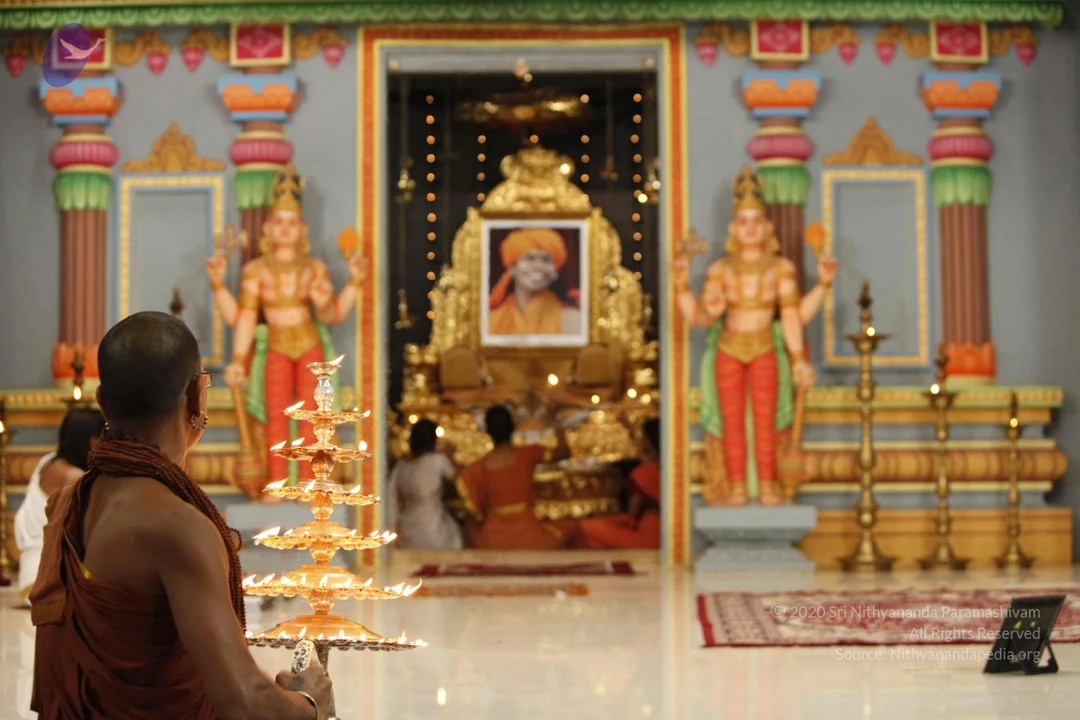
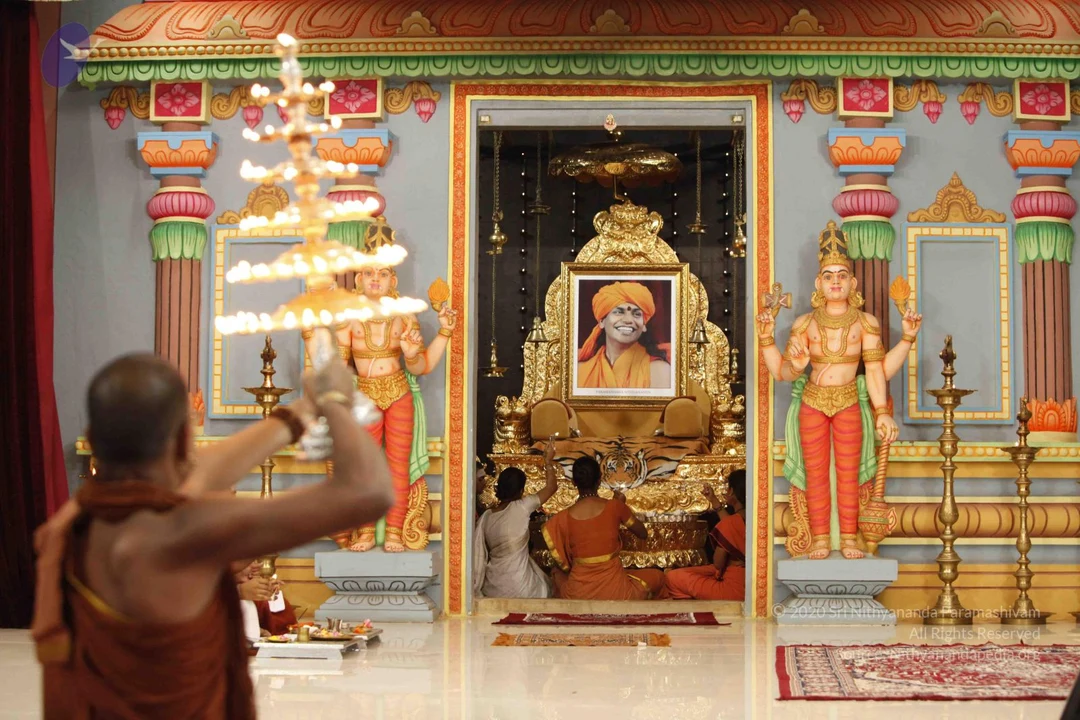
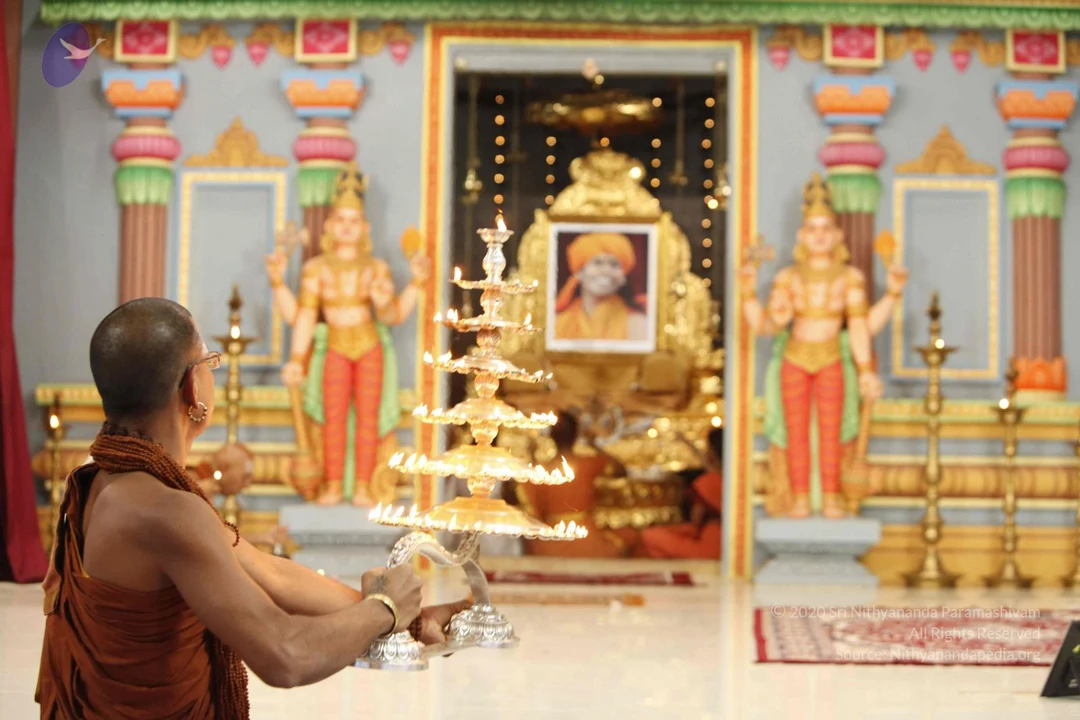
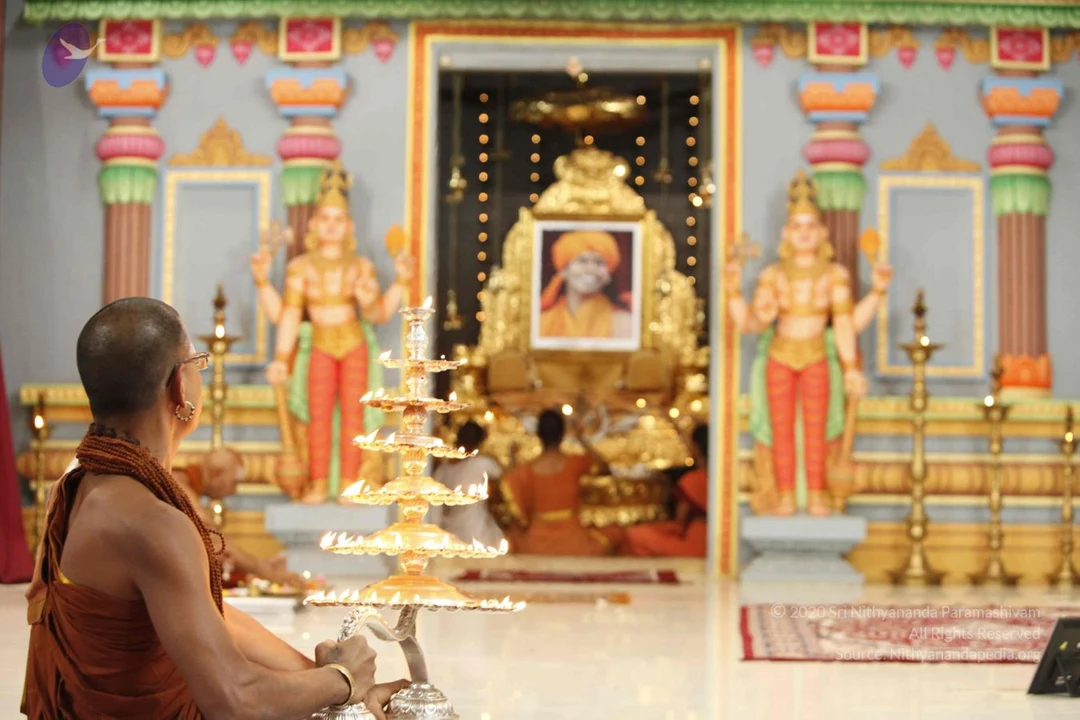
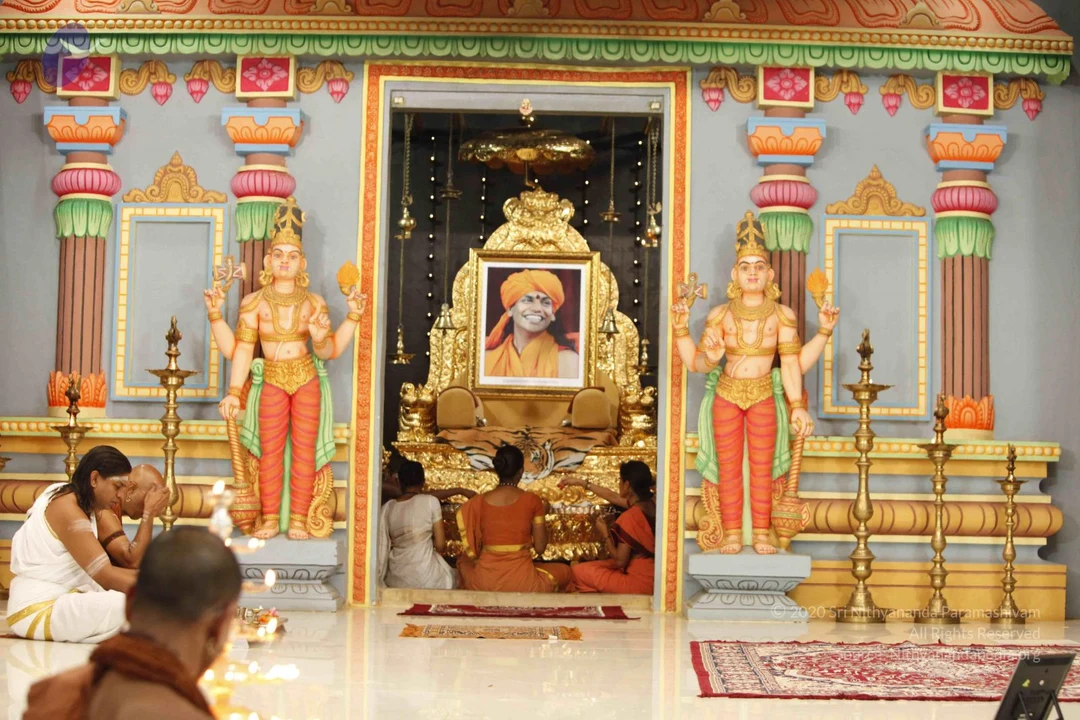
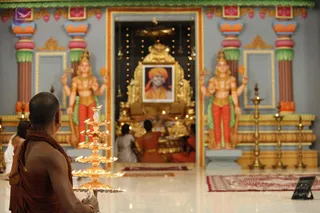
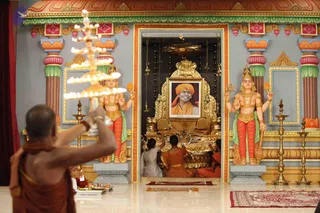
A framed photograph of a smiling man in an orange turban and orange robe, with a red bindi, is displayed in a gilded frame on an ornate golden throne. The portrait is labelled "PARAMAHAMSA NITHYANANDA" on its printed caption. The golden throne has lion-head armrests, a tiger-striped cloth draped over the seat, and hanging brass bells and oil lamps on chains. Painted deity figures with raised hands flank the throne on carved orange-and-white pillars. No physical people are visible in the scene; the only human figure is the printed portrait on the throne.A shaved-headed priest in saffron-orange robes, seen from behind, raises a tall silver multi-tier aarti lamp with lit wicks toward a golden shrine. Inside the shrine's archway, a framed portrait of a man in an orange turban stands above a golden throne, with a small lit lamp beside it and two or three other figures in orange and white nearby. Gold-painted pillars, colourful temple architecture and deity statues flank the doorway; a red curtain hangs at left. A printed copyright line appears at lower right. The priest's appearance is not clearly that of the a person candidate, so the identity is unsure.A temple shrine hall with painted pillars and two tall orange-and-red painted dvarapala-style guardian figures holding ritual objects flanking a central doorway. Inside, a golden throne with an ornate canopy holds a framed portrait labelled "Paramahamsa Nithyananda" showing a smiling man in an orange turban and saffron robes. In the foreground, a bare-chested monk in ochre cloth raises a multi-tiered brass lamp of lit oil lamps toward the shrine, while three people in orange and white sit before the throne at offerings. Brass oil lamps stand on the floor at right, and red carpets lie on the white marble floor.A shaved-headed priest in a rust-brown saffron-toned robe stands with his back to the camera, holding a tiered silver aarti lamp with multiple lit oil lamps while performing aarti. Two painted deity guardian figures with multiple arms and crowns flank a golden doorway in a temple shrine. Inside the shrine, a framed portrait of a bearded figure in orange turban and robes sits before a golden throne-like seat, with lamps and a kalasha-style brass stand nearby. Red and green patterned rugs cover the marble floor.Photograph of a temple shrine with a devotee in the foreground holding a multi-tiered brass lamp with lit oil wicks, dressed in a saffron-orange robe and rudraksha mala, with a shaved head, seen from behind. Beyond him, a framed portrait labelled "Paramahamsa Nithyananda" sits on a gold throne-like altar in an arched doorway, flanked by two tall painted dvarapala-style guardian figures holding ceremonial objects. Several people in orange and white sit before the altar, lit by small oil lamps and brass lamp stands line the room.Inside a temple shrine, a priest with a shaved head and bare upper body, wearing a brown-orange cloth, raises a multi-tiered lit aarti lamp toward a golden throne. On the throne is a framed portrait of a smiling man in orange turban and orange robes, with a tiger-skin cloth draped over the seat. Two seated devotees in orange and white clothes sit near the throne. Flanking the shrine are tall painted dvarapala-style figures with four arms, gold jewellery and green-orange dhotis. Brass lamps stand along the walls and a red carpet lies on the floor.

Nithya-Satsang
58 photosSource gallery
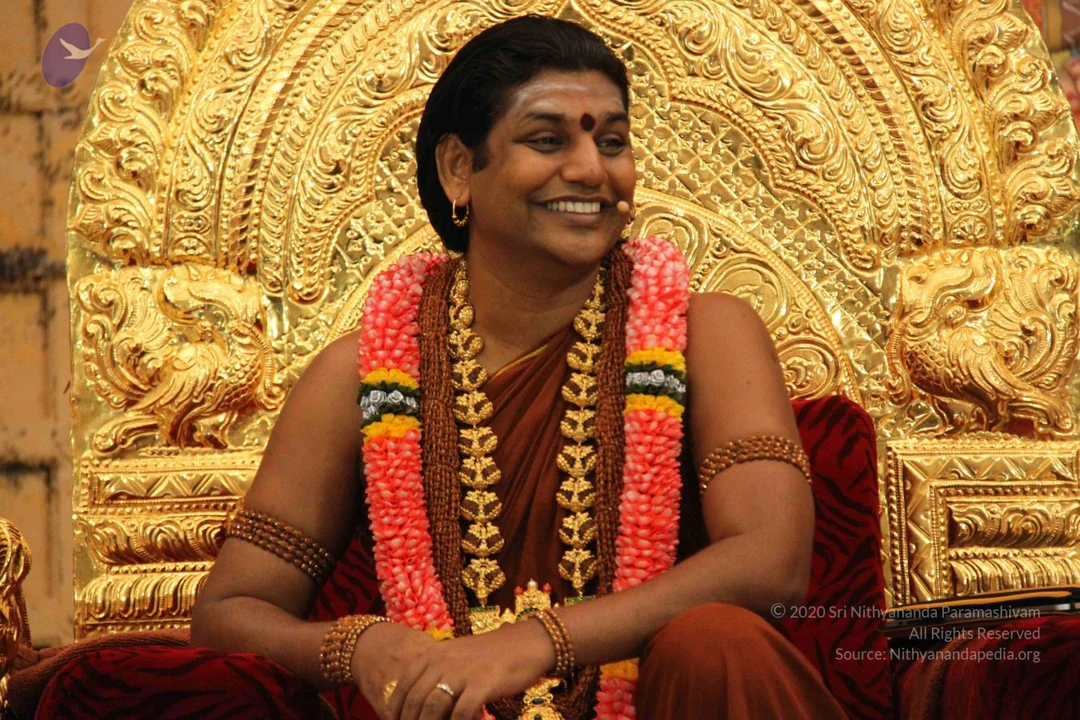
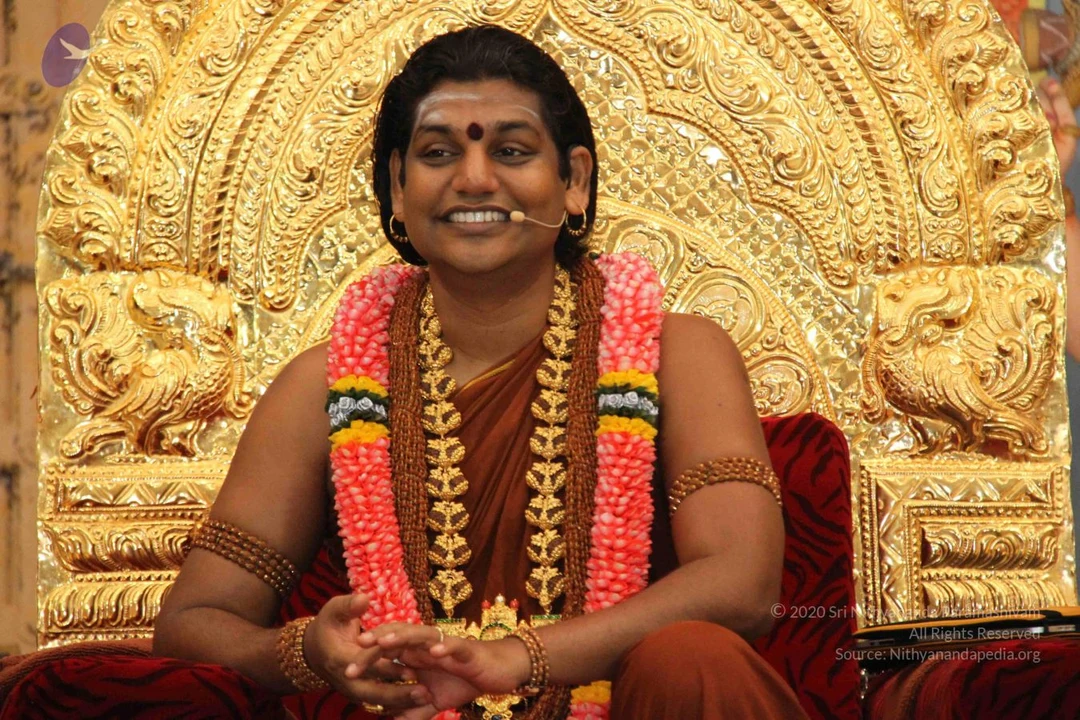
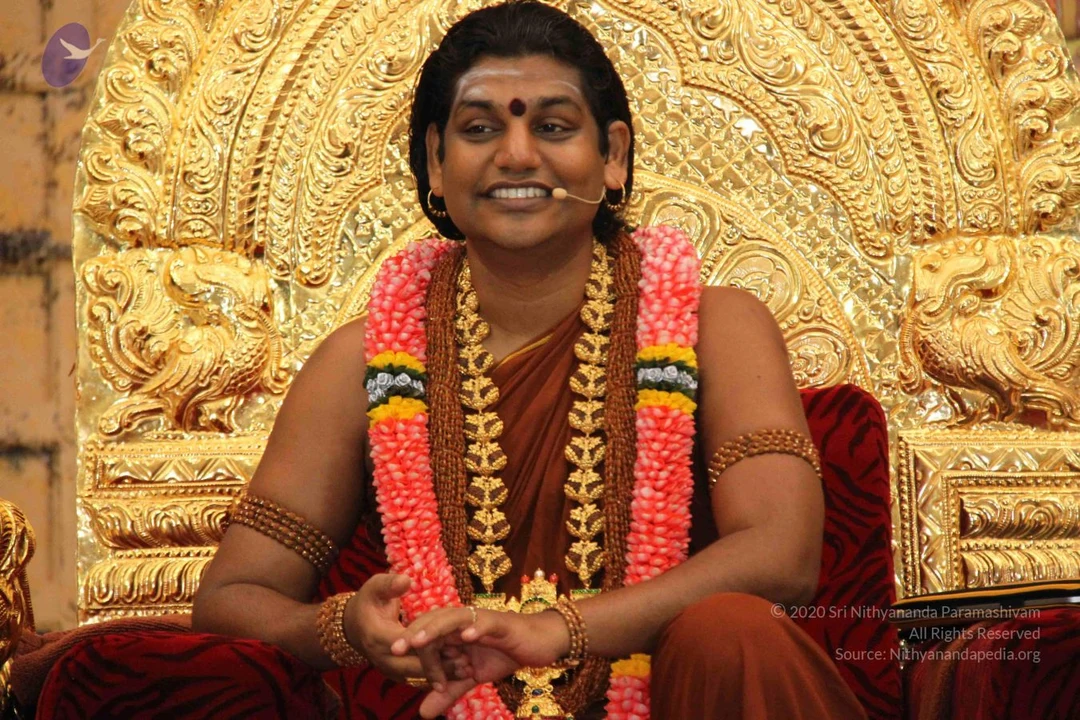
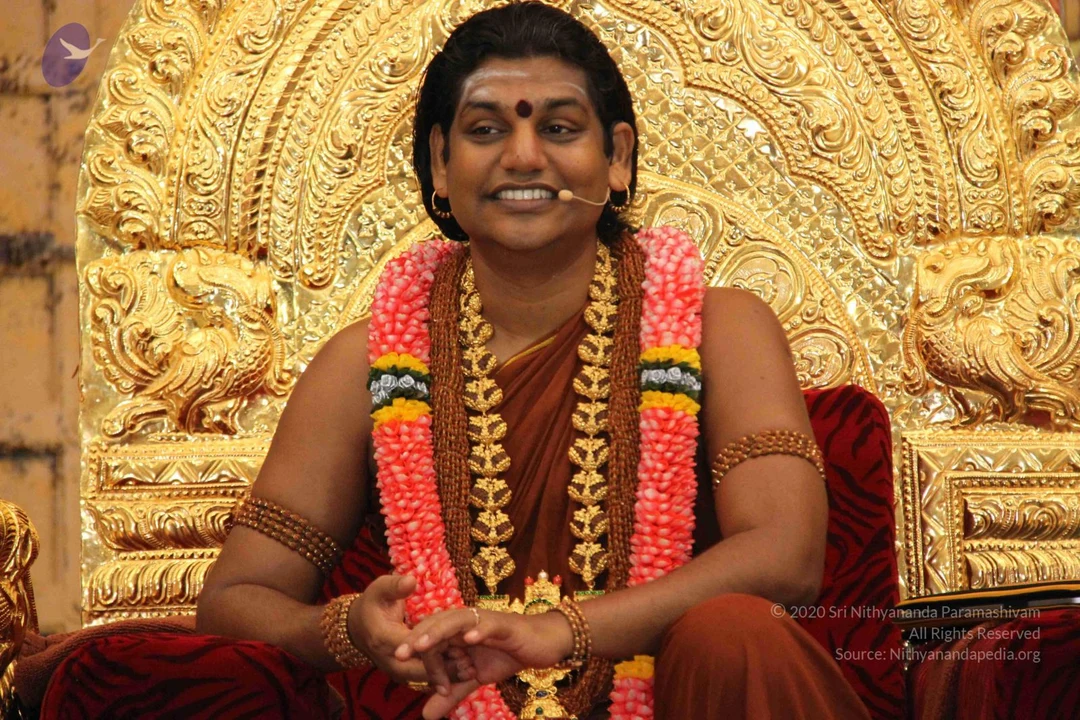
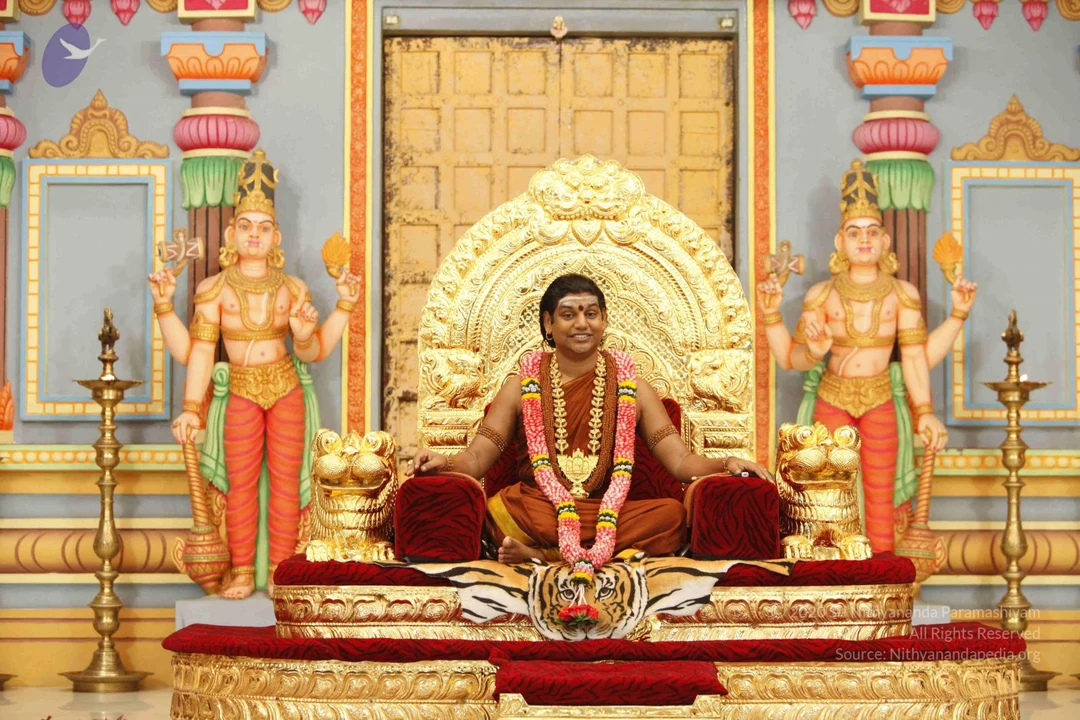
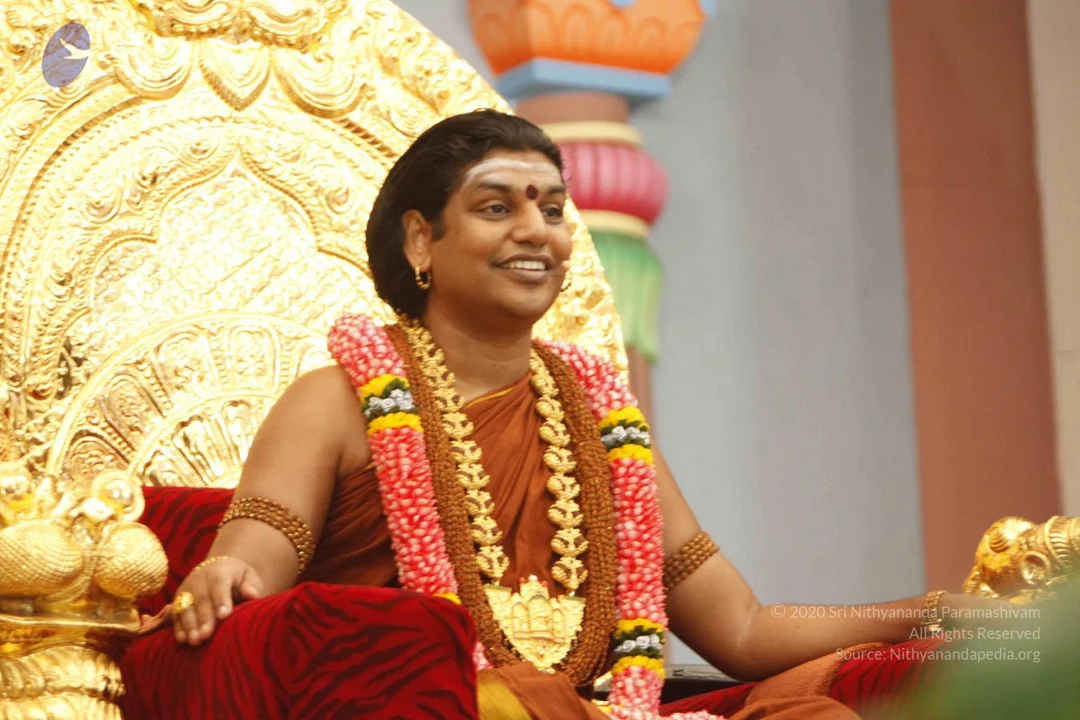
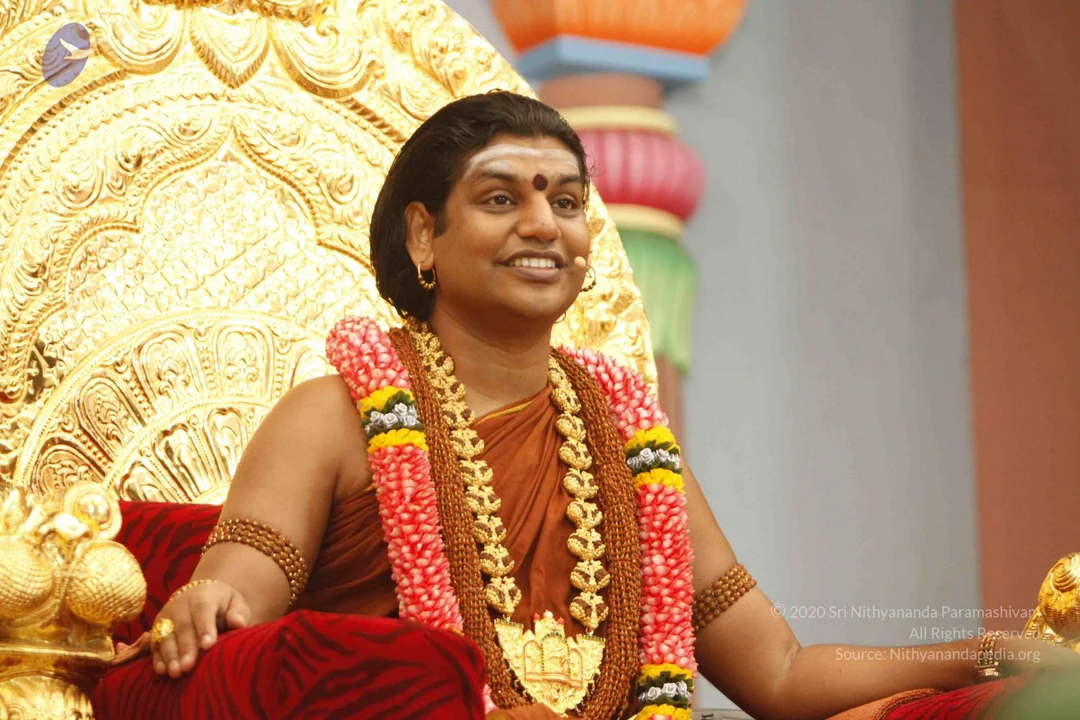
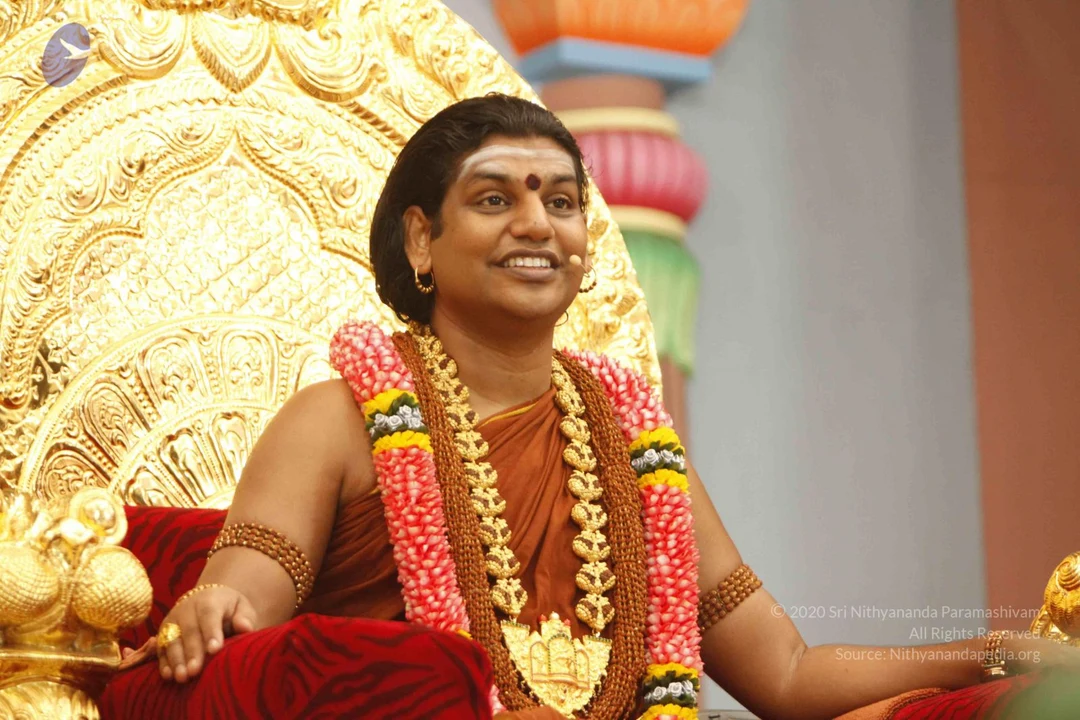
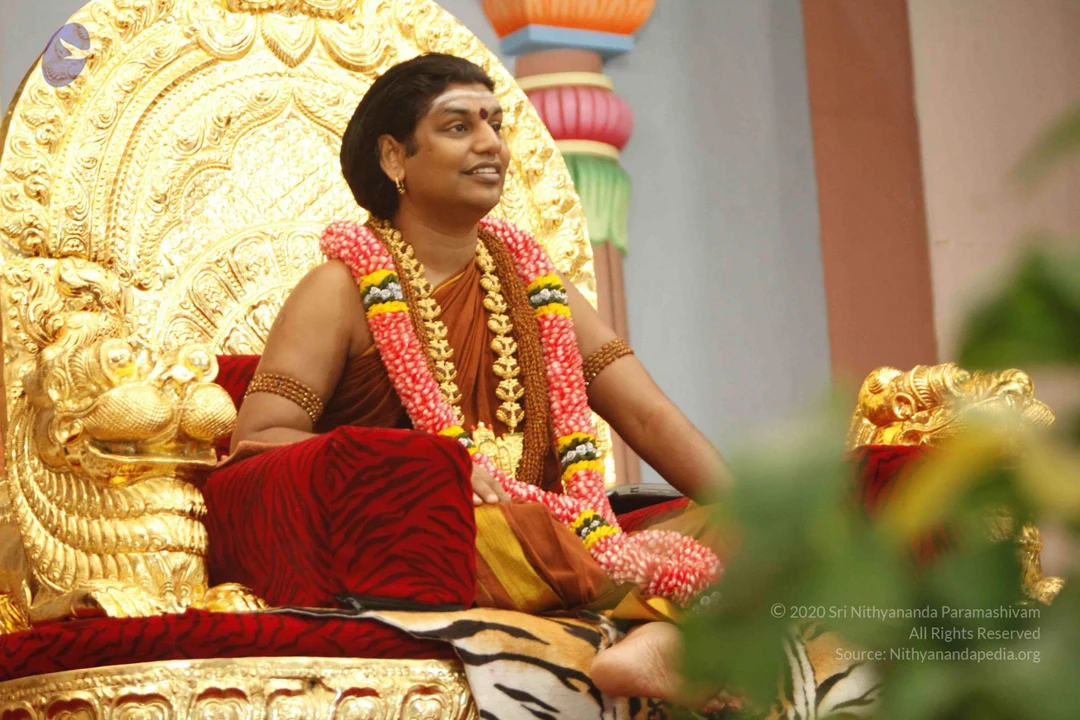
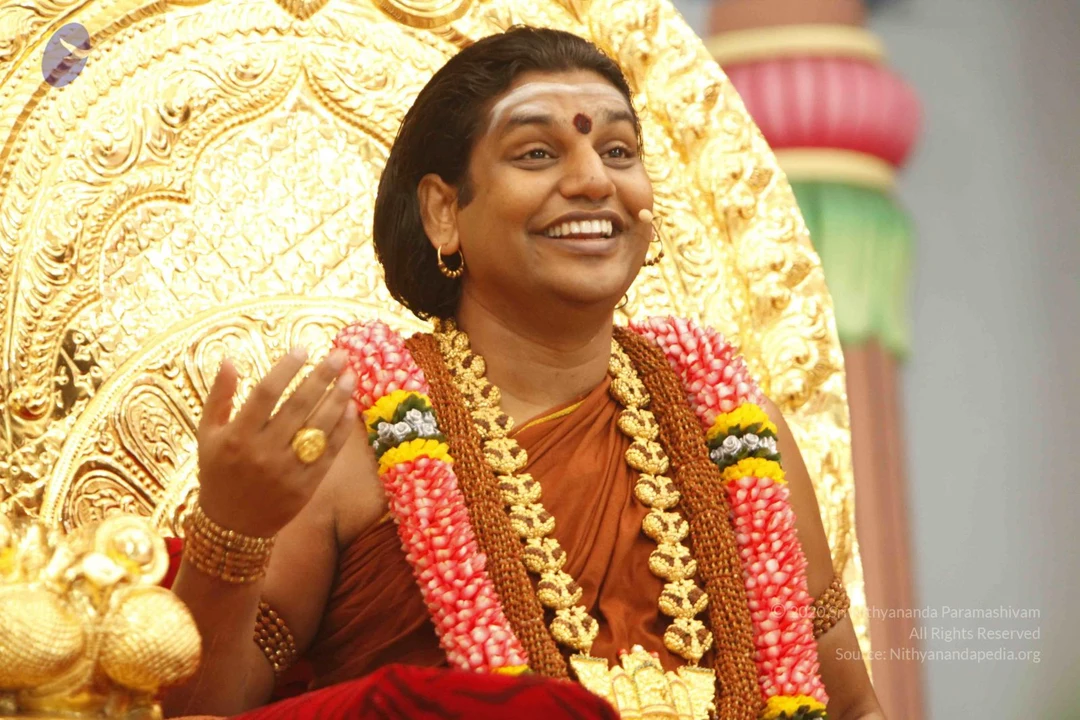
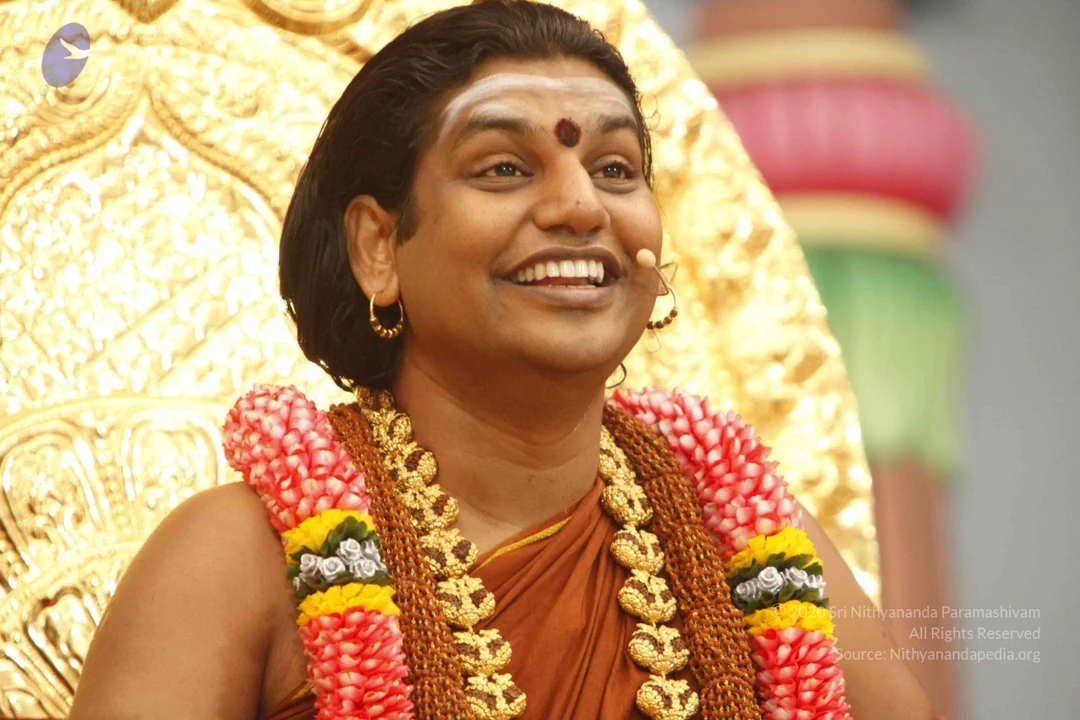
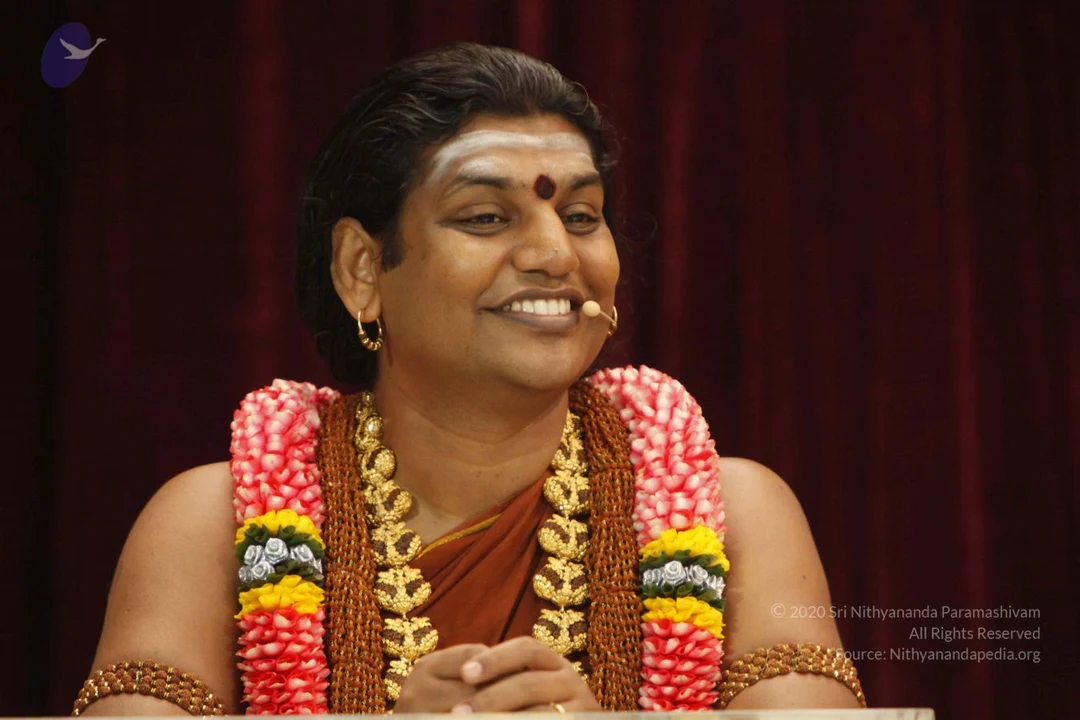
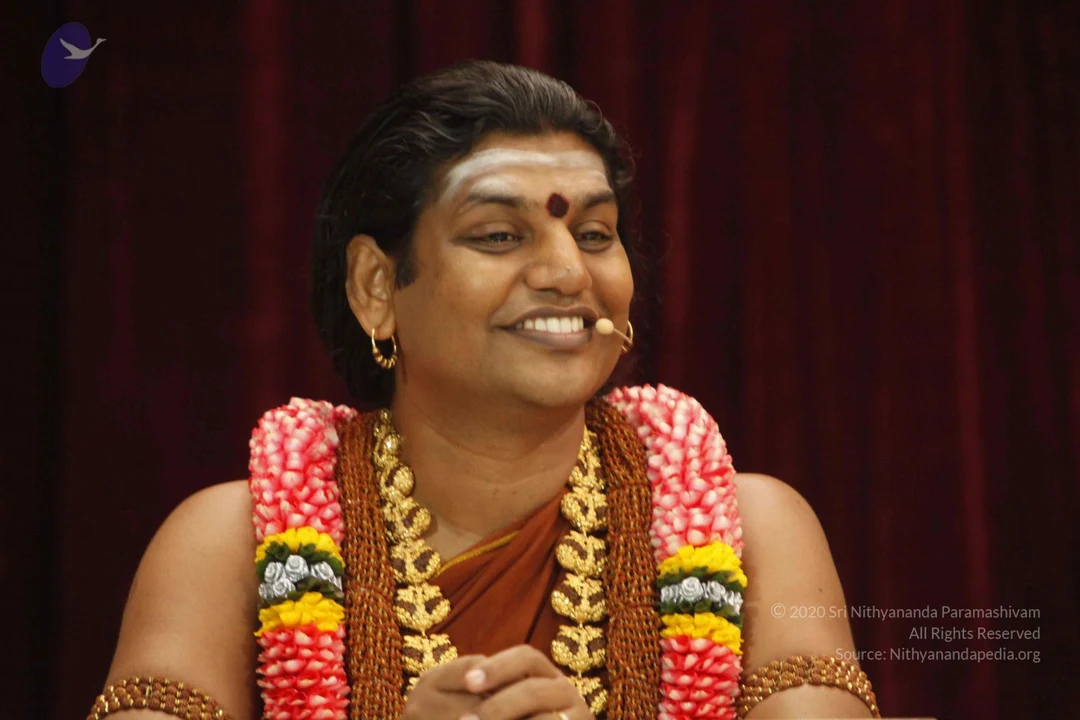
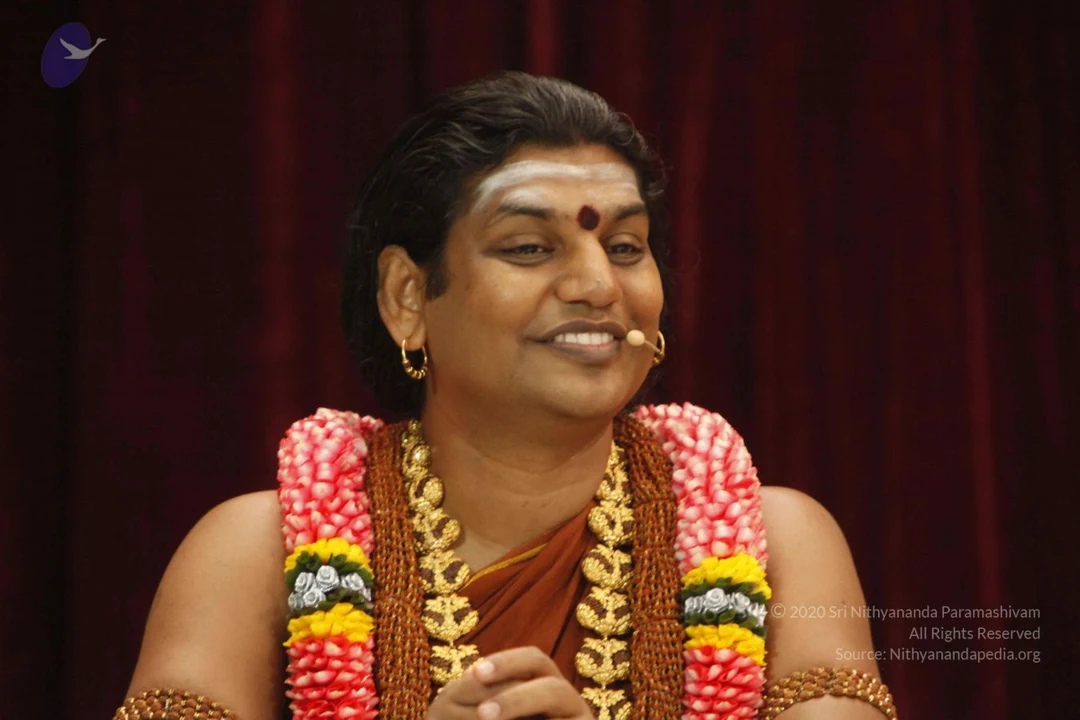
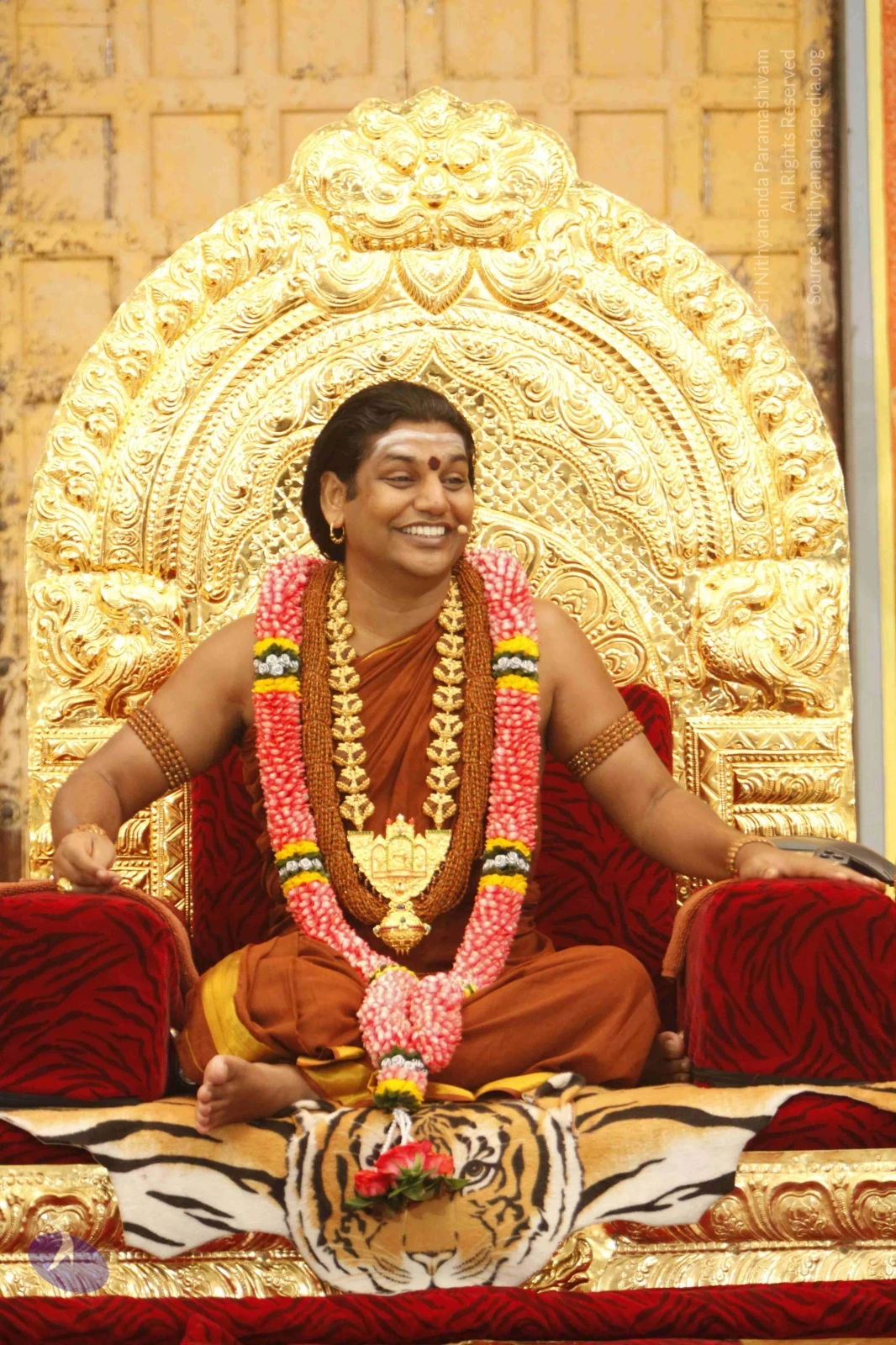
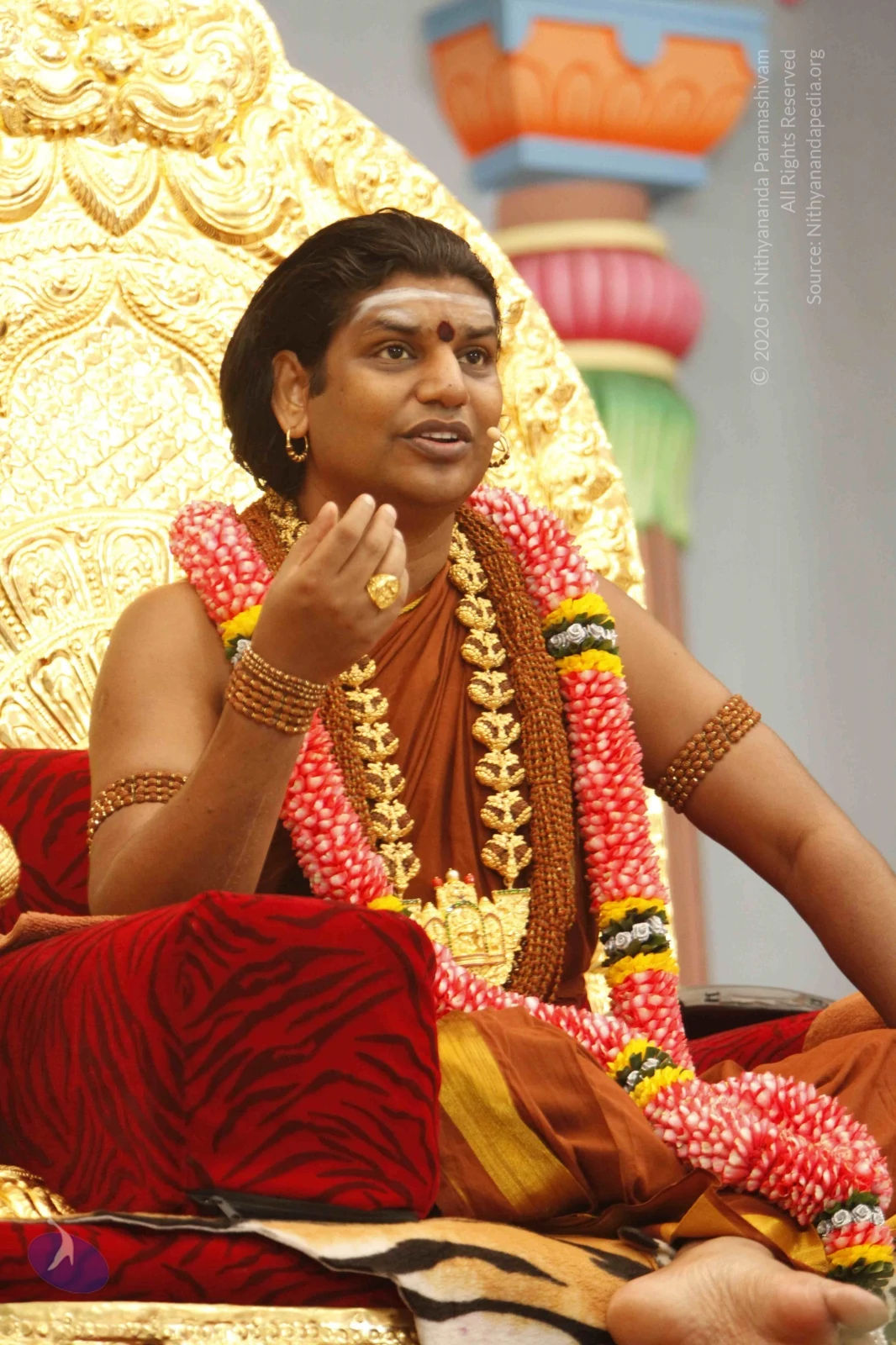
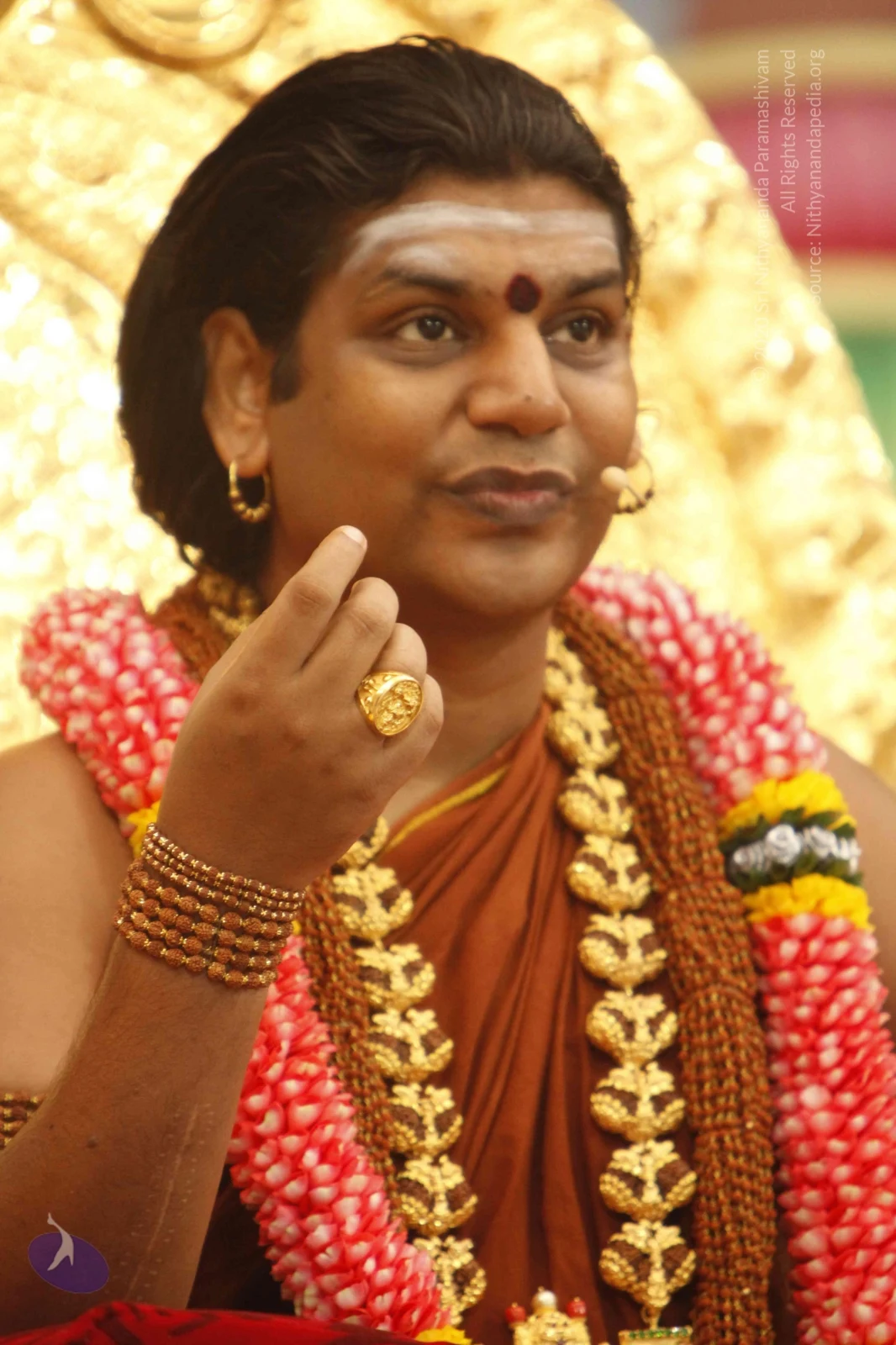
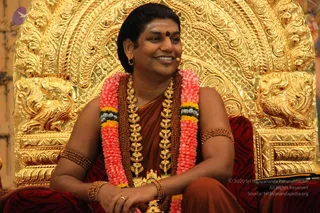
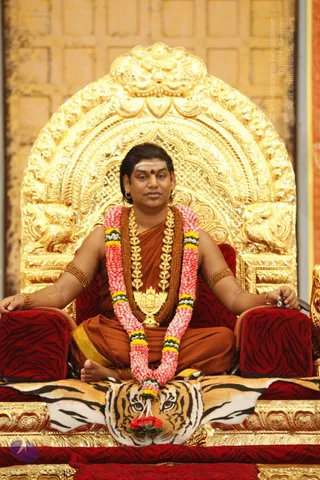
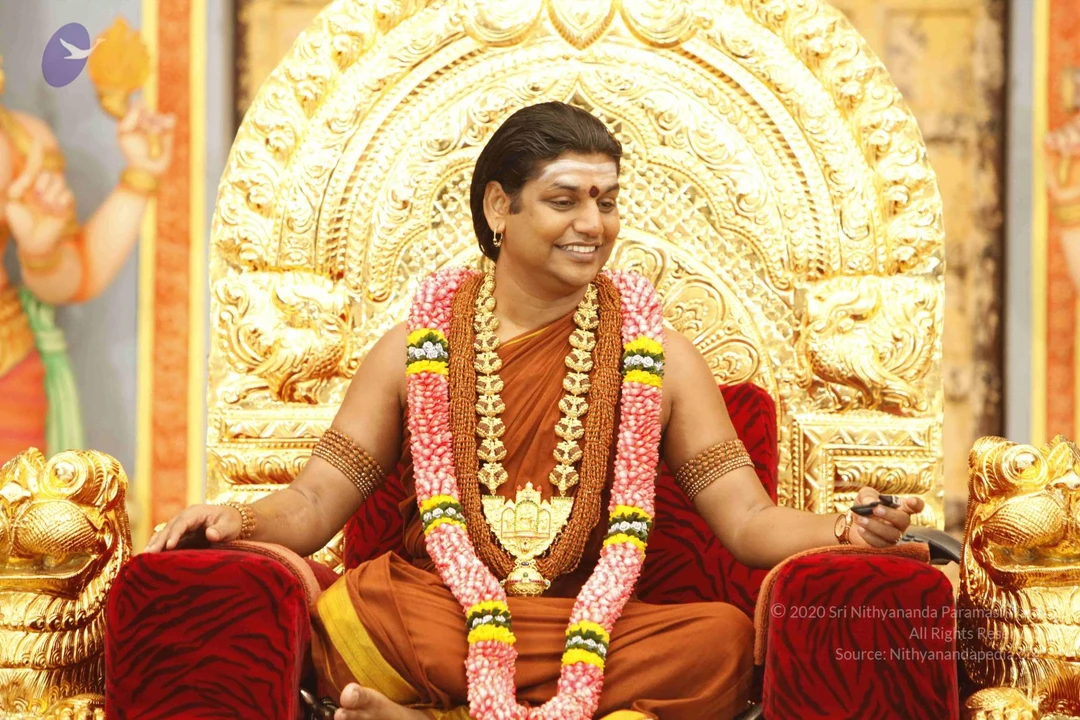
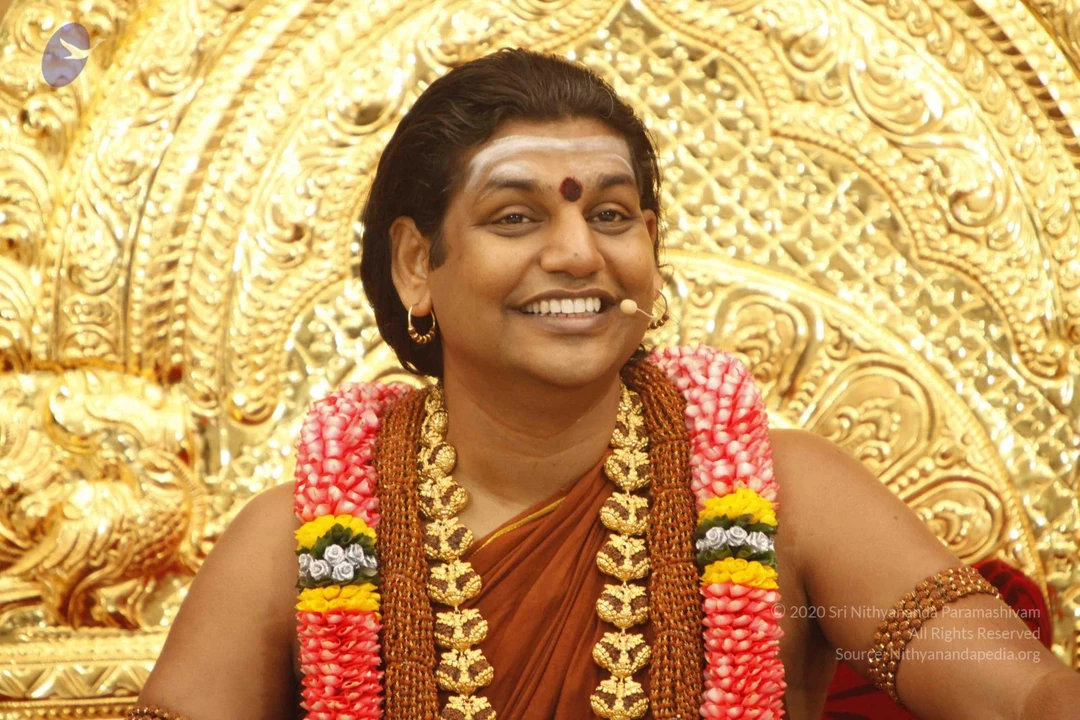
A large display screen shows a grid of video-conference feeds from multiple cities during a satsang. The bottom-right feed, framed as Self View, shows a man with a garland seated on a red and gold throne flanked by ornate deity statues; he wears orange-and-saffron clothing. Other tiles show participants in homes and rooms, including a man in a white vest on a sofa, women in saris, a man in a white shirt, and devotees by framed portraits and a lit lamp. Labels read East London UK, Singapore Singapuram, Oman Sivagangai, Dubai Vaidyanatham, Hong Kong Sirkazhi and Bangalore North. The physical people in the room are not visible; counted people are on screen.A man seated on an ornate golden throne with carved floral and scrollwork backing, smiling and gazing to the side. He wears a rust-brown ochre garment over his shoulder, a red-and-yellow flower garland with green and white beads, multiple rudraksha mala strands, a gold ceremonial necklace, gold earrings, beaded armbands and bracelets. A red dot is on his forehead. He rests his hands on a red-and-black striped cushion. a person seated in person, with a golden throne, ochre clothing and rudraksha malas as the visible cues.A man seated on a red velvet cushioned throne before an ornate gold-leaf backdrop with carved lion-like motifs, smiling warmly. He wears a rust-orange saffron wrap, a brown rudraksha-style mala with ceremonial gold pendants, and a band of pink and yellow flower garland with a green and white ribbon. Gold bangles circle his upper arms and wrists, a red bindi marks his forehead, and a small lapel microphone is clipped near his face. His hands rest in his lap. a person is shown in the seated pose of a discourse.A smiling man sits on an ornate gold throne with a repoussé arched backrest carved with scrolls and mythical lion-like figures, draped in red velvet with a tiger-stripe pattern. He wears a brown saffron-toned cloth, a rudraksha mala, multiple layers of gold ceremonial necklaces, a pink and yellow flower garland, beaded armlets and a small red dot with a white vertical tilak on his forehead, and a small headset microphone is clipped near his face. His hands are clasped in his lap. Probable Swamiji: the seated figure has long swept-back dark hair, ornate gold jewellery, a flower garland and a rudraksha mala, with a golden throne behind him. The image appears to be a photograph of an event setting.A smiling man with short dark hair sits on an ornate gold-leaf throne with carved lion-like figures, wearing a rust-orange robe, a pink and yellow flower garland, a heavy gold and rudraksha-style necklace, rudraksha bracelets on the upper arms and wrists, and a red bindi with white forehead marking. He has a small headset microphone and rests his hands together in his lap, appearing to speak to an audience. a person is shown in an appearance-based label only; the figure is seated, speaking and framed in a discourse setting, with a red-and-black striped throne cushion beneath him.A photograph of a smiling man seated on an ornate golden throne with carved lion-like motifs and a red cushioned seat. He wears a rust-orange robe, a pink and yellow flower garland, a rudraksha mala with a gold-link necklace, rudraksha armbands and a small red bindi, and a headset microphone. His hands are clasped in his lap. a person seated in discourse, with his role as speaker conveyed by the microphone and throne. No other physical people are visible.

Sarva-Darshan

5 photosSource gallery
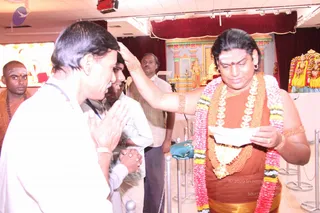
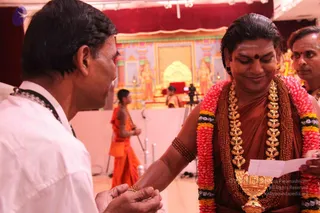
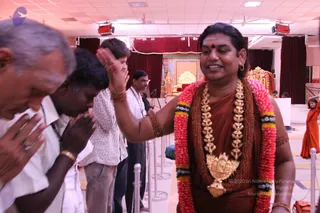
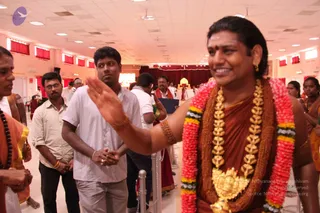
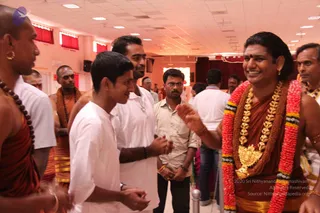
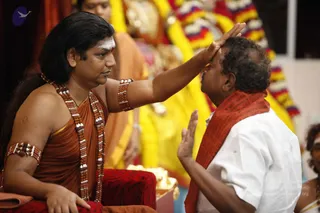
A seated man in an orange-saffron robe and a long pink, white and yellow garland stands centre-right, holding a folded paper, while his right hand rests on the forehead of a man in a white shirt with palms pressed together in greeting. The robed man wears a gold chain, bangles, earrings and a red bindi with white sacred marks on his forehead. Behind them a crowd of onlookers stands near steel stanchions. A backdrop shows a painted temple-style archway, columns and a red curtain, with deity murti and flower-decorated figures at right, in a blessing or darshan setting. Swamiji (probable): the robed man has long swept-back hair, saffron clothing, a rudraksha-style neck mala and ornate gold jewellery, so he is a candidate for Swamiji, but the image is not conclusive.A photograph of a devotee in a white shirt, facing right, reaching toward a robed figure in a rust-brown sannyasi garment with a rudraksha mala and heavy gold ceremonial necklace, wearing a fresh pink-and-yellow garland and a red bindi, holding a folded white paper and smiling. The robed figure has long swept-back dark hair, distinctive ornate gold adornment and a saffron-toned wrap, a probable Swamiji (probable) in the centre of the frame. Behind them, an ornate golden shrine backdrop with painted pillars and a deity murti stands in a hall, with an assistant in orange robes and a camera on a tripod visible in the background.A photograph of an indoor hall with pink ceiling lights and red curtains. In the foreground, a man in a brown-orange robe with a rudraksha mala, a gold ceremonial necklace, a red bindi and long swept-back hair smiles while a hand is raised in blessing toward him. He wears a long garland of red and white flowers with multicolour stripes. Two men on the left stand with palms pressed together in namaste, one in a white shirt. Behind them, a golden throne-like seat and a deity murti stand before a red curtain backdrop, and a woman in orange sari is visible at the right edge. The robed figure is an appearance-based a person candidate.A photograph inside a bright hall with pink walls, ceiling lights and red curtains. In the foreground a smiling man with swept-back dark hair and a red bindi wears a saffron-brown robe, a thick gold necklace and a long pink, white and yellow flower garland. He raises one hand in greeting. Beside him a man in a white shirt stands with hands folded, and other devotees, some in orange and gold saris, stand along a metal barrier. A gold-lit altar and deity murti are visible in the background. Presentation cues (flower garland, saffron robe, gold ornaments) suggest a person in person, greeting devotees.Indoor photo of a temple-style hall with red curtains and ceiling lights. On the right, a smiling man with swept-back dark hair wears a rust-orange dhoti-style wrap, a heavy gold ceremonial necklace with a large pendant, and a red-and-pink floral garland with a striped border; he gestures with his hand while talking. Swamiji (probable): his long swept-back hair, ornate gold necklace, garland and saffron-orange clothing are the qualifying cues. To the left, a bare-chested man with a rudraksha mala and gold earring stands in orange robes, and another man in orange with a rudraksha mala stands behind. Two younger men in white shirts and a man in a cream shirt stand in conversation, with more devotees in the background.

Swamiji-Final-Blessings

6 photosSource gallery
A man in saffron-orange robes stands at left on a maroon velvet backdrop, waving, with a multicolour flower garland around his neck and a large gold pendant necklace, plus a rudraksha-style beaded mala. Beside him stands a pair of large decorated deity murti figures with gold crowns, mauve-and-yellow garlands and yellow and blue silk drapes, one holding a hand in blessing gesture. A gold ornate canopy frames the display. a person cues: saffron robes, garland and gold pendant, with a sannyasi role.Photograph on a stage showing two deity murtis seated side by side on a golden throne, decorated with multicolored garlands of yellow, red, white and purple flowers. The left figure wears a tall crown, a red-and-gold blouse and a yellow silk skirt over a blue lower cloth, with one hand raised in blessing. The right figure wears a crown, layered pearl and jewelled necklaces and a yellow skirt. At the left edge stands a smiling man in a rust-orange dhoti and shawl with a gold necklace and a flower garland, gesturing with one hand. Potted green plants in the foreground, dark maroon drapes behind.A man in an orange-brown robe with gold borders stands at left on a stage, smiling and raising his right hand in greeting. He wears a gold pendant necklace, gold bangles and a multicolour flower garland. Beside him are two large decorated deity murtis, one gold-faced with a red-and-gold crown and a yellow sari, the other in a blue skirt and red-and-gold blouse with jewelled ornaments. Both are draped in garlands of yellow, pink, white and purple flowers, with a gold arched backdrop and maroon curtain behind. A microphone and potted plant sit in the foreground. Whether the standing man is a person cannot be confirmed from appearance alone, so he is described by role and clothing only.A standing man in a rust-brown dhoti-style wrap with gold borders raises his right hand in greeting beside a pair of ornately decorated deity murtis seated on a golden throne. He wears a red and yellow flower garland and a heavy gold necklace. Behind him hangs a maroon velvet curtain. The two murtis, both painted in gold tones, wear yellow and blue silk skirts, colourful layered flower garlands, crowns and jewelled necklaces; the left figure holds a red placard. Potted green plants sit in the foreground. The man is smiling and appears to be a devotee or ritual participant; the a person identity cannot be confirmed from appearance alone.A smiling man in saffron-orange robes stands at left, waving with his right hand, wearing a long multi-strand gold necklace, a red-and-white garland, and a red bindi. Beside him, two large ornate metal deity murtis are seated on a decorated platform, each in gold-and-yellow silk with blue skirt panels, gold crowns and jewelled necklaces, surrounded by an arch of marigold, rose and red garlands. Red velvet drapes form the backdrop and potted greenery sits at lower right.A smiling man in a rust-orange dhoti and shawl with a gold-and-white floral garland stands at left, waving his right hand toward the viewer. Beside him on a stage with a deep maroon velvet curtain are two large decorated deity murtis seated side by side on a raised seat. Both wear crowns, gold jewellery and layered garlands in pink, yellow, white and multicoloured flowers, with yellow and blue silk drapery at their feet. Green plants sit in the foreground.

Sacred-Arts-Univercity

39 photosSource gallery
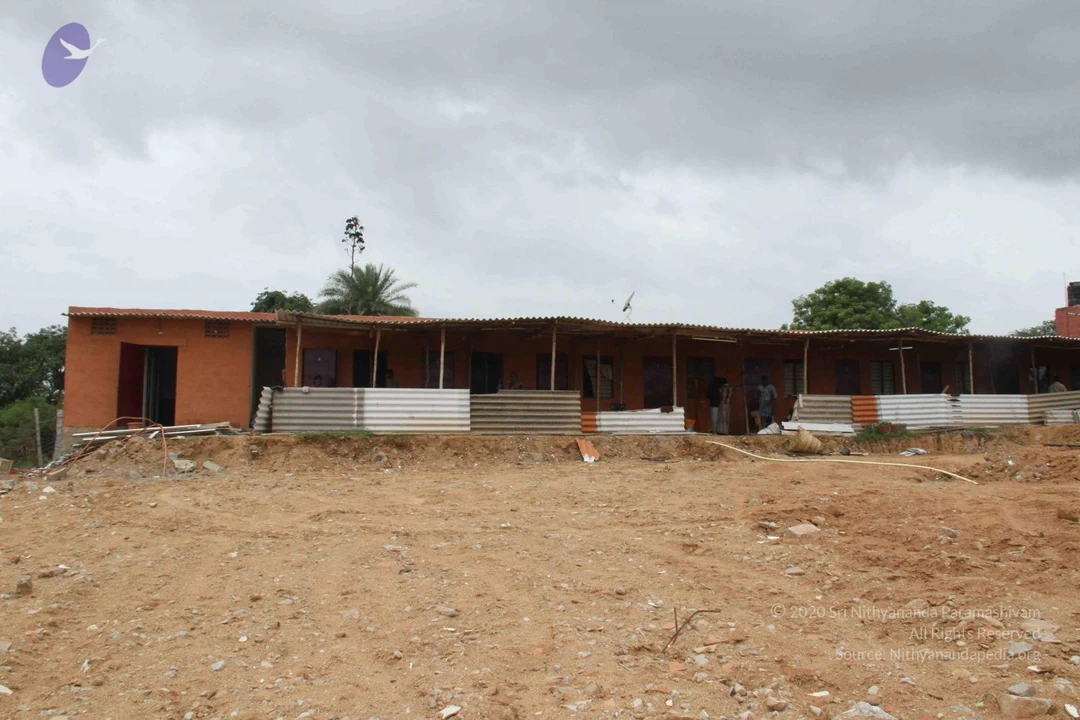
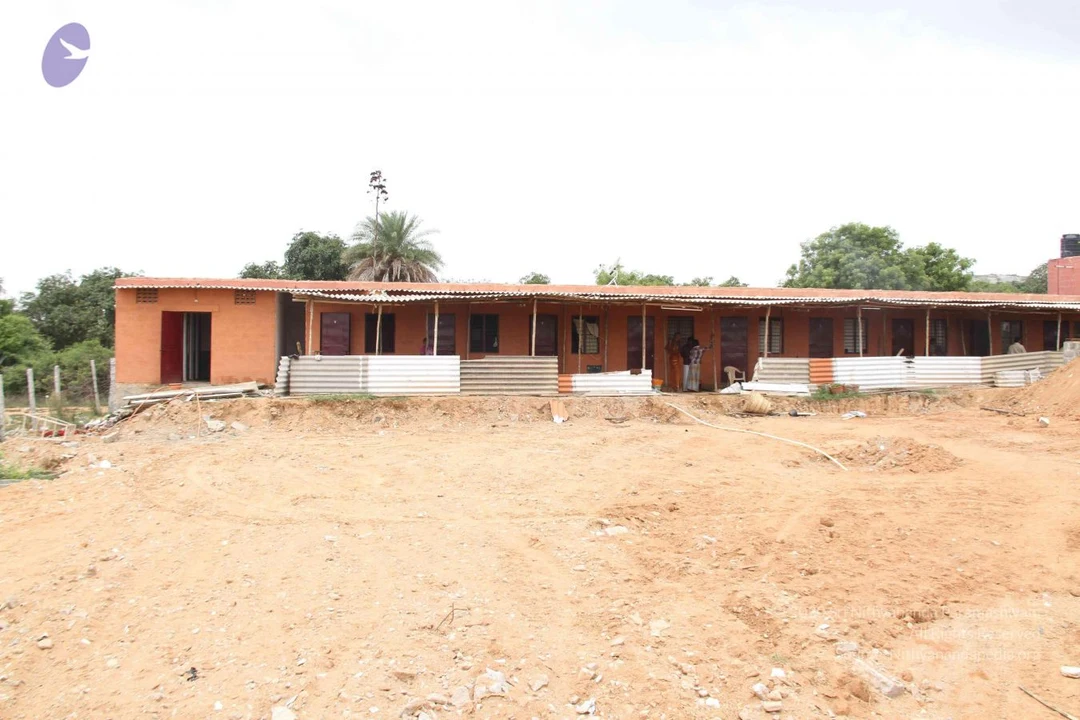
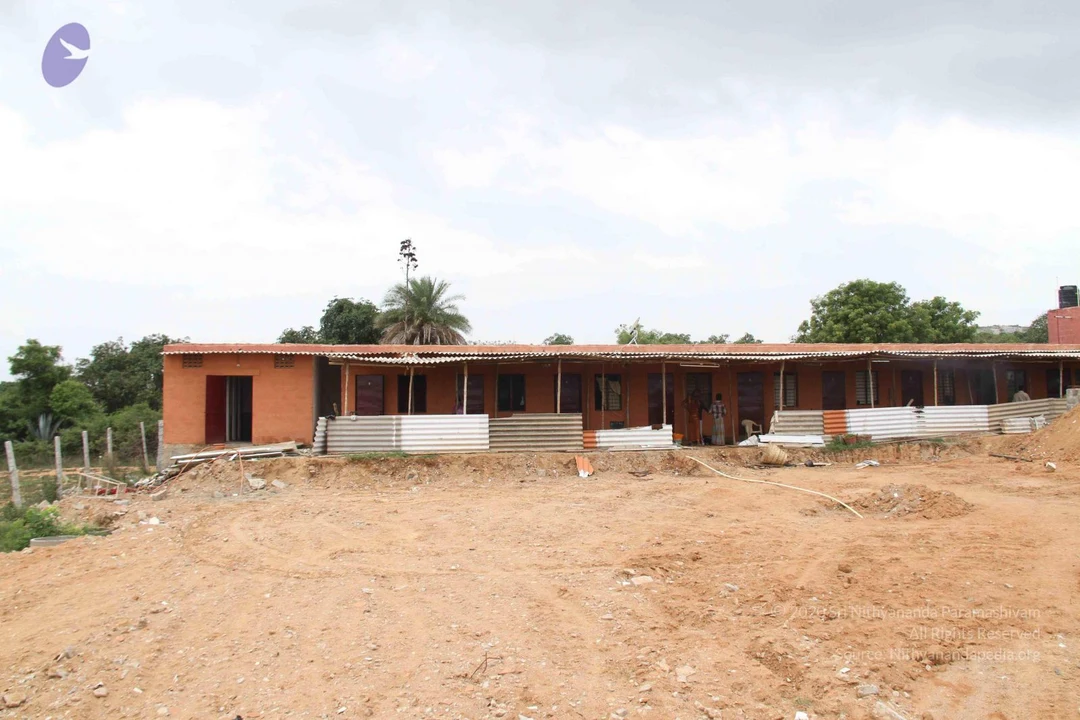
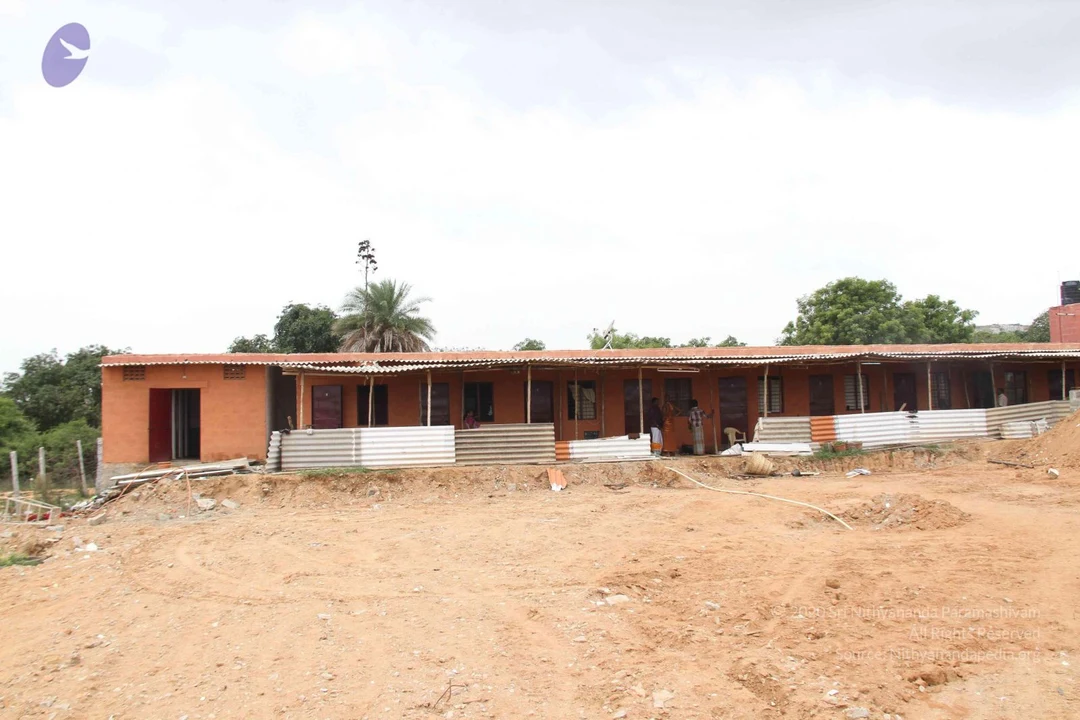
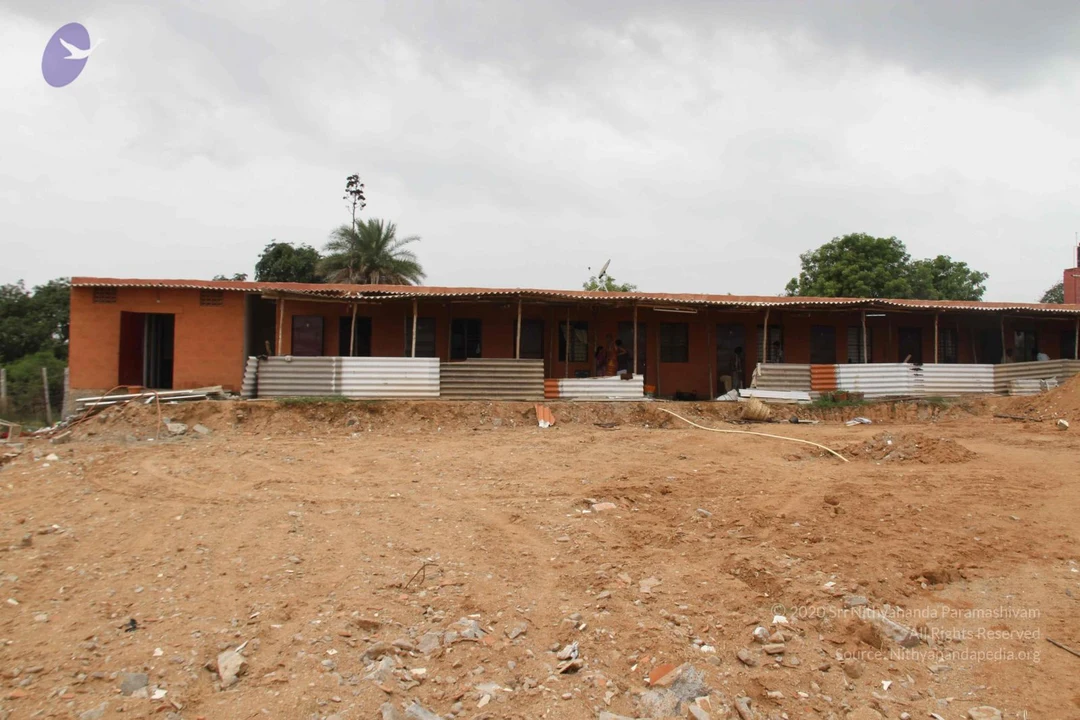
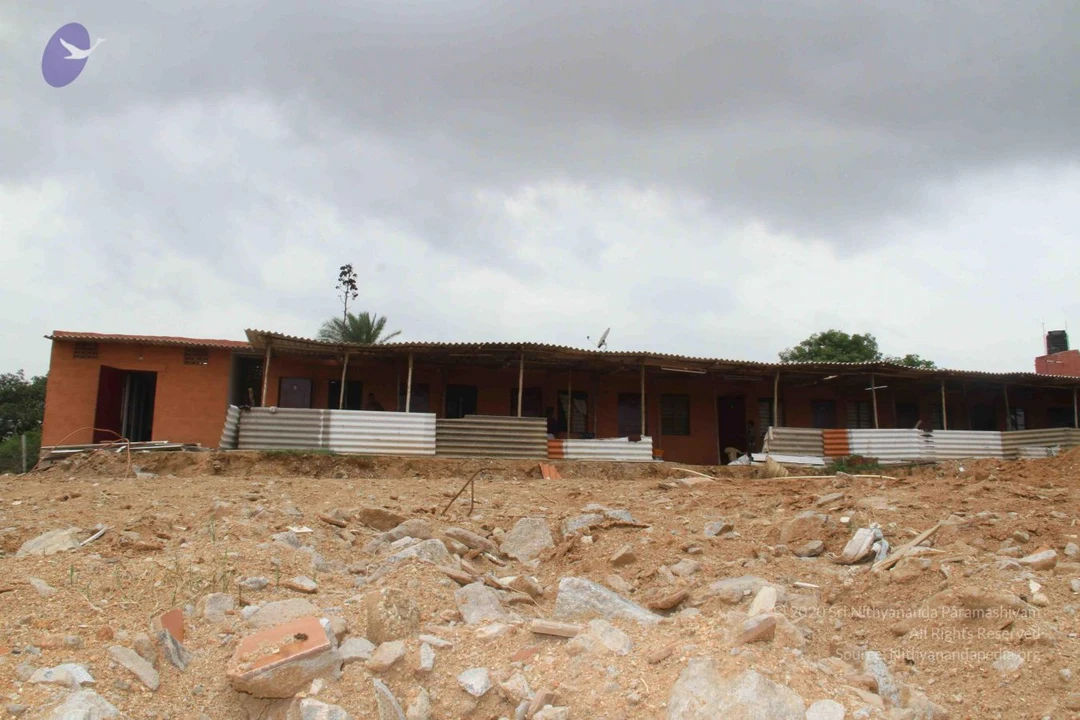
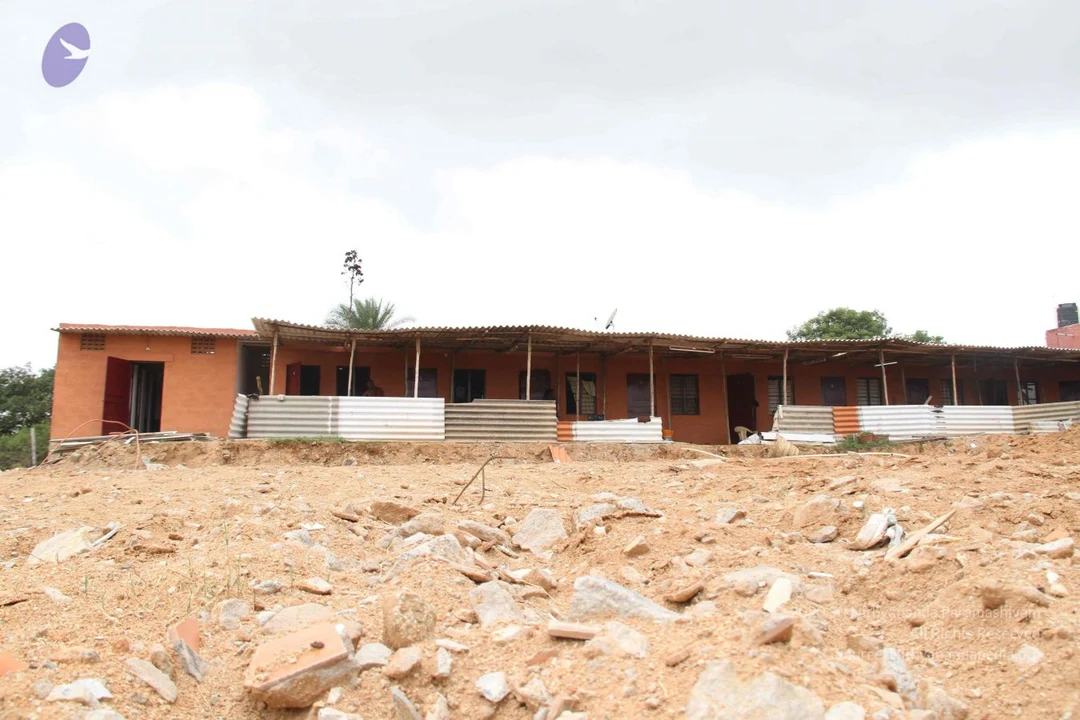
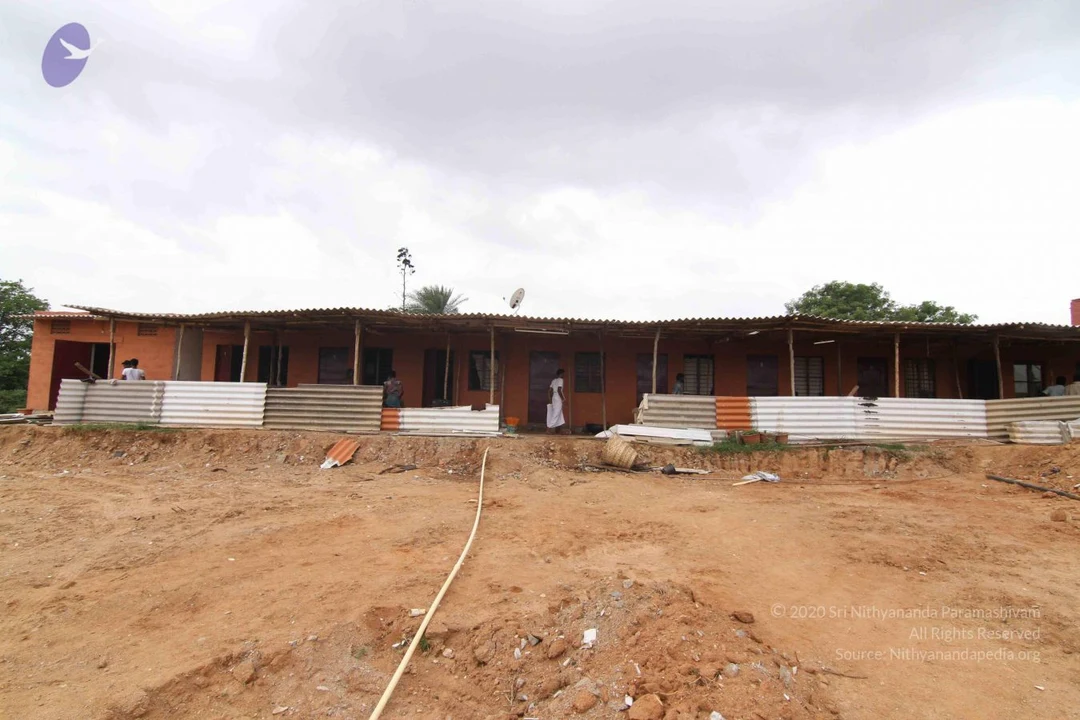
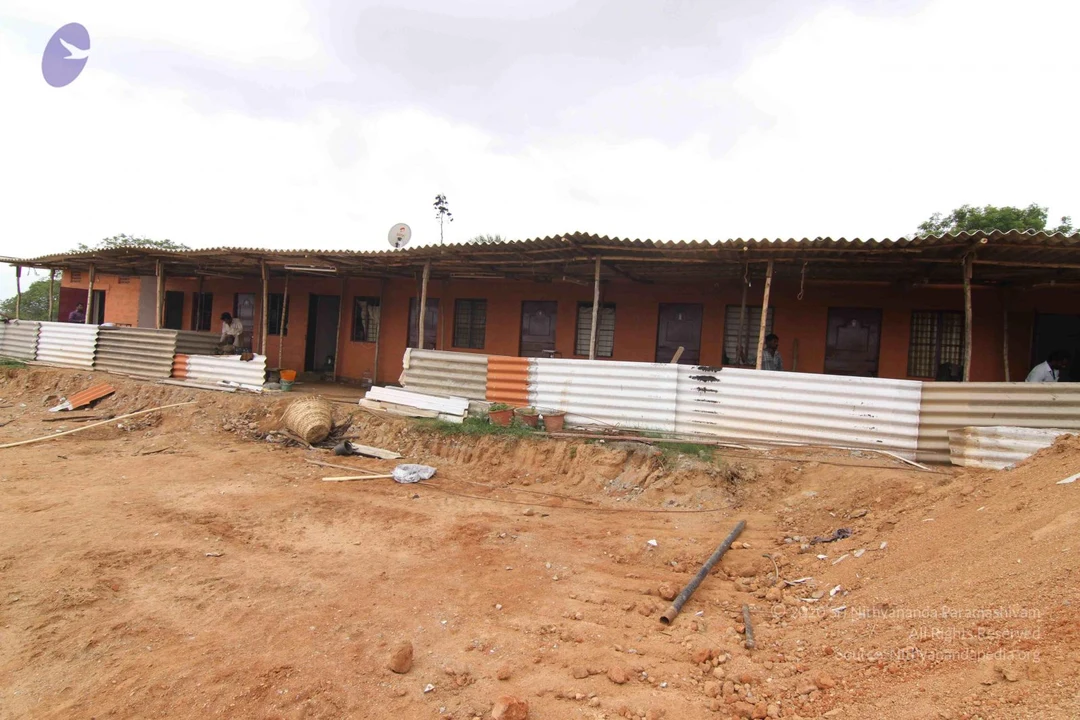
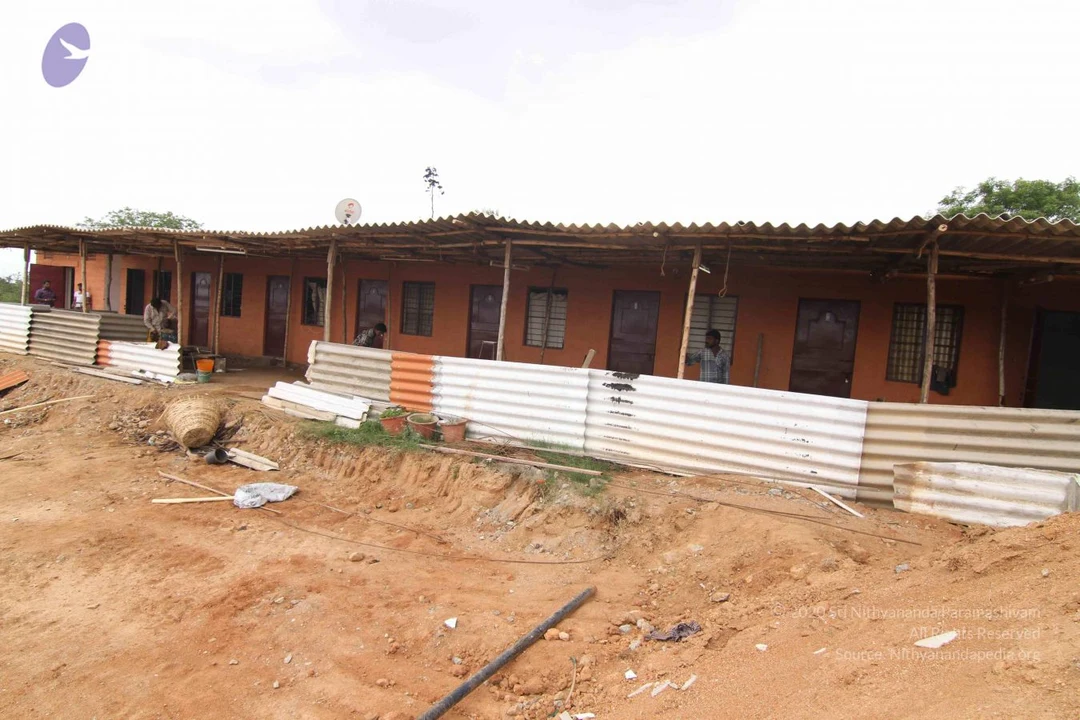
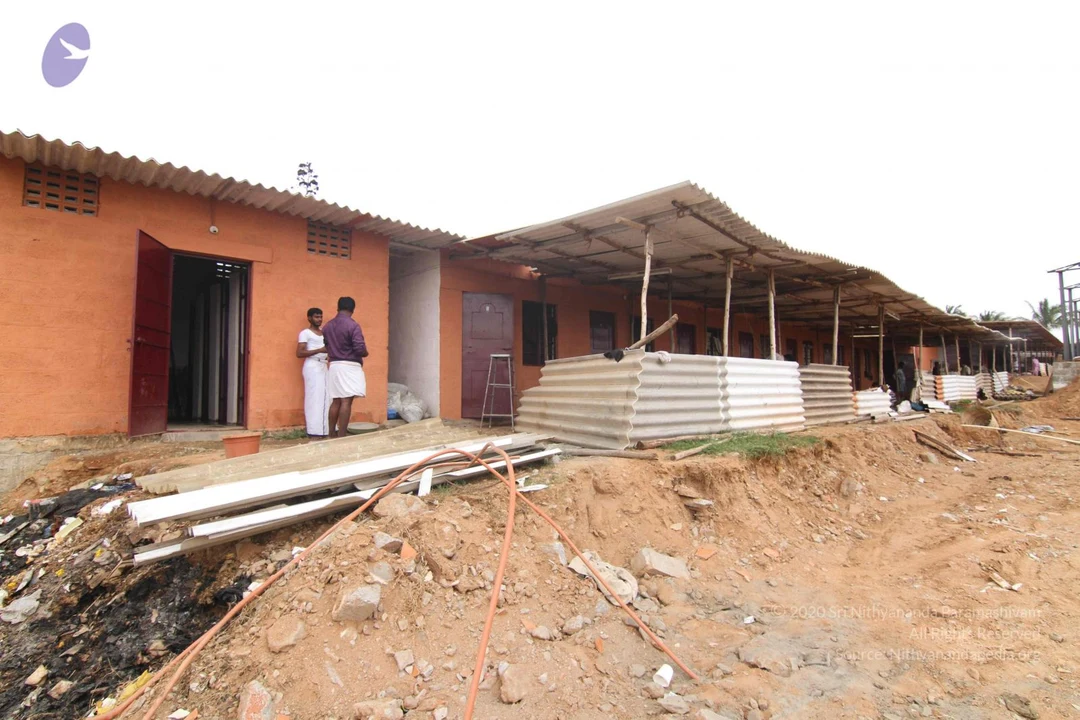
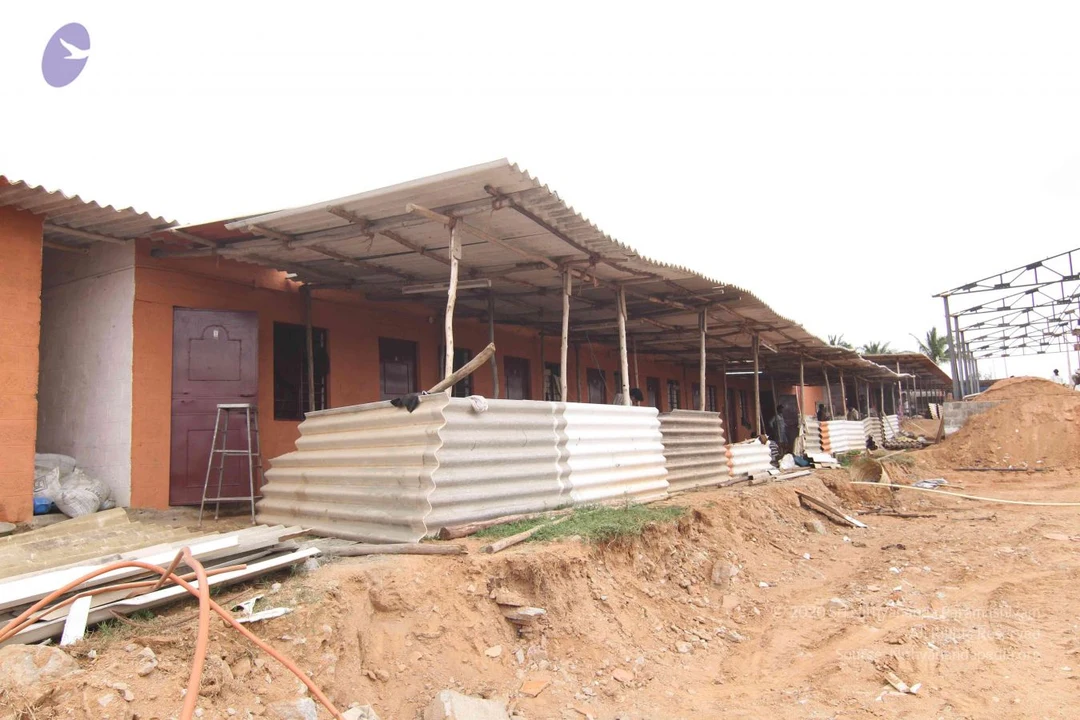
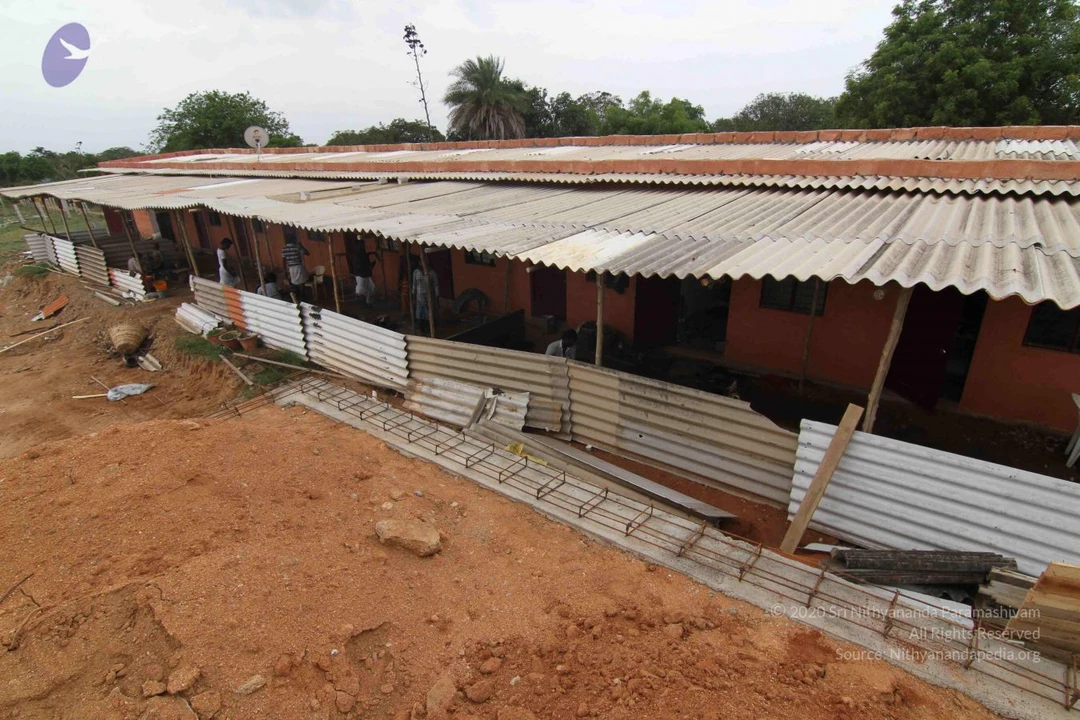
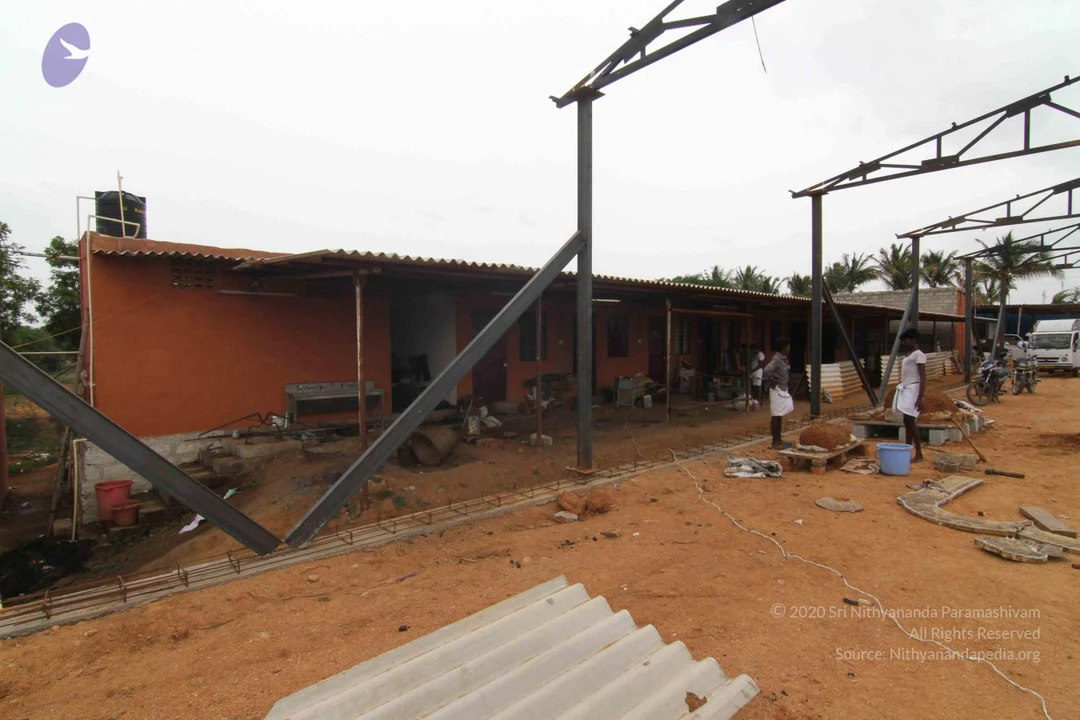
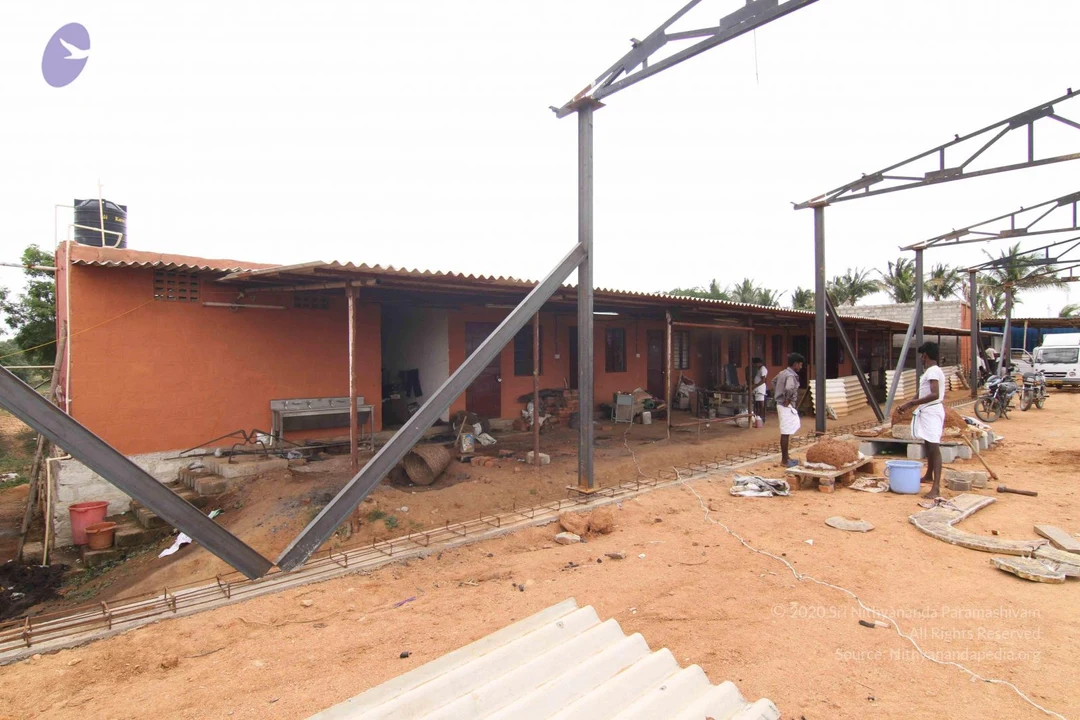
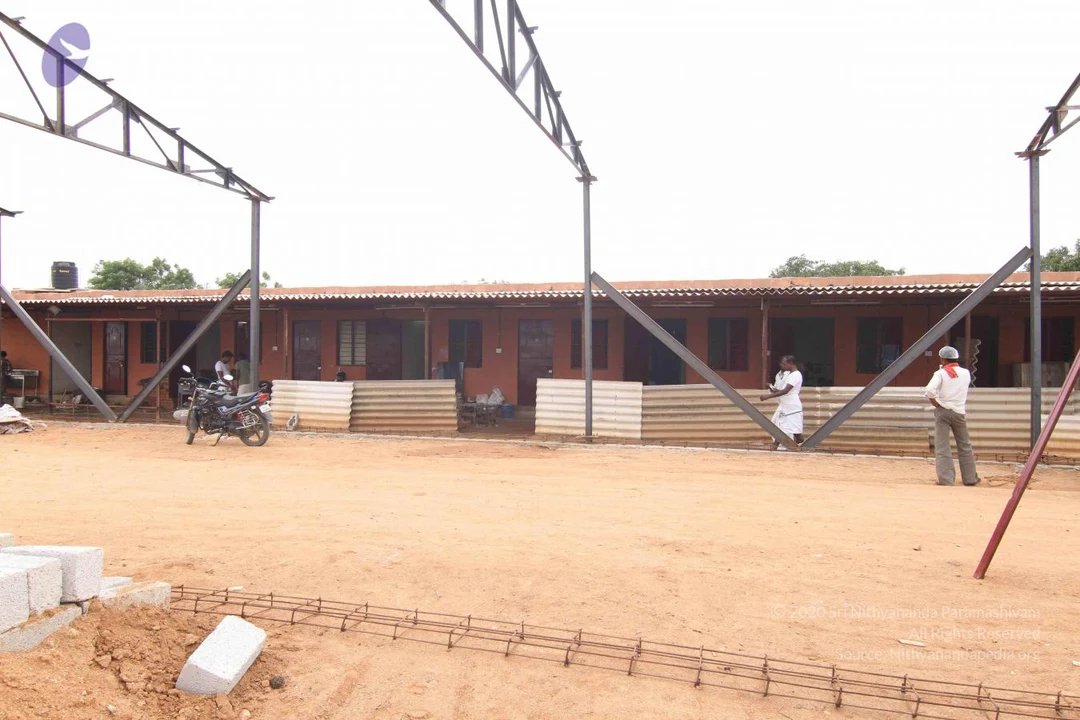
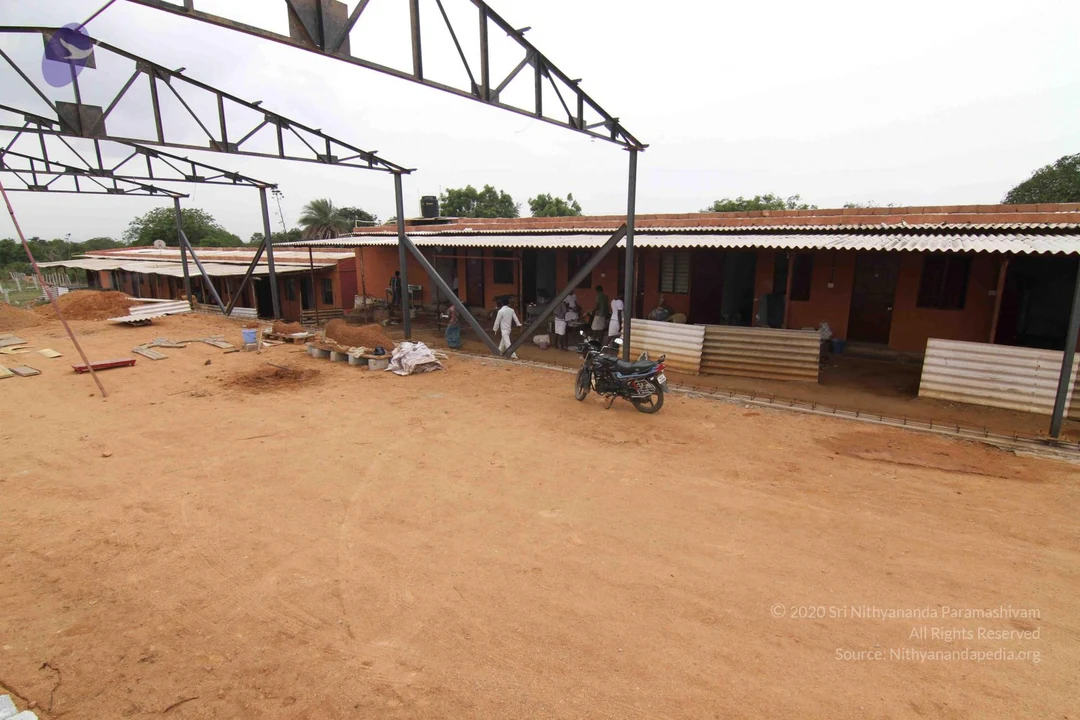
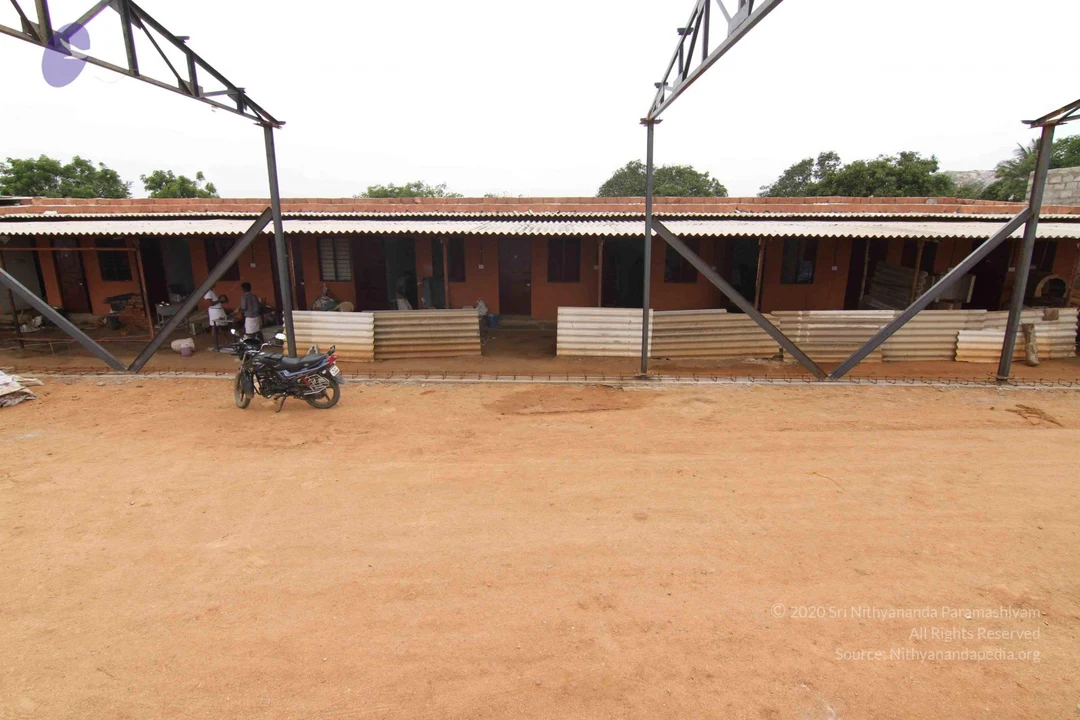
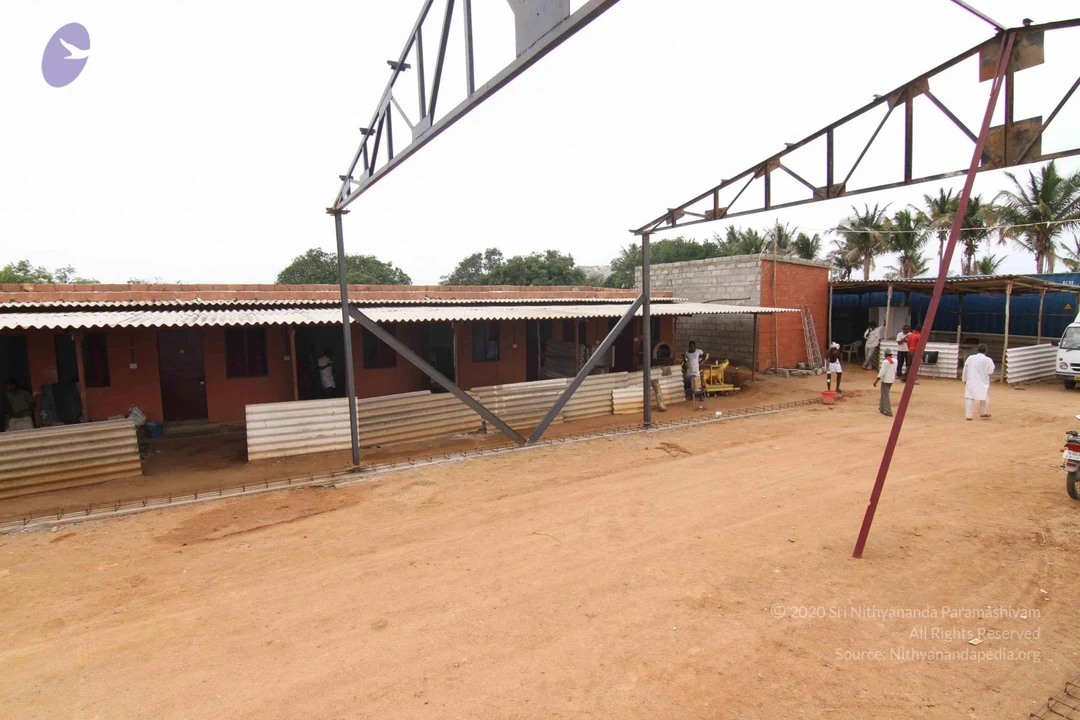
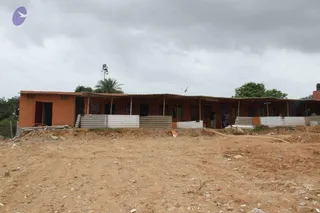
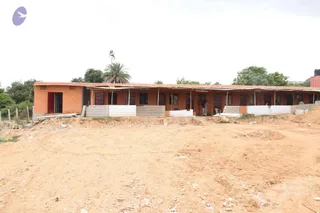
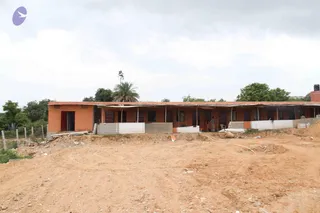
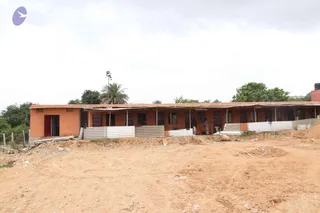
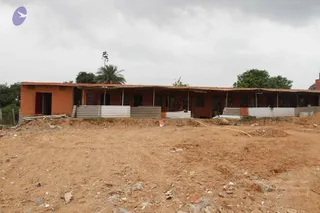
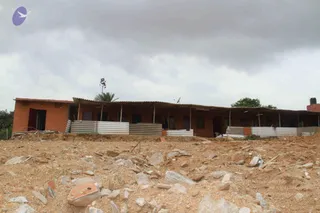
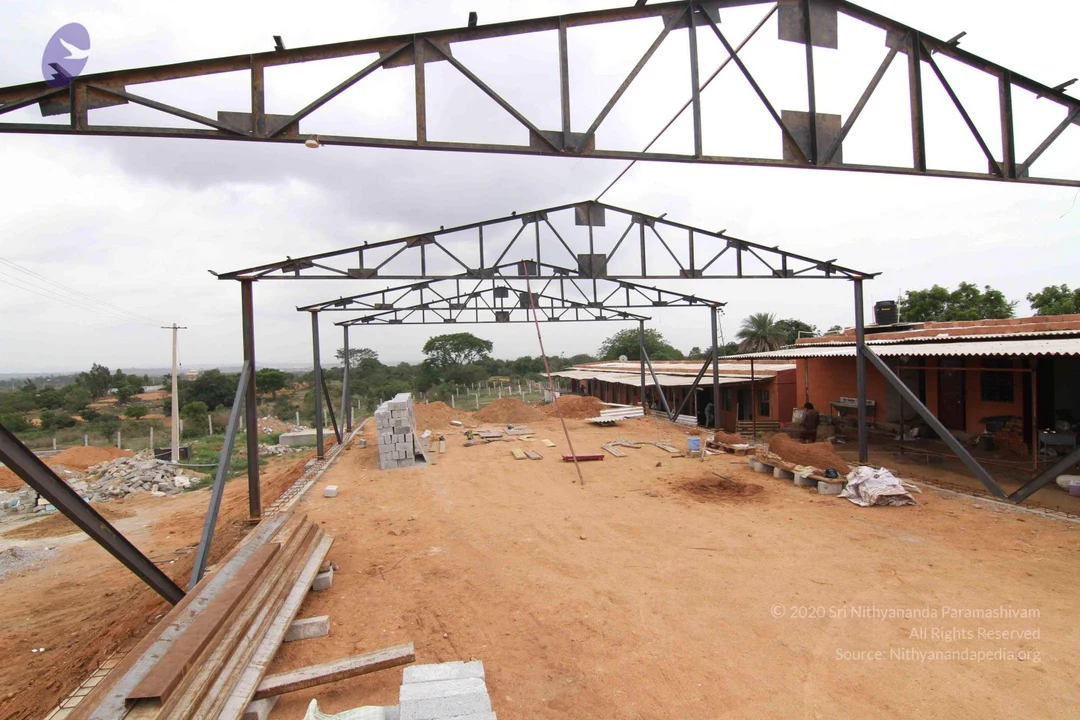
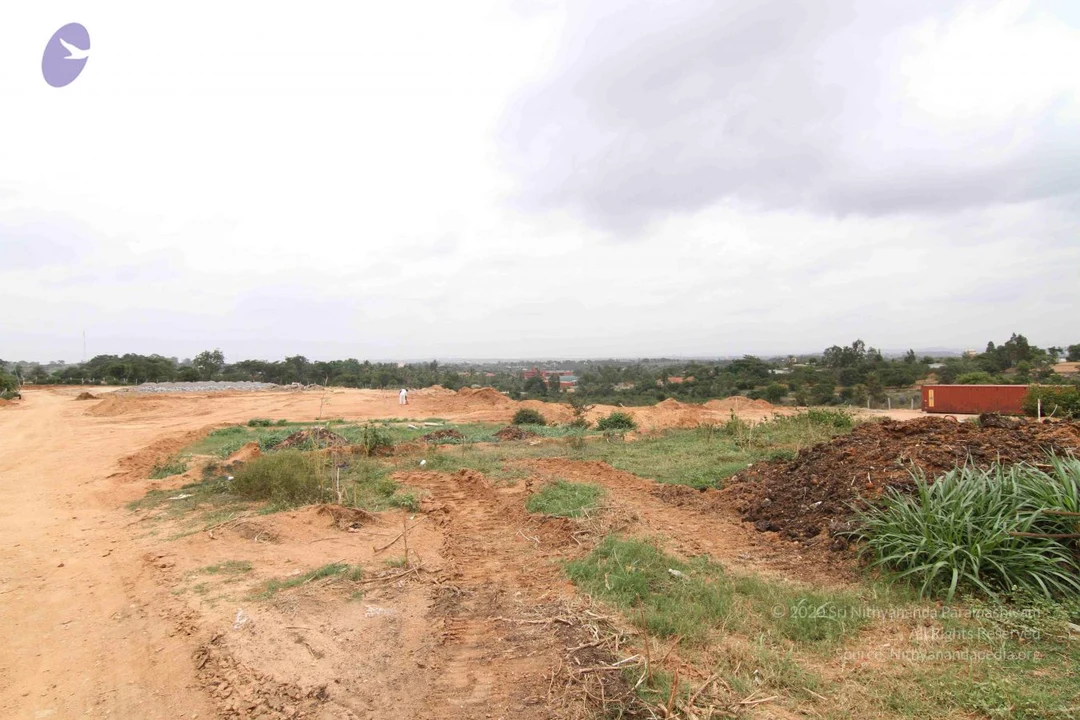
A long single-storey building with terracotta-orange walls and a corrugated metal roof stands on a bare, dug-up dirt plot with scattered gravel and debris. Corrugated sheets are propped along the front of the building, and a few small figures stand near the doorways under a grey, overcast sky. A palm tree and other trees appear behind the structure, and a coiled hose lies across the foreground dirt.A long single-storey brick building with a terracotta-coloured wall and a corrugated tin shelter over a covered verandah stands on bare reddish-brown earth. Wooden-framed doors and windows line the front, and a few small figures are faintly visible under the verandah. A palm tree, leafy trees and a wire fence surround the site under an overcast sky, with construction debris and a hose in the foreground.A long, single-storey building with orange-red brick walls and a corrugated metal roof stands on bare, excavated red earth. Corrugated sheet panels form low barriers along the front and open doorways line the facade. Two people stand near the central doorway, and a palm tree and trees rise behind the structure under an overcast sky. Scattered building materials and a hose lie on the ground in the foreground. No a person candidate is visible.A photograph of a long, single-storey orange-brick building under construction, with a corrugated metal roof supported on wooden posts and a covered verandah along its front. Sections of corrugated sheet metal are propped as temporary walls, and dark doorways and windows are visible. In the foreground, dry reddish earth is strewn with broken bricks, rubble and stones, with a small palm tree and scattered trees behind under an overcast grey sky. No people are clearly visible.

Ashram-Nature

12 photosSource gallery
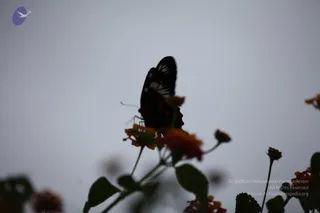
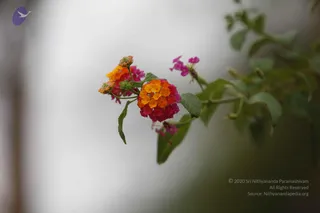
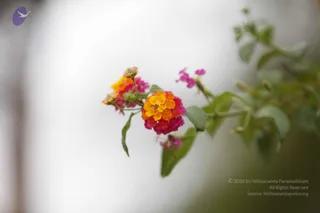
A photograph of a black butterfly with pale white markings on its wings, perched in silhouette on clusters of small orange and red lantana flowers with green serrated leaves. The background is a plain, pale grey sky. No people or ritual scene is visible.A close photograph of a flowering lantana sprig against a soft grey background. Clusters of small flowers in orange, yellow and red-pink sit at the top of green serrated leaves, with a few magenta blossoms and unopened buds on the right. No people, ritual objects or a person depiction are visible; the blurred foliage at the edges is dark green and out of focus.A close-up photograph of a branch of lantana flowers against a soft, blurred white background. Clusters of small flowers in orange, yellow, red and pink bloom at the centre, with green serrated leaves and buds along the stem. Pink flowers and foliage fade into the out-of-focus right edge. No people are visible.Looking straight up a tall palm tree trunk from ground level, showing the pale grey ringed trunk rising to a crown of green fronds against a bright sky. Dried brown fibrous husk and frond bases cluster at the top, with a few pale grey spathe fronds sticking out. No people or ritual activity is visible.A low-angle photograph looking up a tall coconut palm trunk toward its crown. Long green fronds fan out against a pale sky, and clusters of young coconuts with orange-brown fibrous husks hang among the leaf bases. A pale, papery spathe sheath wraps the top of the trunk. No people, deities or ritual activity are visible.Close-up photograph of a coconut palm inflorescence high in the tree. Thin orange, sinewy tendrils or stalks branch out from a pale yellow base against dark brown husk-like sheaths and green palm fronds. Blurred foreground fronds frame the scene. No people are visible.

IA Session

11 photosSource gallery
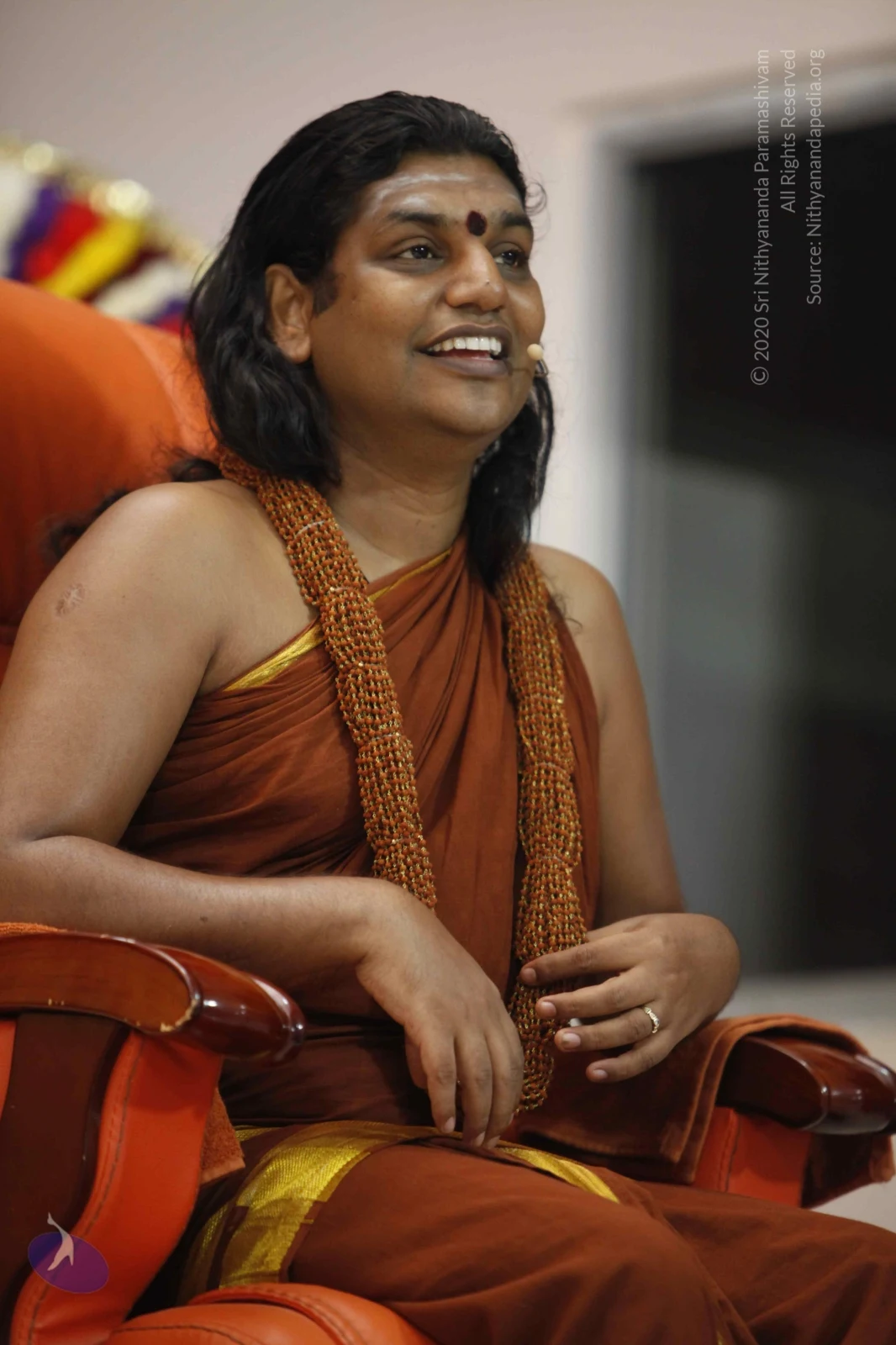
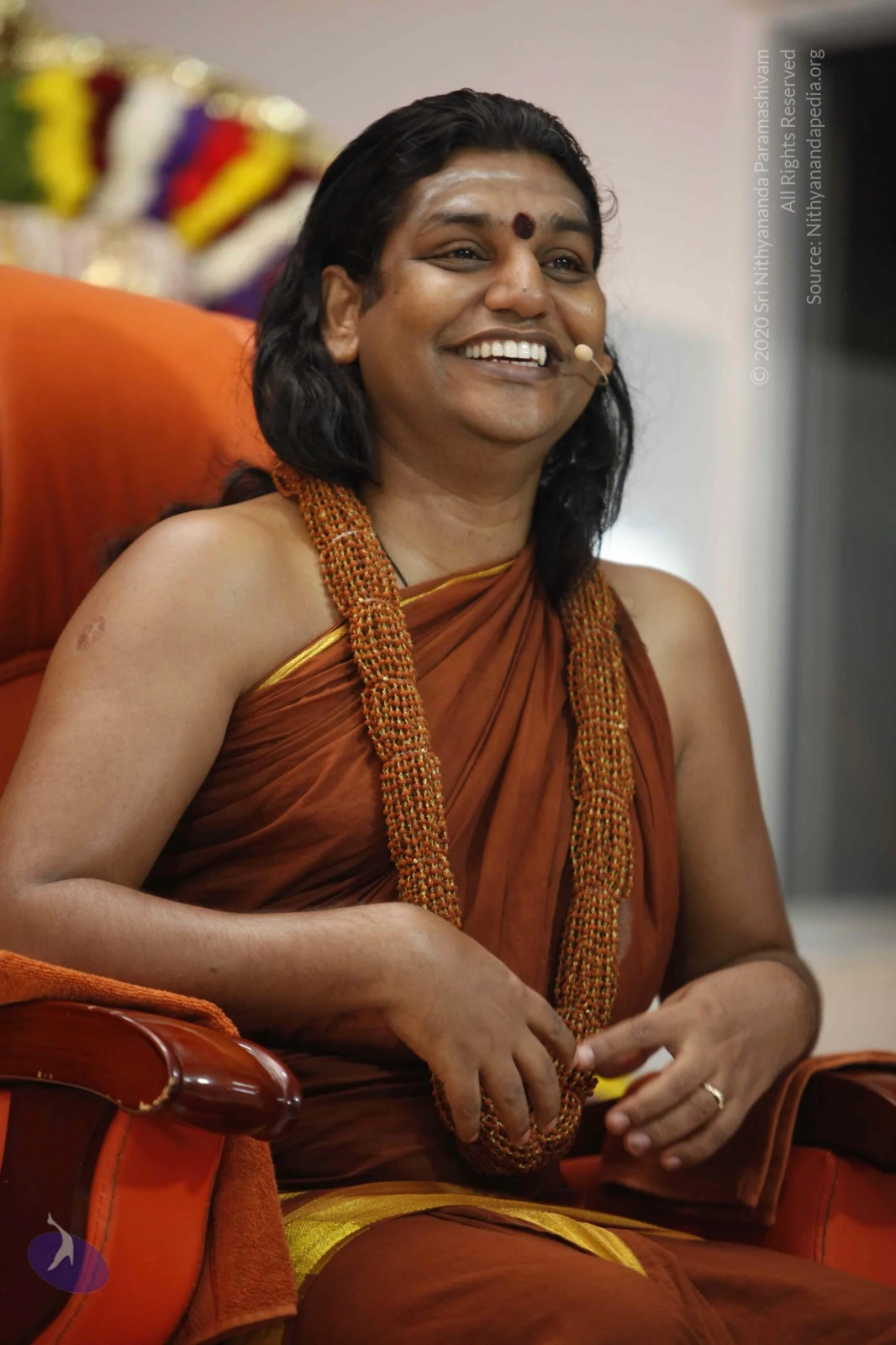
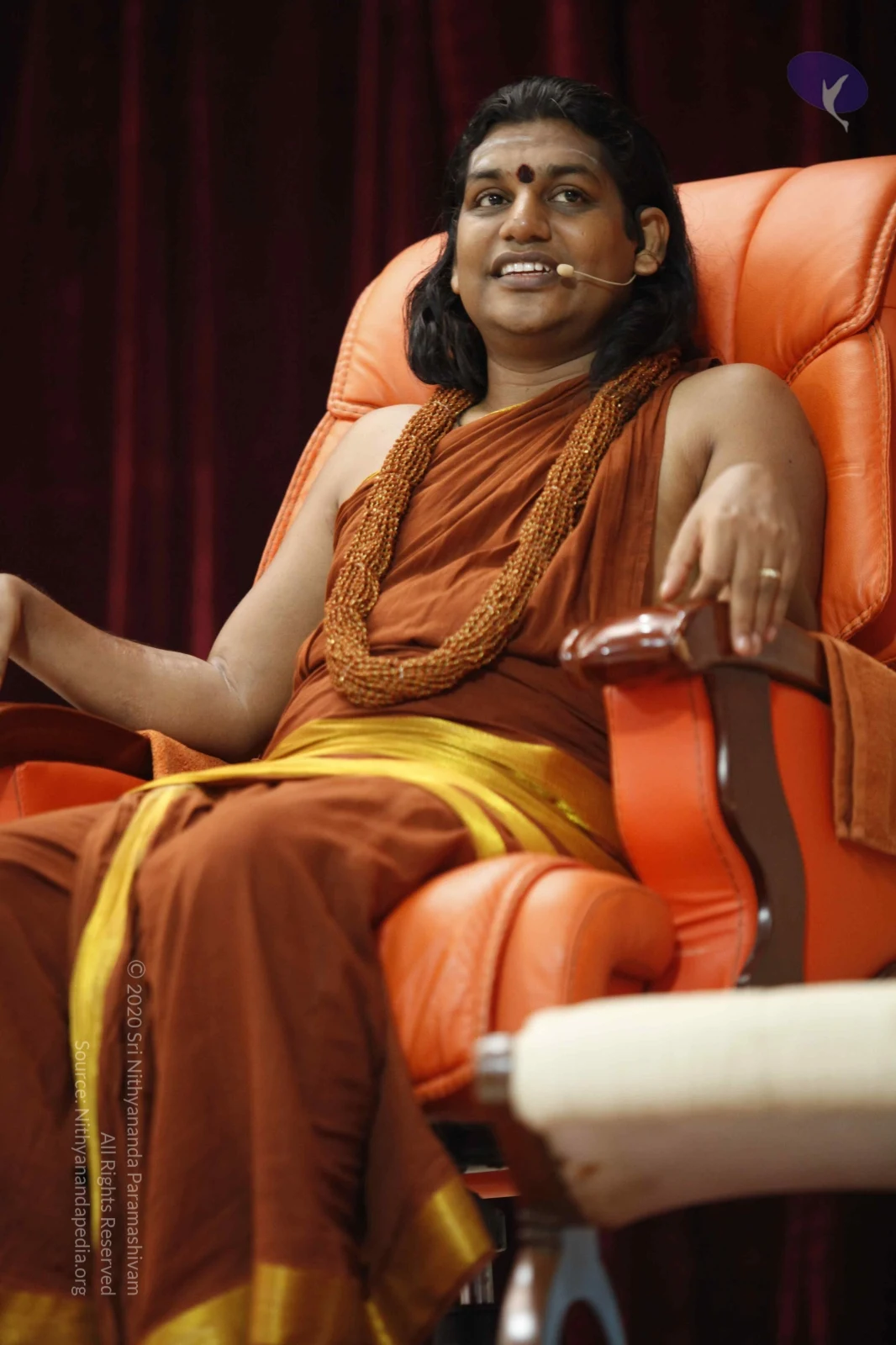
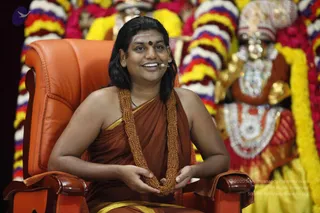
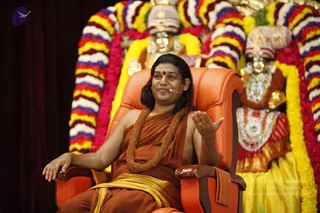
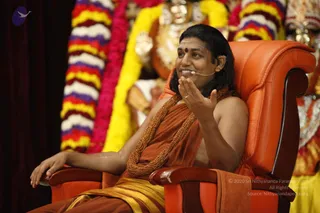
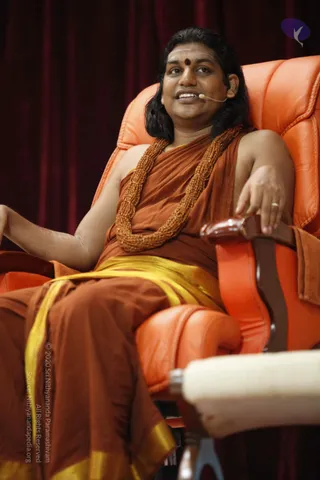
A person with long dark hair and a red bindi on the forehead sits in a large orange leather armchair, speaking into a small headset microphone. They wear a rust-brown saffron-toned robe with a gold-bordered dhoti and a long rudraksha-style beaded mala draped over one shoulder, with hands resting together in the lap. Behind them are garlands of red, white, yellow and purple flowers and a gilded deity murti adorned with jewelled ornaments and a crown. The setting suggests a satsang discourse.A smiling man with long dark hair and a red bindi sits in a bright orange leather chair, wearing a rust-brown robe with a gold border and a long rust-coloured beaded mala draped over his shoulders. He holds his hands together at his lap and has a small clip-on microphone on his cheek. Behind him are garlands of red, yellow, white and pink flowers and a decorated deity murti with a crown, jewellery and gold-and-red garments. The setting suggests a satsang or public discourse. Appearance-based label: a person, seated on the throne-like chair, as the page indicates.A smiling person sits in a large orange leather chair during a talk, wearing a rust-orange draped garment with a gold-toned rope-like necklace and a small red bindi on the forehead. They wear a small headset microphone and have shoulder-length dark wavy hair. Their hands rest near the chair arm, with a gold ring visible on one hand. Behind them are a window, a white fan at the lower right, and a faint strand of colourful flowers at the upper left. Appearance-based label: Swamiji (probable), seated speaker with long hair, saffron-orange draped clothing, and a gold necklace.A photograph of a smiling man seated in an orange leather chair, wearing a bare-shouldered saffron-orange wrap with a thick woven rope-style necklace and a small red bindi on his forehead. His long dark hair falls past his shoulders and he wears a small headset microphone. Floral garlands in red, yellow and purple are visible behind him, with a blurred background of white walls and a dark window.A seated man in saffron-orange robes and a rudraksha-style bead necklace sits in an orange leather chair on a stage, a small microphone at his cheek, gesturing with one raised hand during a talk. Long dark hair falls past his shoulders and a red bindi marks his forehead. Behind him stand two large ornate deity murti statues, one crowned and gold-clad, both draped in garlands of red, yellow, white and pink flowers. A dark red curtain hangs at the left edge. Swamiji (probable): the seated speaker's long swept-back hair, saffron robes, bead mala and ceremonial stage setting are the qualifying cues for this satsang discourse.A man with long, swept-back dark hair sits in an orange leather armchair, speaking and gesturing with his right hand while wearing a headset microphone. He wears a saffron-orange shawl over bare shoulders, a thick orange-brown beaded mala necklace, a yellow-gold waist cloth, and a small red bindi on his forehead. Behind him stand a deity murti adorned with yellow and orange flower garlands and colourful striped garlands. Swamiji (probable) appears as the seated speaker, identified by long swept-back hair, saffron clothing, and a rudraksha-style mala.

IA-Darshan

40 photosSource gallery
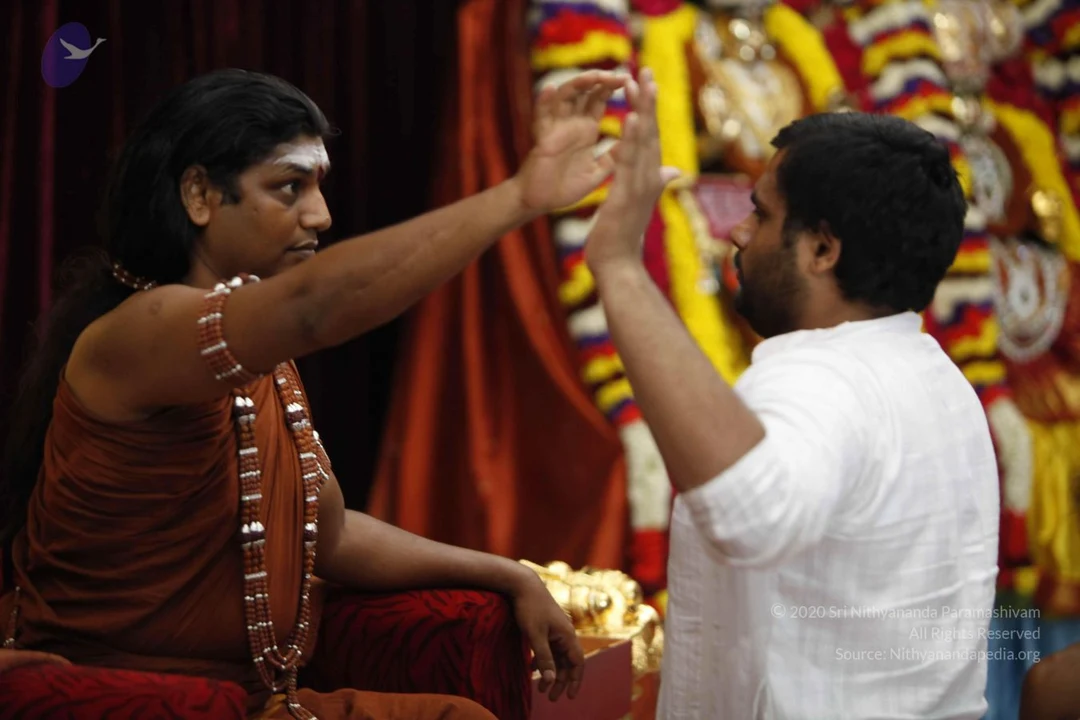
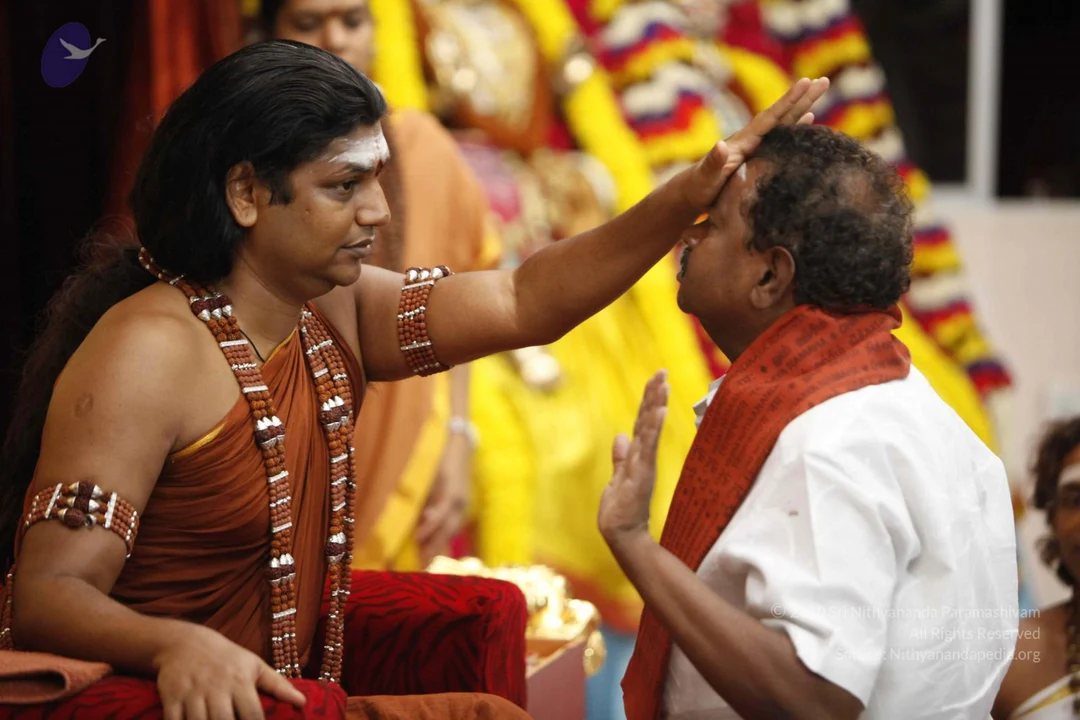
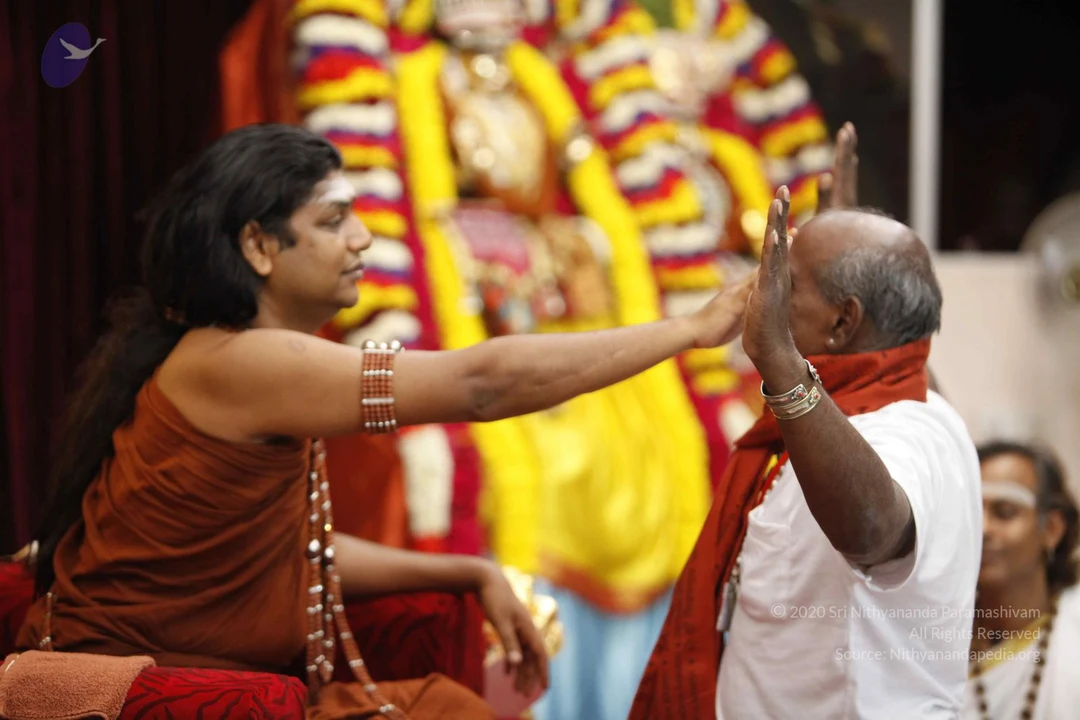
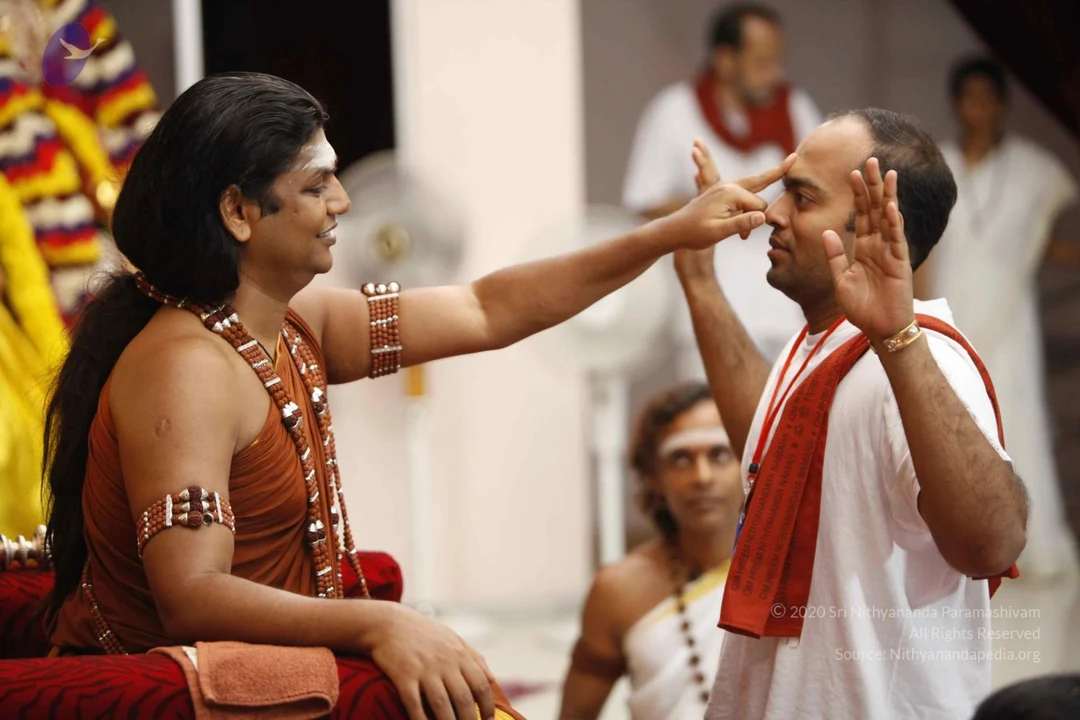
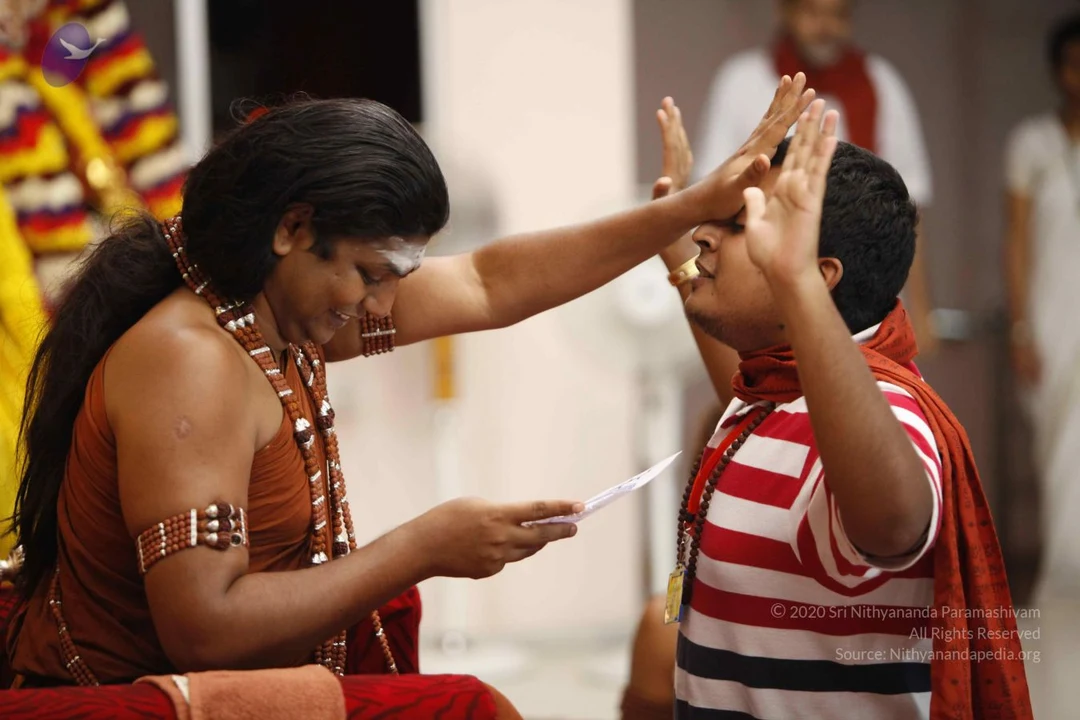
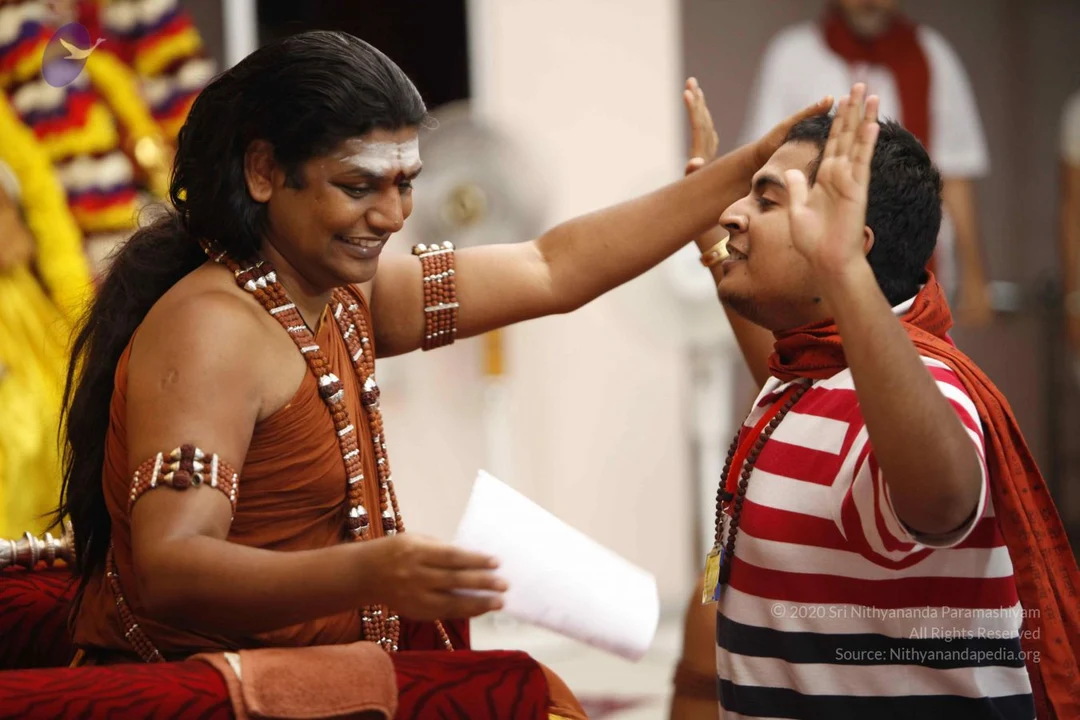
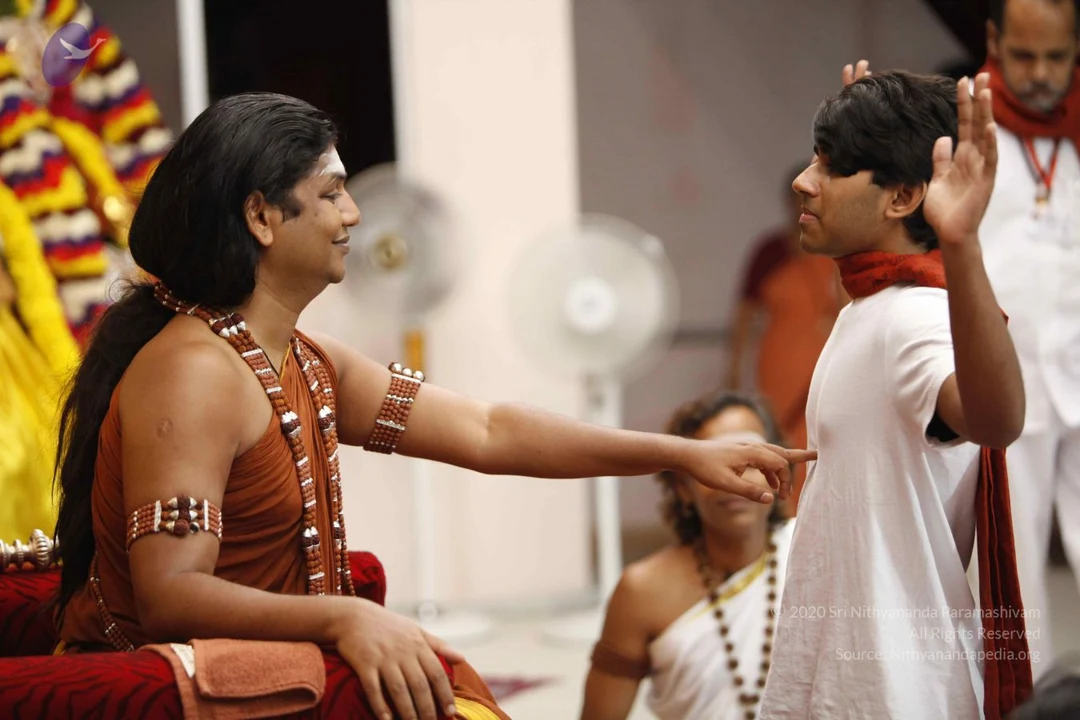
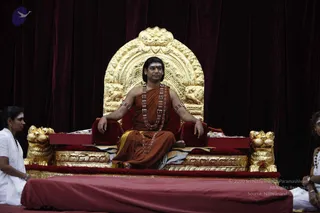
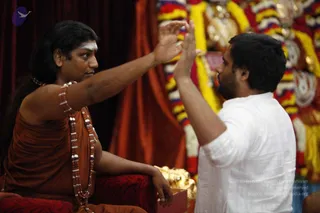
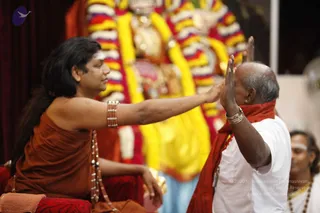
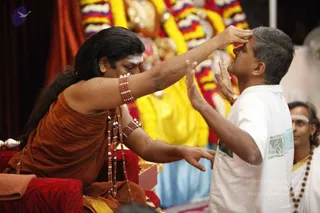
A photograph of a man seated cross-legged on an ornate golden throne with a carved arched back and lion-head armrests, set against a deep maroon velvet drape. He wears an orange-saffron cloth over his torso, multiple rudraksha malas and a gold-toned necklace, bangles on his upper arms, and a red tilak on his forehead; his hair is long and swept back. Two women sit on the low red-draped platform at either side, one in white clothing on the left and one in a white top on the right. Faint printed copyright text appears in the lower right corner. The image shows a seated dais ceremony; the seated man in saffron is a probable Swamiji (appearance cues: long swept-back hair, saffron clothing, rudraksha malas and ornate ceremonial necklace), seated on a throne.A seated man in an ornate golden throne (peetha) with a large gilded arched backrest carved with lion figures, set against deep red velvet drapes. He wears a saffron-orange robe with a yellow-gold drape across the lap and multiple rudraksha malas around his neck and arms, with a red-and-white bindi on his forehead. His hands rest on his lap and armrest, and he is barefoot on a zebra-striped cushion. Small offerings and flower garlands sit on the red-cushioned armrests and the throne base. Swamiji (probable) appears as the central seated figure, shown by long swept-back hair, saffron robe, rudraksha malas and bindi.A seated man with long dark hair, a white vibhuti mark on his forehead, and a rudraksha mala with ceremonial beads, wearing a rust-orange wrap, raises his right hand with palm open toward a younger man in a white kurta who faces him with his own palm raised, as if in blessing or energetic exchange. Behind them, a deity murti or altar is decorated with yellow and red garlands and gold-toned ornaments, with deep red drapery in the background. A gold object sits near the seated man's lap. Probable Swamiji is seated in the orange wrap and mala, with long hair and a vibhuti mark.A seated man with long swept-back dark hair, a white tilak on his forehead, rudraksha malas and beaded armlets, wearing an orange-brown draped robe, places his right hand on the forehead of a man in a white shirt and red-orange shawl with printed text. The seated man's appearance matches the page's Swamiji cues (long hair, saffron-toned robe, rudraksha malas), so this is a probable Swamiji. Behind them, a row of yellow and red garlands and a bright yellow-clad figure suggest a ceremonial setting. A small gold-toned tray sits at the lower right.A seated figure in saffron-orange robes with long swept-back dark hair, a white tilak on the forehead, a red-beaded bracelet and a beaded mala, extends a hand to bless an older bald man in a white shirt with a red-orange shawl and silver bracelets who holds his palms together in namaskar. Behind them a deity murti is decorated with yellow and red flower garlands, and a smaller figure in white with a white tilak sits at the right edge. a person: the seated blessing figure has long swept-back hair, saffron clothing and a rudraksha mala, and is in the blessing role. The setting is a temple-like hall with a red throne-style seat.A photograph of a seated figure in an orange-brown robe and rudraksha malas, with long dark hair and white vibhuti marks on the forehead, placing both hands on the forehead of a man in a white shirt. The figure is seated on a red throne-like cushion before a backdrop of yellow and red garlands and a deity murti draped in yellow and blue cloth. A second person in white with a white forehead mark and a rudraksha mala sits at the right edge. The gesture suggests a blessing or darshan. Swamiji (probable): the seated figure has long hair, orange robes and multiple rudraksha malas, consistent with the page's reference to Swamiji at this event.

Temple

46 photosSource gallery
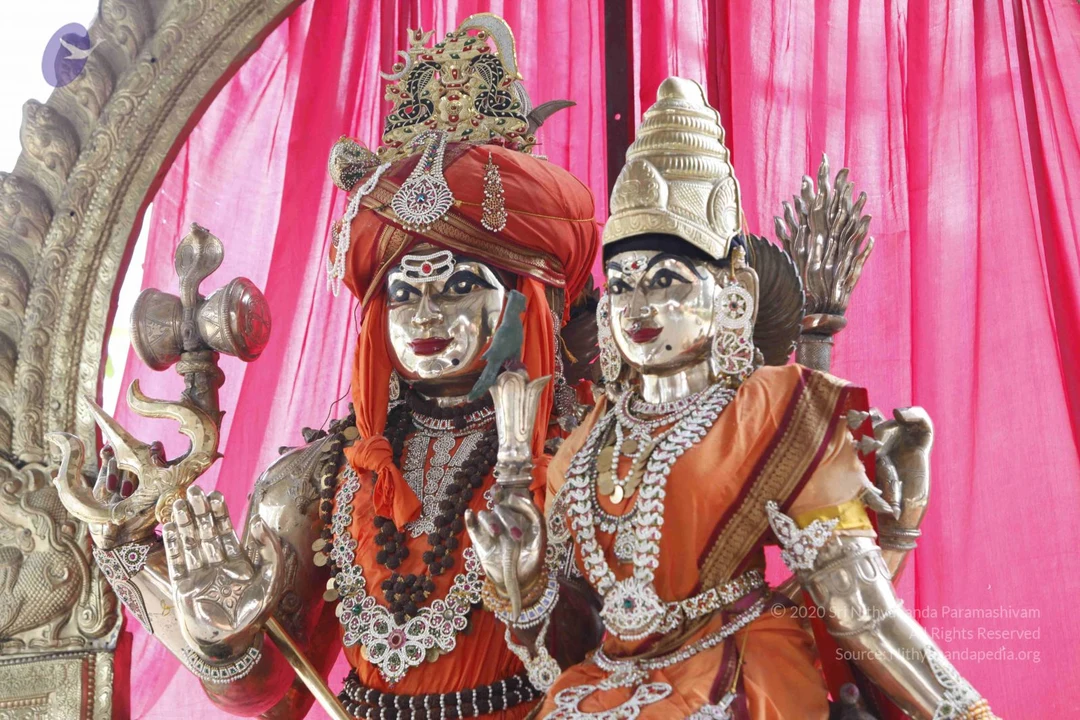
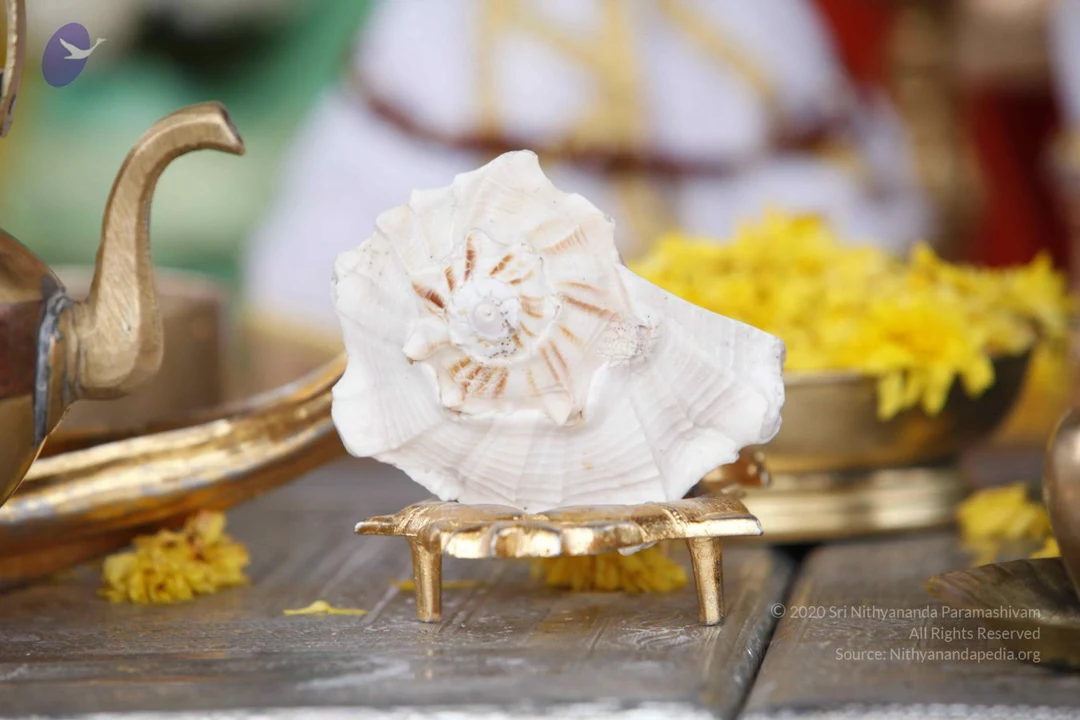
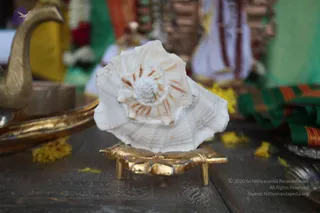
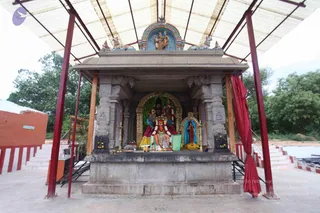
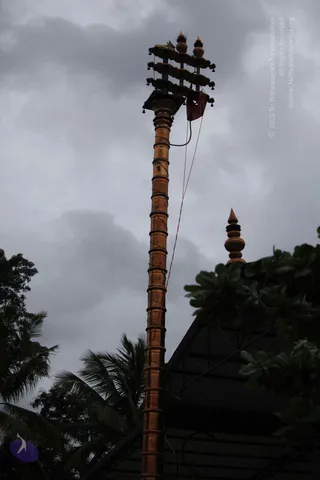
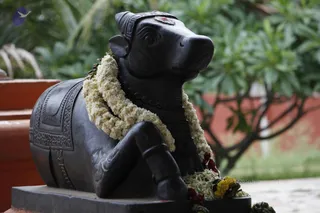
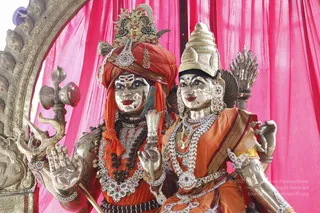
Close-up photograph of a large white conch shell with ridged spiral markings resting on a small ornate gold stand on a dark wooden surface. Yellow marigold petals are scattered around it. Behind it, a golden swan-shaped vessel is visible at left, and a green and orange silk cloth lies at right. Blurred in the background, a figure in white garments with a red-and-gold sash stands near a deity or altar with garlands. No people are clearly in focus. The setting suggests a puja or ritual arrangement.Outdoor photograph of a small grey stone shrine under a corrugated translucent roof supported by red steel posts. Inside the shrine, a deity murti is dressed in red and yellow garments with white flower garlands, seated before a gilded arched niche with green drapery and smaller figures. Brass oil lamps stand at the front, and a red cloth hangs at the right side. Above, a painted panel shows figures in a colourful niche, with stone lions or bulls on the roof corners. Trees and a stepped concrete platform surround the shrine. No people are visible.A tall, slender wooden flagstaff with a stacked, tiered crown of carved wooden platforms and finials rises against an overcast grey sky. A small red cloth flag hangs from the upper section and thin cords run down the pole. Palm and tree foliage and a dark tiled roof with a small finial appear in the lower frame. No people are visible in the scene.A black stone Nandi bull statue sits on a plinth, garlanded with a long white flower necklace and a red-and-yellow flower heap at its base. The bull has a red tilak mark on its forehead and a carved saddle cloth, with a green plant and red wall behind. No people are visible.Two silver-faced statues of deities stand before a pink draped backdrop with ornate gold carved arch at left. The figure on left wears an orange-red turban with a gold crown, rudraksha beads, a large silver chest necklace and holds a trident in raised hand. The figure on right wears a gold conical crown, orange sari, layered pearl and silver necklaces and holds a long staff. Photo is of statues, not living people.Two silver-finished deity murtis stand under a curved golden arch before a bright pink draped cloth. The left figure wears an orange-red turban topped by an ornate golden crown, a rudraksha mala, and a jewelled pendant necklace, holding a trident-like staff and raising a palm in blessing. The right figure wears a golden pointed crown, pearl and bead necklaces, an orange sari-style garment, and holds a staff with a kalasha-like finial. Both have painted red mouths and forehead markings. The scene is a statue display, with no physical people present.

03-Nithya-Satsang
27 photosSource gallery
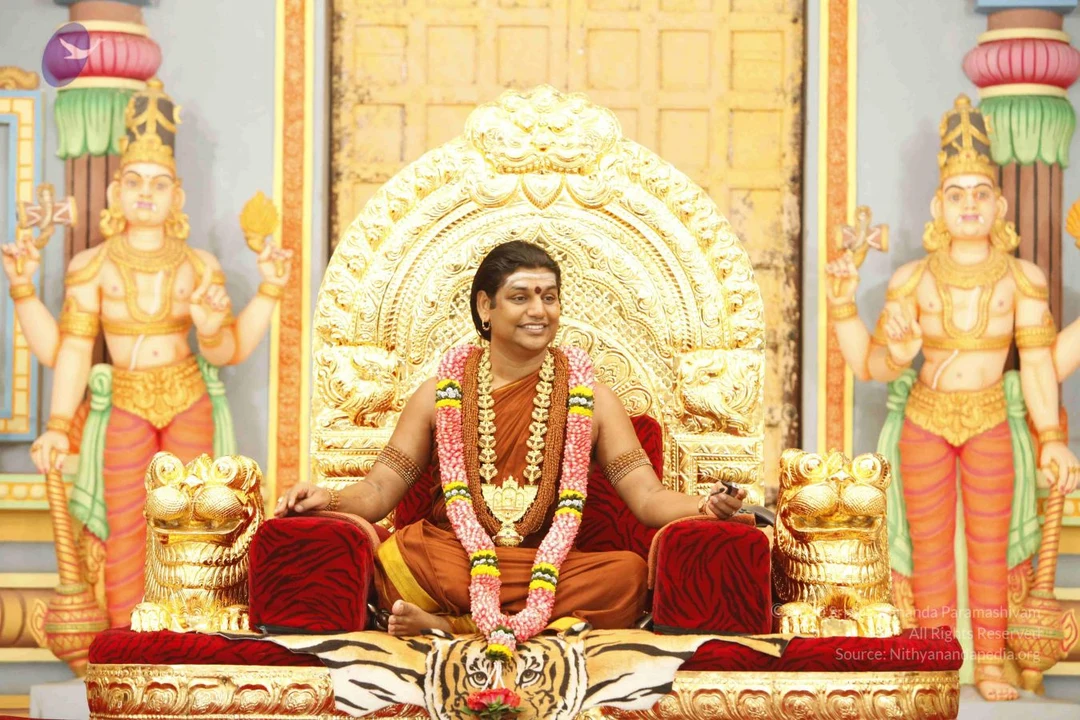
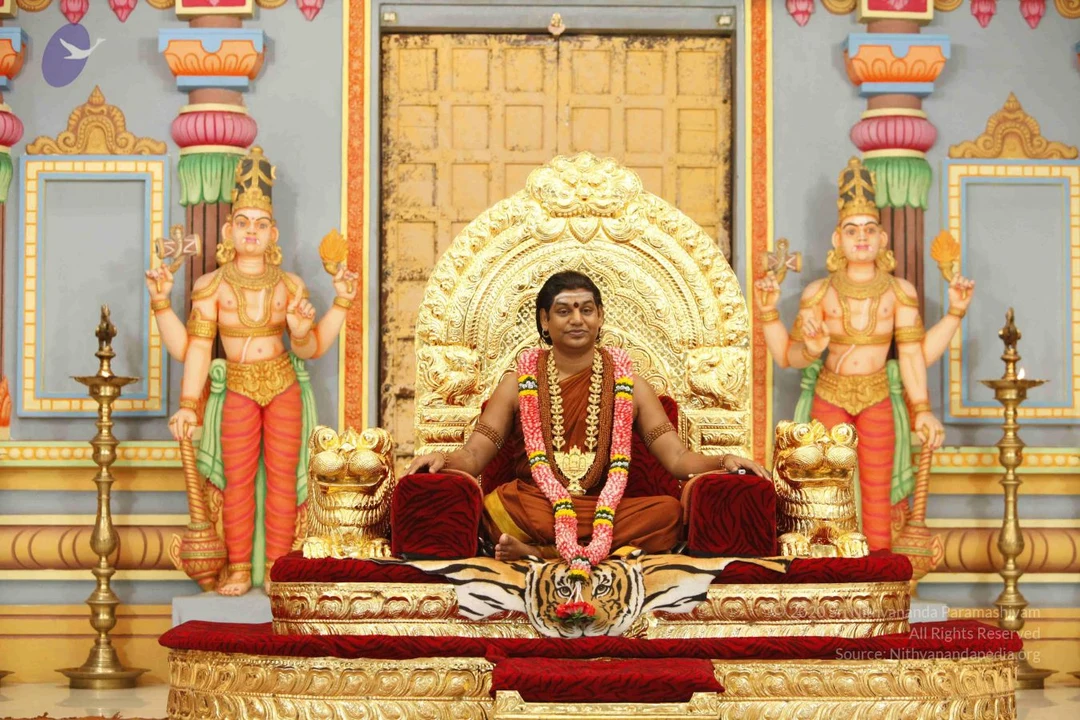
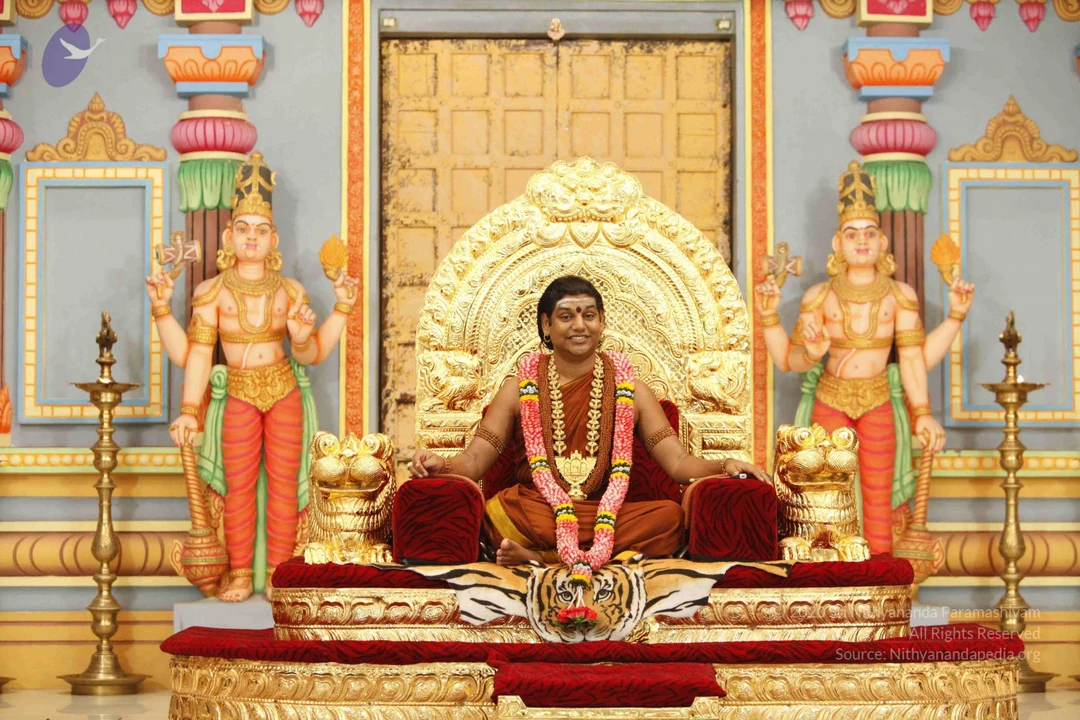
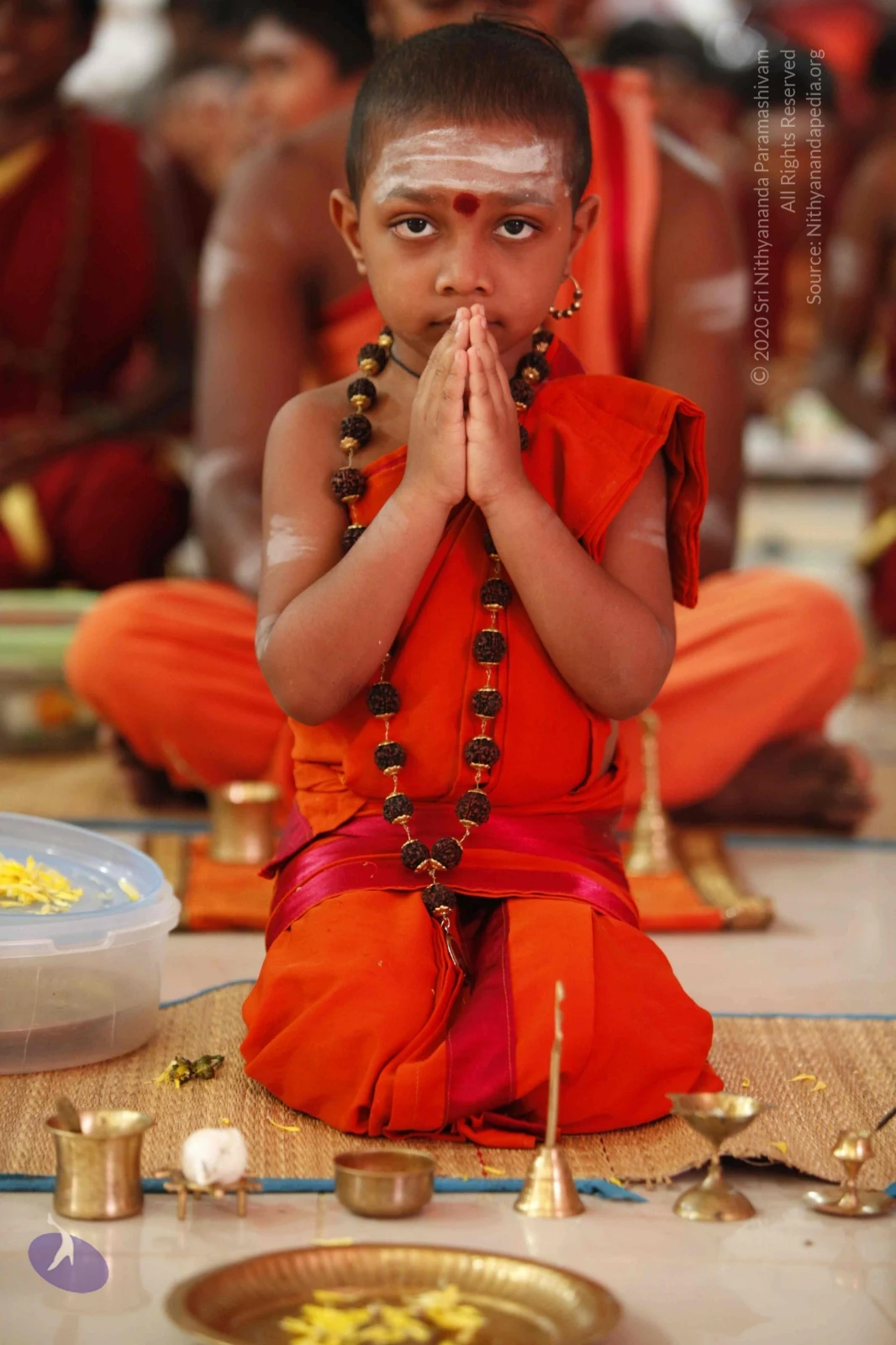
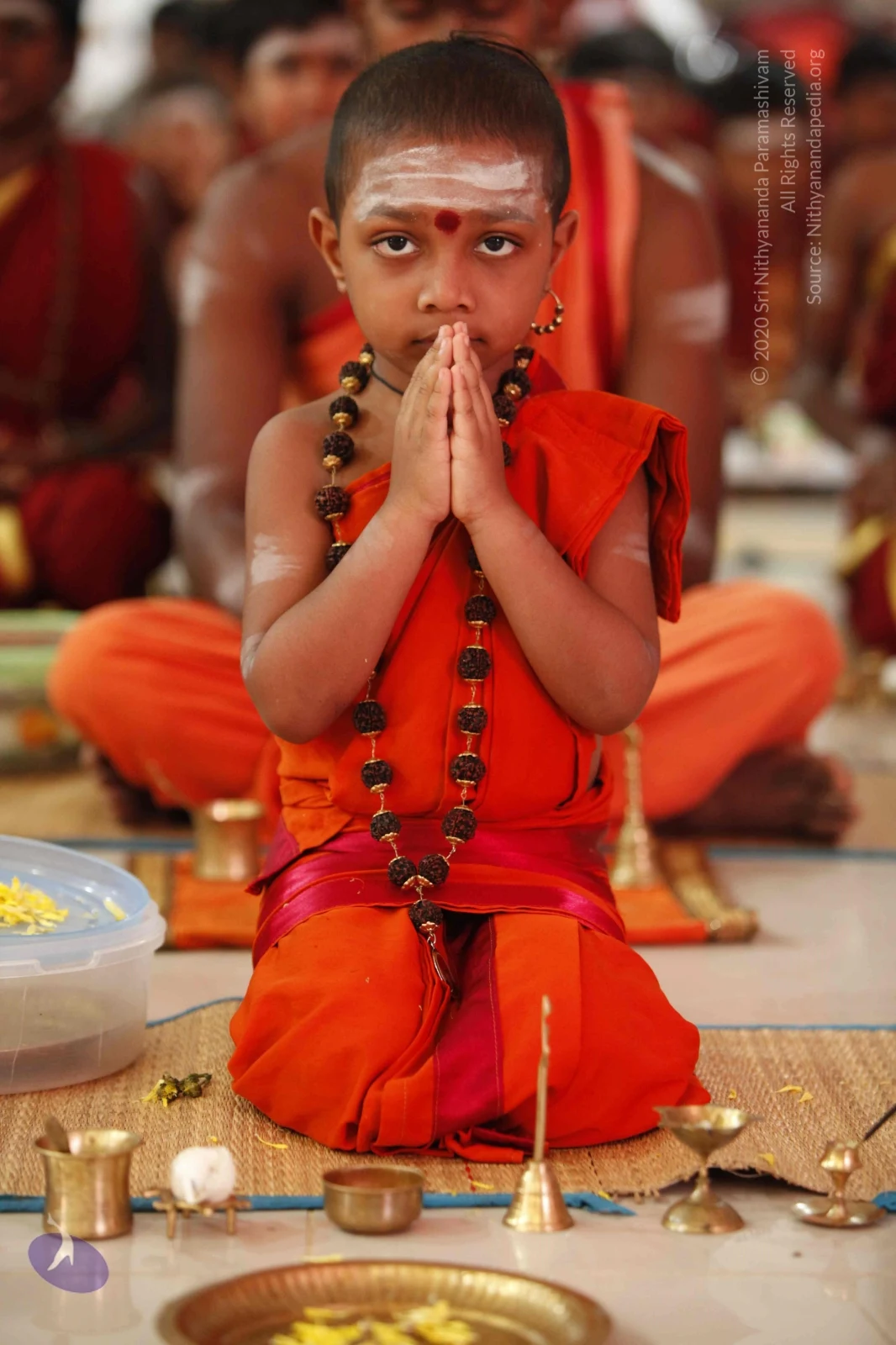
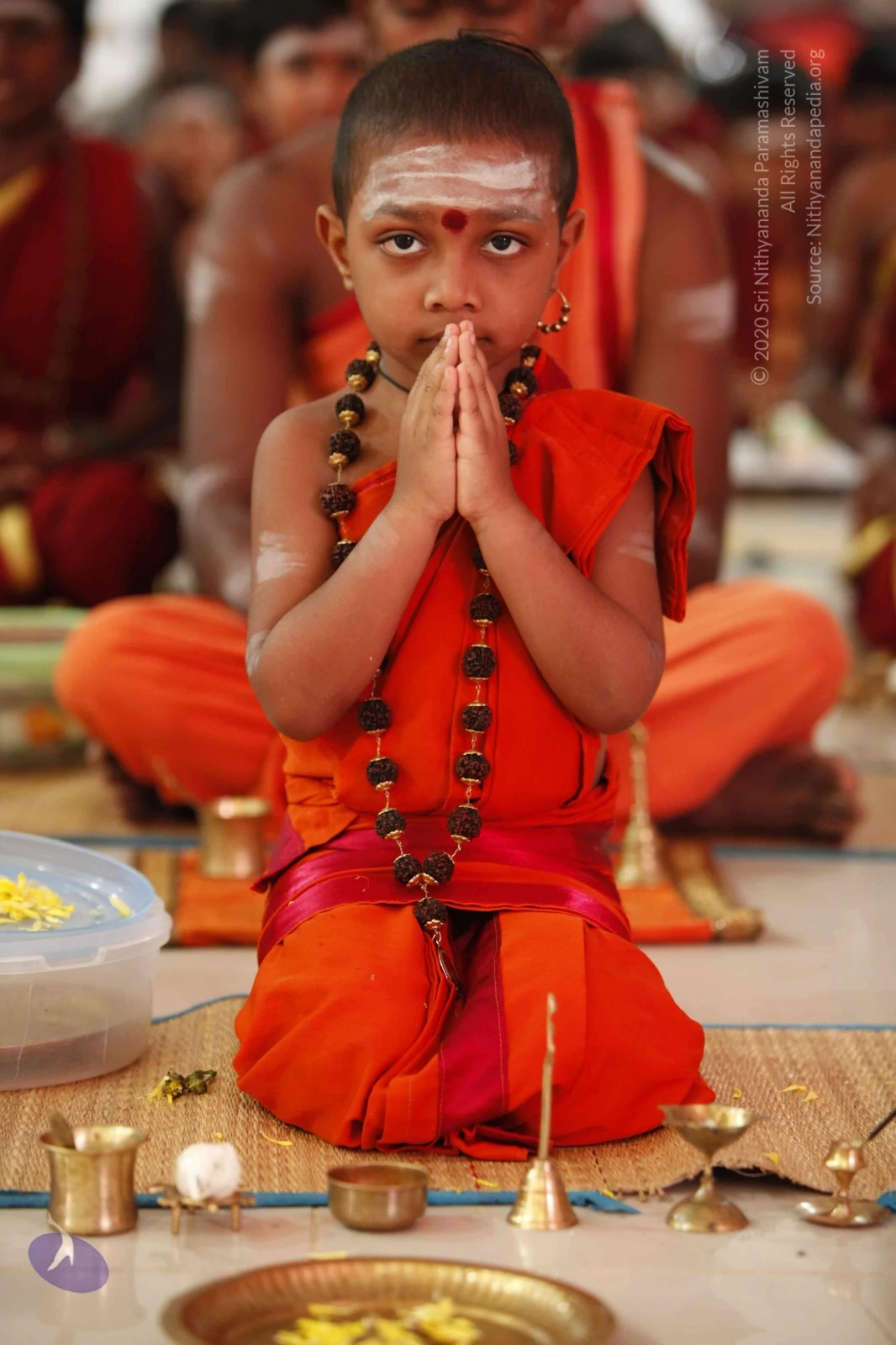
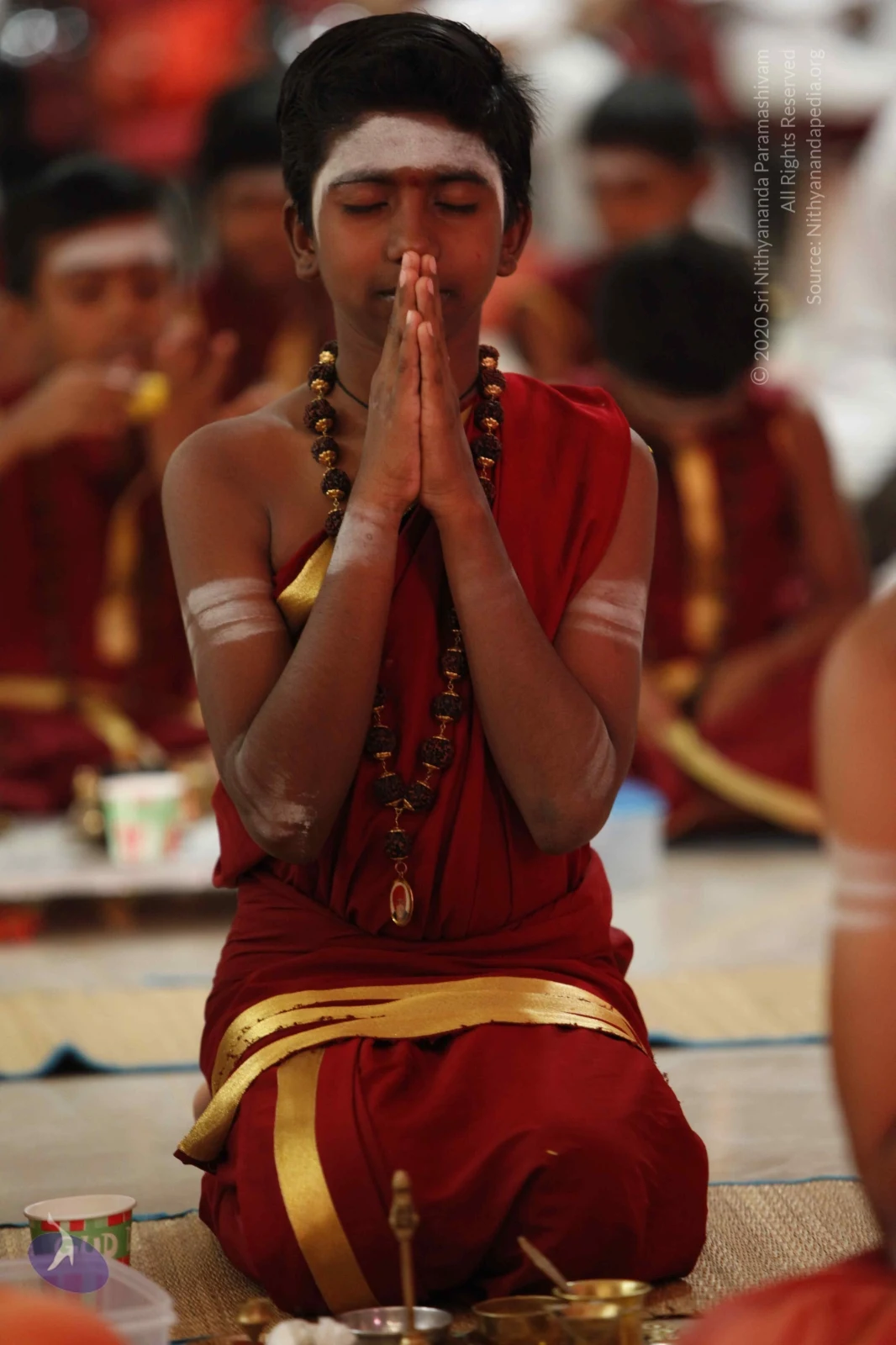
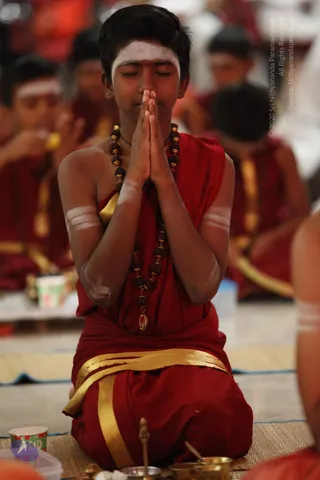
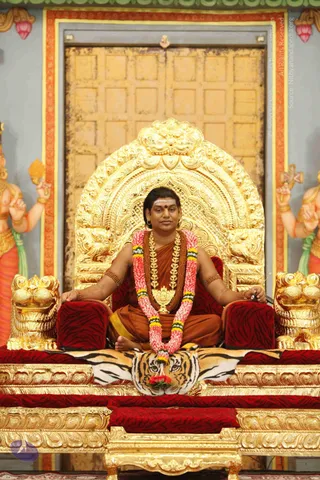
A young boy with a shaved head sits cross-legged on a woven mat in anjali mudra, palms pressed together at his chest. He wears orange-red robes with a red sash and a long rudraksha mala. White sacred ash marks his forehead with a red bindi, and he has a small hoop earring. Behind him, other people in orange and red robes sit in rows. Brass vessels, a brass bell, a small lamp, a tray with yellow flower petals and a plastic container of petals are arranged on the floor in front of him.A young boy with a shaved head, white vertical tilak and red bindi sits cross-legged on a woven mat, palms pressed together in anjali mudra. He wears orange-saffron cloth with a magenta waist sash and a long rudraksha mala with gold spacers. Behind him, many seated people in orange and red robes with white marks on their bodies sit in rows. Brass puja items surround him: a small bell, a diya lamp, a brass bowl, a cup and a tray of yellow flower petals. A plastic container of liquid and scattered petals lie nearby.A young boy in an orange-red sannyasi-style dhoti and shawl sits cross-legged on a woven mat with palms pressed together in anjali mudra. He wears a long rudraksha mala with gold spacers across his chest, white sacred ash lines and a red tilak on his forehead, and a small hoop earring. Behind him, rows of seated devotees in orange and red robes attend the ritual. Brass vessels, a brass bell, a small oil lamp on a stand, a bowl and a tray of yellow flower petals lie on the floor in front of him, with a plastic container of petals at left. The setting suggests a puja or satsang gathering. No a person candidate is identifiable by appearance here.A young boy sits cross-legged on a woven mat with his eyes closed and palms pressed together in anjali mudra. He wears a red dhoti and shawl edged with gold borders, a rudraksha mala with a small pendant, and white tilak marks on his forehead and arms. Behind him, several other boys in matching red and gold robes sit in similar devotional posture, and brass vessels and a small cup sit in the foreground. The setting appears to be a group ritual or satsang with the children seated in rows.A seated man in saffron-orange robes sits cross-legged on an ornate gold throne with lion-head armrests and red tiger-striped upholstery, a tiger skin draped over the dais in front of him. He wears a pink, white and yellow flower garland, a rudraksha mala and a large ceremonial gold necklace, with a red bindi on his forehead and gold armbands. His hands rest on the armrests. Behind him stands a large gold-panelled door, and on either side are painted figures of deities holding lotus flowers and implements. The person is appearance-based a person seated in an in-person satsang setting, with the saffron robes, mala and gold necklace as the visible cues.A seated man in saffron-orange robes sits on an ornate gold-carved throne with red tiger-stripe upholstery, a tiger-skin rug draped across the platform beneath him. He wears a pink and yellow flower garland, a gold ceremonial necklace with a large gold pendant, a rudraksha mala, gold armbands and a sacred vibhuti line with a red kumkum dot on his forehead. His hands rest on the armrests. A large gold arched backdrop with lion motifs frames him.
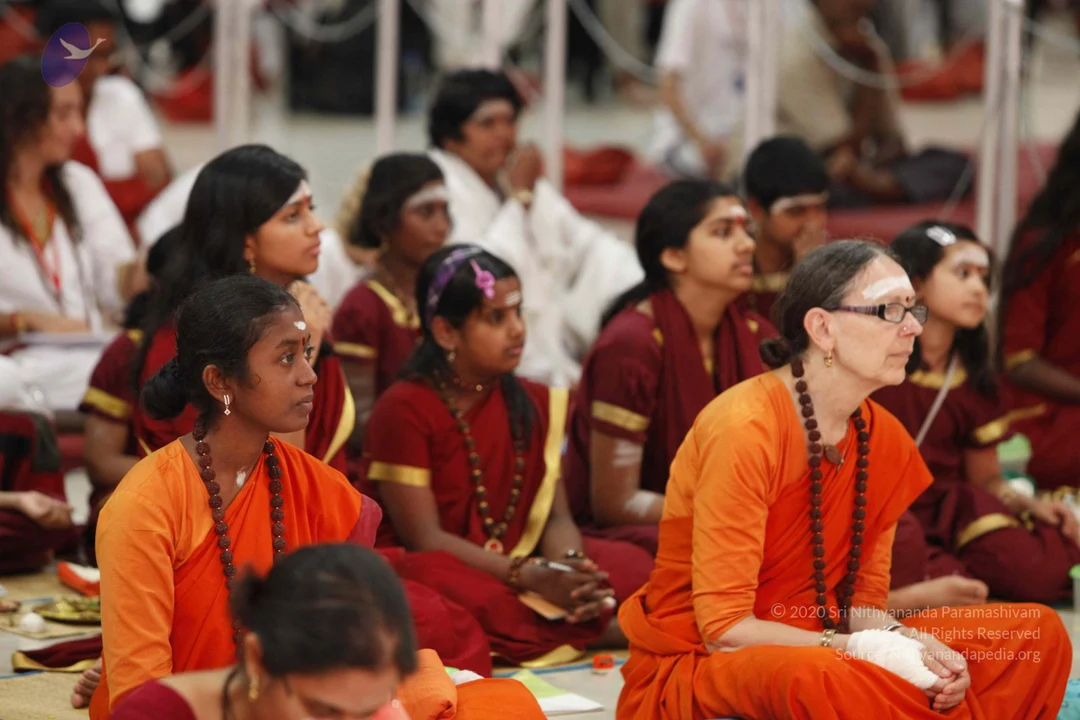
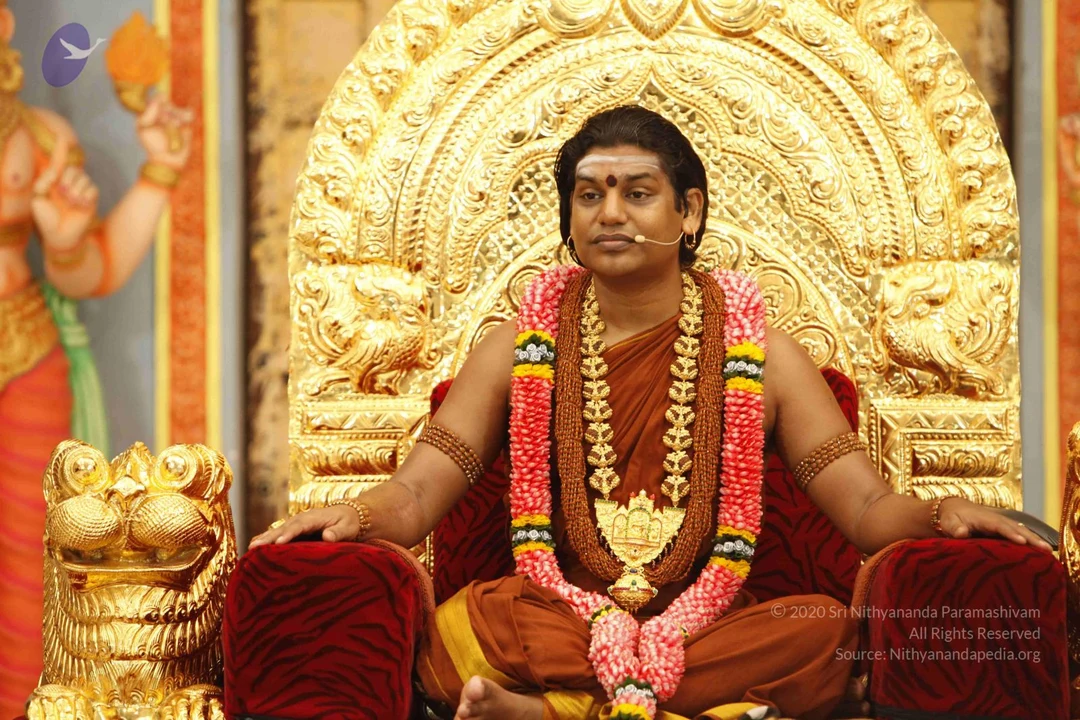
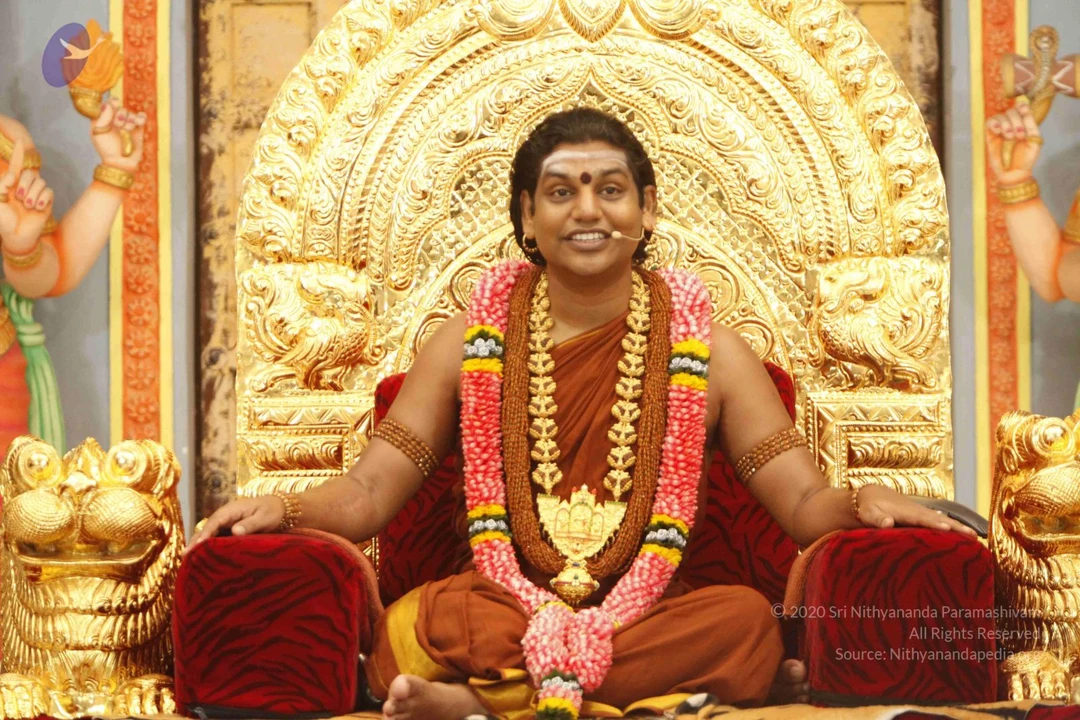
04-Sarva-Darshan

2 photosSource gallery
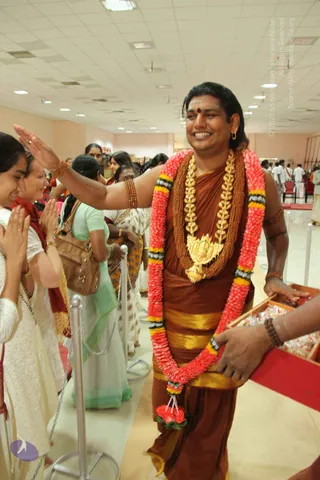
A smiling man in a brown and gold sannyasi-style robe stands in a hall with a long red and pink flower garland, rudraksha mala and a gold ceremonial pendant. He raises one hand in greeting while a helper in the foreground holds a tray of sweets. To the left, several women in white and cream saris press their palms together in anjali. Devotees and attendants stand in a line behind metal stanchions under ceiling lights.A photograph inside a bright tiled hall at a Sarva Darshan event. A man in a brown saffron-toned robe with a gold waist sash and a thick gold ceremonial necklace, wearing a red-and-yellow flower garland, walks forward smiling and extends one hand toward devotees. Devotees along metal crowd-control barriers press palms together in namaste; one woman wears a red turban and white clothing, another wears a white sari. A person at right in a white shirt stands with arms folded, and a hand holds a red wooden tray of offerings at lower right.

08-IA-Session

4 photosSource gallery
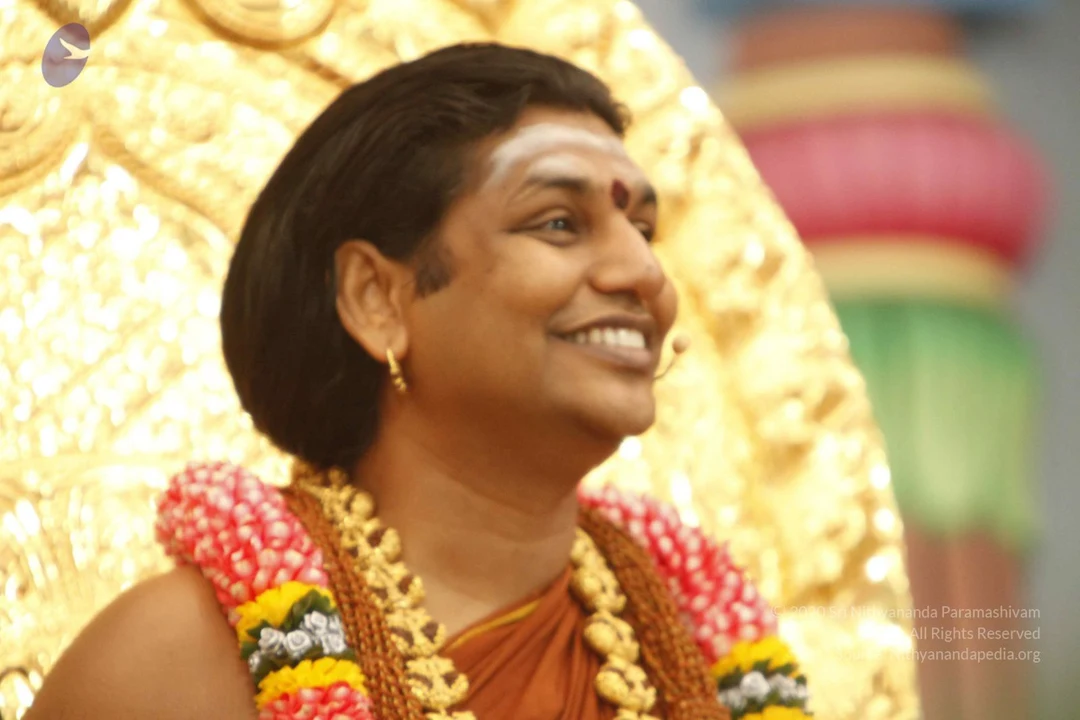
A photograph of a man seated on an orange leather throne-style chair, smiling, with a small microphone clipped near his mouth. He has long dark hair, a red bindi and white vertical tilak on his forehead, and wears rust-orange robes with a gold-bordered cloth over one shoulder and a long woven orange-gold garland (mala) around his neck. His hands are clasped together in his lap. Behind him is a large deity murti draped in multicoloured marigold garlands in red, yellow, white and purple. Swamiji (probable): long swept-back hair, saffron-orange robes, rudraksha-style garland and ornate seated throne match the appearance of the Nithyananda Paramashivam profile.A seated person speaks while smiling, wearing a rust-orange draped garment with a gold border and a thick orange-gold beaded necklace. A small red bindi marks the forehead, and a lapel microphone is clipped near the face. The seat is an orange leather armchair with wooden armrests, and a blurred colourful floral garland hangs at the upper left against a pale wall. Swamiji (probable) cues are present: long swept-back hair, ornate gold-trimmed saffron clothing and a ceremonial beaded necklace, shown seated in a teaching position.A smiling man with long, swept-back dark hair and a red kumkum dot on his forehead sits in an orange upholstered armchair with a folded orange cloth on the armrest. He wears a rust-orange shawl draped over his shoulders with a gold border and a long woven orange rudraksha-style mala looped around his neck. A small clip-on headset microphone is visible near his cheek. Behind him, blurred garlands in yellow, red, purple and white hang near the top left.A man with shoulder-length dark hair sits in an orange leather armchair against a deep red curtain, speaking with a small headset microphone. He wears a rust-orange sleeveless robe with a gold-bordered wrap, a beaded orange-brown necklace, and a red dot on his forehead. He gestures with one hand while the other rests on the chair arm, appearing to address an audience. No other people are visible.
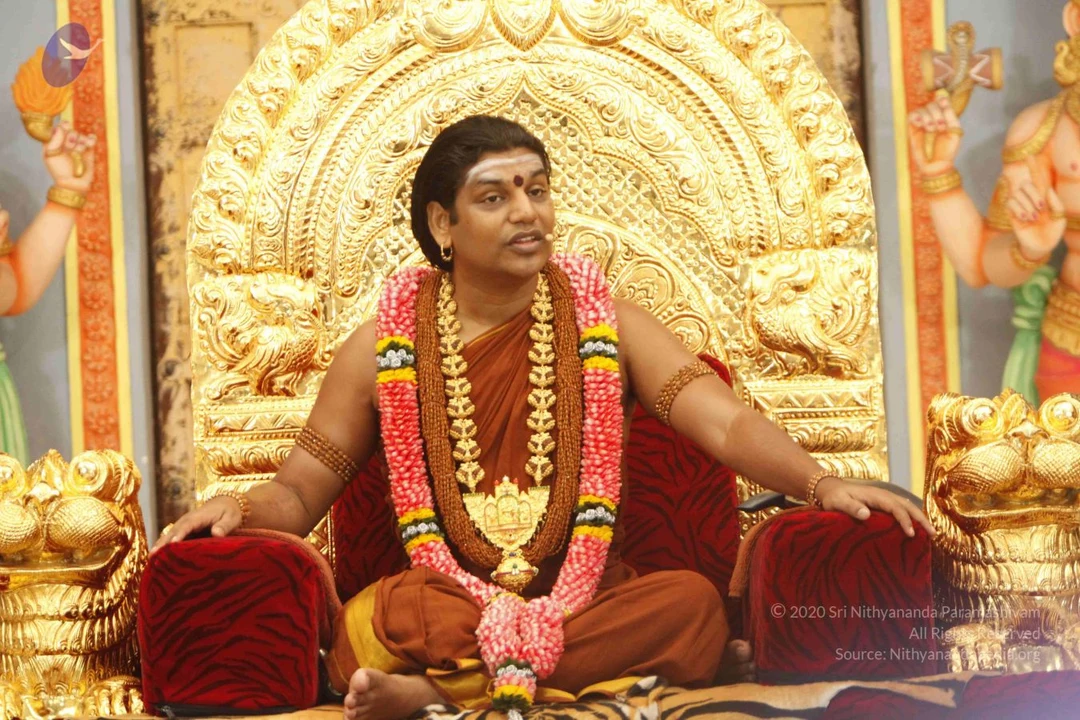
10-Temple

13 photosSource gallery
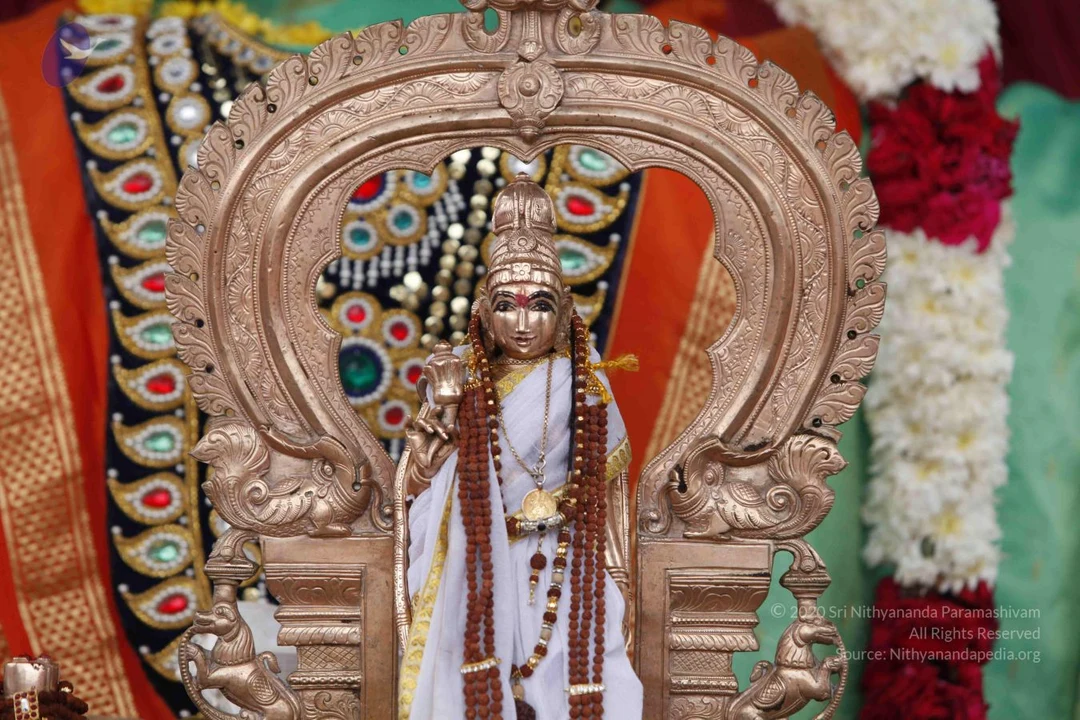
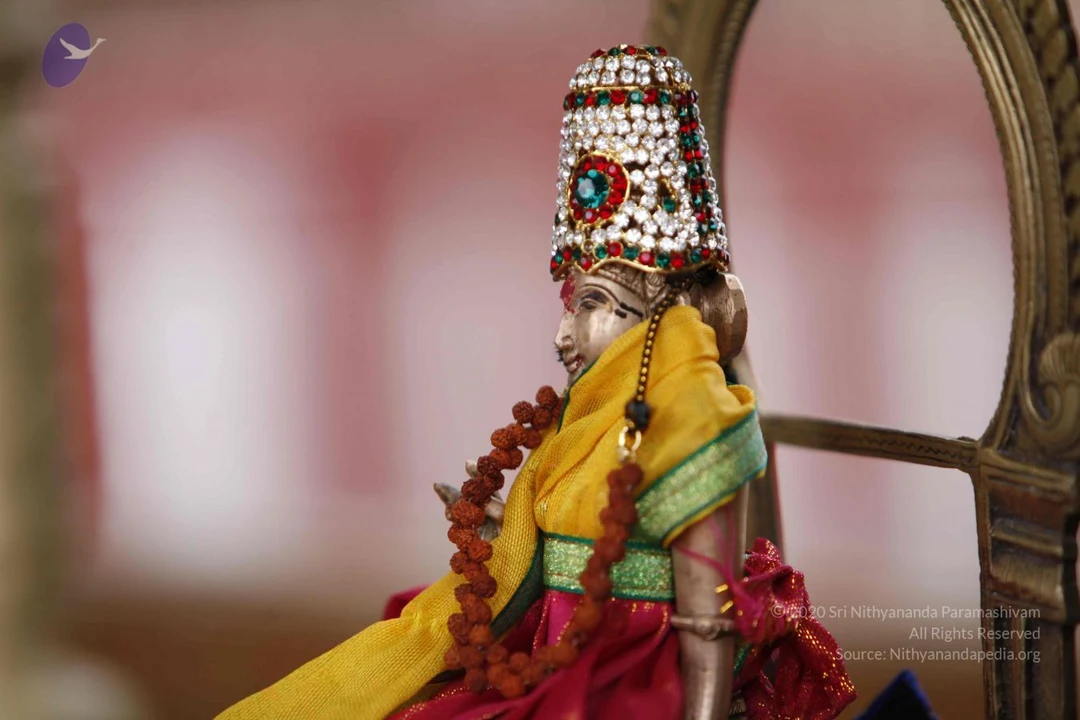
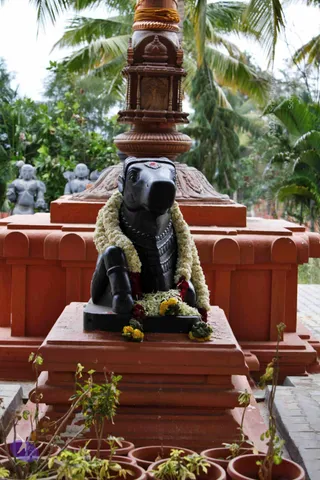
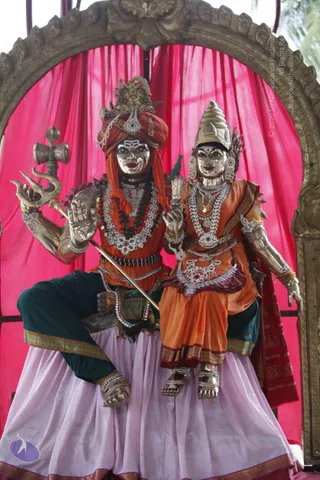
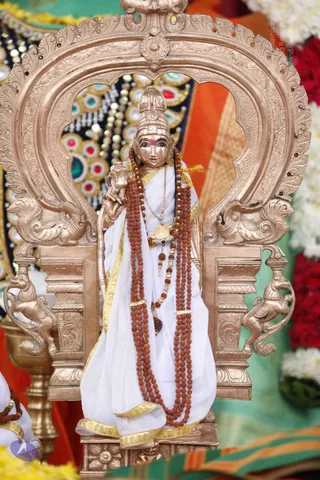
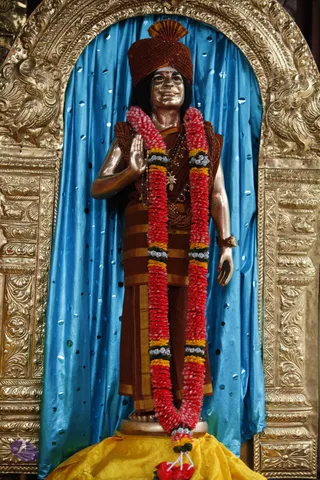
A photograph of a black stone Nandi bull statue seated on a red sandstone plinth in an outdoor temple courtyard. The Nandi wears a white jasmine garland and red and yellow marigold garlands, with a small red tilak mark on its forehead and a beaded necklace. Offerings of marigolds and loose flowers lie at its base. Behind it rise a tall red carved stone pillar topped with a small shrine motif, a palm tree and greenery, and grey statues of figures in the background. Potted plants sit in terracotta pots in the foreground. No people are visible.A photograph of two silver-faced deity murti statues seated together on a raised pink-draped platform within an ornate gilded arched frame. The figure on the left wears an orange turban with a crown, orange cloth, a rudraksha mala and layered silver necklaces, holding a trident in one hand and a raised palm; the figure on the right wears a silver crown, an orange sari-style garment with a gold border, layered silver garlands and anklets, and holds a small bird and a ceremonial object. Both have silver faces with tilak markings. The lower skirt is pale lavender with gold border. The image is a photo of statues, with no physical people present.A bronze utsava murti of a deity stands within an ornate bronze arch with carved makara-style supports, dressed in a white cloth with gold border and draped with multiple strands of rudraksha malas and a gold chain with pendant. The figure holds a ritual object in one hand, wears a tall crown and a red tilak on the forehead. Behind it are a jeweled embroidered backdrop in orange, red and green, white and red flower garlands, and a brass lamp stand at left. No people are visible.A small metal deity murti seated on a blue cushion in front of an ornate gold arch. The figure wears a jewelled crown set with white stones, red and green gems, a yellow shawl edged with green-gold border over a red and gold silk garment, and a long rudraksha mala. A red tilak marks the forehead. The image is a photograph of the statue; no physical people are visible.Close photograph of a small metal figurine of a seated deity murti on a blue cloth-covered surface. The figure wears an ornate jewelled crown set with white stones, green and red gems, a yellow shawl, a magenta and red silk skirt with a green waistband, and a long rudraksha mala. The background is softly blurred pink and white architecture. The figure is a statue, so no physical people are present.A standing statue, not a living person, in a gilded ornate arch framed by a blue satin curtain with mirror-like dots. The statue wears a red-brown turban, a brown robe with gold trim, and layered rudraksha beads with a pendant. It has a raised right hand in blessing and a thick garland of red and white flowers with yellow and grey blooms hanging from the neck. A yellow cloth drapes the base. The statue is a depiction and shows no physical people.
July 16 2013

1 photoView all
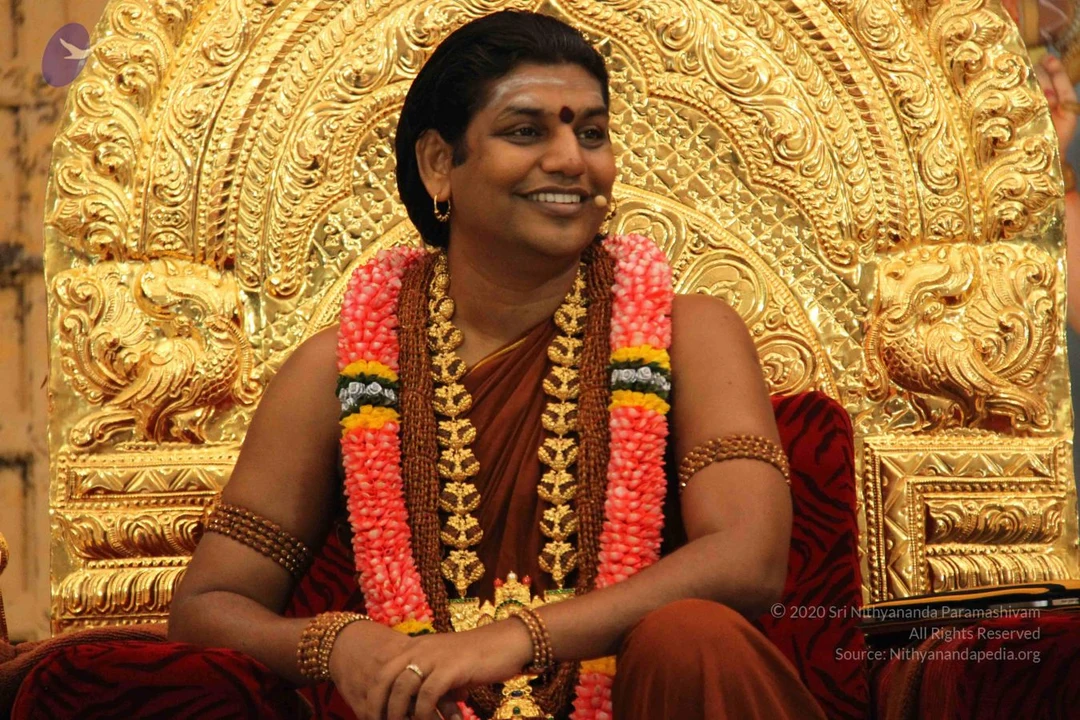
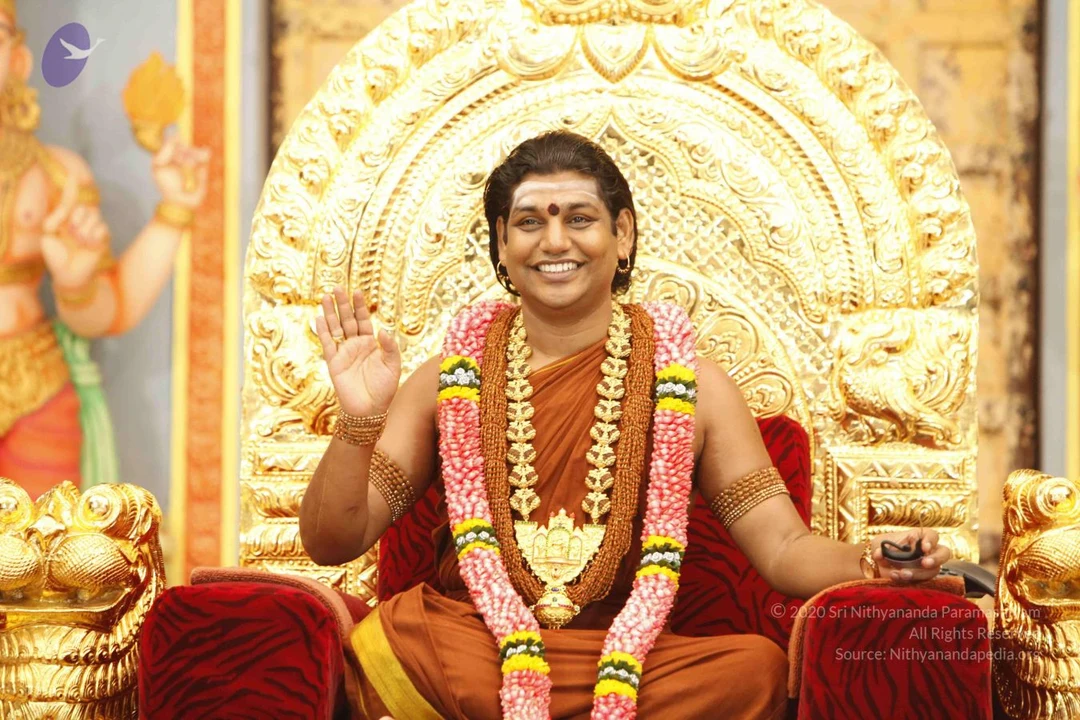
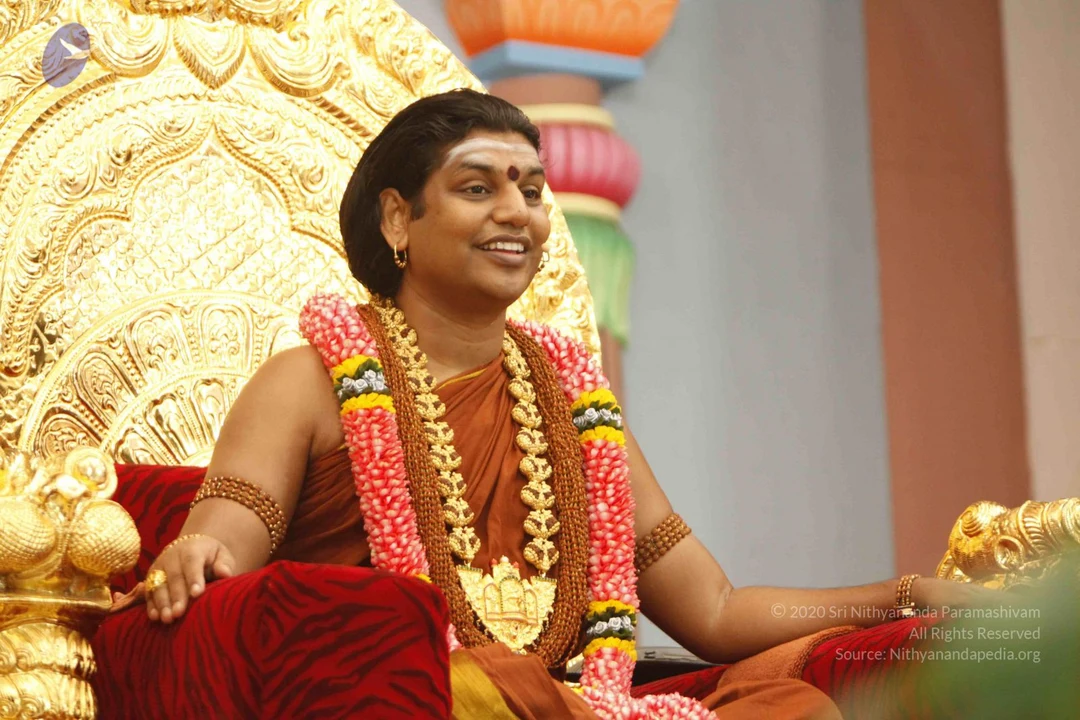
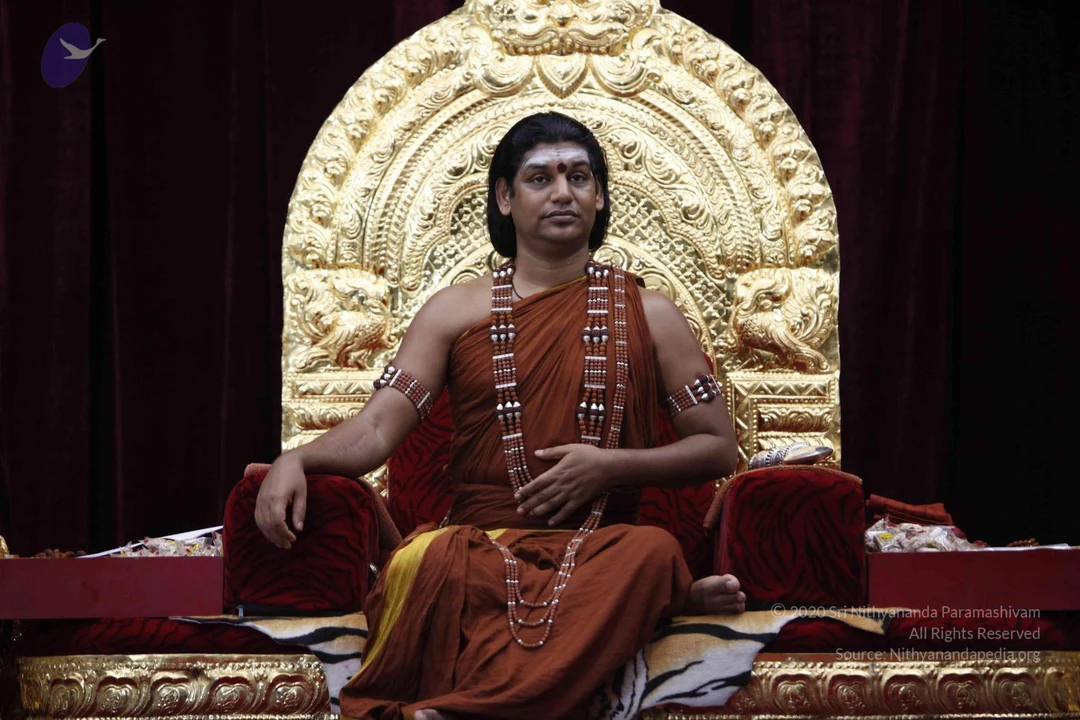
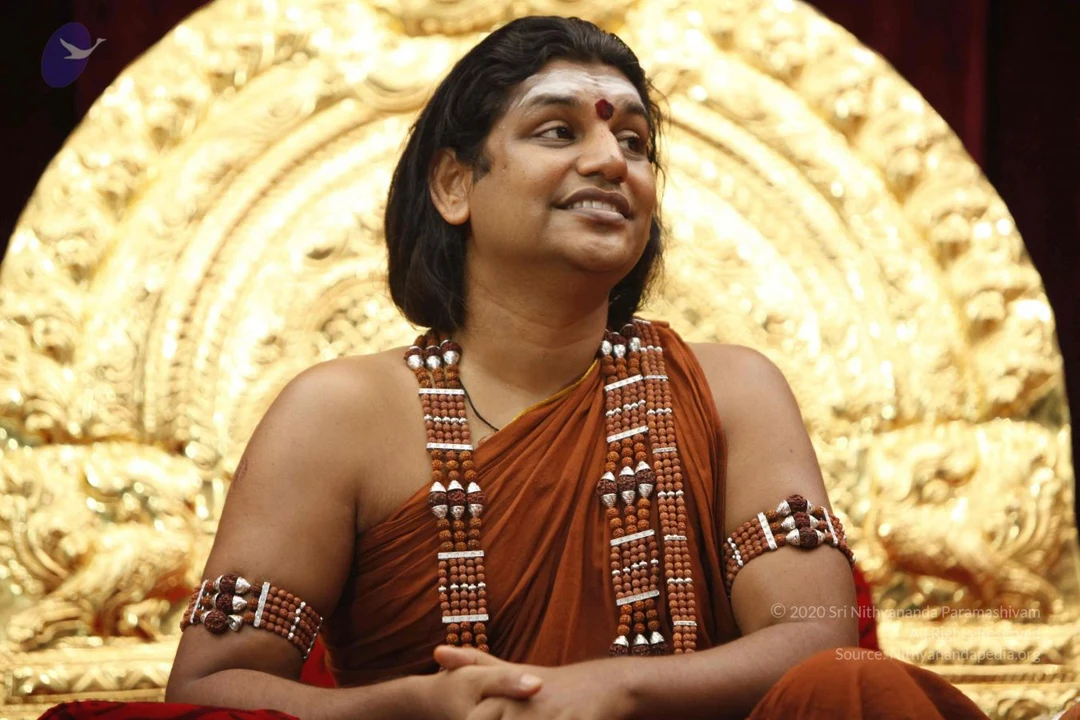
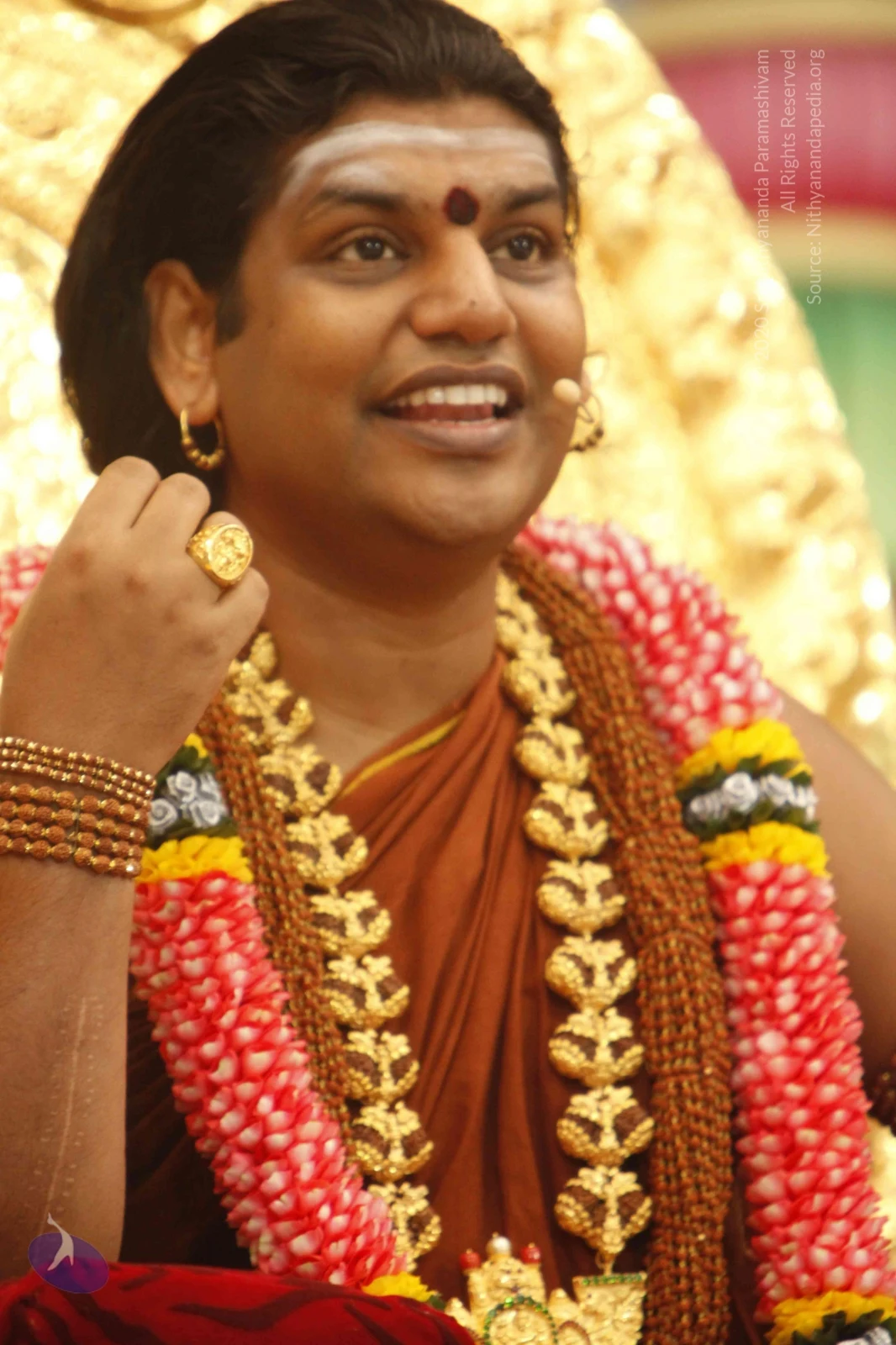
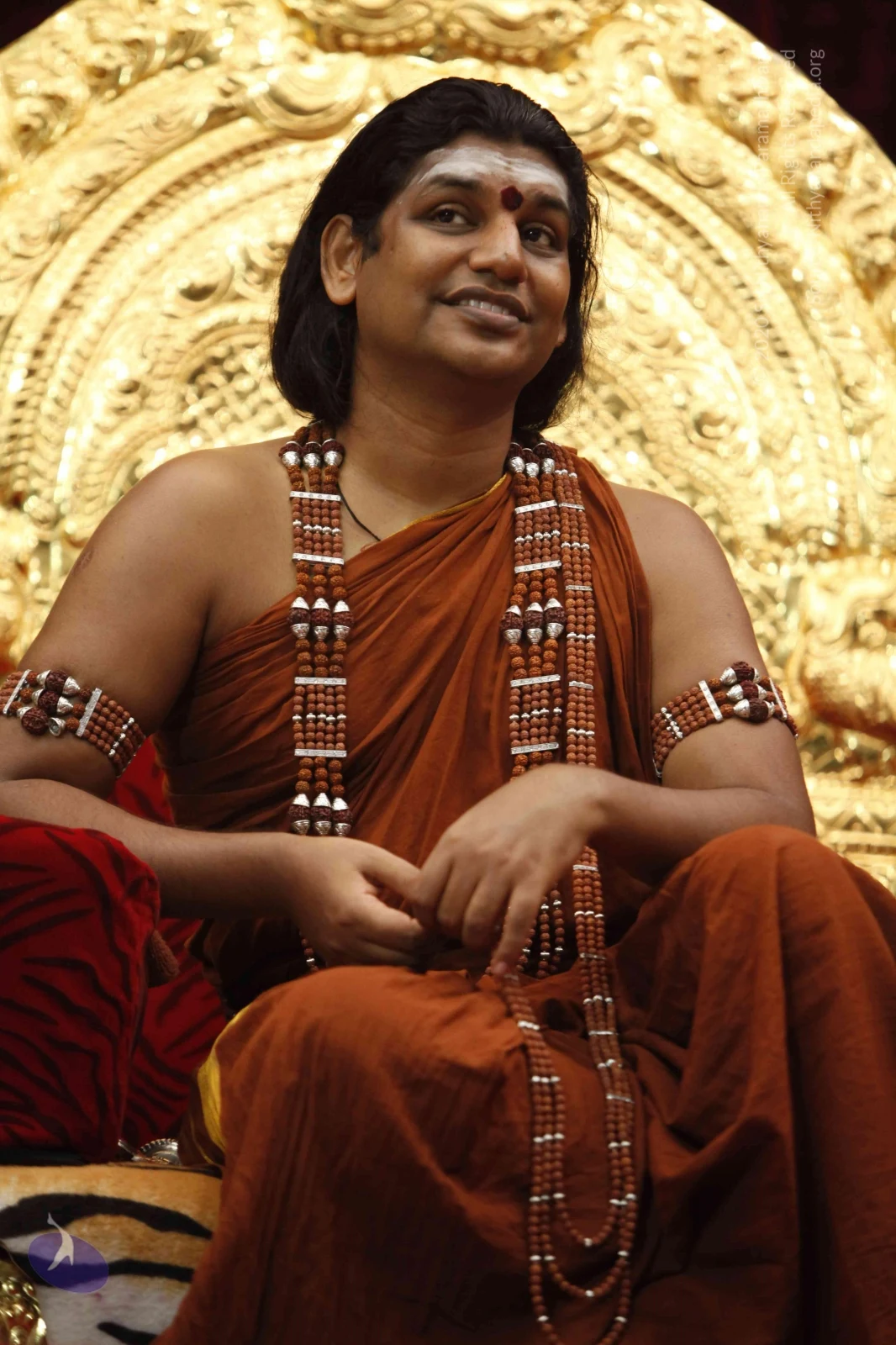
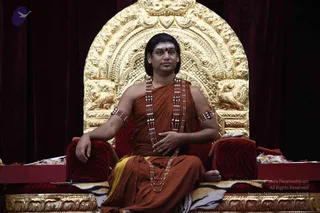
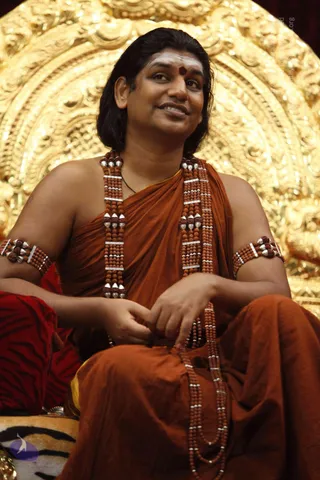
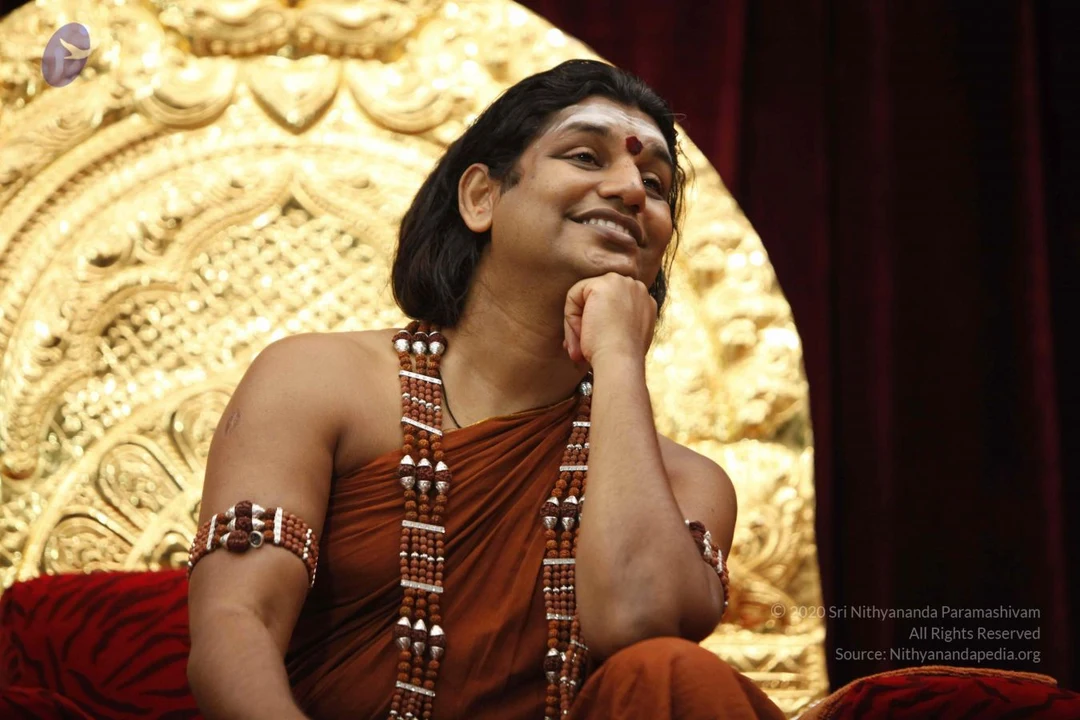
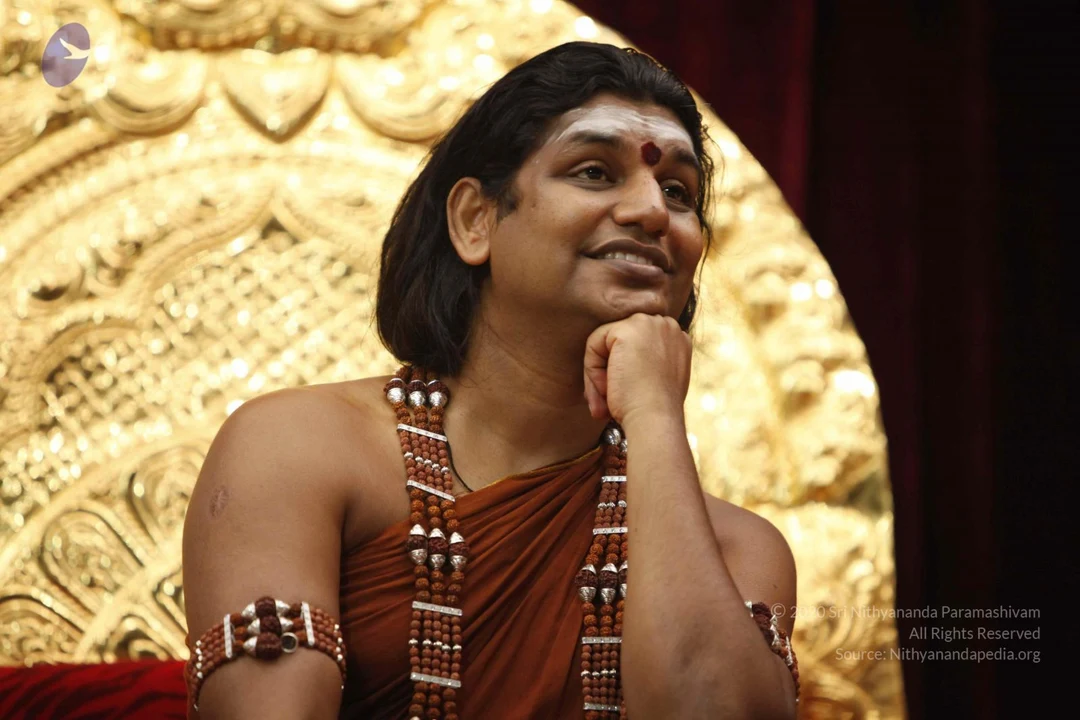
A seated man in an orange-saffron garment sits before an ornate gold repoussé backdrop with floral and scrollwork patterns. He wears long rudraksha mala necklaces with silver caps and spacers, matching rudraksha armlets on both upper arms, and a red bindi with white tilak on his forehead. His long dark hair is swept back, and he rests his hands together in his lap while smiling. A red and black tiger-striped cloth is visible at the lower left. Ceremonial stage setting suggests a satsang or darshan. Probable Swamiji appearance cues: long swept-back hair, saffron clothing, rudraksha malas and ceremonial adornments, seated on a golden throne-style backdrop.