Skip to content
Wednesday

20 February 2013

February, 20 2013

Dated photos
249
Source pages
1
Media
1
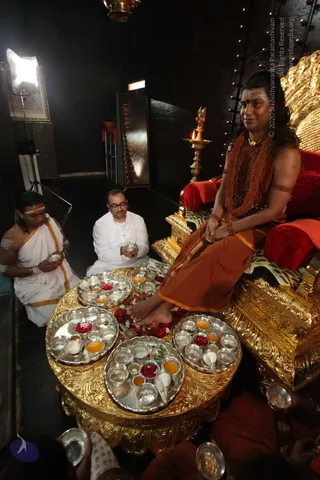
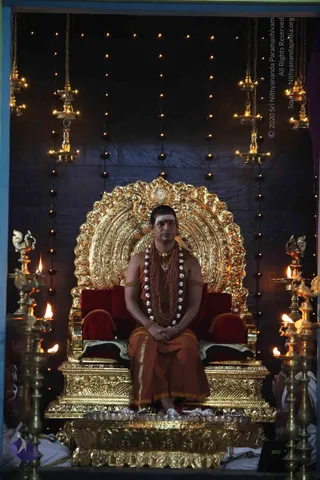
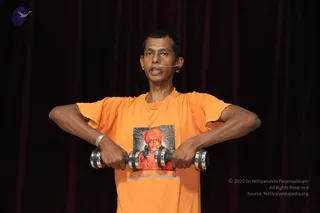
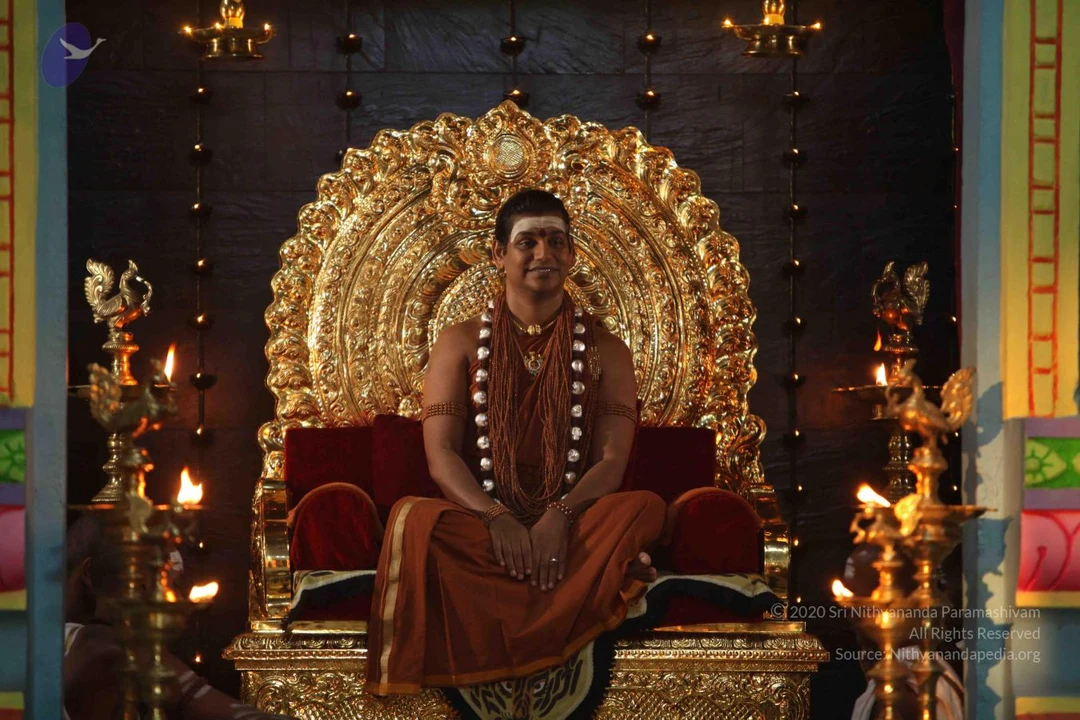
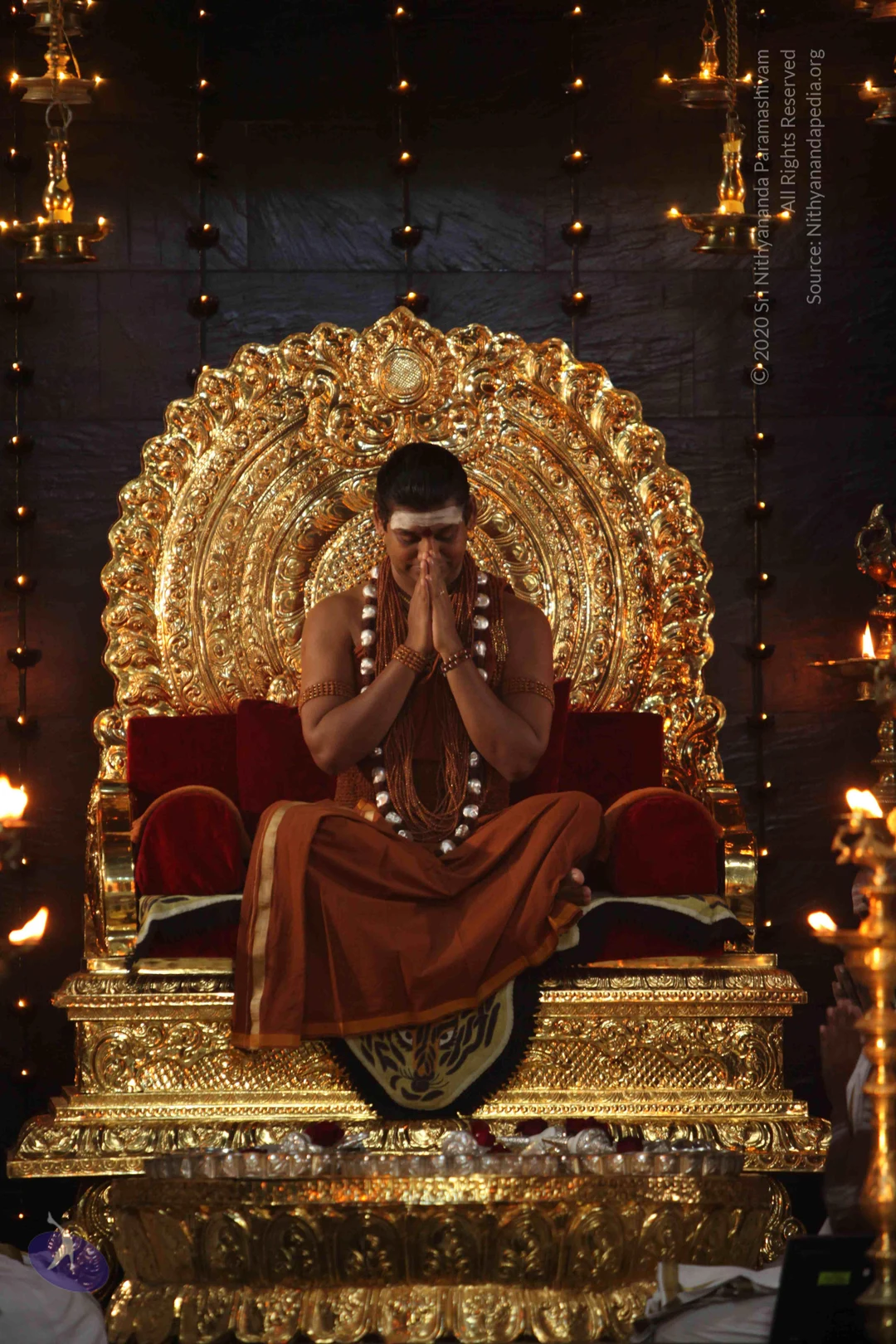
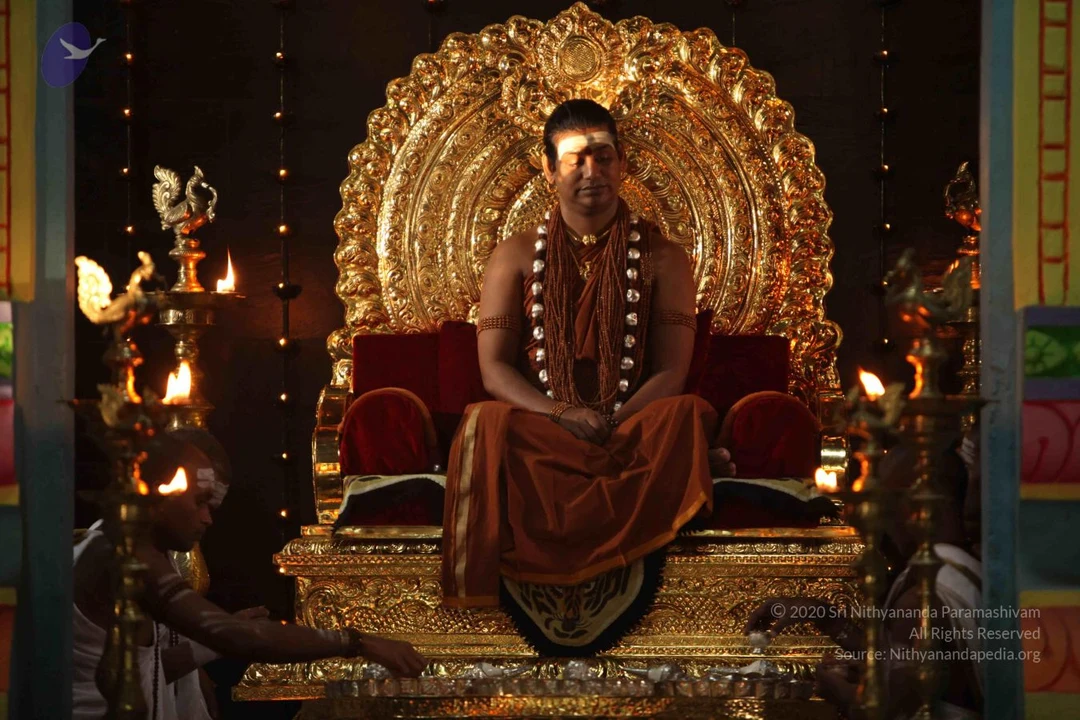
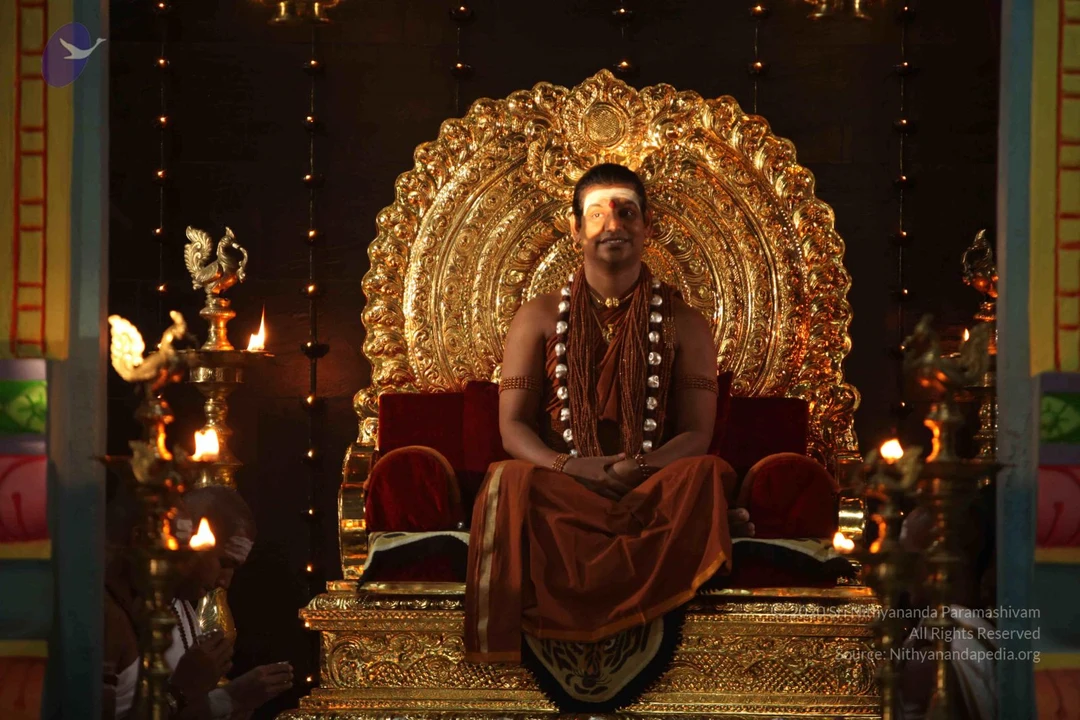
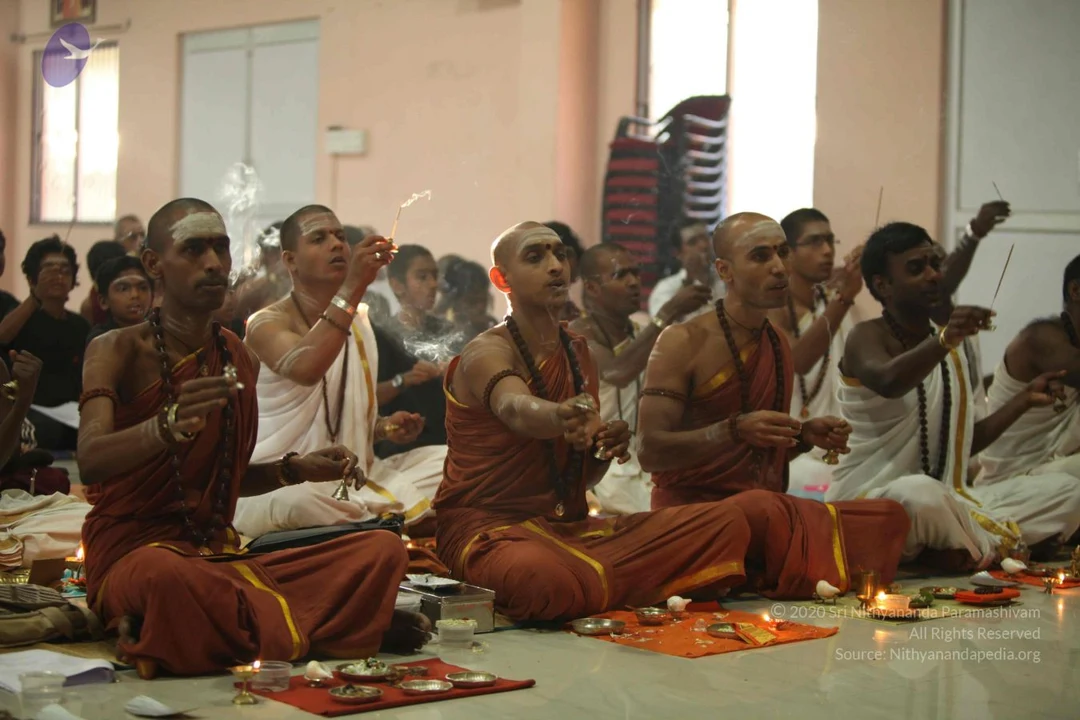
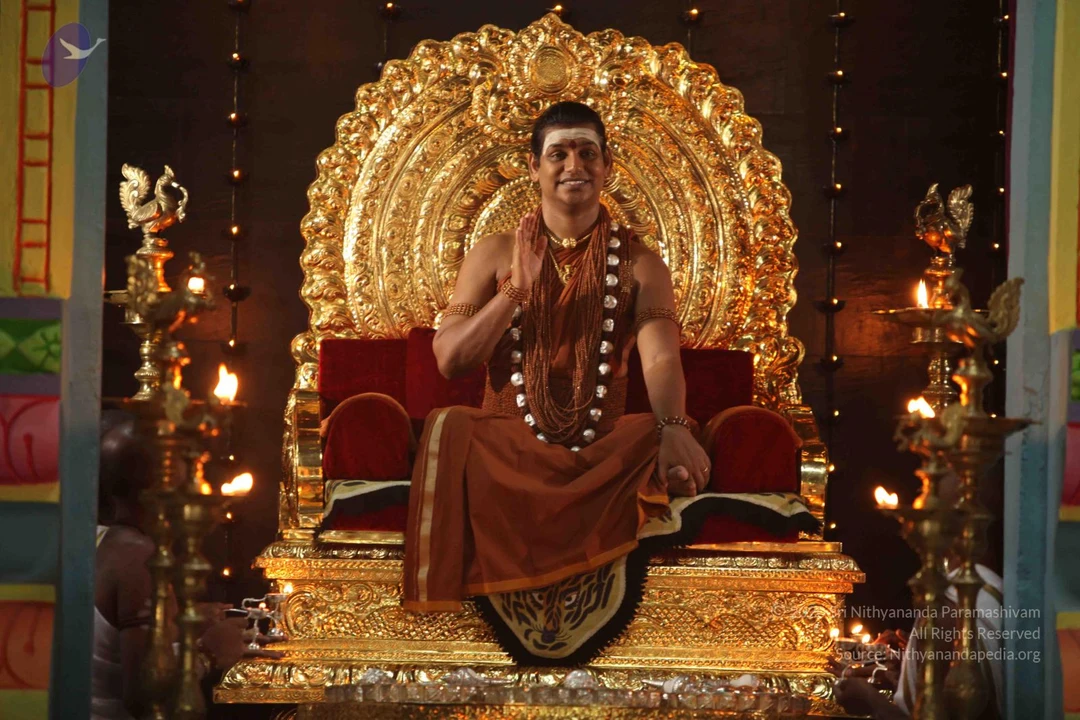
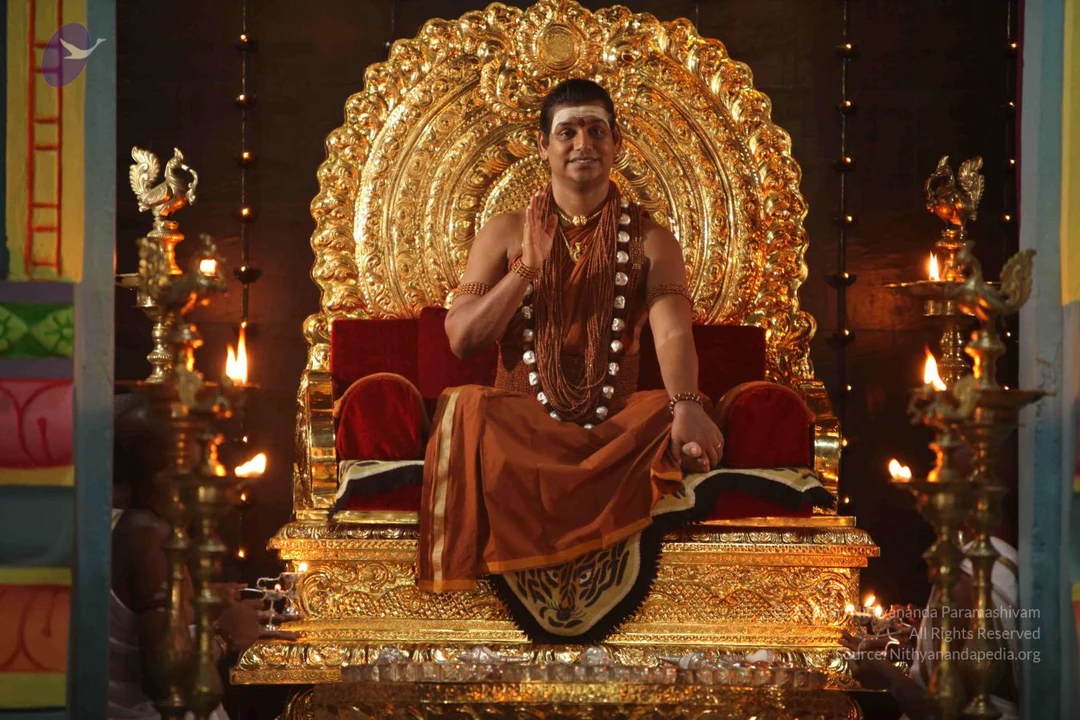
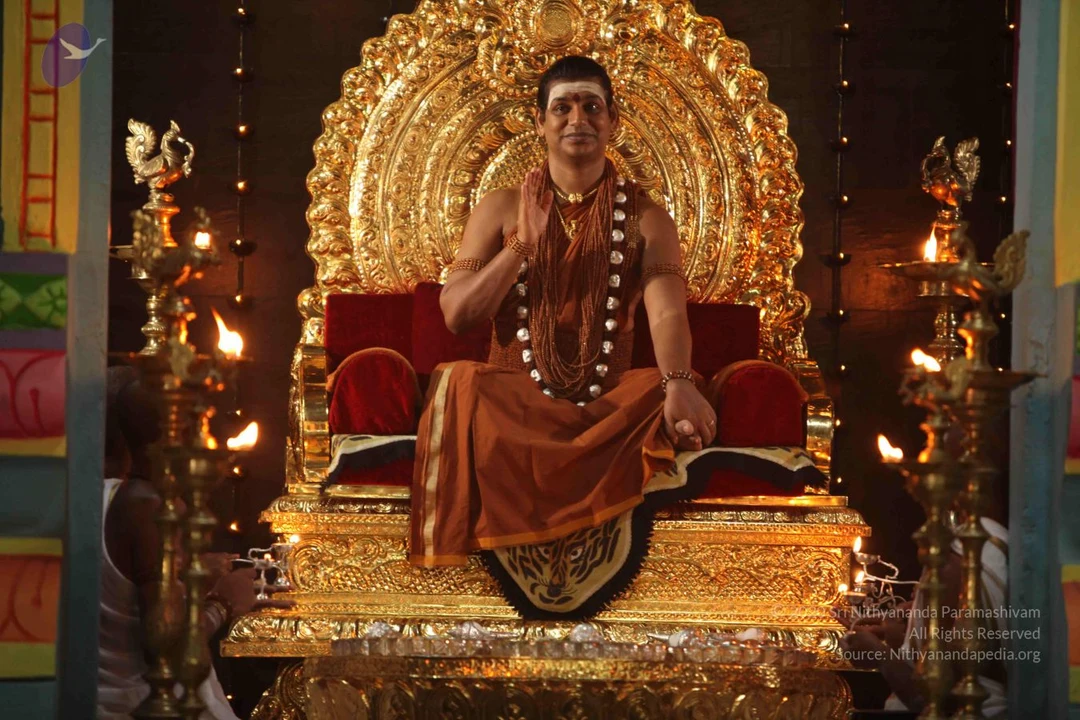
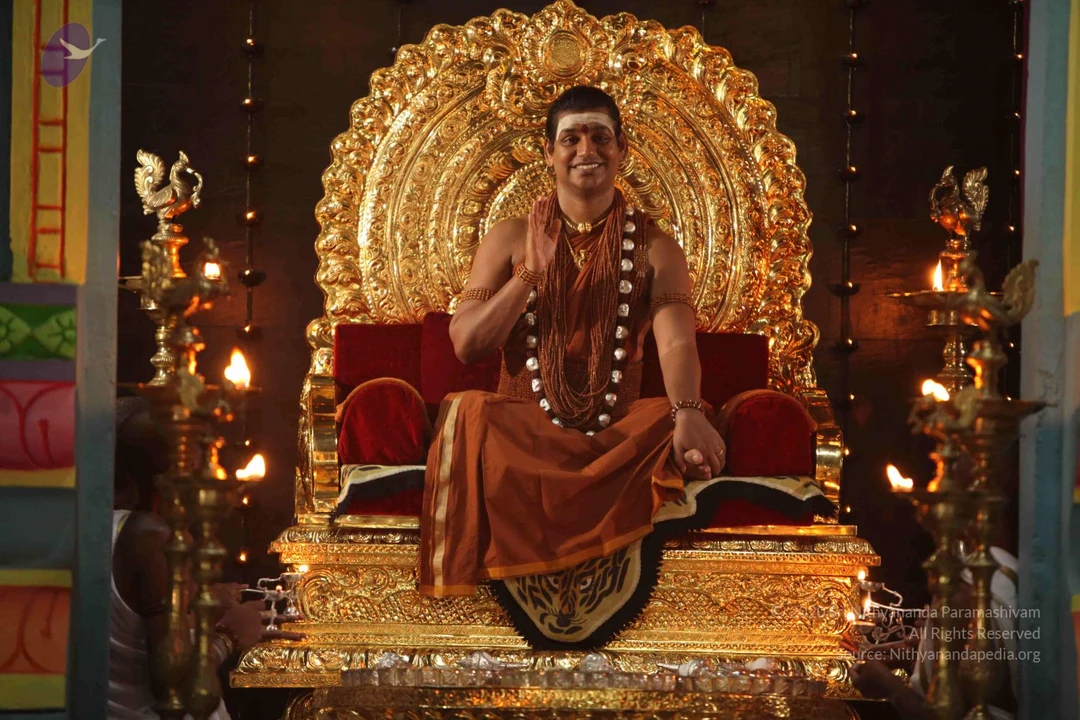
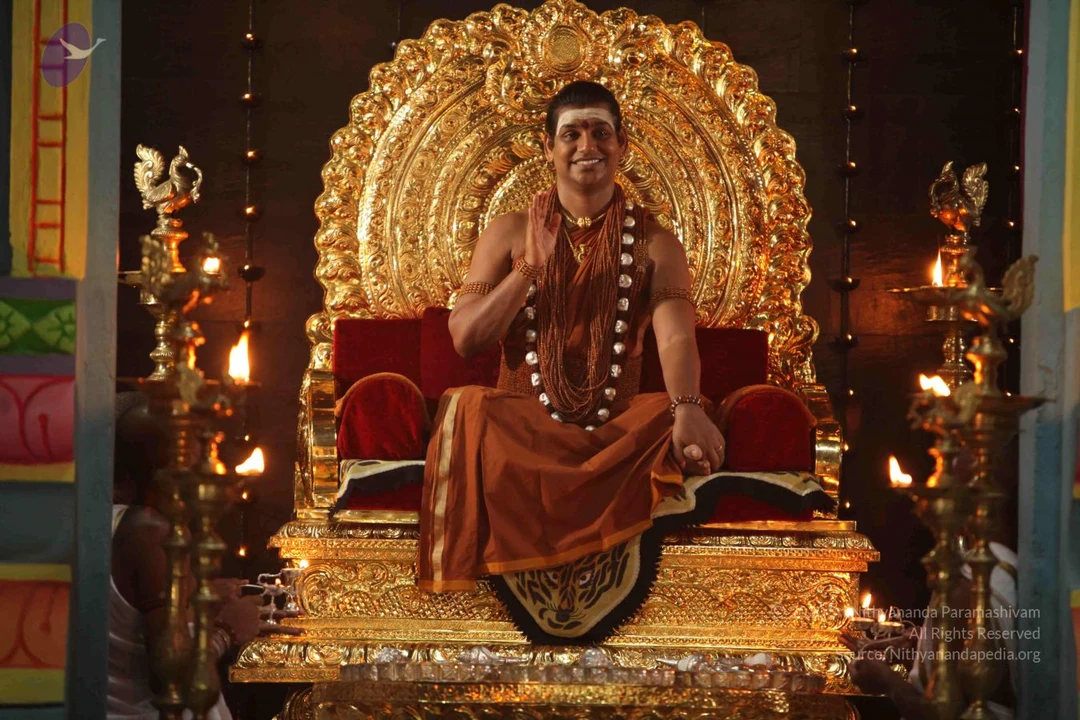
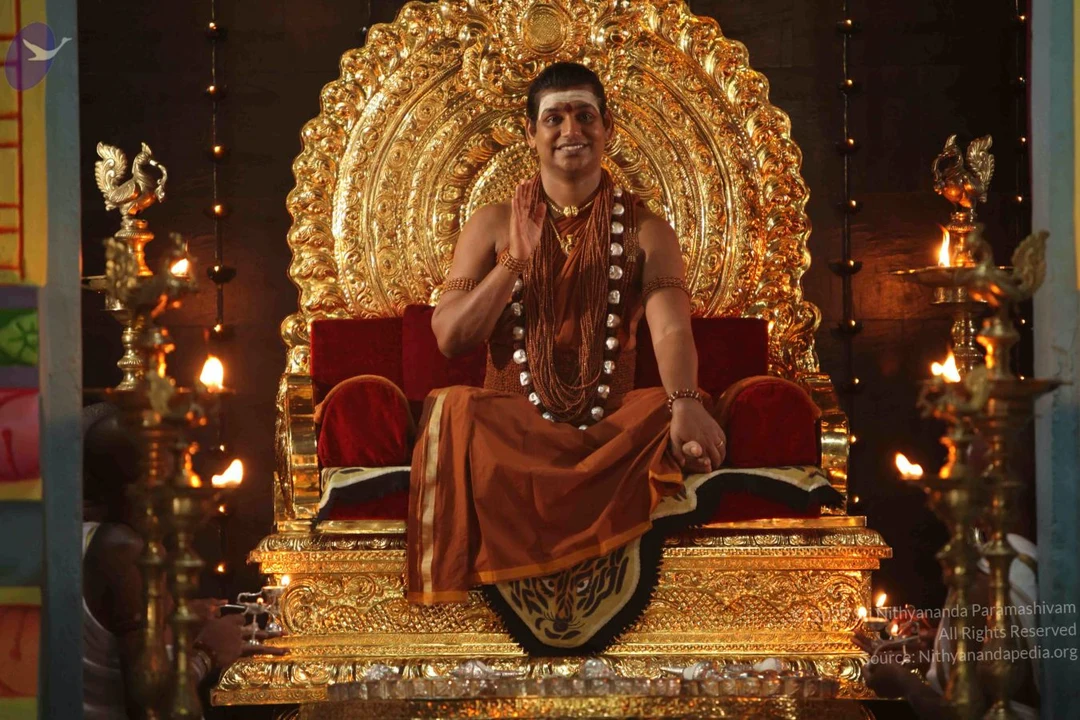
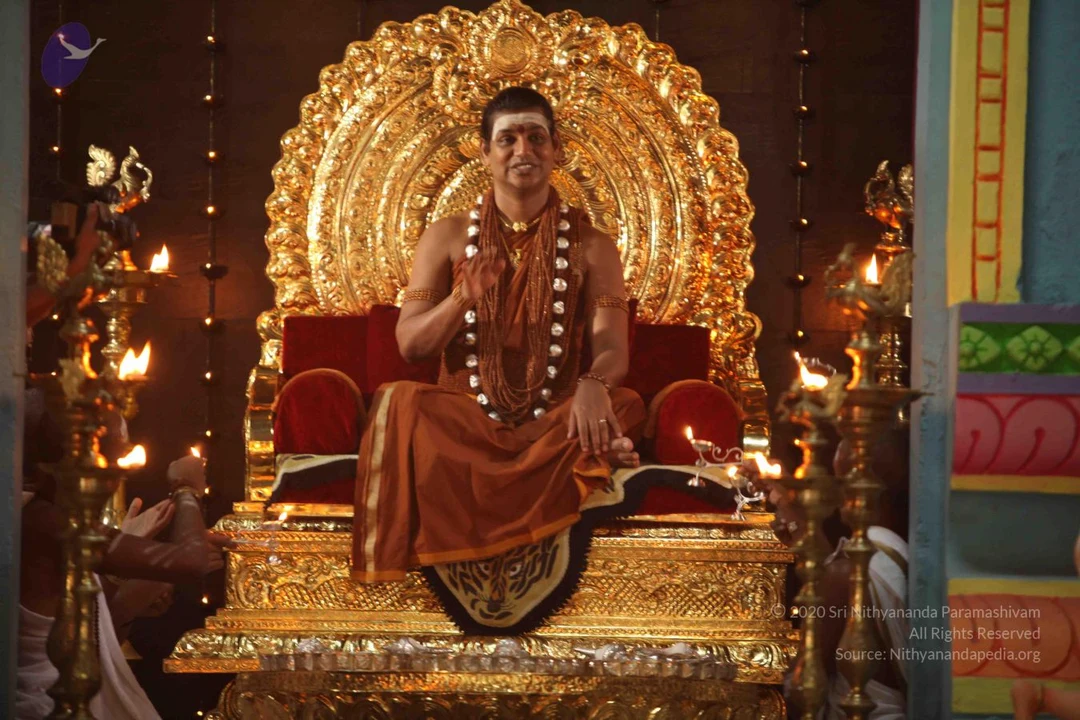
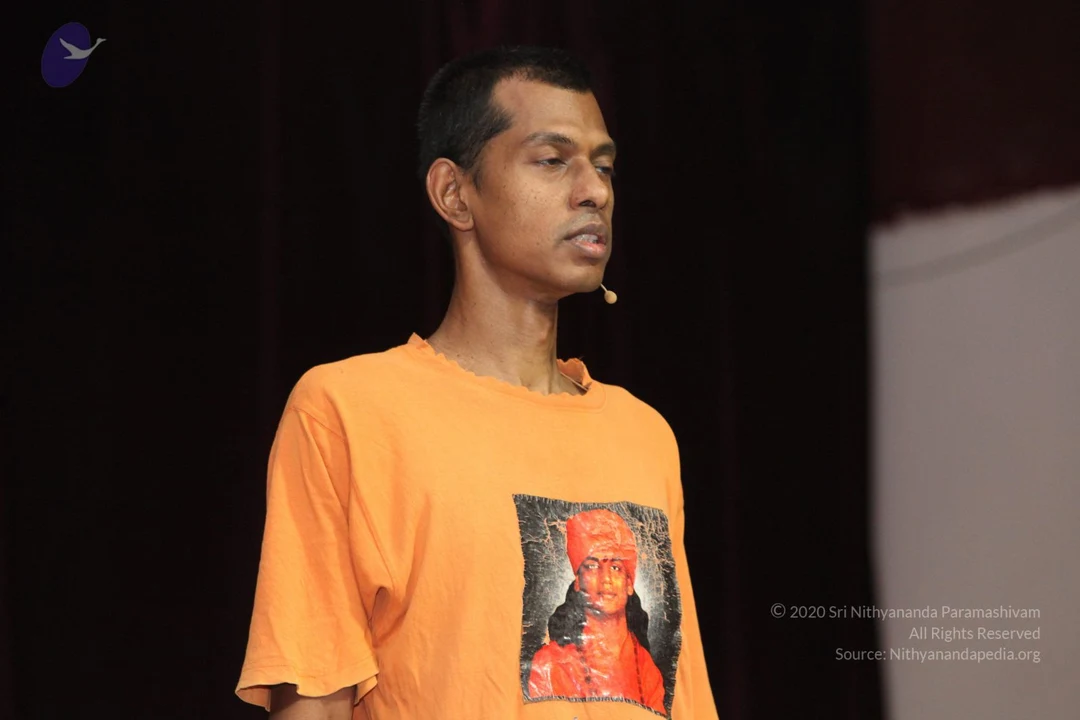
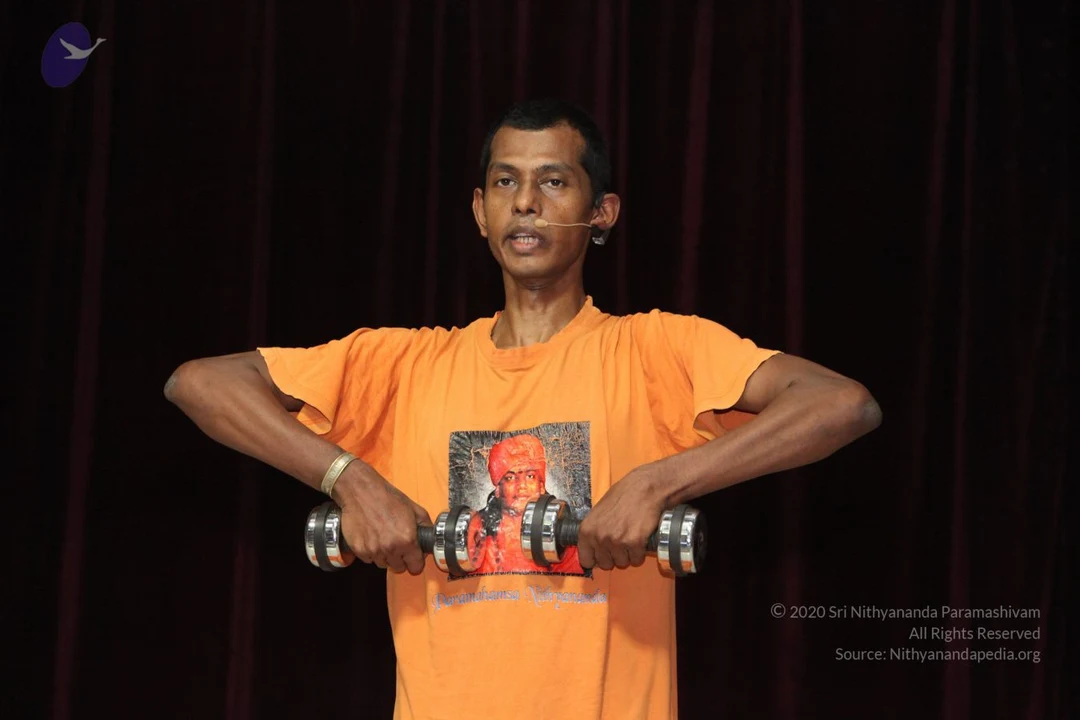
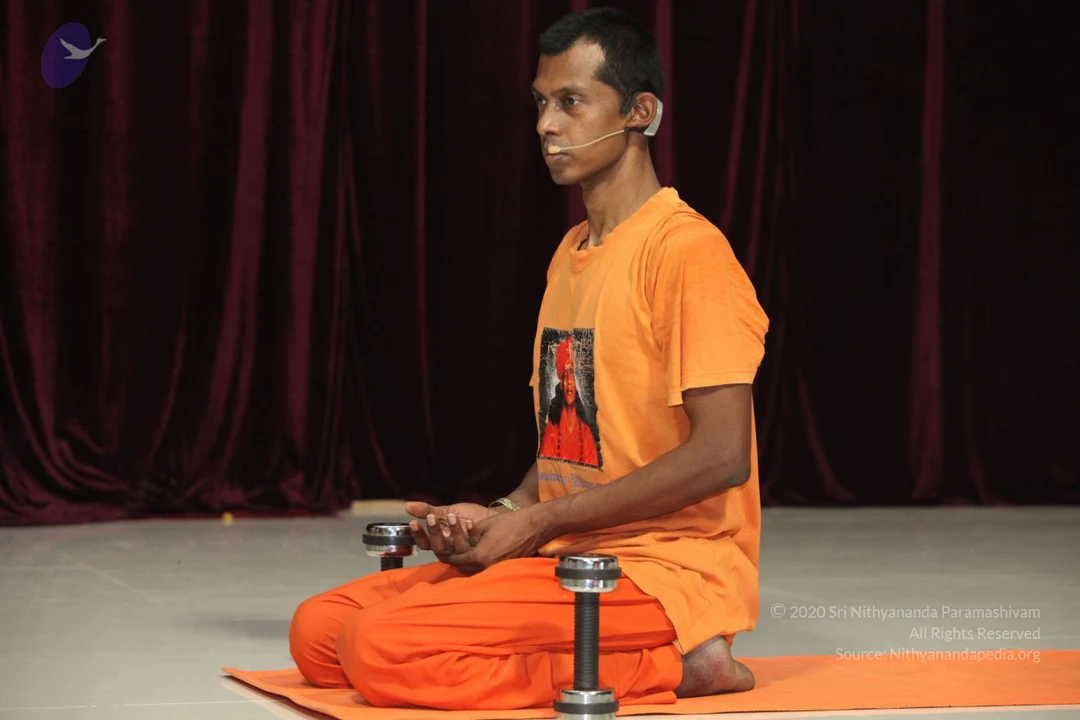
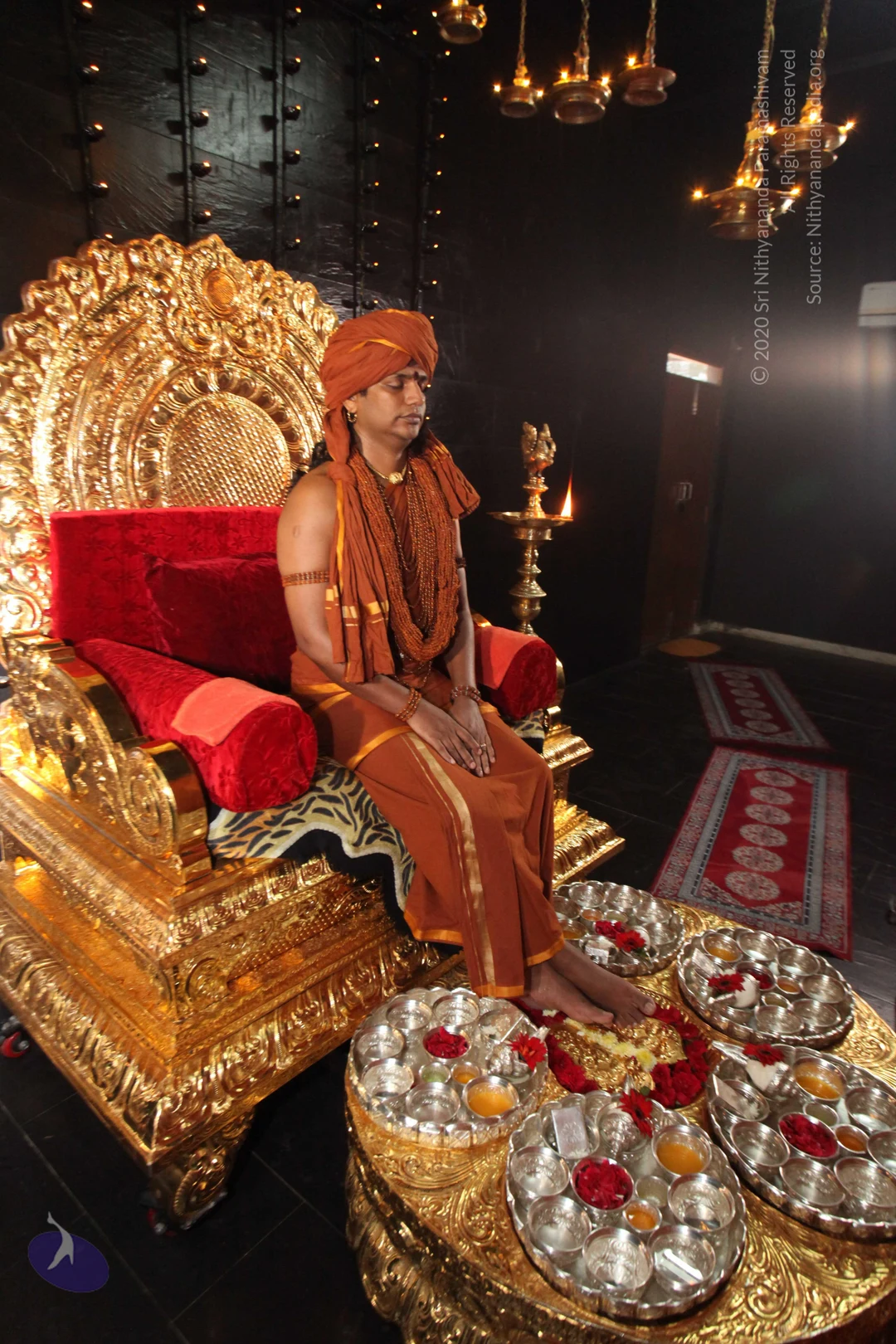
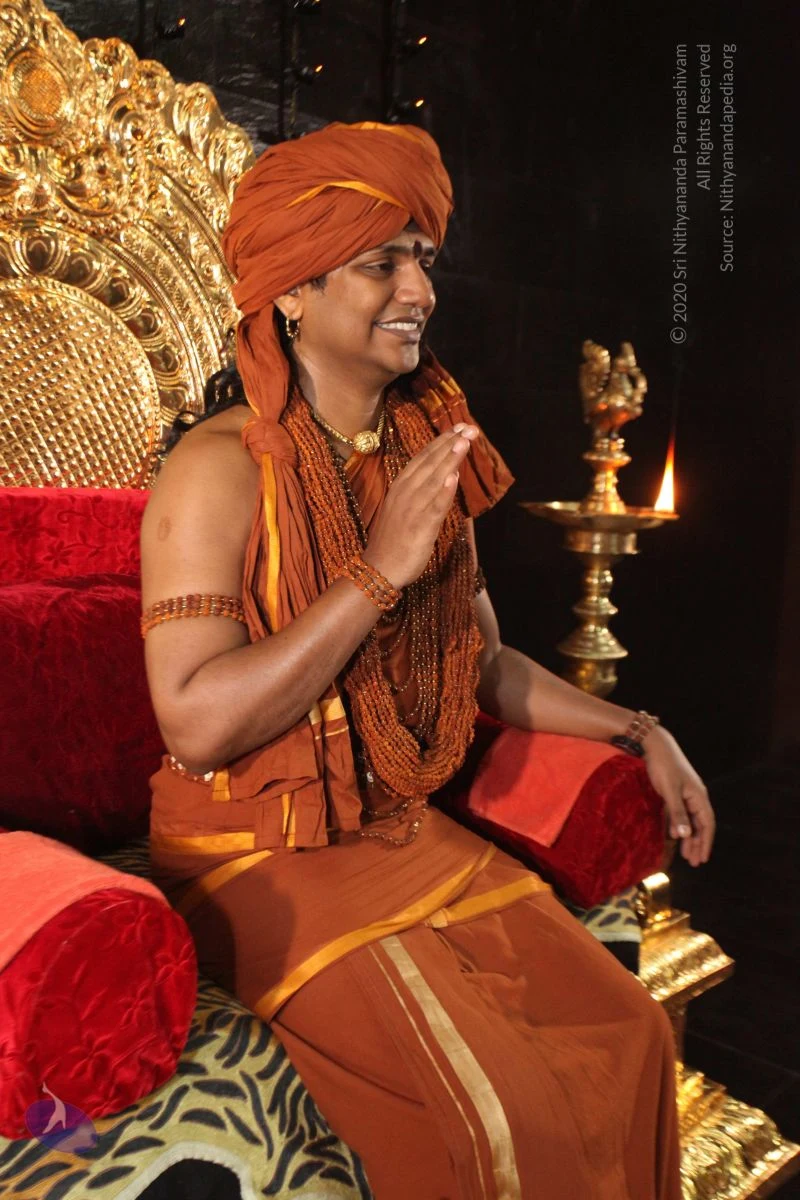
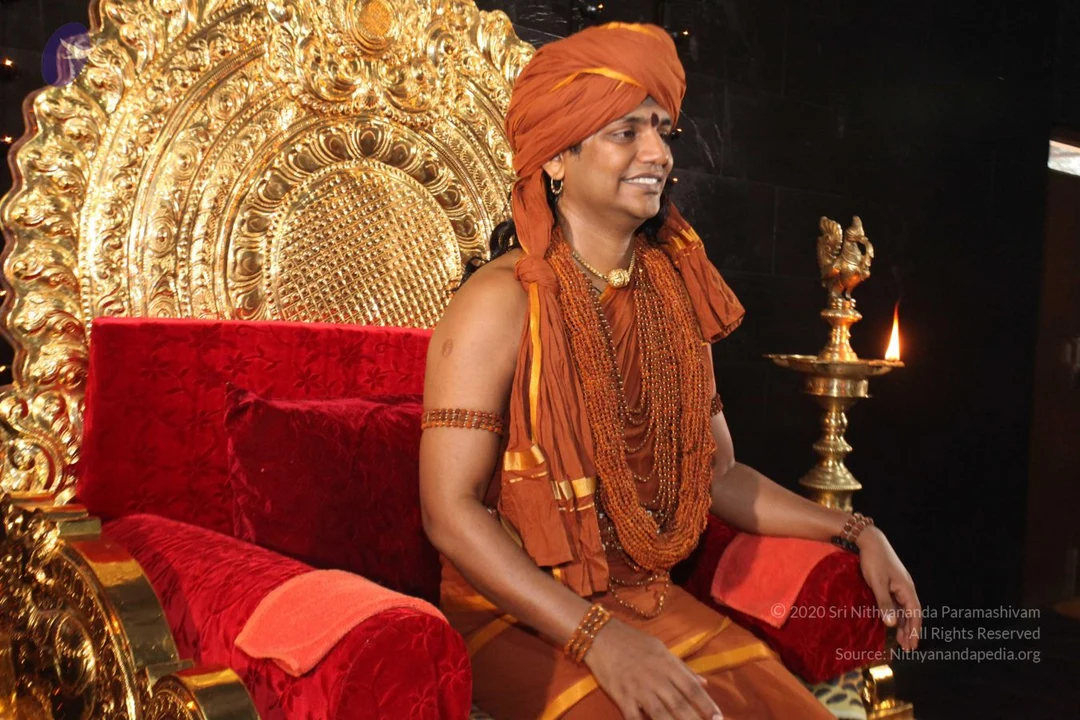
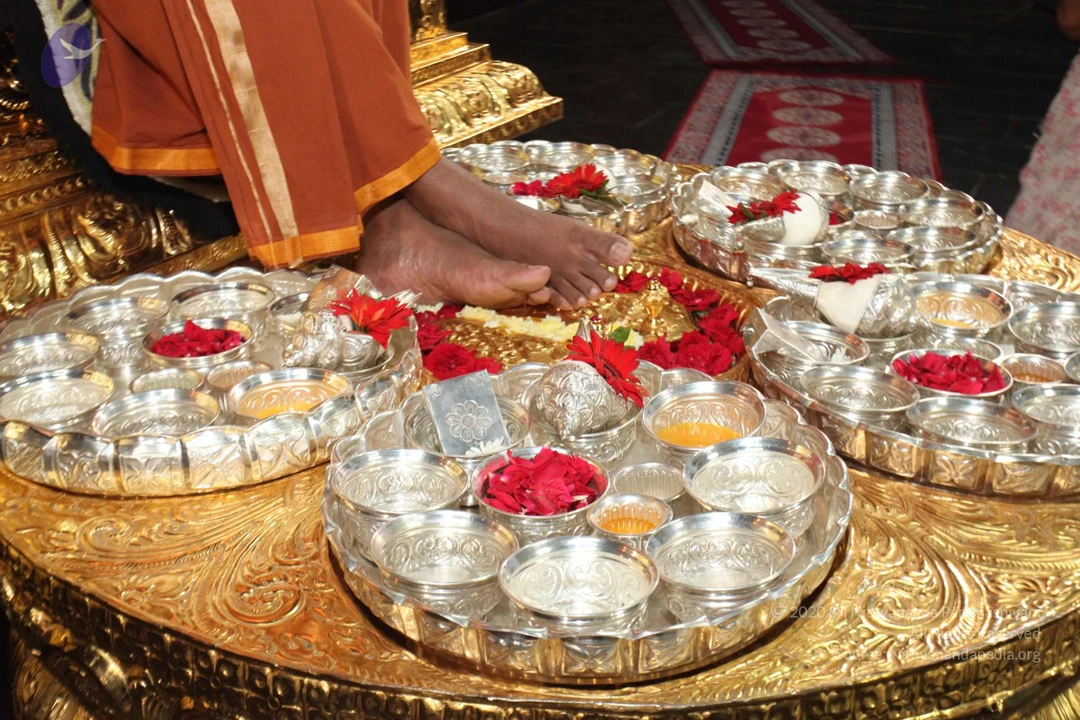
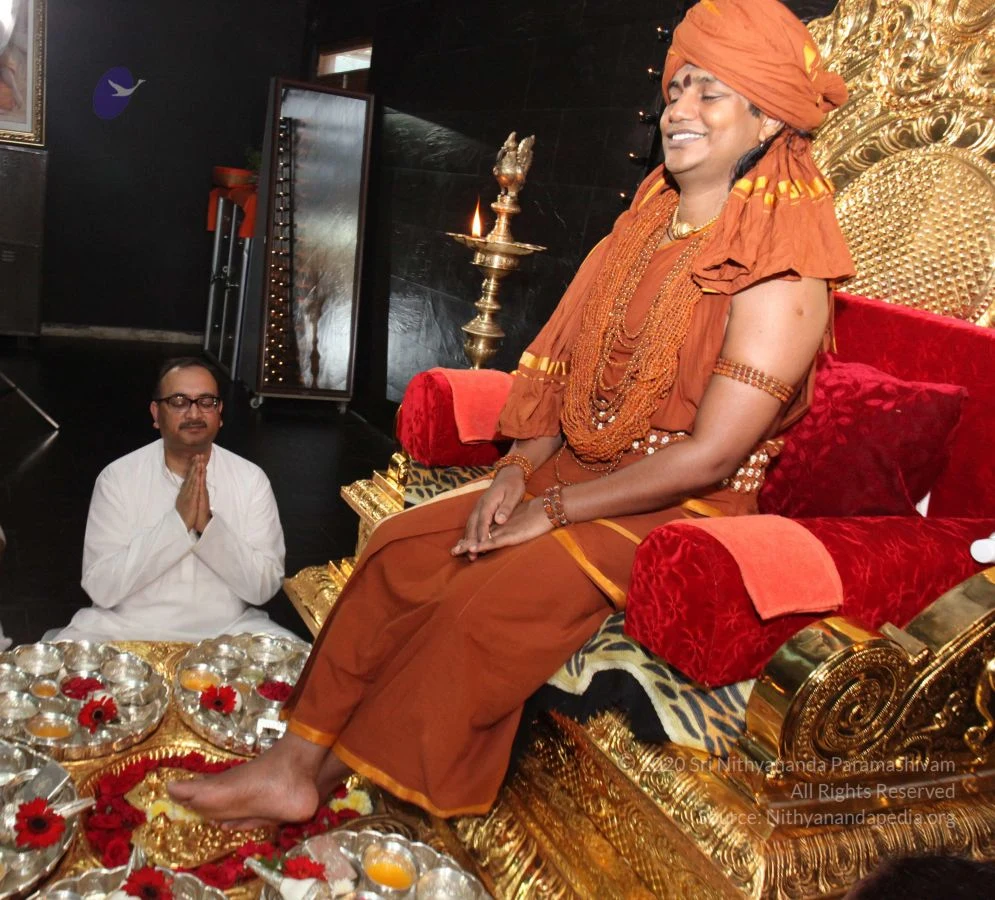
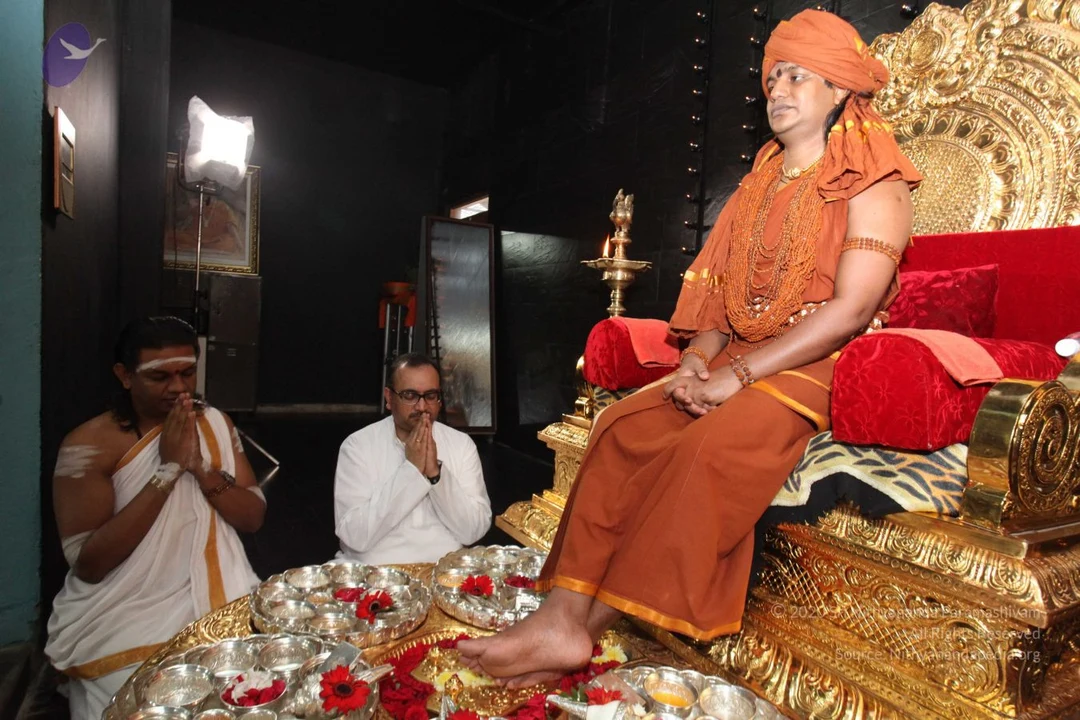
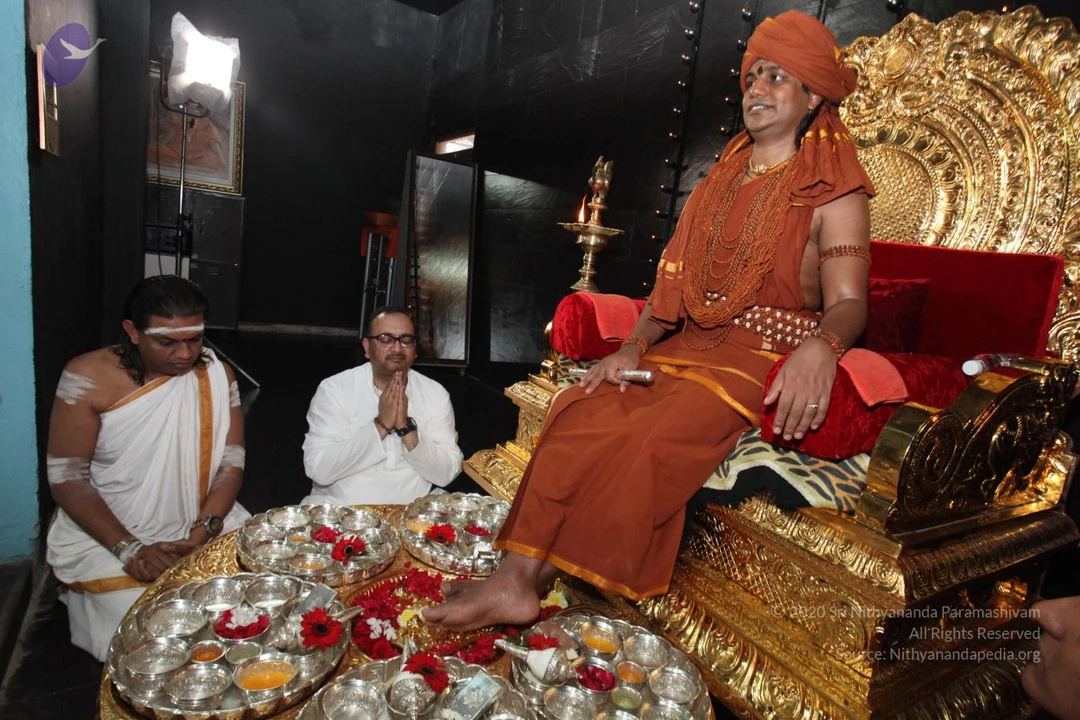
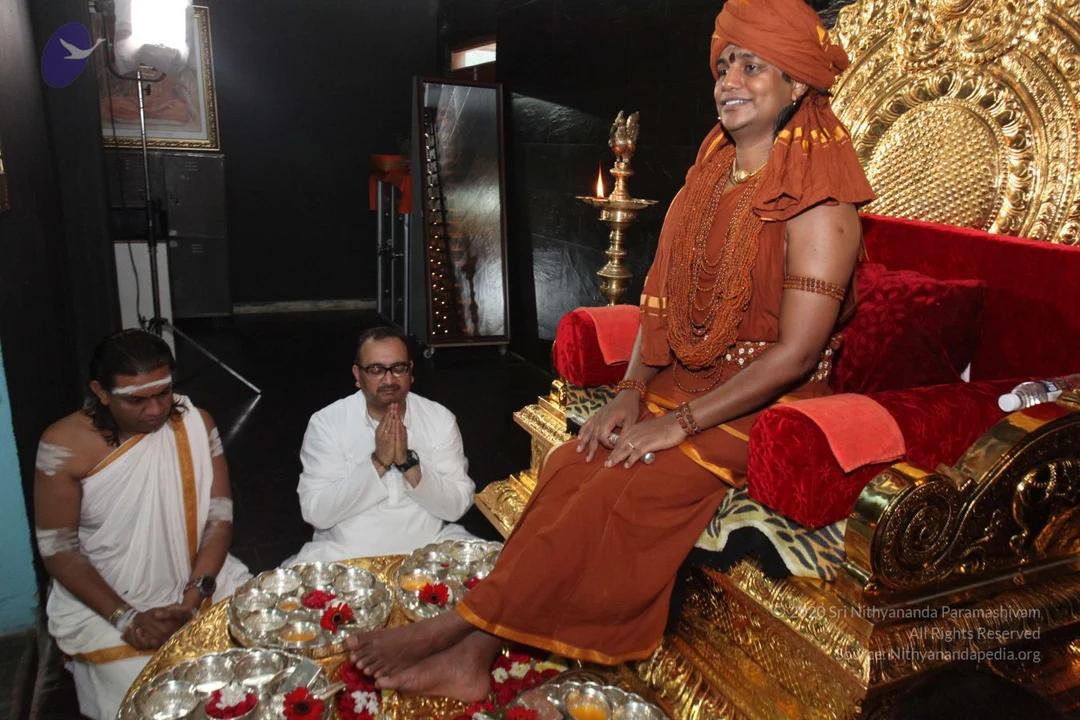
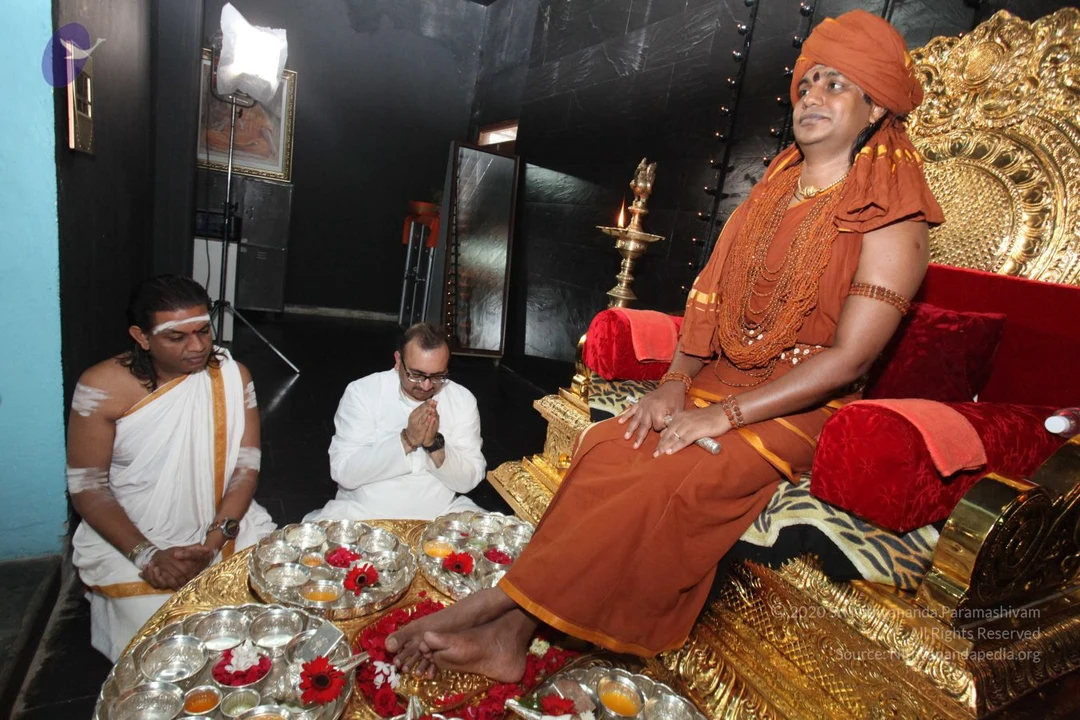
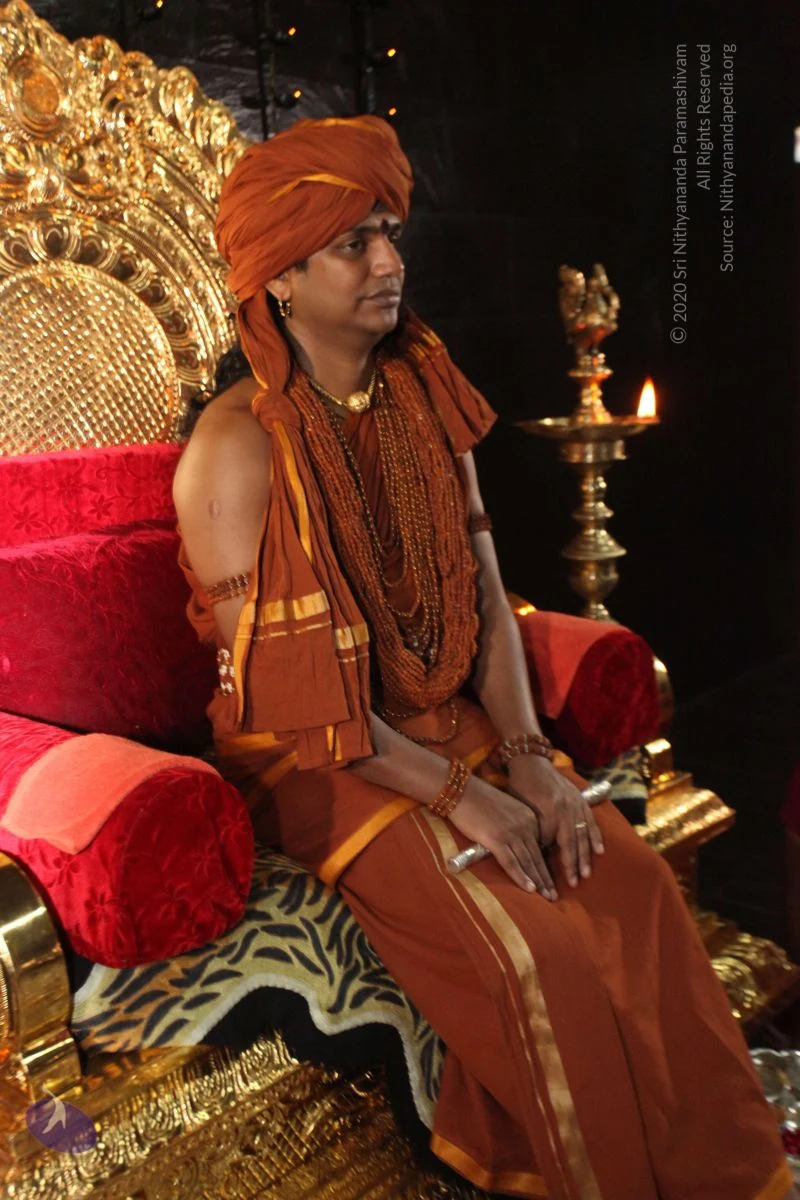
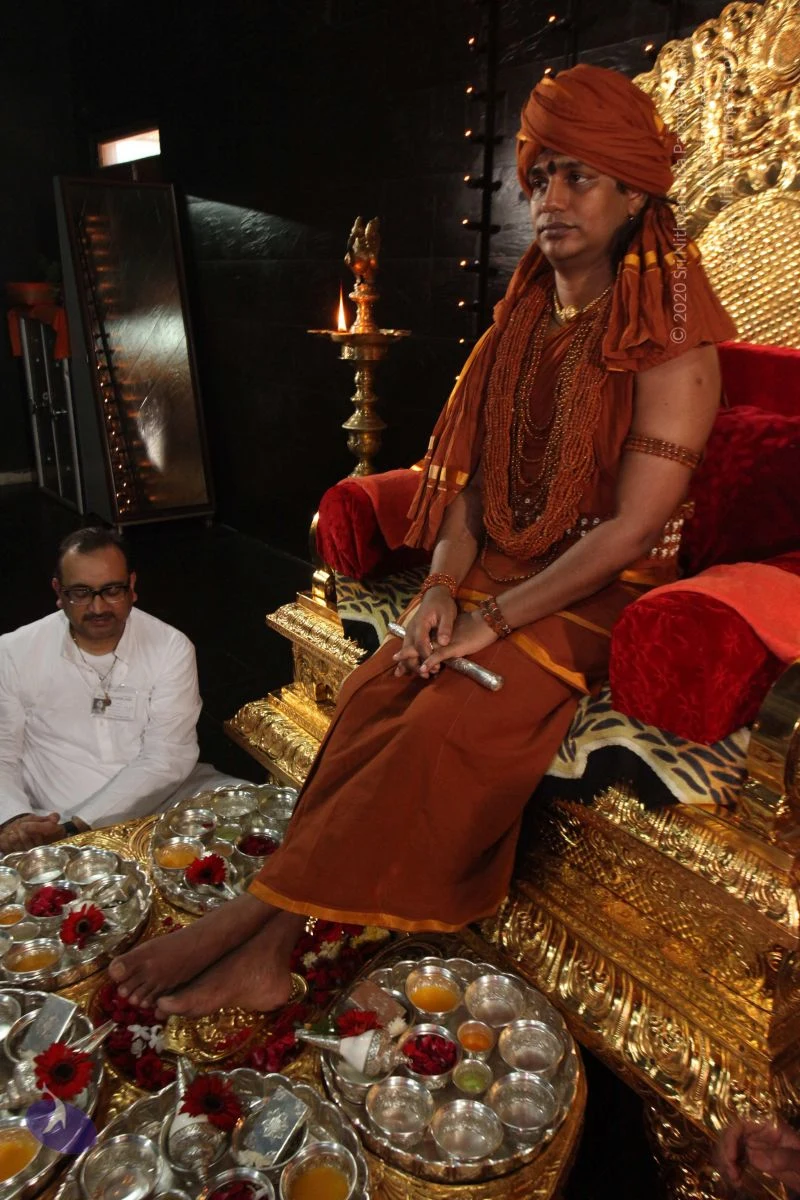
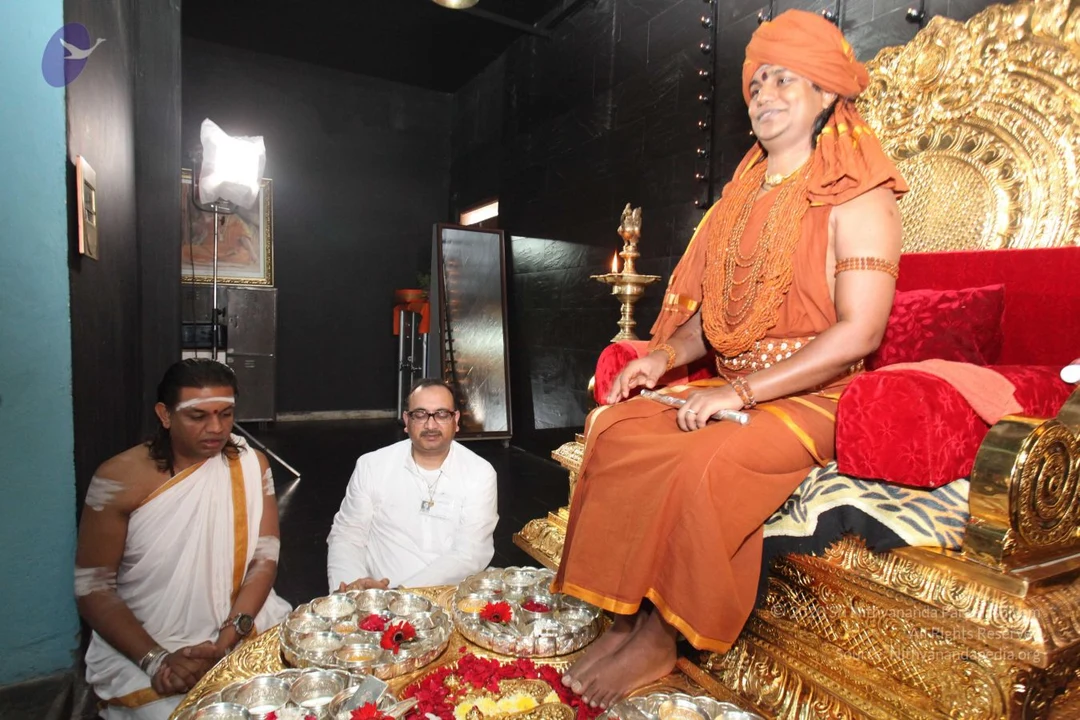
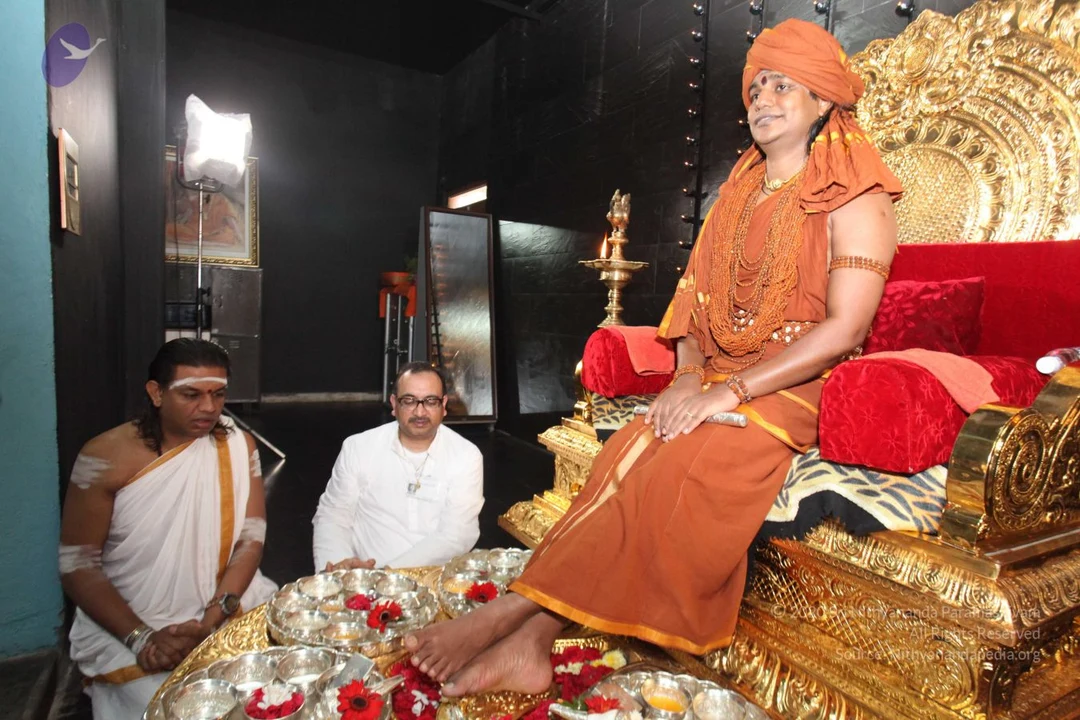
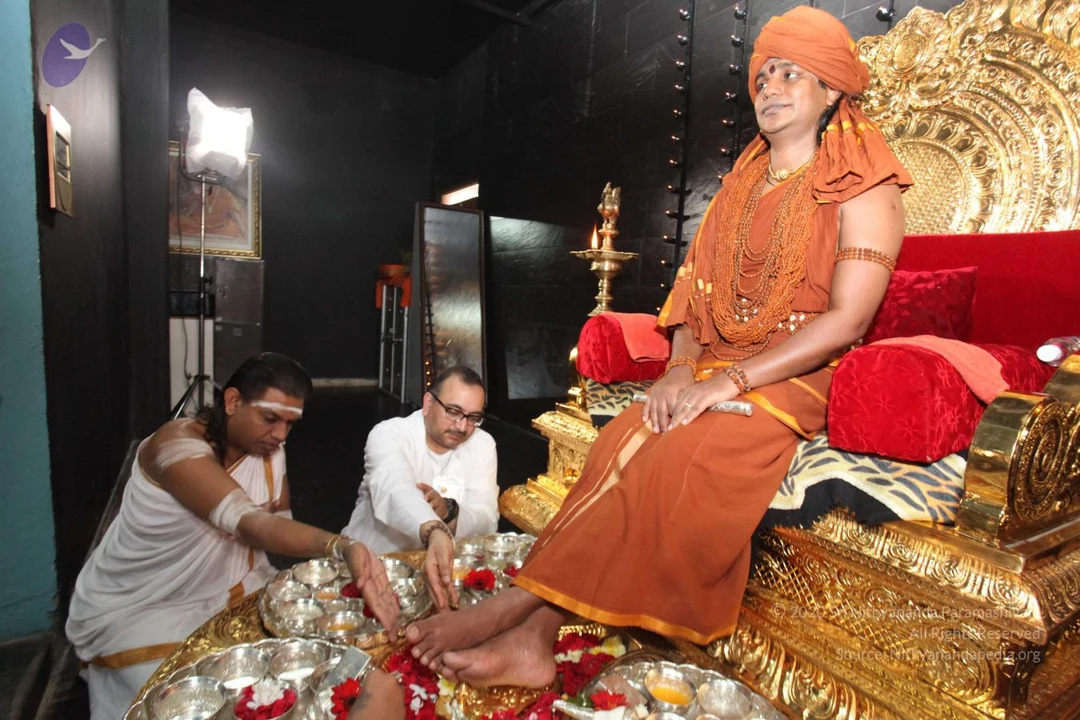
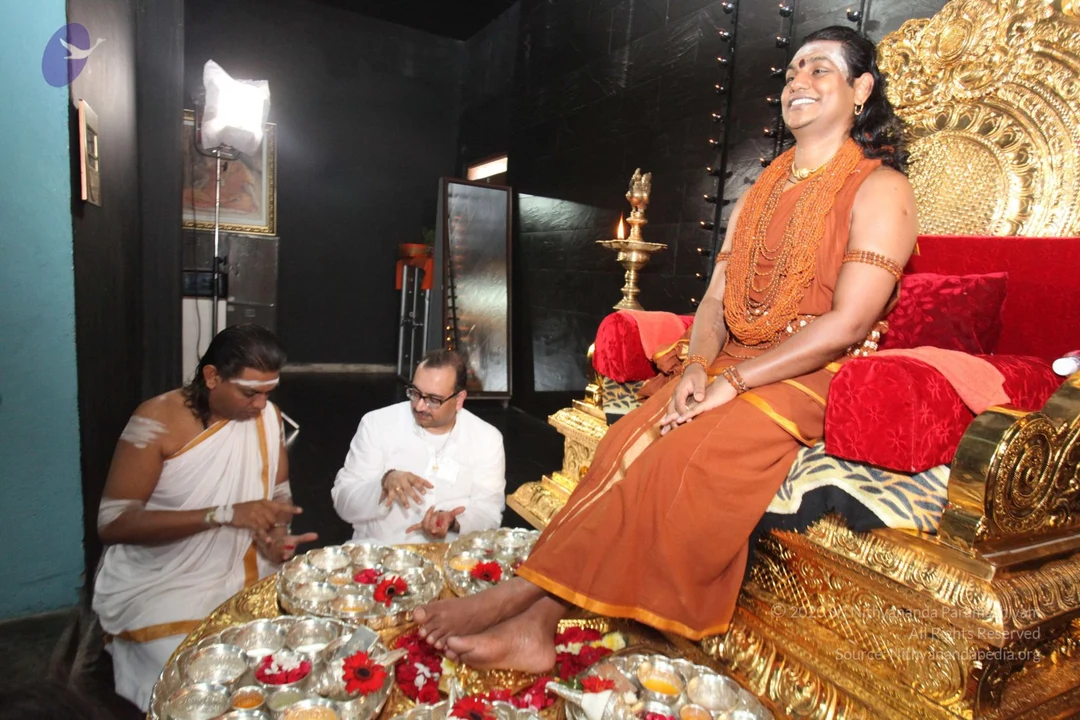
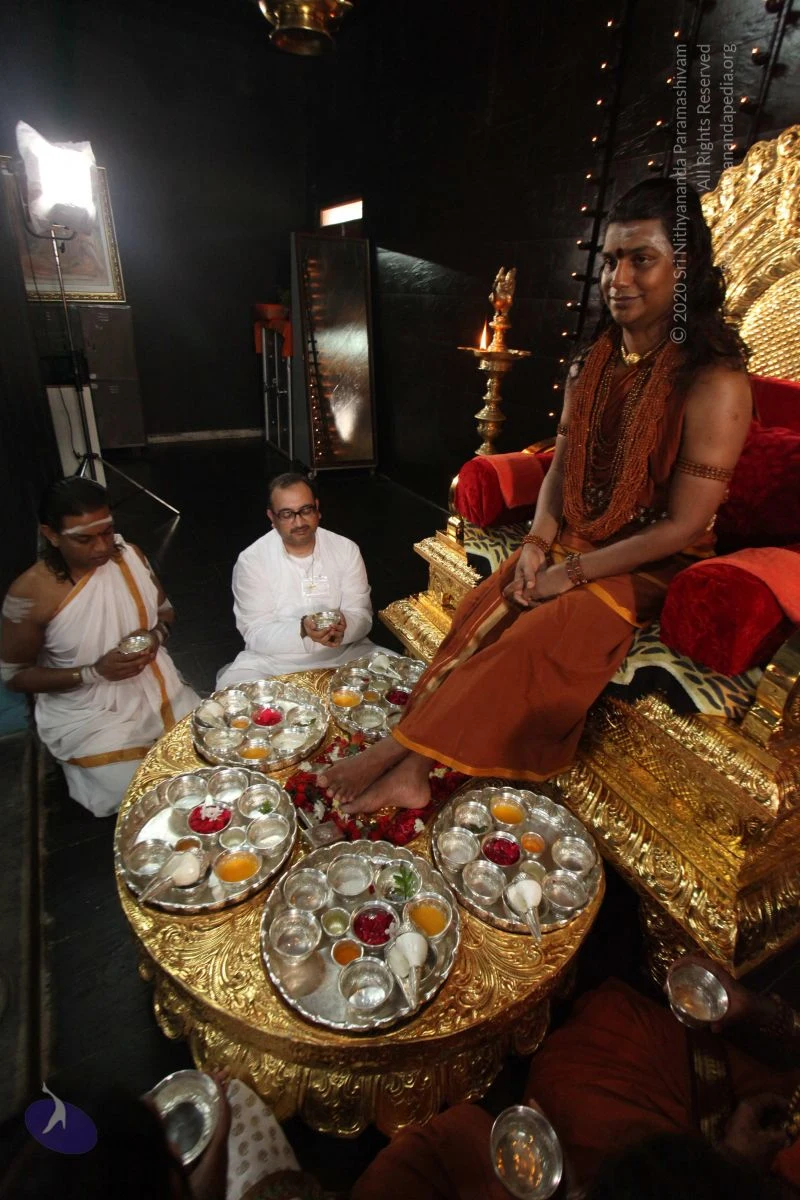
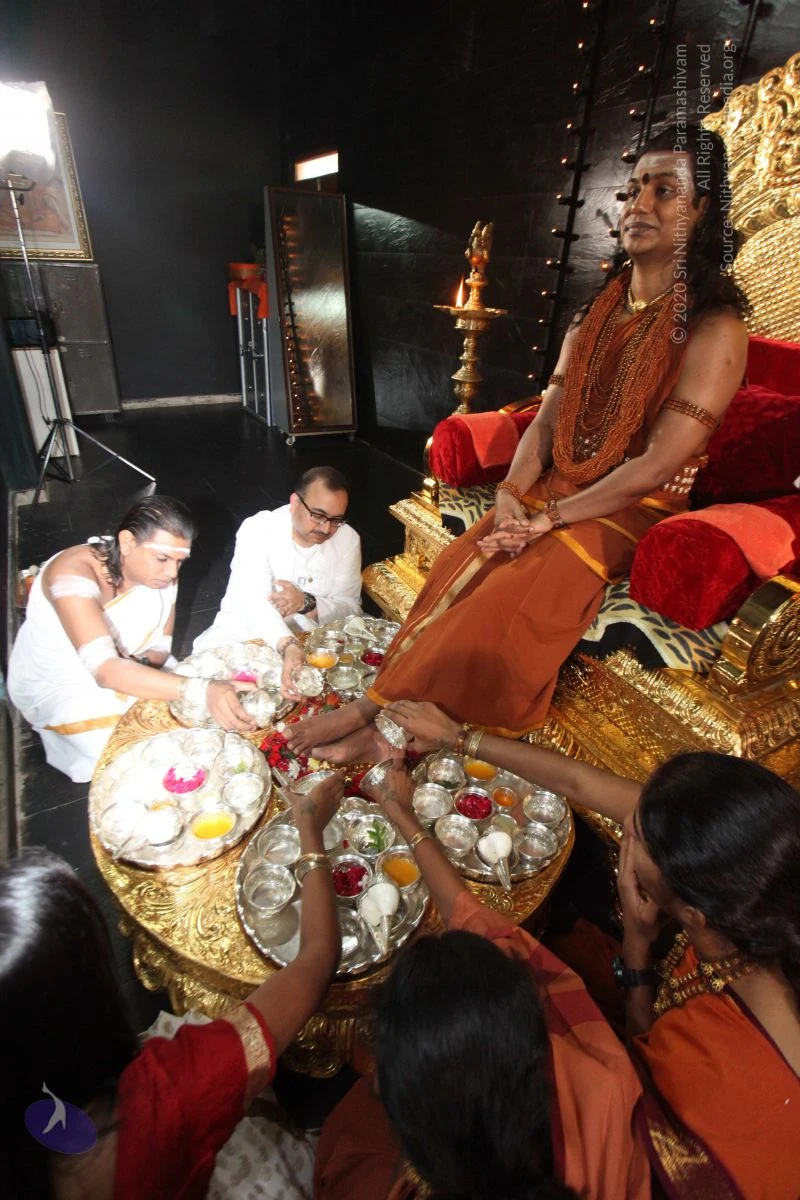
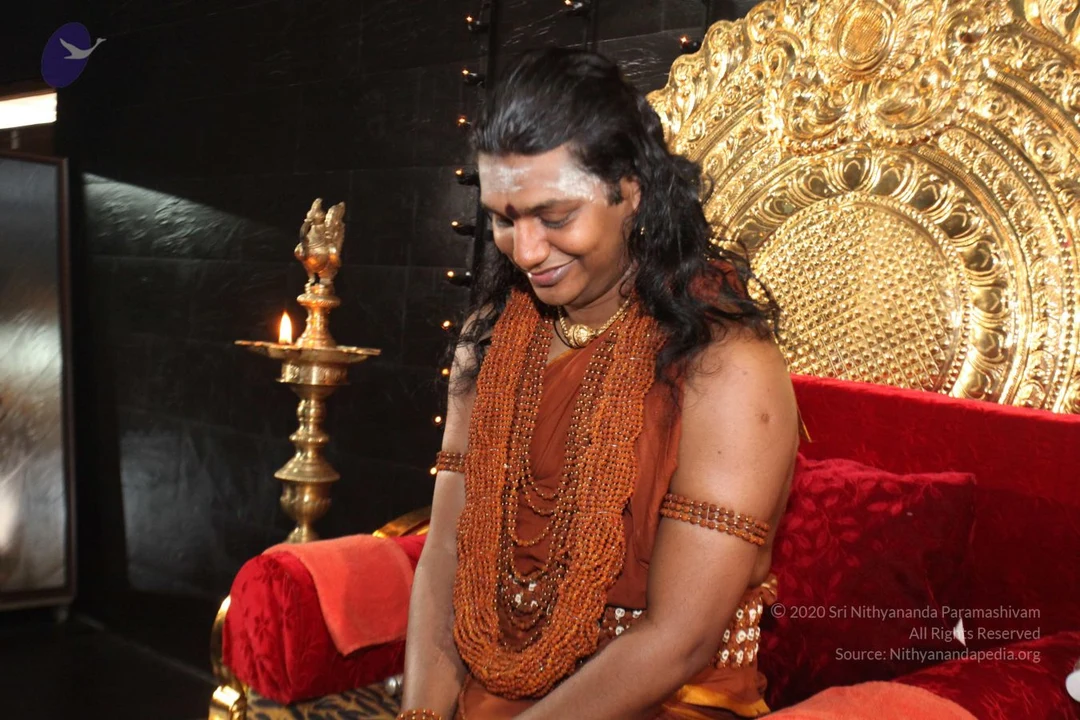
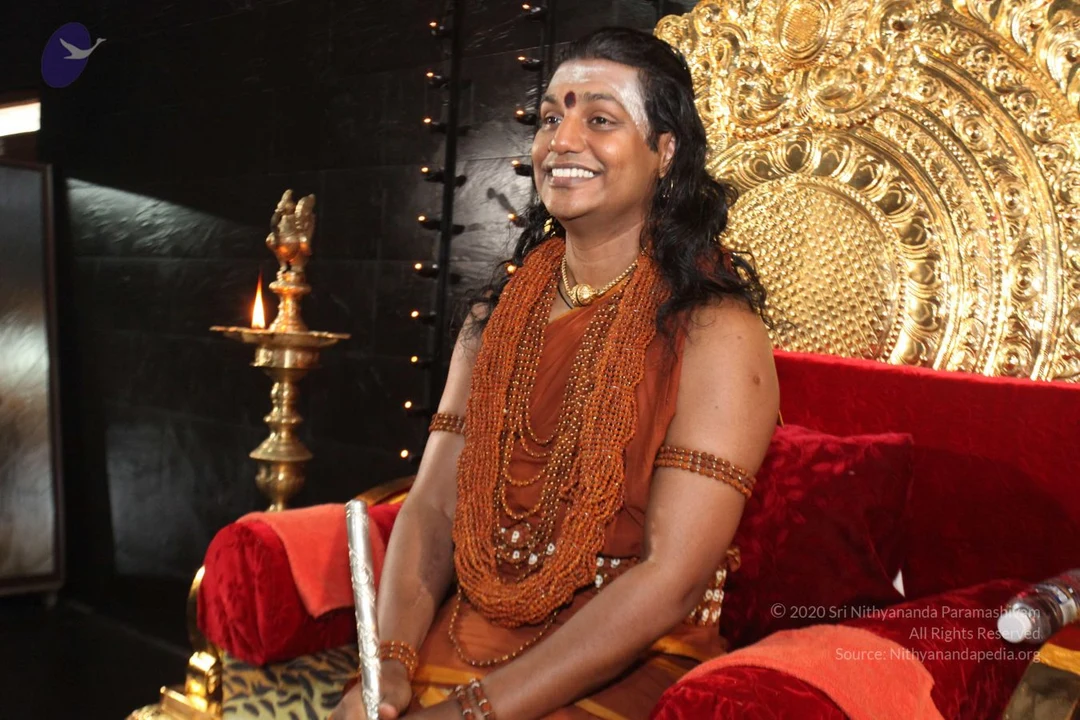
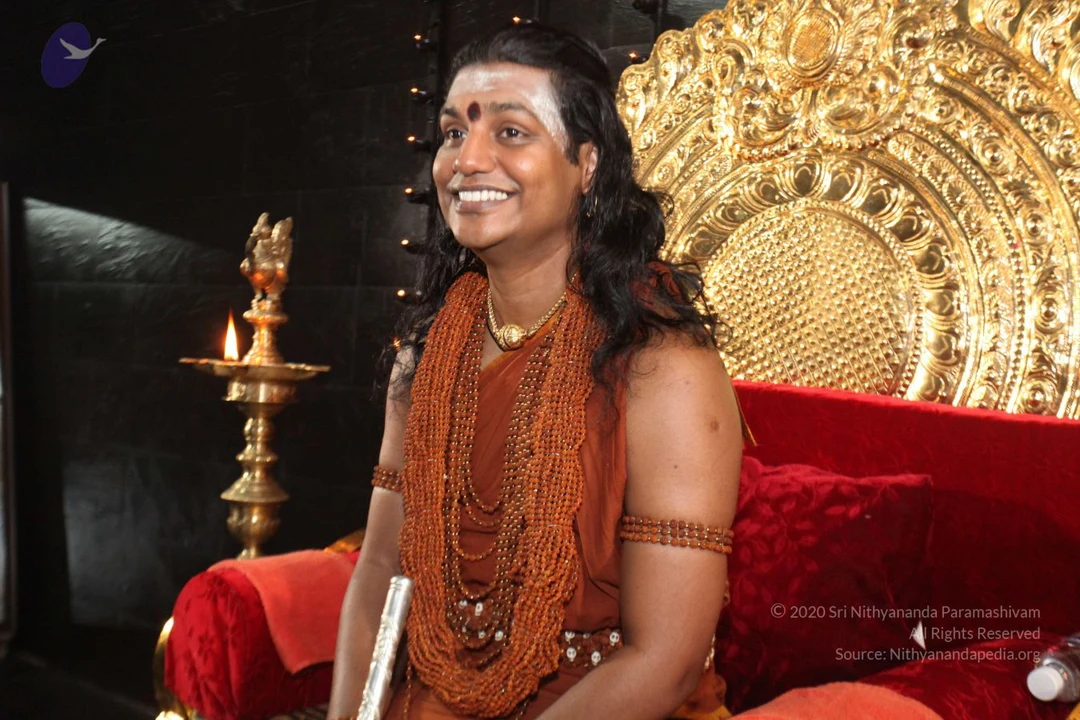
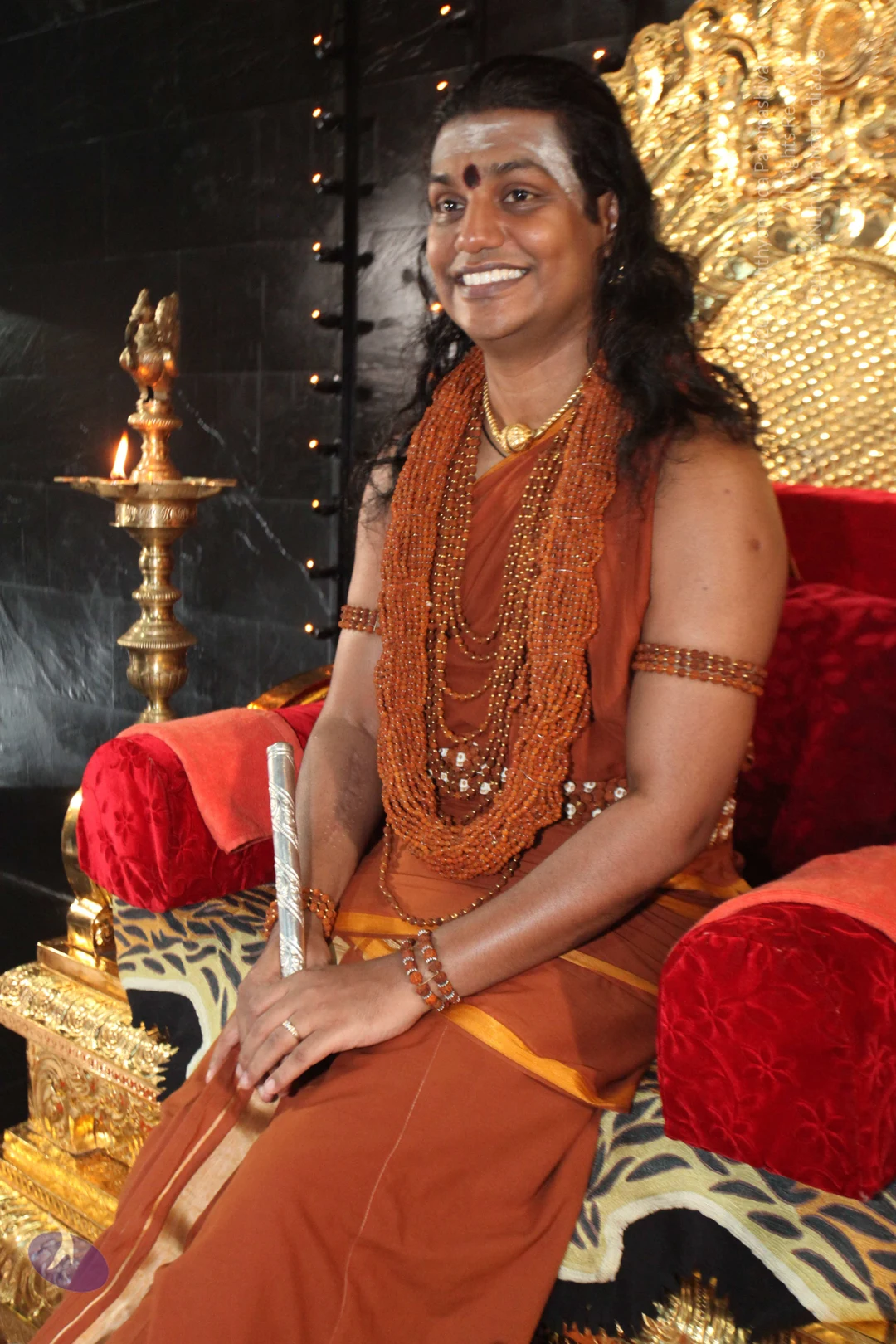
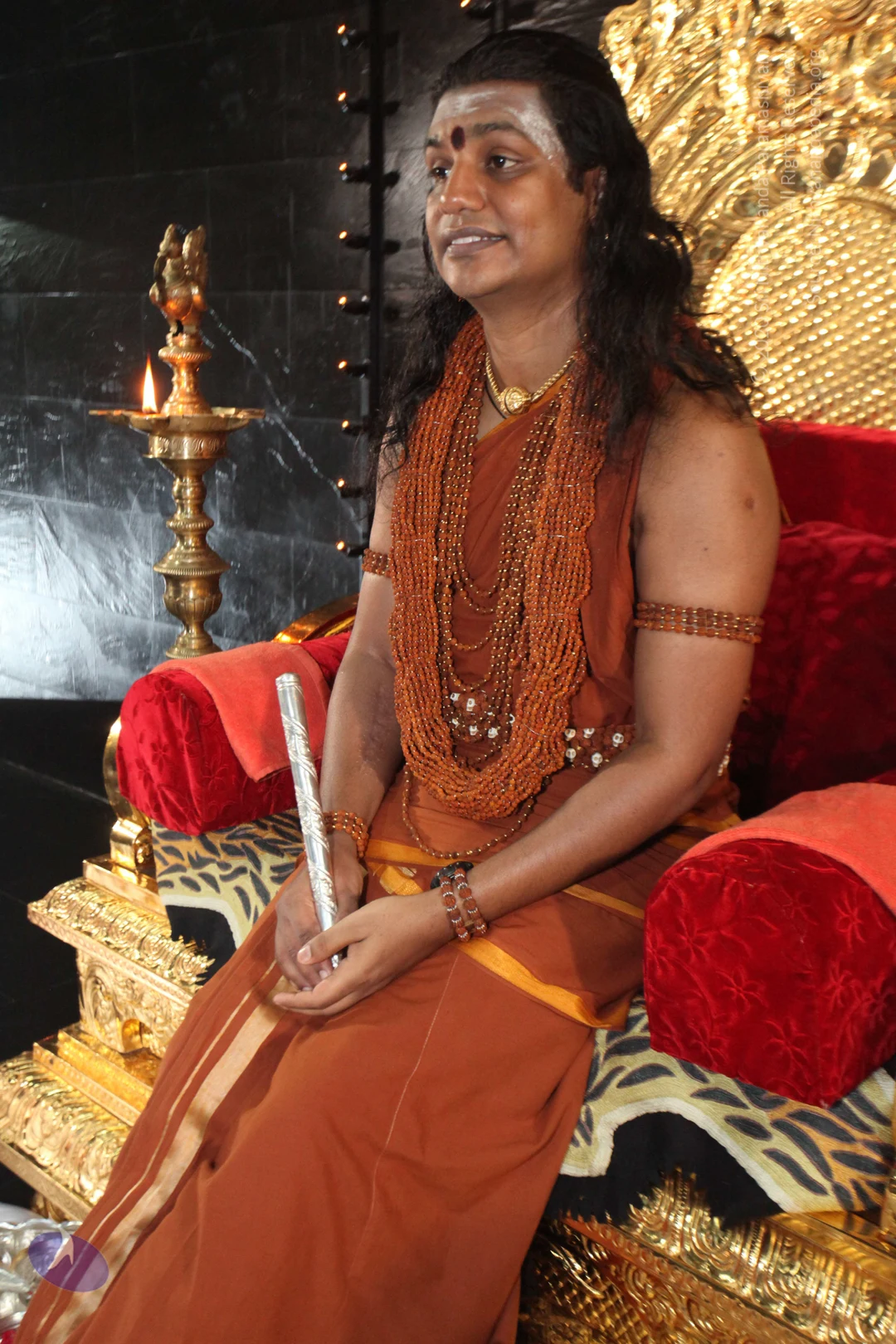
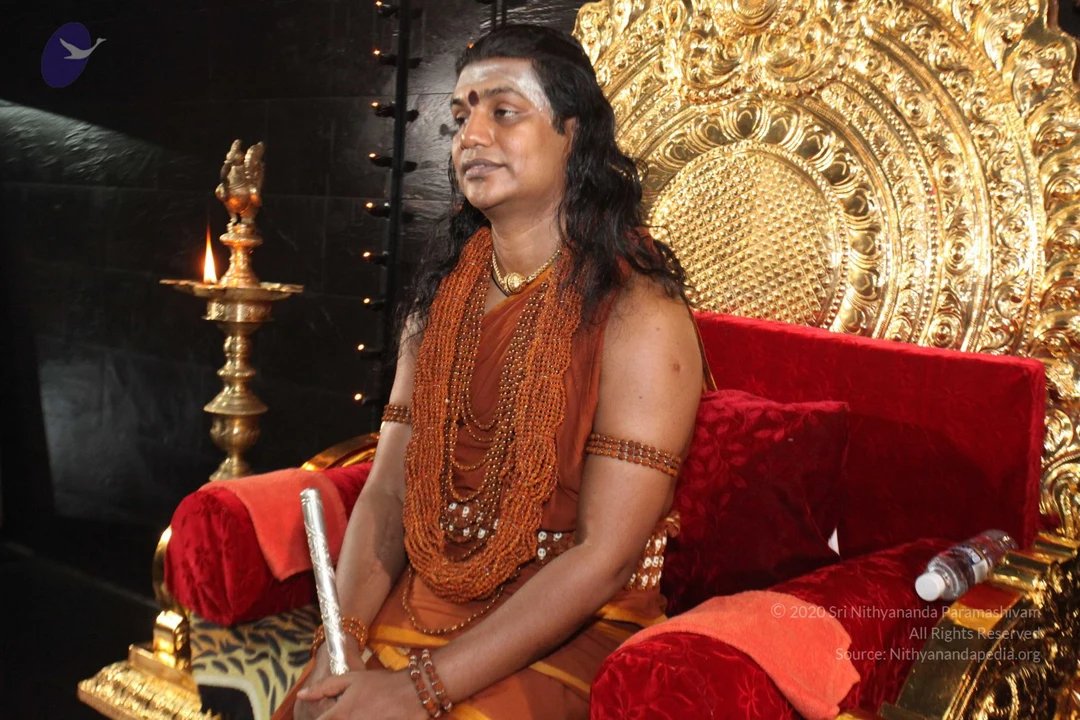
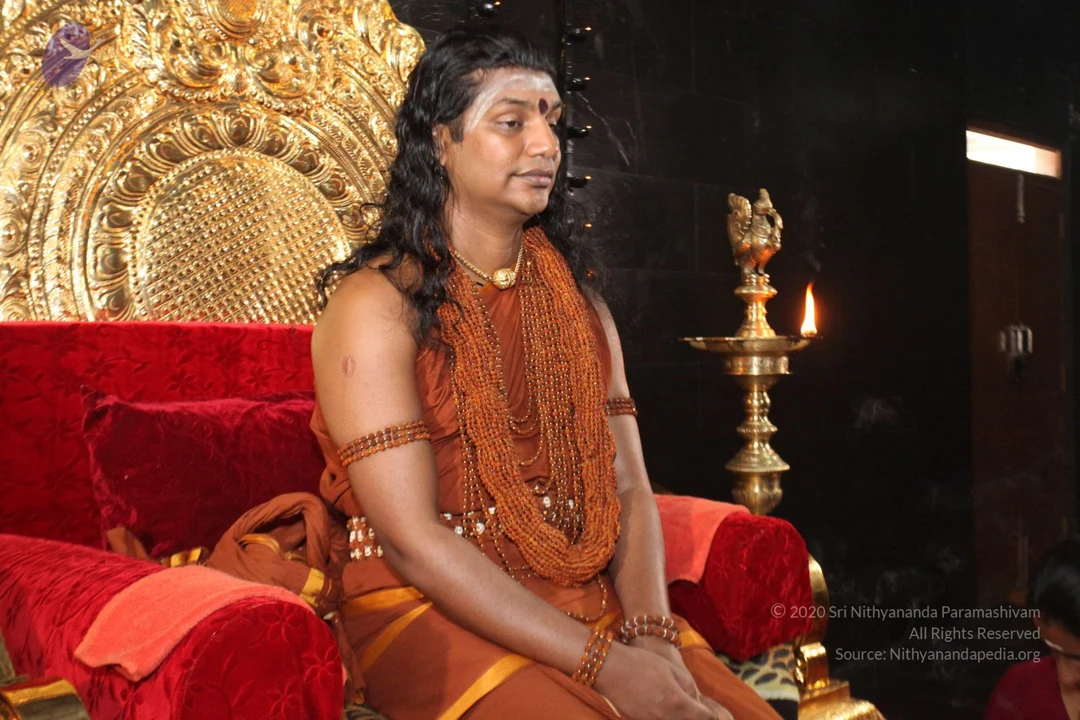
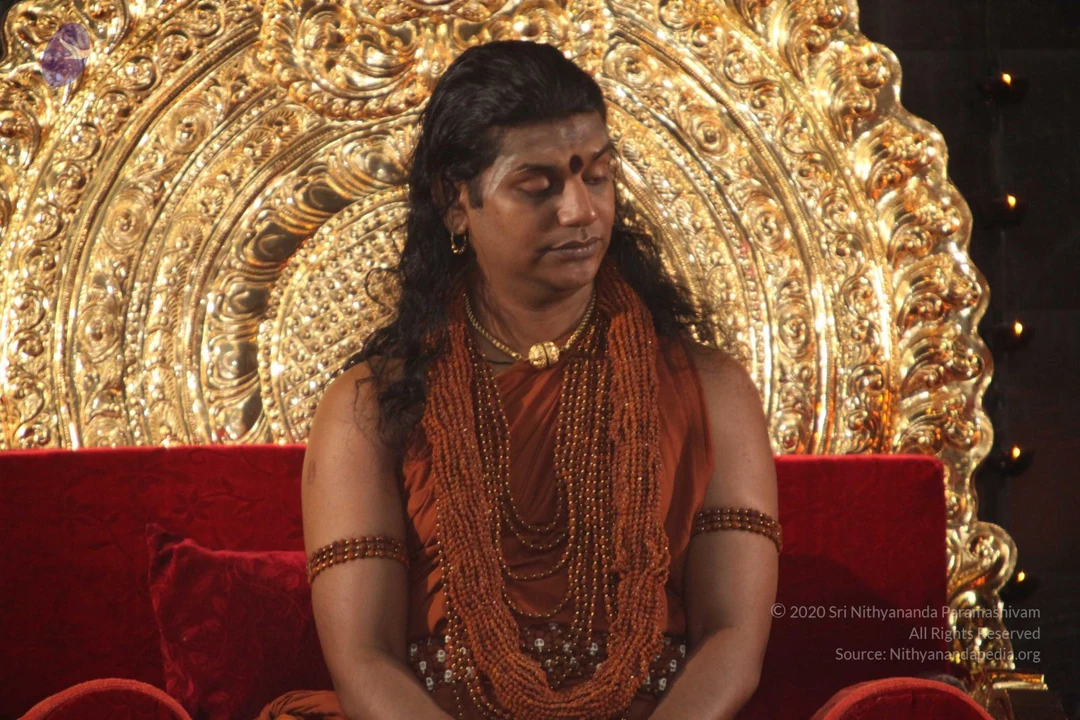
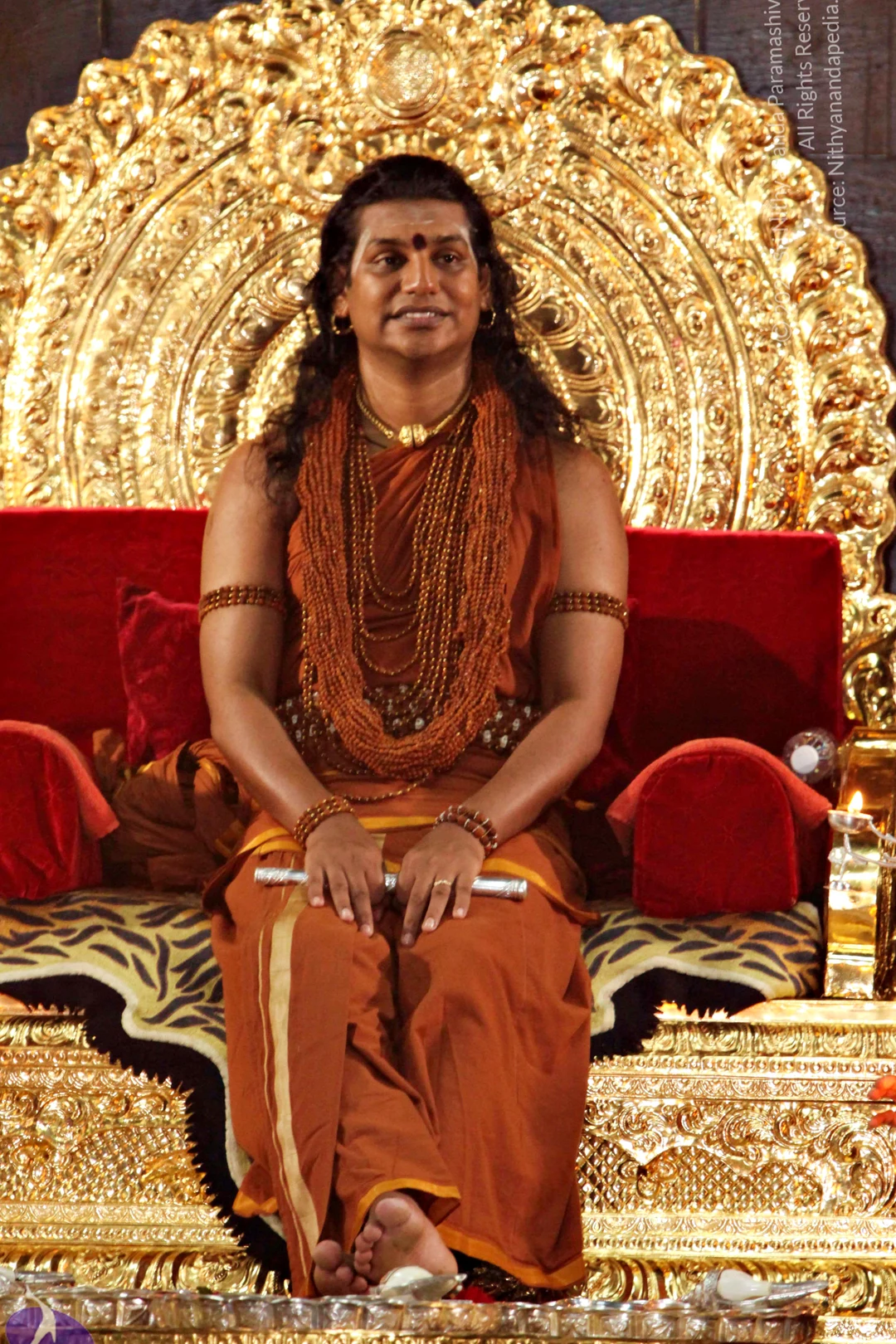
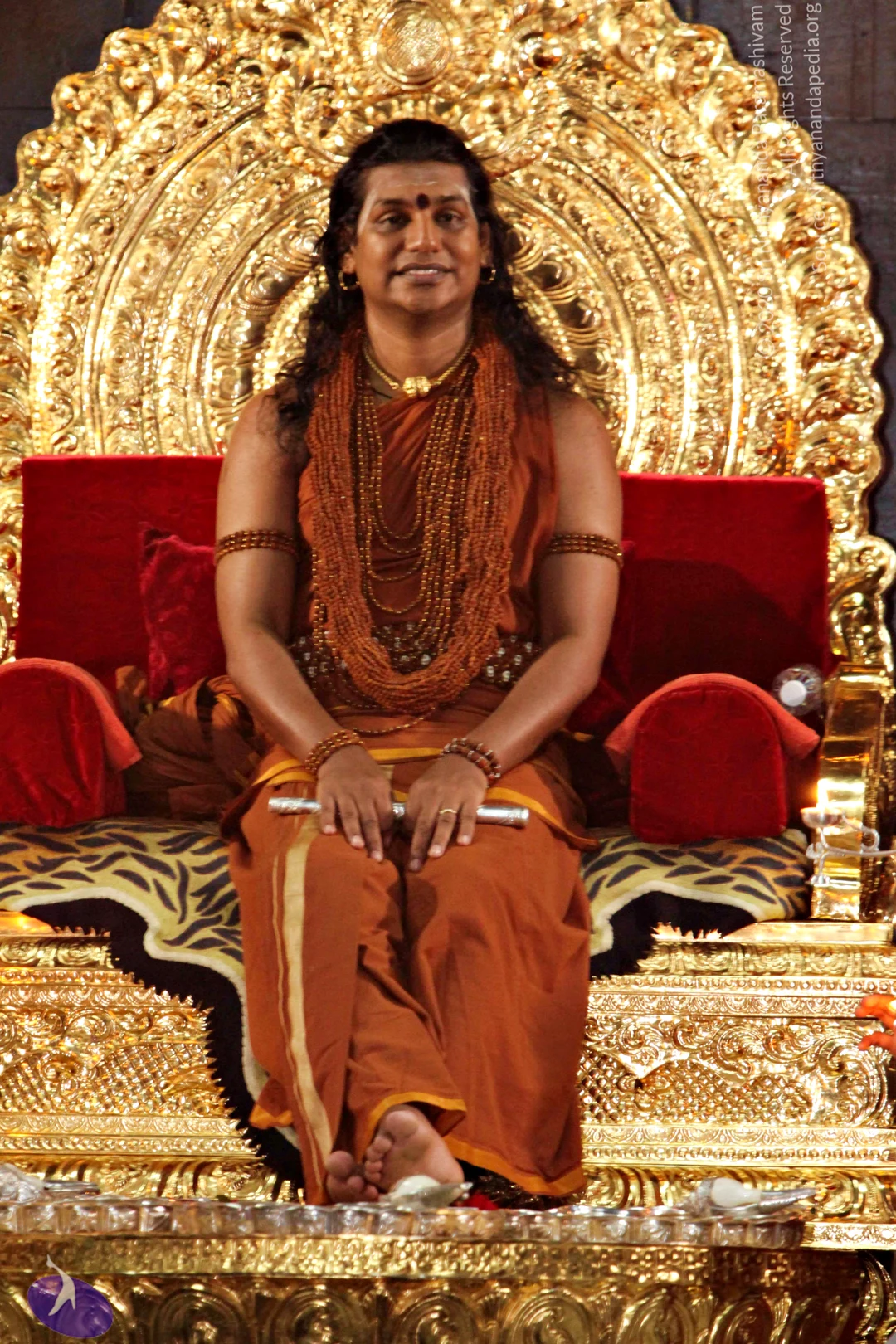
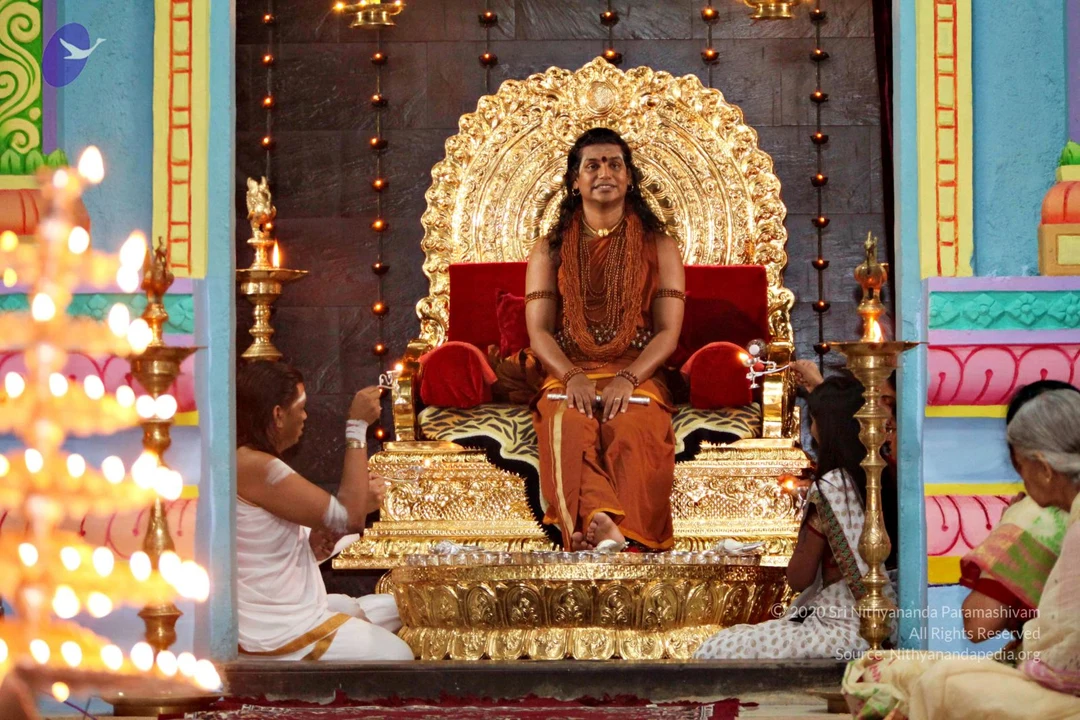
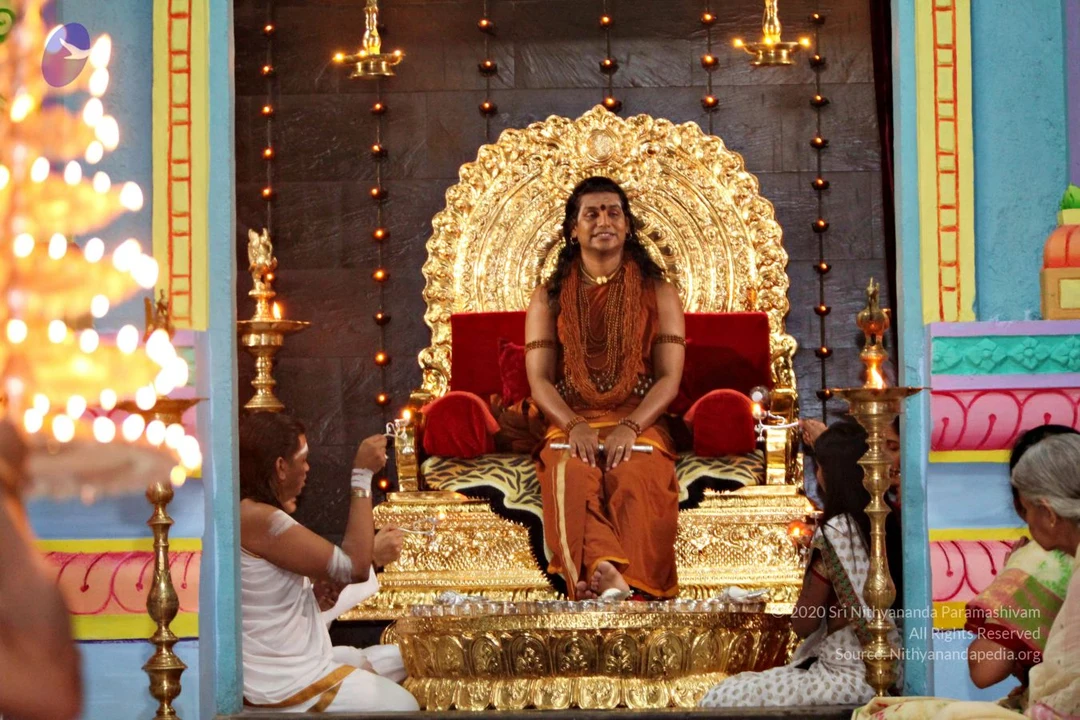
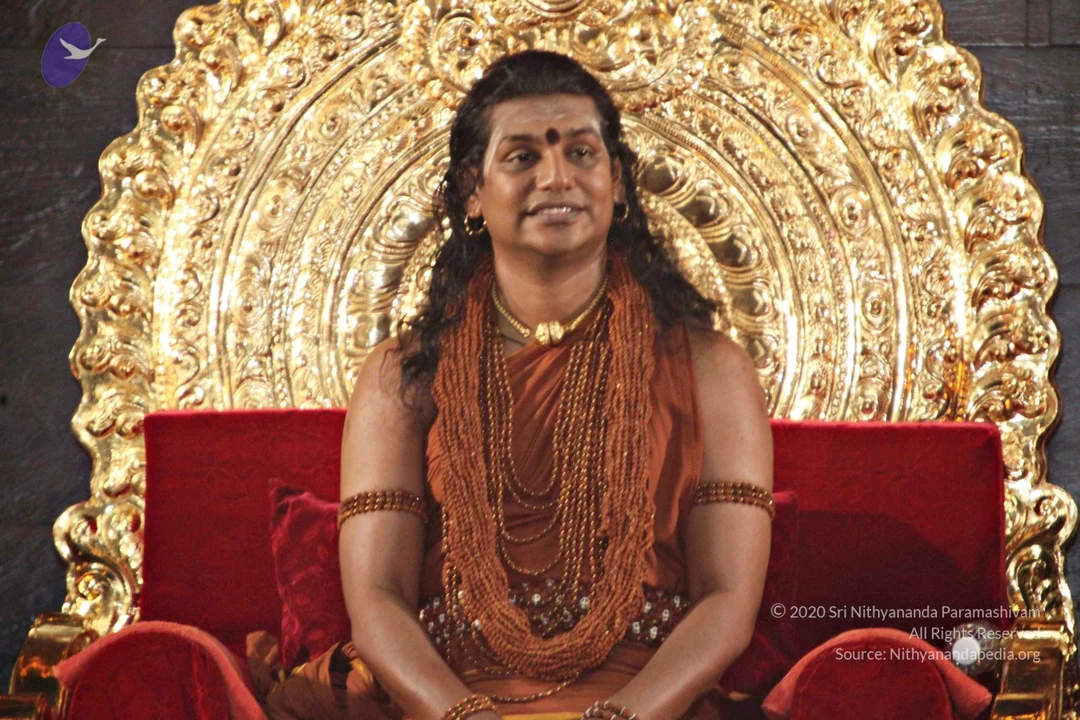
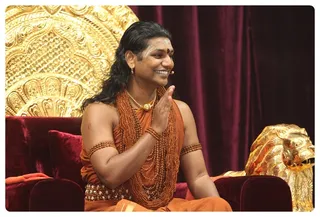
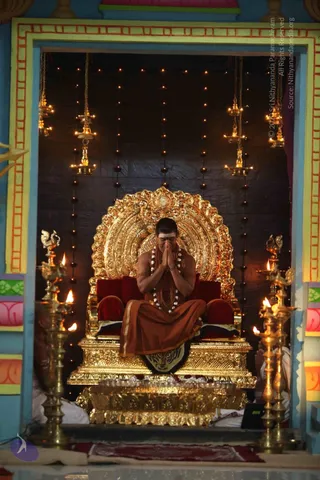
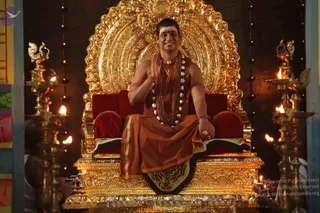
A photograph of a ritual padapuja-style offering in a dark studio-like room. A long-haired man in orange-saffron robes, rudraksha beads and gold necklace sits on an ornate gold throne with red cushions, bare feet resting on a bed of red flowers, while a lit brass oil lamp stands beside him. Swamiji (probable) is the central seated figure, distinguished by swept long hair, saffron clothing and rudraksha malas. A man in white kneels at left with a white-clad attendant wearing a forehead marking and orange-bordered white cloth, and a man in white sits behind a gold tray. Several gold-rimmed silver trays holding bowls of red flowers, yellow liquid and offerings surround the gold table, with other hands and silver vessels visible at the bottom edge.A man seated cross-legged on an ornate gold throne with a large gilded back and red velvet cushions, hands folded in his lap, in a dark-walled hall. He wears an orange-saffron robe with a gold border, a multi-strand rudraksha mala and a white beaded garland, bangles on his upper arms, and a red-and-white tilak on his forehead. Brass oil lamps with lit flames stand on both sides and hang from the ceiling, with a string of dark beads hanging behind the throne. Seated devotees in white clothes are partly visible at the lower edges. Swamiji (probable) is the central figure, distinguished by the saffron robe, rudraksha mala, ornate gold throne and the swept-back hair visible in the scene.A man stands against a dark maroon curtain on a stage, holding a pair of silver-and-black dumbbells at chest height with both hands while speaking into a small headset microphone. He wears a bright orange short-sleeved t-shirt printed with a red-robed figure and the caption "a person" across the chest, and a thin gold bangle on one wrist. The printed portrait on the shirt is a depiction on clothing, not a physical person in the scene.

February 20 2013

Original wiki page
Contents

Title

February, 20 2013

Description:

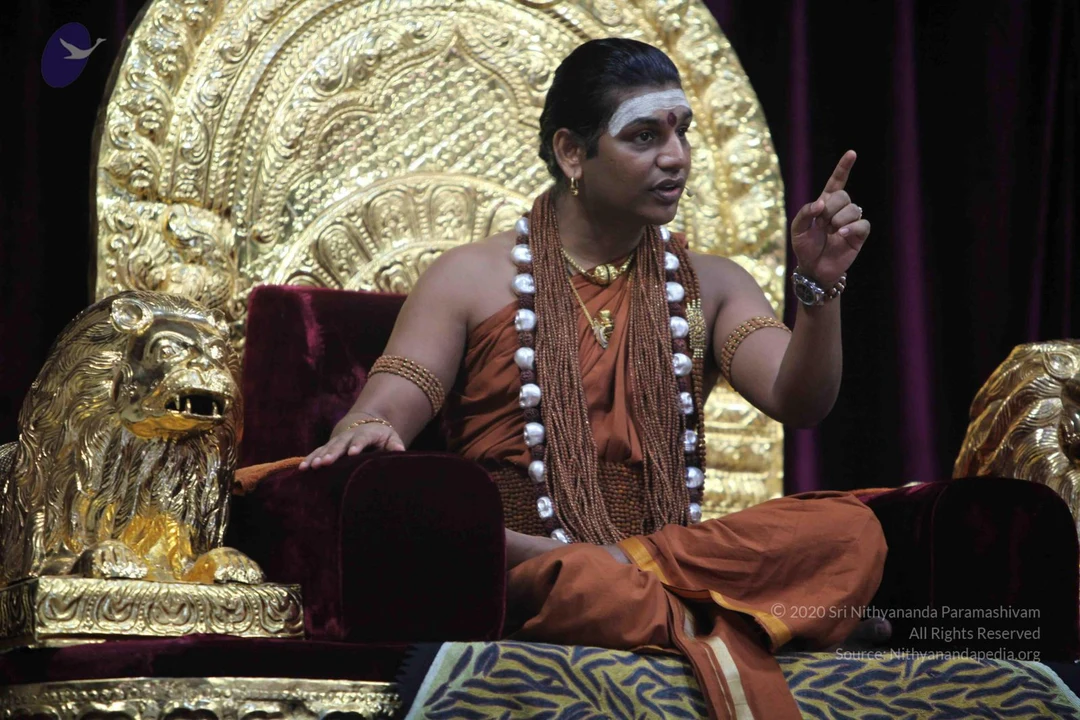
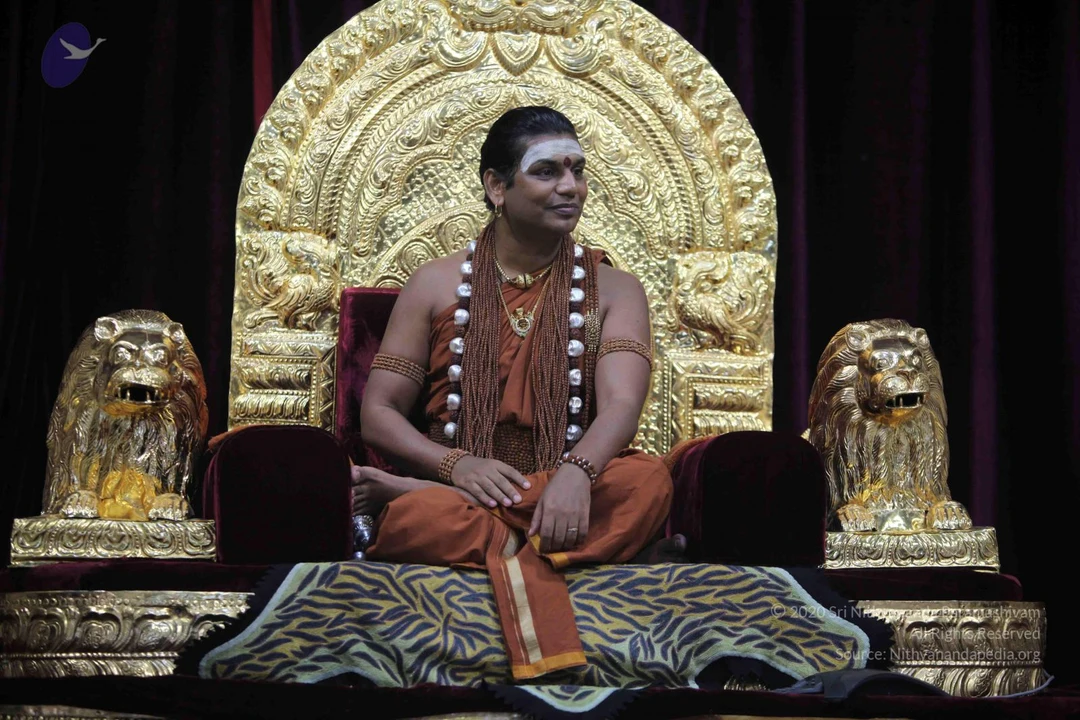
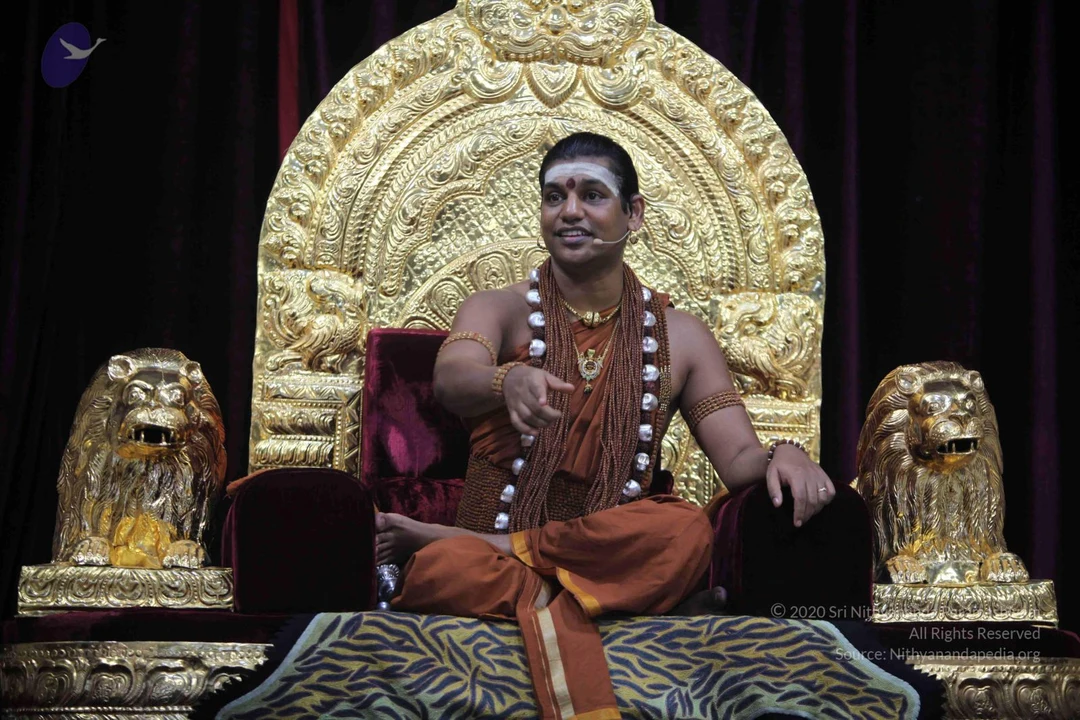
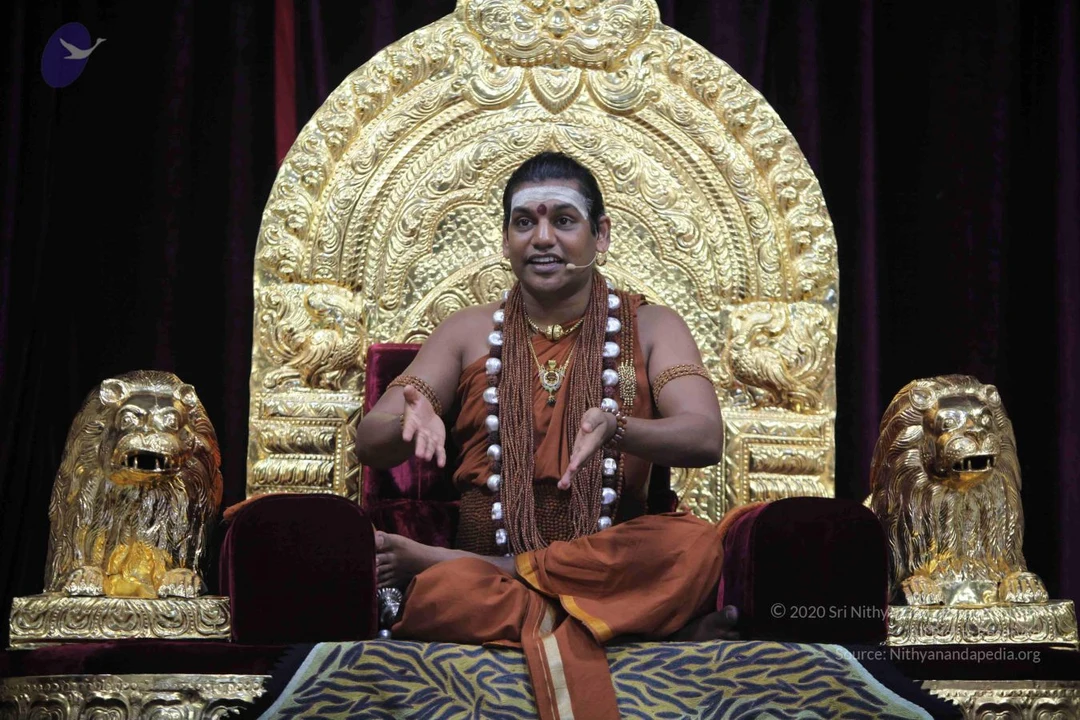
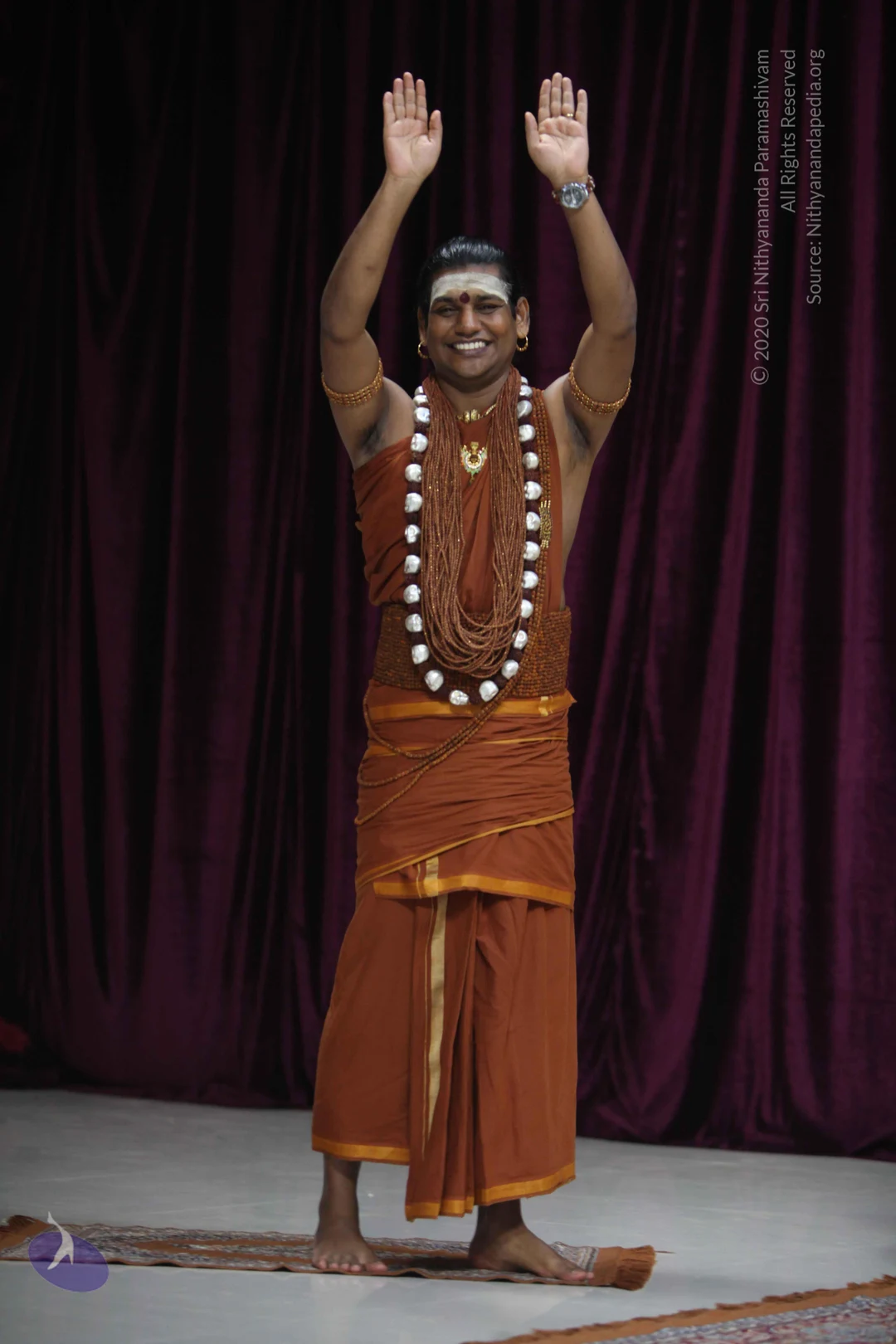
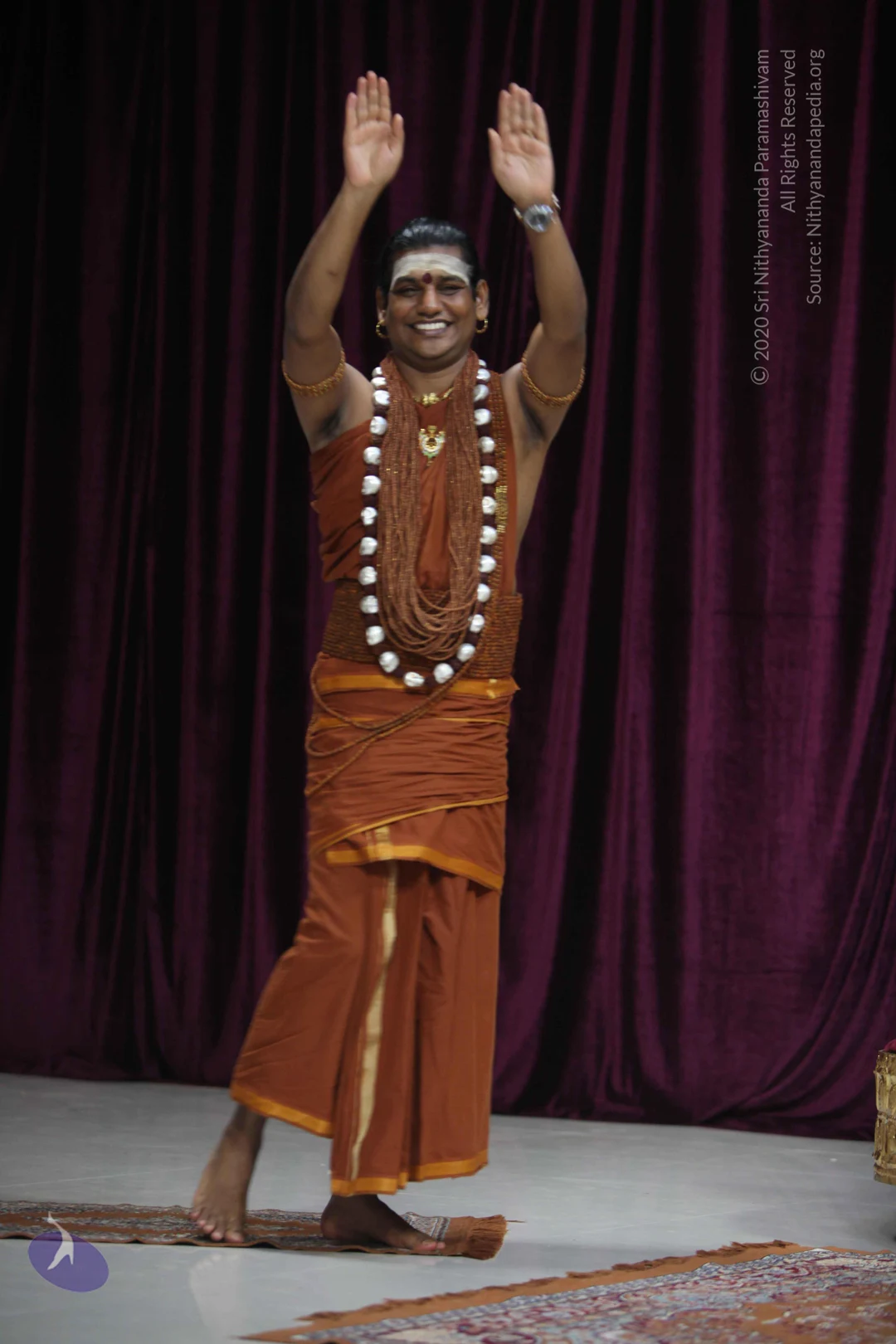
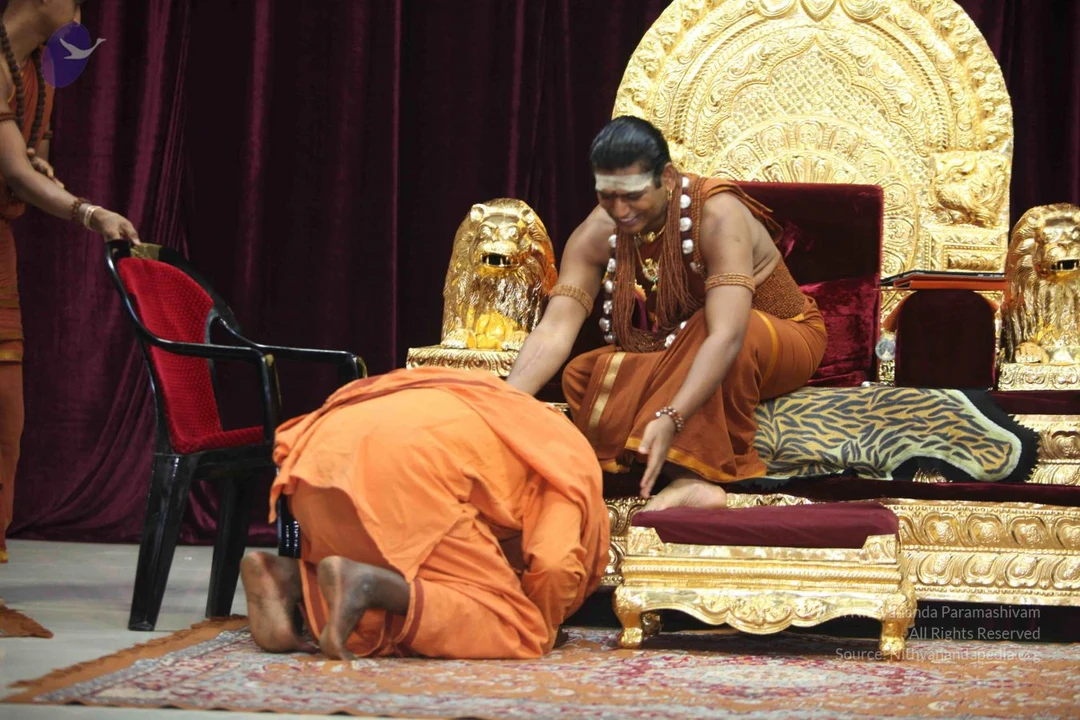
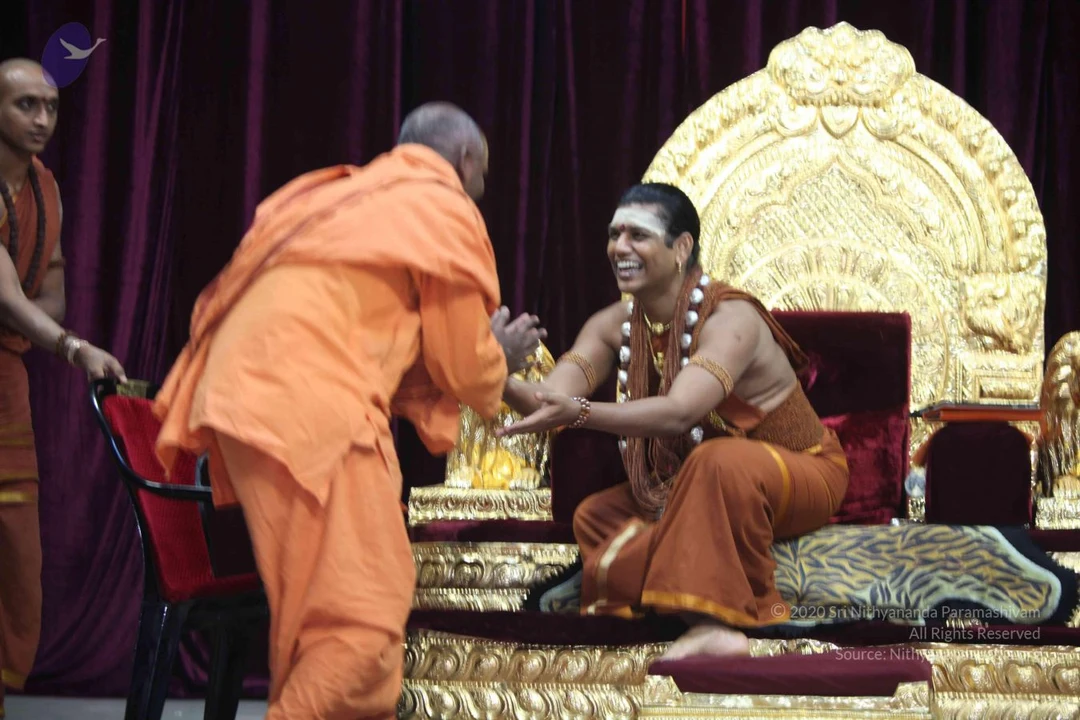
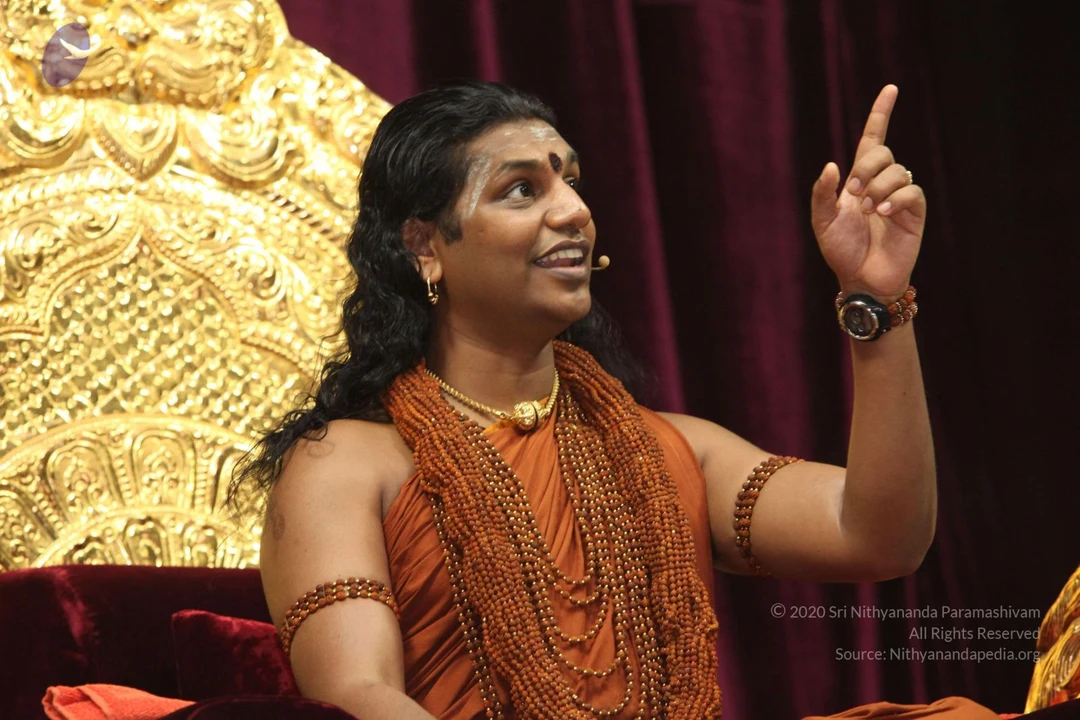
In today's Satsang Paramahamsa Nithyananda (Swamiji) talked about inter-connectivity of the four tattvas- integrity, authenticity, responsibility and enriching. Swamiji elaborated how we are programmed to achieve success naturally and how people avoid being successful. Many of us believe that for success we have to work but failure comes naturally. Reality is exactly opposite. If we bring integrity then success is the natural flow of life. Swamiji said thinking with integrity removes the weeds of negativity. Essence of today's satsang is Integrity removes the self fulfilling negative prophecies in our life, in your cognizance, in your inner space.

Transcript:

“Sadashiva samarambam, Jnanasambandha madhyamam asmadacharya paryantam vande Guru paramparam!”

I welcome you all with my love and respects! I welcome all the devotees, disciples, Samajis, Satsangis sitting with around the world at this moment in 481 places through Nithyananda TV & Youtube live, 43 places in 2 way video conferencing having Nayana Deeksha, in 184 cities, 22 countries around the world as per the statistics!

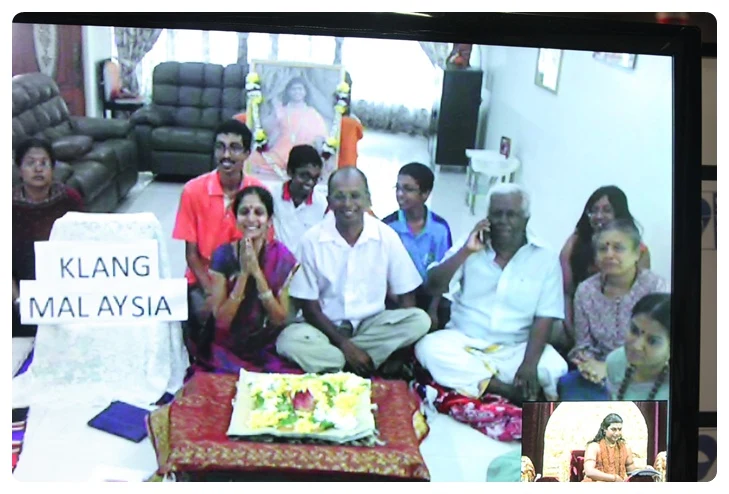
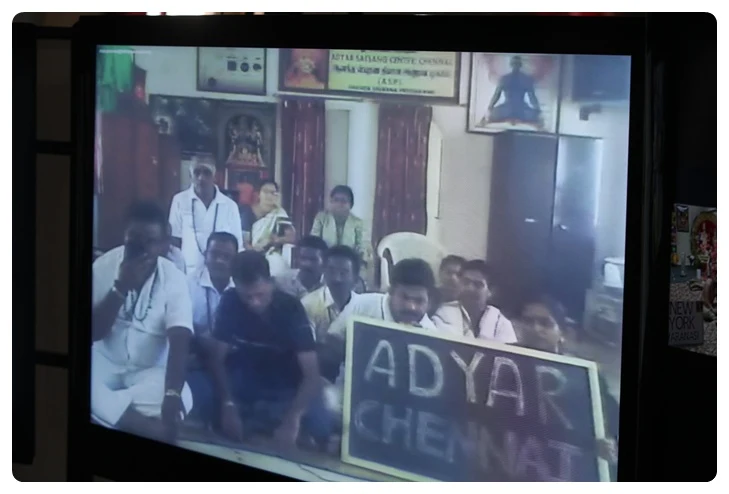
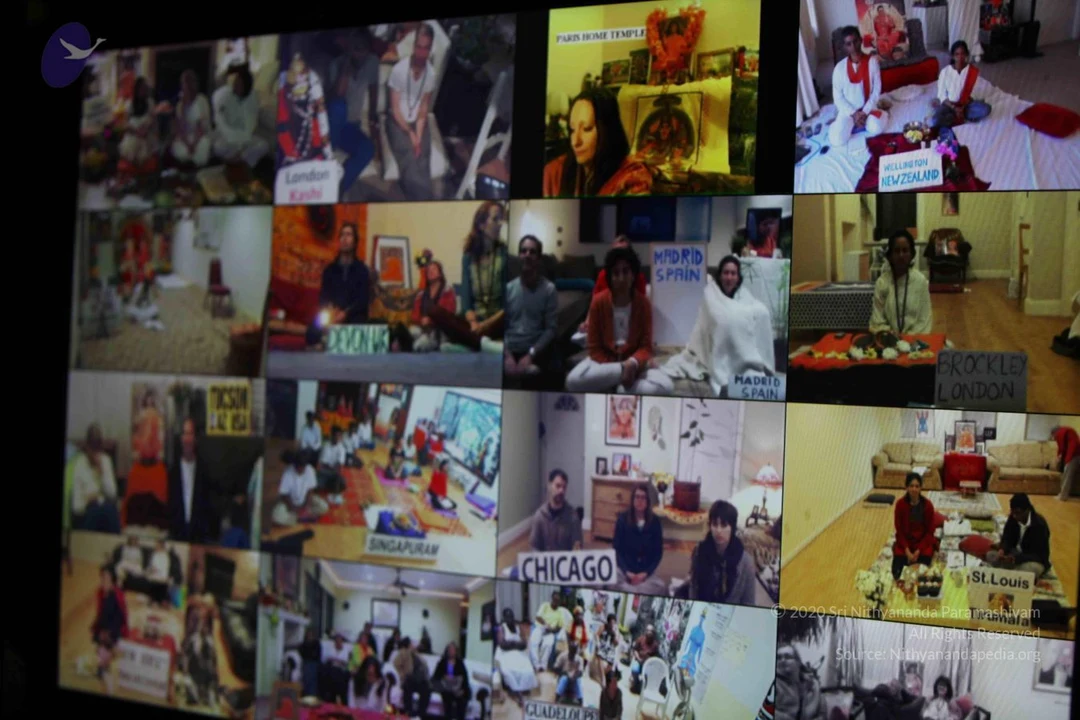
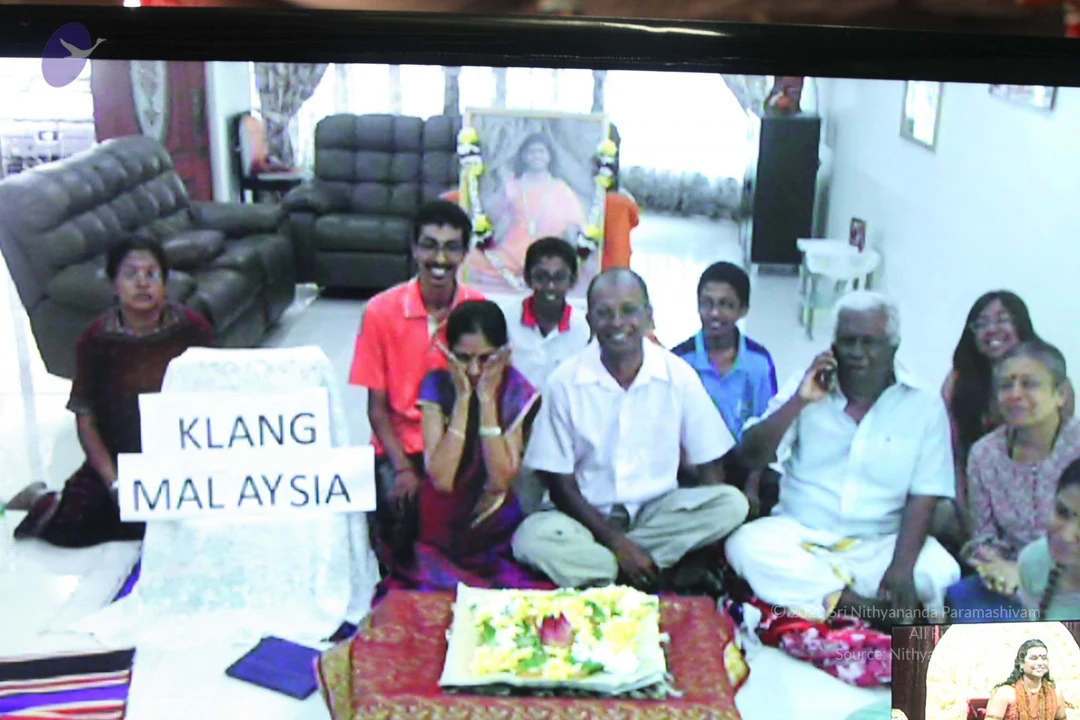
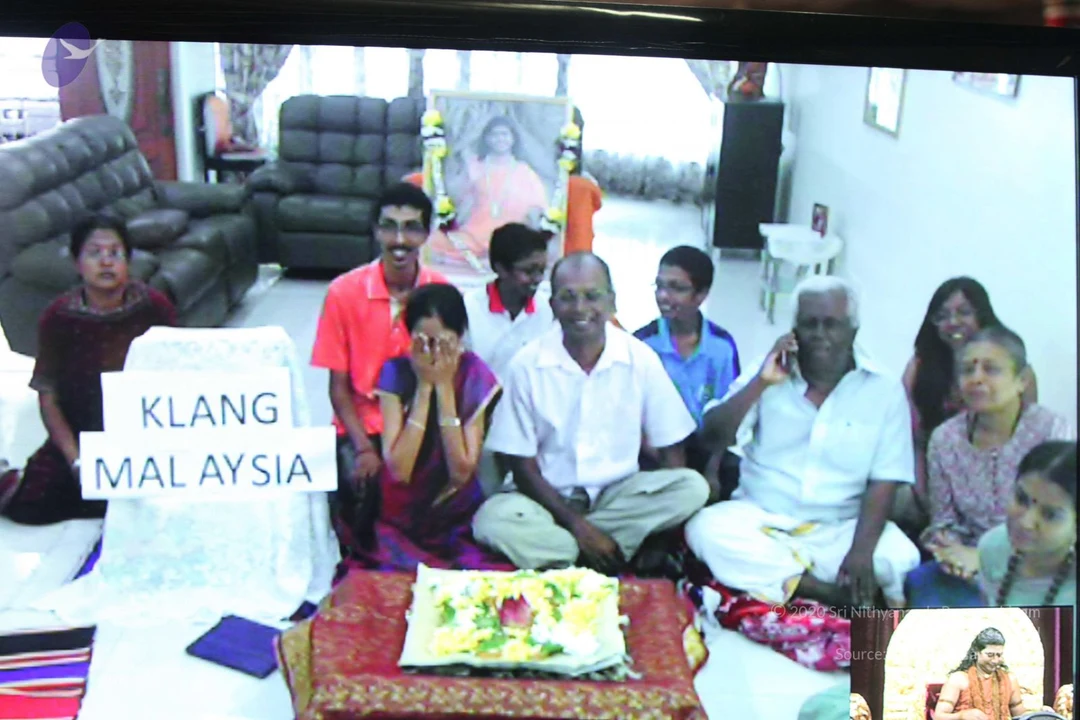
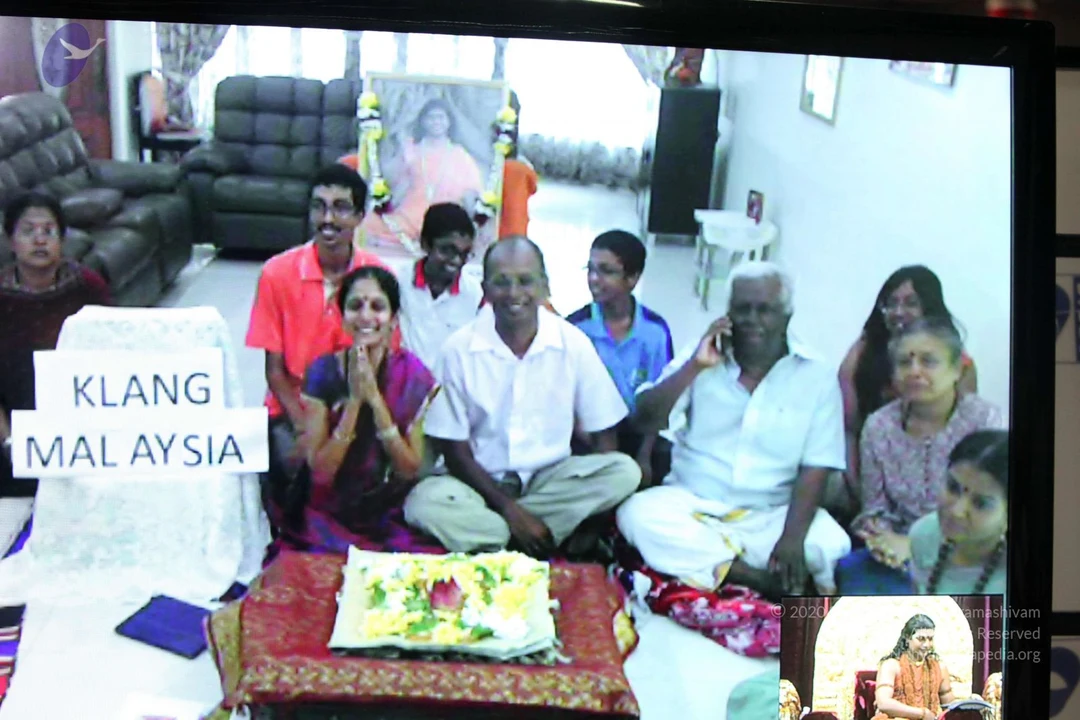
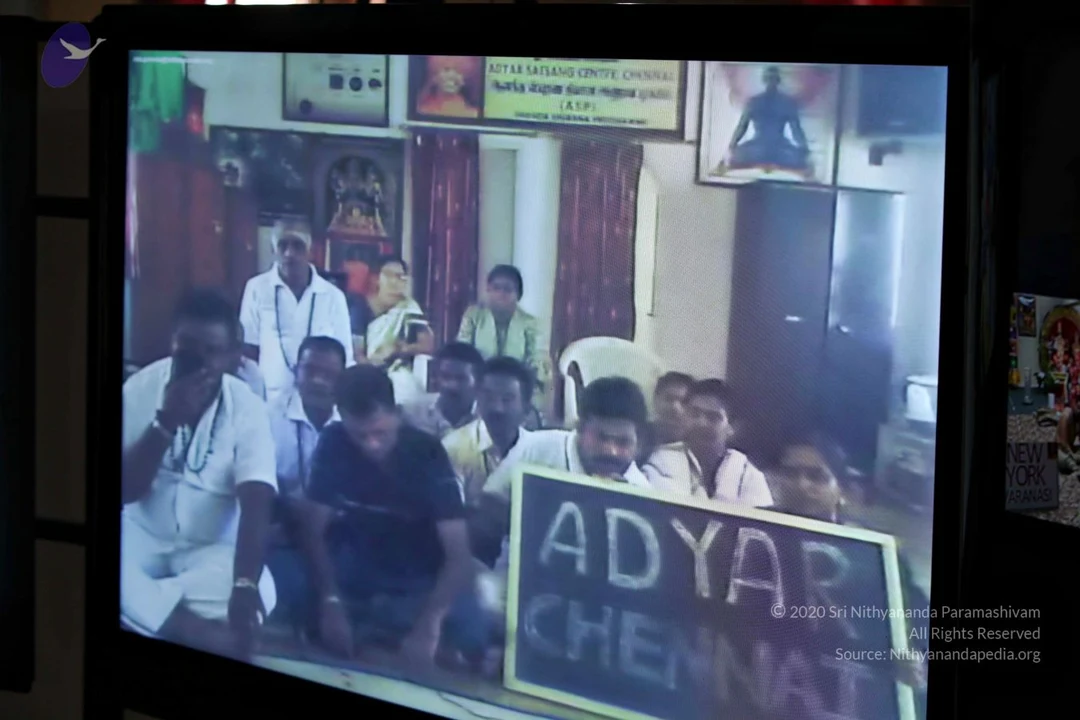
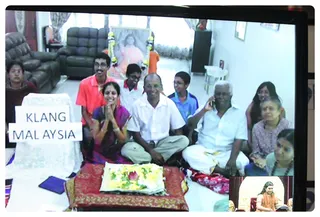
Cities sitting with us in 2 way Video conferencing having Nayana Deeksha are - Klang Malaysia in Dr.Palaniyappan's house they are having satsang today. Guadeloupe Rameshwaram, Oklahoma Somanatham, Chennai Alwarpet, San Jose Madurai, Los Angeles Arunachala, Ohio Prayag, Phoenix kanchipuram, Hyderabad Bhagyanagar, Tiruvannamalai, black diamond Canada, Dubai, Hyderaba Shree, Pondicherry, New Delhi Turiya, Oman Siva Gangai, Singapore Singapuram, Austin, Monterrey Mexico, Bangalore North, Devon UK, Port Wash, Bangalore Marthahalli, Oman Siva Gangai, East London UK, Durango Mexico, Coimbatore Satsang society, Bangalore Gangamma Circle, Slovakia Koshitze, Atlanta Home, Bangalore Bannerghatta. Adayar Chennai i can see. I welcome all of you with my love and blessings! I already told that there should be no overlap with cities.That is what is integrity with the concept of Nayana Deeksha. When we promise, we have to be in integrity with. New York Varanasi, I am able to see you now.

When you are inauthentic,when you are having the lack of integrity for your work, be here and take the heat, take responsibility. Today ns 3rd level 7th day and THE samyama 4th day. Today the death process for Inner Awakening participants. So all THE samyama participants also can come for the death process today. And people who are going through some struggle with your patterns. Brahmanyam Bahu putrataam participants how many of you with authenticity are working with completion but struggling with patterns raise your hands. All you guys can be part of the death process and I will also help you. If you are authentically struggling but still not yet successful, those of you can come for the death process. First session itself is the death process. The process will completely help you. Death process is literally re-booting...if your computer is not responding, you re-boot it isn’t it? Like that only...

In the night we will be having Akaashik readings and Kaala Bhairava darshan. Vijayalakshmi in Adayar centre, blessings.. your eyes will be healed. Adayar center today if the 2 way works, I will have a session with you guys.

We will start. Today I will expand on inter connectivity of these four tatvaas. How when you start being integrated, so much of inner space is available for you which naturally brings authenticity in you and makes you take responsibility and continue to enrich you and others. Listen. When you start thinking with integrity, you will know your strong beliefs. One of the biggest problems human beings have - love to be successful but deeply believing you are a failure. Constantly every one of you love to be successful but deeply believe you are a failure. This is one of the biggest paradox. The lack of integrity in your thinking. How many of you cognize this - you love to be successful but you deeply believe you are a failure. That is one of the biggest problem. That is one of the biggest paradox human beings are suffering. Some of your actions may be failure, some of your decisions or dimensions may be a failure but you are never a failure because still you are breathing. when you have not lost the inspiration to take the responsibility nothing is lost. I tell you if you take the responsibility, even death cannot come near you. Death waits for you to complete your responsibility. So anybody wants to live long, just practice authentic responsibility. With authenticity, when you take responsibility, consciousness growing in the body starts happening more intensely. Shrinking does not happen. Consciousness growing in your body. Consciousness growing in your body is enlightenment. If negativity is growing in your body. Please listen. Something has to grow in your body - either life or death. You cannot be in neutral you cannot say pause. No. It is not Youtube video to pause. Life has no pause button. It has fast forward, it has rewind, it has play button, it has even stop button, but it has no pause button. Either life has to grow in your body or death has to grow in your body. The inauthenticity which you entertain is death for you. I tell you even in the most critical moments of the organization, i take decisions completely being authentic. Authenticity is my strategy planning. Pick that up as strategy planning in every moment of your life. Whether it is something to do with health, or creativity or solving relationship problem, or something to do with achieving the inner fulfillment or something to do with creating wealth, have authenticity as a strategy planning. I tell you whenever you try to take the responsibility of other's anyakaara about you. Others anyakaara about you has 2 dimensions - one - how they perceive you. 2nd - how they want you. How they perceive you now and how they want you in their life. They may perceive you as a fool and cheat. They may want you as intelligent and authentic. When you take responsibility for both parts of others anyakaara, life just oozes out of your ananda gandha. Please listen if you want your skin to be shining, your eyes lit, body radiating the grace and the joy, take responsibility for others anyakaara in both directions. If others perceive you as cheat and fool don't be angry. Some way you have not raised yourself. I tell you whoever takes responsibility for whole world' anyakaara is God. God takes resp for even atheists anyakaara that is why when they say God never helps, he never helps and he makes sure he fulfills their anyakaara. Listen. Taking the responsibility for what others perceive and what others want, just makes the life ooze, explode, express through you. Go on doing manana. Catch every root pattern with which you are suffering. Go on doing manana. Let your every decision be out of authenticity and enriching. Not out of anything else - fear or greed. Not even fear of me. Today morning i saw Maha Kalananda today morning when i asked him he was behaving like a slave, frightened...i never like people who are frightened in front of me. No. Be authentic in front of me. Yes you missed. Now what can be done. Let us do the prayaschitha and let us ensure this does not happen again. Do not function out of any other cognizance than authenticity and responsibility. Continuously complete. Now another one new disease is spreading in Dhyanapeetam. It is not physical disease, mental disease and very infectious. In these communities usually mental disease is highly infectious. What is that you know? to do the completion you have to take off from all the words at least for few weeks or few months and get back to routine only after that. This is the latest infection which is spreading. First thing to do the completion, you have to be in your same routine. Every day you have to grease. It is like lubricating. You cannot stop the machine and lubricate. Machine has to be running and you can lubricate. You cannot say let us stop the machine and whole factory....you have to find out if the lubrication is strong enough or not when it is running. So the completion has to be done as part of your life - routine. Not otherwise. I have a real specimens, samples from all over the world. You call it best or worst but all extremes. You may call it good or bad or worst but all types i have. But I am so happy that literally I am living in Kailasa. Means all types of Bhoota, preta, gana, Pisaacha.this idea you have to take off time to do completion is completely wrong. Machine has to be running and the lubrication has to be done continuously. As I told you again and again i wanted to remind you - Life has no training period. Only in the games you have a t raining and actual game. In one village eating competition. It started in the evening. Some 20 fellows were participating and everyone started - 500 idli, 50 banana, 100 litres juice. One fellow came first and the 2nd fellow missed just by one idli. Everybody asked why did you miss the prize just by one idli. That fellow said everything went well when i was doing the rehearsal ....now i missed. So if you are waiting for training, you miss the actual life. Life is not like football, volley ball and cricket that the training ground is different and ground to play the game is different. Life is like eating competition, training is living. If you want separate training ground, you will fail in the game. With integrity literally you will clean your inner space of constantly unwanted beliefs you carry. The strong belief you carry that you are a failure, continuously will lead you to failure. When you start living in integrity you will diagnose those self fulfilling negative prophecies constantly you give to yourself. With Integrity you will diagnose those self fulling negative prophecies you constantly give to yourself. How many of you behave like a self negative astrologer?....

Self fulfilling negative astrologer. Each one of you have your own astrologer. You are the astrologer for you, you are the trainer for you, you are the judge for you. First you give the self fulfilling negative prophecy i am a failure. Then you train yourself for that. By mistake Guru should not make you successful. ...you are haunted by the discourage you get from the junior brahmachari in your department because you are getting trained for being a failure. Who is the decision maker in your life? You and swami but I am talking for the ashramites. But even in your regular life for many devotees i can tell you will not be encouraged by the decisions made by......but you will negative self fulfilling prophecies be discouraged by the small rats and cats...first you are an astrologer for you who declares you are a failure, then you are a trainer who trains you to be failure even if that does not happen, you behave like judge and declare you are a failure. When a small thing happens, you just behave like failure...We go on doing this. First thing declare your integrity not your failure. Declare your integrity. When you start thinking with integrity, i tell you you will diagnose your self fulfilling negative prophecies. When you are about to get into the car itself, you declare you will have an accident. Then when you drive, you will continuously sleep, even after that when accident happens, you just hit one corner of the road, nothing happens to you or the car but you say i told you na that accident will happen. See what happens?

The power of integrity will teach you to diagnose the self fulfilling negative prophecies. Sometimes you take up failure as the self sympathy creating mechanism and you think for success you have to work, failure is natural. How many of you think for success you have to work and failure comes naturally? Success is natural, for failure you have to work. Bring integrity, you will understand success is the natural flow of your life. For failure you have to work very hard. Krishna says very beautifully by the nature senses are tuned for the extra world means to be active, alive and creating.

...senses need to be be extrovert does not mean it is negative. Extrovert senses will always be alive, creative active, contributing. All great creative persons took the responsibility for their extrovert senses. Listen. Senses are extrovert naturally it flows, it does not need to be negative. It flows means what? By nature they function towards achieving. Naturally they flow towards for achieving. It means what. You are programmed by nature to be successful. The natural programming of you is to be successful. Lack of integrity allows the poison of self fulfilling negative prophecies to grow in your system. I tell you first thing a human being needs to do is weeding out all the self fulfilling negative prophecies. How many of you feel you need to weed the self fulfilling negative prophecies you carry in you? It can be done only by functioning in your daily routing. When you take time off, they will just disappear. Only when you are working tightly in your every day routine, you will discover your self fulfilling negative prophecies. Try to take off for few days, all those negative self fulfilling prophecies will hide themselves into some unconscious decisions. Unfulfilling. Listen unfulfilling your every day commitment will only make the weeds hide behind your unconscious pattern. Vivekananda is very very clear Yoga can happen in you along with responsible karma. Karma Yoga does not happen without responsible actions. Some time you do actions whole day but there is no responsibility for it. I know many of our sanyaasis. In Tamil there is a proverb - naayiki vela ella, nikka neram illai - the dog has no job, but it does not have time to even stand. This is what is action without responsibility. How many of you feel authentically cognize you are stuck with the pattern of action but no responsibility. Rama Krishna gives a very beautiful example - how much ever water you bring it to your paddy field, if there are too many frog holes, rat holes, all the water will go and settle there. You will not have water for growing the paddy. The frog holes, rat holes, snake holes are only the negative self fulfilling prophecies. All the energy you bring, all the kundalini energy i pour goes and settles there. Finally no water. Neither paddy nor Ganga water can flow. Because 24 hours you are weighed , loaded with negative self fulfilling prophecies. First thing a human being needs to know weed out the negative self fulfilling prophecies. Integrity makes you aware of negative self fulfilling prophecies. There is a very beautiful story in Upanishad. Satya kaama is a great disciple. Unfortunately Satya kaama is not given the importance given to Nachiketa. I tel you satya kaama was equivalent authentic character like Nachiketa. Nachiketa met yama and achieved enlightenment. Satya kaama met life and achieved enlightenment. Nachiketa met death and achieved enlightenment and satya kama met life and achieved enlightenment. Meeting death is taken as an achievement that is why Nachiketa became popular and meeting life is not that big achievement that is why Satya kama did not become popular. Satya kama asked Guru and Guru gave one pregnant cow and bull and said come back with 1000 cows. Fortunately satya kama did not have any negative self fulfilling prophecies. If i give this to any one of you guys who raised the han, first thing you will think what will happen to me if this cow dies. Where will i get the bull for the cow, if i get a female calf, what will i do. And if i get the male...how long it will take...is there any guarantee if i come back with 1000 cows this guys is going to give enlightenment. What will do if suddenly some disease spreads when the cows are 999. And Swamiji can you give a manual and little training for me to take care of the cows. How to feed the cow? How to milk the cow. But to make one cow into 1000 cow you don't need to milk it. Nithyasthananda you don't have any questions? If the cow is possessed by ghost what will you do? So any other question? So finally if a Guru gives one cow to you and asks you to come back with 1000 cows, will anything happen? I can tell you each one what they will do. Shuddhananda will go away for Parivraajaka. Bhaktananda will train that cow to ride on it. Paramananda will be planning alright at least after this cow dies, i will make drum out of its skin and at least i will be beating it. Natesha will be planning i will sell the cow and live for two months in Bangalore. Prematma will ask for one more computer to account because when it becomes...achala will ask can we have a legal agreement once it becomes 1000 cows, you will give enlightenment? Ma Maneesha will say - as per authenticity, integrity, responsibility, enriching one cow cannot become 1000 cows! Ma Dheera will say this cow the 4th leg is shorter than the 3rd leg, how will it walk? no give me the cow which is better. Finally nothing will be done! There are some people cow will run away seeing them. Sri Bhaktimayananda, Rishi Dayananda. Ma Nirvikalpa first thing Swamiji can I carry my first aid.....atp biggest question will be where will i dump all t eh cow dung. How will i clean the cow dung. 1000 cows means it will he huge, heap of cow dung. It will be taller than me, how will I clean? Sambhava will start talking to the architect, where will i place the cow shed, should I build it now itself or build ...and Advait will be giving advice.Shambava we should do brain storming first when we build rectangle.....so all cows will be inside, we can be outside. Finally after all the discussion, Hamsananda comes an tells me cow is dead! Self fulfilling negative prophecies are the chains tied in your legs. Listen. Chain tied in your legs. Nothing, nothing gets initiated by you. Maximum you are pushed by somebody. You drag the chain and walk. I am just visualizing in one Tamil movie, comedian Vivek's leg they will tie, he will not be able to walk, he will somehow lift that, tie it in his lungi and walk. How many of you remember that scene? You will be walking exactly like that only! Somebody showed me in Youtube only. It is in Youtube. Self fulfilling negative prophecies are the chain tied to your leg. Nothing moves in your life an even if you are pushed. Just imagine the elephants legs are tied with chains and a big iron ball. It has to be pushed. Even then it moves with restriction.....self fulfilling negative prophecies are the weight on your inner space. Integrity is the only way you can even find those negative self fulfilling prophecies an weed them out. If you start looking and then naturally you will not give your negative self fulfilling prophecies any life.... even for ten days if you do look at your negative self fulfilling prophecies, they will die. Understand even if you had negative self fulfilling prophecies for 1000 years, if you do not ....for ten days, they will die. Tree grown for 1000 years it takes few minutes if you pour acid. Integrity is the acid that can destroy the negative self fulfilling prophecies weed in you. Every house will have one or two negative characters. Anything you start sometimes old women or even men their blessing is there!

And many of you guys also have part of you sitting in you and constantly saying. My sanyaasis are palace building sanyaasis not hut building sanyaasis. They may choose to live in hut but will build palaces for society. Thinking with integrity removes the weeds of negativity. You do not need courage to remove negativity, you just need awareness to remove negativity. ..you are caught in the wrong fight. The moment you think you need courage to remove negativity, you are engaging in ...100% be sure you are gone. You need awareness to remove negativity. You are fighting with your shadow if you think you need courage it is like bringing sword everything and finally you say no, i think I need to put atom bomb. If you put atom bomb who is going to die? you are also going to die. You just need a torch to fight with your shadow....you just need the torch of integrity. Means listen whenever you are going to have a thought i am a failure, you should know this is a commitment i am making to me and i have to honor it....you may say it comes on its own...then complete it.....Listen. If you have a strong idea or belief what you are doing is going to be a failure.the moment you think that it is a failure. It is a commitment and word you are giving to you. Do you understand? So if you give that word naturally you have to fulfill it. Do you want to fulfill that word? No. Then tell yourself i am not going to fulfill it. Consciously disown and complete with it. Then it comes back, again do that. Now it came back, i have given a commitment, but it has come back, but I do not want to be a failure then I will complete with it again. How many times it will come back? ....practice it. Your belief is not required. Your cognizance is only what is required. ..have you cognized theoretically. Now apply this mechanical process then come back to me with the result. It is a home work for you. How many days you need to come back and report the result to me. When you will report to me? I give you 48 hours take it. 48 hours practice this cognizance and get back to me day after tomorrow ...it can be anything..."athaatho brahma jignyaasa." - Let us inquire into reality. With this clarity let us enter. And you neither need need to believe my extreme or your extreme. You neither need to believe the Nithya and Ananda or Achala. Let us inquire. Clear?...How many of you did not try this earlier after trying this four tatvaas? It means you have not tried these 4 tattvas also. If you have driven from Bangalore to Mysore you would have hit Rama Nagara. But you sat in Bangalore and changed the name of your board to Mysore. Changing name board to Mysore does not mean you reached Mysore. Today's whole satsang i just wanted to give in this one statement. The essence of the whole satsang - Integrity removes the self fulfilling negative prophecies in your life, in your cognizance, in your inner space! When you start something, if you decide to remove the negative cognizance, suddenly you will see the courage to grasp the whole scene of the action you are going to get in....Essence of today's satsang - Integrity will remove negative cognizance from your inner space. How many of you cognized this truth now? Please raise your hands. How many of you are not able to cognize intellectually repeat. Ma Vimala when you go for morning to accounts department you are very clear today you will mess up with things. Am i right? So when you give this commitment, knowingly or unknowingly you will fulfill it. Then complete it and say no, i am not going to be this way.....i am going to give the fulfillment as a cognition. When you do this again and again do you think it will come up again? If you do it, it will not come up again. That's all I am saying.

<Video is played>

Understand all of you carry that ball - the negative cognizance. so the negative cognizance listen i tell you if any of you are in my place, how many 1000 reasons you will give for not doing anything? How many lakhs of reasons I can give. Listen work not done+valid reasons is not equivalent to work done. I want this equation to be typed and displayed in all our departments. From adyaar to America, Seattle to Chidambaram, from Los Angeles to Lawspet all of you should put this up - work not done+valid reason is not equivalent to work done. This equation has to be displayed in all ashrams and offices. When some body comes inside and walks out, the building should be educating them. The quotations we put there the building infra structure should be educating them. There are 3 types of education. One where you speak or show something. 2nd you do something neither speaking nor showing just by your life you show something. 3rd the very infra structure teaches. In Nithyananda sangha all three should be teaching. Now i will move to the next segment of the morning satsang Dial the Avatar. I will talk to Palaniyappan from Malaysia now and then I will do the conflict resolution show with Adayar Satsang centre. Please all of you note down the equation in your book of heart - work not done + reasons is not equal to work done. Means all valid reasons are invalid in life - give this as the interpretation of this.

Today i will start the conflict resolution for Adayar centre today. Maybe from today, every day i will do the conflict resolution for one centre every day.

Now we will move to Niraahaara Samyama.

Today's satsang is 4 hours. Morning 7 we started, it is now 11:08 am. More than four hours - almost 250 minutes. Great!

I bless you all who are sitting with us at this moment around the world in 890 places through Nithyananda TV, in 43 places through 2 way Video conferencing having Nayana Deeksha, in 309 cities, 33 countries around the world! Let you all achieve, experience, live, express, radiate, share and explode and enrich with eternal bliss, Nithyananda. Thank you!

Link to Video:

Paramashivoham Oneness Capsule 335 (20&21Feb2013 PHOTO POC)

Photos From The Day:

Morning Satsang
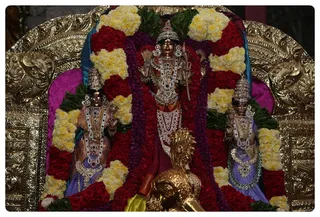
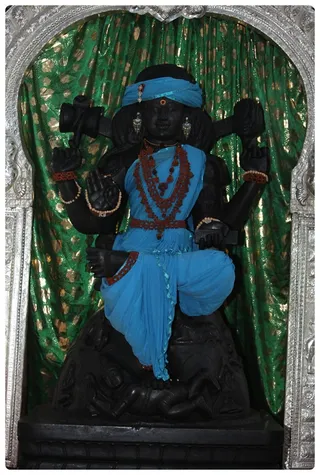
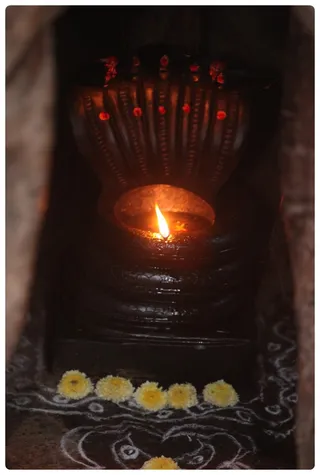
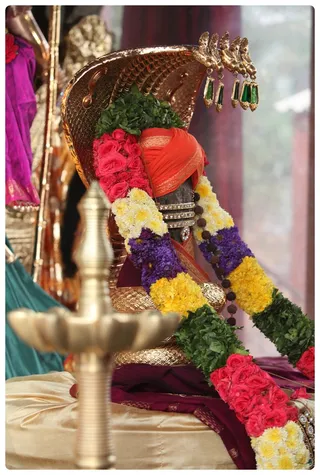
Temple Glimpses
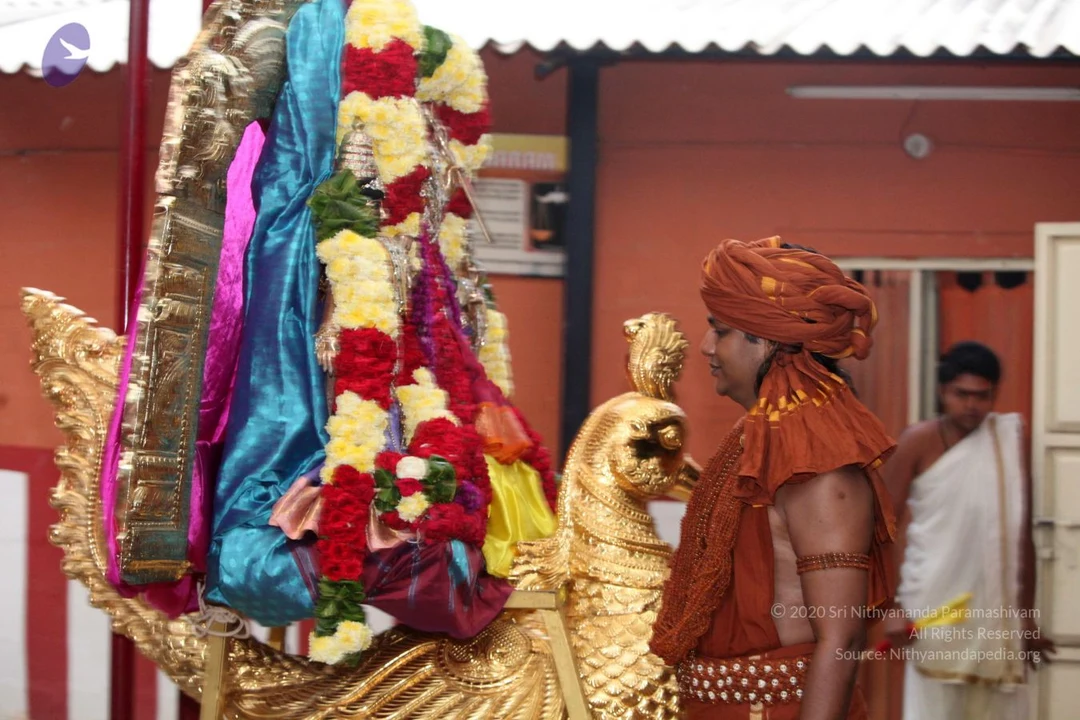
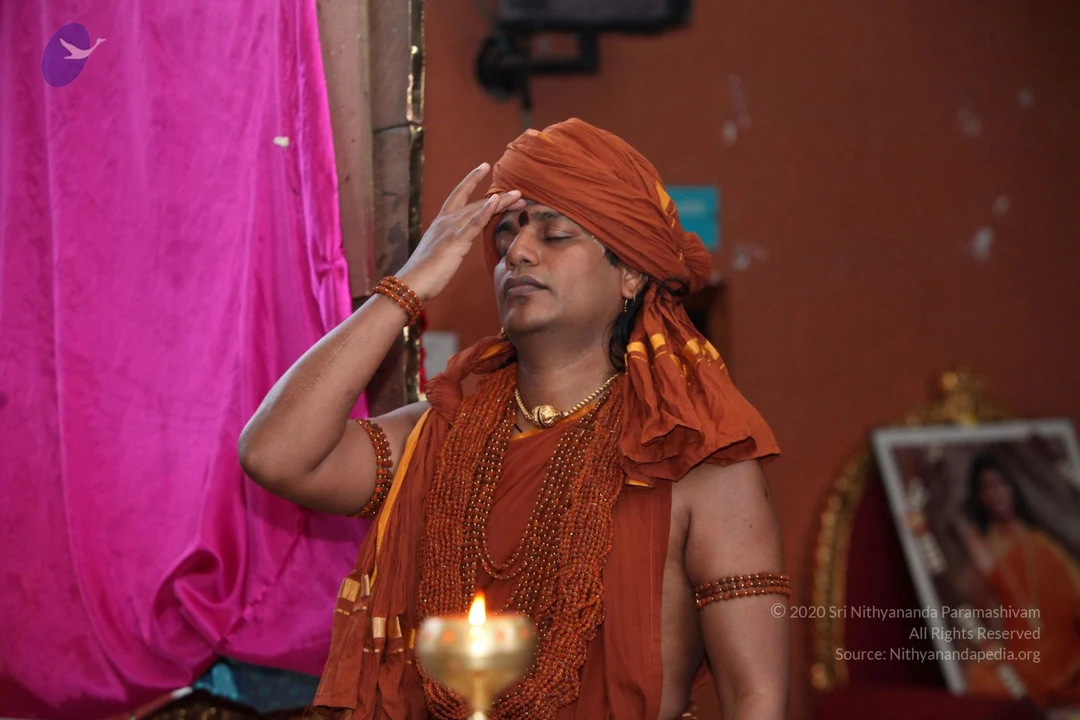
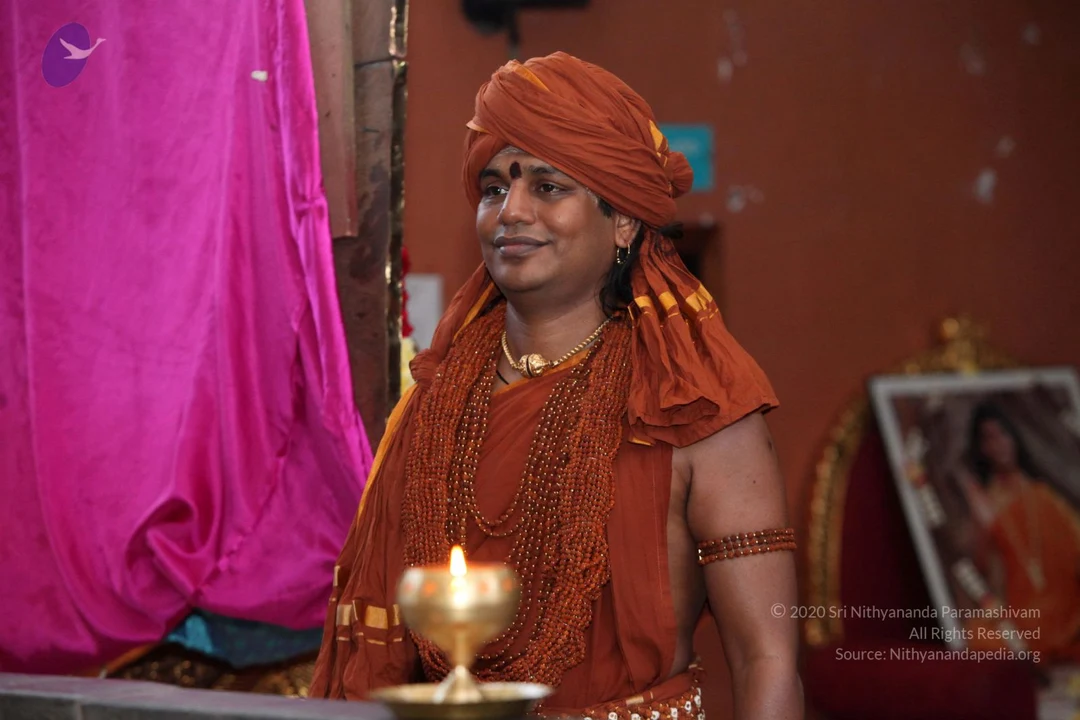
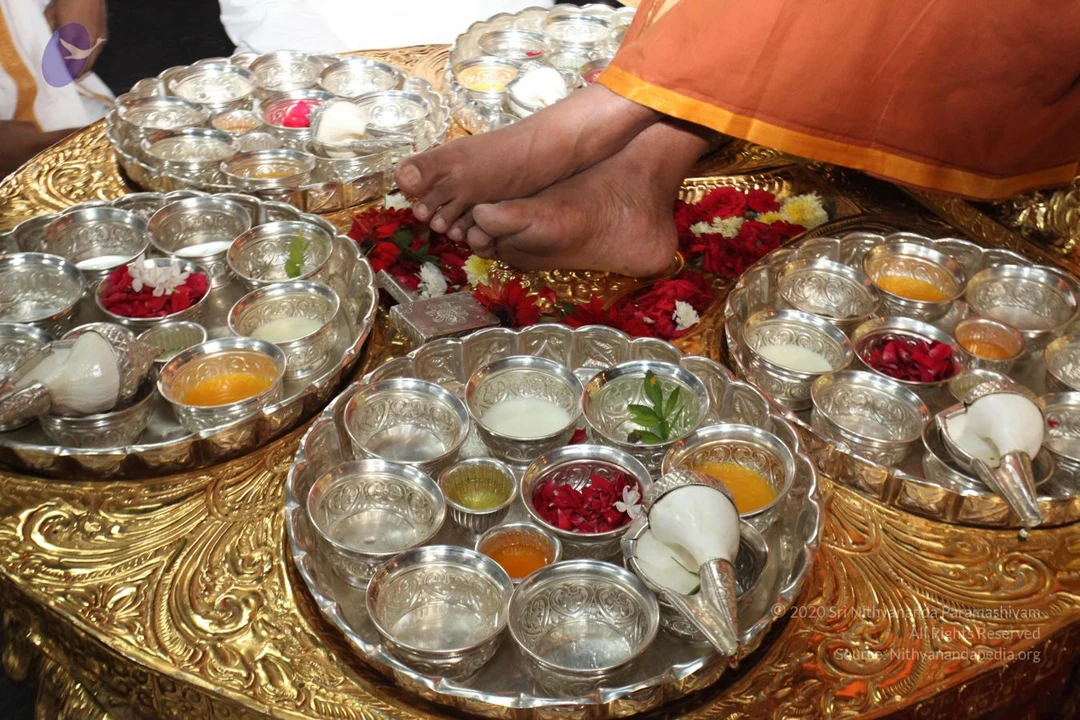
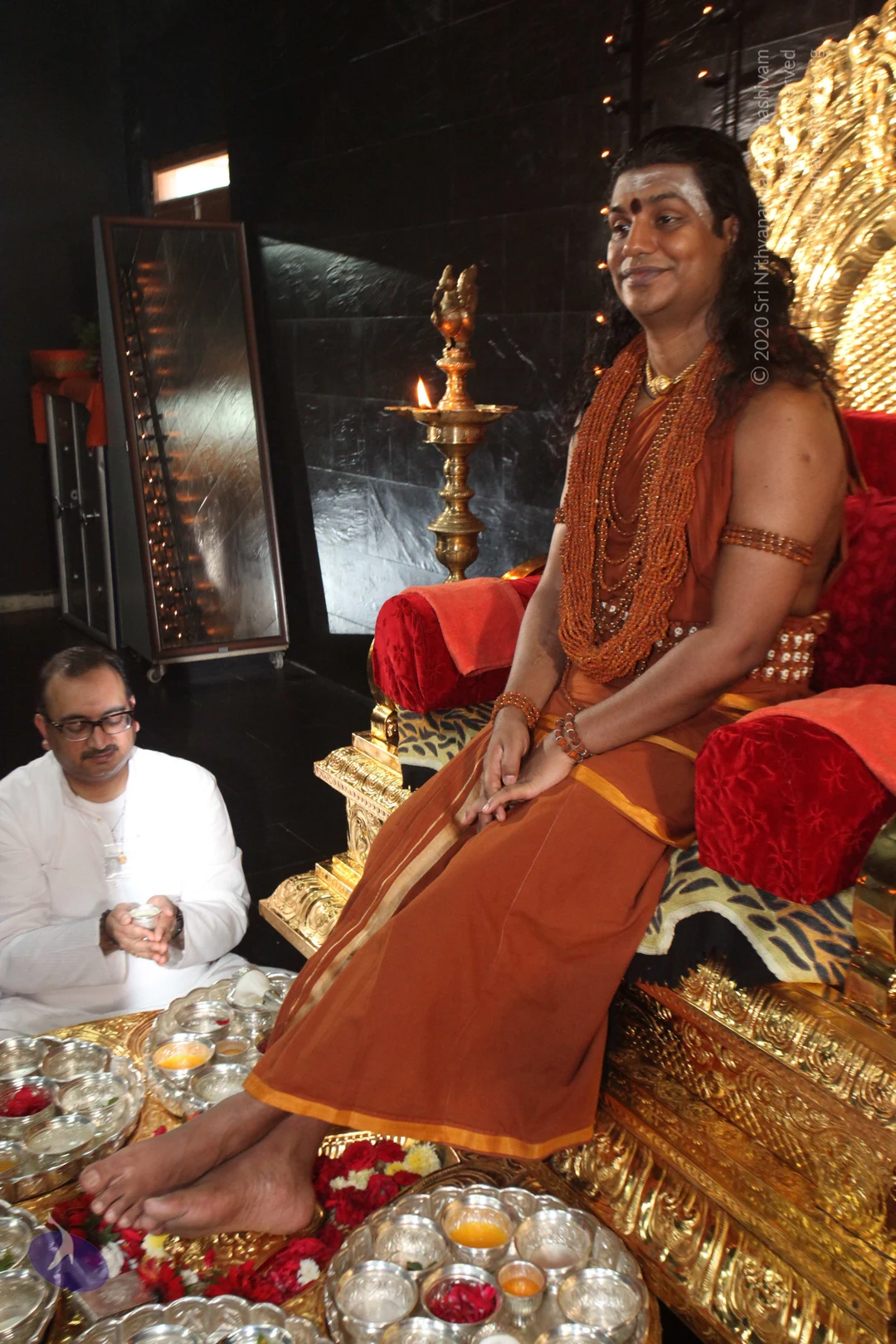
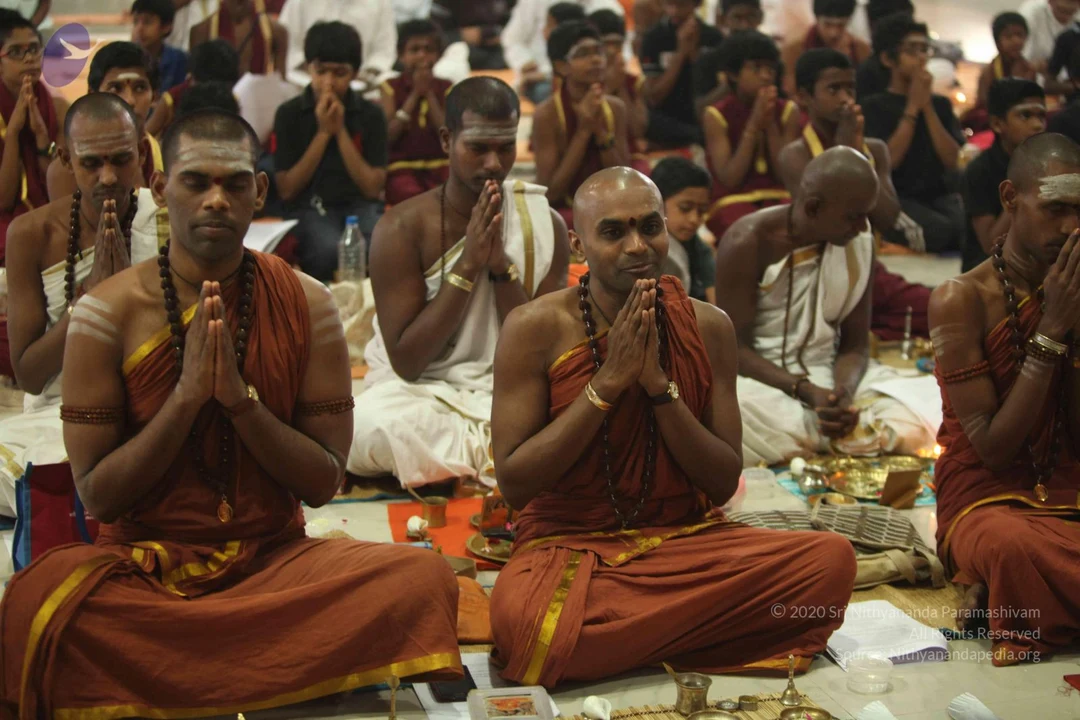
Paada Puja
Satsang
Tags:

Paramahamsa Nithyananda, success, negativity, integrity, cognizance, inner space, failure, programme, program

Photos Of The Day:

SOLO-2_MorningSatsang
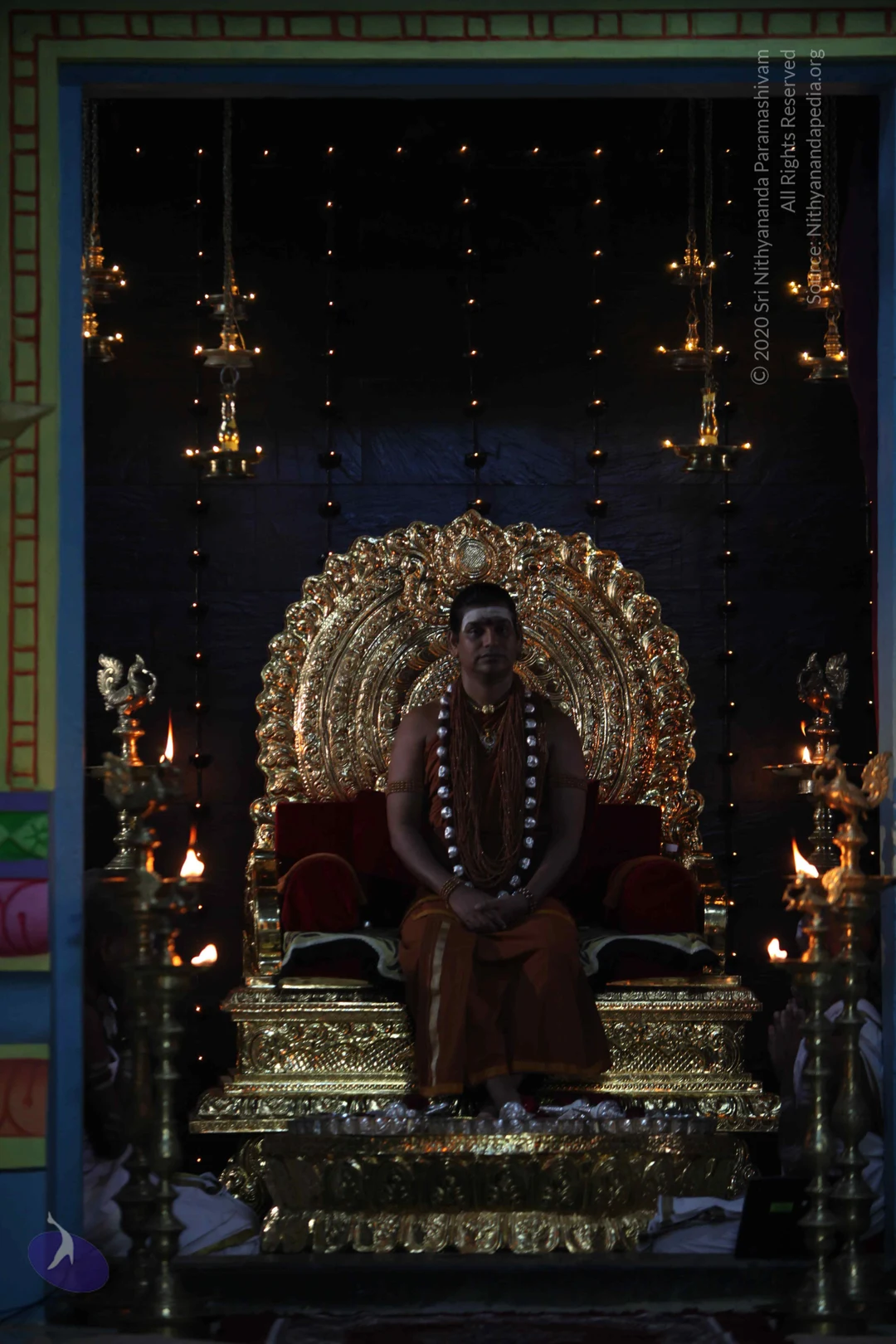
SOLO-3_VIP

SOLO-4_OTHERS

Photos Of The Day:

Nithya-Satsang

Tamil-IA-Session1

Tamil-IA-Session2

Tamil-IA-Session3

Photos from this day

View all 249 photos

Morning Satsang

2 photosSource gallery
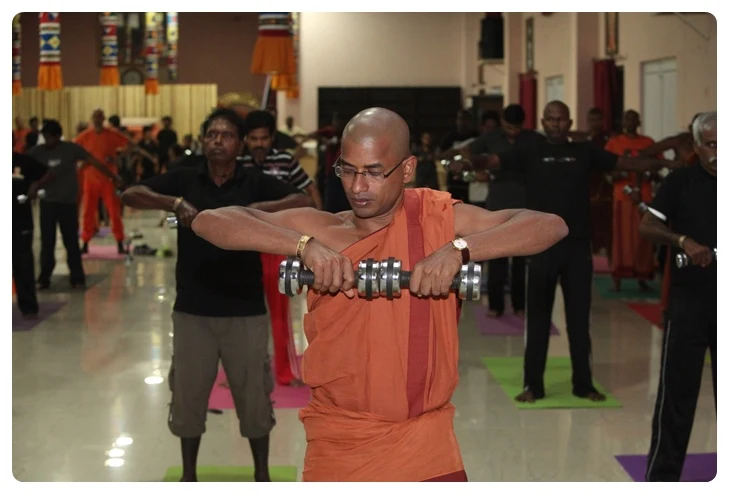
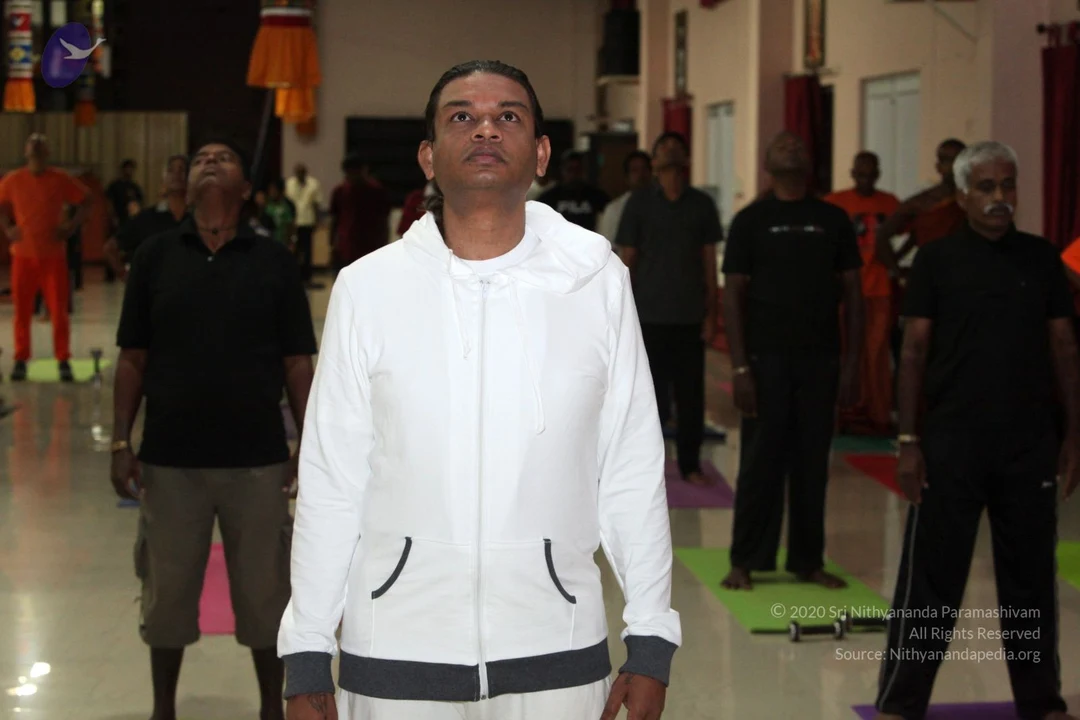
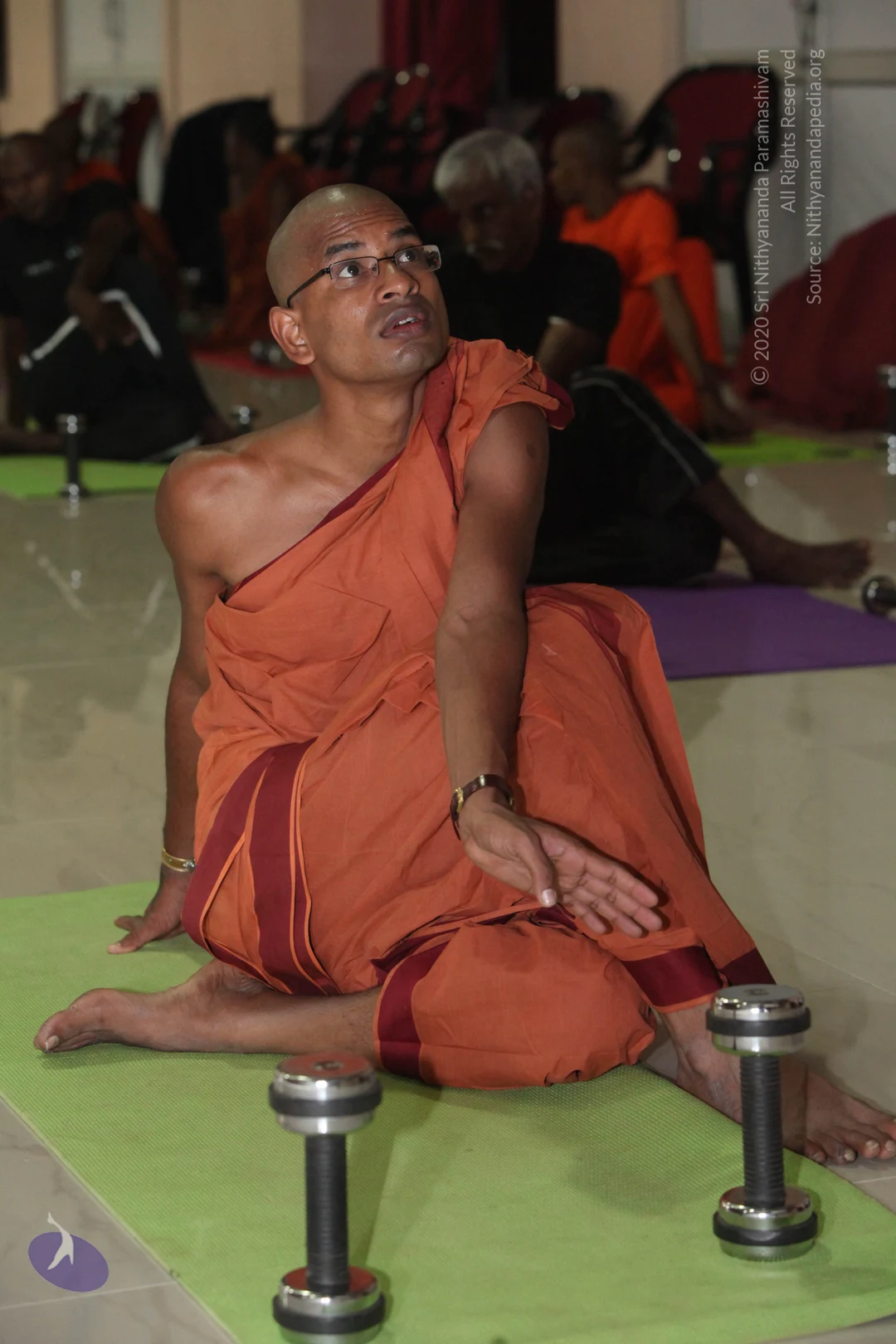
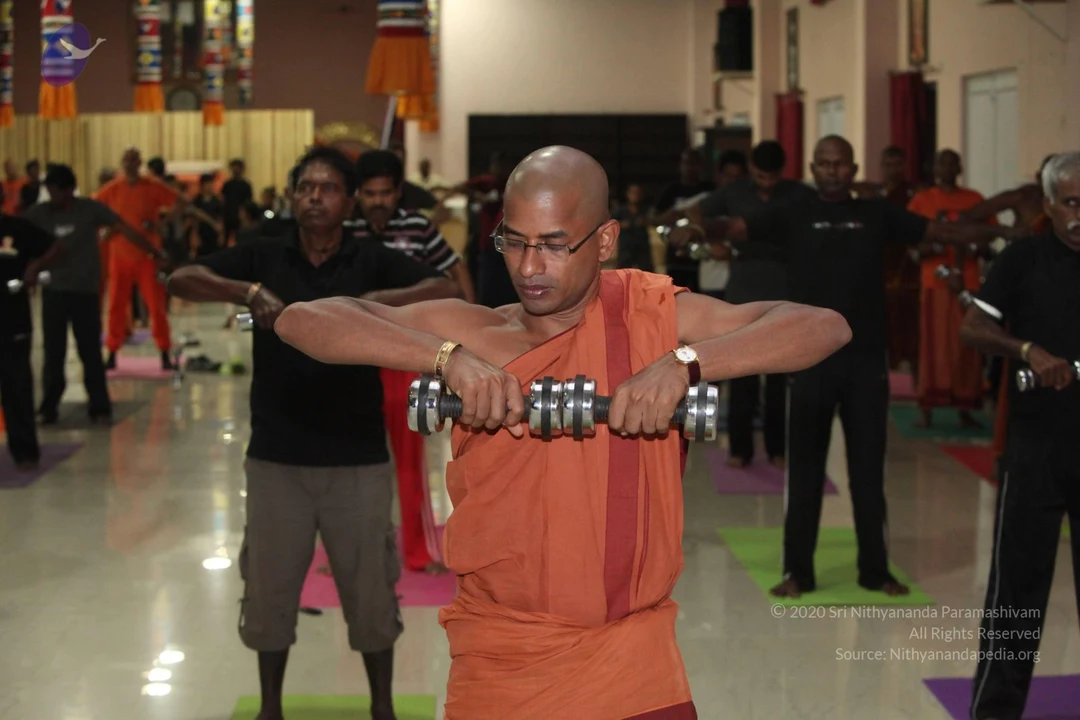
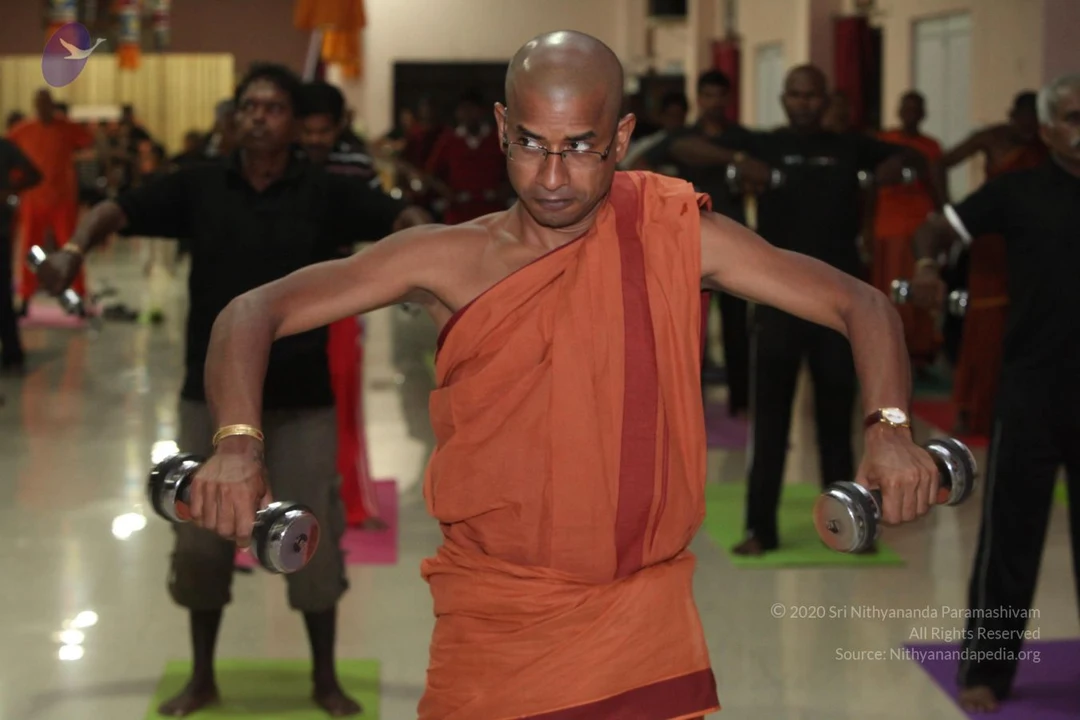
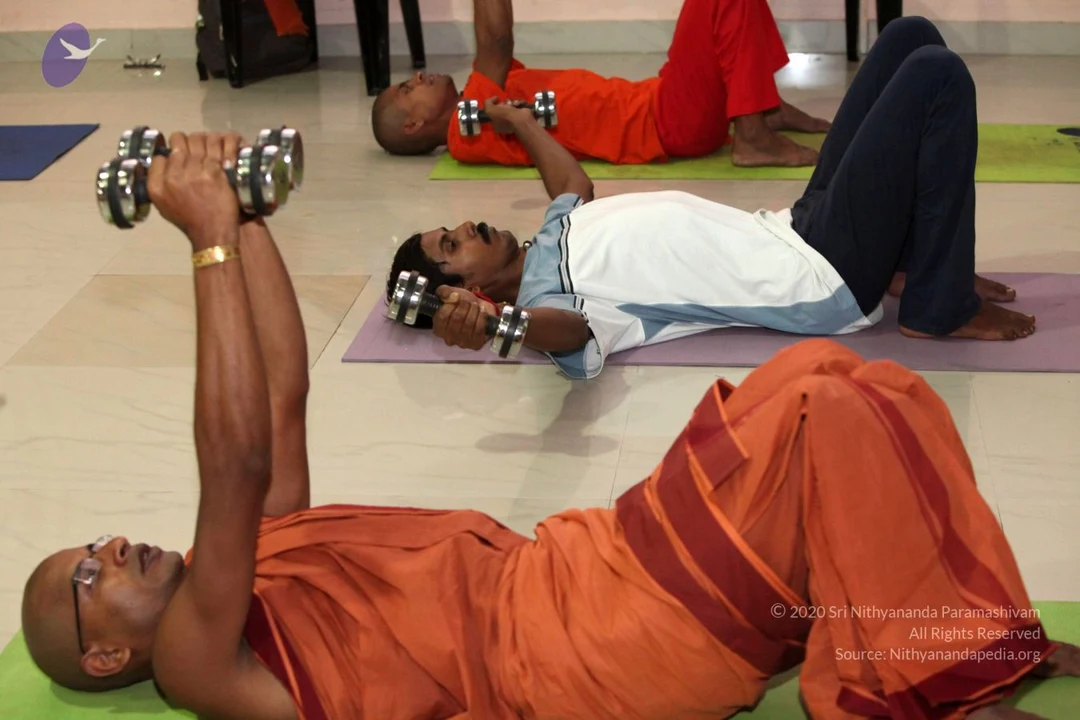
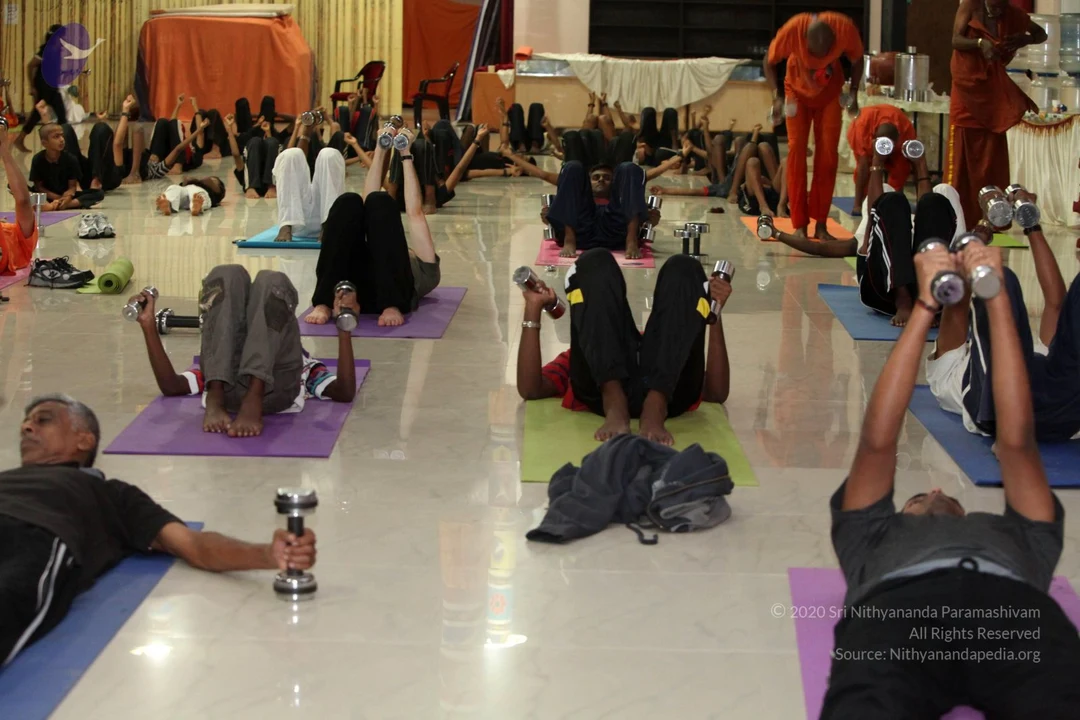
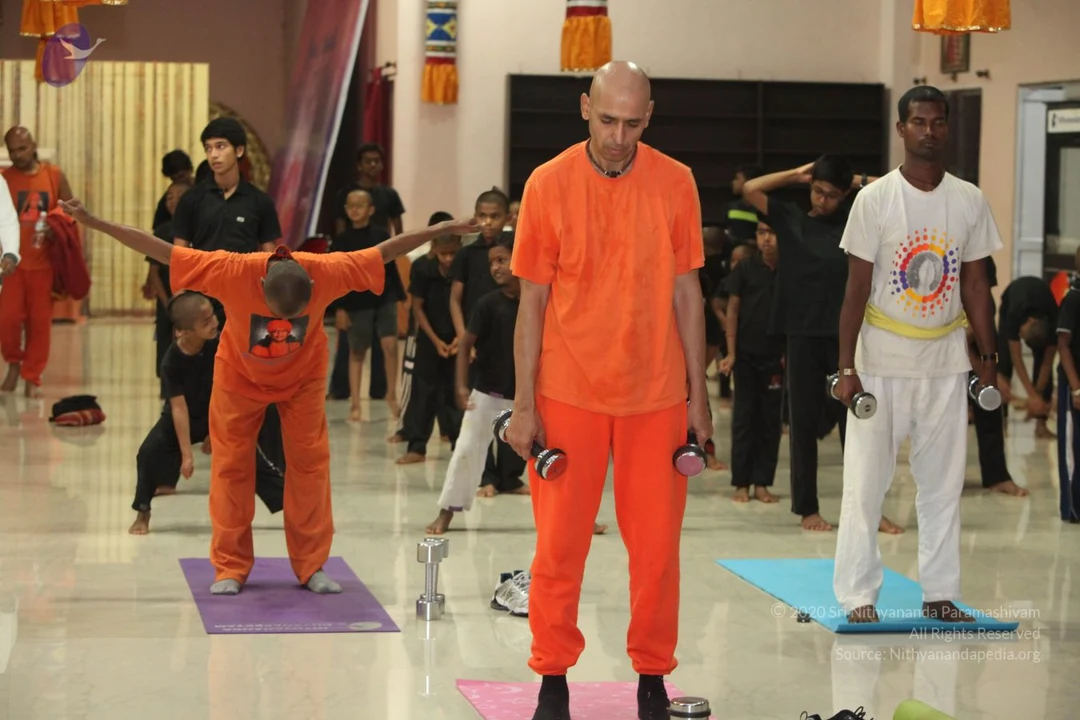
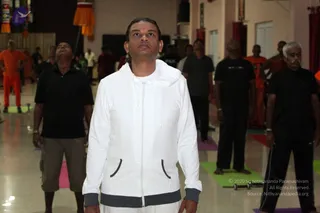
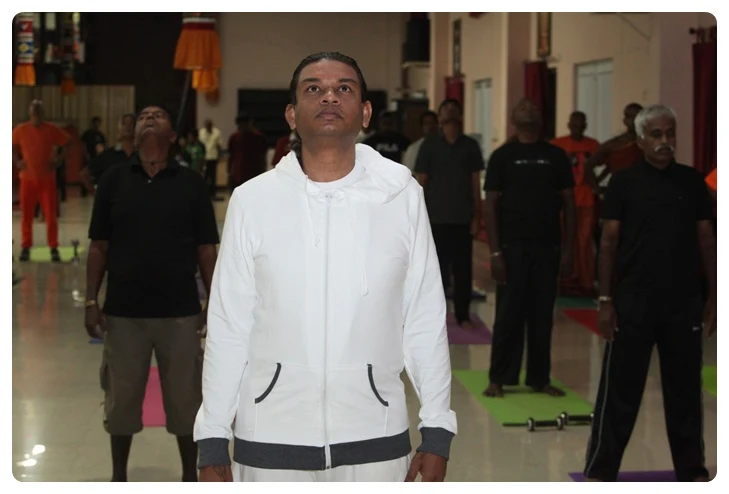
A photo of a yoga or exercise session in a bright indoor hall with cream walls and tiled floor. In the foreground a man in a white zip-up hooded jacket and white trousers stands with his chin lifted and gaze upward. Behind him a group of people in black tops and dark trousers, some in orange or maroon clothing, stand on green and pink exercise mats, with arms and heads raised. Several participants are older men with grey hair. Overhead stage lighting and orange drapes appear at the back.A bald man in an orange-saffron robe and glasses lifts a dumbbell with both hands at chest height during a group exercise session in a hall with a polished floor. Around him, many people in black tops and track pants and orange robes stand on purple and green exercise mats, some holding dumbbells and stretching their arms. Colourful decorative banners hang on the back wall, and a wooden panel is visible on the left.

Temple Glimpses

7 photosSource gallery
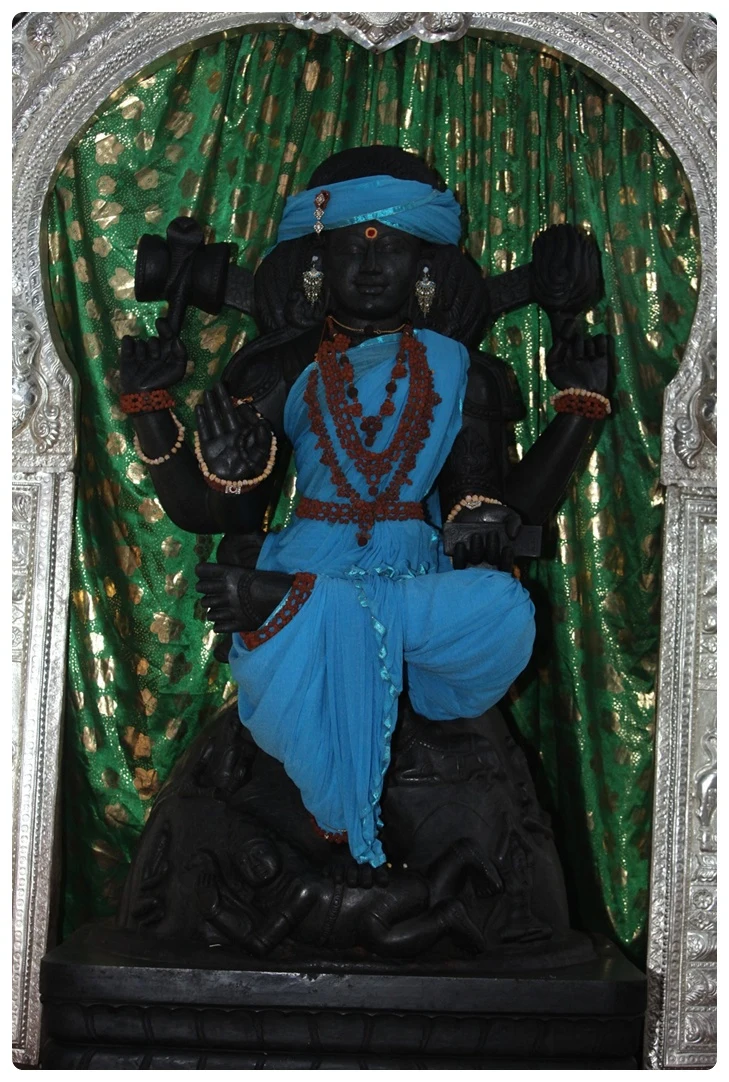
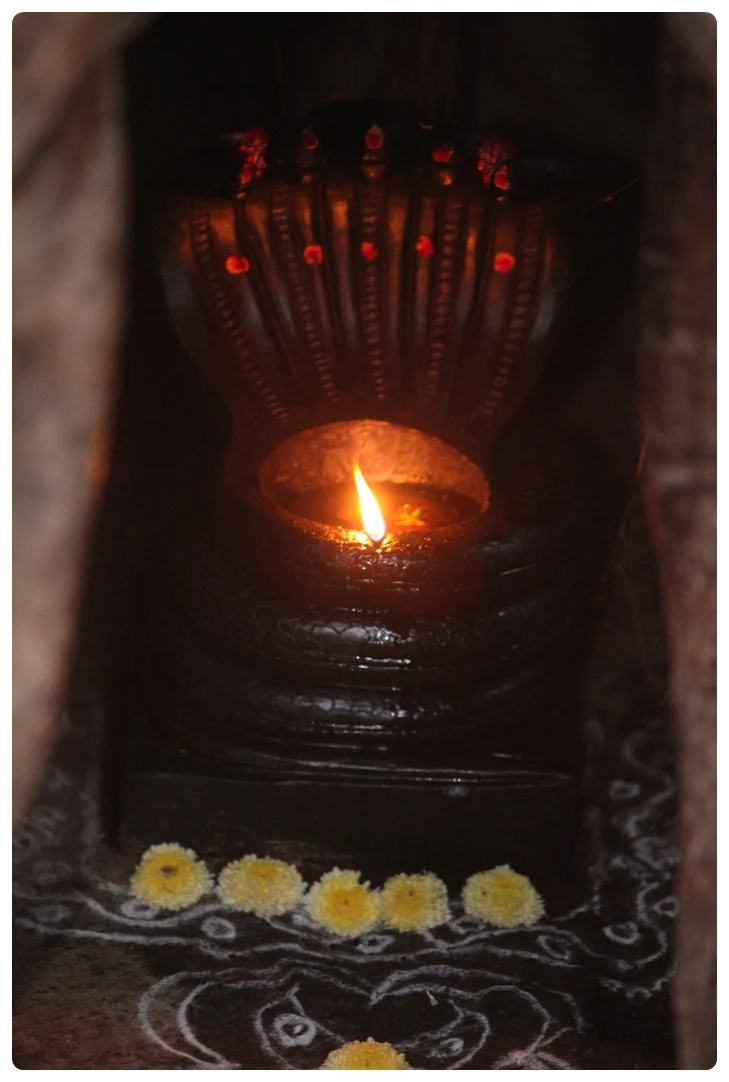
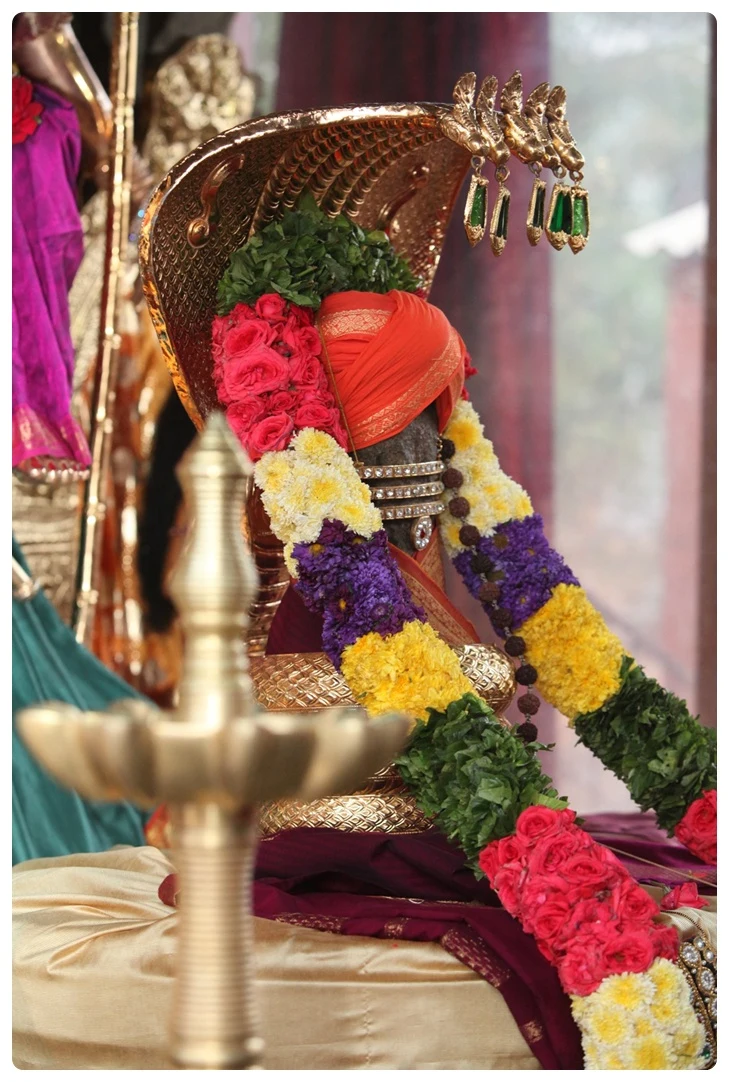
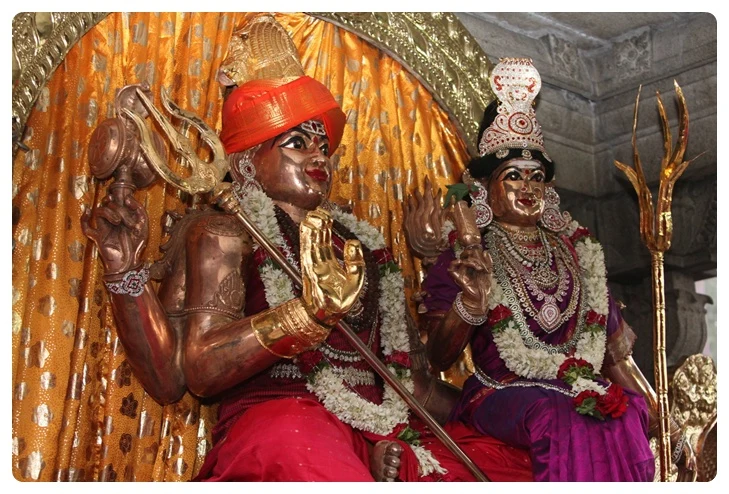
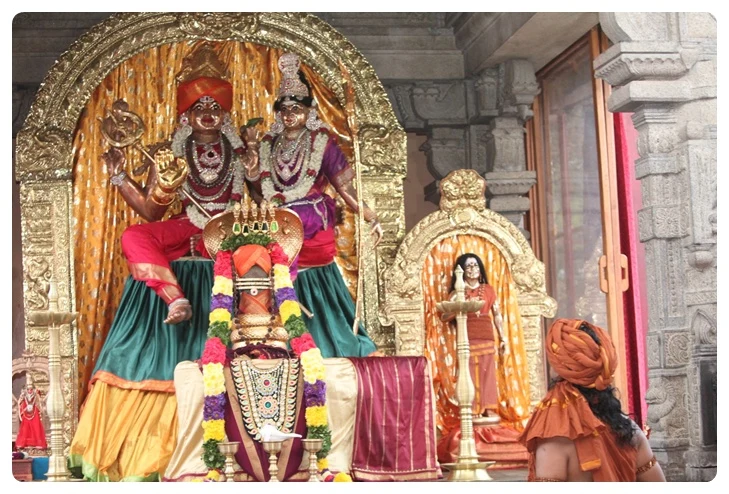
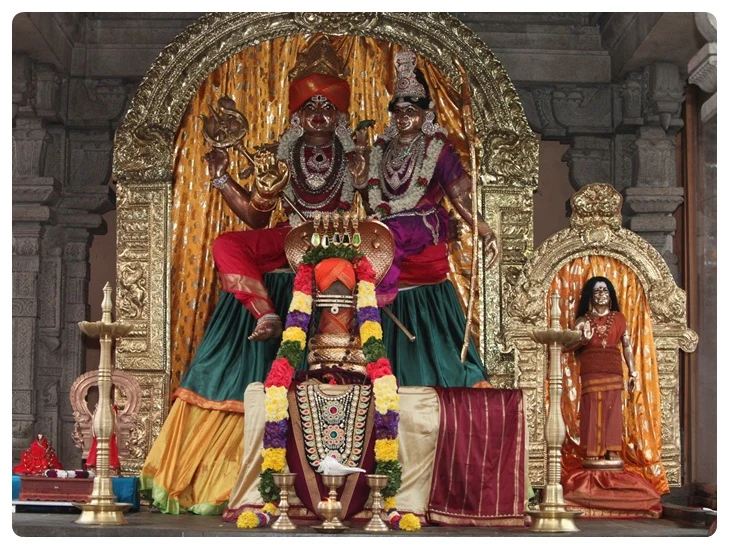
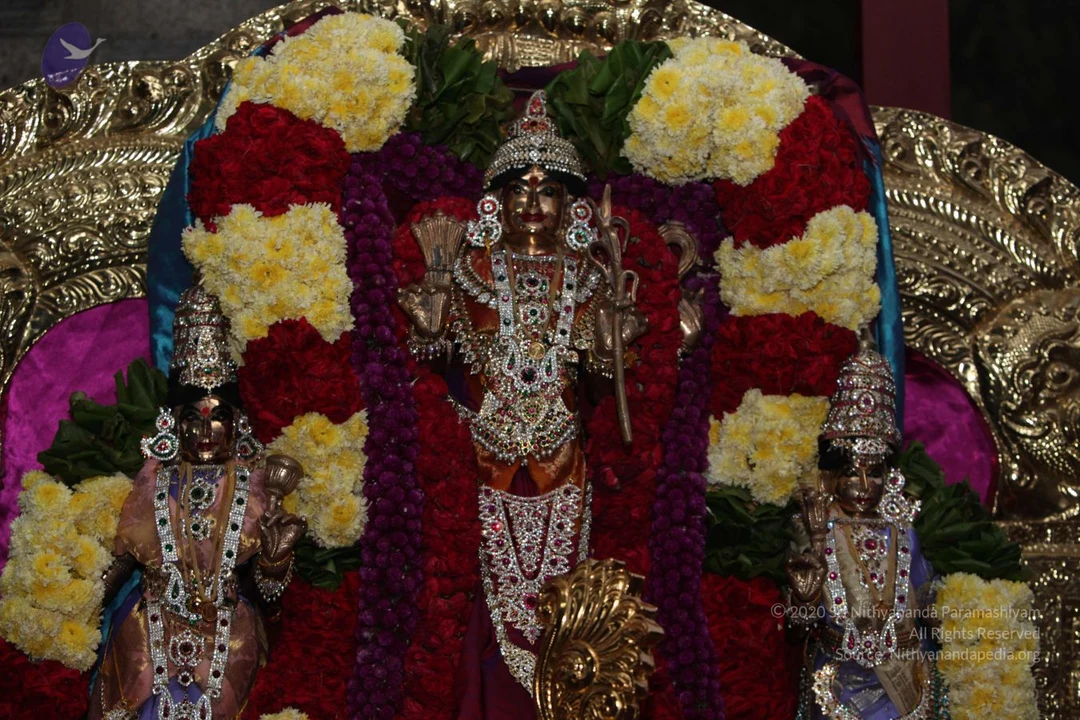
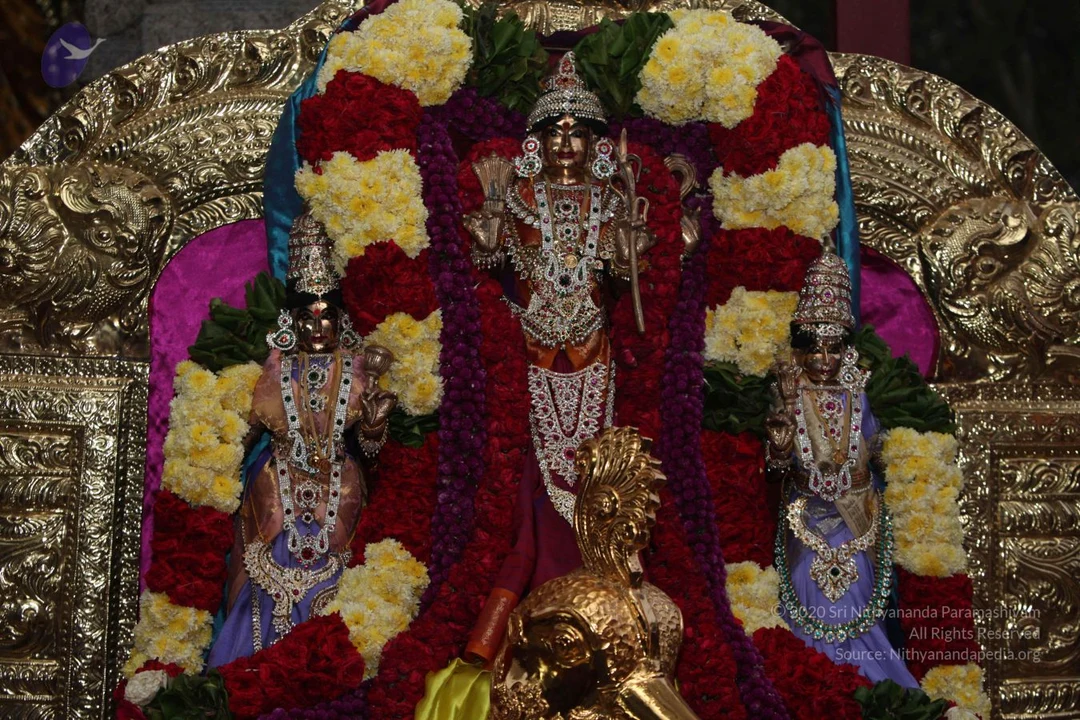
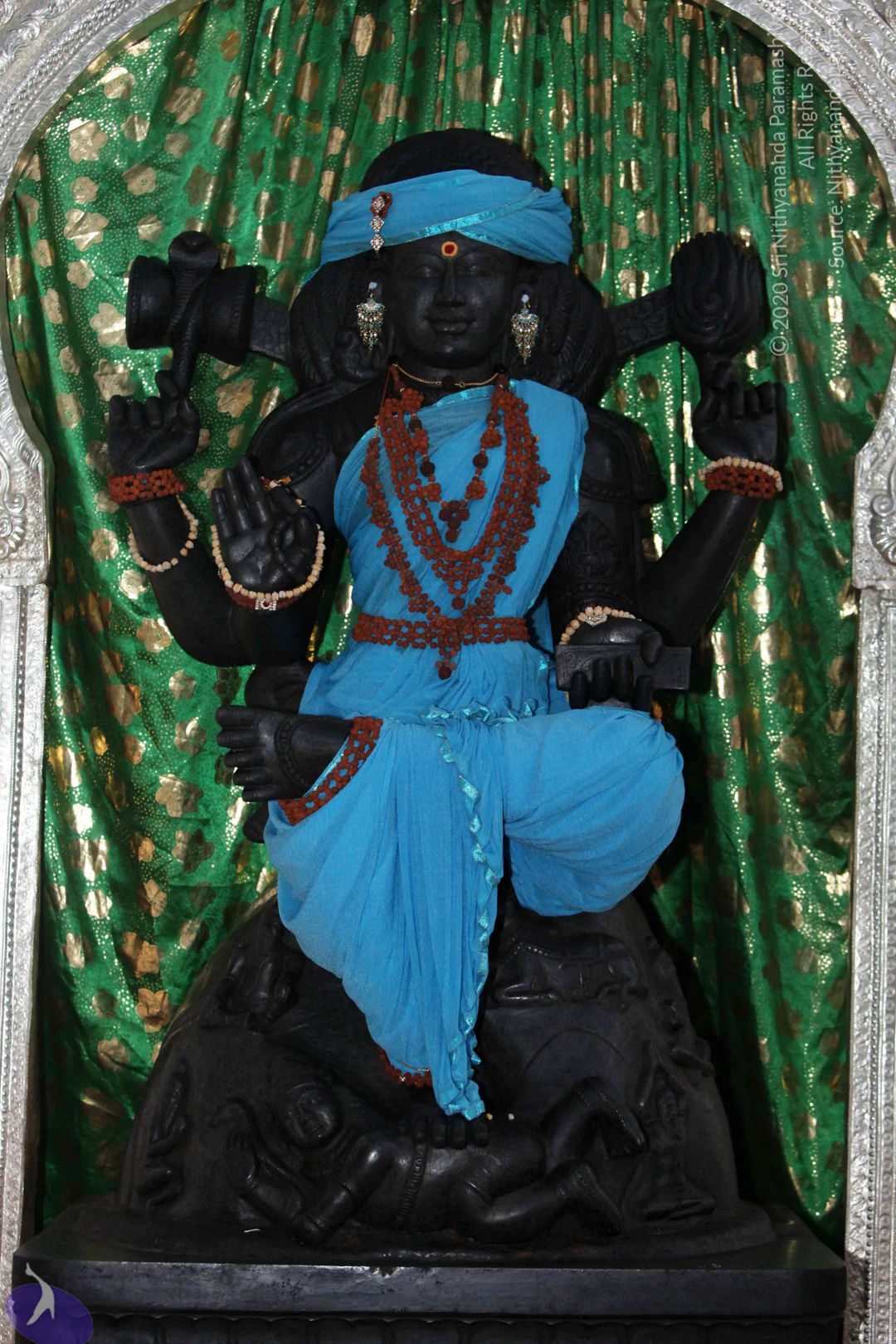
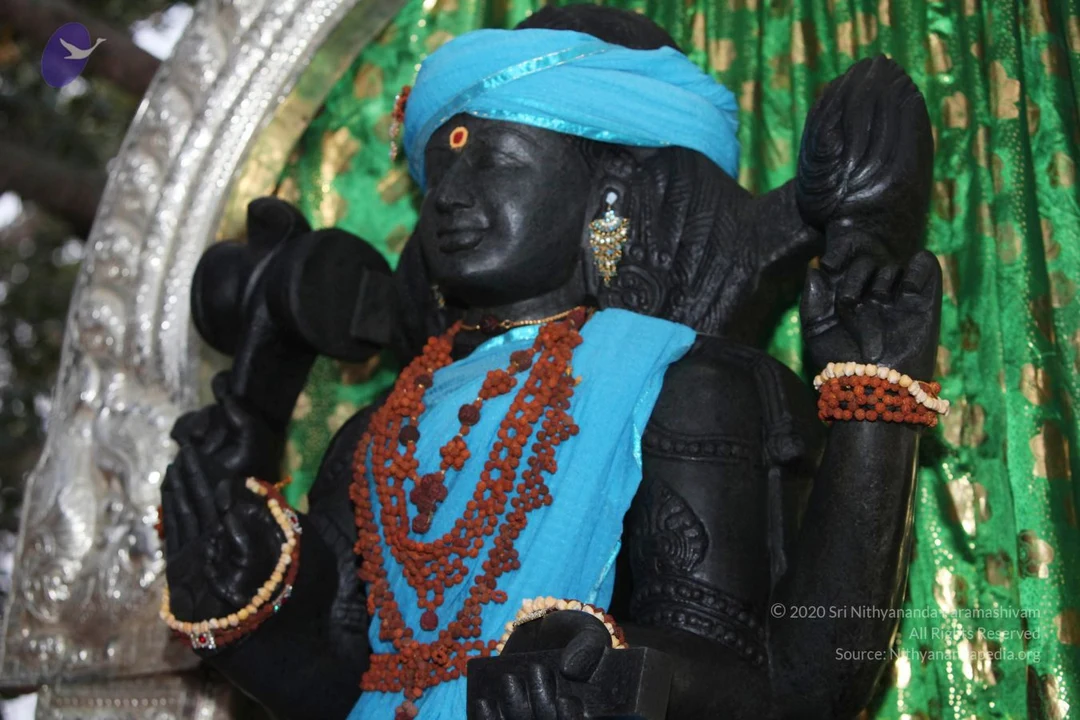
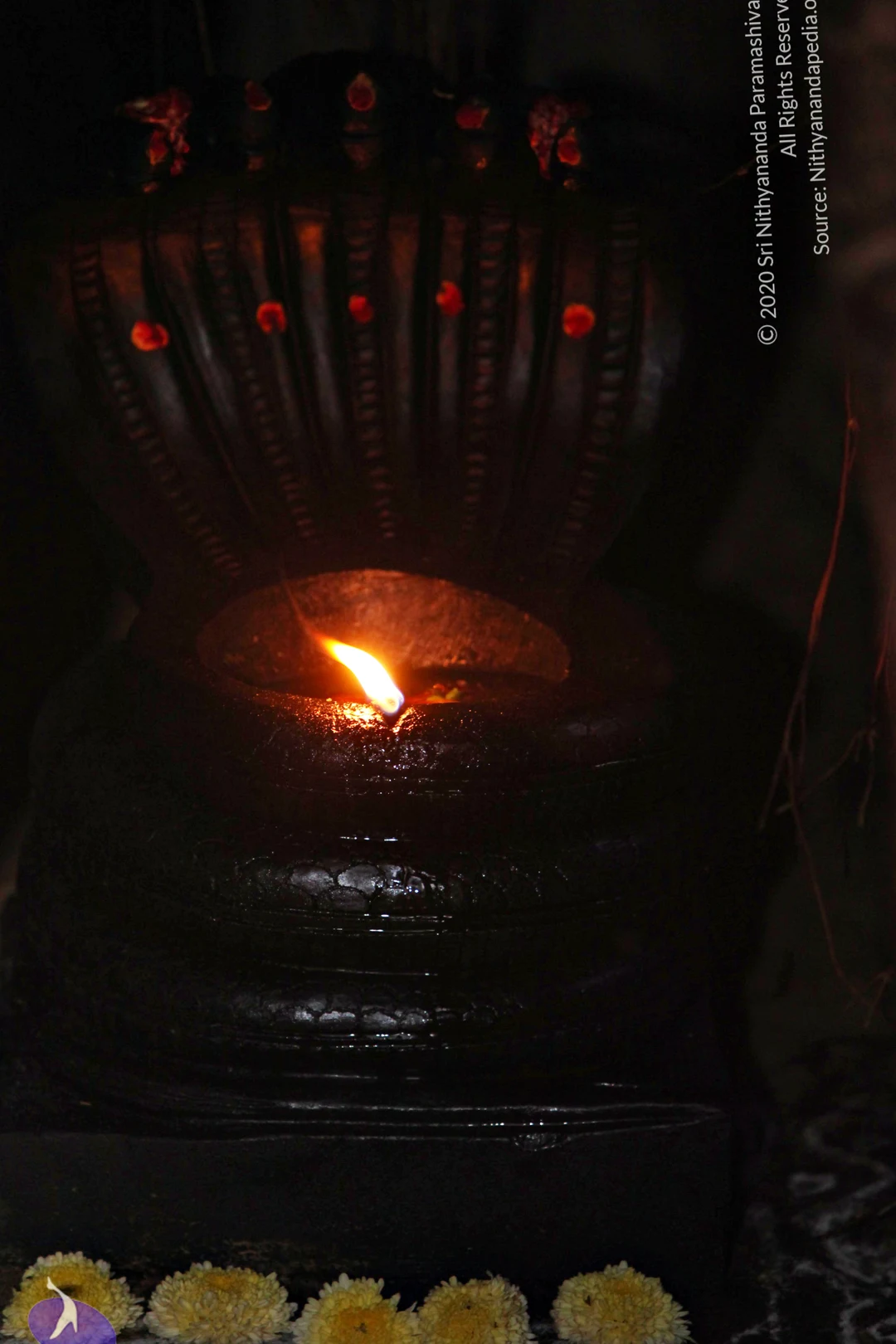
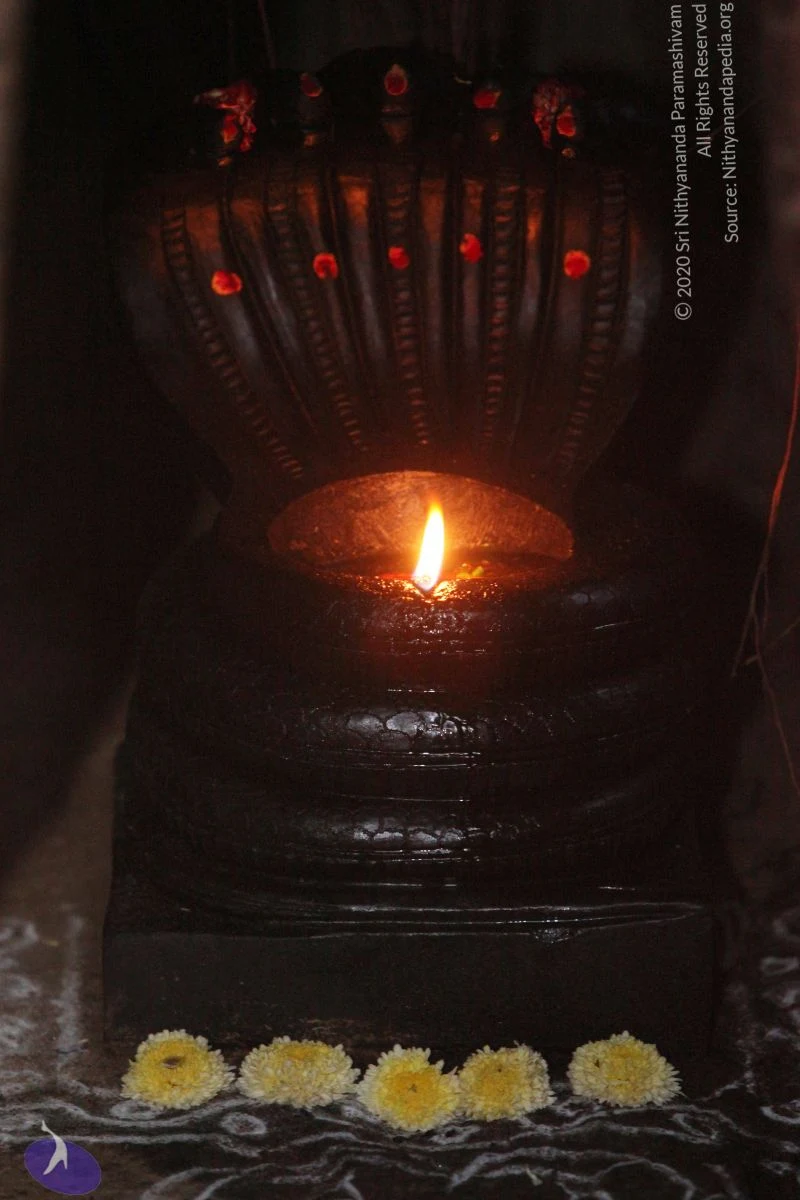
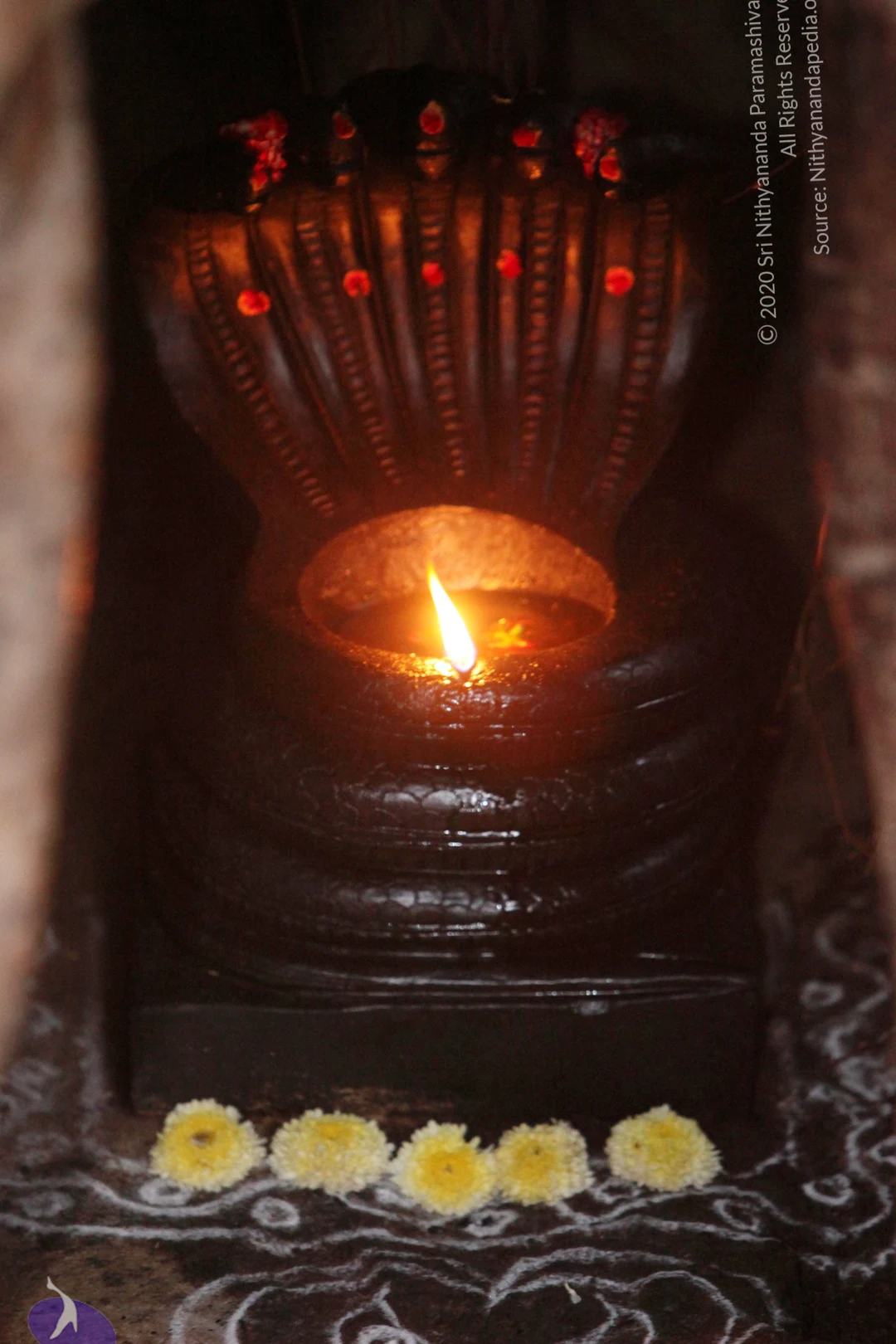
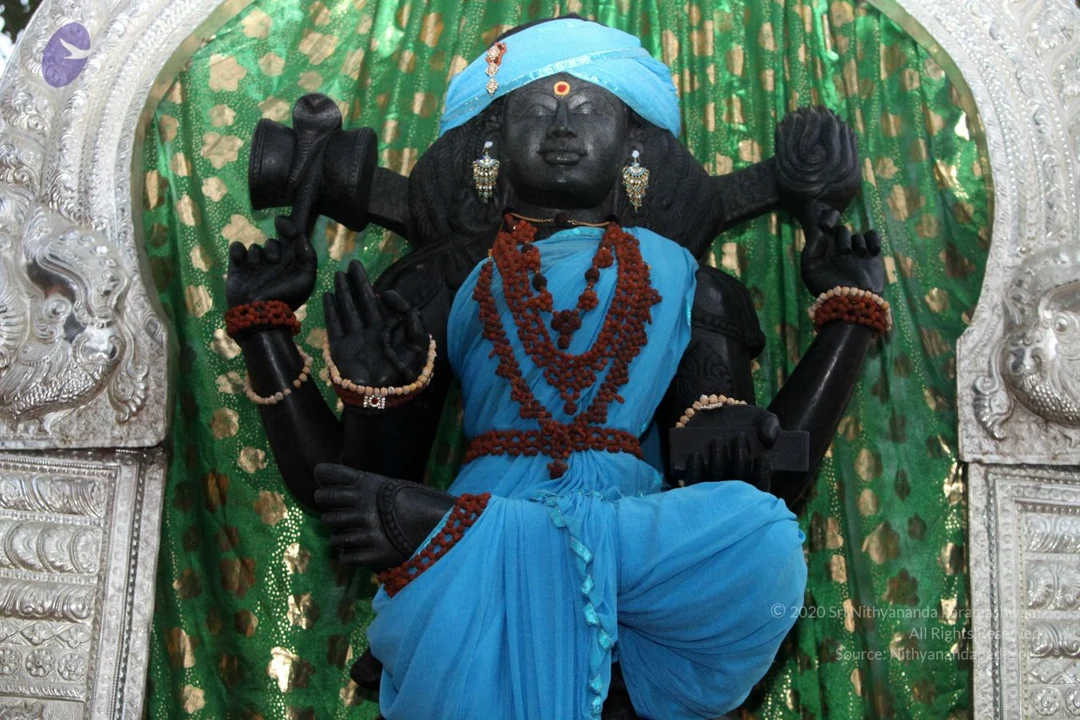
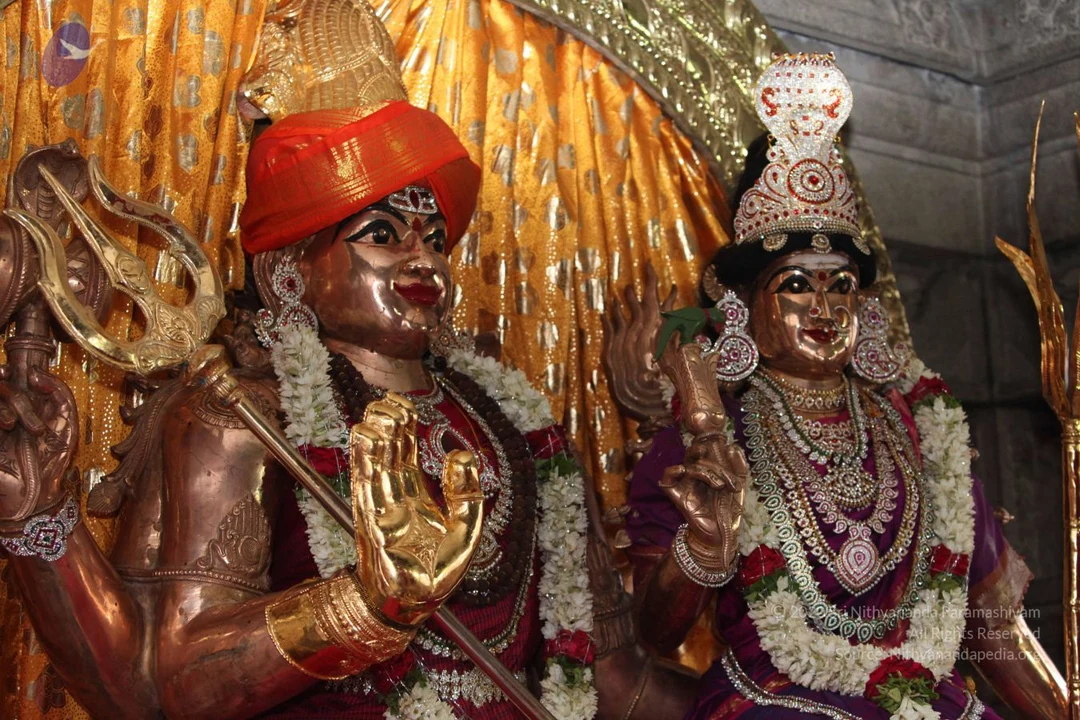
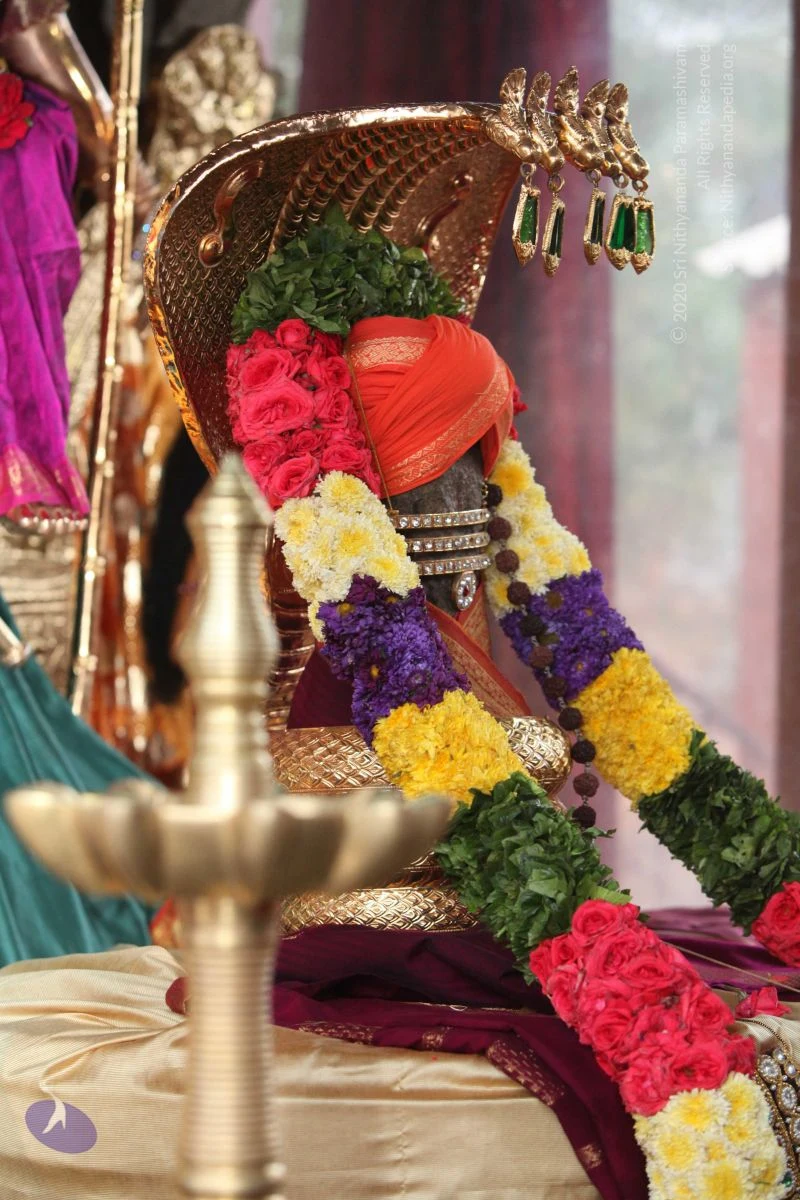
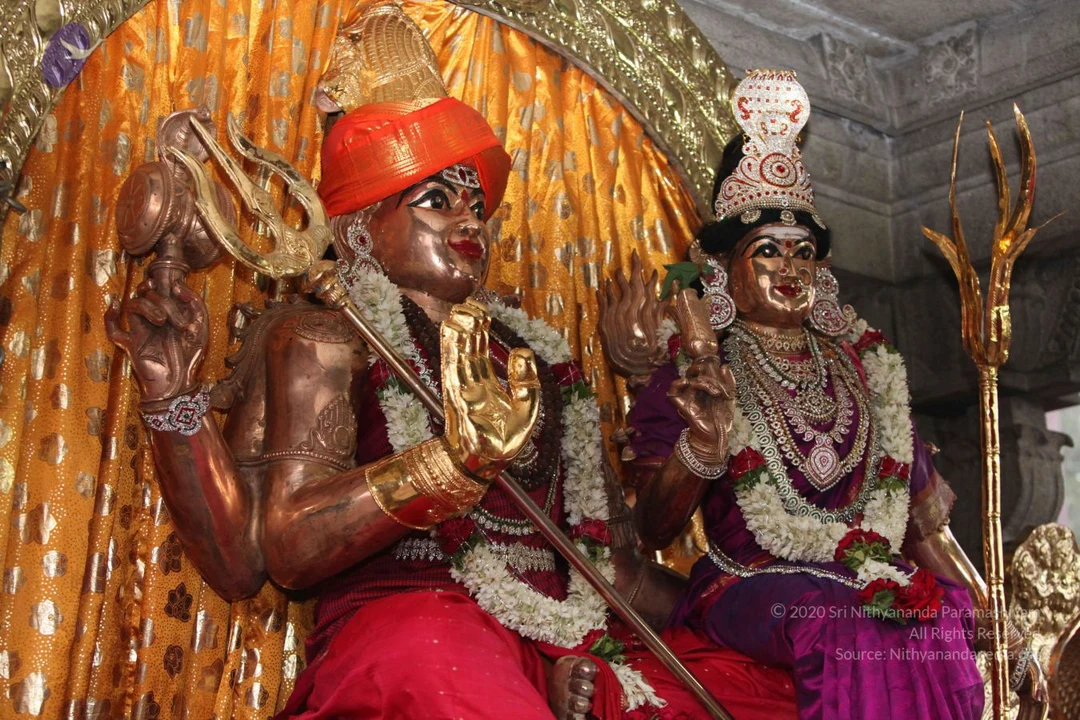
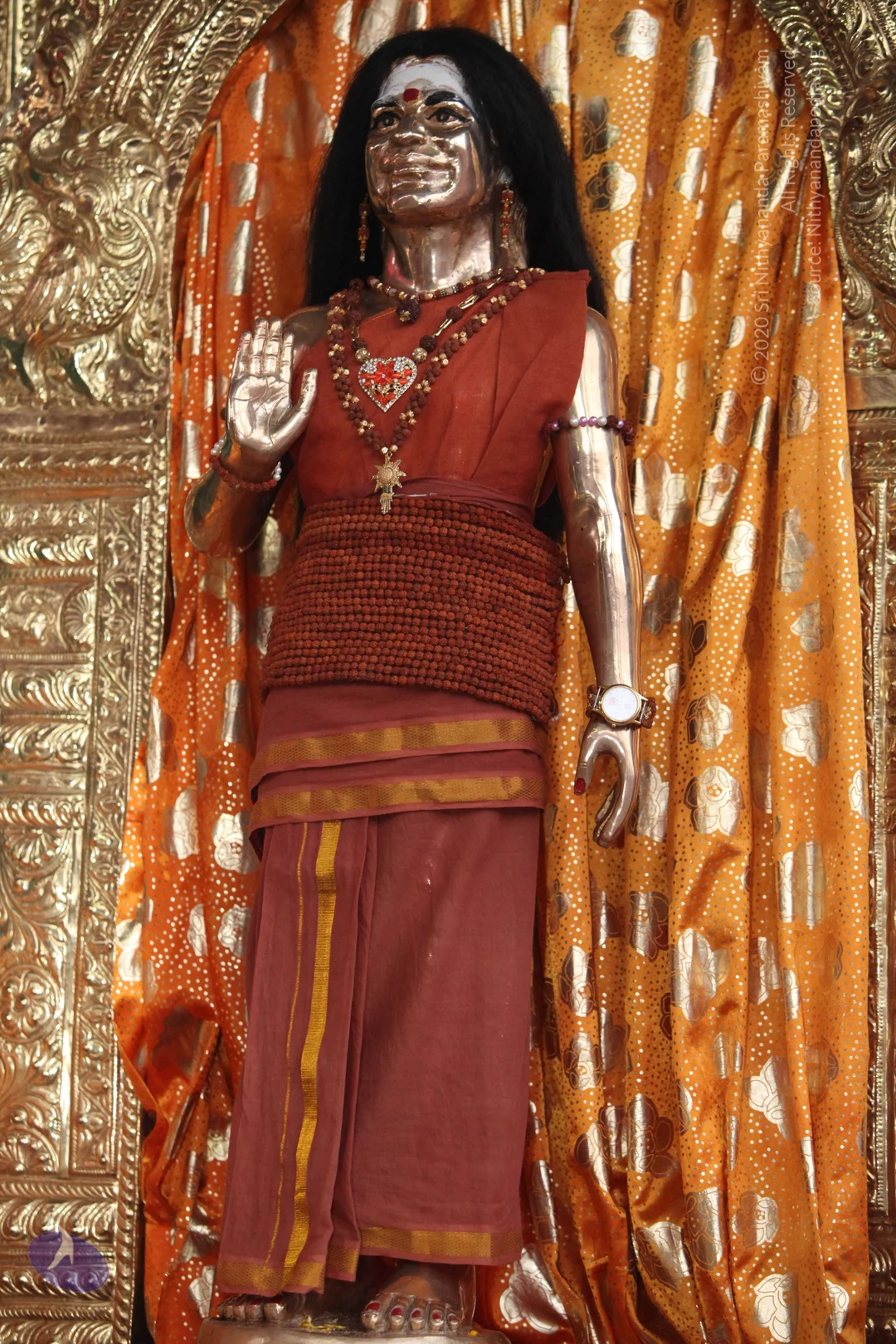
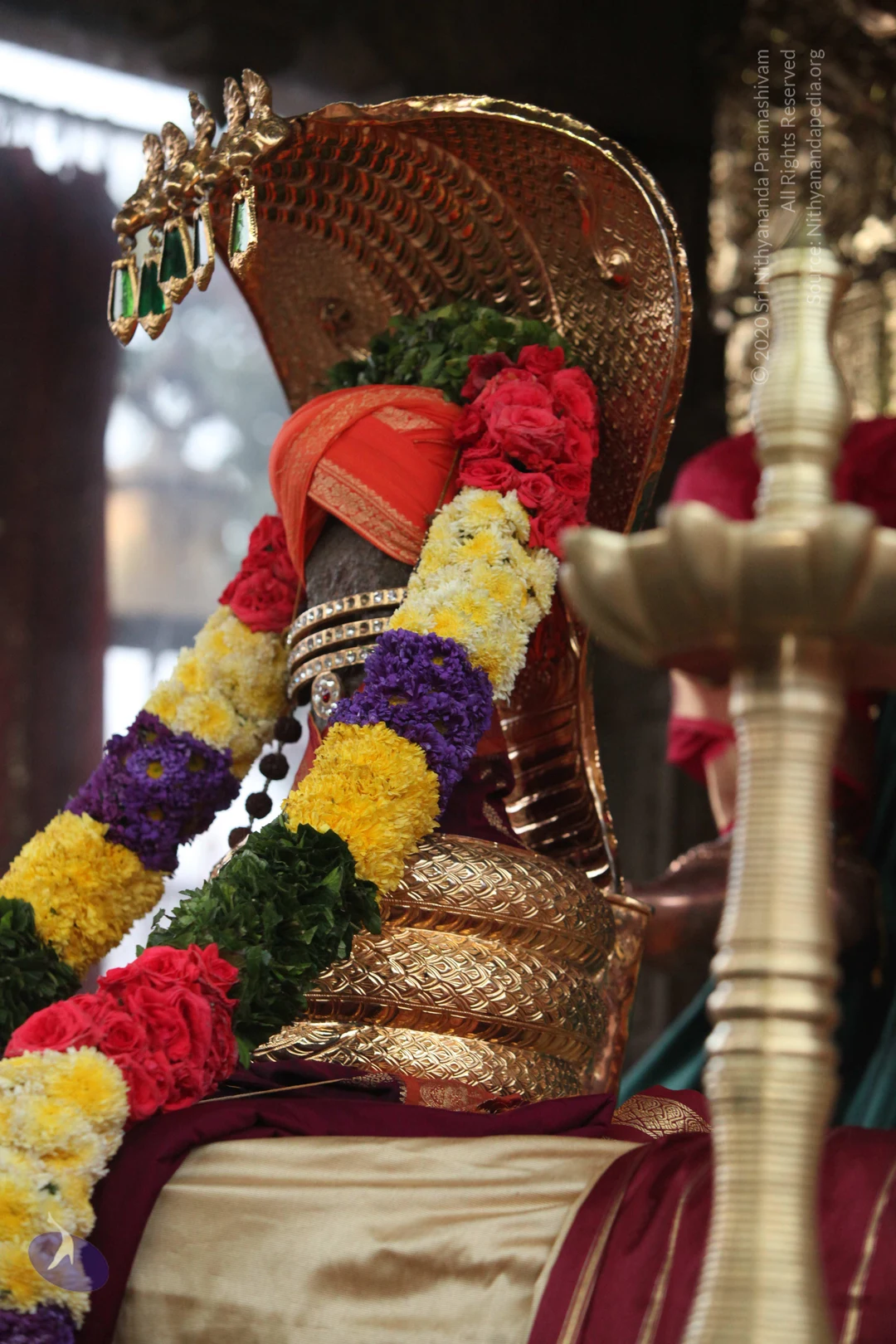
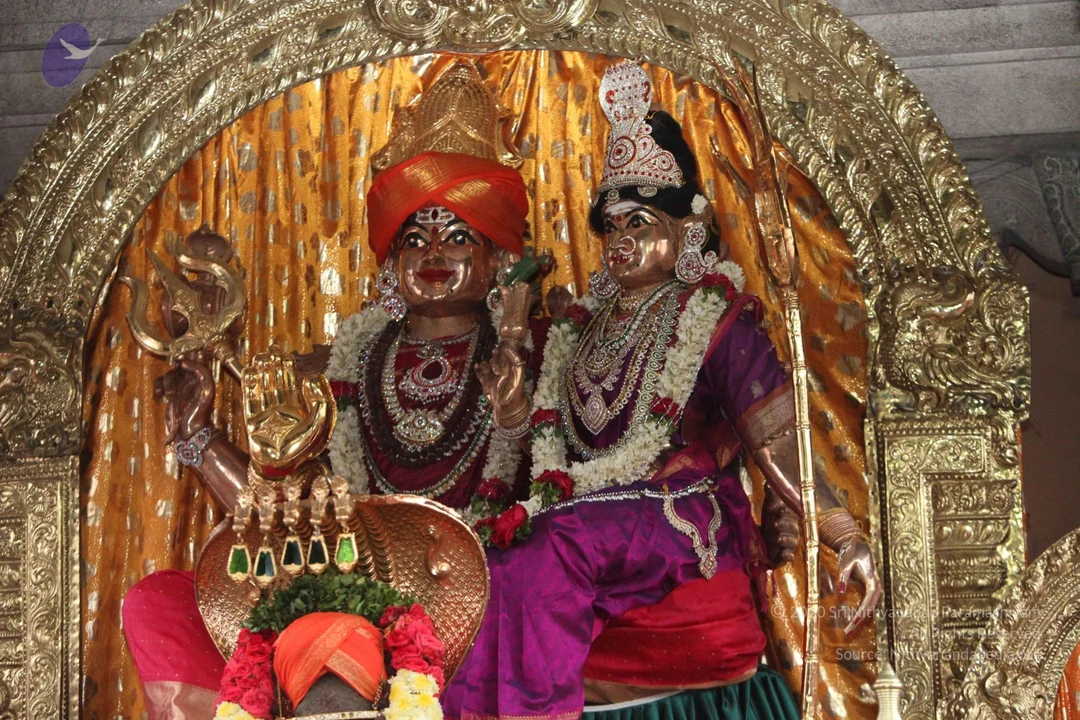
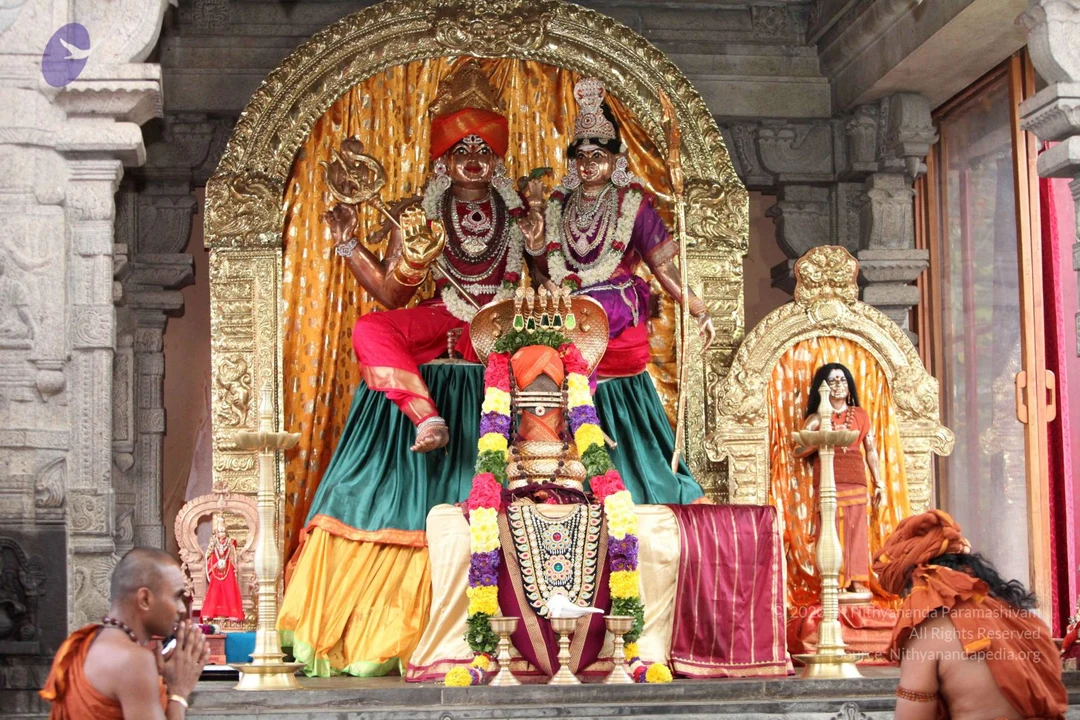
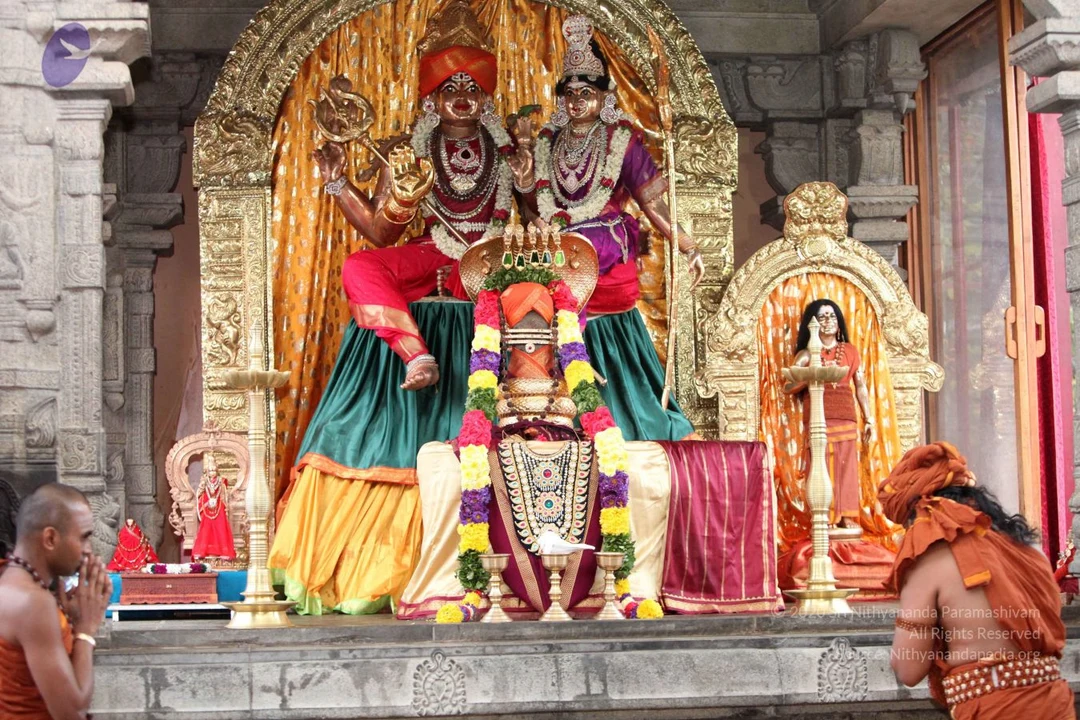
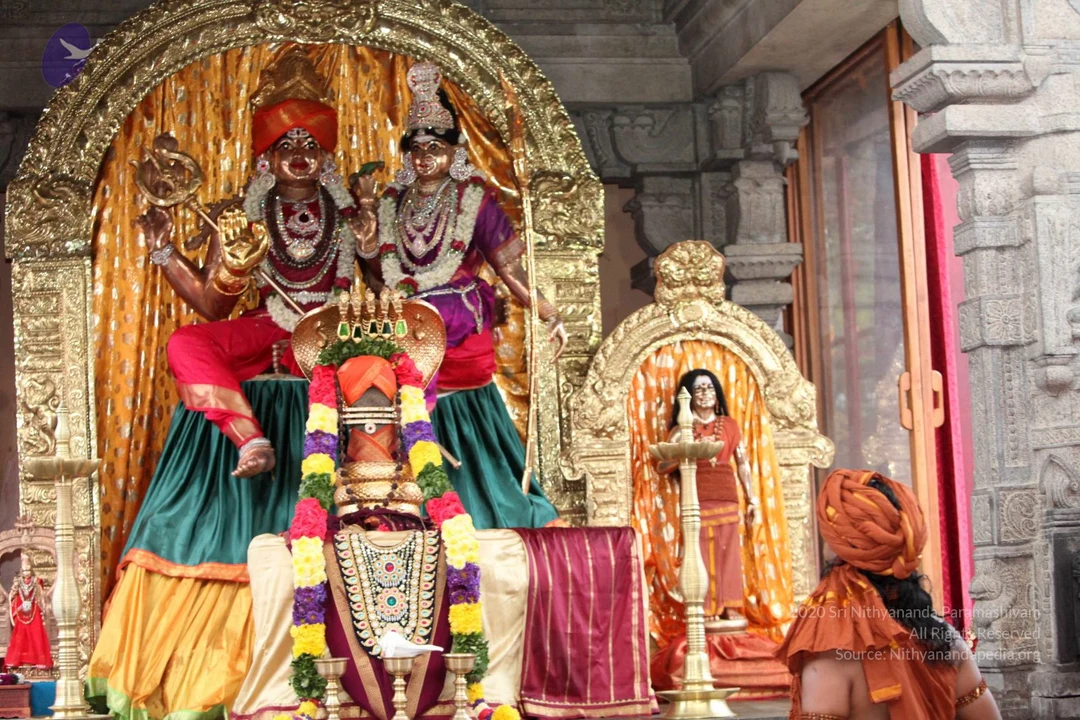
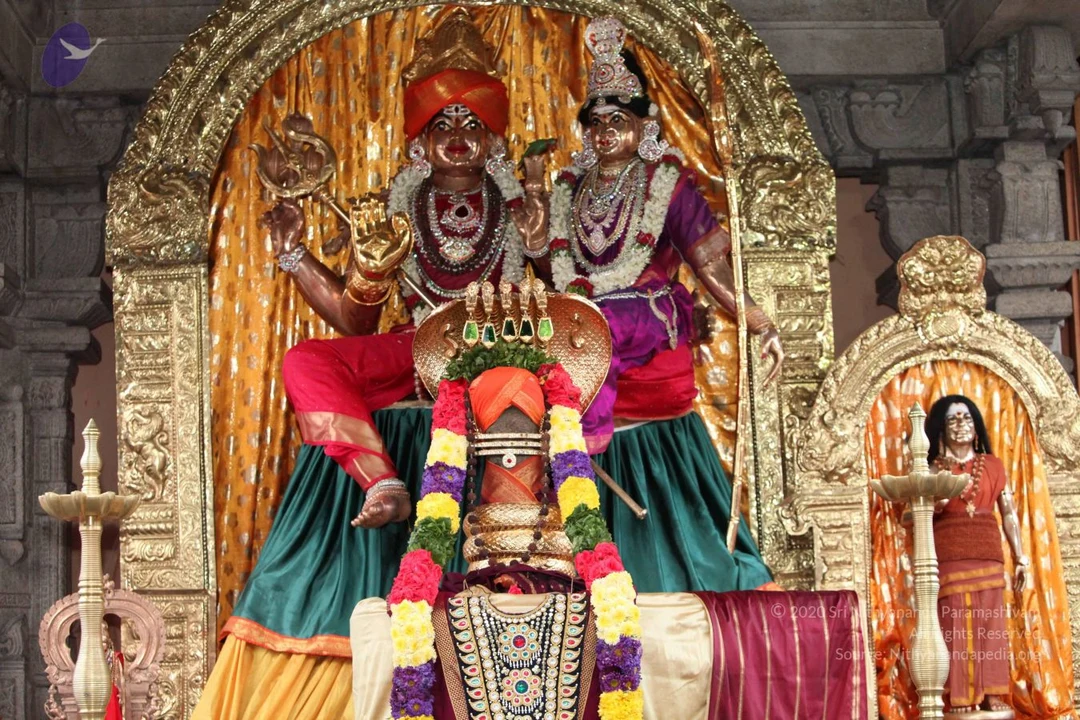
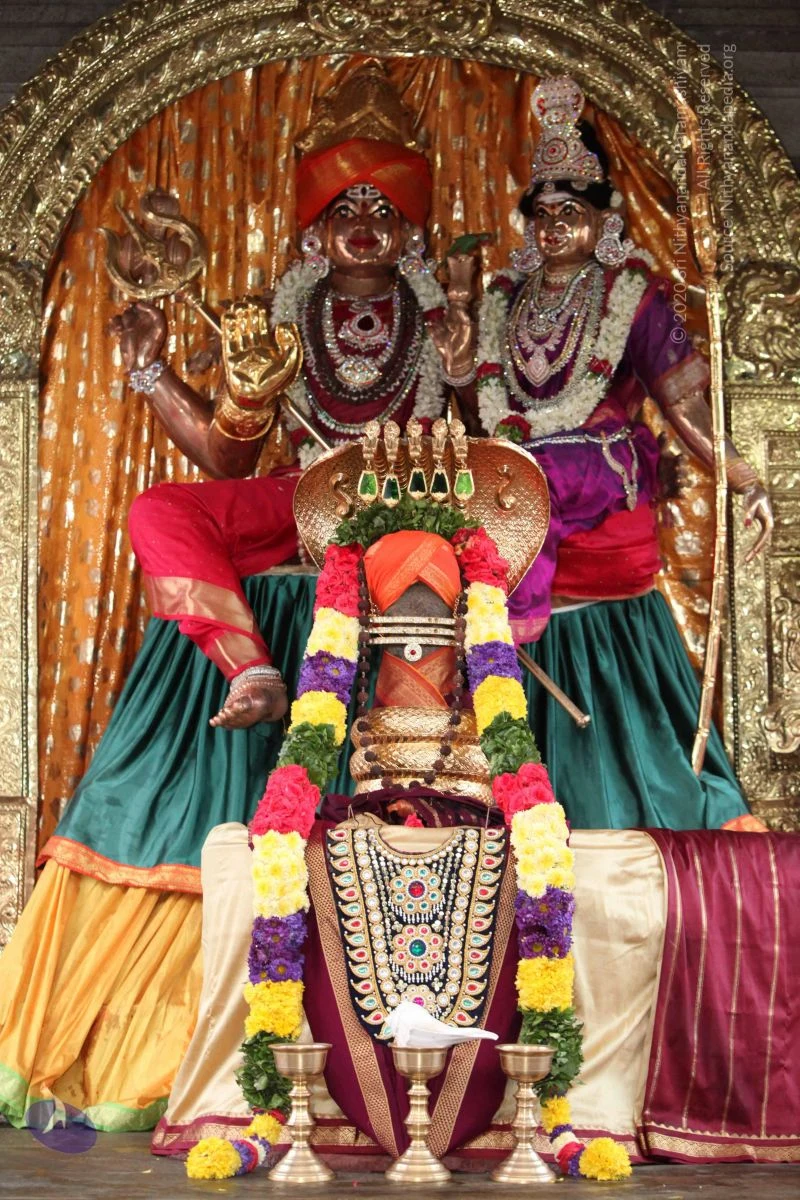
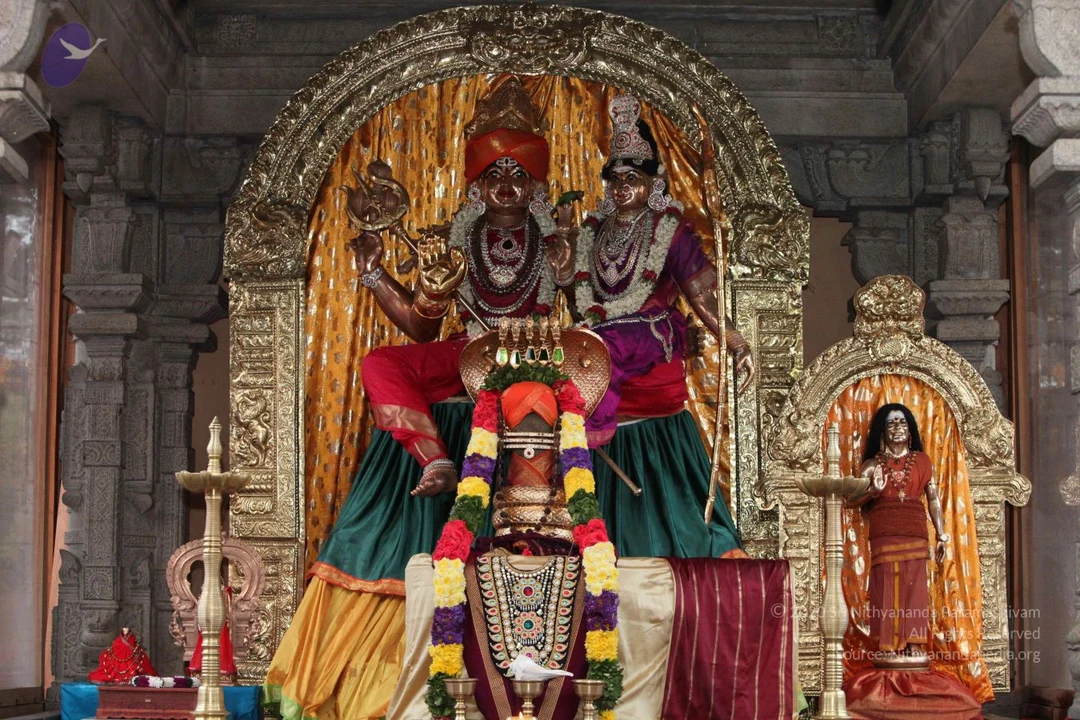
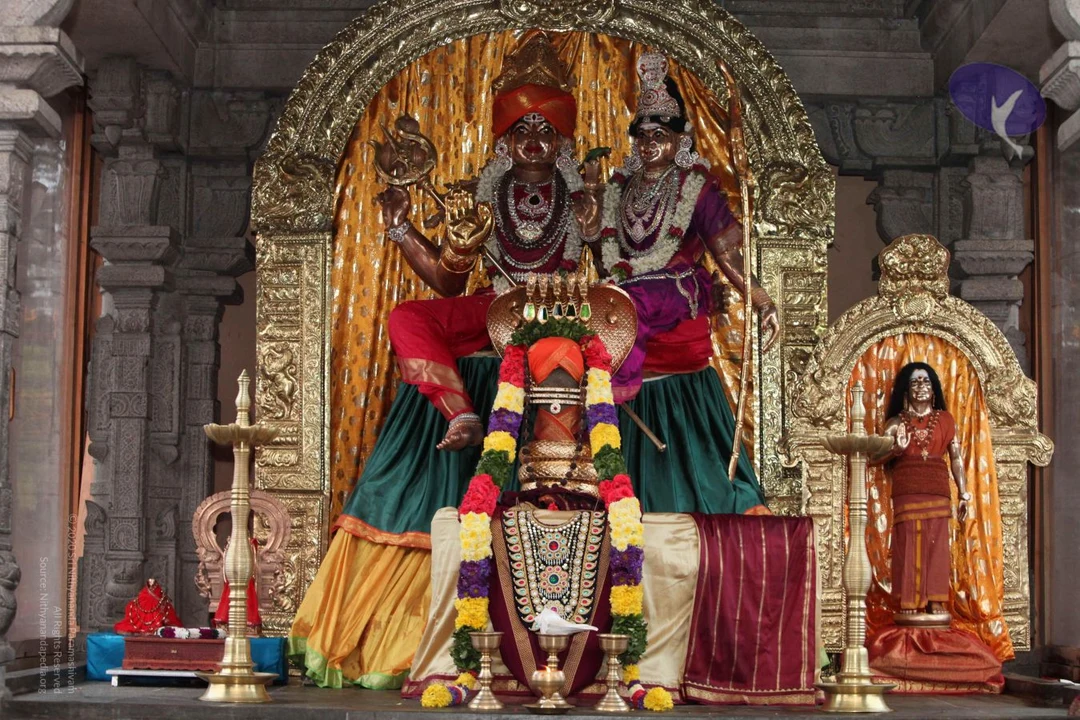
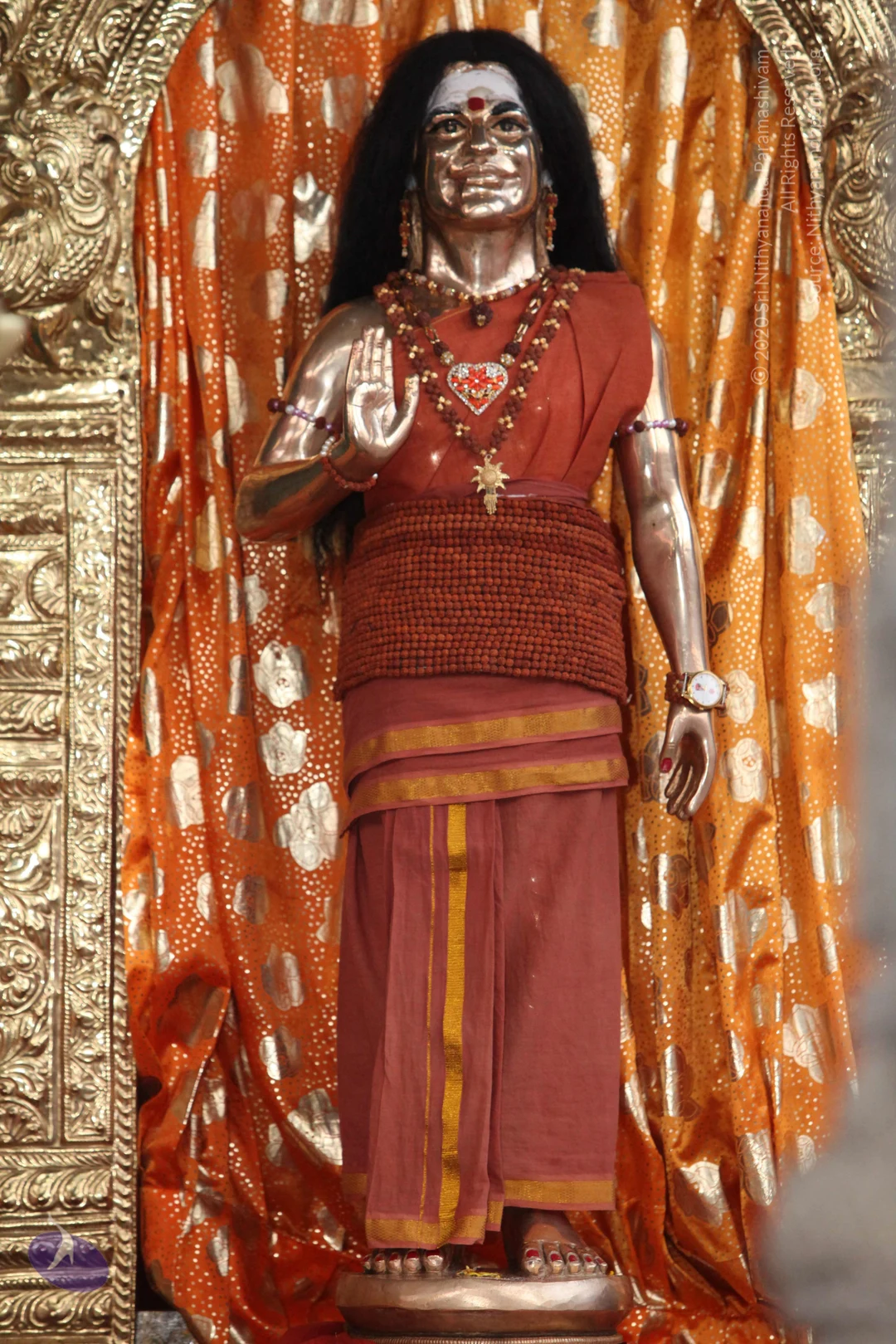
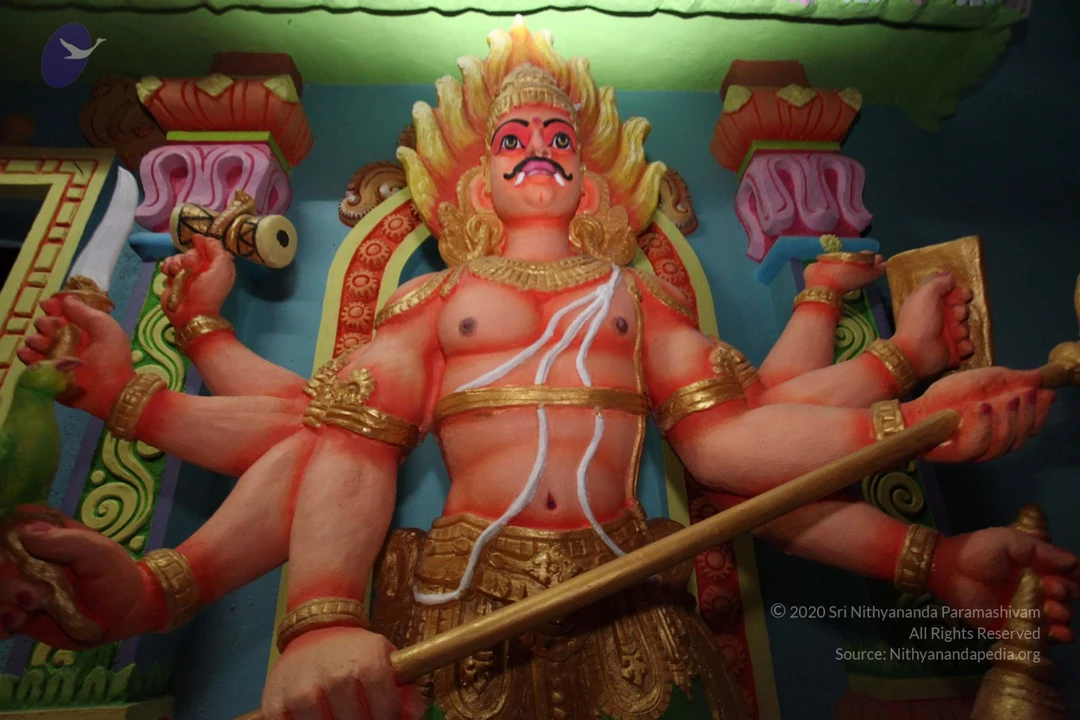
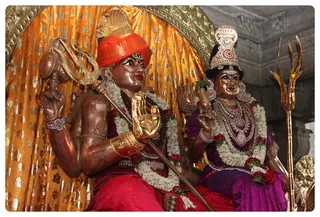
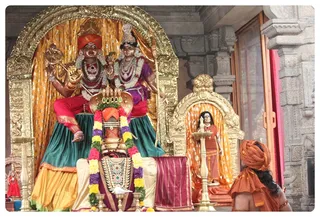
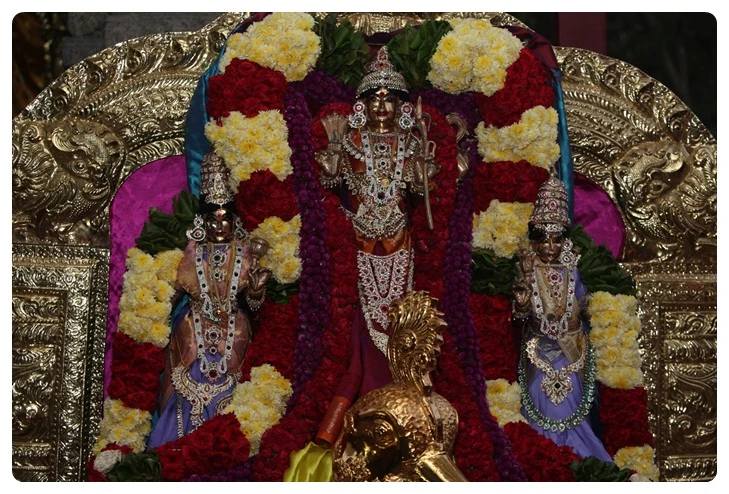
A photograph of three deity murtis (statues) decorated for worship, set before an ornate gilded golden backdrop with a magenta cloth behind them. The central murti wears a crown, large earrings and layered gold and jewelled necklaces, and holds a trident-like staff. Flanking murtis on either side wear crowns, jewelled necklaces and blue and purple garments, one raising a hand. Garlands of red roses, yellow flowers and green leaves drape across all three figures, and a golden lion-like figure sits at the base. No living people are visible.A black stone murti of a multi-armed deity stands in a silver-framed niche against a green curtain with gold flecks. The figure wears a blue turban, a blue dhoti-style cloth, layered rudraksha malas across the chest and a rudraksha belt, along with earrings, bangles and a red tilak on the forehead. Several hands hold ritual objects. No physical people are visible; the figure is a statue.Close-up photograph of a dark black stone lingam with a cylindrical base and a carved front face, decorated with small red dots and red marks along its upper edge. A single oil lamp flame burns in a shallow dish at the centre of the lingam's top. Below it, a row of yellow marigold flowers lies on a floor decorated with white chalk kolam patterns. The surrounding stone niche is dimly lit. No people are visible.Close view of a deity murti seated on a gold-toned throne with a cobra-hood backrest. The figure wears an orange-red turban with gold border, a decorative tiered collar of rhinestones, and rudraksha beads hanging down. Garlands of pink roses, yellow and white flowers, purple blossoms and green leaves drape over its shoulder and lap. Green crown-like ornaments with gold tips rise above. In the foreground a brass oil lamp stands out of focus, with a magenta cloth and a red-and-gold textile nearby.Two metal murti figures sit on a gold and orange draped throne against a golden backdrop. The left figure, painted in red-orange with an orange turban-style crown, holds a golden trident and a drum-like object, and is garlanded with white flowers and red roses. The right figure wears a purple garment, a white and red crowned headdress, layered gold necklaces, and holds a golden trident with white flowers and red roses. No physical people are visible; both figures are statues or deity murtis.A photograph of a temple shrine with two large deity murtis seated on a raised platform under a golden arched canopy with orange drapery. The murtis wear red and green garments, garlands of white and red flowers, and ornate necklaces; one holds a sword-like weapon. In front, a colourful garland of red, purple and white flowers circles a decorated ceremonial object on a brass stand. A standing figure in a red robe with a pale-faced sculpted statue stands in a niche to the right. In the foreground a person wearing an orange turban and orange robe, seen from behind, faces the shrine. Brass lamps and carved stone pillars frame the scene.

Paada Puja

5 photosSource gallery
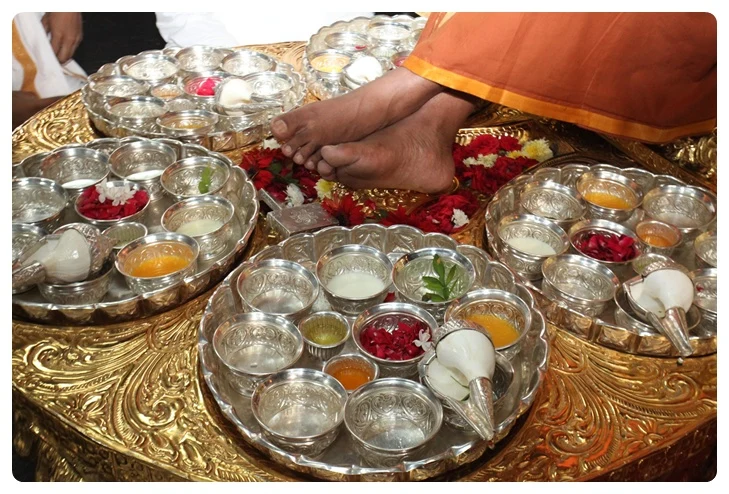
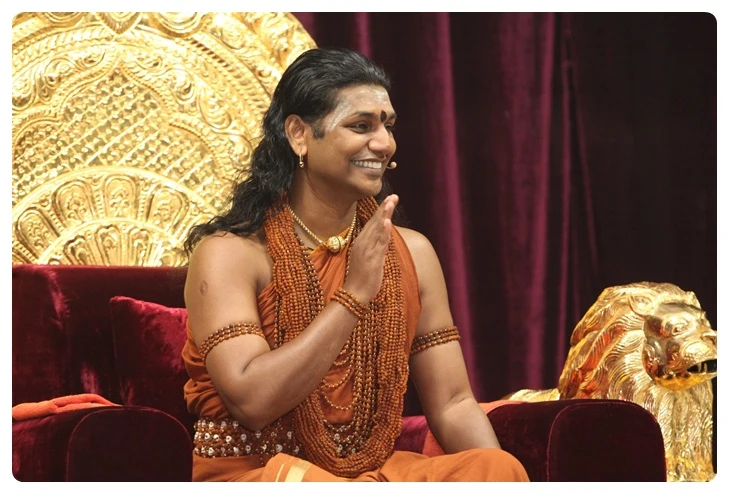
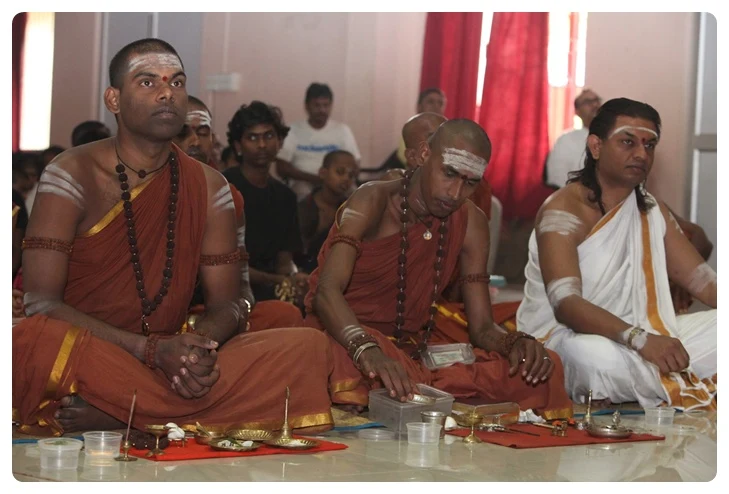
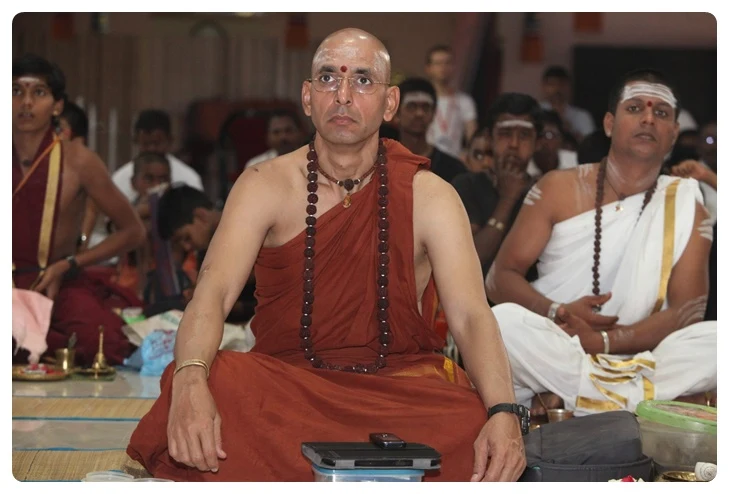
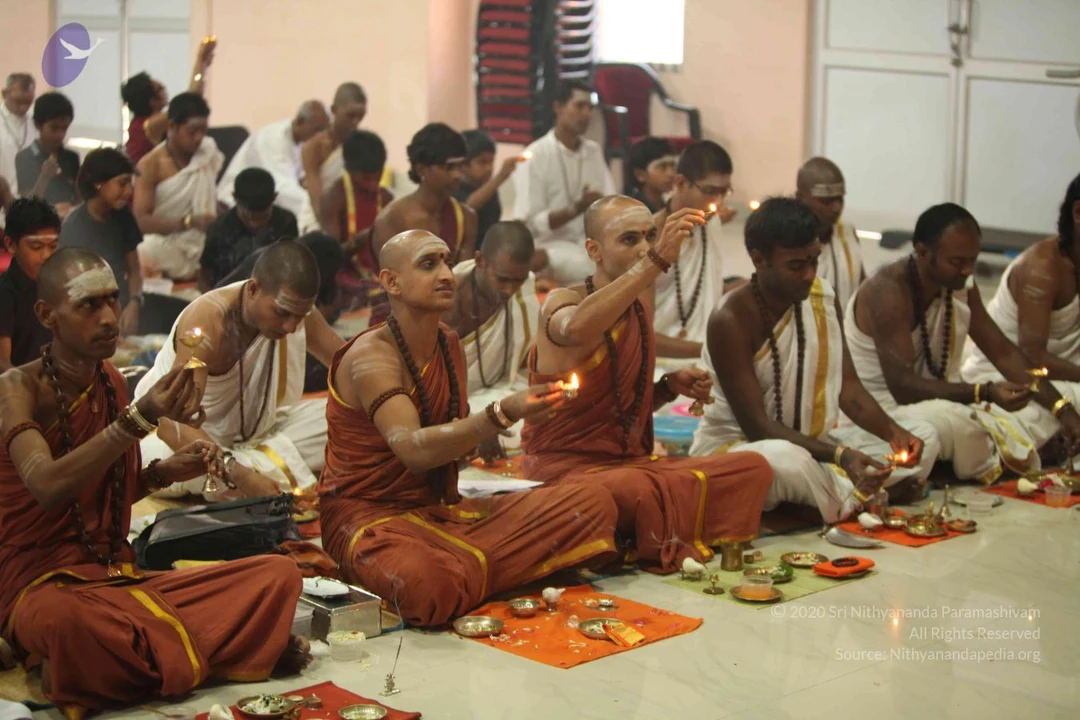
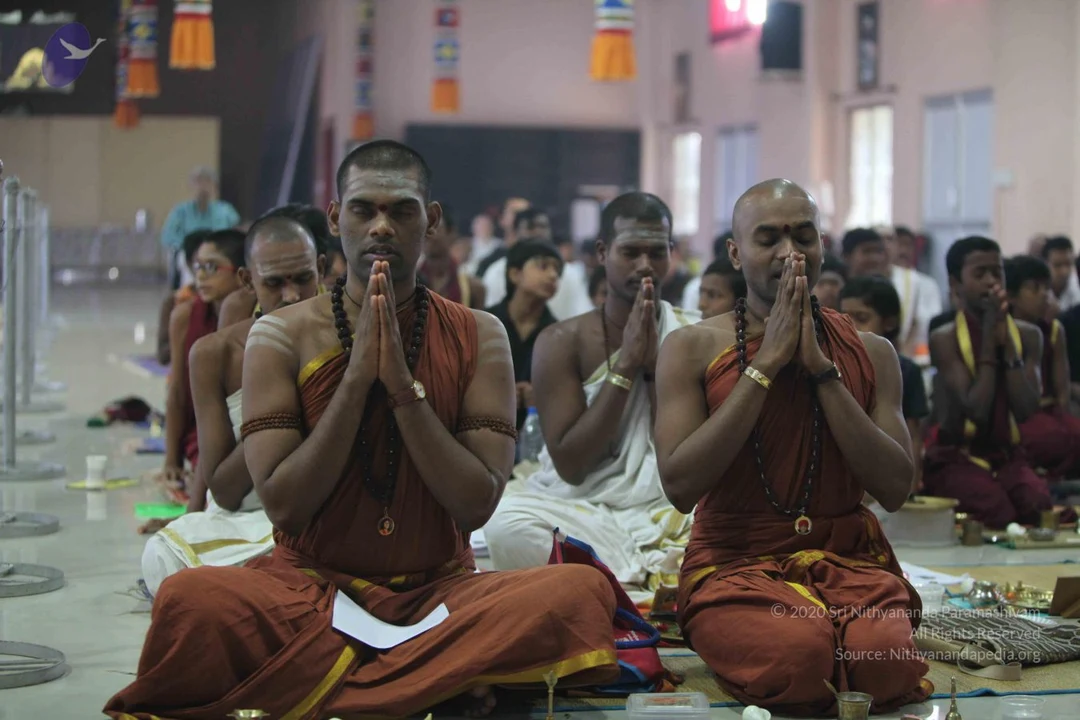
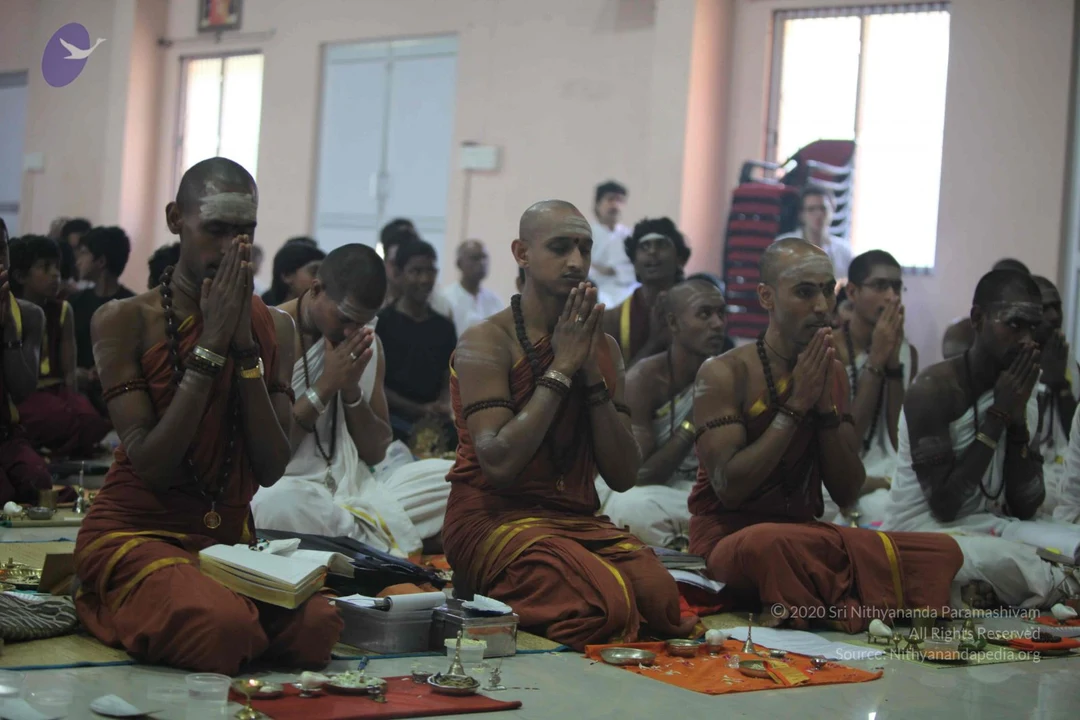
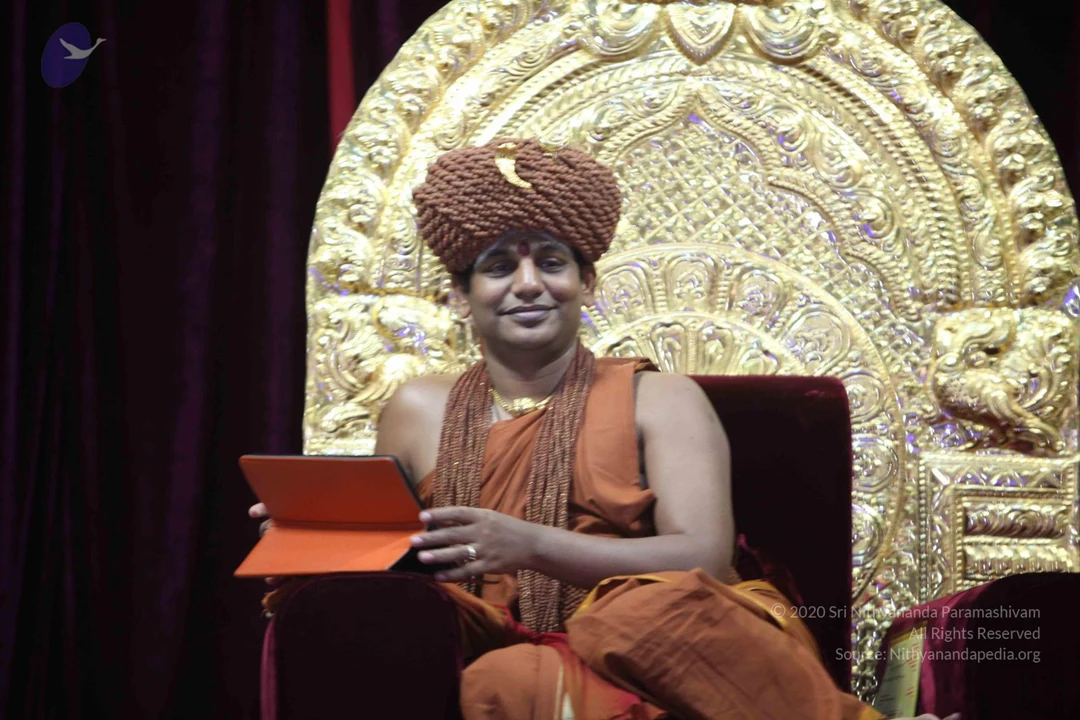
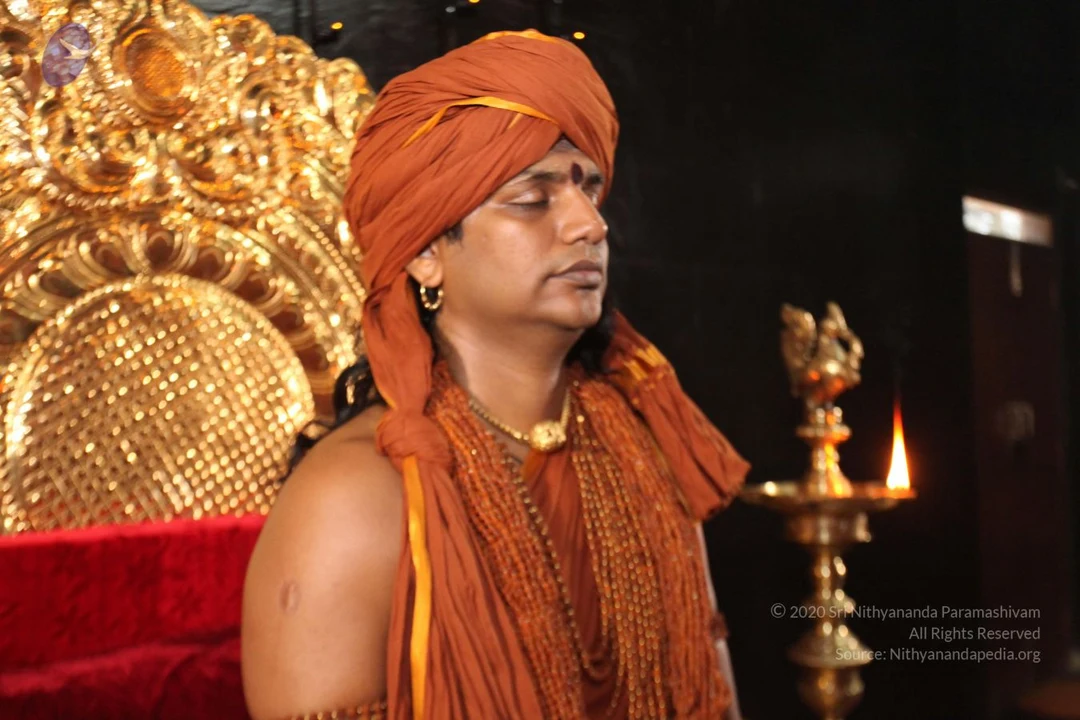
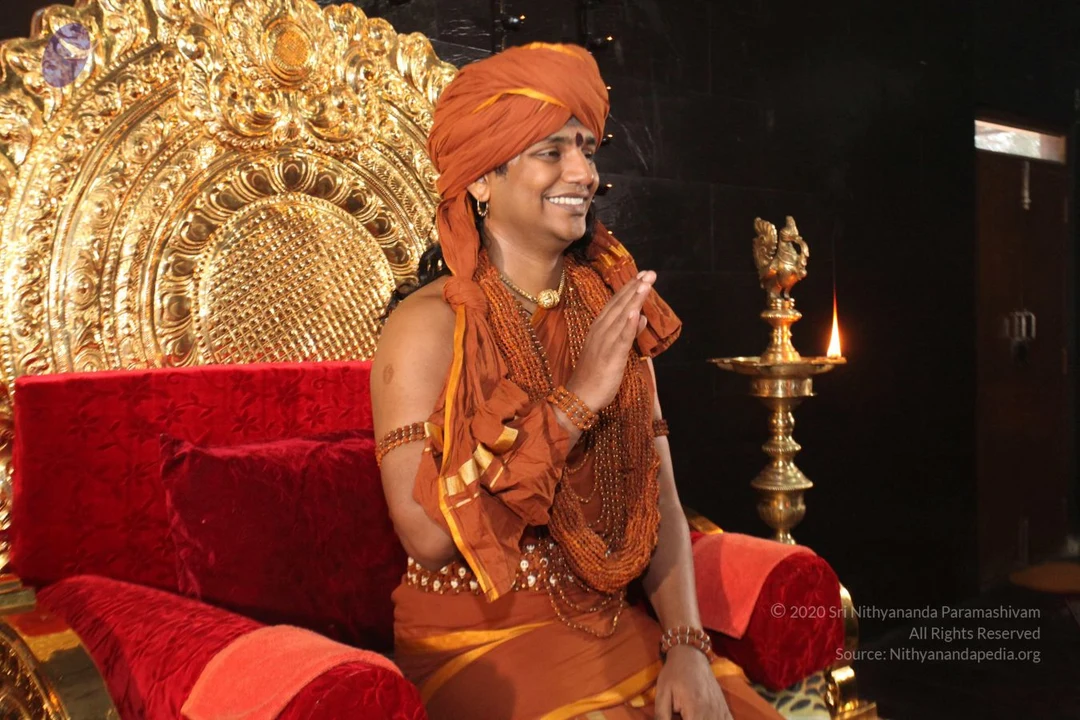
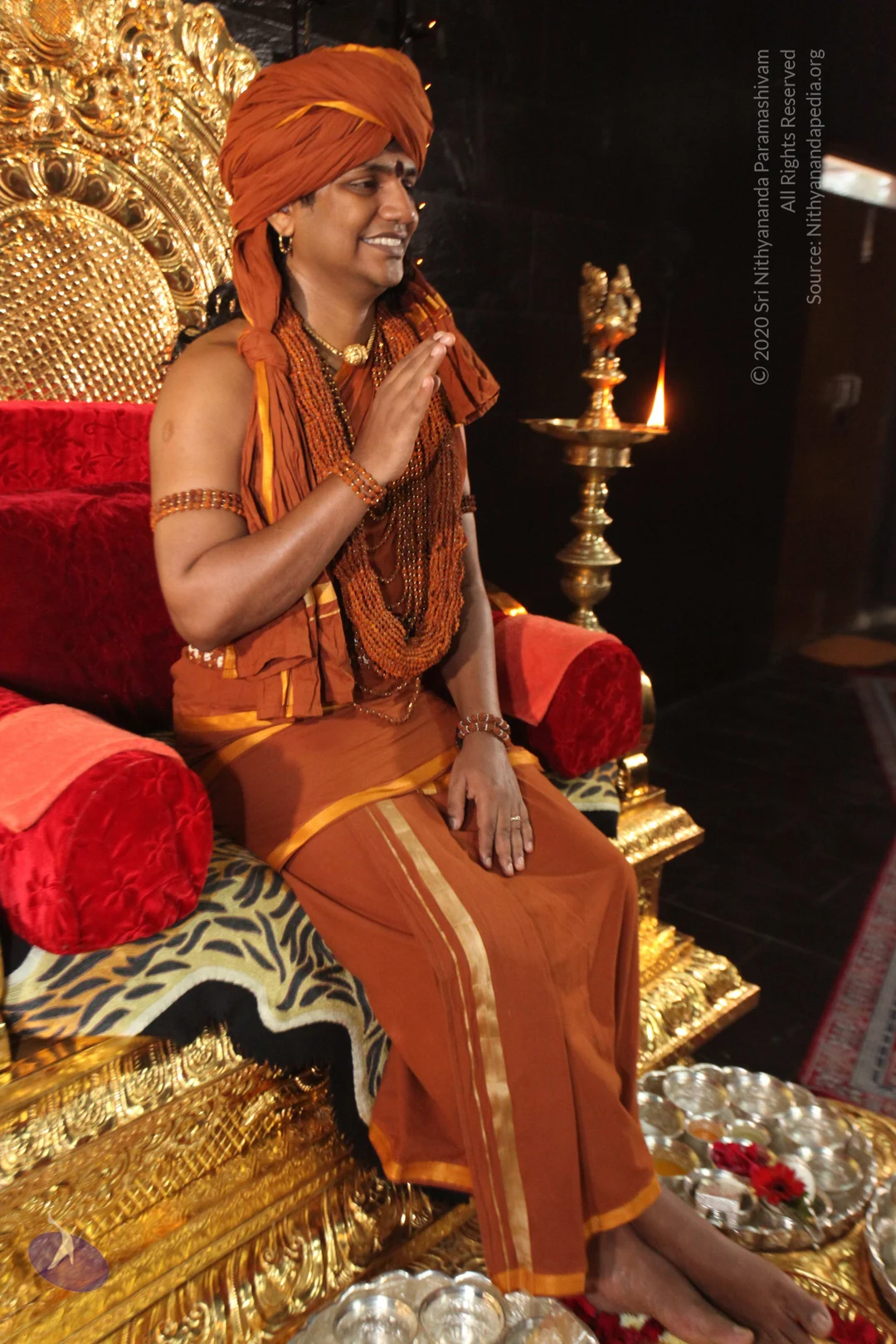
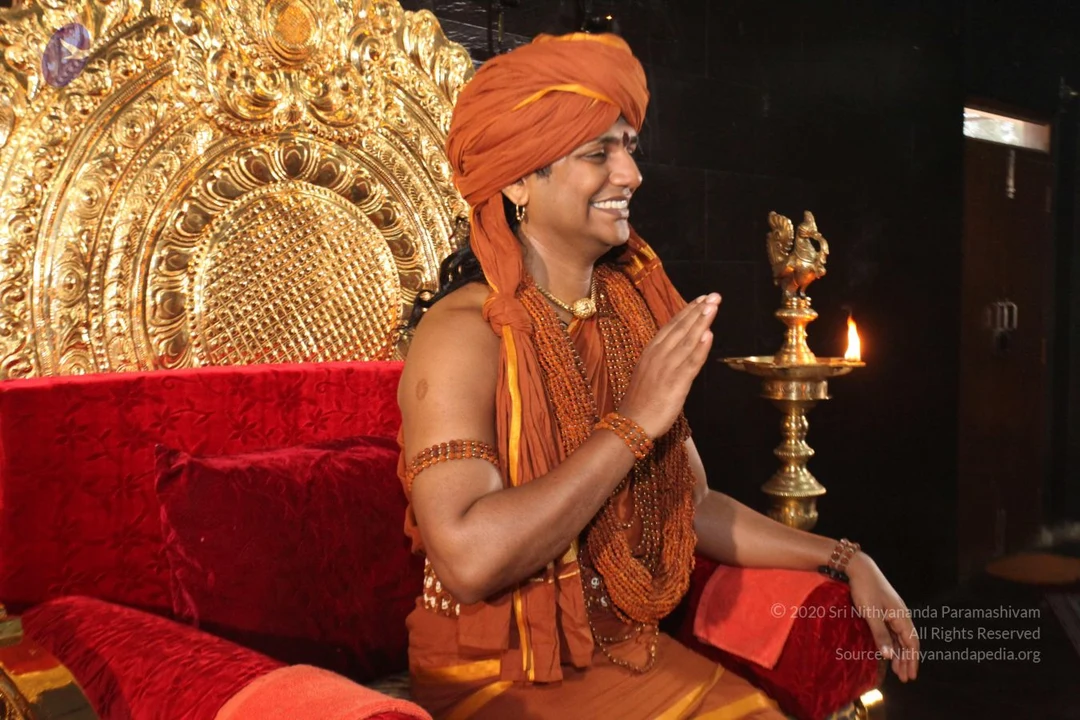
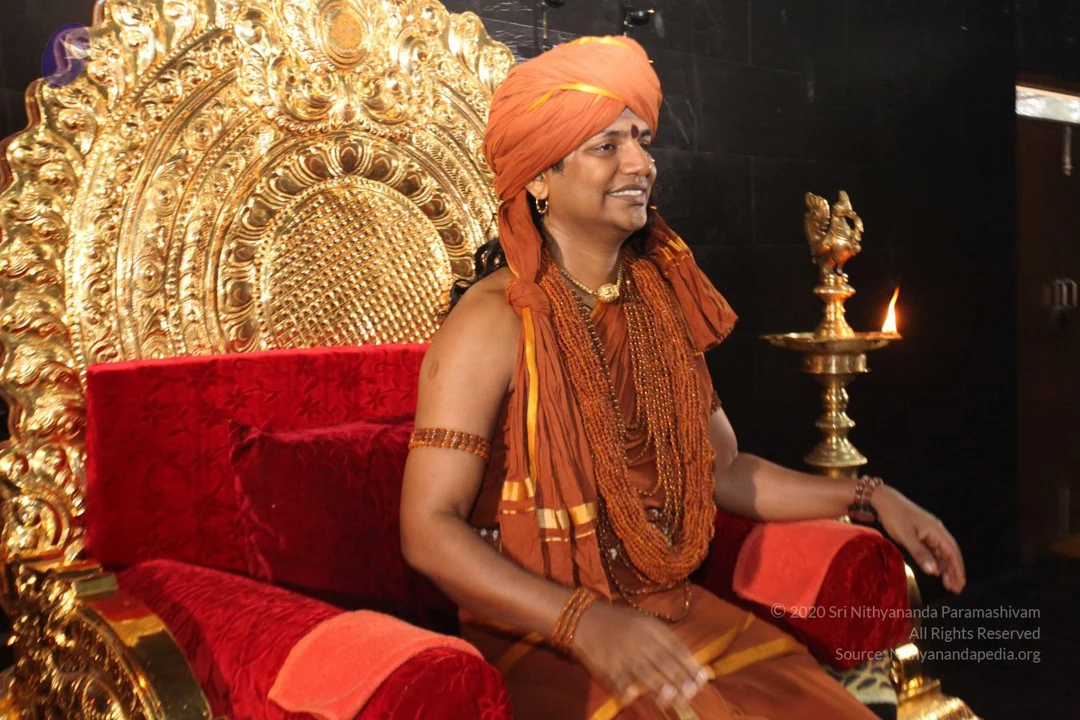
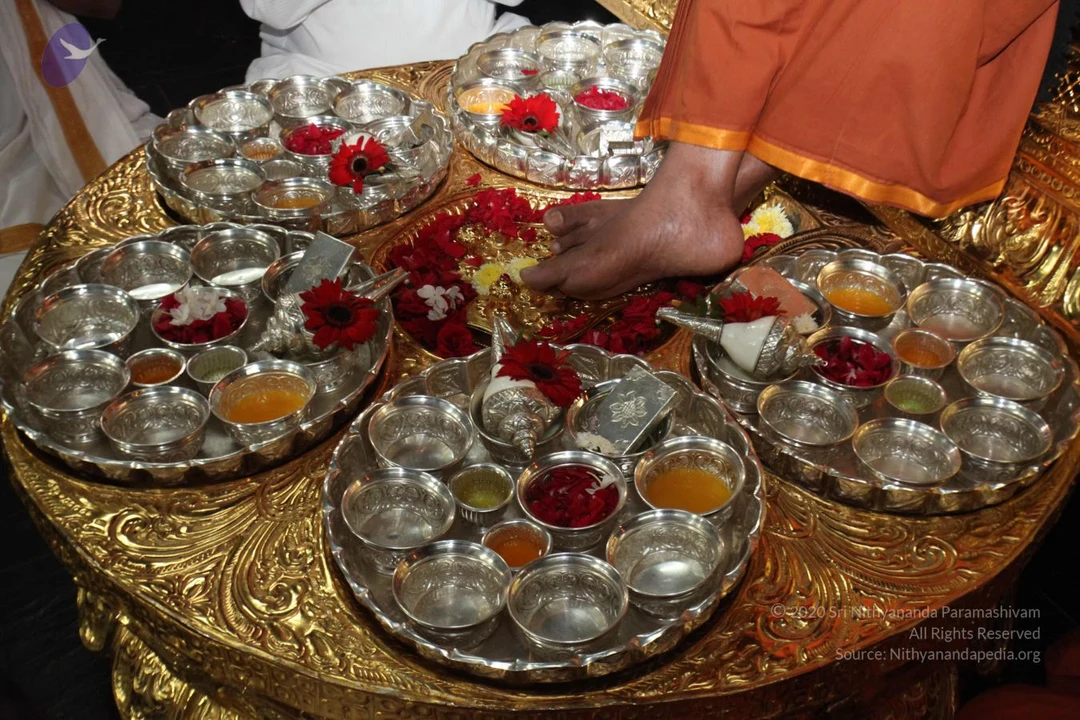
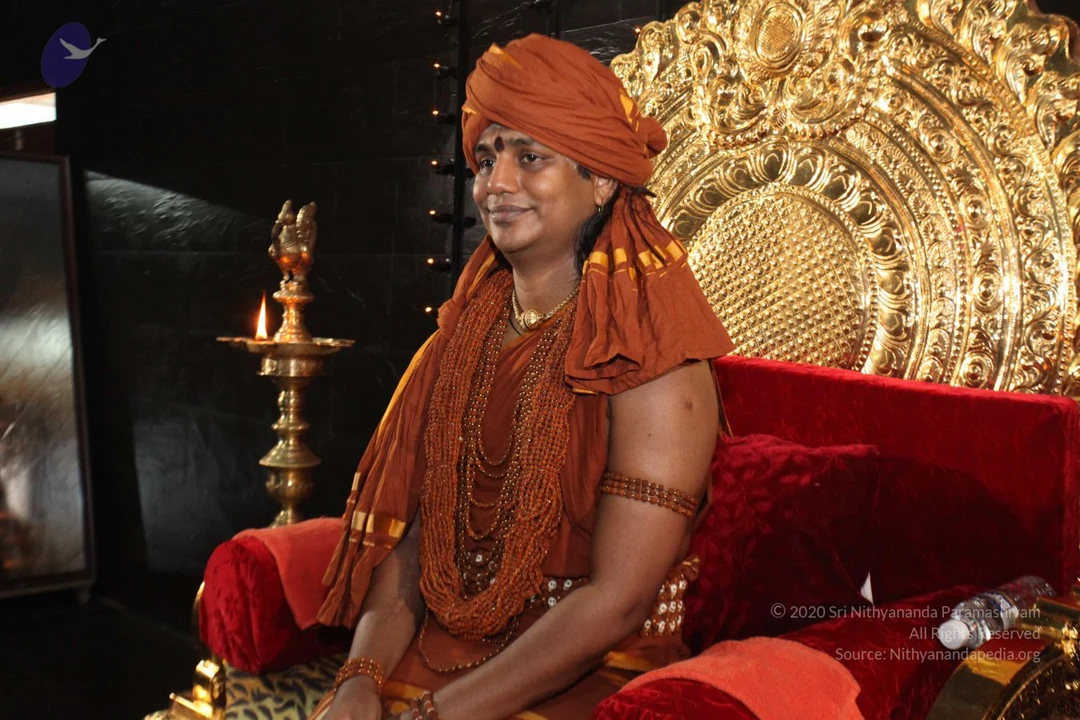
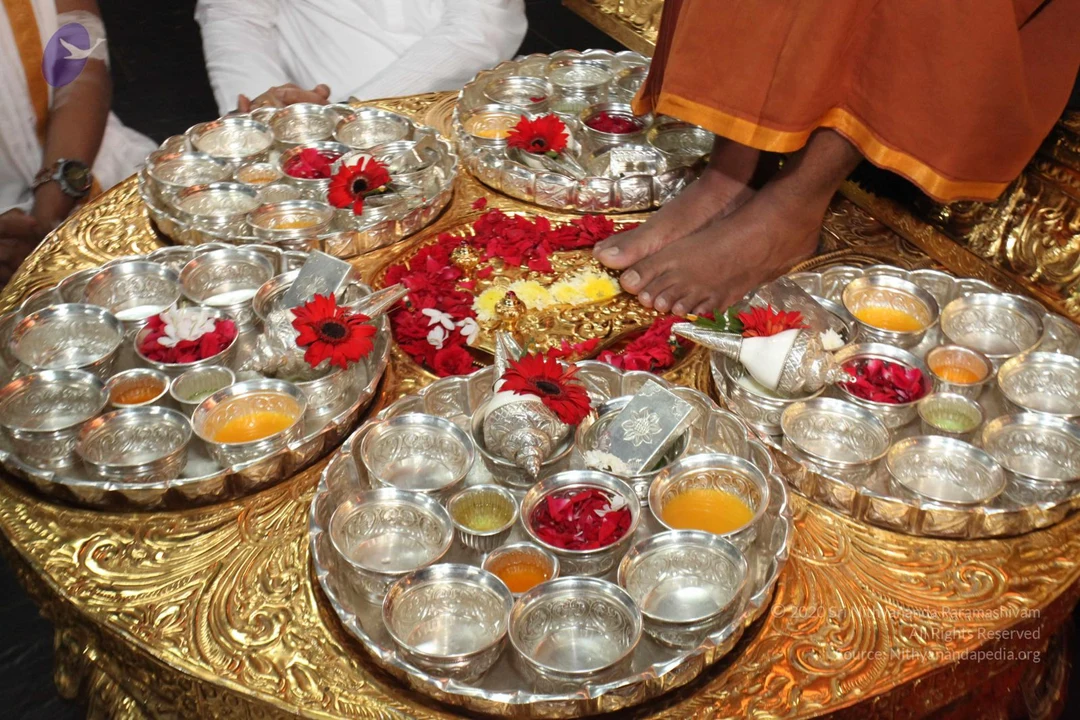
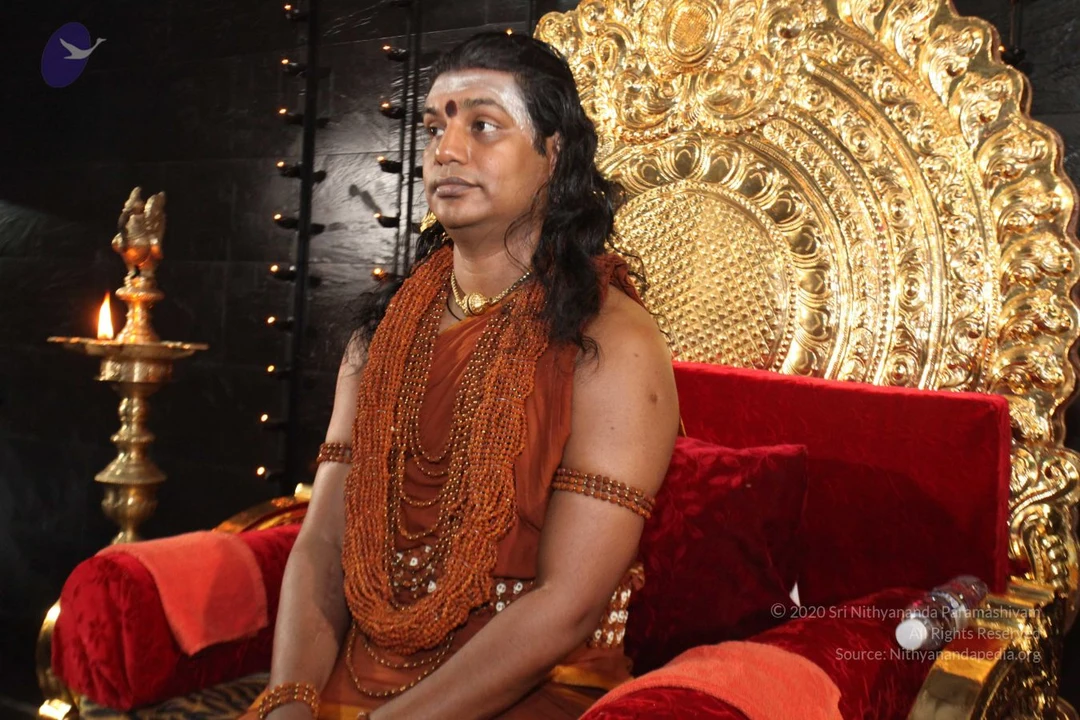
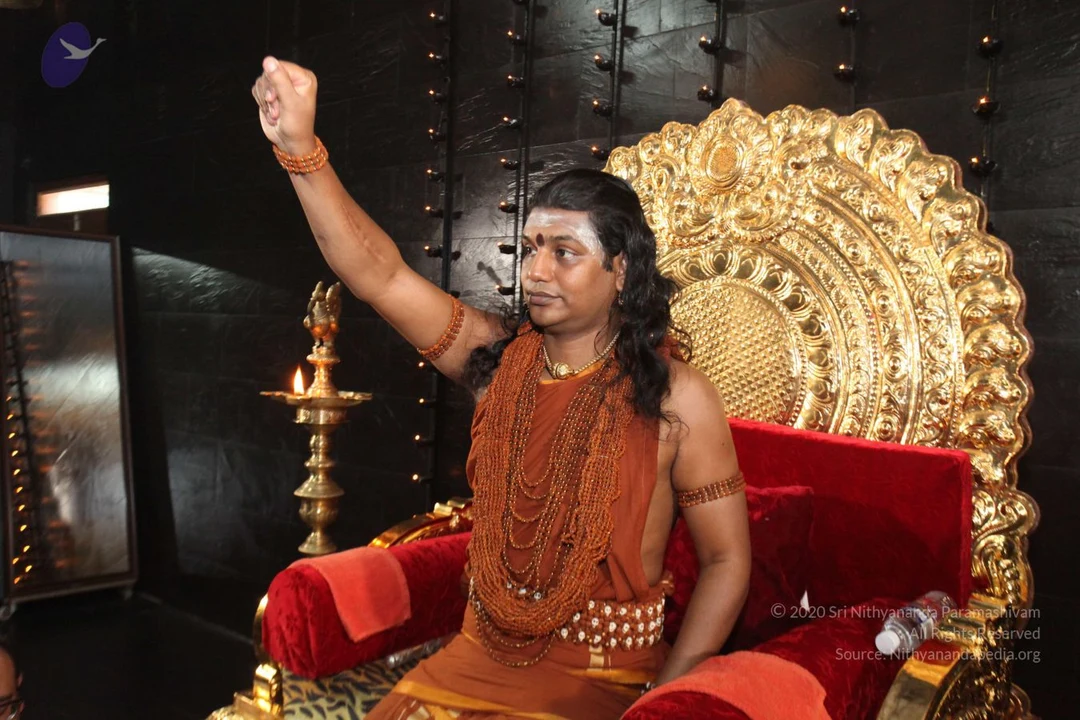
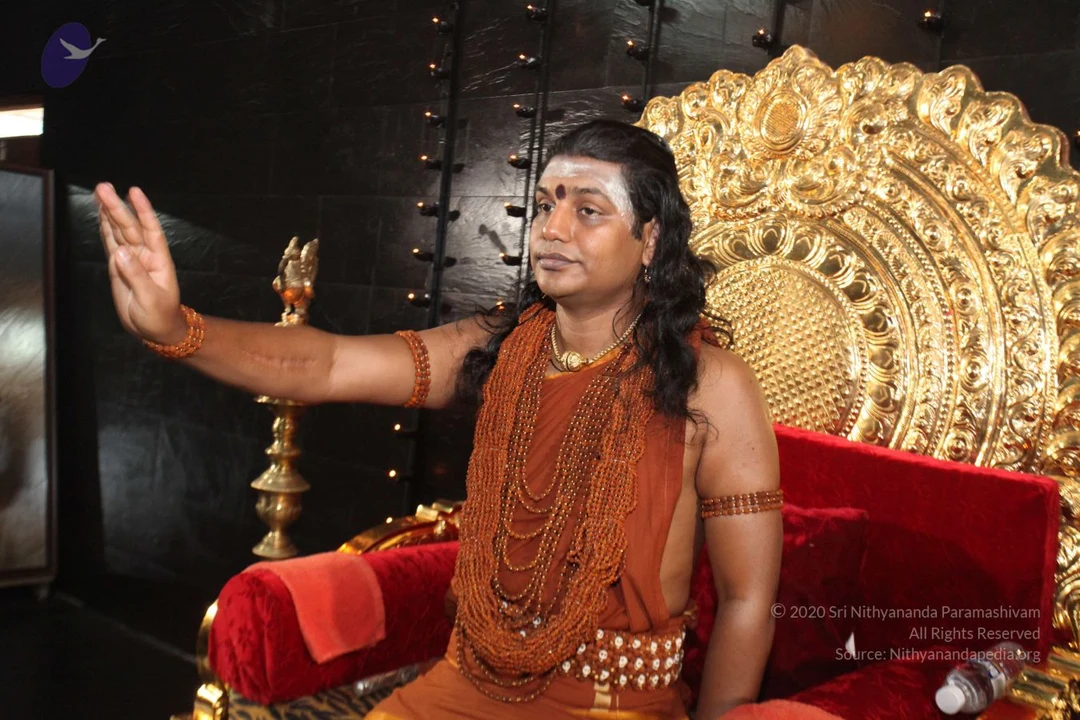
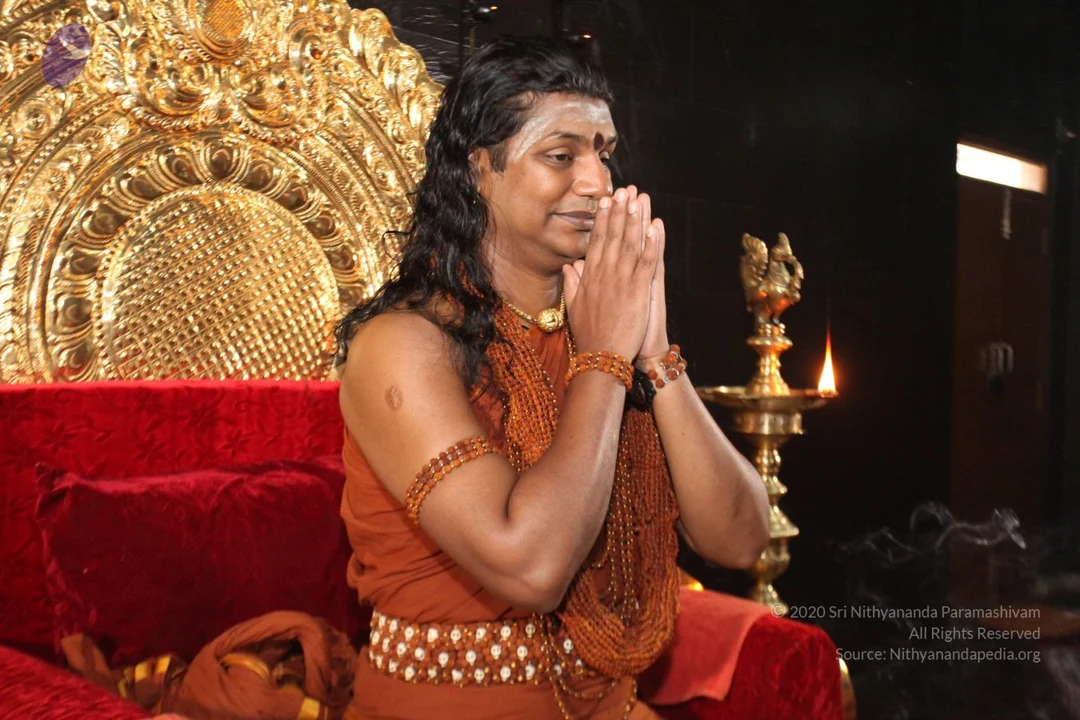
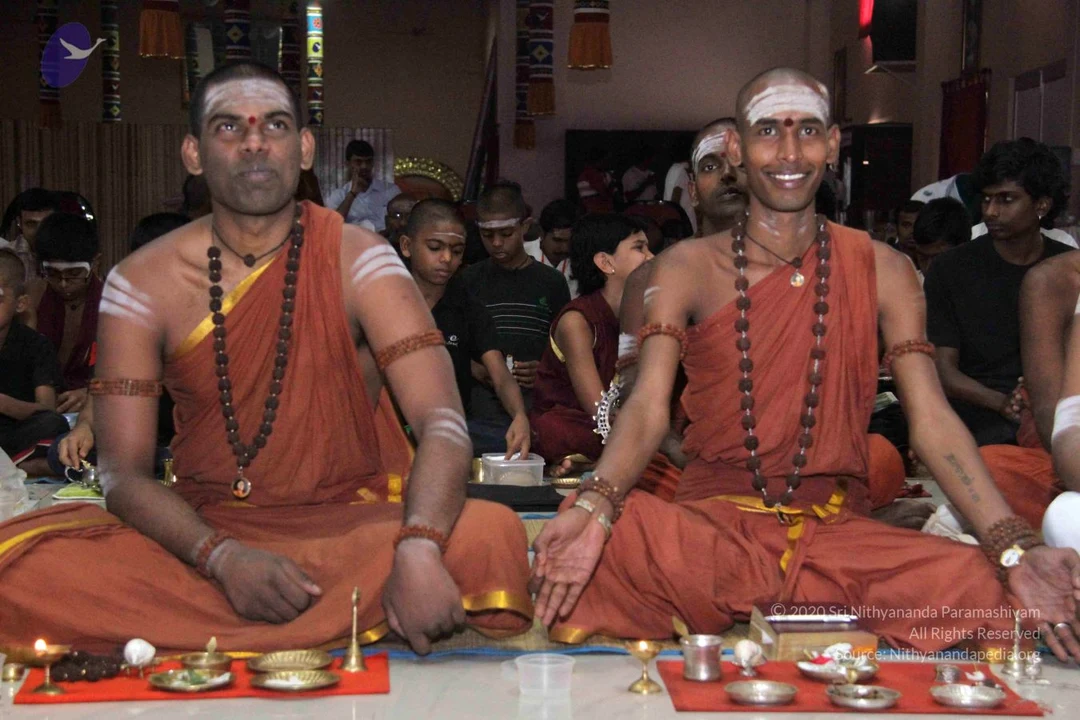
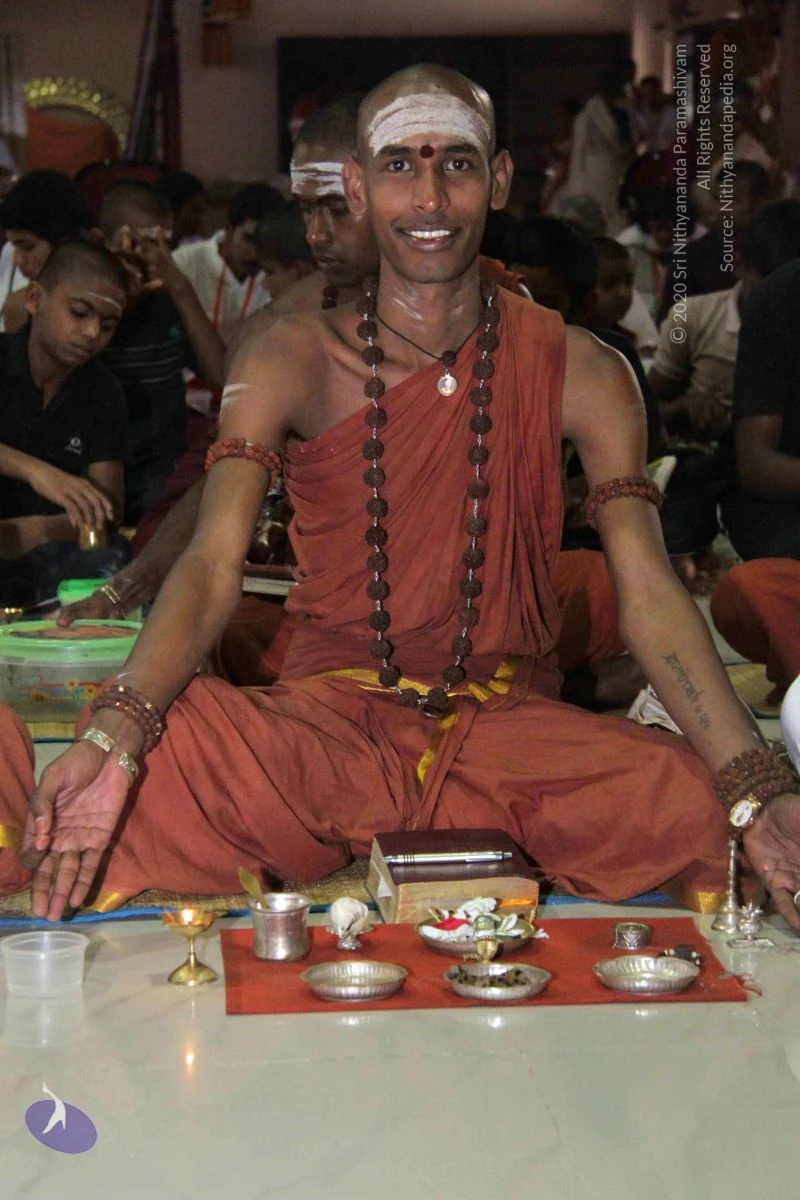
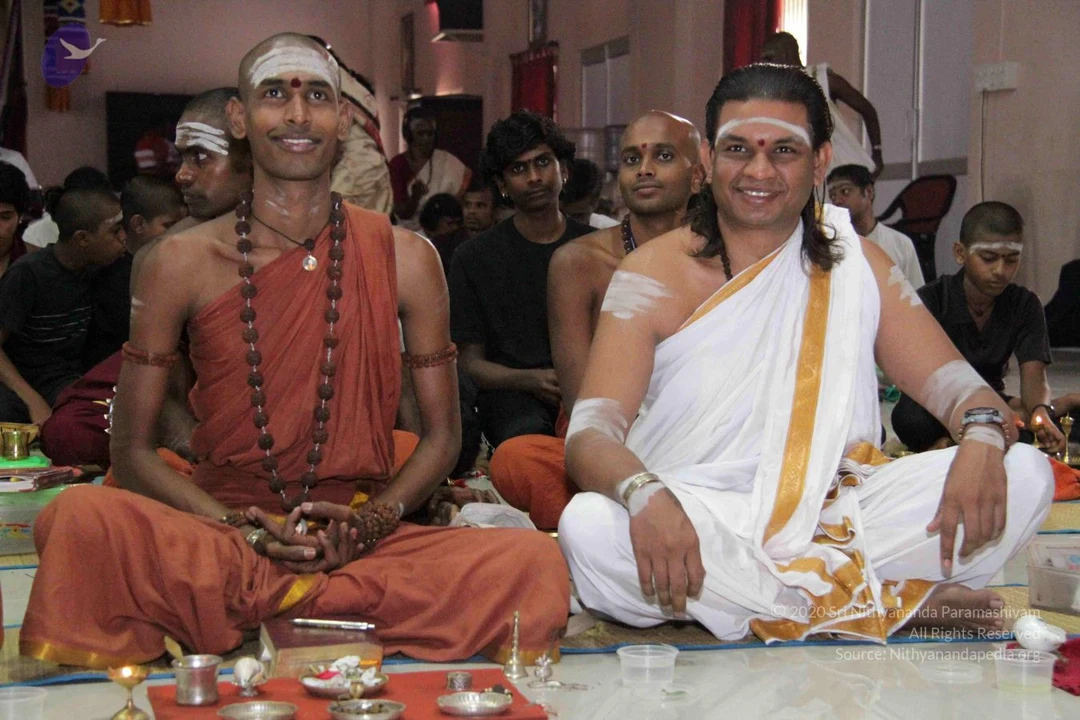
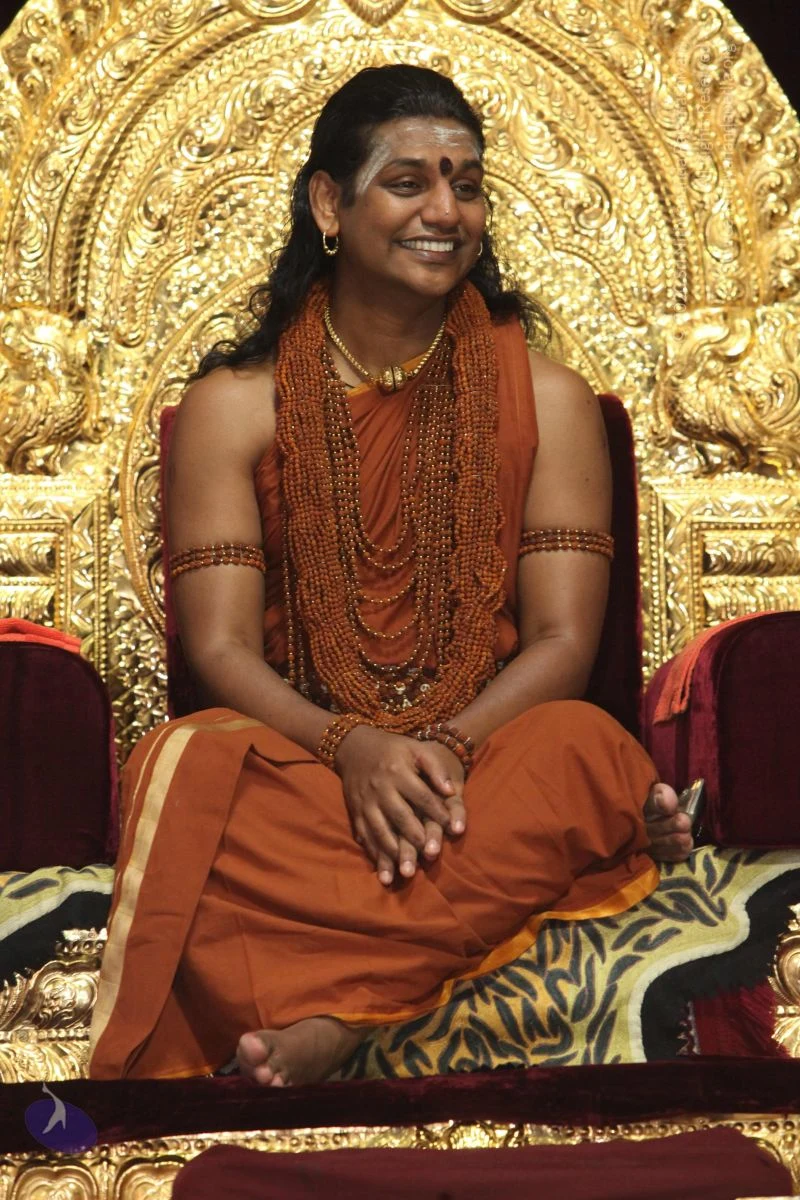
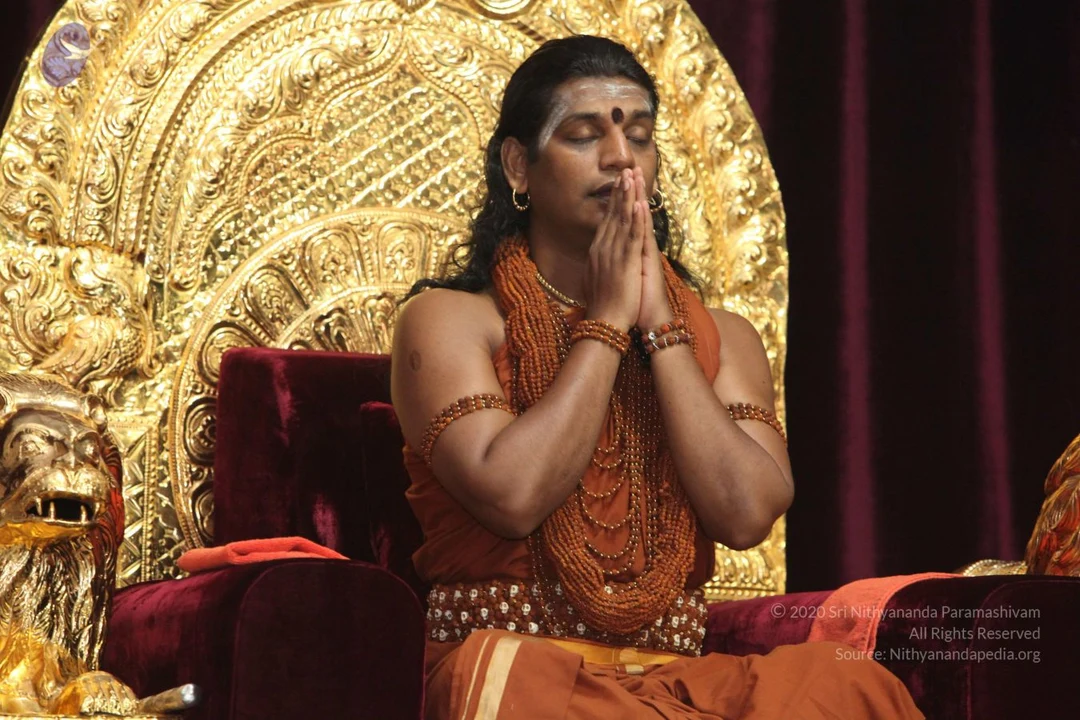
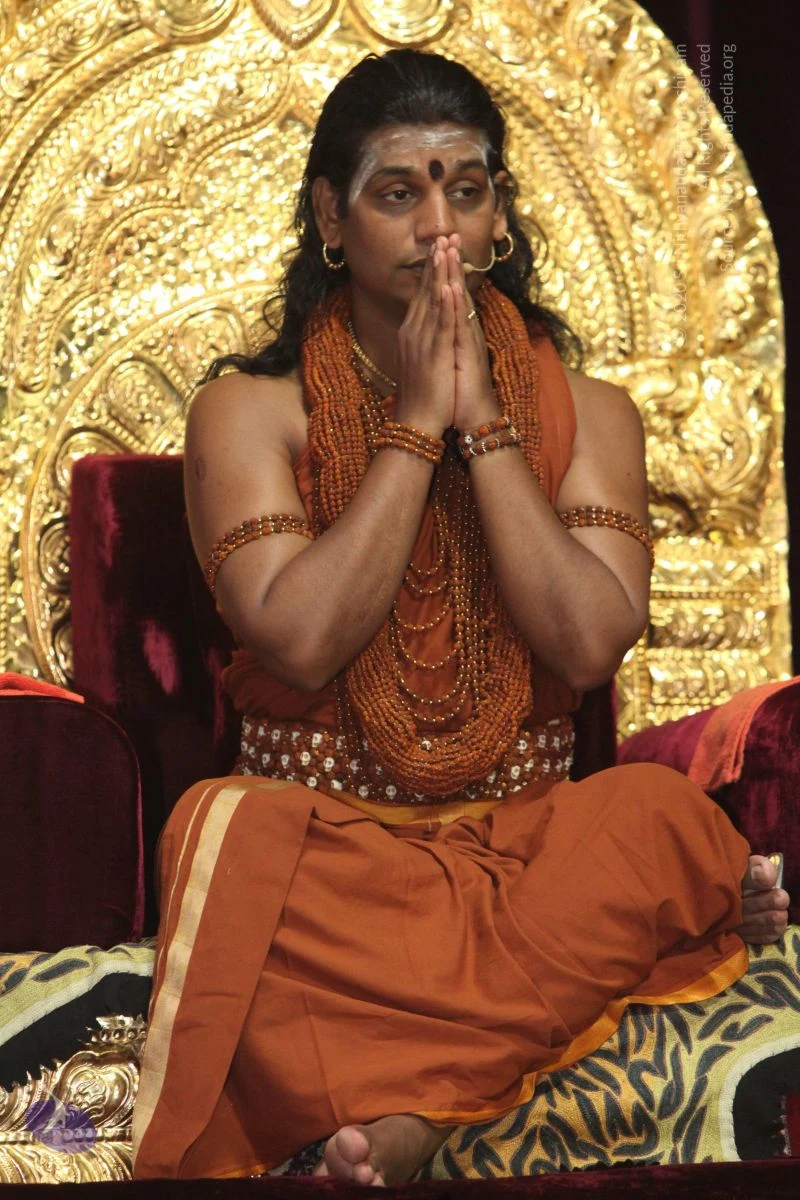
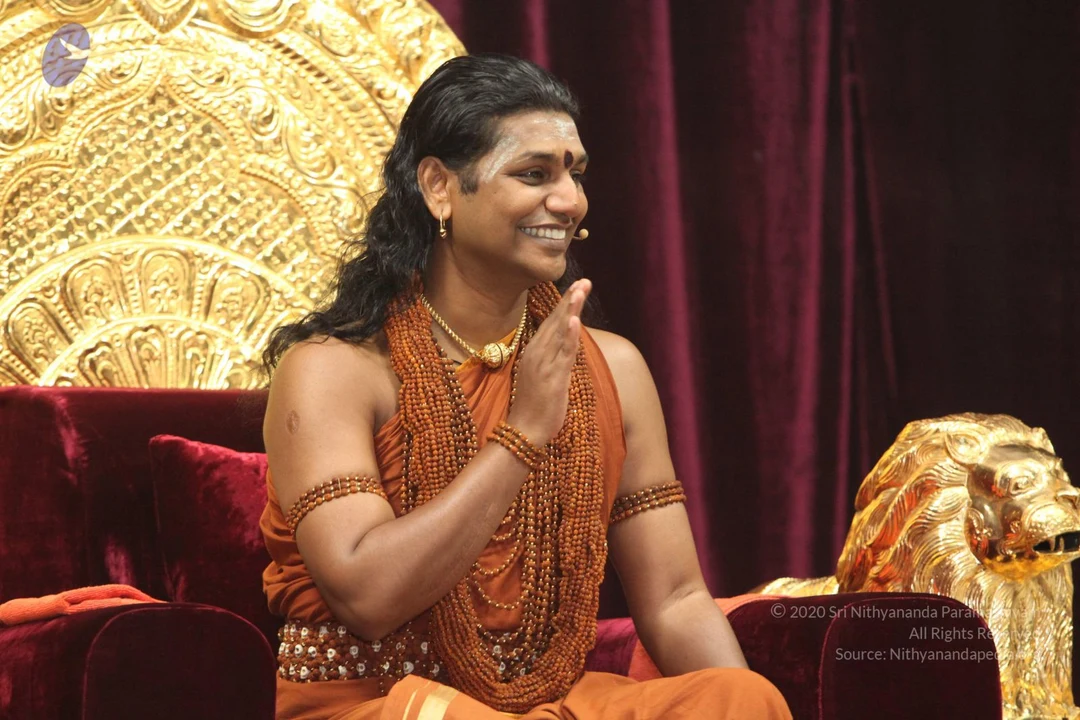
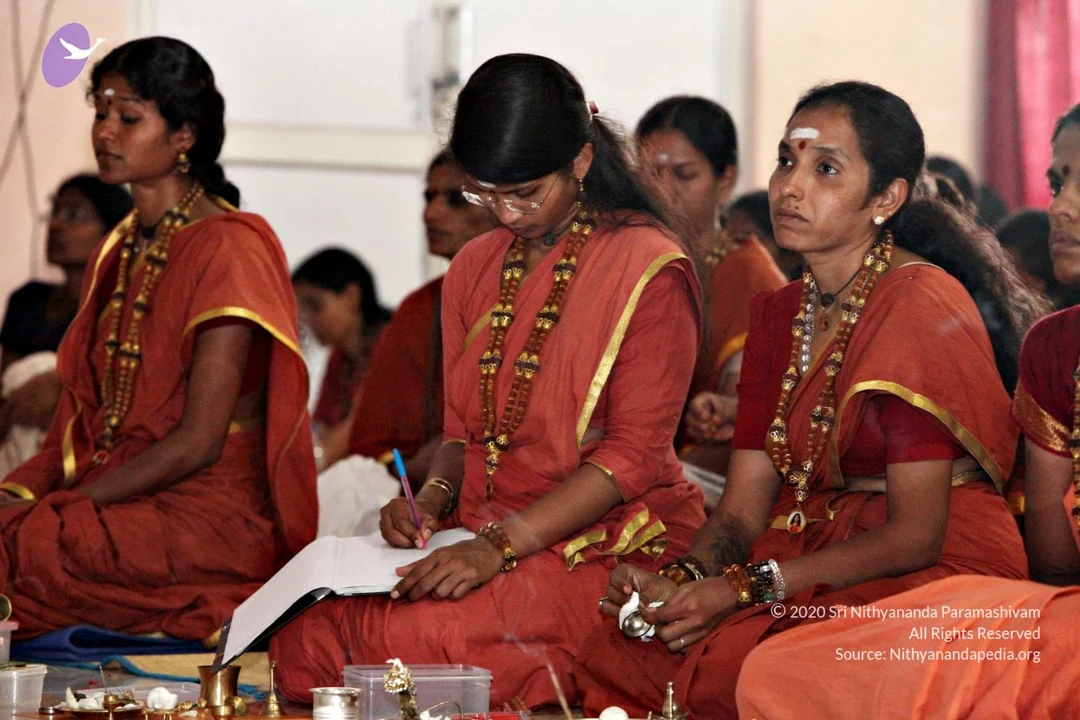
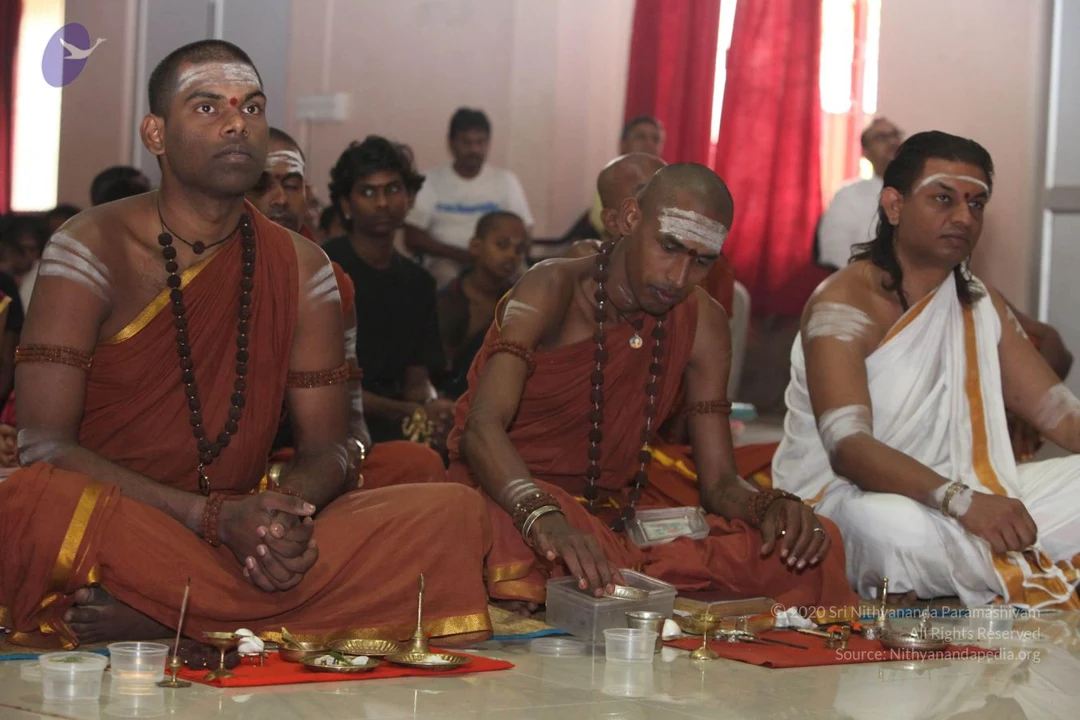
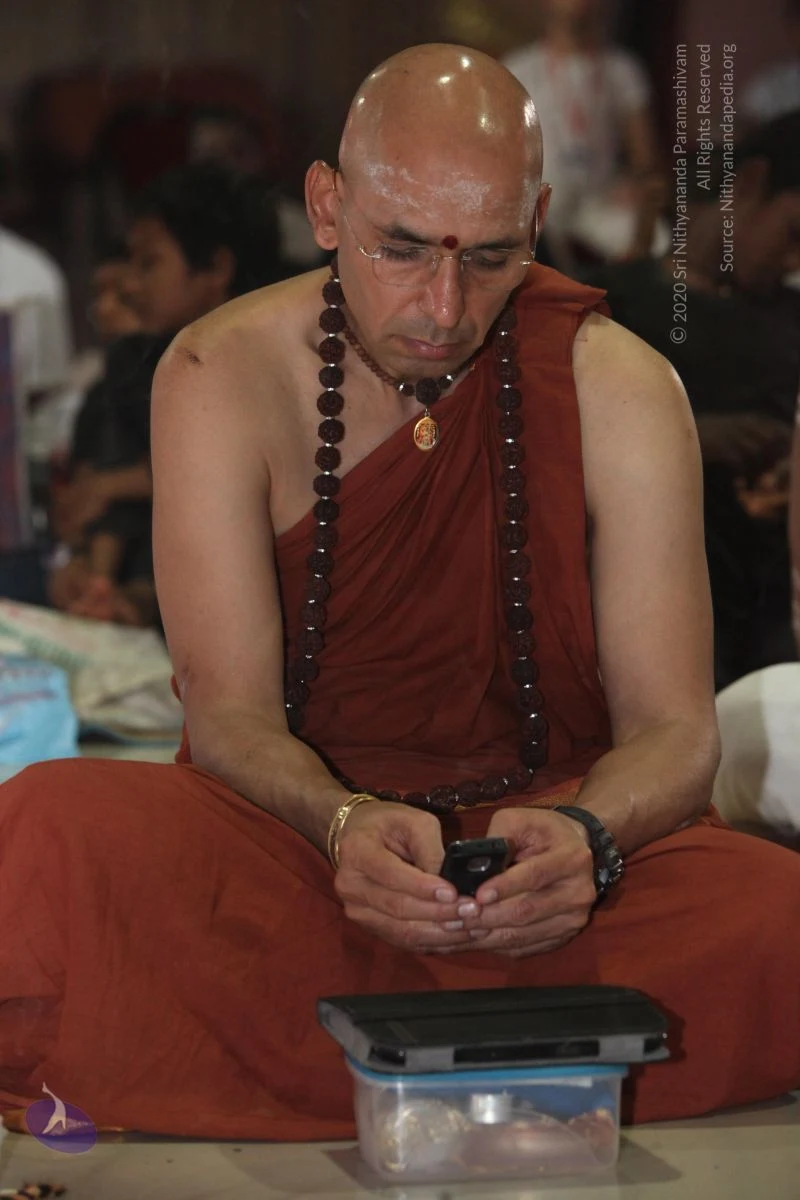
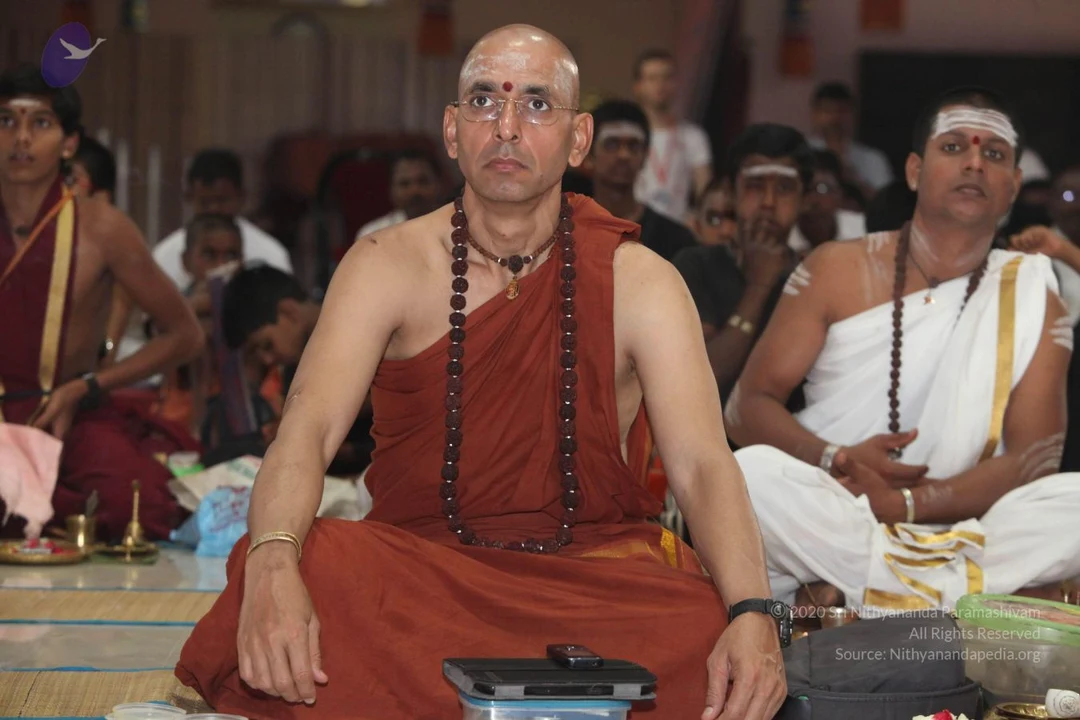
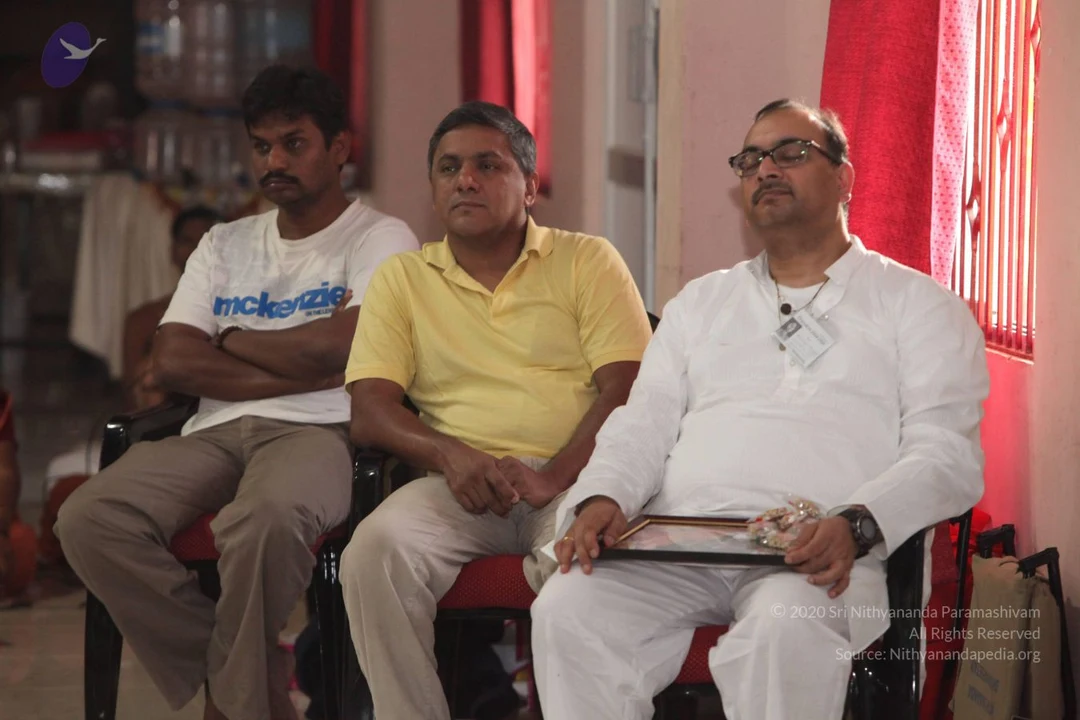
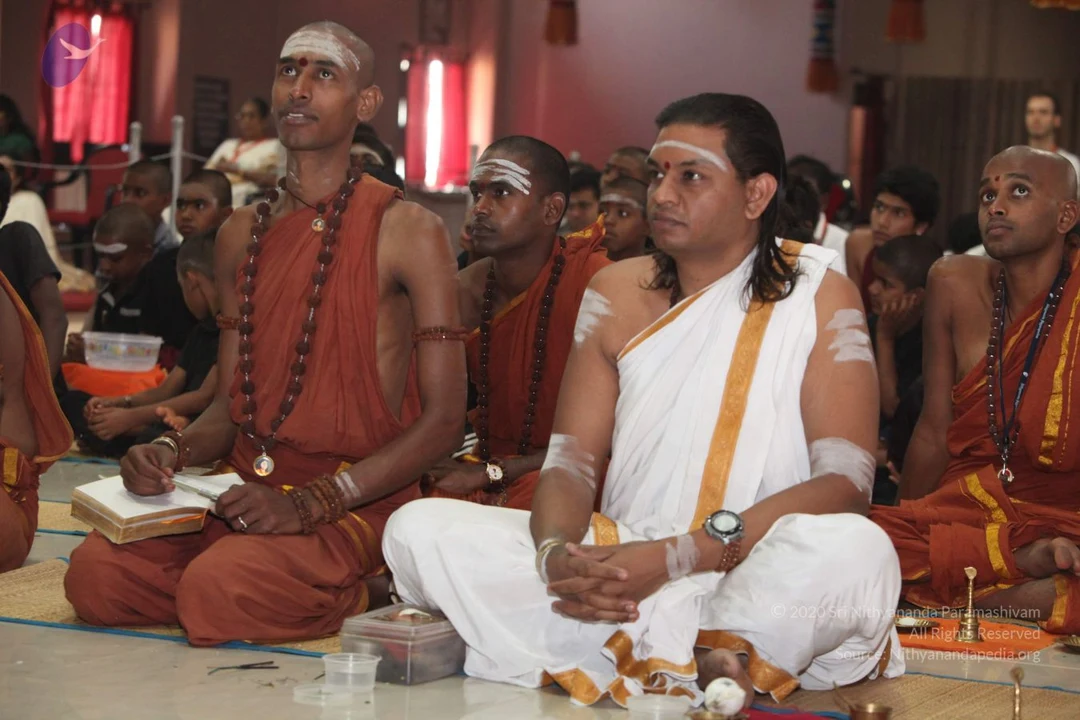
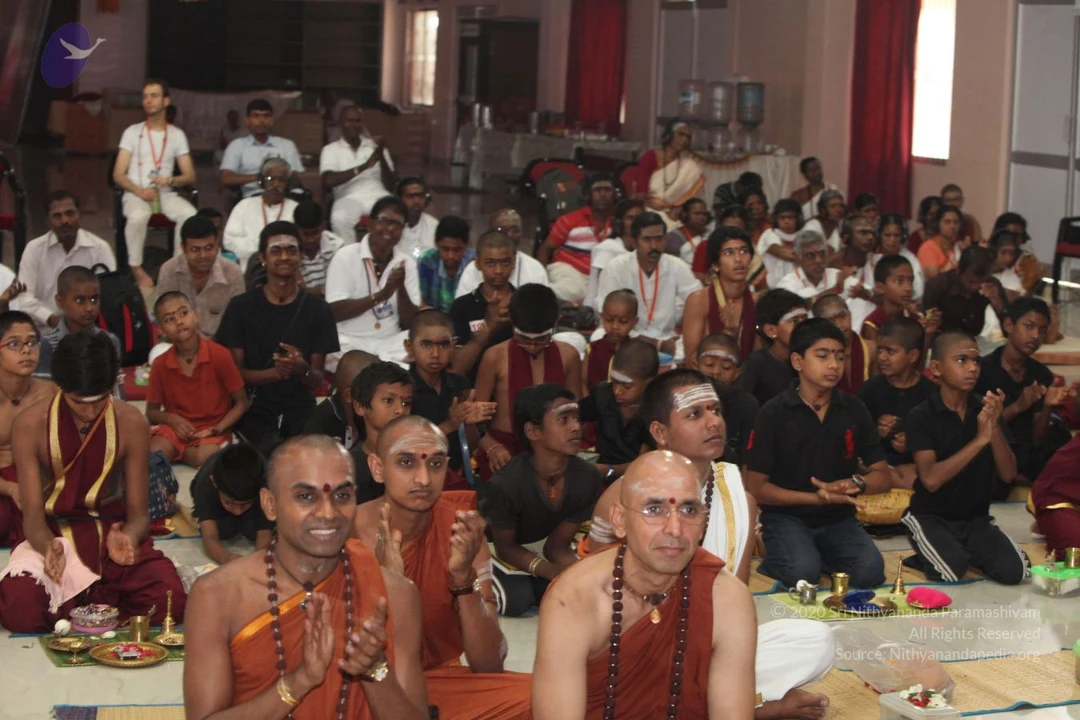
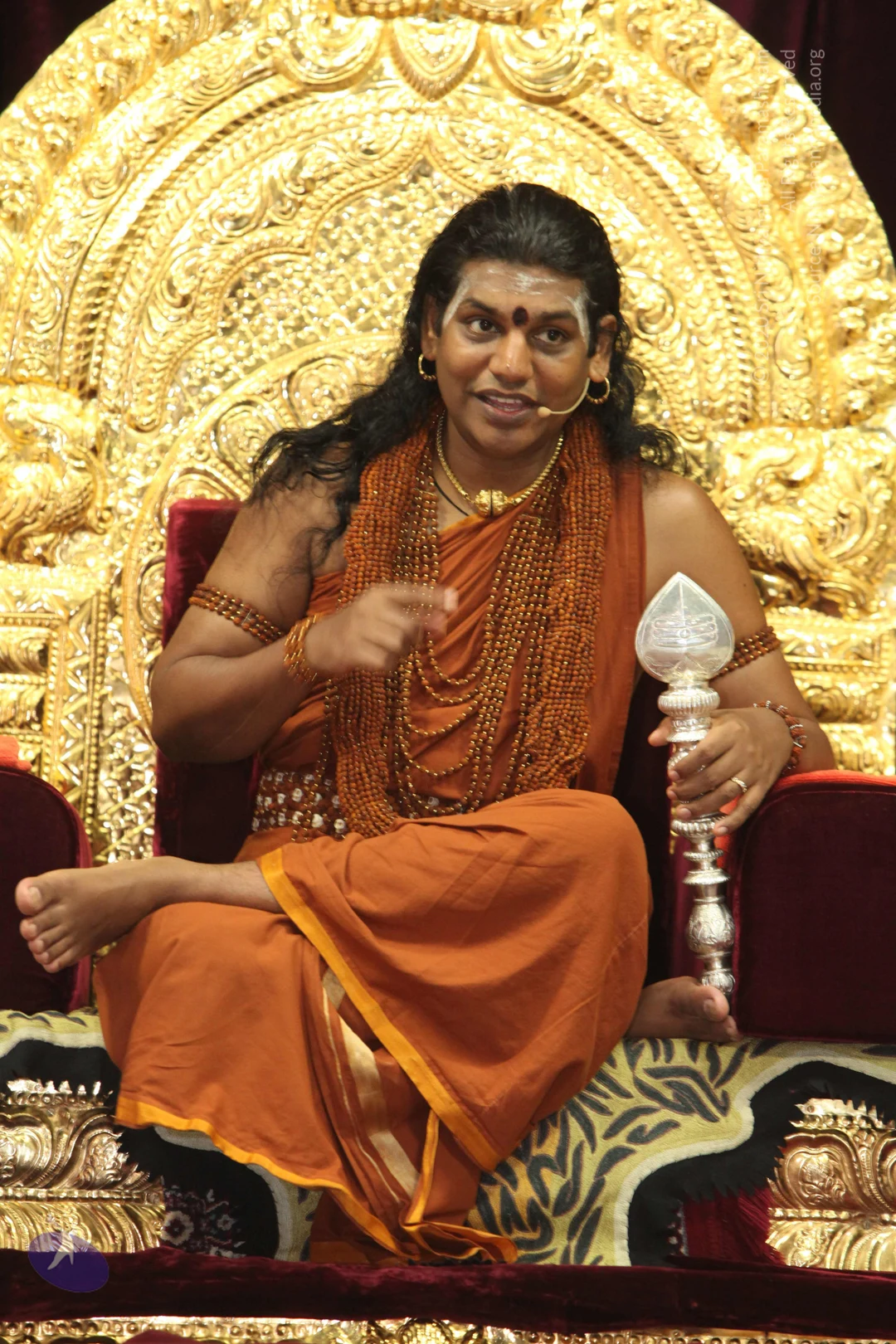
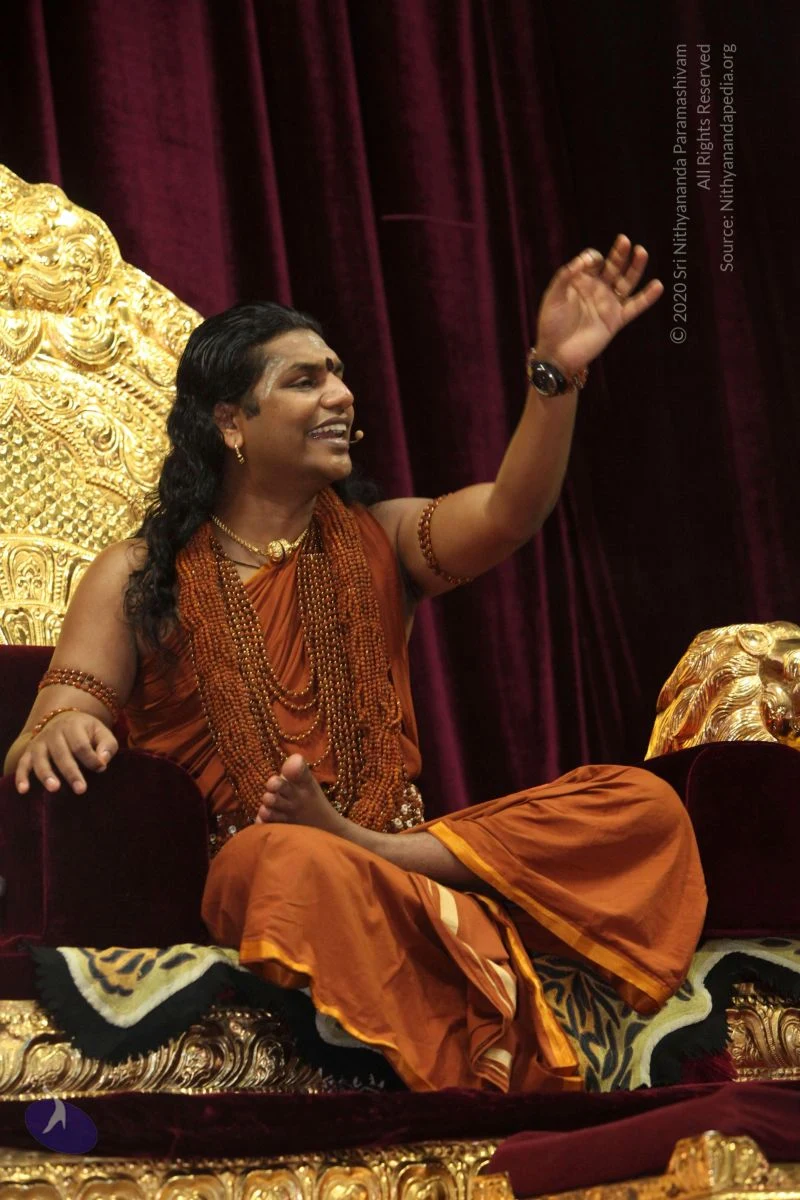
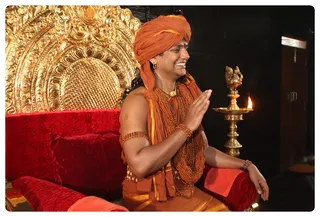
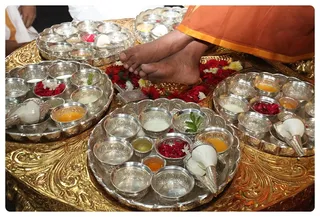
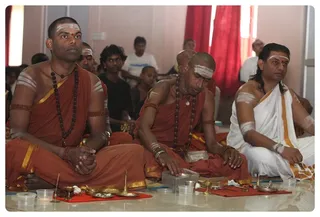
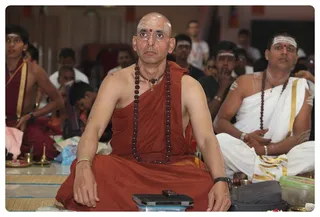
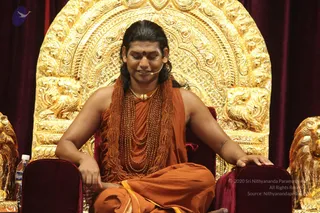
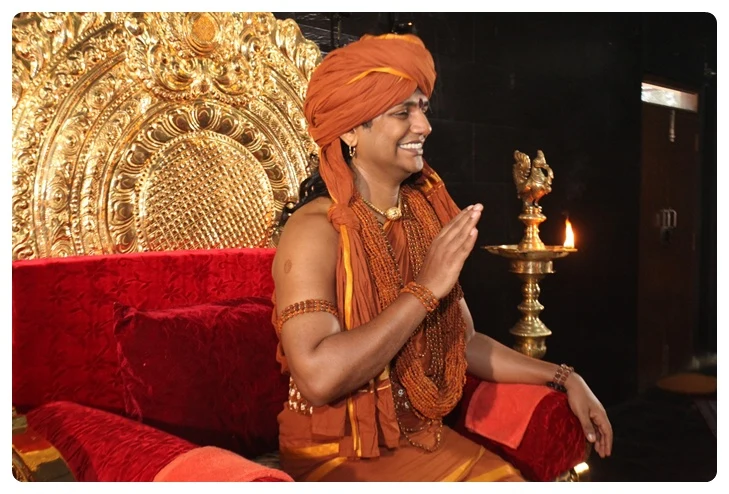
Swamiji (probable) sits in a satsang setting on a red cushioned seat in front of a large ornate gold throne-back. He wears an orange turban, orange garment and layered rudraksha malas, with ornate gold armlets and a gold necklace. He smiles with palms pressed together in namaste. A brass oil lamp with a lit flame and a bird-shaped finial stands beside him against a dark wall.Close photograph of bare feet resting on a golden ornate platform during a ritual, with a person in an orange-saffron garment visible at the top right. Around the feet are multiple tiered silver bowls and trays filled with milk-white liquid, honey-yellow and orange substances, red rose petals and flowers, and green leaves, with silver spoons and a conch-shaped vessel. The offerings suggest an abhishekam setting. No face is visible and no one can be identified from this view.Swamiji (probable) sits on a red velvet throne with an ornate gold backrest and a gold lion statue beside him. He has long dark hair swept back, wears an orange saffron cloth draped over his body, multiple strands of rudraksha beads, a gold pendant necklace, gold earrings and orange-gold armbands. He smiles and raises one hand in a gesture of blessing while speaking. The scene is a satsang stage with deep burgundy drapes behind him.A photograph of three seated men in a bright room during a ritual. The two men in front wear saffron-orange dhotis and shawls with rudraksha malas, and have white ash and tilak marks on their foreheads and arms. The man at right wears a white dhoti with an orange border and a white shawl, with white markings on his chest and arms. Brass and silver ritual vessels, a small silver container and oil lamps sit on red cloths on the floor, and a man in the front-left area holds an object over a container. Several people sit behind them, including a man in a white t-shirt. Pink walls and red curtains are visible.A shaven-headed man in glasses sits cross-legged on a mat in a hall, wearing a saffron-orange robe over his bare shoulder and a dark rudraksha mala with a pendant around his neck, with a red bindi and tilak on his forehead. Beside him on the right, a man in a white dhoti with gold border and a white forehead band sits and holds his hands together, also with a rudraksha mala. Behind them, seated devotees and a young man in maroon cloth look on. Brass oil lamps, a plate, a small black device and a metal container sit on the floor at the front.

Satsang

8 photosSource gallery
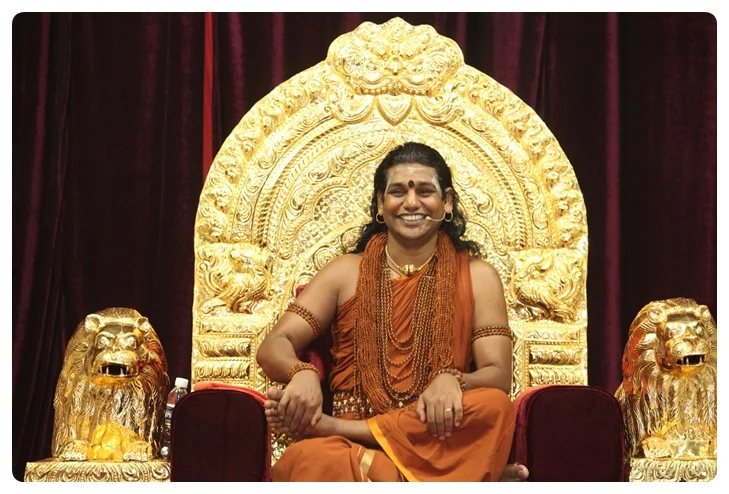
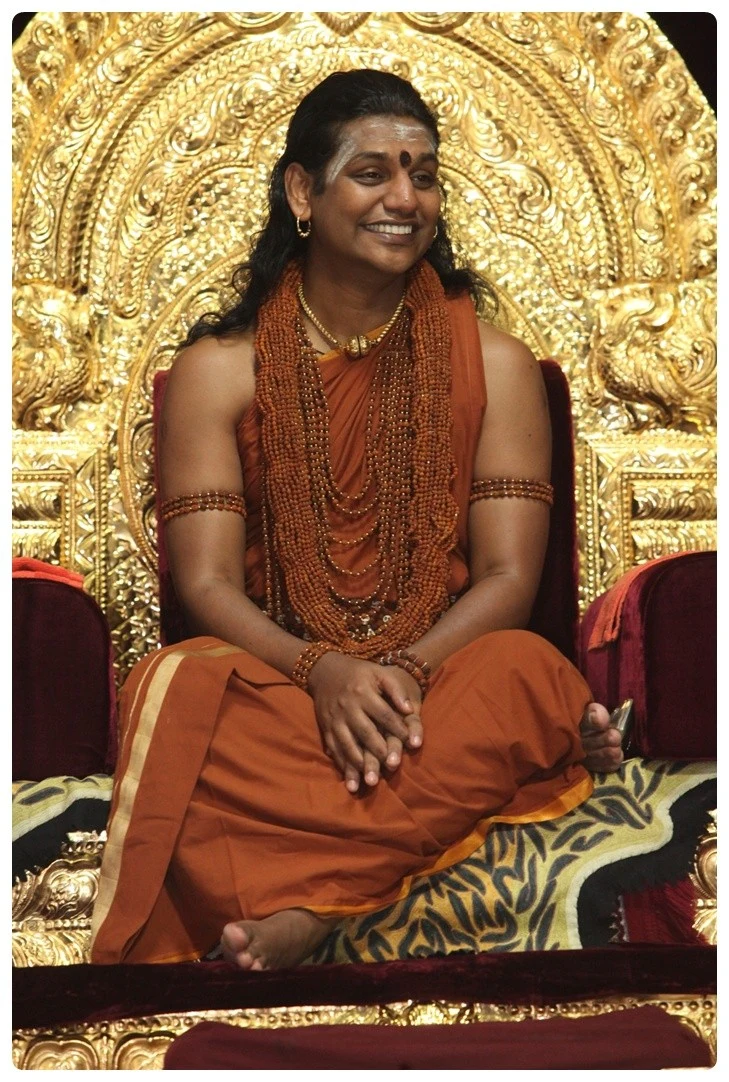
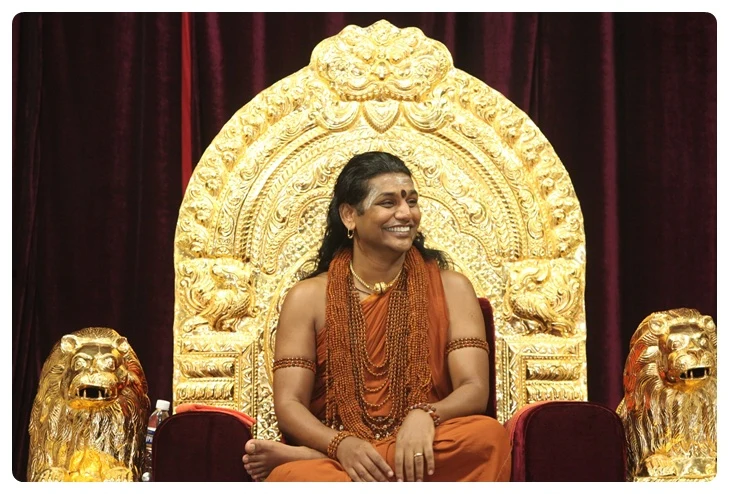
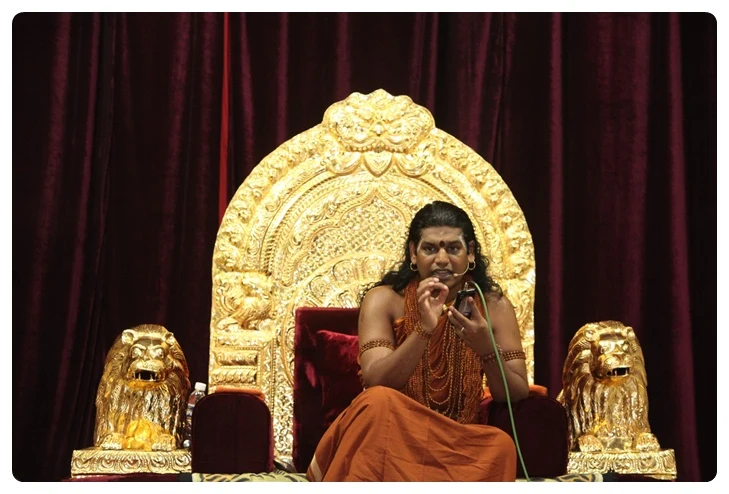
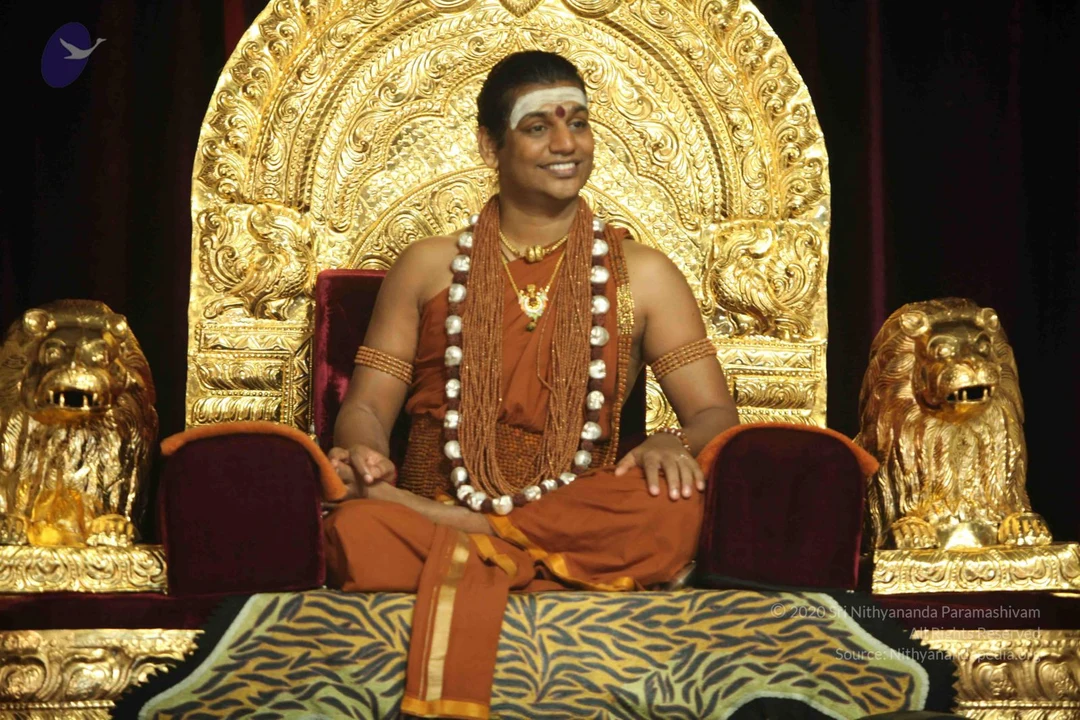
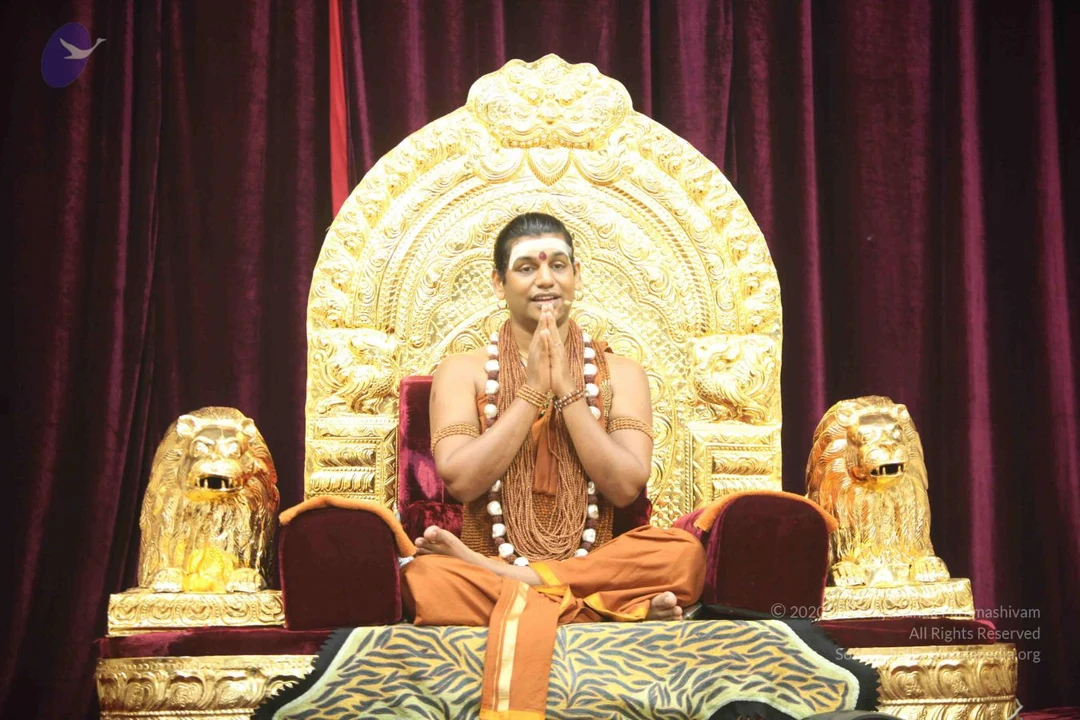
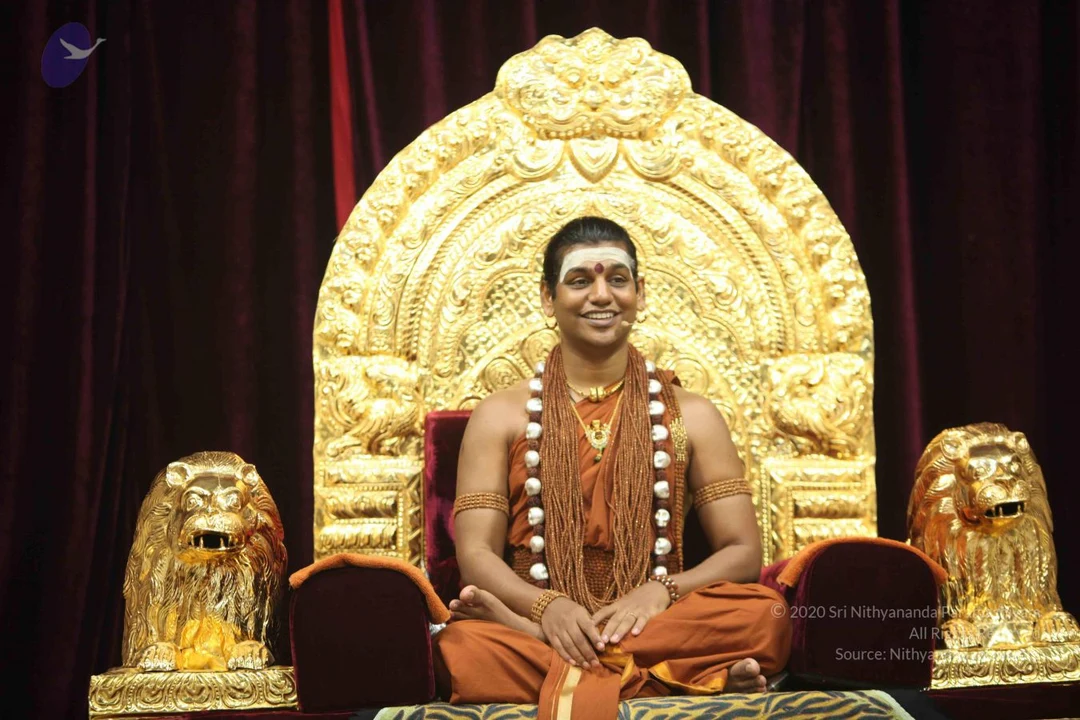
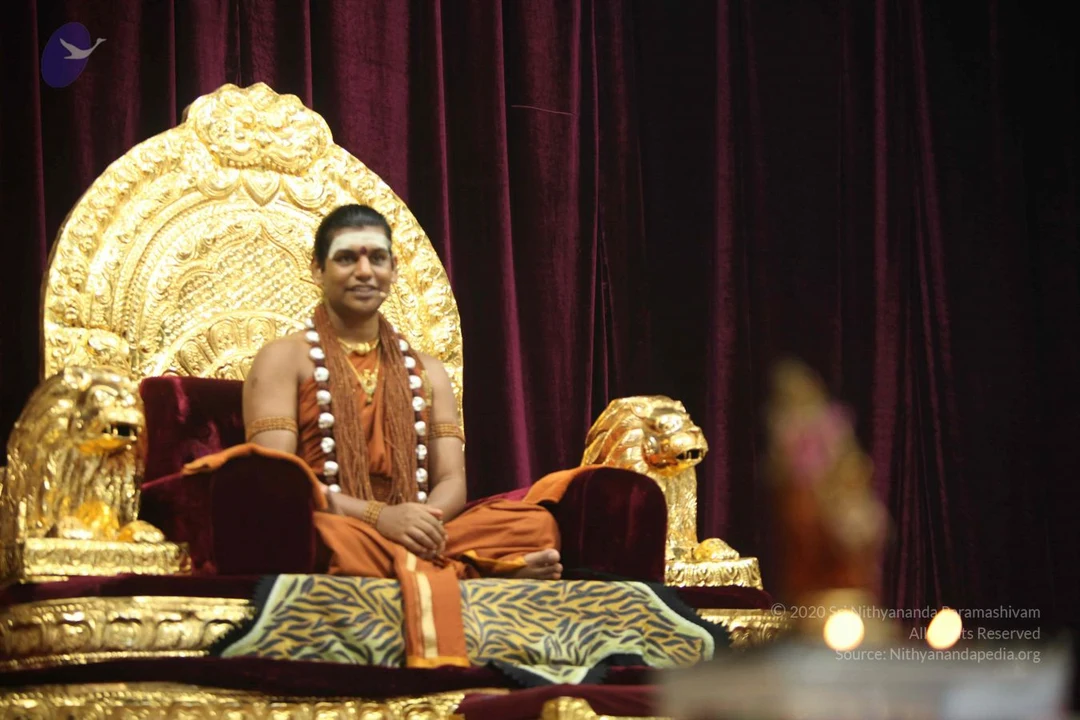
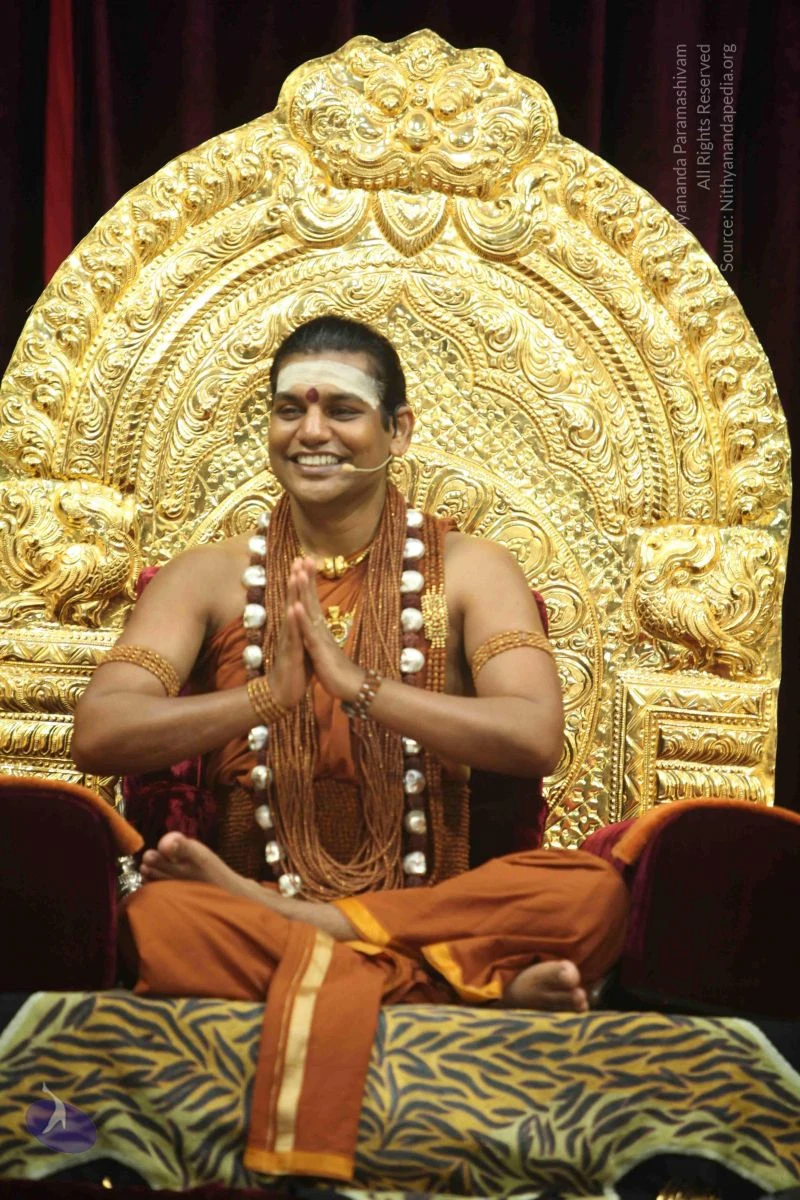
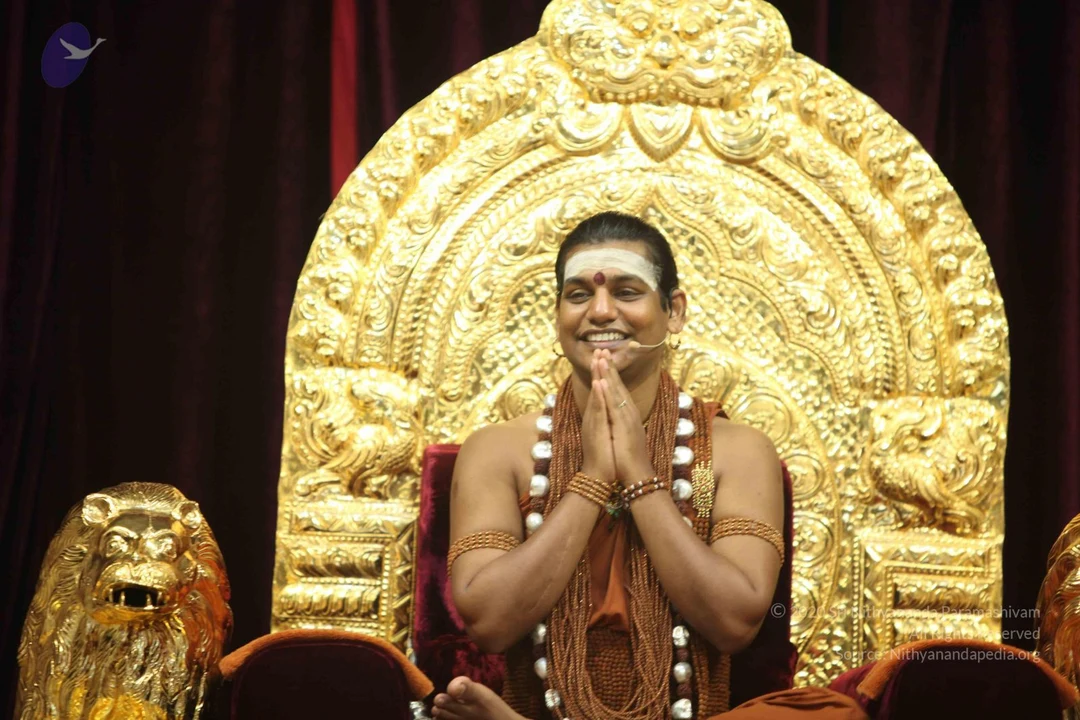
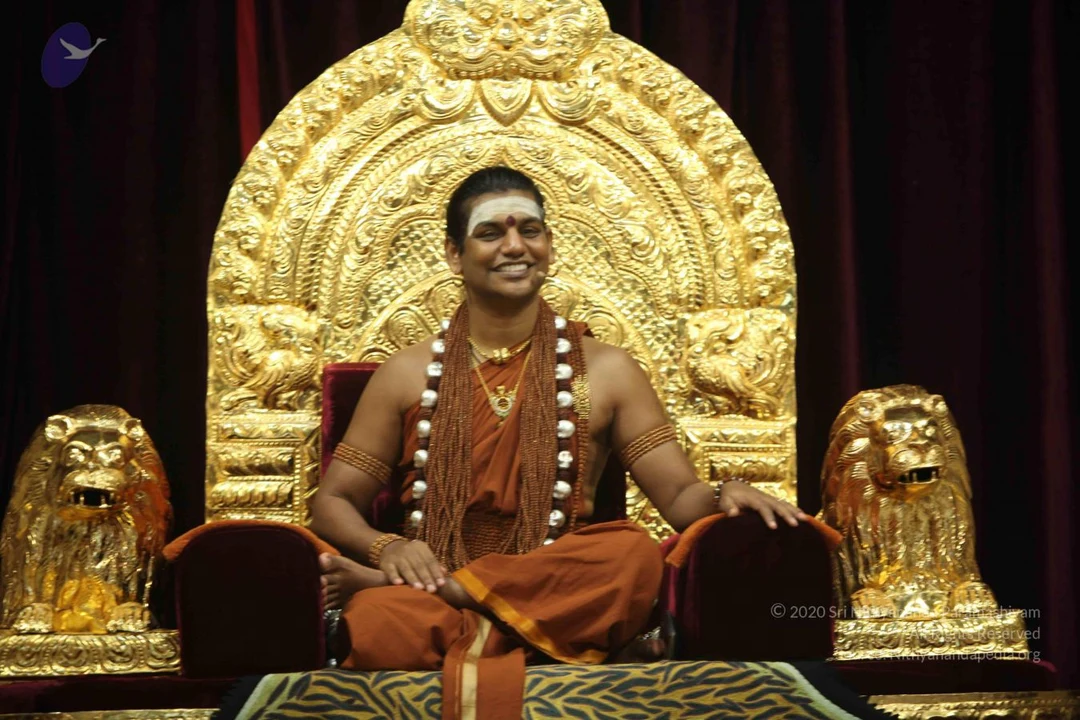
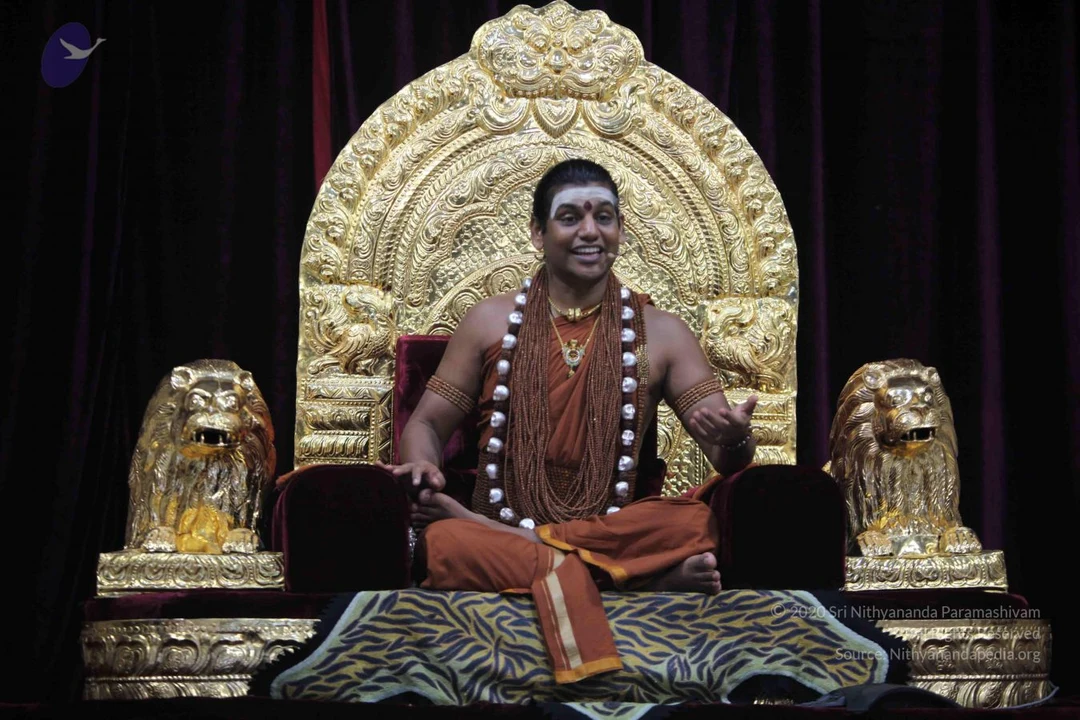
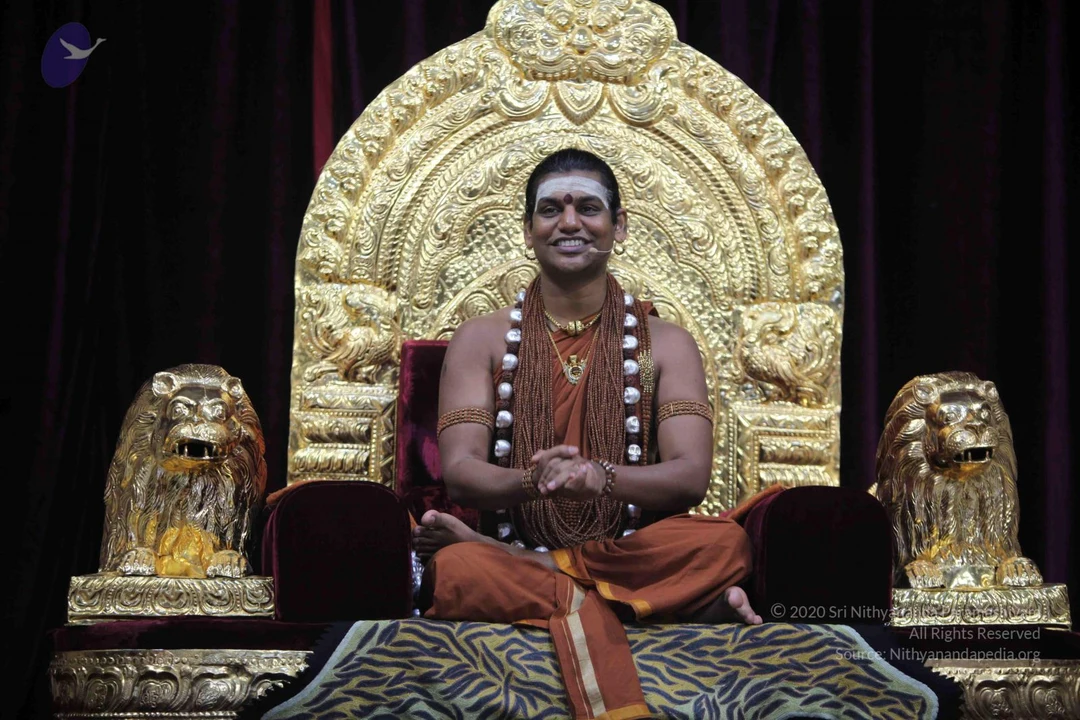
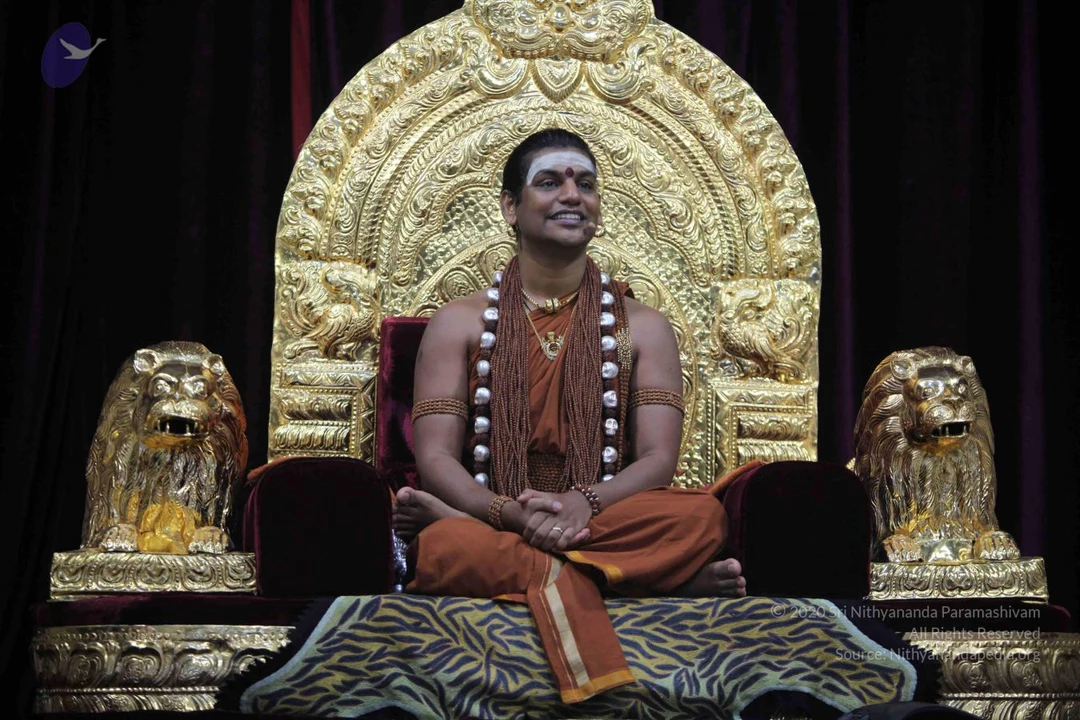
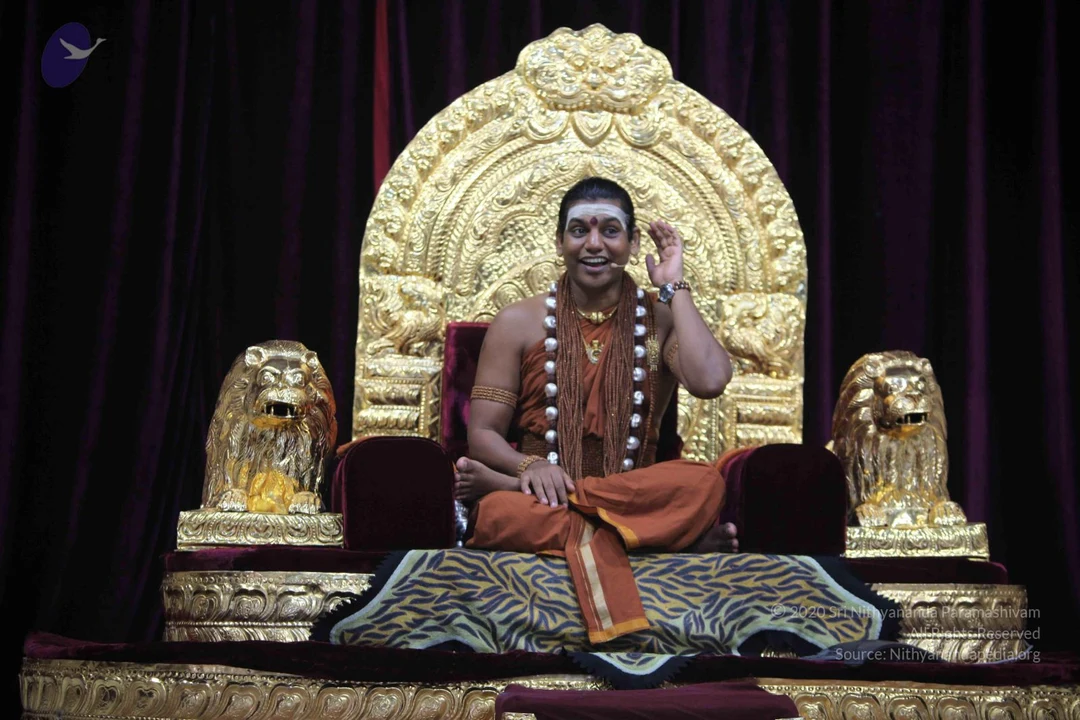
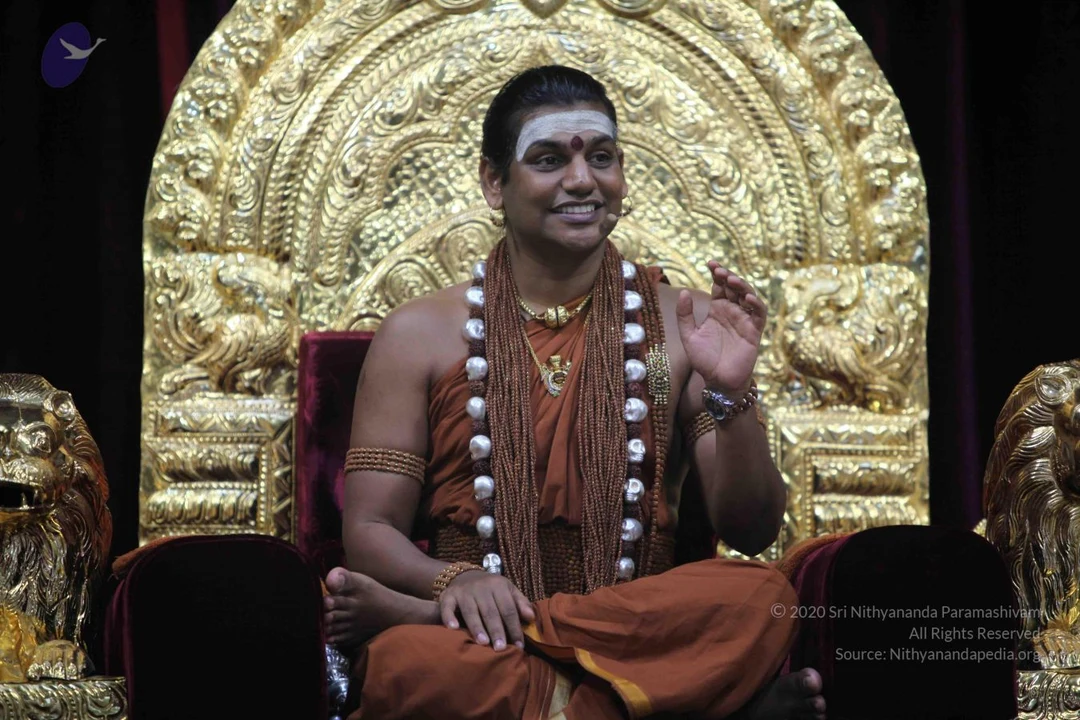
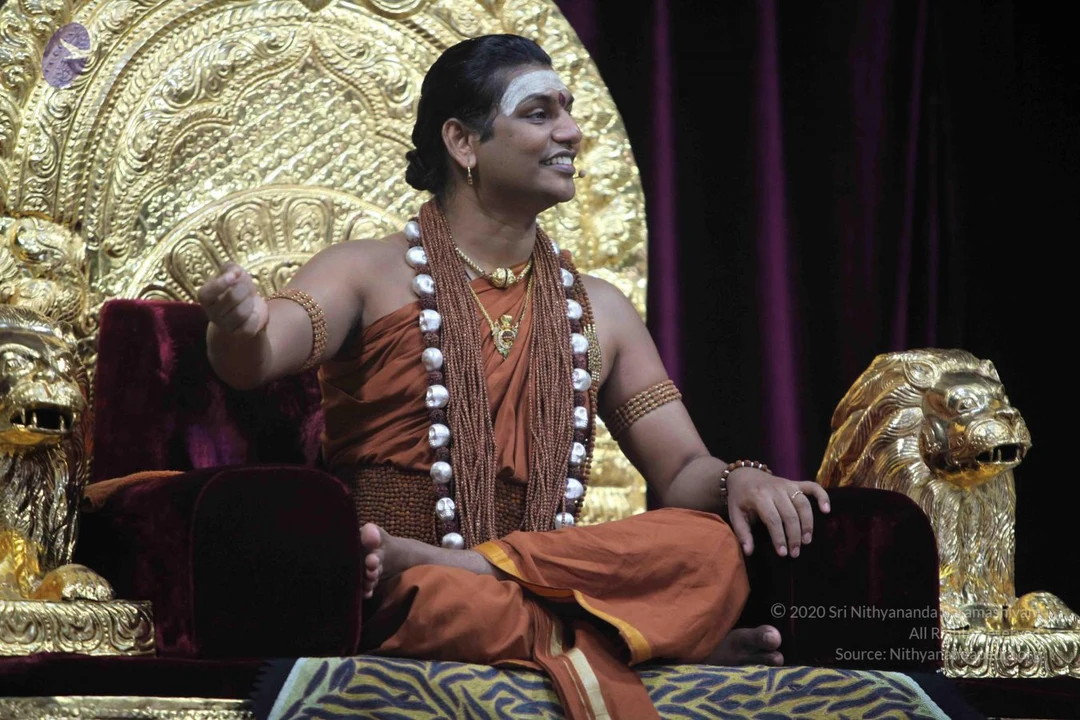
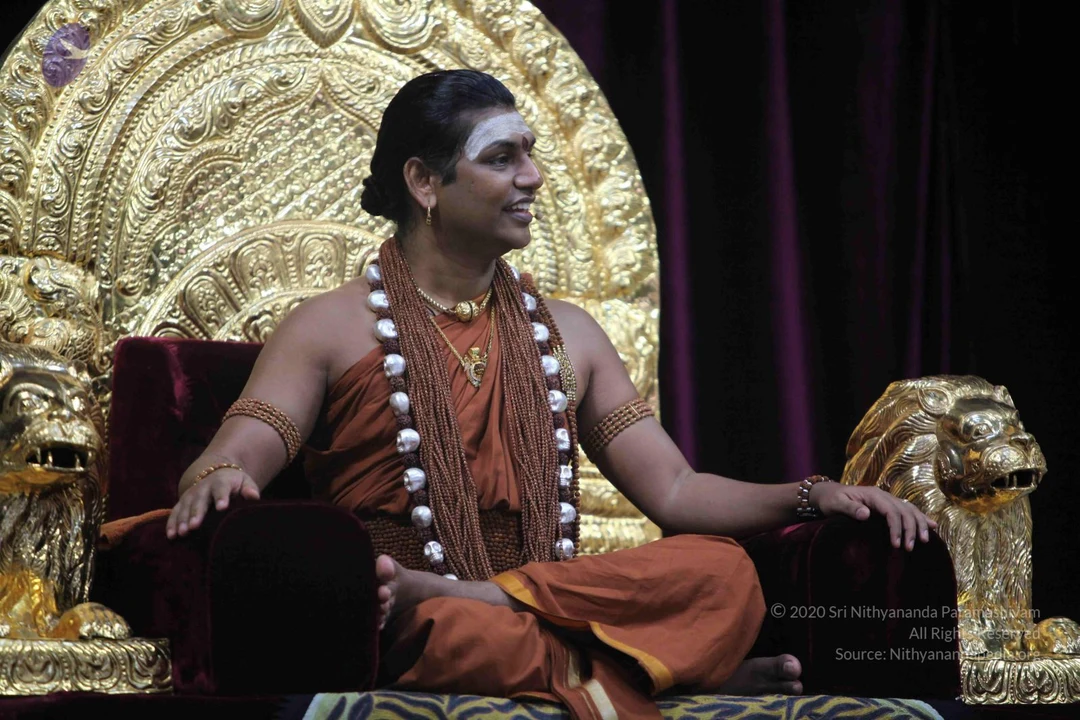
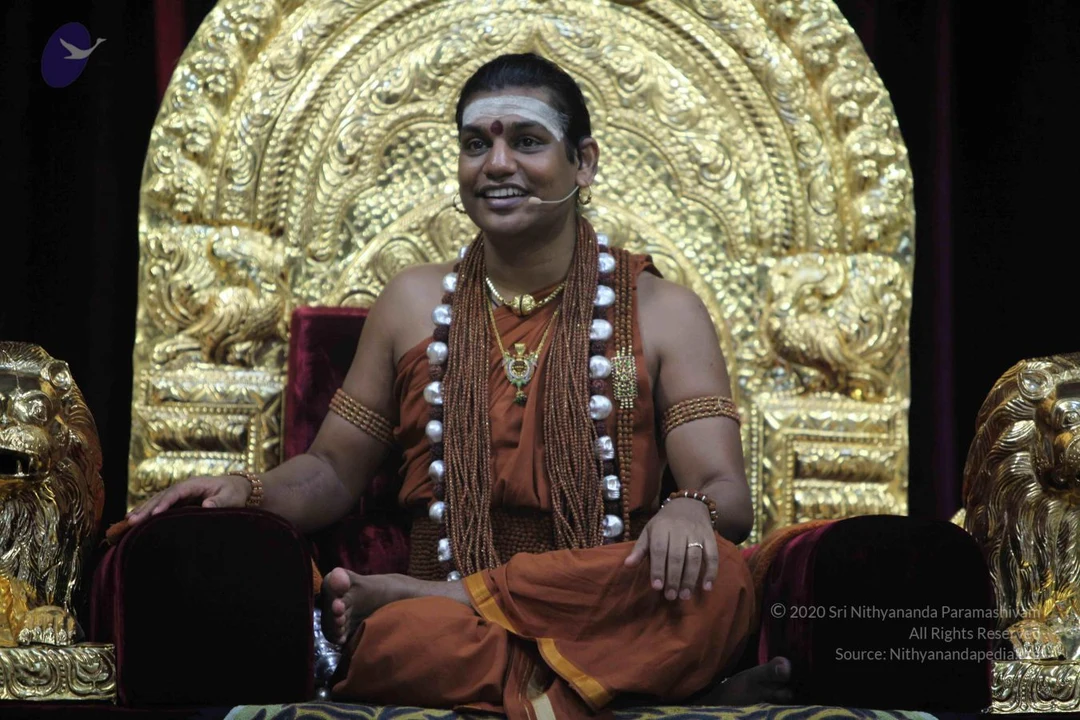
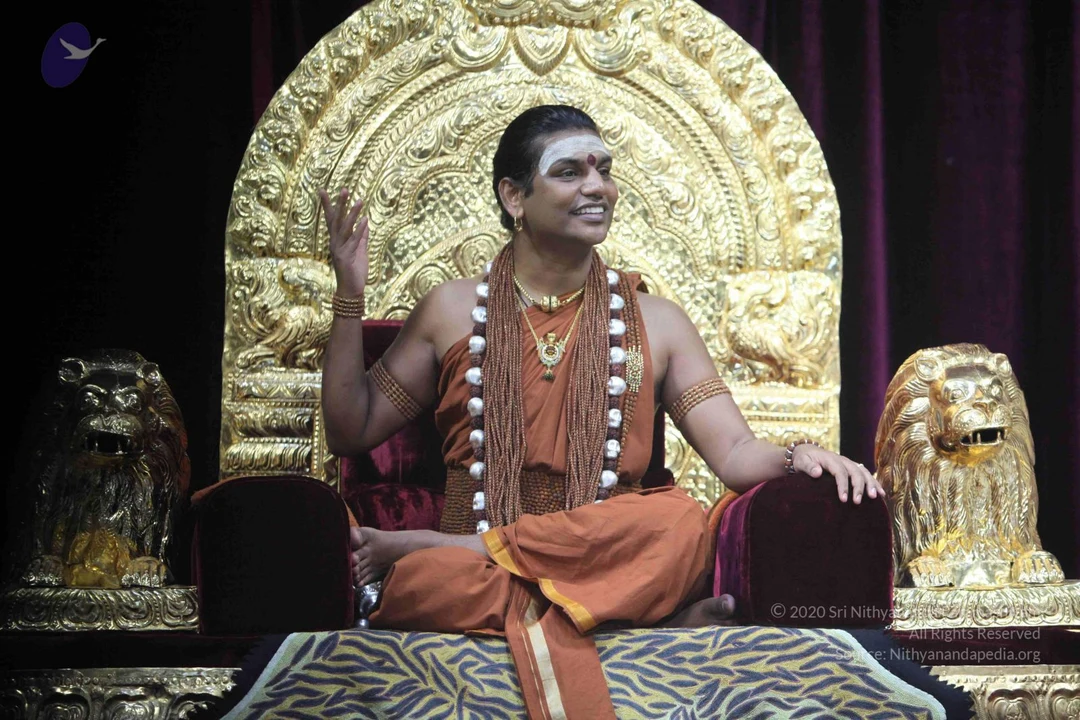
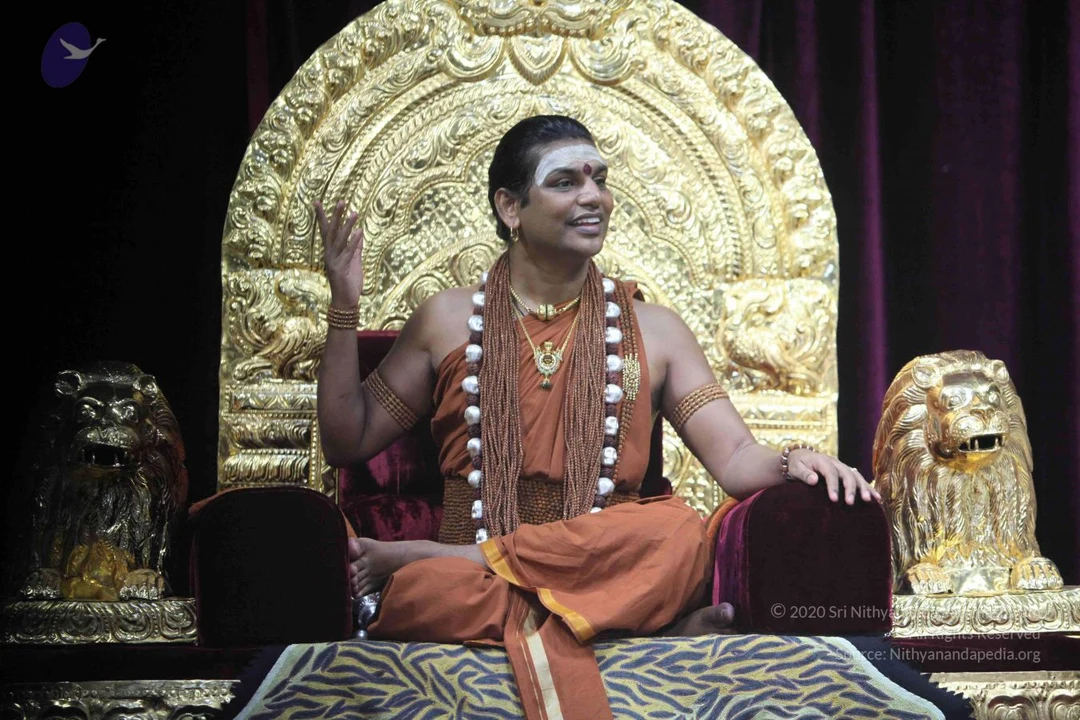
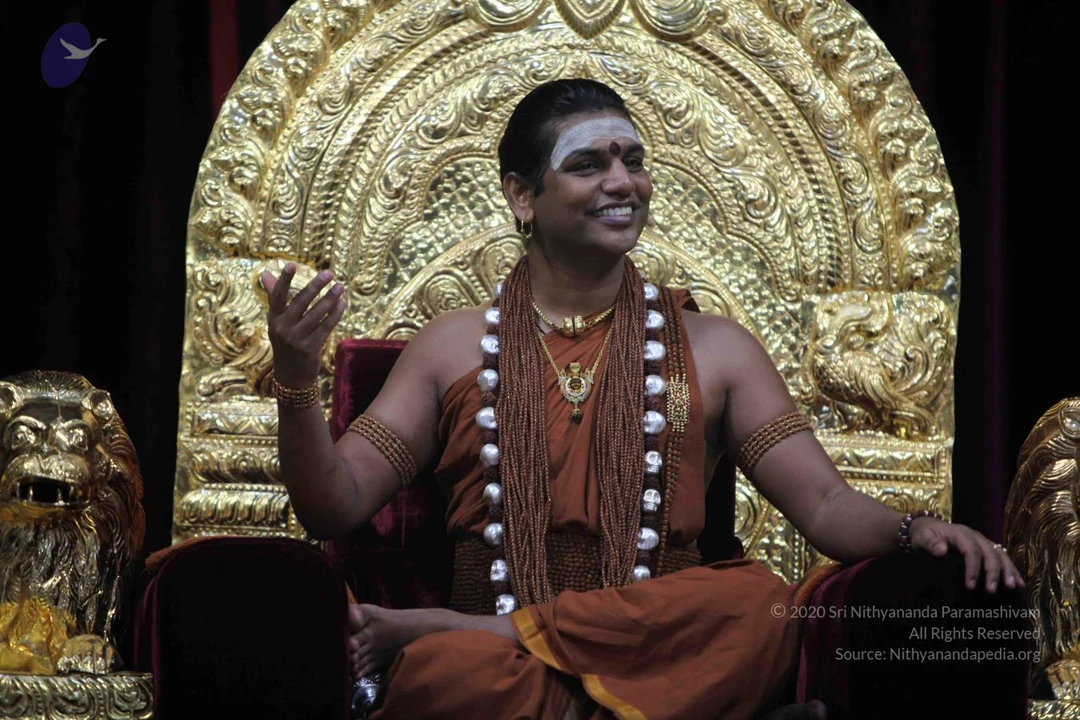
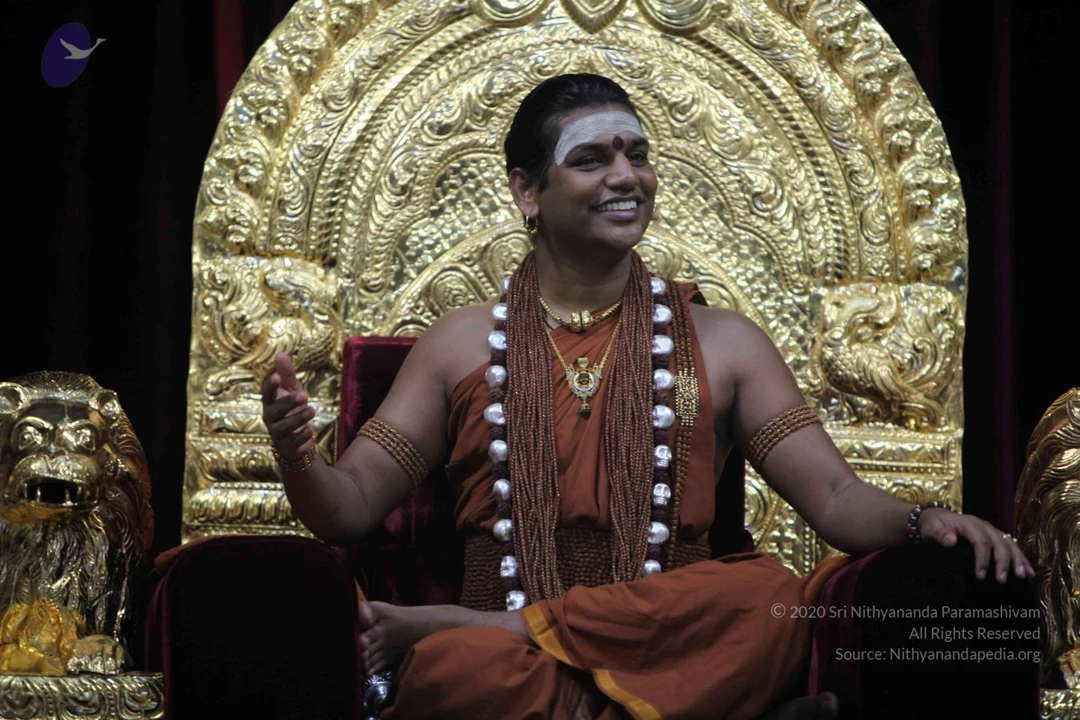
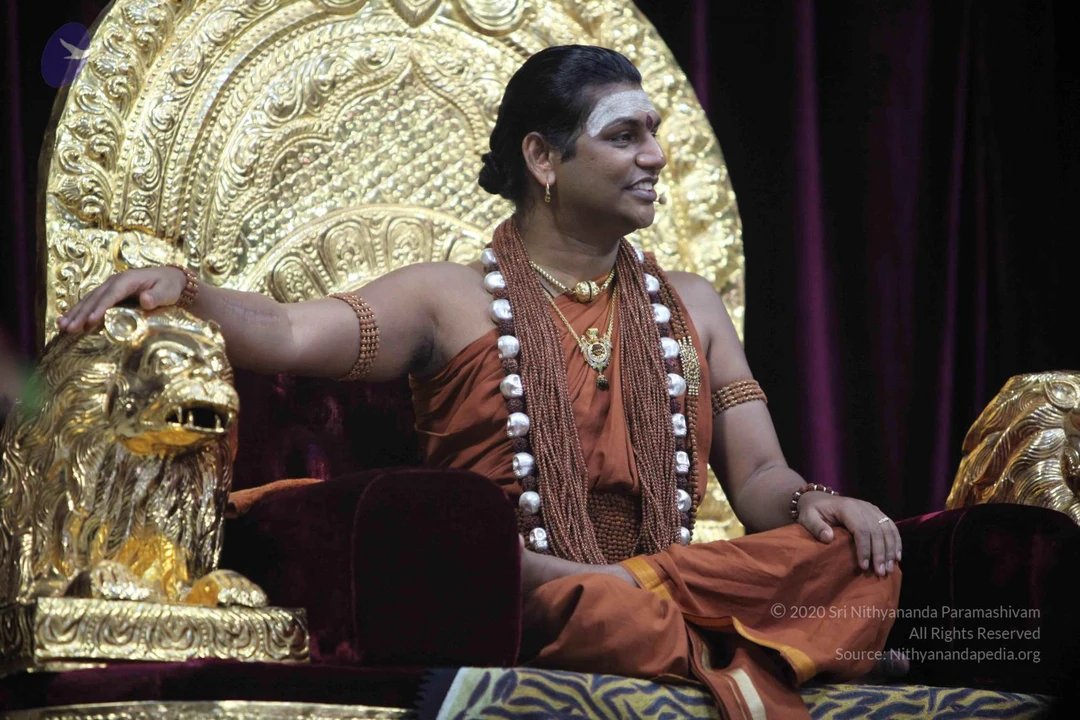
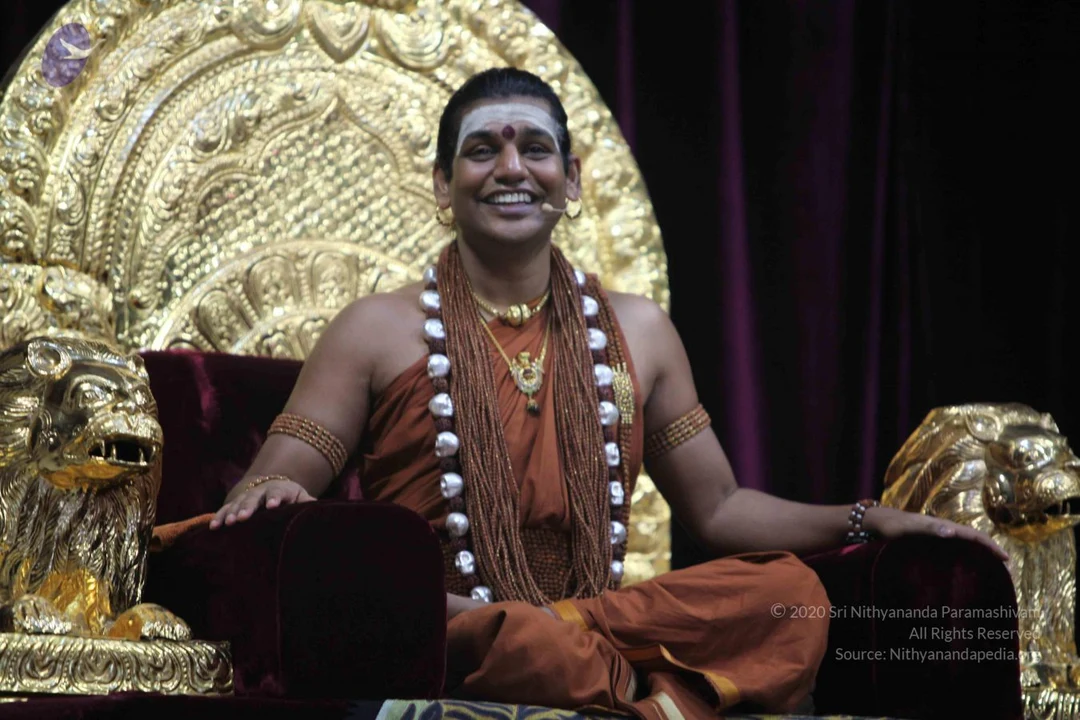
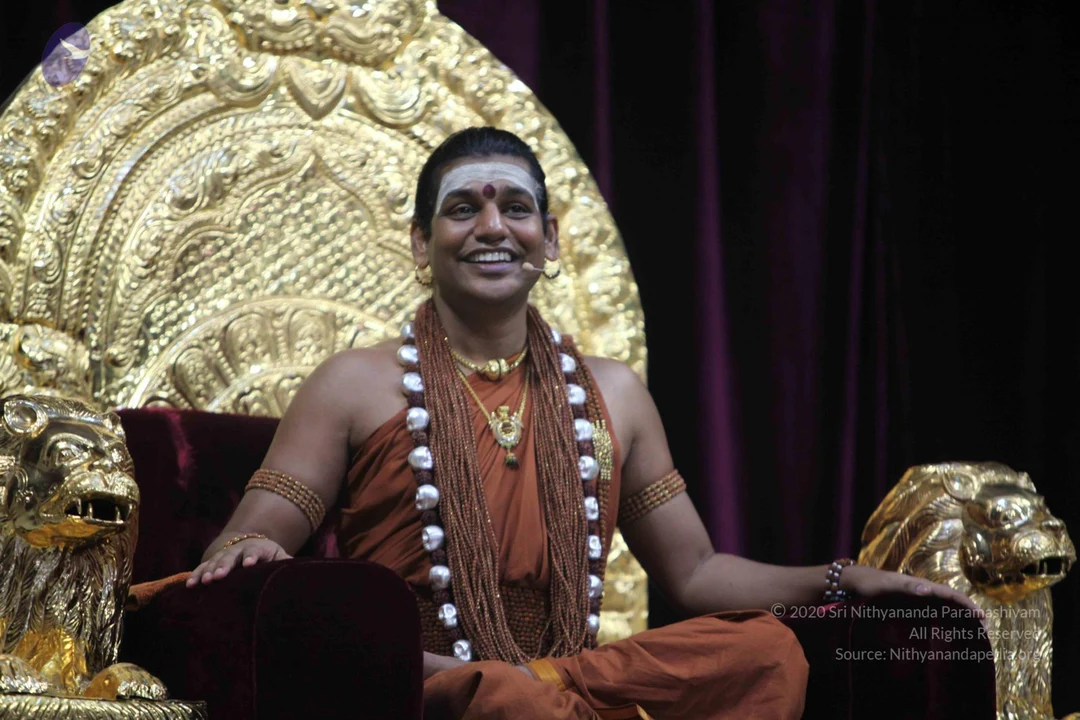
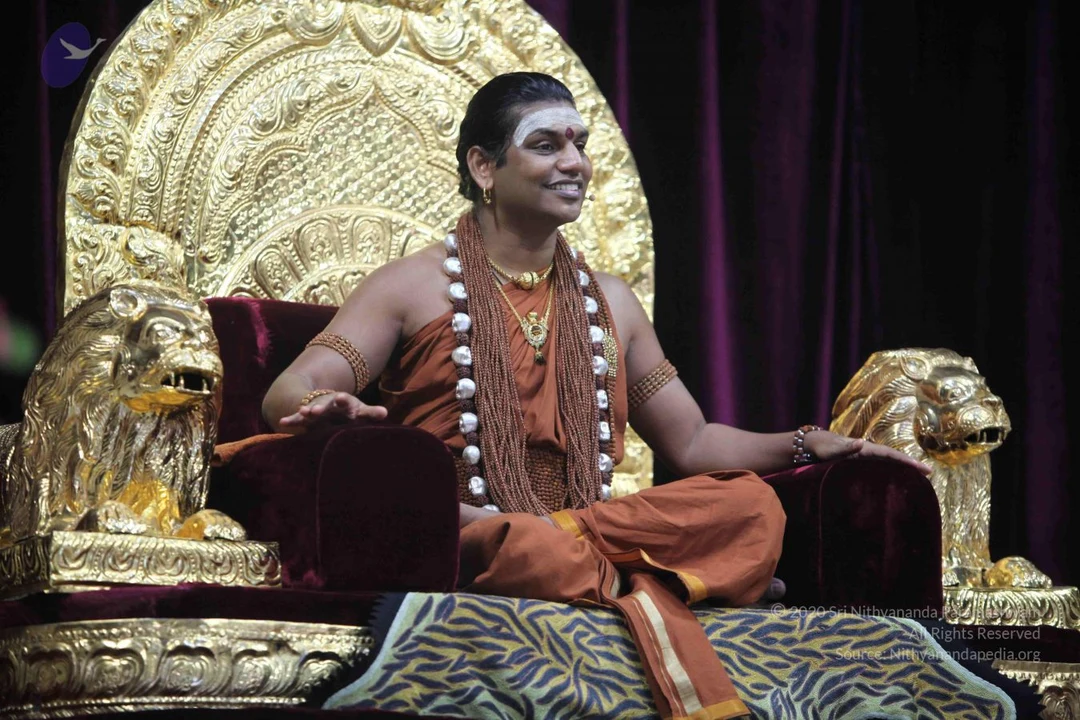
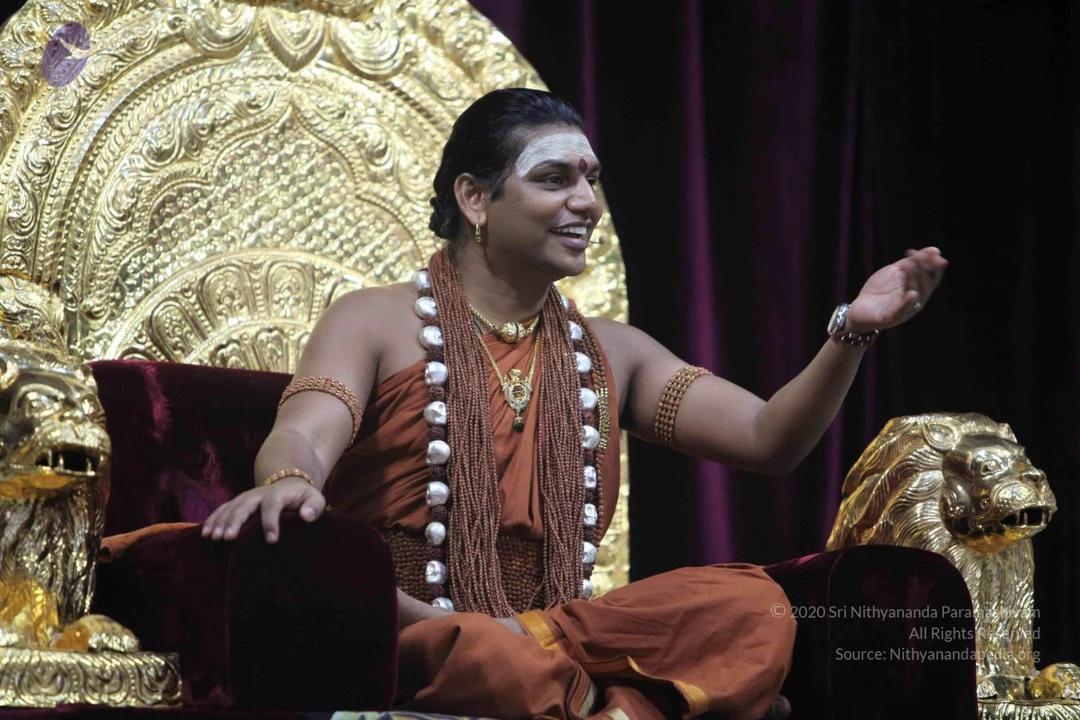
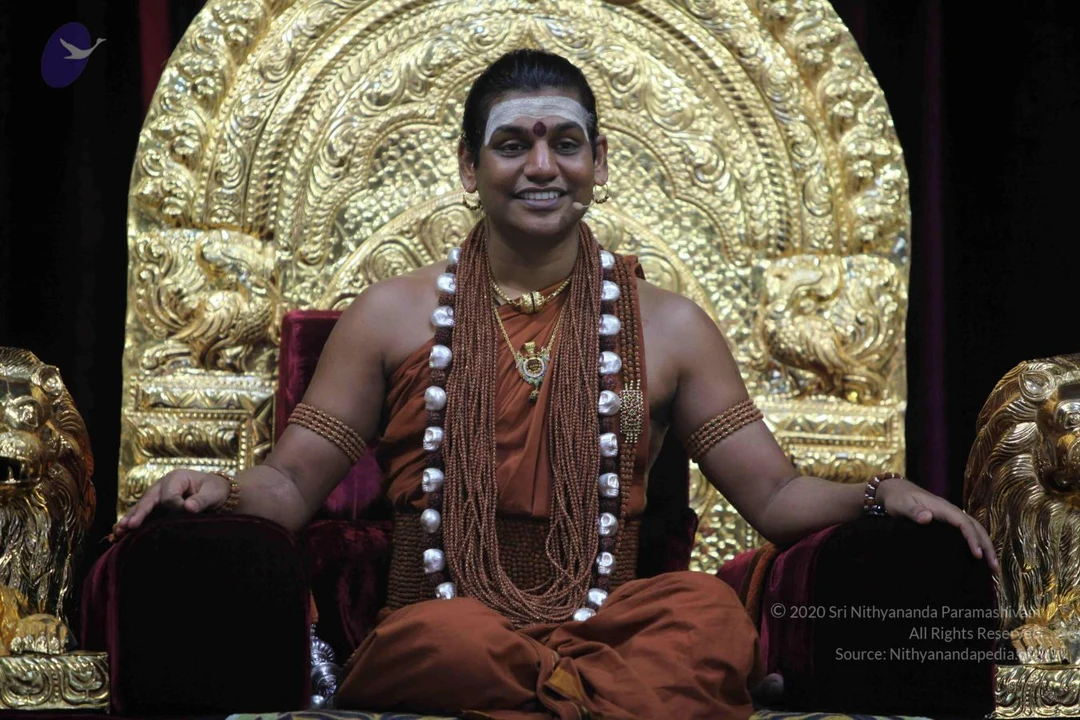
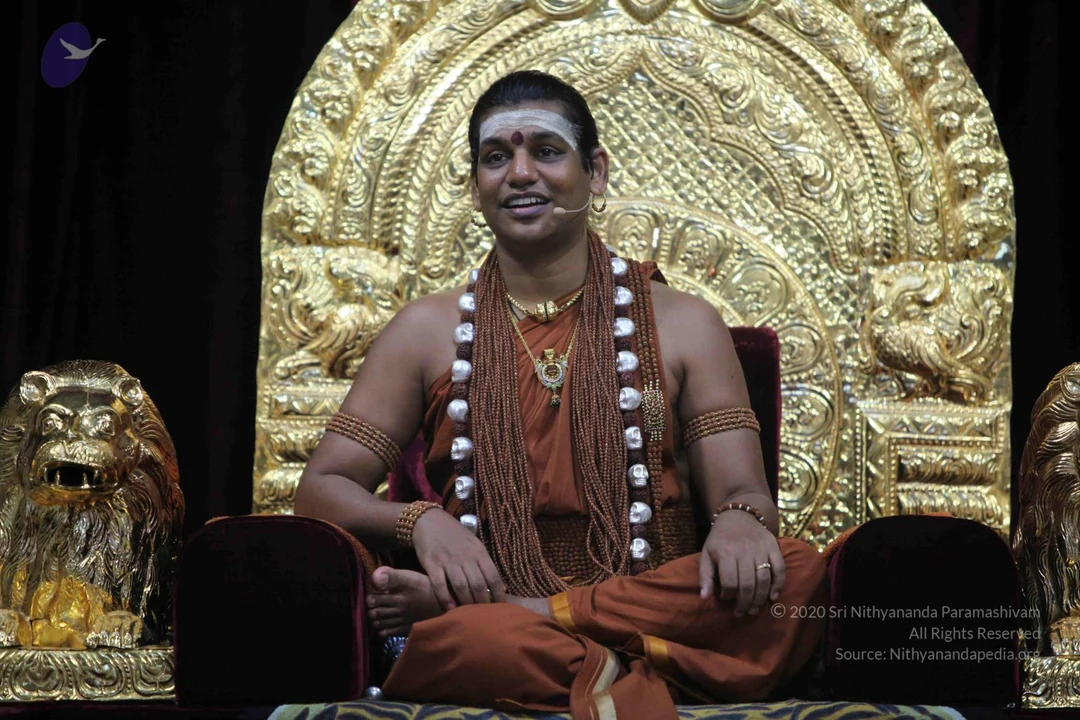
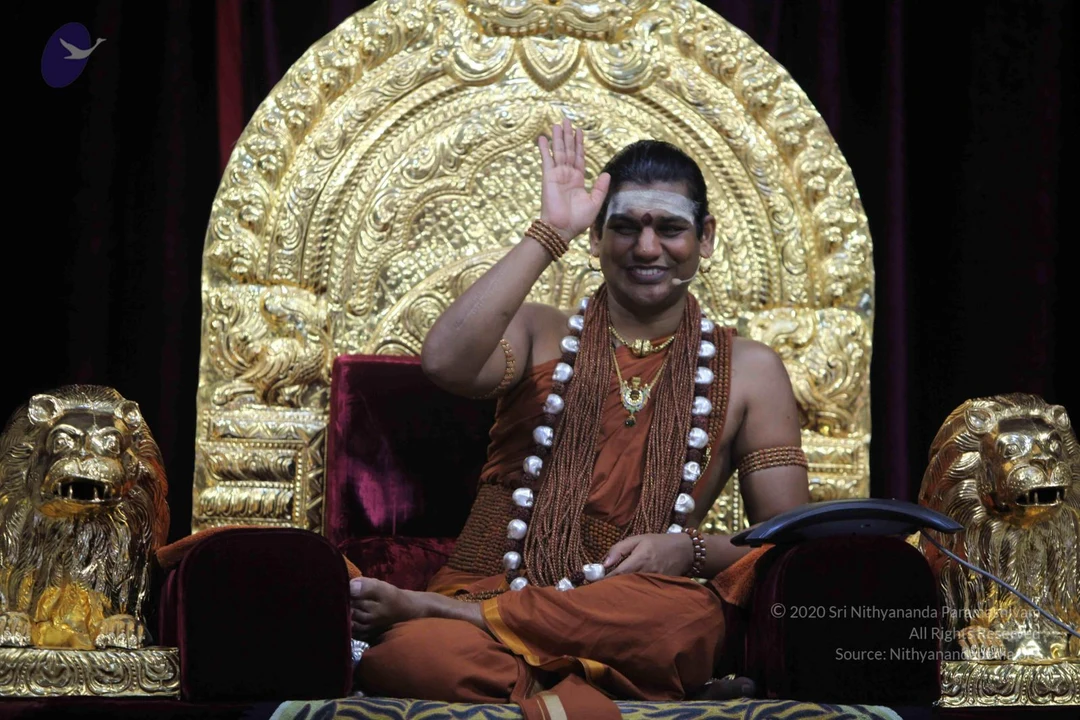
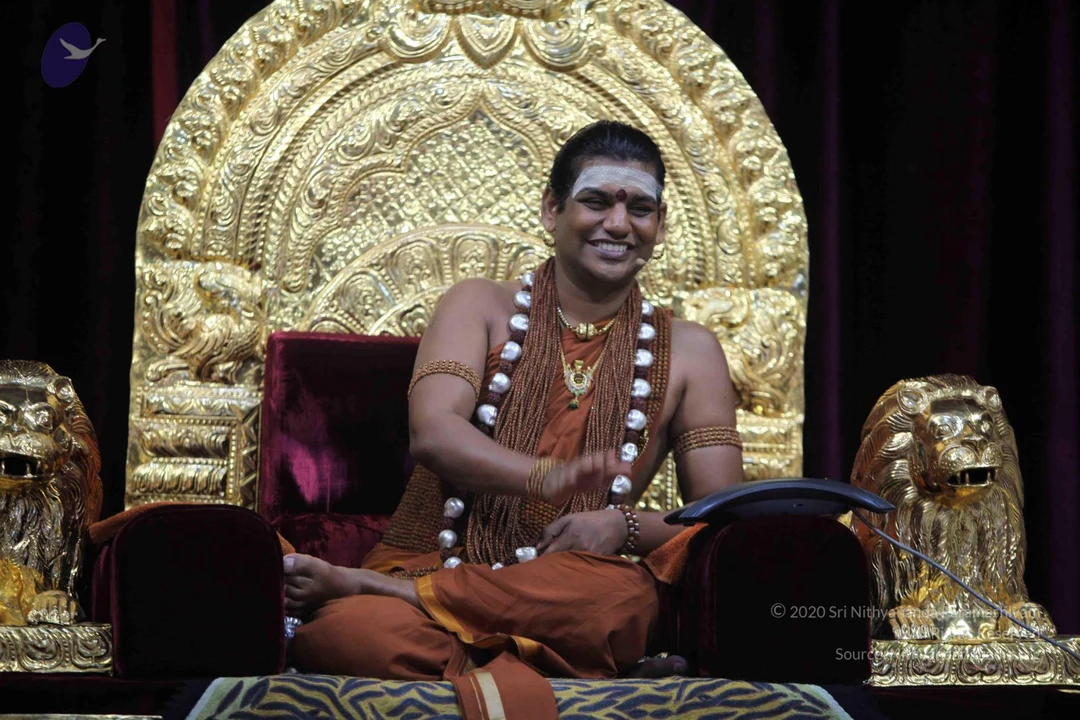
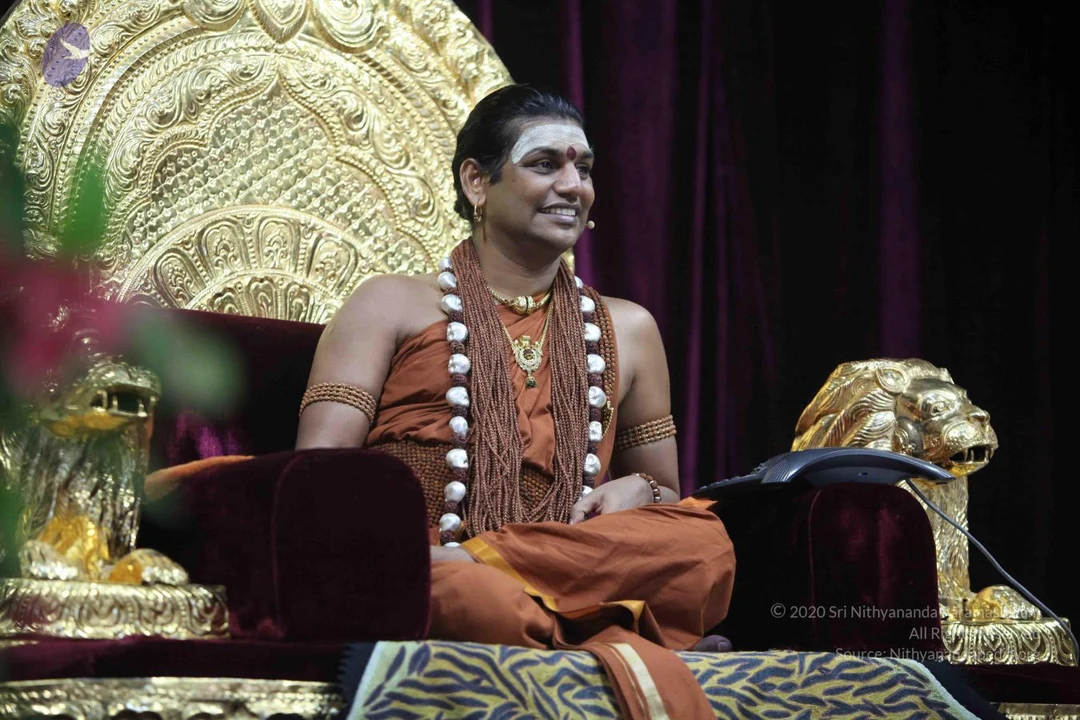
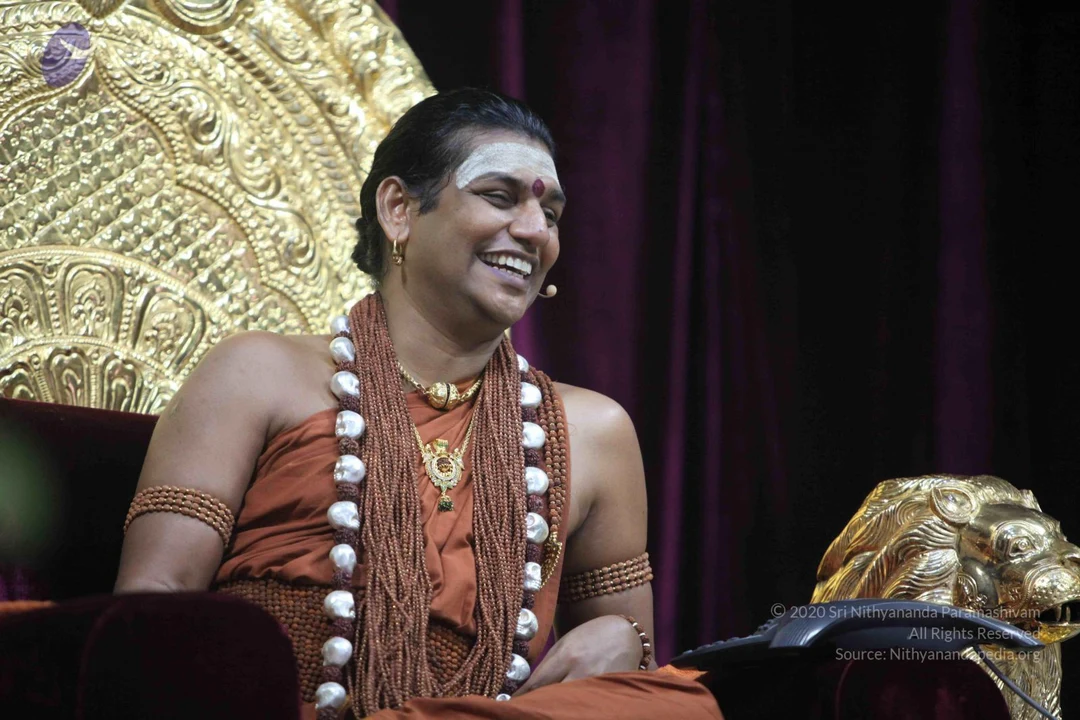
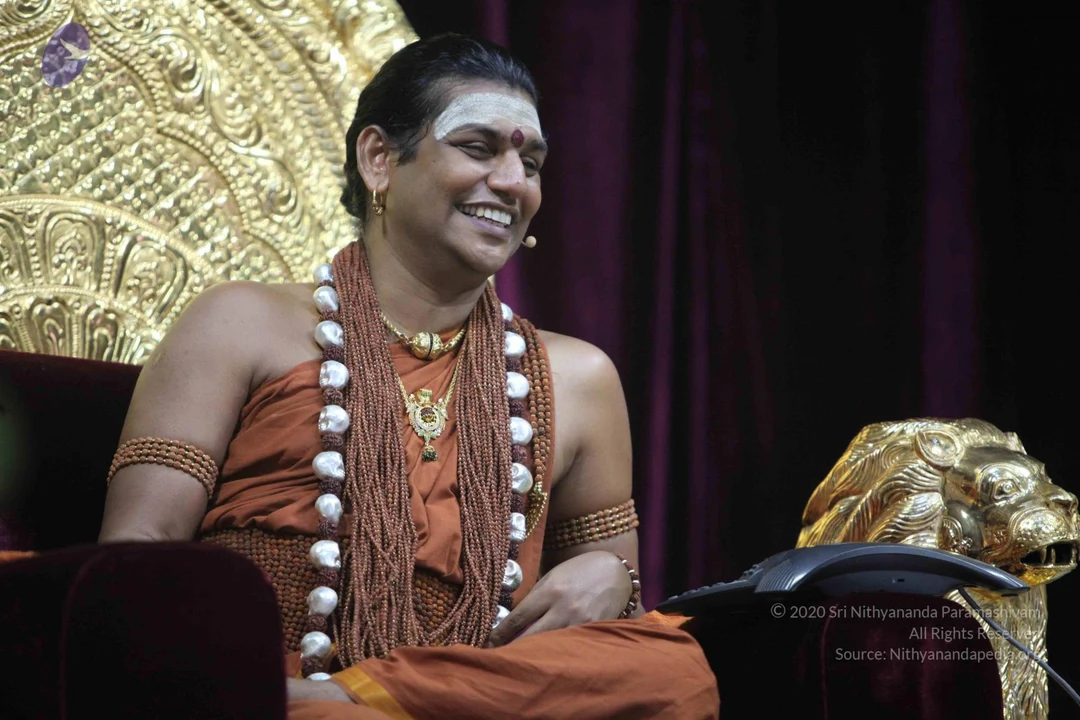
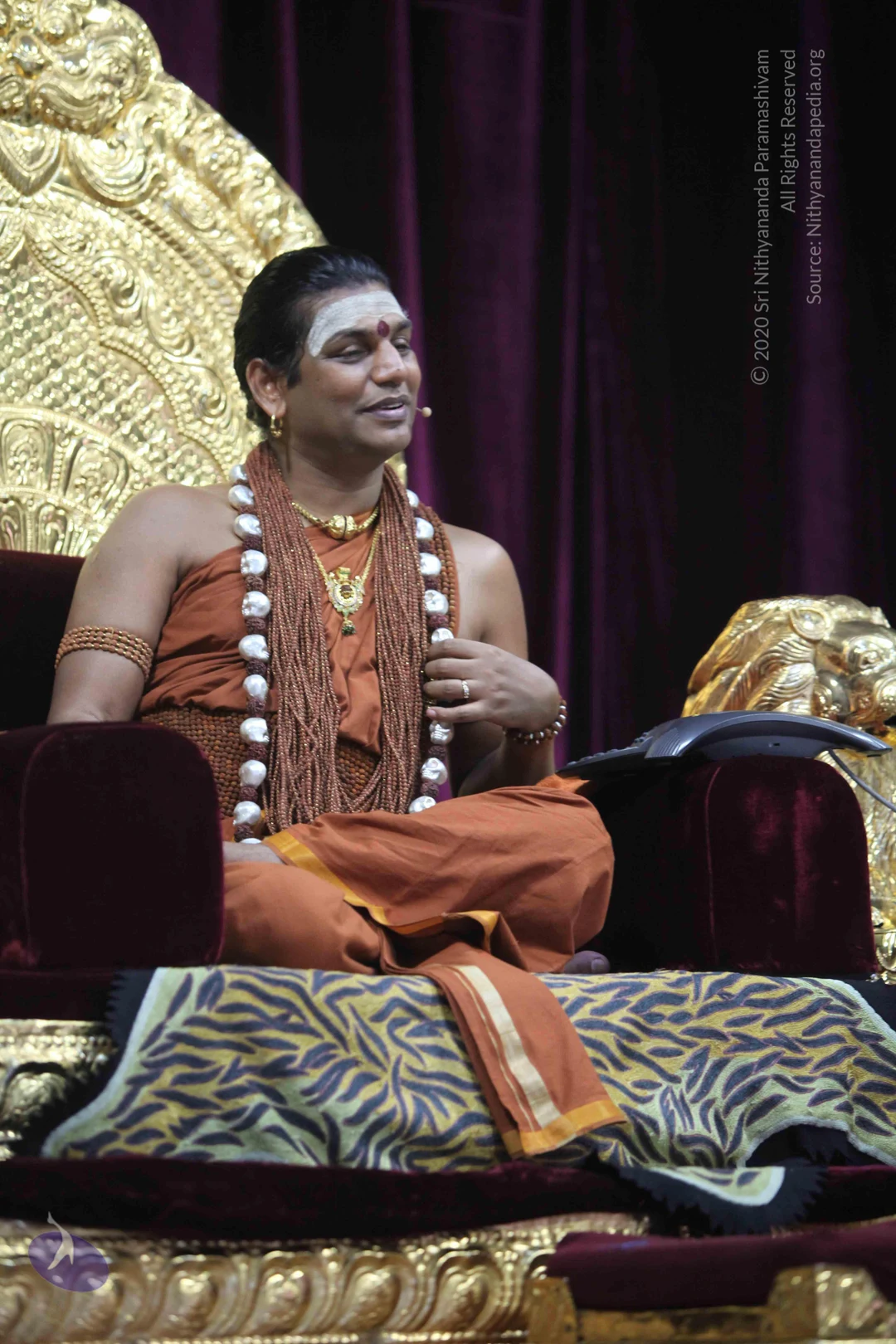
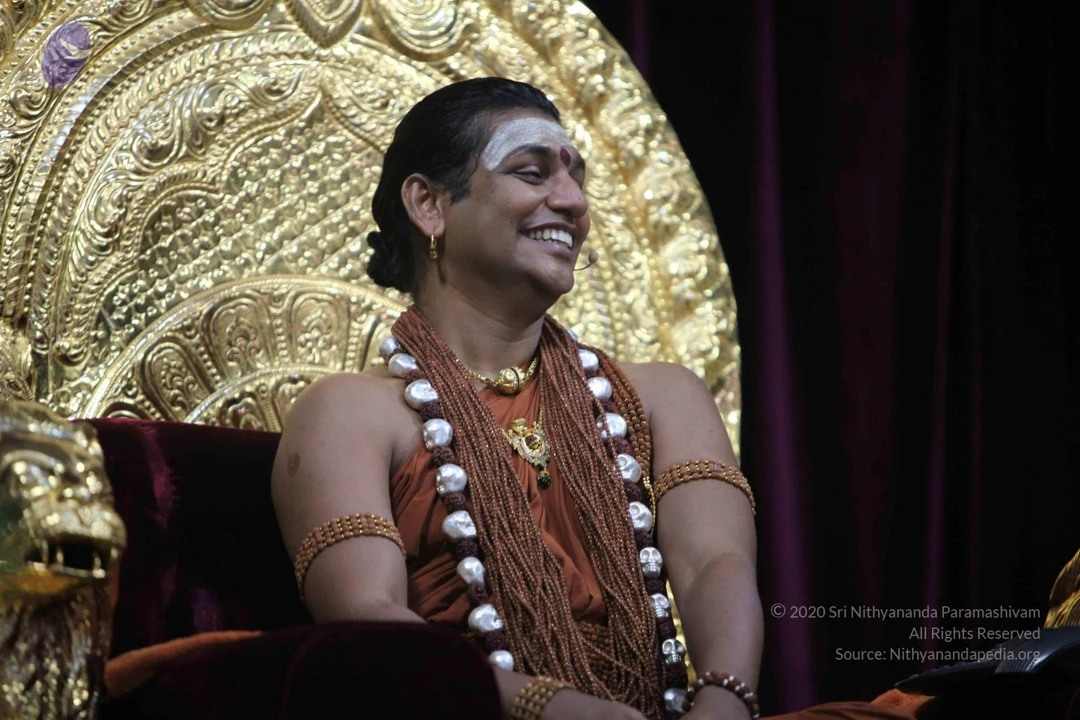
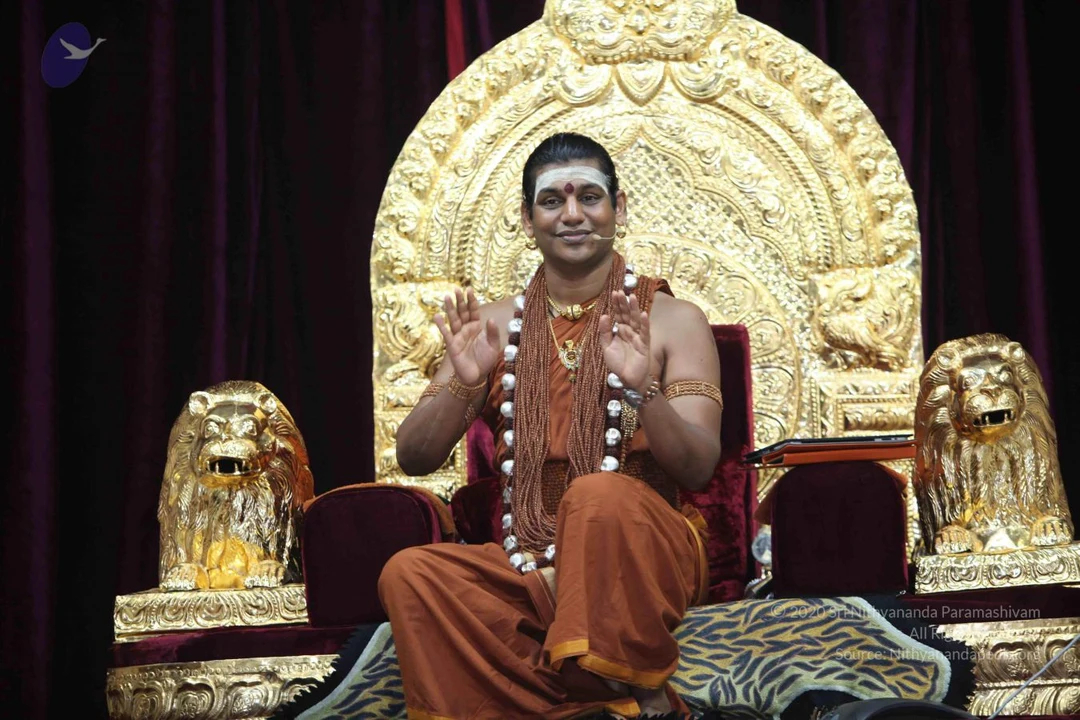
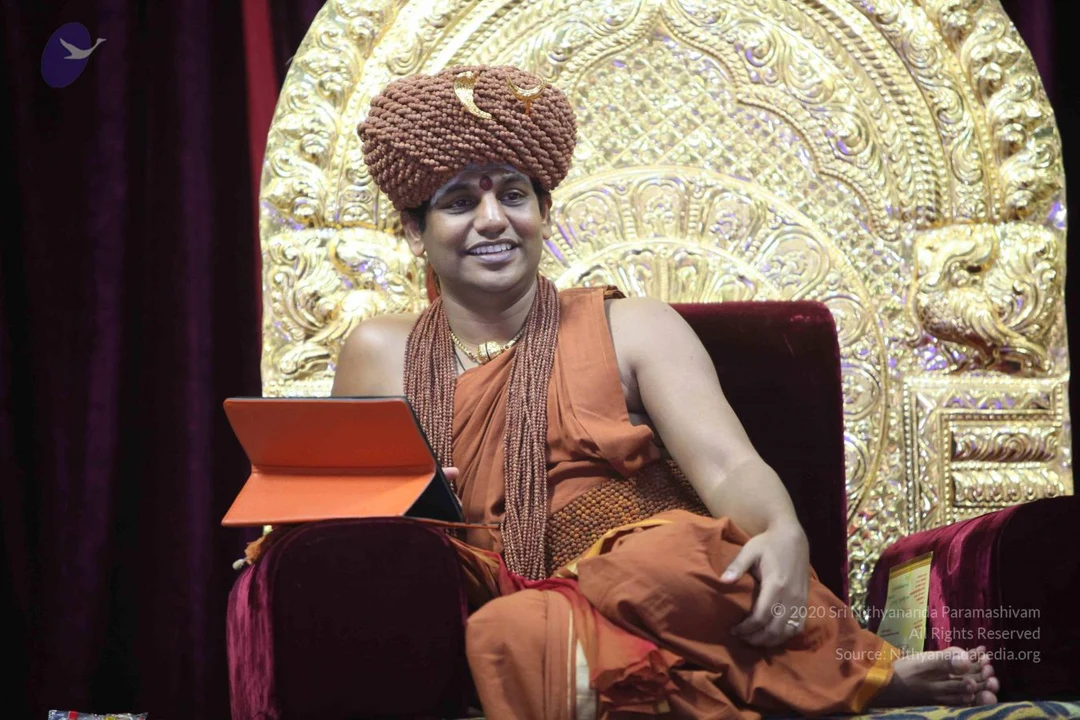
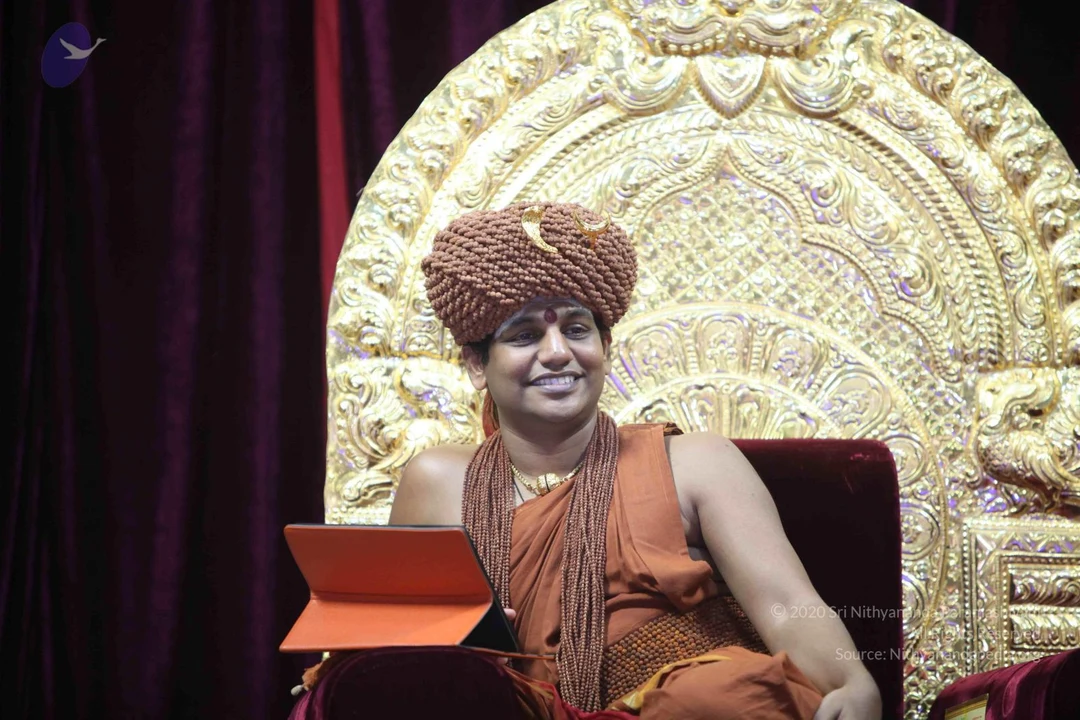
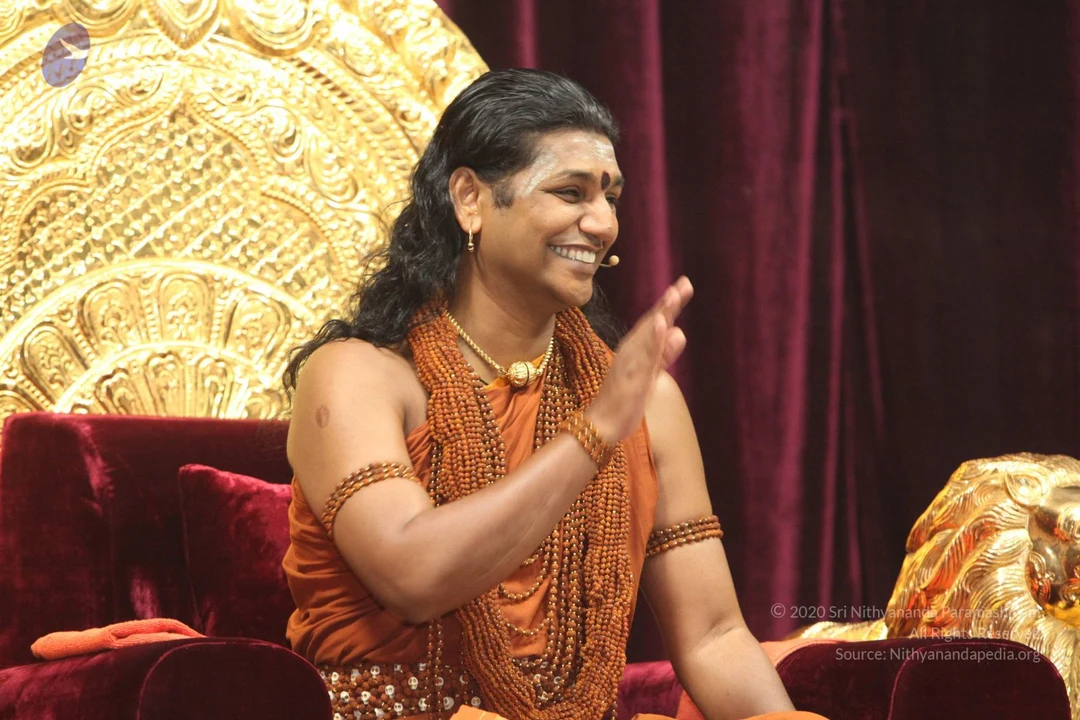
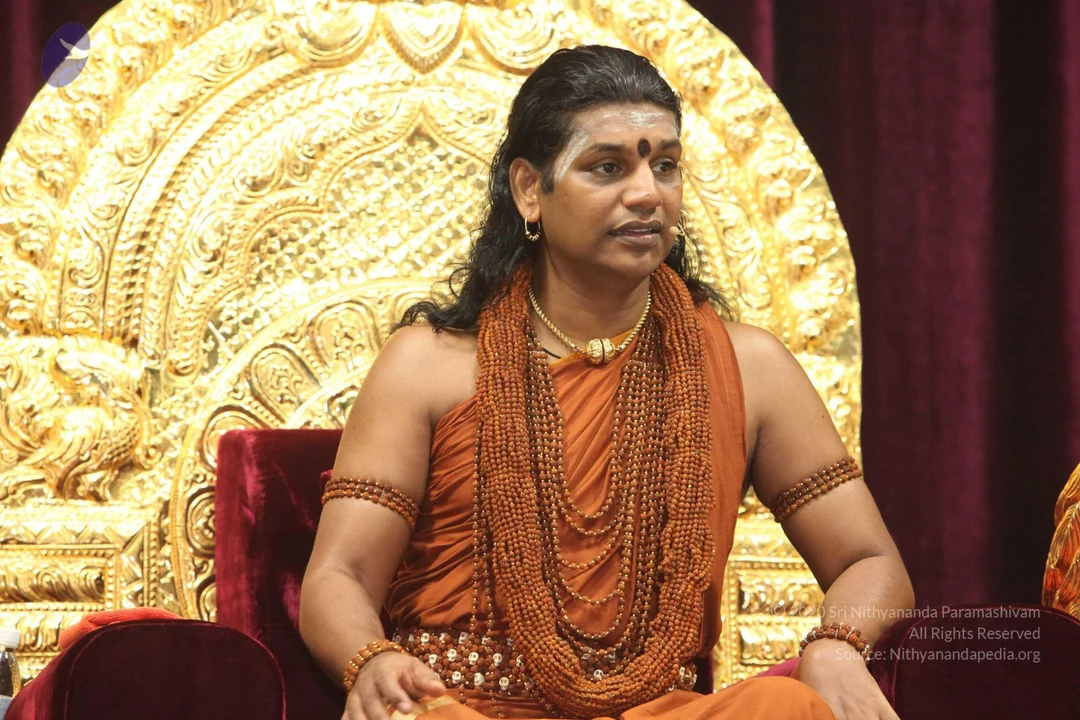
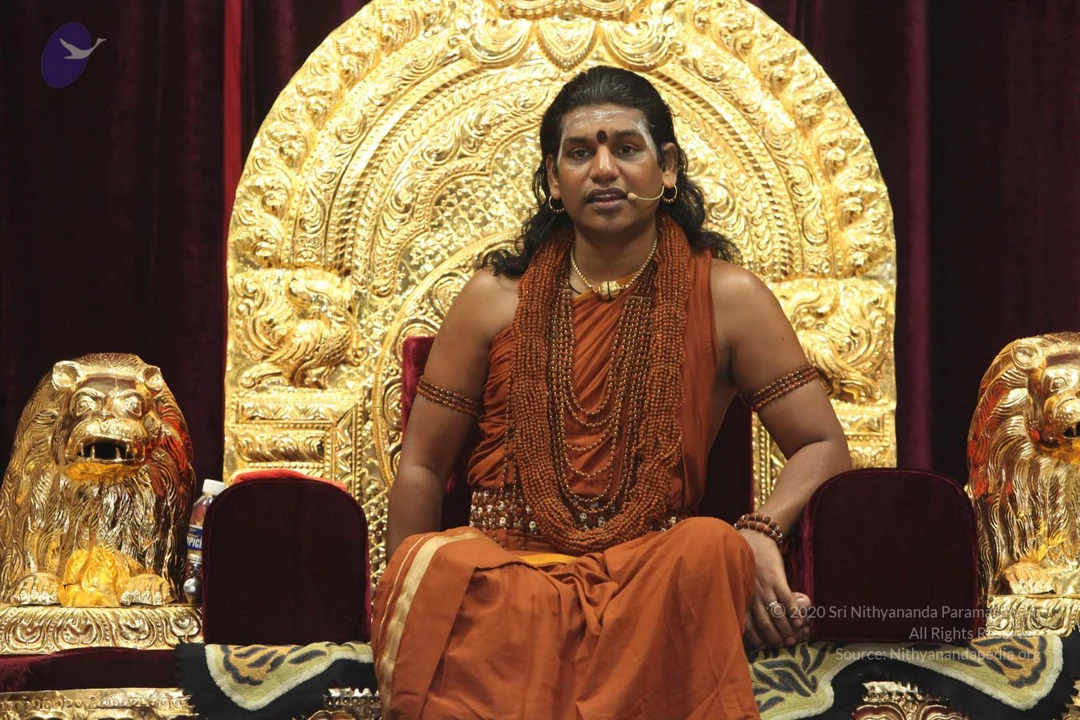
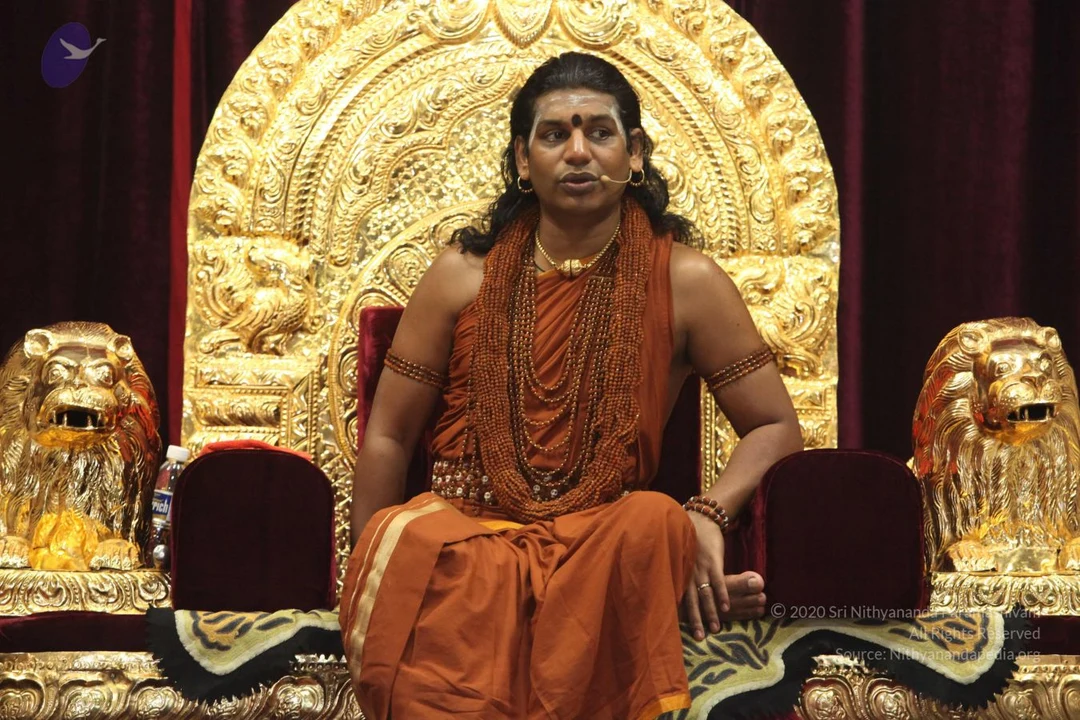
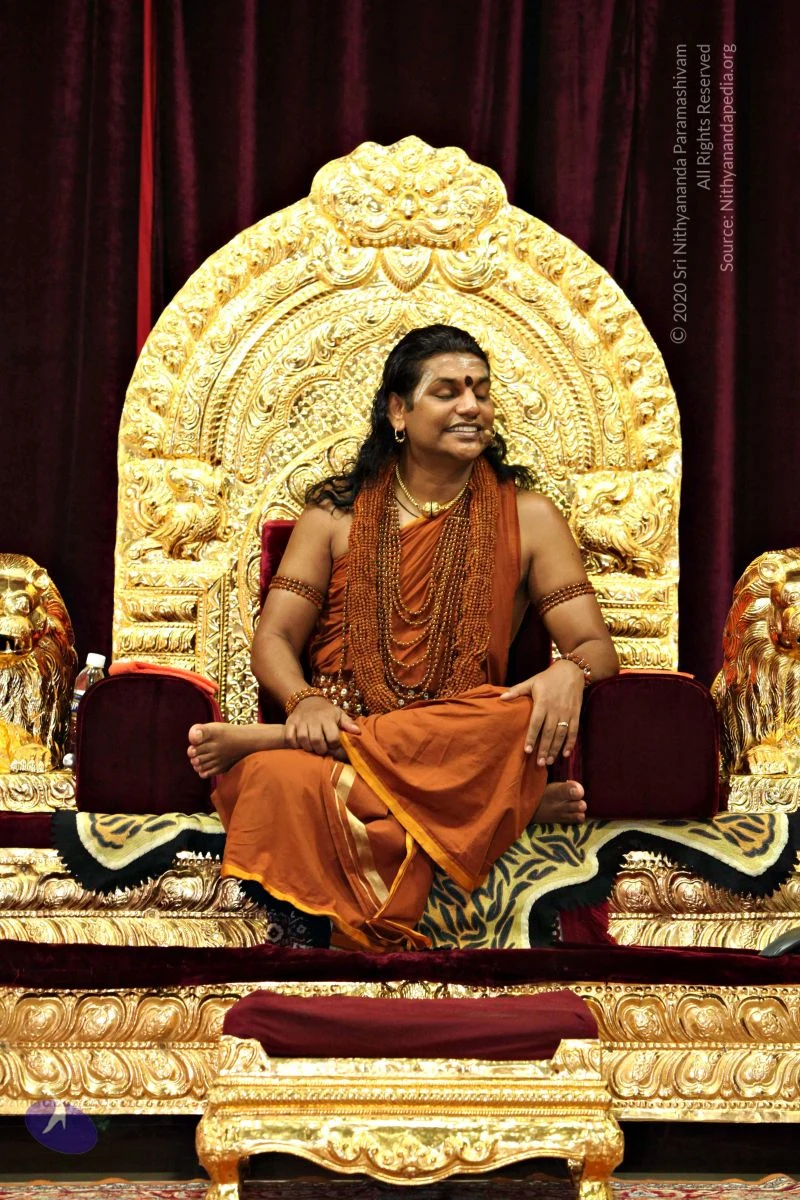
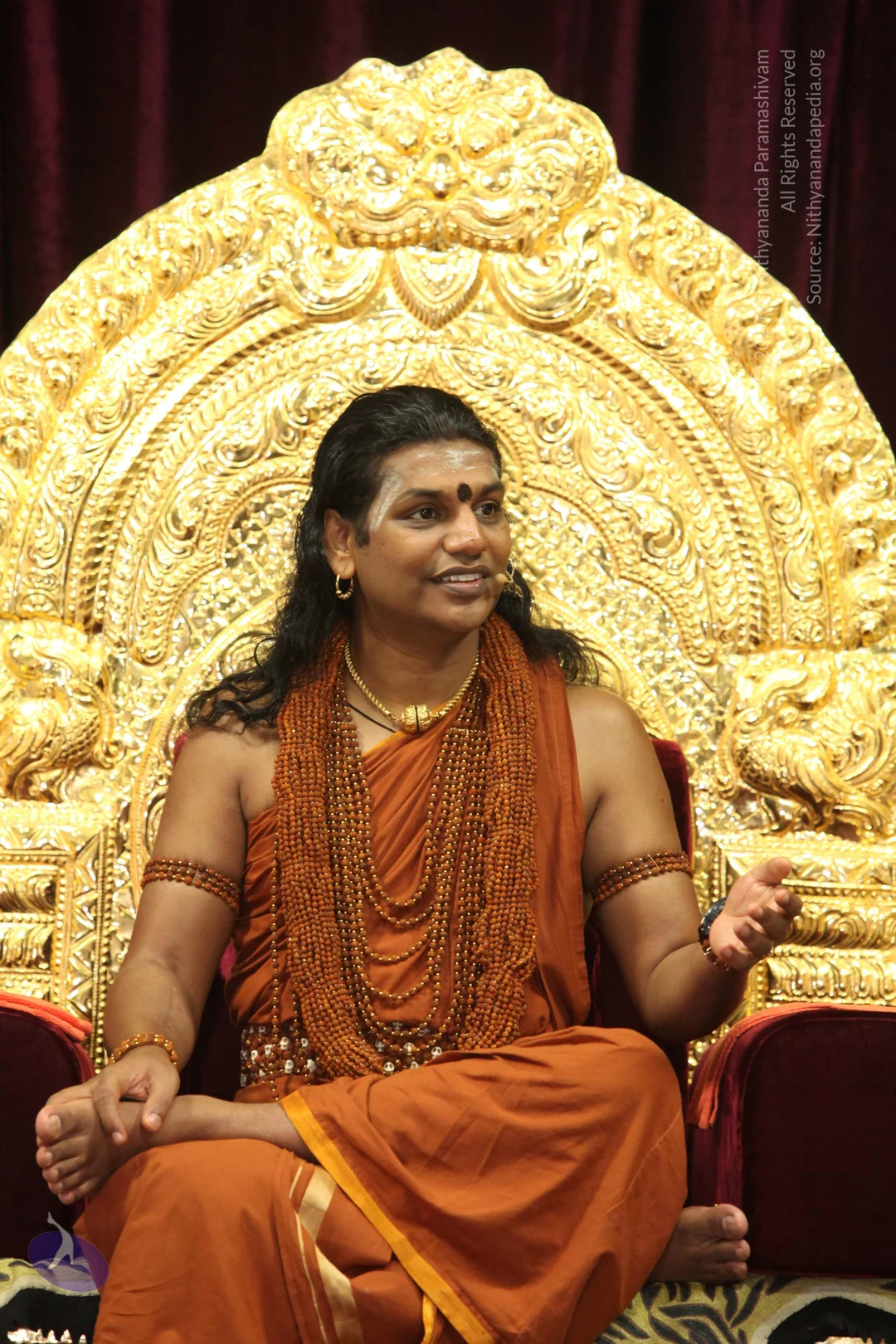
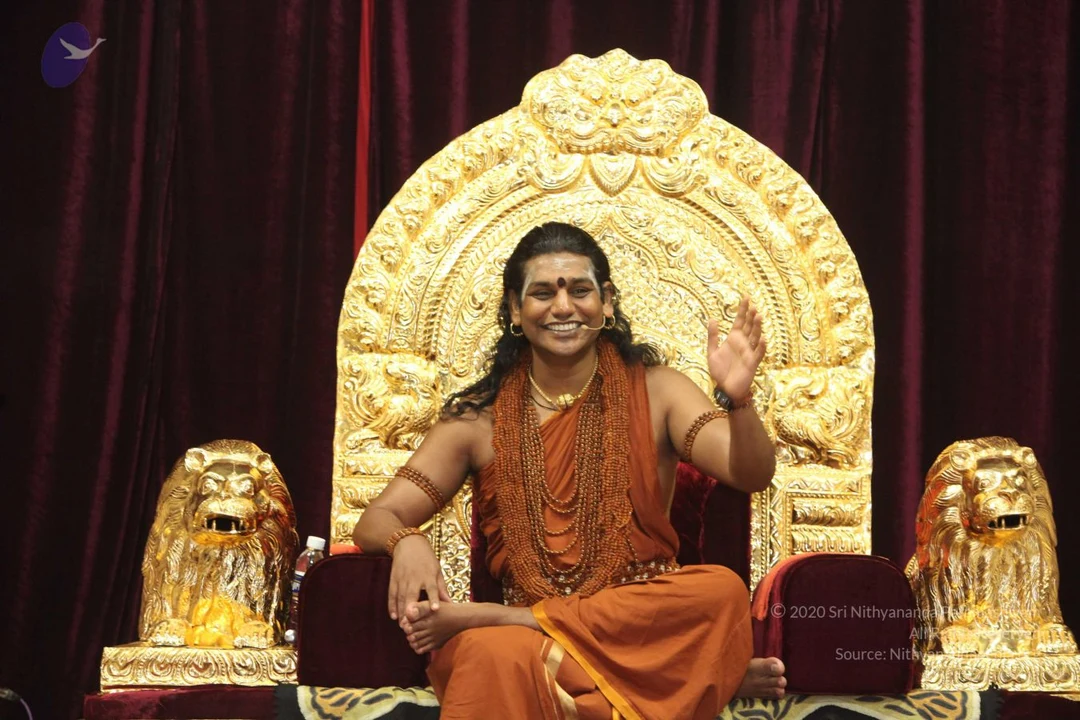
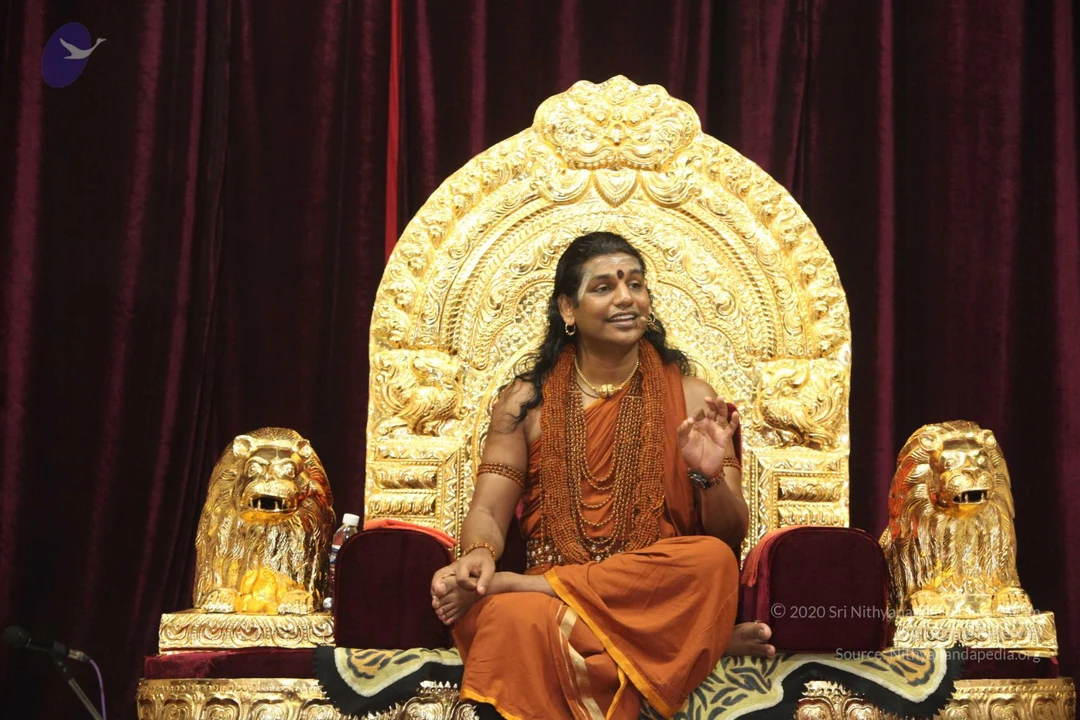
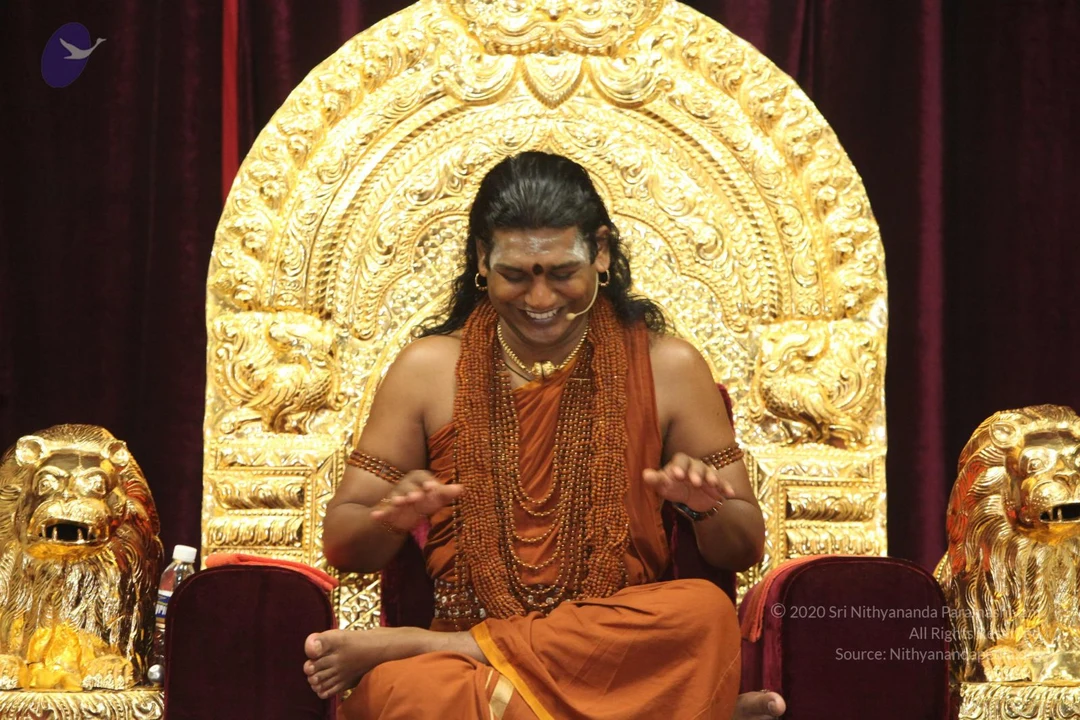
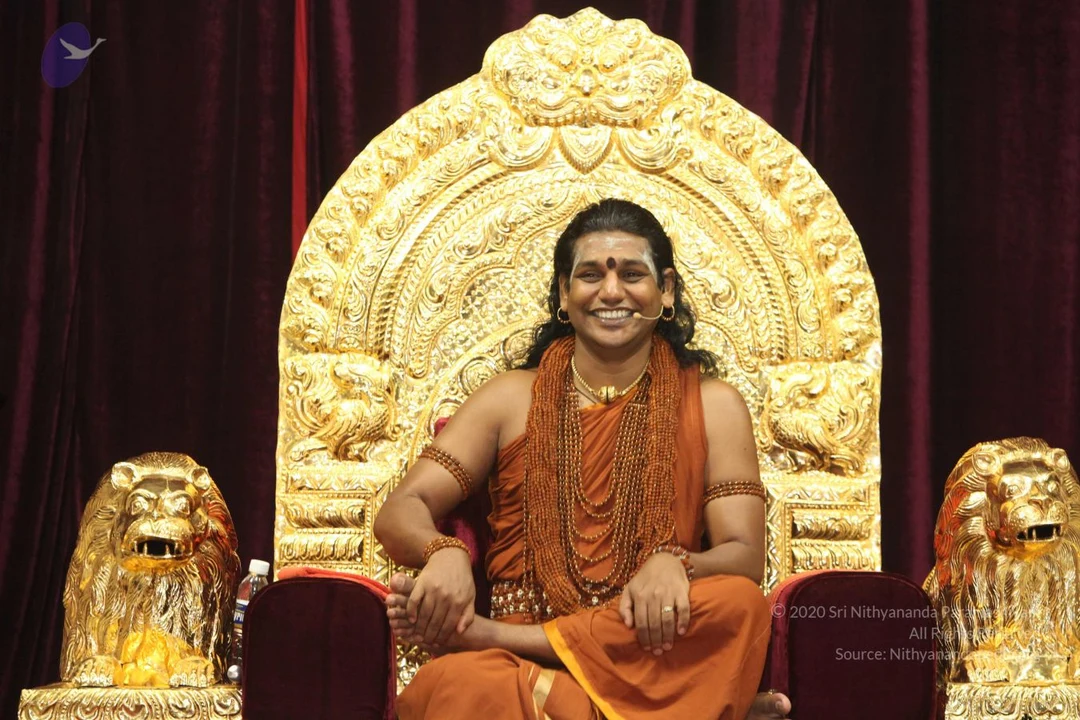
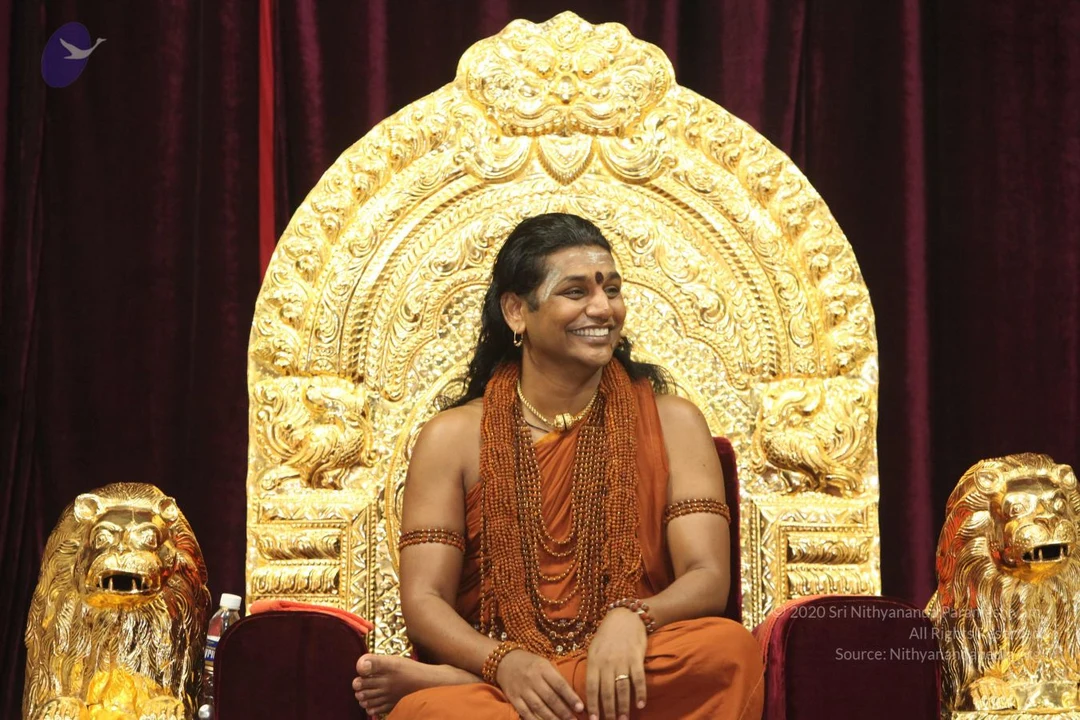
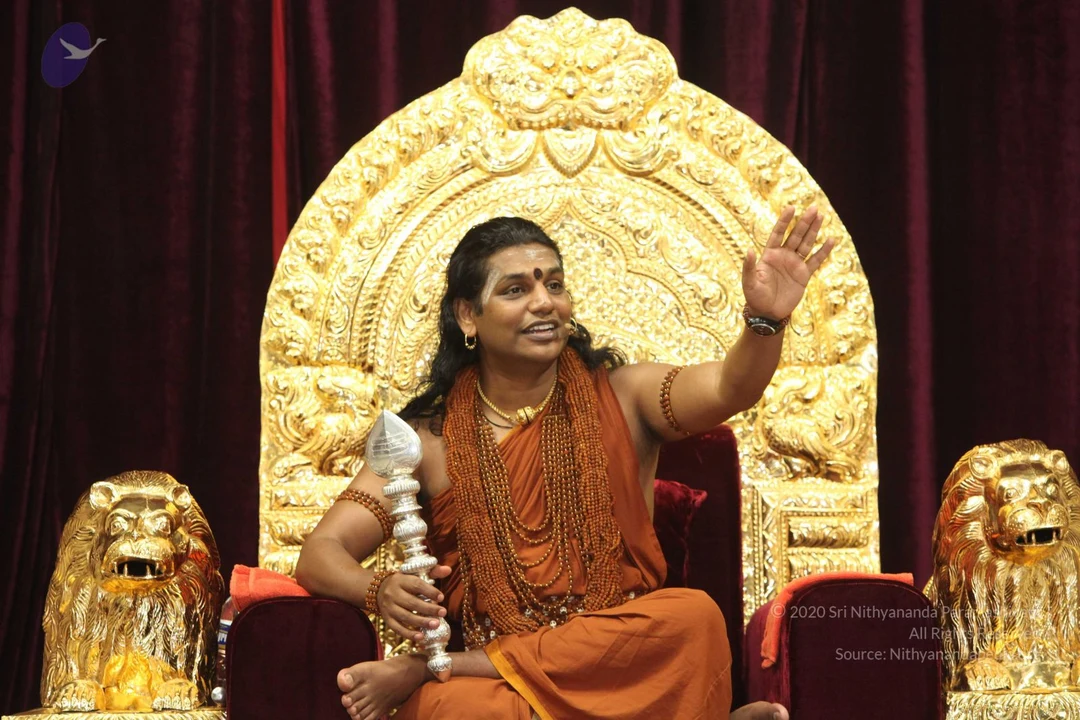
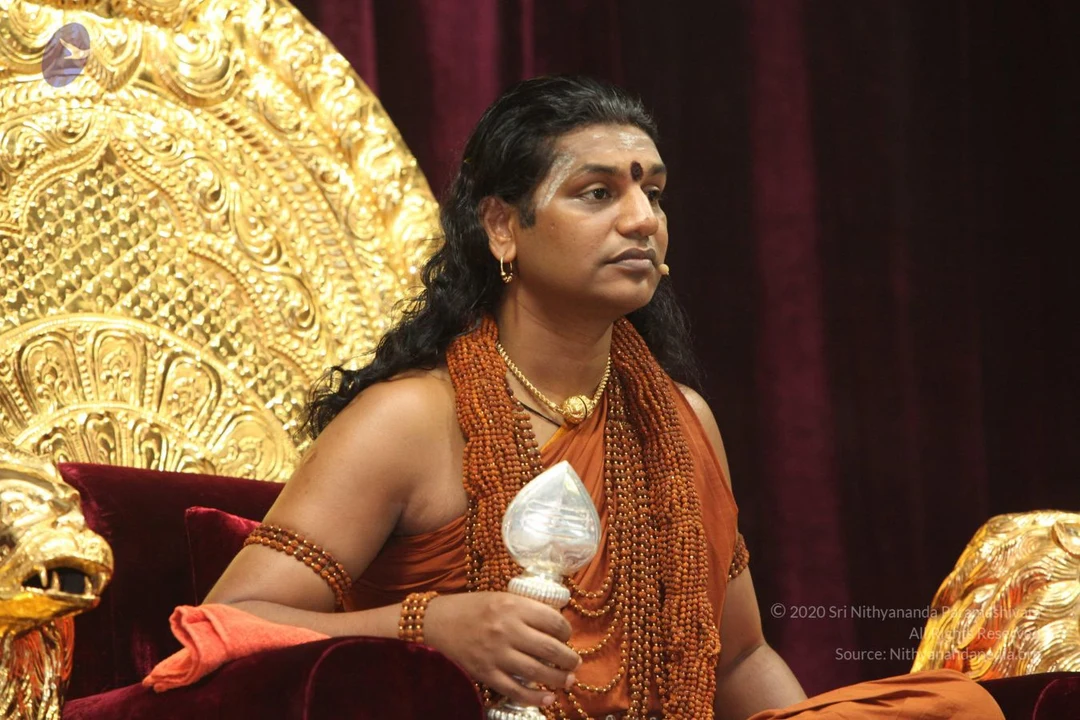
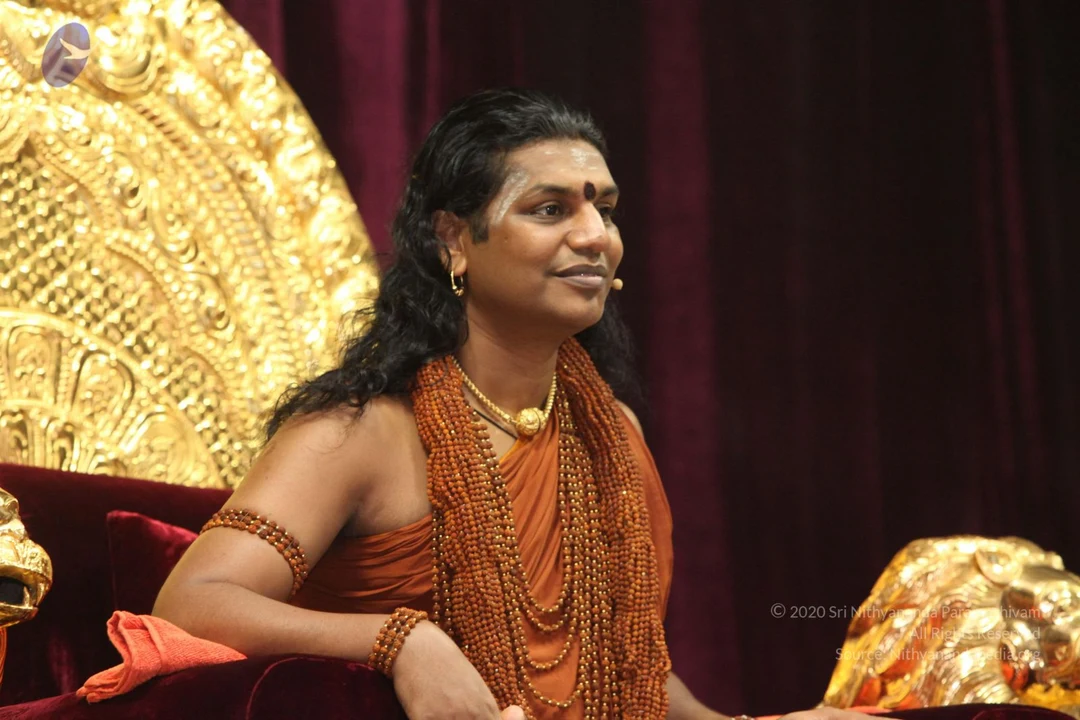
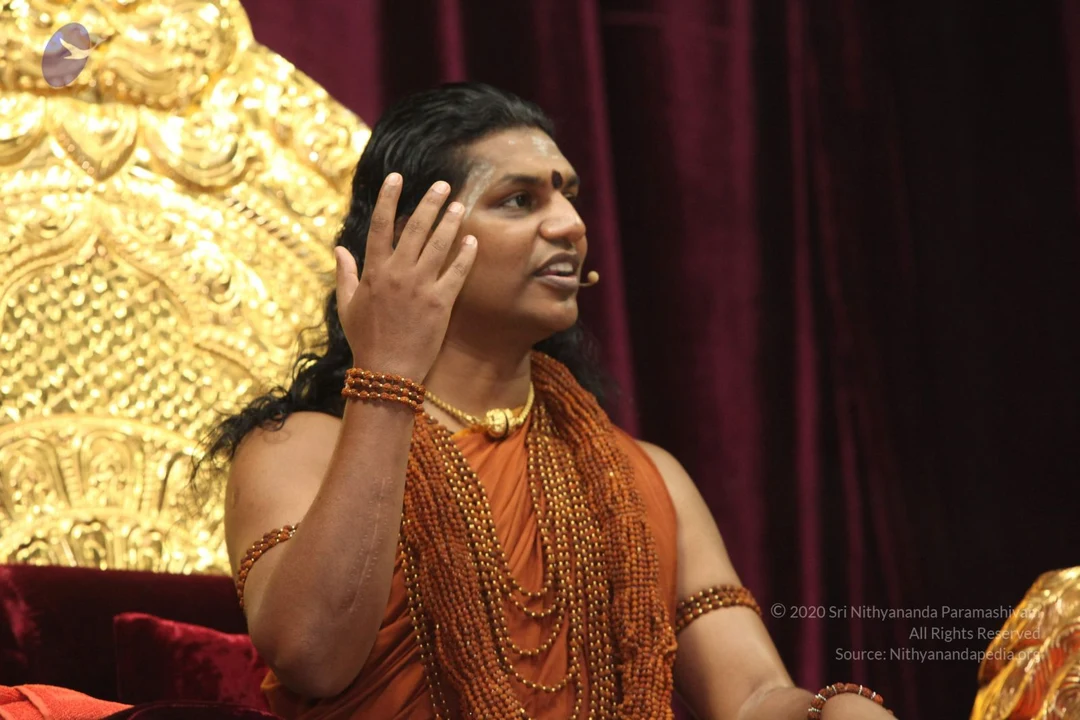
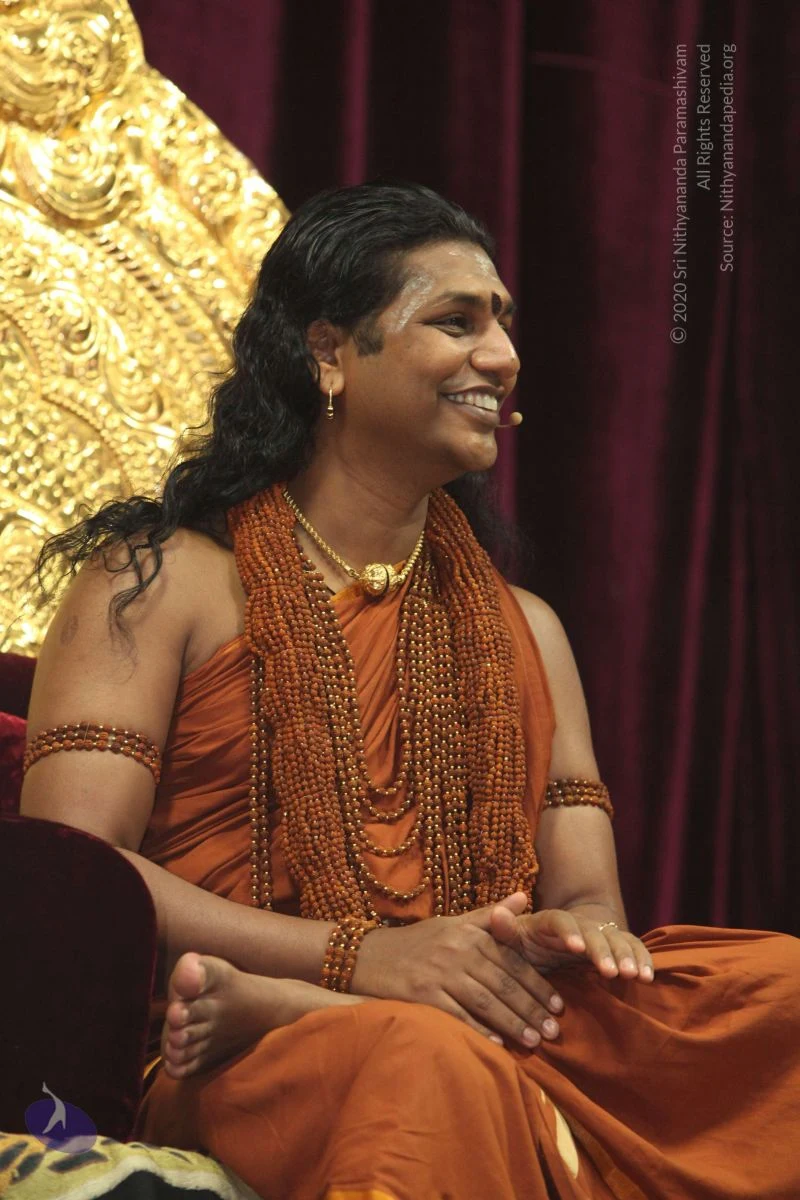
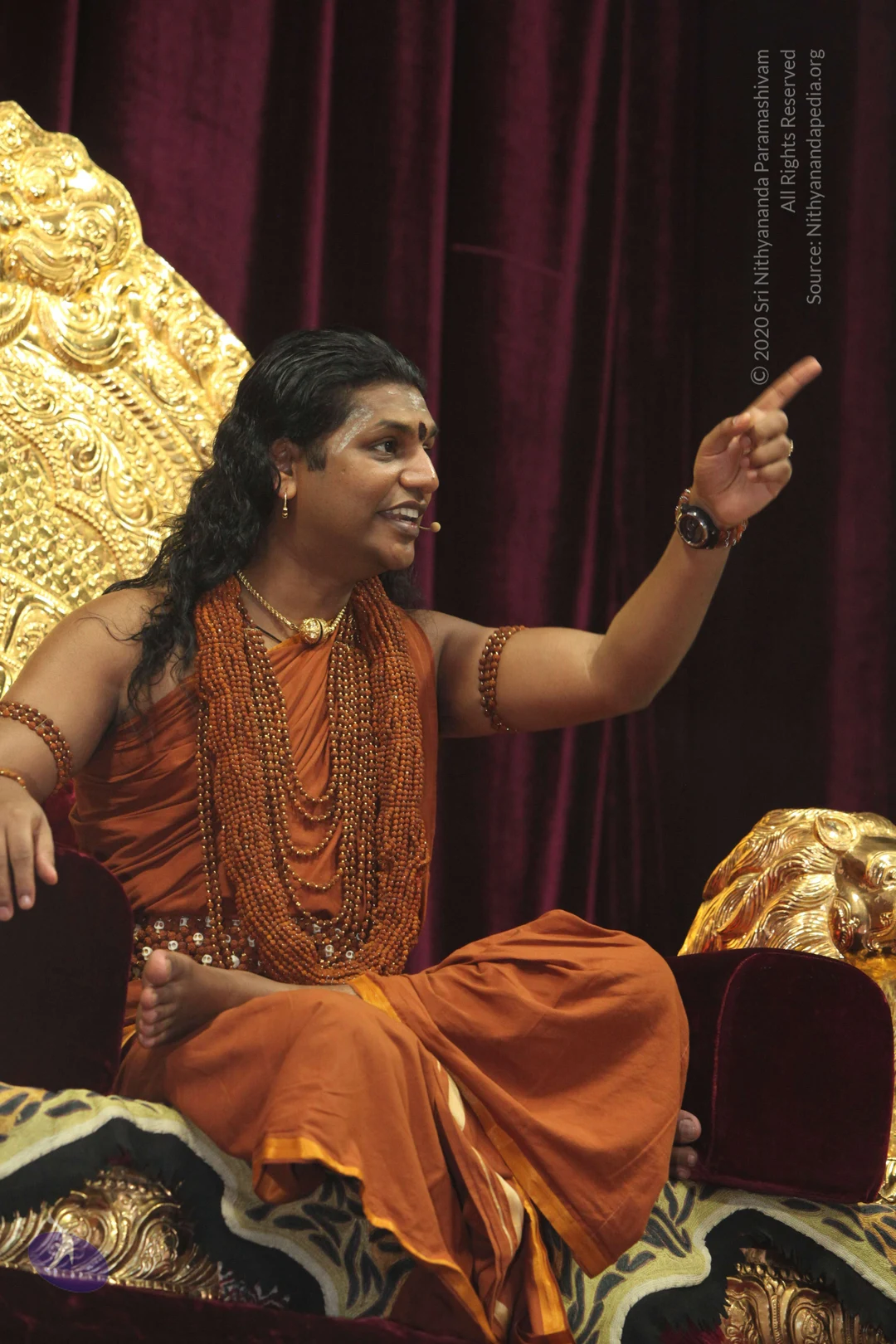
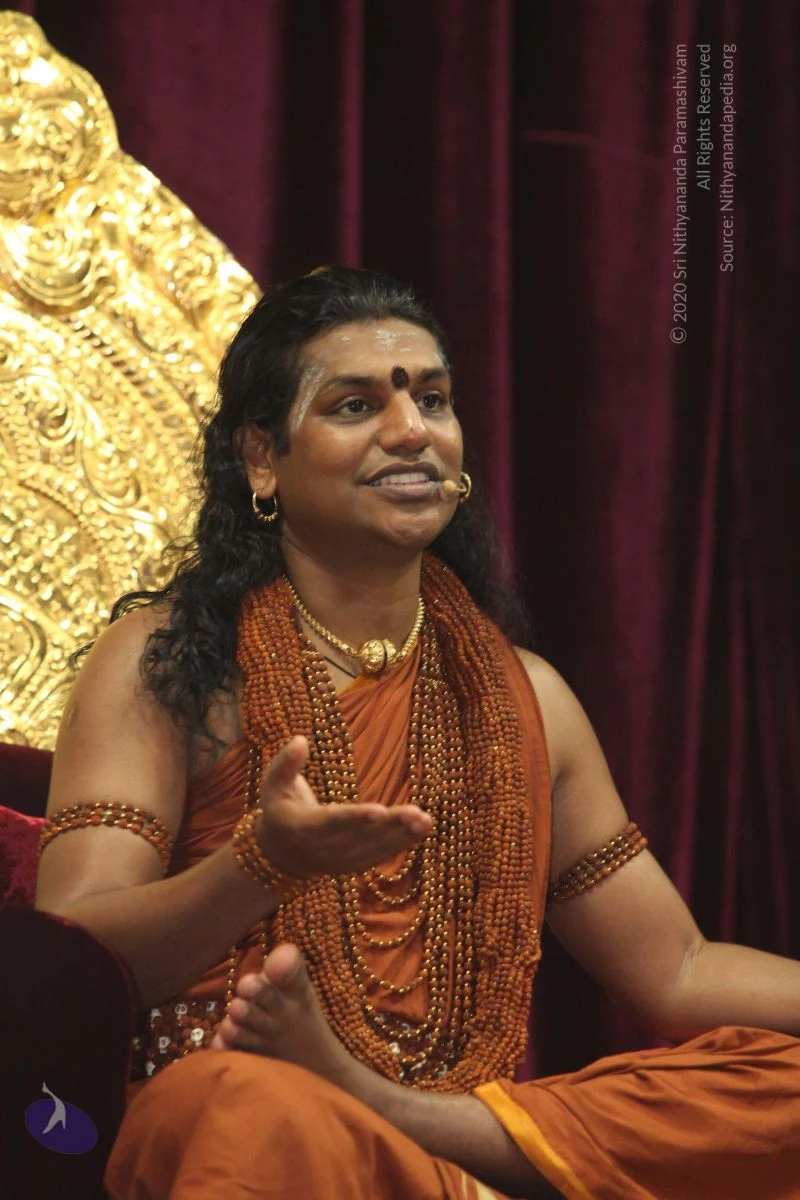
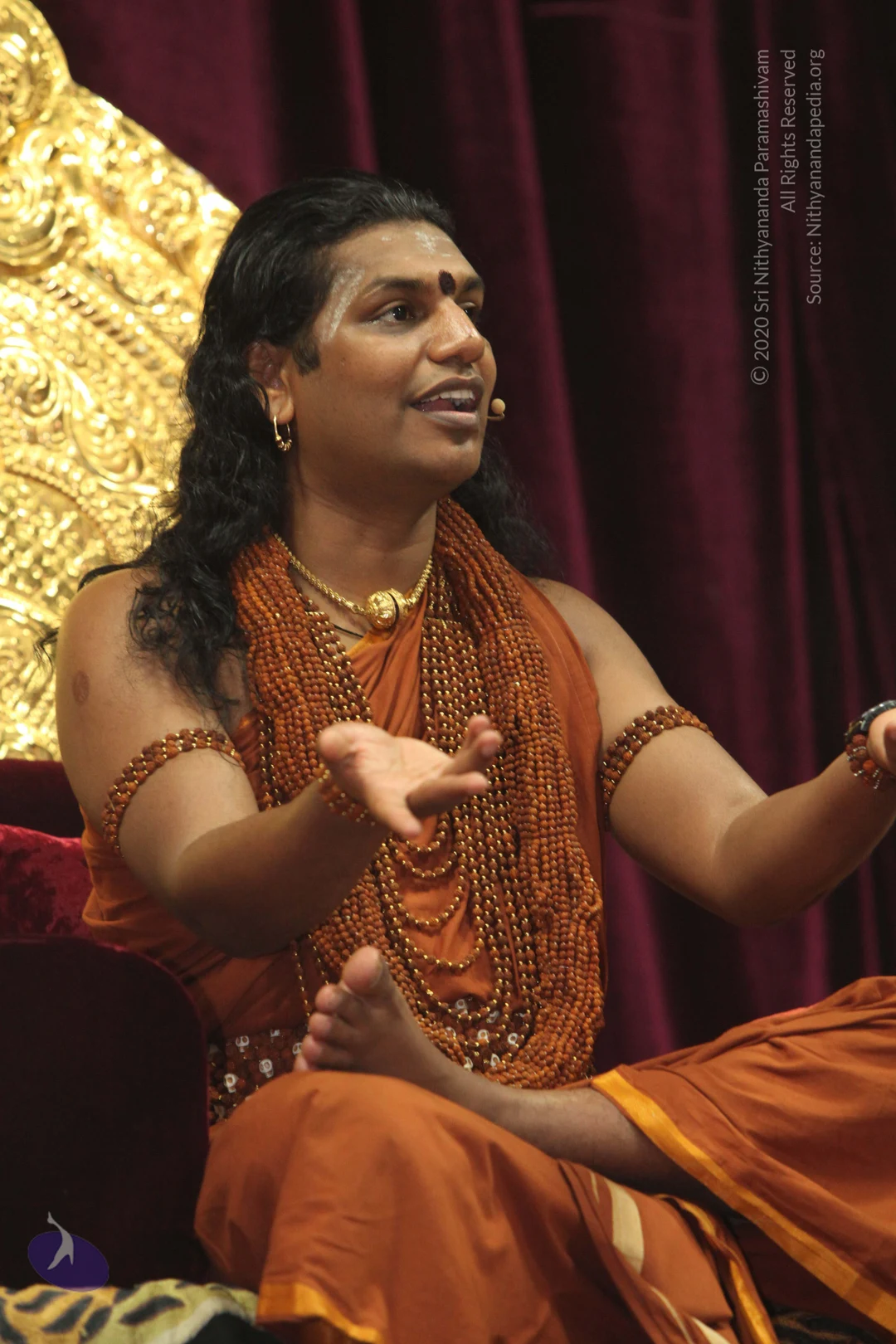
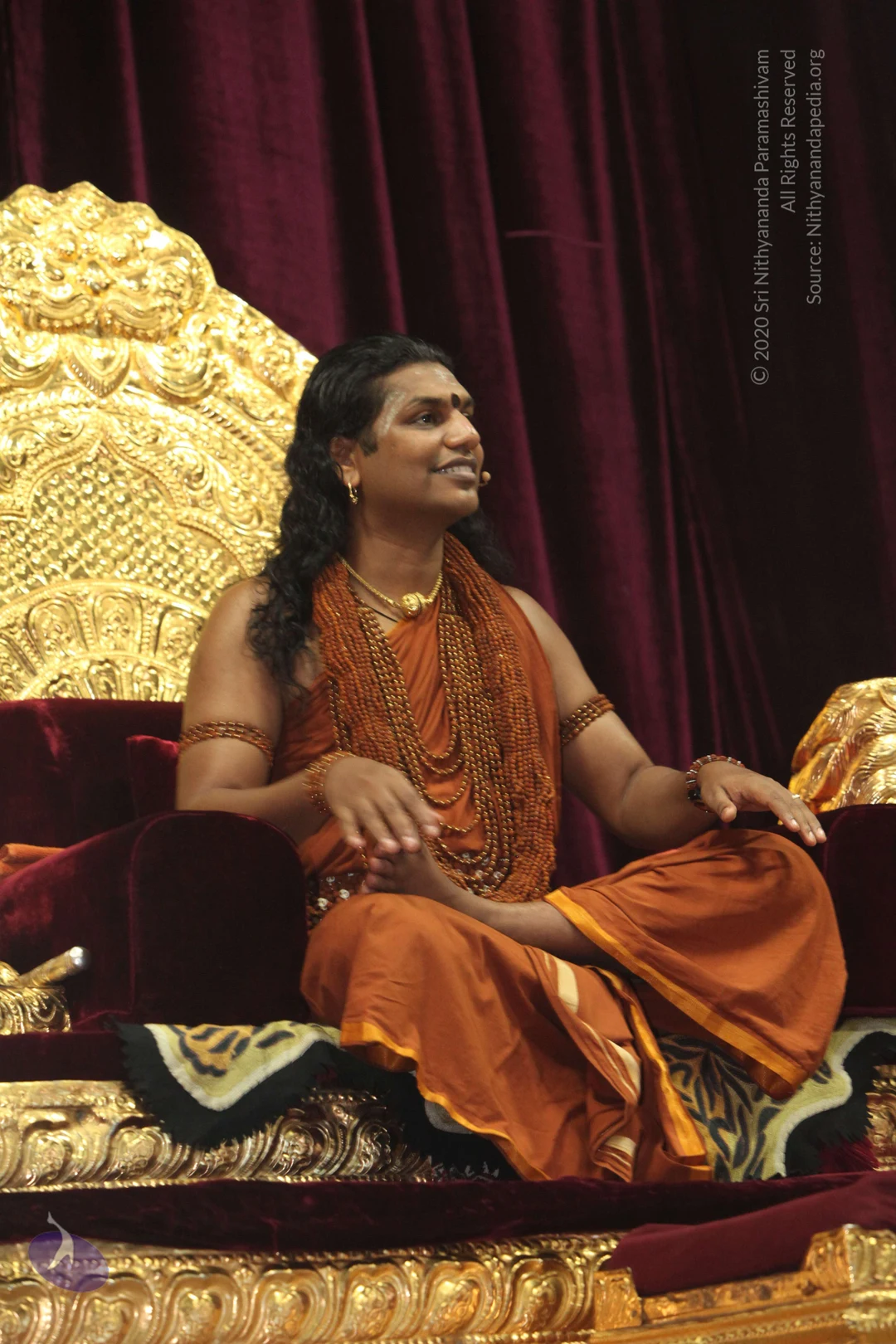
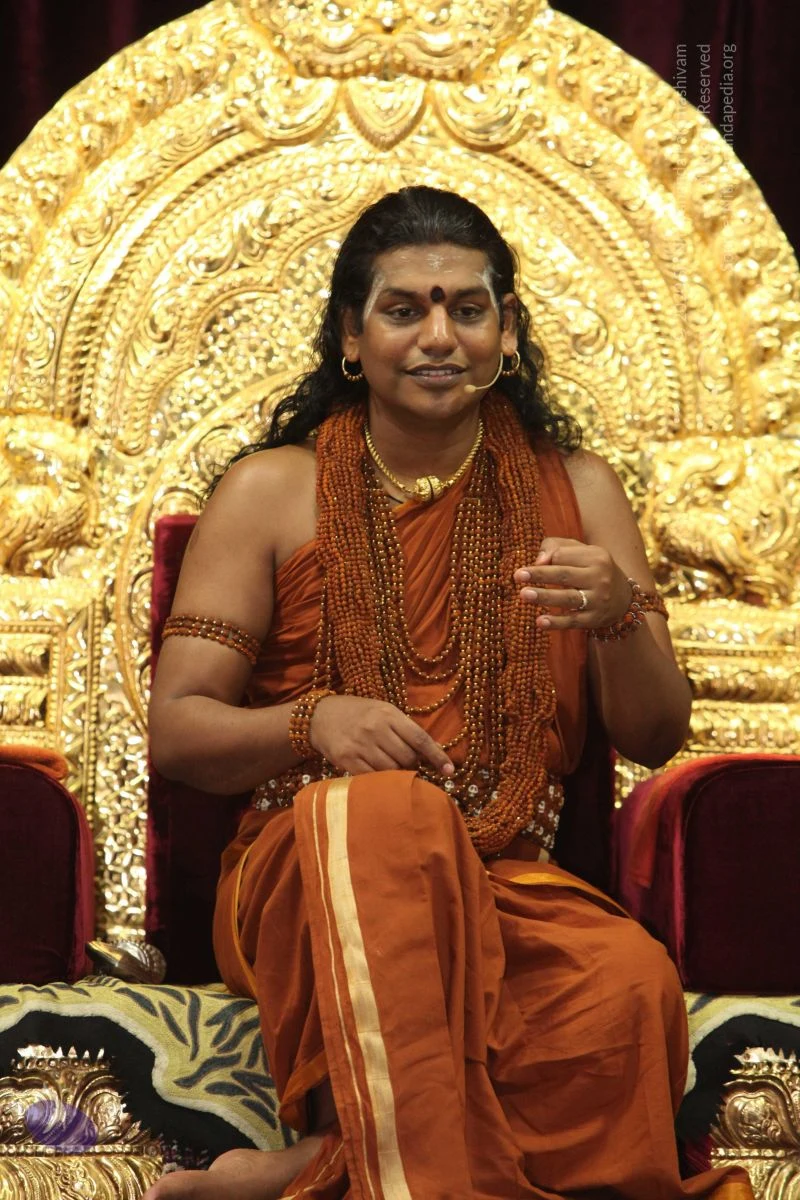
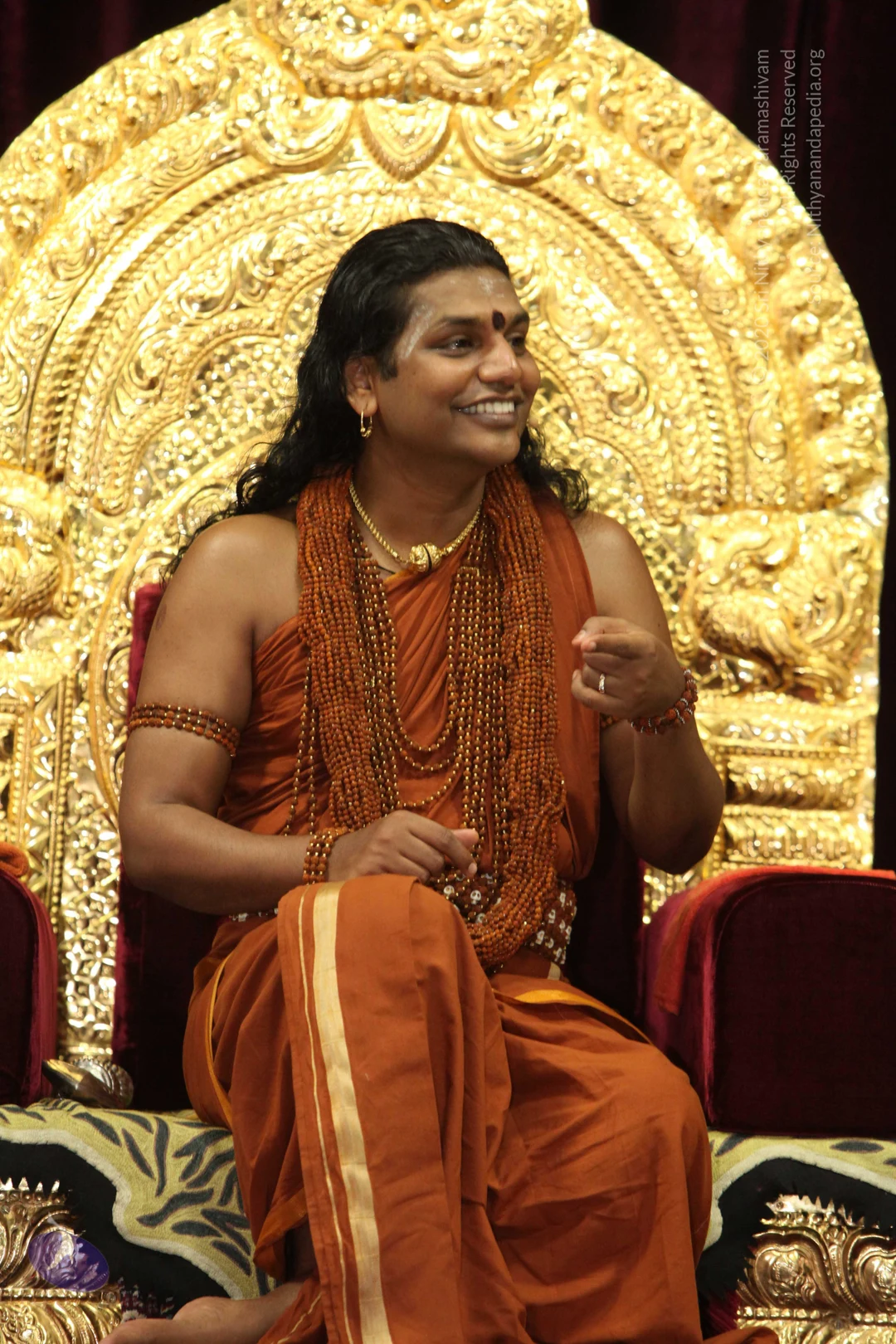
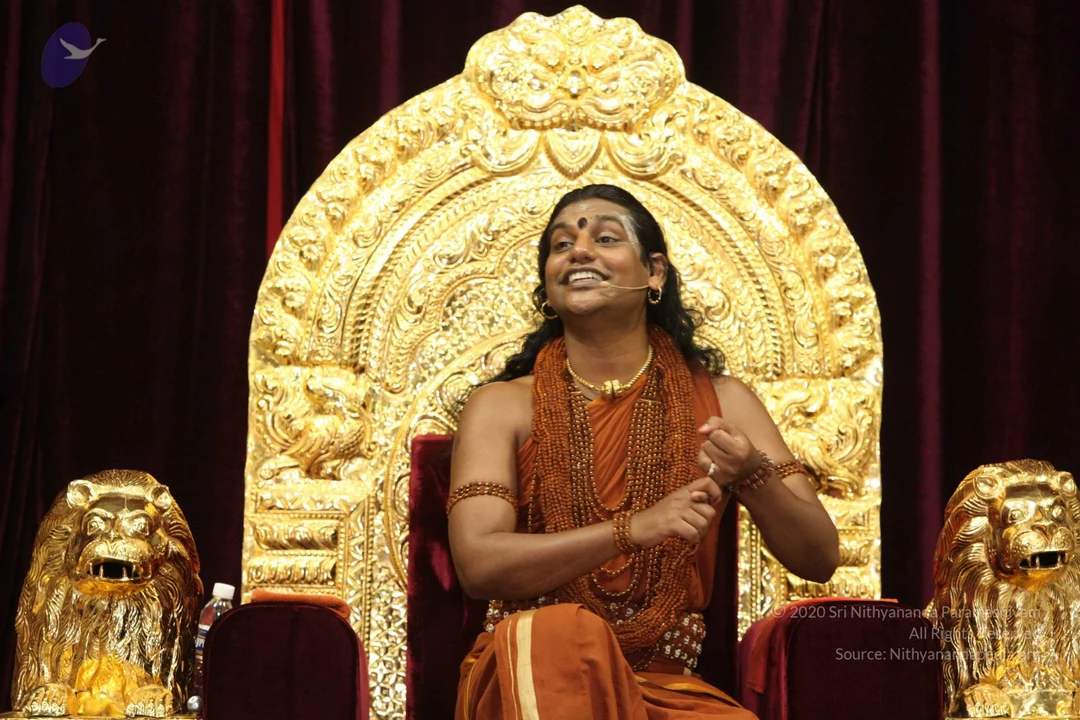
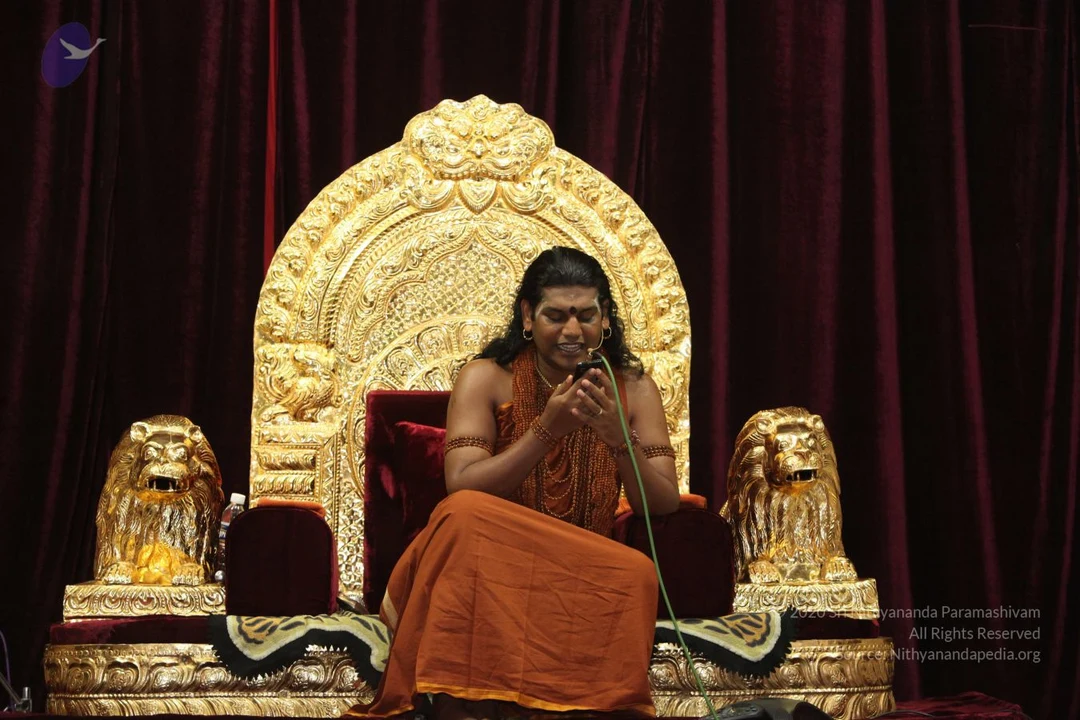
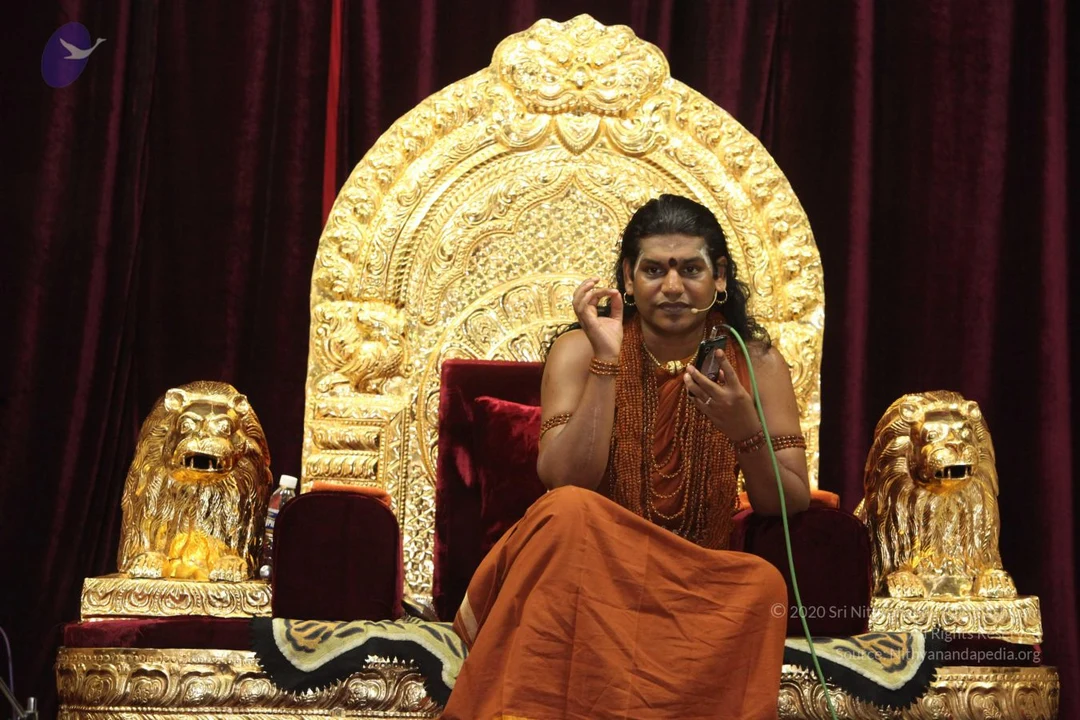
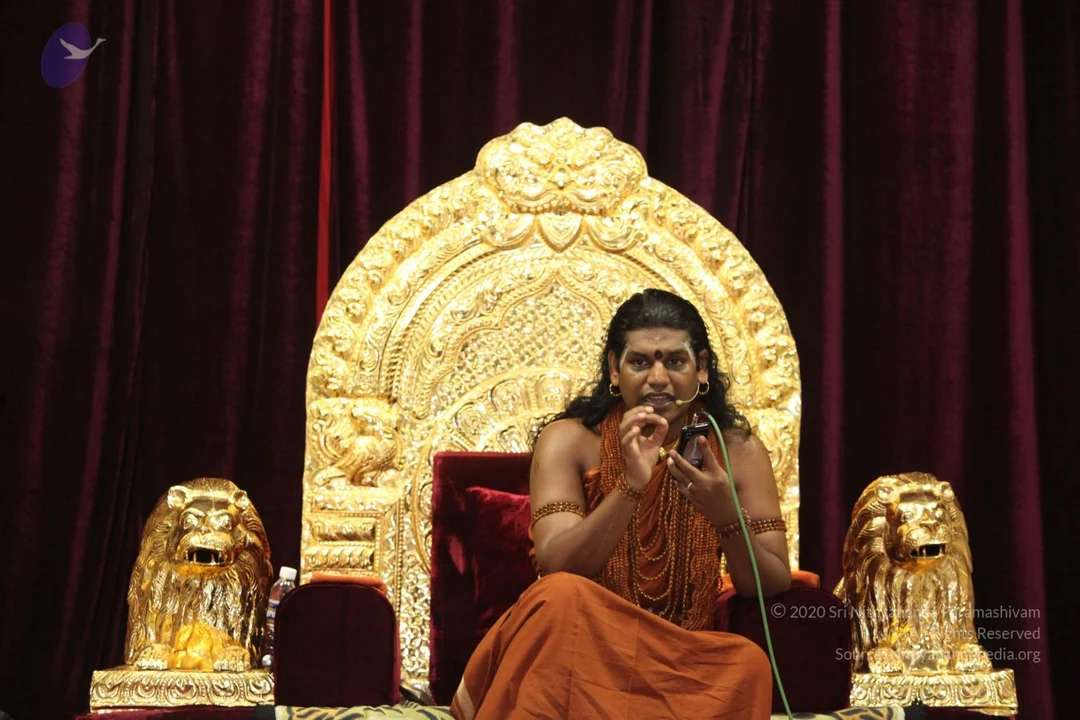
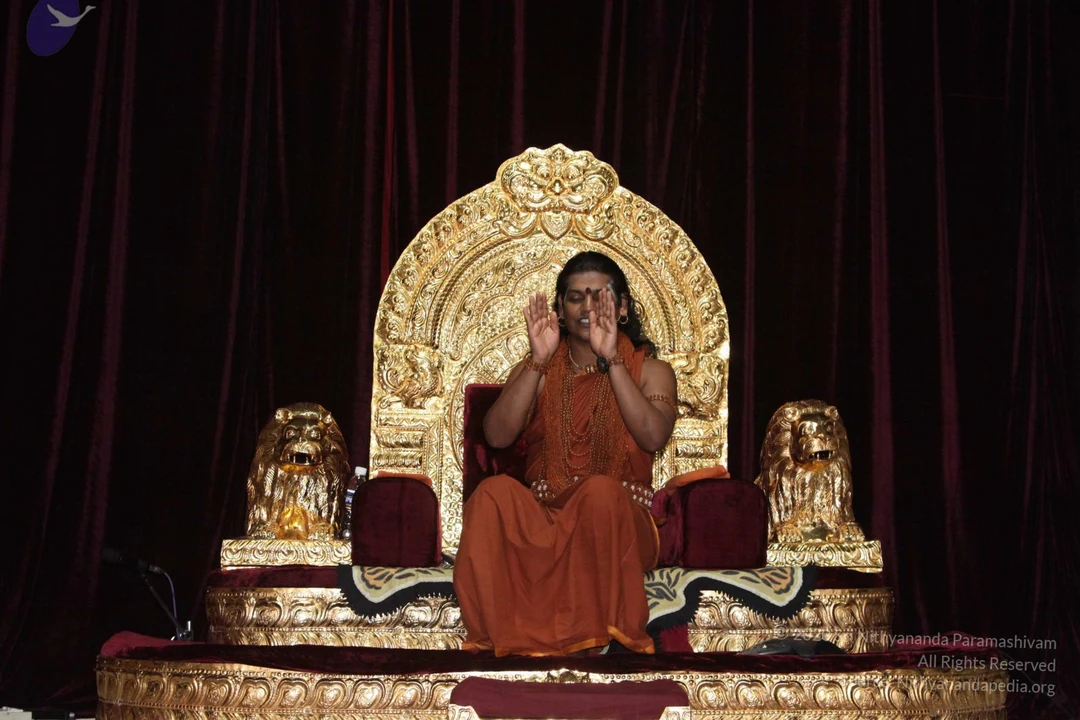
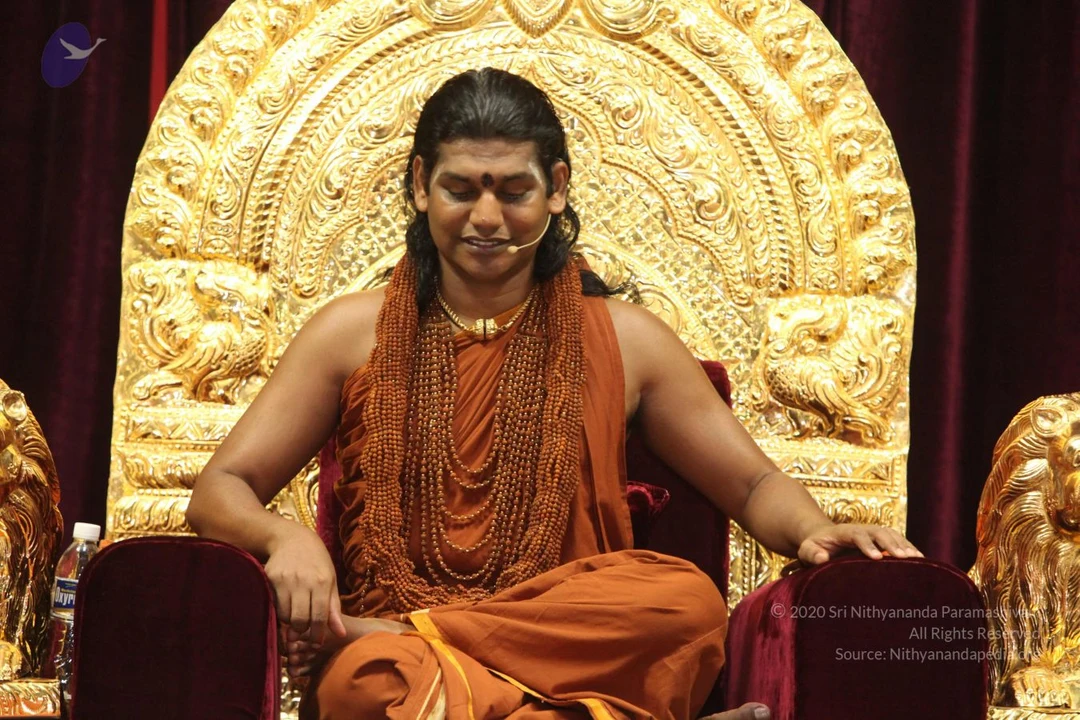
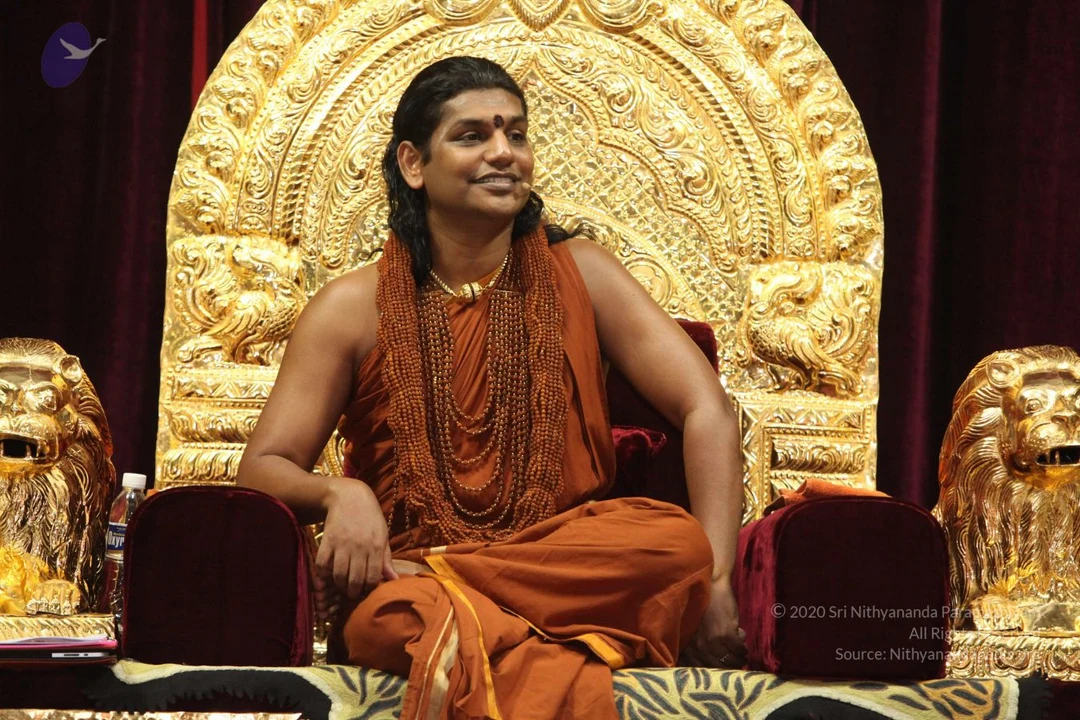
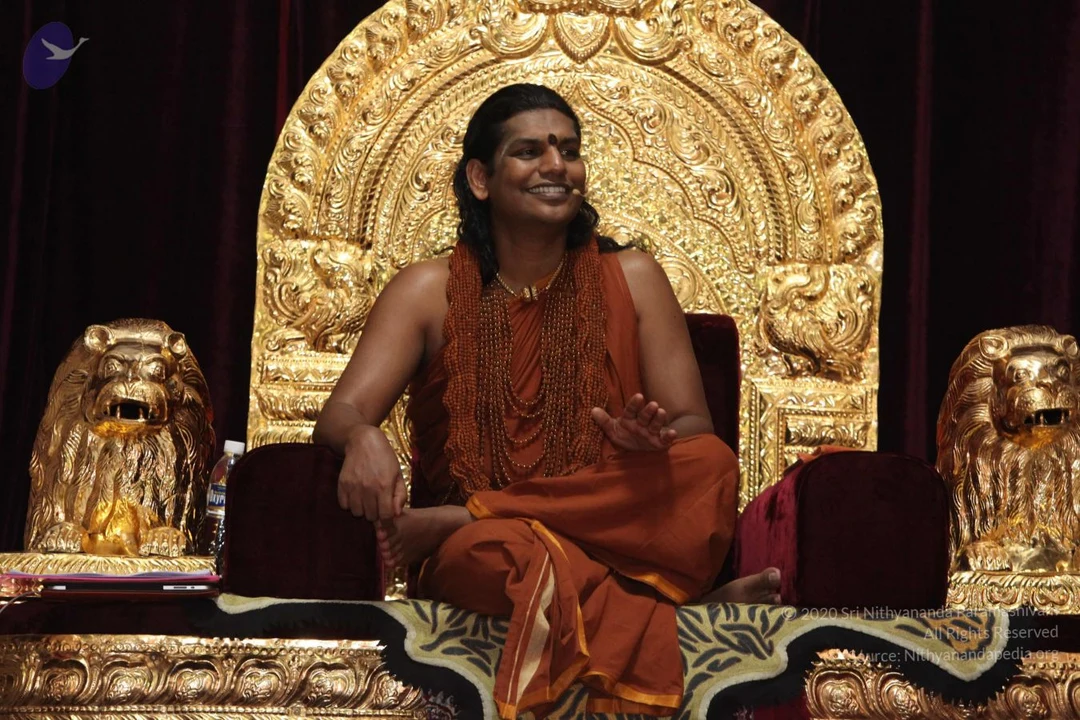
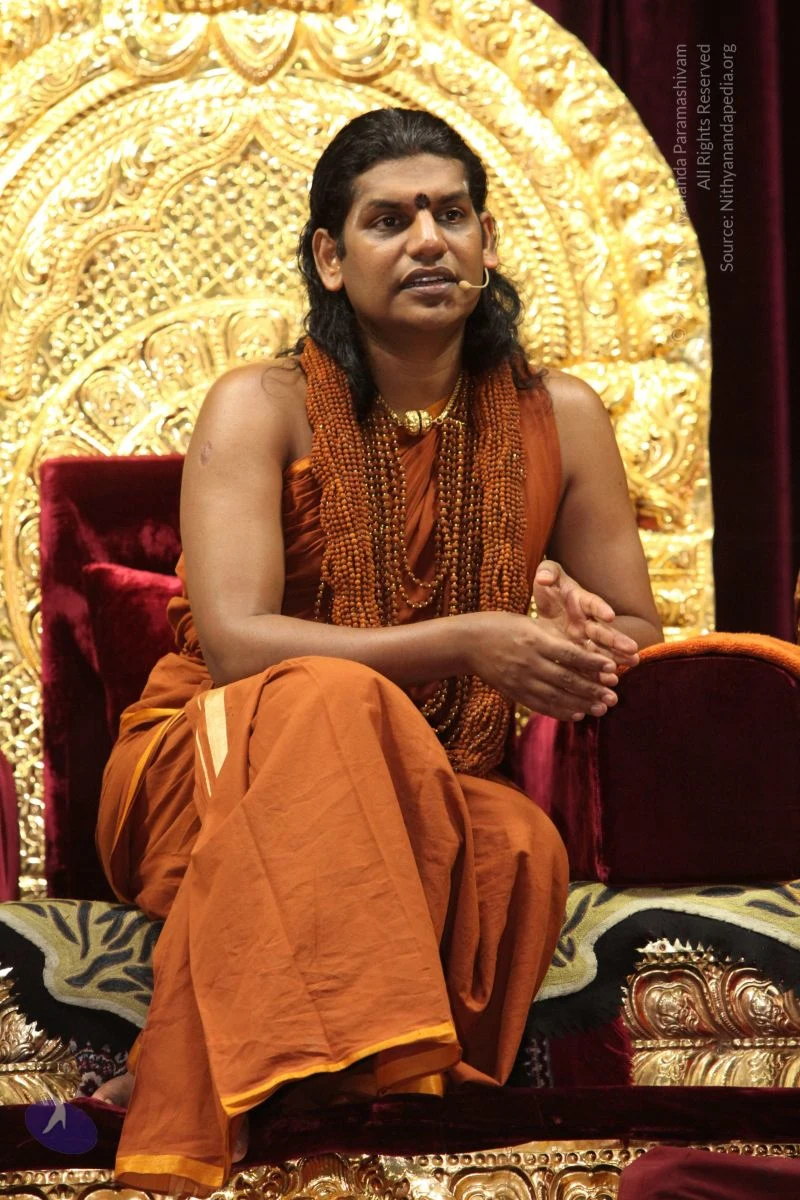
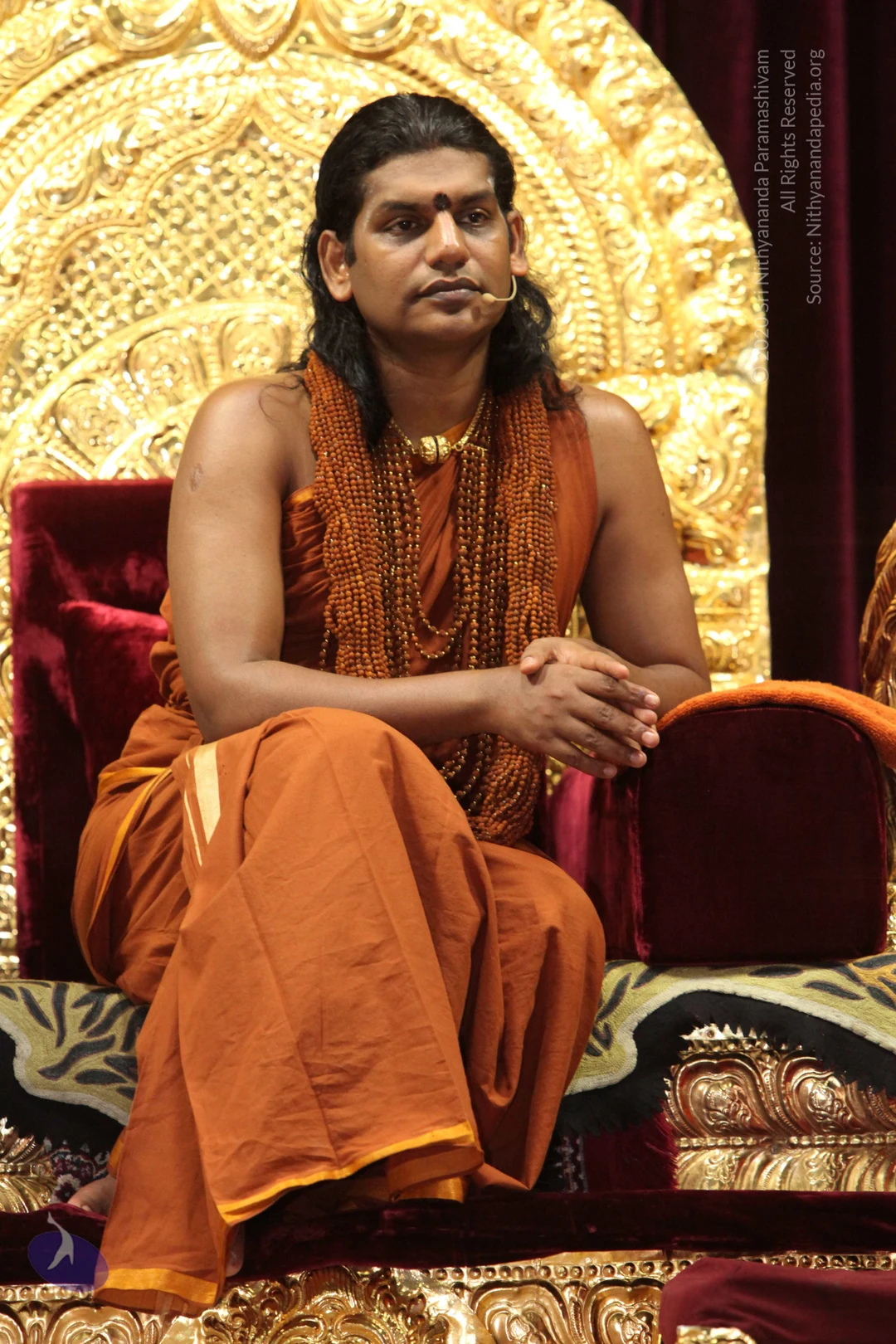
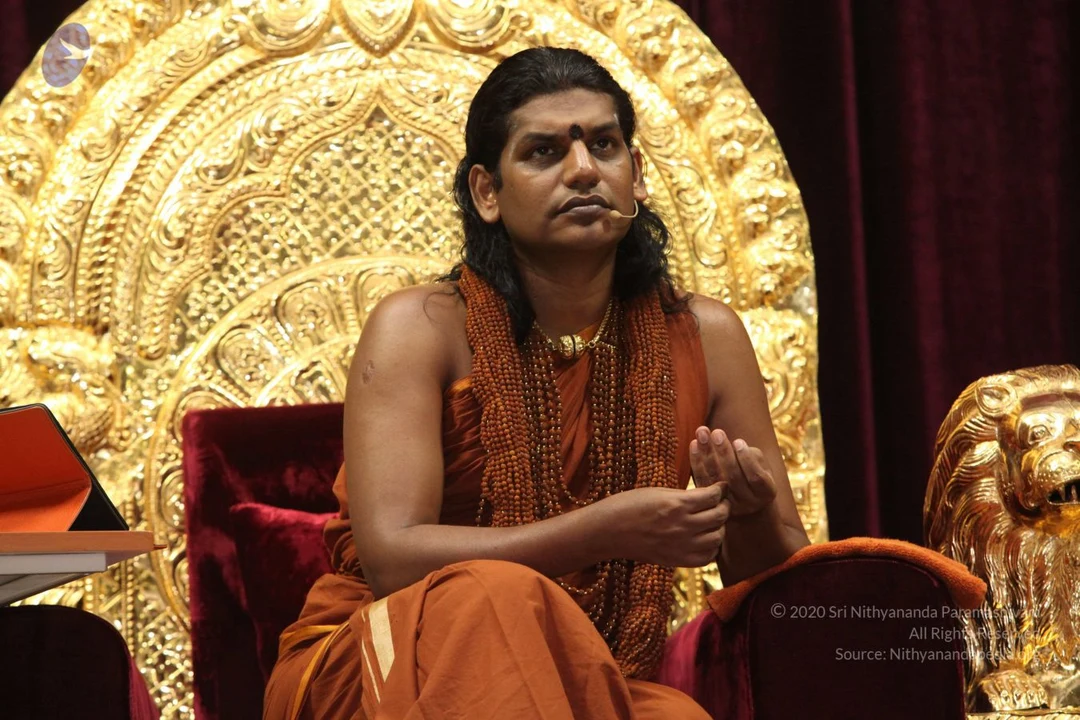
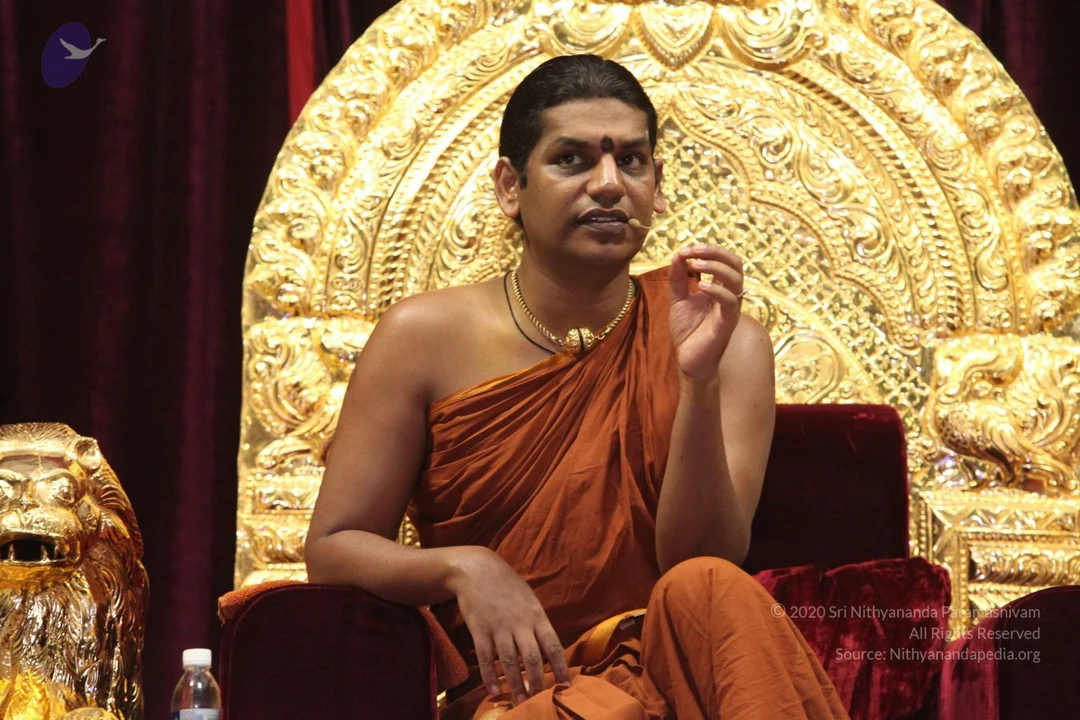
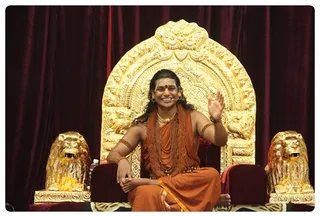
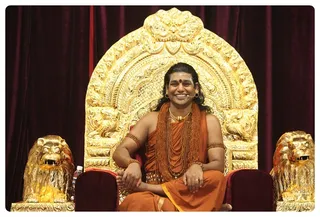
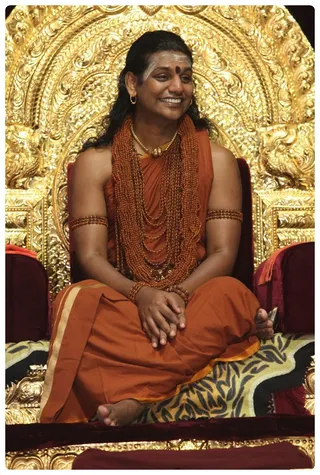
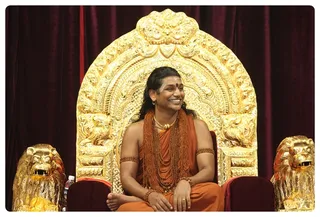
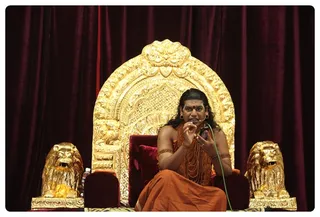
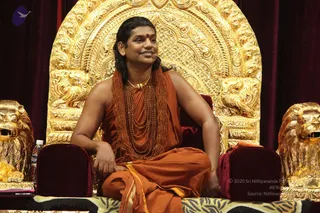
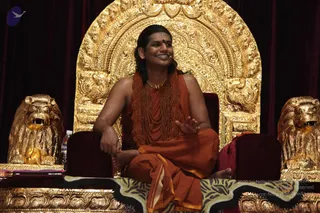
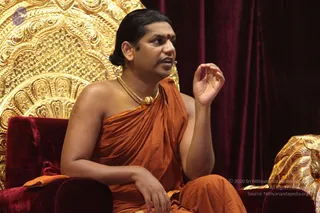
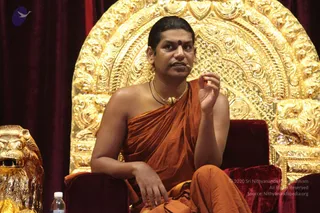
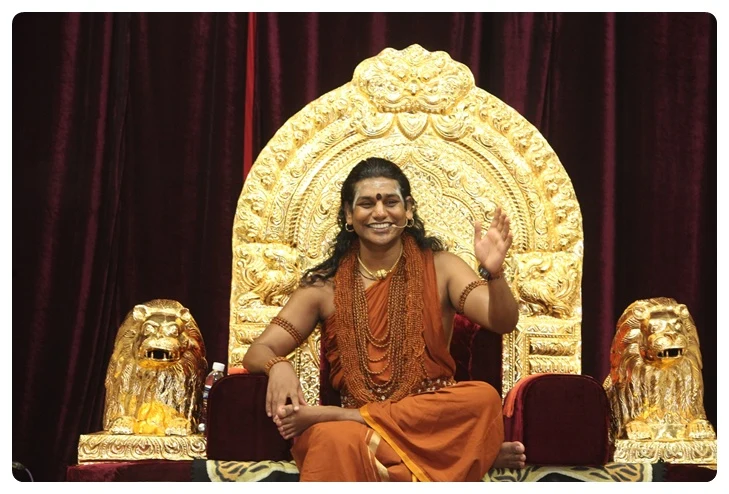
Swamiji (probable) sits cross-legged on an ornate golden throne with lion figures flanking him at either side, against deep maroon velvet drapes. He wears an orange saffron wrap, a red-and-gold bindi, long swept-back hair, and multiple rudraksha mala strands with a gold chain; his bare arms are adorned with beaded bands. He smiles broadly, one hand raised mid-gesture while speaking, and a small microphone is clipped near his face. Water bottles sit on the stage platform beside him.A smiling man with long swept-back dark hair sits on an ornate gold throne with carved backrest and two gold lion sculptures flanking it, against deep maroon drapes. He wears saffron-orange cloth draped over the shoulder and body, layered rudraksha malas, a gold necklace, gold armlets, and a red-orange tilak on his forehead, with a small headset microphone. a person appears seated in an in-person satsang setting. One person is visible.A seated man in saffron-orange robes smiles while sitting cross-legged on a red velvet chair before an ornate gold-leaf throne back carved with lions and floral scrollwork. He wears long multi-strand rudraksha malas, a gold necklace, hoop earrings, a bindi and sacred ash markings on his forehead, plus beaded armbands. His hands rest together in his lap, and a patterned cushion lies beneath him. Swamiji (probable): the orange clothing, rudraksha malas, ornate gold necklace and long swept-back hair match the cues associated with the page's Swamiji reference, though the image does not confirm identity. The scene suggests a satsang or ceremonial seating.A man sits on an ornate gold throne carved with lion-like motifs, flanked by two golden lion statues, in front of deep red velvet drapes. He wears an orange-saffron robe, several rows of rudraksha malas, a gold necklace, and gold armbands, with a red tilak on his forehead, and smiles broadly with his hands resting in his lap. Probable Swamiji is seated on the throne, identified by the saffron robe, layered rudraksha malas, ceremonial gold ornaments and long swept-back hair. Water bottles sit at the base of the throne.A photograph of a video-conference screen showing a family group in a living room in Klang, Malaysia, with a paper sign reading KLANG MALAYSIA on the table. Nine people sit on a floor and sofa area: a smiling woman in a magenta sari with folded hands in front of a decorated cake with a red and yellow floral centre, a man in a white shirt and sarong, an older man in white sitting on the floor talking on a phone, a young man in a red shirt, a boy in a blue shirt, and women in saris. Behind them a framed portrait of a saffron-robed figure is garlanded with marigolds, with a large brown sofa and a curtained window. In the bottom-right corner, a small inset shows a woman in an orange sari seated on a red throne-like chair in the main satsang hall.A photograph of a seated man speaking into a headset microphone on a stage. He sits on an ornate gold throne with carved backing, flanked by two gold lion sculptures, against deep maroon velvet drapery. He wears an orange-saffron dhoti and shawl, multiple rudraksha mala necklaces, gold bangles and a red forehead mark, with long swept-back hair. He holds his hands together in front of him while speaking. Probable Swamiji by appearance cues: long hair, saffron clothing, rudraksha malas and ornate setting, though the image shows no printed name.

SOLO-2_MorningSatsang
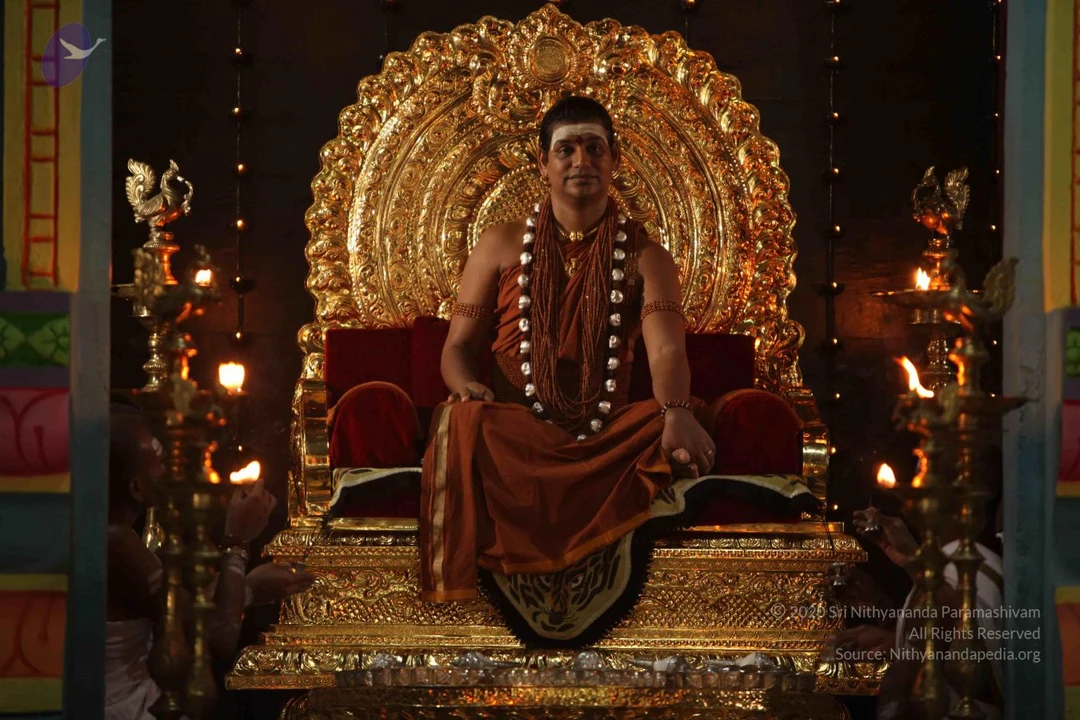
15 photosSource gallery
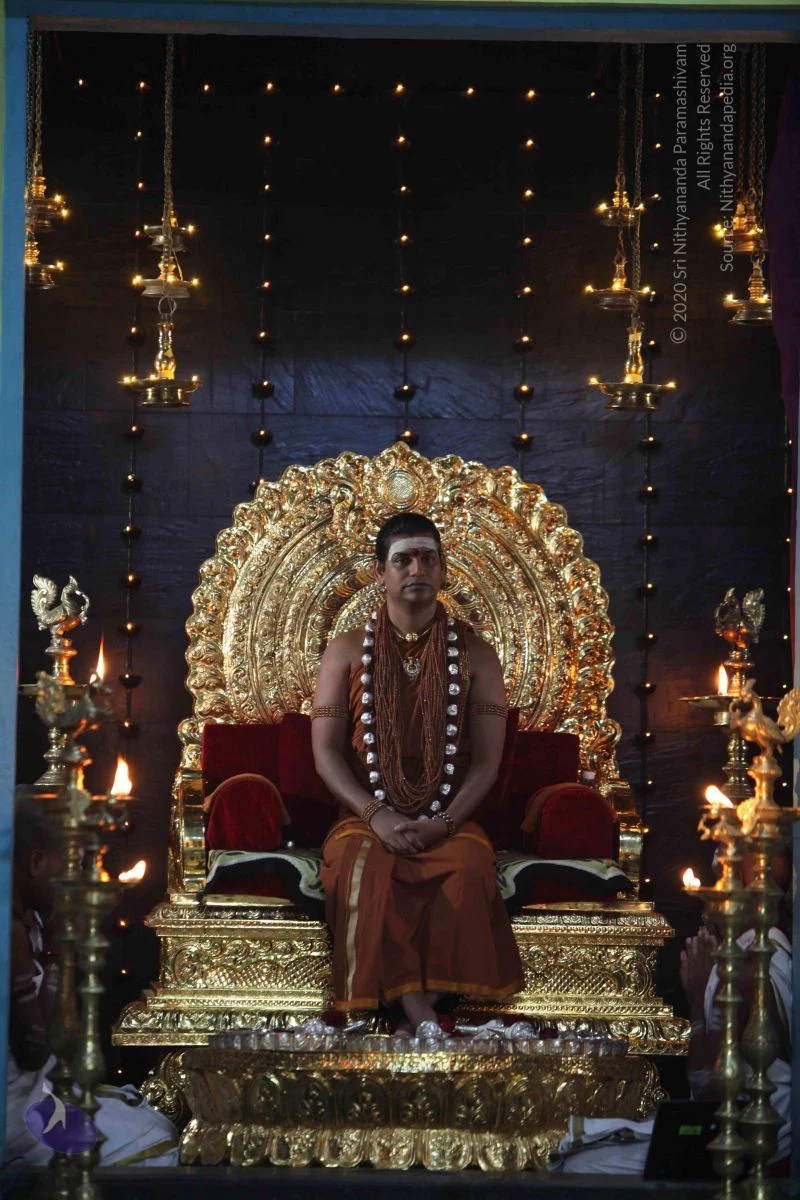
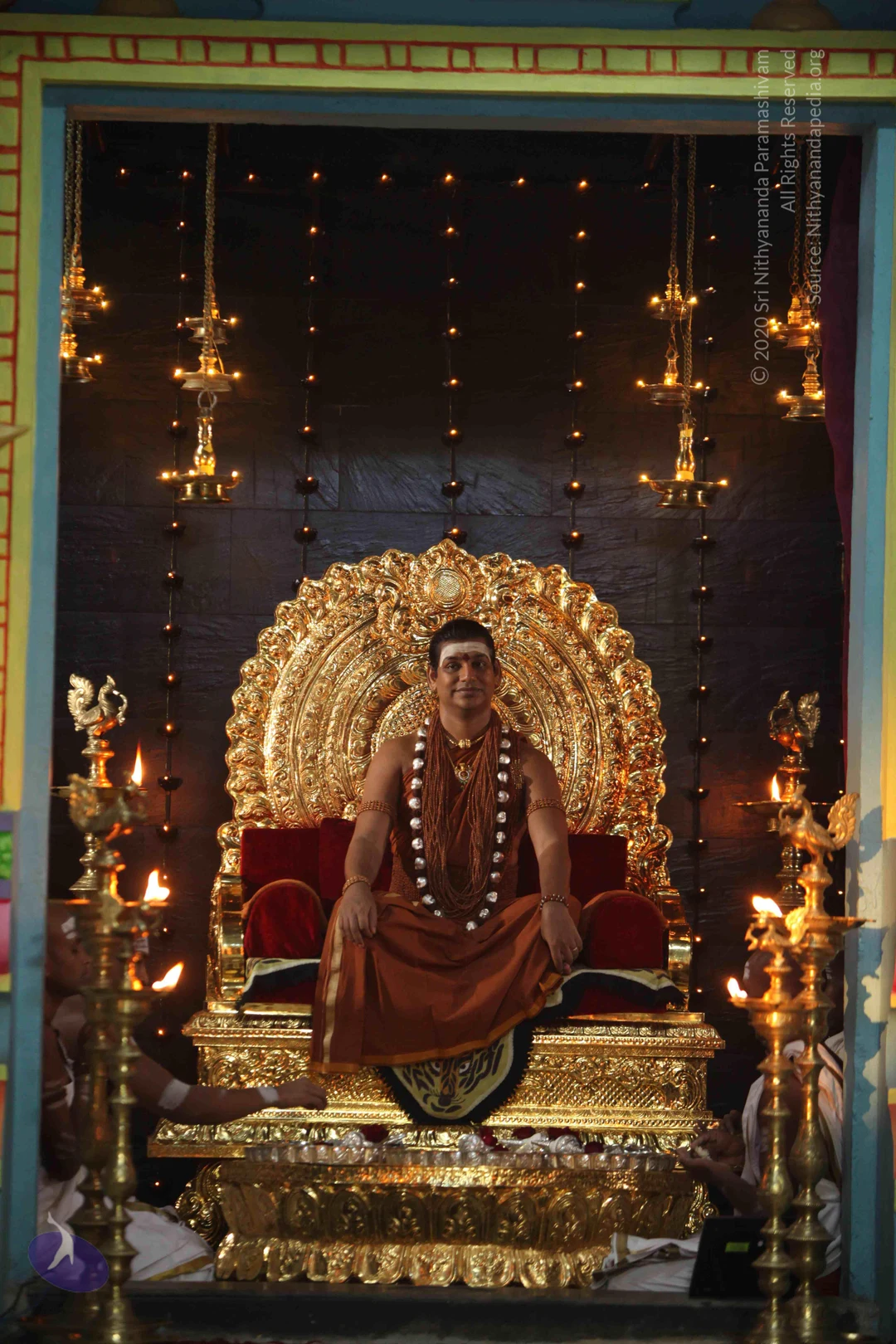
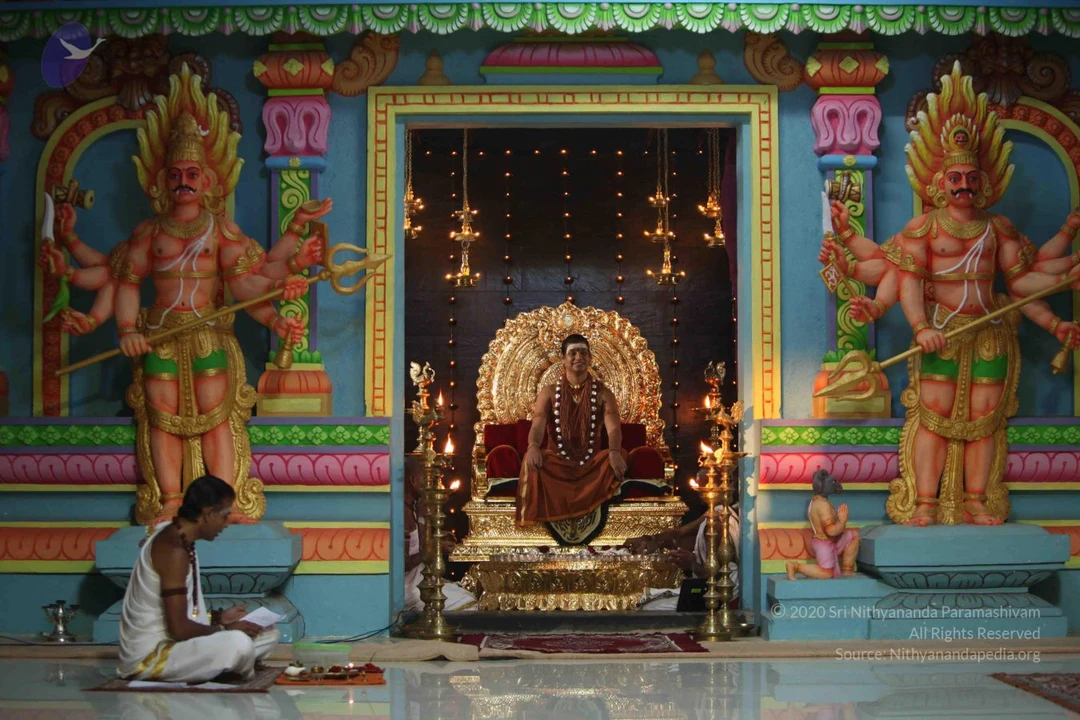
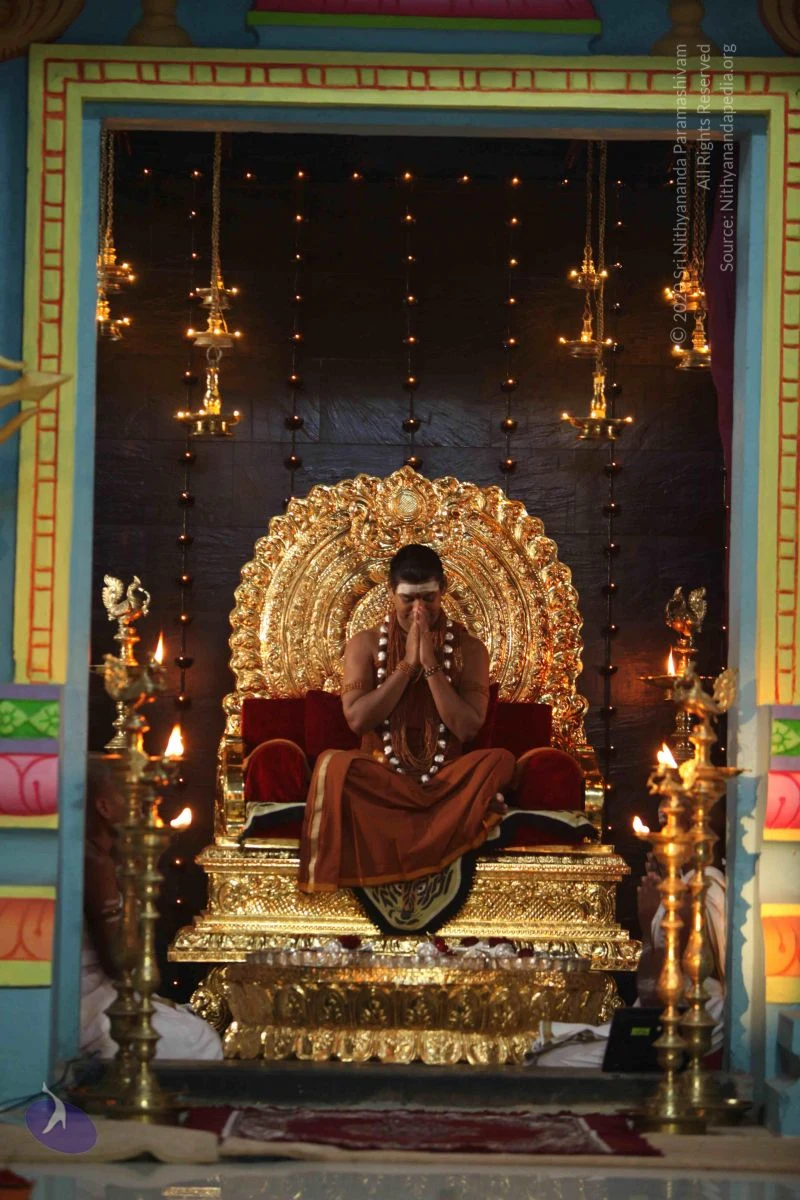
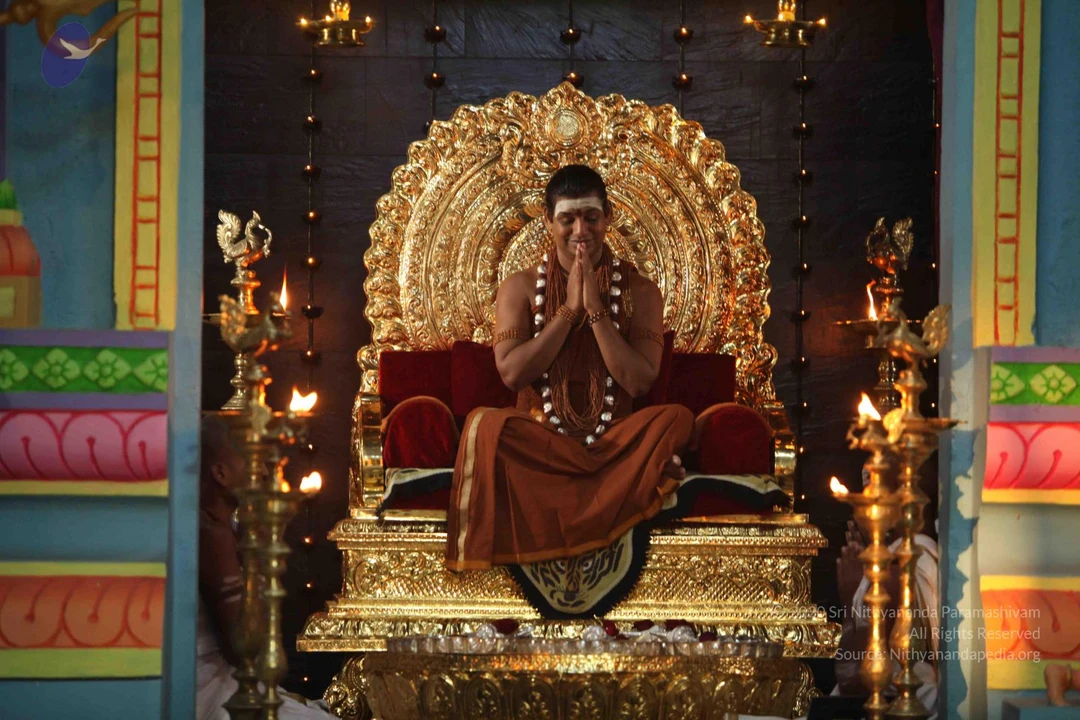
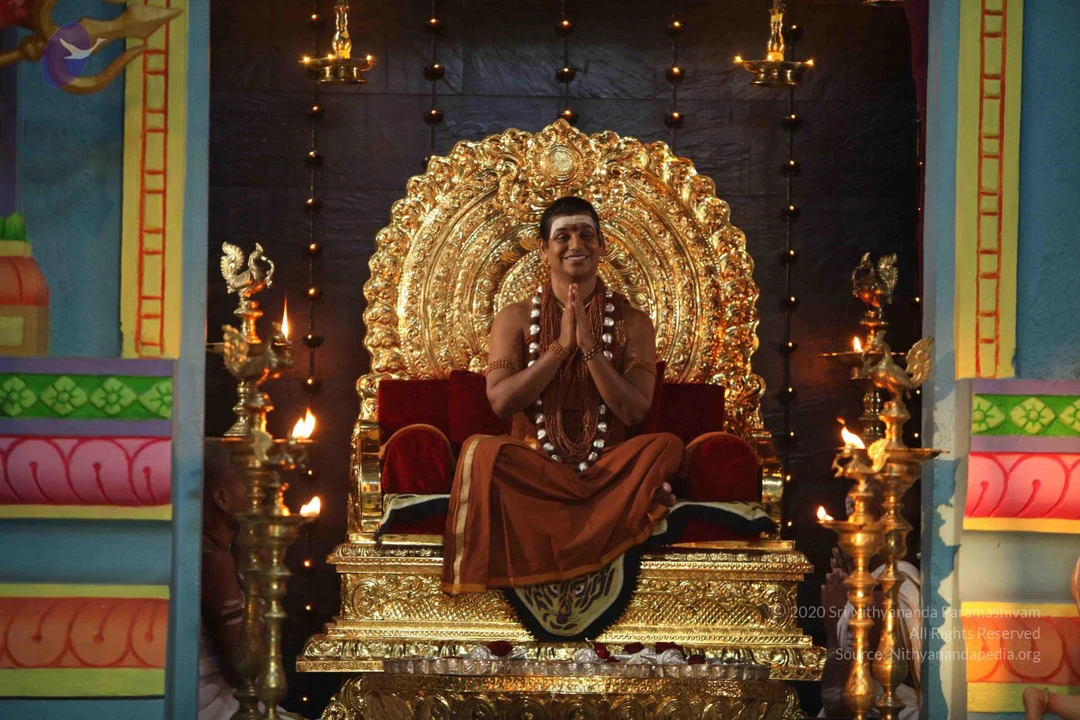
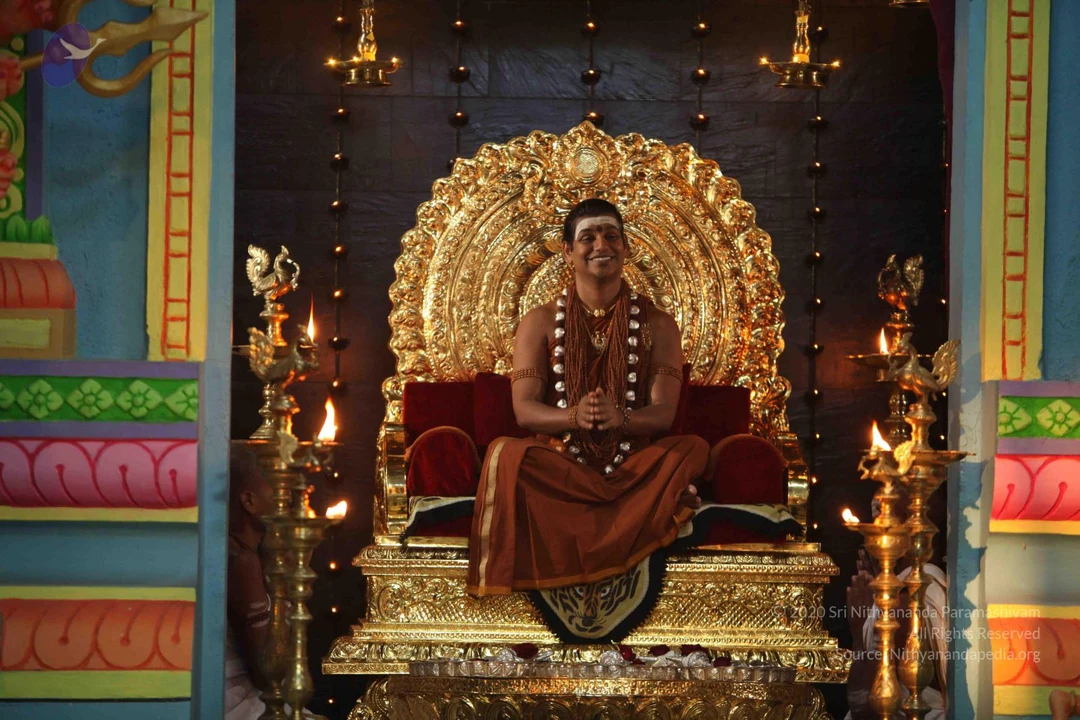
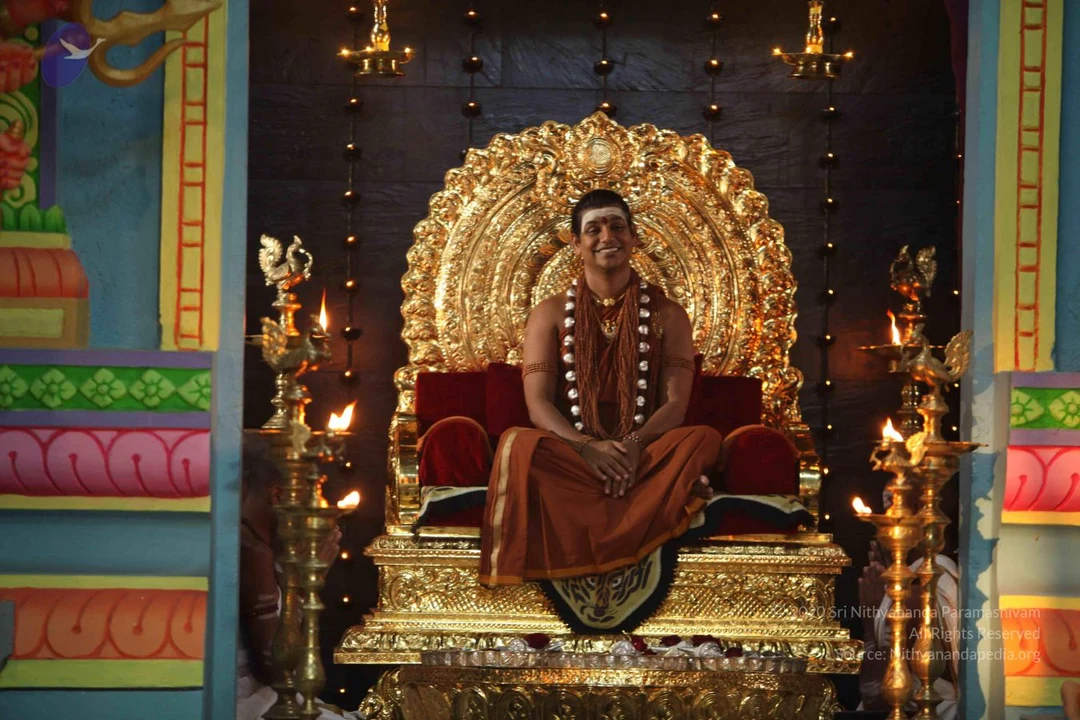
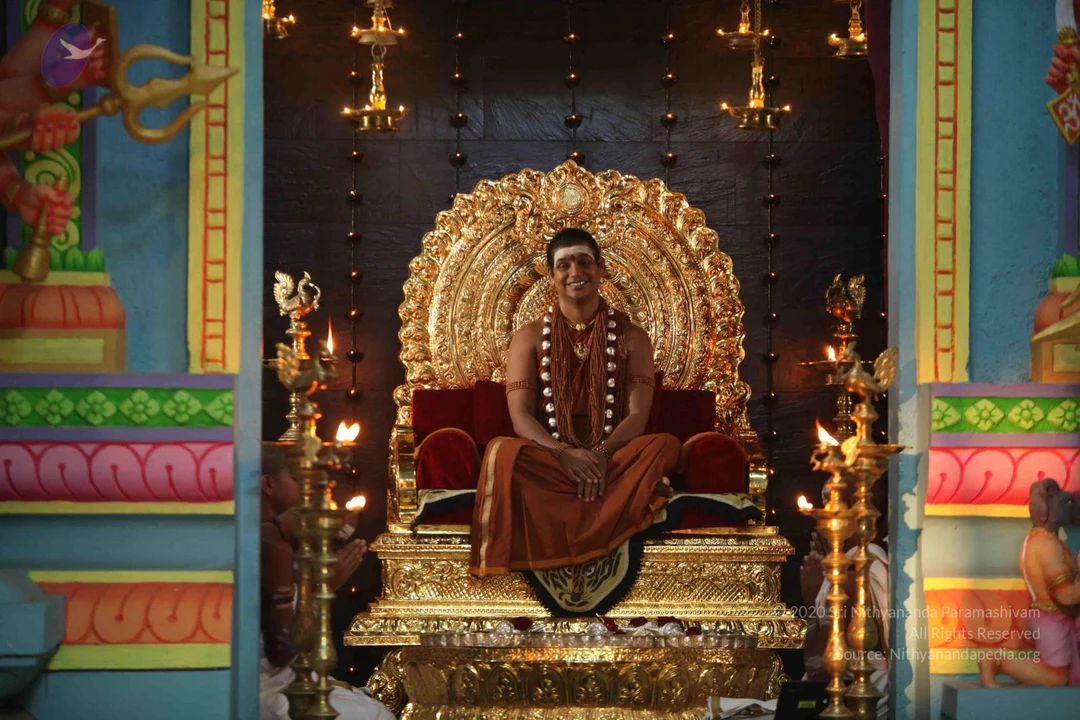
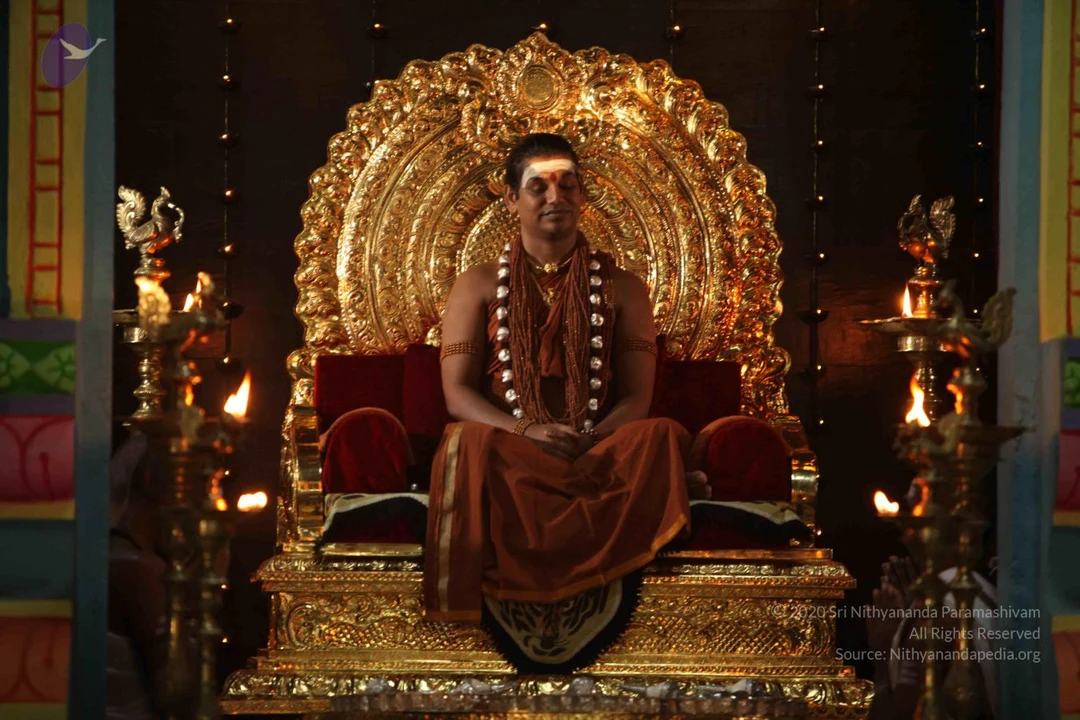
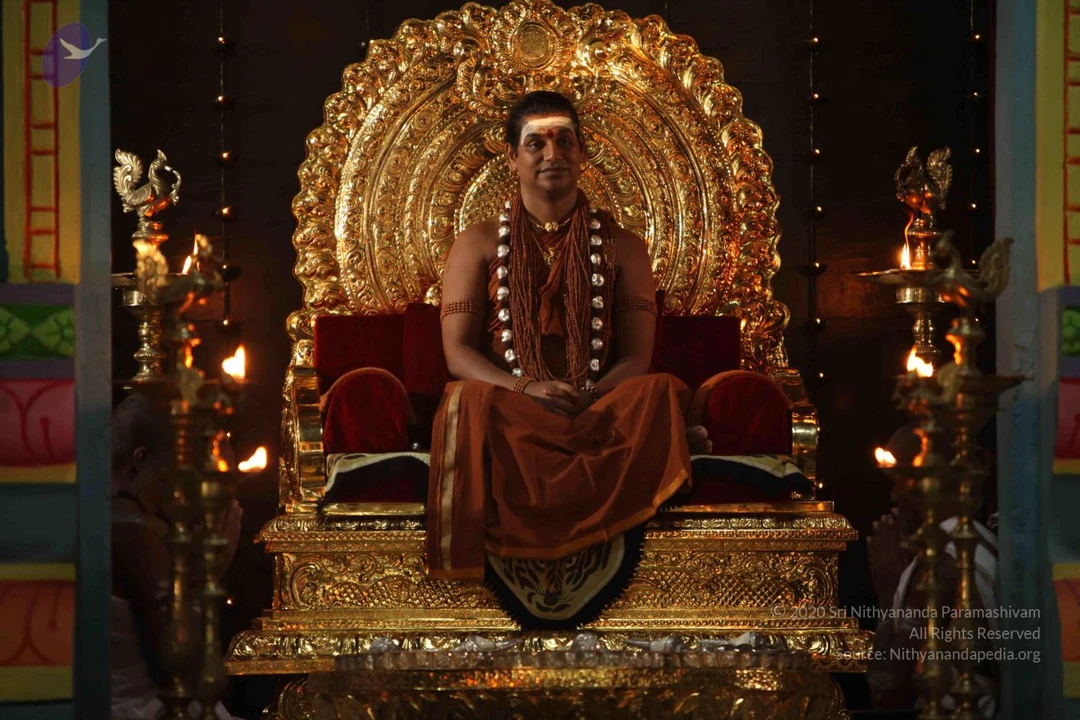
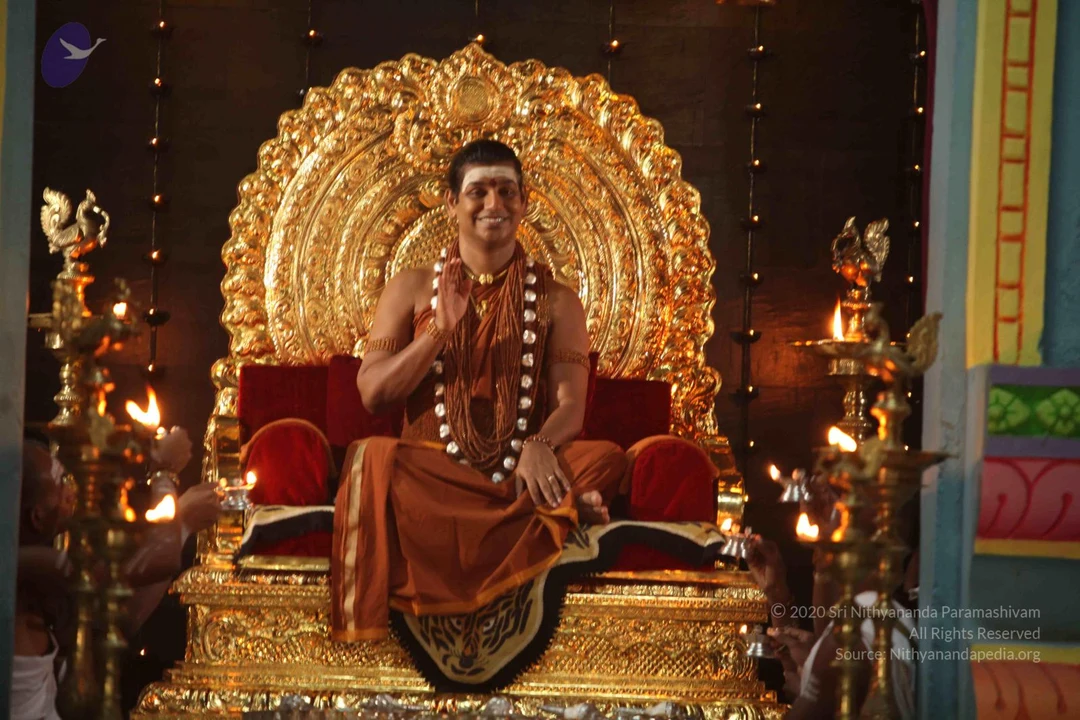
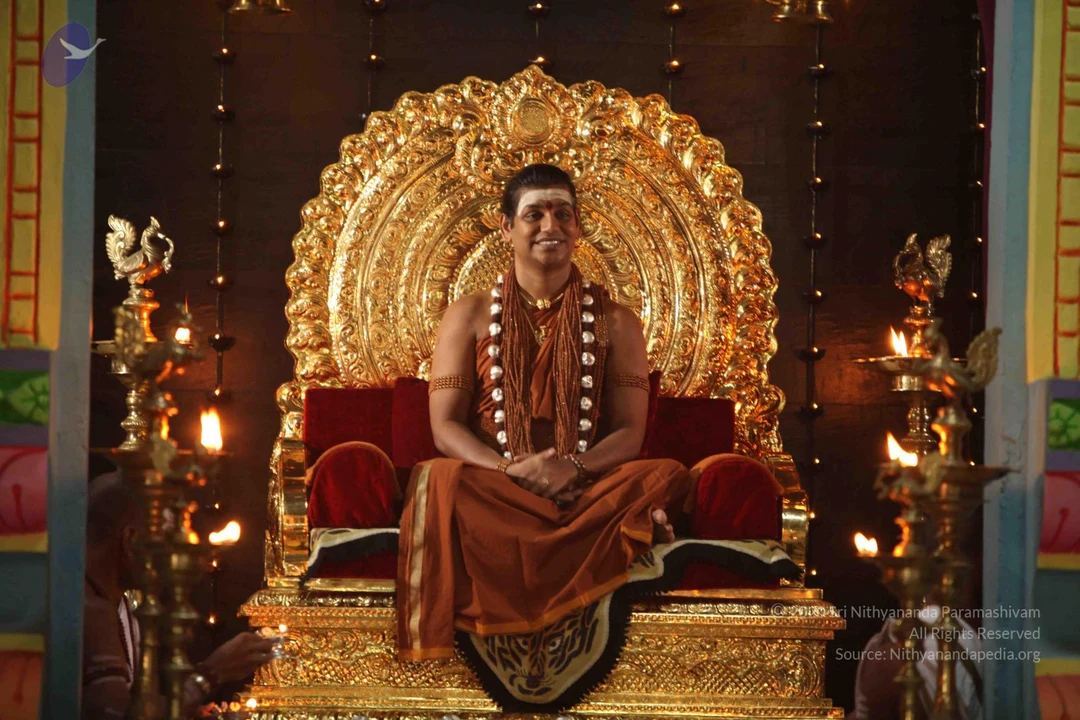
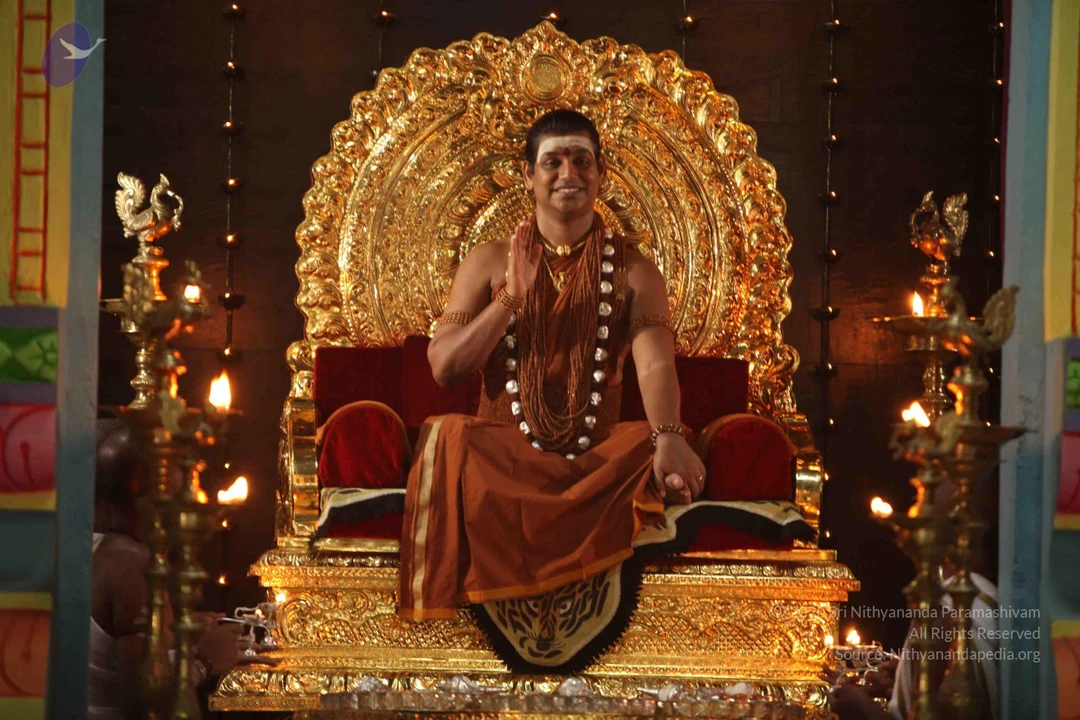
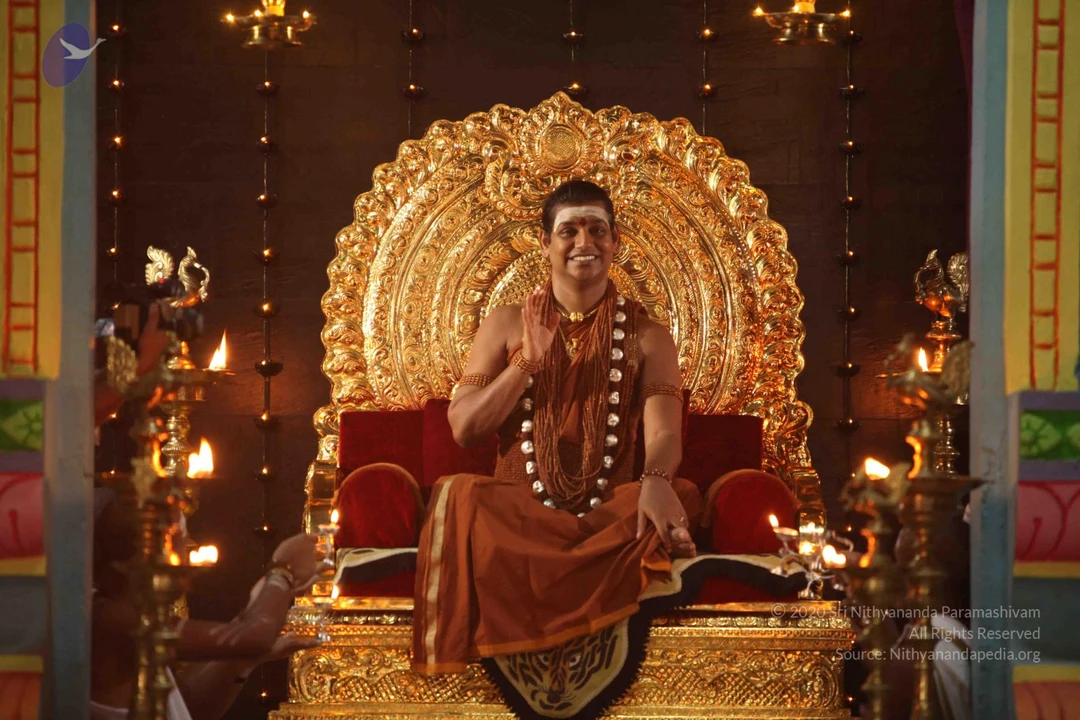
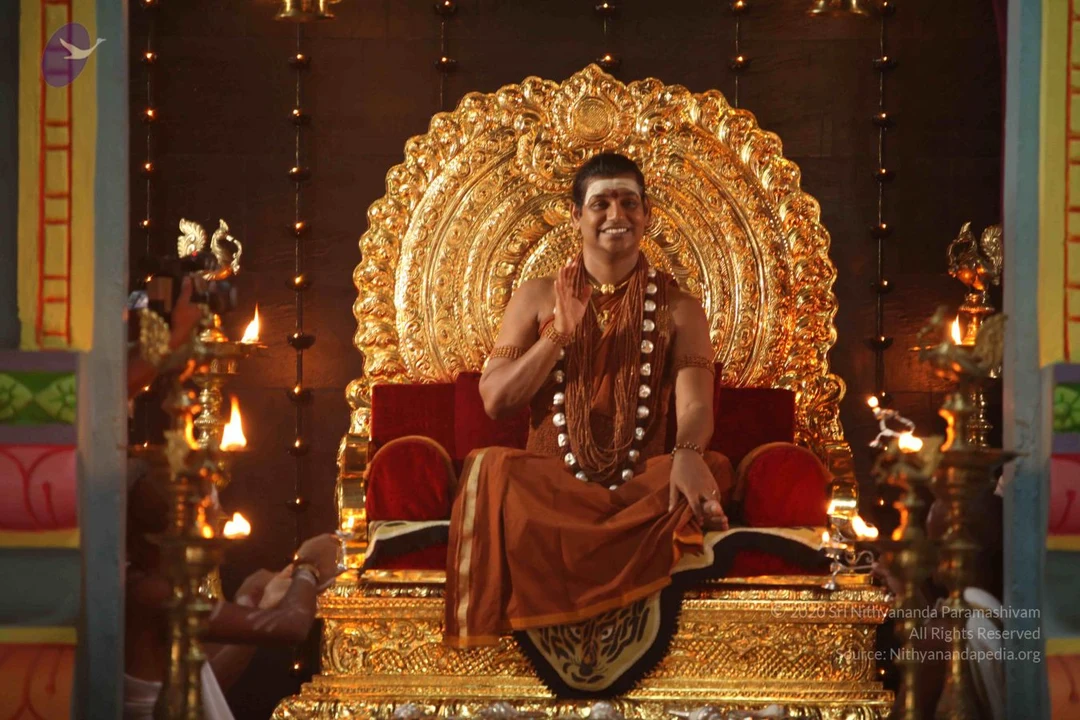
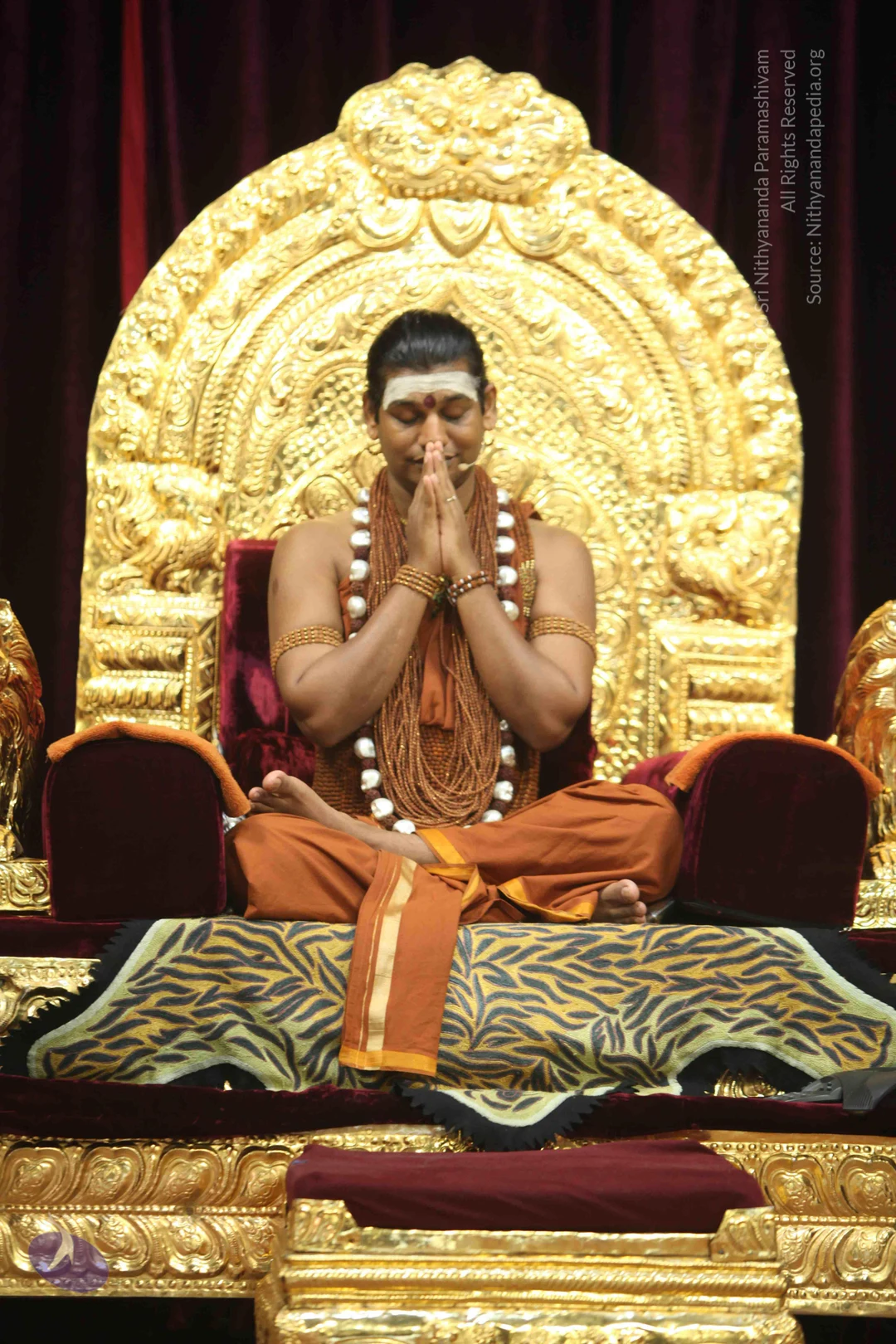
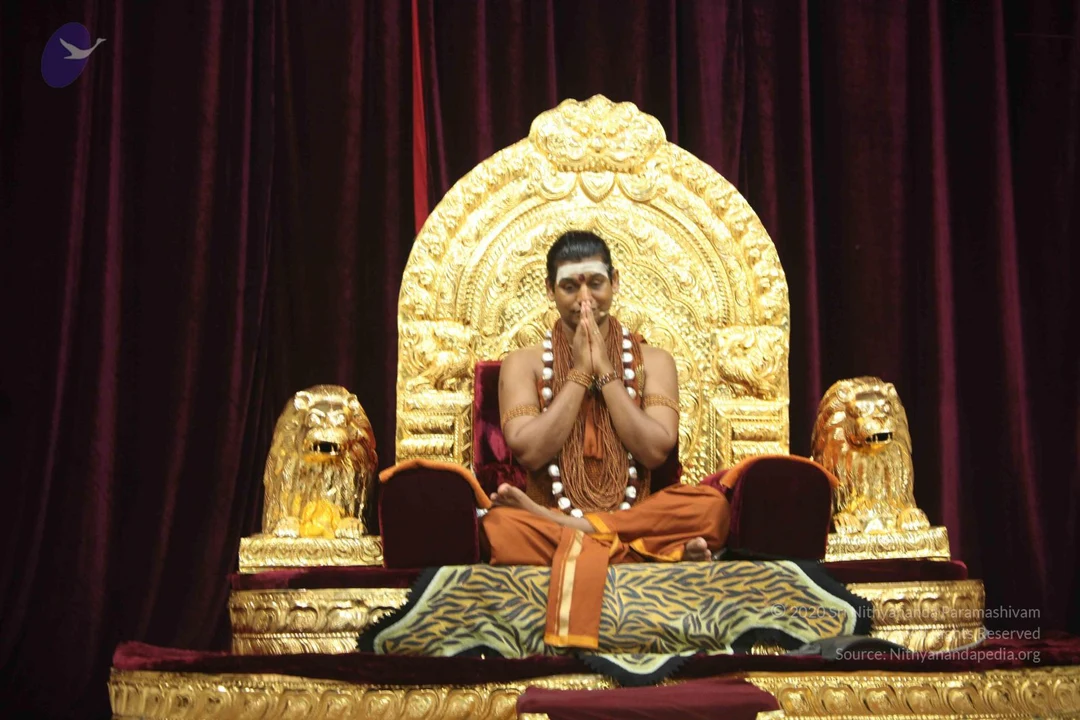
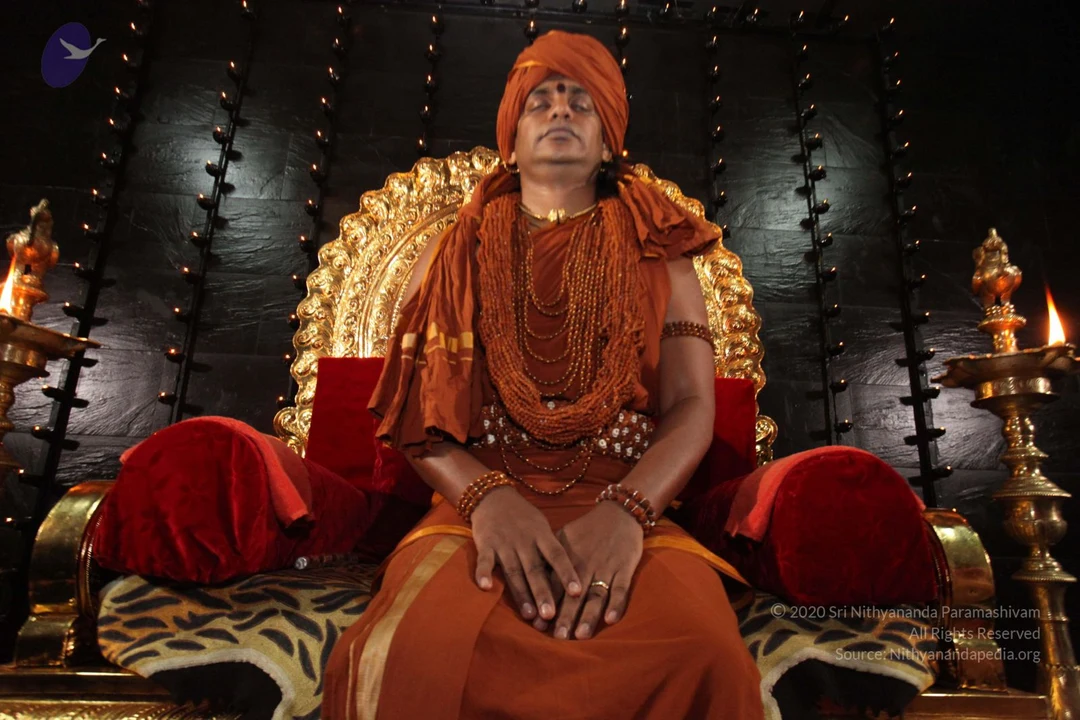
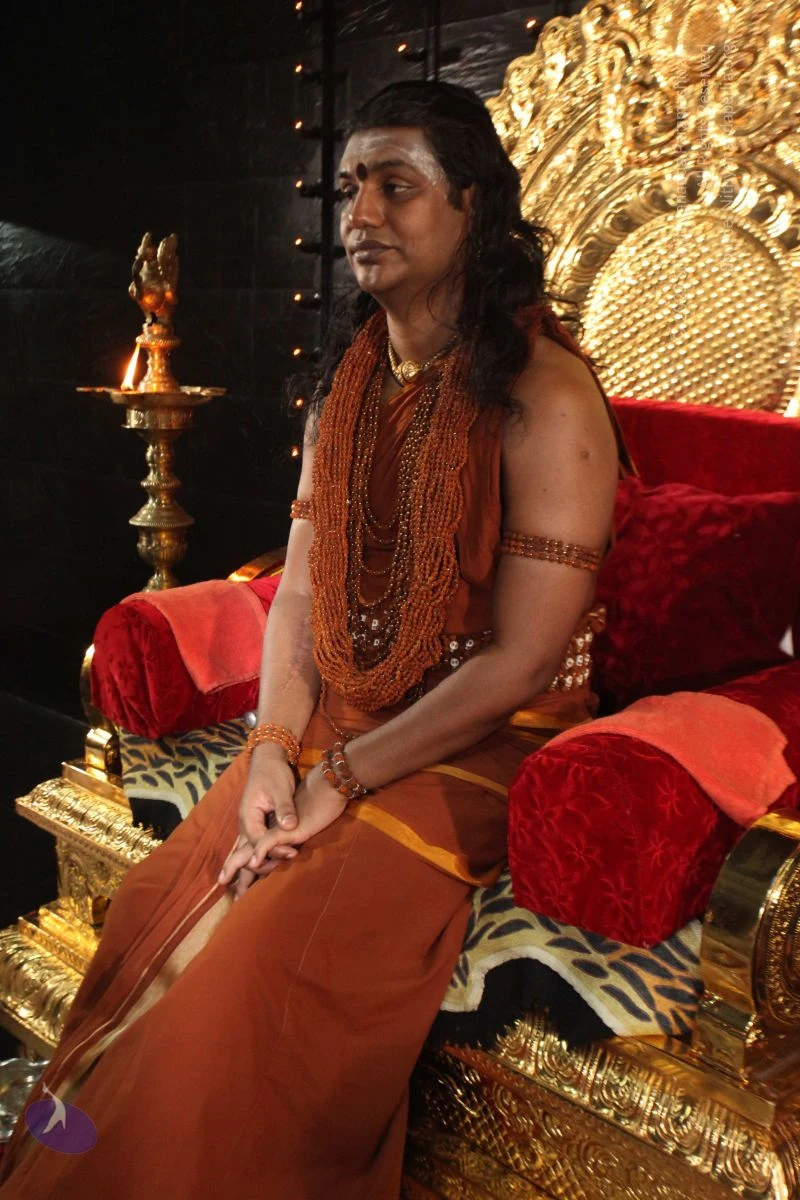
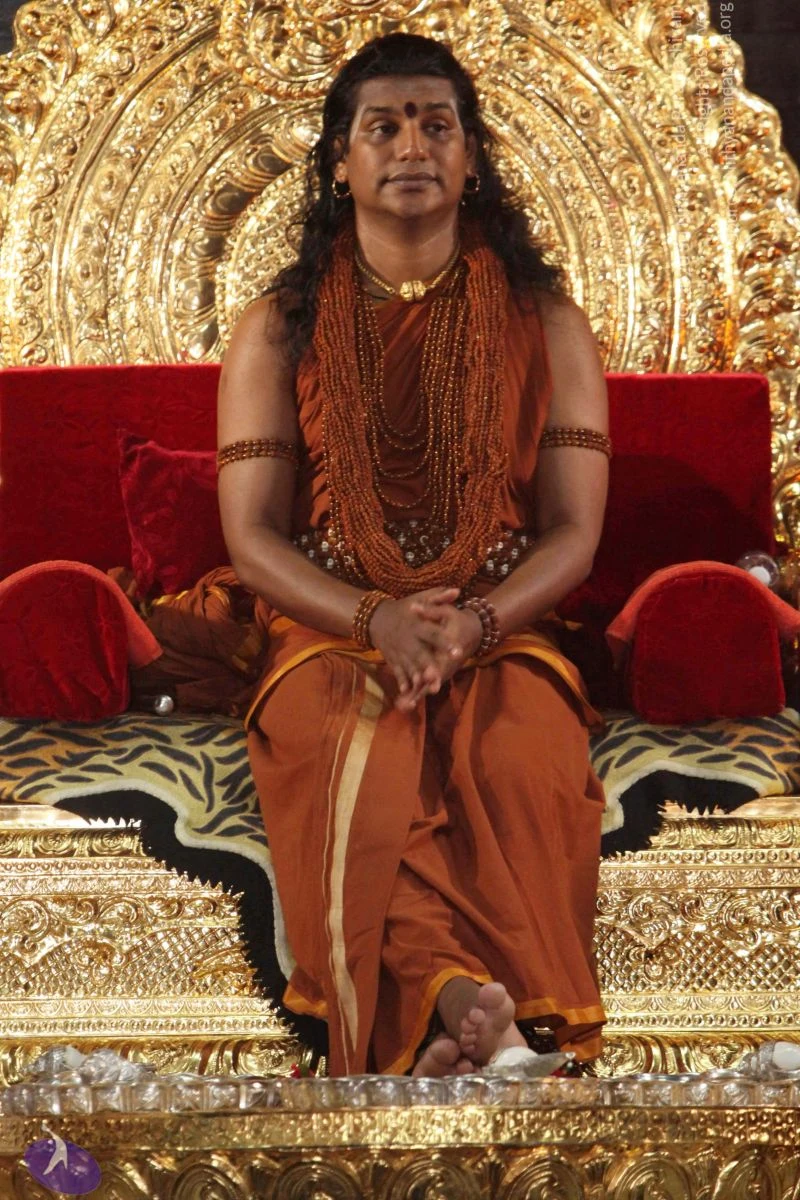
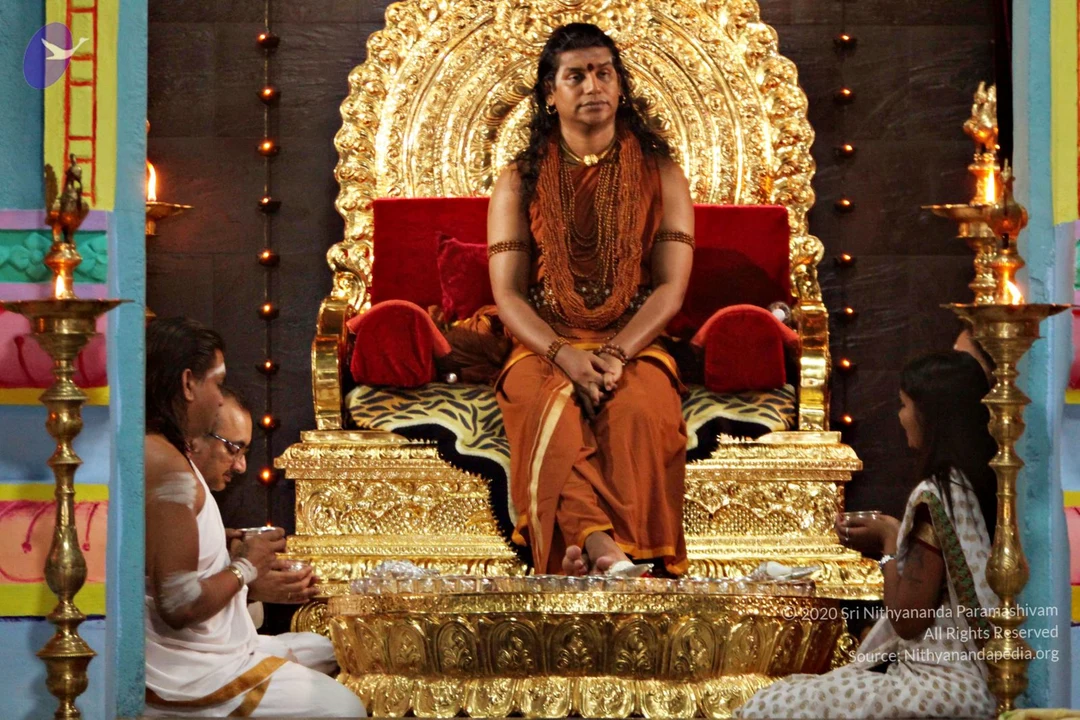
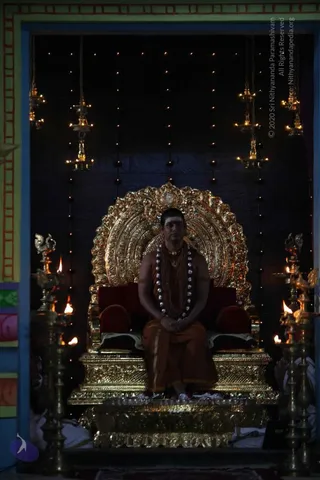
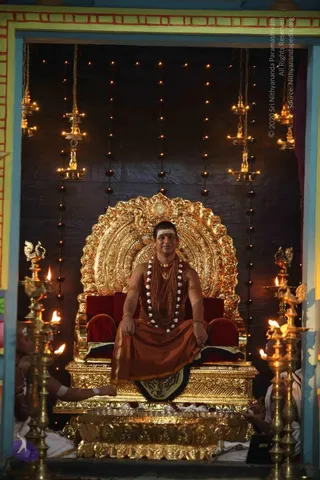
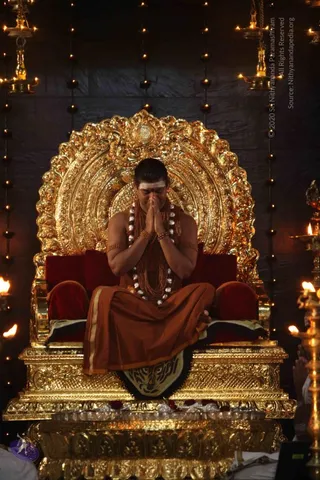
A man with a shaved head and ochre-orange dhoti and shawl sits on an ornate gilded throne with a large arched backrest and red cushions. He wears multiple strands of rudraksha beads and a white bead necklace, with bangles on his wrists. Brass oil lamps with lit flames stand on both sides and hang from the ceiling of a dark shrine-like space, with strings of dark beads draped across the back wall. Appearance-based candidate, a person seated in a throne position with rudraksha malas and saffron clothing, in a satsang setting. Pending people visible: a few partially visible devotees at the lower edges.A man seated cross-legged on an ornate gold throne with a large gilded back and red velvet cushions, hands folded in his lap, in a dark-walled hall. He wears an orange-saffron robe with a gold border, a multi-strand rudraksha mala and a white beaded garland, bangles on his upper arms, and a red-and-white tilak on his forehead. Brass oil lamps with lit flames stand on both sides and hang from the ceiling, with a string of dark beads hanging behind the throne. Seated devotees in white clothes are partly visible at the lower edges. Swamiji (probable) is the central figure, distinguished by the saffron robe, rudraksha mala, ornate gold throne and the swept-back hair visible in the scene.A photograph of a man seated on an ornate gold throne with a large gold arched backrest and red cushions, set in a shrine-like doorway framed by blue and yellow painted borders. He wears an orange-brown robe, a white-beaded and rudraksha-style garland, multiple rudraksha necklaces, gold bangles and a white forehead mark. Brass oil lamps with lit flames stand on both sides and hang from the top, and strings of dark beads decorate the back wall. Attendants in white clothes are partly visible at the lower left and right edges. The throne sits on a gold pedestal with flower offerings. a person is seated in the centre, with the same cues of rudraksha malas and ornate clothing.A seated figure in saffron-orange robes with a white flower garland and a rudraksha-style necklace sits with palms pressed together in namaskar on an ornate gilded throne with a red cushioned back. Behind the throne hangs a dark wooden backdrop strung with beaded lines, and brass hanging oil lamps descend from the top corners. Lit brass oil lamps stand on both sides of the throne, with a small brass lamp in the lower left corner. A gilded base sits below the throne. Partially visible seated people in white clothing appear at the lower edges.A seated man on an ornate gold throne with a large golden halo-style backrest and red velvet cushions, raising his right hand in a blessing gesture. He wears an orange-saffron dhoti and shawl, a rudraksha mala with a multi-strand orange-brown bead necklace, and a white bead garland, with white tripundra markings on his forehead and gold armlets. Brass lamps with flaming wicks stand on both sides of the throne, and a tiger-striped cloth covers the lower dais. a person seated in a ceremonial setting. Two partially visible attendants sit at the edges of the frame.

Nithya-Satsang
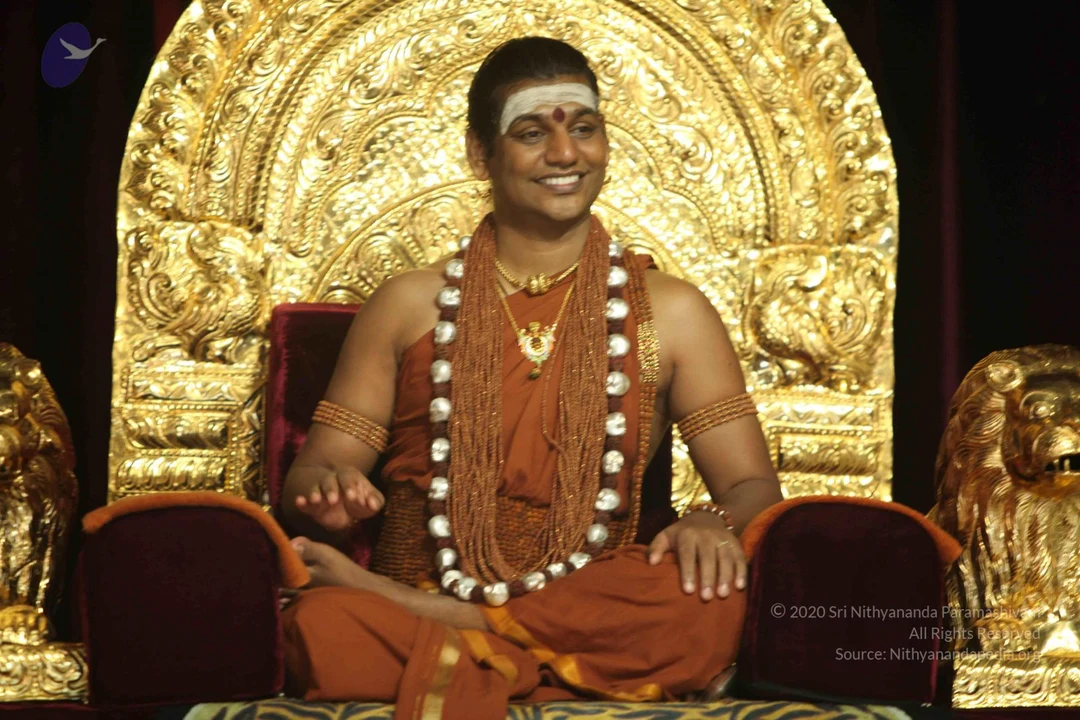
190 photosSource gallery
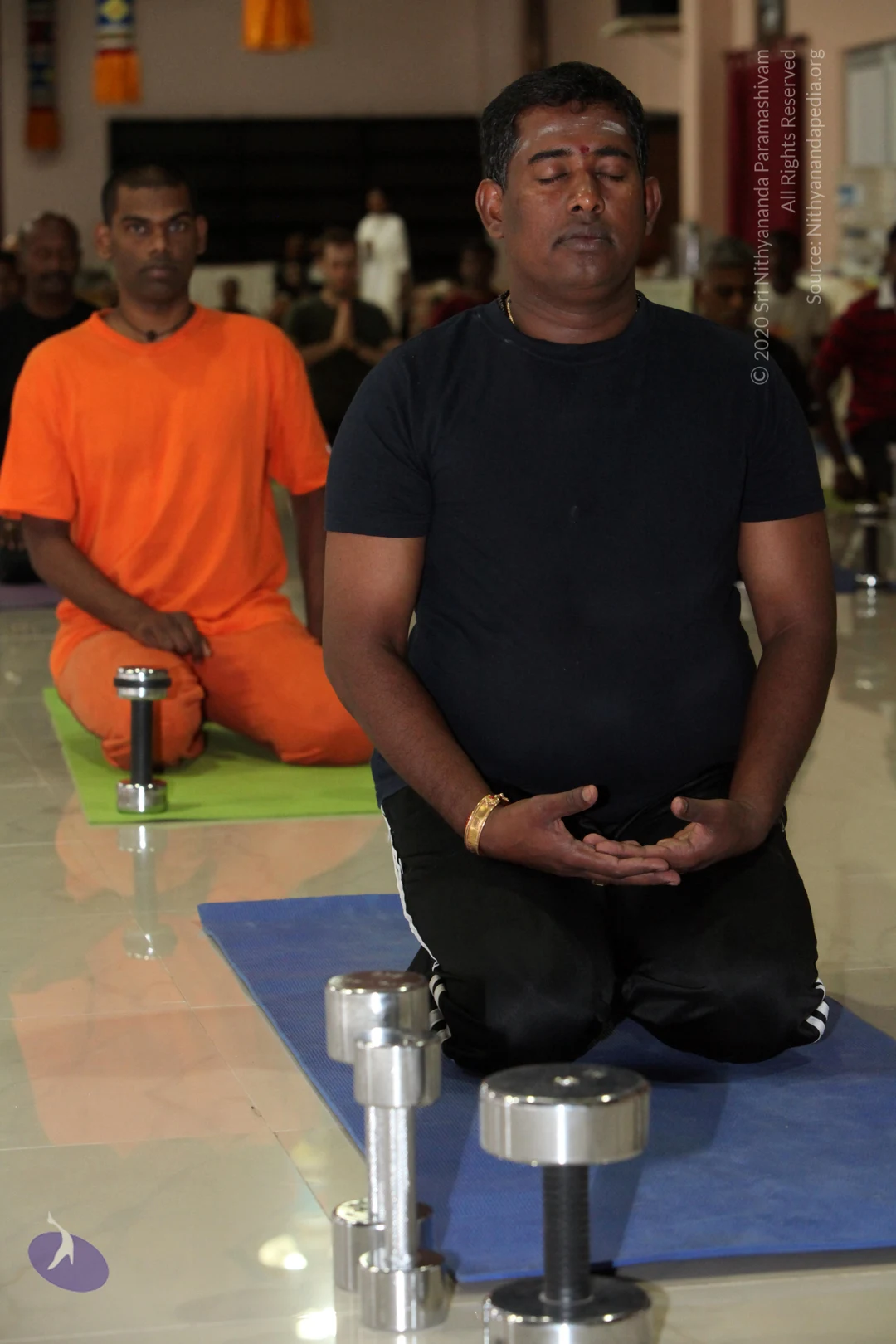
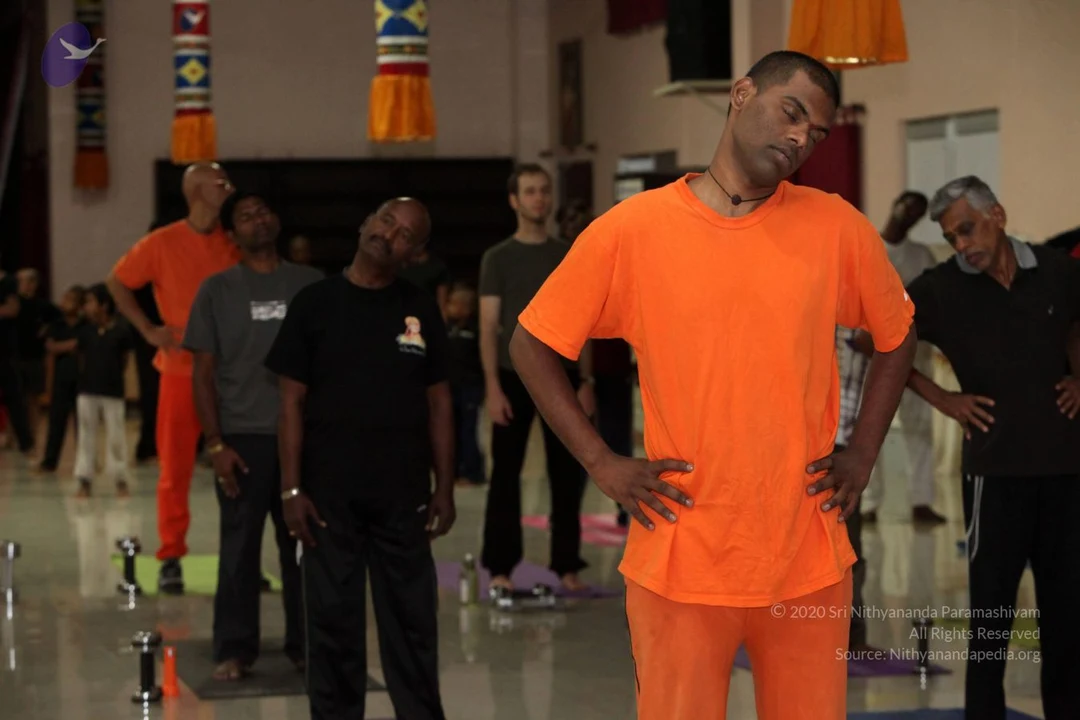
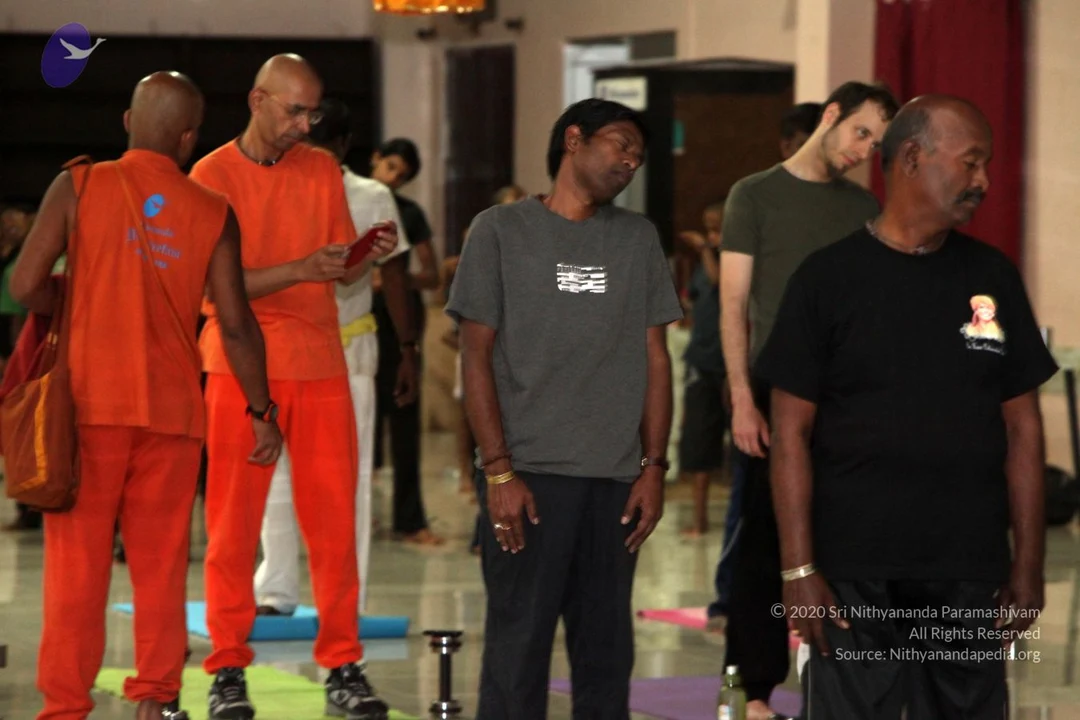
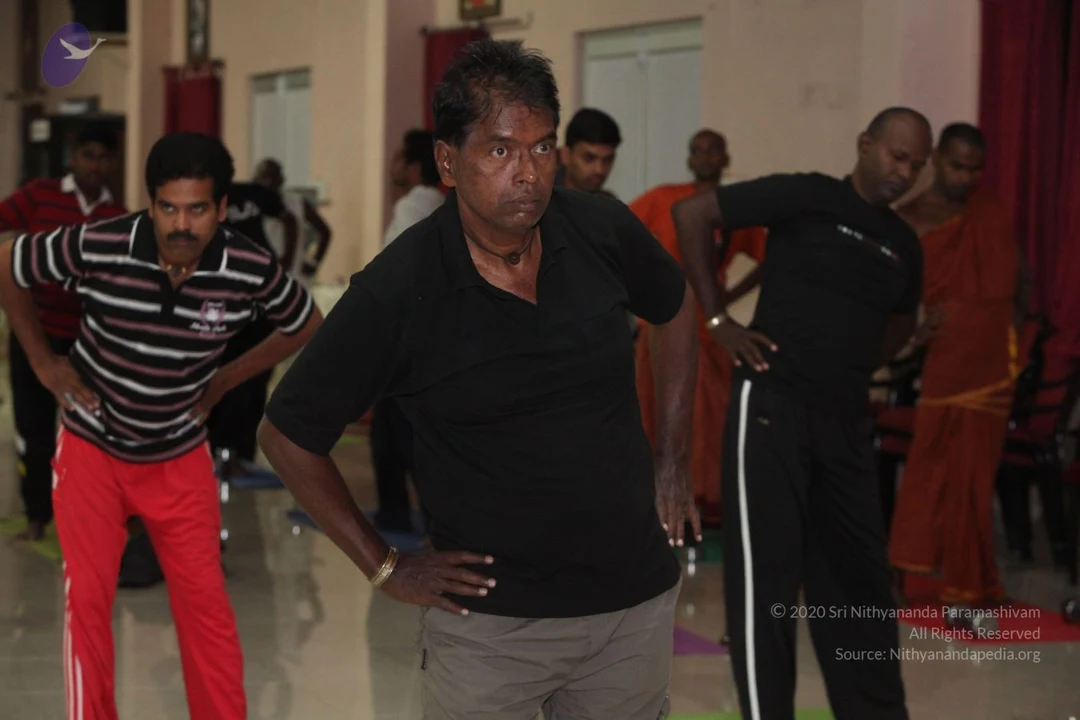
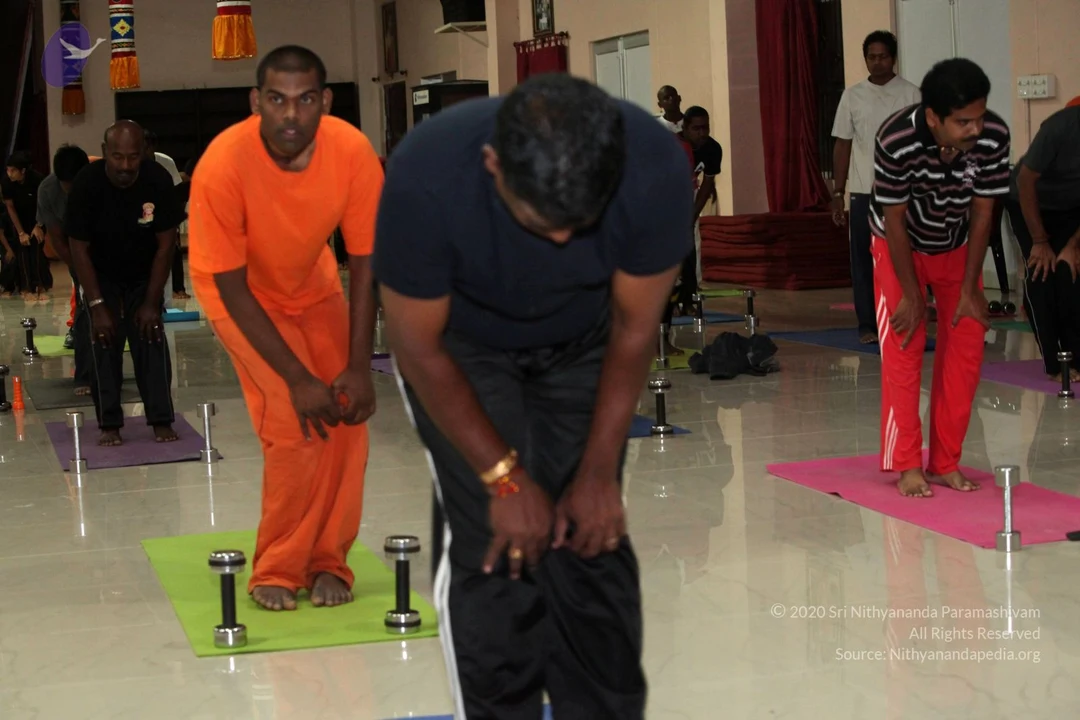
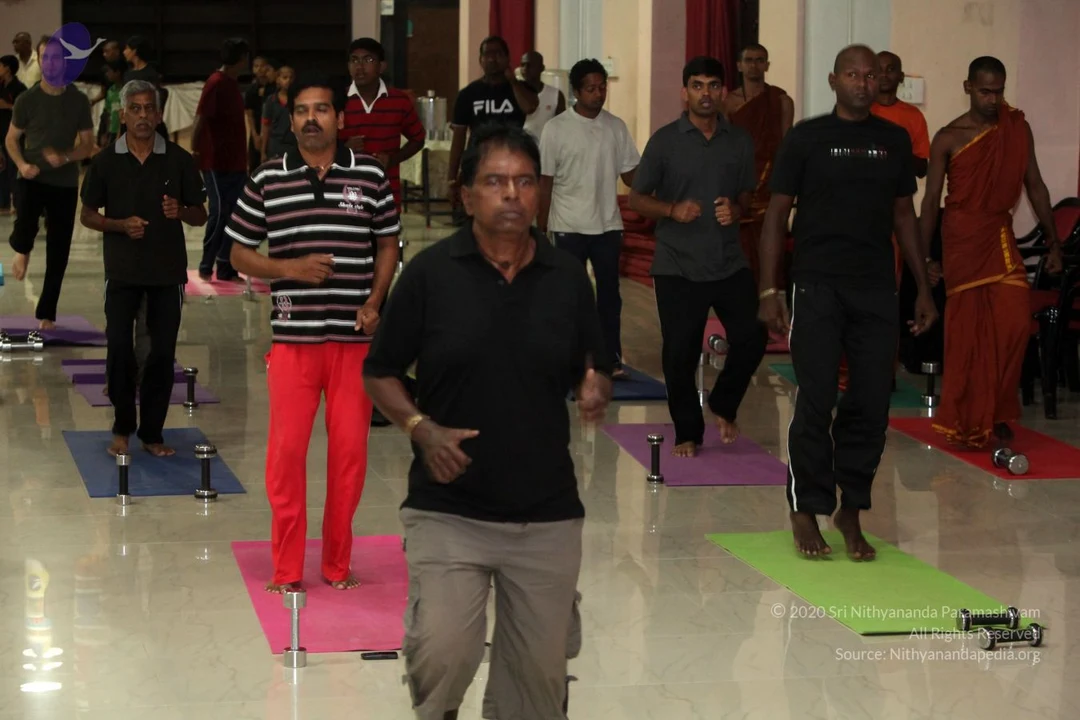
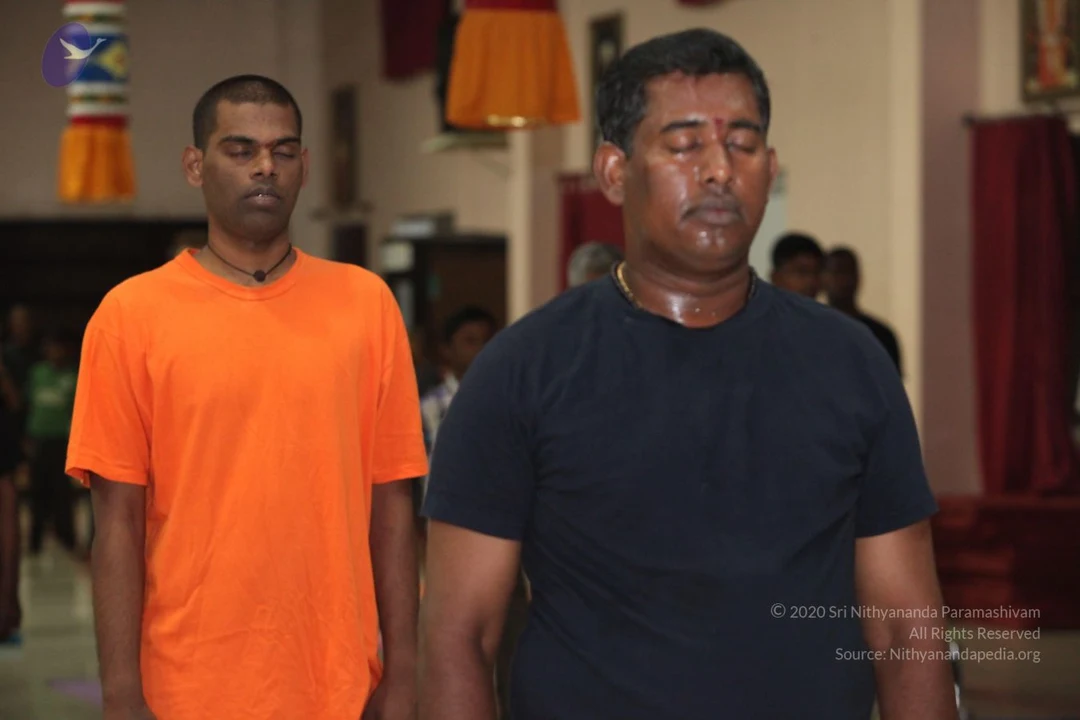
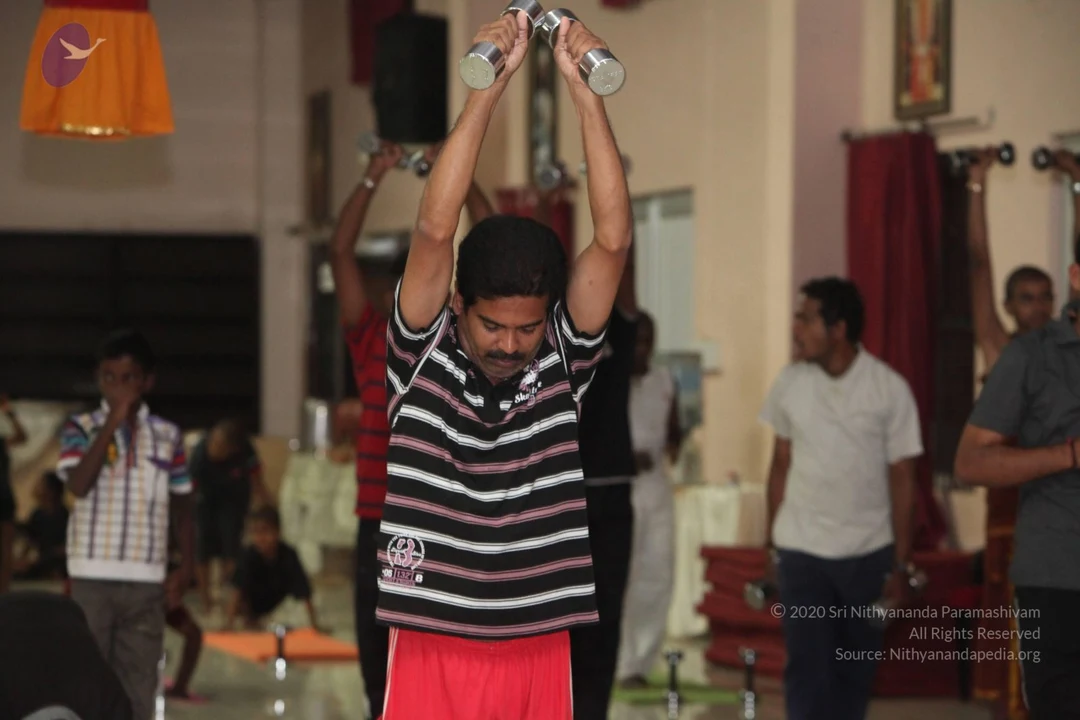
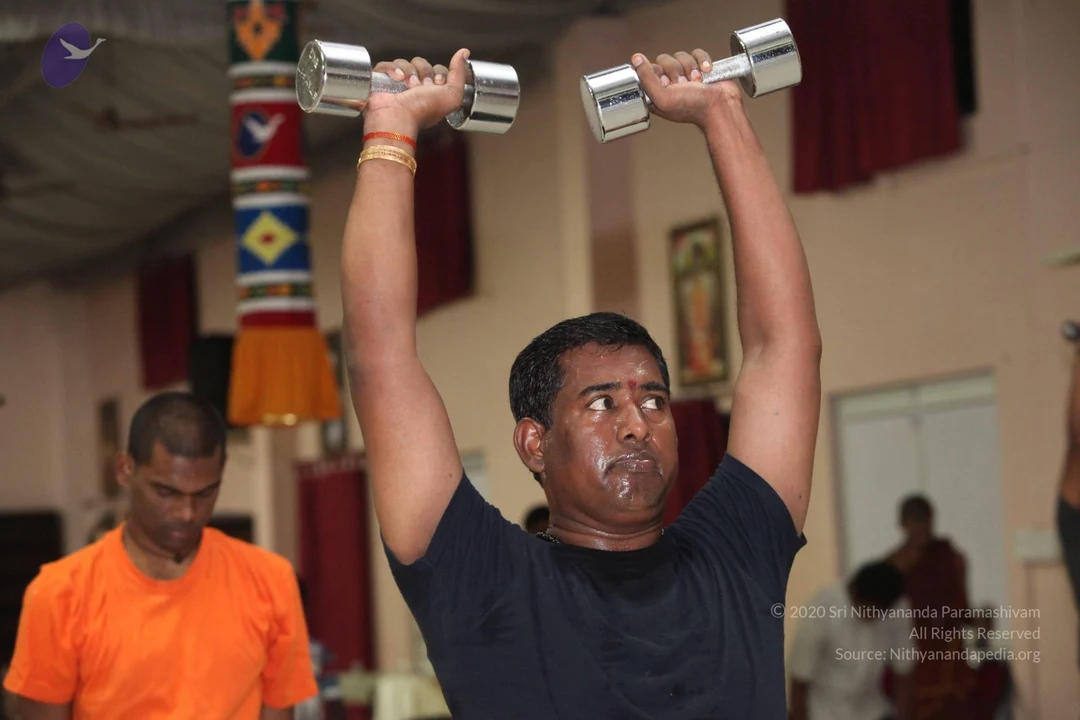
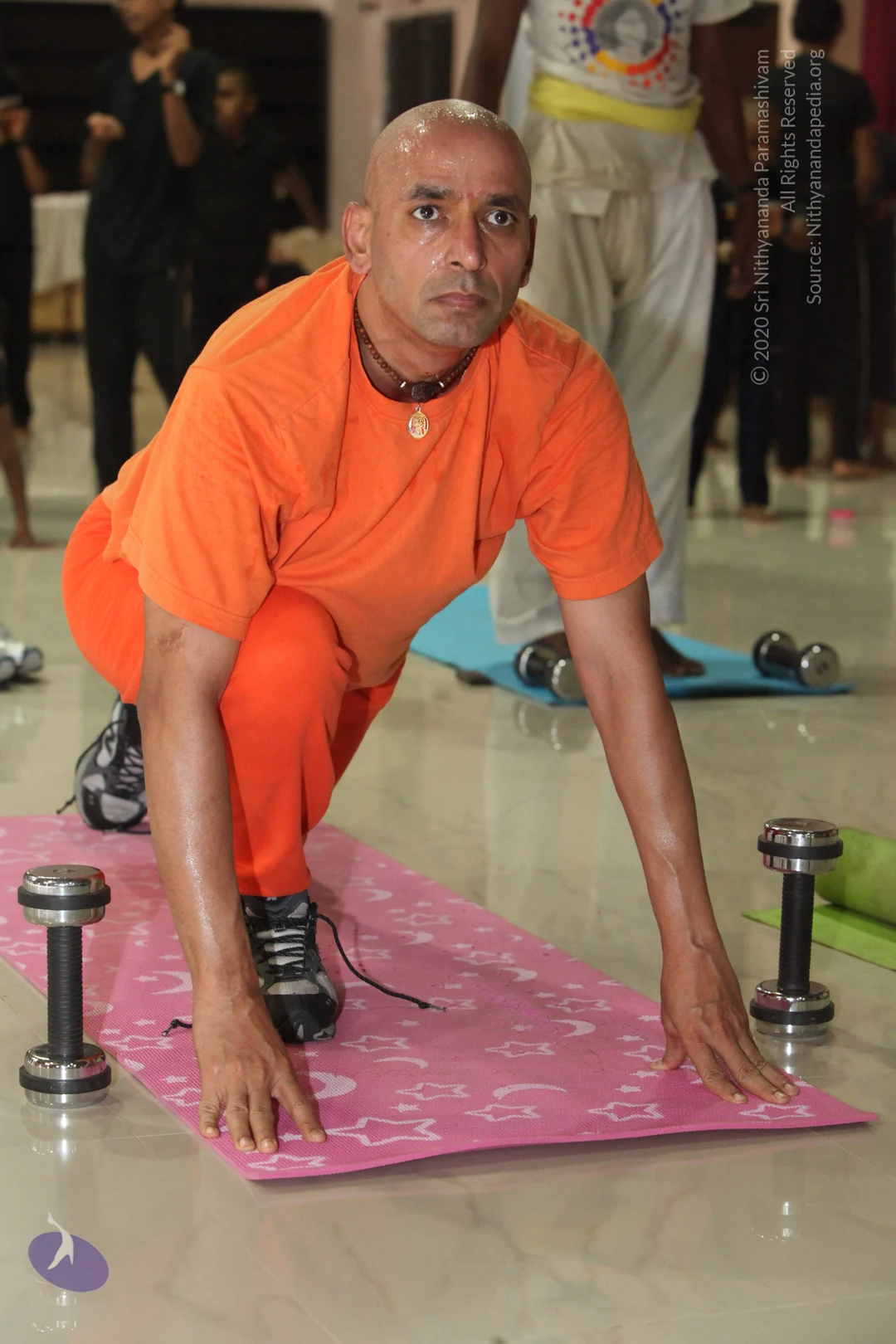
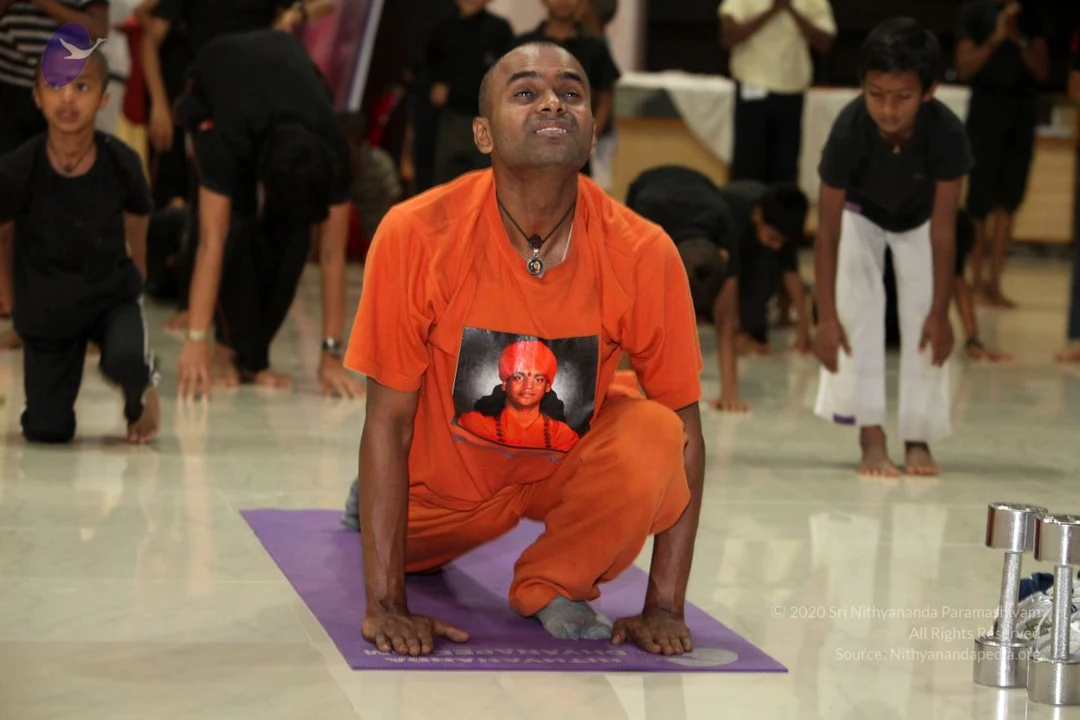
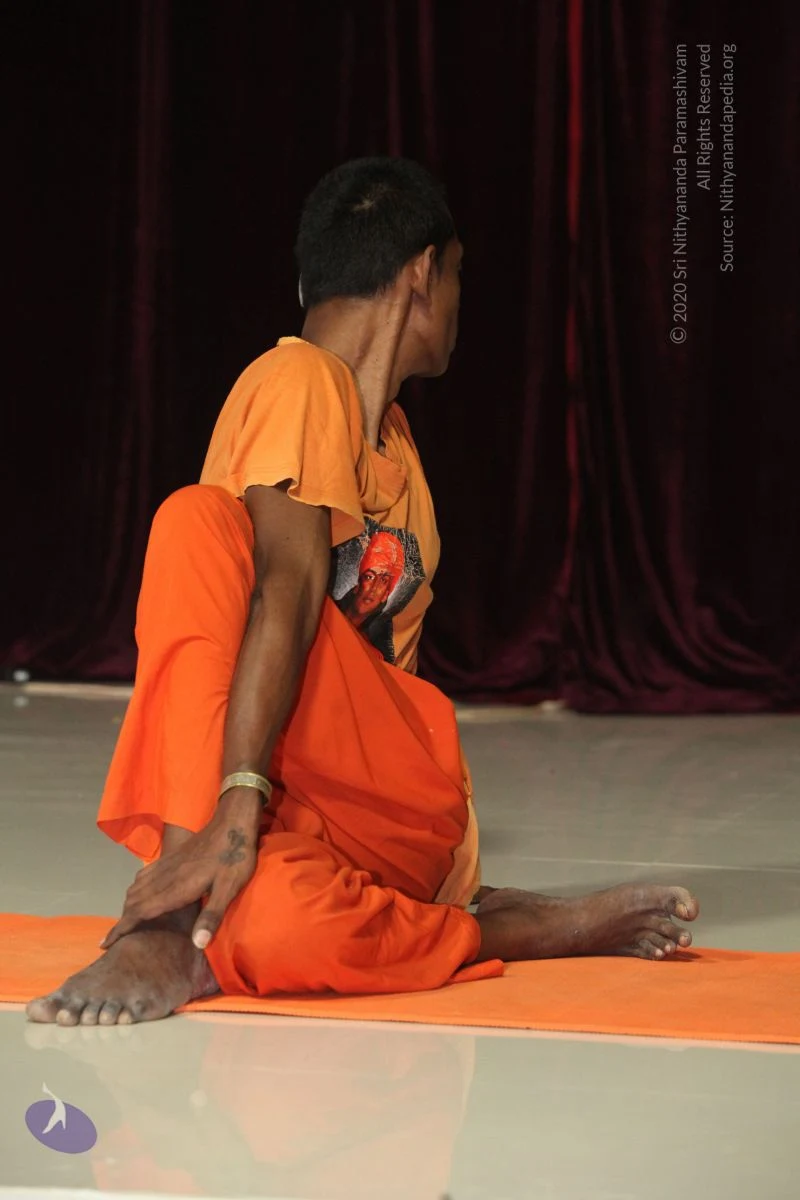
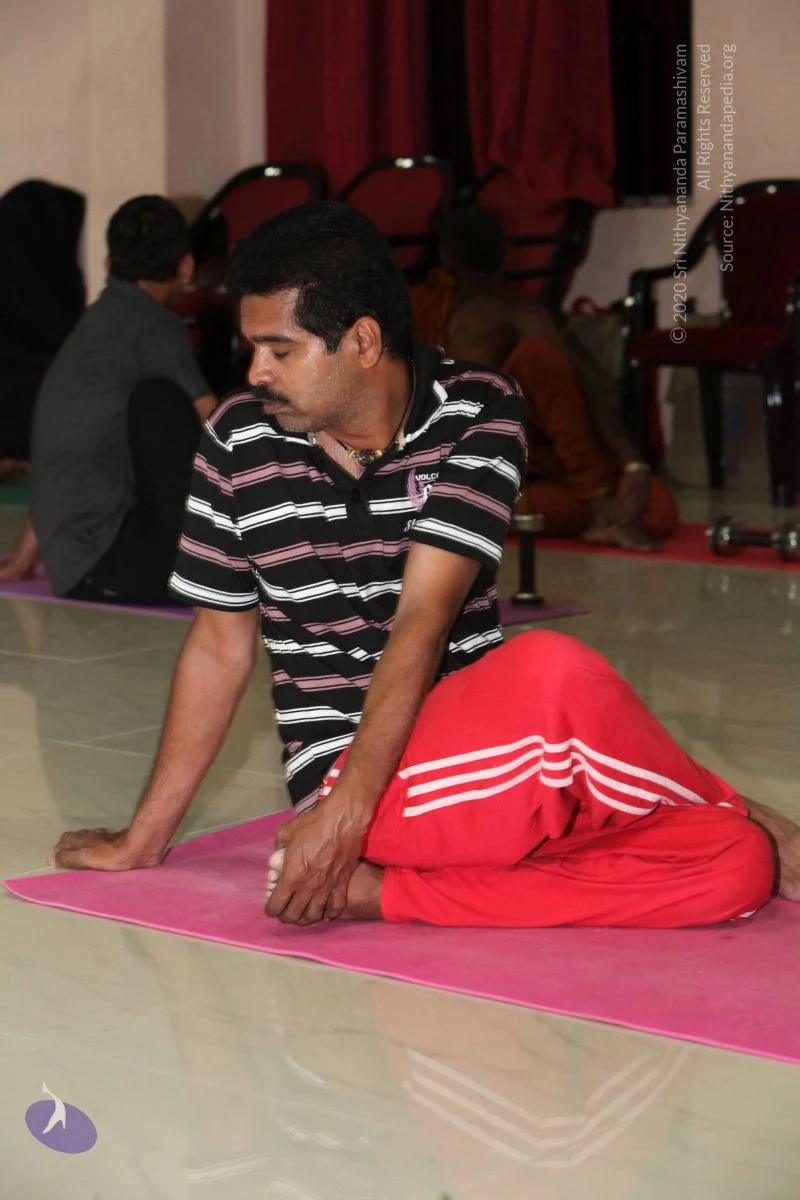
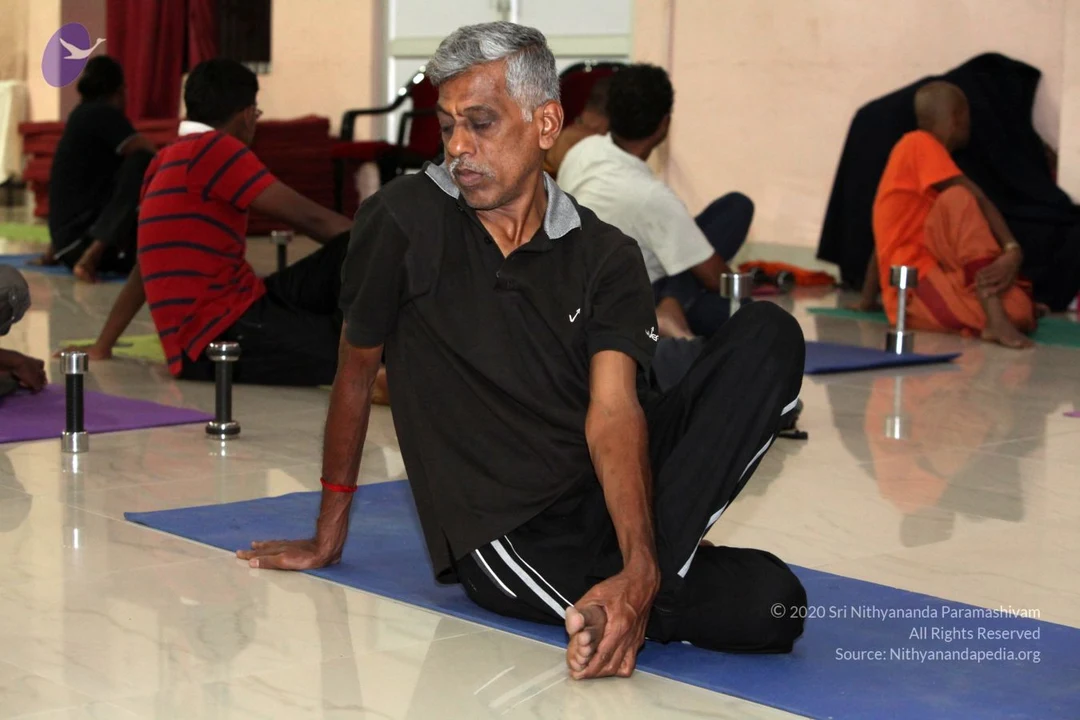
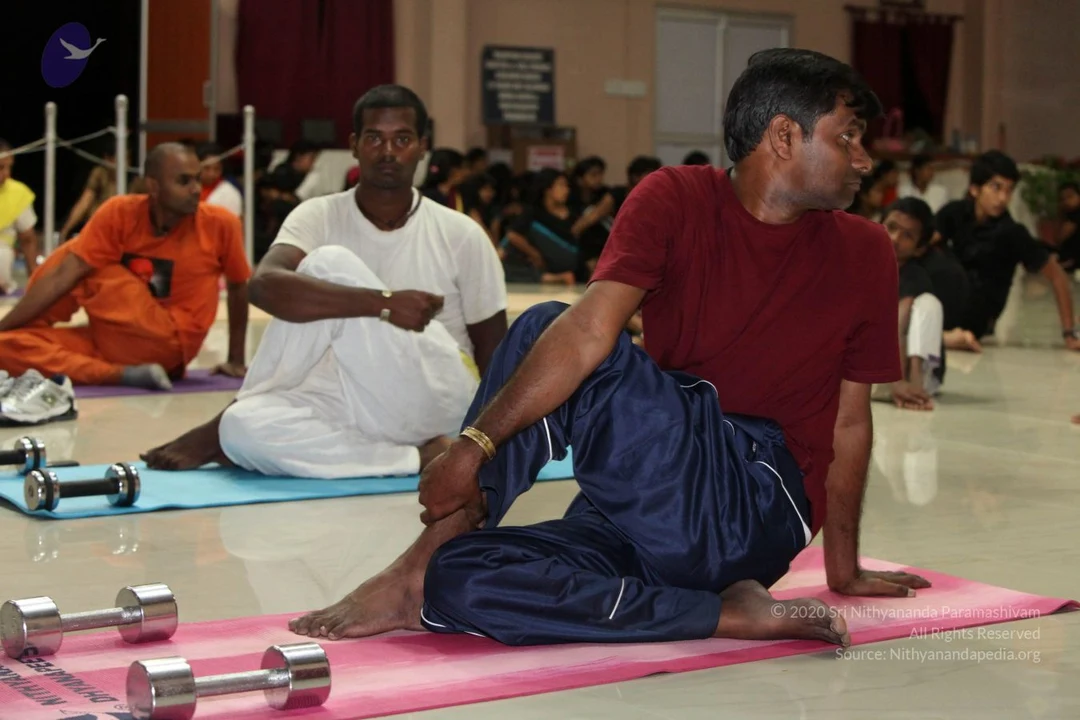
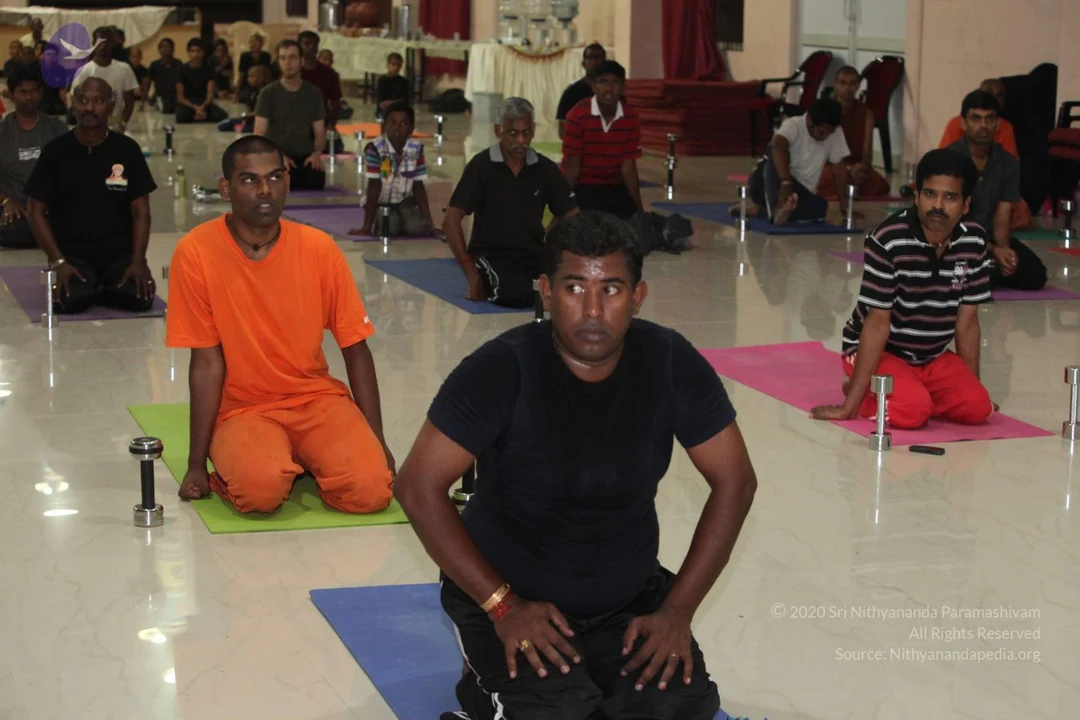
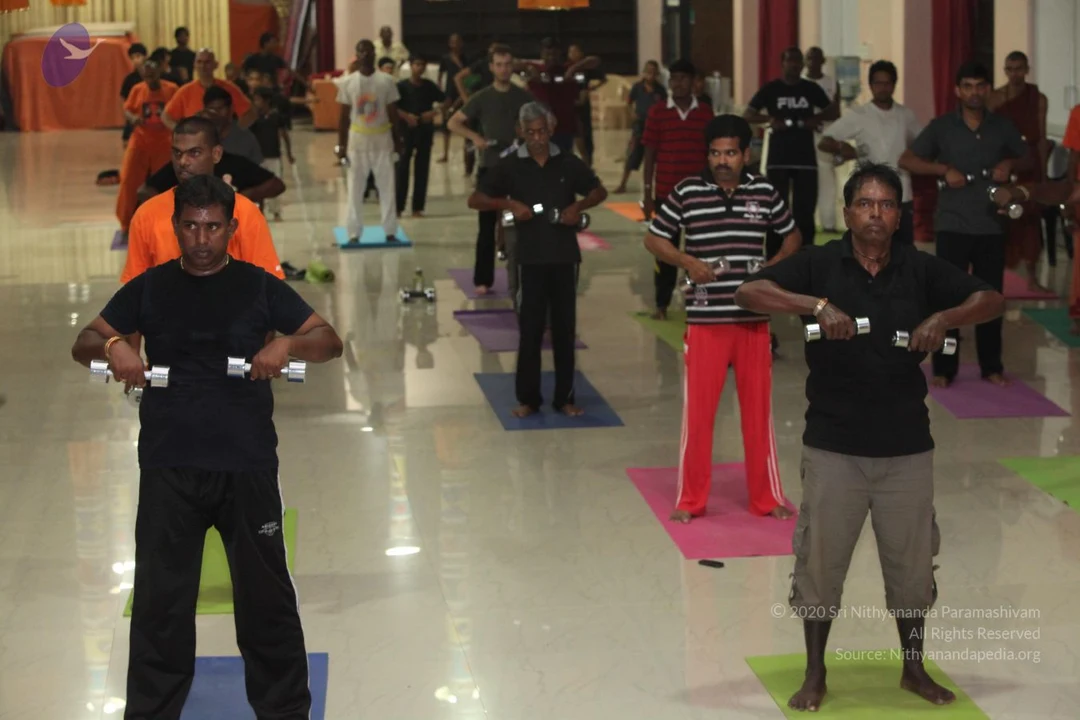
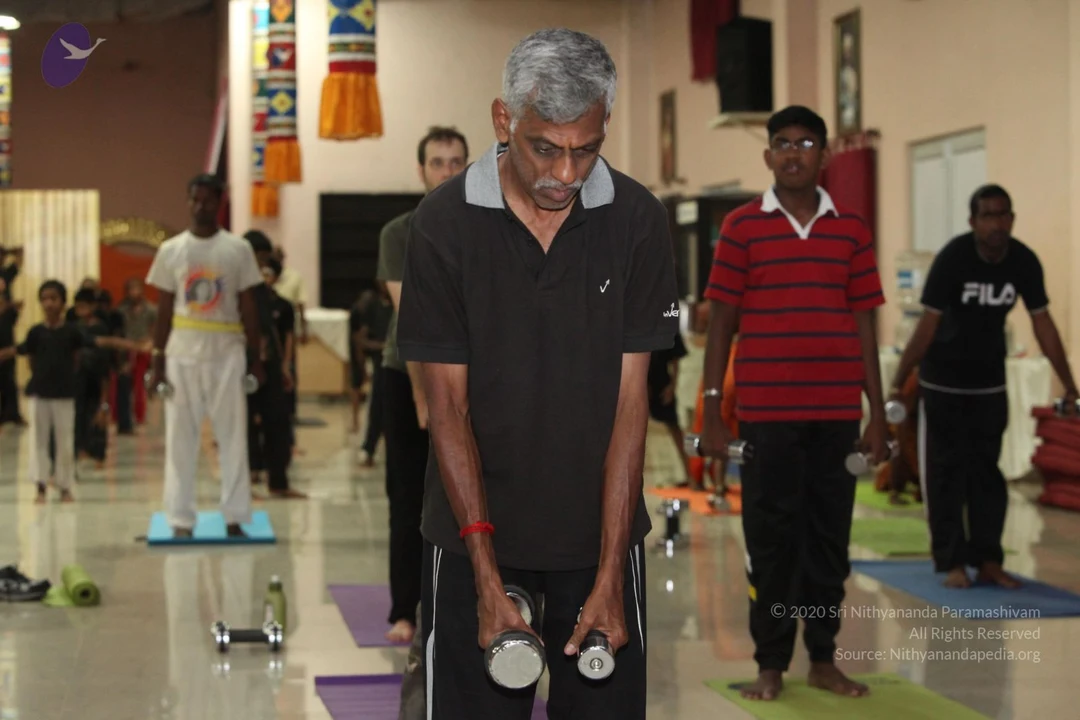
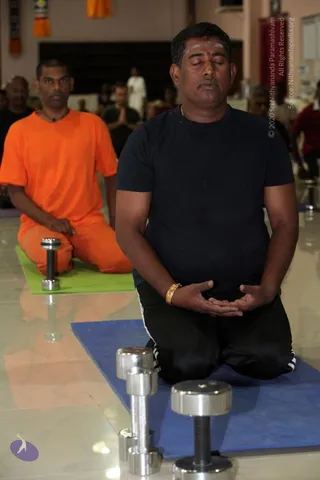
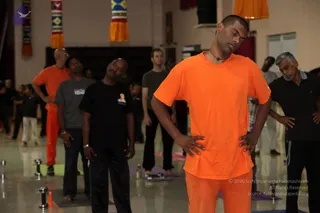
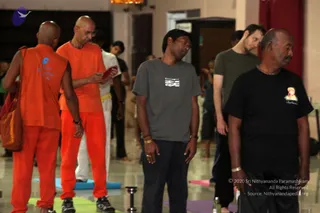
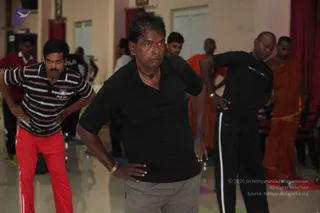
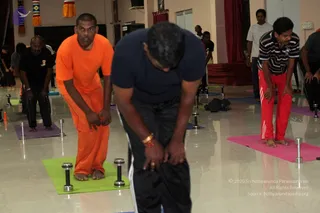
A photograph of a meditation session in a bright hall with polished marble floors. In the foreground a man in a black t-shirt and black track pants with white side stripes kneels on a blue mat, eyes closed, palms resting together in his lap, with a red tilak on his forehead and a gold bracelet on his wrist. Behind him, a man in an bright orange t-shirt and orange trousers kneels on a green mat beside a chrome dumbbell. Further back, blurred figures in dark clothing sit in rows, one with hands in anjali mudra, and a person in white stands near the back. Hanging orange and yellow banners decorate the upper left. Silver dumbbells sit in the foreground. Watermarked copyright text runs down the right edge, which is not transcribed.Indoor group yoga or meditation session in a hall with pink walls, red curtains and a glossy tiled floor. A man in a white hooded zip-up jacket with grey trim stands centrally, head tilted up, eyes closed, with his hair tied back. Around him, participants on green and pink yoga mats wear black shirts and track pants, while others wear orange and maroon clothing. Some stand with eyes lifted upward. A hanging orange and red banner is visible at the upper left. Appearance-based label: a person, the white-clad man in the centre, identified by his tied hair and white ceremonial-style attire; the page describes him as present at a satsang.A photograph of a yoga session in a bright hall with polished floor and hanging orange, yellow and blue fabric banners. In the foreground a man in an orange t-shirt and orange track pants stands with hands on hips, head tilted to one side with eyes closed, wearing a thin dark cord necklace. Behind him several men in black and grey clothing and orange outfits stand in a row on mats, mirroring the side-bend stretch, with a few more people blurred in the background. Metal stanchions and a small orange cone are visible on the floor.Indoor photo of a yoga or meditation session on a polished tiled floor. In the foreground, a man in a grey t-shirt and dark trousers stands with head bowed and eyes closed, hands at his sides. Beside him, a man in a black t-shirt with a printed portrait and a silver bracelet stands with head lowered. Behind them a man in an olive green t-shirt stands with head tilted, and two monks in saffron-orange robes stand at left, one holding a red phone or booklet. Blue and green exercise mats lie on the floor, with a water bottle and a ceremonial-looking metal stand near the edge. Several other participants stand in the background.Indoor yoga or exercise session in a hall with cream walls, red curtains and tiled floor. Several men stand in a stretching pose with hands on hips, including a central man in a black polo shirt and grey trousers and a man in a striped black-and-white polo with red track pants. On the right, a man in black athletic wear stands beside a monk in orange-saffron robes. Other participants stand behind, some in orange robes. Coloured exercise mats lie on the floor.A group exercise session in a bright marble-floored hall with maroon curtains and hanging decorations at the top left. Several men stand on coloured exercise mats (green, purple, pink) beside silver dumbbells, bending forward at the waist with hands near their knees. The man in front wears a dark navy t-shirt, black track pants with white stripes and a gold bracelet. Beside him stands a man in an orange t-shirt and orange trousers, also bent forward. At the right, a man wears a striped polo shirt and red track pants. Other participants and onlookers stand in the background.

Tamil-IA-Session1

9 photosSource gallery
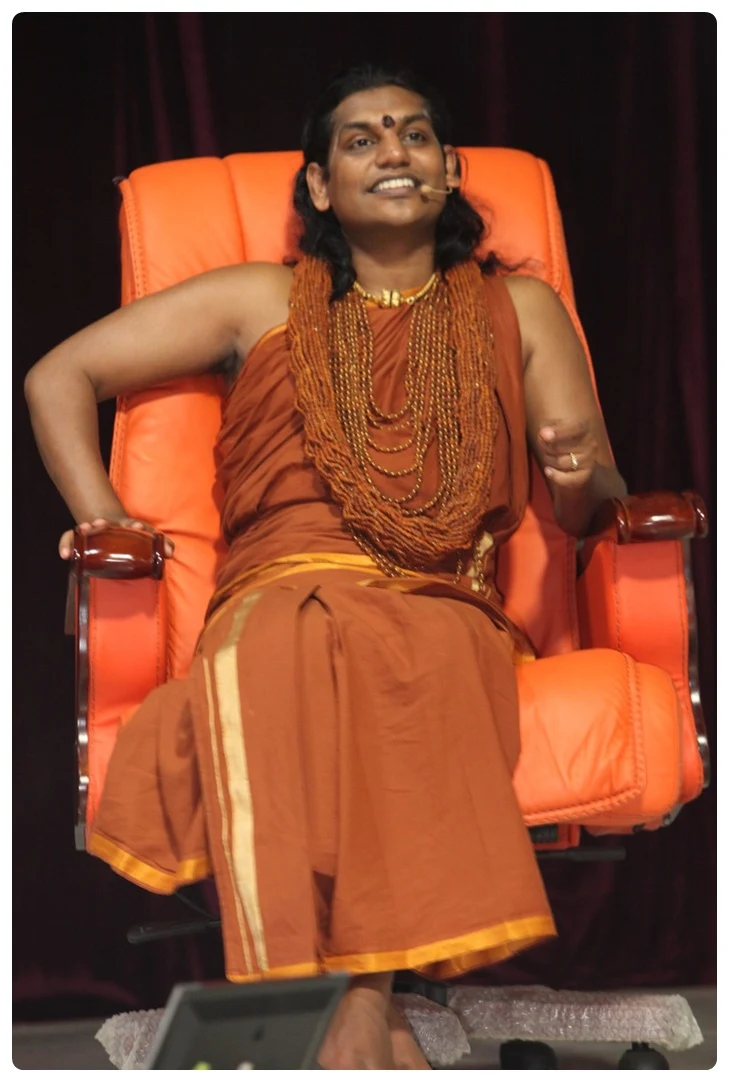
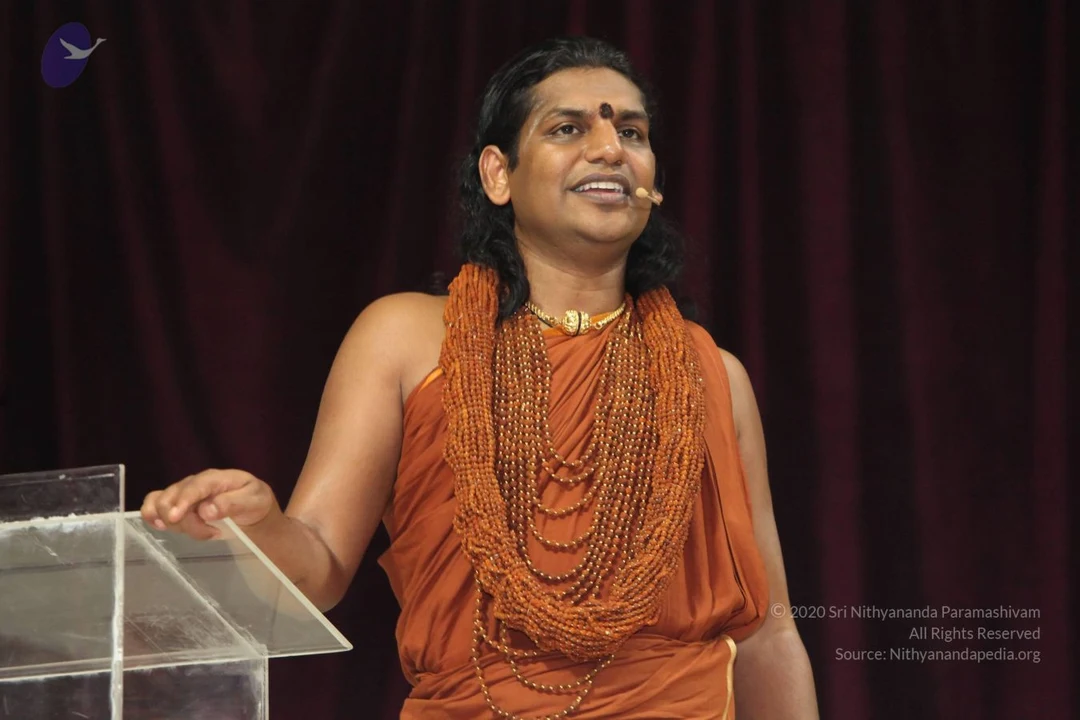
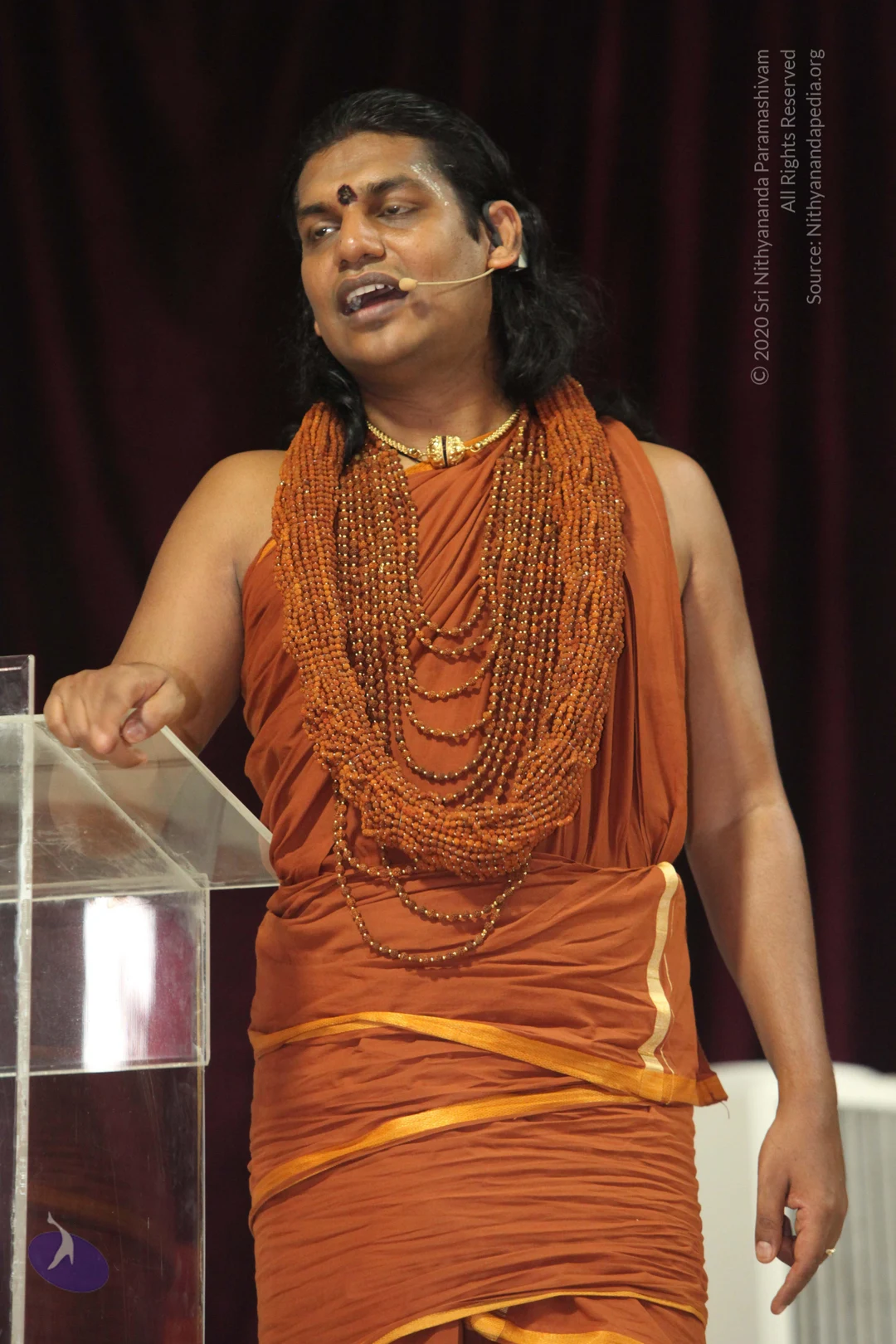
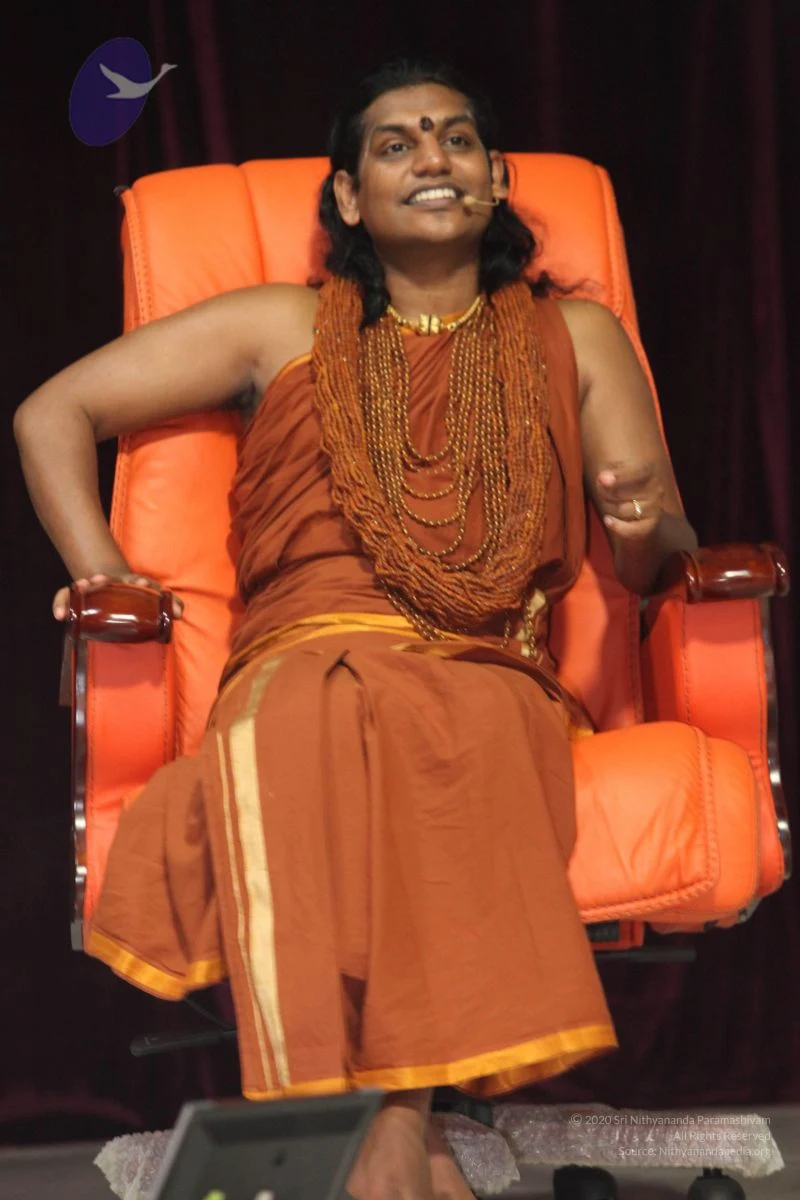
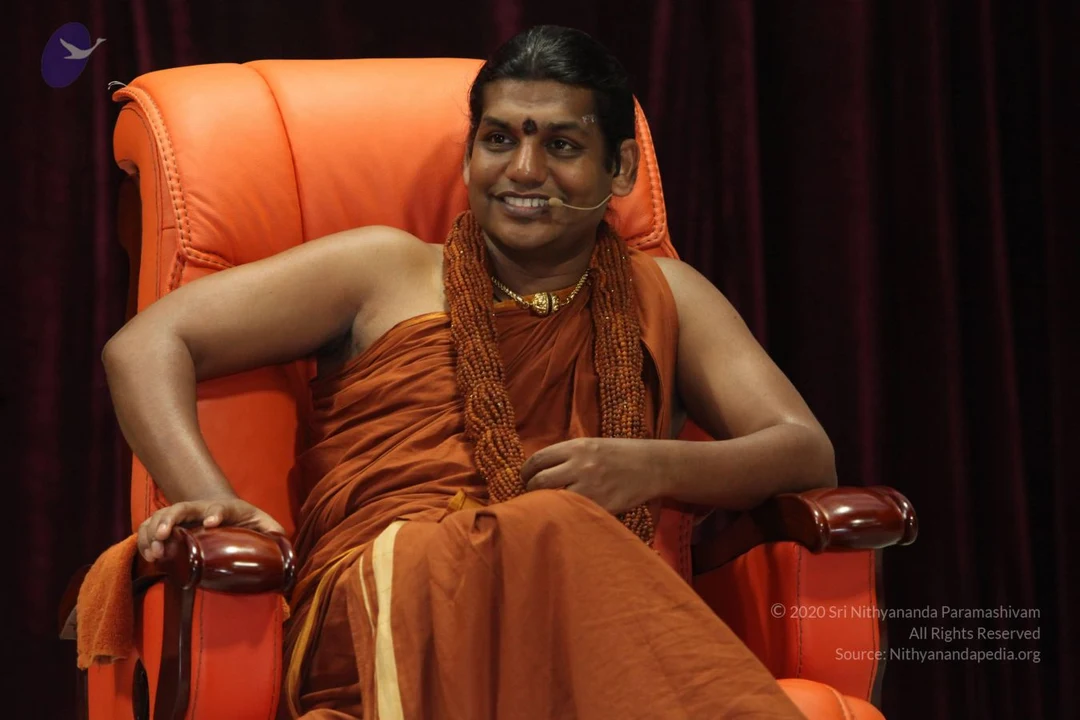
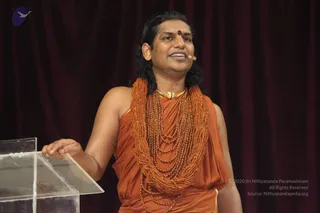
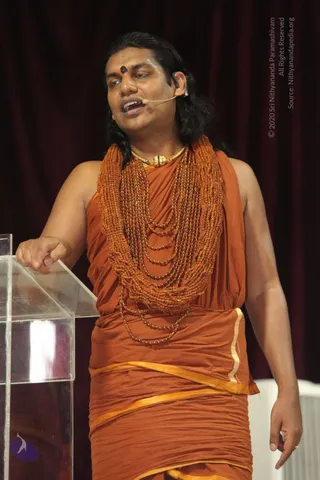
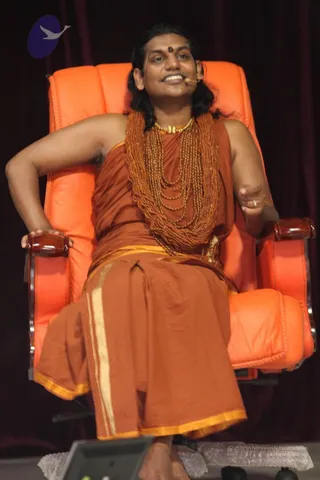
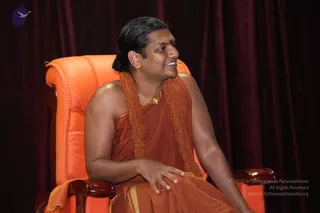
A seated man in saffron-orange robes sits cross-legged on an ornate golden throne with carved lion figures and crimson velvet cushions. He wears multiple long rudraksha mala strands, a gold necklace, and a red bindi, with long dark hair swept back. He has a small microphone clipped near his face and rests his hands on the armrests with eyes lowered and a faint smile. Behind him are deep red velvet drapes, and a plastic water bottle sits at the left edge.A photograph of a man seated on an ornate golden throne with carved lion figures at its sides and a deep red velvet backdrop behind. He wears orange saffron robes, long layered rudraksha malas, and a gold necklace, with a red bindi on his forehead and long swept-back dark hair, and sits cross-legged with one hand resting on the armrest. A small clip microphone is visible near his face. A water bottle and a folder sit at the left edge. Swamiji (probable) appears in person on the throne, matching the page's claim of his presence at the satsang, based on the saffron robes, long hair, rudraksha malas and gold necklace.A man with long swept-back dark hair and a red bindi sits cross-legged on an ornate gold throne with carved lion-head armrests and a large gilded arched backrest, against a deep maroon curtain. He wears an orange-saffron dhoti and shawl, multiple rudraksha mala strands, and a gold pendant necklace, and gestures with one hand while smiling. Water bottle and papers rest on the stage table. Probable Swamiji identified by presentation cues: long swept-back hair, saffron clothing, rudraksha malas and ceremonial gold necklace on a throne. One physical person is visible.A man in an orange-saffron draped garment stands at a clear acrylic podium before a dark maroon curtain, speaking into a small headset microphone. He has long dark hair swept back, a red bindi on his forehead, and wears layered rudraksha-style beaded malas in orange-brown and a gold ceremonial necklace. His right hand rests on the podium while he gazes off to the side and smiles. Appearance-based label: Swamiji (probable), given his distinctive long hair, saffron clothing, rudraksha malas and gold necklace while addressing a satsang audience.A man with long, swept-back black hair and a red-brown bindi stands at a clear acrylic lectern, speaking into a headset microphone. He wears a saffron-orange wrap draped over one shoulder with gold-edged borders, multiple strands of rudraksha mala beads across his chest and a gold necklace at his throat. His right hand rests on the lectern. A dark red curtain forms the backdrop. Swamiji (probable): the long swept-back hair, saffron clothing, rudraksha malas and gold necklace match the page's Swamiji reference, and he is shown in person delivering a talk.A man seated in an orange leather armchair on a stage in front of dark maroon drapes, smiling and gesturing with his right hand while speaking into a small headset microphone. He wears a rust-orange unstitched robe draped over one shoulder and a dhoti-style lower garment with a gold border, plus layered rust-orange beaded rudraksha-style malas and a thin gold necklace. A small dark bindi-like mark is on his forehead, and he is barefoot on a platform with a monitor and white packing material at the base. Visible logo at top left and copyright notice at bottom right.
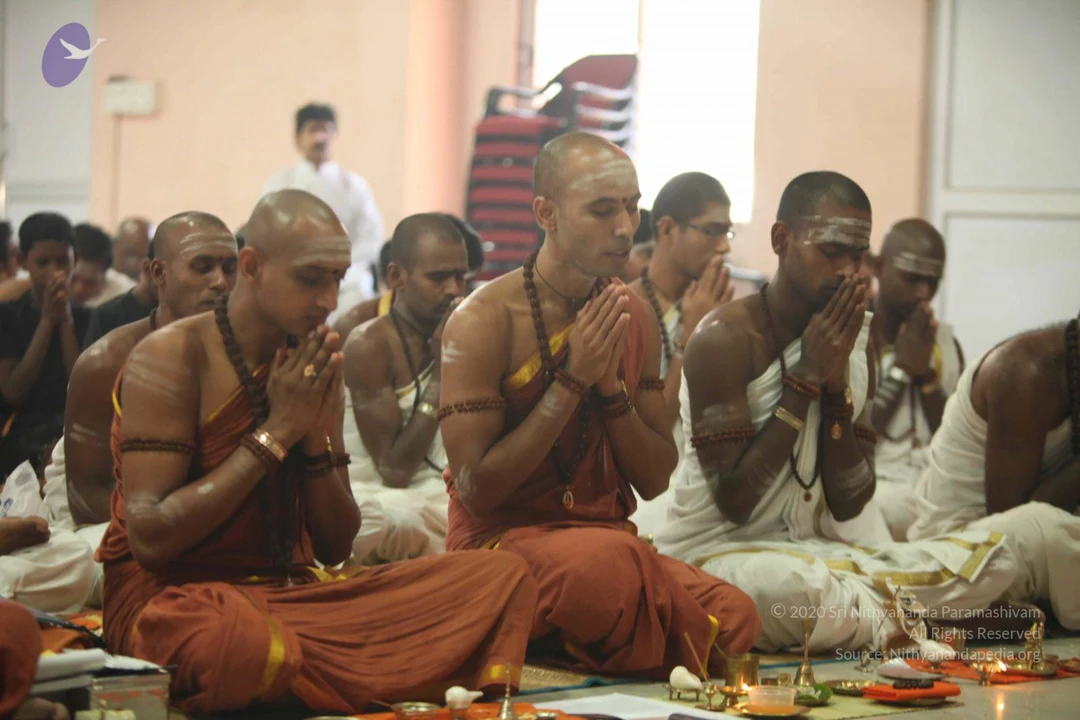
Tamil-IA-Session2

5 photosSource gallery
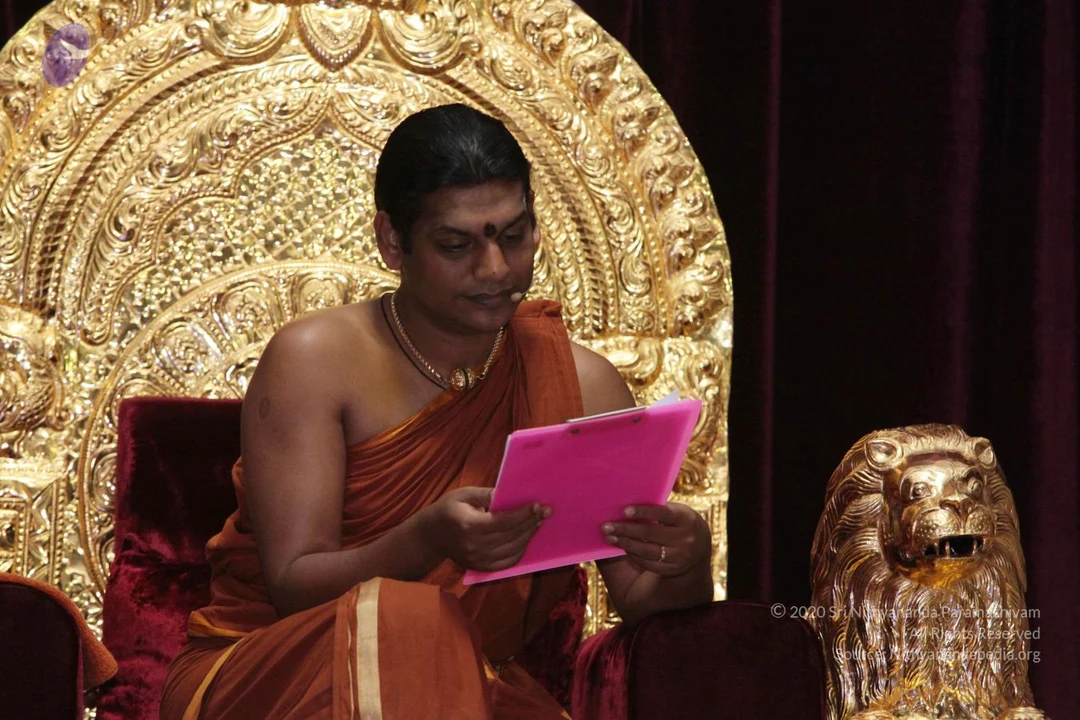
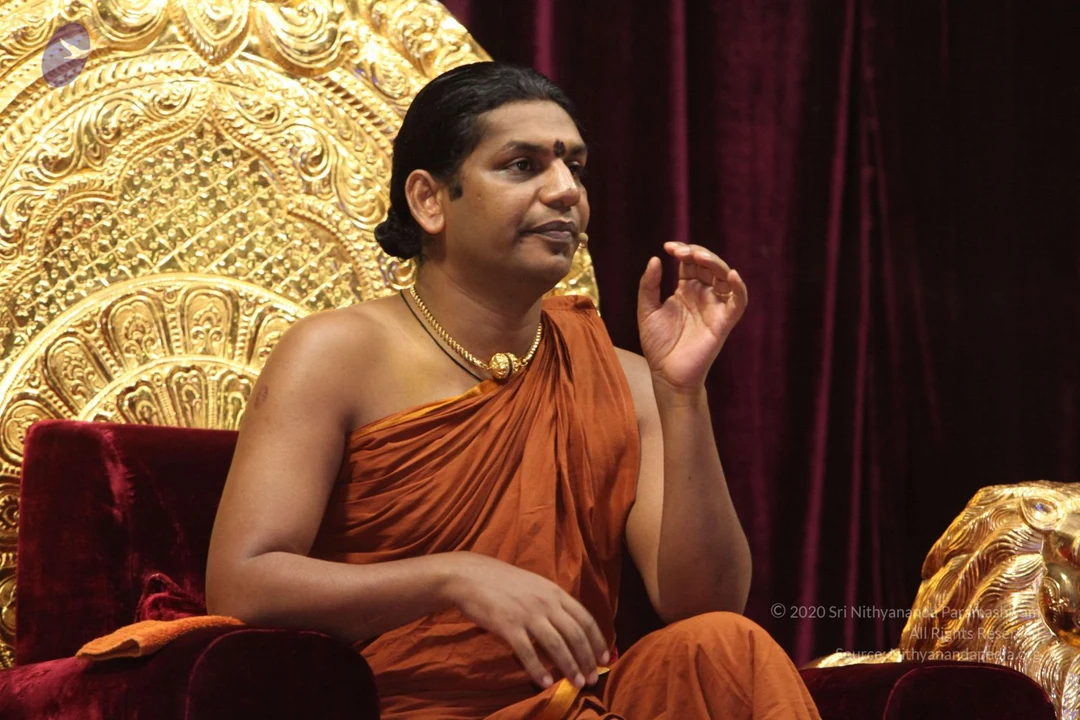
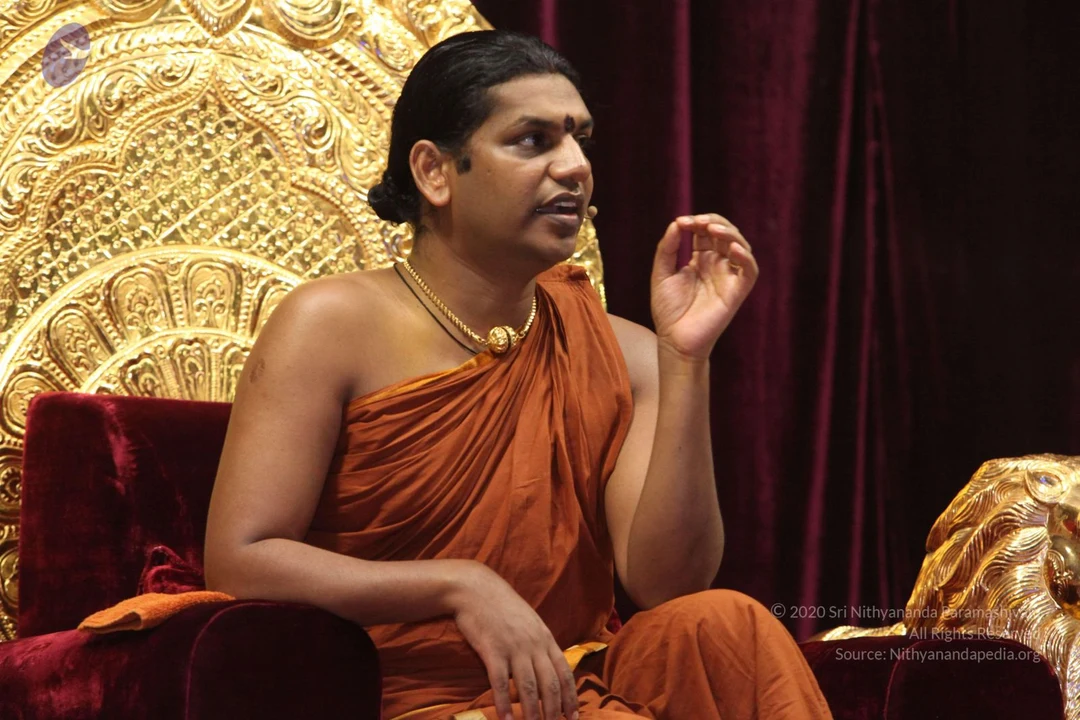
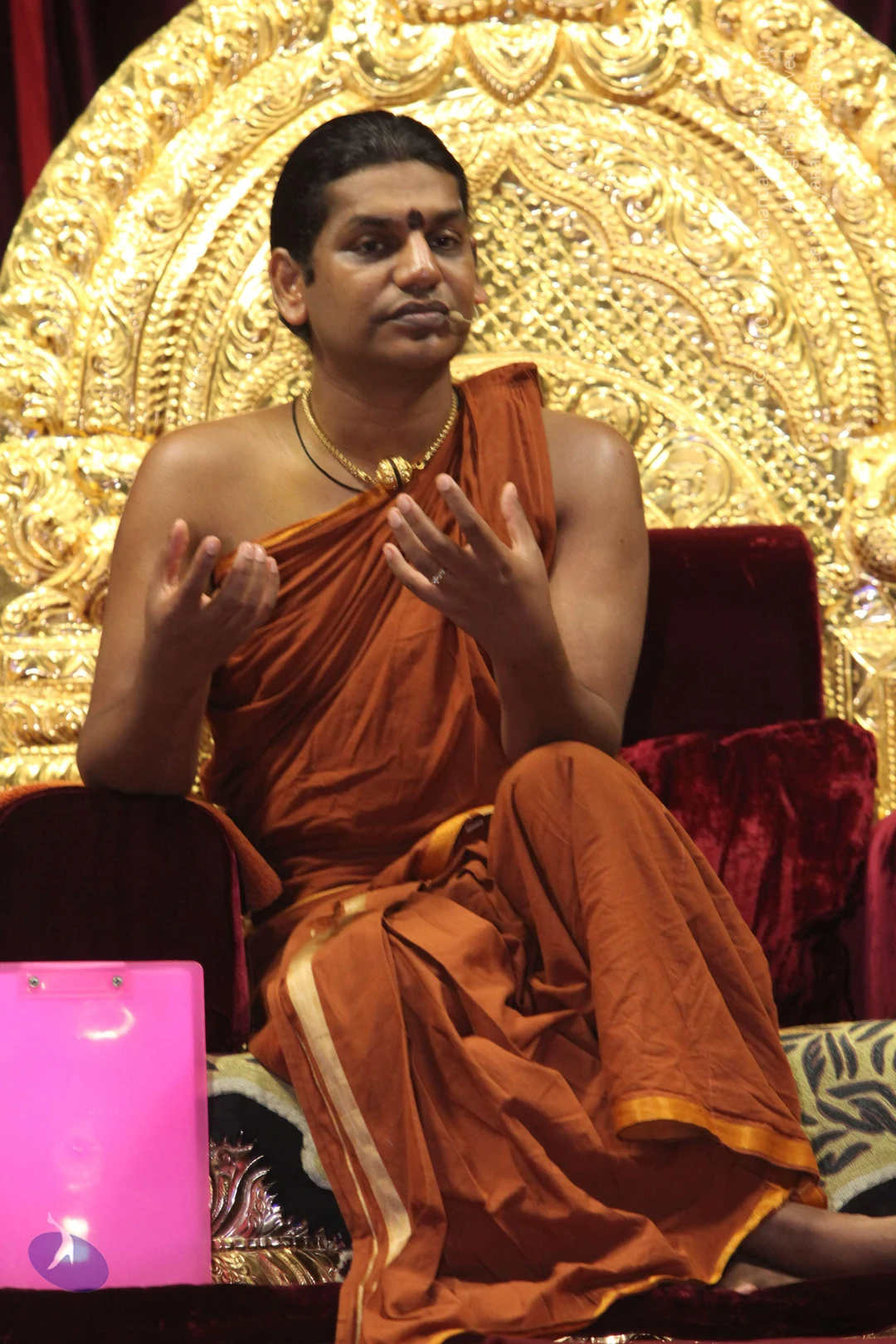
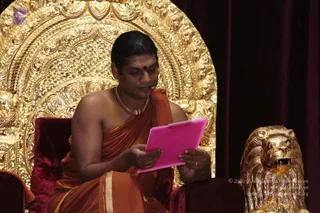
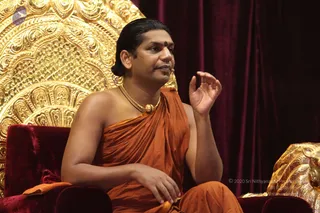
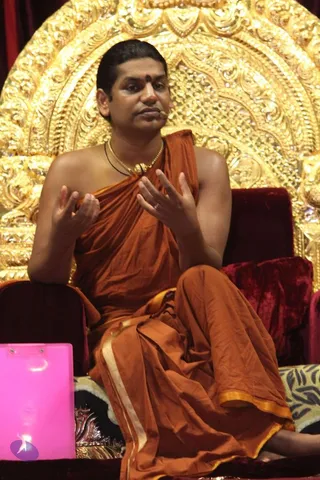
A man seated on an ornate gilded throne with carved gold backrest, wearing a saffron-orange robe draped over one shoulder and a dark rudraksha-style necklace with a gold pendant, a red bindi on his forehead and a small headset microphone, reading from a bright pink clipboard held in both hands. A gold lion sculpture sits on the right against a deep maroon velvet curtain. a person appears in this pose, with cues including the saffron robe, the ornate gold necklace and the seated throne setting.A man seated on a red velvet throne with an ornate gold backrest, wearing an orange saffron robe draped over one shoulder and a gold necklace with a dark bead mala. He has a red tilak on his forehead and his hair is swept back into a bun. He gestures with his right hand raised while speaking, and a gold lion-shaped armrest is visible at right beside a deep maroon velvet curtain. a person with the orange robe, gold necklace and rudraksha mala, seated as a discourse speaker.A man in orange saffron robes sits on an ornate red velvet throne with a gold-embossed back panel and a golden lion-head armrest, against deep maroon drapes. He wears a gold necklace with a round pendant, dark rudraksha beads, a red tilak on his forehead, and a small microphone clipped near his face. His hair is tied back in a bun, and he raises one hand mid-gesture while speaking, appearing to give a discourse. Page-linked evidence indicates a person, seated and speaking as the teacher, consistent with the saffron robe, rudraksha mala and gold necklace.A photograph of a man seated on a red velvet throne with an ornate gold carved backrest and a golden lion statue at the left edge. He wears a saffron-orange shawl over his shoulder and saffron-orange dhoti, a gold necklace with a dark bead mala, and a red tilak on his forehead, and he has a small clip-on microphone at his ear. He gestures with his right hand while speaking, and a water bottle sits on the floor below. Appearance-based label: a person, seated in person giving satsang, dressed in saffron with a gold necklace and rudraksha mala.A photograph of a man seated on a red velvet throne with an ornate gold-embossed backrest, speaking with both hands raised in front of his chest. He wears a saffron-orange dhoti and upper cloth draped over one shoulder, with a gold chain and a dark cord necklace, and a small red tilak on his forehead. A pink clipboard rests in the lower left foreground. a person is seated in a satsang setting, with the visible cues of saffron clothing and ceremonial gold necklace.
Tamil-IA-Session3

8 photosSource gallery
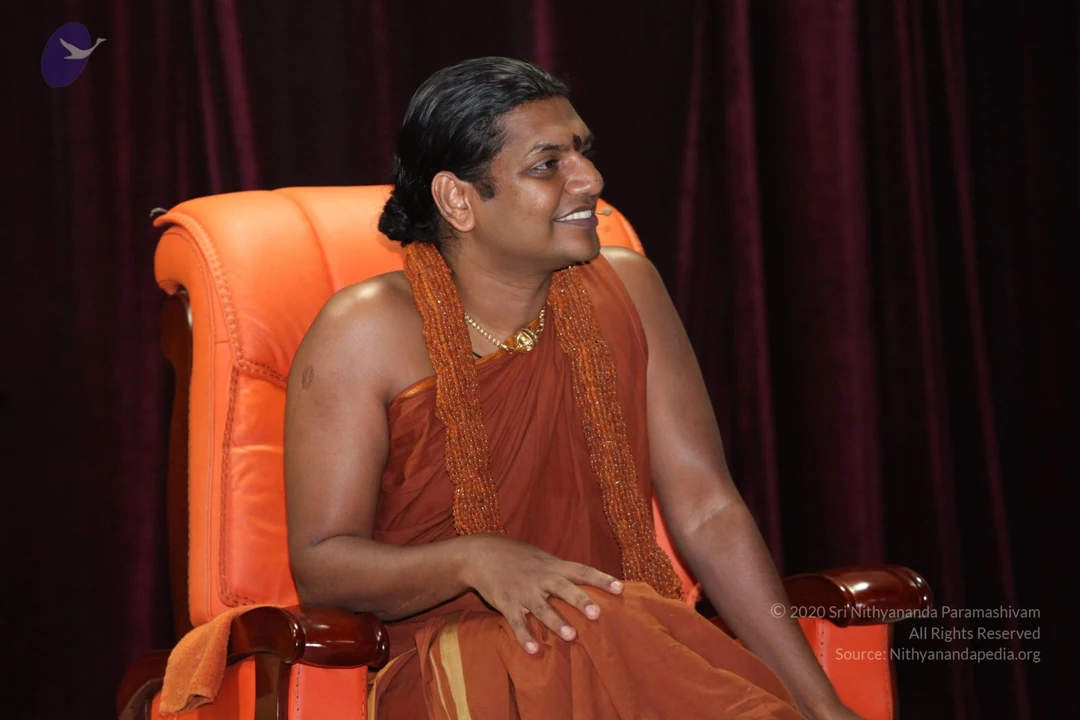
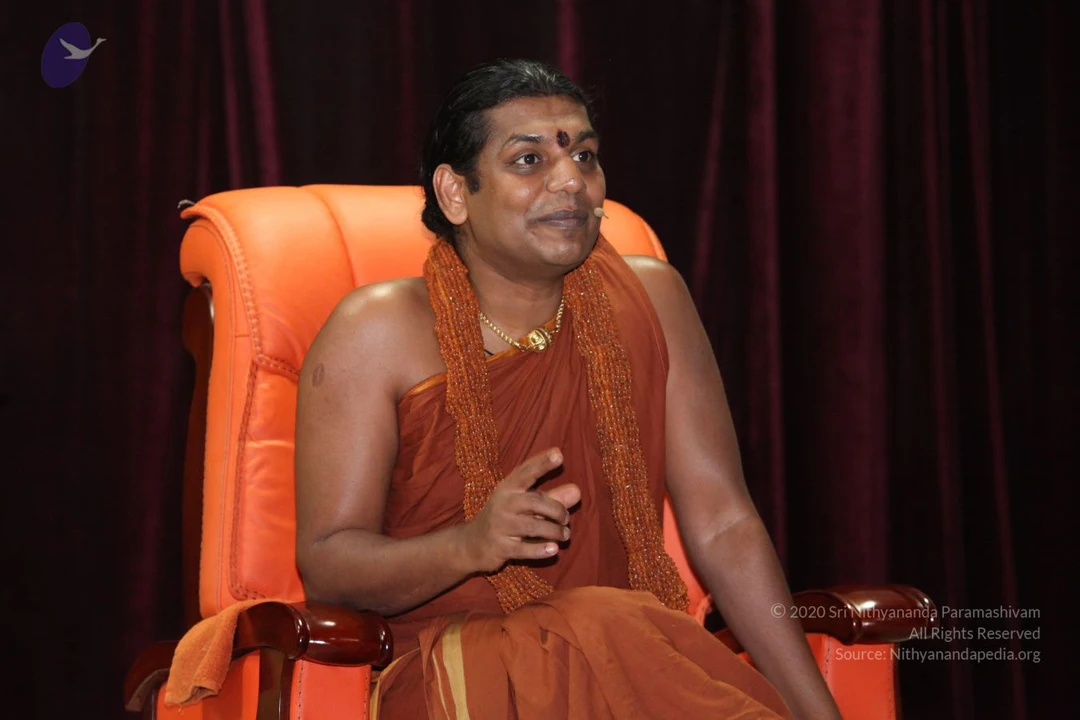
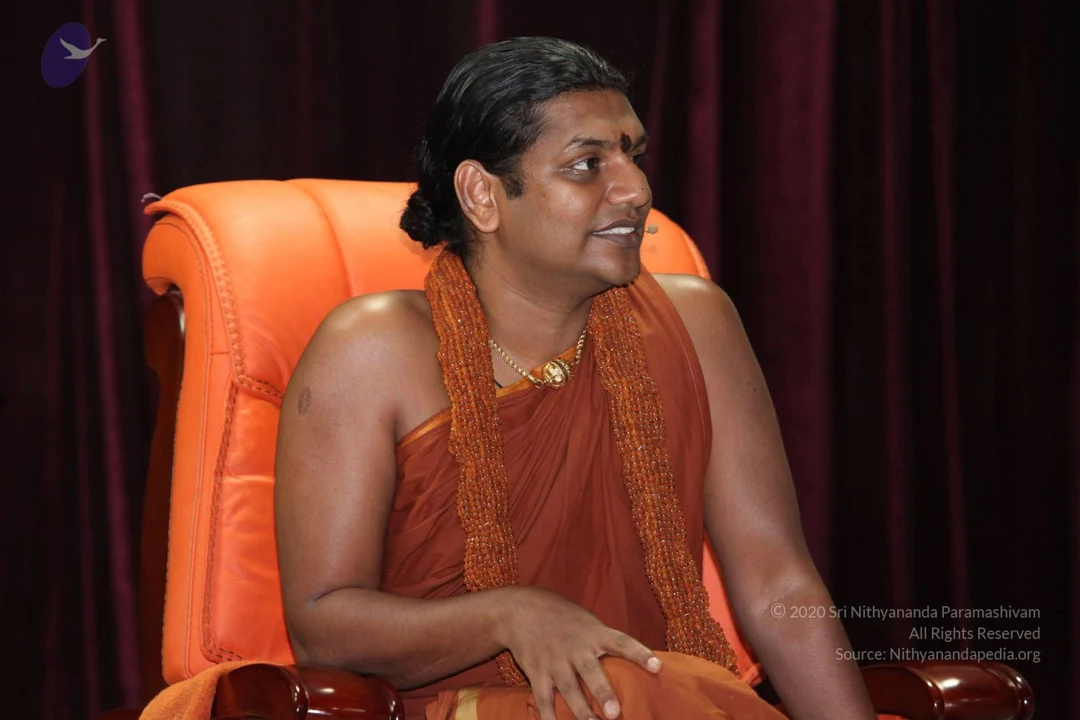
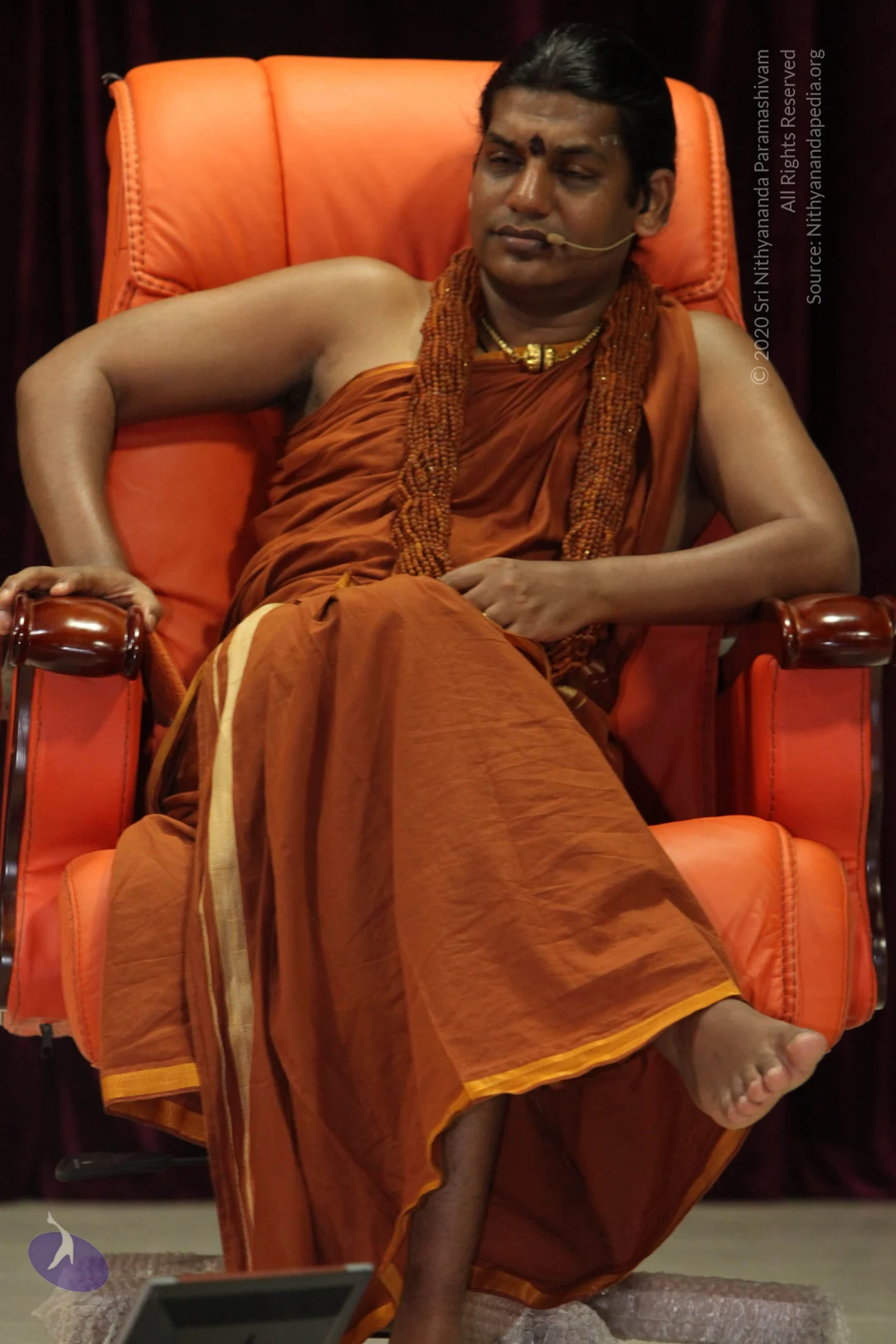
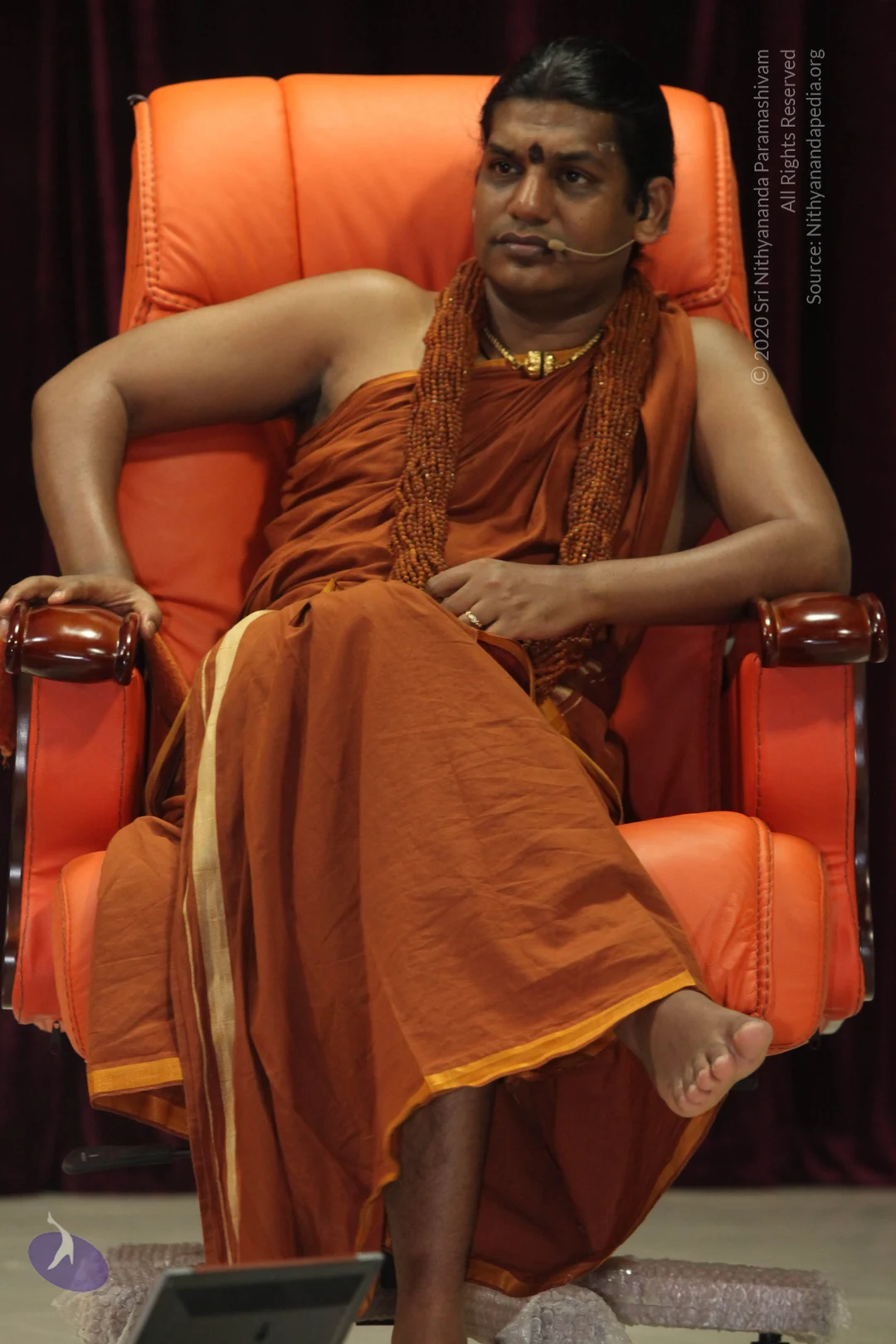
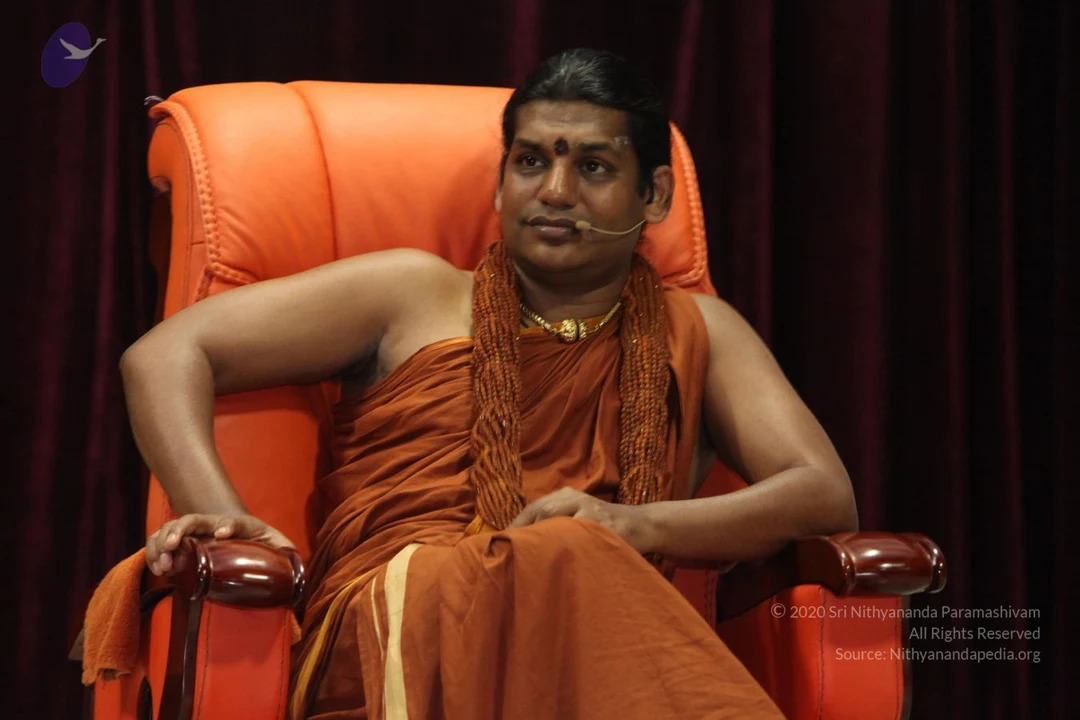
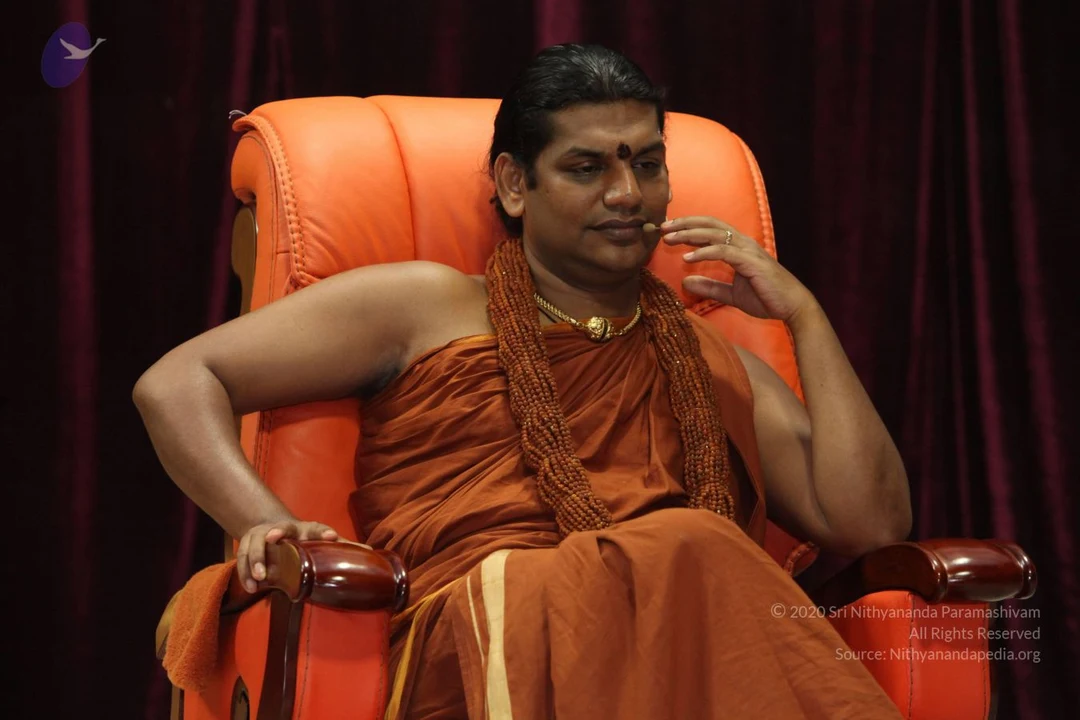
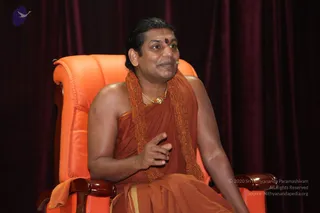
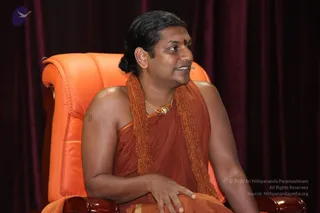
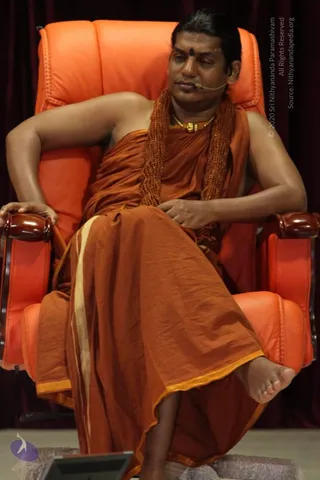
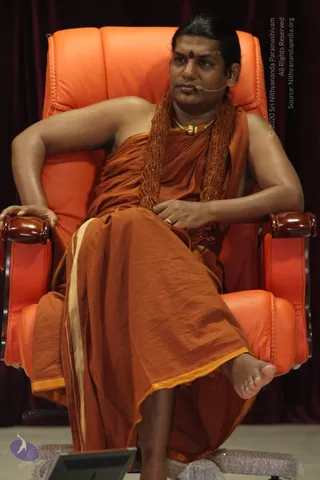
A man seated in an orange leather armchair with carved wooden armrests against a deep maroon velvet curtain. He wears an ochre-orange cloth draped over his shoulders and body, a dense orange-beaded rudraksha-style mala hanging down his chest, and a gold ceremonial necklace. His hair is swept back into a bun, and he wears a small vertical tilak on his forehead. He smiles while looking off to the side, one hand resting on his knee.A man in orange-saffron clothing sits on an orange leather armchair with wooden armrests against a deep maroon velvet curtain. He wears a long beaded orange rudraksha-style mala around his neck, a gold pendant necklace, and a red tilak mark on his forehead, with a small lapel microphone clipped to his collar. His hands are gesturing mid-speech as he talks, and an orange cloth rests on the armrest. The setting suggests a satsang discourse.A seated man in saffron-orange robes sits in an orange leather armchair with carved wooden armrests against deep maroon draped curtains. He wears a rudraksha mala of orange beads and a gold pendant necklace, with a small vermilion tilak on his forehead and his hair tied back in a bun. His hand rests on his knee as he looks off to the side, apparently speaking, with a small microphone visible near his face. This appears to be a satsang discourse setting.A man seated in a large orange leather armchair with wooden armrests, dressed in a saffron-orange dhoti-style wrap over the shoulder and chest, wearing a long multi-strand rudraksha mala and a gold pendant necklace, with a small red-and-white forehead mark and a wired headset microphone. His left leg is crossed over his right, bare foot raised, and his hand rests on his lap. A dark maroon curtain stands behind him. a person: the orange-clad figure with rudraksha mala and gold ornament in a satsang setting matches the page's claim.A man seated in an orange leather armchair on a stage with a dark maroon curtain behind him. He wears a headset microphone and an orange-saffron dhoti with a gold-and-cream border, draped as a shawl across one shoulder, with a long rudraksha mala of orange beads and a gold ceremonial necklace. A red tilak mark is on his forehead and his hair is swept back. He sits with one leg crossed over the other, bare foot raised, and a hand resting on his lap, looking off to the side. A laptop screen is visible at the bottom edge. a person by the orange-saffron clothing, rudraksha mala and gold necklace, seated in a speaker's chair during a satsang discourse.A man seated in an orange leather high-backed armchair with wooden armrests against a dark red velvet curtain. He wears a saffron-orange dhoti and shawl, a rudraksha mala with braided beads, and a gold ceremonial necklace, with a small red tilak on his forehead and a clip-on lapel microphone. His hands rest on the armrest and his lap, and he gazes off to the side. Swamiji (probable) cues: swept-back dark hair, saffron clothing, rudraksha mala and gold necklace, seated in a throne-like chair at a satsang.