Skip to content
Tuesday

2 September 2014

Samskara Dahana Kriya the Easiest Path to Enlightenment

Dated photos
142
Source pages
1
Media
2
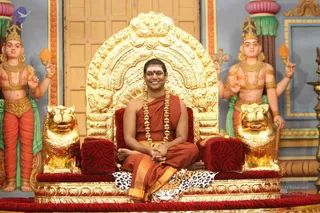
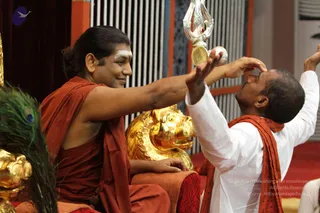
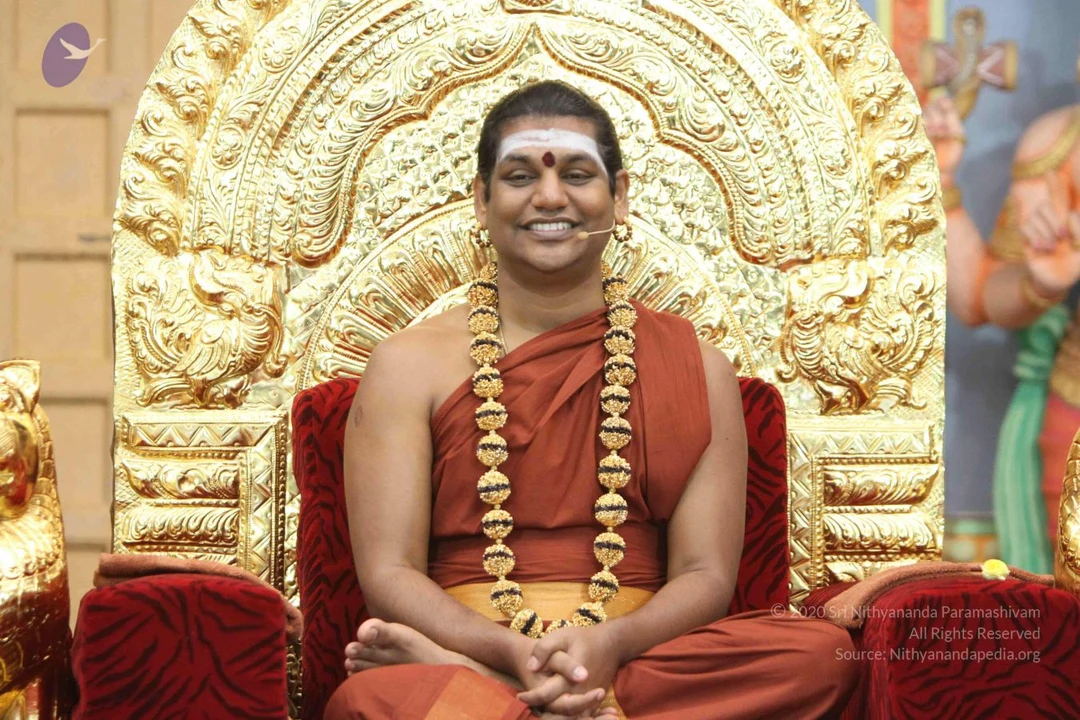
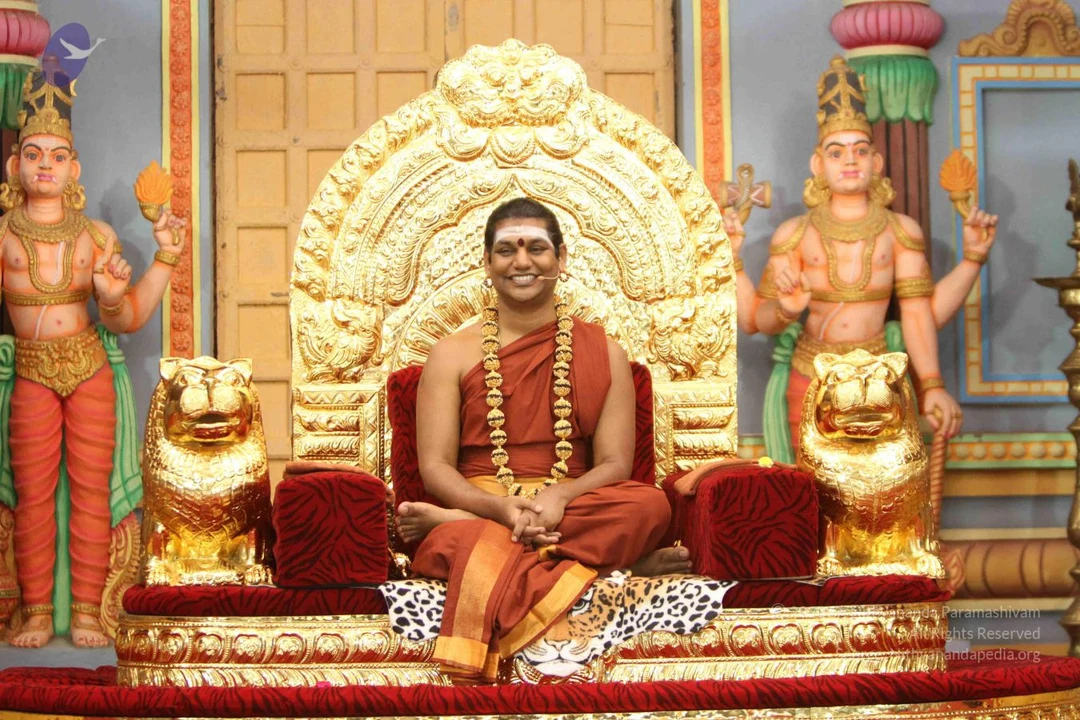
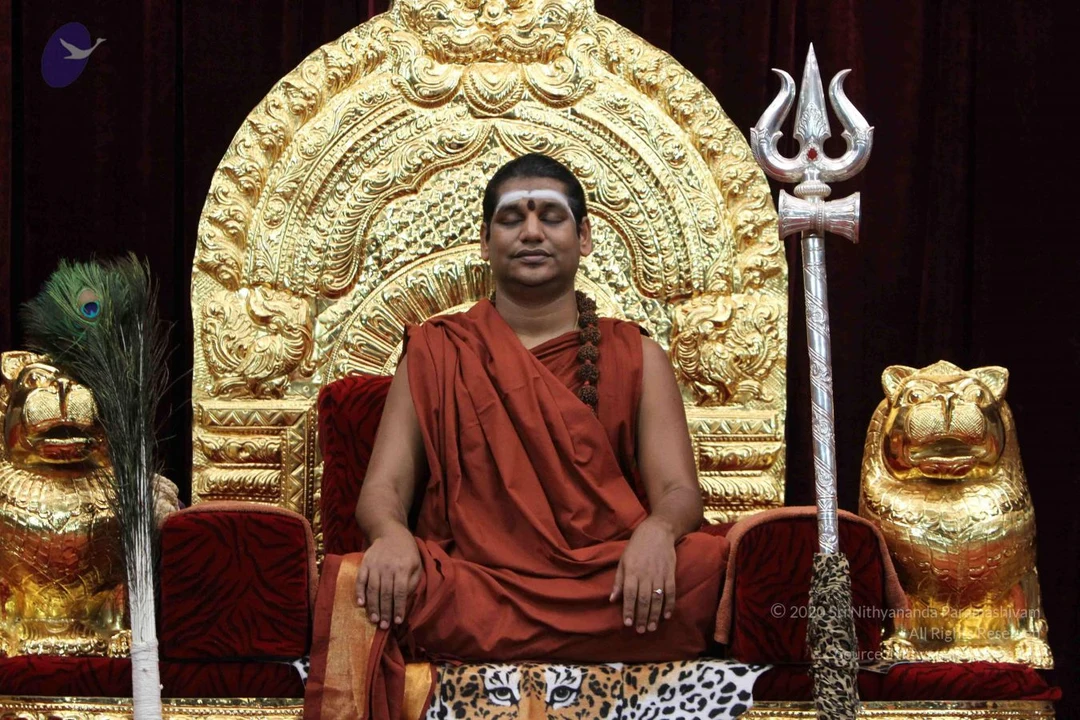
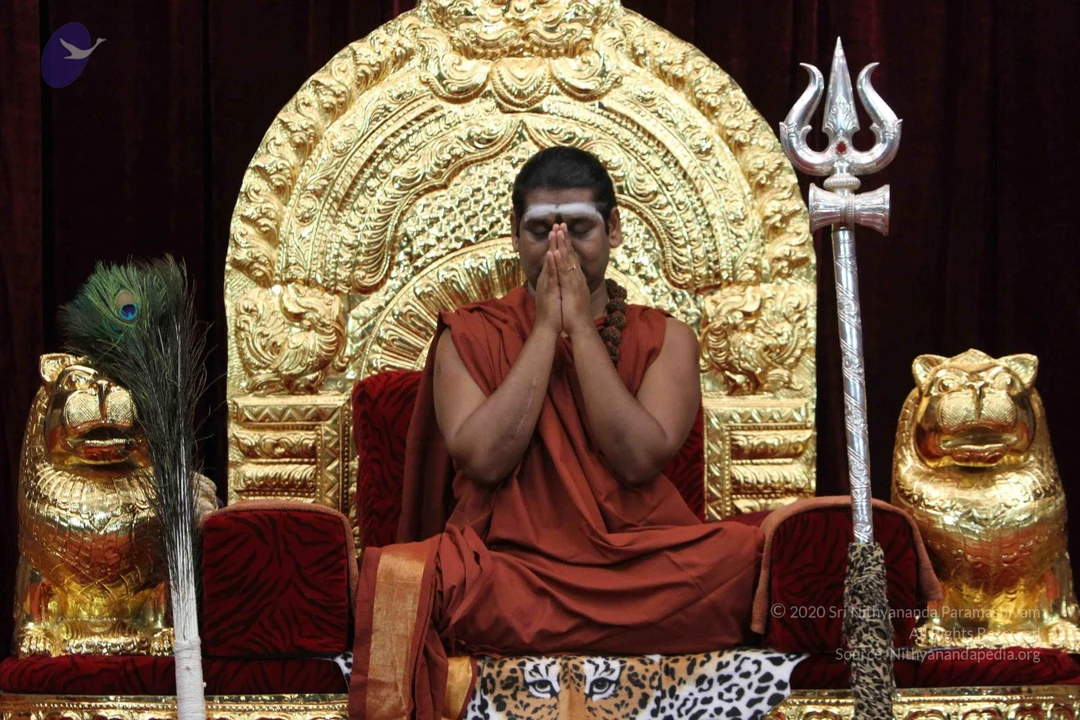
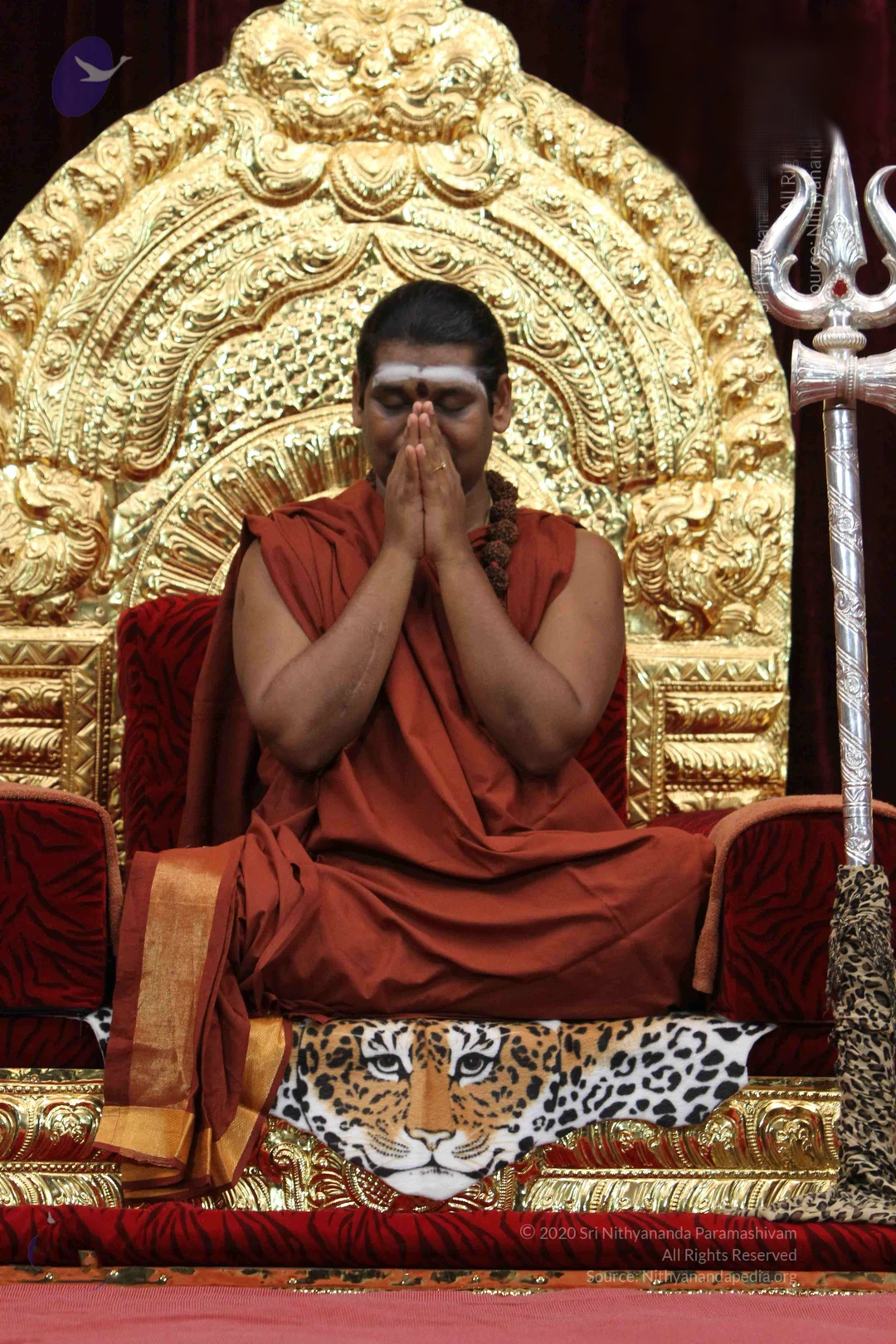
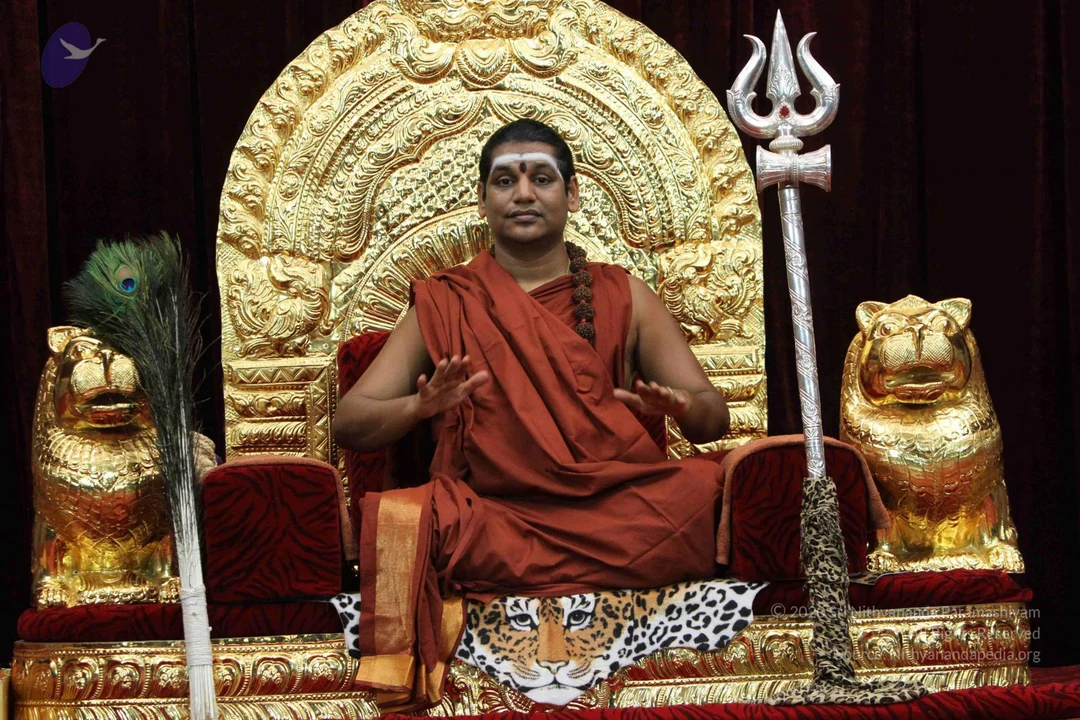
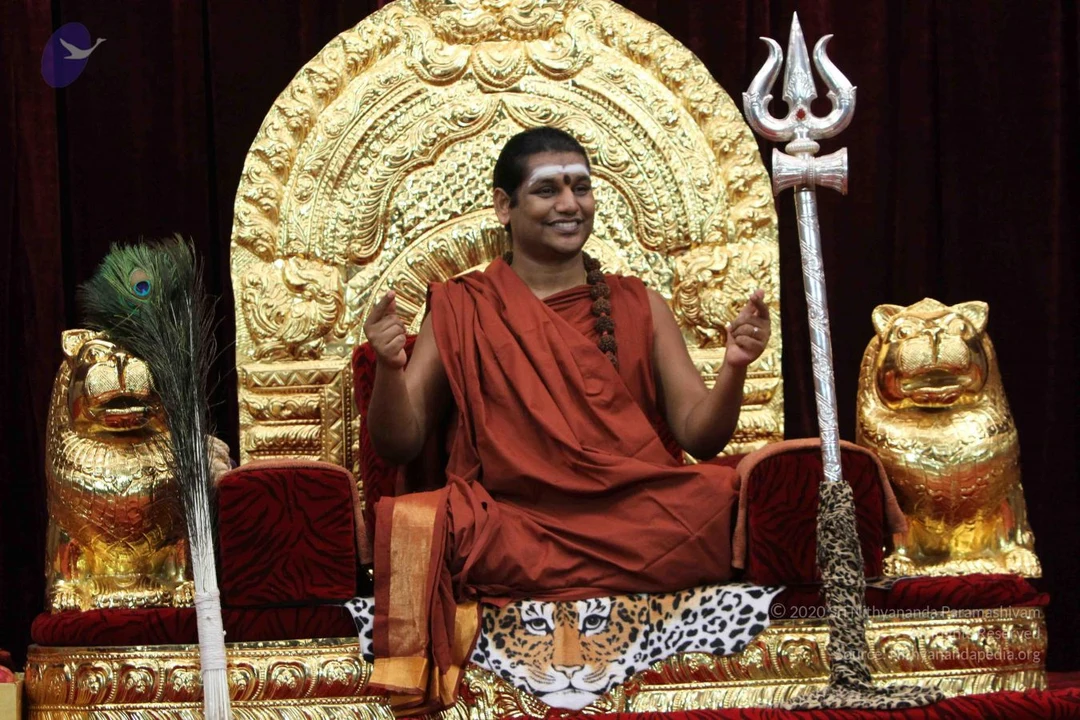
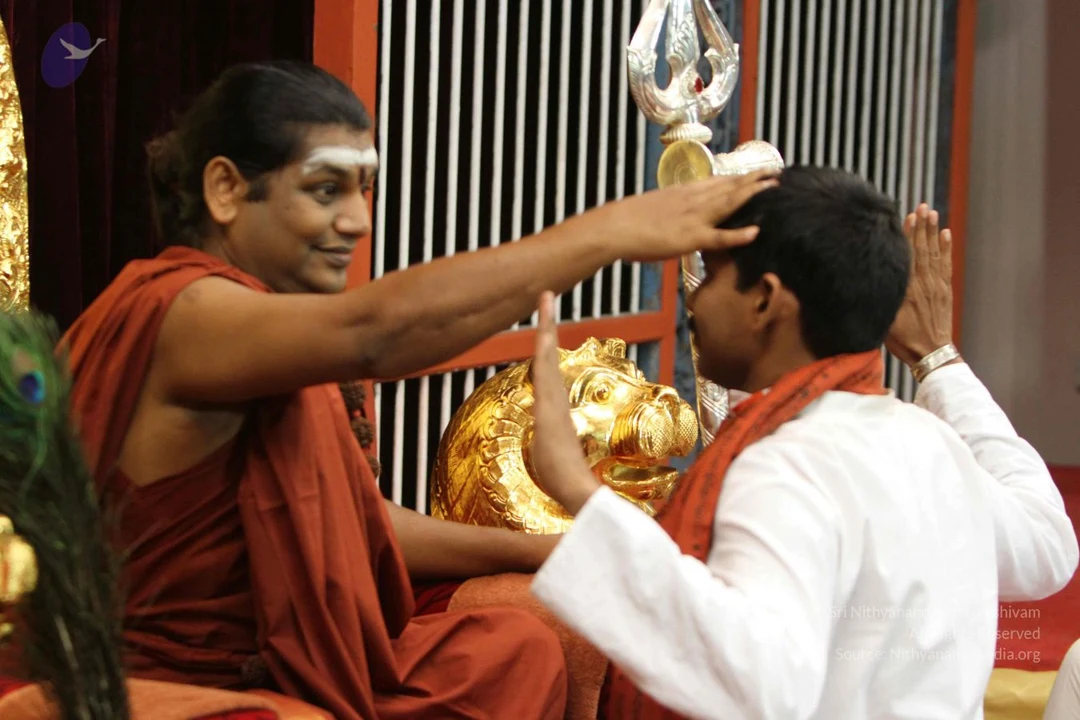
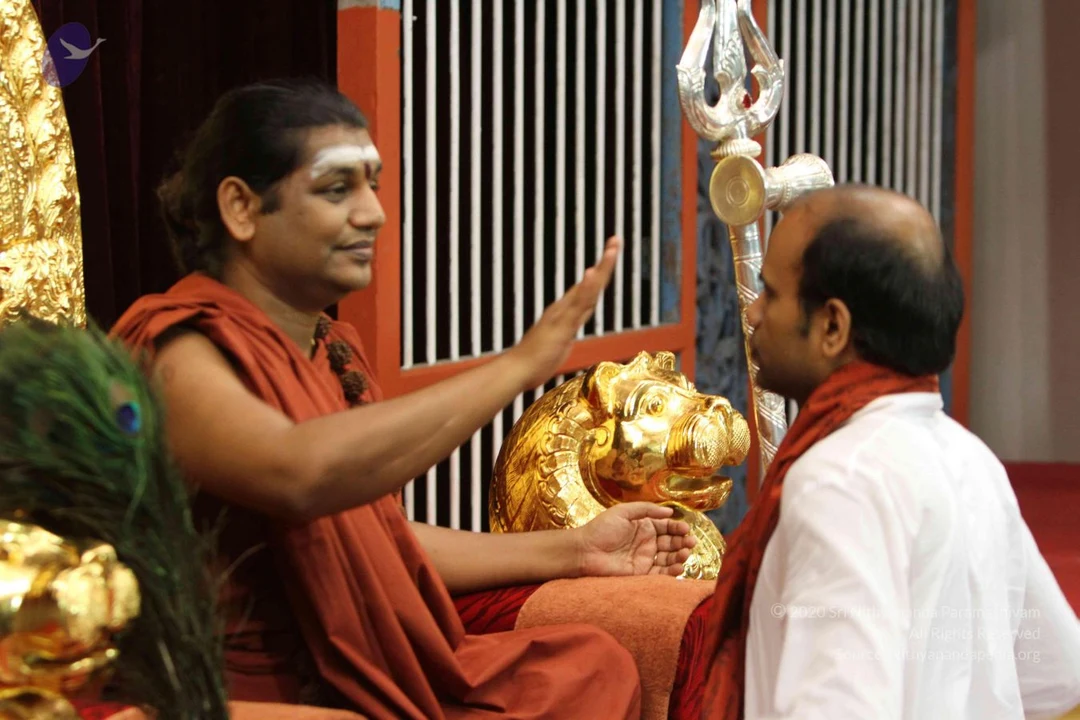
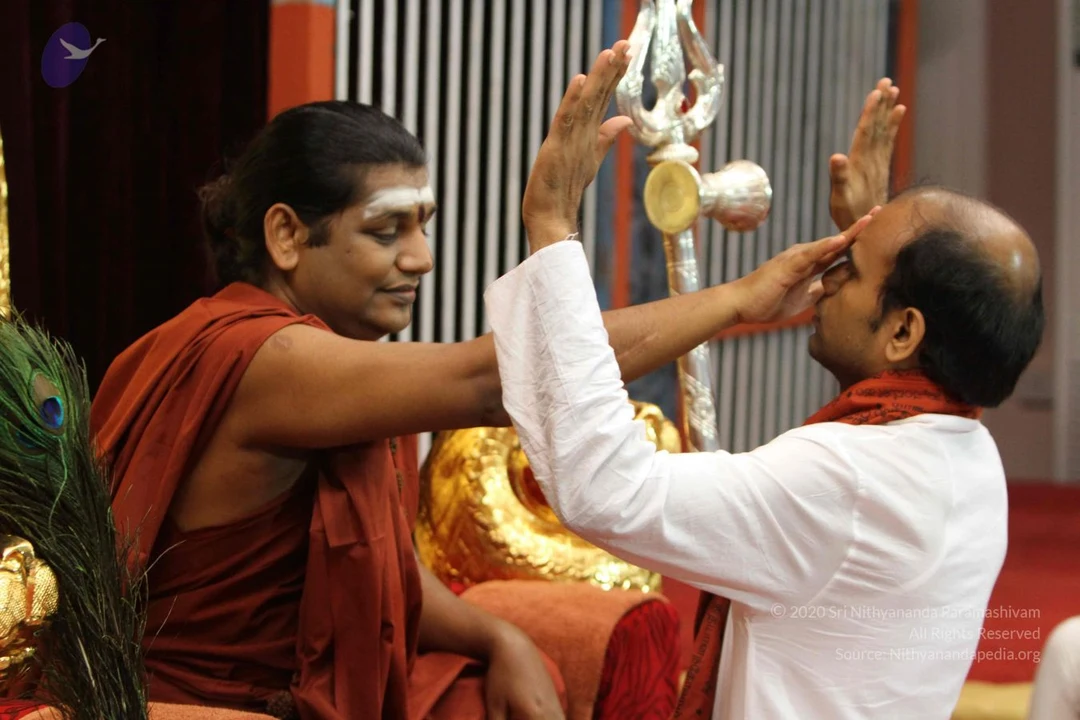
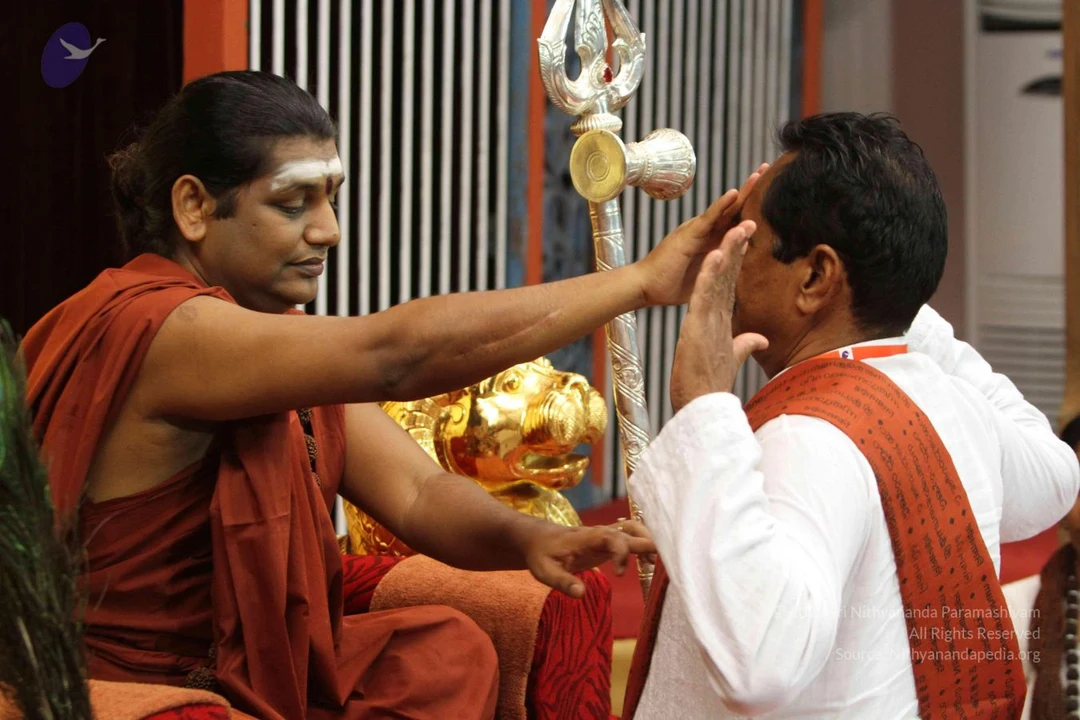
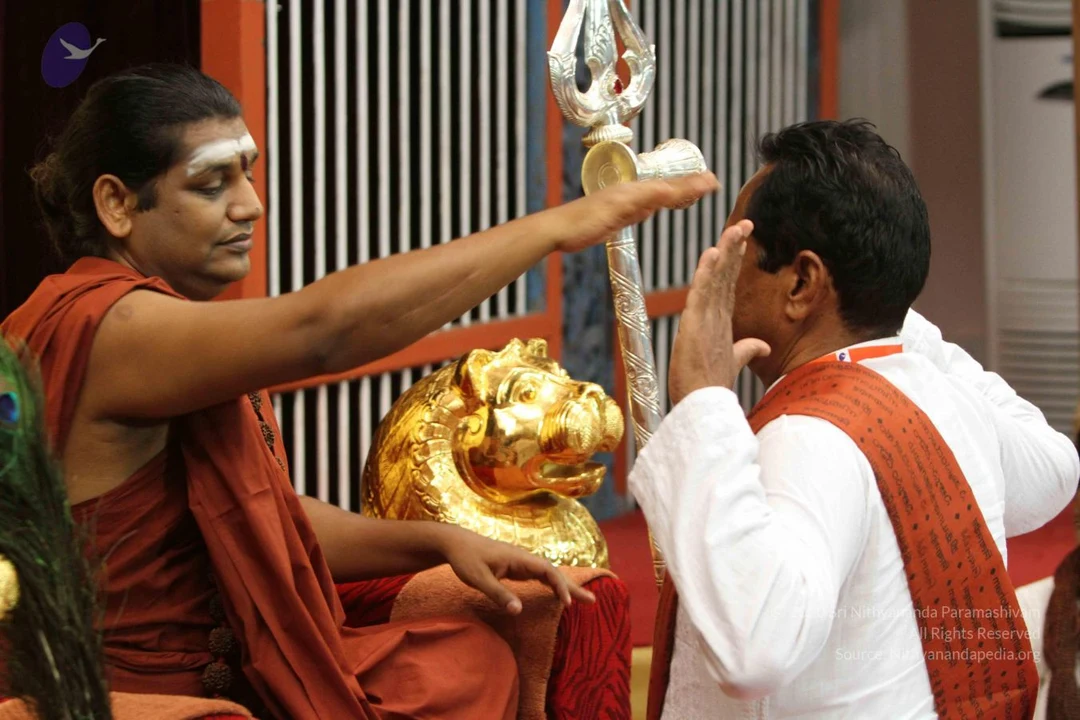
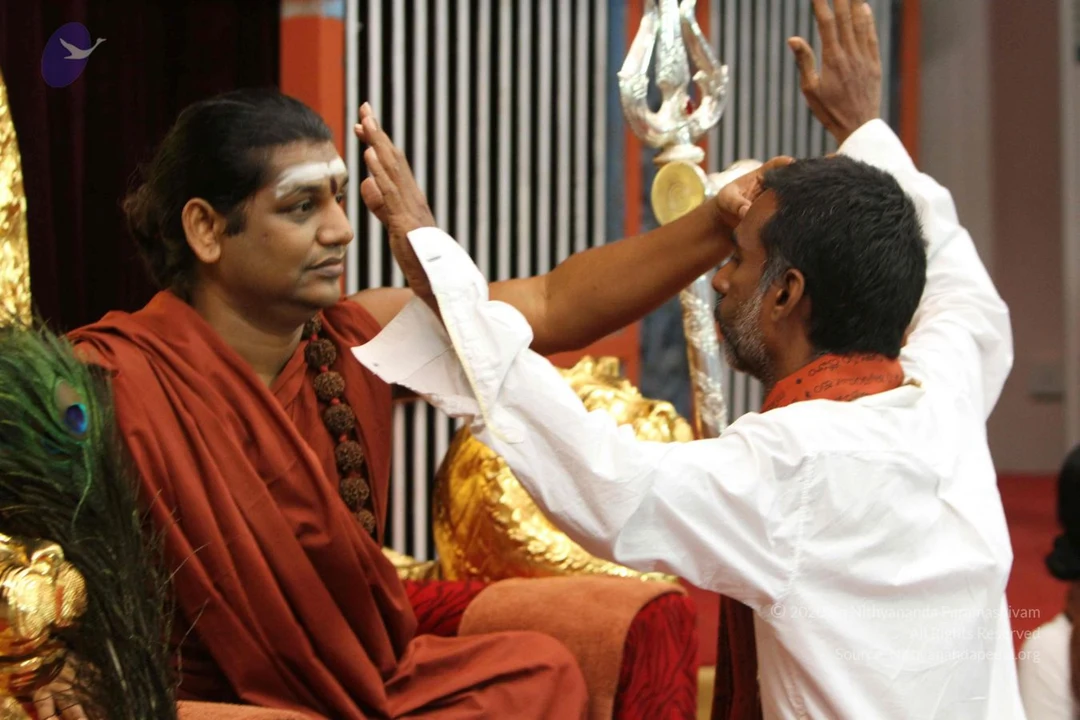
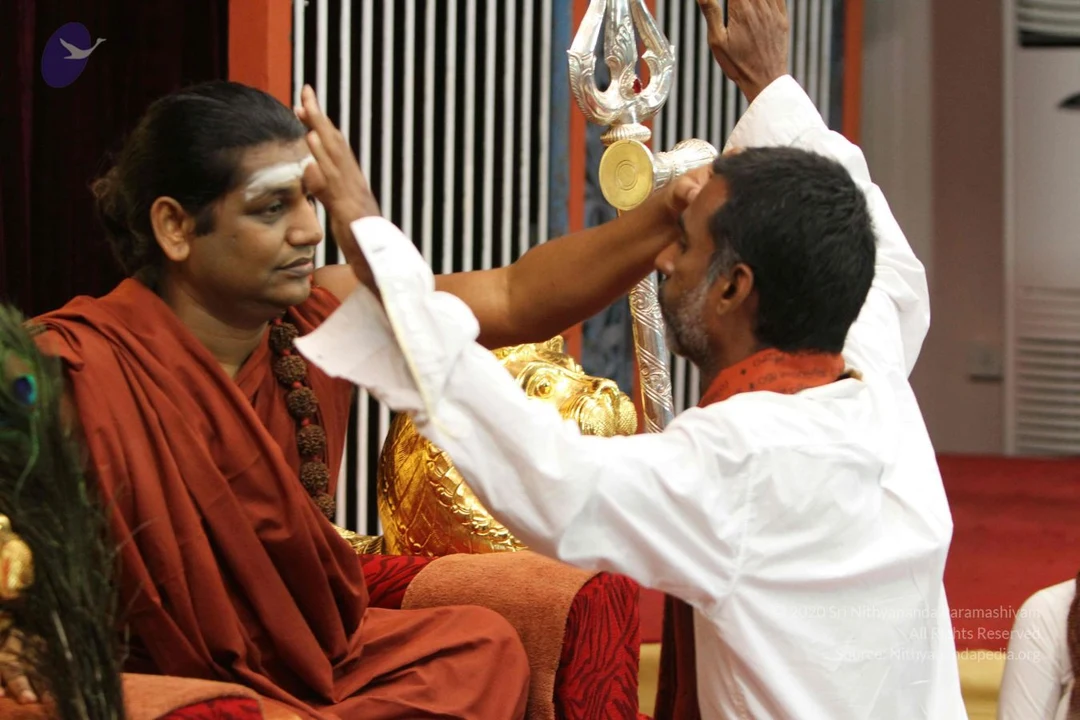
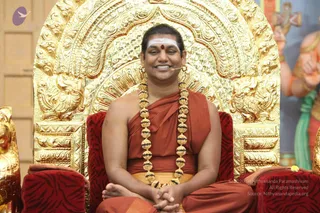
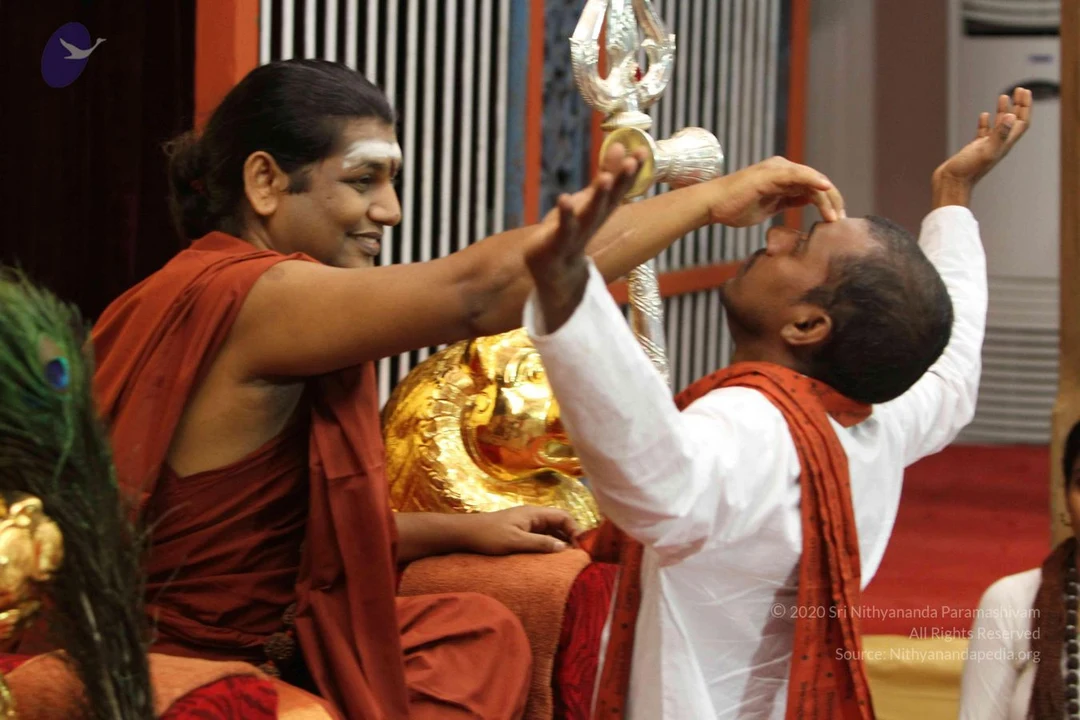
A seated man in saffron-orange robes sits cross-legged on an ornate gold throne with a deep red cushioned seat and a leopard-print cloth draped over the platform. He wears a long gold necklace, a red-and-white tilak on his forehead and a gold-bordered orange shawl, and he smiles with his hands folded in his lap. Two golden lion figures flank the throne, and on each side stands a multi-armed painted deity statue in orange-red dress holding ritual objects, with a gold arch and a lit oil lamp visible at the right.A photograph of green bamboo branches with long narrow leaves silhouetted against a pale grey, cloudy sky. Thin bamboo stems rise diagonally across the frame, and a bit of blue sky shows through the clouds. No people, deities, ritual objects or ashram settings are visible.A photograph of a seated figure in ochre-orange robes with a white tilak on the forehead and hair swept back, sitting on a golden lion-shaped throne with a peacock-feather fan at the left edge. He extends his arm to touch a silver trident-shaped ritual object to the forehead of a man in a white kurta with an orange shawl, who stands with his face tilted up and hands raised. Red and white striped panels and a red carpet form the background. The appearance of the seated figure is consistent with the a person label given the saffron robes, swept-back hair and ceremonial throne, though the face is not clearly distinguishable.

September 02 2014

Original wiki page
Contents

Title:

Samskara Dahana Kriya the Easiest Path to Enlightenment

Description:

In today’s (2nd September 2014) morning satsang, Paramahamsa Nithyananda expanded on Samskara Dahana Kriya and Perpetual Completion. First everyone doing SDK should take an oath to not exploit others who had shared with them during SDK. Secondly all the steps must be followed and thirdly he described SDK as being like a psychological enema. Doing 48 days of SDK is equal to Perpetual Completion. SDK is the easiest method of all the spiritual practices to have an experience of Advaita and it will save your life.

Link to Video:

Link to Audio

'Description: Samskara Dahana Kriya The Easiest Path To Enlightenment by HDH Bhagavan Nithyananda Paramashivam on 02 September 2014'

Transcript:

Nithyanandeshwara Samaarambhaam Nithyanandeshwari Madhyamaam | Asmath Aachaarya Paryanthaam Vandhey Guru Paramparaam ||

I welcome all the devotees, disciples, samajis, satsanghis, Shrimahants, Mahants, Thanedars, Kotharis, visitors, viewers, participants, all of you, with my love and respects. People who are sitting through Sadhna TV, Nithyananda TV, two-way video-conferencing having Nayana Deeksha, I welcome all of you.

Cities sitting with us in Nayana Deeksha: Ohio-Prayag, Phoenix-Kanchipuram, Scottsdale-Arizona, Washington DC-Sripuram, Los Angeles-Hollywood, San Jose-Madurai, Amersfoort-Netherlands, Warrington-UK, Seattle-Chidambaram, North Carolina, Ohio-Ma Shivananda, Hong Kong-Sirkazhi, Oklahoma-Somanatham, St. Louis-Tirumala, Kuala Lumpur-Palani, Nithyanandeshwara Temple-Pondicherry, Singapore-Singapuram, High Point-North Carolina, Vancouver-Canada, Grasse-France, Jorpati-Nepal, Enriching Temple-Bidadi, Guadeloupe-Rameshwaram, Sugarland-Texas, Kulim-Tiruttani, Morris Plains-New Jersey, Houston-Kalahasti, Hebbal-Bangalore, Nithyananda University-Los Angeles, Nithyananda University-Paris, Hyderabad-Gupta Kashi, Nithyananda Nagaramu-Hyderabad...........

I welcome all of you with my love and respects.

Today I wanted to expand on how the Samskaara Dahana Kriya helps you for Perpetual Completion. I am seeing many reports from all over the world, that in so many Centres, temples, ashrams, the Samskaara Dahana Kriya is happening every day, lot of people are participating.

First thing I wanted to remind all of you, before the Samskaara Dahana Kriya starts, everyone should take an oath with integrity that they will not misuse or abuse the information they receive during the Samskaara Dahana Kriya. That oath everyone should take.

Second, the whole Completion, all the steps should be followed, including sharing with five lives and listening to five lives.

Third, forty-eight days it should be done continuously; or, one or two days if you miss, make it like in one day itself two sessions, morning and evening.

I tell you, Samskaara Dahana Kriya will remove the naturally accumulated vengeance. Please understand, just like naturally, because of what you eat, one part becomes the unnecessary thing which needs to be pushed out of the body, same way, because of your day-to-day functioning in life, in your mind one part gets accumulated which needs to be sent out. Just like the biology, the psychology has its own excreta which it needs to send out. Samskaara Dahana Kriya is like an enema for psychological excreta which needs to leave your system, understand? Whatever physically needs to leave your system, if you give enema, it will leave. Samskaara Dahana Kriya will make all the psychologically unwanted things to leave your system. Forty-eight days of Samskaara Dahana Kriya will literally make you live in Perpetual Completion! Enlightenment cannot be made more simple than this! I tell you guys, more than this, enlightenment cannot be made simple! More than this, living life cannot be made simple! Not only enlightenment, even life needs Samskaara Dahana Kriya. With accumulated vengeance don’t think somebody else is going to suffer. Accumulated vengeance convinces you that vengeance is required for you to exist, that vengeance only is giving you the right ideas in the right time to defend you and protect you and save yourself. That is the way it exists, it continues to have power over you, understand? Samskaara Dahana Kriya teaches you life. More than this, life cannot be made simple, life cannot be made easy. So, whoever wants to live, please do Samskaara Dahana Kriya. Whoever wants to live, please do Samskaara Dahana Kriya.

Every day, Samskaara Dahana Kriya for forty-eight days will heal you so much, it will heal you so much! I tell you your whole brain will feel new; not just your mind, even brain! Your whole inner-space will feel new. It is the most easiest process, easier than any other tapas. I can say, one Samskaara Dahana Kriya is equivalent to at least hundred days of Pancha Tapas. One Samskaara Dahana Kriya is equivalent to hundred days of Pancha Tapas! See, when you do it, first ten days only all the incidents you remember with pain will come up. After that, the deeper pain patterns, which you hold on, the deeper Self-Denial patterns, Self-Hatred patterns, they will start coming out. Only when those deeper patterns like Self-Hatred, Self-Denial, all that comes out, you will wake up to life. Till then, please understand, life is not to be lived just to justify your existence. Most of us exist just to justify. That is why in justification we do Ph.D! I have many Ph.Ds in Justification, and they are so intelligent how to justify themselves. In justifying themselves they are thousand times more intelligent than me. In that even I fall when I hear their justifications. Understand, but the existing, existing just to justify you, and the level of justifying you, itself is such a cheap way of existing. Don’t do that! Don’t do that!

Existing to justify yourself is the poorest or minimal existence. Why do you need to justify yourself? Because of the constant Self-Hatred and Self-Doubt you carry. When you do Samskaara Dahana Kriya continuously every day, all those patterns will start coming up after ten days. All those patterns will start getting completed after ten days. By the thirtieth day, the most subtlest patterns which stop your enlightenment, they will start coming out. They will be usually the Self-Denial or Self-Blackmailing. You will know very clearly when you write your patterns itself, the person who is frightening and getting frightened, both are you; it is just your own extension which is frightening you; it is you who is getting frightened.

Just a few days before one of my sannyasinis came and said that she has so much suffocation about this Indian dress. I smiled and said, ‘I have no problem. You wear what you want to wear. But complete with this pattern as early as possible, because that pattern is nothing but you suffocating you!’

When you do Samskaara Dahana Kriya you will understand the deepermost patterns of you suffocating you.

If I have to declare some ritual as the official ritual of our Nithyananda Sangha, I will declare Samskaara Dahana Kriya as the official ritual of our Nithyananda Sangha. Means –

The moment child is born, the mother should do this Kriya for eleven days at least.

The moment the mother is pregnant, throughout the pregnancy, nine months she should do this ritual.

The moment child is put in the school, the child should do that Kriya for at least eleven days.

The moment the child attains puberty, the child should do at least twenty-one days this Kriya.

Whenever you are depressed, you should sit and do this Kriya.

If you are getting married, before the marriage at least forty-two days both the persons who are going to get married, both of you should do this Kriya.

Before you are planning to conceive, you should do this Kriya at least twenty-one days.

Before your death, you should do at least forty-two days. If you are doing this Kriya from the time you are born, again and again, you will know when are you going to die, and you will fix the date and you will simply plan, and do the Kriya, and leave the body!

Now I am making this as the Smrithi, the Code of Conduct, for Nithyananda Sangha:

Every day, in all our temples, all our ashrams, all our Centres, in the Rudra Homa Agni, in the fire of Rudra Homa, the people’s samskaaras should be offered. All the people who are practicing the Samskaara Dahana Kriya in Bidadi, if you are doing it late night, next day those papers, those karmas, those samskaaraas, should be offered into the Rudra Homa Agni. All our temples, ashrams should do this every day sincerely. I really expect all our temples also should start doing Rudra Homa. All our temples also should start doing Rudra Homa. Please understand, all our temples also should start doing Rudra Homa. Every temple should start doing. It is possible! Every day people should come to the temple and do Samskaara Dahana Kriya, tear those karmas, patterns, and put it in a corner where you should keep a box for all the offerings to be put in the Havan, Homa. Let the people put those papers, their karmas and go. You take it and offer it into the fire, the Rudra Homa fire. In places like Bidadi, the fire should be all the time kept so that whenever people want they can come and sit and do Samskaara Dahana Kriya and offer their sheet, offer their karmas and patterns in the fire, Agni, and go.

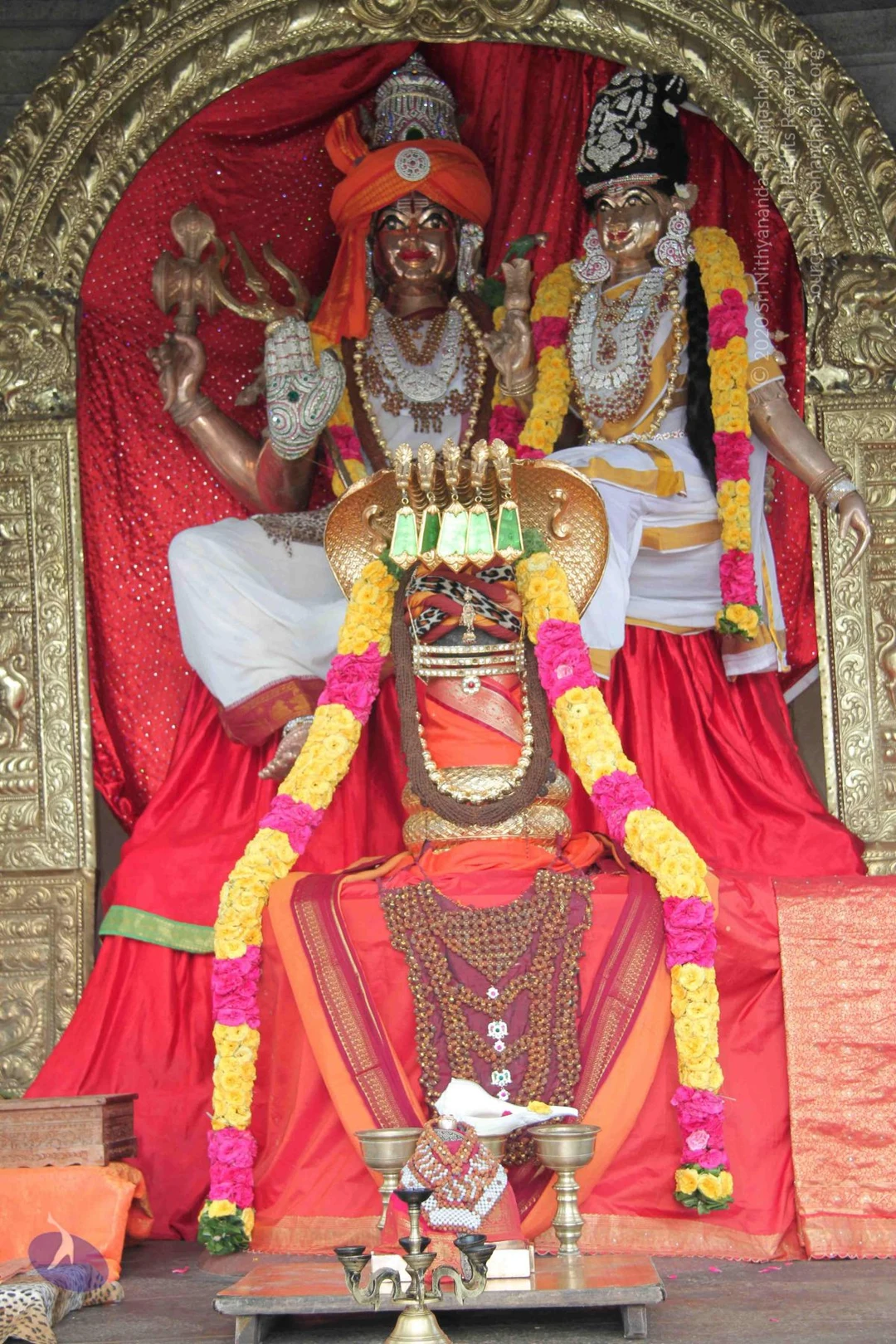
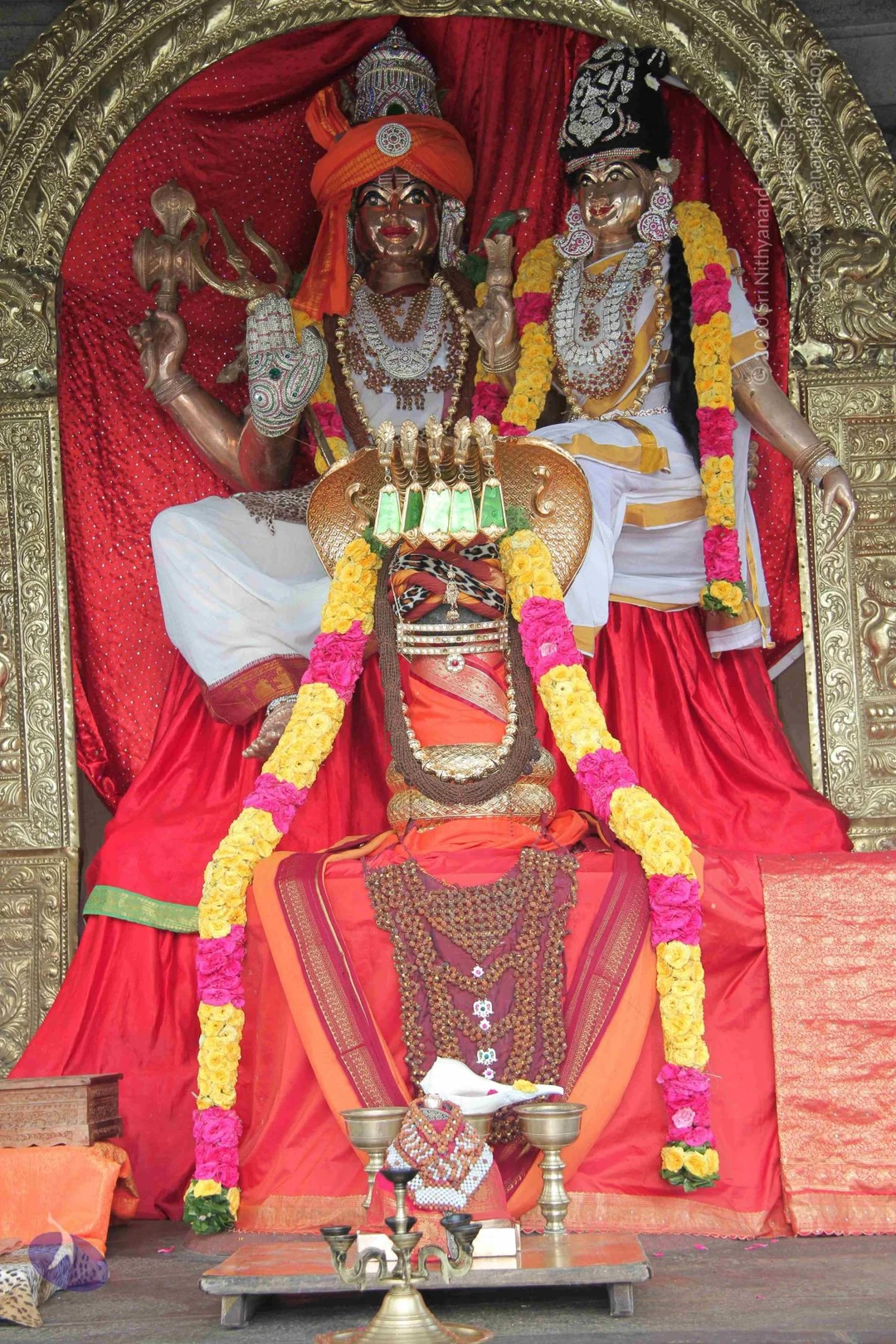
And you can also do Samskaara Dahana Kriya with the deities. You can first share with Ganesha, then go and share with Venkateshwara, then share with Lakshmi, then share with Mahadeva, then share with Devi, then, finally, share with Subramanya, and, ultimately, with Guru. Offer the Samskaaraas, the patterns into the Agni, the Rudra Homa Agni, and go.

This should become the official ritual, this should become the official ritual of the Sangha all over the world. We should be known as the temple removing samskaaraas and patterns. We should be known as the temple removing all the bad samskaaraas and pain patterns.

Constant, Perpetual Completion happens only by Samskaara Dahana Kriya, only by Samskaara Dahana Kriya. Please understand, please listen, only when you do this Samskaara Dahana Kriya for twenty-thirty days, you will even understand you are nothing but a collection of your patterns and samskaaras. See, that knowledge is the basic knowledge, basic requirement for you to decide to do Completion. Otherwise, as on now, you will be strongly associating yourself with those patterns; you will not give up on them; you will not give up on those patterns! Even if you give up one pattern you will feel that you have done a great sacrifice and you are growing spiritually. You have hundred stupid patterns and you are having pride just because you have dropped one pattern? These pain patterns should be dropped completely. Whether you are not able to get up in the morning – that is one pattern. If you sit for a long time in Padamasana and have knee pain, that is one pattern. Feeling bored? That is one more pattern. Feeling tired? One more pattern. Feeling frustrated? One more pattern. Not feeling enthusiastic? One more pattern. Not feeling excited about life? One more pattern. Trying to constantly justify your existence? One more pattern. You will even understand all this is a pattern only when you do Samskaara Dahana Kriya for at least thirty-forty days!

All the ashrams, all the temples all over the world should have this Nithya Agni, Eternal Agni, where people come and do Samskaara Dahana Kriya and drop their samskaaraas and go. When they drop their samskaara paper, they should tear that paper to the extent that nobody should be able to read what they wrote; they should tear it completely and drop it in the fire and go; and the priest should burn that whole thing when he does Rudra Homa in the evening. Every day the Rudra Homa should be done, burning our patterns, burning our patterns and samskaaraas.

Understand, even devotion can happen to you only if you remove all the pain from your heart, from your being. See, if the food goes inside you and never comes out, it can lead to constipation and all the sicknesses. Same way, all your pain patterns, if they don’t come out, it will lead to frustration and just desperation, not liking anything, does not want anything; it becomes that tantrum-throwing child inside you, just wants to demolish everything, break everything and run away somewhere. Where will you go? After going there, from there you will run! Running from place to place due to desperation cannot be called Parivrajaka Yatra, understand? Many fellows running from one place to another place because of desperation think they are doing Parivrajaka Yatra. No! Parivrajaka Yatra happens, Parivrajaka Yatra happens only when you move out of joy. I tell you, I was moving like a banyan leaf in the breeze. When a leaf falls from the tree, in the breeze how it moves, that is the way I moved in my life. That is why my Parivrajaka, even to remember, it is a joy for me! But, in desperation if you travel, even if you remember, it will be a pain pattern for you. Understand, even to know what is pain in you and what is not pain in you, you have to do Samskaara Dahana Kriya.

Forty-eight days if you do Samskaara Dahana Kriya, it is equivalent to one Inner Awakening! I tell you, wherever you are, if you just learn Samskaara Dahana Kriya and do it forty-eight days, it is equivalent to you attending one Inner Awakening! Now you have a method, free Inner Awakening technology! Freely you can have the benefit of Inner Awakening! Anybody who has the pattern – ‘Oh, how can I pay for Inner Awakening?’ – do at least this: Forty-eight days do Samskaara Dahana Kriya in your own Sangha wherever you are.

I wanted all the Mahants, Kotharis, to facilitate more and more people doing Samskaara Dahana Kriya in your cities, in your ashrams, in your temples, in your Centres, in your houses. Till you are enlightened even you should do, and you should go on insisting, encouraging people should do the Samskaara Dahana Kriya, because, this is the time you will get to look into the depths of your being. See, till you realize that the Self-Doubted and the Doubter are one and the same, the Self-Hater and the Hated are one and the same, the Self-Denied and the person who is denying are one and the same, the Self-Blackmailing, who is blackmailed and blackmailer are one and the same, you should do Samskaara Dahana Kriya. When you know both are one and the same, the Complete Completion will happen in you, Complete Completion will happen in you, the Perpetual Completion.

I tell you, unless you solve all the problems of your life from the space of Advaitha, you won’t be stable, you won’t be stable in life. So, you solving all your problems from the space of Advaitha is required. If you want your husband to be stable, wife to be stable, son to be stable, brother to be stable, your teamily members to be stable with you, help all of them to do Samskaara Dahana Kriya. I want all of you to be stable with me; that is why I am so insisting on you all doing Samskaara Dahana Kriya. Whoever you love, make them do Samskaara Dahana Kriya, because, only then your love will be stable with them, their love will be stable with you.

Whether birth or death, for all the dasha samskaaras, dasha karmas of Hinduism, we should do Samskaara Dahana Kriya. Whether it is Garbha Dhaana, Anna Prashna, Naama Karana, Vivaaha, any ceremony, any samskaara, the person should be made to do Samskaara Dahana Kriya. Every samskaara in life, you should do Samskaara Dahana Kriya.

All the spiritual practices, all the techniques, all the methodology that ultimately leads to Advaithic experience, after analyzing all these thoroughly as much as I can, I am offering you the most simplest, straightforward, powerful lifestyle to live Complete Completion. People saying, ‘I don’t want to have Completion’, they don’t even want to have Completion, is the worst situation people can be in. Sometimes I am seeing people saying. They are so incomplete even with all Completion techniques, they have so much incompletion about Completion! They don’t even want to do Completion! They don’t want to get out of their suffering. All they want to do is they want to prove their point is right. Trying to prove their point is right, they are ready to destroy their whole life.

Samskaara Dahana Kriya will liberate you from this painful existence. If something or somebody can save you, it is only Samskaara Dahana Kriya. Listen! It is only Samskaara Dahana Kriya. It is only that that can save you, that that can save your whole life. Do Samskaara Dahana Kriya.

Ultimately, I give you all my blessings, let you all be inspired, excited, and do it intensely wherever you are, the Samskaara Dahana Kriya, every day, at least for forty-eight days, and be freed from all the pain patterns, pain samskaaras in your life! Let you all be liberated! Let us all be liberated! Only when you do it, you will also feel excited to enrich others. When you enrich, you will be more excited to do it.

I bless you all! Let you all radiate with Integrity, Authenticity, Responsibility, Enriching, and Causing eternal bliss, Nithyananda! Thank you!

Tags:

Paramahamsa Nithyananda, Samskara Dahana Kriya, Perpetual Completion, not exploit others, all steps must be followed, psychological enema, easiest method, experience of advaita, it will save your life.

Photos Of The Day:

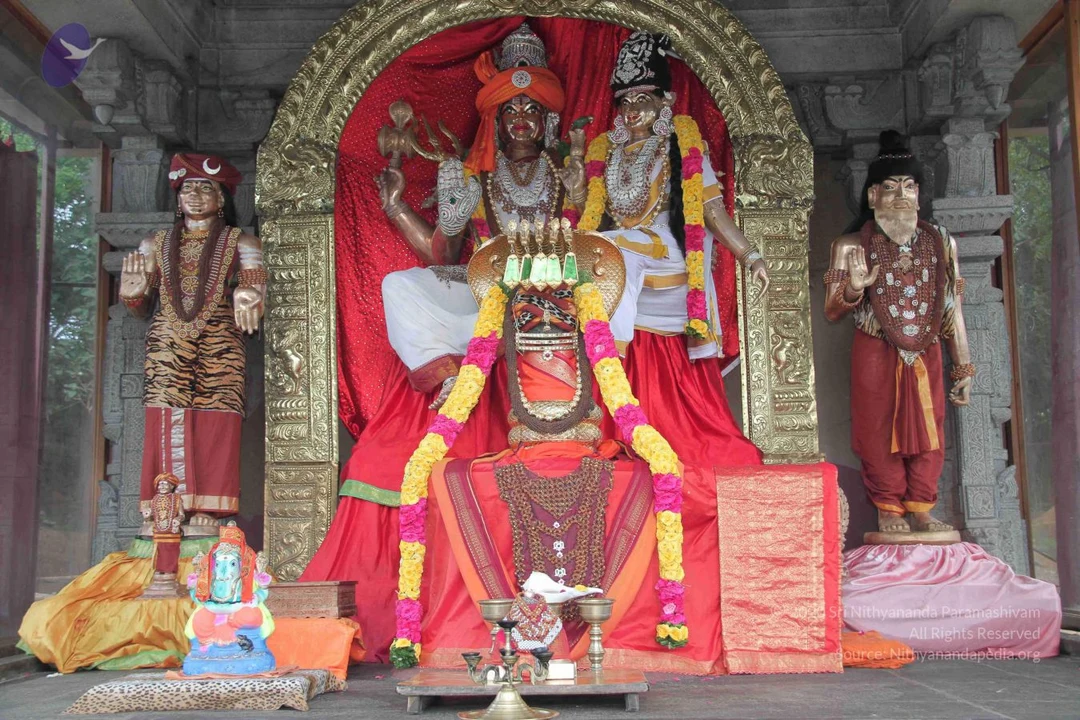
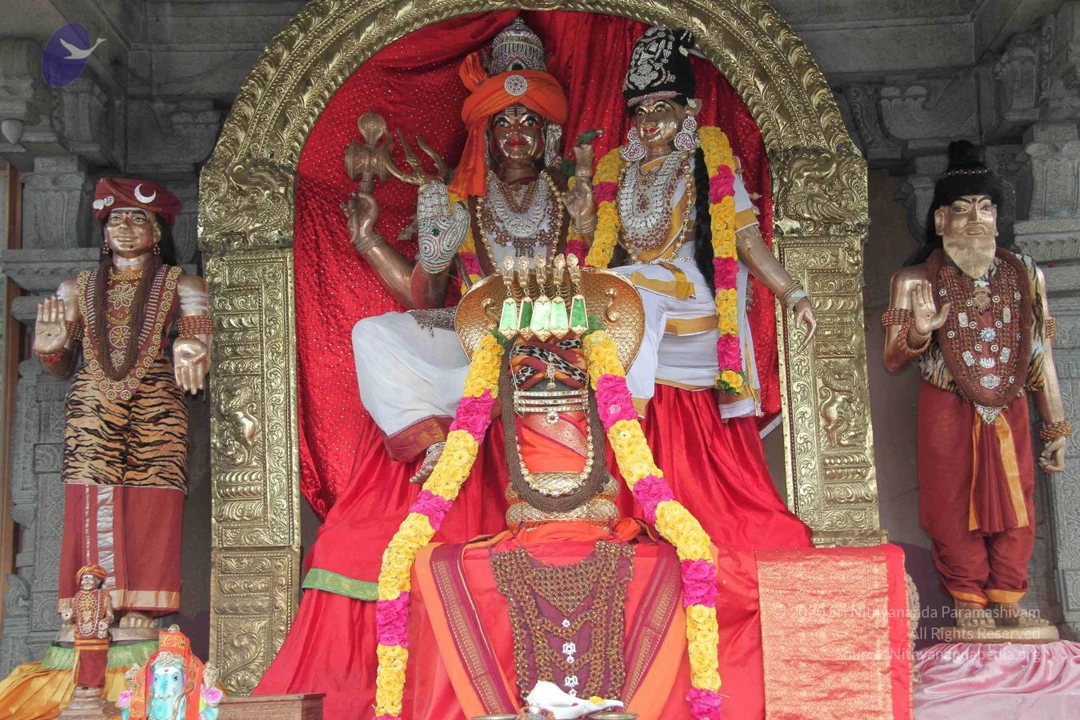
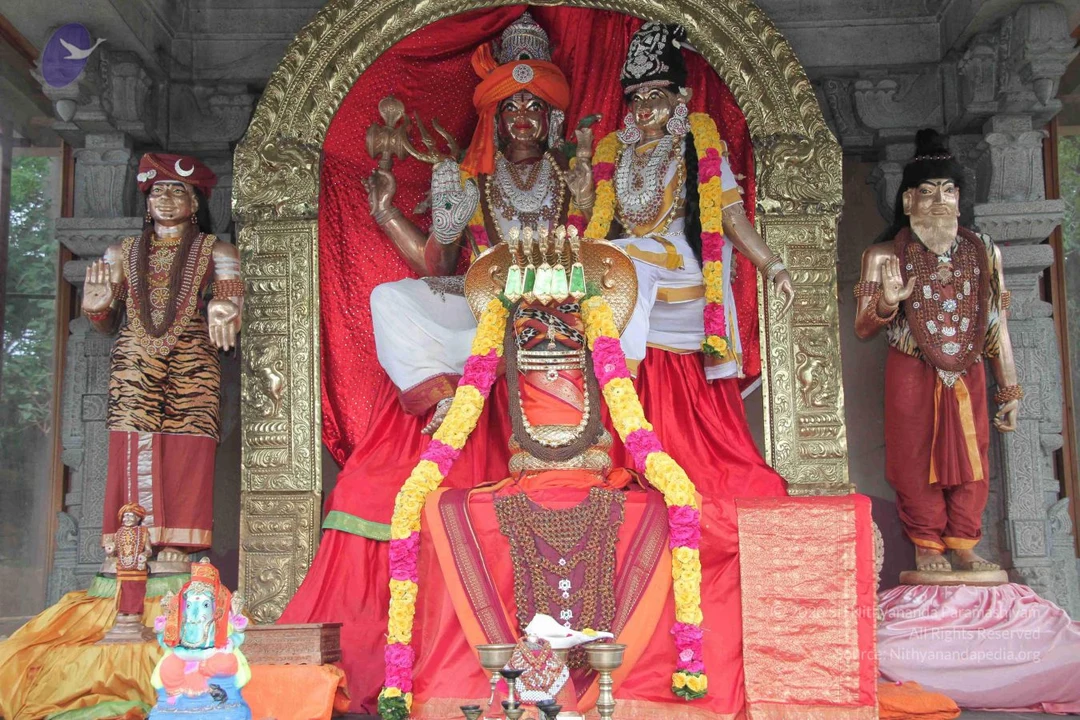
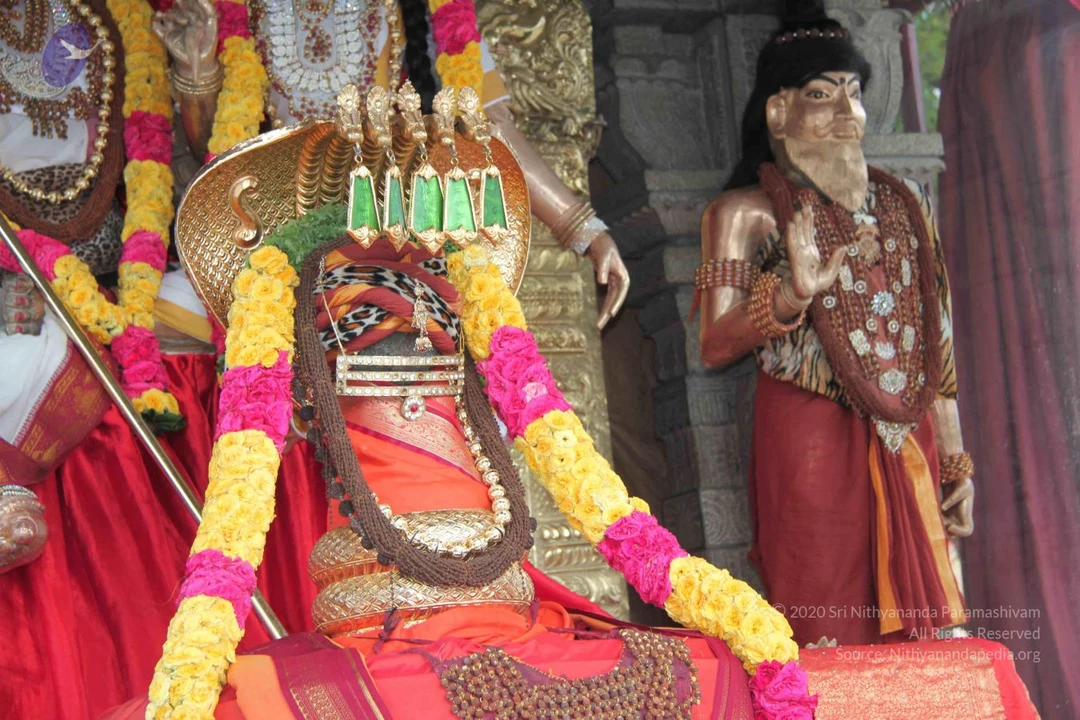
Deity-Darsion
Bidadi-Bengalurum

Gurugul

Inner-Awakening

Photos Of The Day:

Photos Of The Day:

nithyananda-ashram

Photos Of The Day:

Deity-Darsion
Gurugul

Inner-Awakening

Photos from this day

View all 142 photos

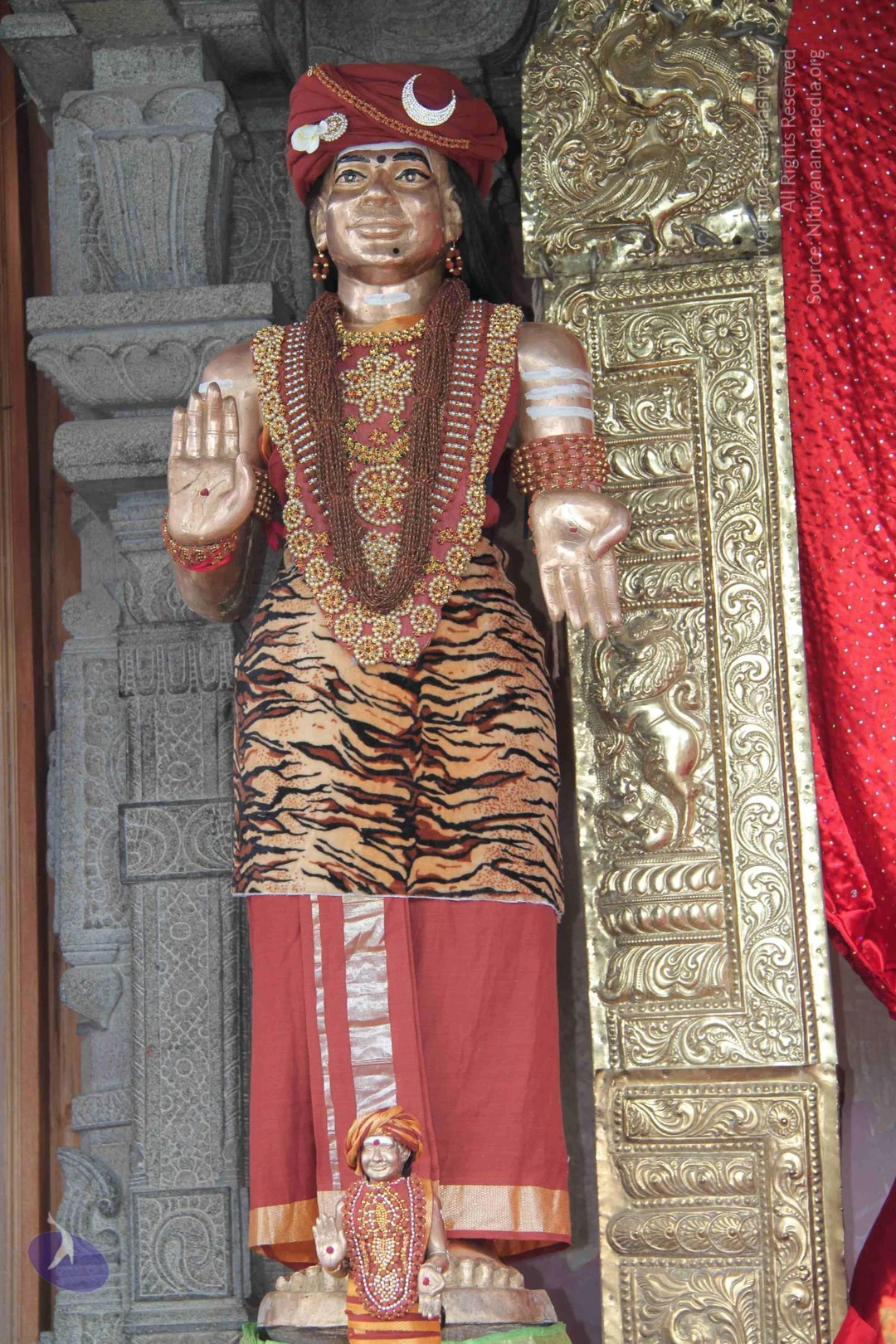
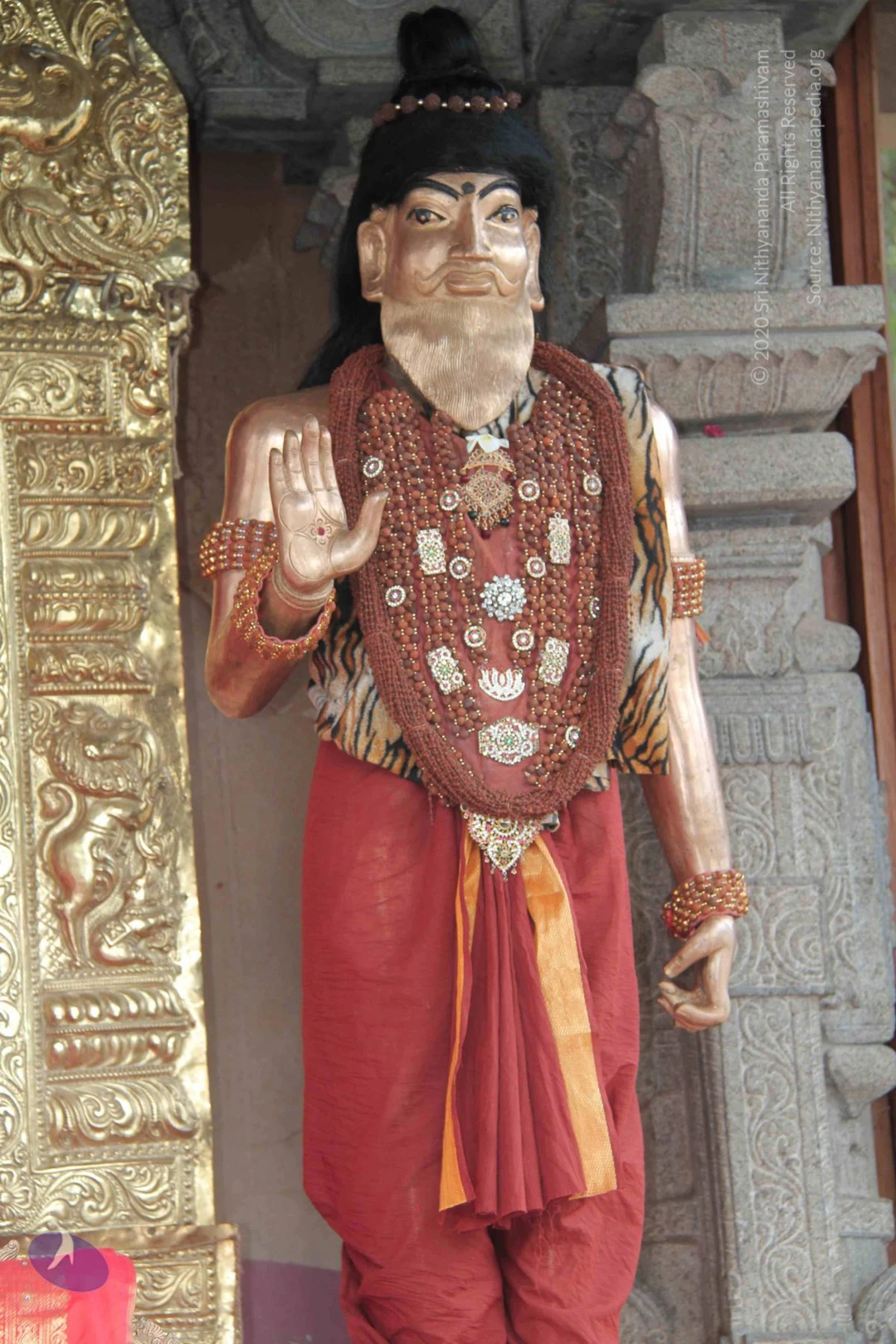
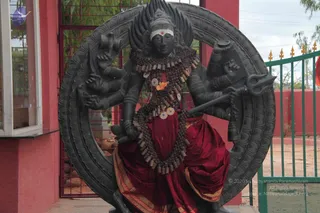
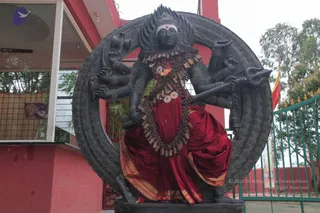
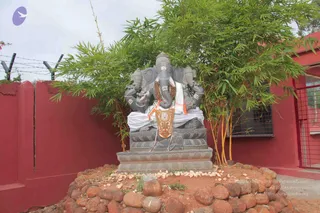
Deity-Darsion
28 photosSource gallery
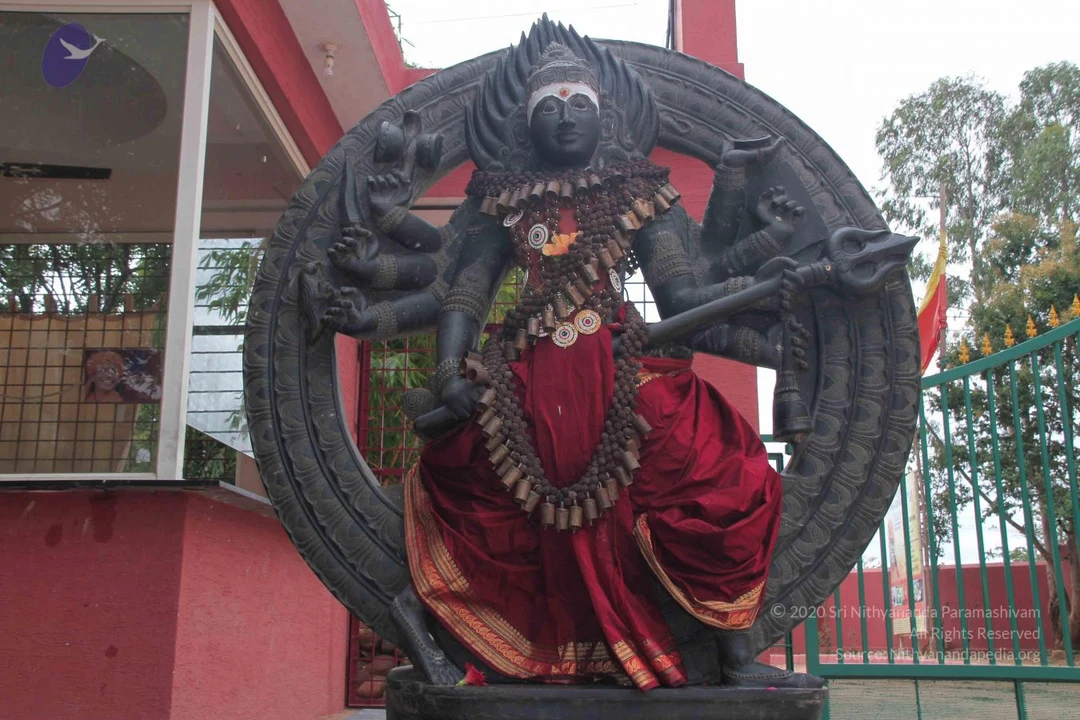
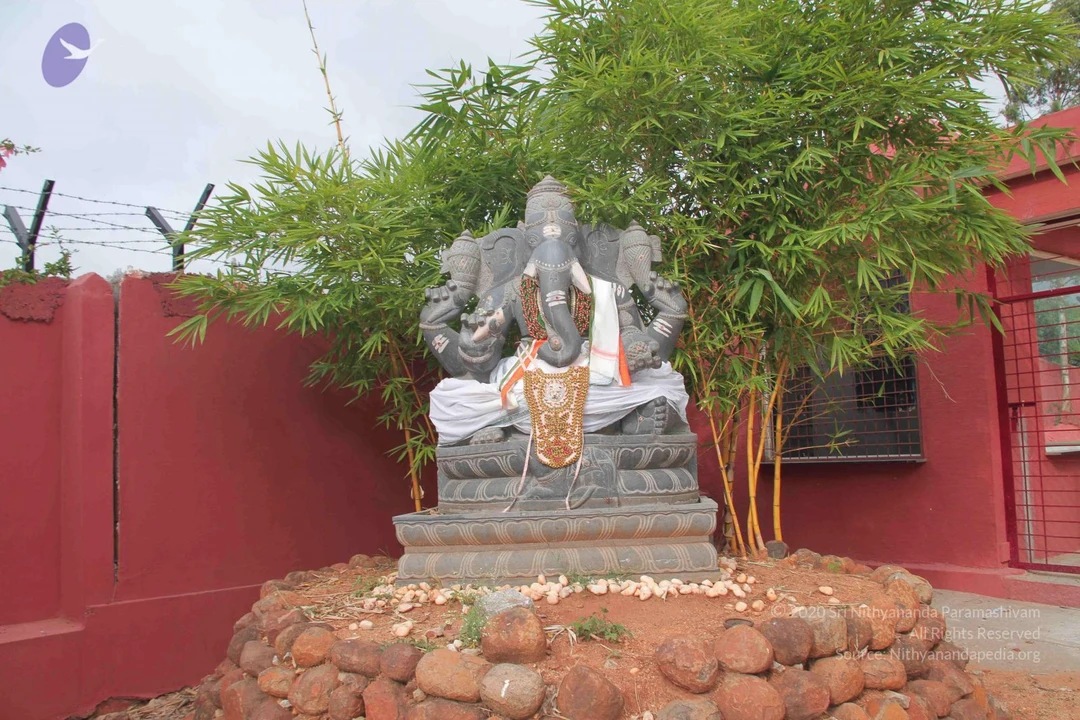
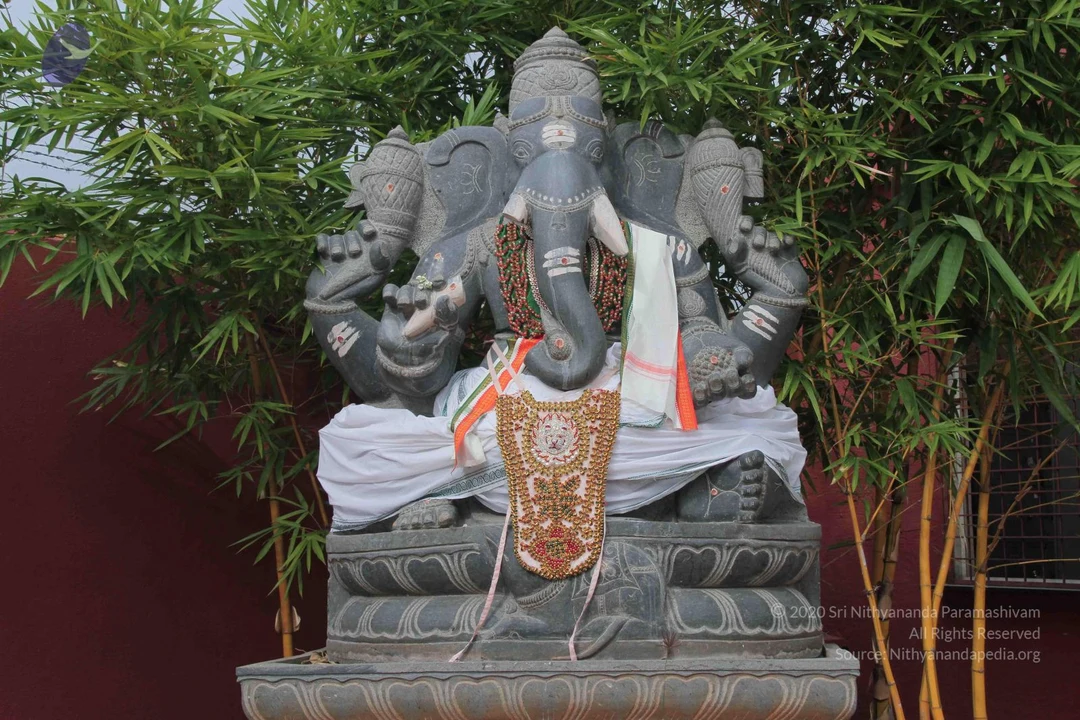
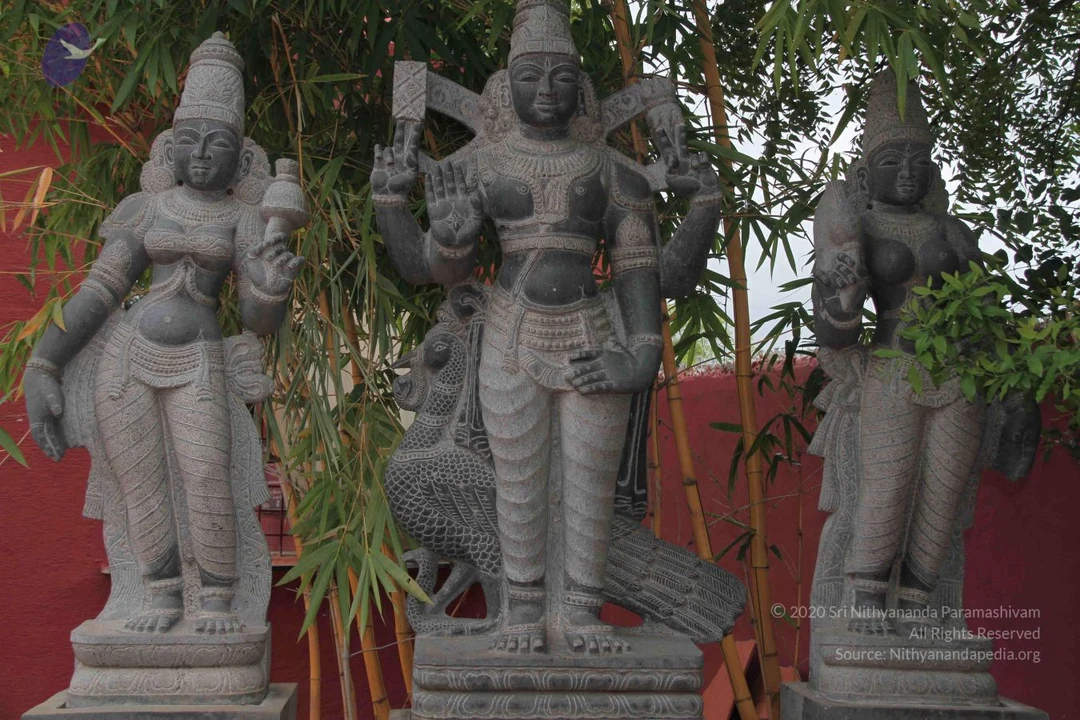
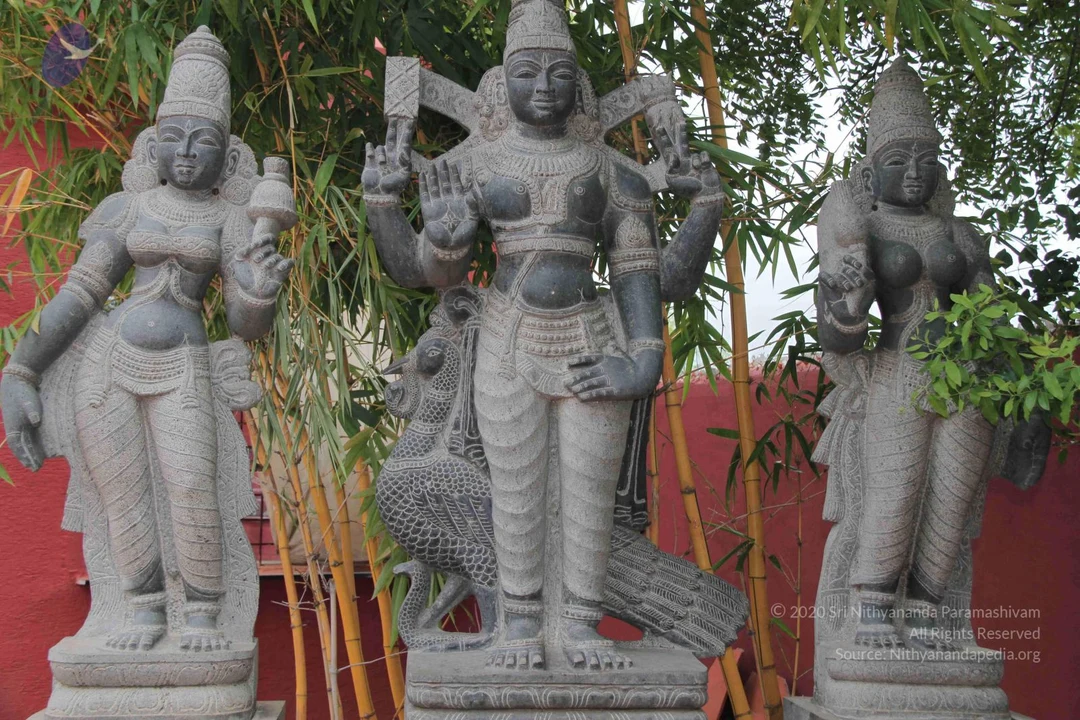
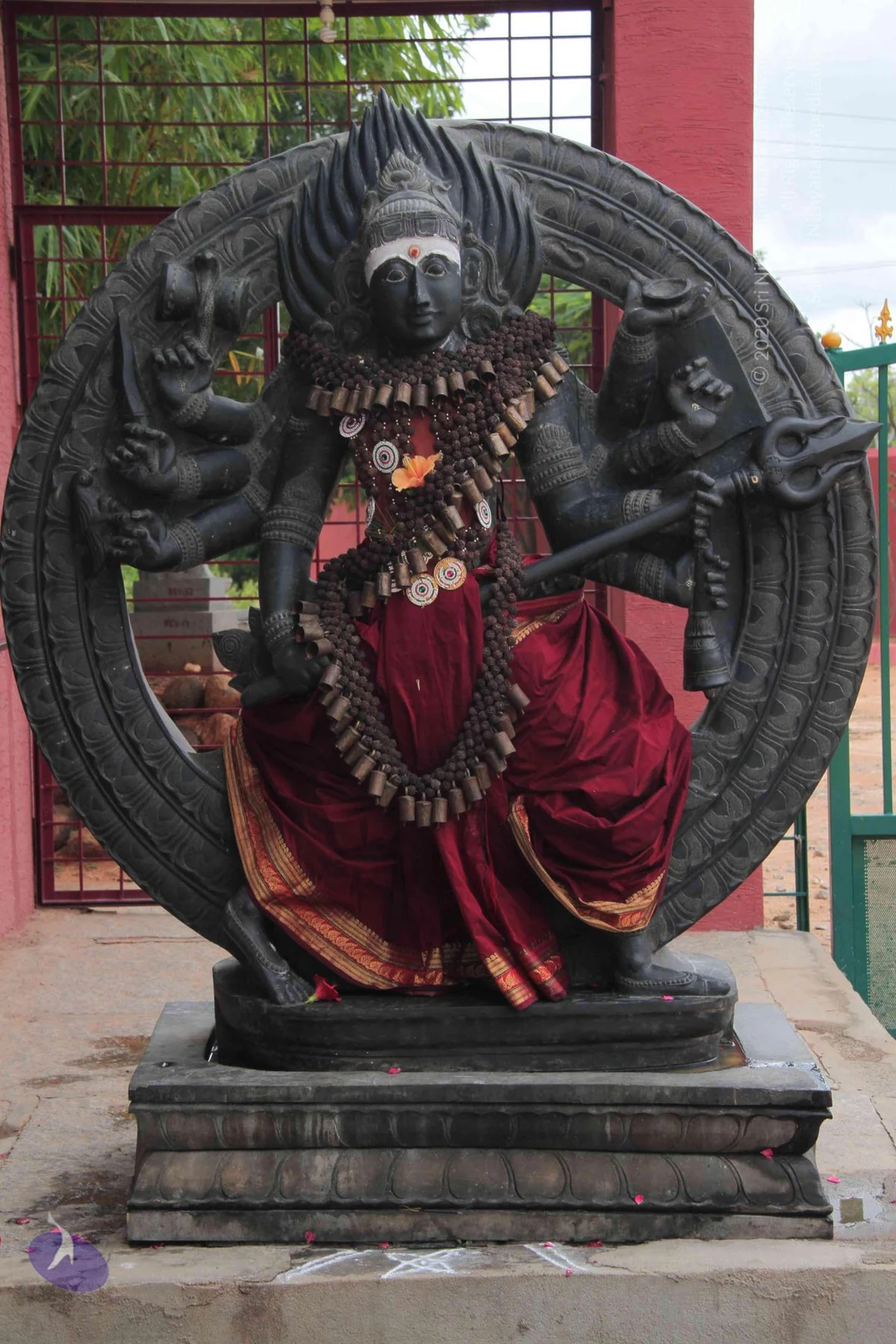
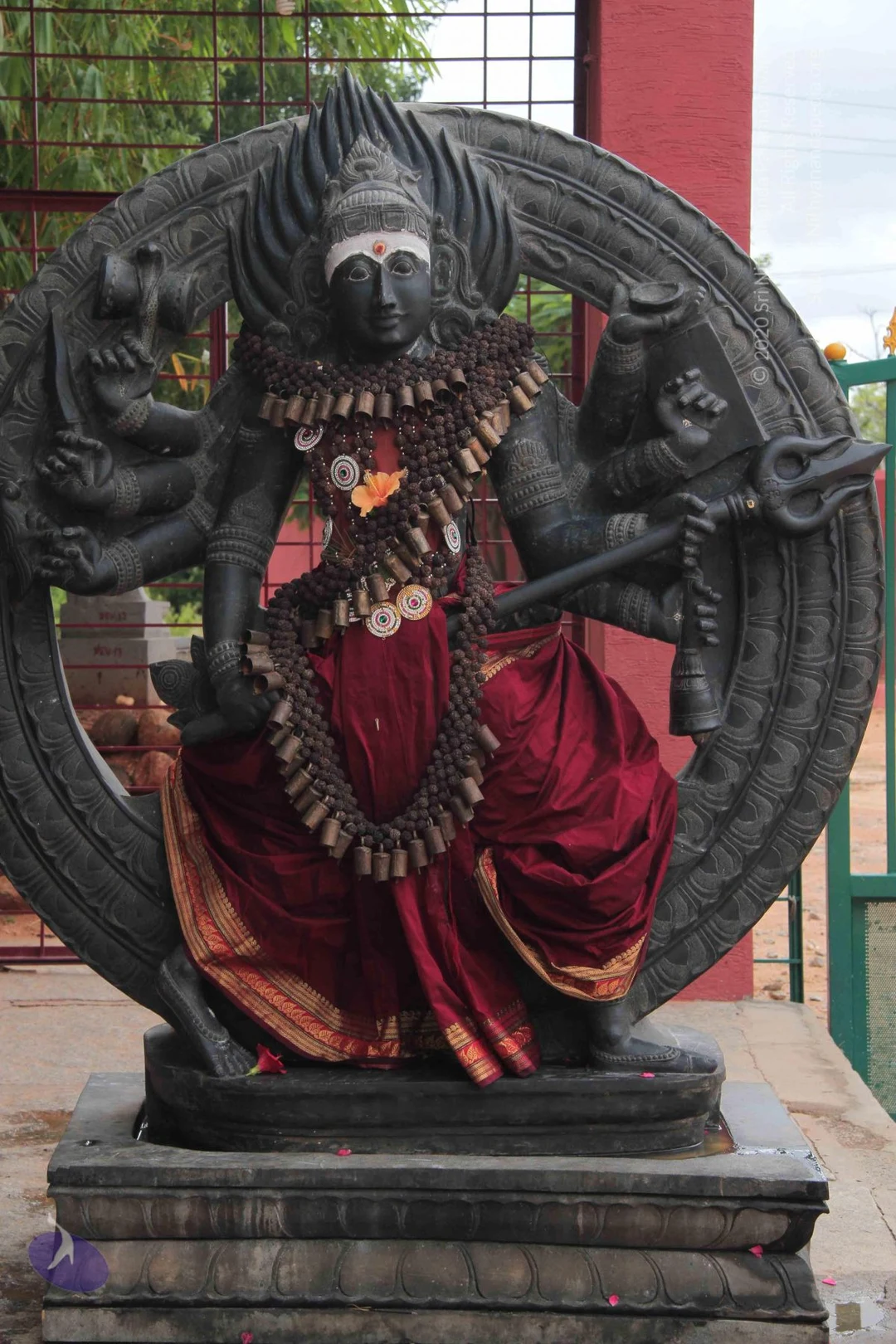
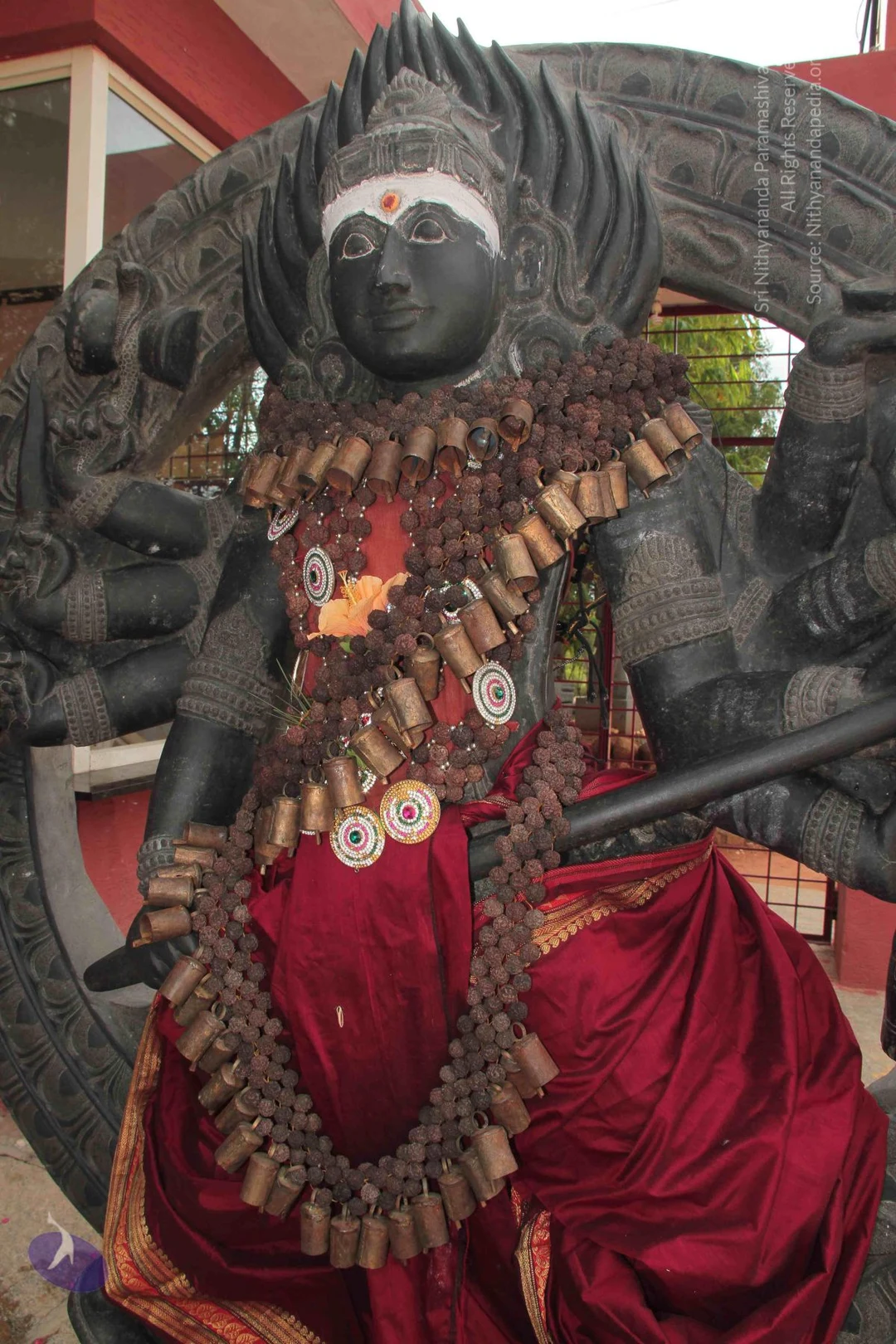
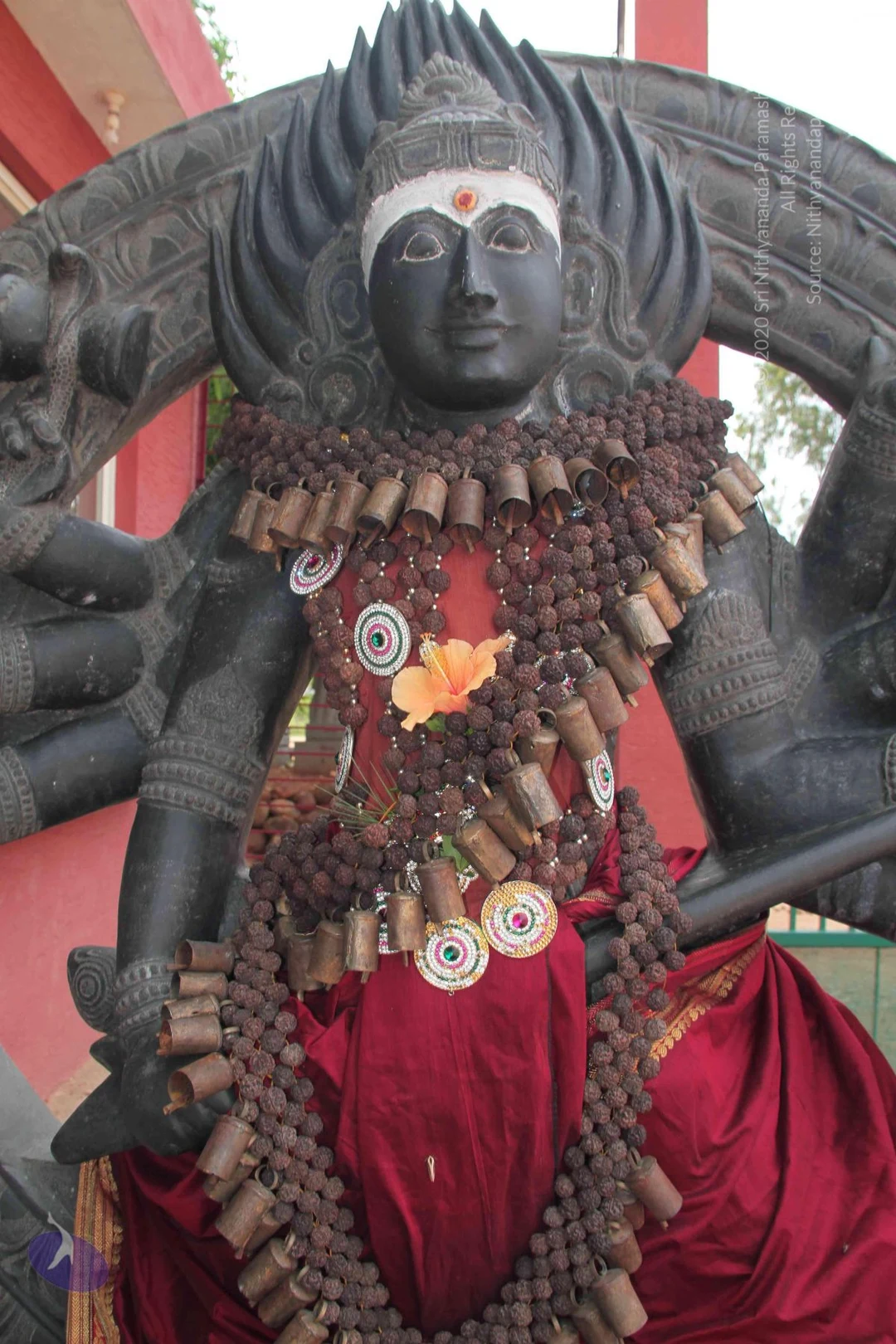
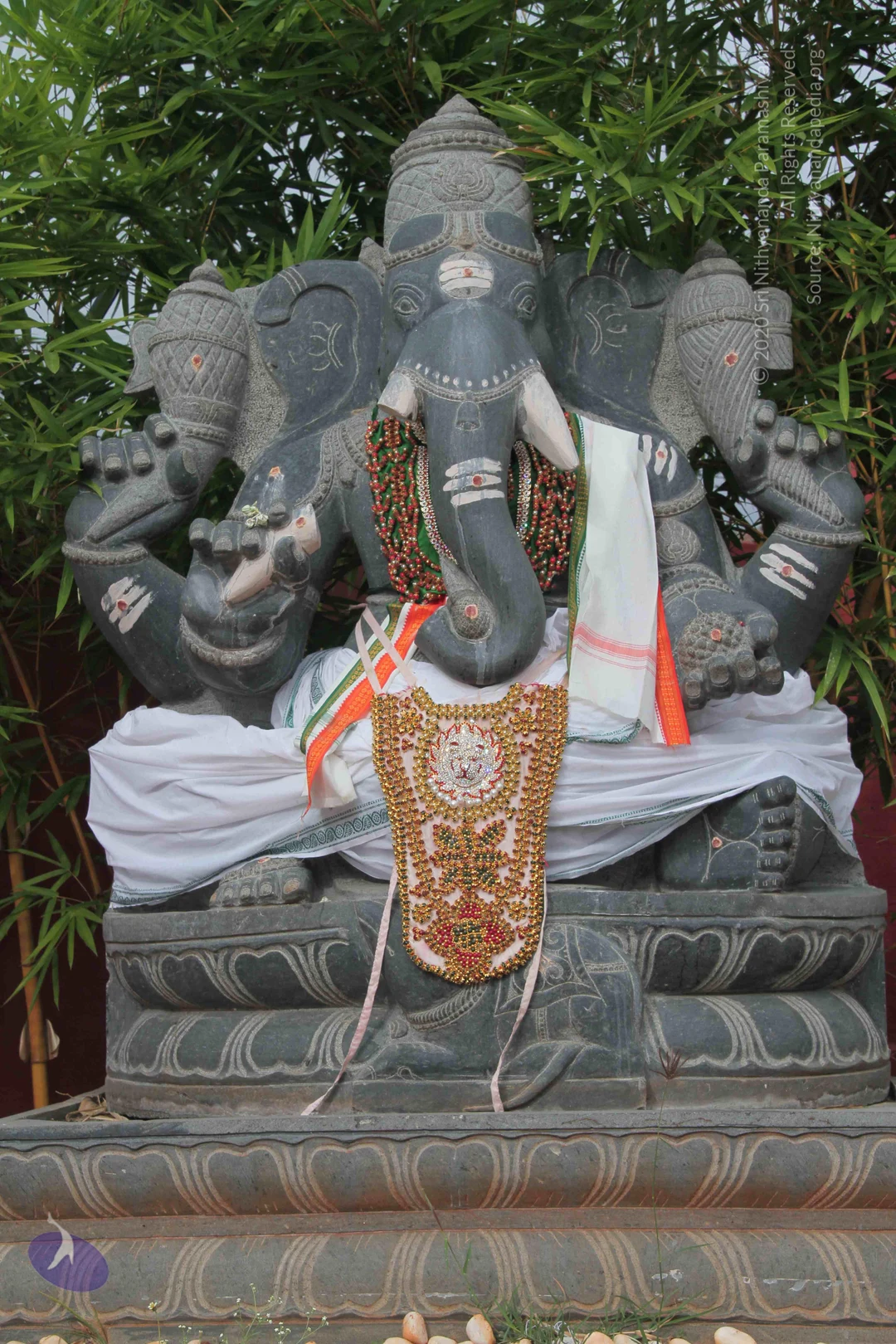
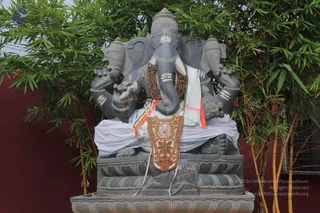
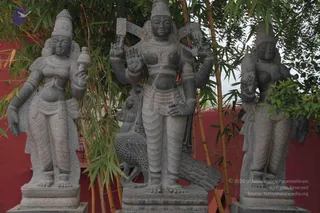
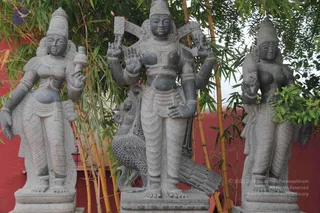
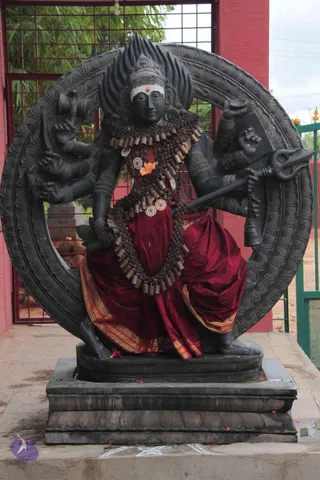
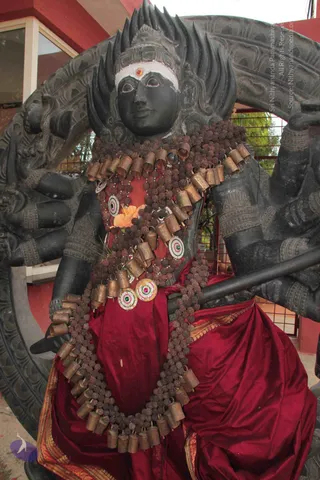
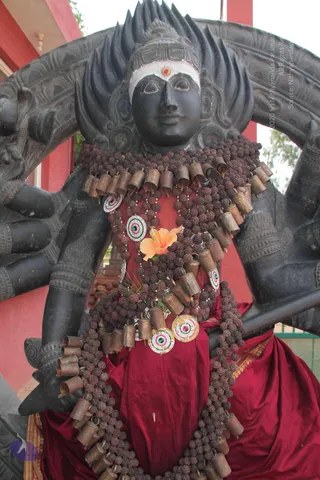
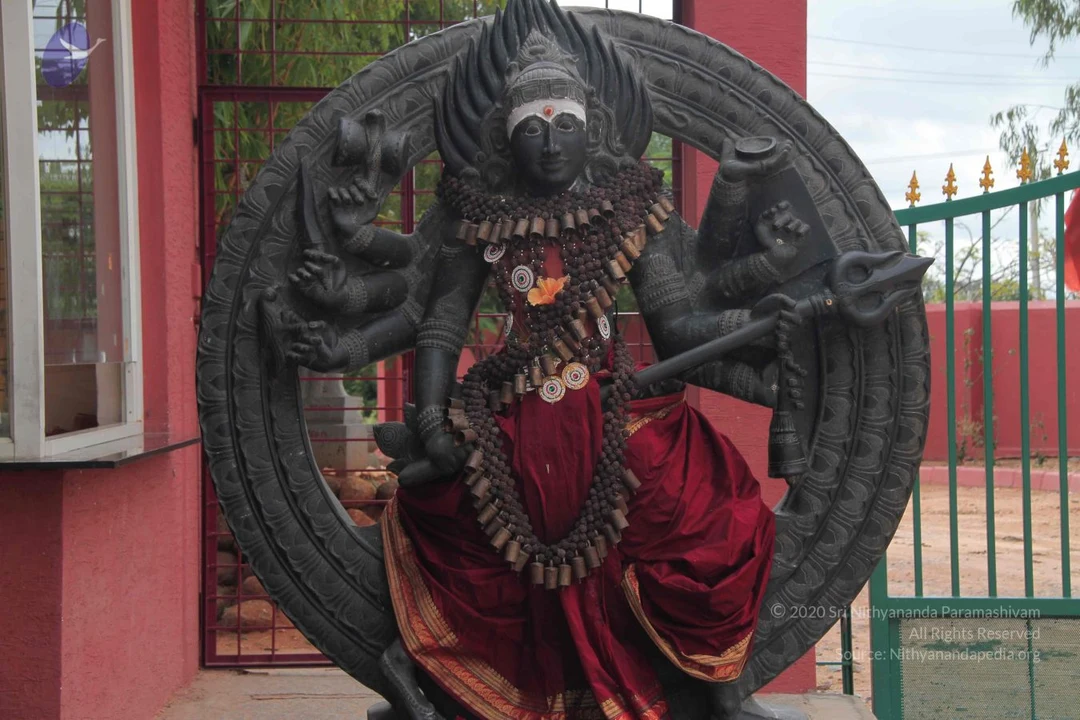
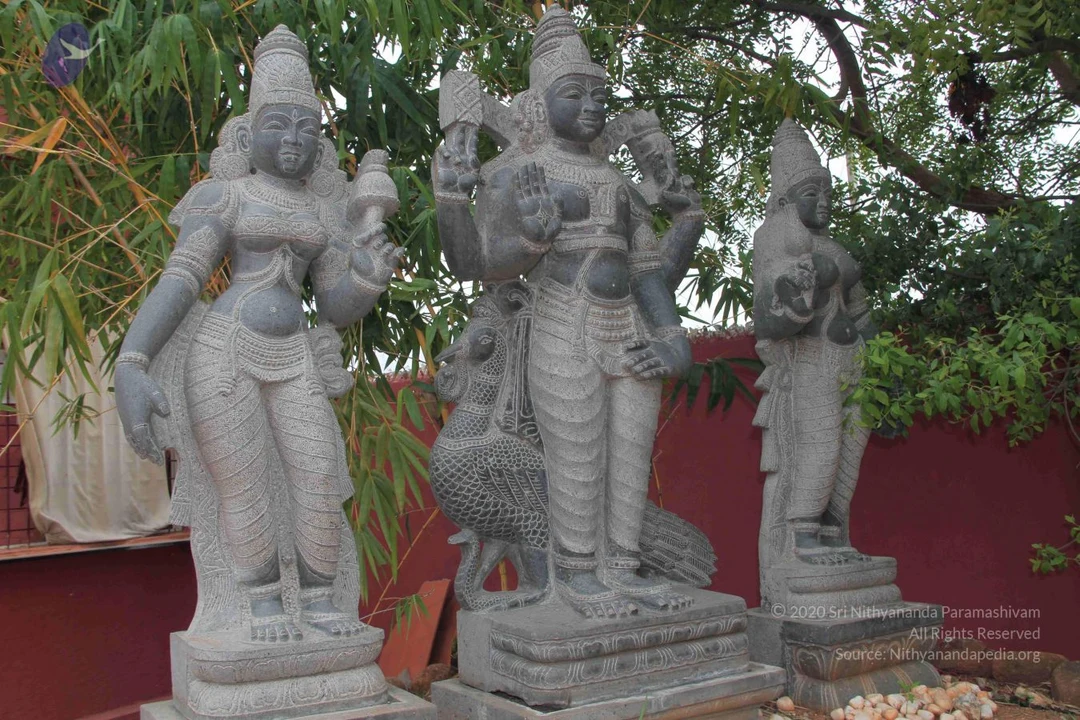
A dark stone deity murti stands framed by a large circular halo carved in relief, set before a red-painted wall beside a green iron gate. The figure has multiple arms holding a trident, a damaru-like drum and other implements, wears a red silk dhoti with gold border, and is draped in long rudraksha malas with cylindrical bead ornaments and a marigold garland at the chest. A white forehead band with a red tilak marks the face. No physical people are visible in the scene.A large dark stone statue of a multi-armed goddess stands outdoors within a circular arched halo carved into the stone. The figure has a white tilak on the forehead, a dark hair crown with flame-like points, and wears a long red sari with gold border and layered necklaces of rudraksha-like beads with small brass bells. Several of her hands hold objects including a trident and a bell. A red-painted building wall, a green metal gate and trees form the background. No people are visible.A grey stone statue of the elephant-headed deity Ganesha sits on a tiered pedestal in an outdoor courtyard. The figure has multiple arms, wears a white dhoti and an orange-and-white sash, and is adorned with a red and gold beaded garland. Its base is ringed with rough red-brown stones and scattered white pebbles. Green bamboo stalks grow beside it, a red-painted wall with barbed wire stands behind, and a red-framed window sits to the right. No people are visible.A photograph of a grey stone statue of the elephant-headed deity Ganesha seated on a carved lotus pedestal outdoors, framed by green bamboo stalks against a dark red wall. The statue has four arms, holding objects in its raised hands, and wears a red and green beaded garland, a gold-and-red jewelled chest ornament, and a white cloth draped over its lap with orange edging. Tripundra markings decorate its forehead and arms. No people are present.Three dark grey stone statues stand in front of a red wall amid green bamboo and leafy foliage. The central figure is a multi-armed deity murti standing on a peacock-like mount, holding a staff-like object and other implements, with a tall crown and ornate jewellery. Flanking it are two female figures in tall crowns and layered jewellery, one holding a vessel. The sculptures are carved with fine detail on stone plinths. No living people are visible.Three grey stone sculptures stand outdoors against a red wall with bamboo and green leaves behind them. The central figure is a four-armed deity murti standing on a plinth beside a peacock, holding objects in its raised hands. Flanking figures on either side are female sculptures wearing jewellery and crowns, one holding a small vessel. No living people are visible, and no portrait of a person appears in the scene.

Bidadi-Bengalurum

19 photosSource gallery
Overcast sky photograph with grey and white clouds, a bright sun glowing faintly through a gap at upper centre, and patches of pale blue sky. Dark silhouetted tree foliage fills the lower left and bottom edge, with a few thin branches at lower right. No people, ritual objects or structures are visible. A small purple logo with a white bird appears at the top left corner.A photograph of green bamboo branches with long narrow leaves silhouetted against a pale grey, cloudy sky. Thin bamboo stems rise diagonally across the frame, and a bit of blue sky shows through the clouds. No people, deities, ritual objects or ashram settings are visible.A photograph of a leafy branch silhouetted against an overcast grey sky, with a bright patch of diffused sunlight breaking through the clouds. The slender, narrow leaves are dark and backlit, and thin stems rise from the bottom edge of the frame. No people, deities, ritual objects or buildings are visible. A faint white bird logo appears in the upper left corner.A photograph looking up at a bright overcast sky with scattered white and grey clouds. Dark green tree canopies frame the left and right edges of the frame. Thin utility wires and a wooden utility pole are visible near the bottom centre against the trees. No people, ritual objects or structures are visible apart from the pole and wires.A photograph of an overcast sky filled with white and grey clouds, with a brighter patch of sunlight breaking through near the centre. Dark silhouettes of leafy trees frame the left and right edges, and a thin utility pole with power lines runs across the lower part of the frame near a roadside. No people or ritual activity are visible.A photograph of an empty, unpaved dirt courtyard or road under a heavy grey overcast sky. Red-painted boundary walls run along both sides, and a red multi-storey building with a flat roof stands in the background beside a few trees and a pile of stone blocks. Pale rocky hills rise behind the complex. No people or ritual activity are visible in the scene.

Gurugul

5 photosSource gallery
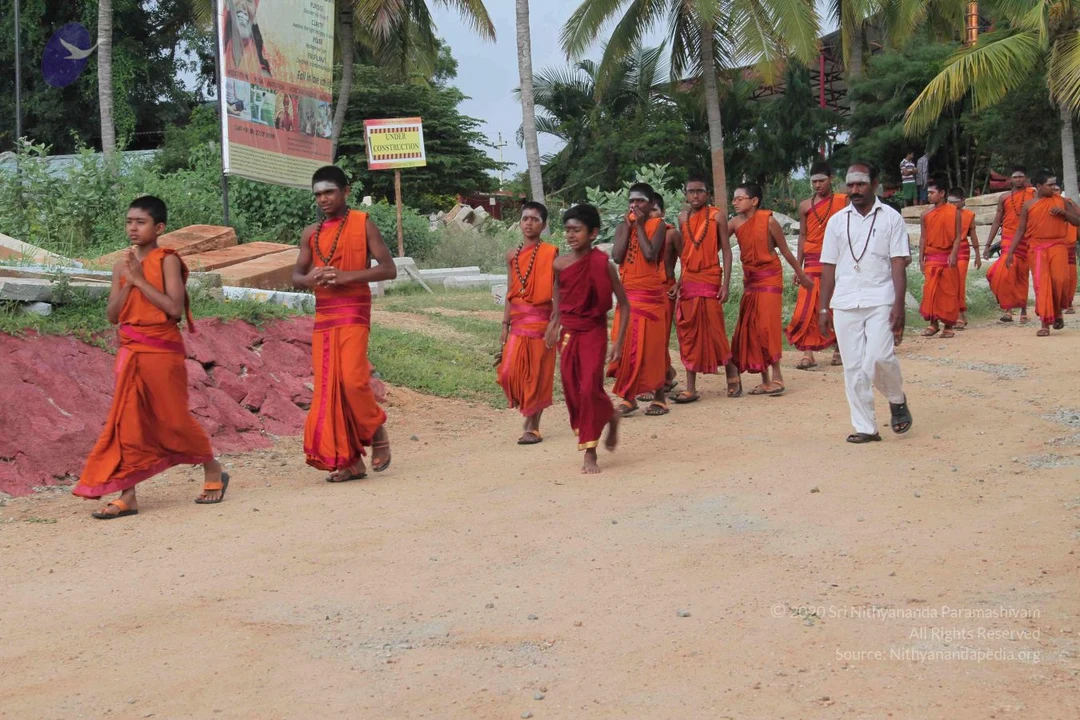
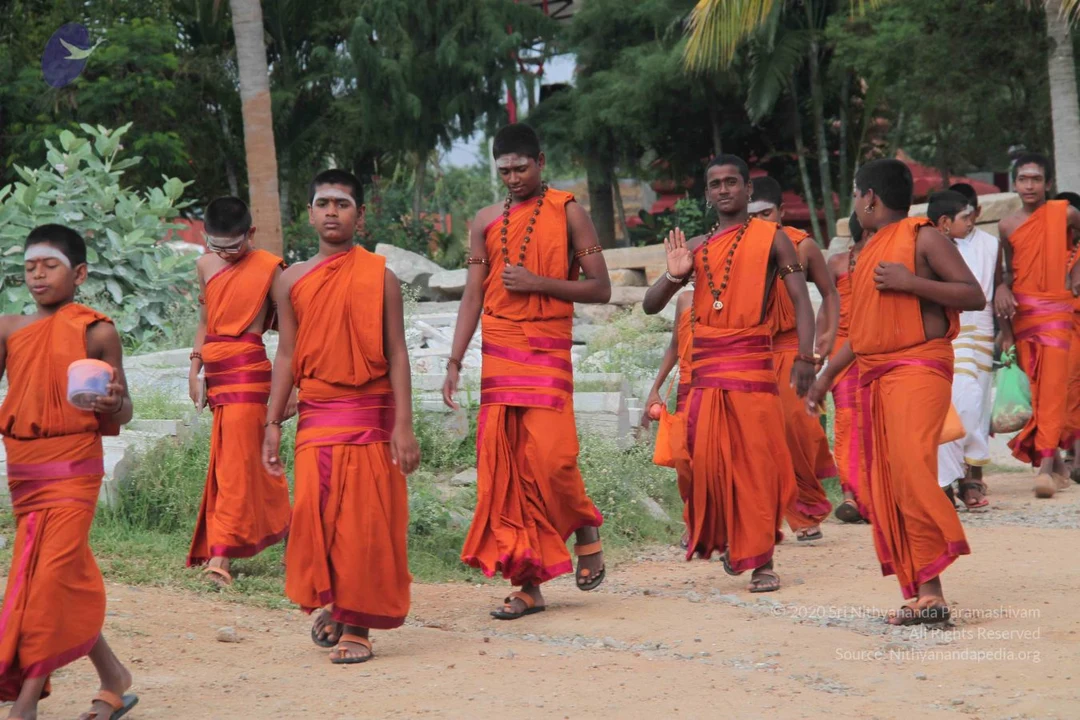
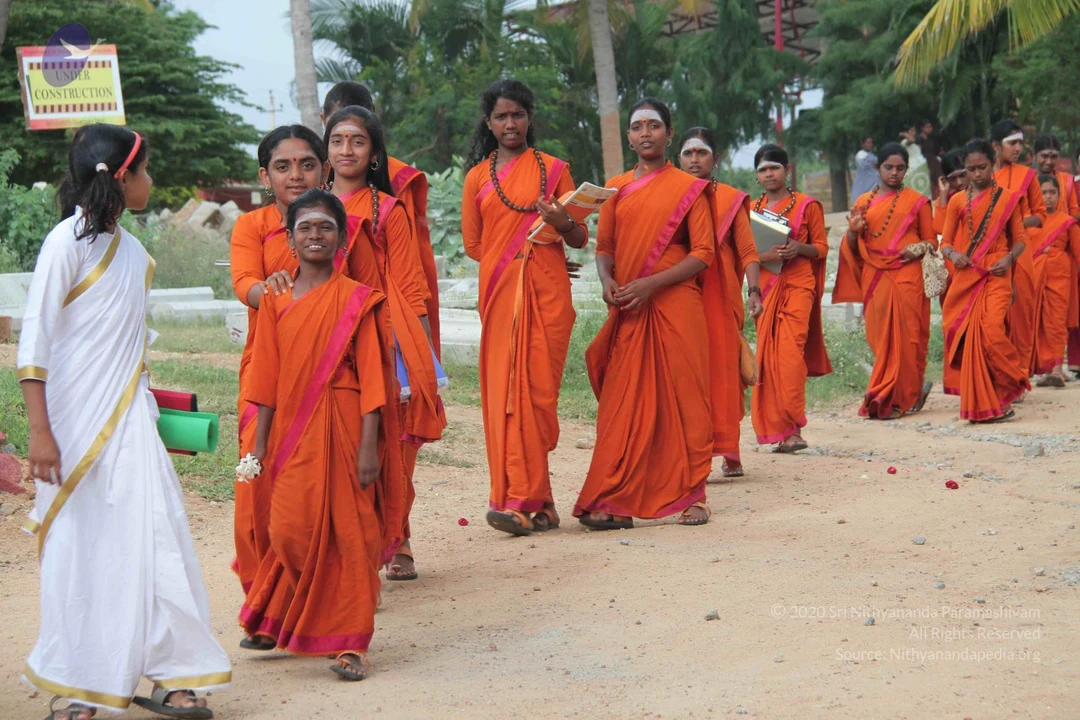
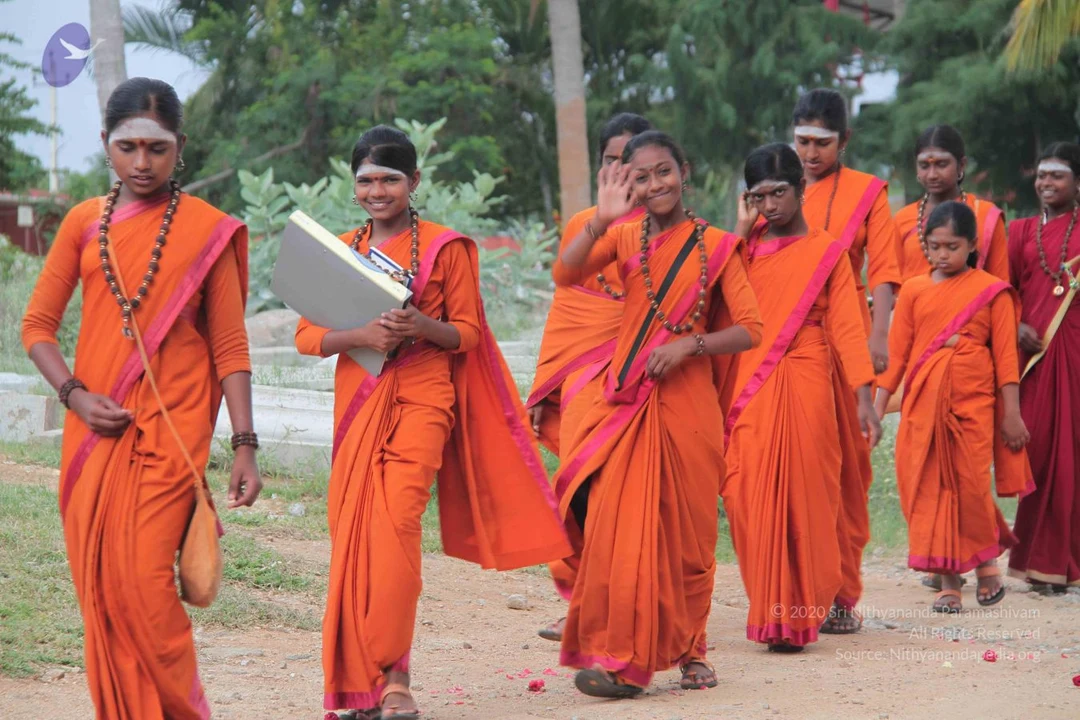
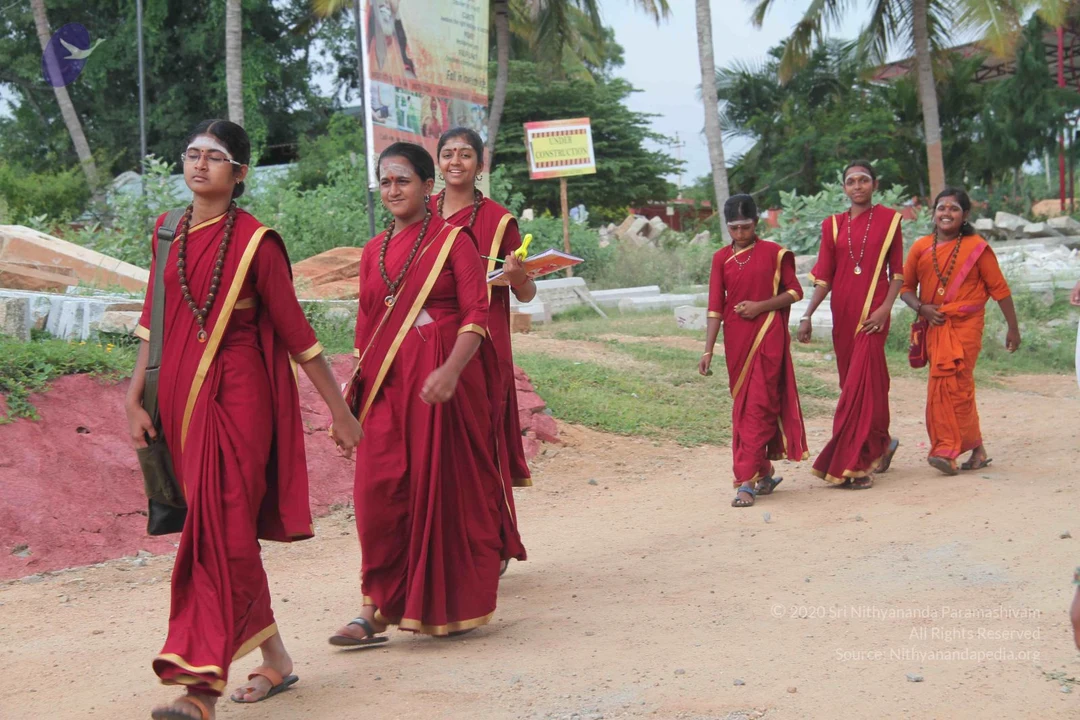
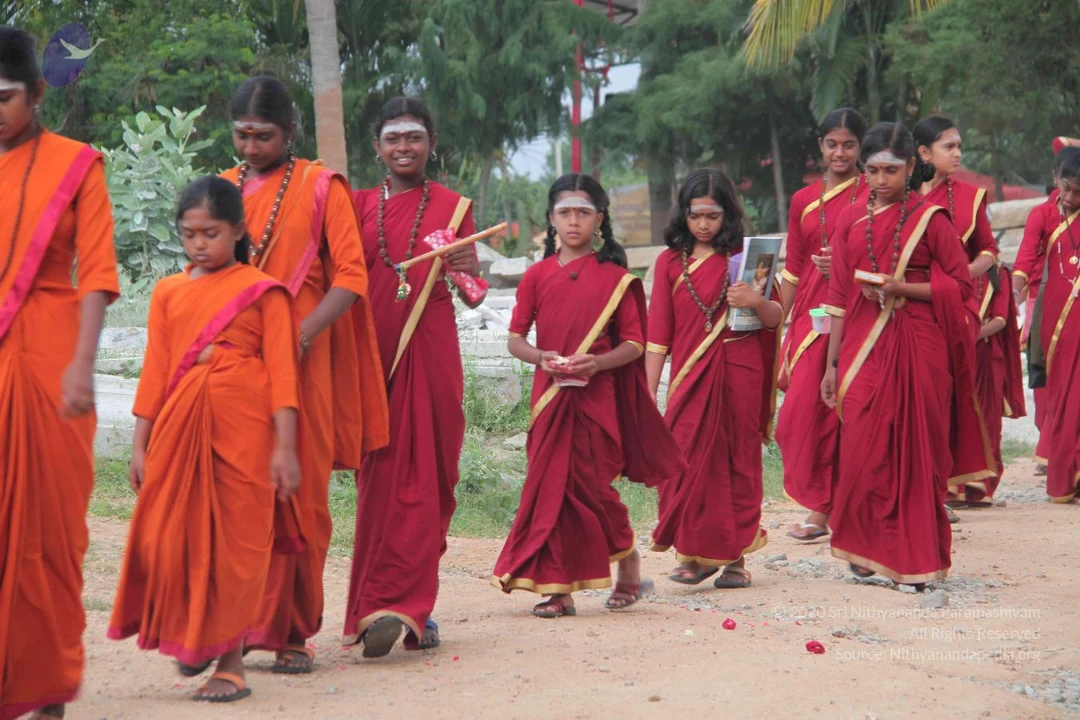
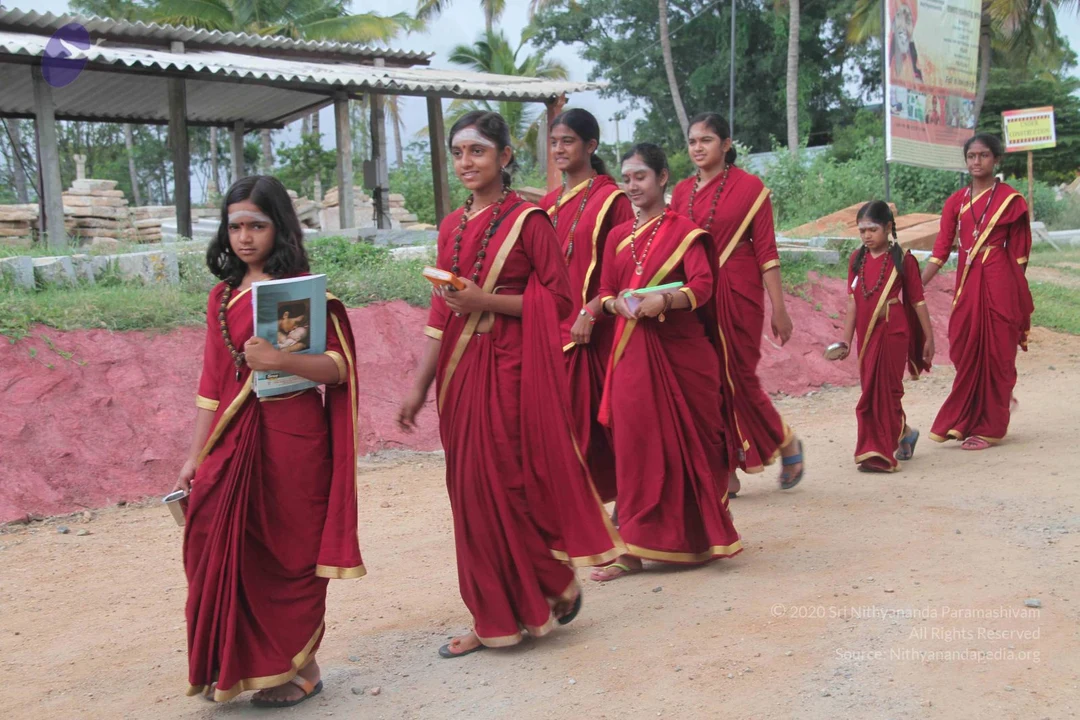
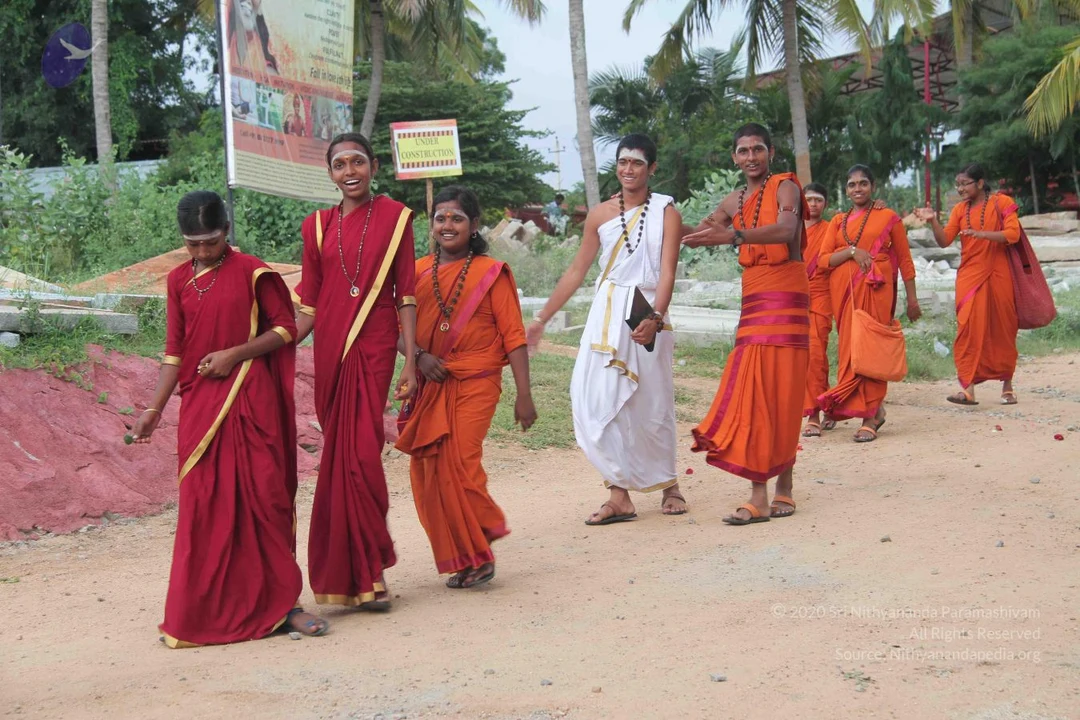
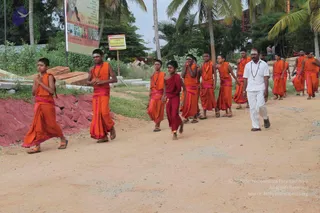
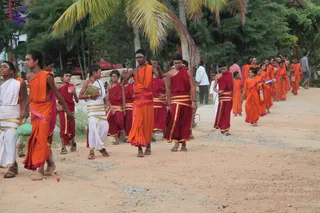
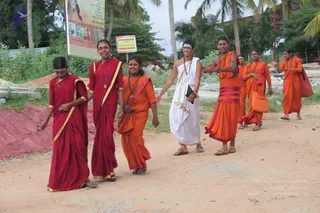
A line of young boys in saffron and orange robes walks along a dirt road past a construction area with stacked red bricks and a large signboard. Several boys wear rudraksha malas and some have their hands joined in prayer. One boy in a maroon wrap walks in the middle. An adult man in white shirt and white trousers, with a white forehead mark and a rudraksha mala, walks at the right side of the group. Palm trees and greenery surround the scene.A photograph of a group of young male disciples walking along a dirt path through a tropical garden with palm and leafy trees. They wear saffron-orange unstitched robes with magenta-pink borders and sashes, and several have white forehead markings. Some wear rudraksha malas and bracelets; the lead boy carries a small container and another carries an orange bag. Behind them an older man in a white dhoti and shirt walks carrying a green cloth bag. Concrete slabs and greenery line the path.Outdoor photograph of a procession of young girls on a dirt path, most wearing orange saris with magenta borders and white vibhuti or kumkum marks on their foreheads. Several carry rudraksha malas and folders or notebooks. A girl in a white sari with gold border stands at left facing them, holding green and red rolled items. Palm trees and a construction sign reading UNDER CONSTRUCTION stand behind, with scattered red petals on the ground. a person is not clearly visible in this image.A group of young women walk along a dirt path past green shrubs, a palm tree and a low white wall. They wear orange saris with magenta borders and rudraksha malas, and most have white vibhuti or tilak marks on their foreheads. The woman at left holds a sling bag, another carries a grey folder with papers, and the girl in front waves toward the camera. Red petals are scattered on the ground behind them.Six young women in red and maroon saris with gold borders walk along a dirt road in a rural compound, past a red-earth embankment, stone blocks and palm trees. Several wear rudraksha malas and bindis; one at the right wears an orange sari. Some carry bags and notebooks, one holds a yellow pen. Behind them a tall banner shows a portrait and text, and a small sign reads 'ENTRY CONSTRUCTION'. No a person candidate is visible.

Inner-Awakening

15 photosSource gallery
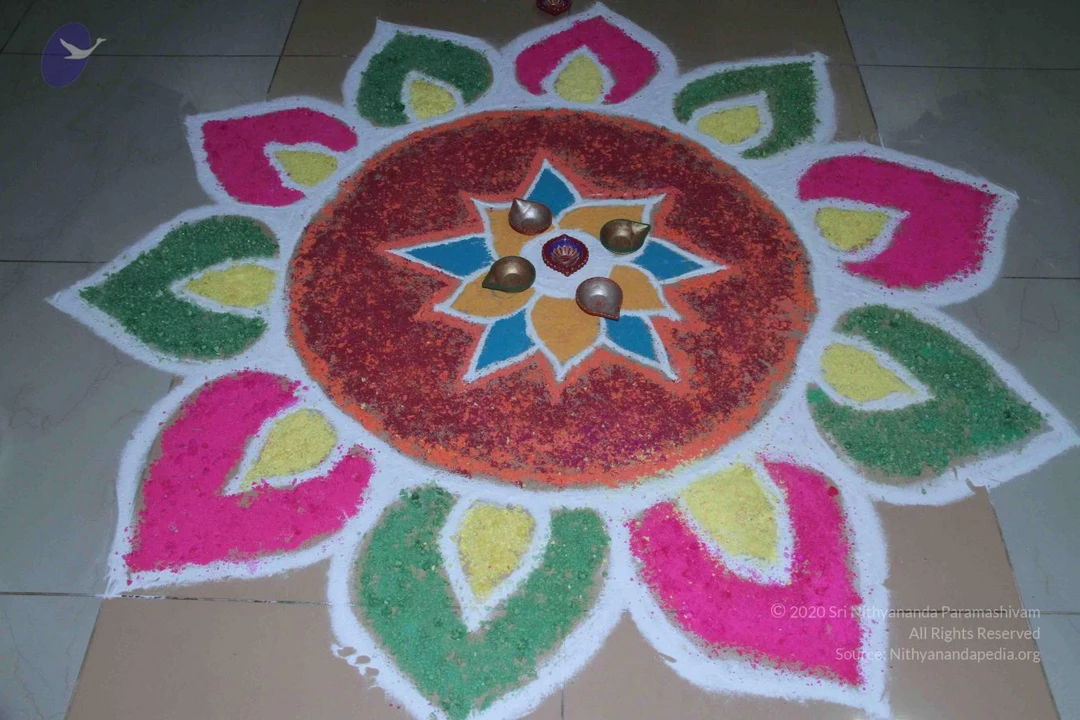
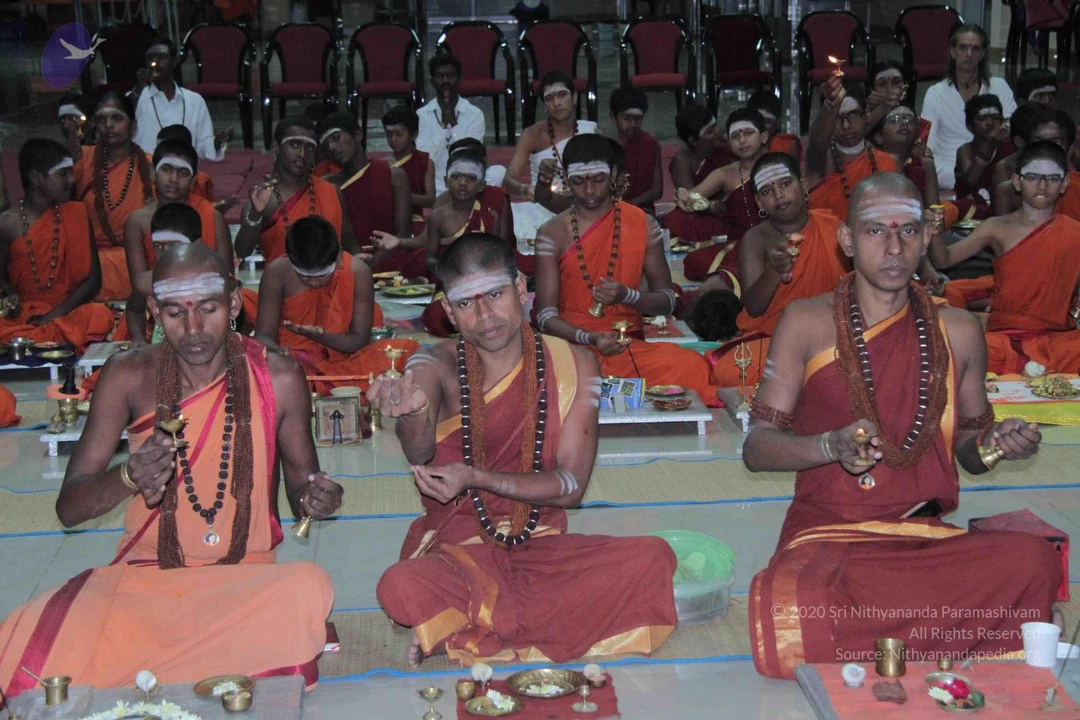
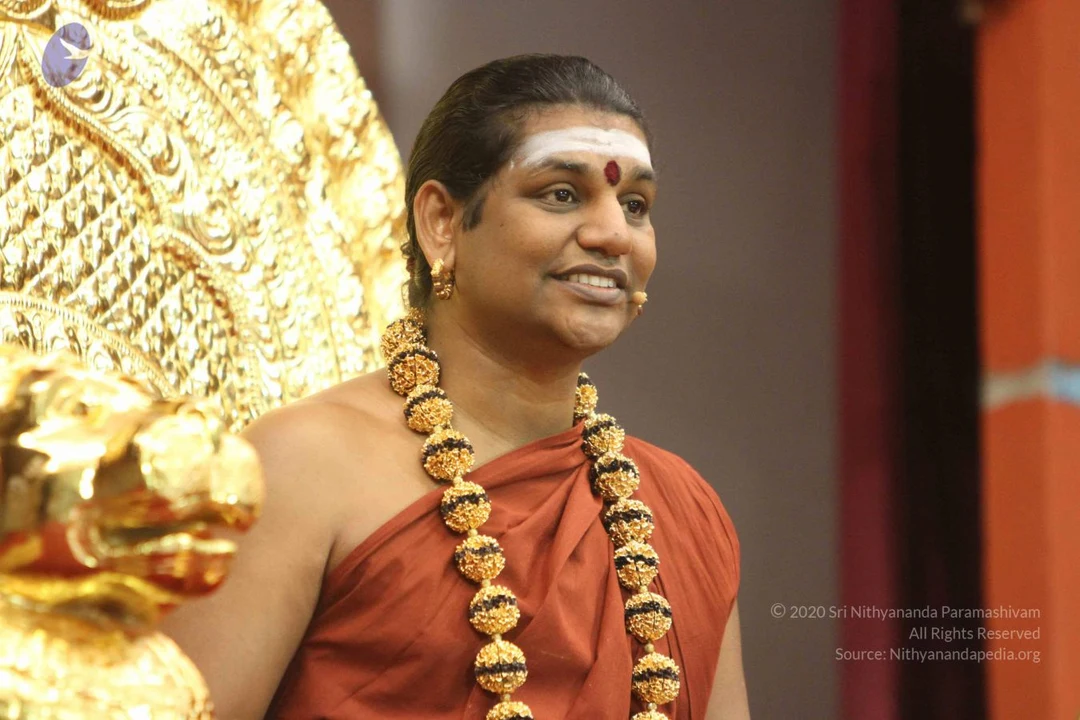
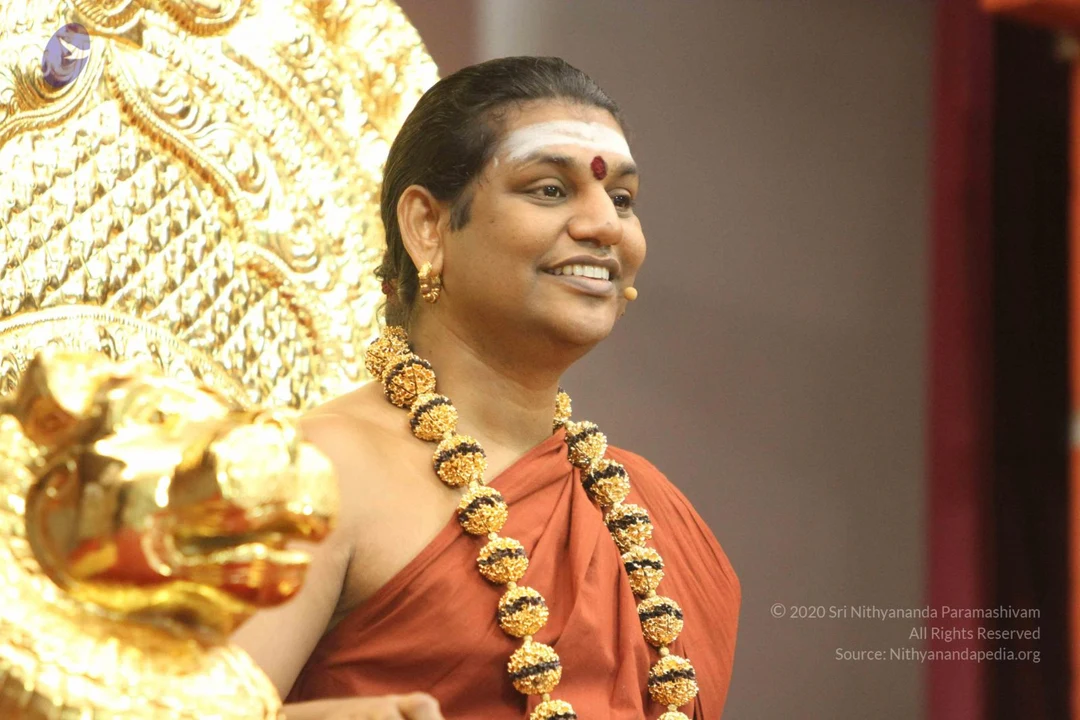
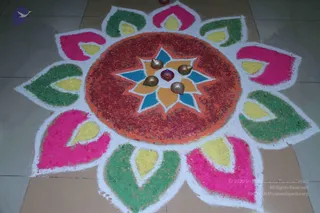
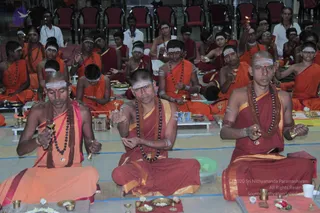
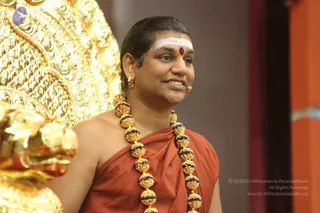
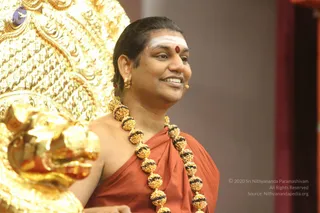
A photograph of a floor rangoli, a colourful sand or powder design on pale tiles with no people visible. It is a large flower-like pattern with a central red circle bordered in orange, enclosing an eight-pointed star in blue and yellow-orange. Five small brass oil lamps sit in the centre, with a small red and gold decorative element among them. Ringing the centre are petal shapes in pink, green and yellow, separated by white outlines.A seated group of ashram devotees performs a ritual in a hall with a light grey floor and blue taping. In the foreground, three men in saffron and maroon robes with white and red forehead marks sit cross-legged, holding small brass bells or lamps and hands in mudra gestures. Behind them, rows of saffron-robed participants, some with white headbands and rudraksha malas, hold brass lamps and offerings. Brass plates with flowers, rice and fruit sit on low wooden stands, and a framed photograph rests among the offerings. Red chairs line the back wall, and a few men in white shirts stand near the rear. Several people appear partly visible at the edges. Their attention is on the ritual.A man stands beside an ornate golden throne with carved gold panels, smiling slightly toward the right. He wears a saffron-orange robe draped over one shoulder and a long necklace of gold-capped rudraksha beads with black accents, along with gold earrings. A white tripundra with a red kumkum dot marks his forehead, and his hair is swept back. A small microphone clips near his cheek. The background is a dark red curtain with an orange panel. Judging by these visible cues, this is a person, standing in person at a discourse setting.A smiling man in a rust-orange wrap stands beside an ornate gold carved throne with a gold lion-head finial in the foreground. He wears a long gold-and-black rudraksha mala with gold beads, gold earrings, a white tripundra with a red bindi, and a small lapel microphone. His hair is swept back. Plain grey-red backdrop.A seated man in an ornate golden throne with a carved gilded backrest and red tiger-striped cushions smiles broadly while sitting cross-legged with hands clasped. He wears a rust-orange sannyasi wrap, a long multi-strand garland of gold-toned beads with dark bands, and a white horizontal tilak with a red dot on his forehead. A small lapel microphone is clipped near his face. Partially visible on the right is a painted deity figure in orange and green. Appearance-based label: a person, seated in a throne with a microphone during a satsang setting, matching the page's discourse context. He is the only physical person visible.A seated man in saffron-orange robes sits cross-legged on an ornate gold throne with a deep red cushioned seat and a leopard-print cloth draped over the platform. He wears a long gold necklace, a red-and-white tilak on his forehead and a gold-bordered orange shawl, and he smiles with his hands folded in his lap. Two golden lion figures flank the throne, and on each side stands a multi-armed painted deity statue in orange-red dress holding ritual objects, with a gold arch and a lit oil lamp visible at the right.

Photos Of The Day:

81 photosSource gallery
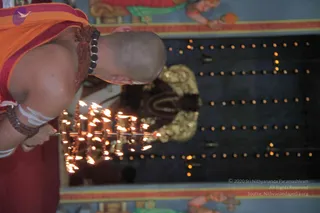
A photograph of a floor rangoli, a colourful sand or powder design on pale tiles with no people visible. It is a large flower-like pattern with a central red circle bordered in orange, enclosing an eight-pointed star in blue and yellow-orange. Five small brass oil lamps sit in the centre, with a small red and gold decorative element among them. Ringing the centre are petal shapes in pink, green and yellow, separated by white outlines.A seated group of ashram devotees performs a ritual in a hall with a light grey floor and blue taping. In the foreground, three men in saffron and maroon robes with white and red forehead marks sit cross-legged, holding small brass bells or lamps and hands in mudra gestures. Behind them, rows of saffron-robed participants, some with white headbands and rudraksha malas, hold brass lamps and offerings. Brass plates with flowers, rice and fruit sit on low wooden stands, and a framed photograph rests among the offerings. Red chairs line the back wall, and a few men in white shirts stand near the rear. Several people appear partly visible at the edges. Their attention is on the ritual.A photo, rotated sideways, of a shaven-headed priest in an orange-and-red garment with a rudraksha mala on his arm, performing aarti with a multi-flame oil lamp held in front of a deity murti draped in gold. Behind the lamp, rows of small lights line a dark background, and painted panels with red and yellow borders frame the top and bottom. The priest's bare upper body and white ash marks on the arm are visible. a person is not established by visible cues here, so the figure is described only as a priest.A man stands beside an ornate golden throne with carved gold panels, smiling slightly toward the right. He wears a saffron-orange robe draped over one shoulder and a long necklace of gold-capped rudraksha beads with black accents, along with gold earrings. A white tripundra with a red kumkum dot marks his forehead, and his hair is swept back. A small microphone clips near his cheek. The background is a dark red curtain with an orange panel. Judging by these visible cues, this is a person, standing in person at a discourse setting.A smiling man in a rust-orange wrap stands beside an ornate gold carved throne with a gold lion-head finial in the foreground. He wears a long gold-and-black rudraksha mala with gold beads, gold earrings, a white tripundra with a red bindi, and a small lapel microphone. His hair is swept back. Plain grey-red backdrop.A seated man in an ornate golden throne with a carved gilded backrest and red tiger-striped cushions smiles broadly while sitting cross-legged with hands clasped. He wears a rust-orange sannyasi wrap, a long multi-strand garland of gold-toned beads with dark bands, and a white horizontal tilak with a red dot on his forehead. A small lapel microphone is clipped near his face. Partially visible on the right is a painted deity figure in orange and green. Appearance-based label: a person, seated in a throne with a microphone during a satsang setting, matching the page's discourse context. He is the only physical person visible.

nithyananda-ashram

44 photosSource gallery
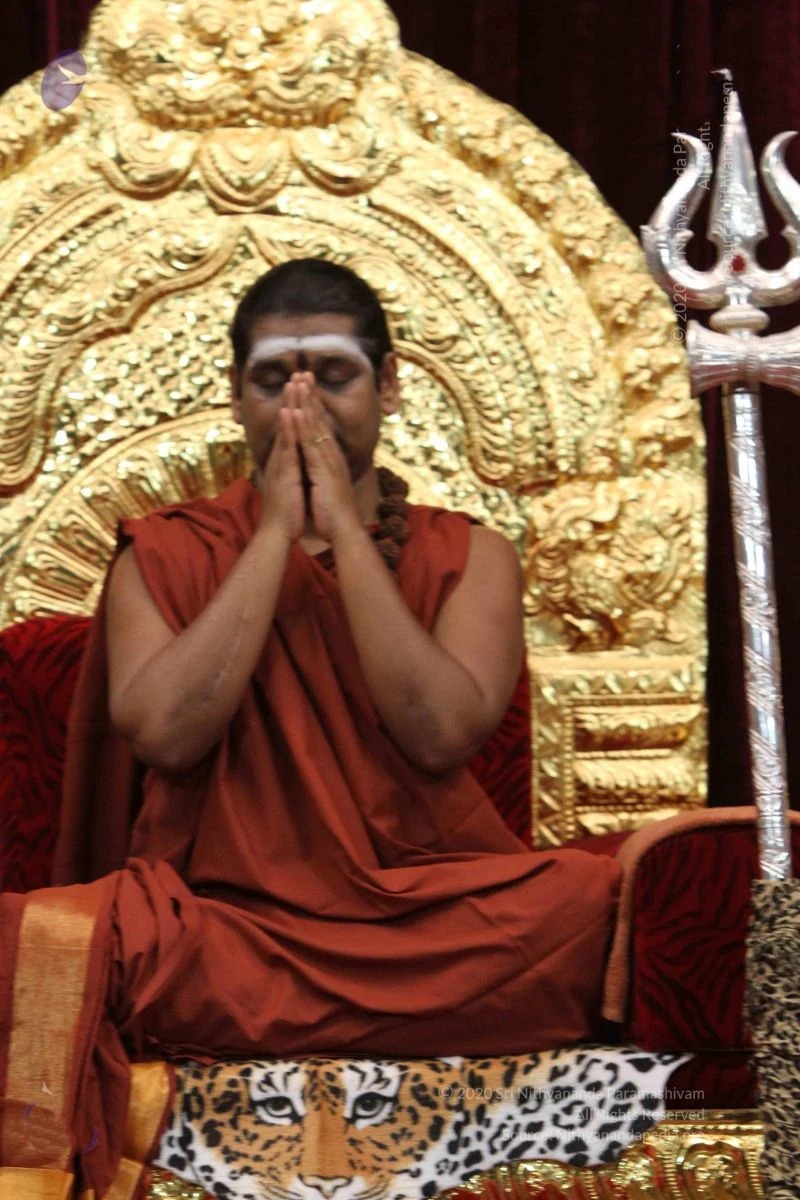
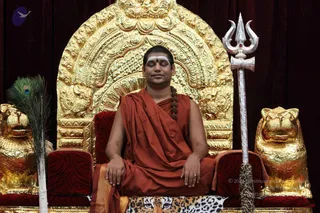
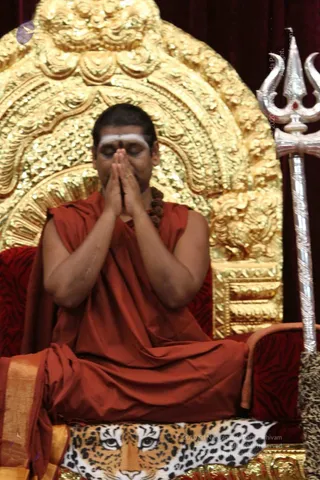
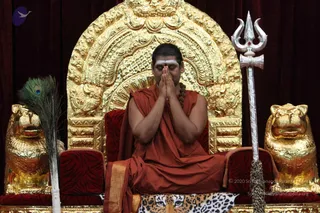
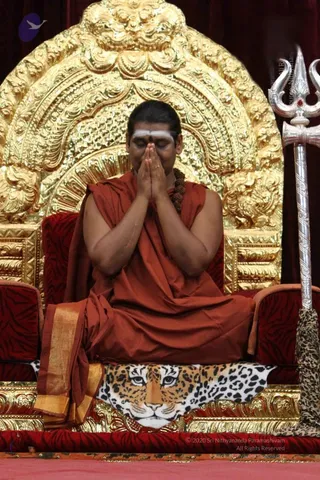
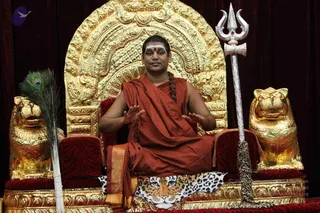
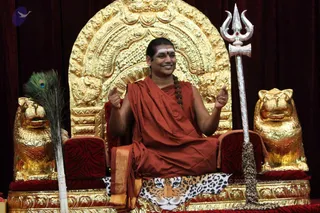
A seated man with shaved head and a white vertical forehead mark sits eyes closed on an ornate gold throne with a carved gilded back and dark red cushions. He wears a saffron-orange robe draped over one shoulder and a beaded rudraksha mala at his chest. A silver trident stands to the right, a peacock feather fan is at left, and gold lion sculptures flank the throne. A leopard-print cloth lies beneath him against a dark maroon backdrop. a person: the saffron robe, rudraksha mala and throne match the description, though the shaved head and lack of long hair leave identity uncertain.A seated man in an orange-rust sleeveless robe sits on an ornate gold throne with carved floral and lion-like relief backing and red velvet cushions. His palms are pressed together in namaskar at his chest, eyes closed, with a horizontal white forehead mark and a rudraksha mala around his neck. A silver trident stands to the right, and the seat rests on a leopard-print cloth. Appearance-based label: the figure matches the page's description of a person only in part; the throne and attire are consistent with a teacher's seat, but the face is not used for identification, so identity is uncertain.A seated man in saffron-orange robes sits with palms pressed together in namaste on an ornate gold throne with a carved arched backrest. He has a white vertical tilak on his forehead and a rudraksha mala around his neck, eyes closed. Gold lion-face armrests flank the throne, a silver trident stands to his right, and a peacock-feather fan leans on the left. A leopard-print cloth covers the seat, set against deep red drapery. Appearance-based candidate: a person, shown in person on the throne, identified by the saffron robes, rudraksha mala and ceremonial throne setting.A man seated in meditative pose on an ornate gold throne with carved floral and scrollwork backrest, in front of dark red velvet drapes. He wears a saffron-orange robe with a gold-bordered dhoti, a rudraksha mala around the neck, and a white and red tilak on his forehead. His eyes are closed and his palms are pressed together in anjali mudra. A silver trident stands to the right, and a leopard-print cloth covers the seat beneath him. Only one physical person is visible.A man seated cross-legged on an ornate gold throne with carved gold backrest, flanked by two gold lion sculptures, gesturing with both hands during a talk. He wears a rust-orange robe over a bare upper body, a long braid of hair down his back, a white forehead marking and a red bindu. A silver trident stands beside the throne and a peacock-feather fan rests at the left. A leopard-print cloth covers the seat, and red velvet cushions line the dais against a dark maroon curtain.A seated man in an ornate golden throne with carved arches and two gilded lion heads flanking him on red cushions. He wears a saffron-orange robe with a gold-bordered cloth, a rudraksha mala around his neck, and a white forehead marking. He smiles with both hands raised in a gesture. A silver trident stands to the right, and a peacock feather fan leans on the left. A leopard-skin cloth covers the seat, and dark red drapes form the backdrop. a person is seated in the throne, with saffron clothing and rudraksha cues.

Deity-Darsion
14 photosSource gallery
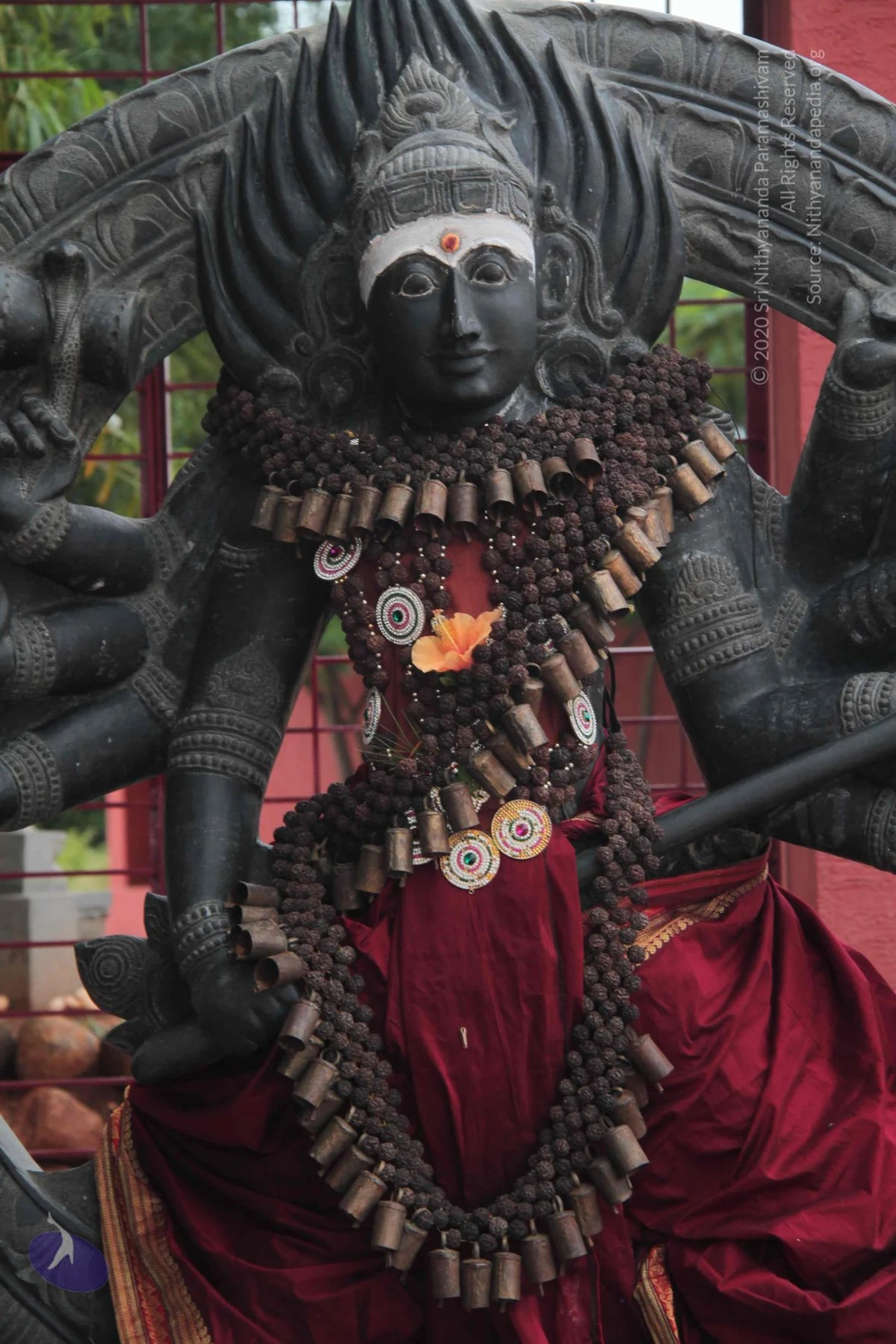
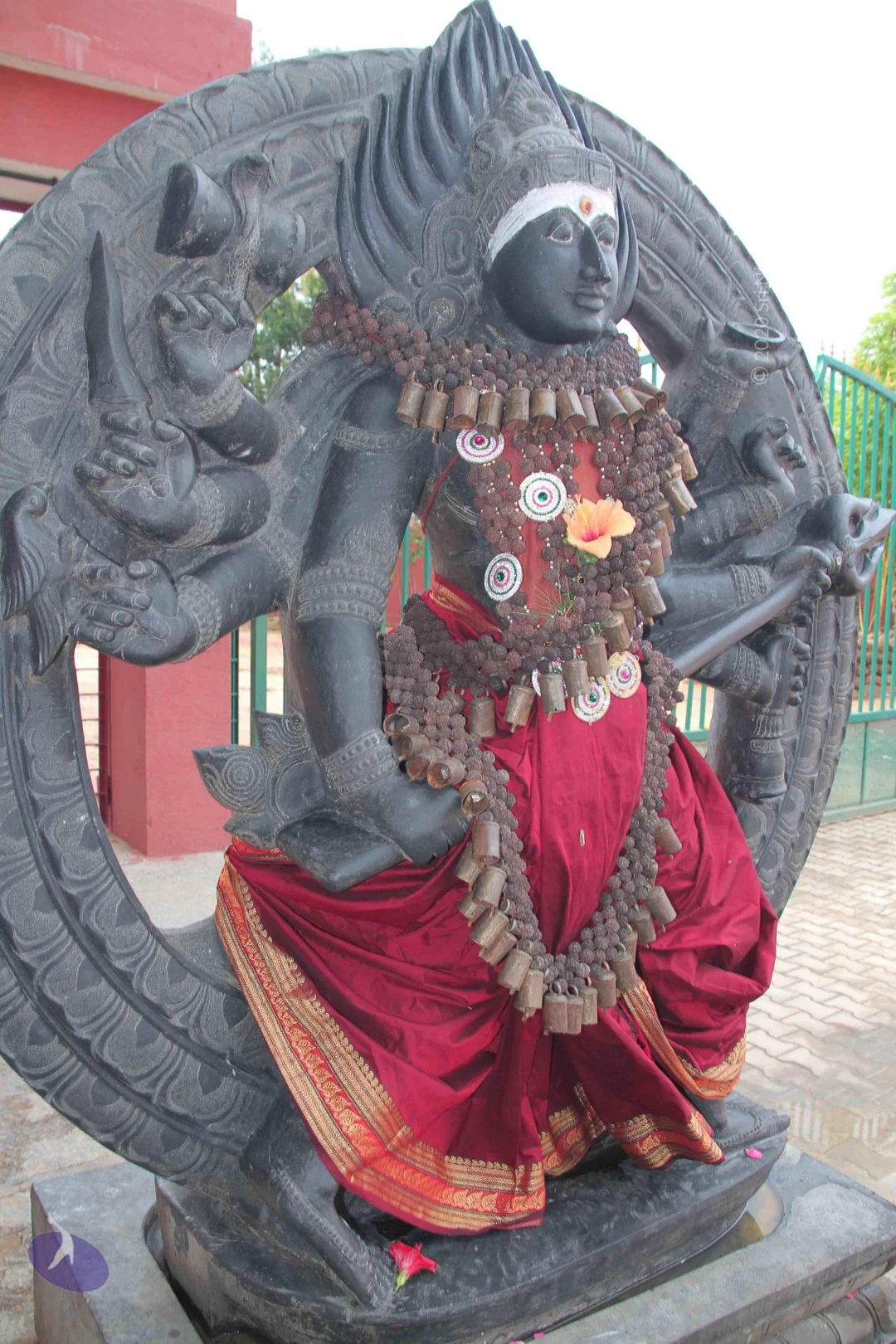
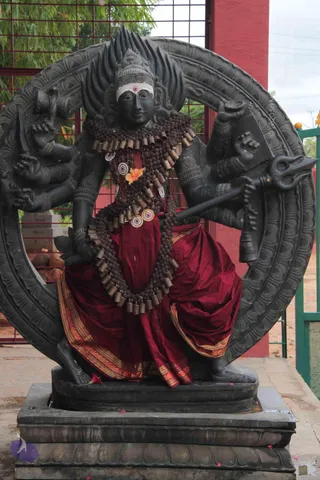
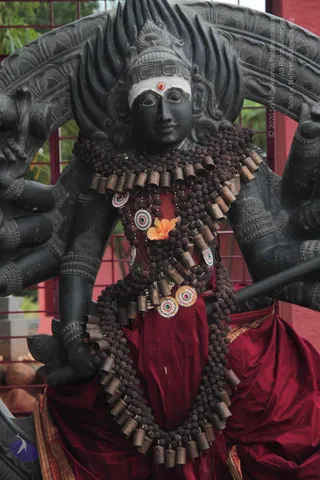
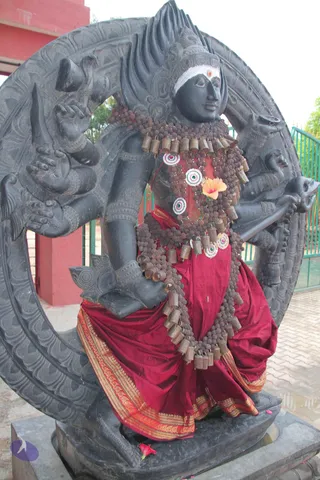
A dark stone statue of a multi-armed deity stands on a tiered black pedestal in front of a red-painted wall and a green metal gate. The figure has a black face with a white forehead mark and red dot, wears a long red and gold-bordered skirt, and is draped in layered rudraksha bead necklaces with small metal bells and round coloured medallions. One hand holds a trident, another a curved blade, and a raised hand holds a small bowl. A large circular arch frames the figure. A red hibiscus flower sits on the chest, with scattered petals on the base and a chalk kolam design at the foot. No people are visible.A dark stone statue of a multi-armed deity stands on a tiered black plinth outside a temple, framed by a large circular halo carved with scalloped edges. The figure wears a deep maroon sari with gold-bordered hems, layered rudraksha mala necklaces hung with small brass bells, and a red bindi with a white tilak on the forehead. Its hands hold a trident, a small drum, a curved blade and a bowl, and a single orange flower is tucked into the necklaces. Red flower petals scatter the base, with a red-painted wall and green metal gate behind. No people are visible.A large black stone statue of a multi-armed female deity, a murti with a flame-like halo behind her head, a white forehead band and red bindi. She wears a long string of dark rudraksha beads layered with bronze bells and round silver-and-pink medallions, an orange hibiscus flower tucked at the chest, and a deep maroon sari with gold border. Her arms are raised holding objects, with a snake carved on the left side. Red metal grille and greenery stand behind the statue. No living people are visible.A dark stone statue of a multi-armed deity murti stands outdoors on a pedestal, framed by a large carved circular halo. The figure wears a red and gold bordered silk sari, a white tilak with red bindi on the forehead, and layered rudraksha mala garlands with hanging bells and round mirrored discs. A pink hibiscus flower is tucked into the garlands at the chest. The statue holds a trident and other implements in its raised hands. A red-painted wall and green metal gate stand behind it, with fallen flower petals on the paved ground.A large black stone statue of a multi-armed female deity stands outdoors in front of a red-painted building with a window grille. The murti has a white forehead band with a red bindi, a flame-like crown, and a wide garland of rudraksha beads strung with brass bells draped across its chest and shoulders. A dark red silk sari with gold border covers its lower body, decorated with round mirrored medallions and an orange flower. A long dark staff or trident shaft rests across one arm, and a stone ring-shaped halo frames the figure behind it.A large dark stone statue of a multi-armed deity murti, with a white vertical tilak and red bindi on the forehead, flame-like hair and a carved arch behind the head. The figure wears heavy rudraksha mala necklaces hung with rows of small brass bells, circular jeweled pendants, and an orange hibiscus flower at the chest, over a red silk garment with gold border. Several arms extend from the sides. The statue stands outdoors against a pink-painted wall with greenery visible. No physical people are present.

Gurugul

2 photosSource gallery
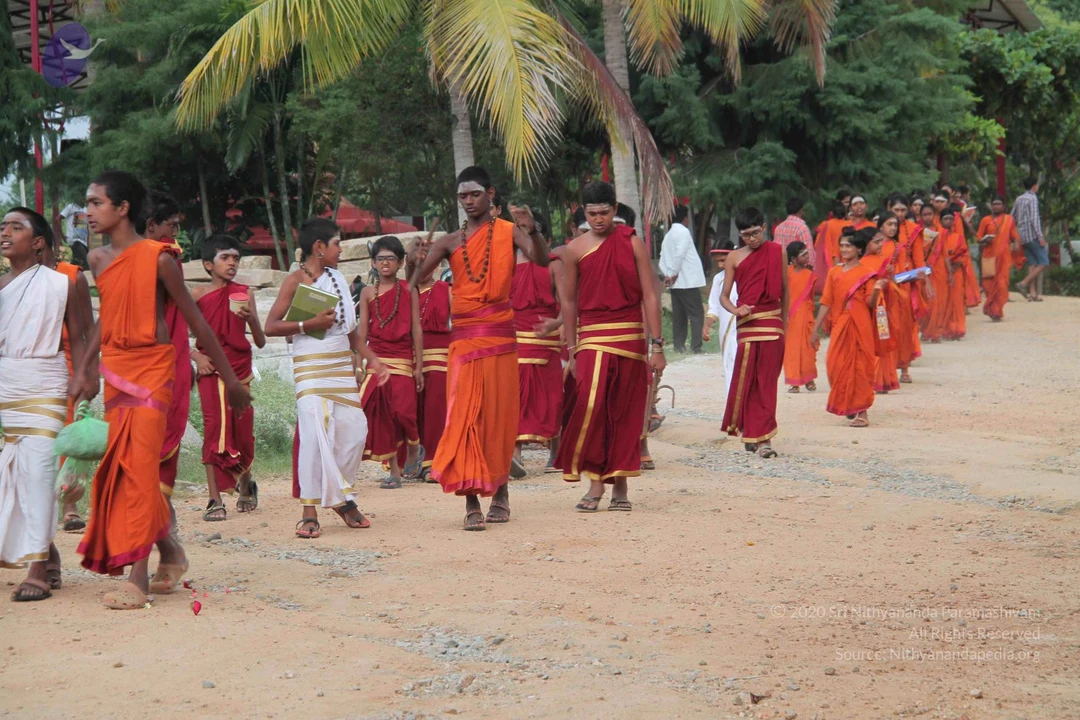
A line of young boys and some girls walks along a dirt path between palm trees, dressed in saffron-orange and maroon-red robes with gold borders. Several boys wear white dhotis with gold-striped edges, and one boy in front has a white forehead mark and a rudraksha-style mala. A girl in orange carries a green book and a few carry small bags. The group forms a long procession through an ashram grounds setting, with a few adults in white and pale clothes visible at the back.A group of women walks along a dirt path past a construction area, several wearing saffron and orange saris with rudraksha malas, and two in deep red saris with gold borders. One woman in the centre wears white draped clothing with a gold-bordered wrap, and carries a dark book or folder. A tall signboard with a poster and a small yellow sign reading UNDER CONSTRUCTION stand behind them, with palm trees and piles of construction material beside the path. Their faces are smiling and some hold small handbags. No identifiable central figure in ceremonial saffron is clearly present.
Inner-Awakening

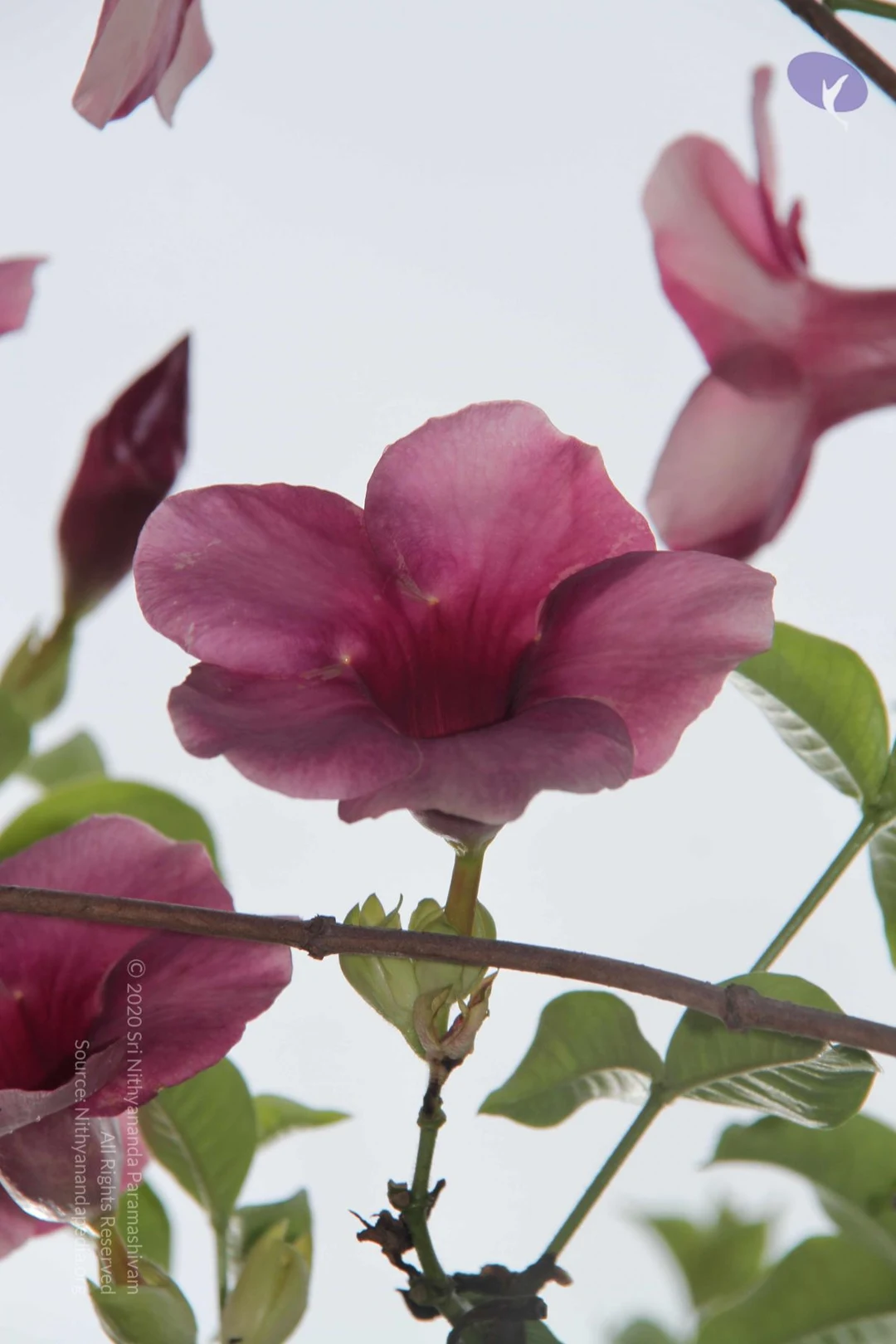
8 photosSource gallery
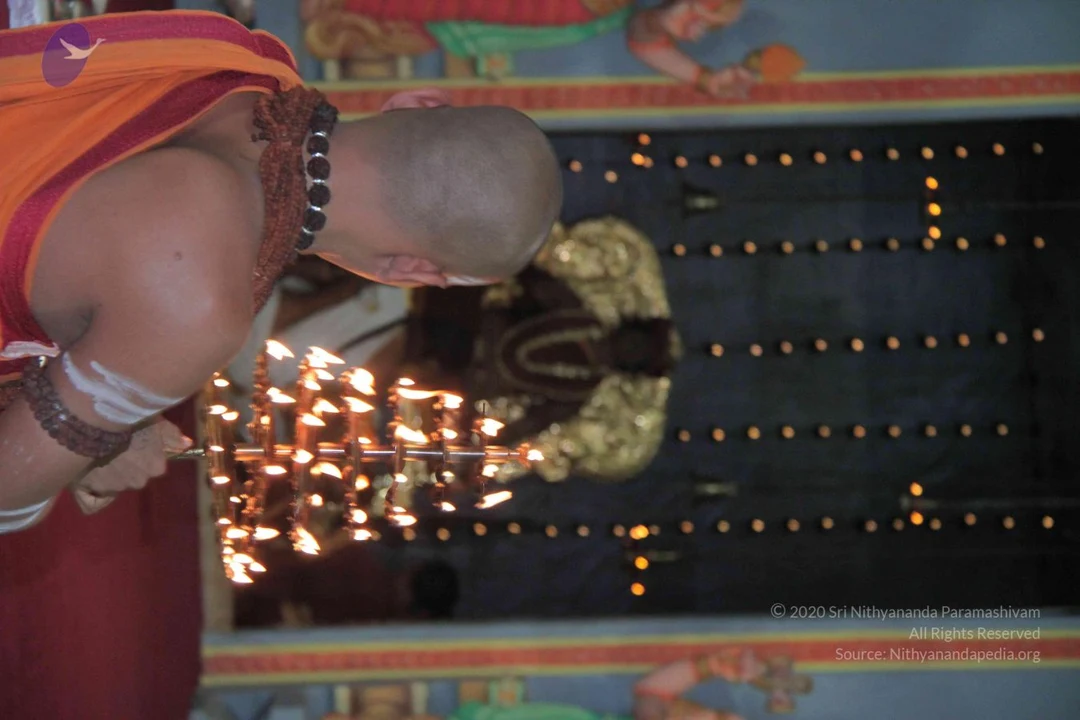
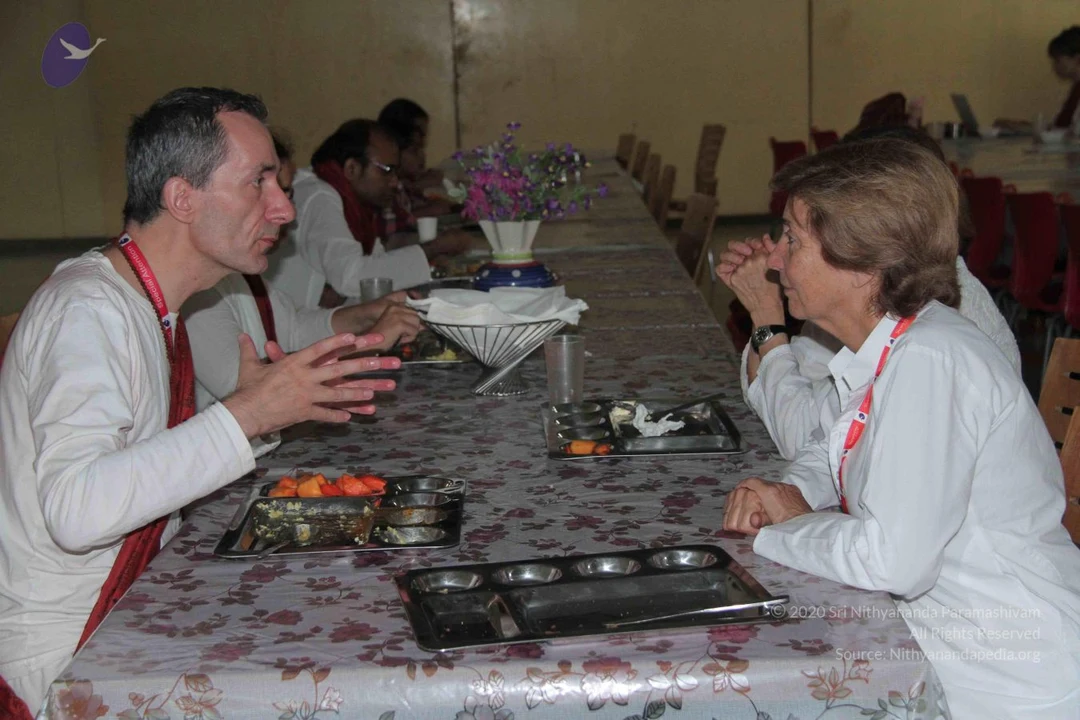
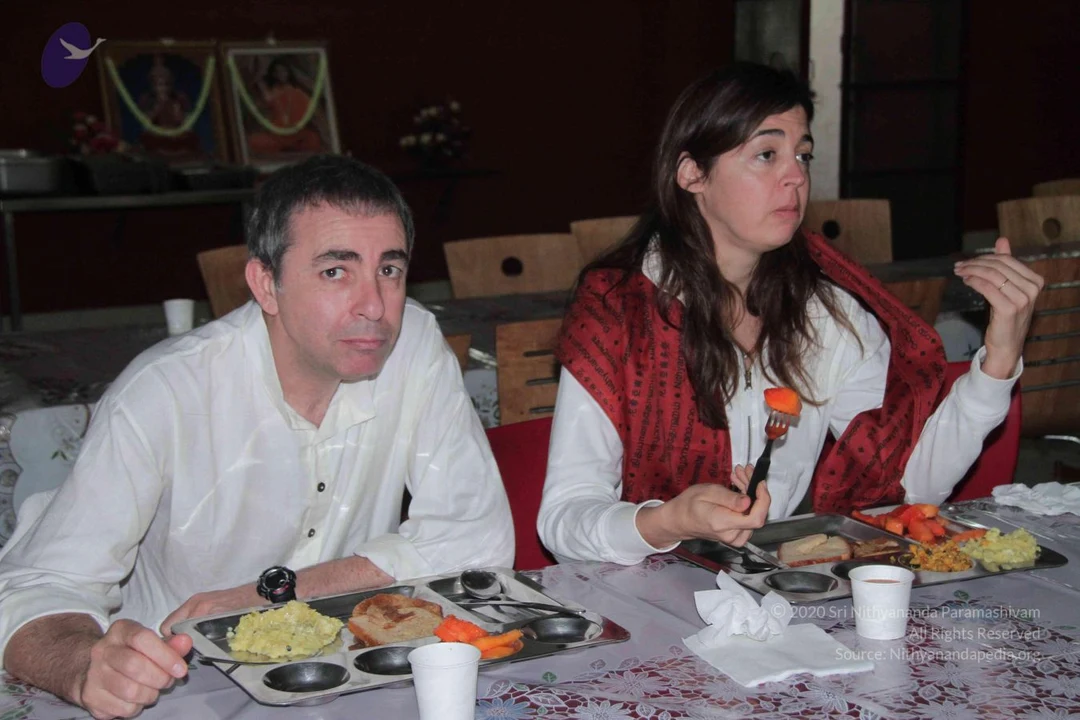
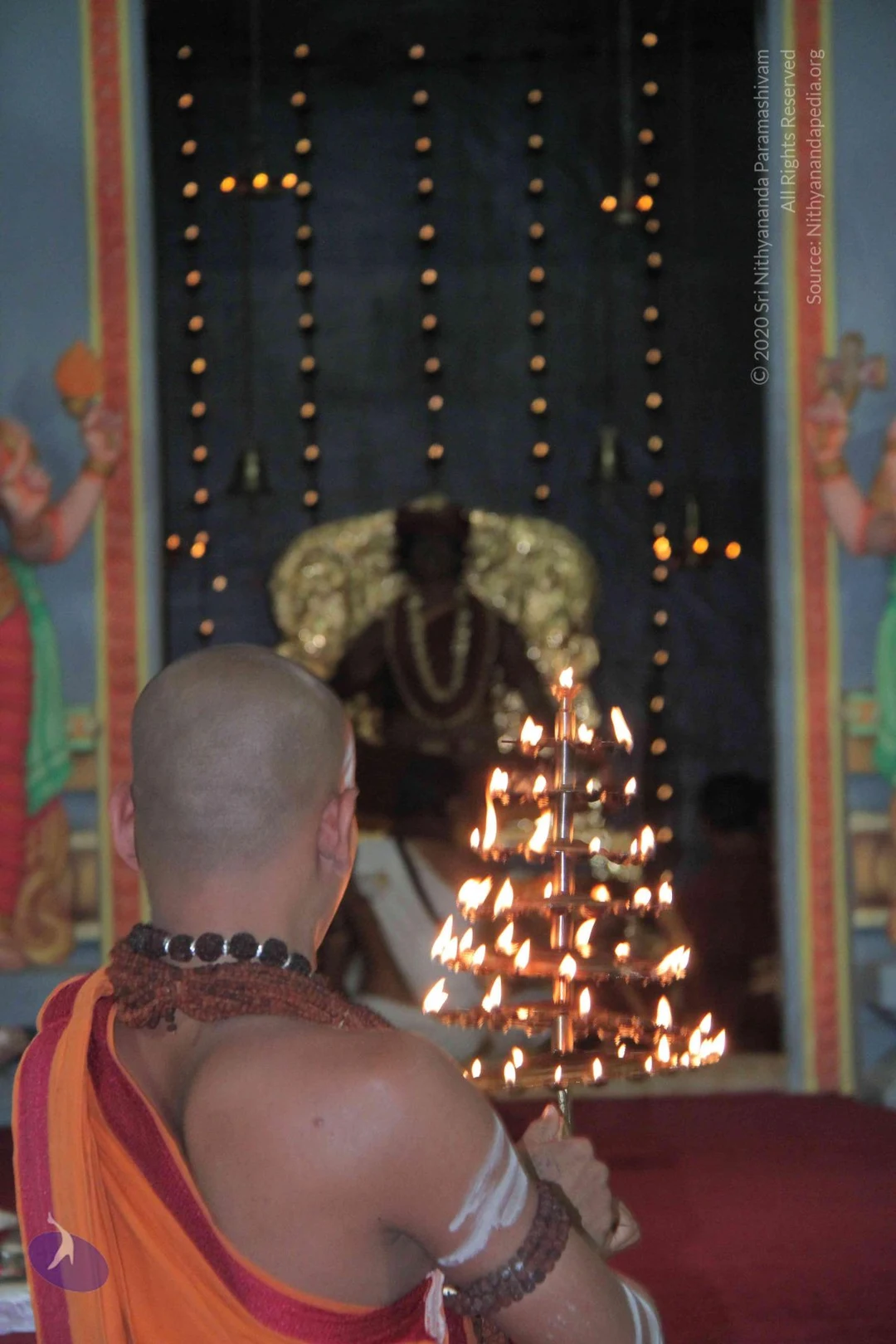
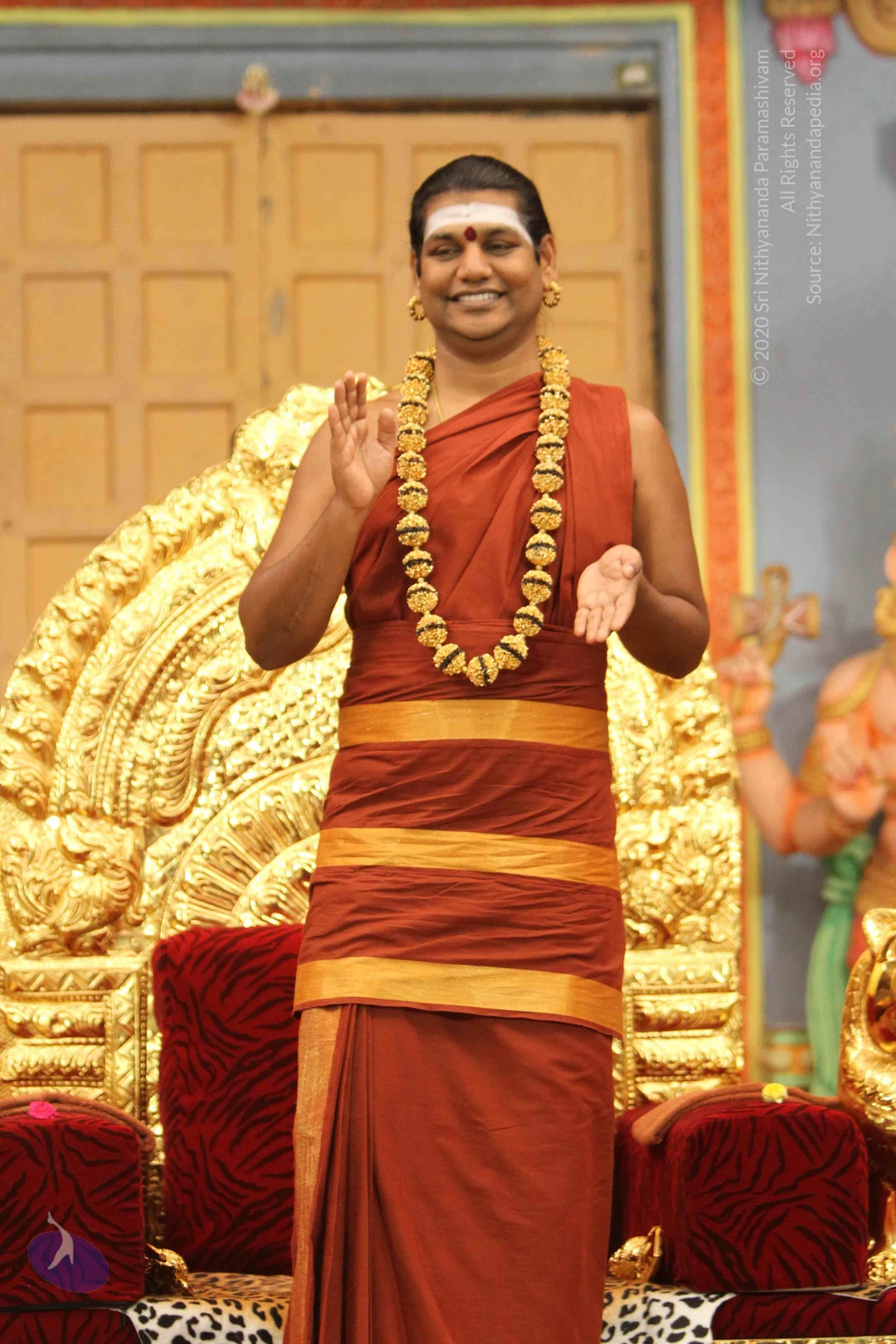
A shaved-headed priest seen from behind in an orange and red cloth wrap and rudraksha malas performs aarti with a tiered multi-flame oil lamp before a seated deity murti in a shrine. The murti is draped in gold-colored cloth with a garland and sits beneath rows of small hanging lamps. Painted red and green figures flank the doorway, and white sacred ash marks the priest's arm.A standing man in a rust-red sannyasi robe with gold-striped borders and a gold-and-black bead mala draped at his neck smiles while raising both hands in an explanatory gesture. He wears gold earrings and a white vertical tilak with a red dot on his forehead. Behind him stands an ornate gold throne with carved scrollwork, flanked by red and black zebra-print cushions, and a painted deity murti is visible at the right edge. Only one physical person is in the scene.Close-up photograph of a pink-mauve trumpet-shaped flower on a green vine against a pale grey-white sky. The bell-shaped blossom has deeper magenta throat markings, with additional flowers and a dark unopened bud at the upper left and green leaves and slender brown stems framing the frame. No people are present.A photo of a dining hall where several people sit at a long table covered with a patterned plastic cloth, eating a meal. A white-clad man in the foreground wears a red shawl and glasses and eats from a steel tray with dal-like food, carrots and other vegetables. Across the table, a woman in white with a red shawl and a red bindi watches, and a man in a white shirt with a red shawl sits behind her. Two women in white sit at the left end of the table. A blue and white vase holds purple flowers in the centre, with steel containers on a counter behind. There is no visible a person candidate.A photograph of a dining hall with a flower-patterned tablecloth. Two people sit across a table with steel meal trays holding small compartments and carrots. On the right, a man in a white shirt and a maroon-red shawl, with a red lanyard, gestures with both hands while speaking. On the left, a woman with short brown hair in a white top rests her hands together and listens. Behind them are large steel food containers on a metal stand and a maroon wall.A woman with dark hair and glasses sits at a table in a dining hall, eating from a stainless steel thali tray with small bowls of food, holding a spoon. She wears a white top with a red shawl printed with dark text and a red bindi. A glass of water and a white napkin sit on the table, with a vase of purple and pink artificial flowers at right. Stainless steel serving counters stand behind her, and a person in a striped shirt is partly visible at the back.