Skip to content
Friday

15 August 2014

Desperation is the Traitor of your Soul

Dated photos
205
Source pages
1
Media
2
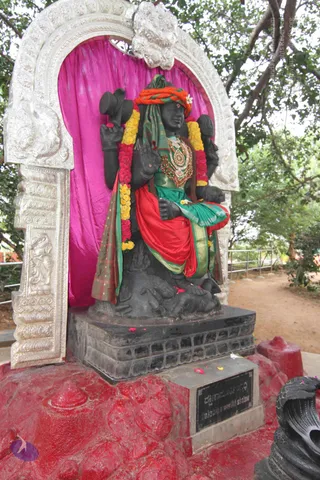
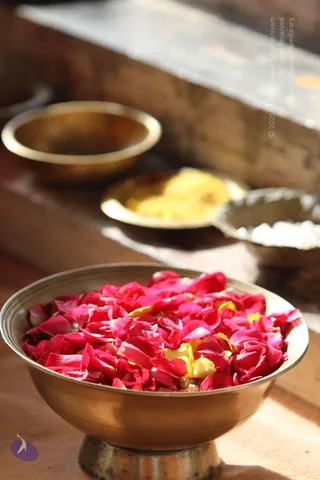
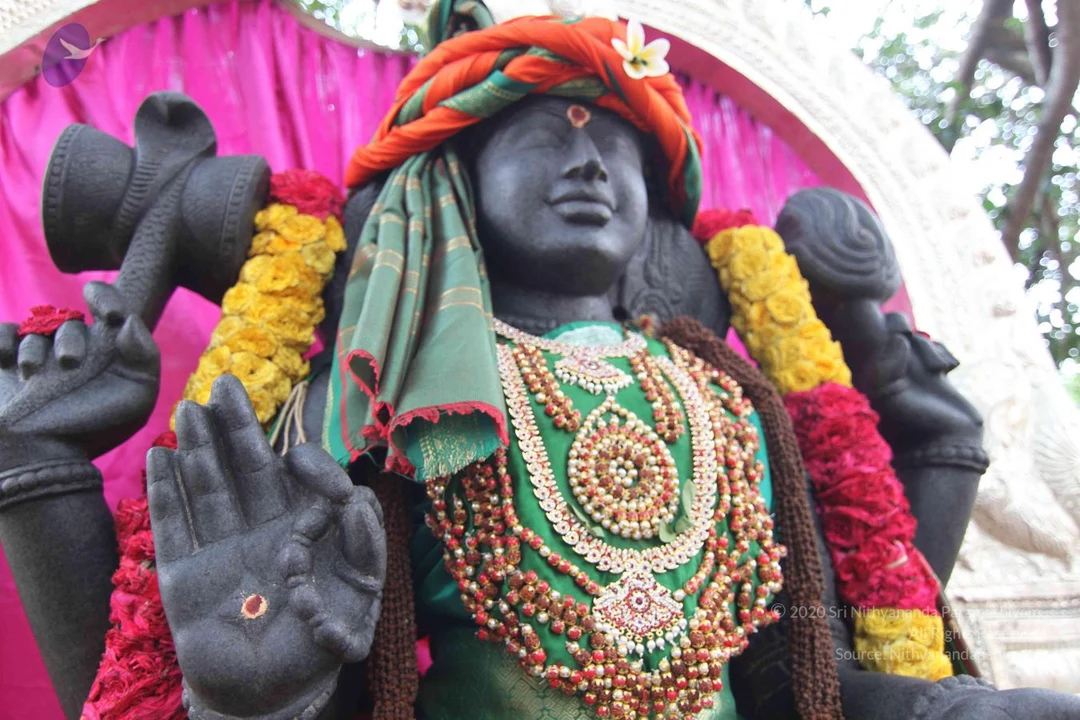
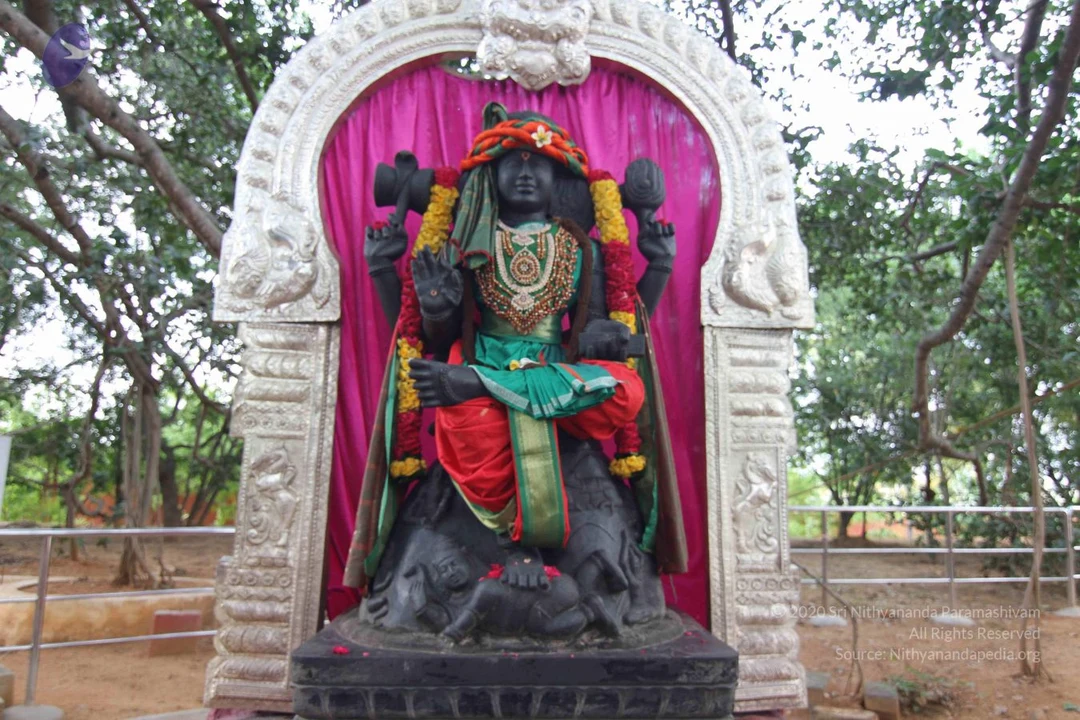
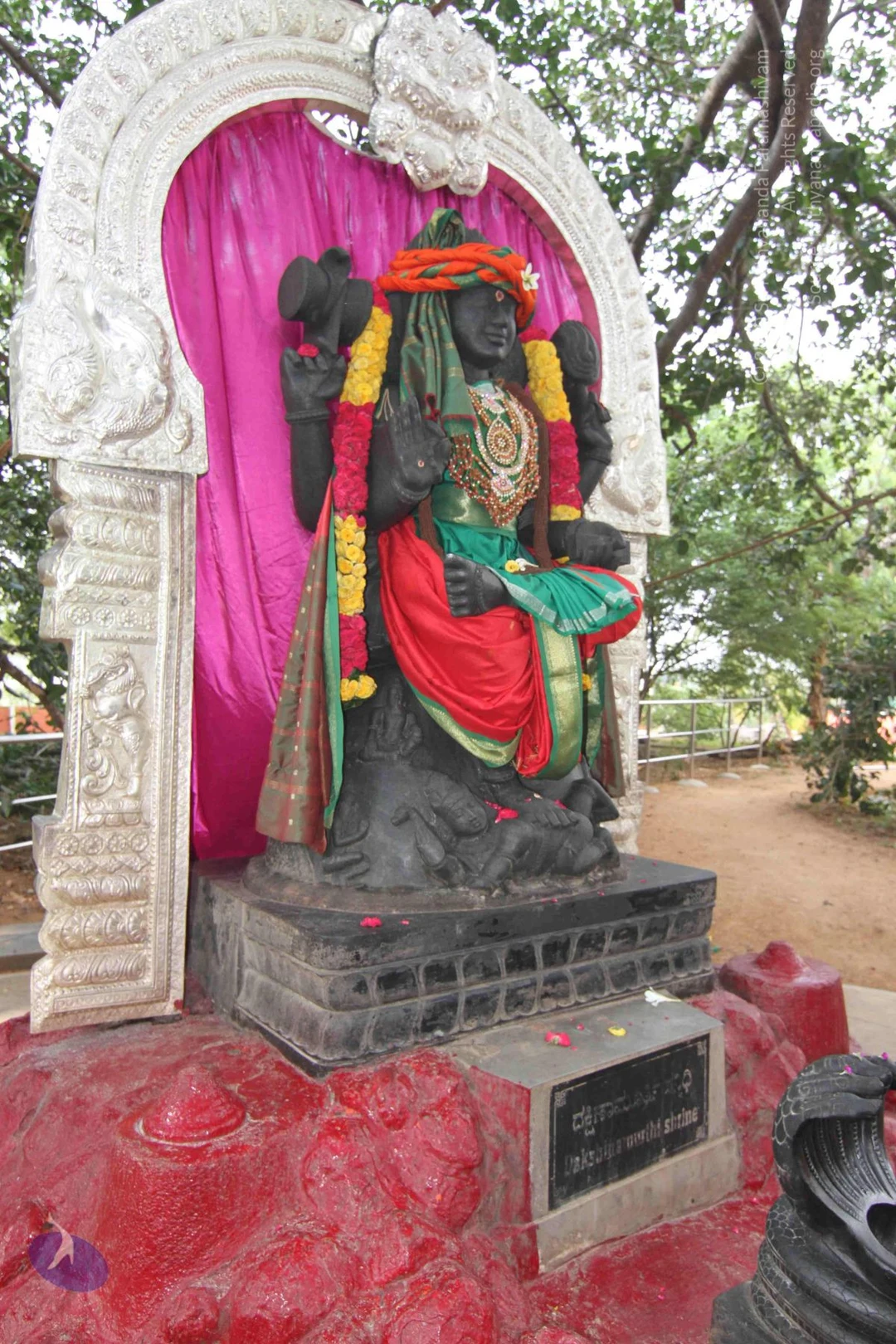
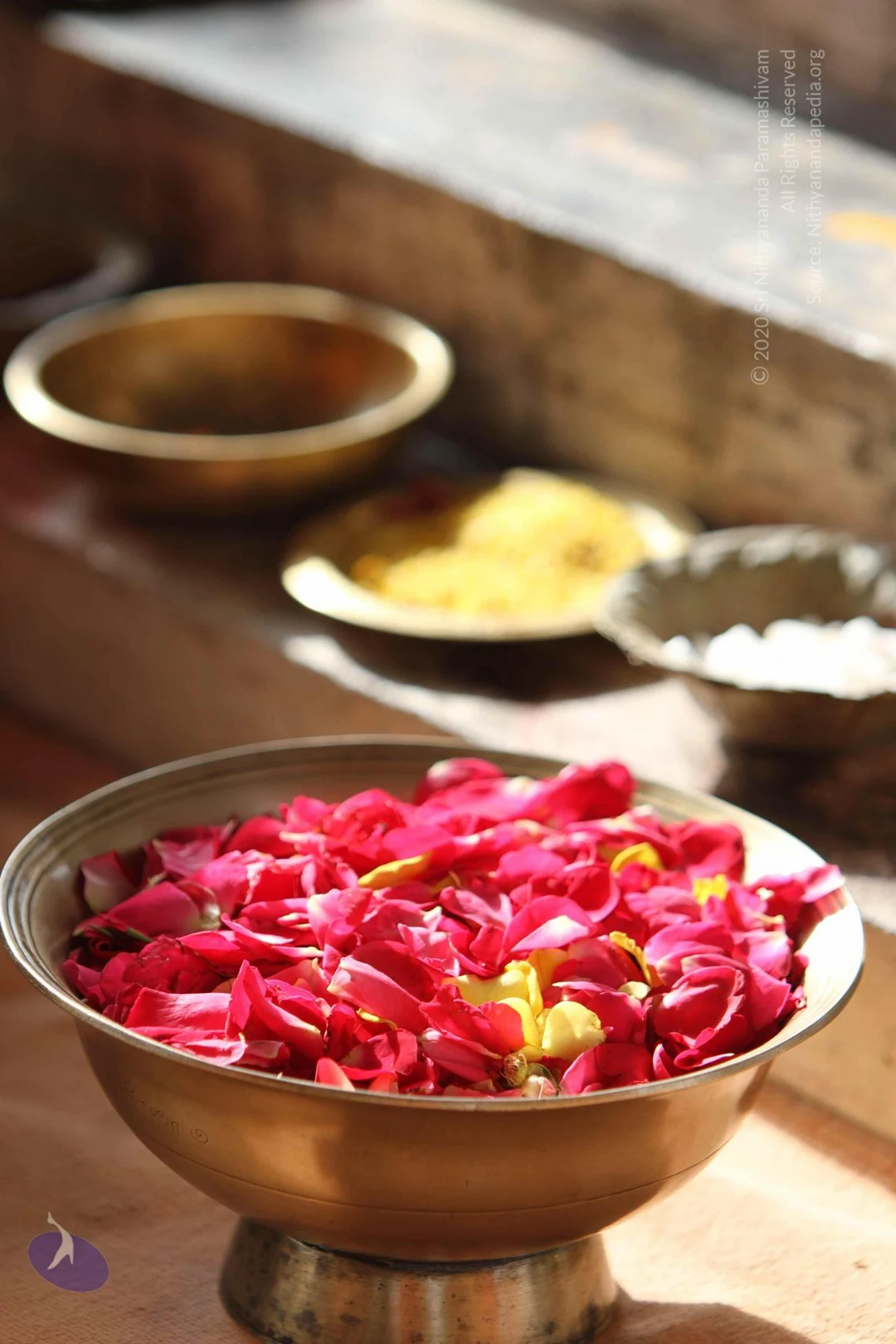
A dark stone statue of Dakshinamurthi, the seated teacher form of Shiva, stands in a silver-framed arched niche with a magenta cloth backdrop. The figure wears an orange and green turban, a green and red draped garment, and a jewelled green-and-gold necklace, with marigold and red flower garlands draped over the shoulders. One hand holds a small drum-like object and another is raised in a gesture. A small snake carving sits at the lower right, and the base is coated in red and dotted with flower petals. A black plaque at the base carries an inscription. Trees and a dirt path surround the shrine outdoors.A close photograph of a polished brass bowl filled with fresh pink and red rose petals, with a few yellow petals mixed in, set on a stone surface in warm sunlight. Behind it, out of focus, sit other brass bowls holding yellow flower petals and white flower petals or rice, along a stone ledge. No people are visible, and no a person candidate appears in the frame. The scene suggests ritual flower offerings for worship.

August 15 2014

Original wiki page
Contents

Title:

Desperation is the Traitor of your Soul

Description:

In today’s (15 Aug 2014) morning satsang Paramahamsa Nithyananda expanded on the science of completion. He told us that Completion is so powerful it burns pain, creates new space and dilutes the past. The next thing you need to do is re-write your future. The more you re-write your future the more the past incompletions become irrelevant to your life. Completion is having no desperation. Perpetual completion burns down desperation and life happens in you.

Link to Video:

Link to Audio

'Description: Desperation Is The Traitor Of Your Soul by HDH Bhagavan Nithyananda Paramashivam on 15 August 2014'

Transcript:

Nithyanandeshwara Samaarambhaam Nithyanandeshwari Madhyamaam | Asmath Aachaarya Paryanthaam Vandhey Guru Paramparaam ||

I welcome all the devotees, disciples, samajis, satsanghis, Shrimahants, Mahants, Kotharis, Thanedars; sitting with us all over the world through Nithyananda TV, Sadhna TV, and two-way video-conferencing having Nayana Deeksha.

Cities sitting with us in two-way video-conferencing having Nayana Deeksha; Hyderabad — Gupta Kashi, San Jose — Madurai, Jorpati — Nepal, Hebbal — Bangalore, ((spiritual name of Ohio)) — Ohio, Warrington — UK, Kulim — Tiruttani, Hong Kong — Sirkazhi, Netherlands, Toronto — Kailasam, Seattle — Chidambaram, Nithyananda University Los Angeles, Ohio — Prayag, Guadeloupe — Rameshwaram, Kuala Lumpur — Palani, Houston — Kalahasti, St. Louis, Enriching Temple Bidadi, Mukthananda, Snehamayi, Phoenix — Kanchipuram.

I welcome all of you with my love and blessings.

Today, Independence Day of India! Let Mahadeva bless this country, bless this great nation, bless this great land! Let Mahadeva’s grace be on this country!

Today I wanted to expand on the great truths. I am continuously expanding almost from 2012 December till now, only Science of Completion. Please understand, there is no other subject I have spoken on so elaborately. I have not taken up any other traditional scriptures, commenting — nothing!

From 2012 December to — almost more than one-and-a-half years, closer to two years, I am expanding just on this Science of Completion. Even though I had many plans in-between that I will comment on some scriptures explaining the Science of Completion, somehow I went on explaining and expanding on the Science of Completion itself. Today, again, I wanted to share some of the great truths about Completion.

Please listen! Come to the space of listening!

Completion is such a powerful science, such a powerful principle, such a powerful philosophy, not only it burns all the sufferings, suffocations, pains — please understand, it creates so much of new space for functioning, so much of new space, so much of powerful new space, you can go on be creating! You can go on be creating!

Please understand. Every night when you finish Completion, two things are very important:

One, a strong decision not to allow that incompletion again in your inner space. Completion is not watching TV serial in your inner space — the same thing you are watching every day. No! Unfortunately, you guys sit and brood over the same problem every day. After some time, I think you start enjoying that! No! That is not Completion! Declaring you will not allow that incompletion again to surface into your inner space.

Second, if you have completed with something yesterday night, today morning use that inner space to rewrite your future before the incompletion gets back into your system. Understand — intense, sincere rewriting of the future! Means, go on rewriting, go on rewriting, go on rewriting! Please understand, only when you go on rewriting, rewriting, rewriting, the past gets diluted, the past incompletions lose power over you. If you don’t rewrite your future — means, if you don’t create the new future, naturally you can’t be a vacuum space; so, you tend to get into your past incompletions, or invite, entertain your past incompletions.

Please understand, understand this one great truth. If you go on rewriting your future, means, constantly aligning you to your declared authentic identity. Aligning you to your authenticity, means, raise your Inner Image as you want; raise your Outer Image as you want; take responsibility for Others Image as others want; raise your Life Image and Others Image. So understand, let the space you get after the Completion be used to create authentic identity.

Please understand, everyone wants peace. But you need to know, unless the space which you get by peace is used towards authenticity, the peace can never be long-lasting. You will lose it. Your old incompletions will come back. Empty mind is Devil’s workshop. I tell you, it is “Devil’s Home”, not just workshop! Not only he works there, he RESIDES there! The absolute empty mind is God’s place. That is different. Till you achieve the Perpetual Completion, every empty space you get, you should use it to rewrite your future. Go on rewriting! Go on rewriting! Go on rewriting!

Please listen! The more and more you rewrite, not only your incompletions get completed, they become irrelevant. Making your incompletions irrelevant to your present life is Complete Completion. All the possible incompletions which can happen to human beings, make them irrelevant to you — you are God! Please listen!

All the possible incompletions which can happen for human beings: janma, mrityu, jara, dukha — birth, death, disease, pain. All the possible incompletions which can happen to human beings, make them irrelevant to your life. It is possible. Make them all irrelevant to your life — make them all irrelevant to your life — then you are God! Constantly make all the incompletions irrelevant to your life. It is possible!

Go on spending time every night. I tell you, completing with incompletions in the night puts you in the space of Samadhi. The more and more nights you spend in Samadhi, the deeper and deeper incompletions leave your system. More and more inner space is developed in you, understand? You don’t need to have this strong belief you have about you that you can never achieve Completion. It is solidified stupidity!

But the good news is, even if it is solid, it can be thrown out. You don’t need to worry with it, struggle with it, suffer with it. You don’t need to worry with it, suffer with it, struggle with it! The solid belief — “I cannot achieve Completion” — as I said, solidified stupidity!

Completion is simply lifestyle — breathing style in your system, because every moment your breathing — the breath which goes inside has to touch the space of Completion. Only then it can take a turn and start coming out. Same way, every thought finally has to go and fall in that space of Completion; only then a new thought can be created. But, unfortunately, the new thought does not always get created out of the space of Completion; it gets created anywhere here and there. But, every thought has to die, fall into the space of Completion. So you just go deeper and deeper along with that thought. Just like how the thread catches the needle, and when it goes along with the needle it reaches wherever the needle goes, catch your thought and go wherever it goes and drop where it drops. Where it drops, it will be the space of Completion! Completion is the lifestyle of your life. So, don’t think Completion is difficult, it is impossible. No! Completion is the most simplest way of existing.

“Poornatva aapka athyanth saral swabhaav hai!” Completion is the most innocent, simplest form of existence.

The wide smile is because I am making a Hindi statement on my own without the help of teleprompter! And soon, you can expect more and more statements in Hindi, thanks to Mahabharat! I am sitting and watching Mahabharat (the television serial) again and again without any translation or any interpreter, just having Hindi dictionary.

Okay! Let me come back to the subject.

Completion is your inherent, natural, innocent, breathing space. Pain is the artificial space. Please understand, to hold on to the pain which you are carrying in your inner-space only needs so much of artificial thinking. To uphold the pain you carry in your heart, only you need so much of artificial beliefs and thinking. Perpetual Completion does not need you to uphold it. It just needs you to be naturally fresh — like morning bamboo, the grass in your feet when you wake up and walk out of your room, the water in the Manasarovar when you sit in the evening, the absolute nature, Arunachala, in Poornima, Banyan Tree, always the absolute space. Please understand, that is your nature. That is your nature!

I am telling you, whenever you gain certain level of Completion, whenever you gain certain level of Completion, start rewriting your future, start rewriting your future. Don’t leave empty space. Don’t leave unattended space. Go on rewriting your future. I am telling you, it is rewriting that creates the space for Completion to stay in your system, to stay within your being. By rewriting the inner space you get by Completion.

For example, yesterday the whole day you were with the incompletion of smoking. Night you completed with it and decided to drop that incompletion. Today whole day don’t keep quiet. Do something else like enriching, radiating this Completion. Then, not only you will be out of smoking, smoking will become irrelevant to you. Understand, smoking will become irrelevant to you! Your incompletions, your past incompletion should become irrelevant to you. It should become irrelevant to you. Only if you make your incompletions irrelevant to you, you are free from them.

One more secret I want you to remember: again and again, incompletions coming inside you is because of your lack of awareness at this moment. There is no such thing as “deeper incompletions”.

Listen! For example, you had incompletions of some addiction pattern like smoking or drinking, or non-vegetarian, or something. If, again and again, your mind goes back to that incompletion, don’t classify them as “deeper incompletions”. You are lacking awareness this moment, that’s all. Now complete and get out. Over!

They don’t have any more power over you other than this moment. You believing that they are deeper incompletions, they are continuity of your past, they will stay in you very strongly, is the worst. Is the worst incompletion! That is like a layered incompletion. That is what I call “frozen incompletion”. Not having layered incompletion will awaken your extraordinary powers. So, don’t believe in layered incompletions.

The other day I was walking in the evening. I went up to Gurukul for a casual walk, and I sat outside in that ground, the open ground. The first examination I myself conducted for the Gurukul kids — about this reading with blindfold. First, I wanted to tell you guys, whoever I examined, all the kids read hundred percent right! Not a single kid made a single mistake!

And I was trying to make one kid read Akashic Records, trying to train. She made only one small mistake. May be around ten words I made her read. In that, only one word she missed. I was showing the letters “Paramahamsa Shri Nithyananda”. She read “Paramahamsa Shri Shri Nithyananda”. That’s all, the only mistake she made. May be around ten or twenty words I made her read. Everything else she did so perfect, so perfect, it was just amazing!

Please understand, it is just because they do not have the layered incompletions and they do not believe the incompletions can be layered and they do not believe something called “strong incompletions”. They know if there is no Completion, means, if there is an incompletion, it is now. Become aware of it and complete it. Over!

I tell you, don’t show your desperation to anybody. They will exploit you! Being complete means not only not showing, not even having desperation. When you have desperation, you will show it to life and life will exploit you. Don’t even have desperation. I am not saying don’t show — I am saying, DON’T EVEN HAVE! Nothing to be desperate. I am telling you, I went through all possible sufferings. Nothing to be desperate. From all my past life experiences I am telling, I went through every possible suffering about which you are afraid of.

But I wanted you to know that there is nothing to worry. Even what you imagine as the most painful suffering, even those suffering, nothing to worry. Nothing is worthy of being desperate. Not having desperation, not showing desperation, is Completion. Listen! I am not saying just “not showing”, but “not having”! Not having desperation, not showing desperation, is Completion. There is nothing in this life worthy of you showing desperation. Deciding to drop the desperation once for all in your life and building the lifestyle of not to have desperation, is Sannyas.

Absolutely no desperation! No! “No desperation” is Sannyas. I am telling you, in some of my past lives, I have been killed, tortured! With all my experiences I am telling you, the worst suffering in life, not in human life, but the whole life — life of a fish, tortoise, pig — the whole life, the worst suffering in the whole life is desperation! Nothing can kill you, nothing can torture you, nothing can be so abusive than desperation. Completion takes away that from your life. Completion takes away that.

Desperation means deep separation from the understanding you are the space of Completion. Completion! The first thing Completion kills is desperation. How to know whether somebody is doing Completion every night or not? The desperation will disappear. The desperation will disappear. He may have only one desperation: To be complete! That’s all! That will also not be desperate. Absolute Completion, Complete Completion, Perpetual Completion which burns down all the desperation.

So many people do stupid things out of desperation.

Desperation makes you a cheap thief! Cheap thief!

I tell you, the worst enemy in your life is you believing desperation is part of you! He is not part of you; he is your enemy posing as part of you. Desperation is the traitor of the soul, traitor of your consciousness, atma drohi. He will act as if he is part of your soul, your consciousness. Suddenly, end of the day, you will be empty, orphaned. Then he will laugh at you.

”You trusted me and came in the path in which I took you. So now where you are!”

Desperation will be atma drohi. Never believe desperation. Never make decisions in desperation. Never be part of the desperated consciousness, desperated mood. In desperation you can’t handle even you! Forget about you handling your whole life, you cannot even handle your own inner image.

I tell you, for life to happen in you, the first Completion you need to do is Completion with your desperation. Desperation is the only emotion will stands inside you without any logical reason why it exists. Anything is alive inside you without any logical reason why it exists in you is “Maya”. Logically you do not know why it is there, but it is there; that is “Maya”.

Desperation is the first illogical emotion, incompletion, will exist in you for which you don’t have the answer “Why”. You are desperate. Why? Nobody knows! Because, even you don’t know! How will anybody else know? Actually, fear will have some logic. Desperation is the source from which fear, guilt, everything comes out. Fear, guilt!

See, fear, guilt, and all, will assume at least some stupid reason. But desperation is absolutely foolish. It does not have the intelligence to even assume a stupid reason. I am redefining desperation.

Listen! Desperation is the emotion or powerlessness which stays inside you, but without any reason. If you just ask, “I am feeling powerless. Why?”. It will not be there! Desperation has no logical foundation. And the moment you ask, “Why this?”, it will not be there!

It is a cloud which covers the sun. If the sun stares at the cloud, the cloud will disappear! If the sun concentrates a few of its rays on the cloud, what will happen to the cloud? It will disappear! He does not have a need to concentrate all its energy on the cloud. Just one ray — it is not there! But, if he is not attending, the cloud will be there. Same way, desperation is a cloud which covers your consciousness. When desperation covers your consciousness, look, “Hey, why are you here?”. It will not be there! Because it is sheer stupidity, it cannot develop a reason to justify its existence.

Desperation, when it develops a stupid reason for its existence and agitates you towards others, it is “Fear”. And when it agitates you towards you, it is “Guilt”. Desperation is a nameless powerlessness sits inside you for no reason. Reasonless, nameless, powerlessness which is sitting inside you, which disappears the moment you ask why it exists, what is it. The moment you ask the reason and name of it, it will disappear!

It is like some thieves will come and become part of the crowd in the marriage ceremony. The moment you ask them their name and identity, they will run away! But till then, they will be there, stealing as much as they can. Desperation is exactly like that. The moment you ask, “Why are you here? What is your name?”, he will run away! But till you ask that question, he will be there. All the bride’s side people will be thinking that he may be from the bridegroom’s side. All the bridegroom’s side people may be thinking that he may be from the bride’s side. Your mind is thinking that your consciousness is suffering. Your consciousness is thinking that your mind is suffering. And this fellow is playing in the grey area!

Desperation is the emotion which will disappear the moment you ask “Why?” and “What is the name?”! Over!

Duryodhana is embodiment of desperation. If he did not have the desperation to wage the war, Karna would not have hidden the truth that he (Karna) is the senior Pandava, and the Pandavas would have handed over the whole kingdom to Karna, and Karna would have simply coronated Duryodhana in one second! Duryodhana’s desperation managed that this does not happen, this did not happen.

Understand, absolutely. Absolutely, all the destructions in life on planet Earth happen by desperation, and not by logically-supported fears, not by logically-supported anger, not by logically-supported guilt, more by desperation! Wherever suffering is there, there will be desperation. Complete with it. Complete with it. Complete with it.

And, before the Kalpataru process, I also have a special announcement. Tomorrow we have a very special event. I am inaugurating the “Living Enlightenment Process” (LEP)!

Please understand, Living Enlightenment Process exclusively for Inner Awakening (IA) Graduates! It is a three-month programme. I think in 2012 or 2010, I don’t remember, the first Living Enlightenment Process I did which was a forty-eight day programme. In 2010 August I did! Now I am making it as a three-month programme. Absolutely free! Absolutely free! And on two-way video-conferencing!

Please understand, it is available through two-way video-conferencing! A special news is, last time LEP, even though it was free, you had to be here; but this time it is free and it is in your bedroom! Wherever you are, from wherever you are, you can attend! It is through two-way video-conferencing. Exclusively for all the Inner Awakening Graduates! If you have done Inner Awakening, if you are an Inner Awakening Graduate from 2008, any Inner Awakening, this programme is free for you!

It is a three-month programme. I myself will personally be conducting many of the sessions. A few sessions may be conducted by acharyas. I will be conducting many. You can immediately sign up at http://rewriteyourfuture.innerawakening.org/living-enlightenment-process. It is literally like an alchemy process. Such a powerful way of giving you the Advaithic experience! And I wanted all the Gurukul kids to attend this Living Enlightenment Process. And all the ashramites also will be attending. The residential Kotharis, Thanedars, Mahants also will be attending the Living Enlightenment Process.

Understand, the Living Enlightenment Process is equivalent to ten Inner Awakenings! It is time to take your Inner Awakening experience to the next level. Living Enlightenment Process helps you to complete with every incompletion you carry. And get ready for a great treat, spiritual treat!

And I also wanted to announce, this coming Nithya Dhyan Yoga (NDY) in Tamil is going to be a very unique and powerful training for SMKTs. So, I request all of you all over the world, whoever wants to join. Even if you can get the translation it is wonderful! If you want to join, you can join on two-way video-conferencing. And not only the Tamil participants, anyone can join. Even through translation. Because, you will see, in these two days, I will be creating a new Sangha! Absolutely a new Sangha! The whole two days is not just NDY, it is all about the Science of Completion. It is a definition of what I am and want I want to do! So, we will have this on August 23 and 24, 9 am to 10 pm. It will be practically like early morning to late night!

So, that’s it!

I bless you all! Let you all radiate with Integrity, Authenticity, Responsibility, Enriching and Causing eternal bliss, Nithyananda! Thank you!

Tags:

Paramahamsa Nithyananda, science of completion, powerful, burns pain, creates new space, dilutes the past, re-write your future, past incompletions, irrelevant, completion, no desperation, perpetual completion, life.

Photos Of The Day:

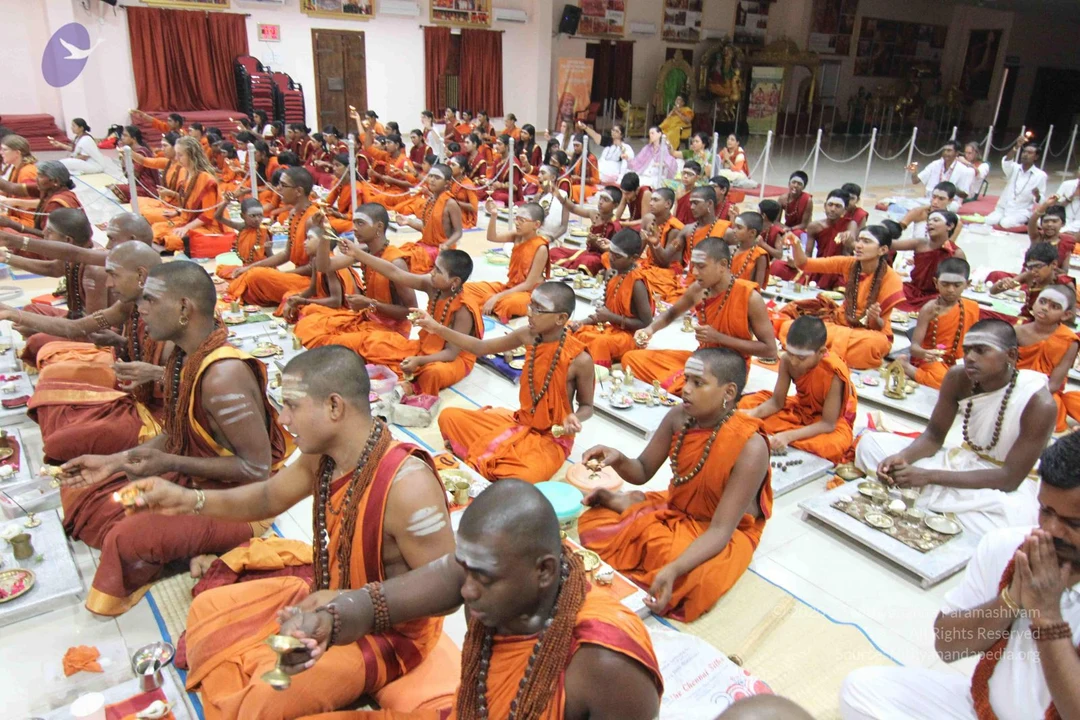
Satsang
Photos Of The Day:

FB-photo-of-the-day

Photos Of The Day:

Nithya-Puja

Nithya-Kirtan

Nithya-Satsang

Sarva-Darshan

Deity-Darshan

Goshala

Photos Of The Day:

Nithya-Satsang

Deity-Darshan

Goshala

Photos from this day

View all 205 photos

Satsang
51 photosSource gallery
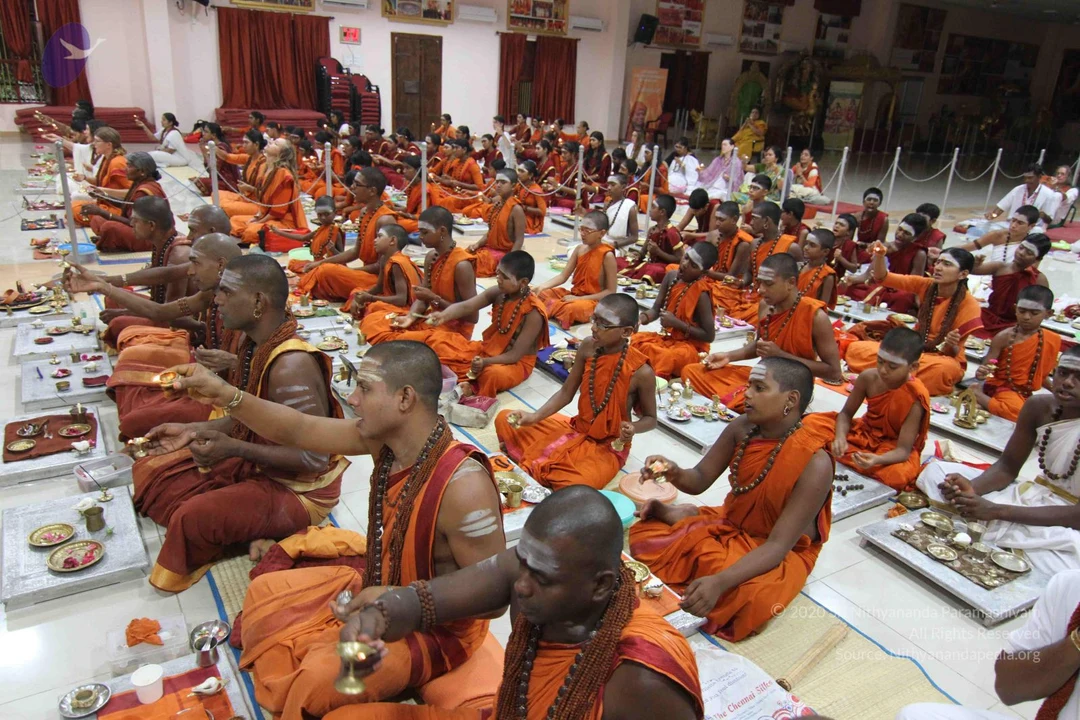
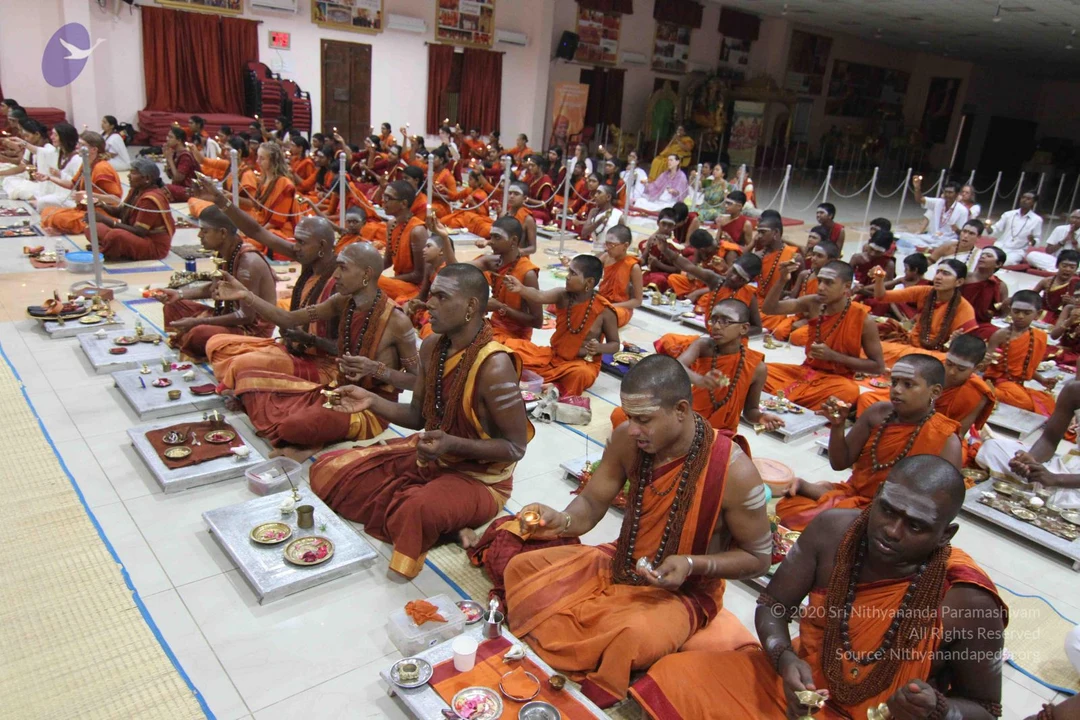
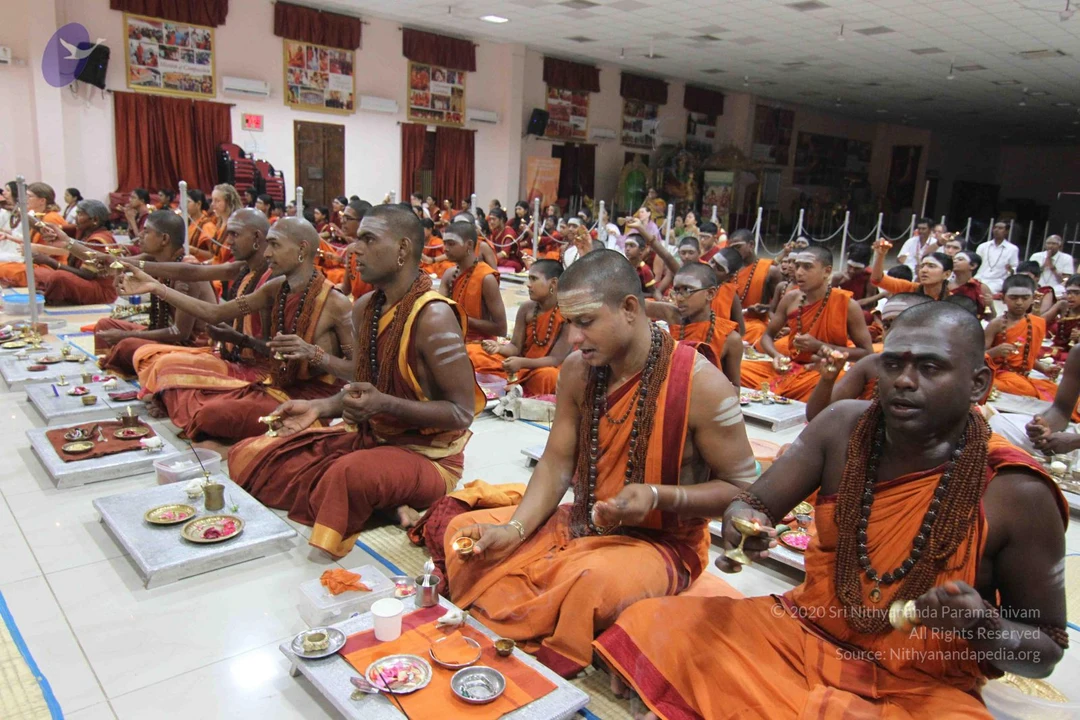
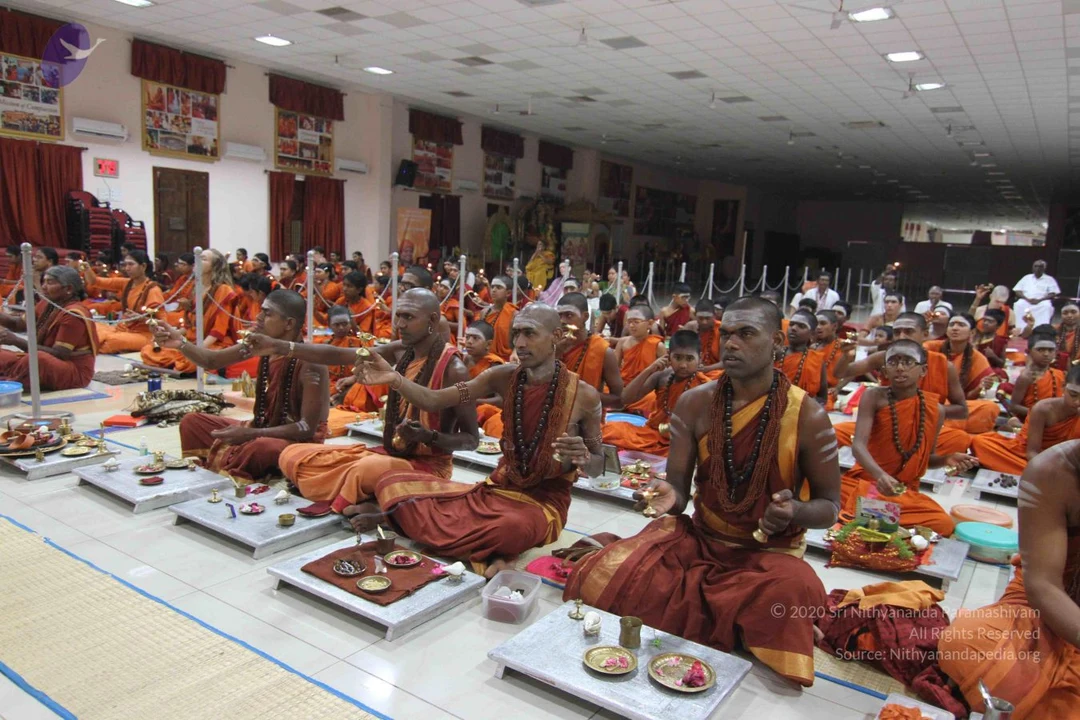
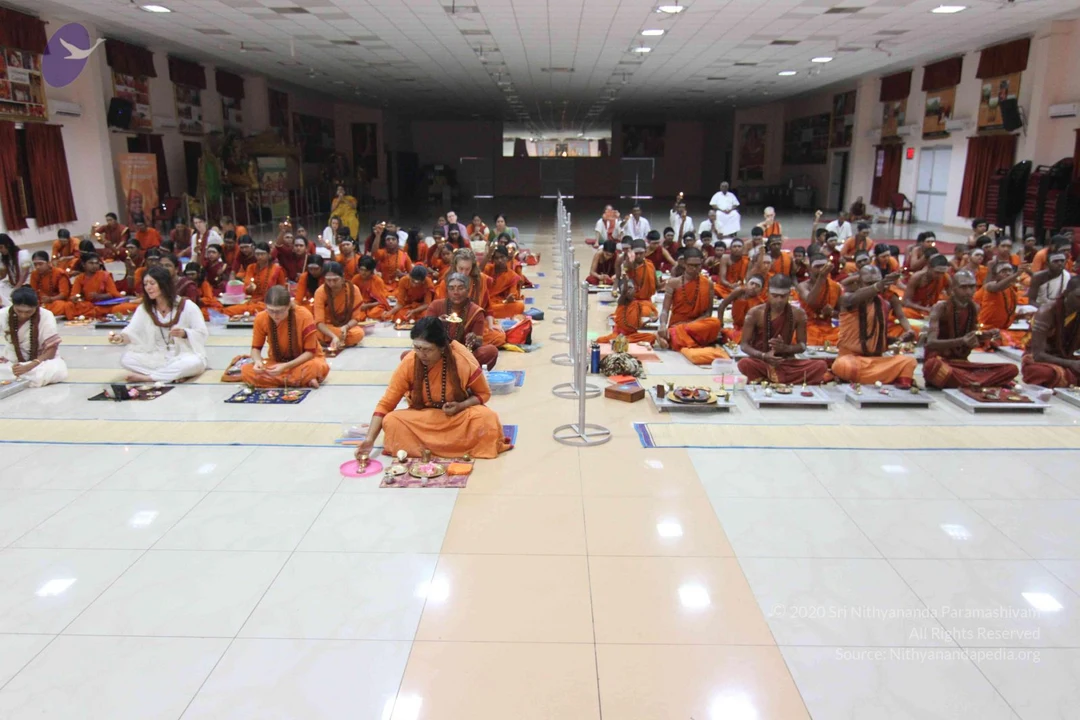
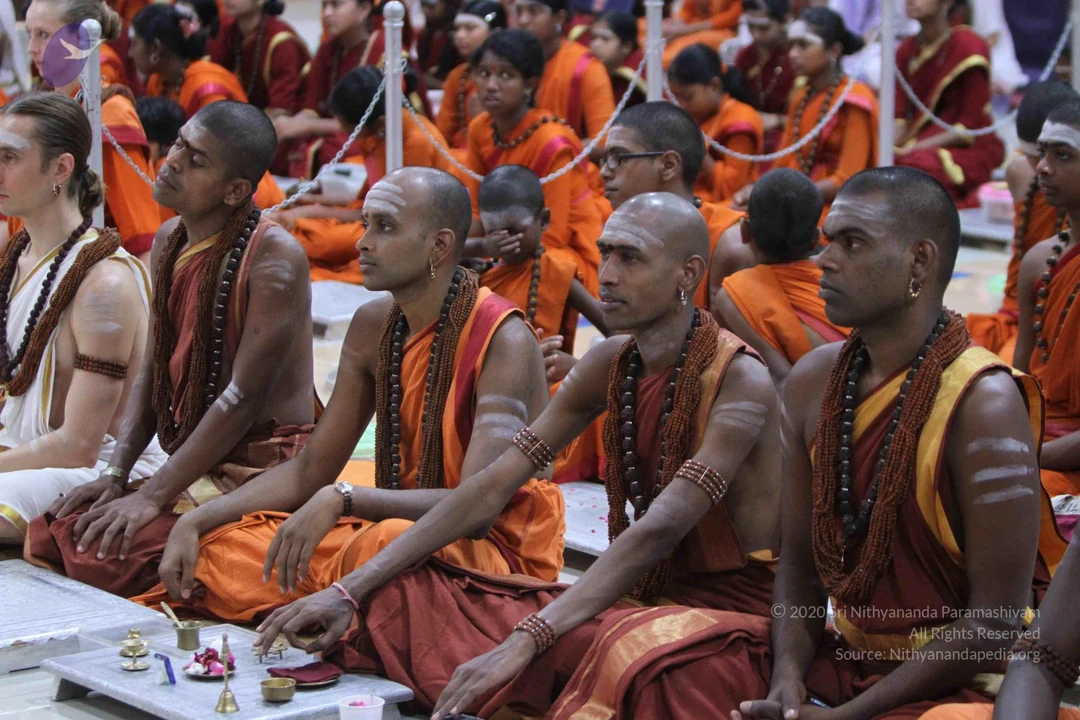
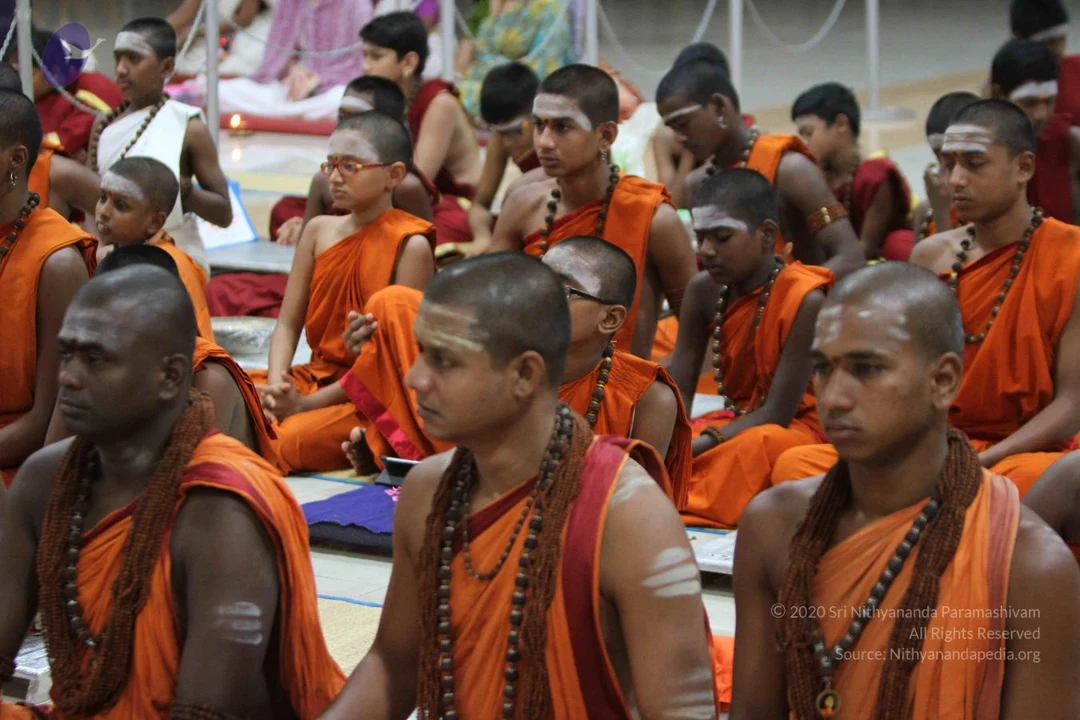
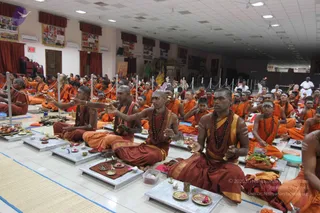
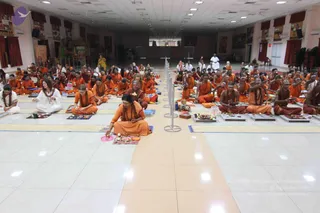
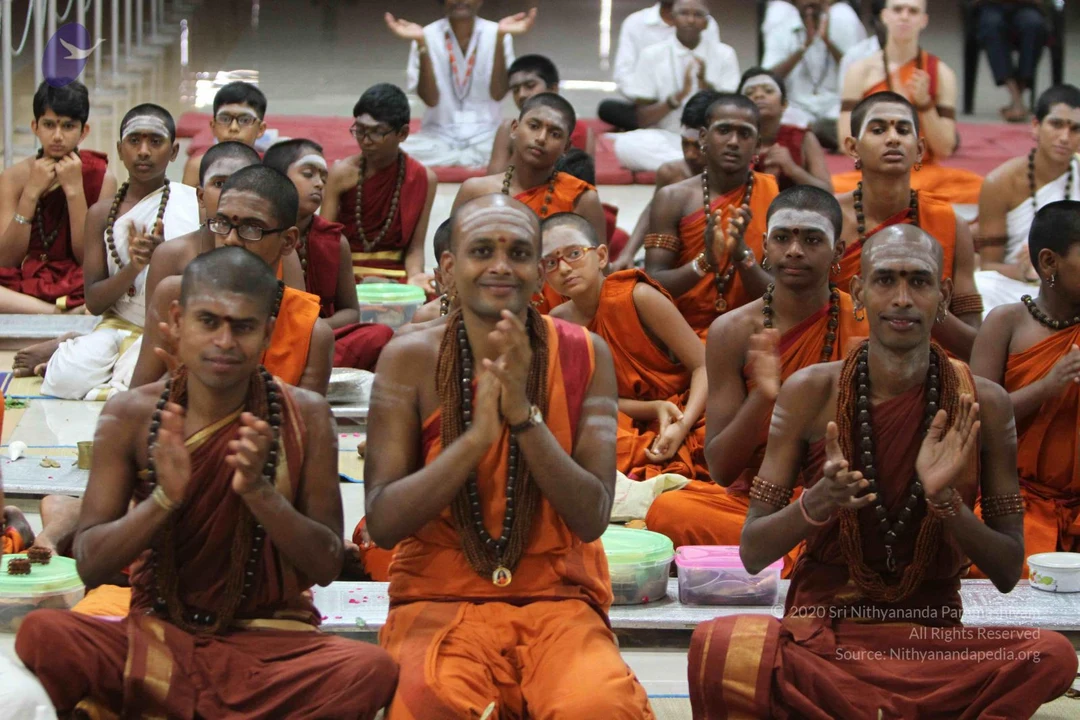
A large ritual gathering in a hall with cream tiled floor and red curtains at the back. Dozens of seated young men and boys in saffron-orange robes and rudraksha malas sit in rows, many with white forehead markings, holding brass bells, small lamps and offering trays set on low tables. Several participants raise hands in mudra or gesture toward offerings. Along the right, people in white clothes sit with folded hands, and some are standing. Shelves and framed deity images stand on the back wall.A large group of saffron-robed sannyasis and young disciples sit cross-legged on a white tiled hall floor in rows, many with rudraksha malas and white tilak marks on their foreheads. Several hold small brass cups and dishes, and metal trays with puja items, oil lamps and flower petals are set before them. Behind them, women in white and pink saris sit along the wall beneath red curtains, and a few devotees stand at the far right. Beside the rows, steel railings and decorated pillars define the aisle, and framed pictures hang on the back wall. The people count is above twenty.Photograph of a large ritual gathering inside a hall with a tiled floor, where many people sit cross-legged on small silver trays and mats in rows. Foreground men in saffron and orange dhotis and shawls wear rudraksha malas and have white tilak marks on their foreheads and arms; several hold small brass cups, oil lamps and offering plates, and some raise their hands in blessing gestures. Behind them, rows of younger devotees in orange robes and seated women in white and pink saris face the same direction. Partially visible figures stand near white posts with rope barriers, and a golden deity murti and framed images are on the back wall.Seated monks in saffron-orange robes perform a ritual in a large hall with pink walls and red curtains. In the foreground, several shaved-headed monks with white sandalwood markings on their arms and foreheads hold small brass oil lamps and bells, with rudraksha malas around their necks. Ornate trays with flowers, offerings and small brass vessels sit on grey stone mats in front of them. Behind them, a large crowd of seated devotees in orange and red garments fills the room, with a few people in white standing at the back, and framed photographs hang on the walls.A large hall filled with rows of saffron-robed devotees seated on the floor during a ritual. In the foreground, several men in red and orange cloth with rudraksha malas sit before small silver trays holding brass lamps, flower-petal plates and small bowls, raising their hands in gesture. Behind them, a crowd of orange-clad participants sits in rows, many with white marks on their foreheads. Red curtains and framed pictures line the walls, and a decorated deity murti stands at the back of the room. The people visible number in the dozens.Wide view of a large hall with thick white floor tiles where many people sit in rows on mats facing a distant stage. Most are dressed in saffron-orange robes with rudraksha malas, and several sit before small brass puja plates holding lamps, flowers and offerings. A woman in white, with a mala, sits near the left foreground beside a small pink-rimmed plate. At the far end, a few people in white clothes stand near the stage, and silver stanchions line the central aisle. Red curtains and framed pictures decorate the walls, indicating a group puja or meditation session in progress.

FB-photo-of-the-day

4 photosSource gallery

Nithya-Puja

7 photosSource gallery
A large ritual gathering in a hall with cream tiled floor and red curtains at the back. Dozens of seated young men and boys in saffron-orange robes and rudraksha malas sit in rows, many with white forehead markings, holding brass bells, small lamps and offering trays set on low tables. Several participants raise hands in mudra or gesture toward offerings. Along the right, people in white clothes sit with folded hands, and some are standing. Shelves and framed deity images stand on the back wall.A large group of saffron-robed sannyasis and young disciples sit cross-legged on a white tiled hall floor in rows, many with rudraksha malas and white tilak marks on their foreheads. Several hold small brass cups and dishes, and metal trays with puja items, oil lamps and flower petals are set before them. Behind them, women in white and pink saris sit along the wall beneath red curtains, and a few devotees stand at the far right. Beside the rows, steel railings and decorated pillars define the aisle, and framed pictures hang on the back wall. The people count is above twenty.Photograph of a large ritual gathering inside a hall with a tiled floor, where many people sit cross-legged on small silver trays and mats in rows. Foreground men in saffron and orange dhotis and shawls wear rudraksha malas and have white tilak marks on their foreheads and arms; several hold small brass cups, oil lamps and offering plates, and some raise their hands in blessing gestures. Behind them, rows of younger devotees in orange robes and seated women in white and pink saris face the same direction. Partially visible figures stand near white posts with rope barriers, and a golden deity murti and framed images are on the back wall.Seated monks in saffron-orange robes perform a ritual in a large hall with pink walls and red curtains. In the foreground, several shaved-headed monks with white sandalwood markings on their arms and foreheads hold small brass oil lamps and bells, with rudraksha malas around their necks. Ornate trays with flowers, offerings and small brass vessels sit on grey stone mats in front of them. Behind them, a large crowd of seated devotees in orange and red garments fills the room, with a few people in white standing at the back, and framed photographs hang on the walls.A large hall filled with rows of saffron-robed devotees seated on the floor during a ritual. In the foreground, several men in red and orange cloth with rudraksha malas sit before small silver trays holding brass lamps, flower-petal plates and small bowls, raising their hands in gesture. Behind them, a crowd of orange-clad participants sits in rows, many with white marks on their foreheads. Red curtains and framed pictures line the walls, and a decorated deity murti stands at the back of the room. The people visible number in the dozens.Wide view of a large hall with thick white floor tiles where many people sit in rows on mats facing a distant stage. Most are dressed in saffron-orange robes with rudraksha malas, and several sit before small brass puja plates holding lamps, flowers and offerings. A woman in white, with a mala, sits near the left foreground beside a small pink-rimmed plate. At the far end, a few people in white clothes stand near the stage, and silver stanchions line the central aisle. Red curtains and framed pictures decorate the walls, indicating a group puja or meditation session in progress.

Nithya-Kirtan

7 photosSource gallery
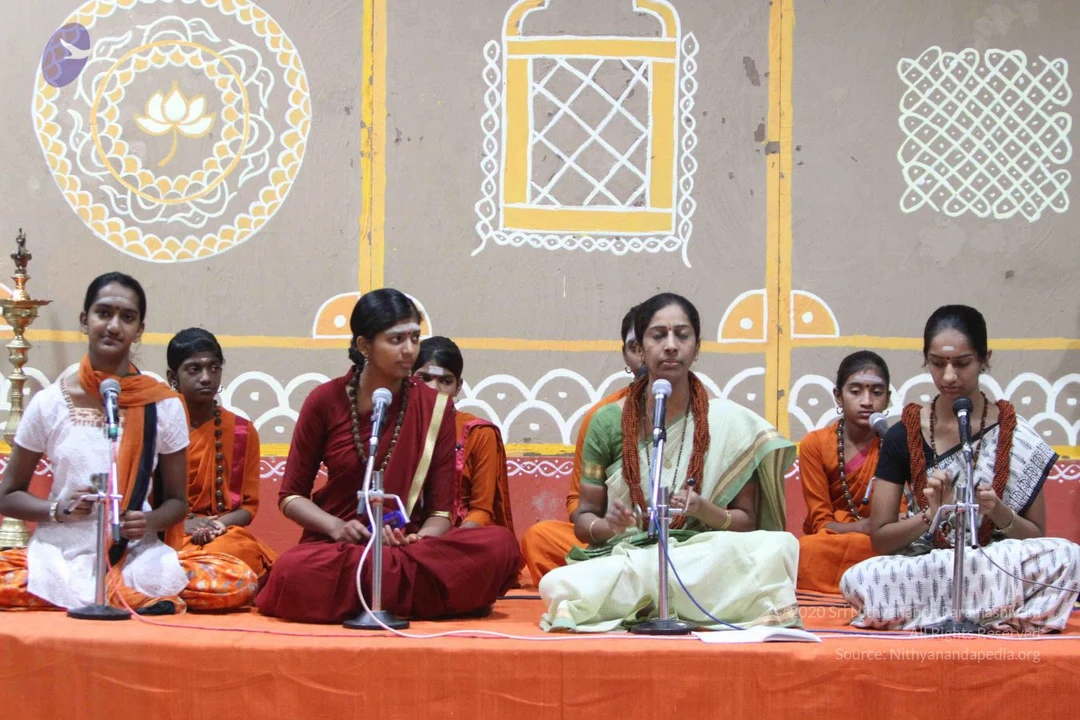
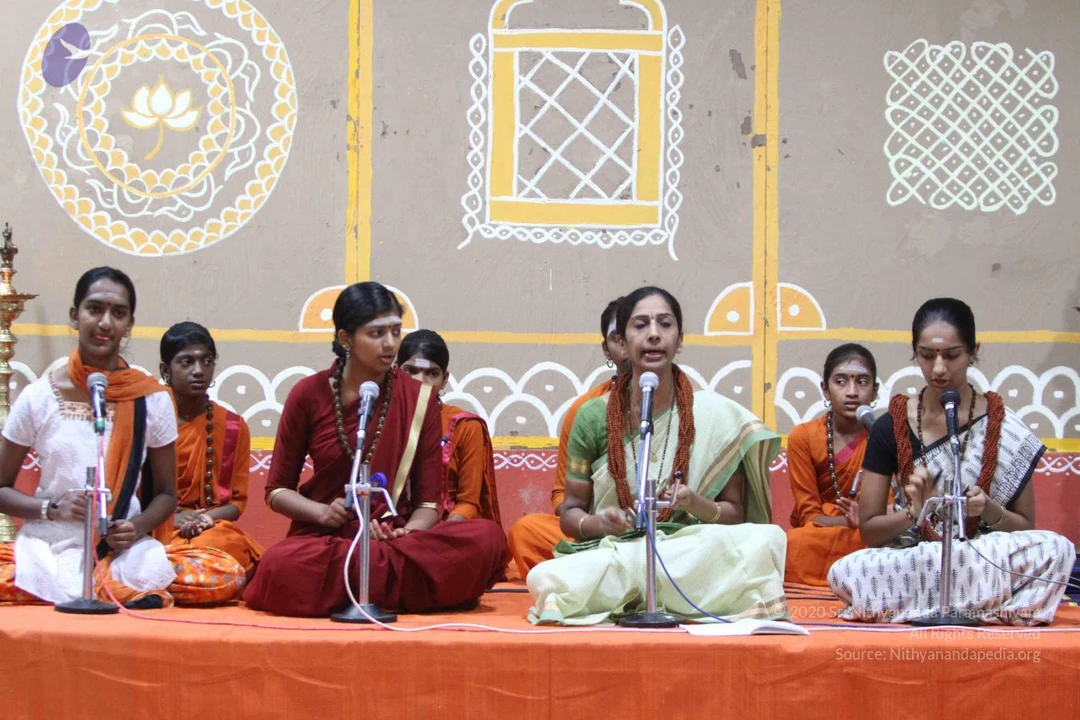
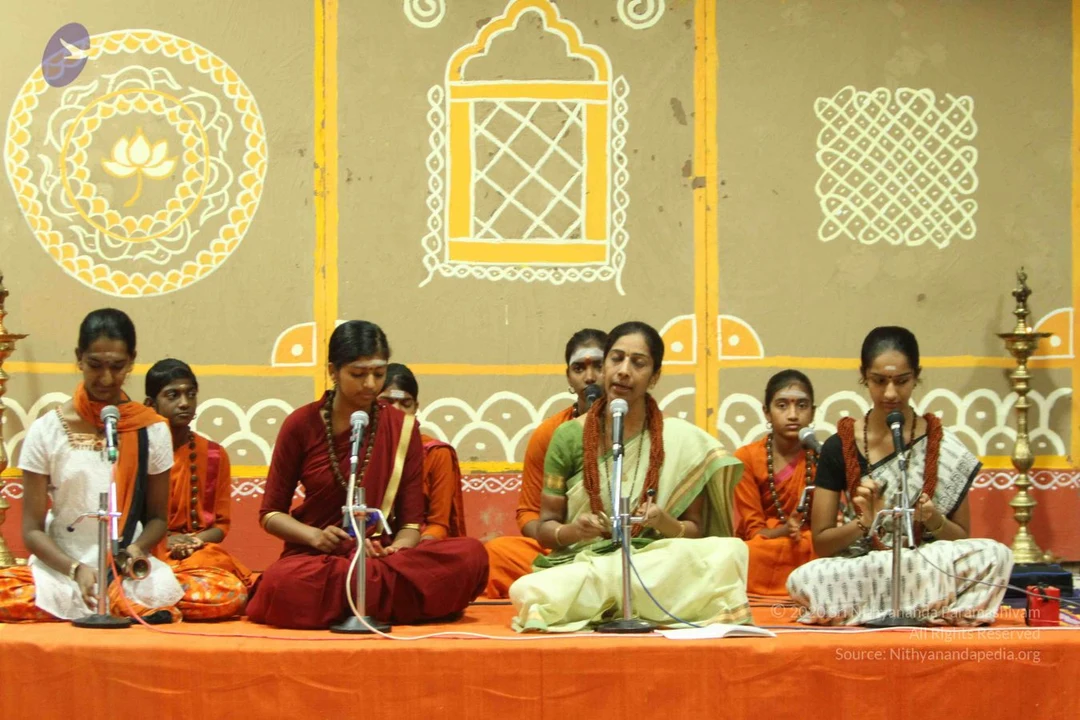
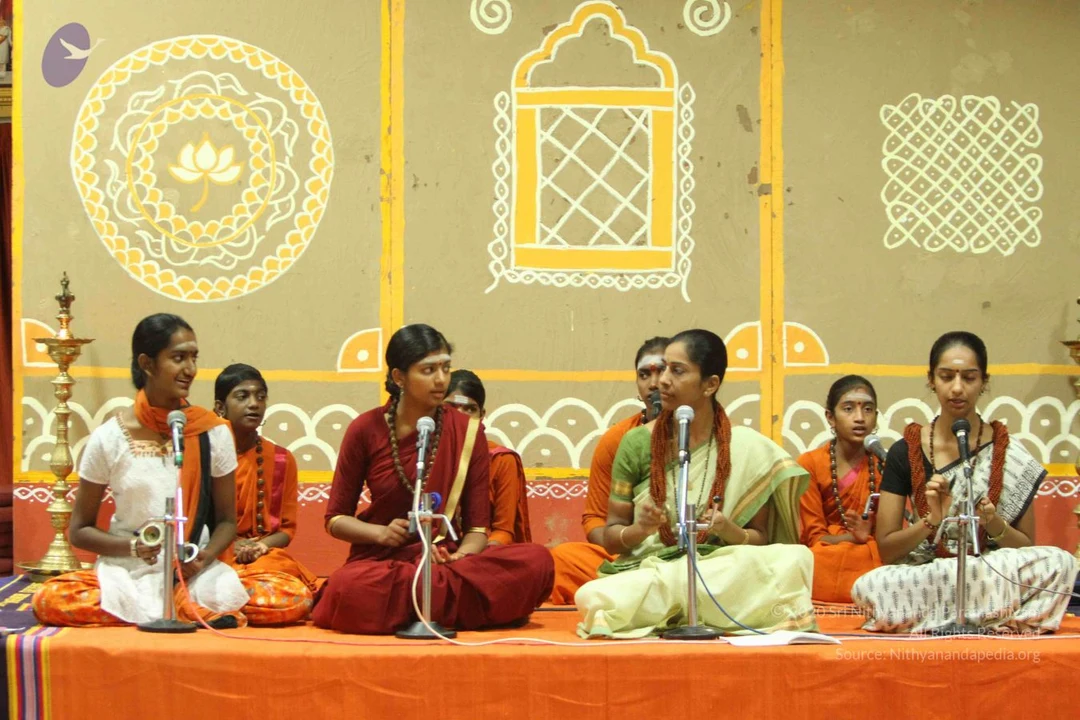
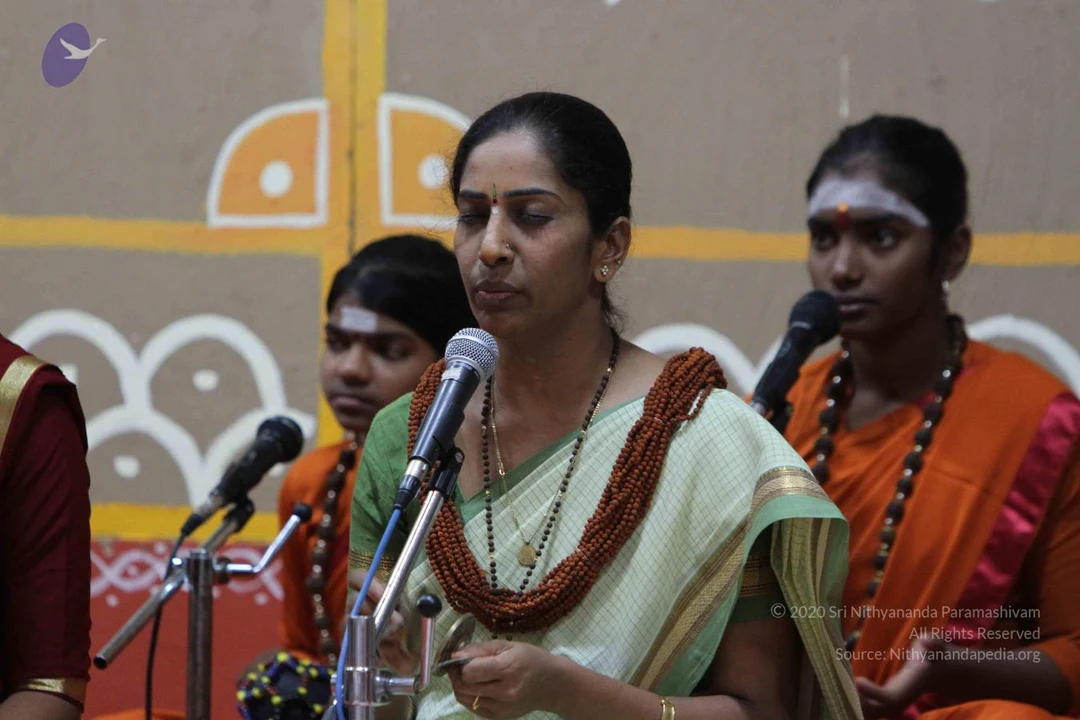
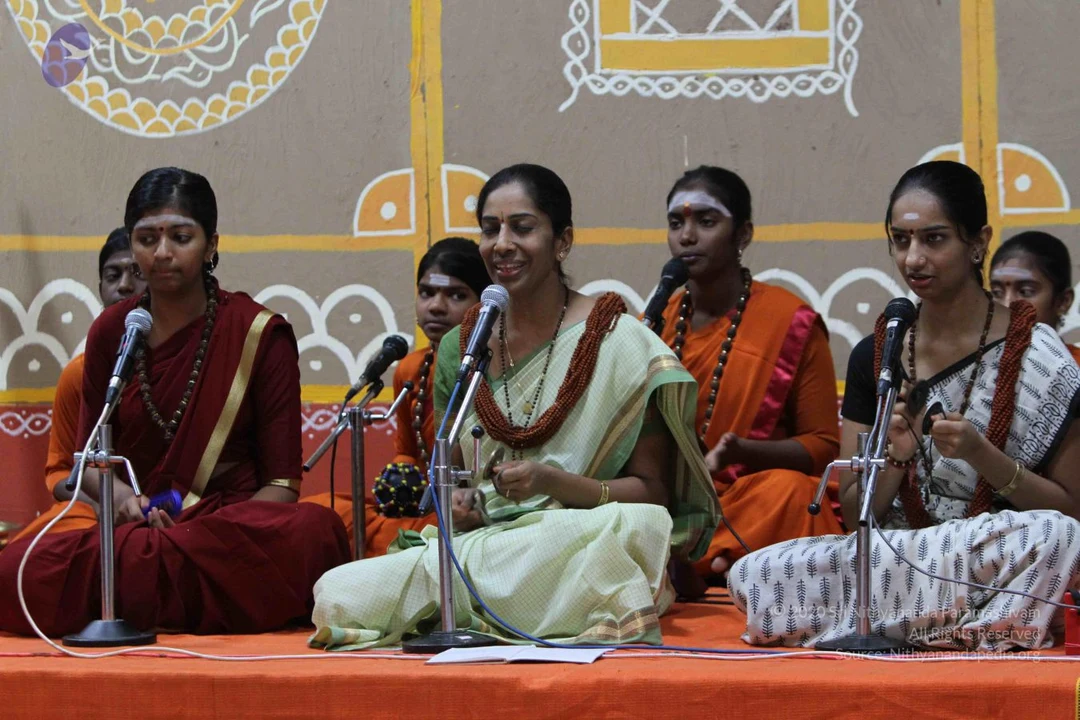
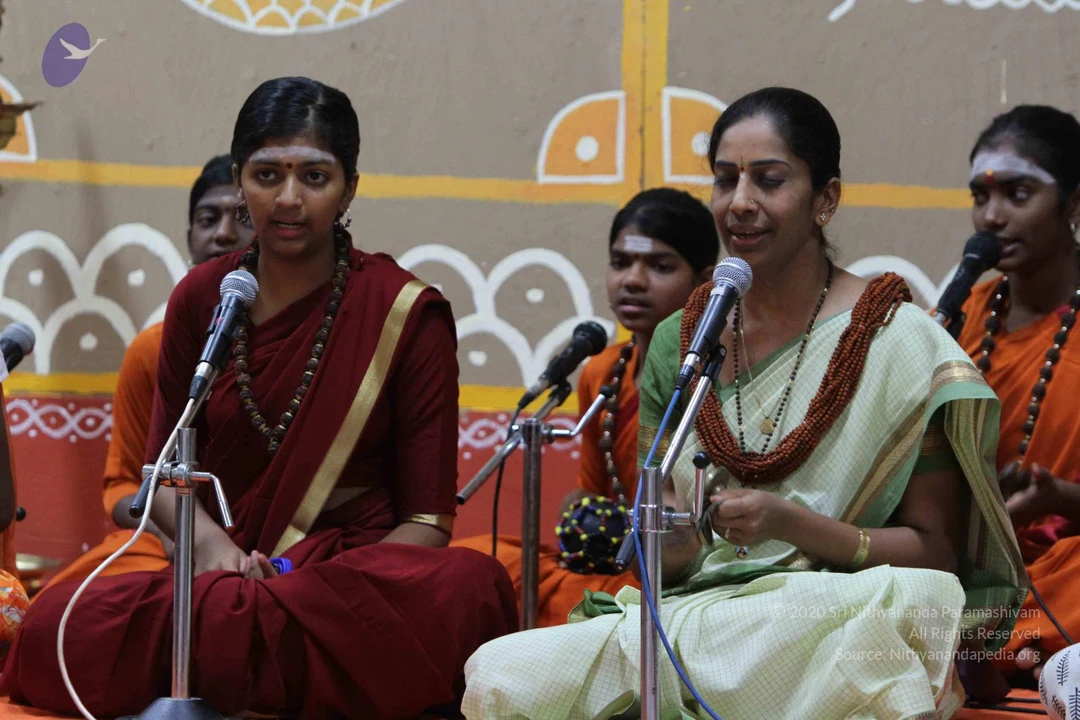
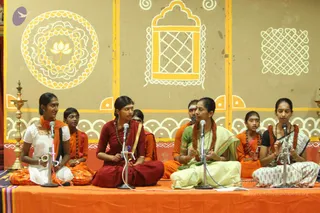
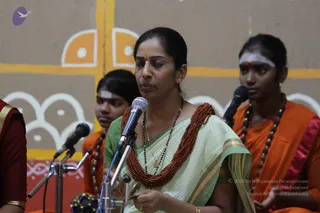
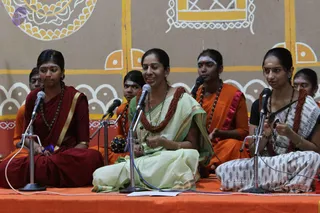
A group of young women and girls sit cross-legged on an orange stage cloth, singing or chanting into floor microphone stands in front of a painted wall with yellow borders, a lotus medallion, a window-lattice motif and white kolam-style patterns. A brass oil lamp stands at the left edge. Most wear orange or saffron garments and rudraksha malas; the center woman wears a green sari with an orange shawl and a rudraksha mala, and the woman at right wears a black blouse with a white patterned sari and rudraksha beads. Their hands rest on their laps or hold small objects. The scene reflects a devotional recitation or satsang setting.A group of women and young girls sit cross-legged on an orange cloth-covered stage, singing into standing microphones in front of a painted wall with yellow borders, a lotus medallion, kolam-style white patterns and a window motif. A woman in the centre wears a pale green sari with a deep orange-red shawl and a beaded rudraksha-style necklace, her hands held in front of her as she sings. To the left, a girl in a white top and orange shawl stands by a brass lamp, while others in orange and maroon robes with rudraksha malas accompany the chant. Clay lamps and brass lamp stands are visible at the edges. A woman at the right wears a black blouse and a white patterned sari with a red-beaded garland.A group of women sit cross-legged on an orange stage in front of a mustard-yellow wall painted with white kolam-style motifs, lotus medallion, and a lattice window. Several have microphones before them. A woman in the centre wears a pale green sari with a red-and-saffron rudraksha garland, singing or chanting while touching her fingers. To her left a young woman in a maroon sari wears a beaded mala, and to the right a woman in a black blouse and white sari holds a small handheld object. Others in orange and saffron robes with rudraksha malas sit behind them. Brass oil lamps stand at the edges of the stage, and a red-and-white microphone cable runs across the front. No figure is identified as a person.A group of women and girls sit on an orange cloth-covered stage in front of a painted wall with yellow and white kolam-style motifs, a lotus medallion and a latticed window. Several seated singers or chanters face microphones on stands. A woman in a green saree and rudraksha mala sits centre-stage gesturing with her hands, while girls in orange and maroon dress sit beside her. A brass oil lamp stands at the left edge. The scene resembles a satsang or chanting session.A woman in a pale green and cream checked sari with gold border sits at a microphone, eyes lowered, singing or chanting. She wears a long rudraksha mala and a black beaded necklace with a gold pendant, plus a red bindi. Behind her, two young women in orange robes with rudraksha malas and white forehead markings sit near microphones against a beige wall with orange and white painted arch motifs. A figure in red garments is partly visible at the left edge.A group of women sits on an orange cloth stage in front of a yellow and white painted wall with decorative motifs. Several microphones on stands are placed before them. In the centre, a woman in a pale green and gold-bordered saree with a rudraksha mala speaks into a microphone. To her left, a woman in a maroon saree with gold border sits with eyes closed, and to her right, a woman in a white and black printed saree with red rudraksha beads speaks. Behind them, women in saffron-orange robes with white forehead marks and rudraksha malas sit attentively. The setting resembles a satsang or spiritual discourse.

Nithya-Satsang
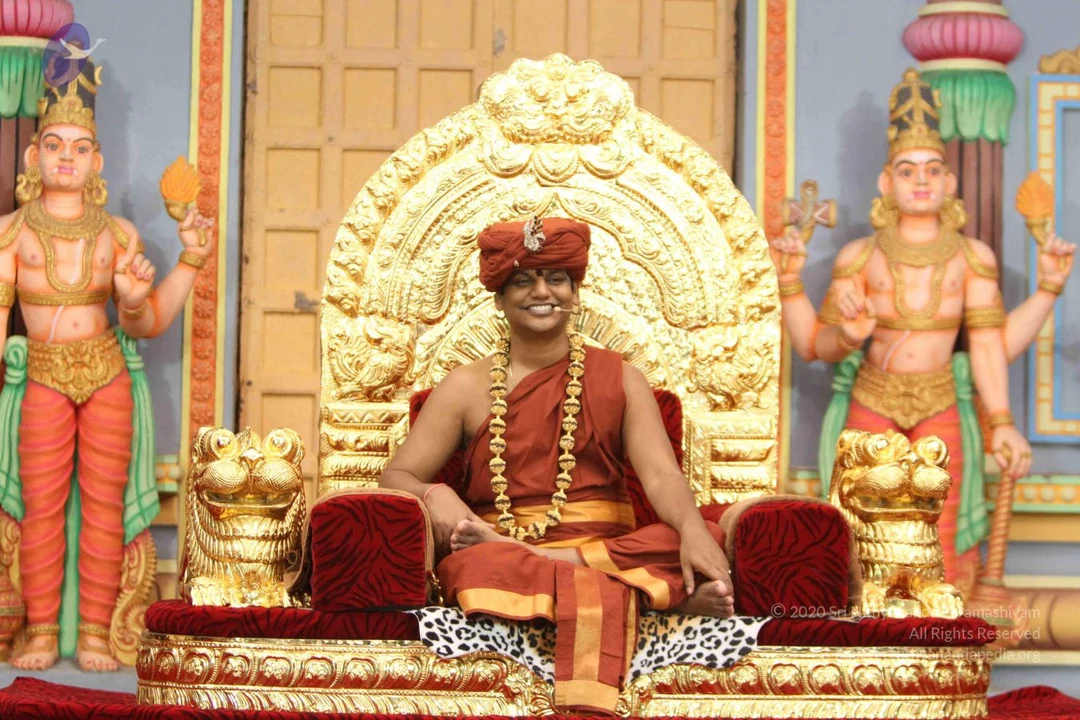
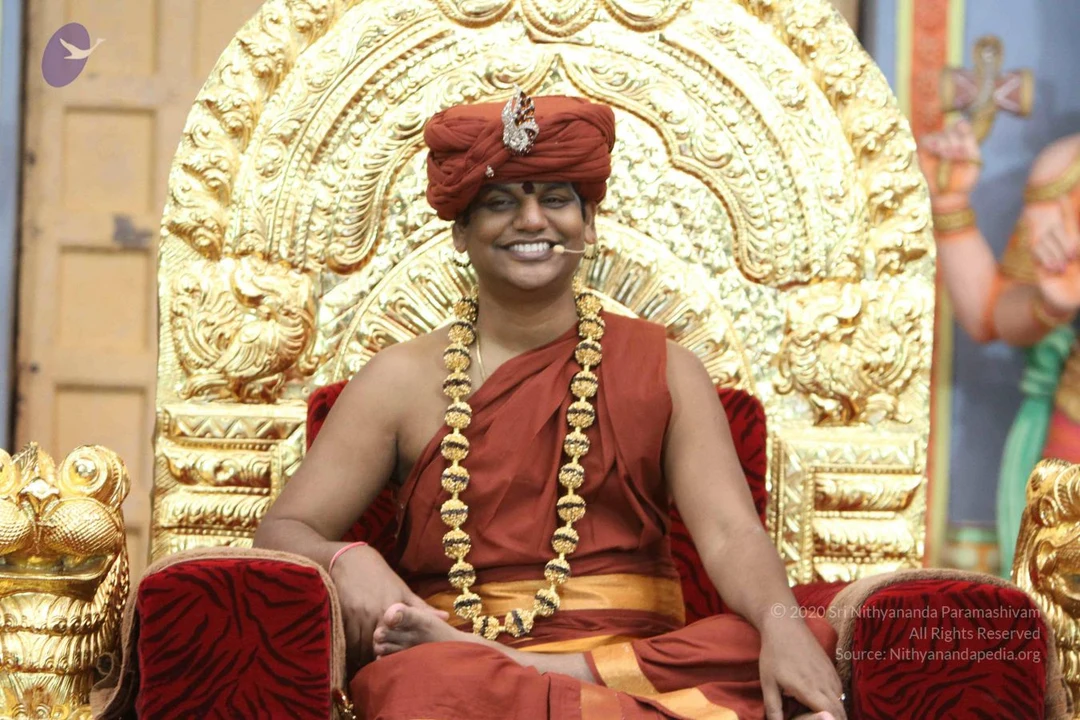
35 photosSource gallery
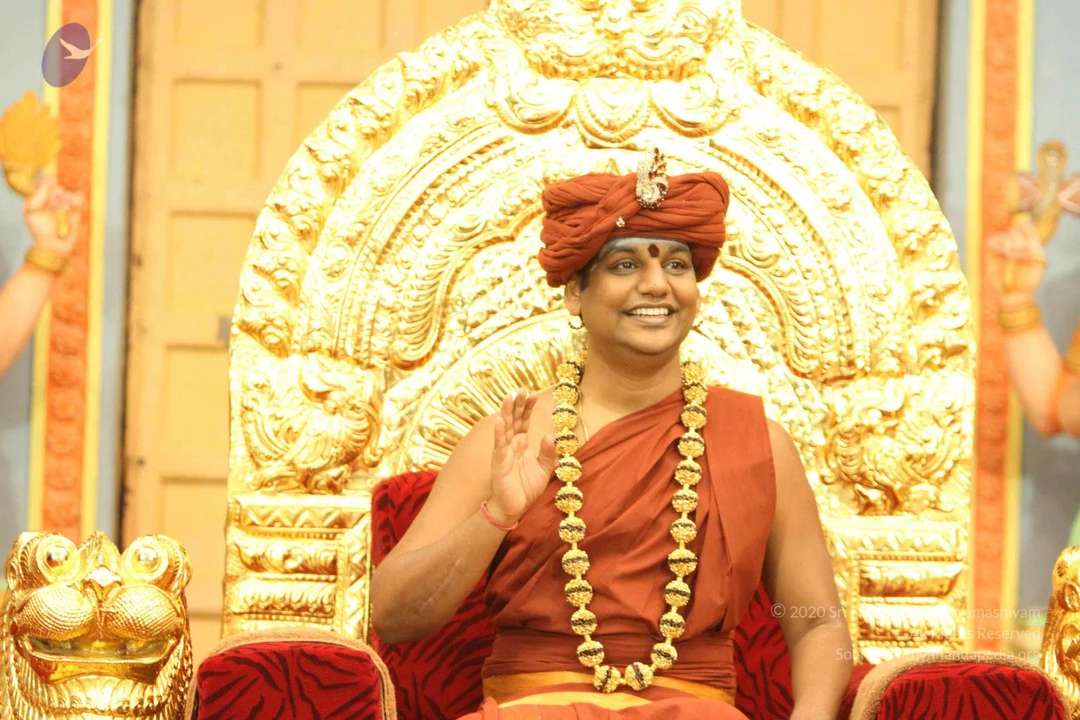
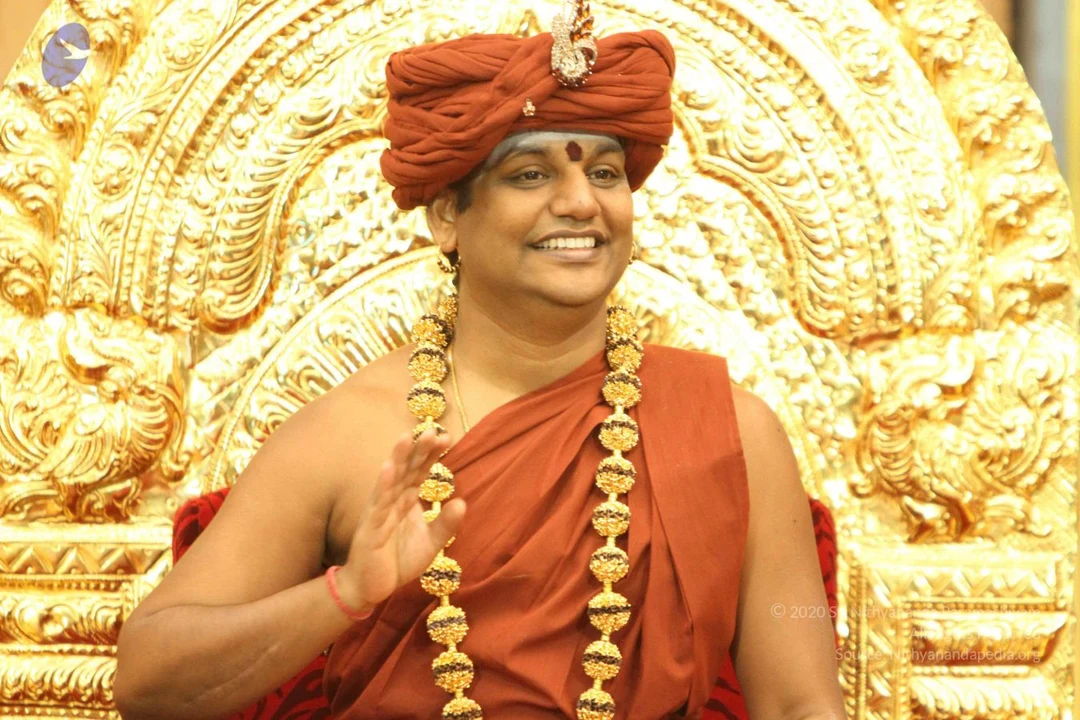
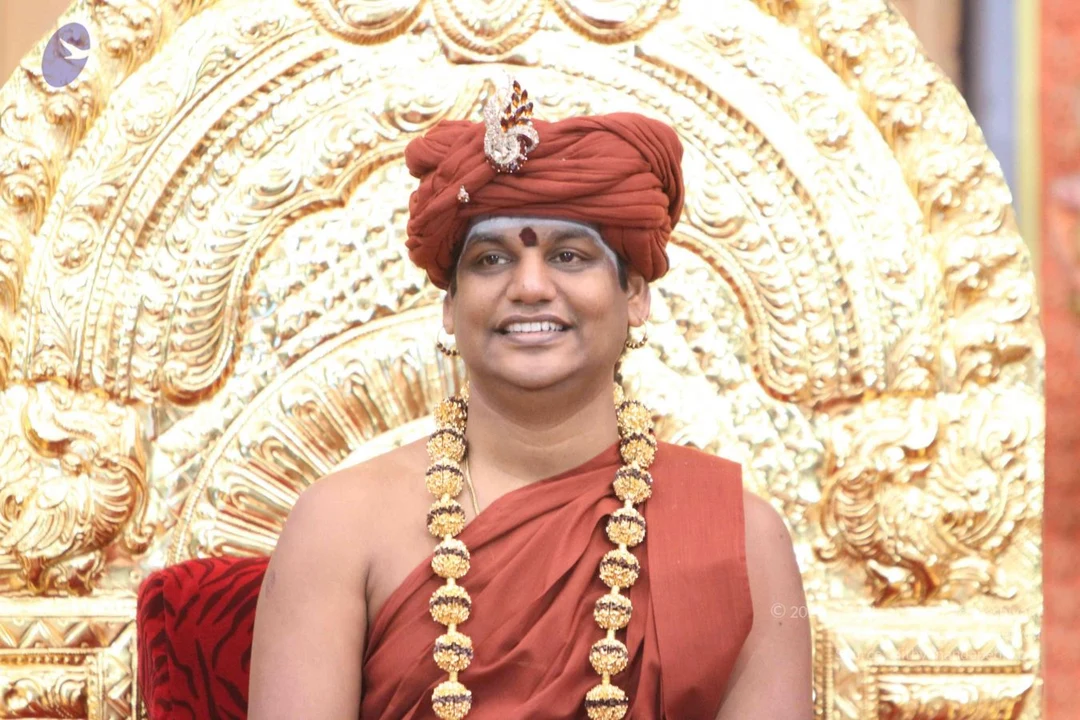
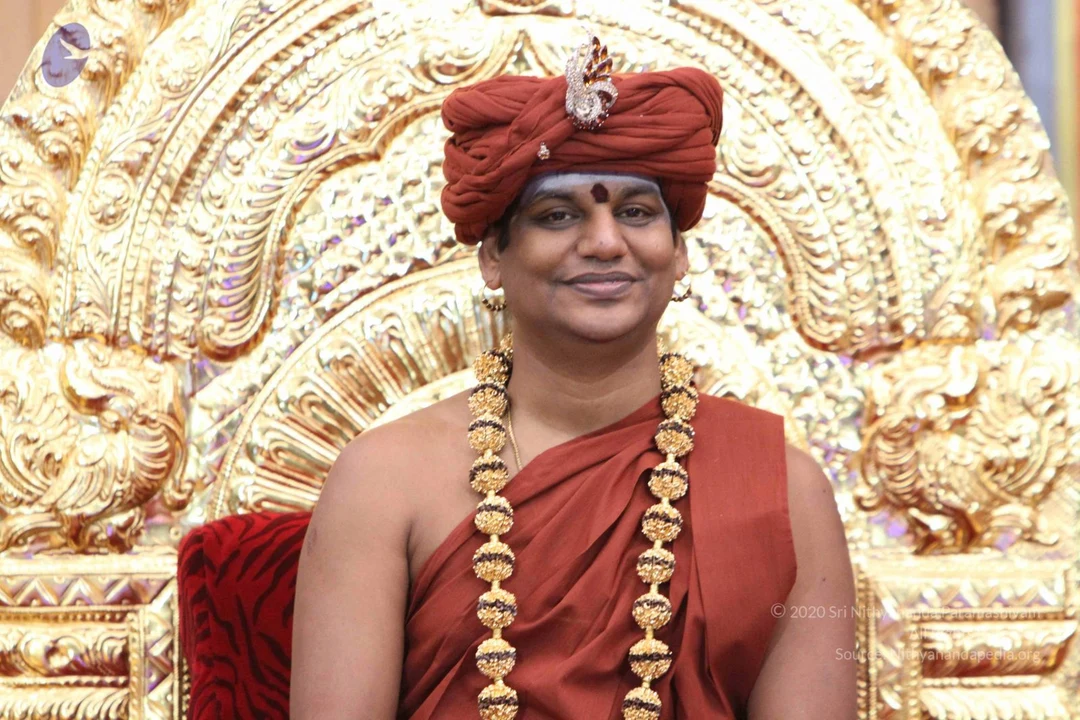
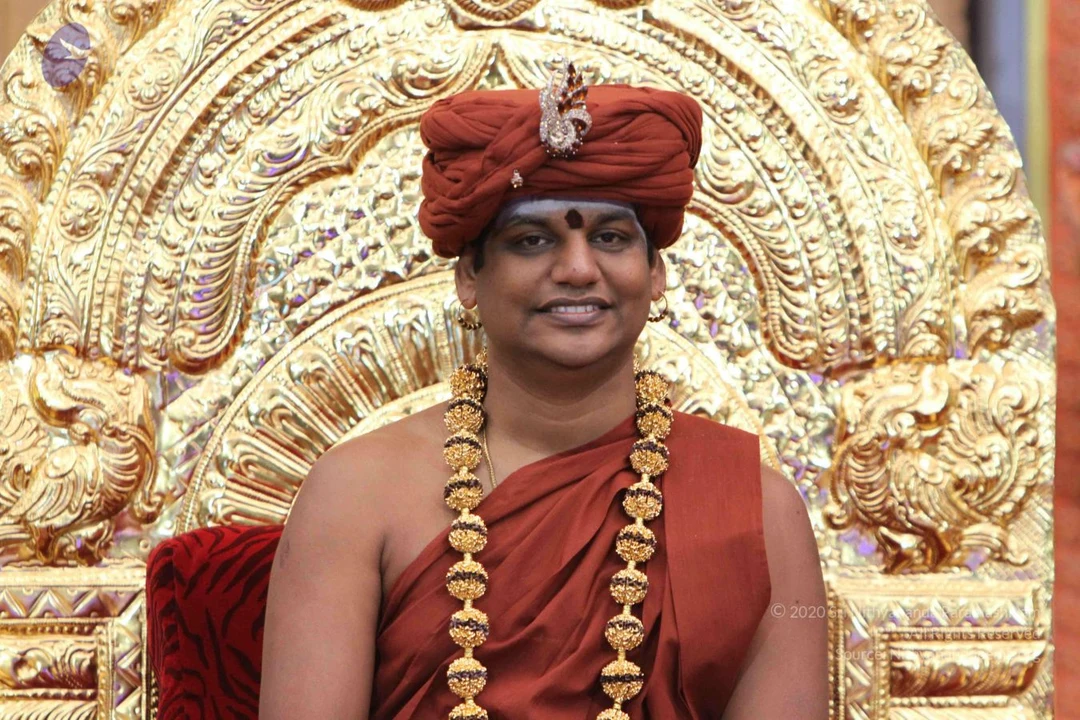
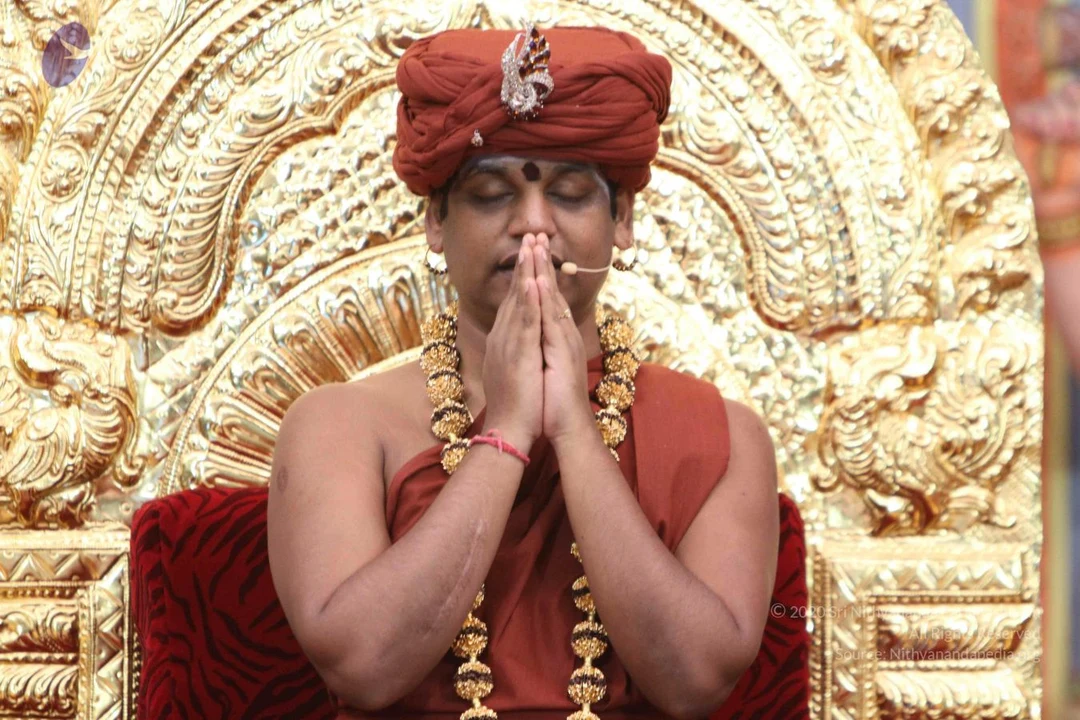
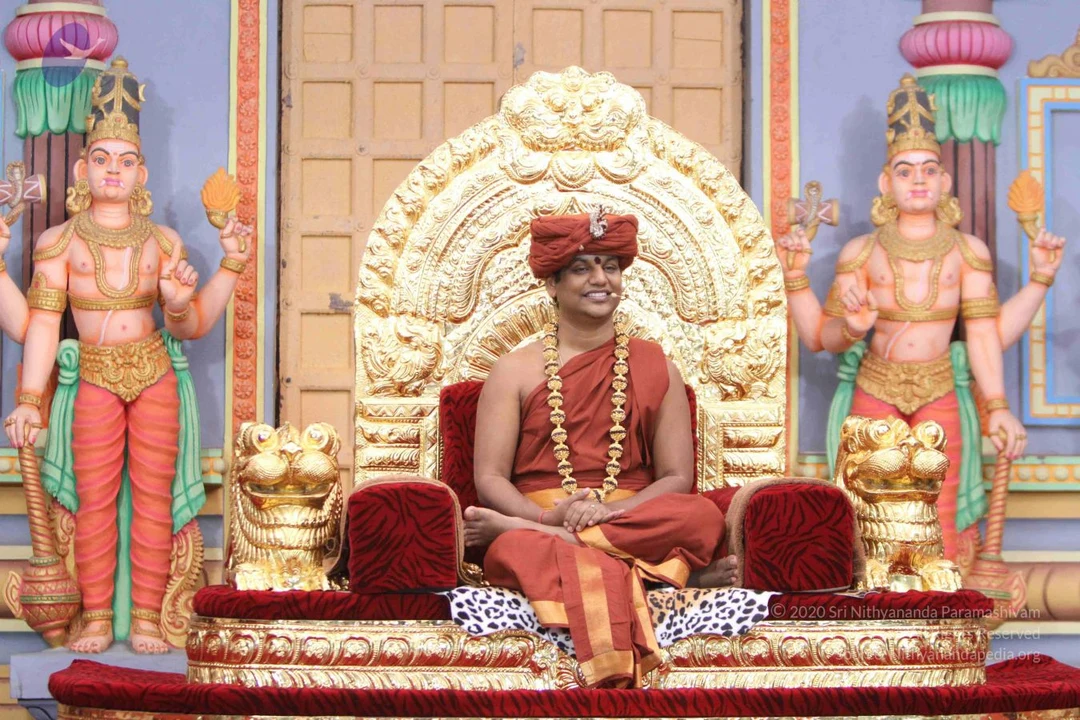
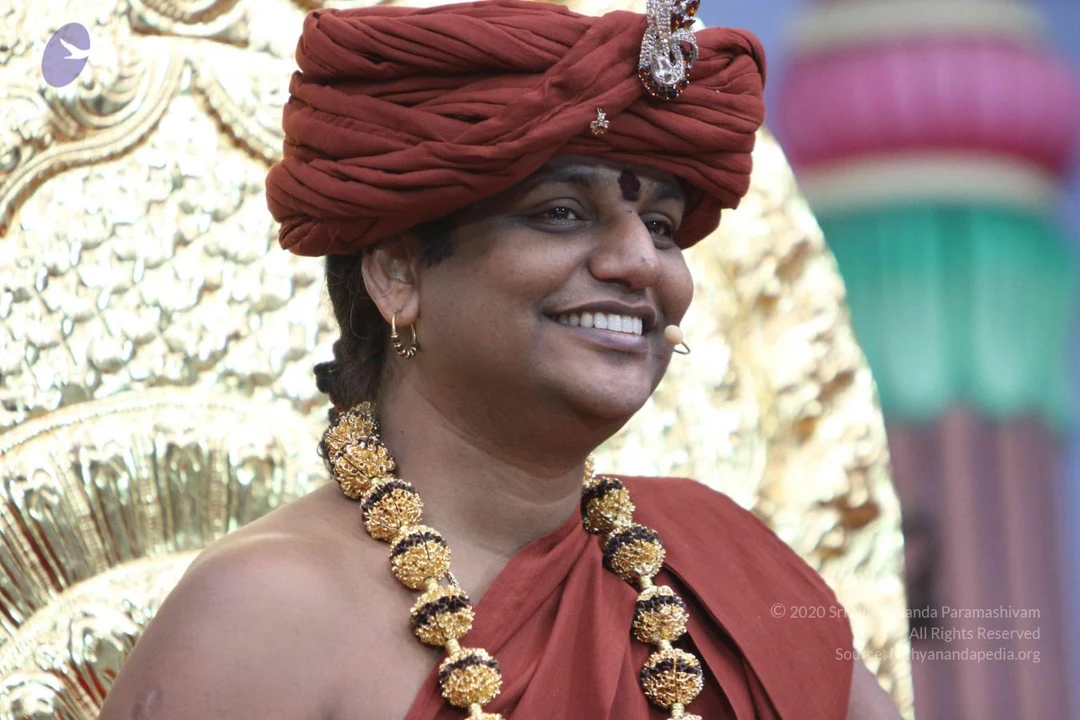
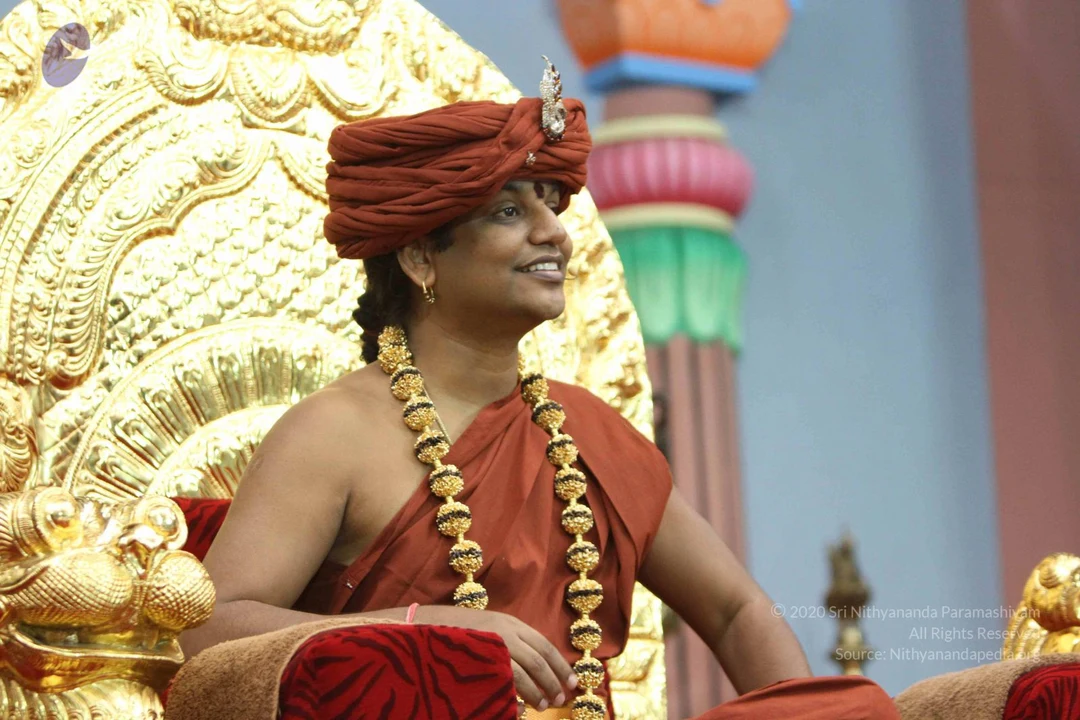
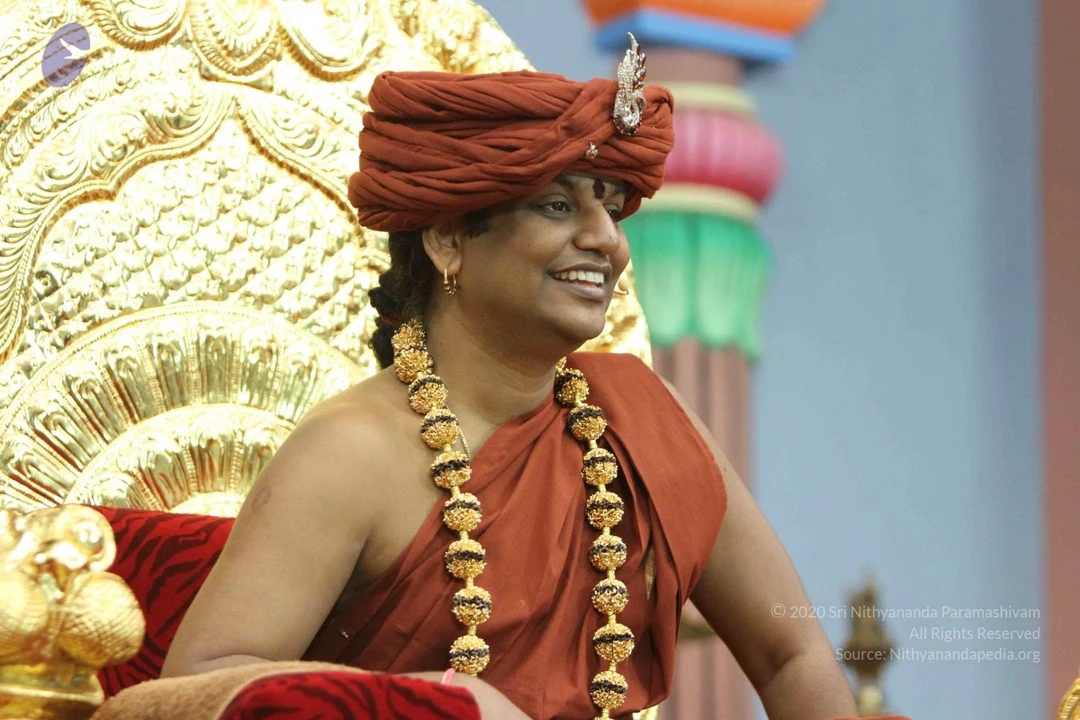
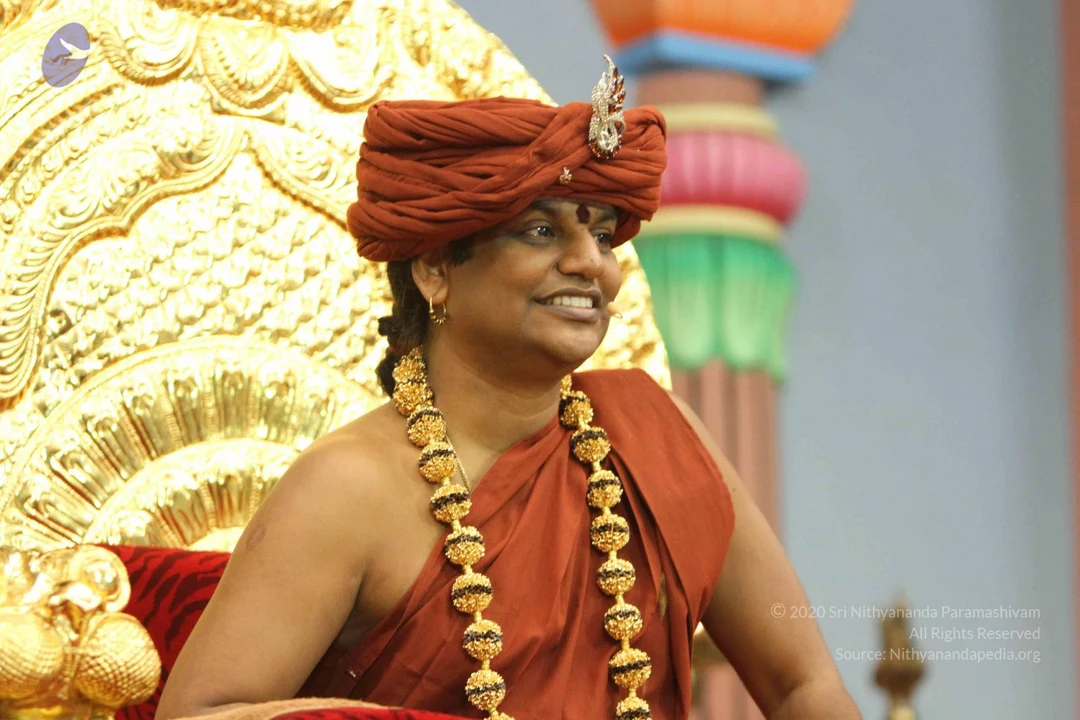
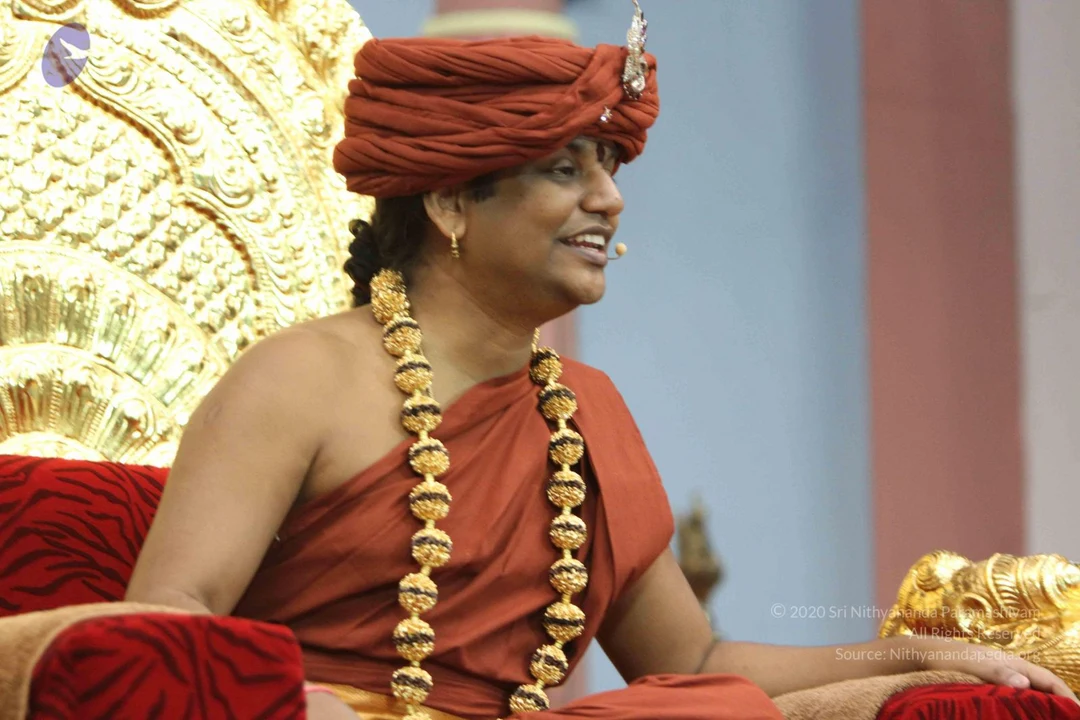
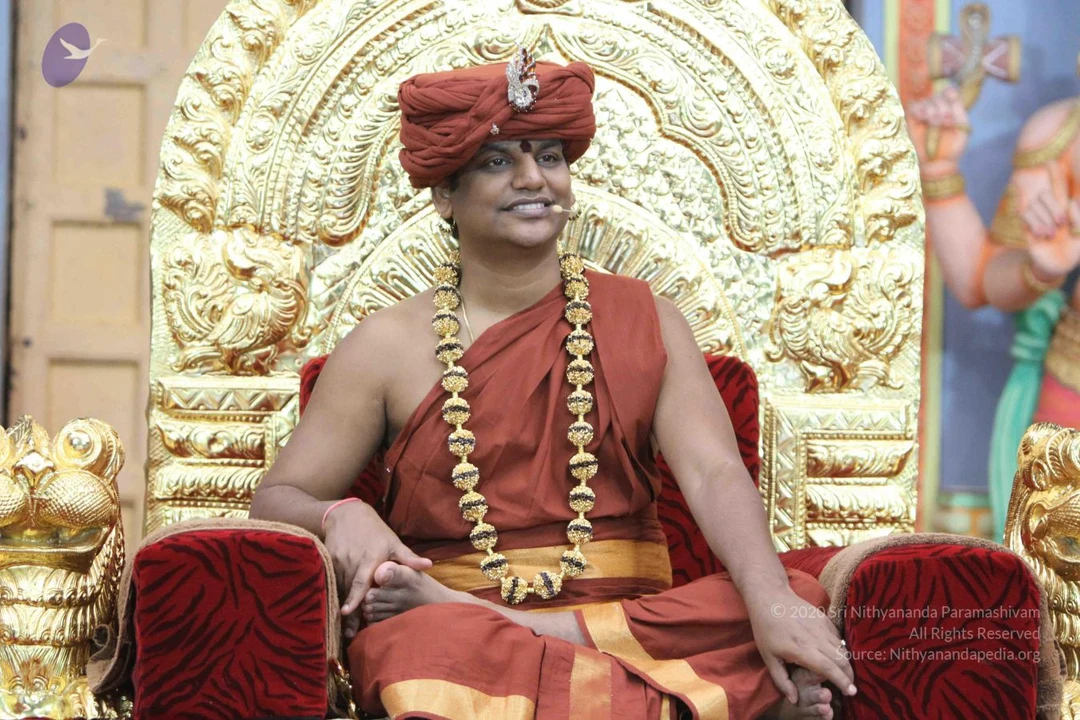
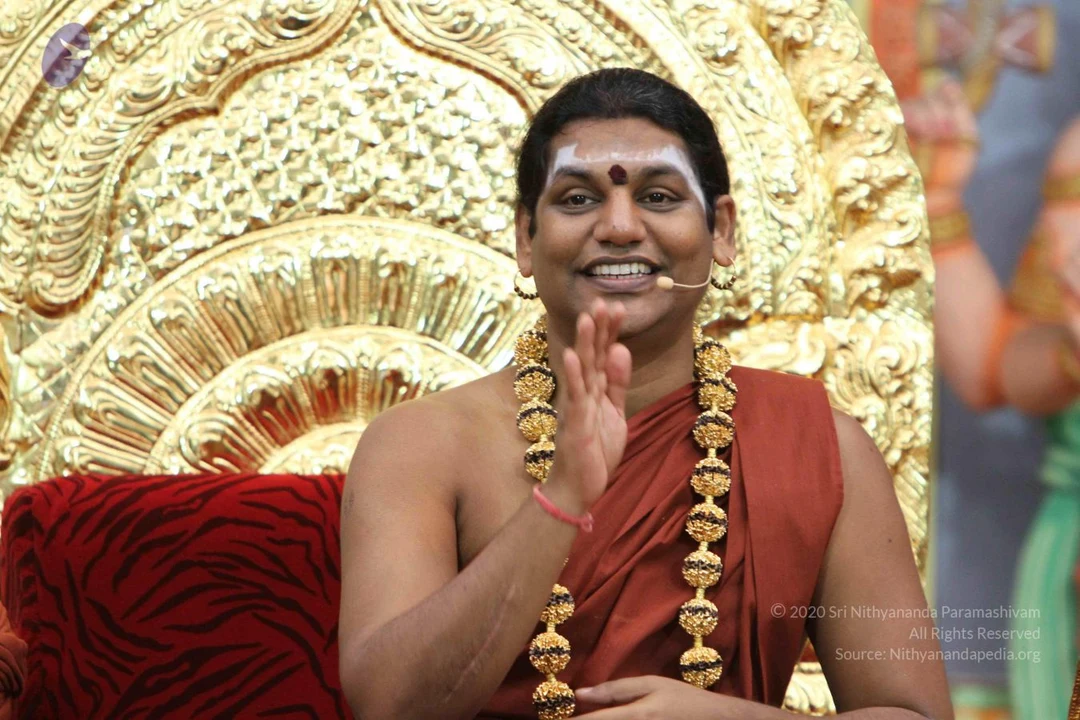
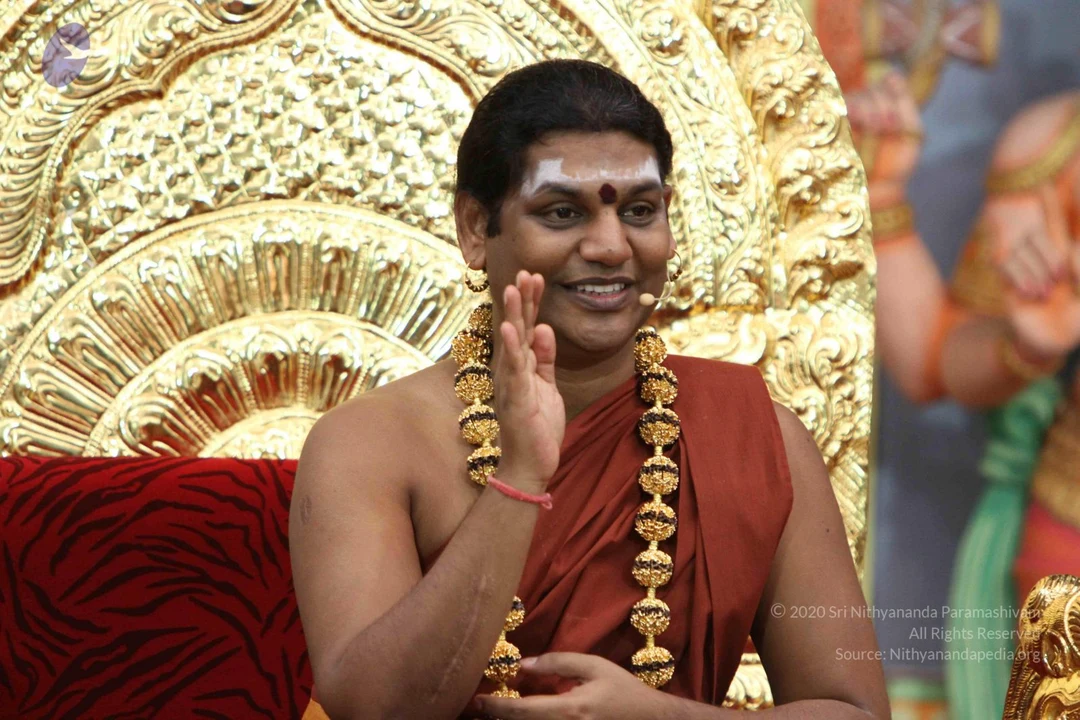
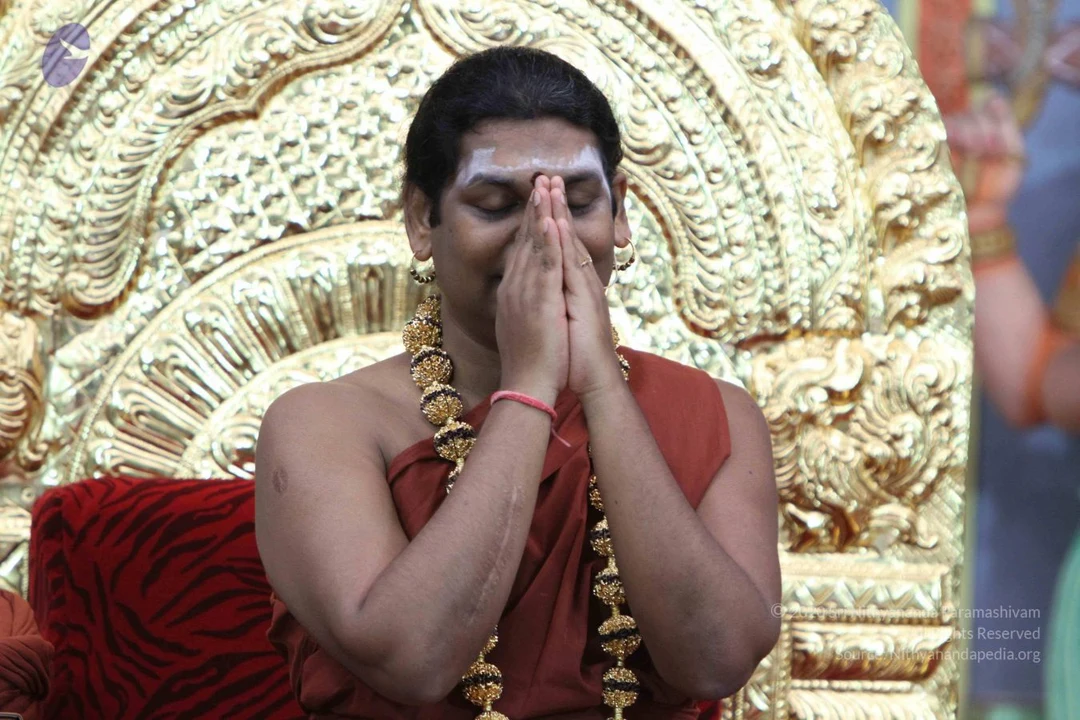
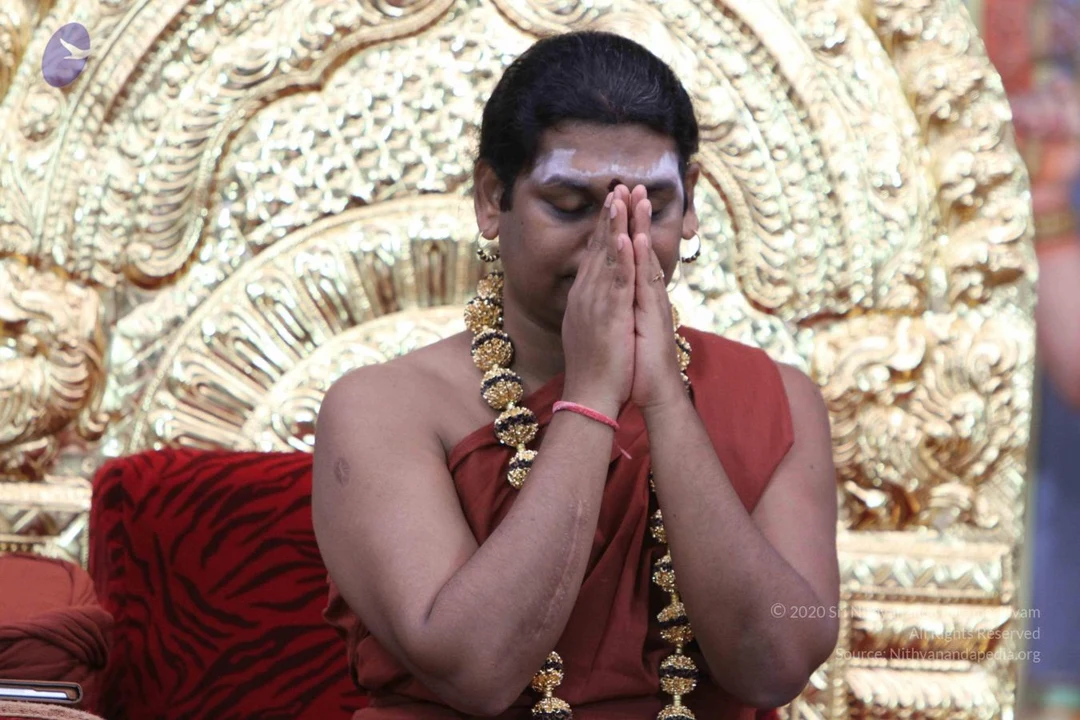
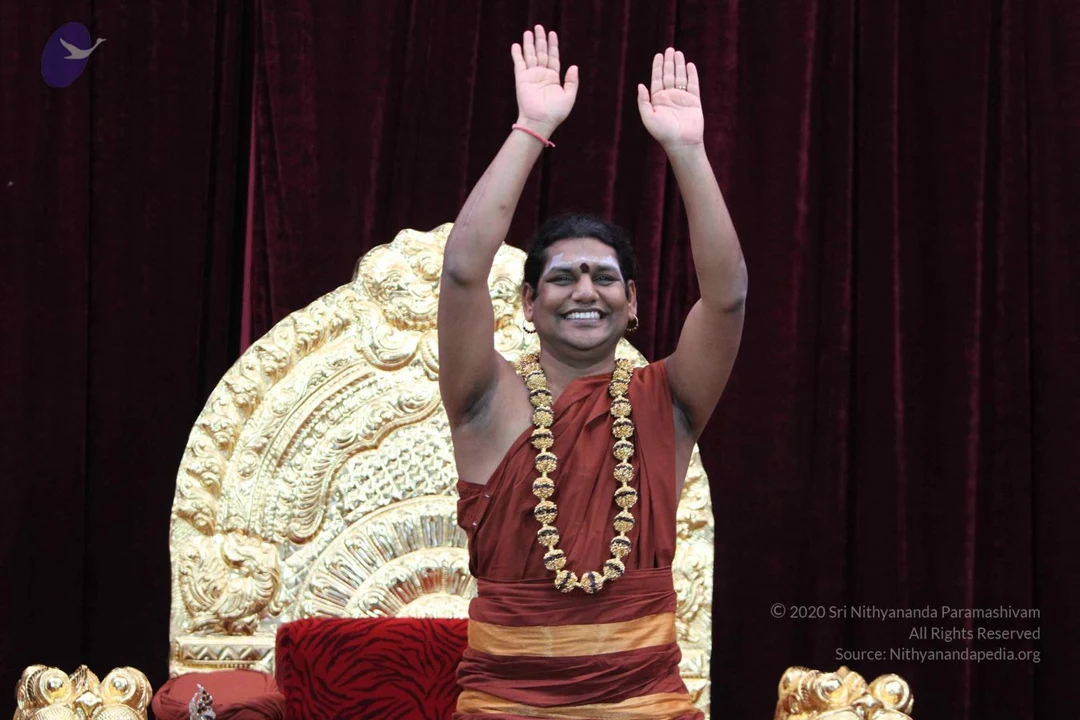
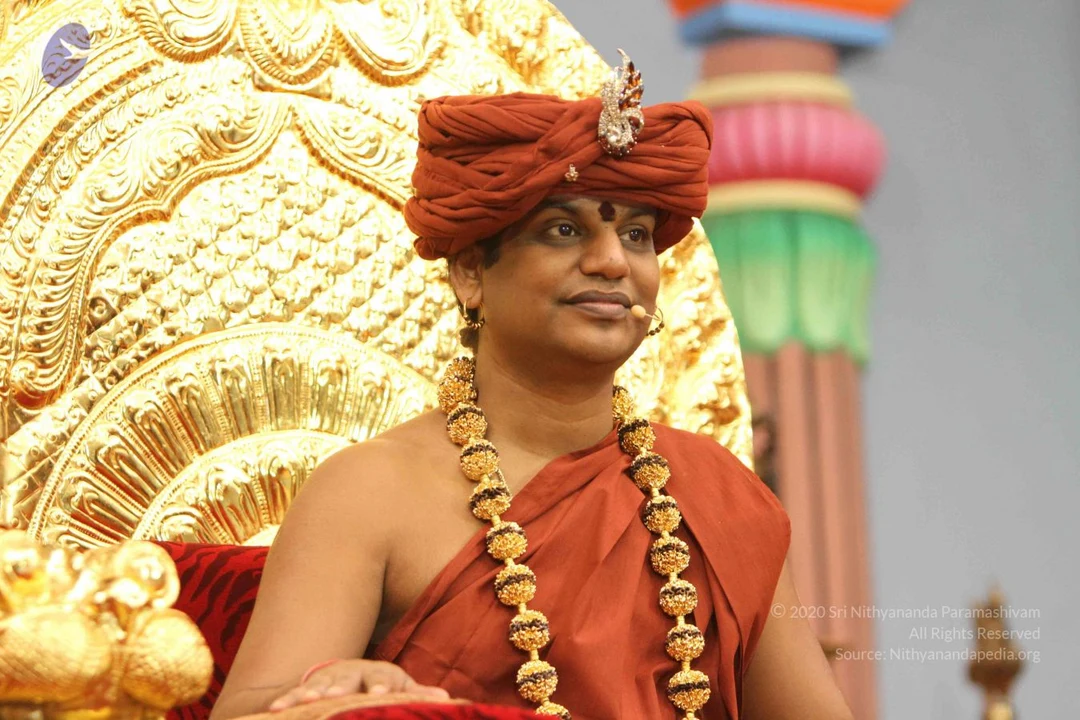
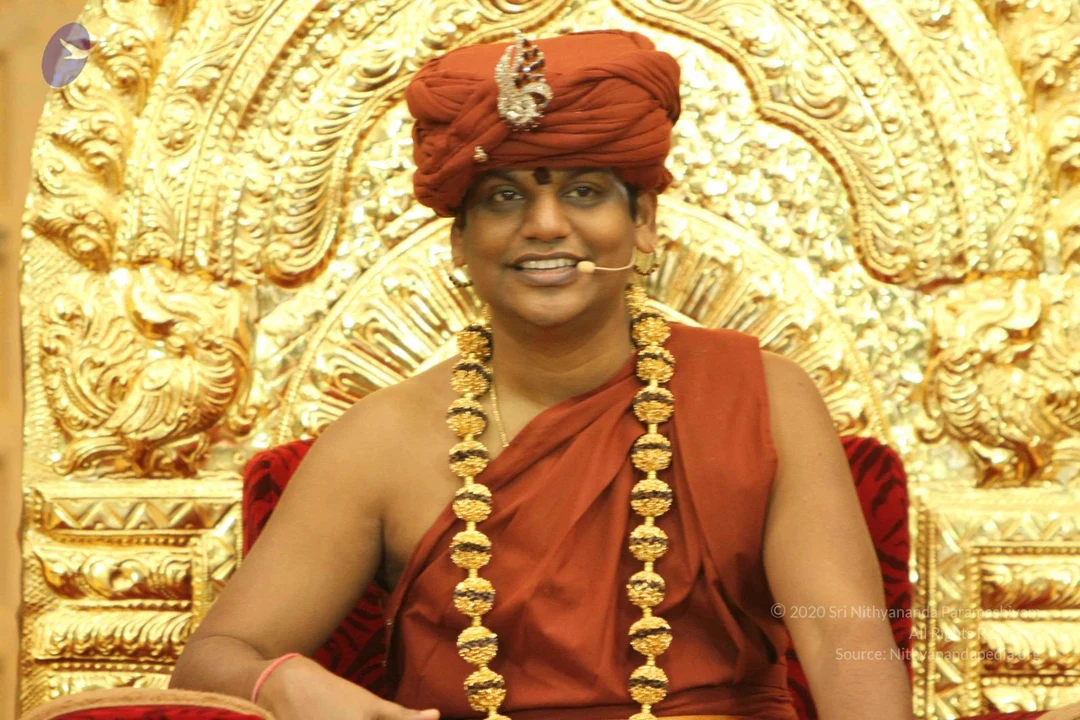
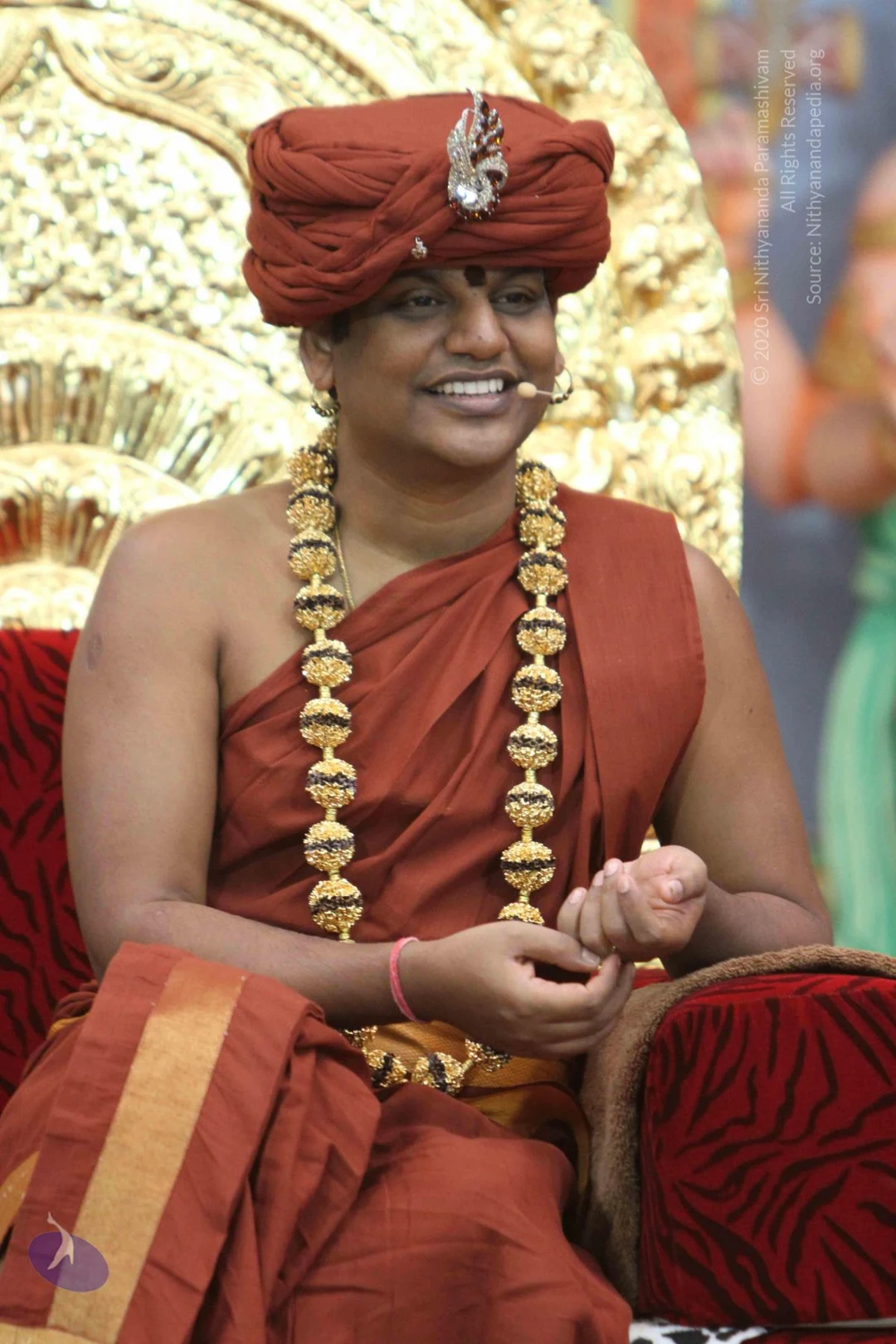
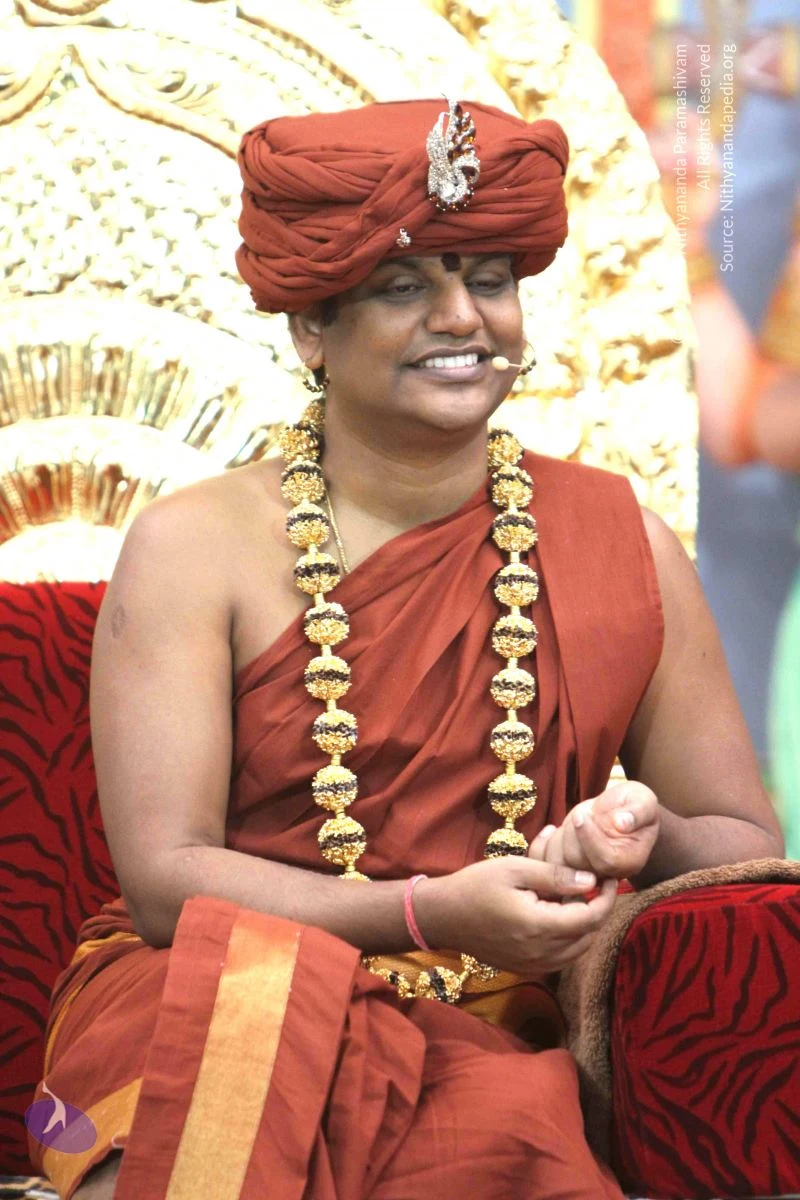
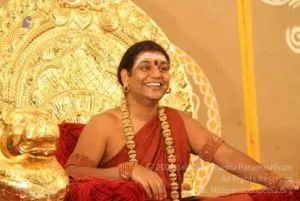
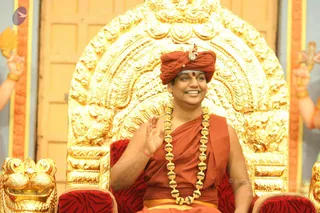
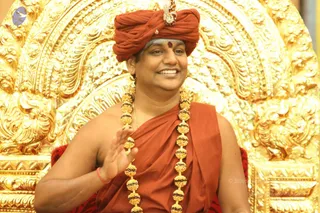
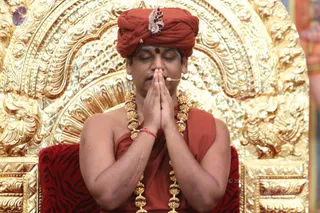
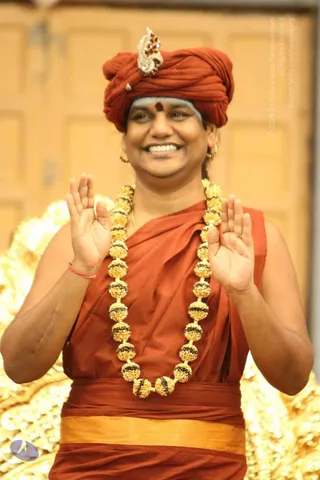
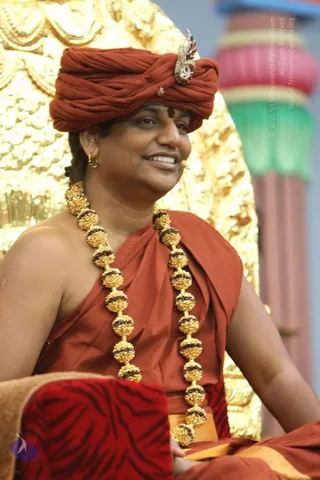
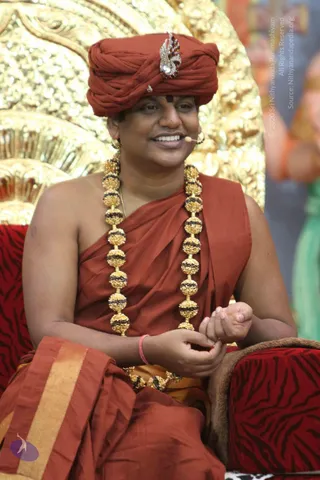
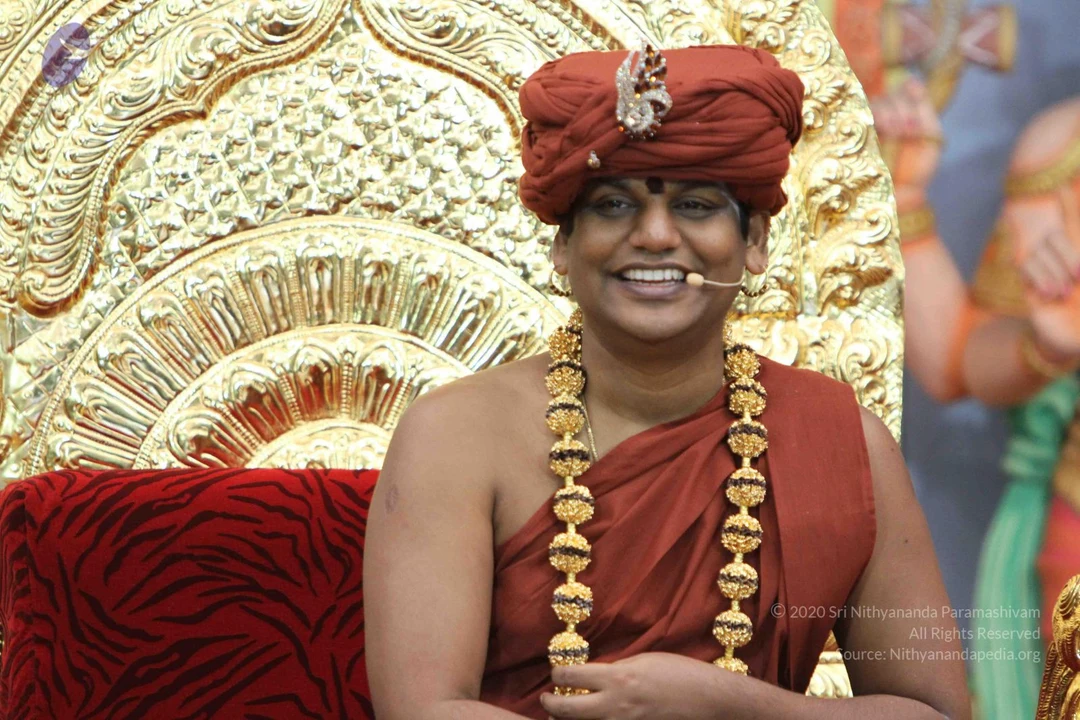
A smiling man in saffron-orange robes and an orange turban with a jewelled ornament sits on an ornate gold throne with lion-head armrests and red-and-black striped cushions. He wears a long gold bead necklace and raises one hand in greeting. A red bindi marks his forehead. Behind him stand gilded carved panels, and at the edges are painted orange-and-gold figures with raised hands. Swamiji (probable): the seated man wears a saffron turban, saffron robes, a long gold bead mala and sits on a gold throne, cues consistent with the page's Swamiji reference.A smiling man in an orange-red turban with a small silver crest and red tilak on his forehead sits on an ornate gold throne carved with floral and scrollwork motifs. He wears an orange-red shawl over bare shoulders and long gold-beaded rudraksha malas with a thin gold chain, and raises one hand in a blessing gesture.A smiling man sits on an ornate gilded throne with elaborate carved floral and scroll patterns behind him. He wears a rust-orange turban with a white and gold jewelled crest and a red bindi, white-painted forehead markings, and an orange-red cloth wrapped over one shoulder. Heavy gold beaded necklaces with ornamental pendants hang on his chest, and gold earrings are visible. A red cushion with dark patterns rests beside him. a person is seated in the centre of the frame, with ornate gold ceremonial setting around him.Photograph of a man seated on an ornate gold throne with repoussé floral and scrollwork carving. He wears a rust-red turban with a small gold ornament, a red-orange sleeveless wrap over a matching garment, and a long multi-strand gold bead necklace. A red bindi marks his forehead and he has a faint smile. The visible cues of turban, saffron-orange clothing and ceremonial gold beads match the page's swamiji reference, so this is Swamiji (probable), seated in person. Red velvet with a tiger-stripe pattern covers the throne armrest.A smiling man sits on an ornate gilded throne with elaborate repoussé carvings, wearing a rust-red turban with a jewelled ornament and a red-orange saffron wrap draped over one shoulder. He wears a dark red-brown cloth, multiple gold-tone rudraksha mala necklaces hanging to his waist, gold earrings, and a bindi on his forehead. The red velvet throne cushion beneath him is patterned in black. a person is seated centrally as the main subject, with no other people visible.A man seated on an ornate gold throne with a red tiger-striped cushion, eyes closed, palms pressed together in anjali mudra at the chest. He wears a red-orange turban with a silver brooch, a red-orange shawl draped over bare shoulders, and layered gold beaded necklaces with a small tilak on the forehead. A small clip microphone is attached near his face. a person: long-haired? Not visible; a red-orange turban, ornate gold necklaces and a saffron shawl mark him as a presenter seated in satsang. The background is a richly carved gold throne backrest.

Sarva-Darshan

14 photosSource gallery
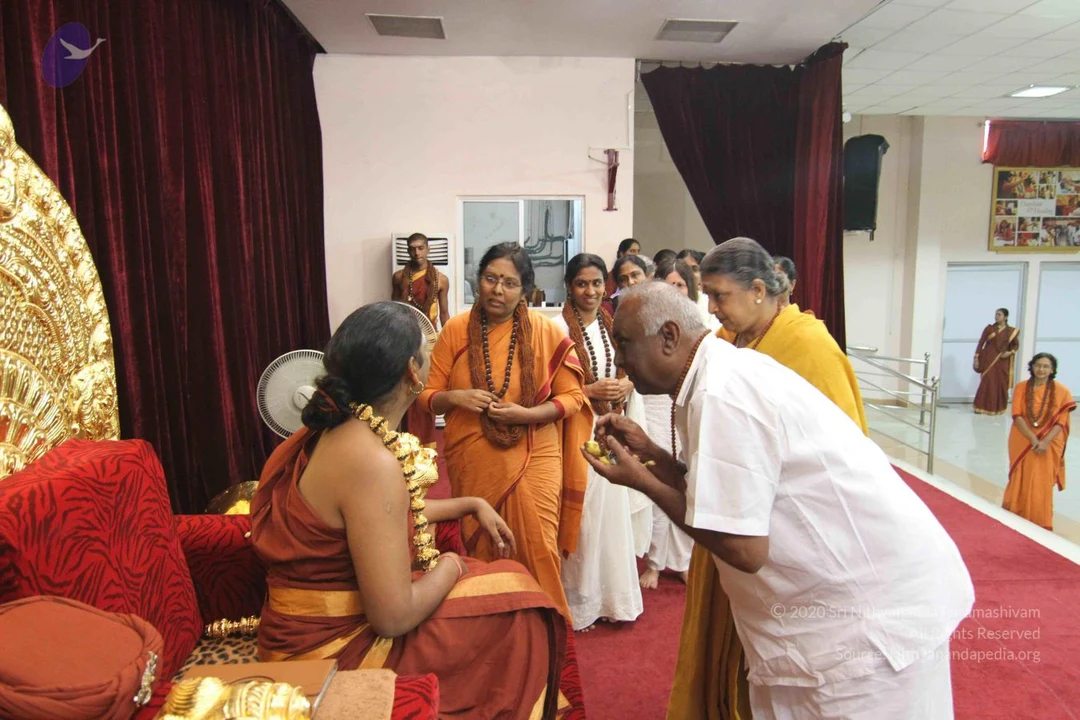
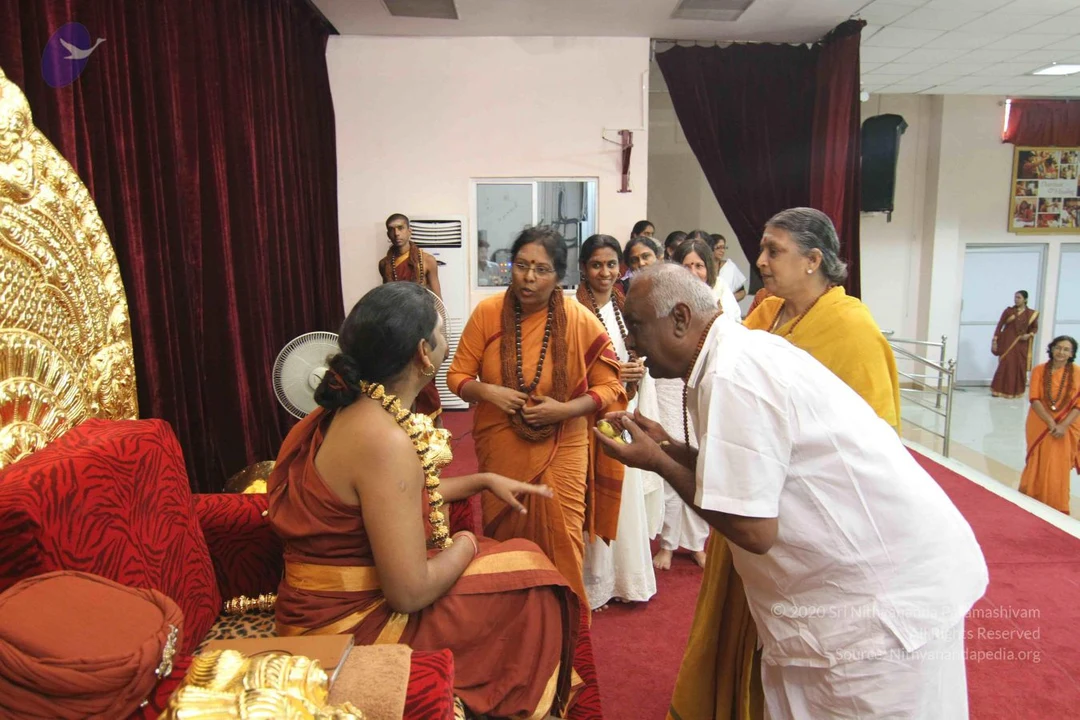
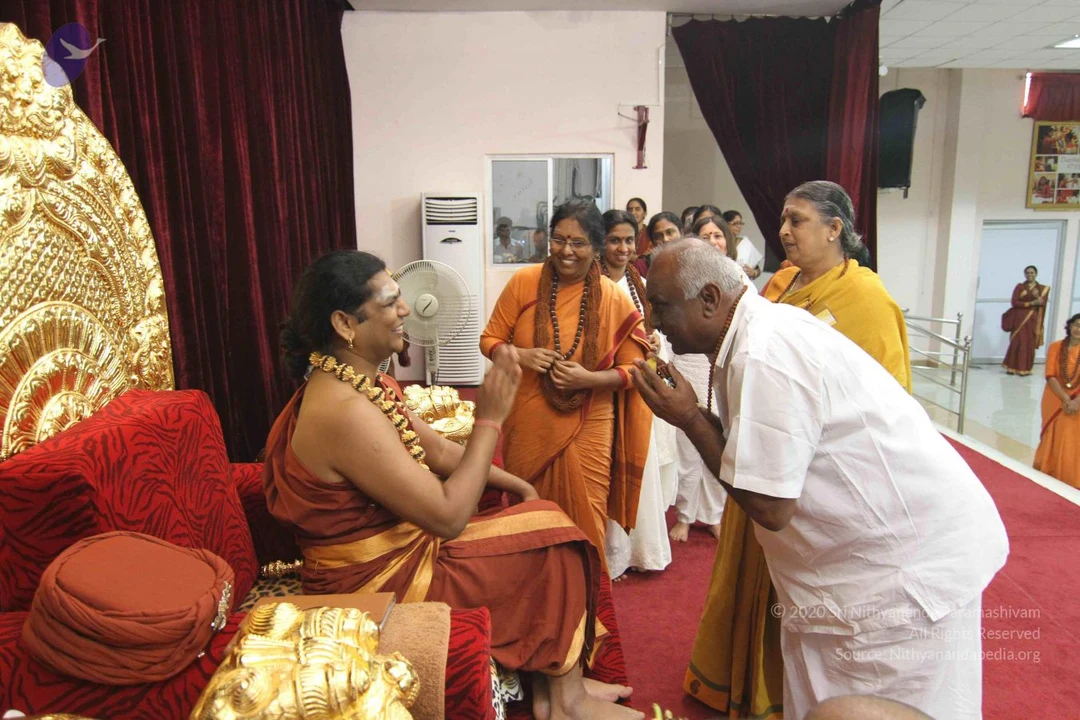
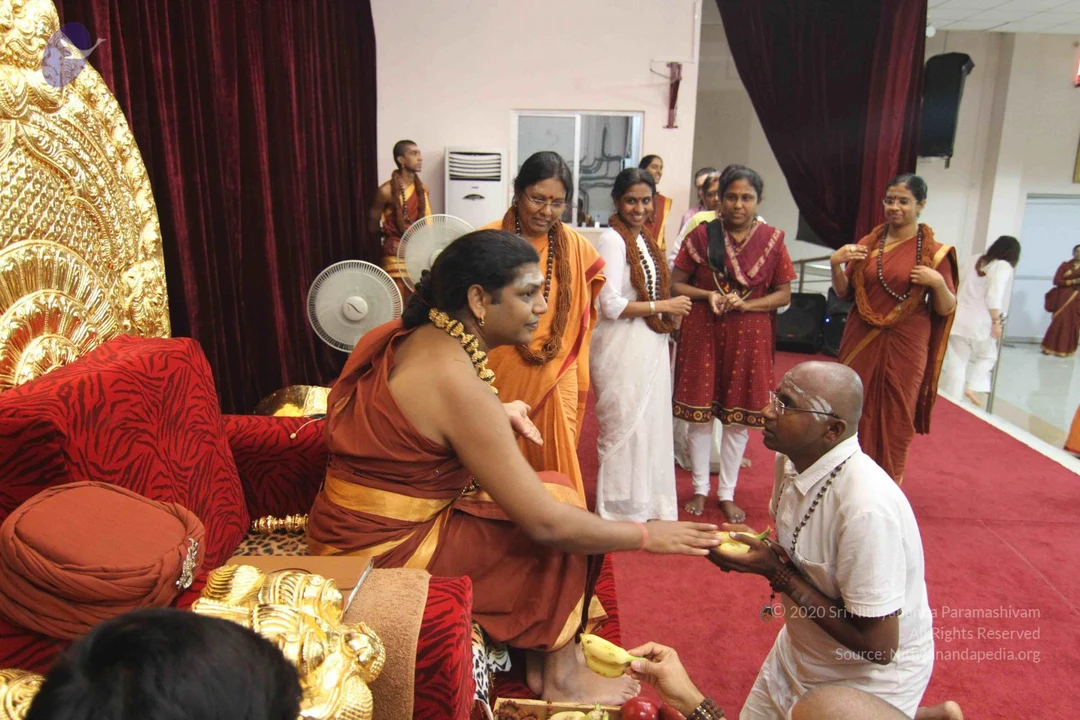
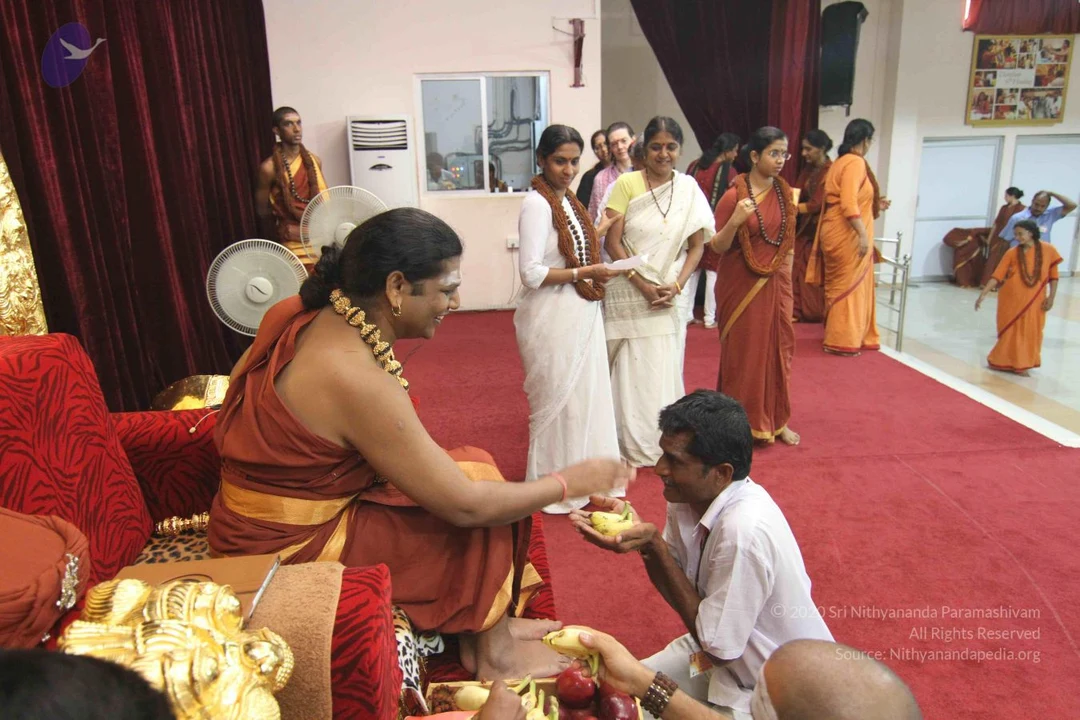
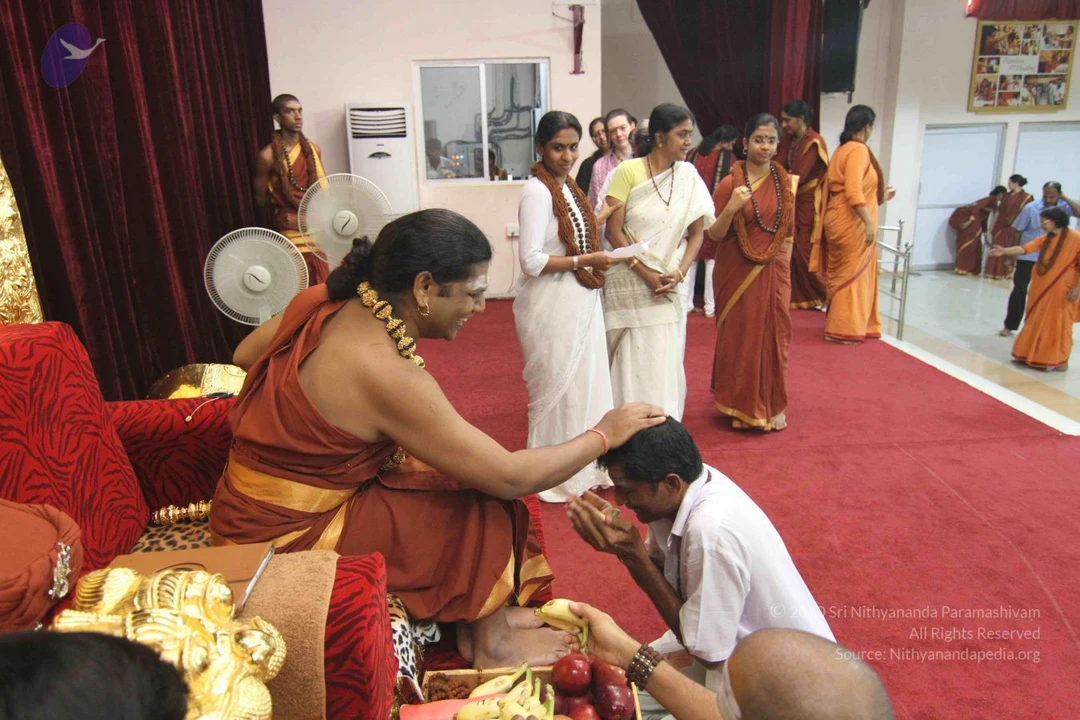
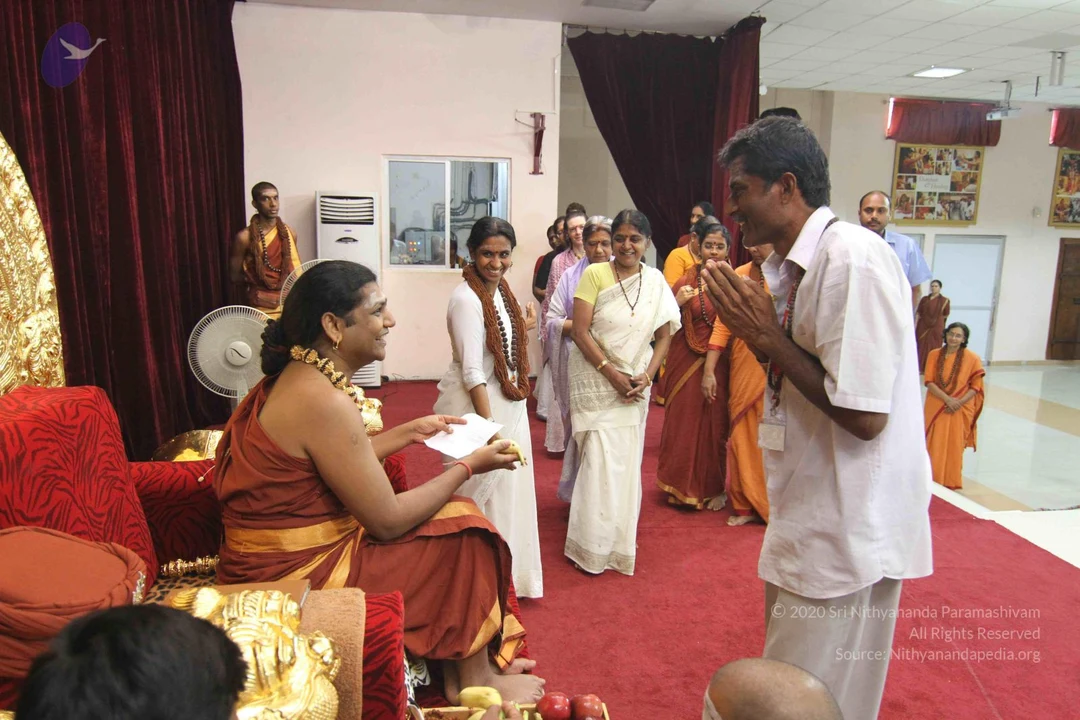
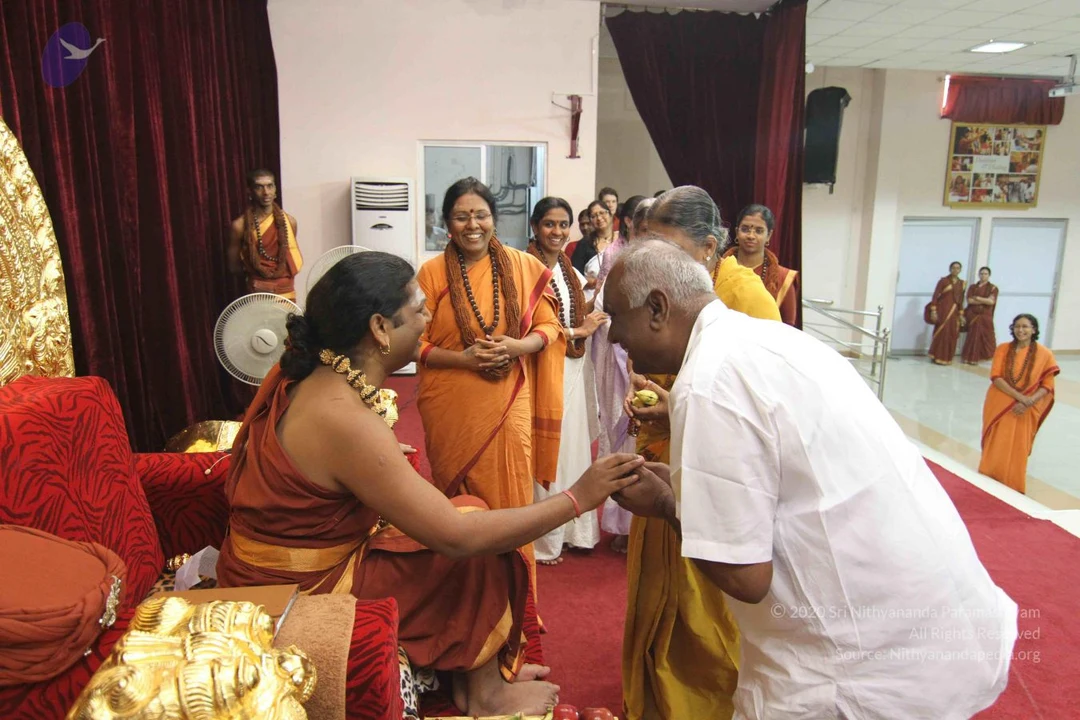
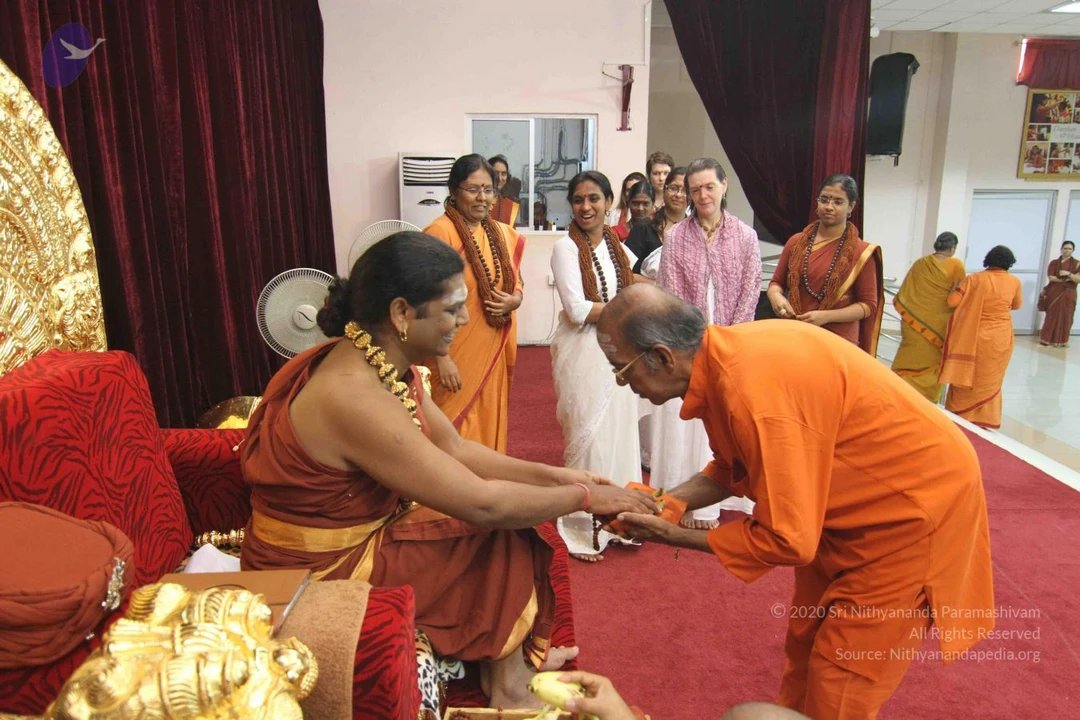
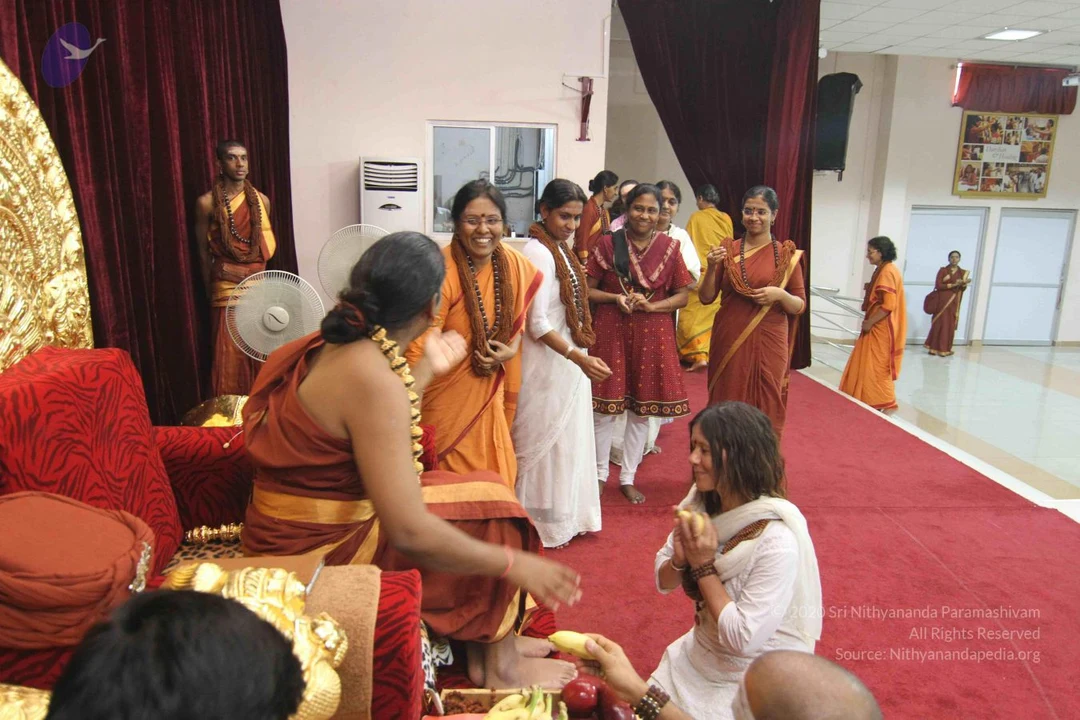
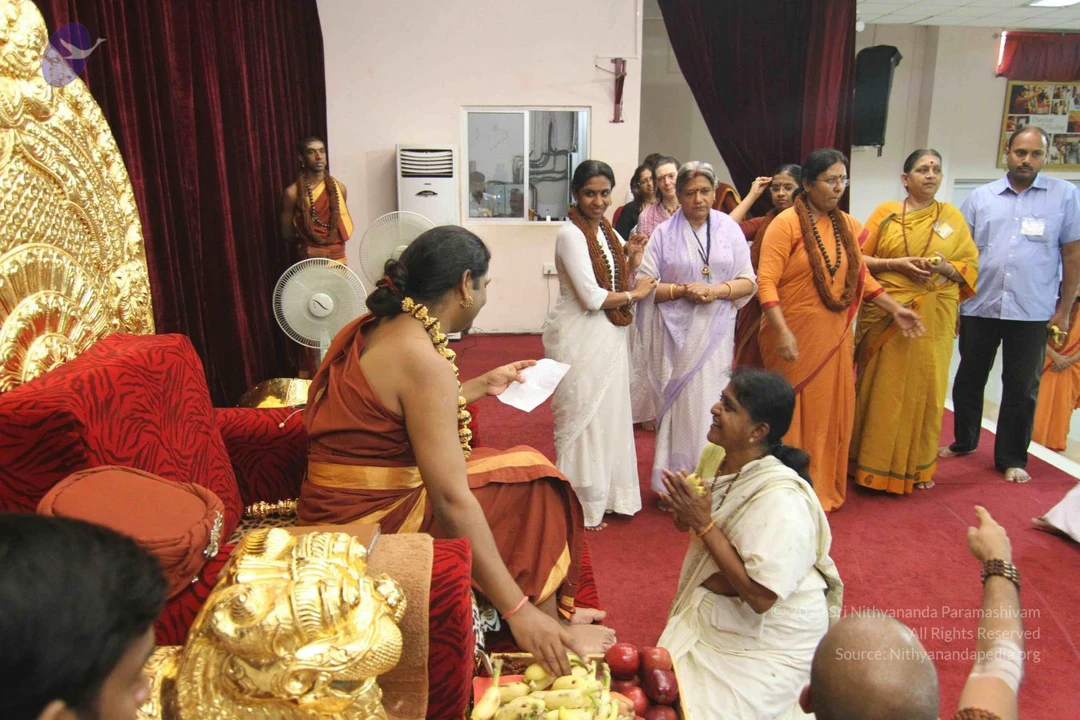
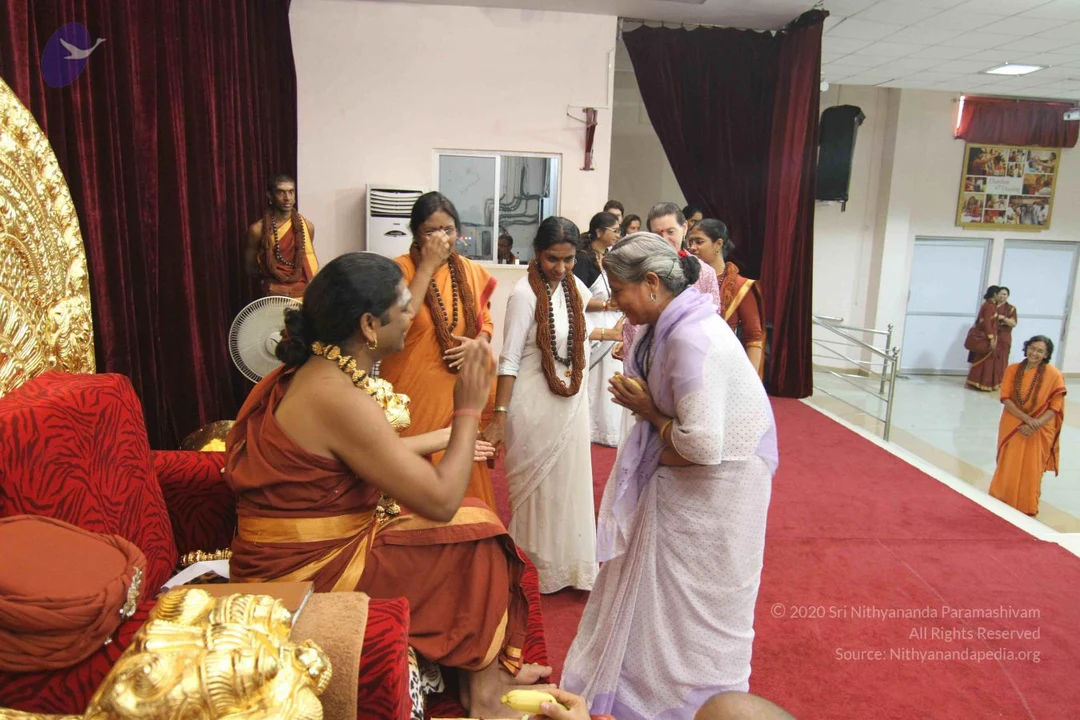
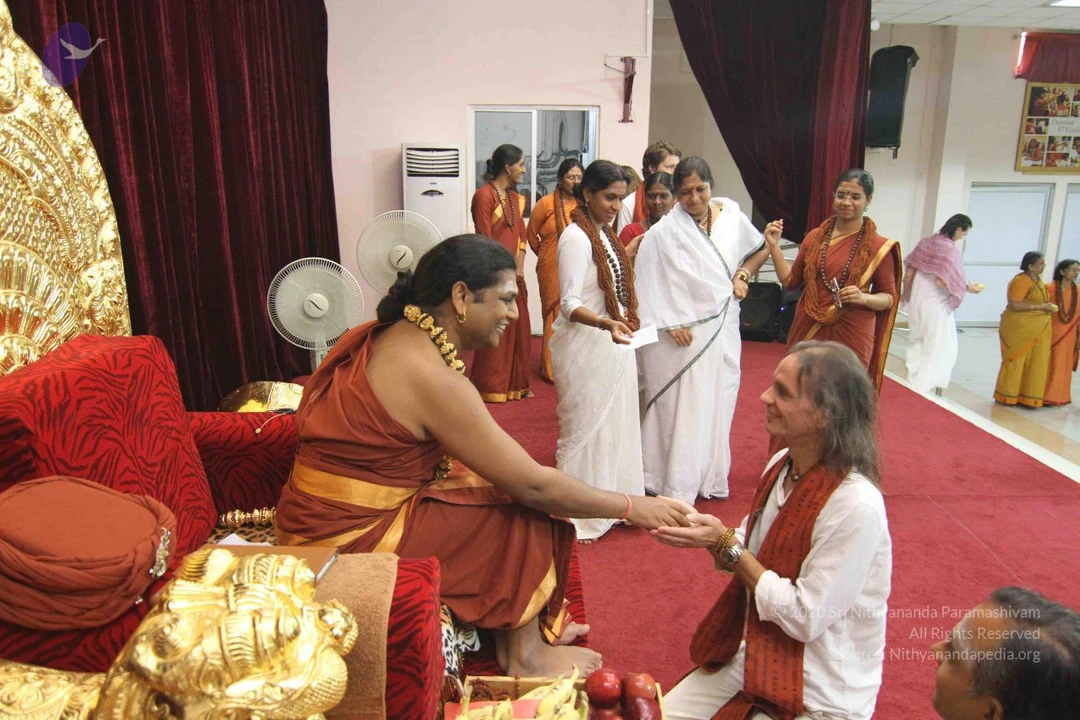
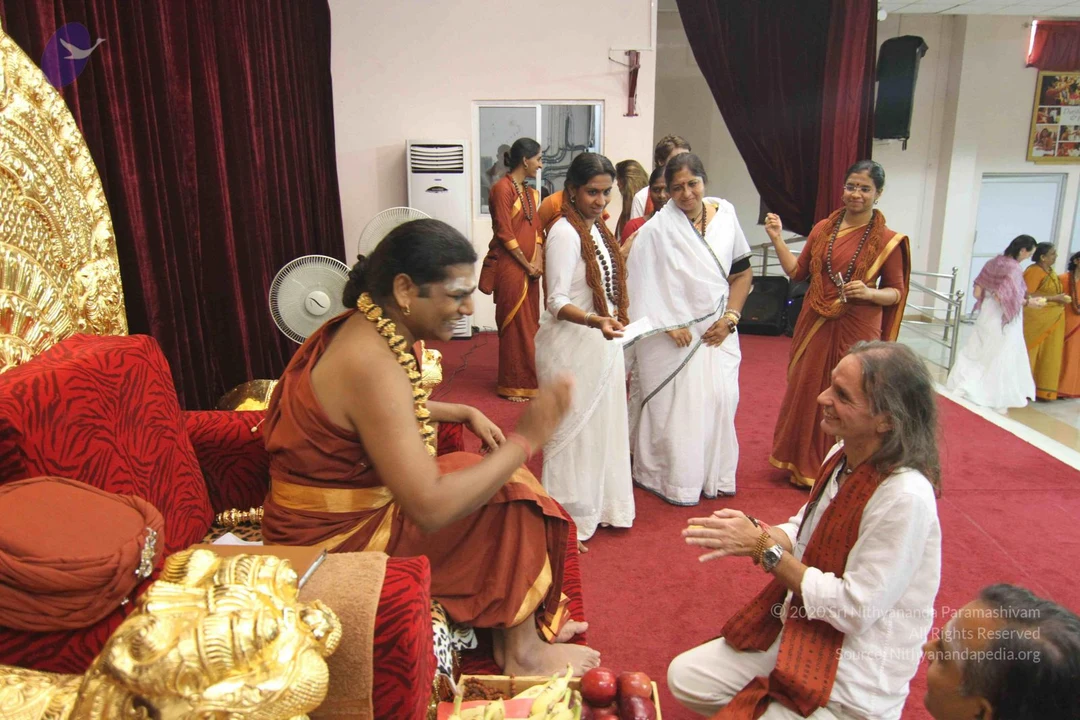
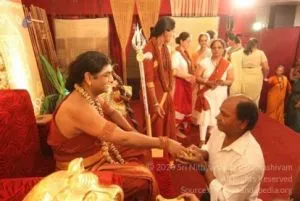
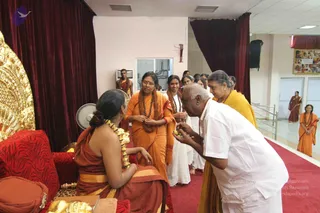
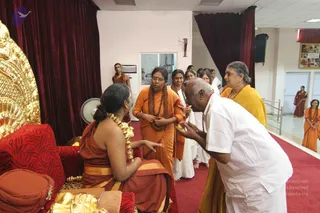
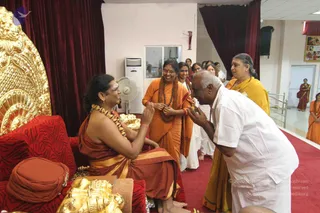
Indoor ashram hall with deep red velvet drapes and a gilded peacock-style throne. A woman in a rust-orange sari with a gold border sits on a red and black tiger-striped chair, a yellow-and-gold garland around her neck. Standing before her, a woman in saffron-orange robes with a rudraksha mala holds a garland and smiles. Beside her, a white-clad devotee offers her hands in reverence. An elderly man in a white shirt and white trousers with a rudraksha mala bends forward, offering a small fruit or sweet to the seated woman. Another woman in a yellow sari stands nearby, and several devotees in white and saffron line the red carpet, with more people visible in the background. A printed framed photo collage hangs on the wall at right. a person candidate is not clearly identifiable by appearance.Indoor hall with red carpet and red velvet curtains. A seated woman with dark hair in a bun, wearing an orange-red sari with gold border and a yellow-gold garland, sits on a red tiger-striped throne beside a large gold carved backrest. Standing before her, a woman in orange sari with rudraksha mala speaks with hands together. An older man in white shirt and white dhoti bends forward with folded hands, facing the seated woman. Another woman in yellow sari with a mala stands to the right. Behind them, several people in white and orange stand in the hall, and a saffron-robed figure stands at the far right. A small gold-coloured kalasha sits on the throne's base. No clear appearance cue establishes the seated figure as a person.Indoor photo in a bright hall with a red carpet. On the left, a seated figure in a red-brown and gold draped cloth, with a gold flower garland and a tilak, sits on a red zebra-striped chair before an ornate gold throne back; a red cushion and gold objects lie nearby. The seated figure is smiling and raising a hand in greeting. Standing before him is a woman in an orange sari with a rudraksha mala, and beside her a woman in a yellow sari. In the foreground an older man in a white shirt and white dhoti bows forward with folded hands toward the seated figure. A red velvet curtain, a standing fan and a wall framed picture complete the room. The seated figure may be a person, based on the long hair, gold garland and ornate throne, but identity is uncertain.A photograph of a red-carpeted hall where women in saffron and orange saris, several wearing rudraksha malas, stand and smile around a red-upholstered throne with a gold-framed backrest. In the foreground, a woman in a white sari kneels with palms joined and holds a banana, while a person in orange at left turns toward the throne. Fruit, bananas, red apples and a brass tray sit at the bottom edge. Standing guards in orange at left and a woman in red at right complete the scene. Wall-mounted fans and an air conditioner are visible behind; a framed photo board hangs on the right wall. The throne is empty, and the people in view are devotees and attendants rather than a clearly identified figure.A seated figure in an orange-red robe with a gold waist band, long dark hair, a garland of yellow flowers and a sandalwood-marked forehead, sits on a red zebra-striped throne with gold carved ornamentation, extending a hand toward a kneeling man in white clothes and rudraksha beads who holds out an offering of a yellow fruit. Behind them a row of women in orange and saffron saris, one in white with a red-and-orange shawl, and a man in an orange robe stand on red carpet in a room with a red curtain, an air conditioner and a standing fan. A banana rests on a gold plate in front.A seated figure in a rust-orange and gold-bordered sari-style robe with a long dark braid and a gold necklace sits on a red tiger-striped throne on a red carpet, extending a hand toward a kneeling man in a white shirt who holds out his cupped palms. Fruit is offered on a tray, with apples and bananas visible in the foreground. Behind them, women in white and orange-saffron robes with rudraksha malas stand watching, and a few more people in orange move about the room. A gold deity figure rests on the lower left and a framed picture hangs on the right wall. Only the seated figure's identity is uncertain from appearance, so no identification is made.

Deity-Darshan

40 photosSource gallery
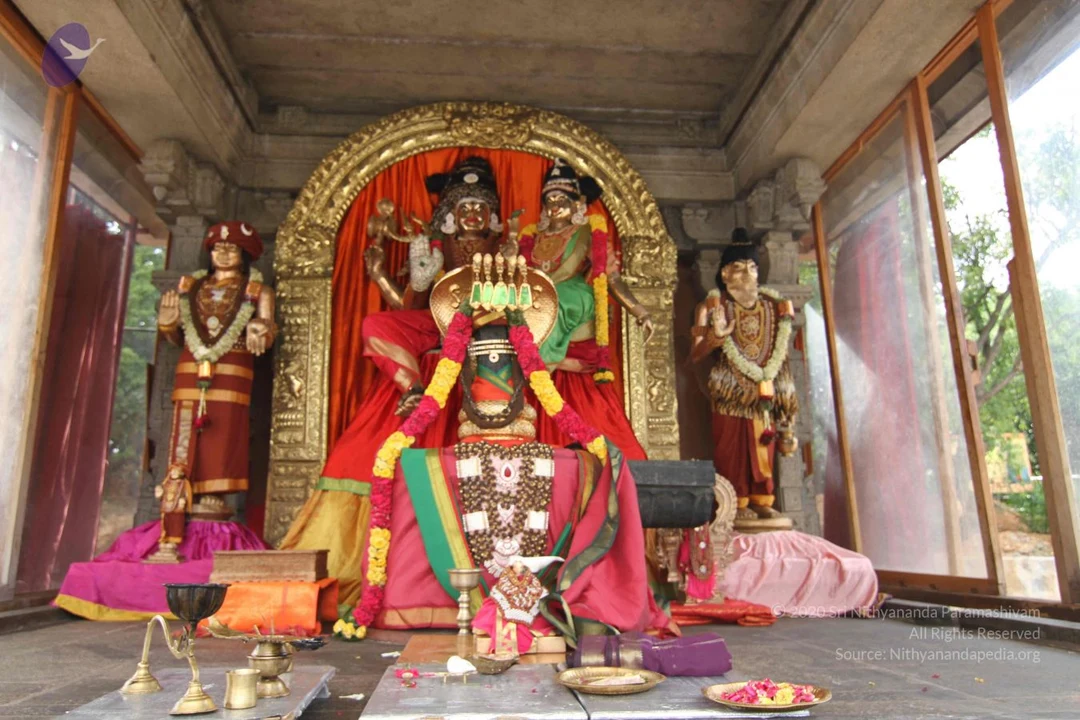
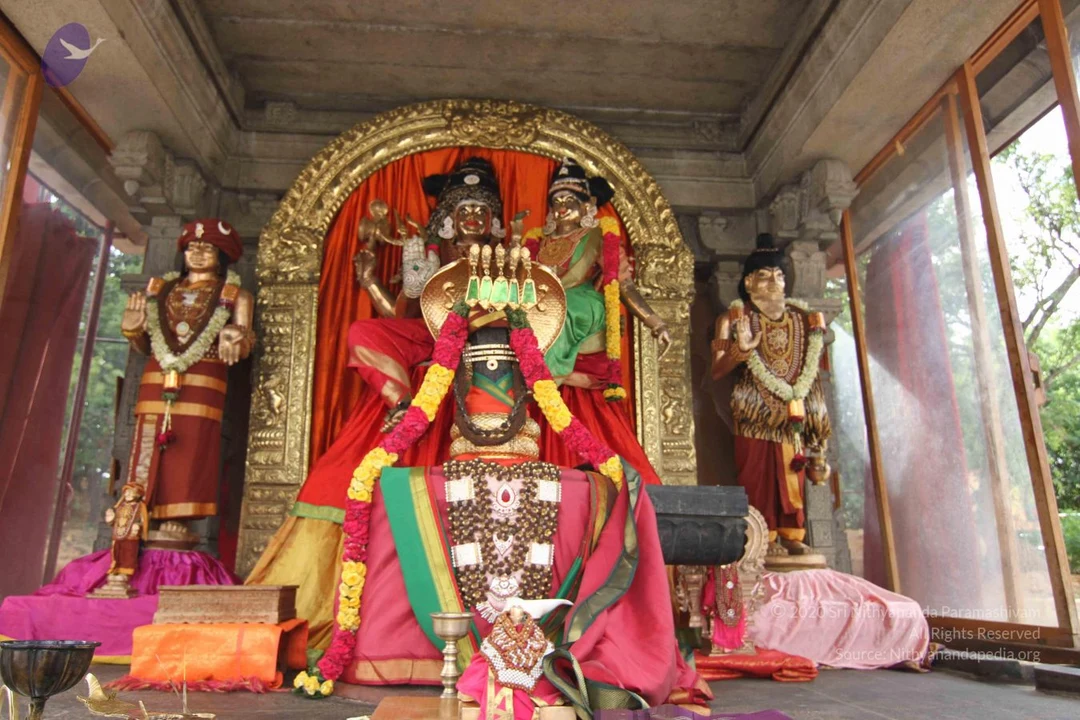
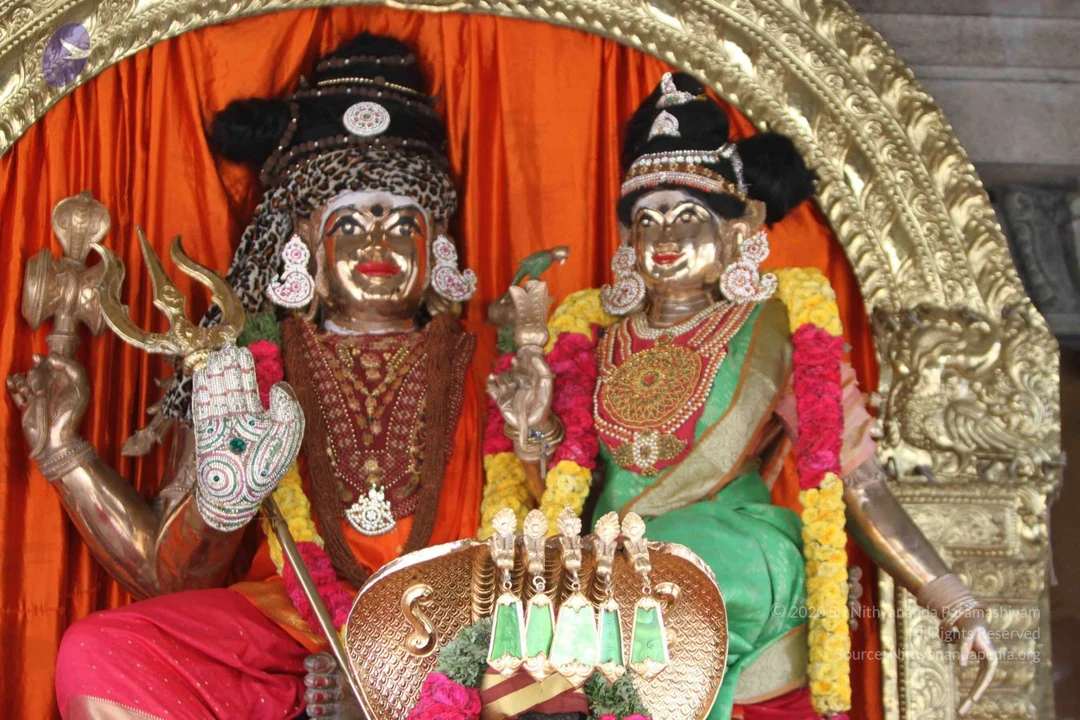
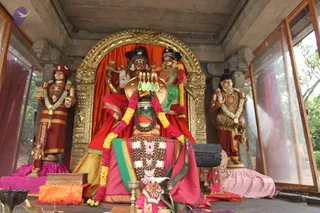
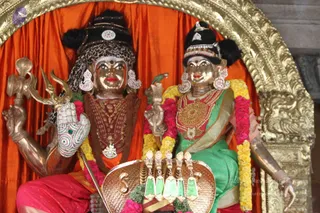
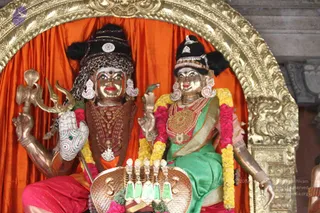
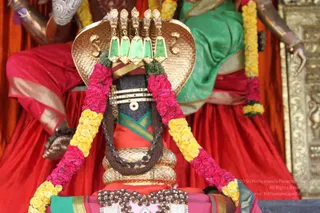
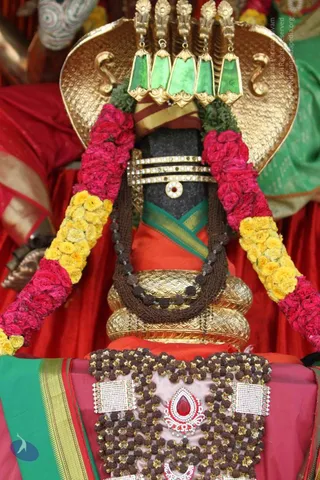
Interior shrine photograph showing a deity murti of Shiva-Parvati style on a golden arched backdrop with orange drapery. The central figures are carved statues, not living people, with a shivalinga-like form draped in garlands of orange and pink flowers and a pink and green cloth. Flanking statues stand on pink-draped bases in red and orange clothing with white garlands. Brass oil lamps, a small brass bowl, flower offerings in a plate and a purple-wrapped item sit on the stone floor. Side windows reveal green trees.A shrine scene inside a glass-walled hall shows a large deity murti with a gold arched backdrop and a saffron-orange cloth behind it. A multi-armed deity figure stands at the centre, with a Shiva lingam in front draped with a pink cloth, a garland of red and yellow flowers, and a rudraksha-style bead necklace. Two standing attendant statues flank the shrine, one in red and one in green, both wearing garlands. Brass oil lamps and a small offering tray sit at the front. No people are visible.Golden metal murti of a seated deity couple against an orange silk backdrop within a gilded arched frame. The male figure wears a leopard-print headpiece, a red and gold beaded necklace, a crystal-studded green and white hand covering, and holds a trident and a damaru-like drum; the female figure wears a green silk sari with gold border, a gold and red jewelled necklace, large earrings, and a crown, with a green parrot perched near her hand. Both wear pink and red garlands of flowers, and a copper plate with green-tipped lamp-like pieces and flowers lies in front. No living people are visible.Golden metal murtis of Shiva and Parvati are seated side by side on a peetha before an orange-red cloth backdrop framed by an ornate gold arch. The left deity holds a trident and a damaru-like drum, wears a leopard-print headdress with a crescent-style ornament, a red-and-gold necklace and a pink lower garment. The right deity wears a green sari with gold border, a large round gold pendant necklace, earrings and a dark coiffed hairstyle. Garlands of pink and yellow flowers drape both figures, and a gold kalasha-style offering with green stone-like pieces sits in front. No physical people are visible.Photograph of a golden-toned pair of deity murtis seated side by side in a gilded arched shrine against an orange draped backdrop. The left figure, with a trident and a raised hand, wears pink dhoti-style cloth, a dark patterned crown with white decorations, and a rudraksha-style necklace. The right figure wears a green sari with a red and gold blouse, pink and yellow garlands, and a crown with dark plumes. A brass shallow tray with five small green-tinted lamps sits in front. Standing statues, not living people; no physical persons are visible.A close view of a black stone Shivalinga dressed for worship, set on a golden yoni-peetha base. A golden five-hooded serpent canopy with green gemstone-tipped hood ornaments arches over it, with pink and yellow flower garlands draped down both sides. A brown rudraksha-style mala and a green-and-gold cloth are wrapped around the lingam, and a gold band marks its upper part. Behind it, a figure in a green garment and red skirt, with gold arm bands, sits on a red cloth; a carved gold panel stands at the right. No people are visible in the frame; the deity murti is the main subject.

Goshala

46 photosSource gallery
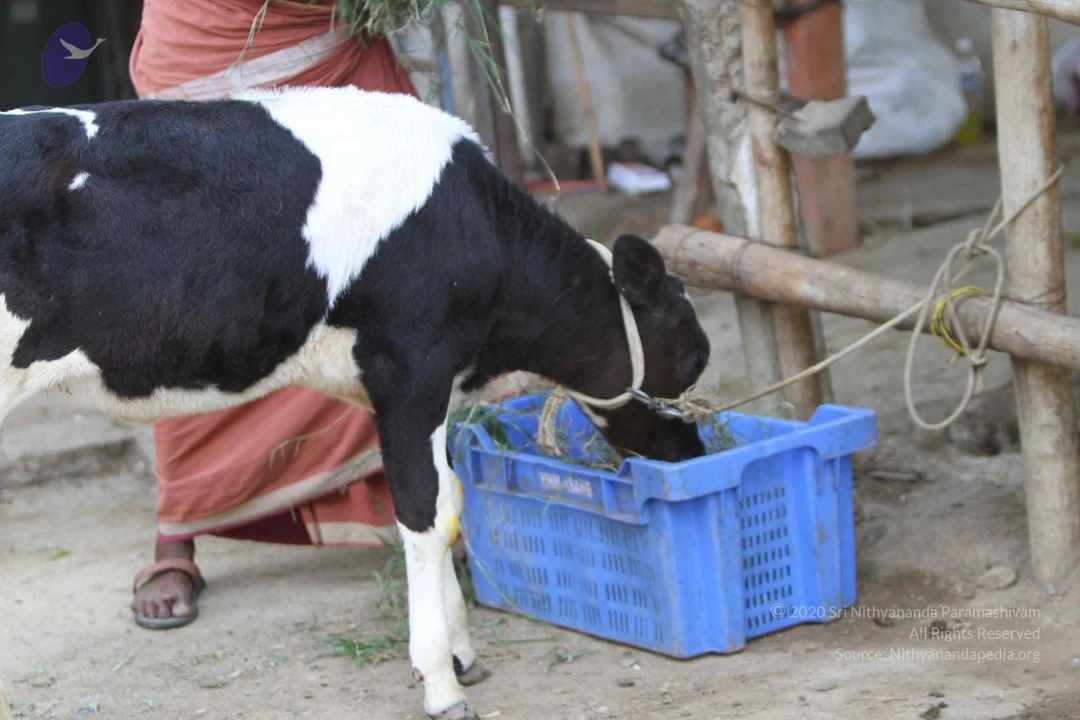
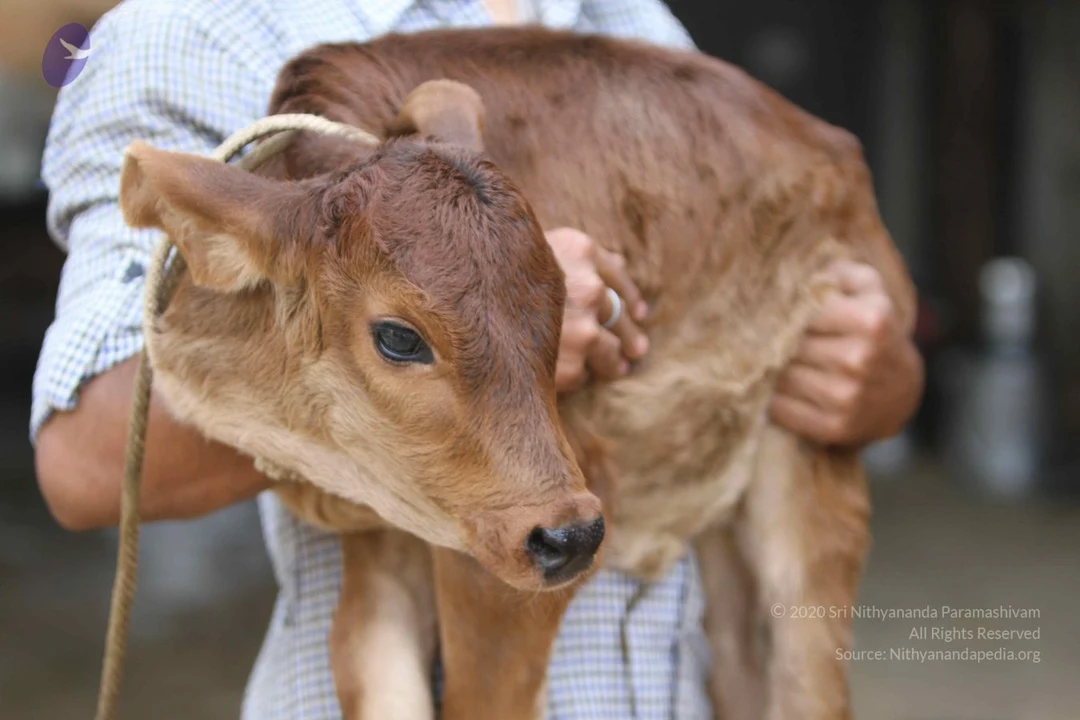
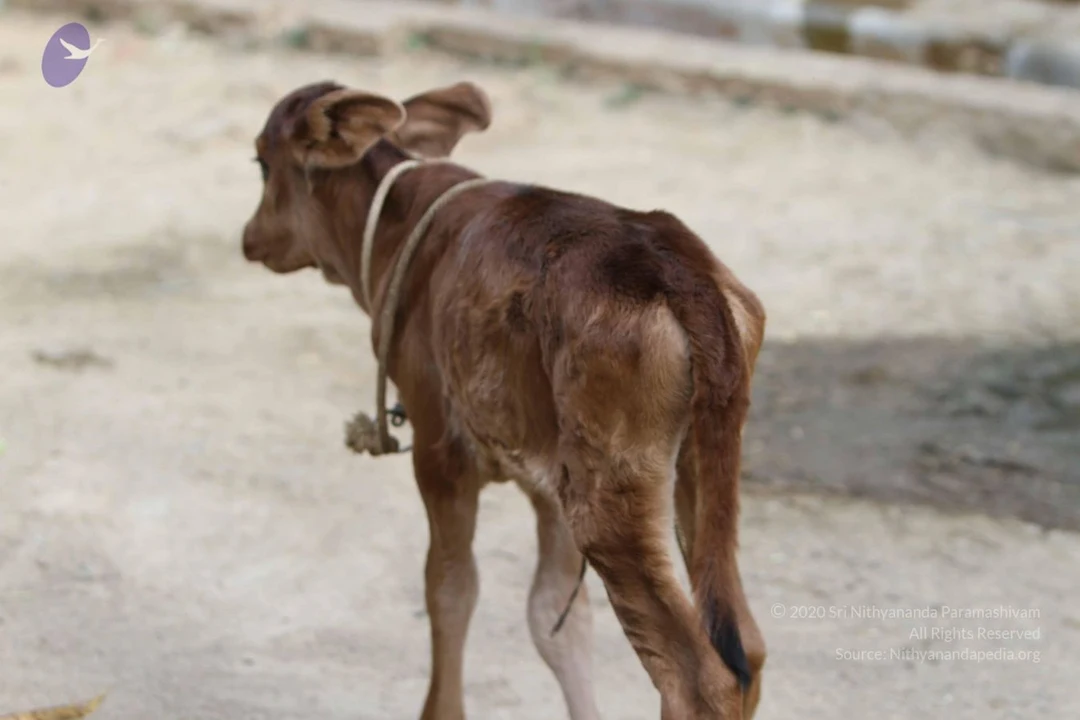
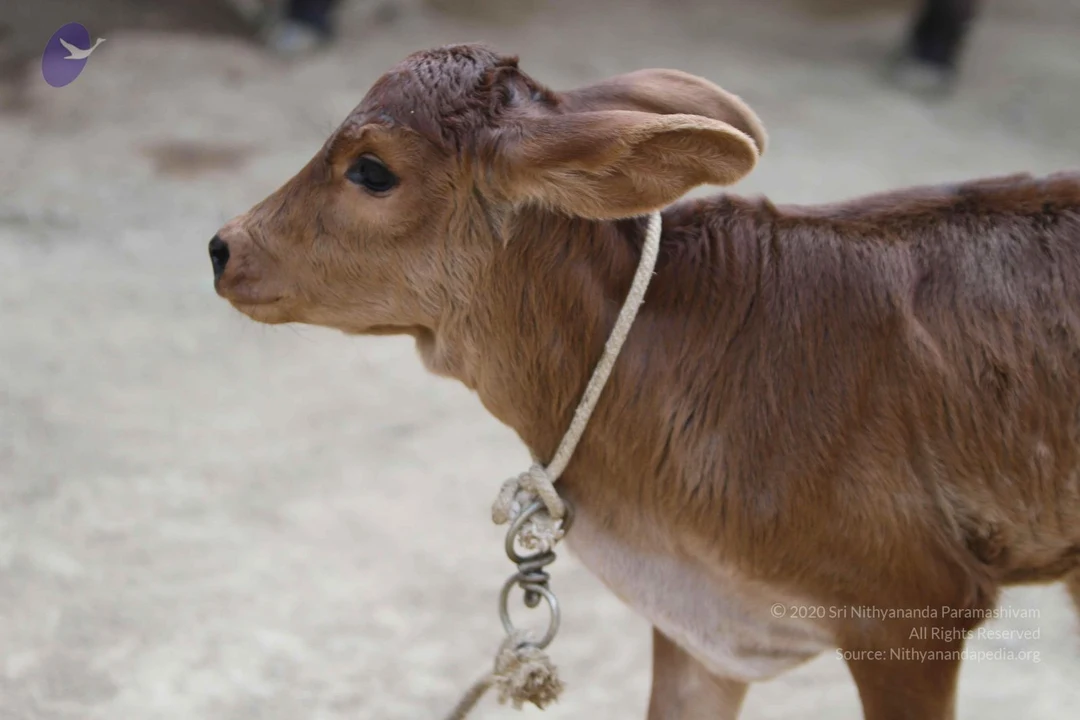
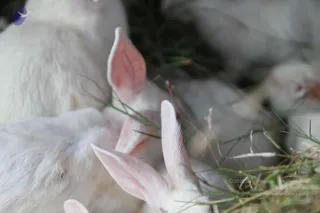
A black-and-white Holstein-style calf feeds from a blue plastic crate filled with cut green fodder in a dirt yard. The calf wears a white rope halter tied to a bamboo fence rail. Behind it, the lower legs and feet of a person in a rust-orange wrap are partly visible, holding bundled grass above. Bamboo poles, a white plastic sack and a stone block form the background of the goshala-style enclosure.A photograph of a young light-brown calf held against a person's body by a rope halter. The calf has large ears, a dark nose and a dark eye, and its head is turned slightly to the left. A person in a blue-and-white checked shirt with rolled sleeves supports the calf with both hands, one hand wearing a ring. The background is blurred, showing a dim barn-like interior with a grey object at right.A young brown calf stands on a dusty, pale sandy ground facing left, seen from behind and side. It wears a thin rope around its neck with a small tuft dangling beneath. A blurred concrete wall or step runs along the top edge of the frame. No people are visible.A young brown calf stands tethered by a rope around its neck inside a concrete cattle shed, facing a stone wall and water trough. To the right, the head of a black-and-white cow is visible, and another cow's tan body fills the right edge. No people are present in the frame. The walls are stained and weathered, with a dark drain opening low on the wall.Close-up photograph of several white rabbits with pink inner ears crowded together, eating green grass and dry stalks. Their soft white fur and pink ears fill the frame, with blurred rabbits in the background. No people are visible.A close photograph of several newborn white rabbits or kits huddled together on straw. Their pink inner ears are prominent, and one kit with a reddish eye and tan patch on its head lies at the centre-right. The background is blurred with soft beige and white tones. No people are visible.

Nithya-Satsang
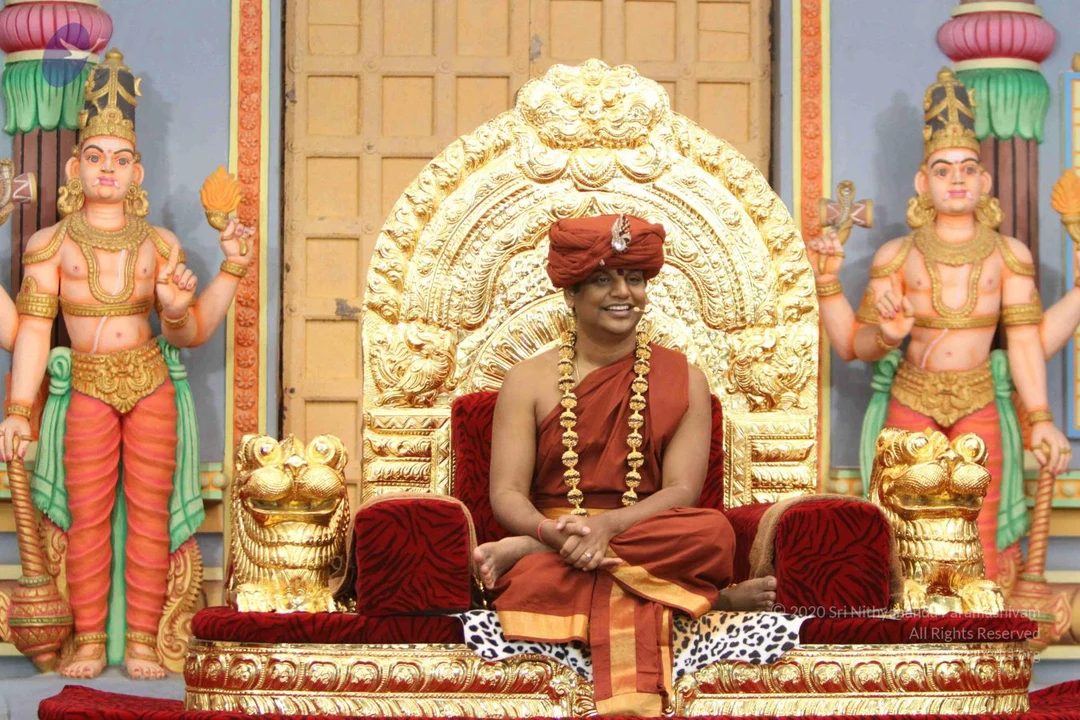
7 photosSource gallery
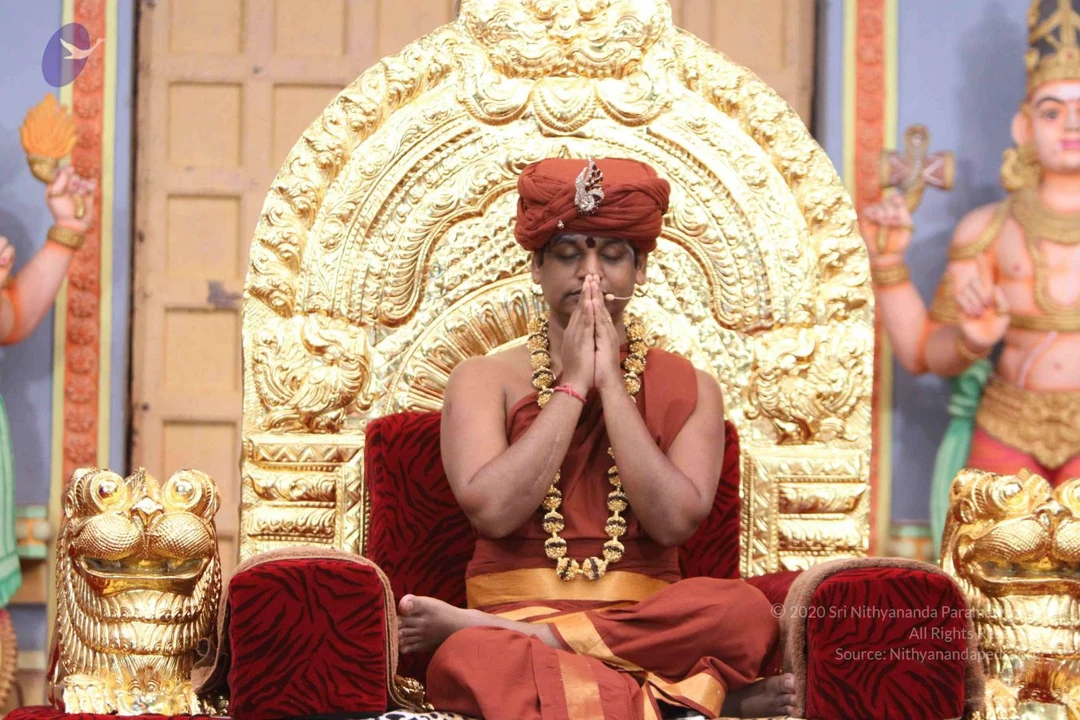
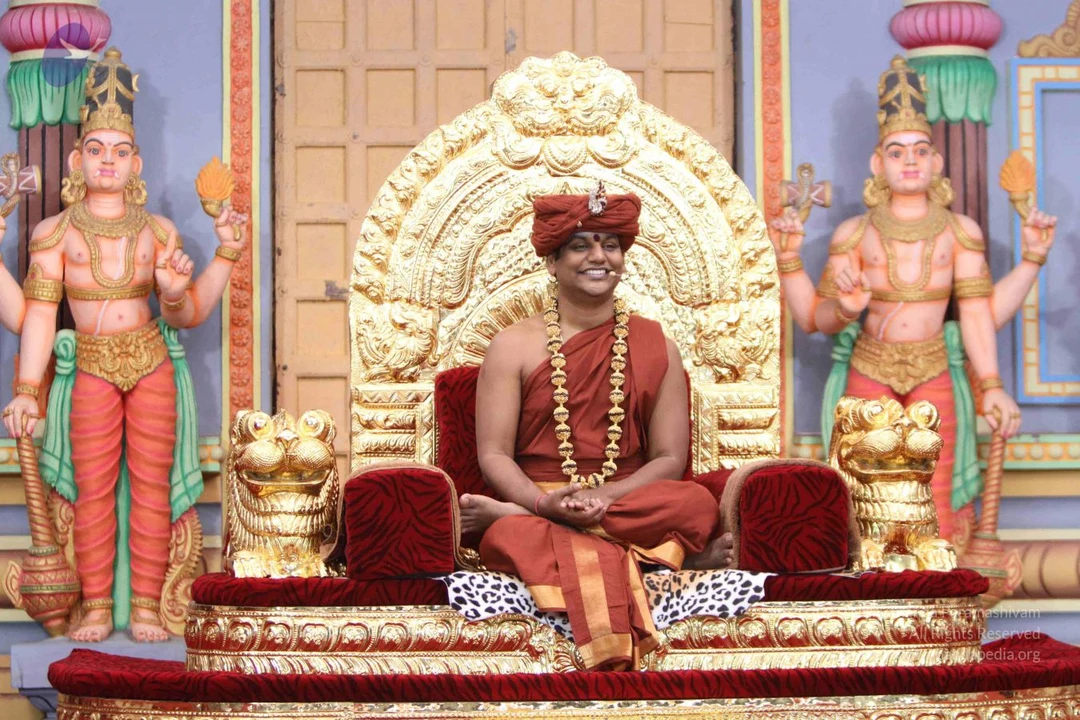
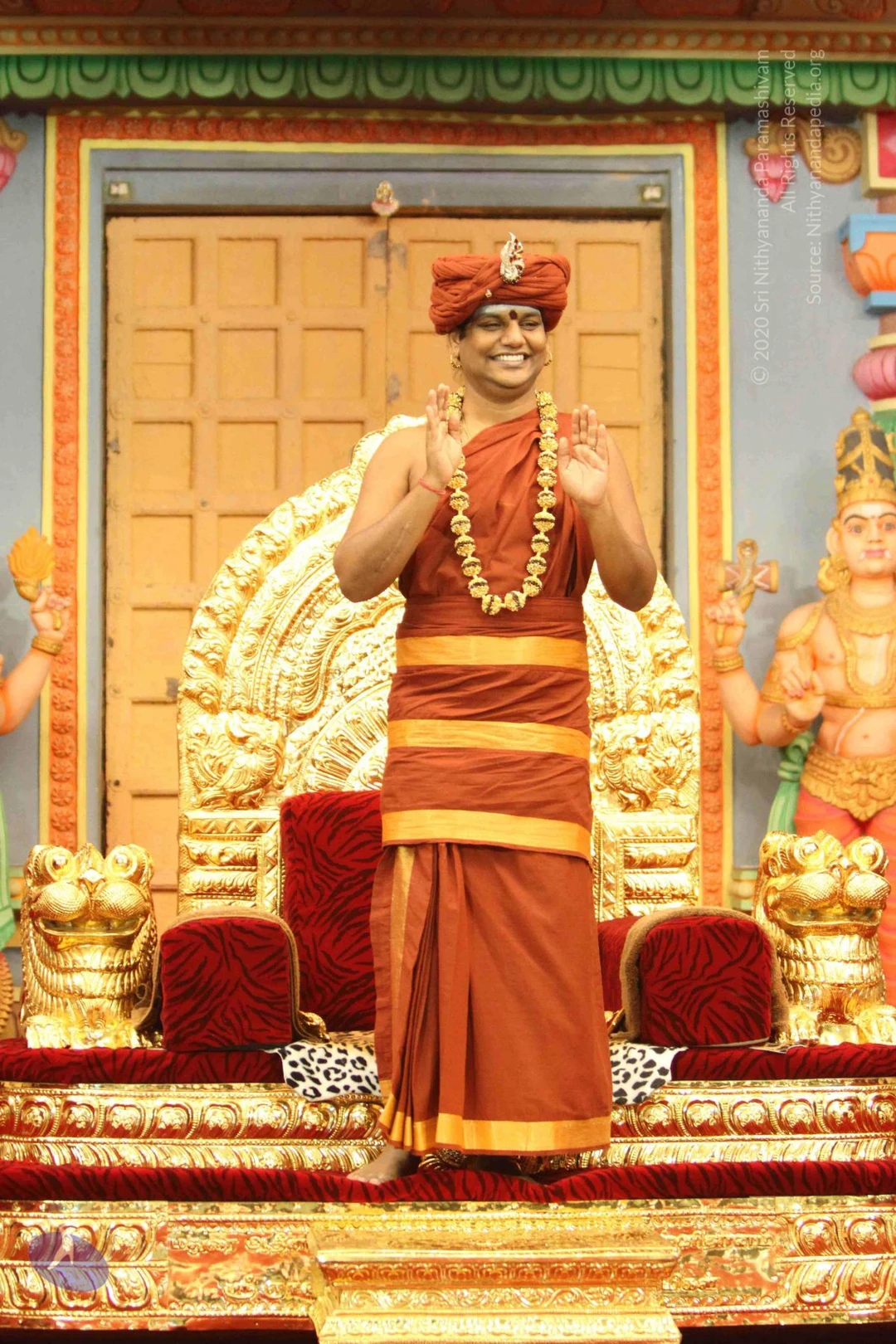
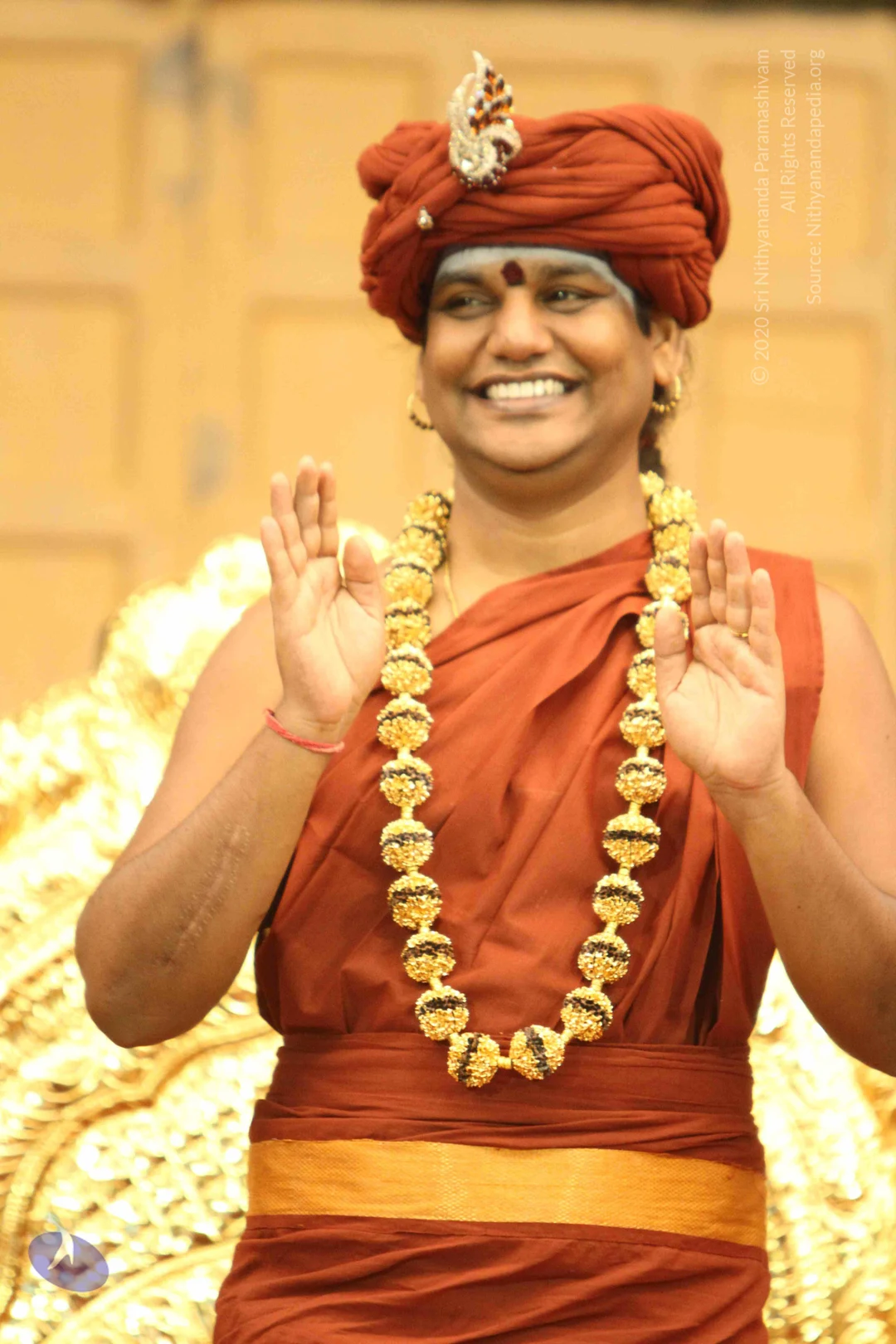
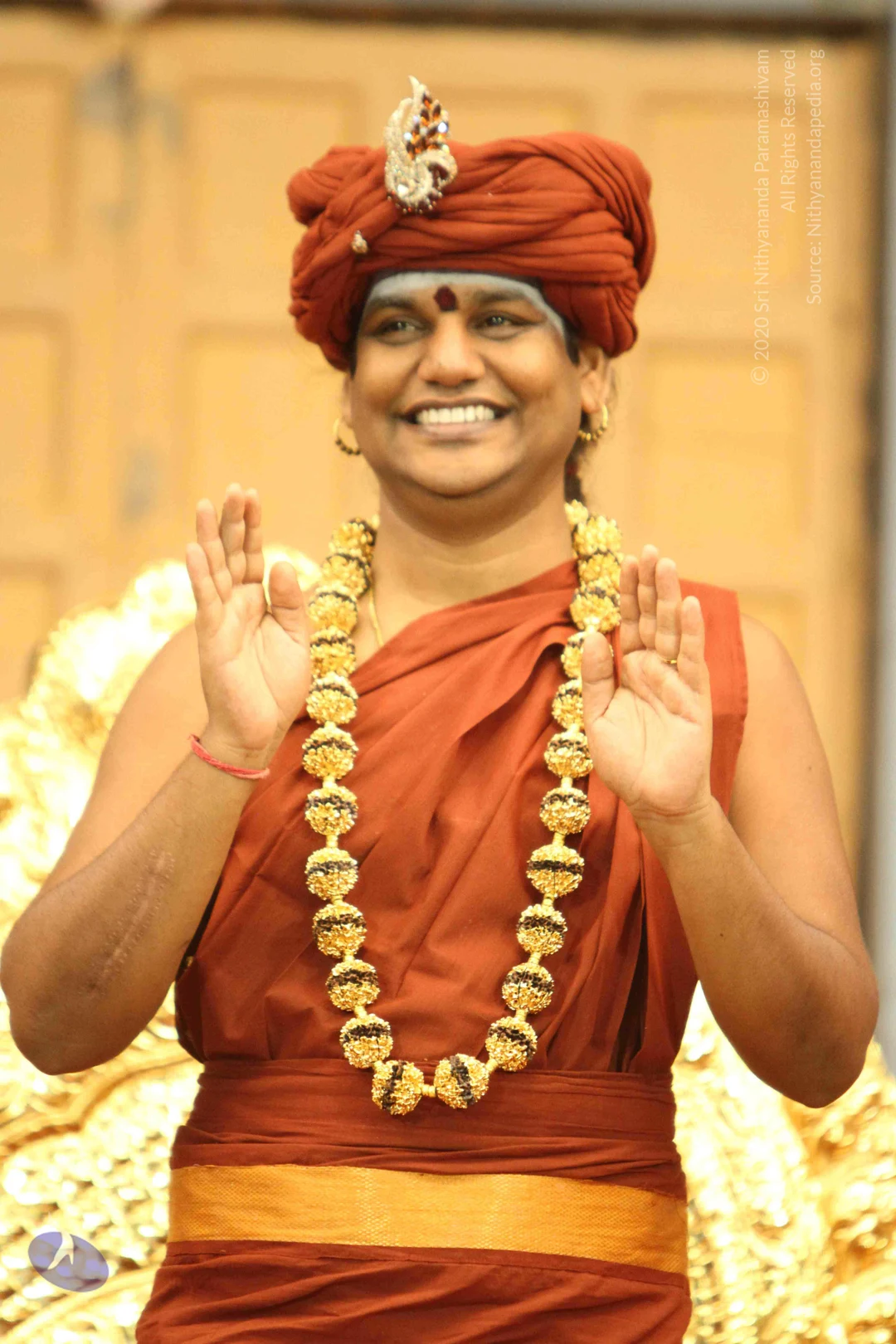
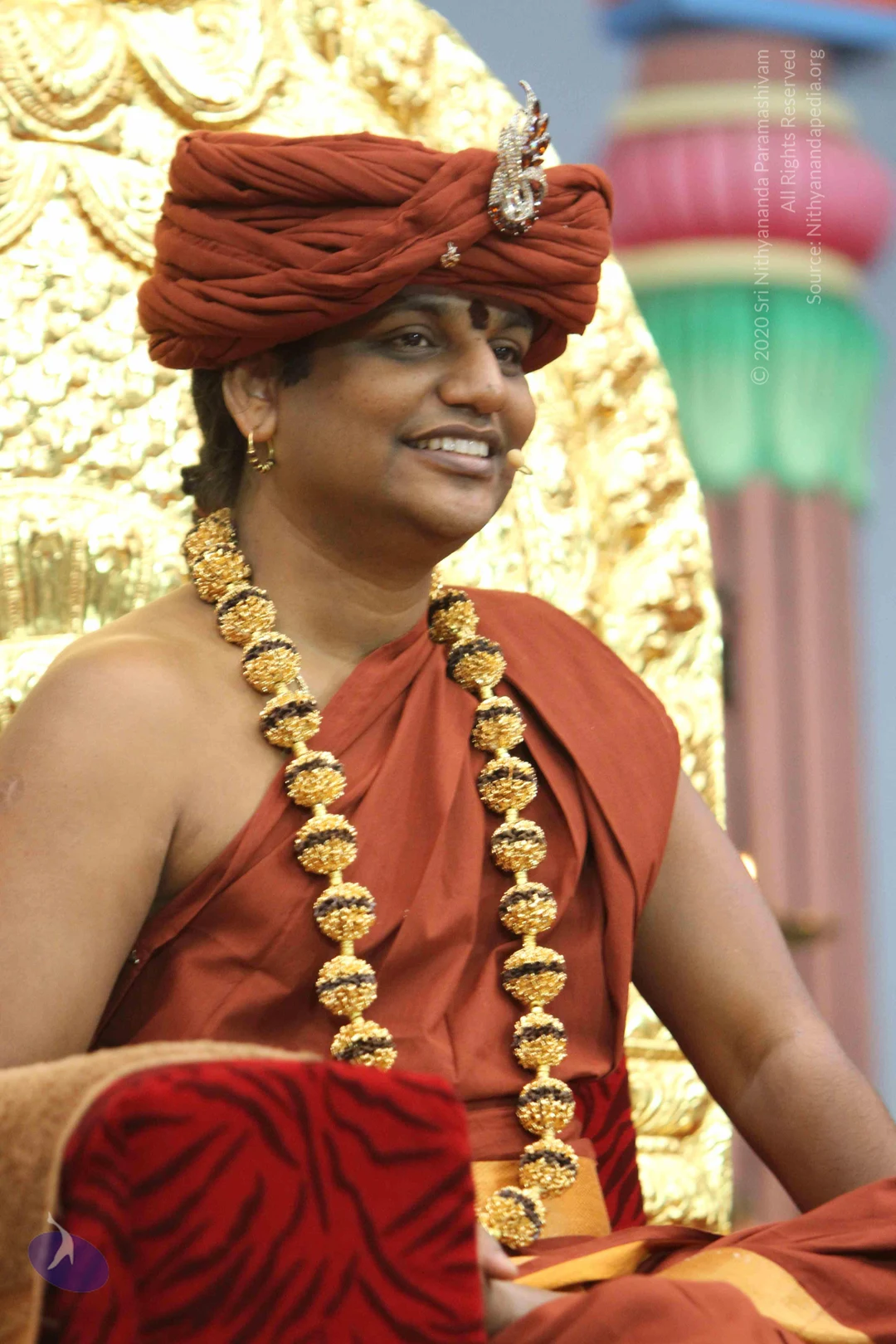
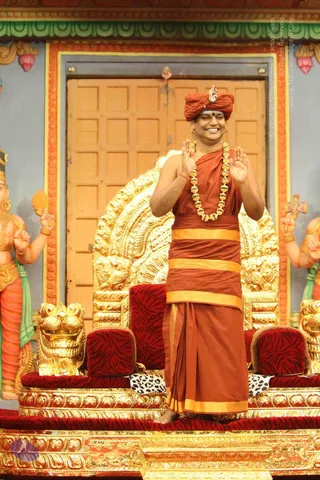
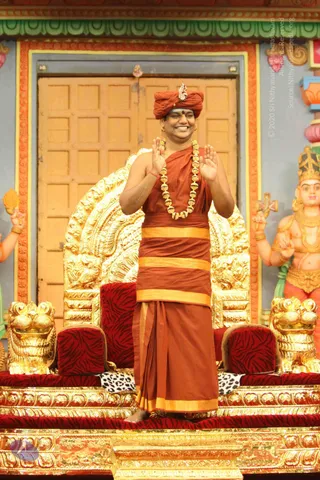
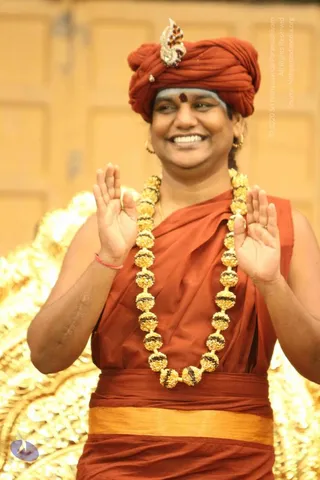
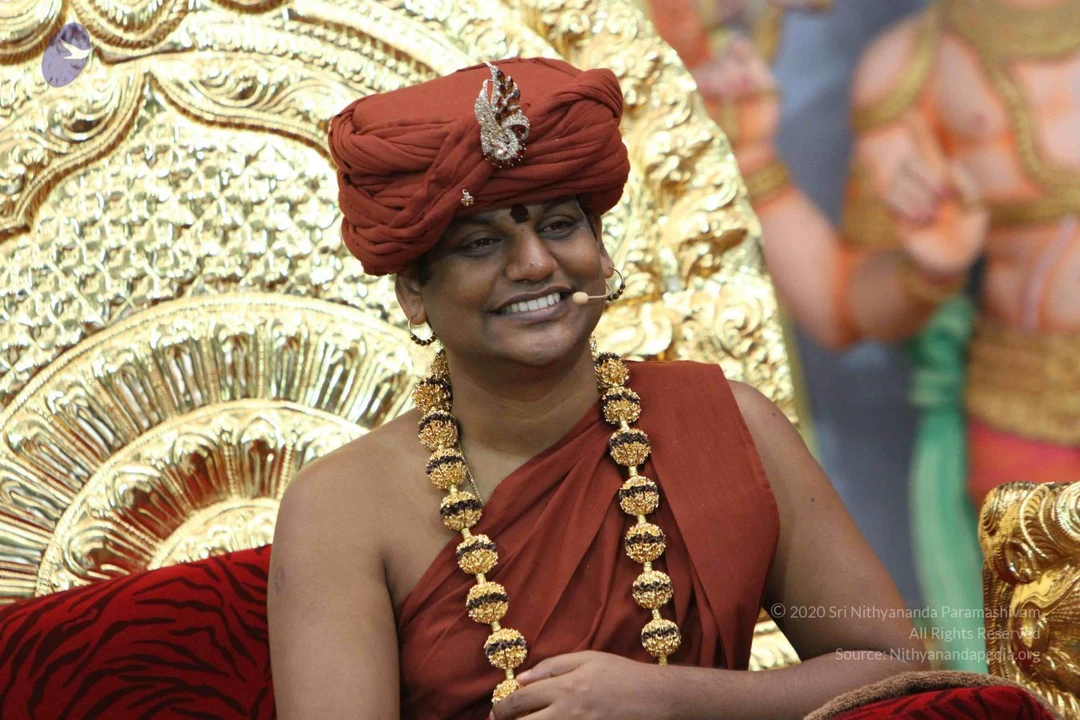
A smiling man stands barefoot on a gold-and-red stage before an ornate gold throne with carved lion-head armrests and red velvet cushions. He wears a rust-orange turban with a silver ornament, an orange-red shawl over an orange dhoti with gold borders, and a long gold-beaded garland, with his palms pressed together in greeting. Behind him is a wooden door framed by painted columns, and painted deity statues with multiple arms stand at each side of the stage.A smiling man in a rust-orange turban with a white jewelled ornament and a red bindi stands on a gilded throne platform, hands raised in palms-forward greeting. He wears an orange-red shawl with gold-bordered wrap, a heavy gold bead necklace, and gold earrings. Behind him are a gilded throne with red tiger-striped cushions, golden lion-face armrests, and a wooden door framed in red and yellow. Painted deity statues flank the stage on the right, one with a gold crown and an object in hand. a person: long dress cues and the throne suggest the presiding teacher; the figure is stood before the throne and greeting an audience.A smiling man in a rust-orange turban with a jewelled brooch and a rust-orange robe stands before a gold ornate backdrop, raising both palms outward in a blessing gesture. He wears a long necklace of gold-toned rudraksha-style beads, a thin gold chain, a red thread bracelet and a gold ornamental sash at the waist. A tilak mark and white forehead paint are visible. The lone person is seen from the waist up in a close photo.A smiling man in an orange-red turban with a jewelled ornament and a red bindi stands with both palms raised in front of him, wearing a rust-orange wrap and a long gold-bead necklace strung with dark rudraksha-style beads, with a gold-patterned throne behind him.A smiling man sits on an ornate gold throne-like seat in front of a gold carved backdrop, wearing a rust-red turban with a jewelled brooch, a rust-red shawl over bare shoulders, and a long necklace of golden beads with dark banding. A small gold hoop earring and a small mic are visible. A red tiger-striped cushion sits in the foreground. A probable Swamiji (probable) cues present: a turban, ornate gold necklace and ceremonial clothing, seated as a teacher in a satsang setting. A pillar in pink and green stands at right.A smiling man sits on an ornate gilded throne with red tiger-striped upholstered armrests, wearing a rust-red turban with a silver jewelled ornament, a red-orange unstitched wrap over bare shoulders, a long gold-and-black beaded necklace, and a gold-and-black beaded waist belt. He holds his hands together in front of him and wears a small head microphone. A tilak mark is on his forehead and a pink wrist cord is tied on his arm. a person seated in a satsang setting, with a green-clad figure partly visible at the right edge. The image carries a copyright credit overlay on the right side.
Deity-Darshan

40 photosSource gallery
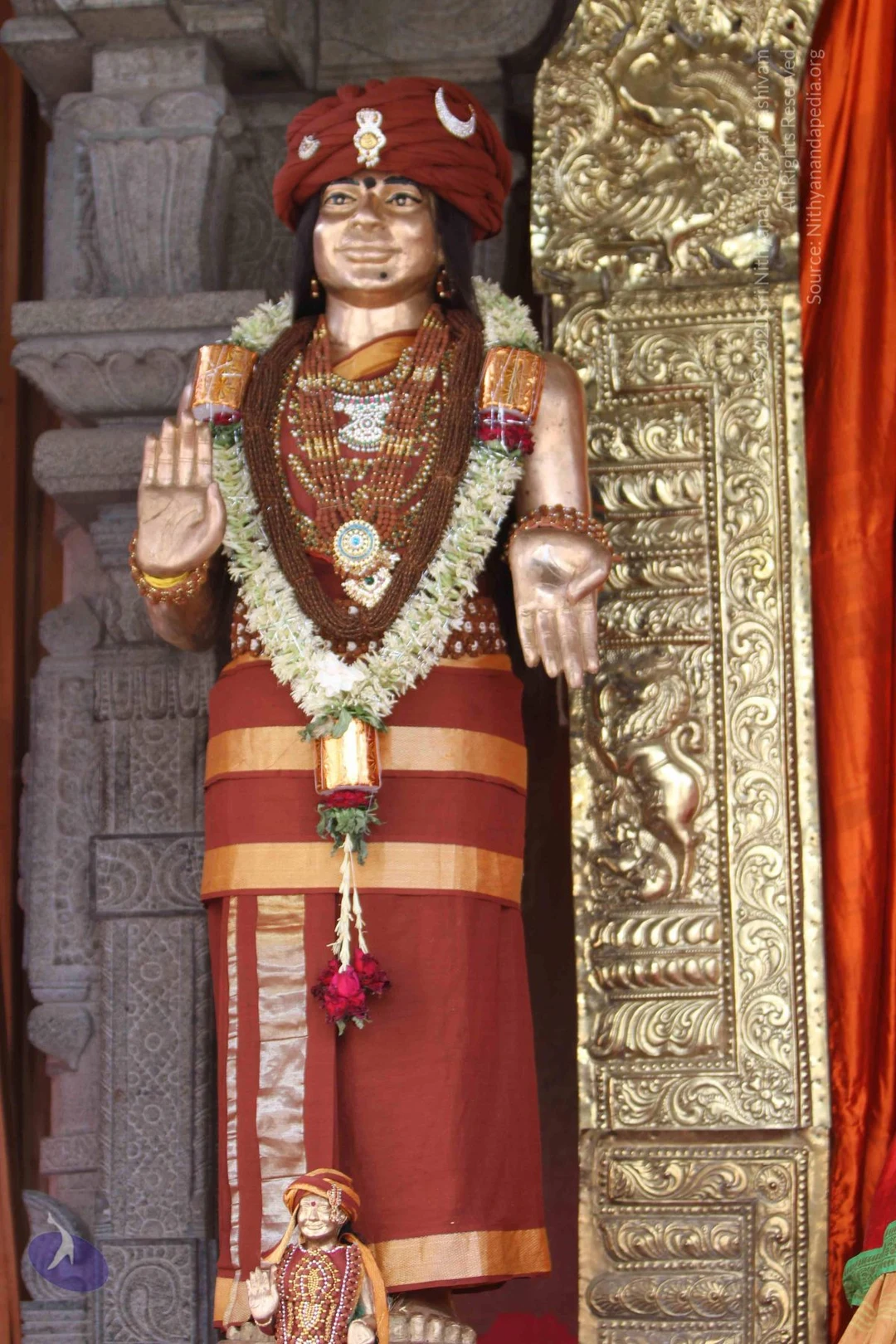
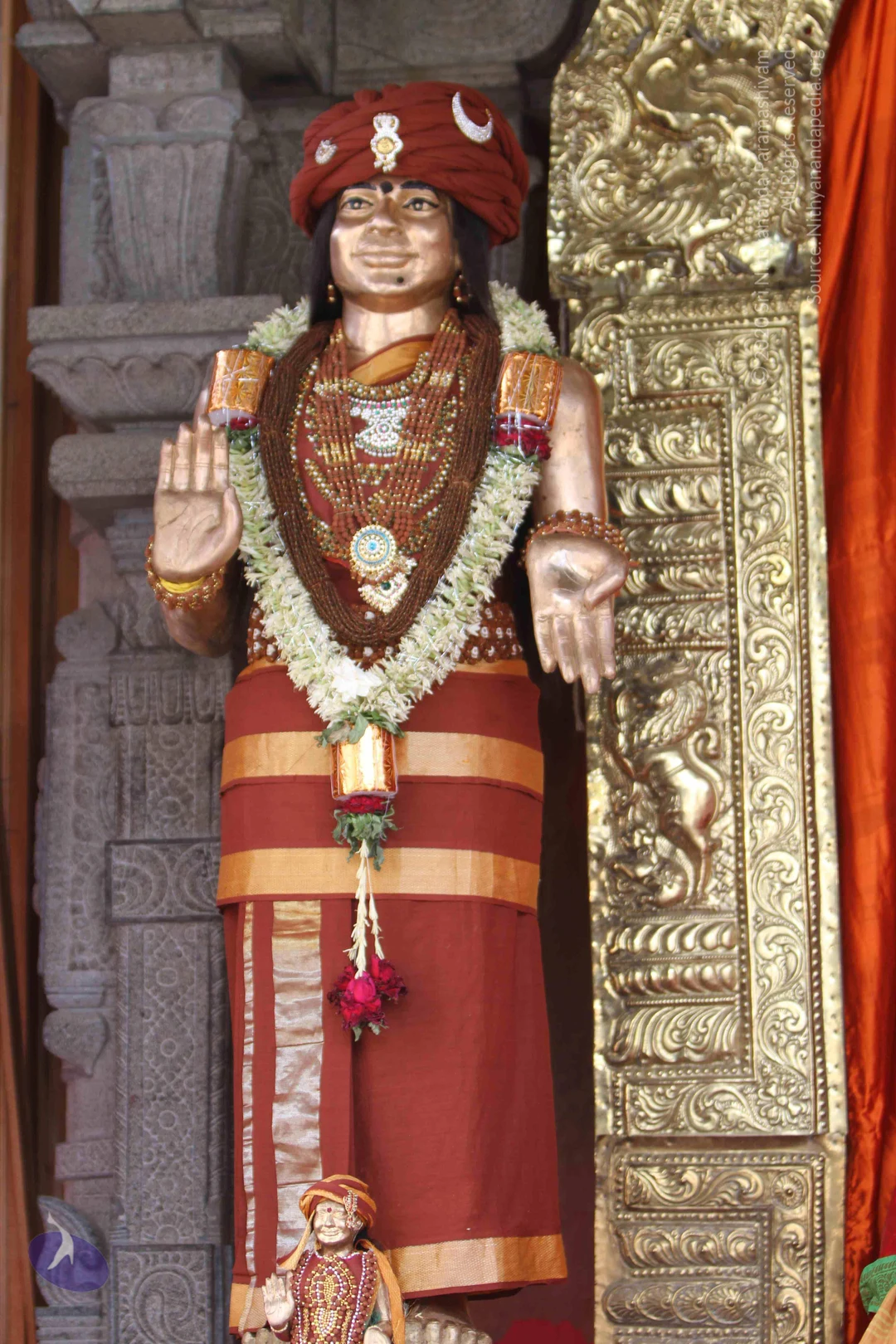
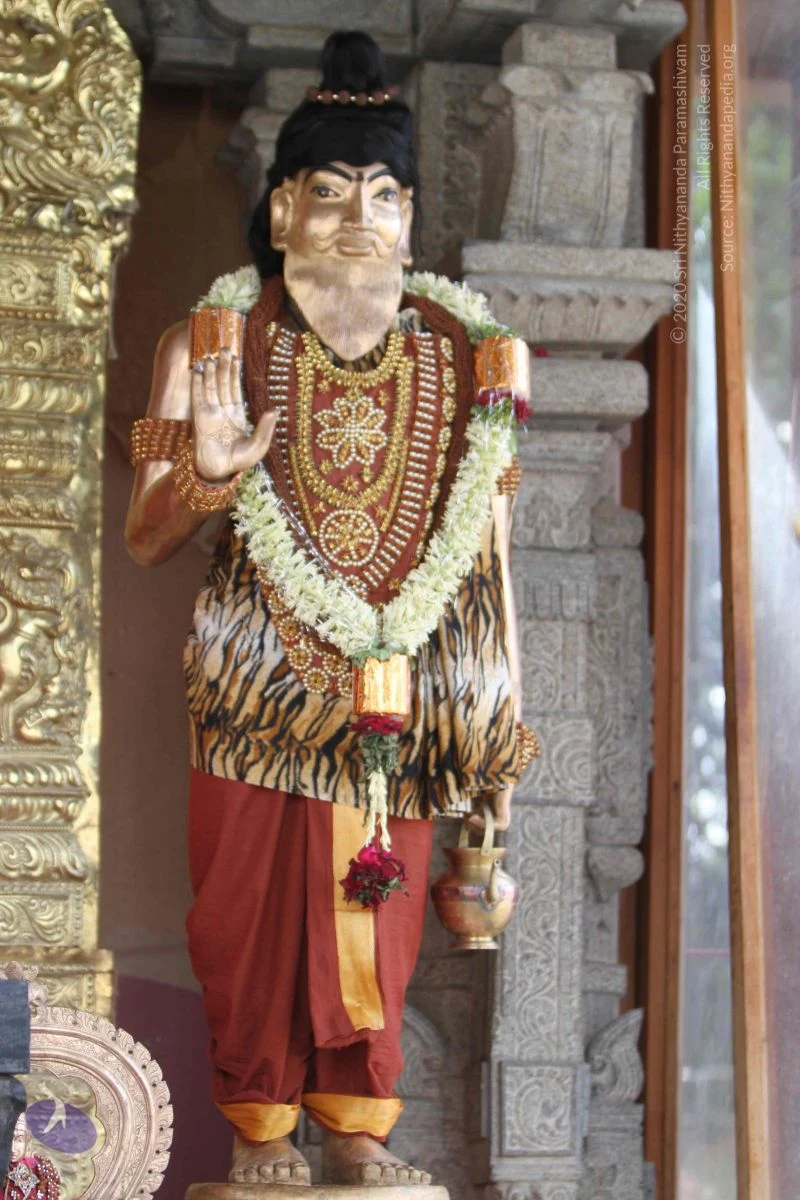
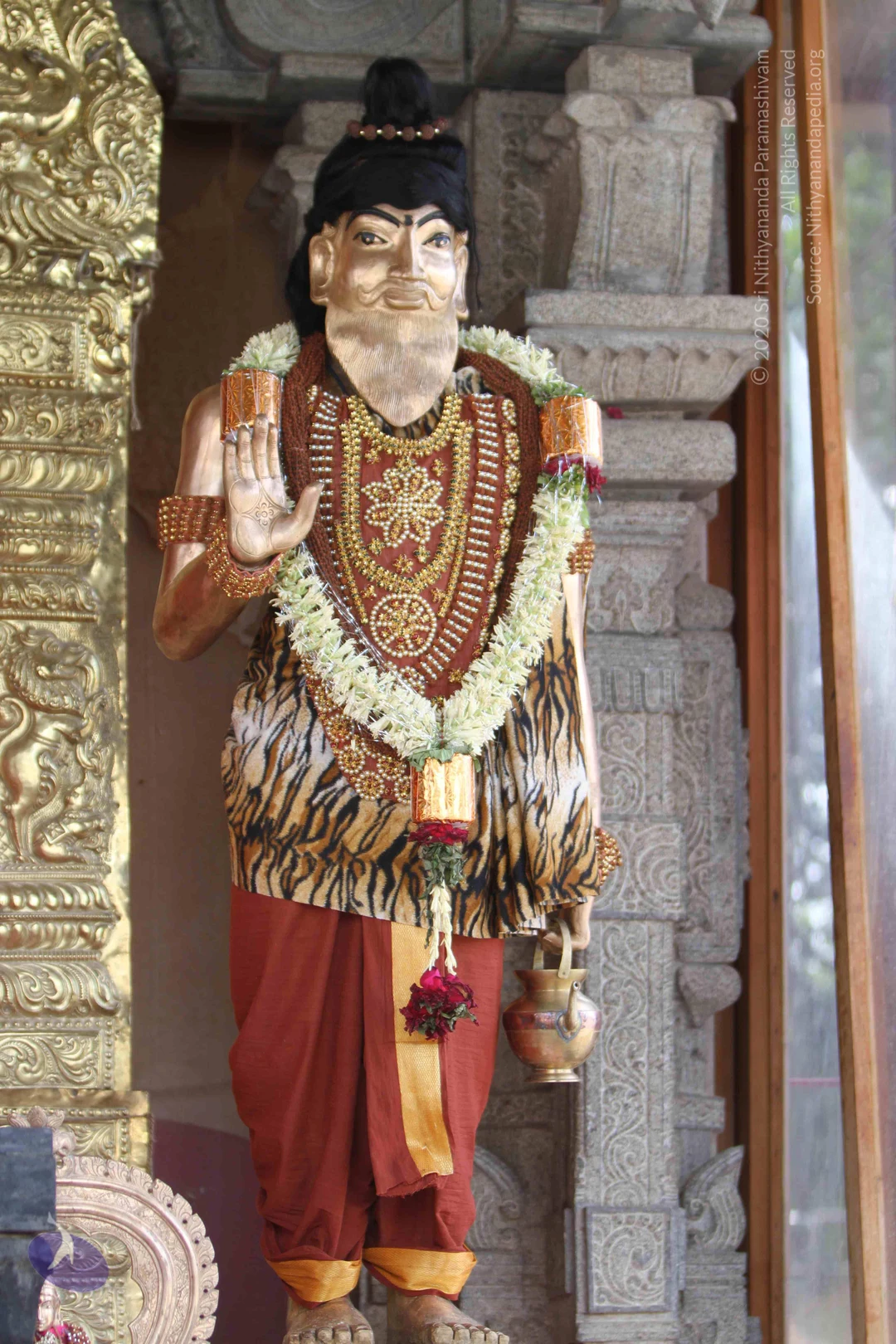
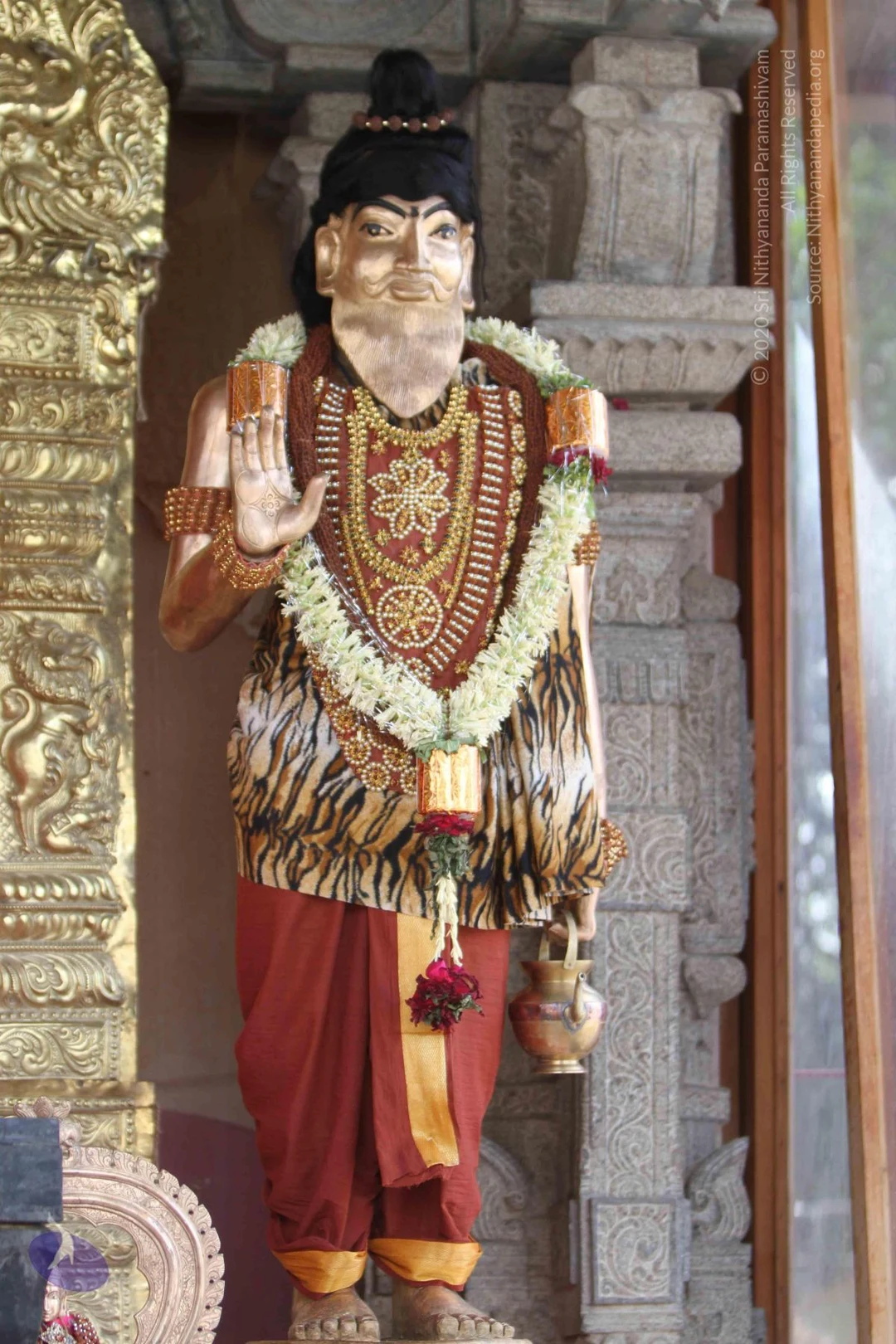
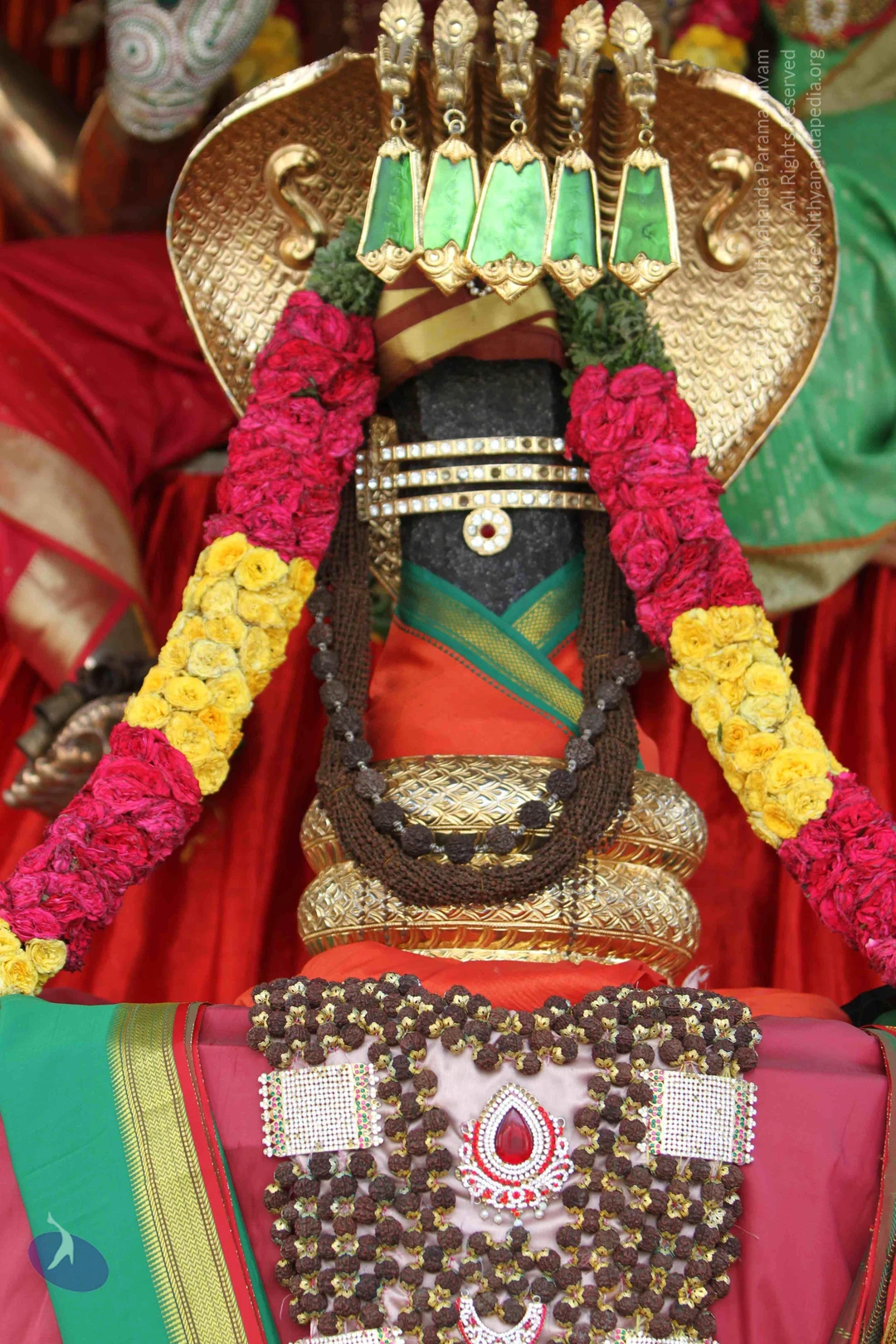
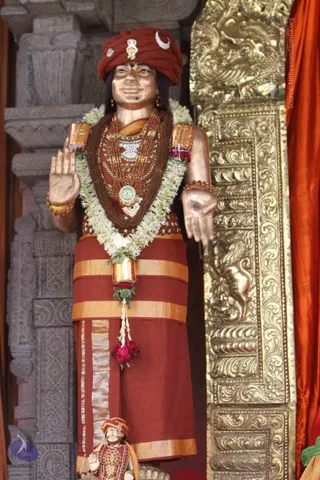
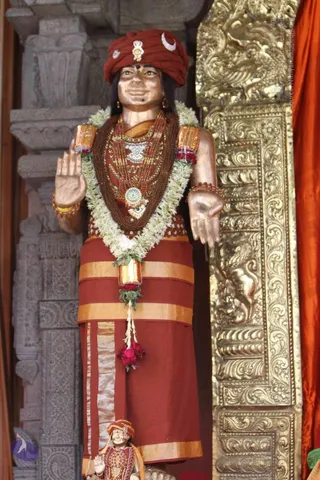
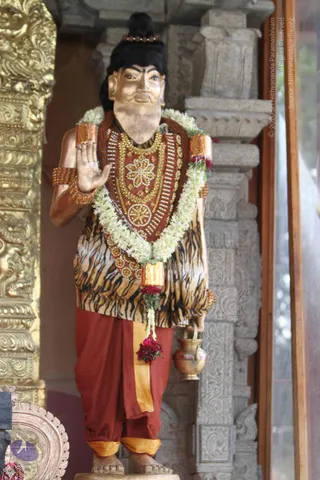
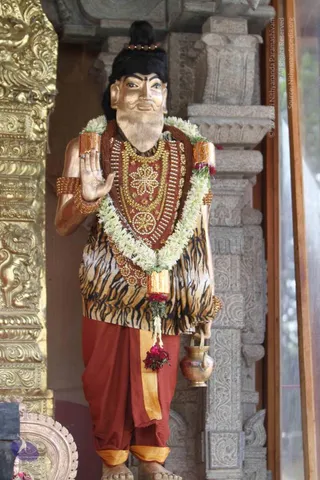
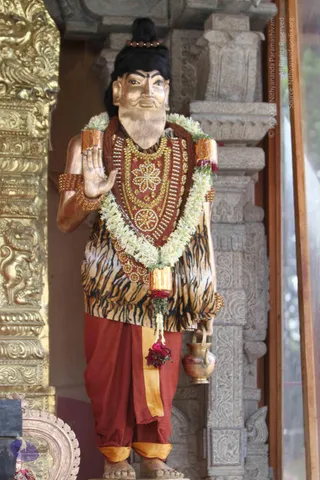
A life-size painted statue stands beside an ornate gilded doorway in a stone-carved temple setting. The figure wears a red-maroon turban with a crescent and jewelled ornament, a dense brown rudraksha mala with a large ceremonial gold pendant, and a white jasmine garland. Its robe is maroon with gold borders and it has a raised right palm in blessing. A smaller statue of a similar figure sits at its feet, and an orange cloth hangs at the right edge. No living people are visible.A large gilded-bronze statue of a standing saint-like figure in front of a carved stone pillar and golden ornamental doorway, with an orange curtain at right. The figure wears a deep red turban with a crescent moon and jewelled emblem, rudraksha-style bead malas and layered gold-and-red necklaces, and a white jasmine garland. Its right hand is raised in blessing and its left is open, and it wears a red and gold dhoti. A smaller statue of a devotee figure with folded hands stands at its feet. Statues only, no living people are visible.A painted wooden statue of a standing male figure stands in a temple doorway beside carved grey stone pillars and a gilded carved wall. The figure wears a tiger-striped upper garment, a rust-red dhoti with a gold-bordered end, and a layered gold and bead necklace with a rust-red shawl. A white jasmine garland drapes over the shoulders and chest, with red flowers hanging at the waist. Gold bangles adorn the wrists and upper arms, and the right hand is raised in a blessing gesture while the left hand holds a small brass kalasha pot. A dark topknot is decorated at the crown. The statue is a deity murti or devotional figure, not a living person.A standing wooden statue of a bearded sage in a stone temple niche, flanked by ornate gold-plated metalwork. The figure raises its right hand in a blessing gesture and holds a brass kalasha-style pot in its left hand. It wears a tiger-stripe patterned upper garment, rust-red dhoti with a gold border, layered gold and beaded necklaces, bangles, and a white jasmine garland with red flower strands. Its long black hair is tied up with rudraksha beads. The statue is a depiction, not a living person, and no printed name is visible.A painted wooden or sculpted statue of a standing male figure in a temple doorway, with a long dark topknot and moustache-and-beard face. The figure wears a red-brown jewelled bodice with gold beadwork and a white jasmine garland, a tiger-striped upper cloth, a rust-red dhoti with gold border, and gold bangles on the arms. The raised right hand shows a palm mudra and the left hand holds a brass kalasha-style pot. Carved stone pillars and an ornate gold-leaf frame surround the statue. No physical people are visible, and the figure is a statue rather than a person, so the a person field is none.A dark black stone Shiva lingam is dressed for worship, framed by a golden cobra hood with five green jewelled hoods above. It wears a gold and stone band, a brown rudraksha mala draped down its front, and a wrap of orange and green fabric. Garlands of red and yellow flowers hang on both sides, and a large rudraksha necklace with a red and white jewelled pendant covers the base. A red cloth backdrop and a gold pedestal surround it. No people are visible.
Goshala

3 photosSource gallery
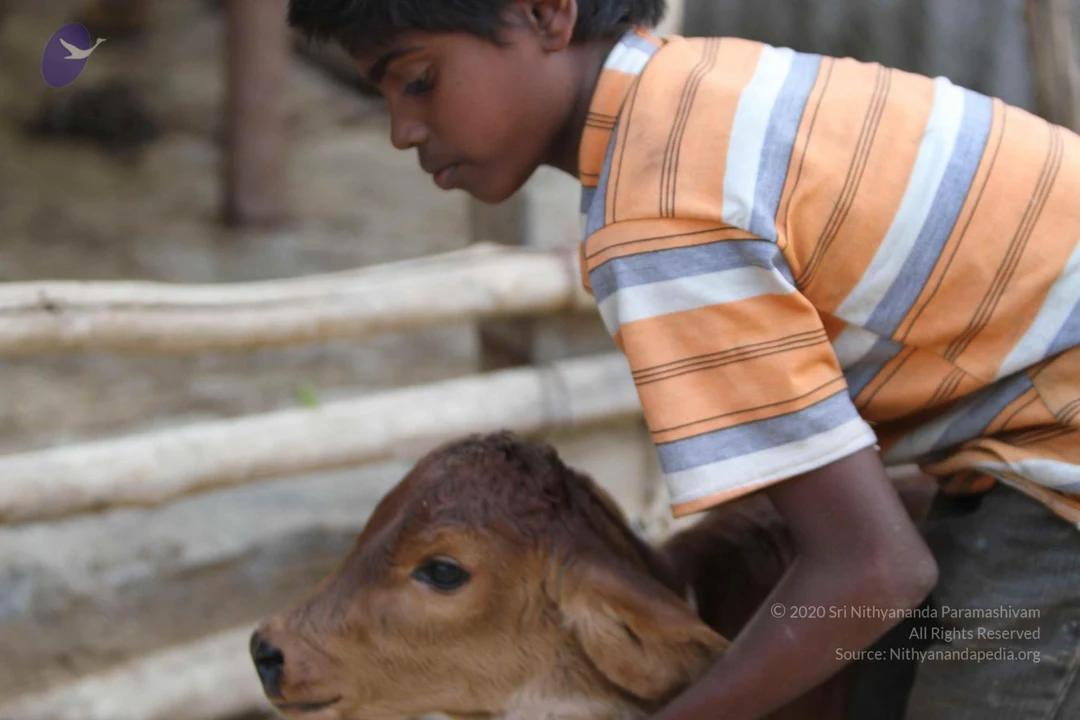
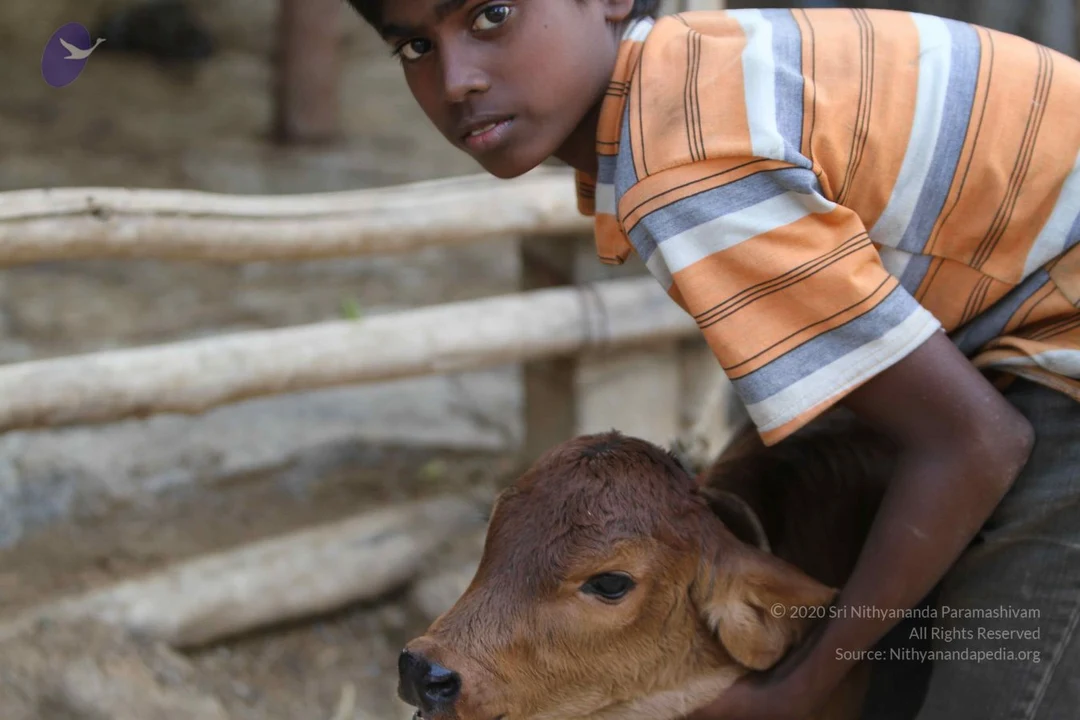
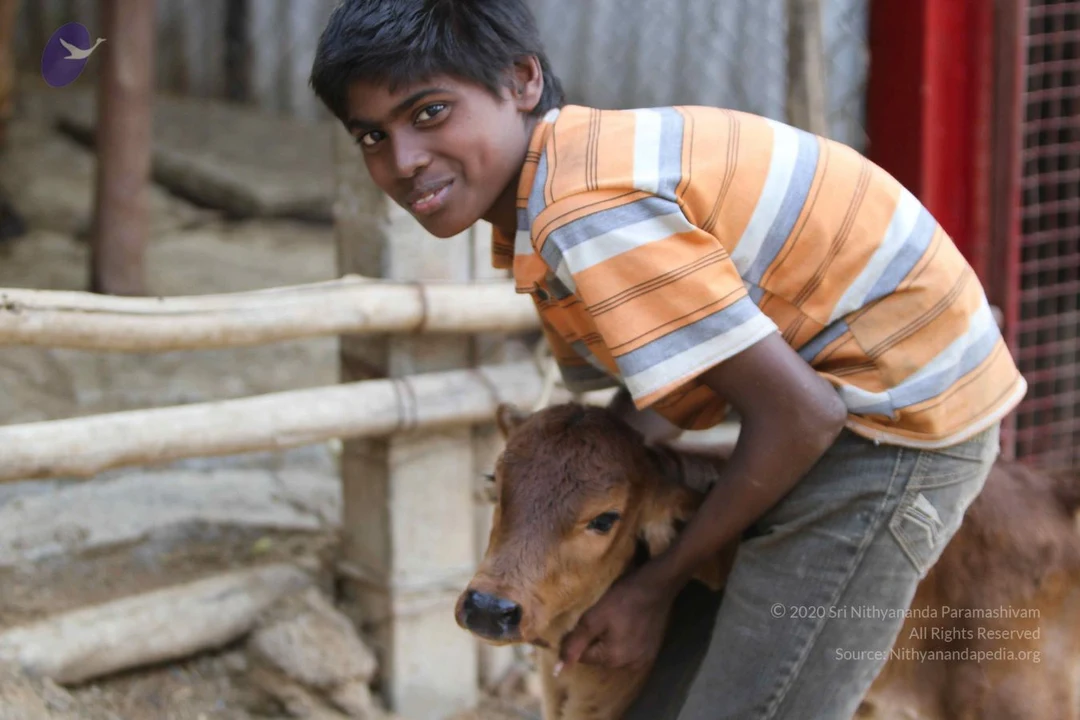
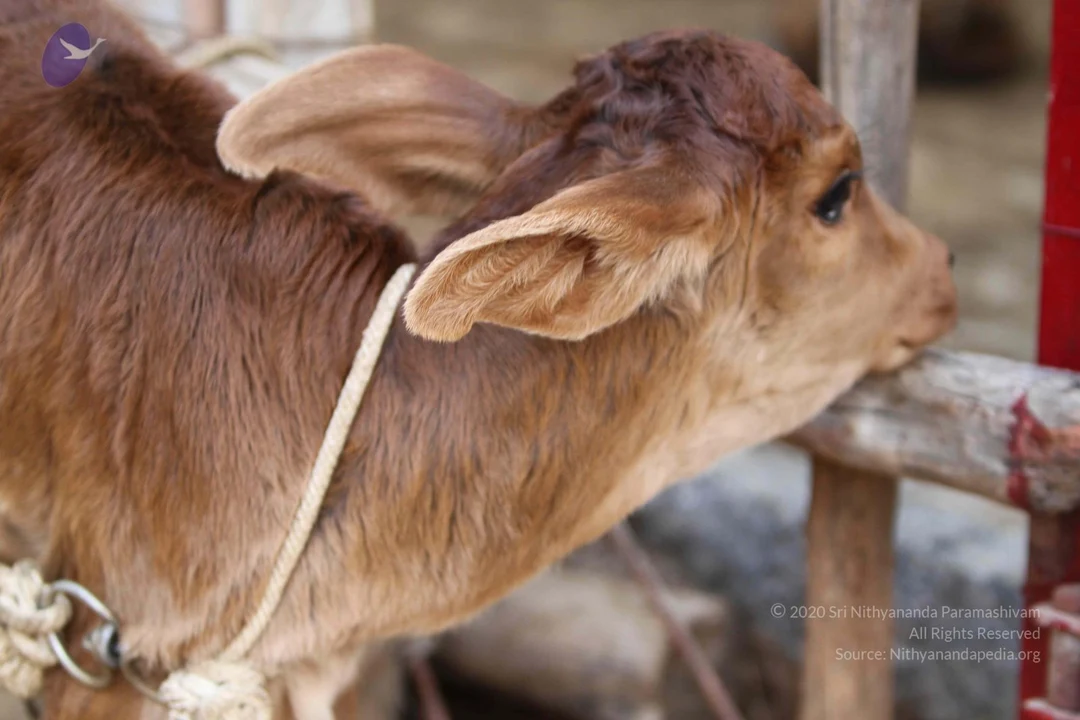
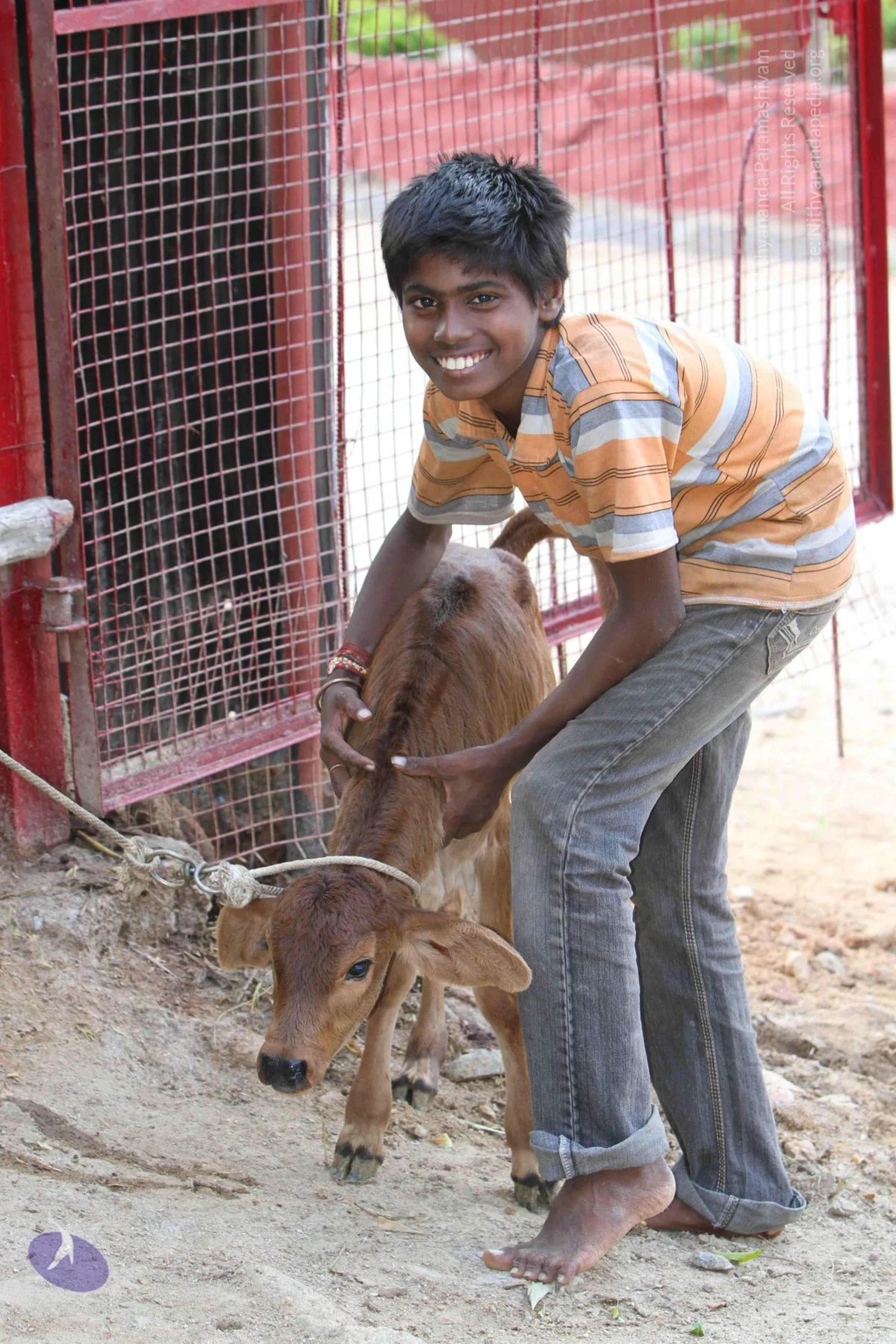
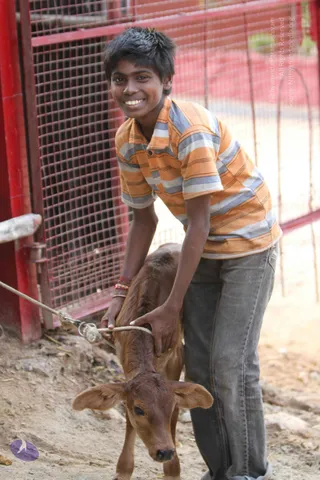
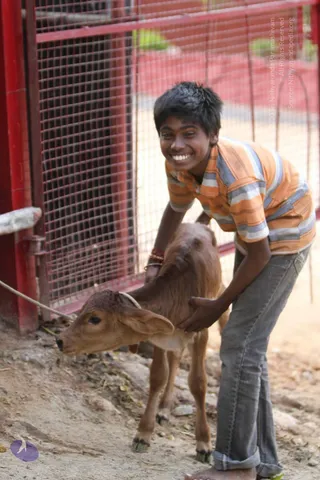
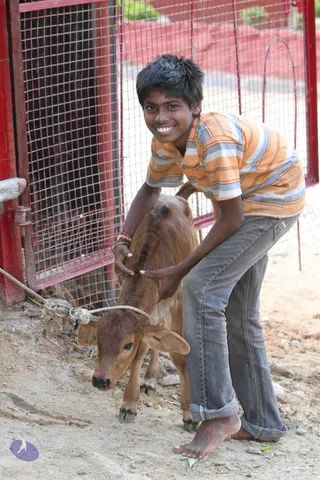
A smiling teenage boy with short dark hair stands beside a small brown calf on a dirt ground in front of a red metal gate and mesh fence. He wears a short-sleeved orange, grey and white striped polo shirt and grey jeans, and holds a rope tied to the calf's halter with both hands. Red and white bangles are on his wrist. The calf has large floppy ears and a white-tipped nose. No a person candidate is visible, so the scene shows ordinary farm or gaushala life with a boy and a calf.A smiling young boy in an orange and white striped polo shirt and grey jeans stands barefoot beside a young brown calf on a dirt ground. He leans forward with one hand on the calf's back and wears red and beaded wrist bands. The calf is tethered by a rope at its neck. Behind them is a red metal mesh gate and fence. No ritual, deity or a person candidate is visible.A smiling teenage boy with short dark hair stands barefoot on dry dirt beside a red metal wire-mesh gate, bending slightly as he holds a young brown calf on a rope halter. He wears an orange and grey striped short-sleeved shirt, rolled-up grey jeans and a red and white beaded wrist band. The calf has large ears and dark hooves. No a person candidate is visible; the scene shows a rural animal-care moment at an ashram-style enclosure.