Skip to content
Tuesday

3 June 2014

Science of space creation - Part 2

Dated photos
73
Source pages
1
Media
2
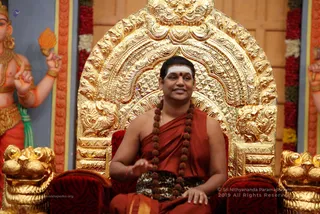
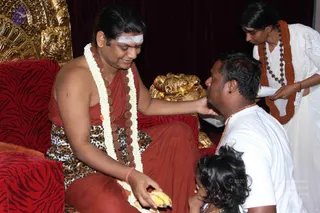
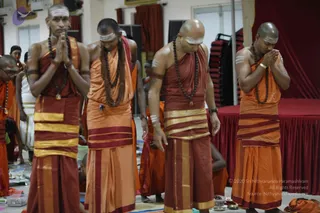
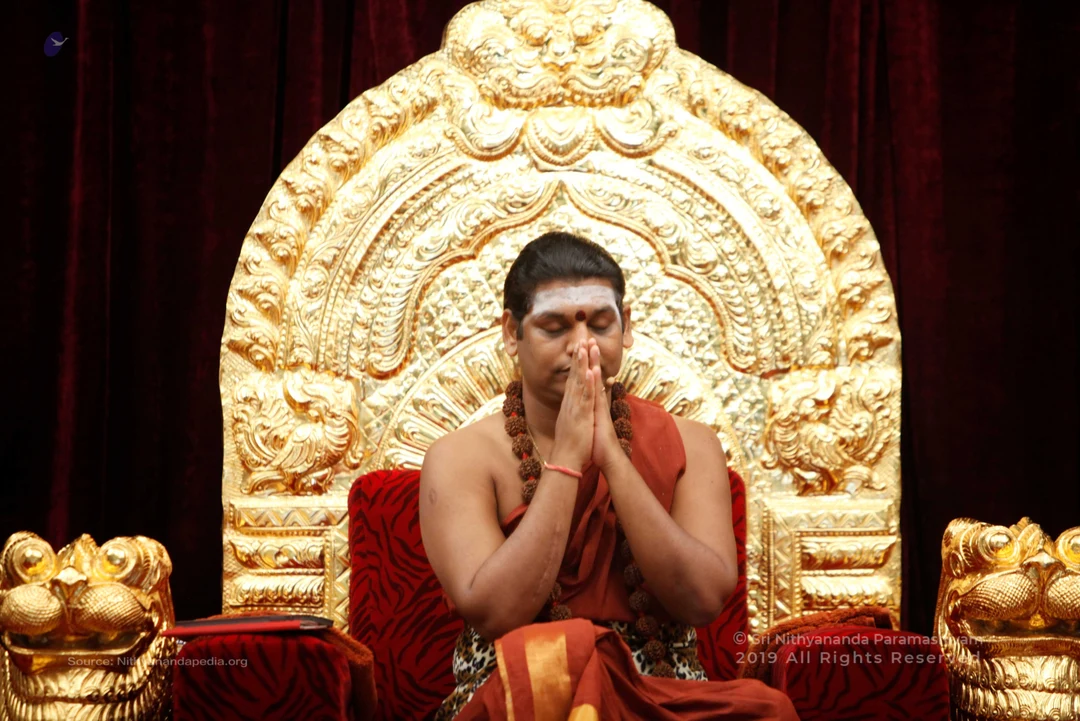
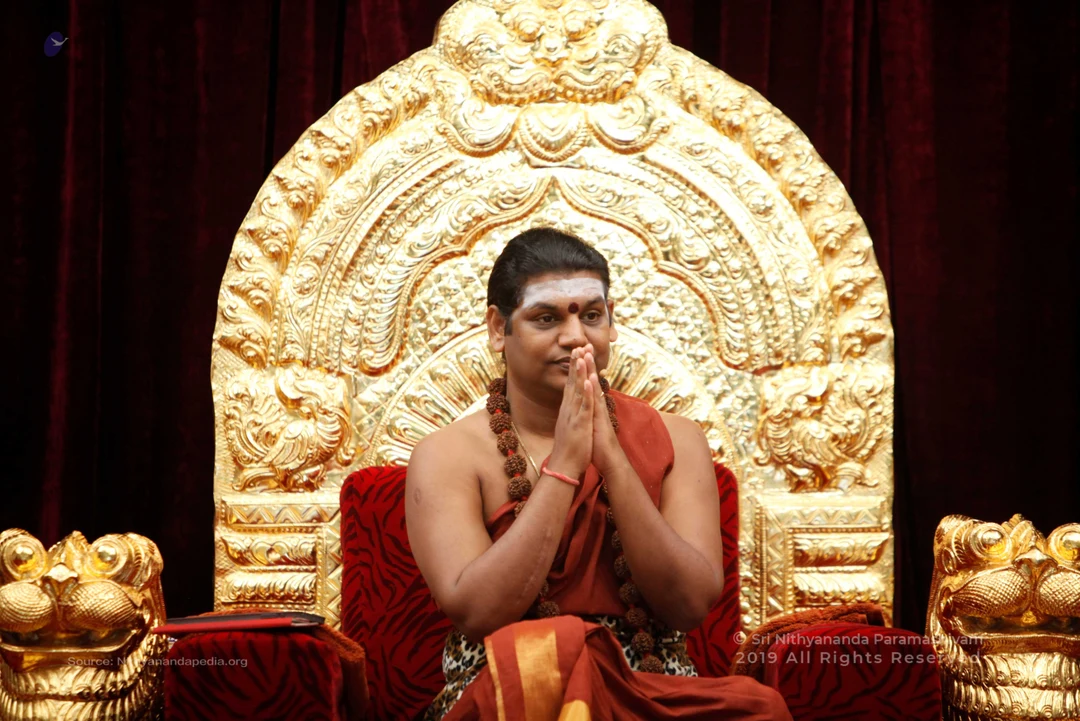
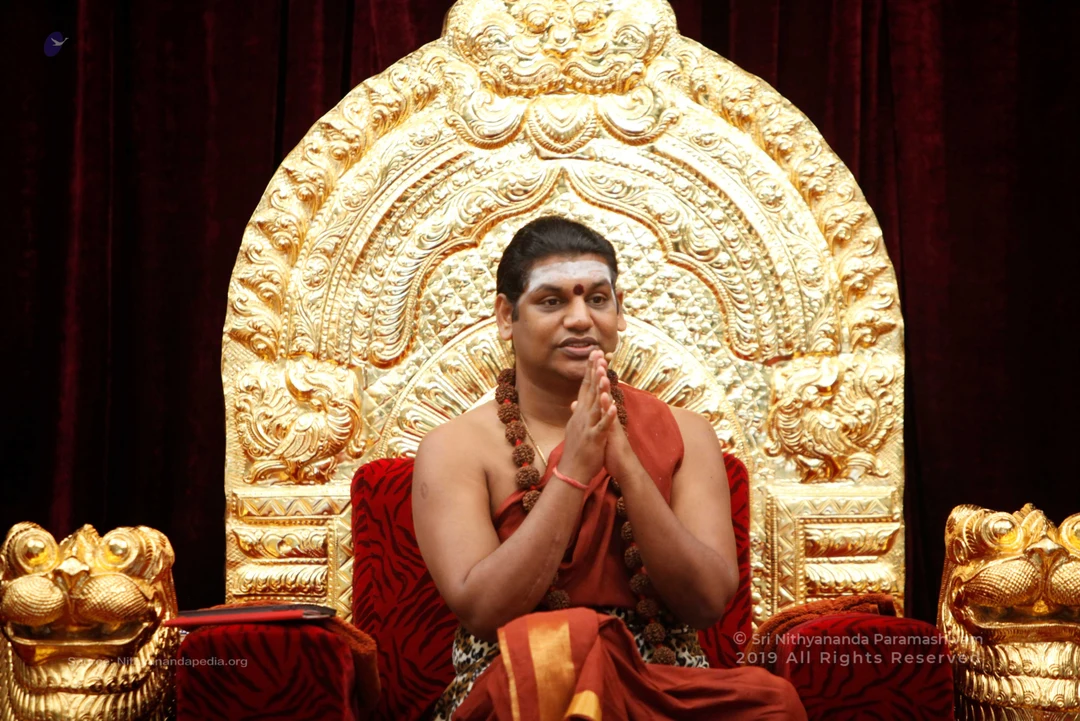
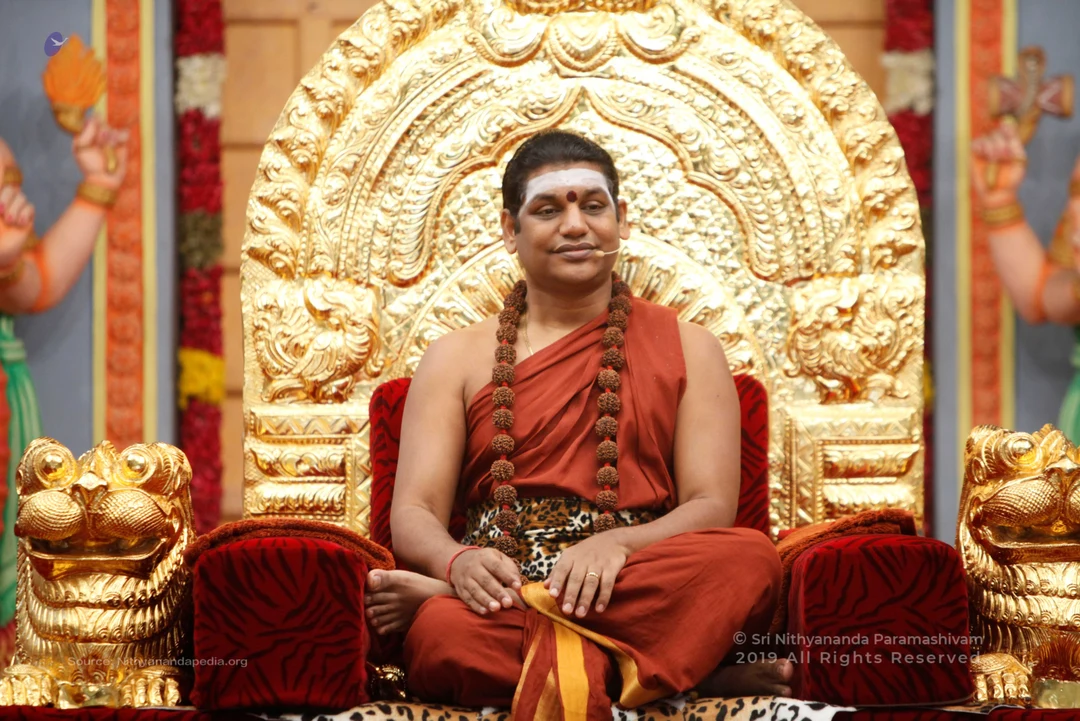
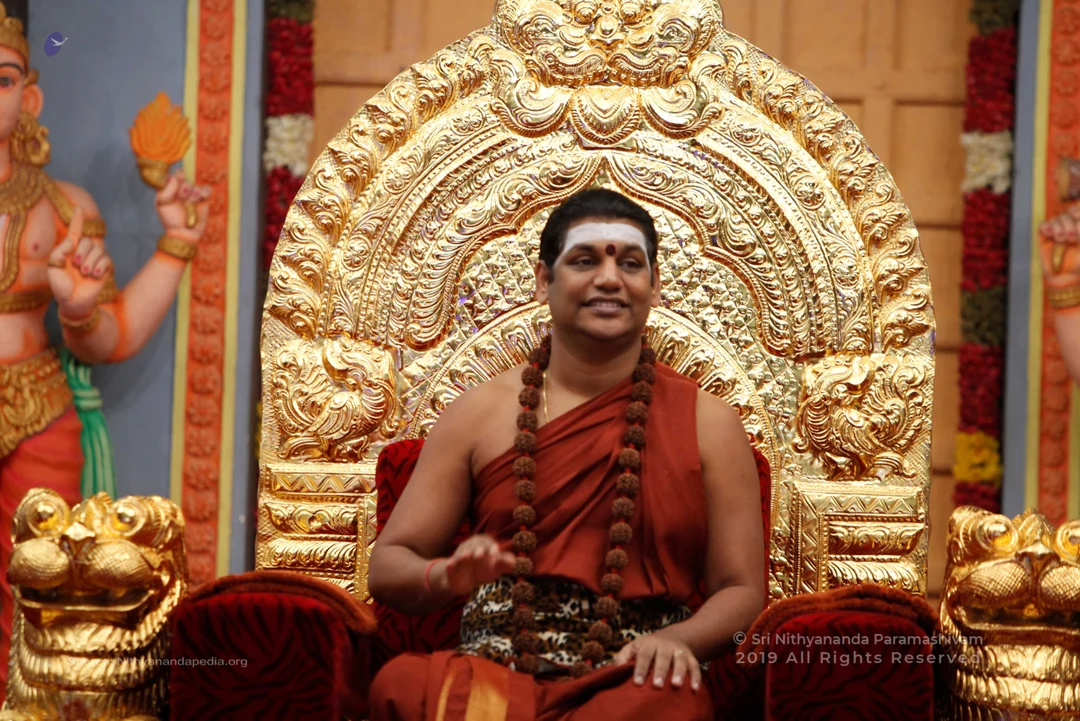
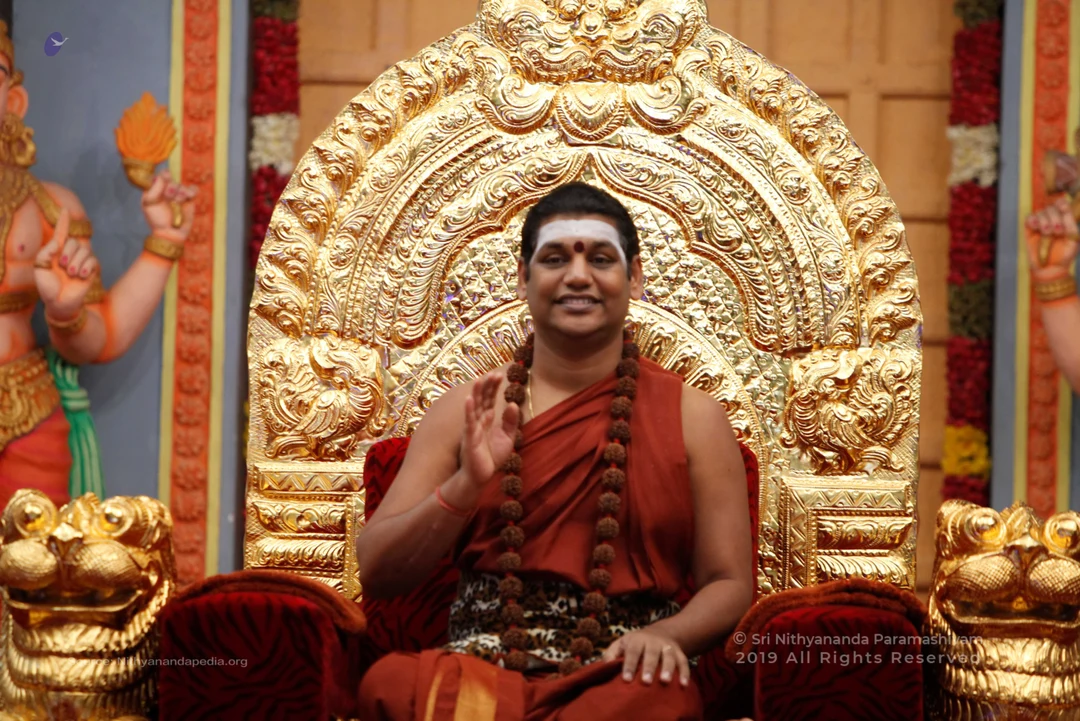
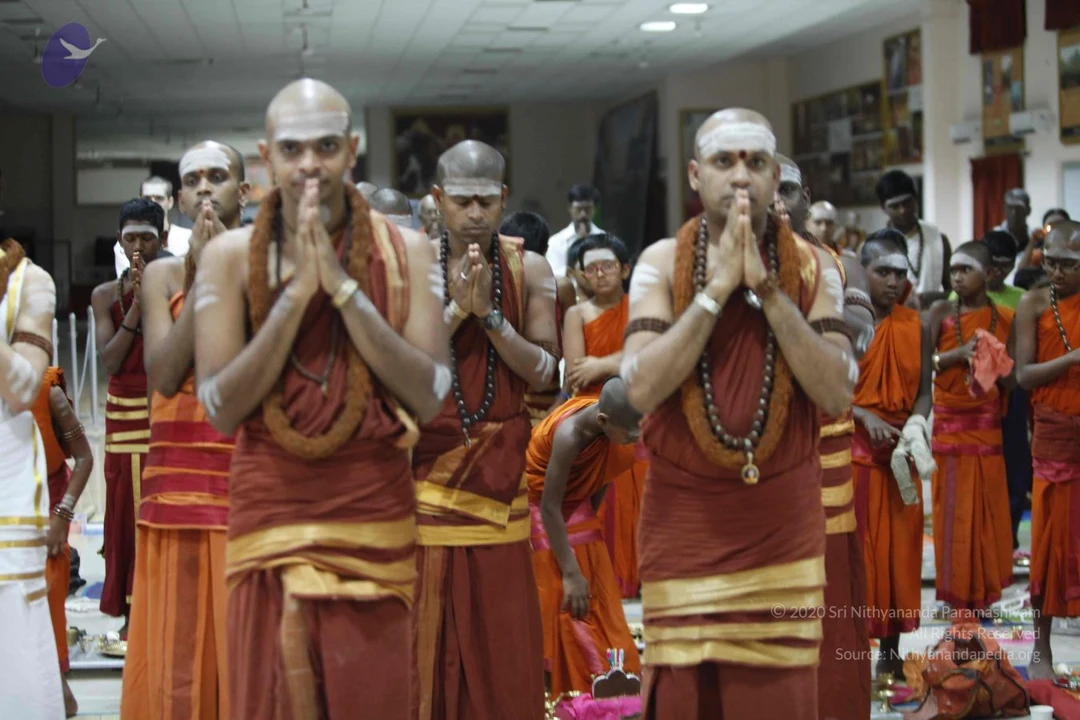
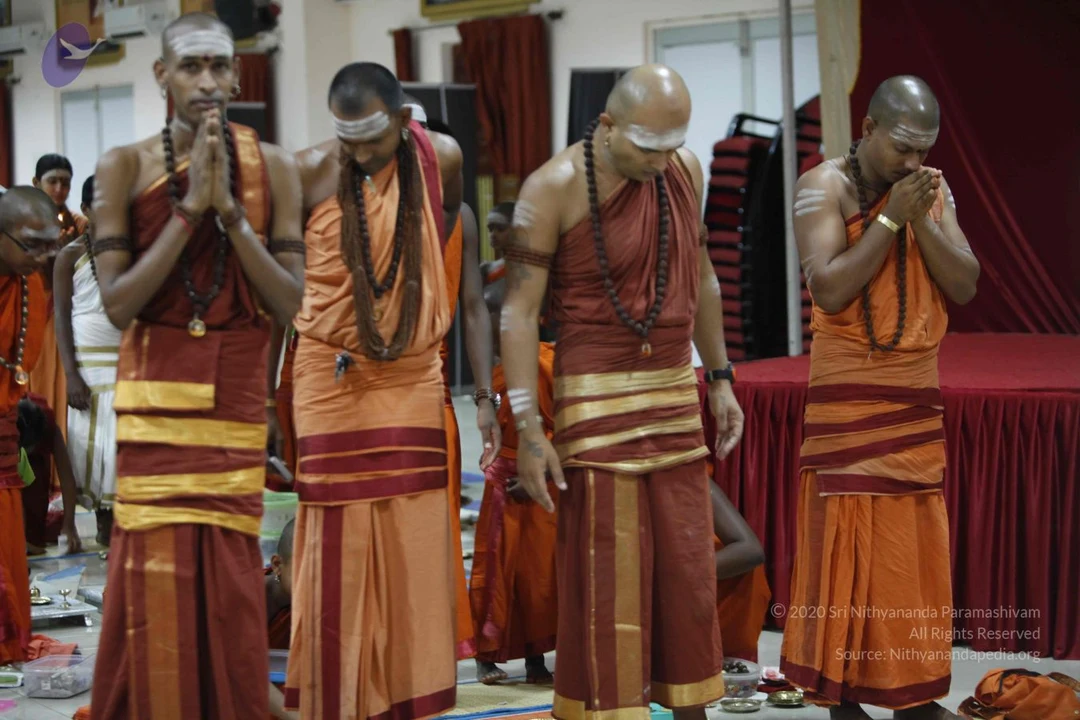
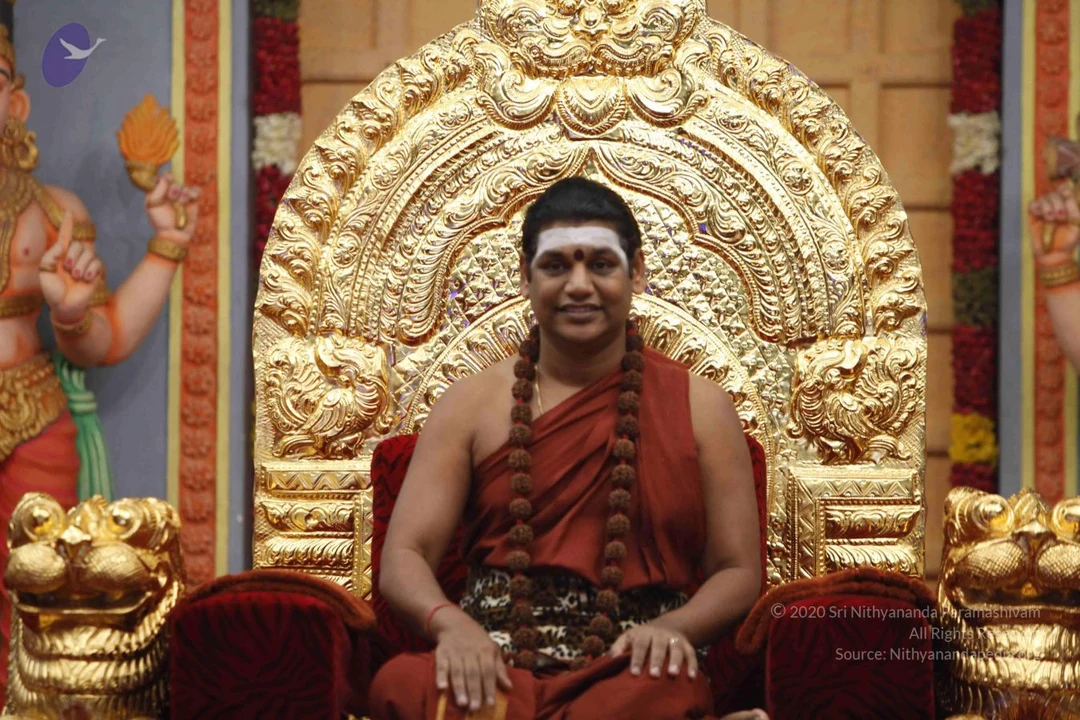
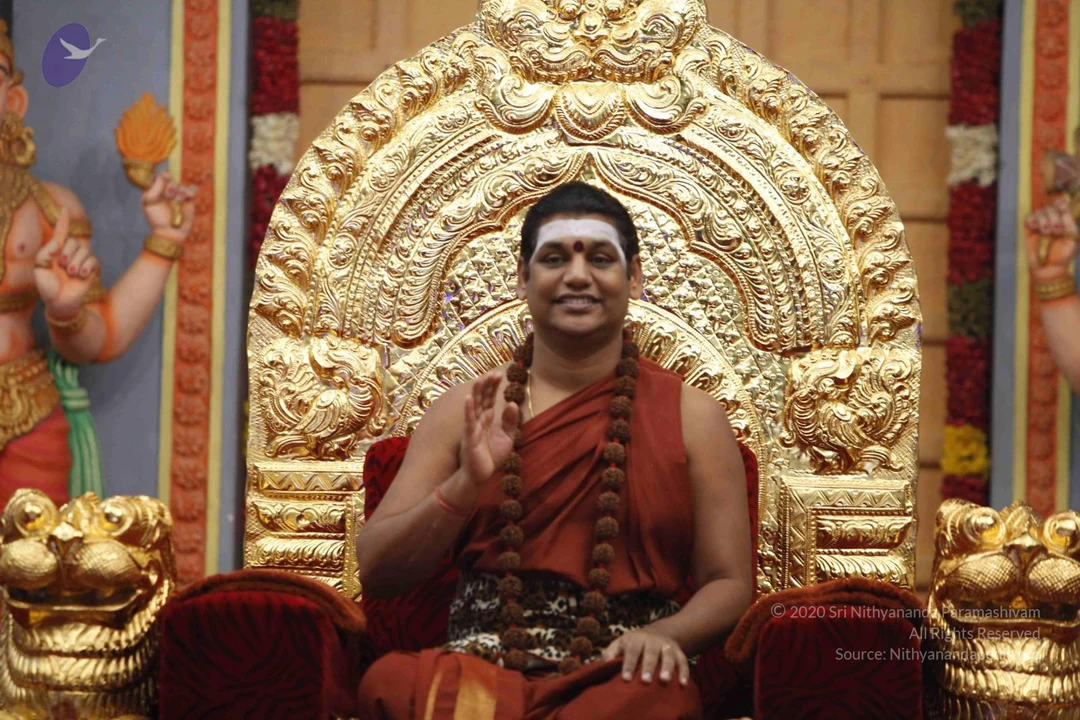
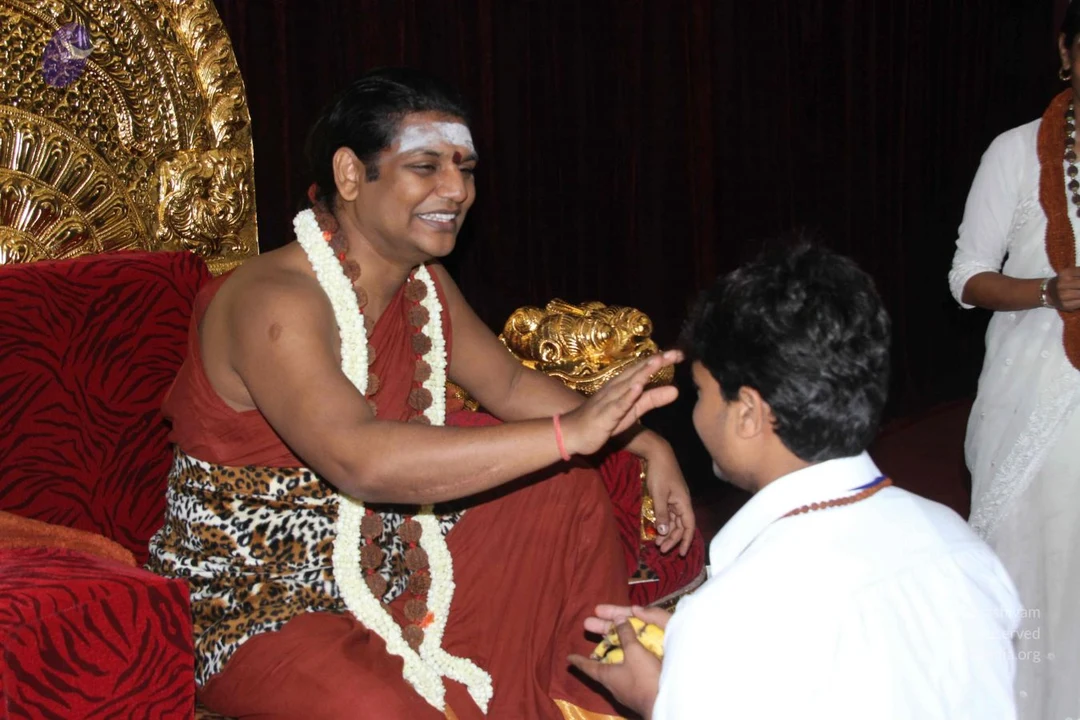
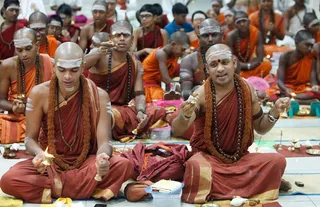
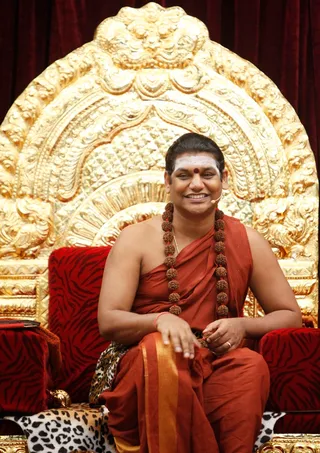
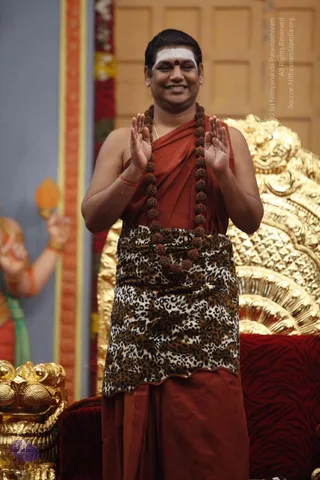
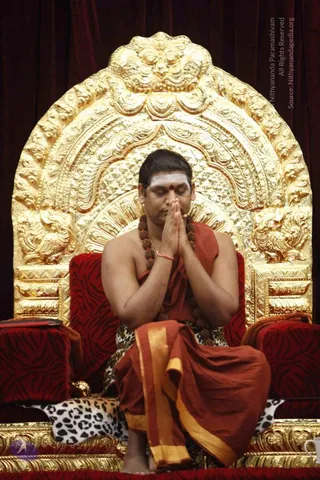
A man seated on an ornate golden throne with lion-head armrests and carved arched back, flanked by red velvet cushions. He wears a saffron-red robe over a shoulder, a long necklace of rudraksha beads, and has a white vibhuti band with a red kumkum dot on his forehead. He gestures with his right hand while speaking. Behind him are red and white floral garlands, and to the left stands a painted deity murti with an orange-skinned multi-armed form holding a flaming torch.A seated man in a saffron-red robe with a leopard-print wrap, a white flower garland and rudraksha mala, and a white horizontal forehead mark sits on a red zebra-print chair before a golden ornate backdrop. a person: long swept-back hair, saffron robe, rudraksha mala and ceremonial garland. He holds a banana and touches the chin of a kneeling man in a white shirt with a beaded necklace, while a small child in front looks on. A woman in white with an orange-brown garland stands at right holding a notebook.Four male devotees in orange and maroon dhotis and shawls stand in a hall with red curtains and a red-draped stage behind them. Several wear rudraksha malas and white and horizontal sacred ash markings on their foreheads and arms. The leftmost man has his palms pressed together in namaskar, and the others stand with hands folded or bowed heads in prayer. Brass plates and small vessels sit on the floor at the lower edge. Behind them, more people in orange and white clothing are seated or standing.

June 03 2014

Original wiki page
Contents

Title:

Science of space creation - Part 2

Description:

In today’s morning satsang, Paramahamsa Nithyananda further expanded on the Power of Creating Space. This science requires so much completion. Authenticity aligns even the way you breathe. Sanyas starts with the ability to stand egolessly for your authenticity. If you don’t know how to create space and melt down, your ego is enough to kill you. Continually ask yourself, “the way you are thinking is it supporting your Inner, Outer, Others and Life Image you want to have.`` Are you aligning your thinking to that. Watch, Share and Subscribe to our channel to be notified of the next upload click http://www.youtube.com/subscription_center?add_user=lifeblissfoundation to subscribe.

Link to Video:

Link to Audio

'Description:Science of space creation part -2 by HDH Bhagavan Nithyananda Paramashivam on 03 june2'

Transcript:

Nithyanandeshwara Samaarambhaam Nithyanandeshwari Madhyamaam |

Asmath Aachaarya Paryanthaam Vandhey Guru Paramparaam ||

I welcome you all with my love and respects.

I welcome all the devotees, disciples, samajis,satsanghis, Shrimahants, Mahants, Kotharis, Thanedars sitting with us through Nithyananda TV, Sadhna TV, and two-way video-conferencing having Nayana Deeksha. Cities sitting with us having Nayana Deeksha: Scottsdale-Arizona, Port Washington-New York, Guadeloupe-Rameshwaram, Gyaneshwor-Nepal, High Point-North Carolina, Hong Kong-Sirkazhi, Belgium, Vishweshwarananda-New York, Hyderabad-Gupta Kashi, Tallahassee-Florida, Nithyananda University-Paris, Bangalore North, Oman-Sivagangai, Vadodara, Dubai-Vaidyanatham, Simi Valley-California, Tiruvanmiyur-Chennai, Charlotte-Srisailam, Penang-Tirupparamkundram, Oklahoma-Somanatham, Seattle-Chidambaram, San Jose-Madurai, Toronto-Kailasam, Singapore-Singapuram..........

I welcome all of you with my love and respects.

Winston-Salem-North Carolina, and Kathmandu-Nepal, I can see you all. Blessings!

I wanted to continue to expand on the subject which I was expanding yesterday THE SCIENCE OF CREATING SPACE. This science is the most powerful, most sacred, and what Krishna calls in the 9th Chapter of Bhagavad Gita, Raja Vidya, Raja Guhya Yoga; means, the Royal Knowledge, Royal Secret. This science needs so much of Completion If you just see, today morning, before the satsangh starting, I asked some of our Swamis to do bhajan. This is going on for the last one week. Still they are not even able to come to a visualization how they should present themselves!

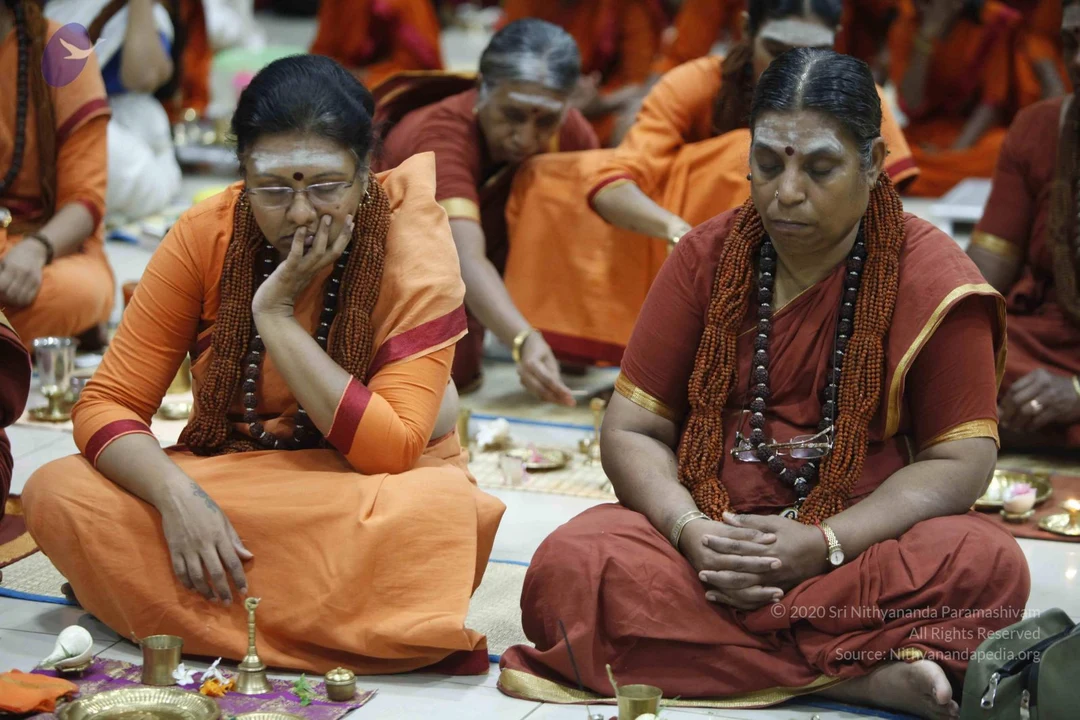
So much of arrogance, incompletion and unable to relate with life! Just two days before, during the arangetram, how those singers have presented themselves, that could have been enough example. So much lesson could have been learnt from them. You may think, Just by the way of sitting, what is there? Why Swamiji should take this so seriously? There are some stupid fellows thinking like that. Why is Swamiji so serious about every small point? Understand, authenticity aligns even the way you breathe; not just the way you sit, on what you sit, not just your asana, the way you sit, it aligns even your breathing, your thinking! Now I will have to sit and google, find how the traditional singers sit and present themselves, and then take it out and give! Then only they will look even further! Four people were sitting. Each one will lift up the hands, Not mine! It is not mine! It is not mine! One thing you can be sure, you are all not qualified for Sannyas! All the four are not qualified for Sannyas! Because, Sannyas starts with your ability to stand for your authenticity.

If you have to do Puja, your whole dress, the jewellery you are wearing, the marks you are wearing, your body language, the way your voice......everything has to change. If you are sitting and teaching, the way you sit, on which you sit, your asana, your body language, your words, everything has to change. That is what is Authenticity! That is what is egolessness! Oh, I am a Mahant. I only do enriching and manage all my Kotharis. Suddenly if you ask me to sing how can I? What do I know? Only today morning they called me. No! That is what I call ego.

Understand, even in your life, you go on disrespecting the space you need to hold. When you are sitting in your office, if you don't know the laws of the people who are sitting around you and your team, and if you try to apply the laws of the house, the way you deal with people in the house if you try to use the same law with your team without bring that Completion....

Please understand, if you bring Completion, your team, family, both will have the same level of intense love, connections, Advaitha state with you. But if you don't bring Completion, the law of team is different, law of family is different. That is why the fellows who are having affairs in the office will never be successful in their career. Having affair in the office is suicide, your career suicide! Whatever may be the profession you have taken up, if you have affair in the office, your whole career will die, because you will not have the right space for the office in the office.

First of all, understand, the space you have inside you is like an inner organ. Just like your kidney, heart, intestine, your physical organs, the space you carry is an inner organ. If you are constantly carrying a depressed space, or the impossible space, non-enthusiastic space, non-committal space, So much of arrogance and impossibility! I can say, the modern-day kids are cursed with this impossibility, because the bringing up of the urban lifestyle itself is impossibility. I have seen in the villages, one man will do electricity, plumbing, construction; anything you ask, he will do it! I have seen like that hundred, at least hundred people in the villages. He will be the naadhaswaram player (naadhaswaram = a South Indian musical wind instrument).

And don't think like a very cheap, low level quality of music he will do. He will be the village barber. I have seen! Those people only, I have seen, so egoless! The powerful space they will be holding! They may not have created wealth using that space, but, I tell you, they have created life for themselves having that space. The urban bringing up first destroys your belief, the possible. The moment the possible is destroyed, every small thing is complicated. No one wants to look at the other side. Even for you guys to sit in the order, I have to put one Mahant as in-charge, and, finally, again the mess only! I can see now. Even a small thing you are brought up by constantly feeding impossible, impossible, impossible! Abusing the space you need to carry, understand?

Whether you are handling money in your life business; or knowledge in your life learning or teaching; or power in your life, means having somebody under you or being under somebody, either a leader or a follower, that is handling power; handling knowledge means, either a student or teacher; handling wealth, either earning or sharing; whatever you may think you are doing, please listen, whether you handle life, whether you handle wealth, whether you handle power, if you don't know to create the space and melt down, your ego is enough to kill you! Your ego is enough to kill you!

Anything which you are handling with your ego, without creating a space, you already internally aborted the possibility. Ego and Creation of the Space, these two are completely opposite. Ego means, the frozen....means, the stools which has not come out of your body. Creating a space means, the ability to have, ability to visualize and hold anything you want, anything you want to create, your ability to create and hold anything you want.

Listen! Ego is like frozen; Space is like a pure vastness, living vastness. Living emptiness is space. The word emptiness always you think is dead. Living emptiness is space. Living emptiness is space. Ability to create the living emptiness as and when you want, not being affected by the ego, is what we call in Sanskrit as Chittha Shuddhi. In the traditional Vedanta, Chittha Shuddhi is life. Anything can be done for Chittha Shuddhi! Means, complete inner-space, the space which has achieved Complete Completion is Shuddha Chittha. Tremendous authenticity is required for life, understand? Again and again, I wanted to tell you, your impossibility makes your life so difficult, by the time you do small things you are tired. It is like without even releasing the hand-brake you are driving the car. With the hand-brake on if you drive the car, how will it be? That is exactly what you are doing! With impossibility you are pushing your life! When you are pushing your life, just like car being driven with the hand-brakes on, you will live with minimal things, life only in a minimal level, because you always think, Oh, I am new to this. Or, I am not going to be doing this forever. Either, I am new to this, or I am not going to be doing this forever. If you are asked to do puja, Oh, today only I started. Or, you will be thinking, Anyhow in one week they will change. I am not going to be doing this. Constantly approaching life with instability! Instead, Oh, only today I got a chance. Within a week, they may remove me. So let me do it. Authentically let me learn and do it. Just in these two lines I will define the science of creating a space: Complete with the constant non-committal attitude with life. Complete with the constant non-trusting attitude with life. Decide to wear life. Life is a pond; get into it.

Again and again and again, verifying whether your thinking, the direction in which your energy is flowing, is this authentic? Means, is this in tune with your inner-image, the best inner-image you want to have? Is the thinking going on inside you now, is it supporting the best inner-image you want to have? Is it supporting the best outer-image you want to have? Is it supporting the others-image you want to have? Is it supporting the life-image you want to have?

Again and again and again, see the way you are thinking now, always try to come back and see, the way you are thinking now, is it in alignment with the best inner-image you want to have, the best outer-image you want to have, the best others-image you want to have, and the best life-image you want to have? This is what is thinking Authenticity, making yourself authentic, making yourself authentic. Thinking Authenticity, making yourself authentic. Thinking whether your thinking is going in the direction of your authenticity, think whether your thinking is going in the direction of authenticity. See continuously whether your thinking is going towards your best inner-image, best outer-image, best others-image, best life-image, and align your thinking towards that.

That's all is the essence of today's satsang. This is what is the essence of creating the space, the essence of the Science of Creating Space.

I bless you all! Let you all radiate with Integrity, Authenticity, Responsibility, Enriching and Causing eternal bliss, Nithyananda! Thank you!

Photos

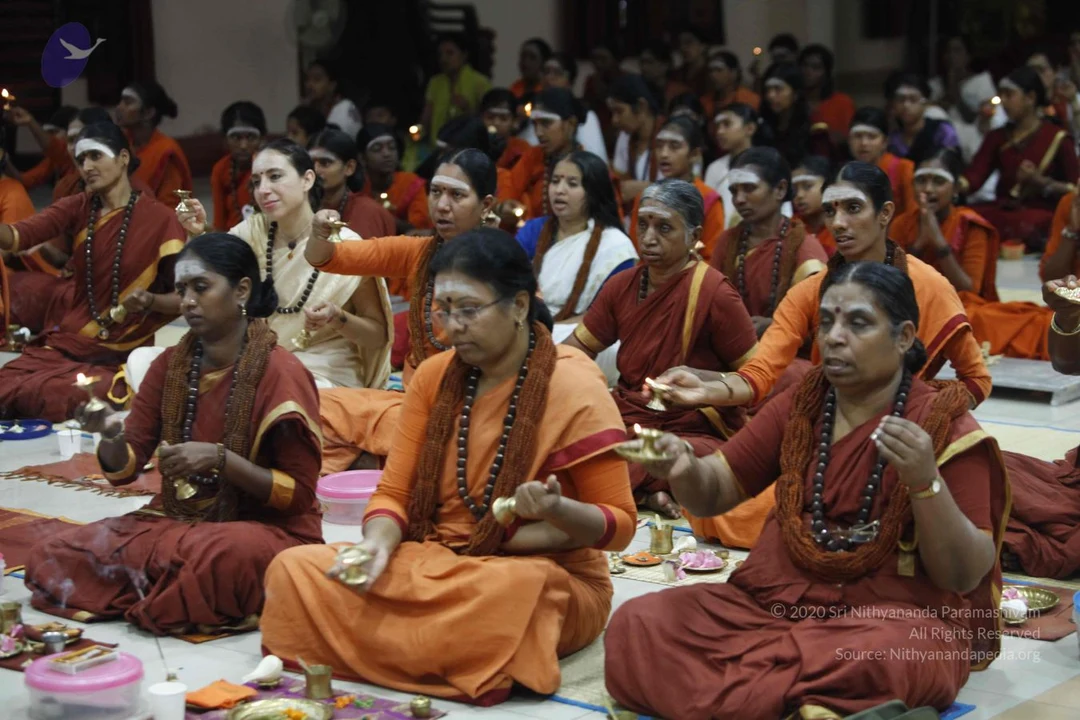
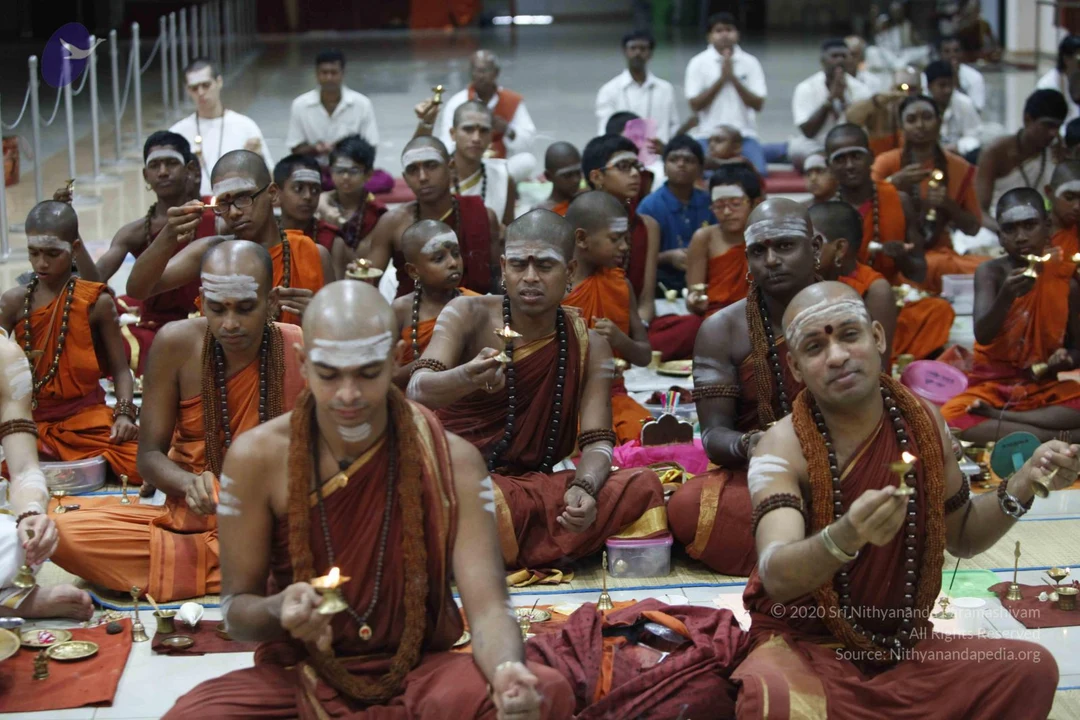
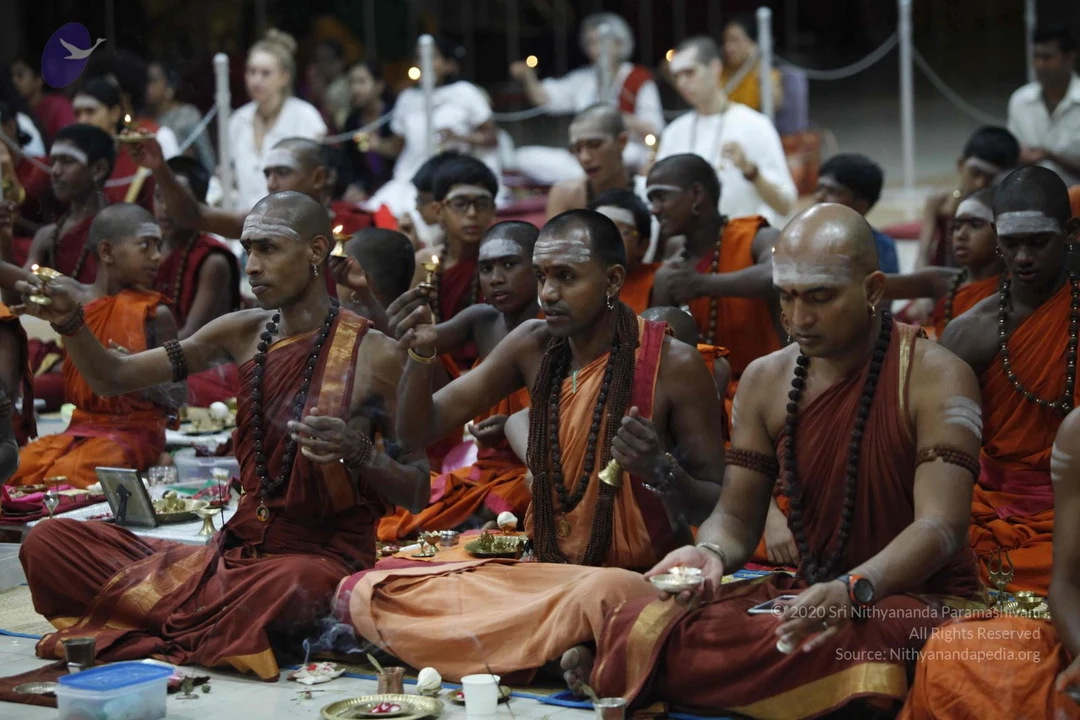
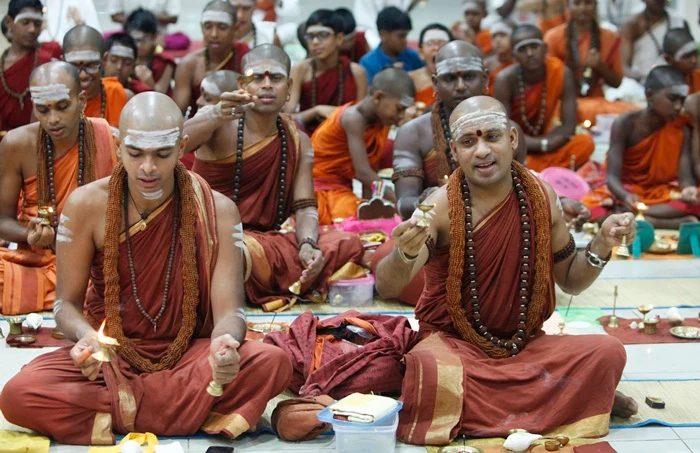
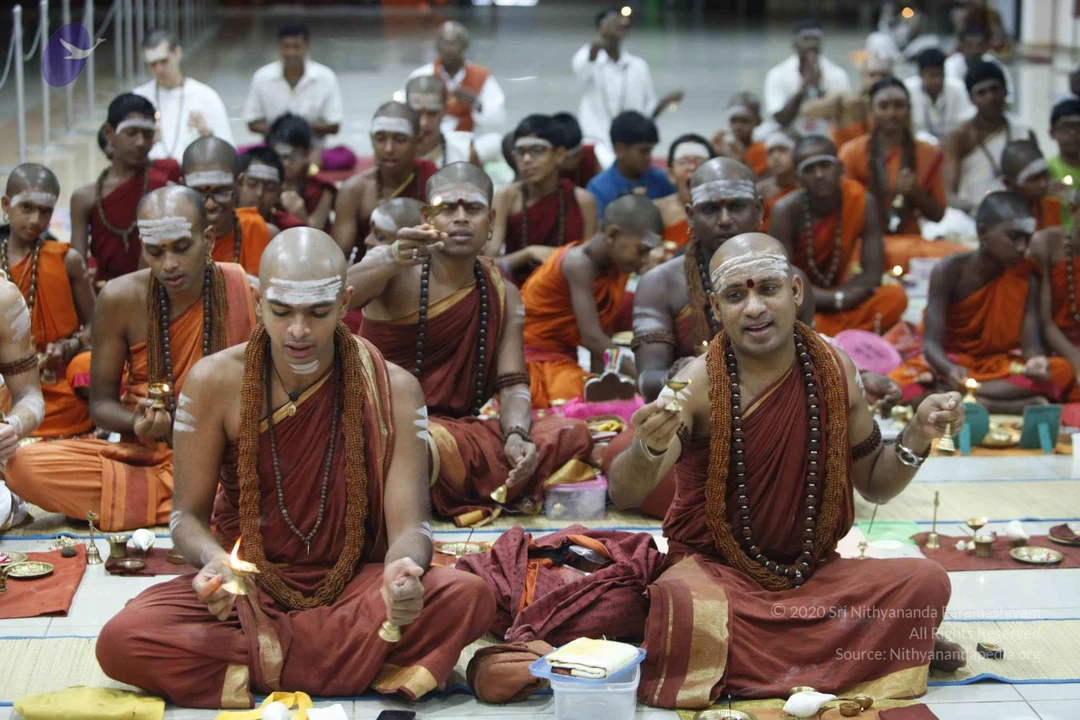
Pada Puja
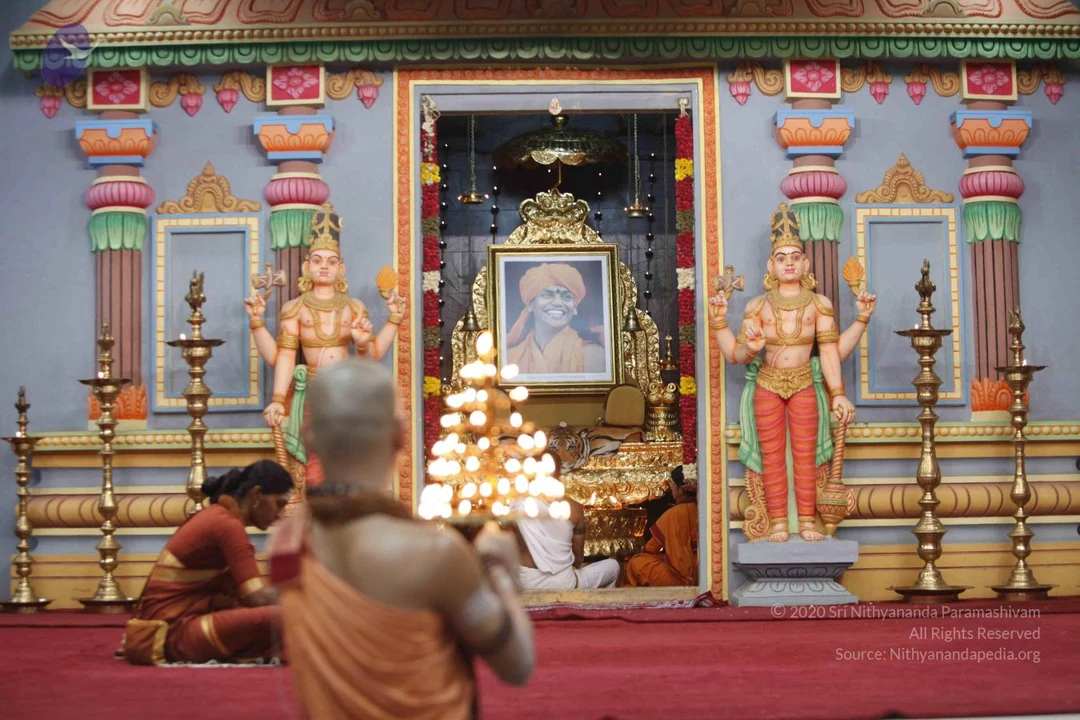
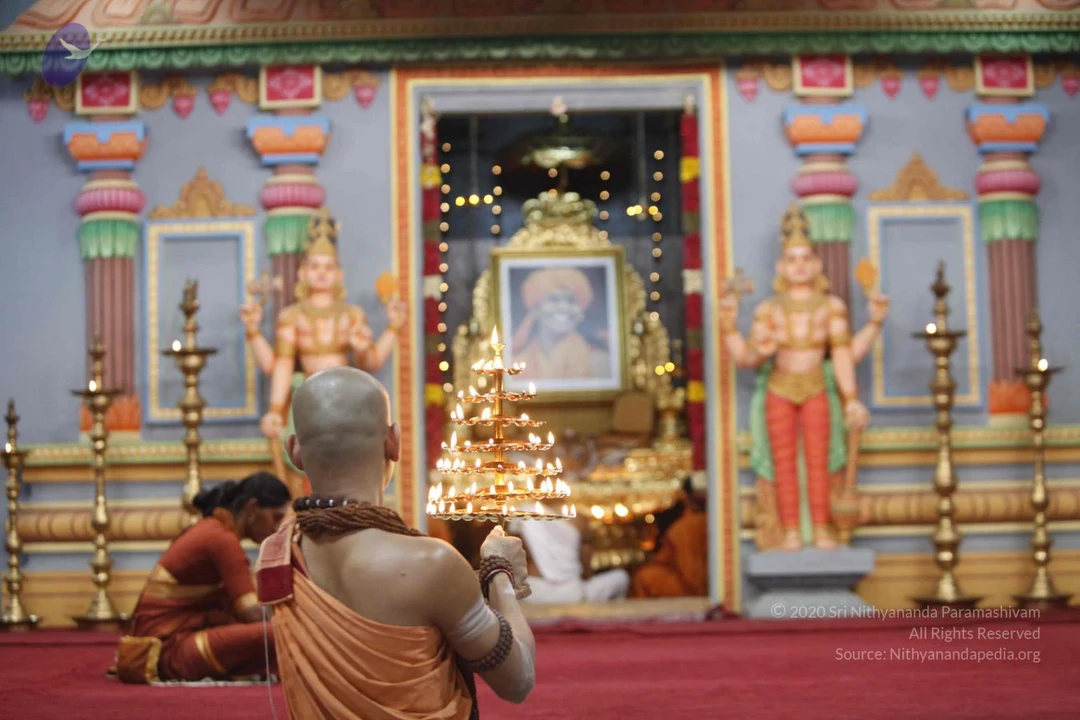
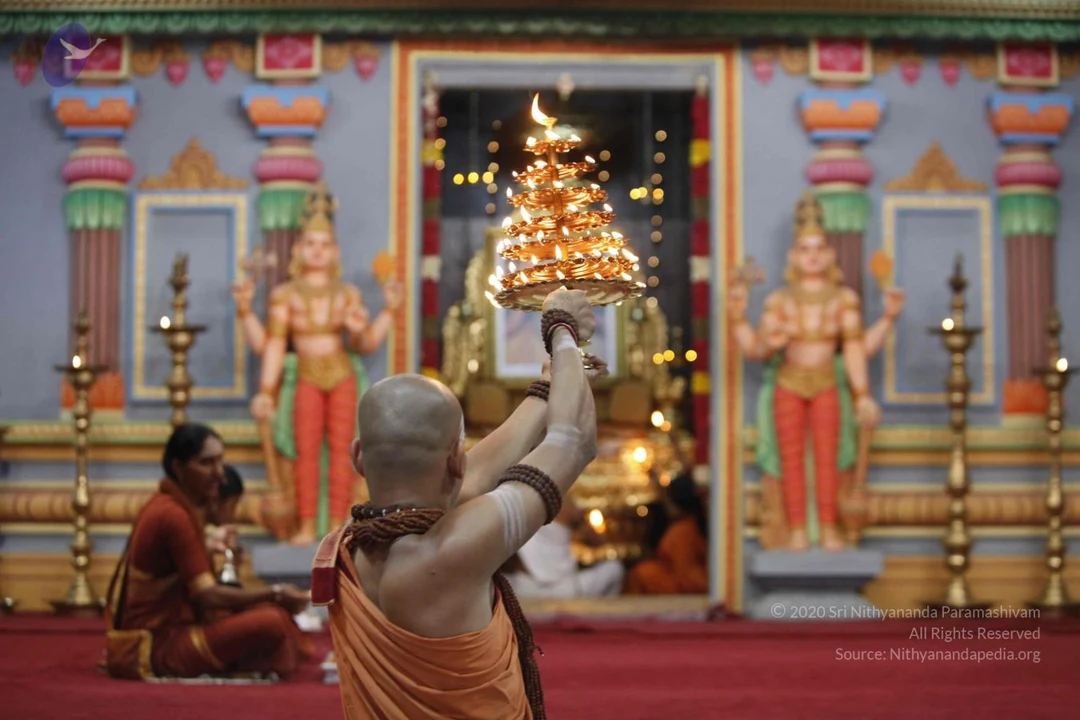
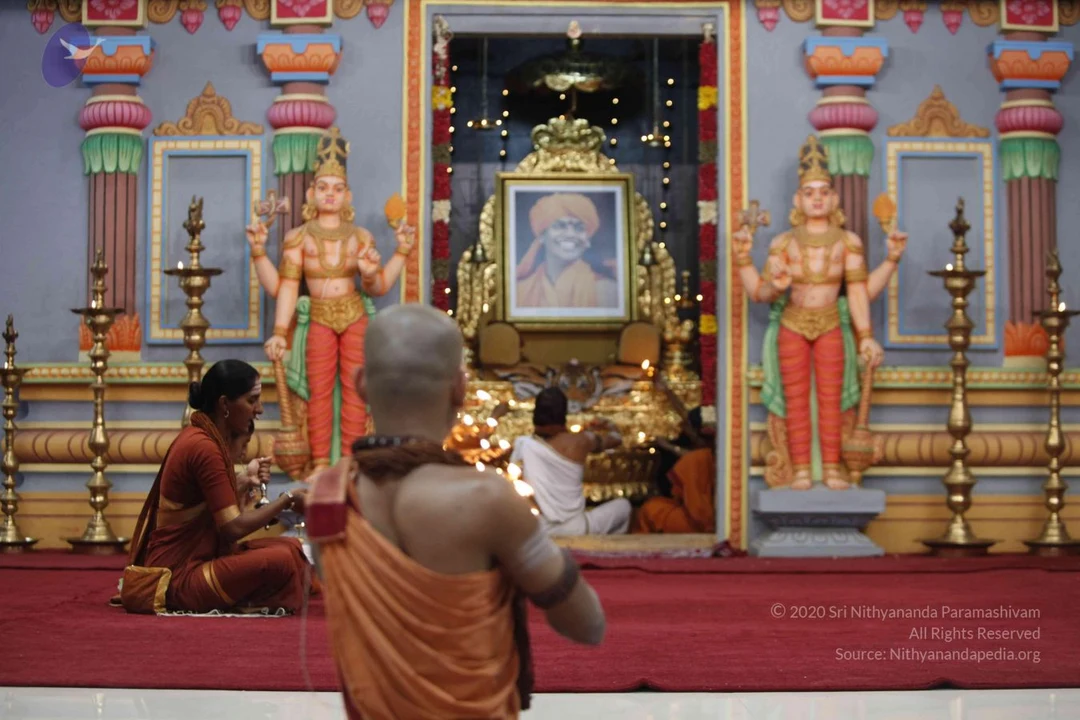
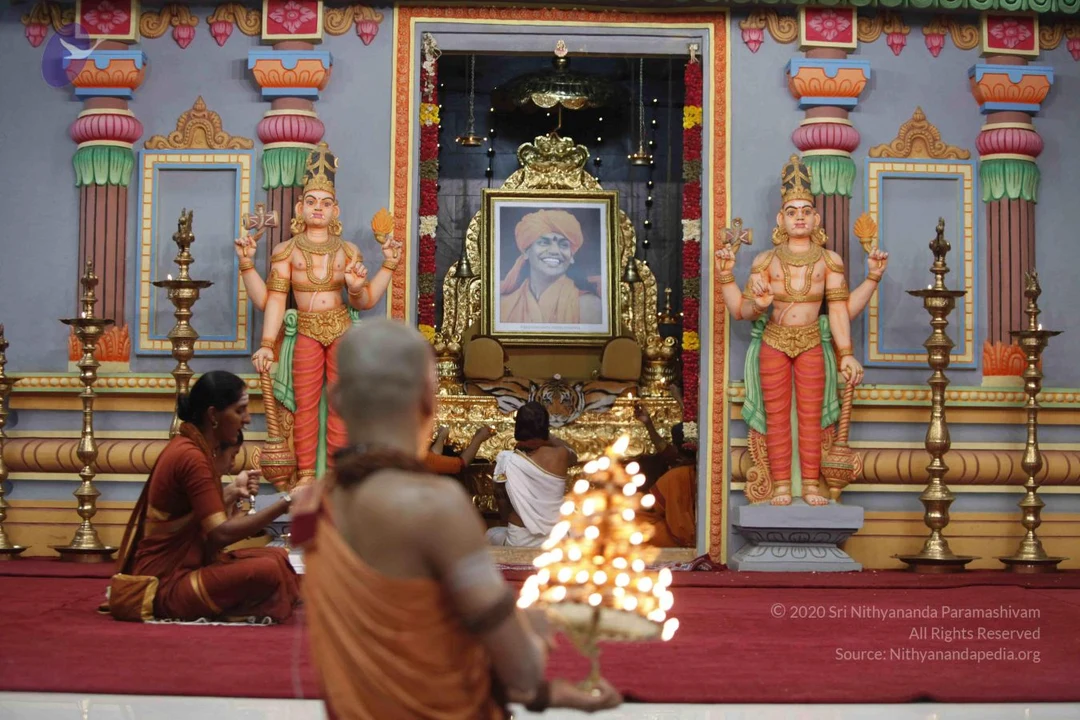
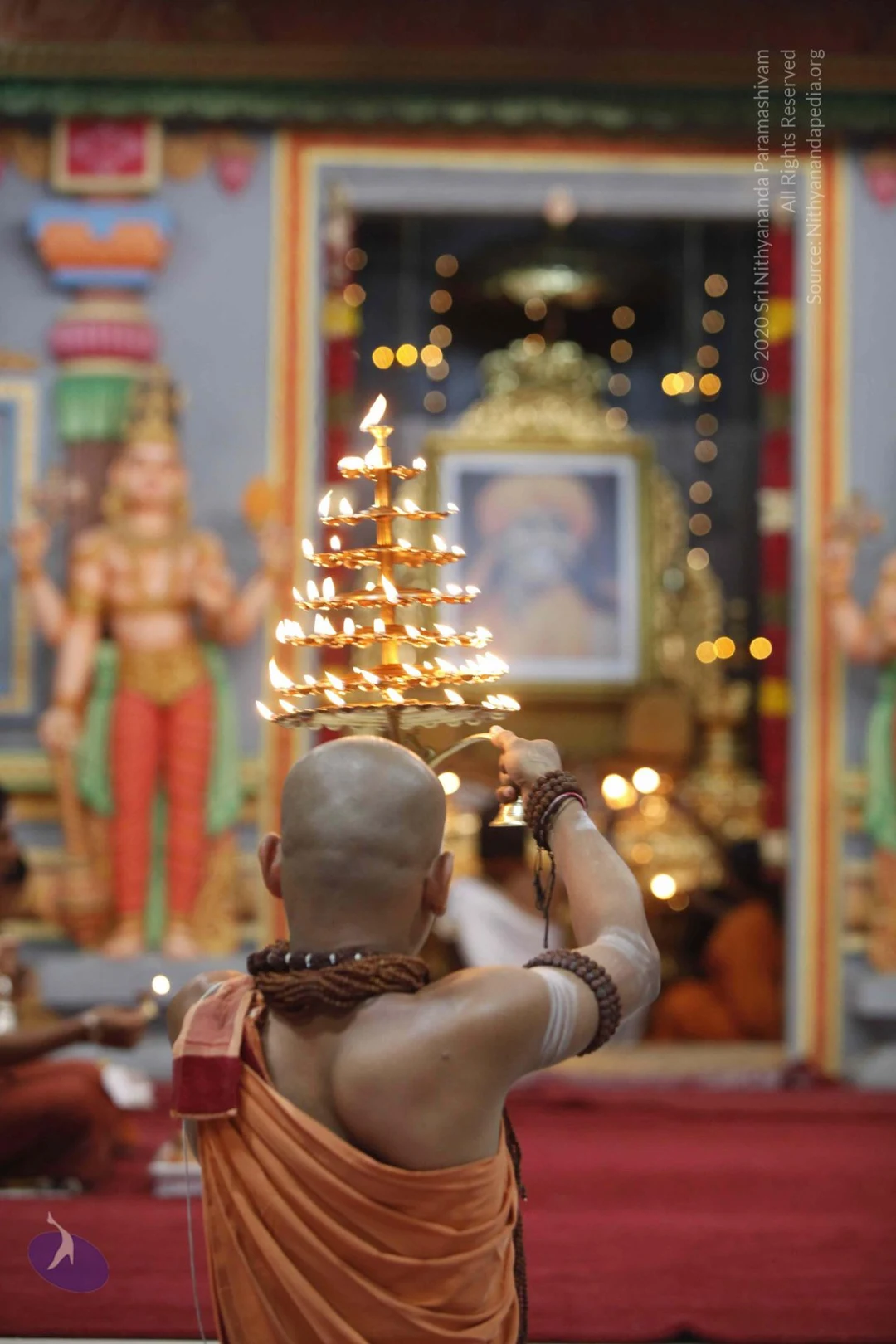
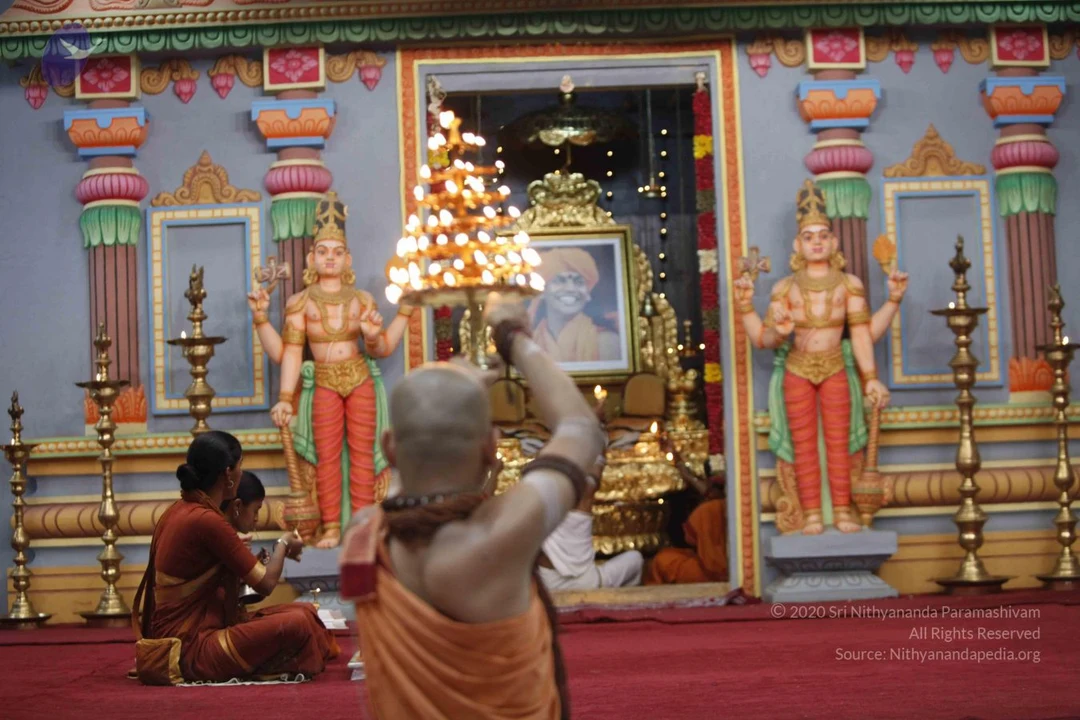
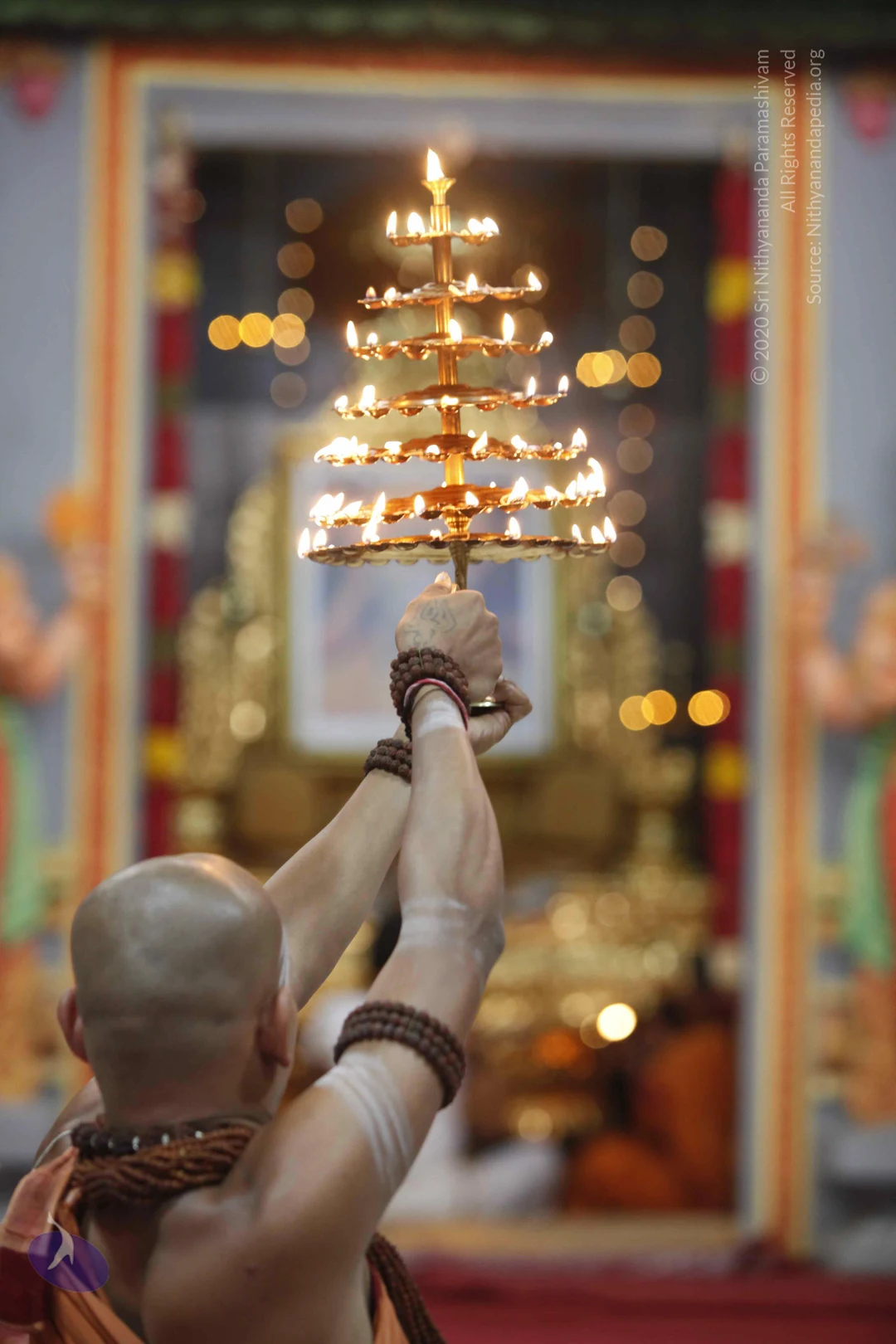
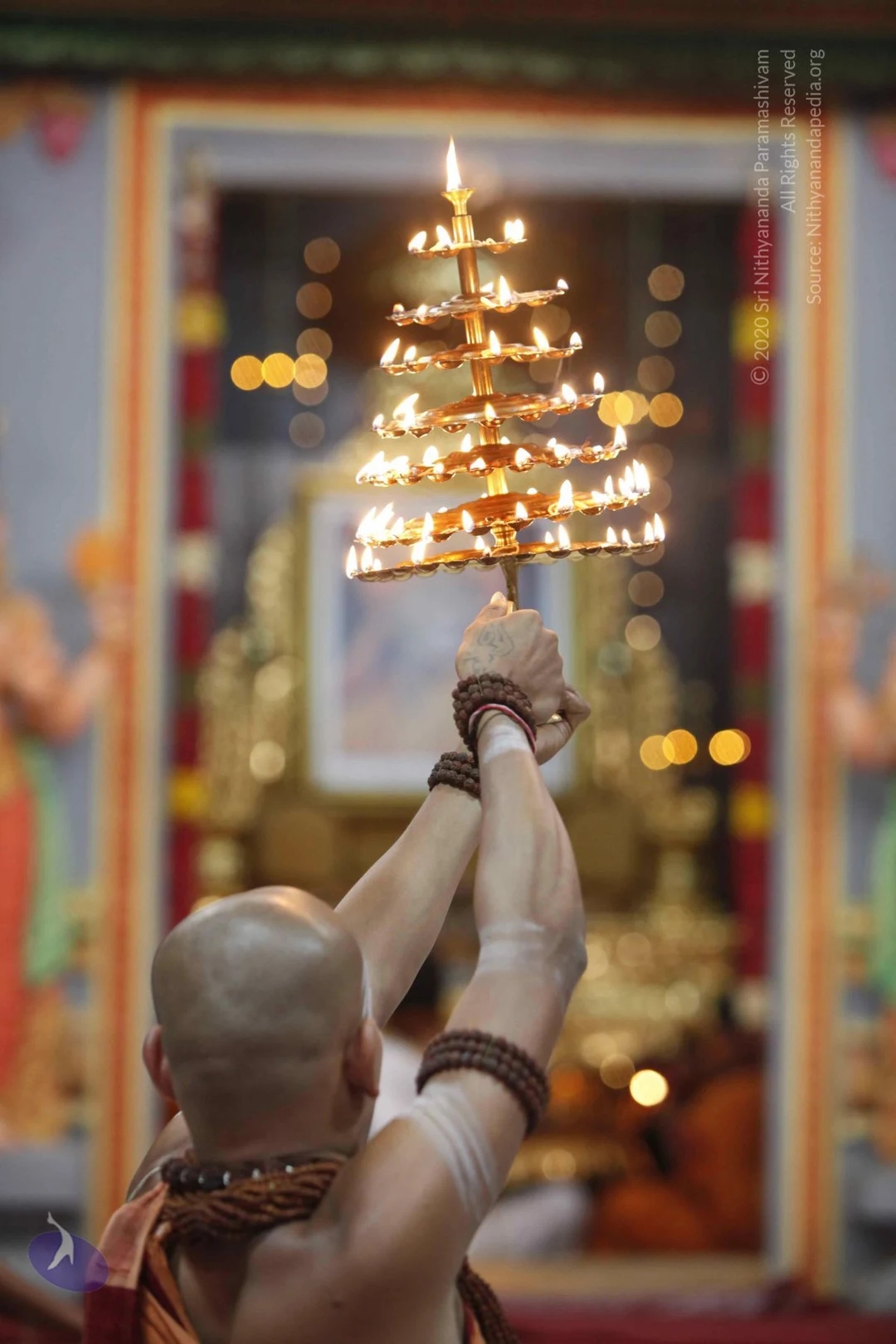
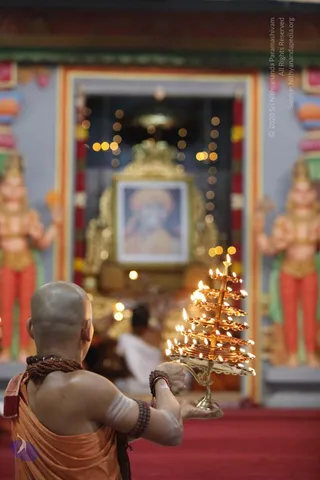
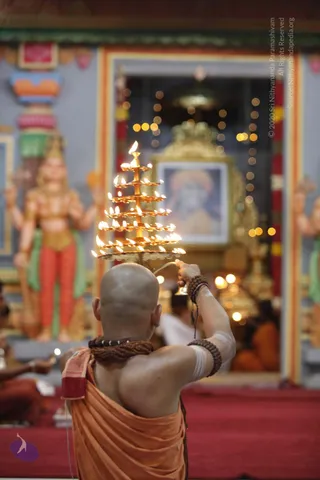
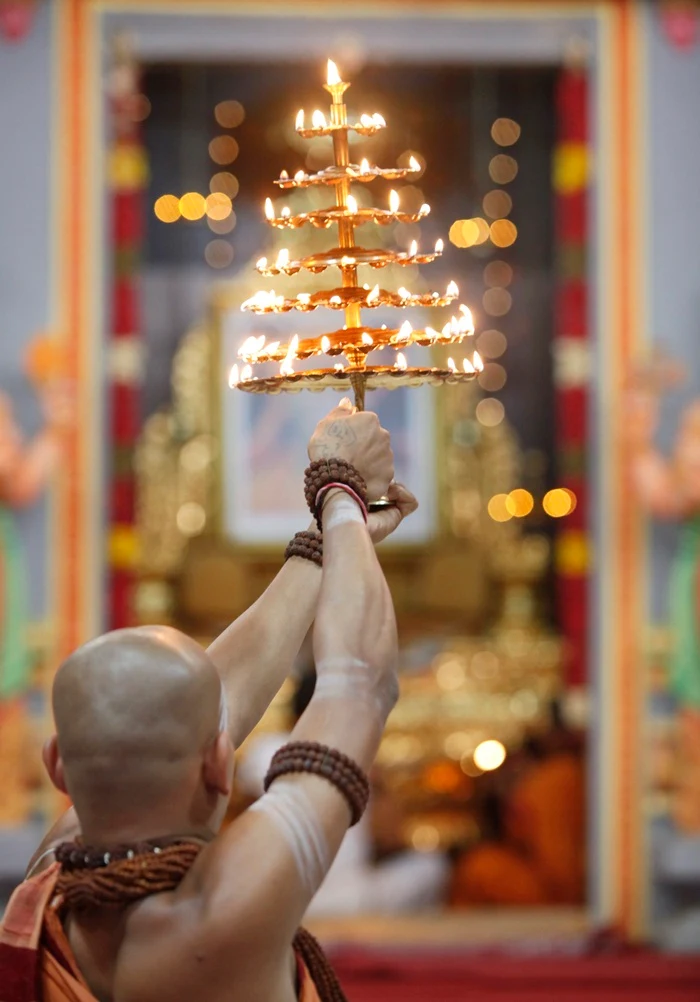
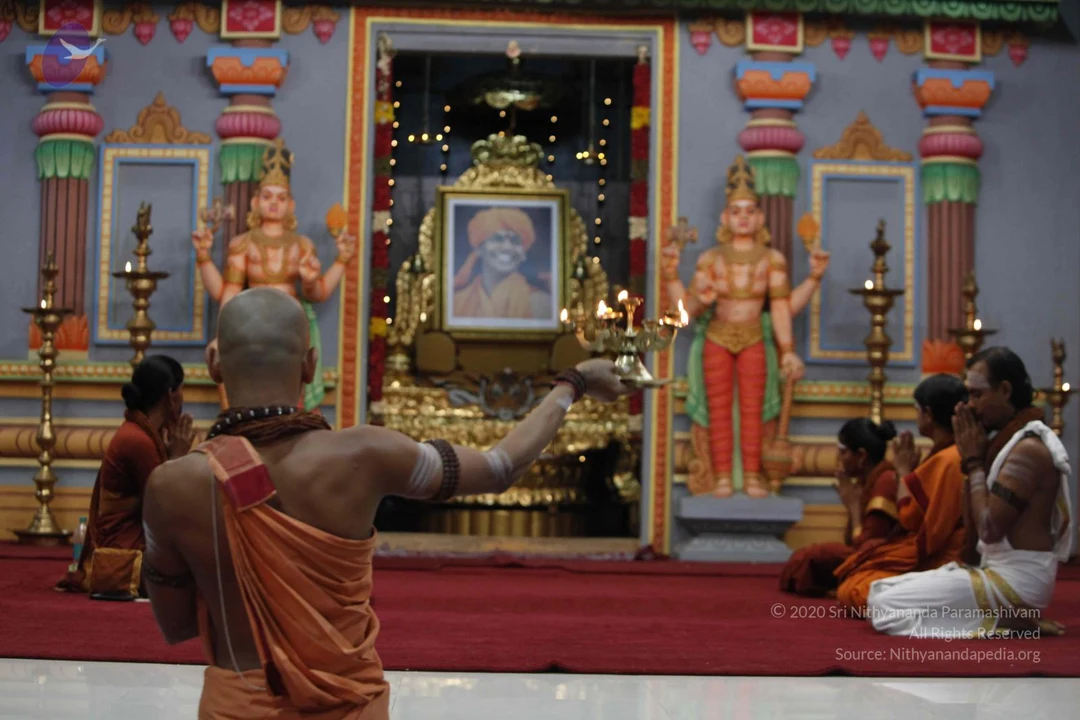
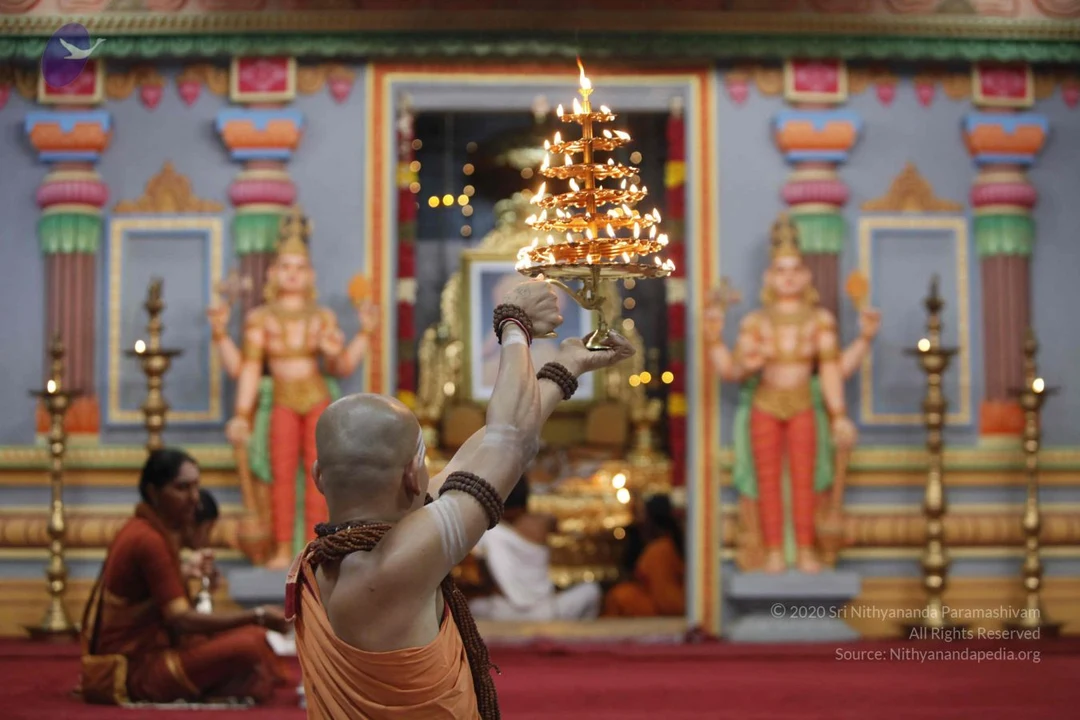
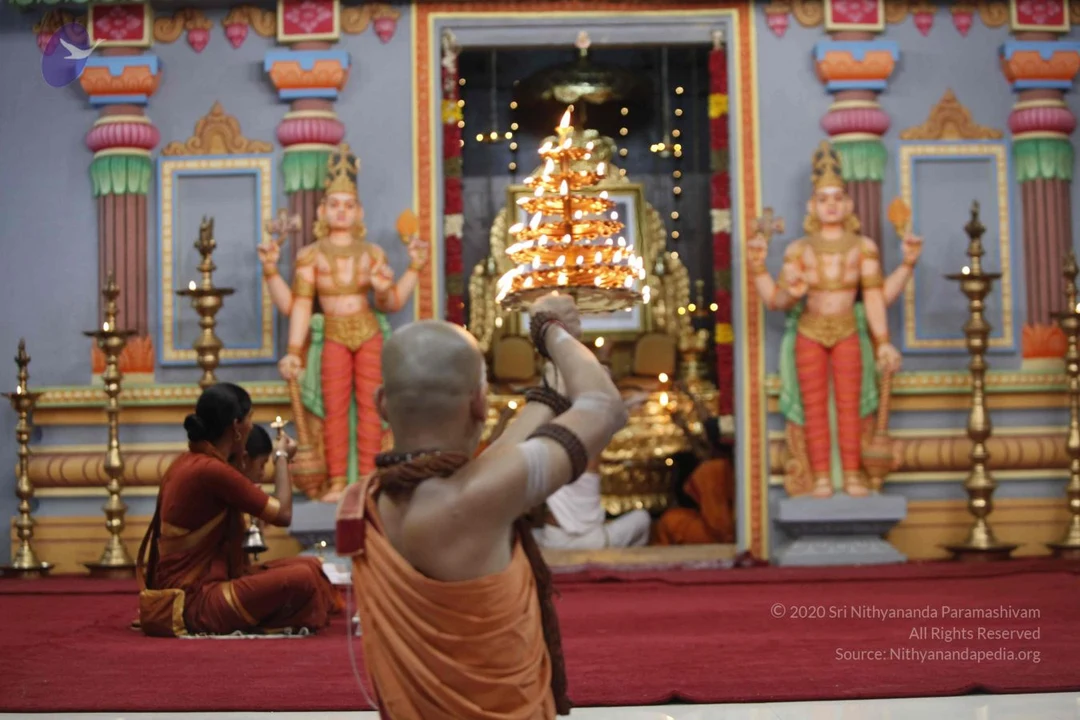
Aarathi to the Guru Moorthi
Nithya Satsang and Kalpataru Darshan
Tags:

Paramahamsa Nithyananda, Power of Creating space, completion, authenticity,, breathe, sanyas, stand egolessly, melt down, your ego is enough to kill you , Inner, Outer, Life Image, align.

Photos Of The Day:

Morning-Satsang

Photos Of The Day:

Morning-Satsang

Photos Of The Day:

Pada-Puja

Morning-Satsang

Sava-Darshan

Photos from this day

View all 73 photos

Pada Puja

2 photosSource gallery
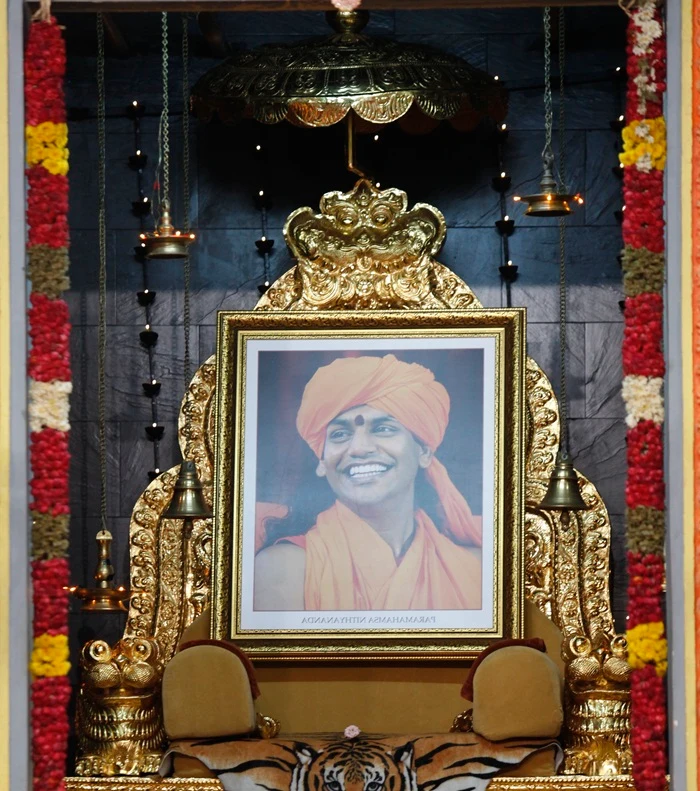
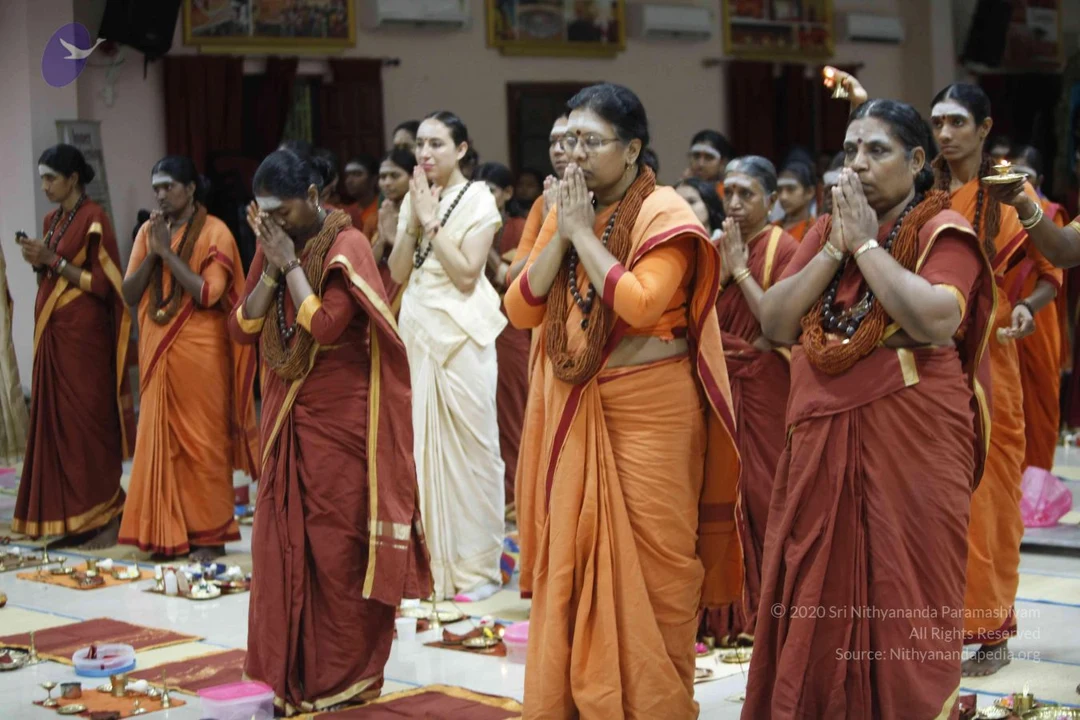
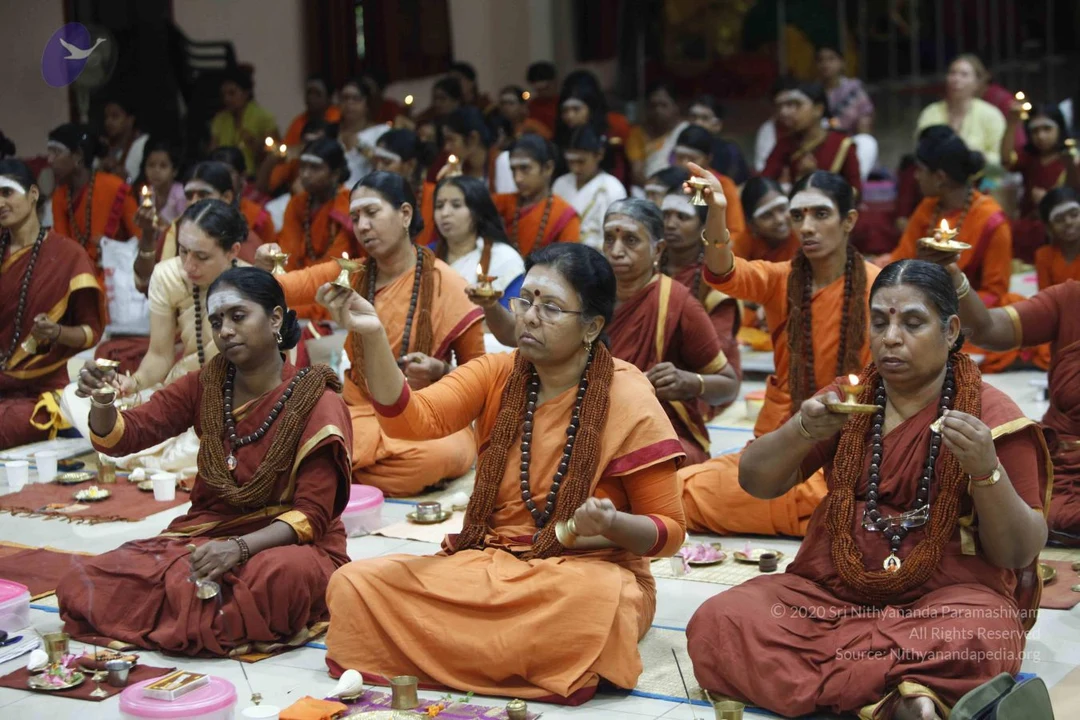
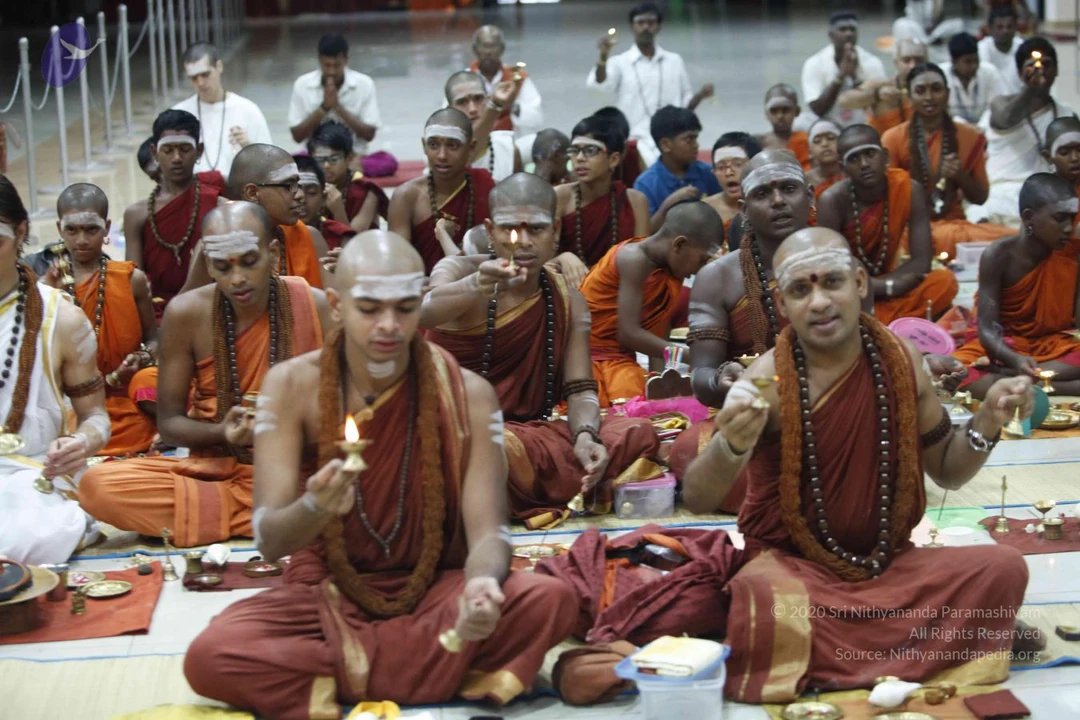
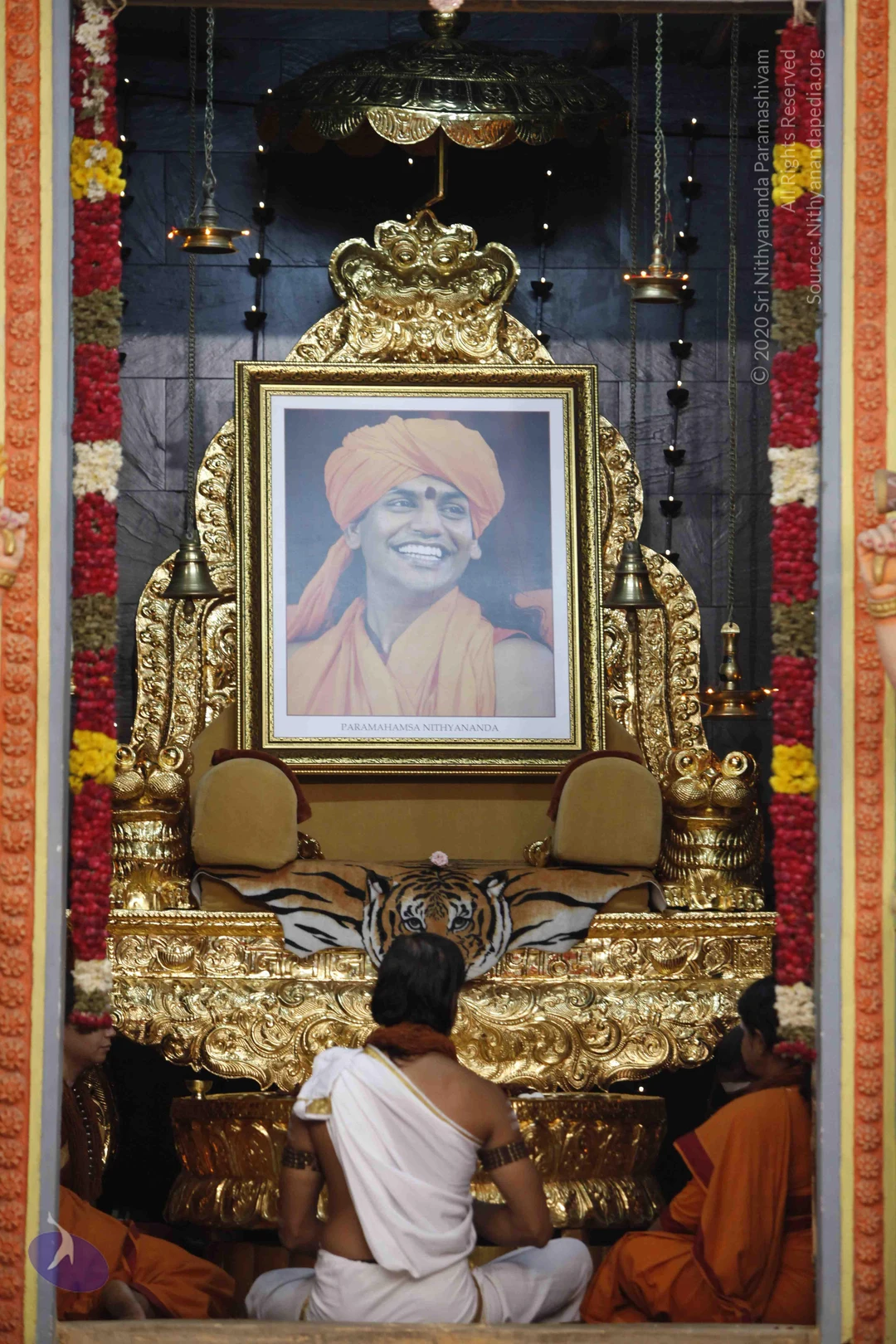
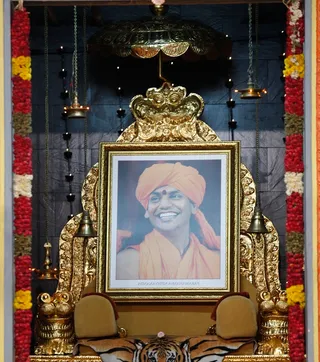
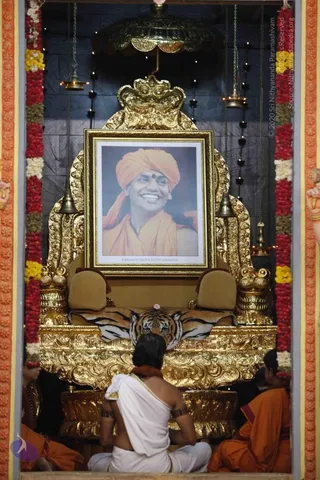
A group of shaven-headed men in reddish-brown and saffron robes sit cross-legged on a floor, many with white vertical tilaka marks and rudraksha malas. Several hold small brass lamps or oil lamps, and some hold small offering bowls and vessels. Brass lamps, incense and small containers are arranged on mats in front of them. Behind them, more seated devotees in orange and maroon clothing fill the hall. The front-centre man in a reddish robe holds a flame and a small brass dish. Roughly a dozen or more people are visible.A framed portrait photograph is displayed on an ornate golden throne (peetha) decorated with carved lion-like motifs, set in a shrine niche. The portrait shows a smiling man wearing an orange-saffron turban with a red dot on the forehead and orange-saffron robes. The throne rests on a tiger-skin cushion with brown seats, and hanging brass oil lamps and rudraksha-bead strands frame it. Red, yellow and white flower garlands surround the niche. The portrait caption reads Paramahamsa Nithyananda. No physical people are present.

Aarathi to the Guru Moorthi

2 photosSource gallery
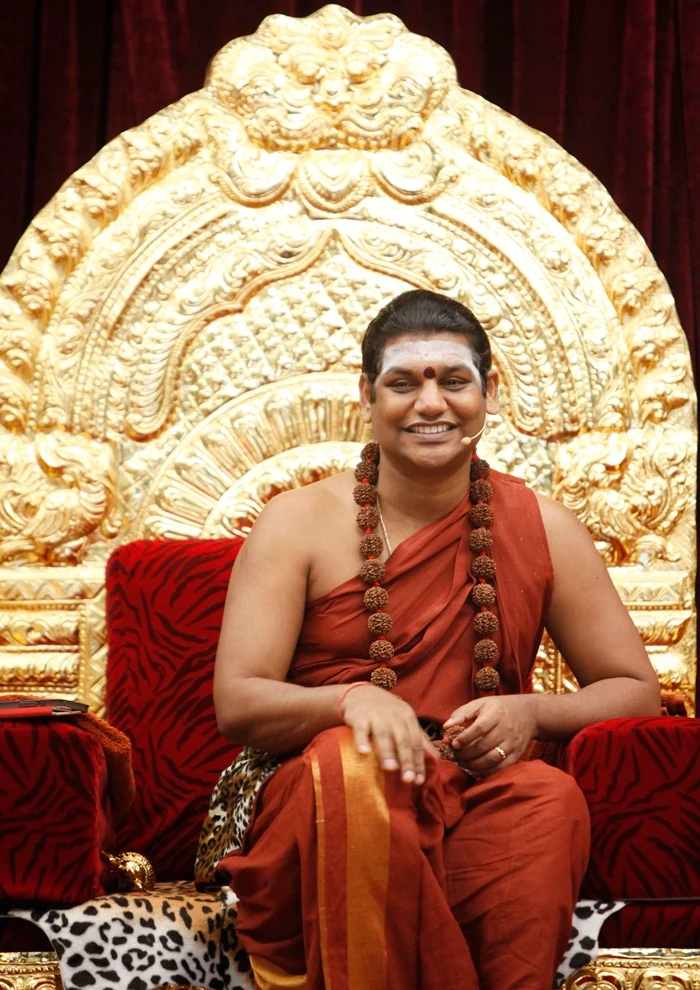
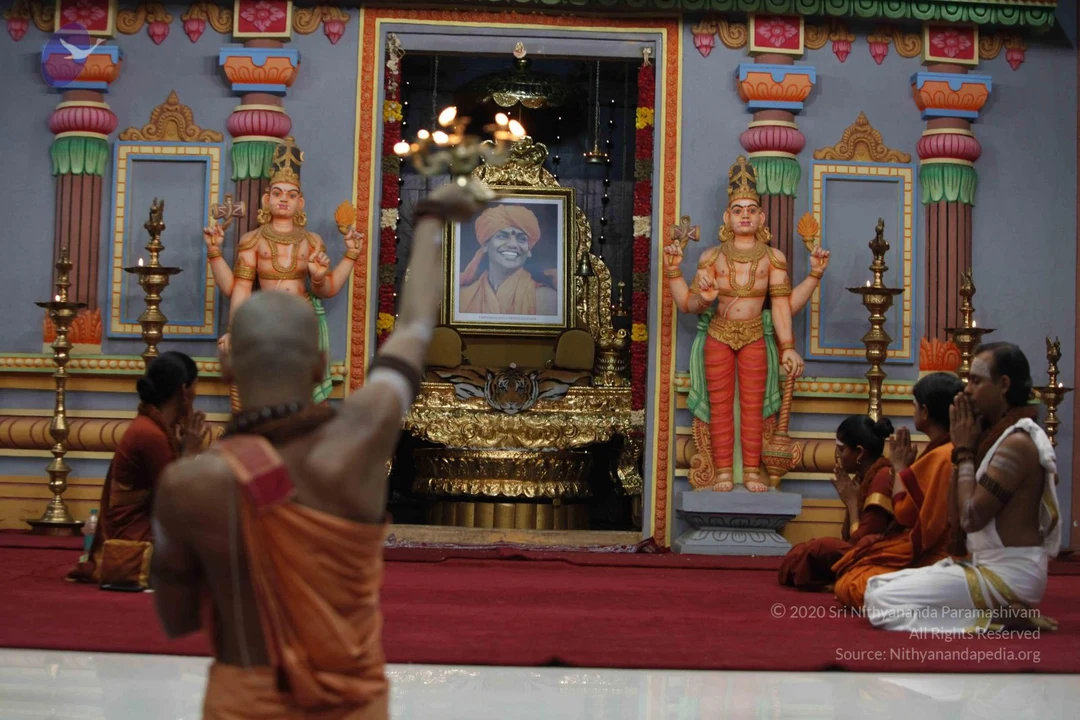
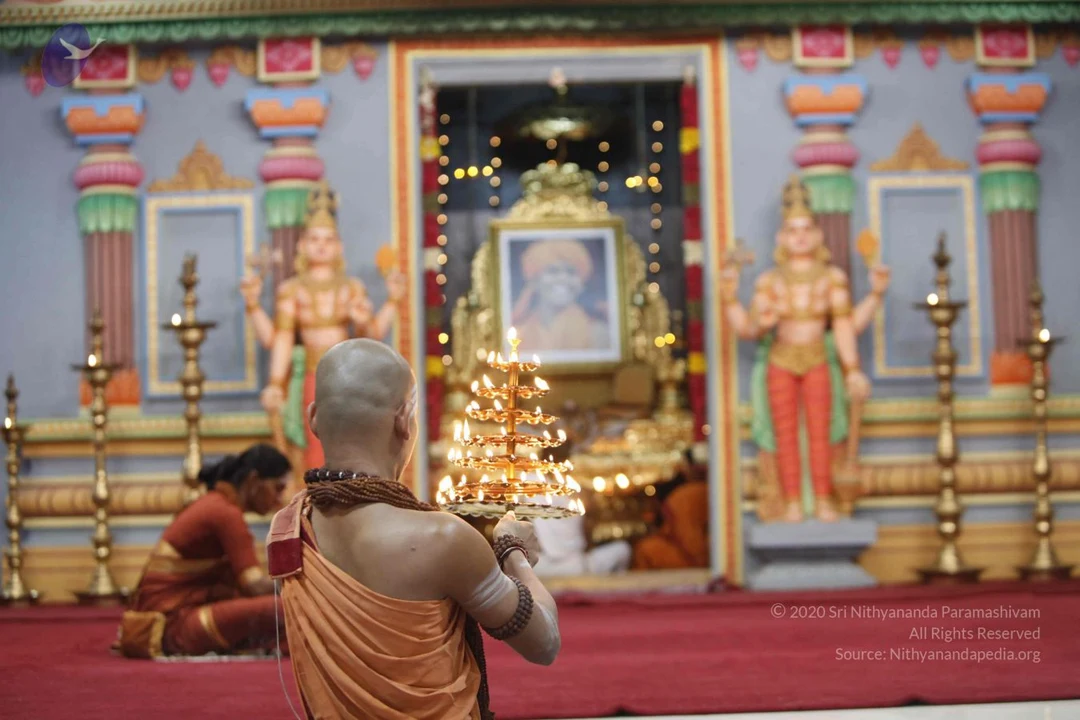
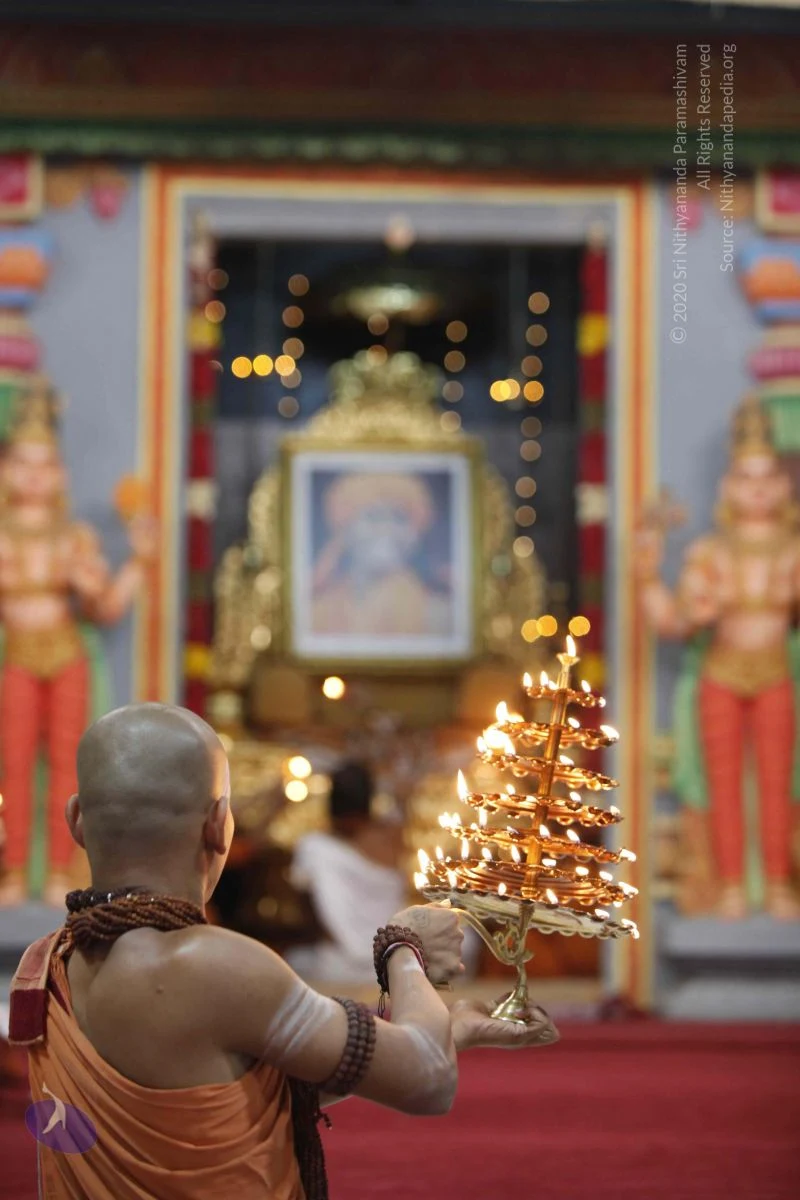
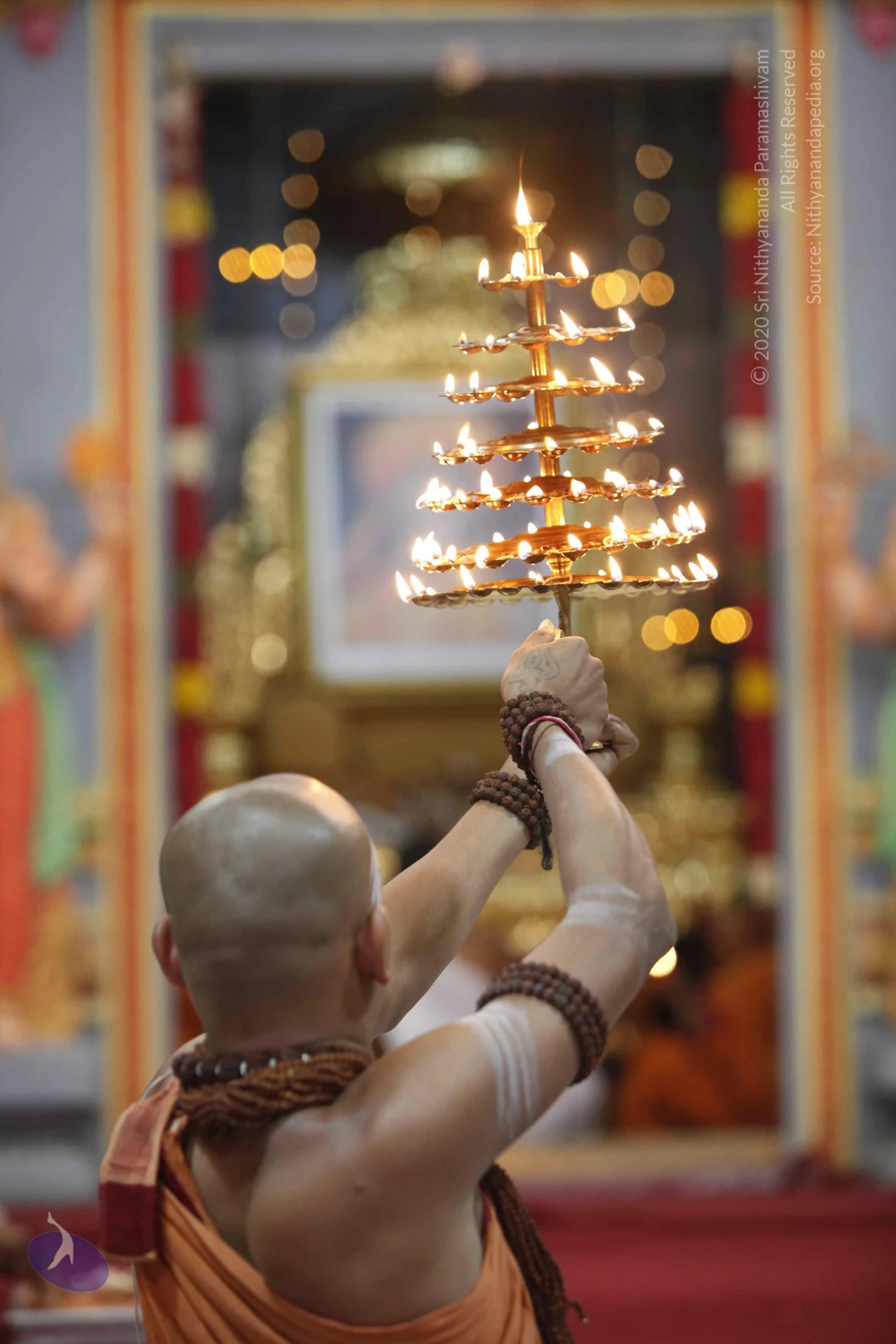
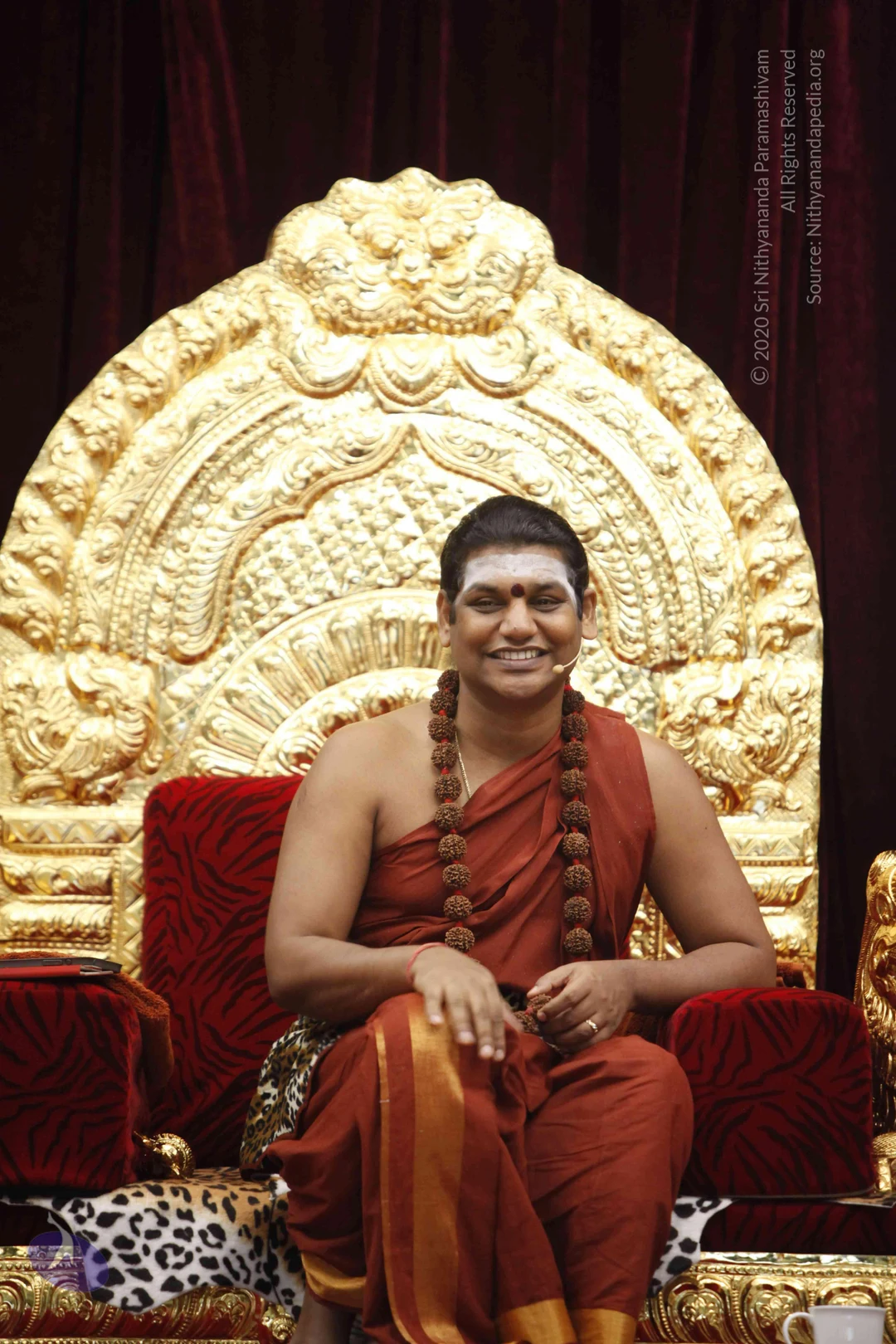
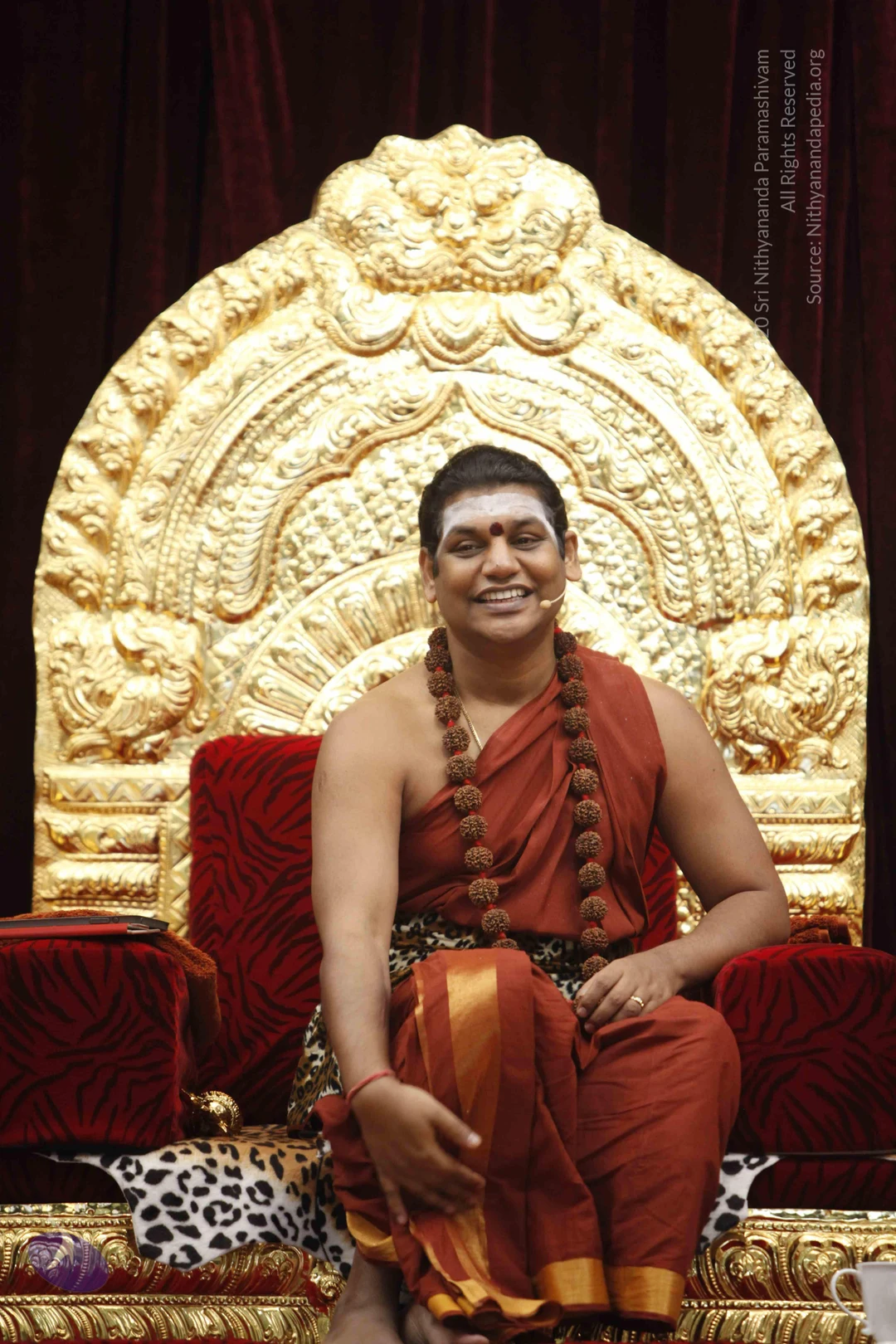
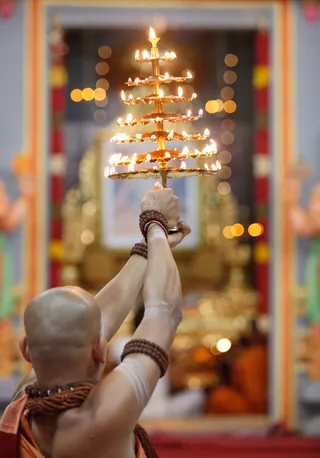
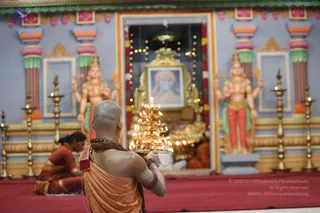
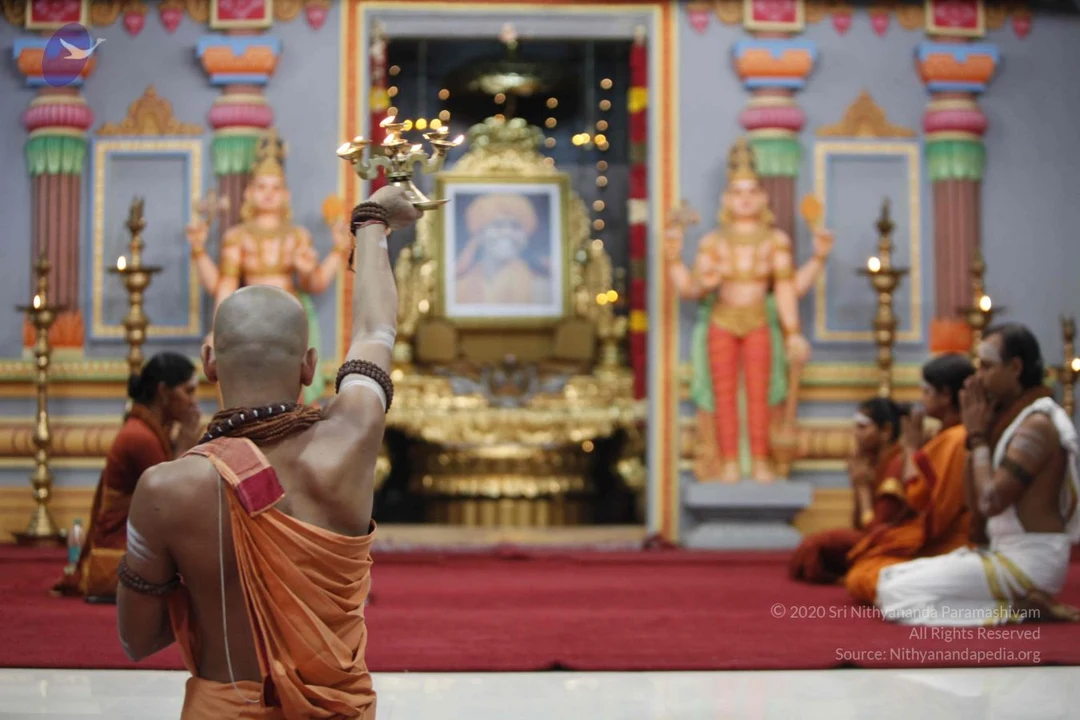
A shaved-headed man in saffron-orange robes, seen from behind, raises a tiered brass aarti lamp with many lit oil lamps toward a shrine. He wears multiple rudraksha malas on his arms and neck, and white markings are visible on his forearm. Behind him, a framed picture stands on a gold-toned altar with warm bokeh lights, red and gold decorative pillars frame the doorway, and other people in orange sit faintly in the background. The scene is an aarti being performed at a temple shrine.A smiling man sits on an ornate gilded throne with a carved golden backrest, upholstered in red tiger-striped velvet with a leopard-print cushion below. He wears a rust-orange cloth wrapped over one shoulder, a gold-bordered dhoti, and long rudraksha mala necklaces hanging to his chest, with a small gold chain and a red bindi and white vibhuti marks on his forehead. A small microphone clips near his face and a gold ring is on one finger. Dark red drapery forms the background.

Nithya Satsang and Kalpataru Darshan
4 photosSource gallery
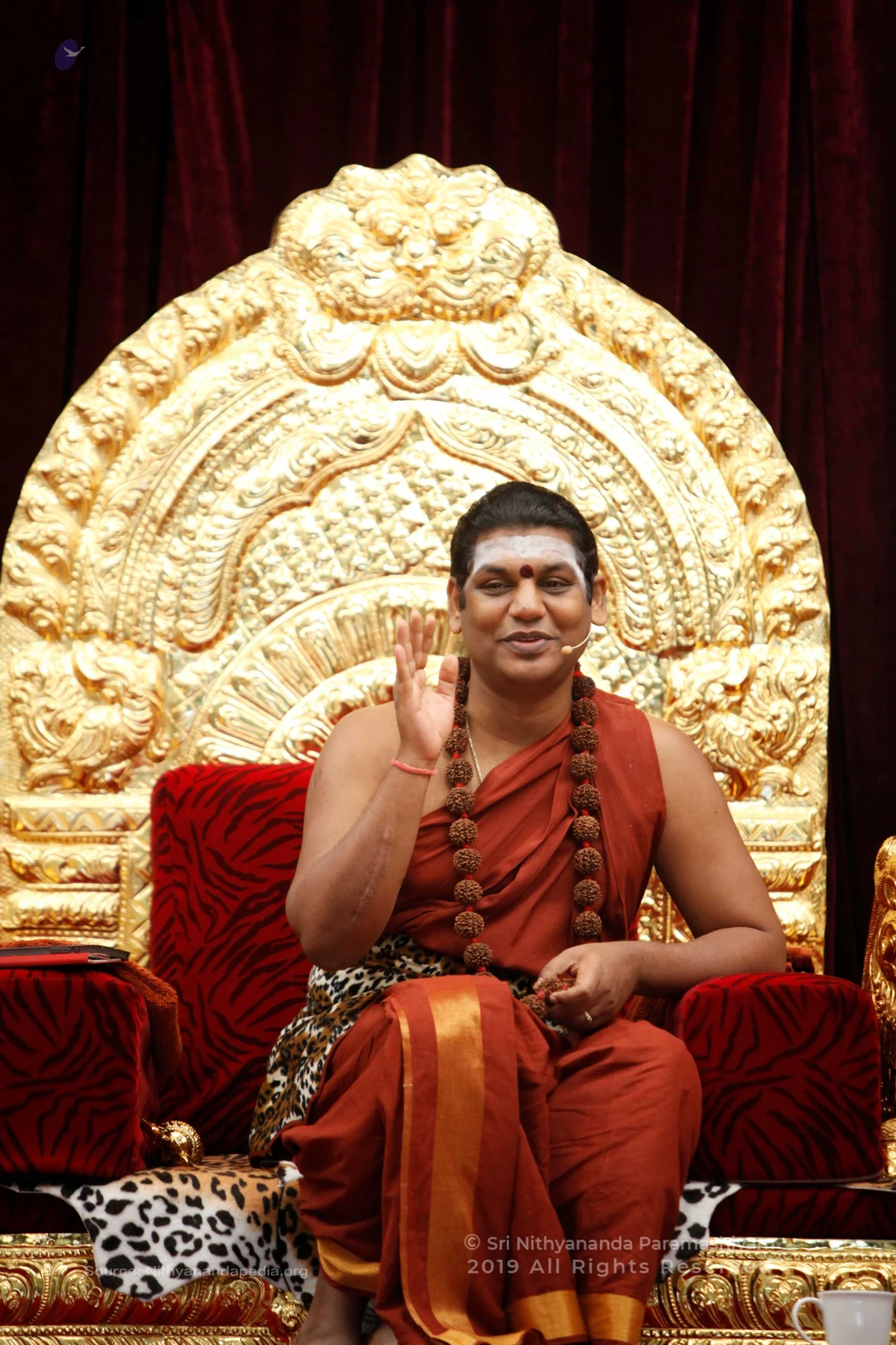
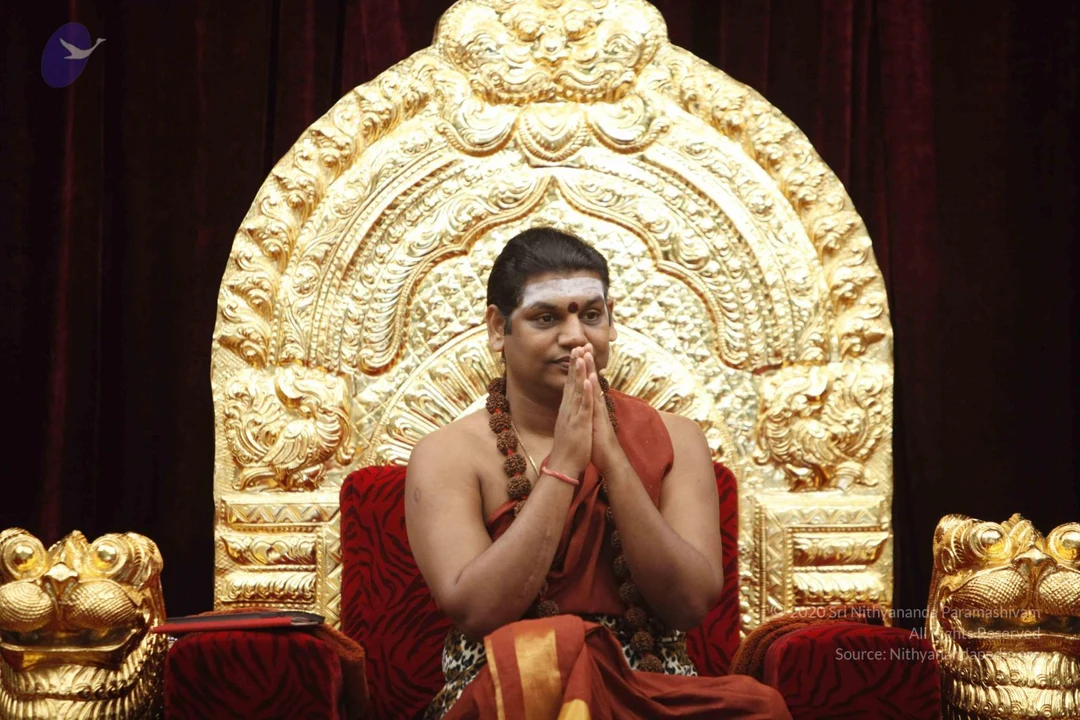
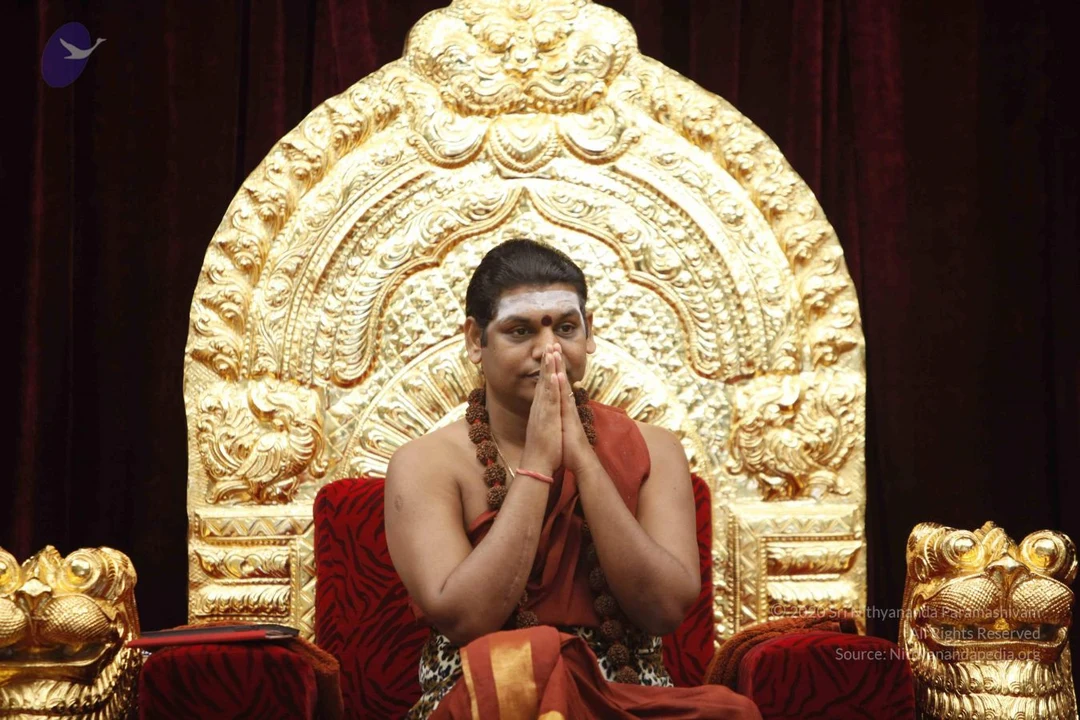
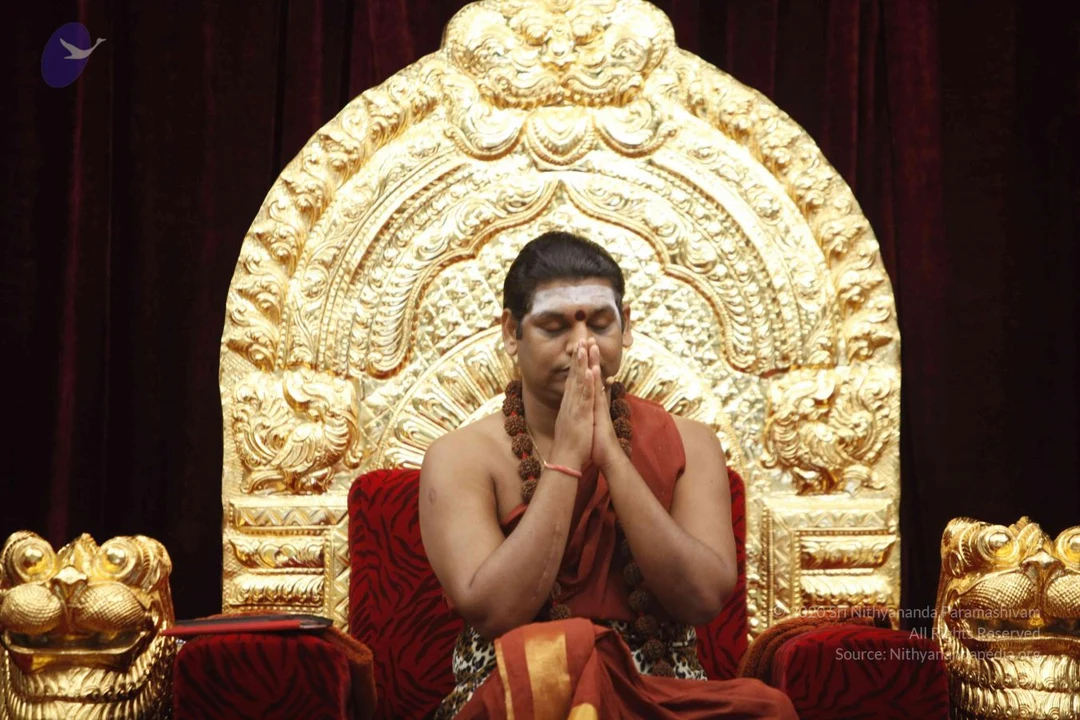
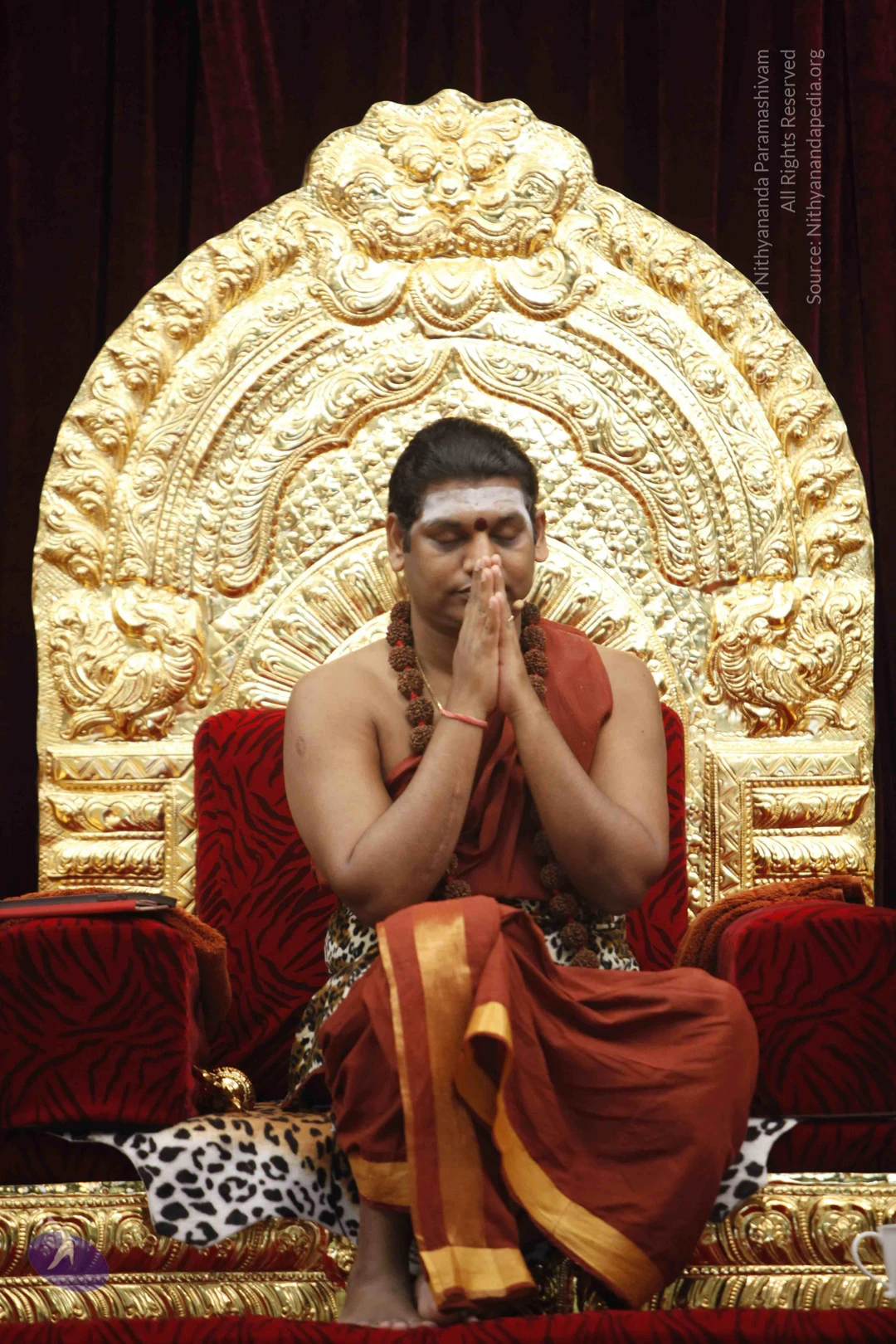
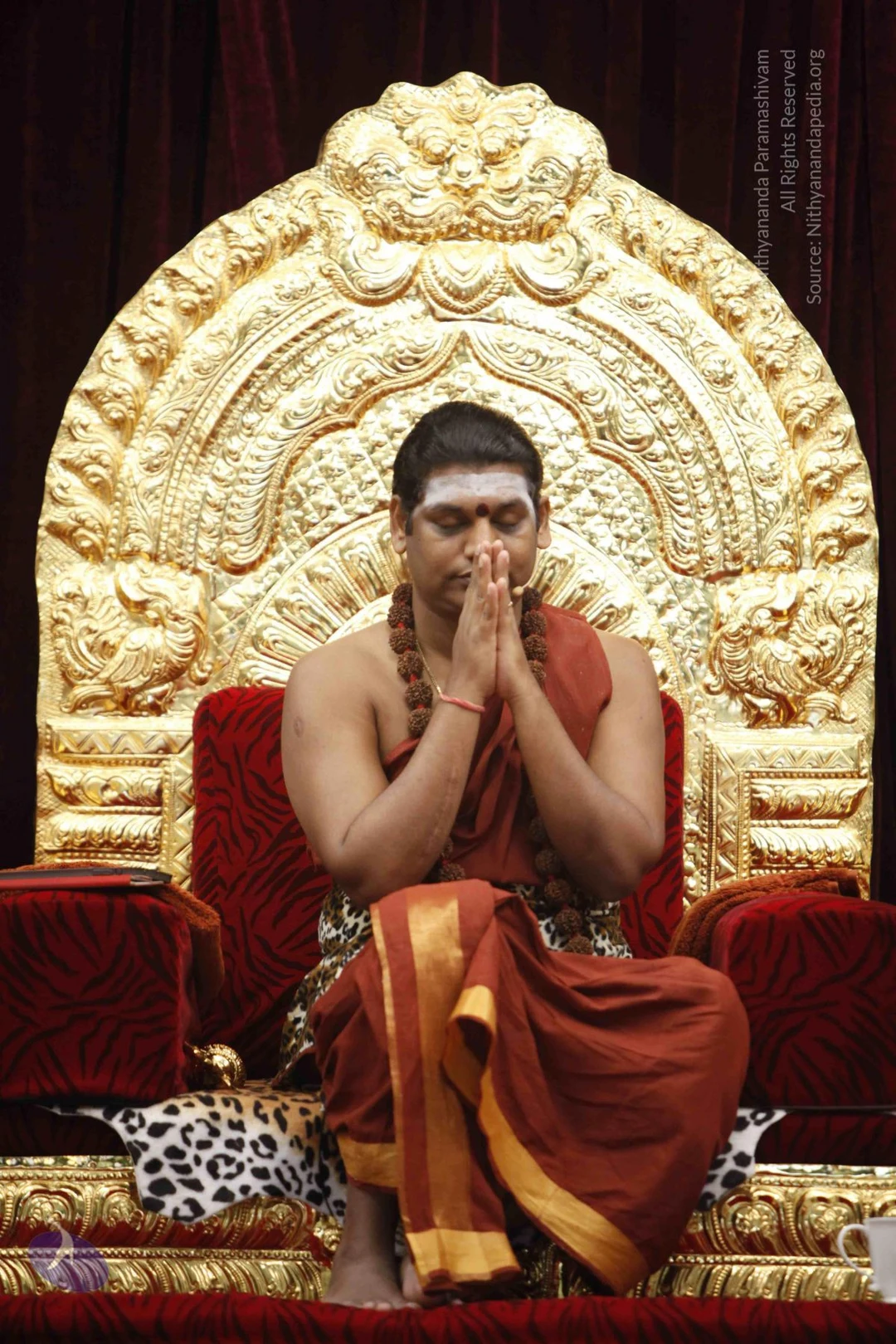
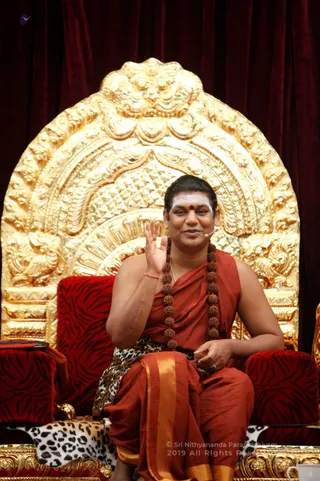
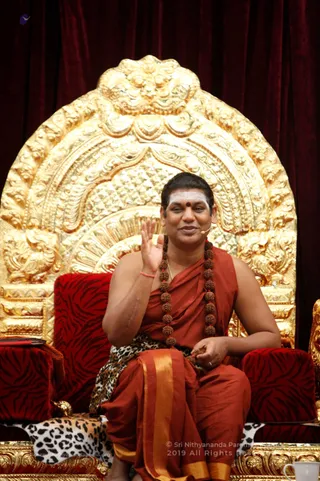
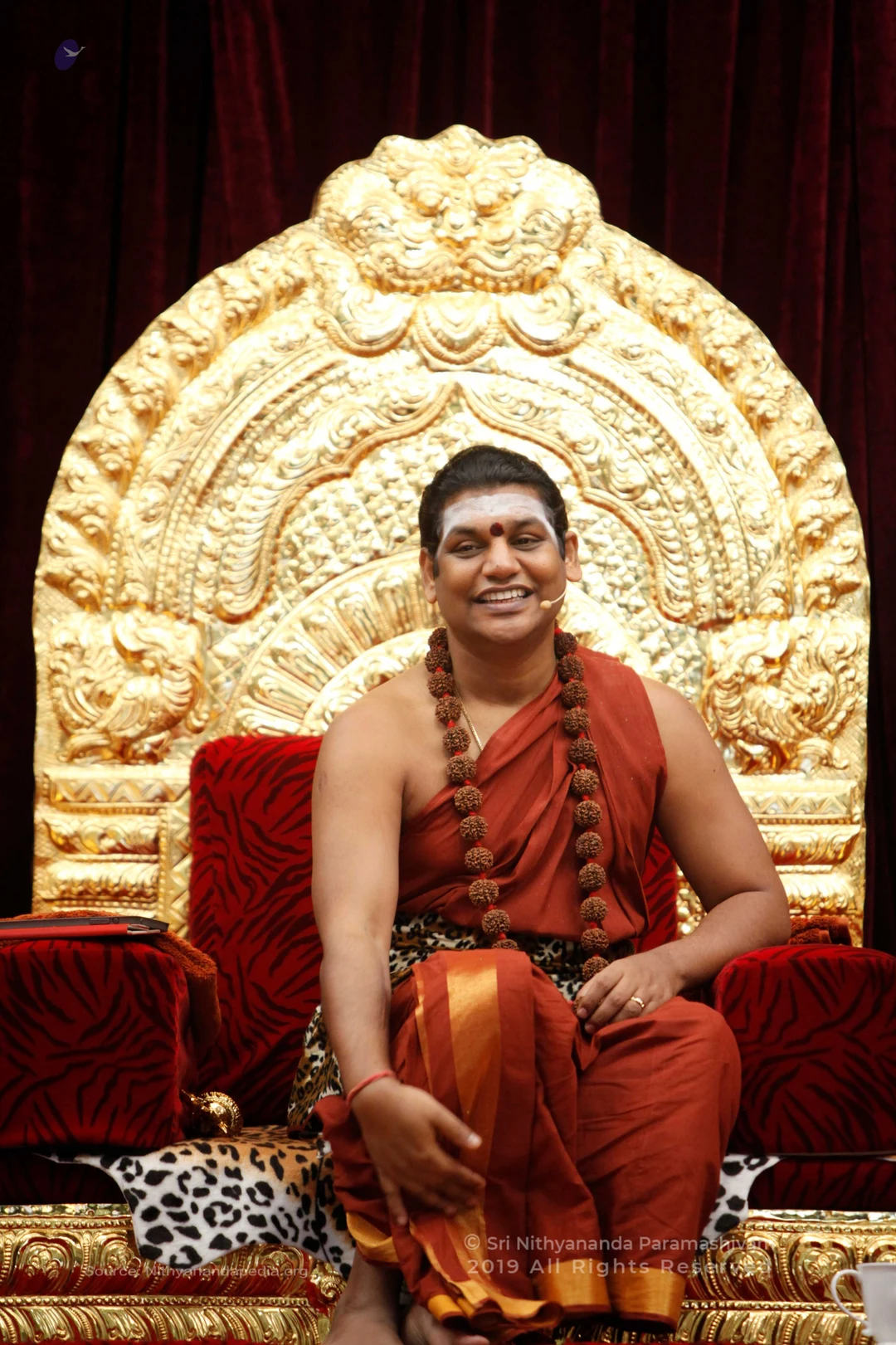
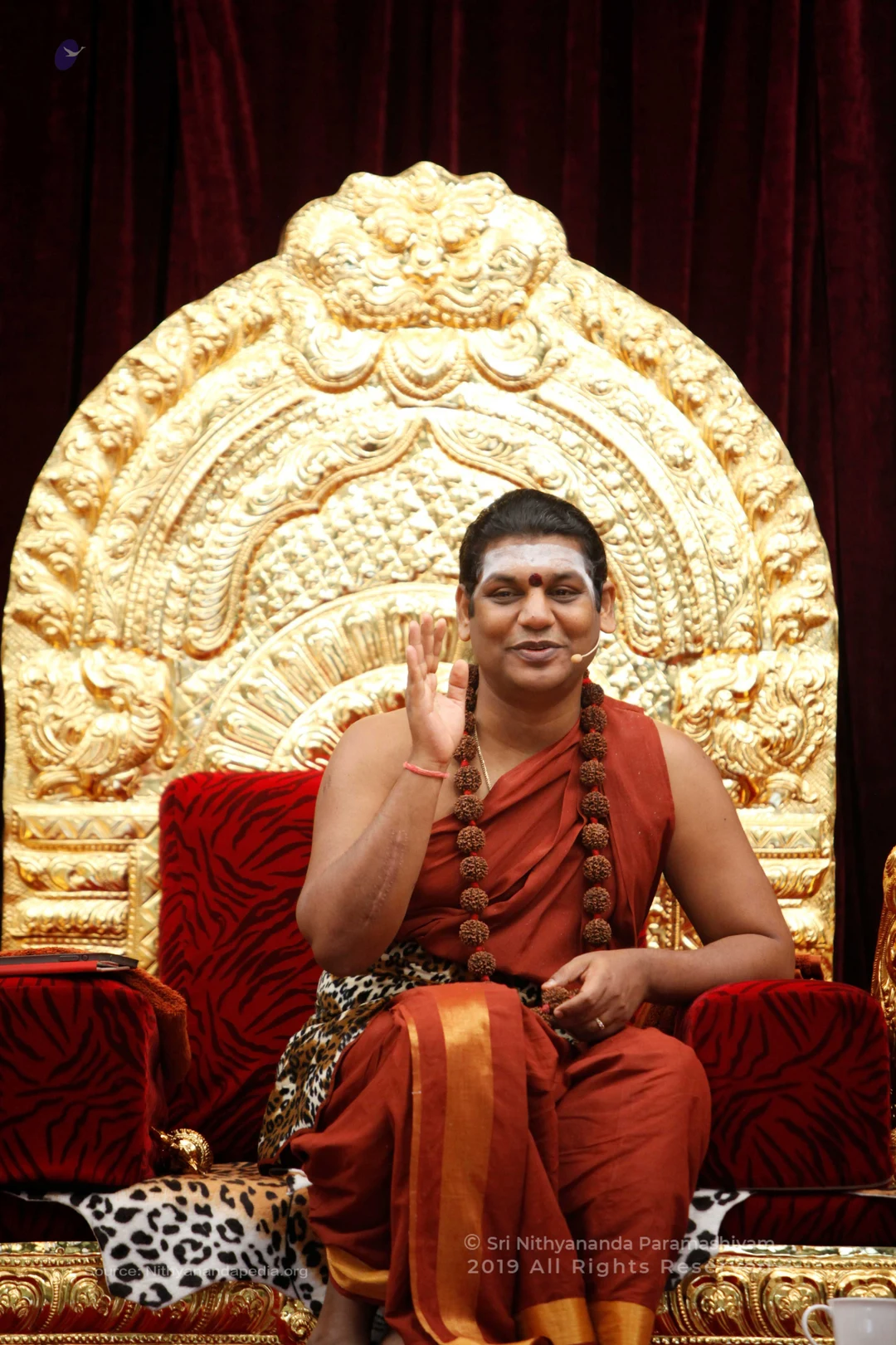
A seated man in a rust-orange sleeveless robe with a gold-bordered dhoti and a leopard-print cloth over his lap raises his right hand in a greeting or blessing gesture while speaking into a head microphone. He wears long rudraksha mala necklaces, has a white forehead marking with a red bindi, and a red thread on his wrist. He sits on a red velvet throne with tiger-stripe upholstery in front of an ornate gold carved arch and deep red curtains. A white teacup and saucer are visible at the lower right, and a red tablet rests on the left armrest. a person: the person wears the saffron-orange robes, rudraksha malas and central throne setting associated with the presentation, and is delivering a discourse.A seated man in orange-red ochre sannyasi robes, with a bare right shoulder and a draped cloth, sits on an ornate gold-carved throne against deep maroon velvet drapery. He wears a long string of rudraksha beads across his chest, a white forehead marking with a red dot, and a small microphone at his cheek. He raises his right hand mid-gesture as if speaking to an audience, while his left hand holds beads. A red-and-black tiger-striped cushion and a leopard-print cloth surround him, and a teacup sits at the lower right. Appearance suggests a person giving a satsang discourse from the throne, based on the rudraksha malas, orange-red robes and ornate throne.A man seated on an ornate gold-leaf throne with carved lion-head armrests and a deep red velvet backdrop, palms pressed together in namaste. He wears a saffron-orange cloth draped over bare shoulders, a rudraksha mala necklace, a sacred white forehead marking with a red bindi, and a red wrist thread. Gold-patterned fabric is visible at his waist. Lion-head carved armrests flank the seat. The setting suggests a satsang or discourse; the man is a teacher delivering a teaching, and the appearance cues include a rudraksha mala and saffron clothing, consistent with the page's reference to a person.A man seated on an ornate golden throne with lion-head armrests and carved arched back, flanked by red velvet cushions. He wears a saffron-red robe over a shoulder, a long necklace of rudraksha beads, and has a white vibhuti band with a red kumkum dot on his forehead. He gestures with his right hand while speaking. Behind him are red and white floral garlands, and to the left stands a painted deity murti with an orange-skinned multi-armed form holding a flaming torch.

Morning-Satsang
48 photosSource gallery
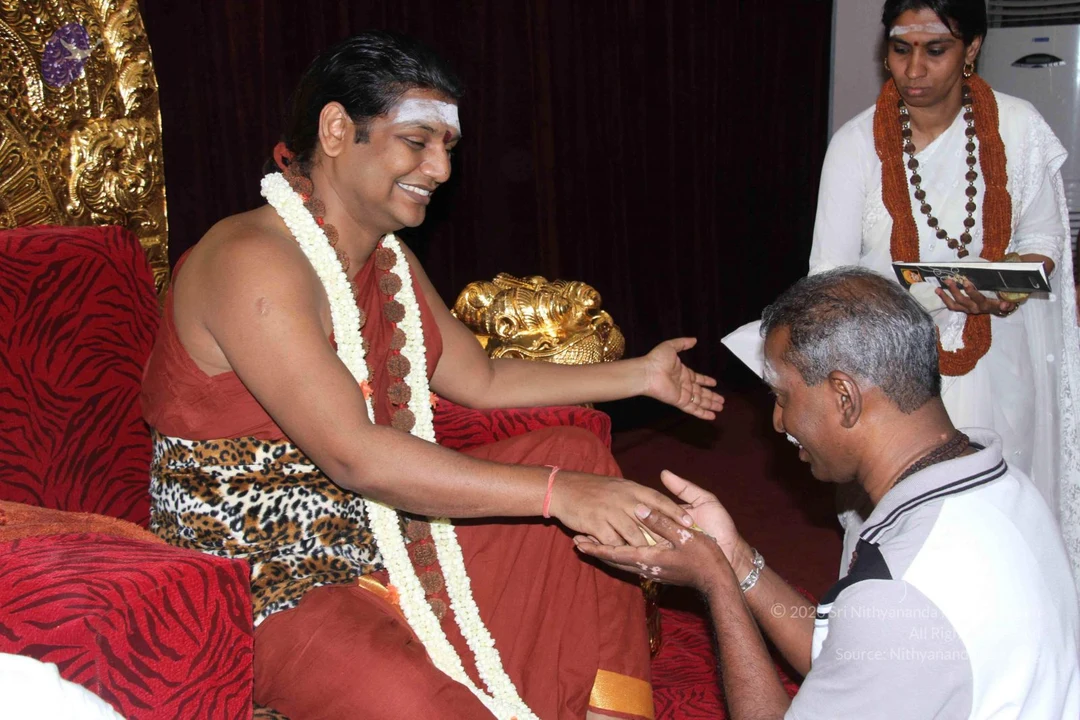
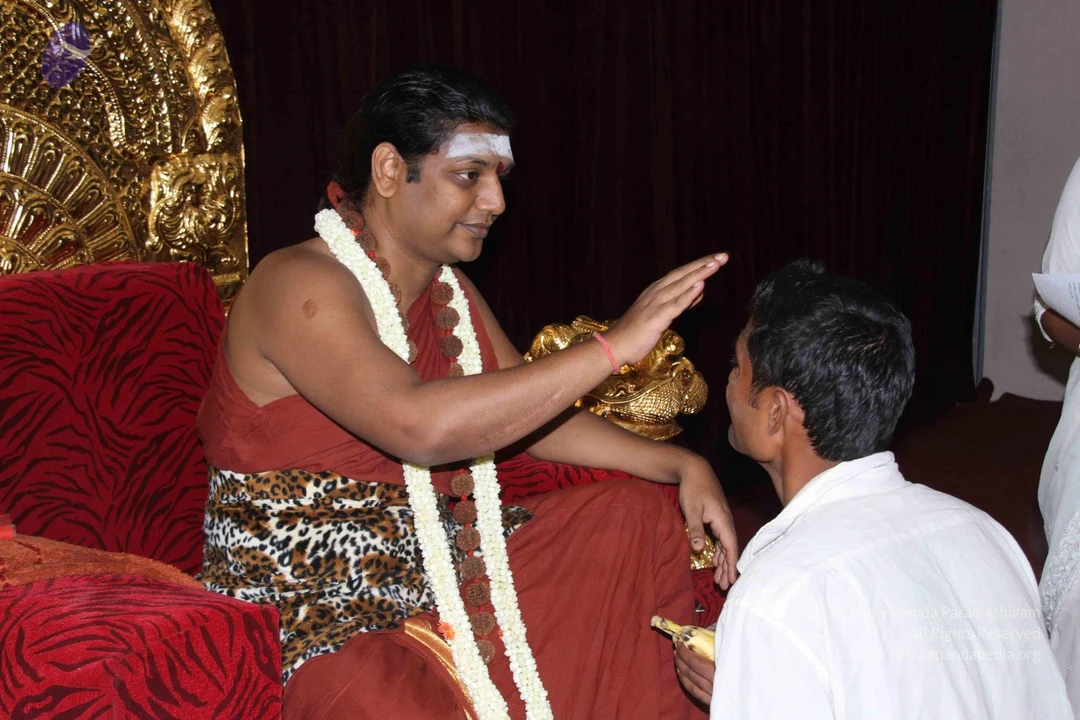
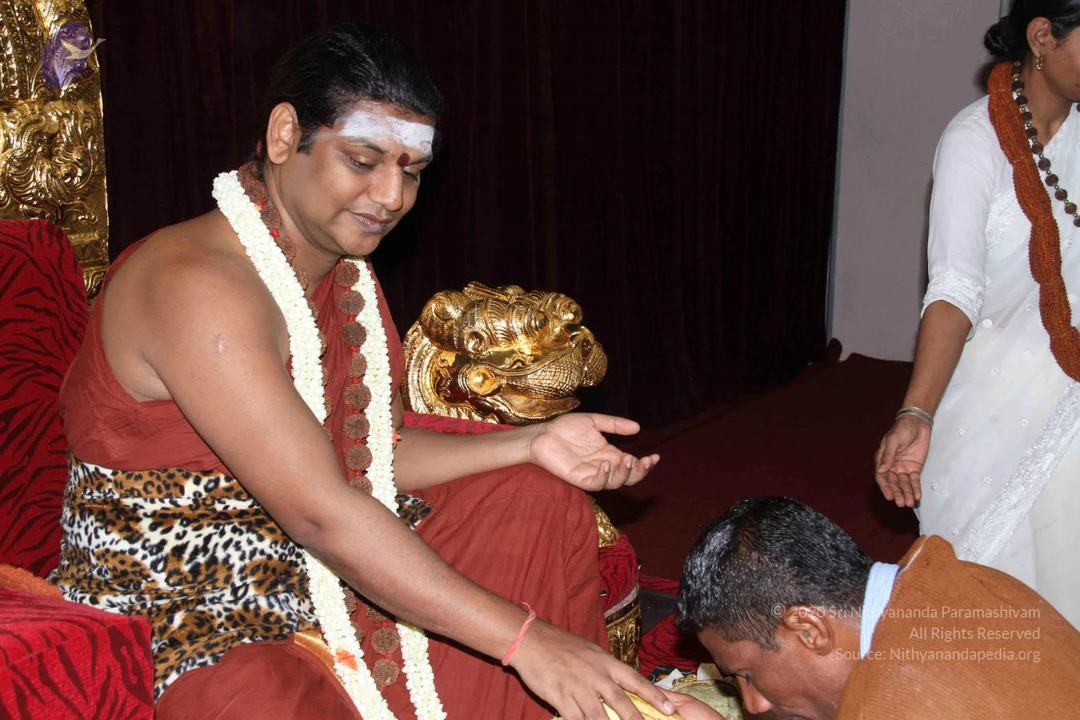
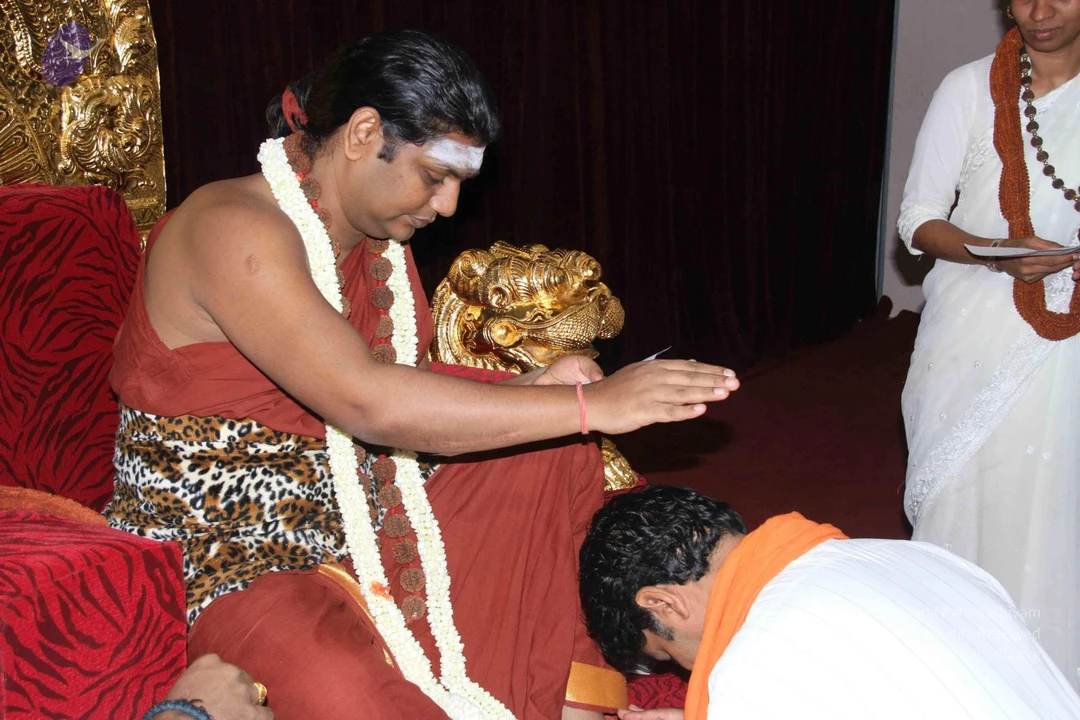
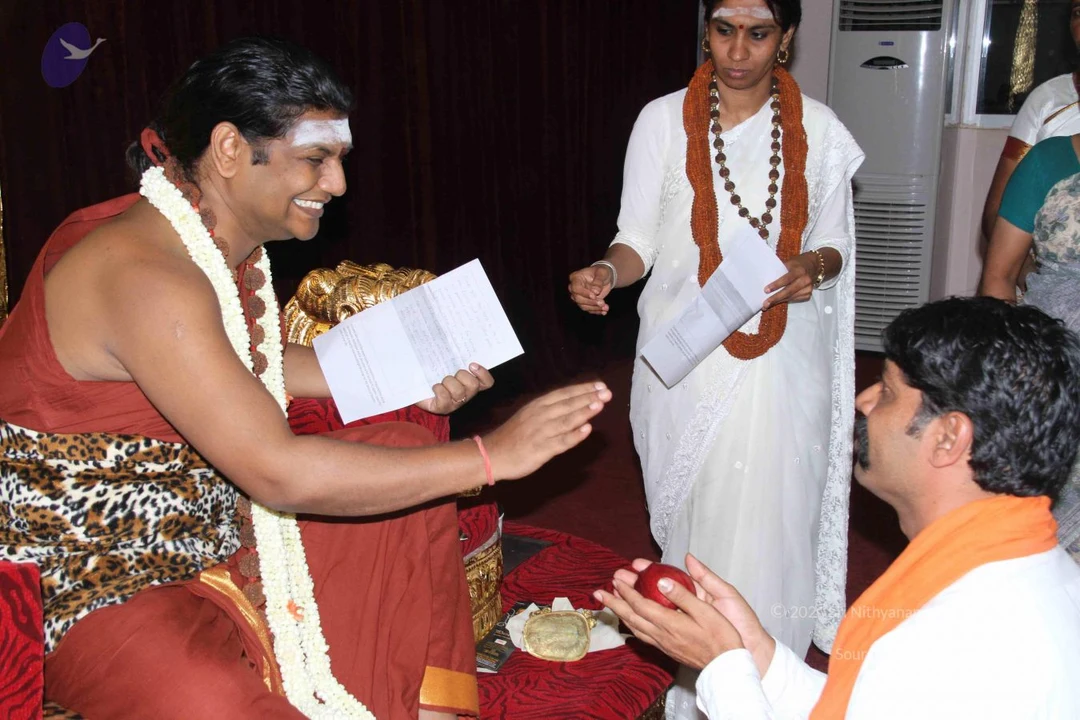
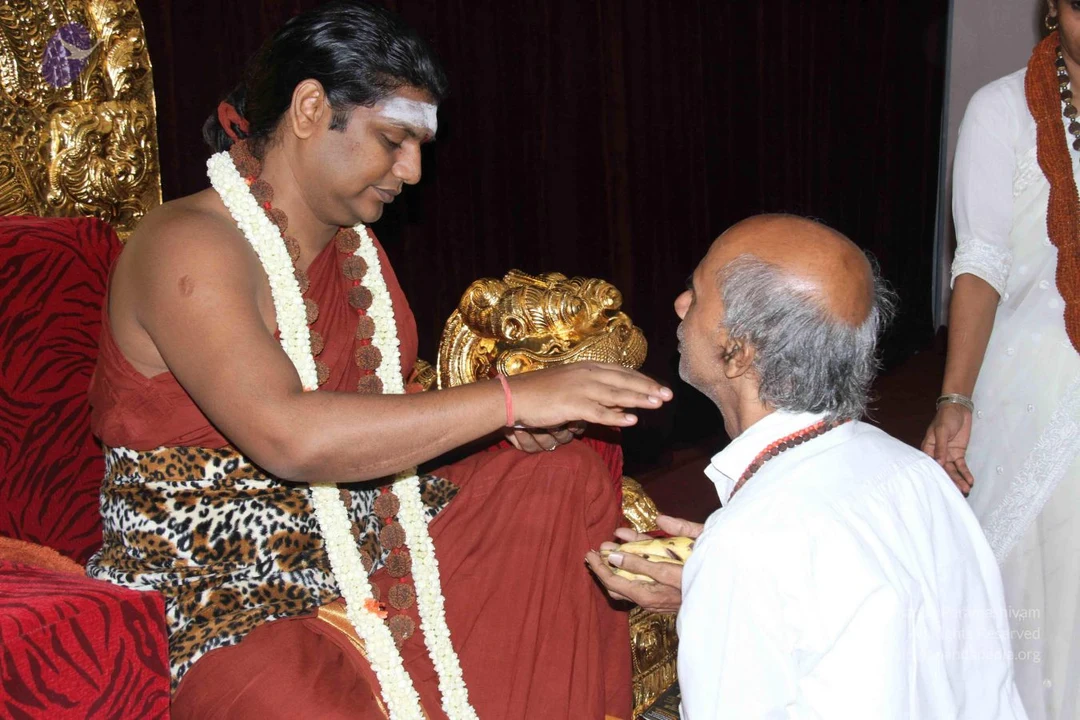
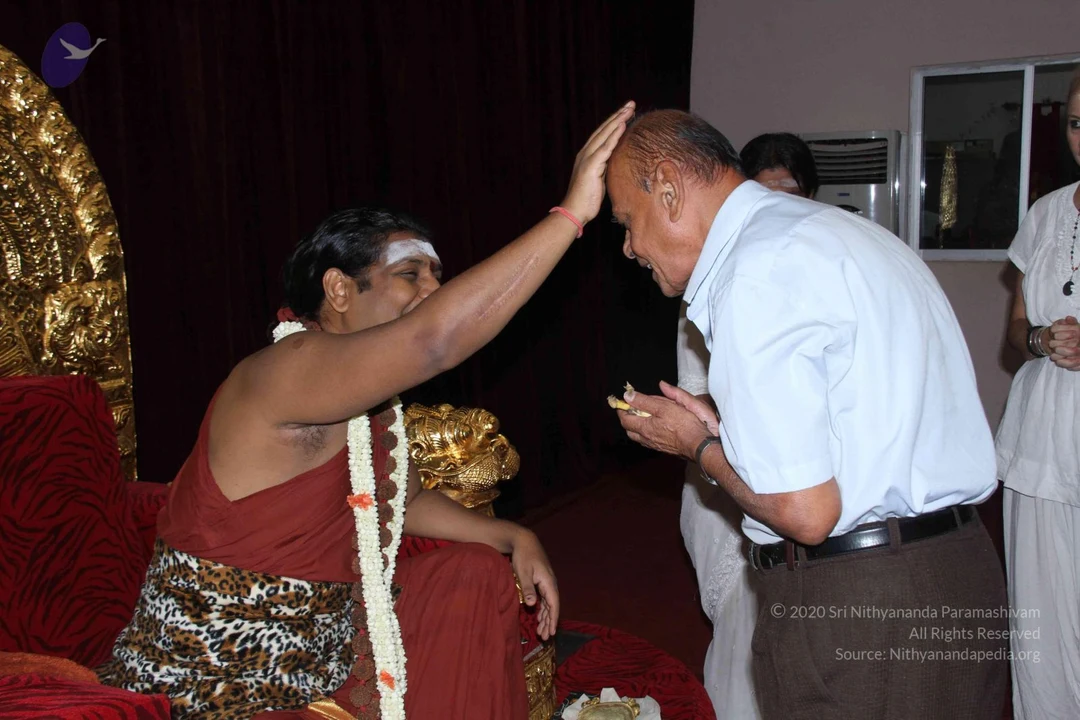
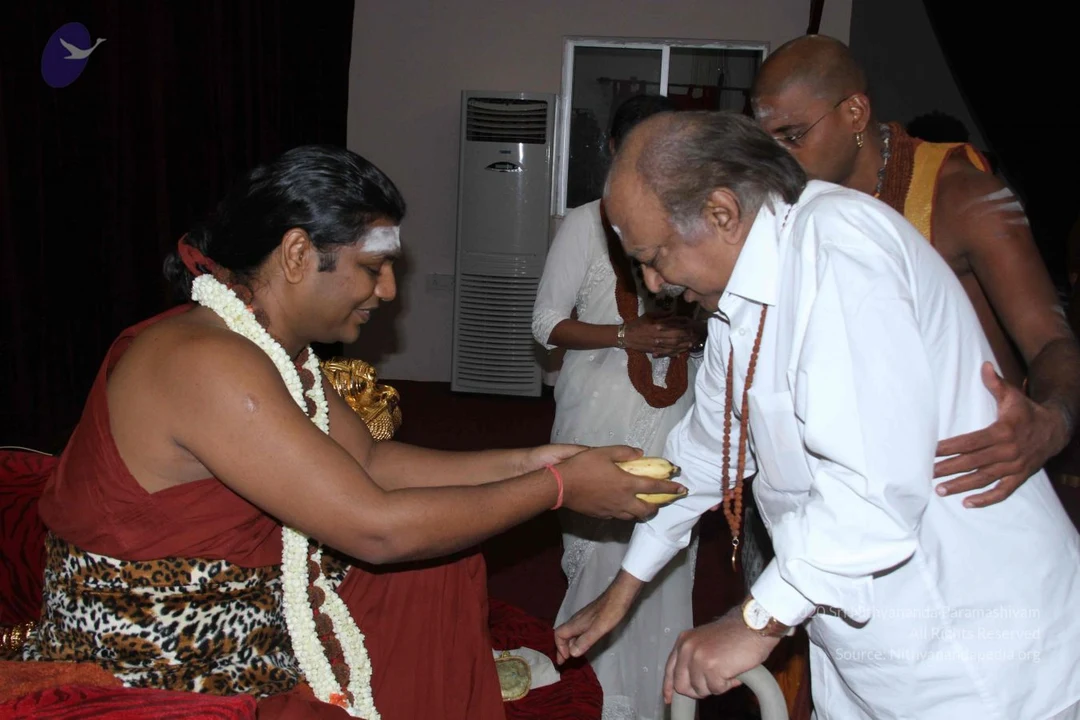
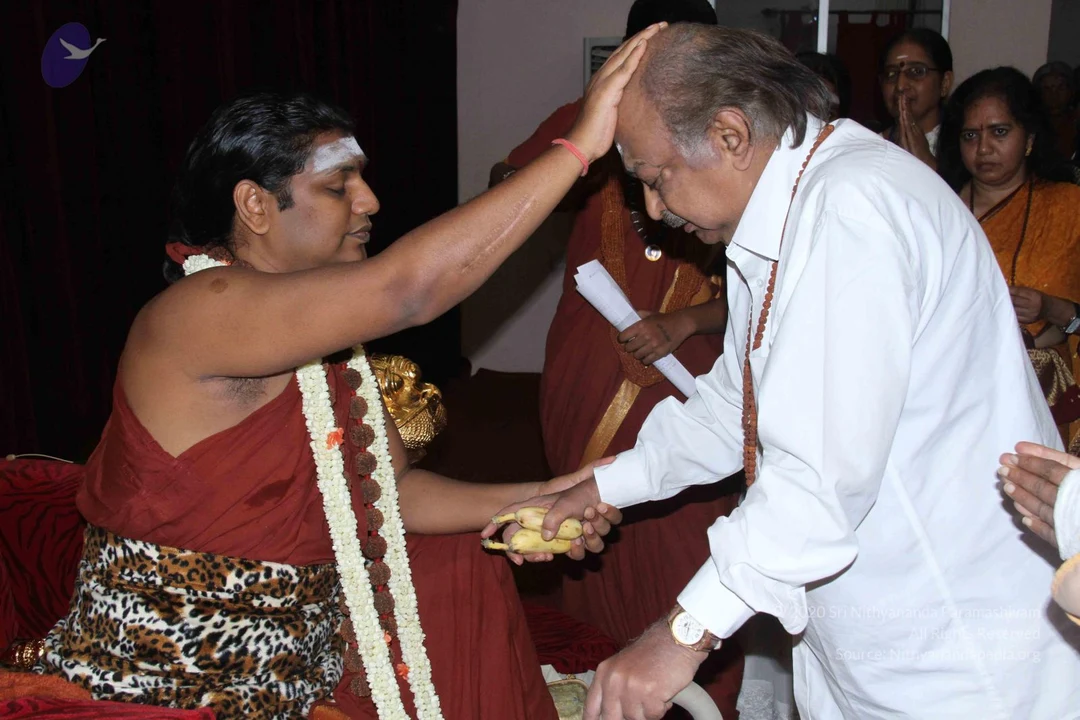
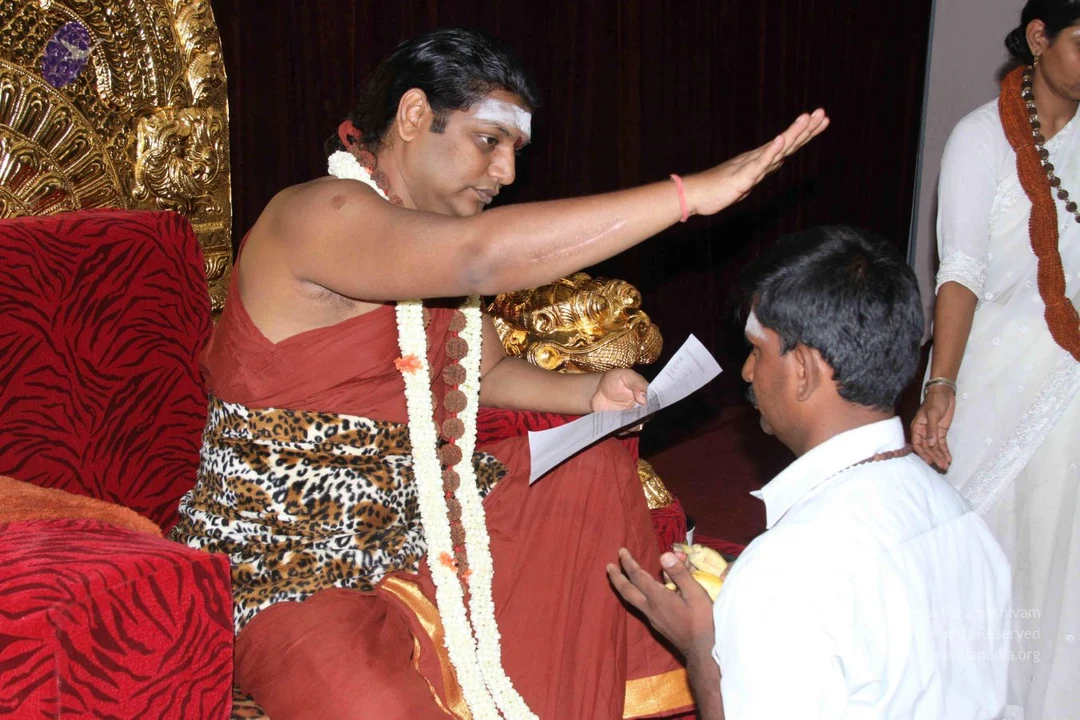
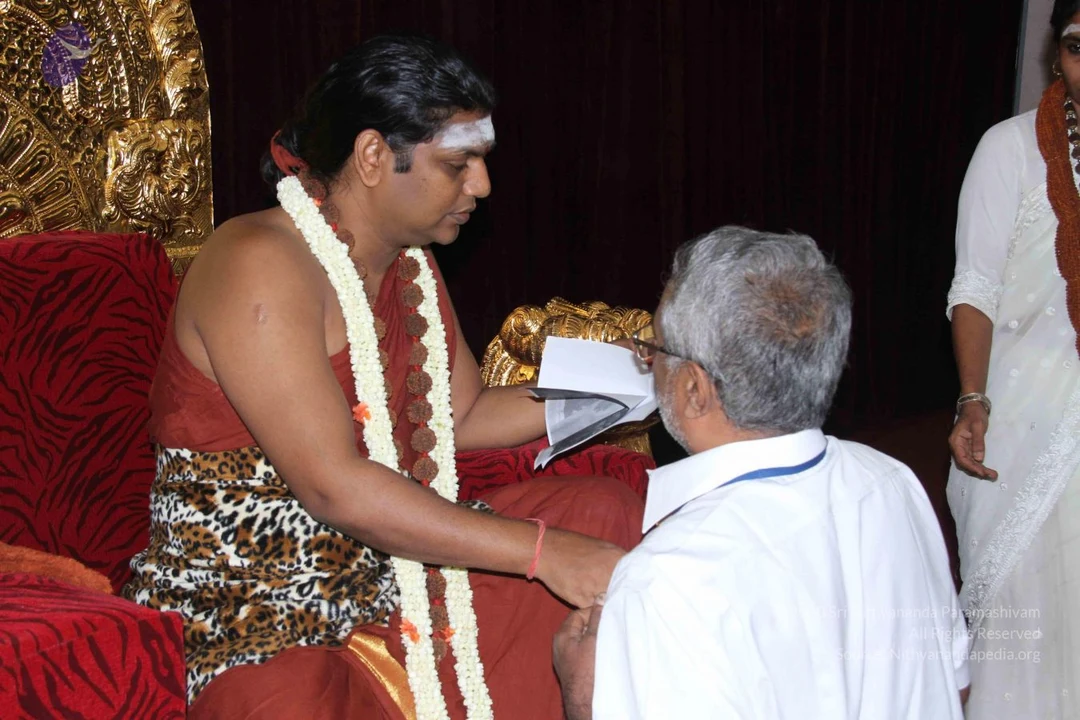
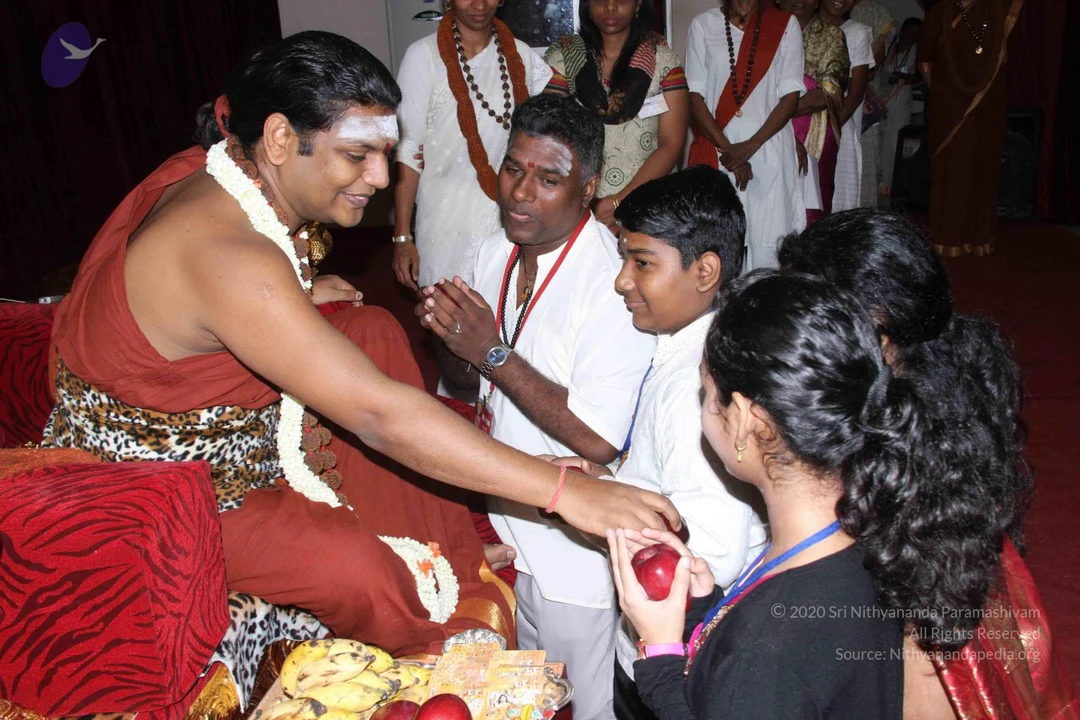
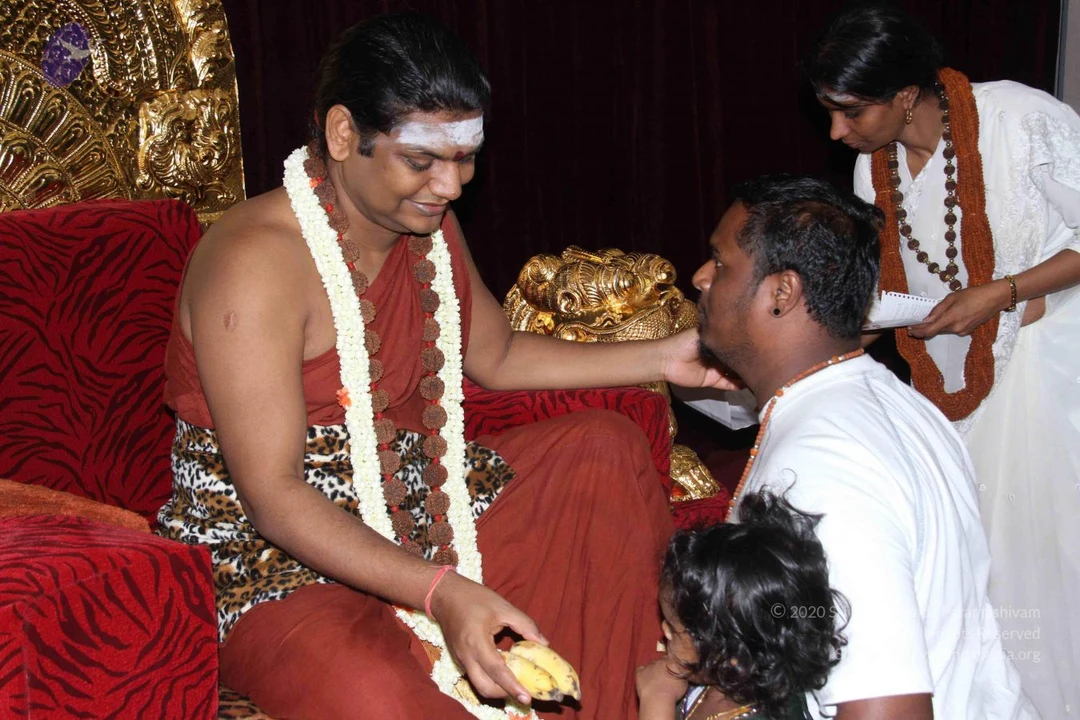
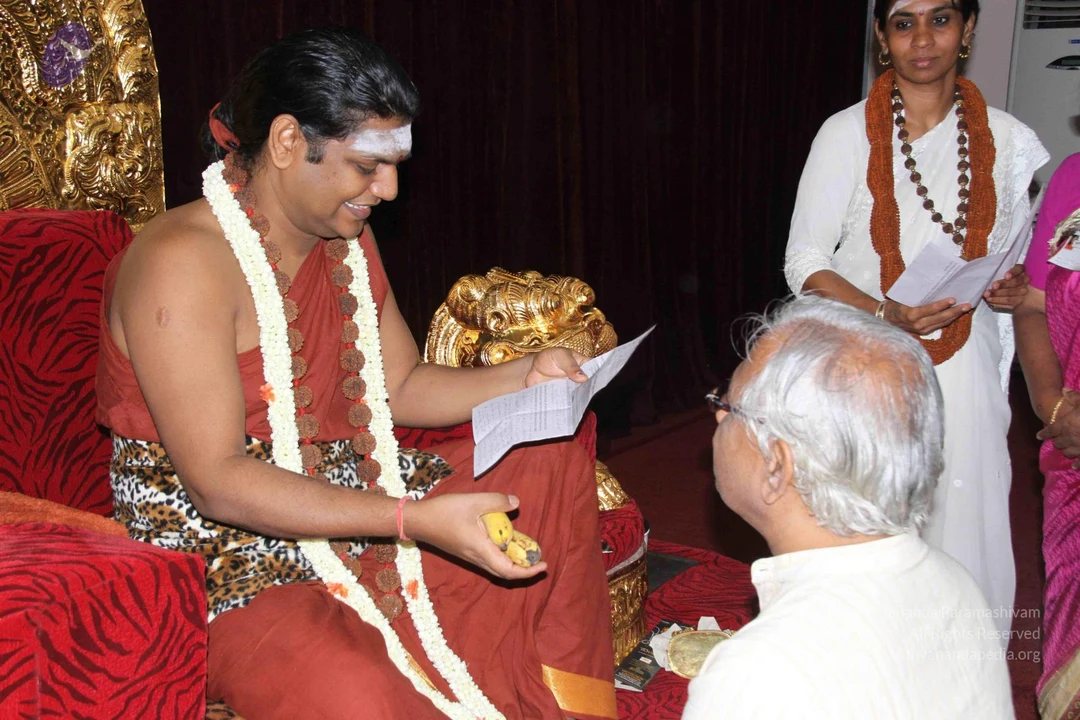
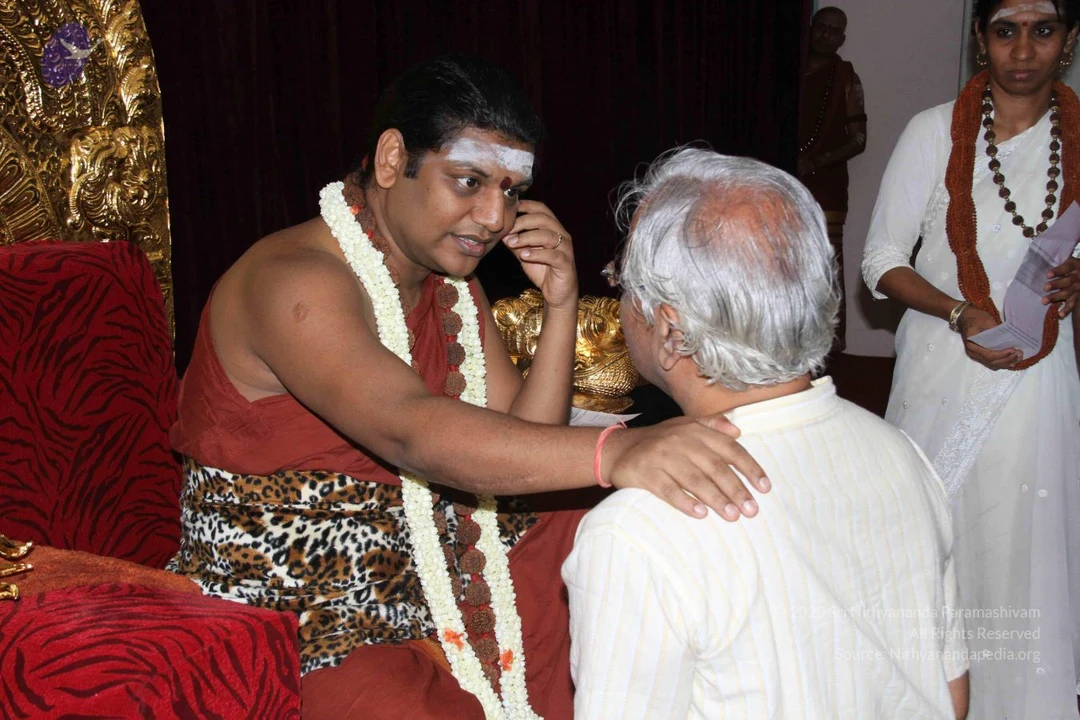
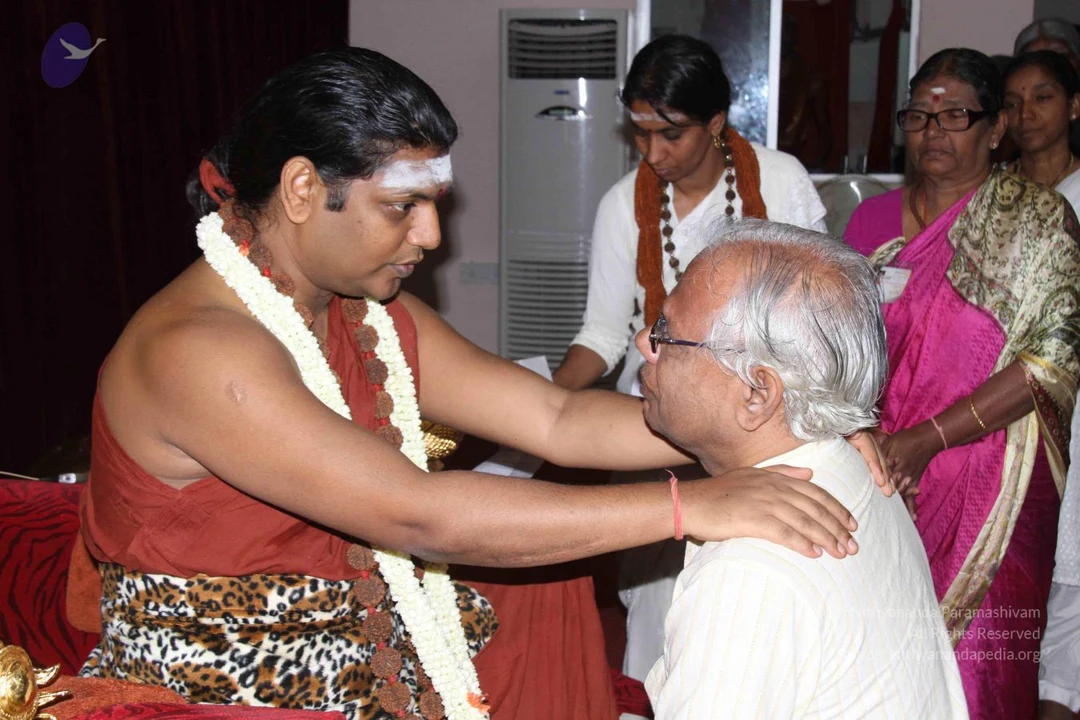
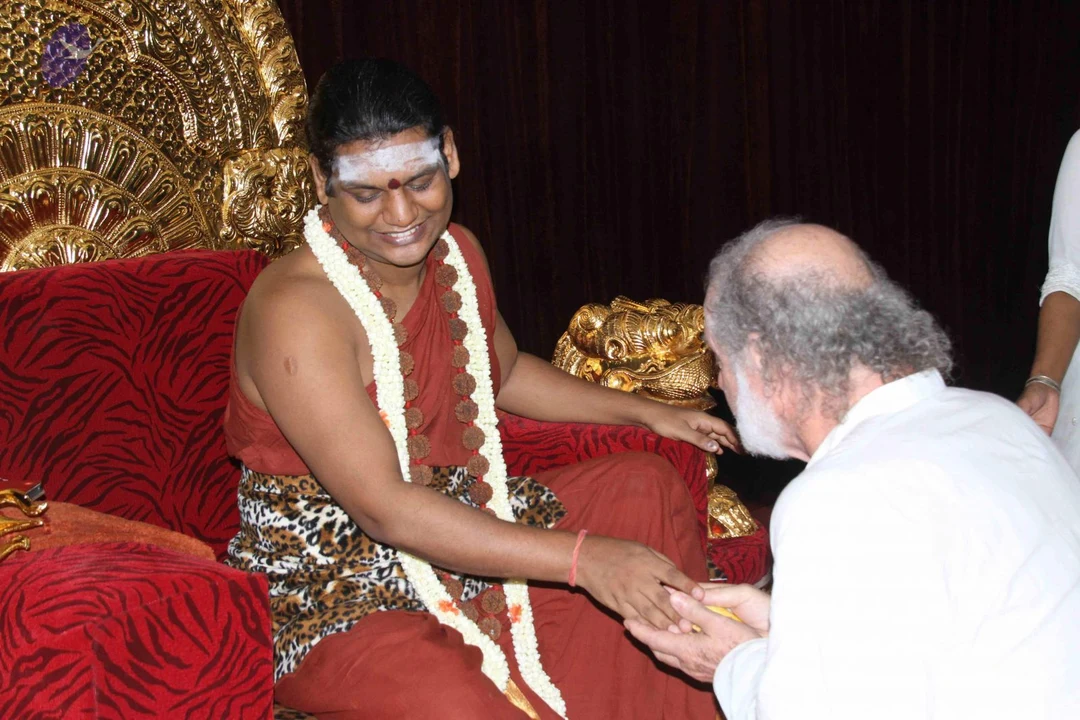
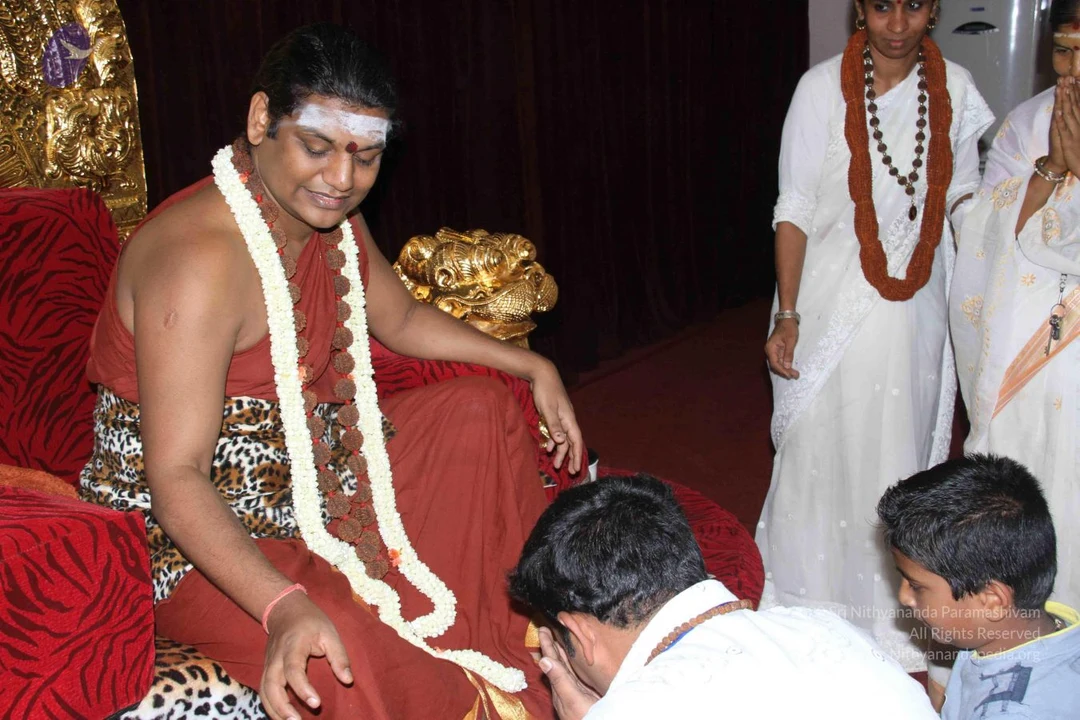
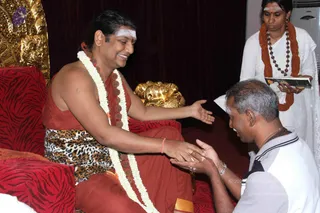
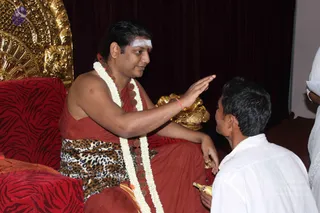
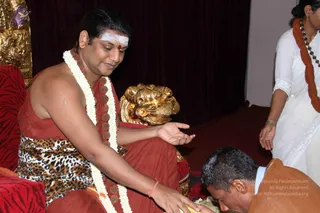
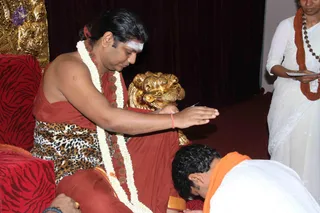
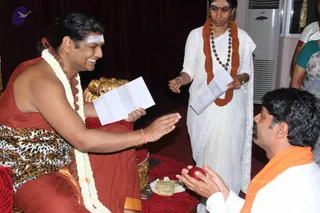
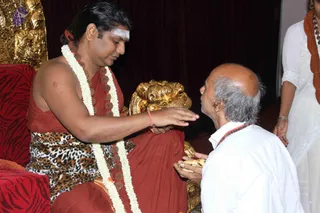
A seated man in an orange-red robe with a leopard-print waist sash sits on a red zebra-striped cushioned chair in front of a golden throne-like backdrop. He wears a white garland, a rudraksha mala and a white forehead mark, and smiles while extending his hand. A man in a grey-and-white polo shirt kneels before him, reaching out to touch the seated figure's hand in respectful greeting. A woman in white clothes with an orange shawl and rudraksha beads stands behind them, holding a book. A golden lion-like ornament sits to the side of the chair. Appearance-based label: a person, seated in a throne-like chair receiving a devotee's respect.A seated figure in red and orange robes sits on a red zebra-striped cushioned chair before an ornate gold carved backdrop with a dark curtain. He wears a long white and green flower garland, multiple rudraksha malas, a leopard-print waist wrap, and a white tilak with a red dot on his forehead. He extends his right hand toward a kneeling man in a white shirt who holds a banana and bows his head toward him. A golden ornament rests beside the chair. A probable Swamiji is shown in person, appearing as a long-haired figure with rudraksha malas and garland, while the kneeling man is a devotee receiving blessing; a partially visible person in white stands at the right edge.A seated man in a red-maroon robe and leopard-print cloth sits on a red throne with a gold lion-head armrest, wearing a white-and-red forehead mark, a red bindi, a white flower garland and a rudraksha mala. He extends his right hand toward a man in an orange-brown top who bends low, face down near the throne's base. A woman in white clothes with a rust-coloured beaded necklace stands at right. Red velvet drapes hang behind. Two people are visible. The seated man shows distinctive ceremonial adornments but the appearance is not sufficiently distinctive to confirm his identity, so the role is given as seated teacher receiving obeisance.A seated man in a red-brown dhoti wrap with a leopard-print shawl and a long white flower garland sits on a red zebra-striped cushioned seat in front of a gold carved lion-head ornament. He wears a white tilak on his forehead and extends his right hand over a devotee. Behind him stands a woman in a white sari with a rust-coloured beaded necklace, holding a paper. In the lower right, a devotee in an orange shawl and white garments bends forward with his head lowered toward the seat, in a gesture of reverence.A seated figure in a rust-red robe over a leopard-print cloth, with a white garland and white forehead marks, smiles and holds out a folded white paper while raising a hand toward a kneeling man. The kneeling man wears an orange shawl over white and holds a red fruit in cupped hands. Beside them, a woman in a white sari with an orange-brown beaded necklace stands holding papers. A golden object and a small gold-toned casket sit on a red cloth near a dark curtain, with an air conditioner behind. a person is the seated figure, identified by the white garland, rudraksha-style beaded adornments and red robe, and is in person.A seated man in a red-orange robe with a leopard-print shawl and a white garland sits on a red and gold throne with a gilded lion-head armrest. He has white vibhuti on his forehead and wears rudraksha beads. He reaches out to bless a kneeling older man in a white shirt with a red rudraksha mala, who bends forward and holds a yellow offering. A woman in white stands at the right edge. a person: the seated man wears a red-orange robe, rudraksha beads, a garland and vibhuti, with the throne and blessing setting.

Morning-Satsang
48 photosSource gallery
A seated man in an orange-red robe with a leopard-print waist sash sits on a red zebra-striped cushioned chair in front of a golden throne-like backdrop. He wears a white garland, a rudraksha mala and a white forehead mark, and smiles while extending his hand. A man in a grey-and-white polo shirt kneels before him, reaching out to touch the seated figure's hand in respectful greeting. A woman in white clothes with an orange shawl and rudraksha beads stands behind them, holding a book. A golden lion-like ornament sits to the side of the chair. Appearance-based label: a person, seated in a throne-like chair receiving a devotee's respect.A seated figure in red and orange robes sits on a red zebra-striped cushioned chair before an ornate gold carved backdrop with a dark curtain. He wears a long white and green flower garland, multiple rudraksha malas, a leopard-print waist wrap, and a white tilak with a red dot on his forehead. He extends his right hand toward a kneeling man in a white shirt who holds a banana and bows his head toward him. A golden ornament rests beside the chair. A probable Swamiji is shown in person, appearing as a long-haired figure with rudraksha malas and garland, while the kneeling man is a devotee receiving blessing; a partially visible person in white stands at the right edge.A seated man in a red-maroon robe and leopard-print cloth sits on a red throne with a gold lion-head armrest, wearing a white-and-red forehead mark, a red bindi, a white flower garland and a rudraksha mala. He extends his right hand toward a man in an orange-brown top who bends low, face down near the throne's base. A woman in white clothes with a rust-coloured beaded necklace stands at right. Red velvet drapes hang behind. Two people are visible. The seated man shows distinctive ceremonial adornments but the appearance is not sufficiently distinctive to confirm his identity, so the role is given as seated teacher receiving obeisance.A seated man in a red-brown dhoti wrap with a leopard-print shawl and a long white flower garland sits on a red zebra-striped cushioned seat in front of a gold carved lion-head ornament. He wears a white tilak on his forehead and extends his right hand over a devotee. Behind him stands a woman in a white sari with a rust-coloured beaded necklace, holding a paper. In the lower right, a devotee in an orange shawl and white garments bends forward with his head lowered toward the seat, in a gesture of reverence.A seated figure in a rust-red robe over a leopard-print cloth, with a white garland and white forehead marks, smiles and holds out a folded white paper while raising a hand toward a kneeling man. The kneeling man wears an orange shawl over white and holds a red fruit in cupped hands. Beside them, a woman in a white sari with an orange-brown beaded necklace stands holding papers. A golden object and a small gold-toned casket sit on a red cloth near a dark curtain, with an air conditioner behind. a person is the seated figure, identified by the white garland, rudraksha-style beaded adornments and red robe, and is in person.A seated man in a red-orange robe with a leopard-print shawl and a white garland sits on a red and gold throne with a gilded lion-head armrest. He has white vibhuti on his forehead and wears rudraksha beads. He reaches out to bless a kneeling older man in a white shirt with a red rudraksha mala, who bends forward and holds a yellow offering. A woman in white stands at the right edge. a person: the seated man wears a red-orange robe, rudraksha beads, a garland and vibhuti, with the throne and blessing setting.

Pada-Puja

8 photosSource gallery
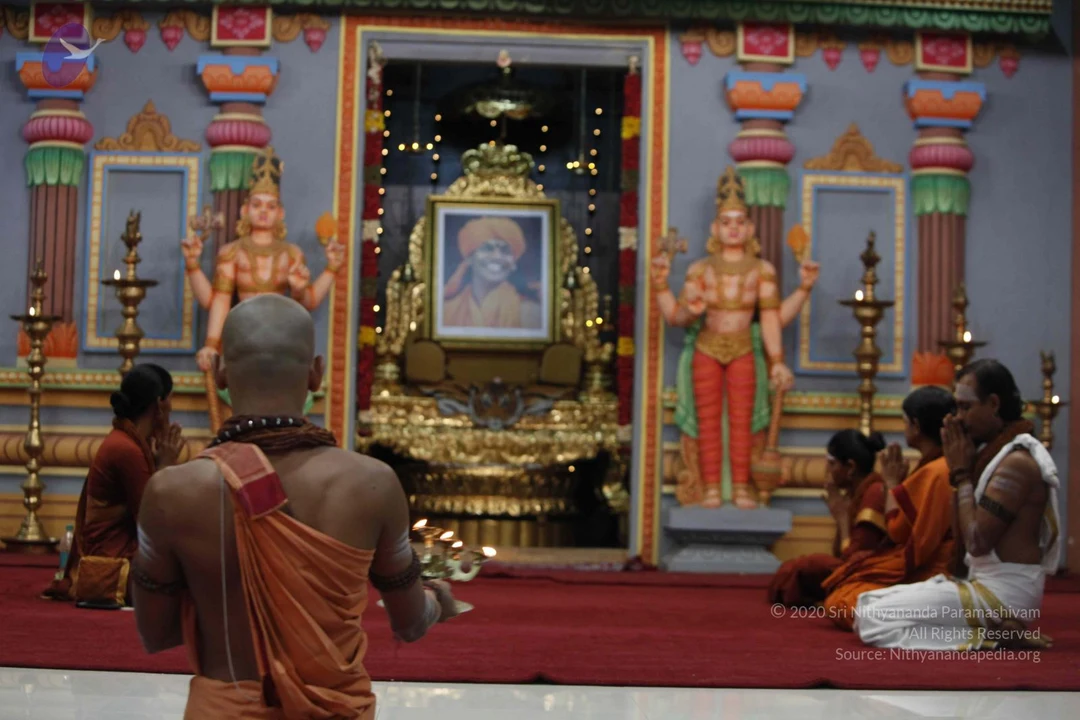
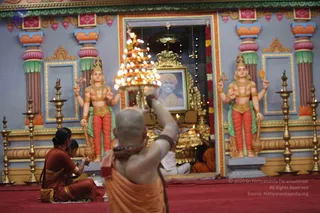
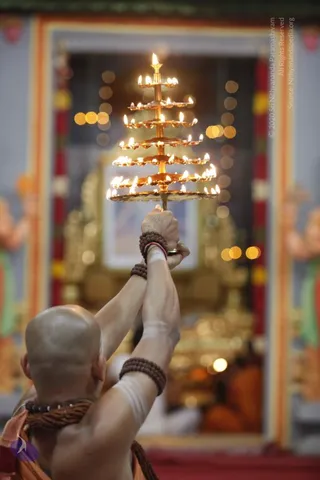
A golden throne (peetha) with a tiger-skin cushion is set in a temple-like niche framed by red, yellow and white flower garlands and orange carved pillars. Above it hangs an ornate brass canopy with oil lamps. At the centre is a large framed portrait labelled "Paramahamsa Nithyananda", showing a smiling man in an orange turban and orange-saffron shawl with a red tilak. In front of the throne, a man in white ritual dhoti and shawl sits cross-legged with his back to the camera, and two people in orange robes sit at the sides.A shaven-headed priest in an orange-saffron dhoti and shawl, with rudraksha malas around his neck and wrists, kneels with his back to the camera and holds a golden multi-tiered oil lamp (aarti) lit with flames. Ahead, a shrine room with painted columns and two multi-armed deity murti flank the entrance. Inside, a framed portrait labelled with a printed name sits on a golden throne-like altar surrounded by small brass oil lamps, garlands and string lights. A second woman in red-orange clothing sits on the red carpet at left, bending forward. The scene is an aarti being offered at the shrine.A shaven-headed priest in an orange cloth draped over bare shoulders, with rudraksha malas and white ash marks on his arms, stands with his back to the camera holding a tiered brass aarti lamp with many lit oil lamps. He faces a shrine doorway flanked by painted guardian figures in red dhotis. Inside, a framed portrait with a golden halo sits on an ornate gold throne. Bokeh string lights frame the doorway and a red carpet covers the floor.A photograph from behind of a bald priest in an orange saffron shawl and rudraksha malas holding up a tiered brass aarti lamp with many lit oil lamps in a temple shrine. A painted deity statue with four arms stands on the left in red and green, and a framed portrait with a golden frame hangs in the background. Another person in orange sits at the far right and a seated figure appears at the lower left. The setting is a red-carpeted temple with bokeh fairy lights, and the priest performs aarti.A temple shrine interior with a bald priest in saffron-orange cloth seen from behind, raising a multi-tiered brass aarti lamp with many lit wicks toward a central shrine. Two standing dvarapala-style guardian figures with raised arms and crowns flank the doorway, each painted in red and green lower garments with gold jewellery. Beyond, a framed portrait labelled "Paramahamsa Nithyananda" shows a smiling man in an orange turban, placed on a golden throne with a golden canopy. Two women in orange saris sit at the left edge, one holding a small object, and brass standing lamps line the walls. Red carpet covers the floor and a green-and-orange decorative frieze runs across the top.A shaven-headed priest seen from behind raises a tiered brass lamp stand lit with many oil lamps toward a shrine, both arms extended upward. He wears rudraksha malas on his neck and wrists and an orange-brown garment, with a white sacred marking on his upper arm. Blurred golden shrine ornaments, red and gold pillars and a framed image sit behind him in a temple doorway.

Morning-Satsang
8 photosSource gallery
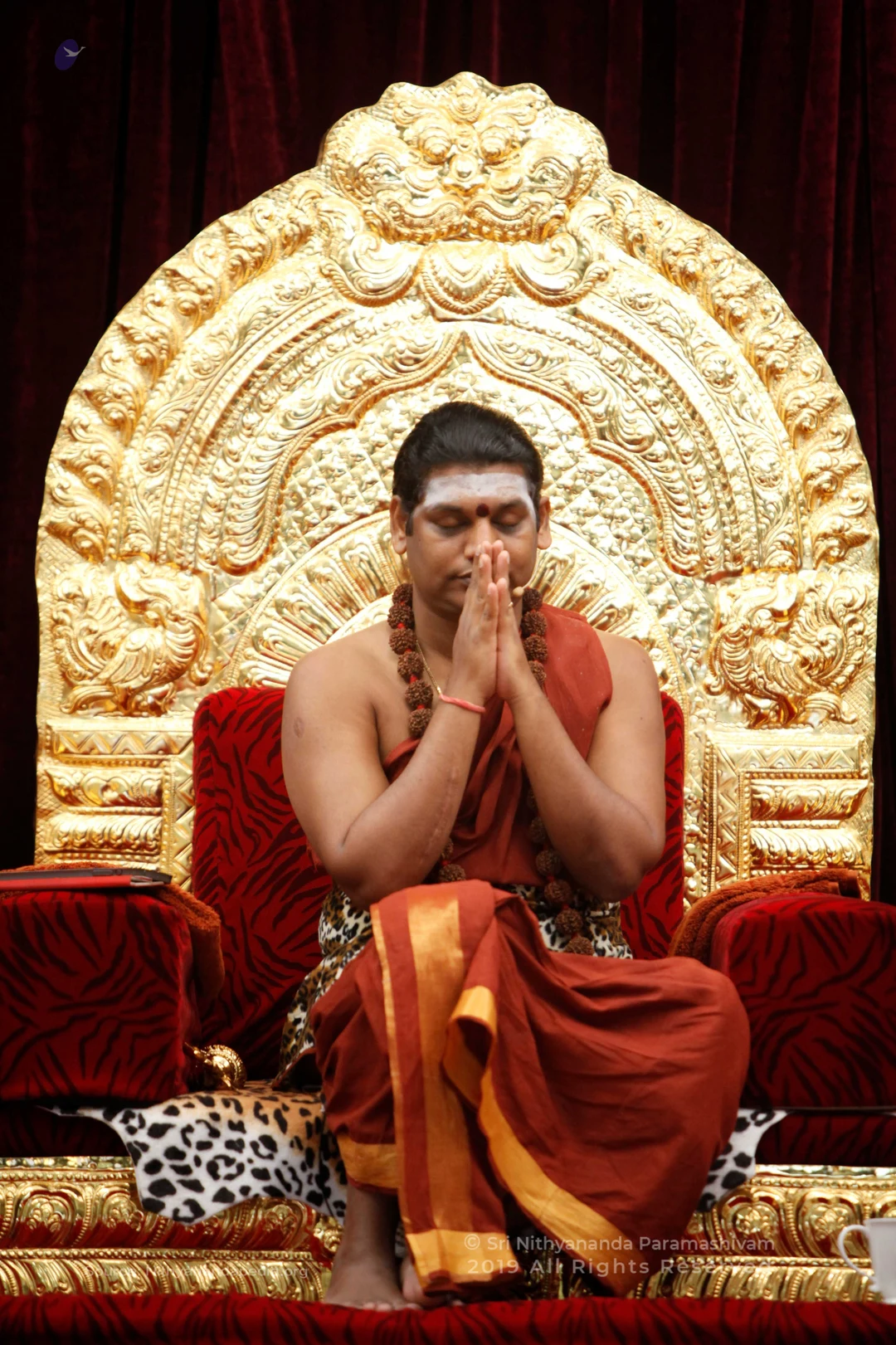
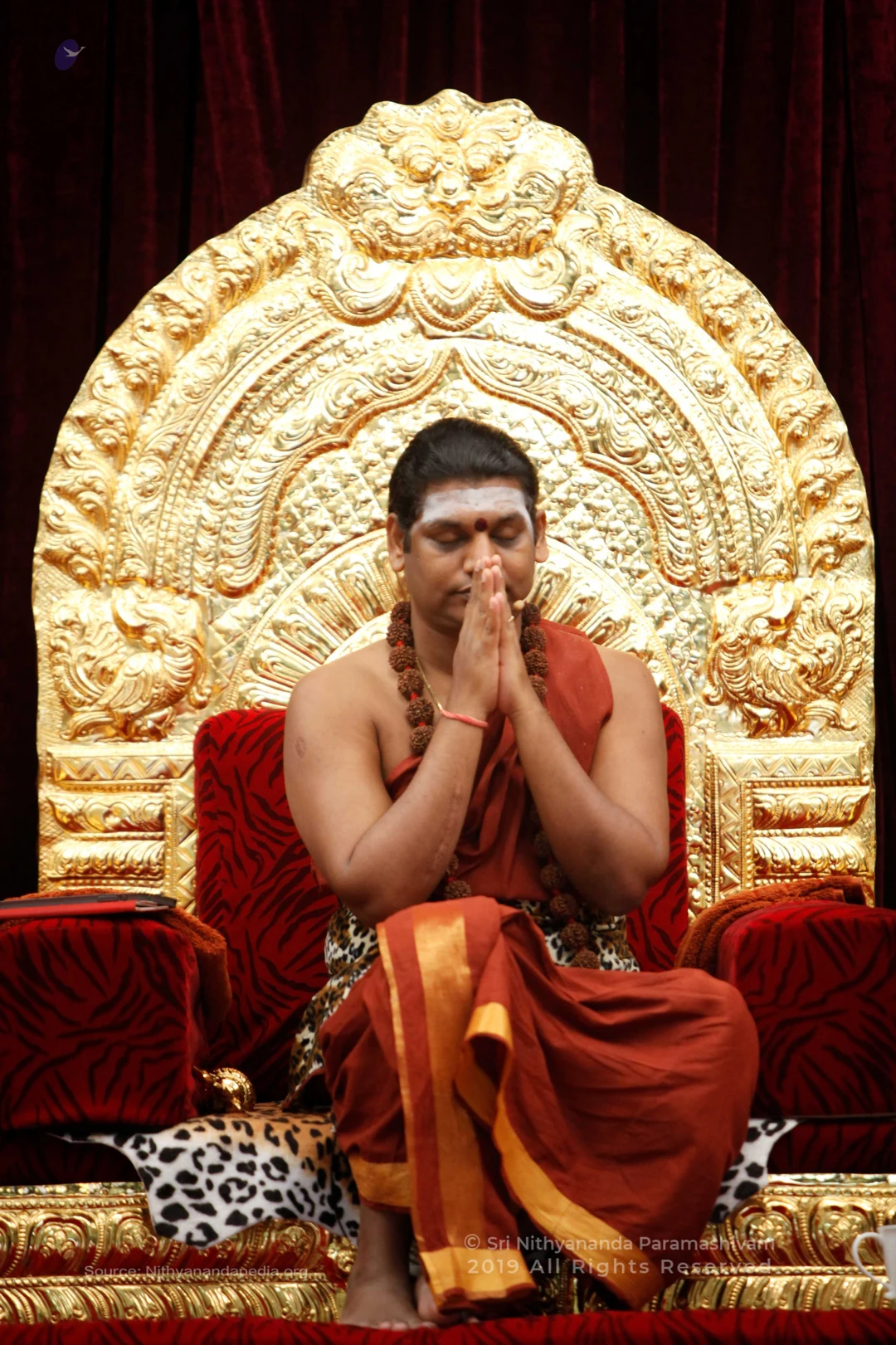
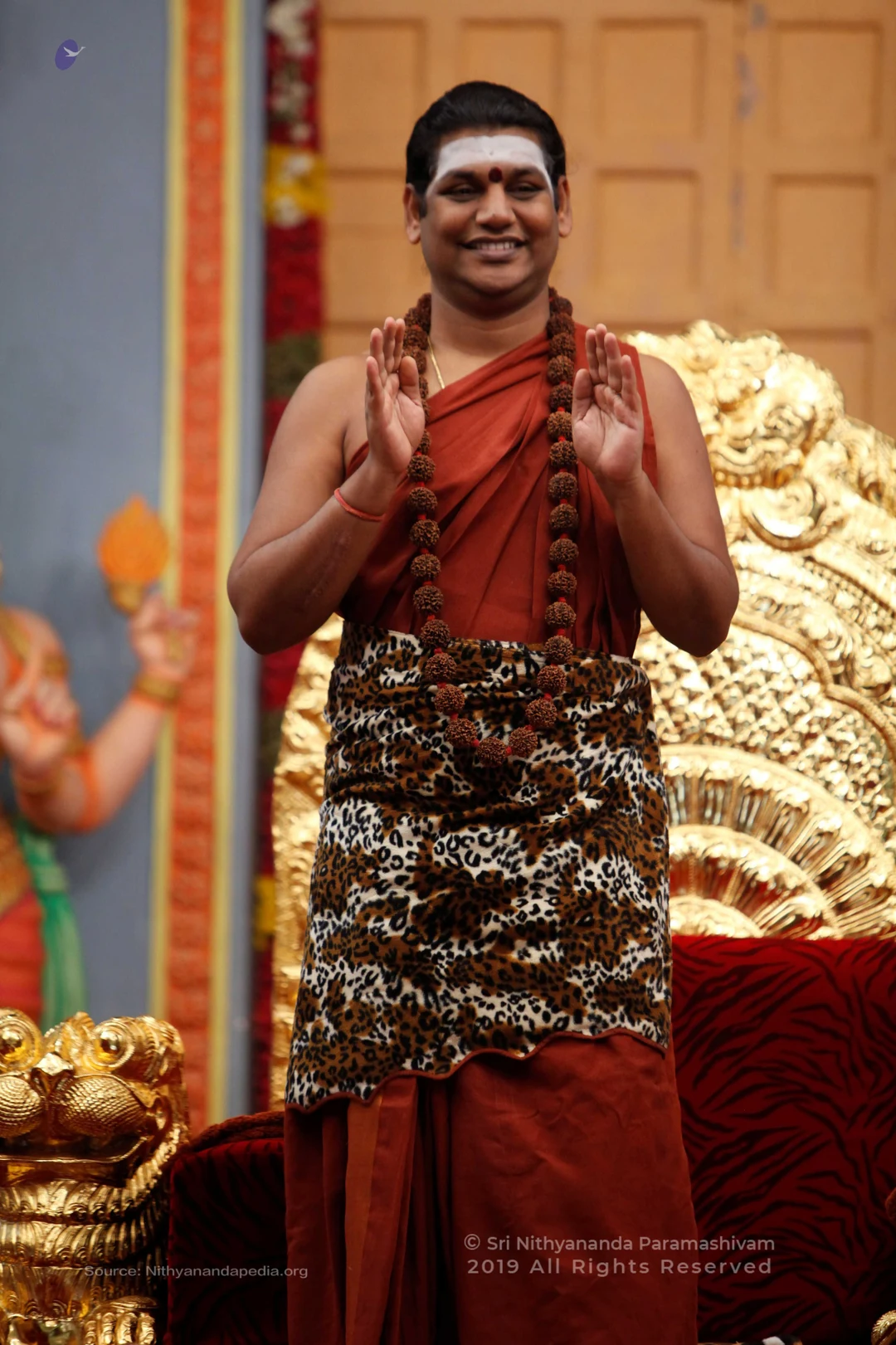
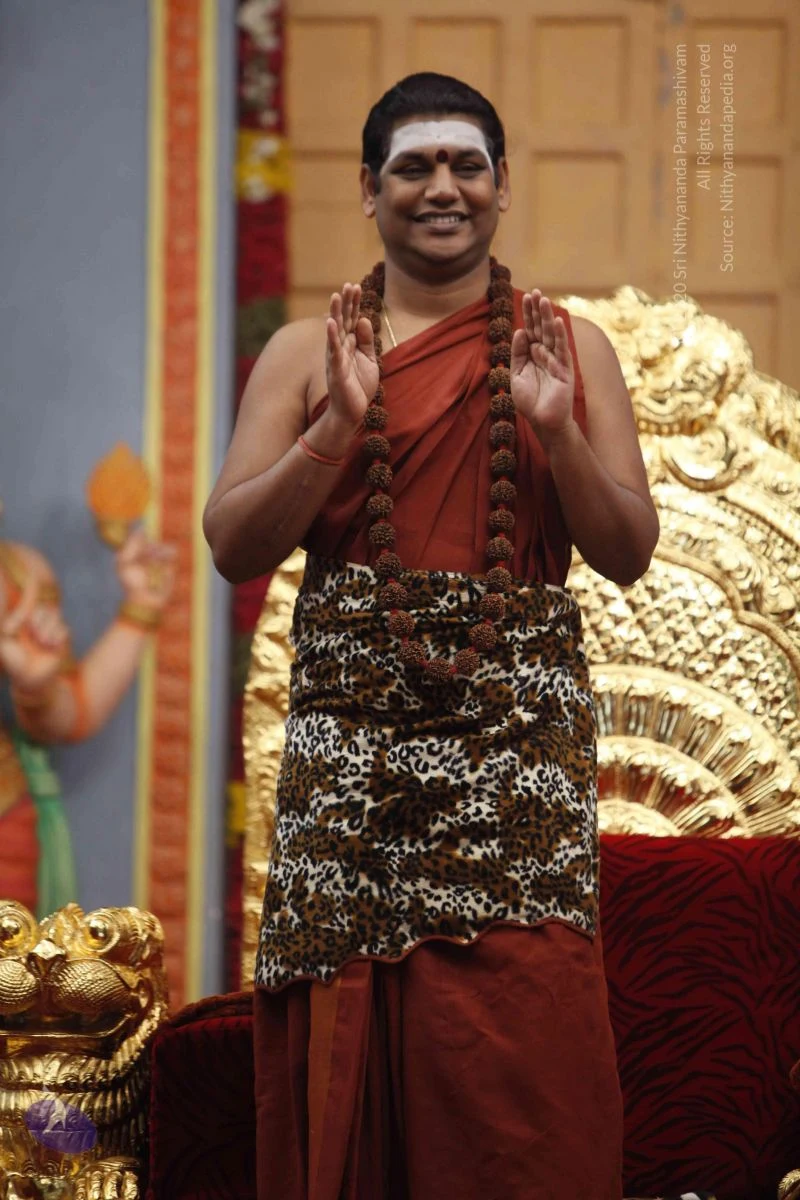
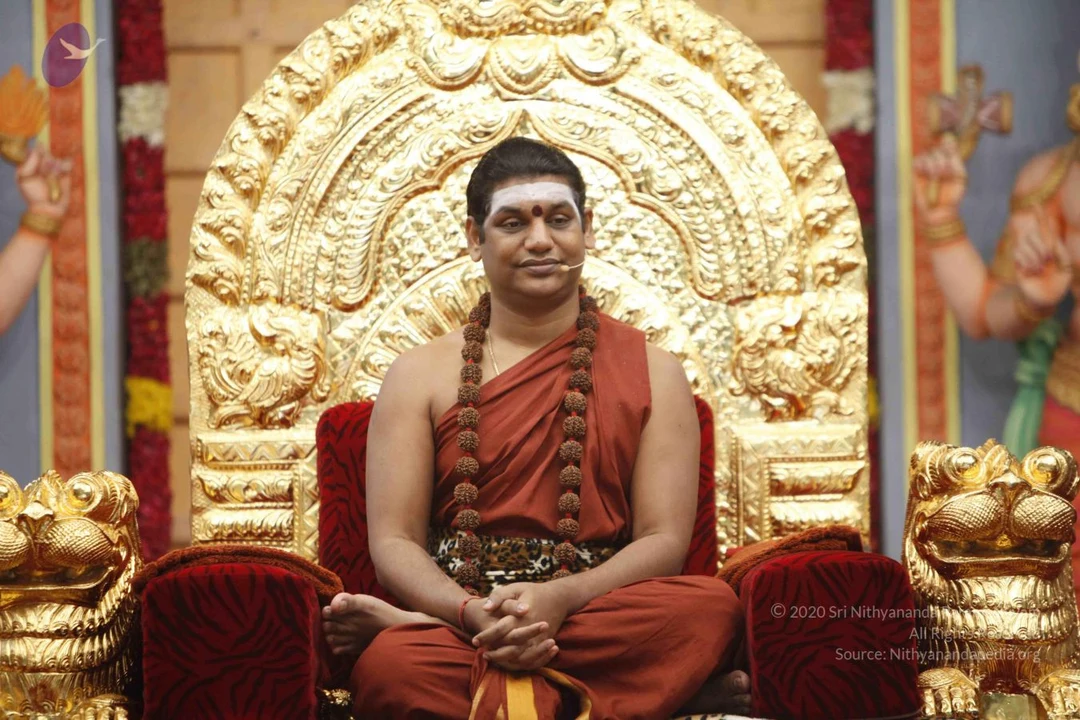
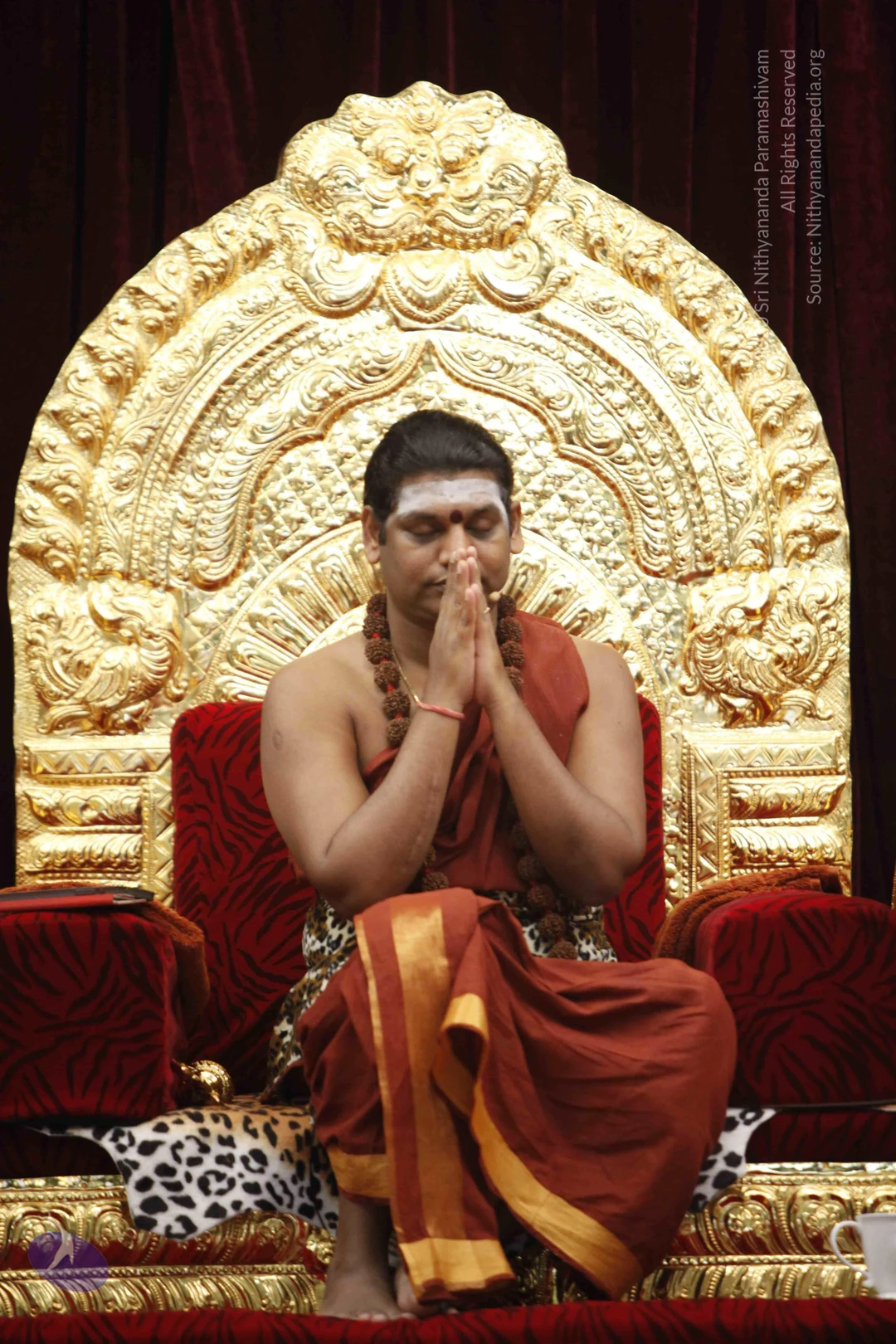
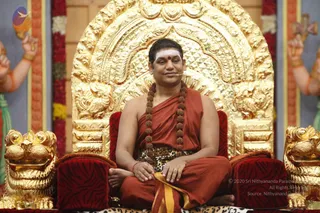
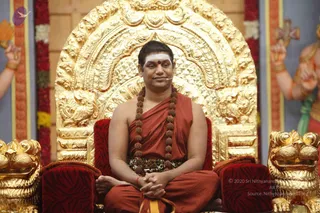
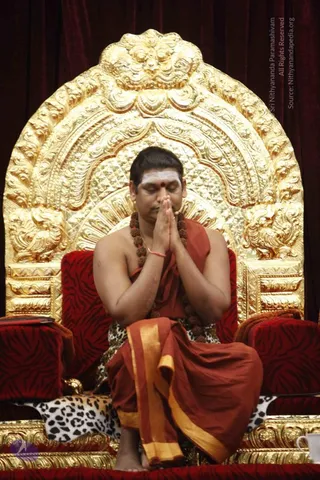
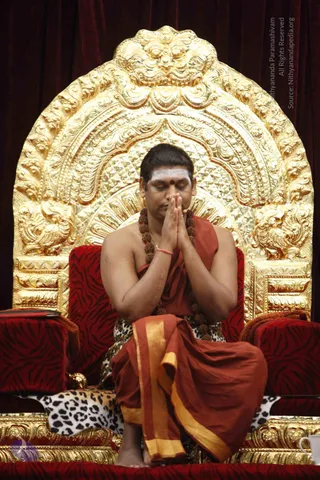
A smiling man stands on a stage in front of an ornate gold throne with carved gold lion-head armrests in the foreground and a red velvet cushion. He wears a rust-orange (kavi) dhoti and an upper cloth, with a leopard-print shawl draped over his waist, a white vertical forehead mark with a red bindi, and a long rudraksha mala. He presses his palms together in greeting, namaste. A painted deity mural with a raised hand is behind him at left. a person: the man is shaved-headed-free and shows a rudraksha mala and a leopard-print shawl over saffron-coloured robes; these cues are present but the face-independent appearance is uncertain, so the label is given as probable only on the rudraksha and saffron cues.A man in saffron-orange robes sits cross-legged on a red and gold throne with gold lion-head armrests, a white and red tilak on his forehead and a long rudraksha mala hanging to his waist. He wears a leopard-print cloth at the waist and has a small lapel microphone clipped near his chin. Behind him is a large ornate gold throne back, with garlanded flower strings and decorated deity figures at the edges.A seated man in a saffron-orange robe sits cross-legged on a red velvet throne chair in front of an ornate gold carved backrest and golden lion-head armrests. He wears a long rudraksha mala with bead rows reaching his waist, a white vertical tilak with a red dot on the forehead, and a small microphone clipped near his mouth. Hands rest folded in his lap. Garlands of red and yellow flowers hang on the sides, with painted deity figures visible at the edges.A seated man in an ornate golden throne with a carved arched back, draped in red velvet cushions with tiger-stripe pattern and a leopard-print cloth beneath. He wears an orange-red unstitched robe with gold border, a rudraksha mala necklace, and white forehead markings with a red dot, and sits with palms pressed together in namaste and eyes closed. The throne sits before dark red curtains. A white cup sits at the lower right corner.A man sits on an ornate gold-carved throne with a red and black tiger-striped cushion, palms pressed together in namaste with eyes closed. He has a white forehead marking with a red bindi, wears a rudraksha mala and gold chain, and is bare-chested with an orange-red shawl draped over the body and a gold-bordered dhoti wrap over the legs. A leopard-print cloth lies beneath him and a teacup sits at the lower right. A satsang or discourse setting is suggested by the stage.A seated man in a saffron-orange garment with a gold border sits in a red and black tiger-striped chair before an ornate gold throne-back with carved floral and scrollwork designs. He wears rudraksha mala beads around his neck, a white vertical tilak with a red dot on his forehead, and presses his palms together in anjali mudra with eyes closed. A leopard-print cushion and a cup and saucer appear at the lower edge. The printed vertical caption along the right edge reads Nithyananda Paramashivam
Sava-Darshan

1 photoSource gallery
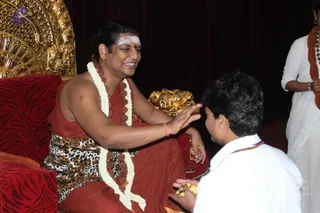
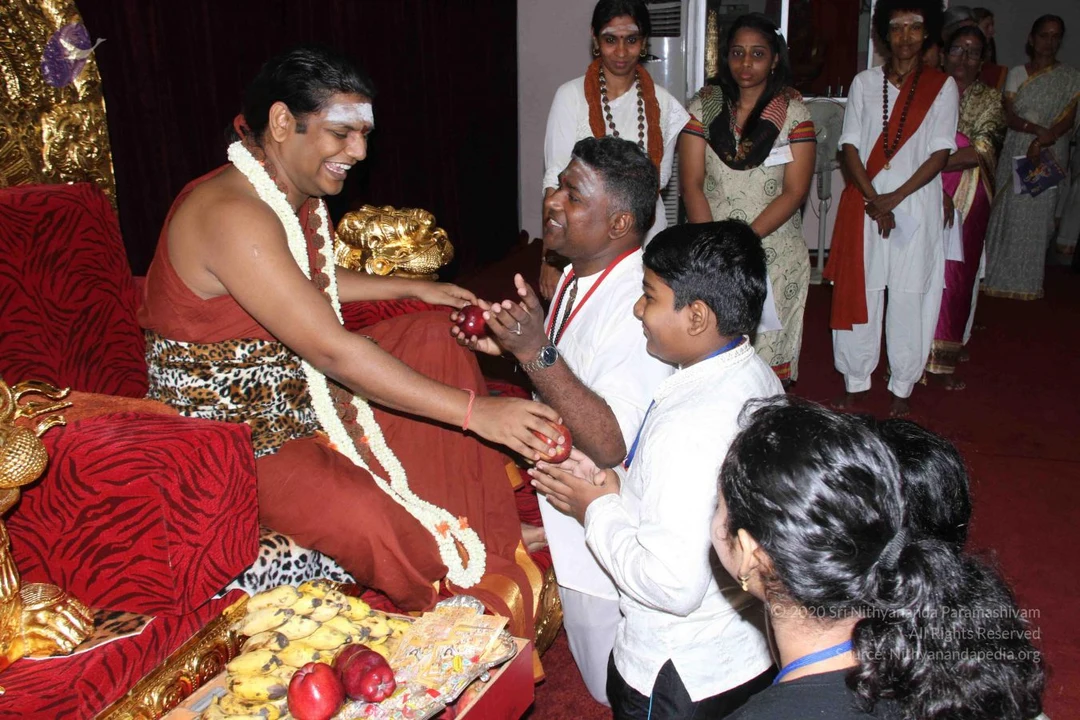
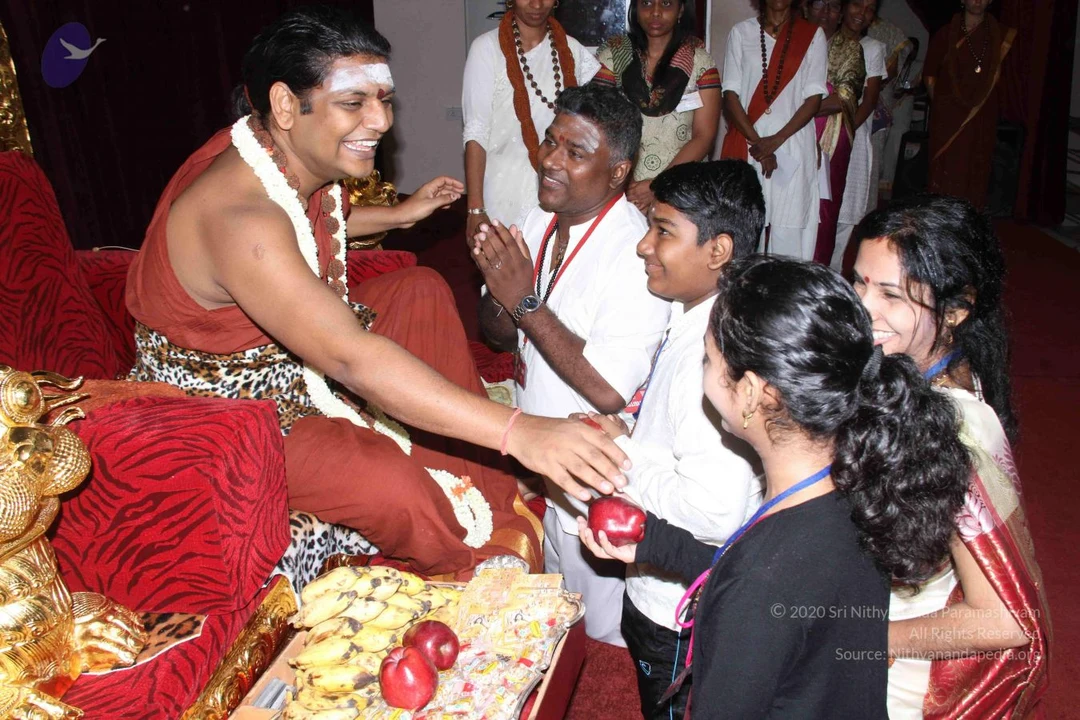
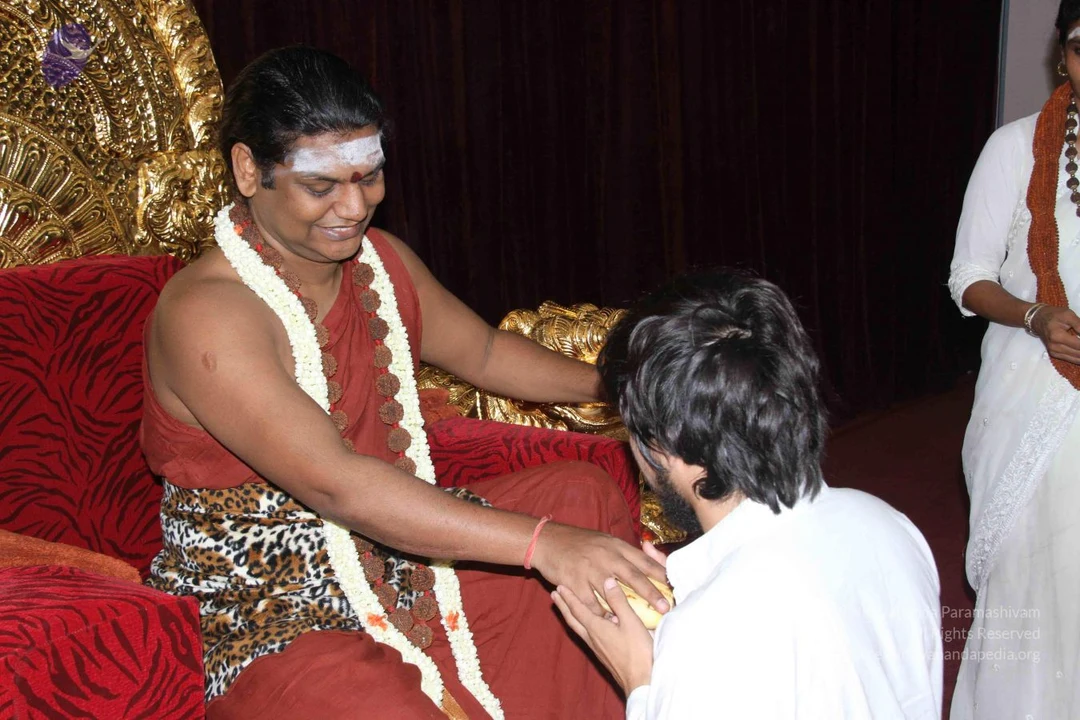
A seated man in a red-orange robe and leopard-print lower garment sits on an ornate gold-and-red throne with a golden carved backrest. He wears white flower garlands, rudraksha beads, a white forehead marking with a red dot, and a red thread on his wrist. He smiles while extending his hand over the head of a young man in a white shirt and rudraksha mala who kneels before him holding fruit. A golden ornamental object sits beside the throne, and a woman in white stands at the right edge. The setting is a dark-curtained hall.