Skip to content
Saturday

9 November 2013

completion strategy for global peace.

Dated photos
194
Source pages
1
Media
2
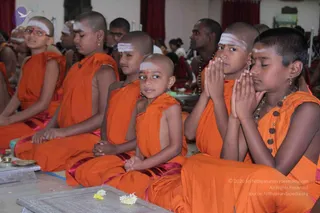
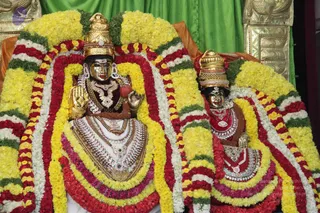
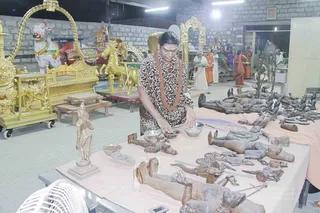
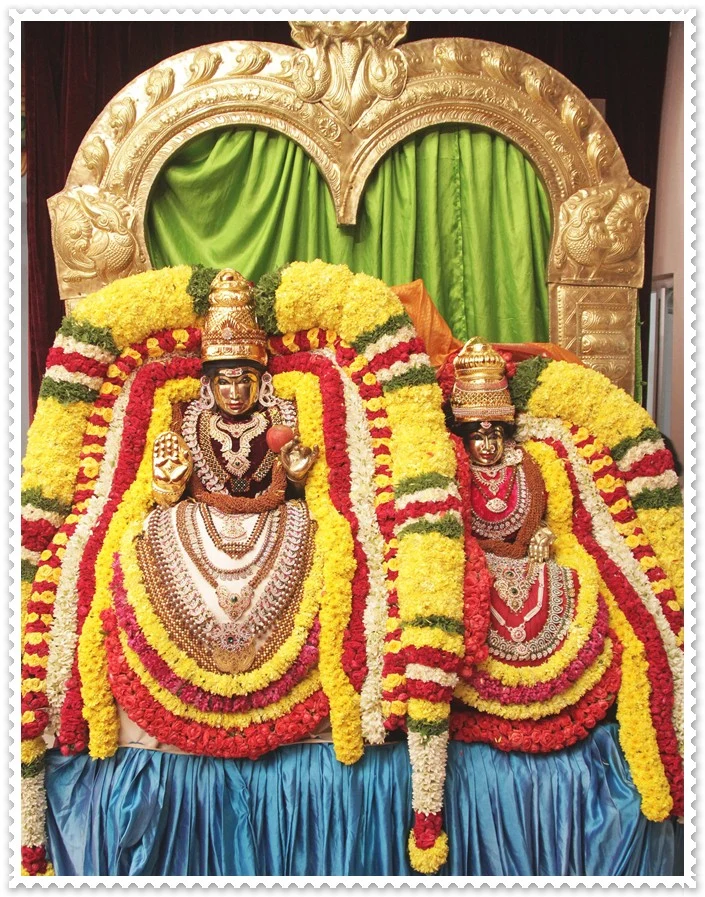
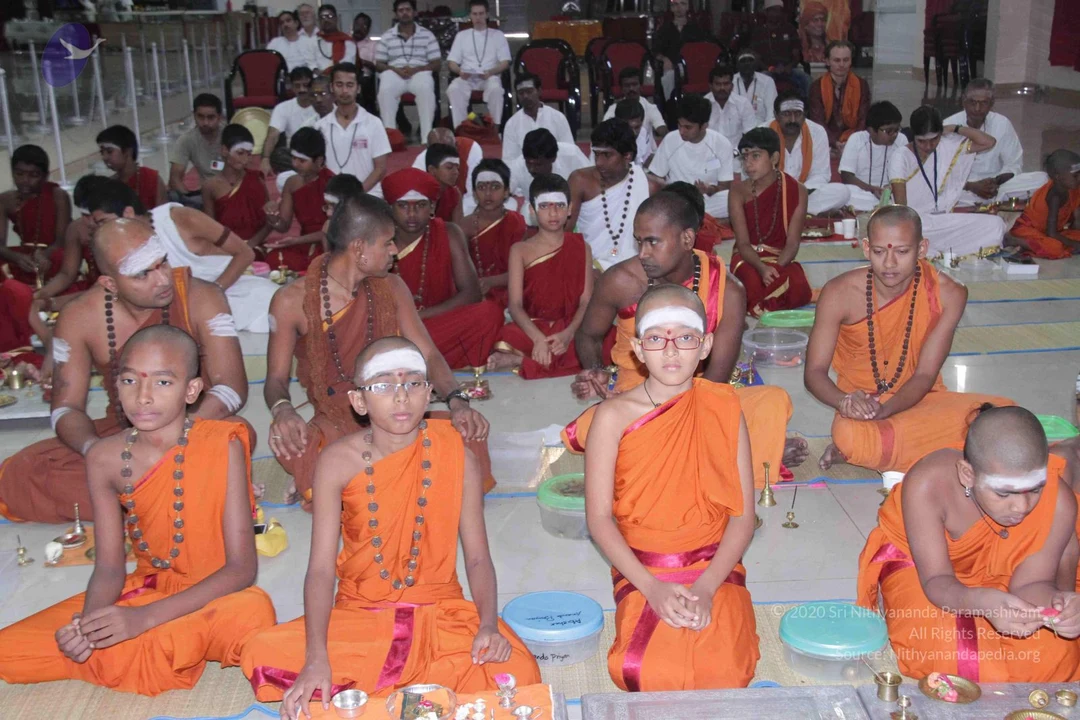
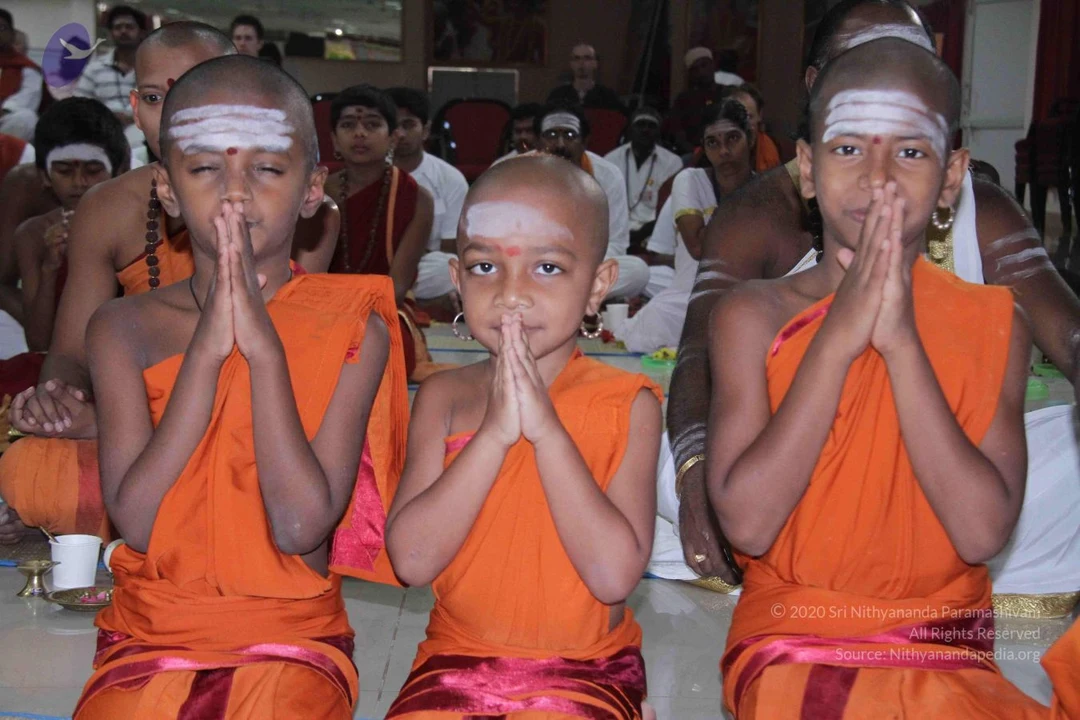
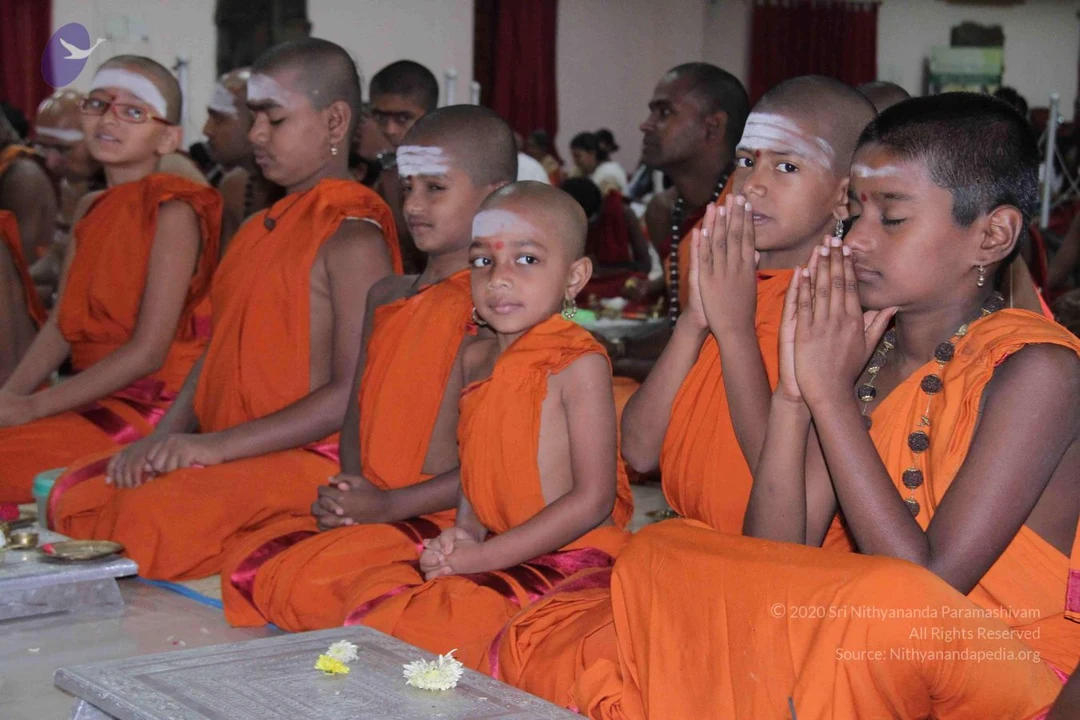
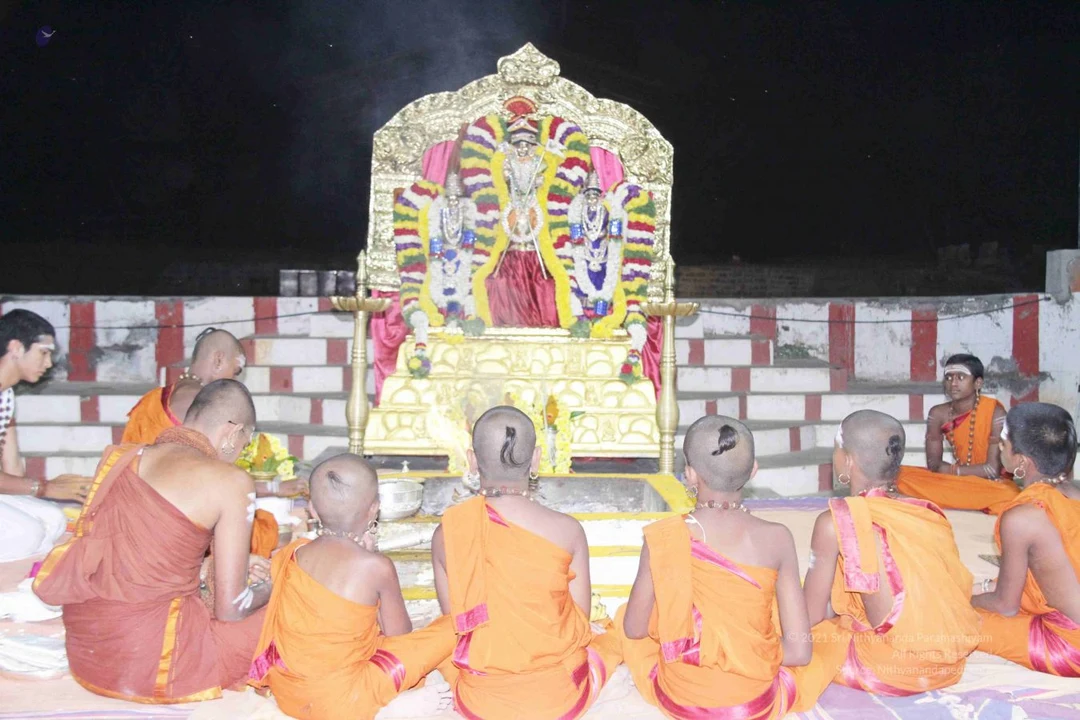
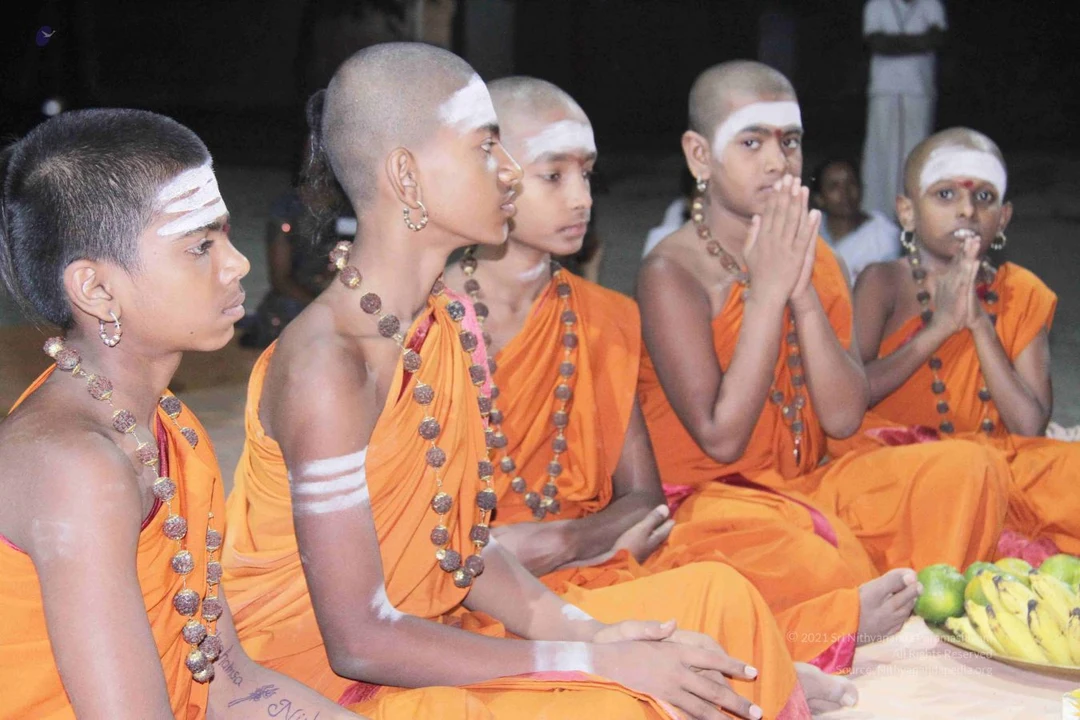
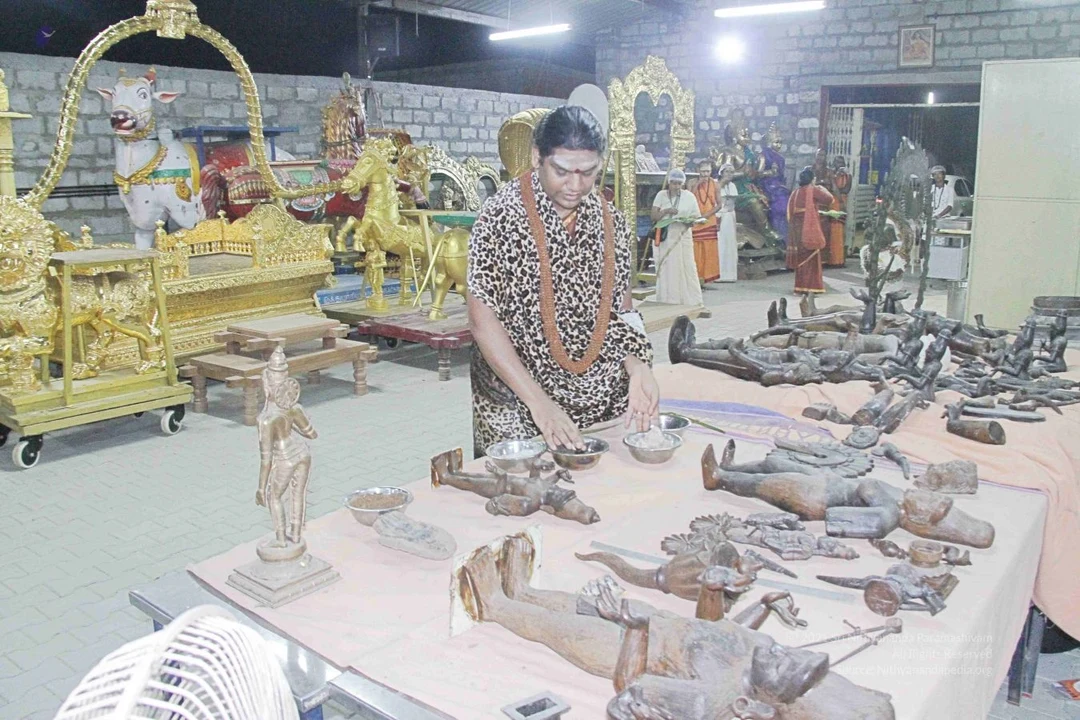
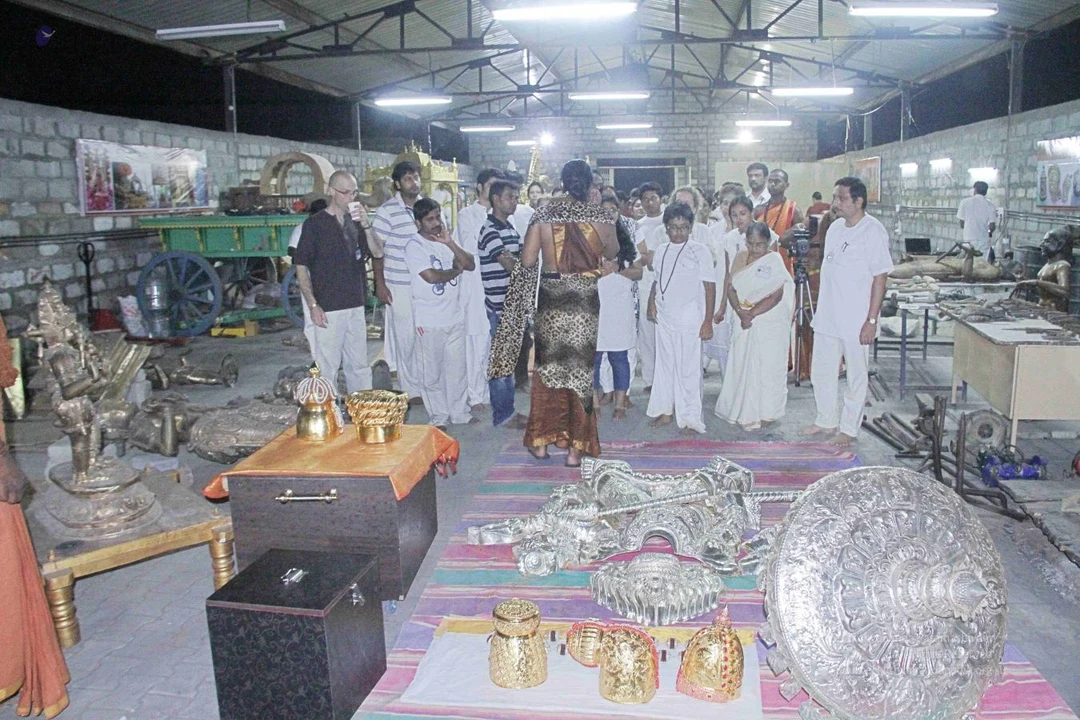
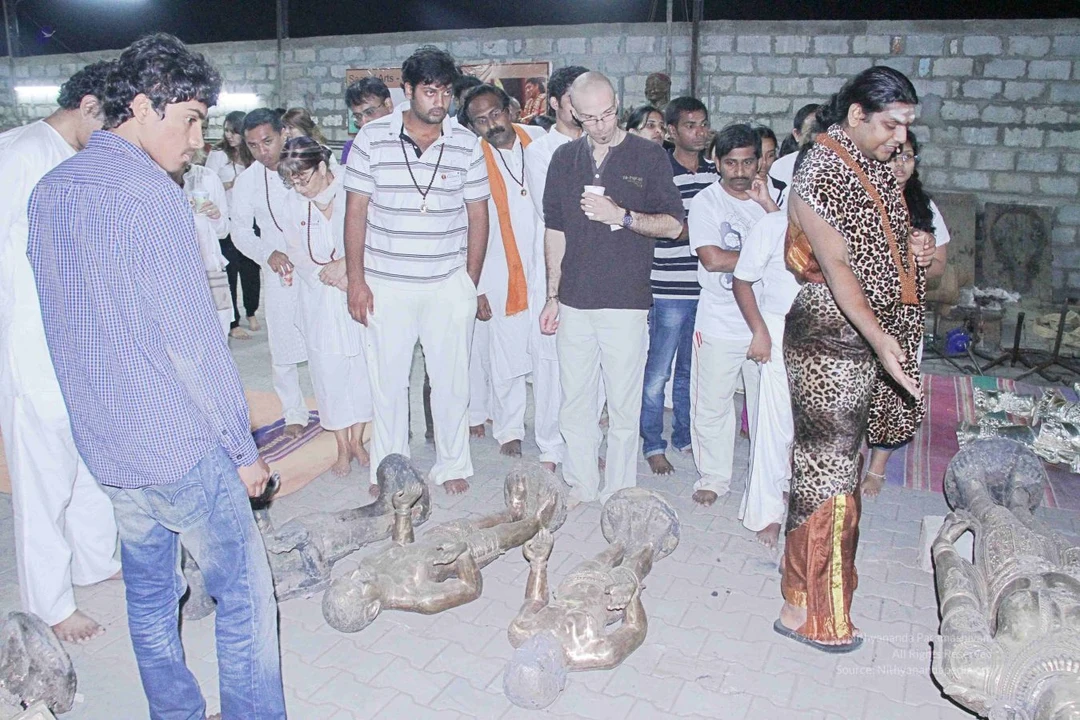
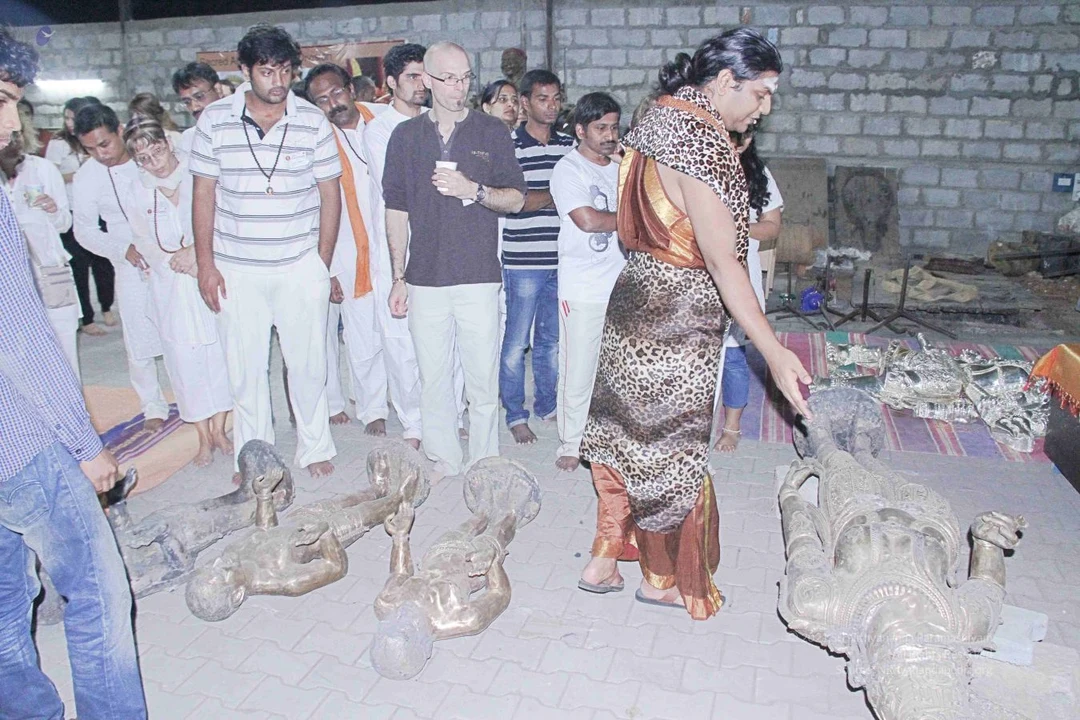
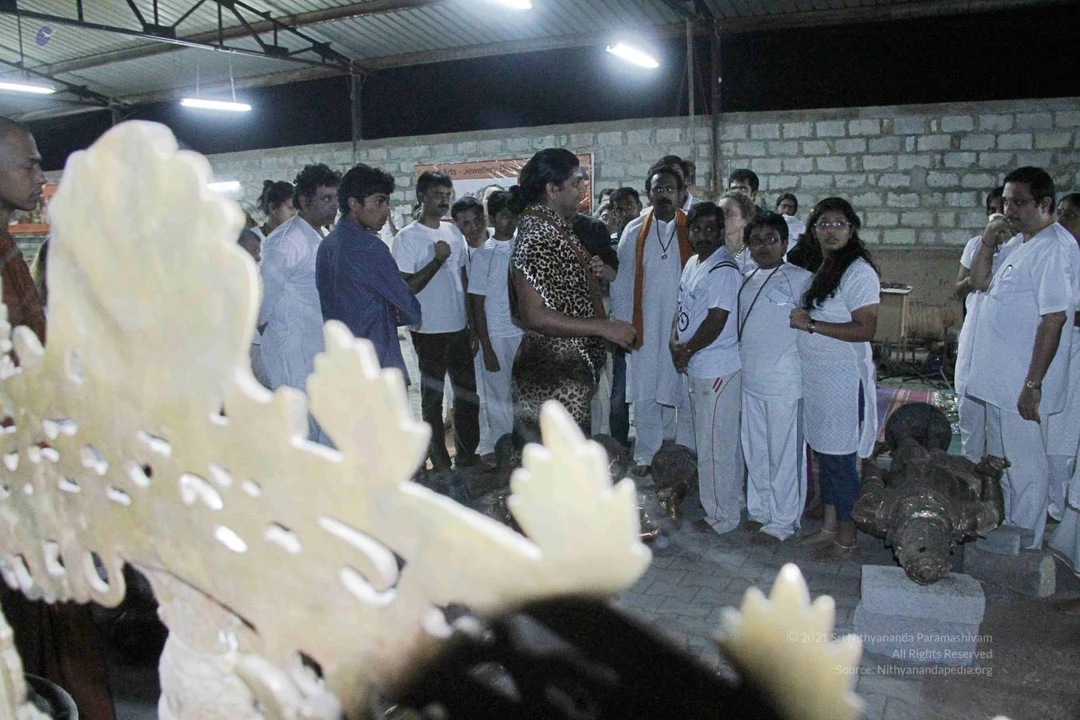
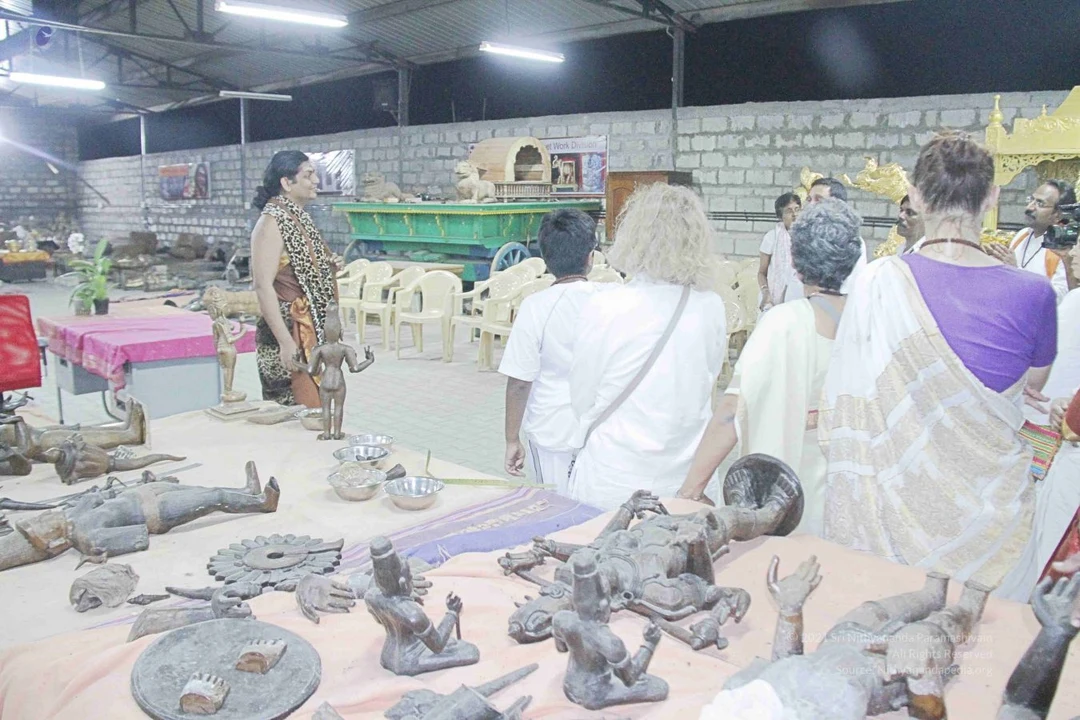
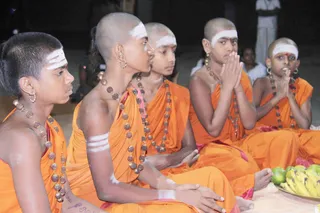
A photograph of a row of shaved-headed young boys seated on the floor in orange robes with white vibhuti stripes across their foreheads. The boy at right presses his palms together in anjali mudra with eyes closed, and the boy beside him also holds his hands in prayer. Several boys wear rudraksha beads and earrings. In the foreground a silver tray holds white and yellow flowers. Adult devotees in orange and red sit in the background of a hall with red curtains.Two metal deity murtis, a larger one and a smaller companion, are dressed and decorated in a temple setting. Both have gold crowns and gold faces, wear layered silver and gold necklaces and jewelled ornaments, and the larger figure holds a red fruit in one hand. Both are framed by a dense arch of yellow and red flower garlands with white and green accents. A green backdrop and gilded panels stand behind them. No people are visible.A workshop or storeroom with a concrete block wall and fluorescent lights. A man with a leopard-print shirt and an orange-brown rudraksha mala stands at a long table covered with a pink cloth, arranging small metal bowls and pouring from a container. On the table lie many dark bronze or wooden deity limbs, weapons and sculpted fragments. Behind him stand golden processional items, including a gilded chariot-style frame, a white and gold bull statue, a golden horse, a gilded throne and a decorated palanquin. Several people in white dhotis and saffron or red robes stand in the background, and a small standing wooden deity figure rests on a base in the foreground.

November 09 2013

Original wiki page
Contents

Title:

completion strategy for global peace.

Description:

In today’s morning Satsang, Paramahamsa Nithyananda gives us another important revelation on the subject of completion –by practicing spontaneous completion, spontaneous enlightenment is possible! Completion is taking a cognitive decision to look at the world as it is, not from our perceptions, but by allowing the right understanding to happen. We can have peace on the planet Earth by practicing and sharing the science of completion!

Link to Video:

VideoAudio

Transcript:

Nithyanandeshwara Samaarambhaam Nithyanandeshwari Madhyamaam | Asmath Aachaarya Paryanthaam Vandhey Guru Paramparaam ||

I welcome all the devotees, disciples, samajis, satsangis sitting with us all over the world at this moment through Nithyananda TV, Lotus News Channel, Sadhna TV, Janasri Channel, Eshwar TV, and two-way video-conferencing having Nayana Deeksha.

Cities sitting with us through two-way video-conferencing having Nayana Deeksha: Guadeloupe-Rameshwaram, Hyderabad-Bahyanagaram, Seattle-Chidambaram, San Jose-Madurai, Los Angeles-Arunachalam, Toronto-Kailasam, Ohio-Prayag, Kuala Lumpur-Palani, Houston-Kalahasti, Nithyanandeshwara Hindu Temple-Charlotte, Nithyanandanagaram-Tiruvannamalai, Varanasi, Toronto Downtown, Oman-Sivagangai, Olympia-Washington, New York-Varanasi, San Diego-Tirualavai, St. Louis-Tirumala, Singapore-Singapuram, Hyderabad-Gupta Kashi, Vancouver-Bhubaneshwar, Bogota-Colombia, Paris-Kalighat, Indrani-New Jersey, Dubai-Vaidyanatham, Enriching Temple-Bidadi, Devon-UK, Bangalore North, Hong Kong-Sirkazhi, Port Washington-New York.

I welcome all of you with my love and blessings.

03:15

Today I will expand on “Forms and Completion”. Please listen! Visualization and Completion! Before entering into the satsangh…..

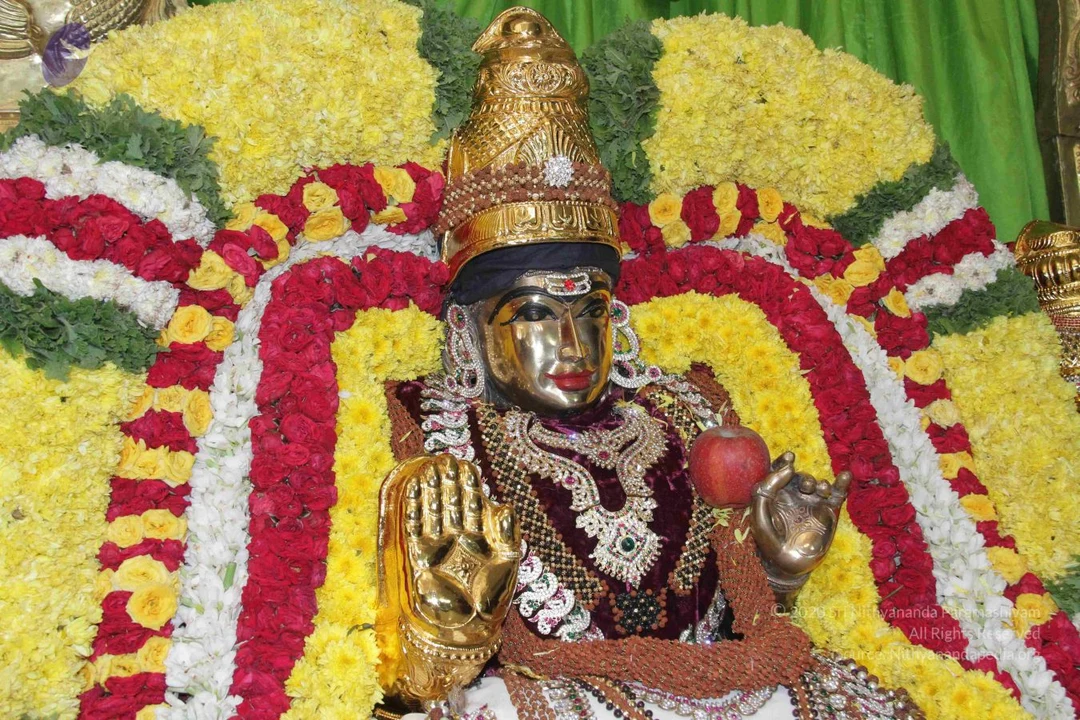
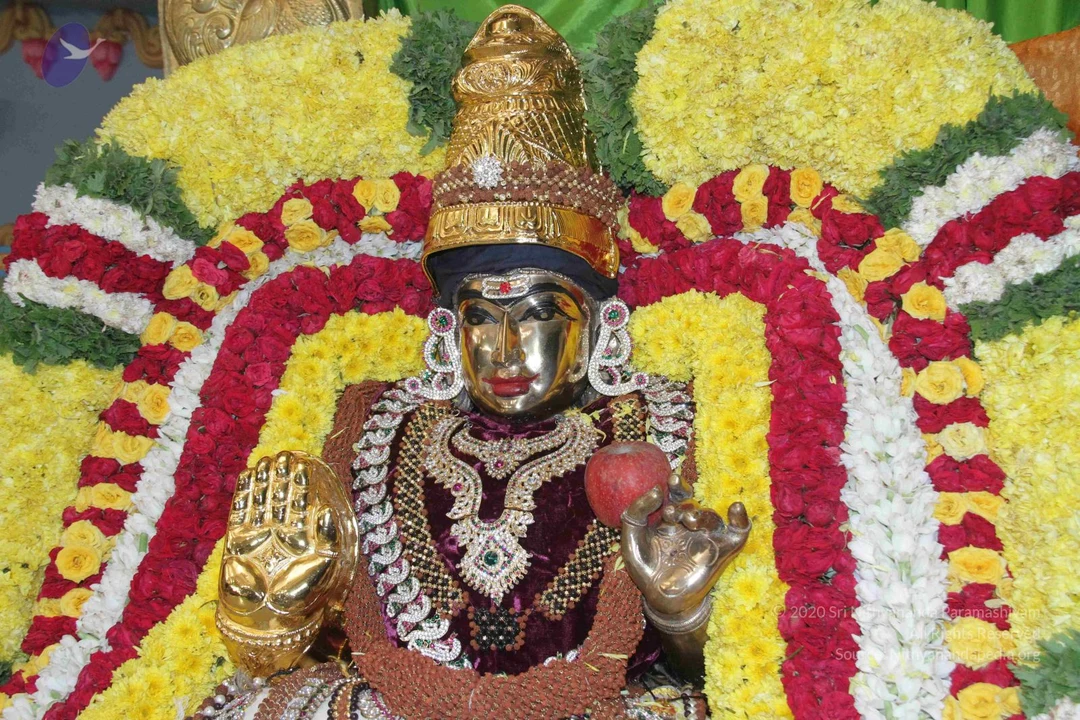
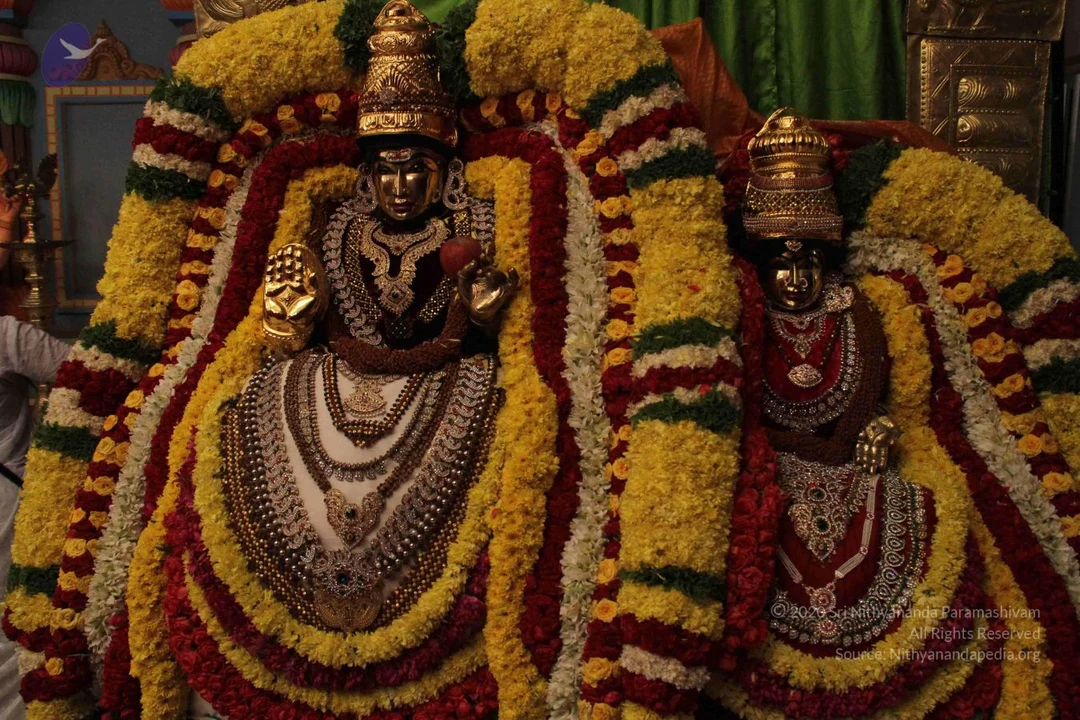
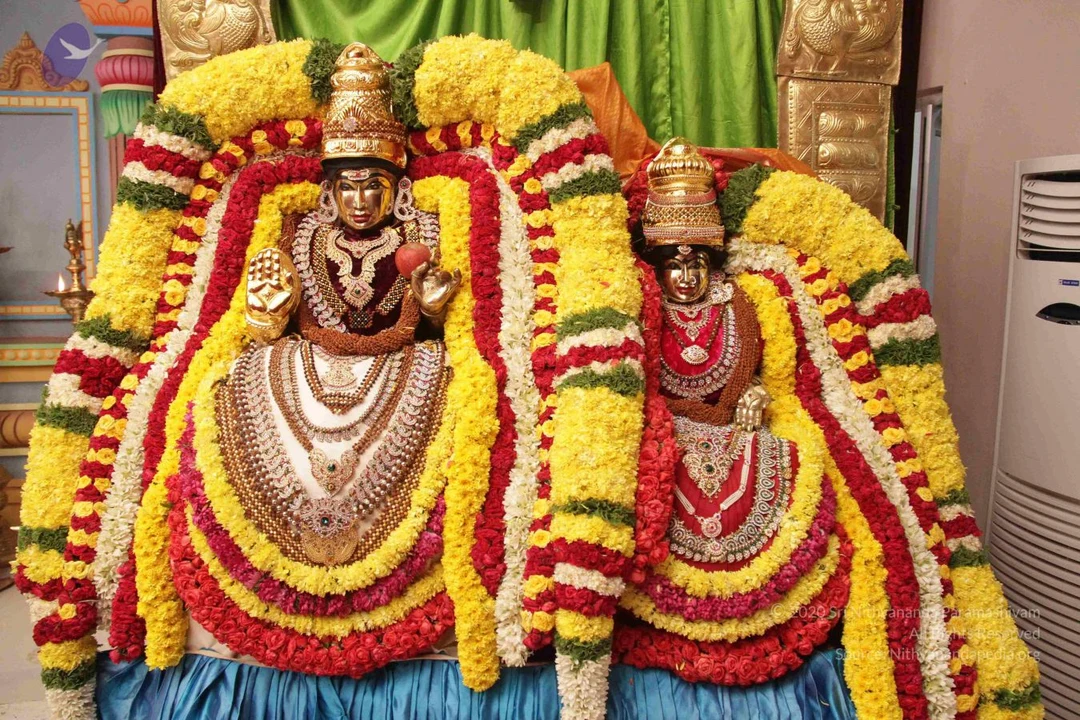
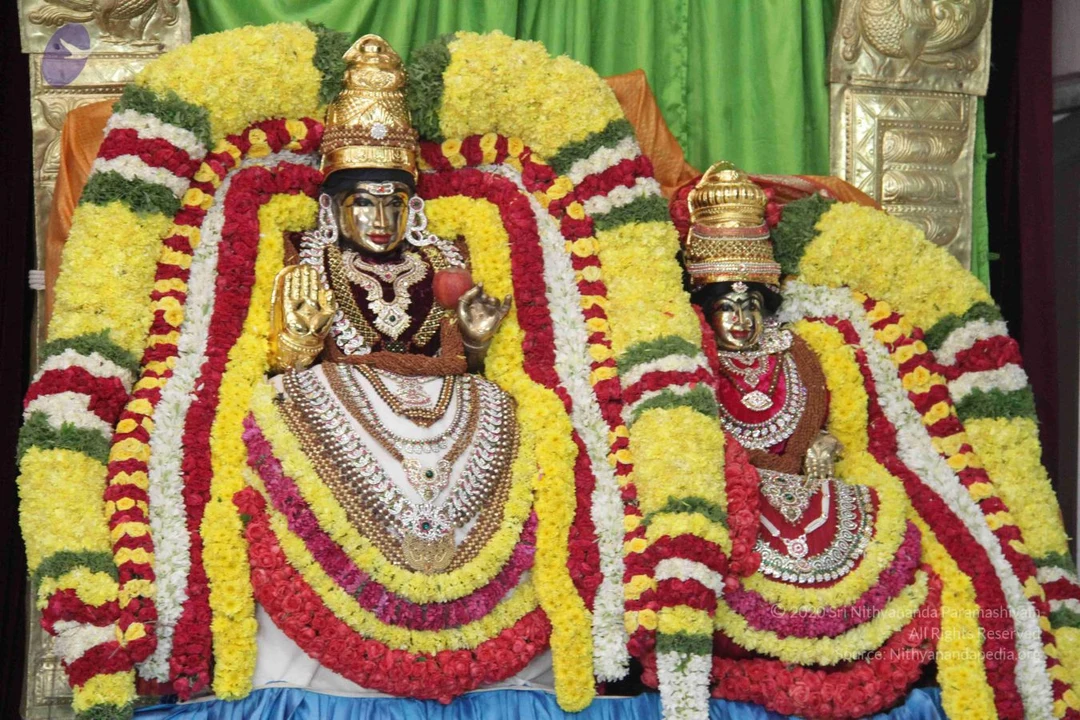
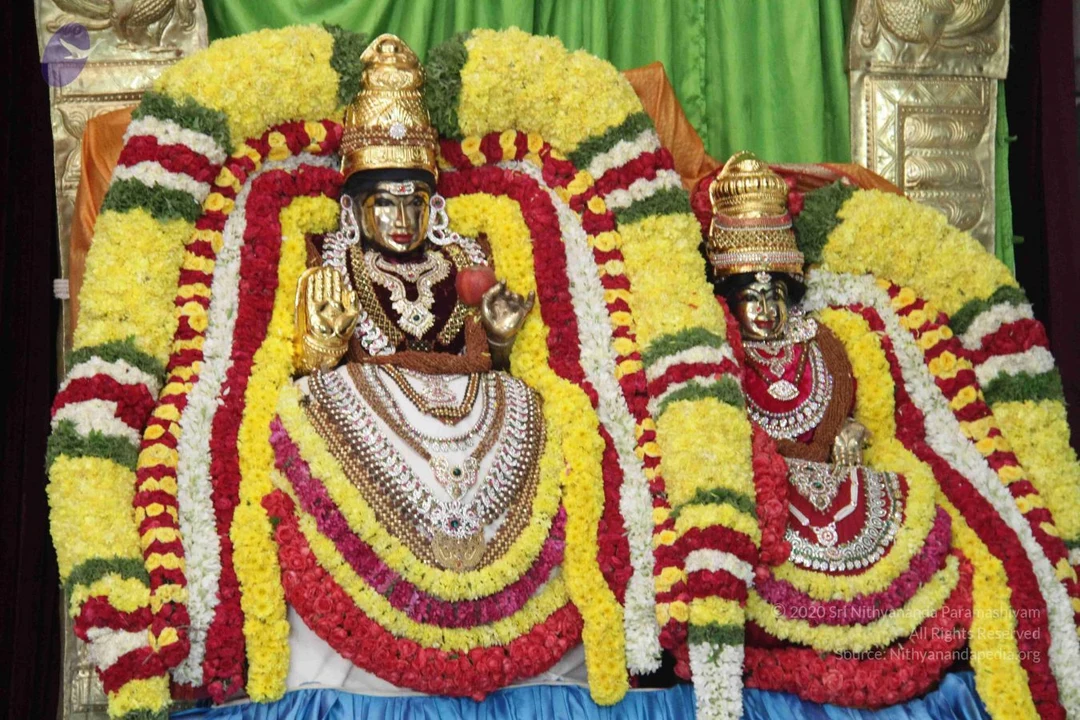
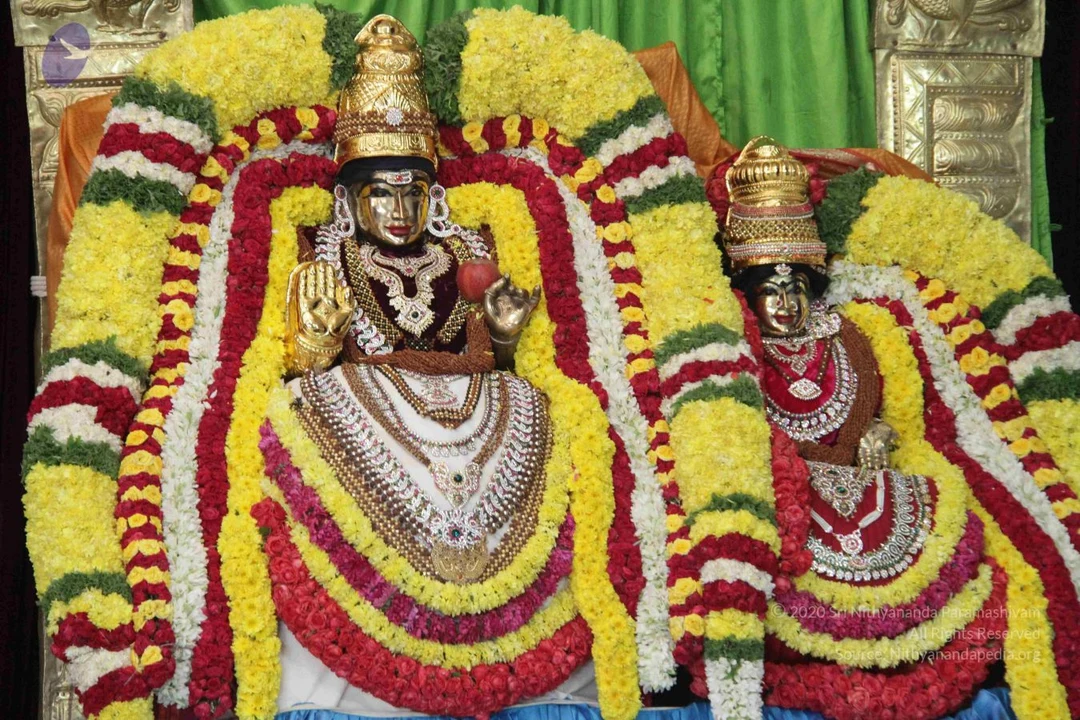
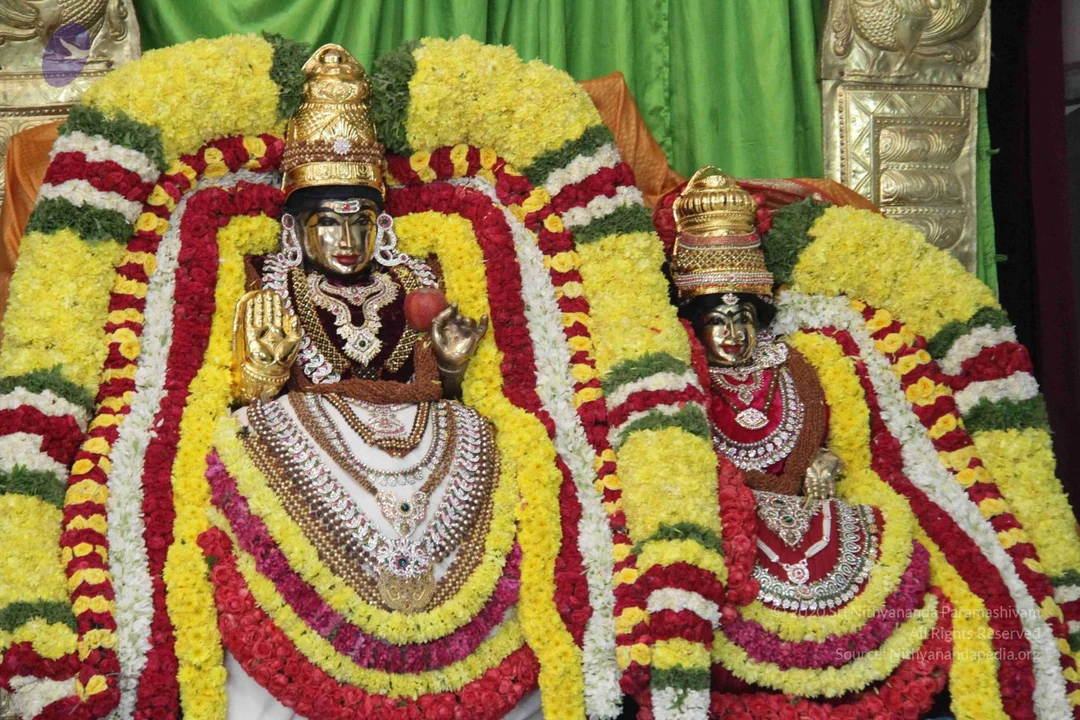
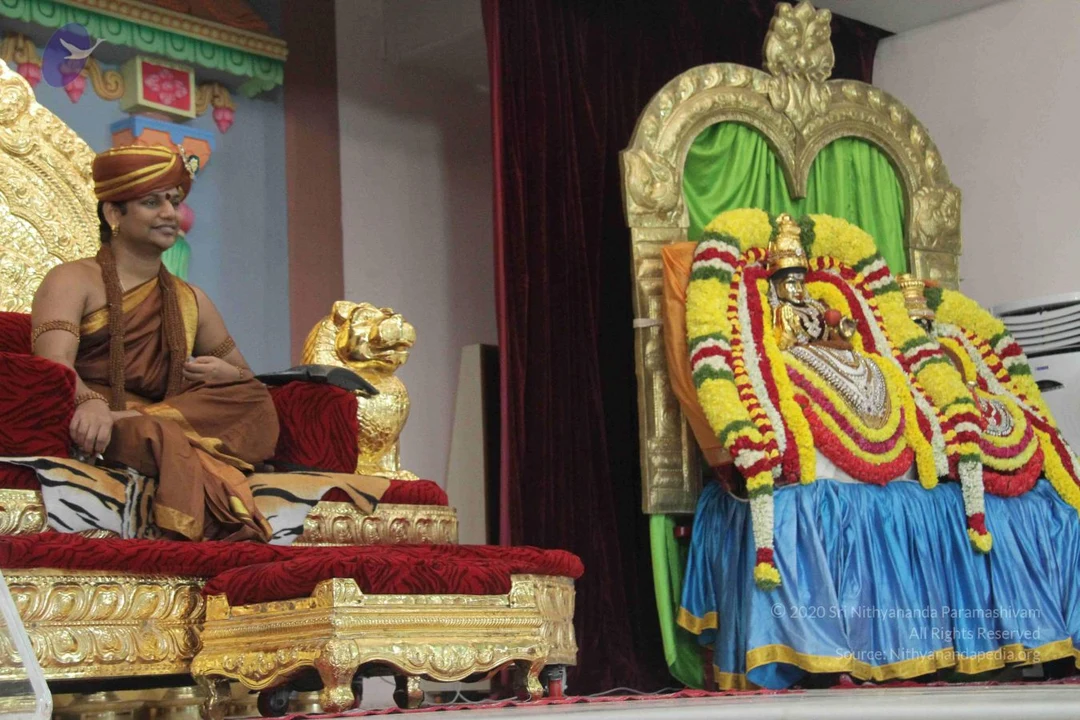
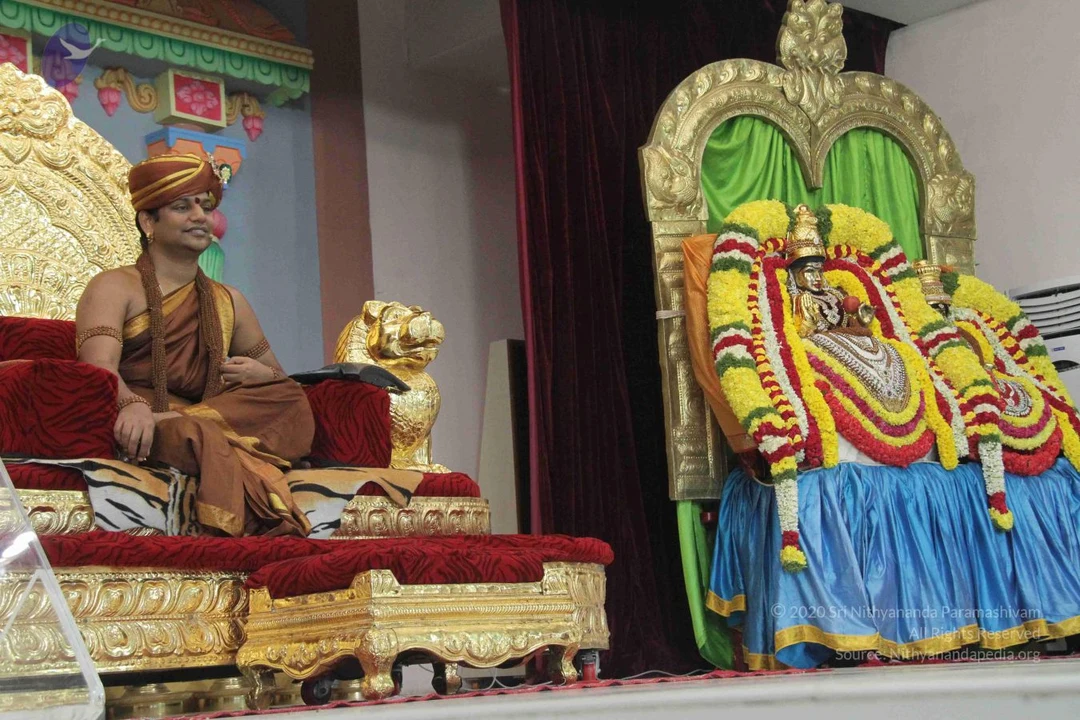
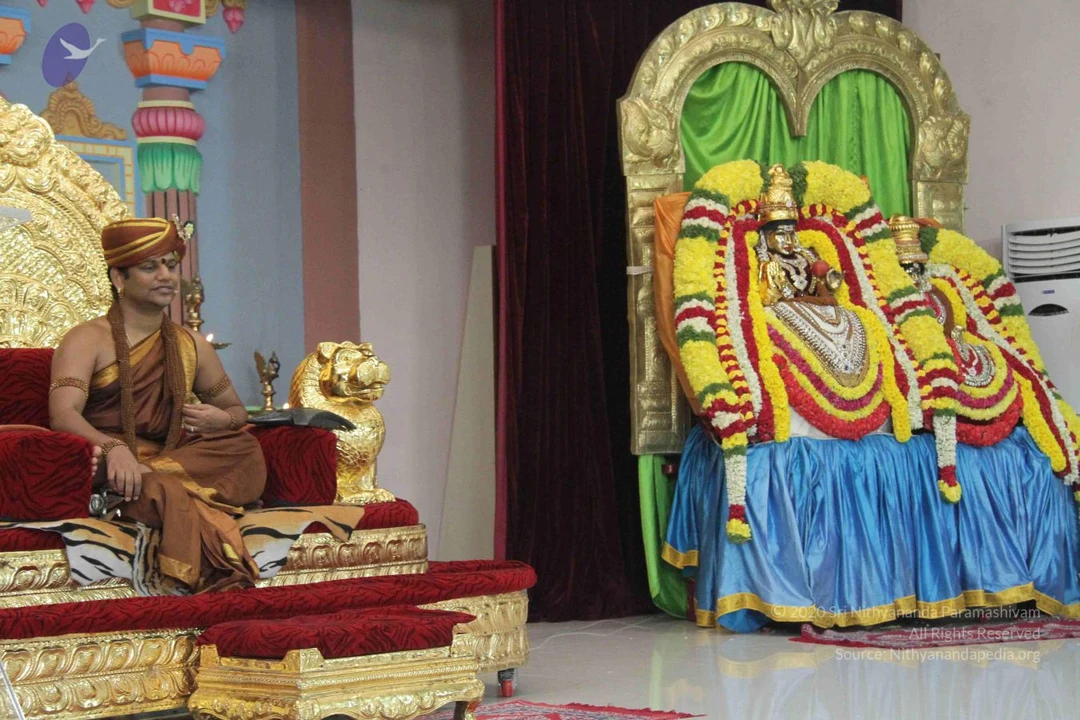
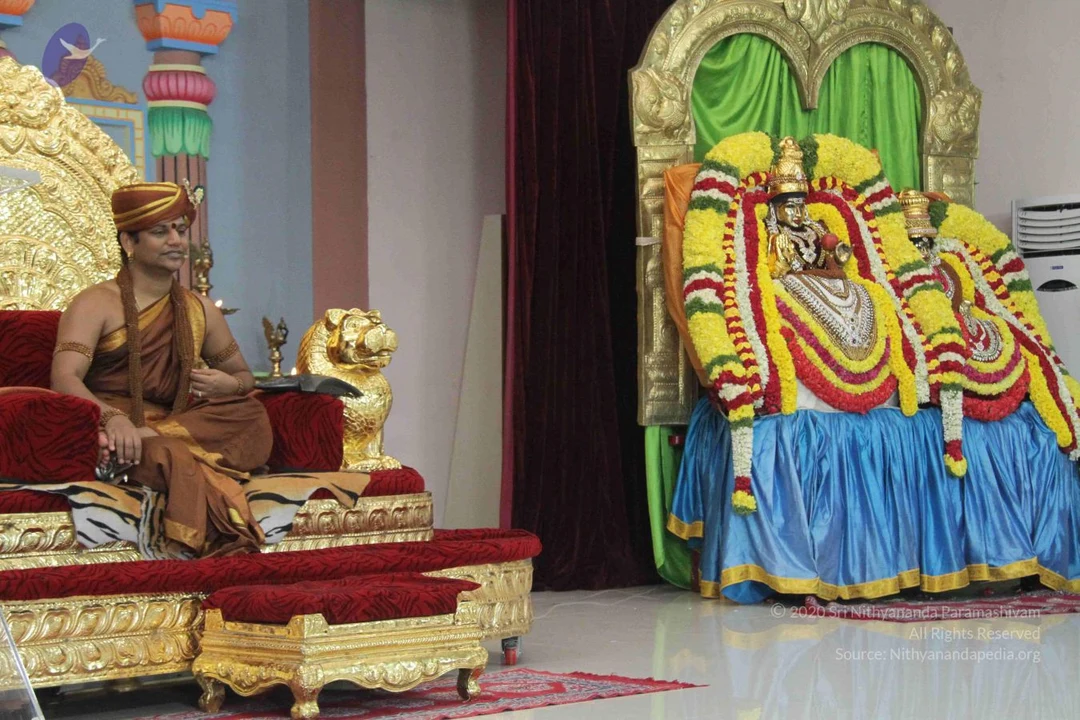
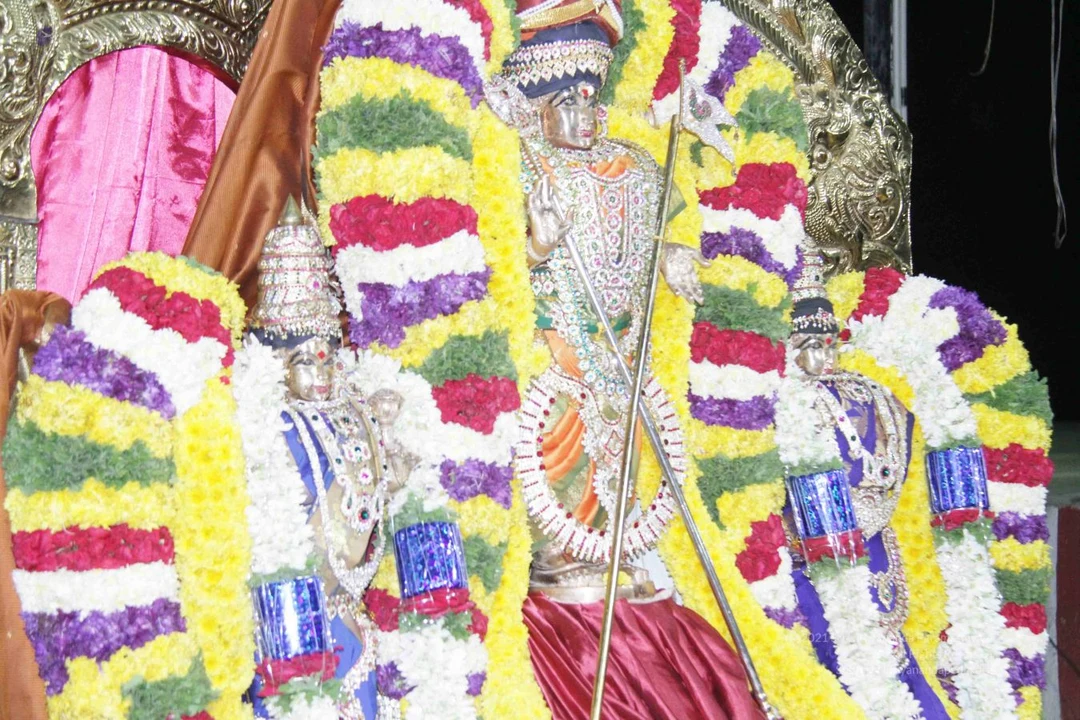
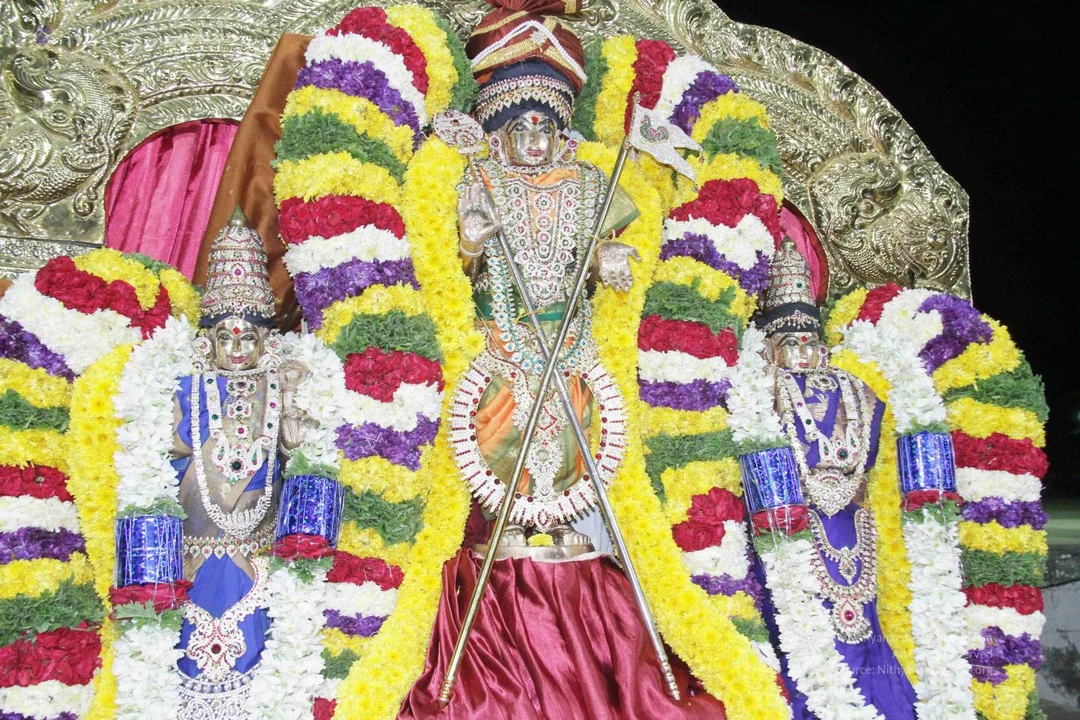
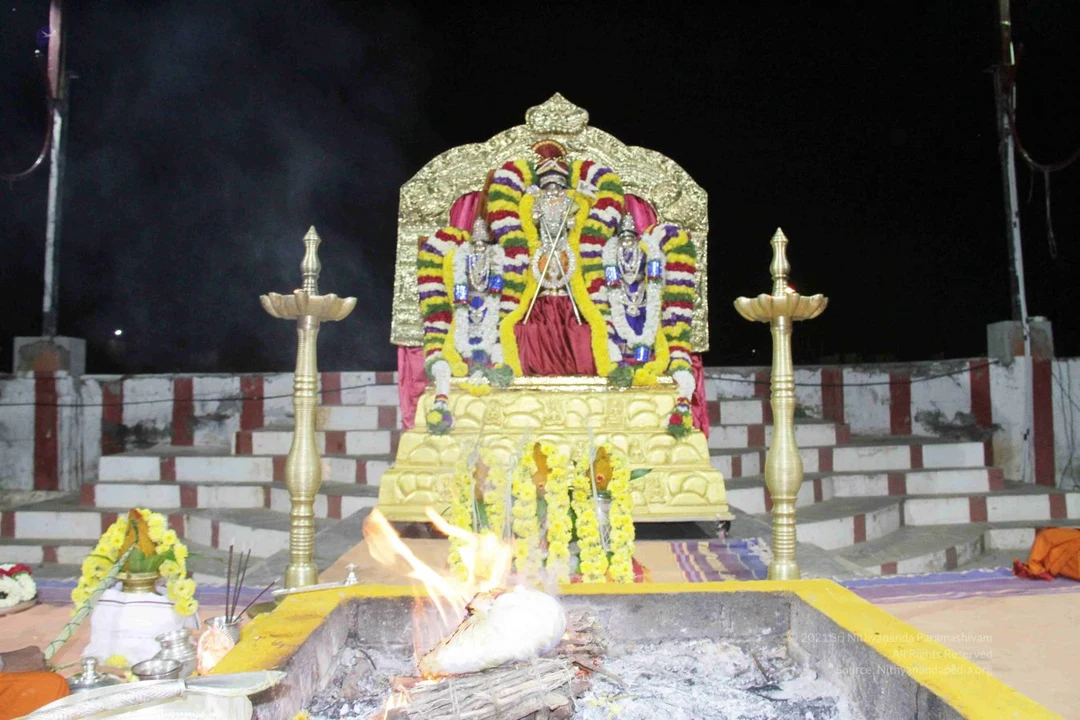
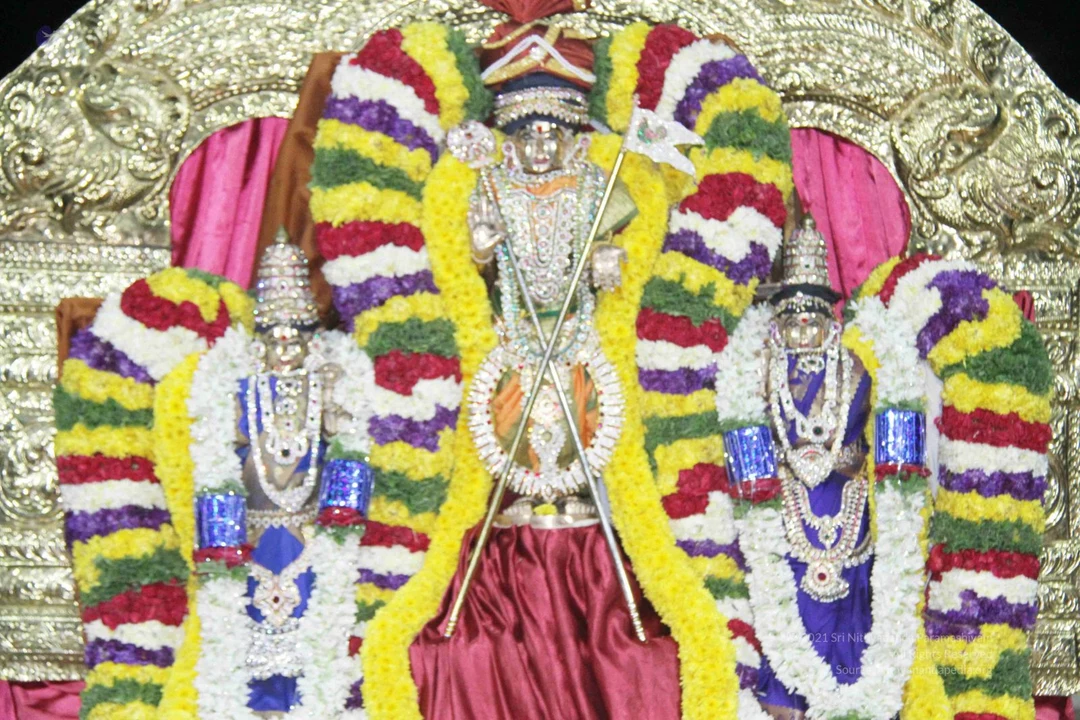
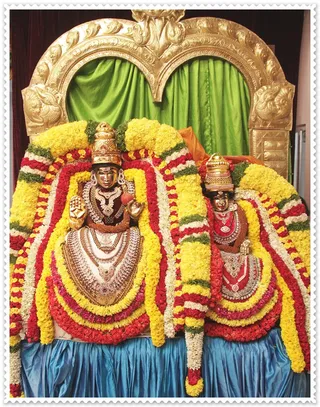
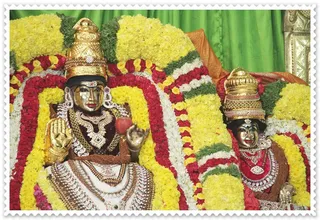
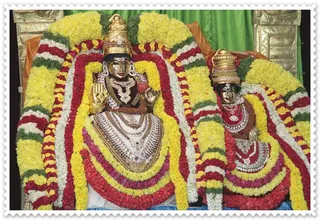
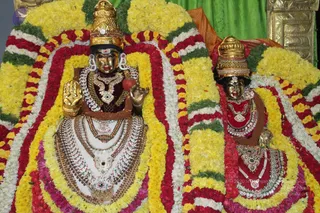
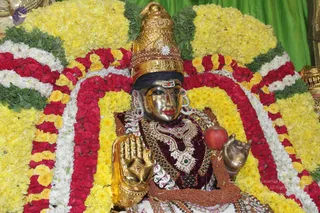
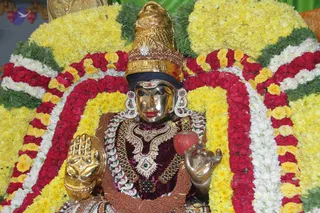
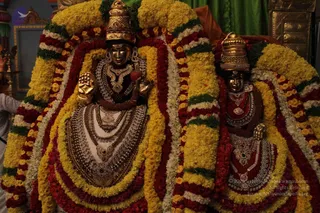
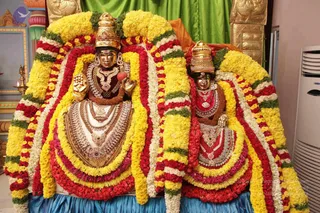
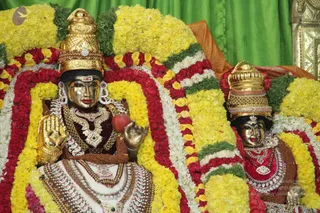
Mahadeva is gracing us today, Arunachaleshwara with Apeethakuchambika is gracing us today on the second day of Nithyanandeshwara Brahmotsava.

I will expand on “Forms and Completion”.

Please listen! Some of the important truths associated to our visualization and Completion. Visualization, I will expand on this truth from the various knowledge traditions of Vedic thought-trend. There is various thought traditions in Vedic religion – thought-trend of Advaitha Siddha, Advaitha Shaiva, Dwaitha, Visisthadvaitha – so many thought-trends. I will share some of the very important truths, sacred secrets which I have experienced, which can make you experience spontaneous Completion, instant Completion. Actually, Completion is nothing but right understanding entering into your cognition.

Sometimes people ask me, ‘Swamiji, whole day I sit with the mirror and look, look, look. Other than tears, nothing is coming. My eyes are burning!’

I tell them, ‘This is the punishment you get for being incomplete!’

No! Listen! Completion is nothing but cognitive decision to look at the world as real, as it is. It is not that always the decision has to come to you, the cognitive shift has to happen to you, it is not that always that cognitive shift has to happen to you after a lot of struggle. No! It is not necessary. It can be spontaneous. It can be a simple decision. I believe in the possibility of spontaneous Completion, spontaneous enlightenment, because I myself achieved spontaneous enlightenment.

08:39

Please understand, even though my life looks like a gradual enlightenment process, it is not. Because I got enlightened, all the actions I did earlier looks like spiritual practice! That is like a with the conclusion reading the history. See, now we got the conclusion of the World War 2: Hitler lost. So, now we read all the incidents back and make him as a villain. I am not saying he is hero or villain and all that. I am nobody to comment. But, I only wanted to tell you guys that there are worse villains in history, but they are not projected so much as villain as Hitler. That you need to know.

I tell you, history is a lie, money is a hoax, politics is exploitational methodologies, media is the institutionalized rumor-spreading machinery. Only thing which can save you in your life is come to the Science of Completion. I tell you, it is simply the Science of Completion only that can save you in your life. So, history is nothing but reading the incident of the past after the conclusion.

Even in my biography, if you read it after the conclusion of enlightenment, it looks like the whole thing is a spiritual practice; but actually when it was happening it was not happening as a spiritual practice, I wanted you to know. I did not feed Ganapathi as a spiritual practice; as a play I started. I did not go to Arunagiri Yogishwara for spiritual practice, a causeless love I had for him, I don’t know why. I do not know why all my gurukul kids have so much of love for me. Later on they may give a reason, when they grow logically like you all, ‘We were having, so deeply cherishing feeling-connection with Swamiji, because we want enlightenment, our spiritual practice.’ But now they don’t know. Now they only know, ‘We love Swamiji’, that’s all! With Arunagiri Yogishwara I did not have a spiritual practice devotion. No!

12:18

Please understand, political history is hoax, political geography is hoax, political economy is hoax, political media is hoax. Understand, political history, means history written to promote or demote certain political ideology, is hoax. Geography based on politics, means borders, is hoax. Politics-based media, the media machinery used to further somebody’s political interest, is hoax. The political economy, means projecting somebody, some country as rich, some country as poor, some State as rich, some State as poor for the political gains, is hoax.

I tell you, because all of us are kept in fear, we want to buy more and more weapons, the weapons-based economies are rich. The moment that violence on the human civilization comes down even 3% or 4% - I am not even asking the whole 100% we should be violent-free – even if 3% or 4% violence in the human mind comes down, all the so-called big economies of the world, present economies will collapse, because they are all standing on weapon. They are all standing on.. their whole economy is standing based on selling war weapons. Why, why so much of war weapons bought-sold? Because human-beings with its innate tendency is put to live in anxiety. You need Completion, not army weapons.

O, humanity, your requirement is Completion, not more and more army weapons! I am not saying dissolve all the armies. That will take a lot of time. Even if I say, nobody will listen; that’s different. All I am trying to say is, immediately let us start adding the Science of Completion into human consciousness through education, schools, colleges, the media, all the available infrastructure. All the prisons should start the Science of Completion as the rehabilitation method. All the schools, all the colleges, all the jails, all the hospitals, all the rehabilitation homes should start Completion as part of their education. I tell you, I really tell you, before beginning all the law houses, Completion should be must.

17:23

Yesterday we were discussing that there are machineries now, based on the stress levels in your muscles we can prove the level of Completion you are in. So, only a person who has lower than certain level of stress, stress level, who has more Completion, only that kind of person should be allowed to file nomination in the election; only that kind of people should become leaders, decision-makers. Understand, if we can just do this, I know, it looks impractical, but with Kalabhairava’s grace, there is every possibility we can make it practical. Kalabhairava’s doors can never be closed. Even through the closed door he graces! That is why, closed door itself is worshipped as his presence everywhere. Door being worshipped as the presence of Kalabhairava is a village tradition. If you see, in every village, every house on the door-frame they will apply the turmeric powder and kumkum and worship it as presence of Kalabhairava. Kalabhairava’s doors can never be closed. He is extraordinary possibility! Anything you propose, he is there only to say “Thathaasthu”!

Listen! Listen! If we can bring down the violence level of the human mind, the insecurity level will drop. If the insecurity level drops, if the insecurity level drops, please listen, if the insecurity level drops, suddenly the whole country will start voting for the people who are more development-based, rather than terrorism-based, rather than war-based. If the idea changes from war-based to development-based, immediately all the war-based economies will collapse. There are some countries in the world, constantly they want war. Why? Because their economy is based on wars. They don’t grow agricultural products like India, or they don’t make furniture and other items like China. Their main product is weapons. So, naturally, how will their economy be up, alive? Only by weapons! So, politics-based economy is dangerous, hoax.

I tell you, the human civilization should decide not to participate anymore as part of war-based economies. Let us all boycott war-based economies. We will not participate in the war-based economies. We should also insist that war-based economies and terrorism-based theologies should be banned by the United Nations as terroristic ideologies. Any ideology, theology which makes you terrorist, makes you bomb, makes you kill others, that theologies should be banned by the United Nations. Any country’s boom based on war-based economy should be banned as a terrorist State.

Listen, after the conclusion, the history should not be re-written. In my life, when I look at life as it happened, I only had sudden enlightenment; I didn’t have a gradual enlightenment; because I didn’t do whatever I did for enlightenment. It was a bits-and-pieces happening. There may be one or two incidents where I had the context of enlightenment, but not all. Surely, my relationship with Raghupathi Yogi was not for enlightenment. My relationship with Arunagiri Yogishwara was not for enlightenment. To tell you honestly, my relationship with Arunagiri Yogishwara had love as the context, not sincerity. You can just look around me. How many of my Gurukul kids are already sleeping? but if we are all dancing, all of them will be jumping around. Yesterday during Soora Samhara we were all dancing, and all of them were jumping around! I was sitting on the stage, and all these fellows were jumping around the stage! It means what? It is love-based relationship, not sincerity-based. Sincerity is there from the context of love. I tell you, that is exactly what I had with Arunagiri Yogishwara. It was not sincerity-based. The sincerity was there from the context of love; because I loved him, I tried to be sincere to his words; that’s it. Other than that, there was no other philosophically being convinced I am supposed to be sincere to him. At least Raghupathi Yogi tried to convince me that I have to be sincere to him with the philosophical reason, philosophical context. But Arunagiri Yogishwara neither convinced, nor I had sincerity. It was just pure context of love. So understand, I myself had only spontaneous enlightenment. And you can also have spontaneous enlightenment. It is possible!

The main idea behind this three-month Sannyas Training itself is trying to make people experience spontaneous Completion. Otherwise you can’t have sannyas in three months. But there is a possibility.

I will continue the satsangh after a break.

27:15

SMALL BREAK…………………

Our Sannyas Training for three months, it is all about trying to give people that spontaneous Completion. Because, when you start working with the Completion process, if you hit at the right root-pattern, just like that you can achieve Completion!

And, this Bali Inner Awakening is all about spontaneous Completion, spontaneous enlightenment, because I am trying to reach your inner-most core root-pattern from various level. I really feel, every day at least a few hundred of you will be spontaneously declaring Completion and enlightenment. It will be a very powerful experience. I strongly feel Jnanasambandhar and Shankara, both of them went to Bali and established Shaivism. We are doing more research. I will come back to you all with more proofs.

30:29

The spontaneous Completion is possible. Knowledge about the visualization, forms will help you to achieve the spontaneous Completion. Today, I started speaking about knowledge of visualization of forms, which I will expand tomorrow also. Actually, I started introducing form and Completion, but the introduction itself took today’s whole satsang. So, tomorrow I will explain the subject…..in further satsangs I will explain the subject how knowledge about the form leads you to spontaneous Completion. Today you need to know, through today’s satsang I wanted you to understand that spontaneous Completion is possible, spontaneous enlightenment is possible, and knowledge about visualization and forms will lead you to spontaneous Completion and enlightenment.

I bless you all! With Integrity, Authenticity, Responsibility and Enriching, let you all radiate with eternal bliss, Nithyananda! Thank you!

Photos From The Day:
Photos Of The Day:

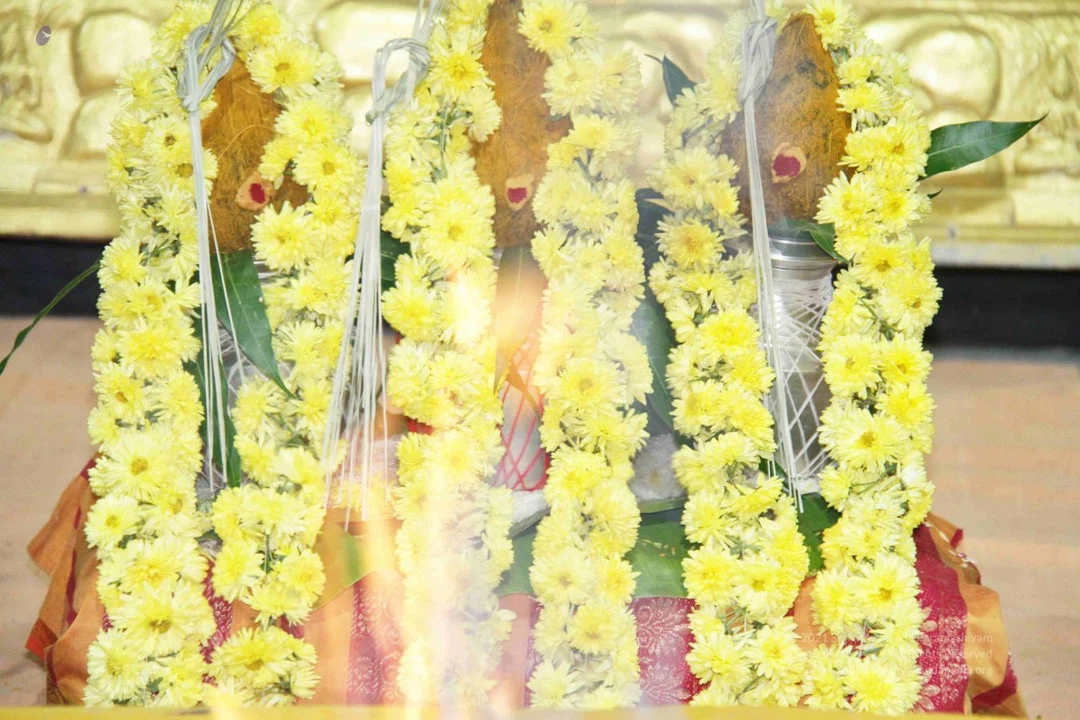
Arunachaleshwara-Apeethakuchambal

Paduka-Puja

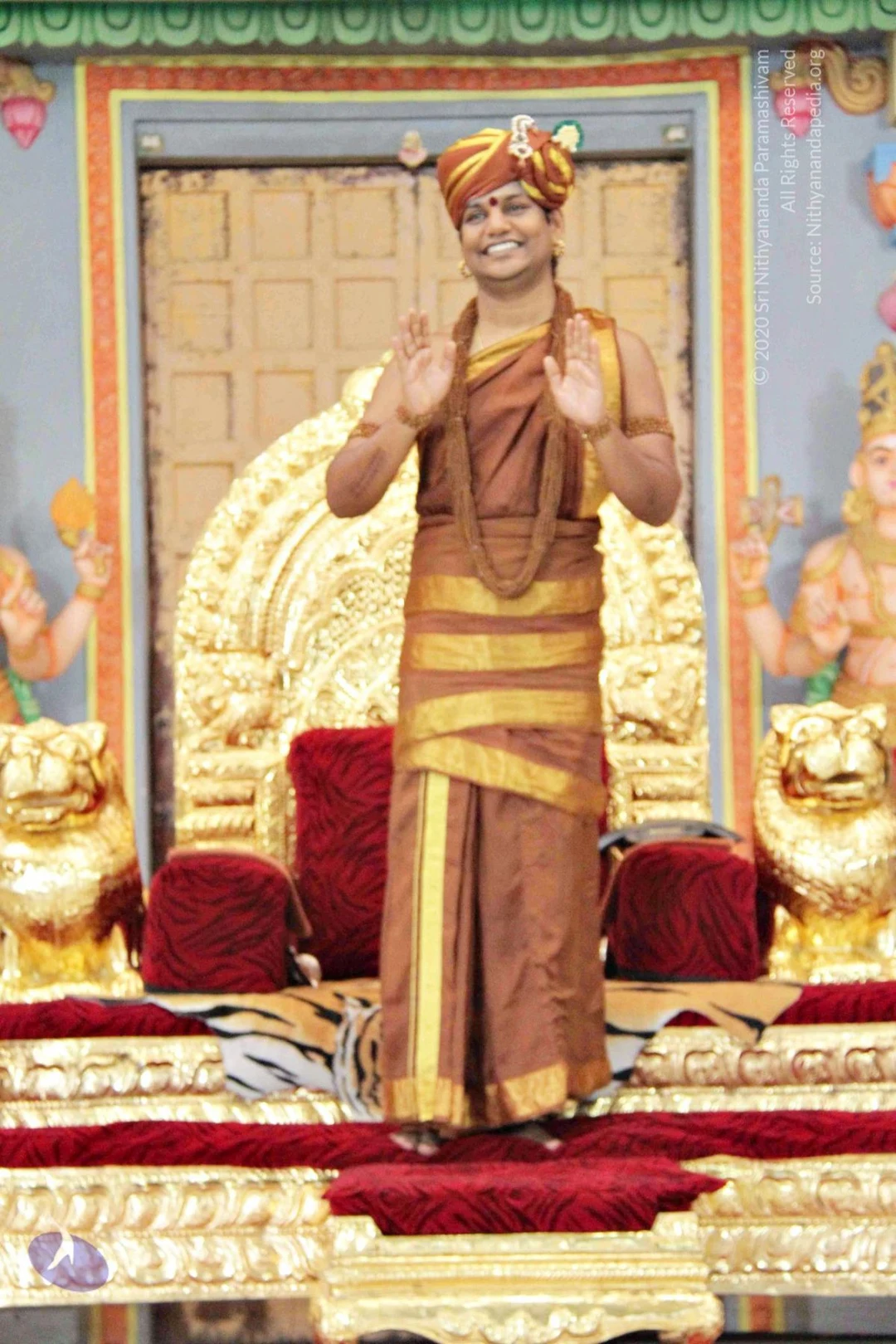
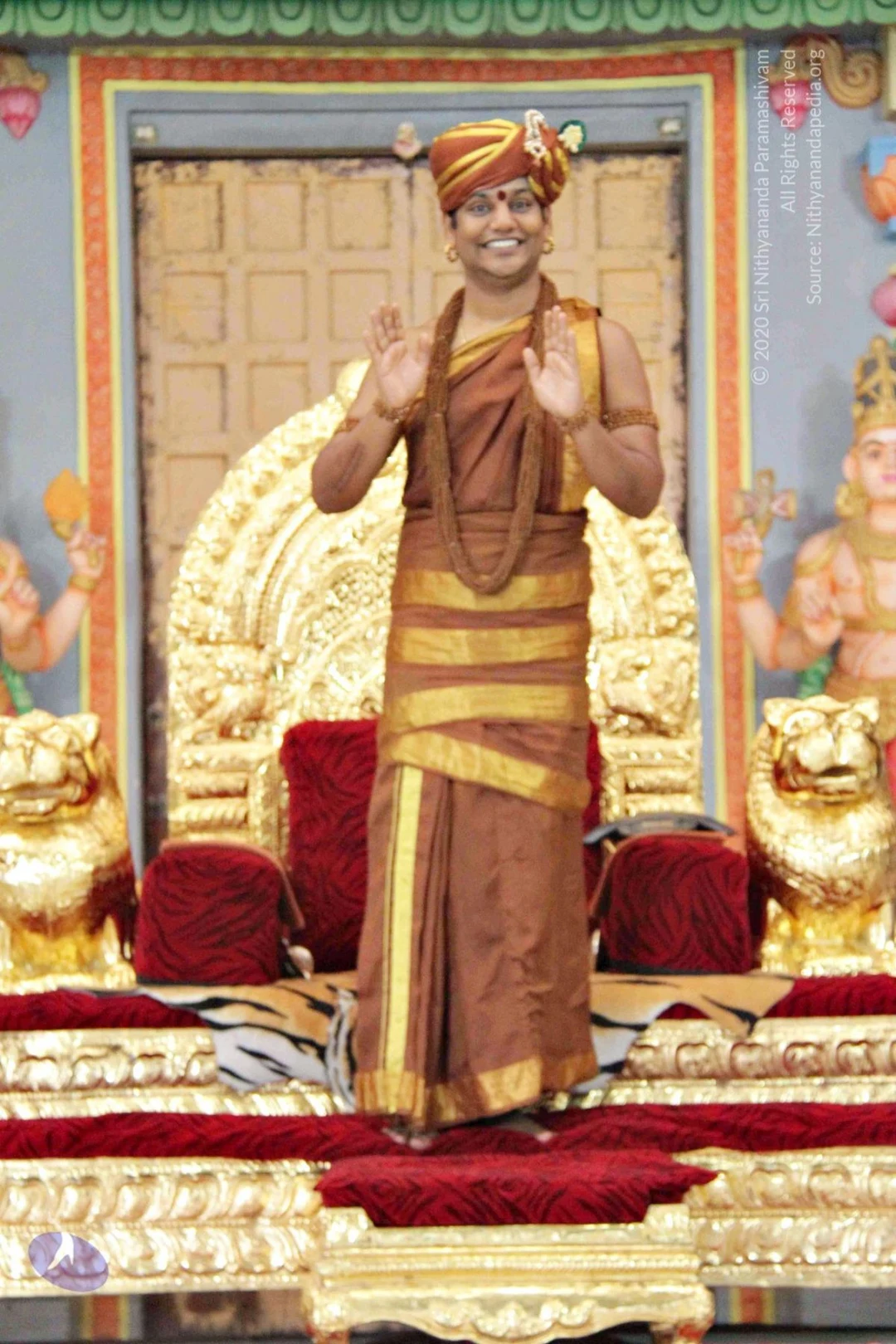
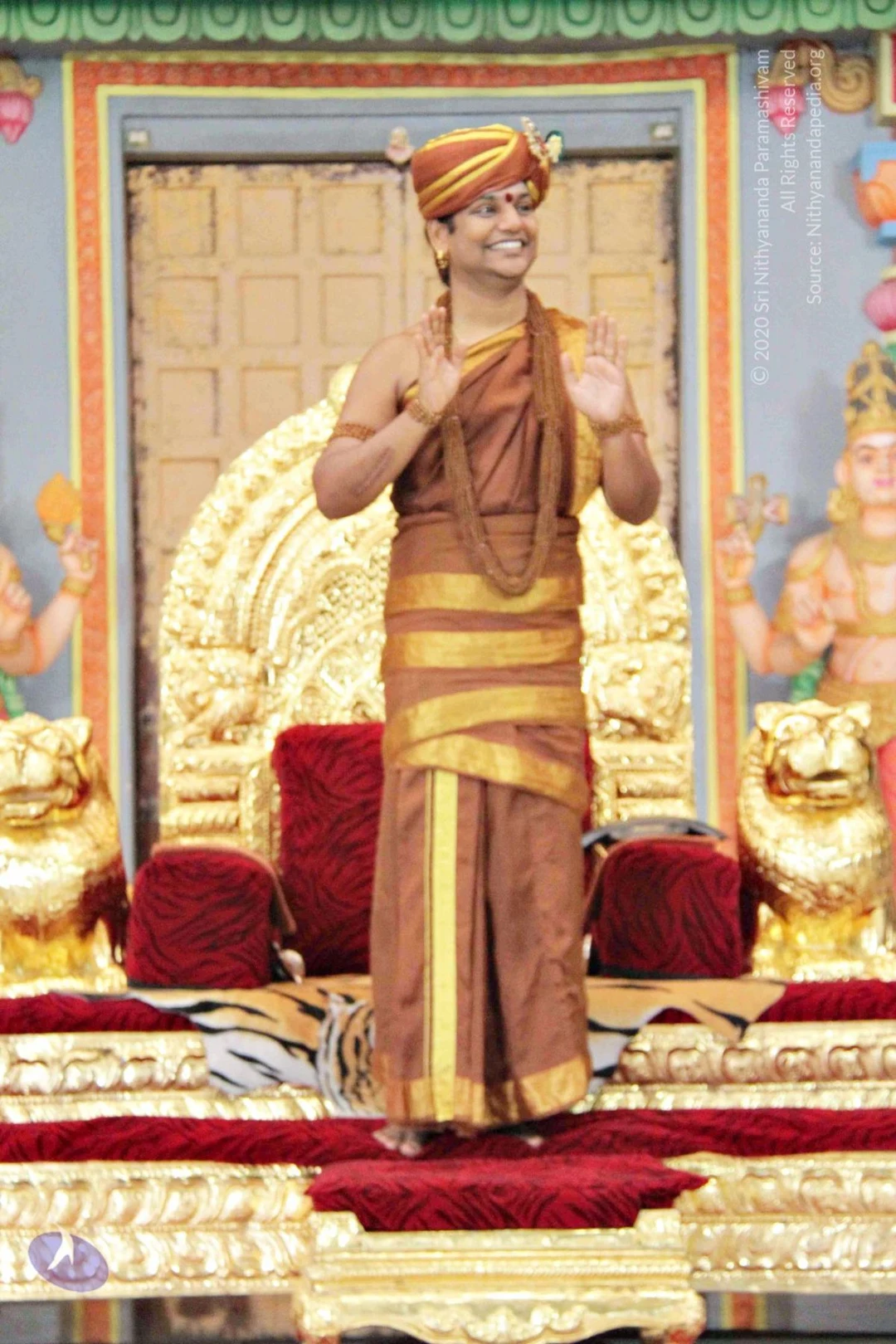
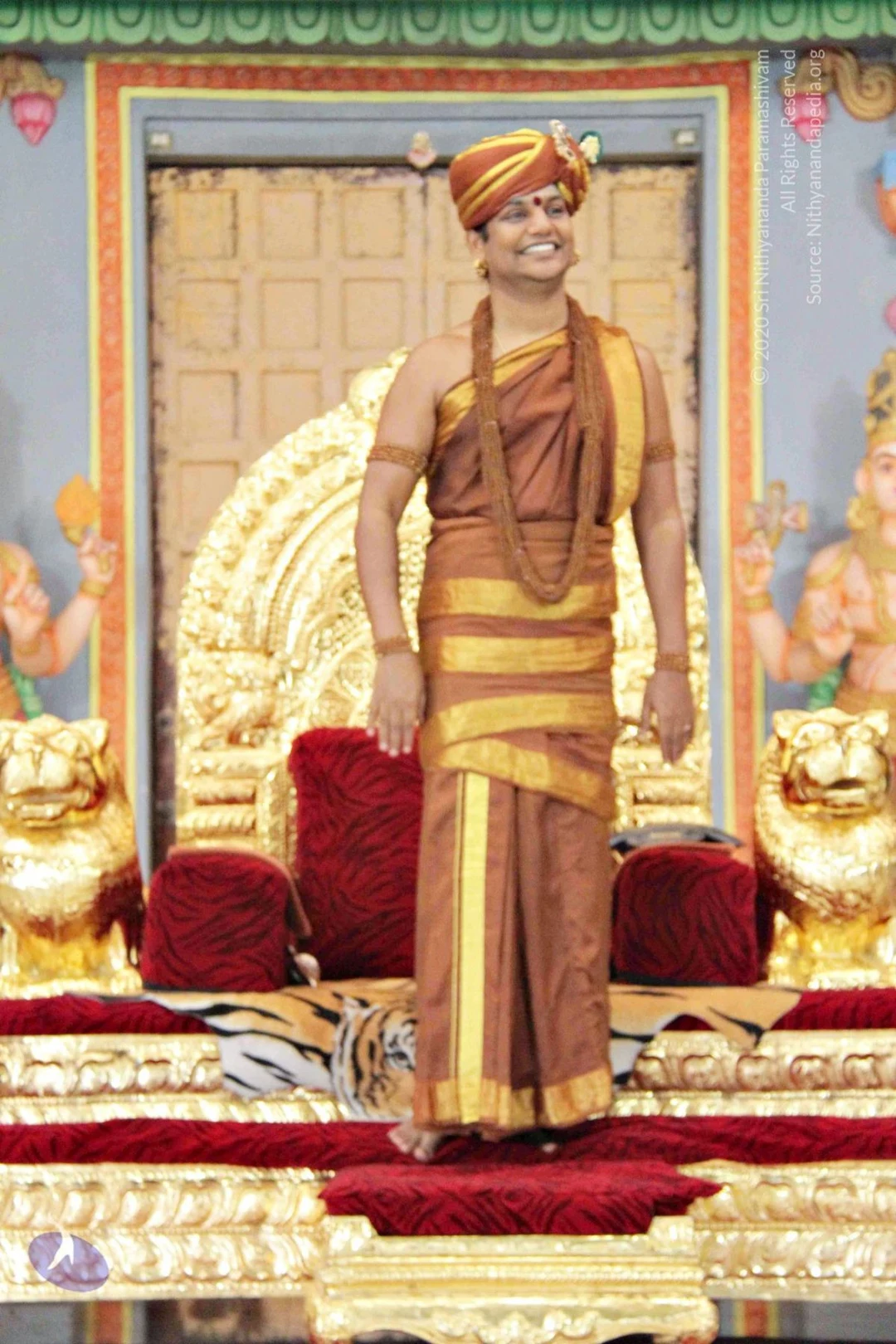
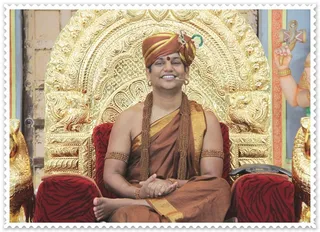
Nithya-Satsang

Sarva-Darshan

Swamiji-Blessing

Tags:

Paramahamsa Nithyananda, completion, enlightenment, peace, planet, Earth.

Photos Of The Day:

InnerAwakeningSession

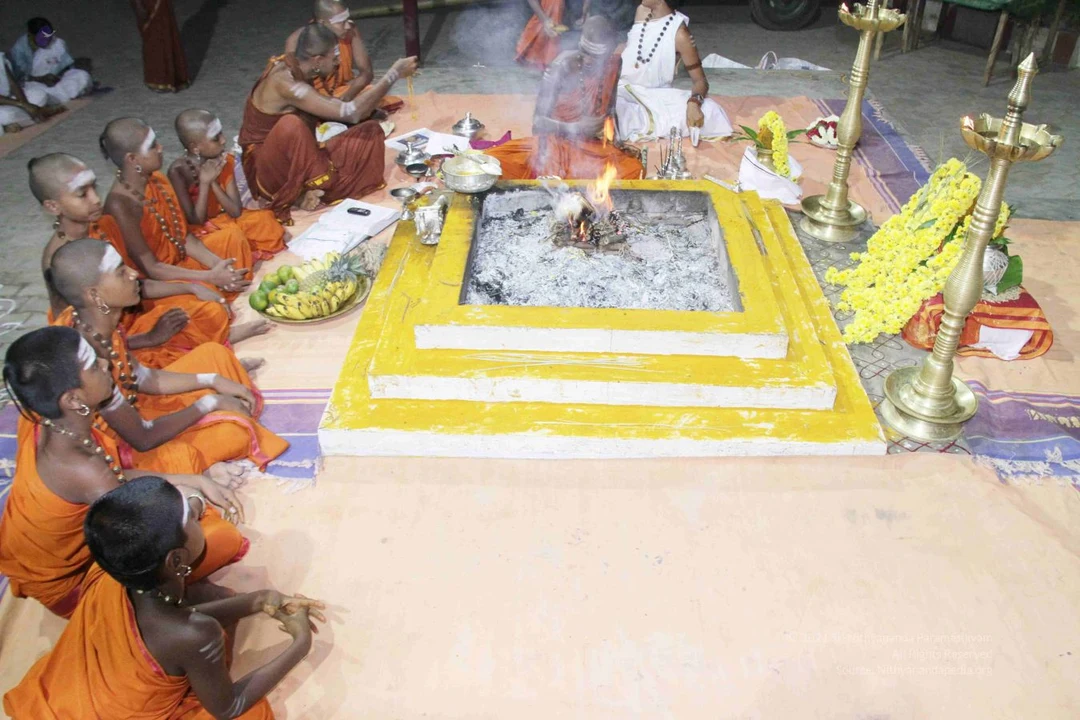
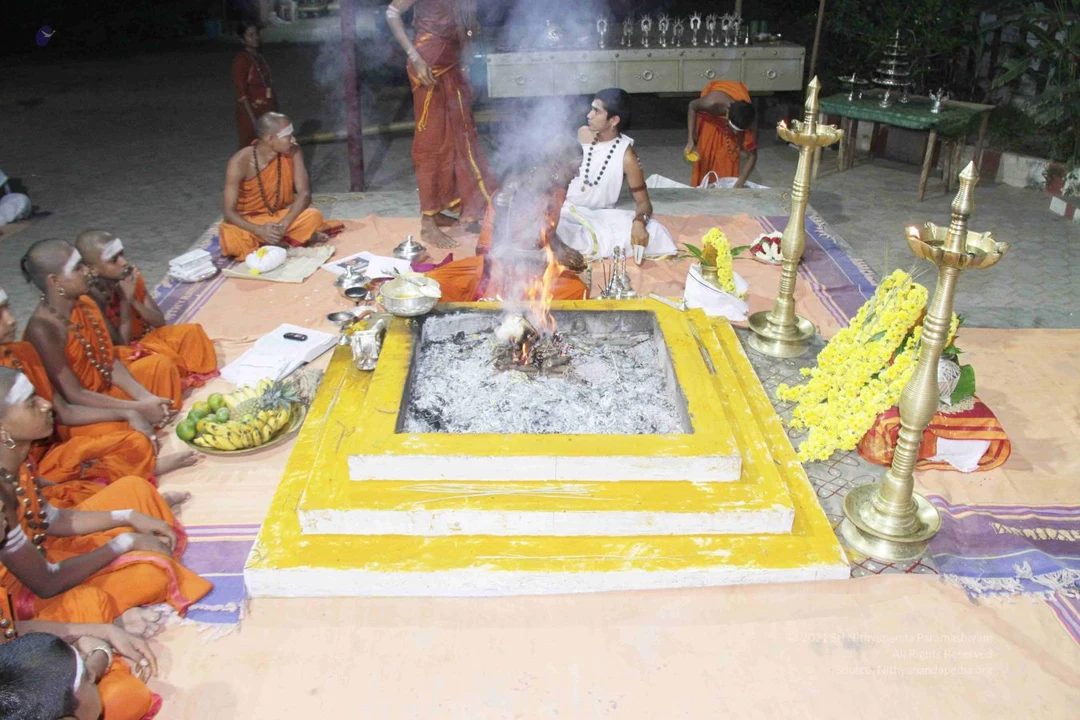
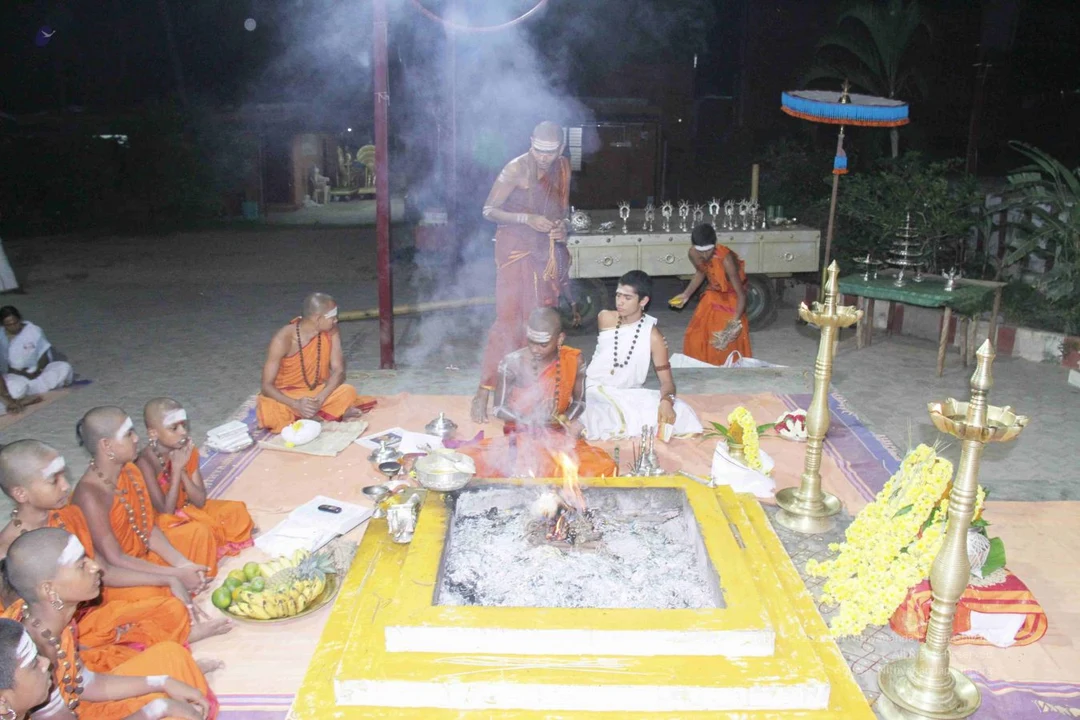
SubramanyaHomaByGurukul

AkashicReading

Darshan

SacredArts

Photos from this day

View all 194 photos

Photos From The Day:

14 photosSource gallery
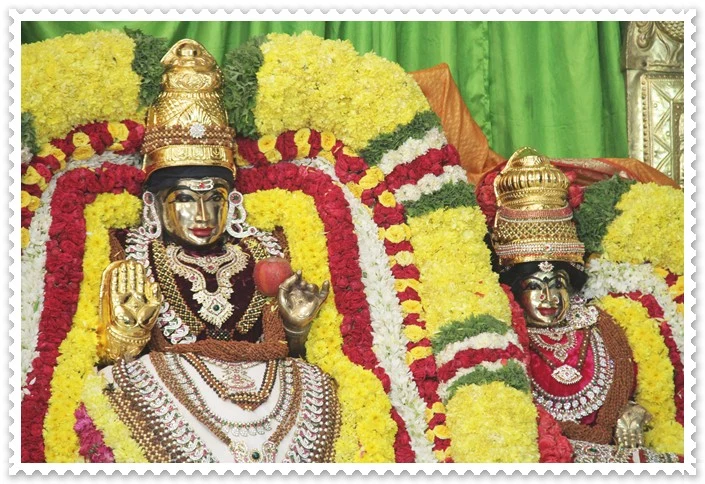
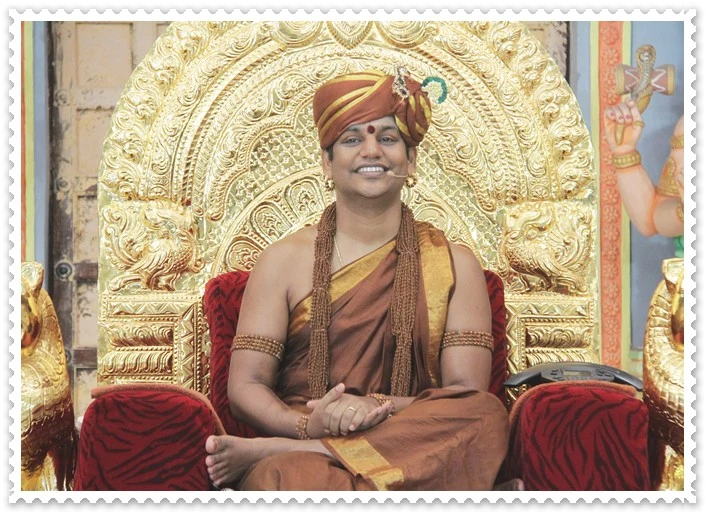
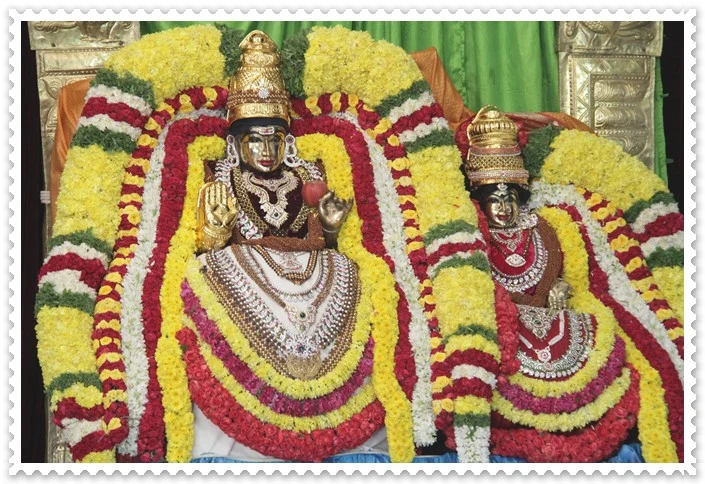
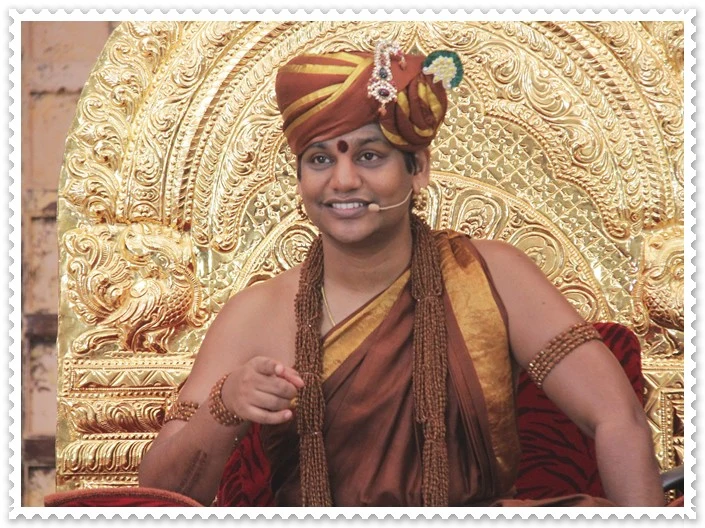
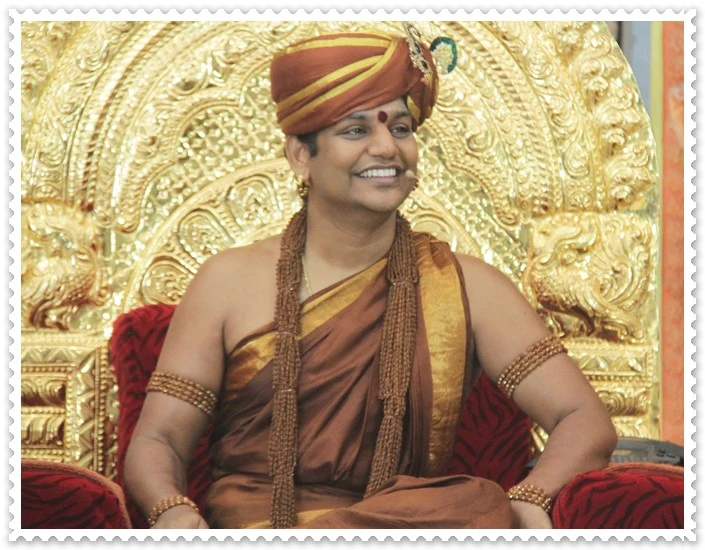
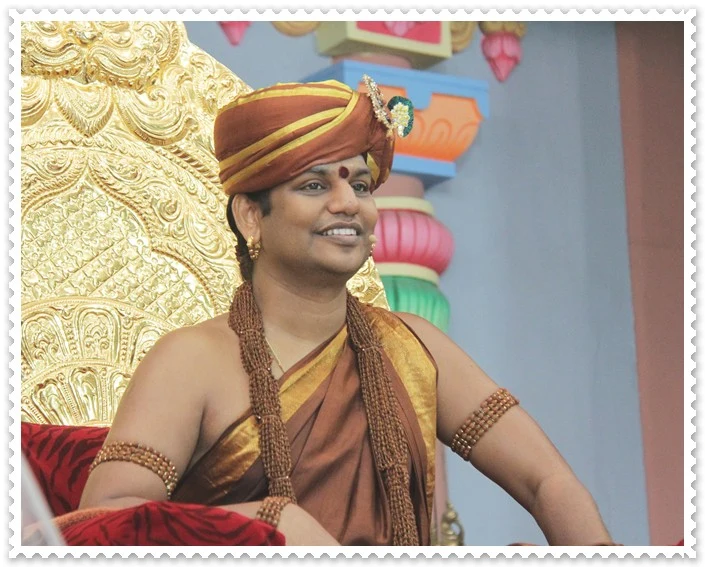
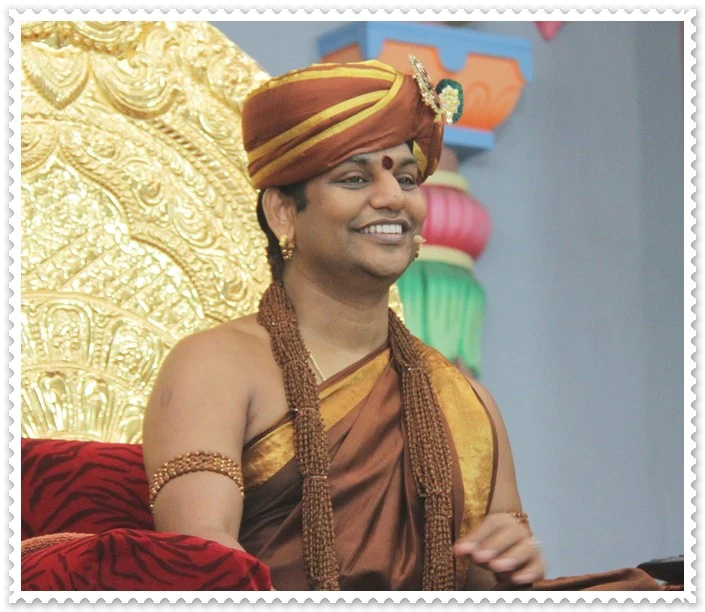
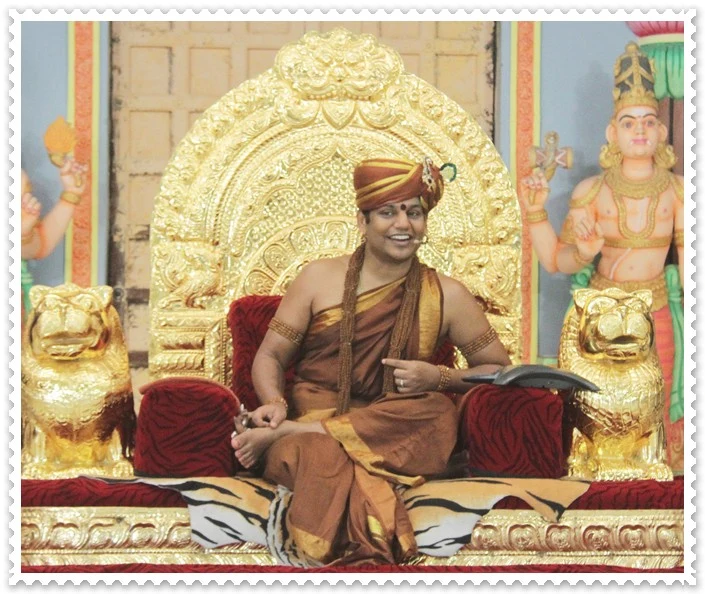
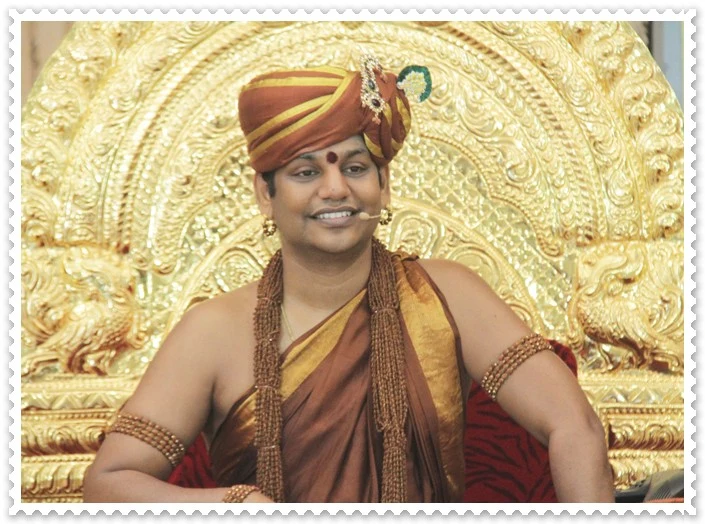
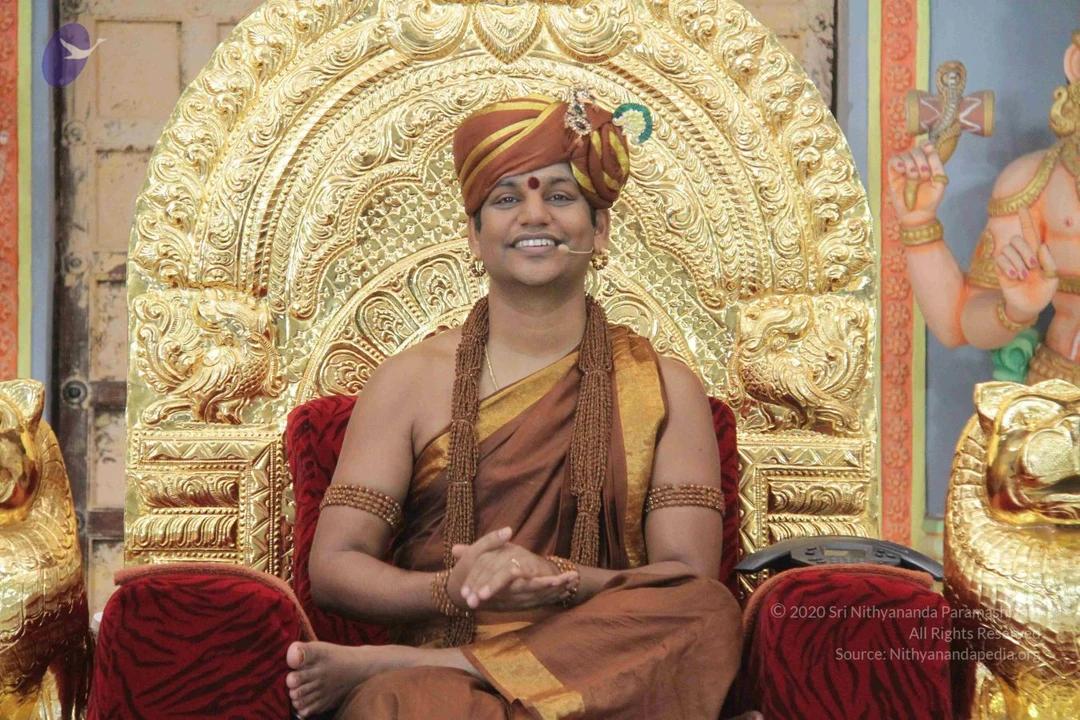
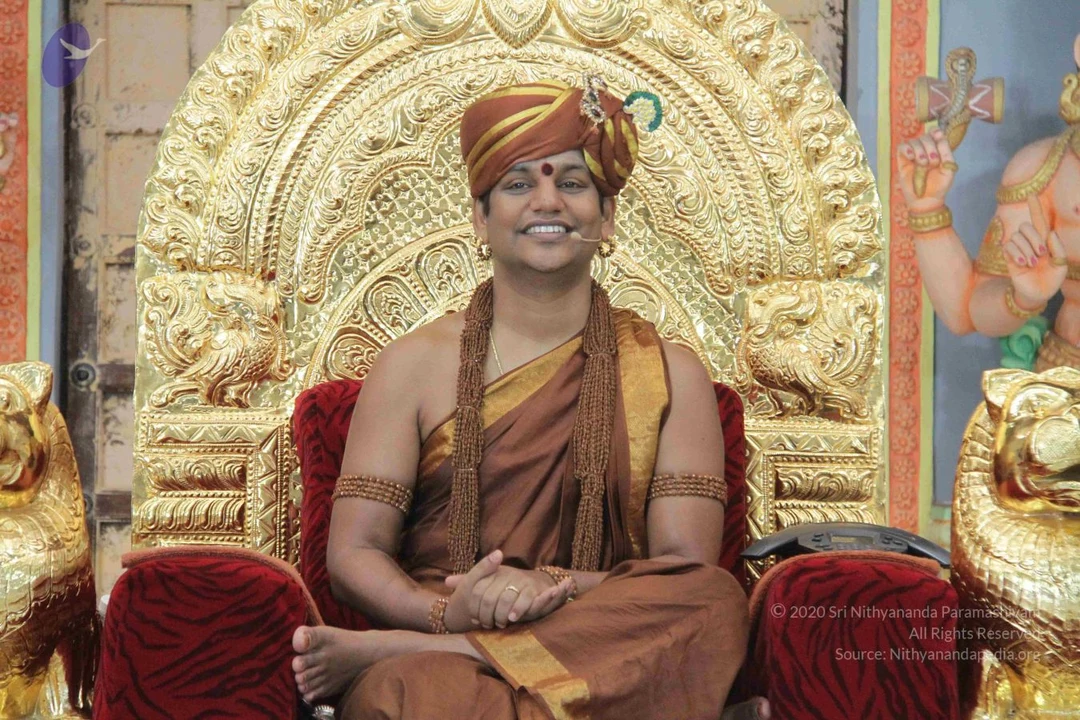
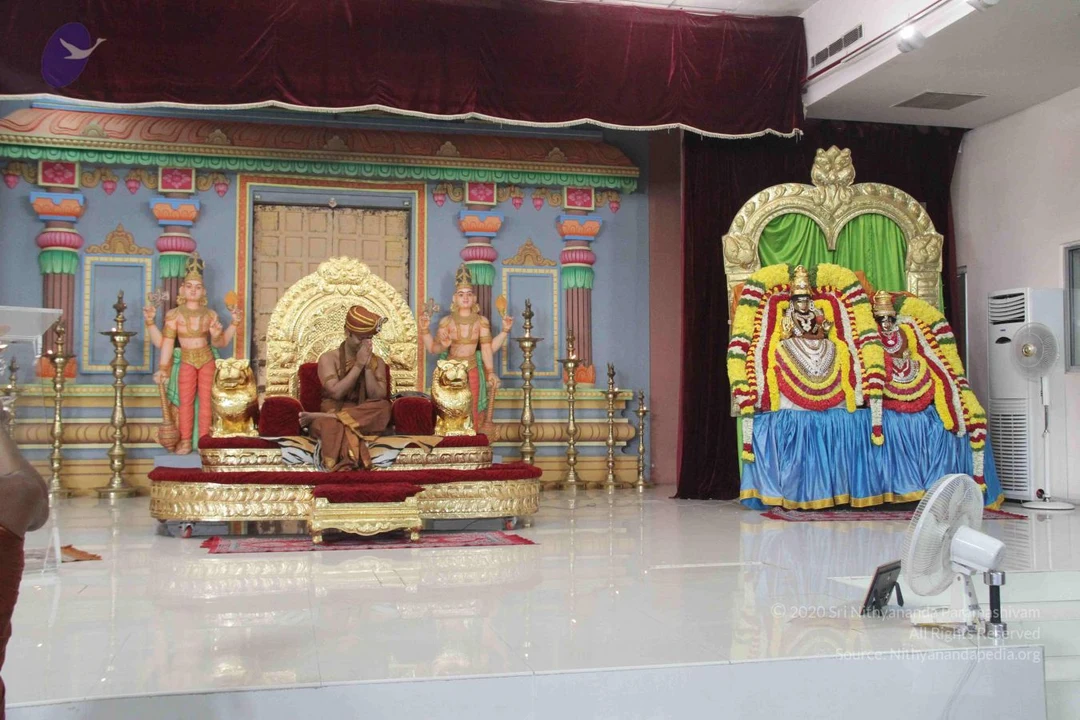
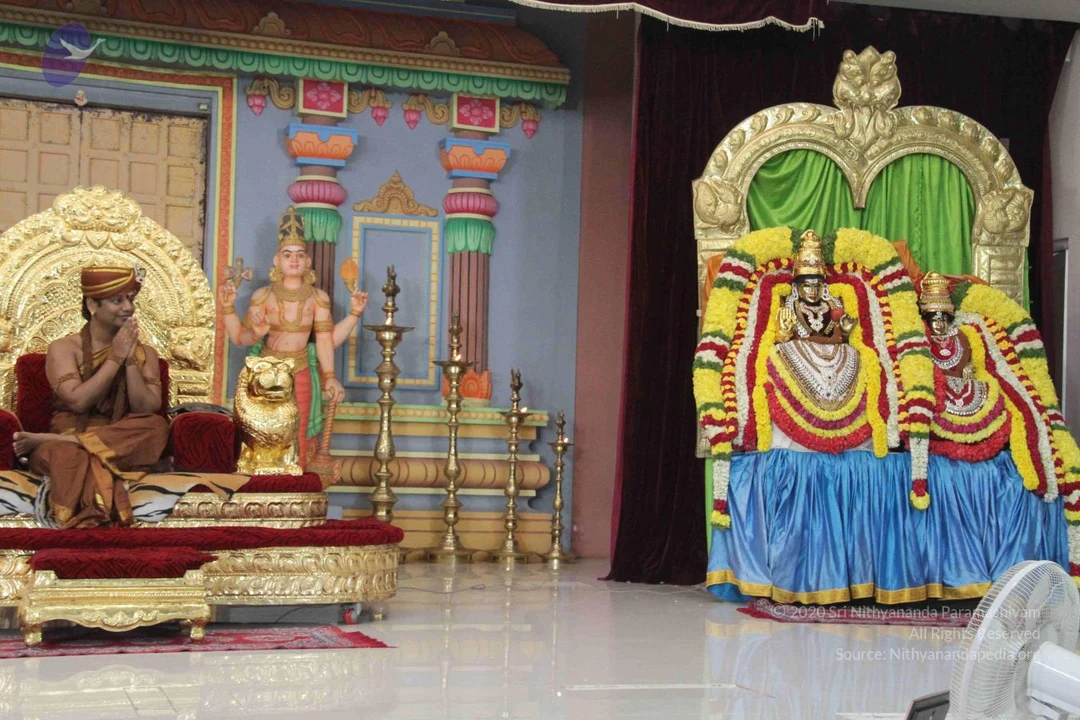
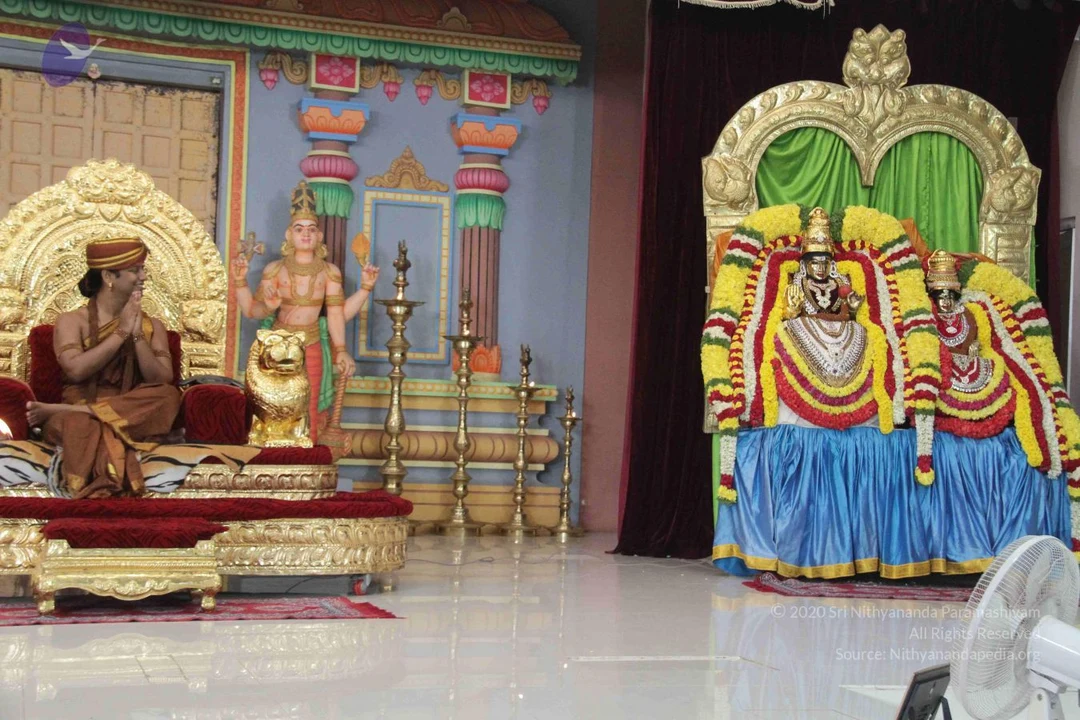
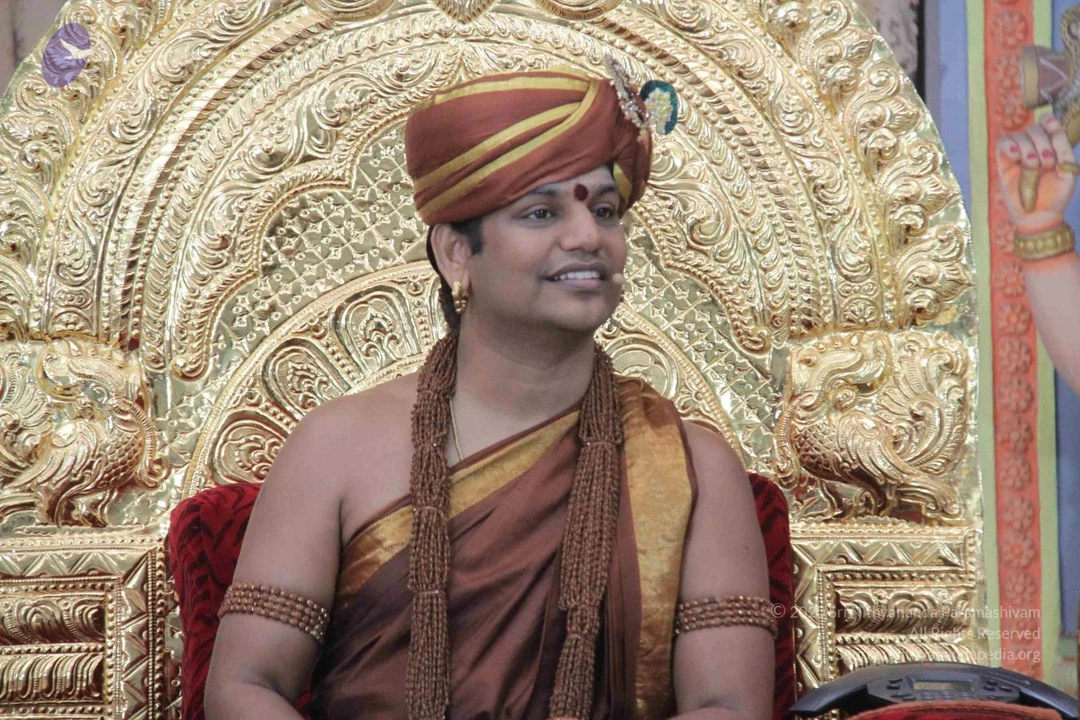
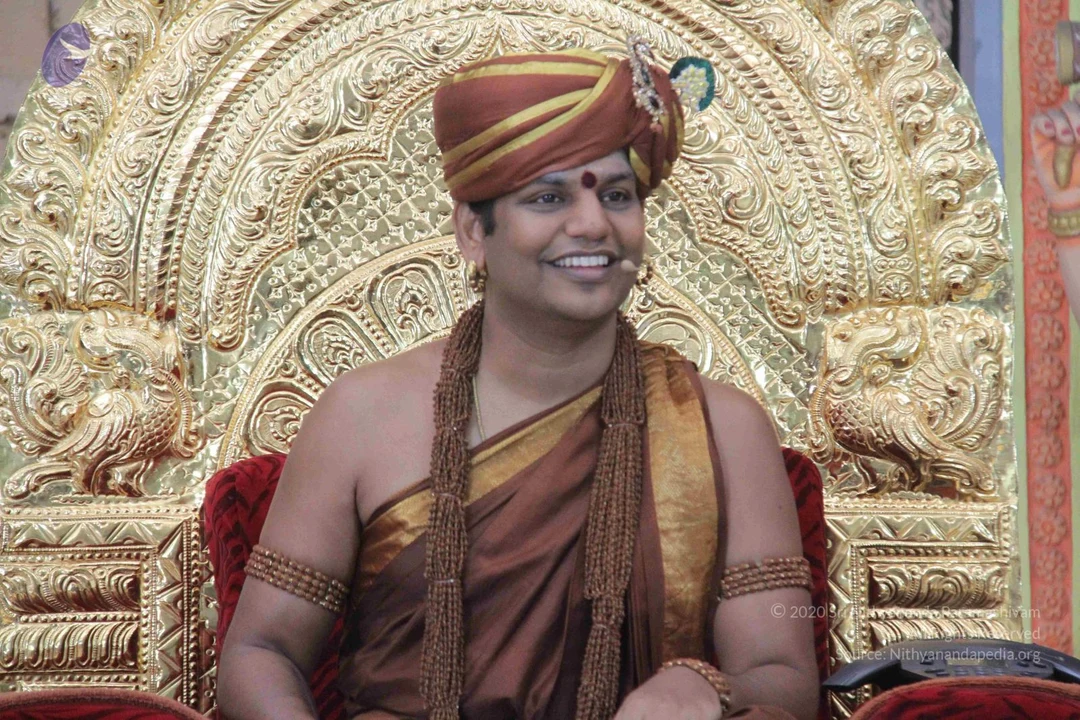
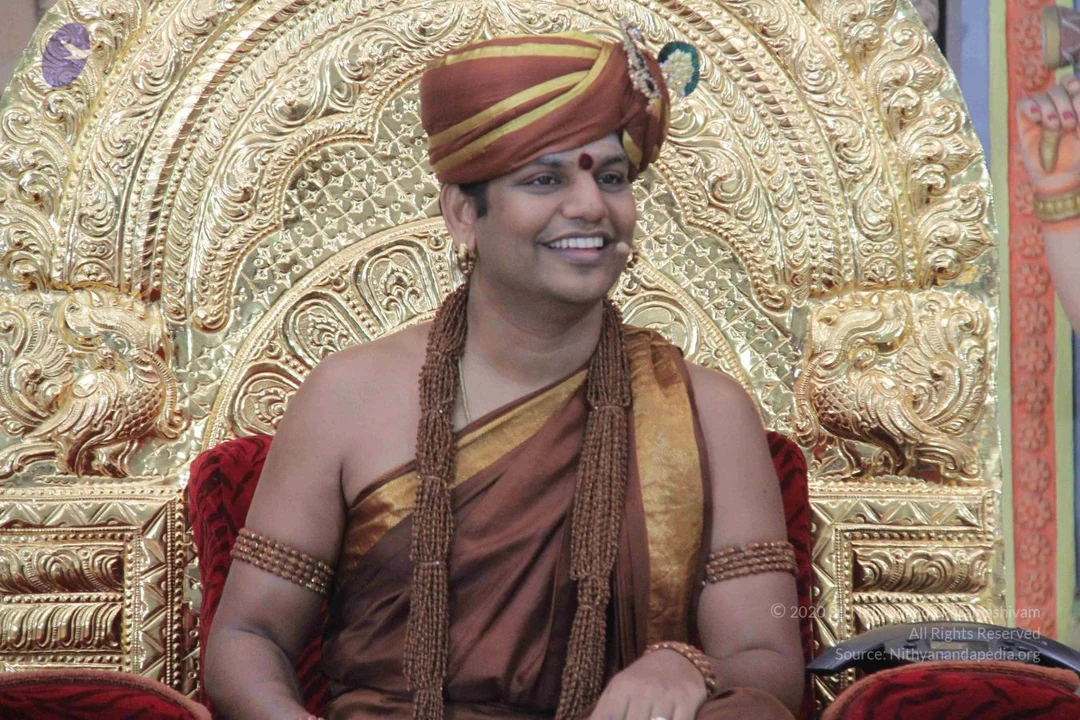
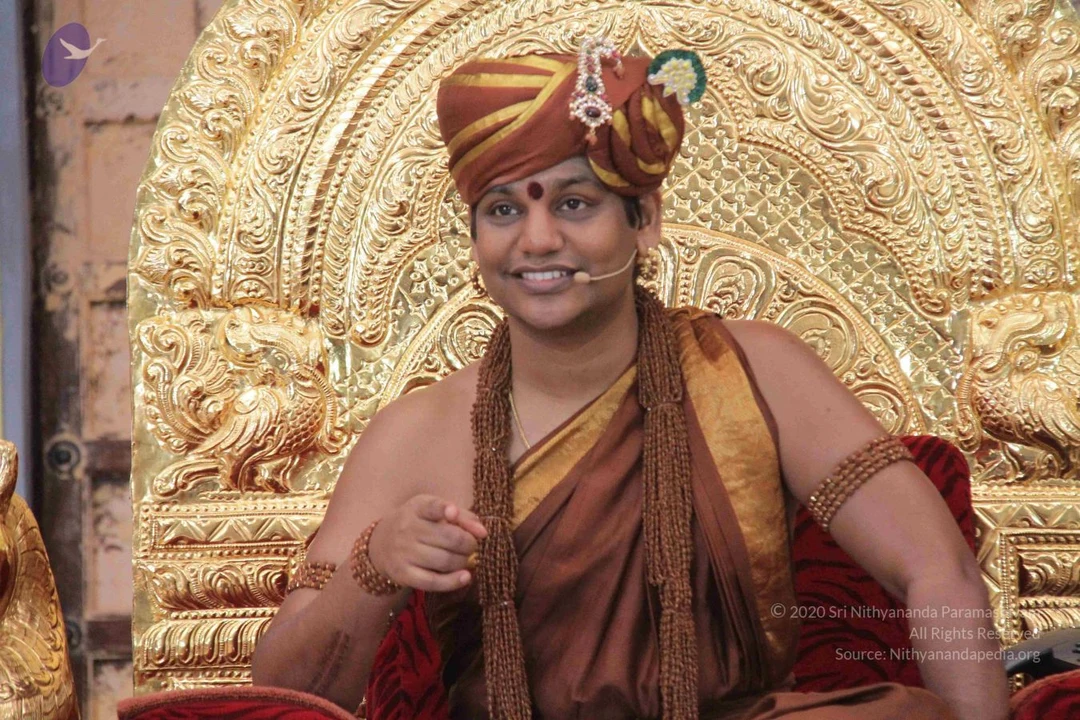
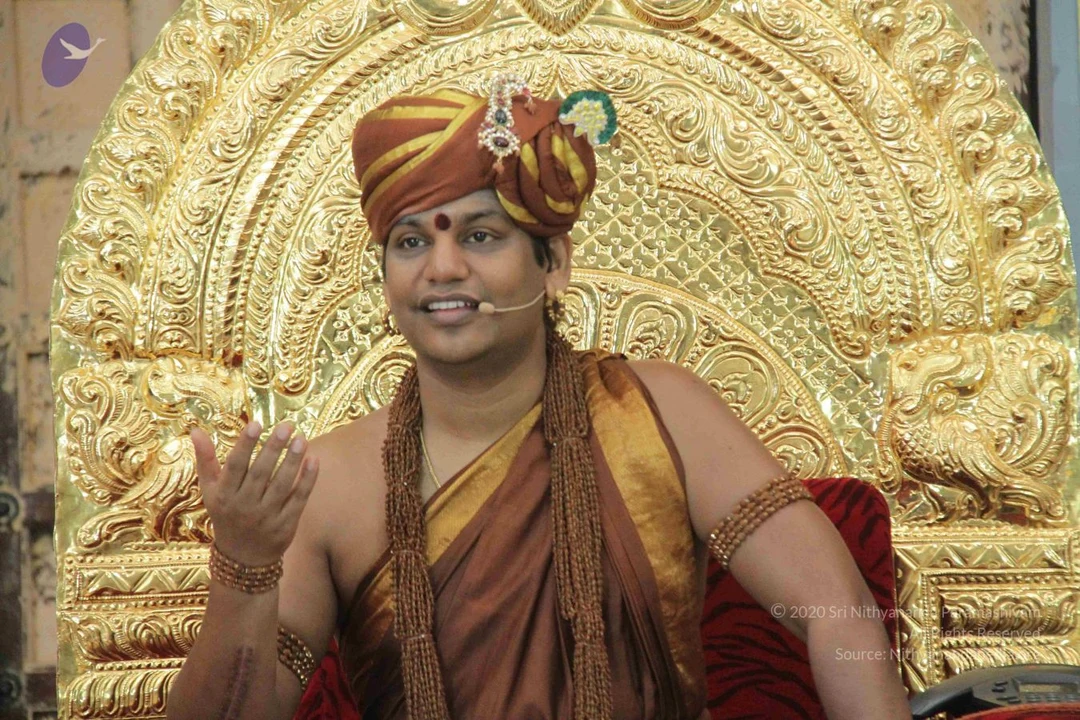
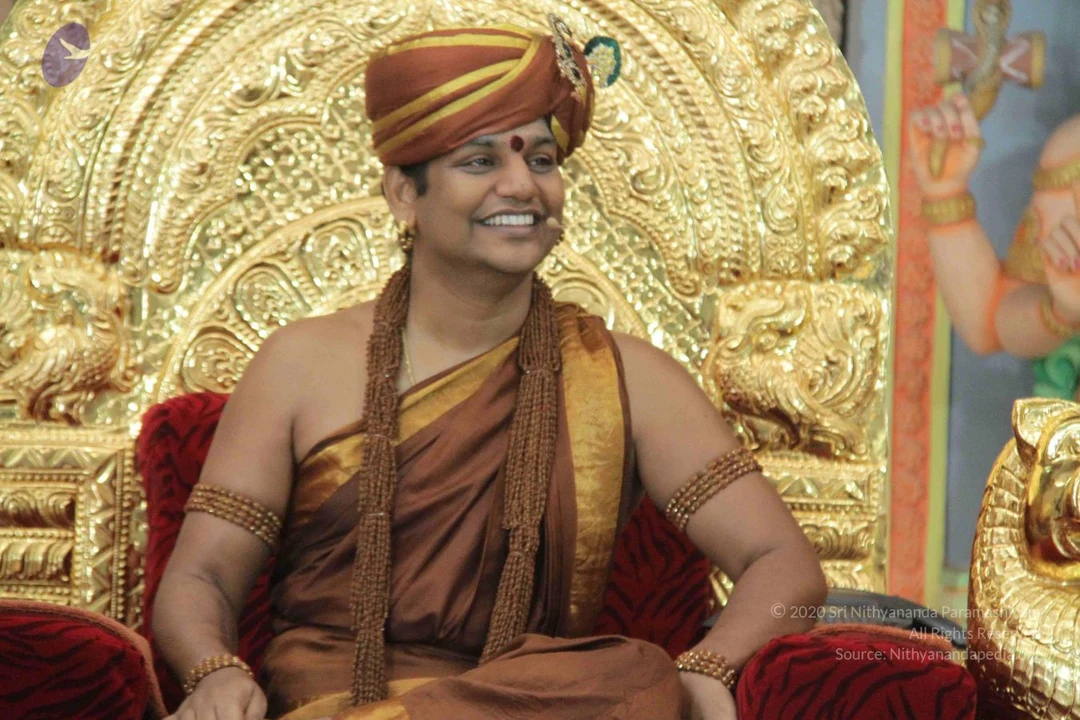
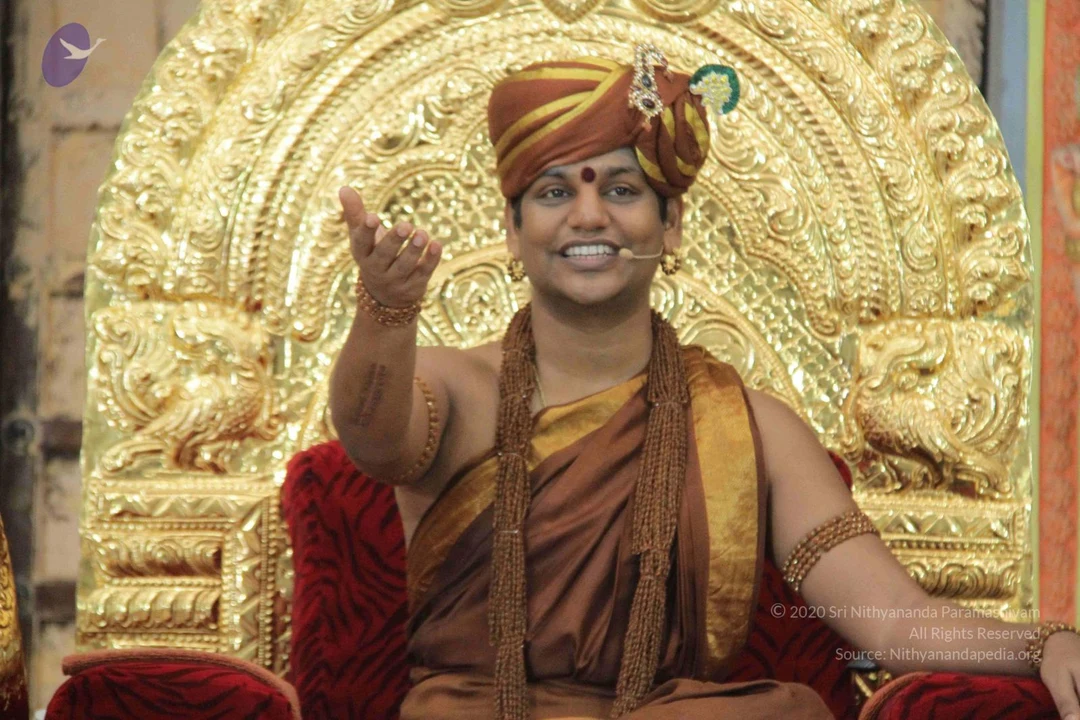
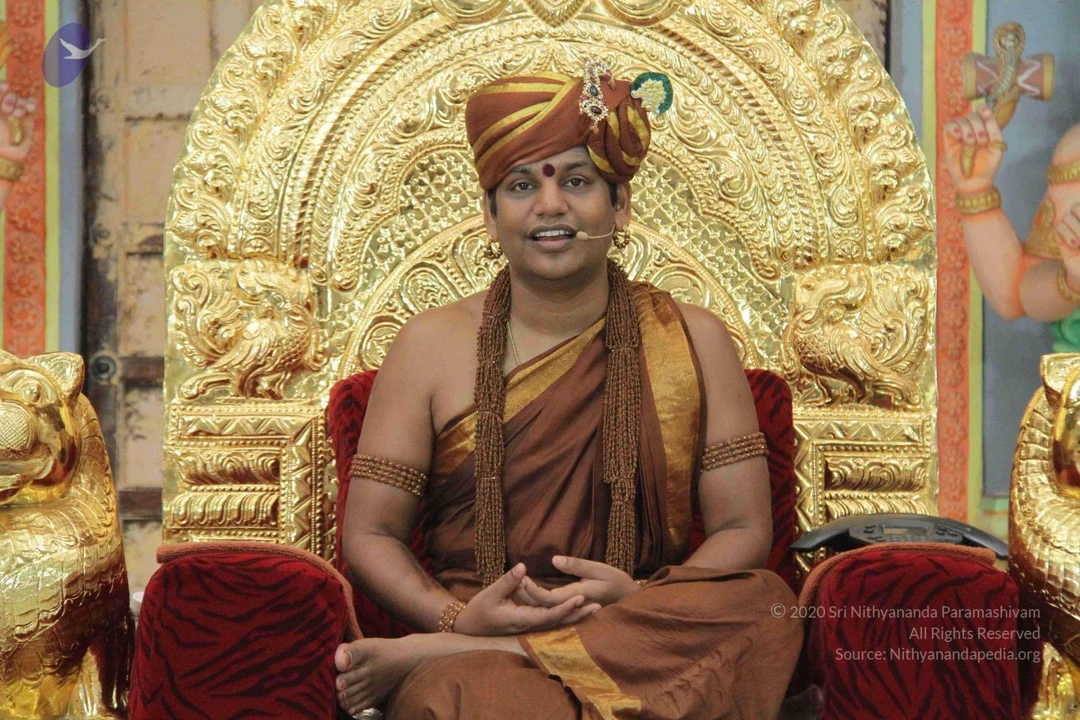
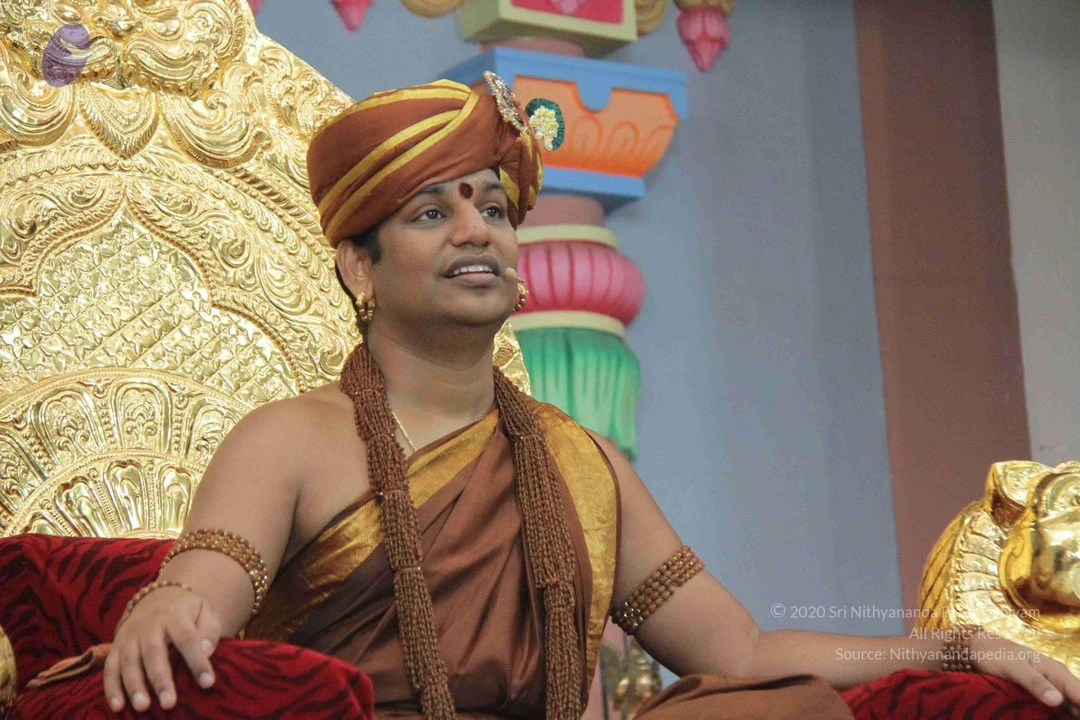
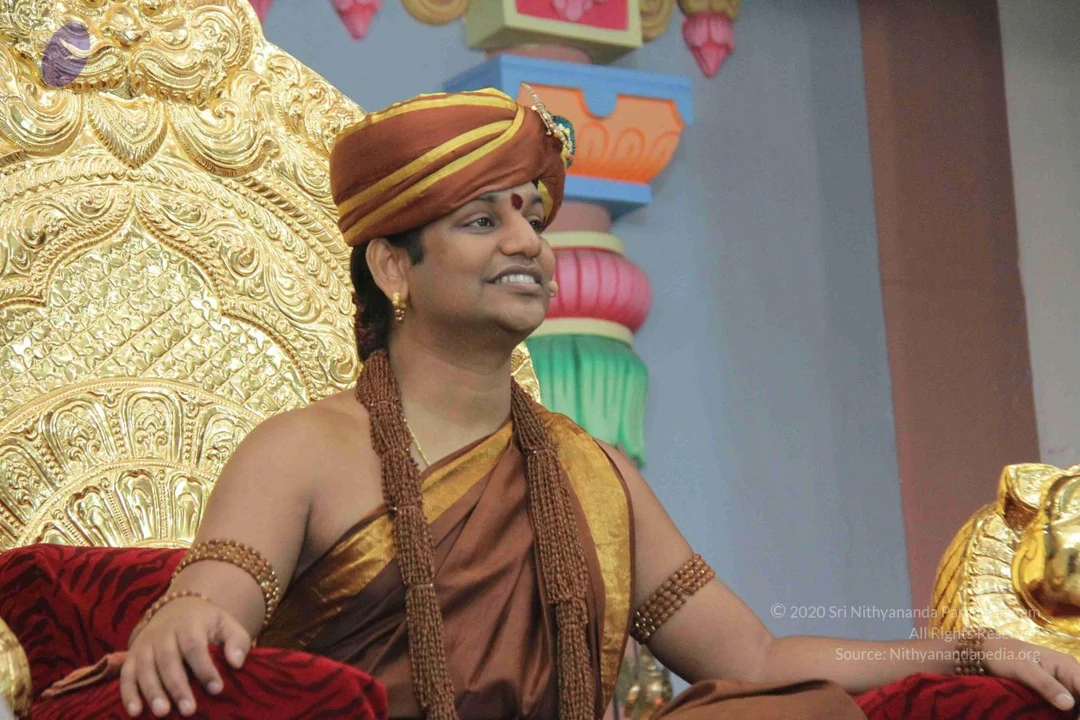
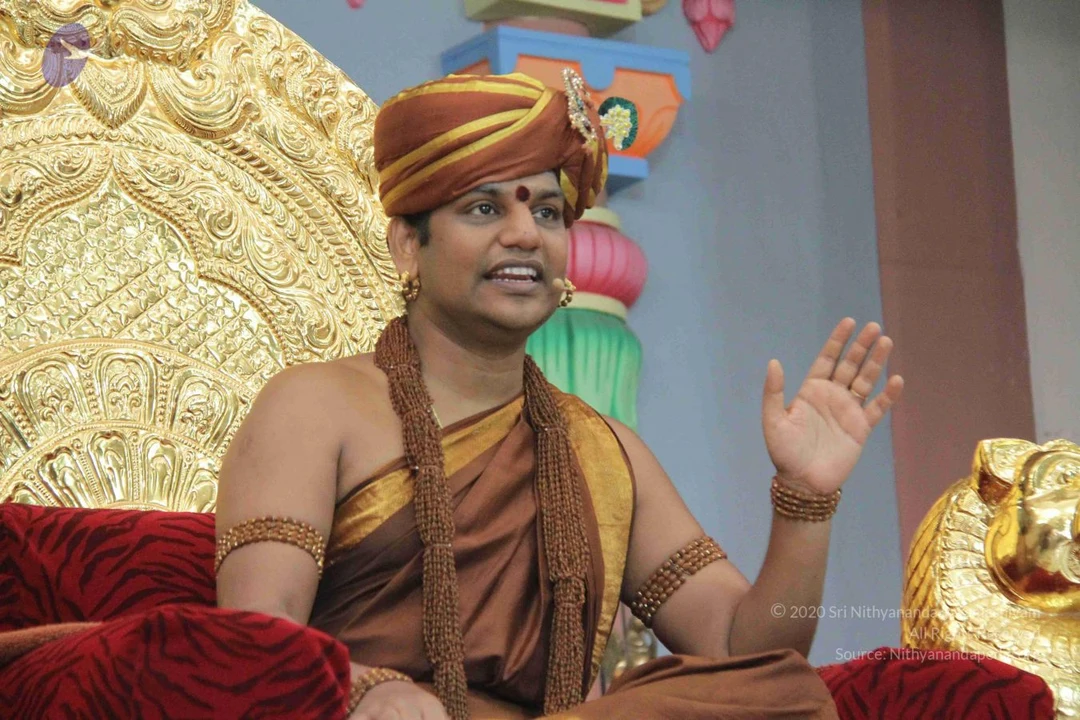
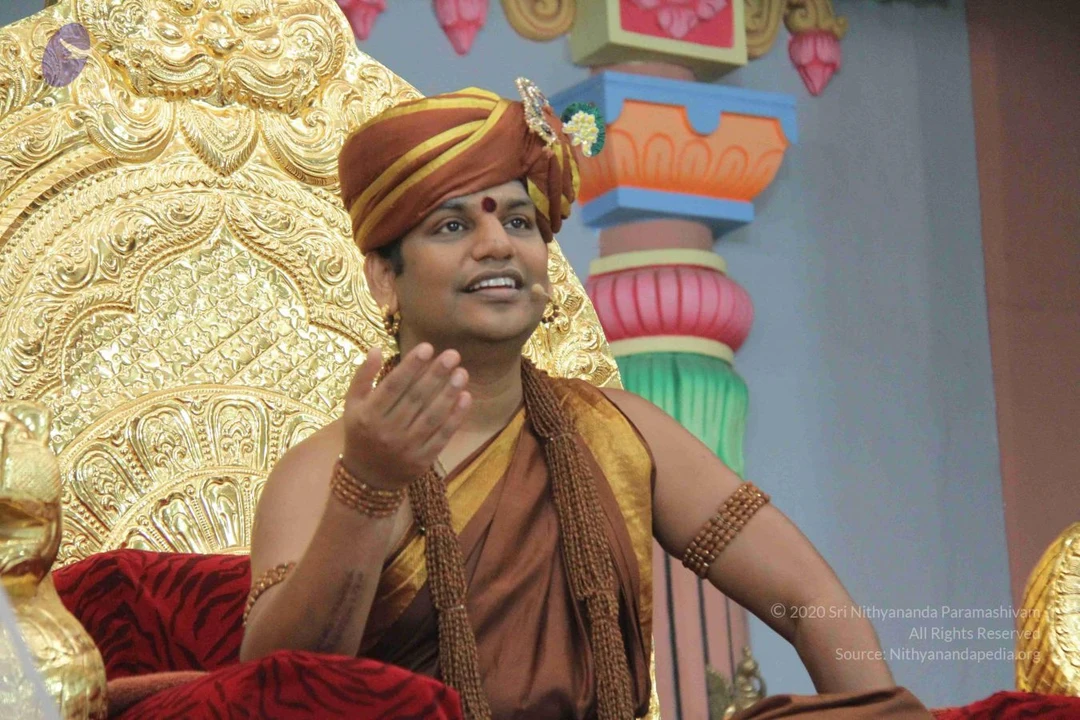
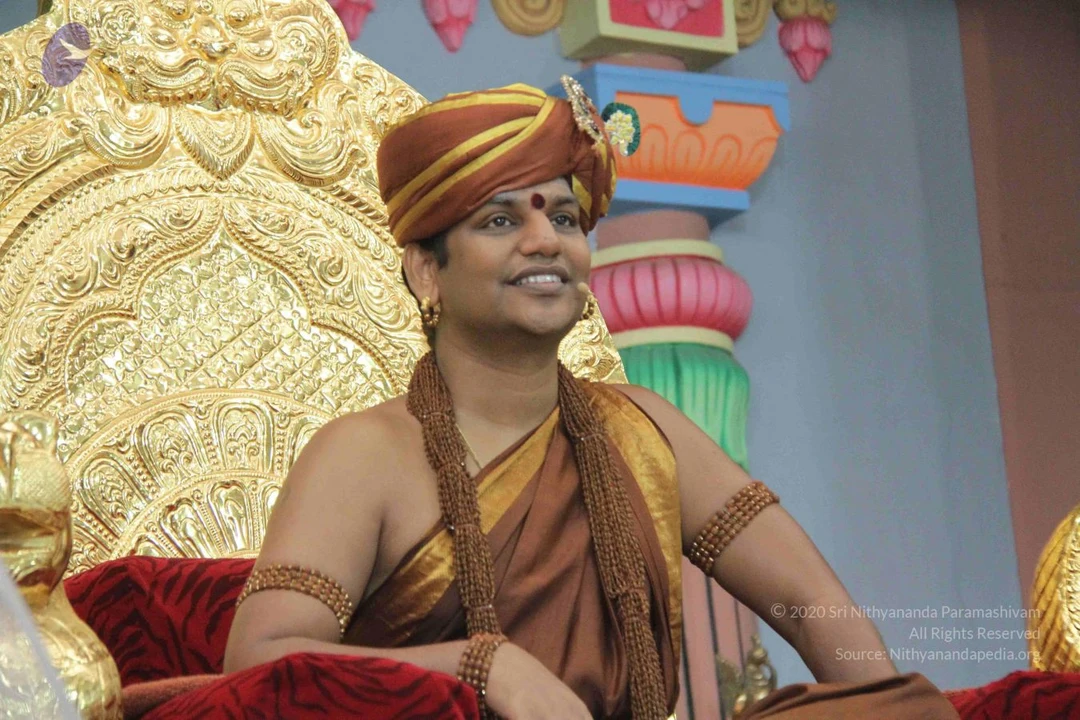
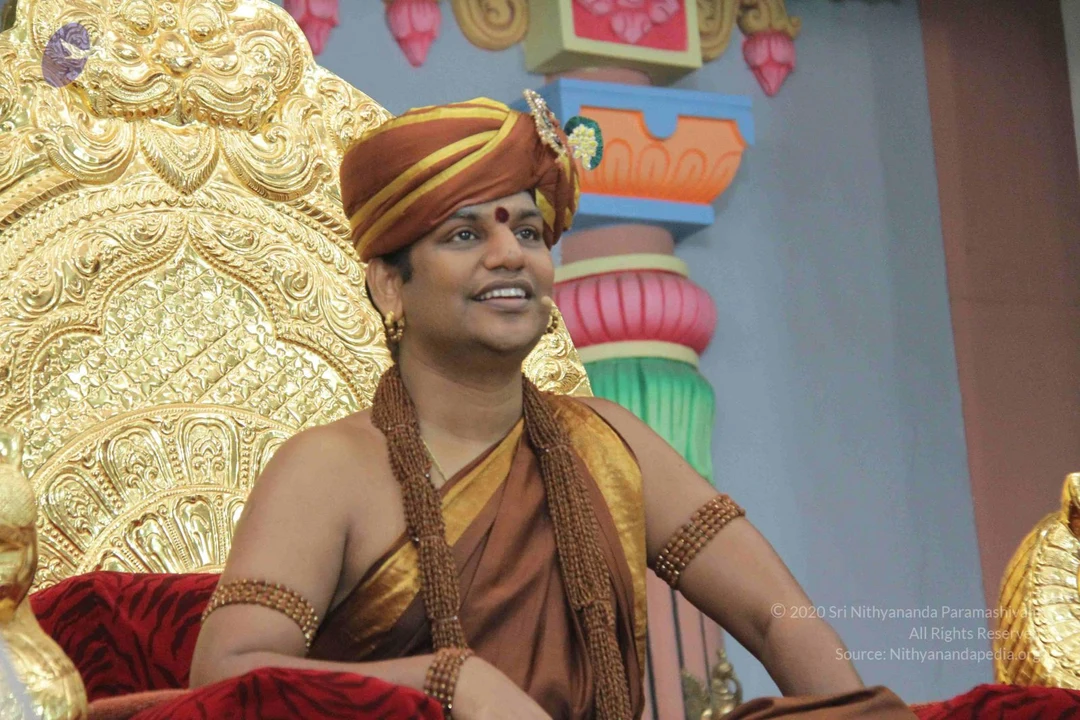
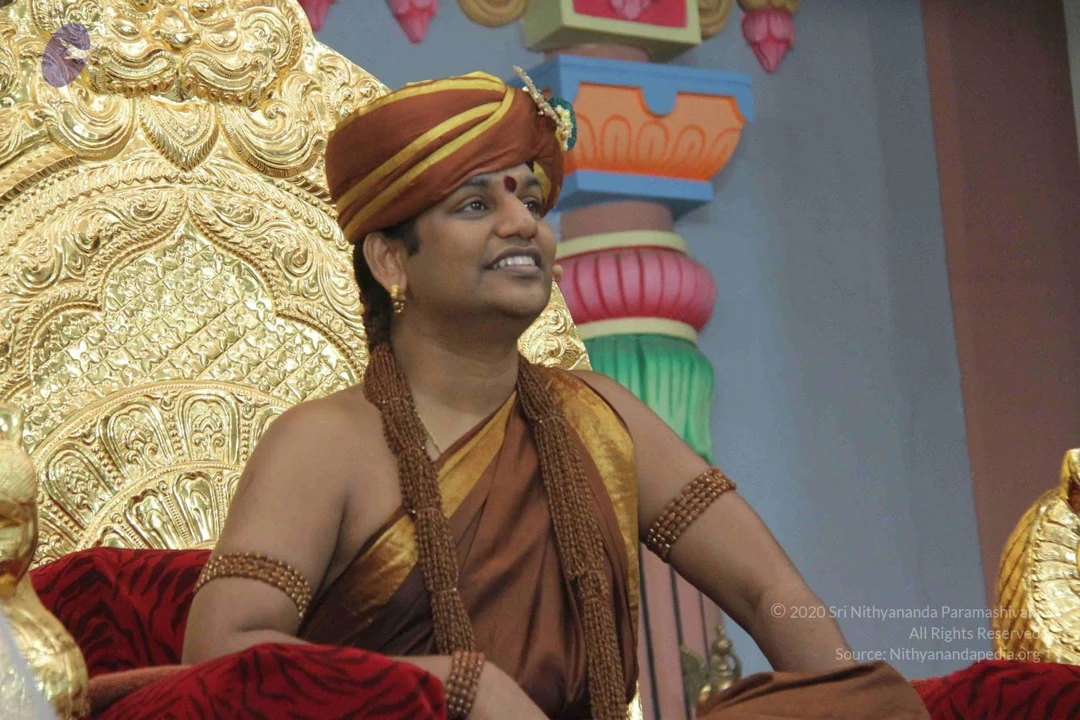
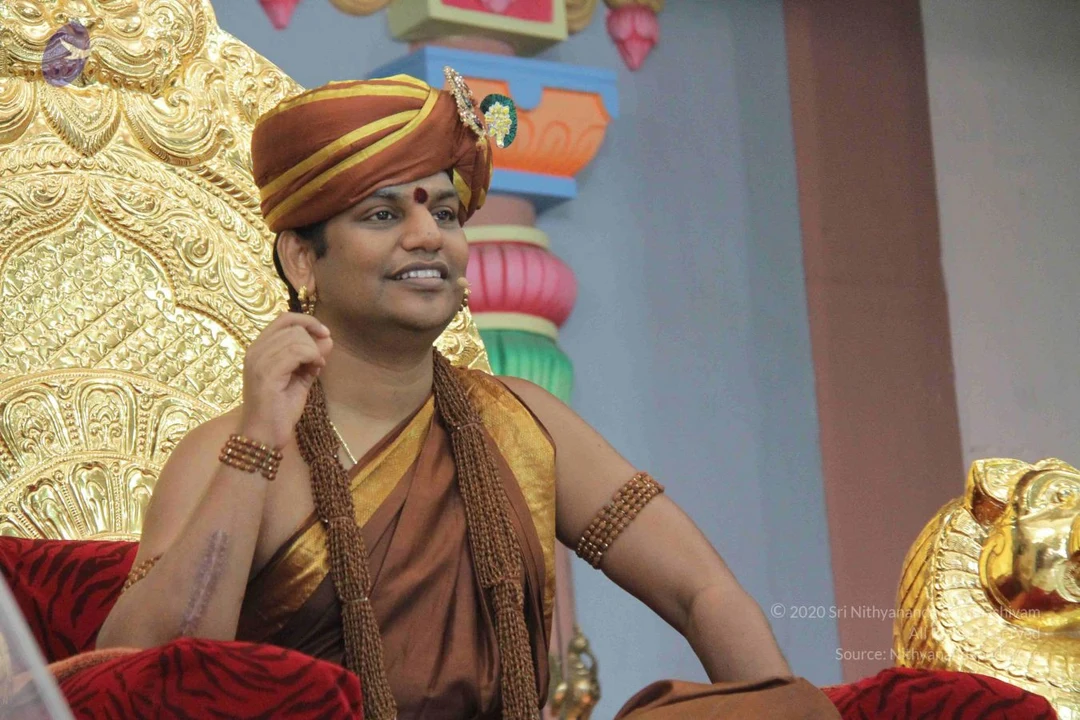
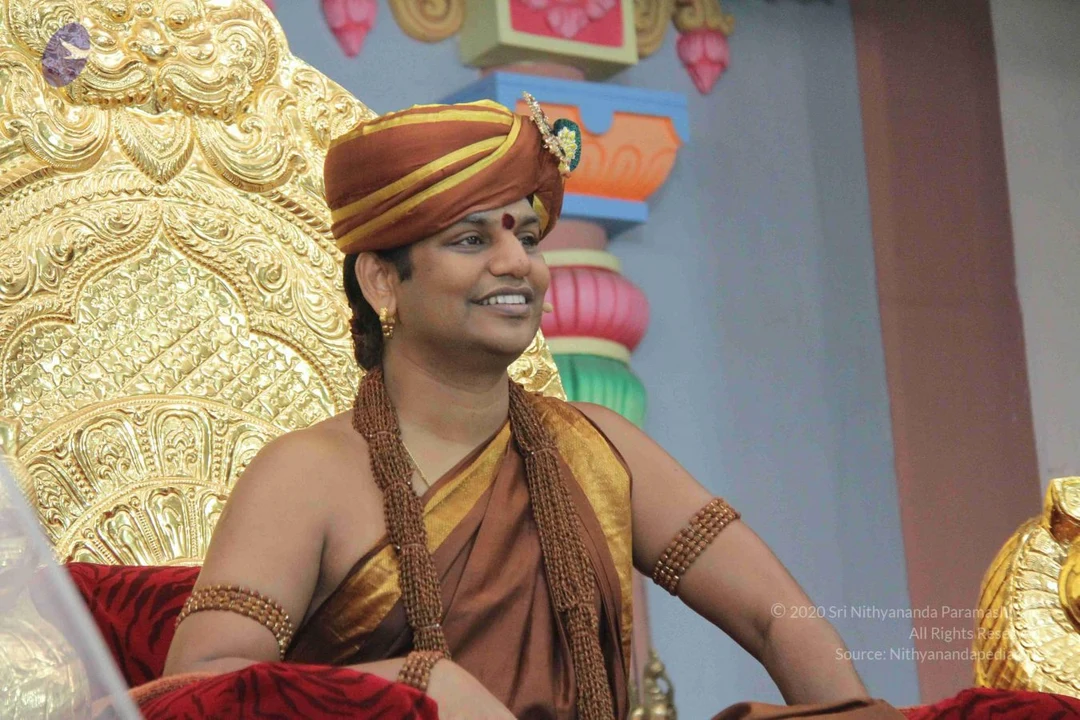
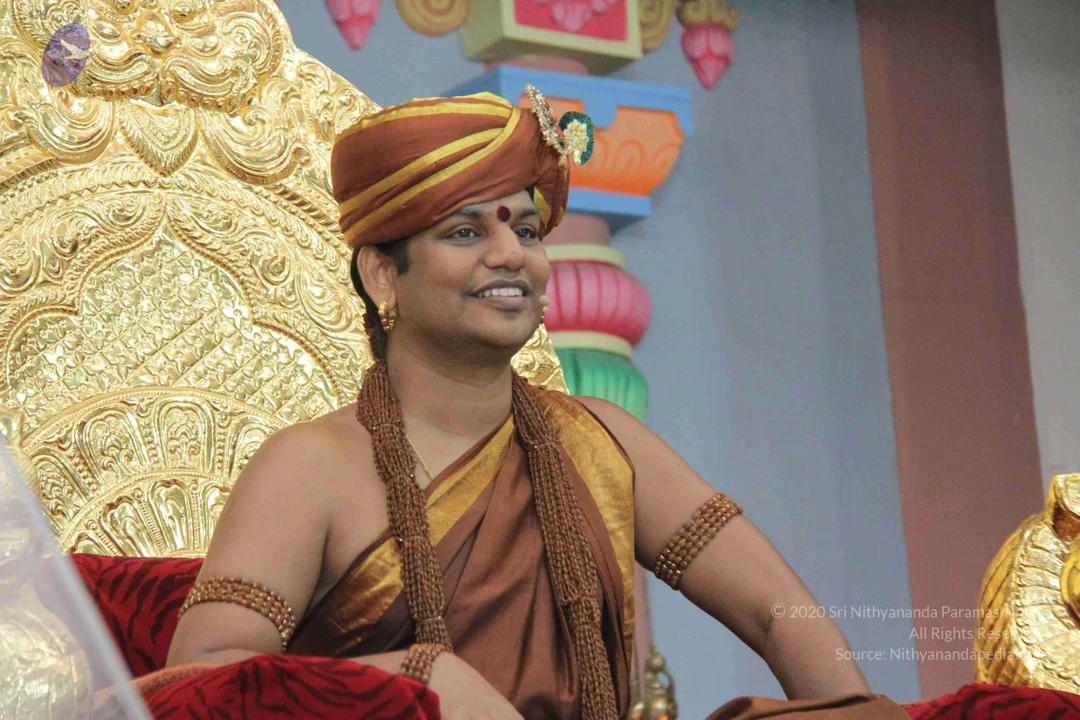
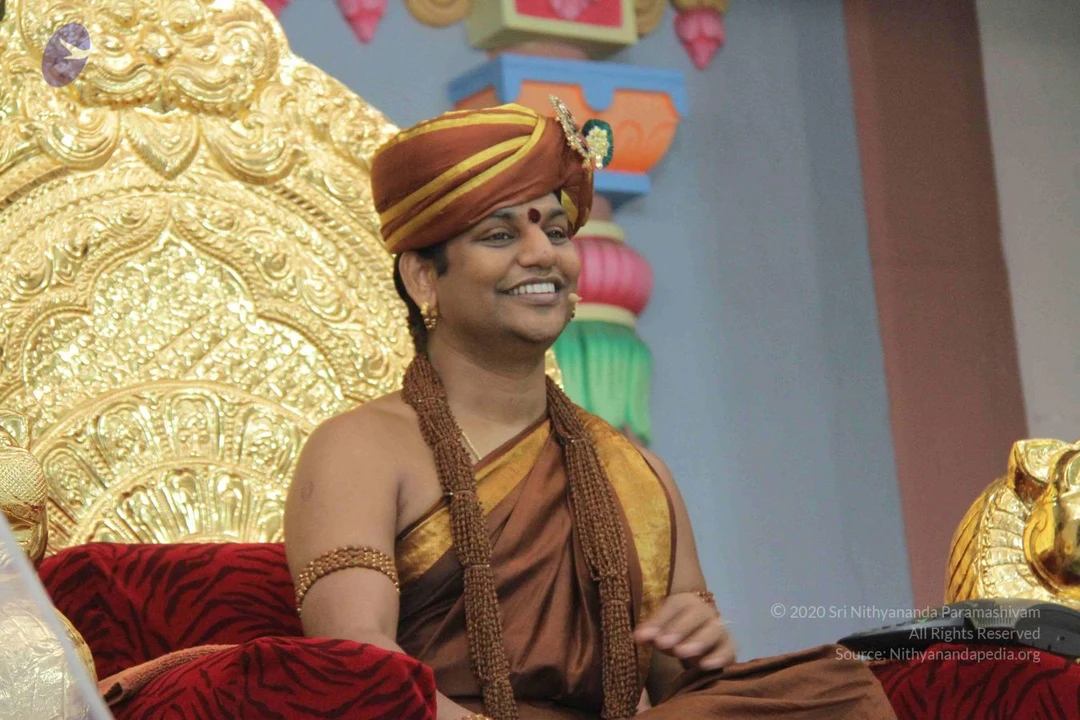
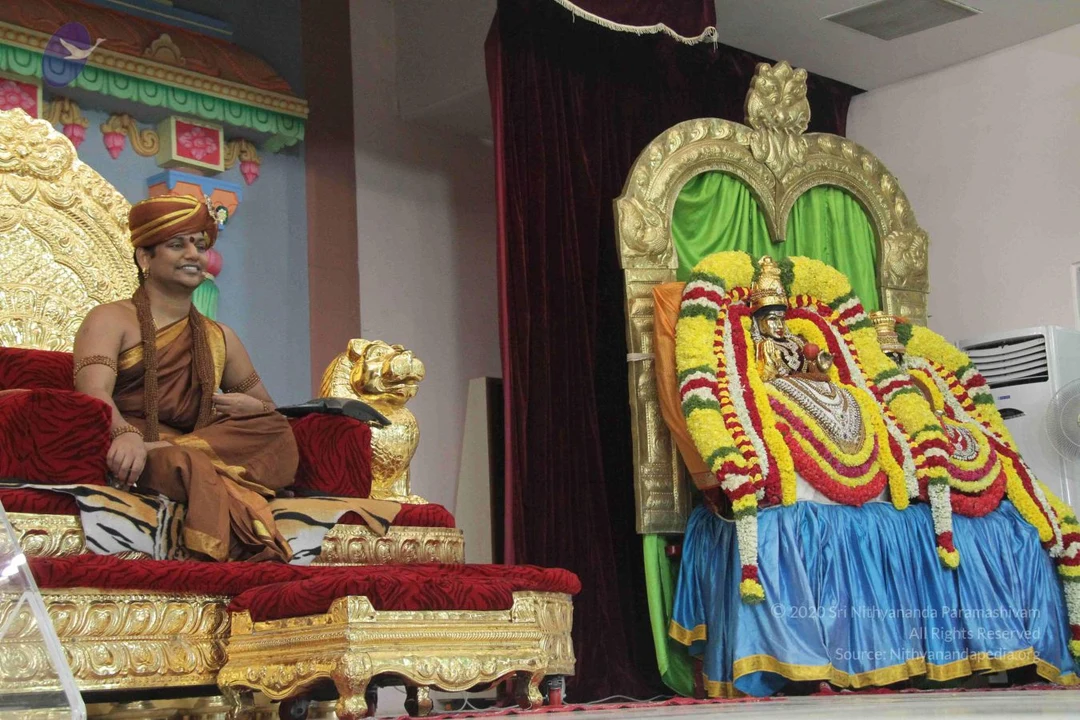
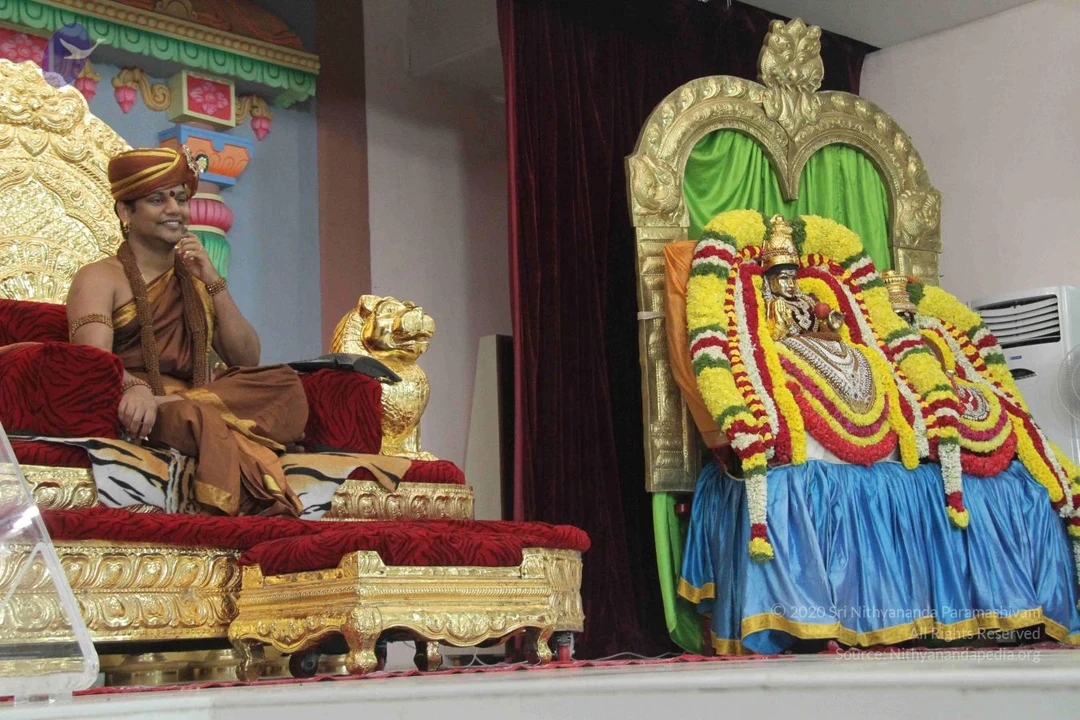
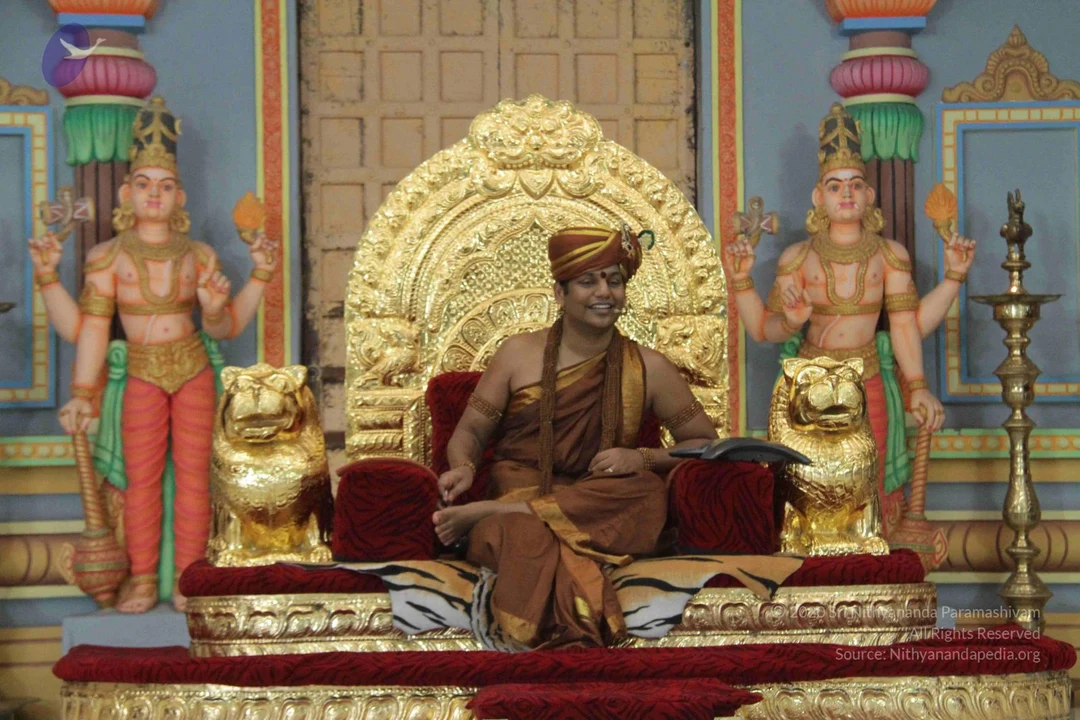
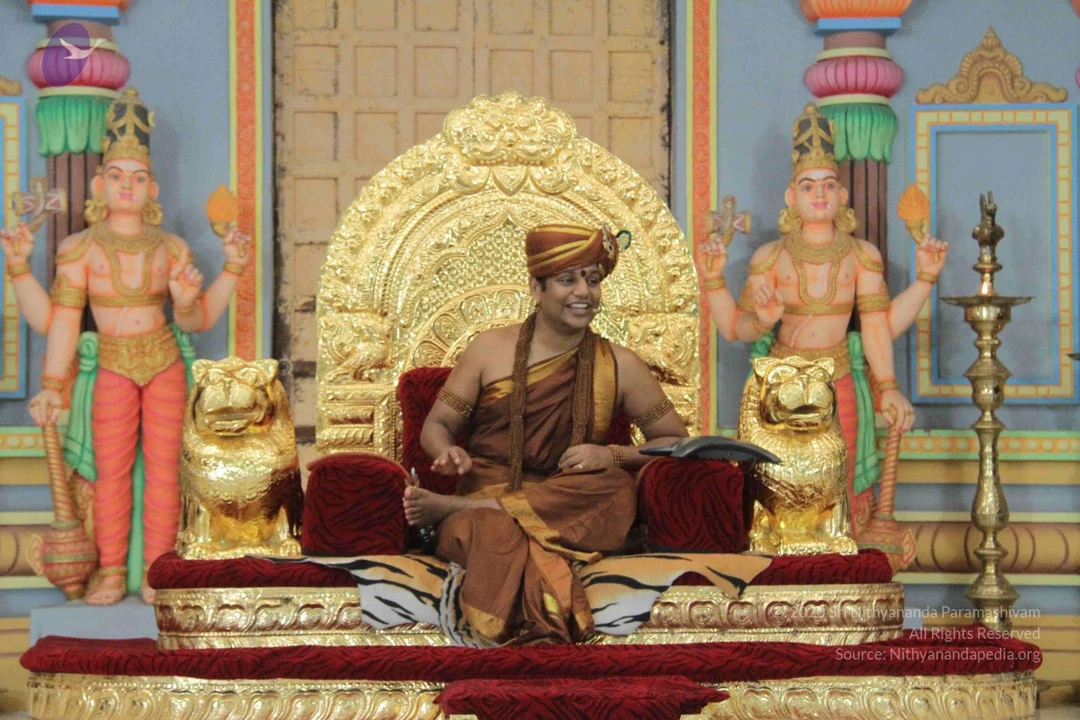
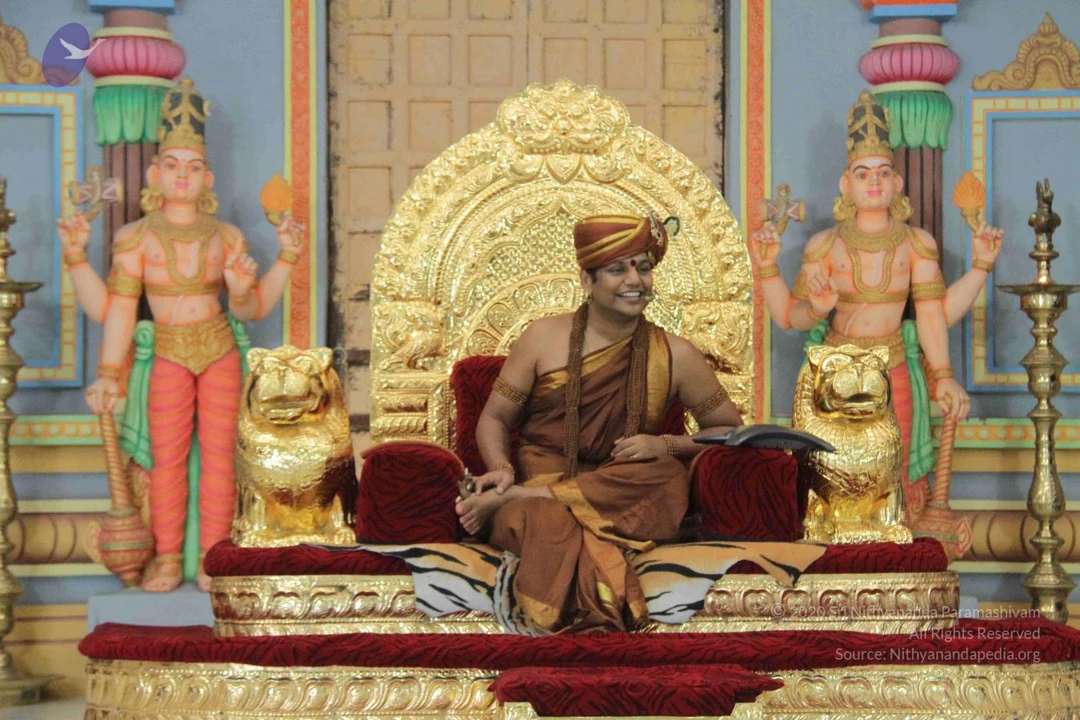
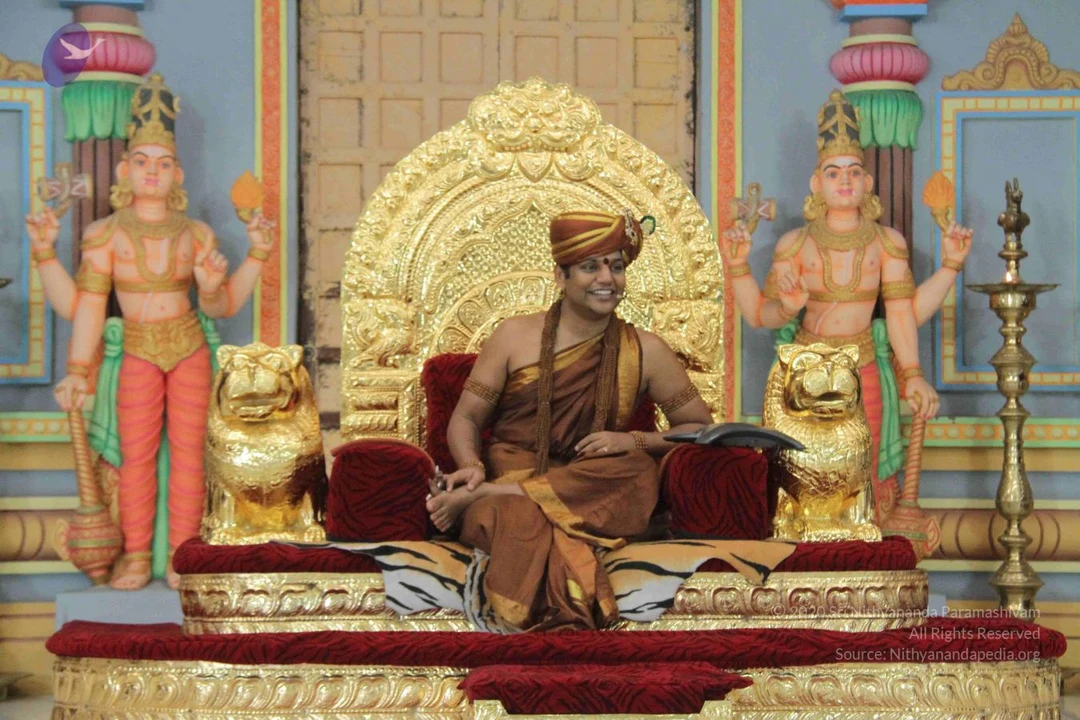
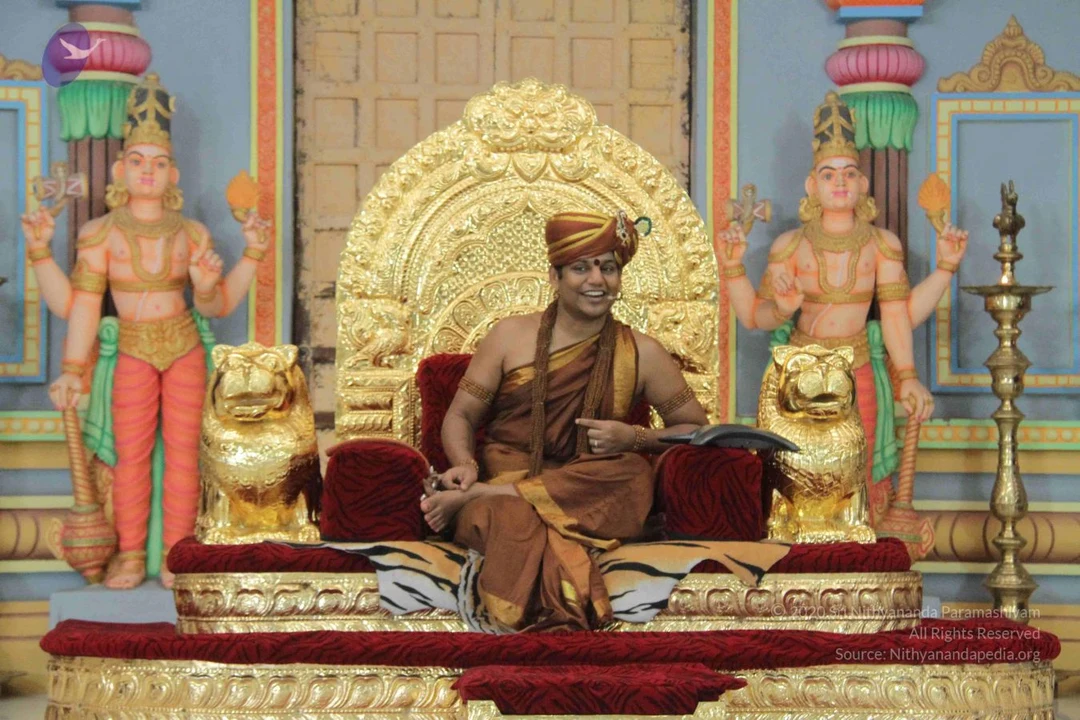
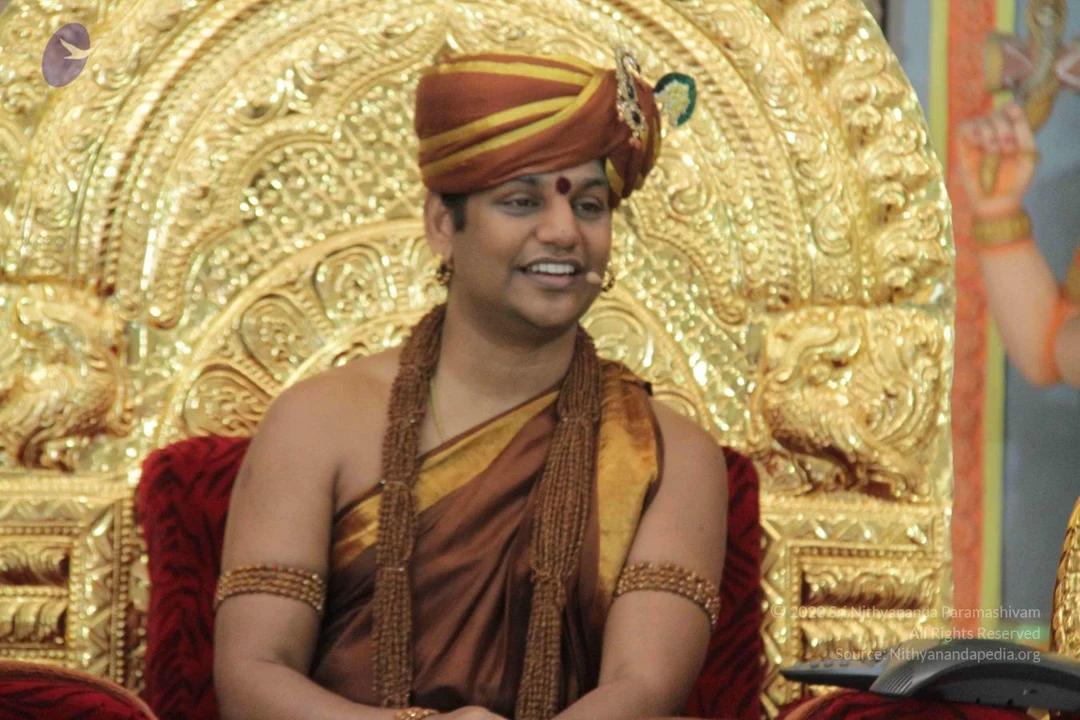
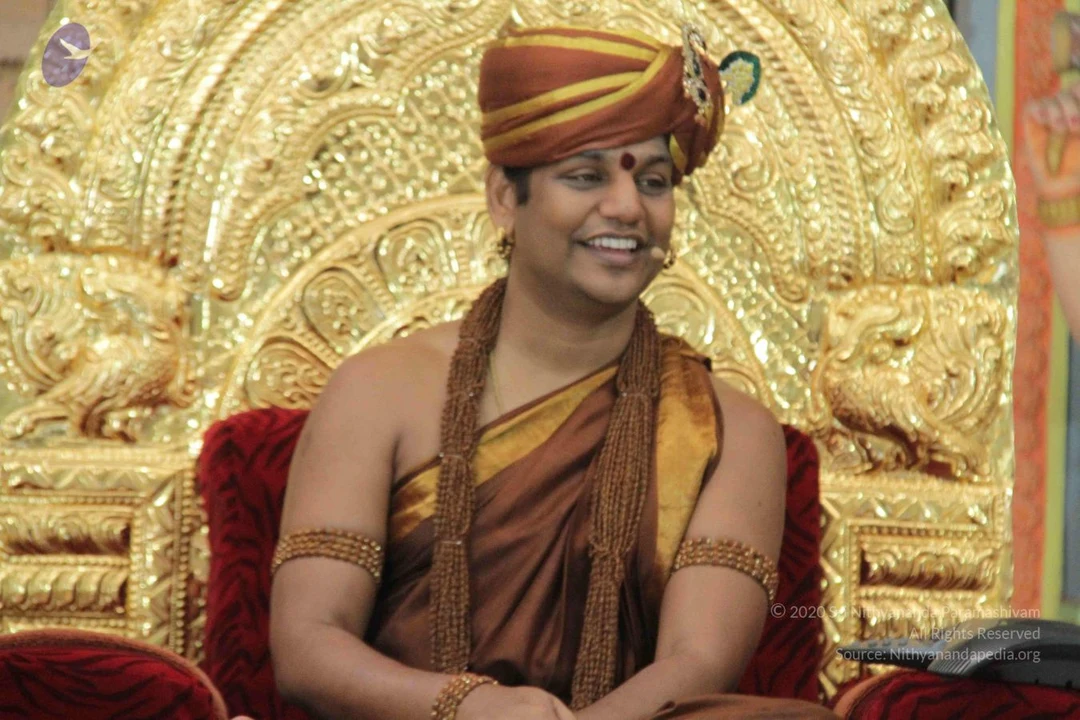
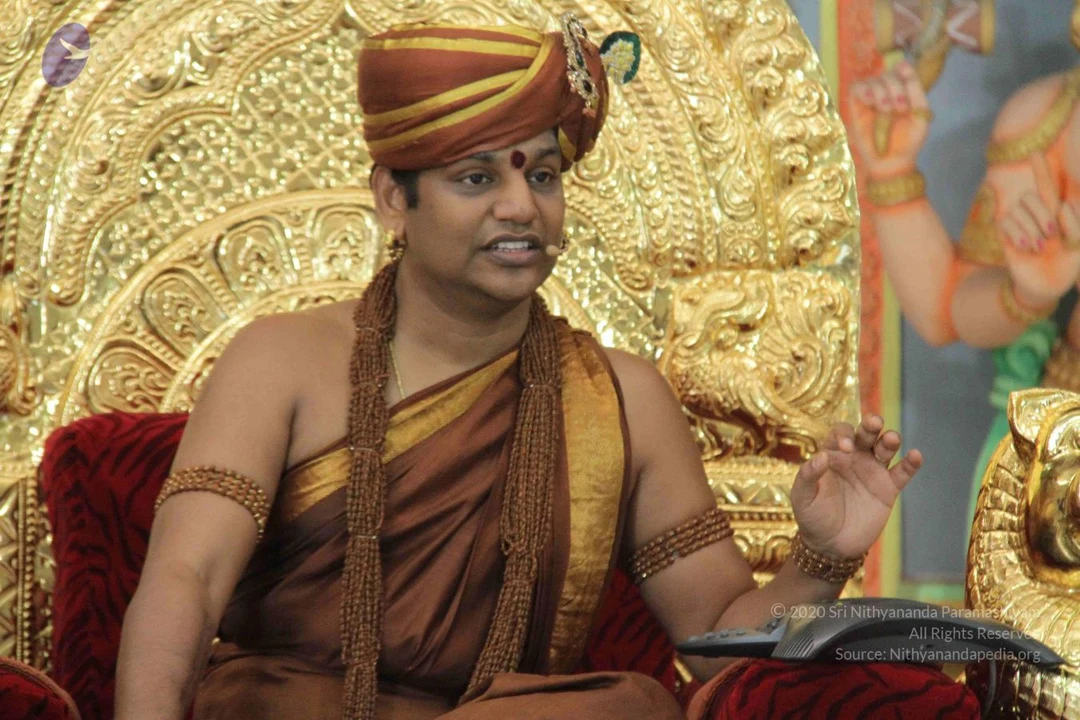
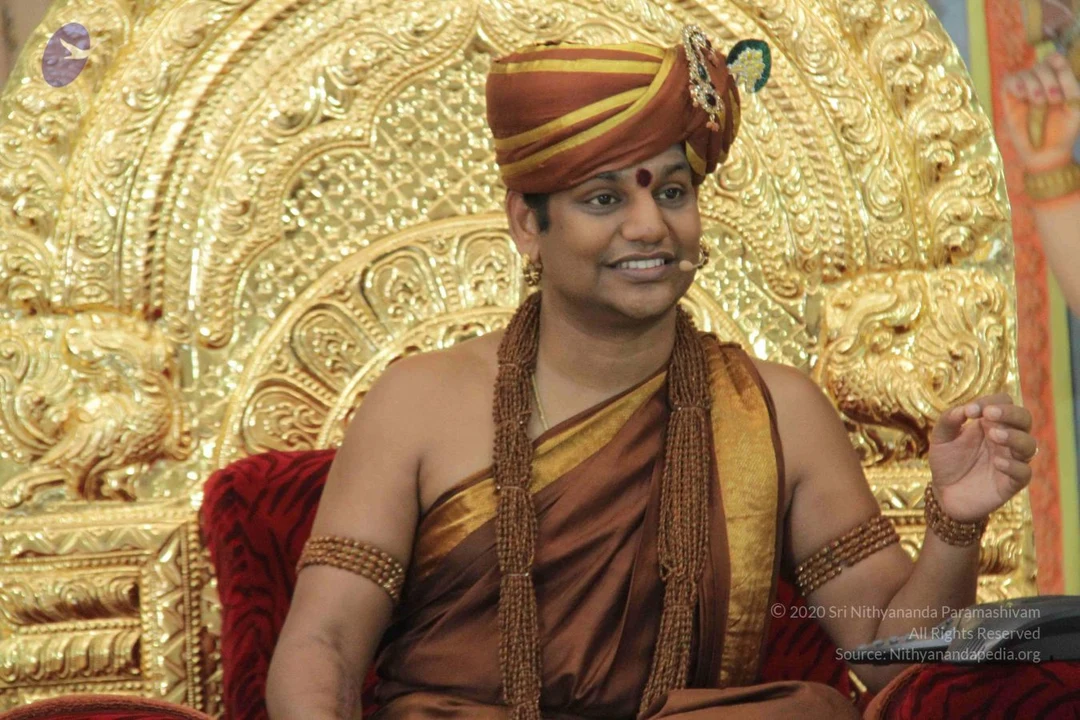
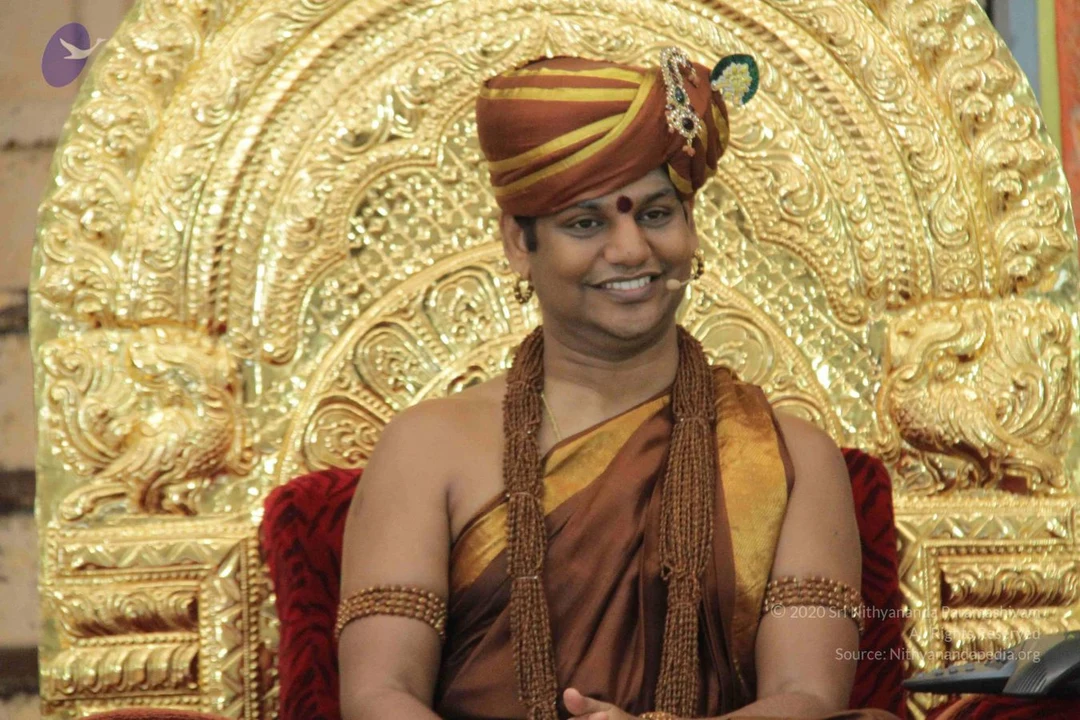
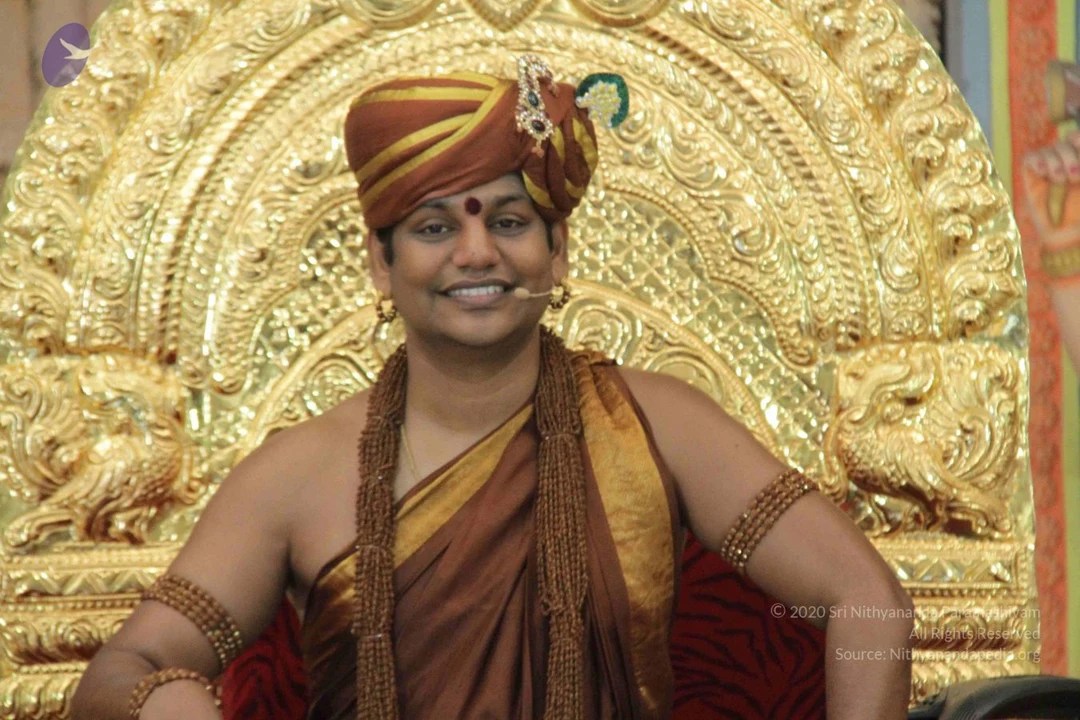
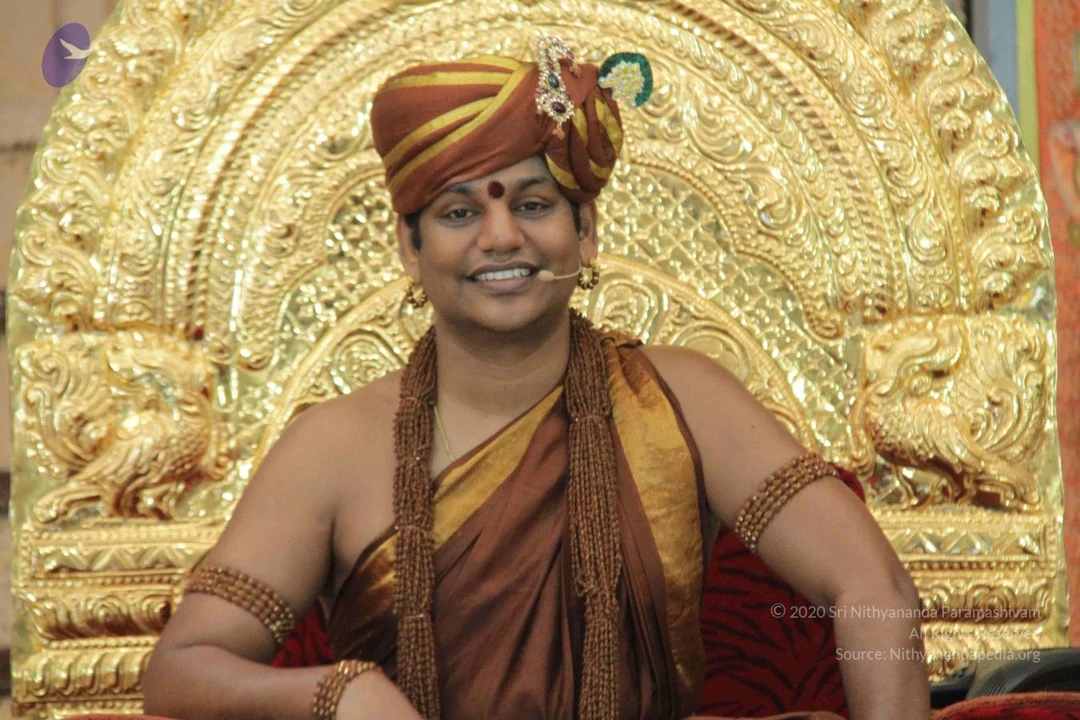
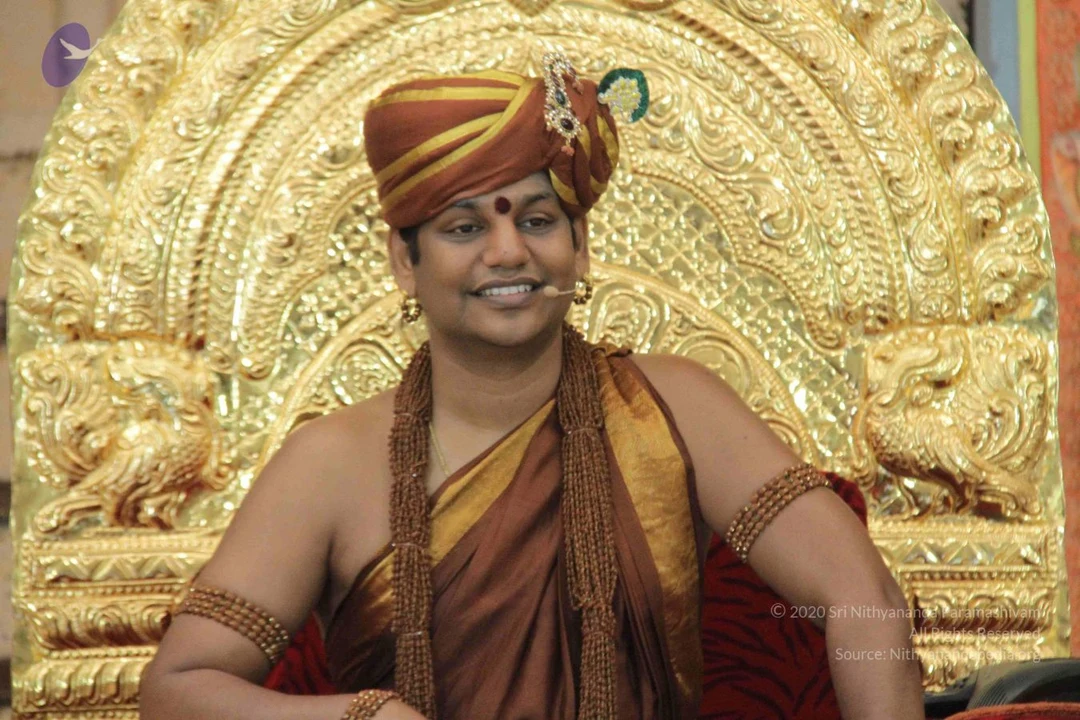
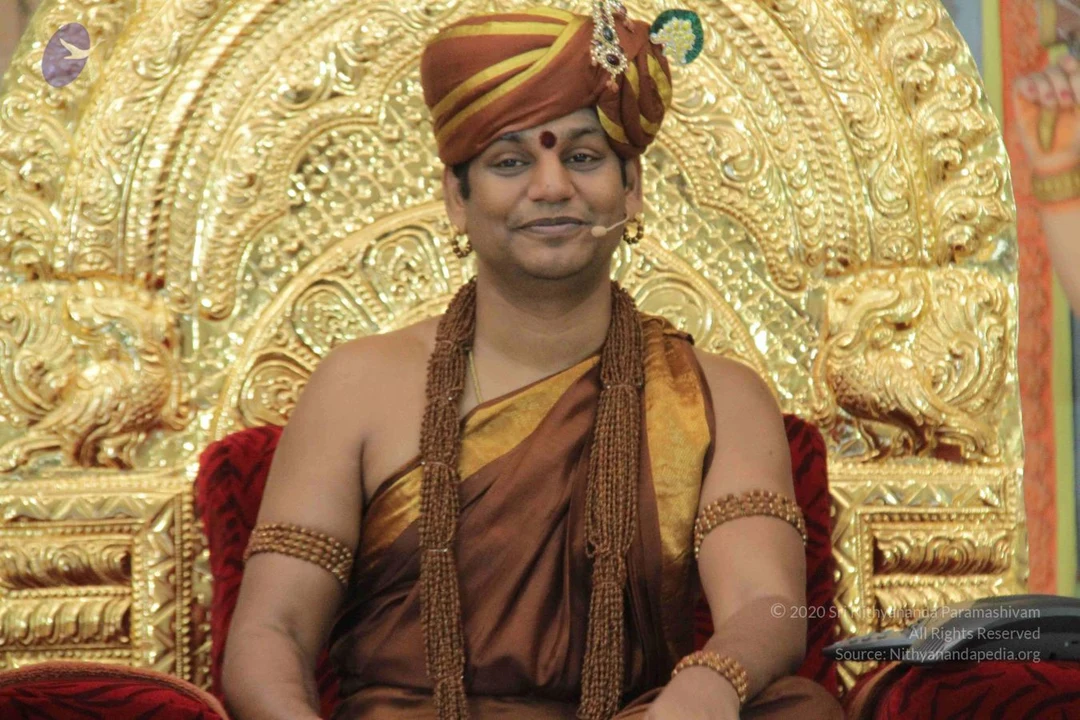
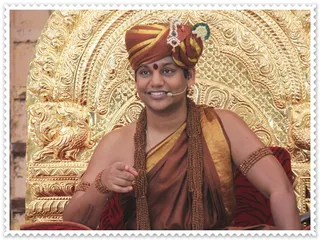
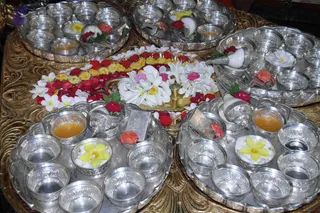
A photograph of an offering arrangement on ornate gold-toned trays. Ornamental silver bowls and dishes hold amber liquid, white and yellow flowers and red roses, arranged around a central ring of mixed red, yellow, pink and white flowers with a small brass vessel at the centre. Several silver plates hold fruit and petals, and there are no people visible in the frame.Two metal deity murti are decorated with yellow, red and white flower garlands and heavy silver and gold jewellery. The larger central figure wears a tall gold crown, a broad necklace and a red-and-gold garment, with raised gold hands holding small objects. A smaller figure to the right wears a matching crown and red-and-silver adornment. They sit before an ornate gold arched backdrop and green drapery, with a blue cloth covering the base. No physical people are visible.Two golden metal deity murtis are decorated for worship, framed by dense garlands of yellow marigolds, red roses and white flowers with green leaves. The figure on the left wears a tall gold crown, layered gold and jewelled necklaces, and holds a red fruit in one raised hand while the other hand is in abhaya mudra. The figure on the right wears a gold crown, red garments and a red and gold necklace. A green cloth hangs in the background. No physical people are visible.A seated man smiles while sitting cross-legged on a red velvet throne with an ornate gold-leaf backrest carved with lion-like motifs. He wears an orange-saffron turban with a small red bindi and a green ornament at the front, a saffron-brown shawl over his shoulders, a long rudraksha mala draped across the chest, gold bangles on his upper arms and wrists, and a gold ring on one hand. A small microphone is clipped near his mouth. Behind him, a painted deity figure with multiple arms and bangles is partly visible on the right. The throne and interior setting suggest a satsang seat.Two gilded metal deity murti stand side by side against a green draped backdrop, framed by a dense arch of yellow, red and white flower garlands. The larger figure, on the left, wears a tall golden crown, a silver-and-gold layered necklace and a gold-coloured raised hand, while the smaller figure to the right wears a golden crown and a red-and-silver necklace. The garlands and ornaments are richly decorated. No people are visible in the image.A smiling man in a rust-brown turban with a small jewelled ornament and green feather-like accent sits on an ornate gold throne carved with lion-like figures and foliage. He wears a brown and gold-bordered sash over a bare-shouldered outfit, multiple rudraksha-style beaded malas, and beaded bangles on his upper arm and wrist. A small microphone is clipped near his face as he gestures with one hand. a person: the turban, layered beaded malas, ornate brown-gold attire and ceremonial throne match the page's claim, though the appearance cues are only partially distinctive. Background is a red cushioned seat and a gilded throne surface.

Arunachaleshwara-Apeethakuchambal
10 photosSource gallery
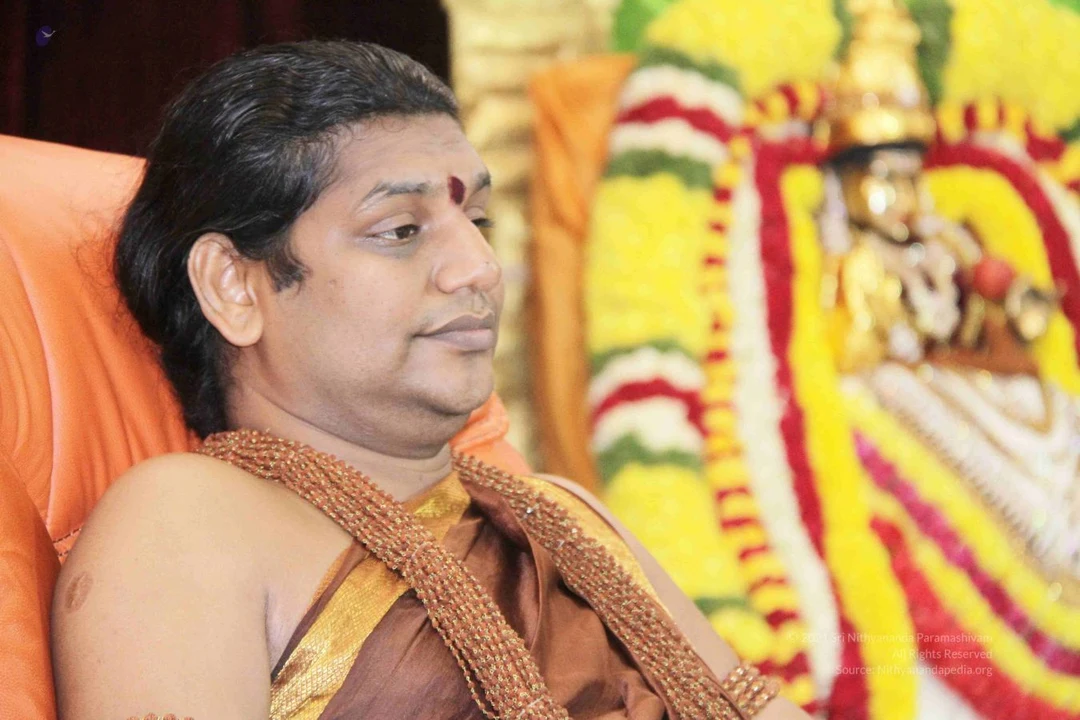
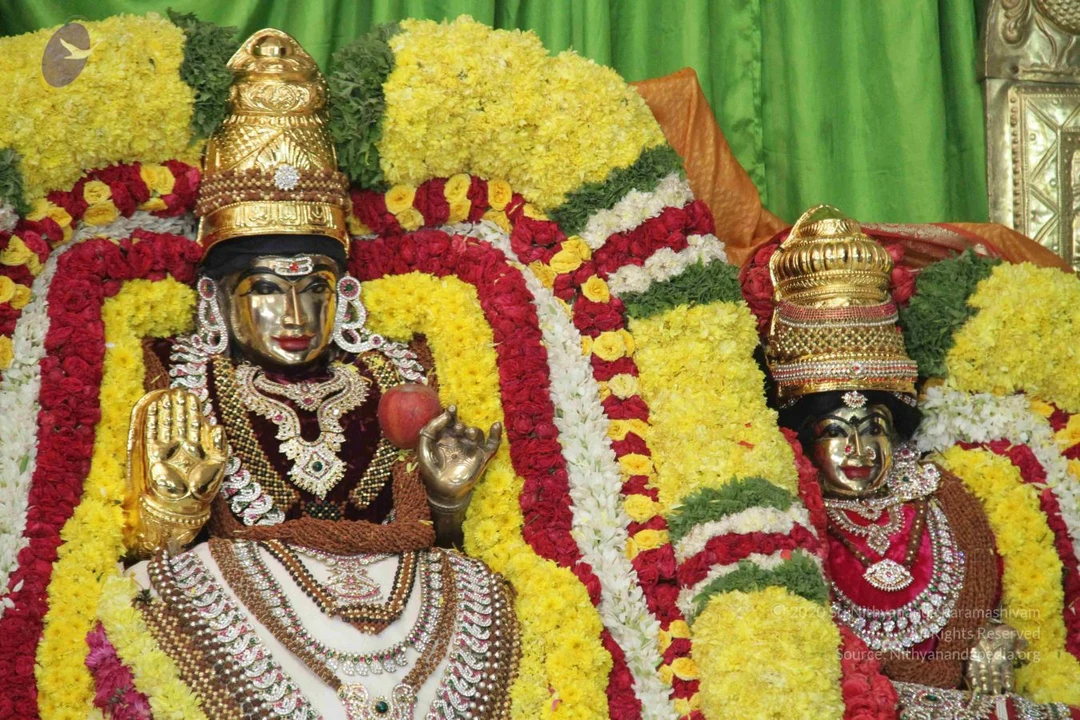
Two golden deity murtis are richly decorated with yellow and red flower garlands and white strands of flowers. The larger murti on the left wears a tall gold crown, a silver-and-gold necklace set with green stones, layered gold chains and jewelled ornaments, and holds a red fruit in one raised hand. The smaller murti on the right wears a gold crown and a red-and-silver necklace with a red garment. Green foliage and a green curtain with gold panels form the background.A golden deity murti is adorned for worship, framed by an arch of red roses, yellow marigolds, white jasmine strands and green leaves. The murti wears a tall gold crown set with stones, a rich maroon velvet garment and layered jewelled necklaces in gold and gemstones. It raises one hand in abhaya mudra and holds a red apple in the other. The image is a photograph of a decorated temple idol, with no living people visible.A golden deity murti is richly decorated with thick garlands of yellow marigolds, red roses and white jasmine strands arranged in a semicircular backdrop. The murti wears a tall gold crown with a red band, a dark gold-trimmed face with a red tilak, jewelled earrings, and layered necklaces with green and red stones over a deep maroon velvet garment. Its right hand is raised in abhaya-style blessing while the left hand holds a red fruit. Green leaves are interspersed among the flowers.Two gilded deity murtis, one larger and one smaller, are dressed in heavy silver and gold jewellery and densely decorated with garlands of yellow, red and white flowers with green leaves. The larger murti wears a tall golden crown, holds a red fruit in one hand and has its other hand raised in a gold mudra. A small brass oil lamp stands at left, and a green cloth hangs behind. A partial figure in white stands at the left edge. The photo appears to show a temple alankaram arrangement.Two golden metal deity murtis stand side by side, heavily adorned with yellow, red and white flower garlands forming arches around them. The larger figure on the left wears a tall golden crown, layered gold and jewelled necklaces, and raises a hand holding a red fruit; the smaller figure on the right wears a red and gold dress with a gold crown and jewelled necklaces. Behind them hang a green curtain and gold-toned relief panels, with an oil lamp at left and a floor-standing air conditioner at right. No physical people are visible.Two golden deity murtis, decorated with heavy garlands of yellow marigolds, red roses and white flowers with green leaves, sit before a green cloth backdrop. The larger figure wears a tall golden crown, layered jewelled necklaces, large earrings and a silver-and-gold waist ornament; it raises one hand in abhaya gesture and holds a red fruit. The smaller figure beside it wears a golden crown and jewelled necklaces. A gilded panel is visible at the upper right.

Paduka-Puja

11 photosSource gallery
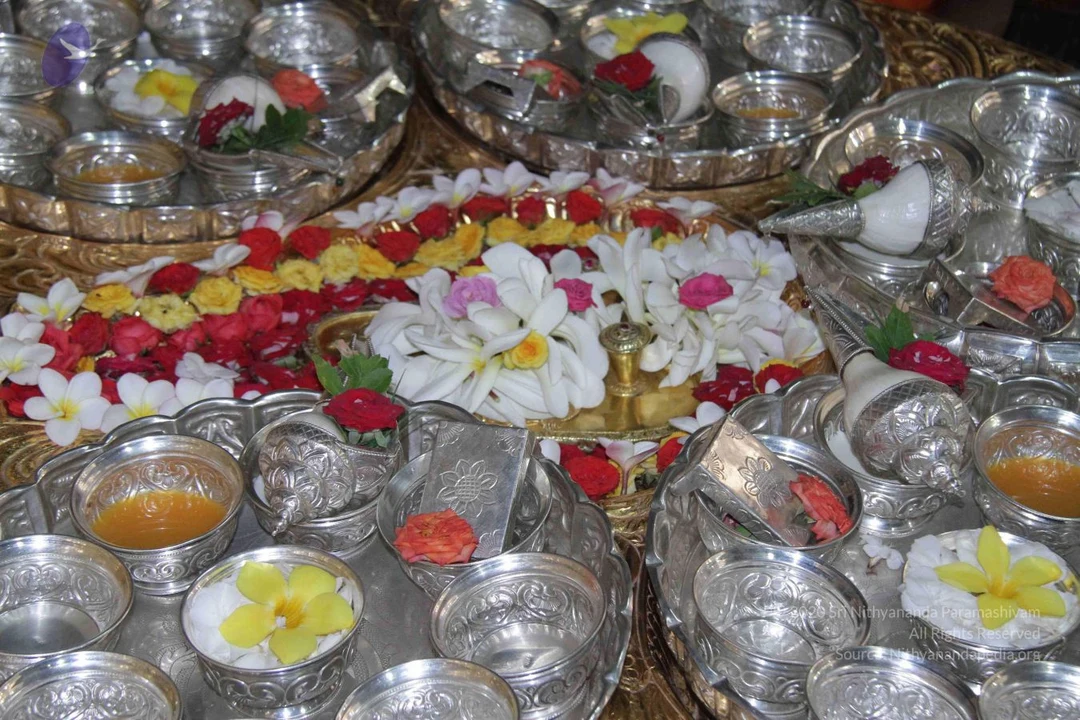
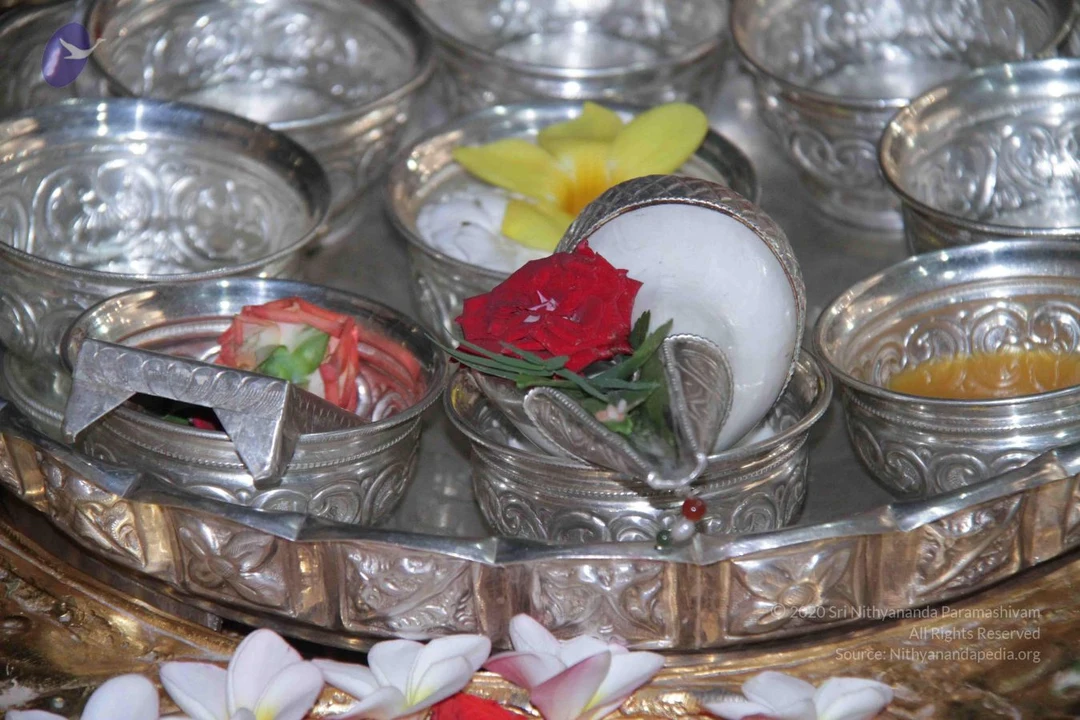
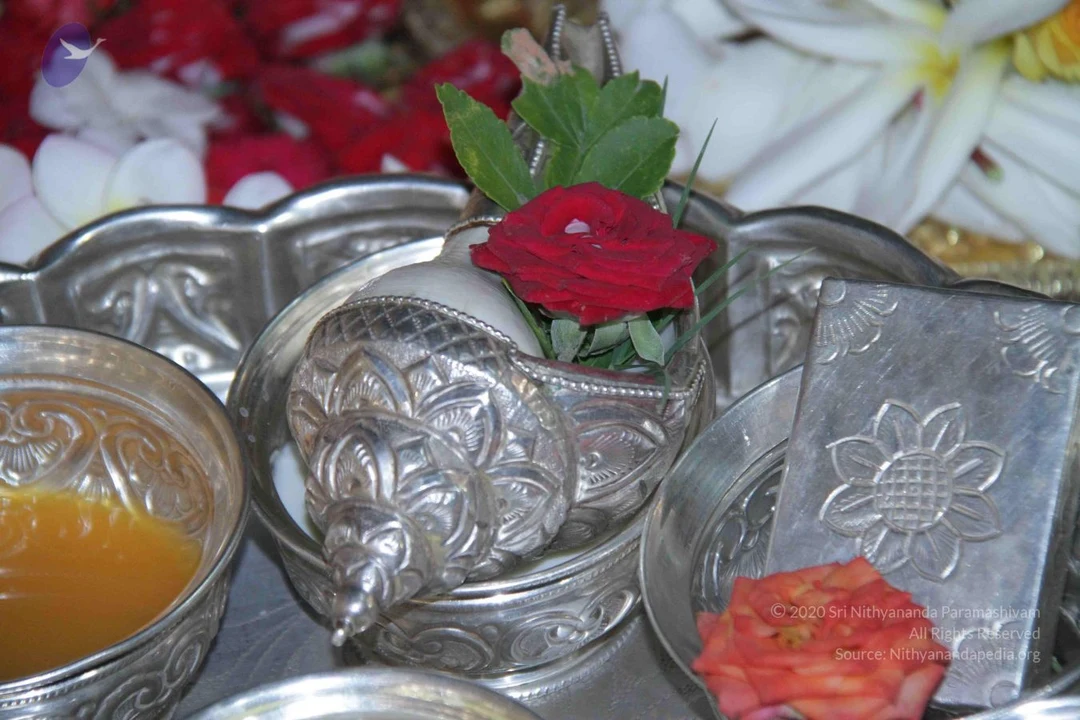
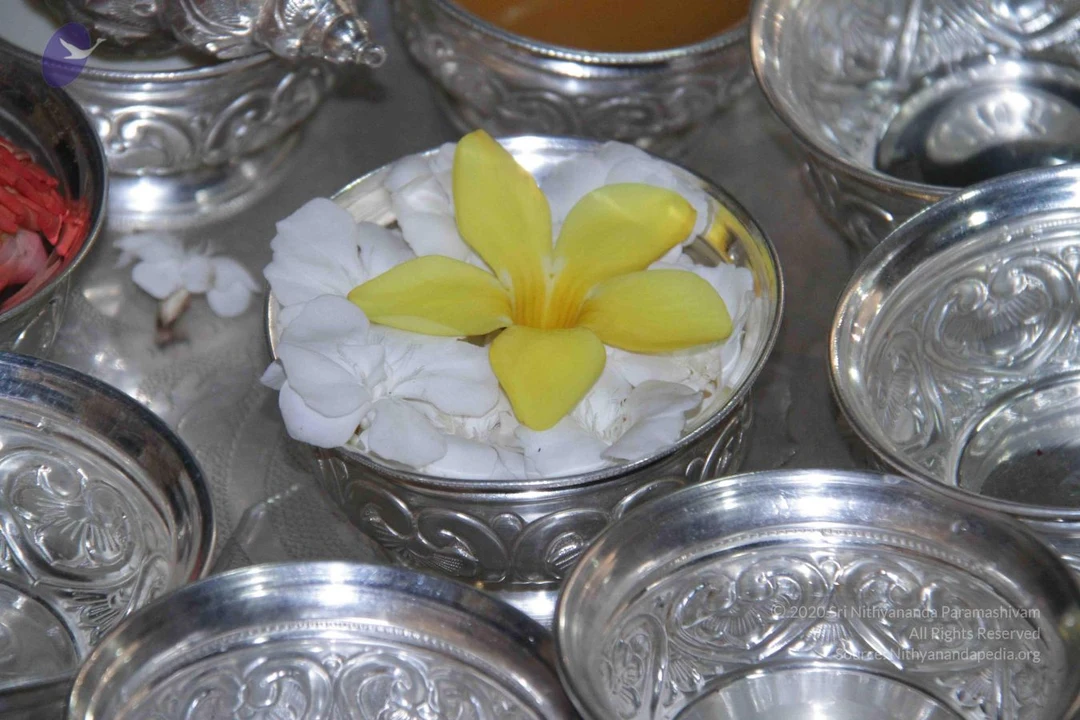
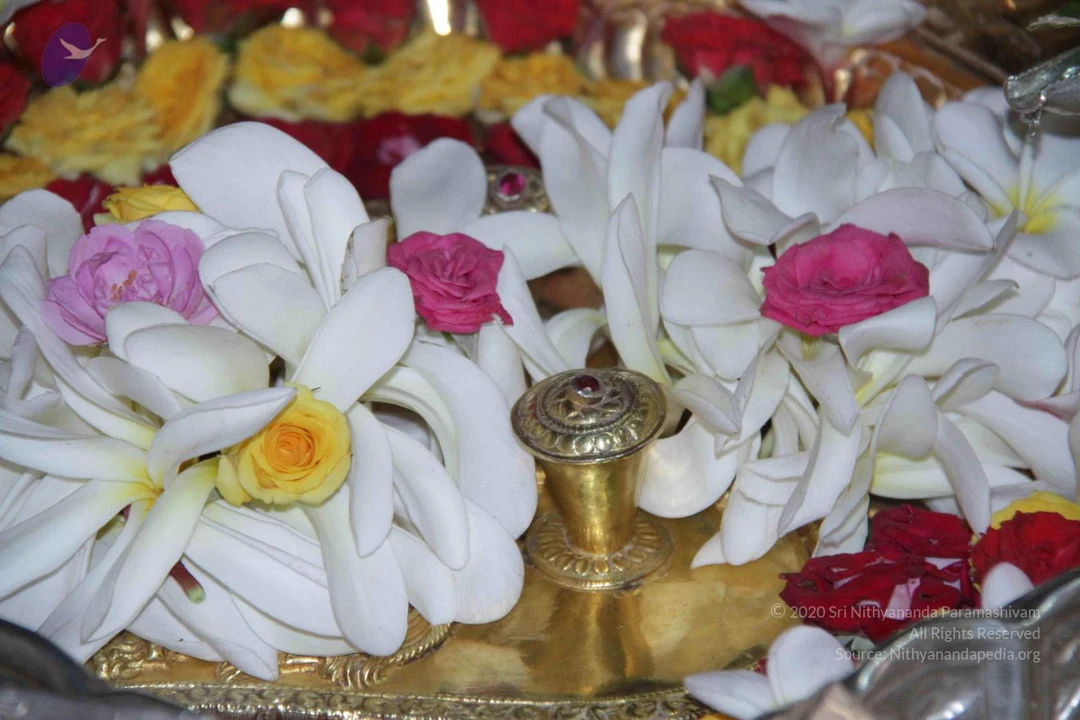
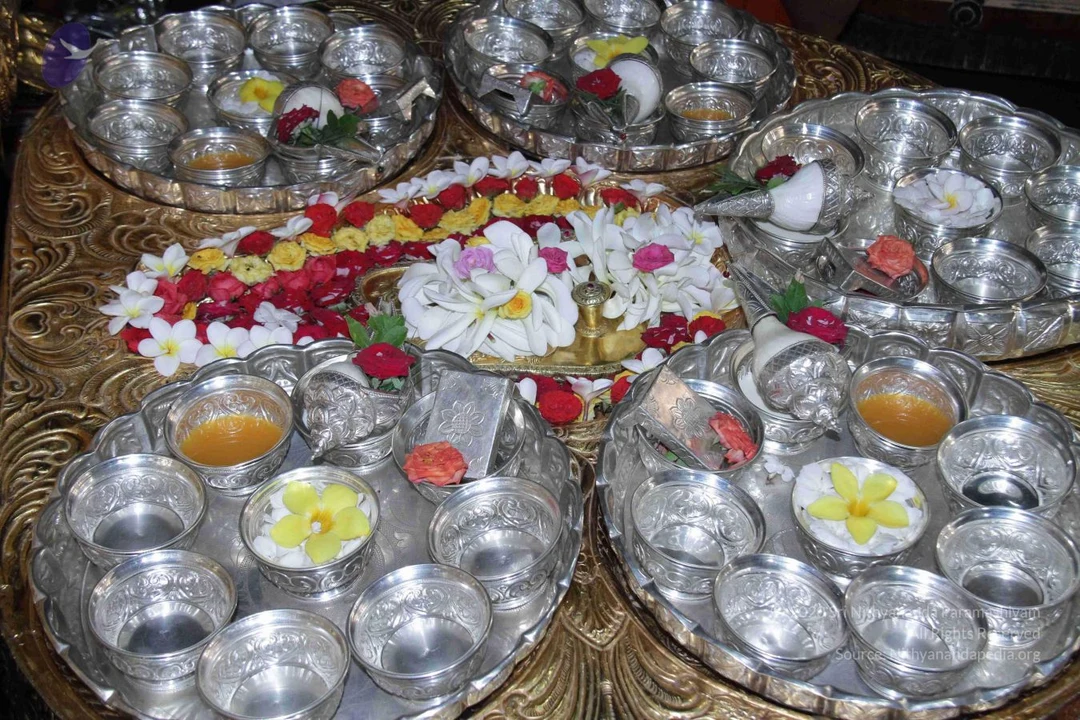
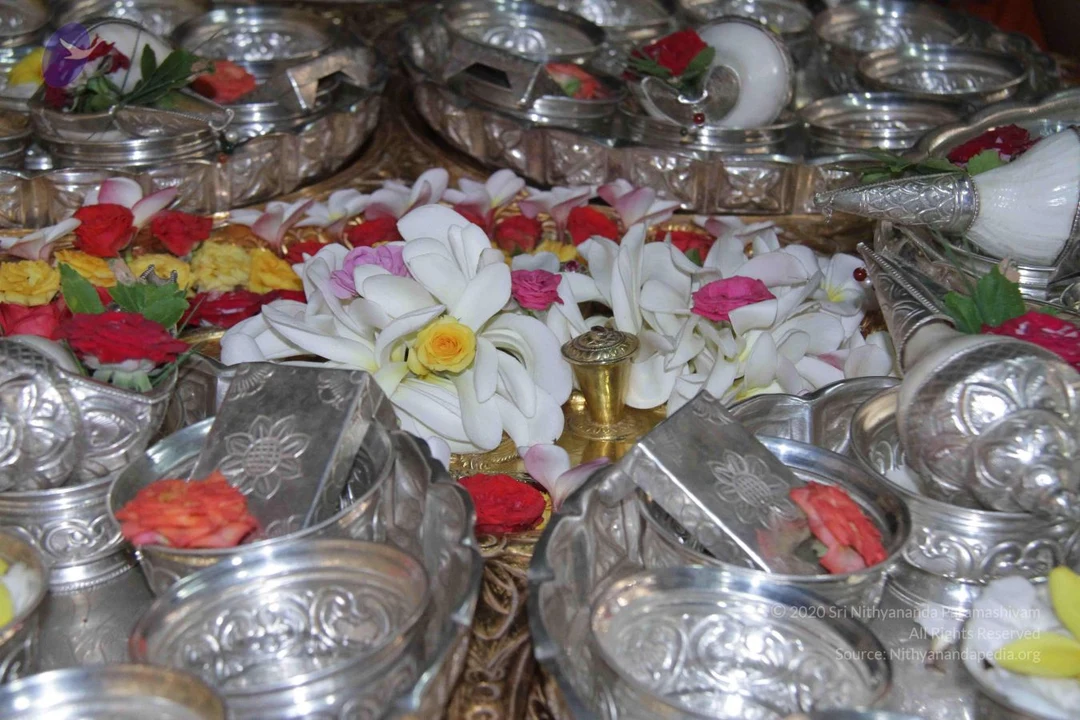
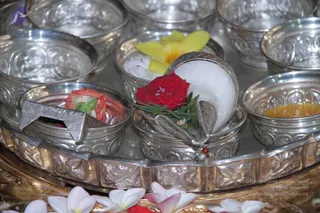
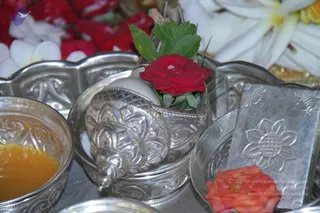
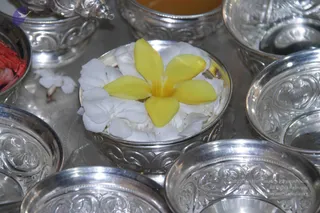
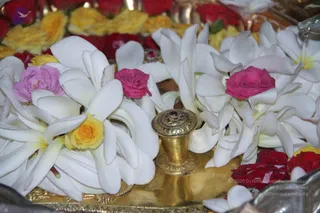
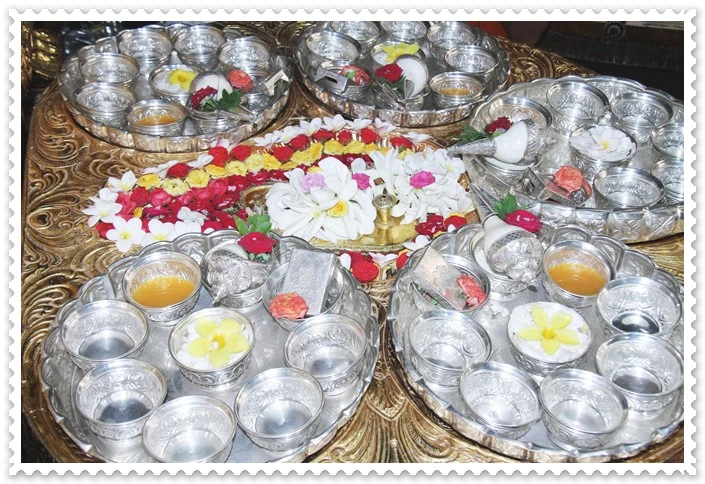
A photograph of ritual offerings arranged on polished silver trays. Silver bowls hold orange liquid, a silver spouted vessel and a conch-shaped silver container sit at the right, and small silver cups are scattered around. Red roses, yellow and white flowers, white plumeria, and green leaves form a bed of petals and garlands across the centre. A brass lamp stand with a small flame rests among the blossoms. No people are visible; the scene shows puja items laid out for worship.Close-up photograph of a ritual offering tray with several ornately engraved silver bowls and a silver spoon-shaped vessel. Bowls hold a yellow flower, a red rose, green leaves, sliced fruit and a golden-yellow liquid, possibly a sweet. A white conch-shaped vessel sits among them, topped with a red flower. Scattered white and pink frangipani flowers lie along the bottom edge on a gold-coloured surface. No people are visible in the frame.Close-up photograph of a silver puja tray with embossed floral and scroll patterns. A silver conch-shaped vessel holding a red rose and green leaves sits at the centre, beside a shallow silver bowl of yellow liquid and a small silver tray engraved with a lotus-like flower. Red and orange rose petals and white plumeria-style flowers fill the background and corners. No people are visible.Close-up photograph of an ornate silver puja tray with repoussé floral engraving. In the centre, a small silver bowl holds white jasmine-type flowers topped with a single yellow frangipani (plumeria) blossom. Other silver bowls with engraved rims surround it, including one with red powder at the left edge and one holding a golden-yellow liquid at the top. No people are visible. The image is a watermarked photograph from the archive.Close-up of an offering tray filled with white frangipani (plumeria) blossoms and red, pink and yellow roses, arranged around a small gold cylindrical vessel with a decorative rim and a red stone set in its top. The gold tray has an ornate engraved border. No people are visible; the flowers and brass vessel suggest a temple puja offering.Close view of ritual offerings arranged on ornate silver and gilt trays. Several engraved silver bowls hold orange liquid and small offerings, with yellow and white frangipani-style flowers and red roses scattered across the trays. A central brass vessel is surrounded by garlands of white and red petals. A silver spoon and small silver cups sit among the flowers. No people are visible; the arrangement suggests a puja or abhishekam offering setup.

Nithya-Satsang
71 photosSource gallery
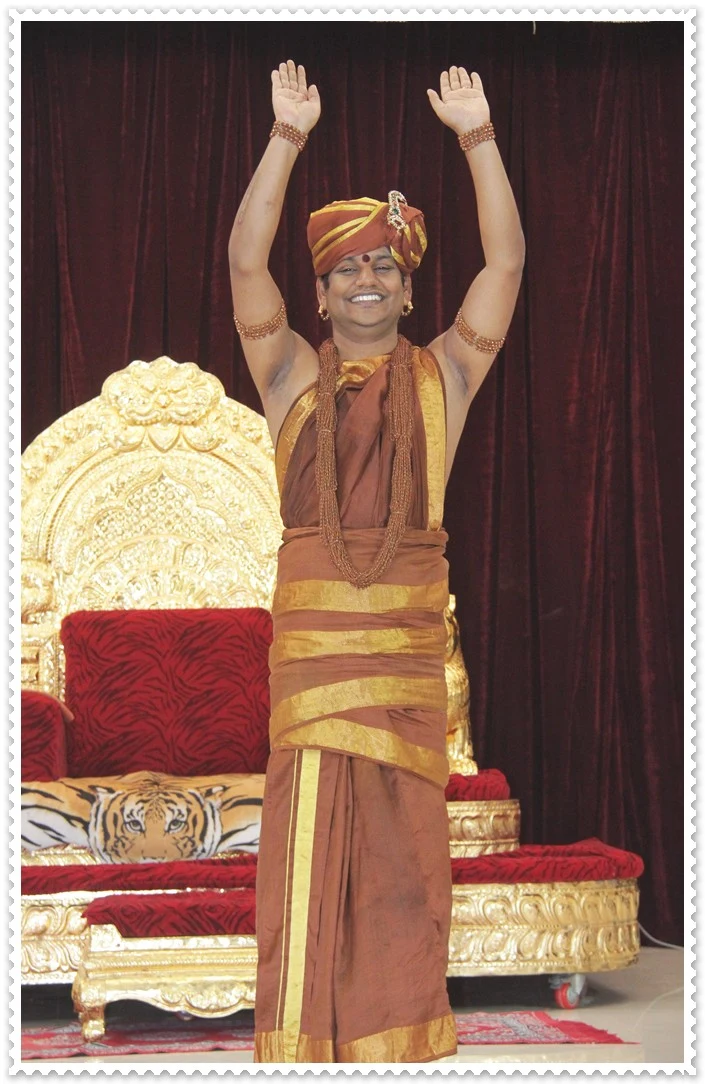
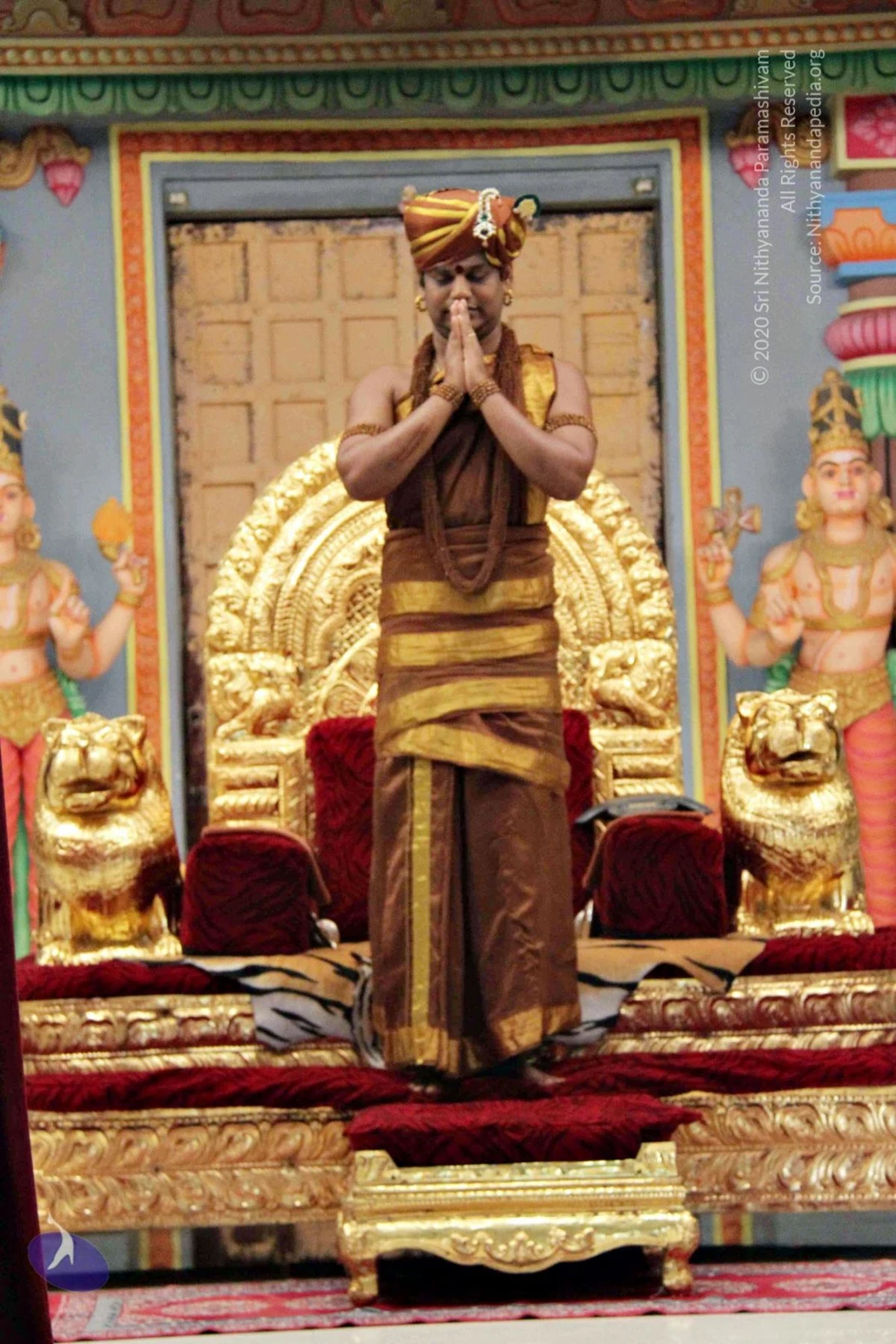
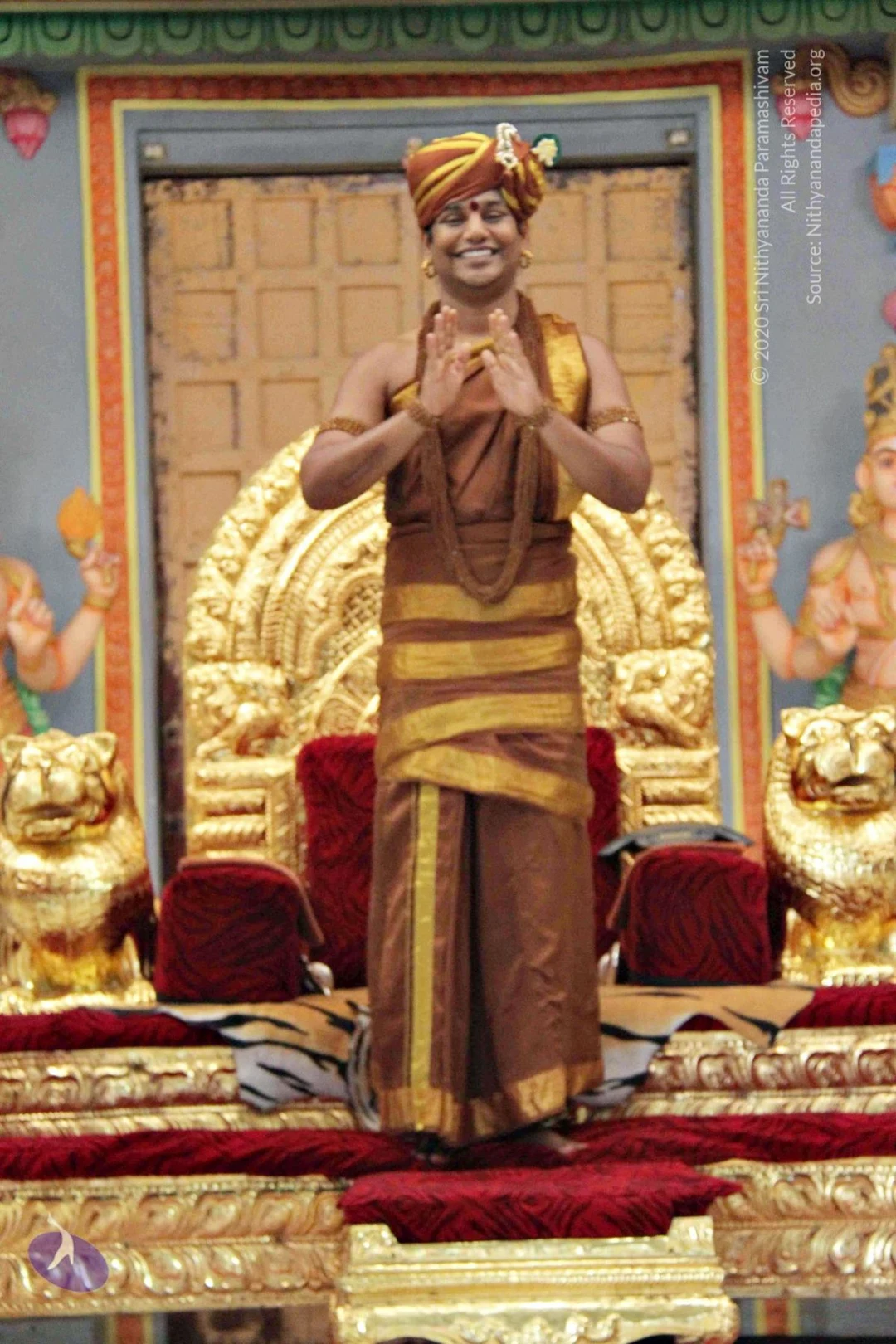
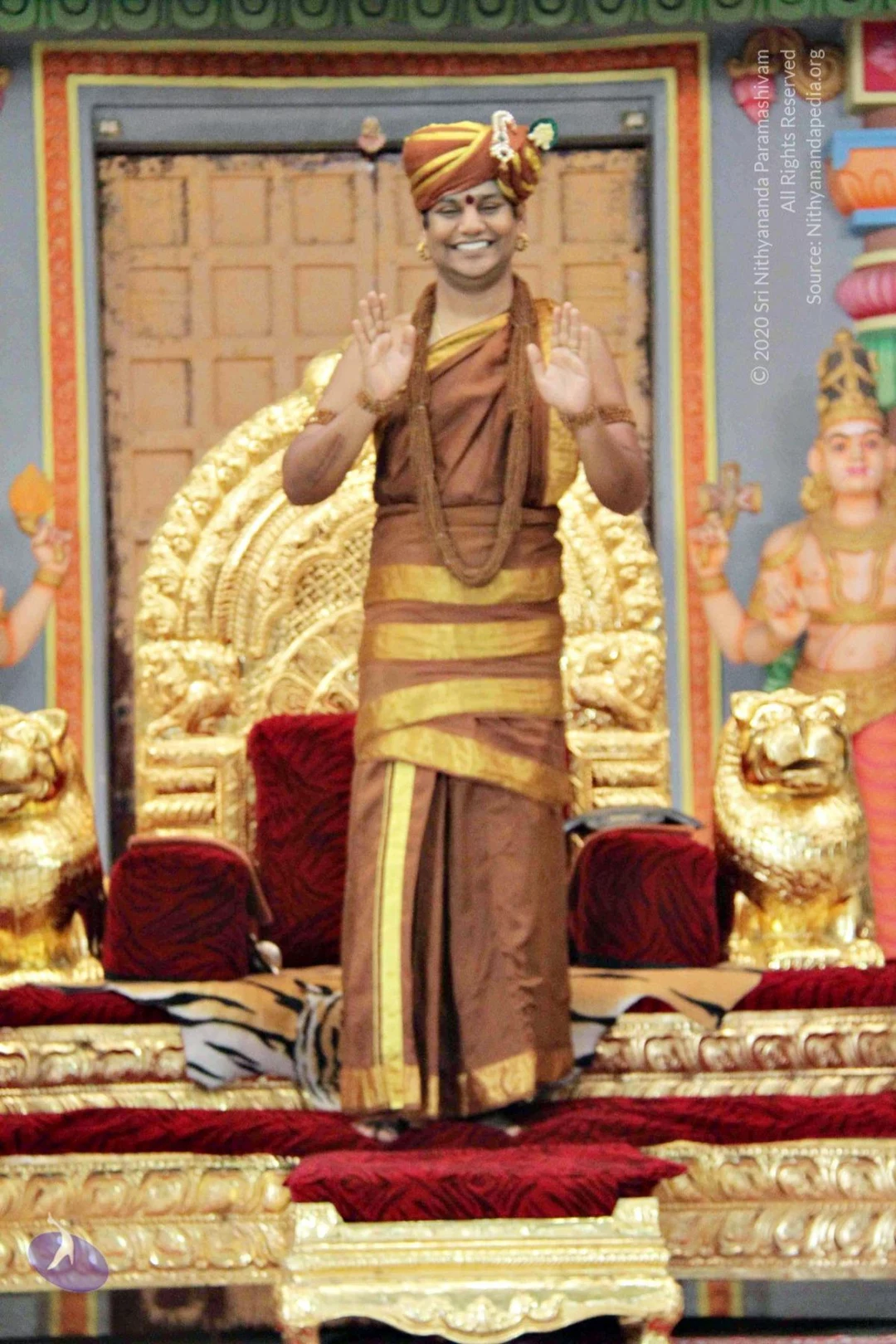
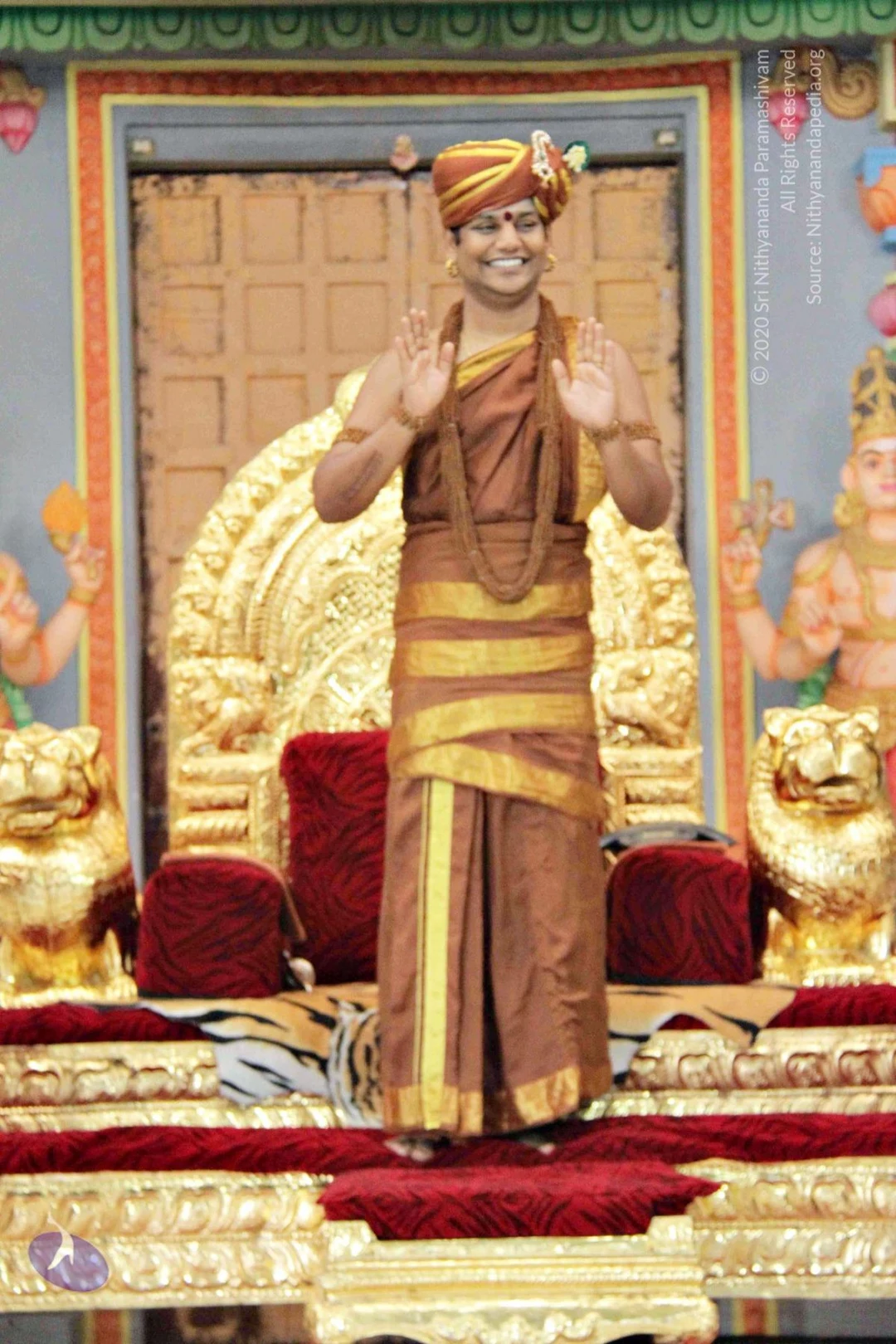
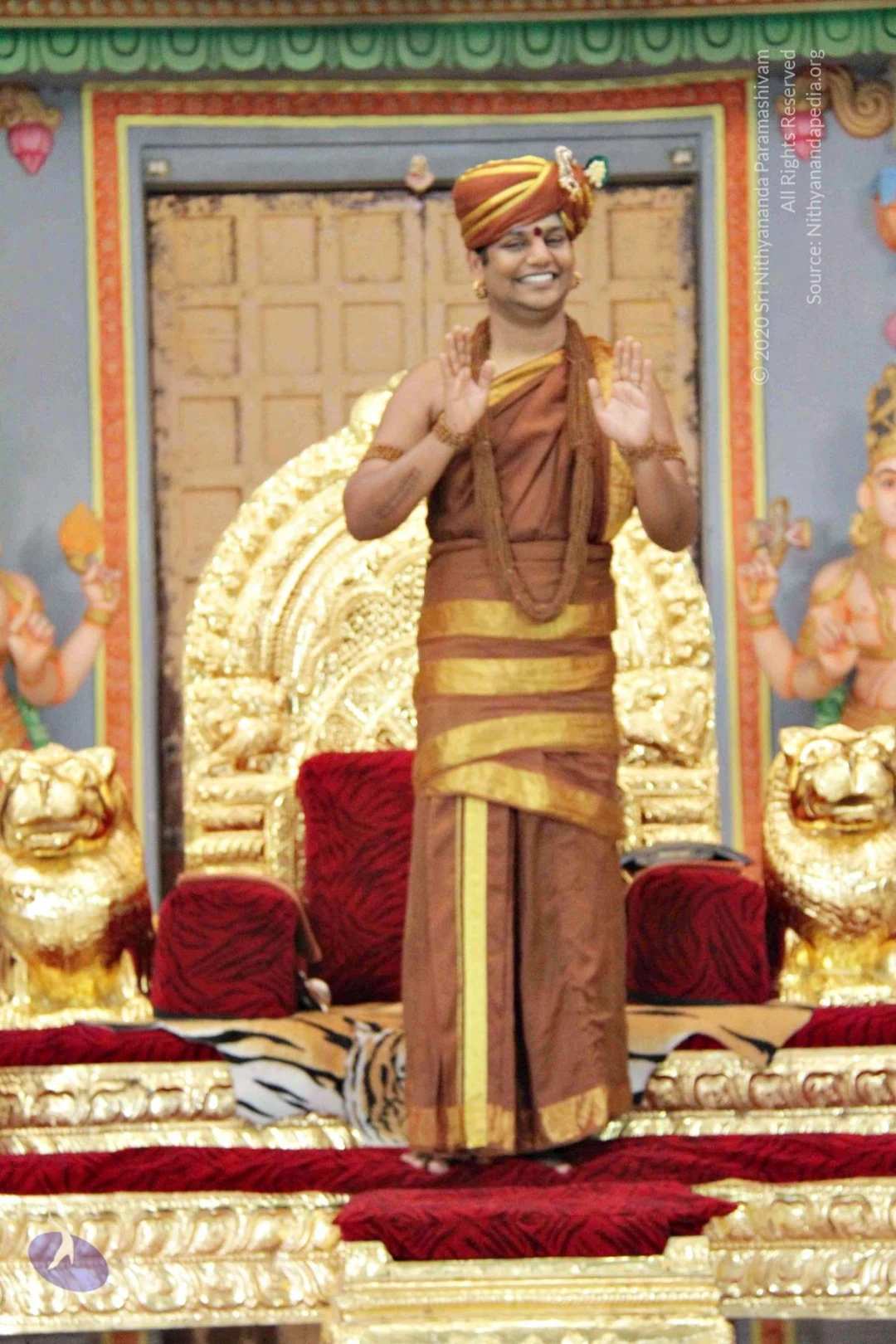
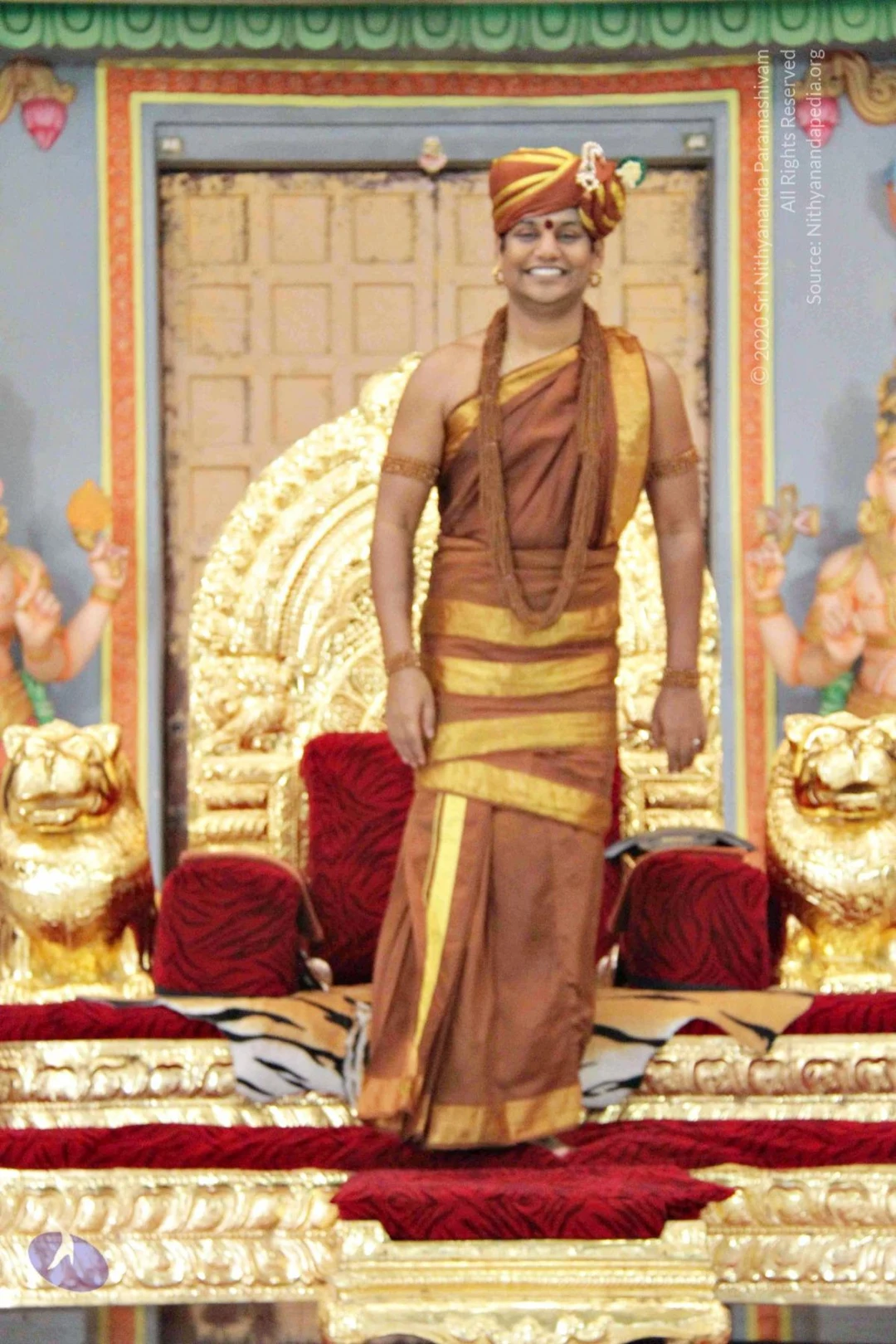
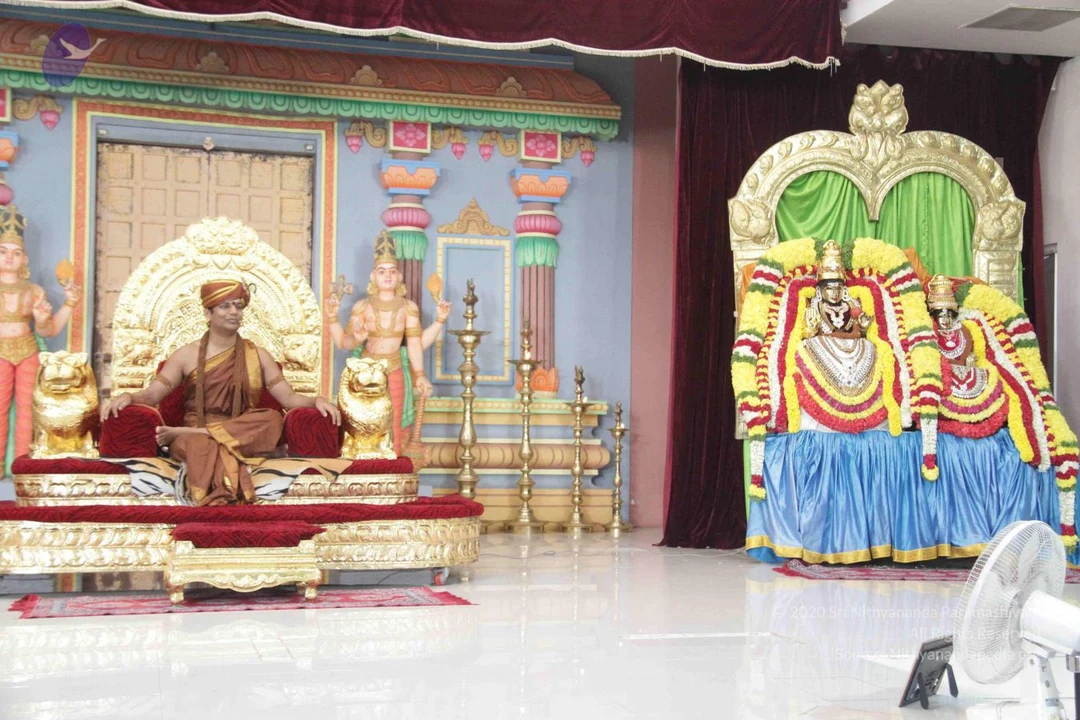
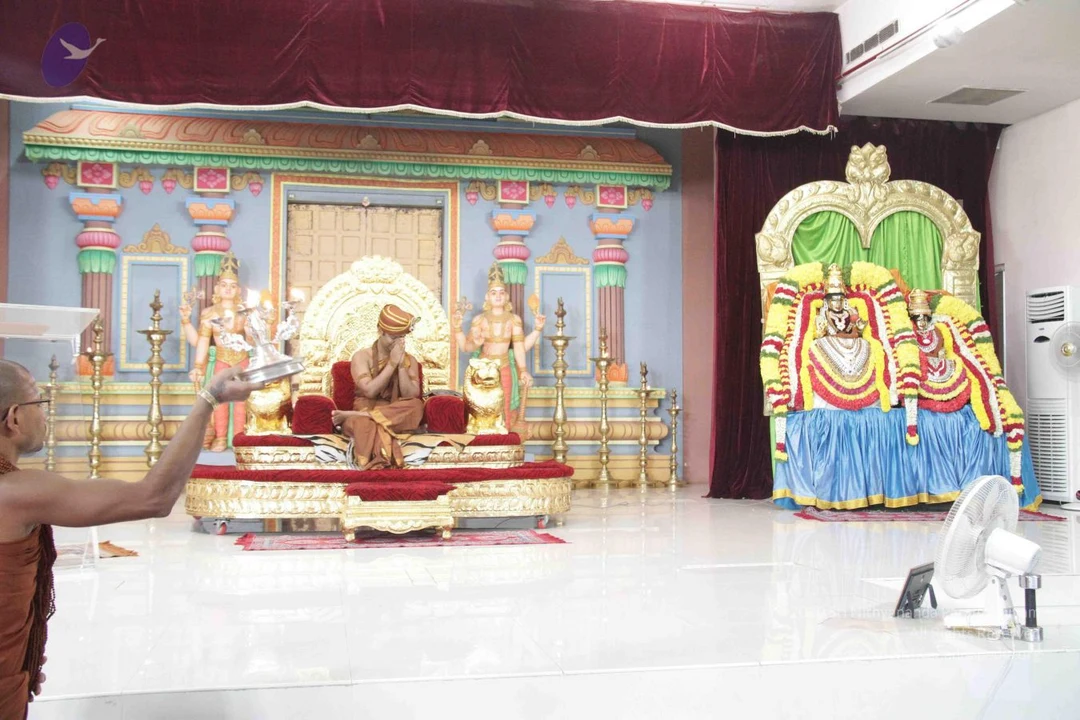
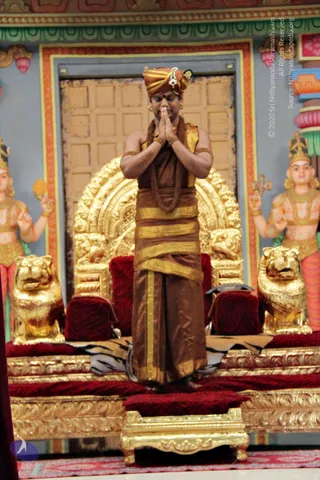
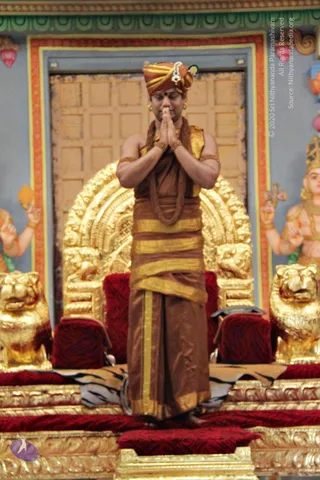
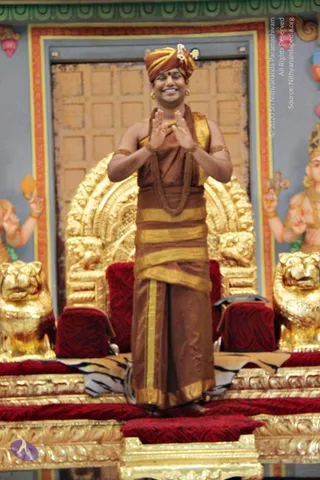
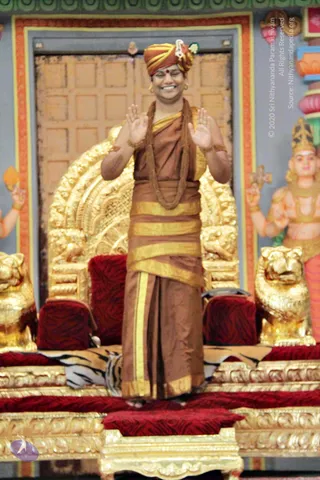
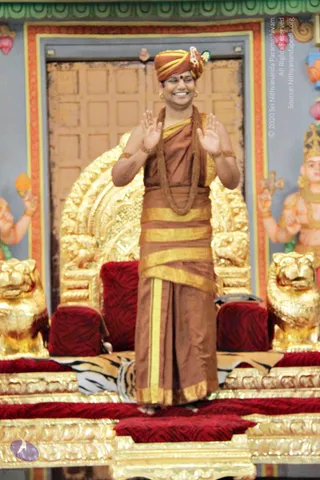
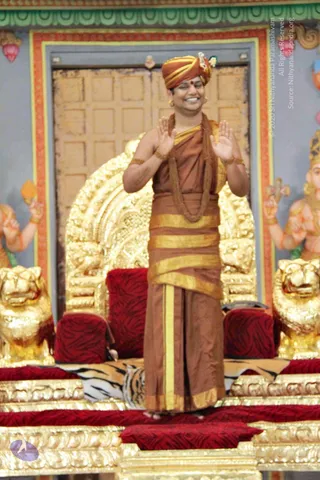
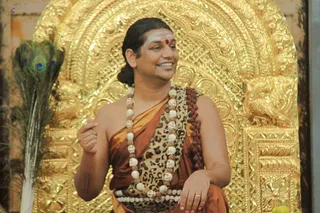
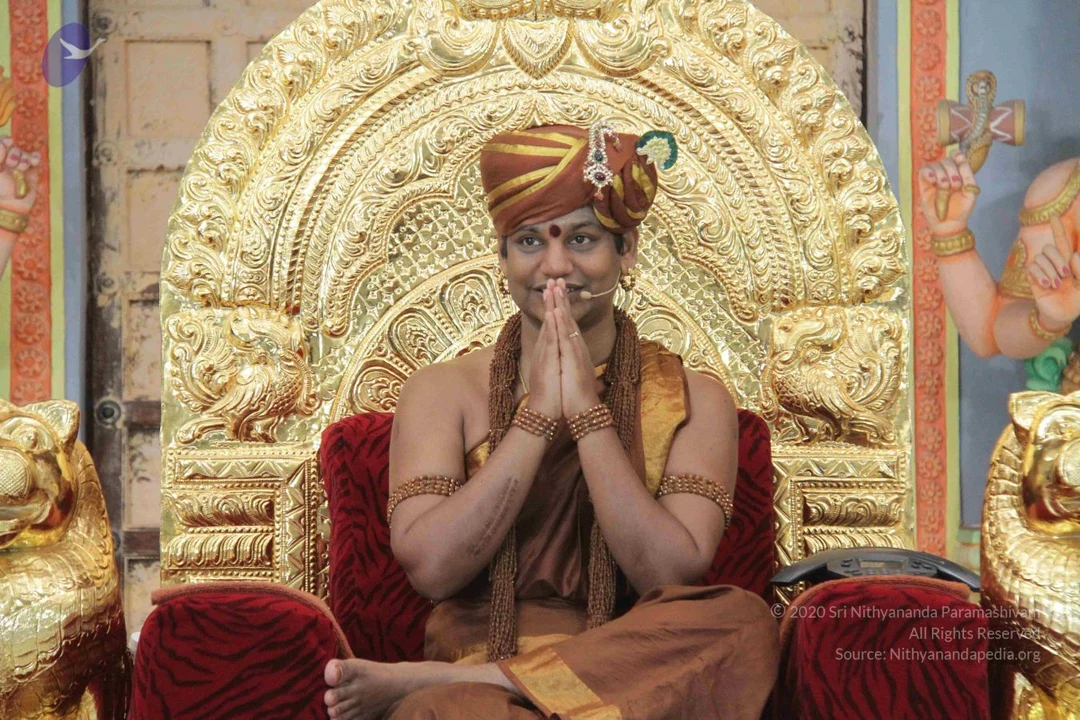
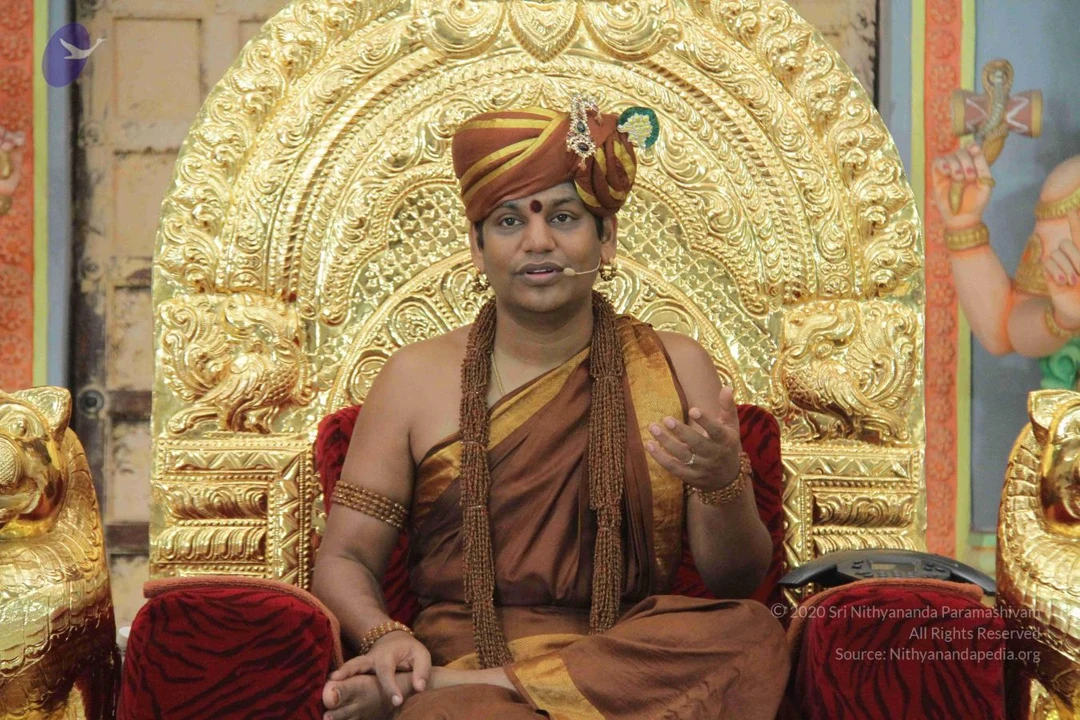
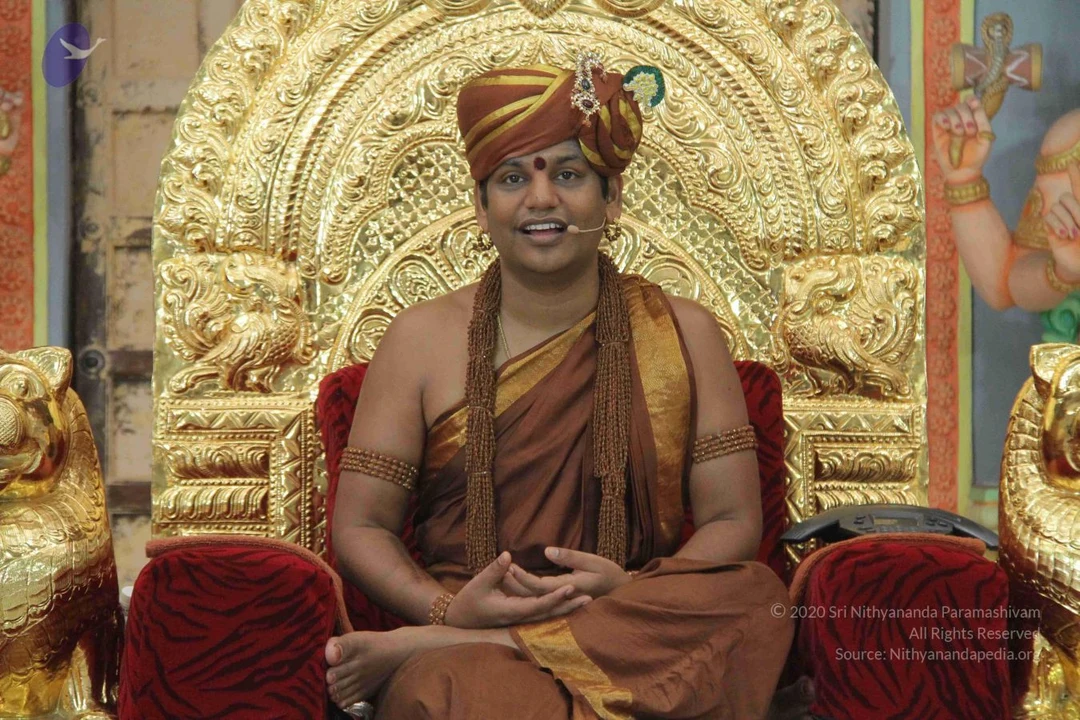
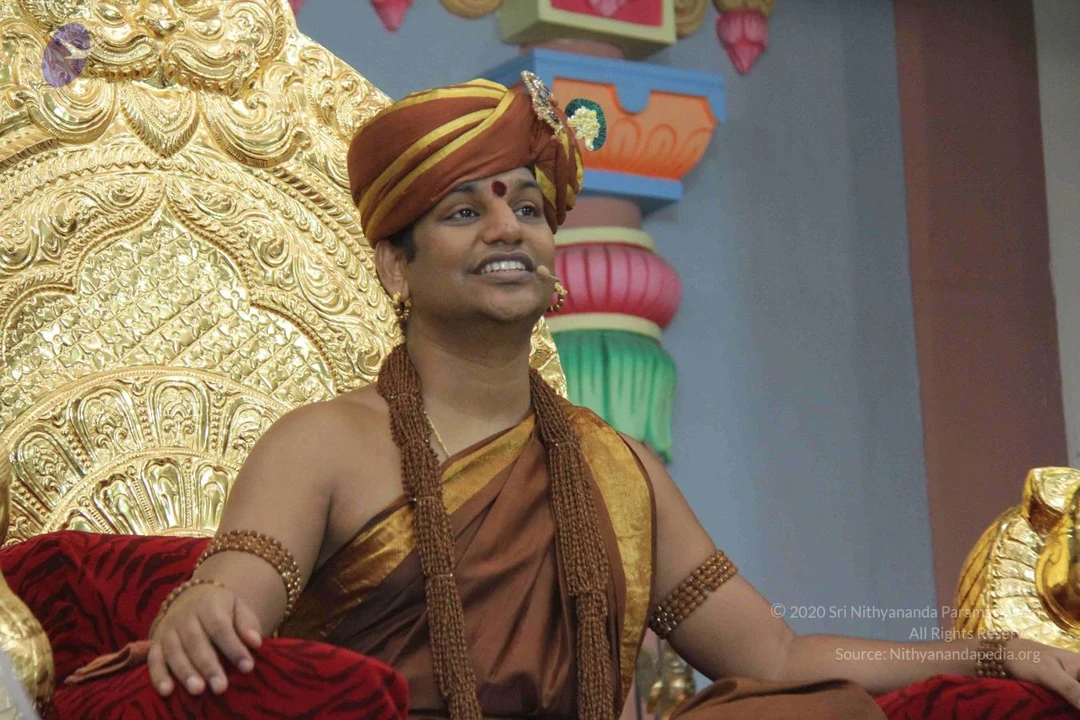
A man stands in front of a gilded throne in a temple-style hall, palms pressed together in namaskar with eyes lowered. He wears a striped orange-and-yellow turban with a small ornament, a brown silk dhoti and upper cloth with gold borders, a brown rudraksha-style mala, and gold armlets and bangles. Behind him is a carved golden throne with red cushions and a tiger-skin cloth on the platform. Golden lion figures flank the throne, and painted deity statues with crowns stand on either side. A small gilded stool sits in front of the platform.A standing figure in a rust-brown and gold silk robe with wide gold borders presses palms together in namaste on a gilded stage. He wears a saffron-and-gold turban with a white flower ornament, a brown rudraksha-style mala, gold bangles and armlets. Behind him stand a gold ornate throne with lion-head armrests, red velvet cushions and a tiger-stripe cloth on the dais. Painted deity figures with gold crowns flank the scene.A smiling man stands in front of an ornate golden throne with lion-face armrests and red velvet cushions, with a tiger-striped cloth draped over the platform. He wears a rust-brown and gold-bordered dhoti and sash, a rust and gold turban with a white flower decoration, a red bindi, rudraksha-style beads and bangles, and his palms are pressed together in namaste. Behind him are a wooden-panelled wall and painted deity figures in orange and gold. The throne and dais are highly gilded in a temple-style setting.A smiling man in a rust-brown dhoti and shawl with gold borders stands on a raised platform before an ornate gold throne with red cushions and a tiger-skin cloth. He wears an orange and gold turban with a white flower decoration, a long rudraksha mala, gold earrings and gold bangles, and raises both palms outward in blessing. Gilded lion sculptures flank the throne, and a painted deity murti with raised arms stands to the right against a wooden panelled backdrop. The scene reads as a satsang stage.A smiling figure stands on a raised platform before a golden throne with lion-carved armrests and red velvet cushions, a tiger-striped cloth draped over the seat. He wears a rust-brown turban with a gold-and-red border, brown ochre-toned dhoti and shawl with broad gold borders, and a long rudraksha mala, with gold earrings and a red bindi. He raises both palms outward in a blessing gesture. Behind him, a wooden door and painted deity figures with gold crowns flank the scene.A standing man in a rust-orange and gold turban and a rust-brown dhoti-style garment with gold borders stands with both palms raised in greeting on a stage. He wears a long rudraksha mala and gold earrings. Behind him is a large gold throne with red cushions and gold lion heads, a gold tiger skin draped across the dais, and painted figures of deities with multiple arms on either side. A wooden door stands in the background. a person: the figure wears a turban and rudraksha mala and is positioned at the throne, a distinctive presentation cue. The image is a photograph from a stage event.
Sarva-Darshan

15 photosSource gallery
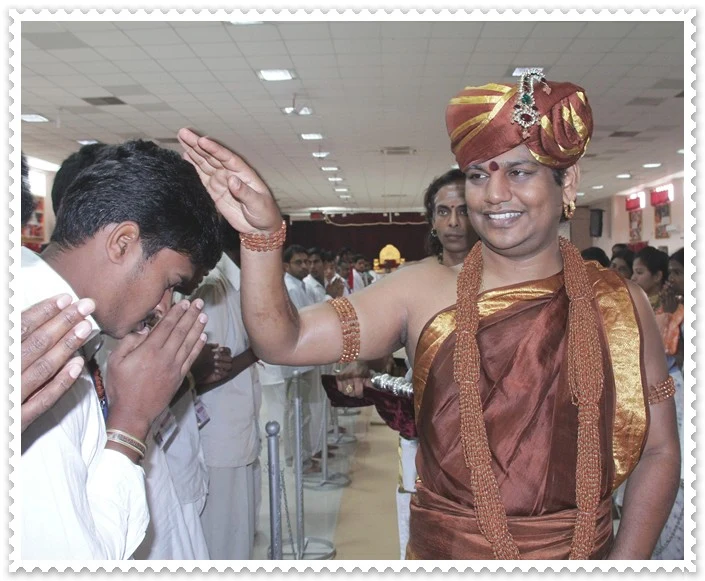
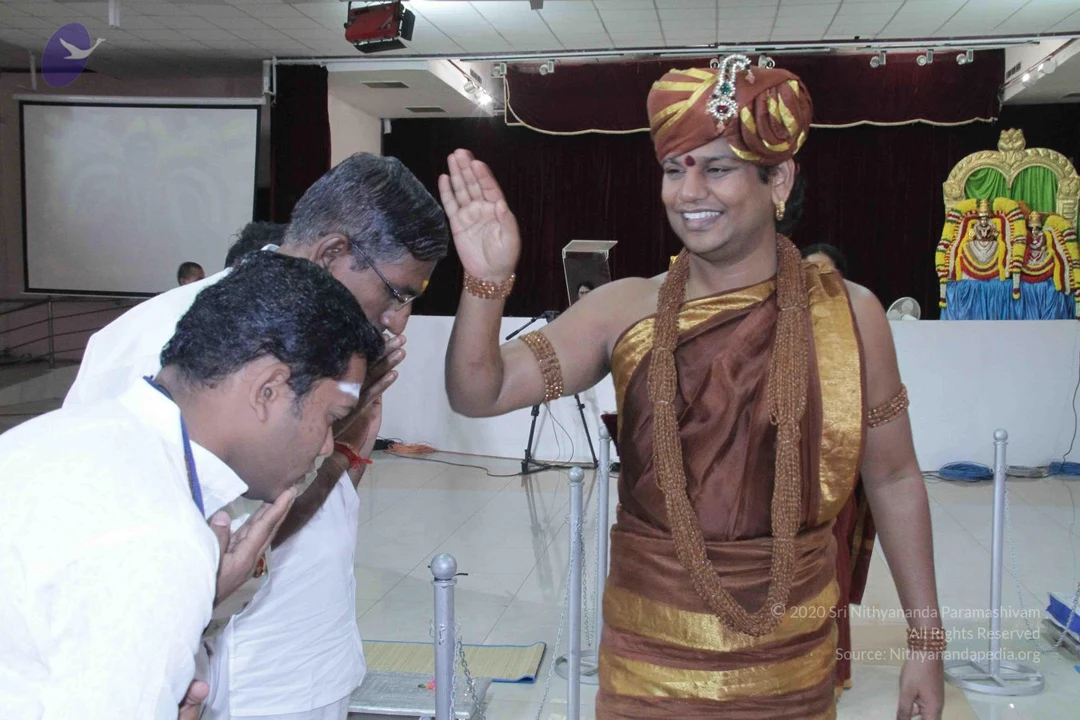
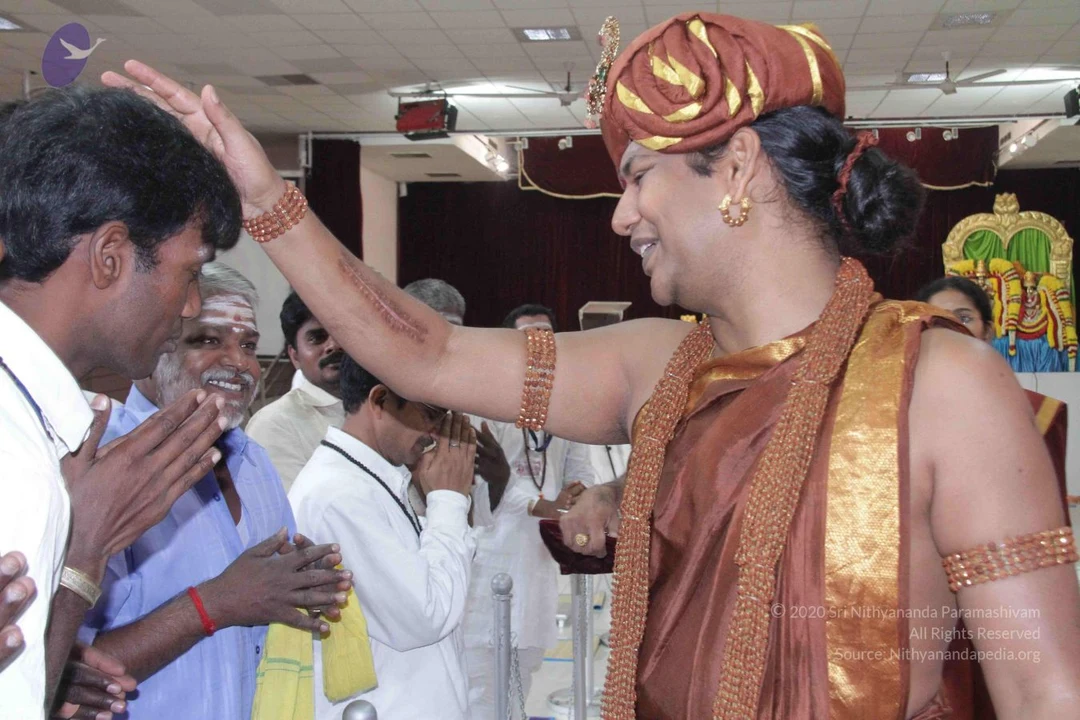
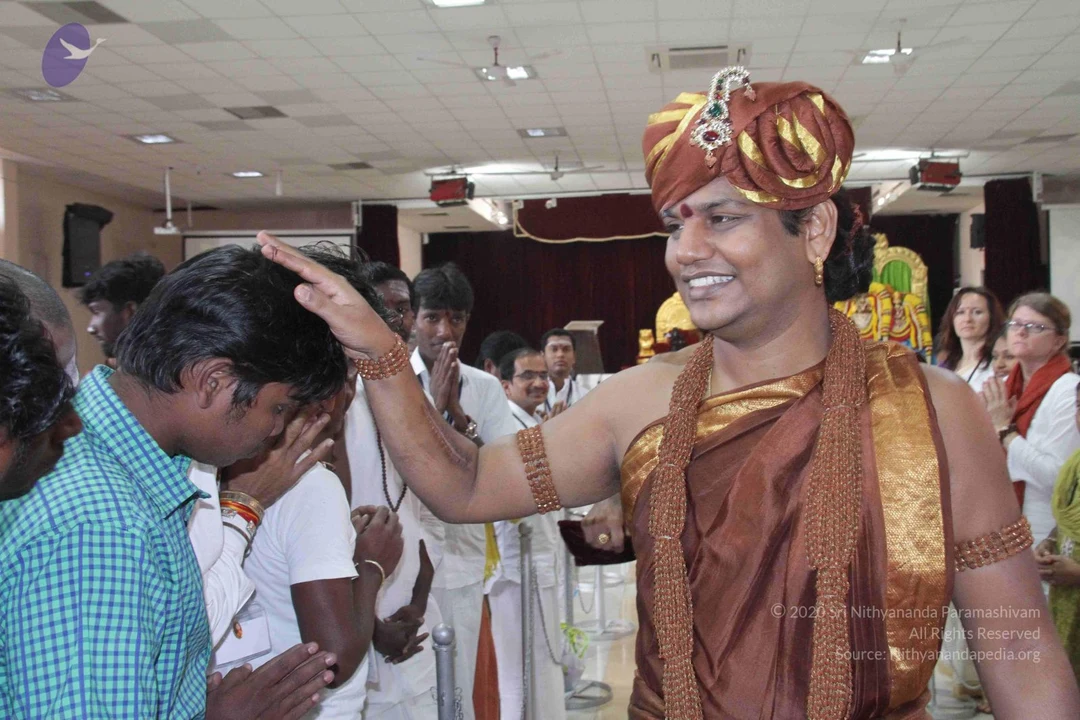
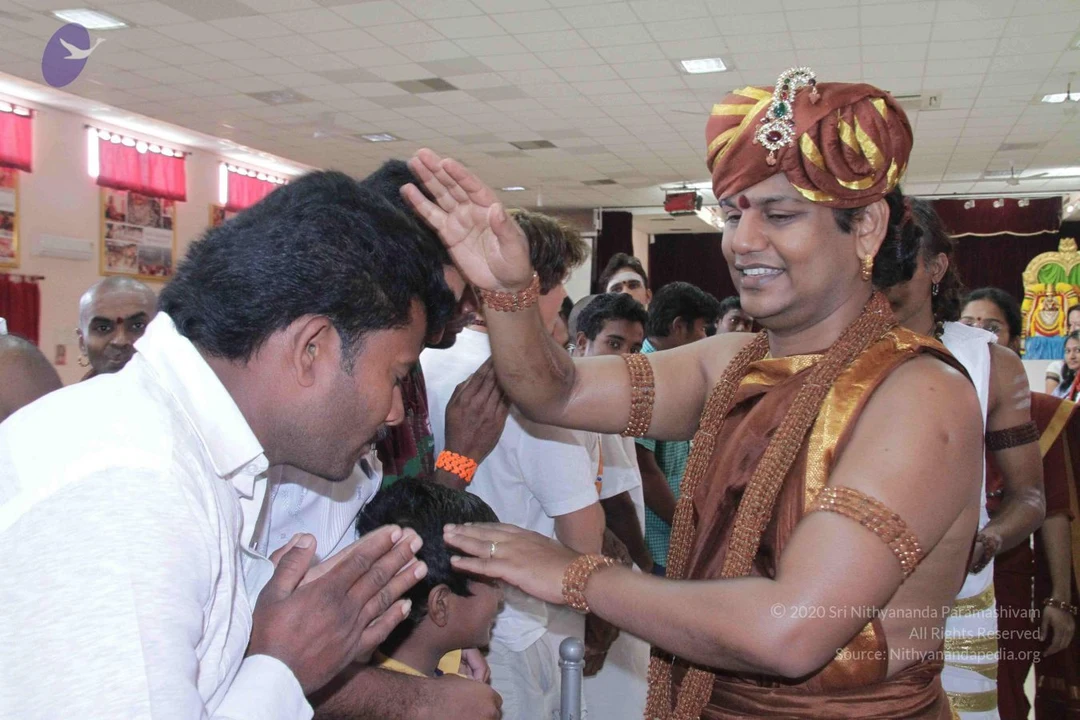
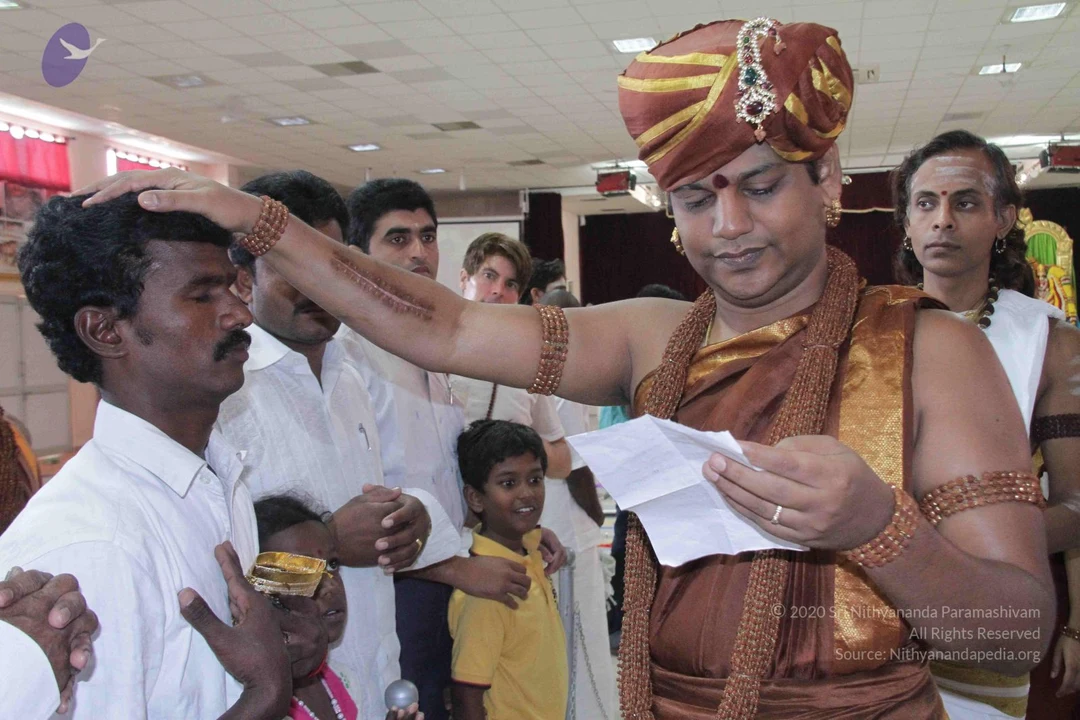
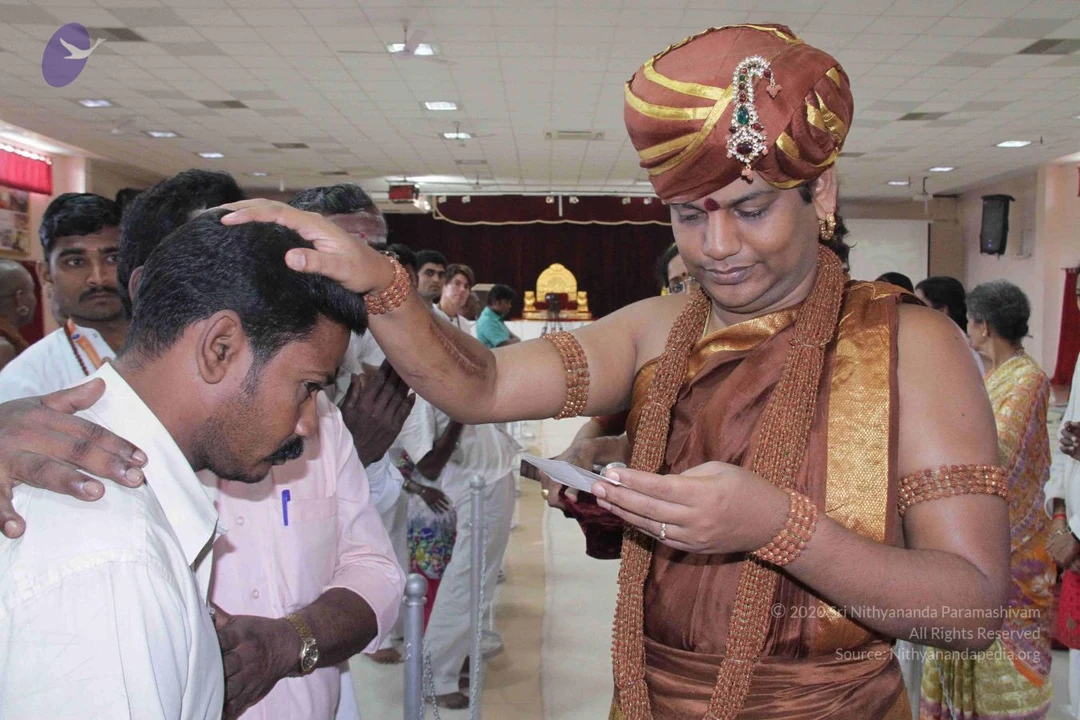
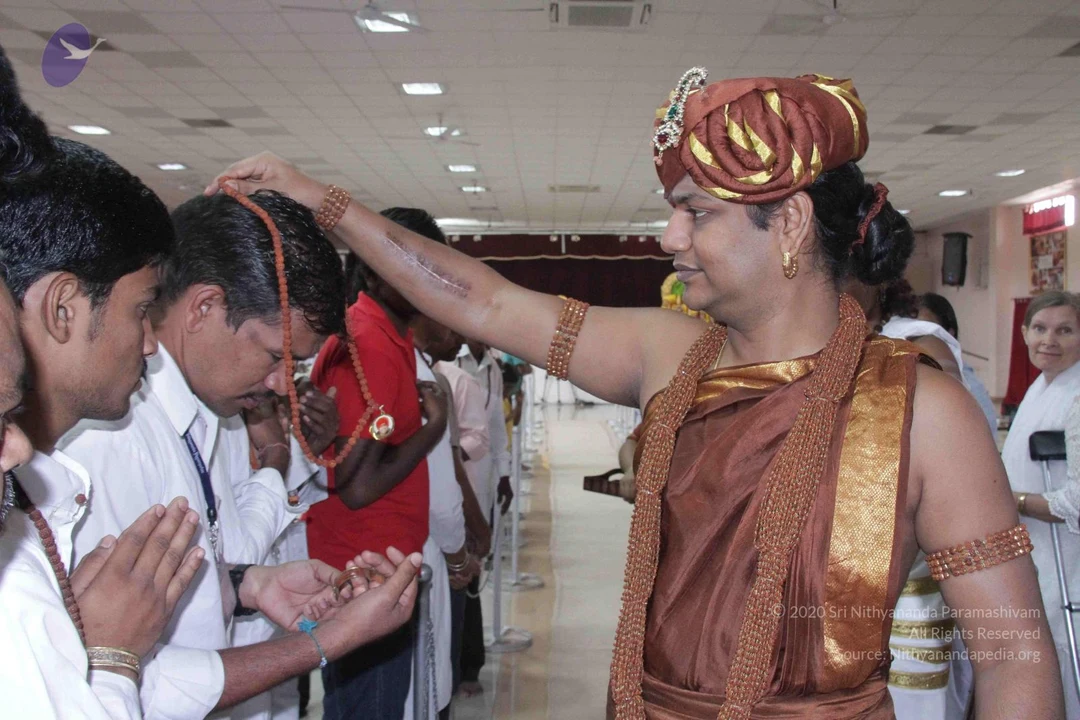
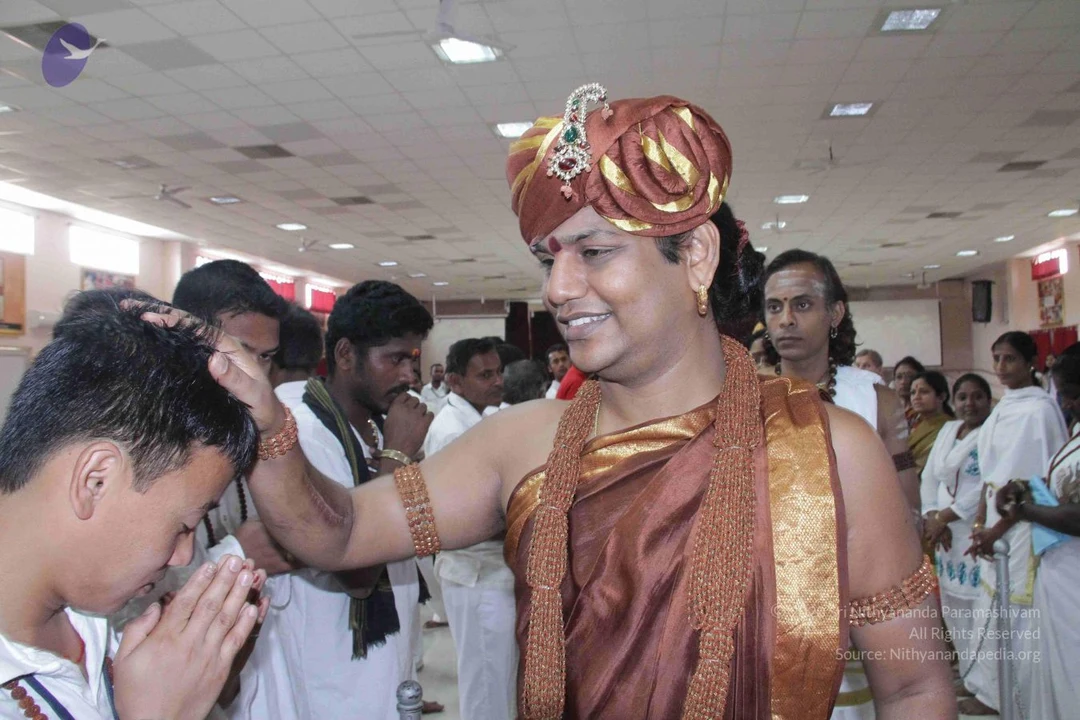
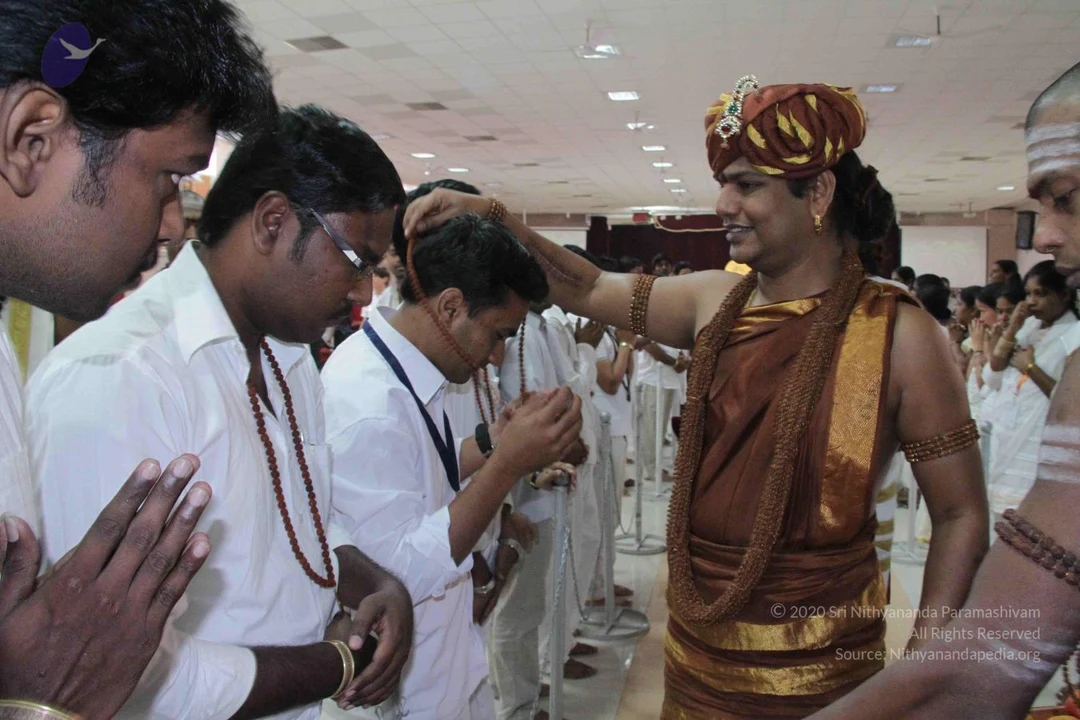
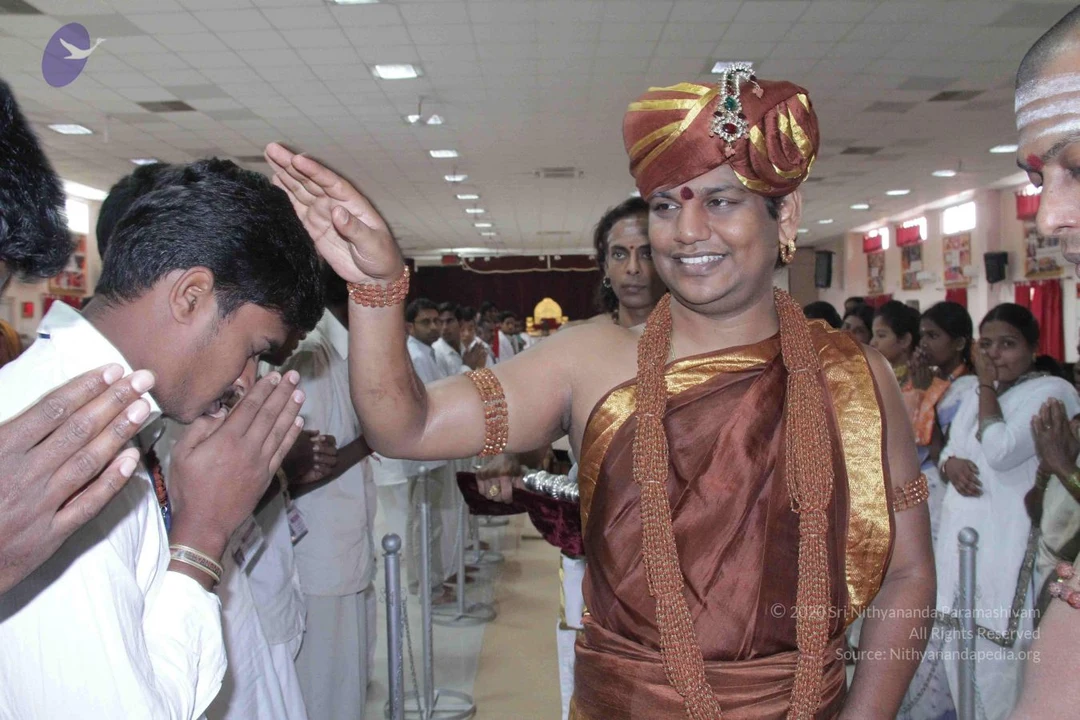
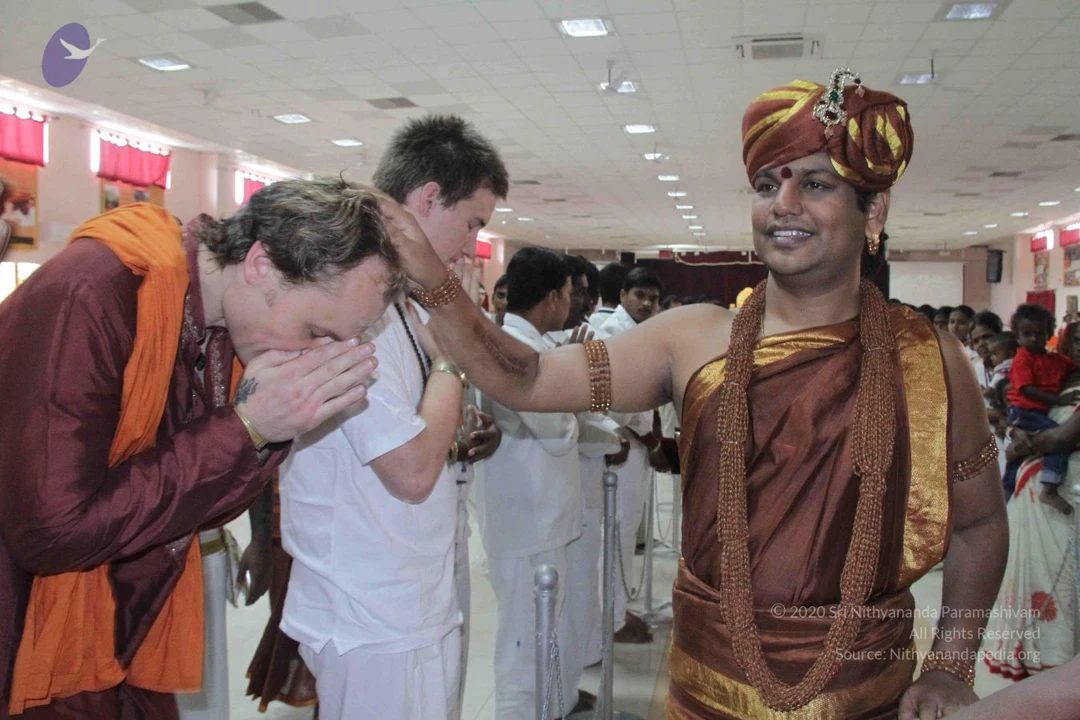
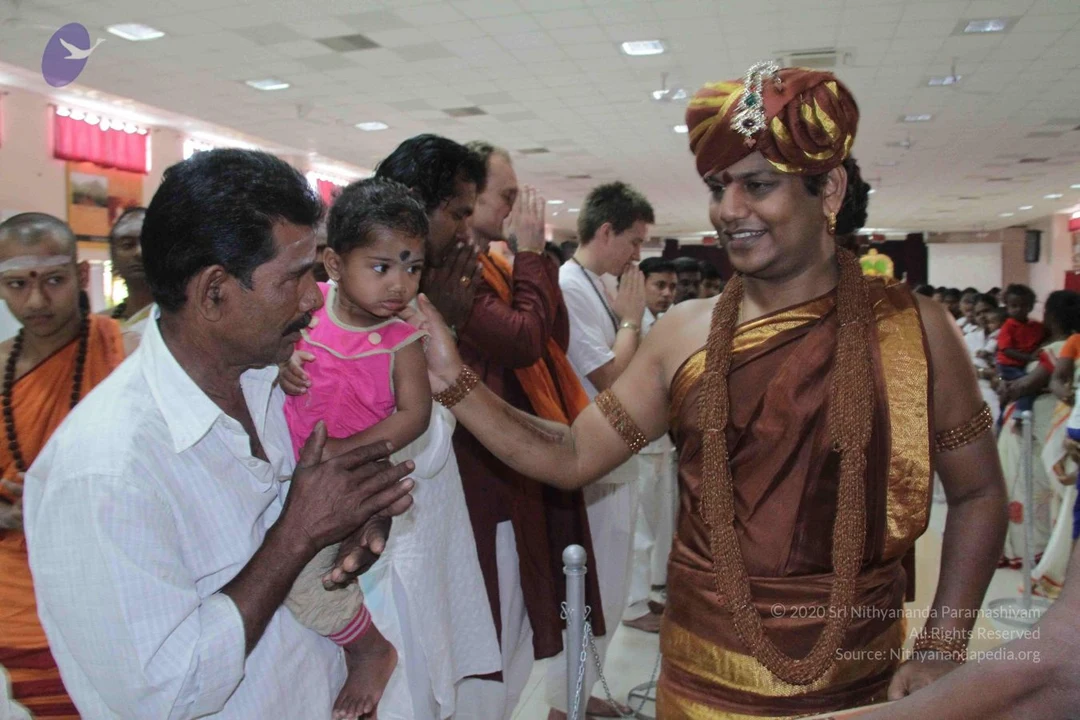
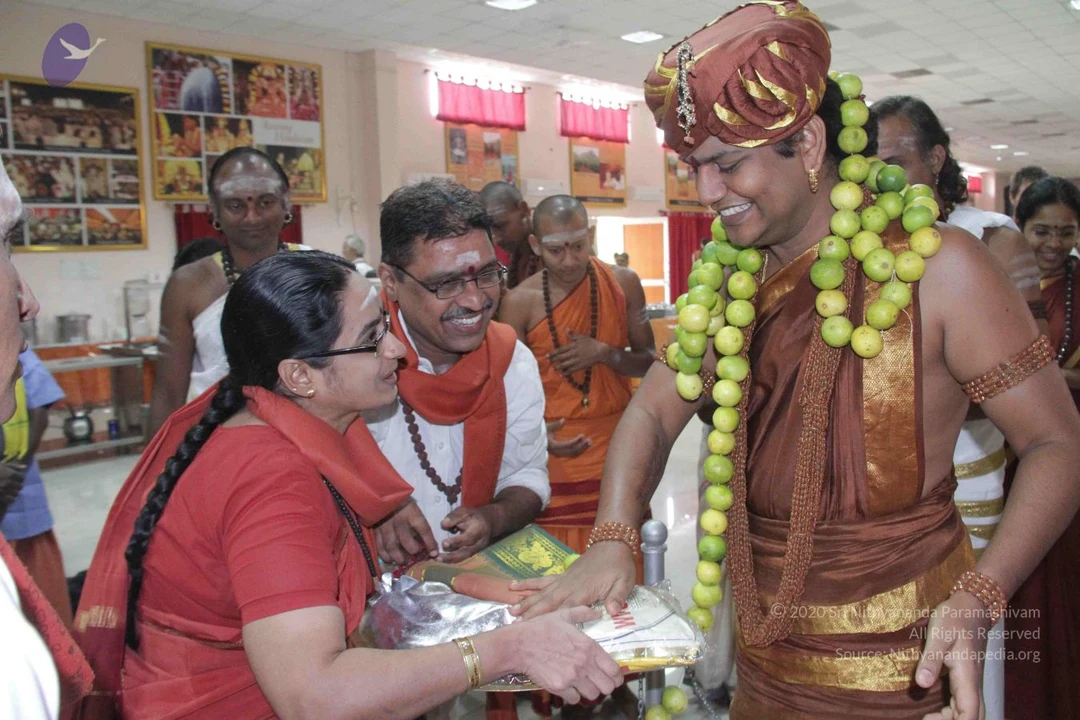
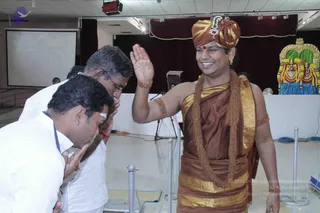
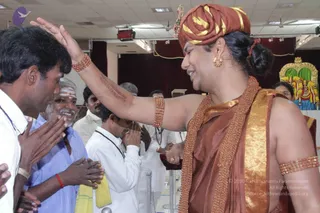
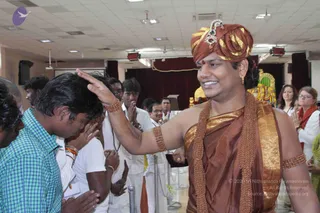
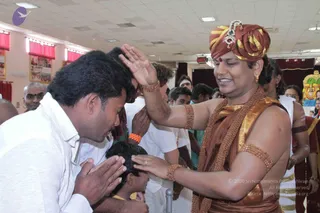
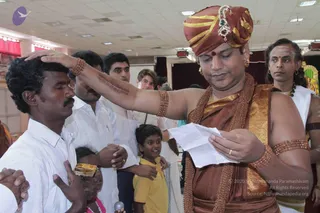
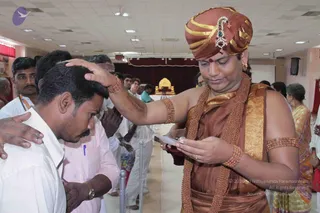
A photograph of an indoor hall with tiled floor, metal stanchions and chains. A man in a brown and gold-bordered dhoti-style wrap, a brown and gold turban with a jewelled ornament, a rudraksha mala and gold armbands raises one hand in blessing and smiles. Two men in white, one bending deeply with hands joined in respect and a white tilak on his forehead, are shown in the foreground. Behind them a golden throne-like decorated stage holds deity murtis in red and yellow garments, and a white projection screen stands at the left. a person is shown as the saffron-brown robed, turbaned figure with rudraksha mala, receiving respect from a devotee in white.A photograph of a devotee in a white shirt and blue-striped shirt with raised, folded hands in an indoor hall with a maroon curtain and ceiling lights. A figure in a rust-orange and gold turban, gold-bordered rust-orange wrap, multi-strand rudraksha-style beaded necklace and bead bracelets extends an arm to touch the devotee's head in blessing. The figure has long swept hair and a gold earring. Behind them, a man with a white forehead marking and a second devotee with hands folded stand near, and an ornate gold-and-green decorated altar with deity murti figures appears at the right. Appearance-based candidate: a person, shown as the blessing figure in the rust-orange and gold wrap with rudraksha beads and gold ornaments.A man in a rust-brown and gold turban with a jewelled ornament and a gold-embroidered brown shawl over bare shoulders extends his right hand in blessing over the bowed head of a devotee in a blue checked shirt. Many other men in white dhotis and shirts stand with palms pressed together in namaskar behind them, and a few women in white and red attend at the right. Gold-brown ornamental arm bands and a long beaded necklace adorn the central figure, who smiles as he blesses. Behind the group, a hall with ceiling lights and a golden deity murti or throne decoration stands at the back of a stage with maroon drapes. a person: the central figure wears a rust-brown turban and gold-embroidered shawl with ornate jewelled and beaded adornments, while ceremonial blessing with an extended hand over a devotee's head is shown.Indoor photo in a hall with red curtains and wall posters. A man in a rust-brown and gold turban with a jeweled ornament and a gold-and-brown shawl, wearing a heavy beaded necklace and gold armlets, places his hand on the head of a kneeling young boy in a yellow top. A devotee in a white shirt with palms pressed together bows nearby, while others in white stand behind. The turbaned man bears a shaved-looking, ornate ceremonial appearance consistent with a person, shown giving blessing to devotees.A man in a rust-brown turban with a jewelled ornament and a red bindi stands in a hall, dressed in a brown-gold shawl, a multi-strand rudraksha-style mala, and gold bangles. He rests his hand on the head of a seated man in a white shirt and holds a folded paper in his other hand. Behind them, a man in white shirt and a young boy in yellow shirt watch, a woman in a red blouse holds a baby, and a person with a white dhoti and tilak stands at right beside a golden shrine decoration. Ceiling lights and red drapes frame the room. This appears to be a blessing or initiation moment with a personal touch on the head.A photograph in an indoor hall with a tiled ceiling. A man in a rust-brown turban with a gold-and-jewelled ornament and a brown saffron-toned garment with a gold-threaded border and long beaded necklaces places his right hand on the head of a man in a white shirt who bows his head forward. The robed figure holds a small white card in his left hand and wears a red bindi, gold bangles and an armband. Behind them, a line of people in white and pastel clothing waits, and a gold throne-like seat with a red backdrop stands at the far end of the hall. a person cues: the turban, distinctive jewelled headpiece, beaded necklaces and saffron-toned robe are visible on the person giving the blessing.

Swamiji-Blessing

3 photosSource gallery
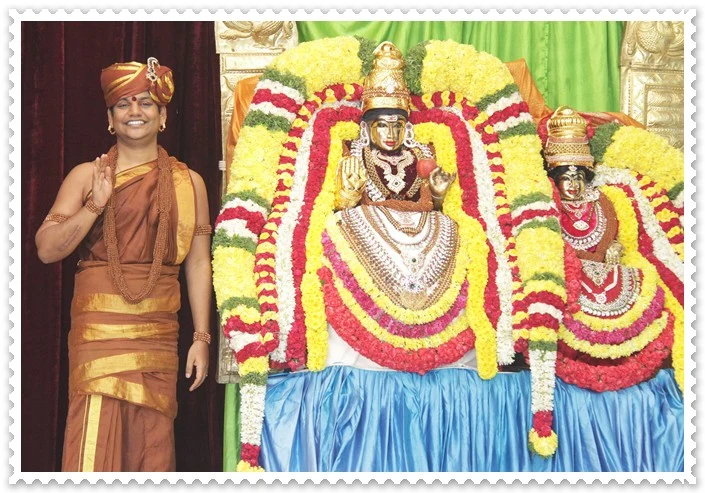
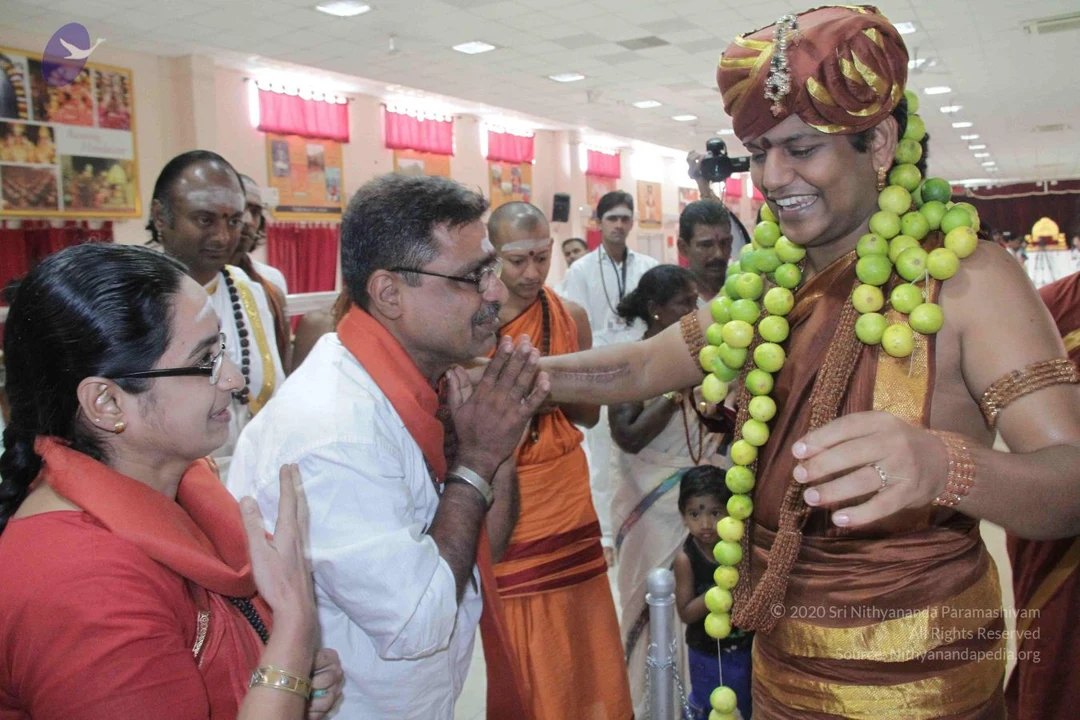
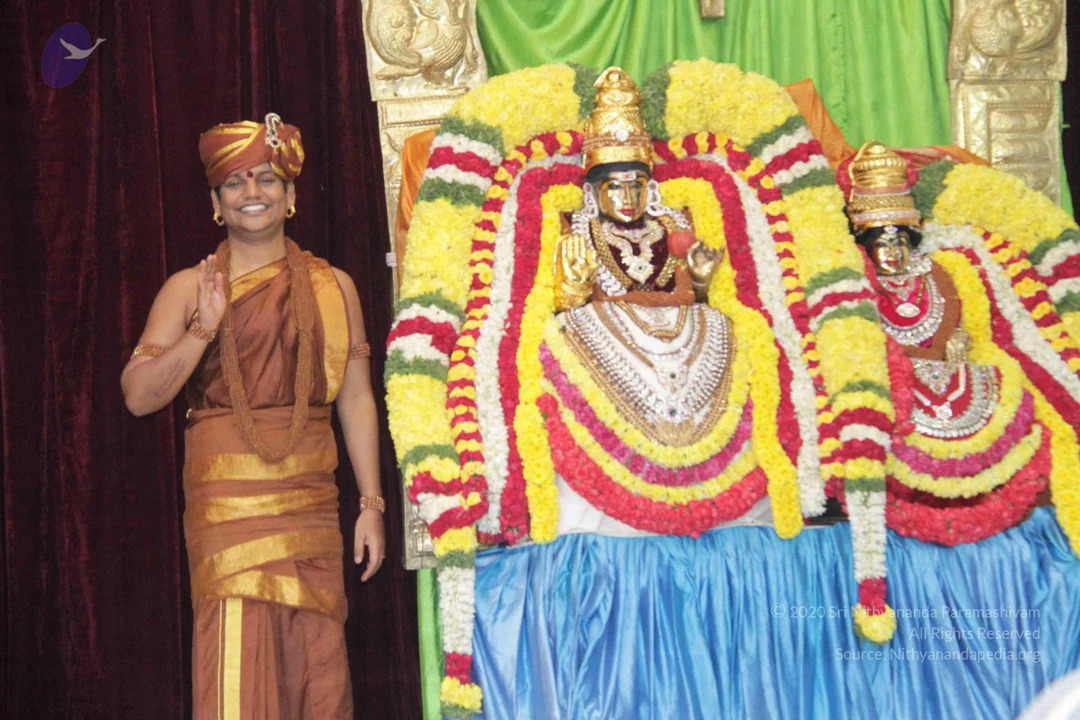
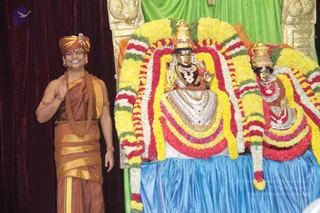
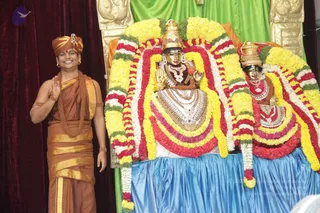
A photograph of a smiling man in orange-brown and gold ceremonial dress, wearing a matching orange-and-gold turban, a long rudraksha-style mala and gold bangles, standing at left with his palms raised in greeting against a dark maroon curtain. To the right, two large deity murti figures in gold crowns are decorated with layered yellow, red, white and green flower garlands and silver necklaces, seated on a blue draped platform in front of a green backdrop. The archive logo appears at upper left.A smiling man in a rust-brown and gold-bordered dhoti and matching shawl, with a brown and gold turban, a rudraksha mala, gold bangles and earrings, stands at left with his right hand raised in a blessing gesture. Beside him, two ornately decorated deity murti are dressed in gold and silver jewelled garments and crowns, framed by an arch of yellow, red and white flower garlands with green leaves, on a blue-draped altar before a green and maroon backdrop with gold carved panels. The man has distinctive rudraksha and turban cues, so this is an appearance-based a person candidate; the image is a photograph and shows one physical person.A photograph of a standing man in saffron and orange ceremonial dress waves his right hand beside two decorated deity murtis. He wears an orange turban with a gold ornament, a rudraksha mala, gold armbands and a bronze-brown dhoti with gold borders. Beside him, a larger deity murti in gold crown and silver ornaments is garlanded with yellow, red, green and white flowers, and a smaller murti in red and gold is similarly adorned. Both stand on a blue silk cloth before a green and maroon backdrop. Swamiji (probable): the man wears saffron/orange clothing, a turban and rudraksha mala, matching the page's note that he is present.

InnerAwakeningSession

7 photosSource gallery
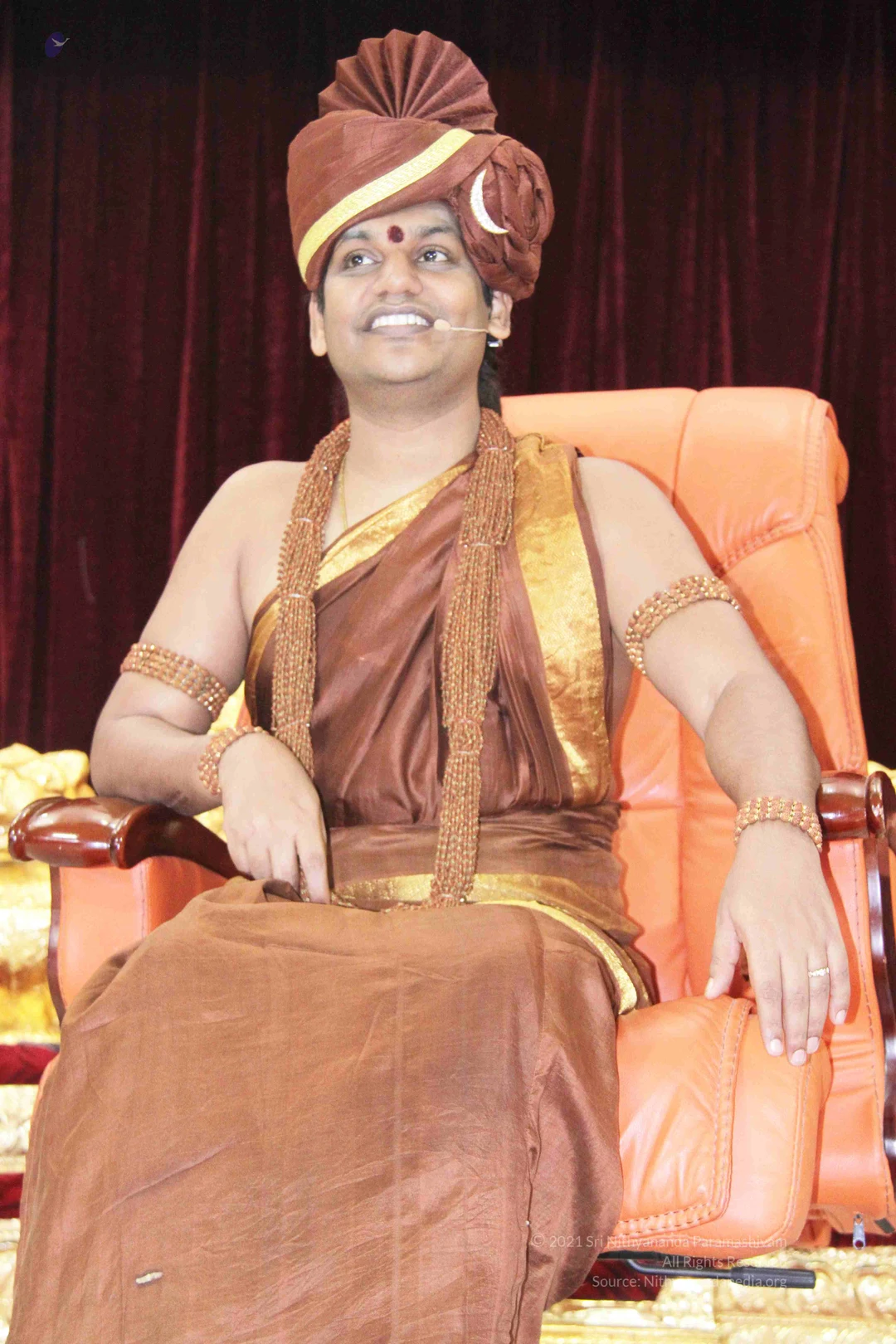
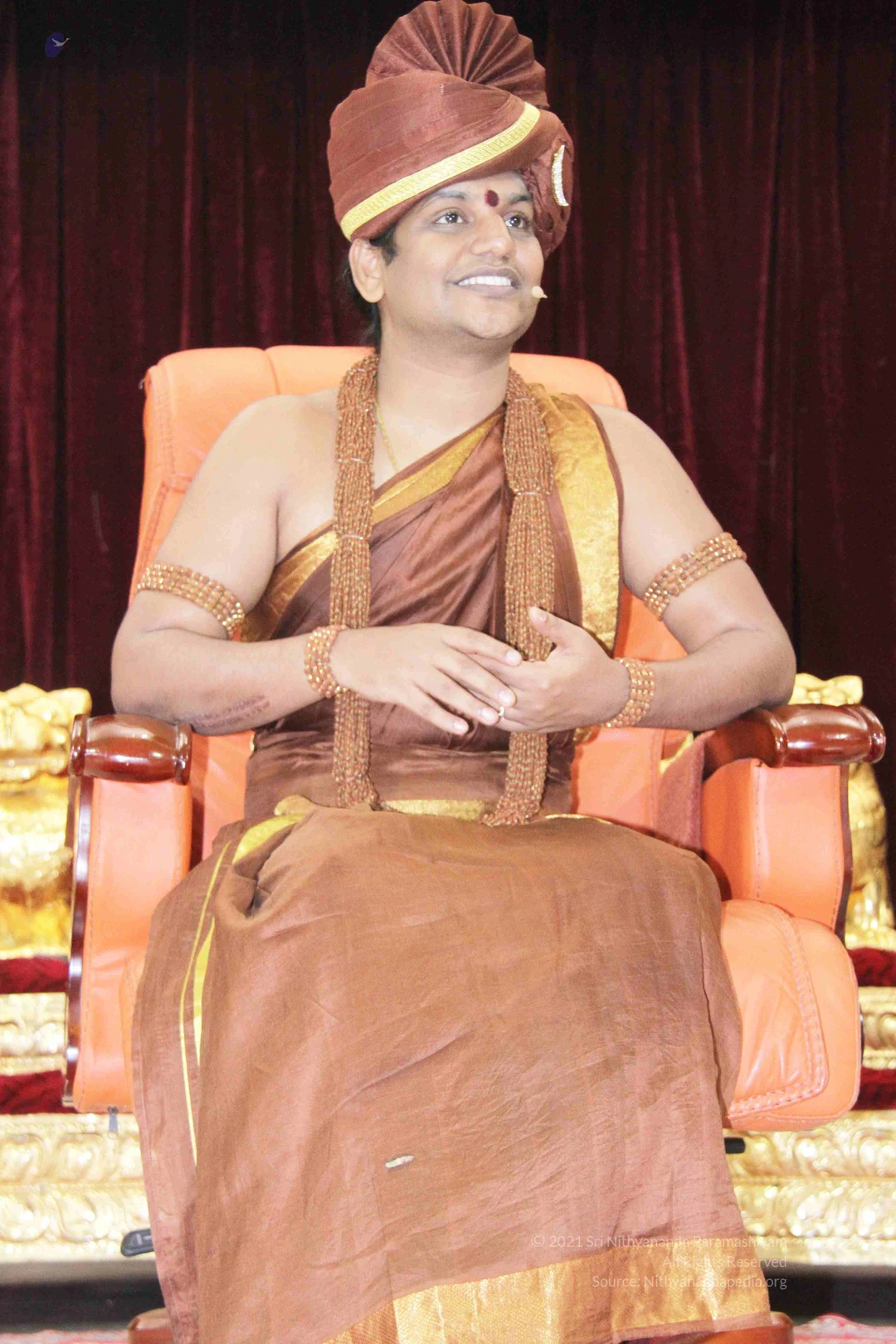
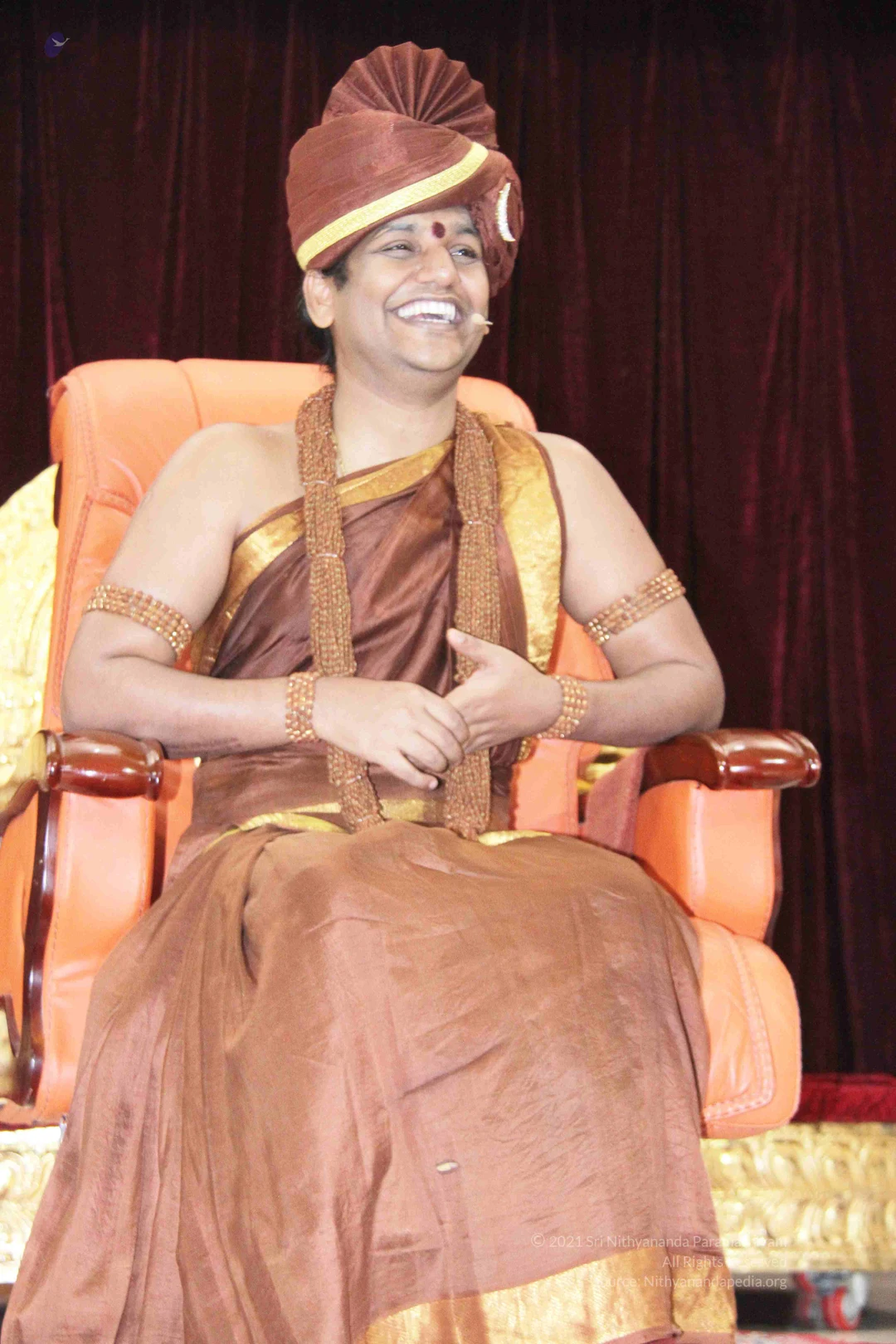
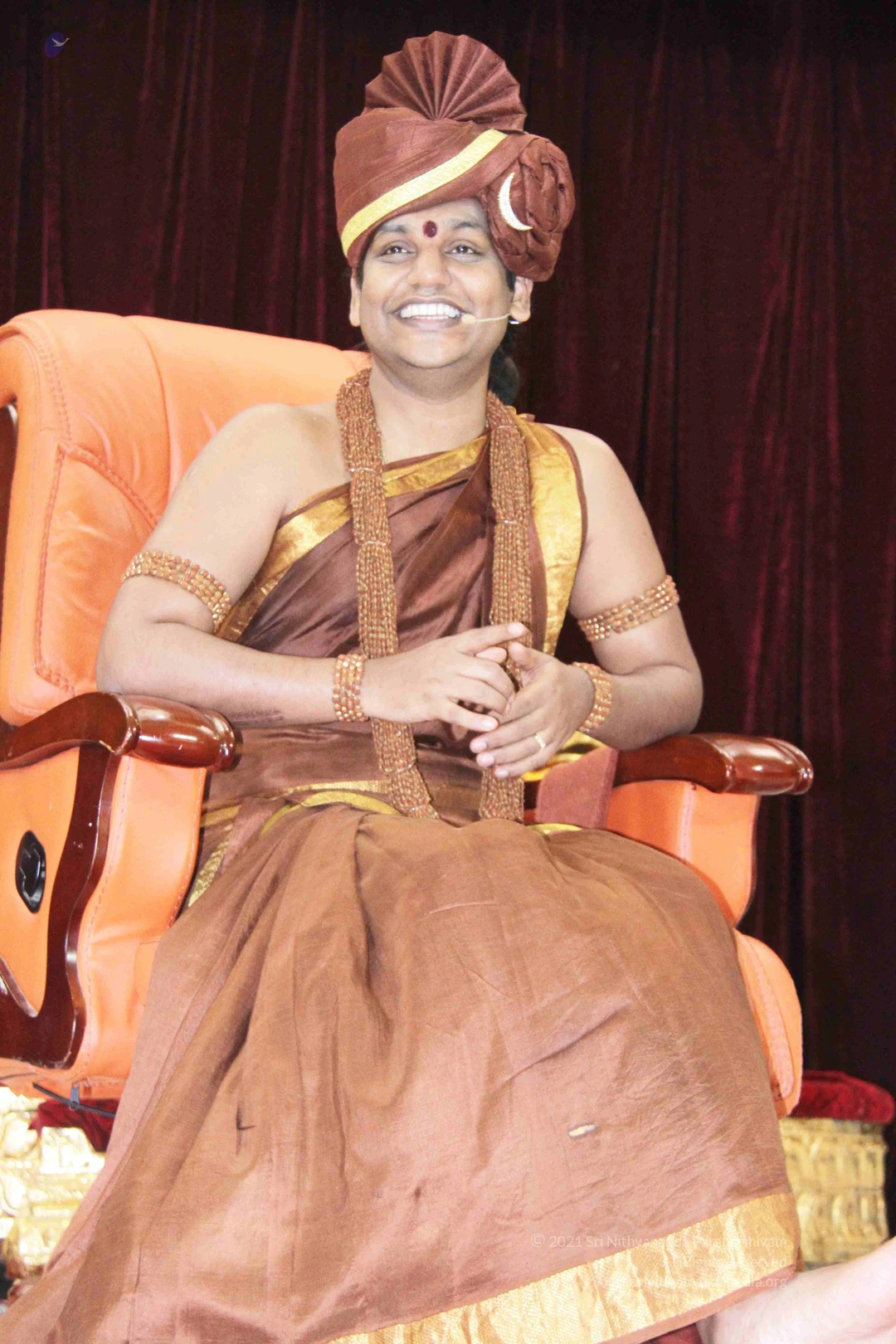
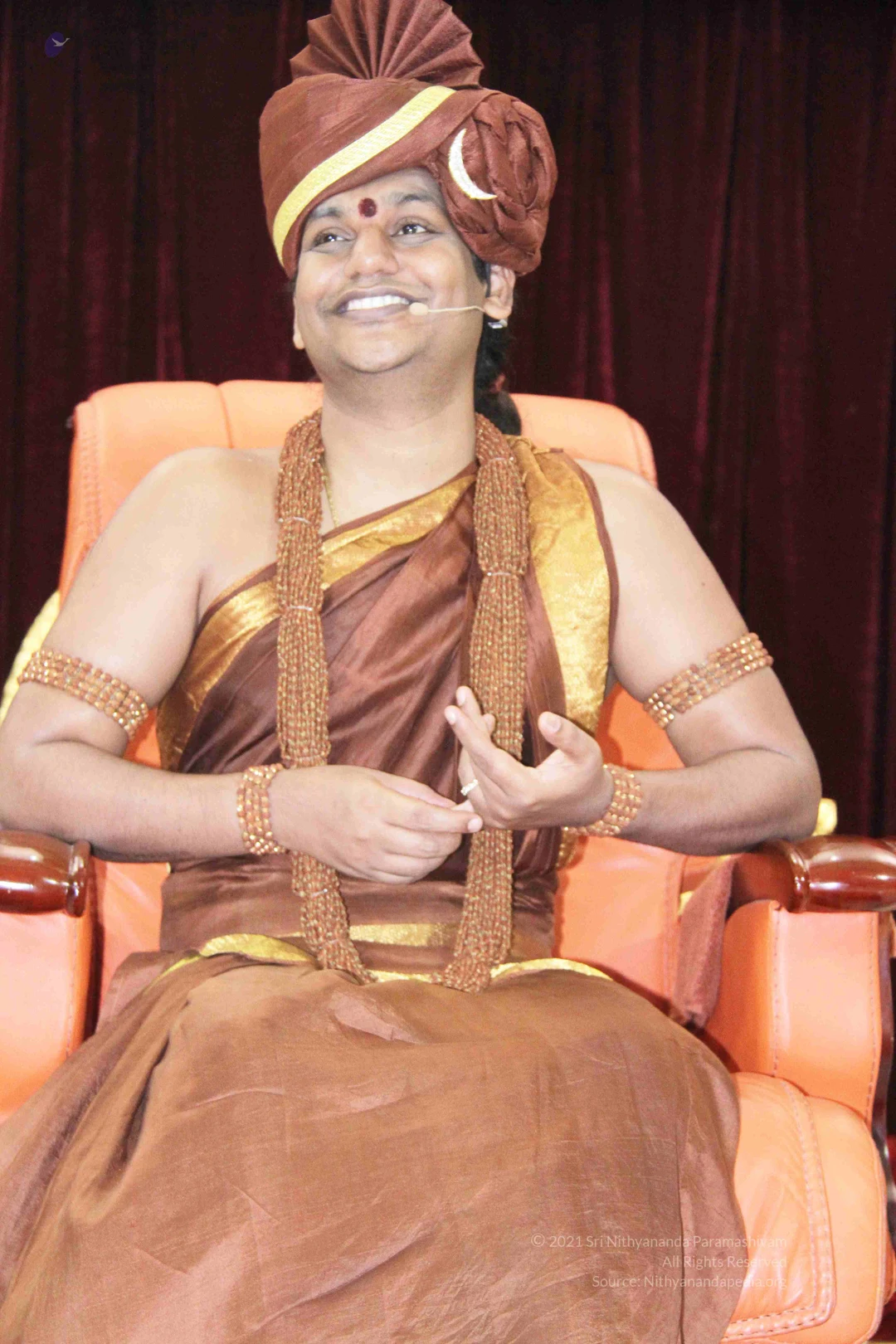
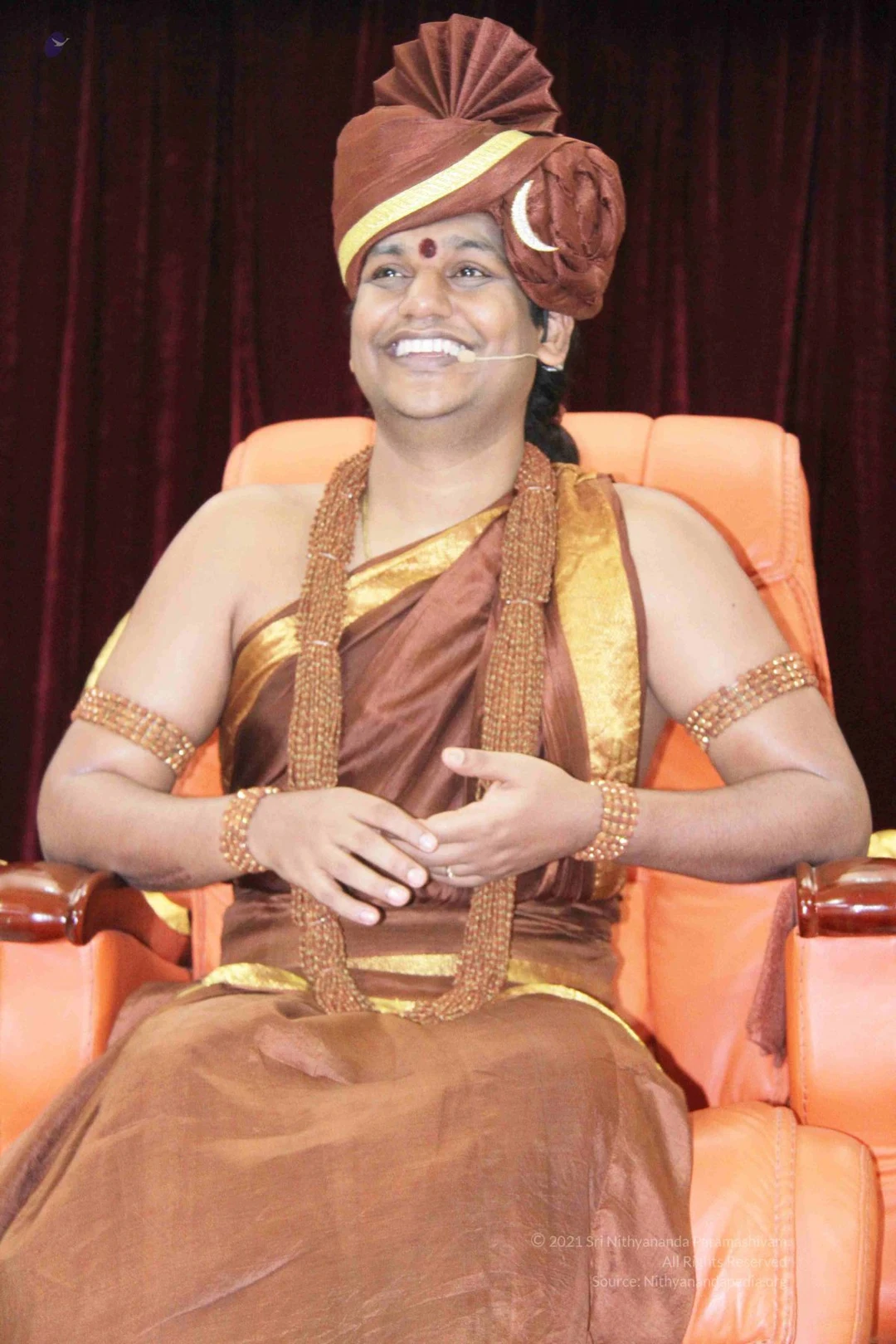
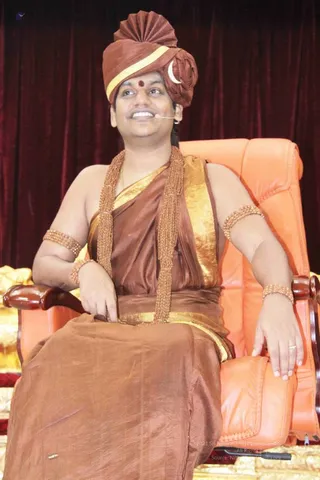
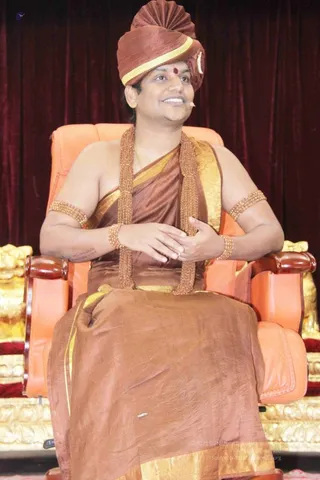
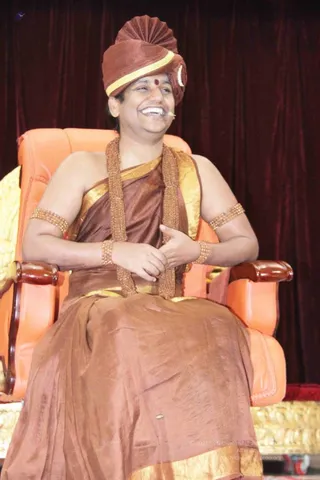
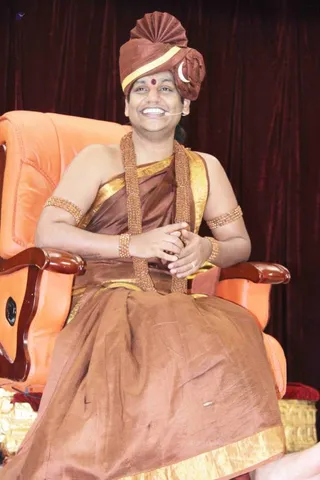
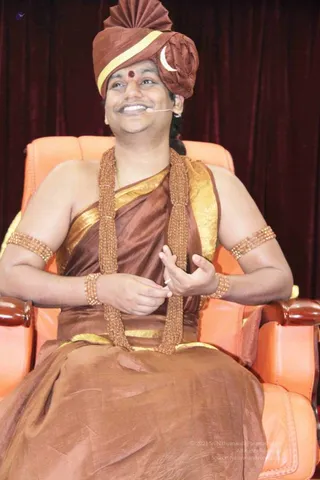
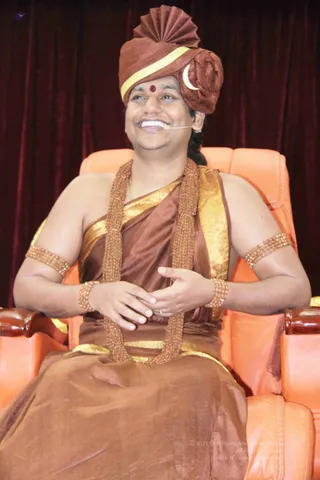
A seated man in a brown turban with a gold border and a small crescent ornament, wearing a brown draped garment with gold trim, a long rudraksha-style bead mala across the chest, bead armlets and bracelets, and a small red bindi. He sits on an orange leather throne-style chair before a deep red curtain, with a headset microphone clipped near his ear and gold fabric visible at the lower edge. a person: the long rudraksha malas, bead armlets and ornate brown-and-gold attire match the stated presence, so he is labelled as an appearance-based candidate seated on a throne.A seated man in a brown-and-gold turban with a fan-shaped pleat and red bindi sits on an orange leather throne with carved gold panels, against a deep red velvet curtain. He wears a brown silk garment edged with gold, a long tiered beaded rudraksha-style mala, beaded arm bands and wrist bracelets, and a lapel microphone. His hands rest folded at his waist as he smiles and looks to the side. The scene resembles a satsang seating, with one person visible.A smiling man sits on an orange leather armchair with gold-carved wooden armrests in front of dark red velvet drapes. He wears a brown turban with a gold border and a crescent emblem, a red bindi, a brown and gold silk garment, and layered beaded rudraksha-style necklaces and bracelets. A small microphone is clipped near his face. a person, seated as a speaker, with his hands loosely clasped. No other people are visible.A smiling man seated in an orange leather armchair before a dark red velvet curtain, wearing a brown turban with a gold stripe and a small crescent emblem, a red bindi, a brown and gold-bordered garment draped over one shoulder, a long rudraksha-style bead necklace, bead armbands and bracelets, and a small microphone clipped near his face. His hands rest clasped in his lap. Probable Swamiji by visible cues: swept-back turban, ornate ceremonial beadwork and saffron-brown ceremonial clothing, seated in the chair as speaker during a satsang. Gold-patterned decorative items appear at the lower edge of the frame.A smiling man seated in an orange leather armchair before a deep red velvet curtain, wearing a brown silk turban with a gold border and a small crescent emblem, a red bindi, a brown silk garment edged in gold, long brown beaded rudraksha-style malas across the chest, and matching beaded armlets and bracelets. He wears a small headset microphone and gestures with his hands while speaking. a person: the long swept-back hair, brown and gold ceremonial dress and beaded malas match the page's claim, but the appearance cues are not conclusive enough to confirm identity.A smiling person seated in an orange leather armchair before a dark red velvet curtain, wearing a brown turban with a gold band and a crescent ornament, a brown and gold silk drape over the shoulders, a long rudraksha mala necklace, beaded armbands and wrist bands, and a small red bindi. A headset microphone is at the cheek, and the hands rest together in the lap. Swamiji (probable): the cues are the swept-back hair, turban, saffron-toned clothing and rudraksha mala, with the person's role as a seated speaker at a satsang-style event.
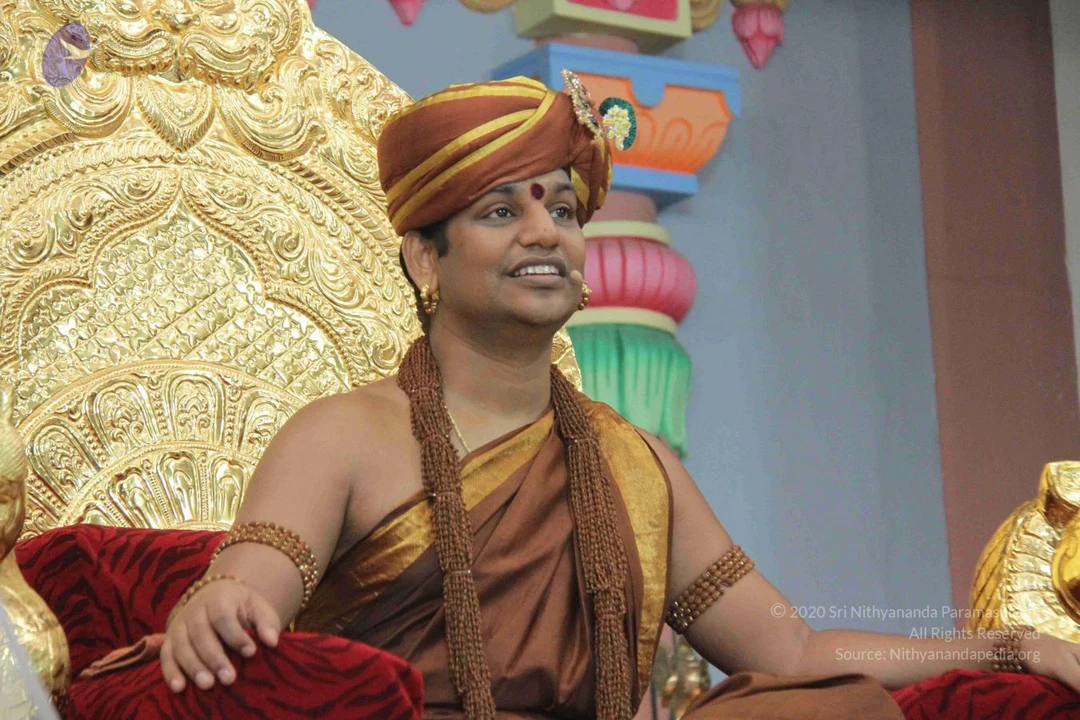
SubramanyaHomaByGurukul
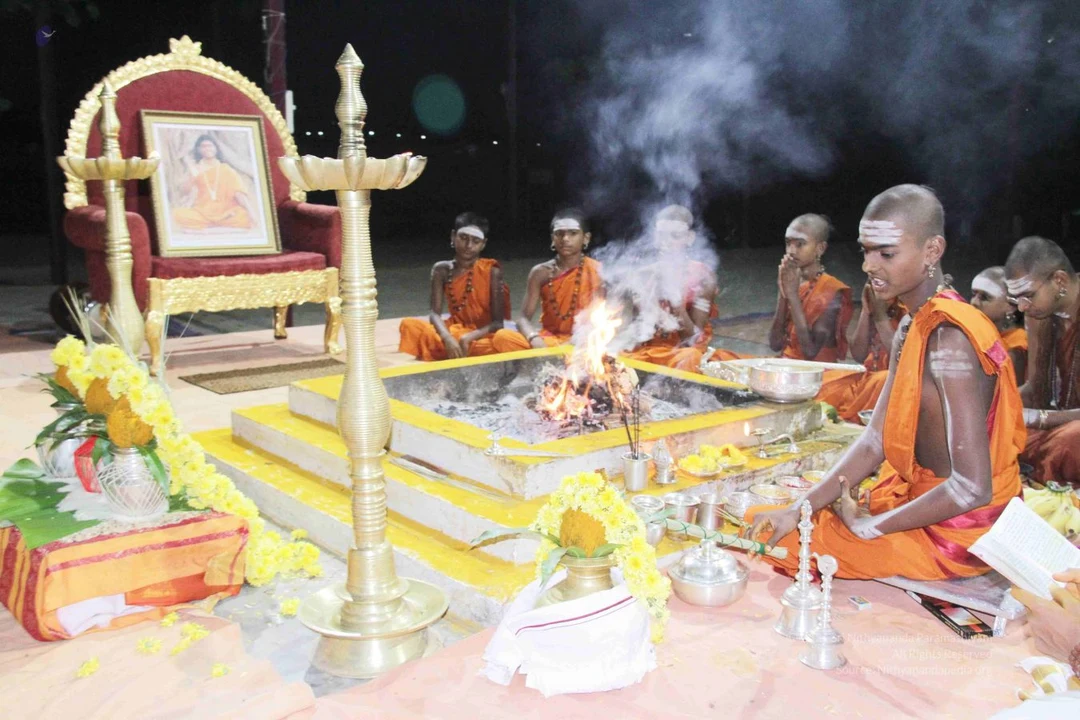
32 photosSource gallery
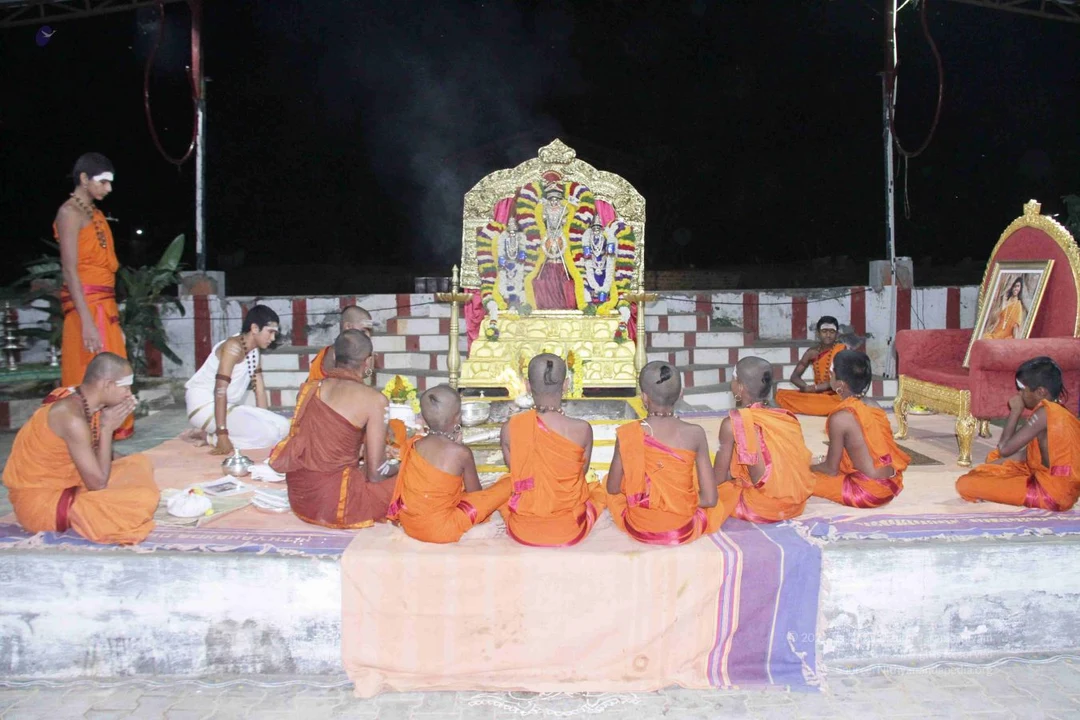
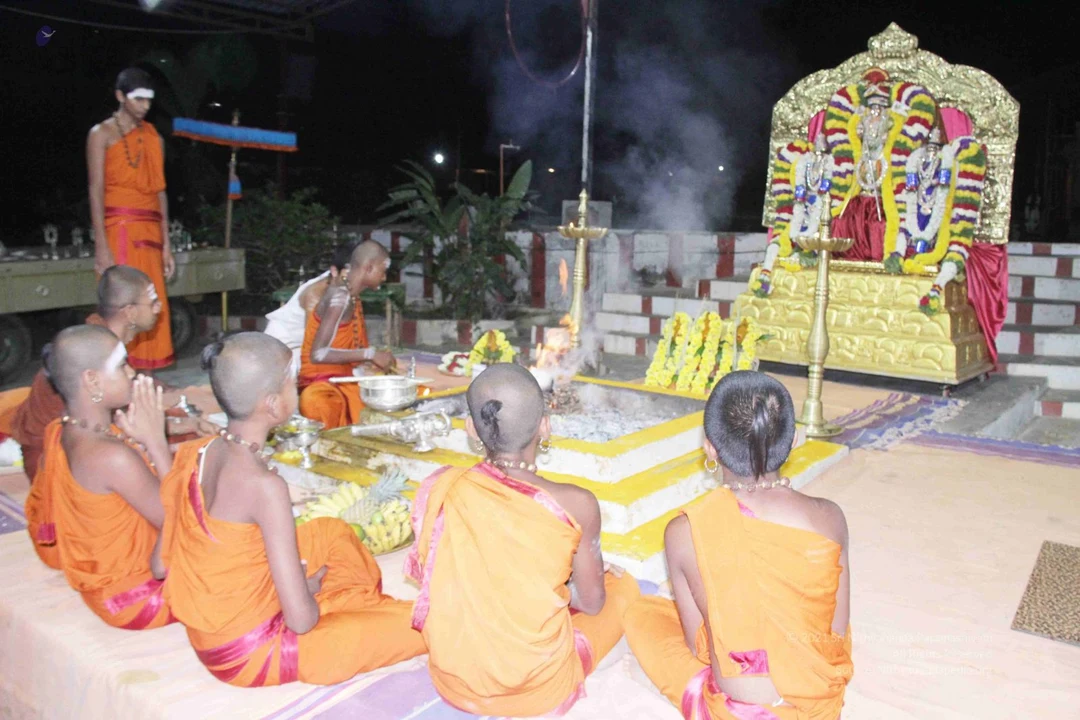
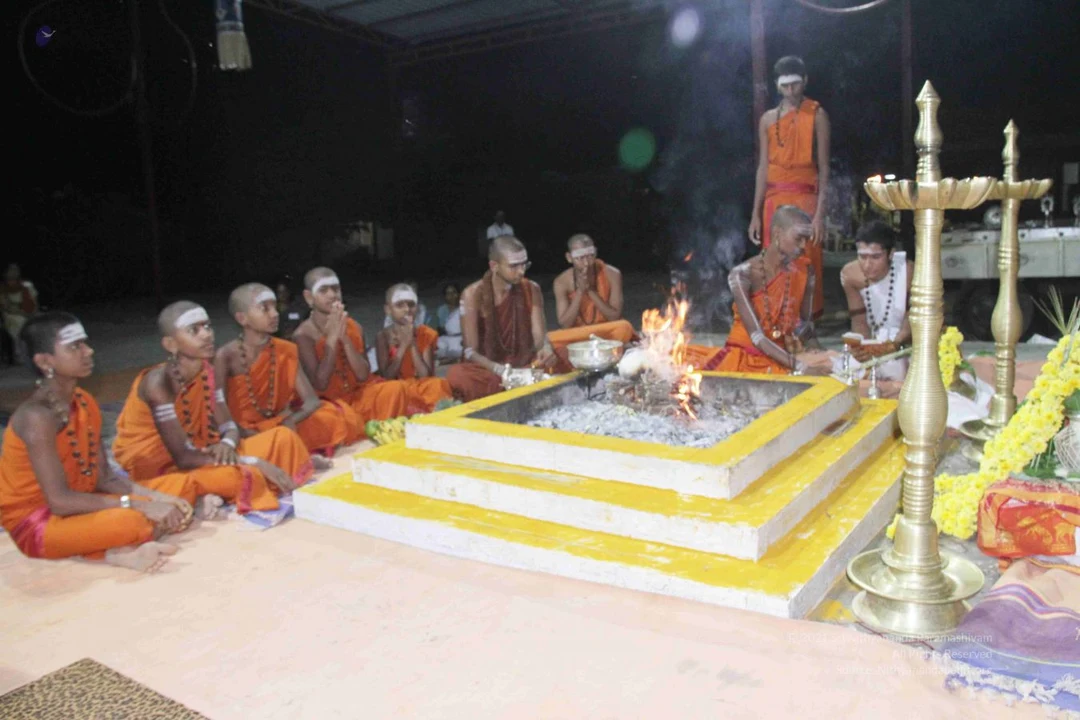
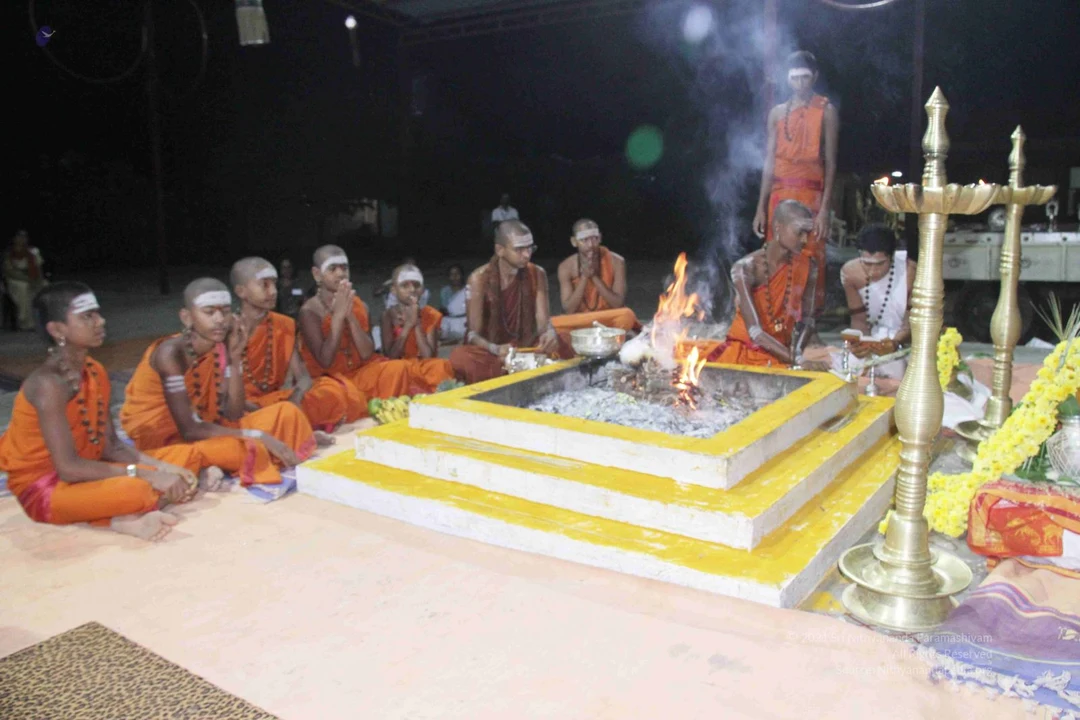
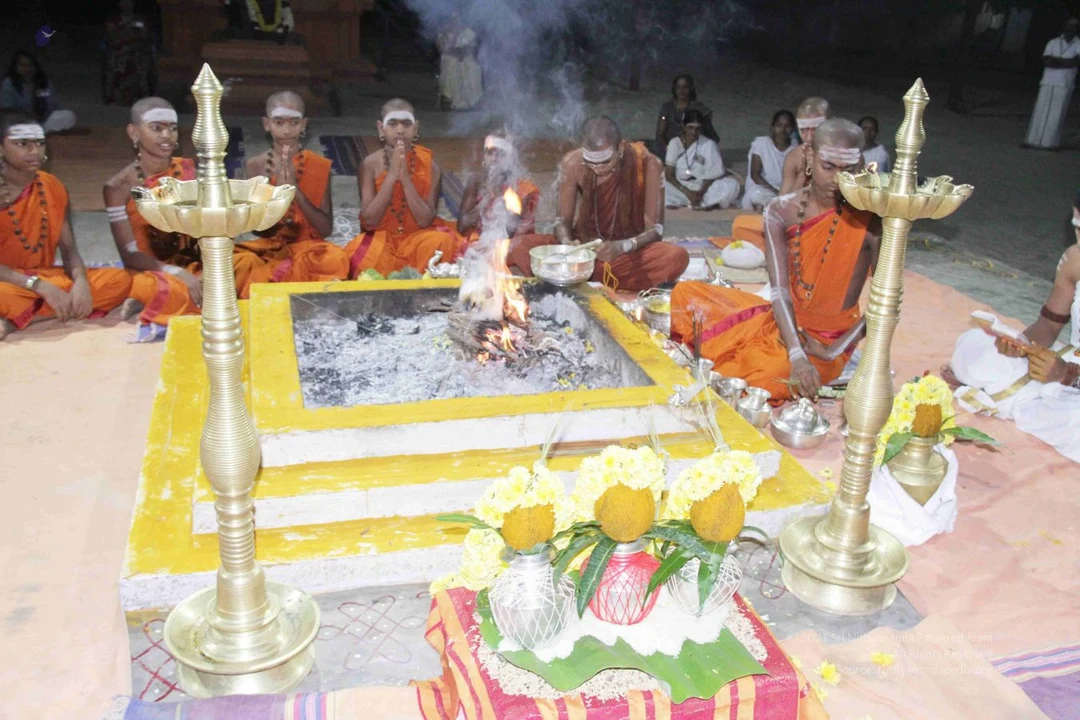
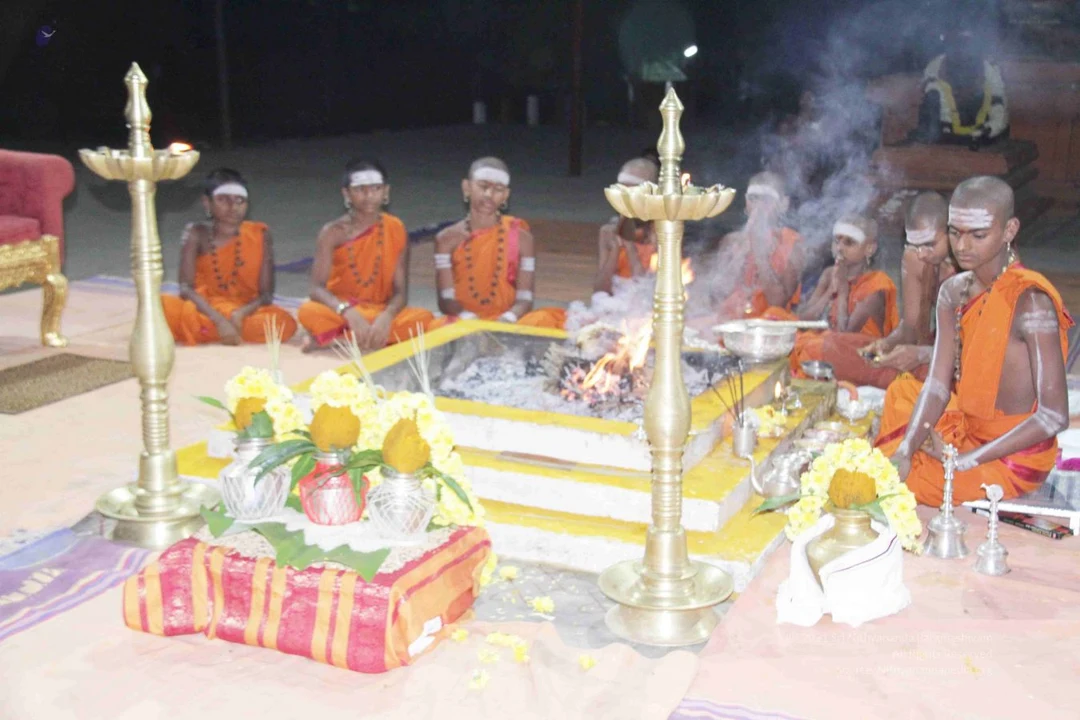
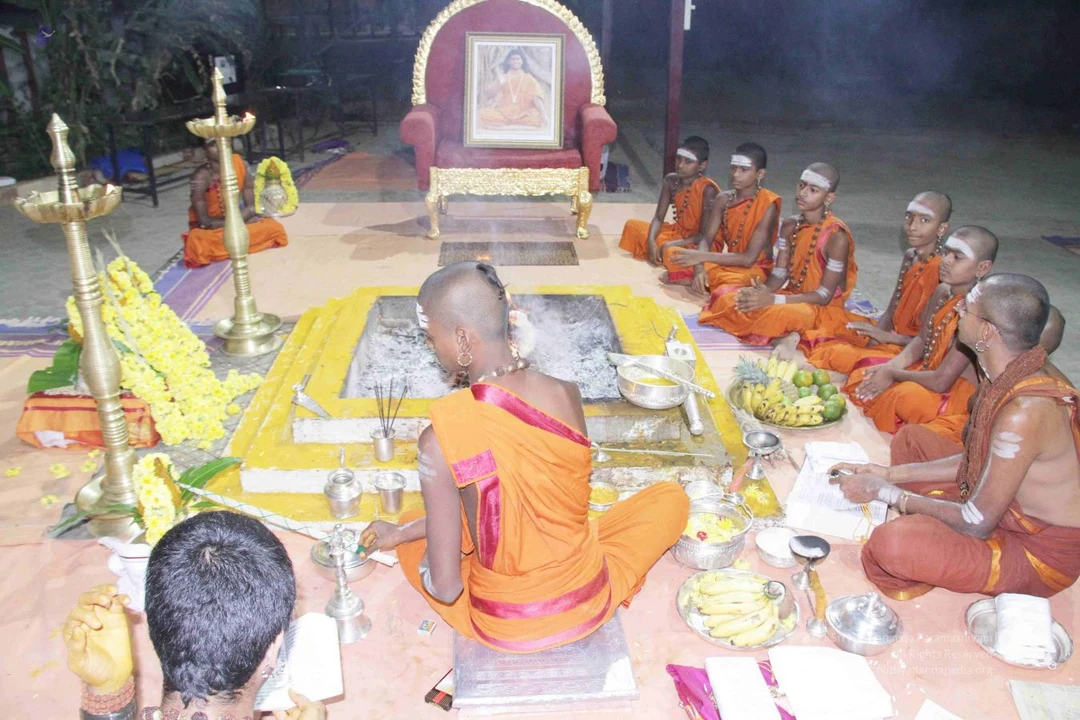
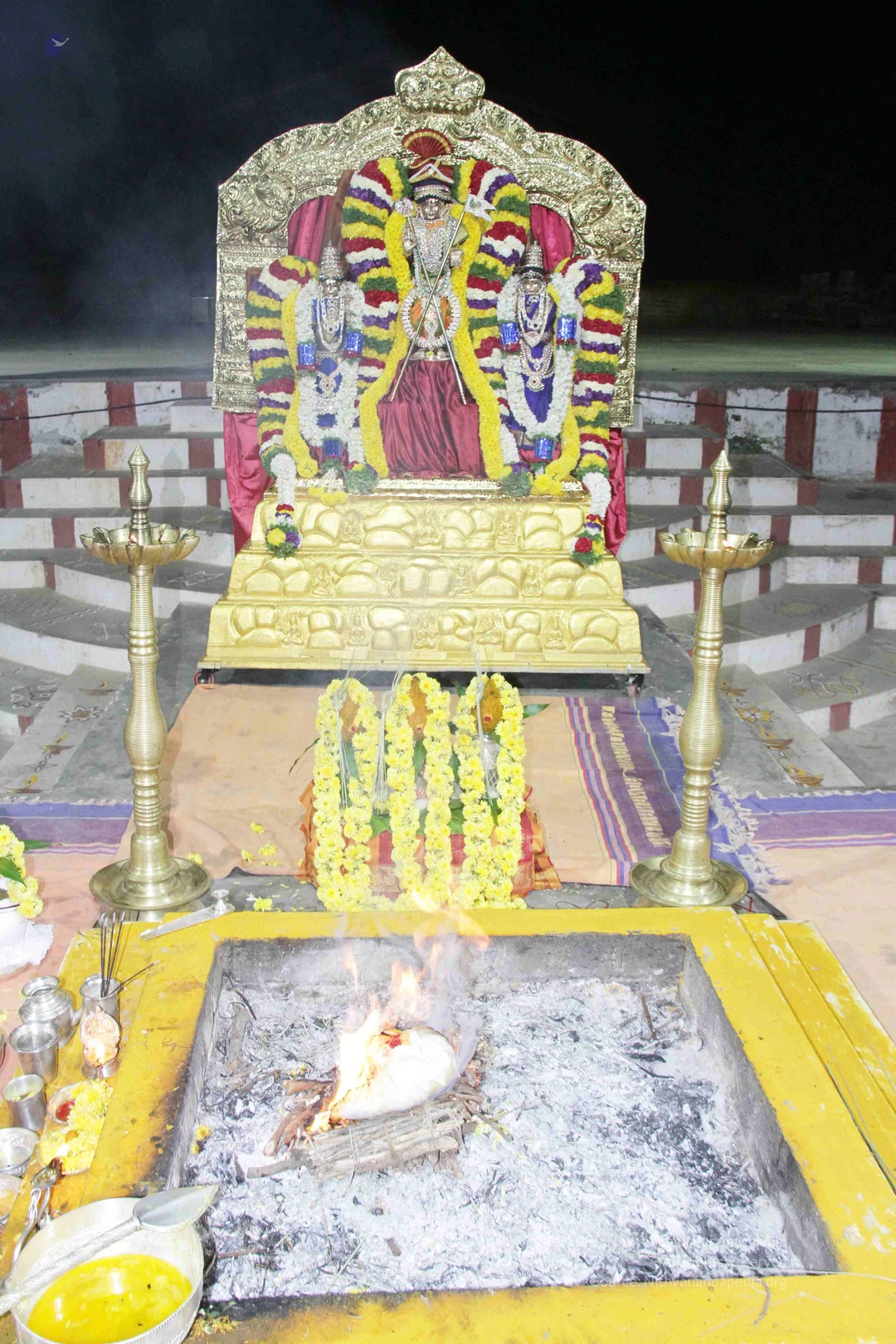
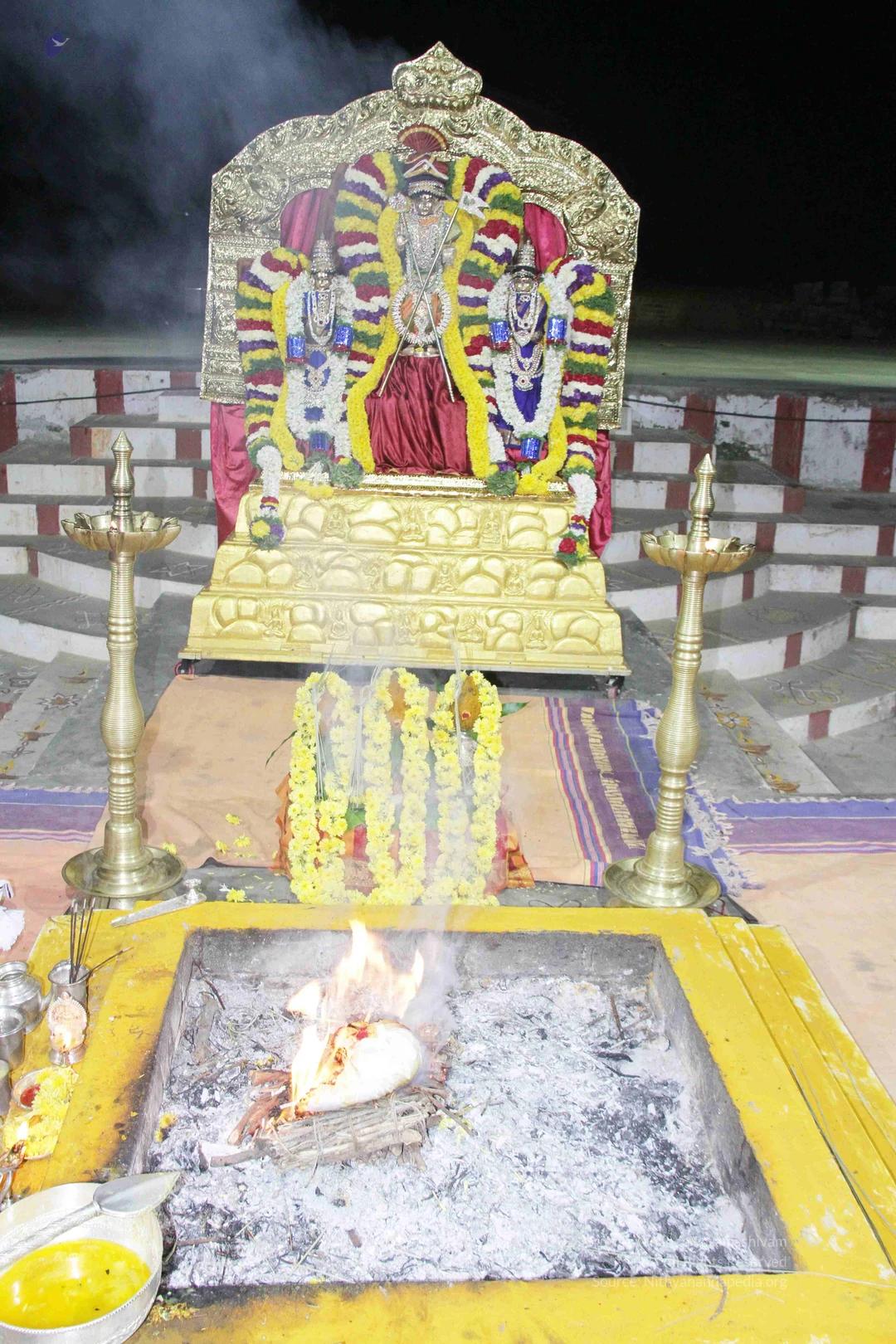
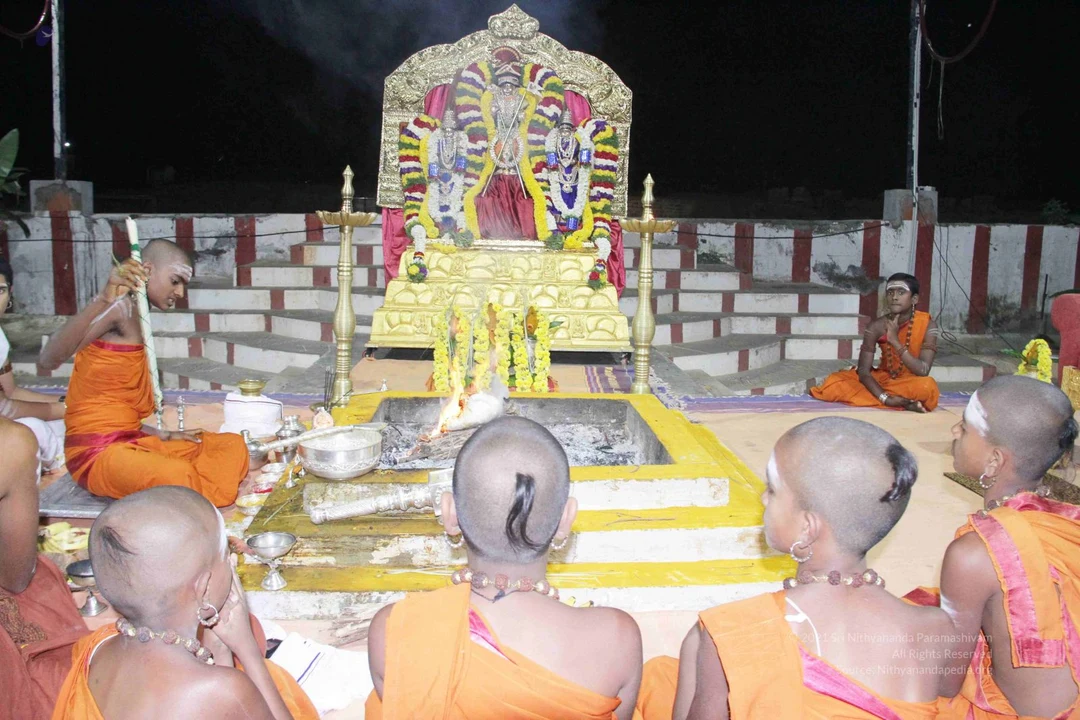
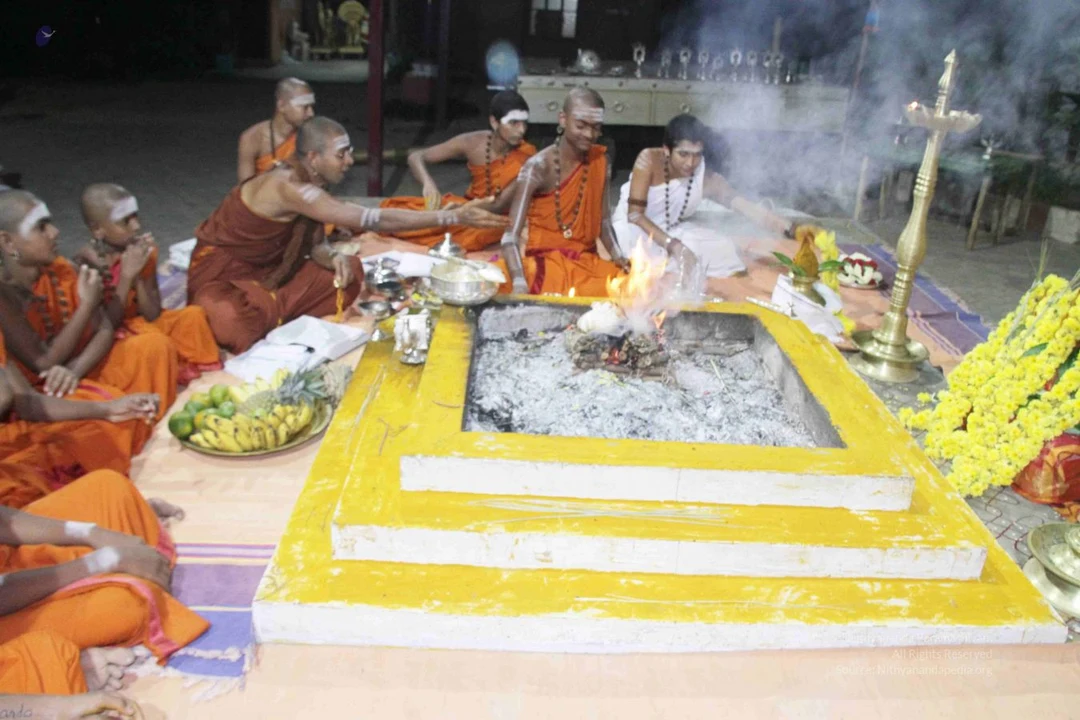
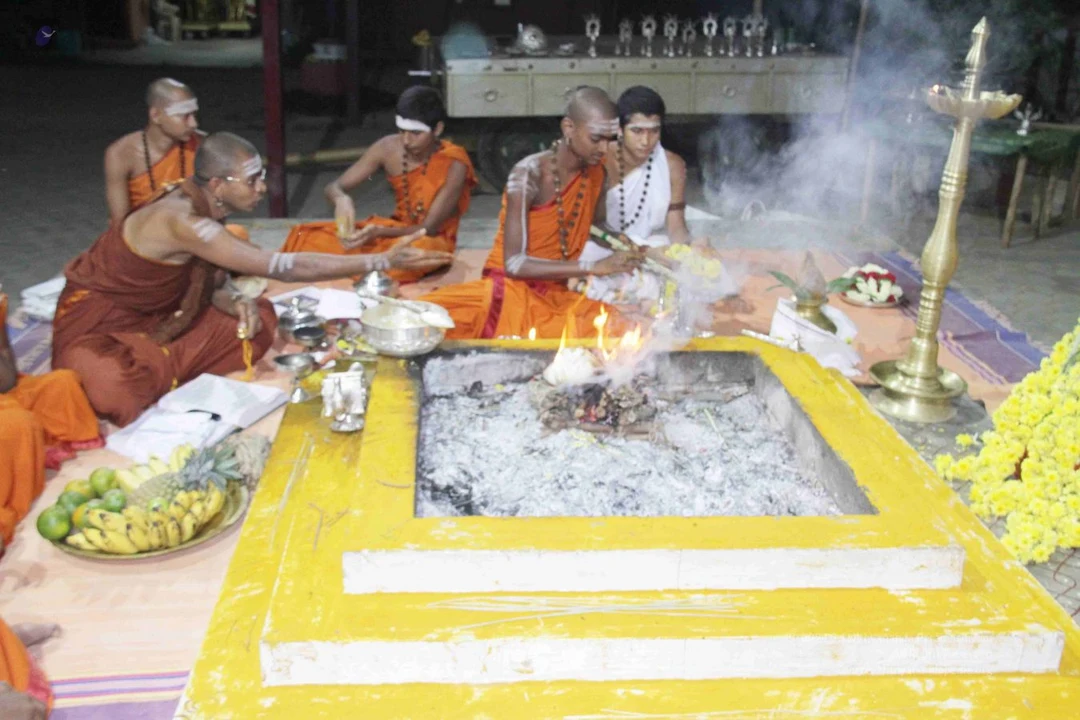
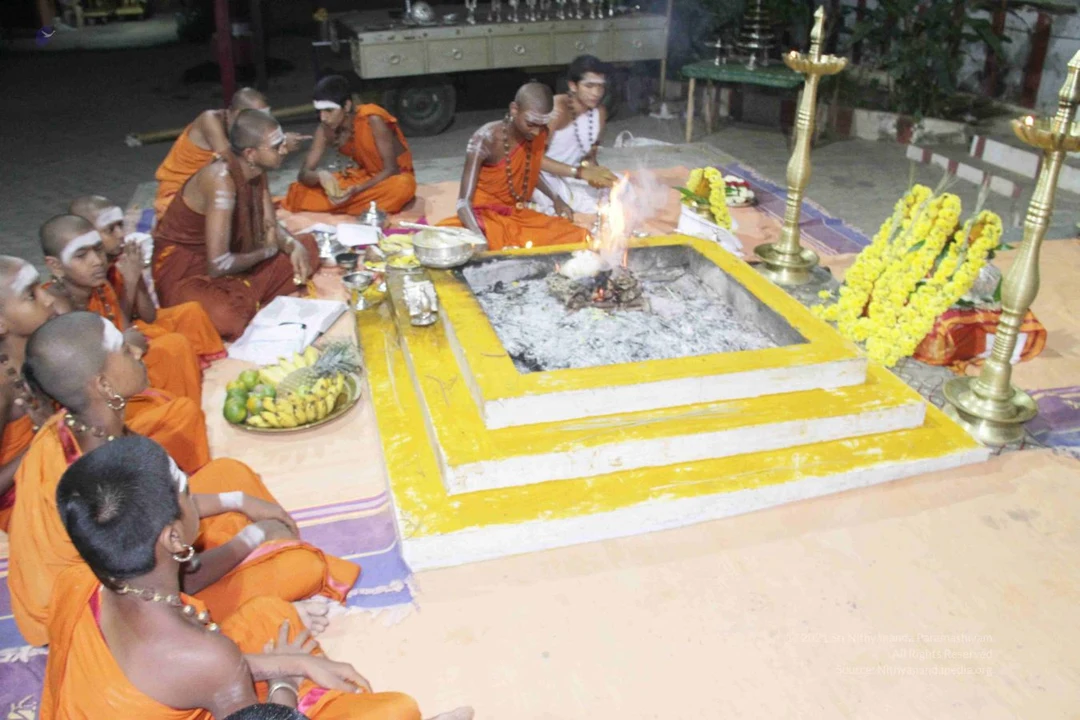
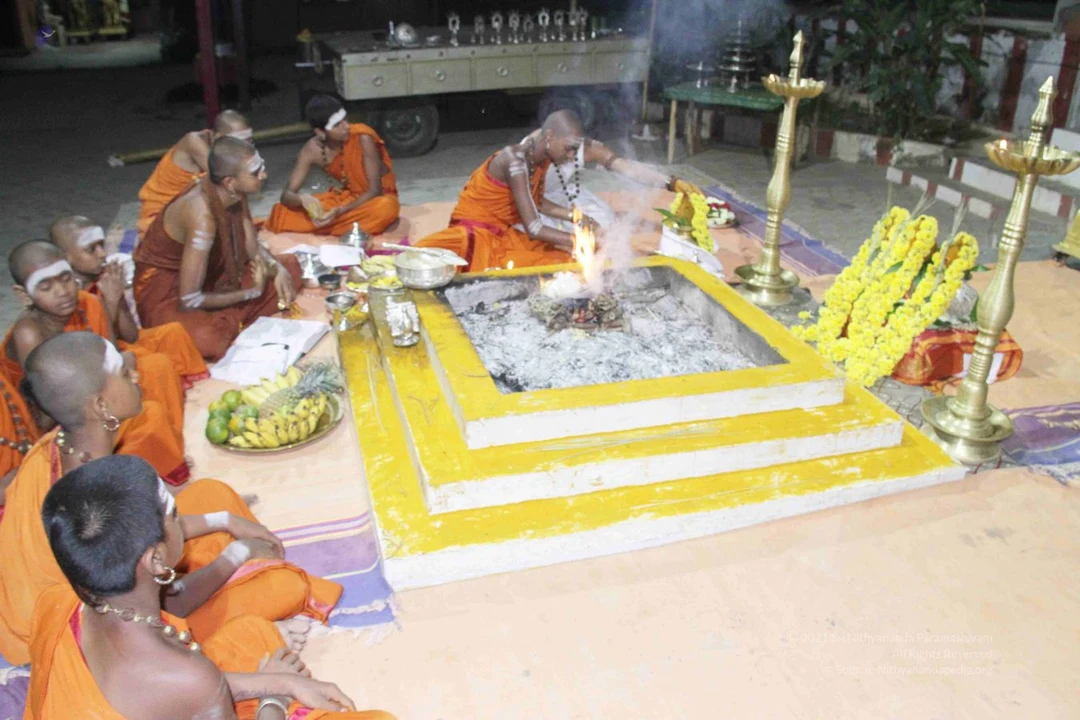
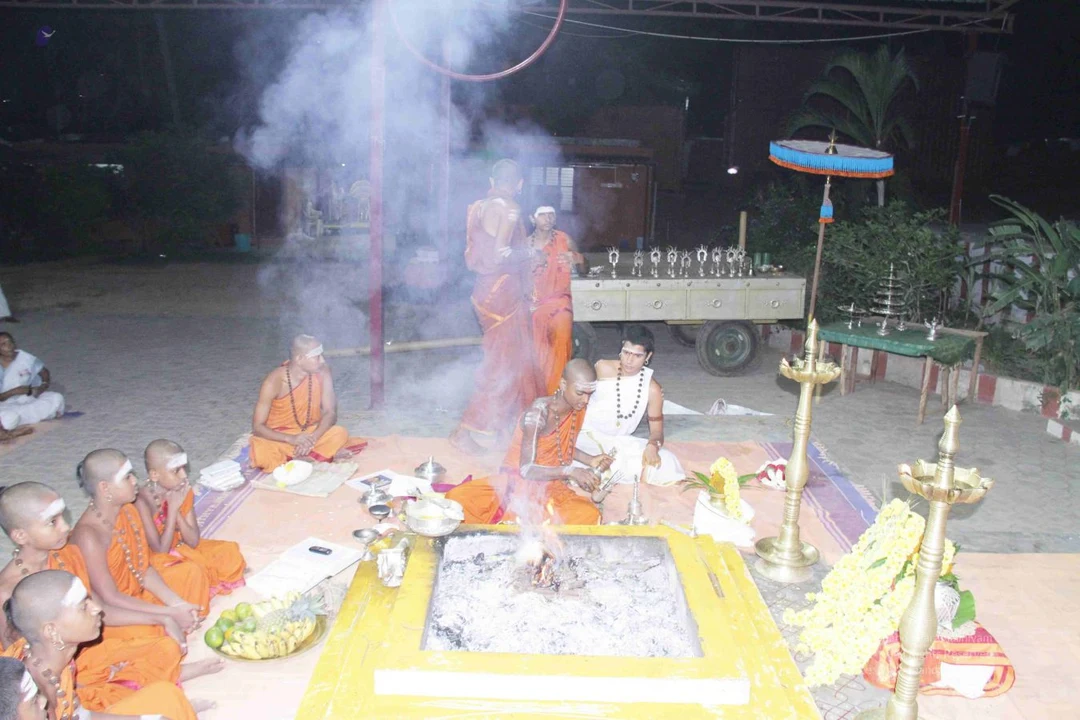
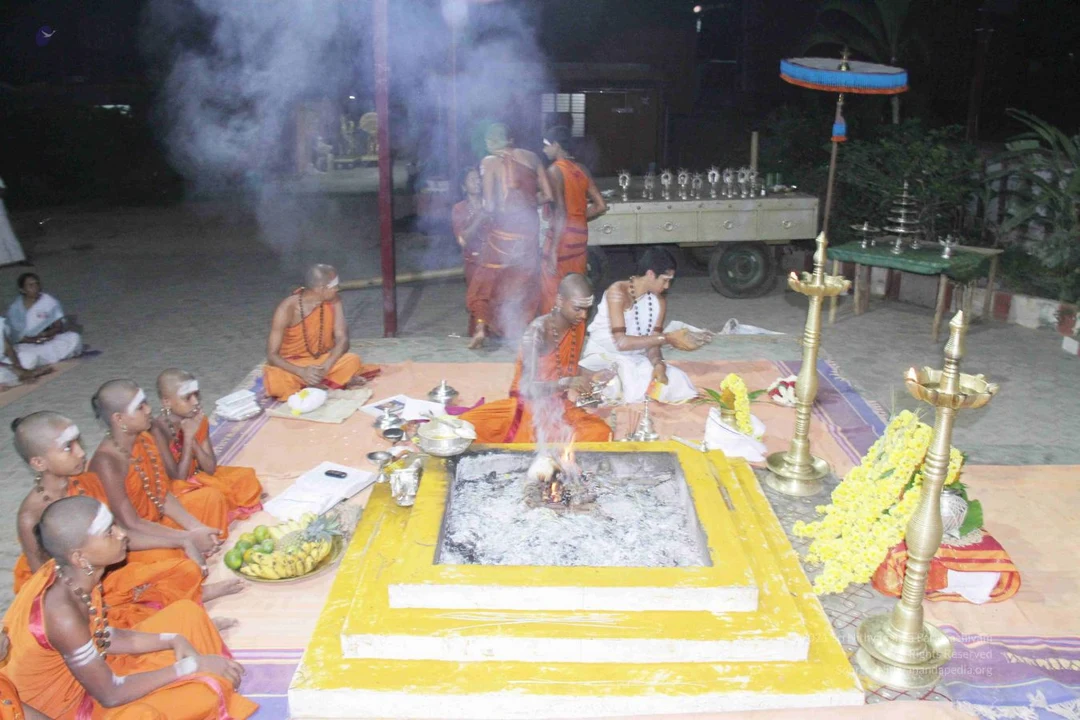
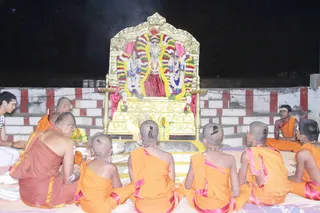
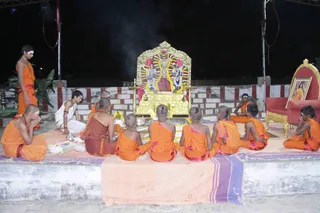
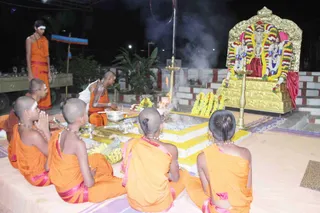
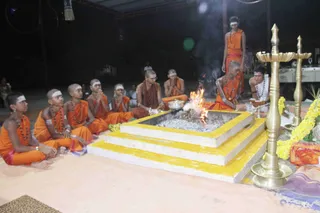
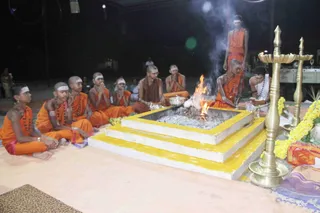
Night ritual photograph at a temple shrine. A gold-framed seated deity murti, dressed in red cloth and heavy garlands of multicoloured flowers, sits on a gold pedestal before a white and red striped wall. Smoke rises from a fire or offering area in front of the murti. Six shaven-headed young men in saffron-orange robes sit cross-legged on a mat facing the deity, several with tufts of hair on the crown and rudraksha beads around their necks. On the far right a seated young man in orange robes with a rudraksha mala watches, and on the left another young person in white sits near brass vessels. Brass lamps flank the shrine. No identifiable a person figure is visible.Night-time outdoor ritual on a raised platform with white and red tiled wall behind. Shaved-headed young men in saffron-orange robes with white forehead bands sit in rows facing a golden ornate throne decorated with flower garlands in red, yellow and white, holding a central figure in red and gold garments with a seated deity murti on either side. Smoke rises in the background. To the right, an empty red velvet throne with gold trim displays a framed portrait of a figure in orange. A white-clad priest in the left middle performs a puja with brass vessels and flowers, while a standing attendant in orange with a white forehead band stands at far left. Strings of lights and lamps frame the stage.Night-time outdoor homa at a temple-like courtyard. Five shaved-headed young sannyasi in saffron-orange robes with pink borders sit cross-legged on a white and yellow tiered fire altar, facing a gold-framed shrine decorated with yellow and white marigold garlands. The shrine holds deity murtis draped in garlands. A standing figure in orange robe with white forehead markings stands at left beside a flagged pole, and a seated figure in white clothing sits among them. Brass oil lamps stand beside the altar, with bowls of offerings, pineapple and banana-leaf plates nearby. Smoke rises from the fire. Five to six people are visible in total.A night-time homa at an open-air ashram hall. A square yellow-and-white tiered fire pit holds a burning fire with smoke rising. About nine young shaved-headed men in saffron-orange robes with white tilak marks and rudraksha malas sit cross-legged around it; one in the foreground tends the fire while others sit with folded hands. A standing young man in orange stands at the back, and a figure in white sits on the right. Brass oil lamps stand on the right beside yellow marigold garlands and a cloth offering. Dim background with a few onlookers.Night photograph of a homa fire ceremony on a tiered yellow-and-white fire pit with flames and smoke rising. Around it sit a group of young saffron-robed monks with shaved heads and white tripundra markings on their foreheads, some with rudraksha malas, hands joined in prayer. A standing monk in orange at the back, and a seated priest in white with a mala to the right. Brass oil lamps stand beside the pit, with yellow marigold garlands and offerings on a cloth in the foreground.Five young boys with shaved heads sit cross-legged in a row wearing saffron-orange monastic robes and multi-strand rudraksha mala necklaces. Their foreheads and arms bear white ash markings, and some have red tilaka dots. The two boys on the right press their palms together in anjali. A plate of bananas and limes sits at the lower right. Behind them, a dim background shows a few onlookers in white clothing.

AkashicReading
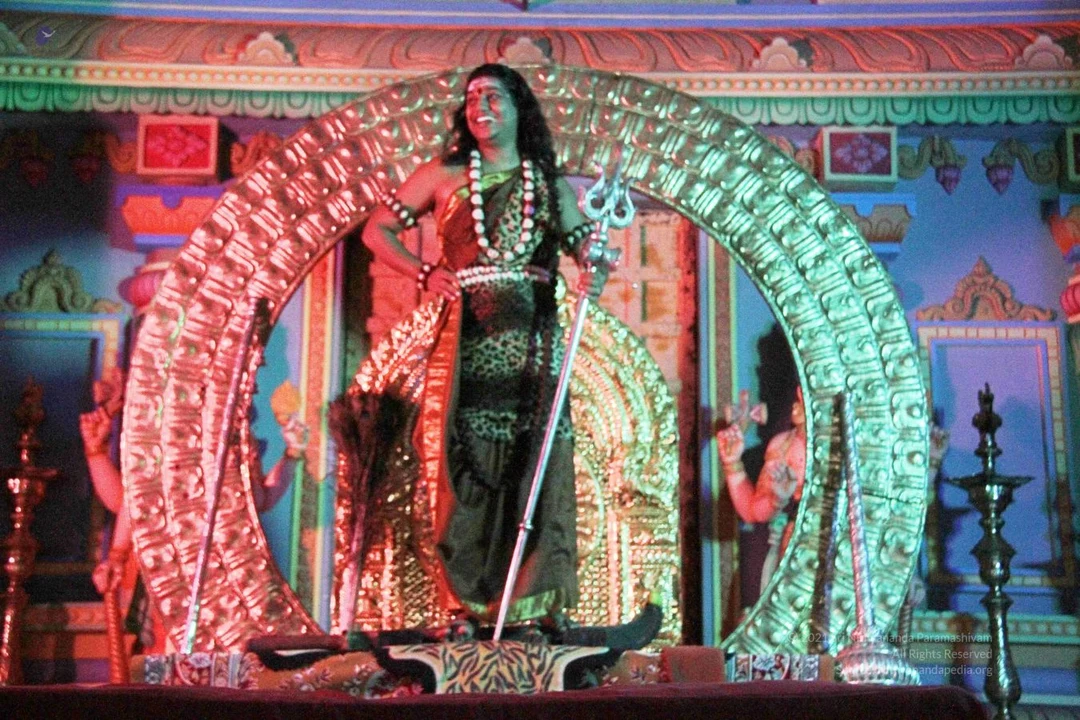
5 photosSource gallery
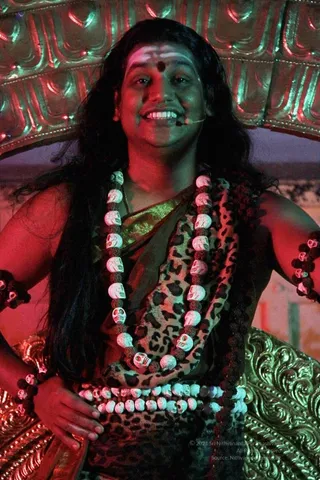
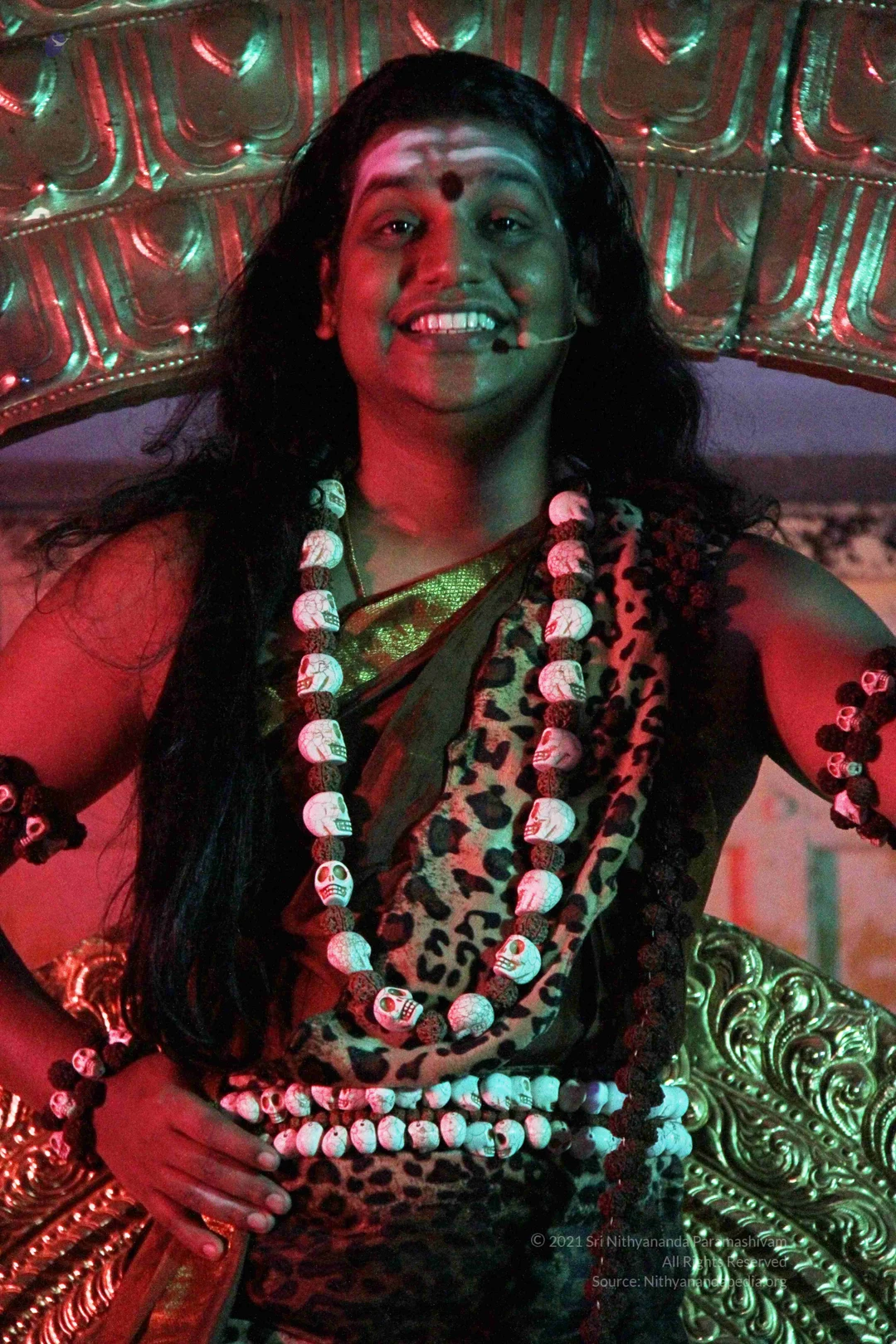
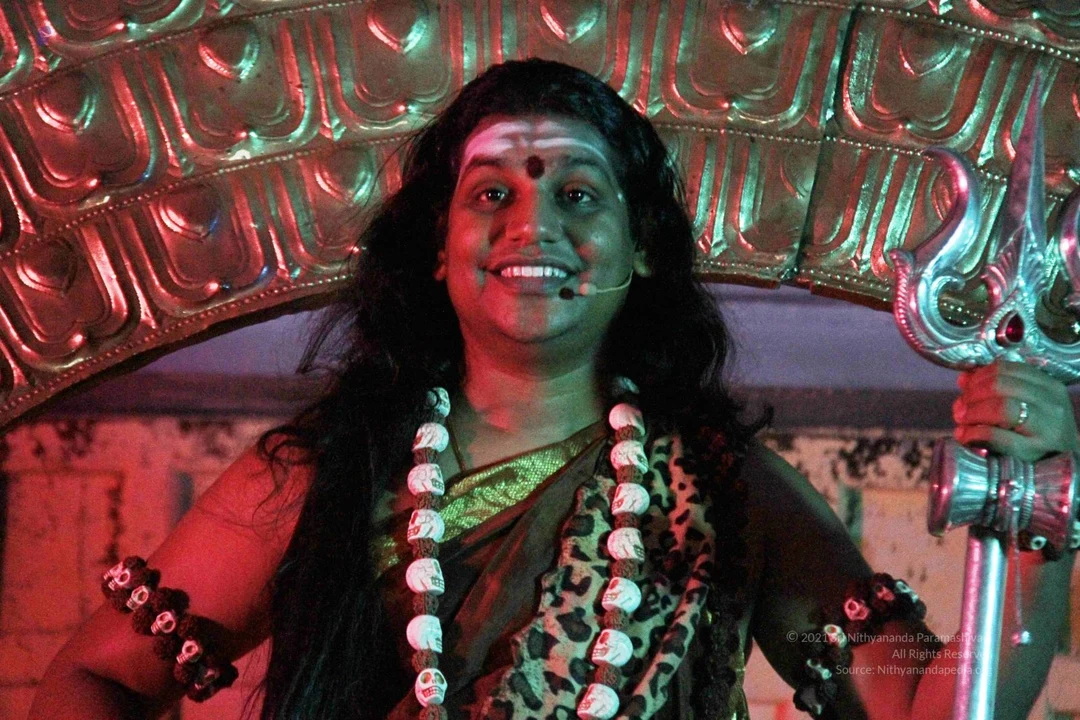
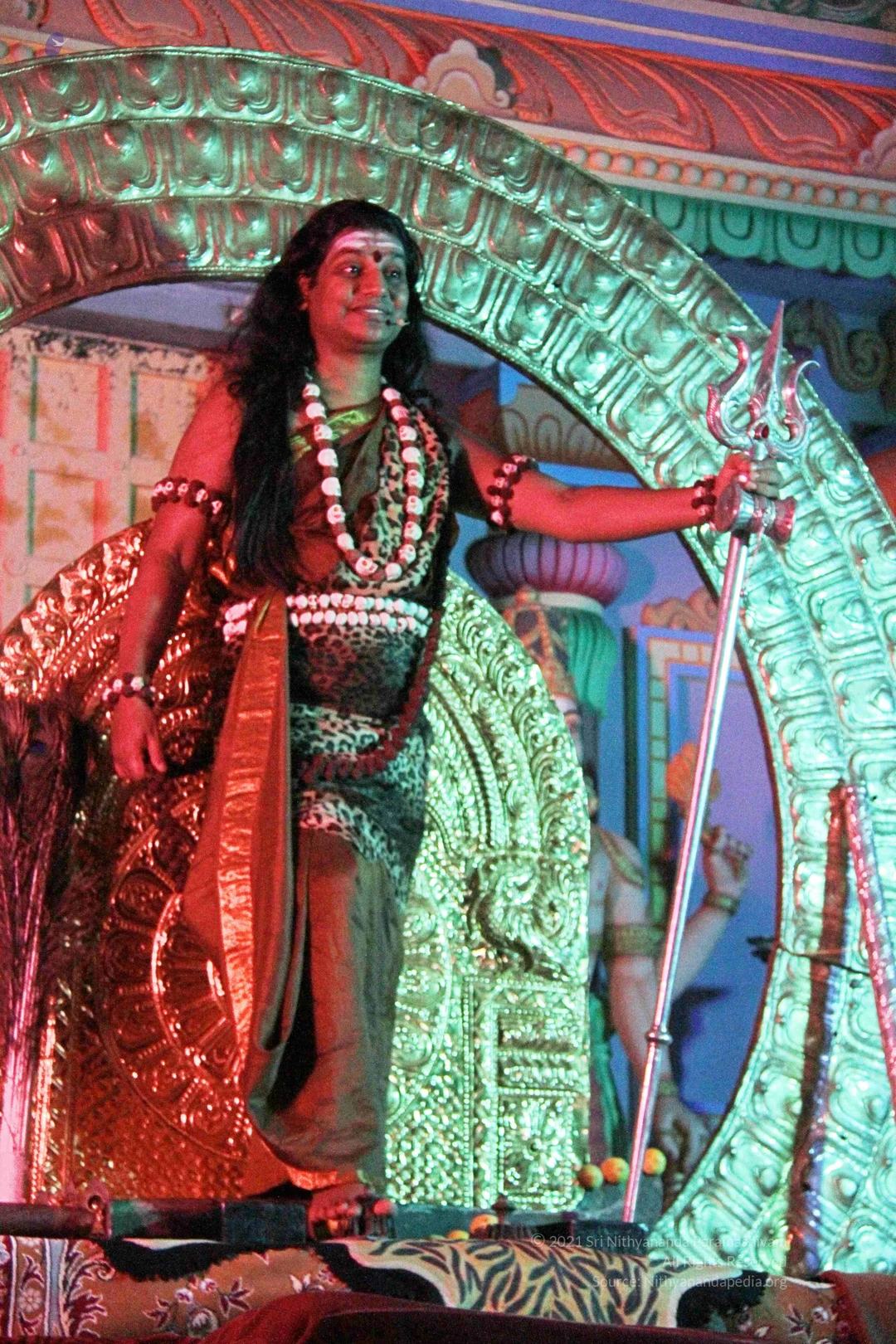
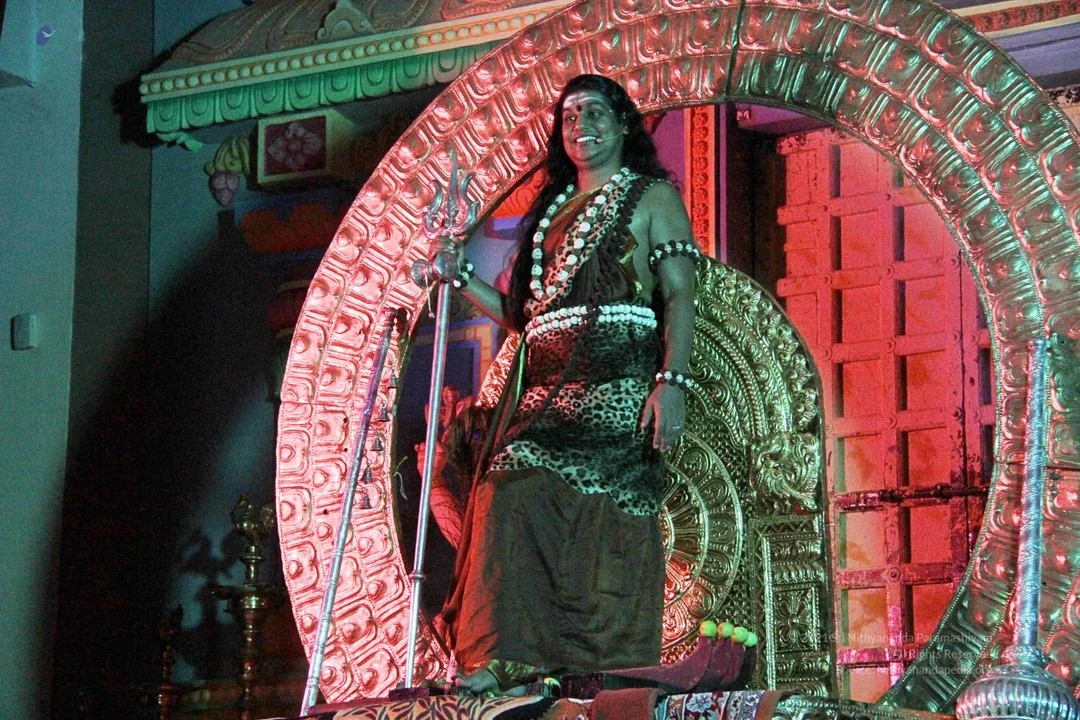
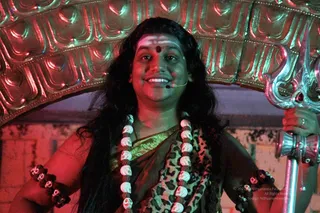
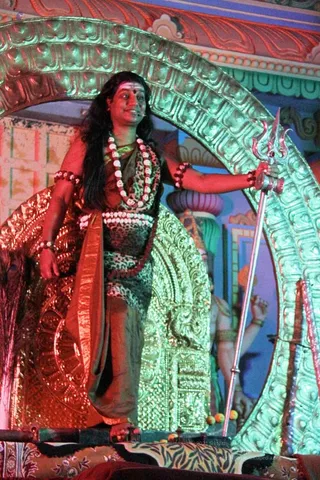
A photograph of a staged tableau in a temple-style hall. A figure with long dark hair, a red bindi and a rudraksha bead necklace stands centrally holding a silver trident, wearing a green and gold patterned garment with a flowing orange-red shawl. Behind a large ornate golden arch with green lighting, a deity murti-style backdrop features painted figures with raised hands. Brass oil lamps (deepas) stand on either side of the stage, and a patterned cloth covers the low platform in front.Photograph of a smiling man with long dark hair seated on an ornate gilded throne with a tall repoussé metallic backrest. He wears white sacred ash markings and a dark red dot on his forehead, a leopard-print garment, multiple strands of white skull-shaped beads with rudraksha, and matching beaded armlets. A small headset microphone is clipped near his face, and red and green stage lighting falls across the scene. Appearance-based candidate: a person, seated in the throne position with distinctive ornate and rudraksha adornments.A smiling person with long dark hair, wearing a white and red tilak on the forehead with a red bindi, a small microphone clipped near the mouth, a green and black leopard-print garment with a gold-bordered sash, and a long mala of white and red beads with skull-like pendants. A silver trident is held upright at the right edge, and an ornate copper-coloured arched backdrop with repeated leaf-like patterns is behind. Warm red and green stage lighting lights the scene.A long-haired figure in an ornate green-and-gold arched stage setting holds a silver trident in the right hand. The figure wears a leopard-print patterned garment, a rudraksha-style bead mala across the chest and waist, and matching beaded bracelets on both arms, with a red bindi on the forehead. A golden-orange draped cloth falls over the left side. Behind is a painted deity figure with raised arm, and small orange fruits rest on the stage ledge below. Swamiji (probable) appears in person, based on long hair, rudraksha malas and ornate clothing cues.A photograph of a person standing on a raised golden throne-like platform inside a temple-style hall, lit with red and green stage lighting. The figure has long dark hair, a red bindi, and wears a leopard-print blouse with a dark brown and red wrap, a white flower garland around the neck and waist, and white beaded bangles. They hold a tall silver trident. Behind them stand an ornate gilded arched frame with a red-lit lattice door, and a brass oil lamp sits at the left edge. a person appearance candidate: long swept hair, flower garlands and trident, though identity is uncertain.

Darshan

4 photosSource gallery
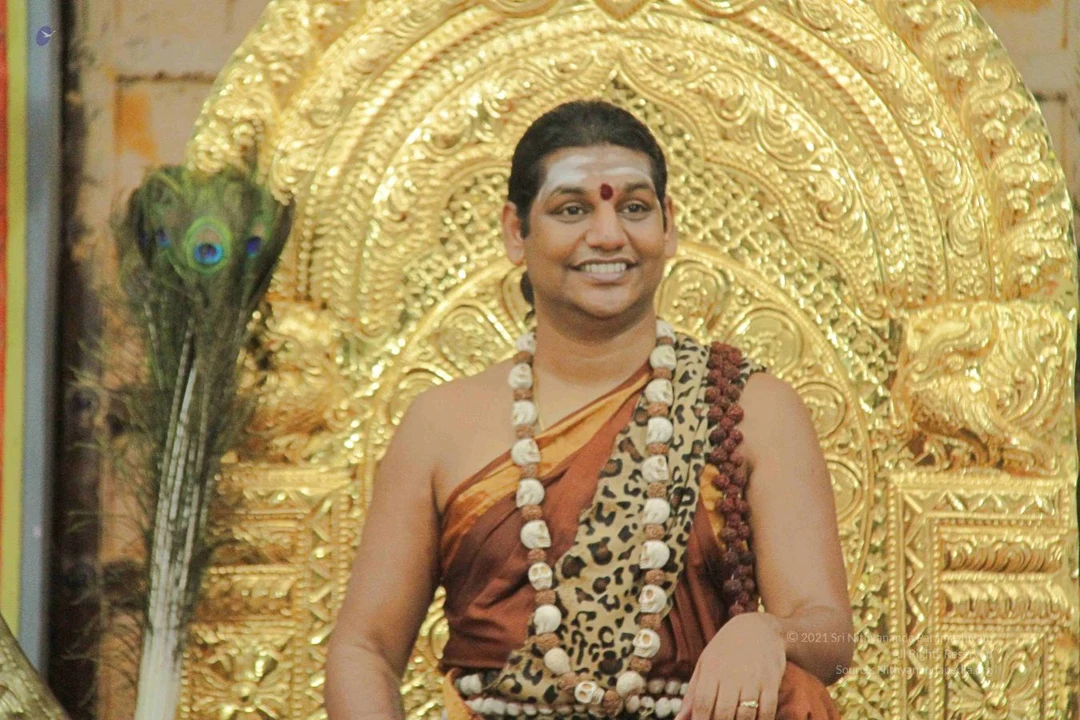
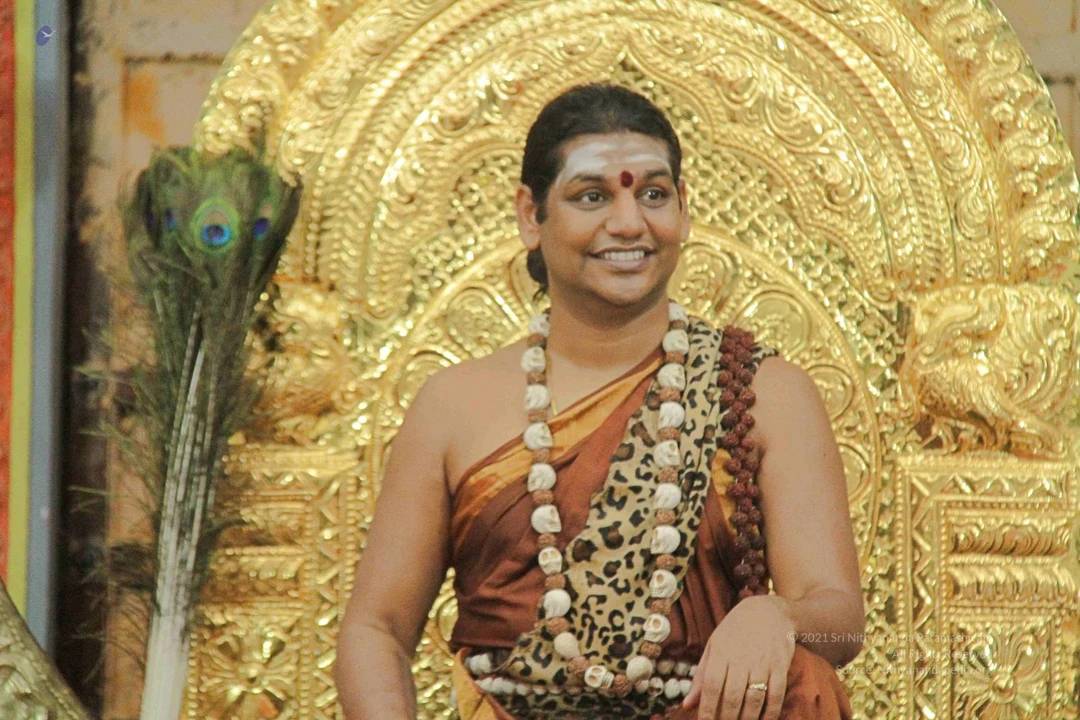
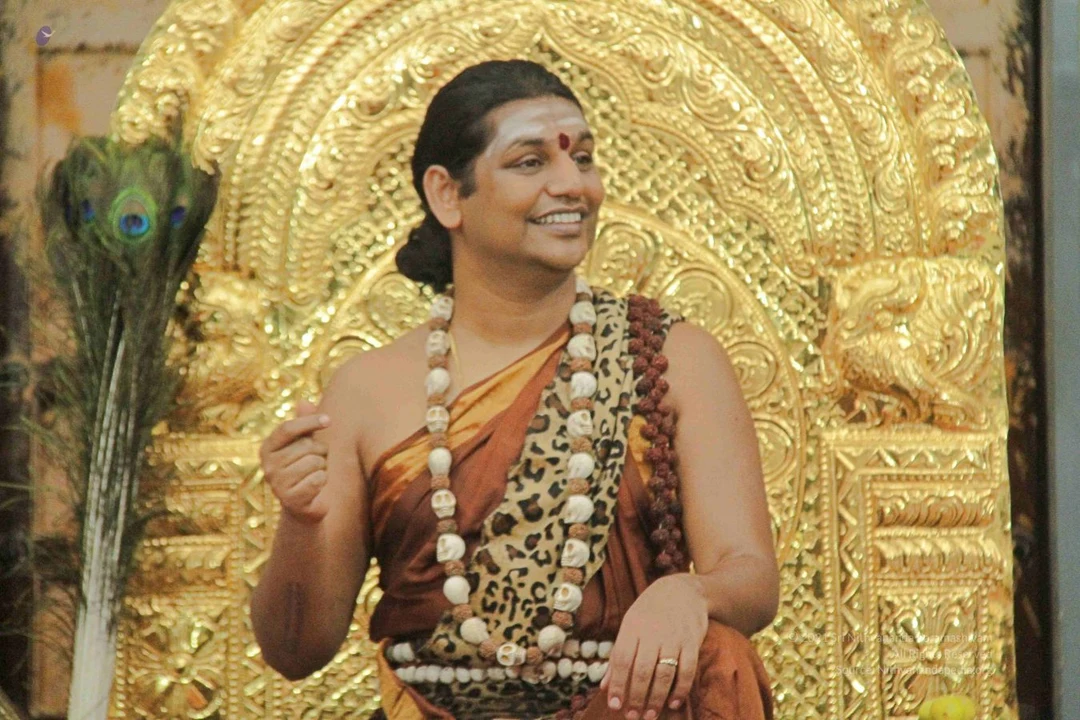
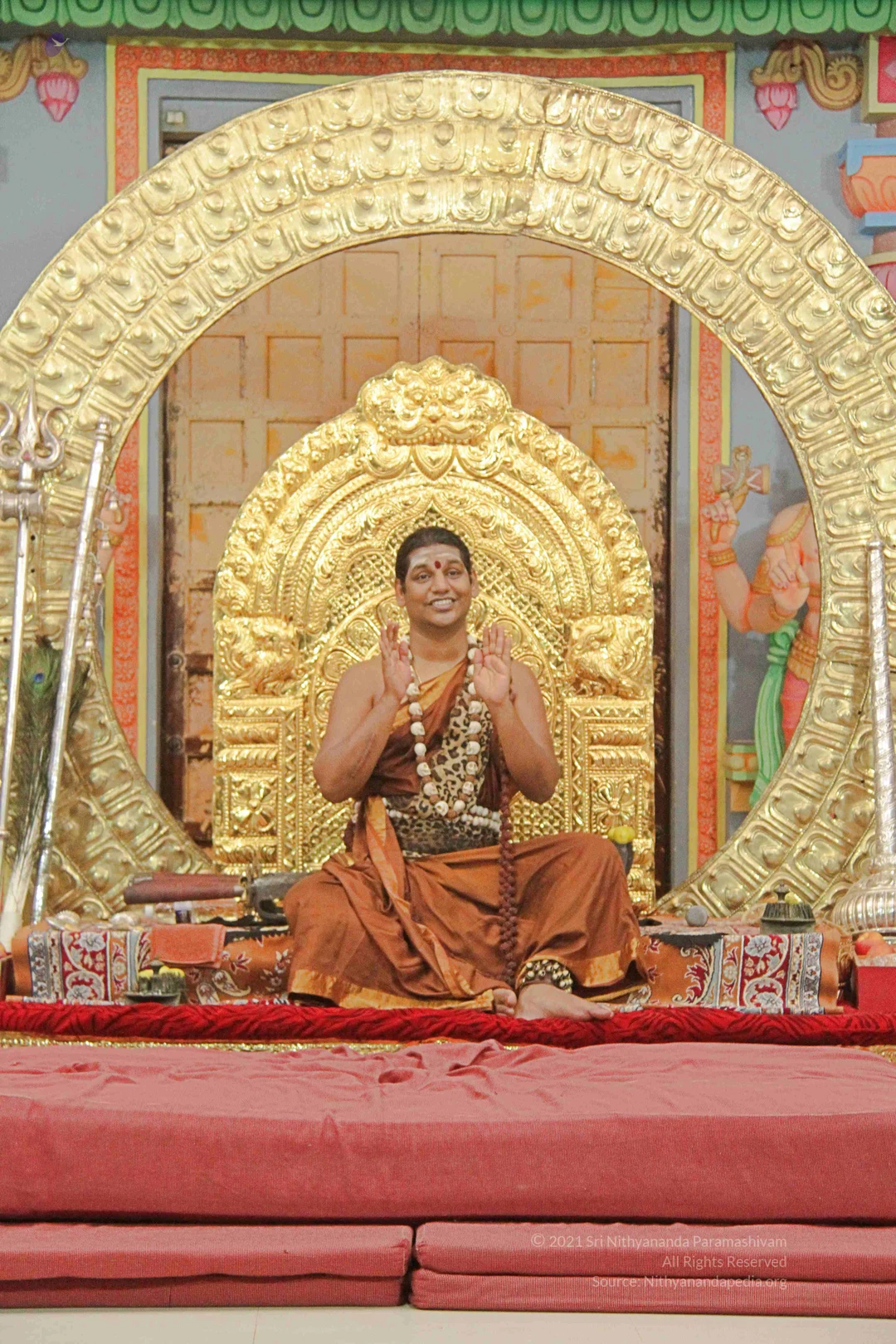
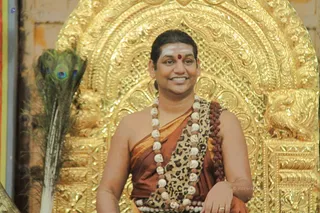
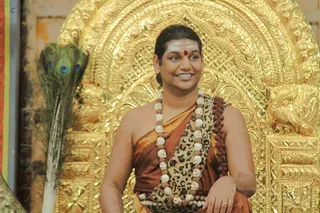
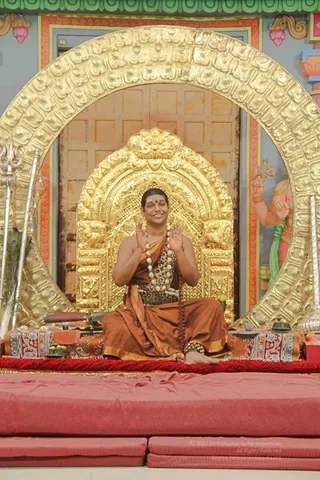
A smiling man with short dark hair, white vibhuti marks and a red bindi sits before an ornate gold repoussé throne with carved floral and animal motifs. He wears a rust-orange saffron wrap over his shoulders with a leopard-print shawl, a long necklace of white beads and rudraksha malas, and a gold ring. A large peacock feather fan stands to the left.A smiling man with swept-back dark hair and a white vertical tilak with a red dot sits before an ornate gold throne with carved arches. He wears an orange-brown ochre garment, a leopard-print shawl across the chest, and long strings of white beads and rudraksha malas. A peacock-feather fan stands to the left. a person in a seated darshan setting; the wearing of white tilak, rudraksha malas and a leopard shawl are visible cues. One physical person is present.A smiling man with swept-back dark hair and a red bindi sits before an ornate gilded throne with carved lion and foliage motifs. He wears a saffron-orange shawl over bare shoulders, a long necklace of white beads and rudraksha, a leopard-print cloth draped over one shoulder, and a beaded waist cord. His right hand is raised in a gesture while his left rests on his lap. A peacock feather fan stands at left. a person is seated in a teaching posture, giving discourse.A seated man in rust-orange and brown robes sits cross-legged on a red cushioned dais in front of an ornate gold arched throne. He smiles with palms pressed together in greeting, wearing a white flower garland, a leopard-print garment at the chest, a rudraksha mala hanging down, and a red bindi on his forehead. Behind the throne stand a golden arch, a wooden door, and a painted deity figure in green and pink; a silver trident and a peacock-feather fan stand at the left.

SacredArts

22 photosSource gallery
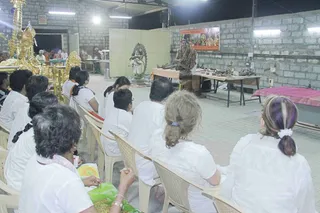
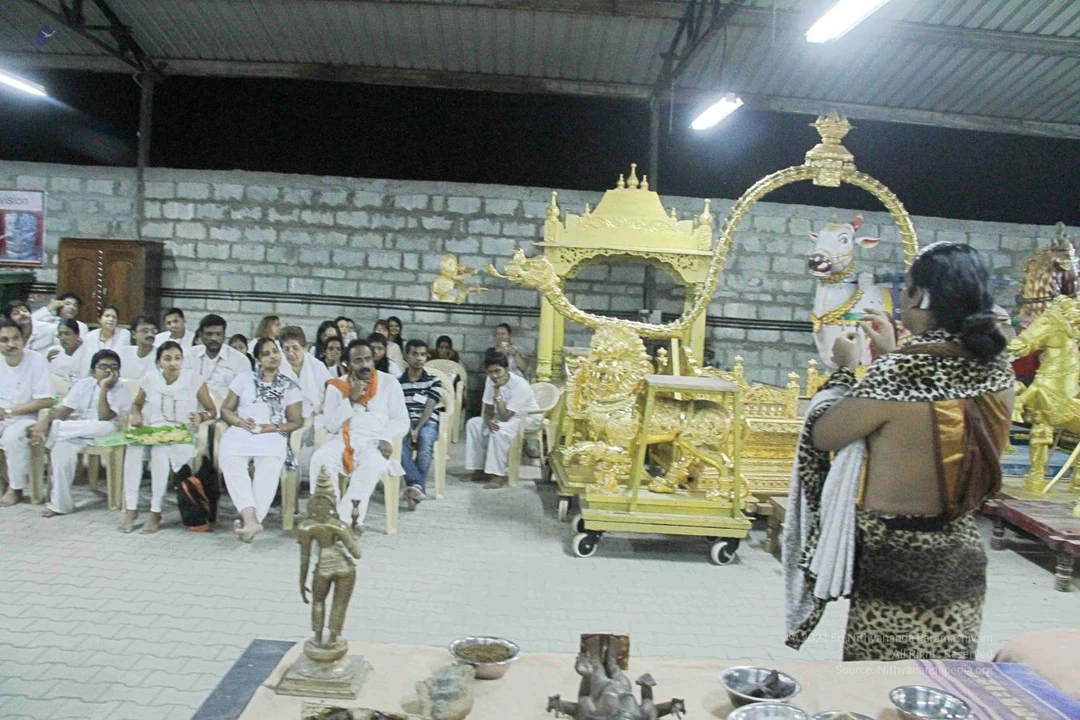
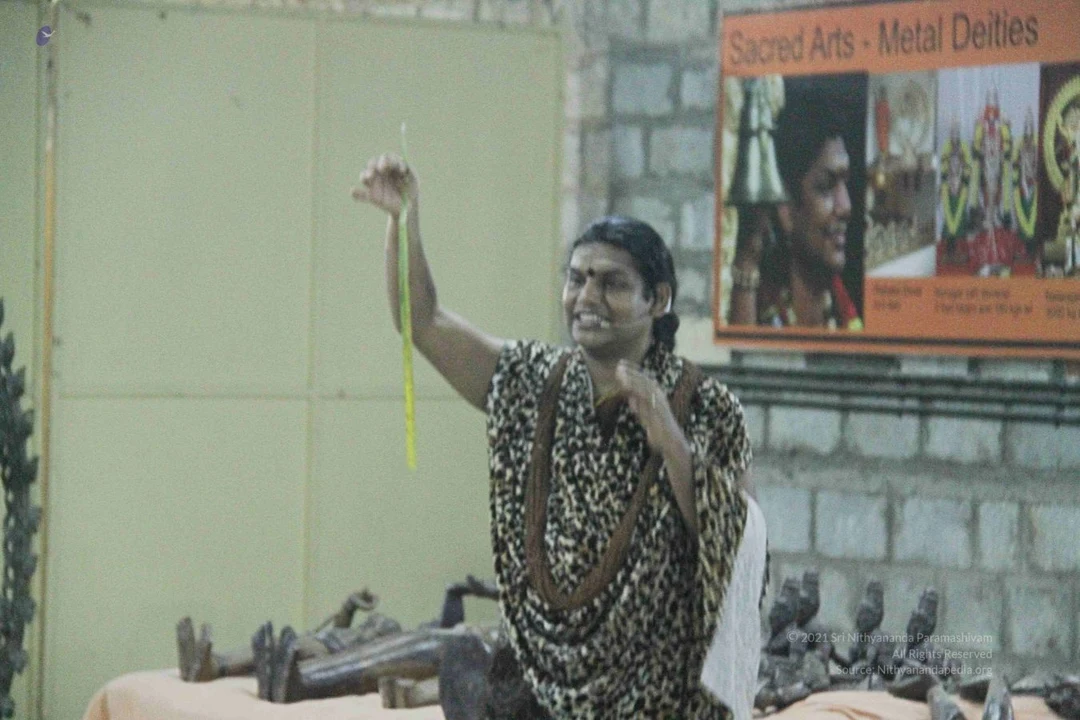
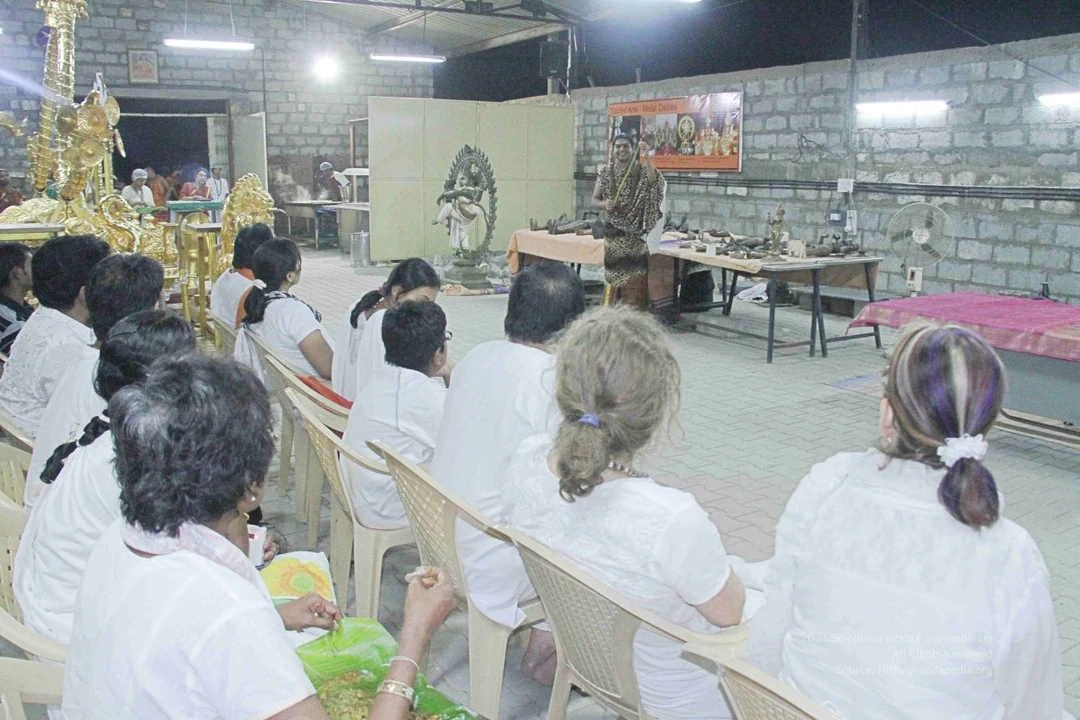
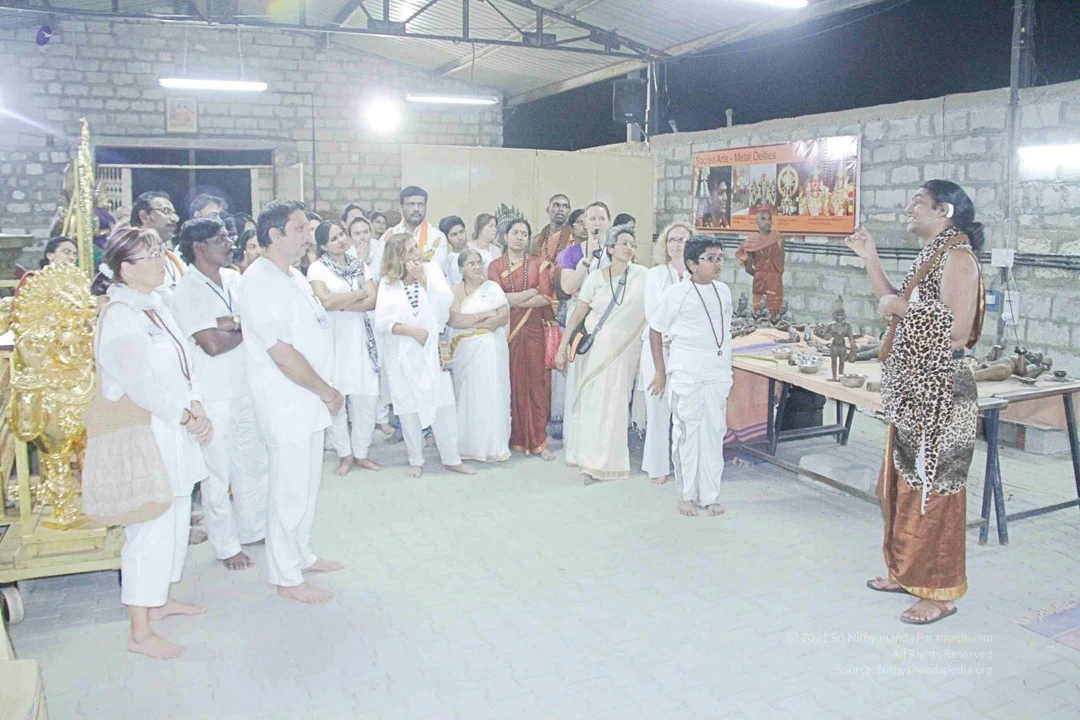
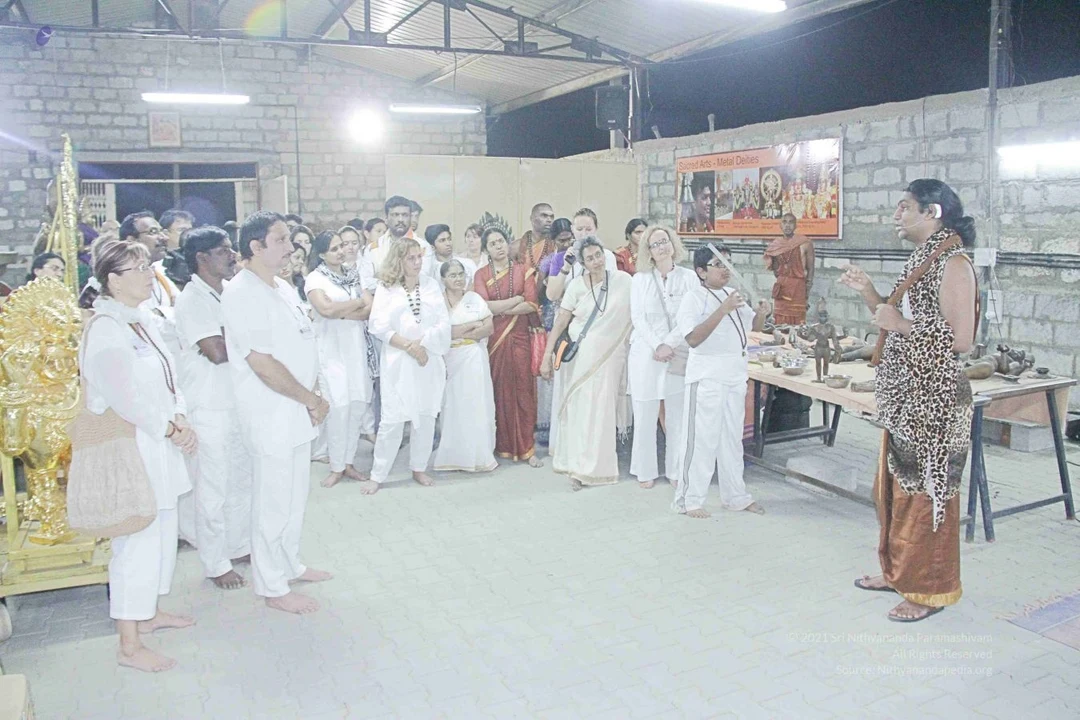
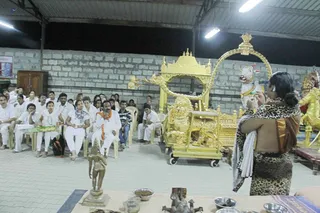
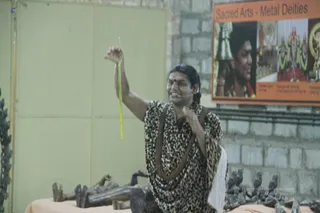
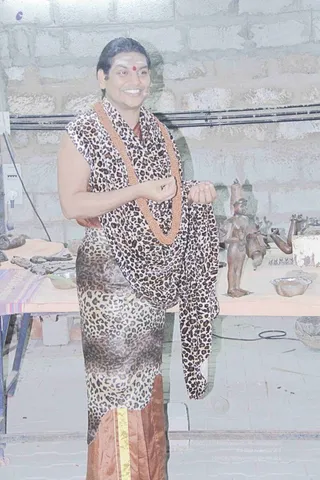
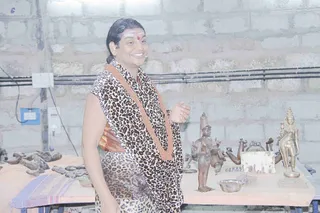
Indoor event in a plain hall with a corrugated roof and grey block wall. Seated rows of devotees in white clothing face a golden ratha-style chariot on wheels, decorated with gilded carvings, a golden makara-style arch and a white nandi-like bull figure. A standing woman in a leopard-print blouse and shawl faces the seated audience while holding an object near her face. In the foreground are a small bronze deity murti, metal bowls and brass items on a cloth. A seated man in white with an orange scarf sits near the centre of the front row, with no clear appearance-based cue for a person.A photograph of a woman seated before a display of metal deity figures and sacred art pieces, one hand raised and holding a thin yellow strand. She wears a leopard-print sari-style garment with a brown shawl draped over her shoulders and a red bindi. Behind her, a wall-mounted orange sign reads Sacred Arts + Metal Deities, showing photos of ornate deity statues and garlanded idols. Pale green wall panels and a brick wall frame the scene, and a light orange cloth covers the table with bronze figures in front.Evening scene in an open-sided hall with grey breeze-block walls and fluorescent lights. Rows of seated devotees in white clothes face a standing speaker in a patterned brown-and-gold garment who gestures near a display board and a table of brass objects and small statues. A large dark Nataraja-style bronze dancing figure stands on a pedestal in the centre. At left, an ornate gold palanquin-like structure and people in the background tend a ritual area. Some devotees hold green and yellow snack packets. A printed banner on the wall shows colourful deity imagery. a person candidate not clearly identifiable from appearance.A workshop or storeroom with a concrete block wall and fluorescent lights. A man with a leopard-print shirt and an orange-brown rudraksha mala stands at a long table covered with a pink cloth, arranging small metal bowls and pouring from a container. On the table lie many dark bronze or wooden deity limbs, weapons and sculpted fragments. Behind him stand golden processional items, including a gilded chariot-style frame, a white and gold bull statue, a golden horse, a gilded throne and a decorated palanquin. Several people in white dhotis and saffron or red robes stand in the background, and a small standing wooden deity figure rests on a base in the foreground.A smiling man with swept-back dark hair, white sacred markings on his forehead and a red bindi stands in a plain concrete room. He wears a leopard-print shawl over a brown and gold-bordered dhoti and a long orange-brown rudraksha mala. He holds the shawl open in both hands. Behind him on a table are carved wooden or bronze figures, a steel bowl and cloth. a person is shown by the swept hair, rudraksha mala and ornate attire, but the appearance is not conclusive.A smiling man with short swept-back dark hair and a red bindi stands beside a table of bronze statues and metal objects in a plain concrete-block room with exposed conduit. He wears a leopard-print shawl and wrap over a bare upper body with an orange rudraksha-style bead garland, and gestures with one hand. On the table are a standing bronze deity figure with raised arms, a bronze figure with a tall crown, a silver bowl, and small carved stones, with a pale cloth and sandals at left.