Skip to content
Tuesday

19 August 2014

Technique to Burn the Root of Suffering

Dated photos
113
Source pages
1
Media
5
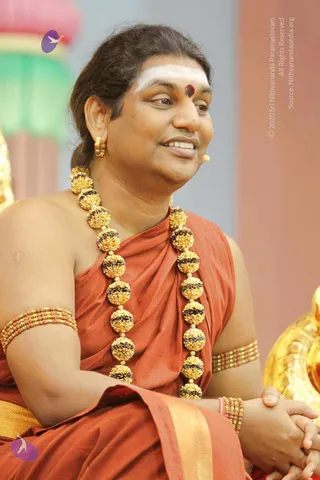
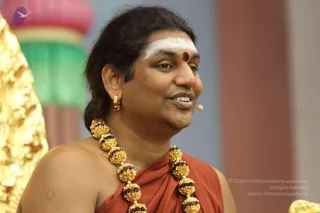
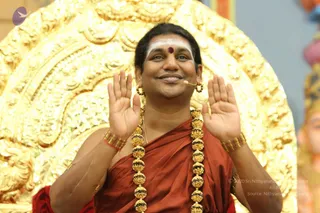
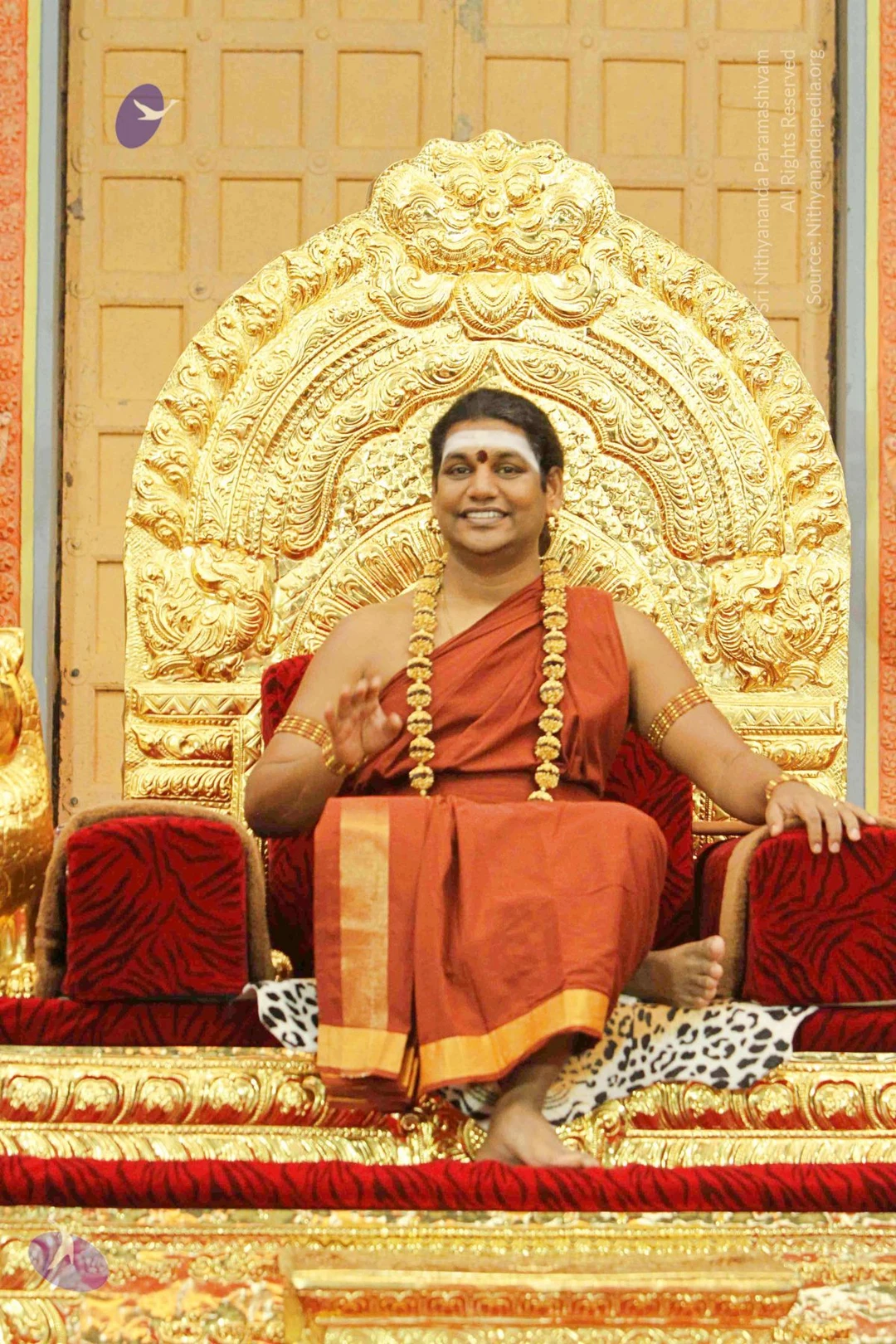
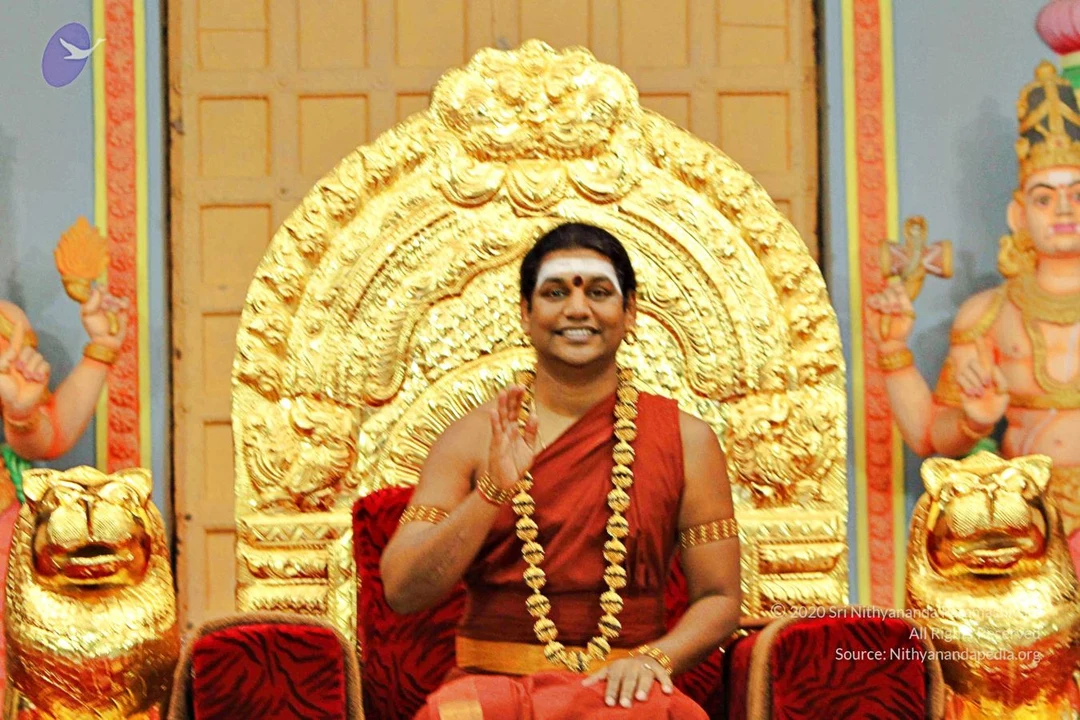
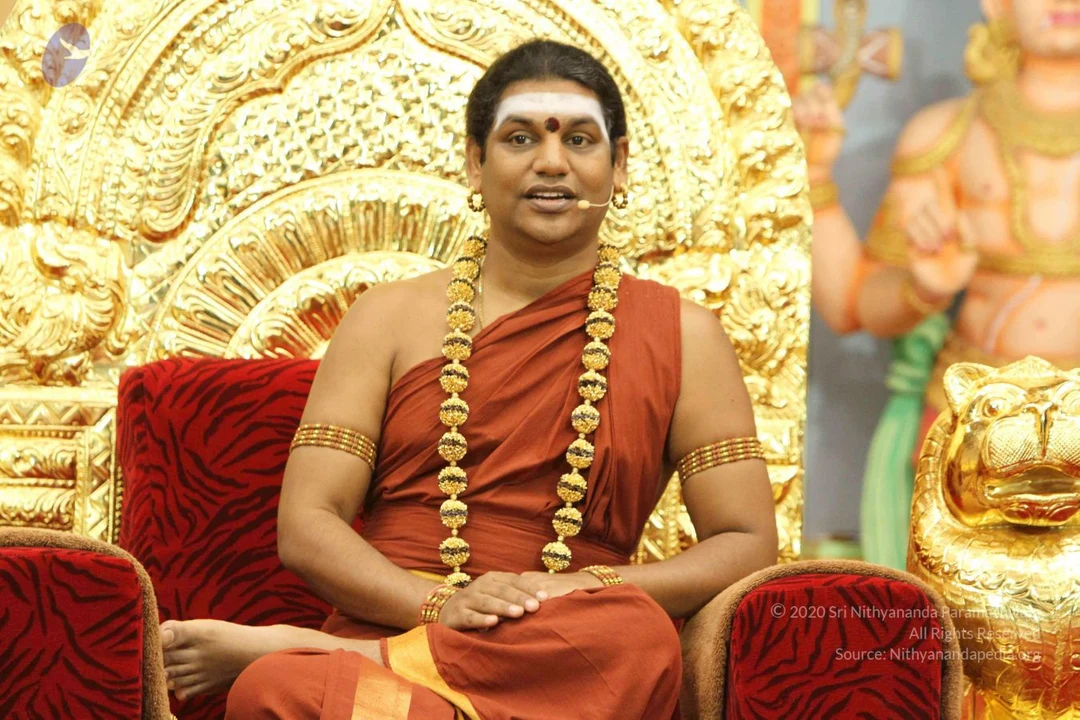
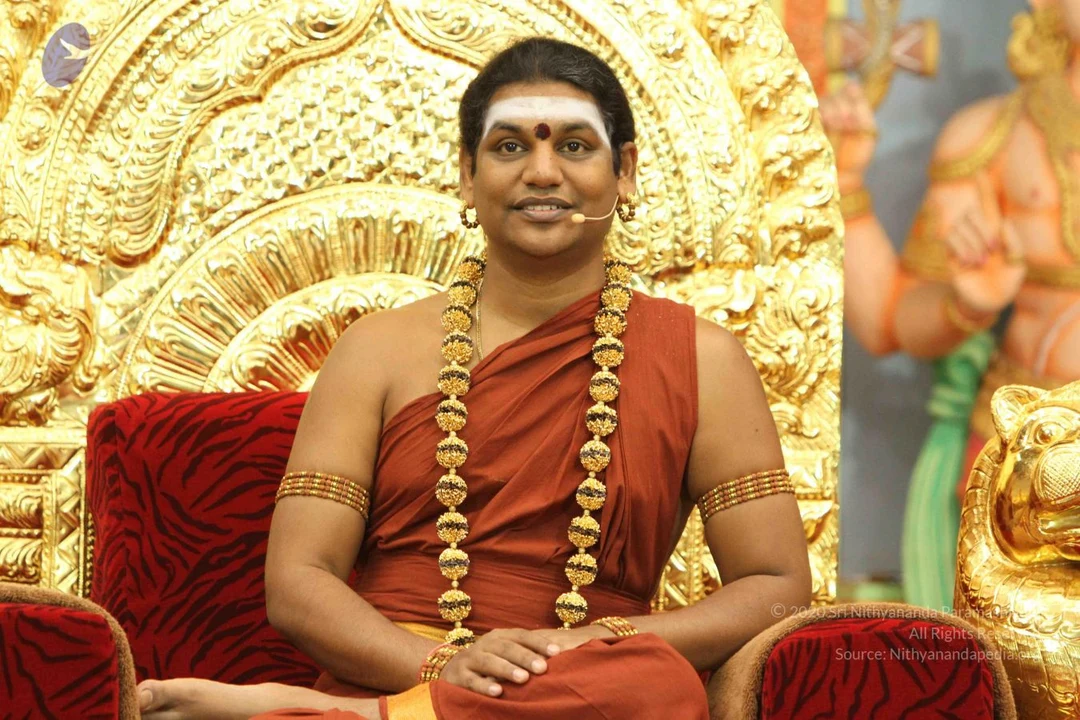
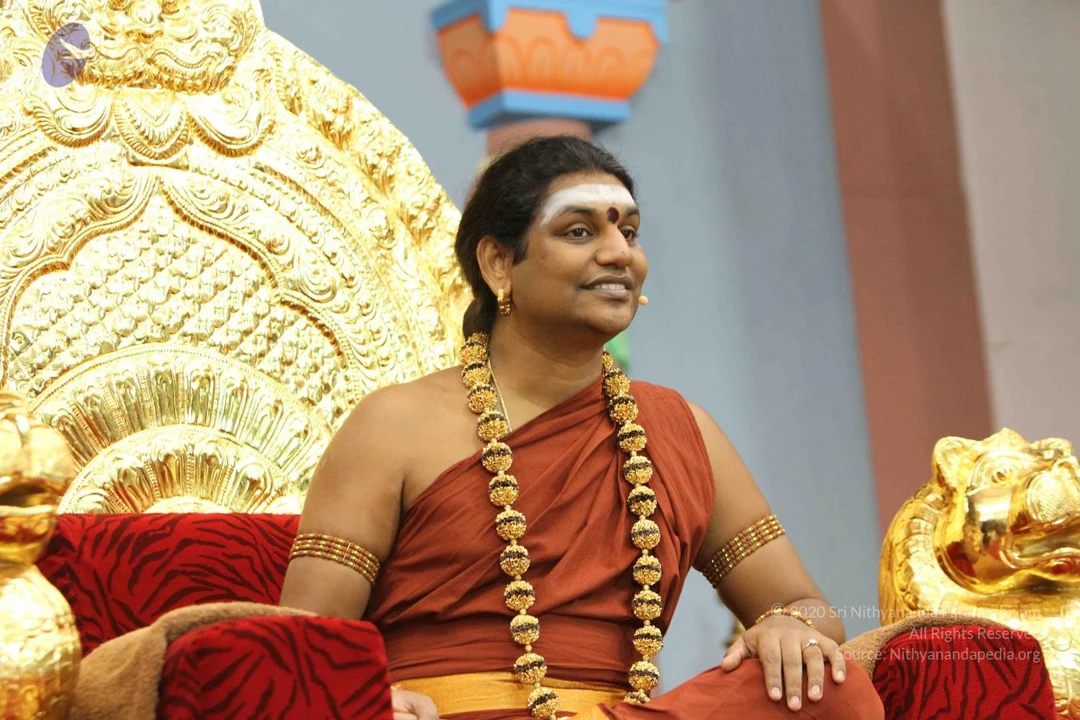
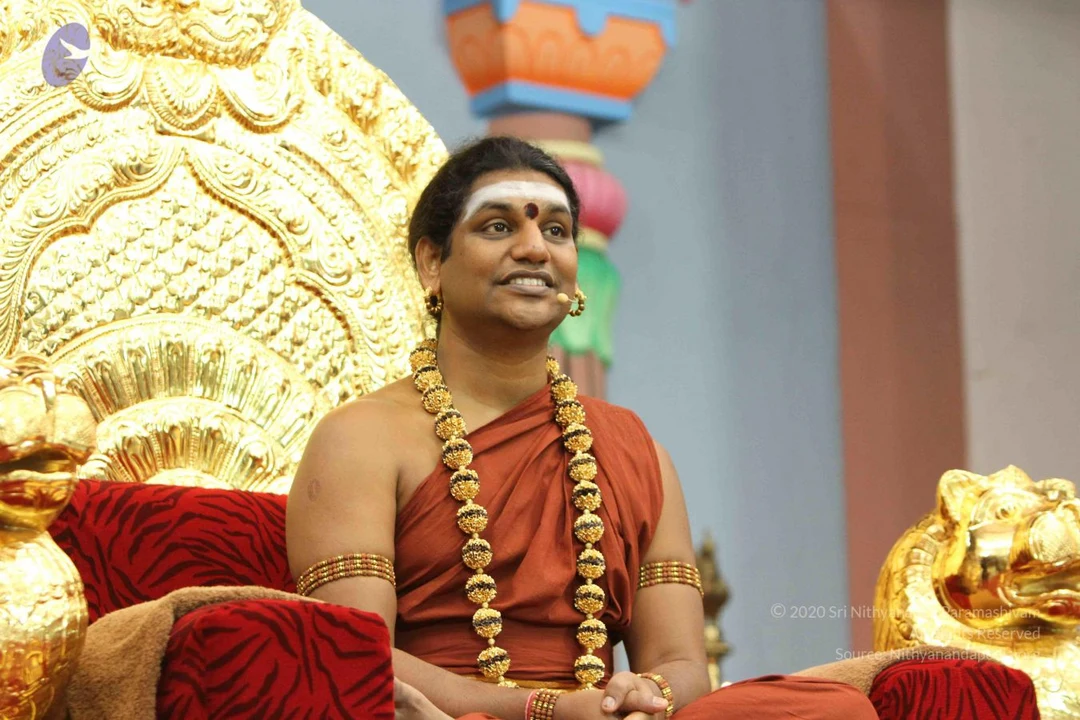
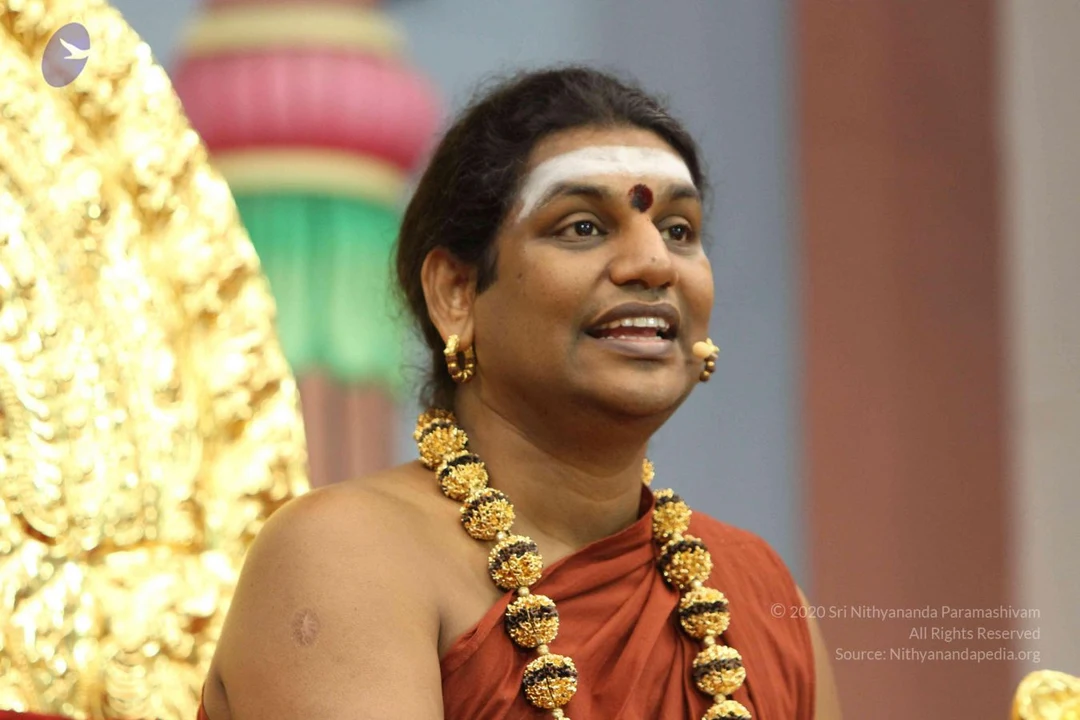
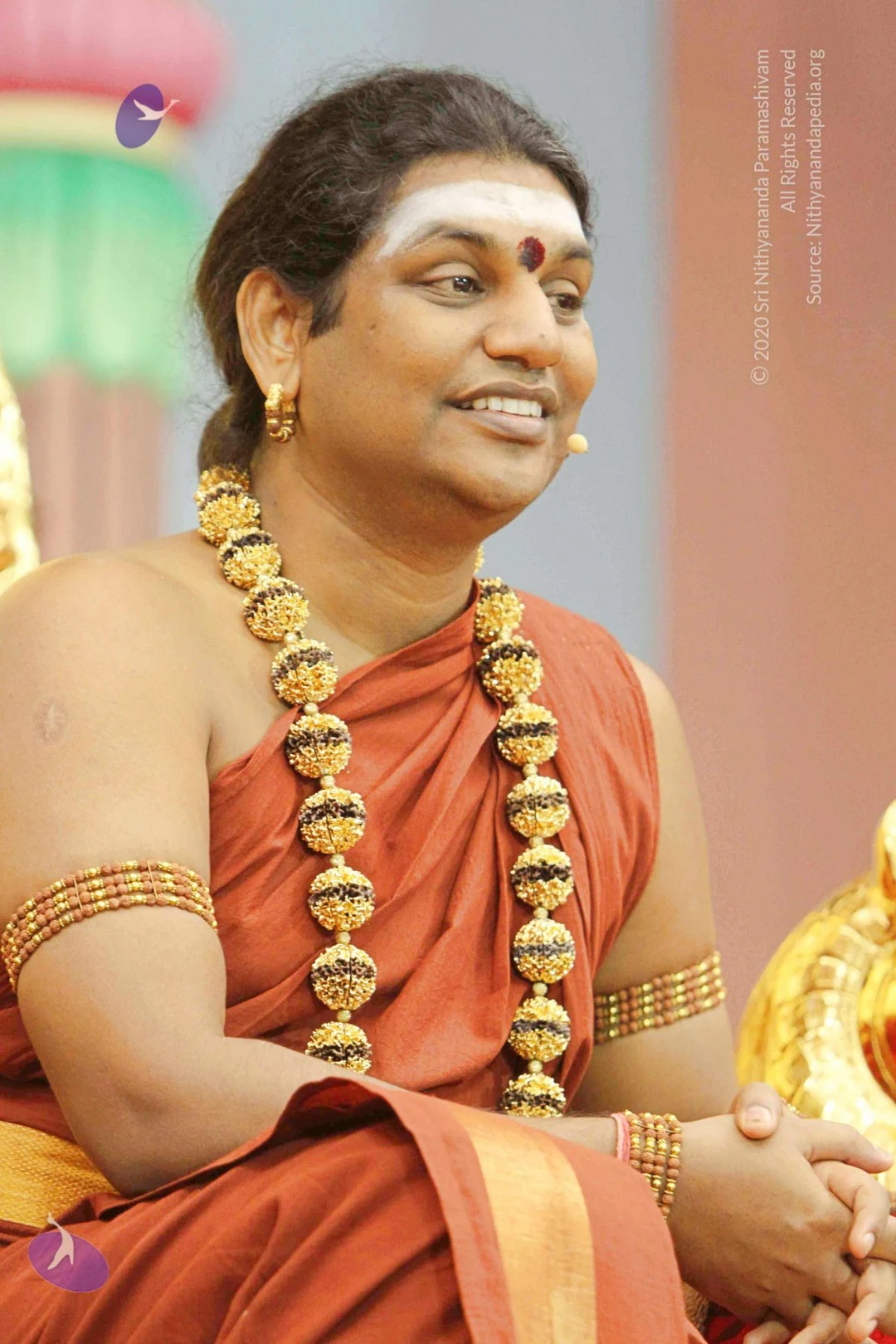
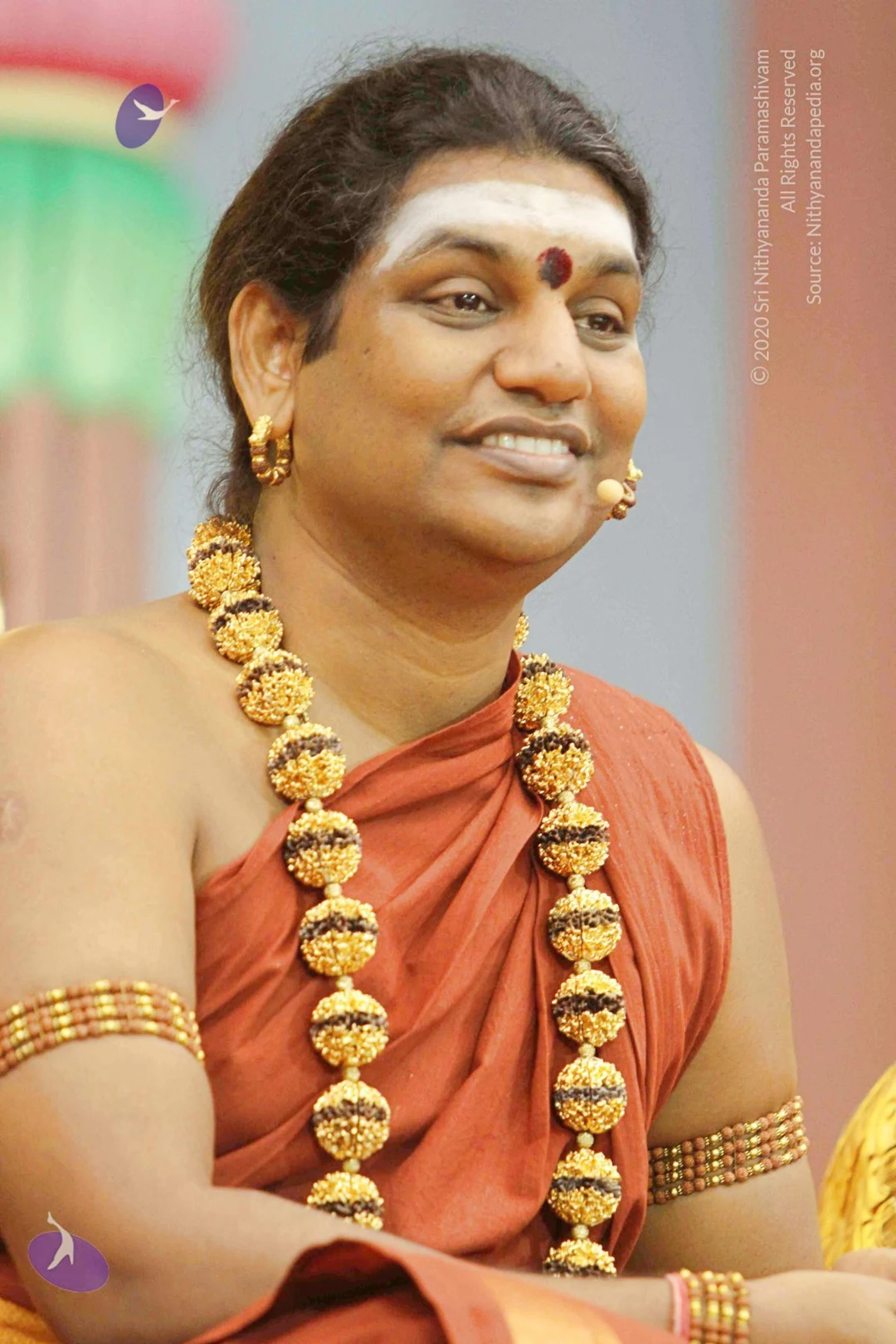
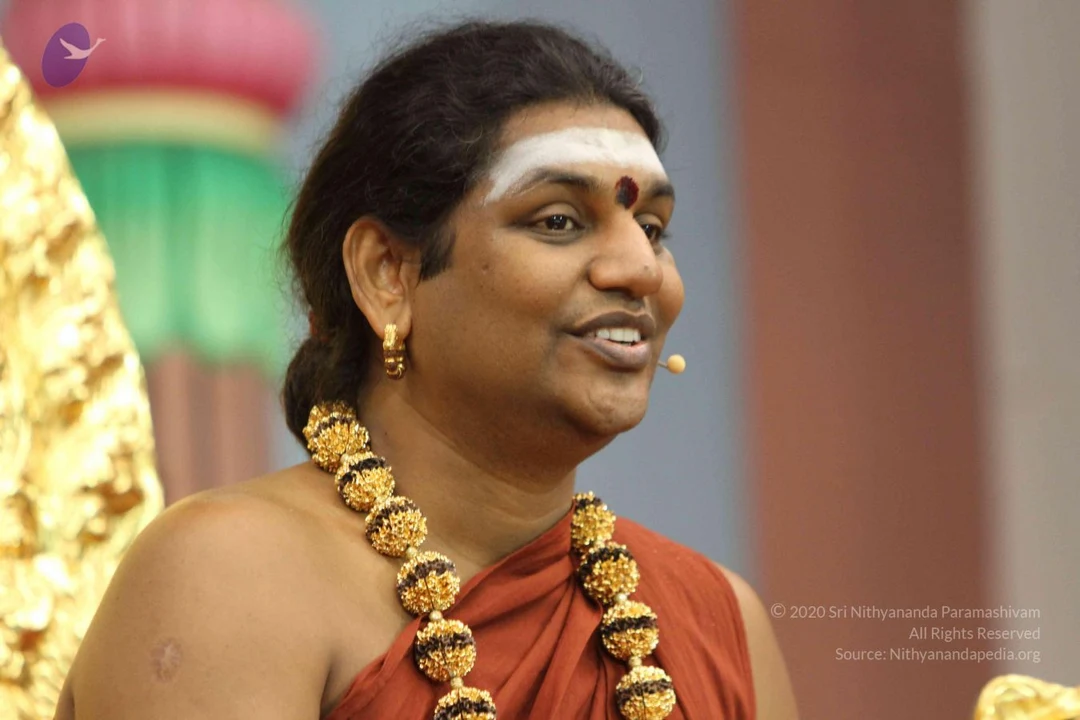
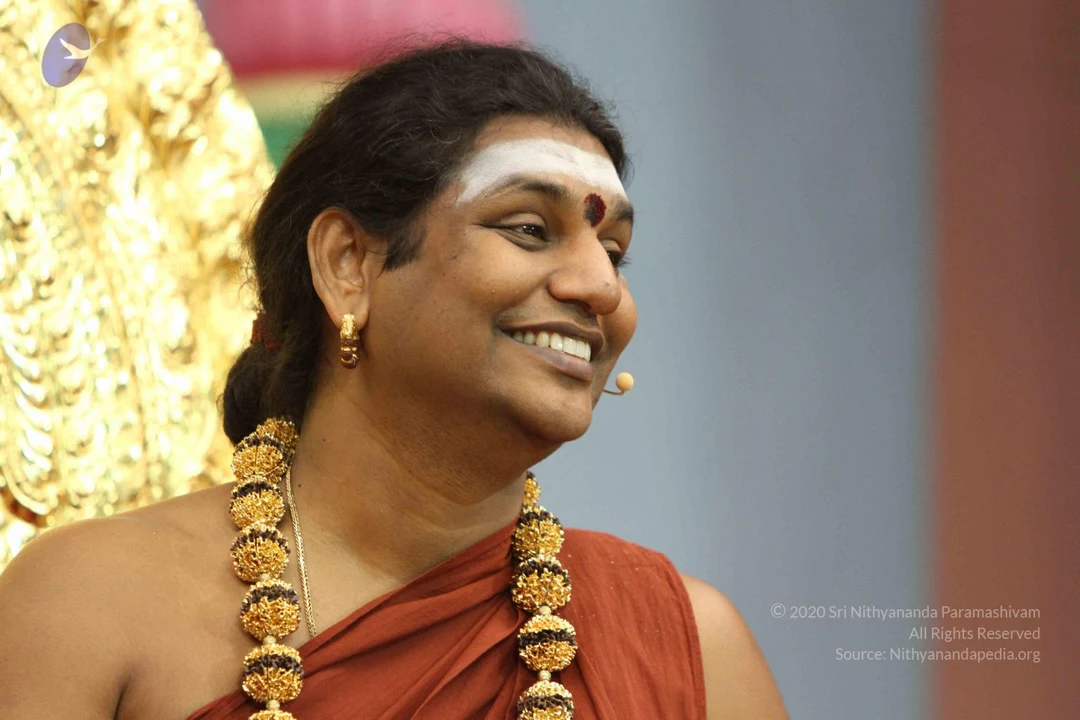
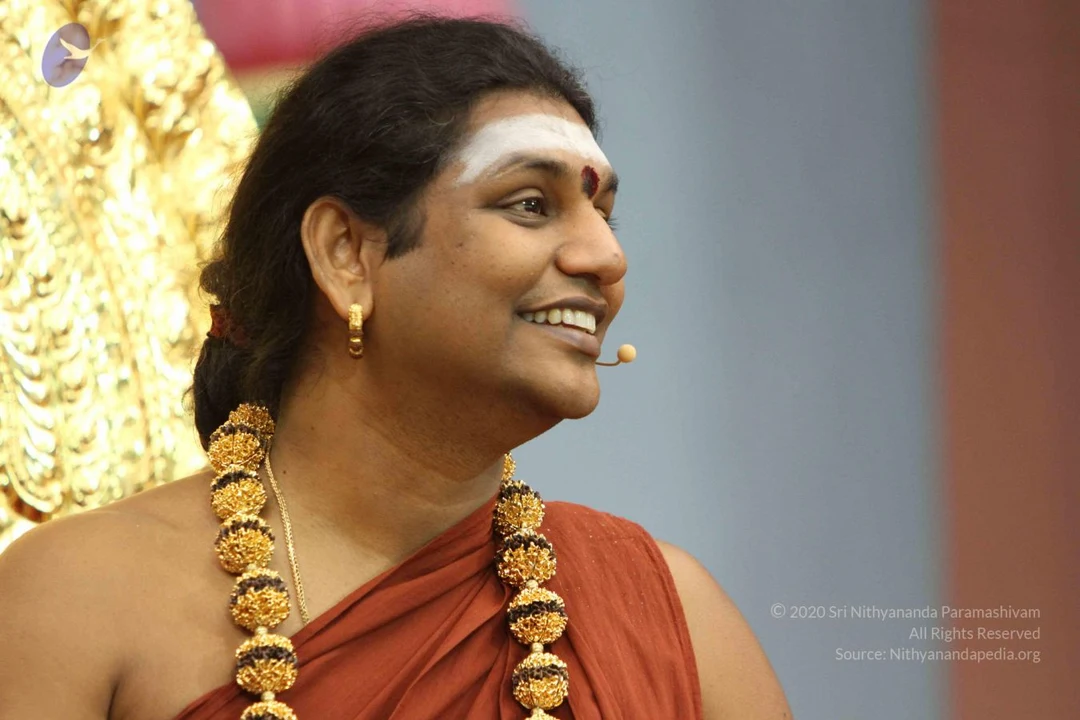
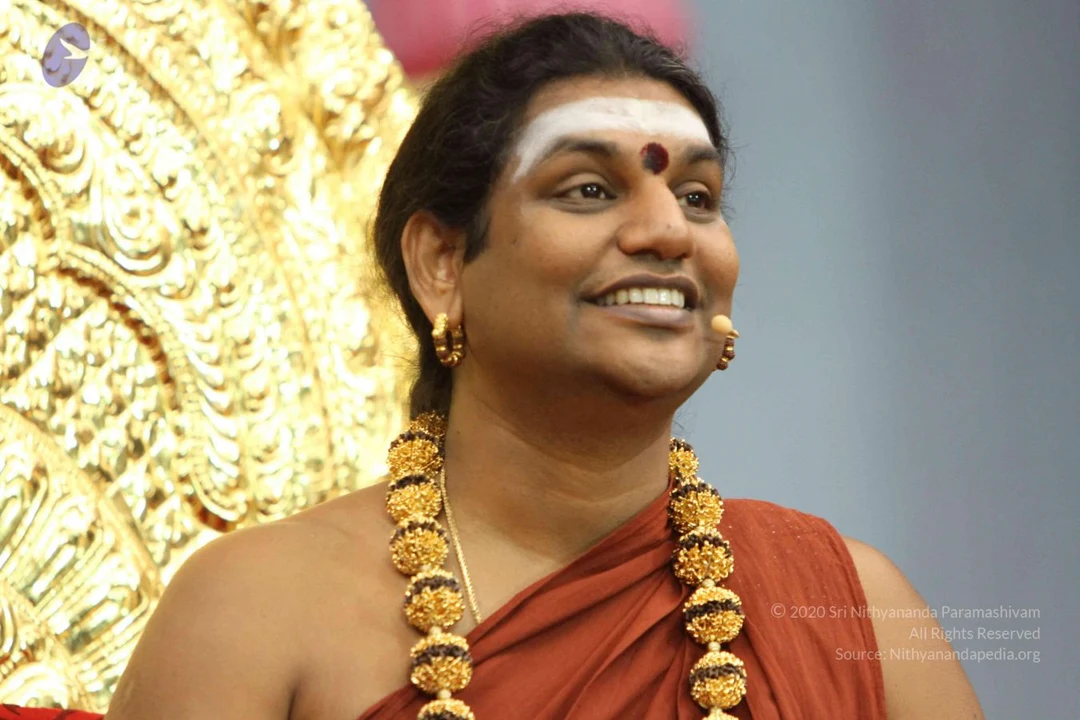
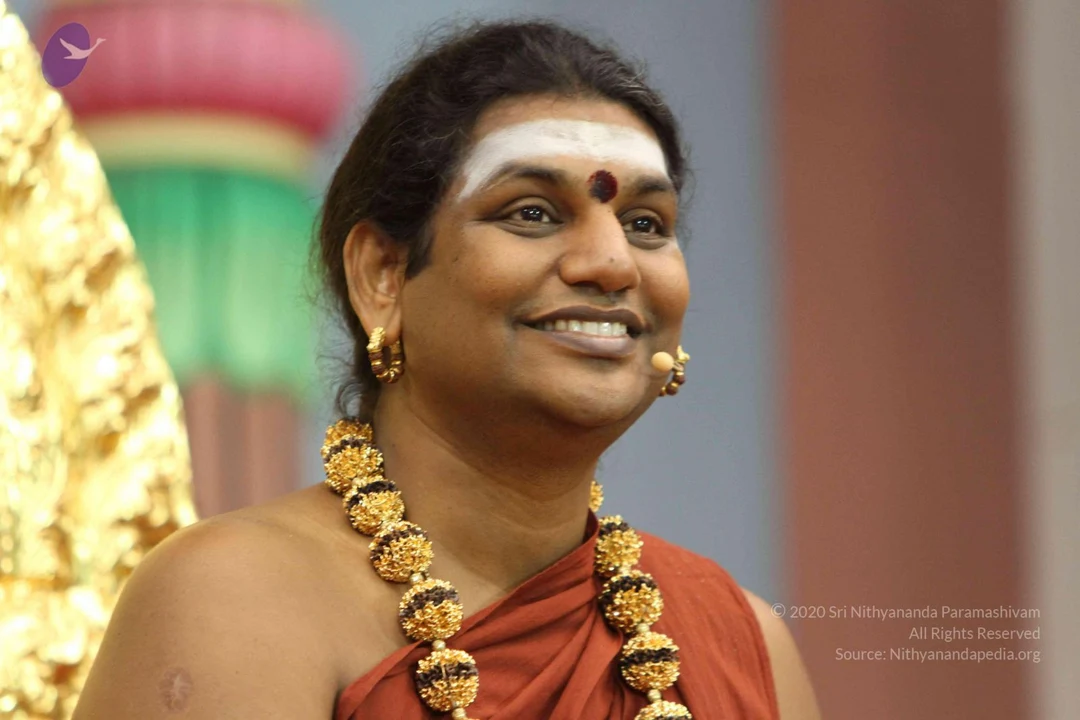
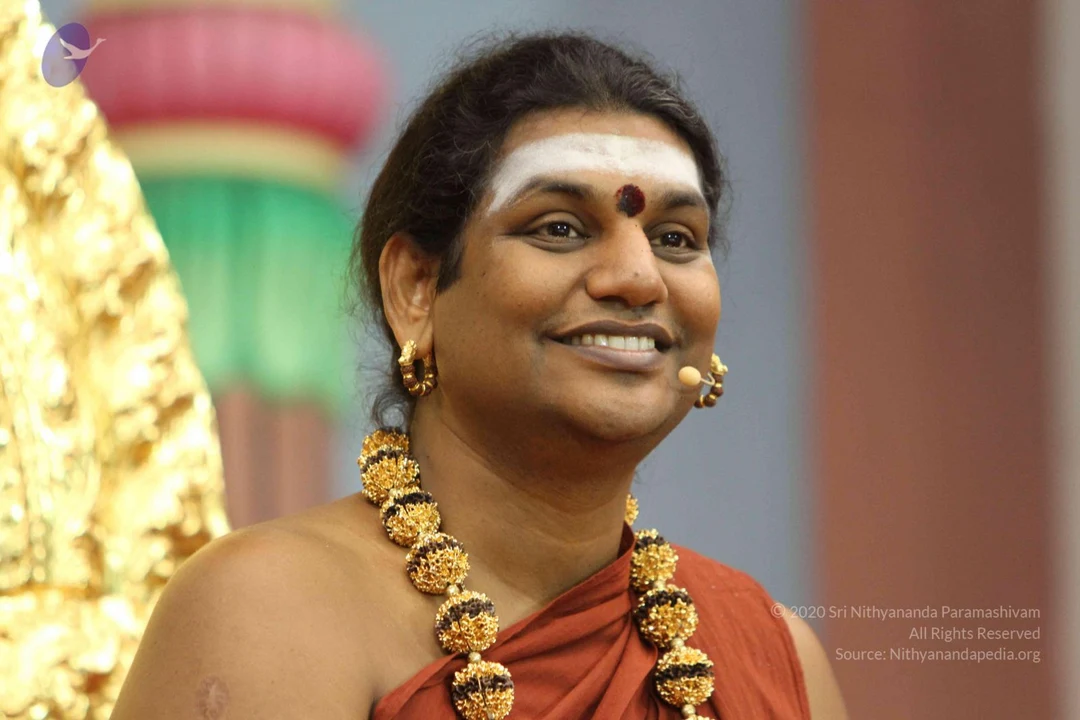
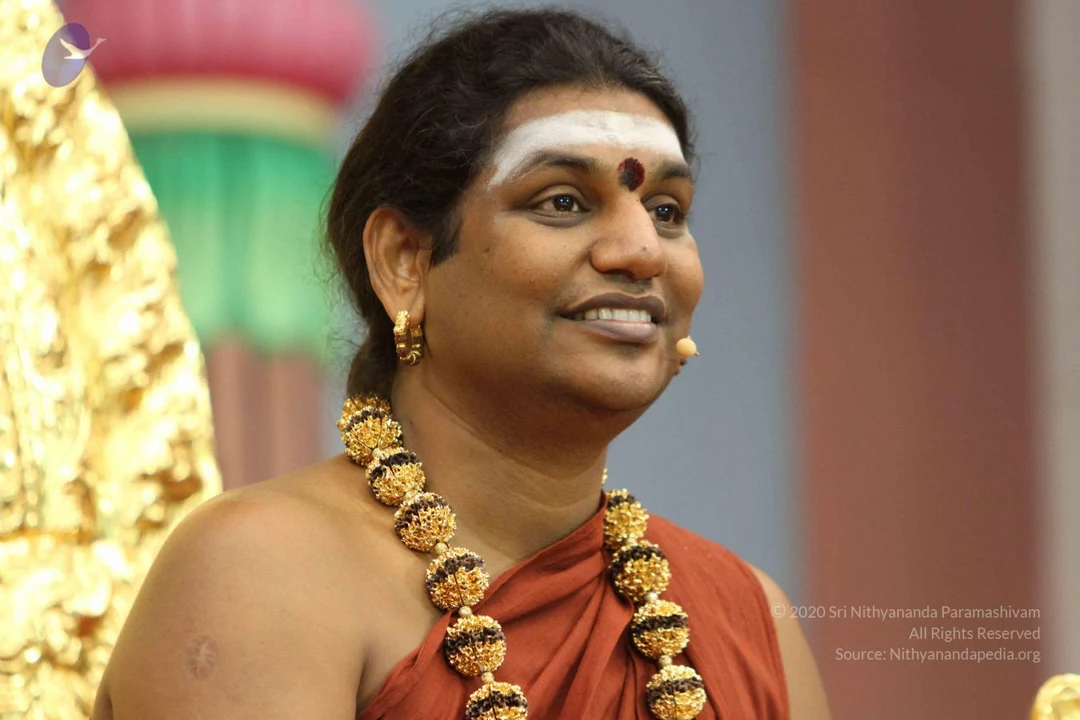
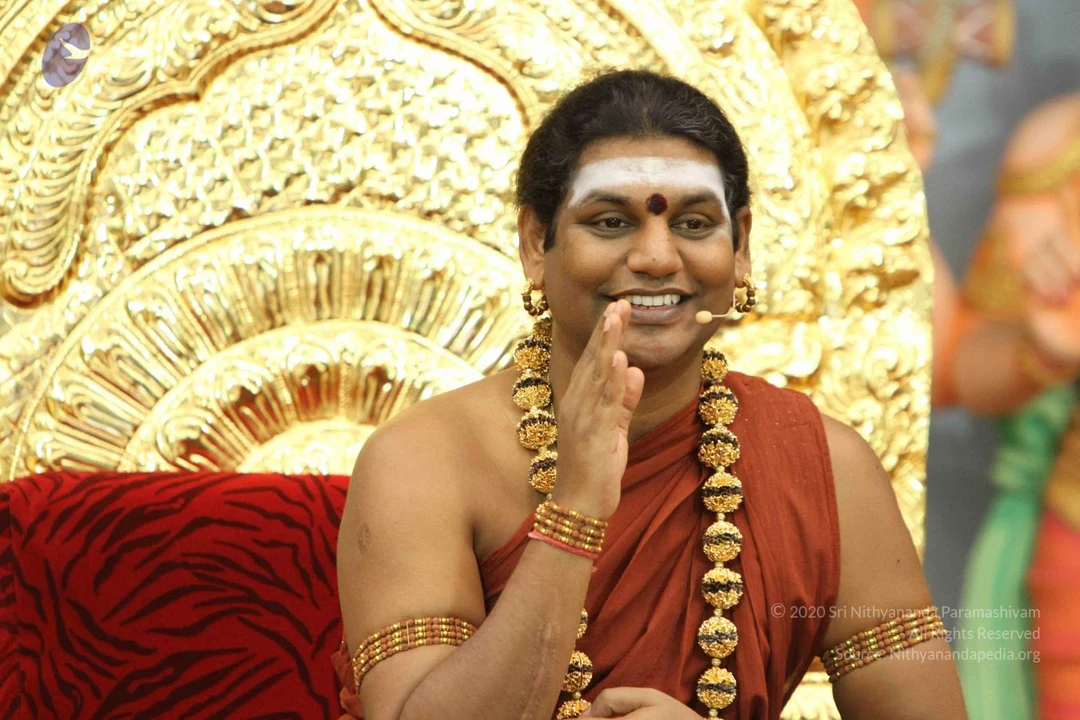
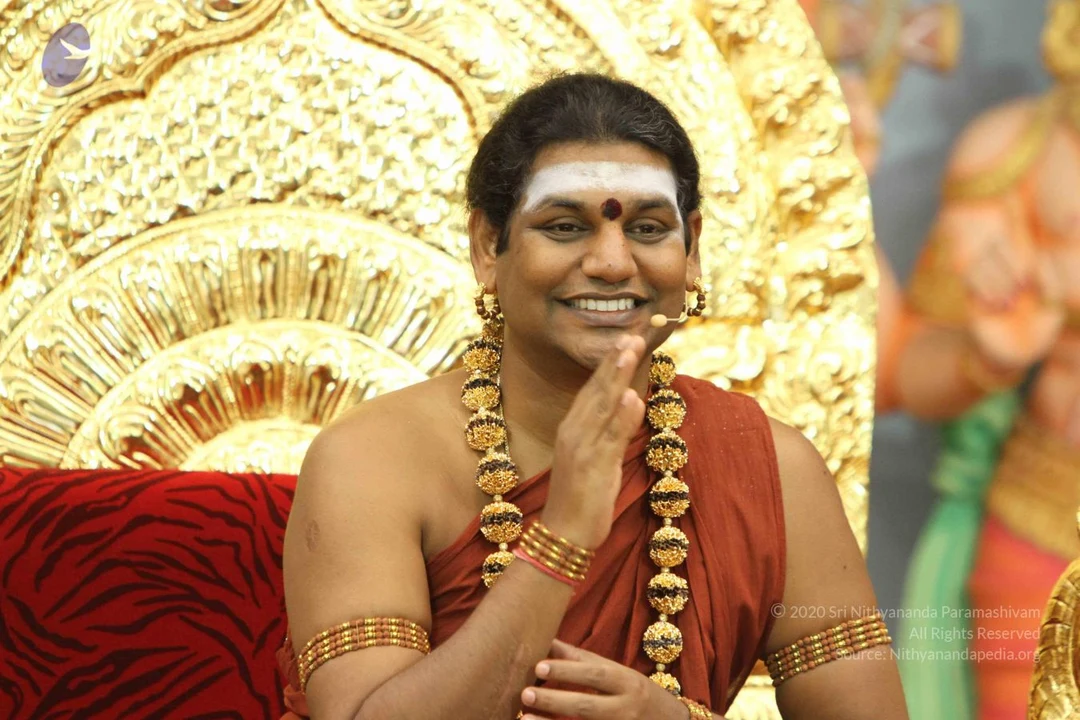
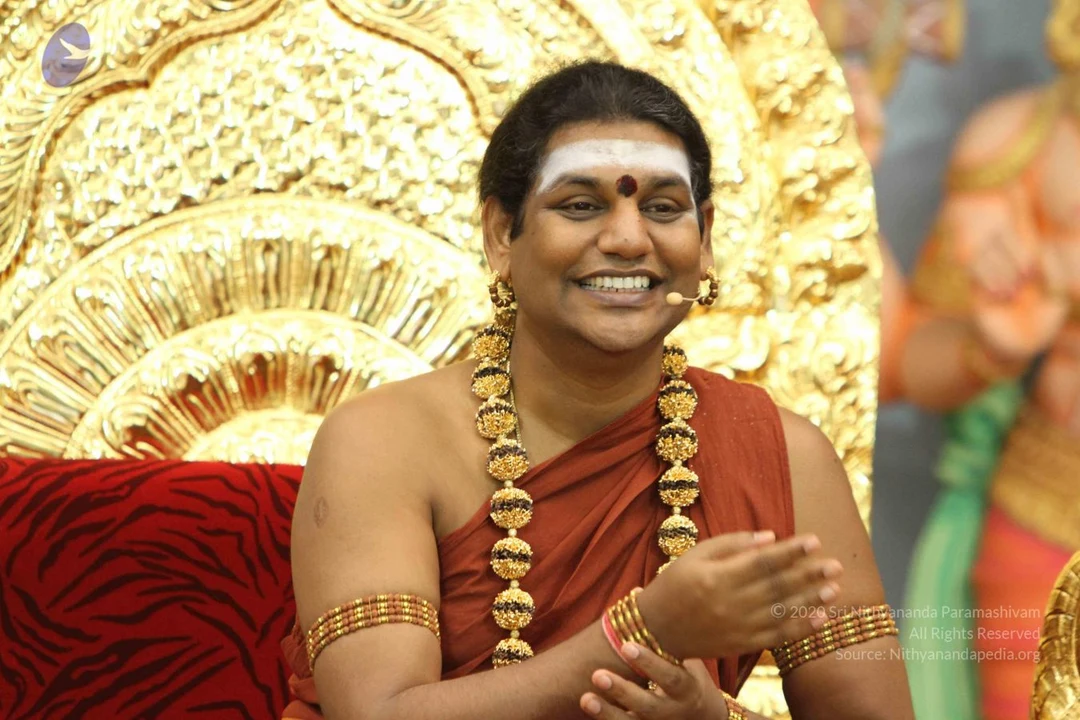
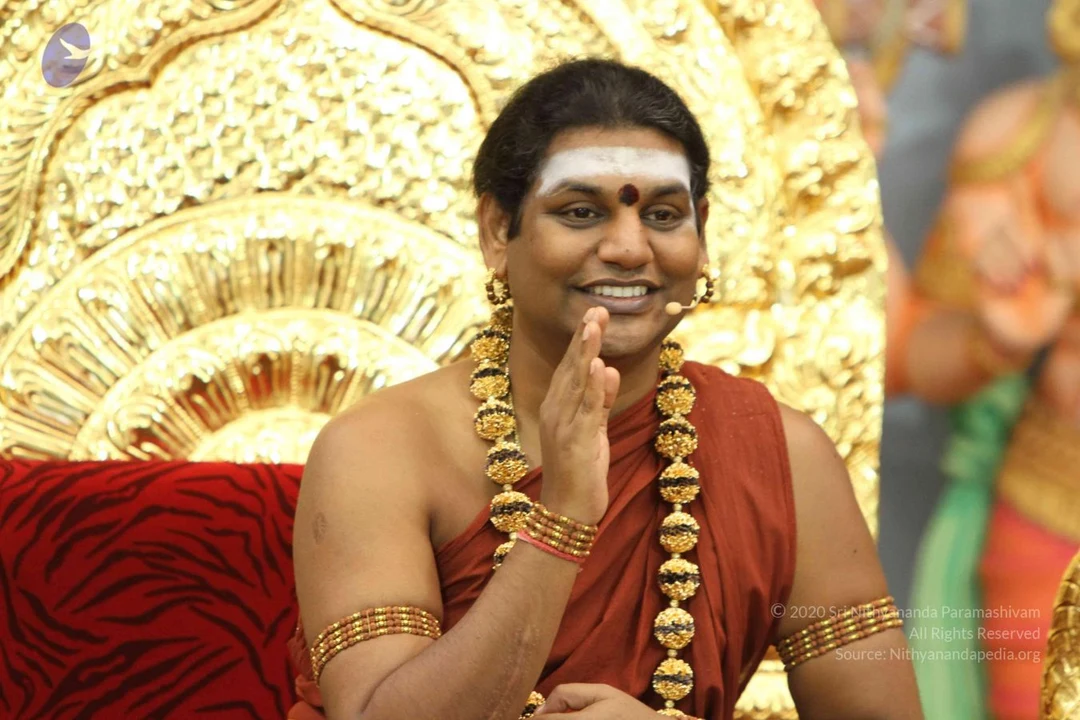
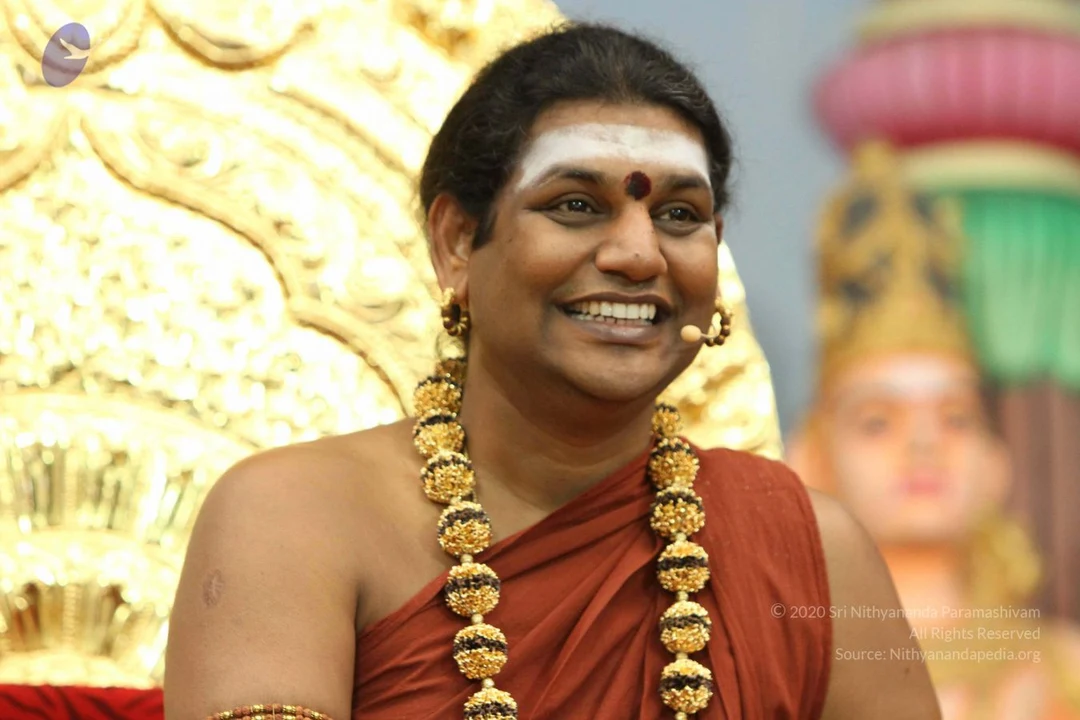
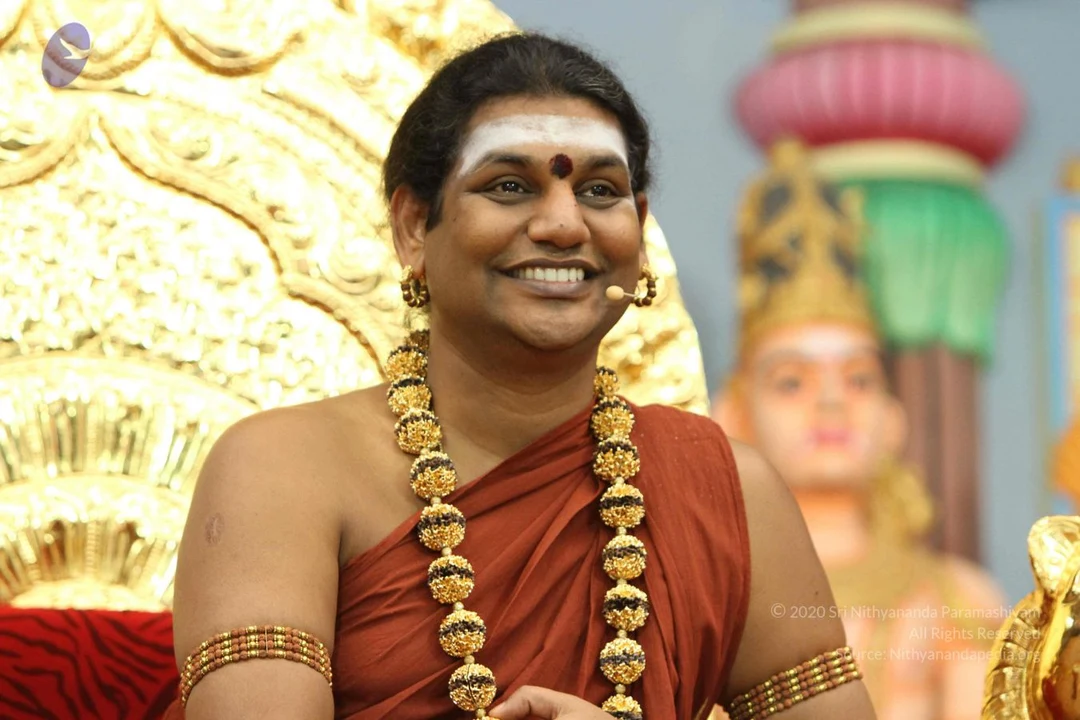
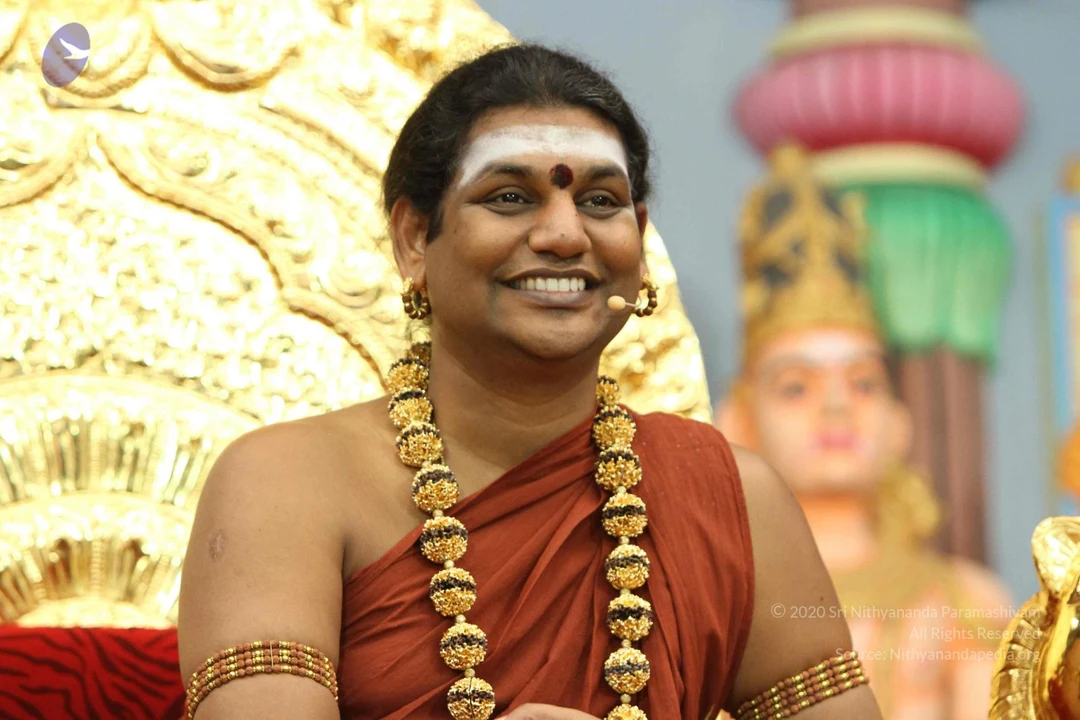
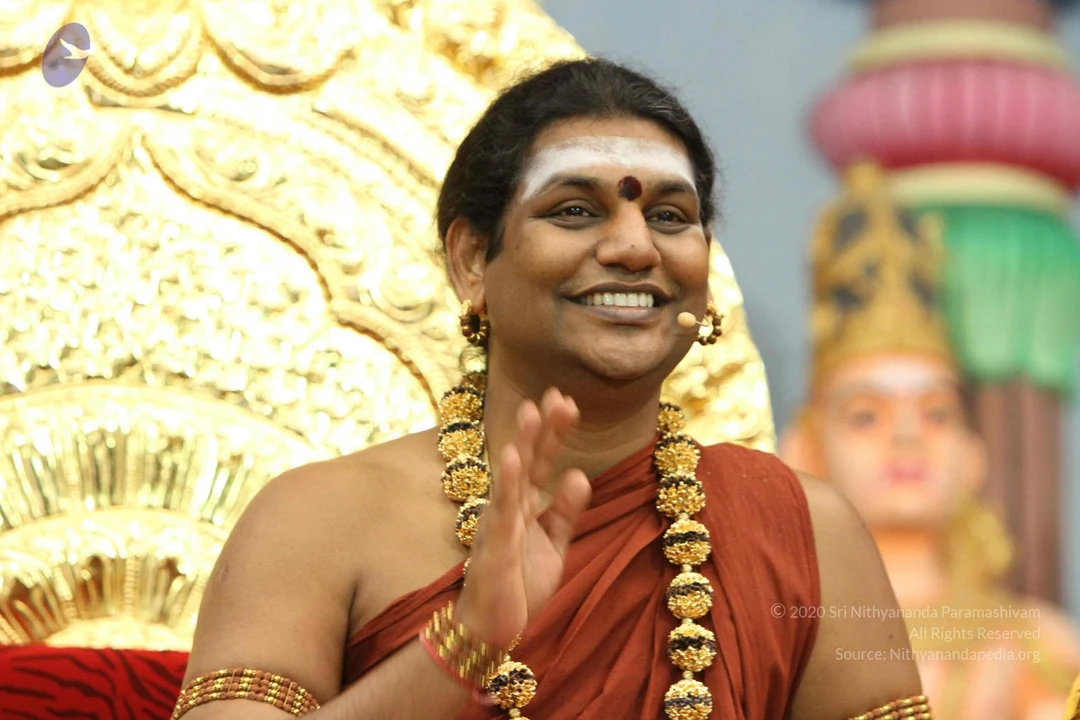
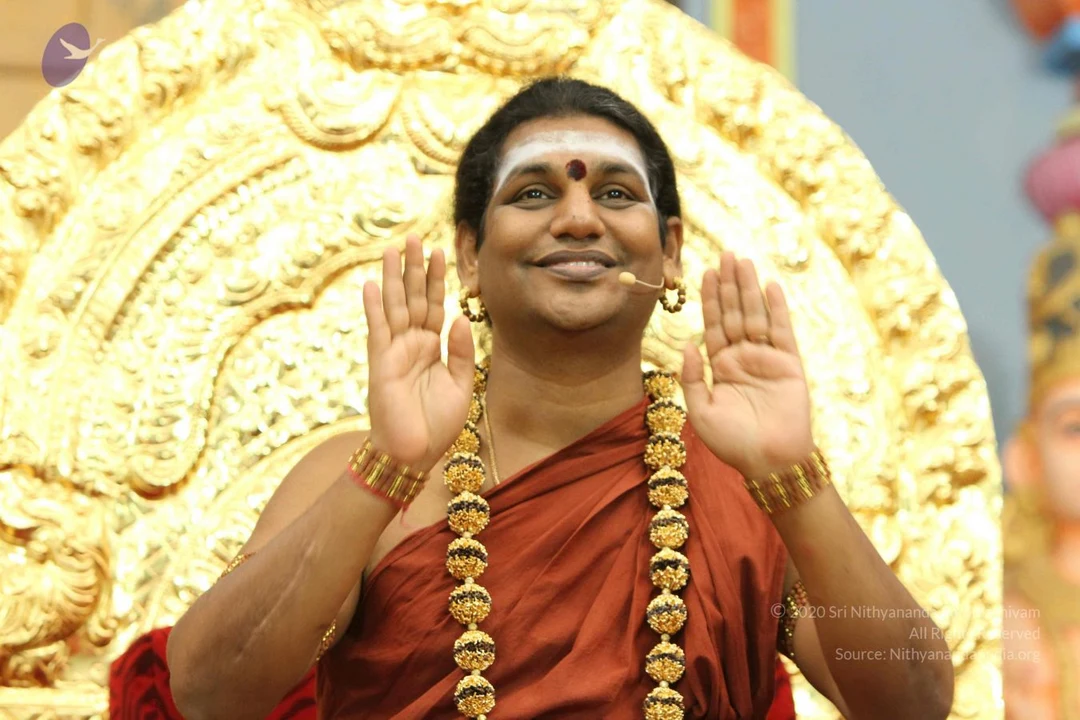
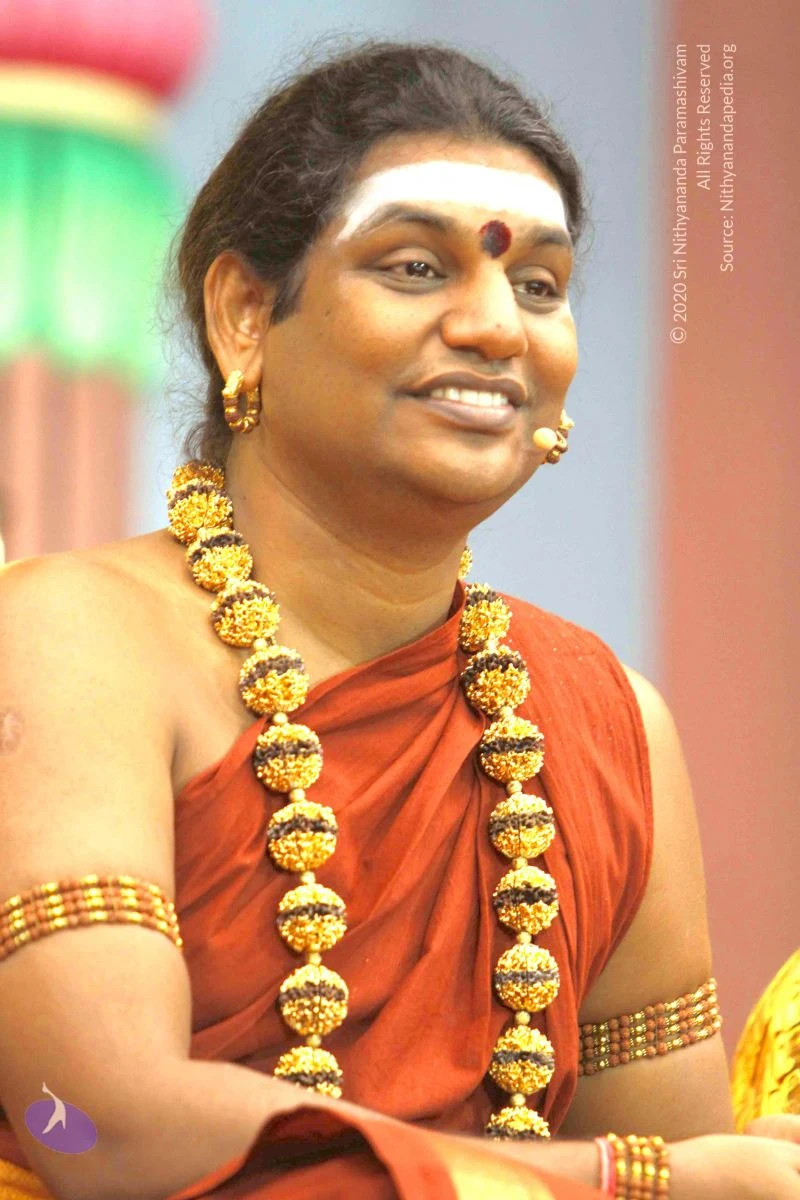
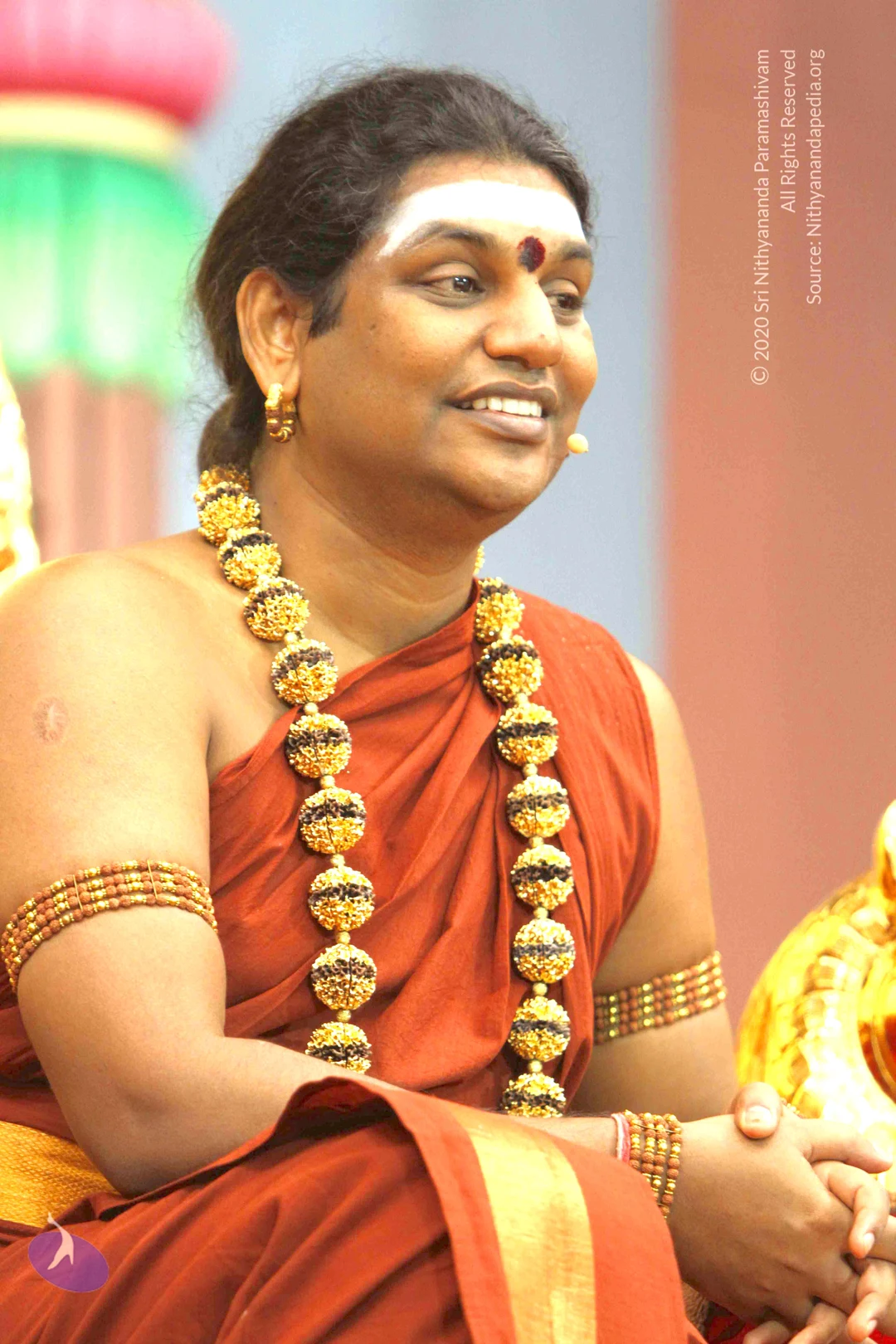
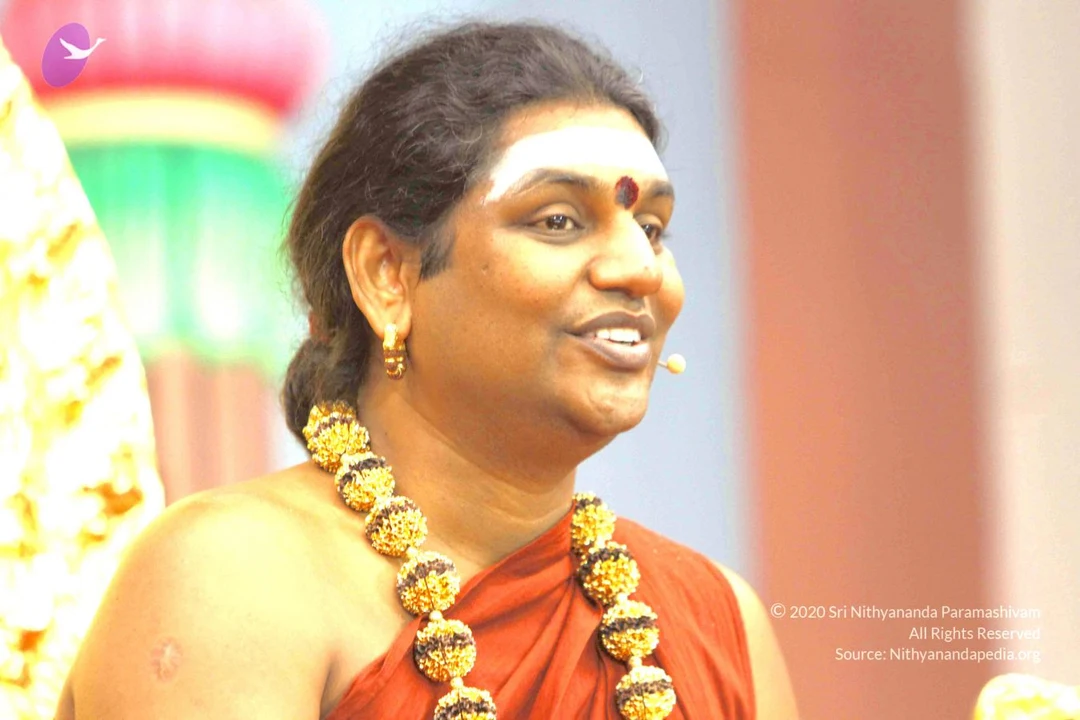
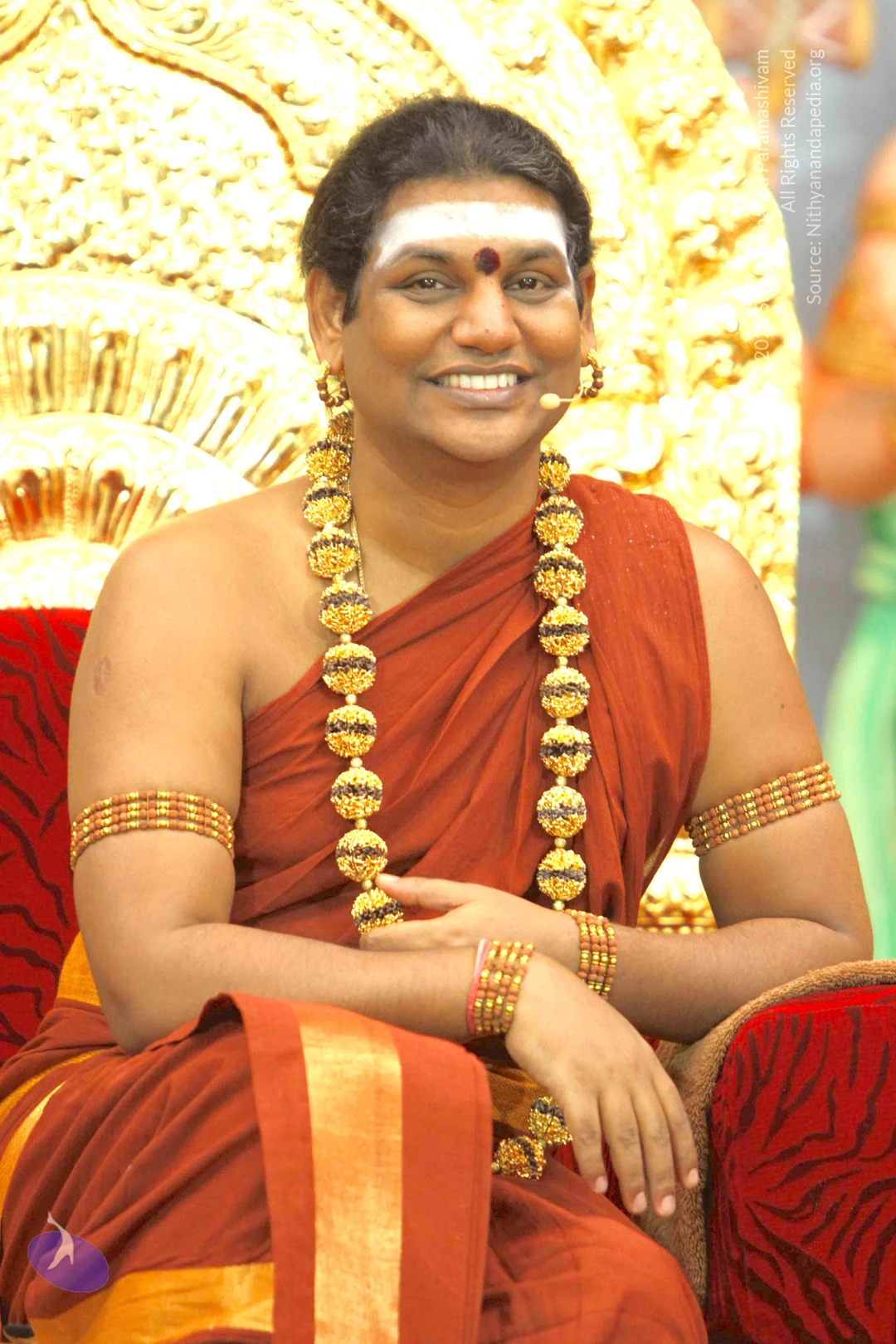
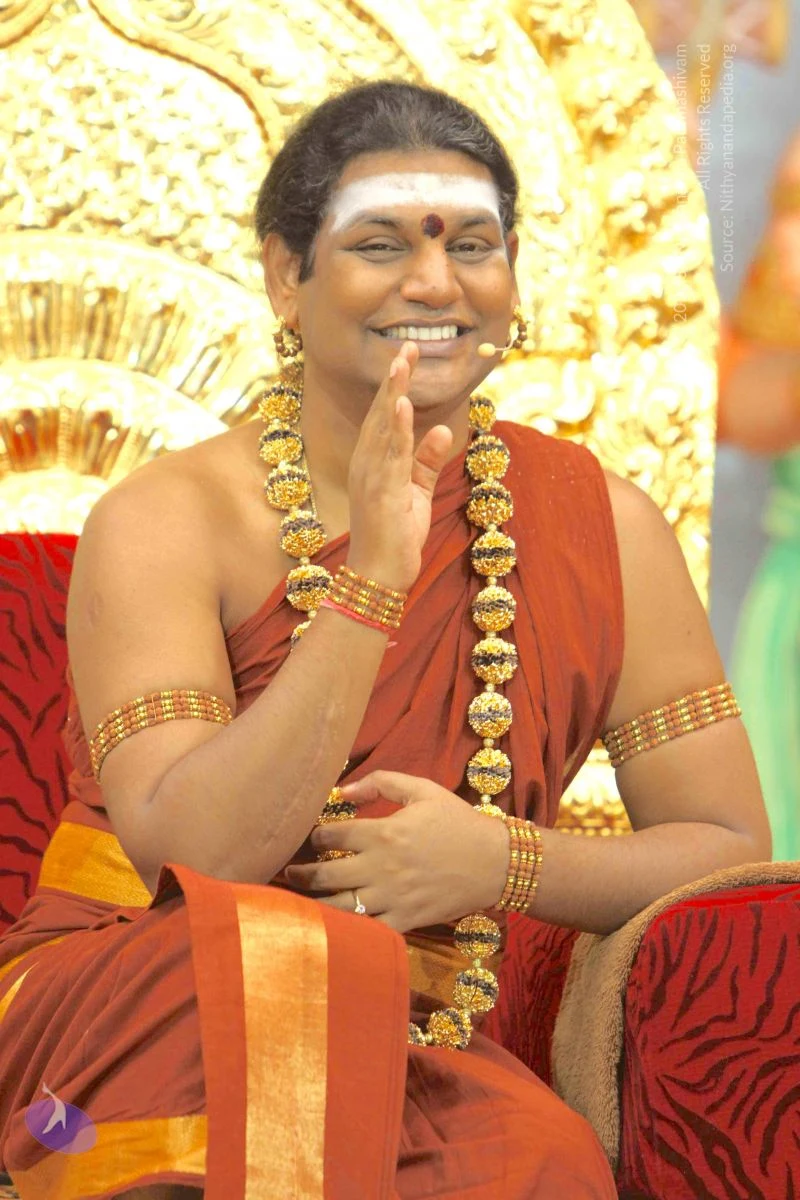
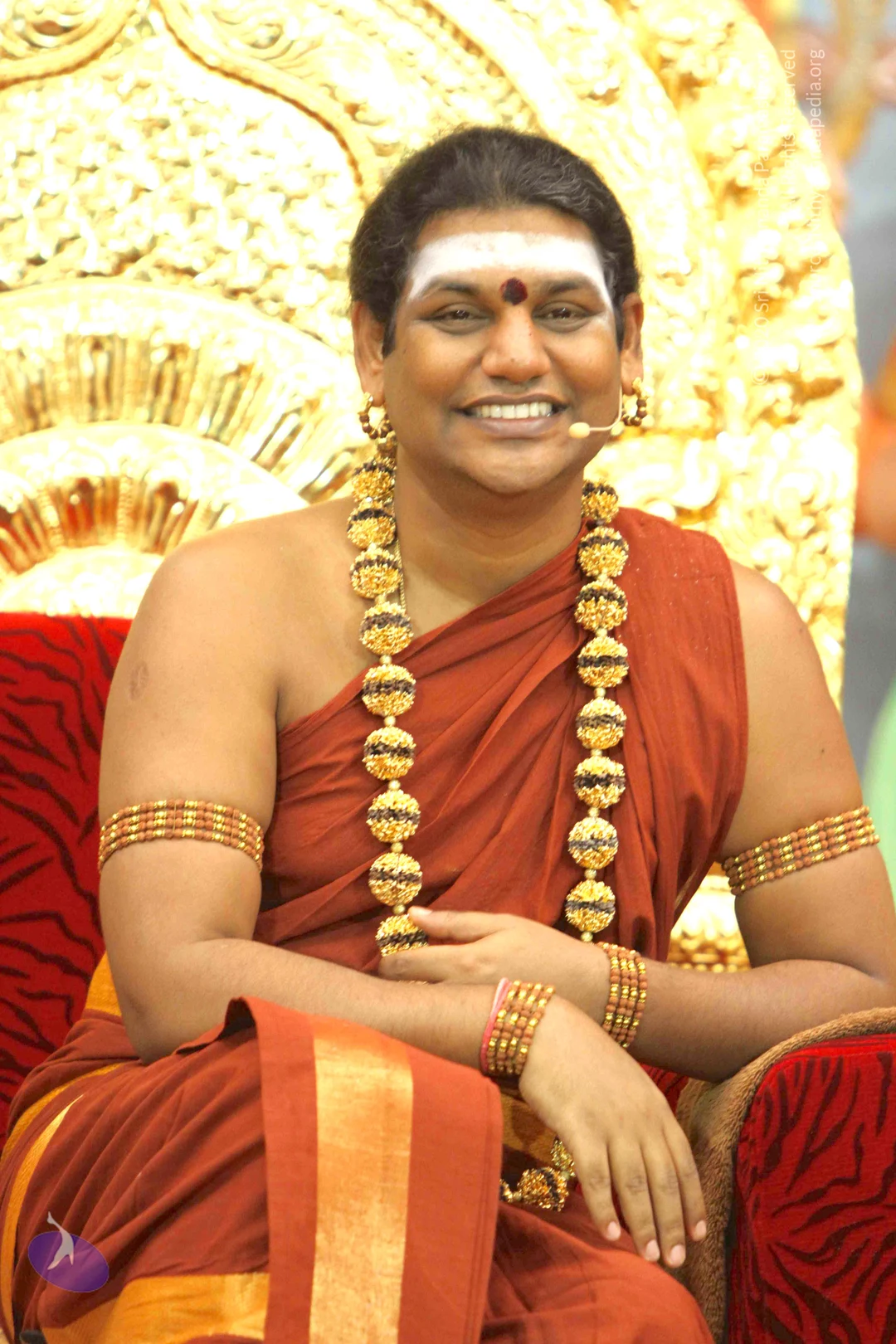
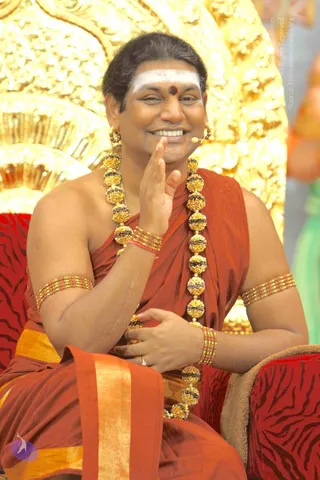
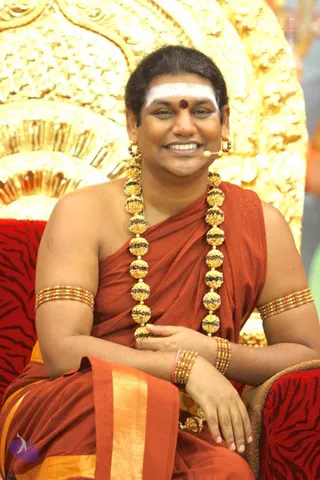
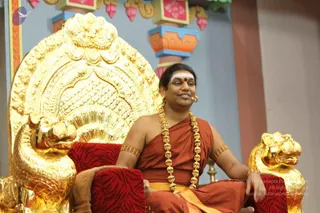
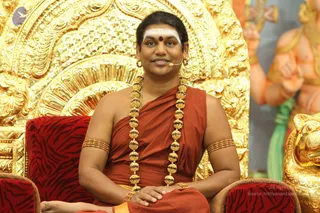
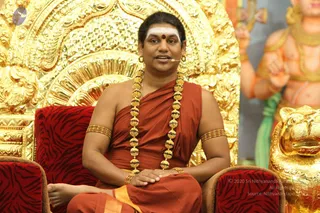
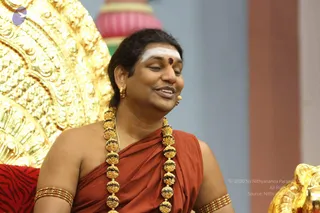
A smiling man with swept-back dark hair and a white horizontal forehead mark with a red dot sits in a saffron-orange draped robe with a gold-bordered edge. He wears a long necklace of gold-capped rudraksha beads, a gold earring, and beaded rudraksha armbands, with a small clip-on microphone near his mouth. His hands rest clasped in his lap, and a golden figure is partly visible at the right edge. The setting appears to be a stage or satsang hall.Photograph of a man seated at close range, smiling and speaking, with a small clip-on microphone at his cheek. He wears an orange-red shawl draped over the shoulder and a heavy necklace of large gold-toned beads alternating with dark rudraksha-style seeds, plus a gold earring. He has a white horizontal forehead marking and a small red dot between the brows, with hair swept back. Behind him, a gold ornamental panel is visible at left and a pink-and-green structure at the upper background. Appearance-based identification is uncertain; the single person is shown in a satsang-style setting.A smiling man in a rust-orange saffron-toned robe stands before an ornate gold-leaf carved arch, raising both palms outward in a blessing gesture. He wears a thick gold-beaded rudraksha-style mala with dark beads across his chest, gold bangles on both wrists, and gold hoop earrings. A white vertical forehead mark with a red dot sits on his brow, and a small clip-on microphone is attached near his cheek. Behind him, a partially visible colorful deity murti stands at the right edge.

August 19 2014

Original wiki page
Contents

Title:

Technique to Burn the Root of Suffering

Description:

In today’s (19 August 2014) morning satsang Paramahamsa Nithyananda expanded on the subtle dimensions of perpetual completion. He to;ld us ot complete with all the pain patterns for the next 45 days by doing the Samskara Dhahana Kriya. There are 5 steps to this process. 1-Sit and pen down all your pain patterns, 2- sit with them and relive 5 times to relieve, 3- sit with the mirror, 4- share with another person, 5-Listen to their sharing. This is to be done 48 times in the next 45 Days.

Link to Video:

==Link to Audio==

'Description: Technique To Burn The Root Of Suffering by HDH Bhagavan Nithyananda Paramashivam on 19 August 2014'

Transcript:

Nithyanandeshwara Samaarambhaam Nithyanandeshwari Madhyamaam | Asmath Aachaarya Paryanthaam Vandhey Guru Paramparaam ||

I welcome all the devotees, disciples, samajis, satsanghis, Shrimahants, Mahants, Kotharis, Thanedars, sitting with us all over the world through Nithyananda TV, Sadhna TV and two-way video-conferencing having Nayana Deeksha.

Cities sitting with us through two-way video-conferencing having Nayana Deeksha: Singapore-Singapuram, Phoenix-Kanchipuram, Kulim-Tiruttani, Hyderabad-Gupta Kashi, Dakota Dunes, San Jose-Madurai, Nithyananda University-Paris, Philadelphia, Port Washington-New York, Hebbal-Bangalore, Jorpati-Nepal, Ohio-Prayag, Guadeloupe-Rameshwaram, Ohio-Ma Shivananda, Seattle-Chidambaram, Hong Kong-Sirkazhi, Amersfoort-Netherlands, Scottsdale, Houston-Kalahasti, Rheinberg-Germany.

I welcome all of you with my love and respects.

I can see now Kathmandu Nepal-joining, and Houston-Kalahasti.

I welcome all of you with my love and respects.

2:28

Listen. Today I will expand on PERPETUAL COMPLETION, one of the important dimensions of Living Advaitha. Please listen.

Almost last two years, a little less than two years, I am expanding on this one Science of Completion from various angles, through various ways, through various understandings. See, any science, only if you spend more and more time, energy into it, is expressed perfectly. See, I have experienced this science perfectly at the age of twelve, but expressing it perfectly for all of you to live it, bringing perfection in the expression so that all of you also can experience it; that is what I was doing in last two years - continuously speaking on this one science, this one system. So, please understand, continuously speaking on this one science and one system. Today I wanted to expand on a different dimension of Completion, the dimension of Perpetual Completion, that happens, please understand, that happens by constantly completing not just with your root pattern, all the pain patterns. Please listen; not just your root patterns, all the pain patterns. It means, at least forty-eight times you should do Samskaara Dahana Kriya.

See, there are some of the very powerful, strong spiritual practices. In Hinduism, Vedic tradition, we are too fanatic about spiritual practices. I myself have seen sadhus keeping their one hand up, raised for years. ‘Years’ means don’t think two-three; twenty-five, thirty years. Fifteen years standing on one leg. The leg on which they are standing it has become literally like a pillar. But, the power, the will is so much; it just surpasses the laws of physical world, rules and regulations of the body. It just surpasses, takes them beyond even the pains of hell and pains related to body.

6:57

If you are too serious and sincere about spiritual practice; I am not asking you to keep your hands up for twenty years or stand on one leg for twenty-five years. No! Nothing of that is required. Forty-eight days do Samskaara Dahana Kriya. It does not even need to be like every day. You can do it one week, and give three-four days break, then again one week, again two-three days or few days break. But, forty-eight days of Samskaara Dahana Kriya can solve thousands and thousands of pain patterns in you. Please understand, for all the residential ashramites I used to insist on every night Completion, sitting and doing Completion, sitting and doing Completion, sitting and doing Completion; but, unfortunately, anything you need to do just with yourself, you don’t do. When you start doing, you just drift away into some of your strong pains and fall asleep from that pain, not from the Completion, and have nightmare; next day morning get up and fight with everyone.

So, understand, this is the direct instruction to the whole Sangha from Kaalabhairava: Within the next three months, every Thanedar, Kothari, Mahant, disciple, should do forty-eight days Samskaara Dahana Kriya. Per day it won’t take more than two-three hours in the initial level. Then, after sometime, it may take only twenty-thirty minutes.

Samskaara Dahana Kriya has four layer. Please listen to the instruction:

· First, sitting and penning down all your pain patterns.

· Then, re-living them in your inner-space.

· Then, re-living them using the mirror.

· And, sitting with somebody and sharing. And, listening, providing listening for them to complete.

Understand, this Science of Completion, understand, this Science of Completion is so powerful, it can just destroy so much of pain you carry which you are not completing by every-day Completion. Somehow, this every-day Completion....see, the every-day Completion is like only for the elite, soft type of people who wants to do spiritual practice on their own, and whose shraddha is very high. But till you evolve to that level, you need a very gross practice. Samskaara Dahana Kriya is the best where you yourself can understand whether you did it or not, and others also will understand whether you did it or not.

TILL THE GRASS GROWS ON THE PATH YOU WALK EVERY DAY, please understand, that is the signal; the ground on which you are walking every day, the grass should not die! Then you don’t have pain body! If the grass is dying on the path you are walking, be very clear, still the heat of the pain is there in your body. Pain exists in you as a unique heat and vibes, unique vibration. The moment you put your foot in any place, even the grass does not grow in that place any more. Till the grass starts growing in a place you walk, you should do Samskaara Dahana Kriya.

13:21

And I also wanted to update the Nirahara Samyama instruction. During the Nirahara Samyama time, whatever, how many number of days – Level-1, Level-2, Level-3, Level-4, all the thing you put, it will come around forty-eight days I think – whatever number of days, you do whatever level of Nirahara Samyama, you should do Samskaara Dahana Kriya every day.

Samskaara Dahana Kriya is one of the very important spiritual practice should be done. Including the gurukul Bala Sants and gurukul kids, from today all the residential Kotharis, Thanedars, Mahants, Shrimahants should spend every night, whatever time it may take. If it takes only twenty minutes for you, finish that and go. See, first few days only, when you sit and write all the earliest pains, so much will come out. After three-four days, those pains will have no more power over you. Then whatever you remember, only those things, whatever still is fresh, whatever is still hurting you, only those things pen down.

So, understand, this Samskaara Dahana Kriya is one of the very comprehensive Completion processes. When you just sit and re-live, sometime you miss some incidents, you miss the depth, you missed catch the exact pain pattern. But the Samskaara Dahana Kriya is the most powerful process. This unique powerful Completion process has four step:

· Start penning down your earliest memories of your life, all the pain patterns, pains you experienced in your life - physical pain, mental pain, emotional pain, psychological pain, all the pains, pen them down.

· And re-live them in your inner-space and relieve - at least five times.

· Then, re-live them and relieve them using the mirror.

· Then, sit with another person, go on sharing. Share at least five times. Listen at least five persons’ Completion story.

Please understand, this is the most perfect comprehensive Completion process.

17:21

I wanted all the Kotharis, just pick up the bunch of this completion process, Samskara Dahana print out paper and pen, go and sit even in malls and conduct this Samskara Dahana Kriya. Go and sit in libraries, malls, schools, colleges, everywhere, prisons, offices, wherever human-beings are gathering, temples, churches, mosques. Wherever human-beings are gathering, go and sit. Be light unto yourself and to the humanity. I tell you, this Samskaara Dahana Kriya is such powerful Completion; it relieves people from so much of pain. This is literally spreading peace around the world. Teaching Samskaara Dahana Kriya, making people do Samskaara Dahana Kriya is the most powerful way of spreading peace, working for global peace, spreading peace, working for global peace.

Understand, first four-five days when you do it, you may feel, ‘Oh, pain comes back.’ No. There is no such thing as ‘coming back’. It never left you. Anything leaves you, leaves you ONCE FOR ALL. Anything is coming back, it never left you; it was inside you, hiding. You left it as a blind spot, unattended. Your aunty is hiding behind the uncle, uncle is hiding behind the grand-father, grand-father is hiding behind the pillar, pillar is hiding behind the post, post is hiding behind the door, door is hiding behind you! It is one hiding behind the other.

Understand, this Samskaara Dahana Kriya is the real way of spreading global peace, bringing peace to humanity. I want all the Kotharis, Thanedars, Mahants, to start practicing. And the devotees, disciples, everyone, please start practicing from today the forty-eight days of Samskaara Dahana Kriya. And, along with practicing, go round wherever you can and teach this Samskaara Dahana Kriya continuously. This will relieve thousands of people from all types of pain, sufferings, diseases, psychological illness. All our Healers, Living Advaitha Process participants, Inner Awakening Graduates, you should go round and conduct Samskaara Dahana Kriya process. If people are feeling shy to talk to each other, share their incompletions, let them sit with the mirror and talk to the mirror. But go on, on and on. At least five times talk to the mirror.

Listen. Samskaara Dahana Kriya has twenty-one action:

· Penning down all the pains you went through in your life - the first action.

· Second - re-living five times in your inner-space.

· Third, re-living using the mirror.

· Fourth, sharing with somebody five times.

· Fifth, listening to other persons’ incompletions – at least five members.

So, if you see, it will be twenty actions.

23:18

From today I'm initiating the whole sangha into Samskaara Dahana Kriya Marathon and Enrichathon. Enrich the whole world through this Samskaara Dahana Kriya. Please understand, so many pain patterns which you will not remember, which you will not catch it, which you will not smell, which are sitting inside you, you will catch it, you will smell it, you will recognize it, you will diagnose it, only when you are sharing with others. Because, while you are sharing, your awareness is naturally high, and there are tons of unsaid reasons, tons of unsaid reasons. You should sit and go on sharing, sharing, sharing the pain patterns which are fresh in you, which are not letting you be active, alive, intelligent. I tell you, this is one of the most powerful instruction, Kaalabhairava’s blessing to the whole Sangha. Forty-eight days of Completion with pain patterns, forty-eight days of Samskaara Dahana Kriya. After Completion, destroy the paper in which you wrote all your pains, and burn them away. If you are nearby our temple, centre, ashram, you can do Rudra Homa and burn those papers. Otherwise, just burn them safely and dispose them.

Start with the earliest painful memories of your life and recall all the unpleasant incidents of your life, and pen down. Once you pen down, re-live in your inner-space, and then re-live using the mirror, and then re-live using the other persons’ eyes by sharing. Be a space of listening for other person to complete.

You can add Samskaara Dahana Kriya in any programme, whether it is a weight-loss programme or fitness programme or Nirahara Samyama. If you are doing a fitness and weight-loss programme, add Samskaara Dahana Kriya on that topic – all the pains they had, unpleasant incidents they had in their life related to body. But, actually, when you write related to body, related to mind also will come. Let it come. It is okay. You can focus. You can focus. Other pains also will come. Let it come. No problem. If you focus the Samskaara Dahana Kriya on your guilt, I guarantee, you will walk out of cancer.

27:50

Before the eN-Pregnancy programme, the husband and wife, both of them should do Samskaara Dahana Kriya related to their own body and each others’ body, and lust pattern. Then they become a pure channel for enlightened being to land through them. Once a child is born, the mother should do Samskaara Dahana Kriya related to the pain she went through while carrying and delivering the child. That will heal the child completely. Otherwise, the pain of the mother gets stored in the bio-memory of the child.

Every night, after the Completion, Samskaara Dahana Kriya, burn those papers. And go to malls, schools, colleges, temples. All the Thanedars and Kotharis should do this as part of Enrichathon. First at least enrich fifty people to do Samskaara Dahana Kriya. Then you can enrich them for NDY and for Inner Awakening; you can do whatever you want. Enrich them first for Samskaara Dahana Kriya. Just like Nirahara Samyama, this science should be given free of cost. We should spread this Science of Completion to at least million people within this year. At least one-million people should do forty-eight day Samskaara Dahana Kriya.

The comprehensive instruction to do the Samskaara Dahana Kriya, we can send it to all the Kotharis and Thanedars, through your e-mail ID. Read, educate yourself. You yourself start doing from today for next forty-eight days. Literally your inner-space should say, ‘I don’t have any more pain to complete.’ ‘I don’t have any more pain to complete’ should become one more pain; till then do Completion. You should feel ‘I have no pain to complete’! It will never be one more pain; don’t worry! Till you feel that, go on doing Samskaara Dahana Kriya. Because, even if you complete with your root pattern, if you have not completed with the pain patterns, they create silly pains in your life, like silly sufferings, stupid incompletions, they try to create. So, the best way is forty-eight days of Samskaara Dahana Kriya, understand?

32:25

In Inner Awakening, just one day you do Samskaara Dahana Kriya. You know the effect and result. Forty-eight days means literally like washing your inner-space with Completion. If you are fortunate enough to get the opportunity to meet with your teamily every day, how the residential ashramites get the opportunity, that is great; every day you are developing more and more and more Completion with your teamily, leading you to more and more Advaithic process, Advaithic experience.

Understand, the pain of unfulfillment will leave your system if you do Completion, Samskaara Dahana Kriya for forty-eight days. The pain of unfulfillment, understand. The pain of unfulfillment which you carry in your life constantly, which started in your life the moment the root pattern started, that will melt down. The more and more beings you cause Completion, the more and more you become complete. The more and more people you cause Completion, the more and more you become complete. The more and more human-beings you lead them to Samskaara Dahana Kriya, more and more of your samskaaras get burnt. Literally, this process, when you enrich others, enriches you. After ten-fifteen days, the subtle pain patterns will start coming out, erupting out. Completion with all of them, those subtle pain patterns, pain points, leads to deeper and deeper cleansing.

And, I tell you, forty-eight days of Samskaara Dahana Kriya will surely give you some Siddhi, some miracle power. You will understand all your sufferings you accumulated very playfully. Playfully you started fighting with the cub; suddenly it has become lion one day, and you call that as ‘suffering’. But it never came without you inviting. It was you were playing with it very playfully, because, at that time, it was cub. You never imagined when it becomes lion it is going to be painful for you. All your sufferings, you were playing with them as cub, saying, ‘so cute, so cute! See this fellow’s teeth; he is trying to bite me. See, this fellow’s tail.’ Even if he runs away, you dragged him to your lap and playing, teasing, literally opening his mouth and putting your finger in his mouth. When he became lion, he tries to do the same; you are shaken.

Look into all your problems; everything you dragged. Of course, when you drag when you wanted to play, it was a cub, it was a play, cute entertainment, time-pass. Now, because you are not able to handle, it becomes ‘pain’. I tell you: One, YOU are responsible. Second, you CAN handle now. Even if you can’t handle, you know how to get rid. When you complete with all the powerlessness, the reasons for powerlessness, when you complete with every step of powerlessness, when you complete with every point of powerlessness, every samskaara, every pattern, every point, every step, every dimension of your life, when you complete, the new personality grows in you, new being grows in you.

39:14

If you think you don’t have time for the Samskaara Dahana Kriya, that is one more pain pattern. Sit and pen down when you started creating that pain pattern and complete. Your tiredness is a pain pattern. Boredom is a pain pattern. Being non-focused is a pain pattern. Getting irritated is from pain pattern. Anything which you have other than Samadhi is pain pattern. Anything which you have other than Samadhi is pain pattern. Sit and complete, complete, complete.

The whole Sangha should do Completion with pain patterns, Samskaara Dahana Kriya, and should enrich the world to do Completion, Samskaara Dahana Kriya. Please understand, this will be the most powerful, interesting, directly result-giving enriching you will do to the world. If you make ten persons to do Completion, most of your karmas will be burned away; because you are reducing so much of pain, suffering, karma load, immediately Mahadeva blesses you. You are doing his job. Now you are franchisee of his responsibility, understand?

All the Thanedars, Kotharis, Mahants, if you feel you have some pains, or world has some pains, please do this. Whoever believes they have pain and world has pain, do this Samskaara Dahana Kriya for the next forty-eight days. Enrich, teach! I tell you, there are millions of people who are suffering, waiting for some solution. They will listen to you. They will listen to you. You can complete with them. You can complete with you. You can complete with them. You can help them to complete with you. You can help them to complete with the world. Samskaara Dahana Kriya is one comprehensive process completes your root pattern, branch pattern, leaf pattern, fruit pattern. From your root pattern to fruit pattern, all patterns are completed. Samskaara Dahana Kriya is such powerful process, from your root pattern to fruit pattern, all patterns are completed.

43:30

Whoever wants to spread peace in the world, do good to the world, remove the sufferings of humanity, do Samskaara Dahana Kriya and spread the Science of Samskaara Dahana Kriya. Samskaara Dahana Kriya is the most powerful homa you will perform for purification. That is the most powerful Viraja Homa you can do. Viraja Homa means, homa for purification. The forty-eighth day you achieve the space of Viraja, pure inner-space. Actually, if you start today, the forty-fifth day comes as Vijaya Dashami. May be, the last three days you can do twice – morning and evening. And Vijaya Dashami day we can conclude. Even in-between, few days if you want, you can do morning and evening, and take few days break. So, keep it this way: at least forty-eight times you should have done. Before Vijaya Dashami, let all Thanedars, Mahants, Kotharis, Bala Sants take the sankalpa, ‘We will do forty-eight time Samskaara Dahana Kriya.’ Two-three time, sometime due to boredom or some reason, you may do it like a ritual. It is okay. But forty times you will do it intensely. Eight times maybe maximum you will do it as a ritual; that is okay. But forty times you will do it intensely with authenticity. Like how when the kids enter the gurukul, first few days they will do it like a ritual, the Guru Puja or the completion, all that. But, in ten days or a month, you know; the sincerity catches up, the sincerity becomes their bone structure.

I wanted all the Balasants to teach the science of Completion, Completing with the pain samskaaras to your teamily. I wanted each gurukul kid to develop a teamily with twenty-one kids from among the Bala Vidyalaya kids from all over the world. I will provide the Internet connection with web-camera to all the gurukul kids. You choose twenty-one kids all over the world, among our Bala Vidyalaya kids or youth club team kids; make your teamily. I want kids also to start doing ‘Living Advaitha Process’ and start doing Completion.

47:22

Samskaara Dahana Kriya Completion can be done even through two-way video-conferencing or the Skype call. But you have to see each other’s face. Only then it becomes effective.

So, every day, till Vijaya Dashami, we will all be doing the Samskaara Dahana Kriya, we should all be doing the Samskaara Dahana Kriya, so that peace is spread all over the world, we become more and more peaceful, more and more blissful, more and more spiritual, more and more energetic, more and more joyful.

Let us celebrate this Navaratri by completing with all our pain patterns. All our pain patterns are the Raktha Beeja Asura. Raktha Beeja Asura means, that demon’s even one drop blood when it falls on the floor, ground, it becomes one more demon. See, even one small cut on your root pattern, it becomes one more pain pattern.

Let us complete, complete, complete, complete. The Completion process is the Skull of the Kaali, Brahma Kapala in Kaali’s hand which drinks all the blood of Raktha Beeja Asura and stops Raktha Beeja Asura multiplying. This Samskaara Dahana Kriya is the Brahma Kapala which swallows all your pain patterns and stops the multiplying of all your pain patterns.

Samskaara Dahana Kriya means ‘burning all your pain patterns which is the root of suffering in your life’.

I want all of you to take the oath to live and spread the Science of Completion, Samskaara Dahana Kriya.

I bless you all. Let you all radiate with Integrity, Authenticity, Responsibility, Enriching and Causing eternal bliss, Nithyananda. Thank you.

Title:

Samskara Dahana Kriya - 5 step process for perpetual completion

Description

This video explains the steps in the Samskara Dahana Kriya, the five-step process for achieving perpetual completion by completing with all our pain patterns.

It is an excerpt from the discourse 'Technique to Burn the Root of Suffering' delivered on 19 Aug 2014 by Paramahamsa Nithyananda.

Link to Video:

Link to Audio

'Description: Samskara Dahana Kriya - 5 Step Process For Perpetual Completion by HDH Bhagavan Nithyananda Paramashivam on 19 August 2014'

Title

Make Anything you want as a Reality! || Kalpataru Darshan || 19 August 2014

Link to Video:

Tags:

Paramahamsa Nithyananda, subtle dimensions, perpetual completion, complete, pain patterns 45 days, Samskara Dhahana kriya, 5 steps, process, sit and pen down, relive 5 times to relieve, sit with the mirror, share, listen, 48 times

Photos Of The Day:

Arti-and-Puja
Satsang

Kalpataru Darshan

Nithyanandeshwara-Paramashiva-Devalaya

Photos Of The Day:

Arti-and-Puja
Satsang
Nithyanandeshwara-Paramashiva-Devalaya

Photos from this day

View all 113 photos

Arti-and-Puja

13 photosSource gallery
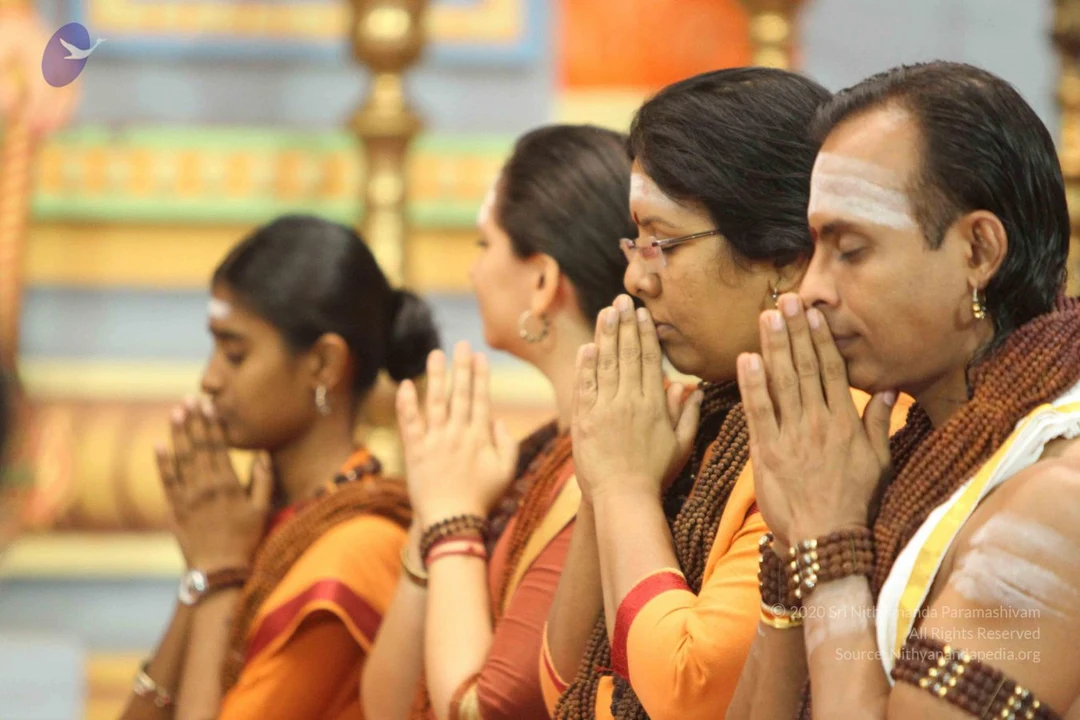
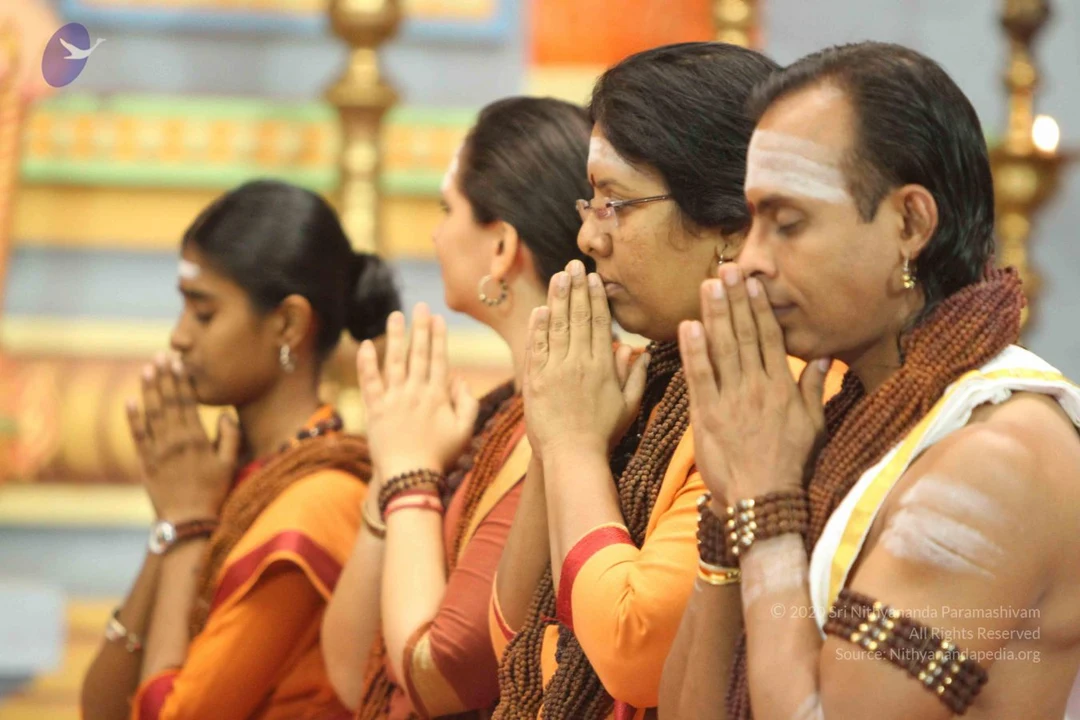
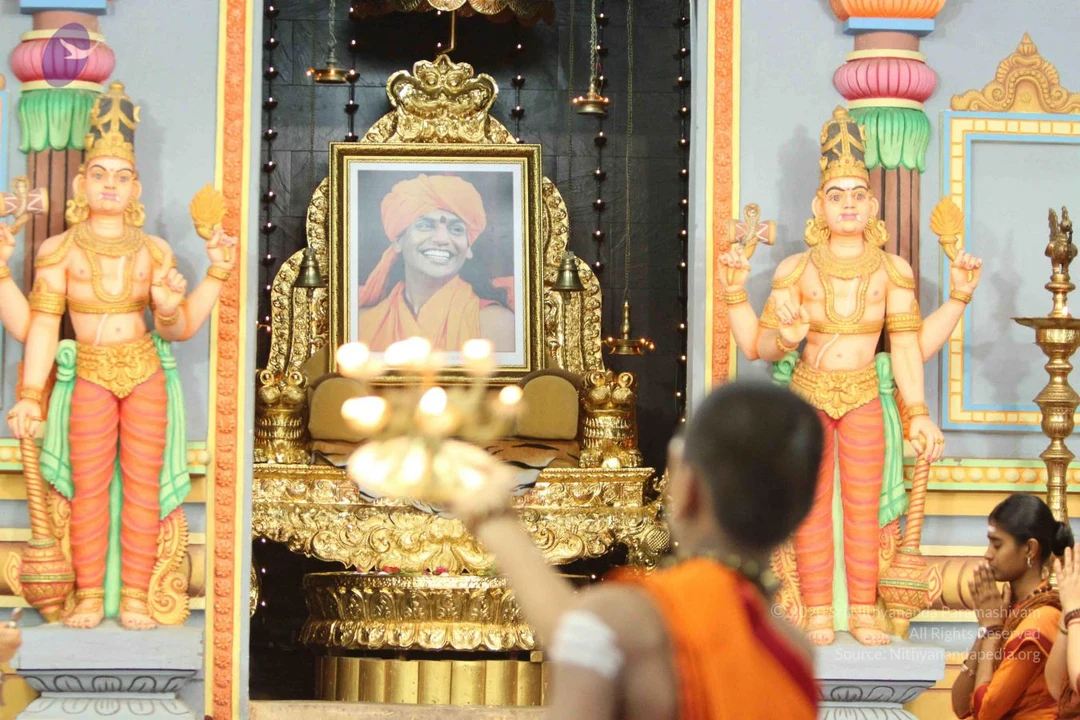
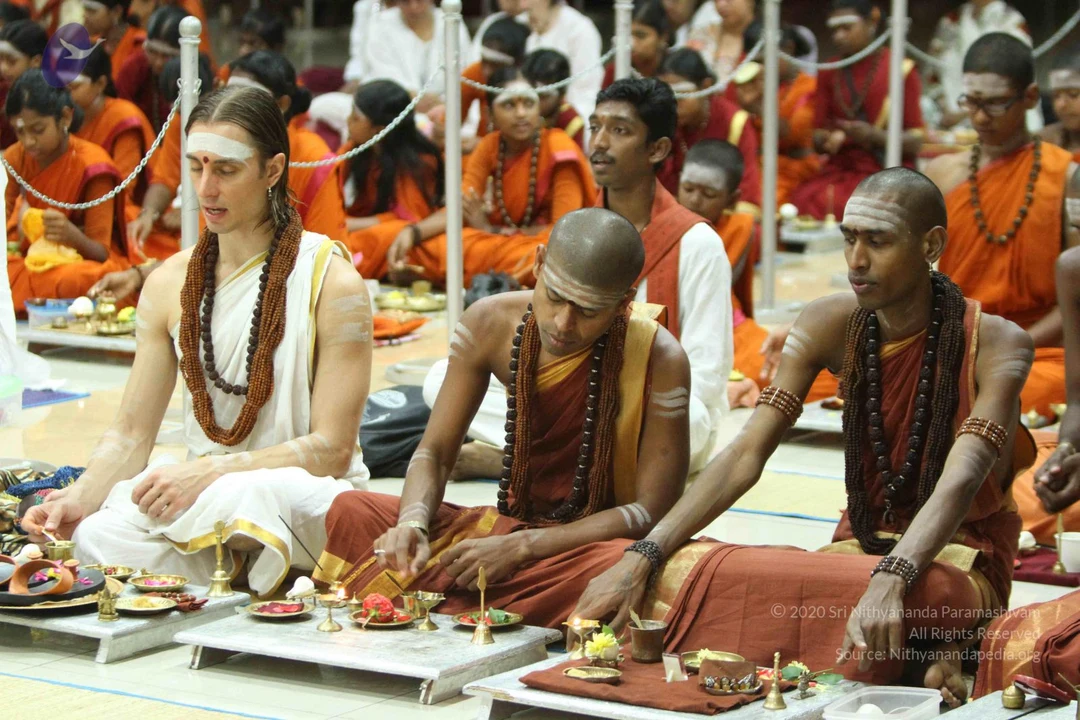
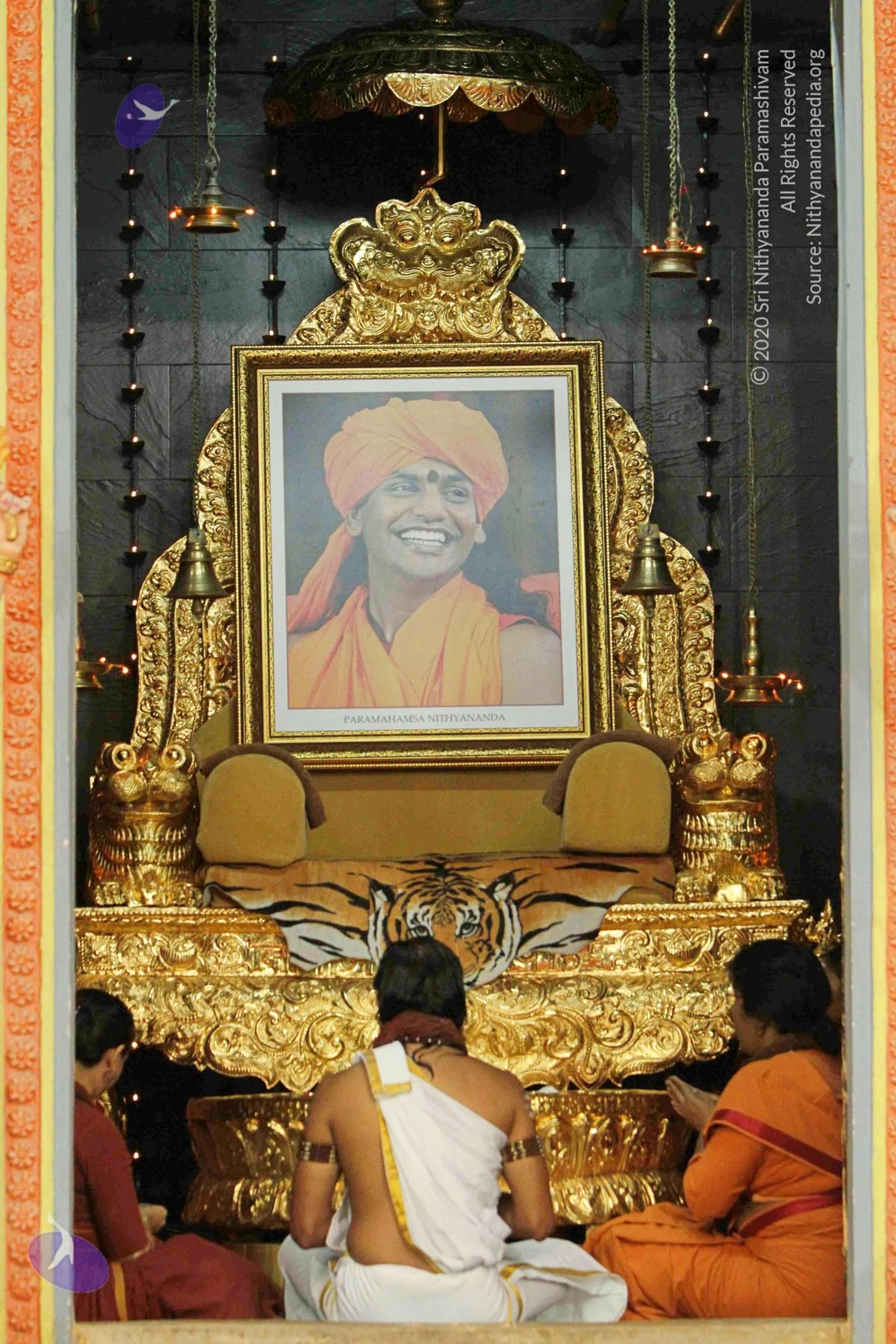
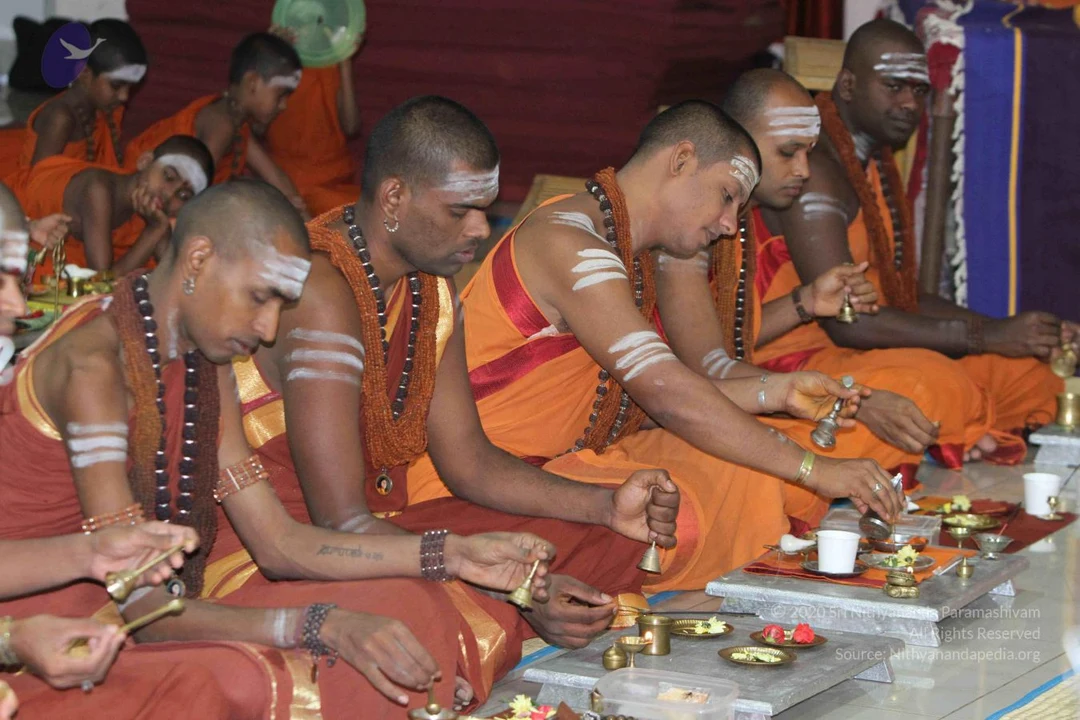
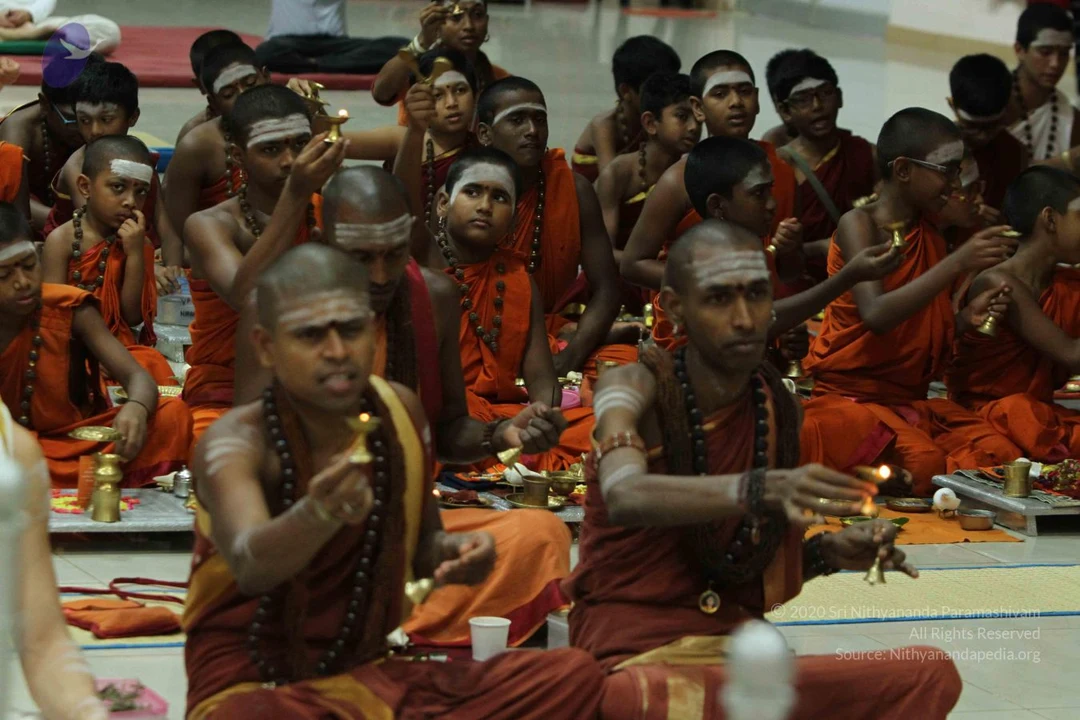
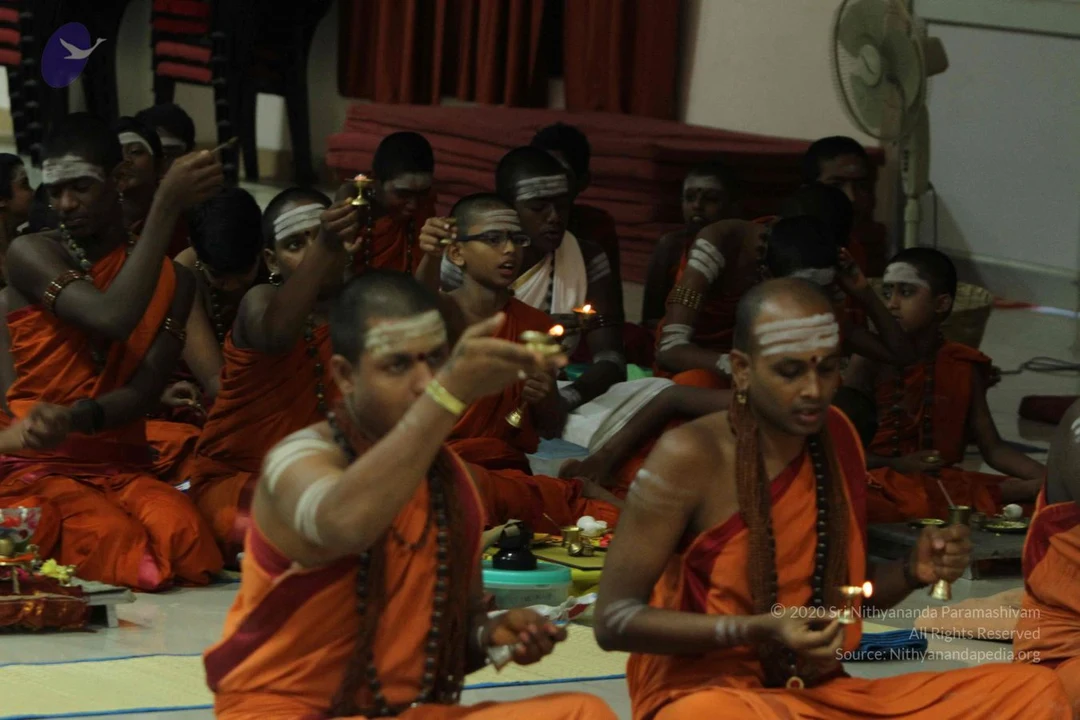
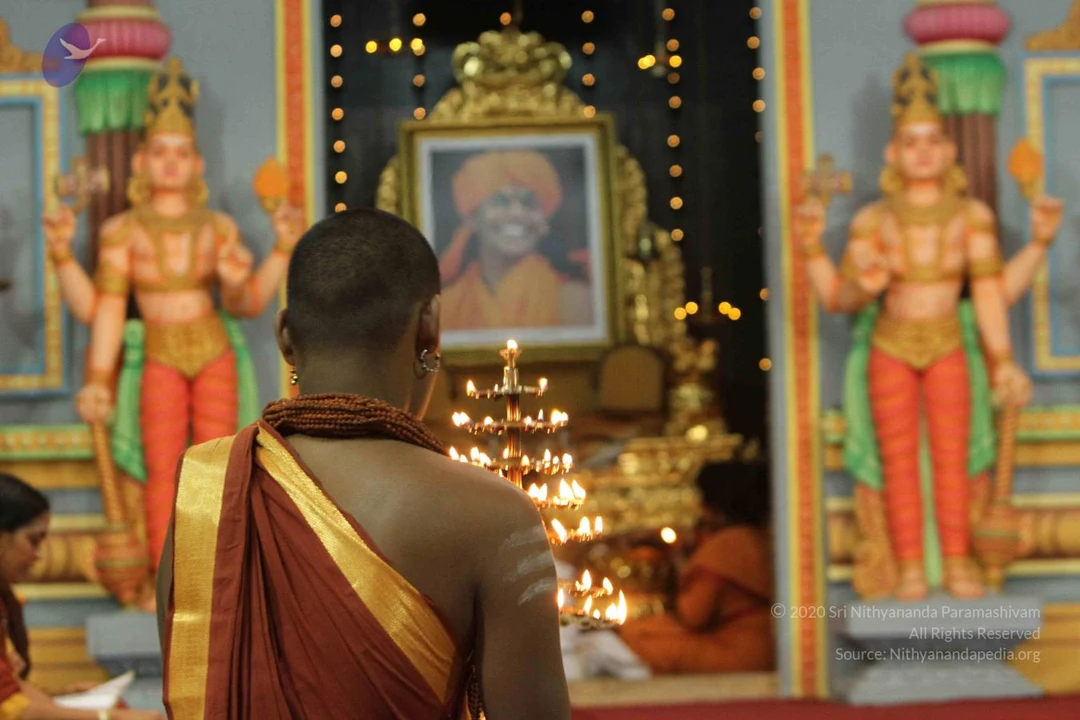
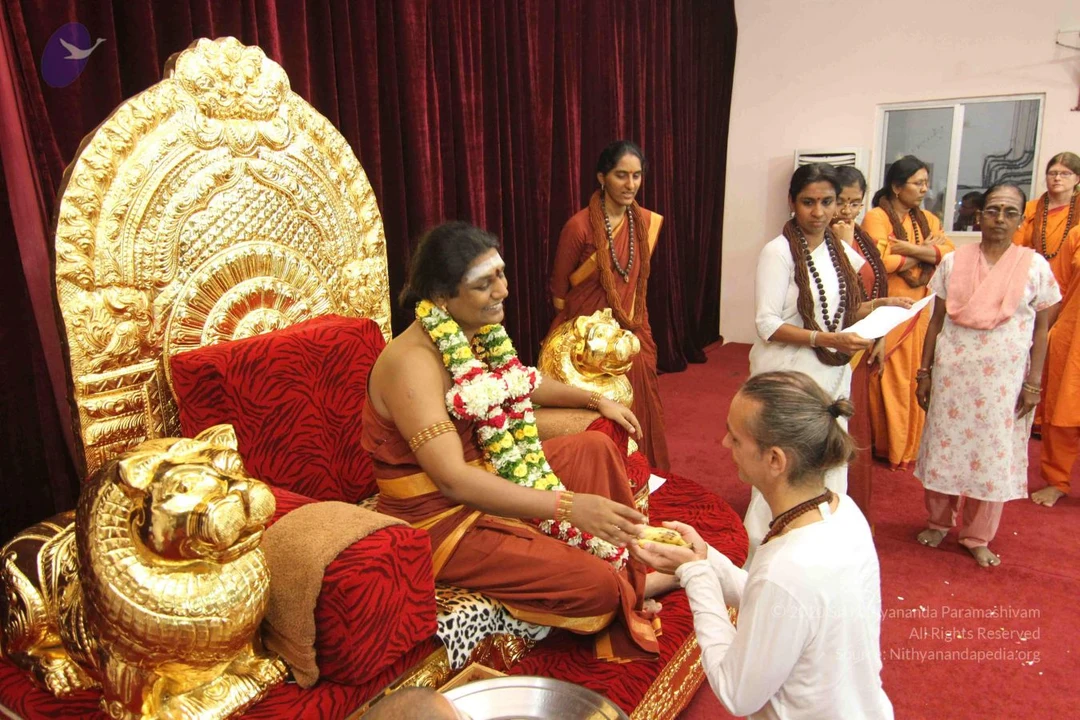
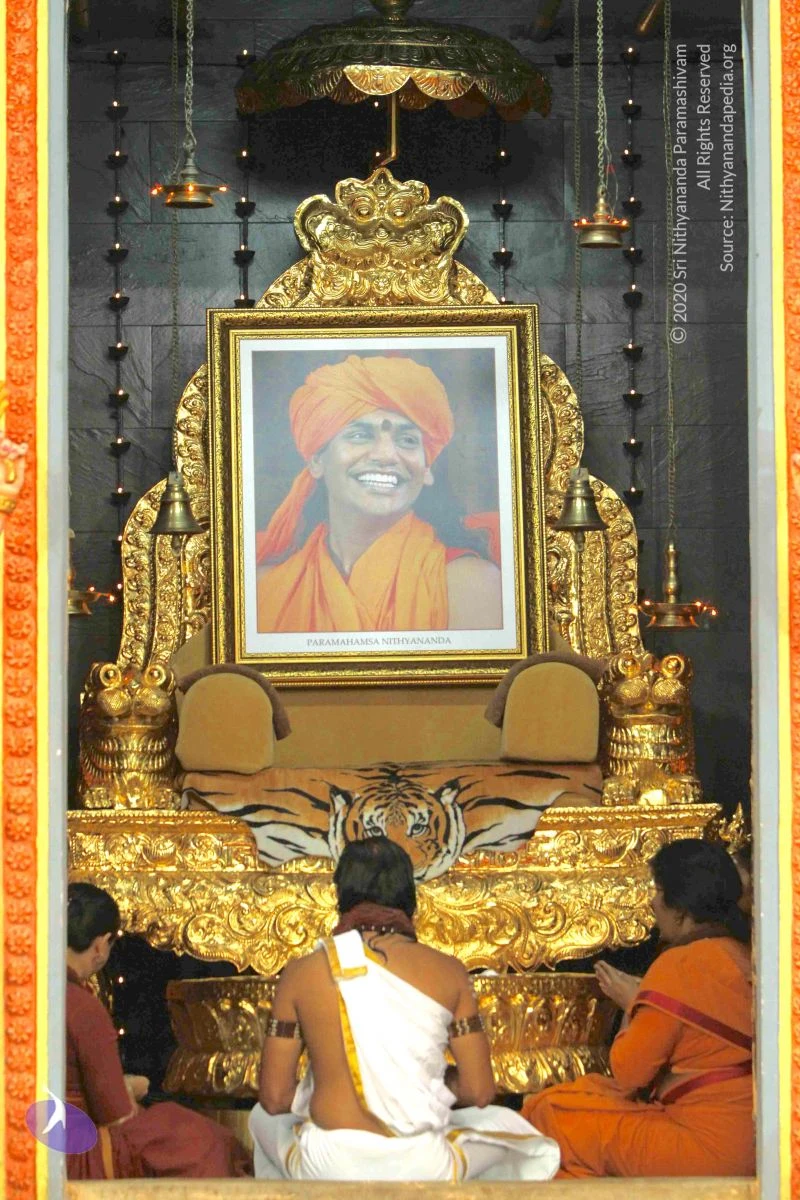
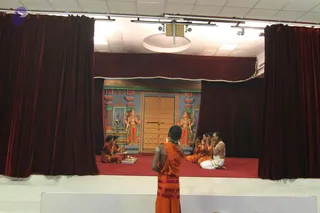
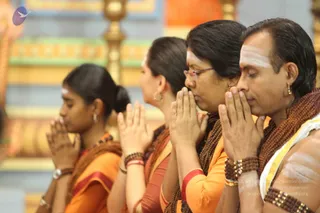
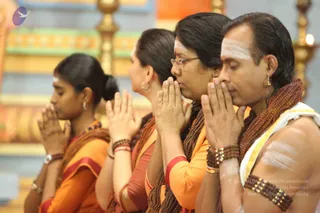
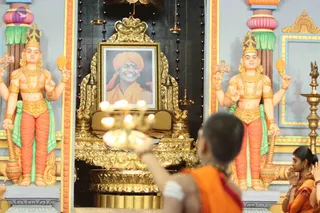
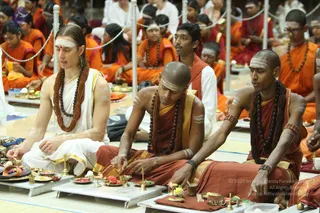
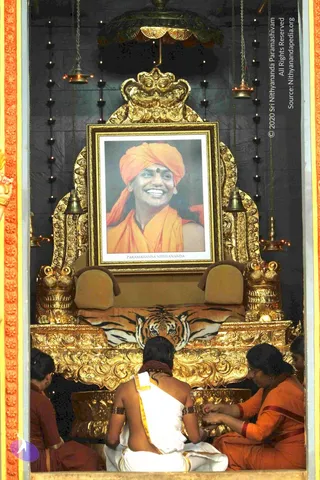
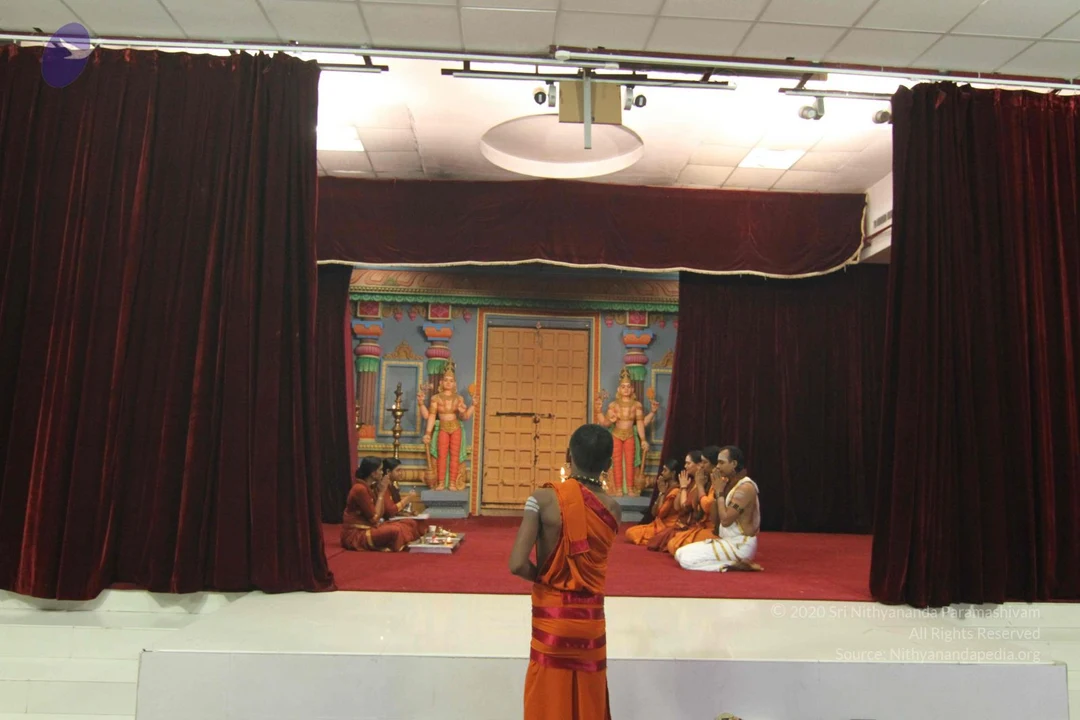
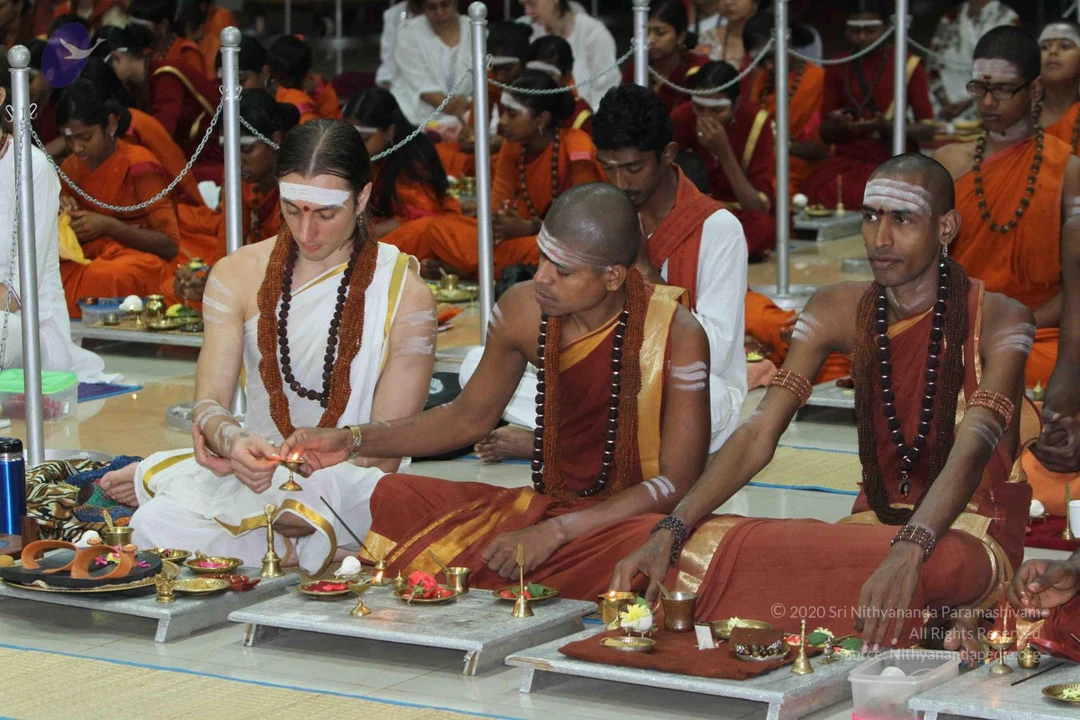
A photograph of a stage set with dark red velvet curtains and a red carpet. Upstage, a painted backdrop shows two standing deity murti figures flanking a wooden door, with a brass oil lamp at the left edge. A row of people in orange and saffron clothing sits cross-legged on the stage, some with hands raised in greeting or prayer, and a small offering tray is set before them. In the foreground a figure in an orange sari-like garment with pink borders stands with back to the camera, hands joined in front. The scene resembles a ritual performance or demonstration. The people visible number five seated plus one standing, so six in total.Four devotees sit in a row in prayer pose with palms pressed together and eyes closed during a satsang setting. Left to right: a young woman in an orange sari with a dark ponytail, a woman with hoop earrings in an orange-red sari, an older woman with glasses, red bindi and a rudraksha mala in an orange sari, and a man with a shaved-looking head, white tilak on his forehead, rudraksha beads, gold bracelets and a white and yellow dhoti. Blurred gold and green temple pillars form the background.Four devotees stand in profile in a row with palms pressed together in anjali mudra and eyes closed, in a temple-style hall with ornate golden and blue decorative panels and a blurred brass lamp at right. The figures on the left are a young woman in orange with a bun and a red-bordered garment, then a woman in an orange top with red-and-gold bangles, a woman in orange with rudraksha mala and bangles, and a man at right with white vibhuti horizontal tilak and arm markings, wearing a rudraksha mala, bangles and a white-and-yellow-bordered dhoti. Overall, the scene suggests a satsang or prayer gathering.A temple shrine dominated by a framed portrait of a smiling man with an orange turban and orange garment, seated within a gold throne-like frame on a gold pedestal. Two painted deity murtis flank the shrine, each with multiple arms, tall crowns, gold necklaces and green and red-orange lower garments. A devotee in an orange garment in the foreground, shown from behind, holds a tray of lit oil lamps toward the shrine. To the right, a woman in orange sari stands with palms joined in prayer. Brass oil lamps and hanging bells surround the shrine.Photo of a seated puja or ritual gathering in a hall with a tiled floor. In the foreground, three men sit on low wooden platforms with brass vessels, flowers, and small offering trays before them. The man on the left wears a white dhoti and shawl, a rudraksha mala, and white ash marks on his forehead and arms. The two men to his right wear red-brown saffron-toned cloth, rudraksha malas, and copper bangles, with white markings on their bodies; the centre man bends over his offerings while the right man holds a small vessel. Behind them, rows of people in orange and red robes, many wearing rudraksha malas, sit along white pillars and a chain barrier.A golden throne draped with a tiger-skin cloth sits in a shrine, with a framed portrait labelled "PARAMAHAMSA NITHYANANDA" above it. The portrait shows a smiling man in an orange-yellow turban and orange shawl with a red bindi. Oil lamps and hanging bells surround the throne. Two devotees kneel before it: a person in the centre wears a white dhoti with gold border and bare upper back, arms banded in dark bracelets; a woman on the right wears an orange sari with red border and sits with hands folded in prayer; a third person on the left wears a maroon garment. No one is seated on the throne.

Satsang
32 photosSource gallery
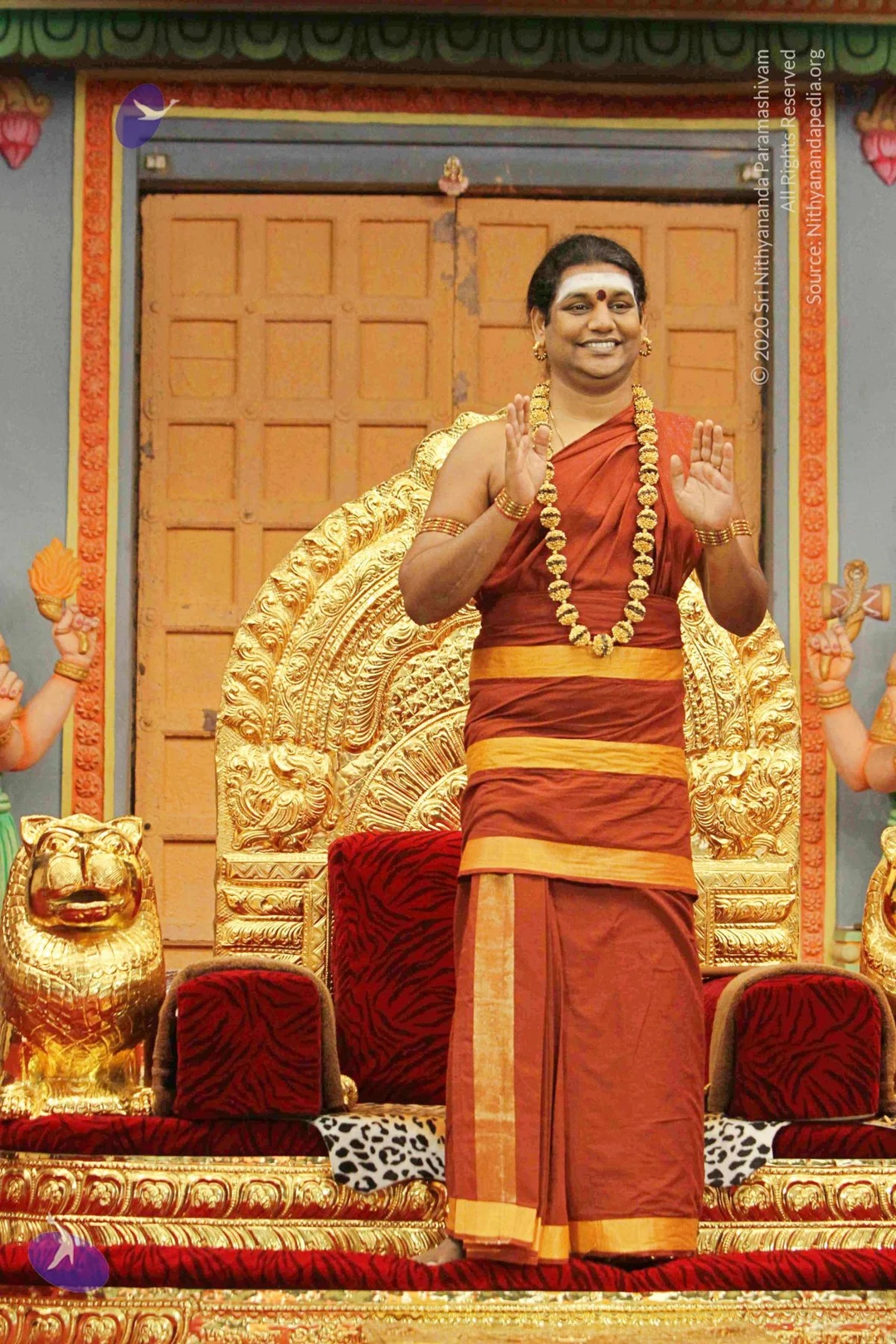
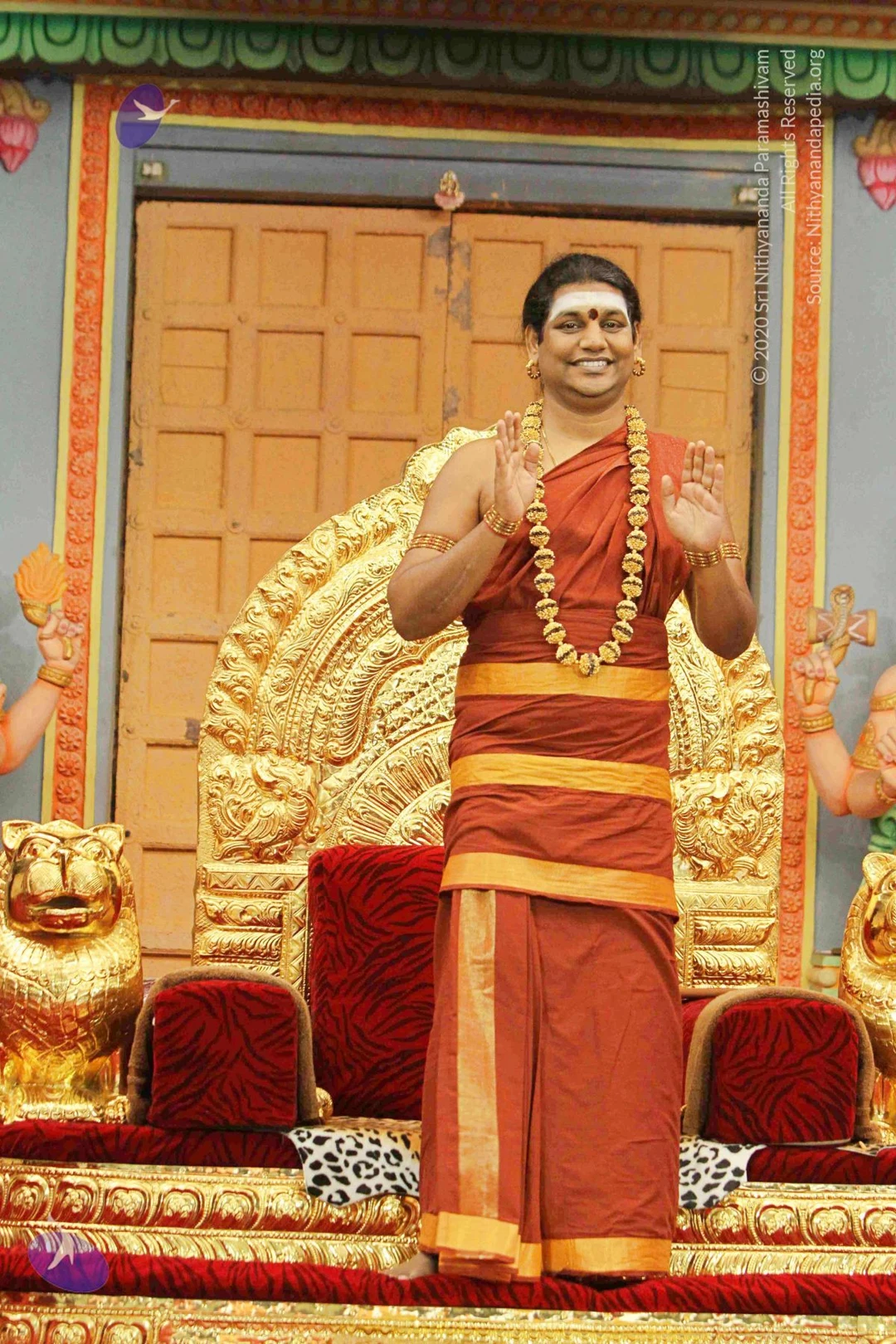
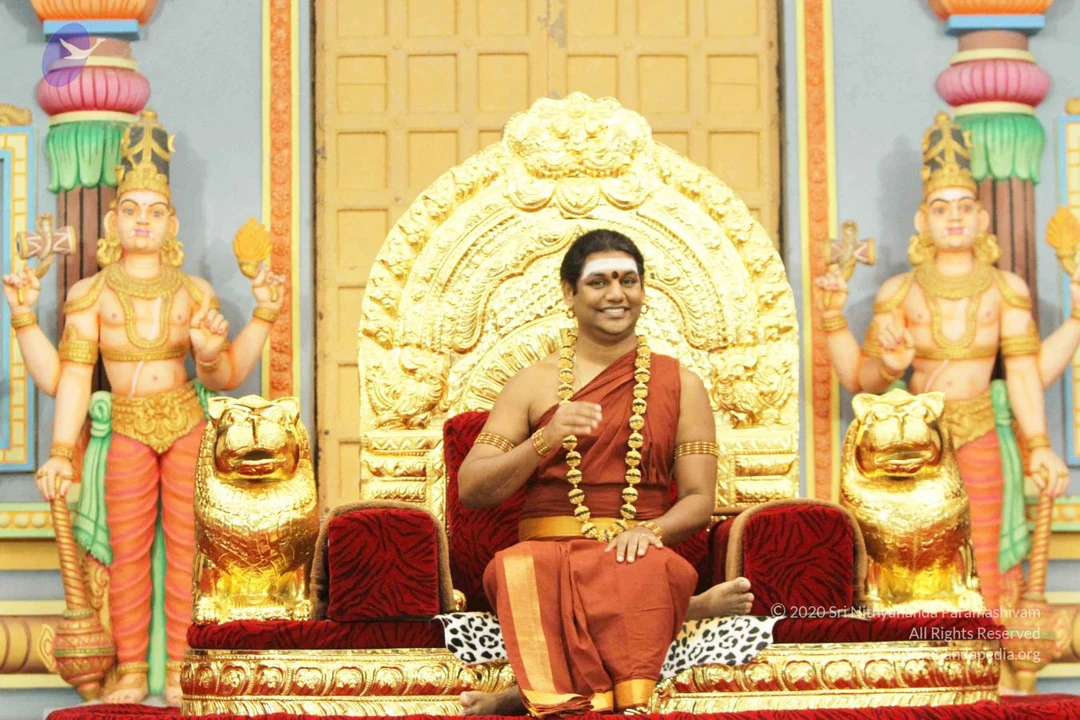
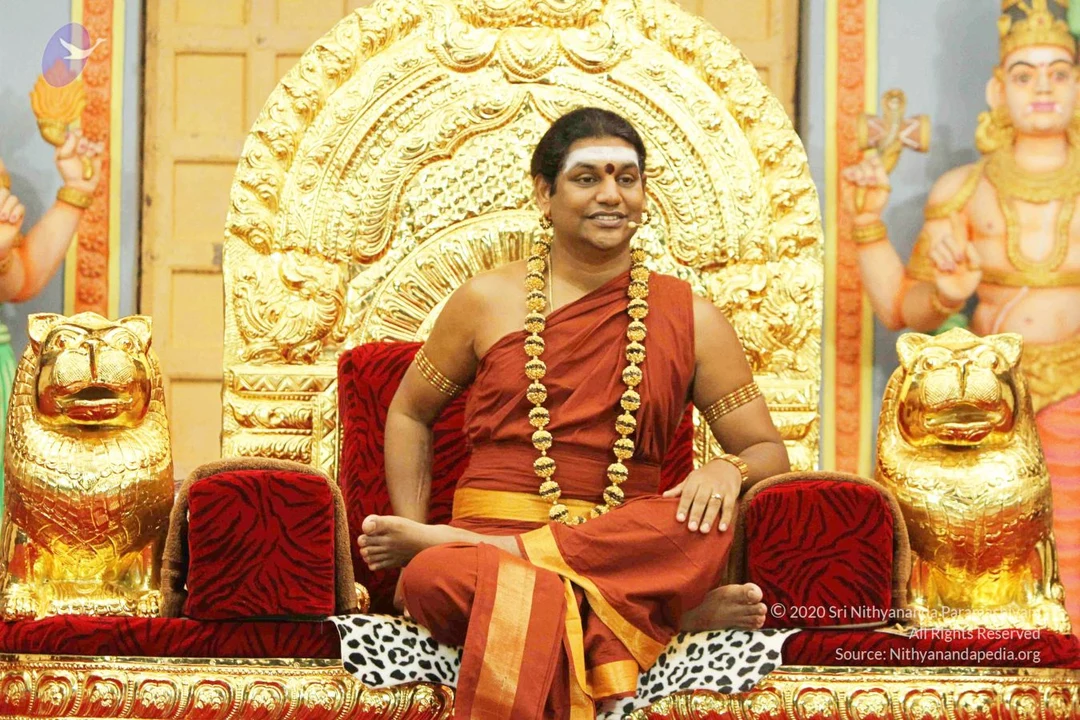
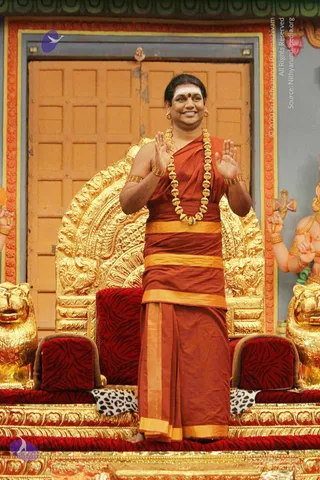
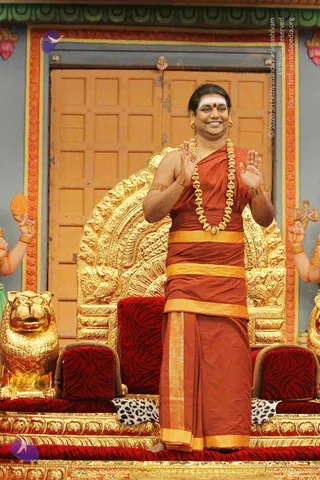
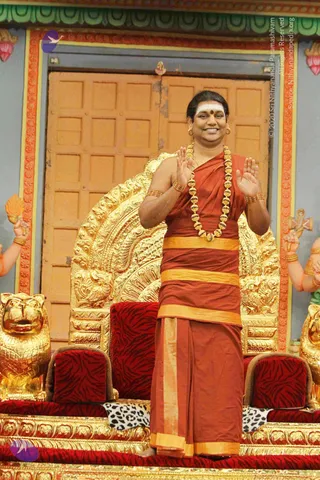
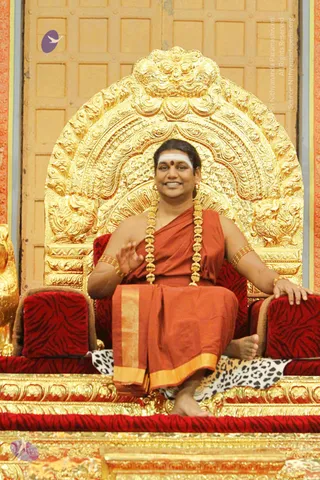
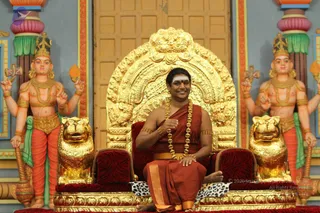
A smiling man in a rust-red saffron-toned dhoti and shawl with gold borders stands with both palms raised in greeting on an ornate gold-and-red throne platform. He wears a large gold bead necklace, gold bangles, earrings, a white vibhuti line and a red bindi. Golden lion sculptures flank a carved gold throne backed by orange wooden doors and a painted deity figure to the right. Red leopard-print cushions sit on the seat.A man in a rust-red and saffron-bordered dhoti and shawl stands before an ornate golden throne with red tiger-striped cushions and a gilded lion figure at its base, before a wooden door with carved panels. He wears a long gold bead necklace, gold bangles and a white forehead stripe with a red dot, and holds his palms raised in greeting. Gilded deity figures with raised hands flank the stage. a person: the man has short dark hair, a white forehead mark, a gold bead necklace and saffron-toned robes, and stands on a throne-like seat during what appears to be a satsang.A standing man in a rust-red and gold-bordered dhoti and shawl, with a heavy gold bead necklace and gold armlets, stands on a raised stage before an ornate gold throne with carved lion-faced armrests and red tiger-striped cushions. He smiles and raises both palms in a blessing gesture, with white and red forehead markings. Behind him are a wooden double door and painted deity figures with multiple arms holding objects. a person is shown in the centre with rudraksha-style gold beads, distinctive ceremonial dress and a golden throne setting.A seated man in saffron-orange robes sits on an ornate gold throne with red tiger-striped cushions and a leopard-print cloth beneath his feet. He wears a heavy gold bead necklace, gold armbands and a white vertical forehead mark with a red dot, and raises one hand in a gesture while smiling. Gold carved panels and wooden doors form the backdrop. A small purple bird logo appears in the upper left corner and a vertical copyright credit runs along the right edge.A seated man in a rust-red robe and saffron-coloured waist cloth sits on an ornate gold throne with a carved arched back, flanked by two gold lion-head armrests with red upholstery. He wears white vertical tilak marks, a red bindi, a long gold-bead necklace and gold armbands, and raises one hand in a blessing gesture while smiling. Behind him, painted statues of deities with multiple arms, crowns and gold jewellery stand beside a wooden door. a person: the man is seated on the throne with a robe, bead necklace and tilak cues consistent with a sannyasi presentation.A seated man in saffron-red robes sits on an ornate golden throne with a gold arched backrest and gold lion-shaped armrests, upholstered in red with zebra-print cushions. He wears a long rudraksha-style gold and beaded garland, gold armbands and bangles, and has a vermilion bindi and white forehead markings; he is smiling with hands gesturing. Flanking him are two large painted deity murti figures with multiple arms, crowns, gold jewellery and green sashes, holding ritual objects. A pillared, pastel-blue and pink decorated backdrop with a wooden door behind. a person: a saffron-robed figure wearing a rudraksha-style gold garland, gold bangles and a throne, with a distinctive presentation consistent with the page's description of a person.

Kalpataru Darshan

9 photosSource gallery
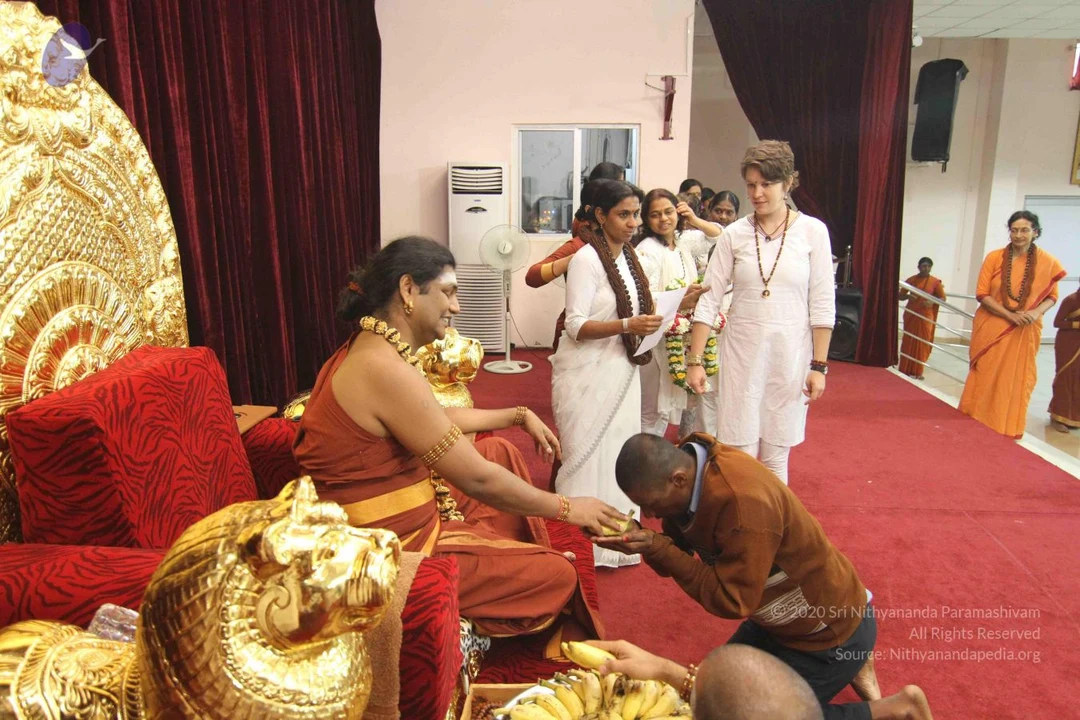
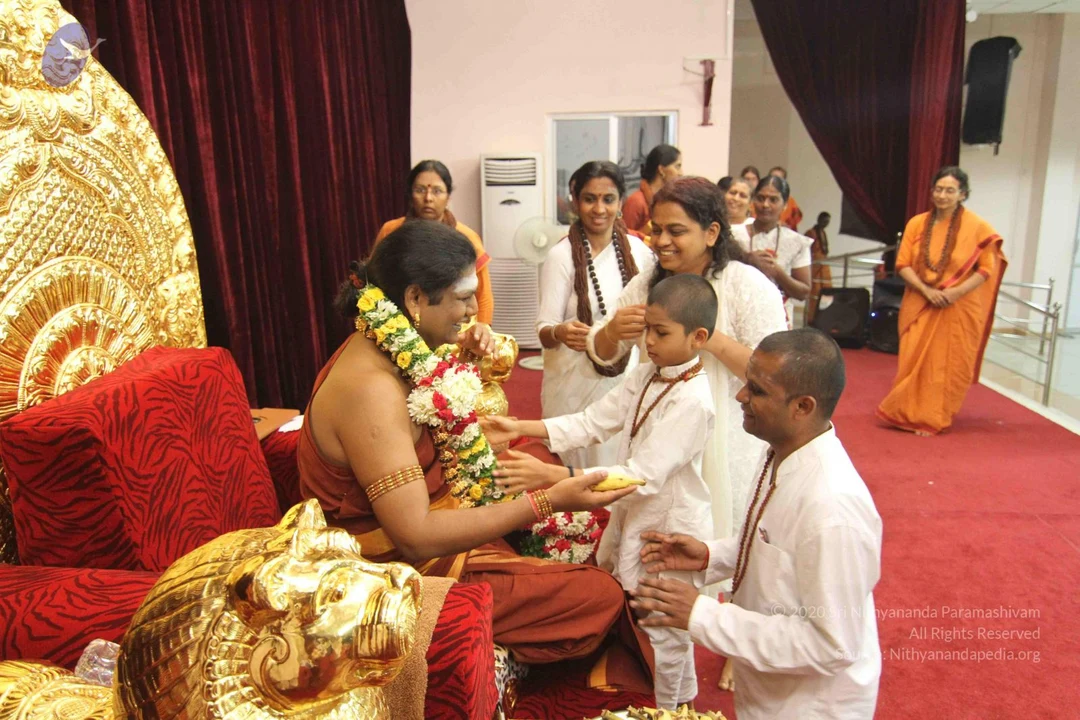
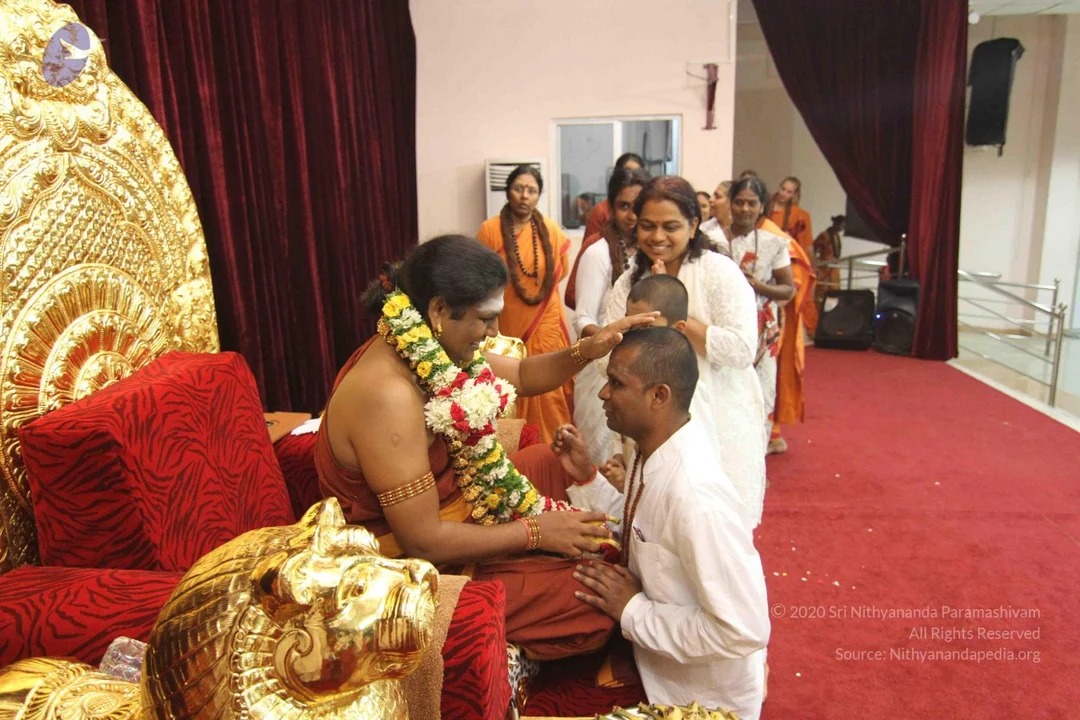
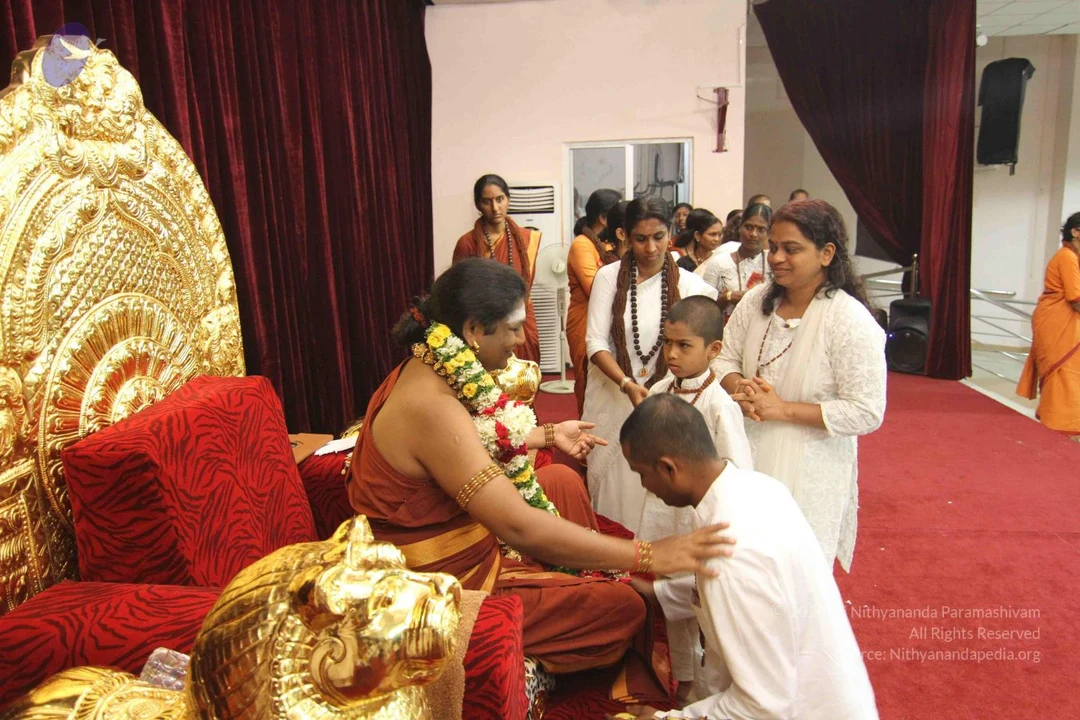
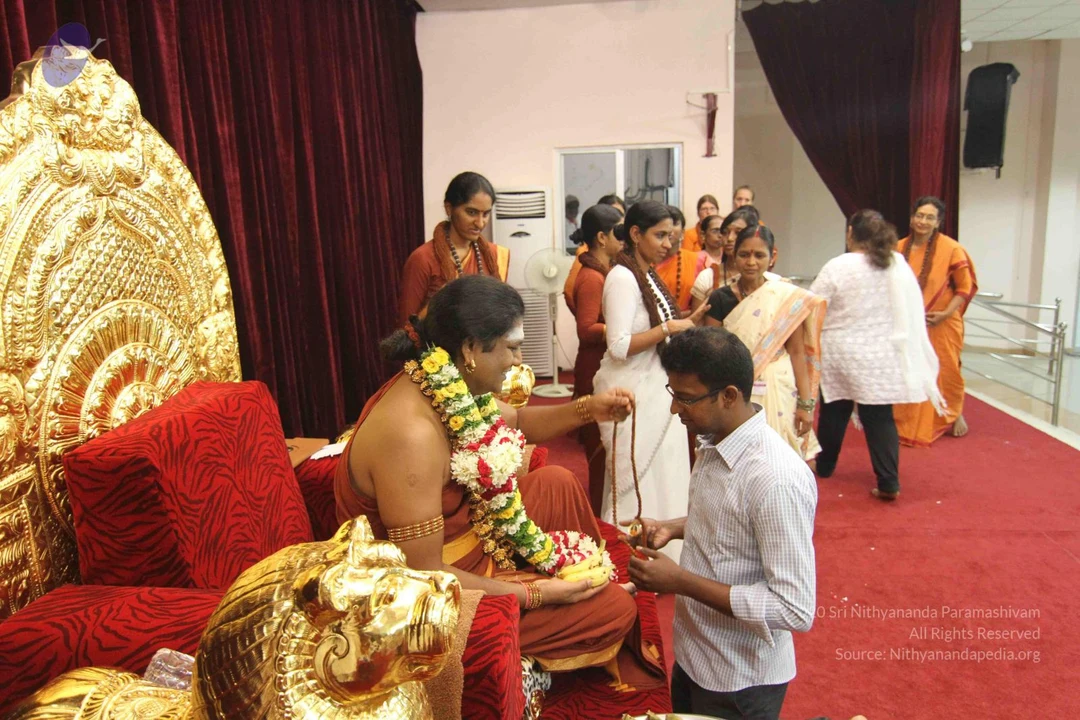
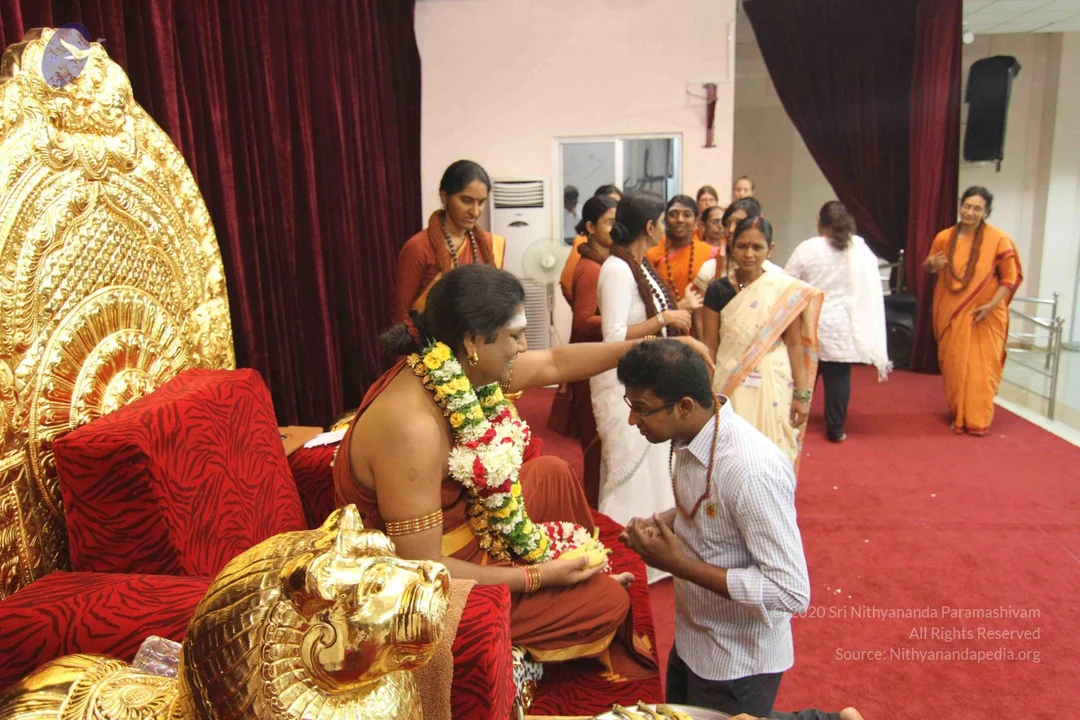
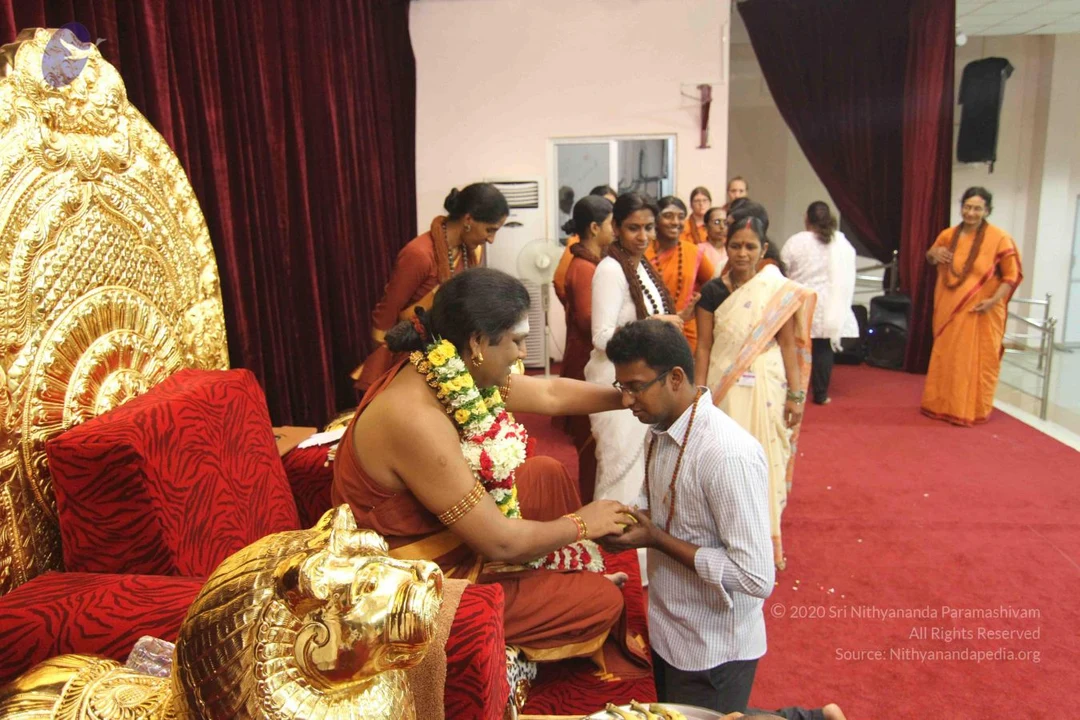
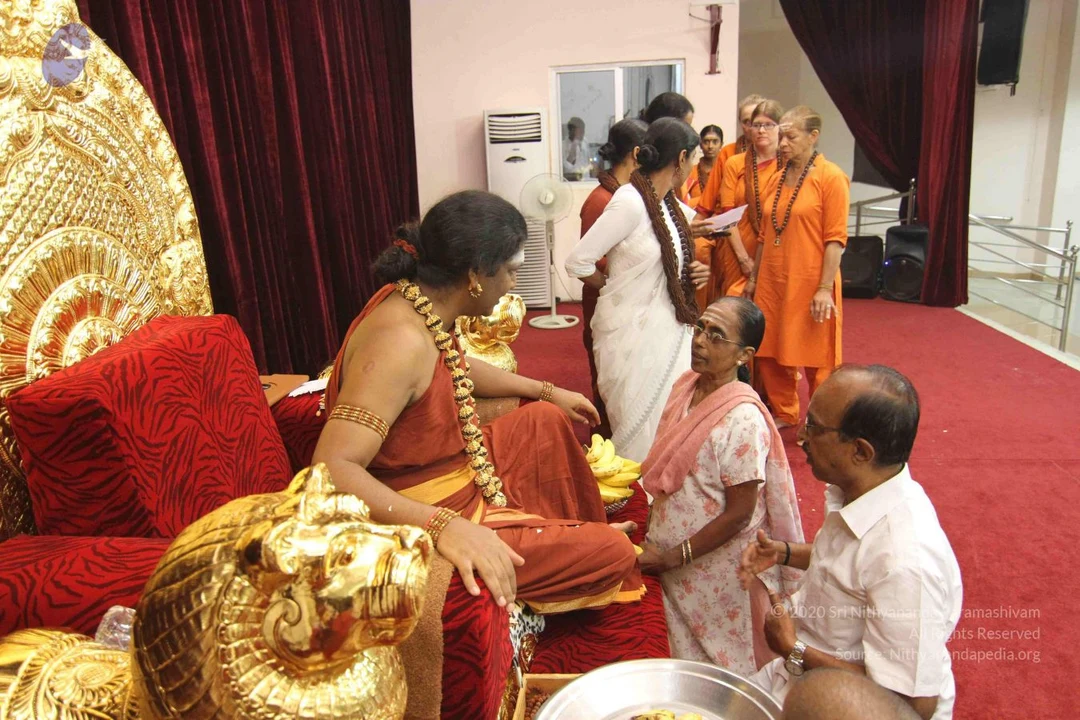
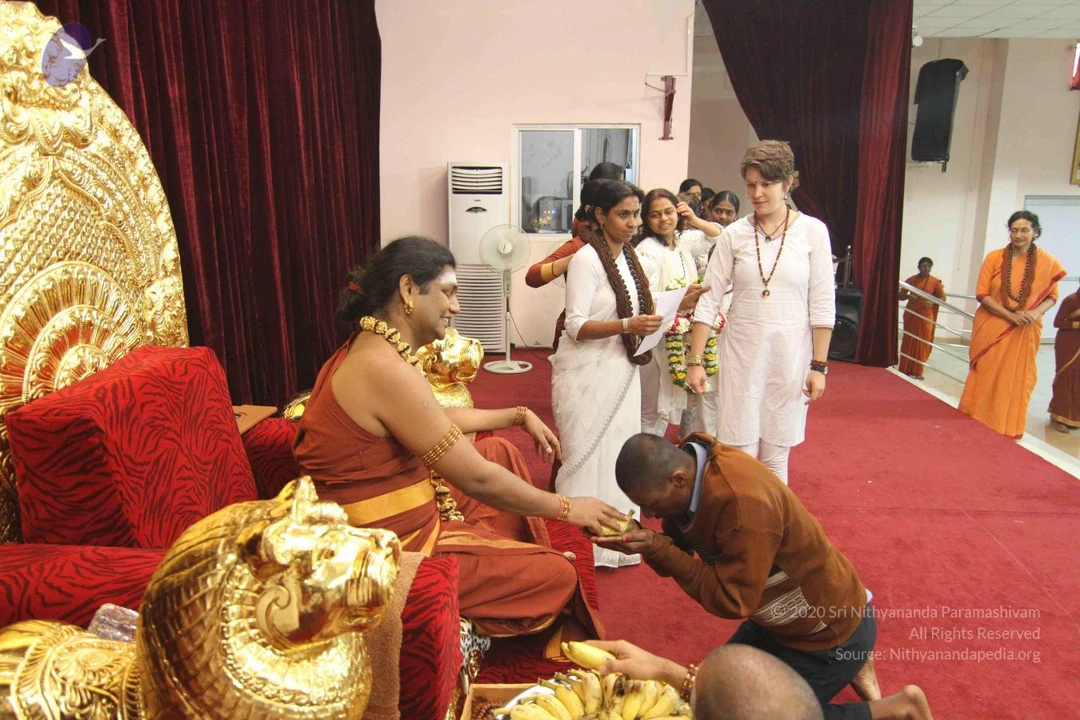
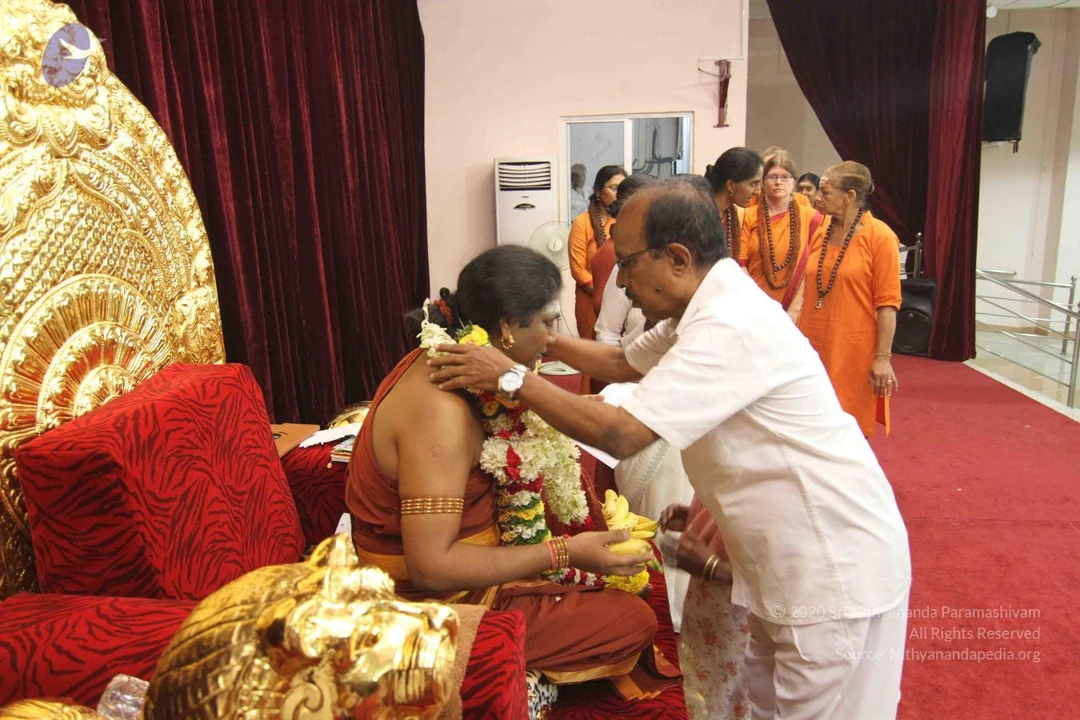
A seated figure in a rust-red robe with a gold armband and a flower garland of white and red blossoms sits on a red-and-black striped throne with gold lion-head armrests. A young boy in white kurta with rudraksha mala and a shaved head offers a small yellow item toward the seated figure, while a man in white with a mala and a woman in white with a mala stand nearby. Other women in white and orange saris stand in the background on a red carpet beside a gold-framed backdrop and red curtains. Ritual offering scene in a hall.A photograph of a blessing moment on a red-carpeted stage. A seated figure with swept-back dark hair, wearing a rust-orange wrap, a white and yellow floral garland, gold bangles and a gold armband, reaches out to bless the head of a kneeling man in white clothes and a rudraksha mala who presses his hands together. Beside him a small child with shaved head is also blessed, and the child's mother in white smiles nearby. To the left stands a large gold throne with a gold lion-face armrest on red velvet cushions. Behind, several women in saffron and orange robes with rudraksha malas stand in a line near a red velvet curtain. Swamiji (probable): the seated figure has long swept-back hair, a garland, gold armband and rust-orange wrap, seated on a throne.A seated figure in an orange-red dhoti and draped garment wears a long white and yellow flower garland and gold bangles, sitting on an ornate red-cushioned gold throne with a gold lion-head armrest. A man in white kneels before him and touches his hand, while a young boy in white stands beside him. Behind them, women in white and orange-saffron clothing stand with hands folded, one wearing a rudraksha mala. Red velvet drapes, a red carpet and an air conditioner fill the hall.A photograph in an indoor hall with red carpet and red velvet drapes. A figure in saffron-orange robes with a multicolour flower garland, gold bangles and a gold necklace sits on an ornate red zebra-print throne with a gold lion-headed armrest and a gold carved backrest. The figure holds a gold-coloured object. Before the throne, a man in a white checked shirt and glasses bends forward holding a beaded mala. Behind them, several women in orange and white saris and salwar stand and walk, one in white with a shawl. The seated figure appears to be a person candidate, identified by the long hair, saffron clothing, garland and ornate throne, though this remains uncertain.A photograph in a hall with red carpet and red velvet drapery. A seated figure in orange-red robes, with long dark hair and a multicolour flower garland, sits on a red-cushioned gilded throne with a carved golden lion-head armrest. The seated figure reaches forward with a hand toward a kneeling man in a white checked shirt and dark trousers, who bows with folded hands and wears a red-and-saffron beaded mala. Behind them, several women and men in orange, saffron and white clothing stand and move about, some wearing rudraksha malas. A woman in an orange sari with a mala stands at right, and a man in white stands near the back. A standing fan and a black speaker are visible. a person appearance is probable for the seated figure, shown in an ornate throne setting with orange-red robes, flower garland and rudraksha-style adornment, receiving a devotee.A seated figure on a red zebra-striped cushioned throne with an ornate gold carved backrest and a gold lion-head armrest in the foreground receives a devotee. The seated person wears a saffron-orange garment, a long floral garland of yellow and white flowers, and gold bangles, with hair swept back and a shawl draped over one shoulder. A kneeling man in a white checked shirt and a rudraksha-style bead necklace bows forward and holds the seated person's hand, while a woman in a white sari stands beside him. Several women in saffron and white attire stand in the background on a red carpet near a pink wall, curtains and an air conditioner, and a sign-like tag reading the copyright credit appears at the lower right.

Nithyanandeshwara-Paramashiva-Devalaya

27 photosSource gallery
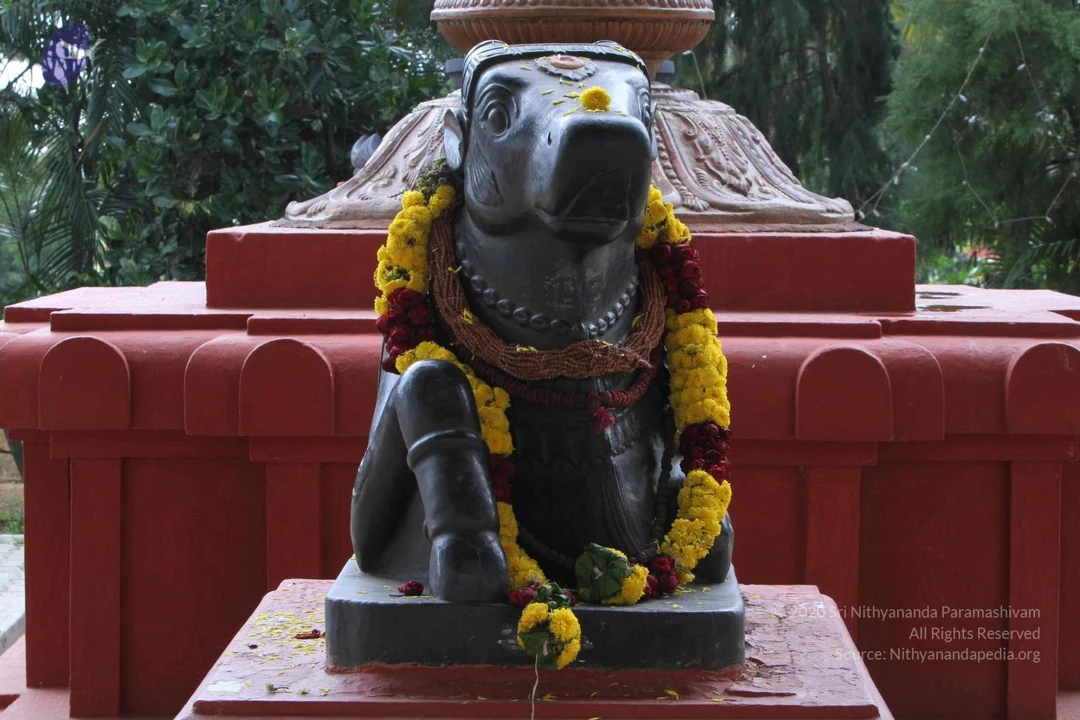
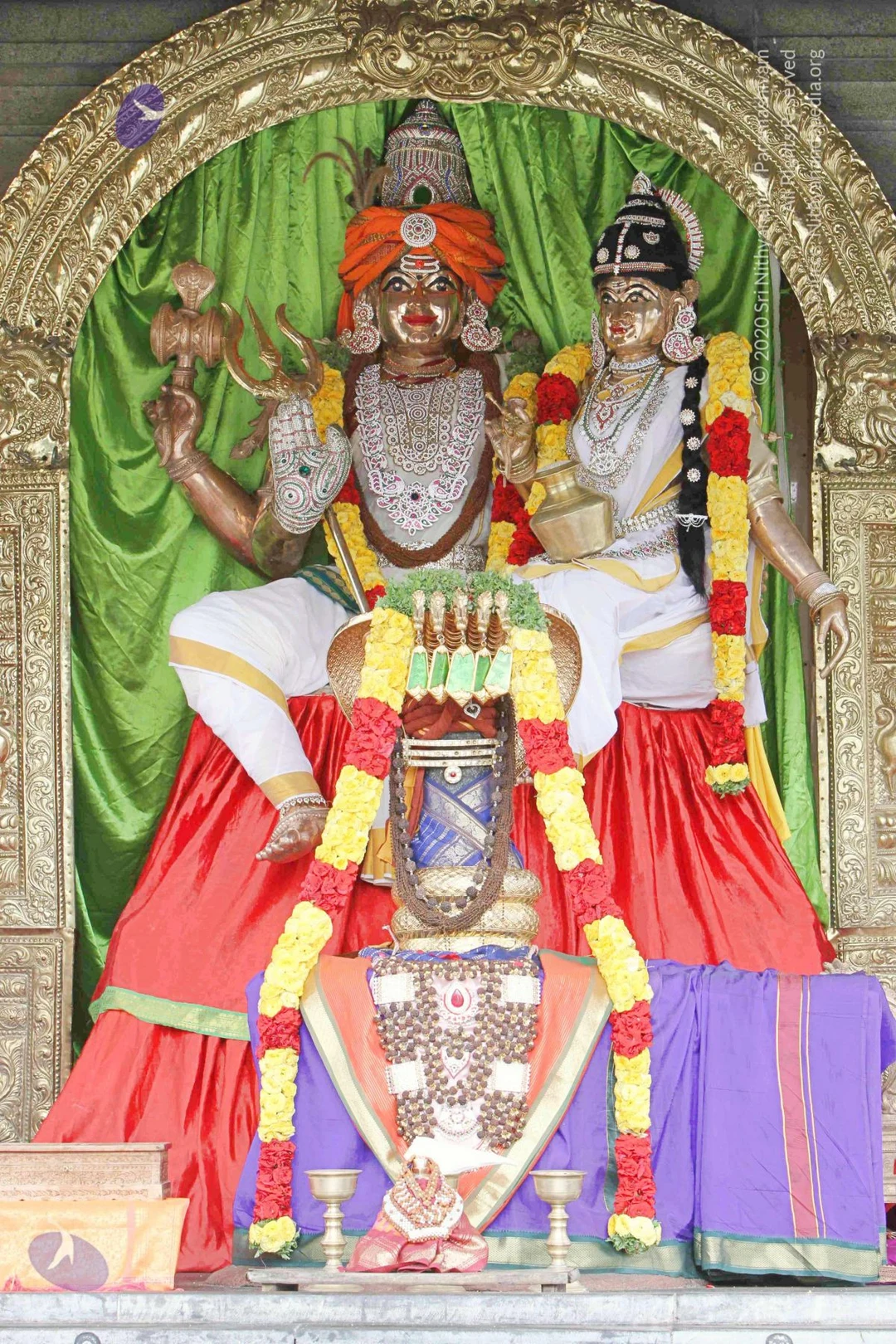
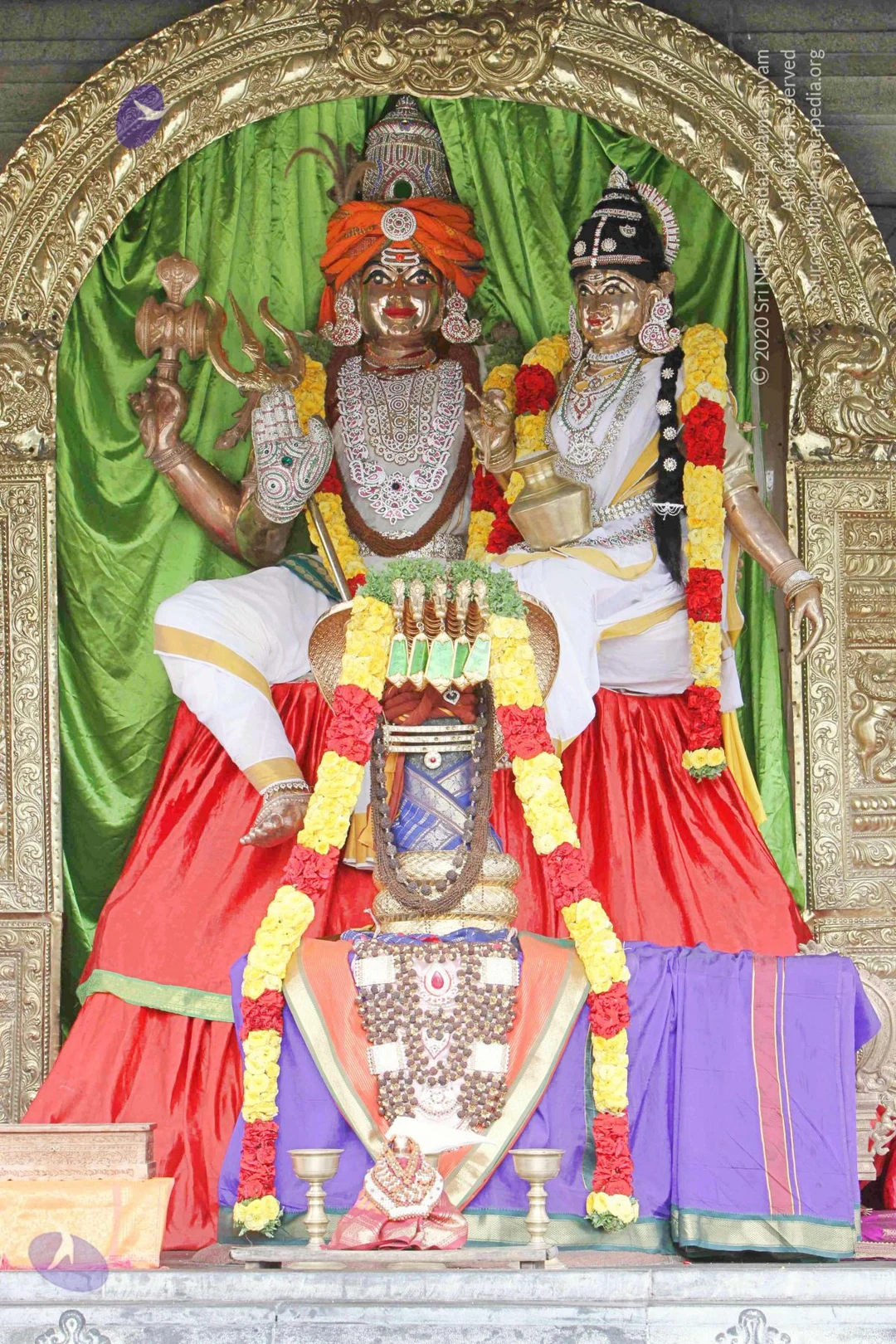
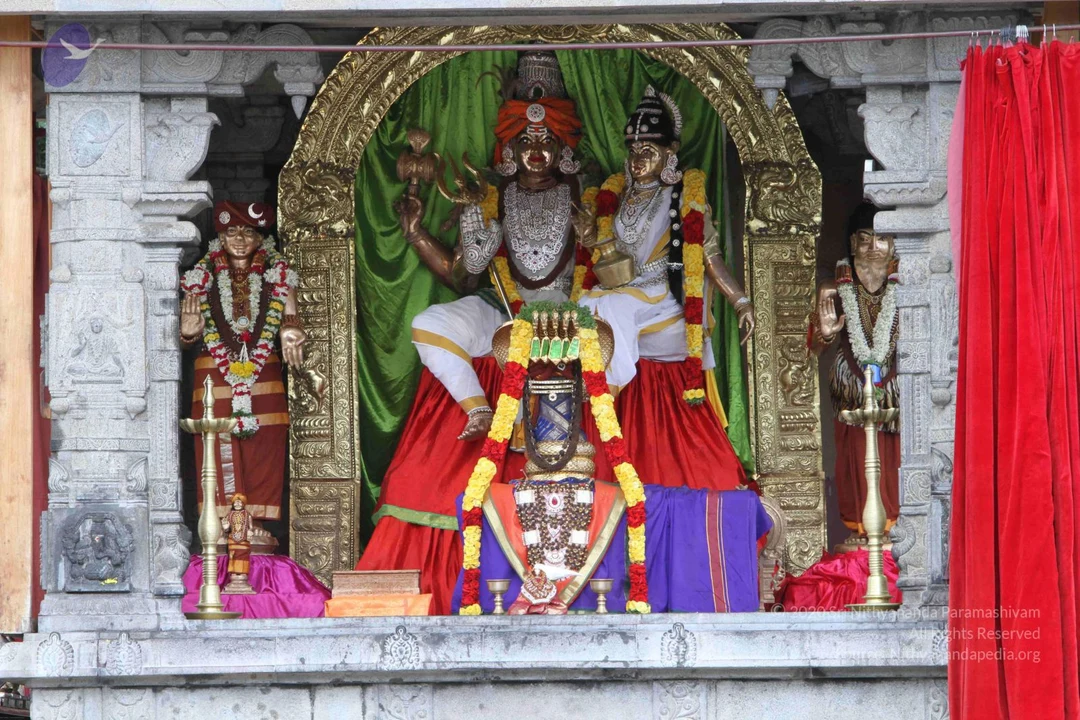
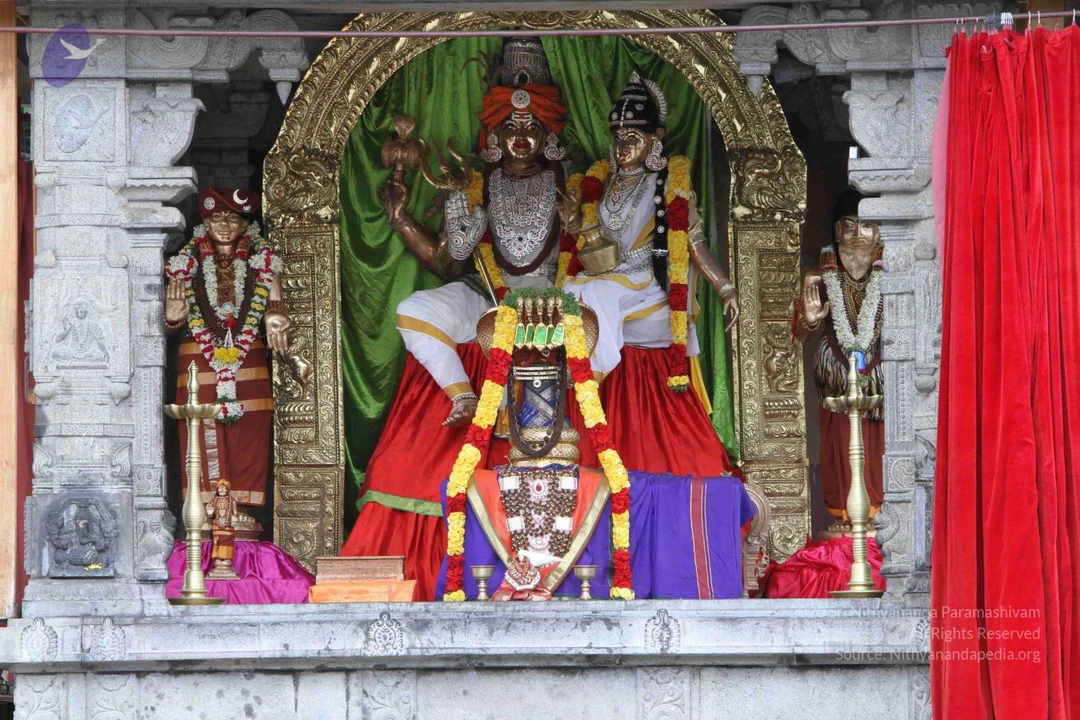
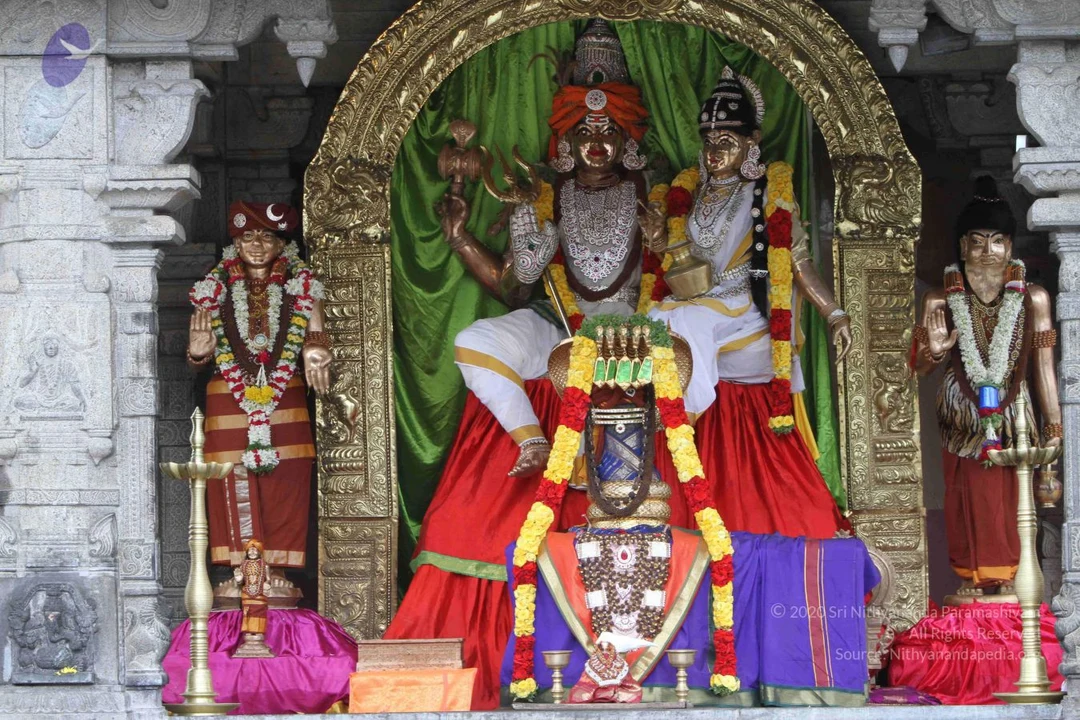
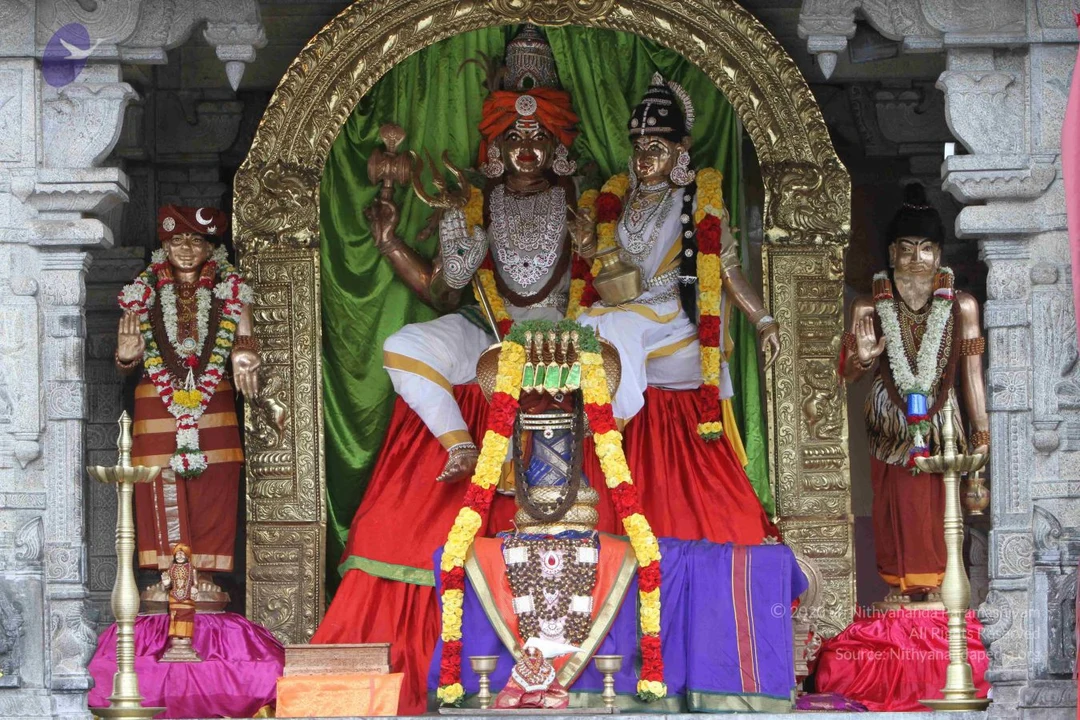
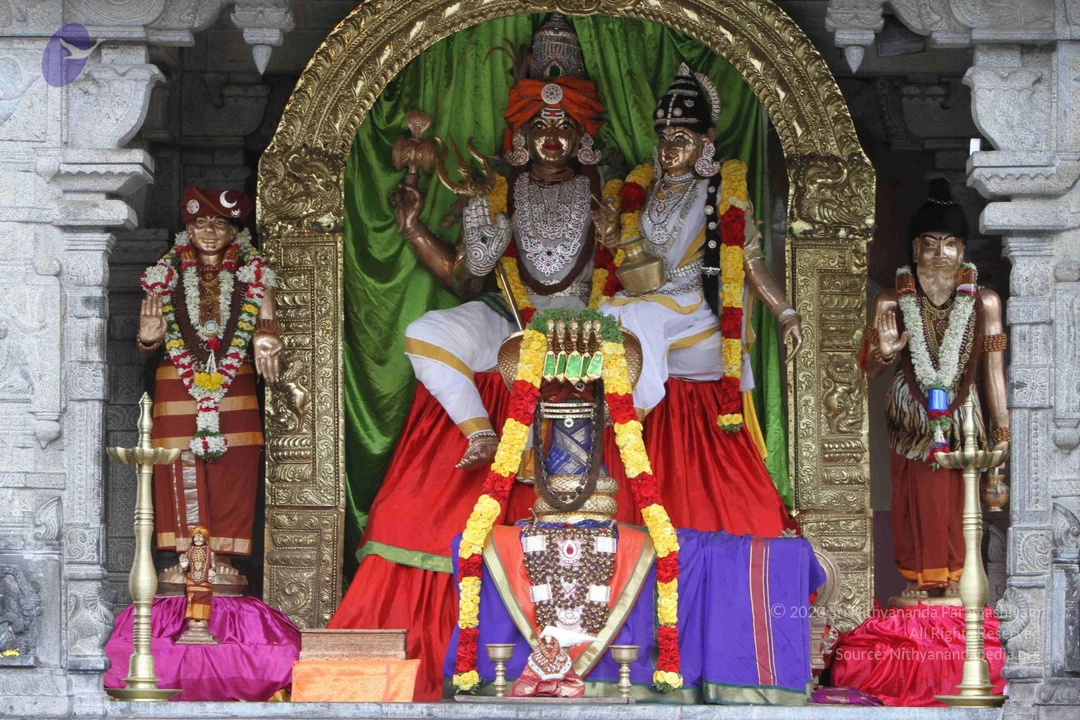
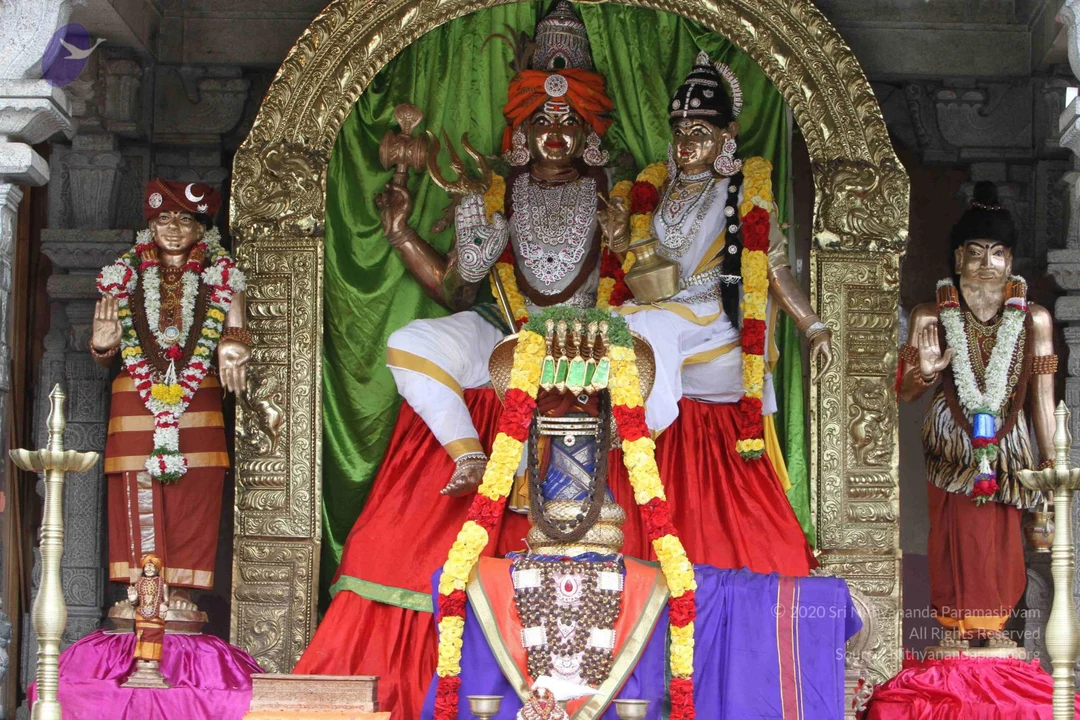
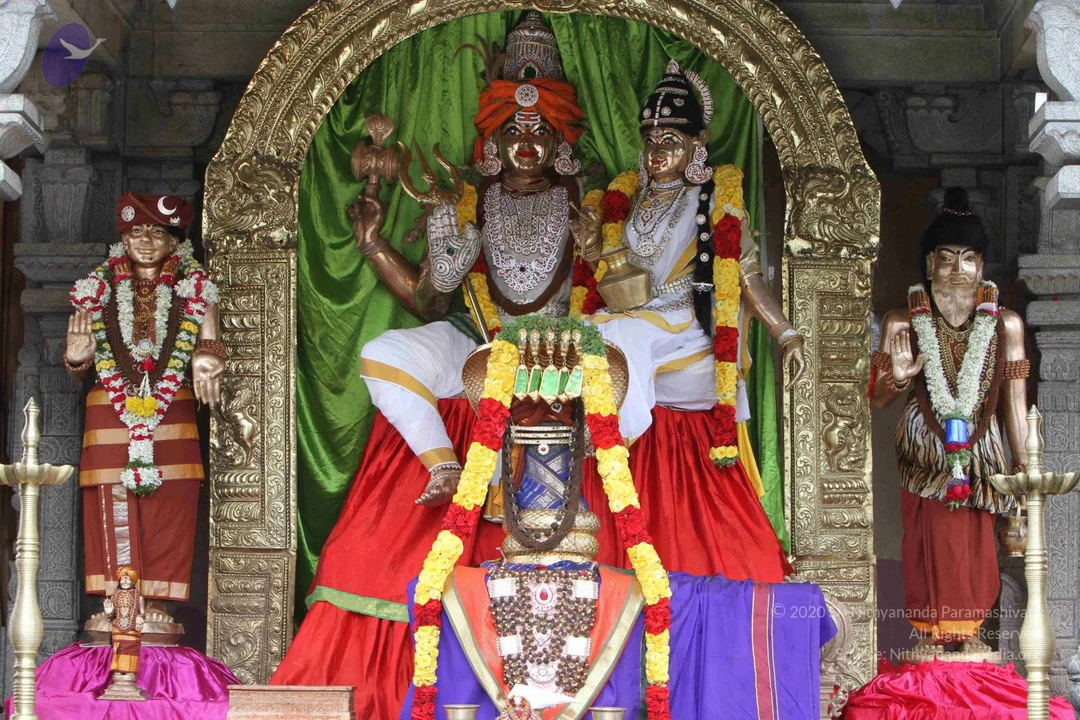
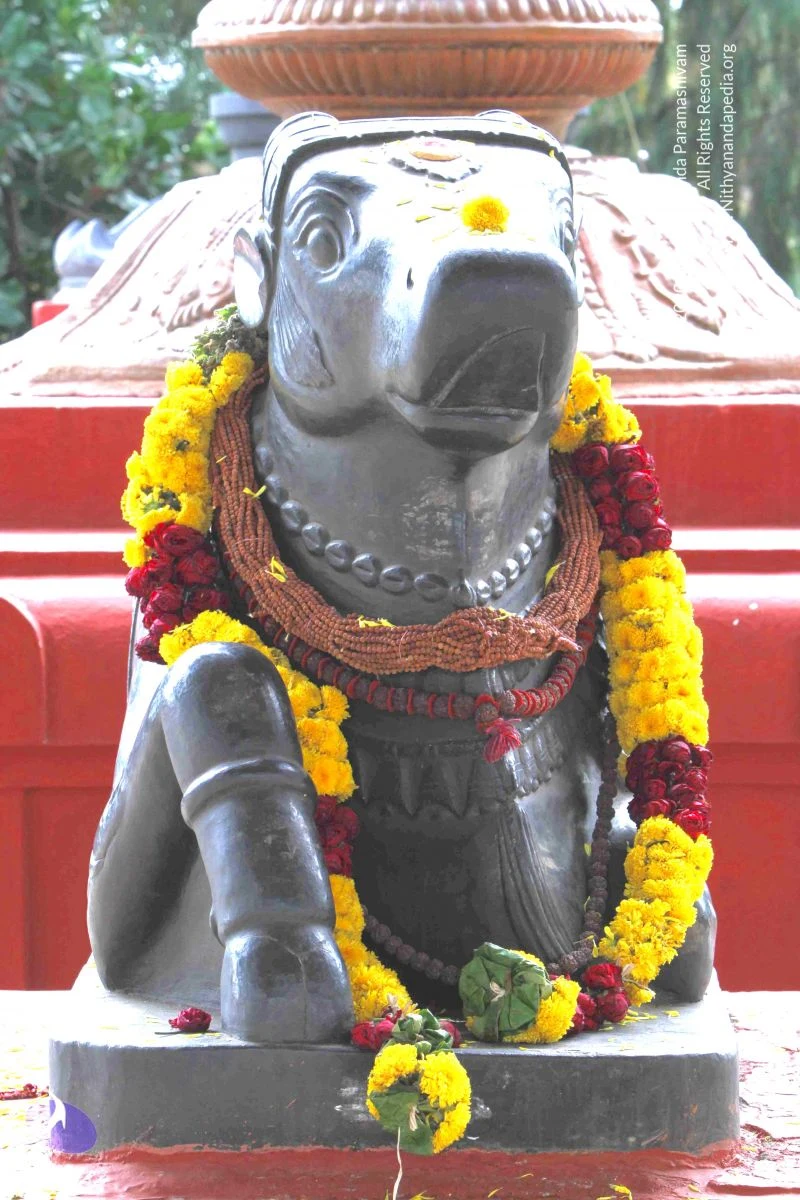
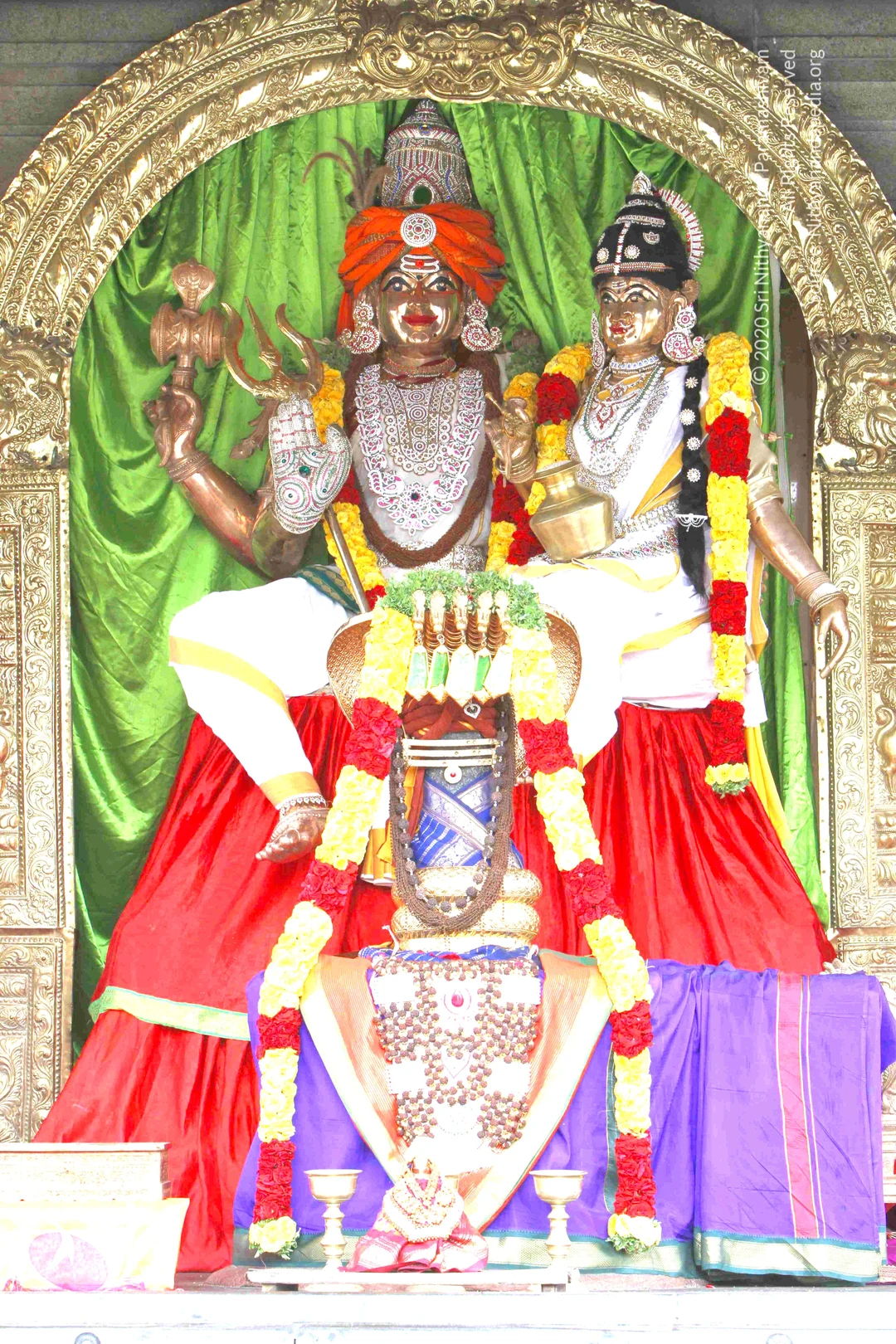
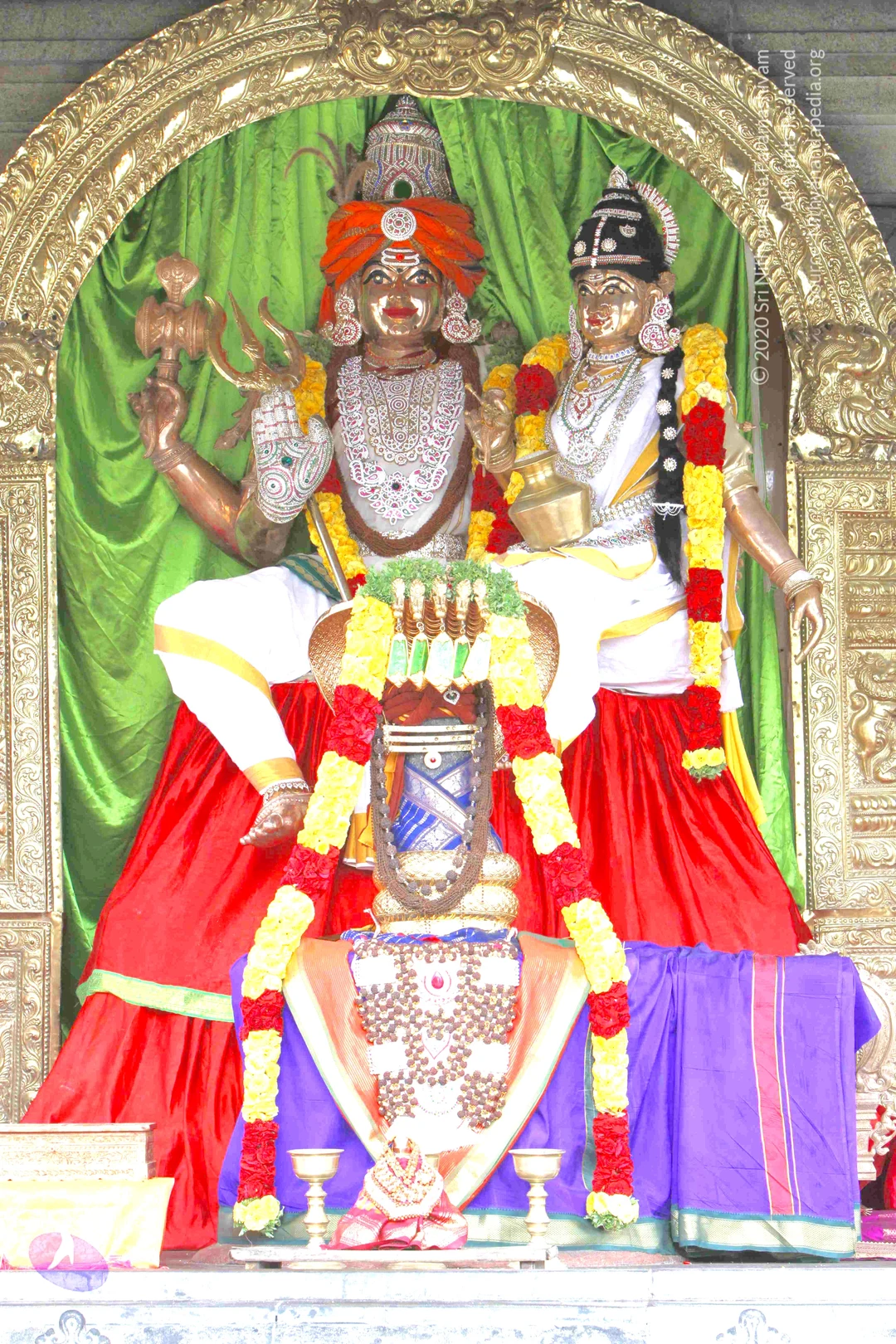
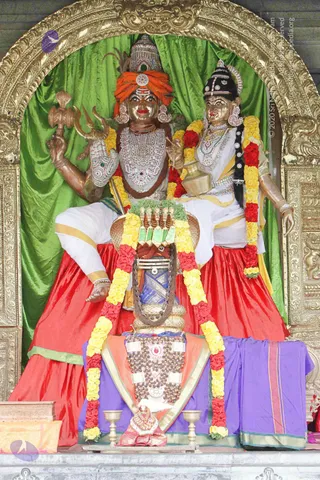
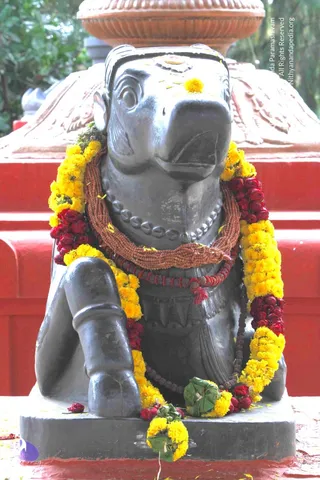
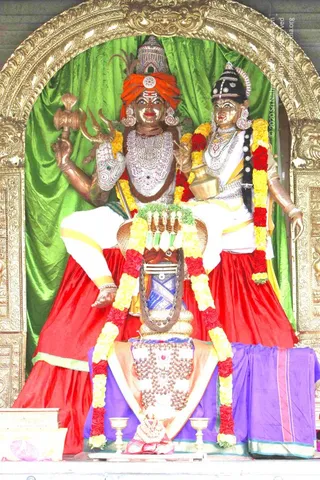
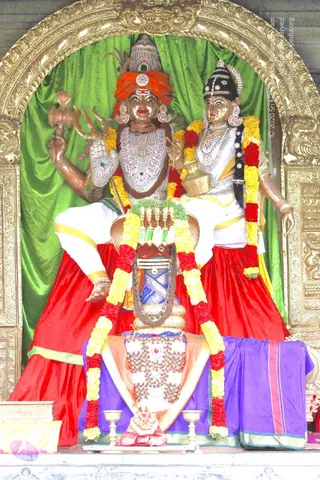
A black stone Nandi bull statue sits on a grey pedestal in front of a red-painted stepped structure, with dark green trees behind. The Nandi is draped in garlands of yellow marigolds and red roses, with a brown rope-like cord and a bead necklace around its neck, and a yellow flower placed on its forehead. Scattered petals lie on the base, and a carved pillar top rises above. No people are visible.A photograph of a metal murti of a seated deity pair, a male figure with an orange turban and a female figure with a black crown, set in an ornate gold arch against green drapery. The male figure holds a trident and a damaru-like object; the female figure holds a brass kalasha pot. Both wear layered silver and jewelled necklaces, white and red garments, and red-and-yellow flower garlands. In front stands a tall decorated linga-shaped form draped in beaded rudraksha-style malas, with two brass oil lamps on either side and a purple cloth below. The statues are inanimate, so no physical people appear in the scene.Photograph of a shrine with two bronze-coloured statues of a seated deity pair set against a green curtain within an ornate gold arch. The male figure wears an orange turban, silver-patterned necklaces and a red-and-white lower garment, holding a trident and a small hand drum. The female figure wears a black headdress, layered necklaces and a white sari, holding a brass pot. Yellow and red flower garlands drape both figures and a central pillar-like sacred form decorated with beads and jewelled panels. Brass lamps stand before a purple cloth on the altar.A temple shrine niche with a central metal deity figure seated on a red and white-draped platform, holding a trident and other implements, with a seated consort figure beside it. Both are adorned with yellow and white marigold garlands, silver necklaces and a gold crown. A cylindrical lingam-like form in front is wrapped in garlands and a rudraksha-style mala. Flanking figures stand on either side holding brass oil lamps and wearing garlands. A green cloth backdrop and gold arch frame the grey stone shrine, with red curtains to the right.A photograph of a temple shrine with a stone arch framed in gold-toned carving. Central sculpted deity murti of Shiva with a trident, seated on a red and white cloth above a blue linga-like form garlanded with yellow and orange marigolds. Flanking figures stand in red and orange garments with garlands. Two brass oil lamps stand on the stone platform, and a red cloth drape hangs at the right. No living people are visible.A temple shrine photograph showing a gilded arched niche with a green curtain backdrop. Two large deity murtis are seated together on a red-draped platform: the central figure wears an orange-red head cloth, a silver ornamented necklace, white and red garments and holds a trident-like staff, while the figure beside it has a dark crown and yellow-and-white dress with a red-and-yellow garland. A decorated shivalingam stands in front, draped with yellow and red flower garlands and sitting on a purple cloth. Flanking the shrine are two standing guardian statues in red dhotis, one with a red cap and crescent, both with flower garlands and raised hands, beside brass oil lamps. Stone carvings frame the scene. The image is a statue-only scene with no living people.

Arti-and-Puja

1 photoSource gallery
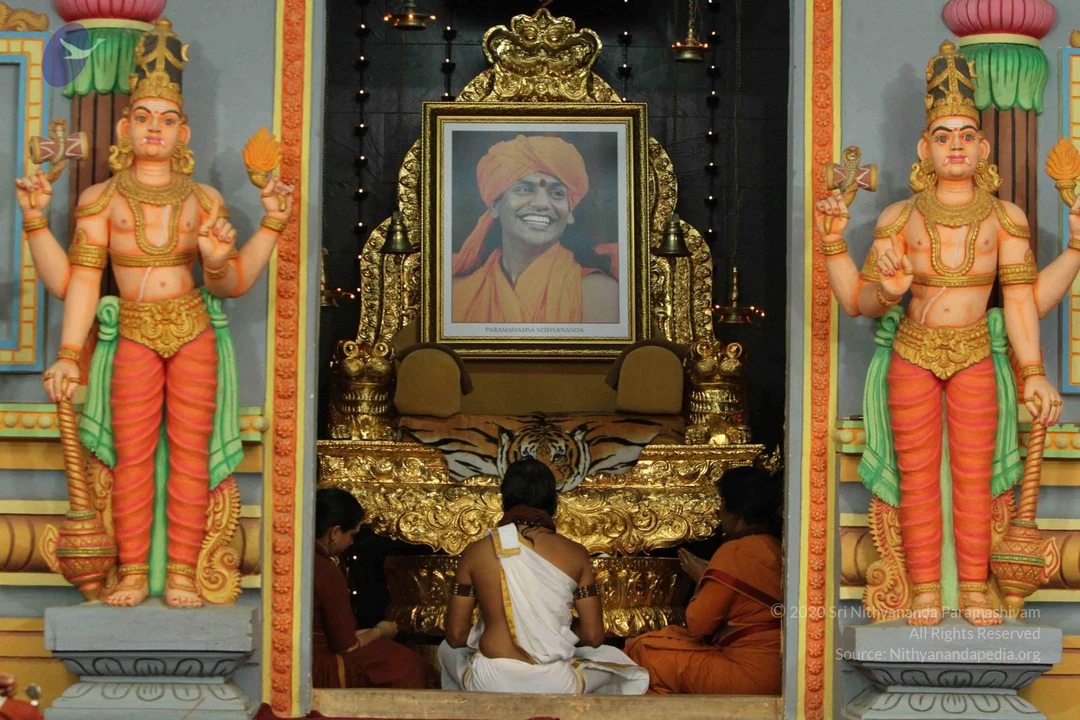
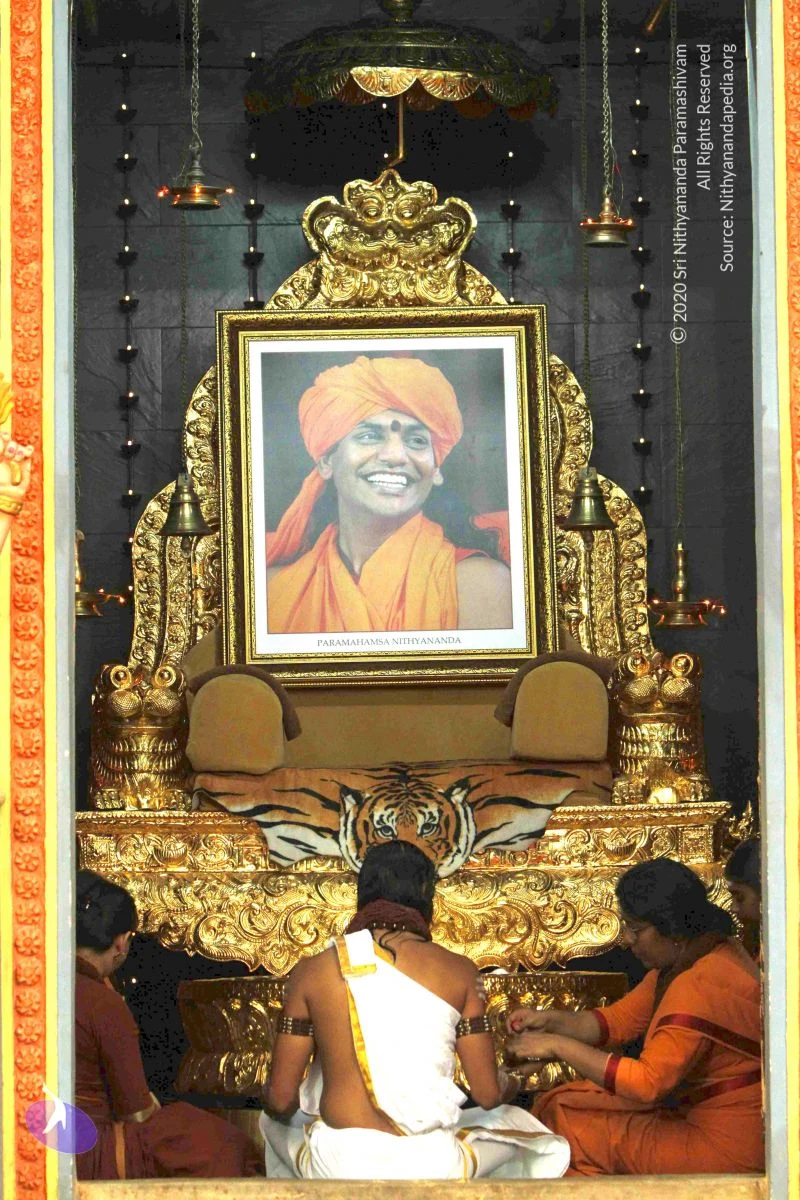
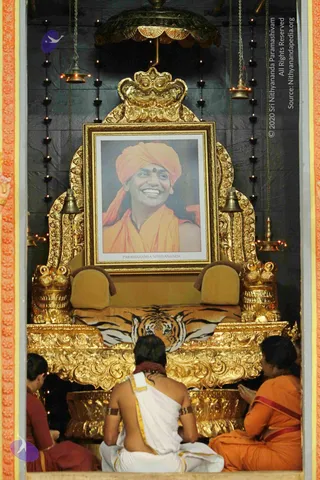
A golden ornate throne-like seat is backed by a framed portrait labelled "PARAMAHAMSA NITHYANANDA" showing a smiling man in an orange turban and orange shawl. The seat has a tiger-skin cushion in front, and oil lamps hang from above. In front of the throne, a bare-chested priest in white dhoti with a gold border kneels with his back to the camera. Two women in orange and maroon saris kneel beside him, one tending to items at the throne's base. The portrait is a printed depiction, not a physical person.

Satsang
5 photosSource gallery
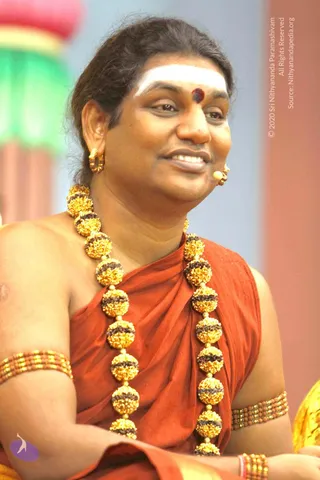
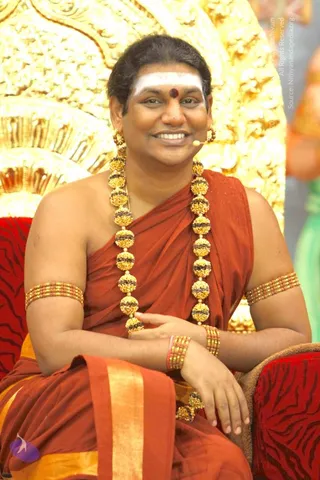
Close-up photograph of a smiling man with swept-back dark hair, a white horizontal forehead band and a red dot on the forehead, seated and wearing a microphone headset. He wears a saffron-orange shawl draped over one shoulder, a long gold-toned bead necklace of large rudraksha-style beads, gold hoop earrings and beaded bangles on his upper arm and wrist. Blurred pastel background of pink, green and blue structures.Close-up photo of a man speaking with an open smile, bare-shouldered and wearing a saffron-orange wrap. He has long dark hair pulled back, a white forehead mark with a red bindi, gold earrings and a long necklace of gold-and-black rudraksha beads. A small microphone is clipped near his mouth. Behind him are blurred pillars in pink and a green-and-red decorative lamp shape. Appearance-based label: a person, with long swept hair, saffron wrap, rudraksha mala and ceremonial gold necklace visible.a person seated on a gold ornate throne with red tiger-striped upholstery, smiling, wearing a rust-orange sannyasi wrap with a gold border, a long gold-and-black rudraksha mala necklace, gold-and-beaded armlets and bracelets, gold earrings, a white tripundra with a red bindi, and a small headset microphone. A green-clad figure is partially visible at the right edge.A smiling man sits on a red and gold patterned chair before an ornate golden backdrop, raising one hand near his face in a gesture of speech. He wears a rust-orange shawl with a gold border, multiple long gold-and-black beaded garlands, gold beaded armbands and wrist bracelets, and a small microphone clipped near his ear. He has a white band across his forehead with a red dot at the centre. Swamiji (probable) is shown in the appearance-based label: long-haired presentation, saffron-toned ceremonial clothing and ornate gold beaded garlands, seated in a throne-like setting during a satsang.A smiling man sits on an ornate gold throne with red tiger-striped upholstery. He wears a rust-orange draped garment over one shoulder, long gold and black beaded necklaces, gold beaded armbands, and gold bangles. He has a white vertical forehead mark with a red dot, gold earrings, and a small headset microphone. His hands rest folded in his lap. Appearance-based a person in person, in a seated satsang setting.
Nithyanandeshwara-Paramashiva-Devalaya

10 photosSource gallery
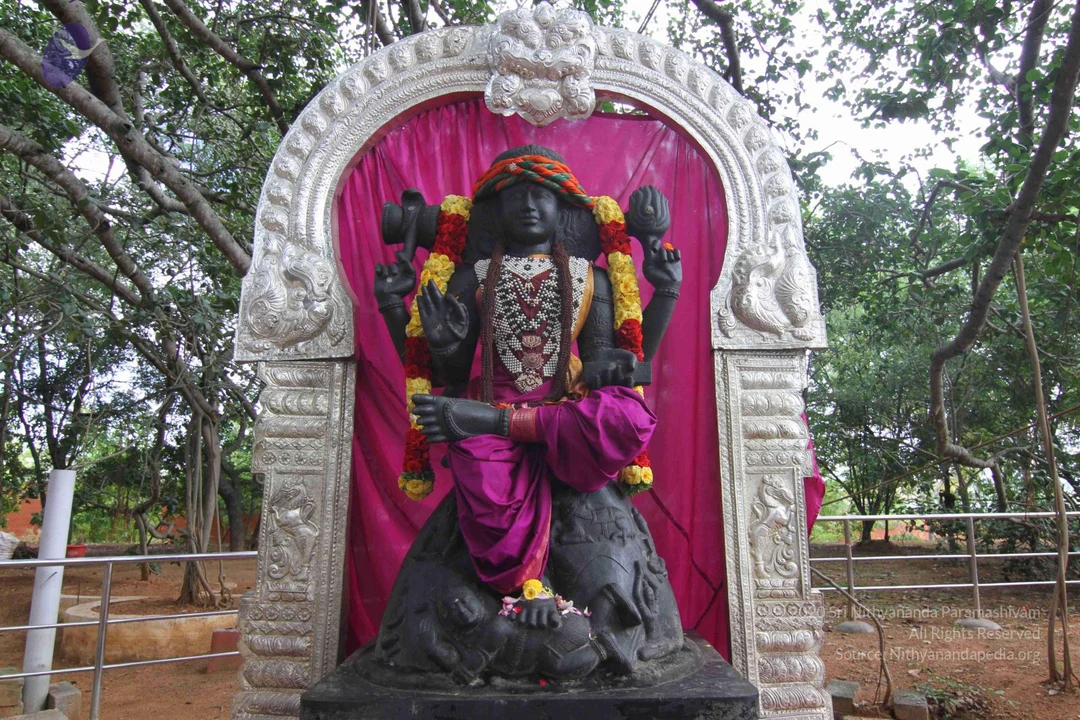
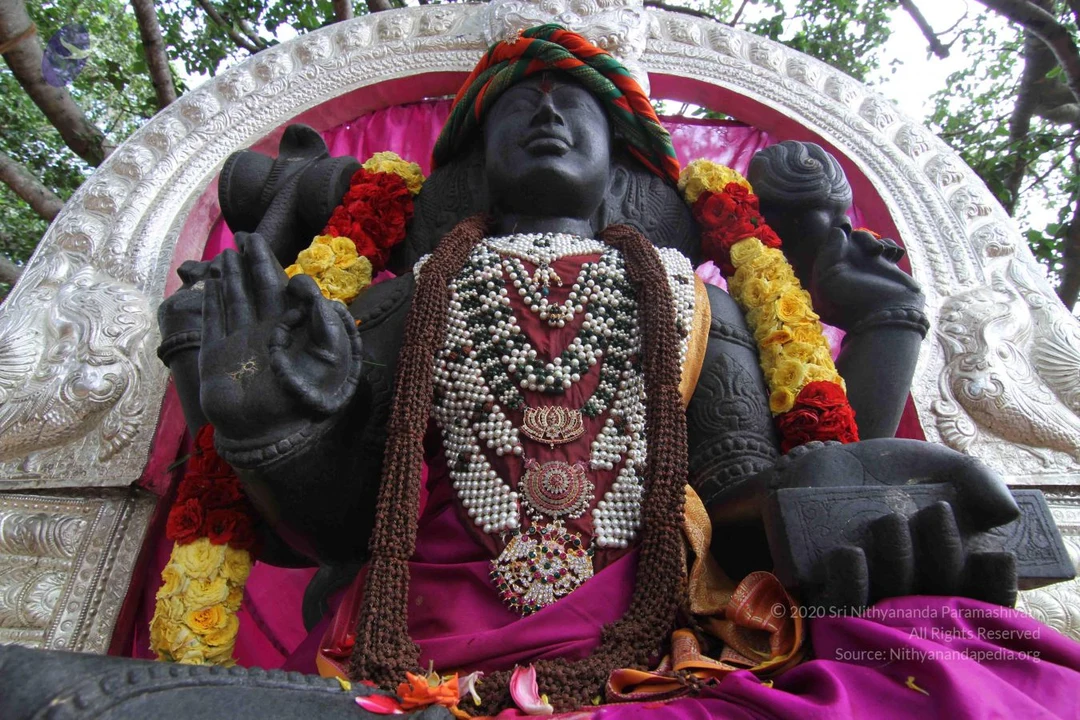
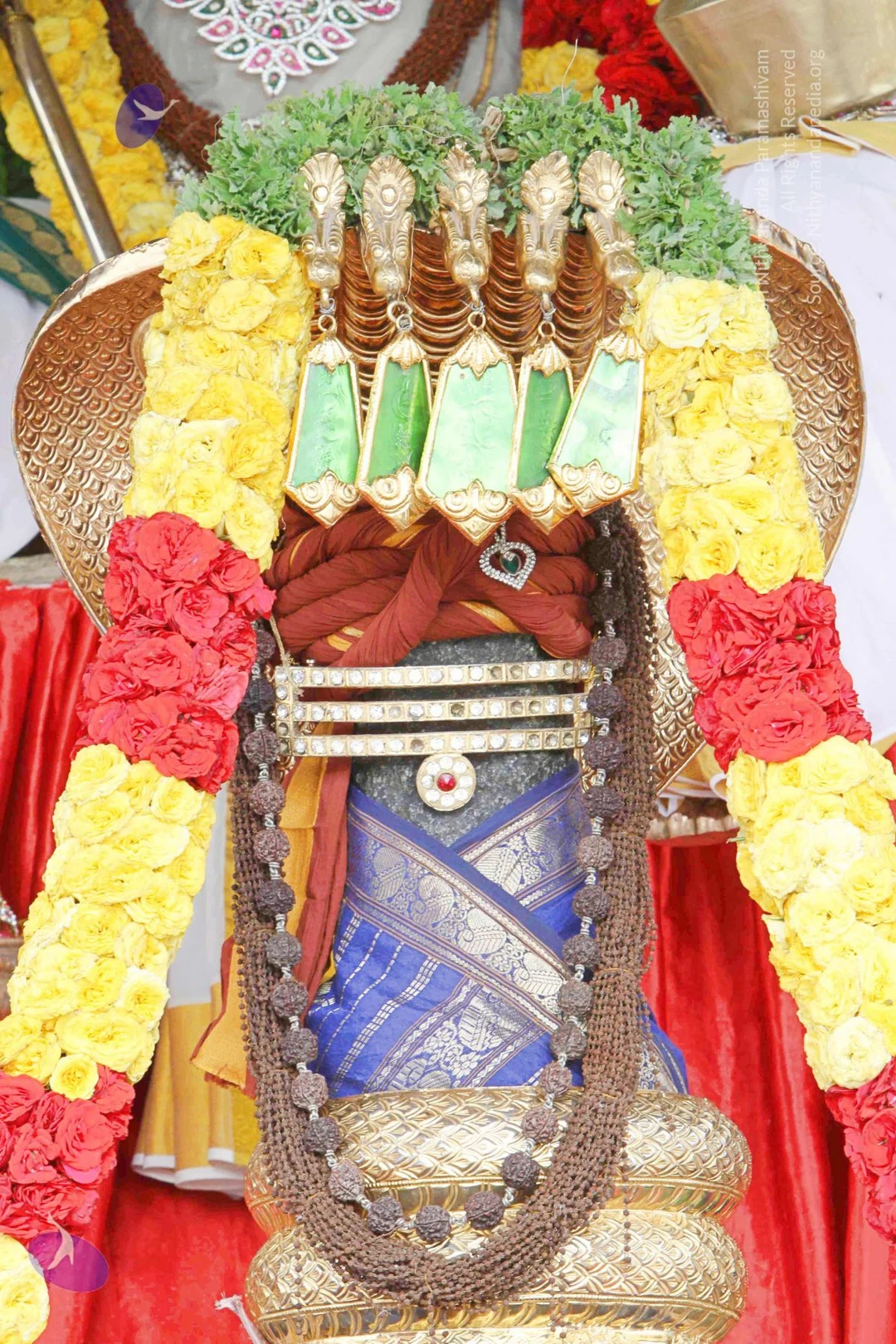
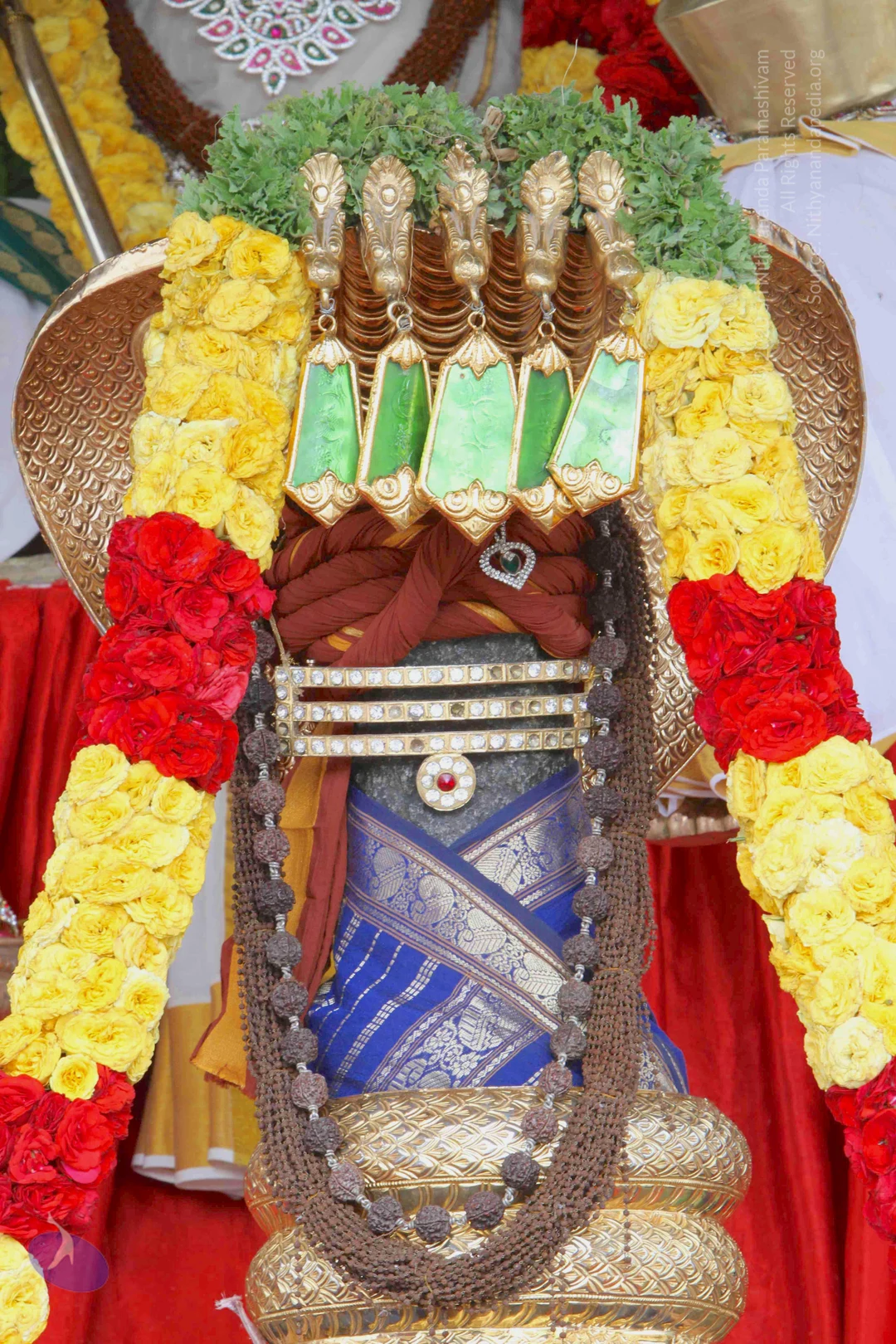
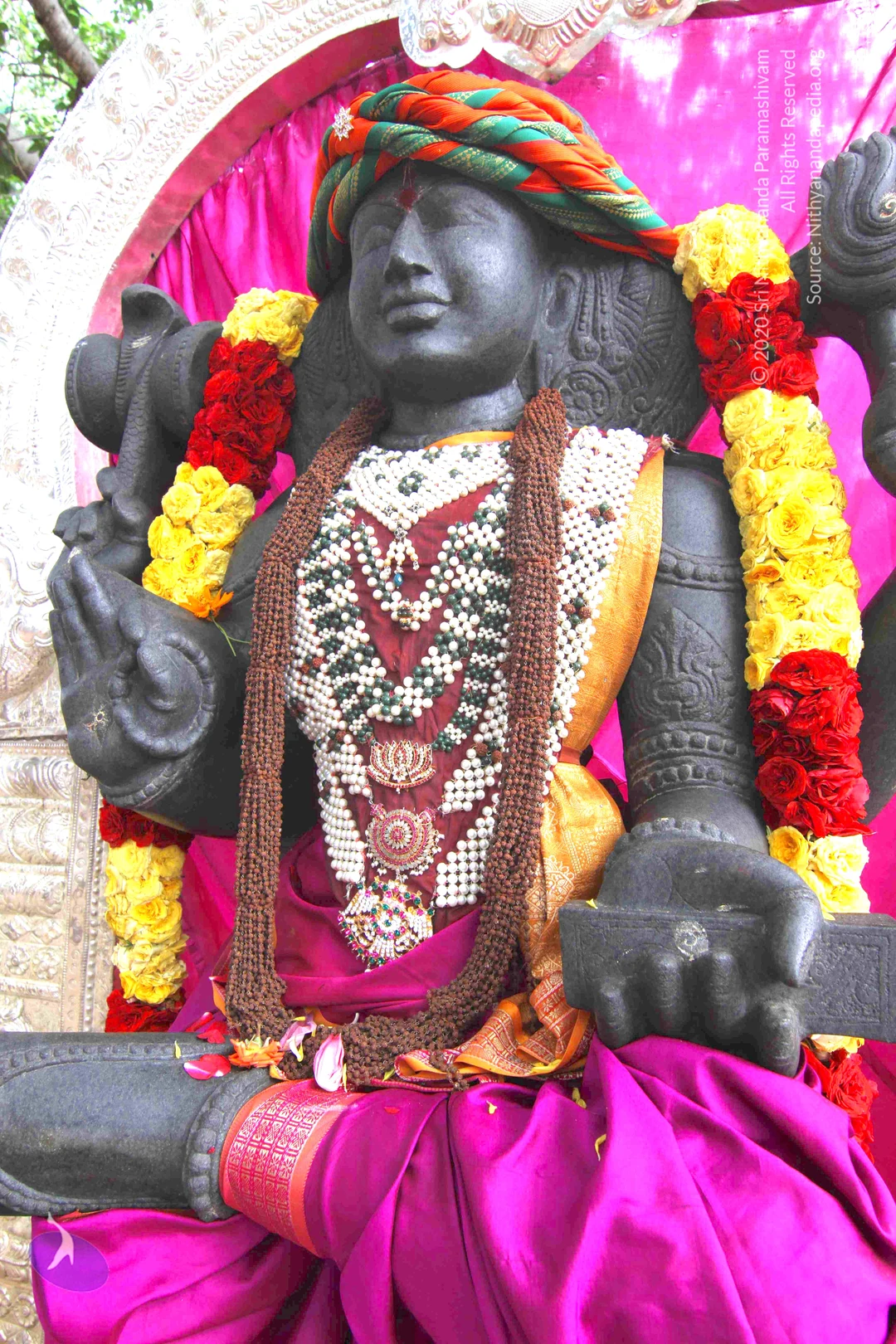
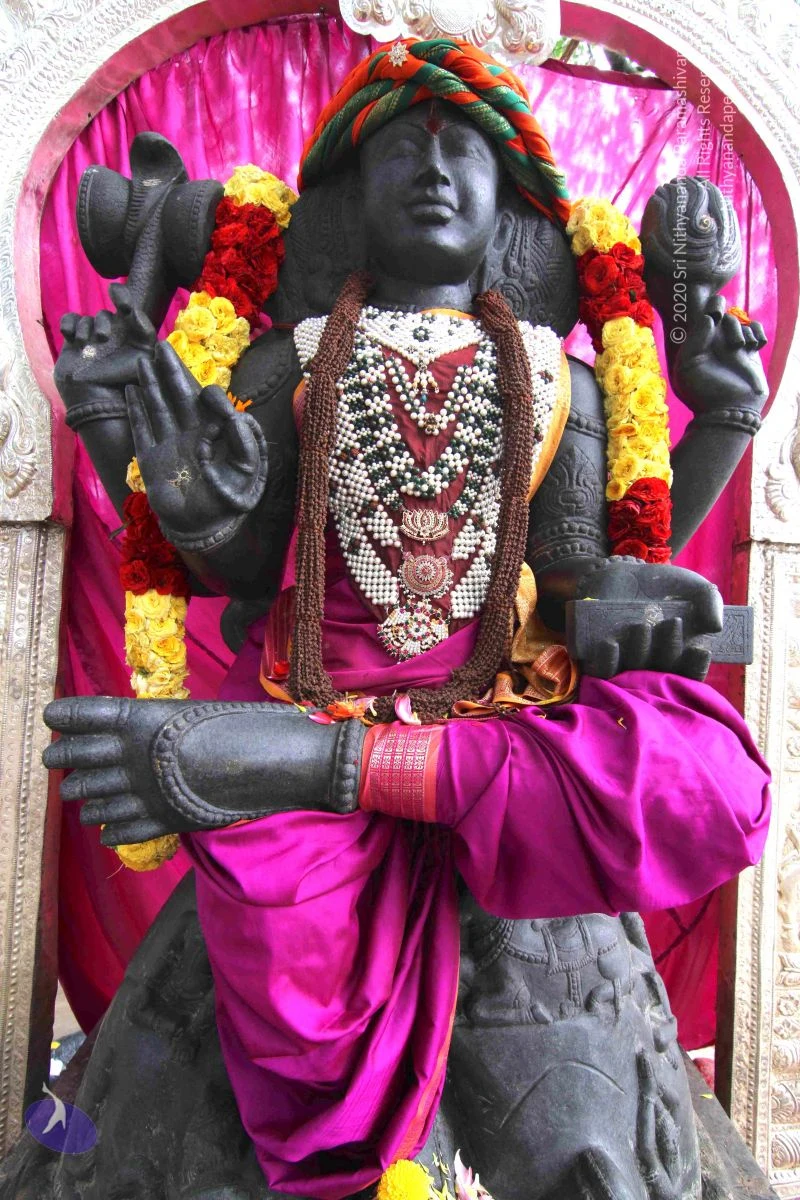
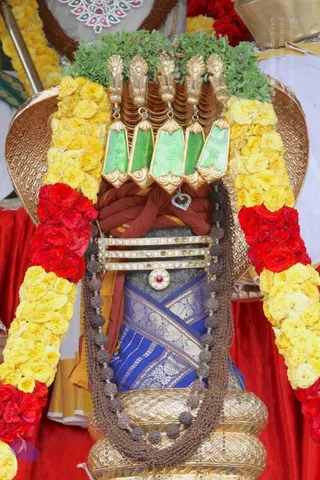
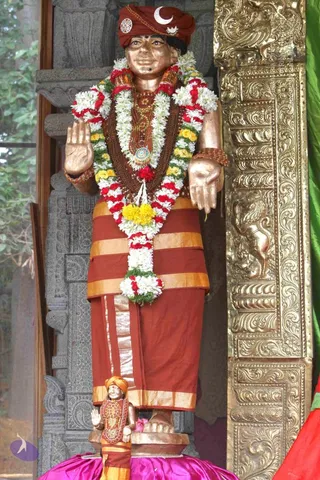
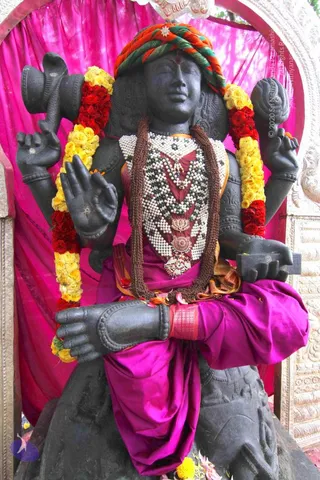
A dark grey stone Nandi statue sits on a grey base in front of a red-painted pillar, decorated with yellow marigold garlands and red rose garlands. Strands of rudraksha beads and a white bead necklace hang across its chest, and yellow petals and a small kumkum mark adorn its forehead. Fresh leaves and flowers lie at its base. Green foliage fills the background. No people are visible, and the scene is a temple shrine decoration.Photograph of a golden deity murti pair seated in an ornate arched shrine with a green drape behind them. The male form wears an orange turban, white and silver jewelled garments, red dhoti and holds a trident and a snake-topped staff, with a red-and-white tilak on the forehead. The female form beside him wears a black crown, silver jewellery and a white sari, holding a brass pot. Yellow and red marigold garlands drape both figures and a large rudraksha-beaded linga-form adorns the central pedestal, flanked by brass oil lamps on a purple cloth. No physical people are visible.A photograph of a gilded arched shrine framing a pair of metal deity murtis seated together on a red-draped seat. The taller figure has four arms, holds a trident and a small staff, wears an orange turban, white ornate jewelled necklaces and a red and white dhoti. The seated female figure wears a black crown, a long braid, white and gold jewelled garments and holds a brass kalasha. Yellow and red marigold garlands drape both figures. In front is a blue-wrapped shivalinga-like object with a rudraksha-style mala and a green-leaf crown, with brass oil lamps on a purple cloth. Green curtains backdrop the scene. No physical people are visible.A decorated stone deity murti. Five golden cobra hoods with green gem panels rise above it, with fresh green leaves on top. A brown cloth is wrapped around the upper part, a blue silk sari with gold border drapes the body, and a dark rudraksha mala hangs down. A gold belt with white stones and a red stone sits at the centre. Thick garlands of yellow and red roses frame the figure against red cloth. No people are visible.A large golden statue of a standing saint stands in a doorway flanked by ornate gilded metalwork with carved floral and animal motifs. The statue wears a rust-red turban with a crescent moon and decorative emblem, a rust-red dhoti with gold borders, and rudraksha beads. It is draped in a thick garland of white jasmine, red roses and yellow marigolds, with one hand raised in blessing and the other open. A smaller golden figure in matching red attire and turban stands at its feet on a magenta cloth. A green curtain and foliage are visible at the left edge.A dark stone murti of a four-armed deity stands in a shrine framed by a silver-embossed arch and a magenta silk backdrop. The figure wears a red, orange and green turban, a pearl and bead necklace with a gold pendant, a brown rudraksha-style mala, and a magenta dhoti. Garlands of yellow and red marigolds and roses hang from the shoulders, and loose petals lie at the base. One hand is raised in abhaya-style blessing and another holds a small object. Deity murti.

August 19th 2014

16 photosView all
A man seated cross-legged on an ornate golden throne with lion-headed armrests and a tall gilded back, upholstered in red cushions with a zebra-stripe pattern. He wears an orange-red shawl over his bare shoulders, gold bangles on his upper arms, a long gold bead necklace, and gold earrings, with a white tilak and red bindi on his forehead. A small microphone is clipped near his face. Behind him are painted pillars in pink, orange and blue. He smiles and gestures with one hand. Appearance-based label: a person, seated in the role of a speaker on the throne.A seated man in a rust-orange dhoti-style wrap and matching shawl sits on a red tiger-striped cushioned chair in front of an ornate gold carved throne back. He wears a long necklace of gold beads, gold armlets and a bindi with white tilak marks on his forehead, and a small headset microphone is visible near his face. His hands rest folded in his lap. To the right, a gold lion sculpture and painted deity figures in orange and green frame the scene. The setting suggests a satsang or discourse, with a person candidate present.A man sits close to the camera in a rust-orange cloth draped over one shoulder, wearing a long gold necklace of golden-capped rudraksha beads and gold earrings, with a white horizontal forehead mark and a red dot between the brows. He has a small headset microphone at his cheek and speaks with an open, smiling expression. A large gold ceremonial object fills the left edge, and a red, green and white striped pillar stands behind him against a soft blue-grey and pink wall.A seated man speaks into a headset microphone during a satsang, sitting on an ornate gold throne with a red tiger-stripe upholstered seat. He wears a rust-orange dhoti and shawl, a long necklace of gold-toned beads, gold armbands and a red bindi with a white vertical tilak on his forehead; his hands rest in his lap. A gold lion figure sits at the right edge, and a partially visible orange-and-green deity figure stands behind him. a person cues present: long-established ceremonial gold necklace and orange ceremonial dress on the throne. The person's identity is uncertain from appearance alone, so this is marked as probable.A man seated on a golden throne with an ornate golden backrest, smiling with eyes partly closed. He wears a rust-orange shawl draped over one shoulder and bare shoulder, a long necklace of gold beads with dark accents, gold bangles on his upper arms, gold earrings, and a white tripundra with a red dot on his forehead. A small microphone is clipped near his face. Red fabric and a gold lion-form armrest are visible at the edges, with a pink and green pillar behind. Appearance-based label: a person, seated in a satsang setting with a distinctive saffron shawl, gold beaded mala and ornate gold throne cues.A photograph of a man seated on an ornate golden throne with lion-form armrests and a gilded arched backrest, flanked by two large painted statues of multi-armed deities with tall crowns and gold jewelry. The seated man wears a saffron-red robe over a dhoti, a long gold-toned bead garland, gold armbands and a white-painted forehead with a red bindi. He sits barefoot on a red-cloth-covered platform with a leopard-print cushion, smiling with hands in front of him. Walls are blue and yellow with pillars in green, pink and orange. The setting suggests a satsang hall.