Skip to content
Monday

19 August 2013

Supreme Pontiff of Hinduism HDH Bhagavan Nithyananda Paramashivam

Dated photos
323
Source pages
1
Media
4
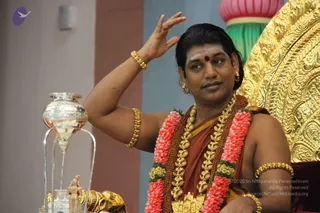
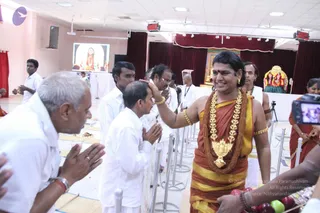
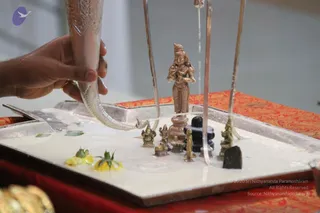
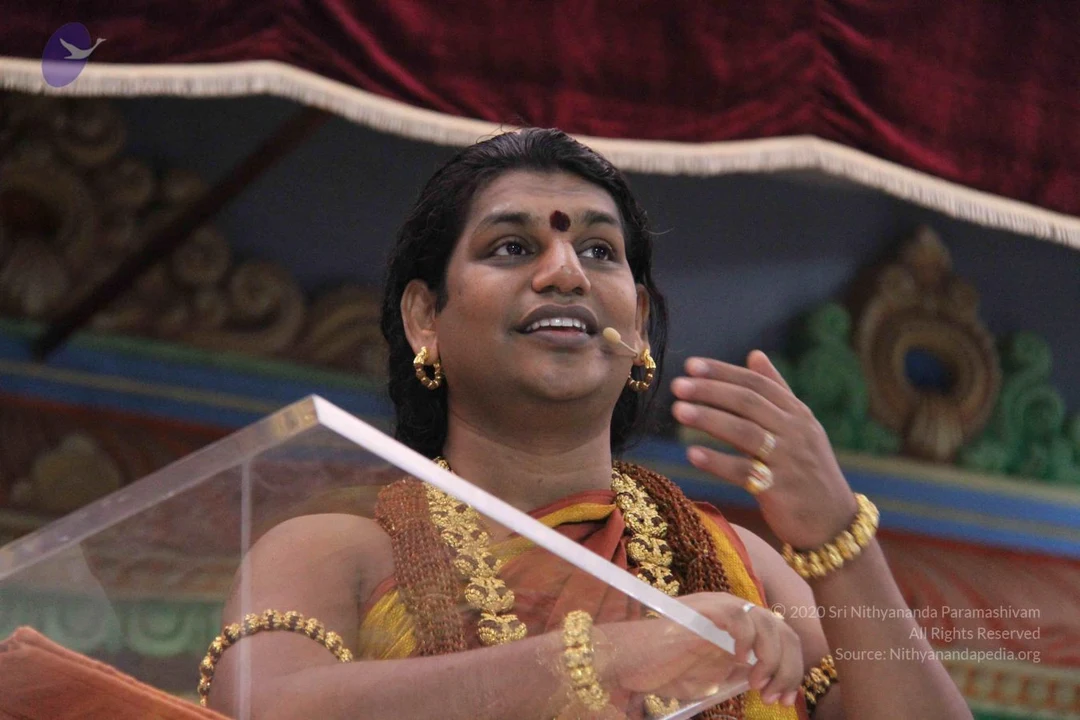
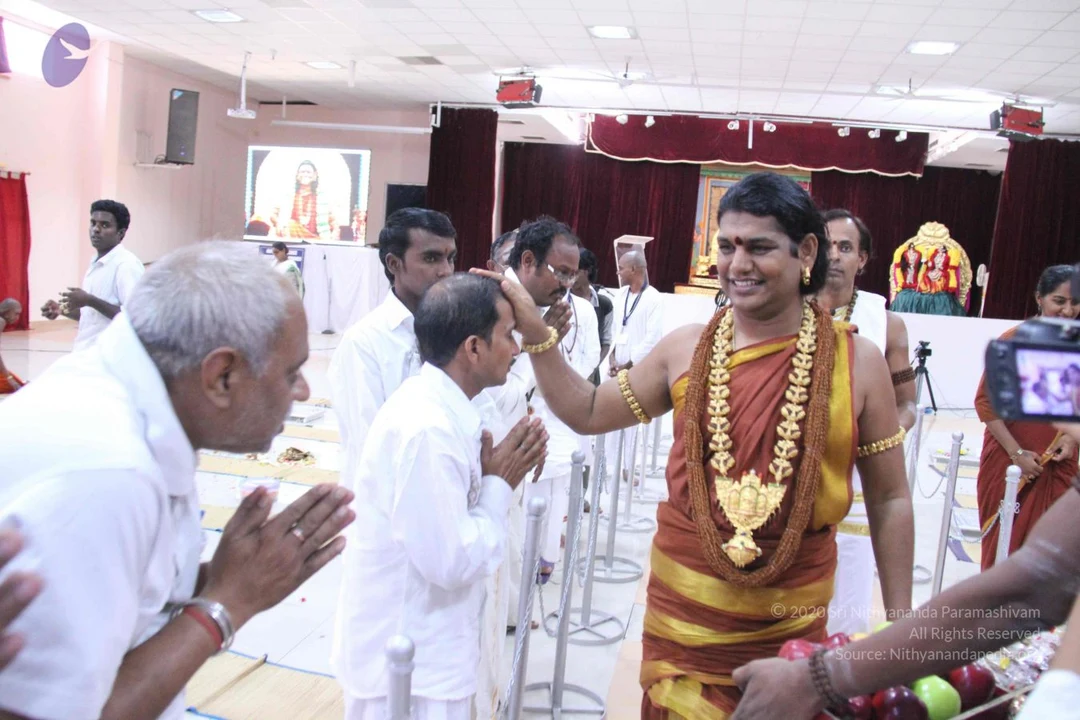
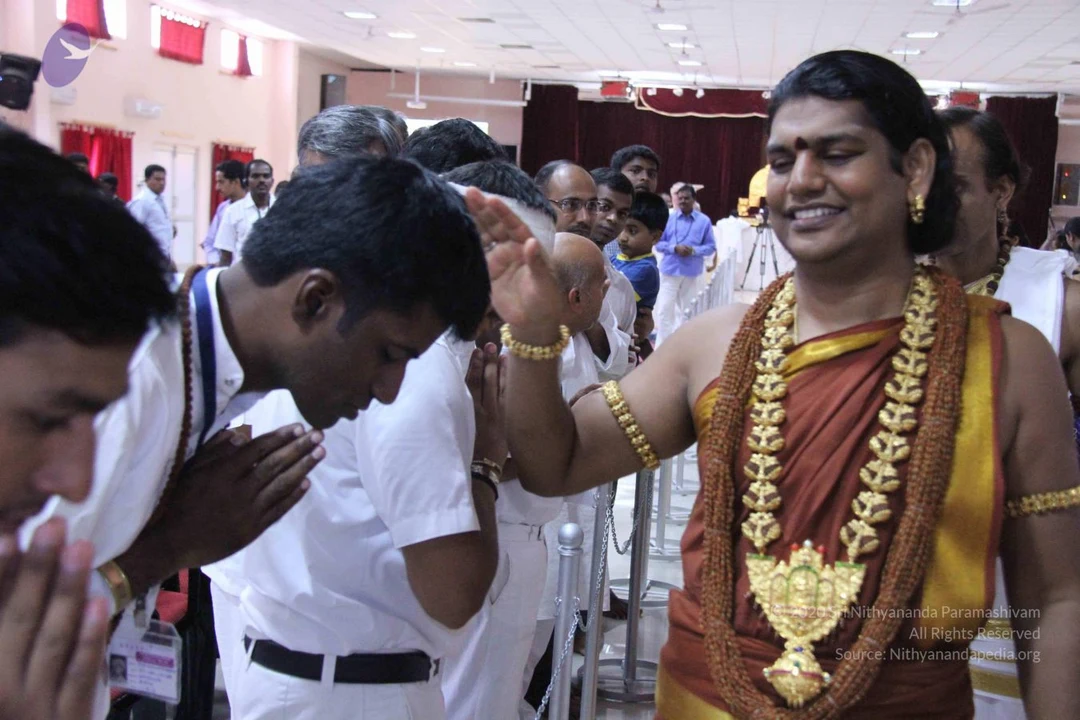
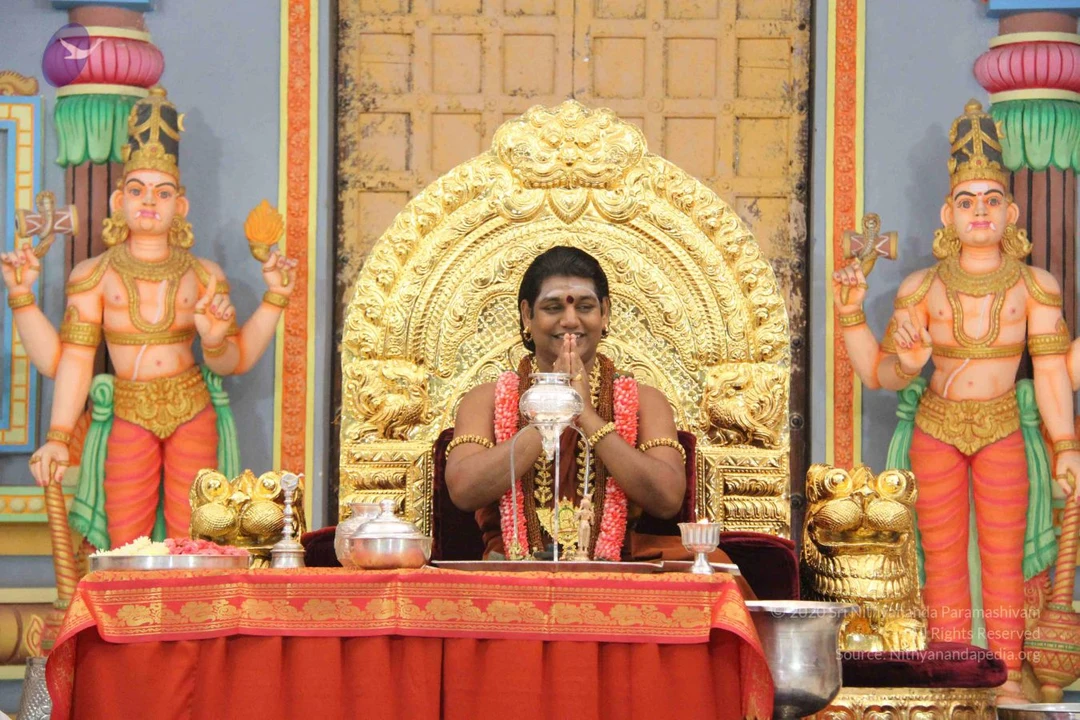
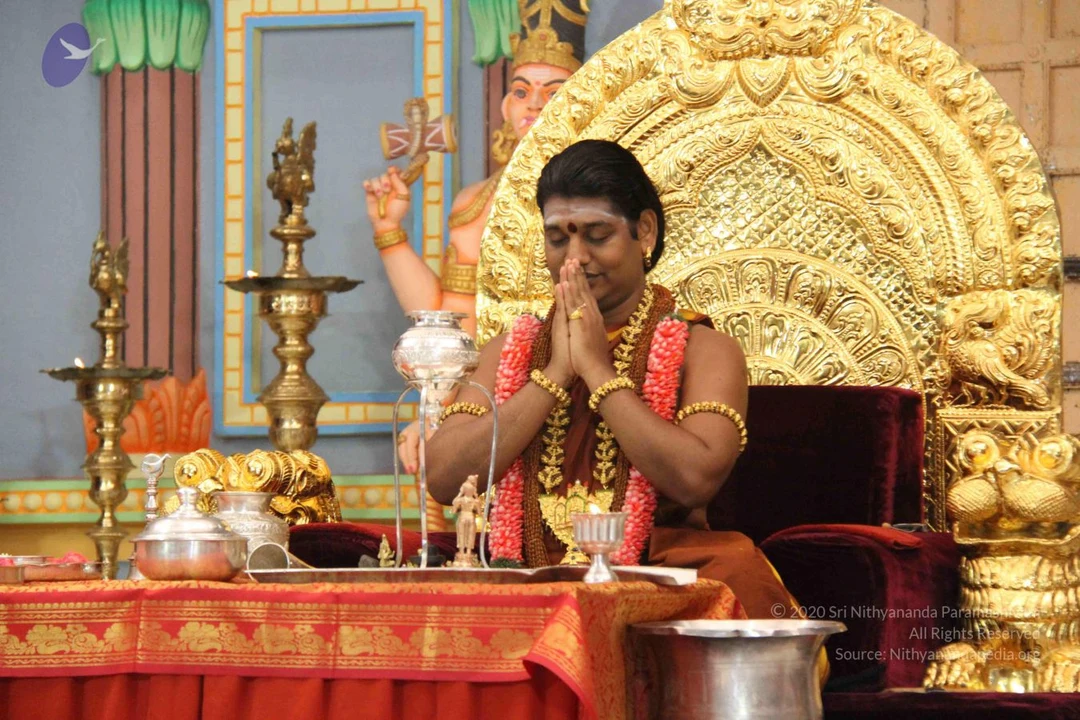
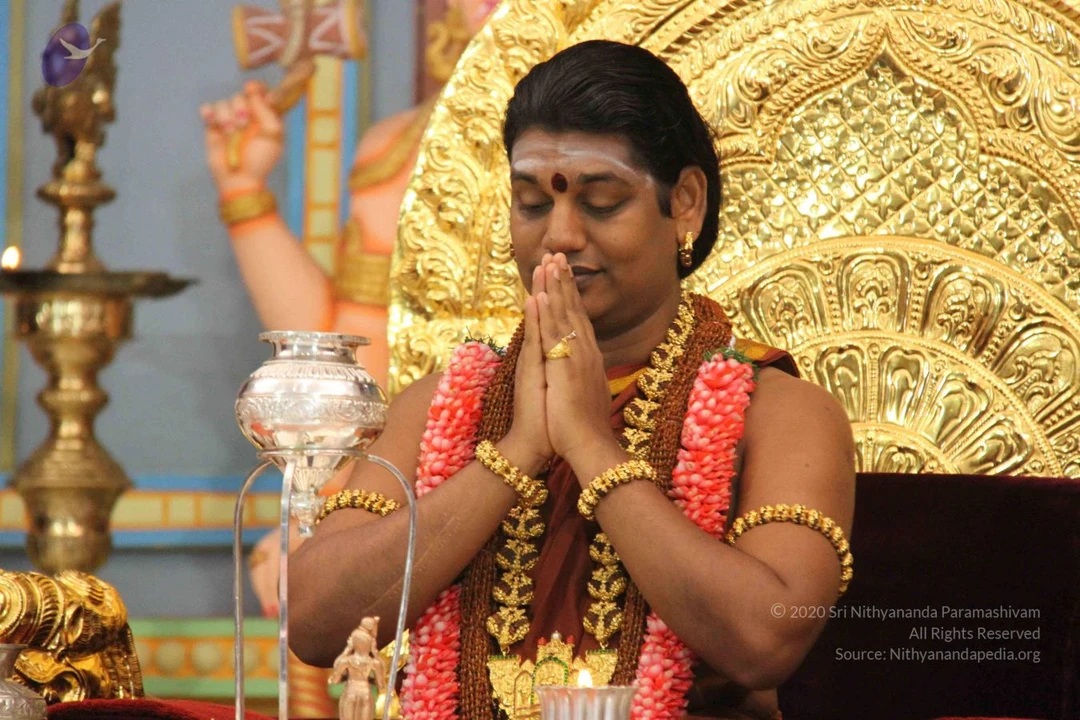
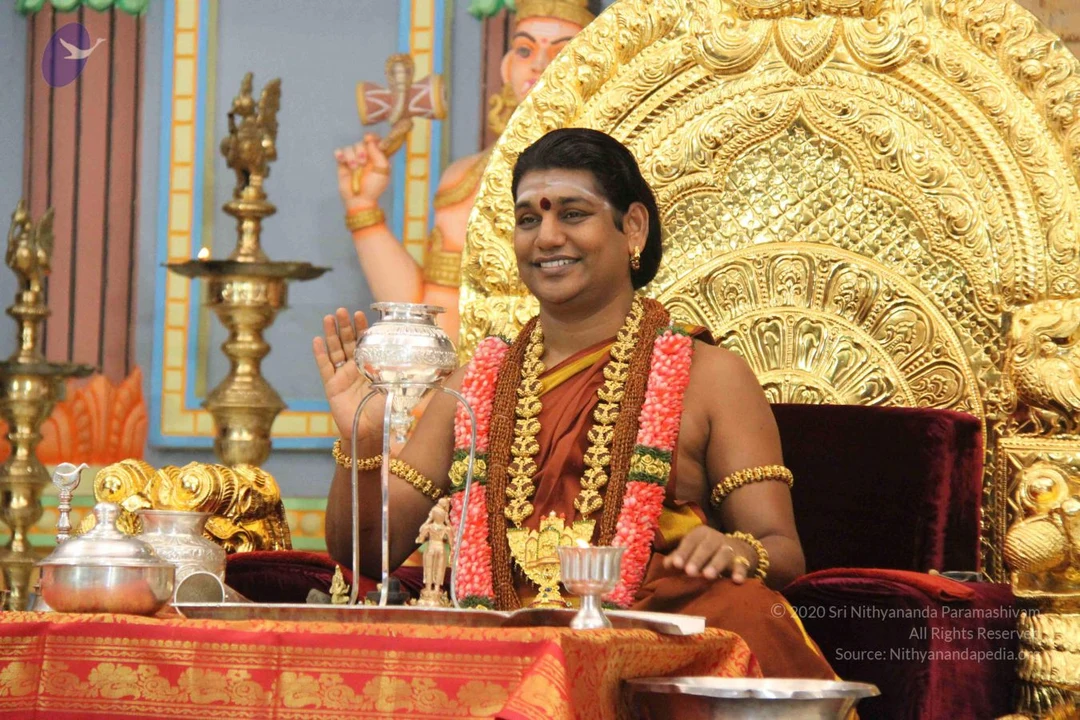
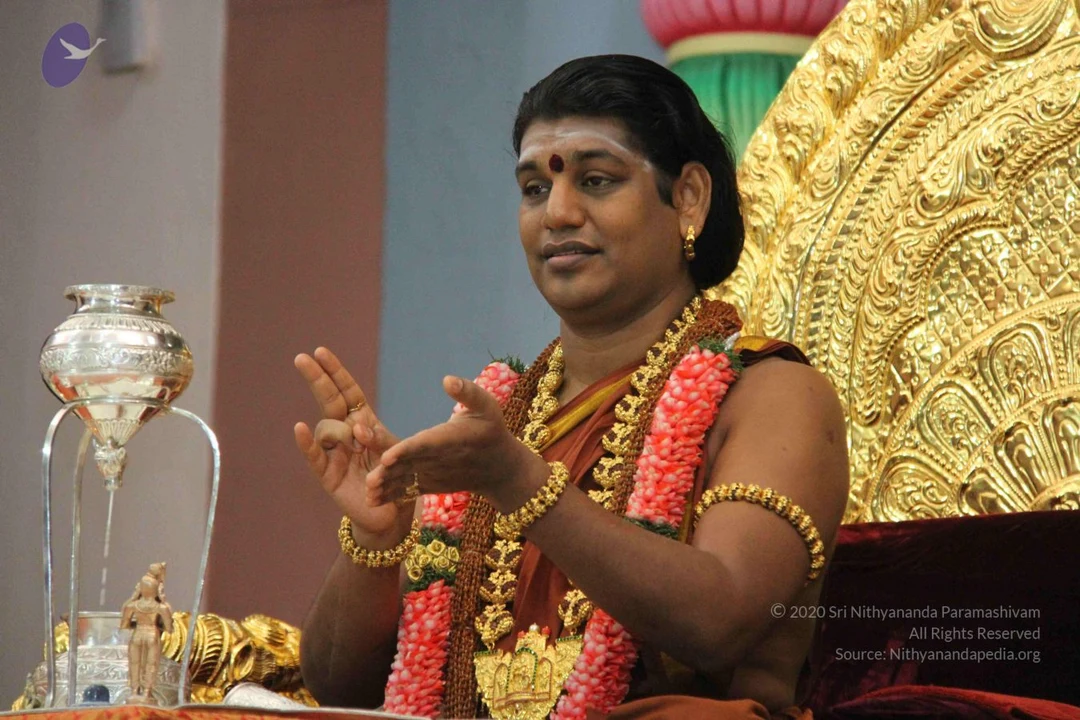
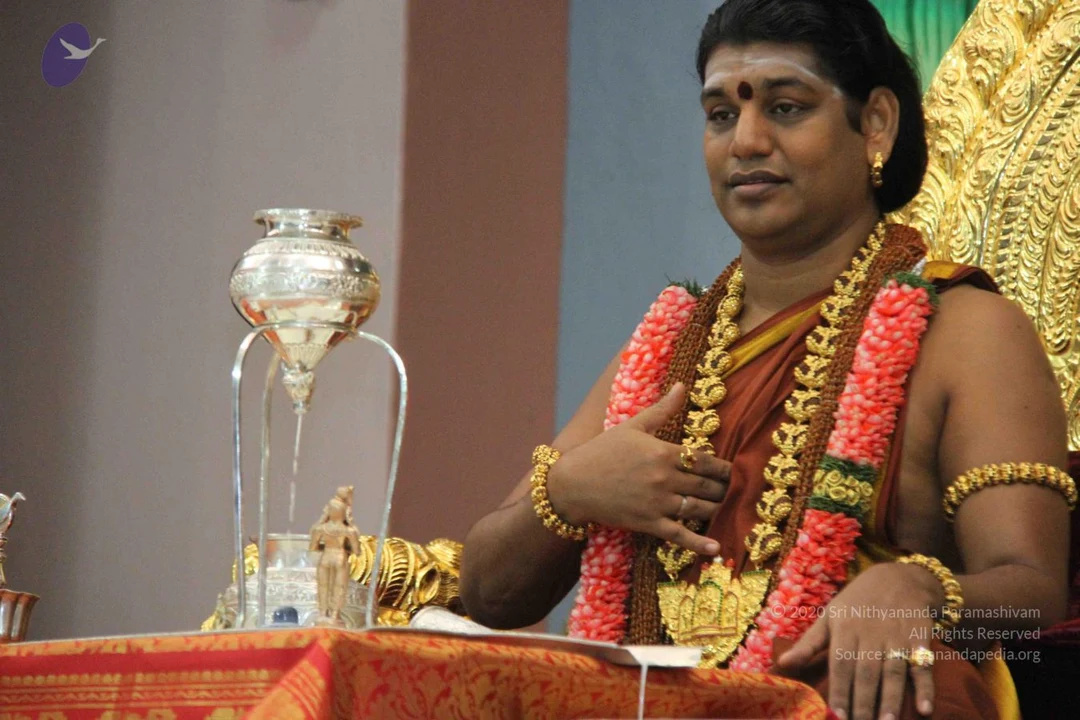
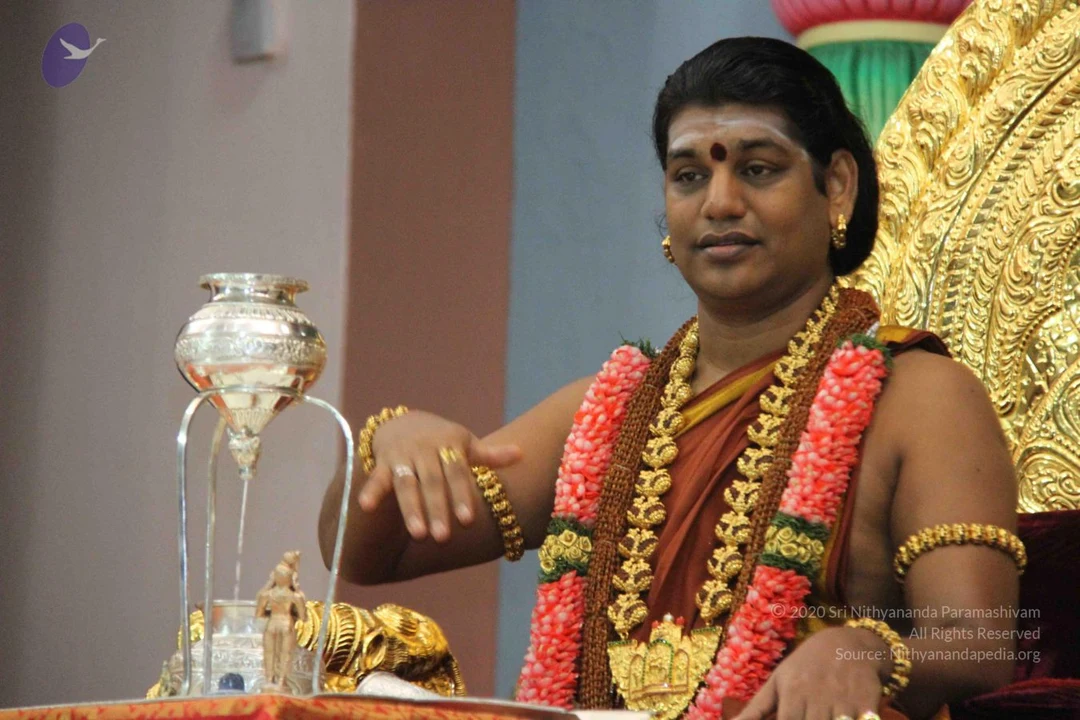
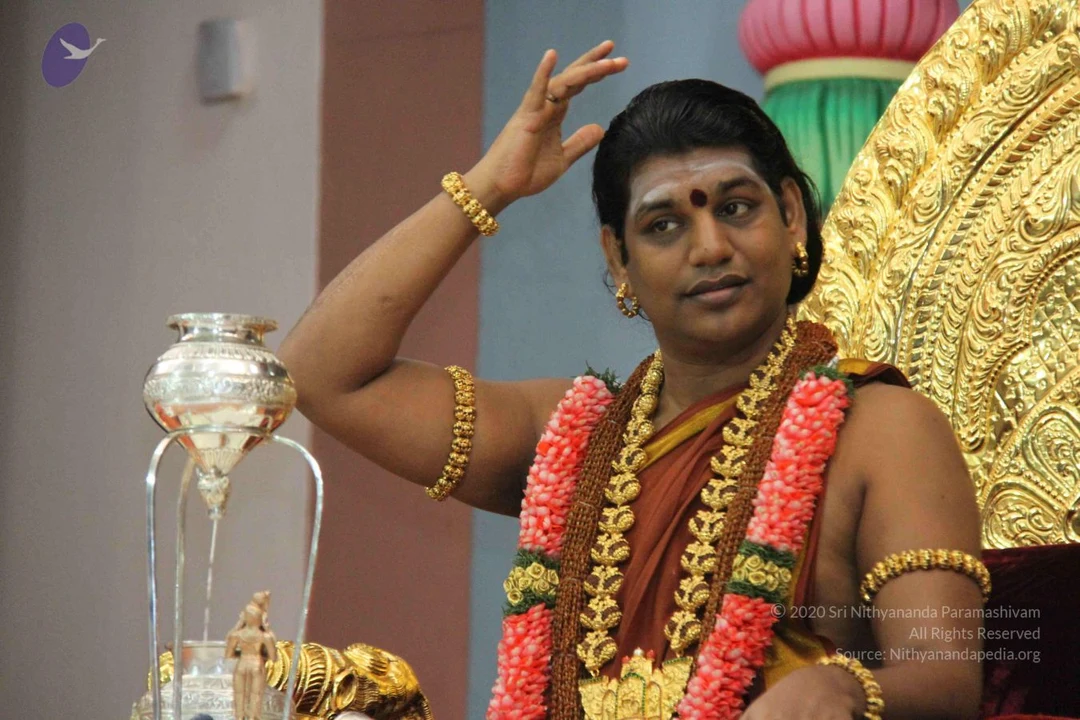
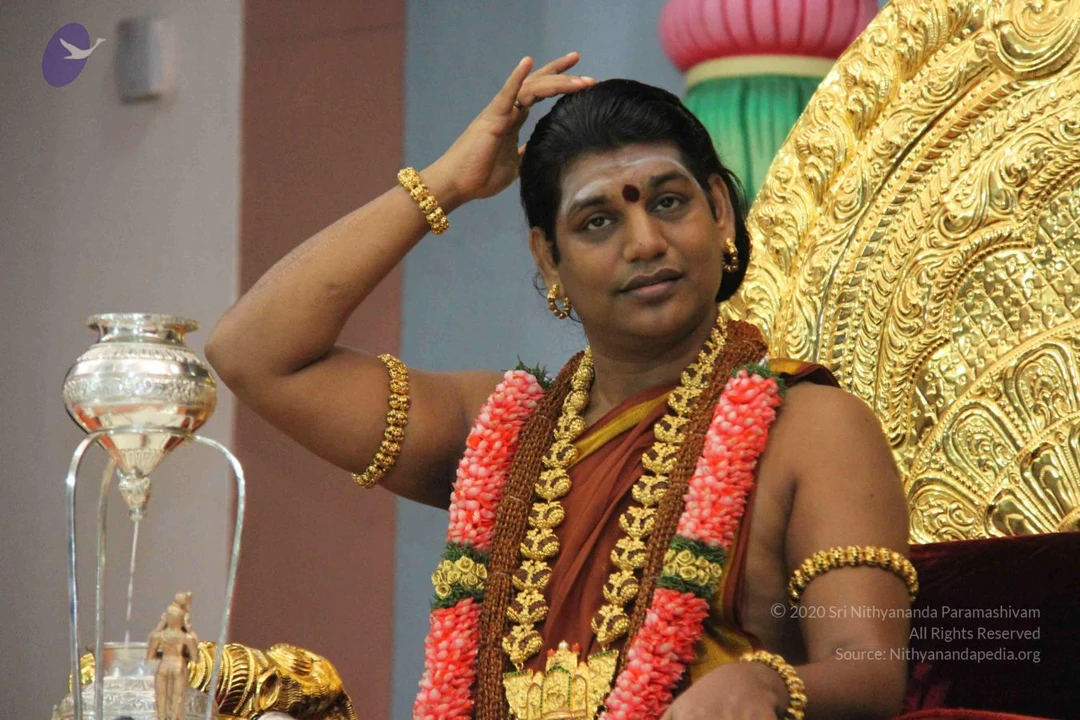
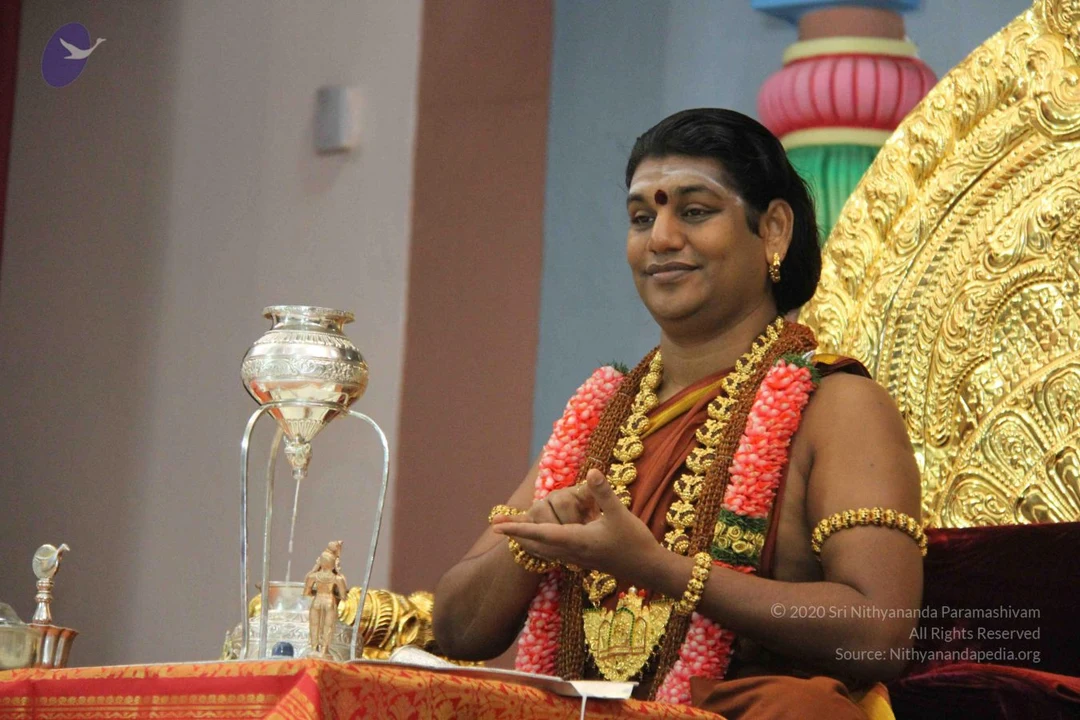
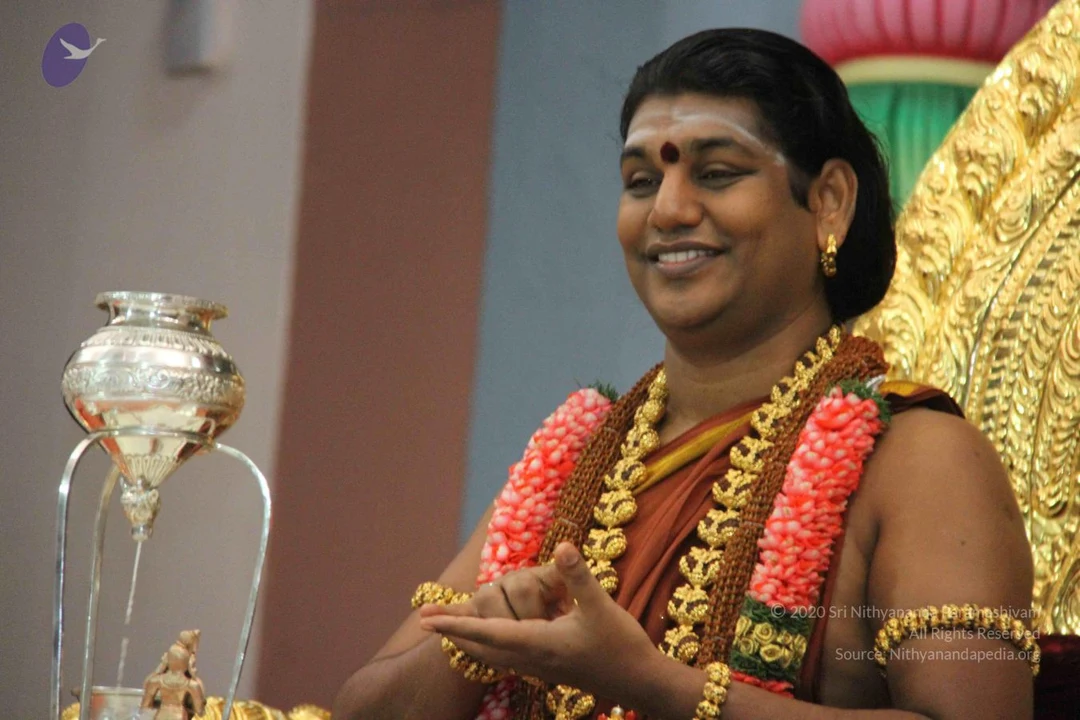
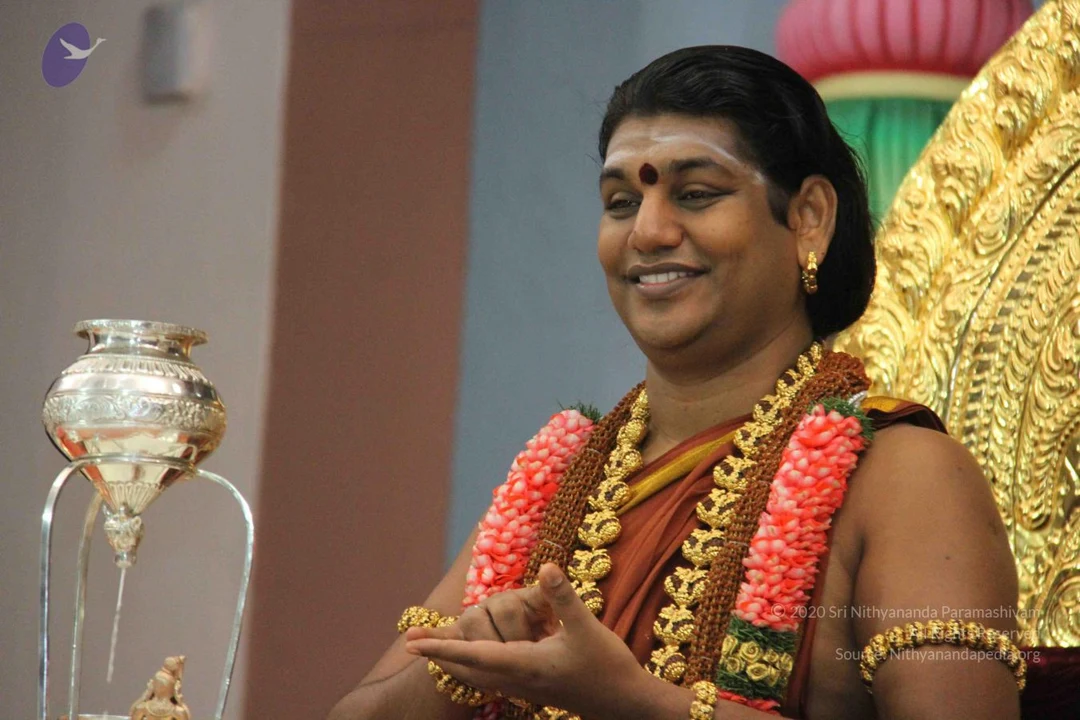
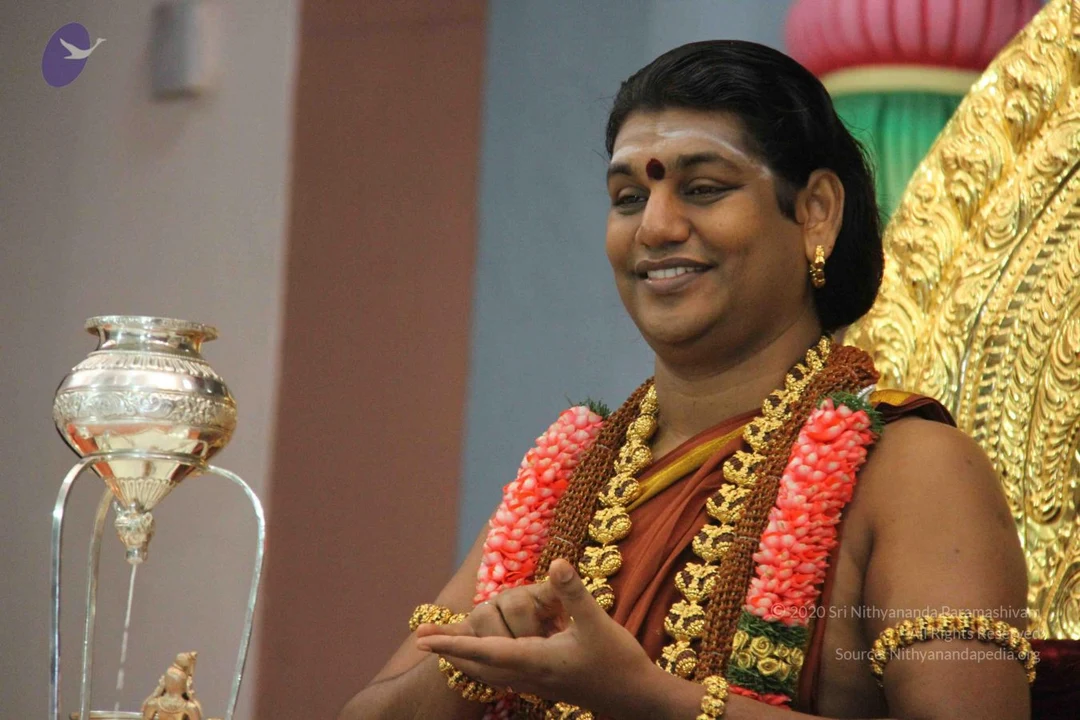
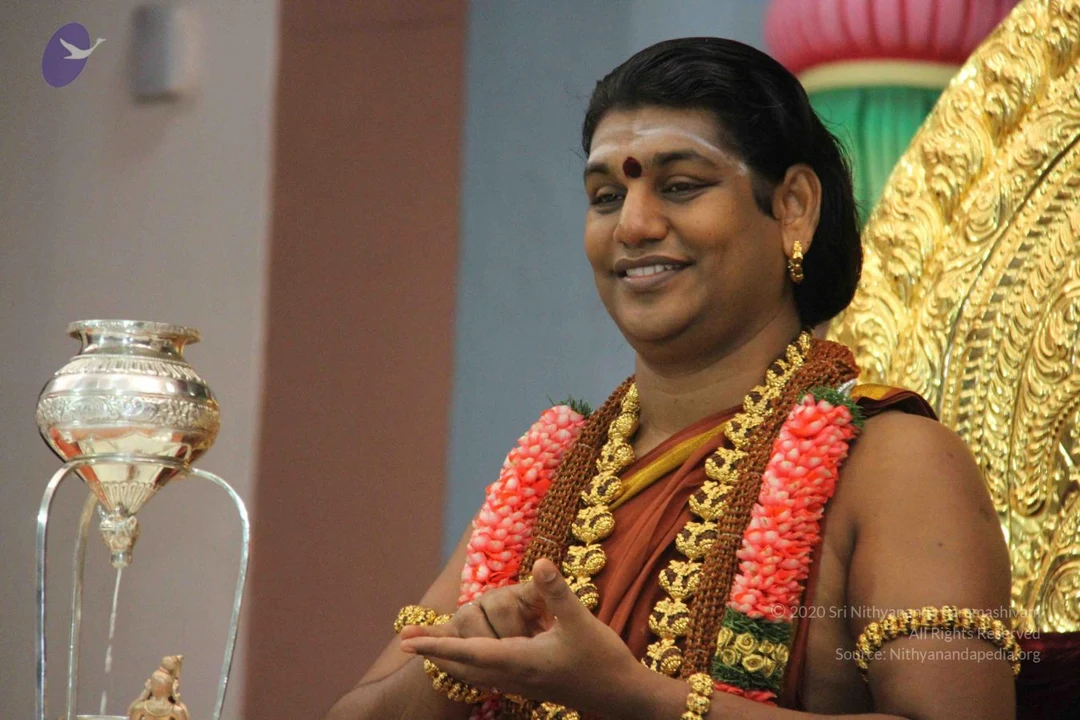
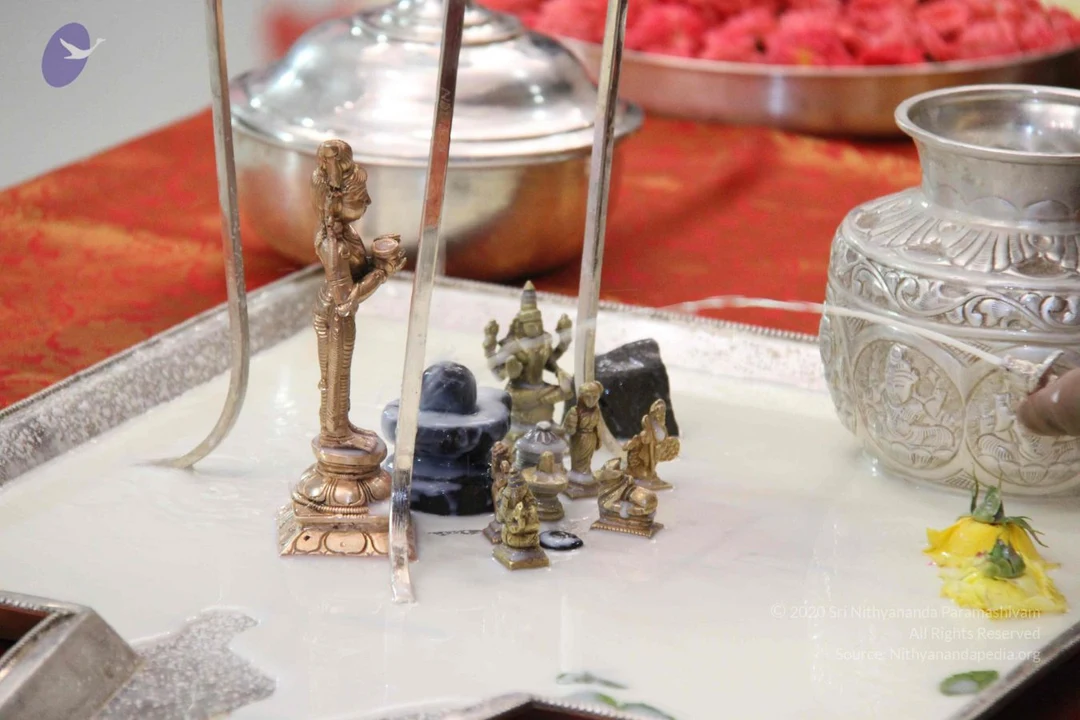
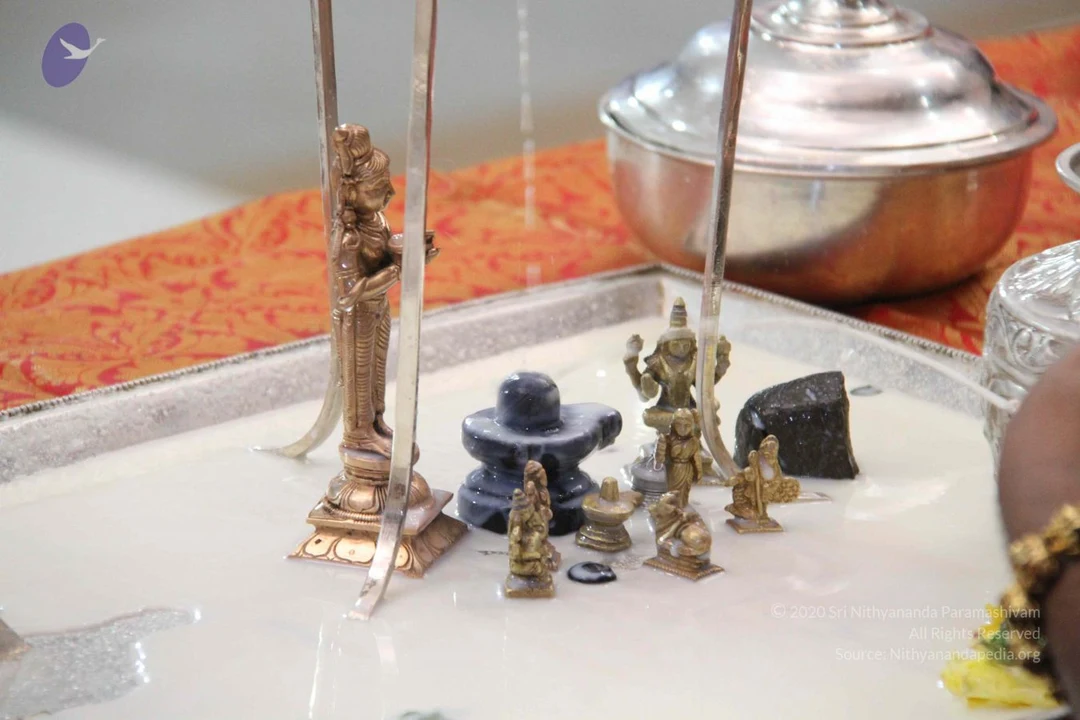
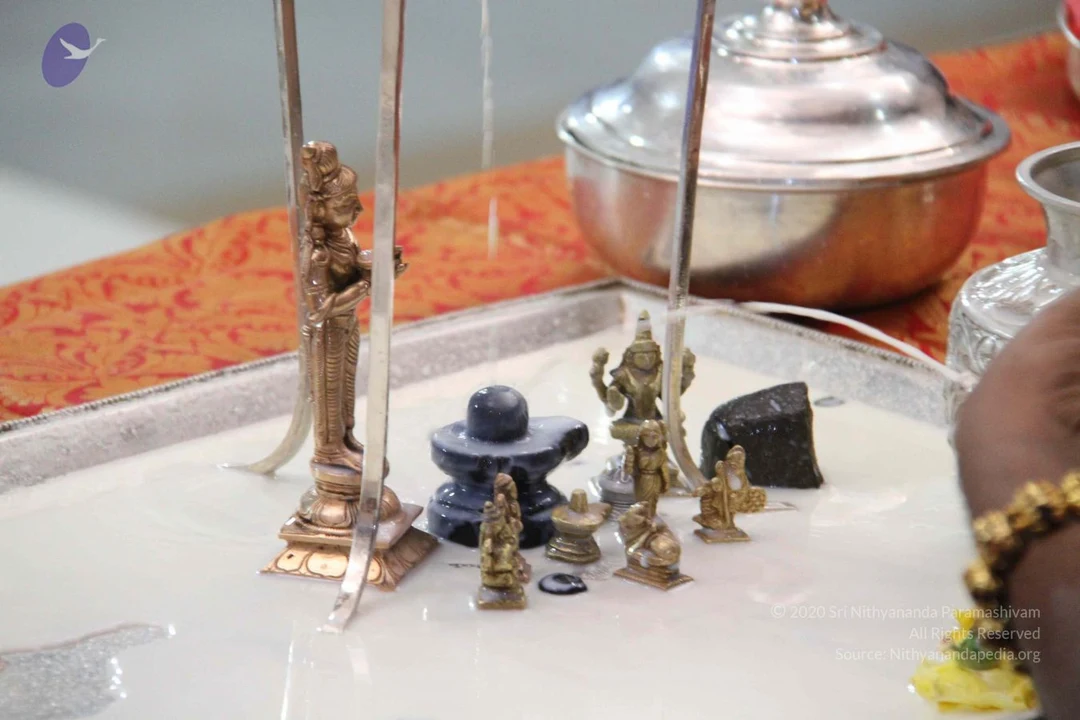
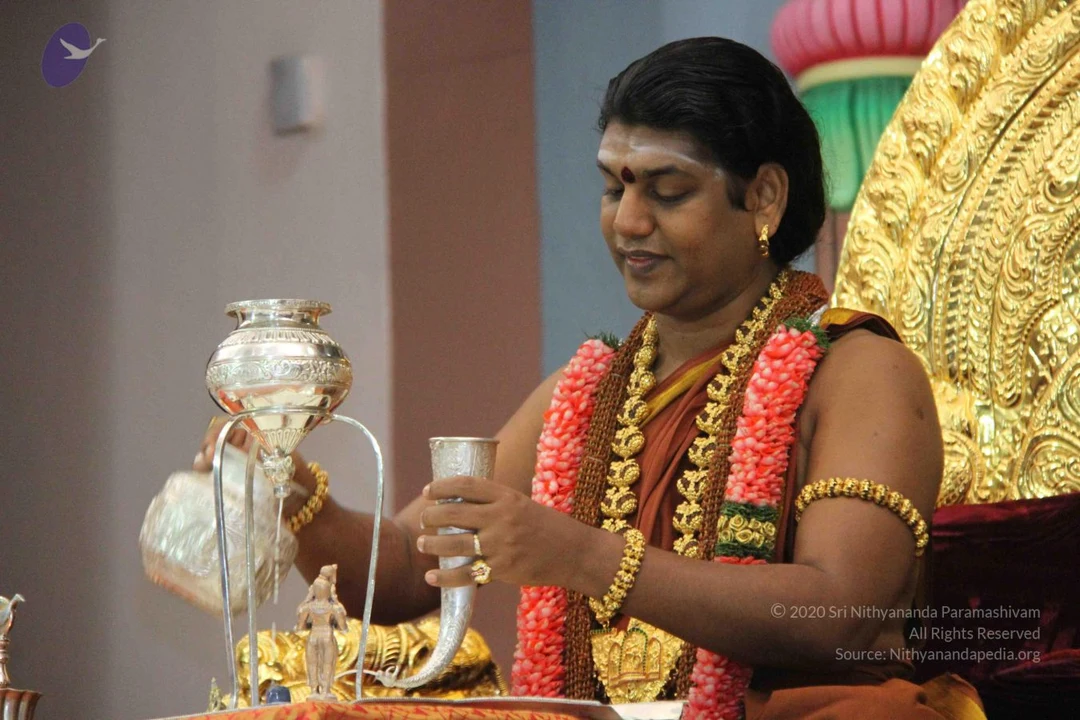
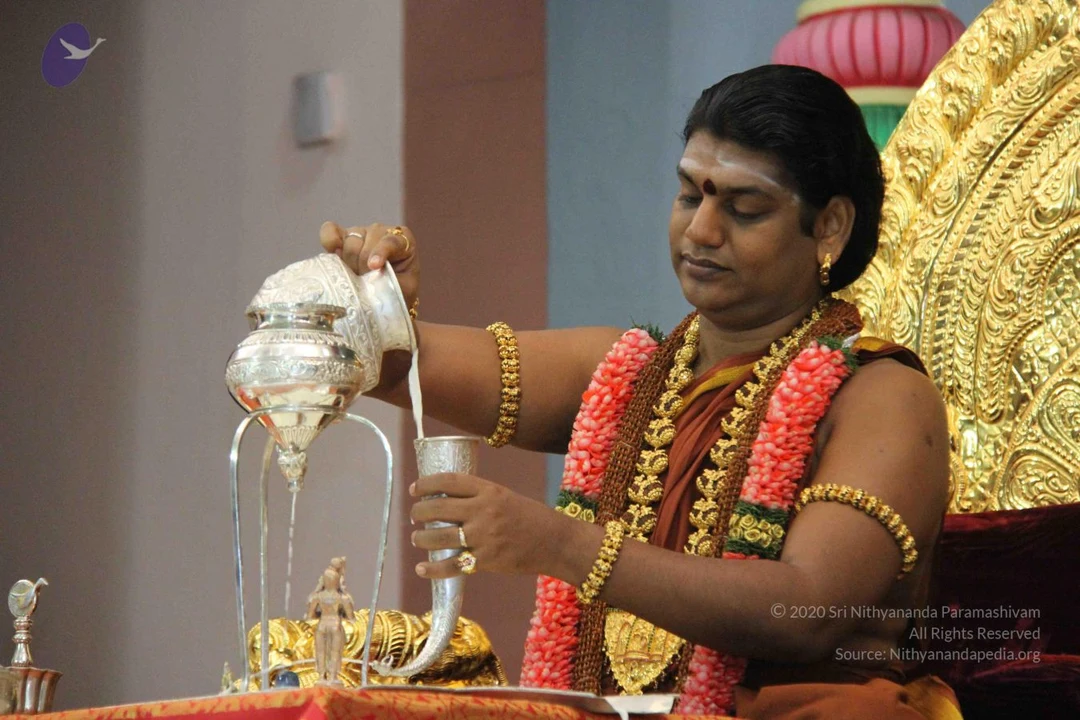
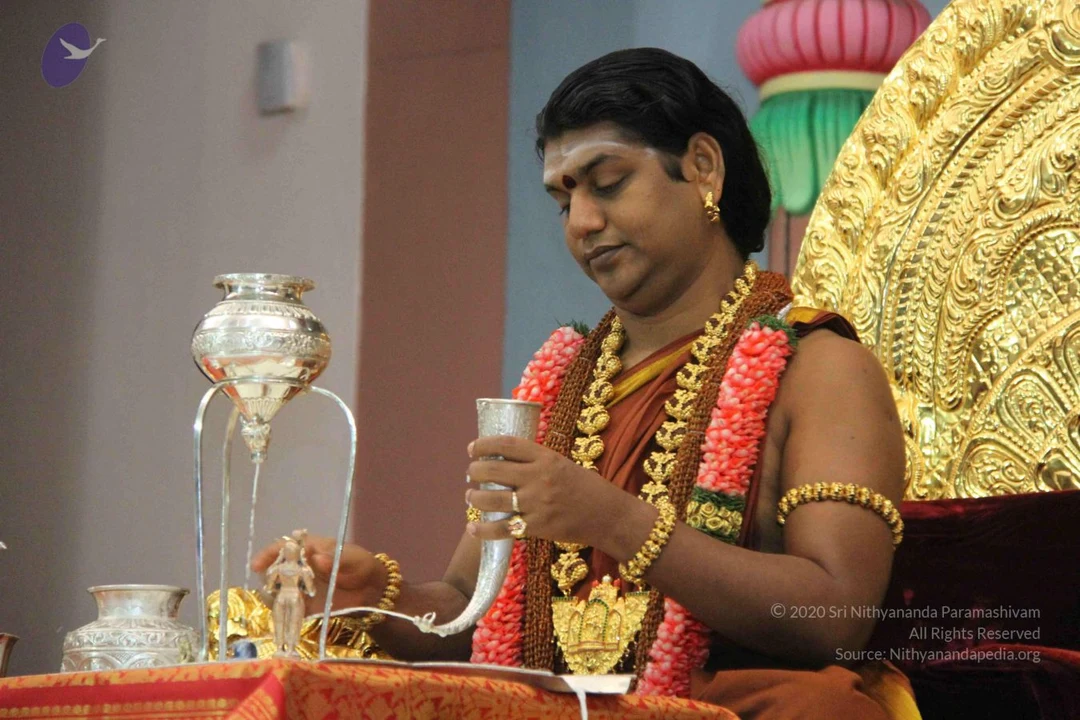
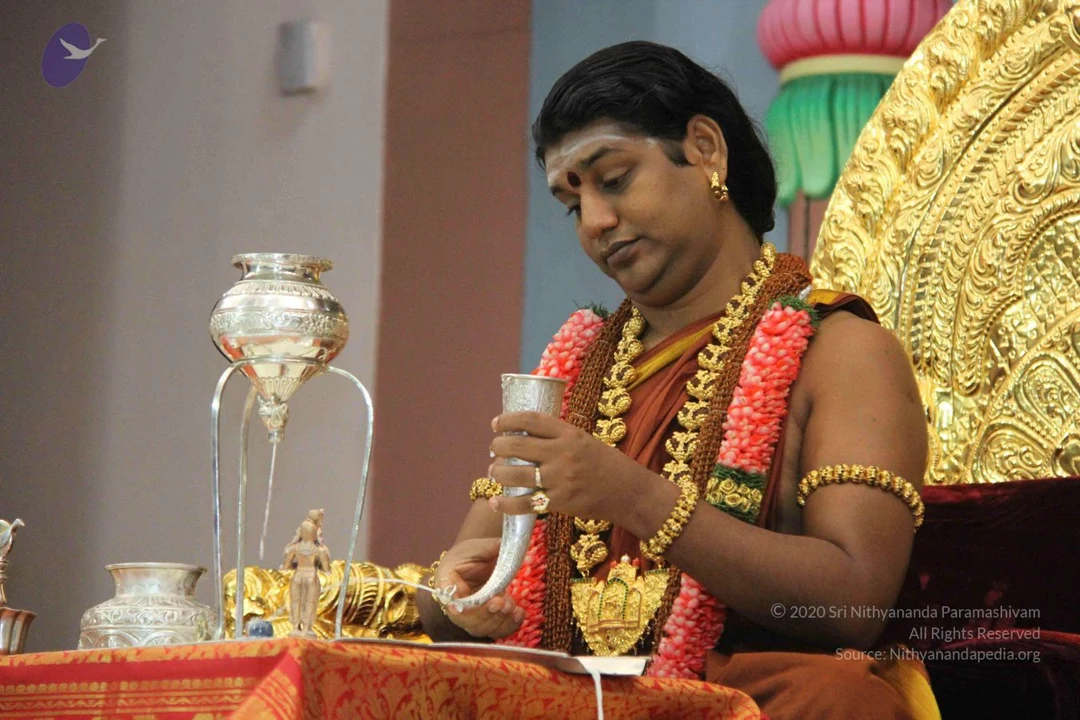
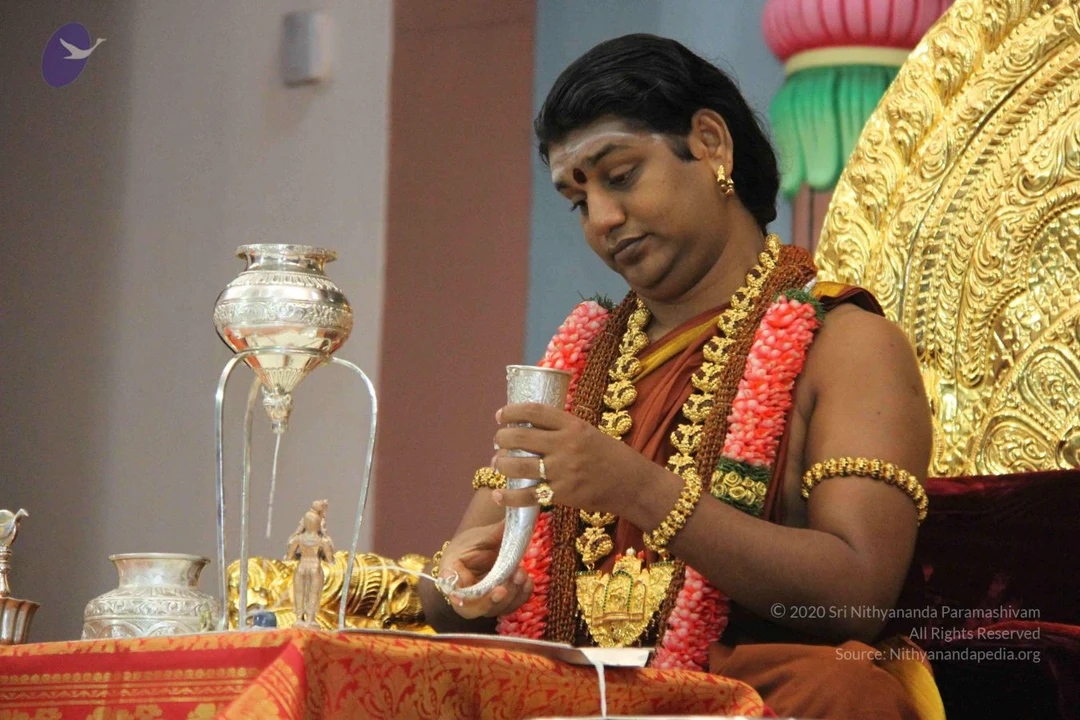
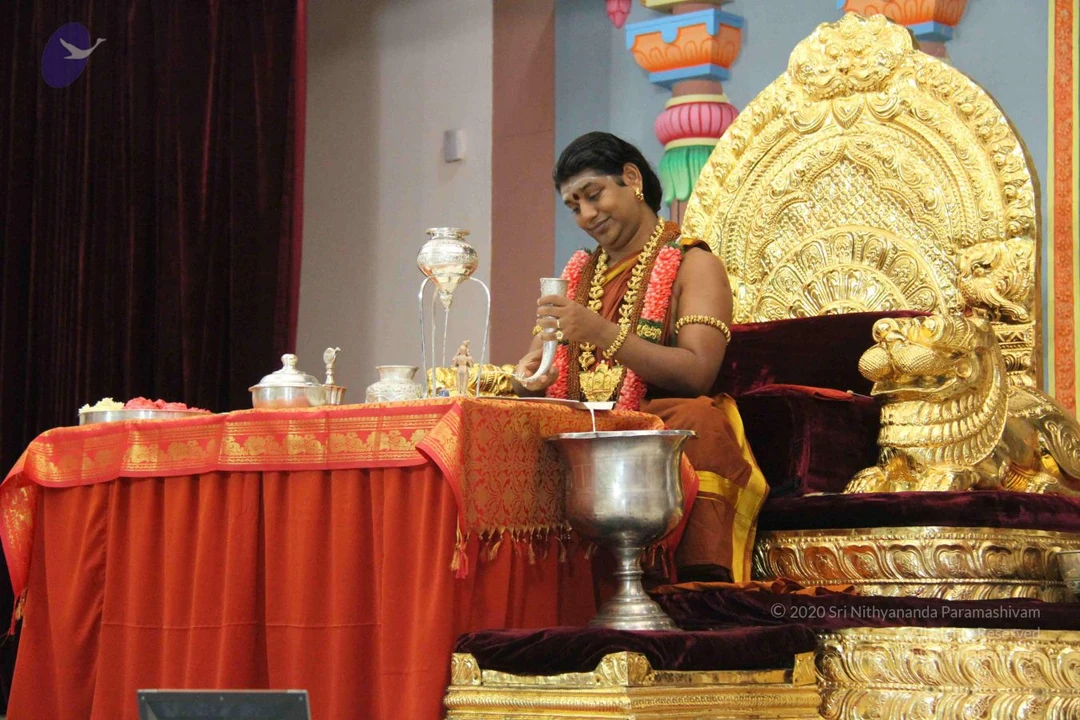
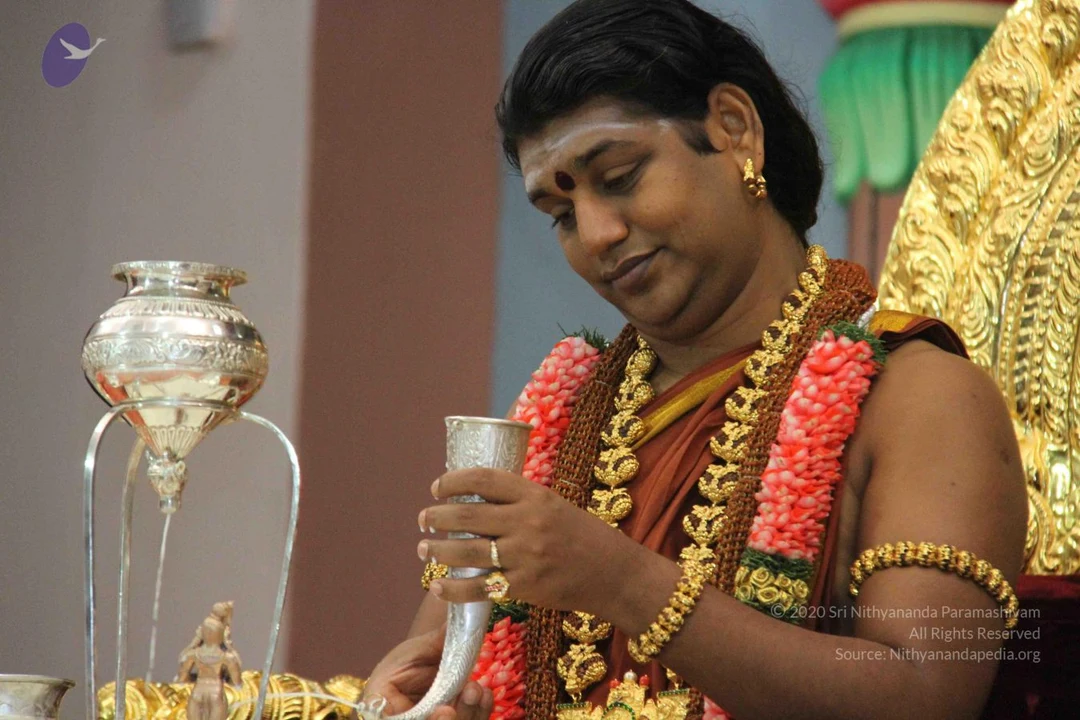
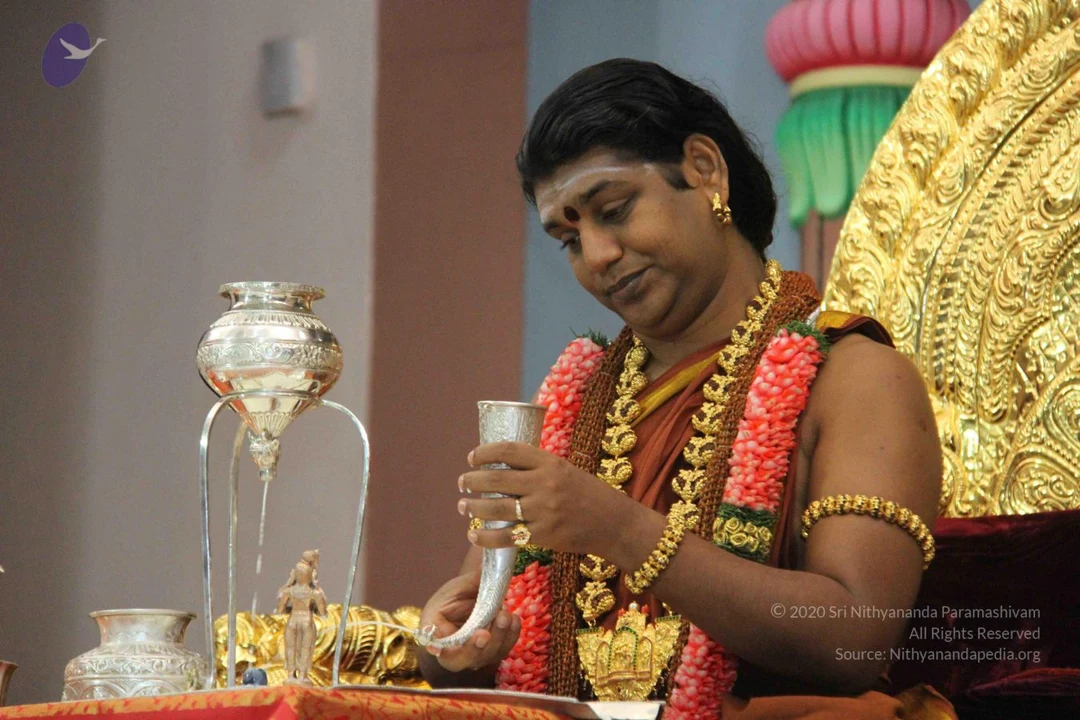
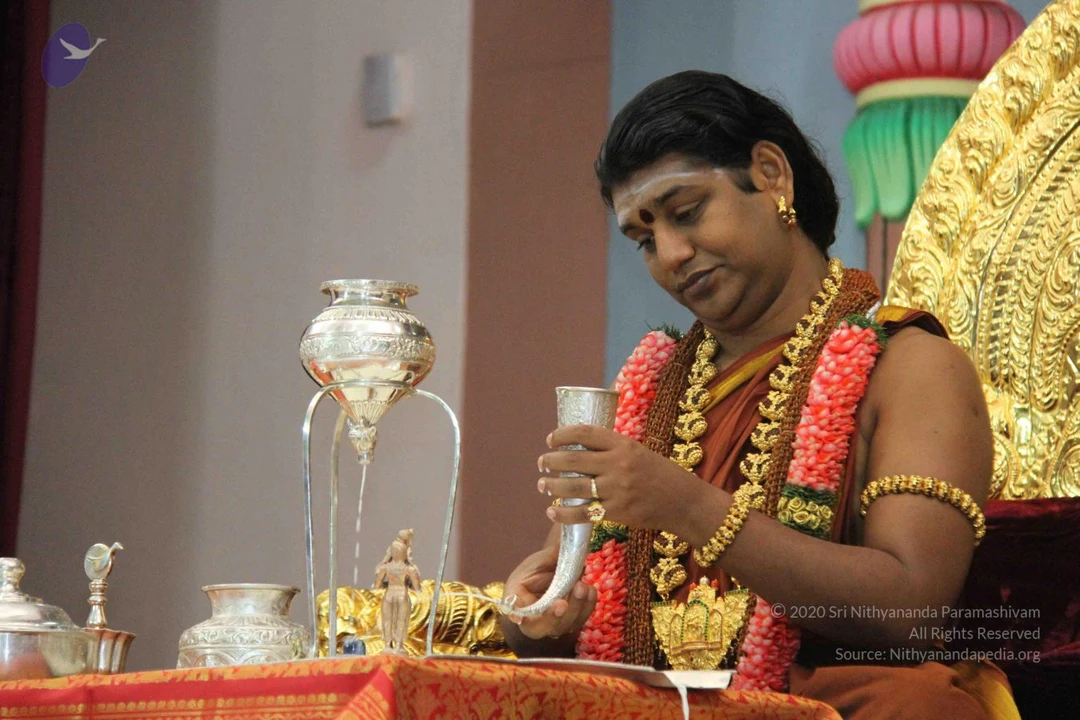
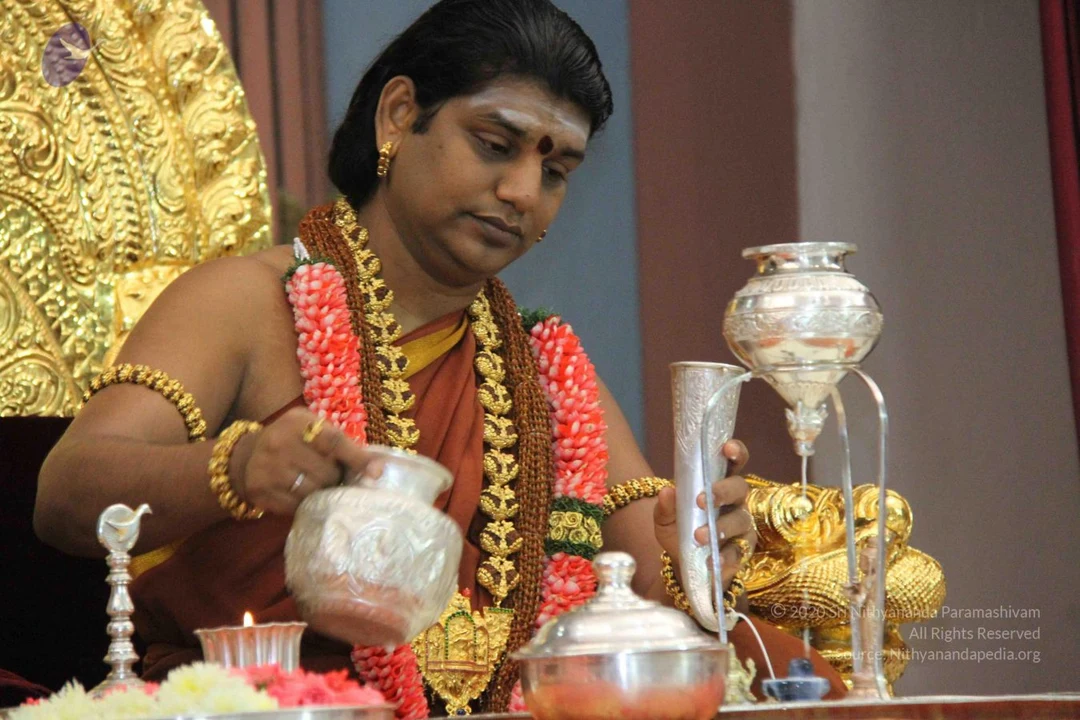
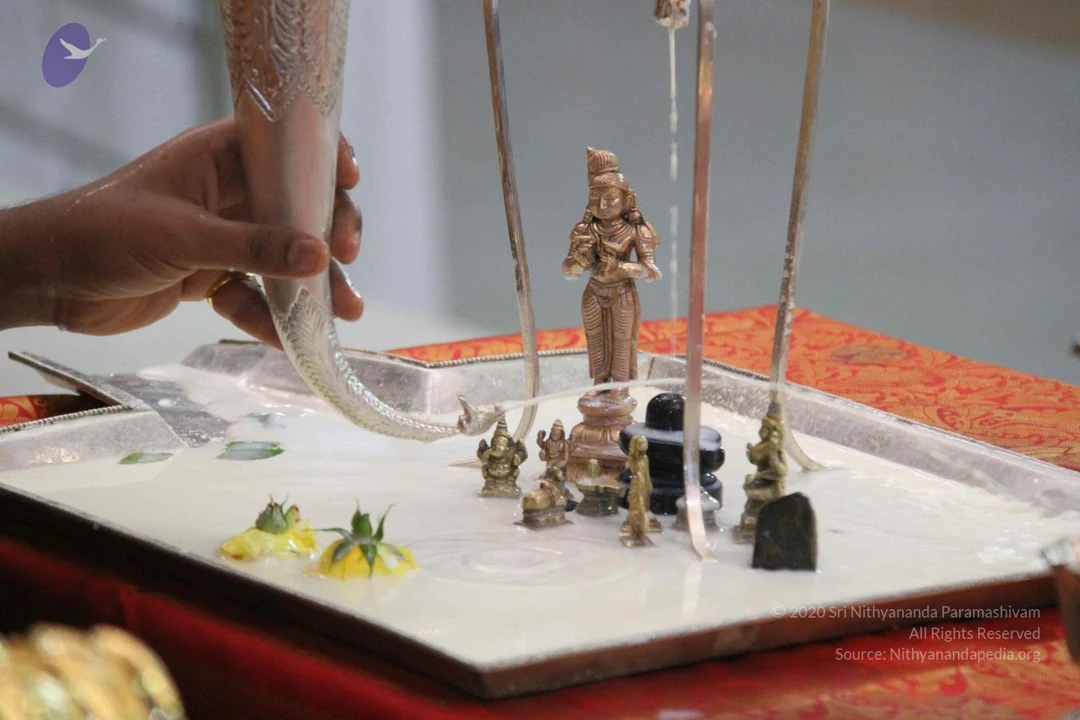
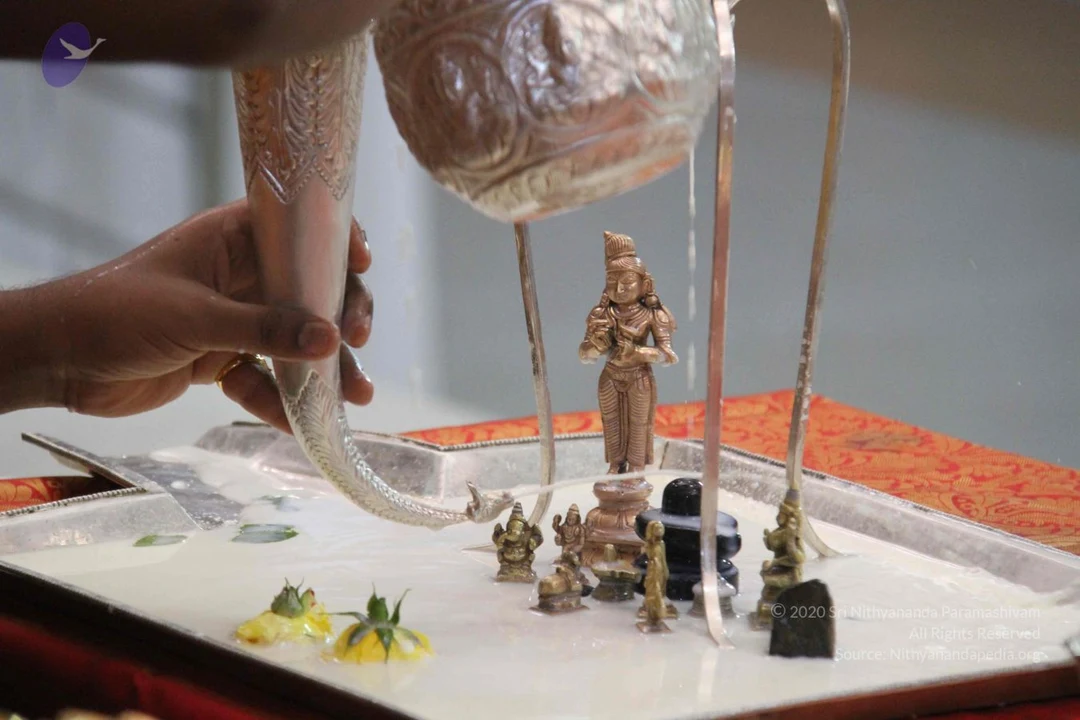
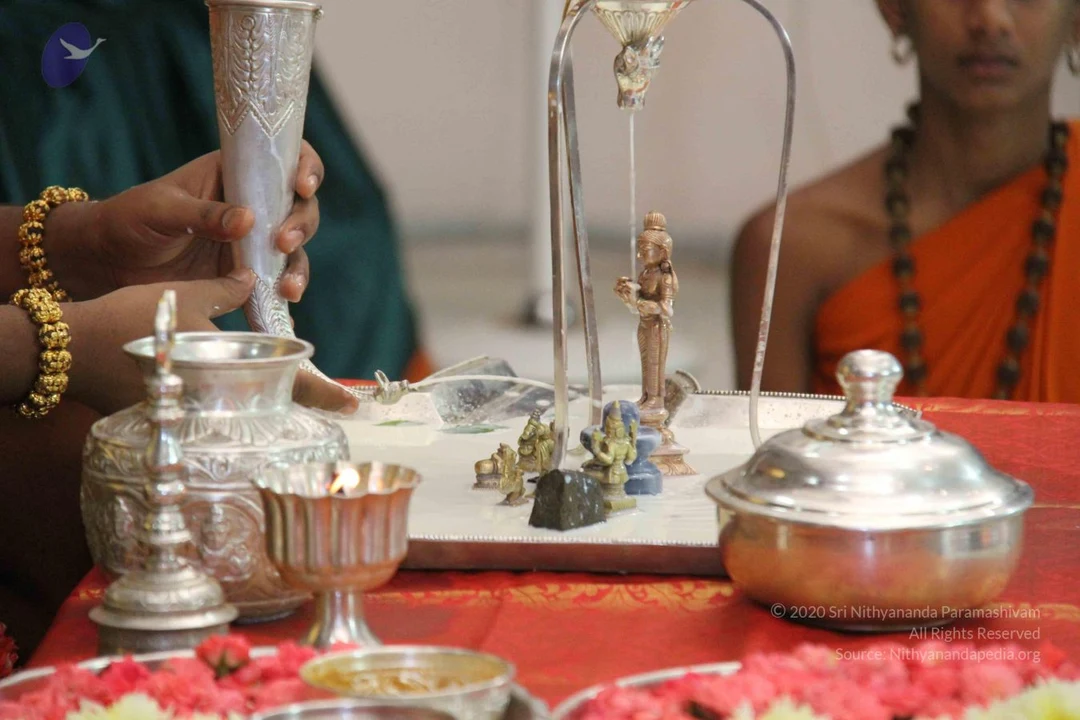
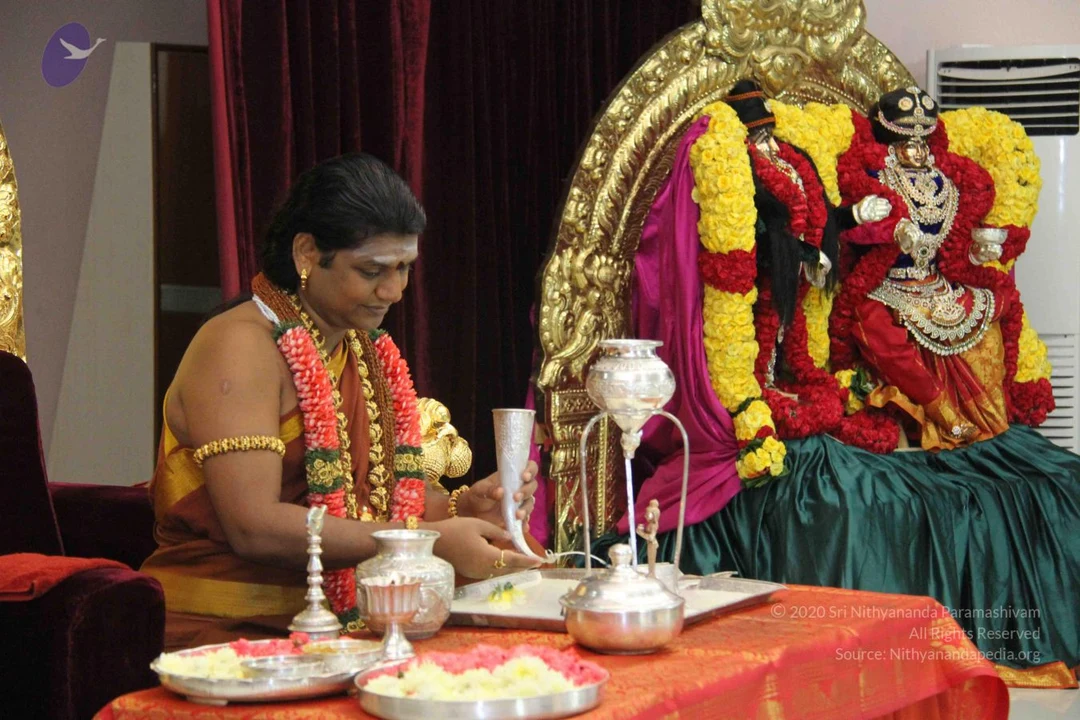
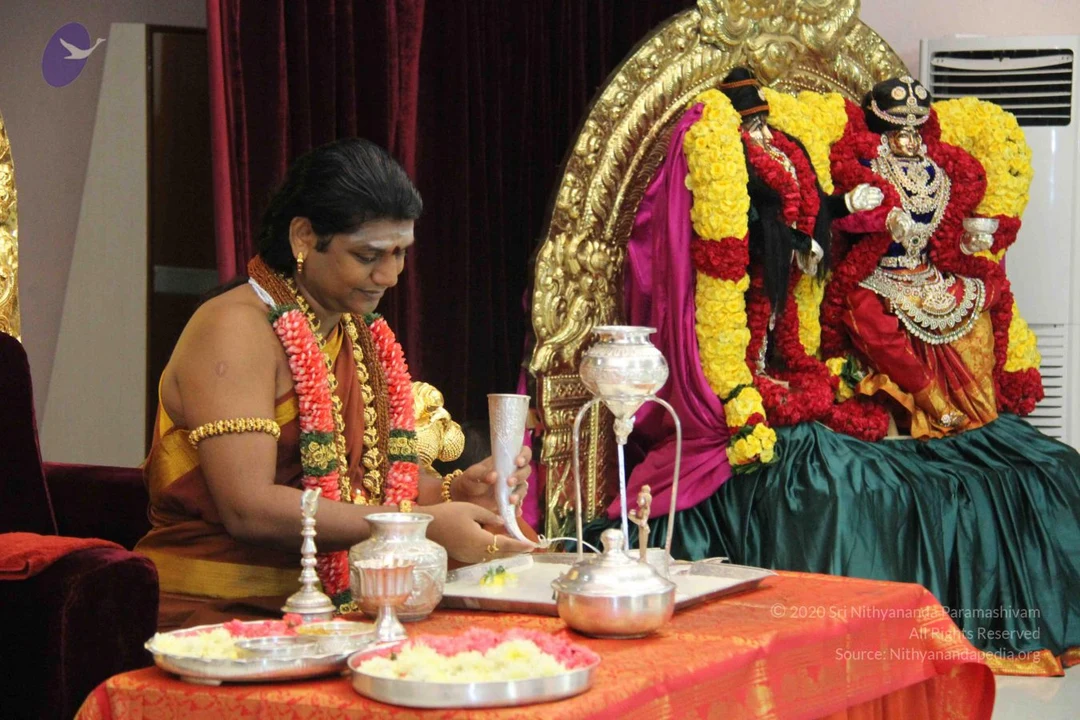
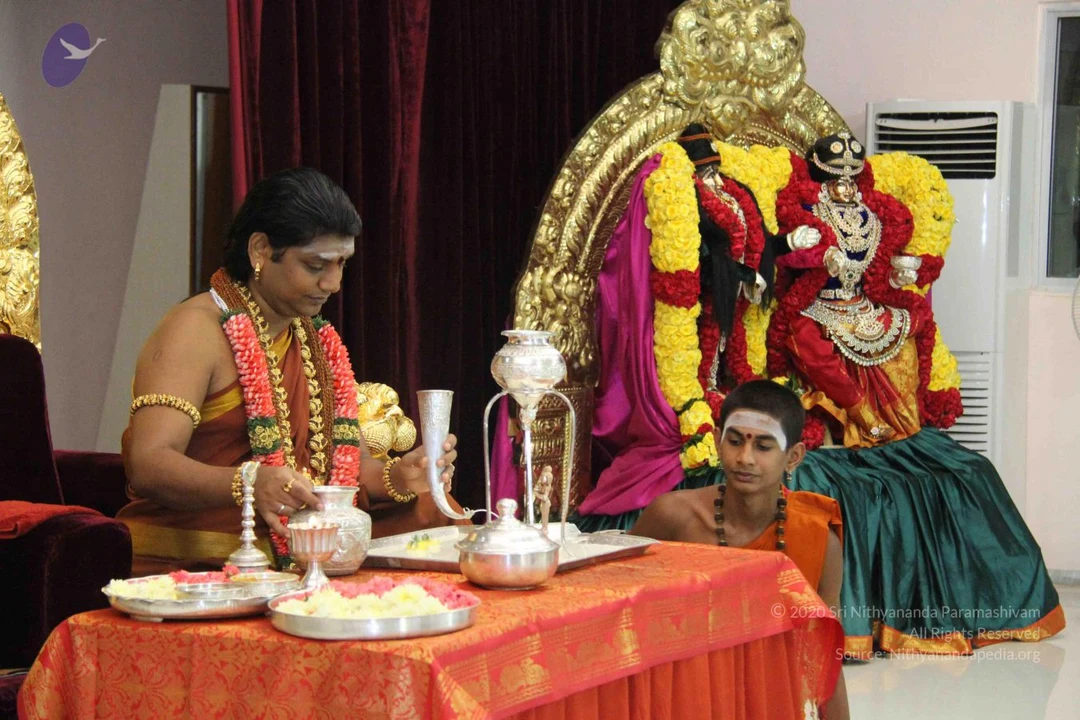
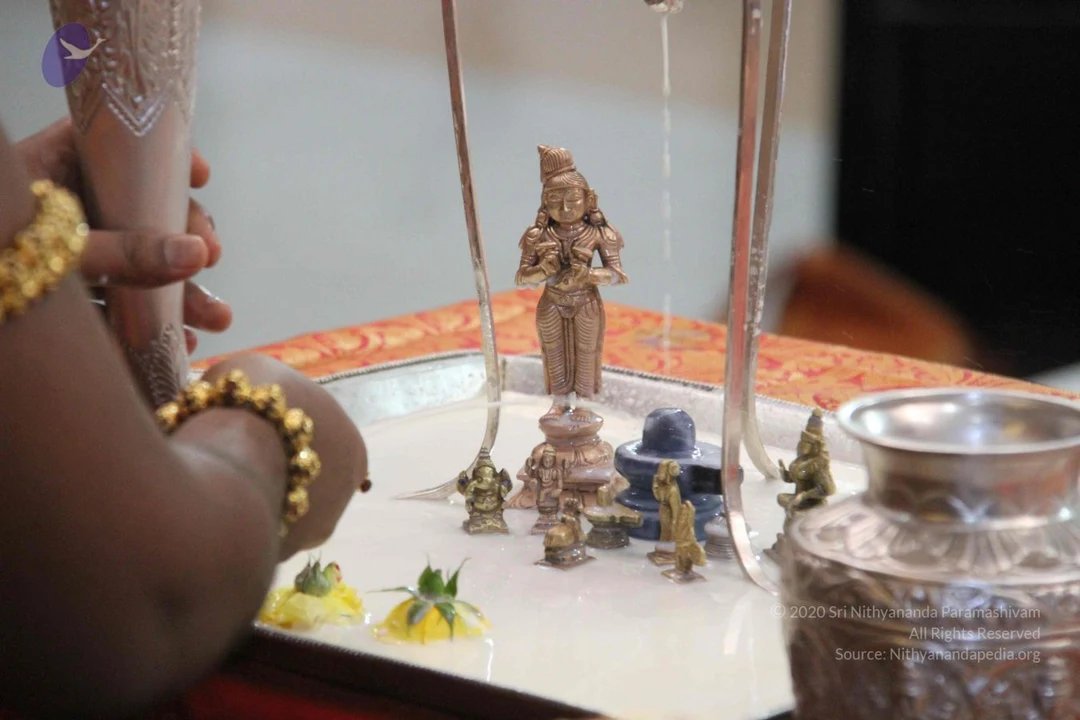
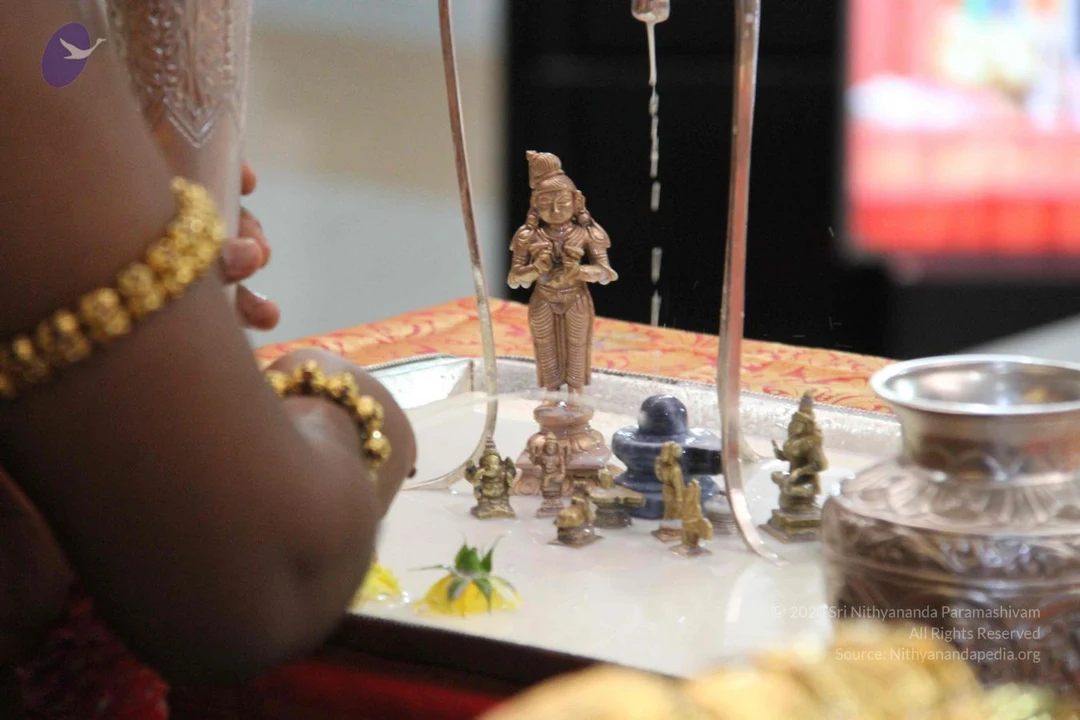
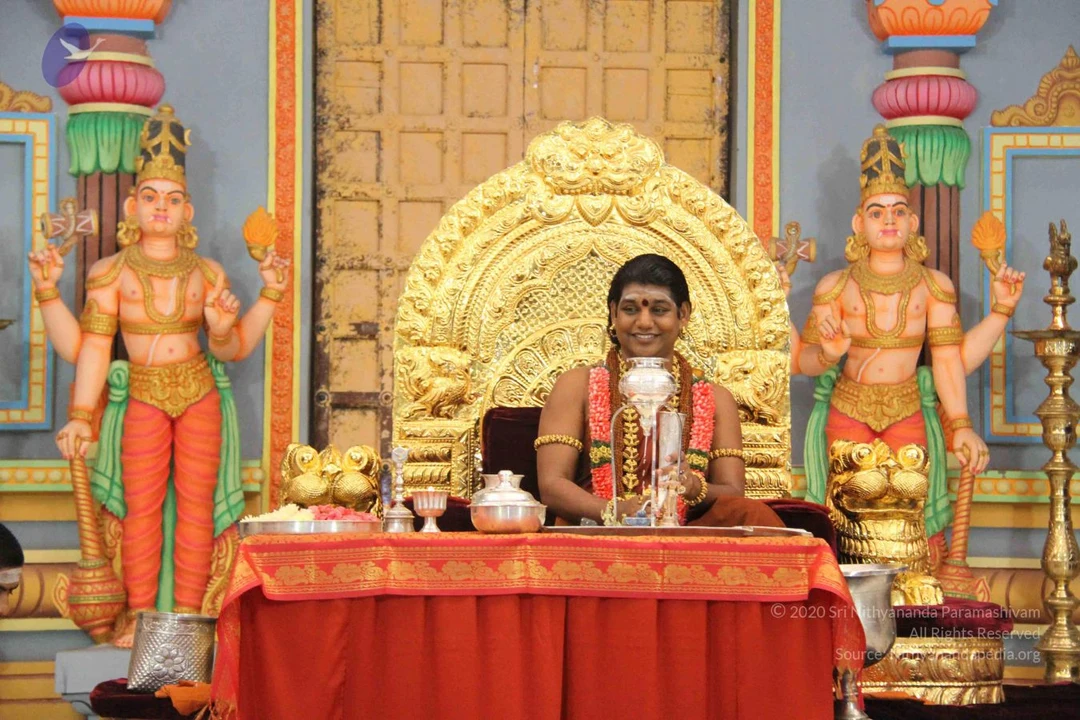
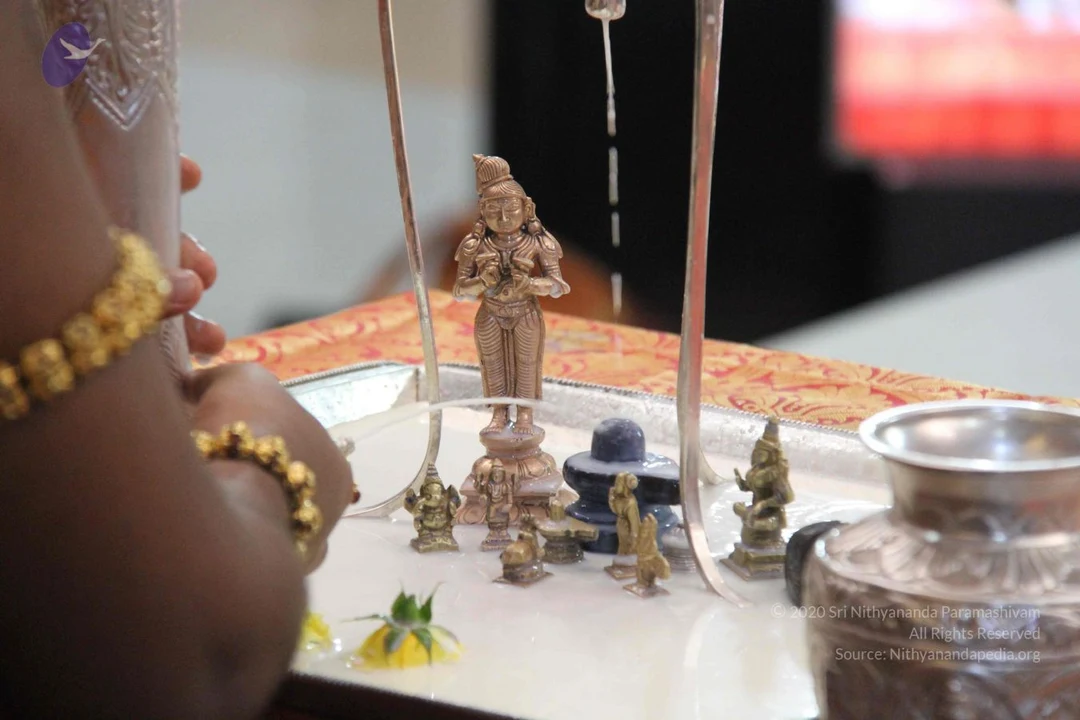
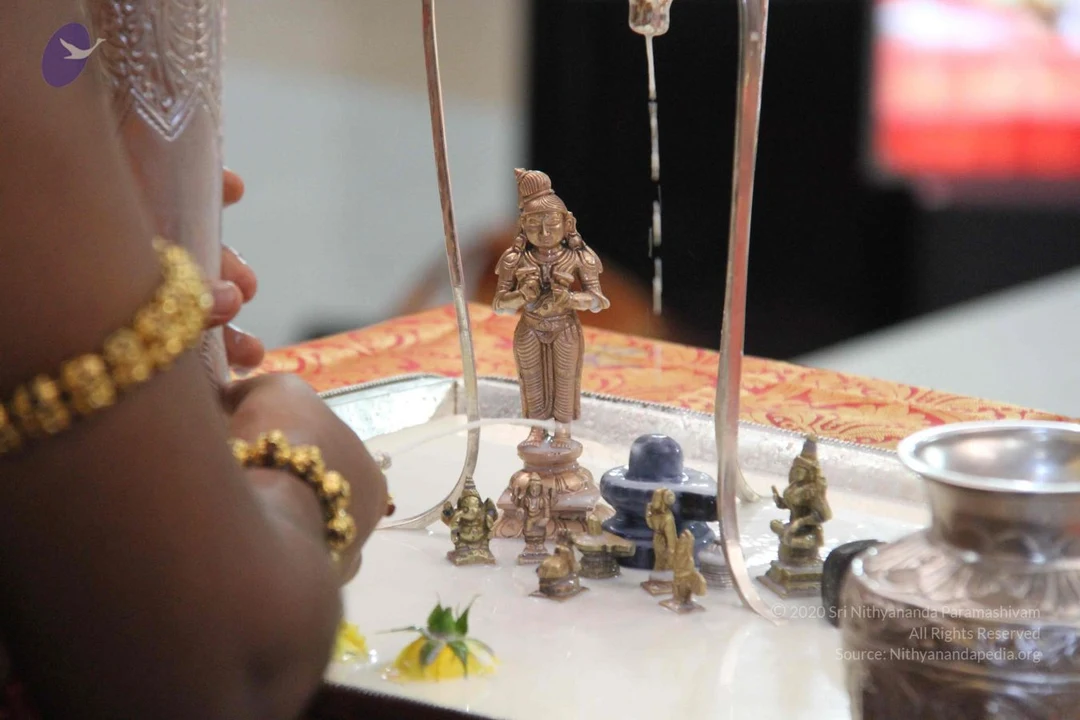
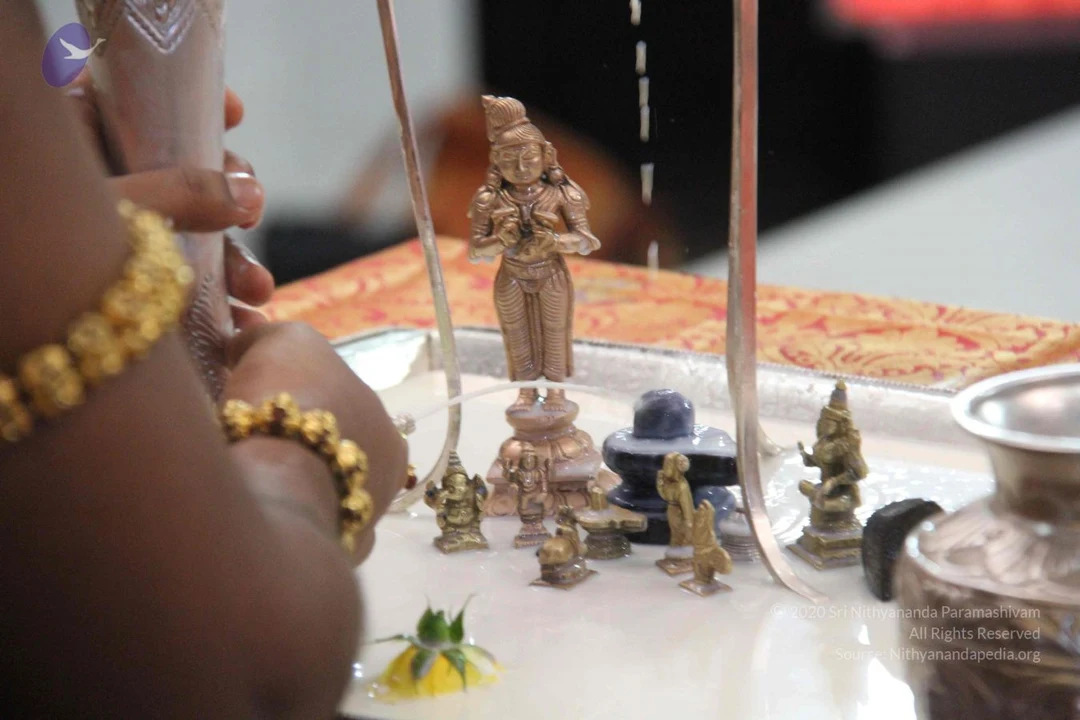
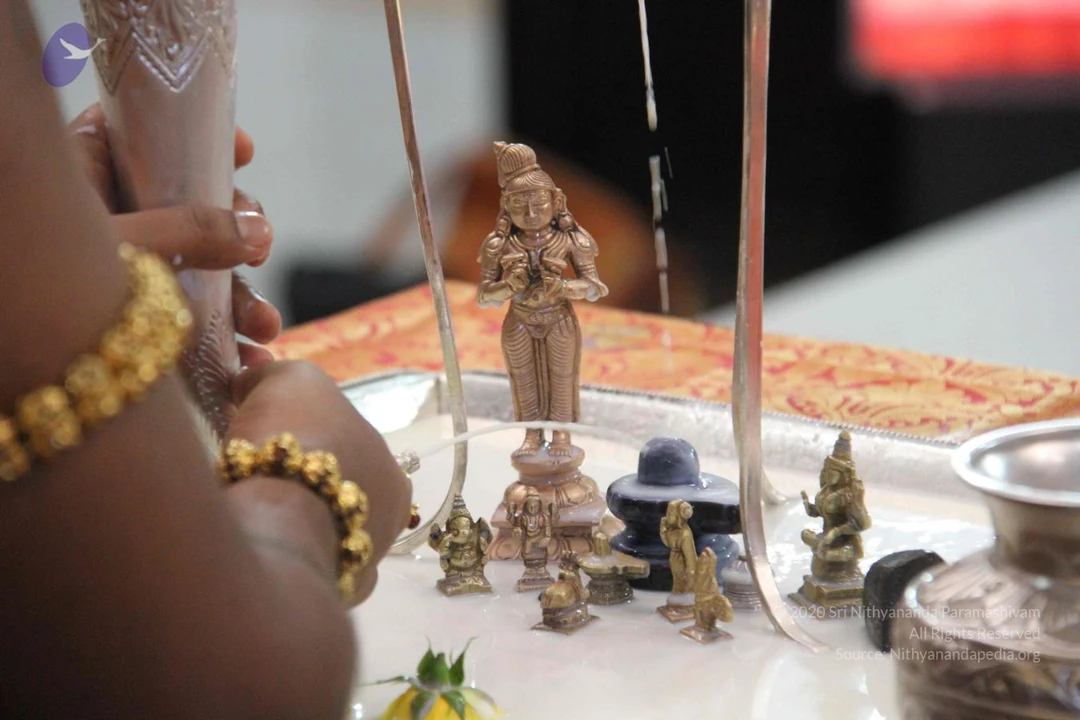
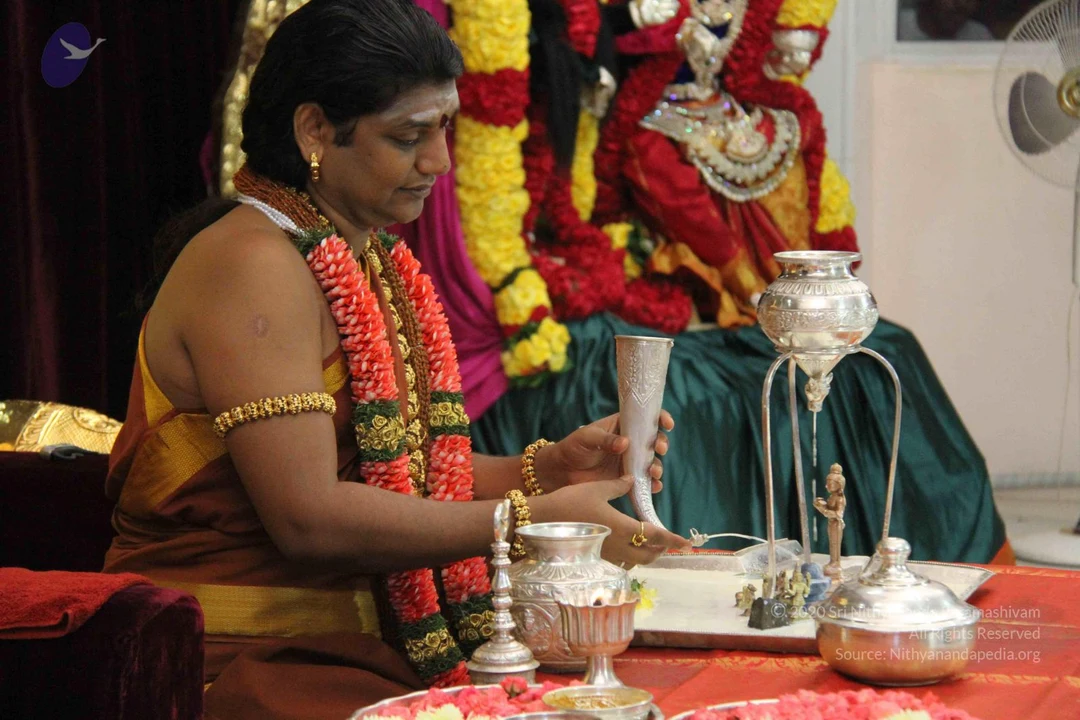
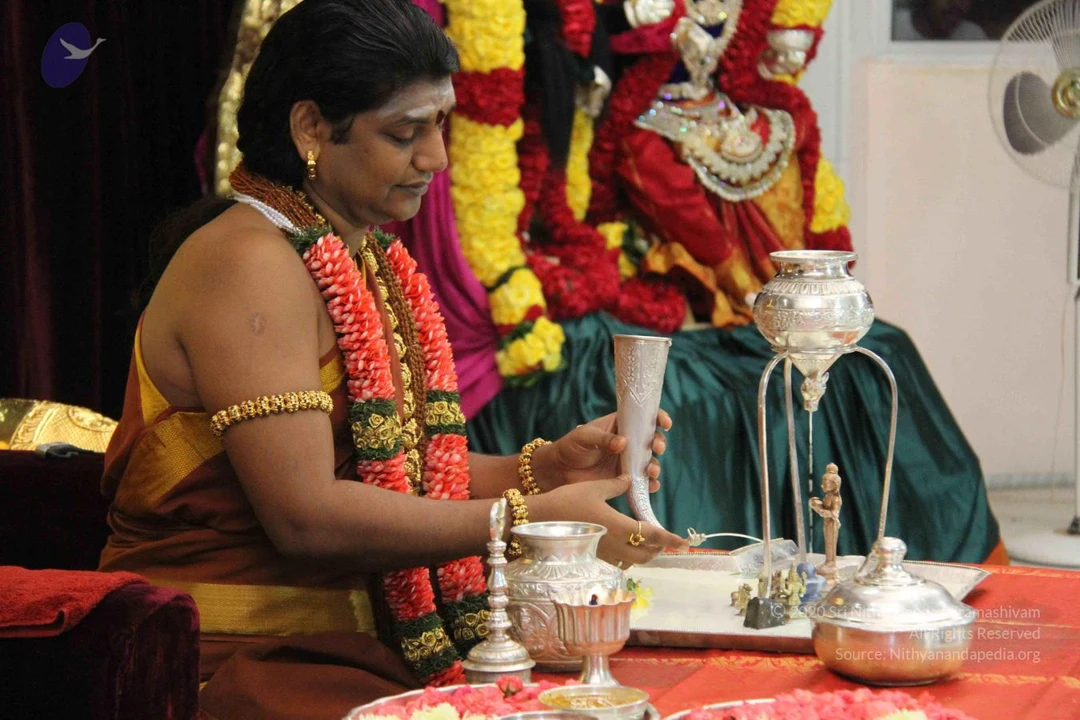
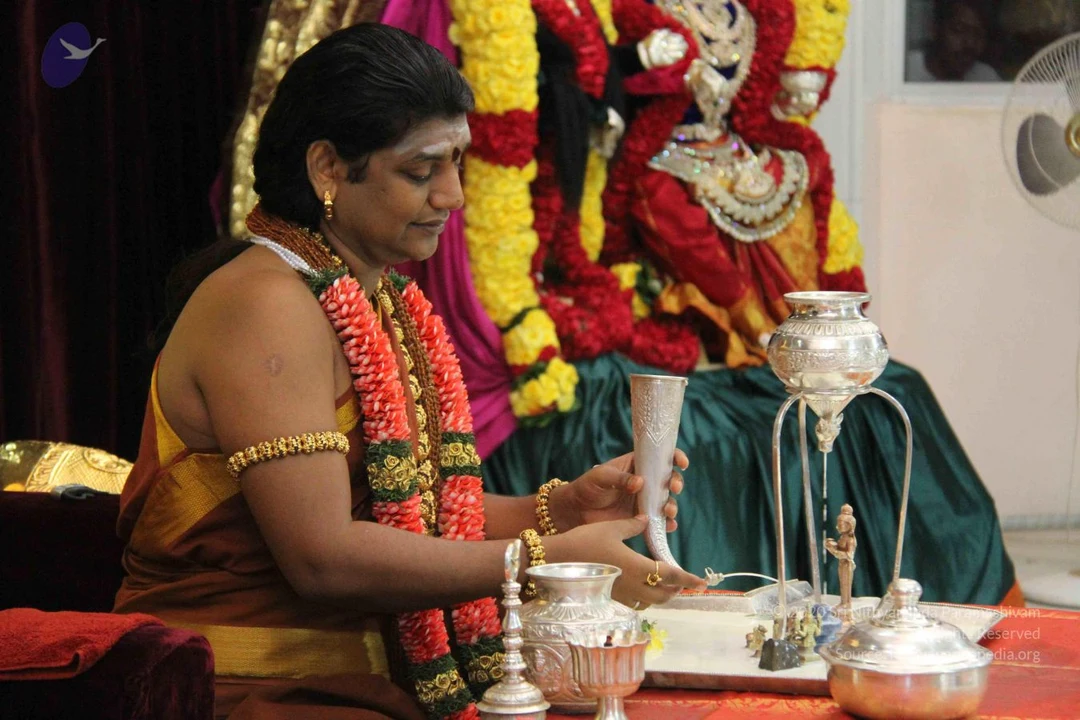
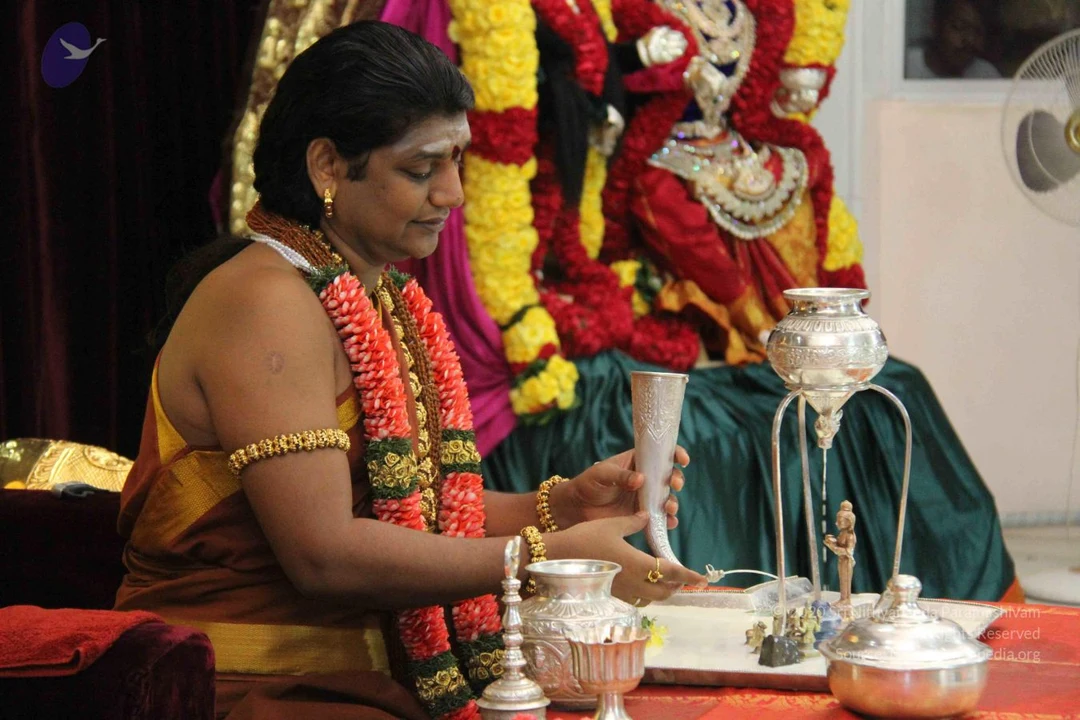
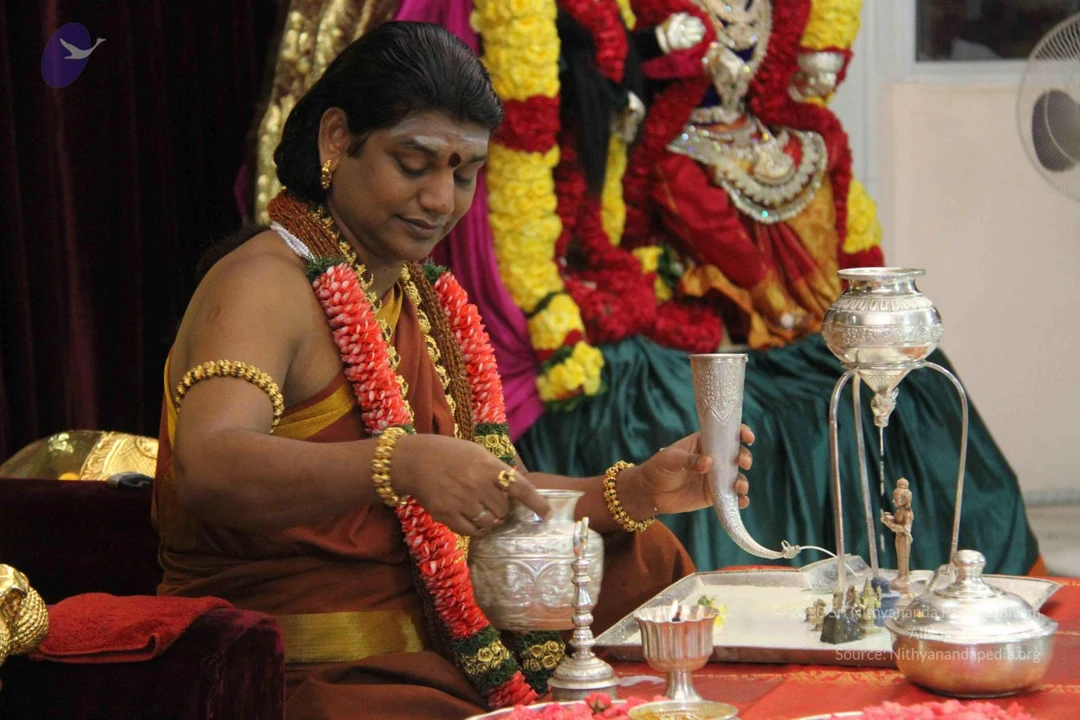
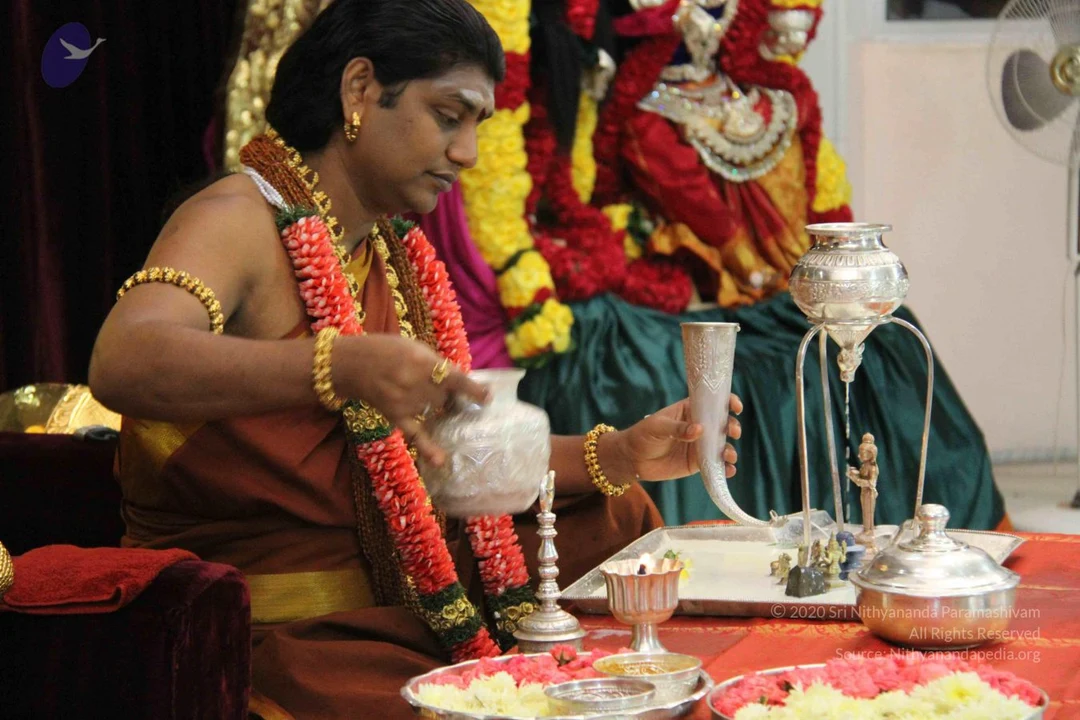
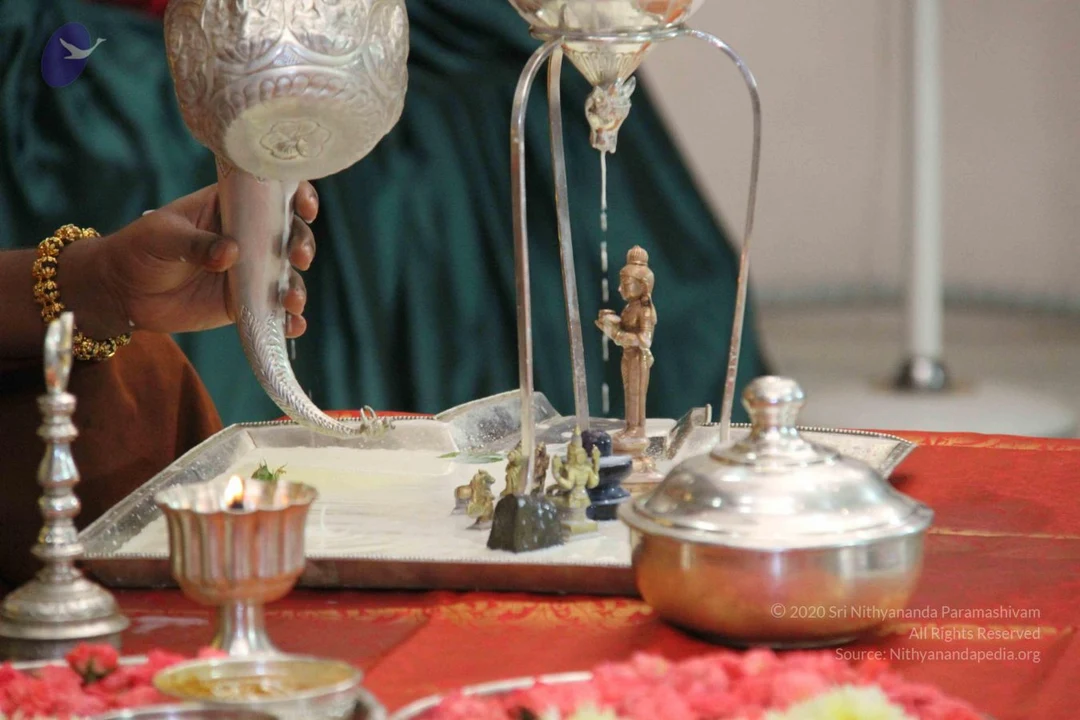
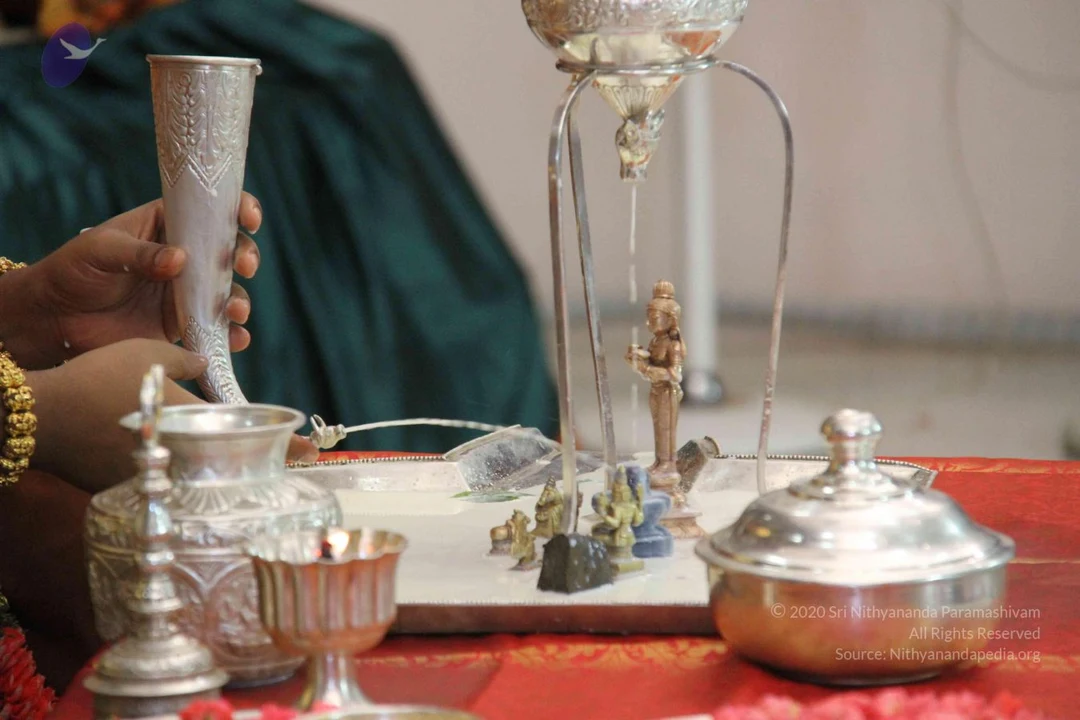
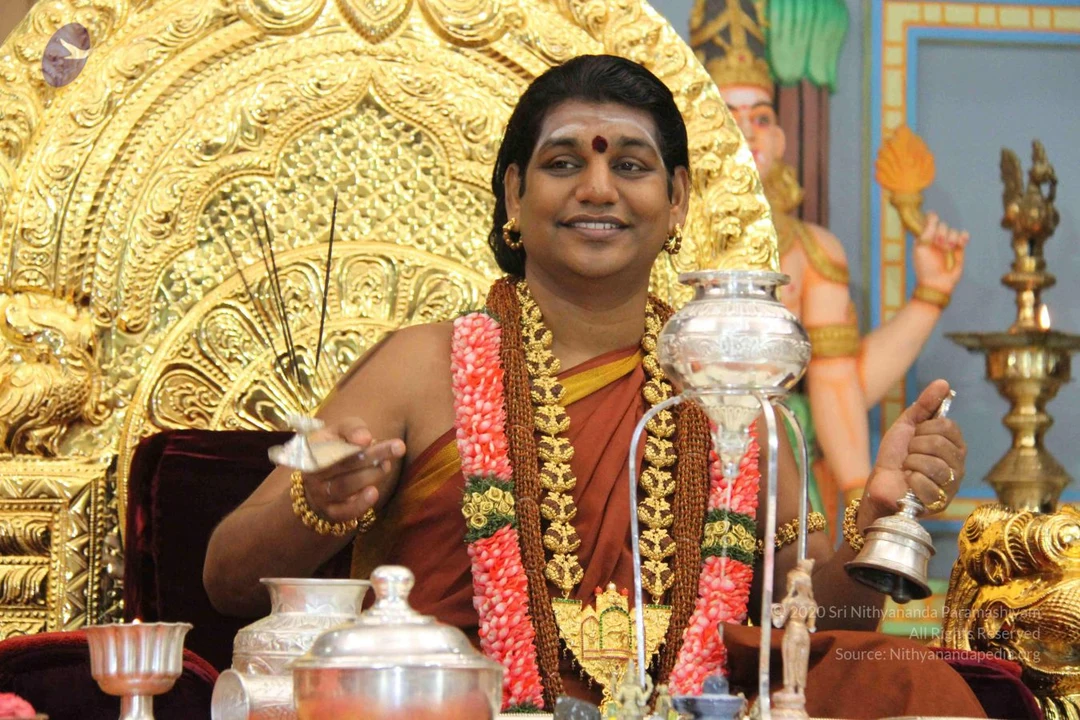
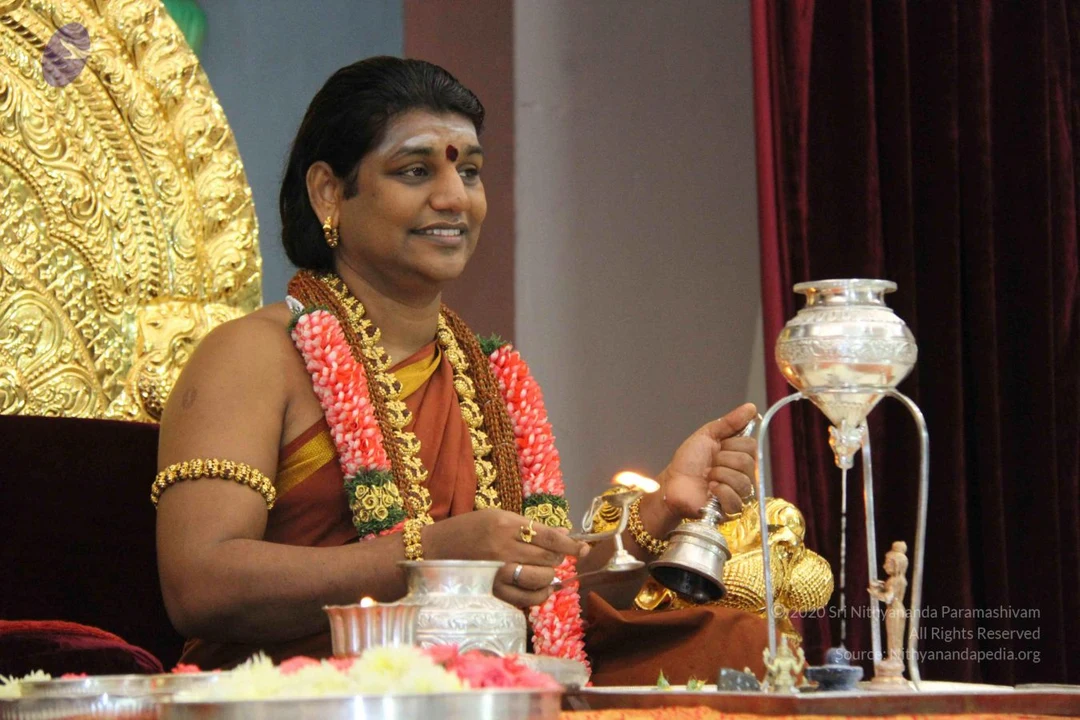
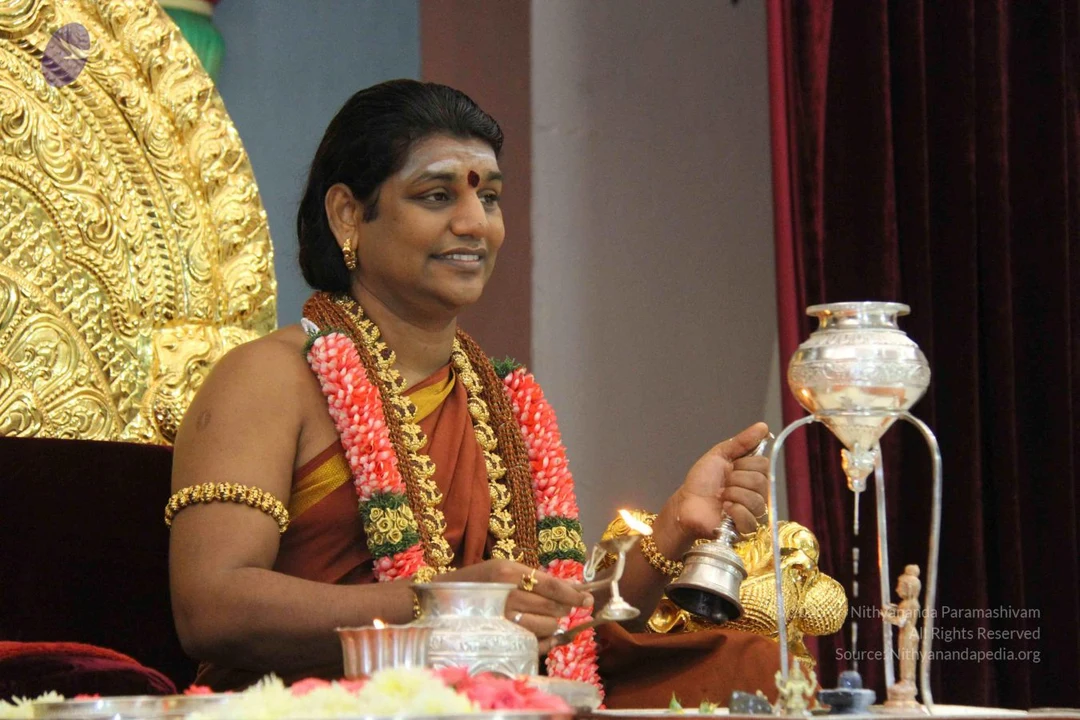
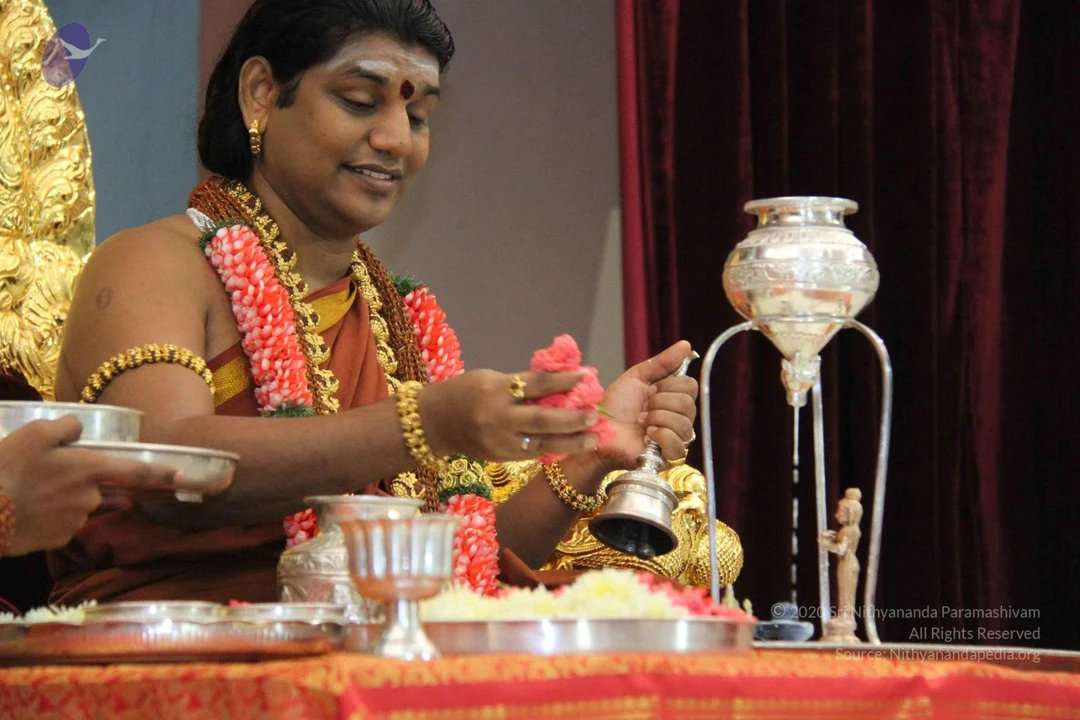
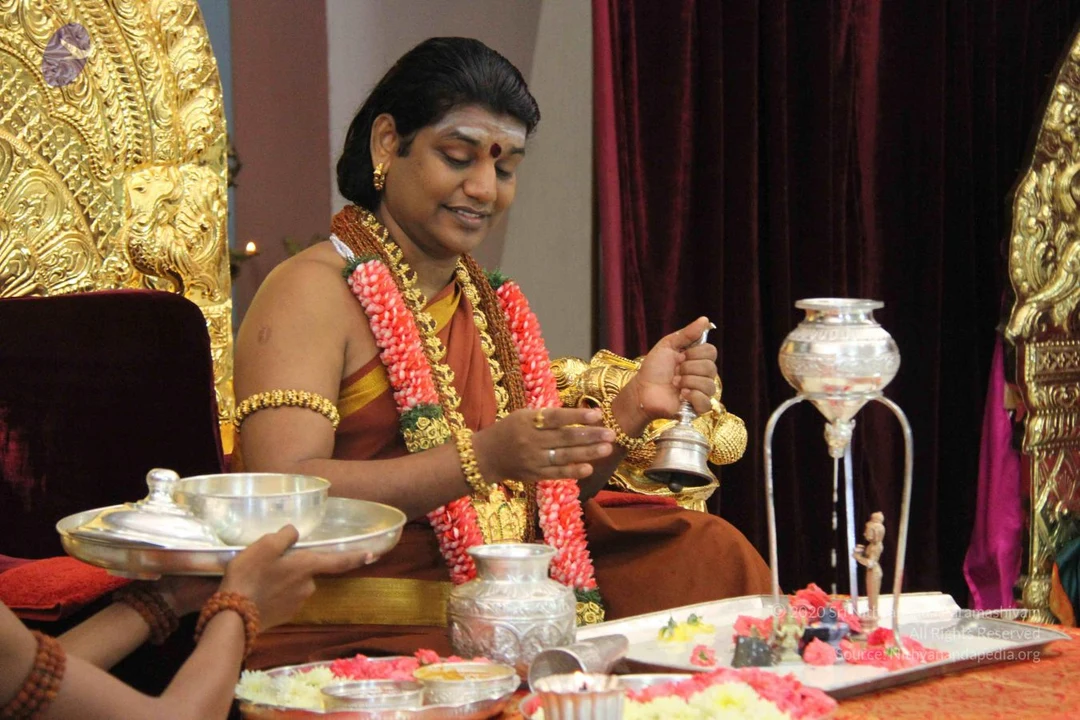
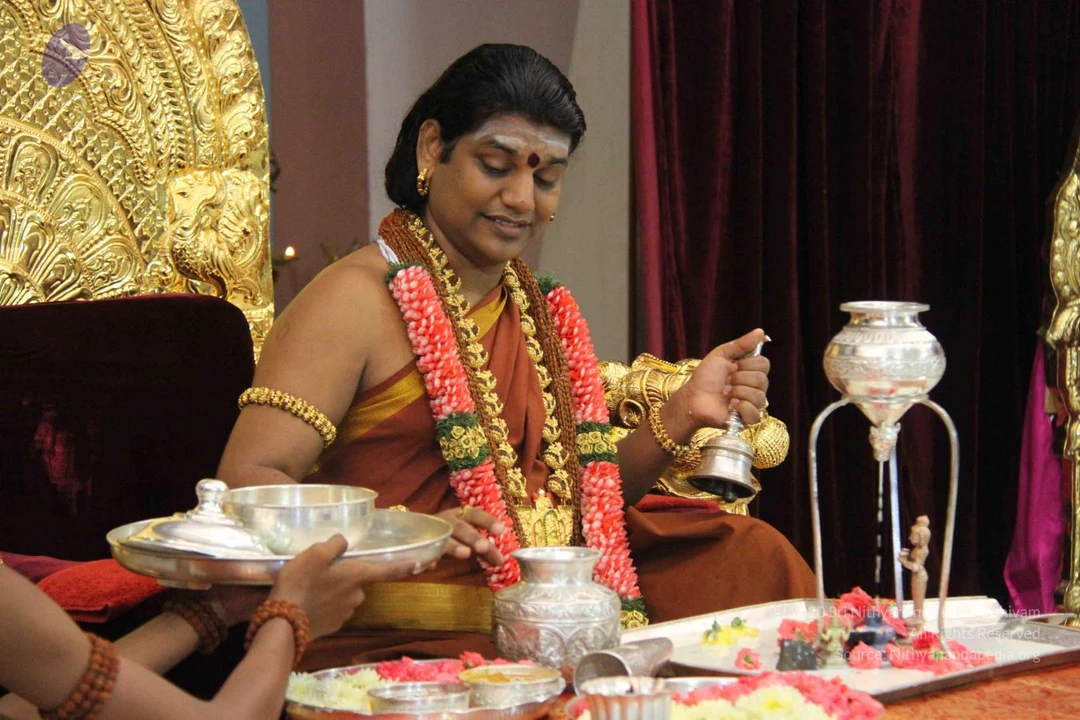
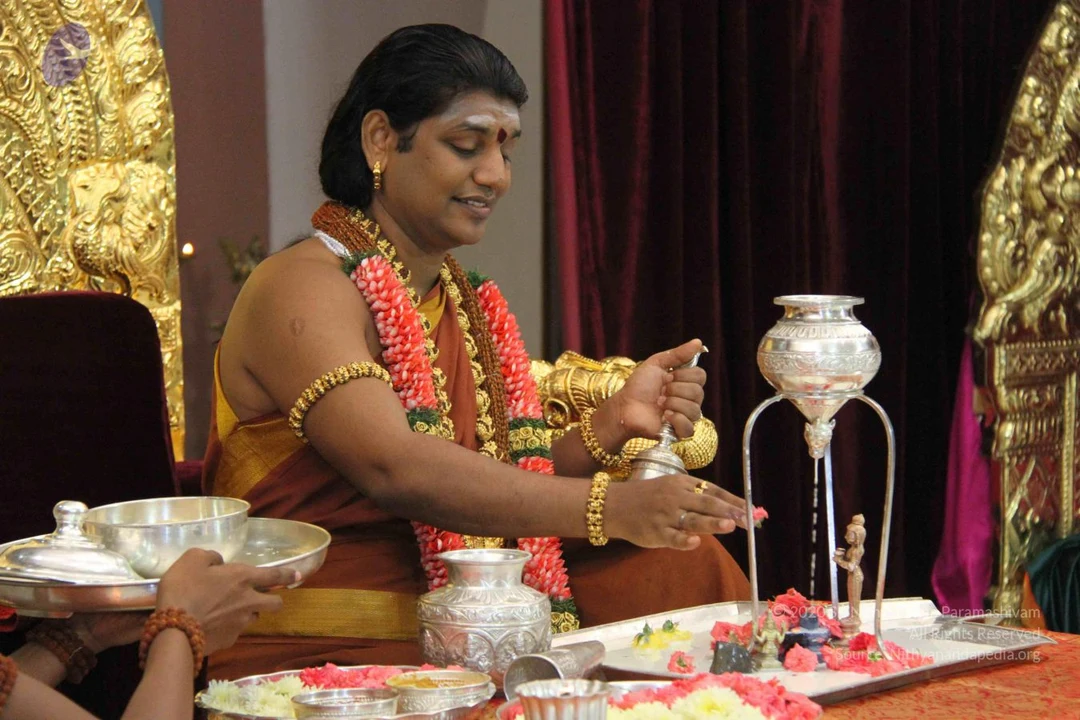
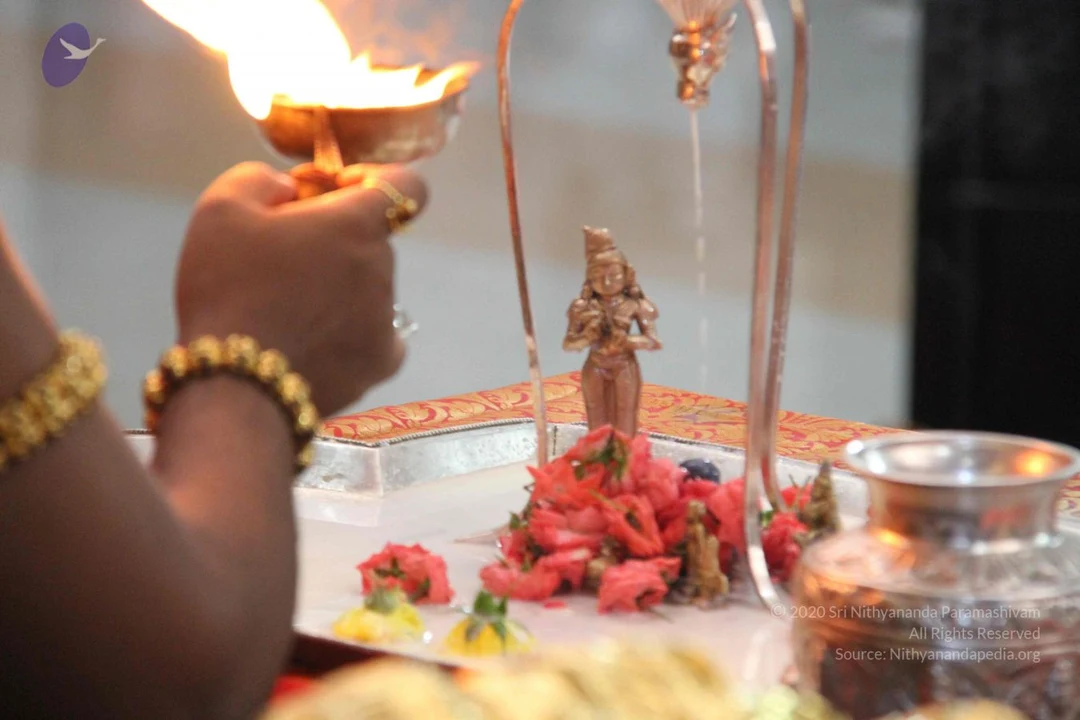
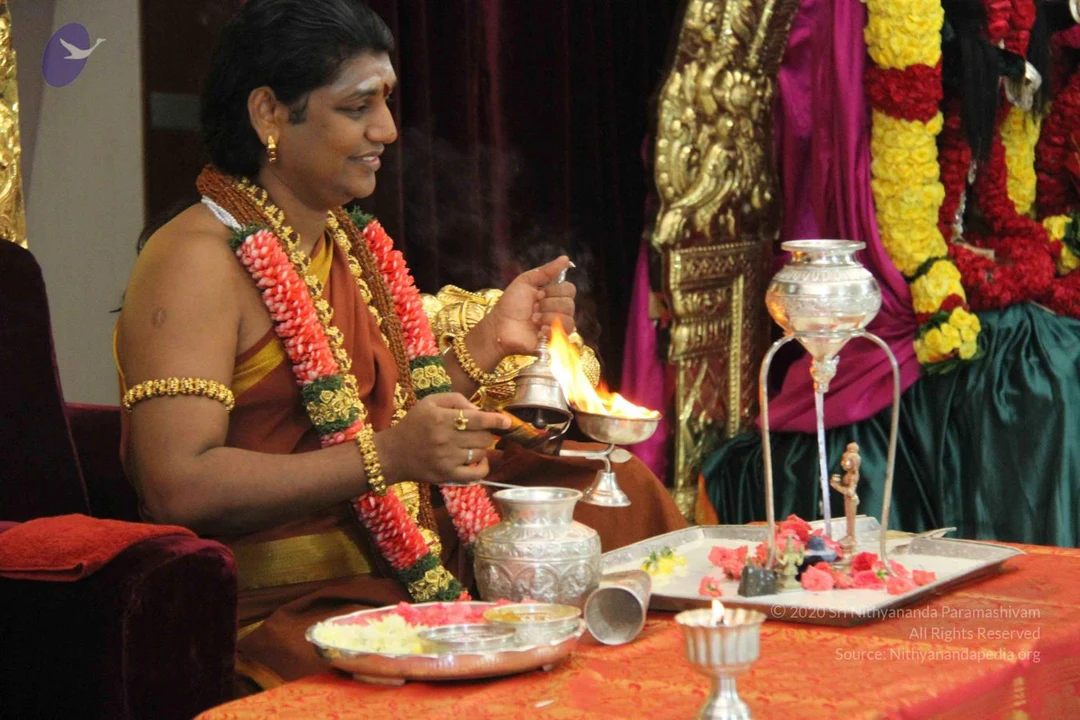
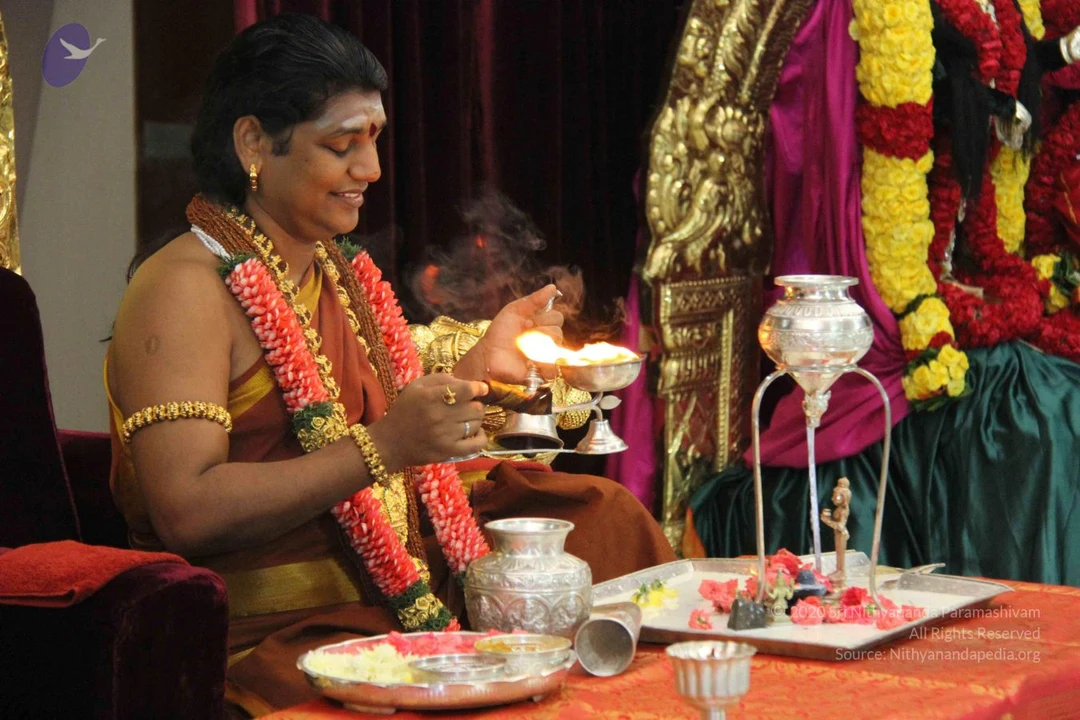
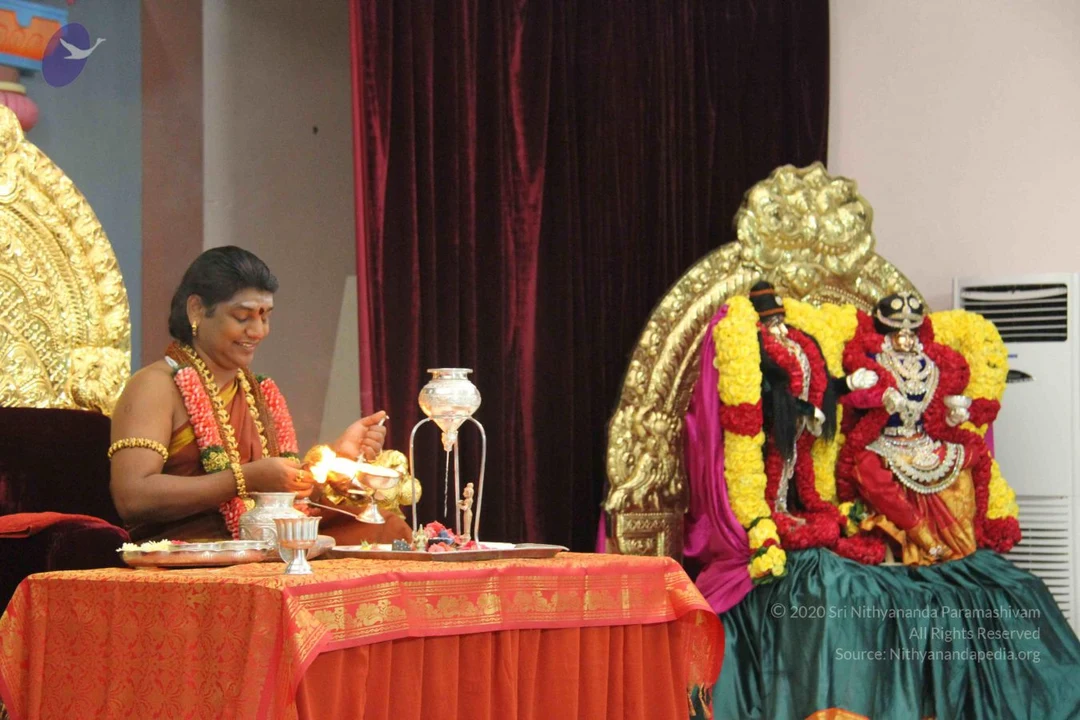
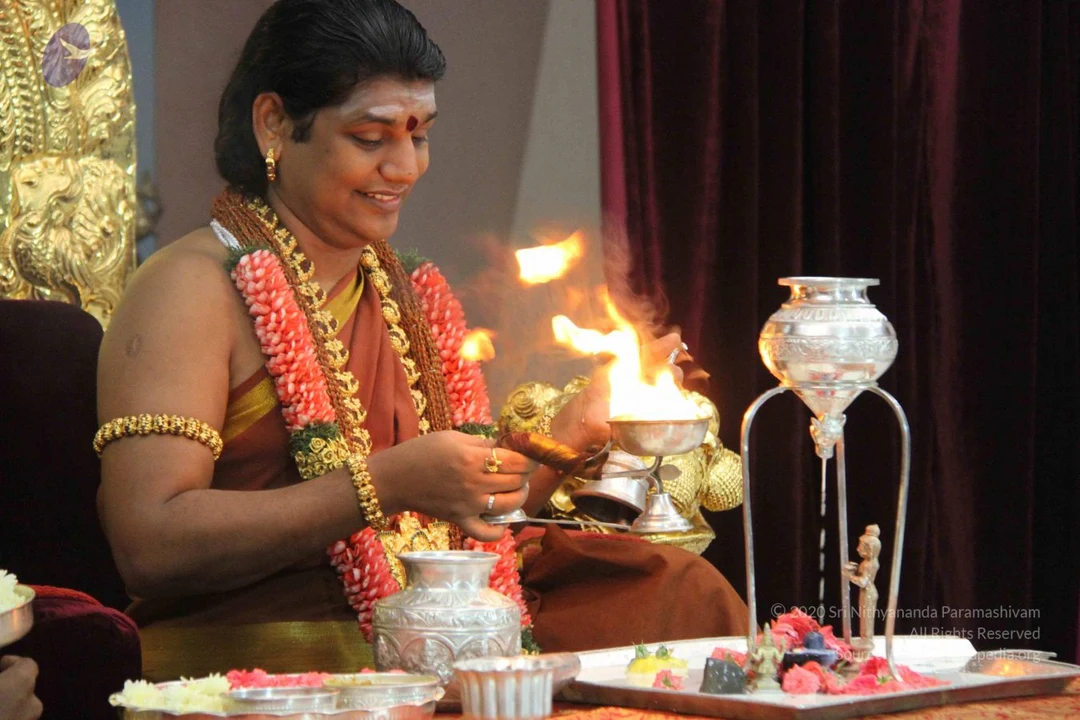
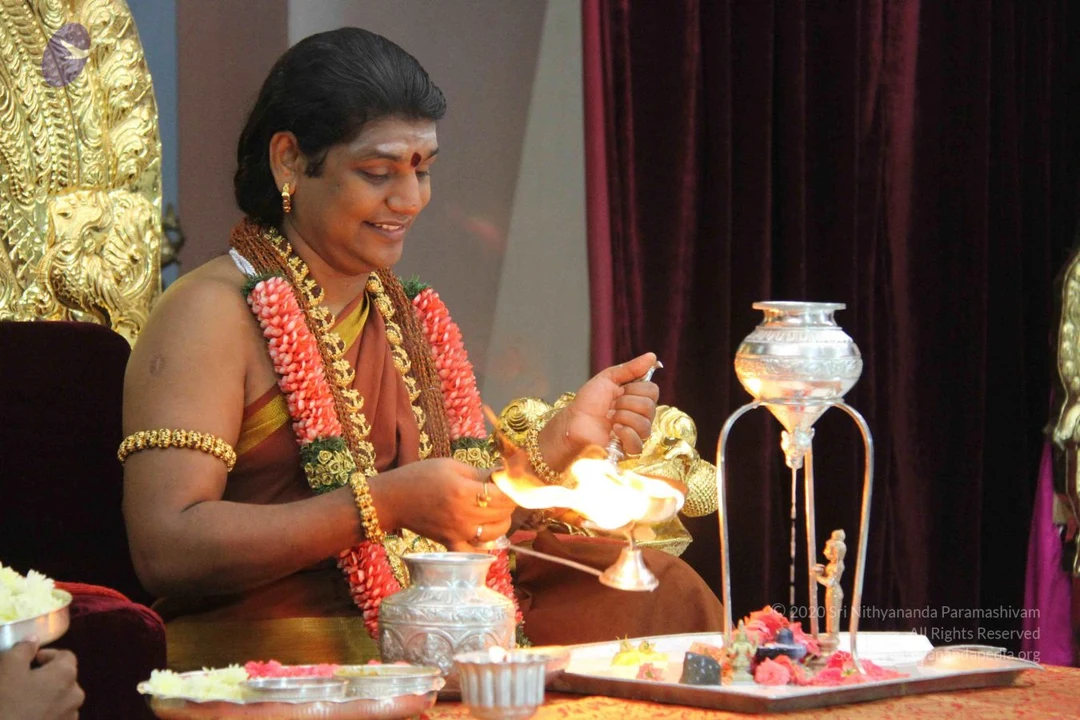
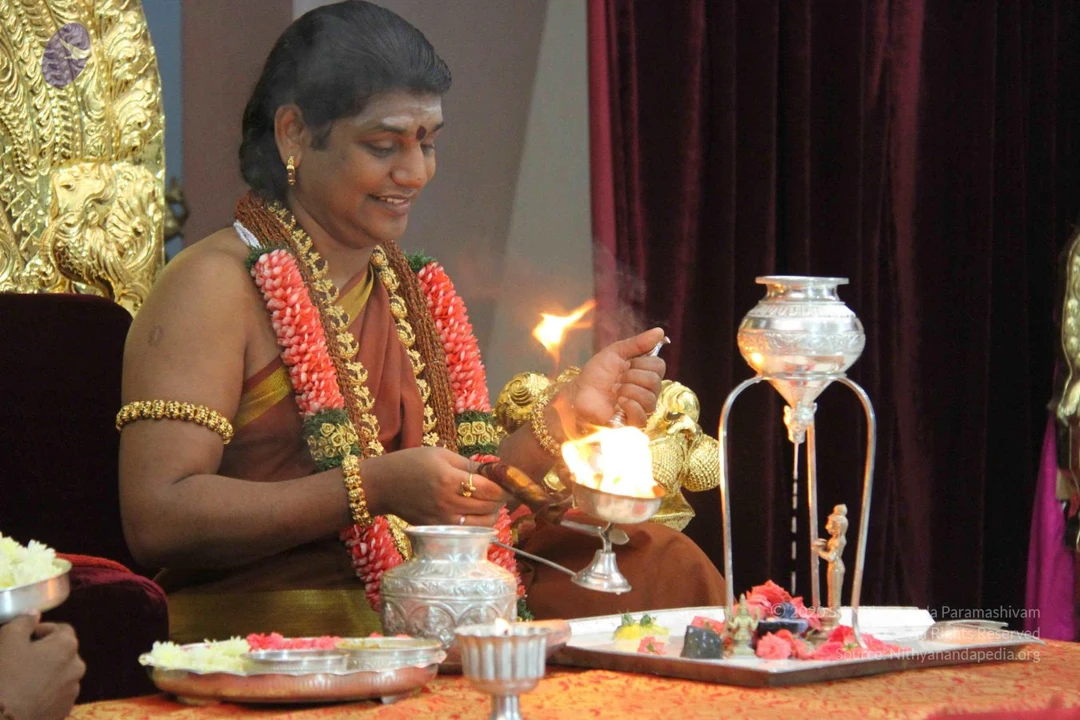
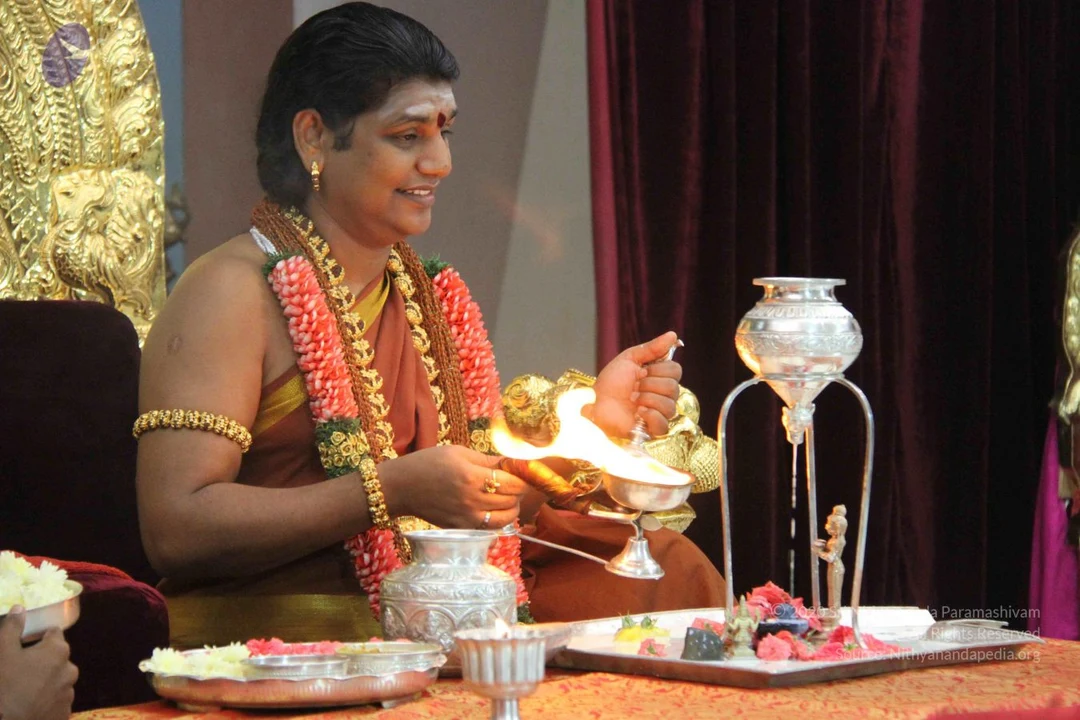
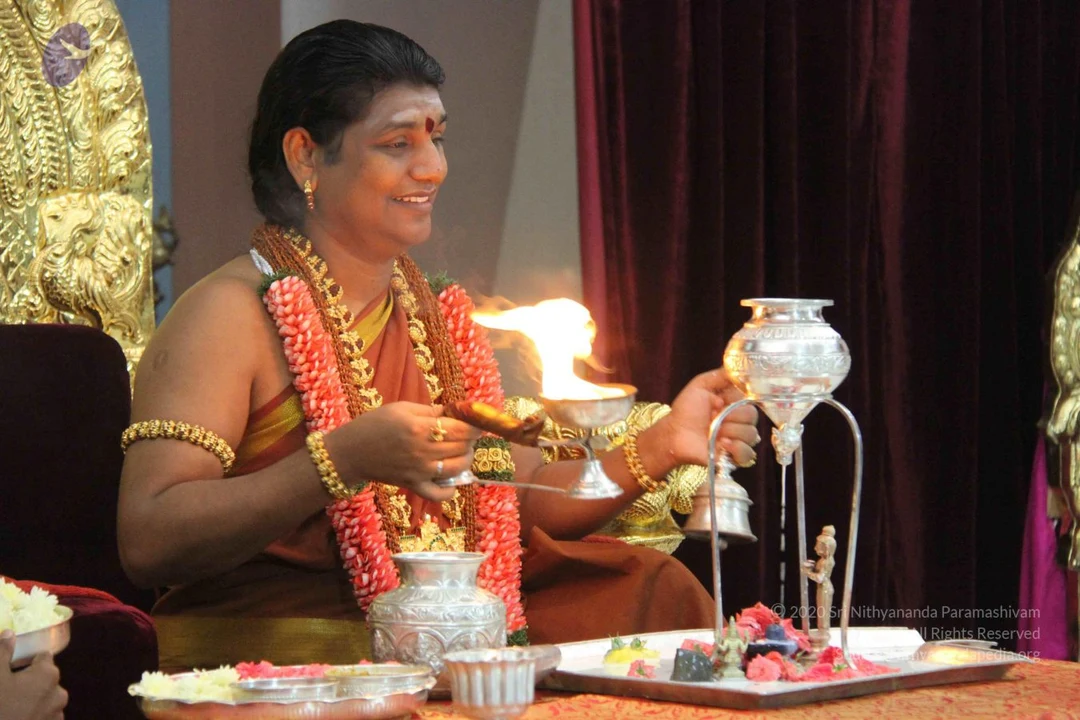
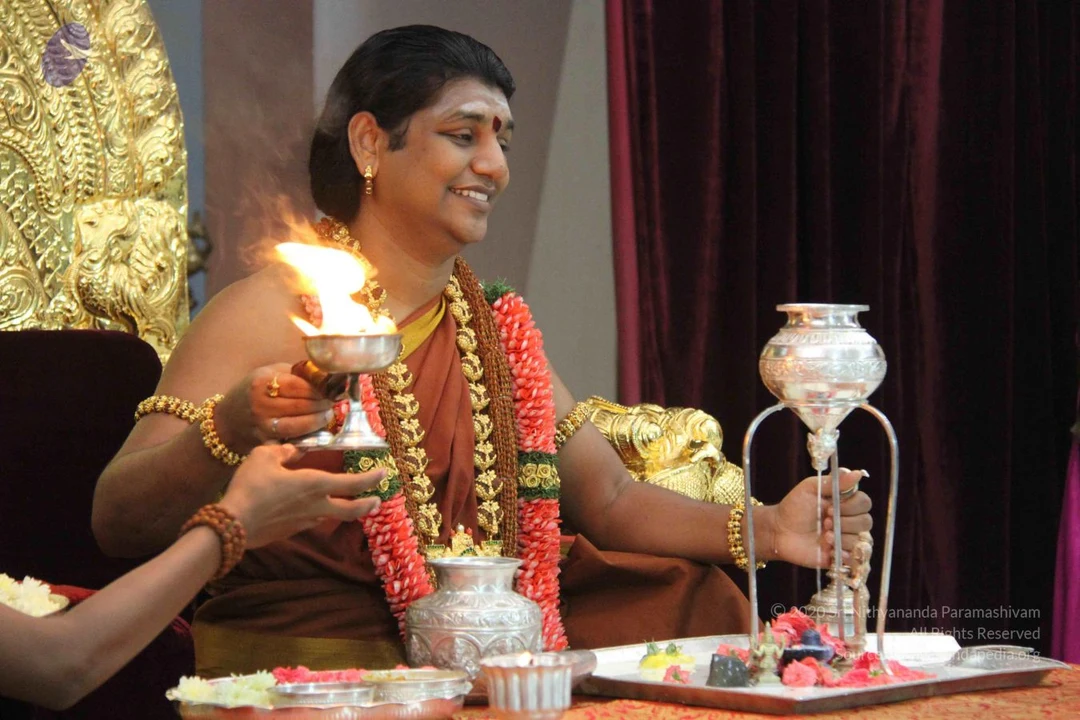
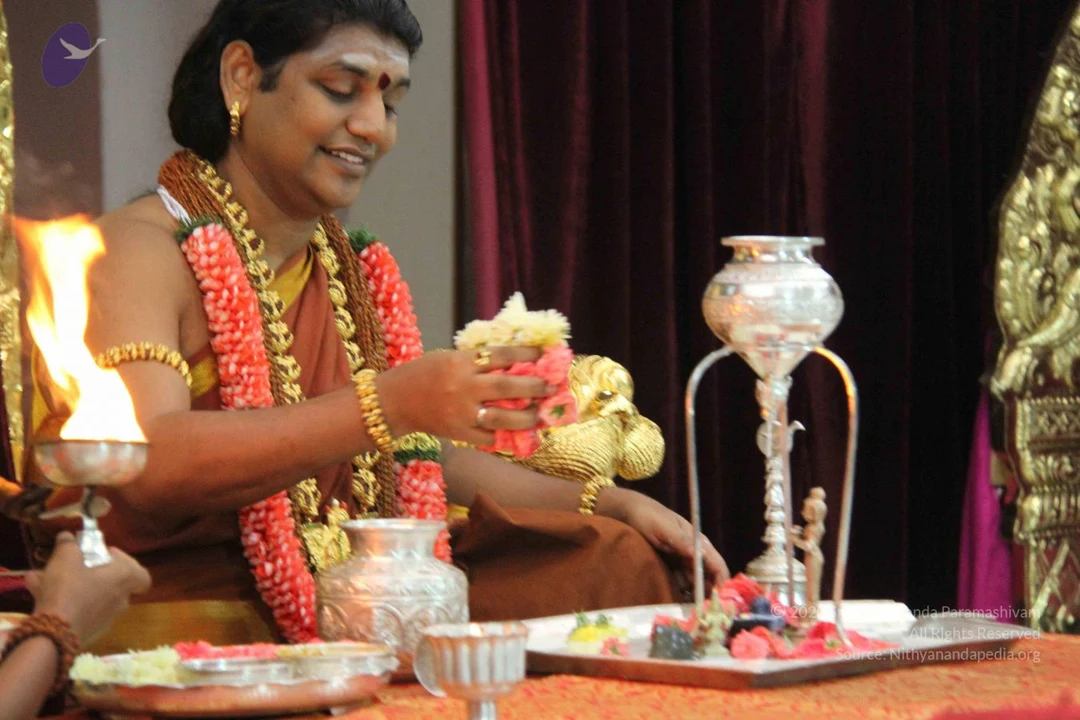
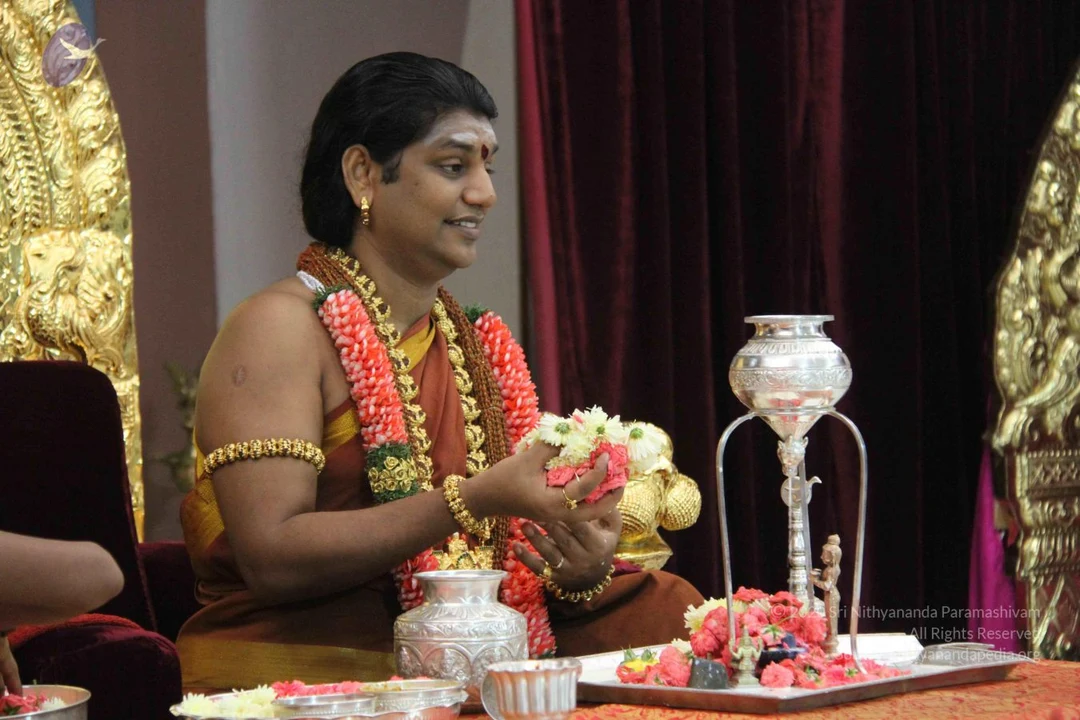
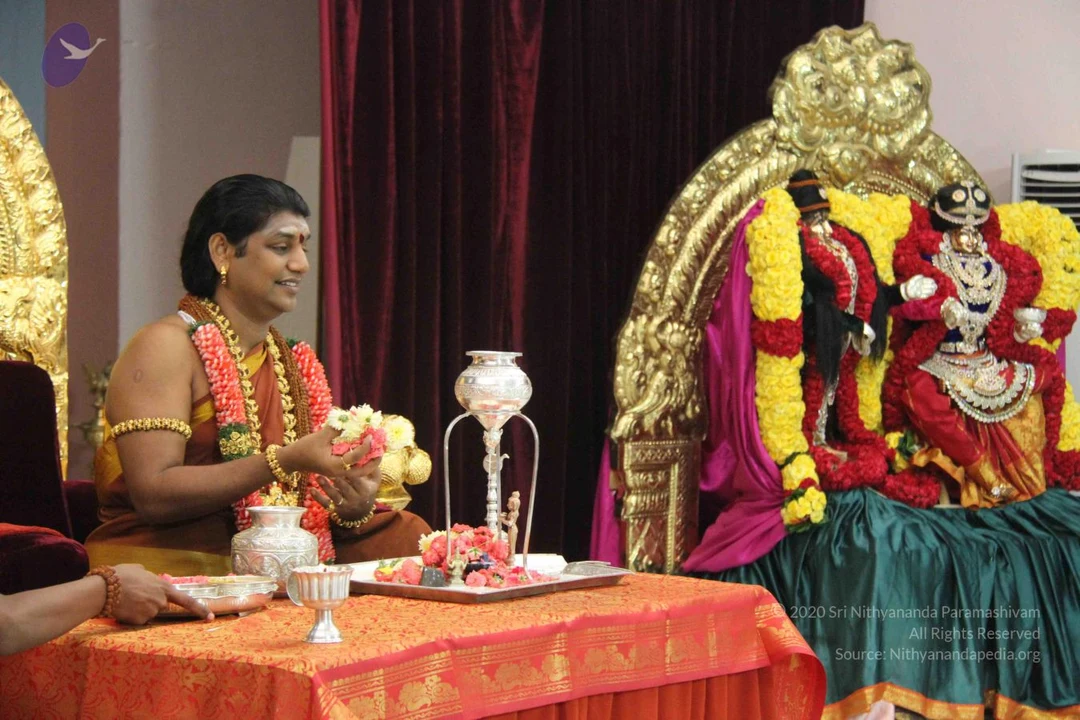
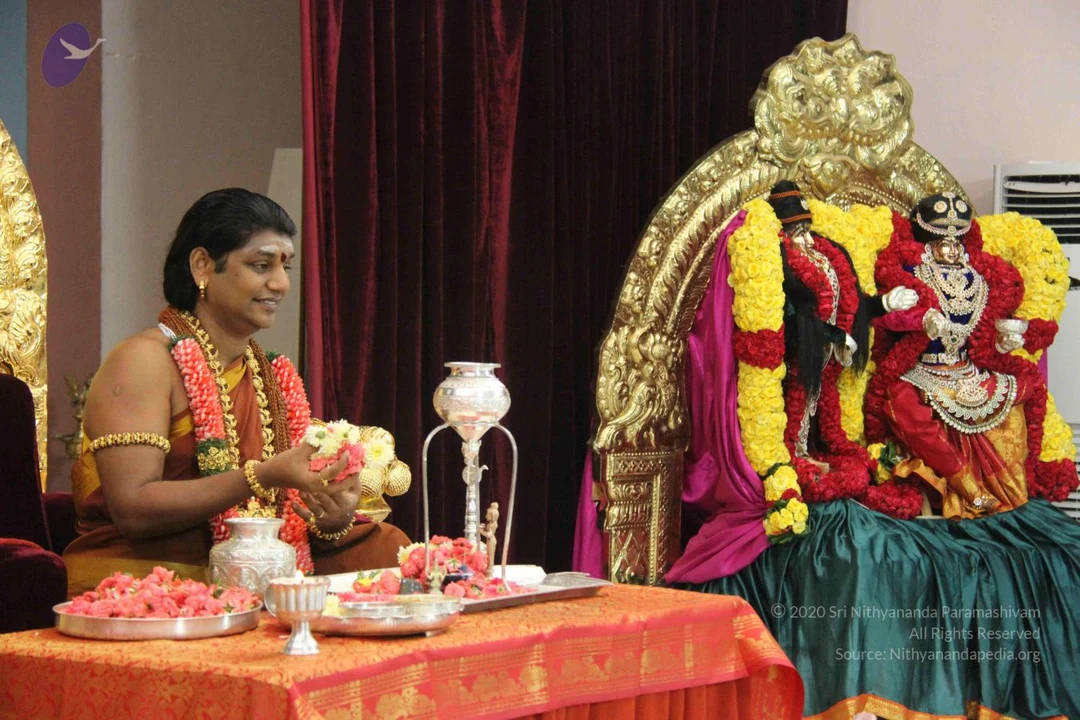
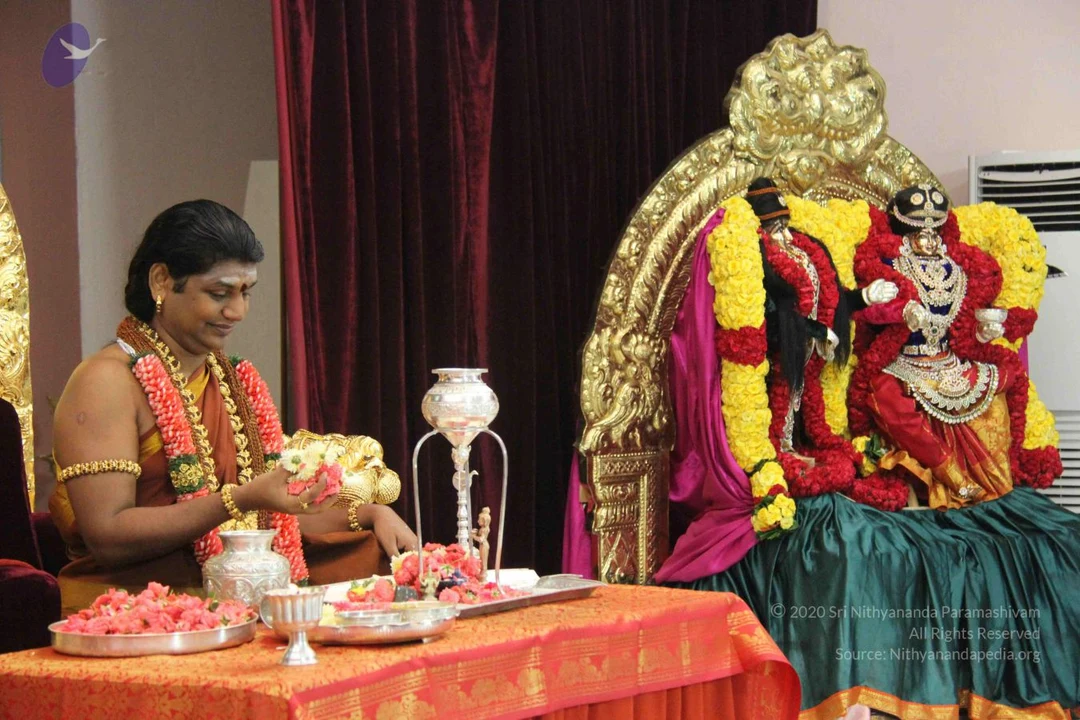
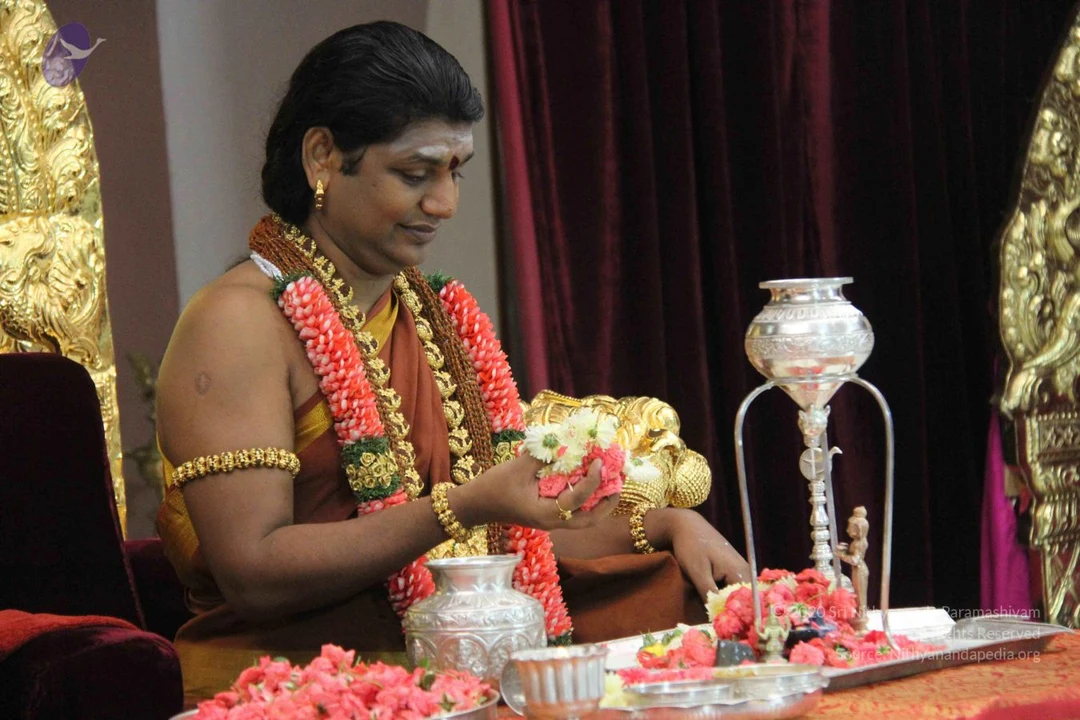
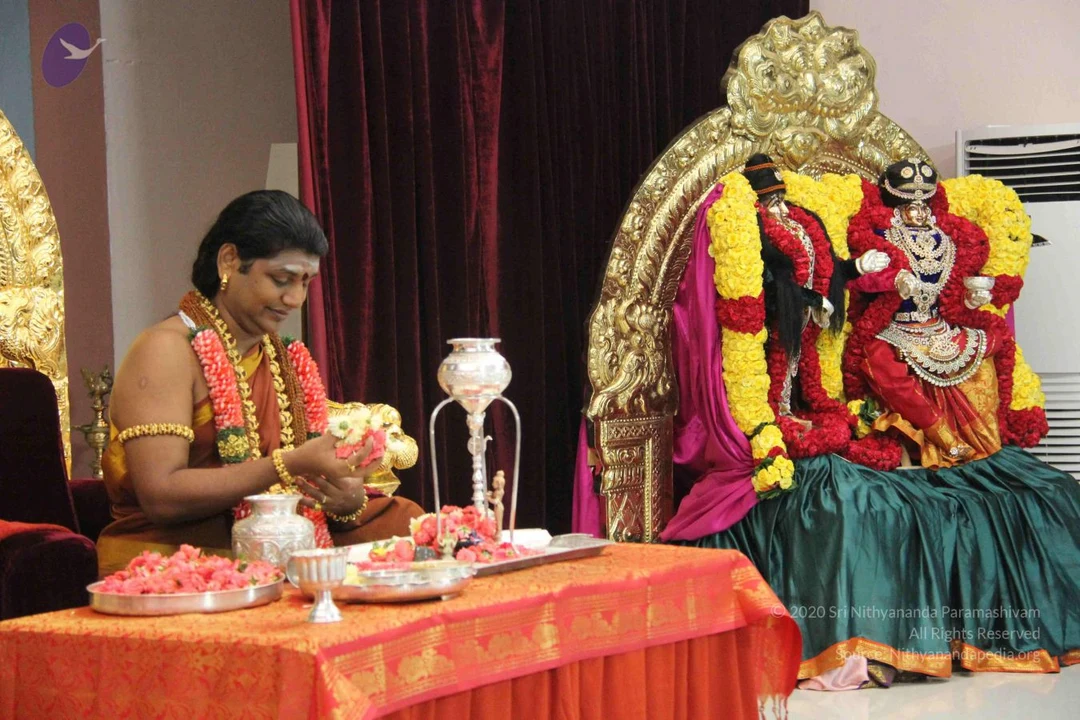
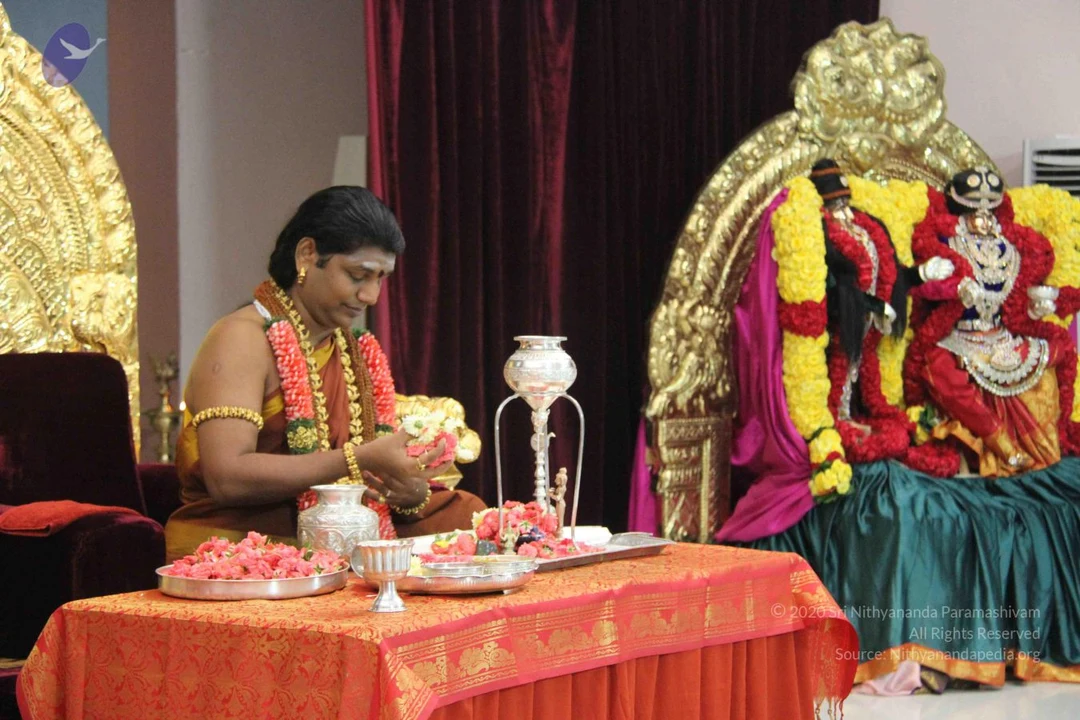
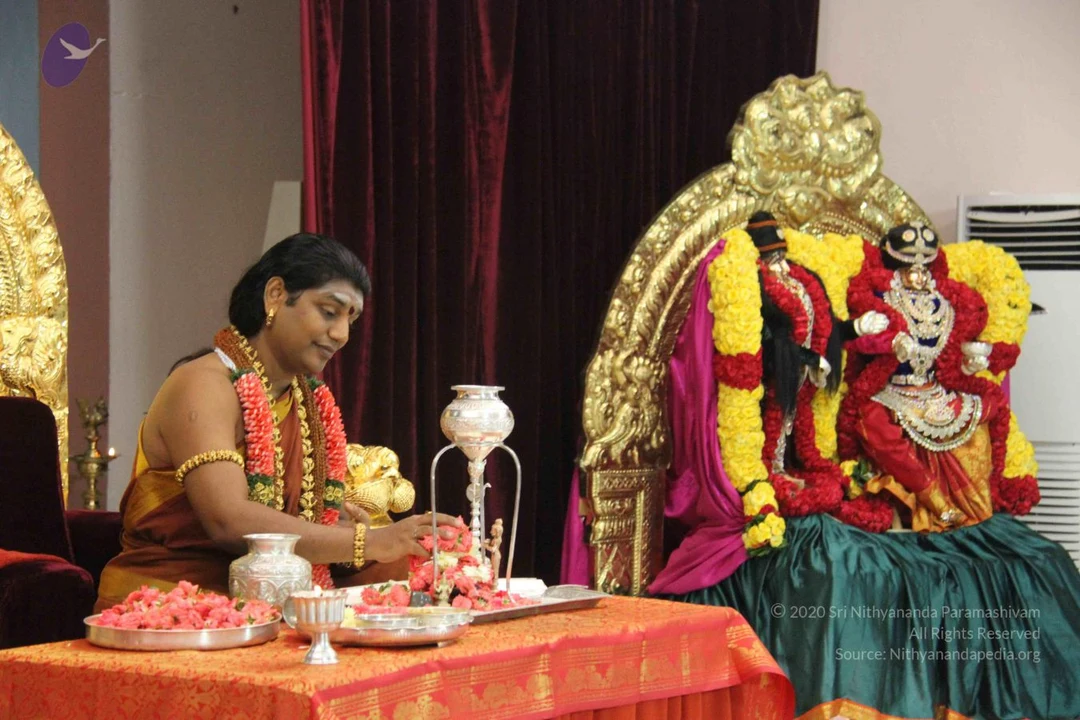
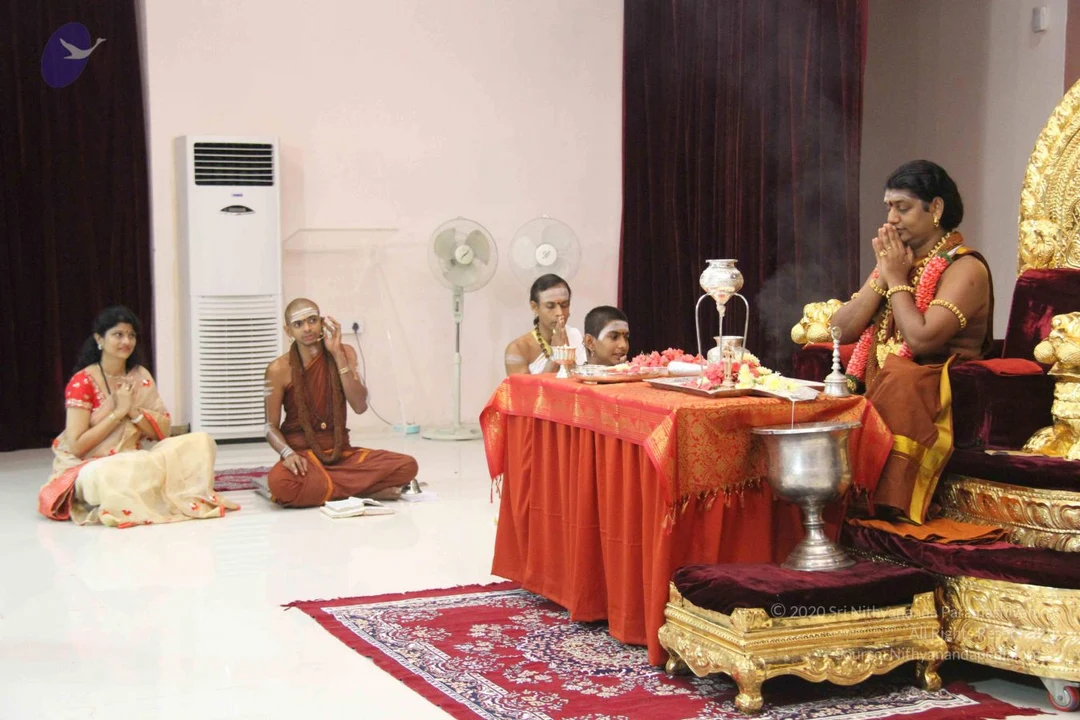
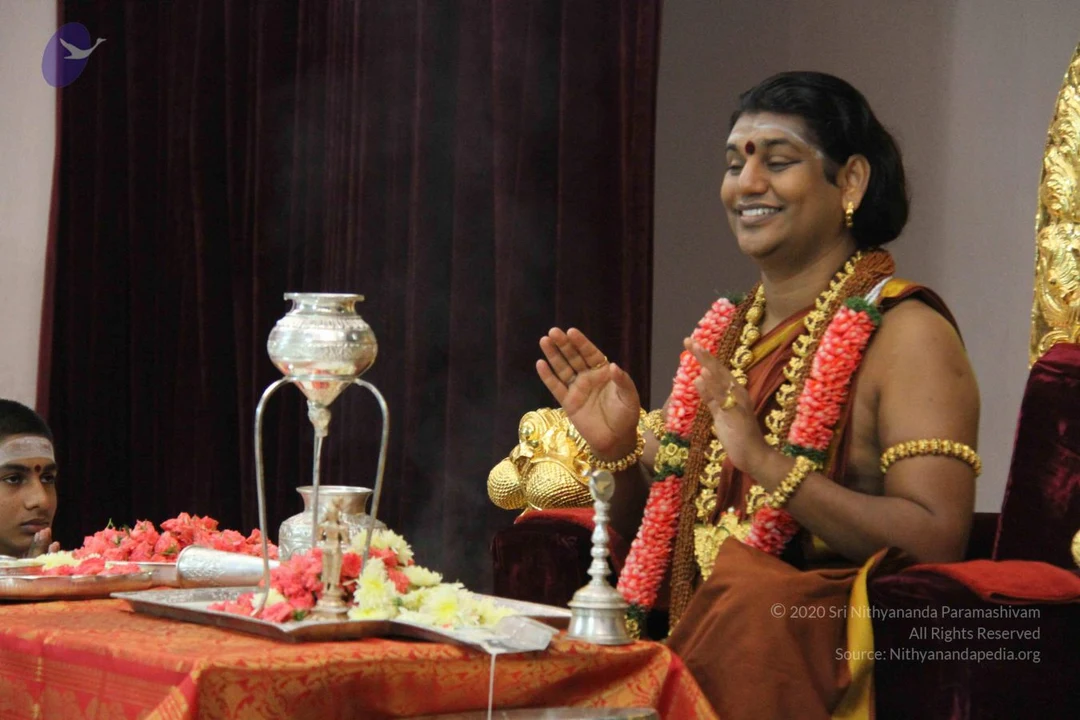
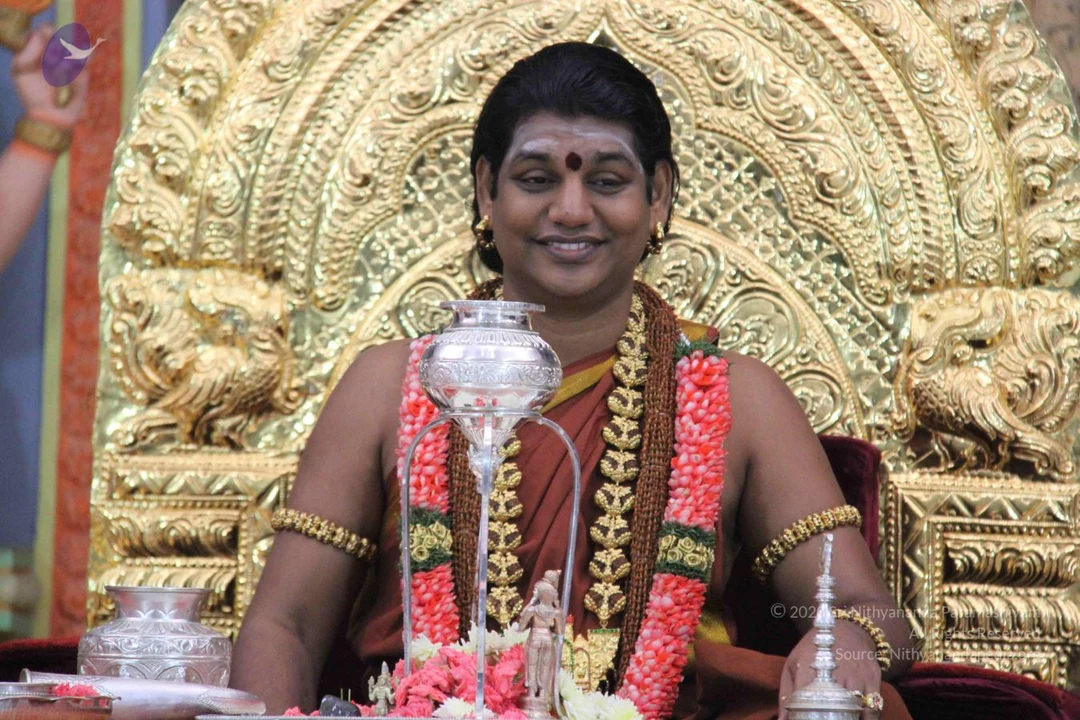
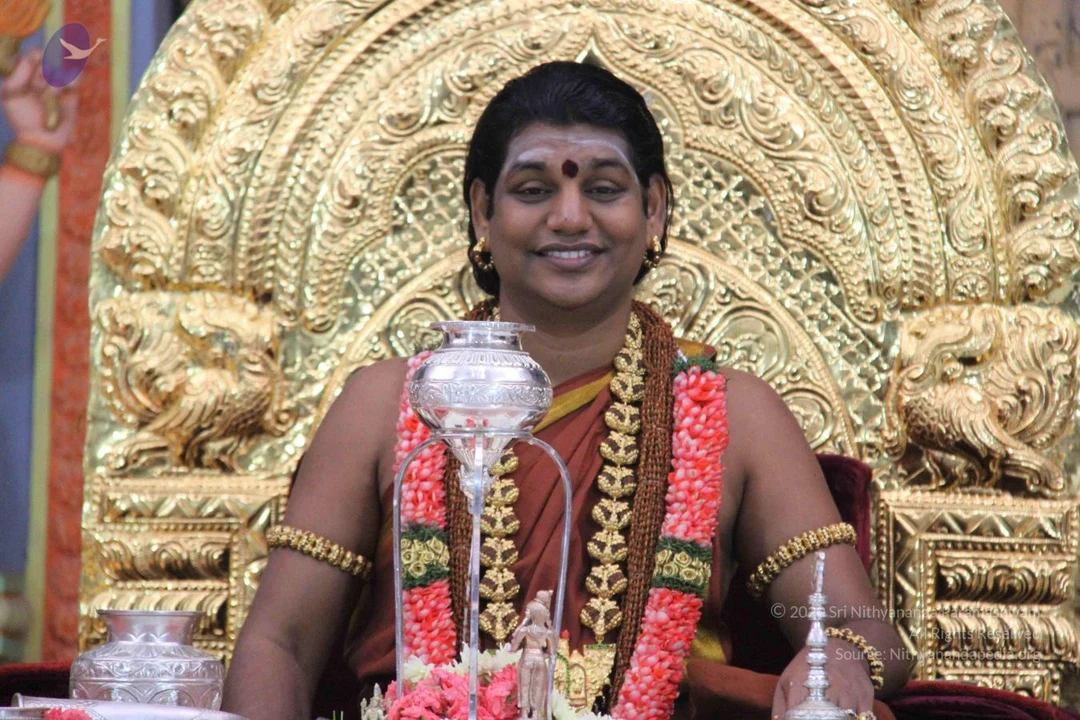
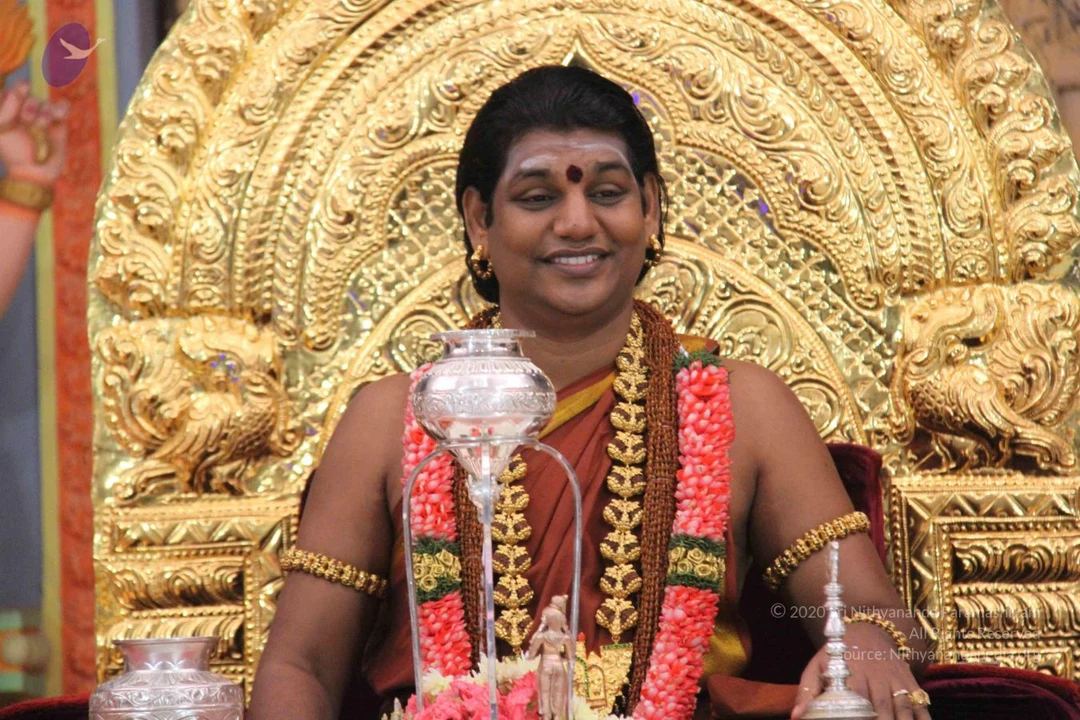
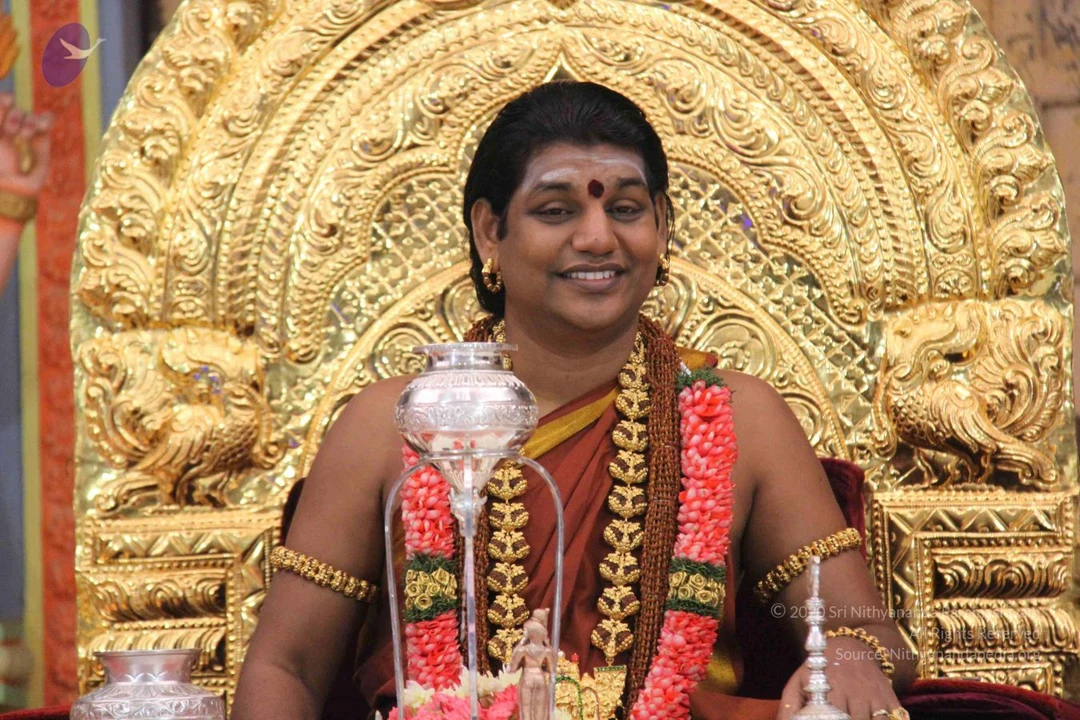
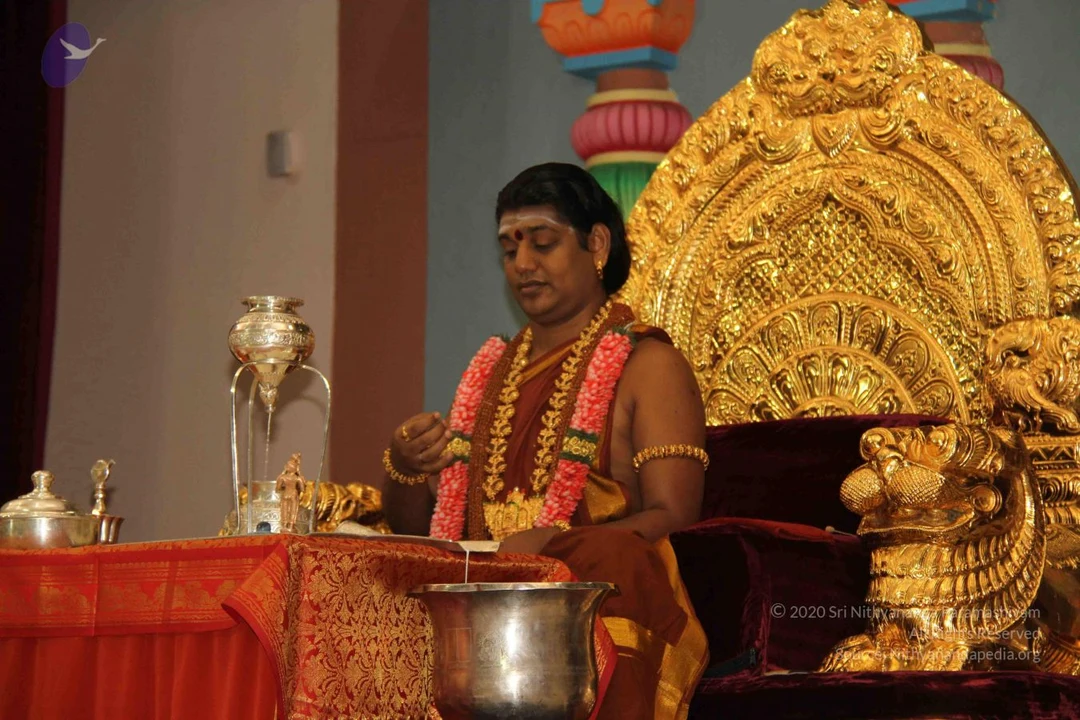
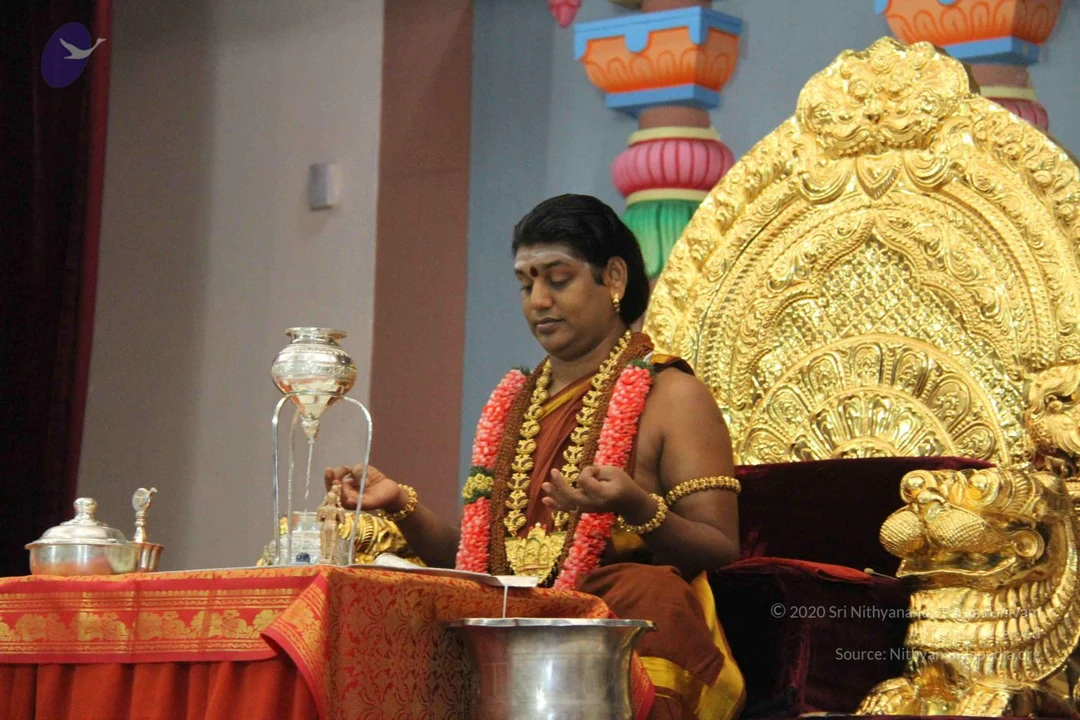
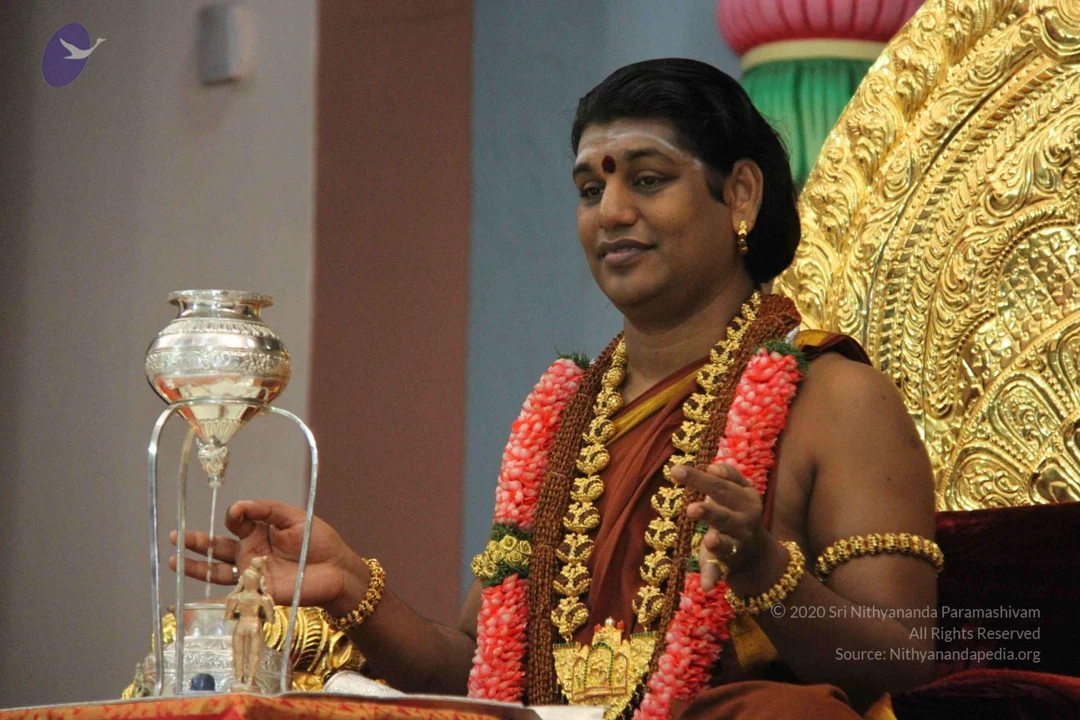
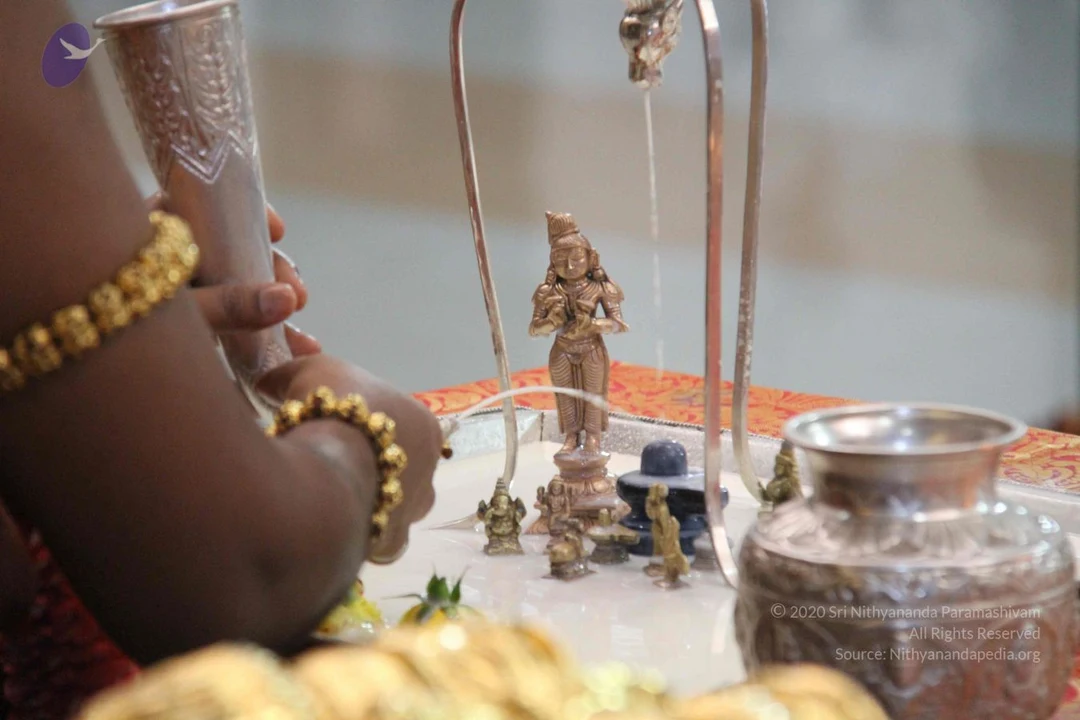
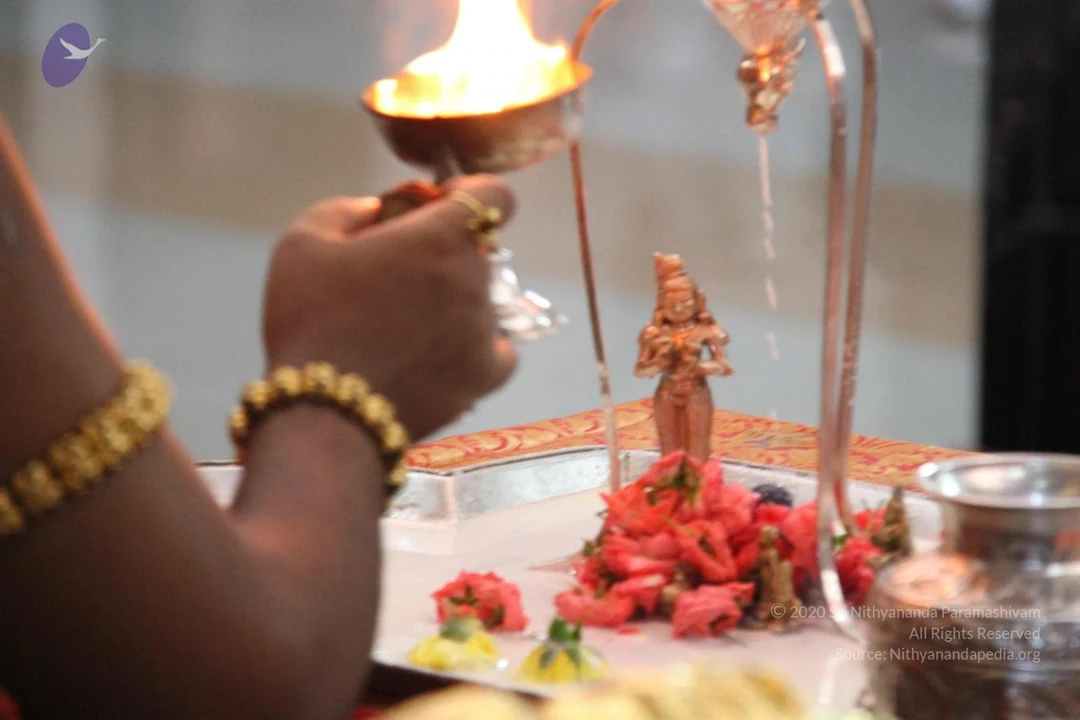
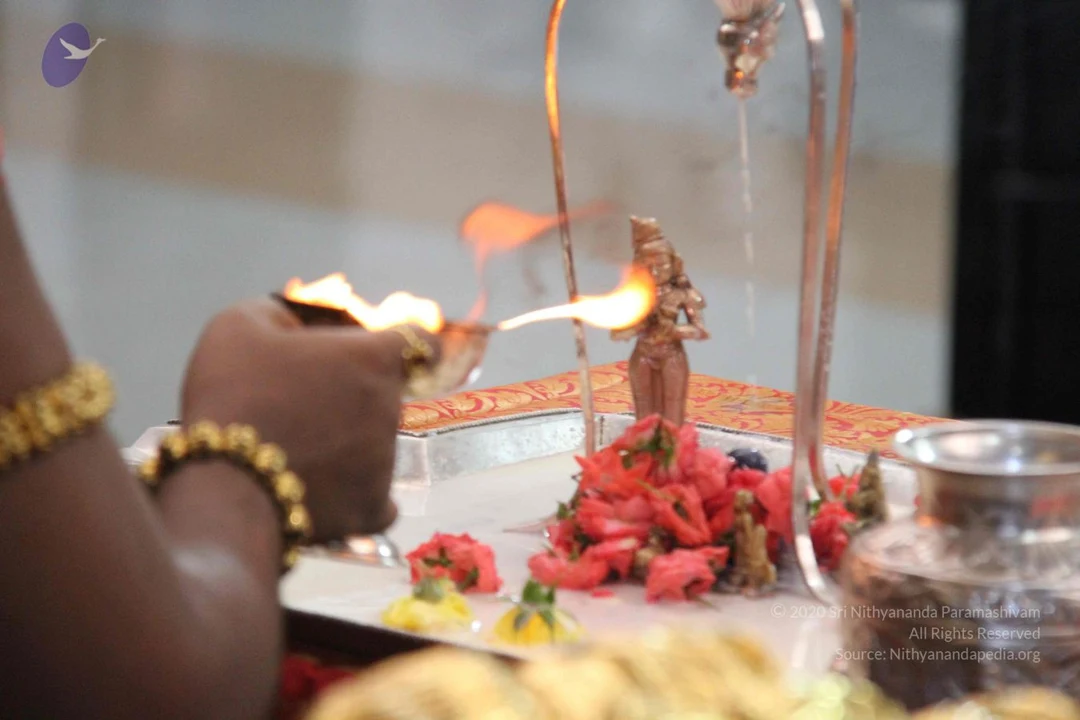
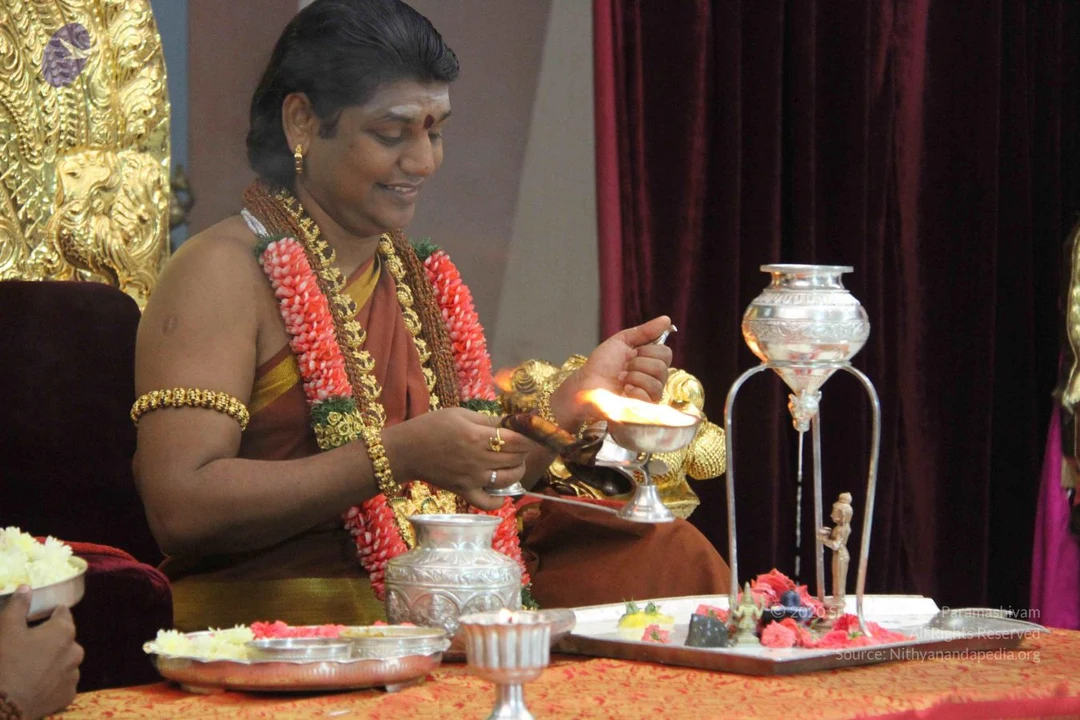
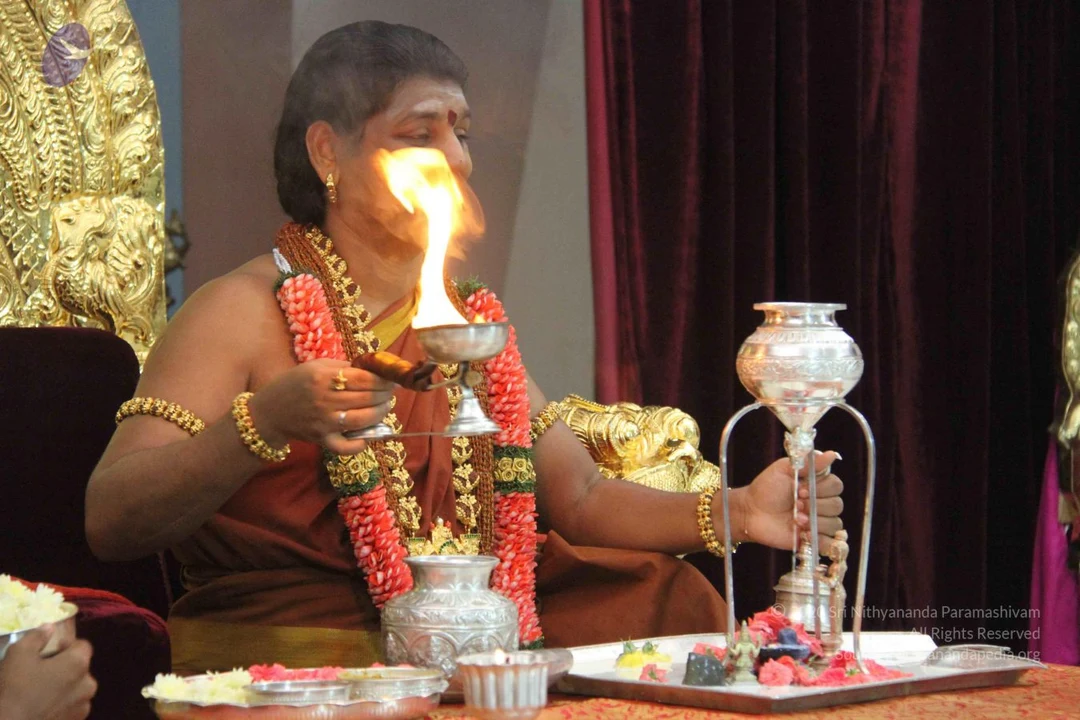
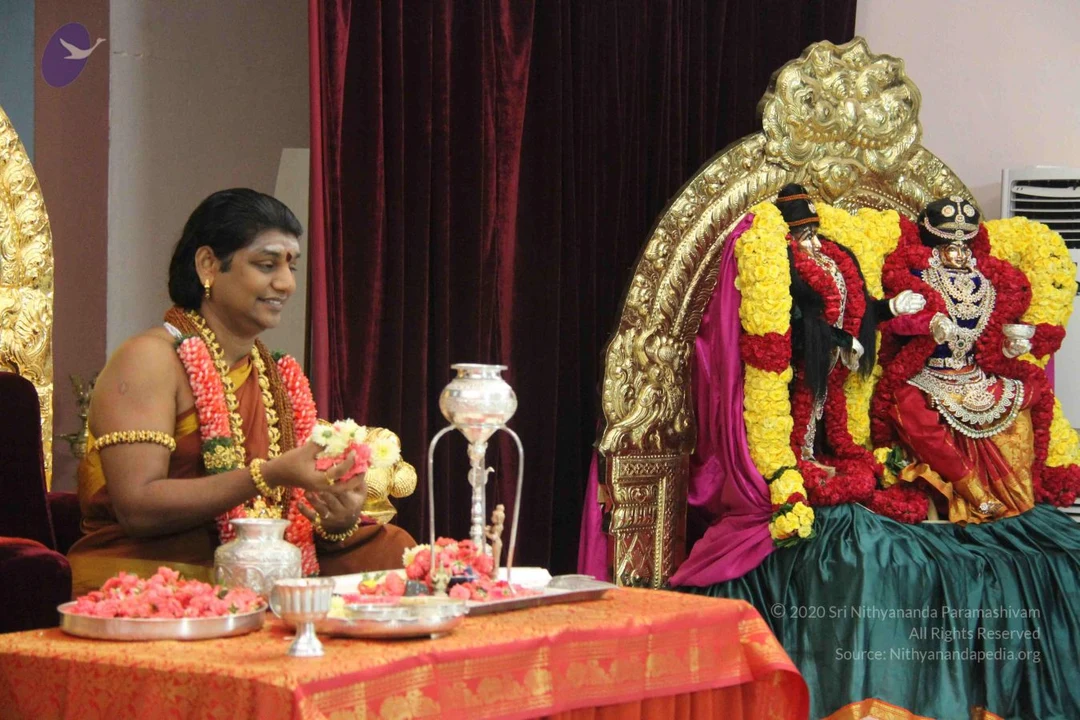
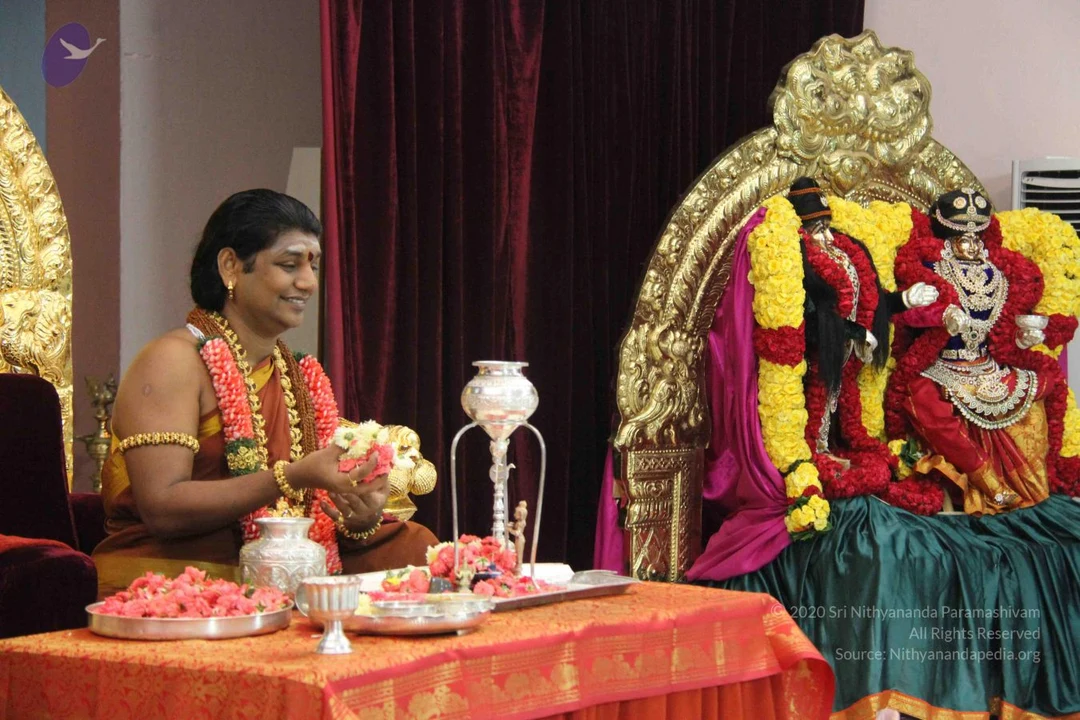
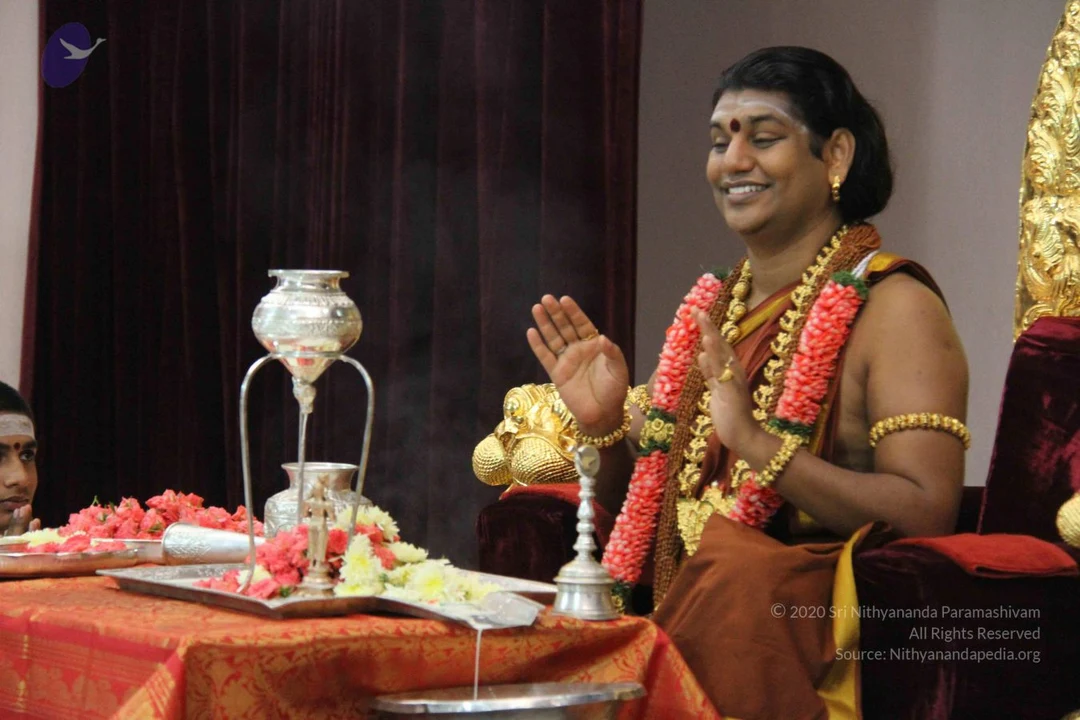
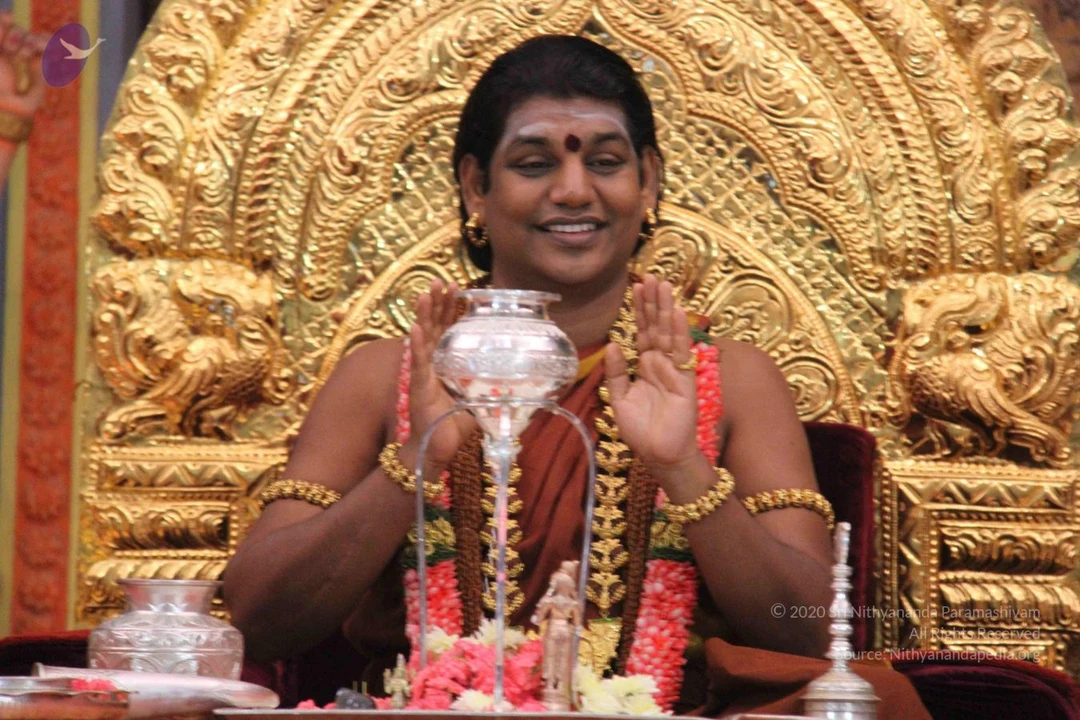
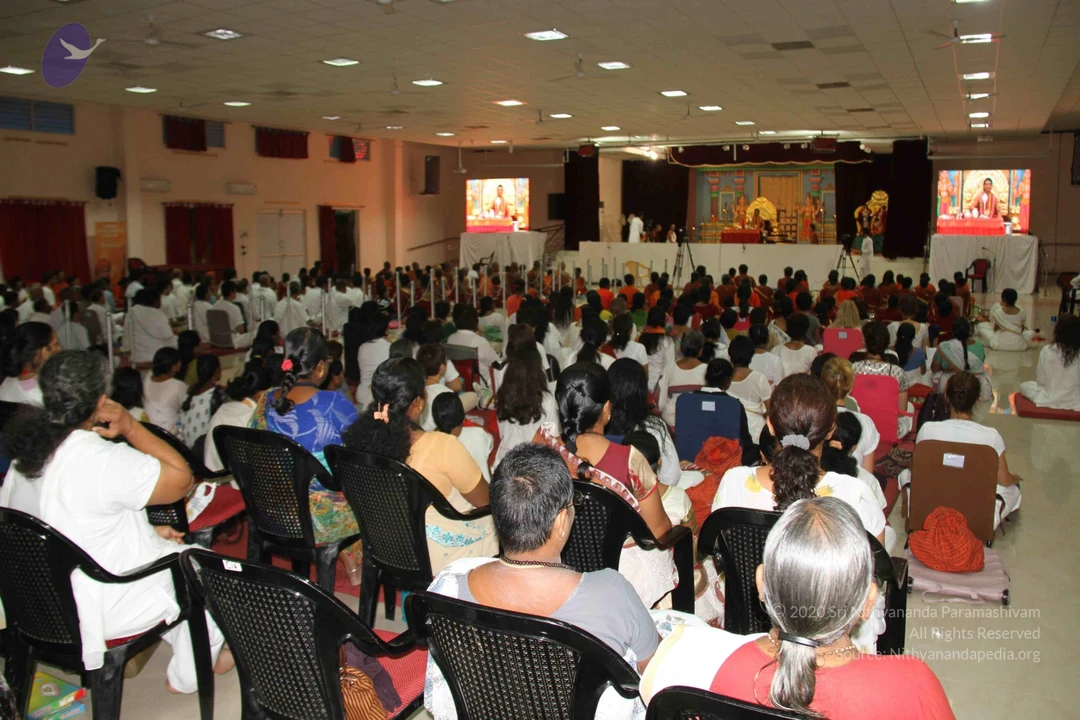
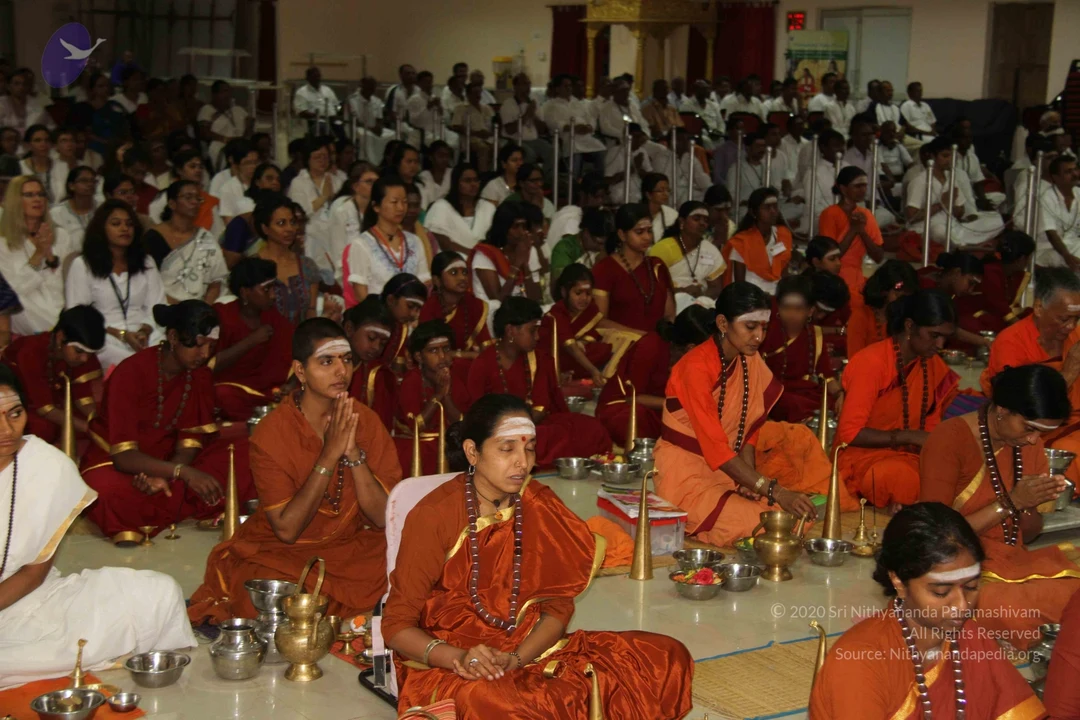
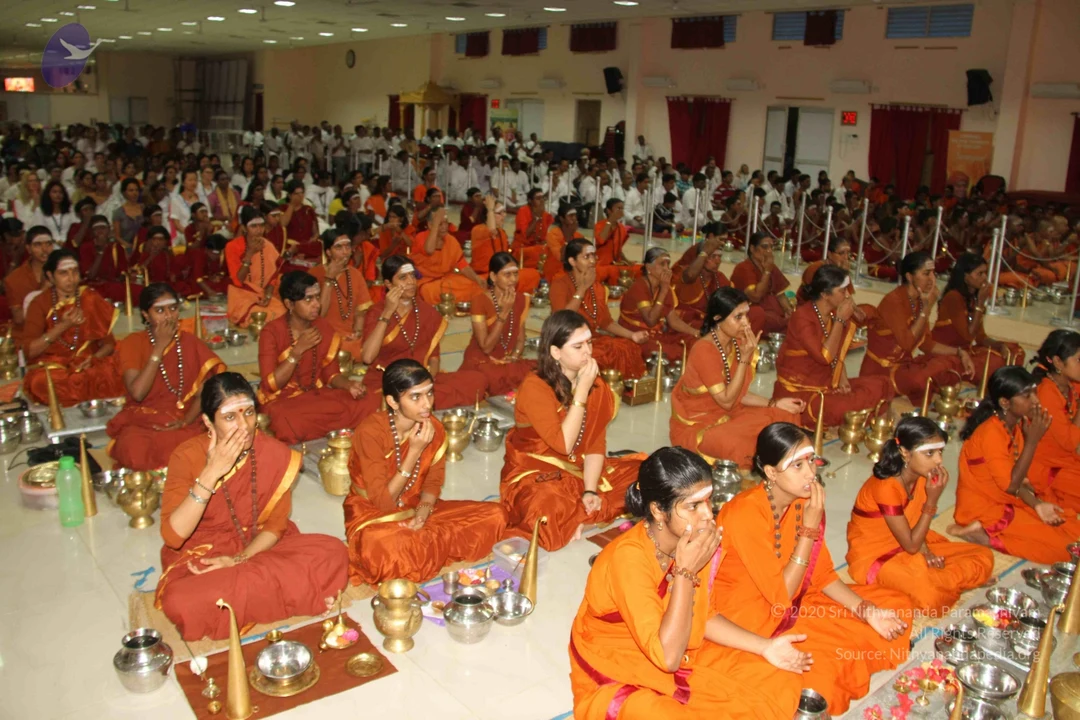
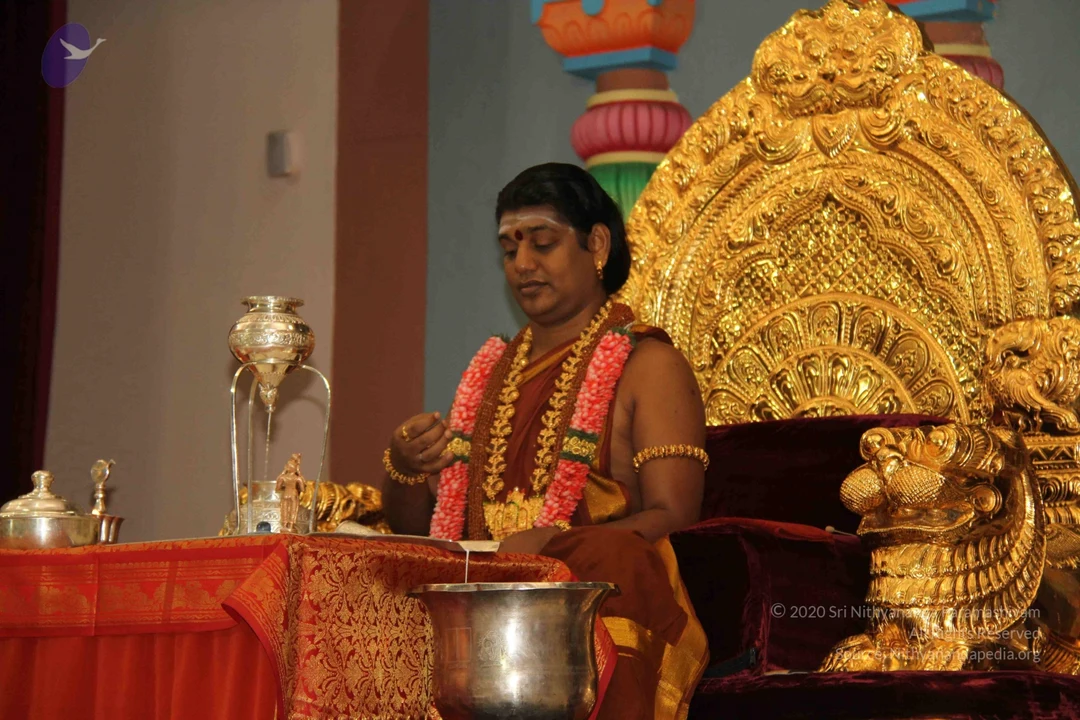
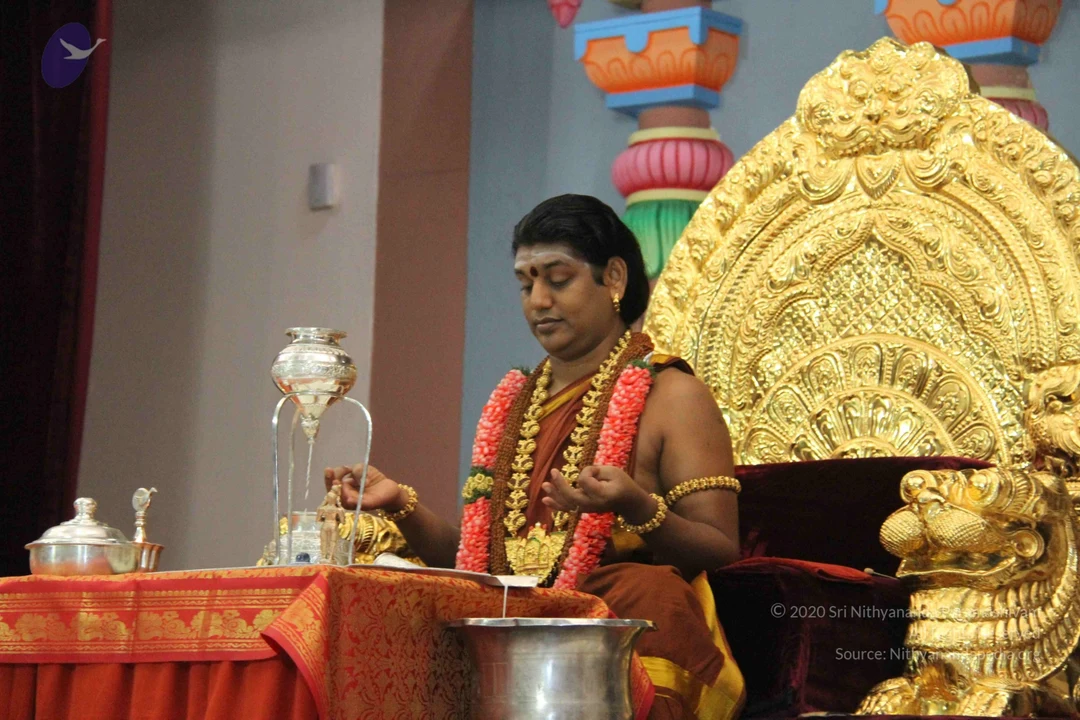
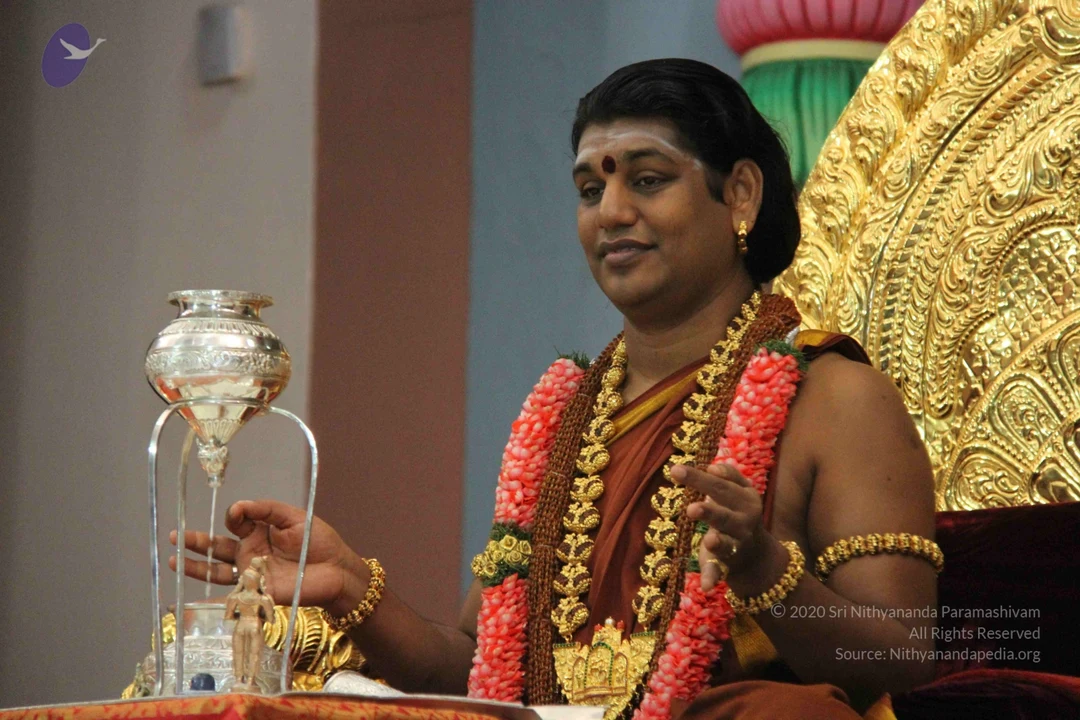
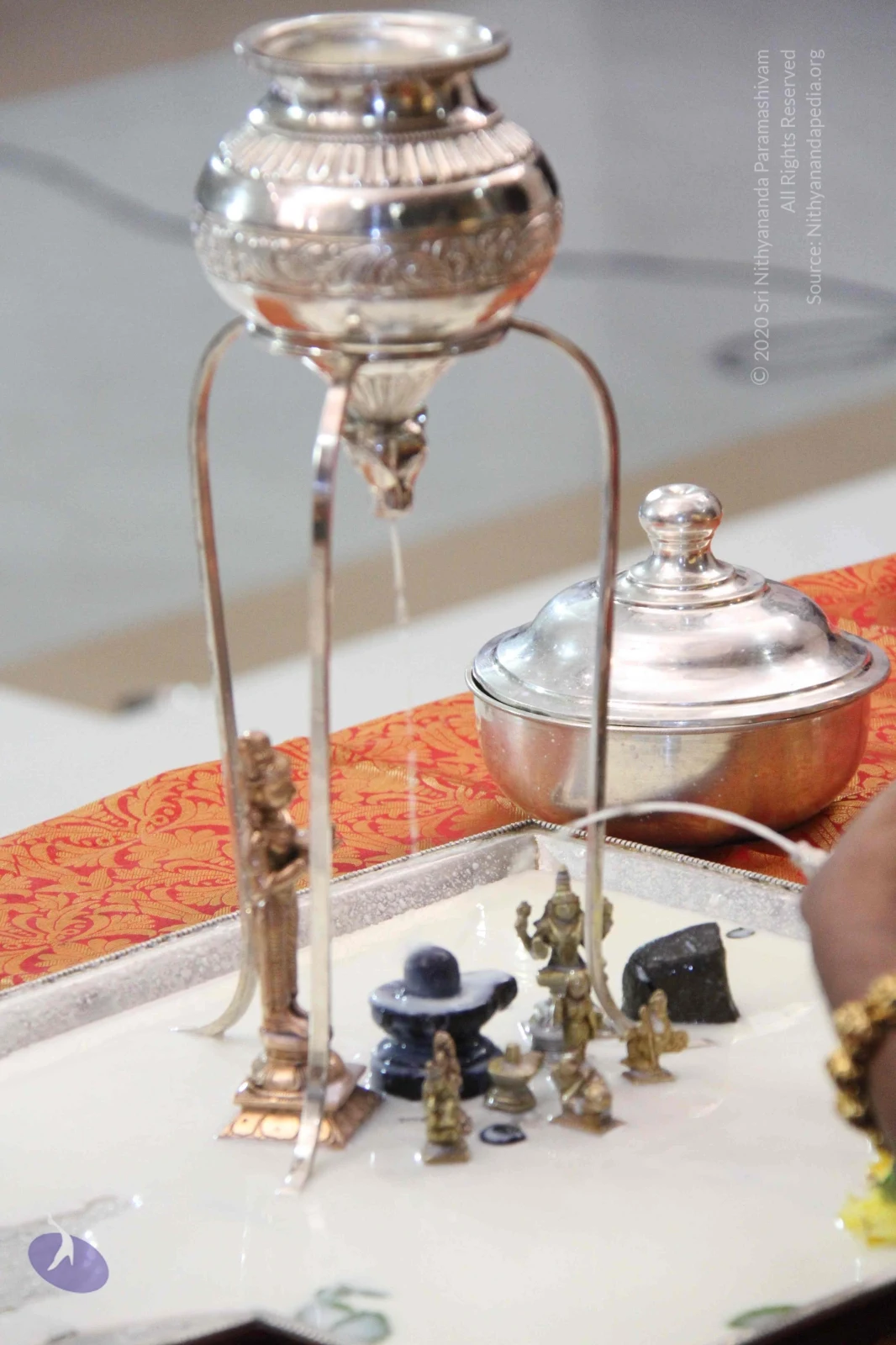
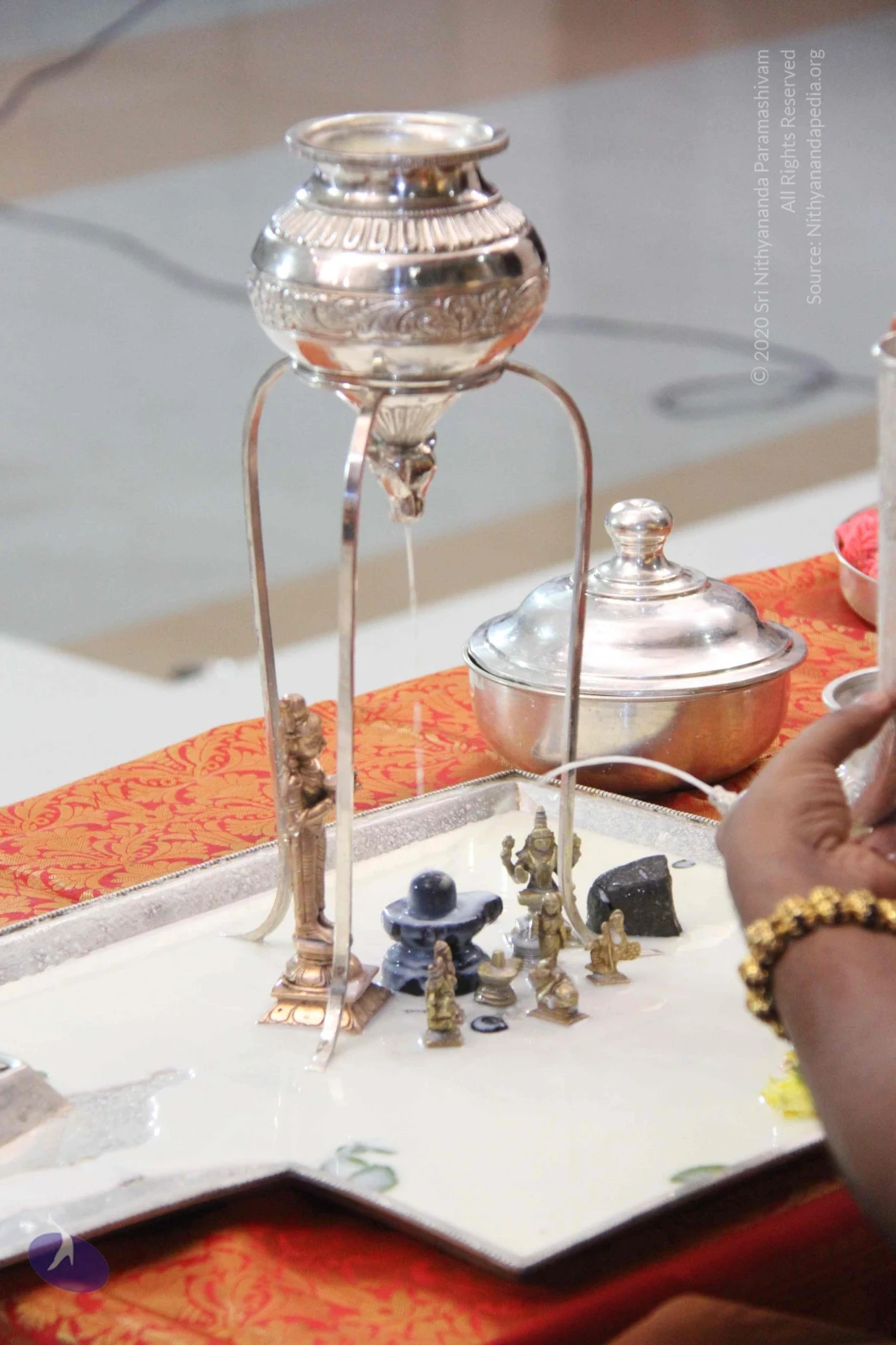
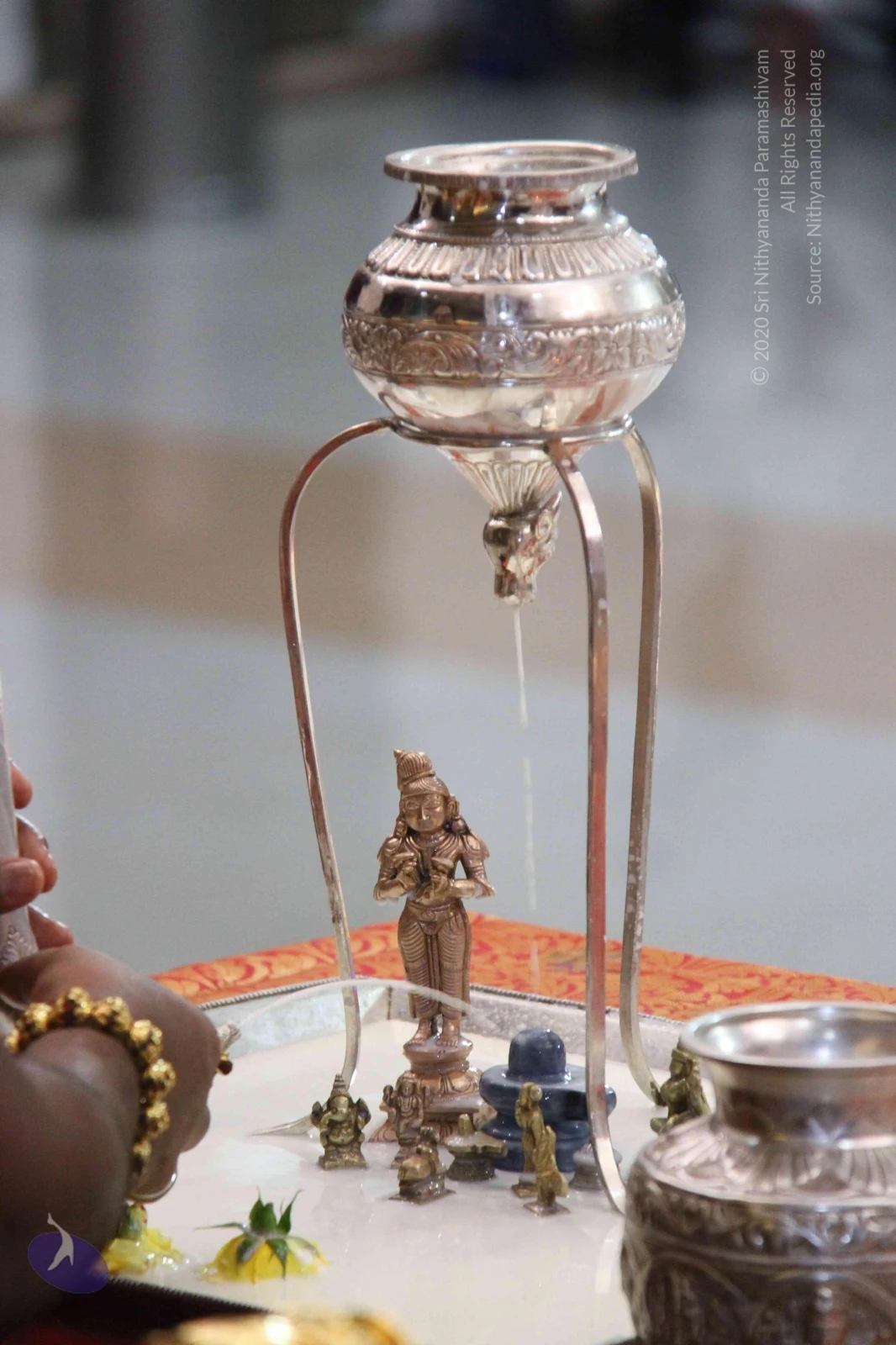
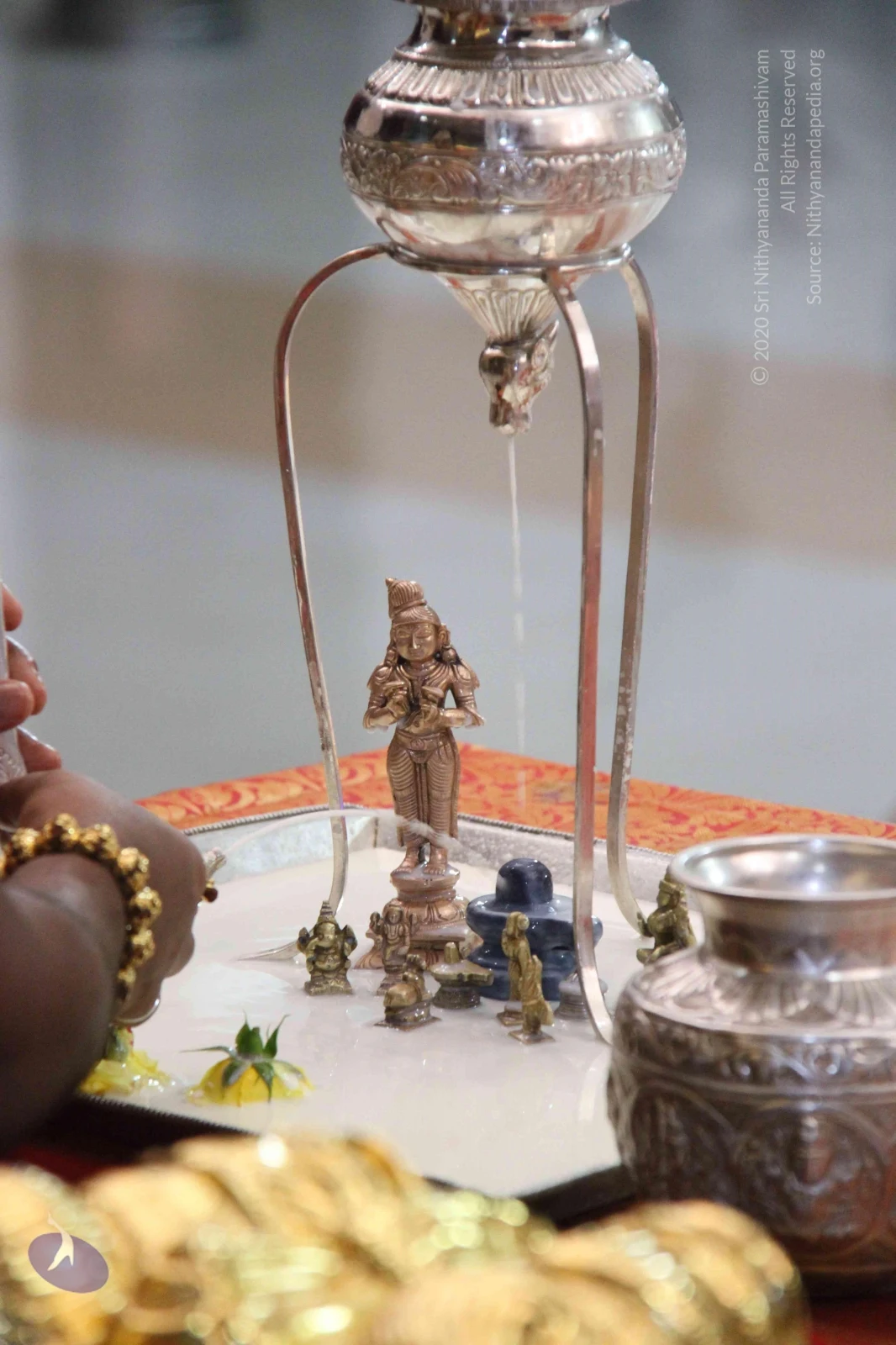
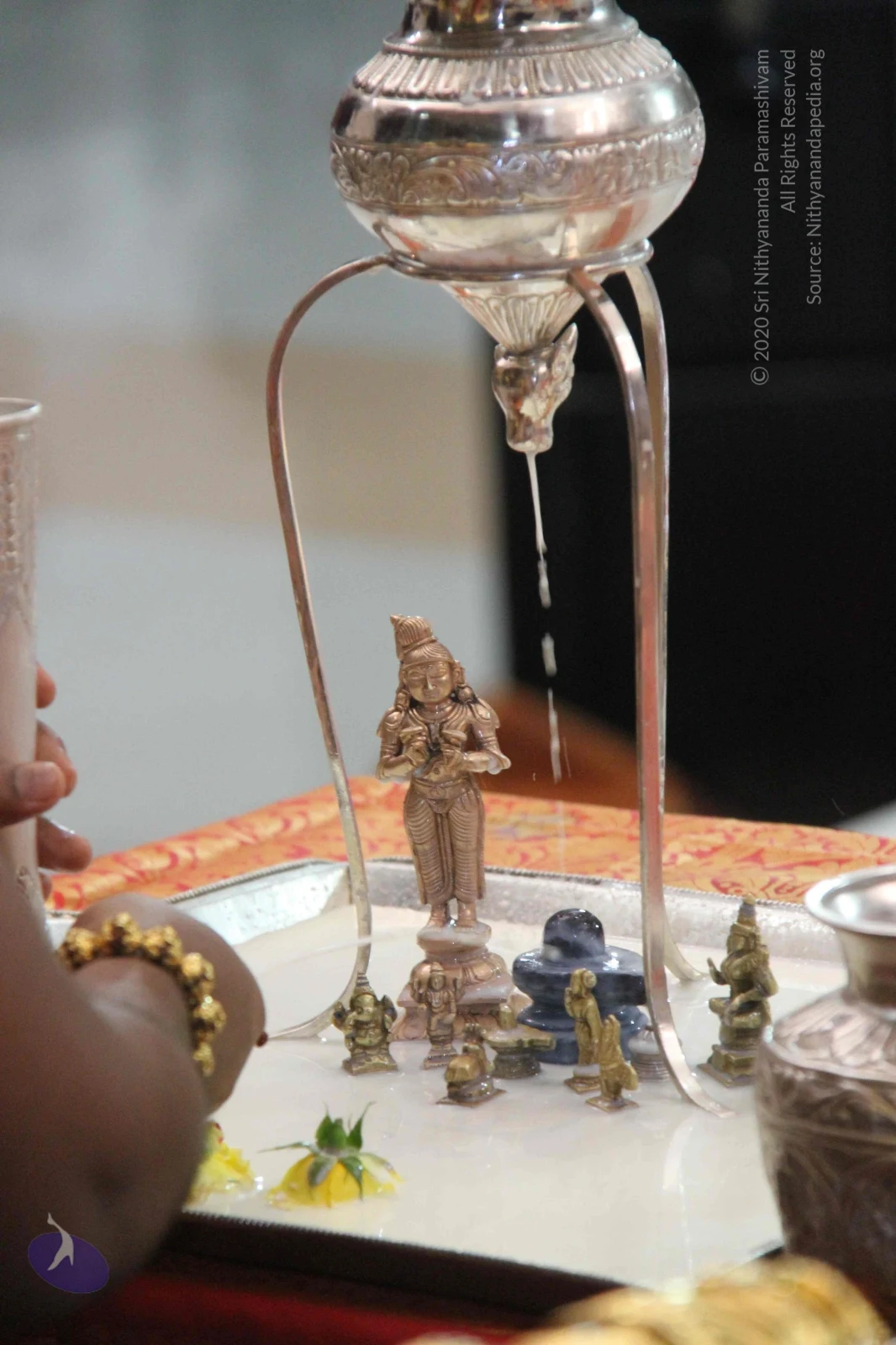
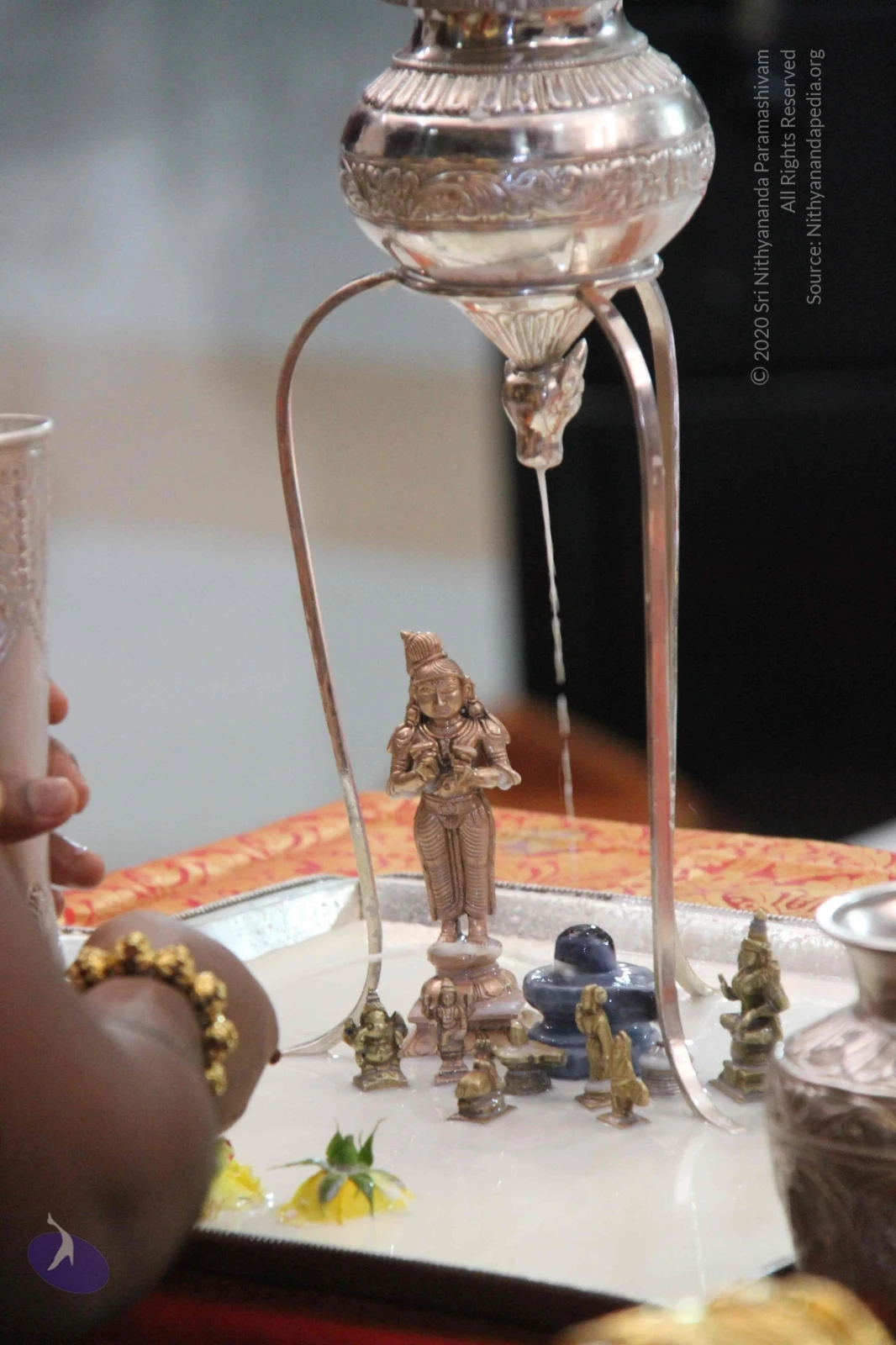
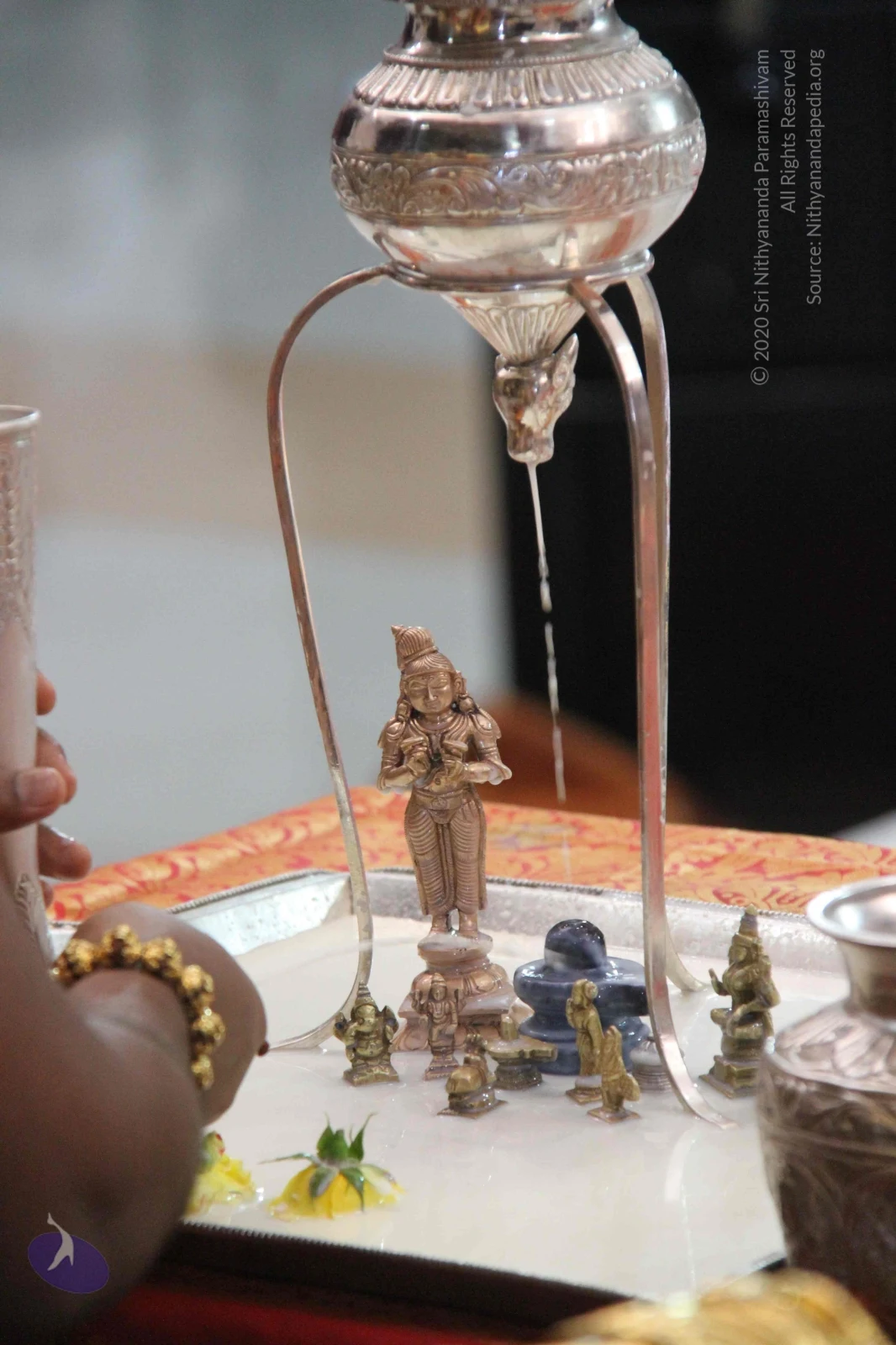
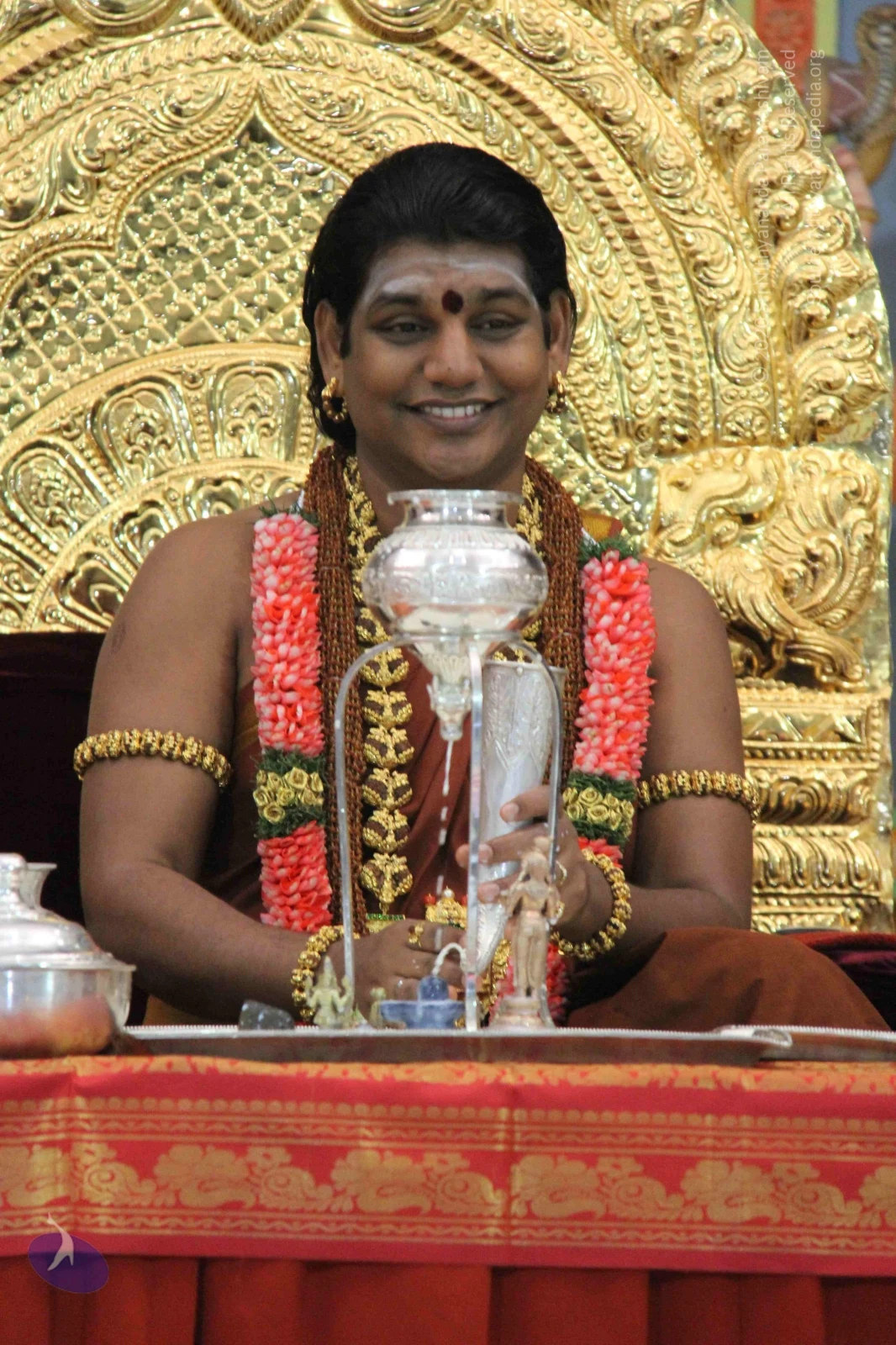
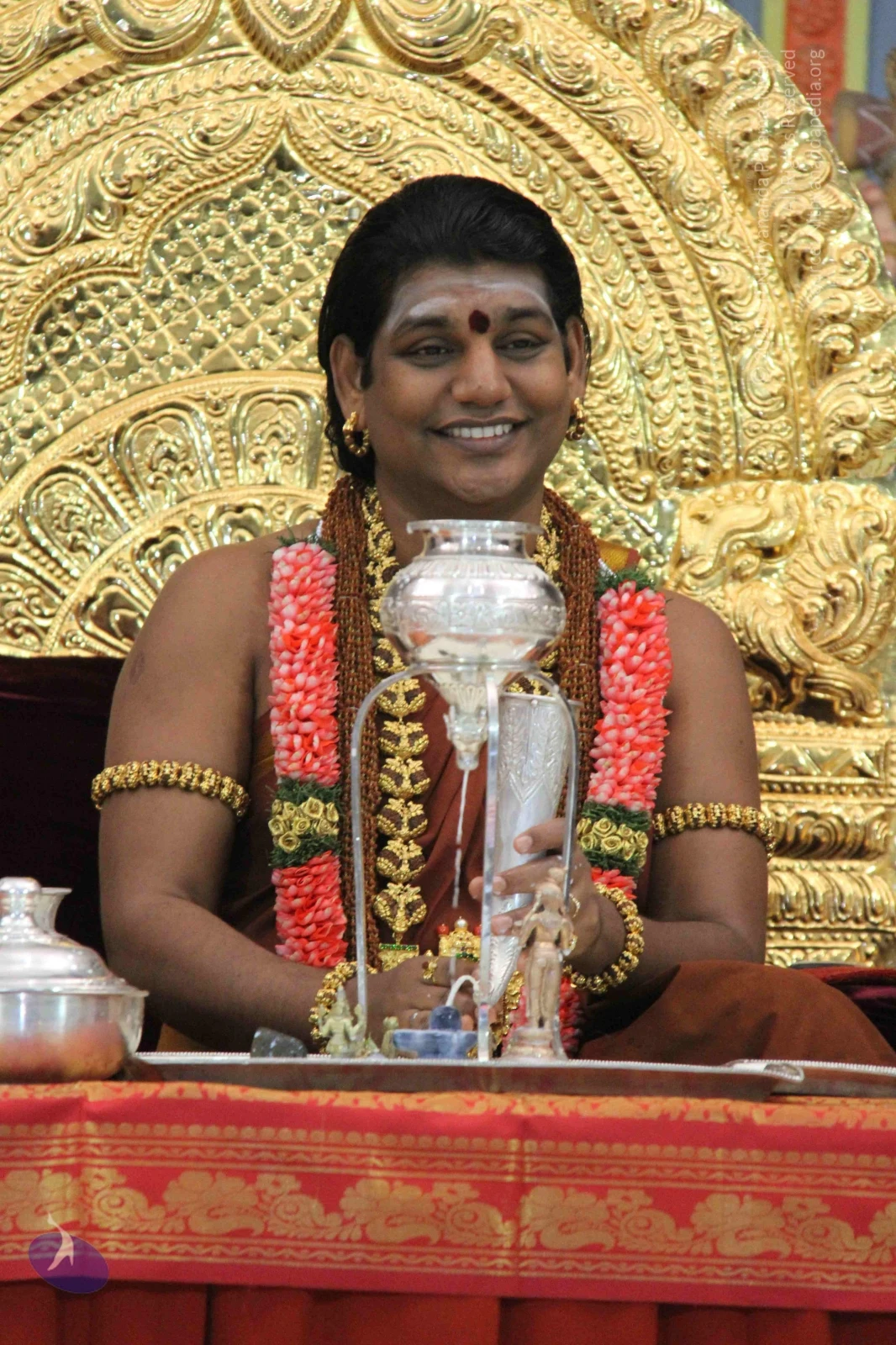
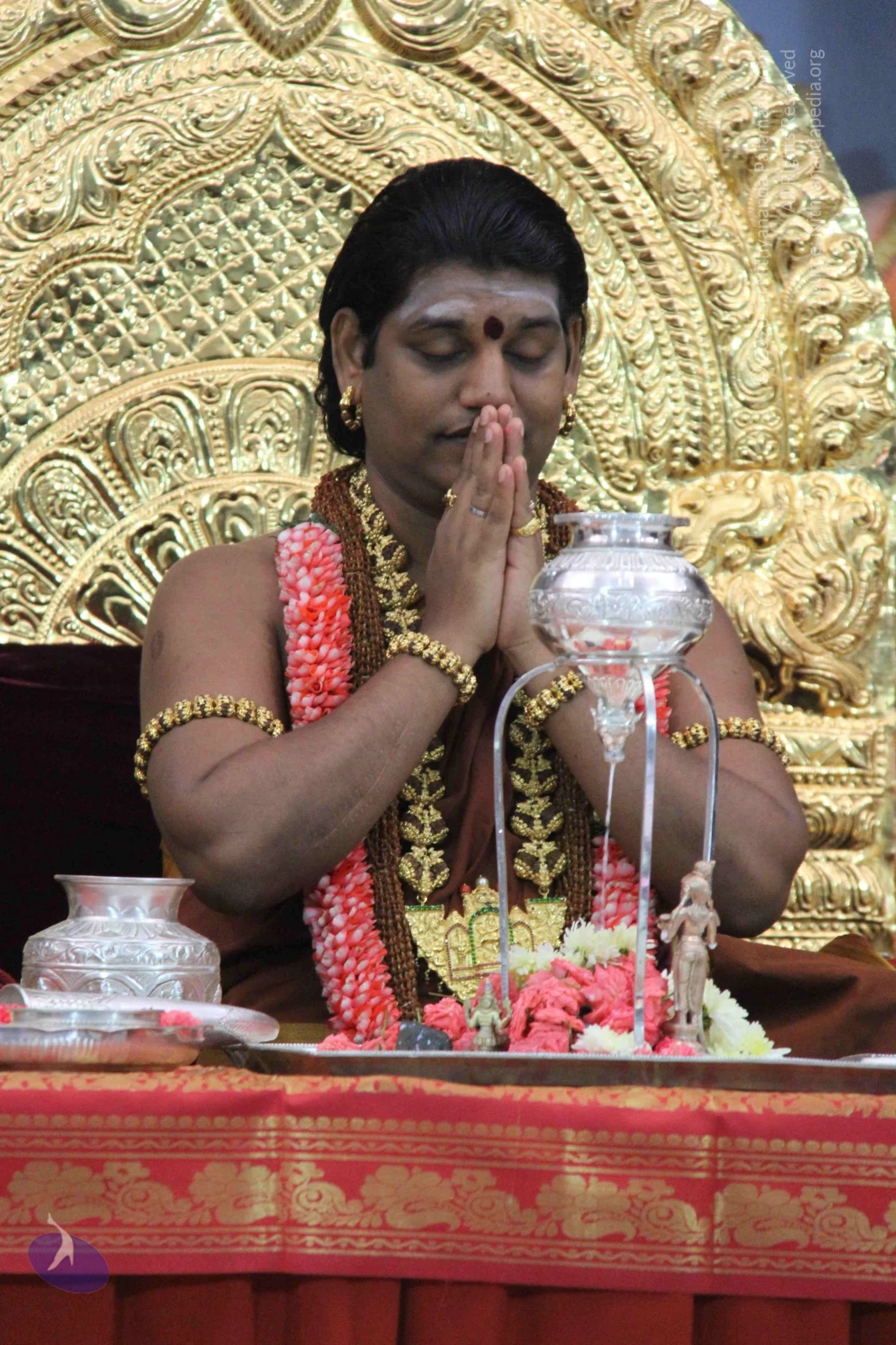
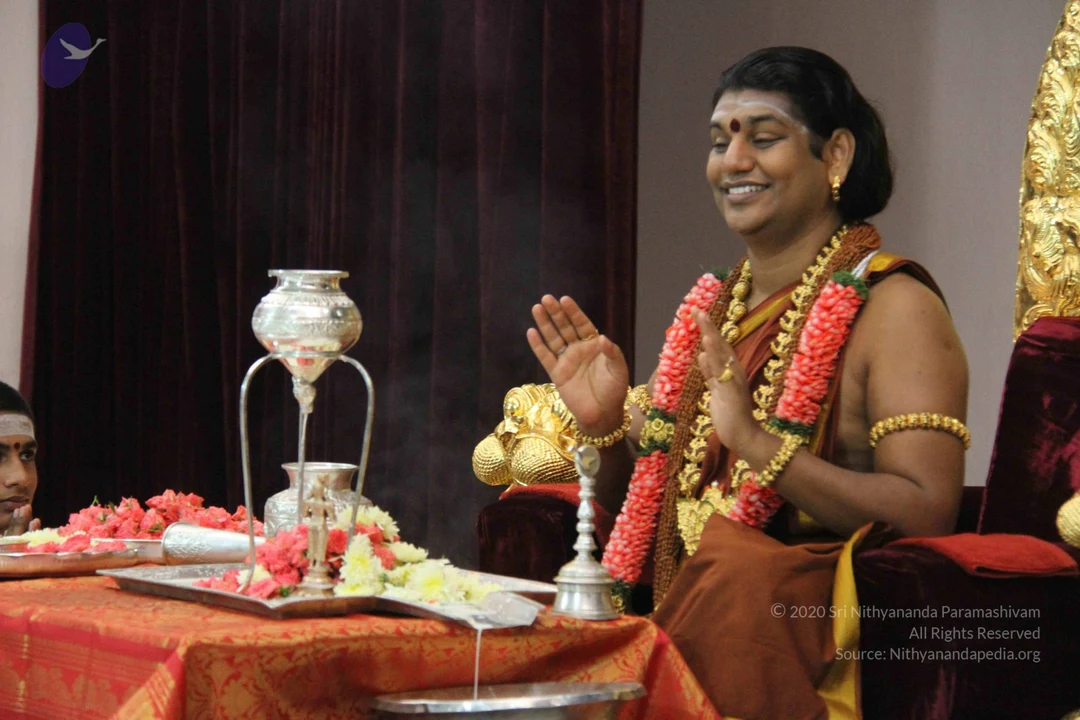
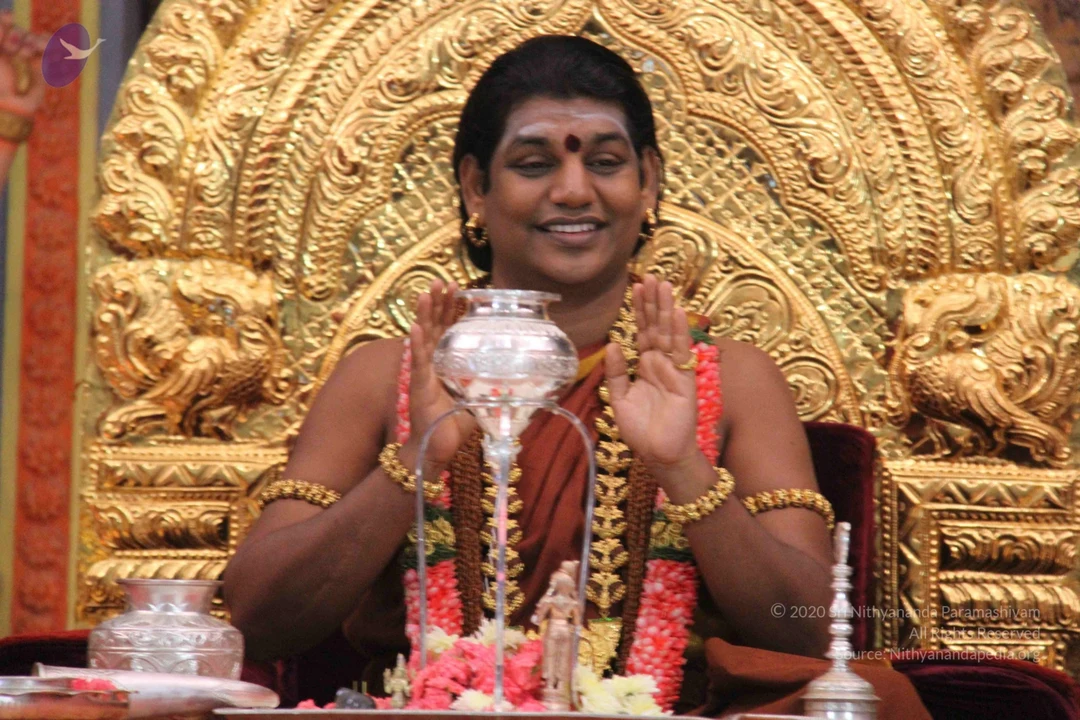
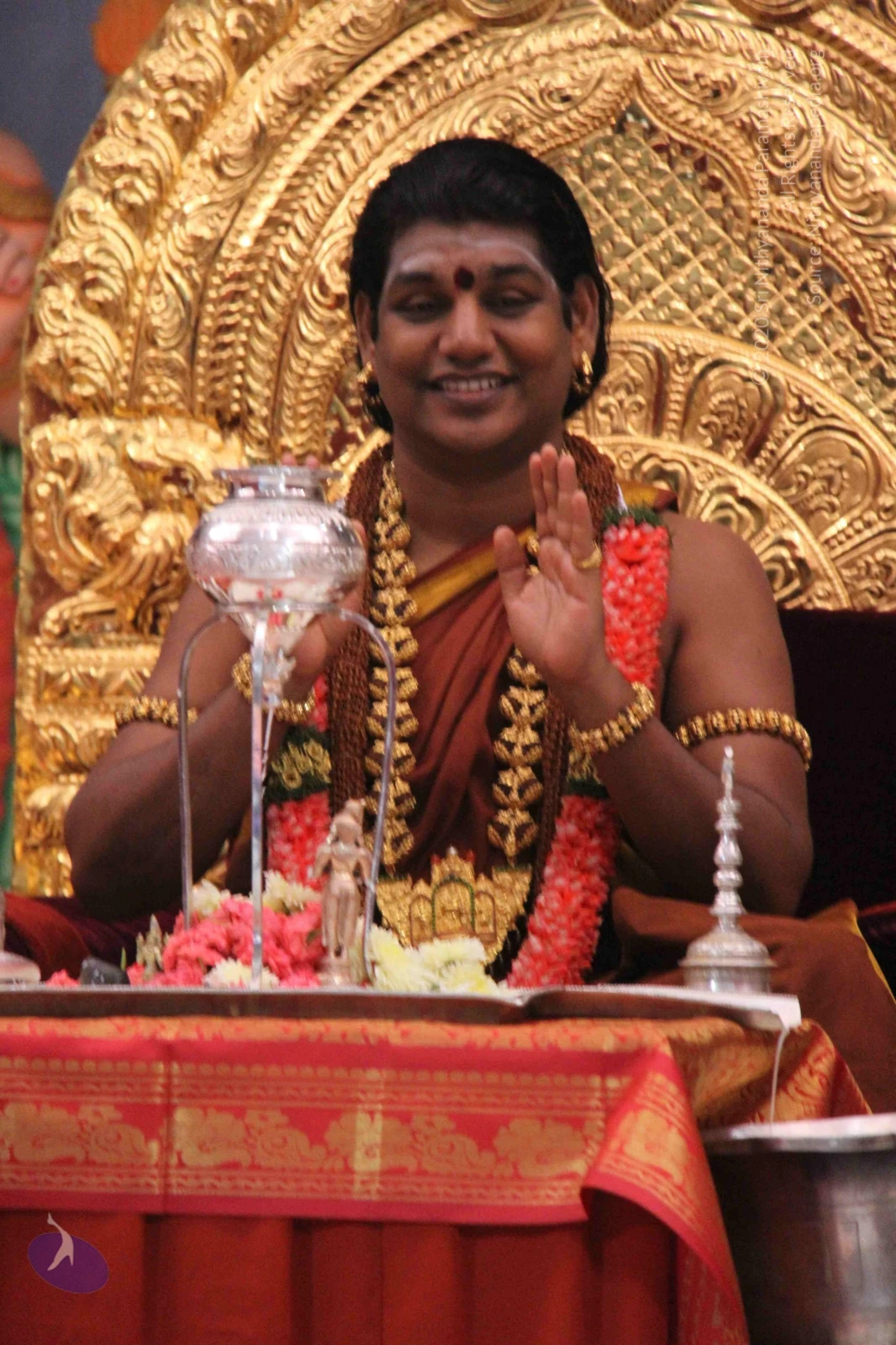
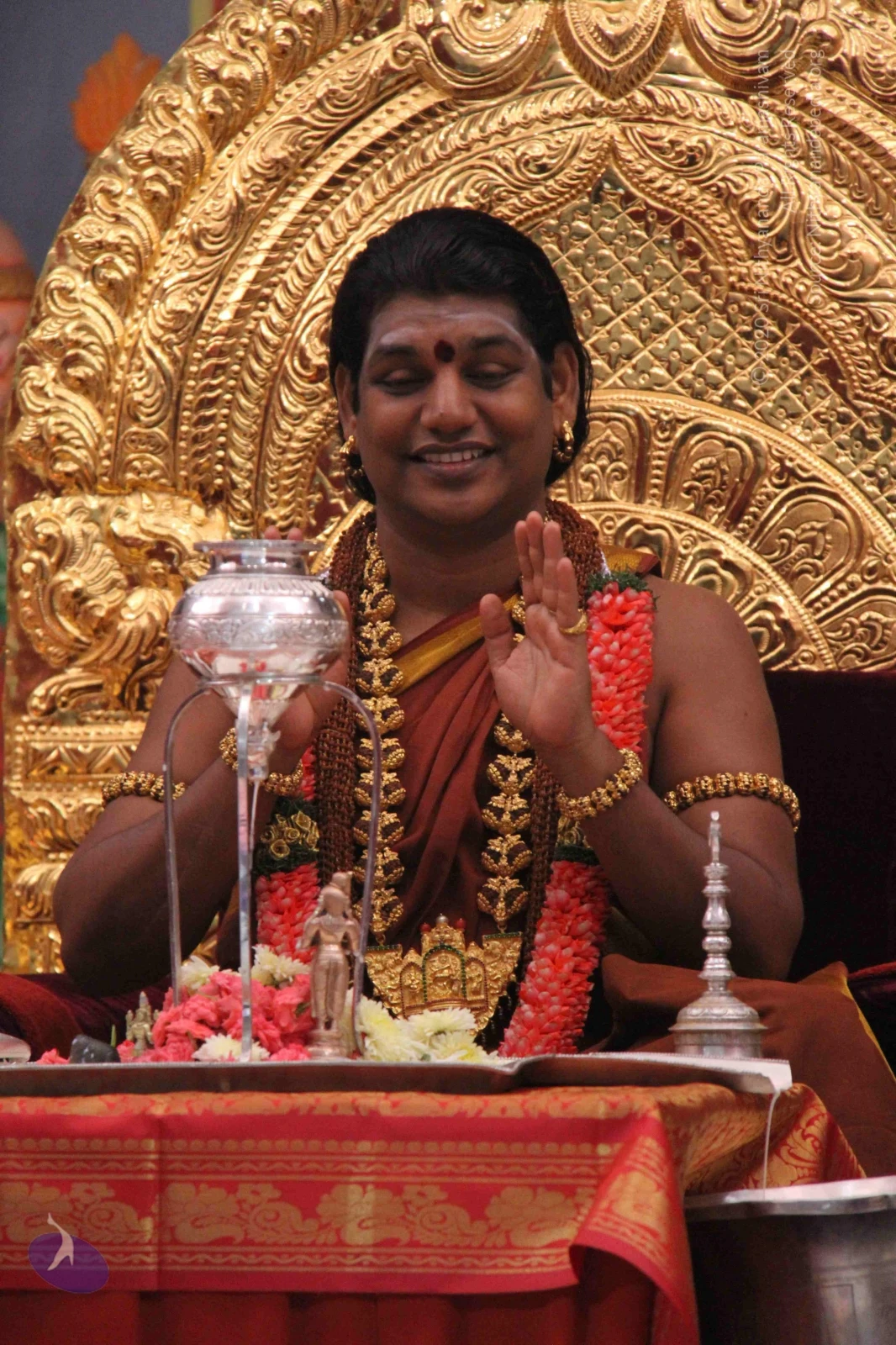
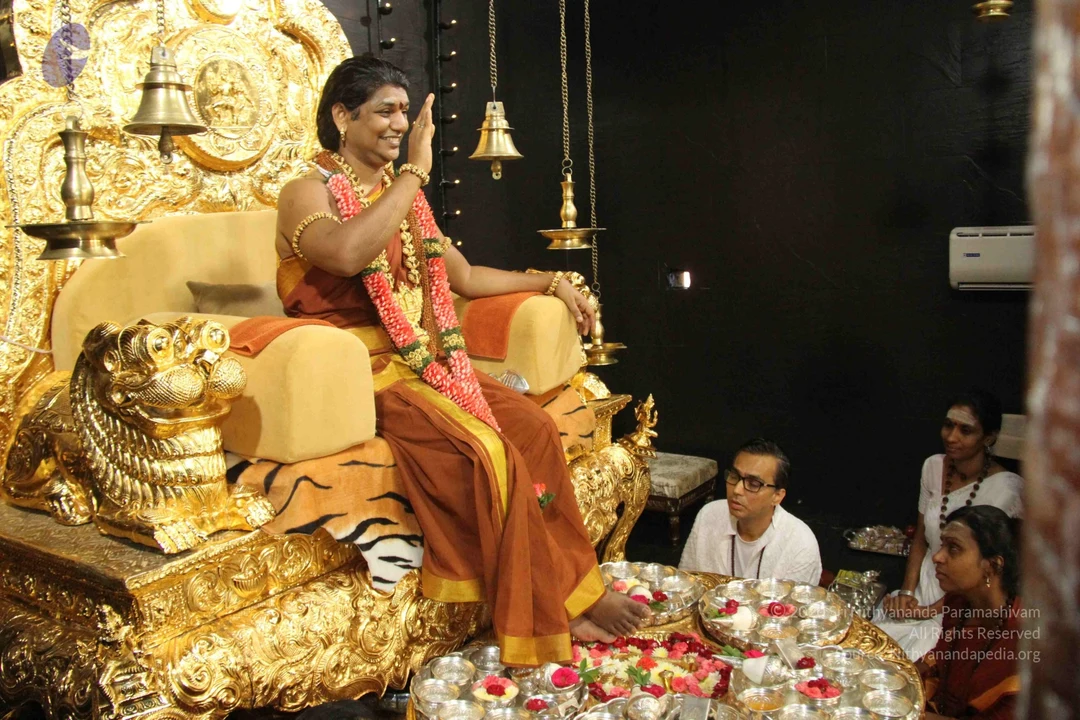
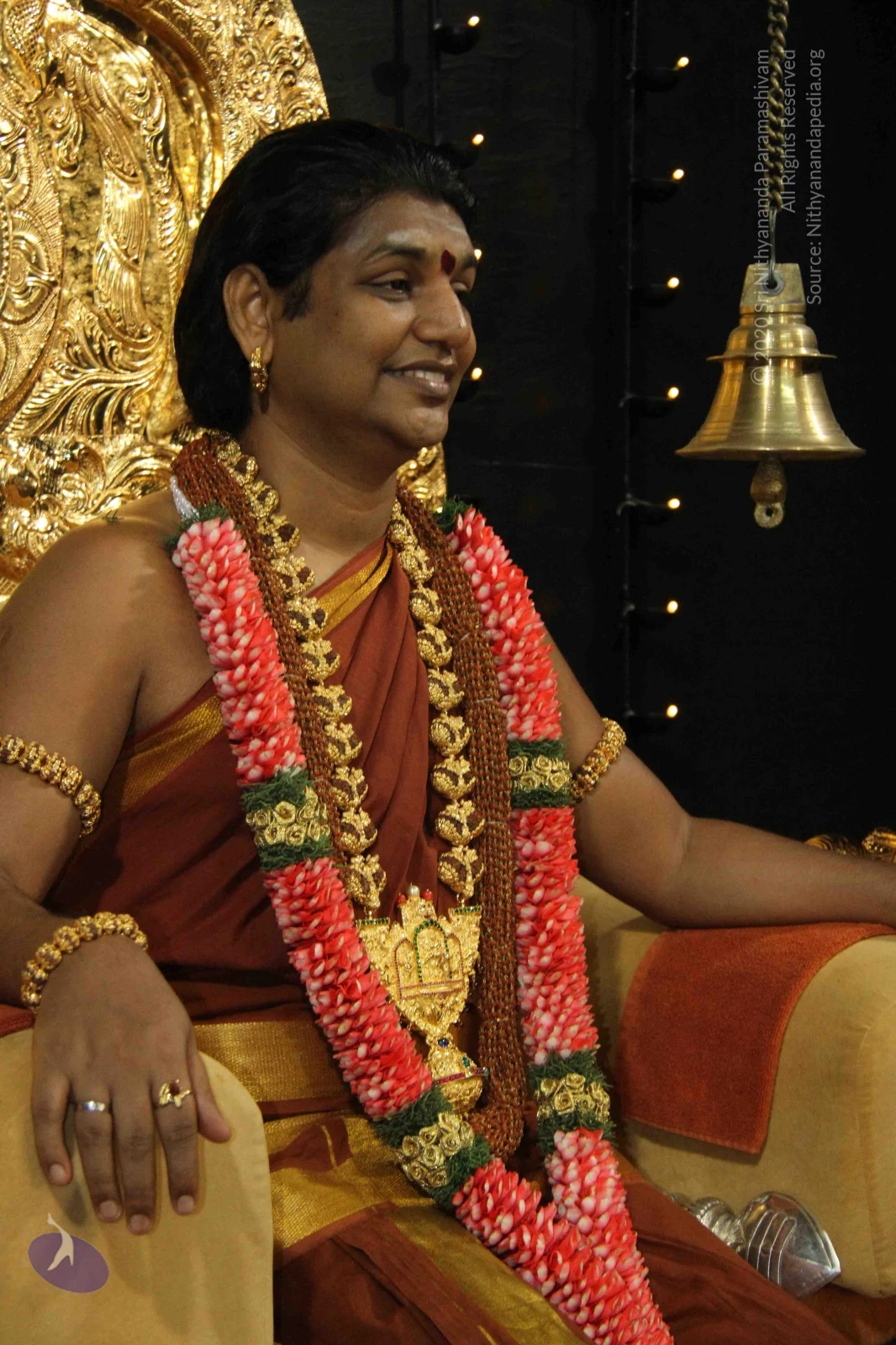
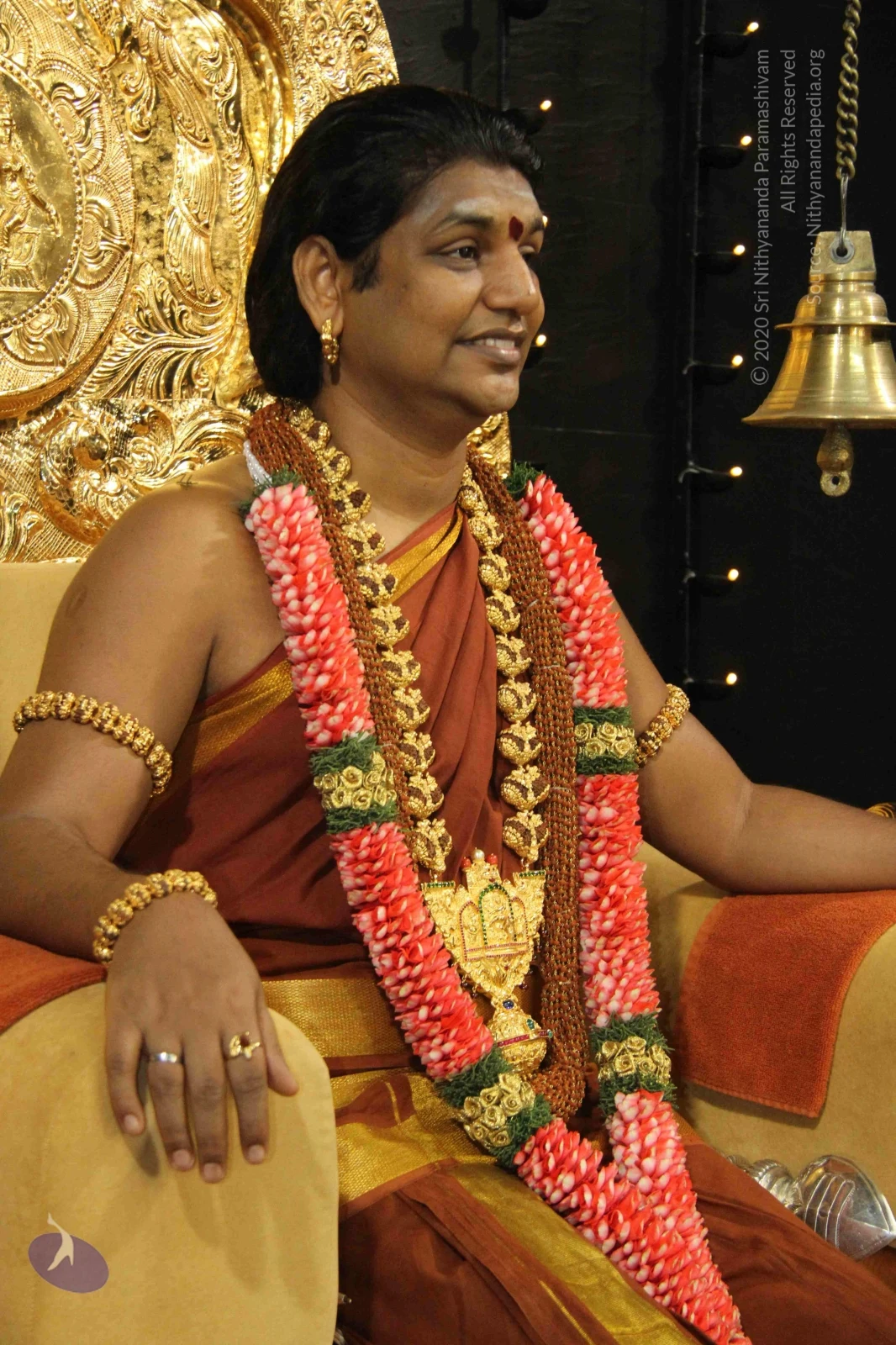
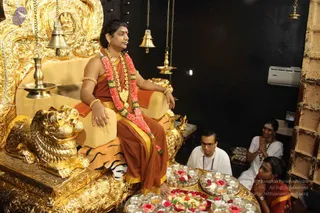
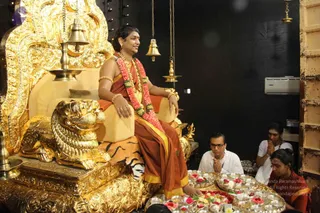
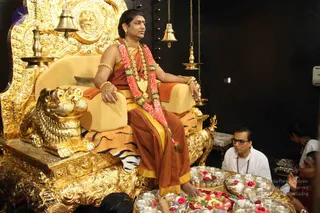
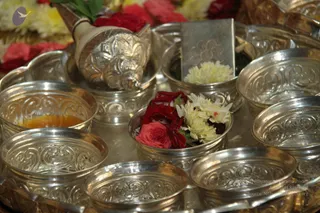
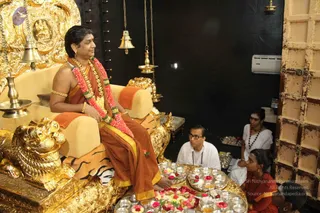
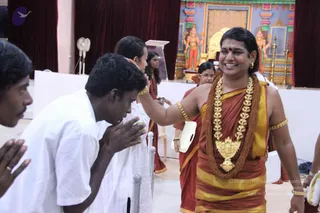
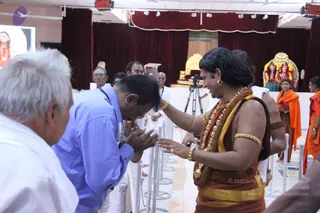
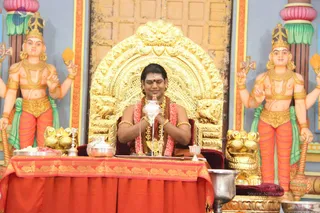
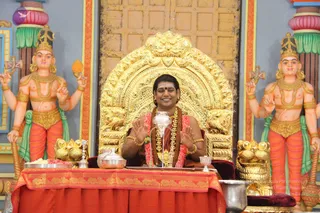
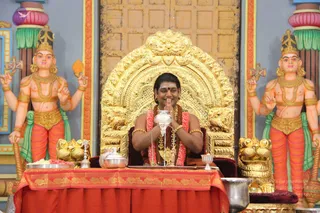
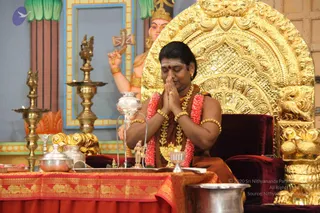
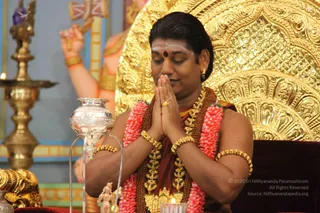
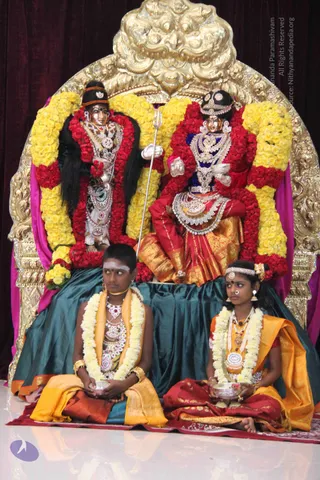
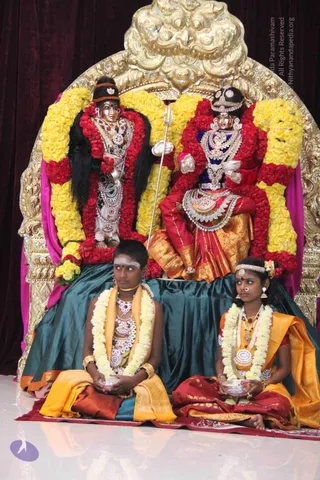
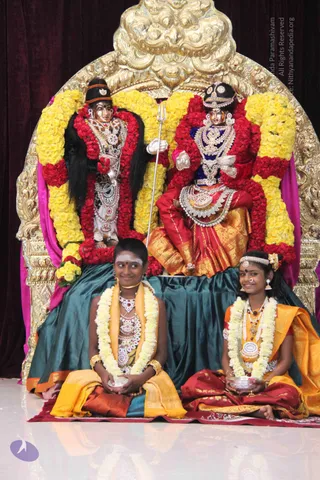
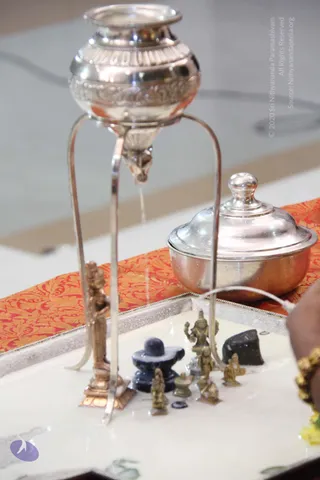
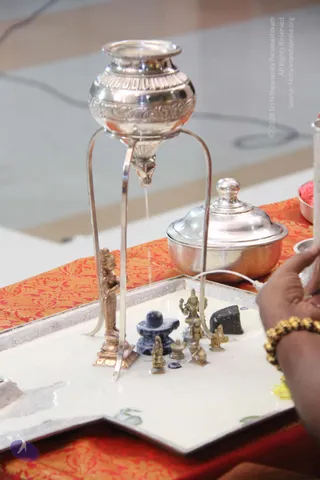
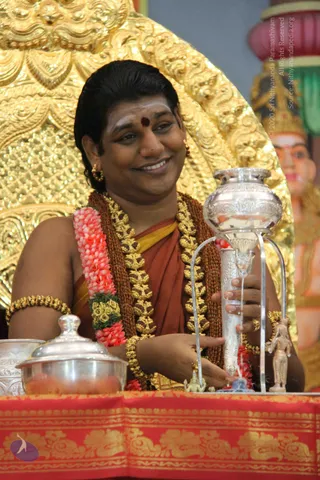
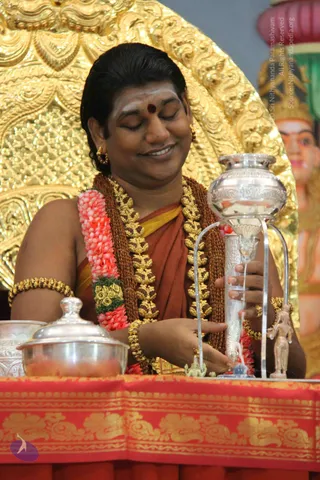
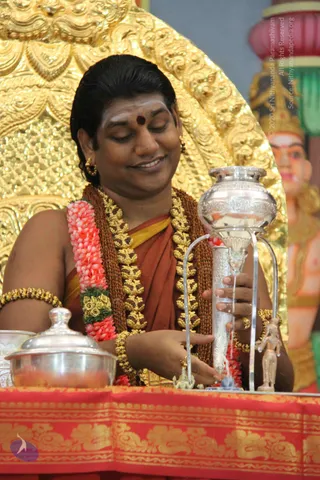
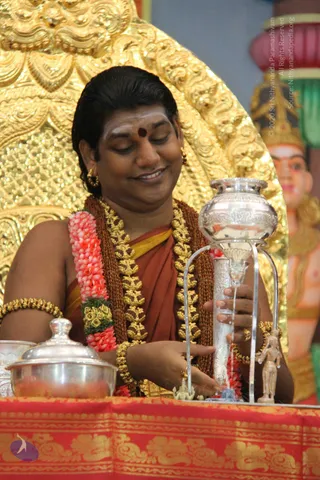
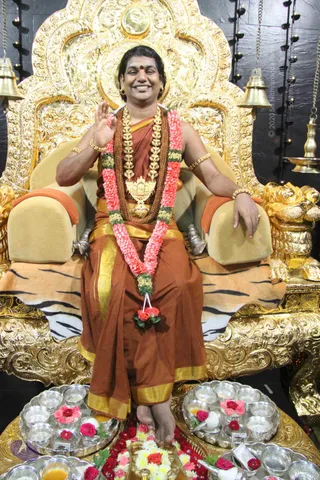
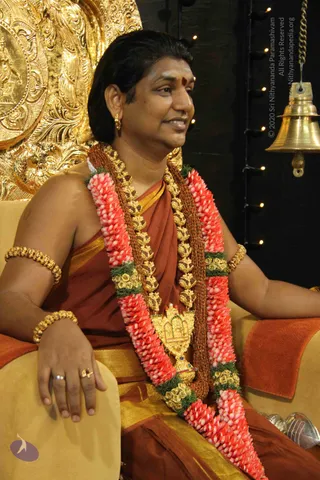
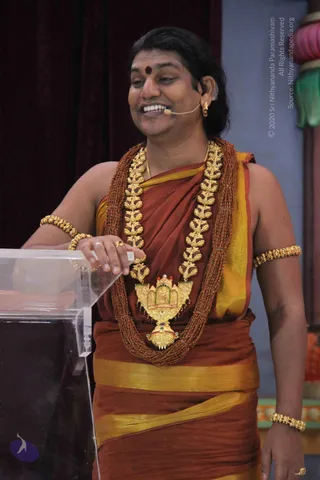
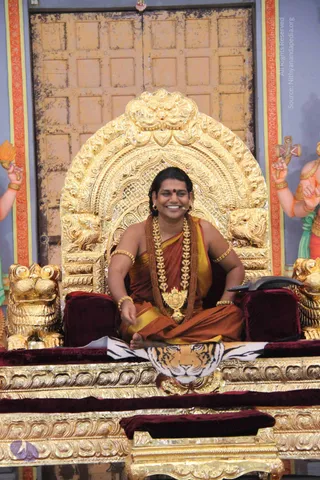
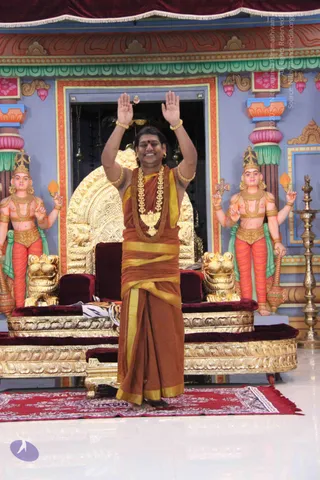
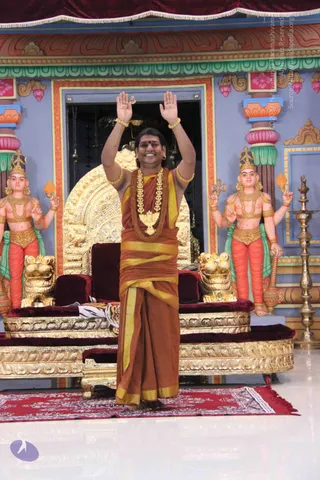
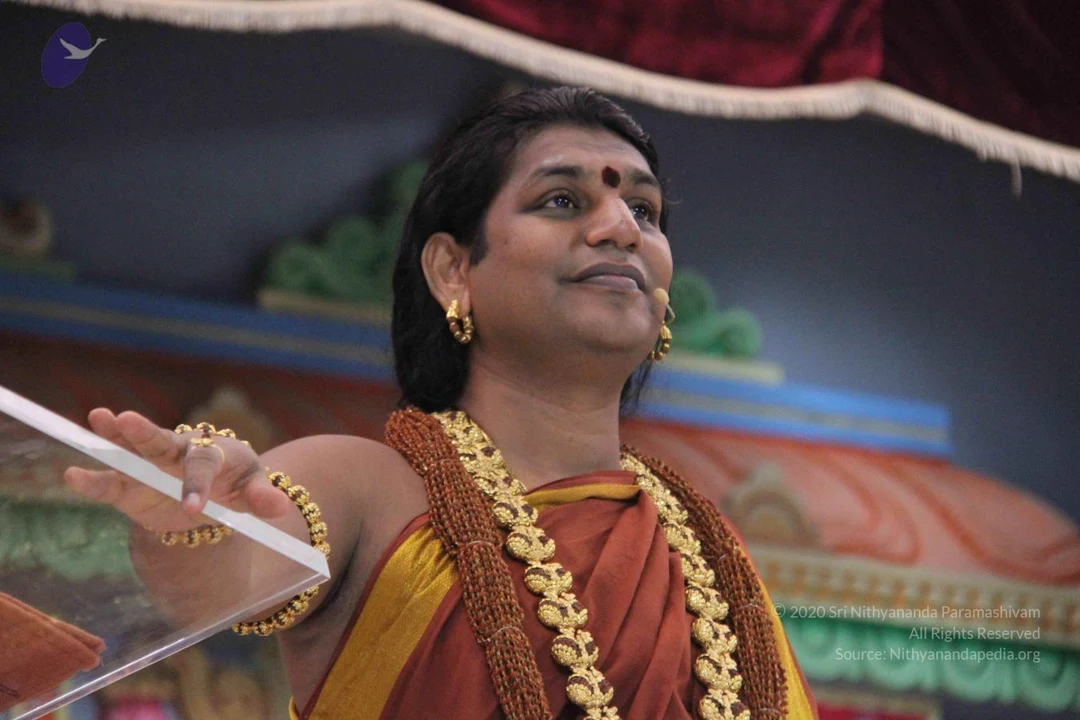
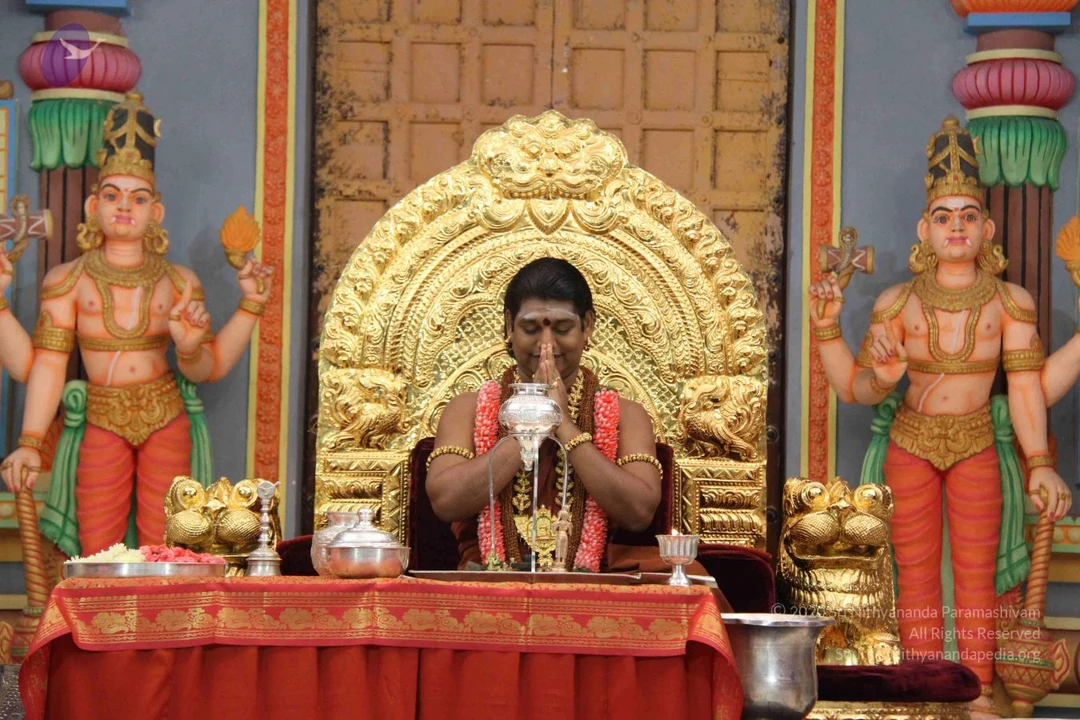
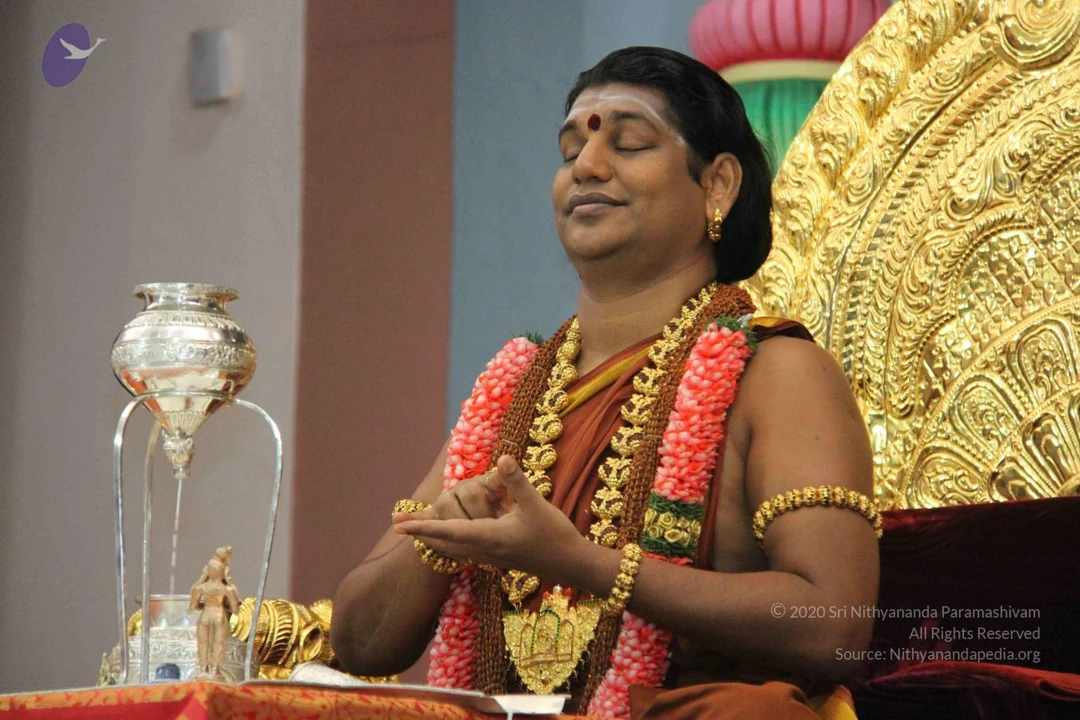
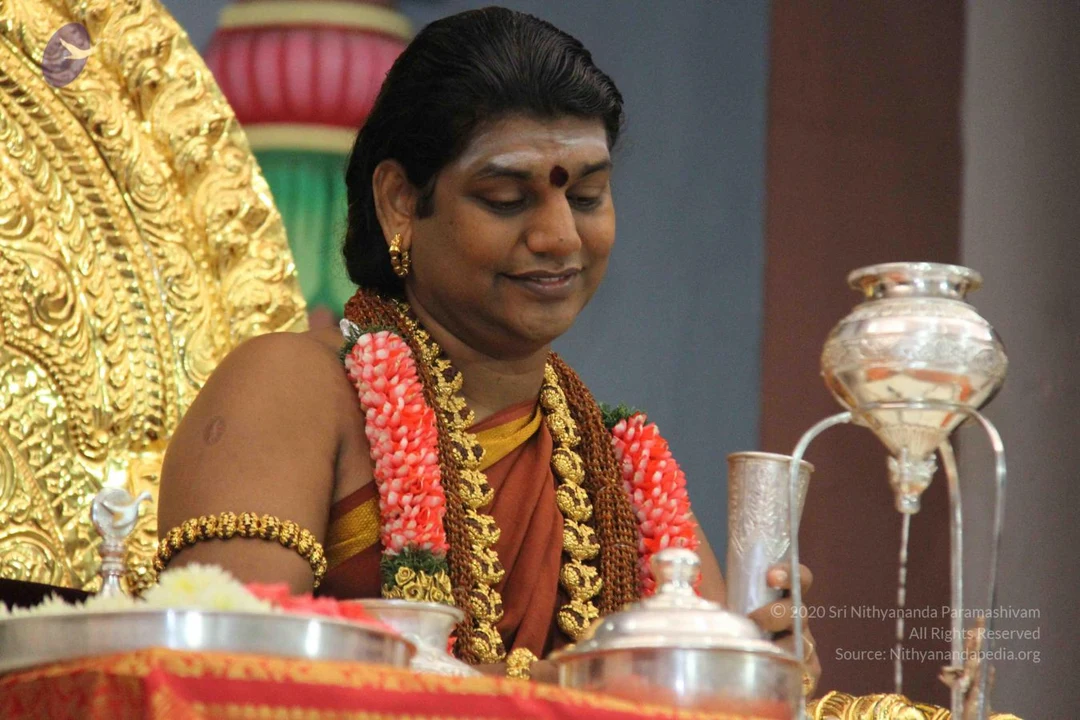
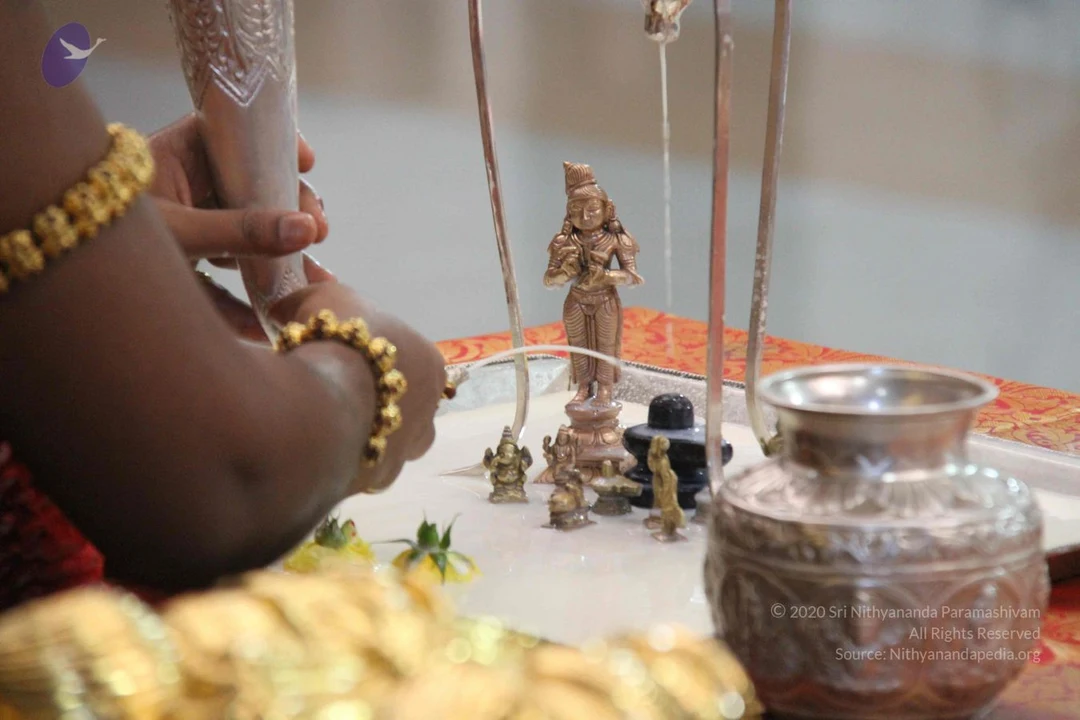
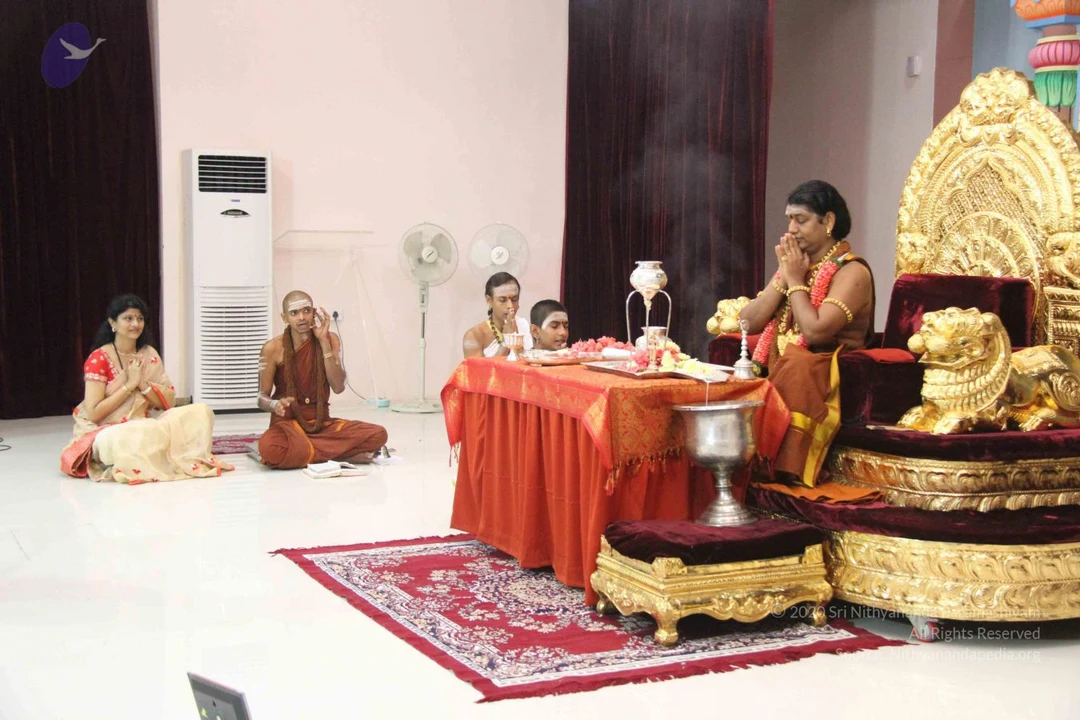
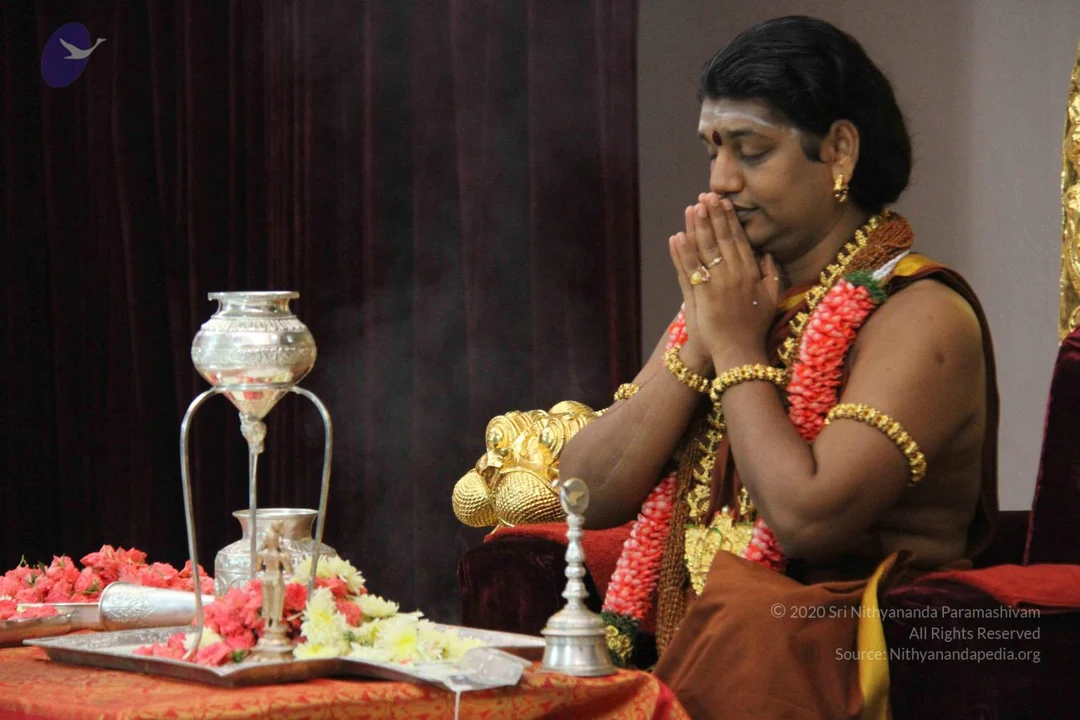
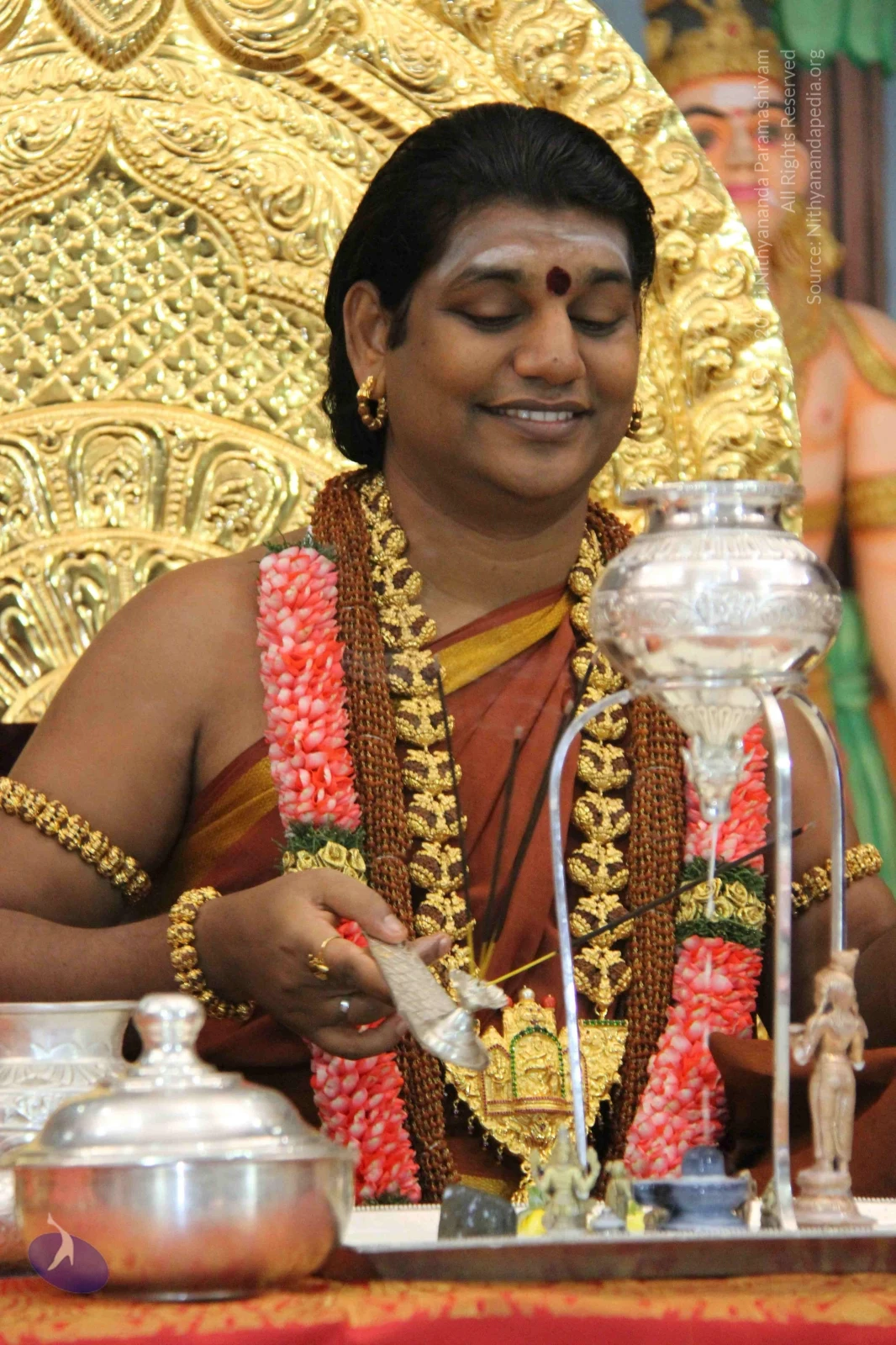
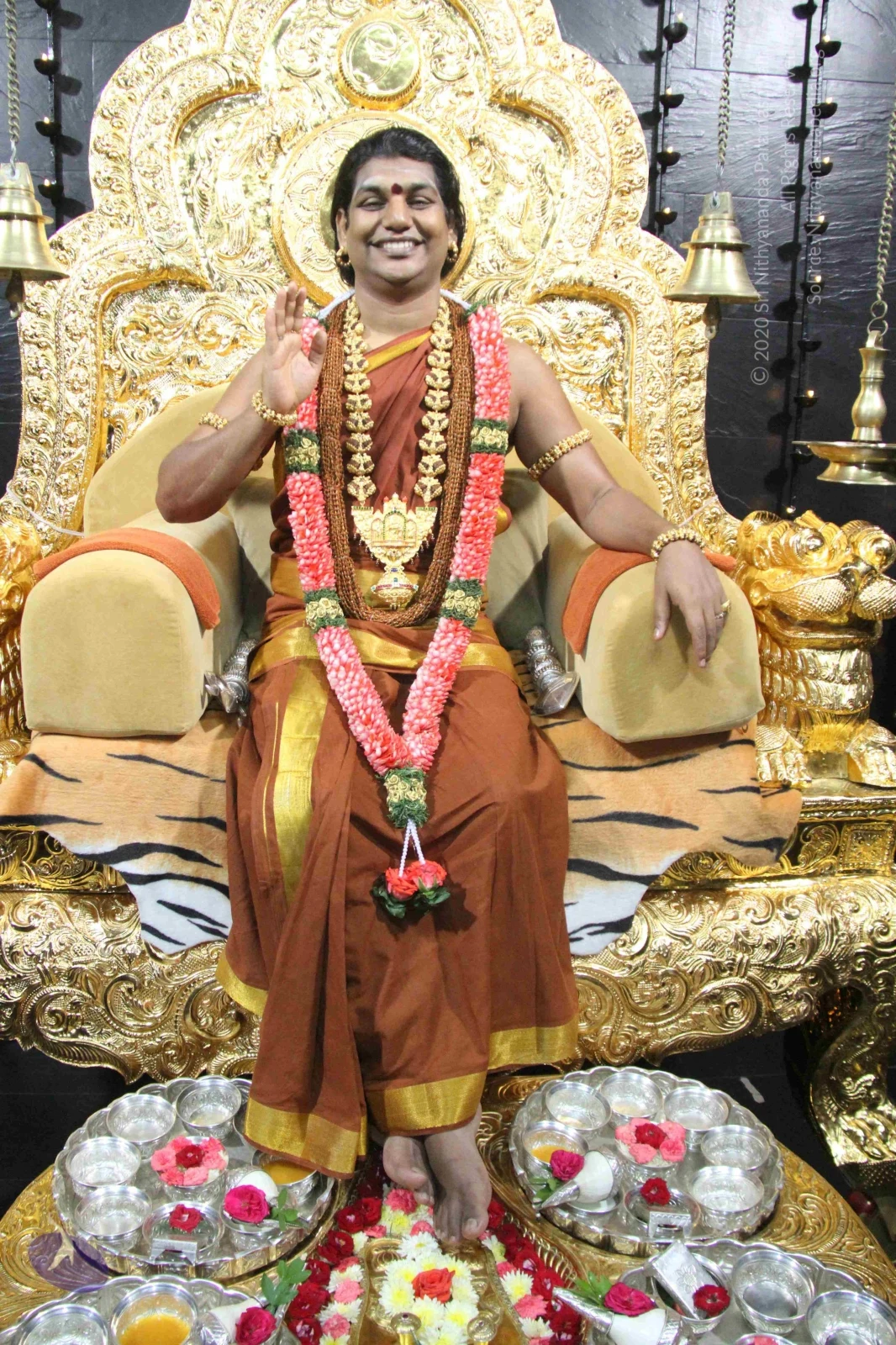
A photograph of a man seated on an ornate gold throne, raising his right hand near his head in a teaching gesture. He wears a rust-orange dhoti-style cloth, a multi-strand gold necklace, a heavy garland of pink and red flowers with green leaves, gold armlets and bangles, and gold earrings. He has a white tilak with a red bindi on his forehead and sleek swept-back hair. Beside him stands a silver kalasha-style vessel with a silver stand and a small brass figure. Swamiji (probable): the orange clothing, gold ornaments, garlands and swept-back hair match the page's claim, and he sits on a throne in a discourse setting.A photograph inside a hall with red curtains and a stage, where a man with long swept-back dark hair, a red bindi, a heavy gold-and-bead necklace and a large gold pendant, gold armbands and an orange-and-gold dhoti-style garment is smiling while placing his hand on the head of a devotee. The devotee wears white and is bowed with palms joined in namaskar. Around them, men in white shirts and dhotis stand near metal barrier stanchions, and a woman in an orange sari is at right. A tray of apples and fruit sits in the foreground, a deity murti in gold and green decorations is on a stage at right, and a screen at left shows an image of a deity.A photograph of a ritual abhishekam in progress on a silver tray. A hand wearing a gold ring pours milk from a silver vessel with a spout over a cluster of small bronze deity figures arranged around a black shivalinga. A standing bronze deity murti stands at the centre, with smaller figures seated and standing around the lingam. Two yellow flowers lie on the milky surface, and an orange-and-gold brocade cloth covers the table beneath the tray. Liquid streams from the vessel and from thin metal rods above the tray.

August 19 2013

Original wiki page
Contents

Title:

Supreme Pontiff of Hinduism HDH Bhagavan Nithyananda Paramashivam

Description:

In today’s satsang, Paramahamsa Nithyananda reveals how our inner transformation can spontaneously transform our outer reality as we want. Incompletion, worry and addictions are signs of disrespecting Life. When we disrespect Life, Life gives the same experience to us. Completion is nothing but respecting Life in all its dimensions! Only after we learn the science of completion, life begins in us.

Link to Video:

VideoAudio

Transcript:

Nithyanandeshwara Samaarambhaam Nithyanandeshwari Madhyamaam | Asmath Aachaarya Paryanthaam Vandhey Guru Paramparaam ||

I welcome all of you with my love and respects.

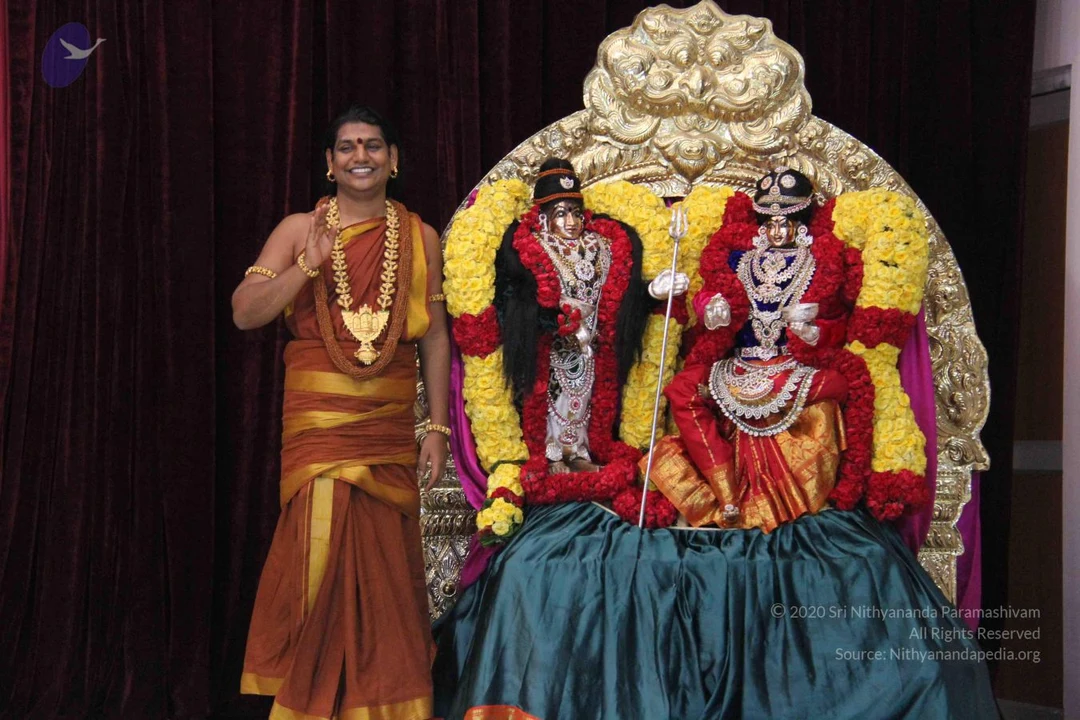
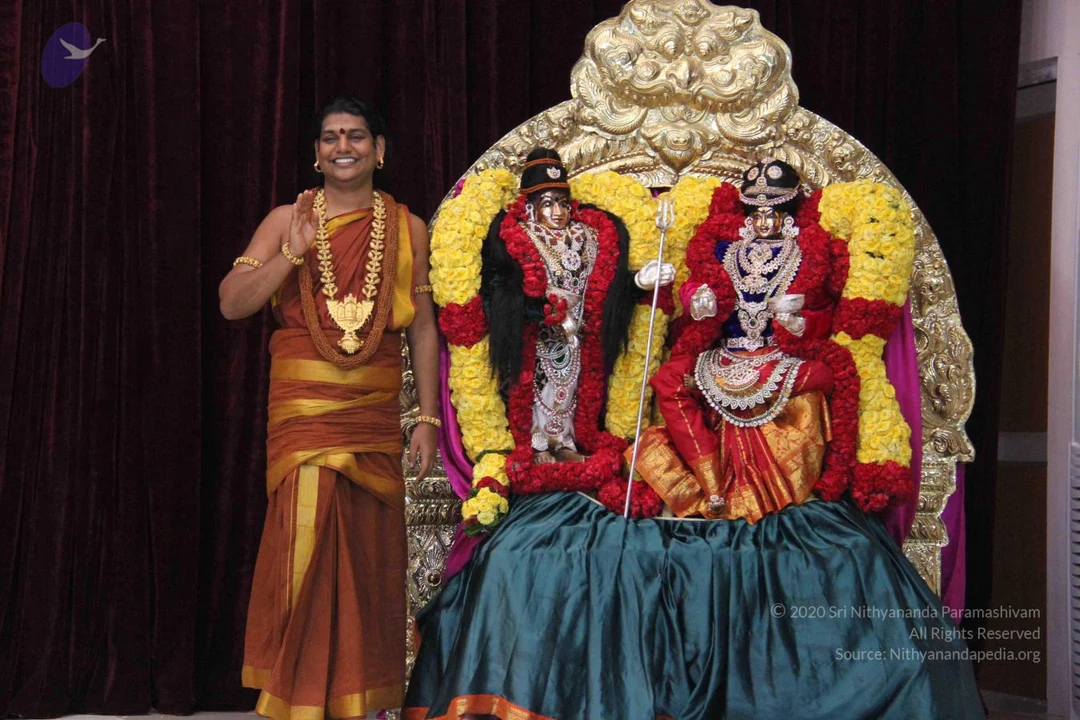
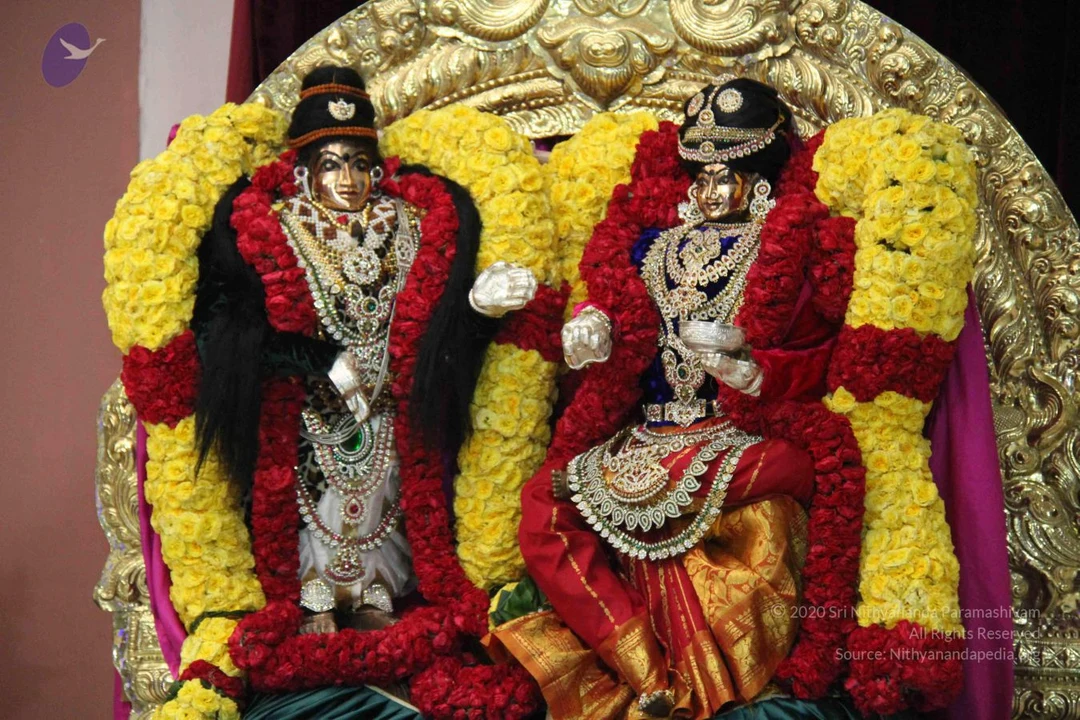
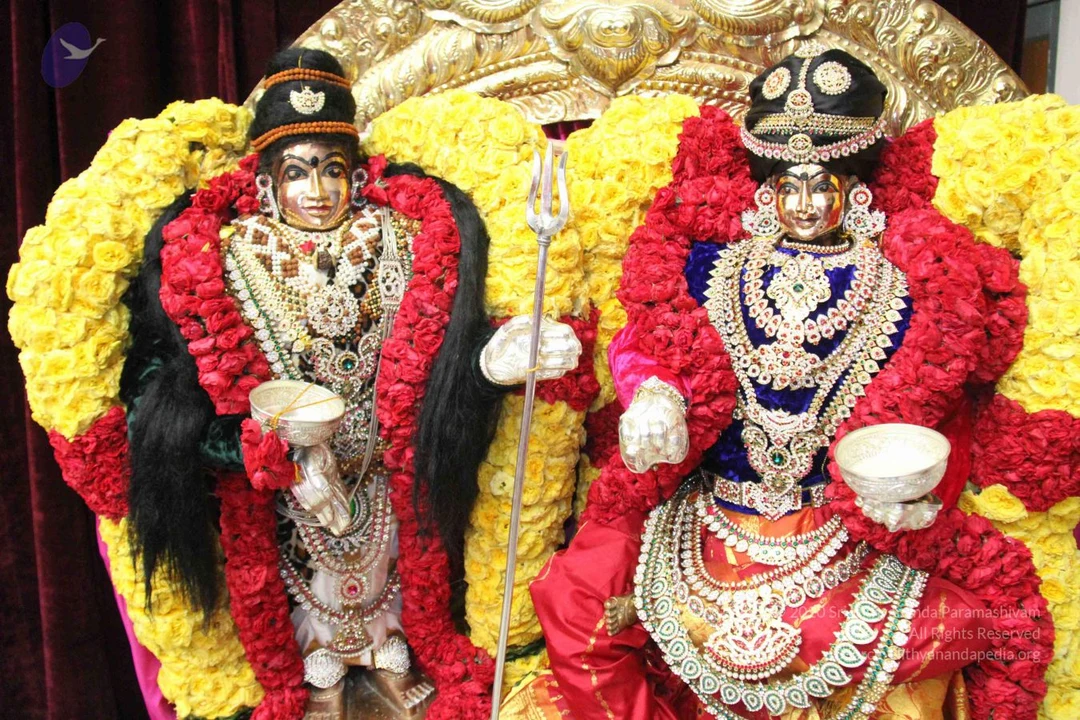
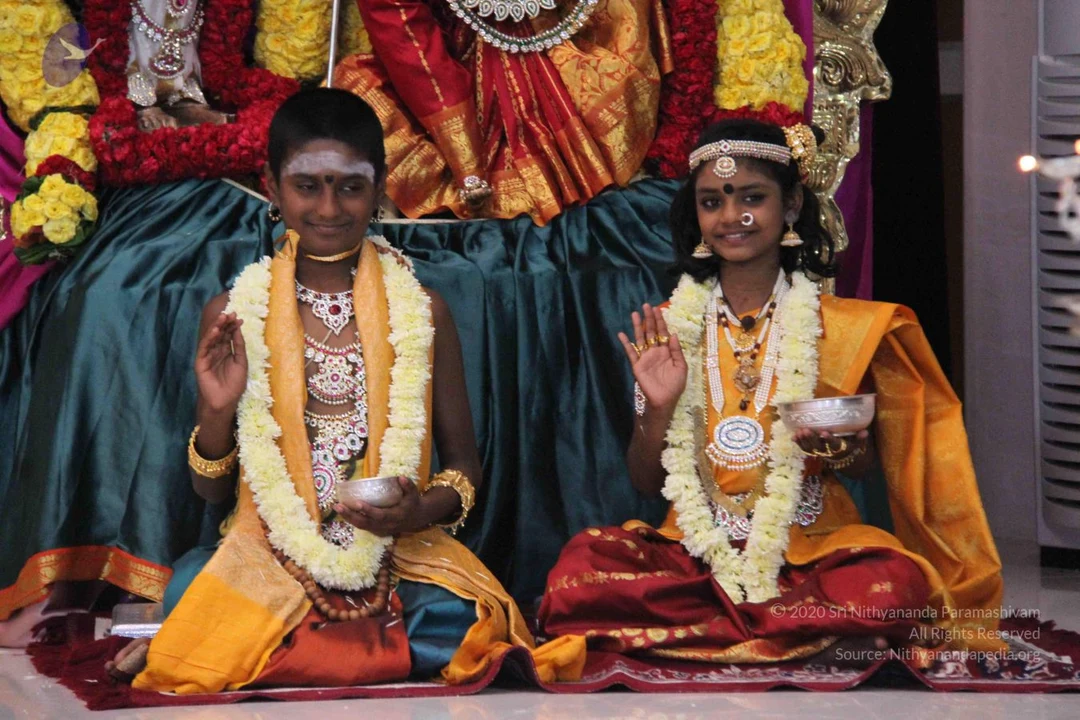
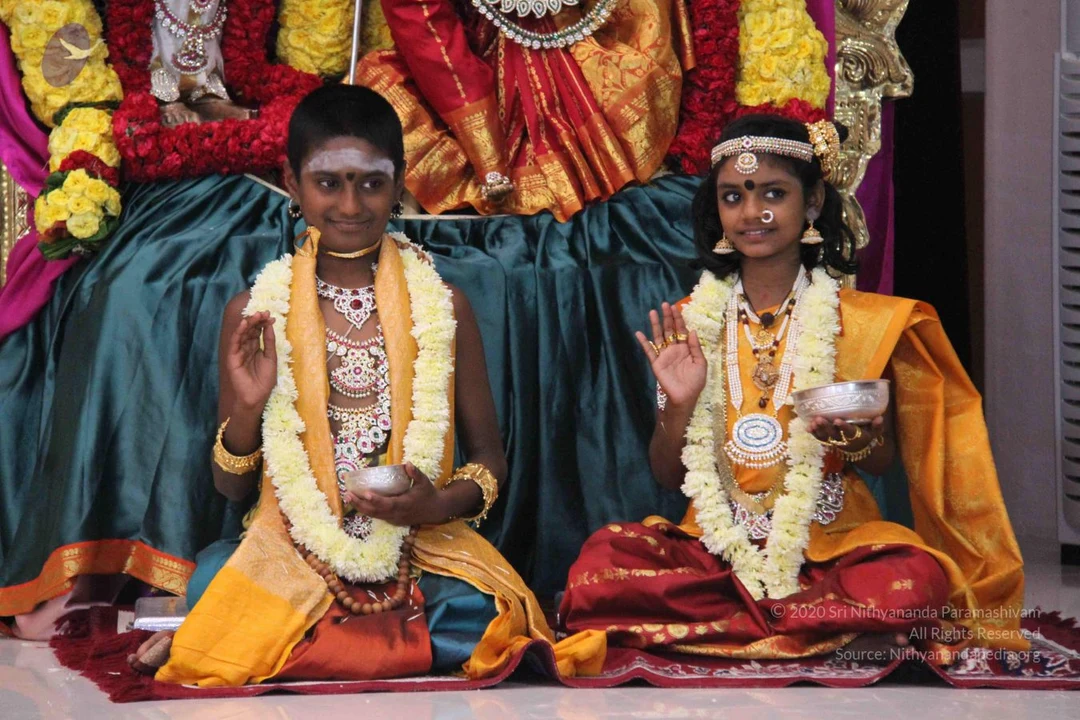
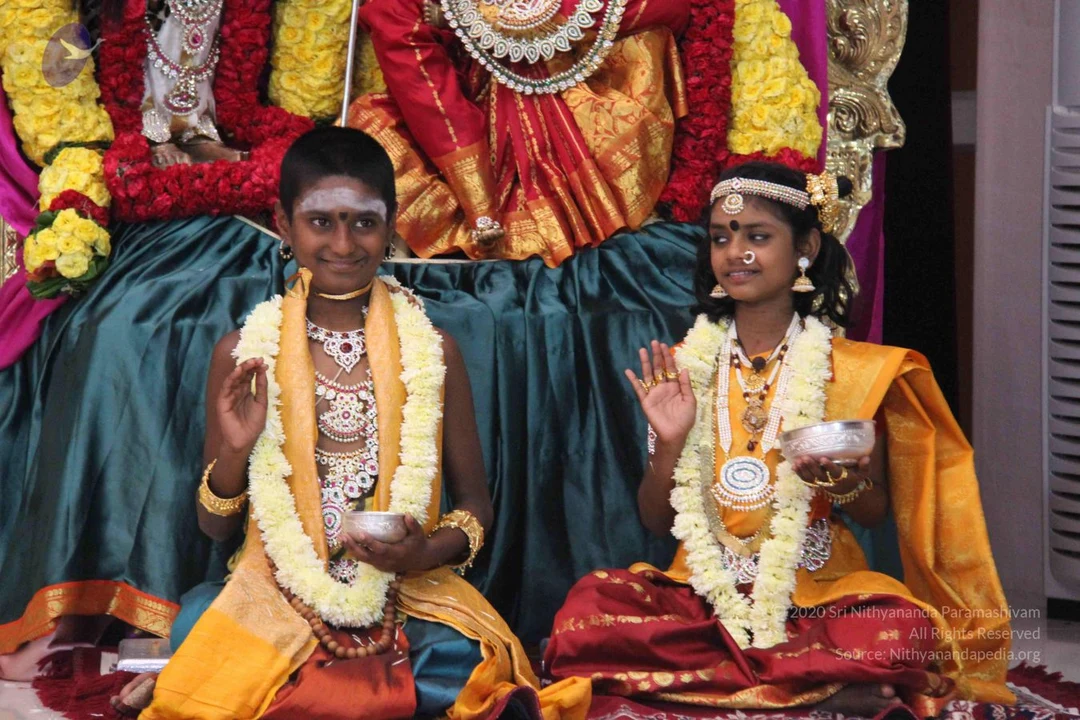
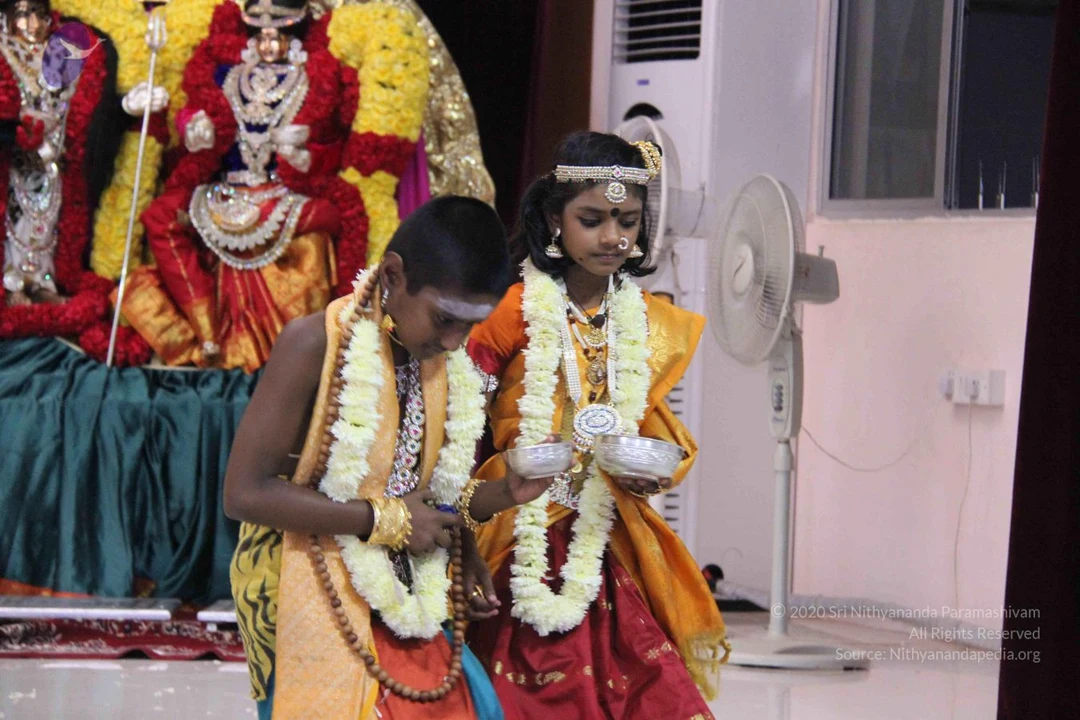
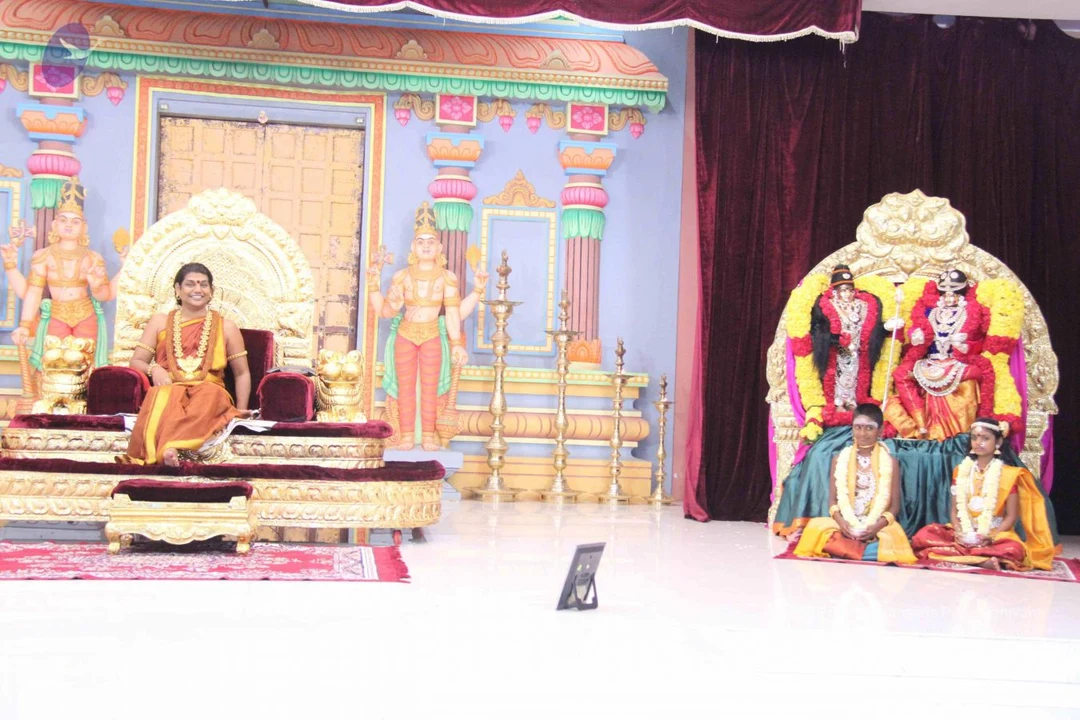
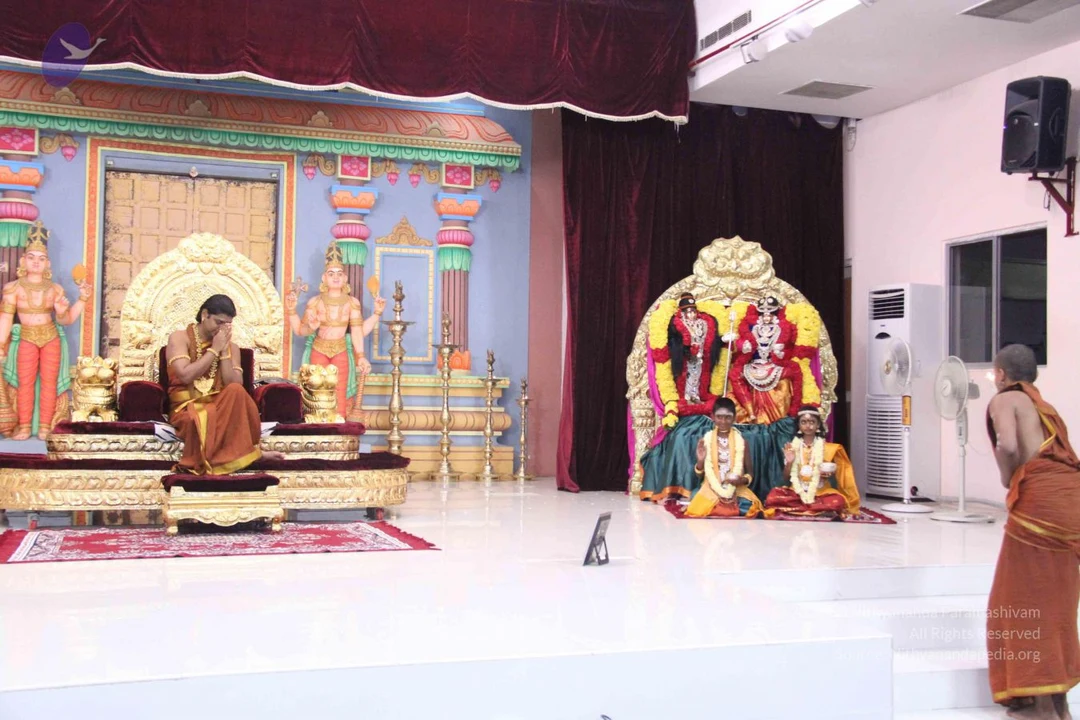
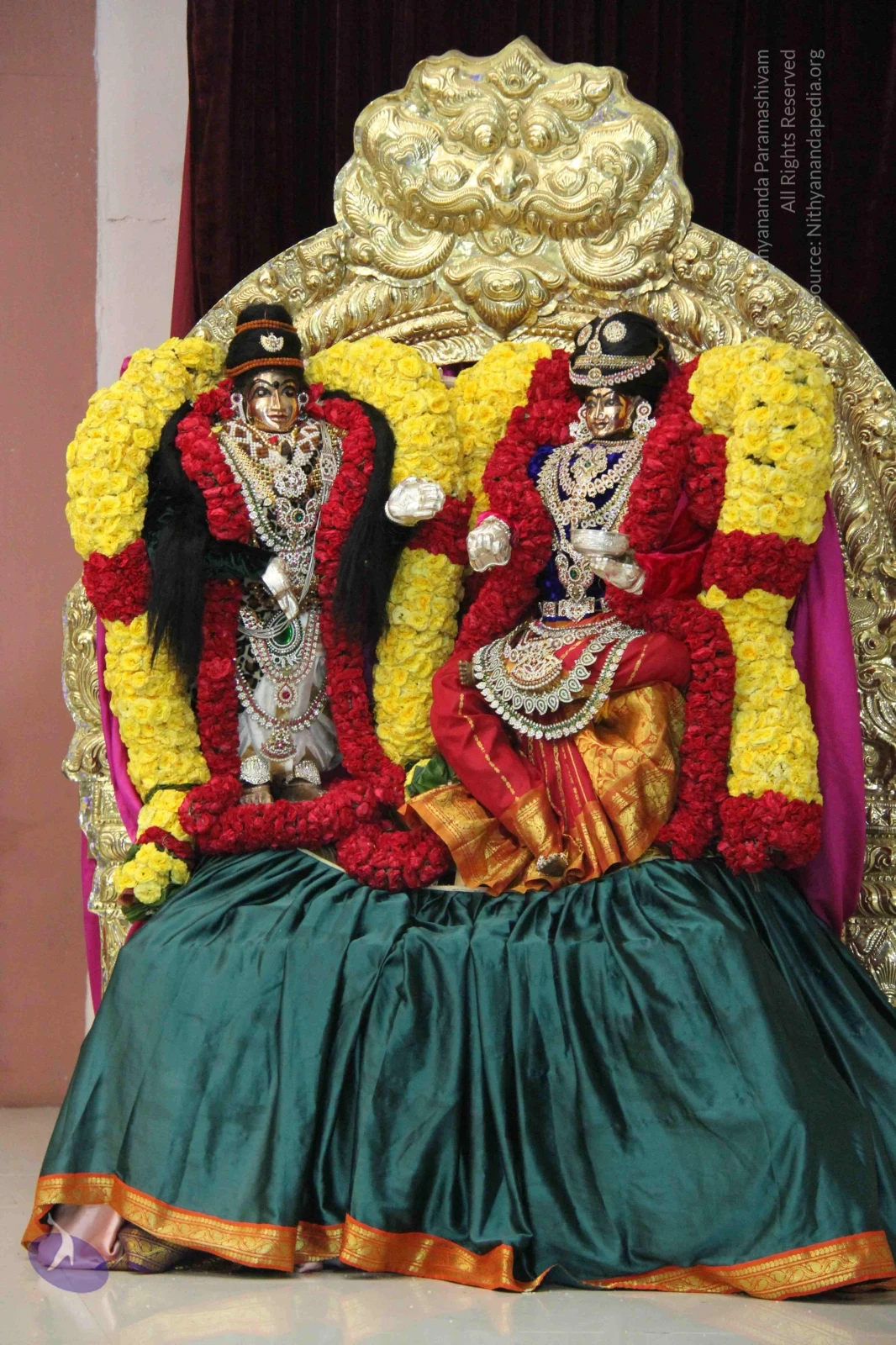
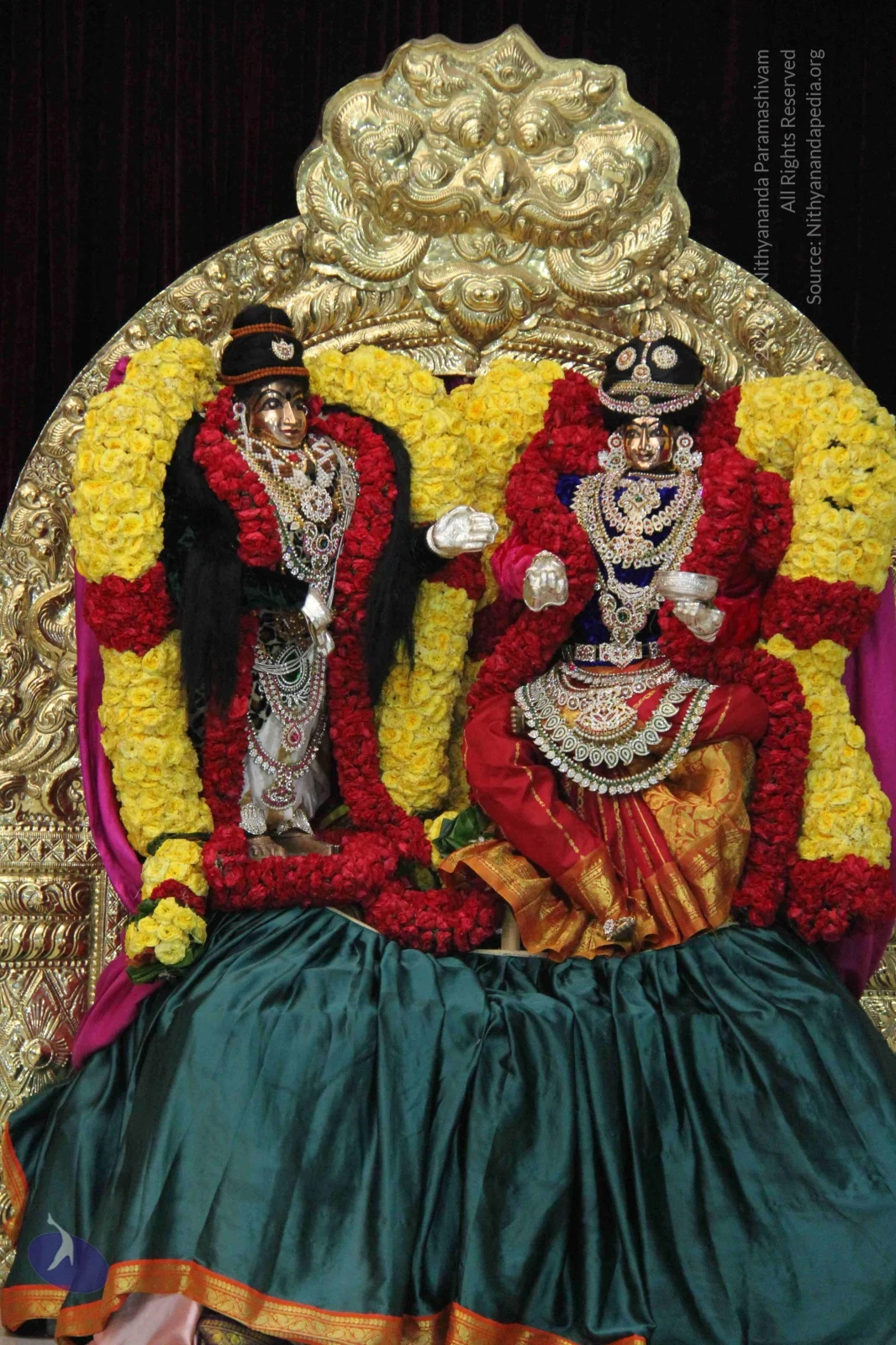
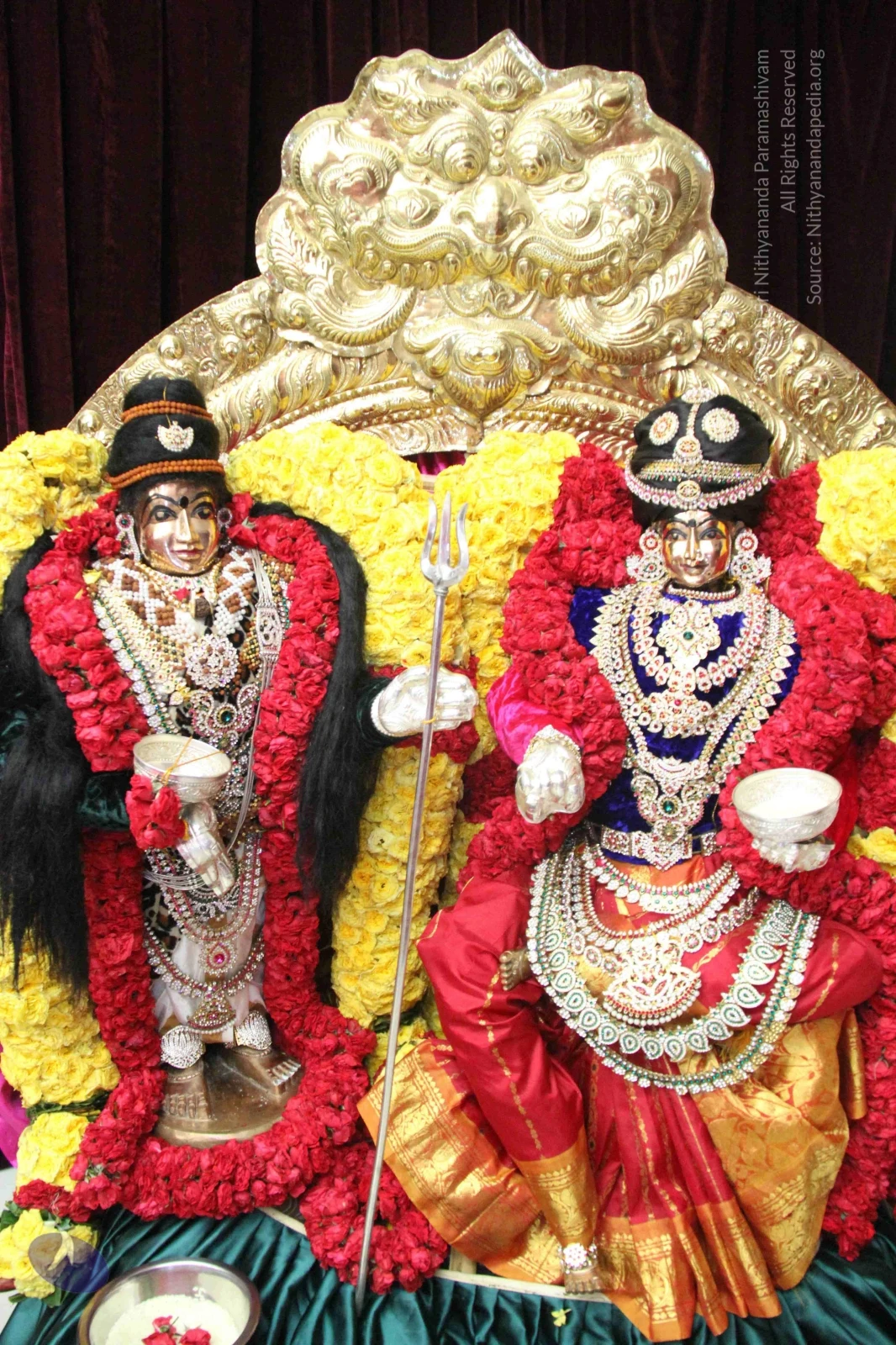
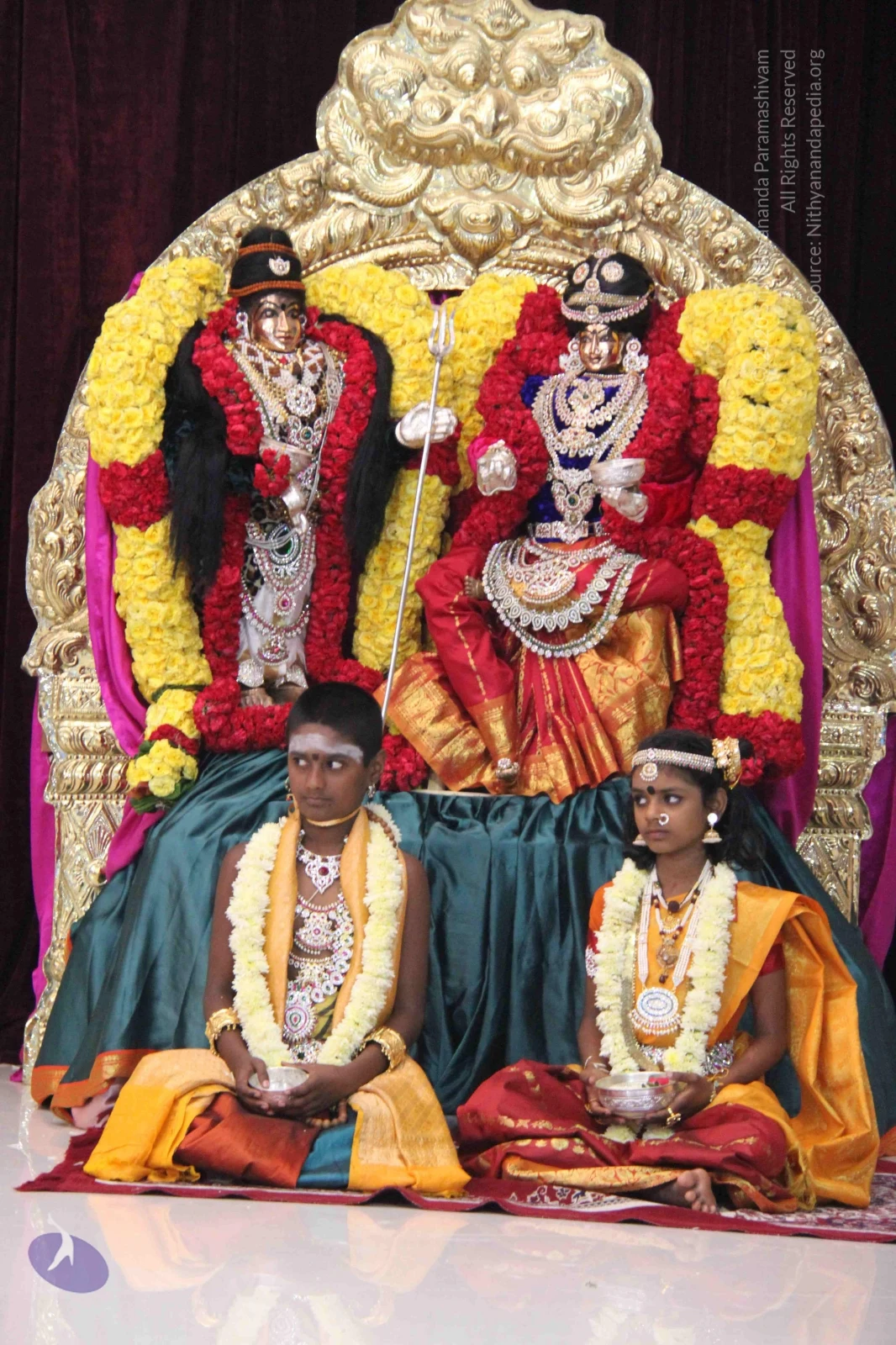
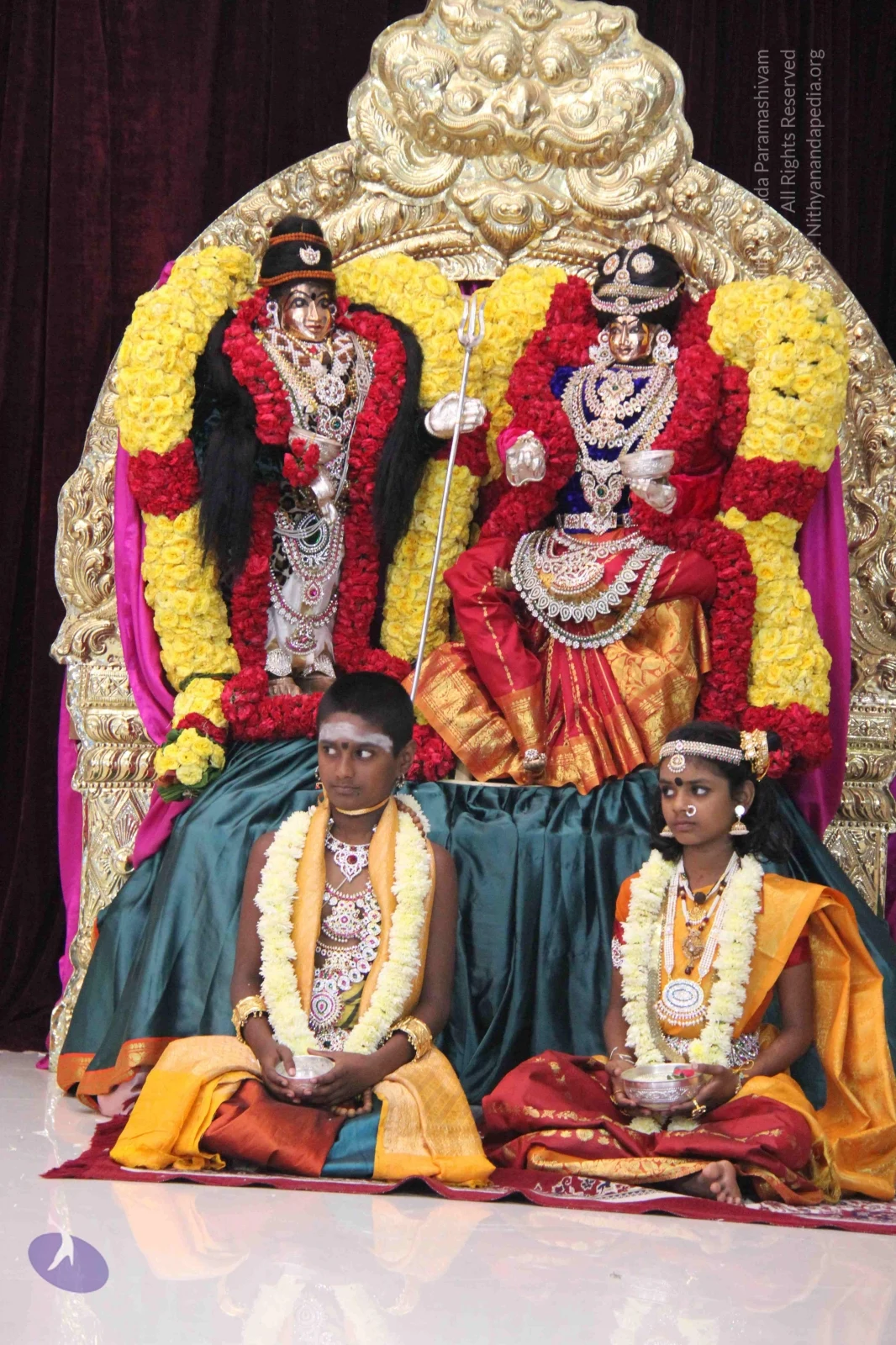
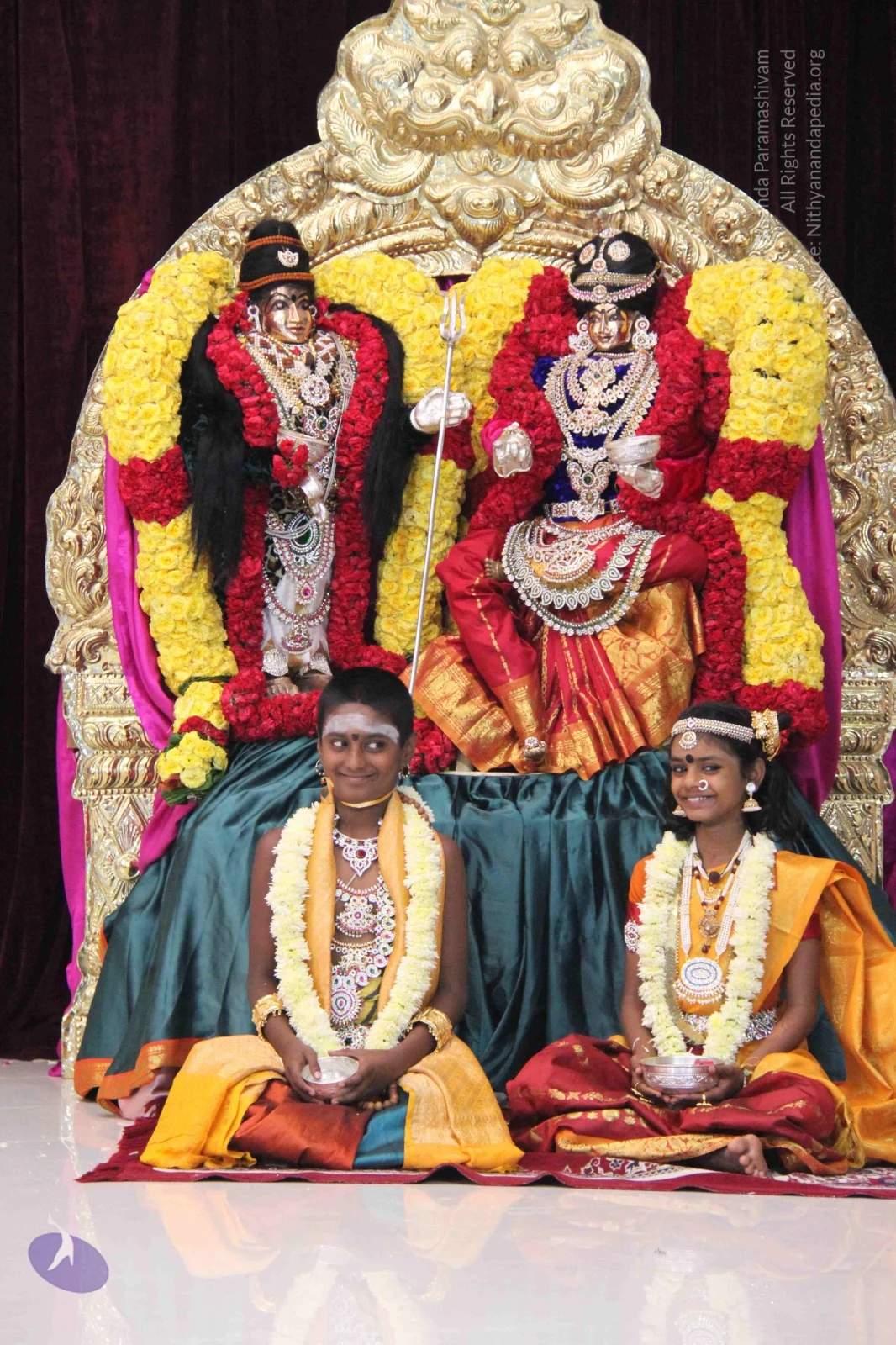
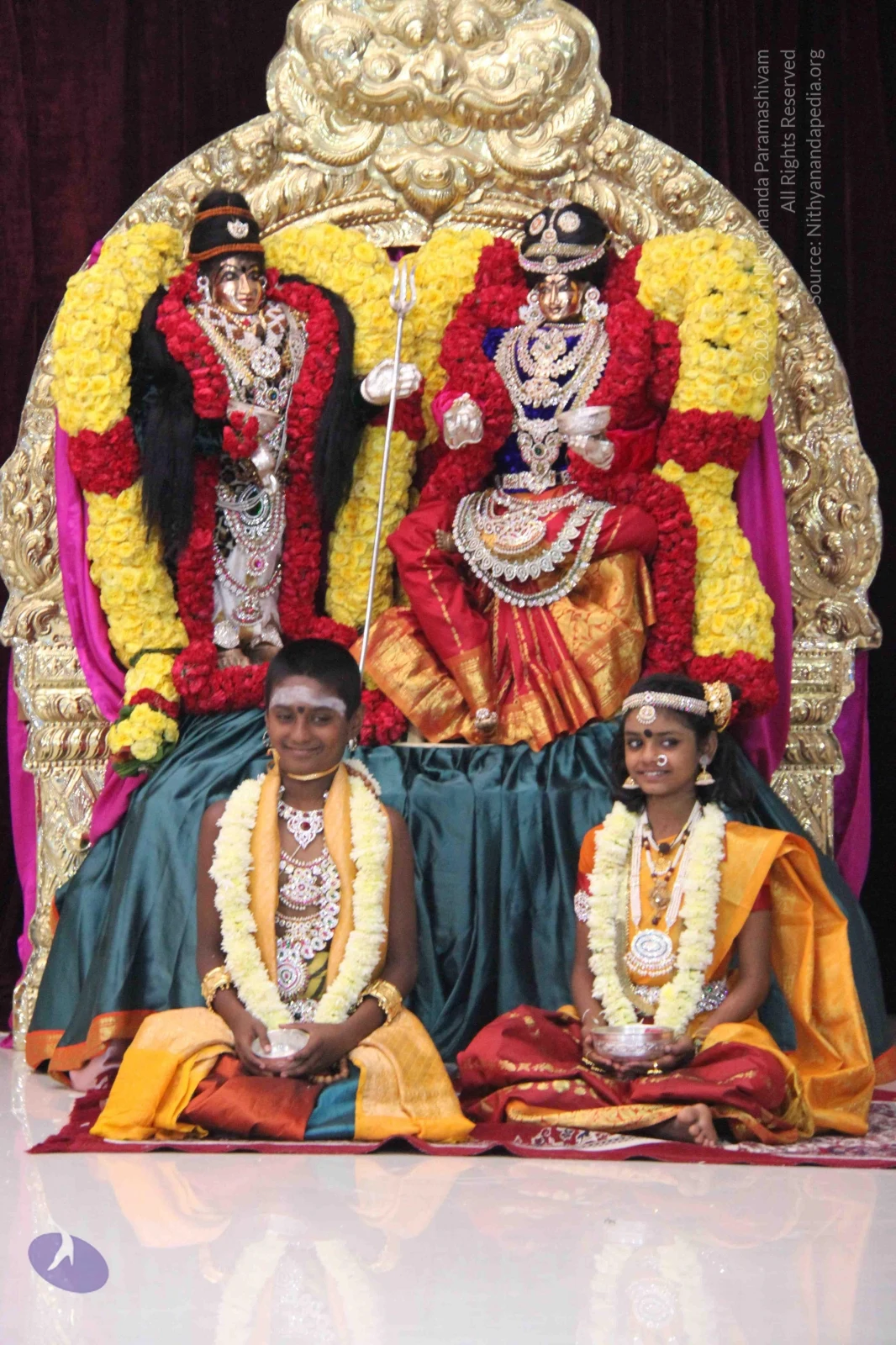
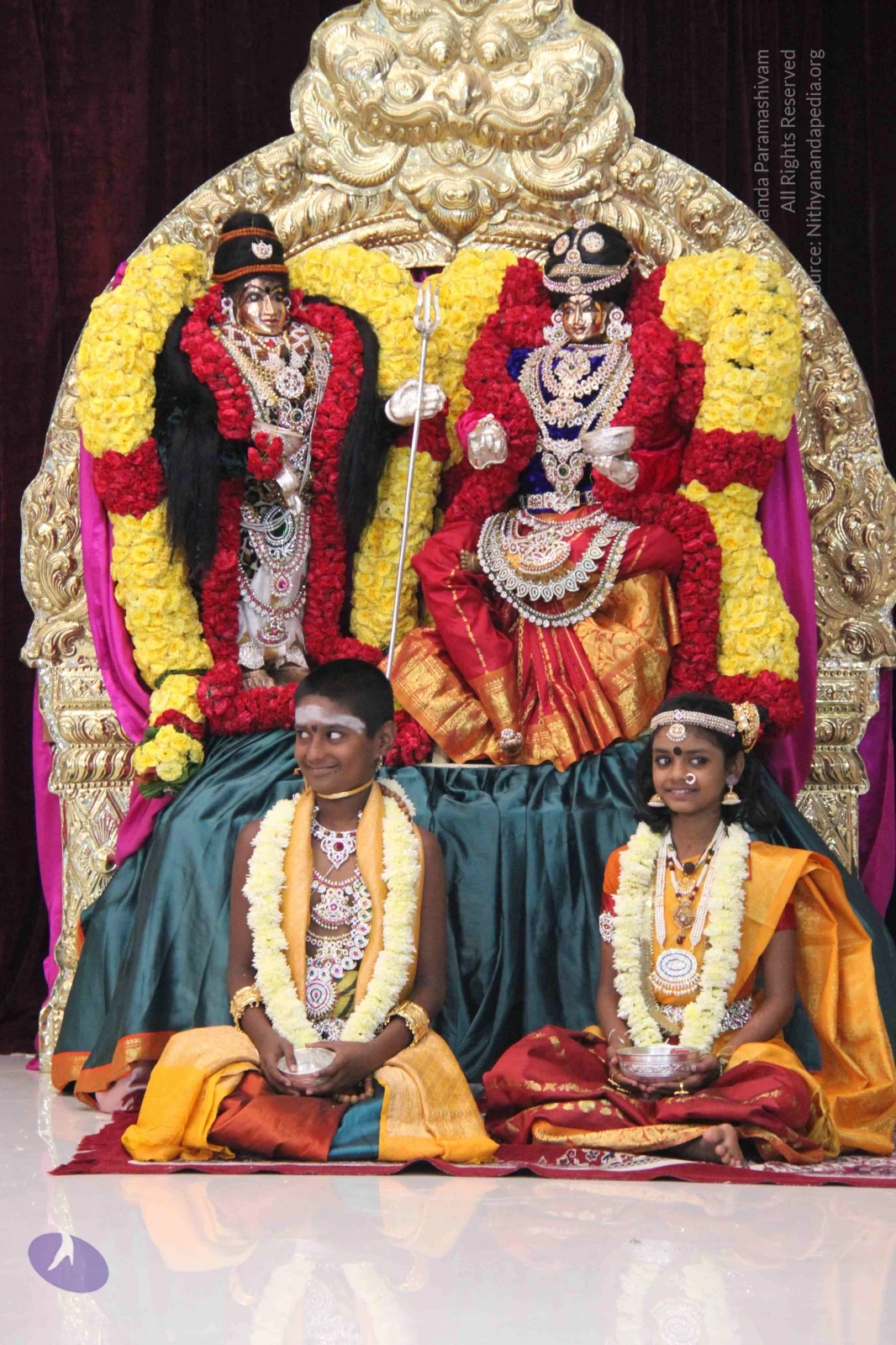
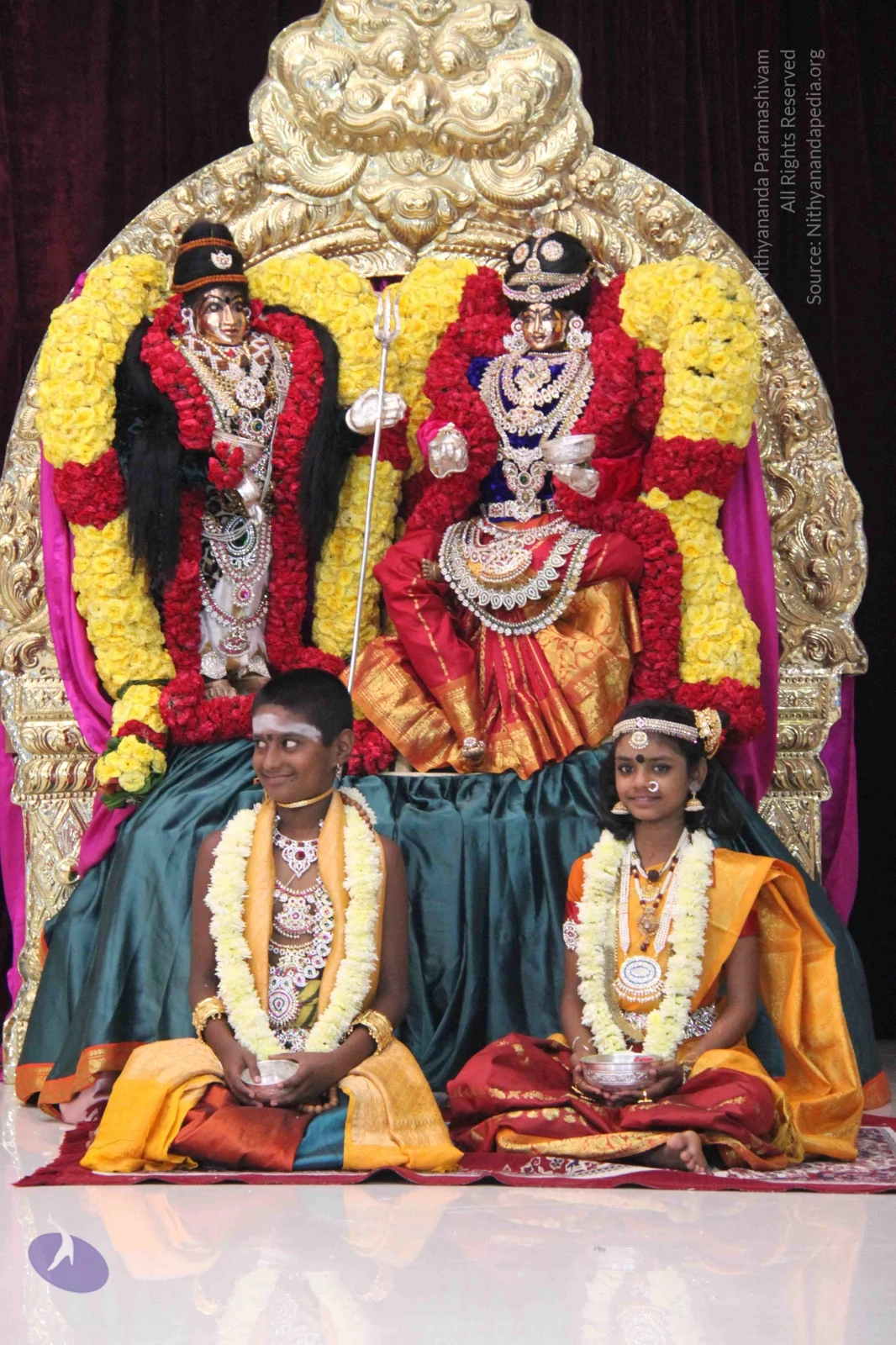
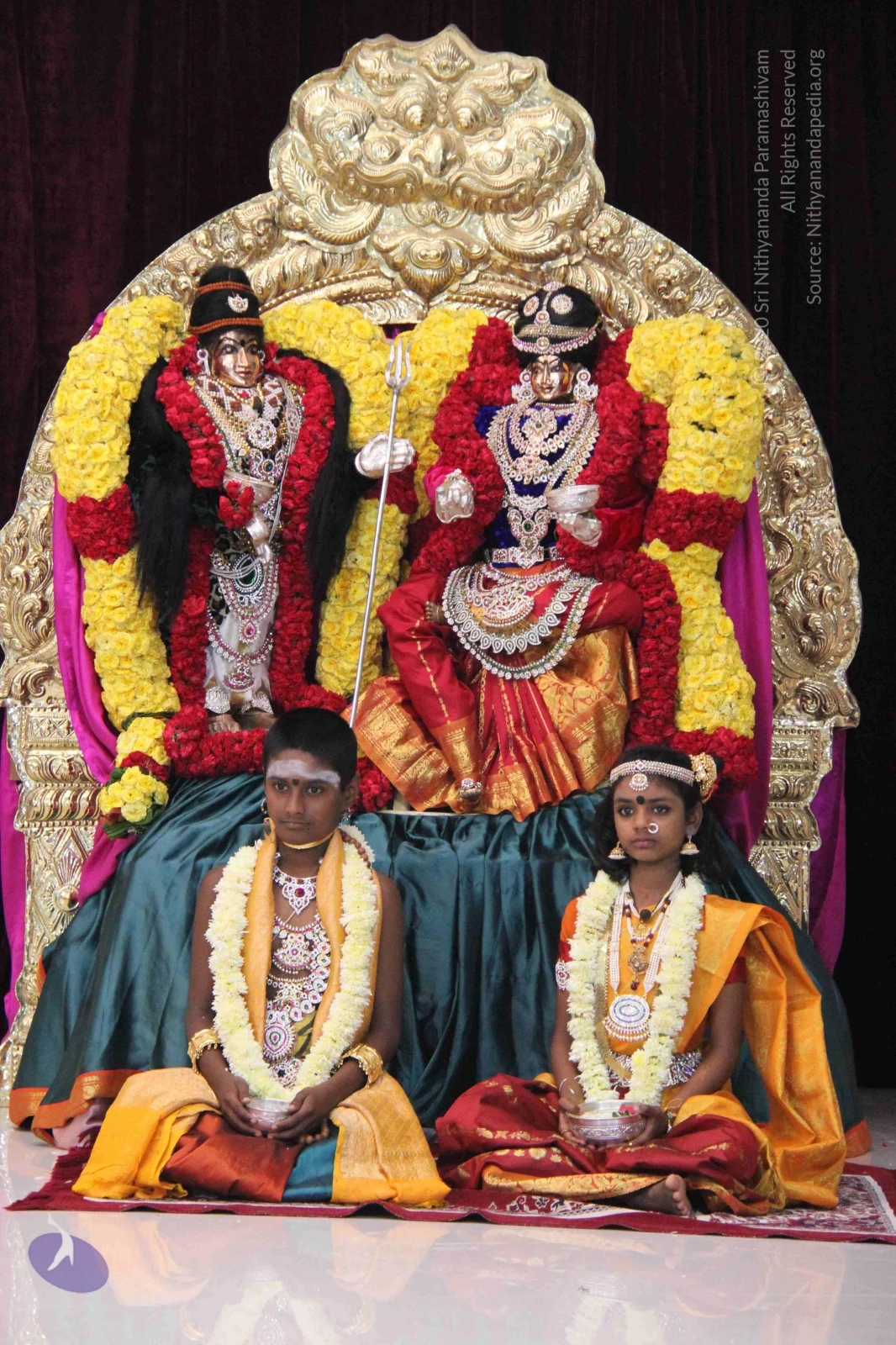
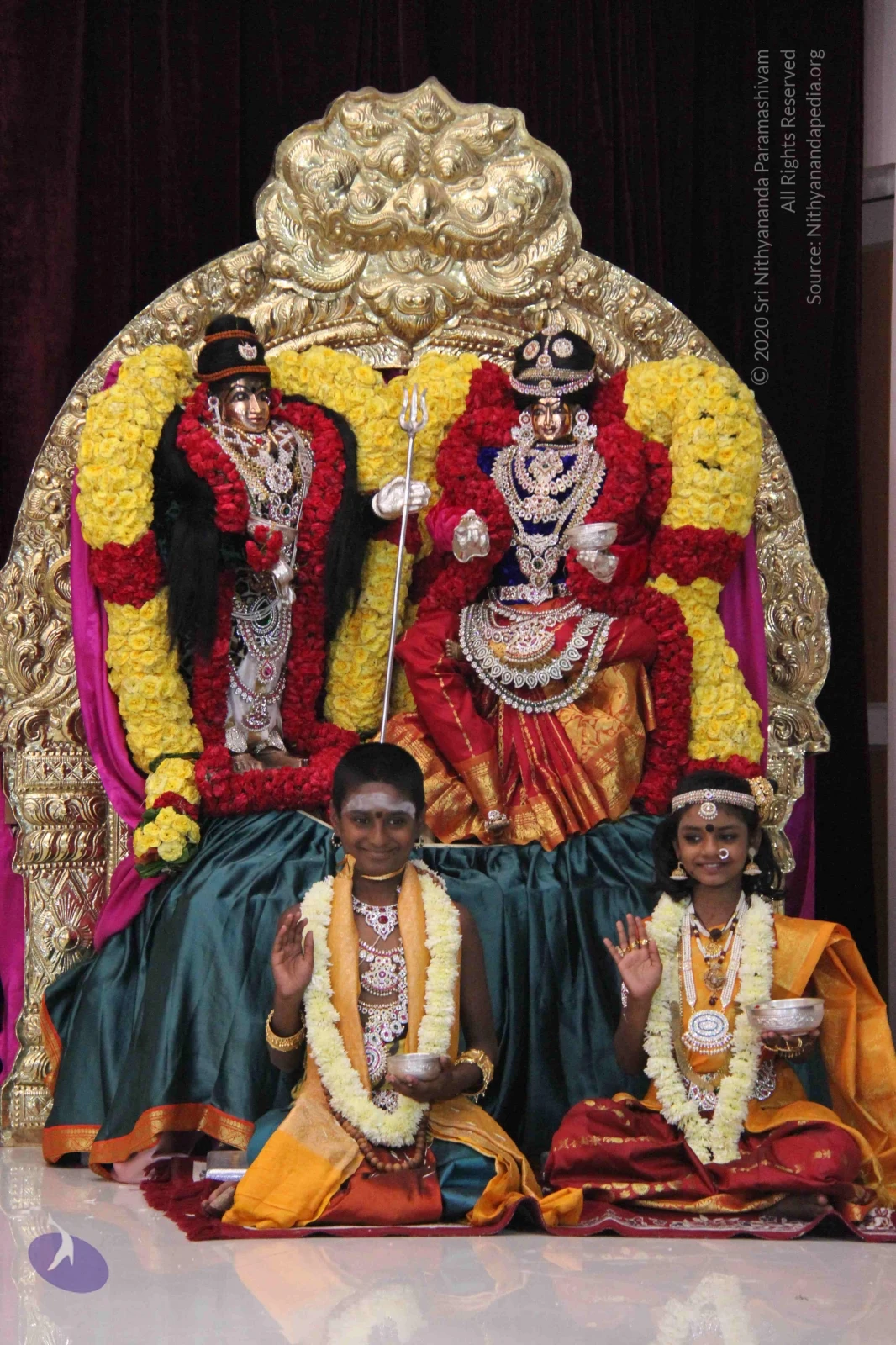
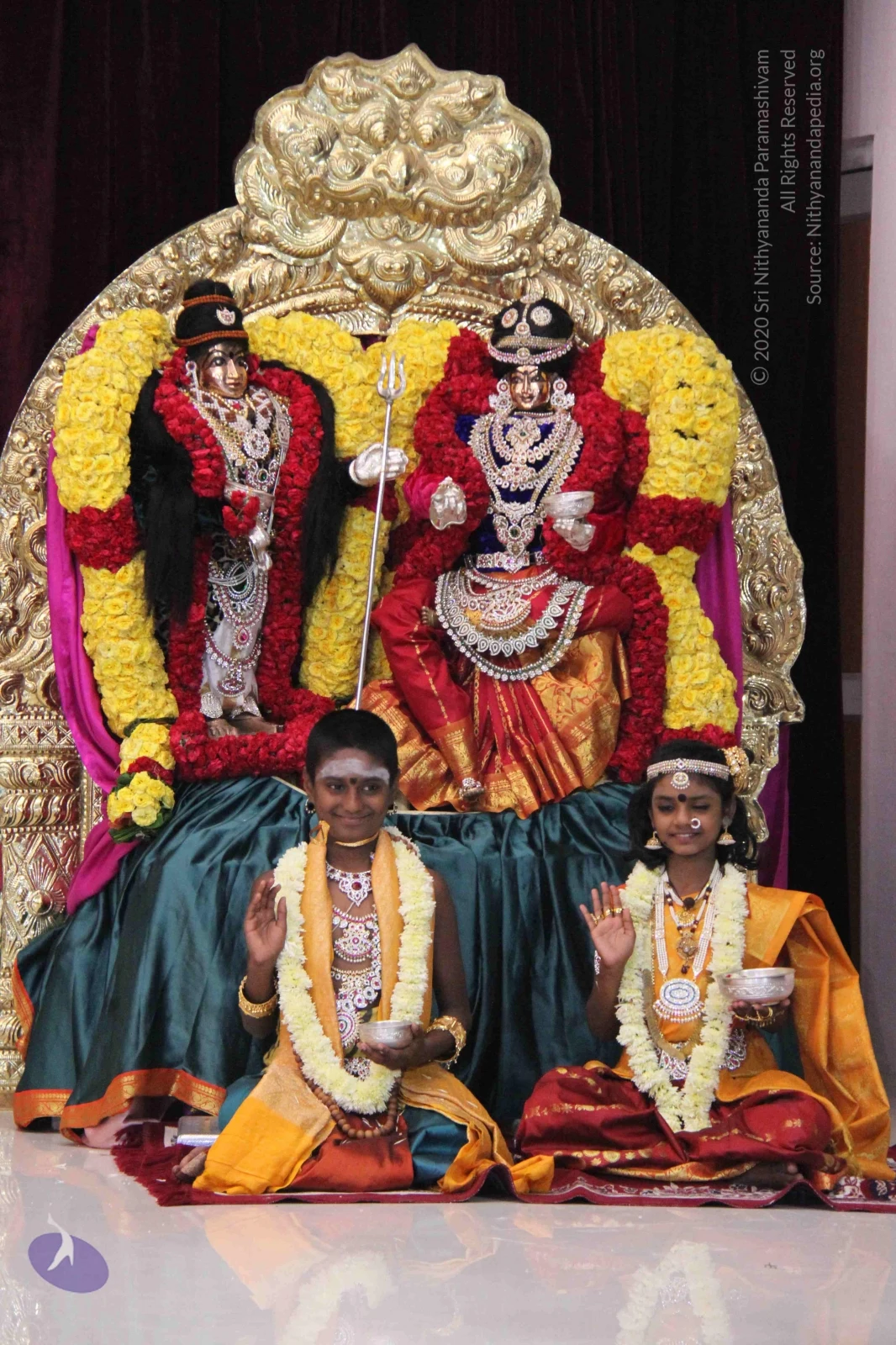
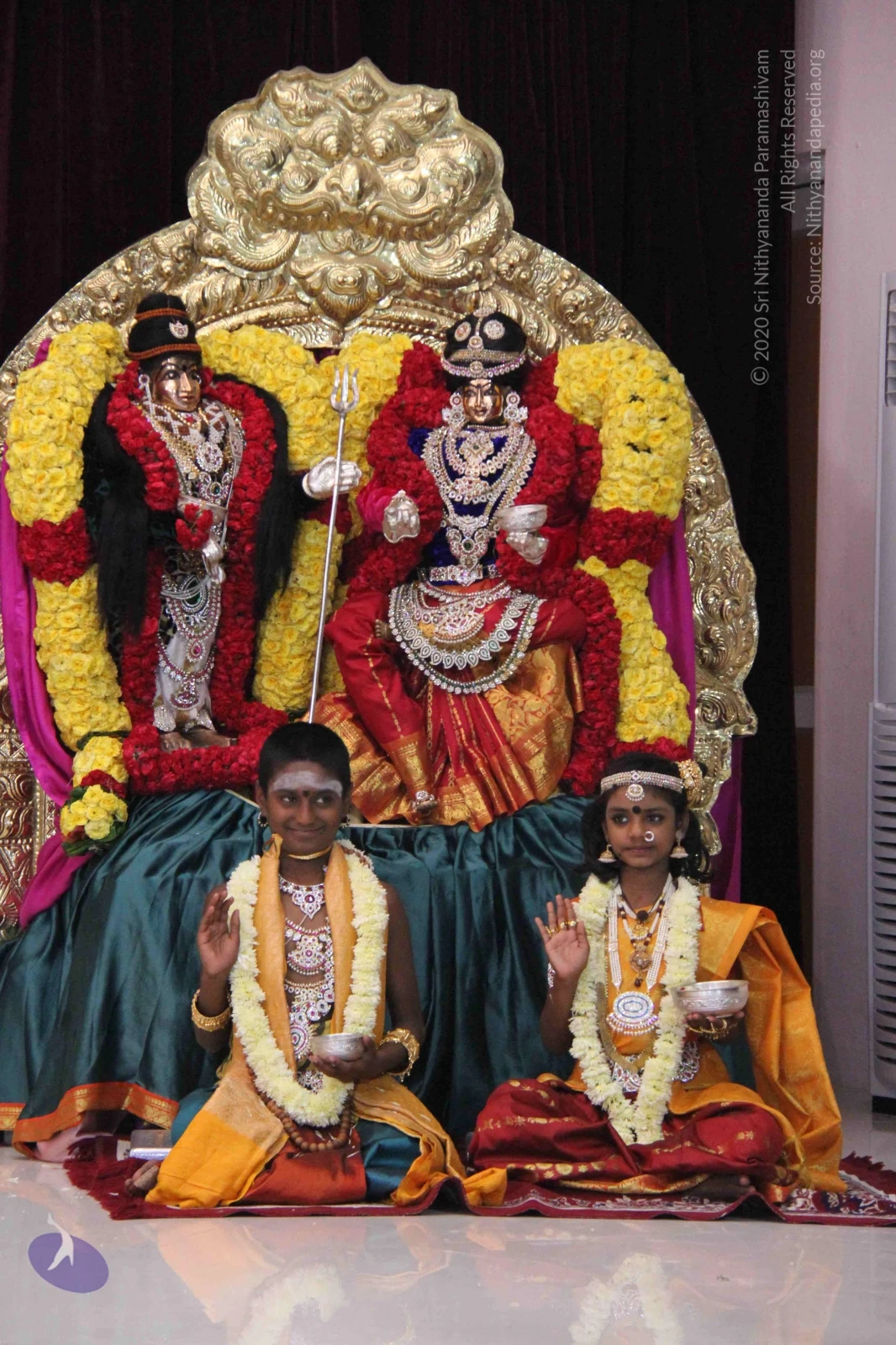
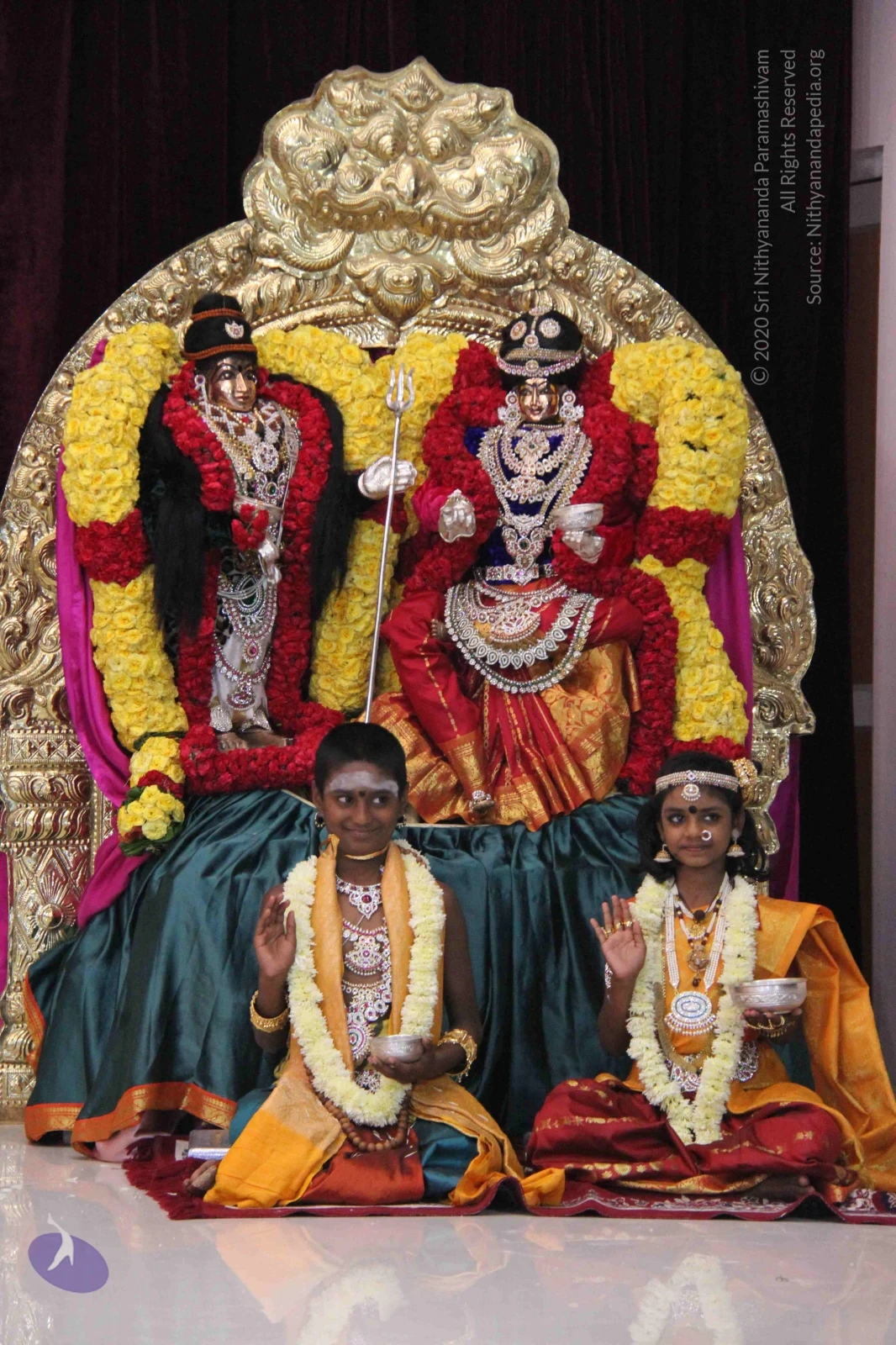
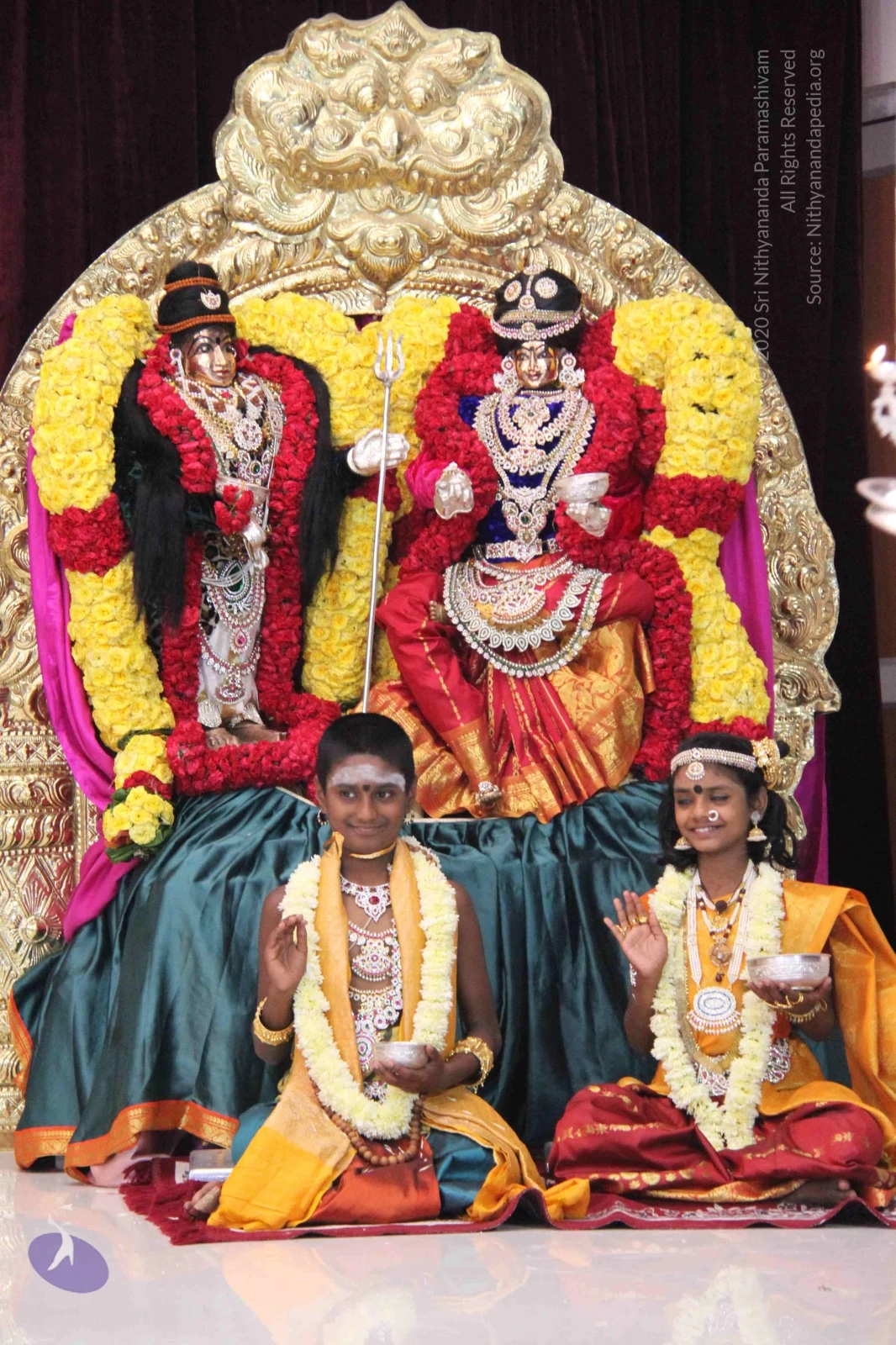
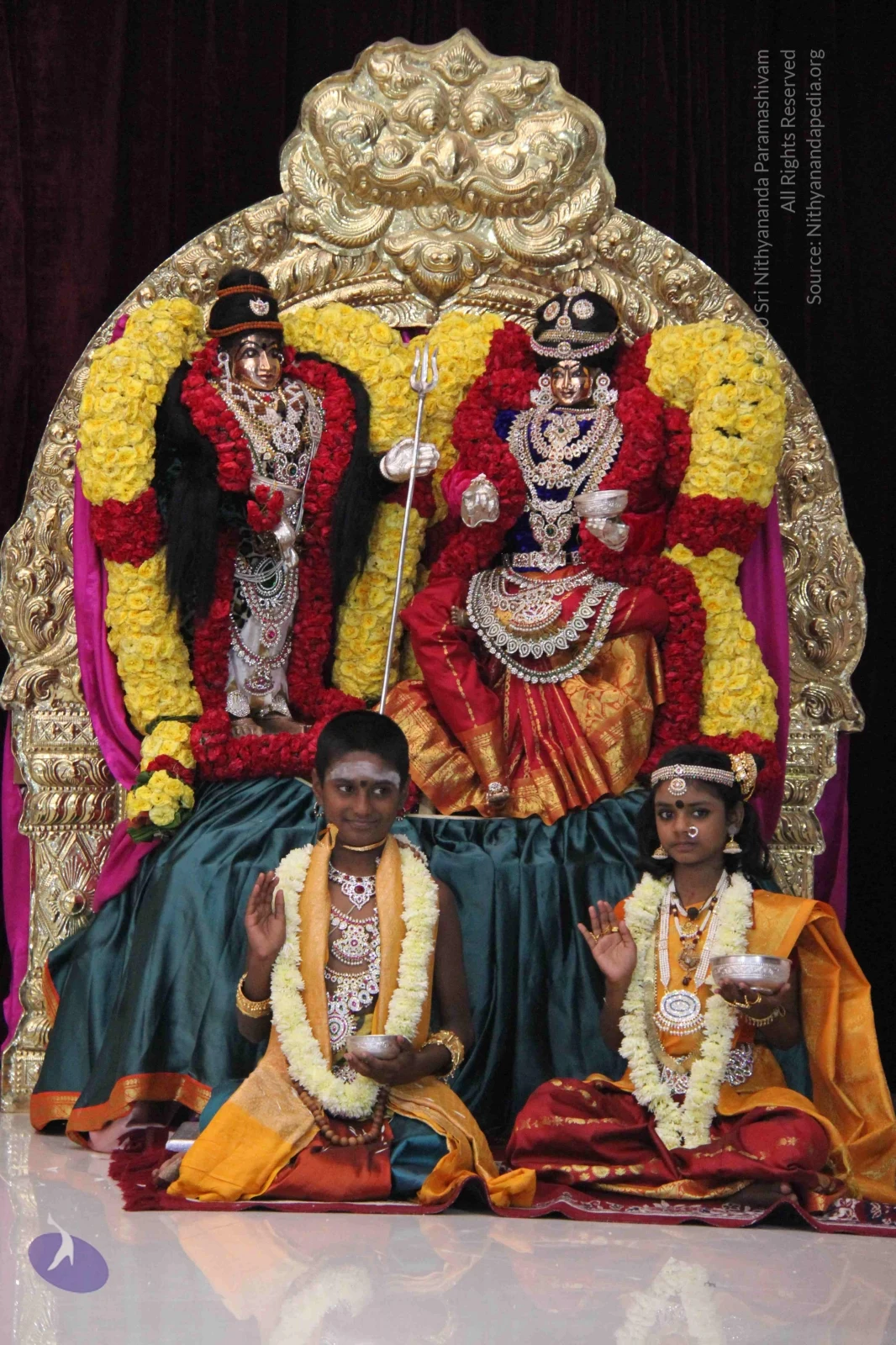
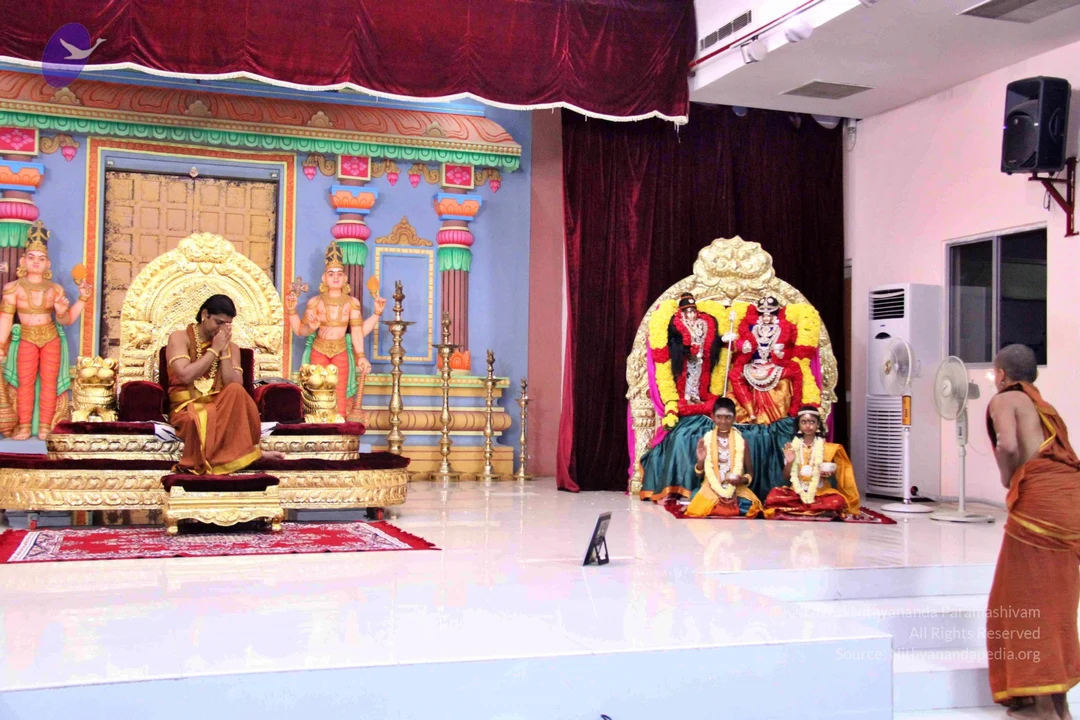
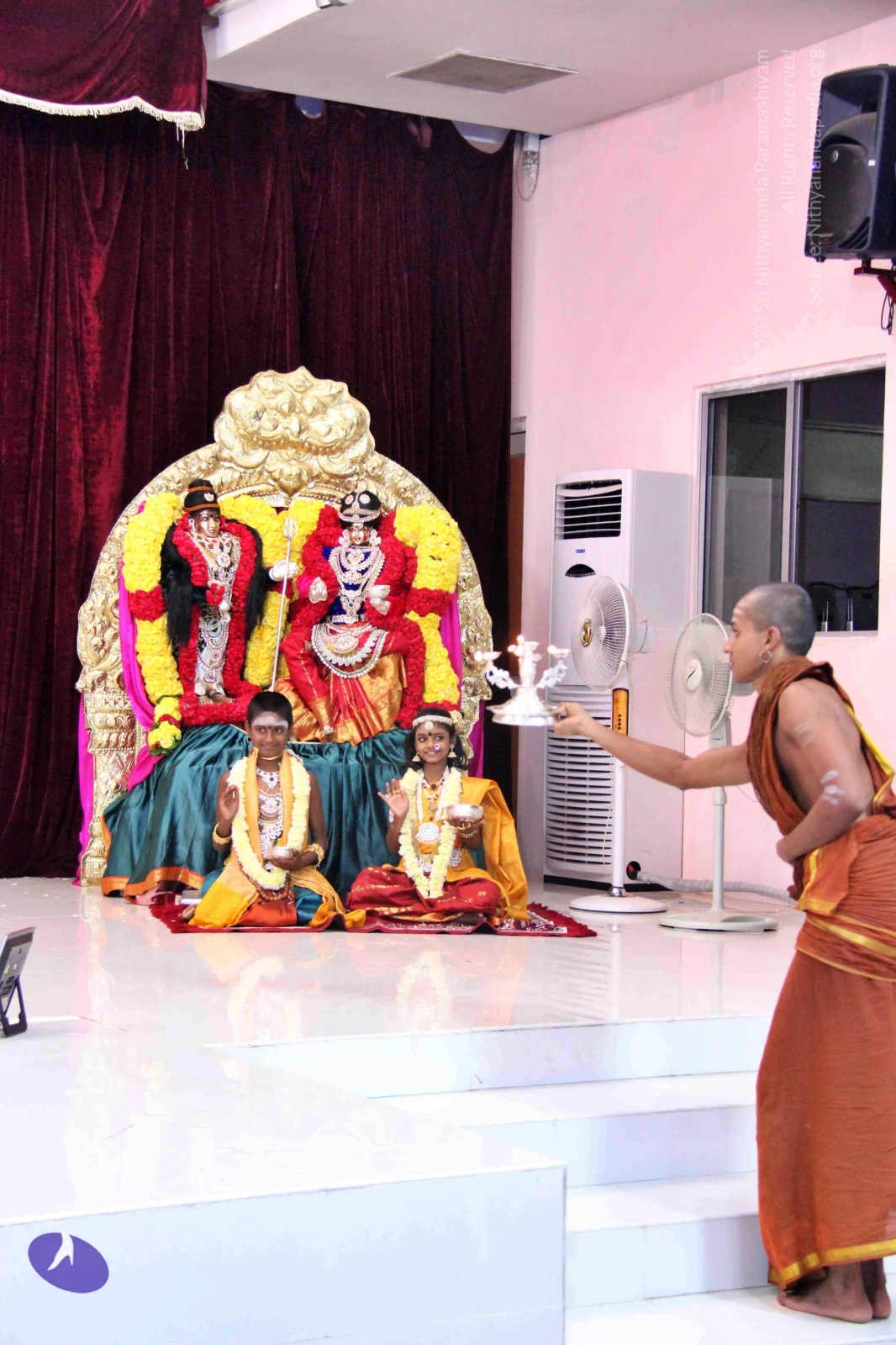
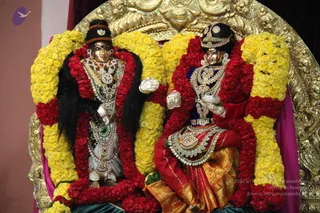
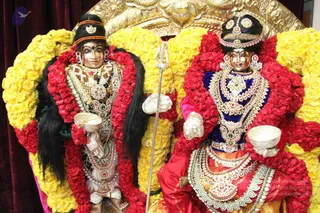
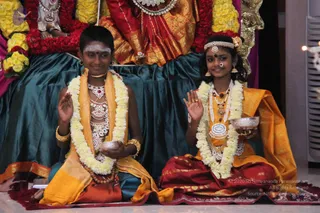
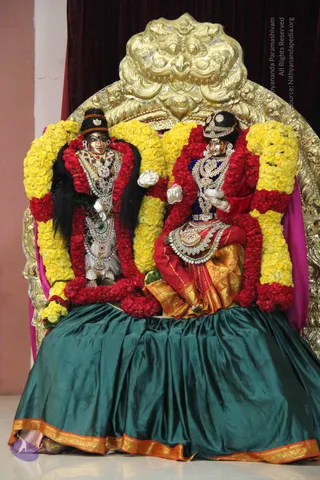
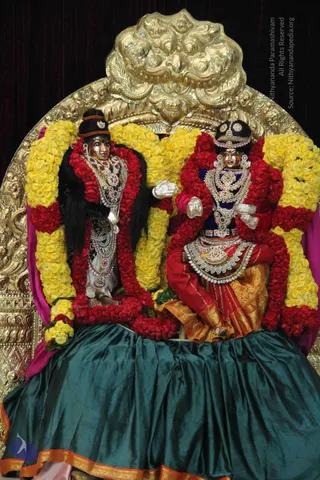
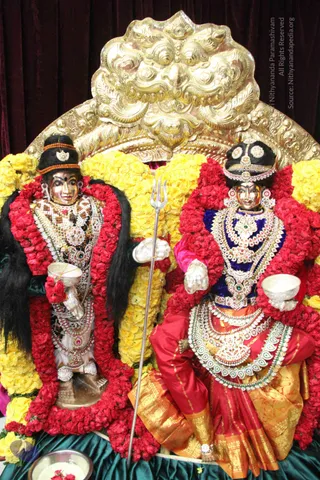
Today, Mahadeva and Devi, both of them are gracing us in the form of Leela of Annapoorni. Mahadeva himself receives food (Bhiksha) from Annapoorni. Devi Annapoorni is offering Annadhaan (food) to Mahadeva. You can see Mahadeva and Devi gracing us in the form of Annapoorni and bhikshadana.

We will enter into Nithya Satsang.

All of you should know that Annapoorna Temple in Varanasi belongs to Mahanirvani Akhada. And all the major Shiva Kshetras where Mahadeva did his Leelas, like where he saved the universe by drinking the poison, Neelakanta, that temple is run by Mahanirvani Akhada, and where Veerabhadra destroys Daksha, and Sati leaves the body – because the physical component (of Sati) was from Daksha – the Daksha Mandir, that temple is also with Mahanirvani Akhada.

We will move to today’s Nithya Satsang.

Today’s subject for the Nithya Satsang: “COMPLETION AND ENRICHING”.

Today’s session for Inner Awakening (subject for Inner Awakening or syllabus for Inner Awakening also) is “COMPLETION”. There will be a powerful process called “Samskara Dahana Kriya”, - burning the patterns and root-patterns with its roots and mud in which the root is rooted. We are not only going to burn the root and the seed, but even the mud on which the root is rooted, so that once for all, the incompletions of pain and suffering, are released.

See, this process not only helps you to heal all the pain you carry inside, but also the impact of the pain which you carry inside, outside. Because, constantly we carry the wrong pattern about the world like, ‘Life is out there only to exploit me, cheat me, abuse me.’ It is a very wrong pattern. That is why we are suffering and continuously attract suffering. With this “Samskara Dahana Kriya”, we will burn that pattern and create the right reality about life and others, right image about life and others. So, with this process, completion with yourself starts. You are initiated into the complete completion with yourself.

Please come to the space of listening.

“Hindi translation”

I will expand on and explain these few principles. I want all of you to settle down with no physical movements. Come to the space of listening, because even if you miss one word in the punch line of the joke, you will miss the whole life, the whole joke you will miss, you will miss the whole joke and the whole laughter! Please understand, even if you miss one word in the punch line of the joke, you will miss the whole joke. Same way, all my Satsangs are the punch line of your life! All my Satsangs are the punch line of your life!

A car was involved in an accident in a street. As expected, a large crowd gathered – must be in India!

A newspaper reporter, anxious to get his story, could not get near the car. Being a clever sort, he started shouting loudly, ‘Let me through! Let me through! I am the son of the victim! I am the son of the victim!’

The crowd made way for him. Lying in front of the car was……a DONKEY!!!’

See, if you miss even one word in the punch line, you will miss the whole joke. Same way, if you miss even one line in the satsangh, you will miss the whole satsangh, because the whole satsangh is the punch line. Please understand!

I will give you the technique to divide my satsangs into –

· Which is essential, the important part; and

· Which is not that important, which can be left, like a clothing of the essence.

Whenever you are in the space of listening, whatever I utter is the essence of the satsang.

Whenever you are not in the space of listening, whatever I am uttering is just managing the time to bring you back to the space of listening.

So, please understand, I wanted all of you to settle down in the space of listening, because I wanted to expand very deeply on the power of Completion. How? Please understand, in this one line I am going to do a lot of work, because this one line, this one field, was still not taught to human-beings with enough of confidence, evidences, without doubt, with clarity. This bridge needs to be strengthened. There is a bridge, it needs to be strengthened. The field is how the inner transformation directly leads to the transformation of the outer events, how when the inner transformation happens, immediately the outer world responds to you, the whole outer world situation changes. Till now, it was considered only as a miracle. I tell you, all miracles are “science yet-to-be discovered!” Please understand, this is the definition of miracle: All miracle is “science yet-to-be discovered!” If you do not know the methodology, TV is a miracle! If you don’t know the methodology, if you are kept in mystery, even me appearing in front of your TV screen inside your house or the center, or in the temple, you are sitting I don’t know how many thousands of miles away, thousands of kilometers away, not even all over the country, but all over the world.

Any program, religion, ideology, concept which becomes popular in USA will be the most powerful program. Any program, concept, theory, ideology which becomes popular in India, will be the most followed program because of the sheer numbers! Understand, do you know, what is the world’s largest happening? Indian Elections! The Indian Elections are the world’s largest happening, because there is no country which has this amount of population lives in democracy involves the public people and their sentiments into electing the Government. So, anything, any ideology which becomes popular, any show which becomes popular in USA becomes the most powerful program. Like Opera’s show! Any program which becomes popular in India becomes the most watched because of the sheer number of the population. So, I know, millions of you are sitting all over the world and watching. If you don’t know the procedure or science, if it is kept as a mystery, even this is a miracle! ‘See, morning 8 o’clock, the moment I switch on the TV, suddenly my Guru appears on the TV, and talks exactly what I want and whatever problems I have, he gives solution. And exactly he is talking to me!’ Everyone in the hall, in the family, or in the Raja Sabha or in our temple or in our center fields, feels exactly he is speaking to us!’

Please understand, anything, any science yet-to-be discovered, is considered as miracle or mystery. Same way, this science of how the inner transformation affects the outer incidents, outer happenings, is listen, how the inner transformation affects the outer happenings, how the inner happenings transform the outer happenings also for your good, auspiciously, as you wanted, this field is yet-to-become a science. Still, this field is only as the mystery, considered only as a miracle or mystery. I am going to work in this field to make everyone understand that it is a science, a simple, pure science. See, once you know how it works… Morning you wake up at 8 o’clock, switch on the TV, and I appear, and you listen to me, it is no more a mystery or miracle, because you know how it happens. Same way, you will be able to handle, you should be able to handle, better let the humanity learn to handle, how the inner transformation creates the outer reality as we wanted. It is deterministic; every time you will be able to do it.

Please understand, an Incarnation is a person who brings deterministic experience of every mystical, miraculous, mysterious fields of the consciousness. The mysterious, miraculous, mystical, this conscious field, whoever leads you one step further in that field, is an Incarnation.

We do have a bridge in this field. Not that I am the first guy who is building in this field. We have a bridge made out of rope and wood. I just wanted to make it as concrete. I just wanted to make this as a solid, powerful, concrete bridge. That is the reason I am continuing to talk on how the inner completion, inner transformation, directly, clearly can lead you to change your outer world happenings as you want, the outer world reality as you want, the realities of the outer world as you really want to express.

Completion brings a deep respect for your life within you. Please listen! Don’t ever think you have respect for your life, you have concern for your life. Any addiction you carry, whether it is alcohol, smoking, or even addiction to worrying, shows clearly you don’t have respect for your life. Don’t take your respect for your life as guaranteed or granted. Because you don’t have respect for your life, life reacts the same way to you.

I have a story:

A shy guy goes into a bar, sees a beautiful woman sitting at the bar.

After an hour, gathering up his courage – this guy must be an NRI (Non-Resident Indian) newly went to West from India, an Indian village – after gathering up his courage, he finally goes over to her and asks tentatively , ‘Do you mind if I chatted with you for a while?’

She responds by yelling at the top of her lungs, ‘What? What do you mean? No, I won’t sleep with you tonight!’

This guy was shocked. Everyone in the bar is now staring at them. Naturally, the guy is hopelessly and completely embarrassed. As he just slinks back to his table. He sits quietly, putting his head down.

After a few minutes, the woman walks over to him and apologizes. She smiles at him and says, ‘I am sorry if I embarrassed you. See, I am a journalist and I have got an assignment to study how people responds to embarrassing situations. So I was studying how you respond.’

Suddenly, this guy raises his head and shouts at the top of his lungs, ‘What? What? What do you mean? You need two-hundred dollars?’

(laughter)

Understand, when you yell at life, life yells at you. When you try to embarrass life, life embarrasses you. When you don’t respect life, life will not respect you. And do not imagine continuously you respect life. If you are spending your time in worrying, you don’t have respect for life! If you are spending your time in incompletion, you embarrass life! Understand, you embarrass life! If you spend your time in incompletions, worrying, not looking at the life, you embarrass life! Please understand, if you embarrass the man, naturally he will be waiting to embarrass you.

“Hindi translation”

I tell you, with all my Integrity, Authenticity, Responsibility and Enriching, I tell you, if I establish this science as an understanding which is in our day-to-day household lifestyle – just like how you know if you switch on, the fan will run, if you switch on, the light will be on, how this idea is available in every household – if I make this truth, how the inner transformation directly causes the reality as you want, I will feel I have done a great service to planet Earth, and I have contributed to Hinduism. Please understand, this is exactly the contribution of Hinduism. This is the unique contribution of Hinduism. I am doing it and I commit with Veda Matha, I will do it. If this one truth is established, if this one thing is established, I tell you, no one can question, abuse all our Puranas, legendary figures; the Puranas will not be called as mythological stories, it will be called as history of India, history of Bharat. I will make our Puranas as history. This is my commitment.

Actually, that is the reason I am waiting still without writing my autobiography. Please understand, always the literatures which bridge this inner transformation and outer reality, they are considered as mythological stories by so-called logical, scientific minds. I will first establish very powerfully to the so-called scientific, logical minds, the power of how the inner transformation directly transforms your outer reality as you want. How you create your outer reality as you want through the inner transformation, I will establish this science. Then I will write my autobiography, because my autobiography is filled with material of Puranas, but I don’t want people to think it is mythology. By making my autobiography scientific, scientifically validated and accepted by the western logical, scientific, rational minds, I will make the western logical, rational, scientific minds understand and realize the whole Puranas, all the Puranas of Hinduism is history, not mythological stories; it is not high stories, it is histories, His stories! Puranas are always translated as mythological stories or high stories. I tell you, it is not high stories, it is His stories!

“Hindi translation”

Listen! Understand, only when the completion starts, only when the incompletions melt down, you reject incompletions from your cognition, even respect for your life starts. You may have any number of reasons. This lady journalist, woman journalist, she might have any number of reasons to make this man feel embarrassed, but your reasons are not going to be heard, the man is going to make you embarrass back, the man is going to give you back! If you say, if you exaggerate, if you embarrass him, he is not going to keep quiet. Same way, if you embarrass life, if you embarrass the happening, please be very clear, the happening, life will respond. When you respect life, when you understand life, when you respond to life out of completion, life will respond to you out of completion. Only after completion, life starts in you, please understand. Only after completion, life starts in you. Only after completion, you even relate with your own life.

I have seen so many people. Please understand, when people come to me to receive energy darshan and initiation, I can see the amount of self-denial they are carrying inside them, because they have no respect for their life, they try to fill it by the car, house, money. See, I am not against car, house, money. No! I am not against all that. But I am against you thinking that is going to fill the incompletion, make you complete, the incompletion which you created by not having respect for your life. It is like you take a tooth-brush and give it to an elephant. ‘Please brush your teeth. You are smelling!’ Is your tooth-brush going to be enough? I am not saying tooth-brush will not work. It will work for whom? For you! Your tooth brush will work for you. You can’t give a tooth-brush to an elephant and say, ‘Please brush your teeth and come!’ That is what you are trying to do if you think your house, the bank balance, car can complete the incompletions you are carrying, because you have disrespect to life.

Understand, bring respect to life through completion. Completing all the incompletions you carry inside you.

The essence of today’s satsang:

Bring respect to life by bringing completion in your life, removing all incompletions from your life.

“Hindi Translation”

Title:

Completion Technique Redefined!

Description

In this excerpt from the Inner Awakening Program conducted on 19 August 2013 by Paramahamsa Nithyananda we learn about the completion technique, its source in the scriptures and the steps to follow to attain the state of completion.

Link to Video:

VideoAudio

Tags:

Paramahamsa Nithyananda, incompletion, completion, worry, addiction, reality, transform

Photos Of The Day:

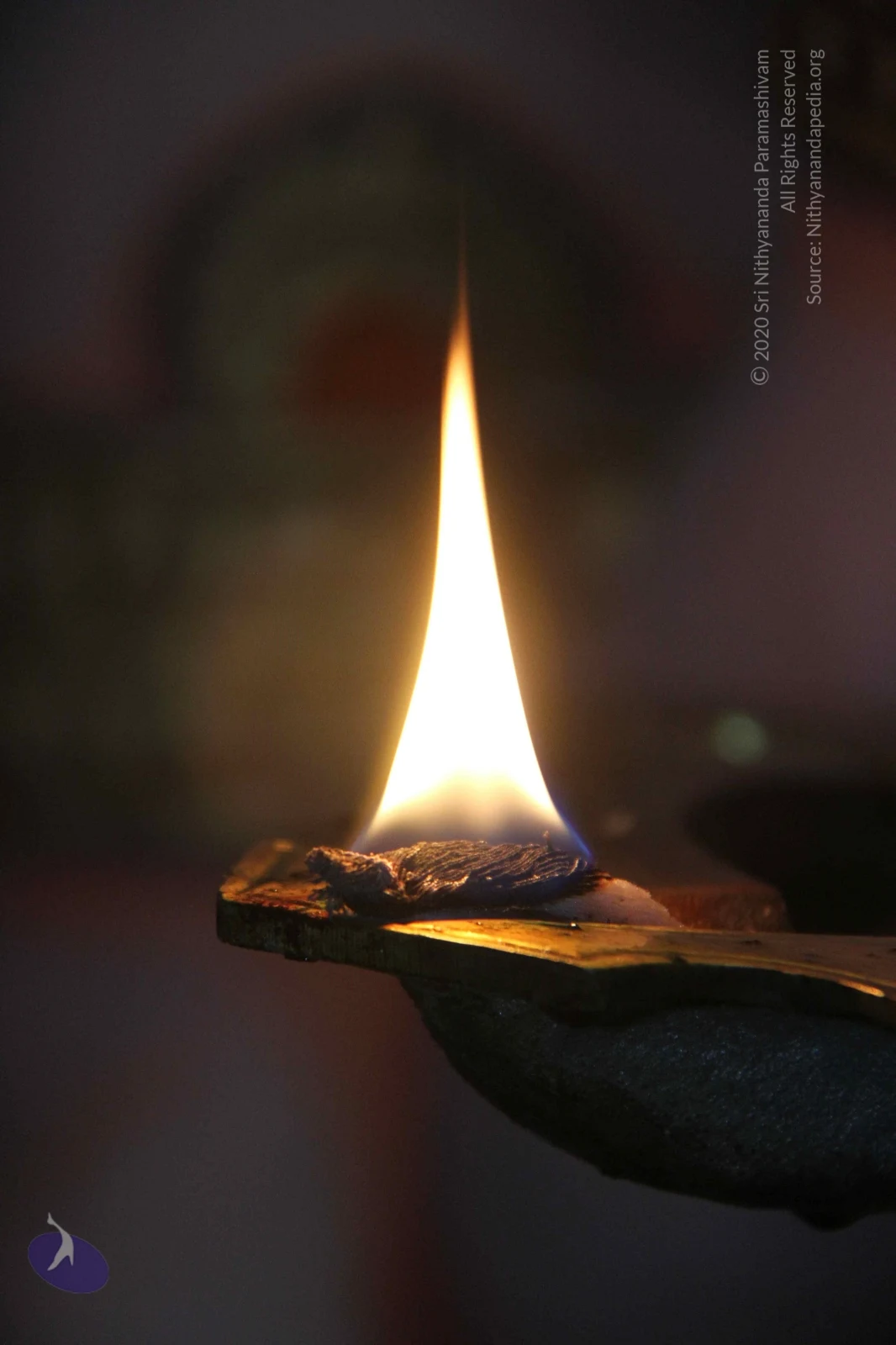
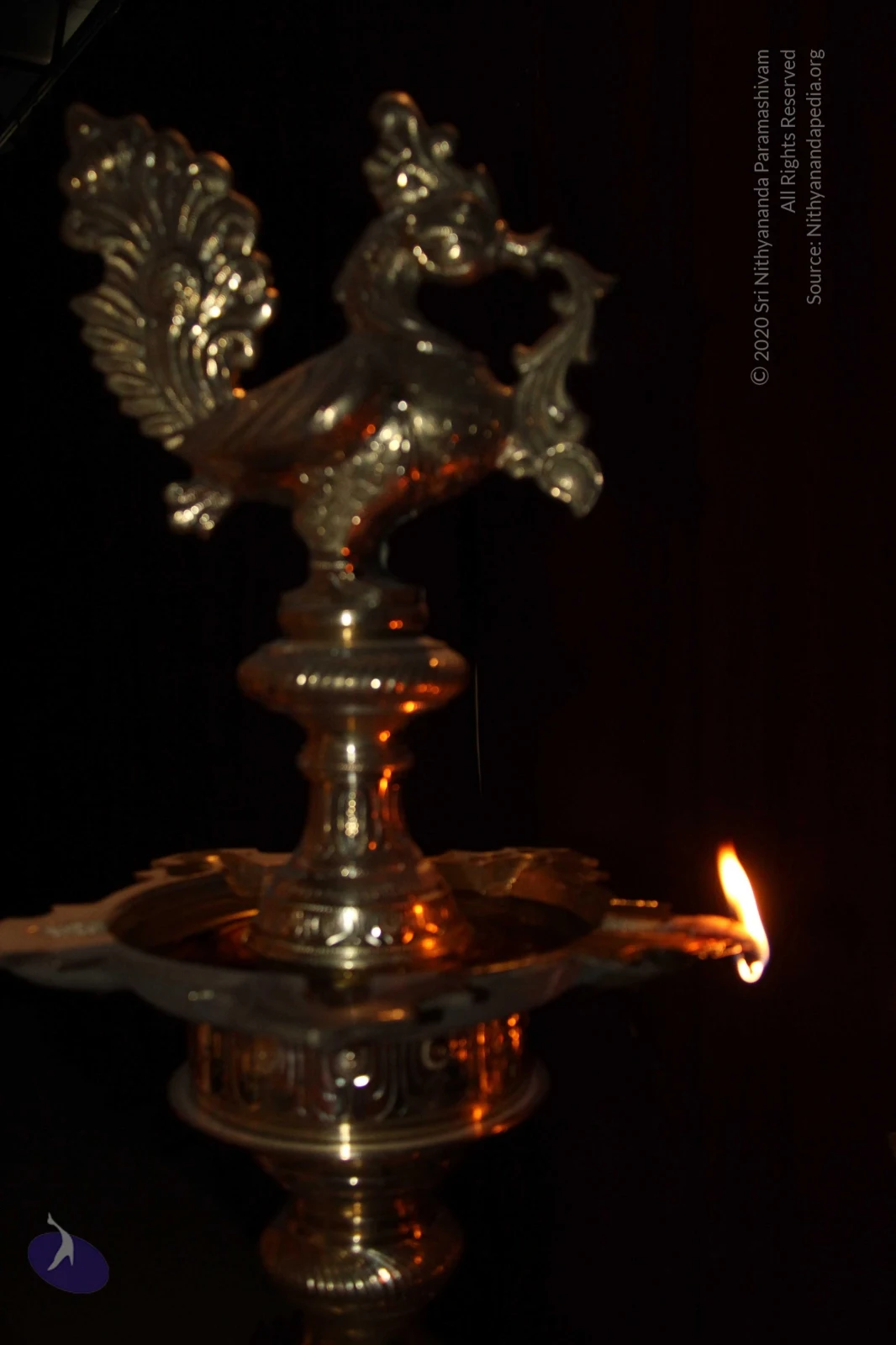
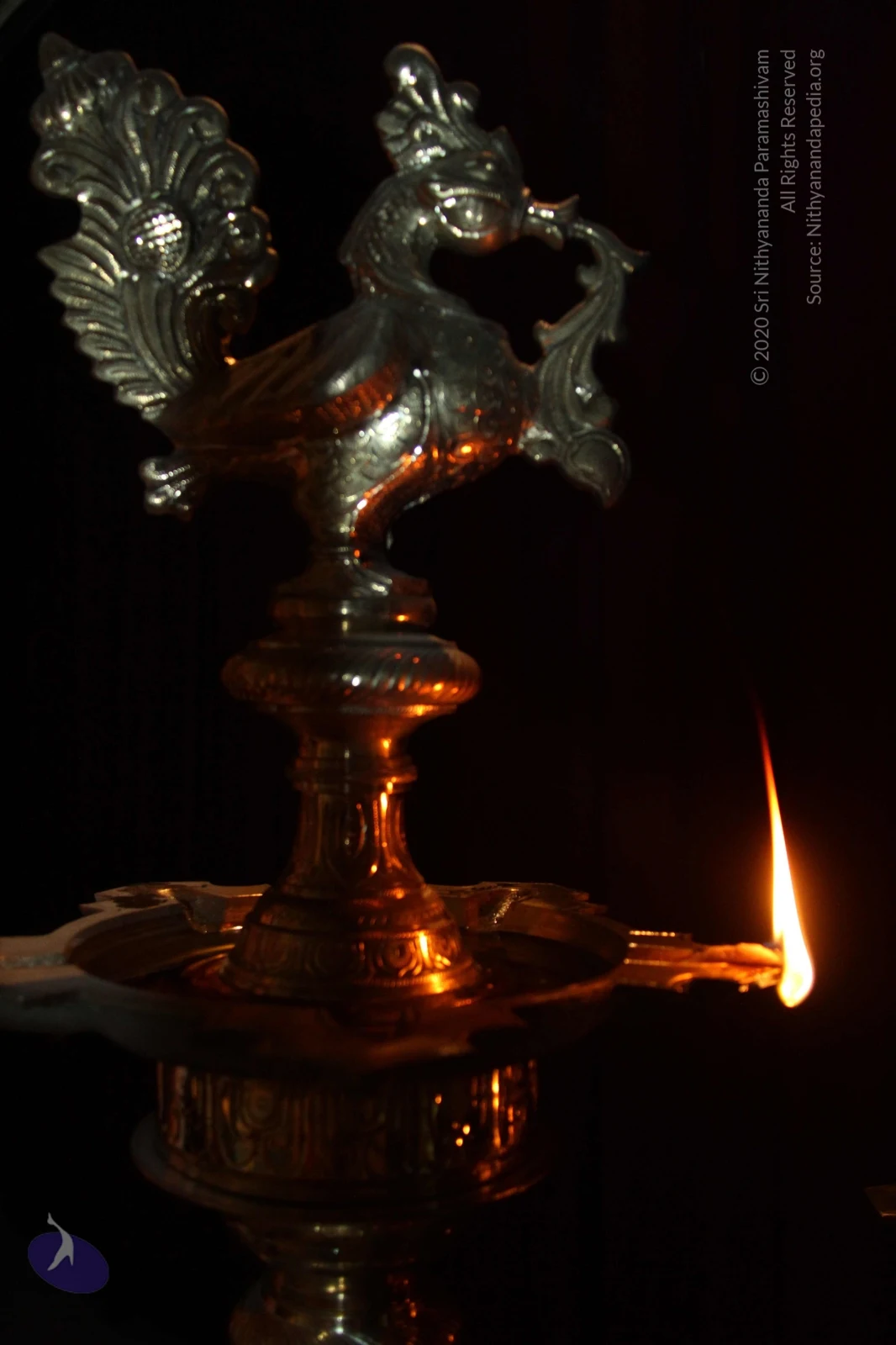
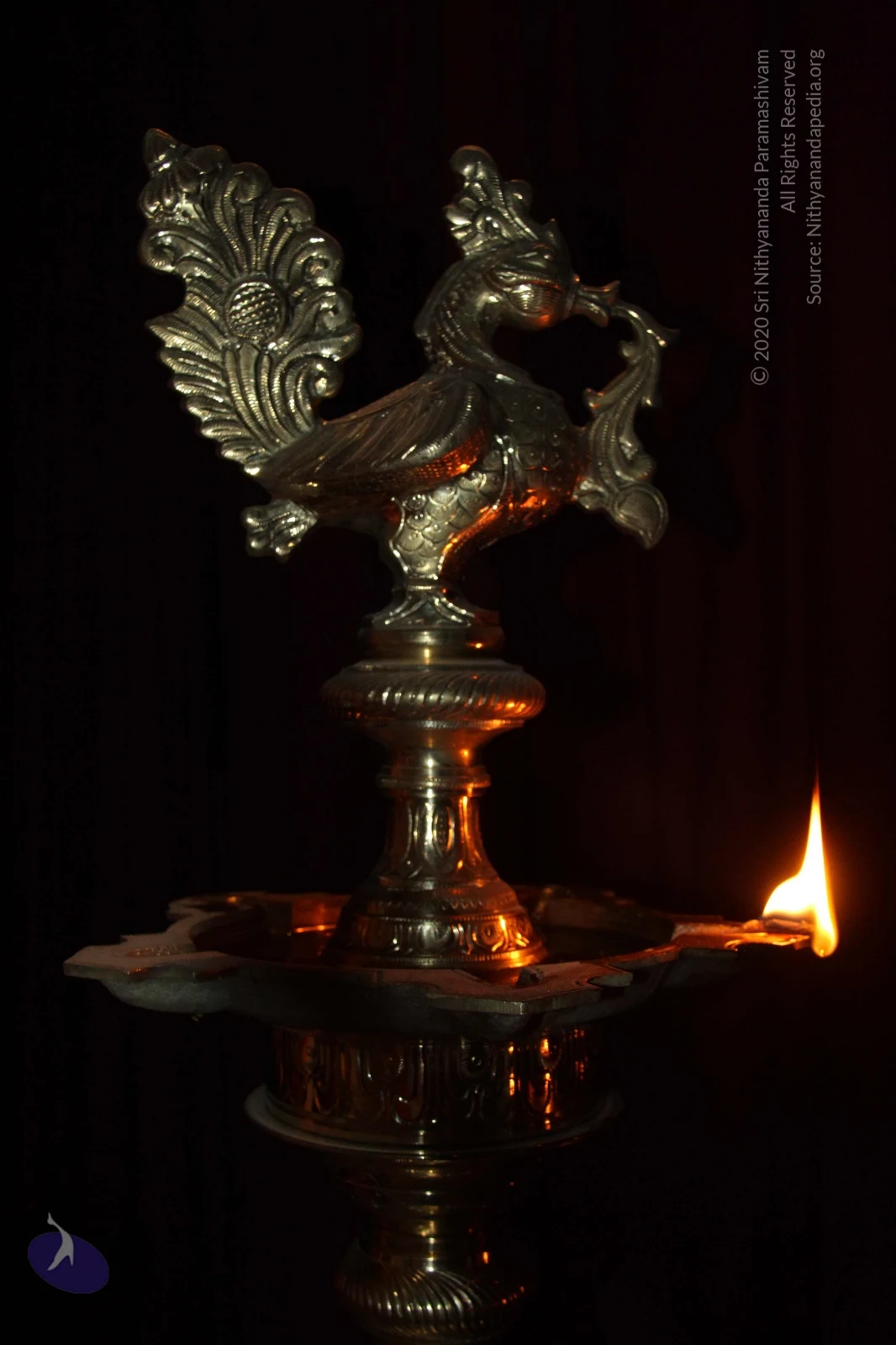
Lamp-Kutthuvillakku
Pratyaksha-Pada-Puja

Nithya-Satsang

Satsang

Final-blessings

Sarva-Darshan

Leela-Alankar

RudraAbhishekam-Swamiji-Rajasabha

Rudrabhishekam

Acharya-IA-Day4-Session-TwoWay

IA-Day4-Participants-Listening

IA-Day4-Participants-Sharing

Photos Of The Day:

Pratyaksha-Pada-Puja

IA

Kutthuvillakku

Nithya-Satsang

Sarva-Darshan

RudraAbhishekam-Swamiji-Rajasabha

0-Lamp-Kutthuvilakku

0-Leela-Alankar

01-Rudrabhisekam-Swamiji-Rajasabha

2-Pratyaksha-Pada-Puja

3-Deities-Arathi

3-Nithya-Satsang

4-Final-Blessings

5-IA-Day4-Aacharya-Session

Photos from this day

View all 323 photos

Lamp-Kutthuvillakku
19 photosSource gallery
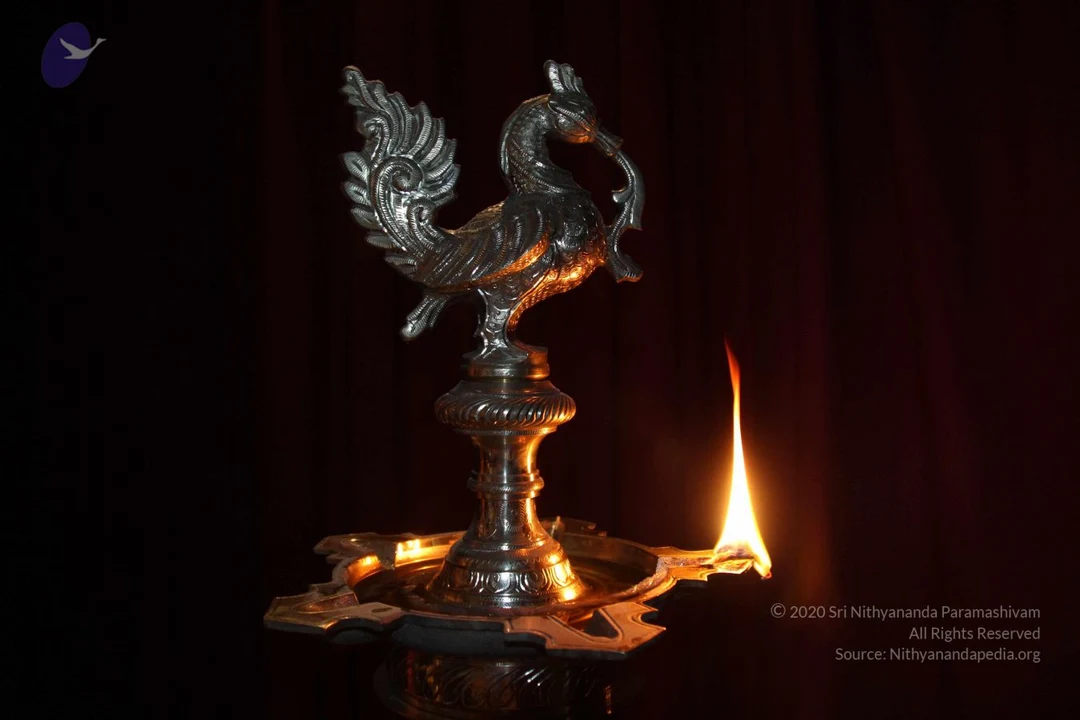
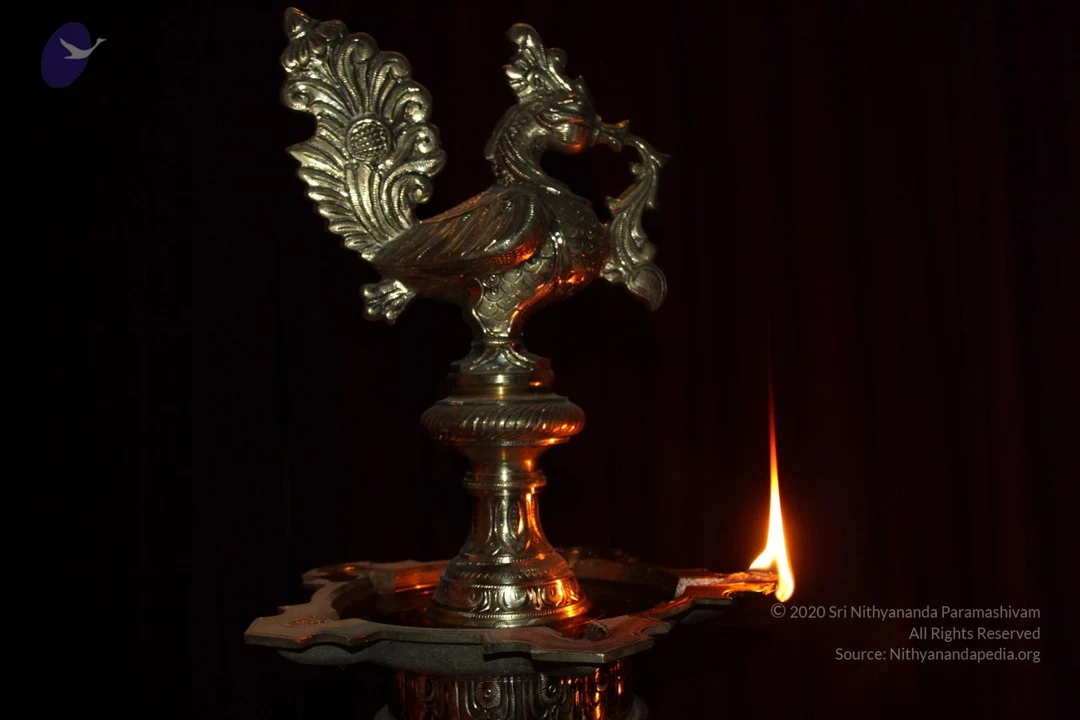
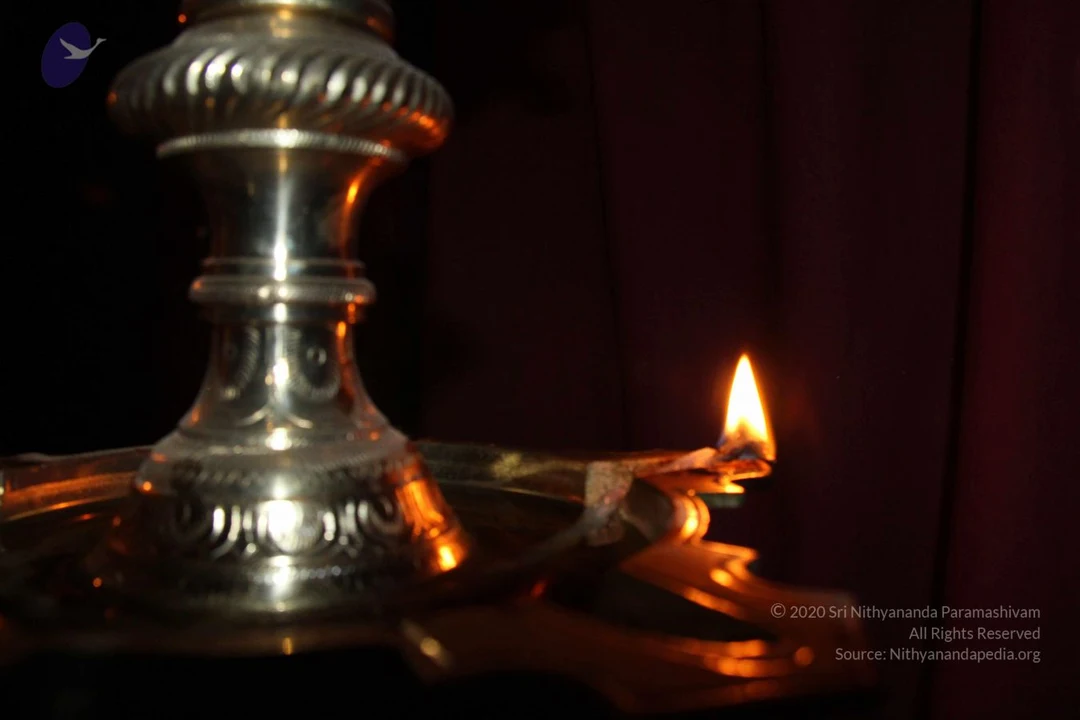
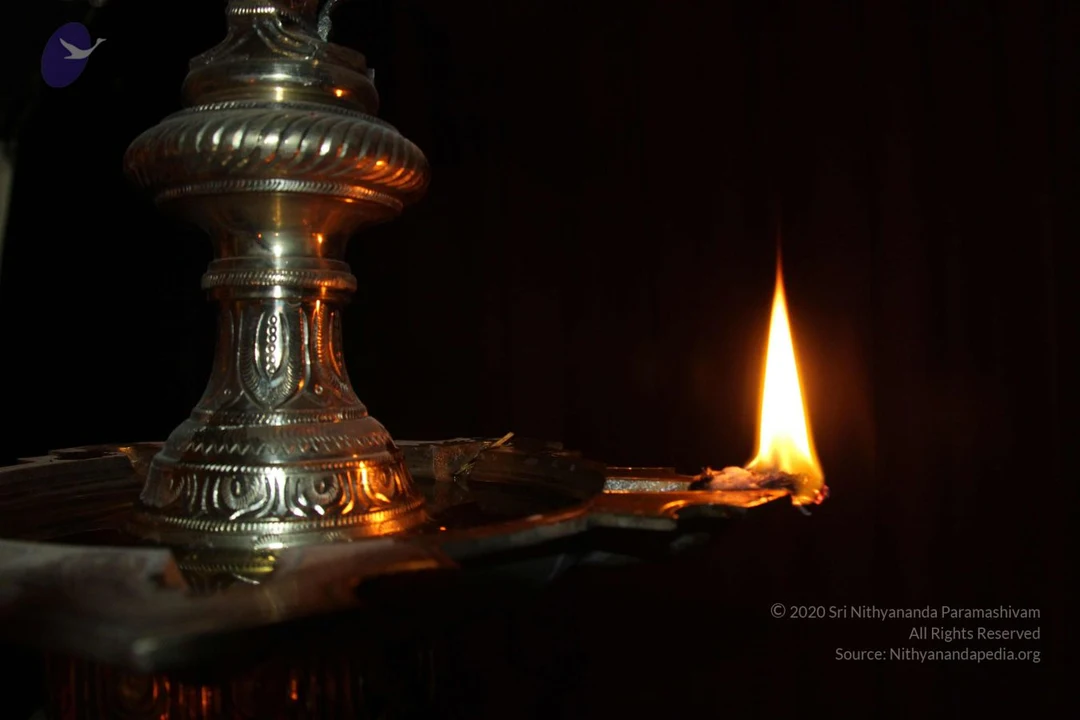
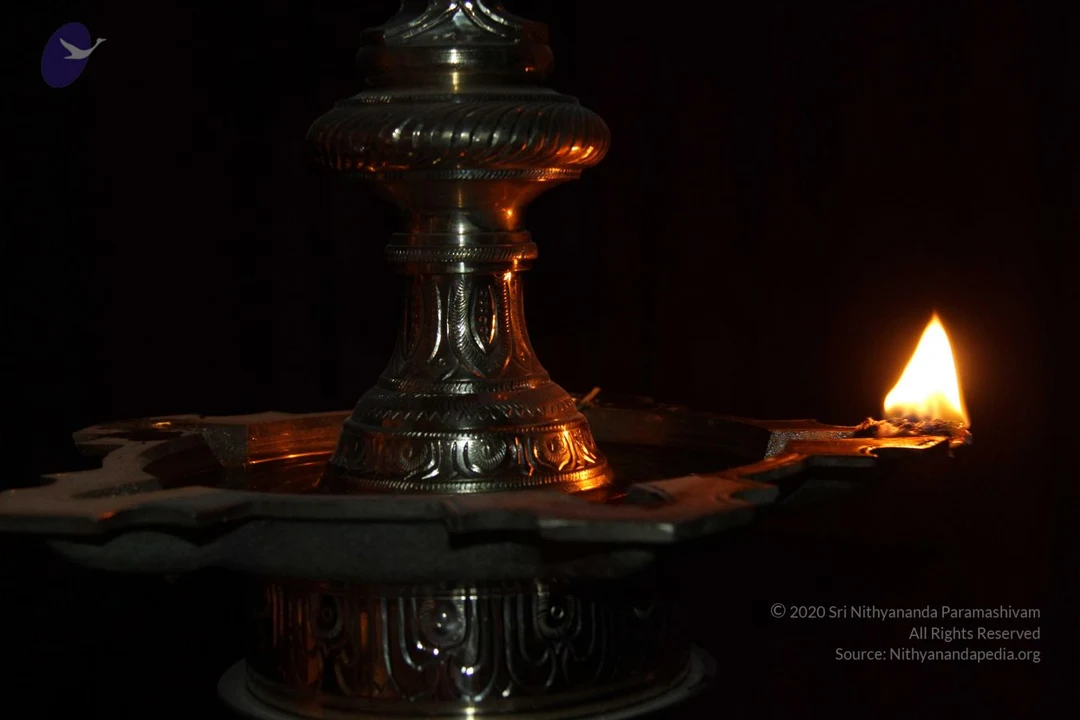
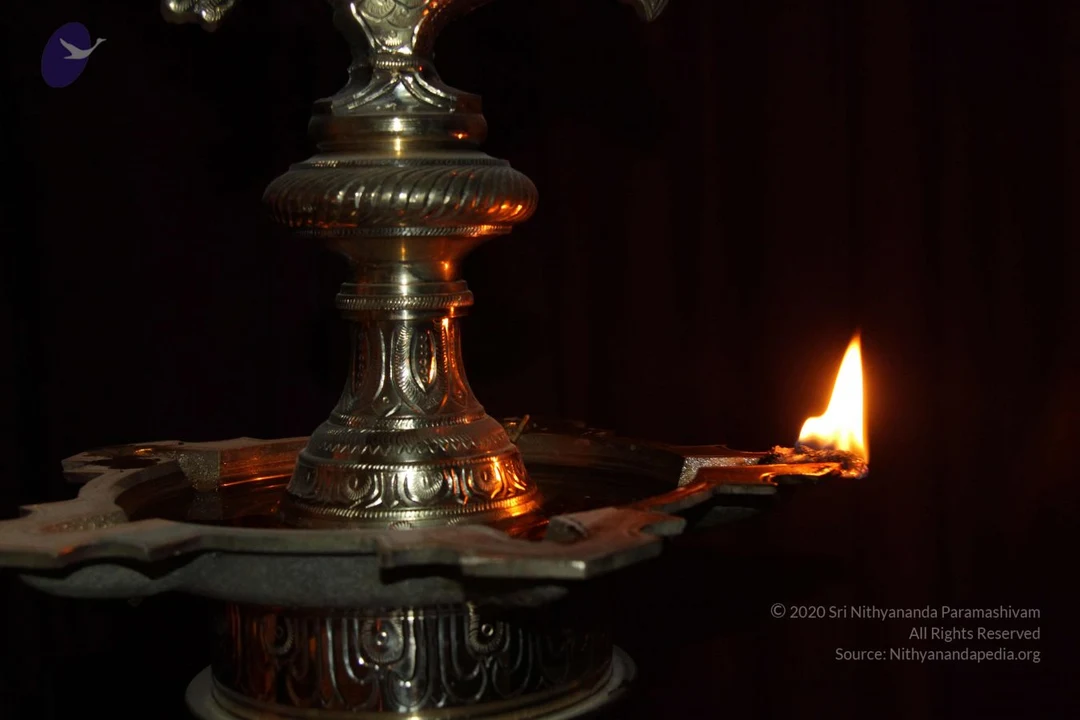
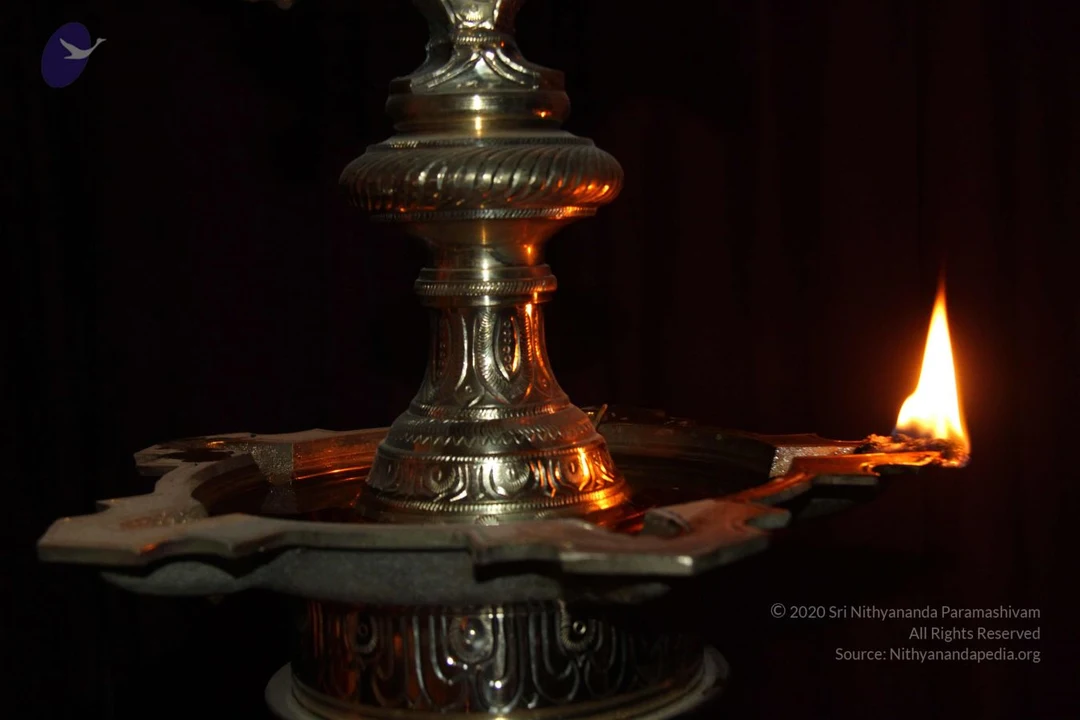
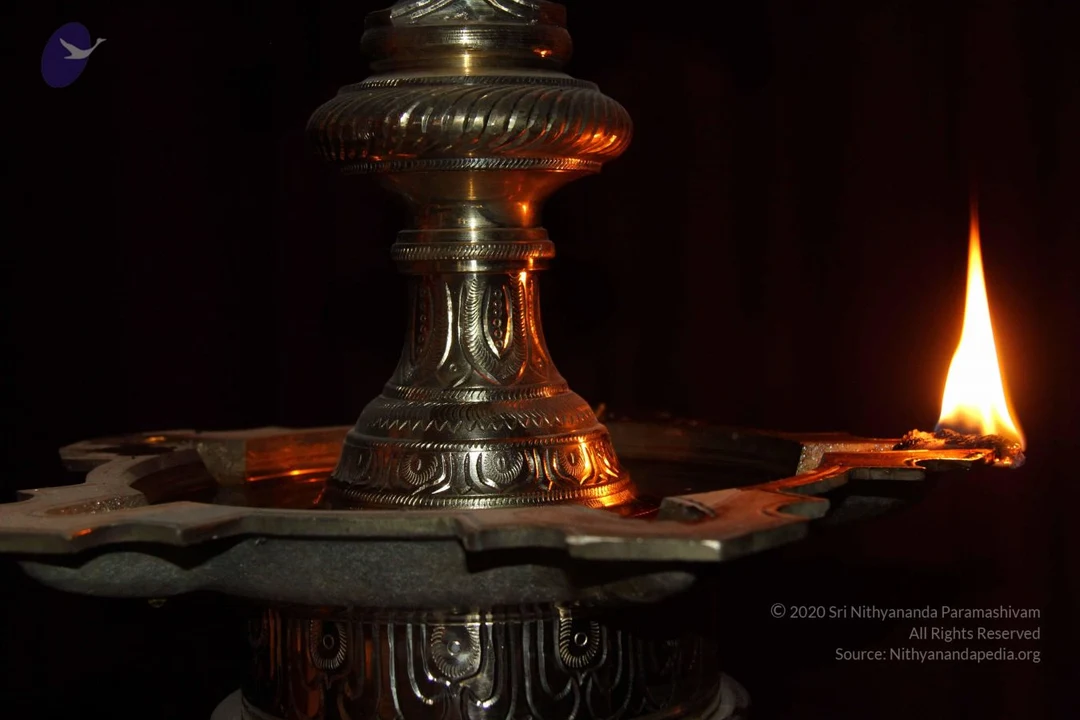
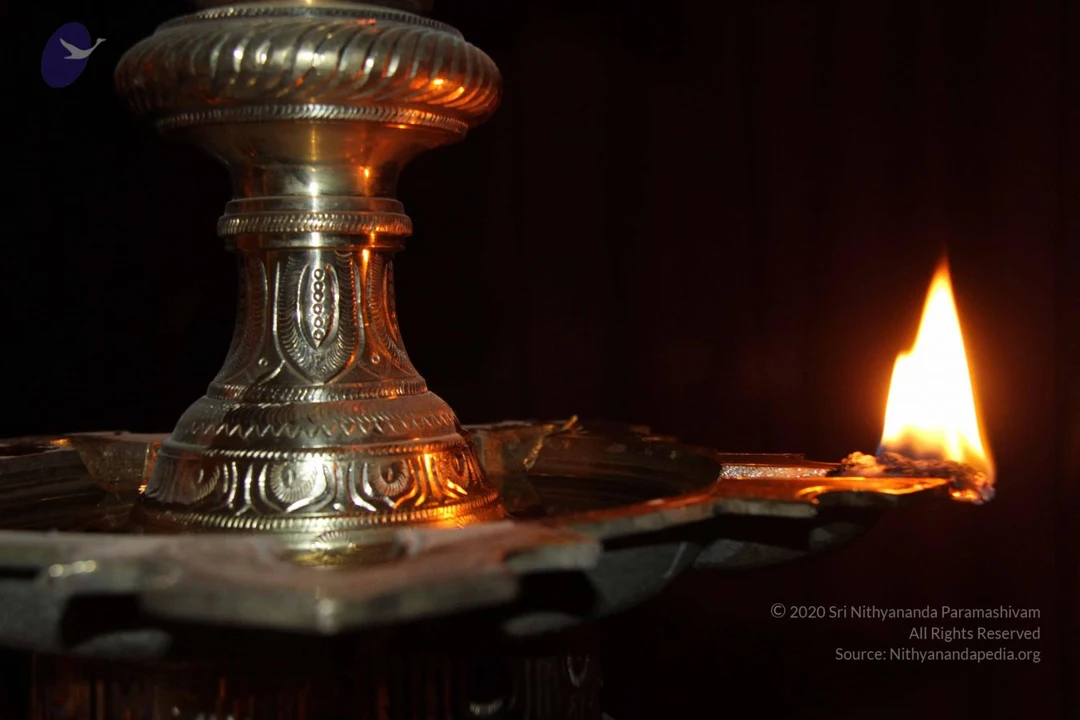
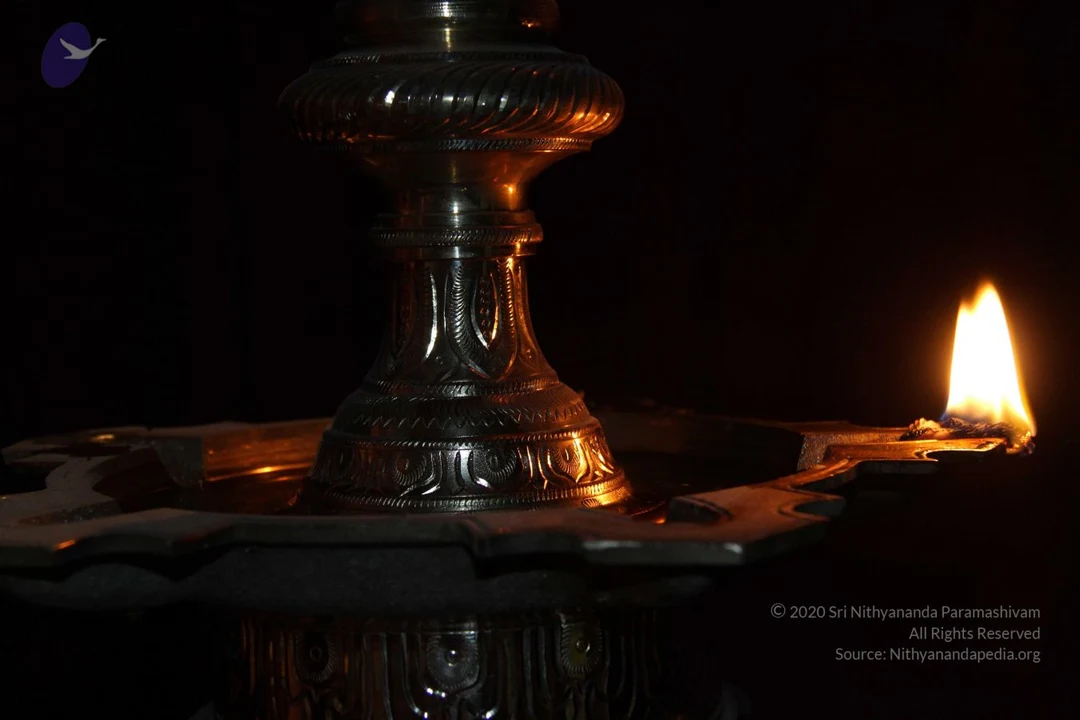
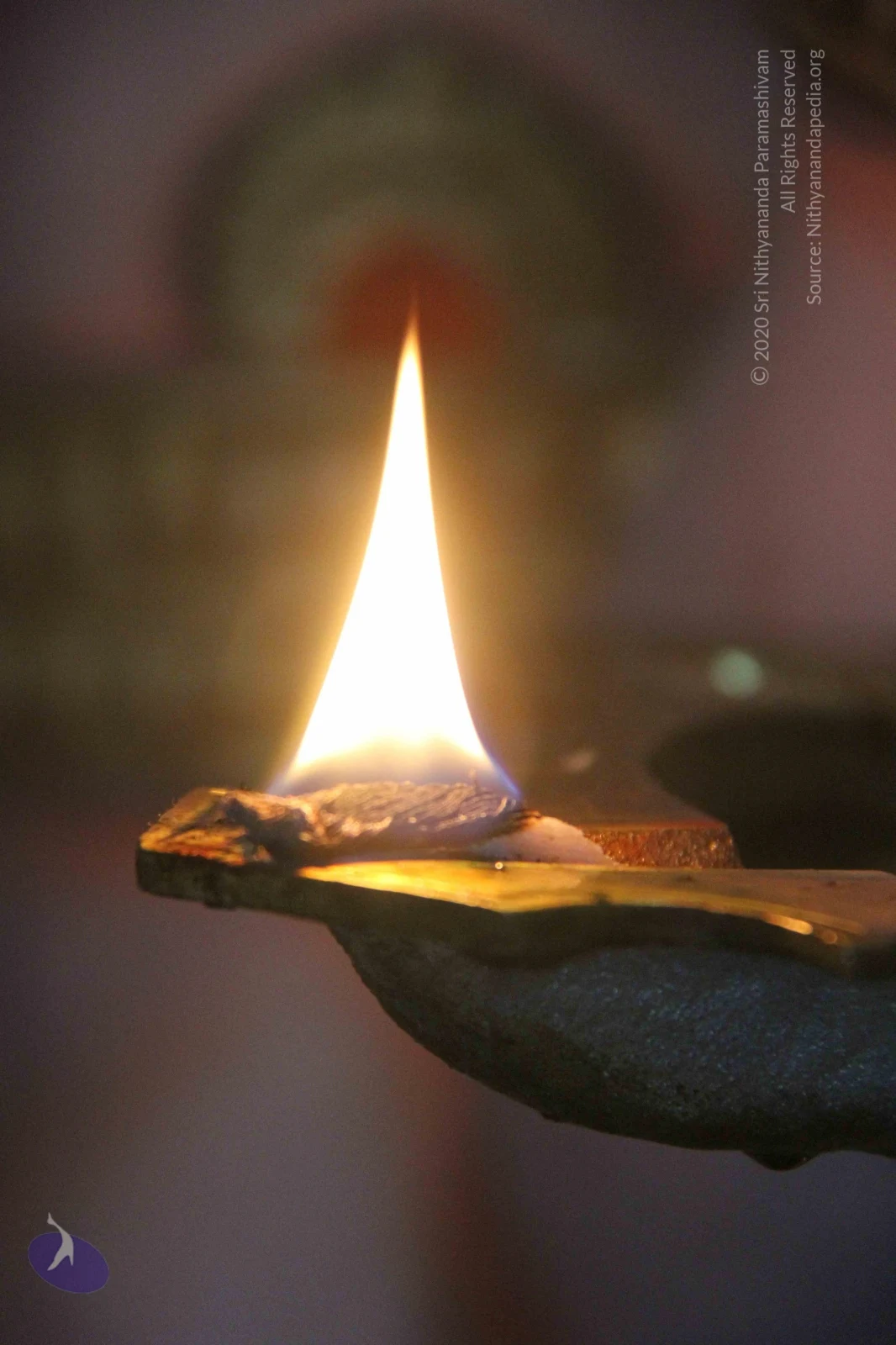
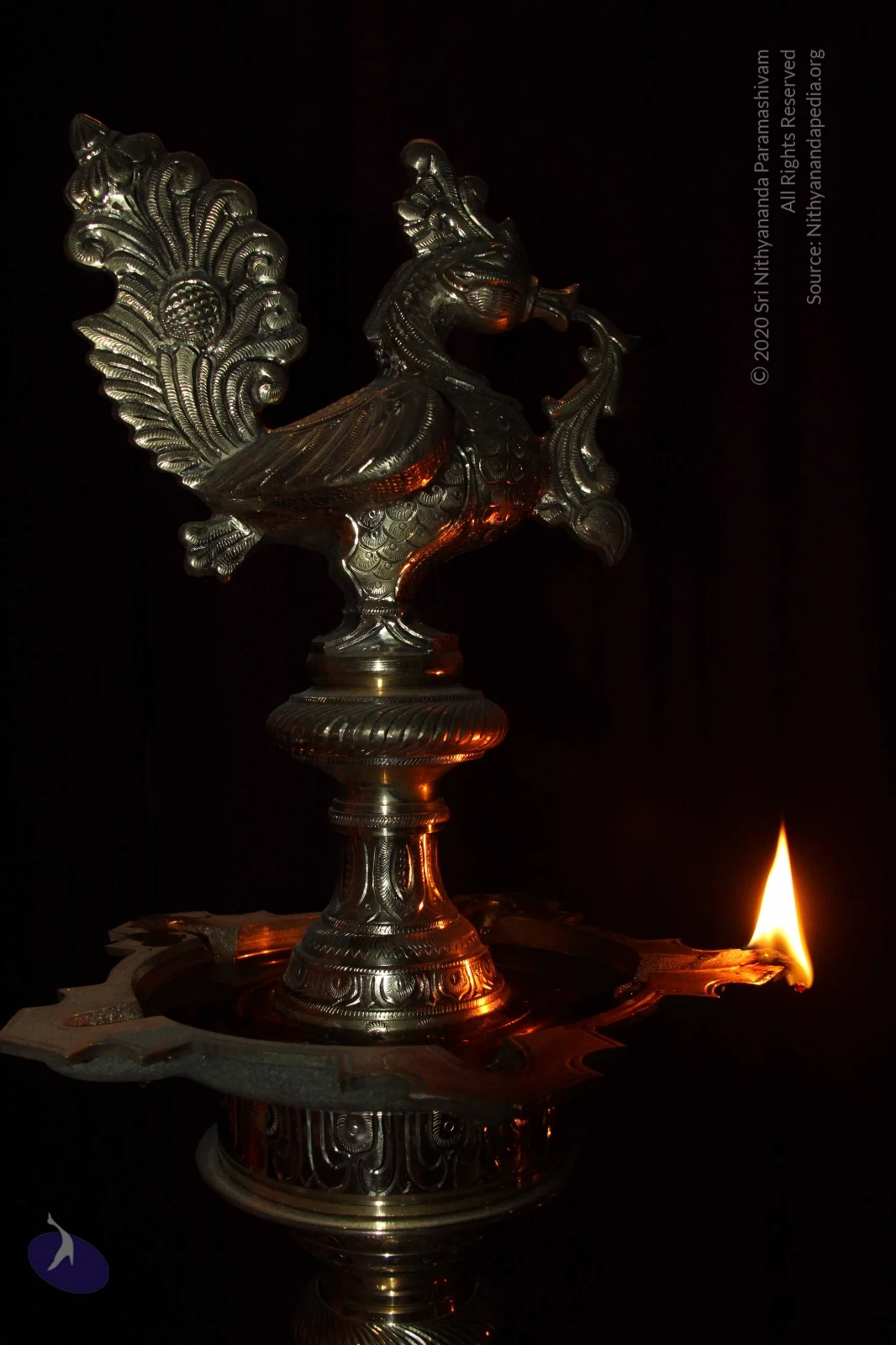
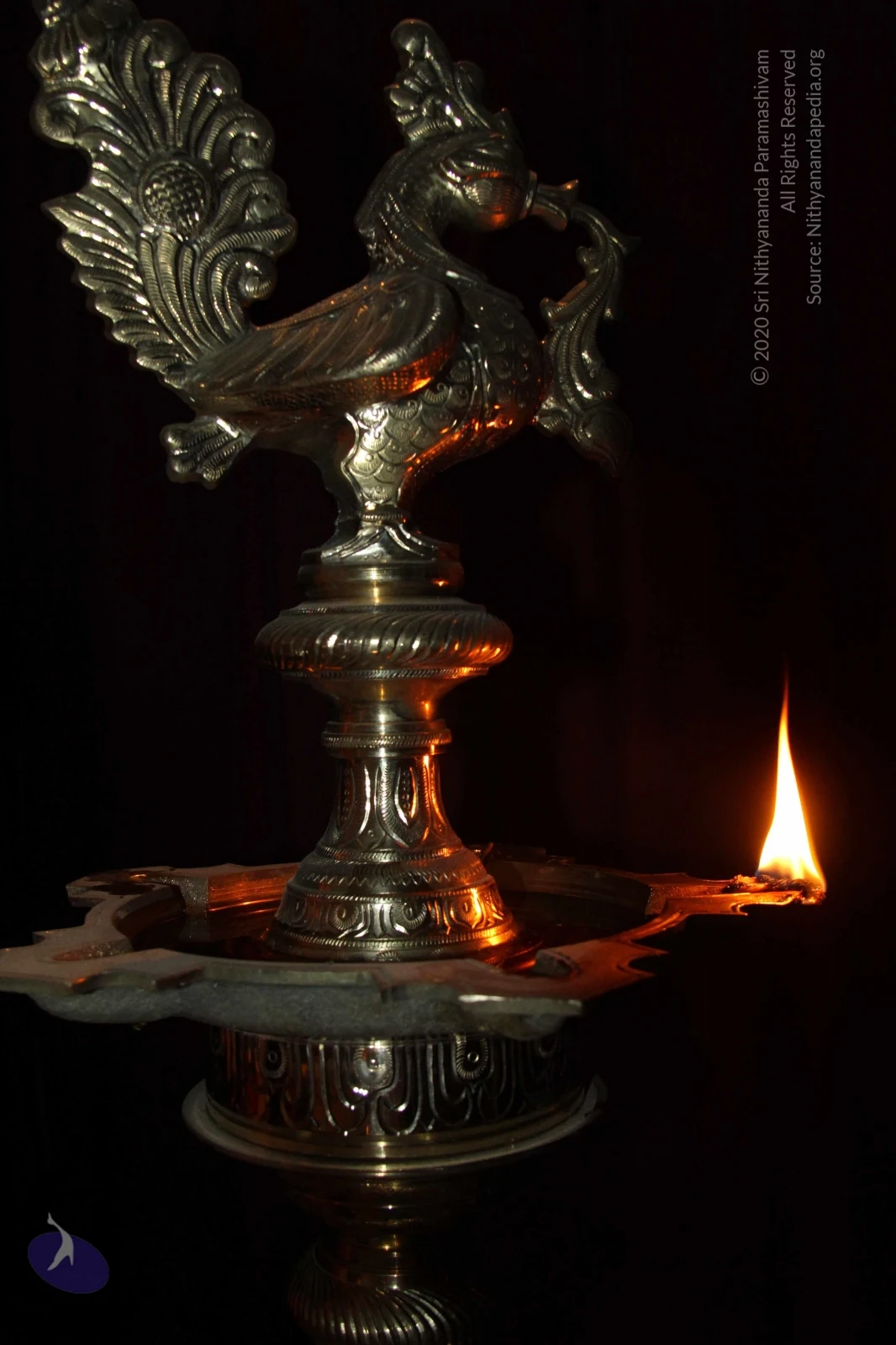
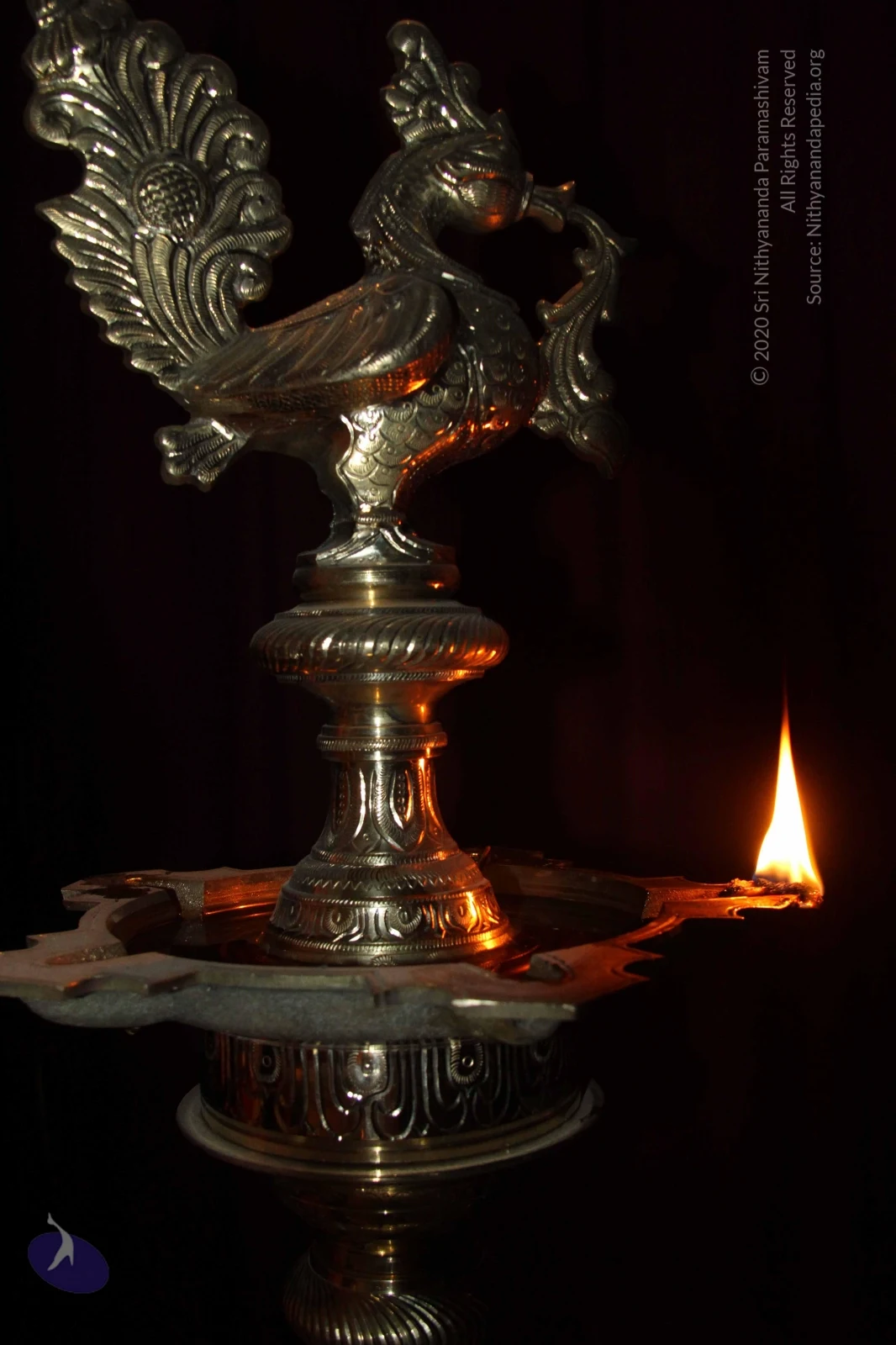
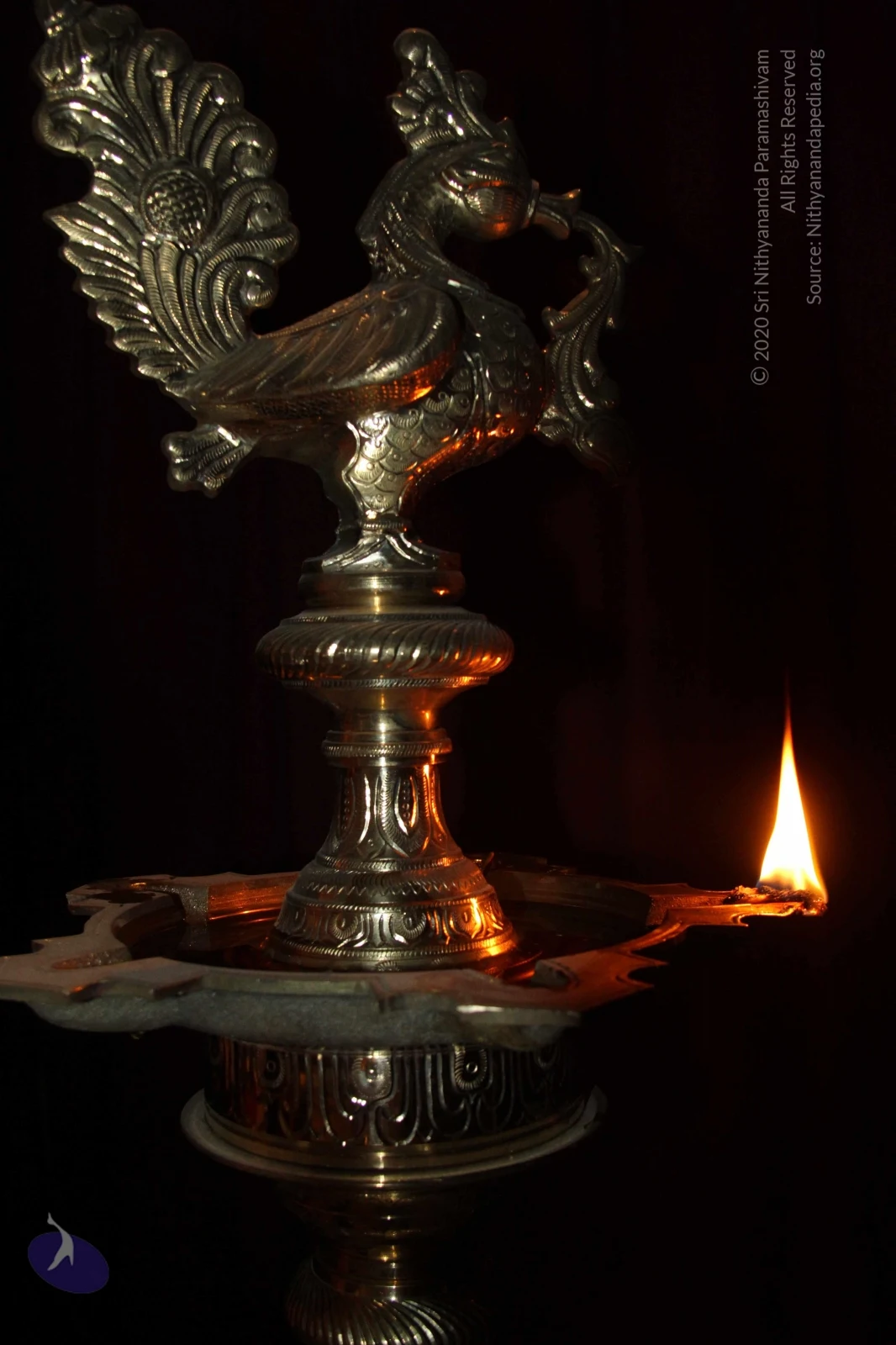
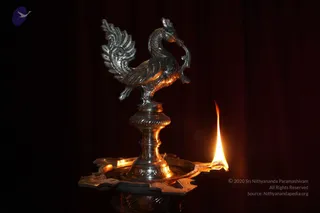
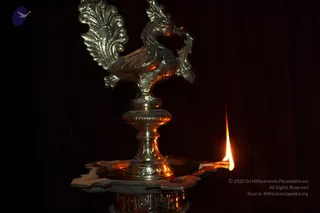
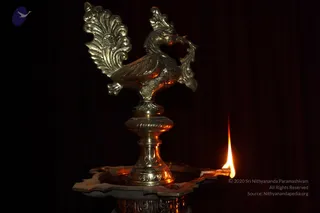
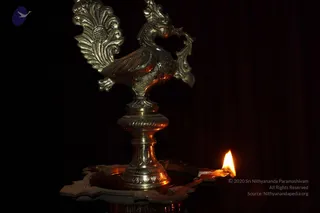
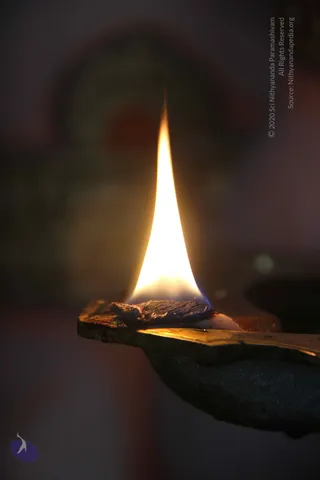
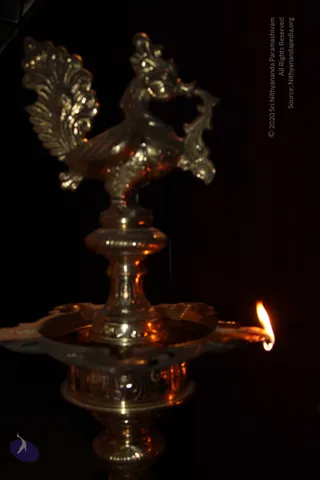
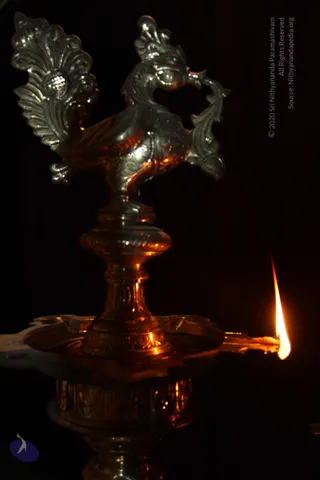
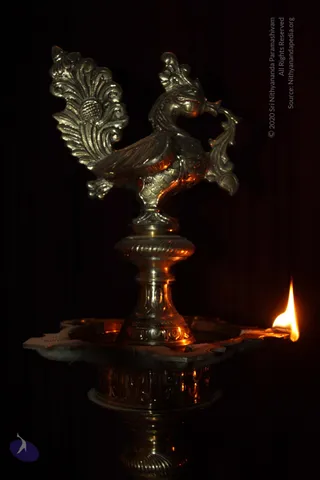
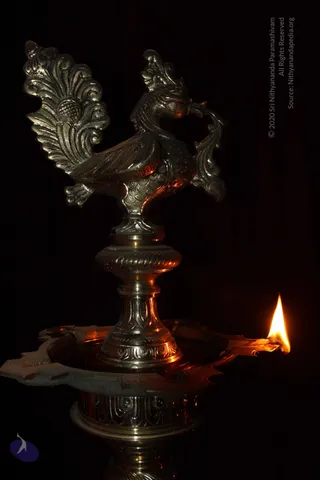
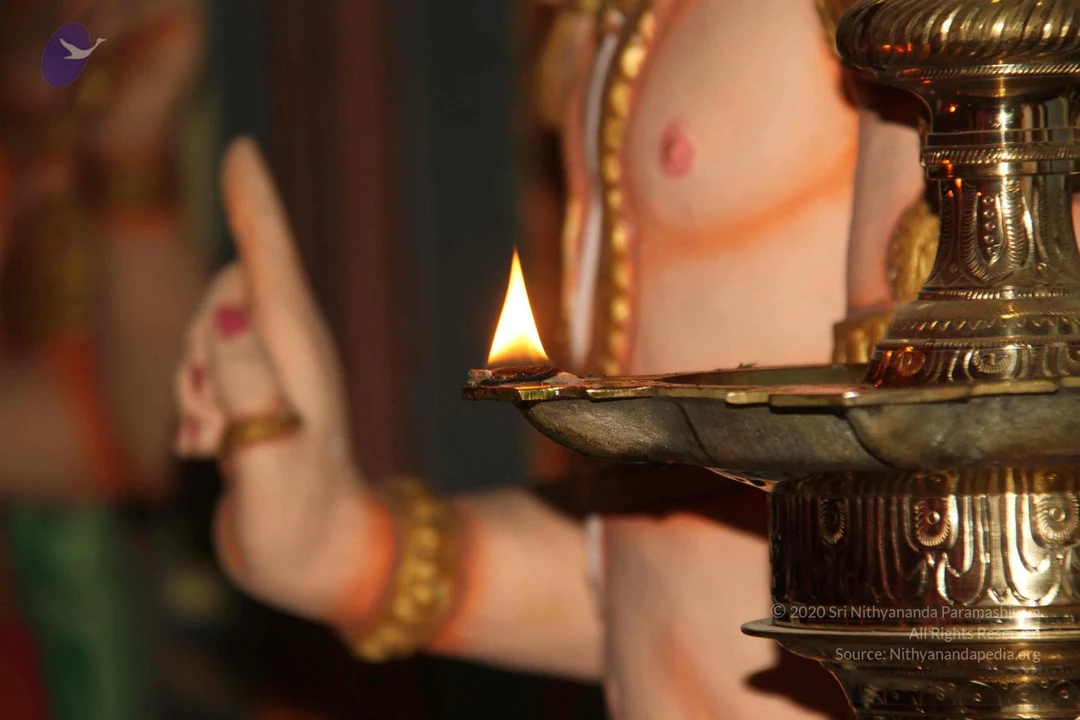
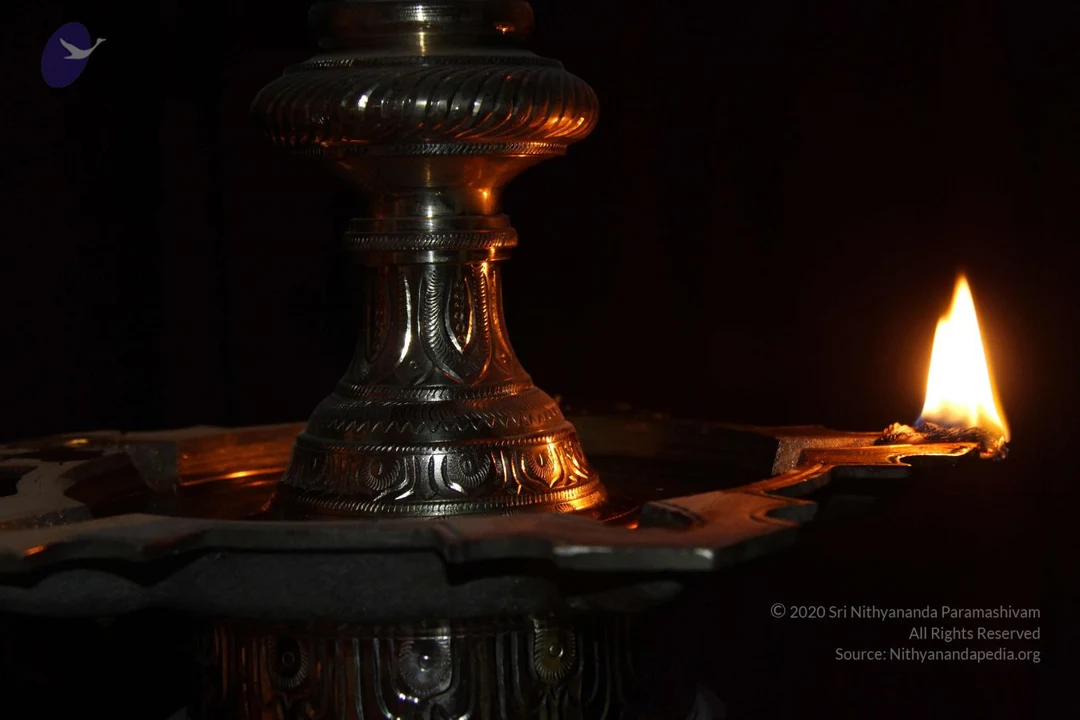
Close-up photo of a lit oil lamp on an ornate brass stand in the foreground, its flame bright against a blurred background. Behind it, a painted statue of a deity with pale skin, reddish-orange markings, gold armbands and a gold-edged garment is visible; one raised hand bears a gold ring and red tint. No physical people are visible, only the statue and the lamp.Close-up photograph of a single lit oil lamp flame on a dark metal tray in the foreground, with a blurred ornate brass or silver lamp stand with repoussé floral and scroll patterns behind it. No people are visible; the background is dim with soft blue and warm tones.A close-up photograph of a brass oil lamp with a bird-shaped stand. A single flame burns from the open wick on the lamp's shallow dish against a dark maroon curtain background. No people are visible.A lit brass oil lamp, a traditional Hindu deepam, stands against a dark maroon draped background. The lamp has an ornate peacock-shaped top with a raised tail and curved neck, a sculpted baluster stem, and a star-shaped lower dish holding a single bright flame. No people are visible, and the scene is a close-up of the ritual lamp.A photograph of a polished brass oil lamp with a bird-shaped stem, its fanned tail feathers and curled neck forming the ornate top, set on a stepped brass base against a dark curtain backdrop. A single lit flame burns from the lamp's wick at right, casting warm highlights on the metal. No people are visible.Photograph of an ornate brass oil lamp with a peacock-shaped stand, its spread tail feathers and curled neck detailed in relief, set on a fluted base. A single flame burns at the right edge of the lamp's shallow dish against a dark background. Warm highlights catch the metal. No people are visible; the image shows only the lamp, consistent with a devotional or temple setting.

Pratyaksha-Pada-Puja
17 photosSource gallery
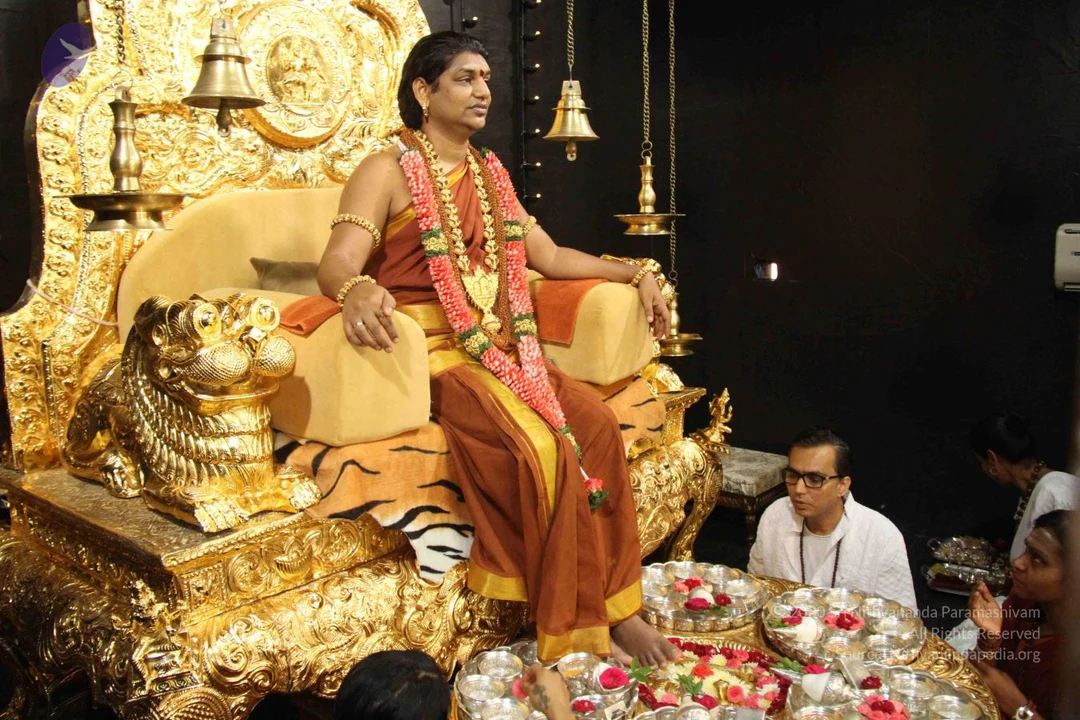
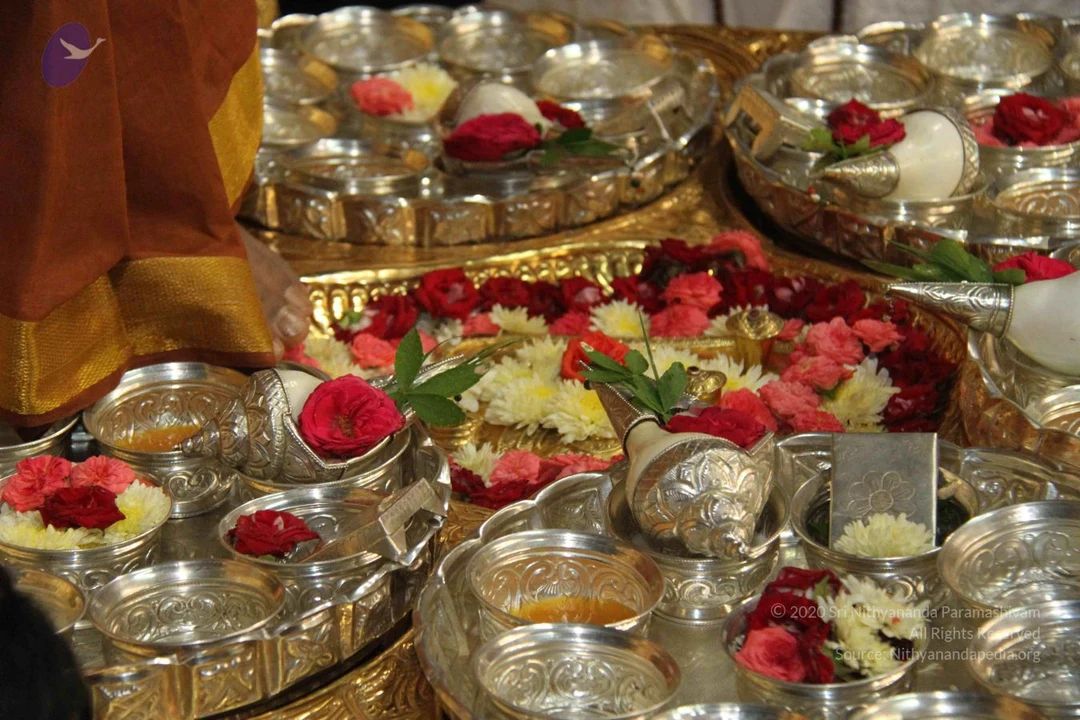
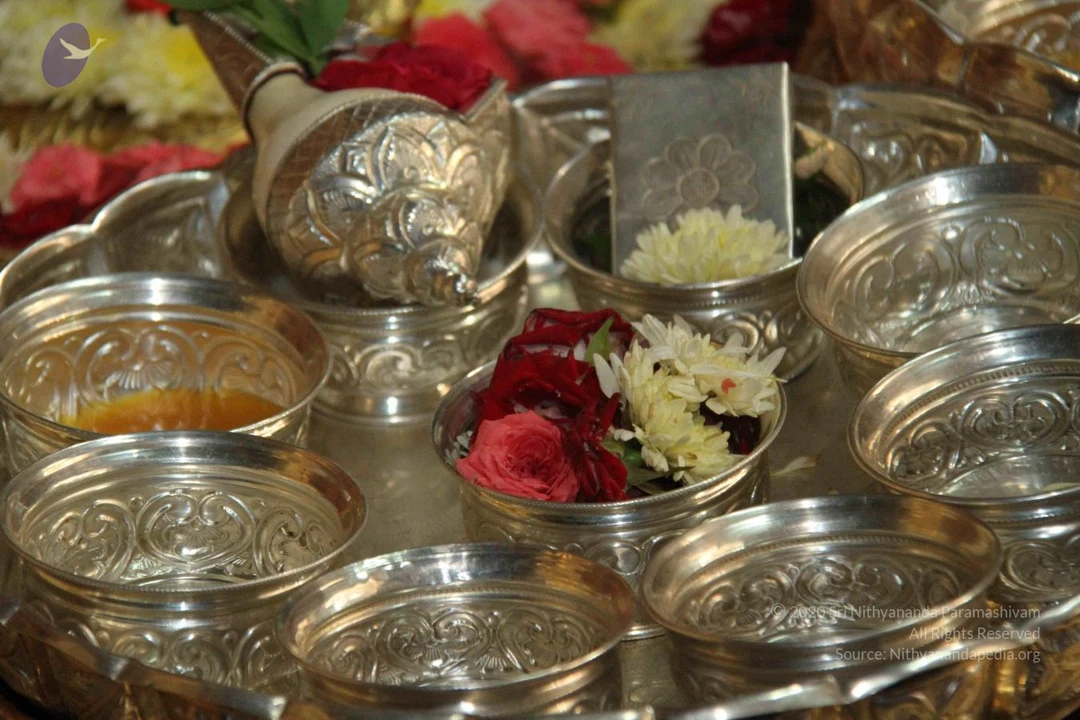
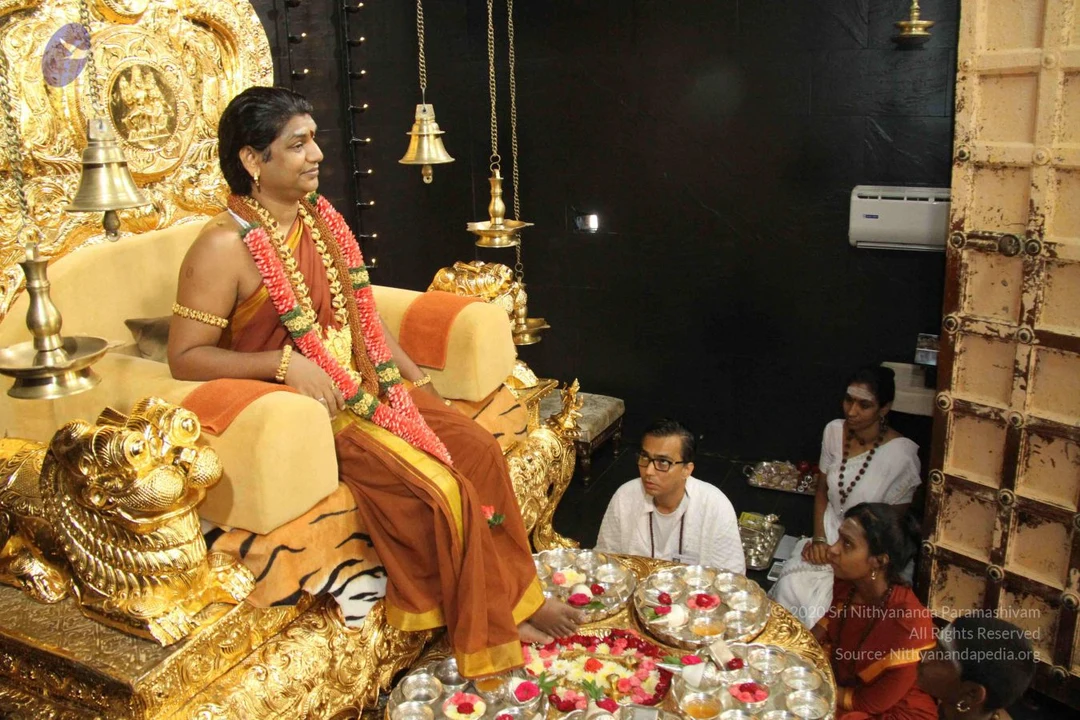
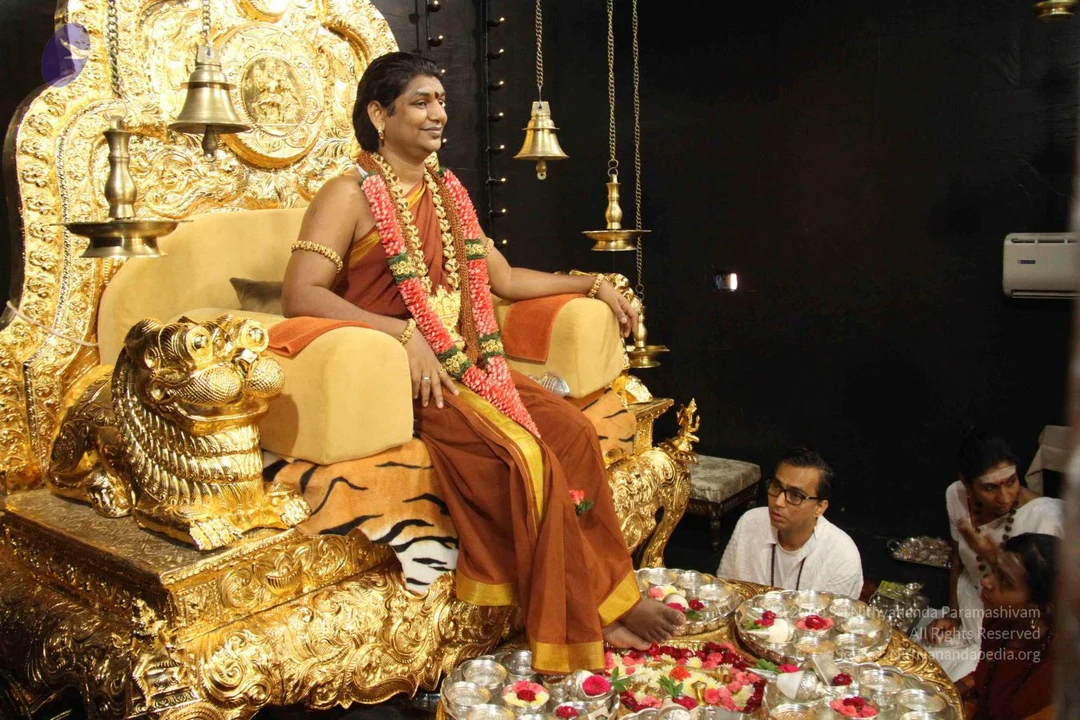
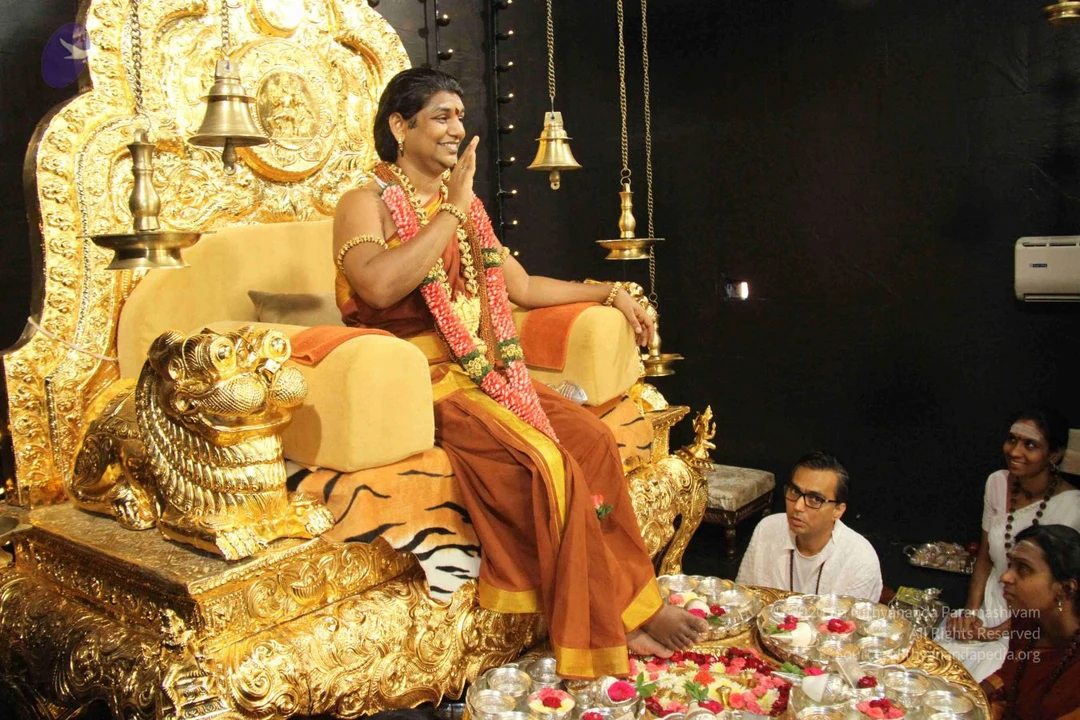
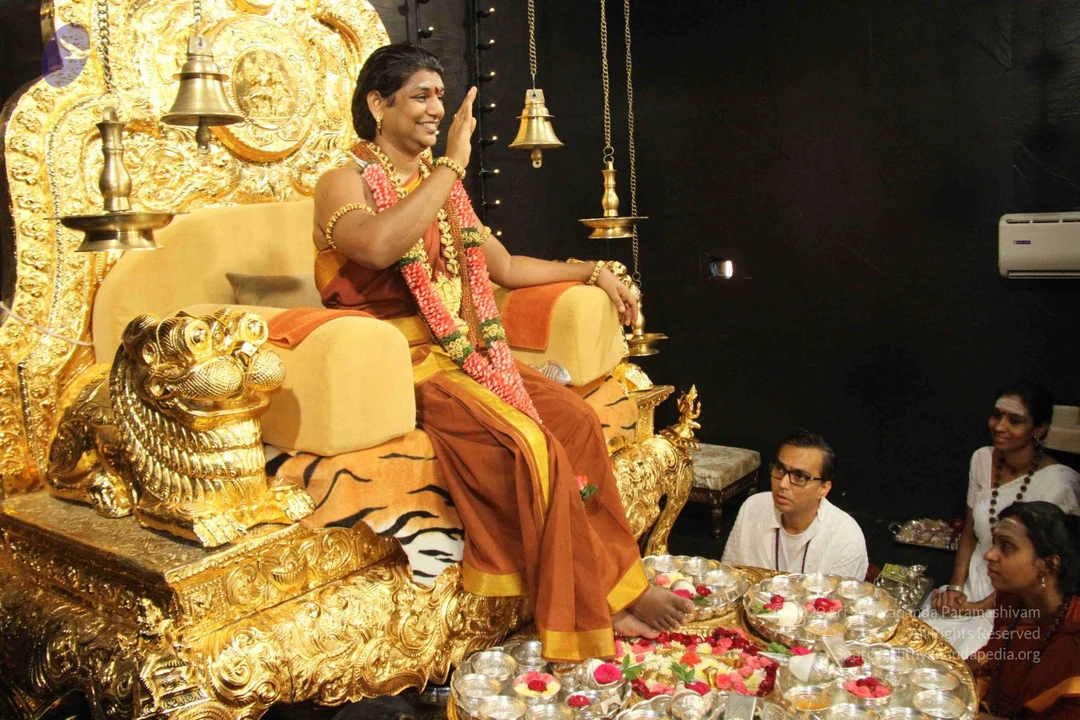
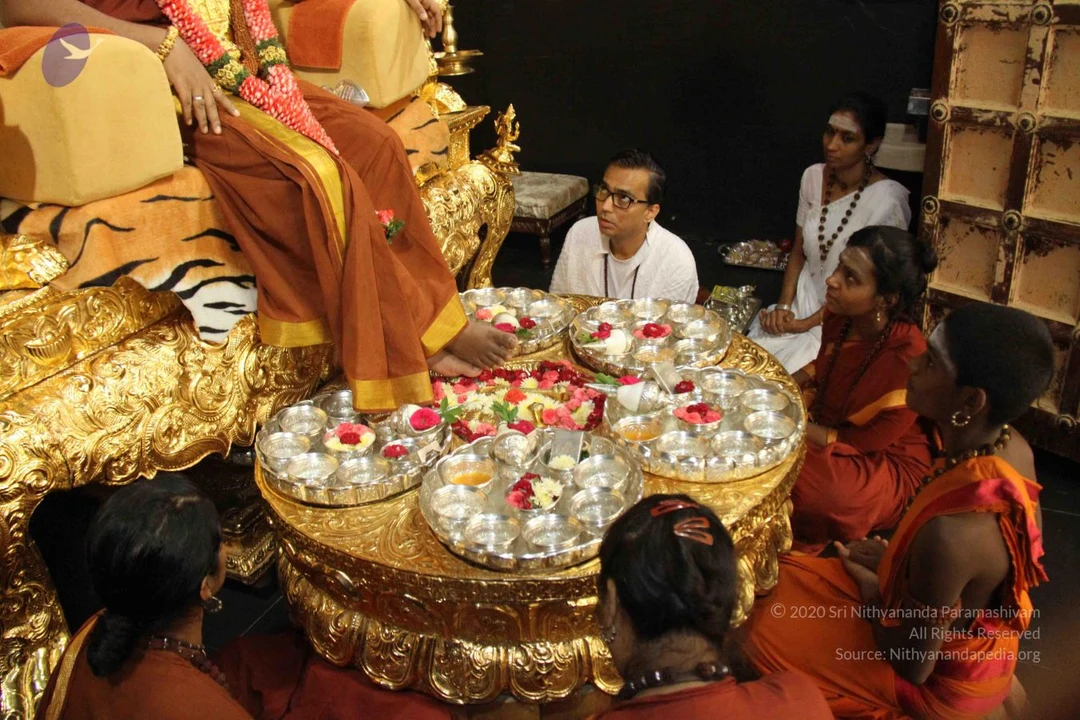
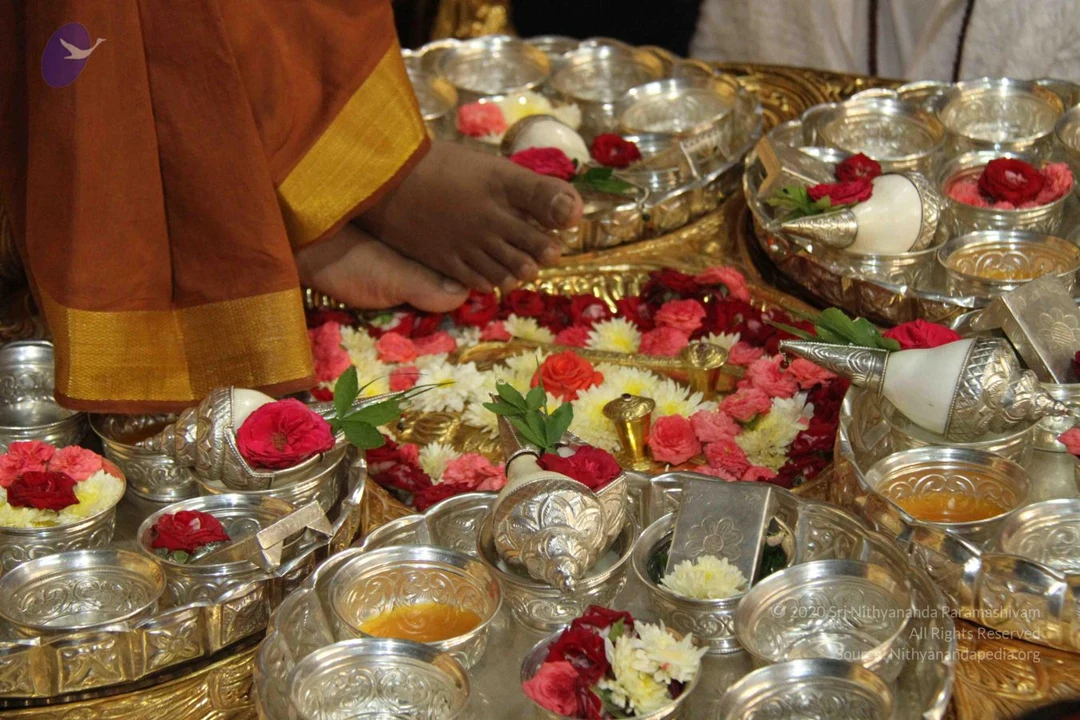
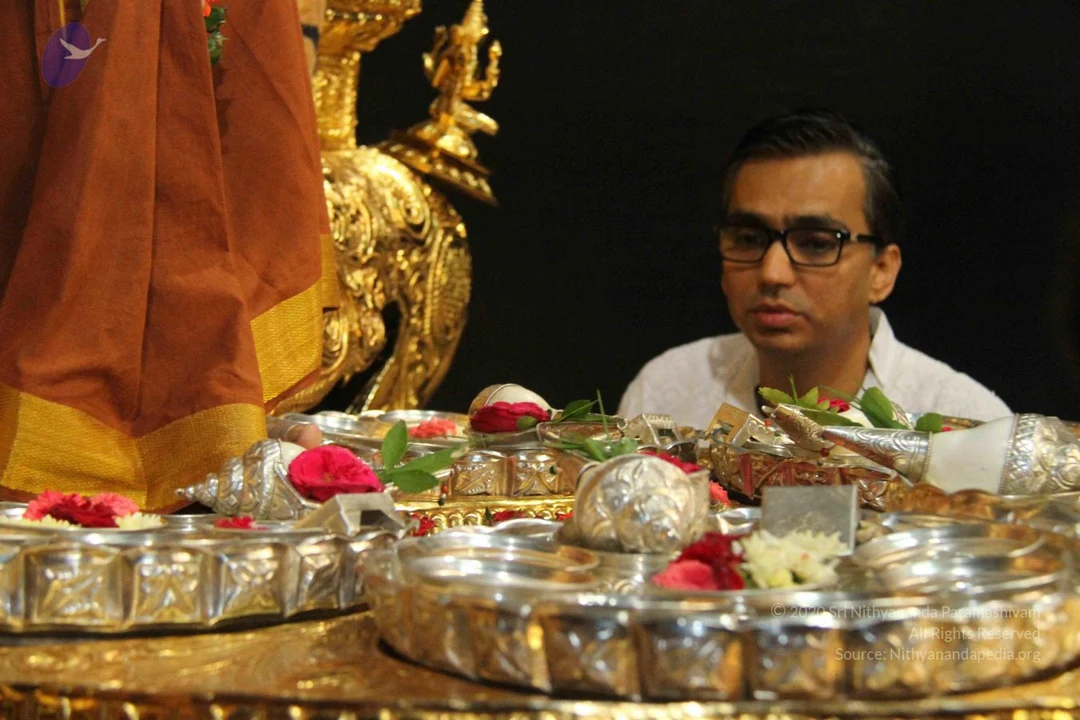
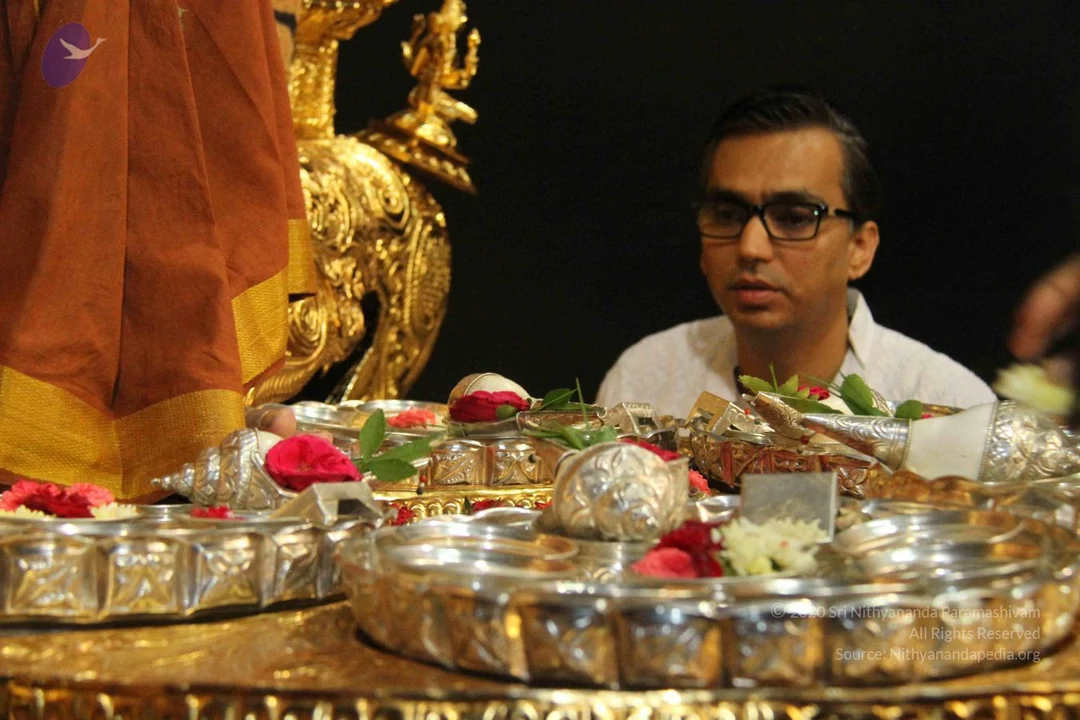
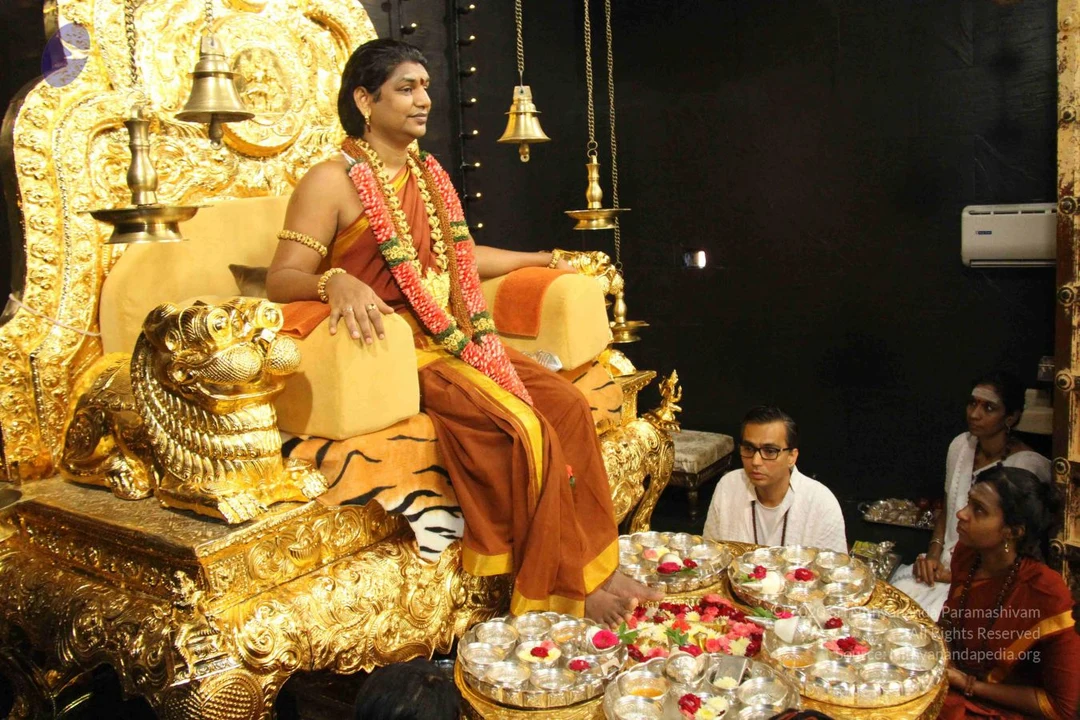
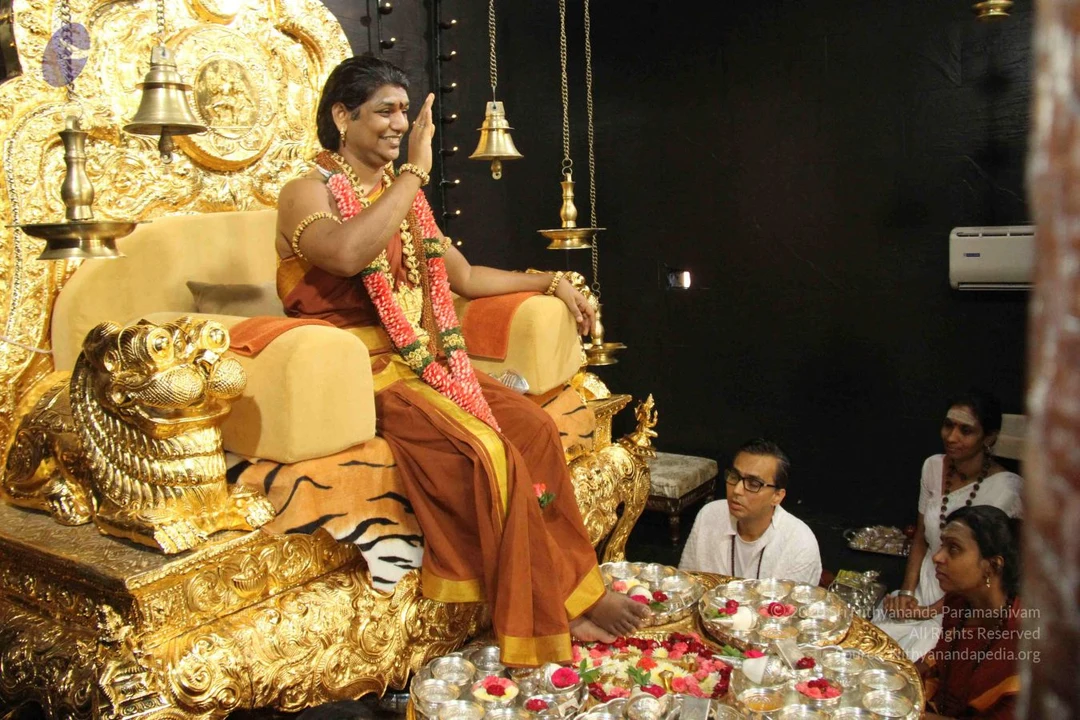
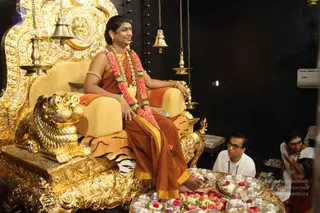
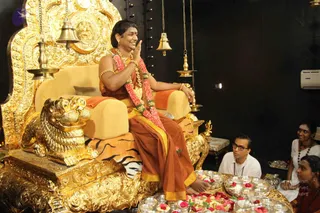
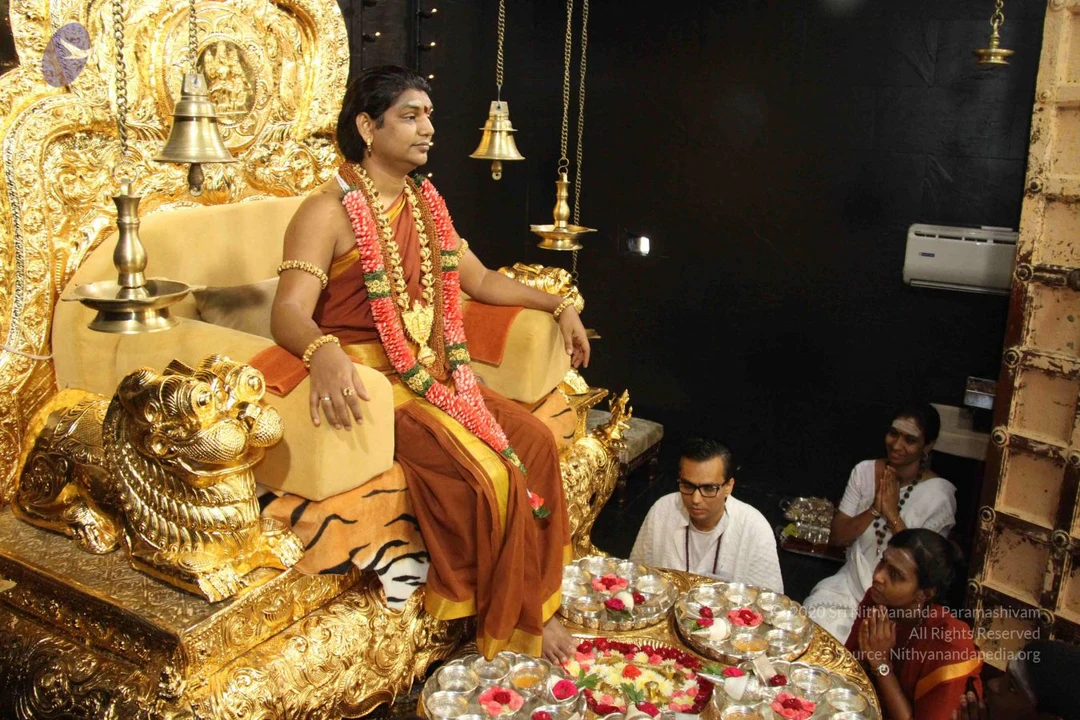
A seated man in a saffron-orange sannyasi robe with a gold-edged yellow border sits on an ornate gold throne carved with a lion head and draped with a tiger-striped cloth. He wears a long red and white flower garland, a gold pendant and gold armbands, and is barefoot. The throne is flanked by hanging brass bells and a brass oil lamp. In front, a silver tray holds small brass bowls of offerings and a floral arrangement of red roses. To the right, a man in white ritual clothes sits with hands folded, and a woman in white with folded hands sits beside another woman in orange. a person: the seated man wears saffron robes, a flower garland, gold ornaments and sits on a golden throne, consistent with a person satsang setting.A seated figure on an ornate gold throne with carved lion-head armrests and a tiger-striped cushion sits in an orange-and-rust garment with a yellow border, wearing a red and white flower garland, gold bangles and a gold necklace. Hanging brass bells and oil lamps are above. In the foreground, a man in white with glasses and two women in white and orange, one with hands folded in namaste, sit behind brass plates of flowers and offerings. Swamiji (probable): the seated figure has long swept-back hair, ornate gold regalia and ceremonial jewellery consistent with a Hindu guru's throne setting. A printed caption reads "Nithyananda Paramashivam " on the imageA photograph of a seated figure on an ornate gold throne carved with lion heads and draped with a tiger-stripe cloth. The seated person wears a rust-orange and saffron dhoti and wrap, a multi-strand pink and green flower garland, a gold necklace and gold bangles, with a red tilak. Probable Swamiji (probable): the person has long dark hair swept back, distinctive ornate gold jewellery and saffron ceremonial clothing, seated in an honoured position. Brass bells and oil lamps hang above. In front, a large gold tray holds many small brass bowls with red flower petals and offerings, and a man in white with a rudraksha mala sits beside it.Close view of silver ritual trays and bowls arranged on a gold-toned tray, filled with red roses, pink and white flowers, green leaves, and small bowls of yellow liquid. A white conch-shaped vessel with silver fittings rests among the flowers, and an orange-and-gold garment edge is visible at the left. The arrangement suggests puja offerings prepared for worship. No people are clearly visible apart from a partial hand and garment at the left edge.Close-up photograph of a silver puja tray with ornately engraved silver bowls and a silver pitcher. The bowls hold red roses, white chrysanthemum-type flowers, a golden-yellow liquid, and a small silver plate with a white flower. Fresh red and pink roses and white blossoms lie scattered at the top edge of the frame. No people are visible; the scene shows ritual offerings arranged for worship.A seated man on an ornate gold throne with carved lion-head arms and a tiger-striped cushion wears an orange-and-gold dhoti-style wrap, red and white flower garlands, and a gold armlet. a person is shown, with long swept-back hair and ceremonial gold and garland adornments, looking to his left with bare feet on a gold footrest. Hanging brass bells and a brass lamp hang above. In front, a golden tray holds many small brass bowls, rose petals and an arrangement of food and flowers. A man in white with glasses kneels nearby, and a woman in white with a rudraksha mala sits beside a woman in orange holding a plate. Behind them is a golden-framed wall and a dark backdrop with a wall air conditioner.

Nithya-Satsang

16 photosSource gallery
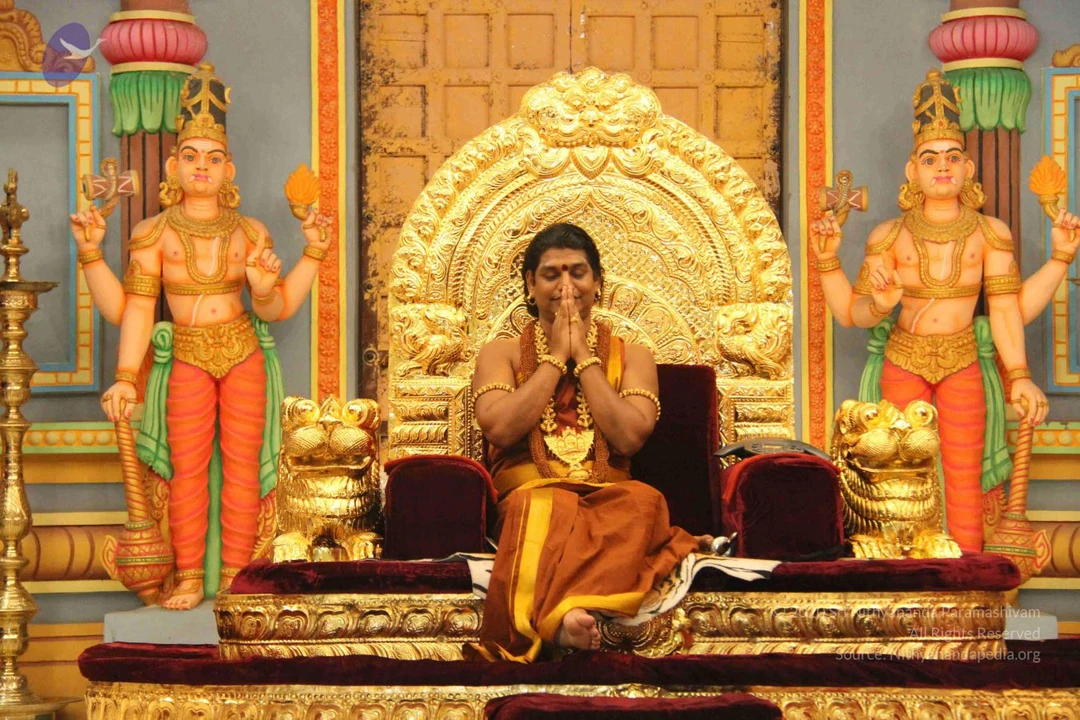
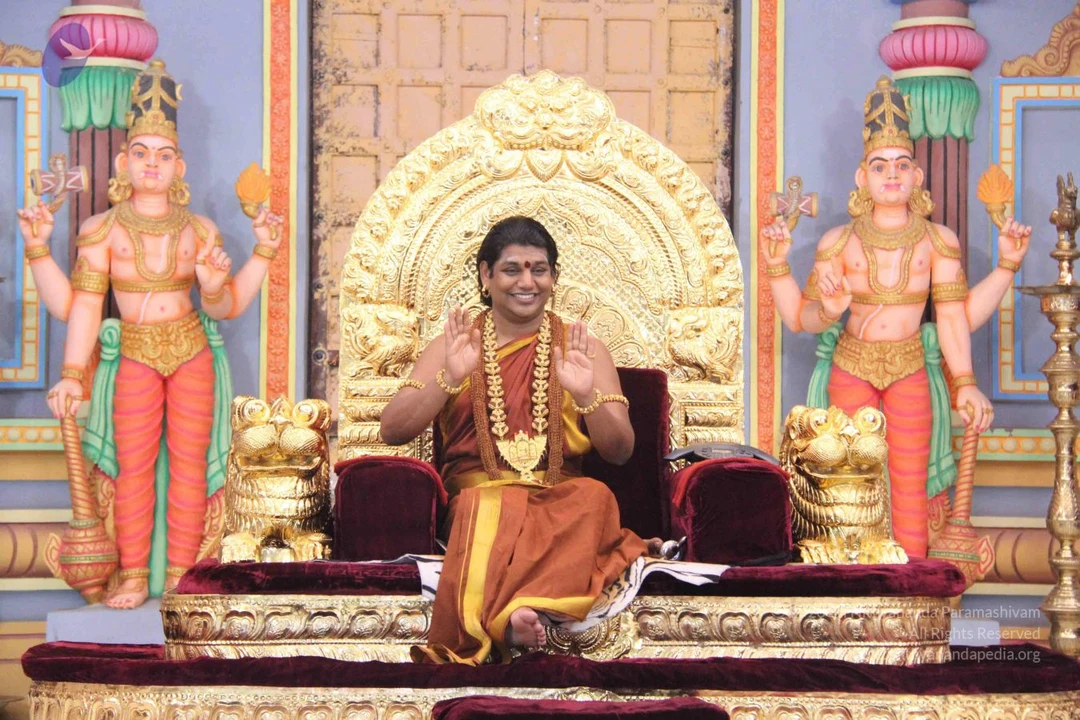
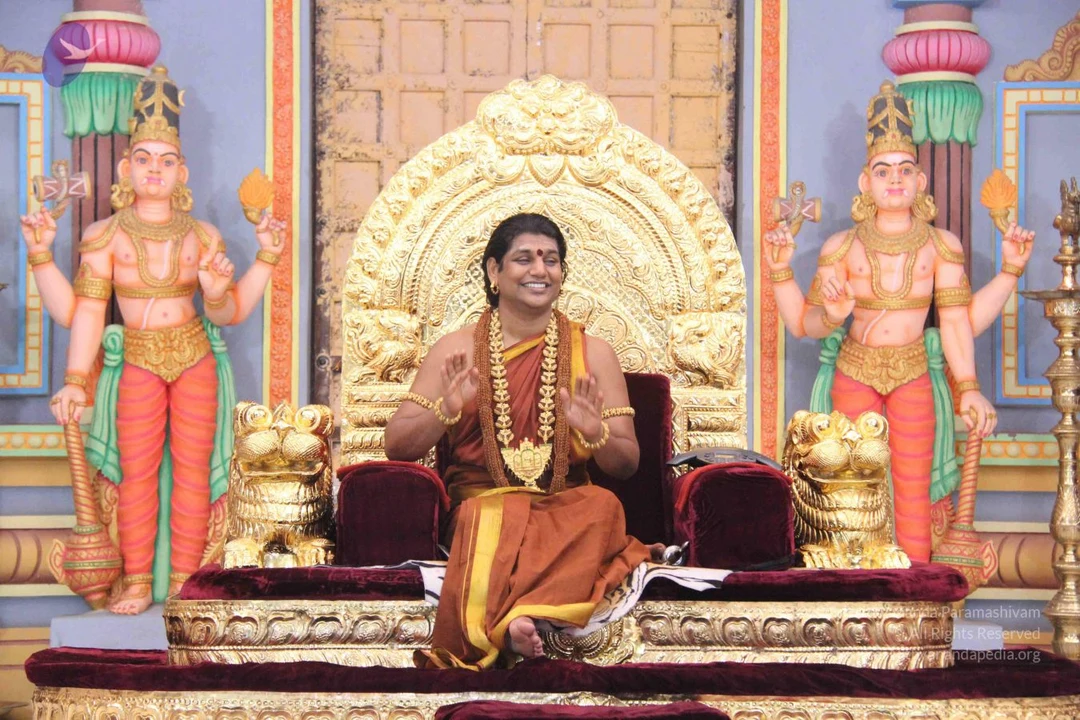
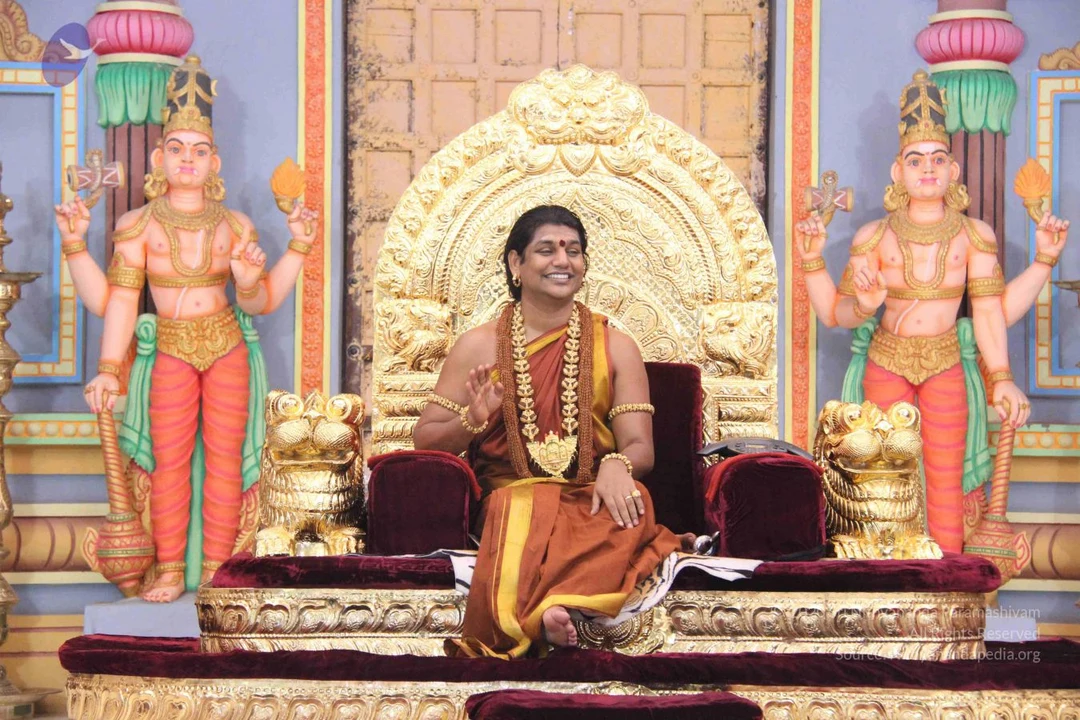
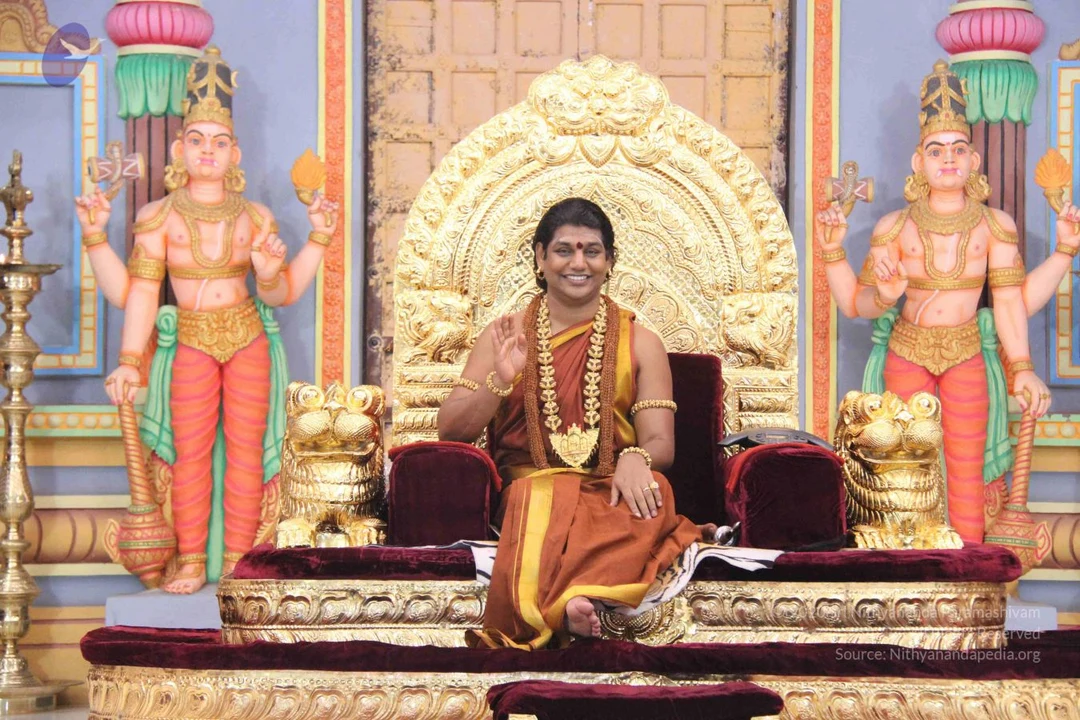
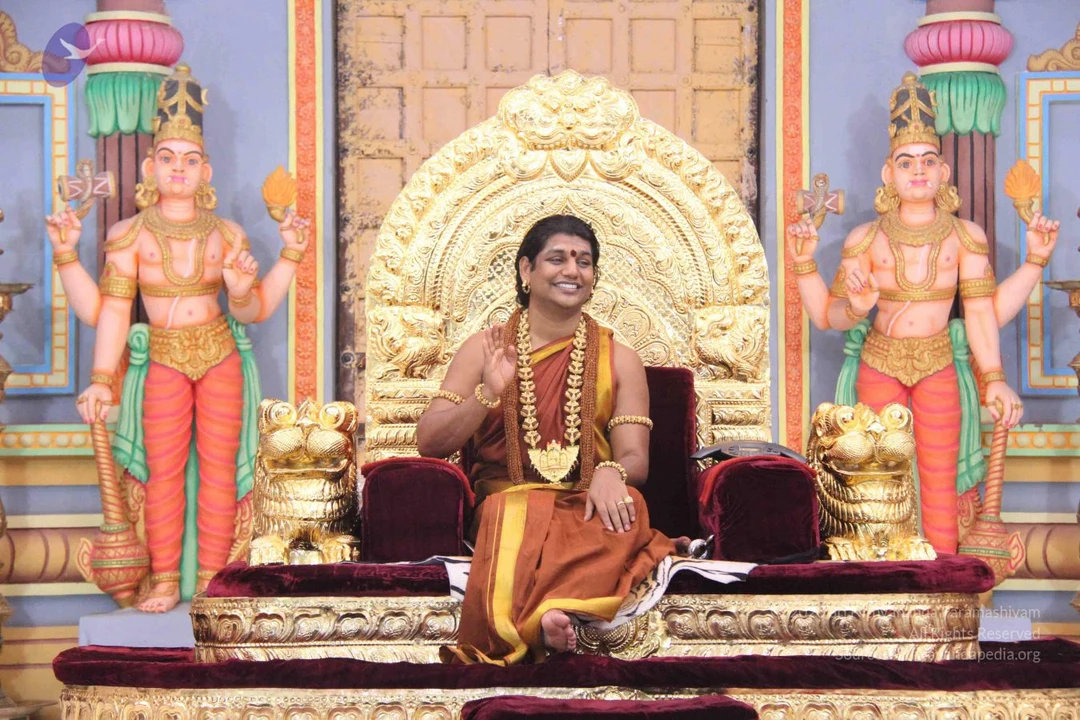
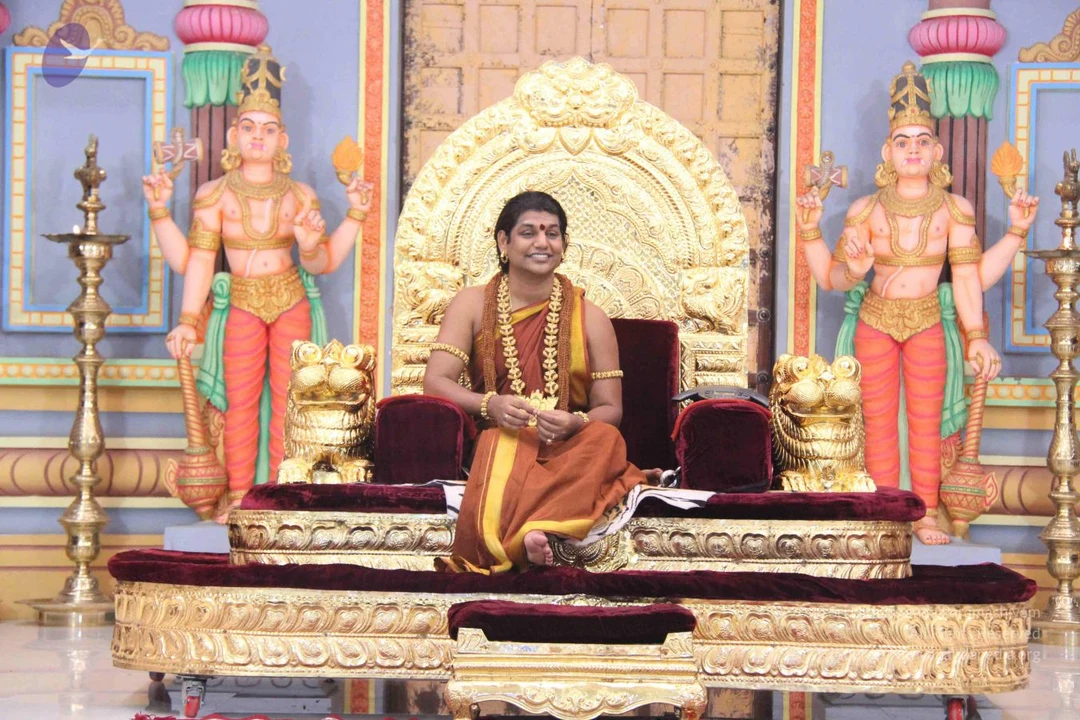
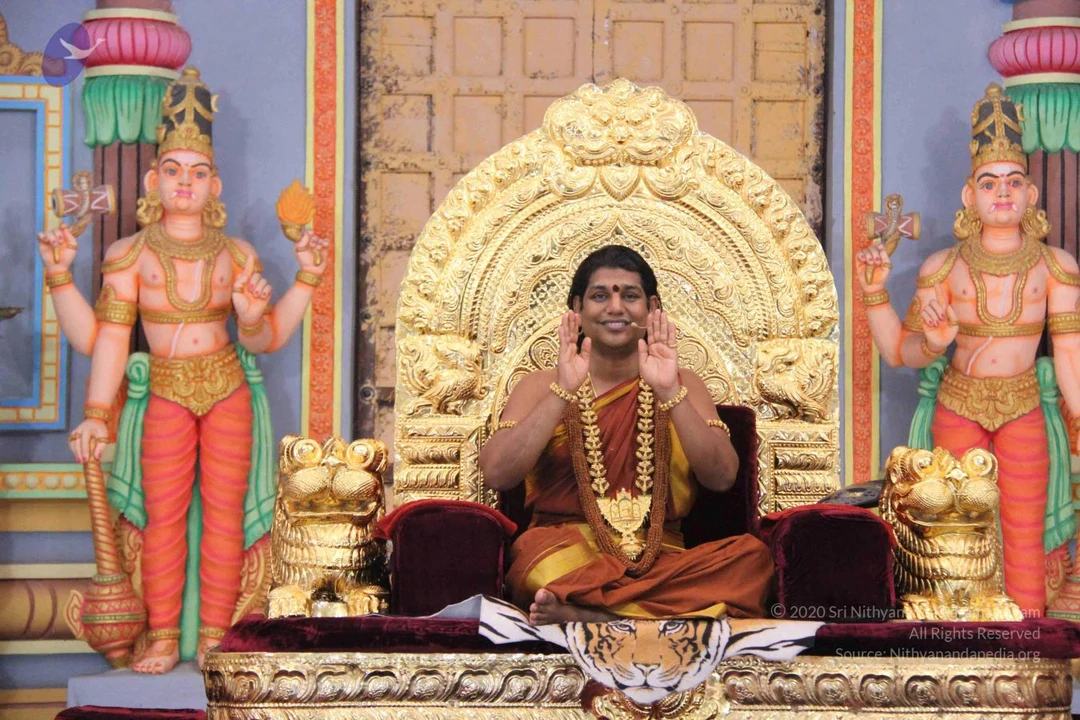
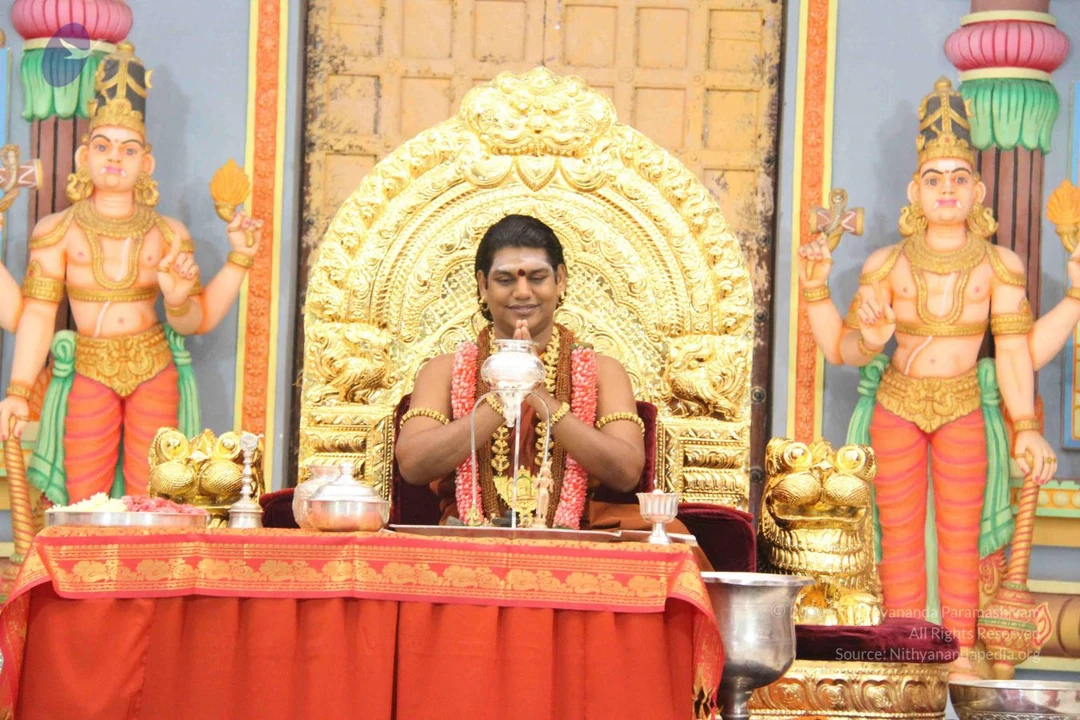
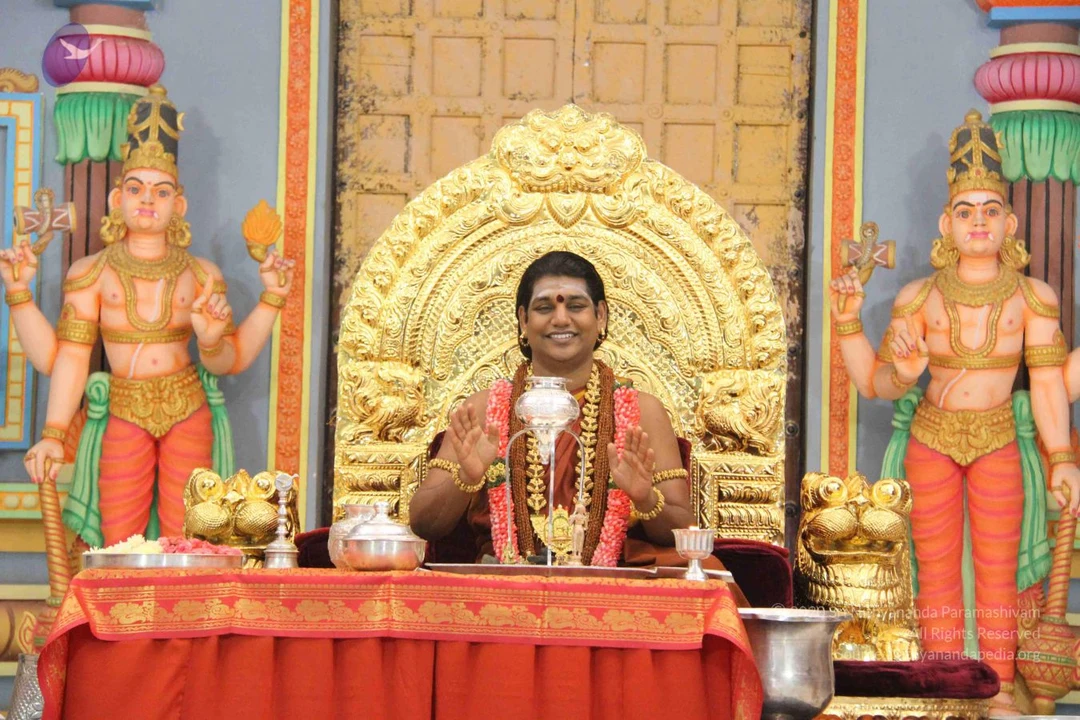
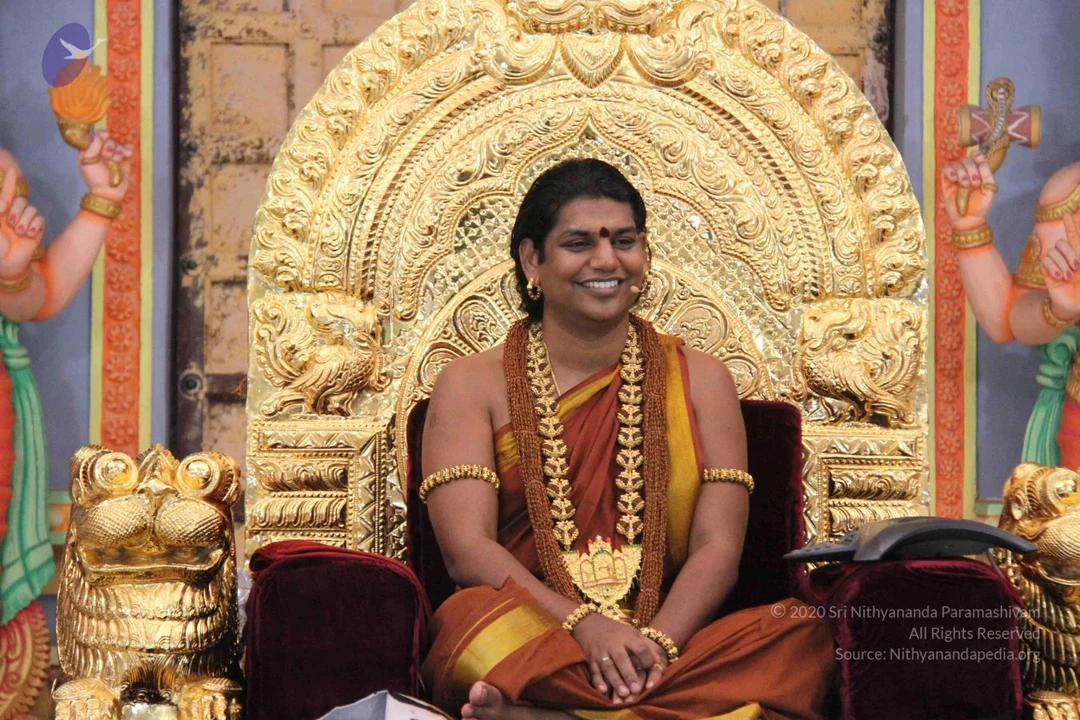
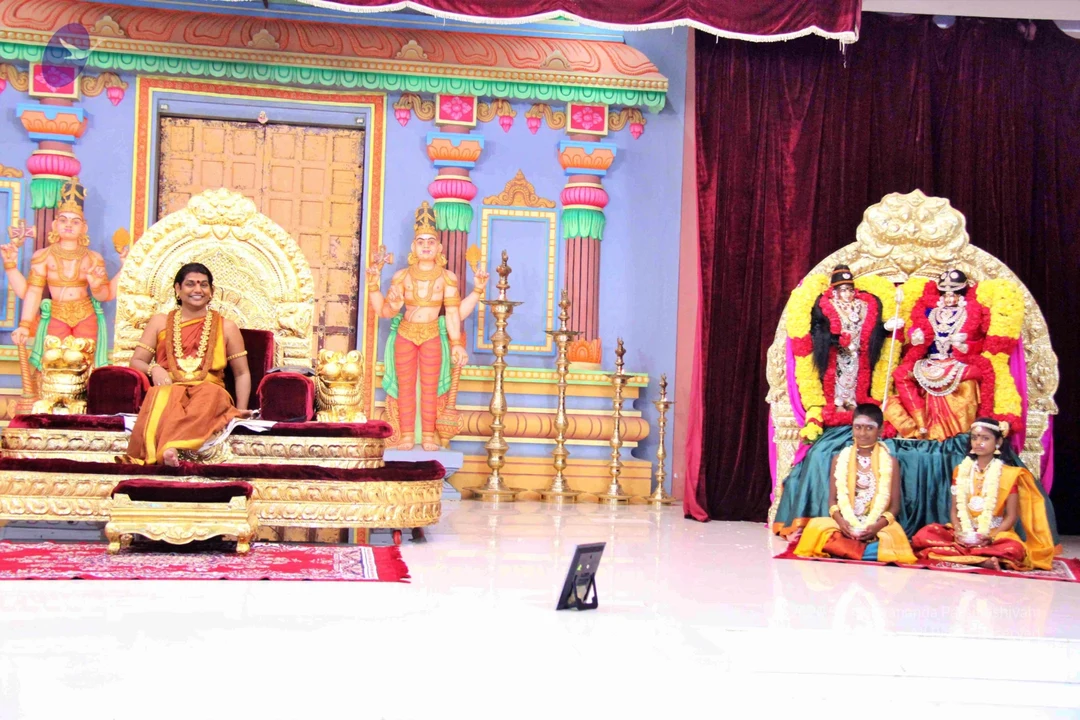
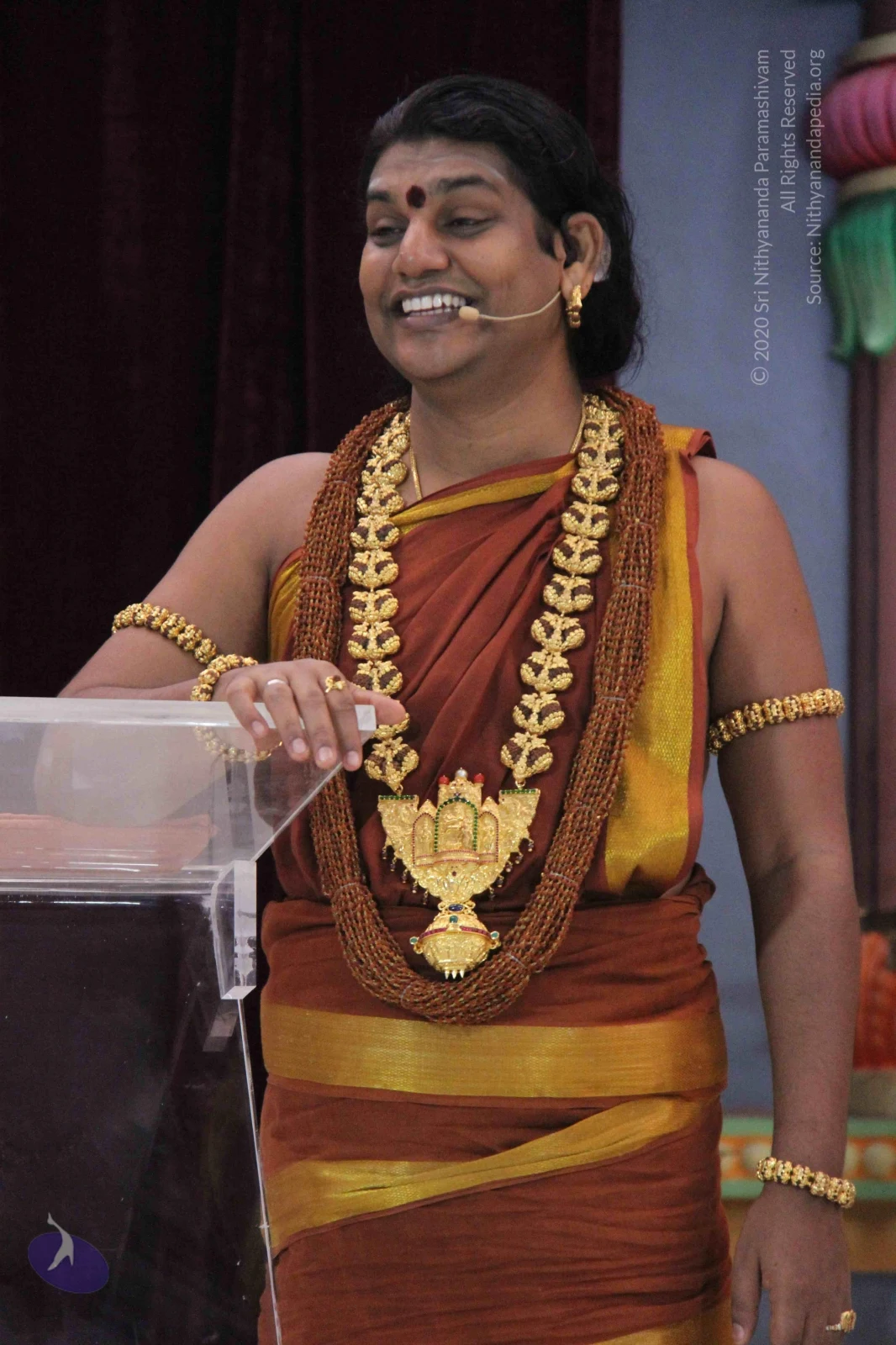
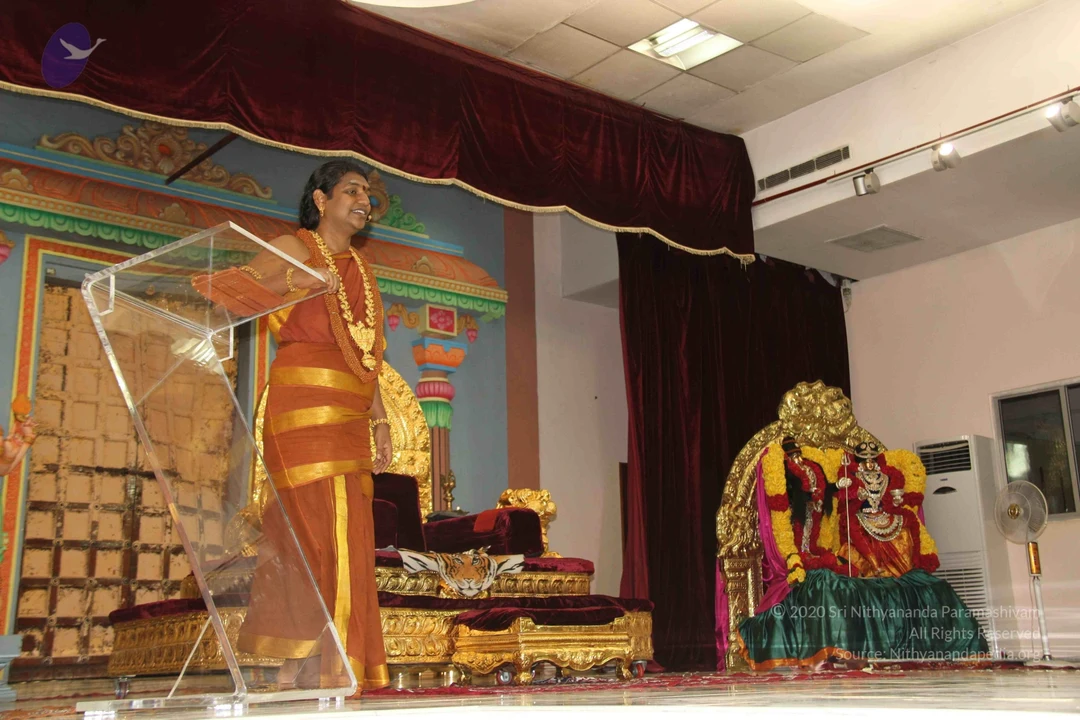
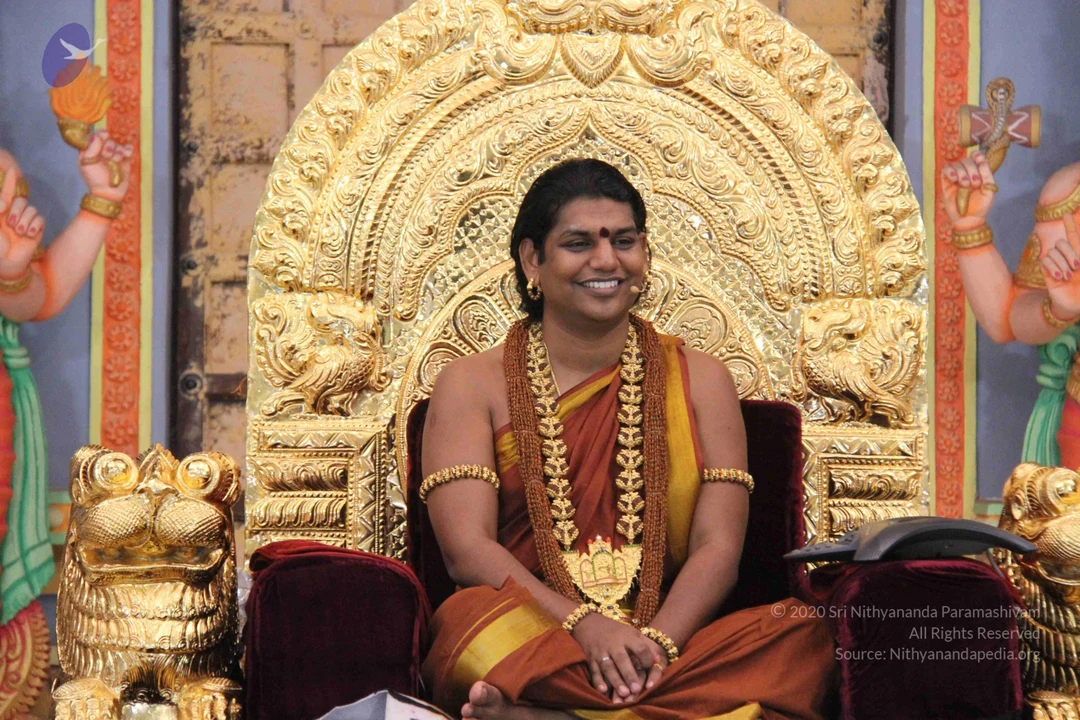
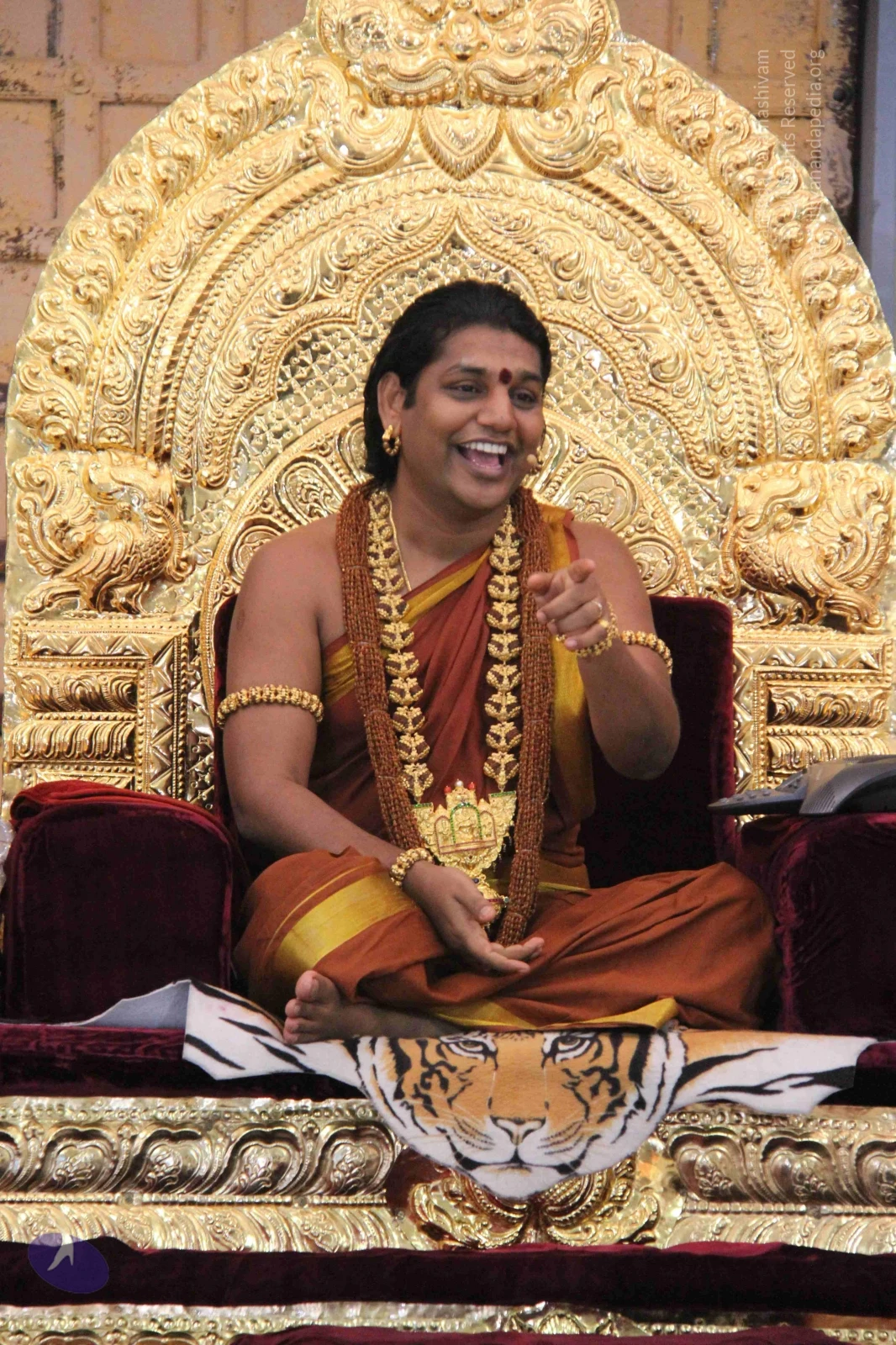
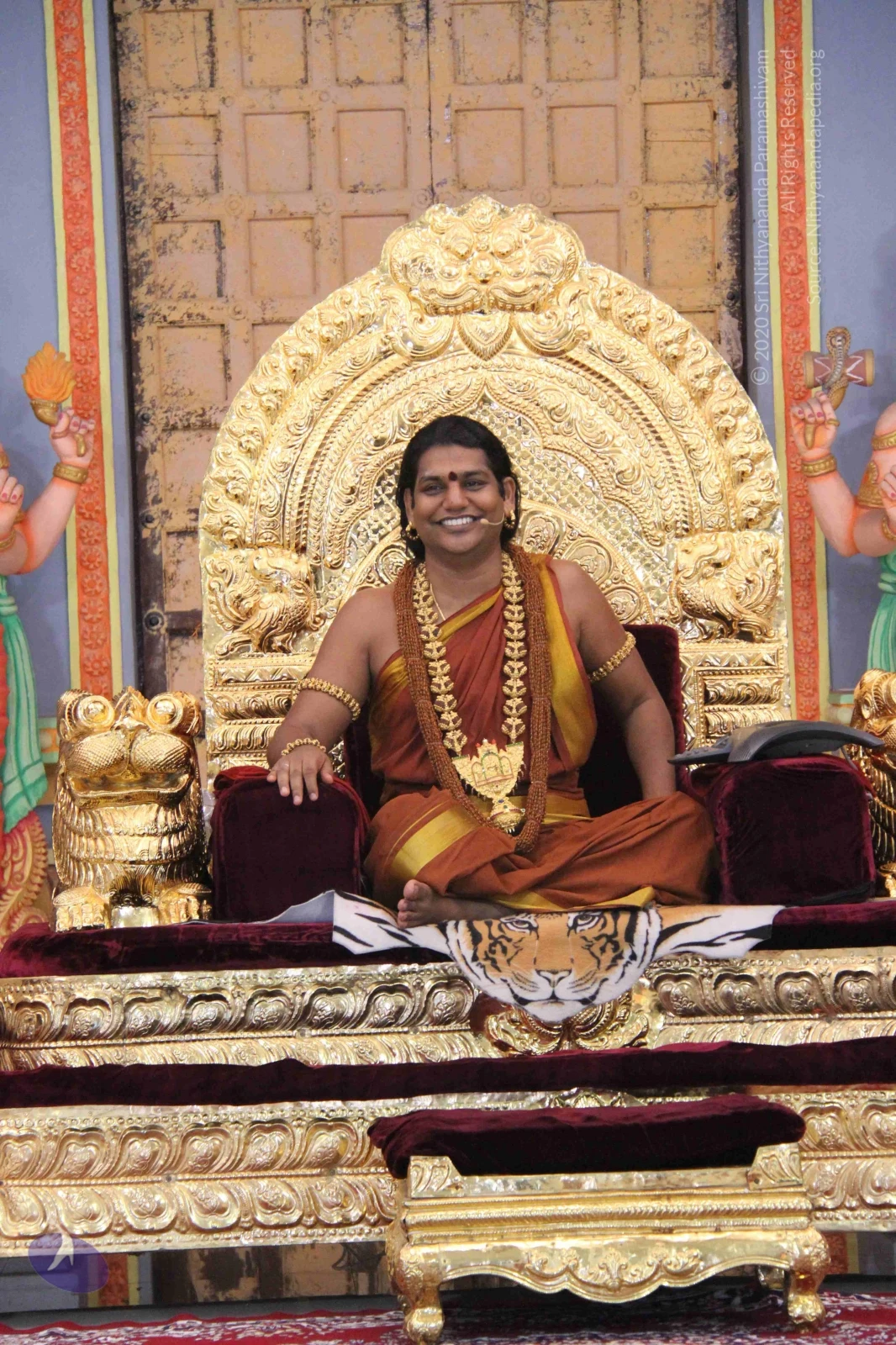
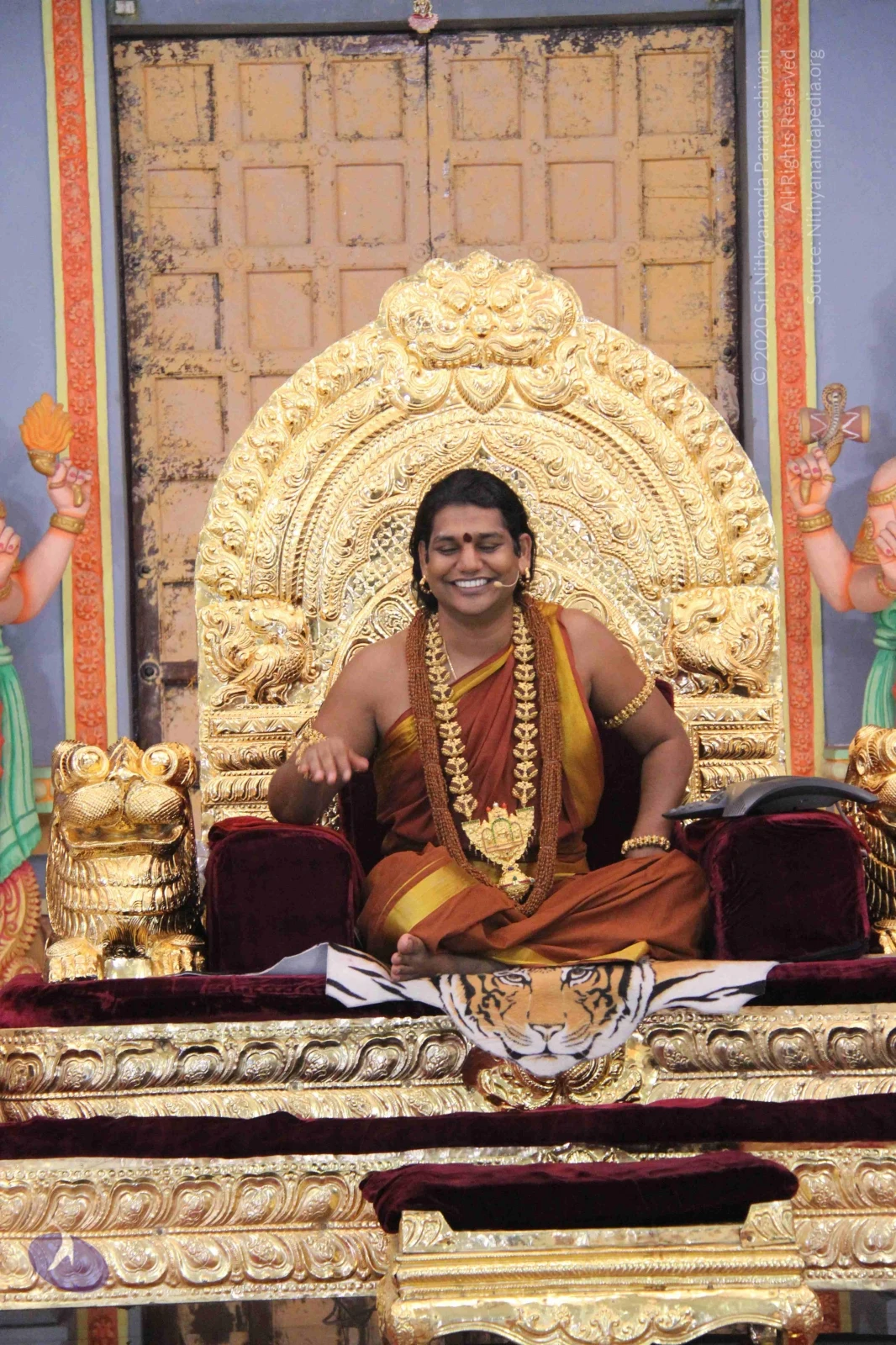
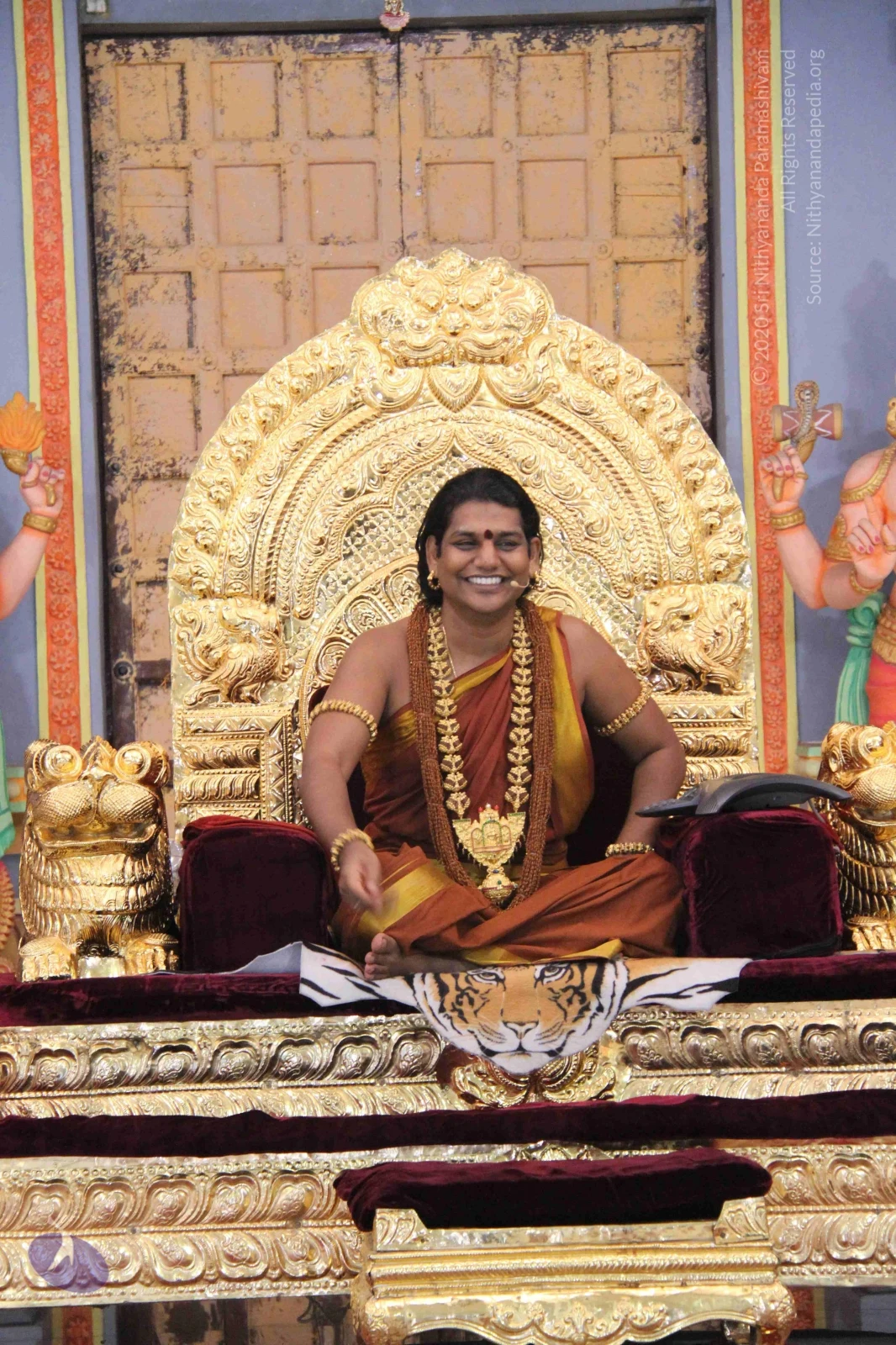
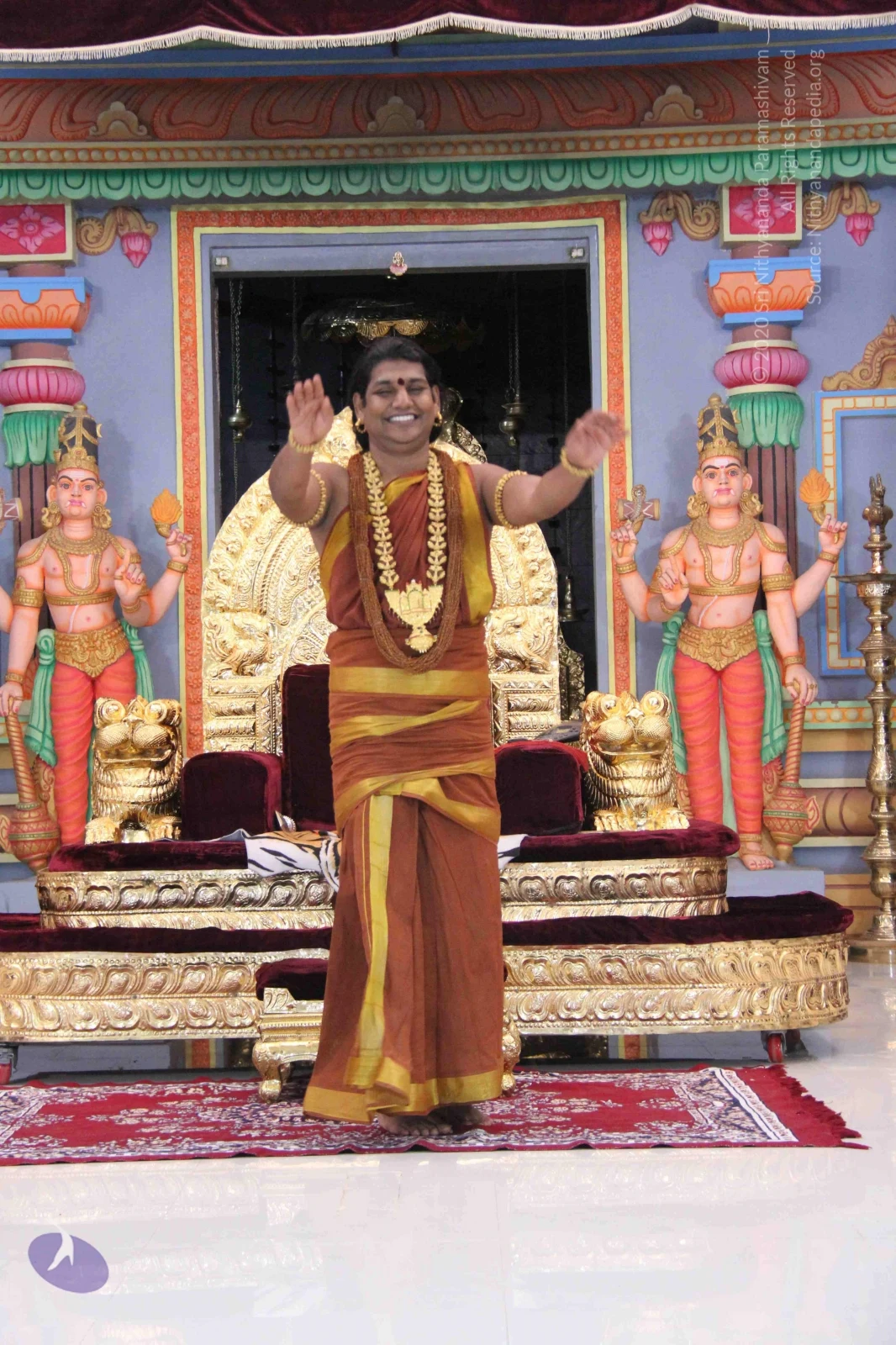
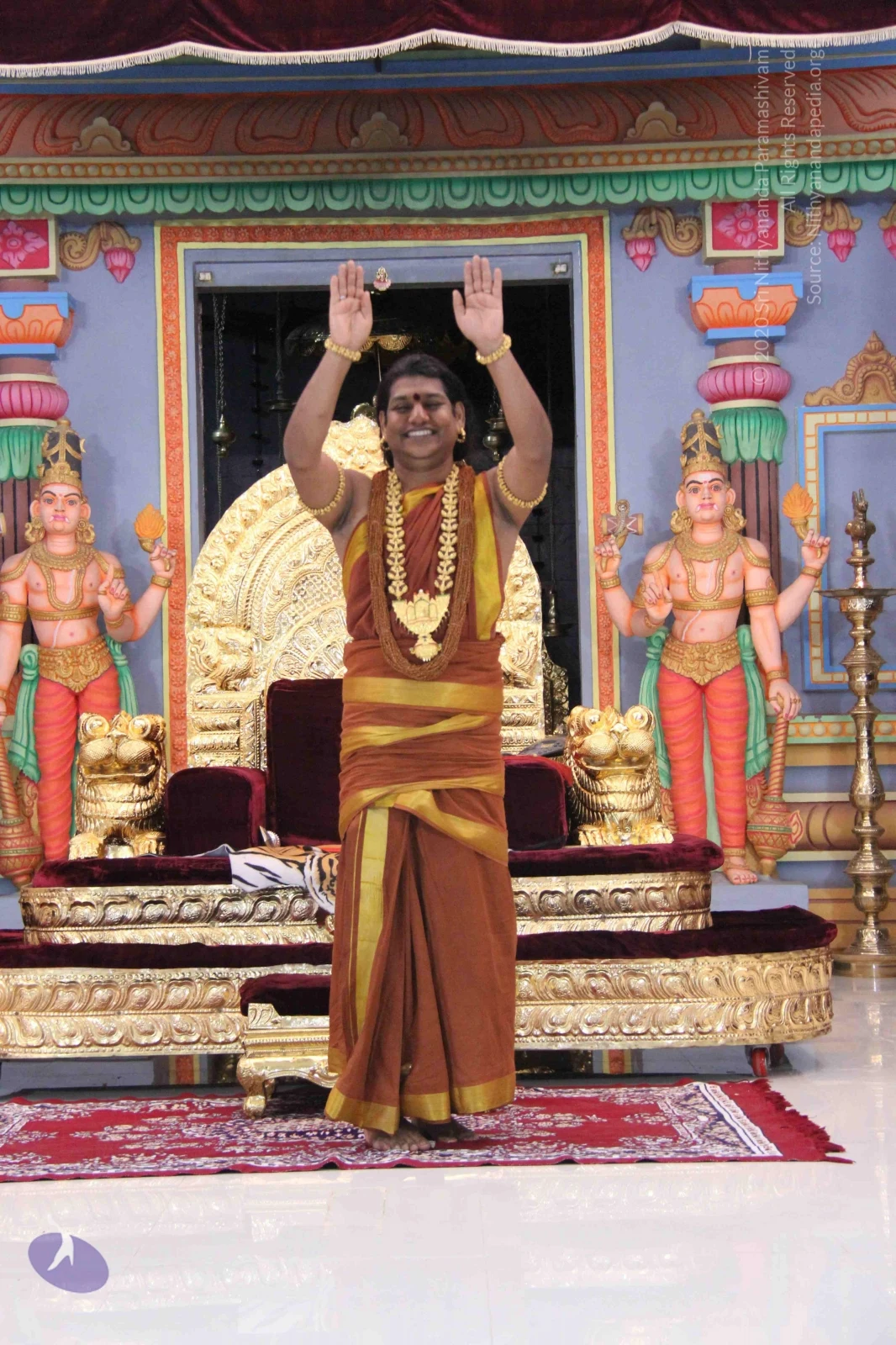
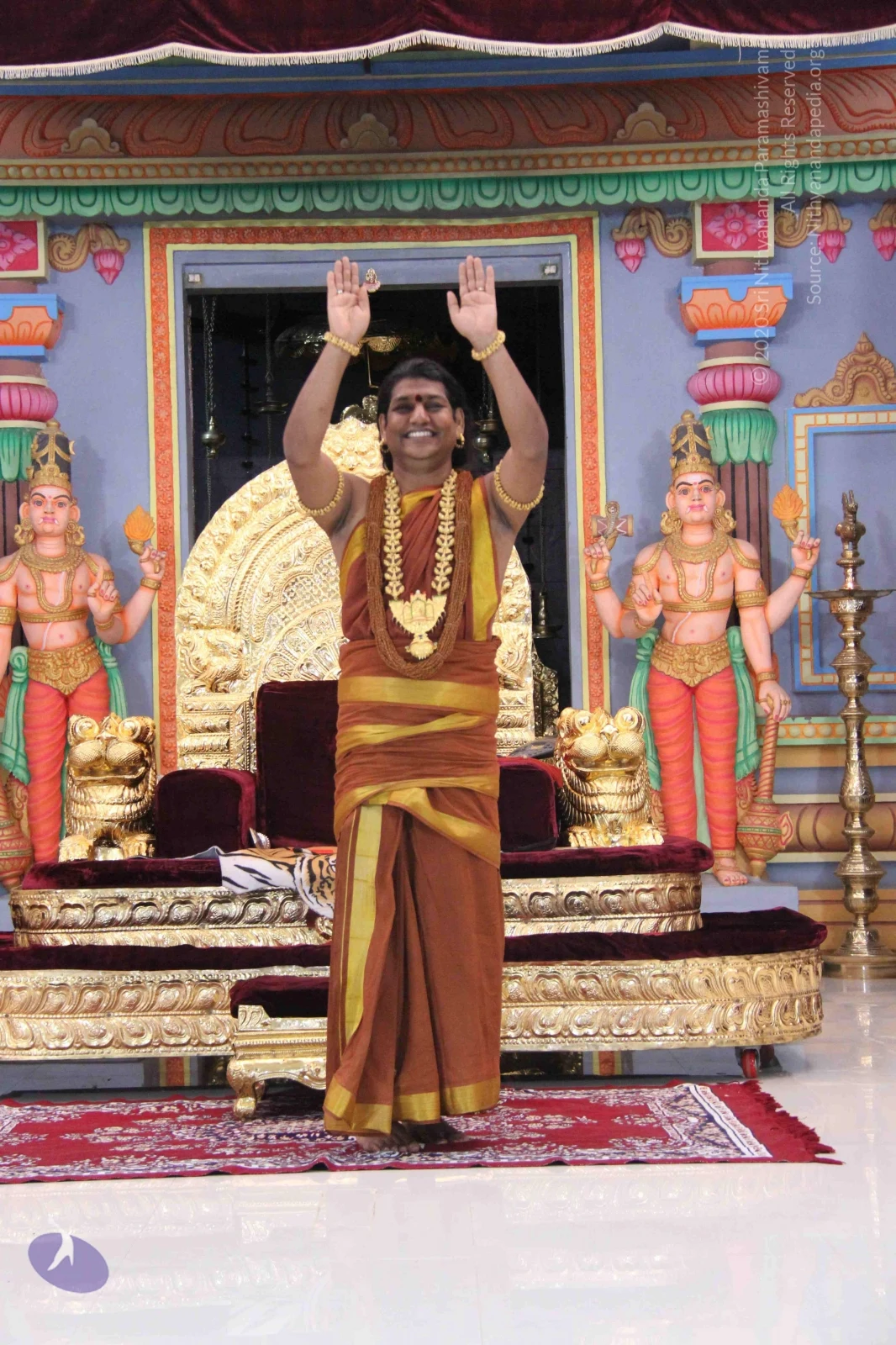
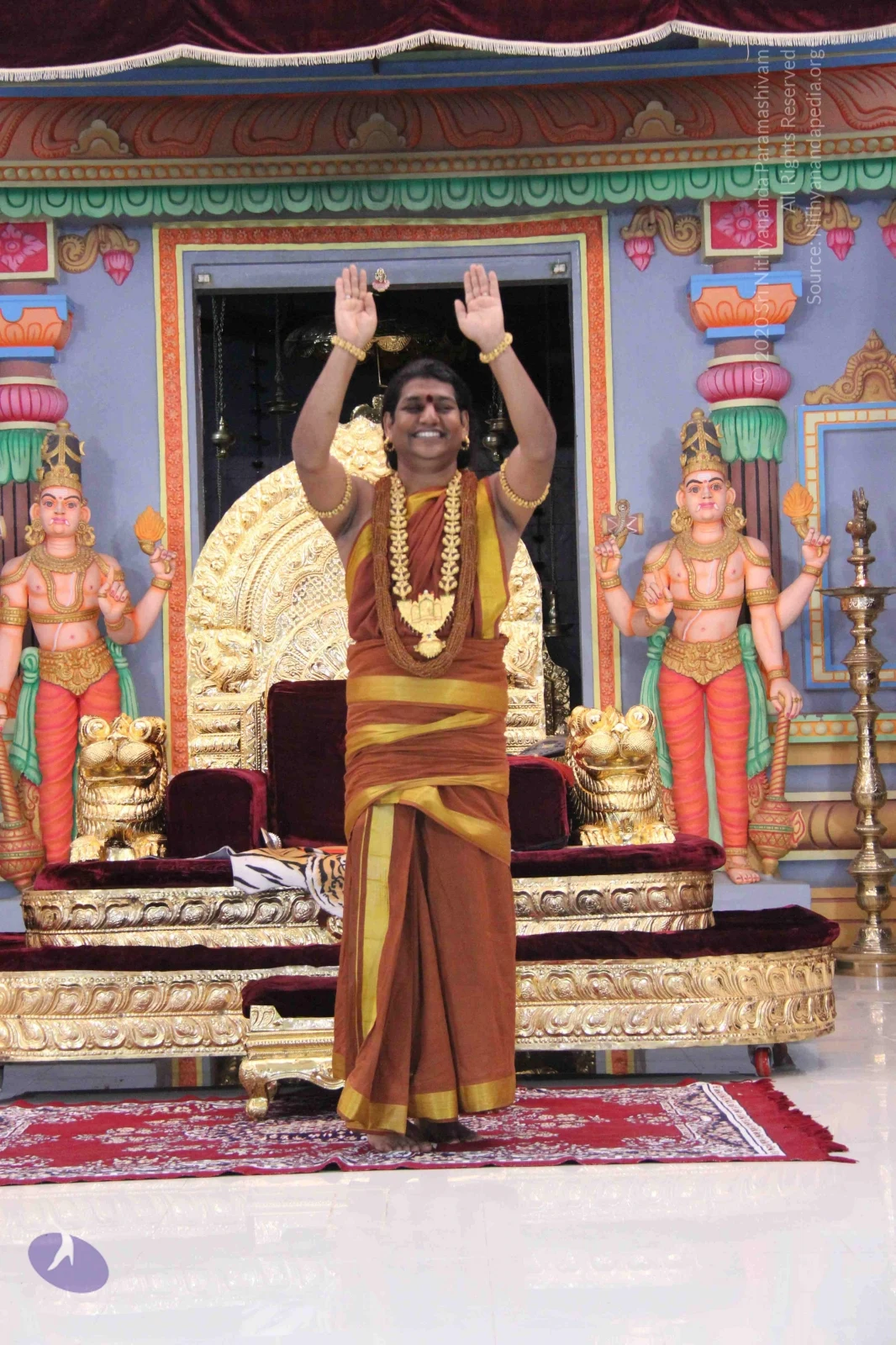
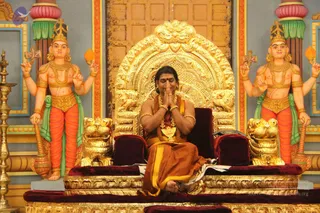
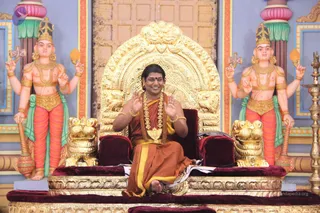
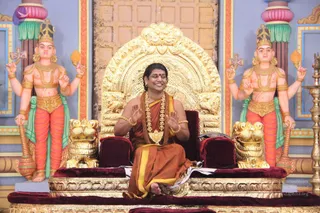
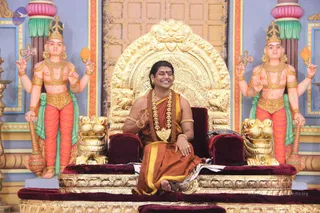
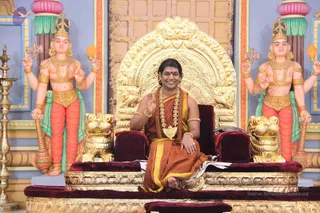
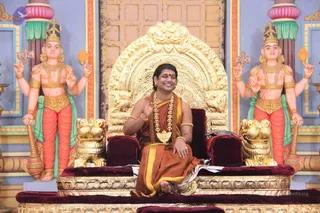
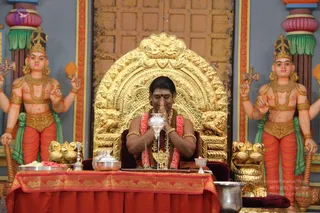
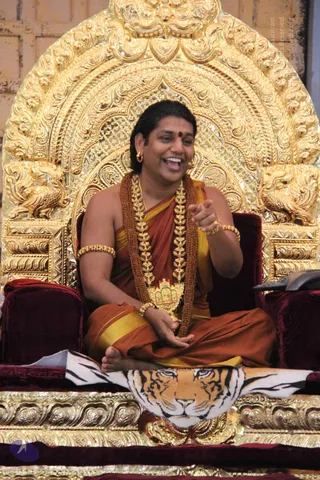
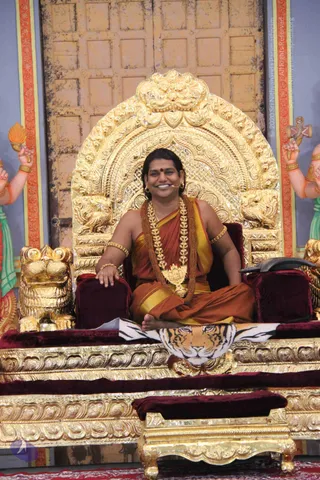
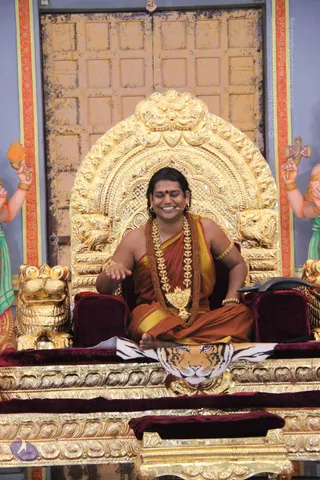
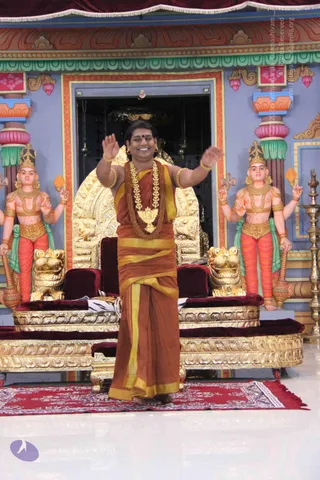
A seated man with dark hair and a reddish-brown tilak on his forehead sits on an ornate gold throne with his palms pressed together in namaste and his eyes closed. He wears an orange-brown dhoti with a gold-bordered yellow edge, a gold-beaded necklace and multiple gold bangles. Two large painted deity murtis flank him, each with multiple arms, gold crowns, gold jewellery and orange-red dhotis with green sashes, holding ceremonial objects. Gold lion-form armrests, red velvet cushions, a gold lamp stand and a gold-carved backdrop complete the temple-like setting.A seated man in a golden ornate throne with a carved arched back and gold lion-form armrests sits on a red-velvet cushioned dais, smiling with palms raised in greeting. He wears an orange-and-yellow dhoti-style garment, multi-strand mala necklaces and a gold pendant, with bangles on his wrists. Two tall painted guardian figures with multiple arms and golden crowns flank the throne, holding ritual objects against a blue and pink temple backdrop with a brass lamp at right. Only one physical person is present.A seated teacher in a saffron and maroon dhoti and shawl sits on a large ornate golden throne with lion-head armrests and velvet cushions, his hands raised in a gesturing blessing. He wears a long gold necklace with a pendant, rudraksha-style beads and gold bangles, and smiles as he speaks. Flanking him are two large painted deity statues with multiple arms, crowns and gold ornaments, holding ritual objects. A brass oil lamp stands at the right edge in front of a gilded doorway backdrop. Appearance-based a person cues: long hair, saffron-ochre robes, gold and rudraksha adornments on a throne; the page notes him present.A photograph of a seated man on an ornate gold throne with carved lion-head armrests and maroon velvet cushions, against a pastel blue and gold temple wall. He wears a saffron-orange and yellow dhoti-style garment, a long beaded necklace of white and gold beads with a gold pendant, multiple gold bangles and a gold ring, and smiles with his palms together. Flanking him are two large painted deity murti figures with gold crowns, gold jewellery and orange dhotis, each holding a lamp and a trident-like staff. A small golden kalasha-style lamp stand is visible at left. Swamiji (probable): the seated man is a candidate by his saffron-orange clothing, long dark hair, and gold necklaces and bangles, seated on a throne in a ceremonial setting.A seated man in a saffron-orange dhoti and yellow-bordered shawl sits on an ornate gold throne with maroon cushions and gold lion-head armrests. He wears a long layered garland of beads, a gold lotus pendant, a red bindi and gold bangles, and raises one hand in greeting while smiling. Two large painted deity statues in orange and green dhoti-like garments, holding ritual items, flank the throne in a temple-like hall, with a brass oil lamp at left. a person is the seated figure, based on the saffron clothing, garland and bindi cues.A seated man in an orange-brown robe with gold border and a gold garland sits on an ornate gold throne with a large gold arched backrest and carved lion-shaped armrests, on a velvet-covered dais. He raises his right hand in blessing and smiles. Two tall painted deity murti statues flank him, each with four arms, gold crowns, gold jewellery and orange-red dhoti, holding ritual objects. He wears a rudraksha-style gold-bead necklace and gold armbands. The man appears to be the a person candidate, with long swept-back hair, a saffron-toned robe and ceremonial gold necklaces, visible in this satsang setting.

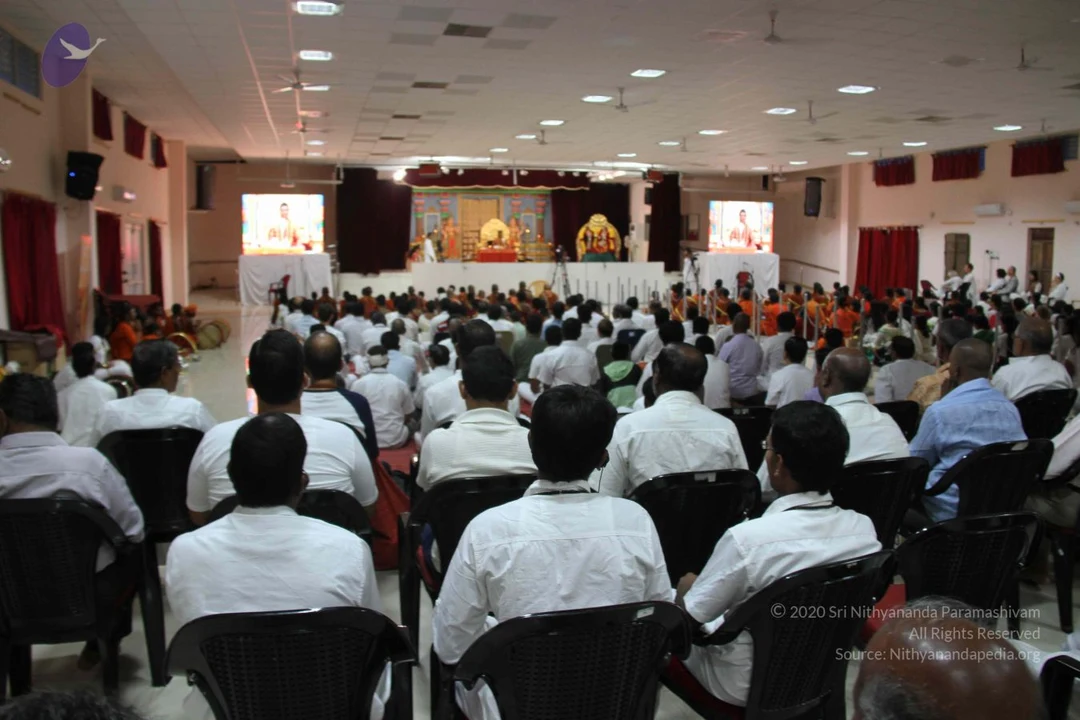
Satsang

1 photoSource gallery
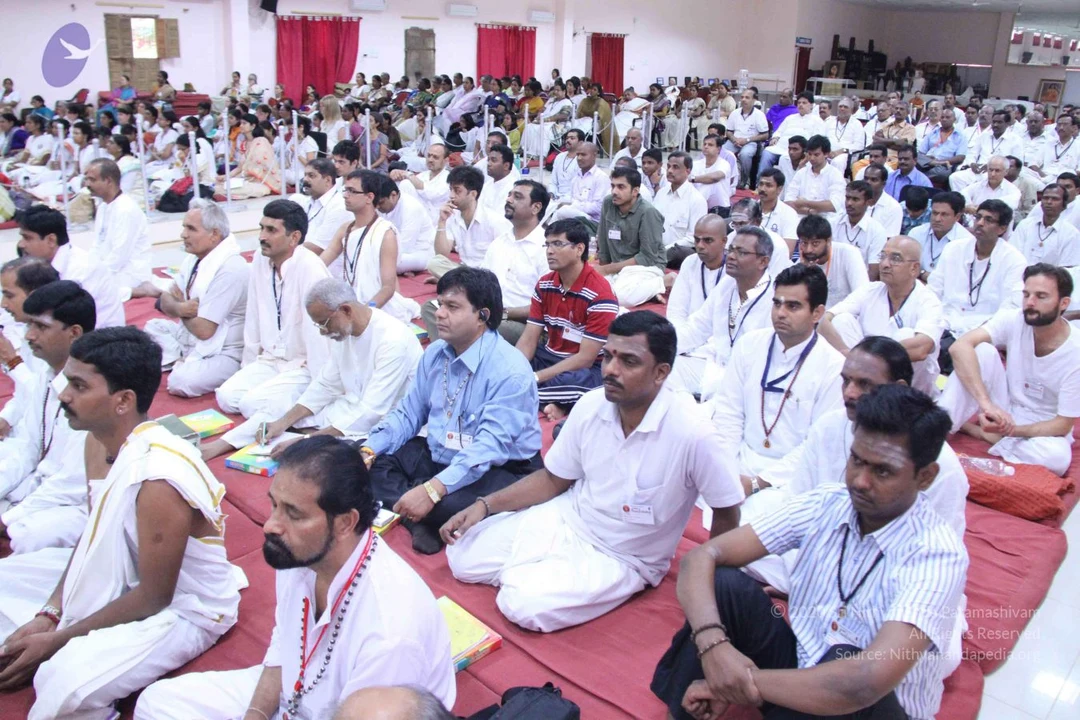
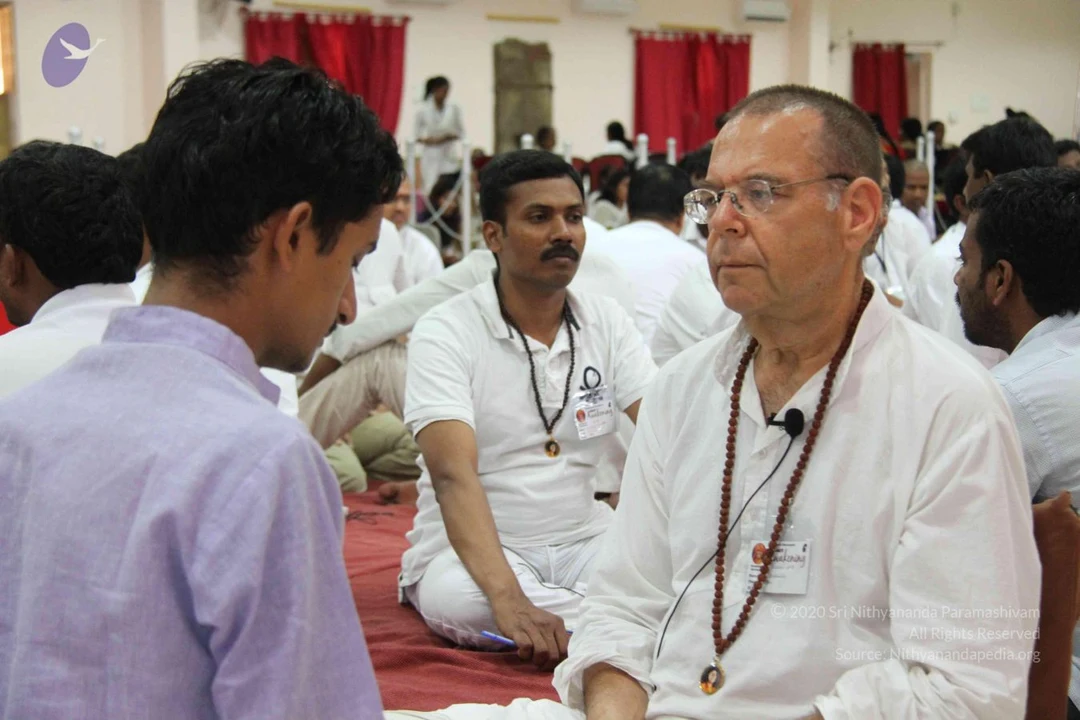
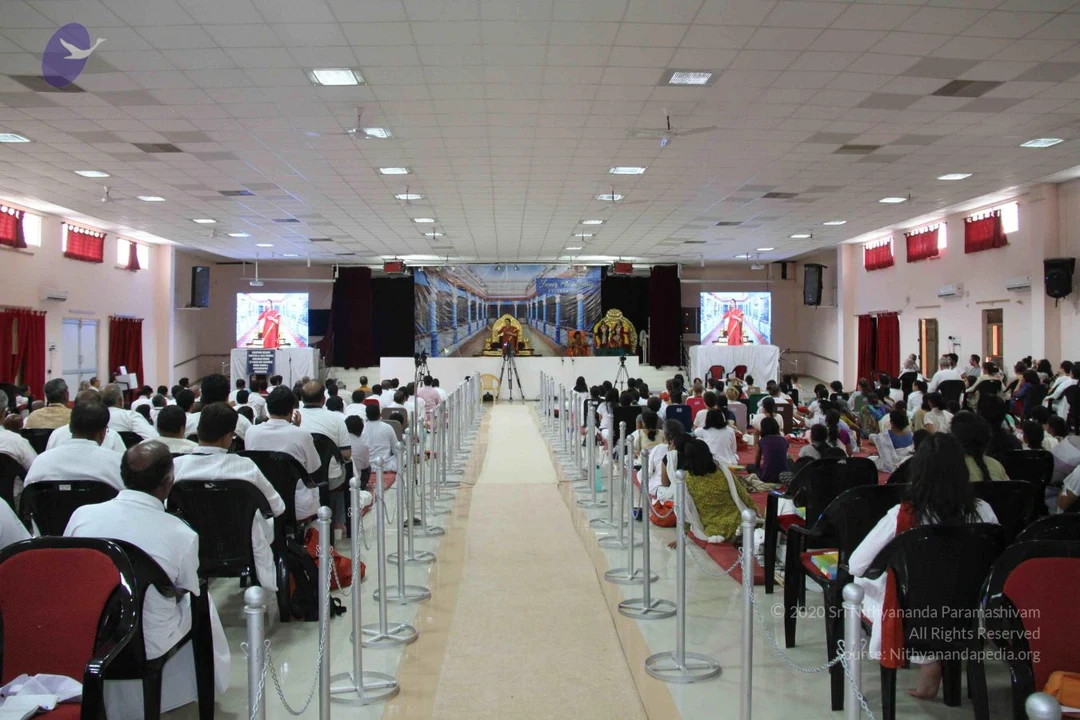
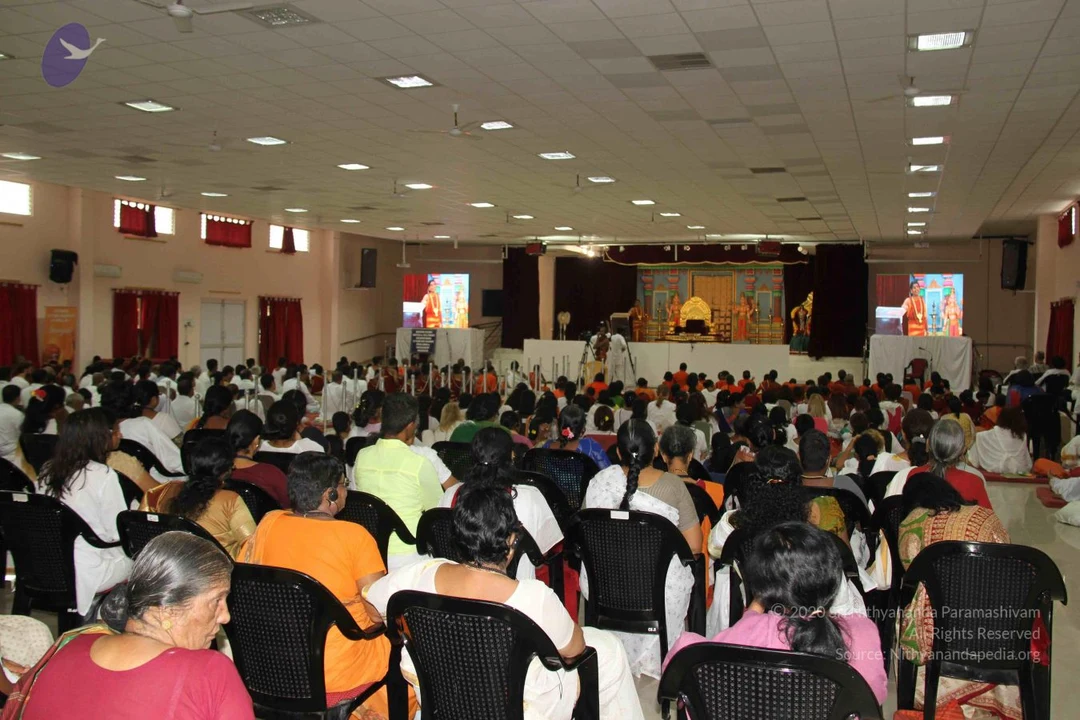
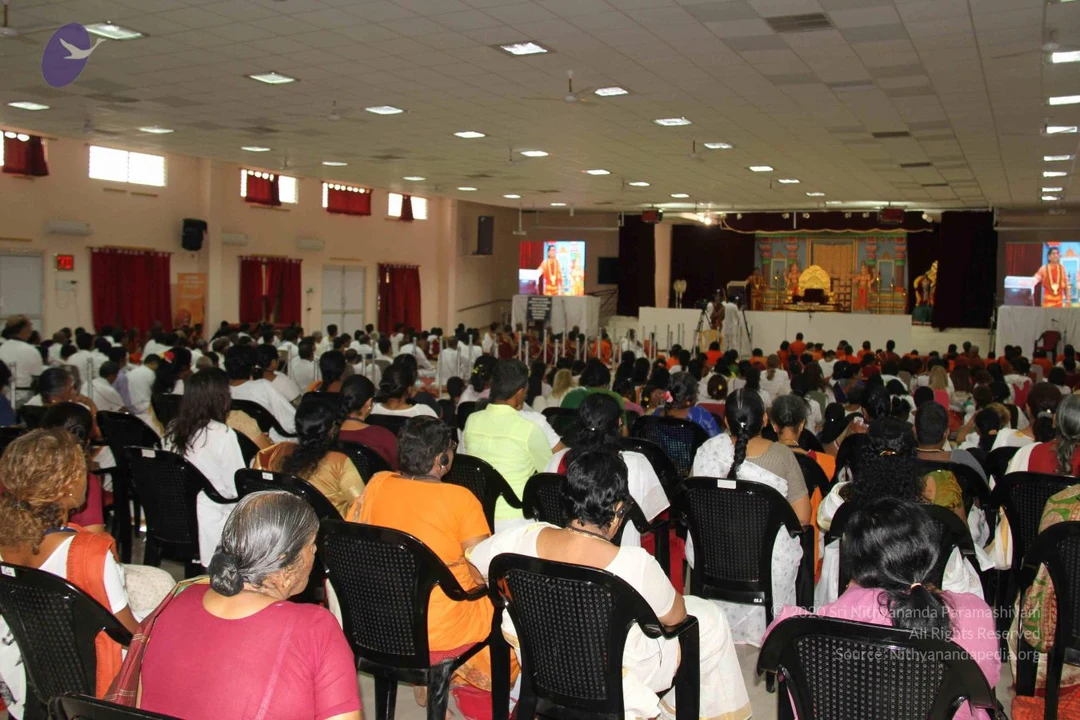
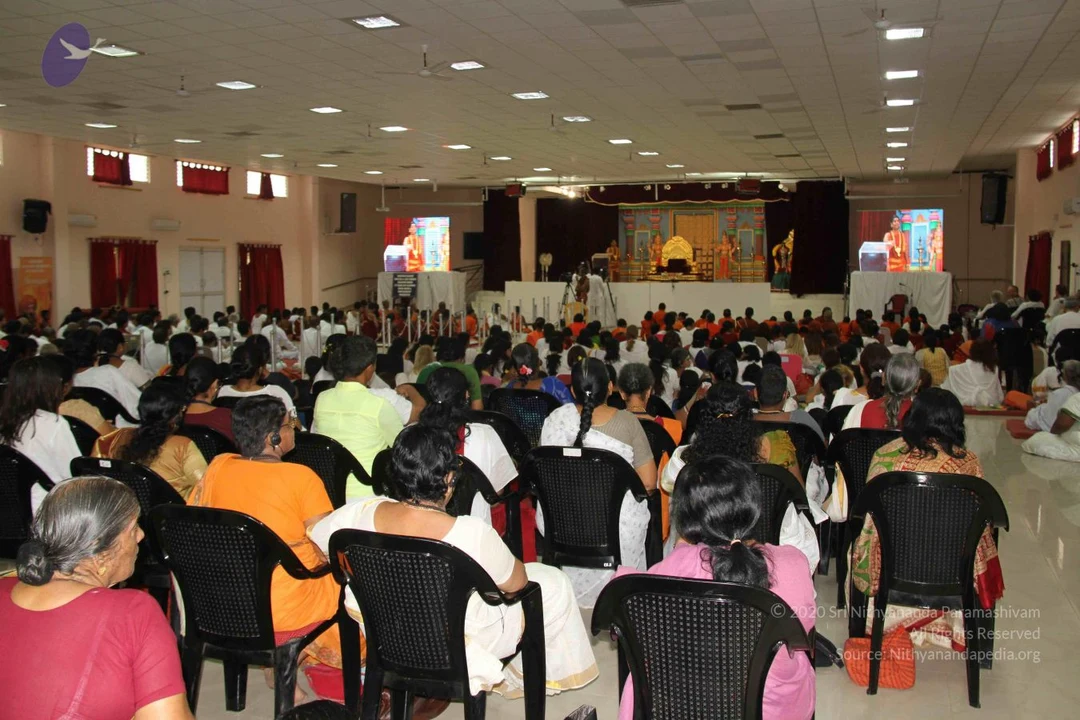
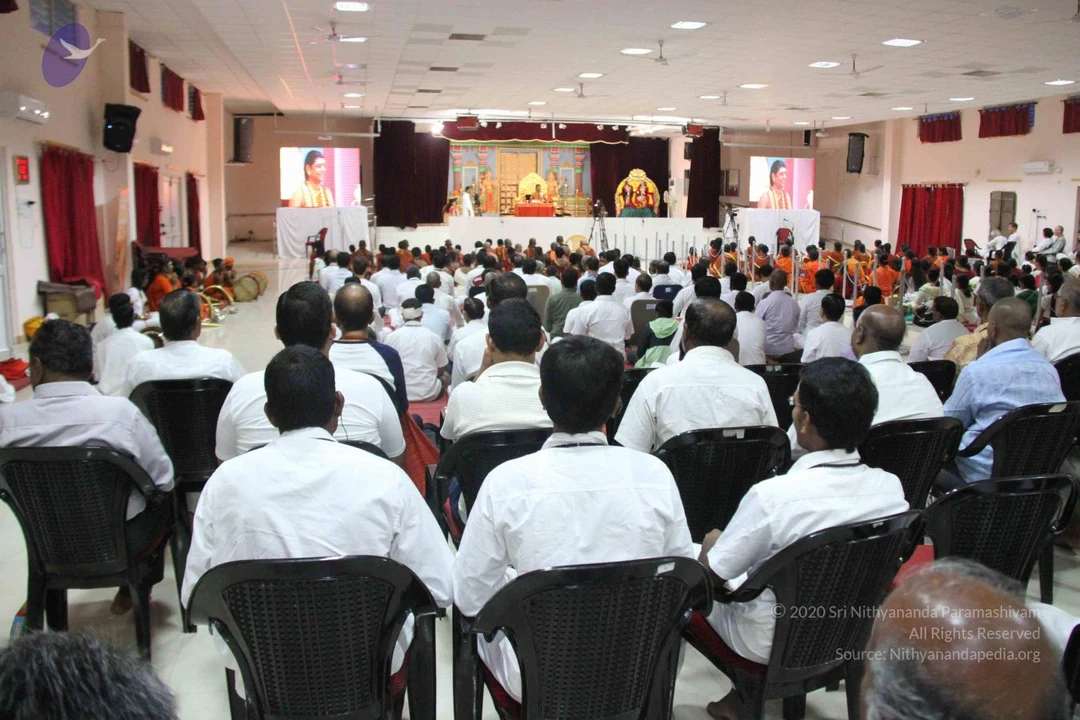
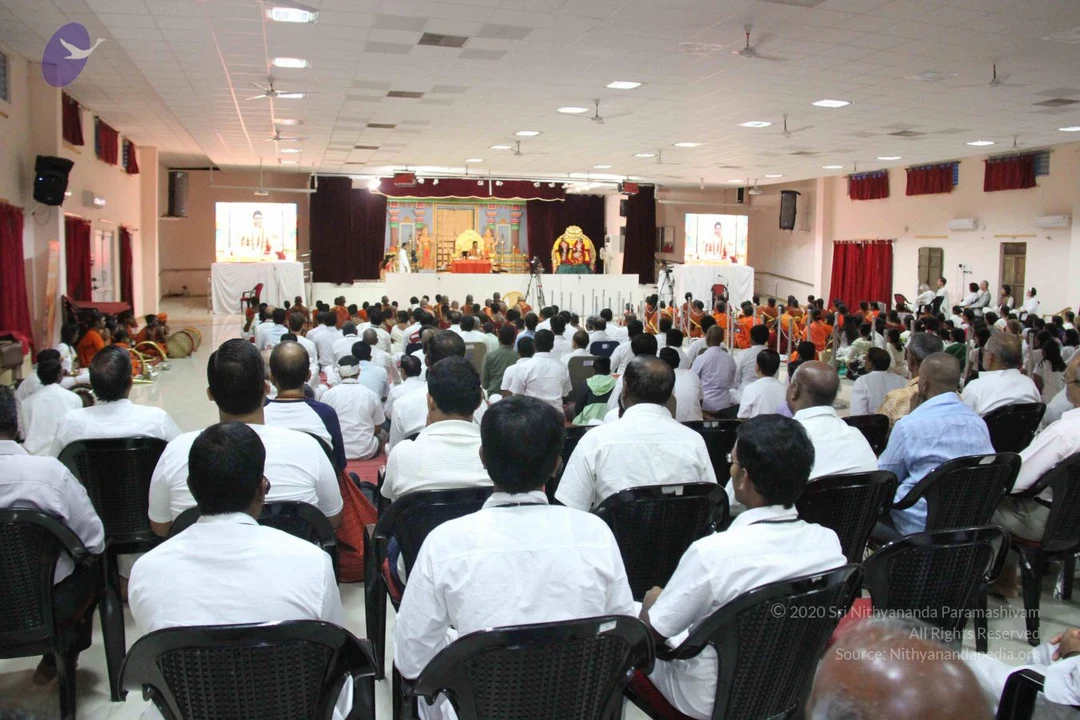
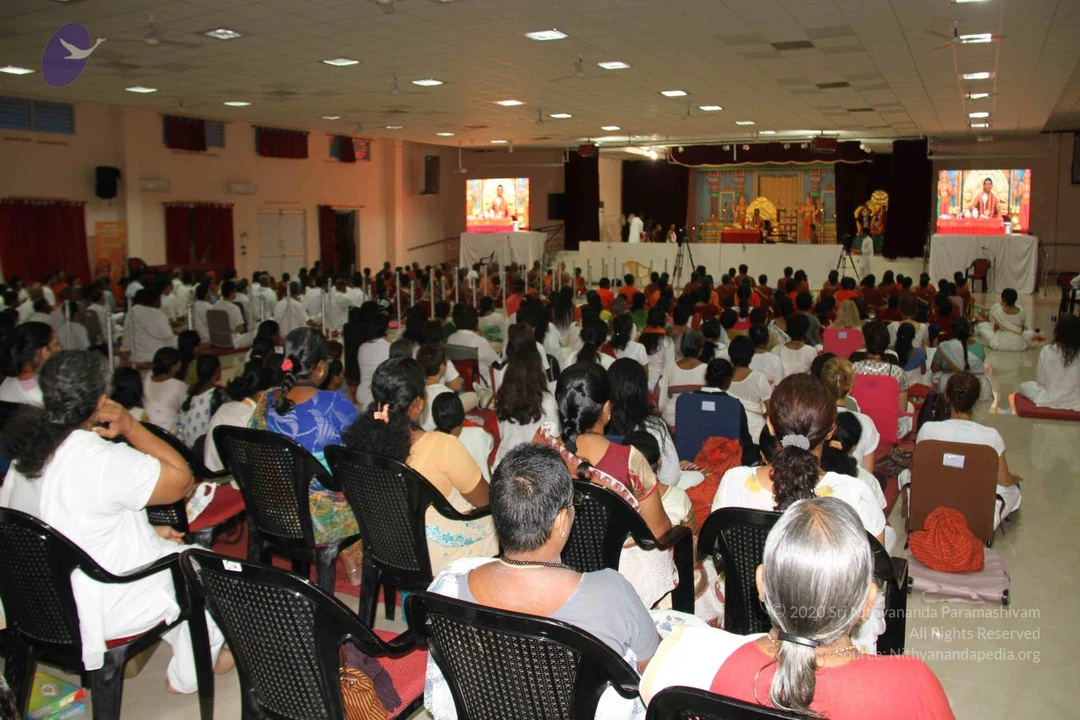
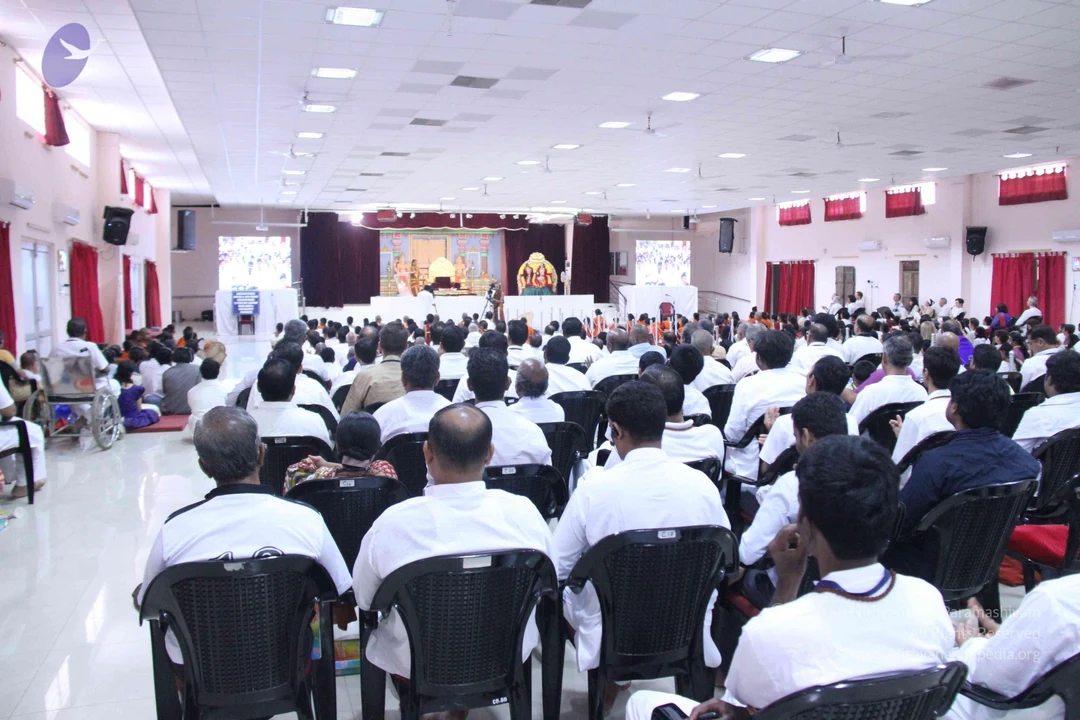
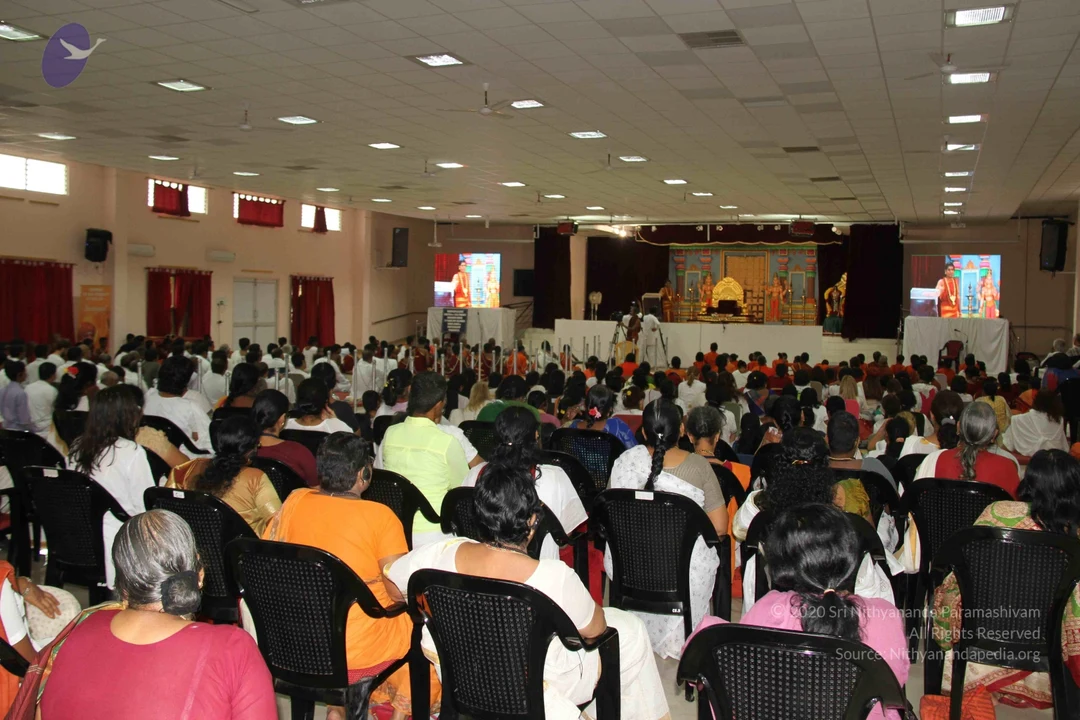
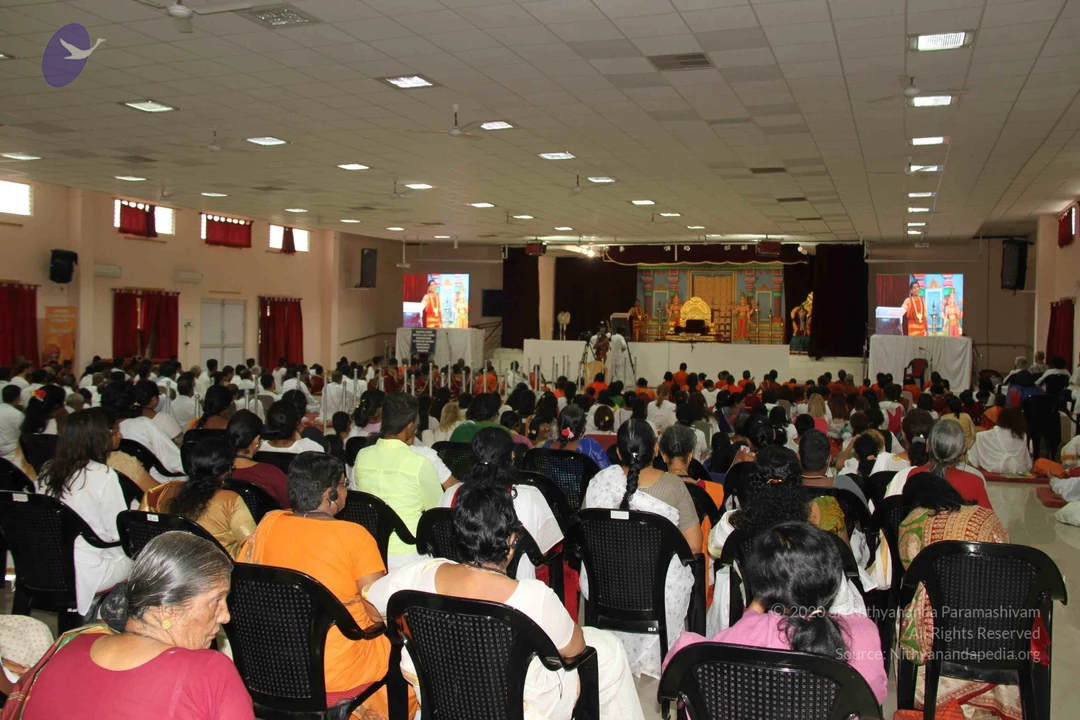
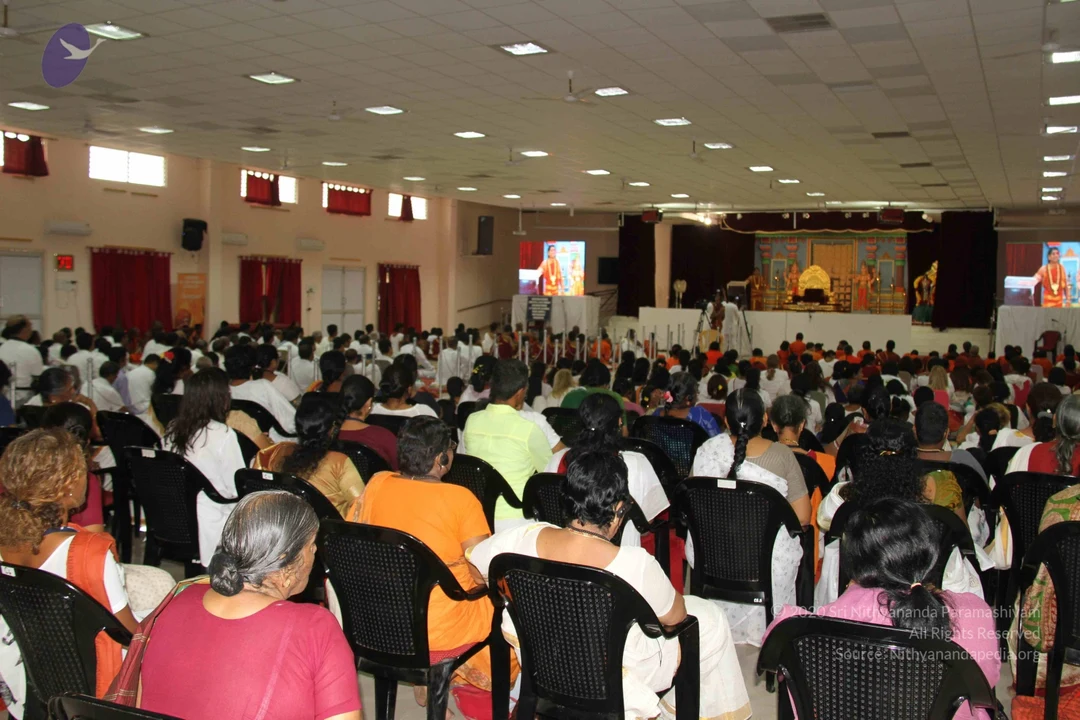
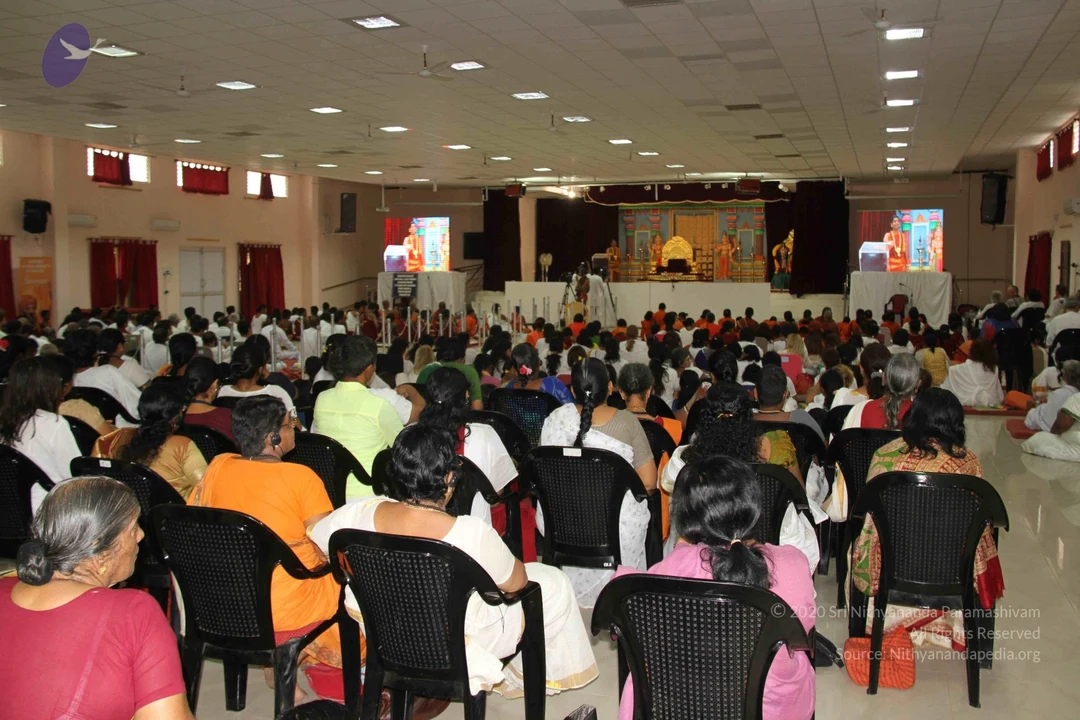
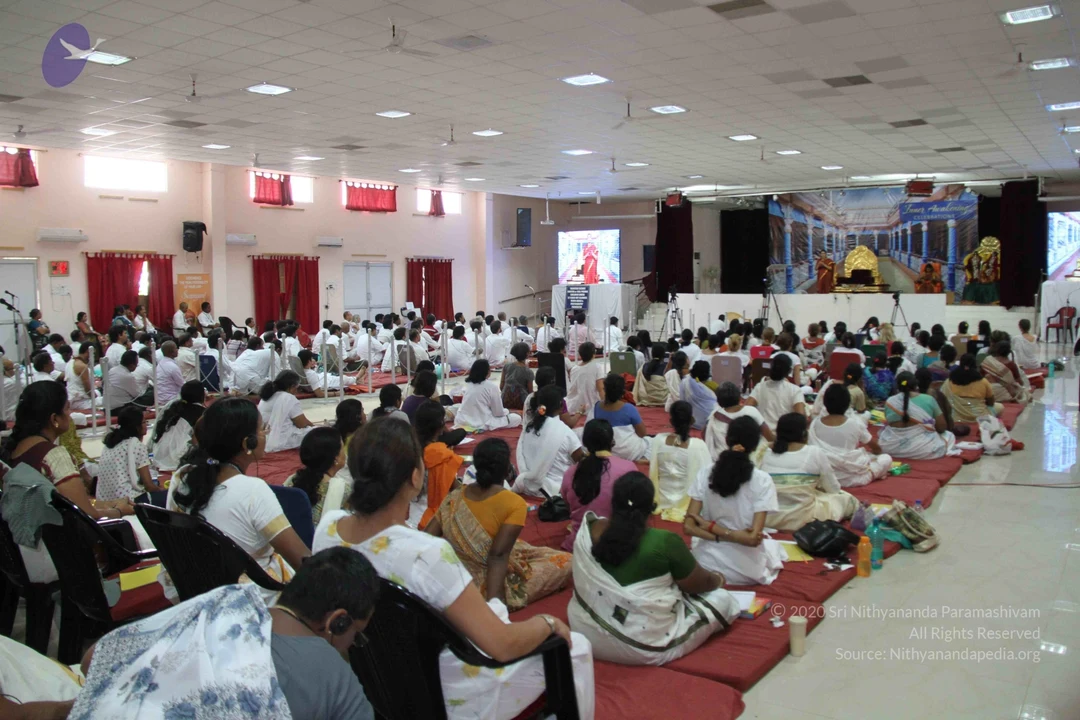
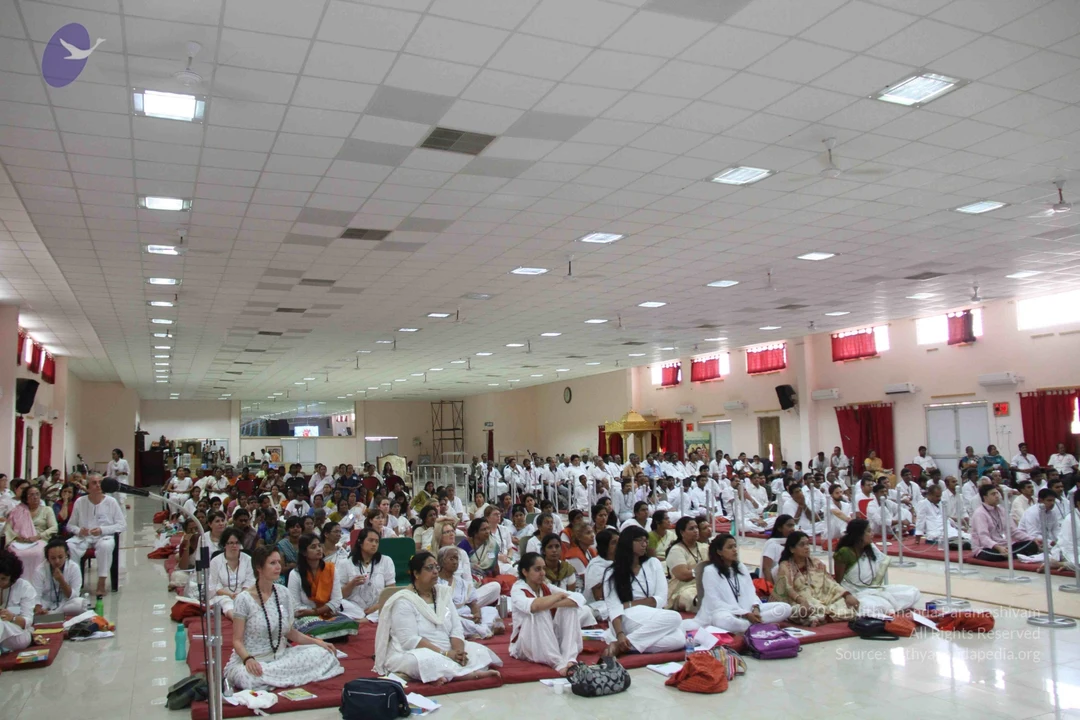
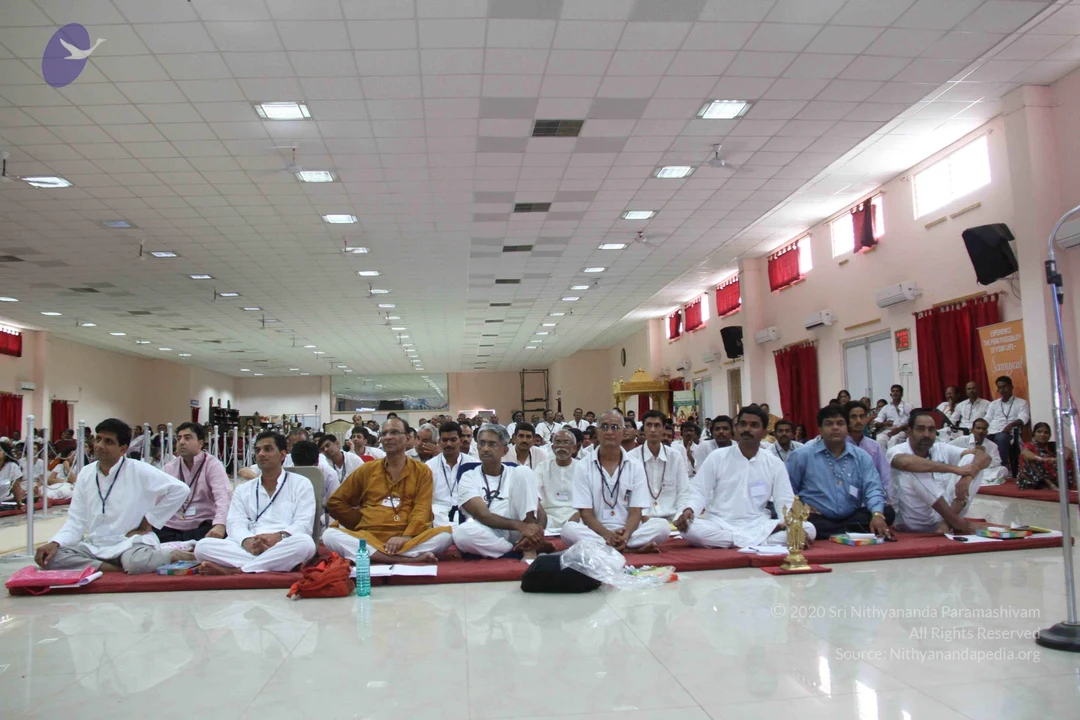
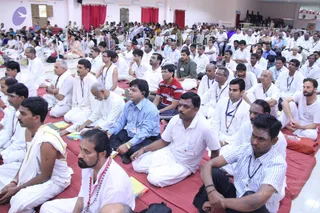
A large seated congregation fills a bright hall with red curtains and red floor mats during a satsang. Most attendees wear white kurtas and dhotis or white shirts; many wear lanyard badges and rudraksha or bead malas. Some sit cross-legged, others on folded legs, several holding small booklets and notebooks. Men in the foreground include a bearded man in a blue shirt and a man in a striped shirt, and a man in a white shirt and blue lanyard sits with hands folded. Further back, women in saris and salwars sit among the rows. Attention is directed forward toward an unseen speaker.

Final-blessings

3 photosSource gallery
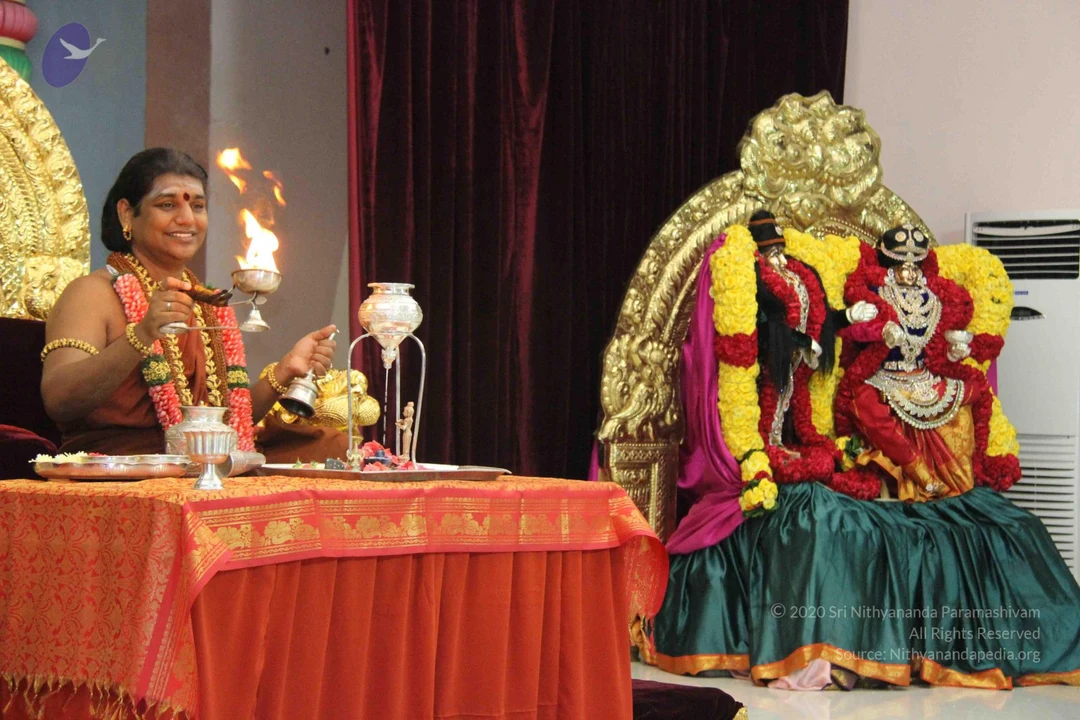
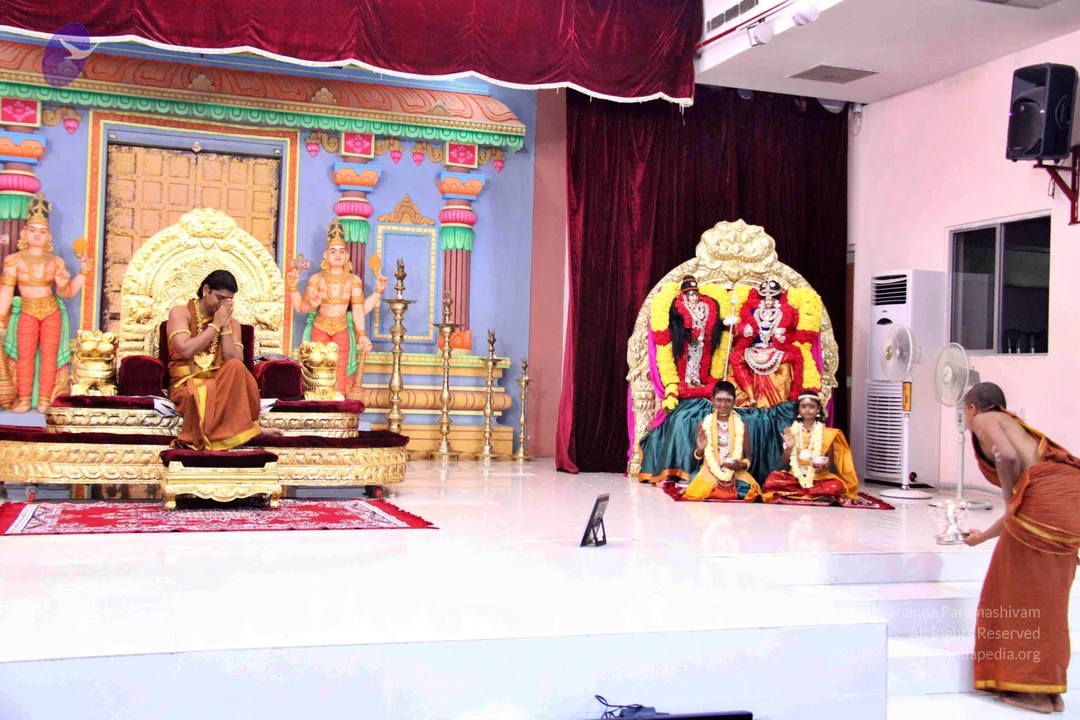
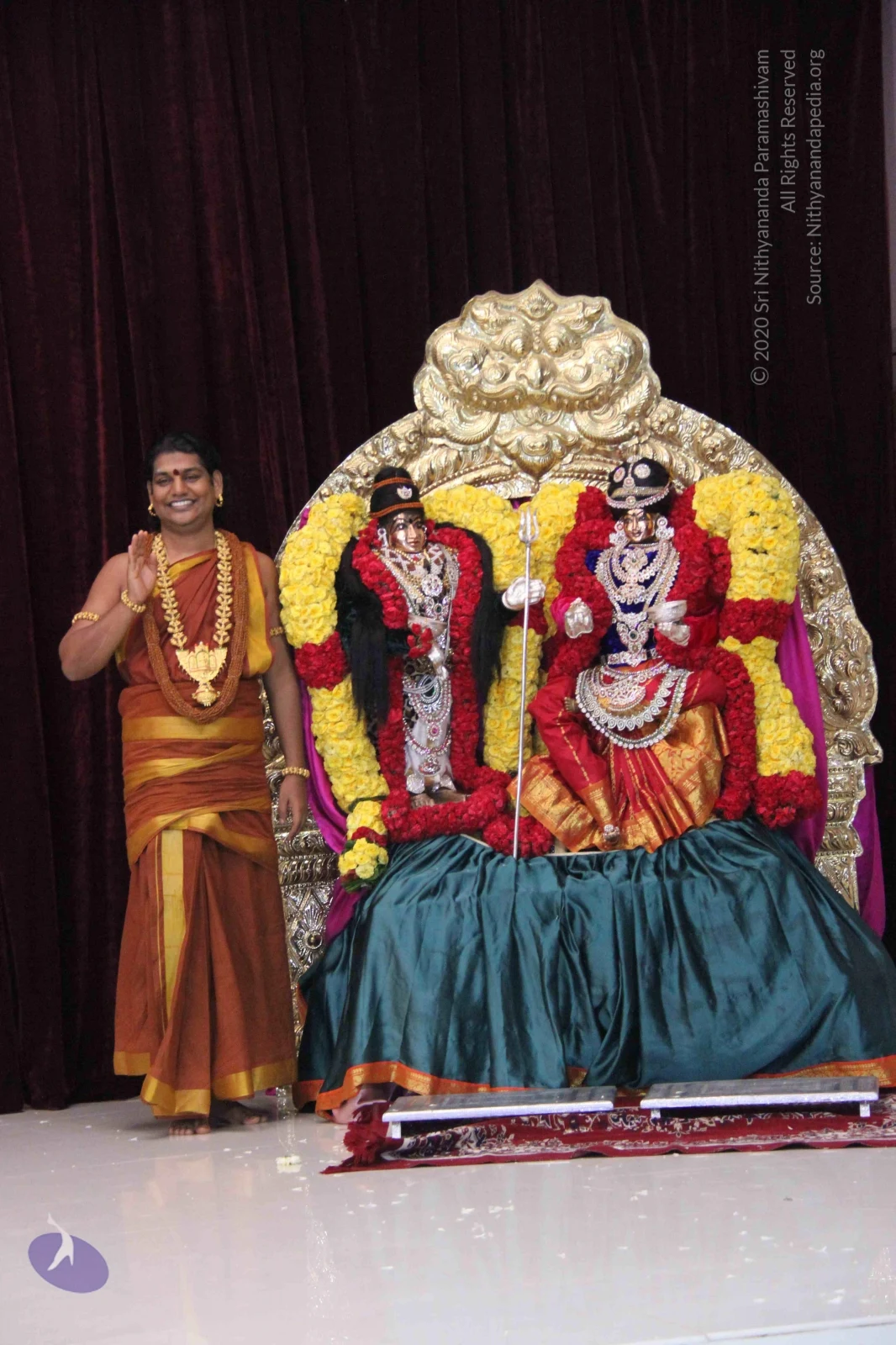
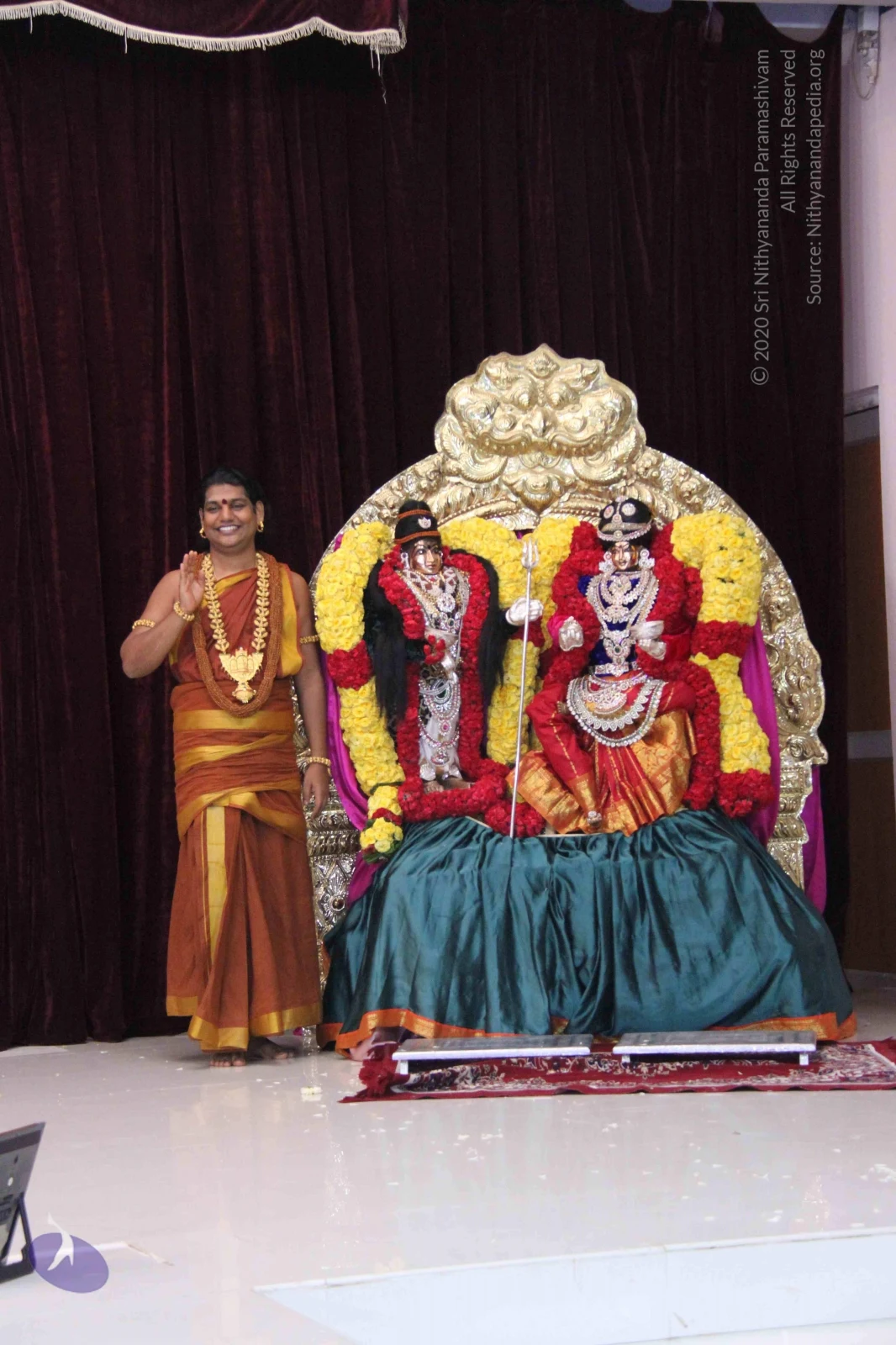
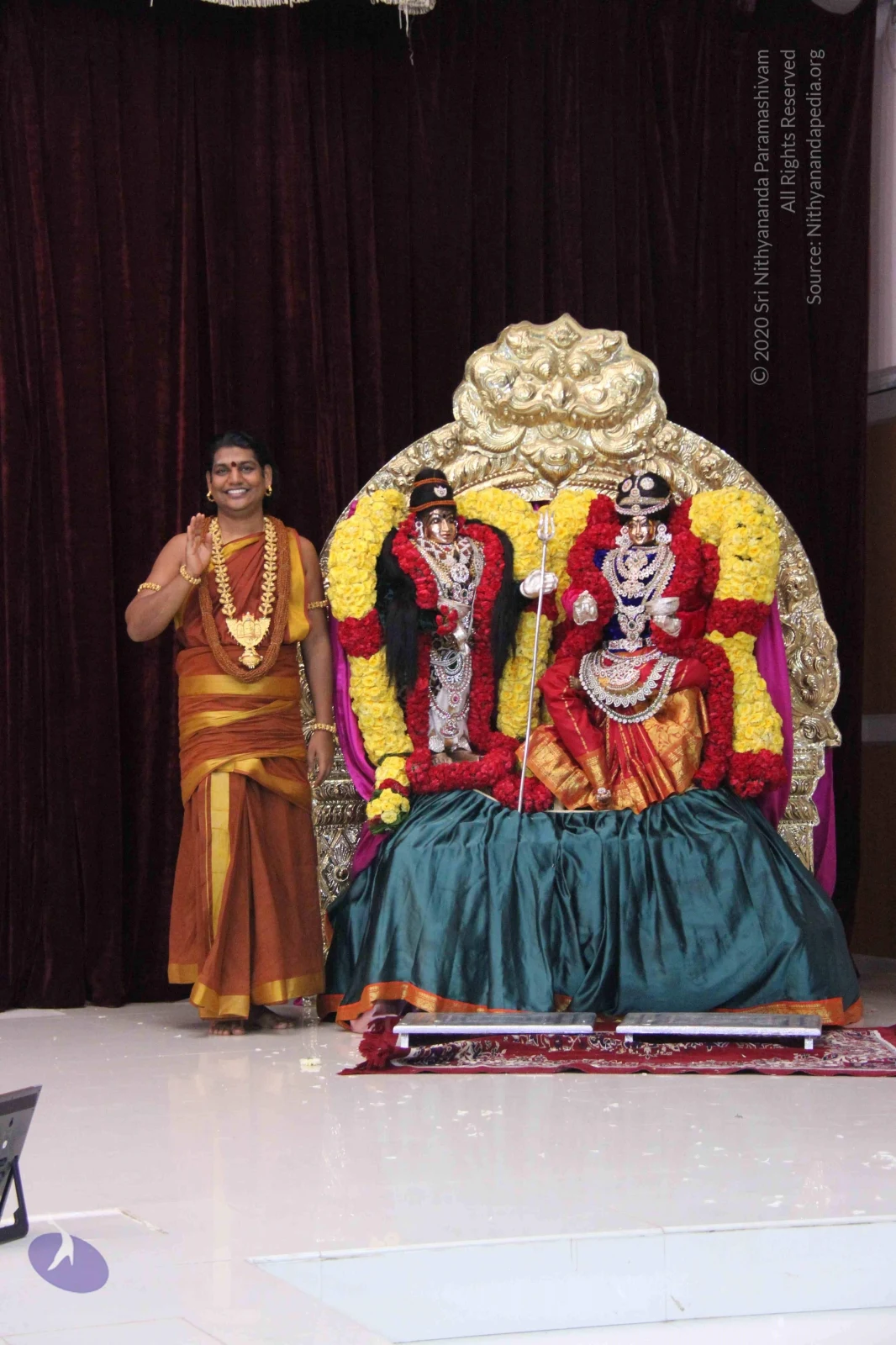
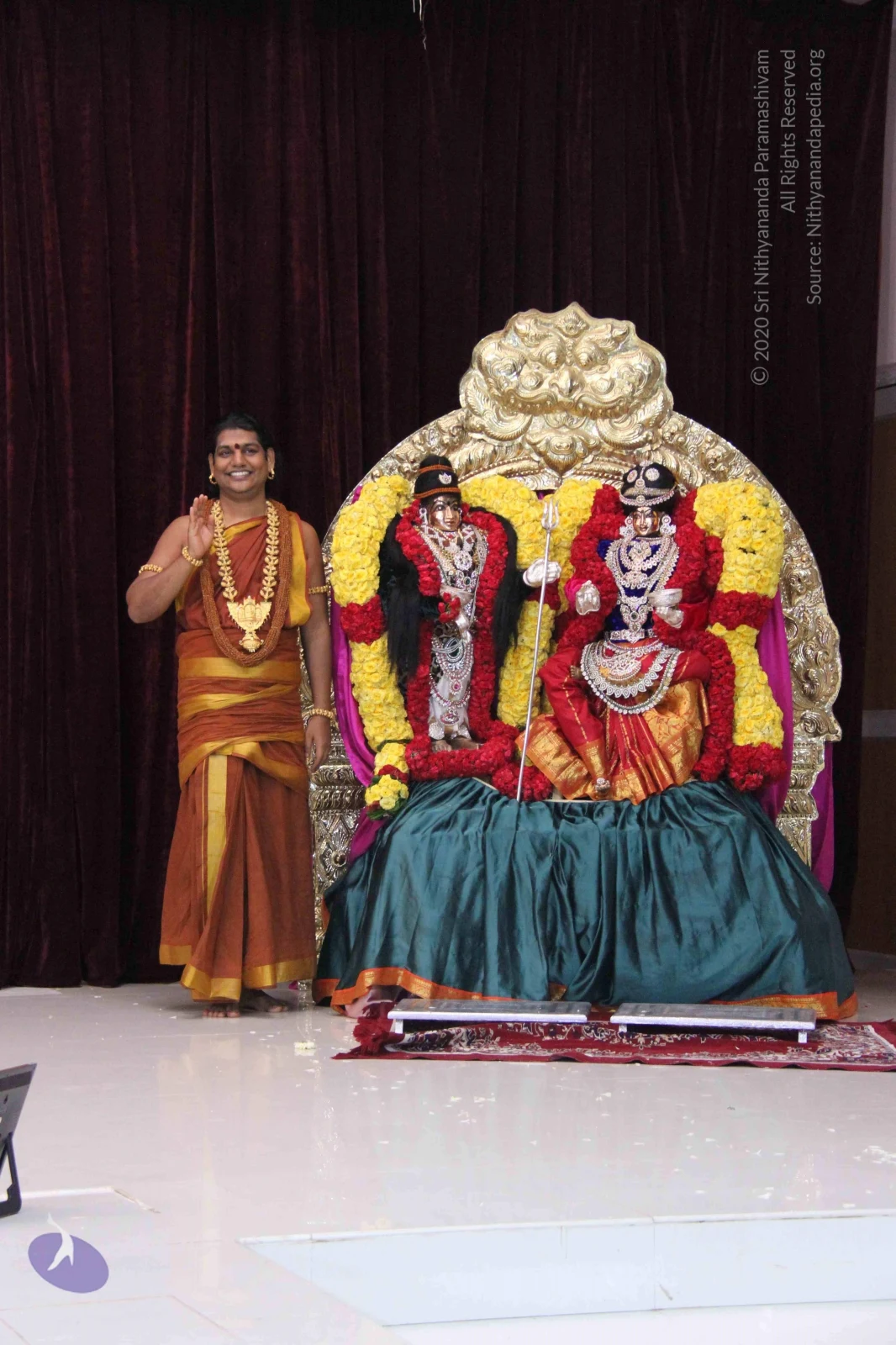
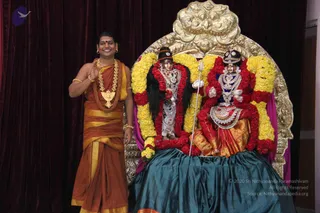
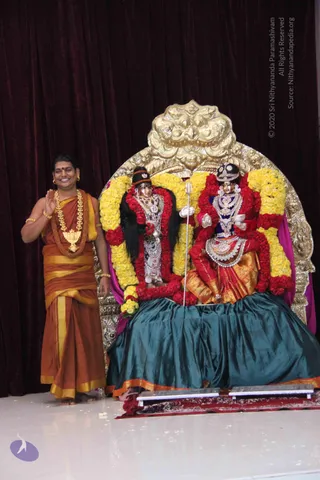
A man in a rust-orange and gold dhoti-style garment with a gold ceremonial necklace and a rudraksha-style mala stands at left, smiling and raising his right hand in a blessing gesture, wearing gold bangles and a red bindi. To the right, two dressed deity murti sit on a dark teal cloth-draped seat in front of an ornate gold carved arch, garlanded with yellow and red flowers. The seated figures wear silver ornaments and crowns; one holds a trident-like staff. Burgundy velvet drapes form the backdrop.A smiling man stands at left in a saffron-orange and gold-bordered dhoti and shawl, with a rudraksha mala and a heavy gold necklace, gold bangles and a red forehead mark, raising his right hand in greeting. Beside him on a gold-carved throne sit two deity murtis draped in red and yellow marigold garlands and silver ornaments; the left figure has long black hair and the right wears a crown and holds a trident, with a dark teal silk cloth spread below. Maroon curtains form the backdrop. The page identifies this as an event on 19 August 2013, and the standing man shows several a person-associated cues (saffron clothing, rudraksha mala, gold necklace), so he is a person in person. The seated figures are statues, not people.A photograph of a stage shrine with a standing man in saffron-orange and gold dhoti and shawl, wearing a gold necklace and a rudraksha-style mala, smiling and raising one hand in greeting beside a golden arched backdrop. Behind him sit two decorated deity murtis, one dark-skinned with a trident and crown and one in red and gold silk, both garlanded with yellow and red flowers and seated on a teal cloth-draped throne. Maroon velvet curtains frame the scene.

Sarva-Darshan

7 photosSource gallery
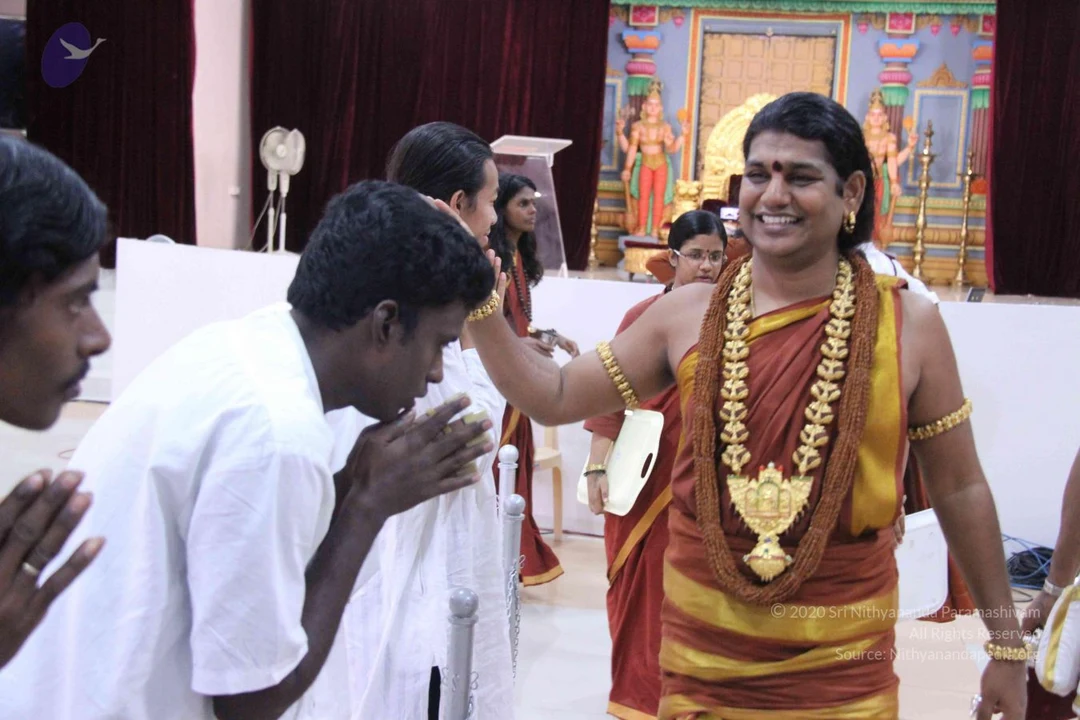
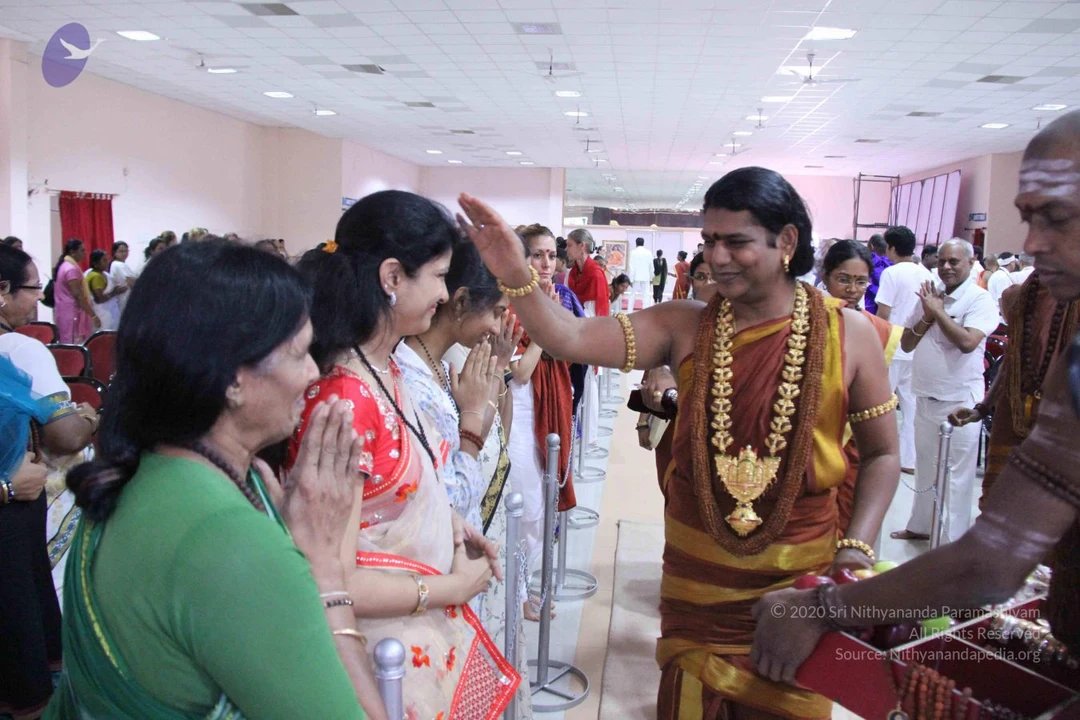
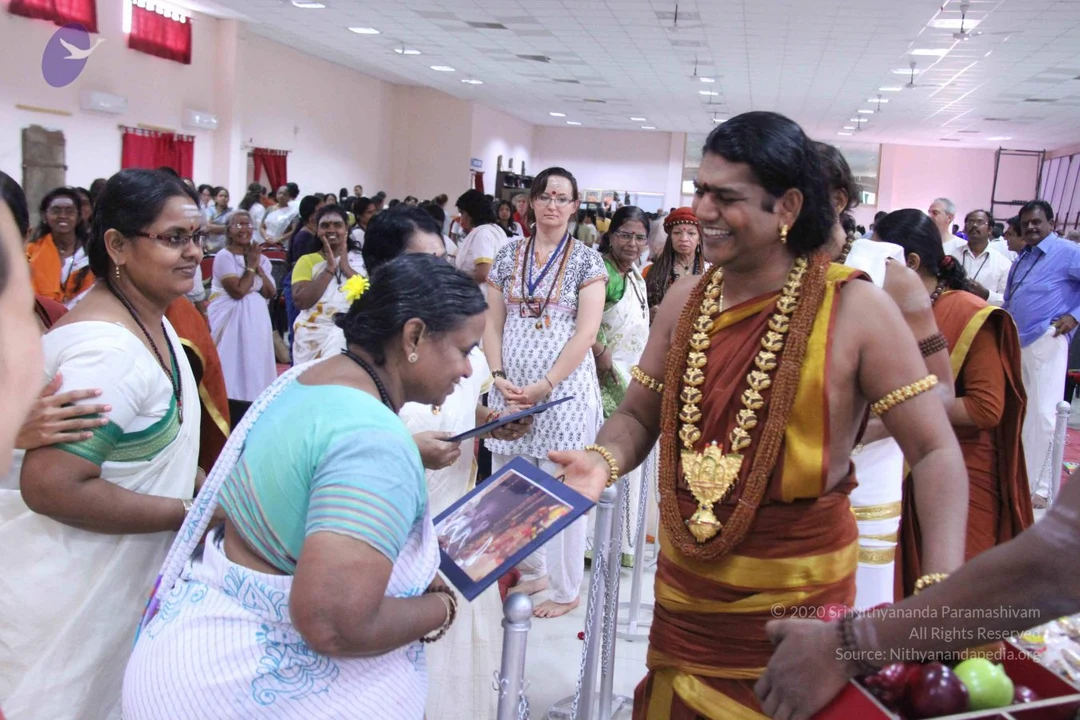
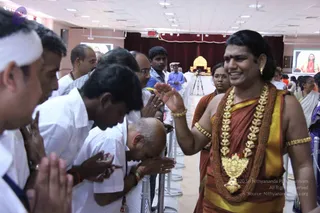
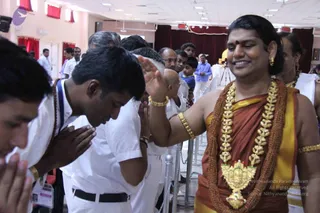
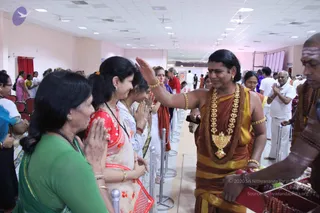
A photograph in a temple-style hall shows a smiling person in saffron-orange and gold silk dress with a heavy gold-and-red beaded necklace and gold armlets, a red tilak on the forehead, and short dark hair. Their outstretched hand rests on the head of a man in white, who bows with palms joined. Behind them a woman in an orange sari and a man with folded hands stand near a gold-and-blue painted shrine backdrop with colourful deity statues, golden lamps, a gold throne-like seat and red velvet drapes. A small white microphone stand and fan are at left. The scene suggests a blessing or darshan moment in a devotional hall.A photograph inside a hall with red curtains and a stage, where a man with long swept-back dark hair, a red bindi, a heavy gold-and-bead necklace and a large gold pendant, gold armbands and an orange-and-gold dhoti-style garment is smiling while placing his hand on the head of a devotee. The devotee wears white and is bowed with palms joined in namaskar. Around them, men in white shirts and dhotis stand near metal barrier stanchions, and a woman in an orange sari is at right. A tray of apples and fruit sits in the foreground, a deity murti in gold and green decorations is on a stage at right, and a screen at left shows an image of a deity.A photograph inside a hall with maroon drapes and a gilded throne-like seat in the background. In the foreground, a man in a light blue shirt bows with palms pressed together while a figure in an orange-and-gold dress, with long swept-back hair, gold earrings, a rudraksha mala and ceremonial gold necklaces, places a hand on his head in blessing. Several people stand behind metal stanchions; a man in white and a woman in orange-saffron robes are visible at right, and a gilded deity murti decorated with garlands sits at the rear. A camera on a tripod is set up near the centre. Swamiji (probable) appears to be the figure giving blessings, based on the long swept-back hair, rudraksha mala and gold ornaments.Indoor satsang hall with white ceiling tiles, red curtains and a golden throne-like seat on a stage at the back. In the foreground, a bare-chested man with long swept-back dark hair, wearing a saffron-orange and gold shawl, a heavy gold ornate necklace with a large gold pendant, a rudraksha-style beaded mala, gold armlets and bangles, stands with his right hand raised in blessing. Devotees in white shirts and dhotis fold their hands in anjali and bow, one older bald man bending low in reverence. Other attendees in saris stand behind barriers, and a screen on the right shows a woman.A photograph in a bright hall with red curtains where a man with swept-back dark hair, a red bindi and an ornate gold necklace of leaf pendants over a rudraksha mala stands in an orange and gold shawl, smiling and raising one hand in blessing toward devotees. Nearby, several men in white dhotis and shirts stand with palms pressed together in anjali, one bowing his head. Visitors stand behind metal barriers. The text overlay reads Nithyananda Paramashivam and , with a Source credit. a person is the central figure, shown in person with his saffron-orange shawl, gold necklaces and rudraksha malas, giving blessing to devotees in a satsang-like gatheringA photograph of a crowded indoor hall with pink walls and ceiling lights. In the centre, a man with long dark hair and a brown-orange wrap, wearing a large gold ceremonial pendant on a rudraksha-style necklace and gold armbands, raises his right hand in blessing toward a line of women. The women, in green, red-and-cream, and pale blue saris, stand with palms pressed together in namaste. A man at the lower right holds a tray of fruit and wears a tripundra forehead marking and rudraksha malas. Other people stand and watch in the background, and metal stanchions line the path. Swamiji (probable): the central figure has long swept-back hair, a saffron-orange wrap and an ornate gold pendant, which are the visible cues for the page's claim.

Leela-Alankar

6 photosSource gallery
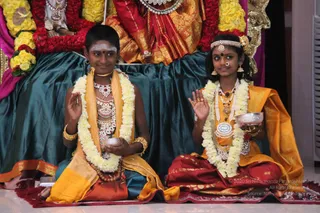
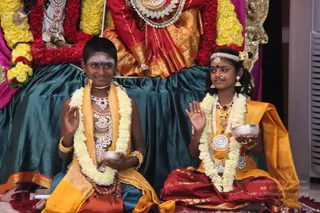
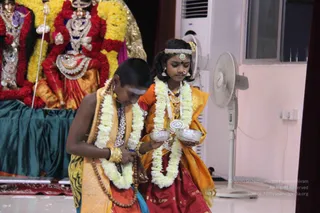
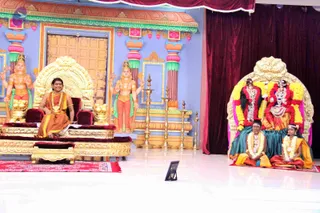
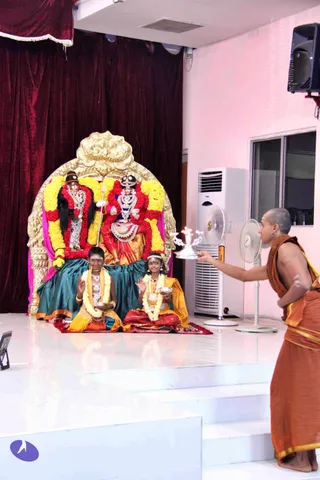
Two decorated deity murtis seated on an ornate gold throne-like peetha with a gilded arched backdrop. The figure on the left is a Shiva-form murti with black hair, a white dhoti, silver and gem necklaces, and a silver hand gesture. The seated goddess on the right wears a red and gold sari, a jewelled crown, layered gold and gem necklaces, and holds a silver bowl. Both are garlanded with red and yellow rose garlands, and a pink cloth hangs behind them.A photograph of two decorated metal murti figures of Shiva and Parvati as Annapoorni seated together on a throne-like gilded backdrop, both wrapped in dense garlands of yellow and red flowers. The figure on the left has long black hair, a crown with rudraksha beads, a trident held in one hand and a silver bowl in the other, wearing layered pearl and gold necklaces. The figure on the right wears a black crown with jewelled ornaments, a deep blue blouse, a red sari with gold border and a silver bowl in hand, adorned with heavy gold and gem necklaces. Deity murti, no living people present.Two children in ceremonial dress sit on a floor mat in front of a deity murti draped in red and gold silk and decorated with yellow and red flower garlands. The boy on the left wears a saffron-yellow shawl, a white-and-gold jewelled necklace, a rudraksha mala, gold armlets and a tilak on his forehead, holding a small silver bowl and raising one hand. The girl on the right wears an orange-gold sari with a red skirt, pearl and jewelled necklaces, a gold headpiece and a nose ring, holding a silver bowl and raising one hand in blessing. Both smile. Teal drapery covers the altar base behind them.Two child performers sit cross-legged on a red and gold carpet in front of a teal satin-draped stage with a seated deity murti behind them, its gold and red garments and garlands visible. The boy on the left wears a saffron-and-gold dhoti and shawl, a gold and red jewelled necklace, rudraksha beads, a white garland, and a sacred ash mark on his forehead; he raises one hand and holds a small silver bowl. The girl on the right wears a gold-bordered saffron sari, a white flower garland, pearl and gold necklaces, a jewelled headpiece, and a nose ring; she raises one hand and holds a silver bowl. Both smile toward the audience.Two young performers sit in front of a richly decorated deity murti draped in red and gold silk with garlands of yellow and red flowers. The boy on the left wears a saffron dhoti, saffron shawl, layered gold and red-stone necklaces, a rudraksha mala, white vibhuti marks on his forehead, and holds a silver bowl while raising one palm. The girl on the right wears an orange-gold sari, white jasmine garland, pearl and gold necklaces, a floral headpiece and nose ring, and holds a silver bowl with her palm raised. Both sit on a teal satin cloth as in an annadan or bhiksha offering scene.Two children walk across a temple hall carrying silver bowls. The boy on the left wears a saffron-orange shawl over a bare chest, a rudraksha mala around his neck, white flower garlands, a sacred forehead marking and gold bangles. The girl on the right wears a red and orange silk dress with a gold-bordered orange shawl, white jasmine garlands, a gold headpiece, earrings and a large ceremonial pendant, and she looks down at the bowls. Behind them stands a decorated deity murti in red and gold dress with yellow and red flower garlands, a trident is visible at the left, and a standing white fan and cabinet sit against a pale wall.

RudraAbhishekam-Swamiji-Rajasabha

101 photosSource gallery
A photograph of a seated man at a golden throne-like seat with an ornate arch, hands pressed together in namaskar with eyes closed. He wears a red and pink flower garland, gold necklaces, bangles, and an orange-brown cloth, with a red bindi on his forehead. Two painted deity murti figures with multiple arms, crowns and orange dhotis flank the throne, and golden lion-like sculptures sit at its base. A red and gold draped table holds silver vessels, a kalasha-style brass pot, flower offerings and a silver lamp. A caption on the image reads 'Paramashivam'.A seated man in orange-saffron robes sits on an ornate gold throne with a gold arched back, hands pressed together in namaskar above a silver kalasha-type vessel. He wears a red-and-white flower garland, gold necklaces and bangles, and a red tilak on his forehead. Flanking the throne are two large painted statues of four-armed deities with tall crowns, gold jewellery and orange-pink dhotis holding ceremonial objects. A red and gold draped table holds silver bowls, a brass lamp and flower offerings in front of golden lion-like sculptures.A seated man in orange-saffron robes sits on an ornate gold throne with a carved arch, flanked by two painted standing deity murti with multiple arms and gold-tipped crowns. He wears a red tilak, layered rudraksha and gold necklaces, a pink and white flower garland, and gold bangles. His palms are raised in blessing before a silver kalasha-like vessel and a small silver lamp, with a red-and-gold draped table, silver bowls and flowers in front. Probable Swamiji: long hair, ornate gold jewellery and a rudraksha mala are visible, and he is seated on the throne as the central figure.A seated man with a vertical tilak and a bare upper torso, wearing a red-and-saffron cloth over his shoulder and a long garland of pink and white flowers, sits with palms pressed together in namaste before a golden throne with lion-head armrests. Before him on a red and gold cloth stand a silver kalasha, a small silver lamp, brass vessels and a plate of flowers and offerings. Two large painted dvarapala guardian statues with multiple arms, golden crowns and gold ornaments flank the throne against an ornate wooden door. The seated man is presented as the central figure of a satsang setting.Photo of a seated man with hands folded in namaste and eyes closed, at a ceremonial stage in front of a large gold ornate throne with carved backrest and maroon cushions. He wears a maroon-brown robe, long pink-and-white flower garlands, a gold necklace, gold armlets and bangles, and a tilak with red dot on the forehead. On the red-and-gold draped table before him sit a silver kalasha, brass oil lamps, a silver bowl and a small brass deity figure. A painted deity mural with raised trident stands behind. a person — the seated man has the distinctive gold ornamentation, garlands and throne setting, though the appearance is not certain enough to confirm.A man seated in front of a large gold ornate backrest, with palms pressed together in namaste and eyes closed. He wears a brown-maroon cloth draped over his shoulders, multiple rudraksha malas, gold ceremonial necklaces, gold bangles and armlets, and pink-red flower garlands. A red bindi and white tilak mark his forehead. Beside him sit a silver kalasha on a stand and a brass oil lamp with a lit flame. A faint painted deity figure with raised arms appears in the background, and a gold elephant ornament sits at lower left. a person is shown in an appearance-based label, with long swept hair, rudraksha malas and ceremonial gold necklaces as qualifying cues, seated in a satsang setting.

Rudrabhishekam

11 photosSource gallery
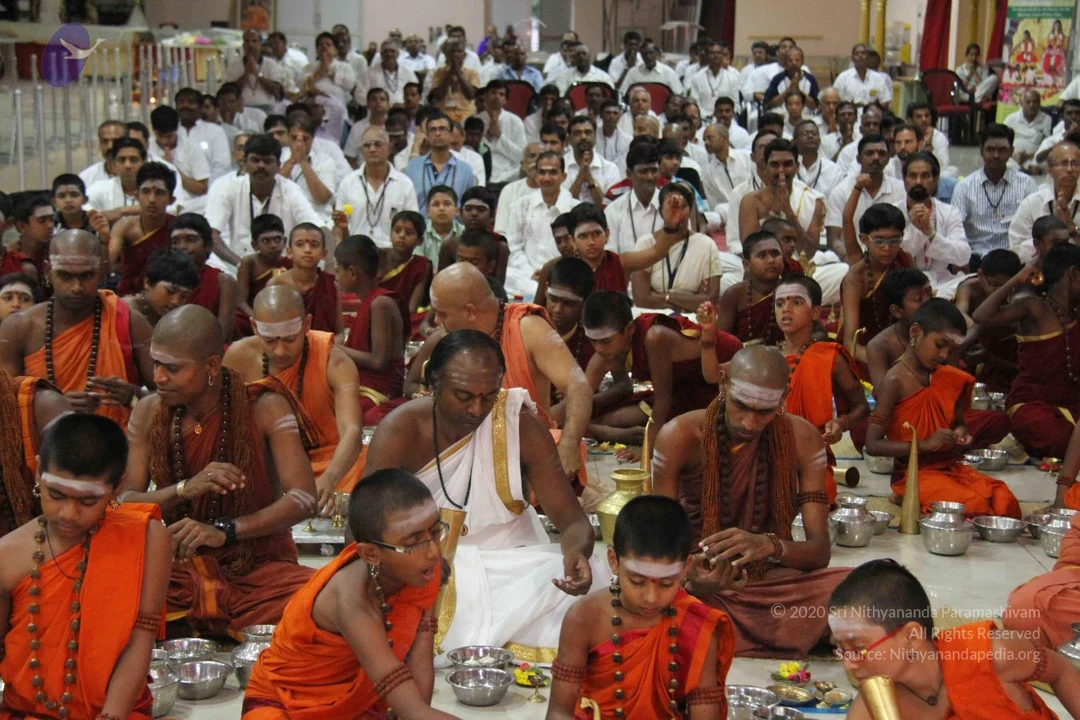
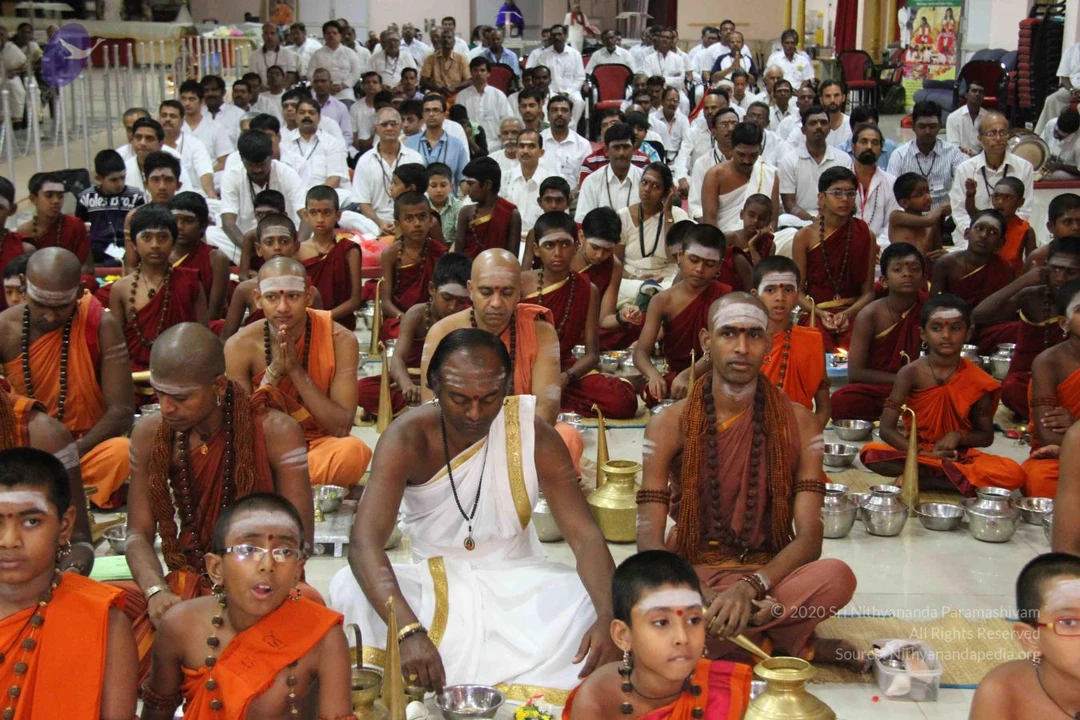
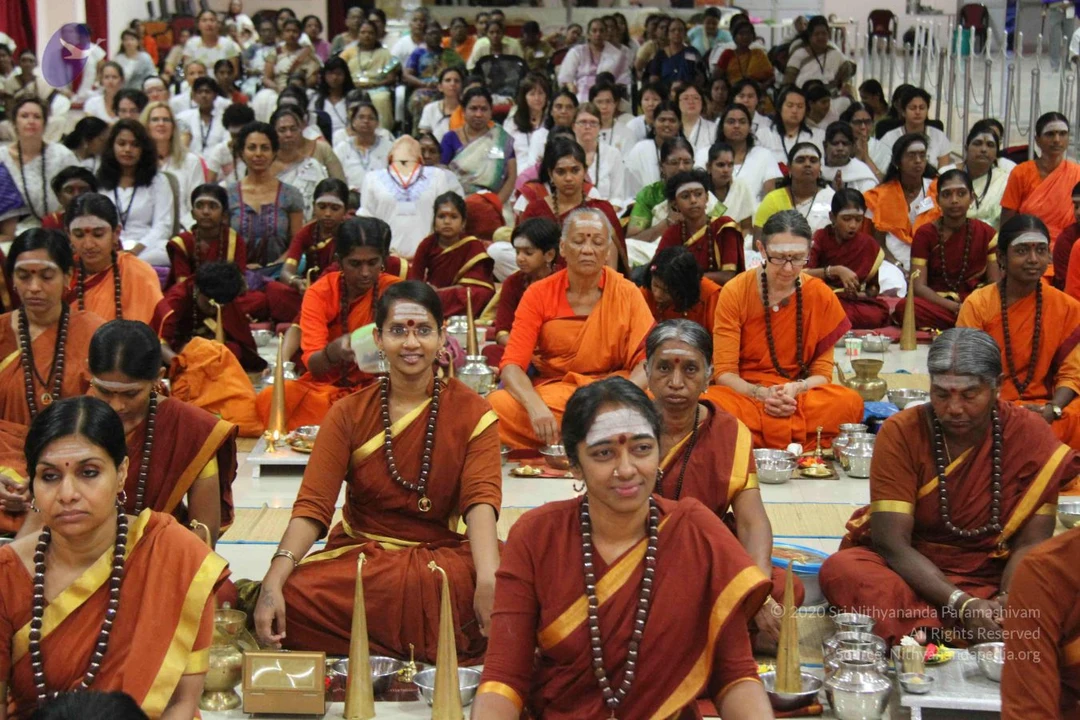
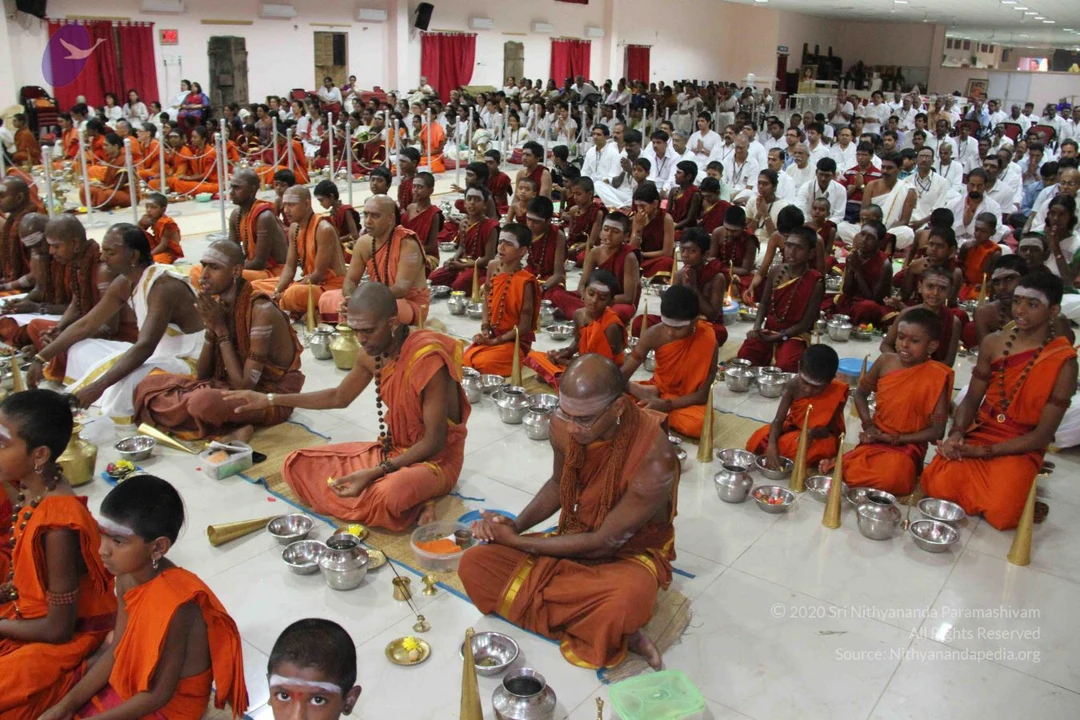
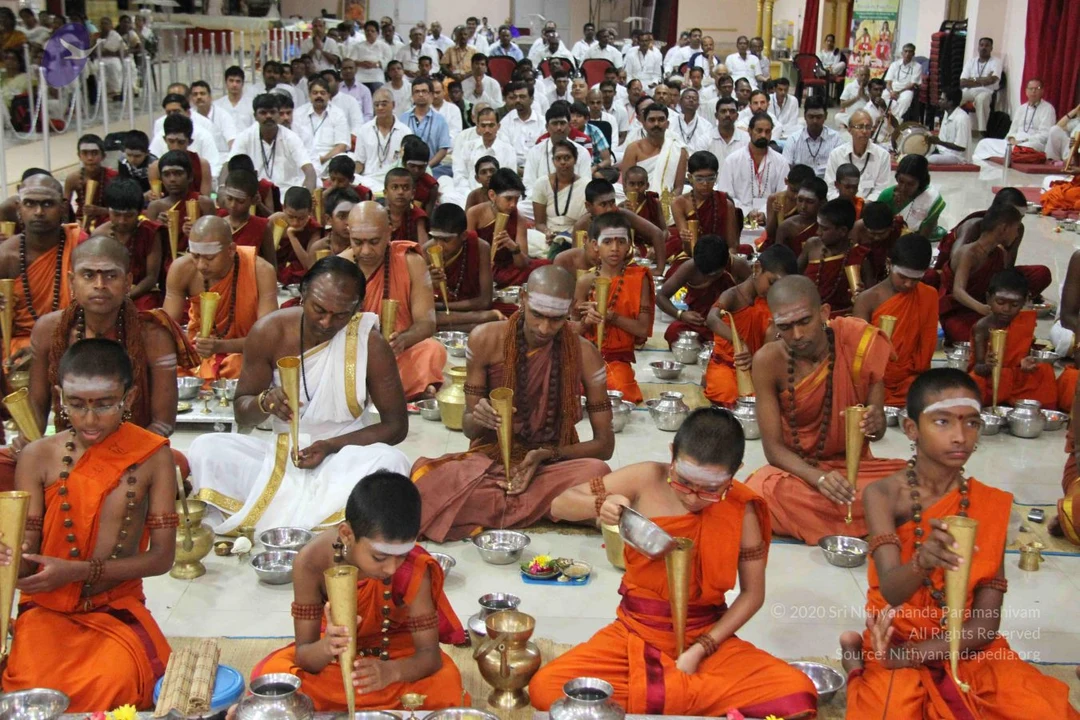
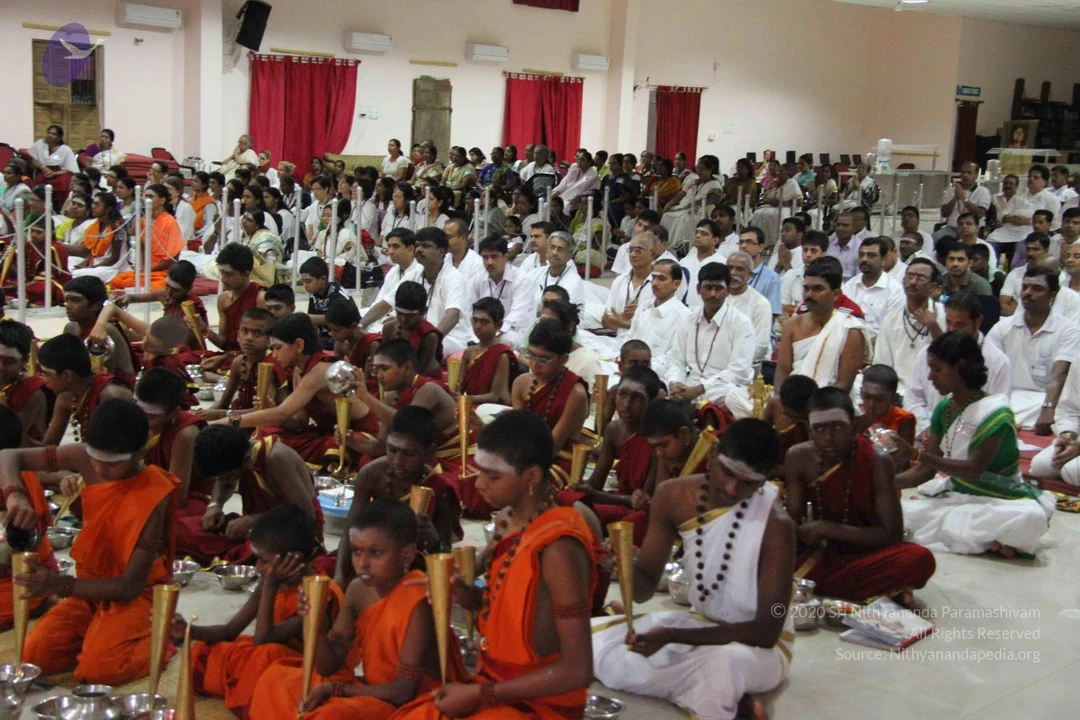
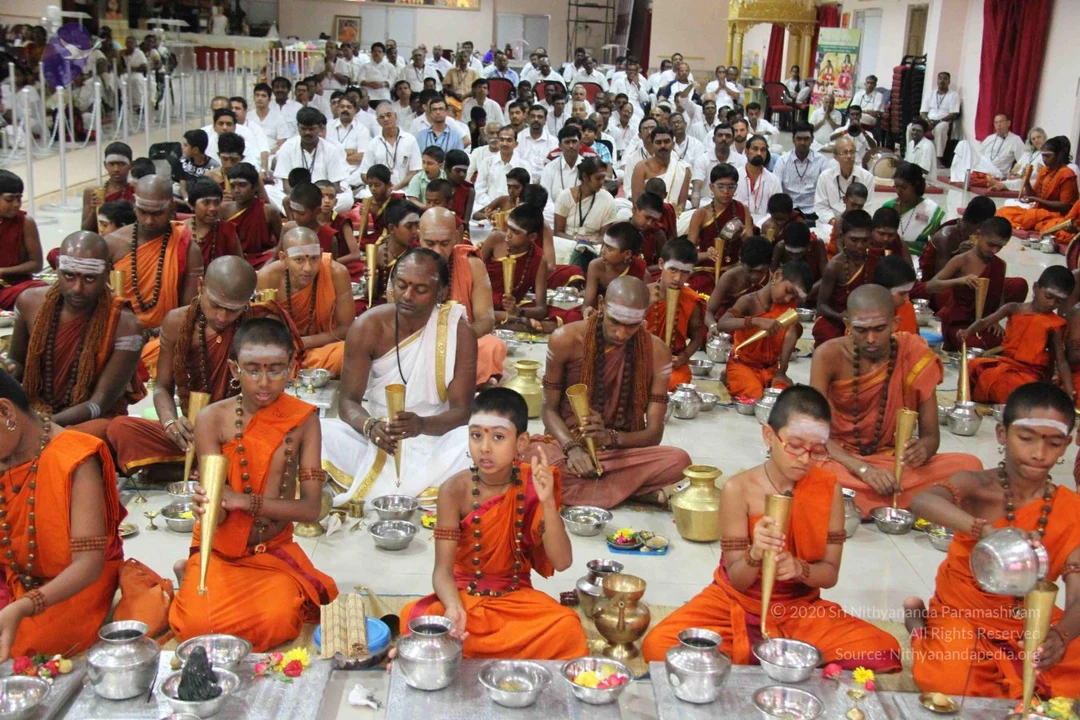
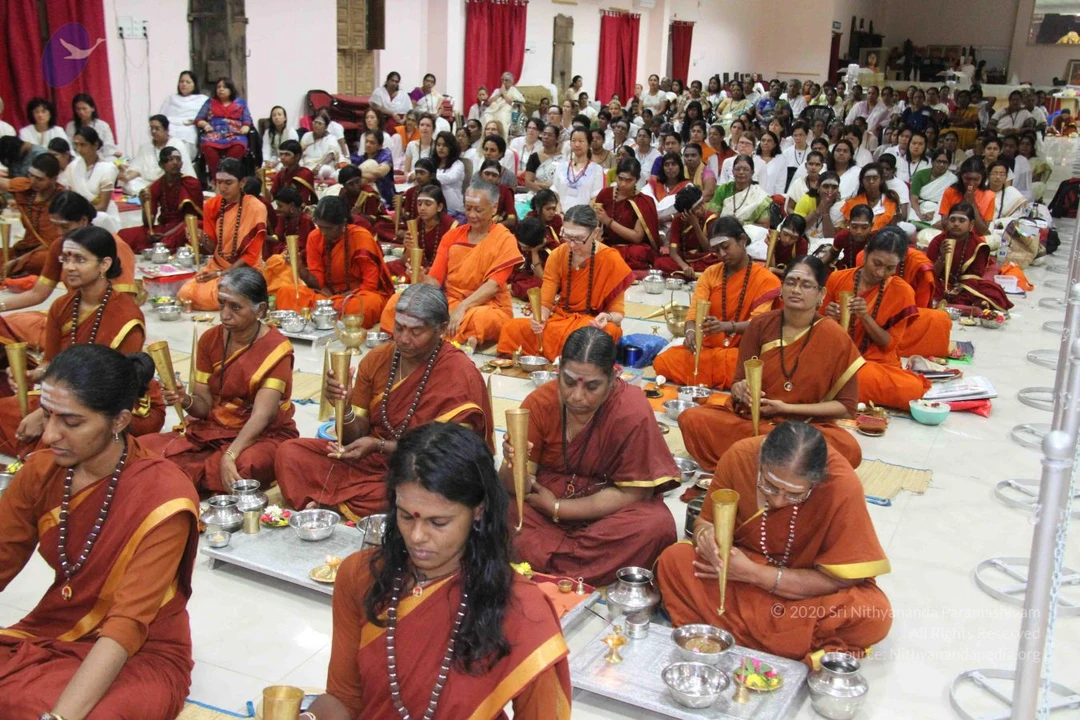
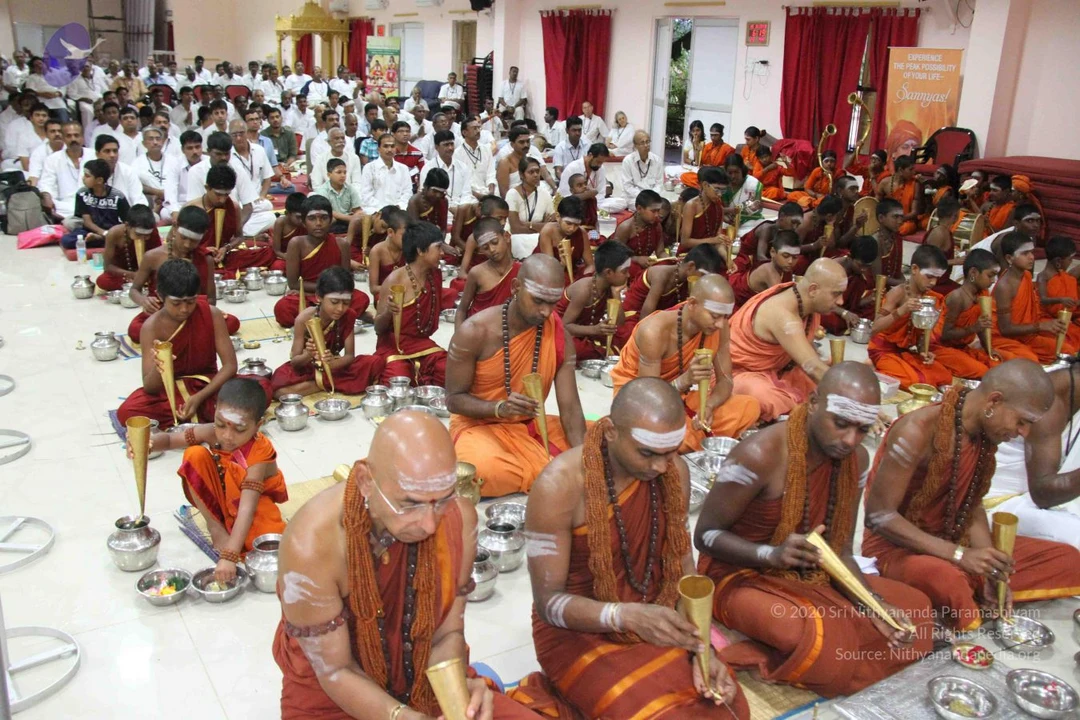
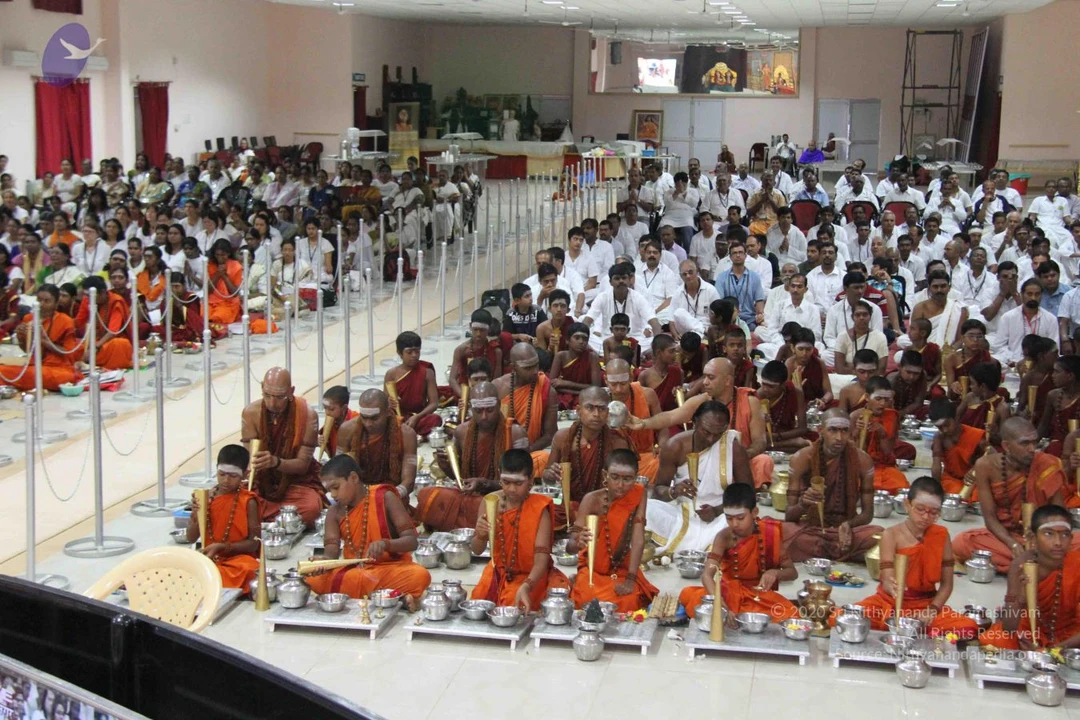
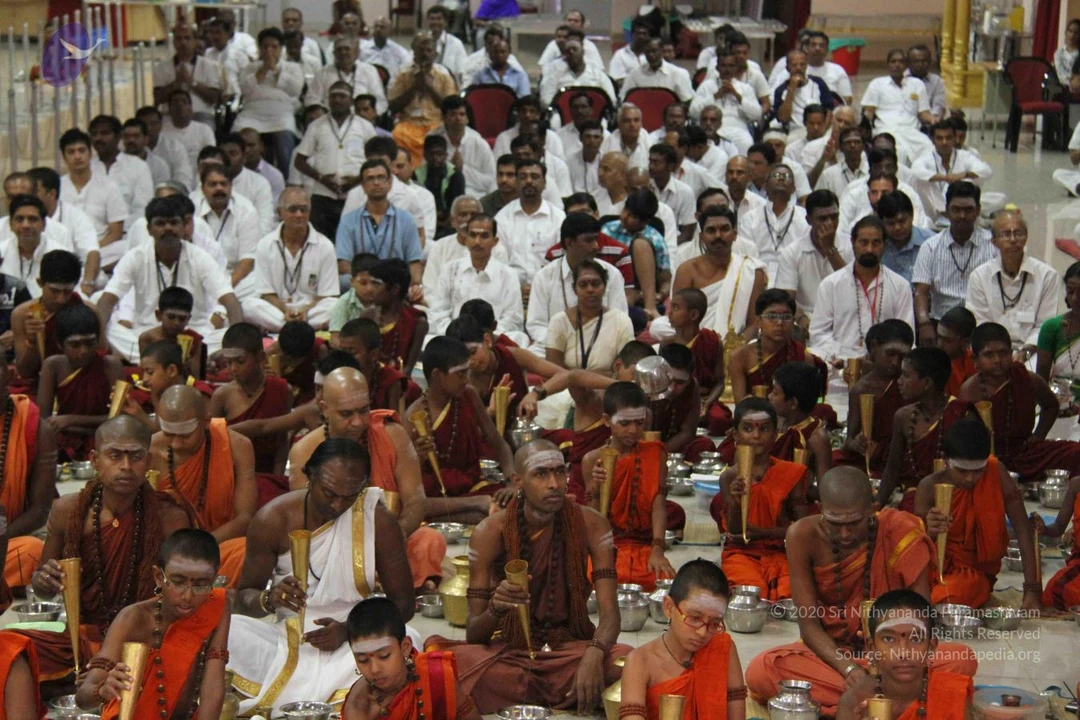
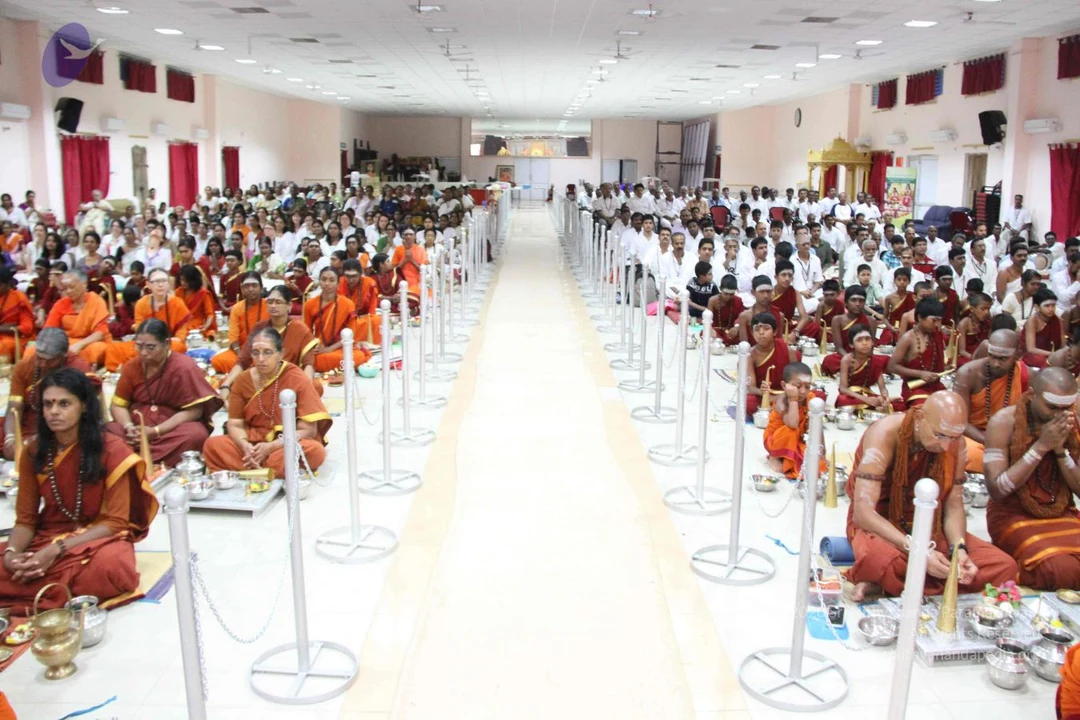
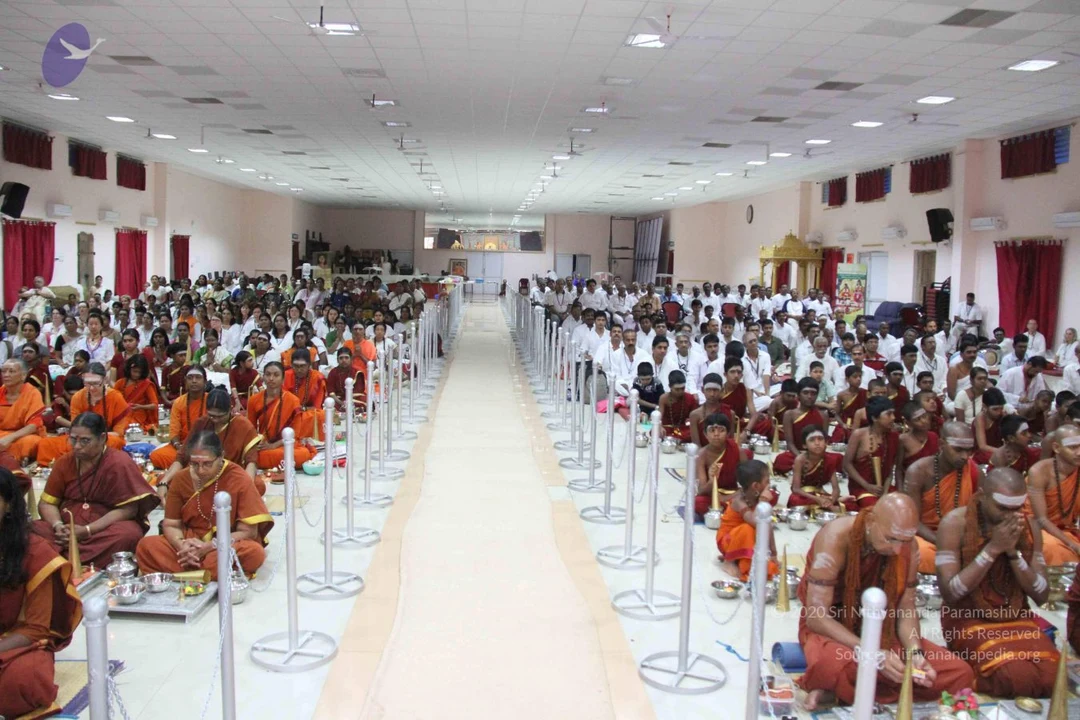
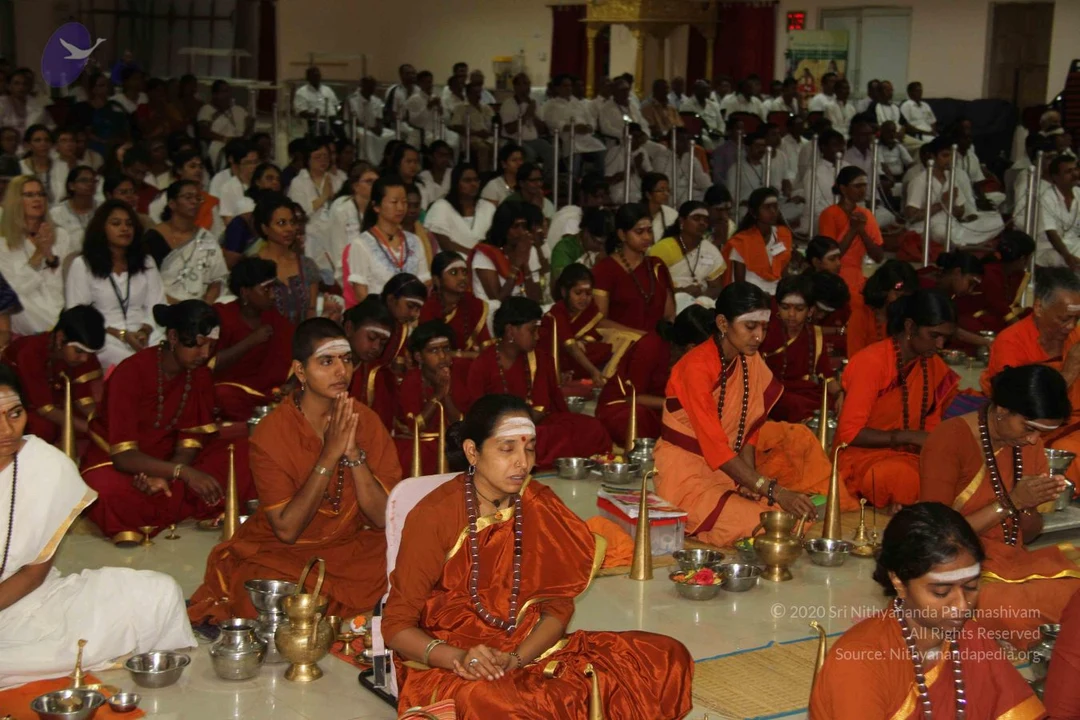
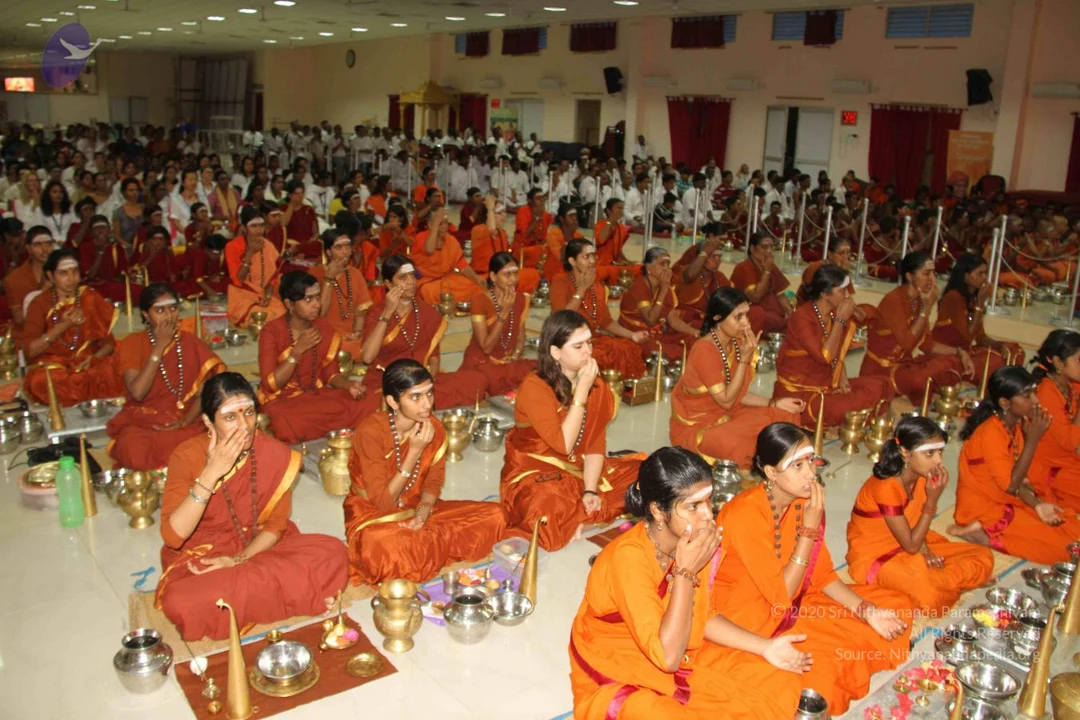
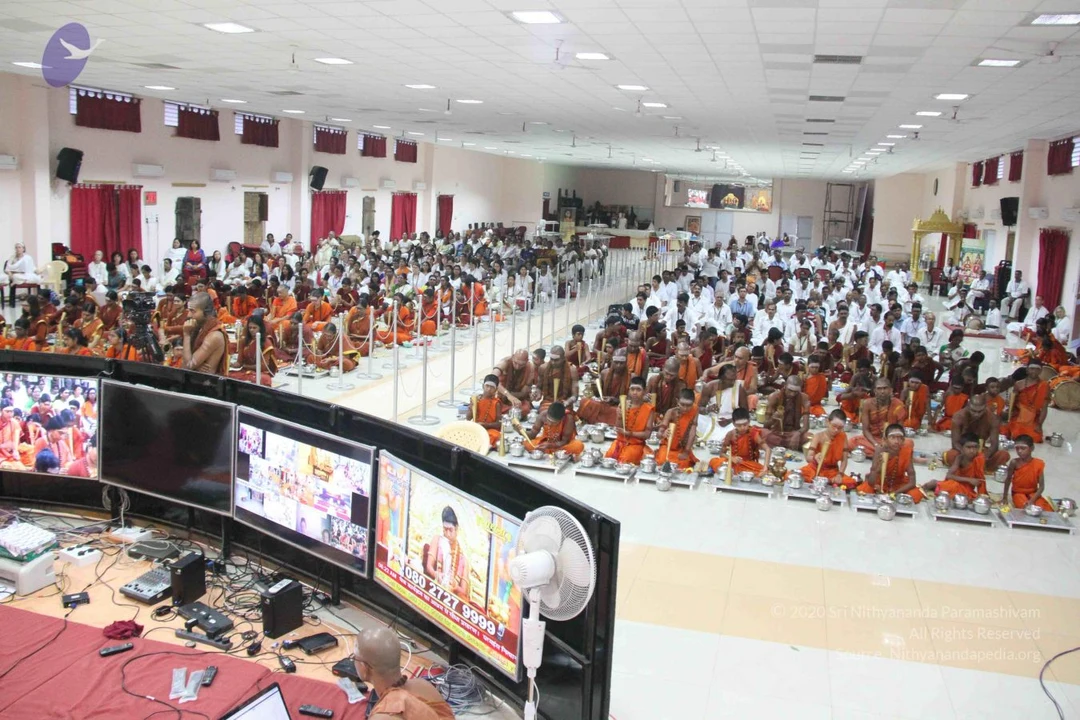
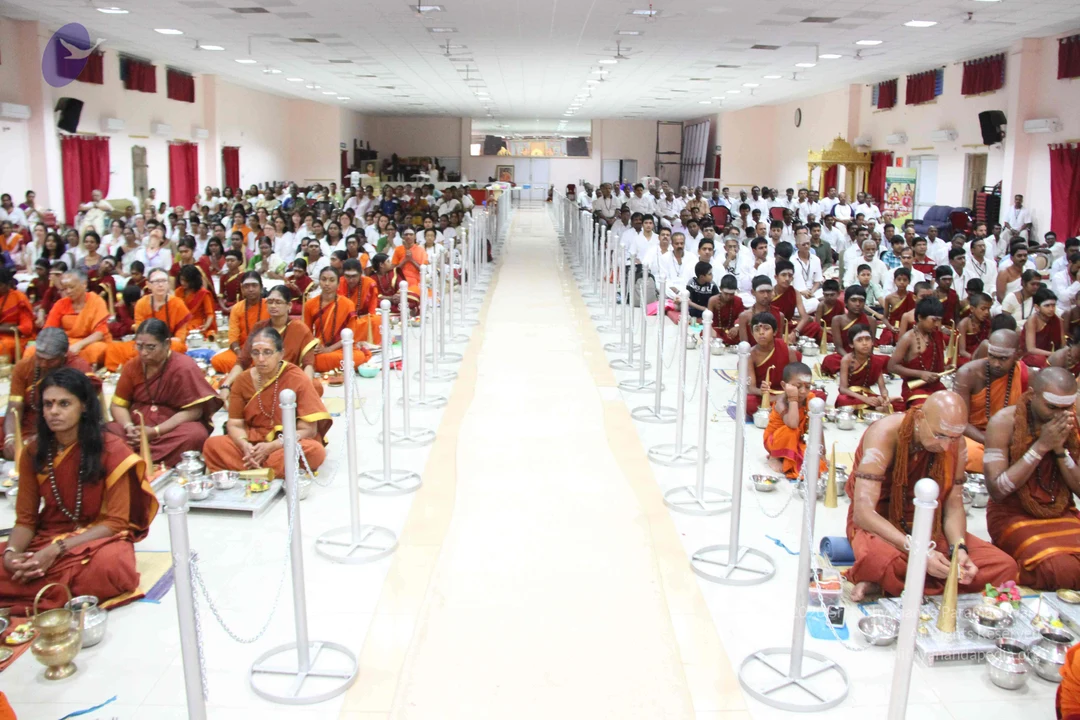
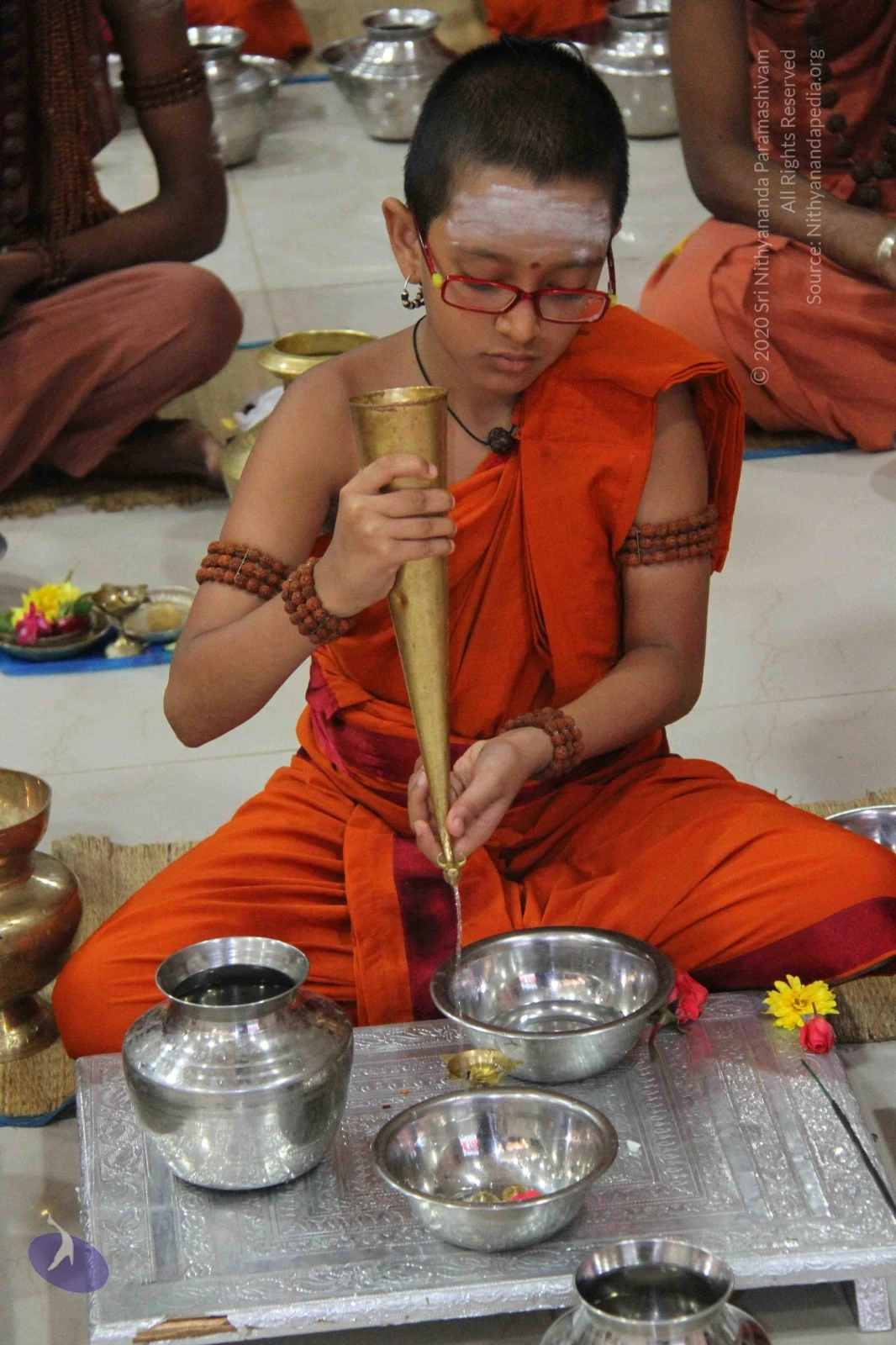
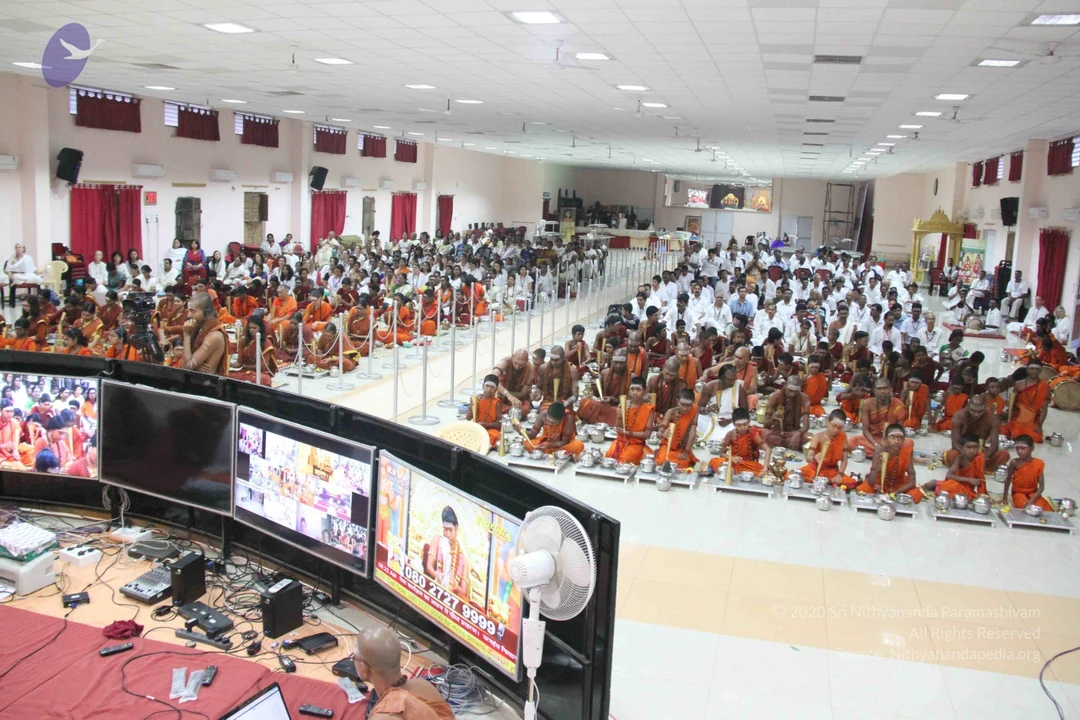
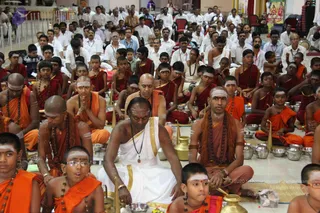
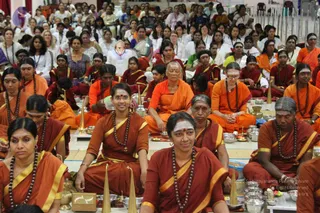
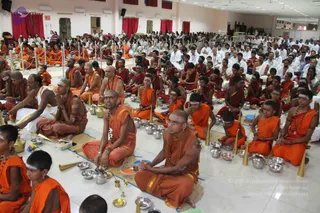
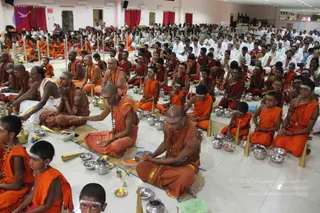
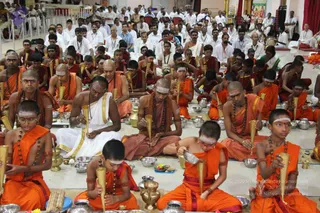
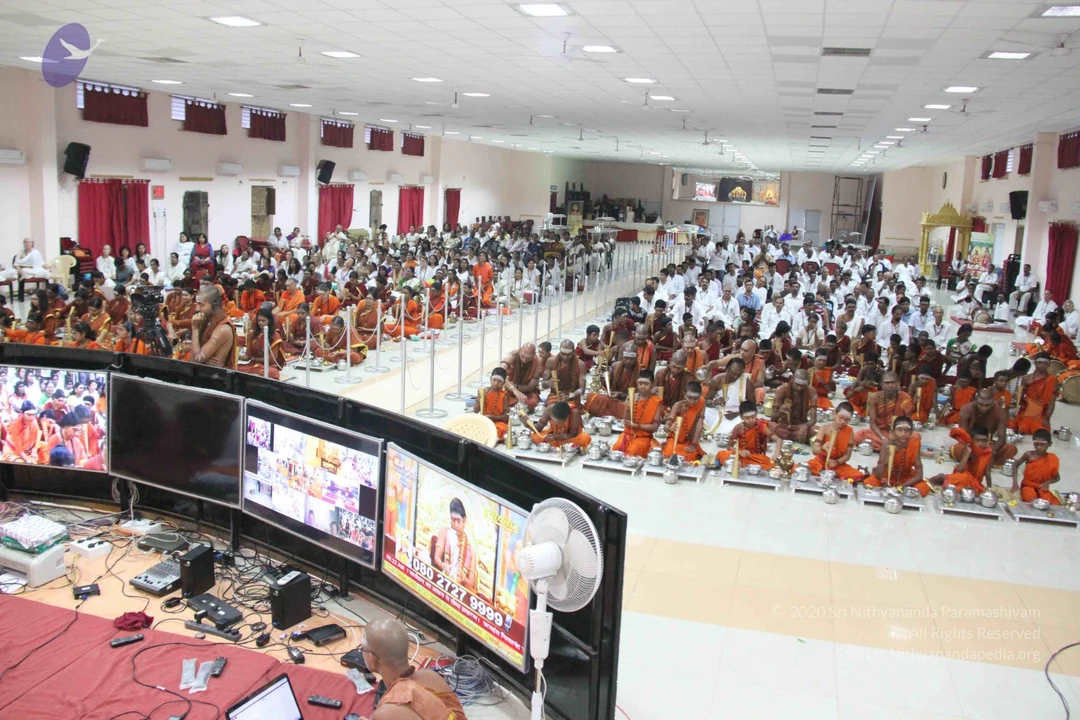
A large ritual gathering in a temple hall where many people sit on the floor in rows. In the foreground, a priest in a white dhoti with a gold border and a black bead necklace sits before brass kalasha pots and small steel bowls. Beside him, a shaved-headed man in an ochre cloth and rudraksha mala sits with a brass vessel, and to the left several young boys in orange and saffron robes with white forehead markings and rudraksha malas sit before offerings. Behind them, rows of seated men in white shirts and dhotis fill the room, with a colourful deity painting on the wall at upper right. The scene appears to be a ceremonial puja or abhishekam.A large seated assembly of devotees in an indoor hall during a satsang gathering. Foreground women in rust-red and saffron saris with gold borders wear rudraksha malas and vertical tilak markings on their foreheads, seated before small brass vessels, brass cones and offering plates. Behind them, rows of women in orange, saffron and white clothing sit cross-legged on mats, many with white and orange ascetic-style dress and bead necklaces. A brass kalasha-style vessel and plates of offerings lie on the floor. No single figure is clearly identifiable as a person, and no throne or raised dais is visible.A large hall filled with seated devotees during a ritual gathering. In the foreground, several young boys and men in saffron-orange robes sit on a mat, with bare upper bodies, forehead paste markings and rudraksha malas. Brass vessels, small bowls and kalasha-style pots are set before them, along with brass horns and trays of kumkum and offerings. Behind them, rows of people in white clothes and saffron robes fill the hall, with red curtains and wall fans visible. A central figure in orange with a white sacred cord and mala sits at the front of the group, appearing to lead the ritual, though his identity cannot be confirmed from appearance. Many participants in white attire sit in the background.A large indoor hall with white tiles where many people sit cross-legged on mats in rows. In the foreground, a bald man in saffron-orange robes with a rudraksha mala sits before a brass plate and small metal bowls, apparently performing a puja. Beside him, another saffron-robed man sits near small silver vessels and brass implements. Many young boys and youths in saffron and maroon robes with white forehead markings sit in ordered rows, surrounded by brass bowls, kalashas and conch-like brass horns. Behind them, many people in white clothing sit attentively. The scene suggests a group ritual or satsang gathering with offerings.A large ritual gathering in an ashram hall where a seated group of young boys in saffron-orange robes with rudraksha malas and white forehead markings play long brass horns, while older priests in orange and maroon sit among them. A priest in white dhoti with gold border at center holds a brass vessel and a small ritual lamp, with brass pots and steel bowls on the floor around them. Behind them, rows of men and women in white and light clothing sit attentively. A corner banner with a colorful deity image hangs on the wall.A large indoor hall with cream walls, red curtains and wall fans. Dozens of young boys in saffron and maroon robes sit cross-legged on the floor holding long brass horns and small metal bowls, with rudraksha malas and white tilak marks. Behind and to the side, rows of adults in white ritual clothes and devotees in white and colourful saris sit watching. No one is clearly identifiable as a person; the white-robed men are attendants and devotees.

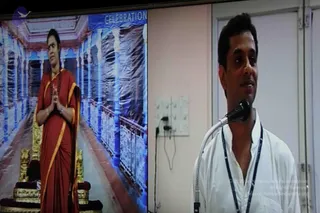
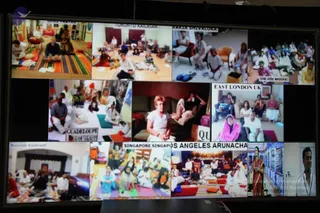
Acharya-IA-Day4-Session-TwoWay

3 photosSource gallery
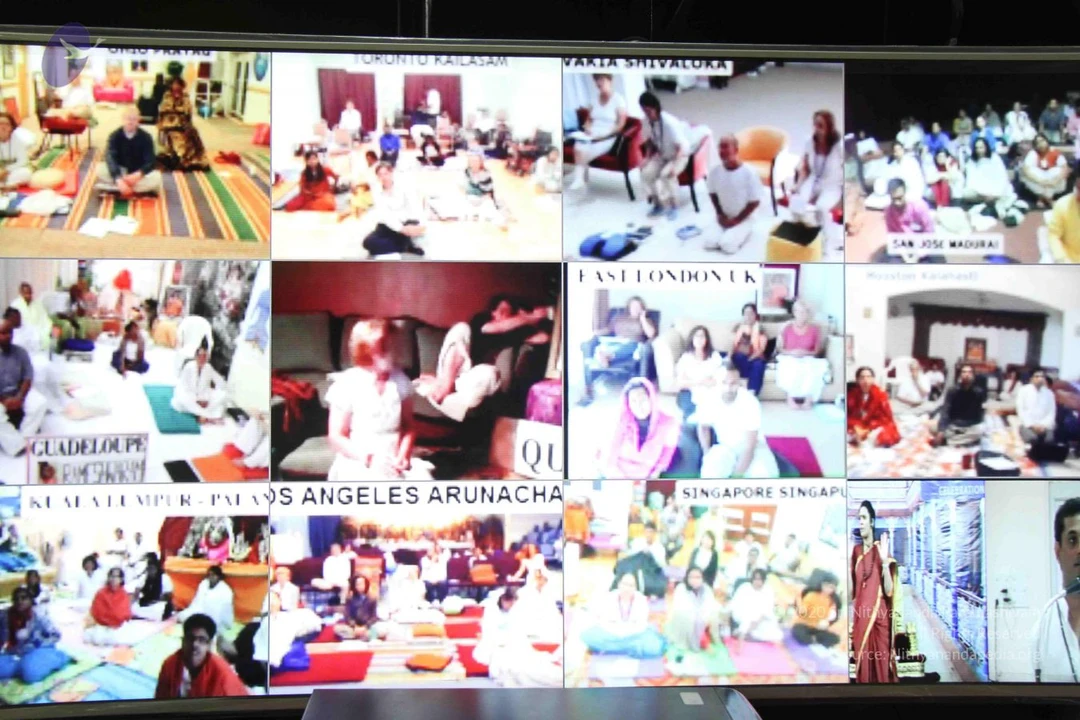
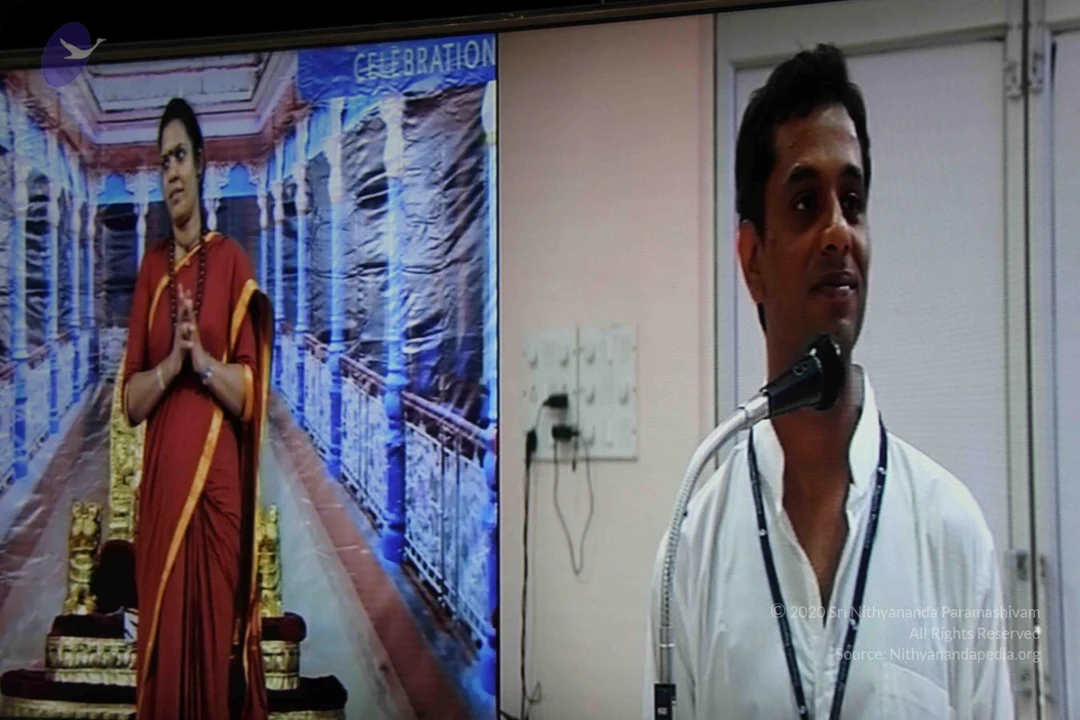
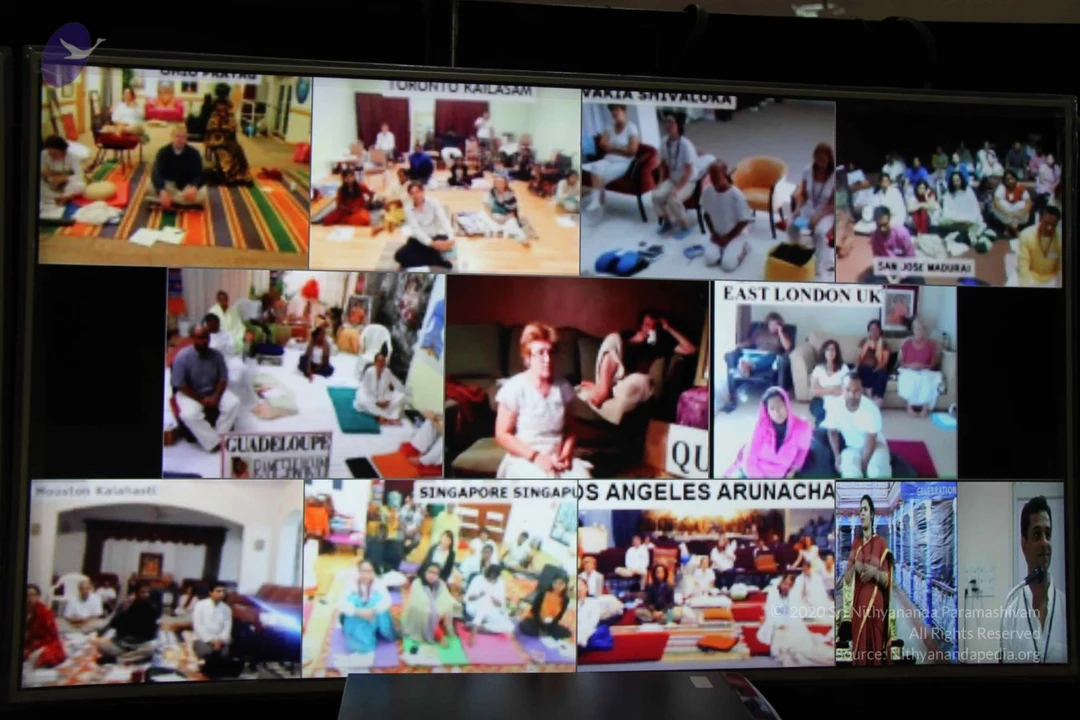
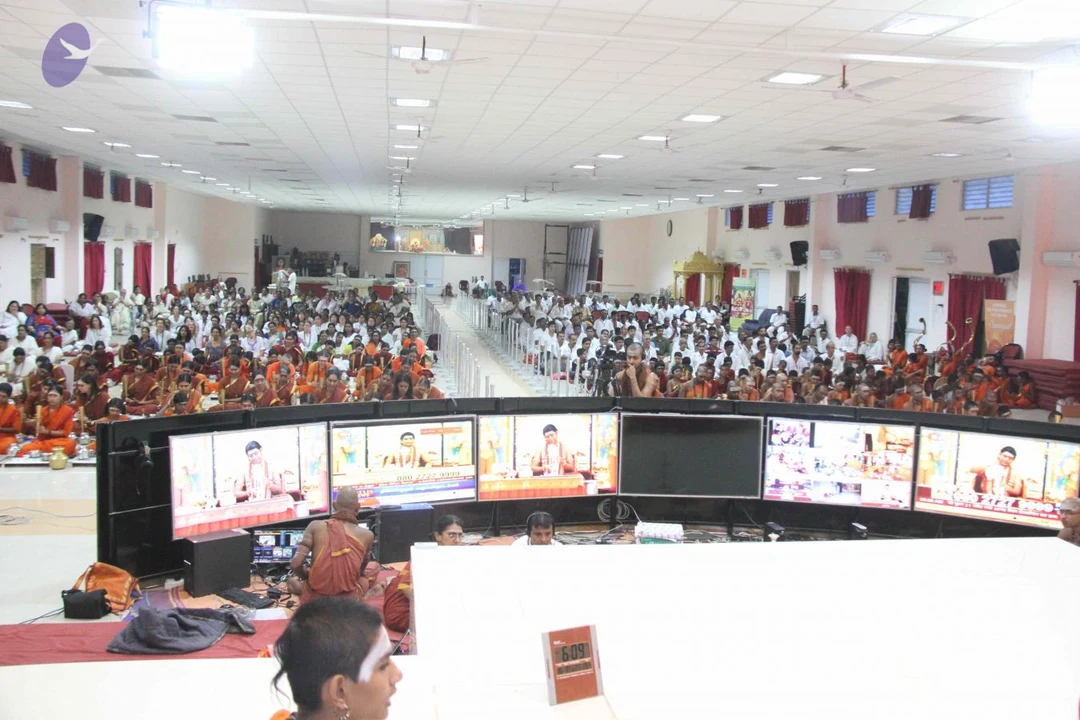
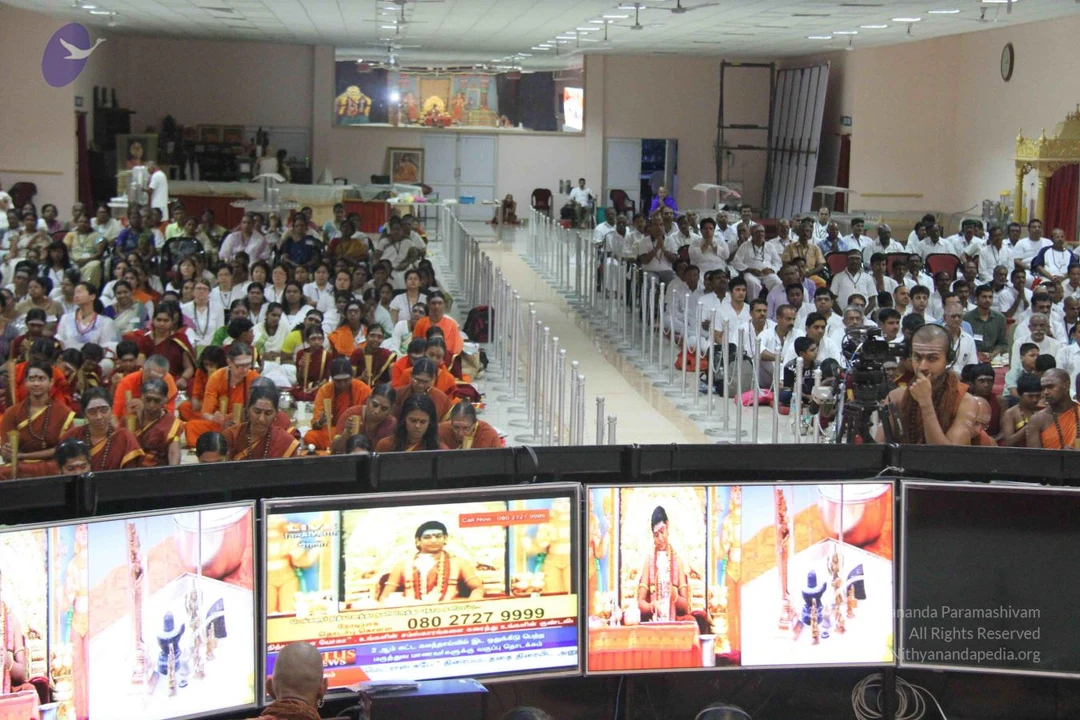
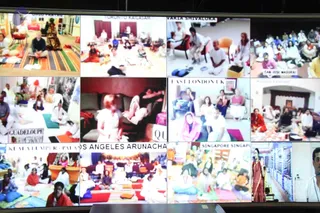
A photograph of a large video wall showing a grid of live satsang feeds from multiple KAILASA centres. Labels on the tiles read Toronto Kailasam, Vakia Shivaloka, San Jose Madurai, Houston Kailasa, East London UK, Guadeloupe, Kuala Lumpur Palaniappan, Los Angeles Arunachala, and Singapore Singapura. In most tiles devotees sit cross-legged on mats and cushions, some in white and some in saffron or red sarees and kurtas. In the bottom right corner a woman in a red sari stands beside a man in white, while a bookshelf-lined room appears behind them. Several tiles show altars with deity images and lamps.A man in a white shirt with a lanyard stands at a microphone on a stand, speaking, in a plain room with a white wall and electrical outlets. On a large screen to the left, a woman in a red sari with gold border and a rudraksha mala stands with hands in anjali before a golden throne, with a blue-draped hall and columns behind her; a blue banner reading CELEBRATION is visible. The screen shows a live satsang feed.A large wall screen shows a grid of live video feeds from several satsang locations, each panel captioned with a place name such as Toronto Kailasam, Vakia Shivalokam, San Jose Madurai, Guadeloupe, East London UK, Houston Kailasi, Singapore Singapore and Los Angeles Arunachala. Participants sit on mats and cushions in white and coloured clothes, some with folded hands, others seated on sofas. A woman in a pink headscarf and a man in a grey kurta are visible in one panel, and a woman in a red sari stands at the far right beside a man at a microphone. The screen is a photograph of a display, so the people visible are on screens, not physically present, and the frame carries a copyright and source notice.

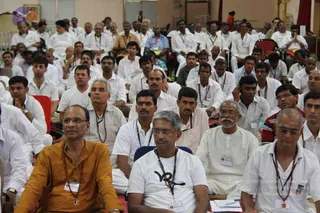
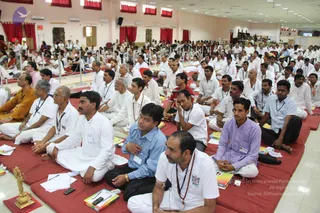
IA-Day4-Participants-Listening

10 photosSource gallery
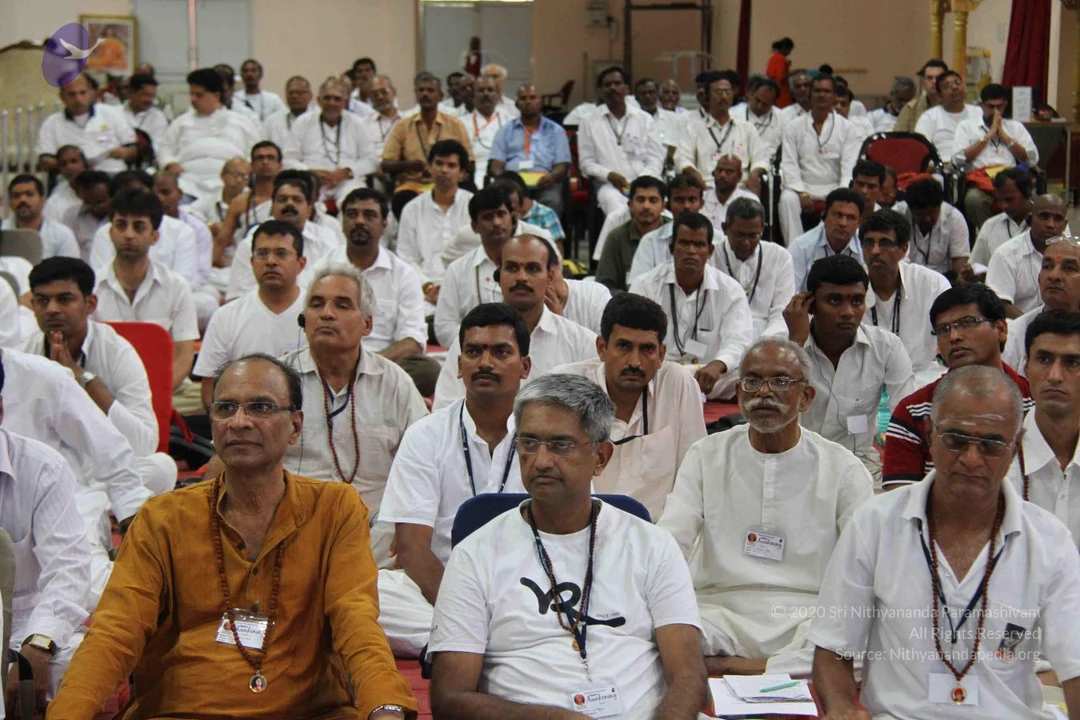
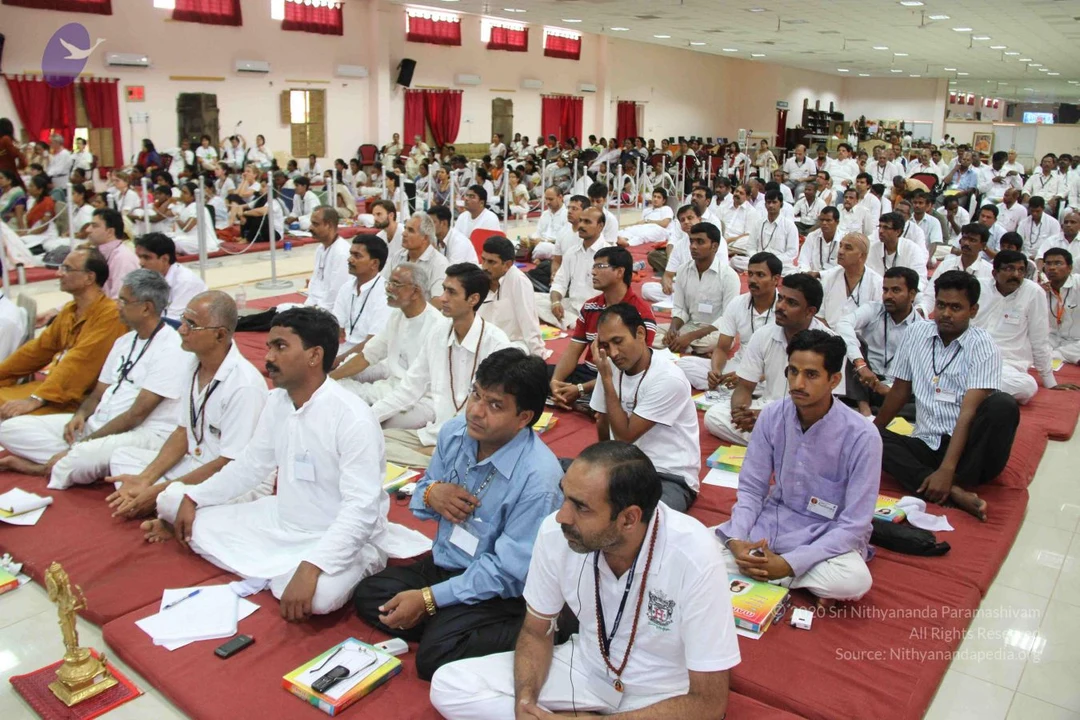
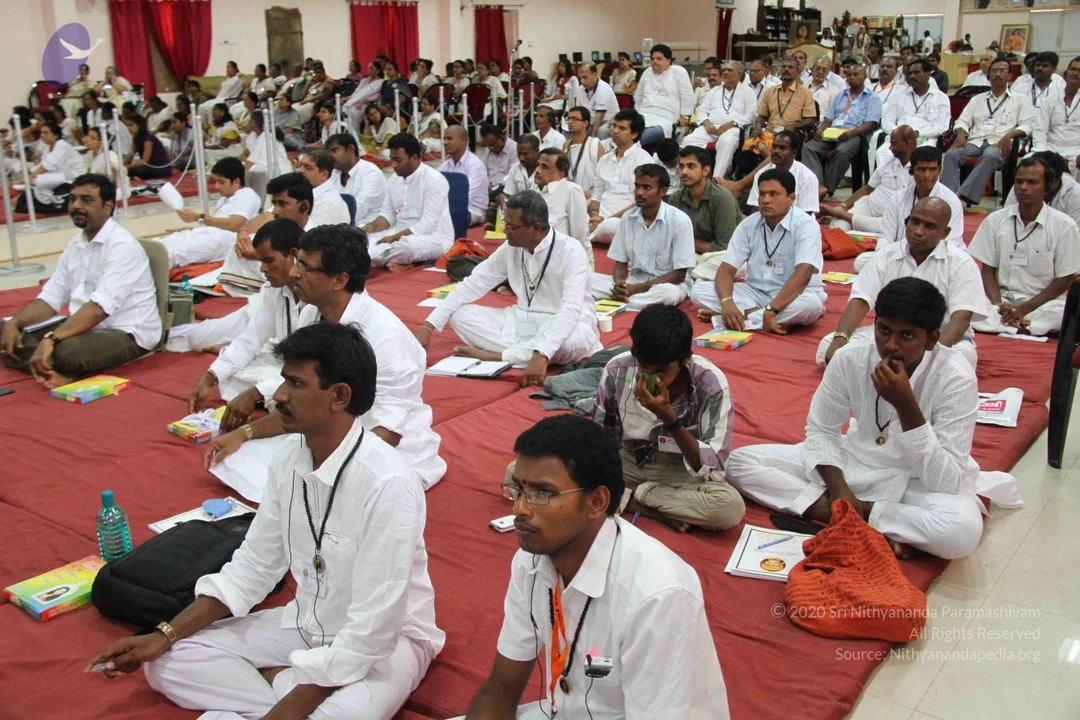
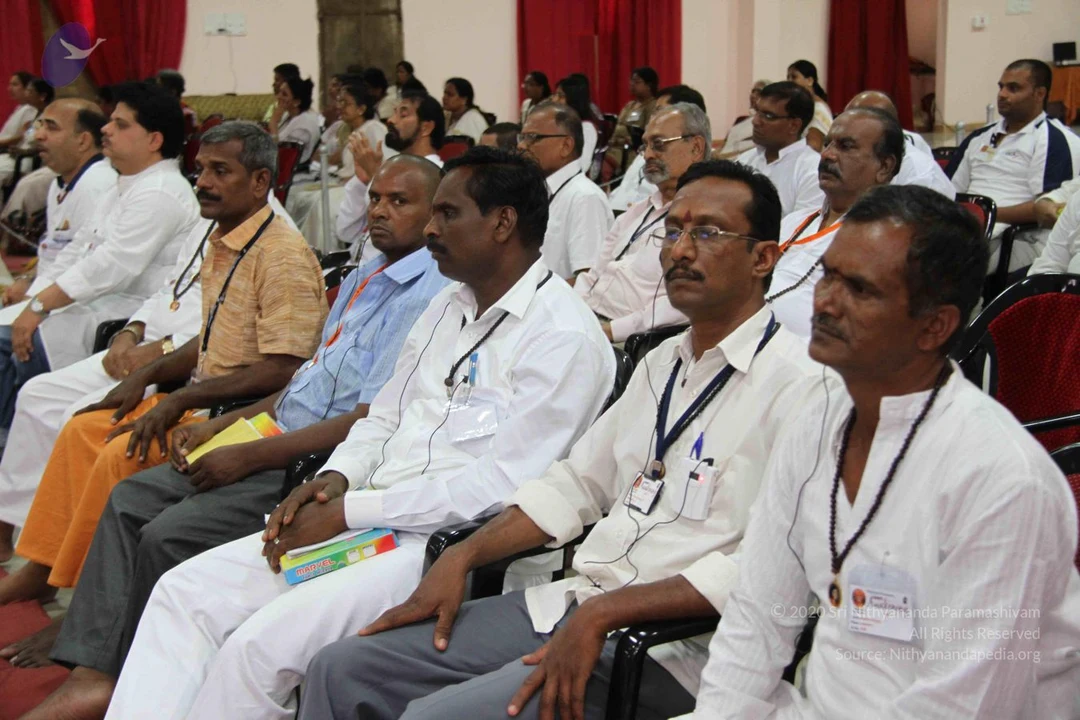
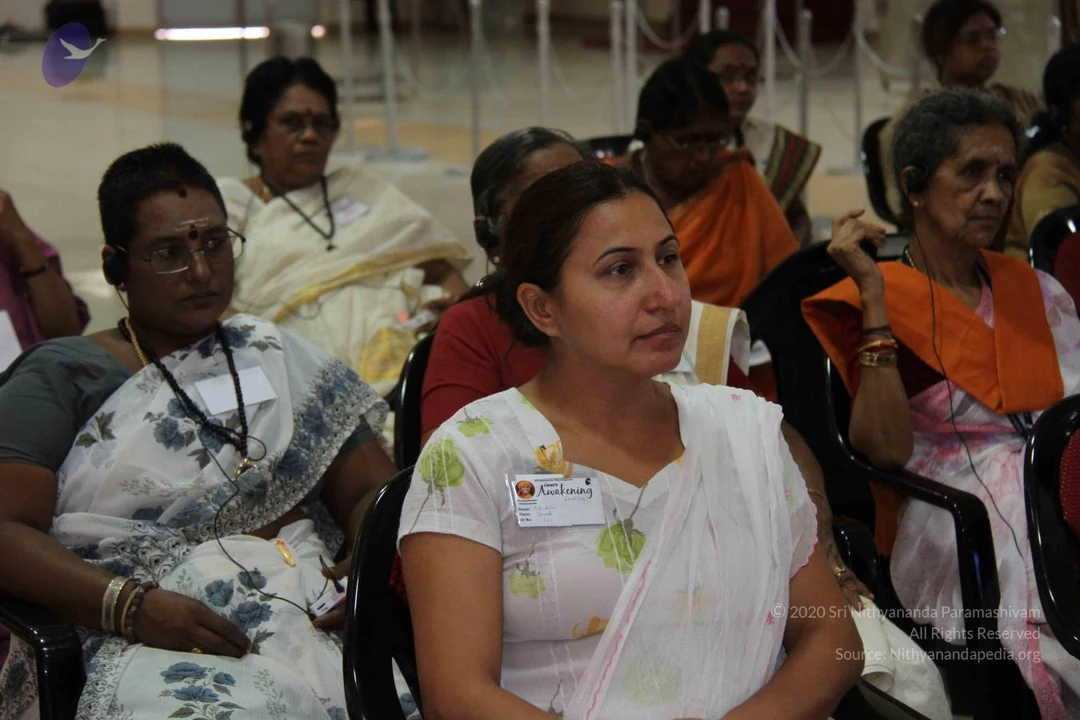
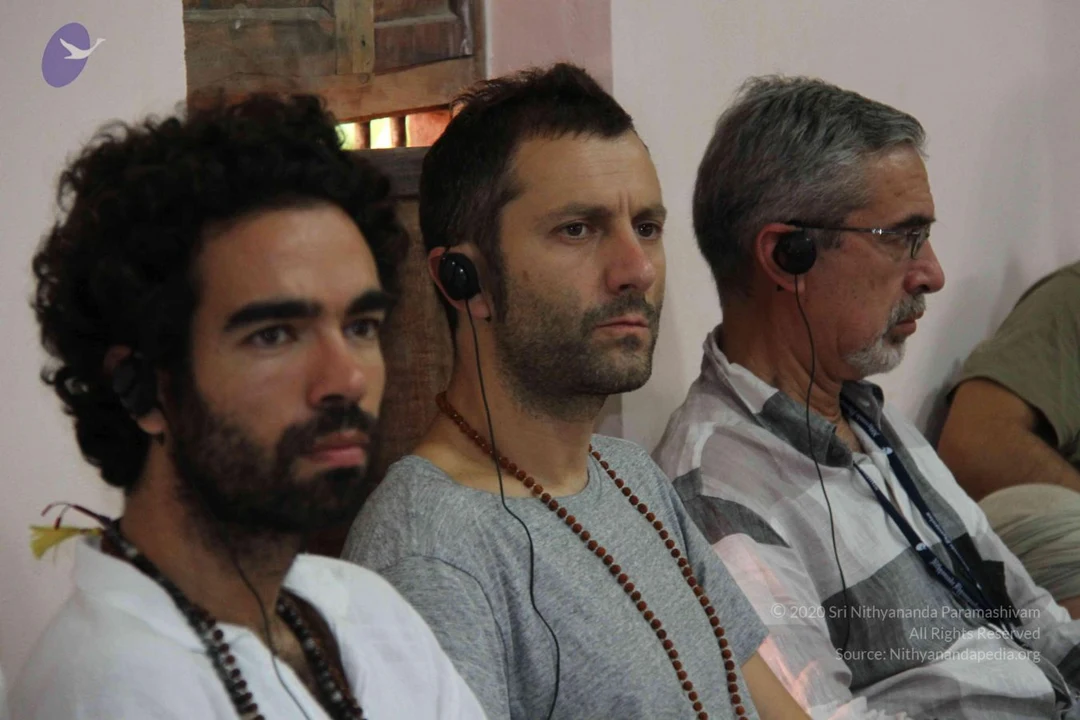
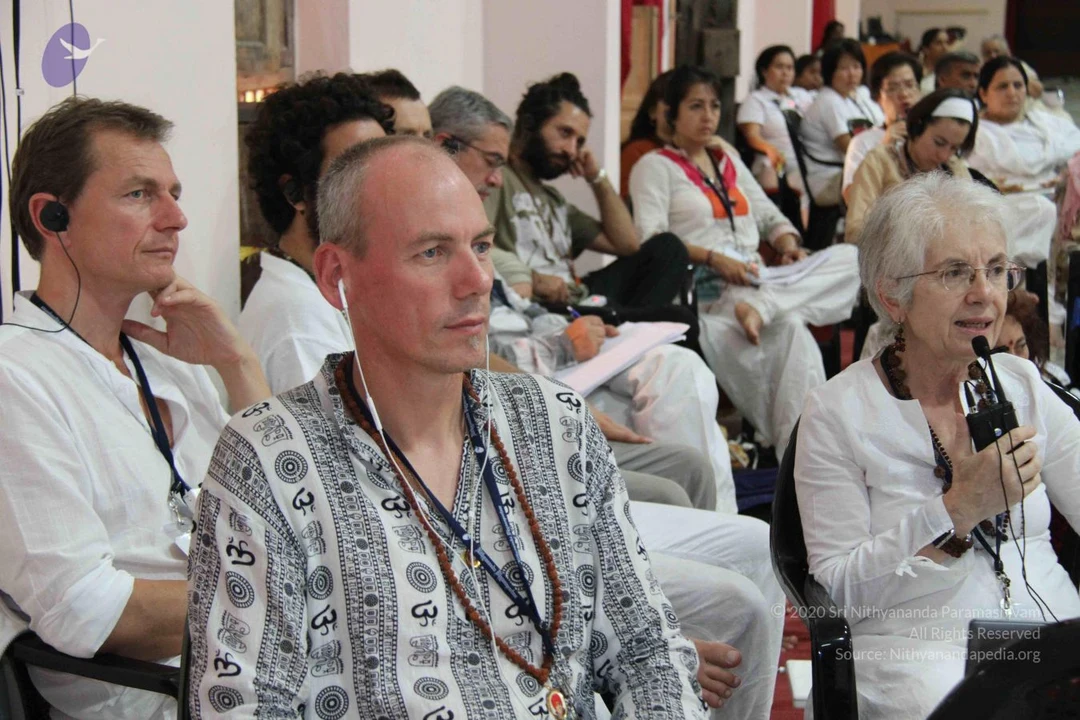
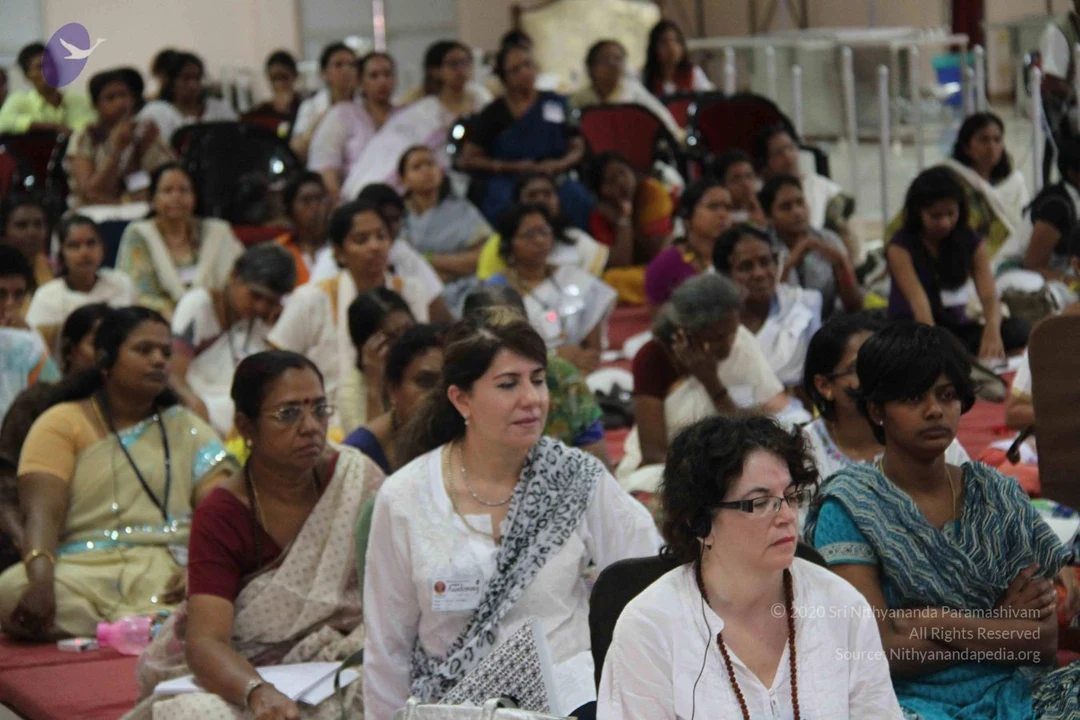
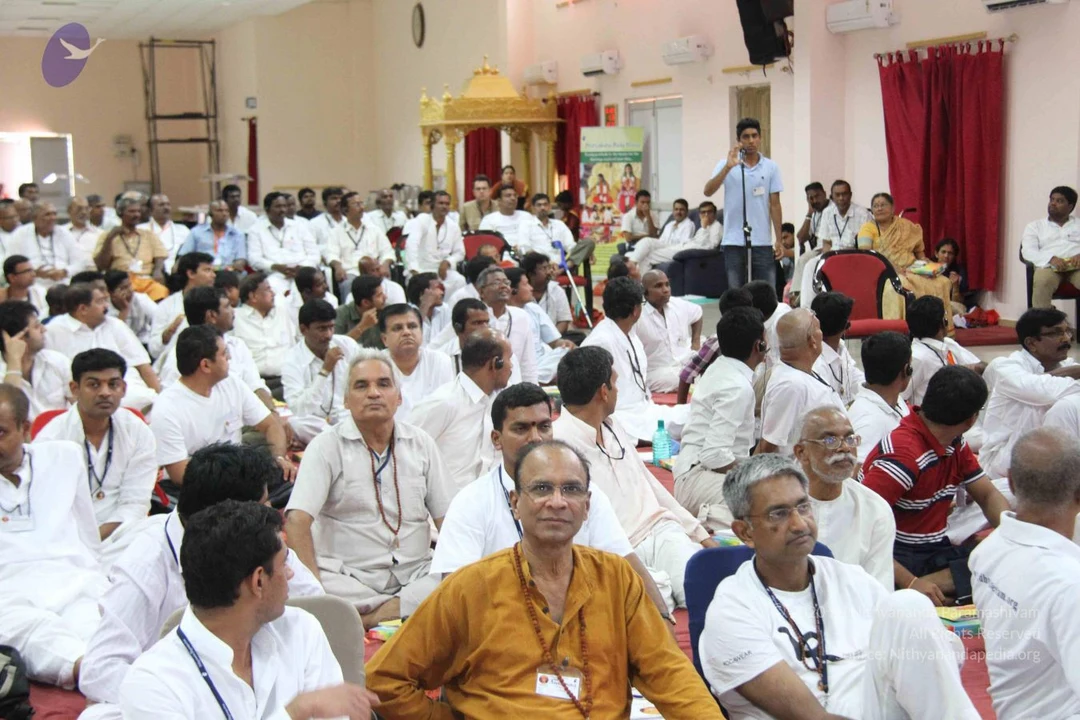
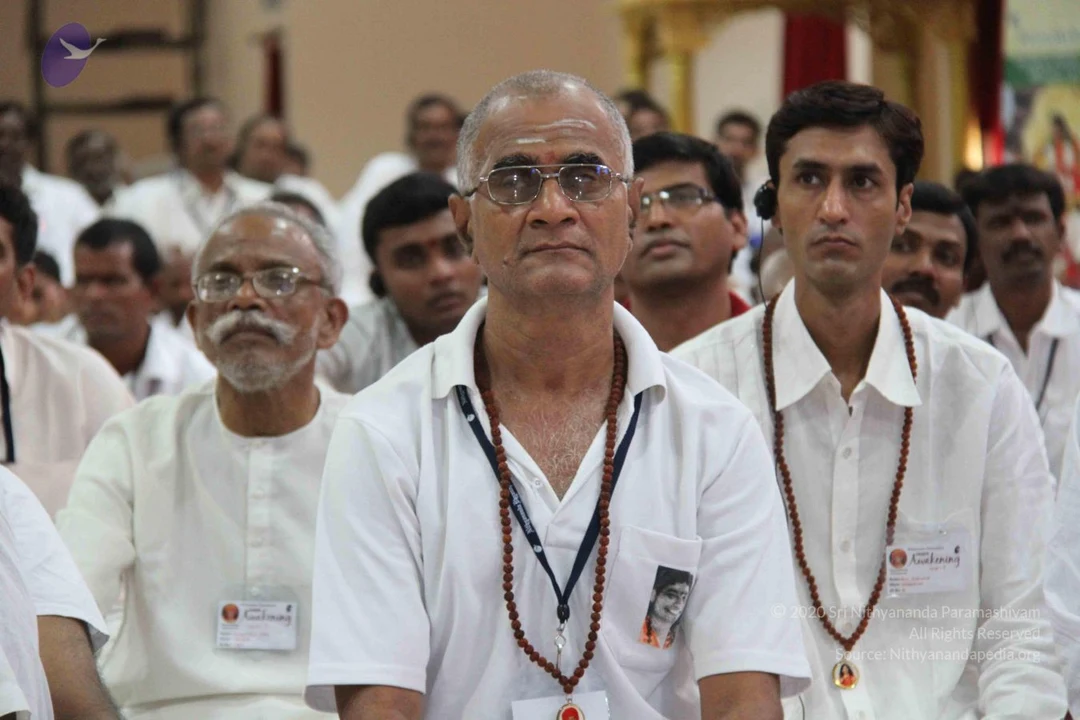
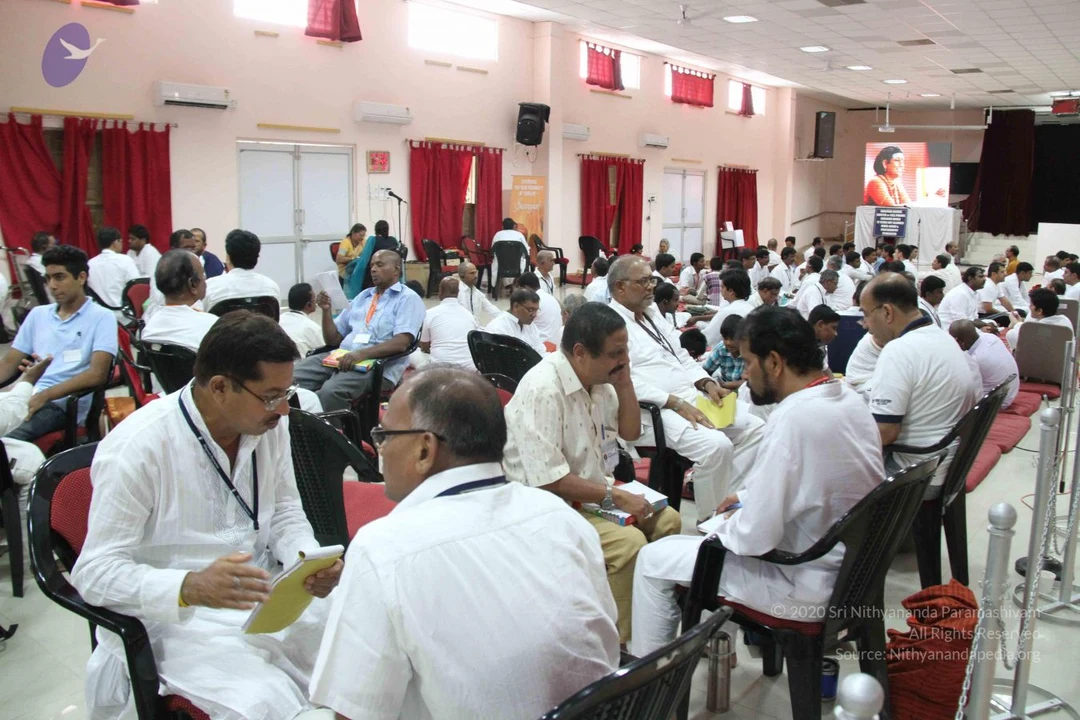
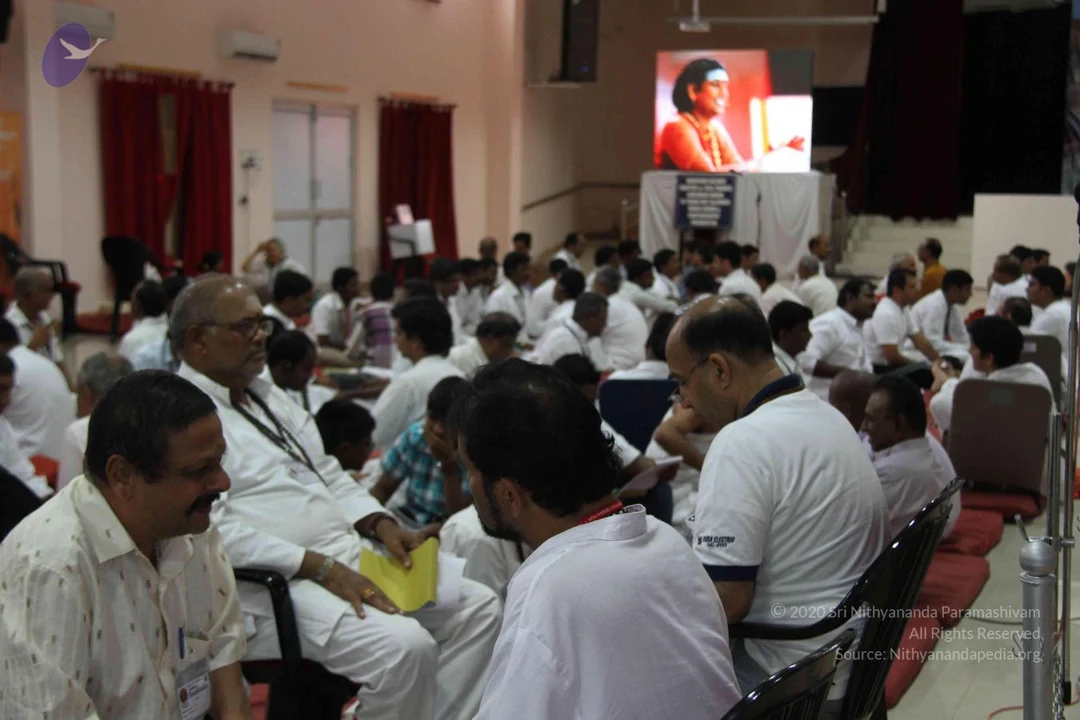
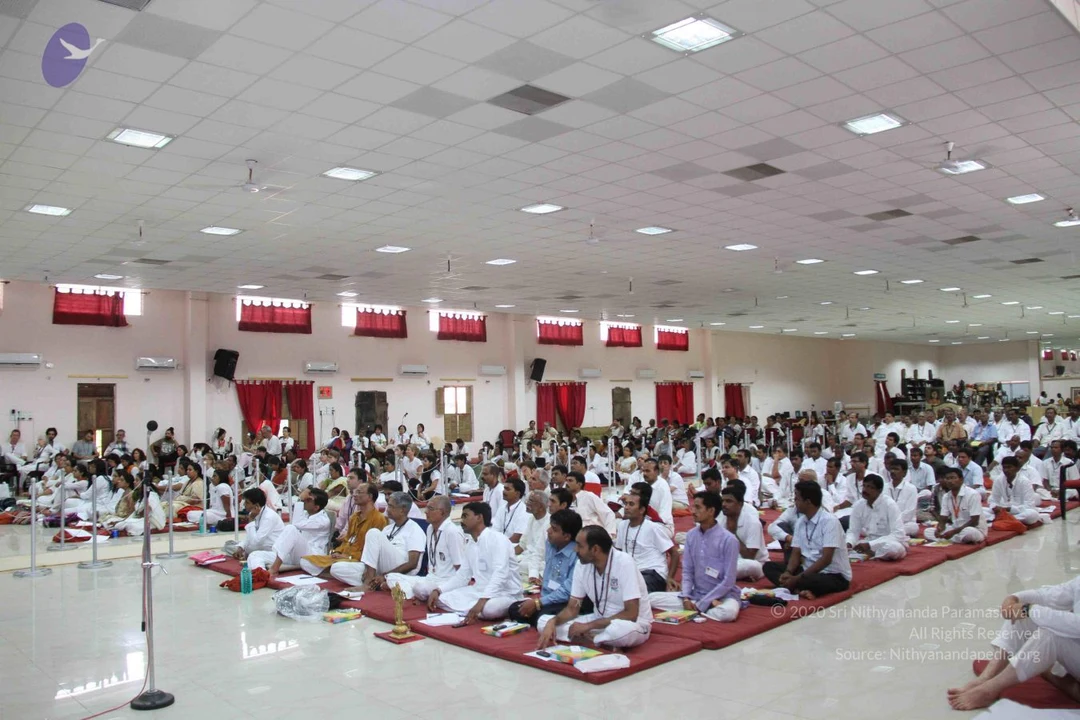
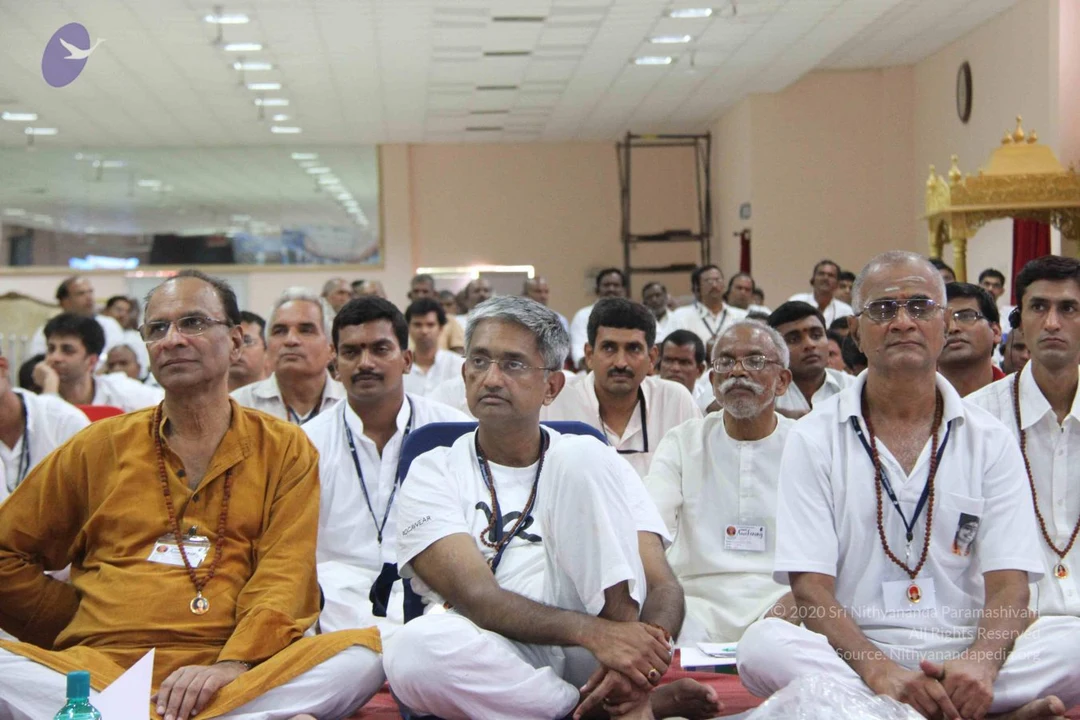
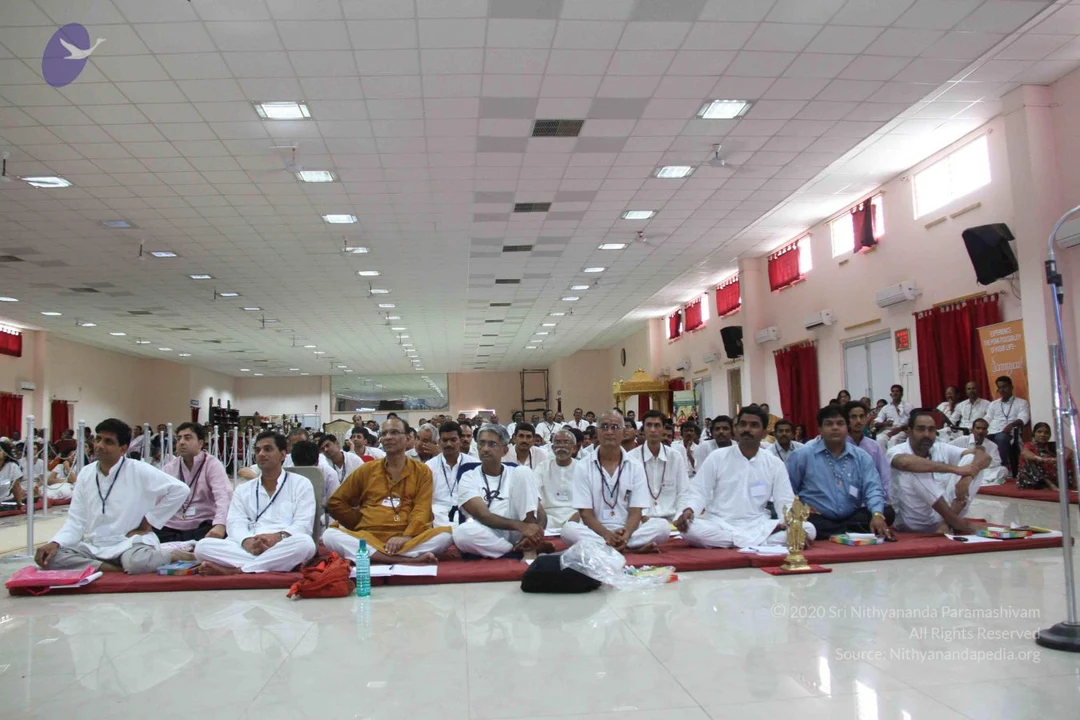
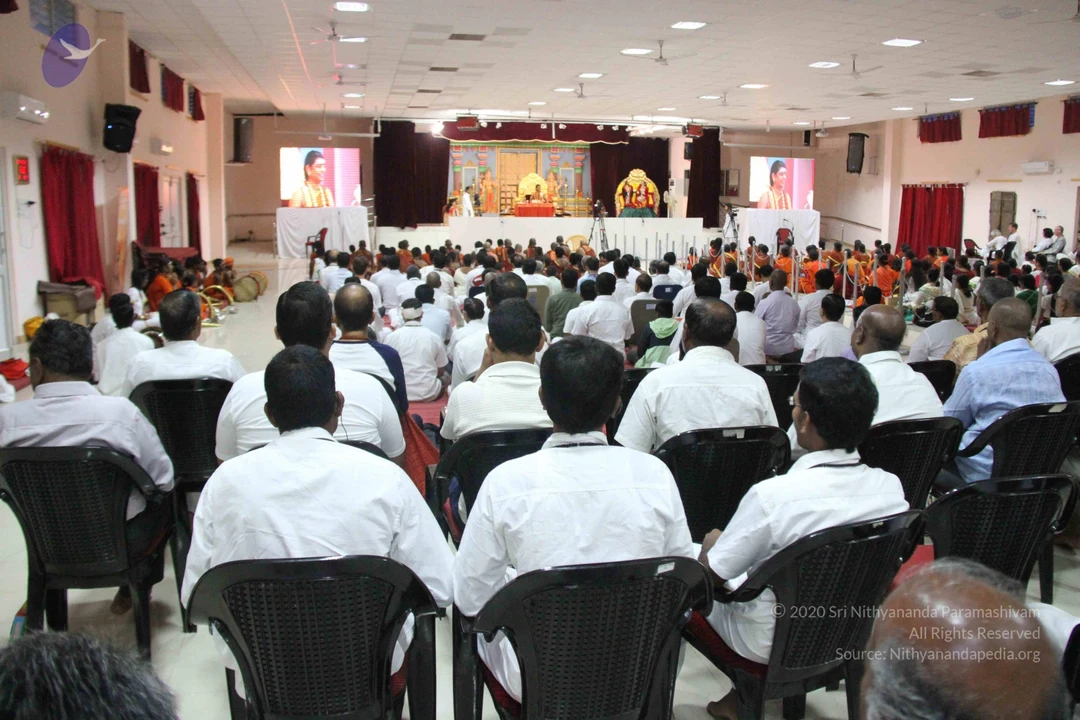
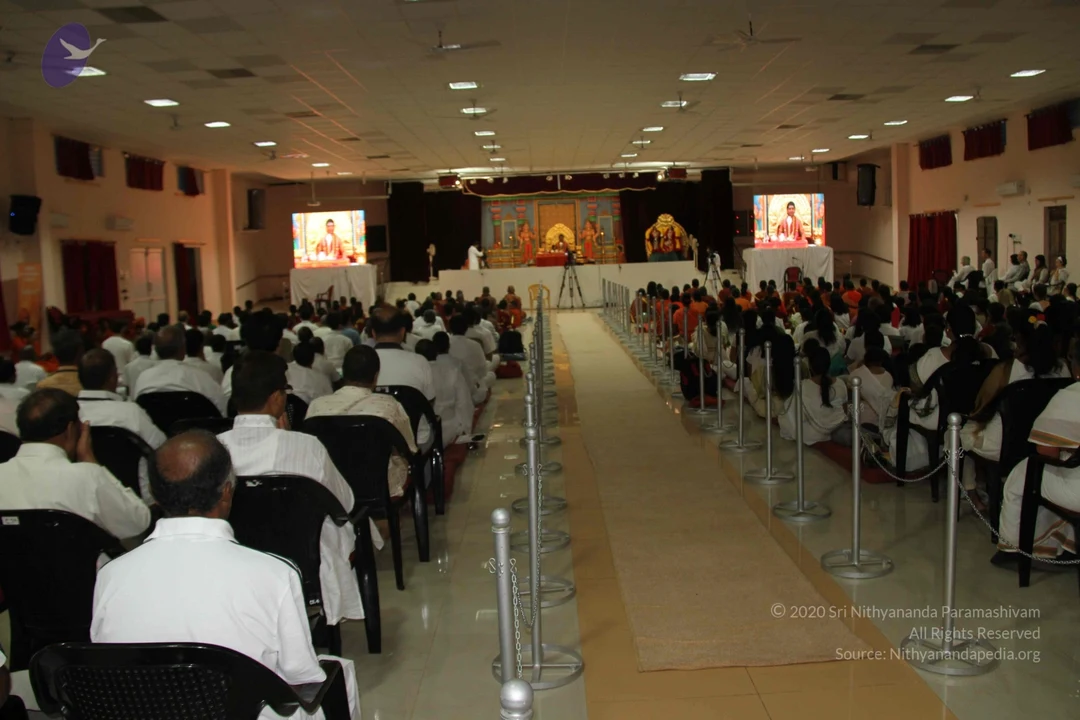
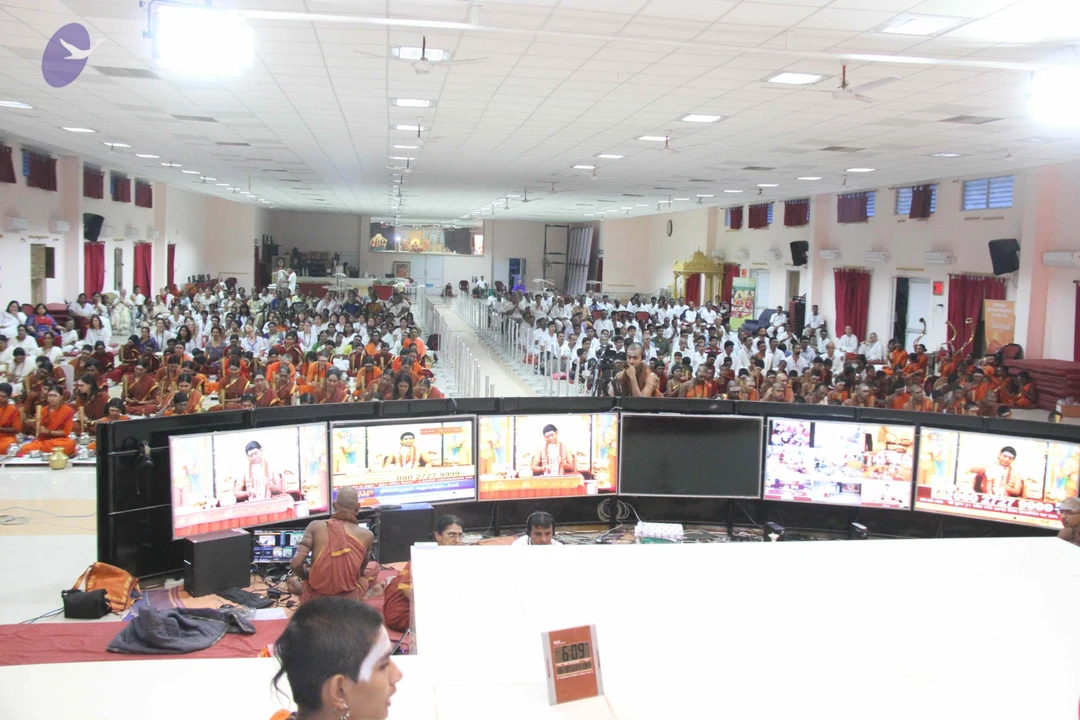
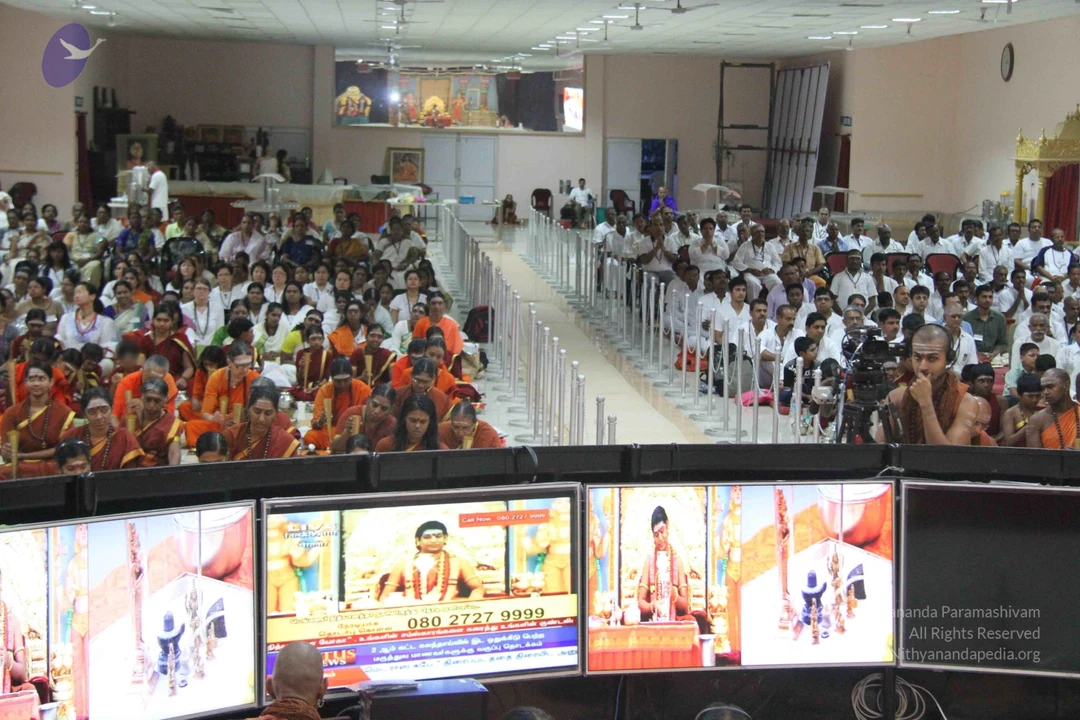
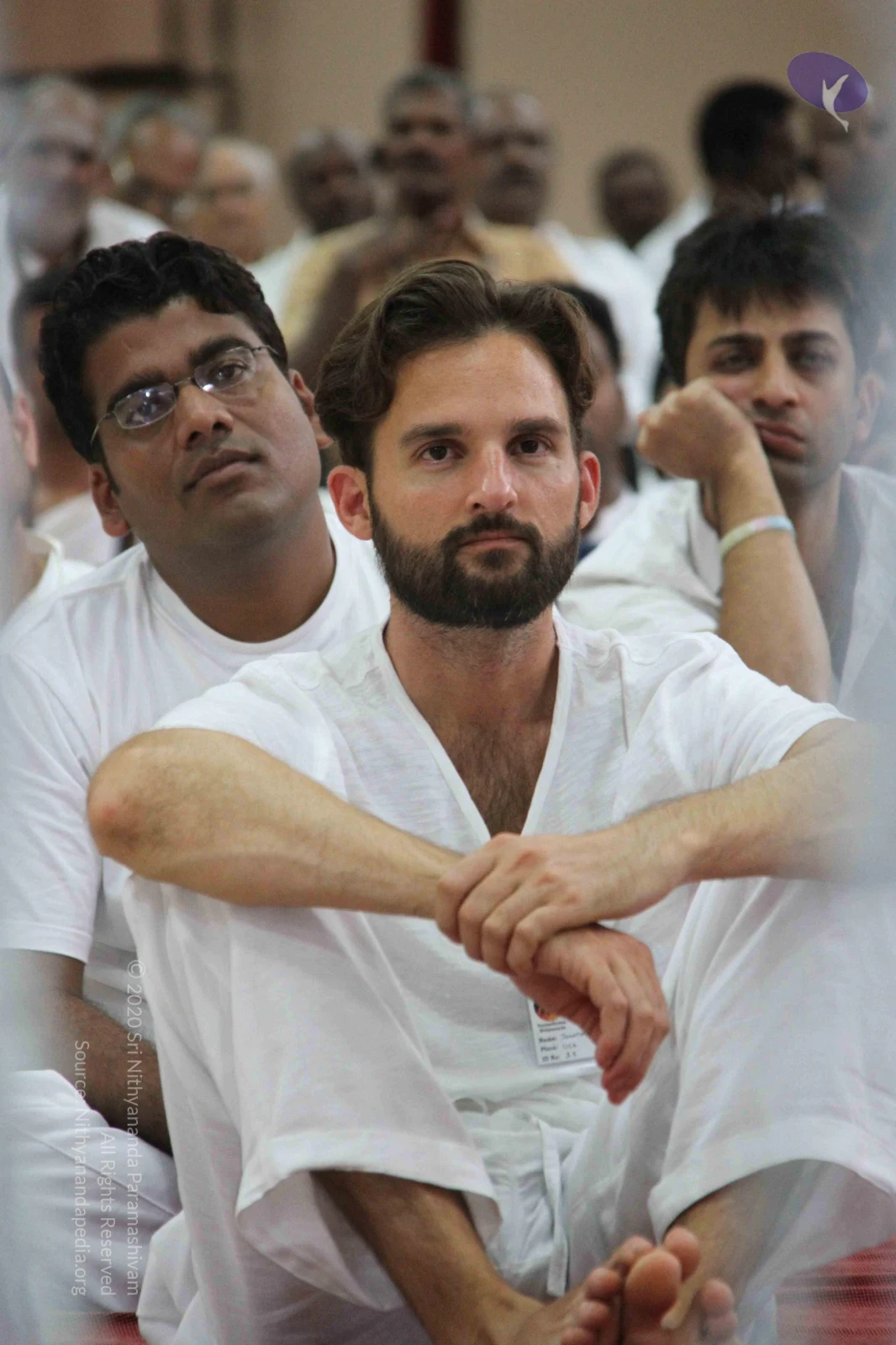
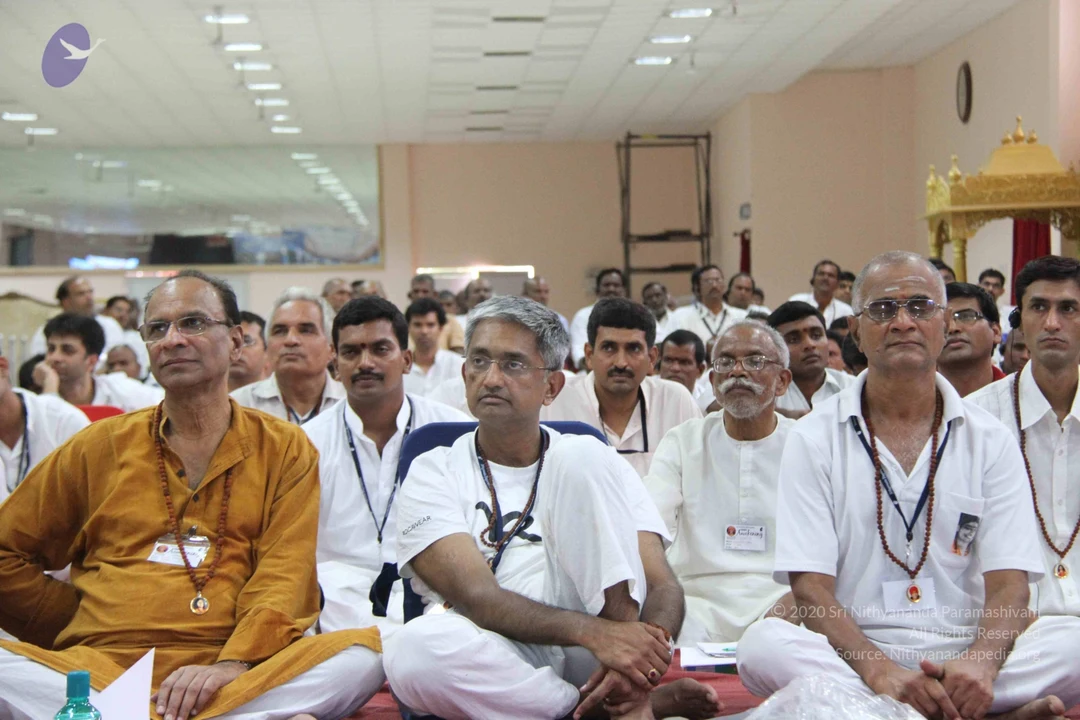
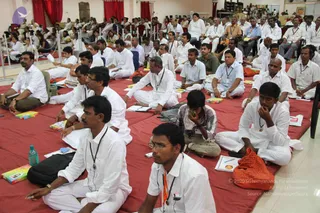
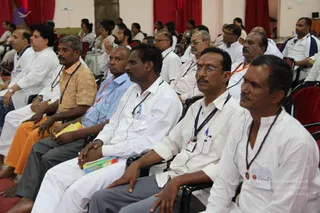
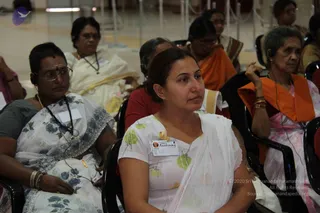
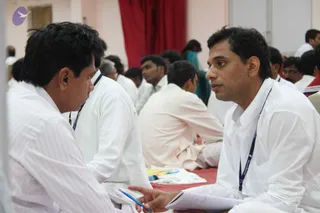
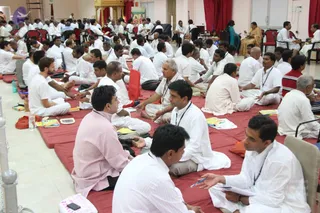
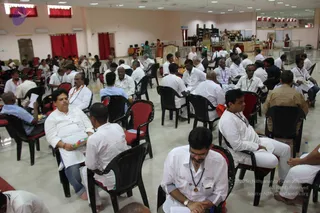
Photograph of a seated audience at a satsang hall, mostly men in white kurtas and white shirts, many wearing rudraksha malas and name badges on lanyards. In the front row, a man on the left wears an orange-saffron kurta with a rudraksha mala and glasses; the man in the centre wears a white t-shirt with a lanyard; a man on the right wears a white shirt with a mala. Rows of attendees sit on red chairs and mats behind them, some with hands folded in namaste. Pink and beige walls and red curtains frame the hall. Audience members are listening attentively to a discourse. No clearly identifiable a person candidate is visible in the front rows.A large indoor satsang hall with rows of seated devotees on red floor mats. Many men wear white kurtas and white dhotis, some with lanyards and ID badges, one in an orange-yellow robe at the far left, and one in a lavender shirt in the foreground right. A small brass deity murti sits on a red cloth at the lower left, with books and phones on the mats. Red curtains, air conditioners and pale walls frame the hall. Several rows of people fill the room, with well over twenty visible individuals.A photograph of a large satsang hall with many men seated on red floor mats, most dressed in white kurtas and white dhotis with lanyards and ID badges. Some carry orange cloth bags, notebooks, water bottles and booklets. Several seated men in the foreground are listening attentively, one wearing glasses and a rudraksha-style mala, another eating from a small plate. Chairs and white metal stanchions line the aisle at left, and framed pictures hang on the back wall. Attendees appear to be listening to a teaching in a seated congregation.A seated audience at a satsang hall with red curtains and white walls. In the foreground, several middle-aged men in white shirts and white dhotis sit in rows of red-cushioned chairs, many wearing rudraksha malas and blue or white lanyard badges. One man in front wears a red tilak mark on his forehead, and another holds a small book. Others in the background, some in orange, blue and striped shirts, listen attentively with hands joined or resting in laps. The seated rows extend back toward a stage area behind them.Women seated in black chairs at an indoor event, watching attentively toward the front. In the foreground a woman in a white saree with pale green and yellow floral print wears a name badge reading a printed Awakening label. To her left a woman in a grey top and blue-patterned white saree wears a black mala and tilak, and beside her another woman in a white saree with a gold border sits behind. To the right an older woman in an orange shawl and pink-and-white saree wears gold bangles and a hearing device. Several other seated women in orange, red and cream sarees are visible behind, along with a column and stanchions in the background.Three men sit in a row in a plain room with pink walls and a wooden lattice window, wearing headphones for translation. On the left, a man with curly dark hair and a full beard wears a white shirt and dark beaded necklaces. In the centre, a bearded man in a grey t-shirt wears a long rudraksha mala. On the right, a grey-haired man with glasses wears a striped grey-and-white shirt with a blue lanyard. Their attention is directed toward the front during a satsang discourse.

IA-Day4-Participants-Sharing

9 photosSource gallery
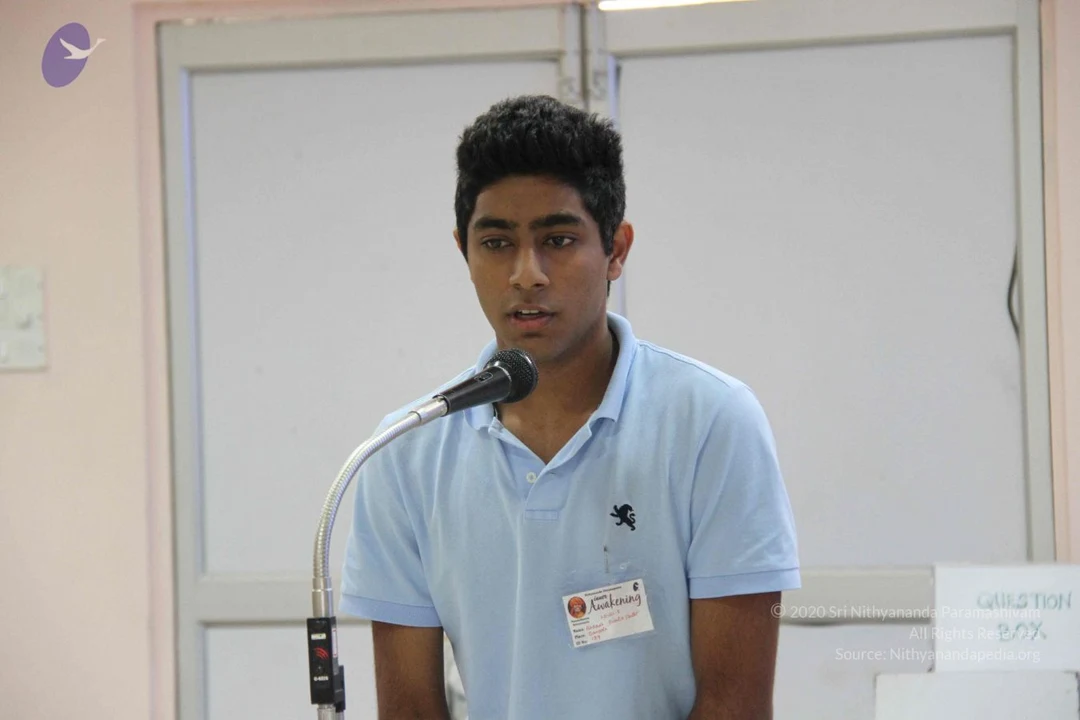
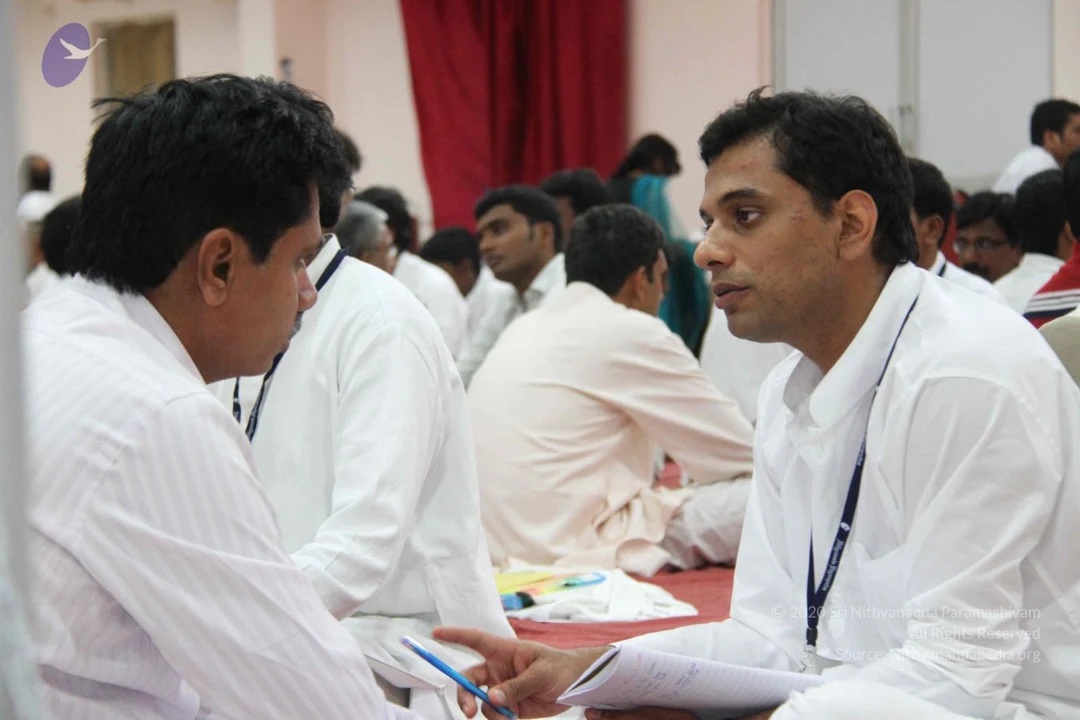
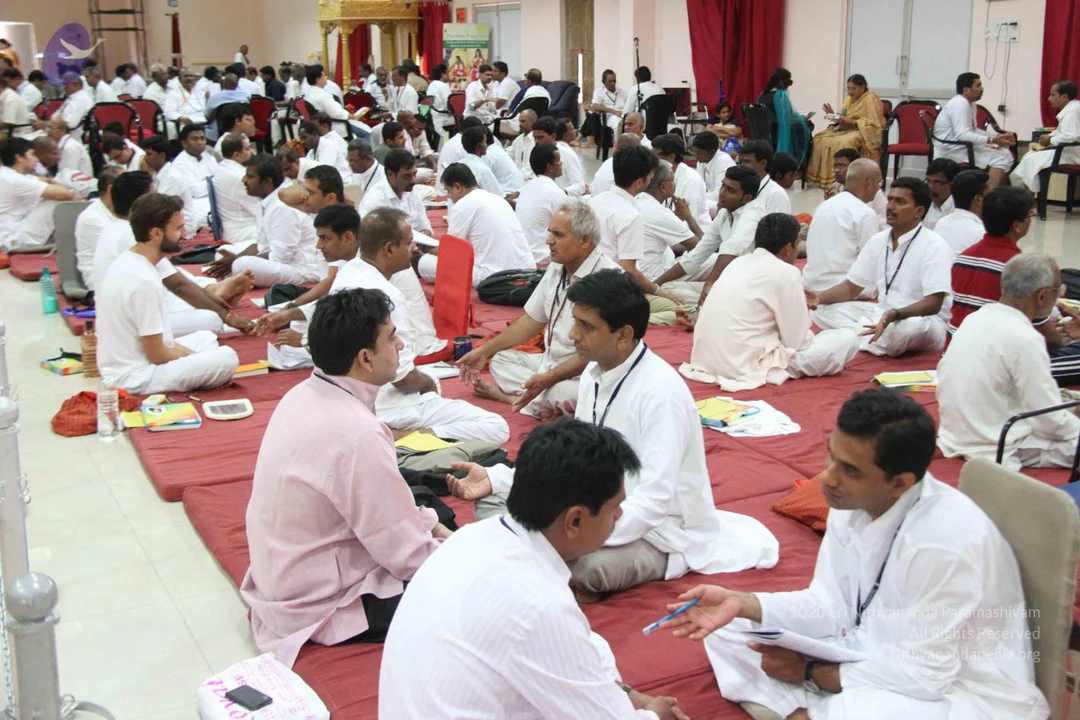
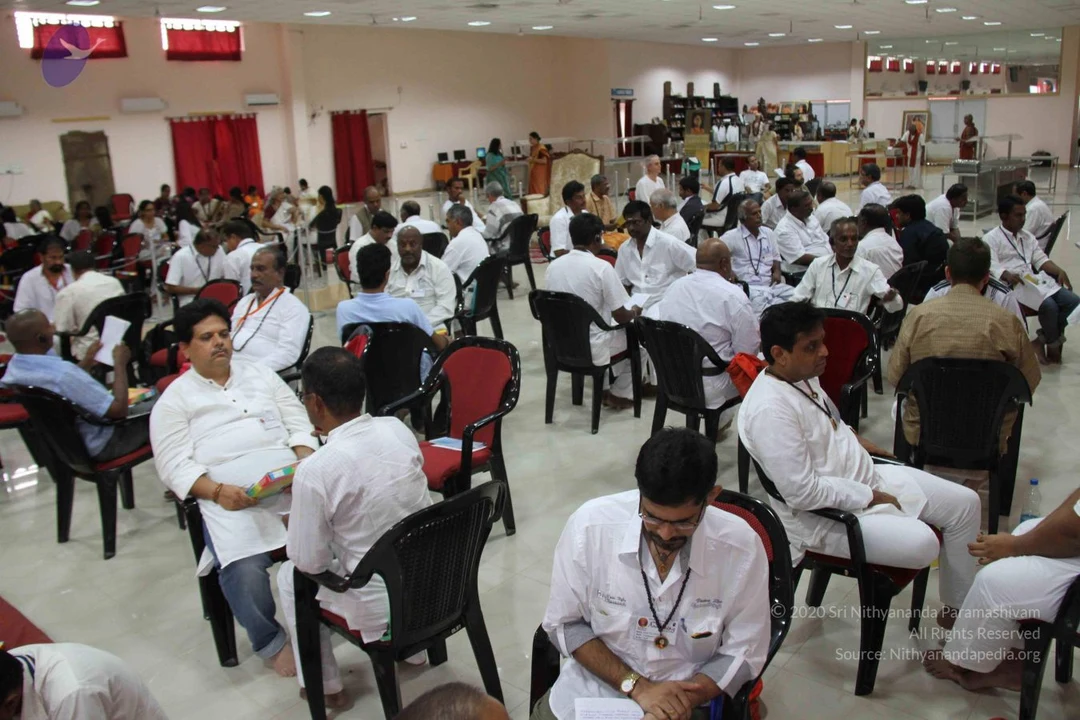
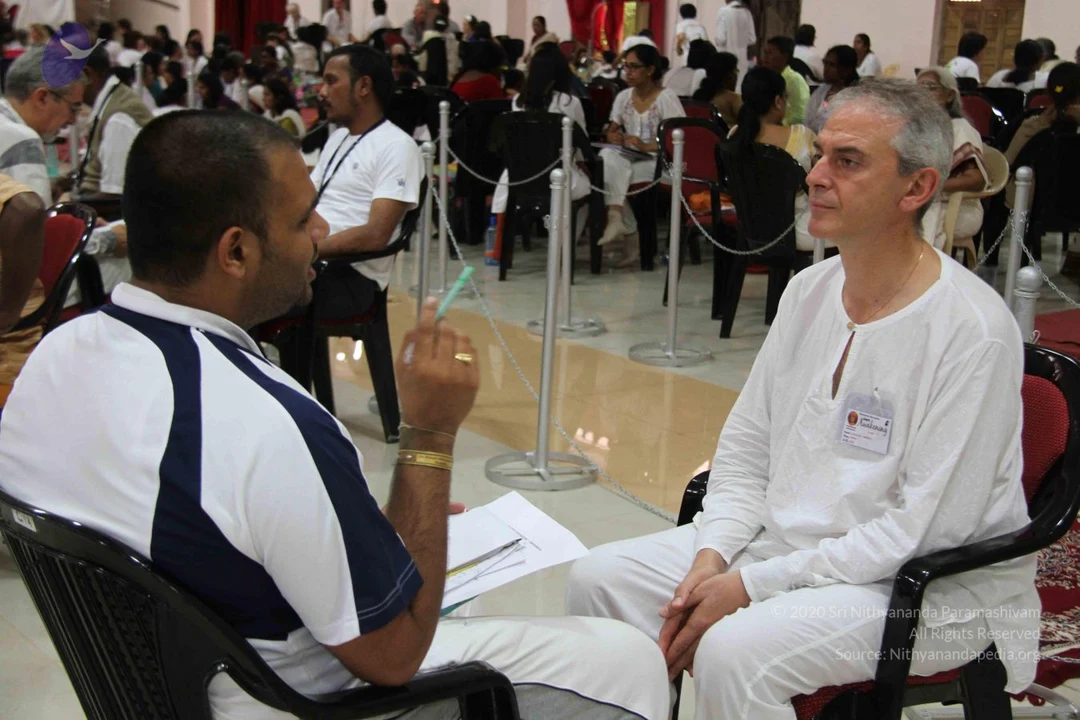
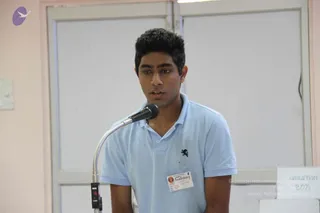
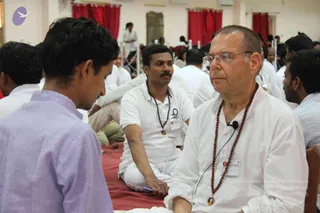
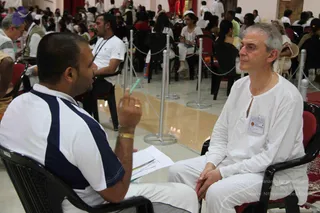
A young man with short dark hair stands at a silver gooseneck microphone, speaking in a room with white panelled walls. He wears a light blue polo shirt with a small dark embroidered emblem on the chest and a name badge clipped to it. A 'Question Box' sits on a table at the right edge of the frame.Two men in white shirts sit close together in a seated gathering, one in a white striped shirt on the left and one in a white shirt with a navy lanyard on the right, leaning in as the right-hand man gestures with his hand and holds a blue pen and notepad. Behind them many other men in white clothing sit on the floor of a hall with a red curtain and a red cloth-covered floor, with a pink-clad seated figure in the centre background.A large indoor satsang hall with red floor mats where many men in white ritual clothes sit cross-legged in rows. Several attendees wear white kurtas with lanyard badges and hold notebooks or pens; one man in a pink shirt sits in the foreground. Red curtains, a golden canopy and a small altar with a deity image are visible at the back. The crowd is seated closely across the room, with some women in saris seated toward the rear.A seated satsang gathering in a white-walled hall with red curtains and a red floor mat. In the foreground a young man in a lavender collared shirt faces right, leaning slightly forward. To the right, an older bald man with glasses, a white kurta and a red rudraksha mala wears a small lapel microphone and an event badge, looking attentively toward the younger man. Behind them, a man in a white polo shirt with a dark mala and badge sits cross-legged, and many other seated people in white clothes fill the room, with a standing figure in white near the back.A large indoor hall with pale pink walls and red curtains holds a seated gathering of men in white shirts and white dhotis, many wearing lanyards and seated on black chairs with red seat backs. Several attendees hold papers or booklets. In the background, a stage-like area with a framed portrait and a figure in orange clothing near a display. A man in the foreground wears a dark beaded necklace. Scattered bookshelves and a few women in saris are visible at the back.Photograph of an indoor hall with rows of seated attendees in the background, separated by silver stanchions and chains. In the foreground, a man in a white and navy polo shirt with a gold bracelet gestures with a green pen while speaking to a grey-haired man in white loose clothing with a name badge on his chest, seated on a black-and-red chair. Papers rest on the lap of the man in the polo shirt. The setting has white tiled floors and red chairs, and several people in white clothing sit behind the rail. No one is identified by face; roles are limited to the two visible participants and the seated audience.

Pratyaksha-Pada-Puja
16 photosSource gallery
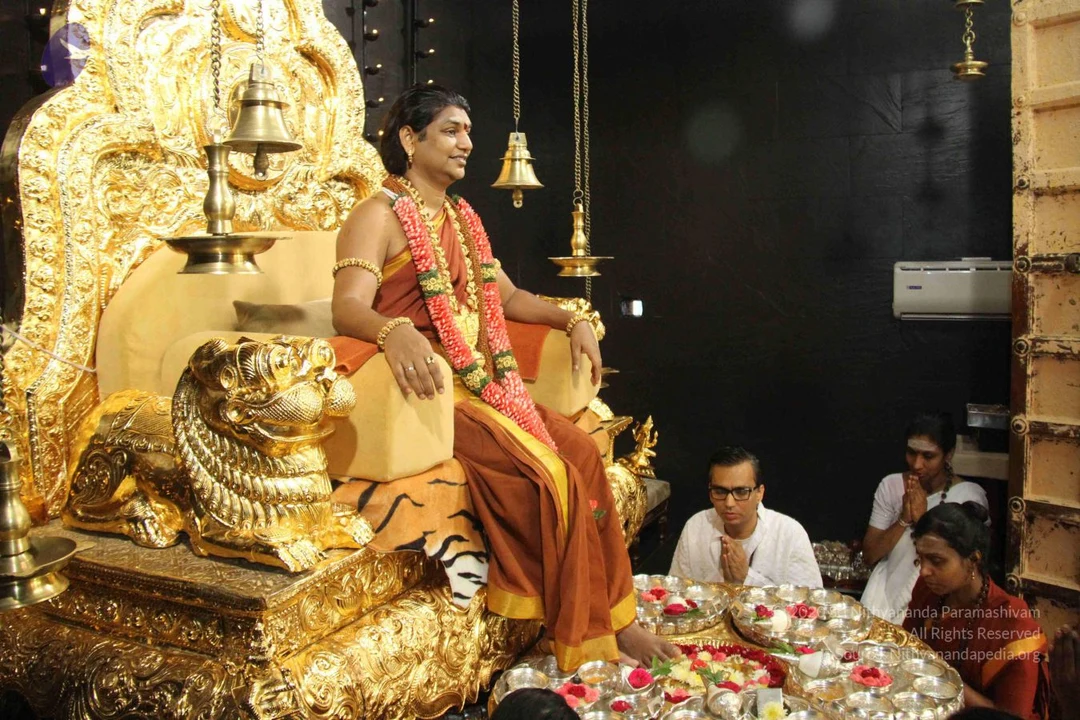
A seated figure on an ornate gold throne with carved lion-head armrests and a tiger-striped cushion sits in an orange-and-rust garment with a yellow border, wearing a red and white flower garland, gold bangles and a gold necklace. Hanging brass bells and oil lamps are above. In the foreground, a man in white with glasses and two women in white and orange, one with hands folded in namaste, sit behind brass plates of flowers and offerings. Swamiji (probable): the seated figure has long swept-back hair, ornate gold regalia and ceremonial jewellery consistent with a Hindu guru's throne setting. A printed caption reads "Nithyananda Paramashivam " on the imageClose view of silver ritual trays and bowls arranged on a gold-toned tray, filled with red roses, pink and white flowers, green leaves, and small bowls of yellow liquid. A white conch-shaped vessel with silver fittings rests among the flowers, and an orange-and-gold garment edge is visible at the left. The arrangement suggests puja offerings prepared for worship. No people are clearly visible apart from a partial hand and garment at the left edge.Close-up photograph of a silver puja tray with ornately engraved silver bowls and a silver pitcher. The bowls hold red roses, white chrysanthemum-type flowers, a golden-yellow liquid, and a small silver plate with a white flower. Fresh red and pink roses and white blossoms lie scattered at the top edge of the frame. No people are visible; the scene shows ritual offerings arranged for worship.A seated man on an ornate gold throne with carved lion-head arms and a tiger-striped cushion wears an orange-and-gold dhoti-style wrap, red and white flower garlands, and a gold armlet. a person is shown, with long swept-back hair and ceremonial gold and garland adornments, looking to his left with bare feet on a gold footrest. Hanging brass bells and a brass lamp hang above. In front, a golden tray holds many small brass bowls, rose petals and an arrangement of food and flowers. A man in white with glasses kneels nearby, and a woman in white with a rudraksha mala sits beside a woman in orange holding a plate. Behind them is a golden-framed wall and a dark backdrop with a wall air conditioner.A seated figure in a gold-carved throne with a lion-head armrest and a tiger-striped cushion, wearing a rust-orange dhoti with a yellow border and a bare upper body, draped in a red-and-white flower garland and gold necklaces with gold armbands. Brass oil lamps hang from chains beside the throne. In front, brass trays hold flower petals, red blossoms and small oil lamps. A man in white with glasses sits to the right, and a woman in white with a tilak is partly visible at the far right edge.A photograph of a seated figure on an ornate gold throne carved with a lion-head armrest base and draped with a striped tiger-skin cushion. The central figure wears an orange-saffron dhoti-style garment with gold borders, a red and white flower garland, gold necklaces and bangles, and has short dark hair; the hands are raised in a greeting gesture. Brass hanging bells and oil lamps hang above. In the lower right, a man in white clothes and glasses kneels beside a woman in white. At the foreground, brass plates hold flower petals, red blossoms and sweets, indicating an offering. a person is seated on the throne, identified by orange-saffron attire, flower garland and ceremonial gold ornaments.

IA

29 photosSource gallery
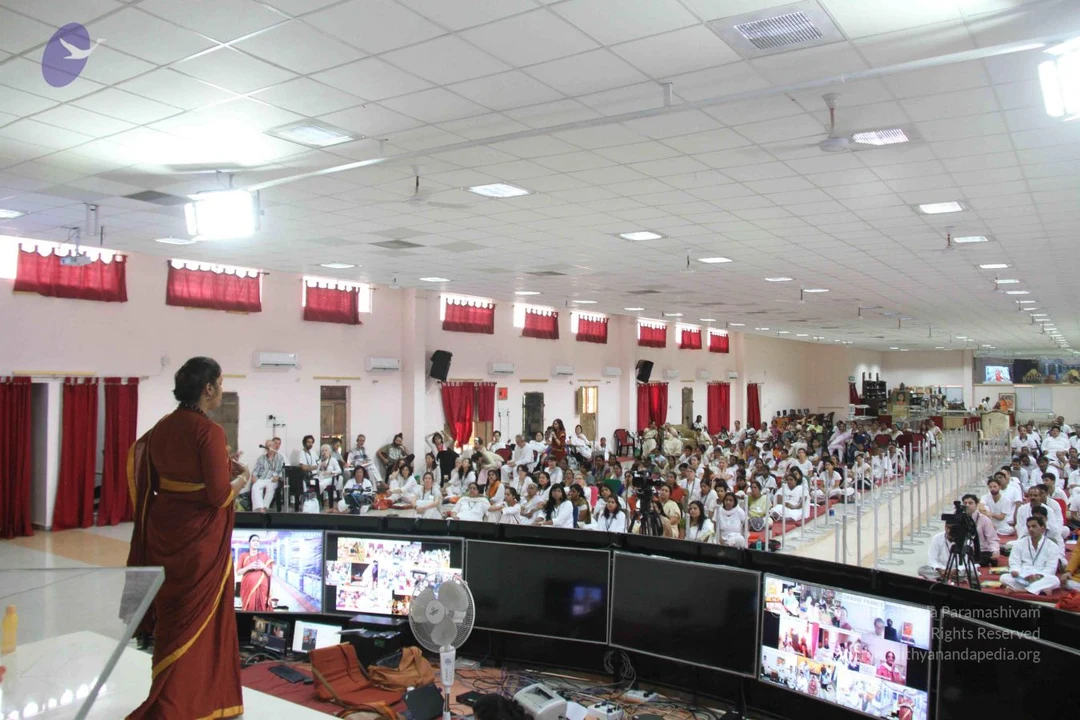
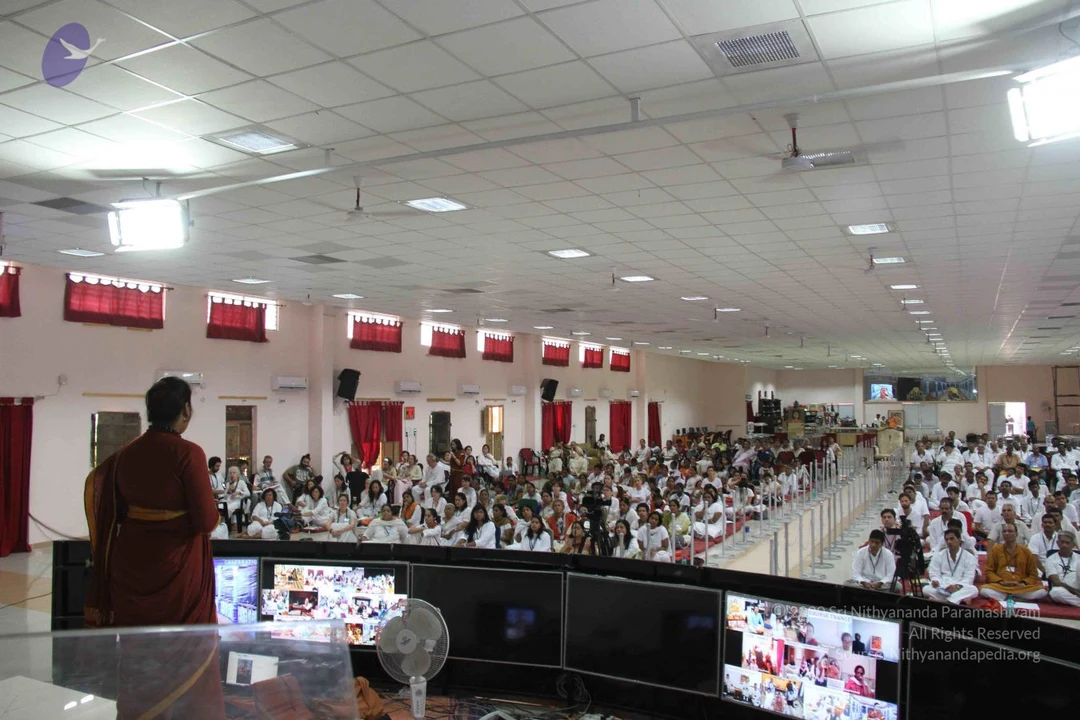
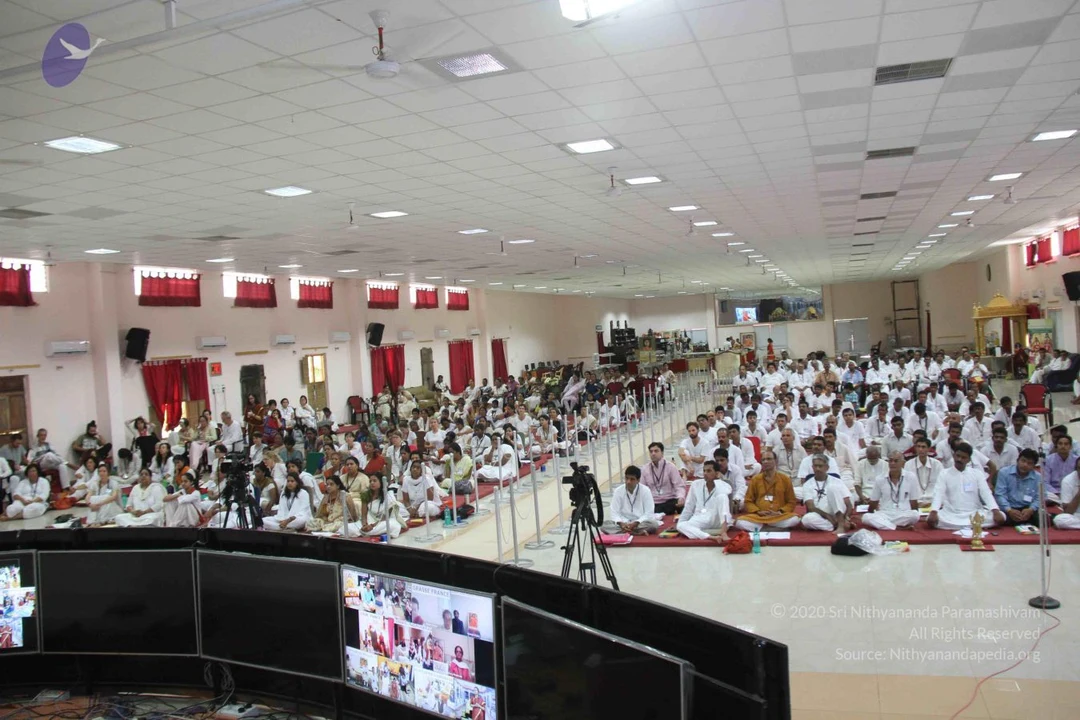
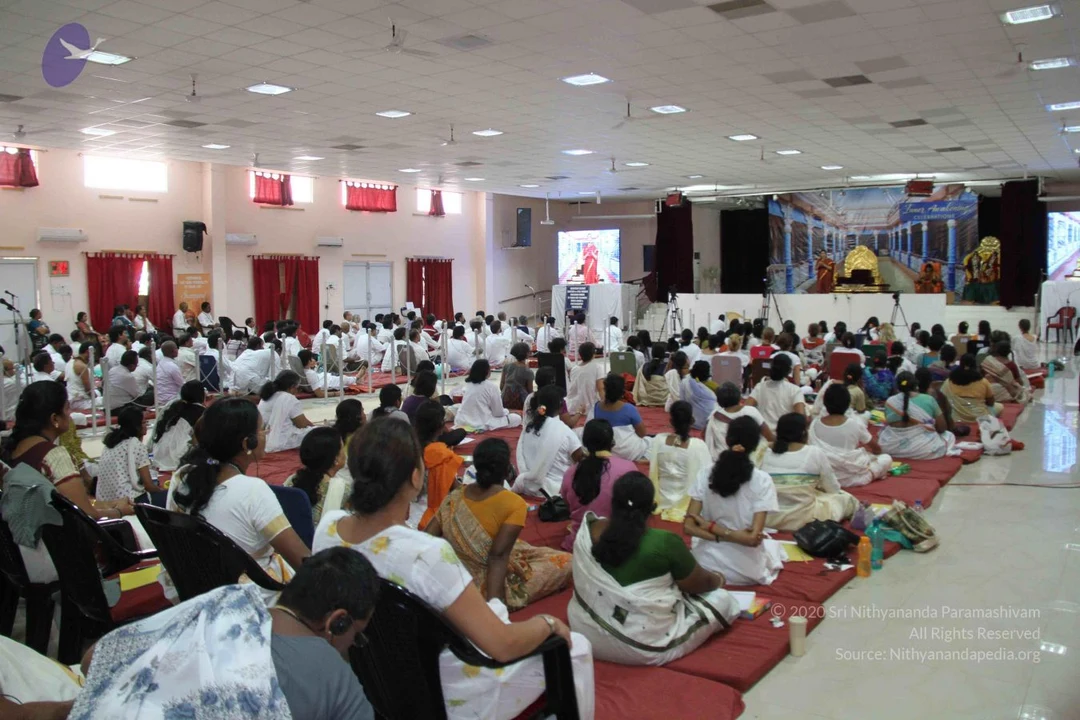
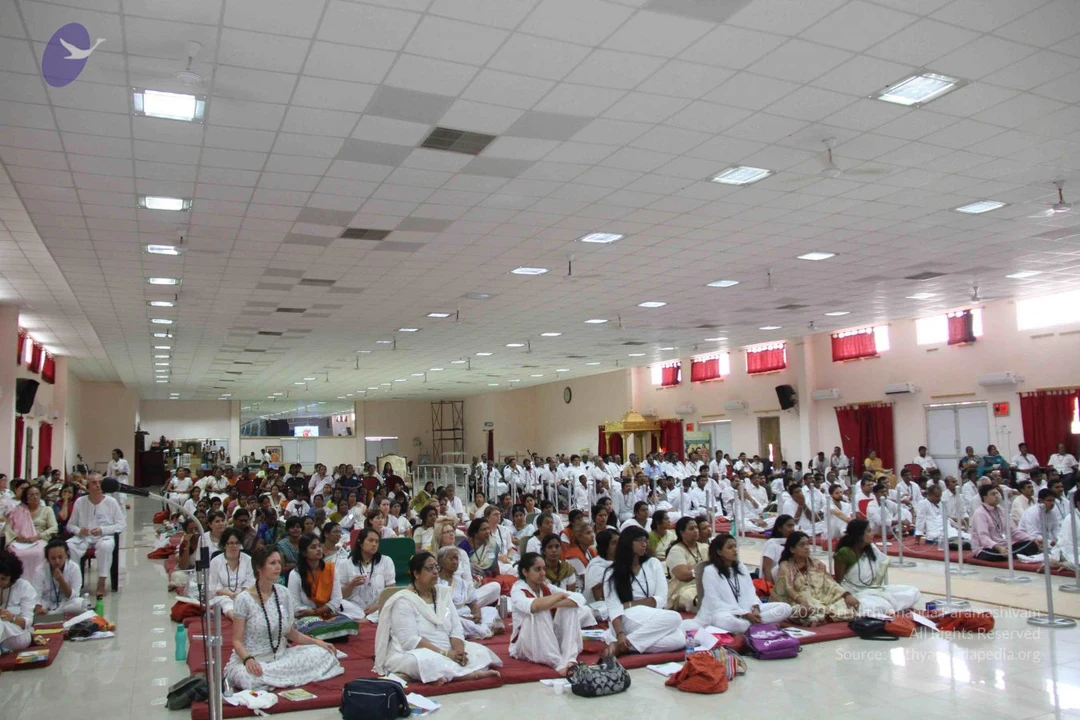
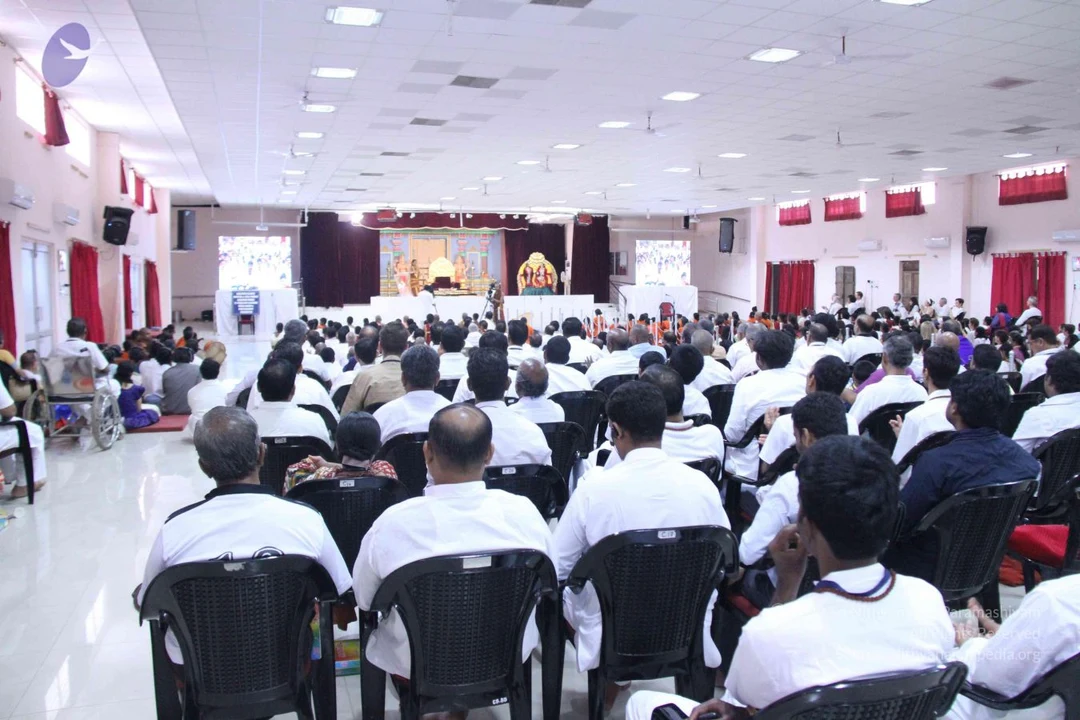
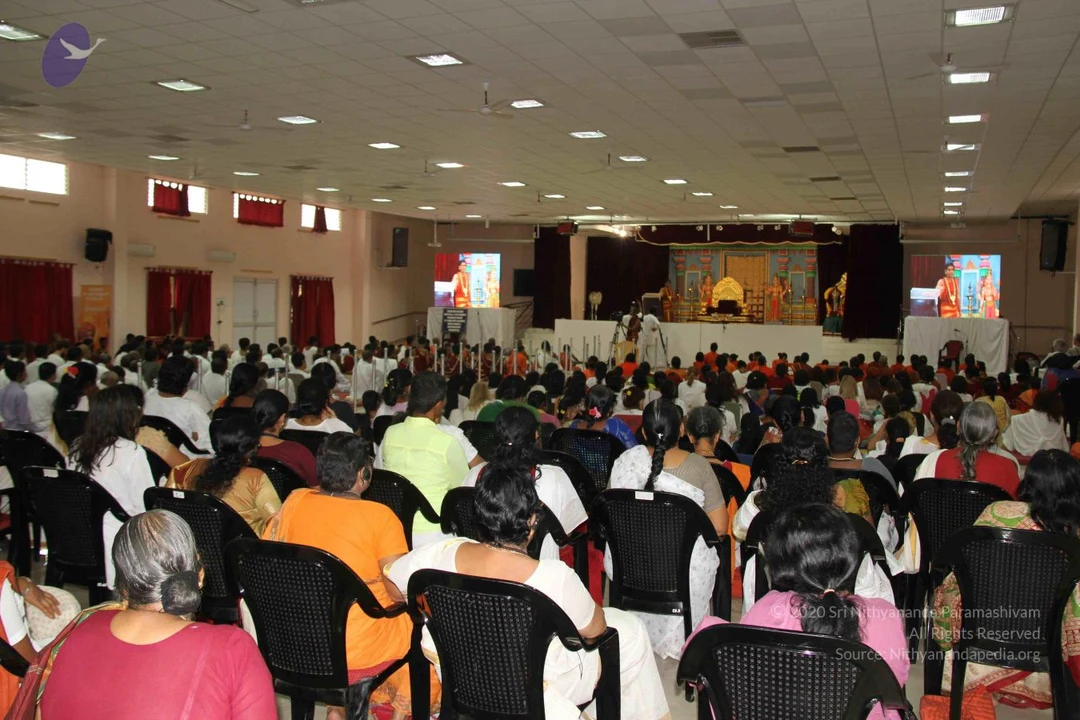
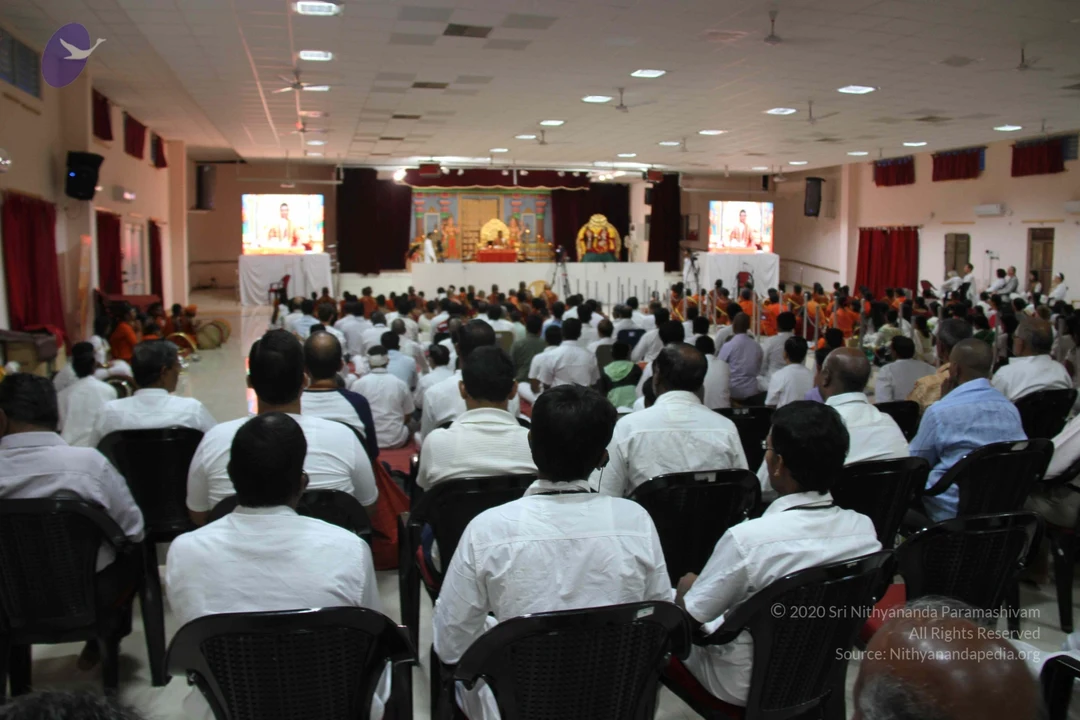
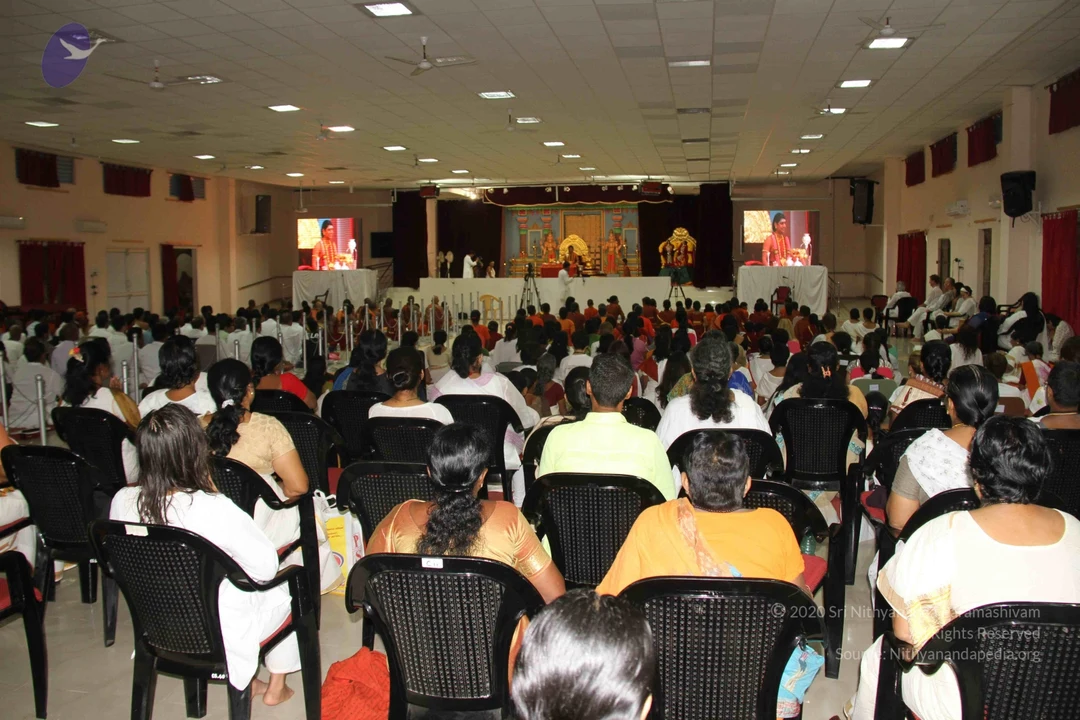
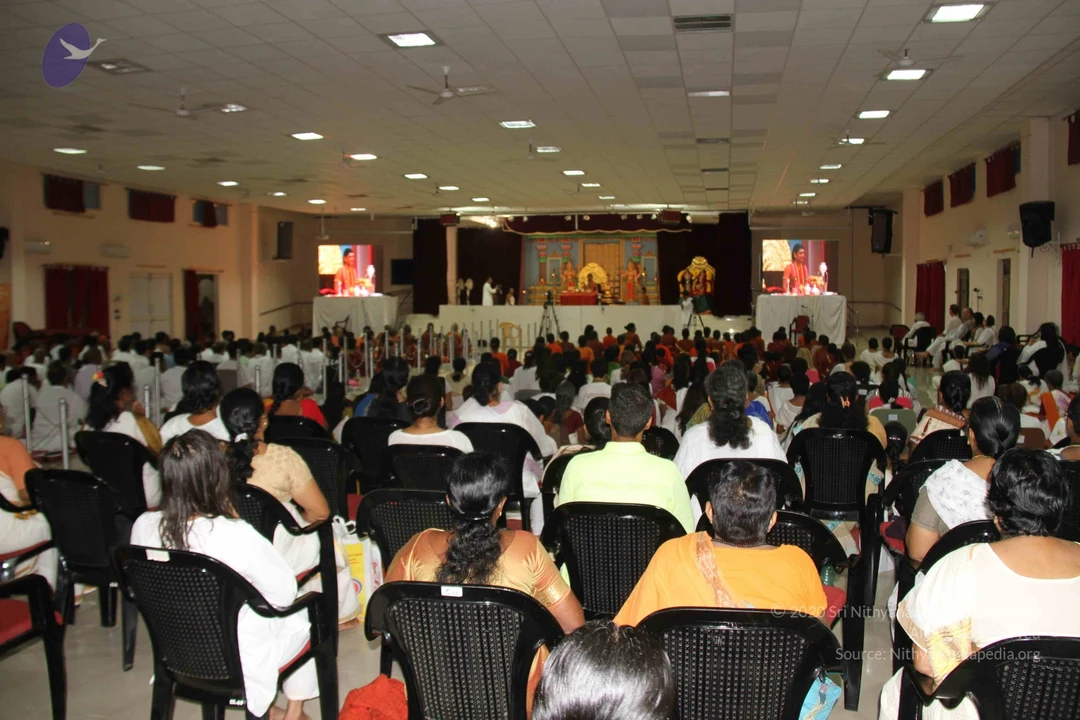
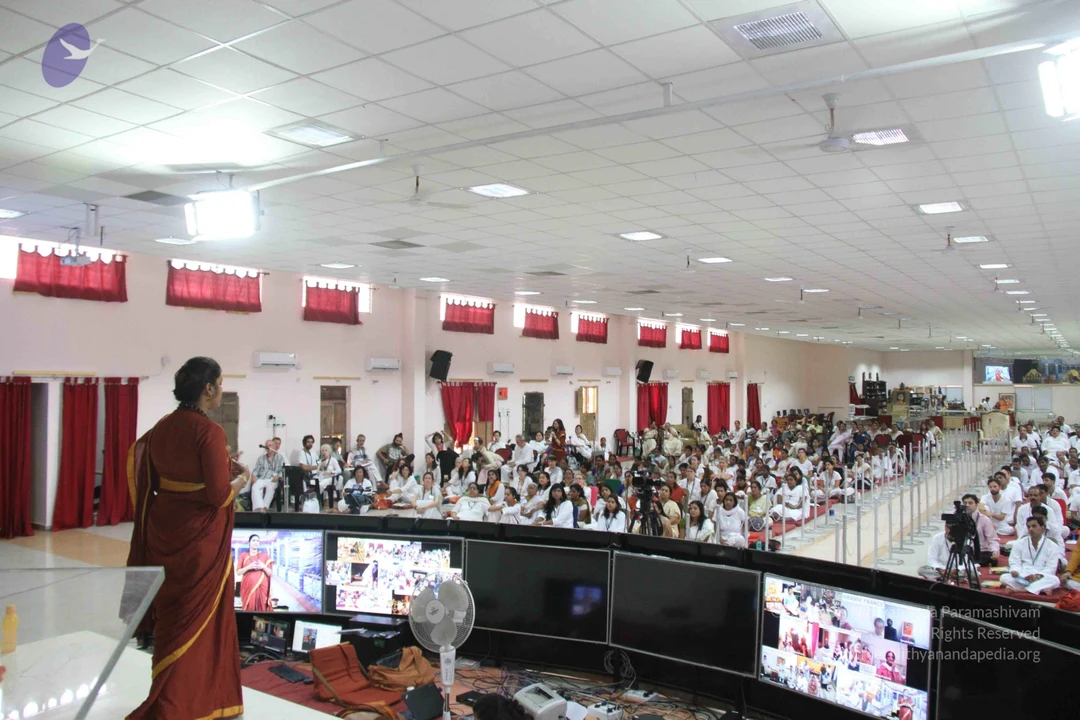
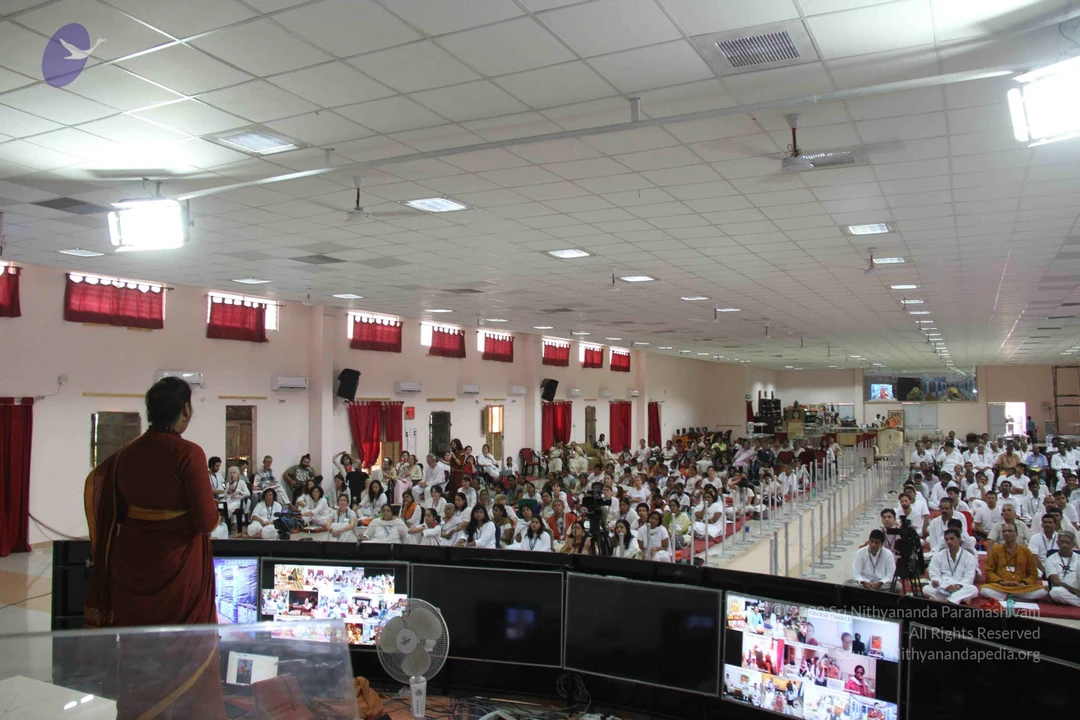
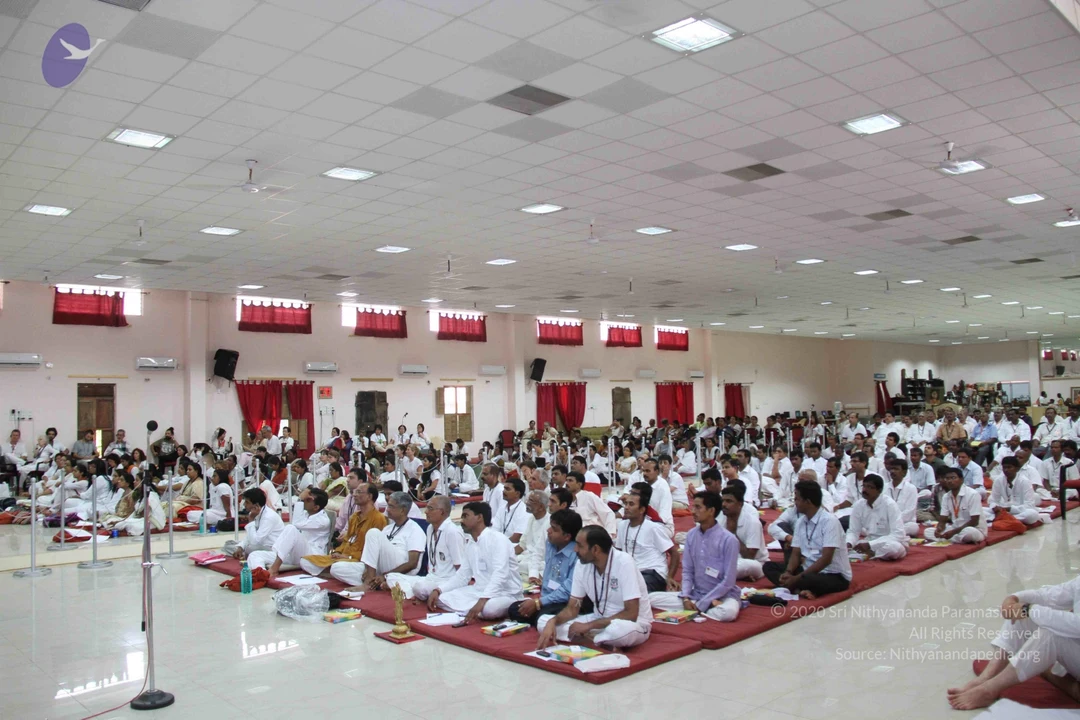
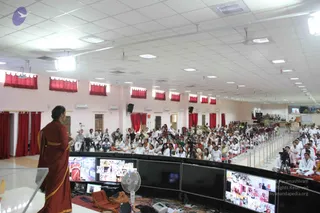
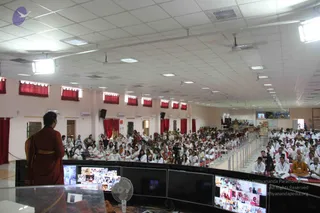
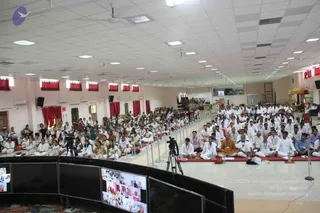
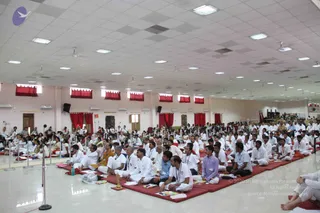
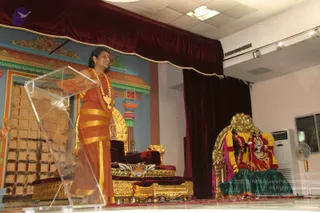
Photograph of a seated audience at a satsang hall, mostly men in white kurtas and white shirts, many wearing rudraksha malas and name badges on lanyards. In the front row, a man on the left wears an orange-saffron kurta with a rudraksha mala and glasses; the man in the centre wears a white t-shirt with a lanyard; a man on the right wears a white shirt with a mala. Rows of attendees sit on red chairs and mats behind them, some with hands folded in namaste. Pink and beige walls and red curtains frame the hall. Audience members are listening attentively to a discourse. No clearly identifiable a person candidate is visible in the front rows.A large indoor satsang hall with rows of seated devotees on red floor mats. Many men wear white kurtas and white dhotis, some with lanyards and ID badges, one in an orange-yellow robe at the far left, and one in a lavender shirt in the foreground right. A small brass deity murti sits on a red cloth at the lower left, with books and phones on the mats. Red curtains, air conditioners and pale walls frame the hall. Several rows of people fill the room, with well over twenty visible individuals.A large, brightly lit hall with red curtains and white ceiling tiles holds a seated audience of many people dressed in white, with several rows of devotees on the floor. In the foreground a woman in a rust-orange sari stands at a podium facing the crowd, her back to the camera. Along the front edge, multiple wall-mounted monitors show video feeds of other gatherings and of remote participants, while a video camera on a tripod films the audience. A fan, cables and a small table with water bottles sit in the foreground.Wide view of a large hall during a satsang gathering. In the foreground a woman in an orange-brown robe stands at a glass podium with her back to the camera, facing the audience. Rows of seated devotees, most dressed in white, fill the floor, with several in orange and saffron clothing near the front right. A bank of monitors shows video feeds of participants. Red curtains line the windows, white ceiling fans and lights hang overhead, and camera tripods are visible among the seating. A small group of seated people in orange robes appears at the front right of the seating area.Wide view of a large hall during a seated satsang gathering. Rows of people in white clothes sit on a red carpet and on floor mats, with a crowd of seated listeners on the left in white and light colours. A man near the front right wears an orange-saffron robe and sits on the red carpet, facing the stage. Black monitors along the front show a grid of video participants. Two camera tripods stand in the aisle, and a golden ceremonial structure with a seated figure is visible at the far right. Ceiling fans, rows of red curtains and an orange-gold decorated wall complete the setting.A large hall with white walls, red curtains and a white tiled ceiling with recessed lights and ceiling fans. Rows of seated devotees in white ritual clothes sit on red mats facing forward toward a raised area on the left, with a brass lamp and a microphone stand in front. Some attendees wear orange, saffron, lavender and blue shirts, and many wear lanyards. Water bottles and small papers rest on the mats. A satsang gathering seated in meditation posture.

Kutthuvillakku

19 photosSource gallery
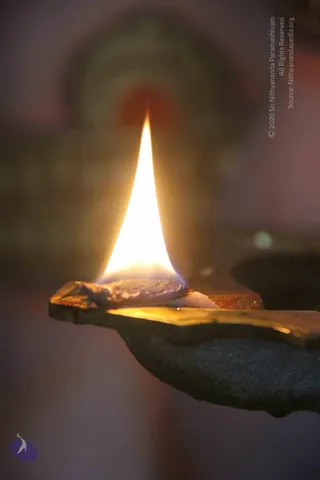
Close-up photo of a lit oil lamp on an ornate brass stand in the foreground, its flame bright against a blurred background. Behind it, a painted statue of a deity with pale skin, reddish-orange markings, gold armbands and a gold-edged garment is visible; one raised hand bears a gold ring and red tint. No physical people are visible, only the statue and the lamp.Close-up photograph of a single lit oil lamp flame on a dark metal tray in the foreground, with a blurred ornate brass or silver lamp stand with repoussé floral and scroll patterns behind it. No people are visible; the background is dim with soft blue and warm tones.A close-up photograph of a brass oil lamp with a bird-shaped stand. A single flame burns from the open wick on the lamp's shallow dish against a dark maroon curtain background. No people are visible.A lit brass oil lamp, a traditional Hindu deepam, stands against a dark maroon draped background. The lamp has an ornate peacock-shaped top with a raised tail and curved neck, a sculpted baluster stem, and a star-shaped lower dish holding a single bright flame. No people are visible, and the scene is a close-up of the ritual lamp.A photograph of a polished brass oil lamp with a bird-shaped stem, its fanned tail feathers and curled neck forming the ornate top, set on a stepped brass base against a dark curtain backdrop. A single lit flame burns from the lamp's wick at right, casting warm highlights on the metal. No people are visible.Photograph of an ornate brass oil lamp with a peacock-shaped stand, its spread tail feathers and curled neck detailed in relief, set on a fluted base. A single flame burns at the right edge of the lamp's shallow dish against a dark background. Warm highlights catch the metal. No people are visible; the image shows only the lamp, consistent with a devotional or temple setting.

Nithya-Satsang
29 photosSource gallery
Two decorated deity murtis seated on an ornate gold throne-like peetha with a gilded arched backdrop. The figure on the left is a Shiva-form murti with black hair, a white dhoti, silver and gem necklaces, and a silver hand gesture. The seated goddess on the right wears a red and gold sari, a jewelled crown, layered gold and gem necklaces, and holds a silver bowl. Both are garlanded with red and yellow rose garlands, and a pink cloth hangs behind them.A photograph of two decorated metal murti figures of Shiva and Parvati as Annapoorni seated together on a throne-like gilded backdrop, both wrapped in dense garlands of yellow and red flowers. The figure on the left has long black hair, a crown with rudraksha beads, a trident held in one hand and a silver bowl in the other, wearing layered pearl and gold necklaces. The figure on the right wears a black crown with jewelled ornaments, a deep blue blouse, a red sari with gold border and a silver bowl in hand, adorned with heavy gold and gem necklaces. Deity murti, no living people present.A seated man with dark hair and a reddish-brown tilak on his forehead sits on an ornate gold throne with his palms pressed together in namaste and his eyes closed. He wears an orange-brown dhoti with a gold-bordered yellow edge, a gold-beaded necklace and multiple gold bangles. Two large painted deity murtis flank him, each with multiple arms, gold crowns, gold jewellery and orange-red dhotis with green sashes, holding ceremonial objects. Gold lion-form armrests, red velvet cushions, a gold lamp stand and a gold-carved backdrop complete the temple-like setting.A seated man in a golden ornate throne with a carved arched back and gold lion-form armrests sits on a red-velvet cushioned dais, smiling with palms raised in greeting. He wears an orange-and-yellow dhoti-style garment, multi-strand mala necklaces and a gold pendant, with bangles on his wrists. Two tall painted guardian figures with multiple arms and golden crowns flank the throne, holding ritual objects against a blue and pink temple backdrop with a brass lamp at right. Only one physical person is present.A seated teacher in a saffron and maroon dhoti and shawl sits on a large ornate golden throne with lion-head armrests and velvet cushions, his hands raised in a gesturing blessing. He wears a long gold necklace with a pendant, rudraksha-style beads and gold bangles, and smiles as he speaks. Flanking him are two large painted deity statues with multiple arms, crowns and gold ornaments, holding ritual objects. A brass oil lamp stands at the right edge in front of a gilded doorway backdrop. Appearance-based a person cues: long hair, saffron-ochre robes, gold and rudraksha adornments on a throne; the page notes him present.A photograph of a seated man on an ornate gold throne with carved lion-head armrests and maroon velvet cushions, against a pastel blue and gold temple wall. He wears a saffron-orange and yellow dhoti-style garment, a long beaded necklace of white and gold beads with a gold pendant, multiple gold bangles and a gold ring, and smiles with his palms together. Flanking him are two large painted deity murti figures with gold crowns, gold jewellery and orange dhotis, each holding a lamp and a trident-like staff. A small golden kalasha-style lamp stand is visible at left. Swamiji (probable): the seated man is a candidate by his saffron-orange clothing, long dark hair, and gold necklaces and bangles, seated on a throne in a ceremonial setting.

Sarva-Darshan

3 photosSource gallery
A photograph in a temple-style hall shows a smiling person in saffron-orange and gold silk dress with a heavy gold-and-red beaded necklace and gold armlets, a red tilak on the forehead, and short dark hair. Their outstretched hand rests on the head of a man in white, who bows with palms joined. Behind them a woman in an orange sari and a man with folded hands stand near a gold-and-blue painted shrine backdrop with colourful deity statues, golden lamps, a gold throne-like seat and red velvet drapes. A small white microphone stand and fan are at left. The scene suggests a blessing or darshan moment in a devotional hall.A photograph inside a hall with red curtains and a stage, where a man with long swept-back dark hair, a red bindi, a heavy gold-and-bead necklace and a large gold pendant, gold armbands and an orange-and-gold dhoti-style garment is smiling while placing his hand on the head of a devotee. The devotee wears white and is bowed with palms joined in namaskar. Around them, men in white shirts and dhotis stand near metal barrier stanchions, and a woman in an orange sari is at right. A tray of apples and fruit sits in the foreground, a deity murti in gold and green decorations is on a stage at right, and a screen at left shows an image of a deity.A photograph inside a hall with maroon drapes and a gilded throne-like seat in the background. In the foreground, a man in a light blue shirt bows with palms pressed together while a figure in an orange-and-gold dress, with long swept-back hair, gold earrings, a rudraksha mala and ceremonial gold necklaces, places a hand on his head in blessing. Several people stand behind metal stanchions; a man in white and a woman in orange-saffron robes are visible at right, and a gilded deity murti decorated with garlands sits at the rear. A camera on a tripod is set up near the centre. Swamiji (probable) appears to be the figure giving blessings, based on the long swept-back hair, rudraksha mala and gold ornaments.

RudraAbhishekam-Swamiji-Rajasabha
111 photosSource gallery
A photograph of a seated man at a golden throne-like seat with an ornate arch, hands pressed together in namaskar with eyes closed. He wears a red and pink flower garland, gold necklaces, bangles, and an orange-brown cloth, with a red bindi on his forehead. Two painted deity murti figures with multiple arms, crowns and orange dhotis flank the throne, and golden lion-like sculptures sit at its base. A red and gold draped table holds silver vessels, a kalasha-style brass pot, flower offerings and a silver lamp. A caption on the image reads 'Paramashivam'.A seated man in orange-saffron robes sits on an ornate gold throne with a gold arched back, hands pressed together in namaskar above a silver kalasha-type vessel. He wears a red-and-white flower garland, gold necklaces and bangles, and a red tilak on his forehead. Flanking the throne are two large painted statues of four-armed deities with tall crowns, gold jewellery and orange-pink dhotis holding ceremonial objects. A red and gold draped table holds silver bowls, a brass lamp and flower offerings in front of golden lion-like sculptures.A seated man in orange-saffron robes sits on an ornate gold throne with a carved arch, flanked by two painted standing deity murti with multiple arms and gold-tipped crowns. He wears a red tilak, layered rudraksha and gold necklaces, a pink and white flower garland, and gold bangles. His palms are raised in blessing before a silver kalasha-like vessel and a small silver lamp, with a red-and-gold draped table, silver bowls and flowers in front. Probable Swamiji: long hair, ornate gold jewellery and a rudraksha mala are visible, and he is seated on the throne as the central figure.A seated man with a vertical tilak and a bare upper torso, wearing a red-and-saffron cloth over his shoulder and a long garland of pink and white flowers, sits with palms pressed together in namaste before a golden throne with lion-head armrests. Before him on a red and gold cloth stand a silver kalasha, a small silver lamp, brass vessels and a plate of flowers and offerings. Two large painted dvarapala guardian statues with multiple arms, golden crowns and gold ornaments flank the throne against an ornate wooden door. The seated man is presented as the central figure of a satsang setting.Photo of a seated man with hands folded in namaste and eyes closed, at a ceremonial stage in front of a large gold ornate throne with carved backrest and maroon cushions. He wears a maroon-brown robe, long pink-and-white flower garlands, a gold necklace, gold armlets and bangles, and a tilak with red dot on the forehead. On the red-and-gold draped table before him sit a silver kalasha, brass oil lamps, a silver bowl and a small brass deity figure. A painted deity mural with raised trident stands behind. a person — the seated man has the distinctive gold ornamentation, garlands and throne setting, though the appearance is not certain enough to confirm.A man seated in front of a large gold ornate backrest, with palms pressed together in namaste and eyes closed. He wears a brown-maroon cloth draped over his shoulders, multiple rudraksha malas, gold ceremonial necklaces, gold bangles and armlets, and pink-red flower garlands. A red bindi and white tilak mark his forehead. Beside him sit a silver kalasha on a stand and a brass oil lamp with a lit flame. A faint painted deity figure with raised arms appears in the background, and a gold elephant ornament sits at lower left. a person is shown in an appearance-based label, with long swept hair, rudraksha malas and ceremonial gold necklaces as qualifying cues, seated in a satsang setting.

0-Lamp-Kutthuvilakku

9 photosSource gallery
Close-up photograph of a single lit oil lamp (kuthuvilakku style) with a tall, bright flame rising from a dark stone or clay base with brass rim. The blurred background shows a dim warm interior with a faint circular shape. No people are visible. The lamp is the main subject, its flame in sharp focus against soft bokeh.Close-up photograph of a single lit oil lamp (kutthuvilakku-style brass lamp) with a tall, bright flame rising from a wick resting in its dish. The background is dark and softly blurred with faint warm tones. No people are visible.Close photograph of a polished silver ceremonial oil lamp (kuthuvilakku) with a peacock-shaped finial and a flared, leaf-edged bowl. A single flame burns at the right rim of the bowl against a dark background. No people are visible.Close-up photograph of a brass kuthuvilakku oil lamp with a sculpted bird-like top with raised tail feathers and a curled neck, on a stepped base with engraved bands. One wick flame burns on the right arm of the lamp against a dark background. No people are visible.Close photograph of a brass kuthuvilakku oil lamp on a dark background, with an ornate peacock-shaped finial rising from a tiered stem and a lit wick flame burning at one of the lamp's side spouts. Intricate engraved floral and scrollwork detailing shows warm reflections on the metal. No people are visible; the scene is a lamp lit for worship in a temple or ashram setting.Close-up photograph of an ornate brass oil lamp (kuthuvilakku) with a peacock-shaped stand, its wings fanned and neck curved, on a dark background. A single flame burns from one wick on the lamp's lip. Intricate engraved patterns decorate the base and bowl. No people are visible.

0-Leela-Alankar

16 photosSource gallery
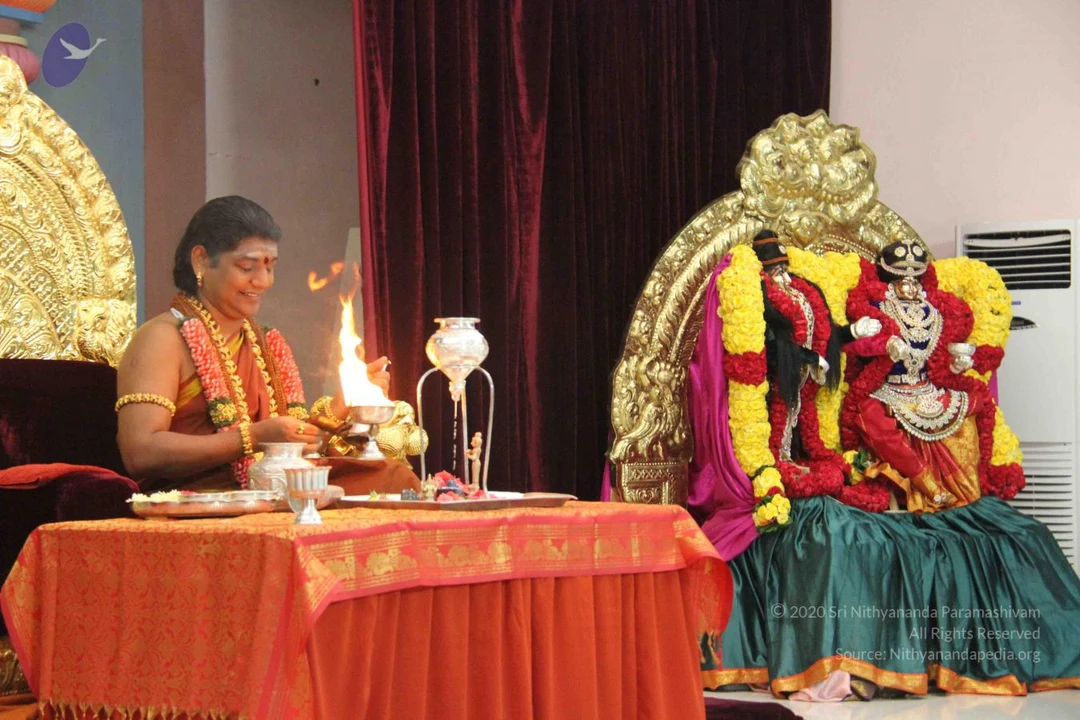
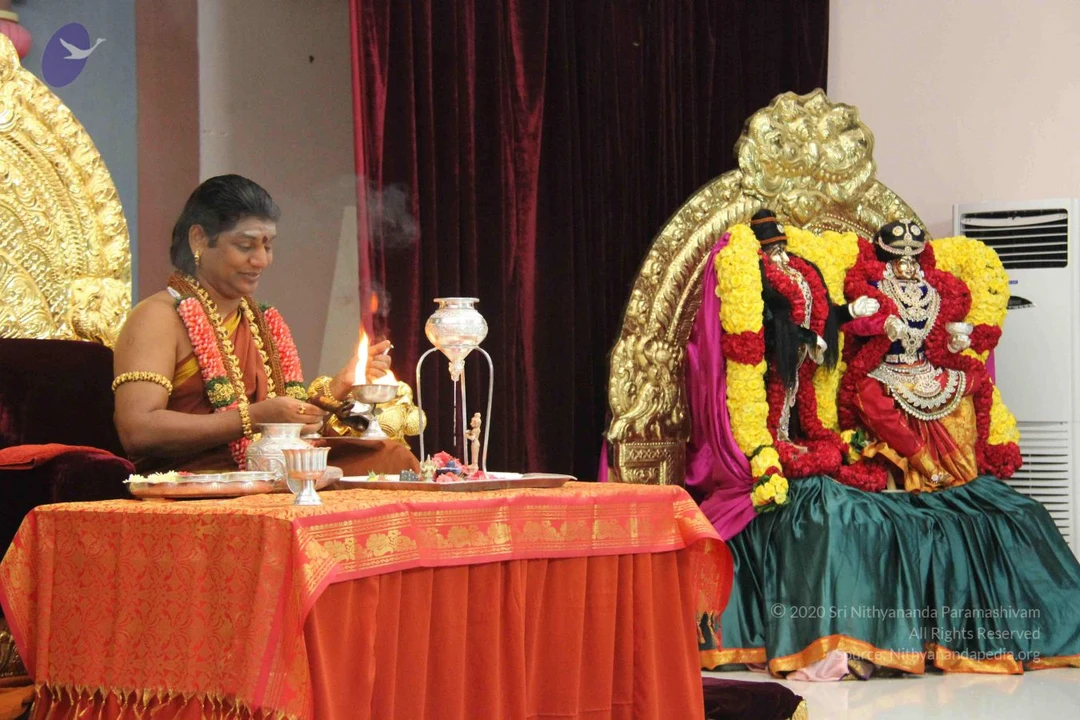
A photograph of two decorated murti figures seated on an ornate gilded throne with a repoussé golden back. The figures wear jewelled silver-toned ornaments, necklaces and crowns; one holds a ladle and the other a bowl. Both are draped in yellow and red flower garlands, and the seat is covered in a dark green silk cloth with a gold border. No living people are visible.A photograph of two decorated murti figures seated on a golden throne with an ornate gold arched backdrop. The figure on the left is a standing male murti wearing a black shawl, a black cap with a red band, silver jewelry, and silver hands, holding up one hand. The figure on the right is a seated female murti in a red and gold sari with a deep blue bodice, silver jewelry and a crown, holding a silver bowl. Both are draped in thick garlands of yellow and red flowers over a teal-green silk cloth on the throne. This appears to be a Leela alankar decoration of deity murtis, depicting Annapoorni offering food to Shiva as bhikshadana, consistent with the page's description.Photograph of a decorated deity murti pair of Shiva and Annapoorni on a green draped altar in a temple setting. The figure on the left is a standing Shiva-form murti with a tall black hair crown, rudraksha bands, layered jewelled necklaces and a trident held in its silver hand, while a silver bowl sits in the other hand. The right figure is a goddess murti in a red silk sari with gold border, blue velvet blouse, heavy jewelled necklaces and a jewelled crown, holding a silver bowl. Both are draped in red and yellow flower garlands, with a gold repoussé arch behind them and a small offering bowl with rose petals in the lower left. No physical people are present.

01-Rudrabhisekam-Swamiji-Rajasabha
25 photosSource gallery
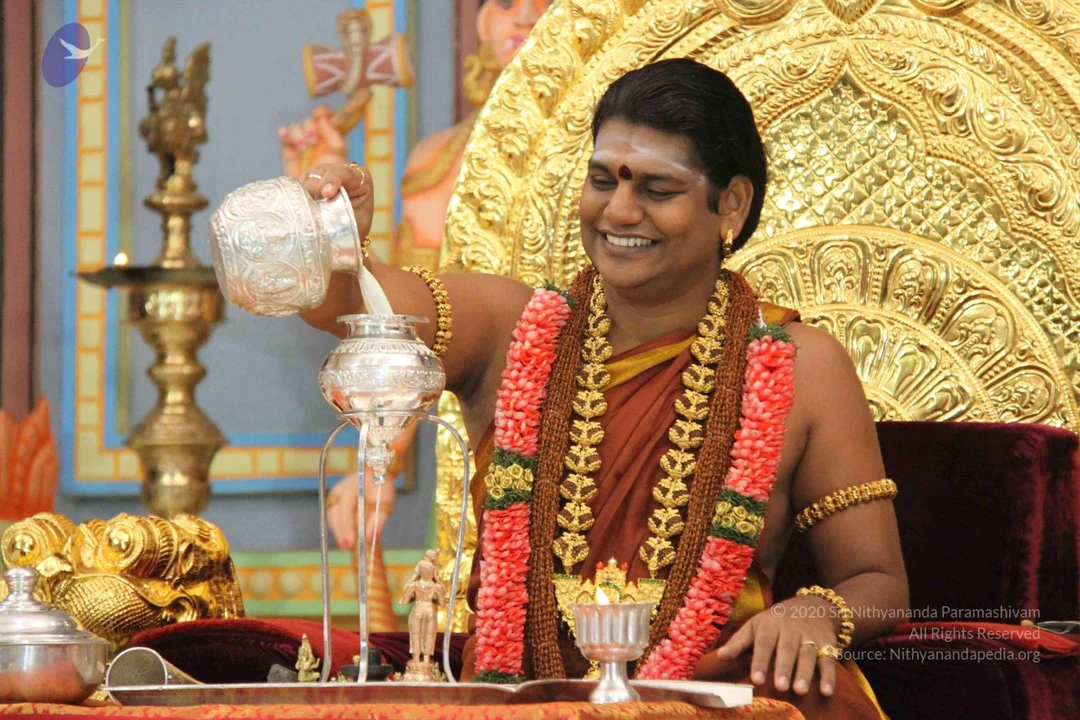
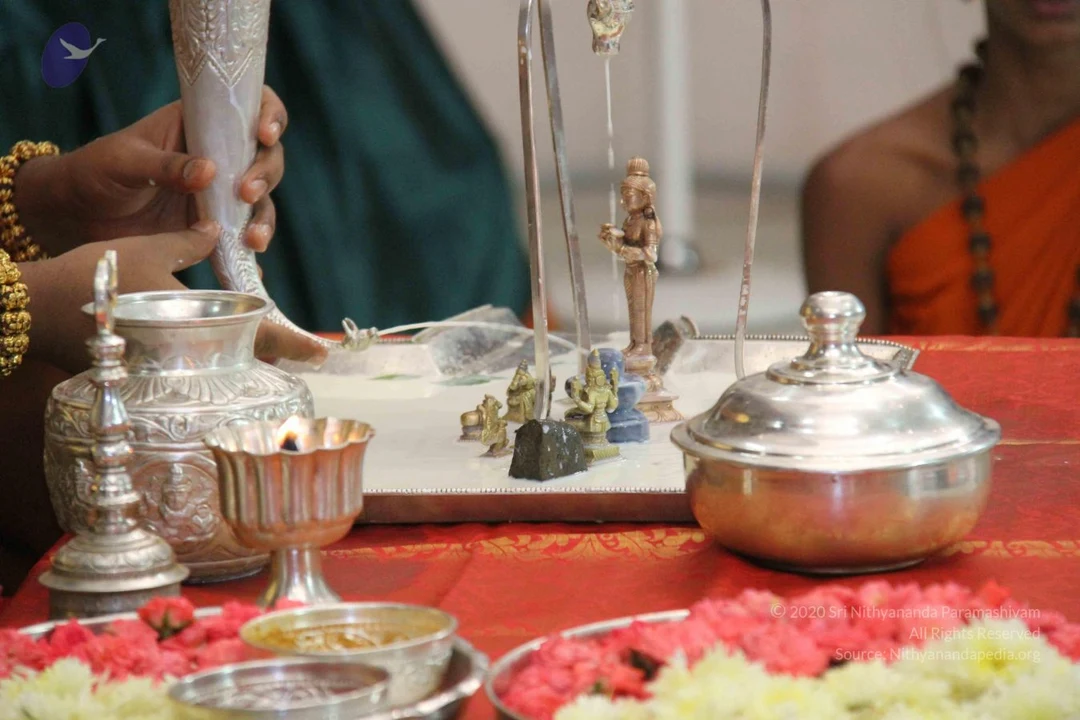
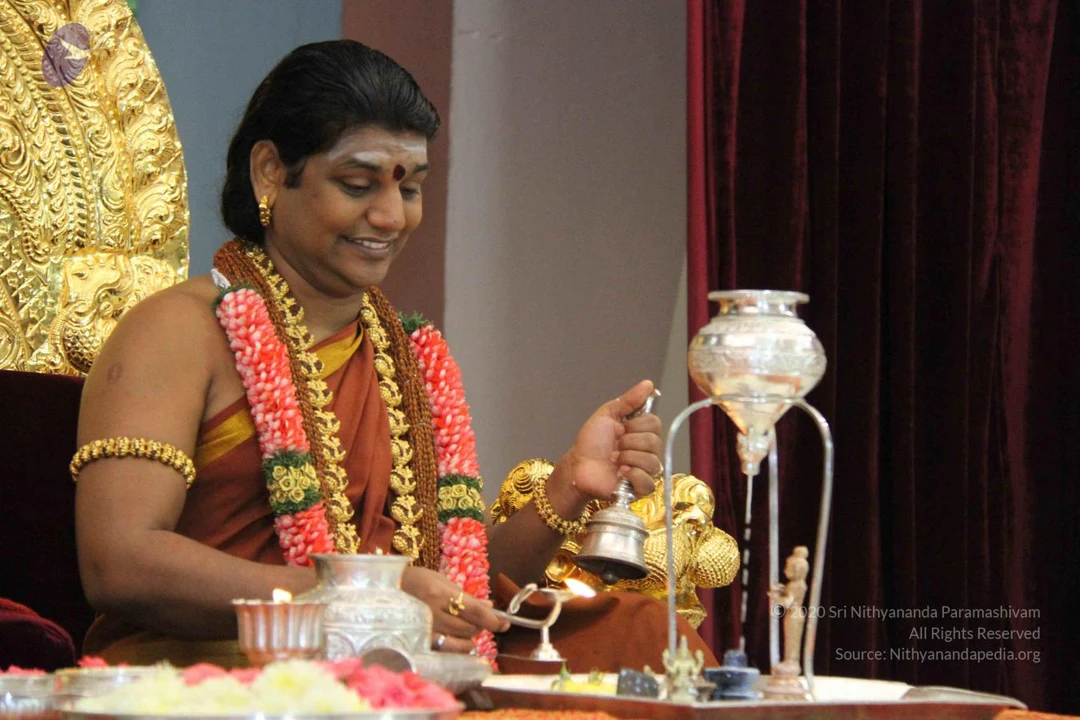
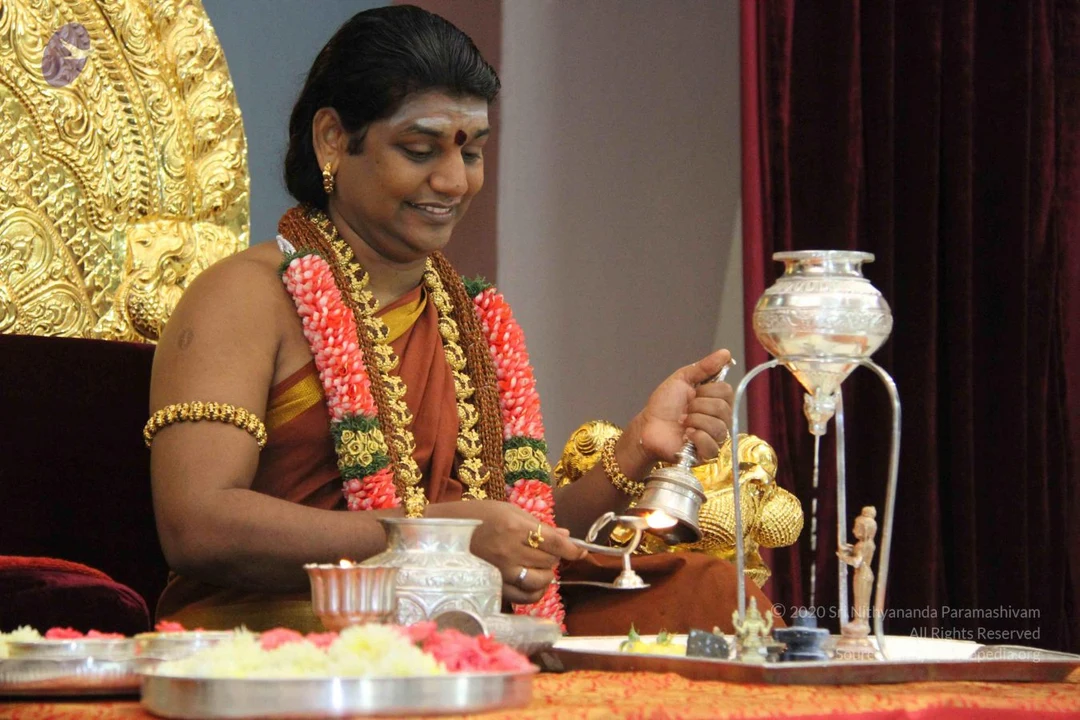
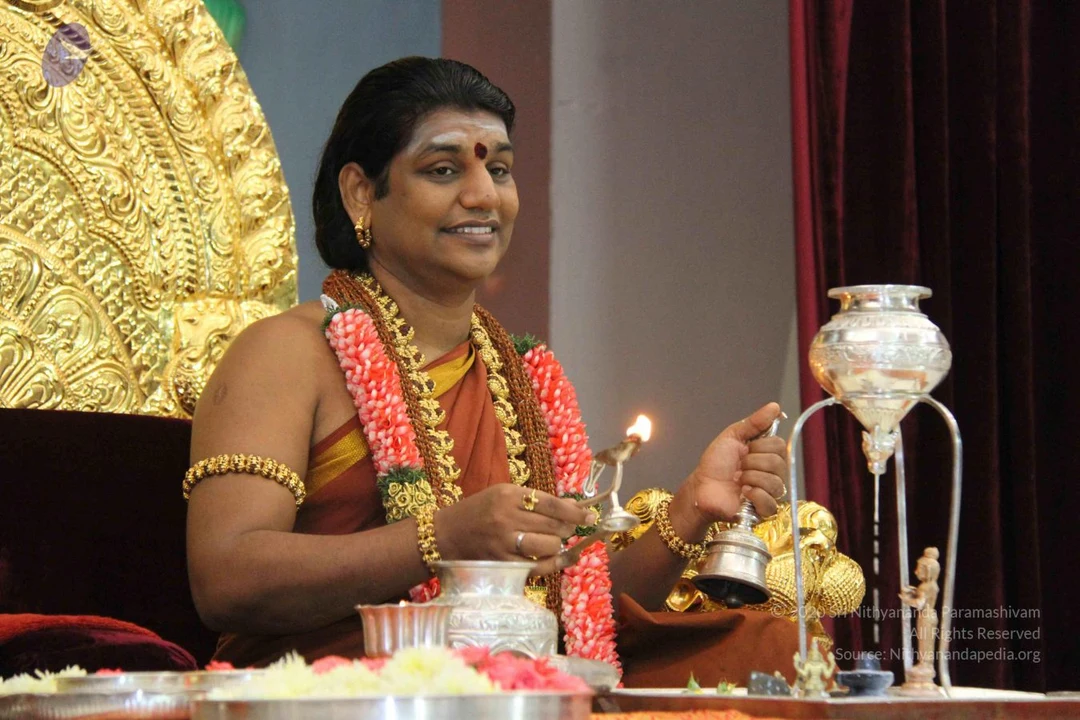
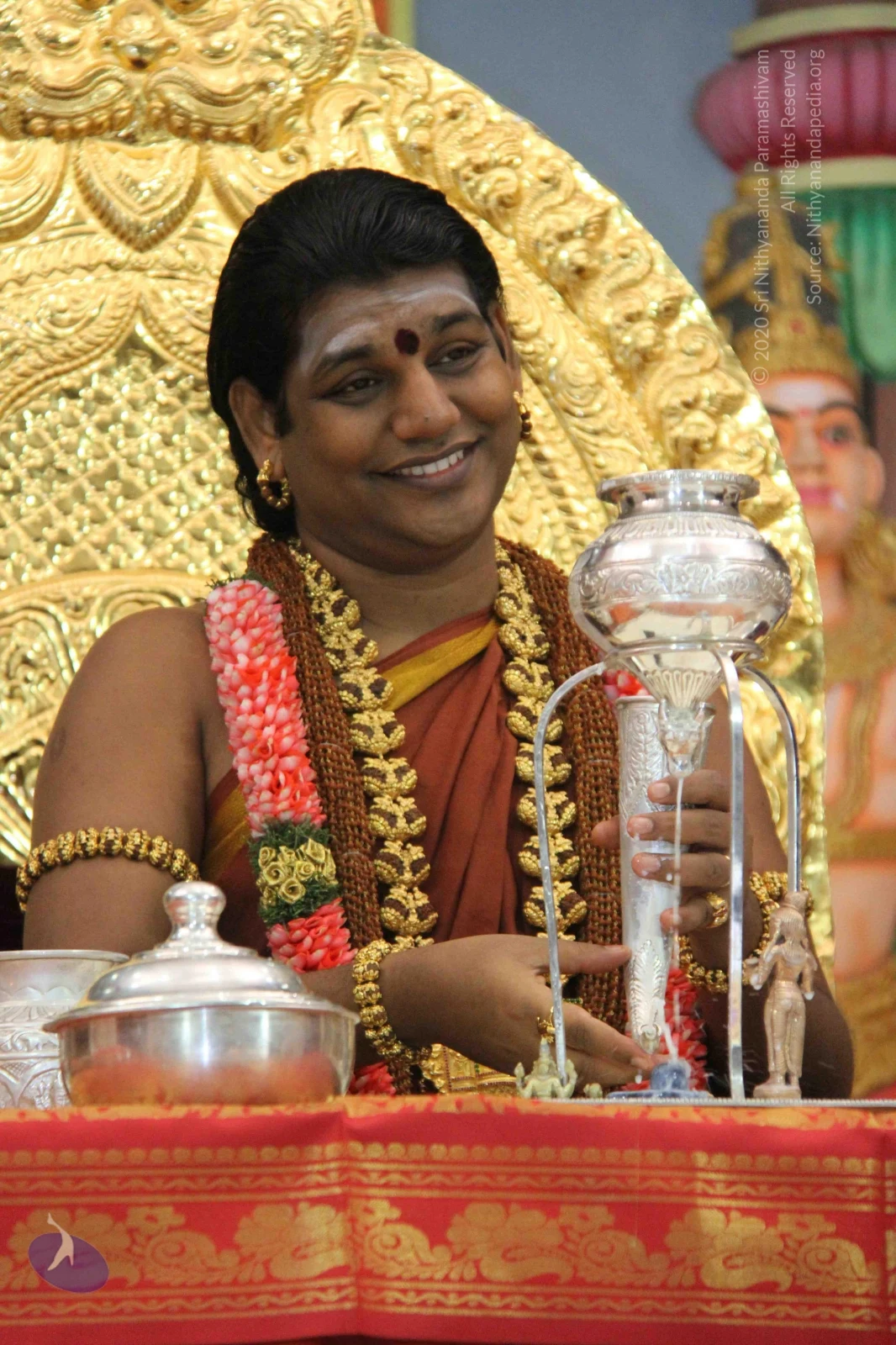
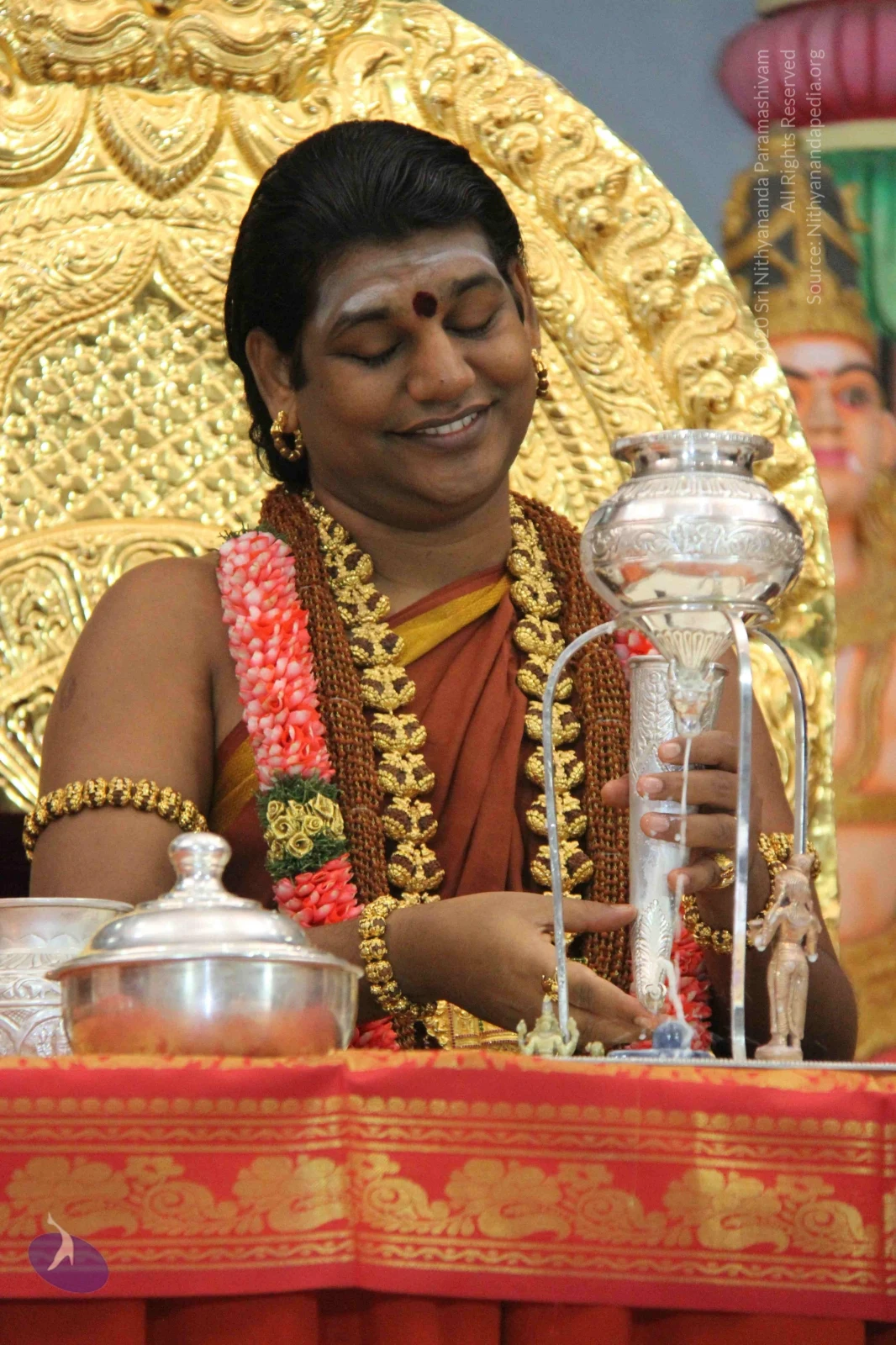
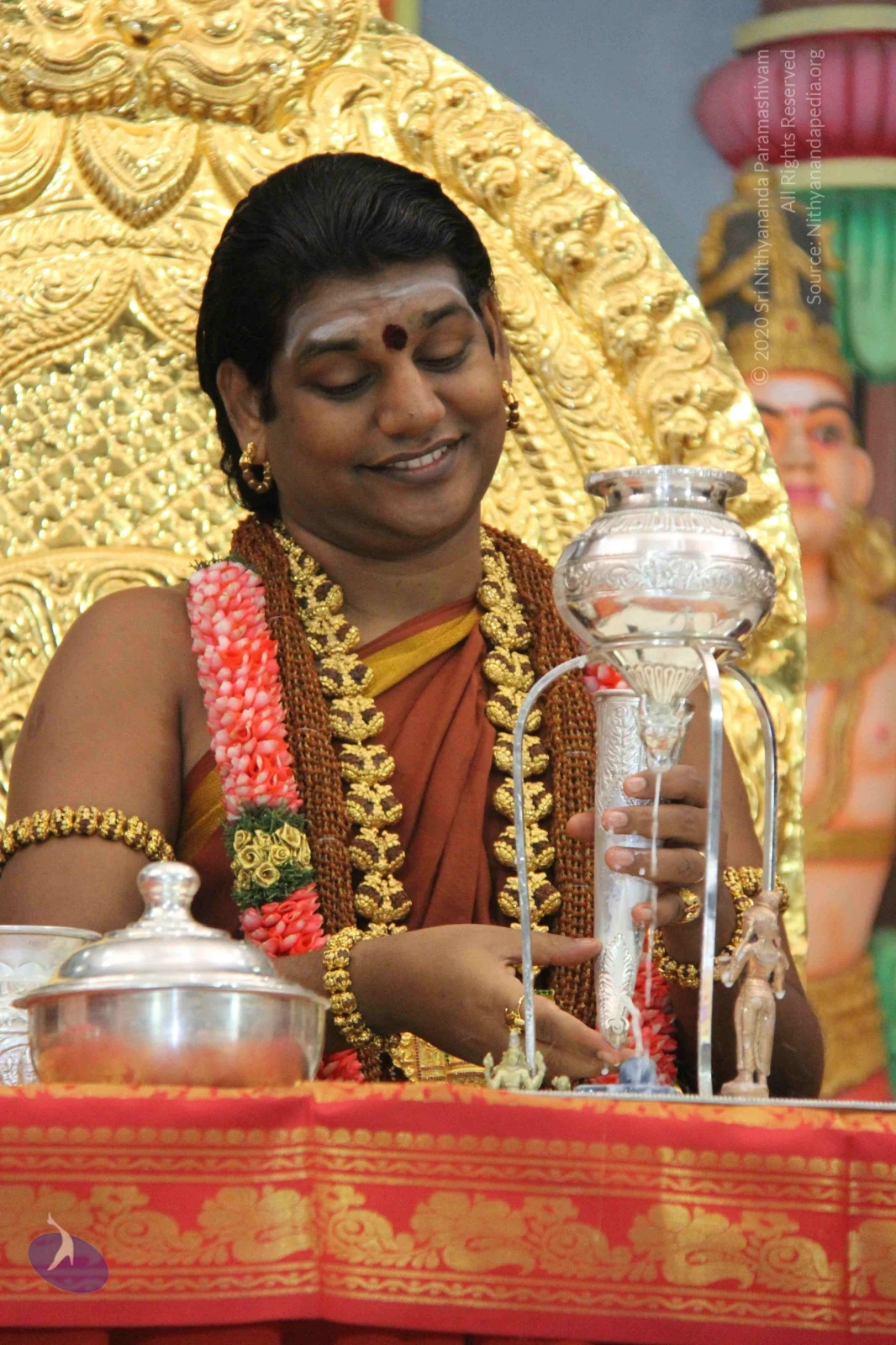
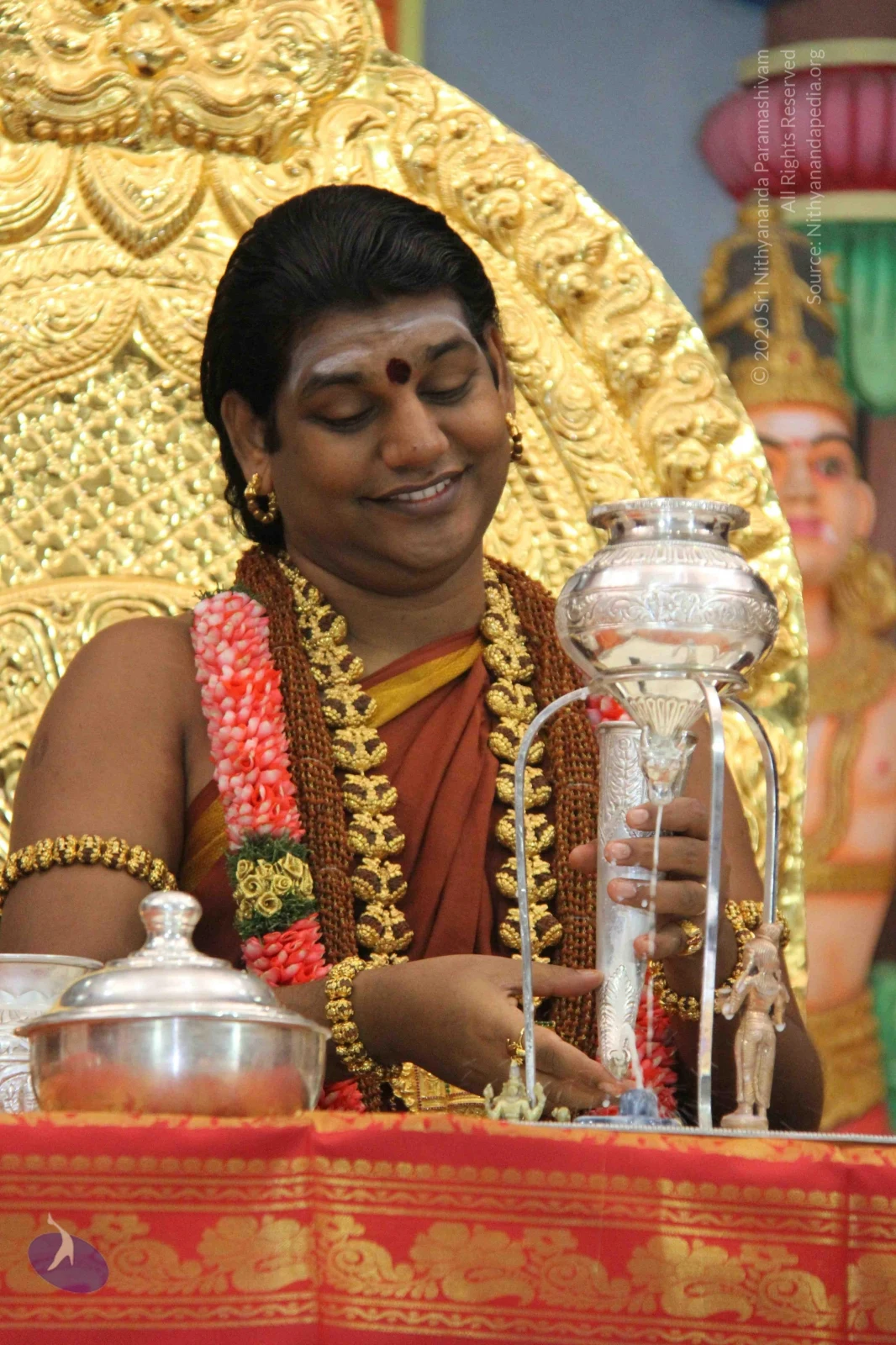
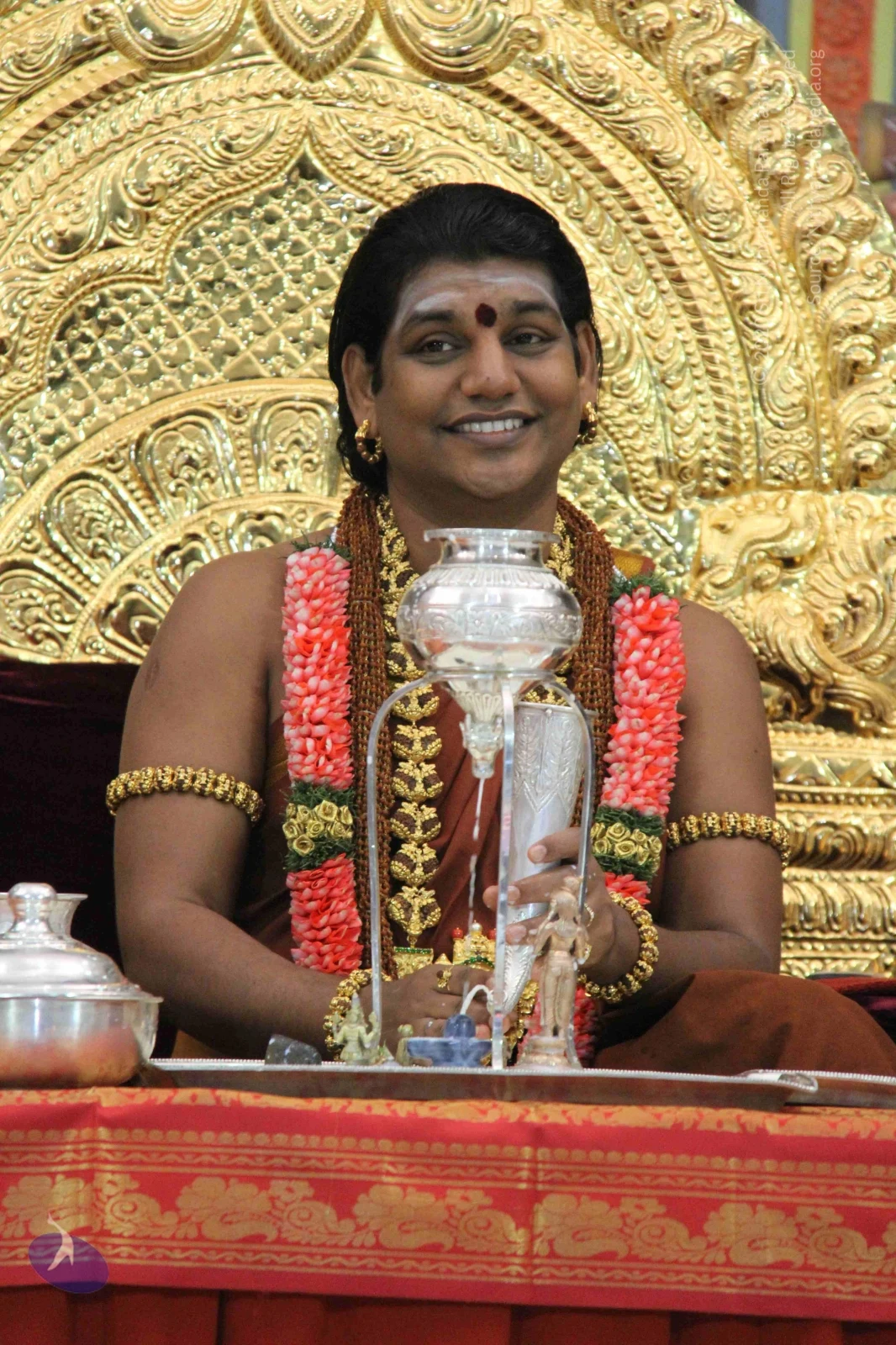
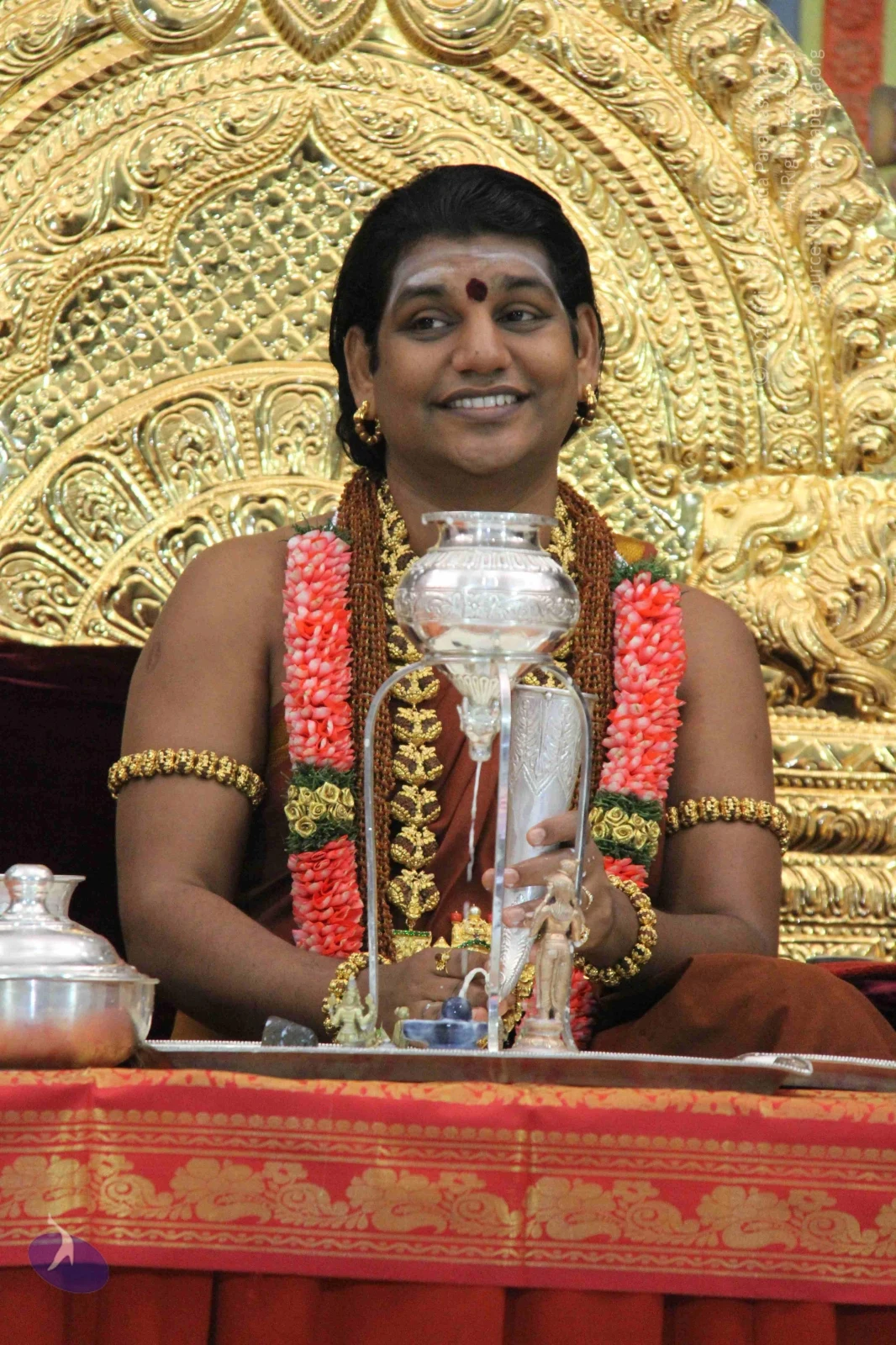
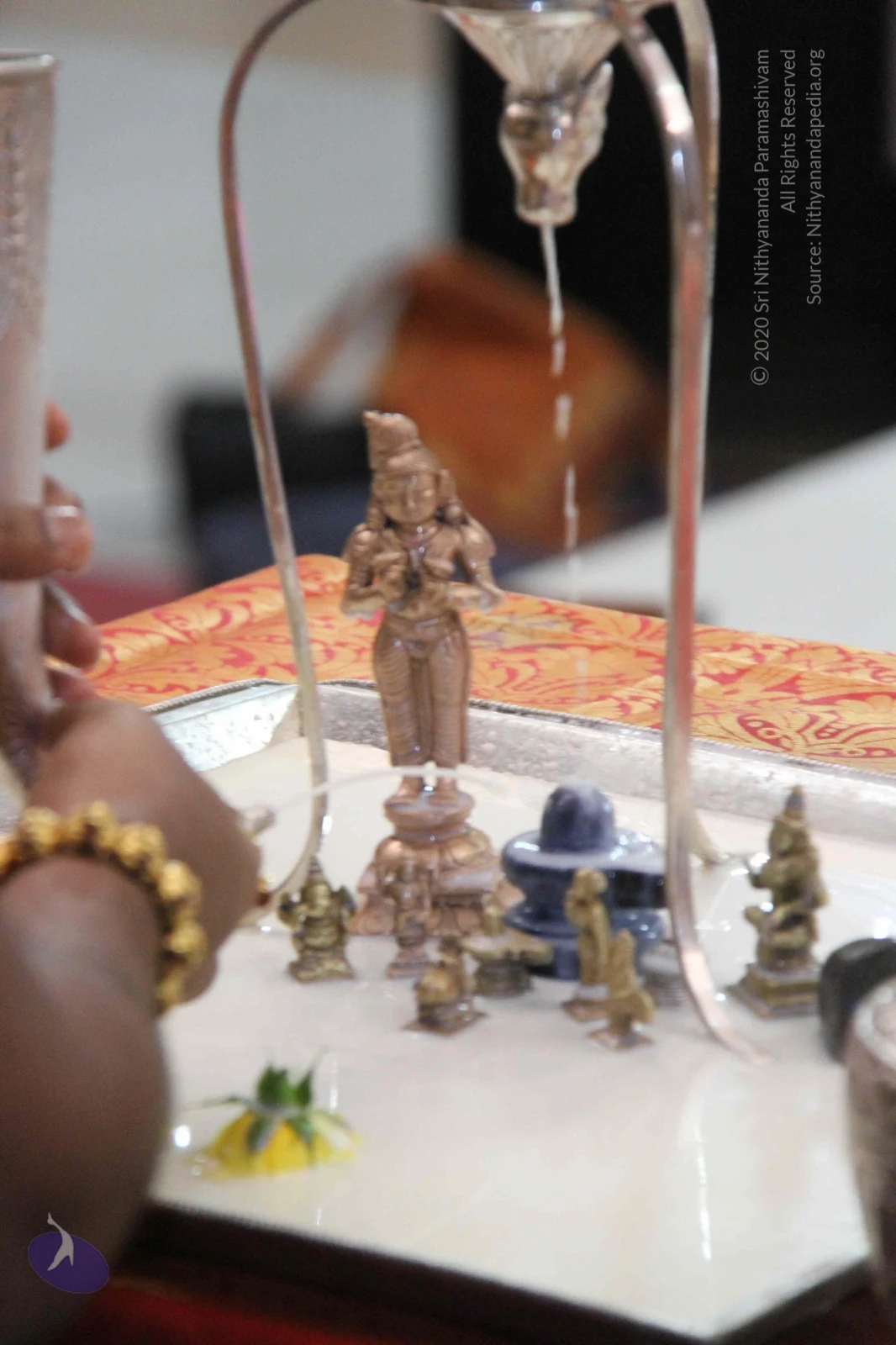
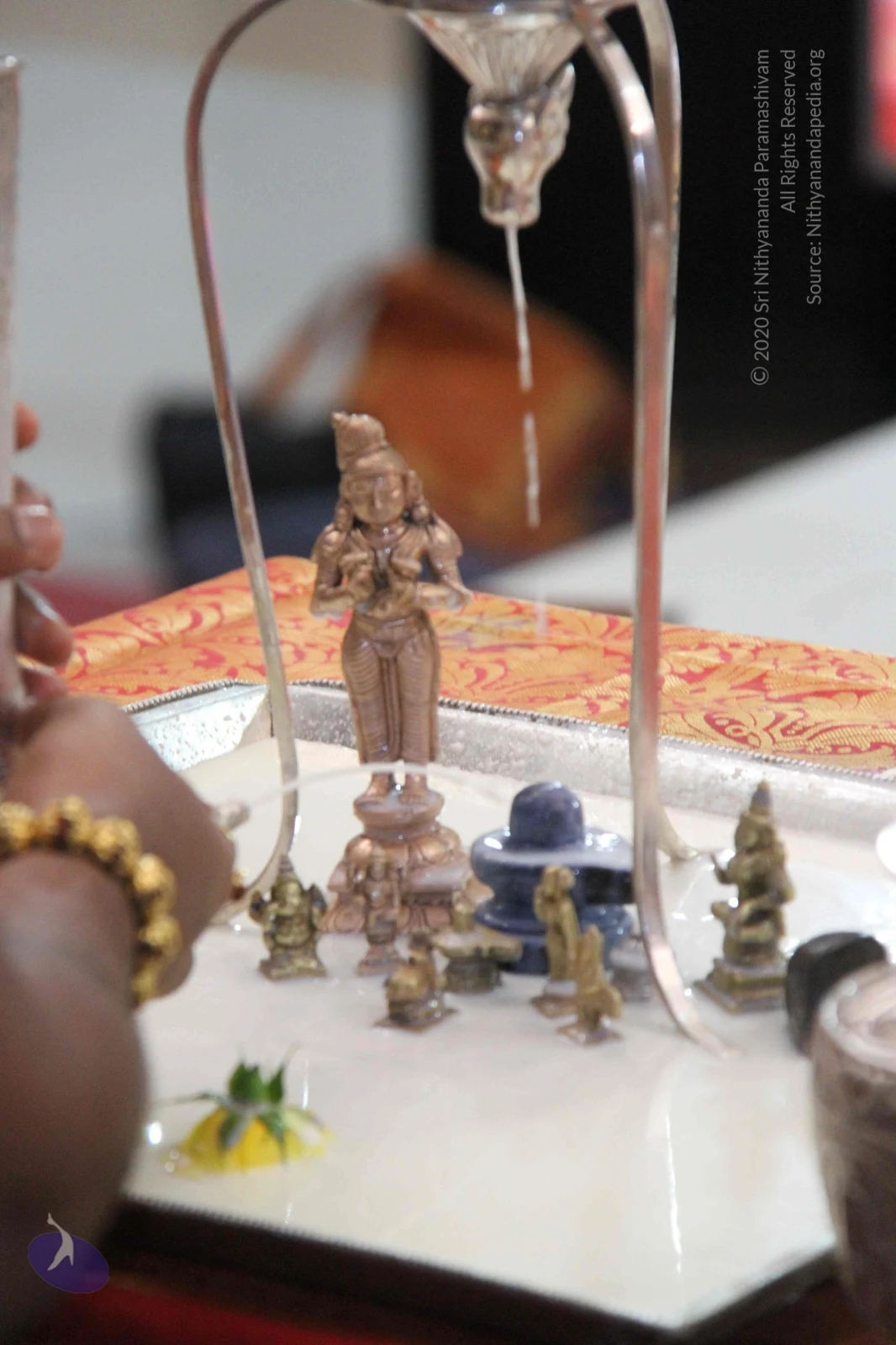
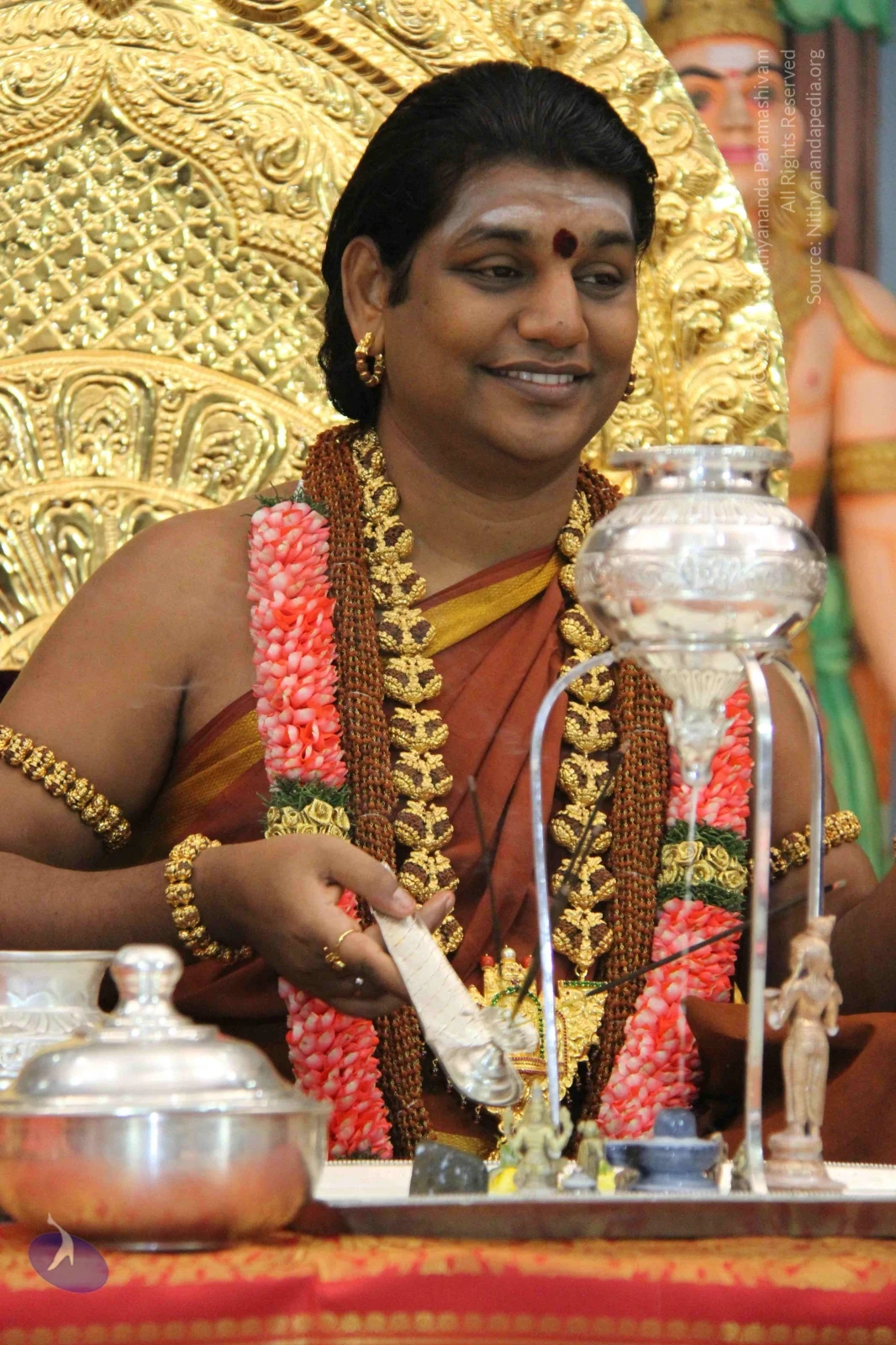
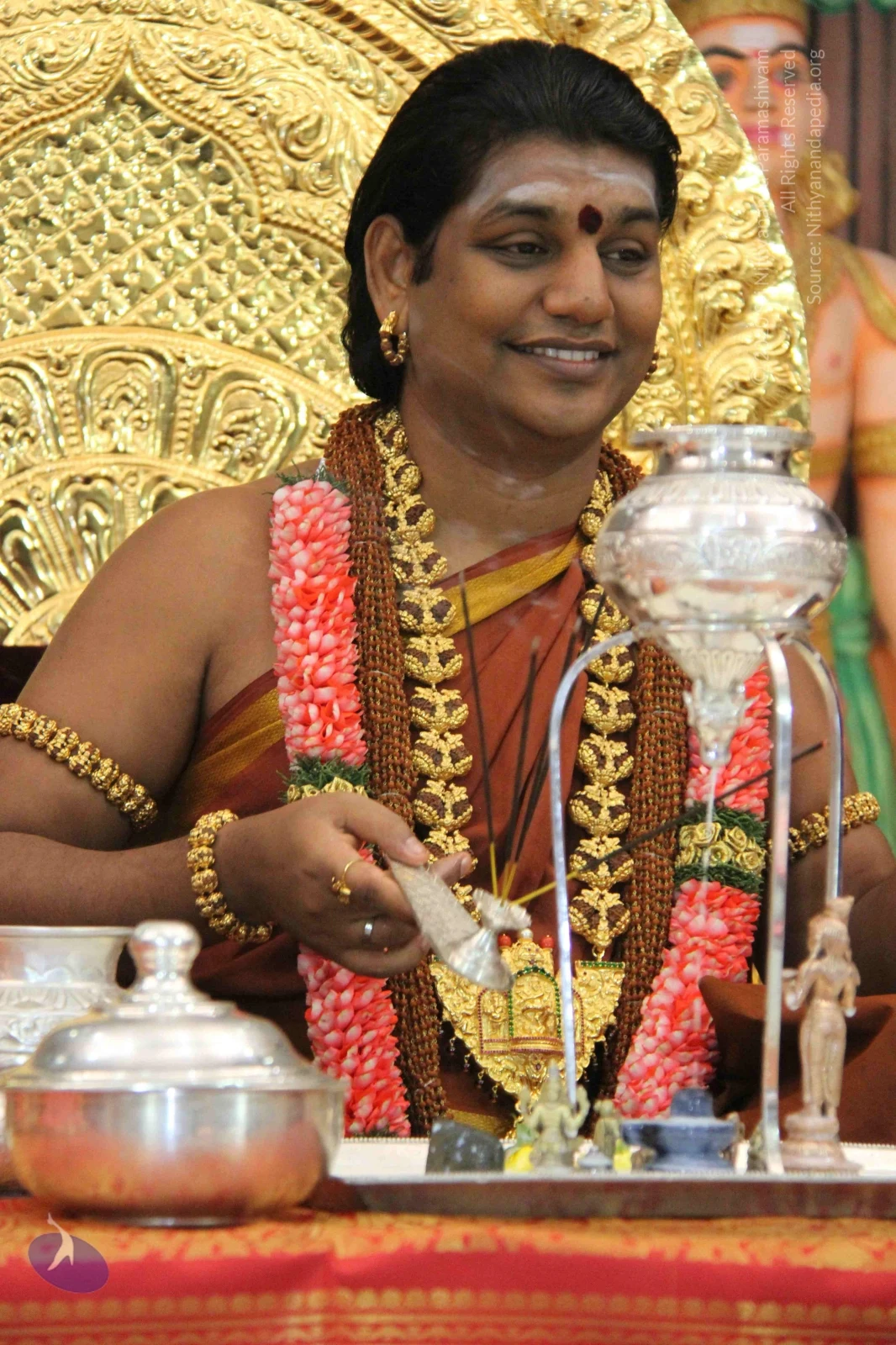
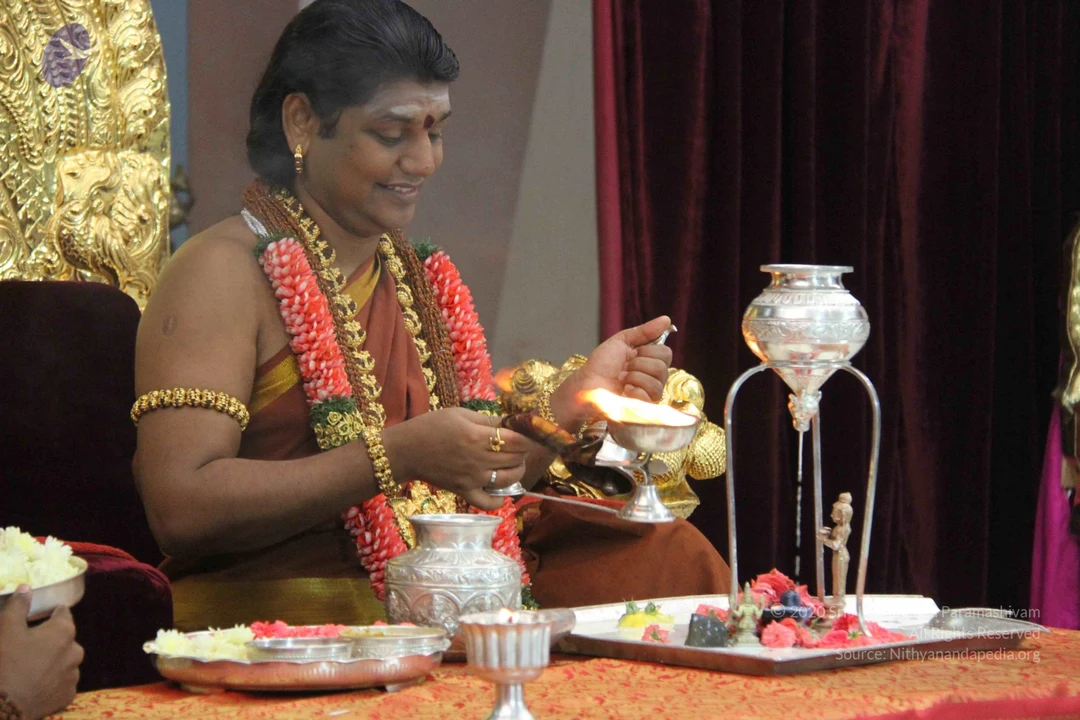
Close photograph of an abhishekam setup on a white tray with an orange and red patterned cloth. A silver kalasha on a three-legged stand releases a thin stream of liquid over a black Shivalinga on a black peetha and small brass deity murtis, including a standing figure and seated figures. A silver covered bowl sits beside the stand, and a hand wearing gold bangles is visible at the right edge. No people's faces are visible and no one is clearly present apart from the hand.A photograph of an abhishekam setup on a white tray with an orange and red brocade cloth. A tall silver kalasha on a stand drips water over small bronze deity figures and a dark black Shivalinga. A silver covered bowl sits beside it, and a hand wearing a gold bracelet pours from a vessel at the right edge. No people are visible apart from the hand.A smiling man with swept-back dark hair, a red tilak and a red dot on his forehead, sits before an ornate gold throne. He wears a rust-red garment with a gold border, a brown rudraksha mala with gold beads, a pink and red flower garland, and gold armbands and earrings. He holds a silver kalasha-style vessel with a stand, through which water is poured over a small silver deity murti. A silver lidded bowl and a red and gold cloth lie on the table in front of him, with a painted deity figure in the background. This appears to be an abhishekam being performed during a satsang. a person: the seated man wears a rudraksha mala with gold ceremonial beads, a flower garland and gold ornaments, and sits on a throne.A smiling person with slicked-back dark hair, white and red tilak on the forehead, and gold earrings sits before an ornate gold-leaf throne. They wear a rust-orange robe with a yellow border, a pink and white flower garland, a gold-beaded rudraksha mala, and gold armlets. With eyes closed, they pour water from a polished silver kalasha on a stand, possibly for abhishekam, over a small metal deity figure. A silver lidded bowl and a red and gold cloth cover the table. A partly visible painted deity murti stands at the right edge.A smiling man with swept-back dark hair, a red bindi and white vibhuti lines sits before an ornate gold throne. He wears a rust-orange shawl over bare shoulders, a brown rudraksha mala with gold ceremonial beads, a pink and white flower garland and gold bangles. He pours water from a silver kalasha through a silver stand over a small object on a red and gold table, while a silver lidded bowl sits nearby. A painted deity figure stands at the right edge. The scene resembles an abhishekam ritual. a personA smiling person with slicked-back dark hair, a white sandalwood mark and red bindi on the forehead, sits before a gold ornate backdrop, wearing a rust-orange robe with a yellow edge, a gold-bead and rudraksha-style mala, a pink and white flower garland, and gold bangles and earrings. They pour water from a polished silver pitcher on a stand over a small object while holding a silver lidded bowl on a red and gold brocade cloth. A small bronze figurine stands on the table, and a painted deity figure is visible at the right edge. Appearance-based identification of a person is not reliable enough here, so this is a priest-like ritual scene with a single person.
2-Pratyaksha-Pada-Puja
4 photosSource gallery
A photograph of a smiling man seated on an ornate gold throne draped with a tiger-skin cover, raising his right hand in a blessing gesture. He wears a rust-orange robe with a gold border, a pink and green flower garland, a gold pendant and a rudraksha mala, with gold bangles and a red tilak on his forehead. Silver plates with flowers and small bowls sit at his feet, and brass bells and a lamp hang at the side of the throne.Close profile photograph of a smiling man with swept-back black hair, white vertical forehead markings and a red kumkum dot, wearing gold earrings and a necklace of rudraksha beads with gold ornaments, a red flower garland at the lower right. Dark background with warm bokeh lights and a gold-coloured object at upper left. Swamiji (probable) appearance-based label: long swept-back hair, rudraksha mala and ceremonial gold necklace, shown in person.A seated man in a rust-orange and gold-bordered dhoti-style garment sits before a gilded throne with ornate carved relief. He wears layered red and pink jasmine-style garlands with green foliage accents, heavy gold ceremonial necklaces and a gold pendant, gold armlets and bangles, and a red tilak on his forehead. A brass bell hangs on a chain to the right against a dark backdrop with small lights.A photograph of a seated man in a rust-red and gold-bordered dhoti-style wrap, wearing a thick garland of pink and white flower buds with green leaf sections, a gold ceremonial pendant on a rudraksha mala, gold bangles on both arms and a red bindi on his forehead. He sits on a gold-embossed throne with orange cushions, a hanging brass bell beside him, and looks off to the side with a smile. Appearance-based label: a person, seated in a satsang setting.

3-Deities-Arathi

2 photosSource gallery
A stage photograph of a satsang in a temple-style hall. On the left, a man with swept-back hair, gold necklaces and an orange-and-saffron shawl sits smiling on a gold throne with red cushions, a probable Swamiji candidate from distinctive visible cues. Behind him stand large painted deity figures with multiple arms and crowns, flanked by golden lamps. On the right, a golden canopy holds two deity murtis draped in yellow and red garlands with silver faces. Two seated young people in yellow and orange robes with flower garlands sit on the floor before them, and a small framed picture rests on the stage.

3-Nithya-Satsang

6 photosSource gallery
A smiling man with swept-back dark hair and a red bindi stands at a clear acrylic lectern, wearing a rust-red and gold-bordered robe draped over the shoulders. He wears a heavy gold ceremonial necklace with a large gold pendant and a long rudraksha mala, gold armlets and bangles, and a small microphone headset. His right hand rests on the lectern. Behind him is a dark red curtain and a painted pillar in pink, green and gold. The.A photograph of a stage in a hall with a red velvet drape and painted temple-style backdrop. A person in an orange and gold garment with a gold necklace and garland stands at a clear acrylic lectern, speaking. Behind on the right, a gold throne with a tiger-print cushion is set to one side, and beside it a deity murti decorated with yellow and orange flower garlands and wearing a gold crown sits on a green draped base. A standing fan and an air conditioning unit are visible at the edge of the room.A seated man in ochre-saffron robes sits cross-legged on an ornate gold throne with a large gold arched backrest carved with scrolls and lions, draped with a tiger-skin cloth on the platform. He wears a thick rudraksha mala with a gold leaf-patterned necklace, a gold pendant, gold armlets and bangles, and a red bindi. He smiles broadly and points his right index finger toward the audience while his left hand rests on his lap. Red velvet cushions surround the throne, and a microphone is visible at the right edge. Appearance-based probable Swamiji cues: long swept-back hair, ceremonial gold necklace and rudraksha mala, saffron robes, and a throne.A smiling man with long dark hair sits cross-legged on an ornate gold throne with a carved arched back, resting one hand on a golden lion-head armrest. He wears a saffron-orange and yellow shawl, layered gold and rudraksha necklaces, gold armlets and bangles, and a red bindi, with a small headset microphone at his ear. Behind him is a carved wooden door, with painted deity figures flanking the frame and a tiger-skin rug draped over the gold dais. Appearance-based candidate for a person, seated in person on the throne in a discourse setting.A seated man in an ornate golden throne with an arched gilded back, flanked by gilded lion armrests, sits cross-legged on a tiger-skin cushion on a gilded platform. He wears a saffron-orange and gold wrap, a rudraksha mala, a ceremonial gold necklace with a crown pendant, gold bangles and a red bindi, and smiles while gesturing with one hand, a small microphone clipped near his face. Behind him are a tall wooden door and painted figures in green and red. Swamiji (probable): the candidate has long swept-back hair, a saffron wrap, rudraksha mala and ornate gold necklace, seated on a throne in a satsang setting.A smiling man with long dark hair and a red bindi sits cross-legged on an ornate gold throne with carved lion heads and burgundy velvet cushions, a tiger-striped cloth draped on the dais below. He wears a rust-orange and yellow robe, layered rudraksha malas, a gold ceremonial pendant necklace and gold armlets and bangles, with a small microphone at his ear. Behind him is a gilded wooden door and painted deity statues with raised arms, one holding a flaming torch. The appearance matches the Swamiji (probable) cues of long swept-back hair, ornate gold regalia and rudraksha malas, seated as the speaker at a satsang.

4-Final-Blessings

9 photosSource gallery
Empty ornate golden throne (peetha) on a raised gold-carved platform with deep maroon velvet cushions, flanked by two gold lion-head armrest sculptures and a striped tiger-skin cloth draped over the front. Two painted deity murti statues with four arms, gold crowns and gold necklaces stand on either side, one holding a trident and the other a flame-like object. A red patterned rug lies below, with a brass oil lamp (vilakku) on the left and an open doorway with hanging lamps behind.A woman in an orange and gold-bordered sari walks barefoot across a white floor toward an ornate gilded throne with a maroon velvet seat and back cushion. A tiger-skin cloth is draped over the throne platform, and a gold lion-head ornament sits beside it. Behind the throne stands a golden archway and hanging brass lamps, and a tall painted deity statue with a gold crown and orange dhoti stands at the right, with a smaller figure at the left. A red patterned carpet lies on the floor in front of the dais, and a brass oil lamp stands at the left edge.A smiling man stands barefoot on a red patterned rug in front of a golden throne with a tiger-skin draped over its seat, arms raised with palms open in welcome. He wears a rust-orange and gold-bordered dhoti and shawl, a long gold-beaded mala with a gold pendant, gold bangles and an armlet, and a red bindi. Two painted deity figures with multiple arms and crowns flank the throne, with golden lions at the seat's base, a brass lamp stand at right, and a pink-and-green painted temple wall behind.A smiling man stands barefoot on a red patterned rug in front of an ornate golden throne with lion-head armrests and velvet cushions, arms raised with palms open. He wears a rust-orange dhoti and shawl with gold borders, a rudraksha-style mala and a large ceremonial gold pendant, plus gold bangles and armlets, and a red bindi. Two painted guardian figures with crowns, gold jewellery and orange dhotis flank the throne, and a brass lamp stands at right.A smiling man stands barefoot on a red patterned rug in a temple-style hall, both arms raised with palms open. He wears a rust-orange and yellow wrapped garment, a rudraksha-style mala and a large ornate gold pendant necklace, gold bangles and a red bindi. Behind him stands a gilded throne with red velvet cushions and golden lion heads, flanked by two painted multi-armed deity murti statues holding lamps and ceremonial objects. A tall brass oil lamp stands at right, and a pink-and-green painted temple backdrop surrounds the scene. The visible presentation cues are consistent with a person, who appears in person in this photo.Photograph of a stage with a deep maroon velvet backdrop and a white floor. On the left a man in an orange-brown dhoti and wrap with gold borders, a gold necklace pendant and bangles, smiles and raises one palm in greeting. Beside him an ornate gold throne is decorated with yellow and red flower garlands, holding two silver-and-jewelled murti figures: a standing figure with long black hair and a crown, and a seated figure in a red sari with silver jewellery holding a trident. A teal silk cloth drapes the platform below.

5-IA-Day4-Aacharya-Session
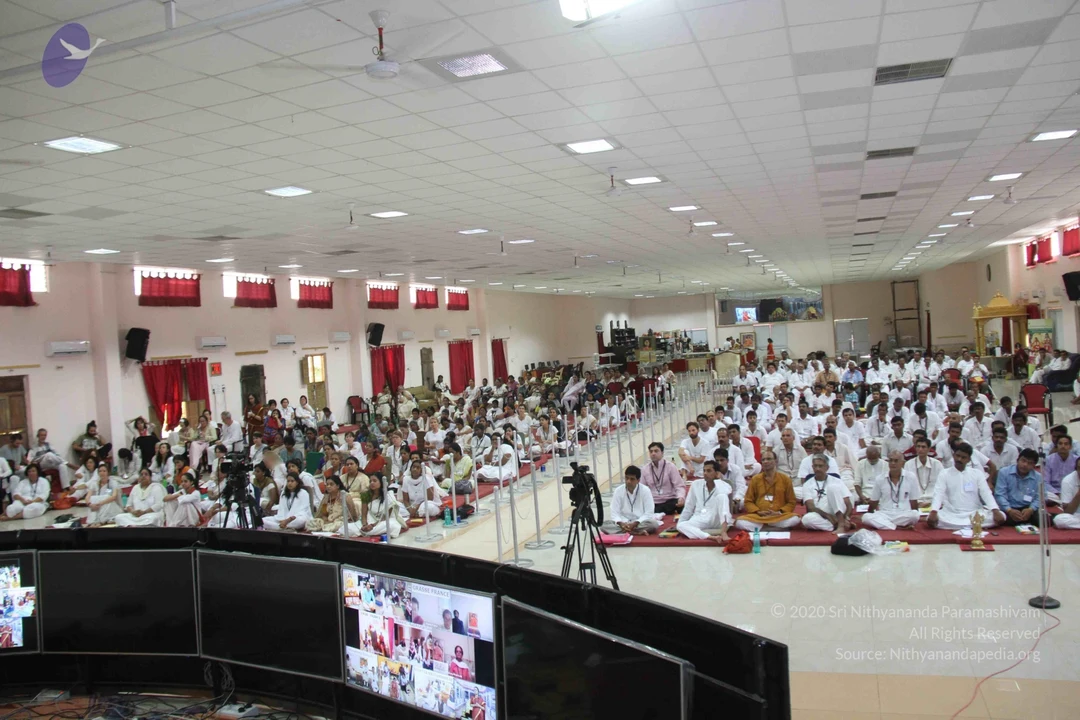
3 photosSource gallery
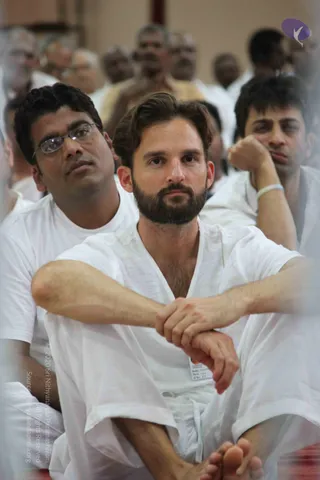
A photograph of a large hall filled with seated devotees, mostly men in white shirts and white dhotis, facing a stage at the far end. Rows of black plastic chairs fill the foreground, with many heads visible. Two large screens on the side walls show a red-clad figure, and the stage backdrop depicts a colonnaded temple corridor with golden seating and figures in saffron. Ceiling fans and fluorescent lights hang overhead, and red curtains line the windows. The stage is lit with a small seated figure visible in the centre, but no individual on the stage can be clearly identified as a physical person at this scale.Photograph of a seated congregation at a satsang, mostly men dressed in plain white clothing. In the foreground a bearded man with brown hair sits cross-legged with his forearms resting on his knee, looking forward intently. To his left a man in glasses and a white t-shirt looks upward. Behind them other seated attendees in white are blurred, and a wristband is visible on one arm. No deity, throne or ceremonial objects are clearly visible; the setting is an indoor hall with plain cream walls.A man with dark wavy hair sits with his right fist pressed against his cheek, looking off to the side in a seated audience setting. He wears a pale pink linen shirt with sleeves rolled up, a rudraksha mala with a navy lanyard hanging around his neck, and a red thread bracelet on his wrist. Blurred people in white and light clothing sit behind him in a hall with cream walls. The image shows a seated devotee at a satsang-like gathering.