Skip to content
Tuesday

20 August 2013

Relationships Pattern or Possibility.

Dated photos
67
Source pages
1
Media
2
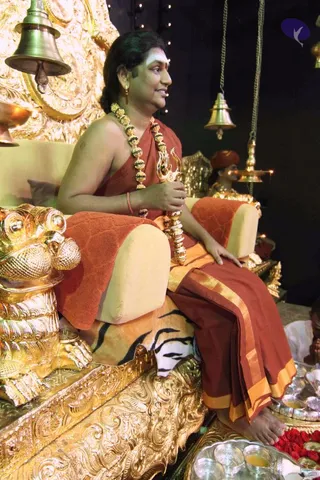
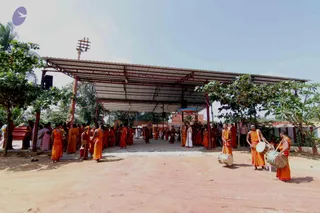
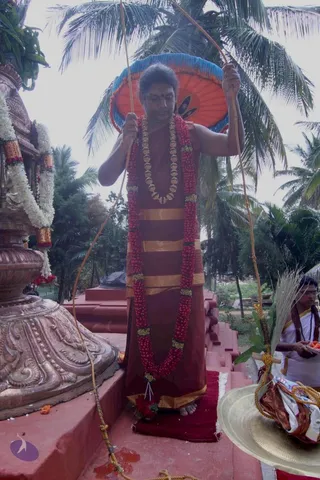
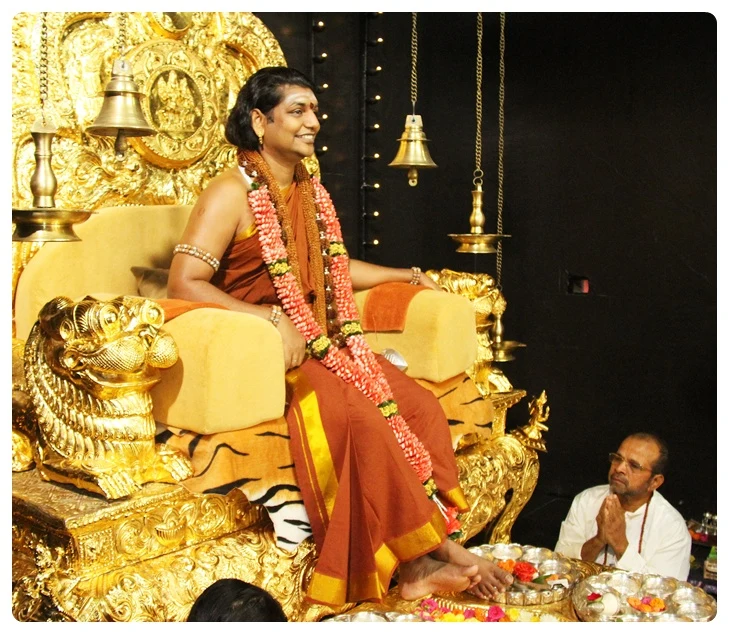
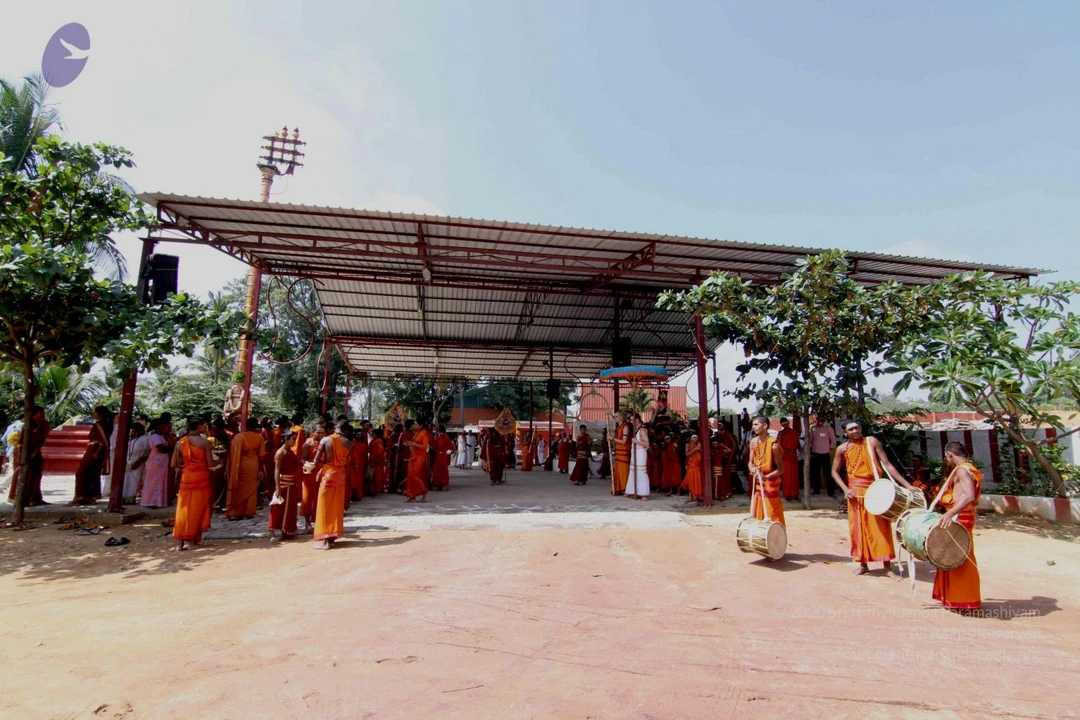
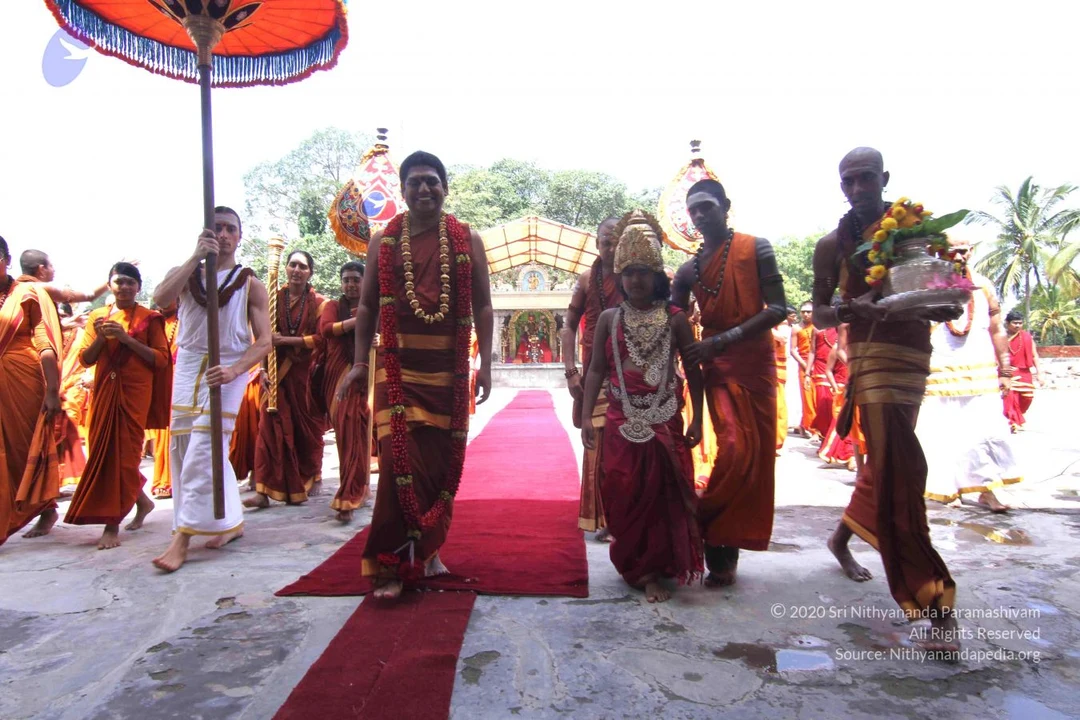
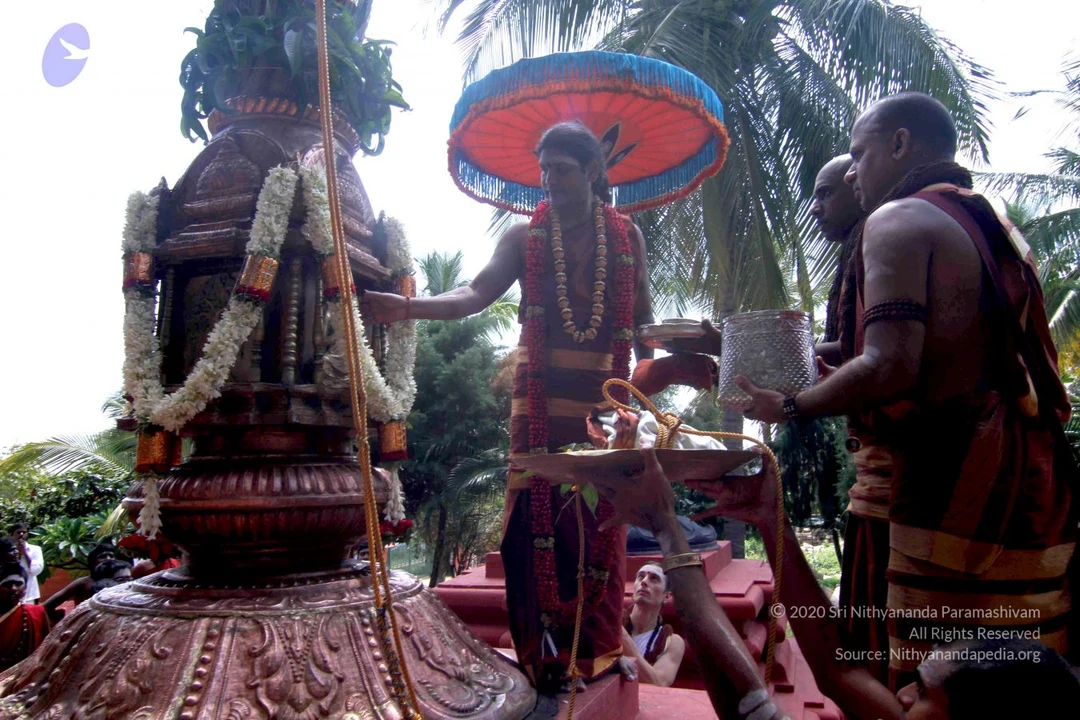
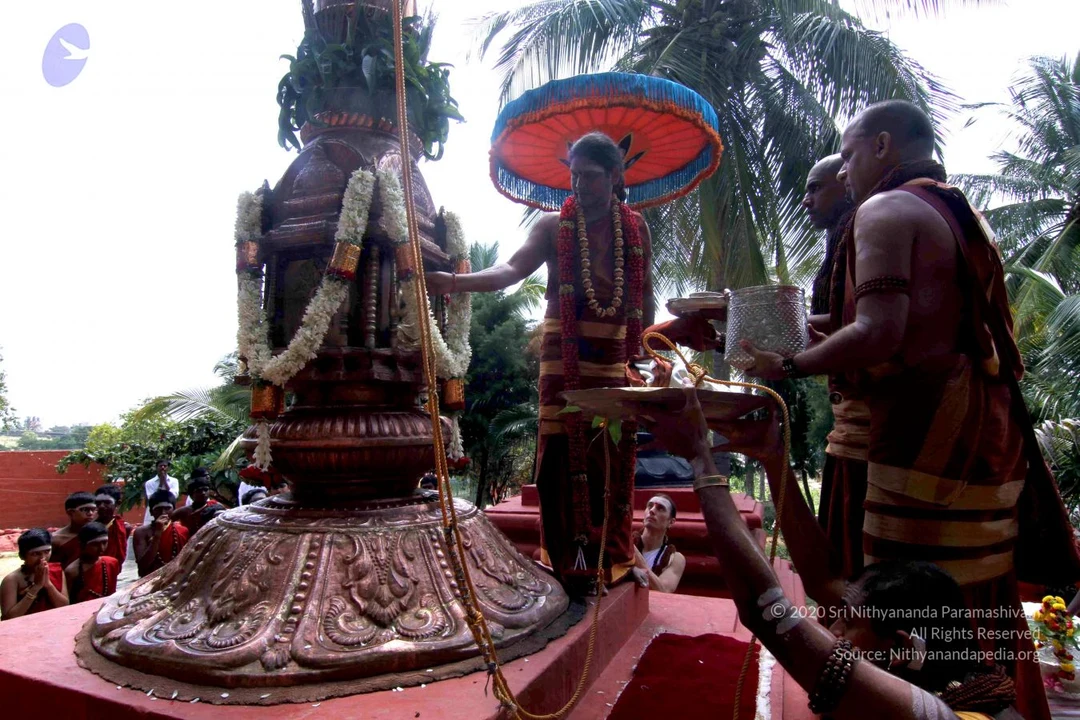
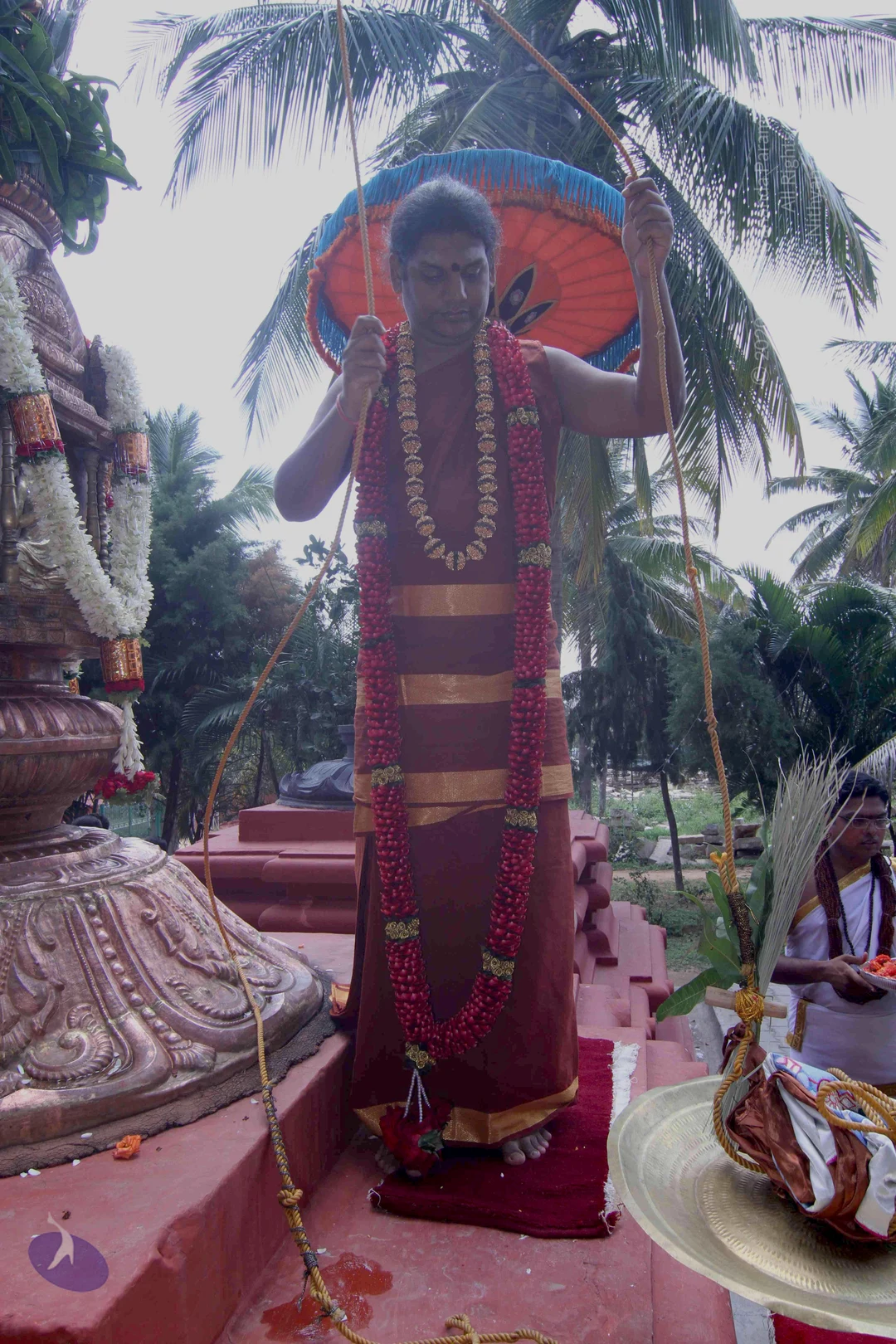
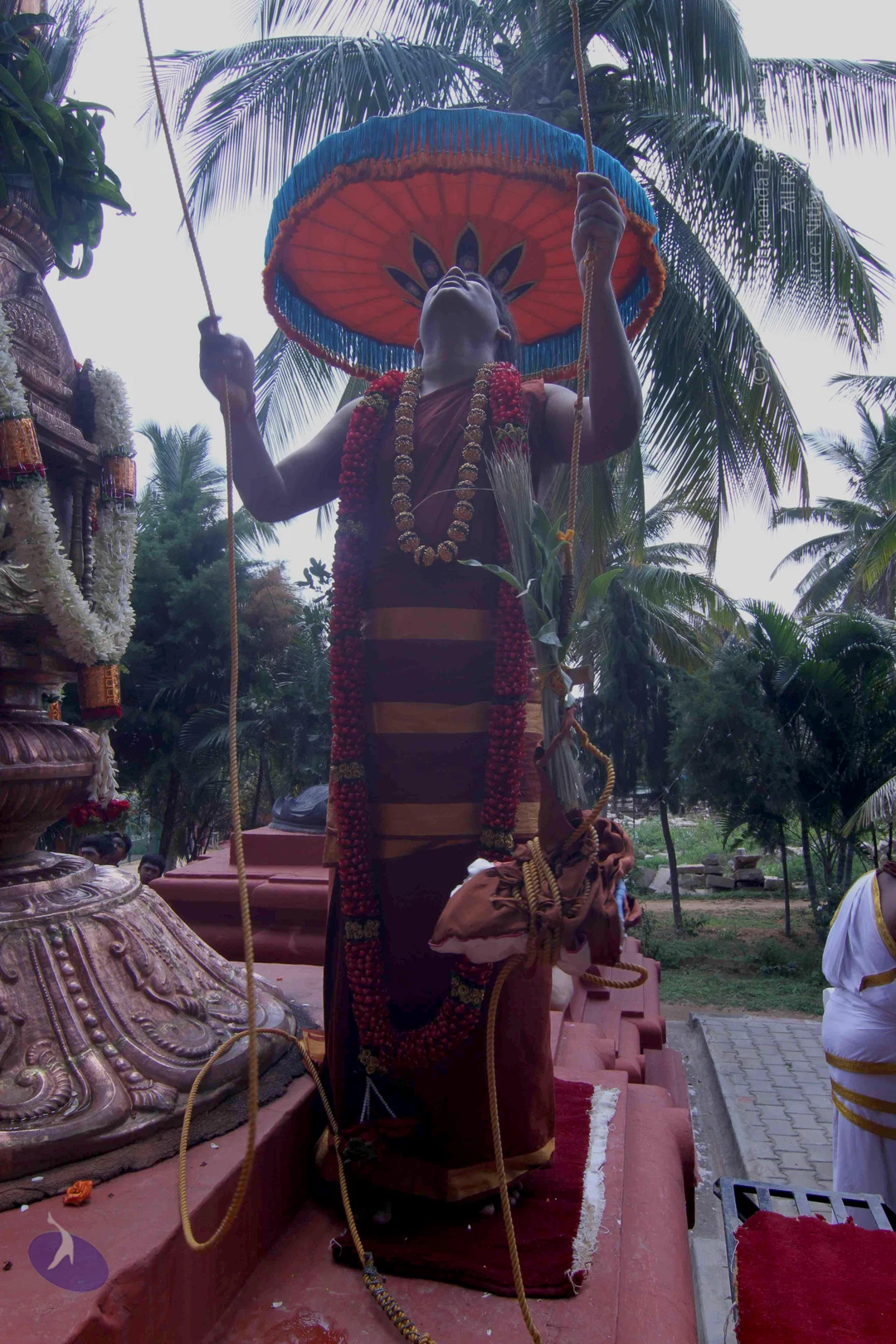
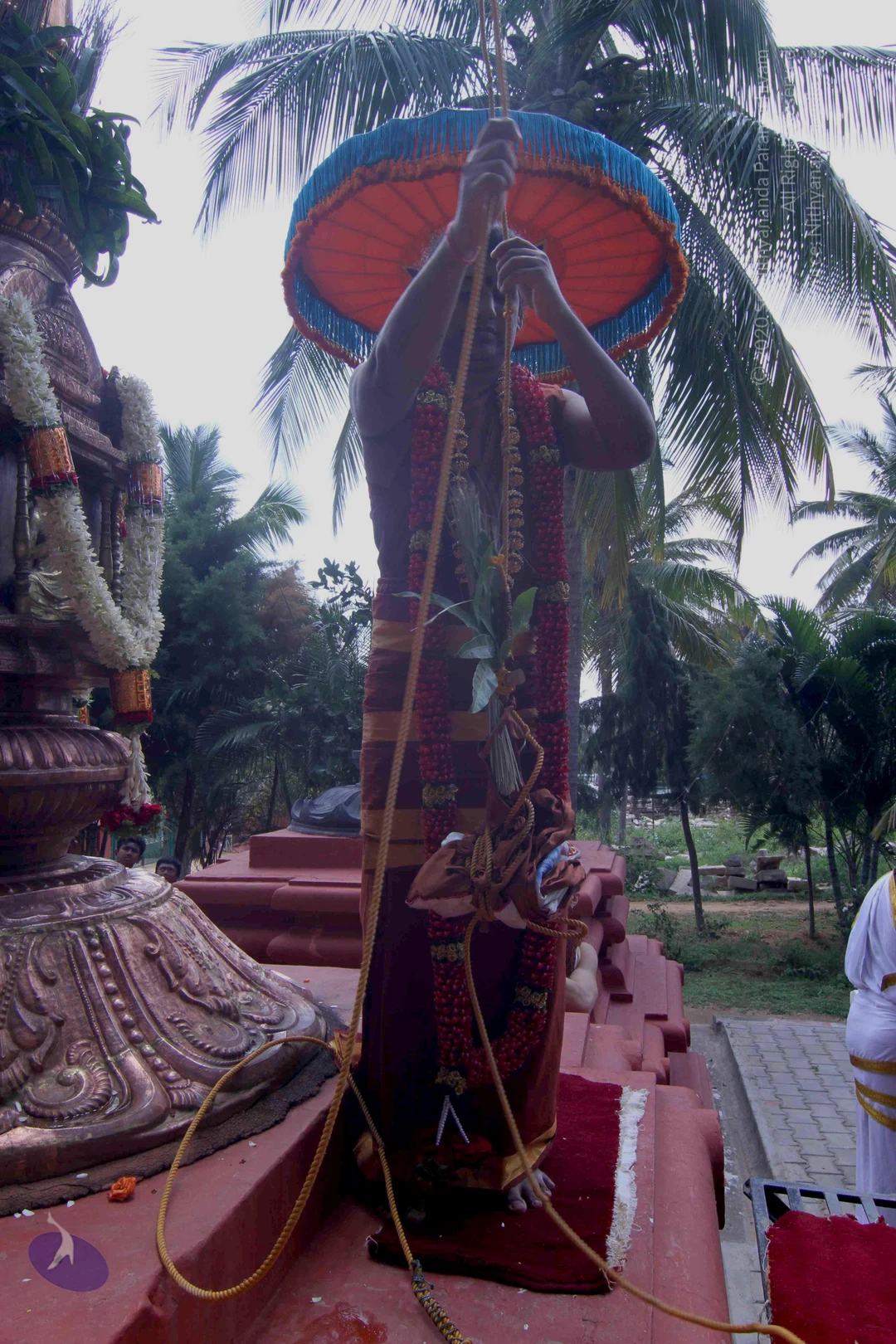
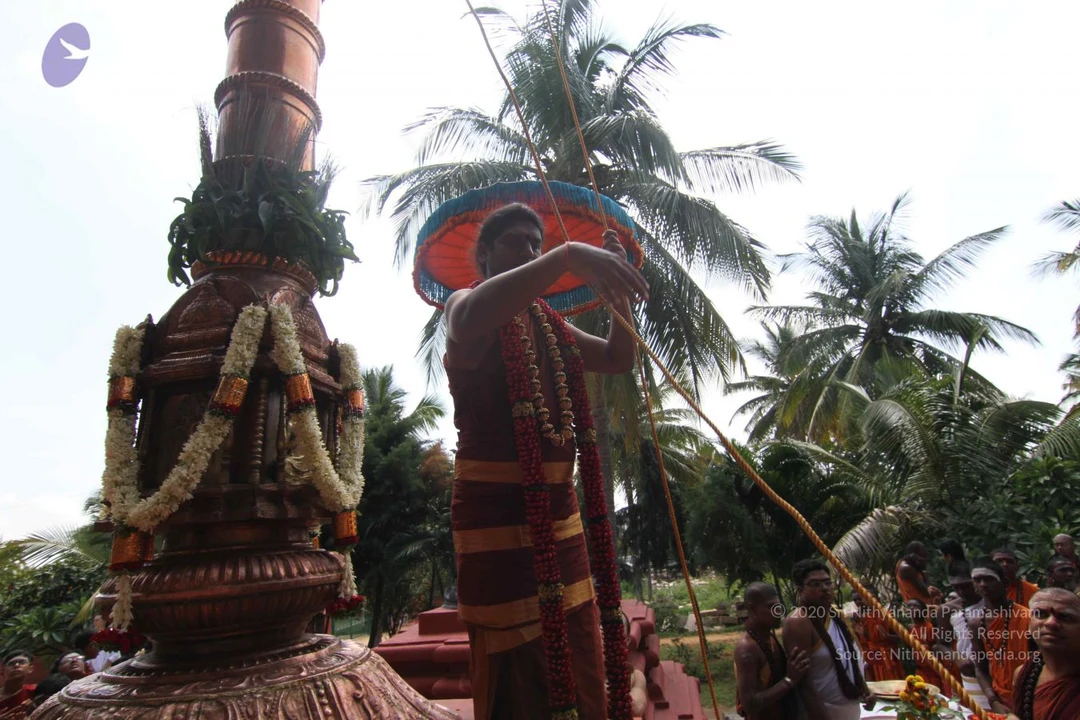
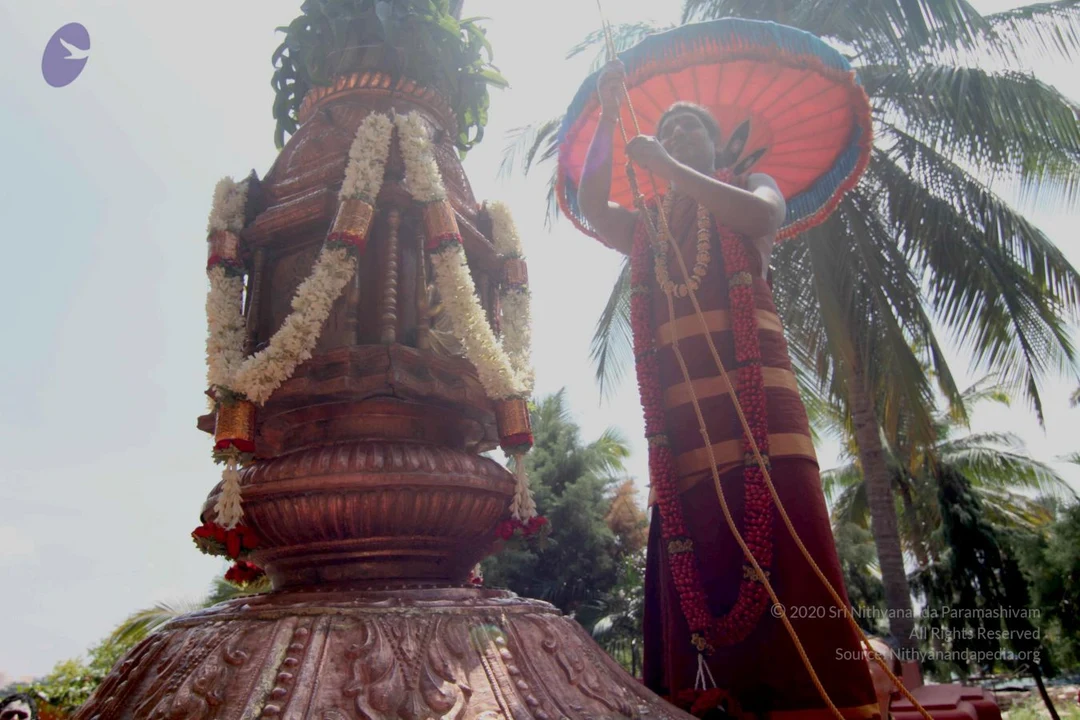
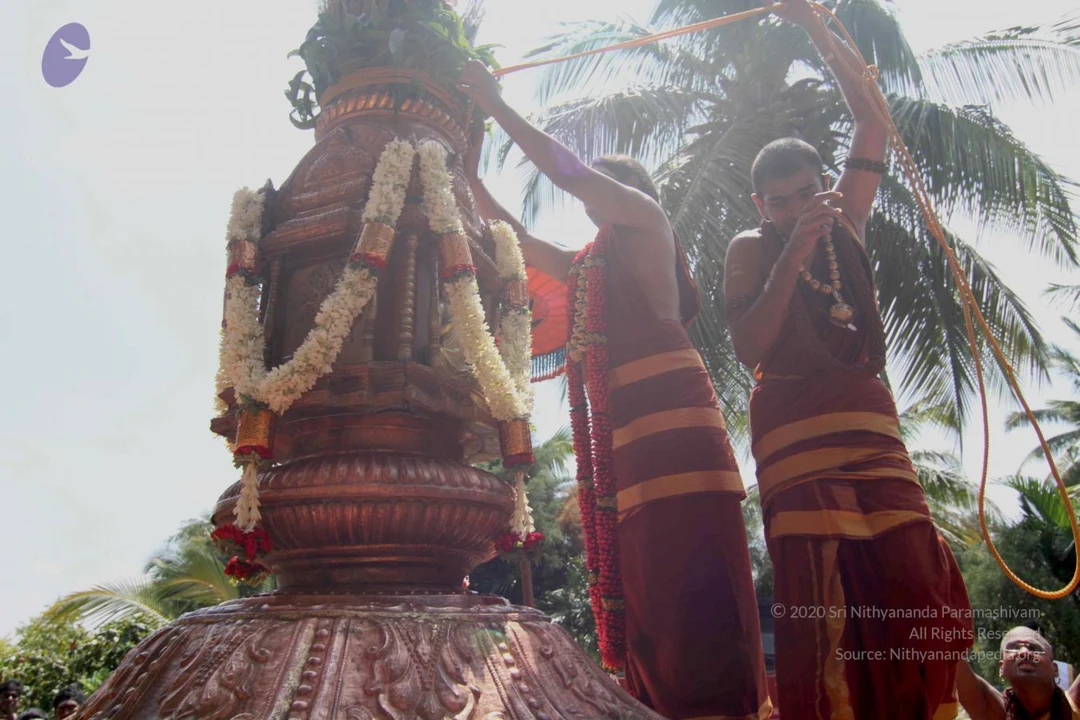
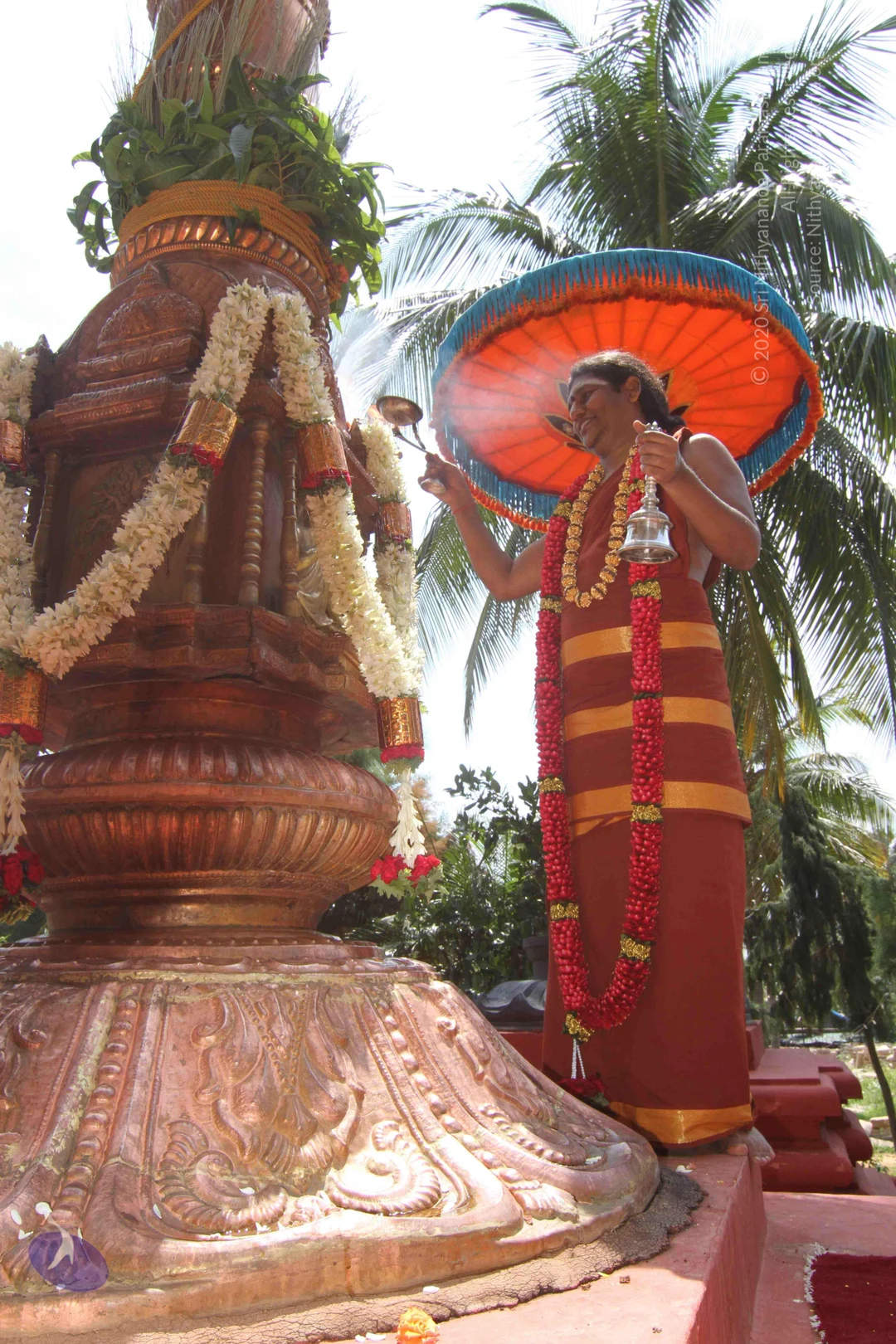
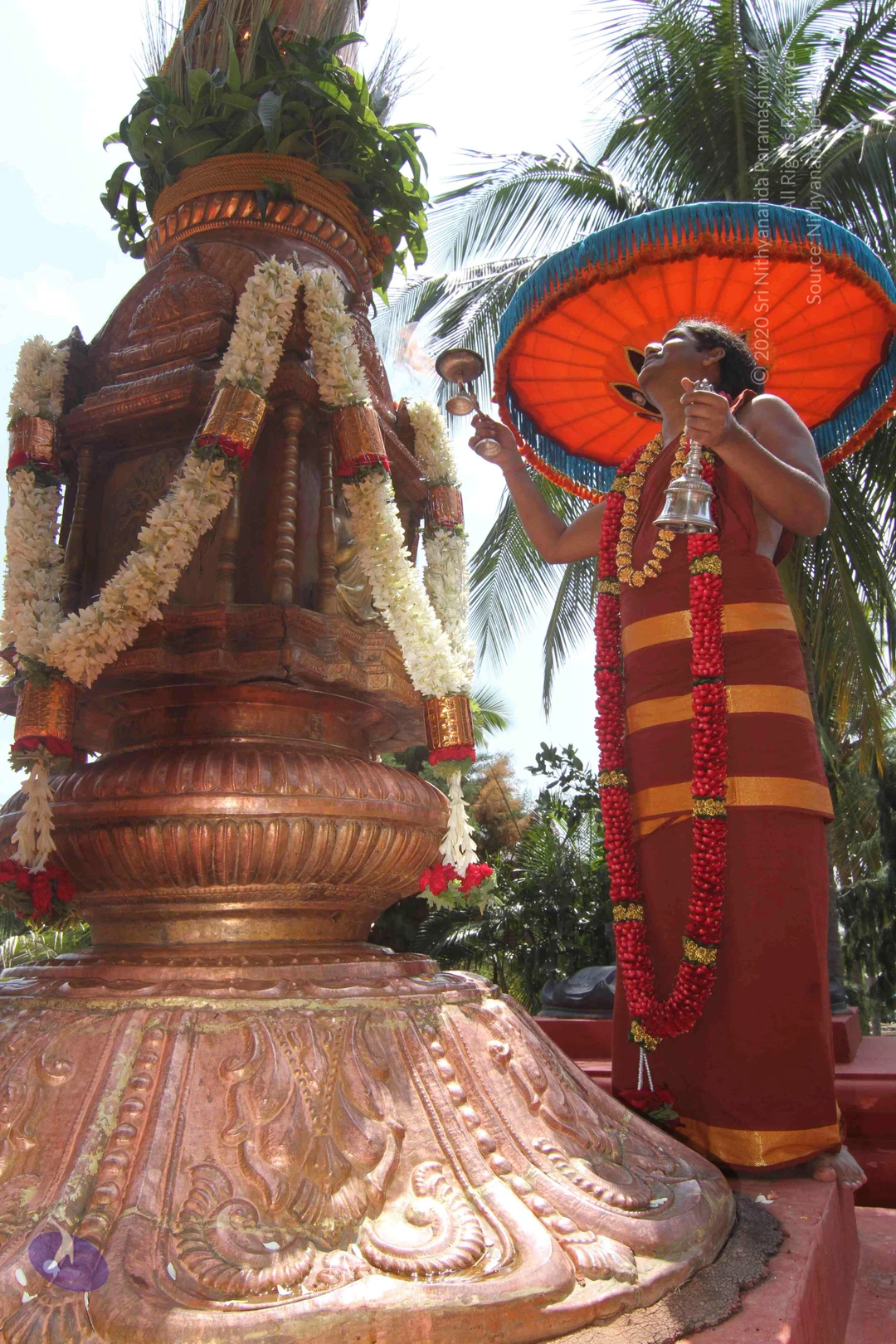
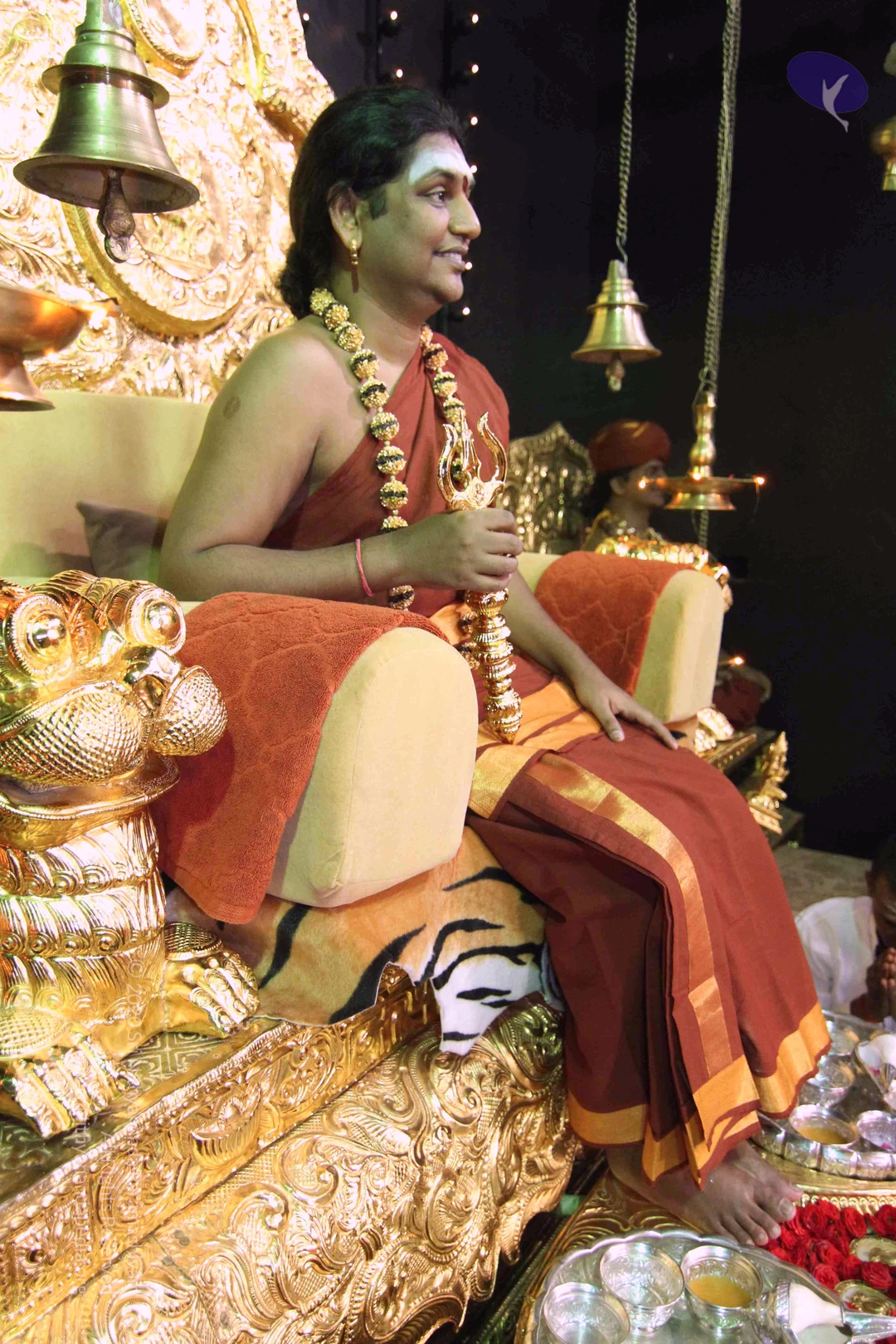
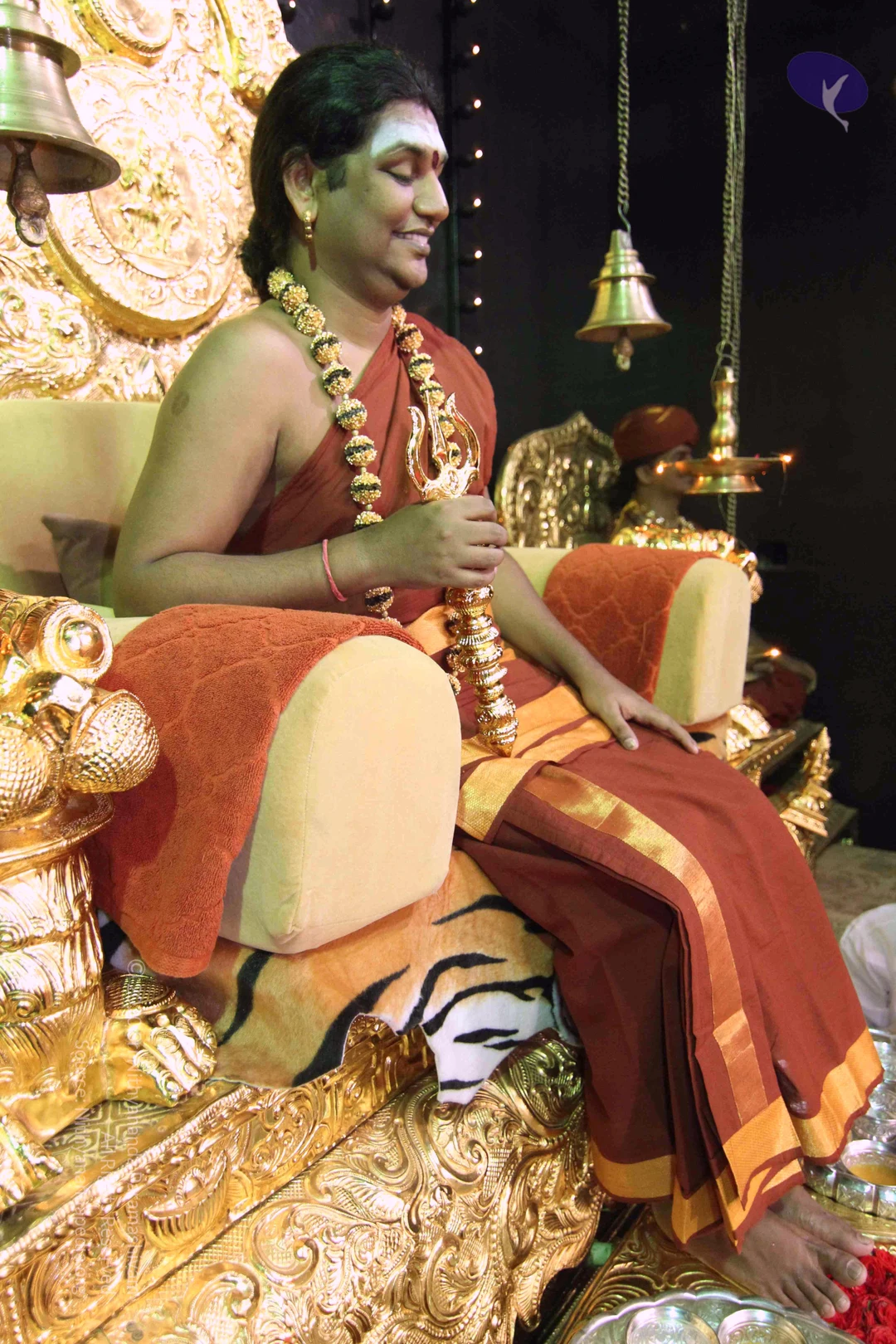
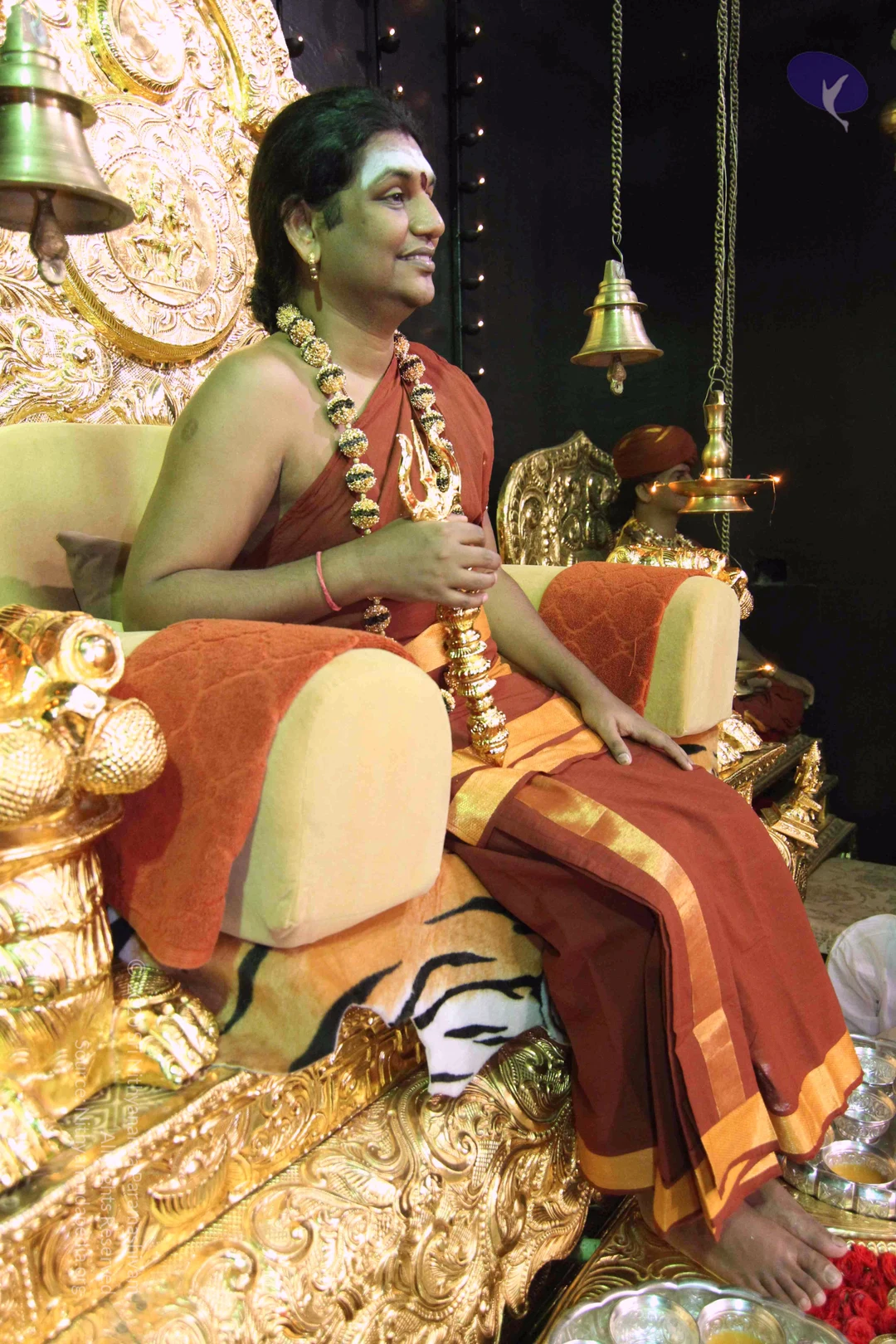
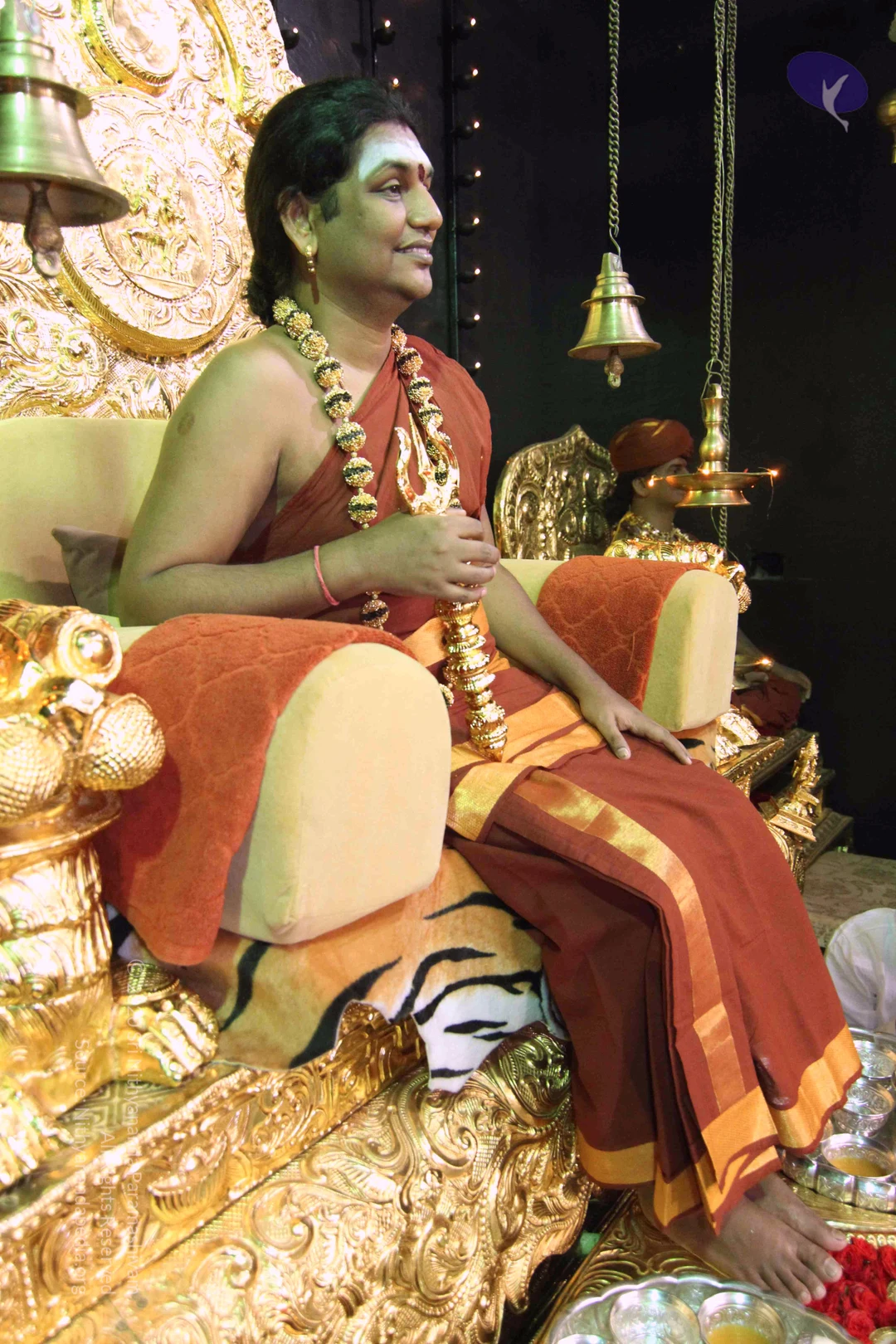
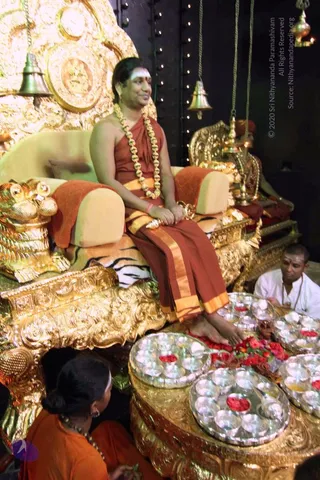
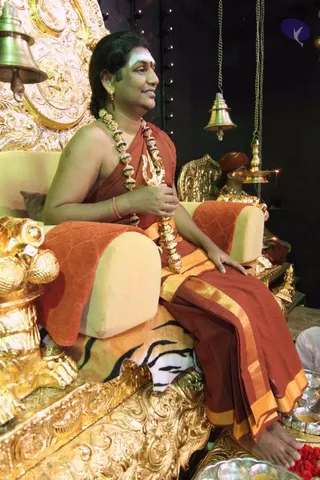
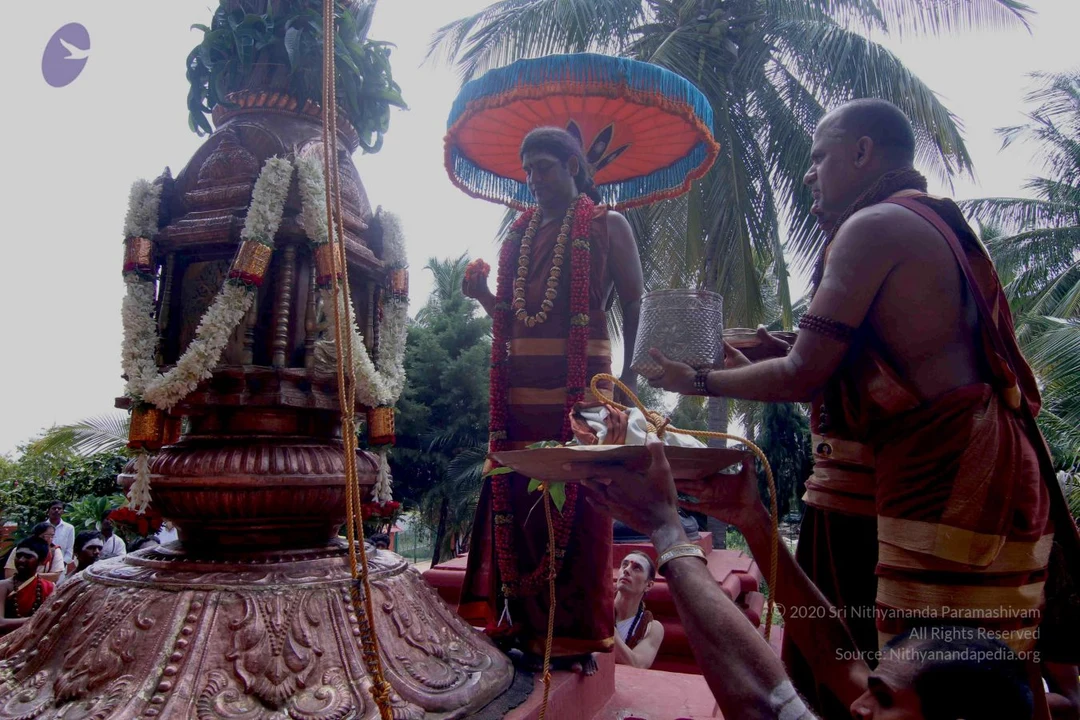
A seated man in saffron-orange robes sits on an ornate gilded throne with a carved golden lion-like armrest and a tiger-striped cloth draped over the seat. He wears a long rudraksha mala with gold beads, a gold trident-shaped sceptre in his right hand, a white vertical tilak on his forehead, and a red thread on his wrist. Behind him hang brass bells and a lit brass oil lamp, and in the foreground are silver trays holding small bowls, a brass lamp and red rose petals. a person is seated on the throne, shown with a rudraksha mala and trident sceptre, the throne being adorned as a ceremonial seat. A faint figure in a red turban and gold necklace sits in the background, and a partially visible person in white kneels at the lower right edge.A photograph of an outdoor procession under a long corrugated metal-roofed shelter with red steel posts, set on a bare reddish-brown dirt ground beside green trees and a plumeria tree. Two men at the right, dressed in saffron-orange robes, play large hand drums, one with a bare-chested upper body held in a striking pose. Many people in saffron-orange robes and some in white clothes walk and stand in a crowd, some carrying items, moving toward a decorated palanquin or ratha with a golden-yellow canopy at the centre. Speakers hang from the shelter poles and a tall lamp stand rises on the left. Several people wear rudraksha malas and simple devotional attire. The scene suggests a satsang or ritual procession.Outdoor photograph of a man standing barefoot on a red-painted stone platform beside an ornate copper-clad pillar draped with white jasmine garlands. He wears a long red-maroon cloth with gold borders, a thick red flower garland to his waist, and a gold-toned bead necklace. He holds two ropes overhead while an orange-and-blue umbrella-like canopy is behind him. Coconut palms surround the scene. To the right, a man in white clothes holds a brass tray and a palm-leaf fan. a person candidate appearance cues are limited to the red garland and gold necklace, which are not distinctive enough to confirm identity; the person is described by role only.

August 20 2013

Original wiki page
Contents

Title:

Relationships Pattern or Possibility.

Description:

In this special Raksha Bandhan satsang, Swamiji describes how completion at every step removes negativities in life. Completion makes the whole of humanity live enlightenment, live Jeevan Mukthi, and live as incarnations. With incompletions, life becomes more and more difficult. With completions, life becomes more and more blissful, more and more living enlightenment.

Link to Video:

VideoAudio

Transcript:

Nithyanandeshwara Samaarambhaam Nithyanandeshwari Madhyamaam | Asmath Aachaarya Paryanthaam Vandhey Guru Paramparaam ||

I welcome all of you with my love and blessings.

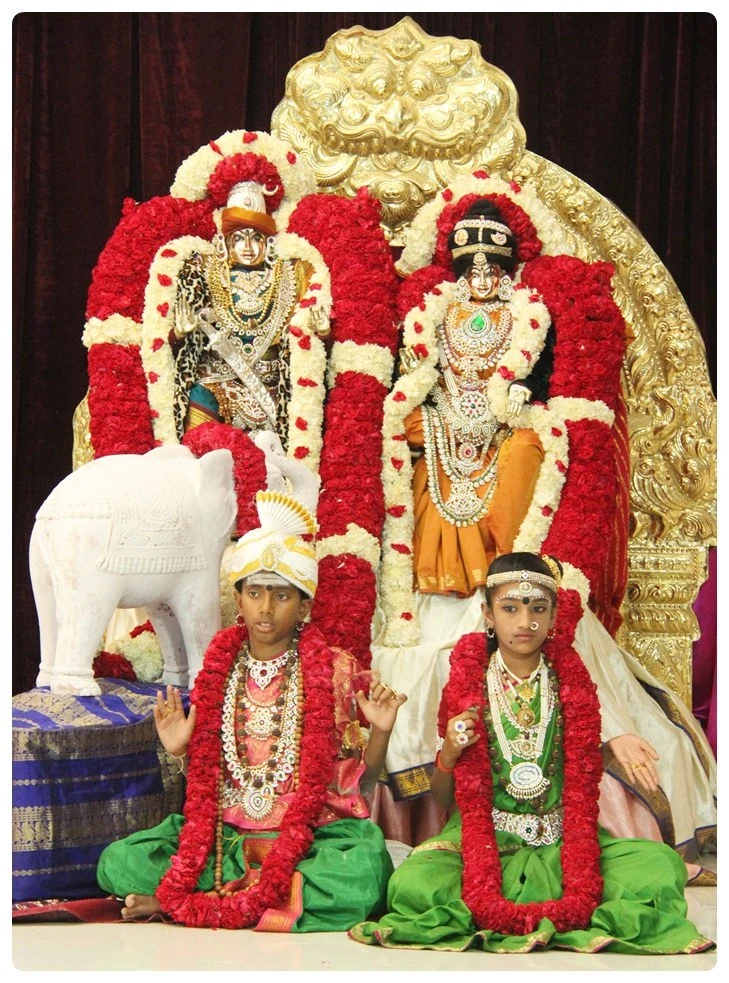
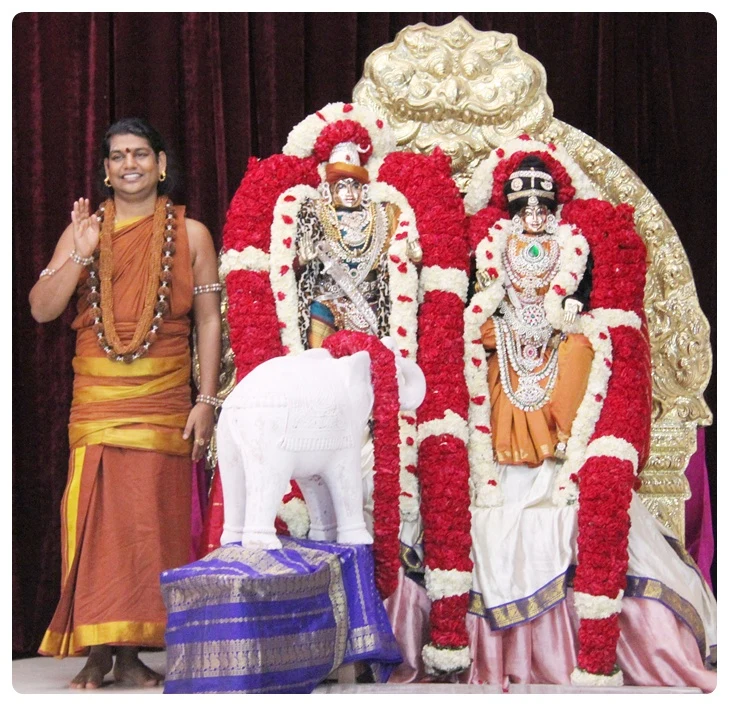
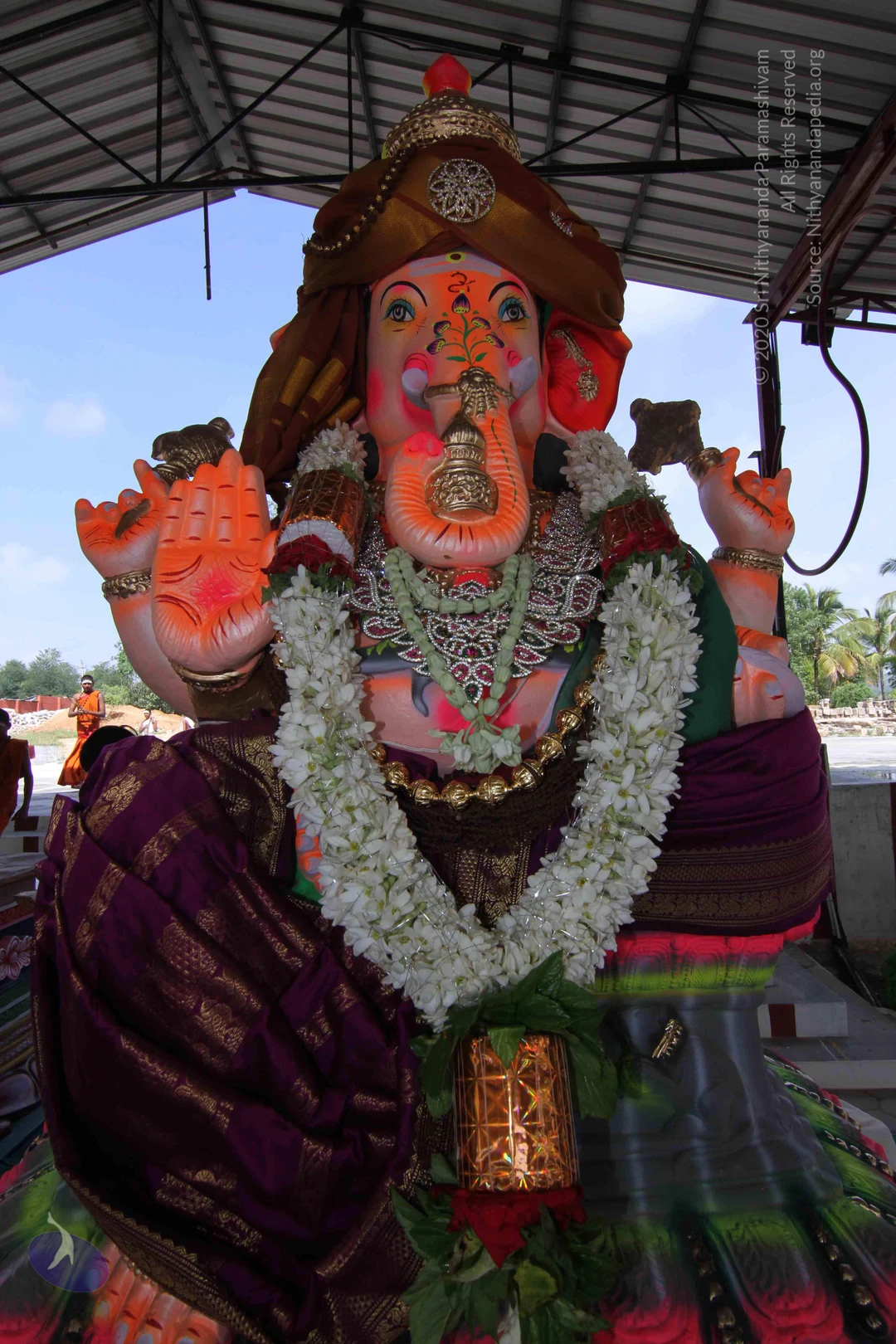
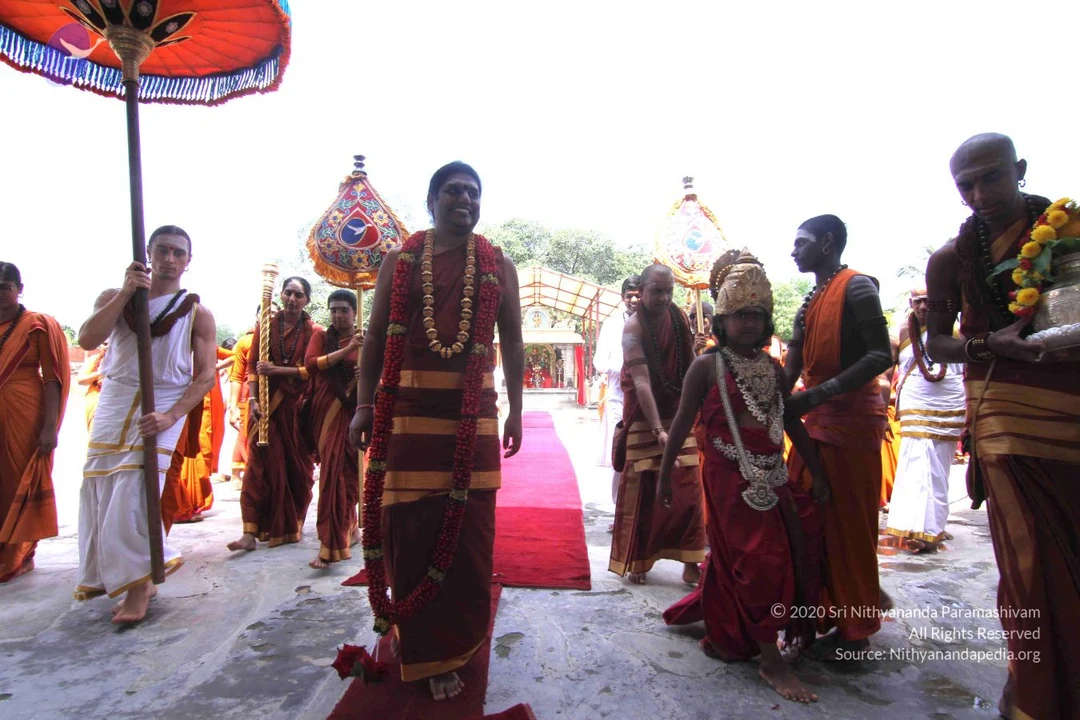
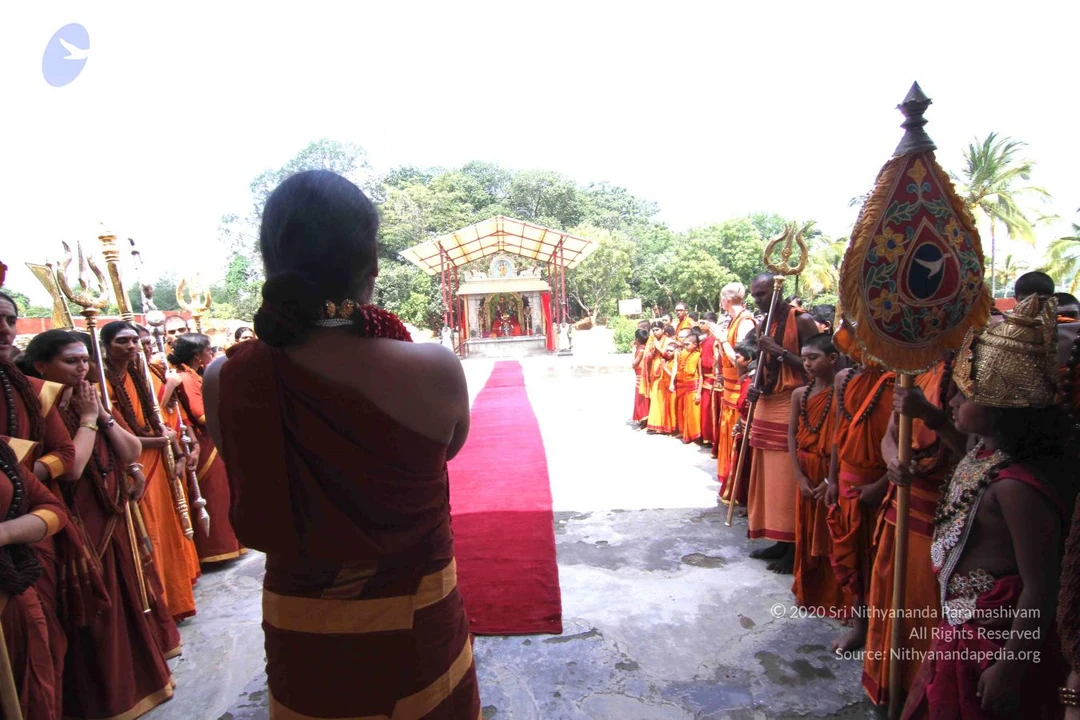
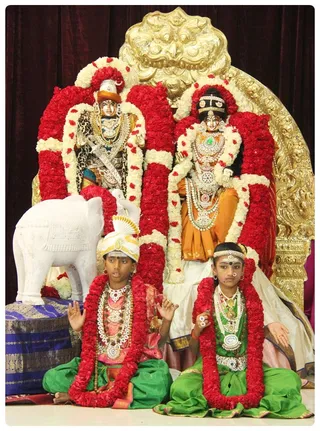
Today, Mahadeva is gracing us in the form of removing the curse on the white elephant, Airavatha.

Once, Durvasa (a powerful rishi known for his short-temper) cursed Airavatha for abusing Shiva’s prasadam. So, later on, the Airavatha came to Madurai, worshipped Sundareshwara, and got rid of the curse.

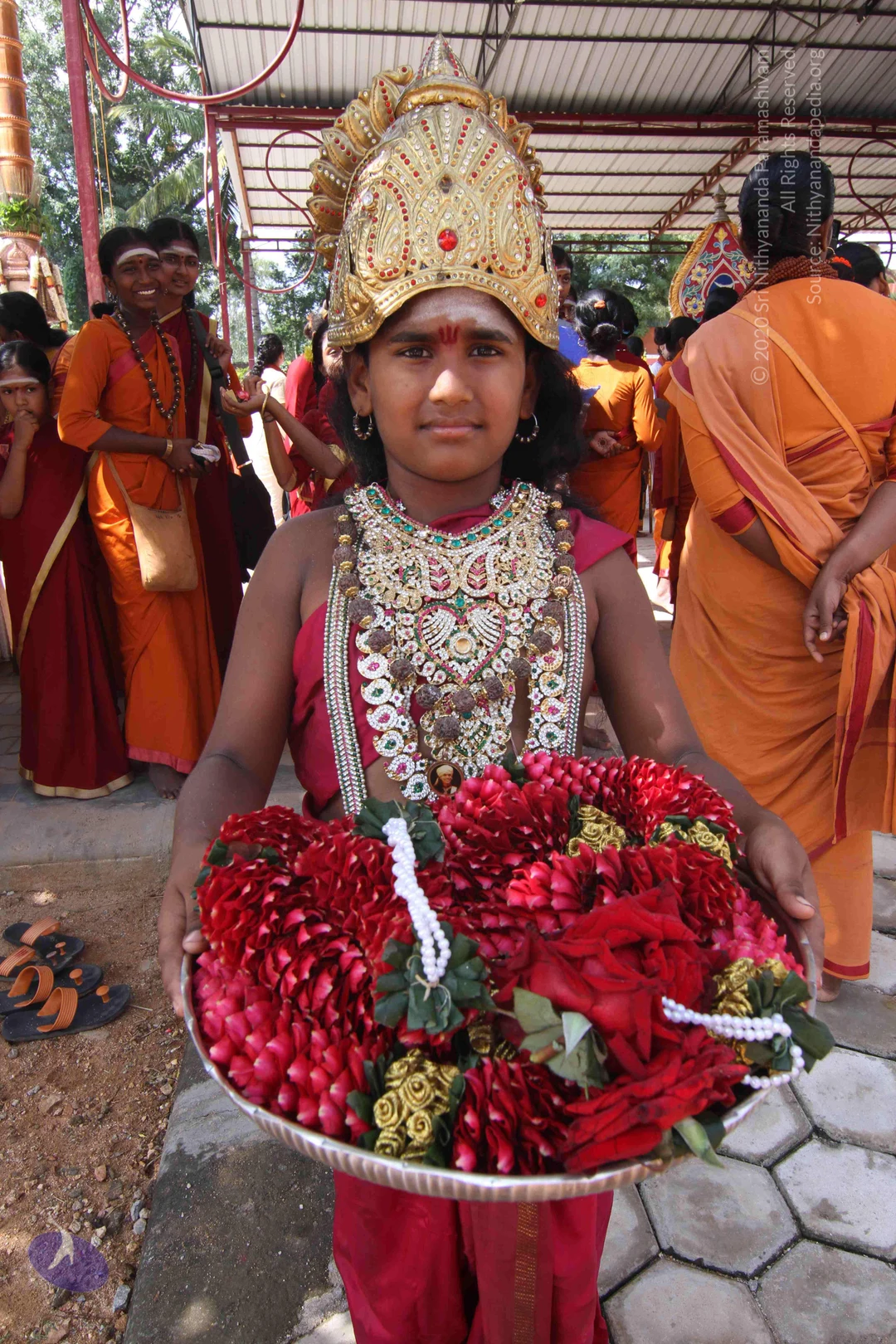
Today, Mahadeva is gracing us in that form. And the gurukul kids are also sitting in that form to enact the Leela.

I will move to today’s Nithya Satsangh. Again the subject is “COMPLETION”.

Today, I will expand on the various processes, methods, nitty-gritties involved in Completion.

Today, we are starting the Inner Awakening program Level-2. First day itself we will be working on the root-patterns in a deeper level, because from today, you are going to start completing with others. So, you need to complete so many things within you so you can start completing with others.

Understand, Completion at every level, for example, Completion with the planetary forces removes all the Navagraha Doshas; Completion with the house you are living in removes all the vaastu problems; Completion with your primal pain, the pain which started in your body when you took birth, Completion with that removes all the doshas, negativities related to birth; and Completion with the different elements of your life removes all the doshas related to rathnas.

Understand, Completion at every step removes negativities in your life. Especially the deep bio-memory fears, the fears you carry in the level of bio-memory can be healed only through Completion.

Please come to the space of listening!

Completing with all the incompletions of fear of snakes you carry is Naga Dosha Nivrutthi, completing with Naga Dosha. Completion with all the deep unconscious fears you carry brings sleeplessness to an end.

Completion, Completion, Completion, the deeper and deeper and deeper Completion leads to more and more and more depths of spirituality.

Please understand, sometimes people ask me, ‘Swamiji, only why very few enlightened beings are there on Planet Earth?’

I tell them, ‘What are you talking? Of course, due to the destructive consumeristic lifestyle, materialistic lifestyle, and a very powerful abusive Westernization which happened in India, the number has reduced. But there was a time when literally living enlightenment was the lifestyle!’

I know, there were at least ten cities where in every street at least one enlightened being would be living! First, Varanasi, Madurai, Kanchi – these are all called “mokshapuris”; Dwaraka! In every street, one enlightened being would be living! Haridwar! “Mokshapuris”!

I was studying Kapila’s (Maharshi Kapila’s) family tree. I was shocked! In one family how many incarnations! Really! See, Kapila’s father, Rishi Kardama, and mother, Devahuti! Devahuti had a sister, Prasuti. They (Devahuti and Prasuti) are the daughters of Manu. Devahuti’s son is Kapila. Prasuti’s daughter is only Sati (Sati Devi, Shiva’s wife before Parvati). Literally, Kapila and Sati were cousins! And then Kapila’s sister, Anusuya, gives birth to Dattatreya. Dattatreya is Kapila’s own sister’s son! Just in that one family, how many incarnations! Kapila is an incarnation; he is an incarnation of Mahadeva. Traditionally he is considered to be the incarnation of Vishnu and Mahadeva. And Dattatreya! (Dattatreya is considered to be an incarnation of the Trimurti, Brahma, Vishnu and Shiva). Please understand, it is not a story.

There was a time when Jeevan Mukthi was the lifestyle, enlightened beings were the lifestyle! That was the way life was, that was the way life existed.

Understand, Completion. Completion makes the whole of humanity live enlightenment, live Jeevan Mukthi, and live as incarnations.

With incompletions, life becomes more and more difficult. With completions, life becomes more and more blissful, more and more living enlightenment. Actually, with incompletions, you don’t even know what is right and wrong.

Today is Raksha Bandhan. My blessings to the whole world!

Matha cha Parvathi Devi Pitha Devo Maheshwaraha | Bandhava Shiva Bhakthascha Swadesho Bhuvana Thraiyam ||

“Matha (Mother) is Parvathi, Pitha (Father) is Mahadeva, The whole world is brothers and sisters, all the sons of Mahadeva are brothers and sisters, All the three worlds are my native place (home town), my country.”

So, the whole world is our brothers and sisters! Blessings to everyone on this auspicious occasion of Raksha Bandhan!

Very funny thing! I was reading in some media, newspaper, and in Facebook also, some of the media houses in Tamil Nadu, the atheist-based media houses which are destroying the Vedic tradition and trying to alienate Tamil Nadu from mainstream India, trying to hijack Tamil Nadu from mainstream India, these separatist guys who have their own media houses, do you know the funny thing? Raksha Bandhan is celebrating brotherhood. But these guys say that Raksha Bandhan is not our festival; it is a North Indian festival! But the whole Tamil Nadu celebrates left and right Valentine’s Day! So, Valentine’s Day is Tamil Nadu festival?

Please understand, abusing and attacking all the Hindu festivals is one of the powerful strategies being used to destroy the Vedic tradition, especially in Tamil Nadu. I strongly condemn and record my protest against some of these anti-national media houses trying to hijack Tamil Nadu from mainstream India, trying to move Tamil Nadu away from mainstream Indic civilization. I am seeing all over India, even thousands of Muslims and Christians celebrating Raksha Bandhan! I was shocked when these fellows (the anti-national media houses) started the propaganda that you should not celebrate Raksha Bandhan, but you should celebrate Valentine’s Day! Oh God! Is there no limit for the nonsense these guys will do?

All my disciples, everyone who is part of the Sangha, will observe and celebrate Raksha Bandhan!

Please understand, according to Indian culture, other than your wife, you should see everyone else as brothers and sisters. But in the civilizations where there is so much of incompletions with lust, other than your mother you see everybody as a possible date! This Raksha Bandhan is a beautiful way to establish brotherliness. All schools and colleges should celebrate Raksha Bandhan, promote Raksha Bandhan, so that all the sex crimes will be reduced drastically. Once a girl ties the Raksha Bandhan to a boy accepting him as her brother, the whole outlook, the whole view is different. Raksha Bandhan should be promoted to avoid sexual crimes, to reduce sexual crimes. Raksha Bandhan should be celebrated in every house.

Please understand, nowadays in colleges and schools, boys tend to run away and hide on this day because of the fear that the girls will tie rakhee (the thread which a girl ties on a boy’s wrist accepting him as her brother)! No! These big celebrities should start promoting Raksha Bandhan. Stop this constant crush on whoever you see. This third-rate, cheap pattern like a dog which puts its mouth on everything it sees in the street! See, in Indian villages, the street dogs, street dogs and pigs, they will put their mouth on everything they see, whether it is food or processed food, food processed through the human body, processed, digested and ejected through the human body! No! This constantly cherishing, entertaining the subtle crush, is a very big incompletion. Not only the person who carries the crush, entertaining the crush, even the person towards whom it is aimed, even they enjoying it subtly and entertaining, it is a very big incompletion, please understand!

Attitudes and relationships, attitudes and relationships should be clear and established. Only then, flowering of the personality happens. Attitudes and relationships should be clear and with established boundaries. Life with incompletion, constantly carrying the crush here, there, will lead only to the cheap taste, I tell you.

<Joke>

I have a story:

A little boy goes to his dad and asks, ‘Dad, what is politics?’

Dad says, ‘Well, son, let me try to explain it in this way. See, I am the head of the family; so call me the “President” or the “Prime Minister.” Your mother is the administrator of the money; so call her the “Government.” We are here to take care of your needs; so we will call you “the People.” The maid, we will consider as “Working Class”. And your baby brother, we will call him “the Future.” Now think about that and see if it makes any sense.’

So the little boy goes to bed thinking about what dad has said.

Later that night, he hears his baby brother crying. He gets up to check up on him. He finds that the baby has severely soiled his diaper.

So the little boy goes to his parents’ room and finds his mother sound asleep.

Not wanting to wake her, he goes to the maid’s room. Finding the door locked, he peeps through the keyhole and sees his father in bed with the maid.

He gives up and goes back to his room.

Next morning, he tells his dad, ‘Dad, I think I understand the concept of politics now.’

Father says, ‘Good, son, tell me in your own words what is politics all about?’

The little boy beautifully explains, ‘The Prime Minister is exploiting the Working Class, while the Government is sound asleep, and the People are being ignored, and the Future is in deep shit!’

(laughs heartily)

Understand, if you carry this subtle crush on whomever you see, that constantly leads you to deeper and deeper incompletions and continuously creates many wounds in you. That is why, in Vedic tradition, we have this beautiful ceremony of Raksha Bandhan. With this one knot (tying the rakhee), everything is sealed! We seal things with the knots clearly!

Knot in the hand = brother, “bhaiyya”.

Knot in the neck = ‘Come on, you hang on me, I hang on you!’

But everything is clear! Whether you hang on me or I hang on you, but let us hang each other! But it is clear at least!

Understand, I think it is time we popularize Raksha Bandhan.

So, it is possible that in one family, so many enlightened beings can happen.

Raksha Bandhan is actually a festival of bringing Completion to many of the incompletions and wounds you carry related to this crush. The subtle crush you carry, anyone and everyone you see here and there, actually that creates the pattern of getting hurt, getting wounded, and all sorts of insensitivity with life.

Completion! In the first level (of Inner Awakening program), actually, the Completion opens up literally a Pandora’s Box! All your root-patterns, everything, opens up! And all the powerful root-patterns come out. But, a very important thing you need to do at that time is continue with the Completion deeper and deeper and deeper. Complete! Complete! Complete! Complete! Complete! Complete! Completion is a very important truth to realize anything in your life.

The essence of today’s satsangh is Completion. And today, in the Inner Awakening, we will work on it very deeply, helping each one of you to find your root-pattern and complete with it.

With this, I will move to the next segment of the morning satsangh – Nirahara Samyama.

<guided meditation for Nirahara samyama>

All the participants, please sit straight and start the Nirahara Samyama Kriya. Close your eyes. Visualize you have become Bidadi Kalpavriksha. Inhale through both the nostrils and the mouth simultaneously. Hold as long as you can, and exhale through both nostrils as slowly as you can. Do everything very comfortably. Continuously visualize you have become Bidadi Kalpavriksha.

So, with this, I bless you all with my Integrity, Authenticity, Responsibility and Enriching! Let you all experience Kundalini awakening! Let you all create energy directly from space and live life, bliss and enlightenment! Namah Shivaya!

NIRAHARA SAMYAMA IN PROGRESS…………………

I bless you all! Let you all radiate with Integrity, Authenticity, Responsibility and Enriching, with eternal bliss, Nithyananda! Thank you!

Photos From The Day:
Photos Of The Day:

Ganesha-Chaturthi

Pada-Puja

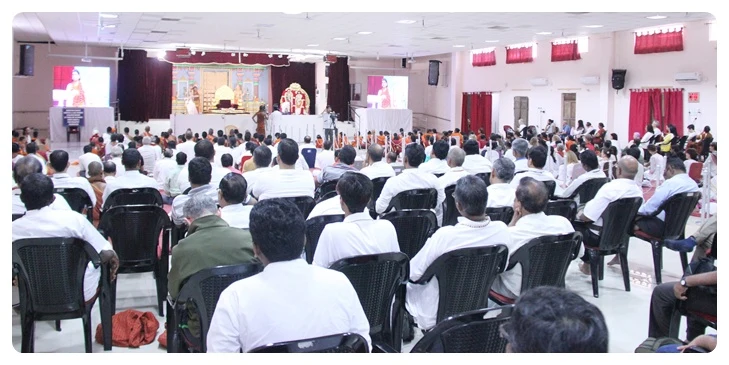
Nithya-Satsang

Photos from this day

View all 67 photos

Photos From The Day:
19 photosSource gallery
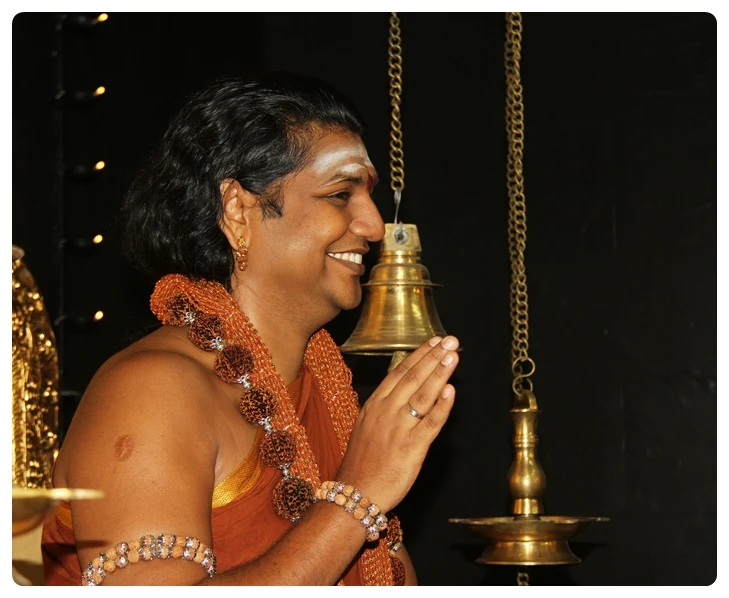
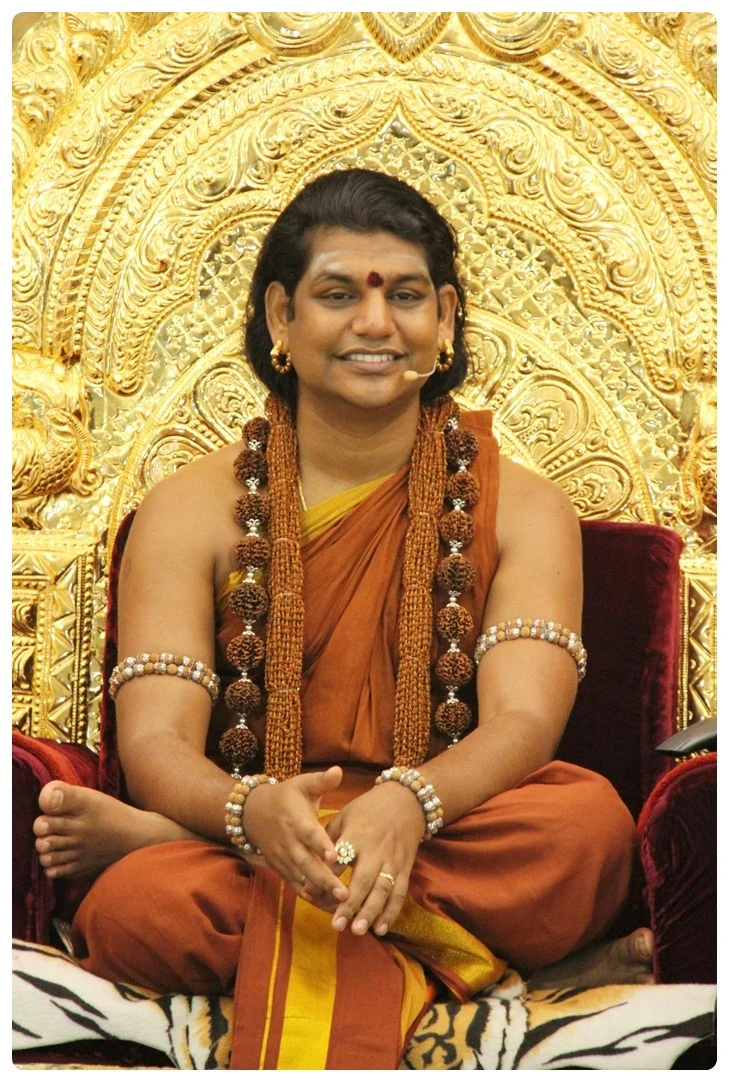
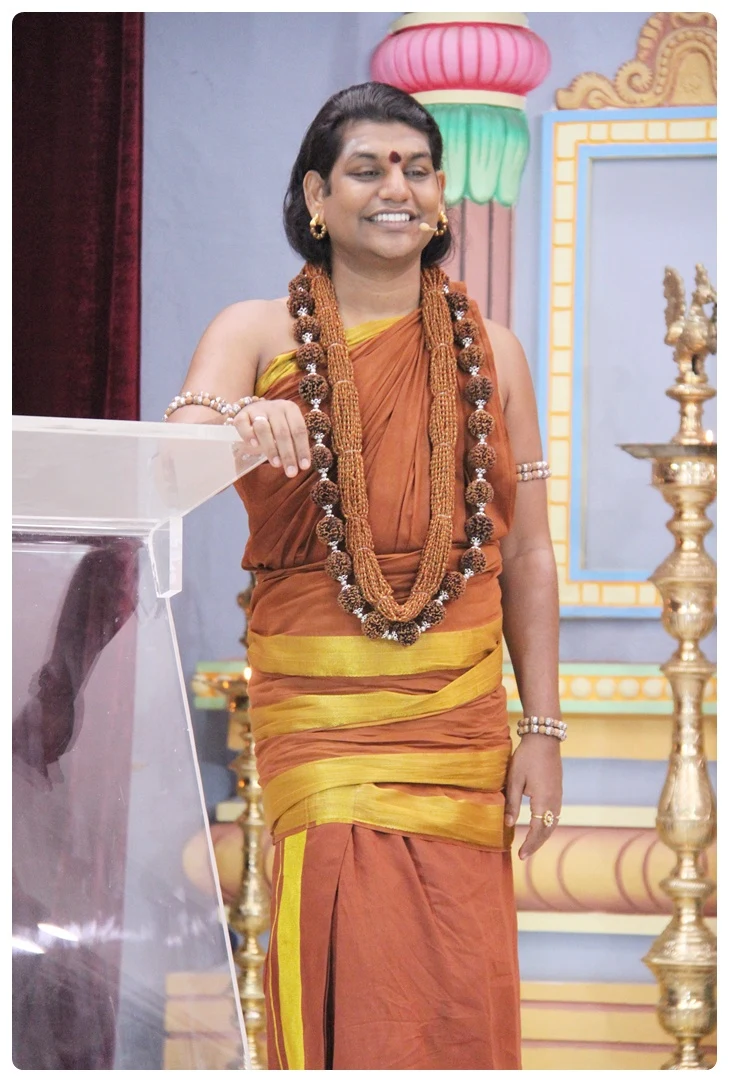
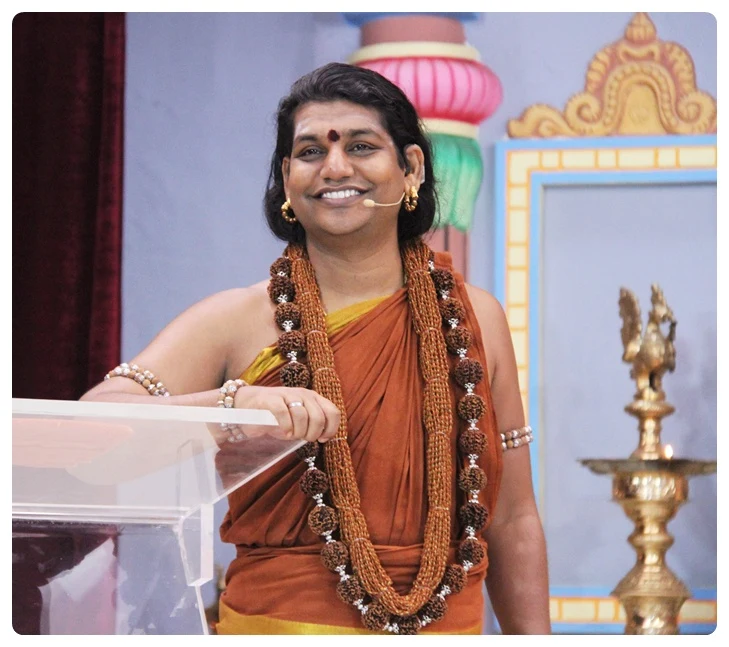
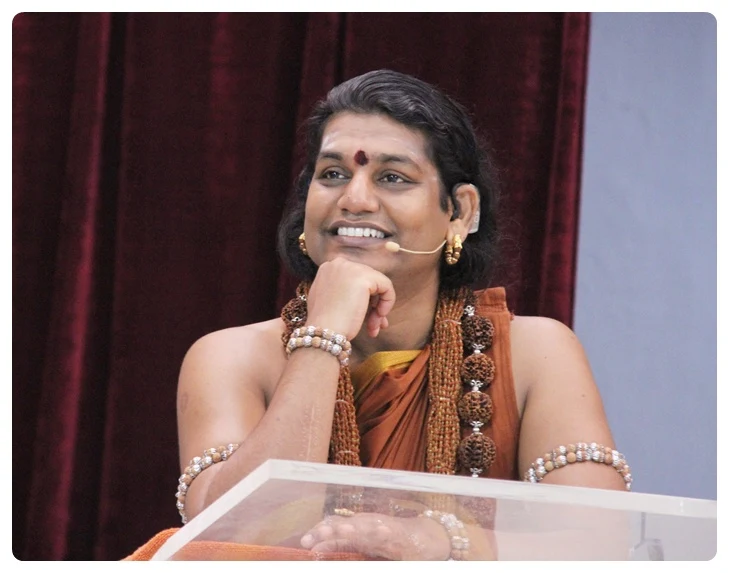
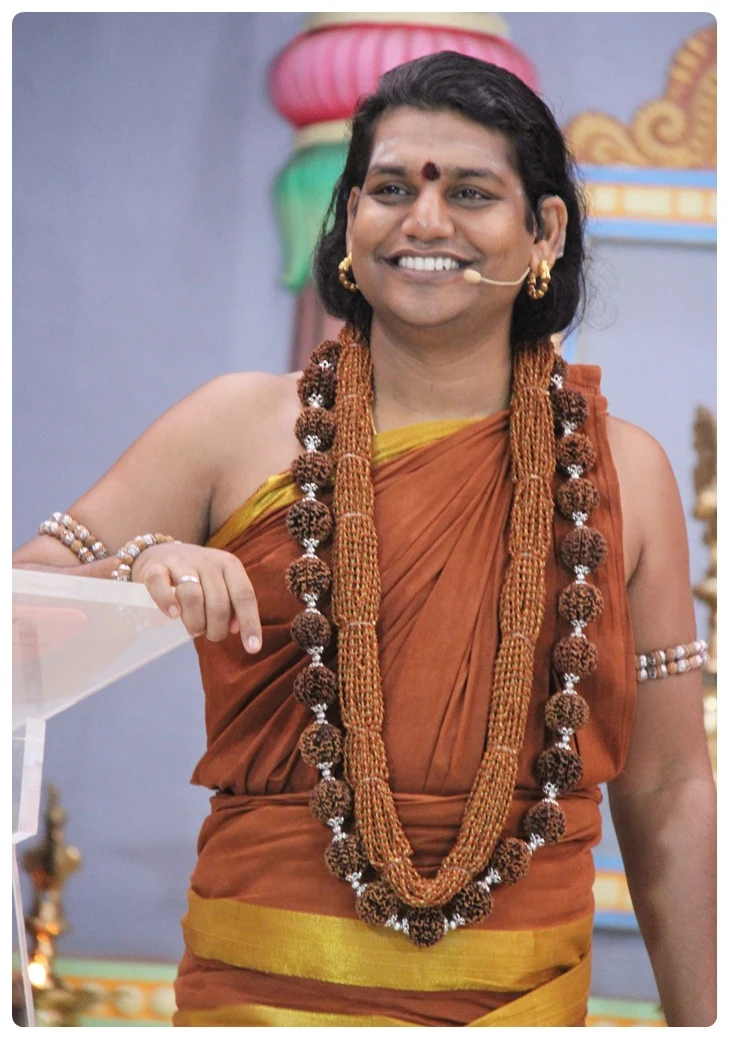
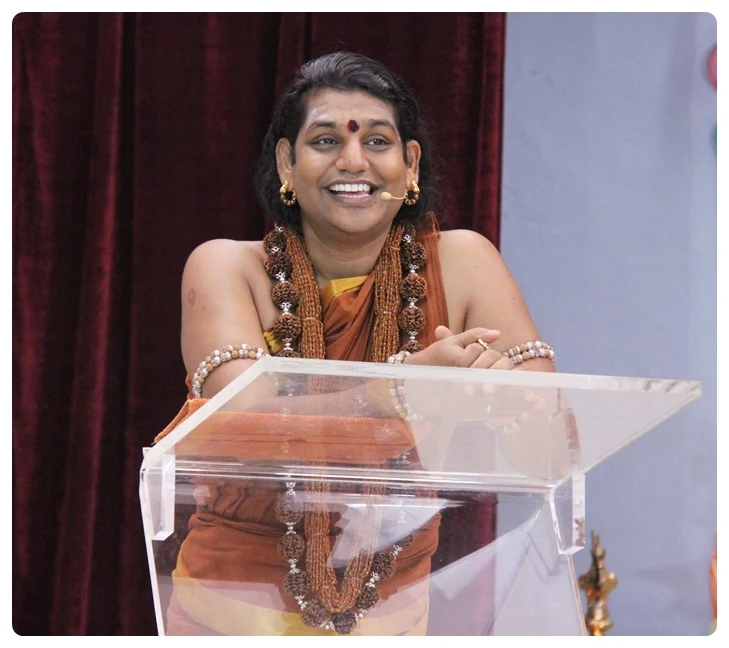
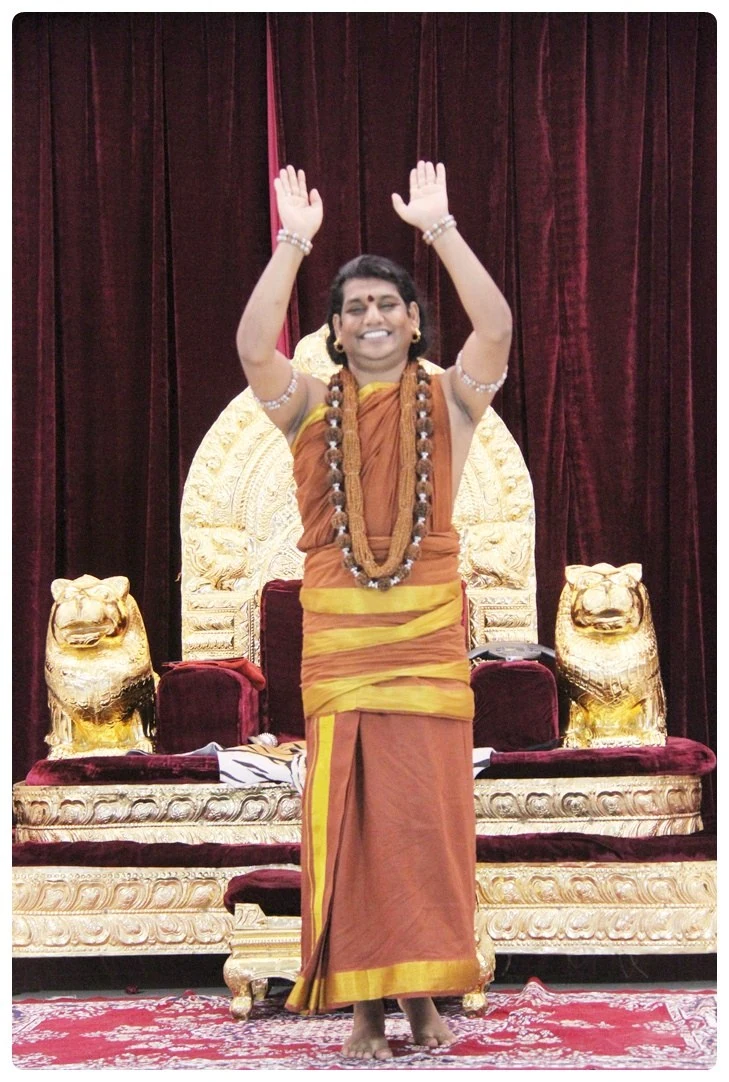
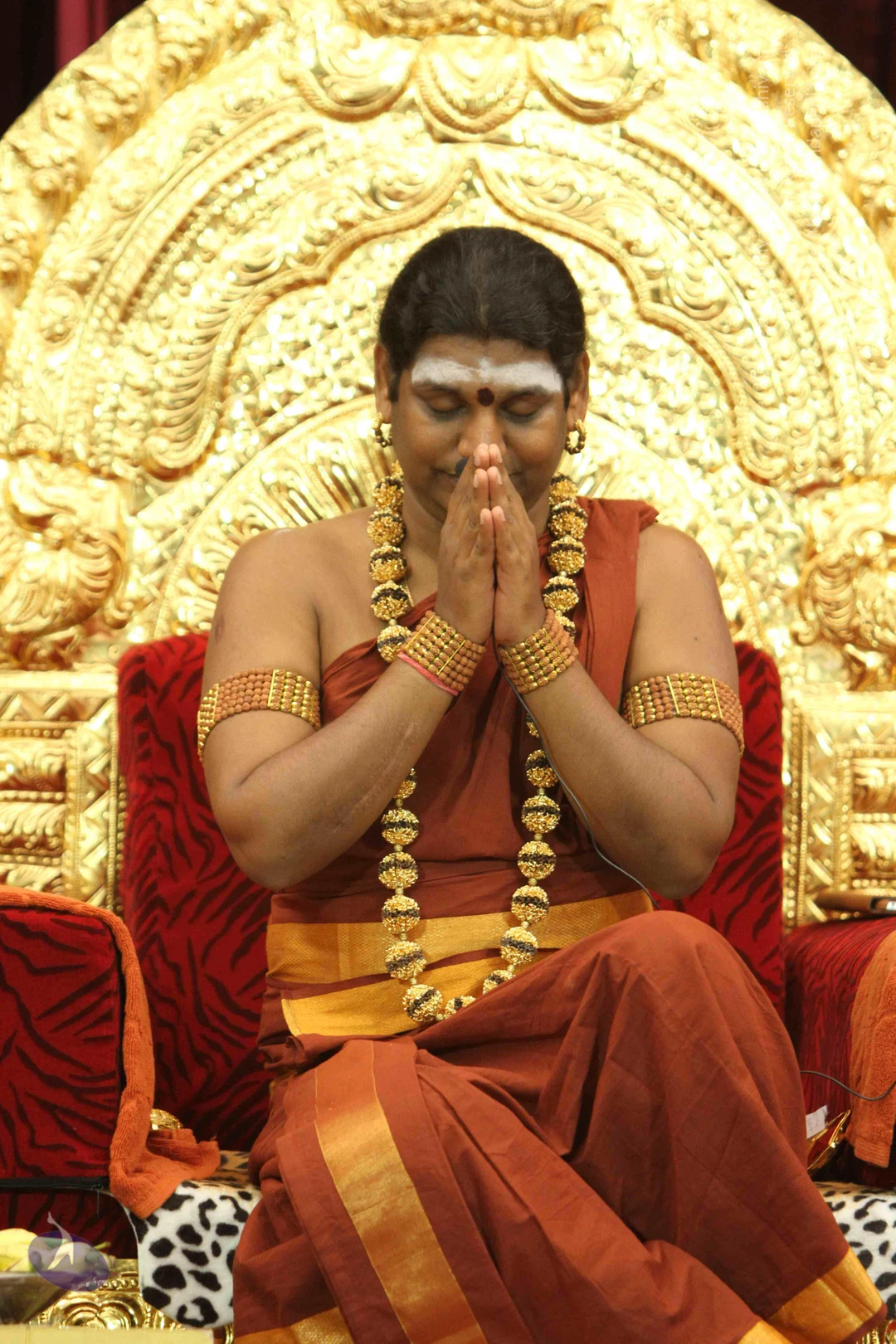
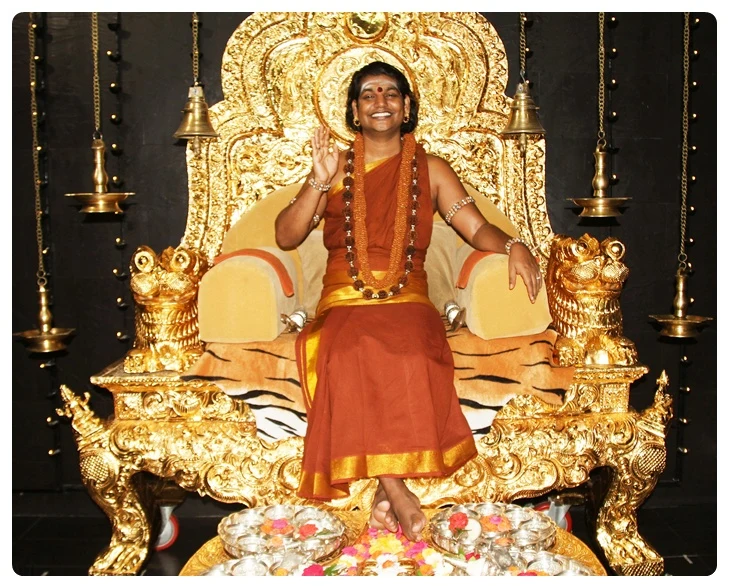
A seated man in an ornate gilded throne with lion-head armrests and a tiger-striped cushion, raising his right hand in blessing and smiling. He wears a saffron-orange dhoti with a gold border, a long rudraksha mala with a large bead necklace, bangles and a bindi, with his hair swept back. Oil lamps hang on chains at both sides, and brass trays of flowers and offerings sit at the base of the throne.Photograph of a smiling man in profile with palms pressed together in namaskar, leaning toward a hanging brass temple bell on a chain. He wears an orange-saffron shawl draped over one shoulder, a long necklace of orange beads with large rudraksha-style brown beads, and a jewelled armlet and bracelet with white stones. He has a vertical tilak on his forehead and a ring on one finger. Behind him is a dark backdrop with a brass oil lamp stand on the right and a golden object at the left edge. The scene suggests a temple or puja setting.A photograph of a seated man on an ornate gold throne with carved lion heads and a tiger-striped cushion, backed by hanging brass bells and a dark wall. He wears a rust-orange garment with a gold border, a long garland of pink and white flowers, a rudraksha mala, bangles and a bracelet, and his hair is swept back. In the lower right, a man in white clothes sits with palms pressed together in namaskar beside a tray of brass plates holding flowers and offerings. Foreground shows the top of another person's head.Photograph of a staged Leela tableau on a golden-framed throne backdrop. Two decorated deity murtis stand behind, both garlanded in red and white flowers: the left figure wears a crown and a leopard-patterned garment, the right figure wears a gold crown and an orange skirt with heavy jewelry. A white elephant sculpture stands at the left. In front, two gurukul children sit cross-legged on a blue cushion, both garlanded in red flowers: the boy in the foreground wears a white turban, a multi-strand gold necklace and a green dhoti, while the girl beside him wears a green skirt, a headband and layered white and gold necklaces. Both children make hand gestures while enacting the Leela.A seated man in saffron-orange robes sits cross-legged on a red velvet throne with an ornate gold backdrop. He wears long rudraksha mala necklaces with gold and bead accents, pearl-beaded armbands and bracelets, gold earrings, and a red bindi on his forehead, with a small microphone clipped near his face. His hands rest together in his lap, and his feet are bare on a tiger-striped cloth. a person is shown seated in front of the golden throne, smiling during the satsang.Photograph of a person standing at a clear acrylic lectern on a stage during a satsang. The person wears a rust-orange draped garment with a broad gold-yellow border, a long rudraksha mala with a multi-strand cord, and beaded bracelets on both wrists. A small red bindi is on the forehead, and a headset microphone is worn. Behind is a painted blue and yellow backdrop with a pink and green decorative column, and tall polished brass oil lamps stand at the right edge. a person by appearance cues: long swept-back hair, saffron-orange draped clothing and a rudraksha mala, speaking from the lectern as the satsang teacher.

Ganesha-Chaturthi
35 photosSource gallery
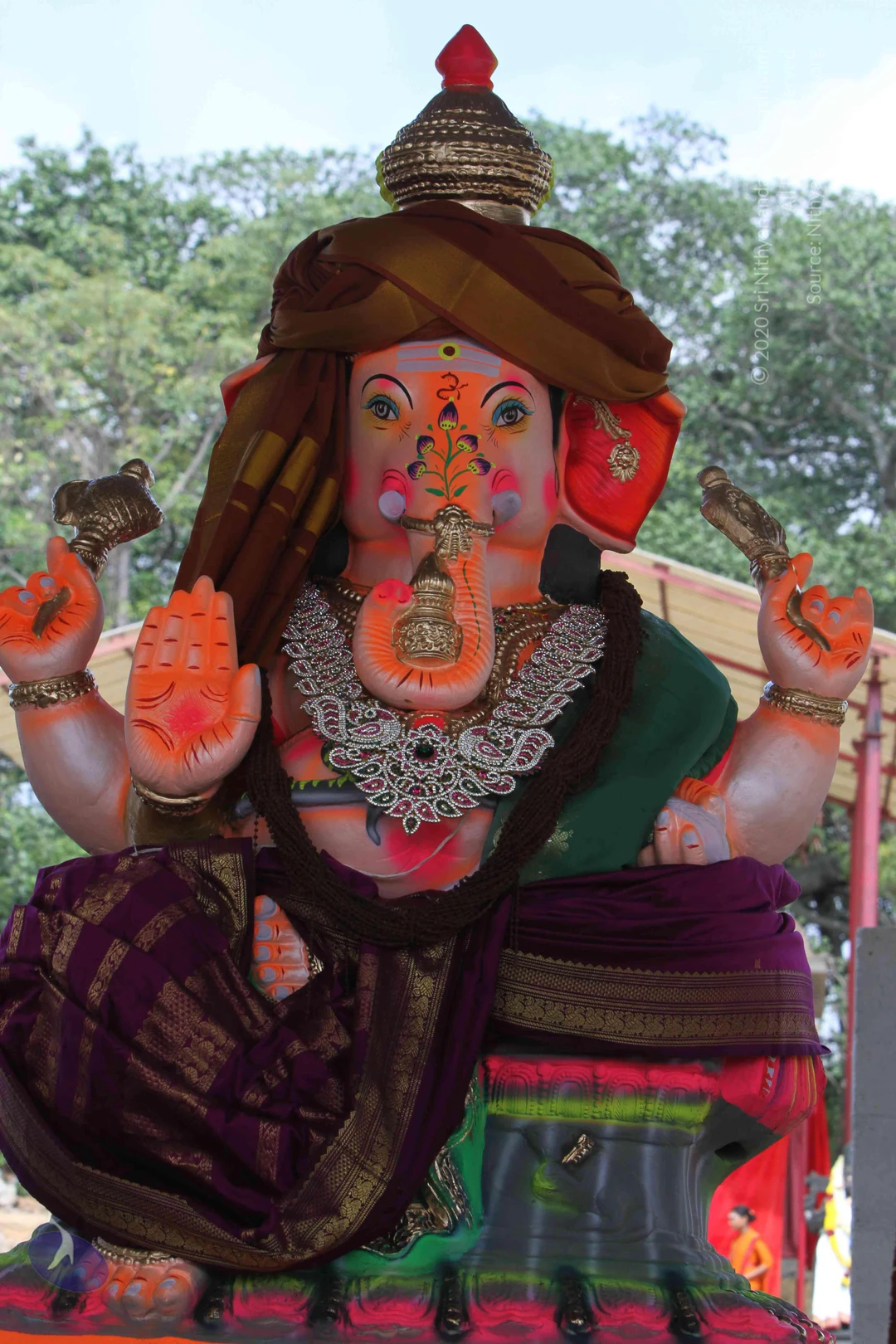
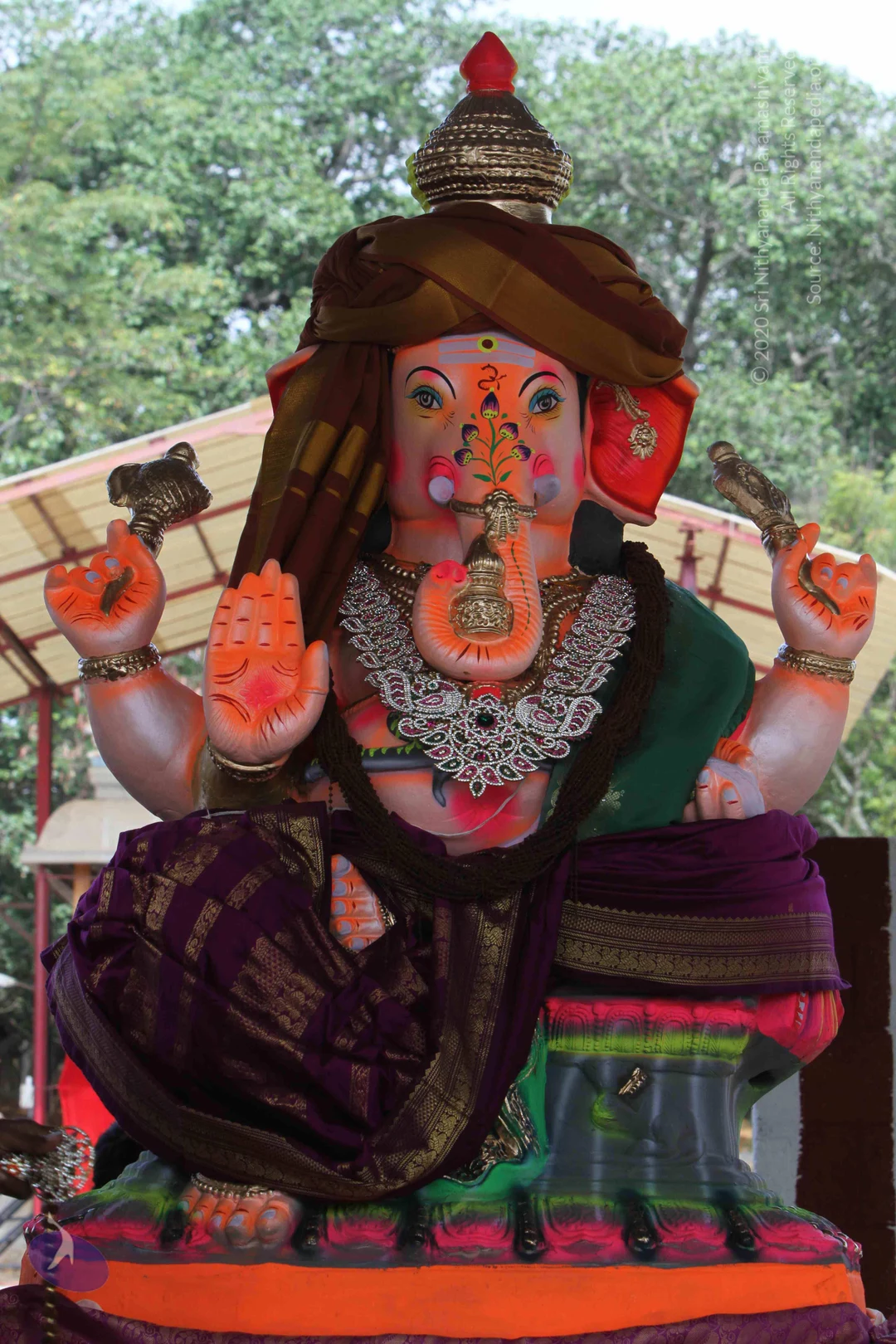
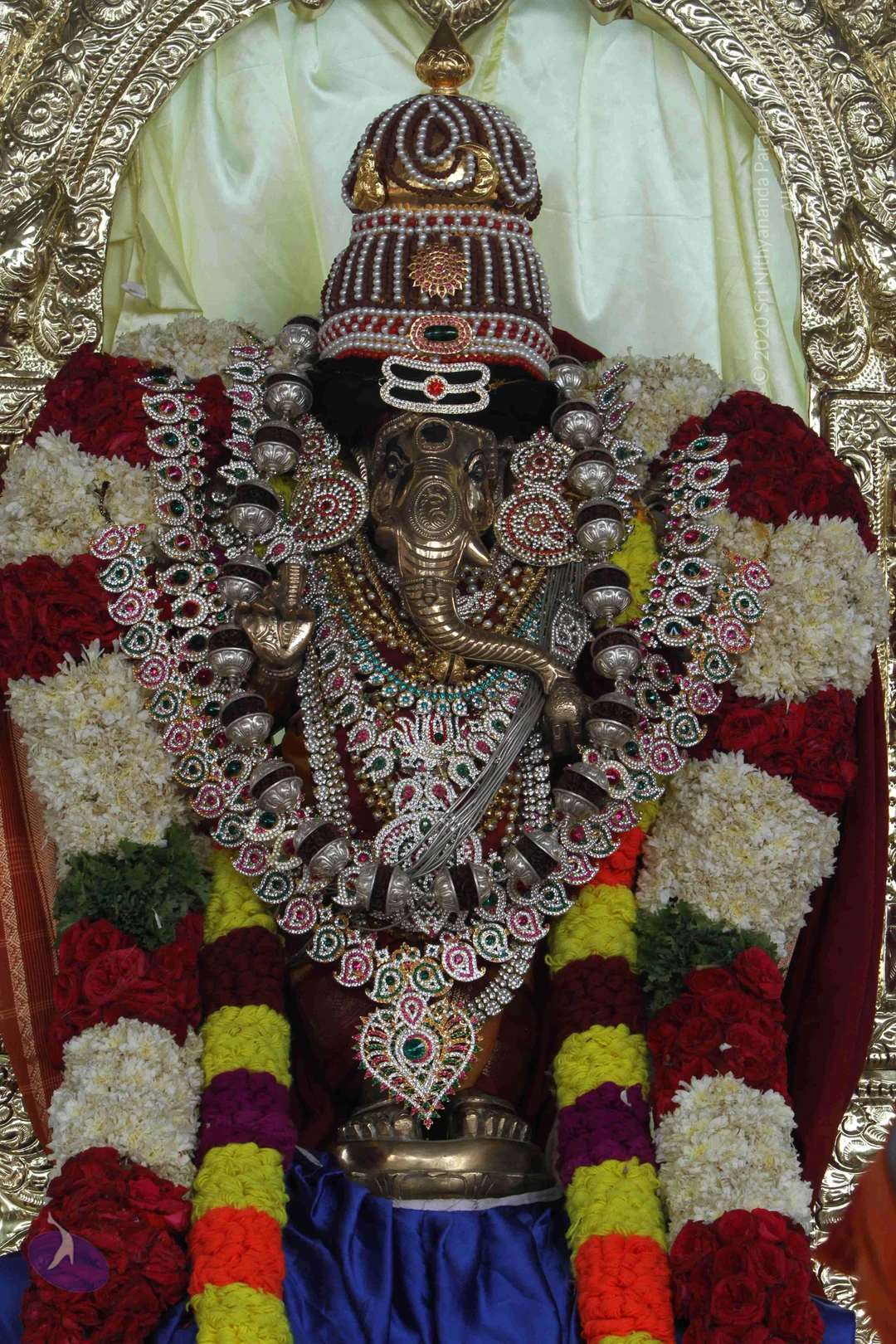
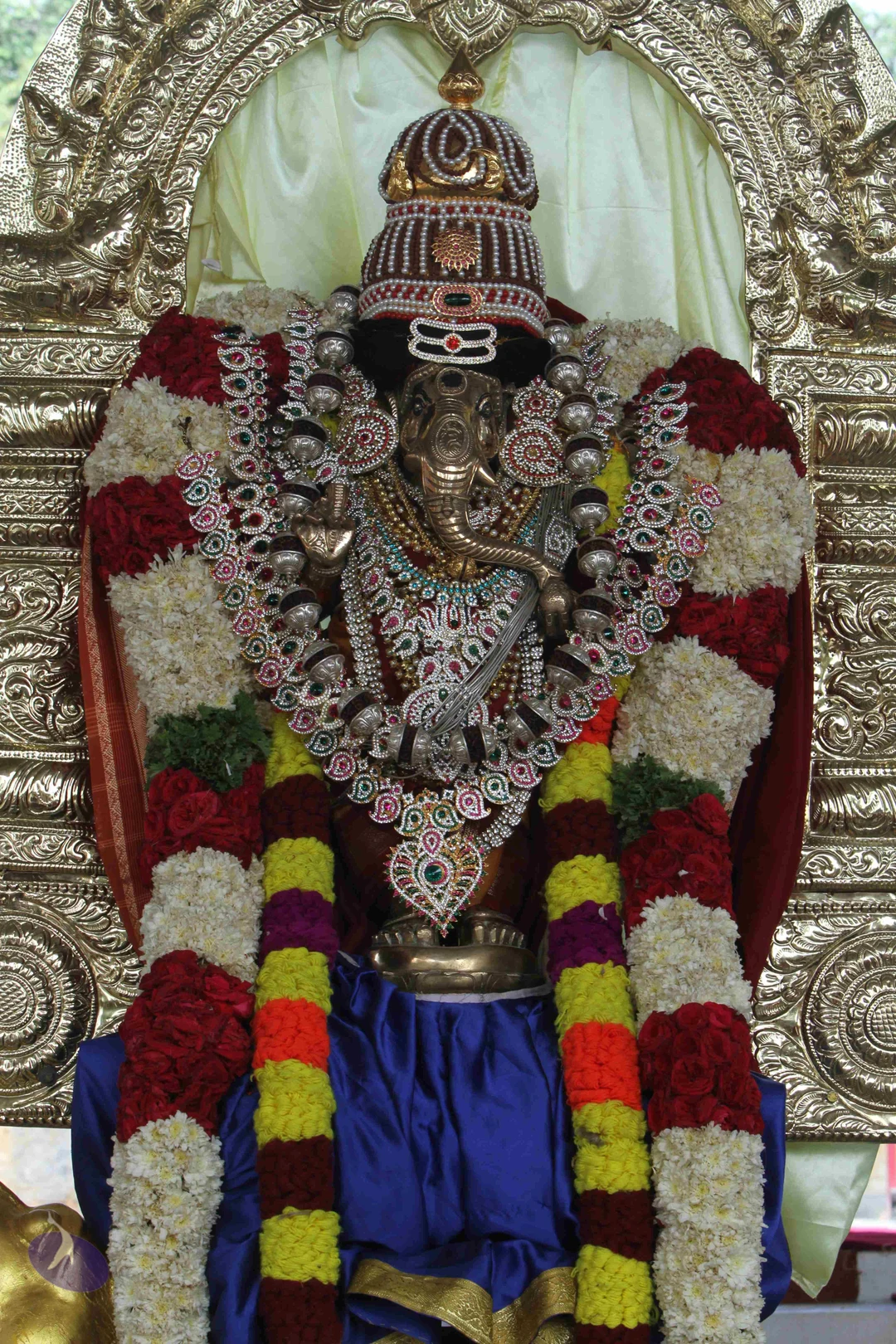
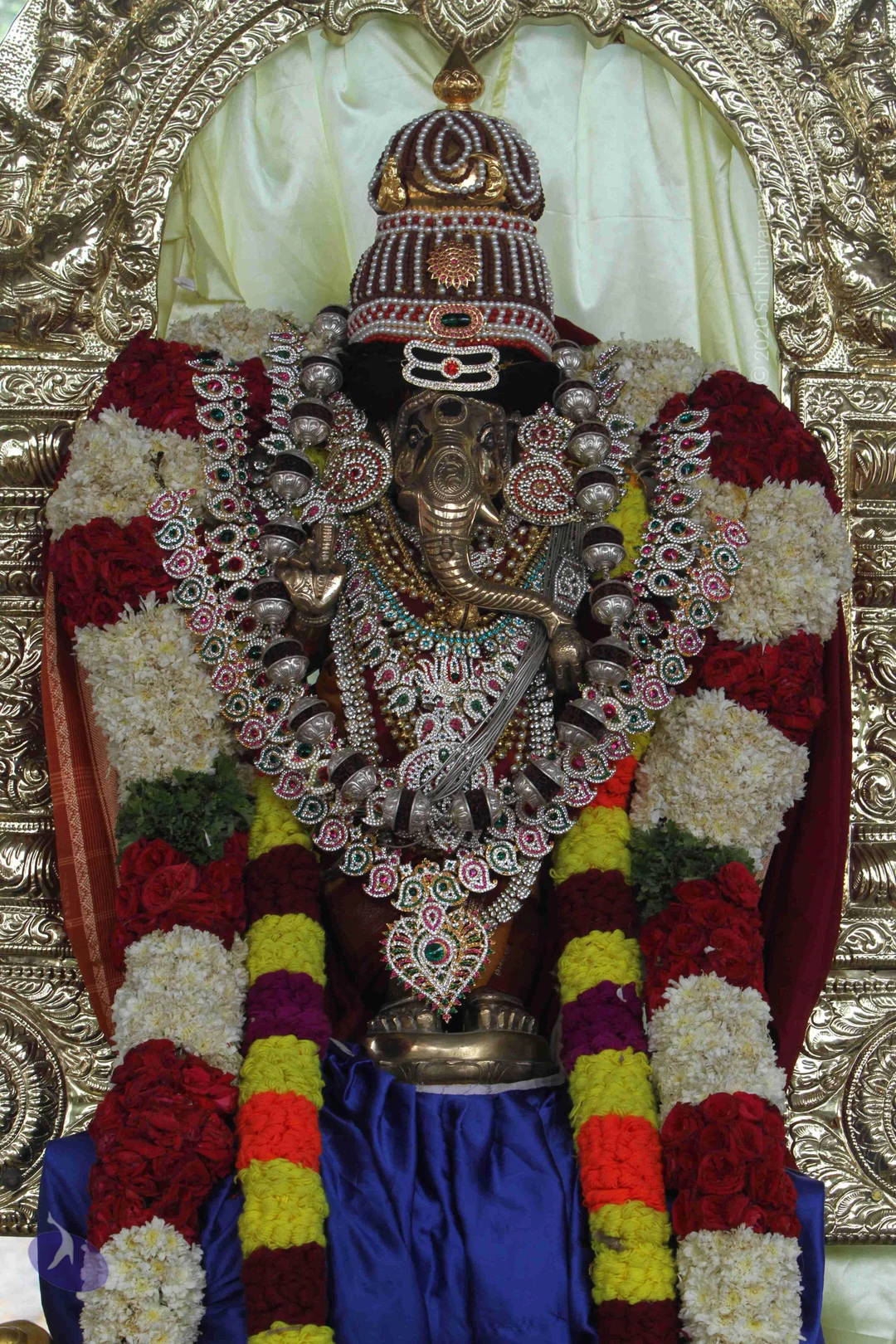
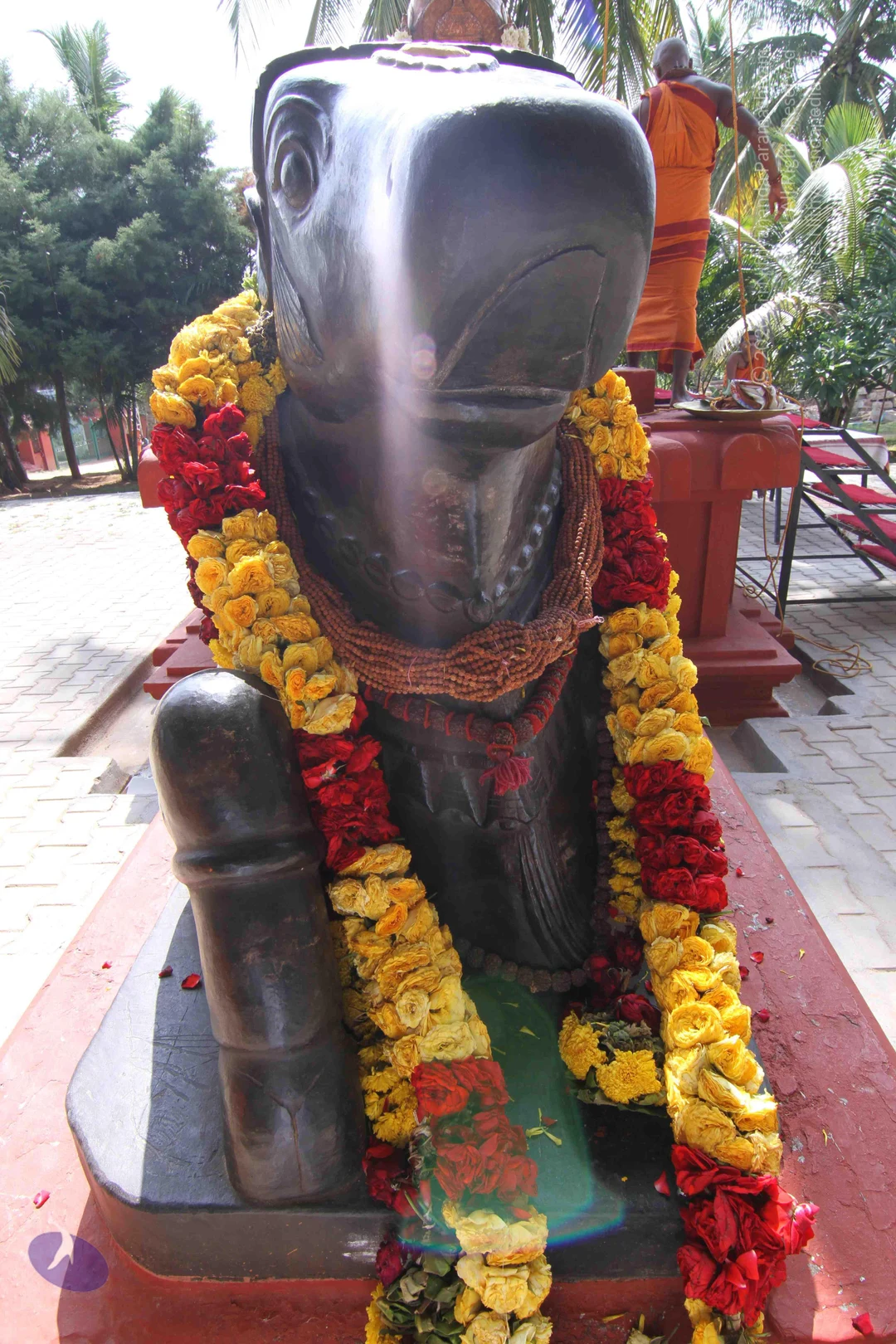
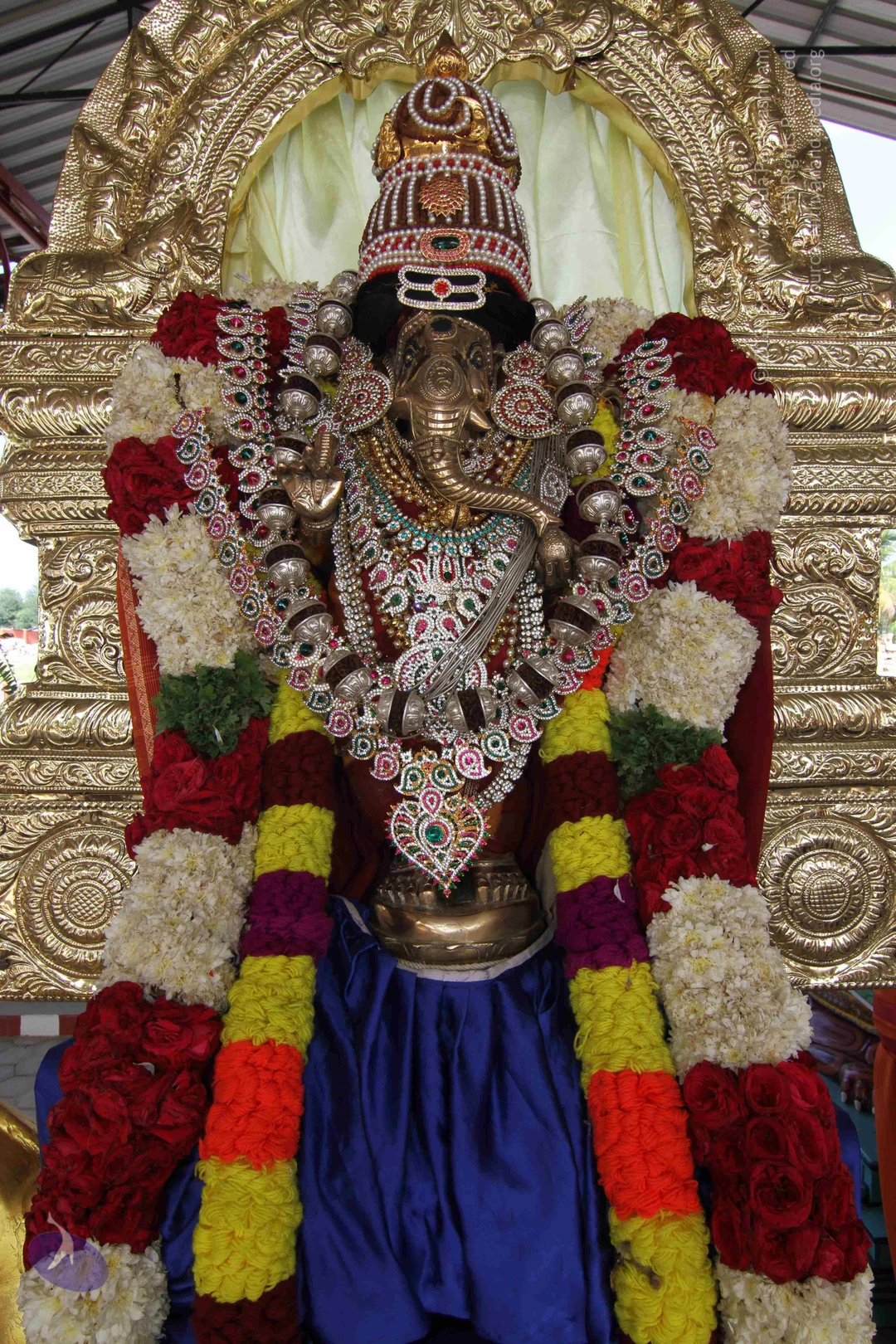
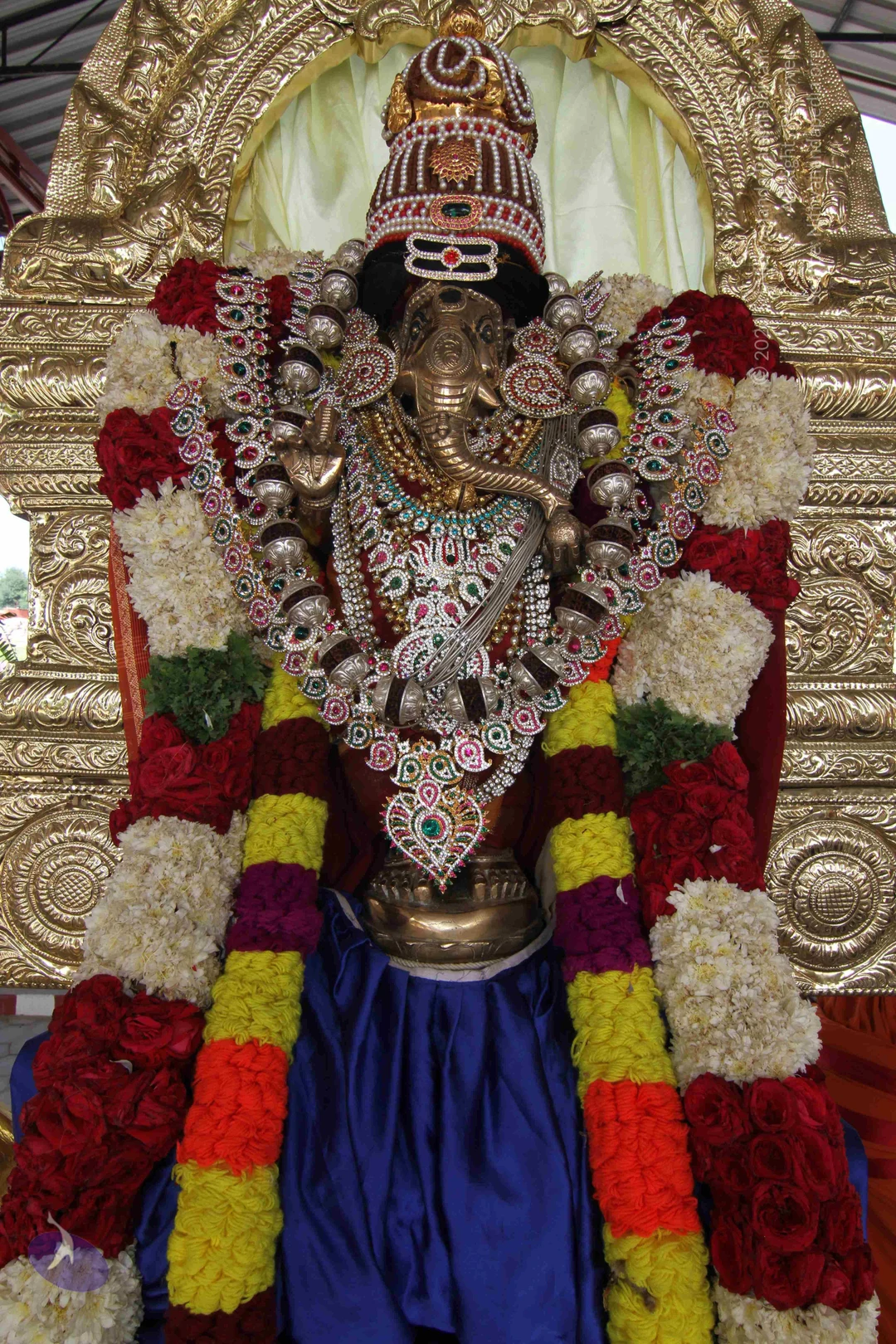
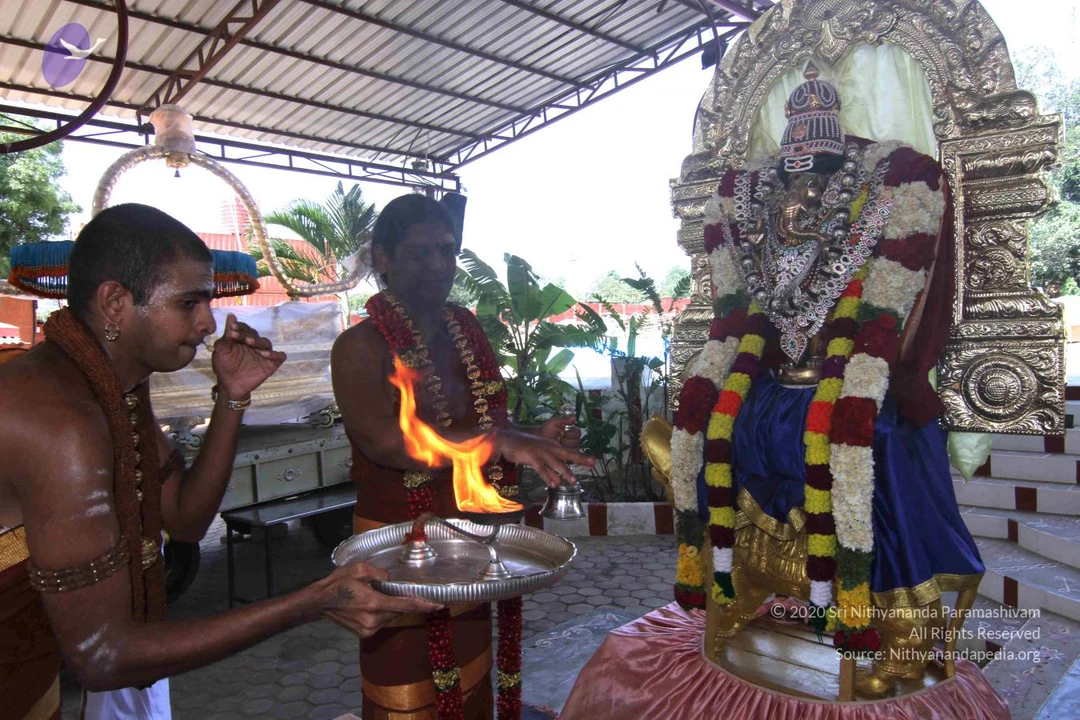
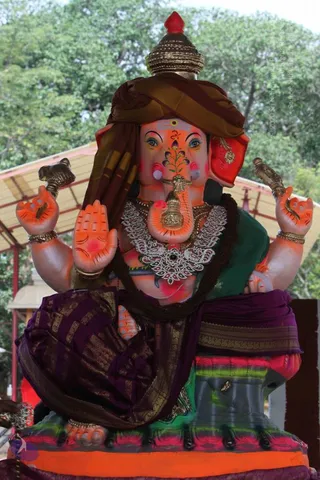
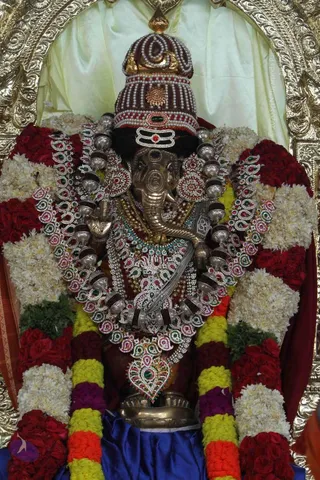
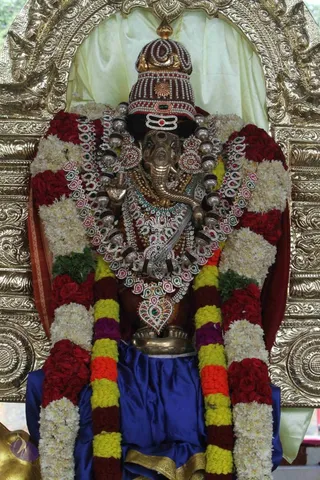
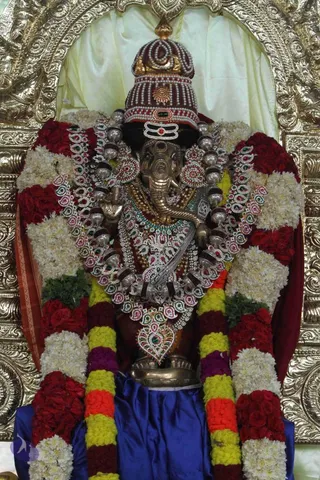
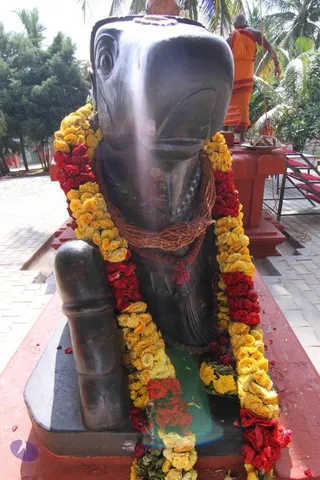
A large painted clay statue of Lord Ganesha, the elephant-headed deity, dominates the frame, with orange skin, a brown turban-style crown, and a green and purple silk garment with gold brocade borders. He wears an ornate silver-and-red beaded necklace and gold armlets, holds a gold axe and a gold ankusha in his upper hands, and his lower hands rest in abhaya-style gestures. A red tilak and floral paint decorate his forehead and trunk. Behind him are trees, a canopy, and a small figure in orange clothing at the lower right edge. The statue sits on a multicoloured pedestal.A large painted clay murti of Ganesha seated on a green and pink pedestal, photographed outdoors against green trees under a corrugated canopy. The deity has an orange trunk, a red-tipped gold crown, a brown and gold turban-like cloth, and a tilak with a small green-and-purple floral motif on the forehead. He wears a silver and red-stone necklace, gold bangles, and a purple brocade cloth with gold border over a green garment. He holds a golden modak in one hand and an axe-like gold implement in another, with one hand raised in blessing. No physical people are visible.A photograph of a bronze Ganesha murti, the elephant-headed deity, decorated for worship in an ornate gold-framed niche. The murti wears a jewelled crown with a red and gold centrepiece, a tilak on the forehead, layered silver and gem-studded necklaces, and a silver-bead garland. It is draped with garlands of white jasmine, red roses, yellow and orange marigolds, and green leaves, with a deep blue silk cloth at its base. A pale green cloth hangs behind it. No people are visible.A large dark stone Nandi bull statue is the central subject, wearing thick garlands of yellow and red flowers and a necklace of brown rudraksha beads, with its face and eyes carved in polished black stone. Marigold and rose petals lie scattered on the stone base and a green cloth. In the upper right background, a standing man in an orange robe and orange shawl stands beside a red platform holding a tray with offerings, while palm trees and a red step-seat set are visible. The scene reads as a temple or ashram courtyard ritual setting.

Pada-Puja
7 photosSource gallery
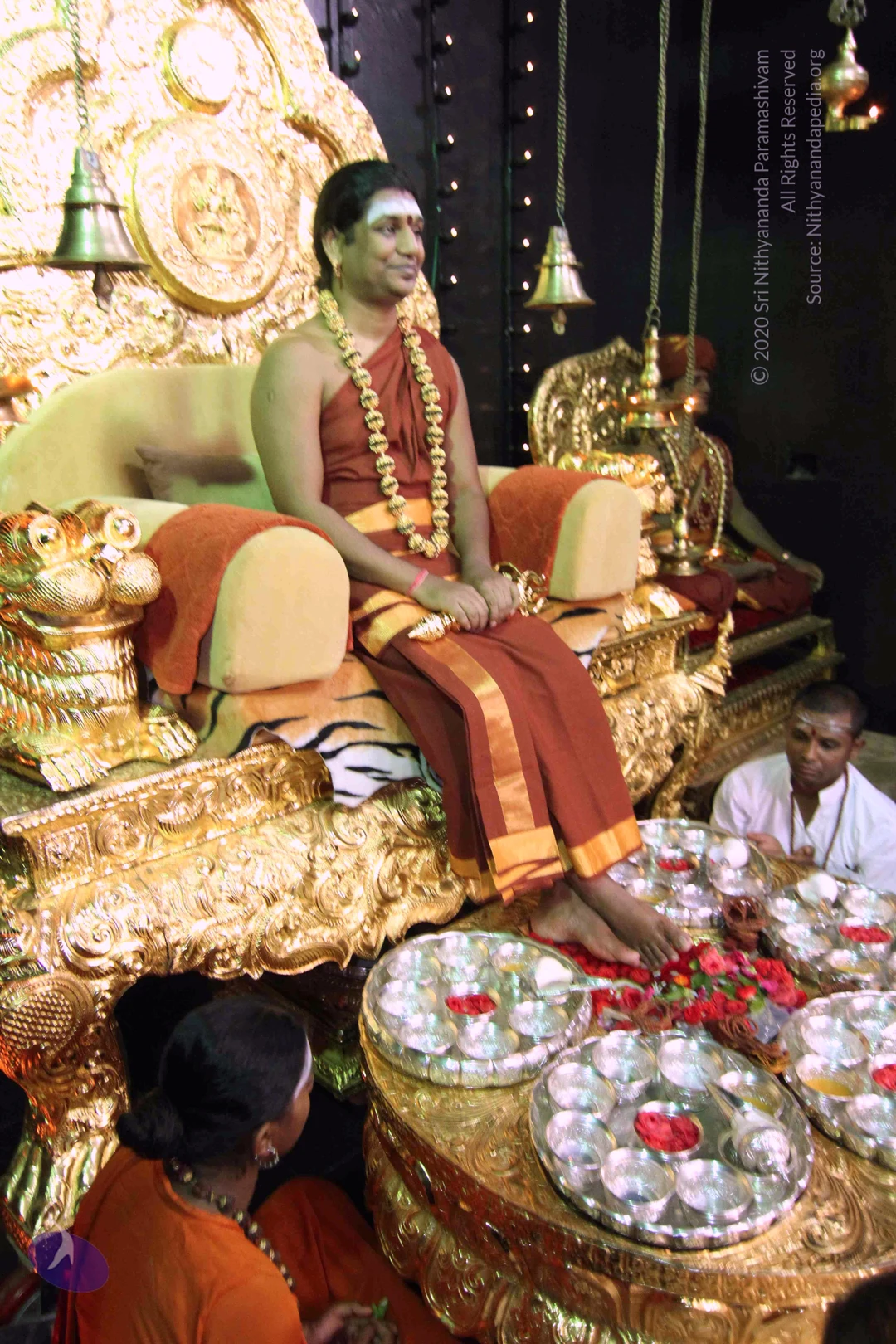
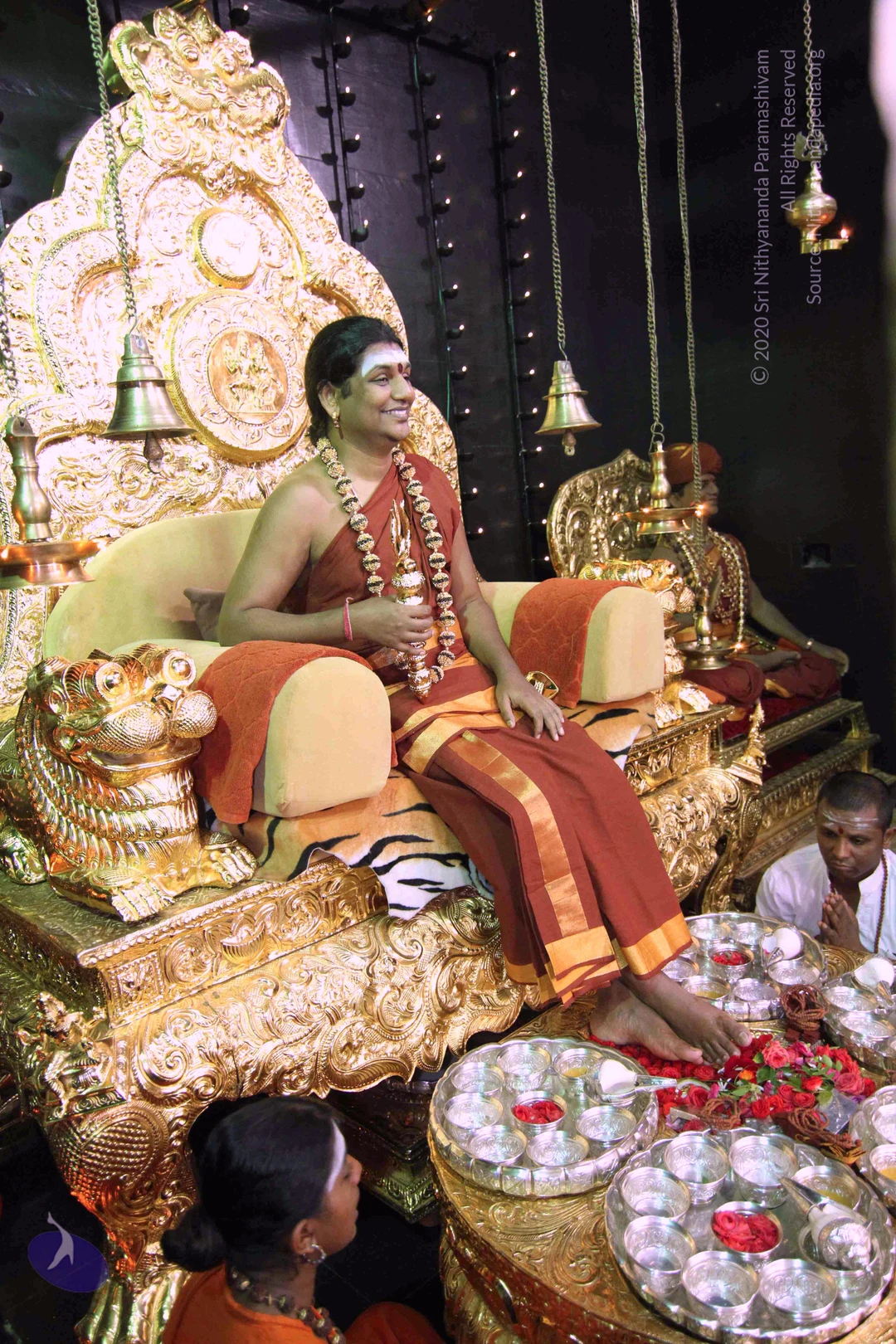
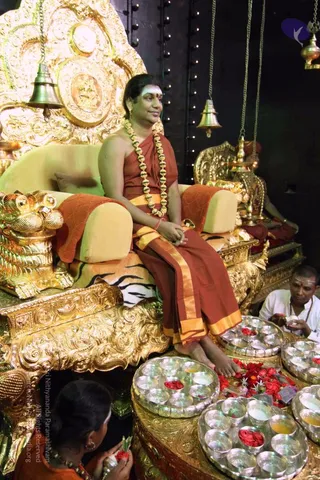
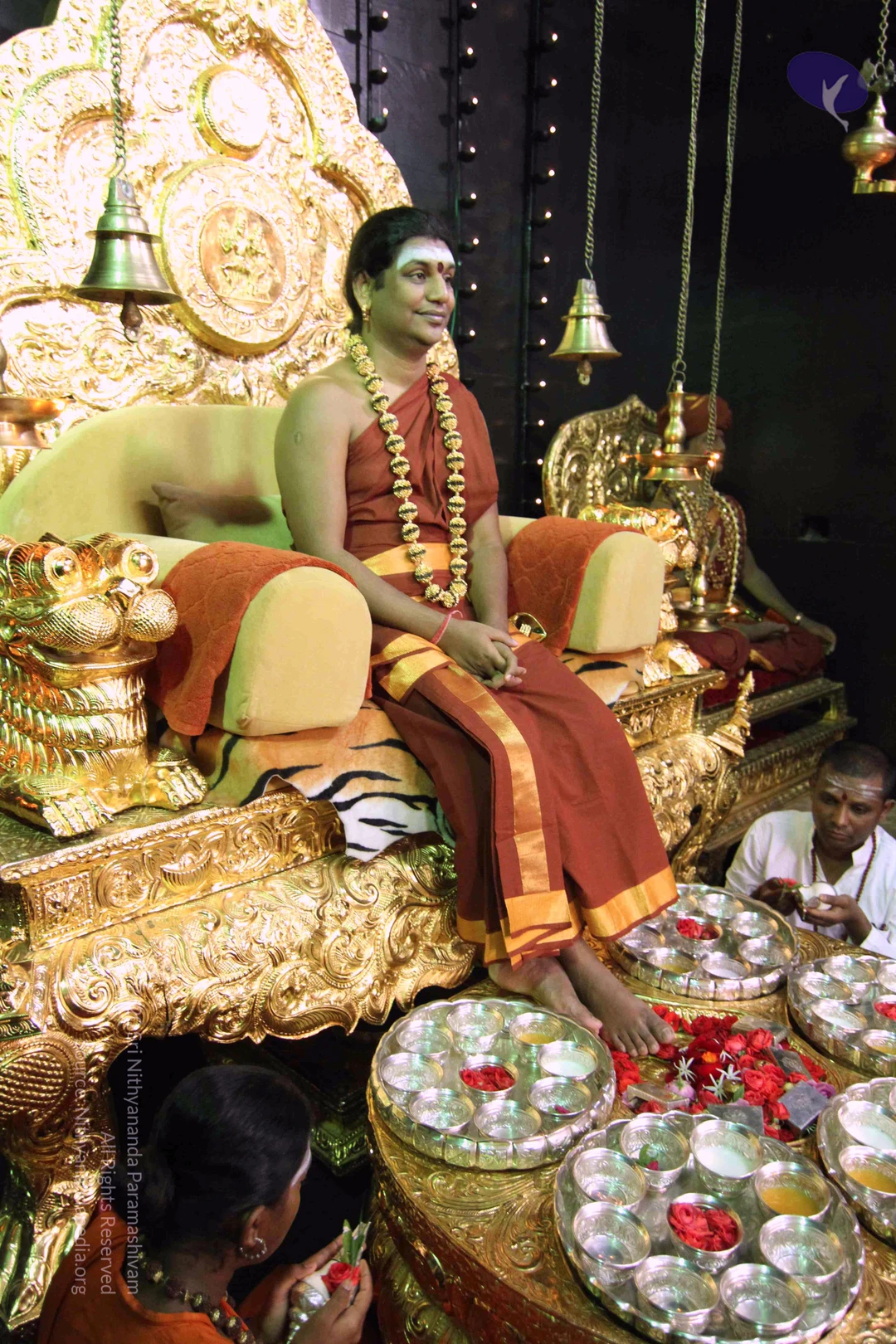
A photograph of a seated figure on an ornate gold throne with a green cushioned seat, a golden lion-head armrest and tiger-striped cloth. The central figure wears an orange-red shawl over the shoulder and an orange-red dhoti with a gold border, a long necklace of gold beads and a rudraksha-style mala, and has a white vibhuti marking and swept-back hair; the appearance is consistent with the a person candidate named in the page, though not certain. His feet rest on a bed of red rose petals in front of silver trays of small lamps and bowls, and a devotee in white and a woman in orange hold offerings nearby. Hanging brass bells and oil lamps decorate the background.Photograph of a seated figure on an ornate gold throne with a tiger-skin cushion and orange-red upholstered armrests, wearing an orange-red dhoti and shawl with gold borders and a long beaded necklace. The figure has a white forehead mark and is seated barefoot beside silver trays of red flowers, lamps and offerings. Behind the throne hang brass bells and a lit oil lamp. A man in white clothes kneels at the right, and a woman in orange sits in the lower left corner. a person: long swept-back hair, ornate gold necklace and orange-red shawl on a throne, consistent with the page's a person reference. Overall this is a formal satsang or puja setting.Photograph of a seated man on an ornate gold throne with a lion-head armrest and tiger-striped cushion, wearing a rust-red and gold-bordered robe, a rudraksha mala with ceremonial gold ornament, a white forehead mark and a red bindi, smiling. Hanging brass bells and oil lamps surround the throne. In front, silver bowls of red flowers and offerings are arranged, and a man in white with folded hands sits beside it, while a woman in orange kneels at the lower left. A second seated figure sits in the background. a person cues: rudraksha mala, ceremonial gold ornament and rust-red robe on a throne.A seated man in saffron-orange robes sits on an ornate gilded throne with a carved golden lion-like armrest and a tiger-striped cloth draped over the seat. He wears a long rudraksha mala with gold beads, a gold trident-shaped sceptre in his right hand, a white vertical tilak on his forehead, and a red thread on his wrist. Behind him hang brass bells and a lit brass oil lamp, and in the foreground are silver trays holding small bowls, a brass lamp and red rose petals. a person is seated on the throne, shown with a rudraksha mala and trident sceptre, the throne being adorned as a ceremonial seat. A faint figure in a red turban and gold necklace sits in the background, and a partially visible person in white kneels at the lower right edge.A photograph of a seated man on an ornate gilded golden throne with a tiger-skin cover draped over the seat, at a satsang. He wears an orange-red shawl over bare shoulders, an orange-red dhoti with a gold-bordered hem, and a long gold bead necklace with rudraksha-style beads. He holds a golden trident and smiles with eyes lowered, a red bindi on his forehead and a red thread on his wrist. Behind him a brass oil lamp burns and a brass bell hangs, with a person in an orange turban and gold garment partly visible in the background. Silver plates and red flowers sit at the bottom right near his bare feet. Swamiji (probable): long dark hair swept back, ornate gold necklace, orange-red shawl and dhoti, and a golden trident on a throne.A seated man in an ornate golden throne with a tiger-skin cover, wearing rust-orange robes with gold borders, a rudraksha and gold bead garland, a gold ceremonial pendant, and a red wrist thread. He has white and red forehead markings and long swept-back hair, sitting with hands resting on his lap and armrest, smiling and looking to one side. Behind him, a brass oil lamp burns beside hanging bells, and a second figure in an orange turban and gold necklace sits in the background. Brass and silver offering plates with red flowers lie at the front of the throne. a person is seated on the throne during a satsang-style ceremony.

Nithya-Satsang

6 photosSource gallery
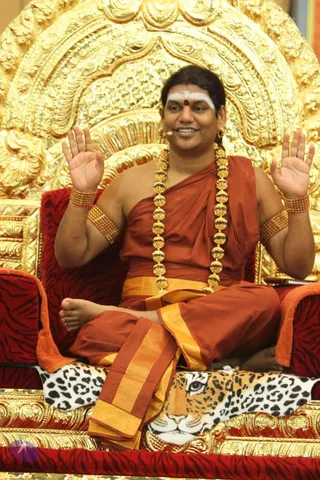
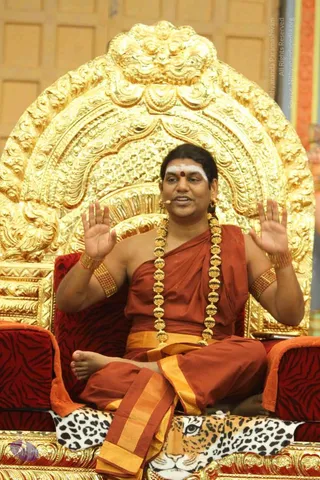
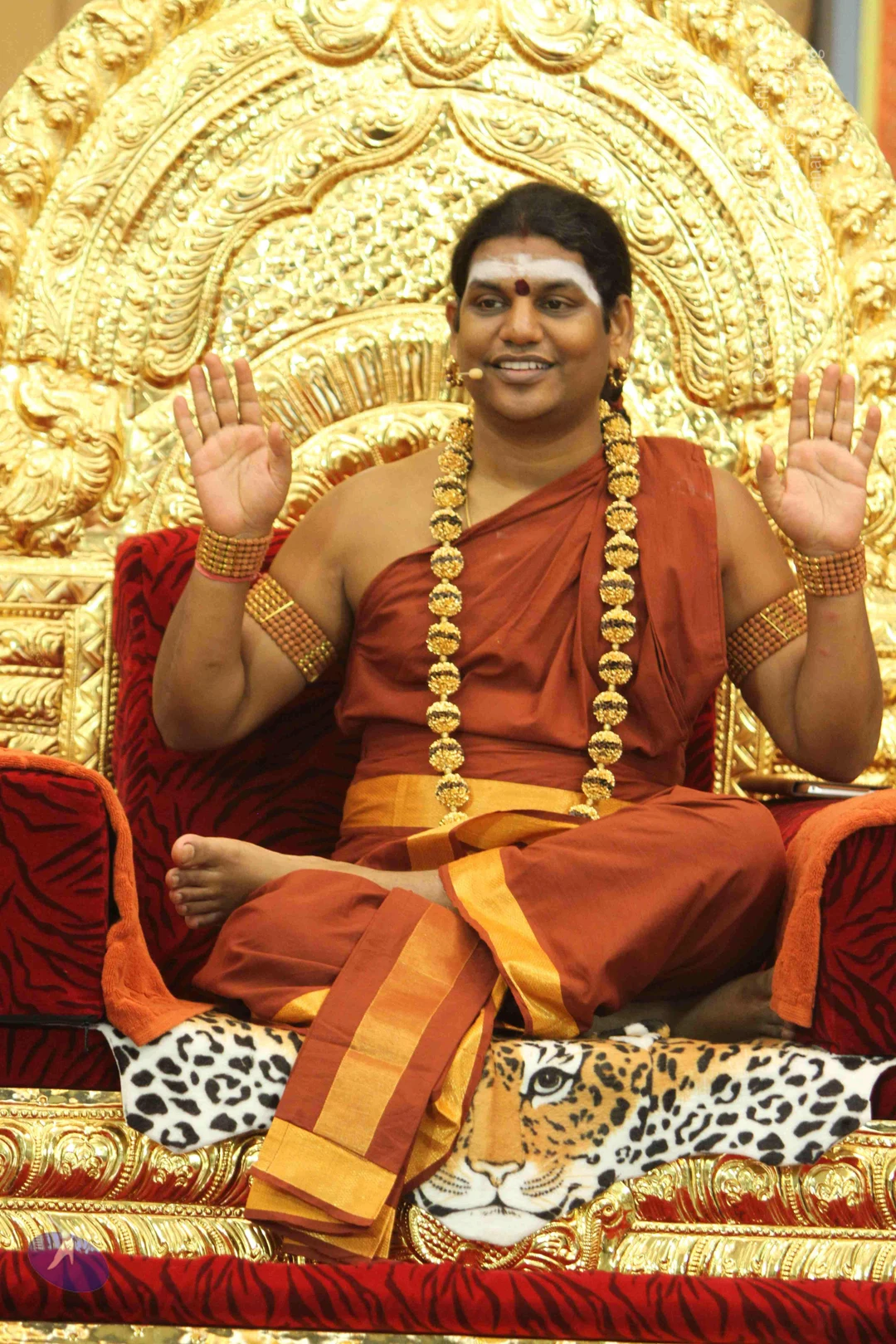
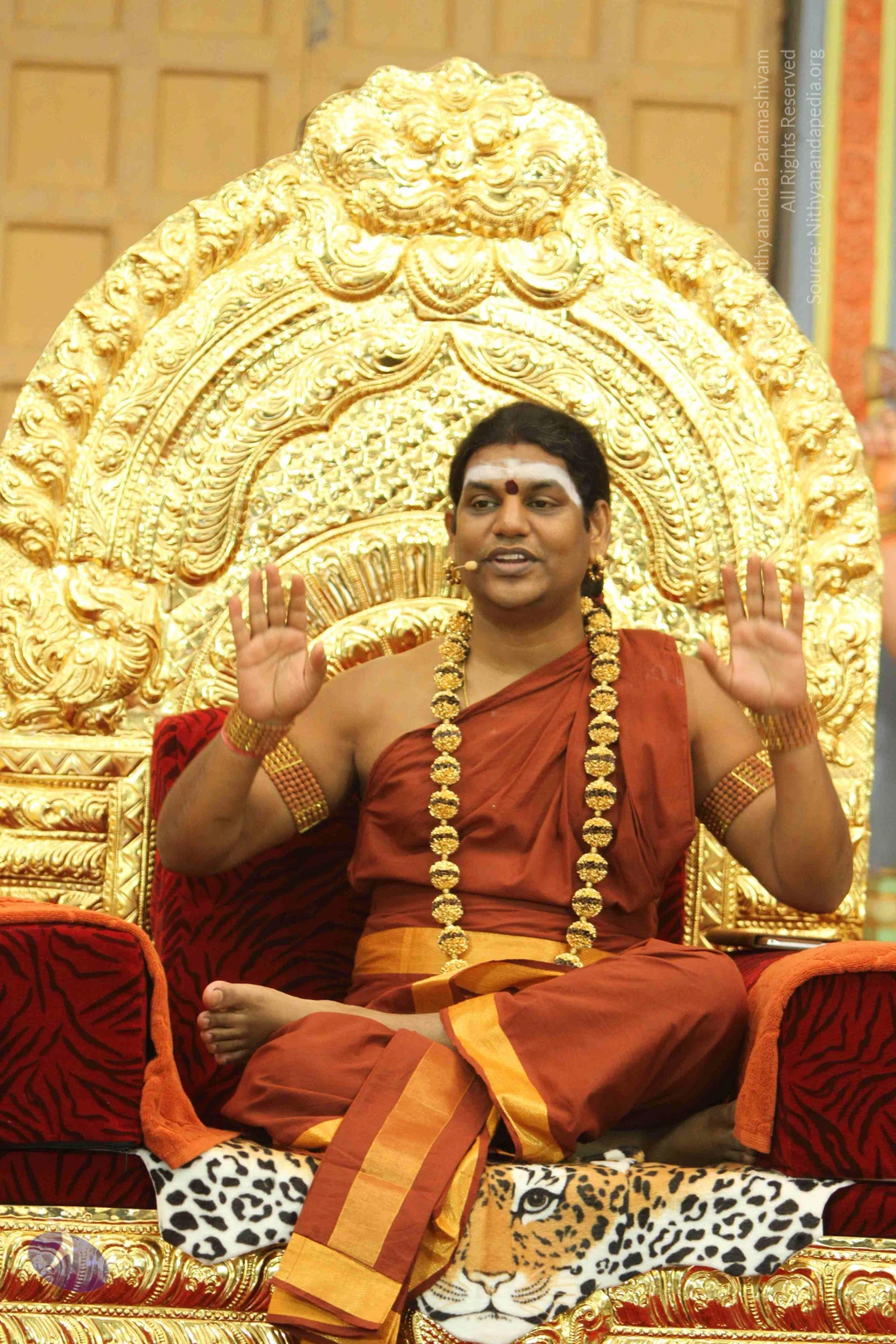
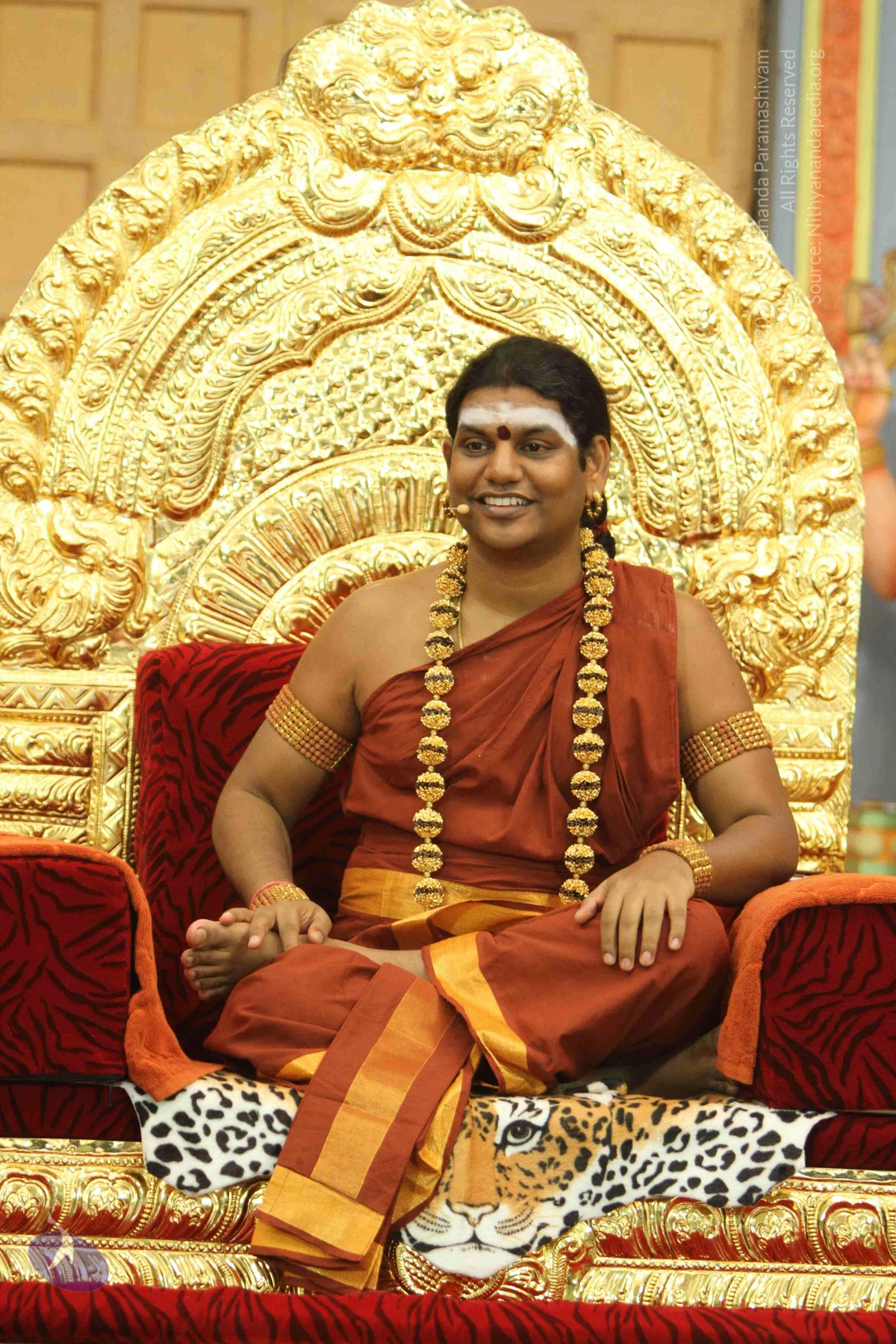
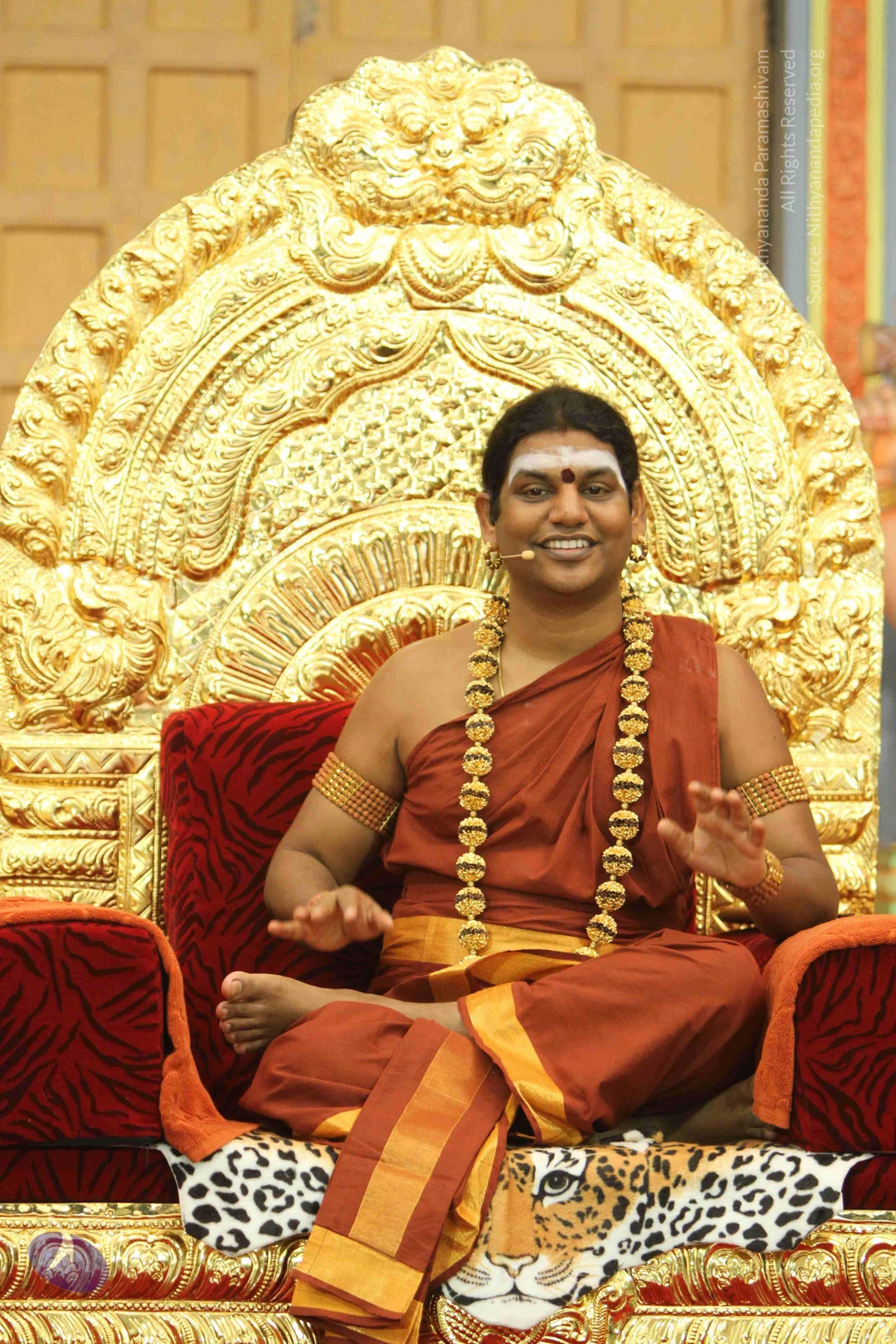
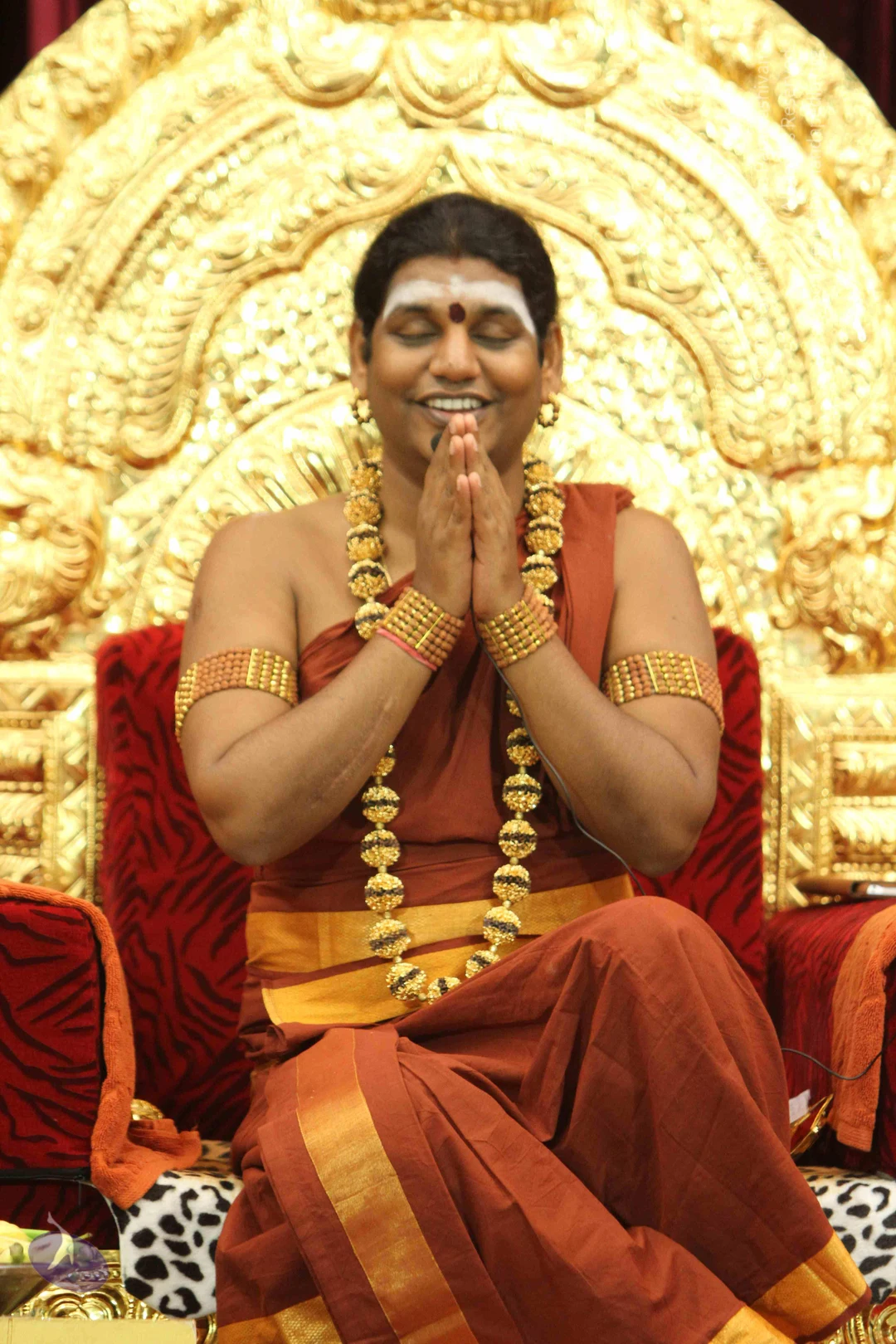
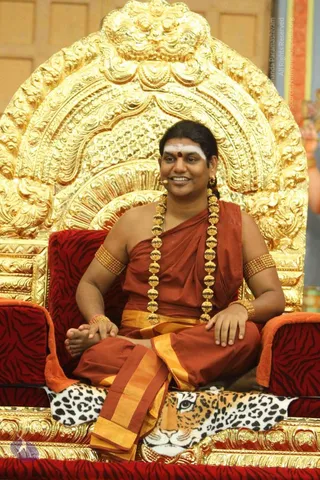
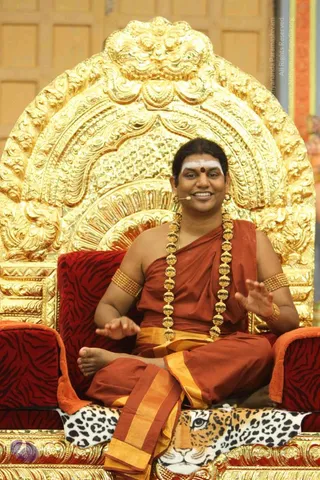
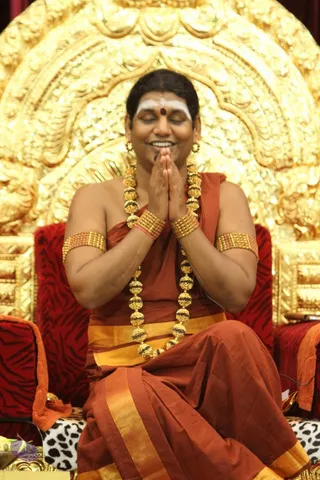
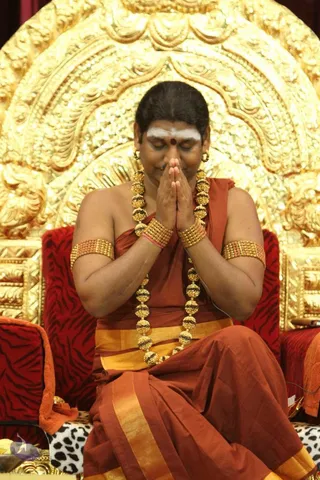
A man seated cross-legged on an ornate gold throne with a tiger-striped red velvet cushion and a leopard-print cloth draped over the seat, raising both palms outward in a gesture of blessing while speaking. He wears a rust-orange dhoti and shawl with gold borders, a long gold bead necklace, gold bangles and armlets, and has a white vertical tilak with a red bindi on his forehead. A small microphone is at his ear. Behind him a large gold repoussé arch frames the throne. a person seated in a satsang setting; the visible cues are the saffron-orange clothing, ornate gold beads and throne.A seated man in a large ornate gold throne with a carved arched back sits on a red velvet and leopard-print cushioned seat, draped over a leopard-skin rug. He wears a rust-orange garment over his shoulder with a gold-bordered orange dhoti, heavy gold bead necklaces, gold armlets and bangles, and earrings. He has a white vertical tilak and red bindi on his forehead, and a small microphone clipped near his mouth. His palms are raised open in an animated gesture while he speaks. a person, seated on a throne in a satsang setting, with distinctive saffron-orange clothing and ornate gold necklaces.A man seated on an ornate gilded throne with a carved golden arch behind him, draped over a red velvet seat and a leopard-print cushion. He wears a rust-orange garment over one shoulder, a gold-and-black beaded necklace, gold armbands and bangles, and a gold-bordered orange dhoti. His forehead bears white and red markings, and a microphone is clipped near his mouth. Swamiji (probable) is shown seated in a discourse setting, with a red velvet throne, carved gold and a red cloth; the appearance cues are the long swept-back hair, rudraksha-style gold beaded mala, saffron clothing and ornate gold adornments.A seated man in a rust-orange dhoti and shawl with a gold-bordered cloth sits on an ornate gold throne with red tiger-striped cushions. He has his palms pressed together in namaste, eyes closed and smiling, with a white horizontal tilak and red bindi on his forehead. He wears layered gold beaded necklaces, gold armlets and beaded bracelets. A microphone clip is visible at his chest. Behind him is a richly carved gold backrest; a gold-rimmed tray sits at the lower edge. Appearance-based label: a person, from the distinctive gold ceremonial ornaments, orange robes and throne setting, seated in namaste as the satsang speaker.