Skip to content
Sunday

18 August 2013

Completion Leads to Expansion.

Dated photos
356
Source pages
1
Media
2
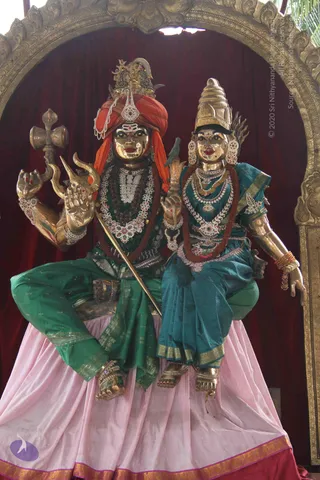
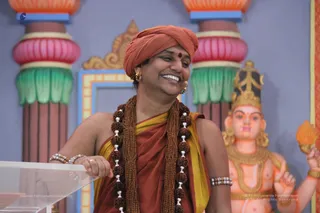
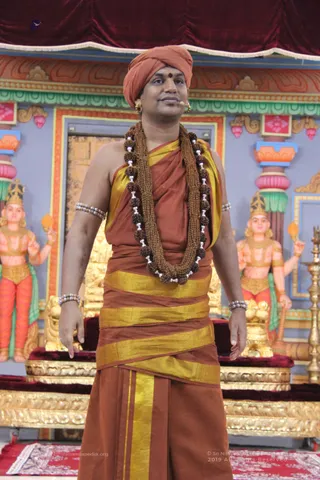
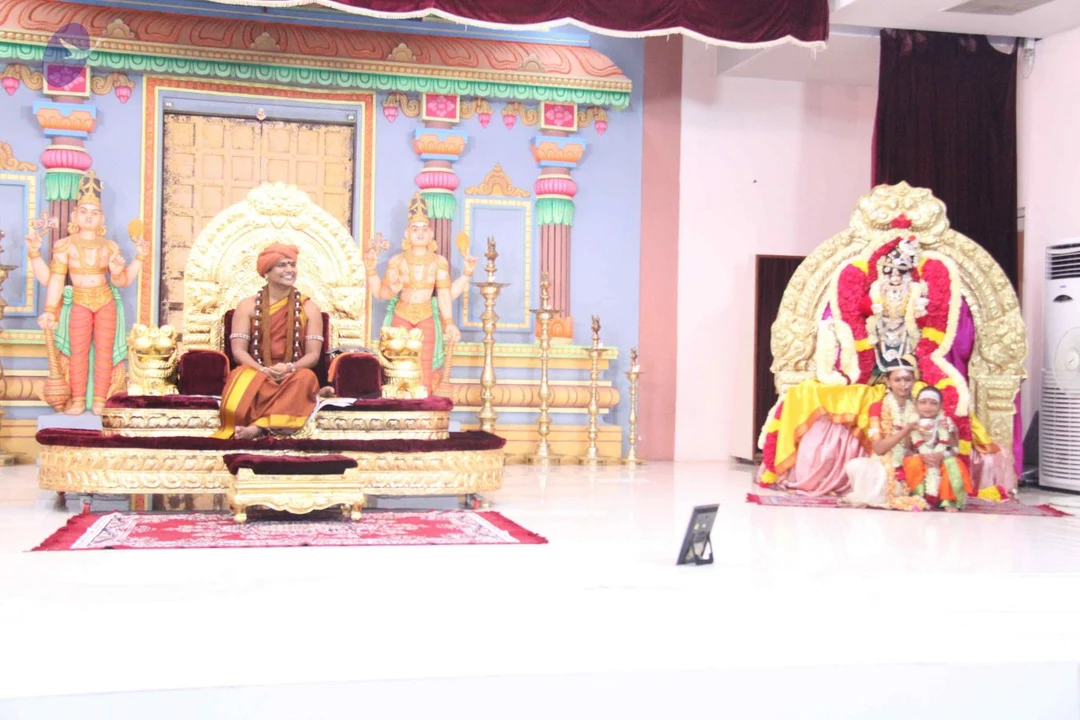
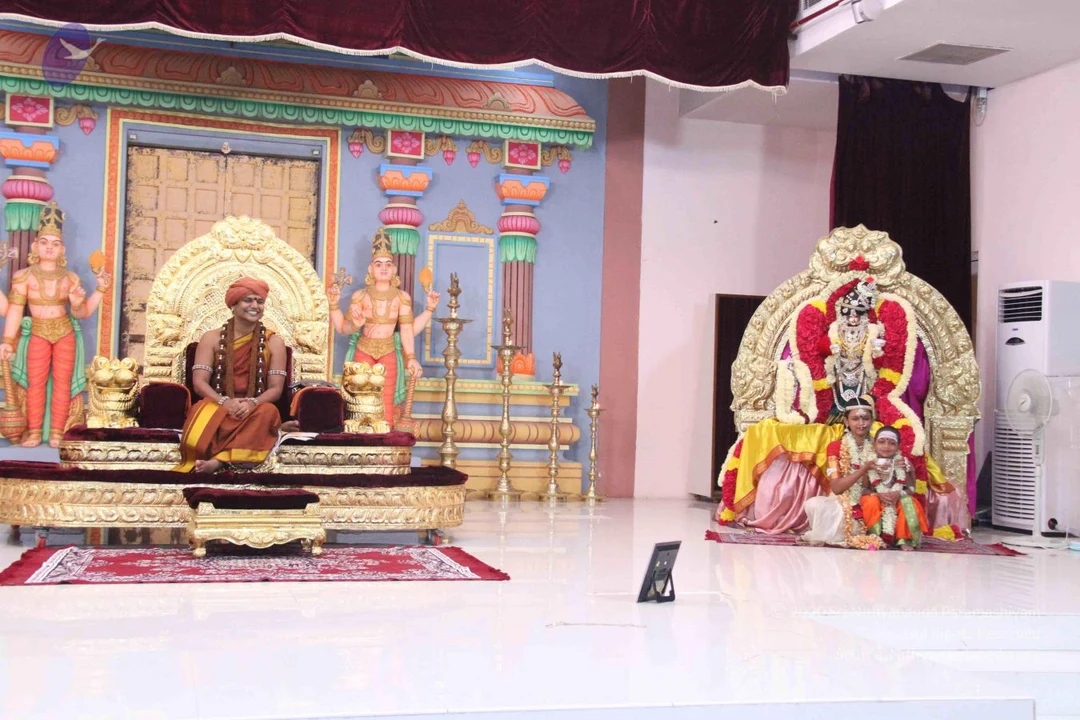
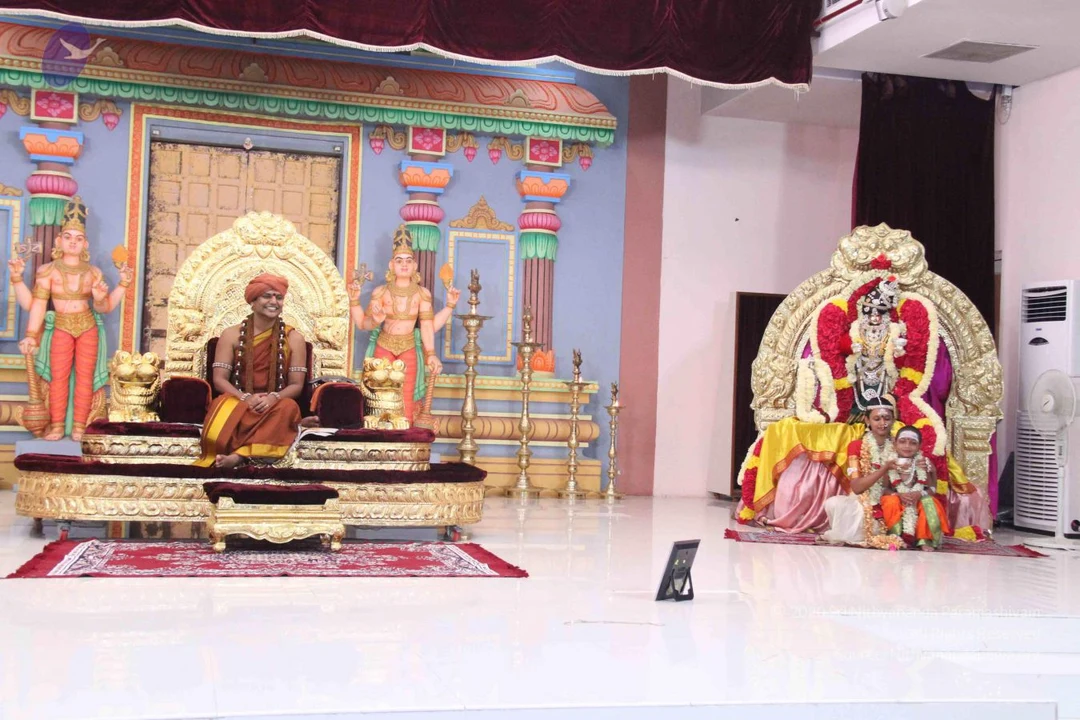
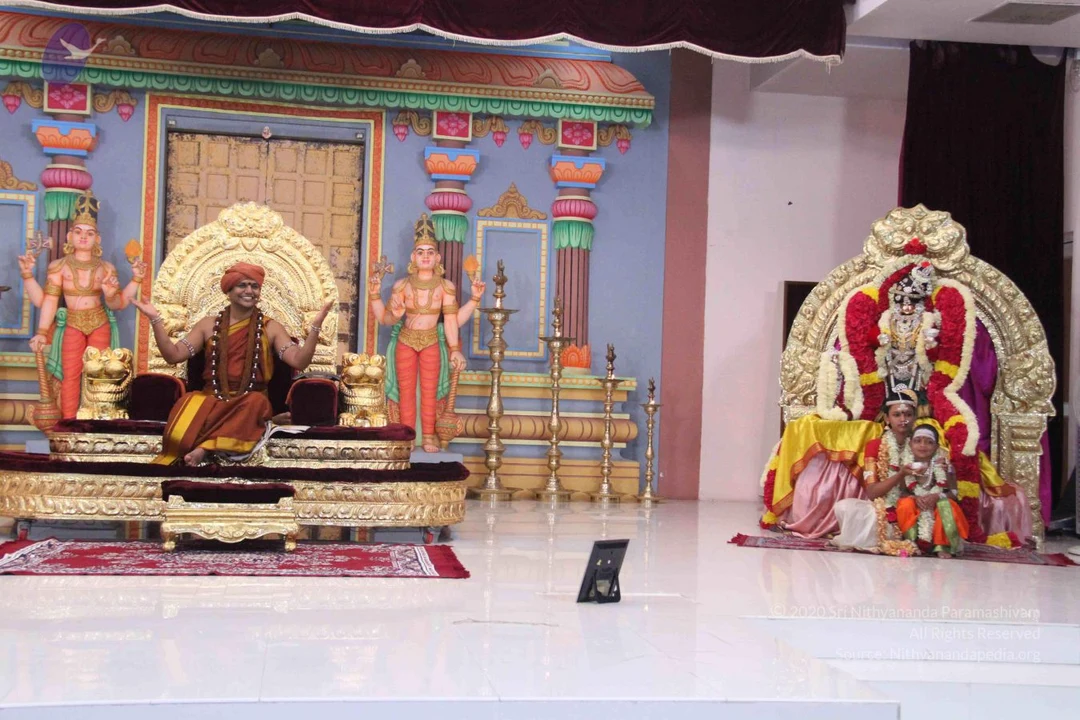
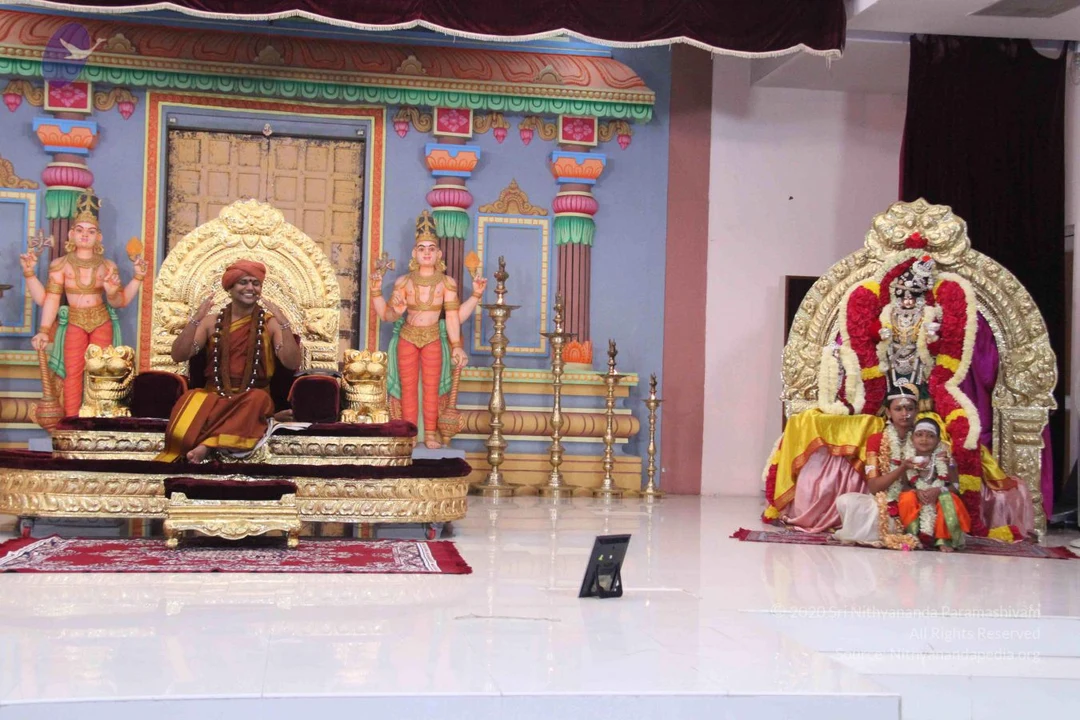
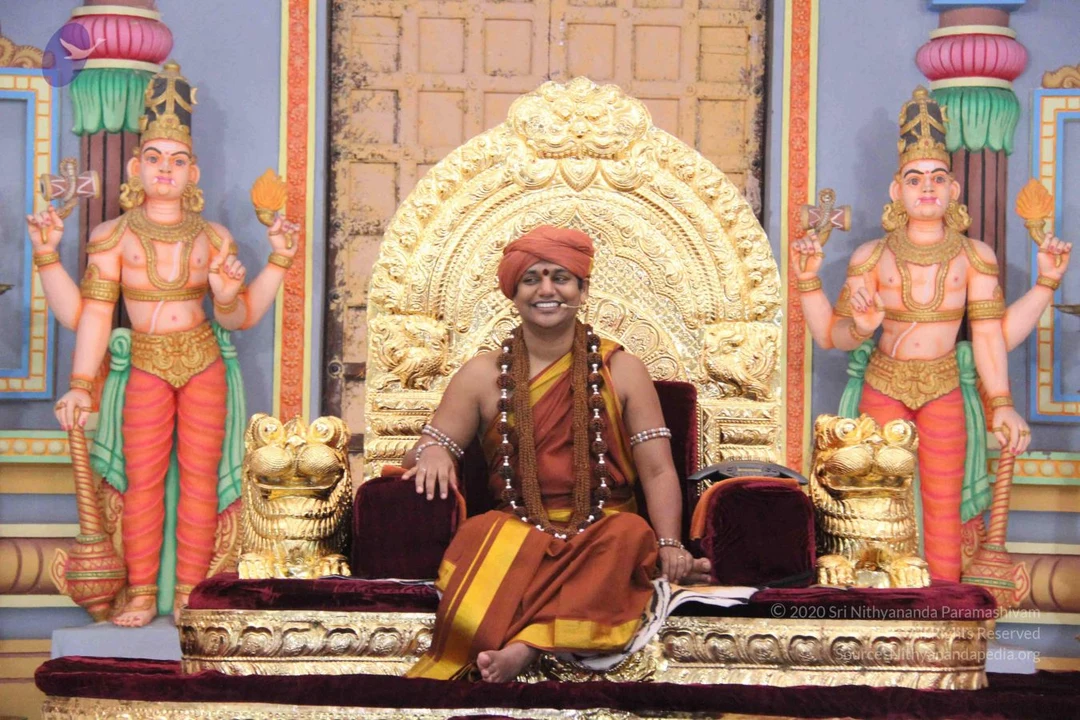
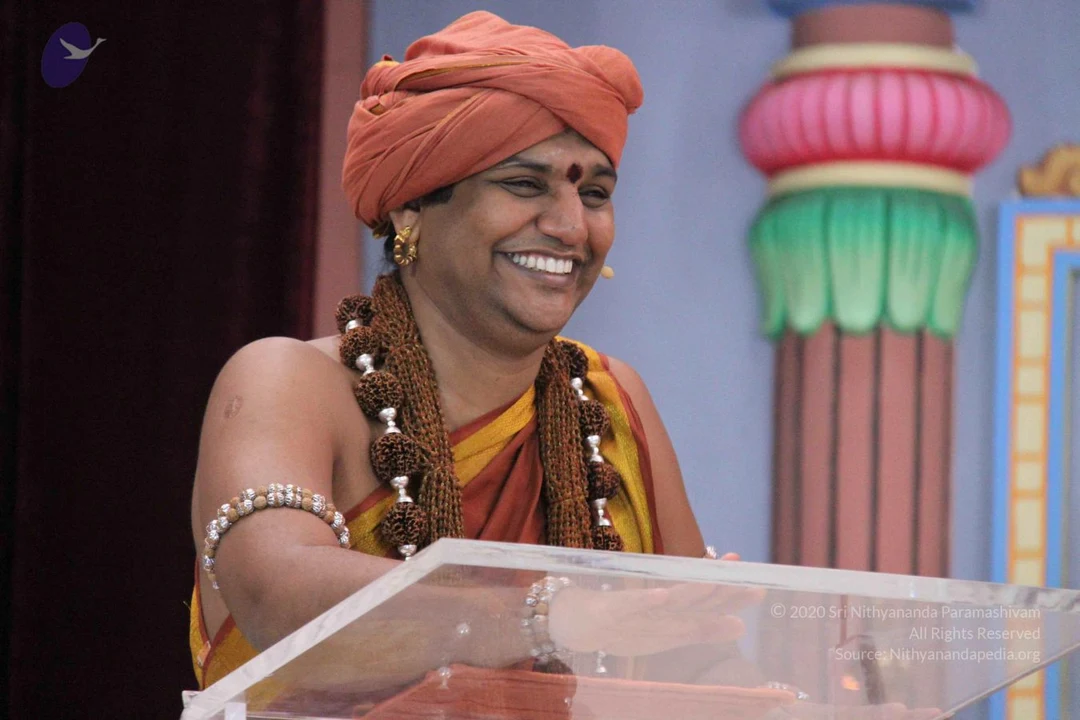
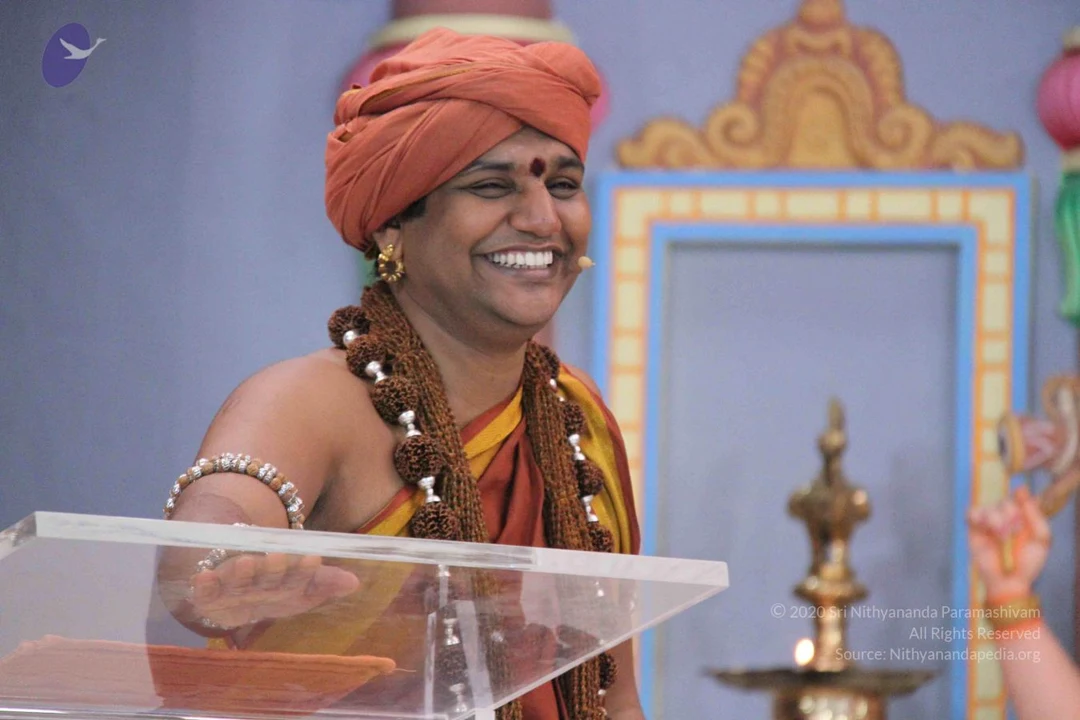
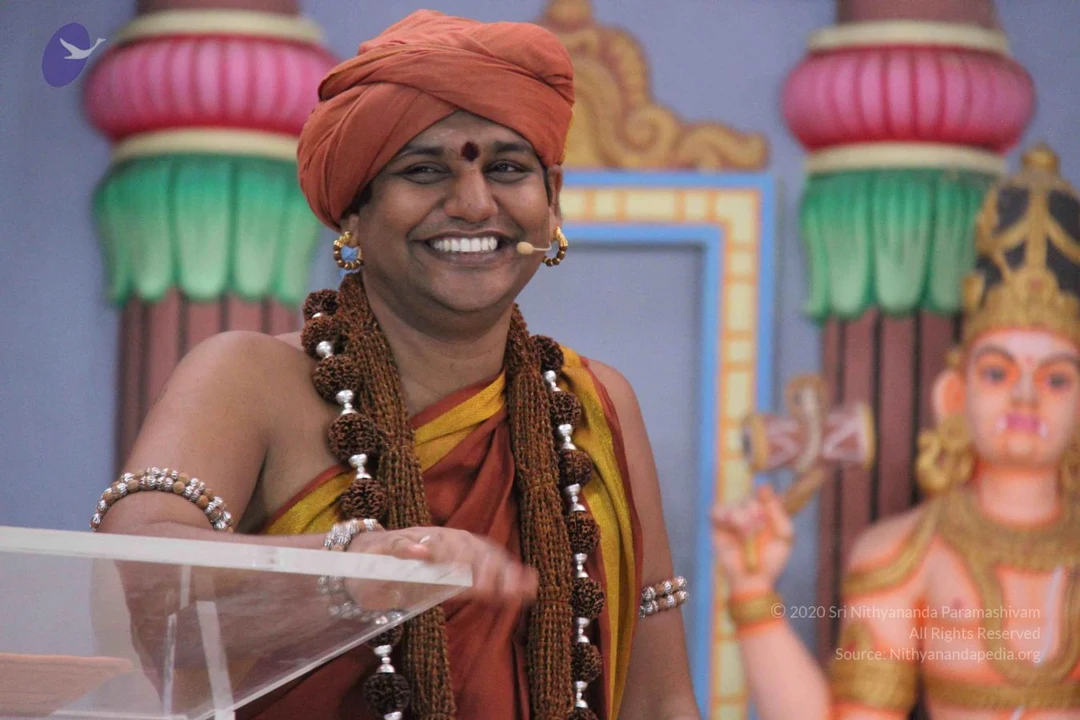
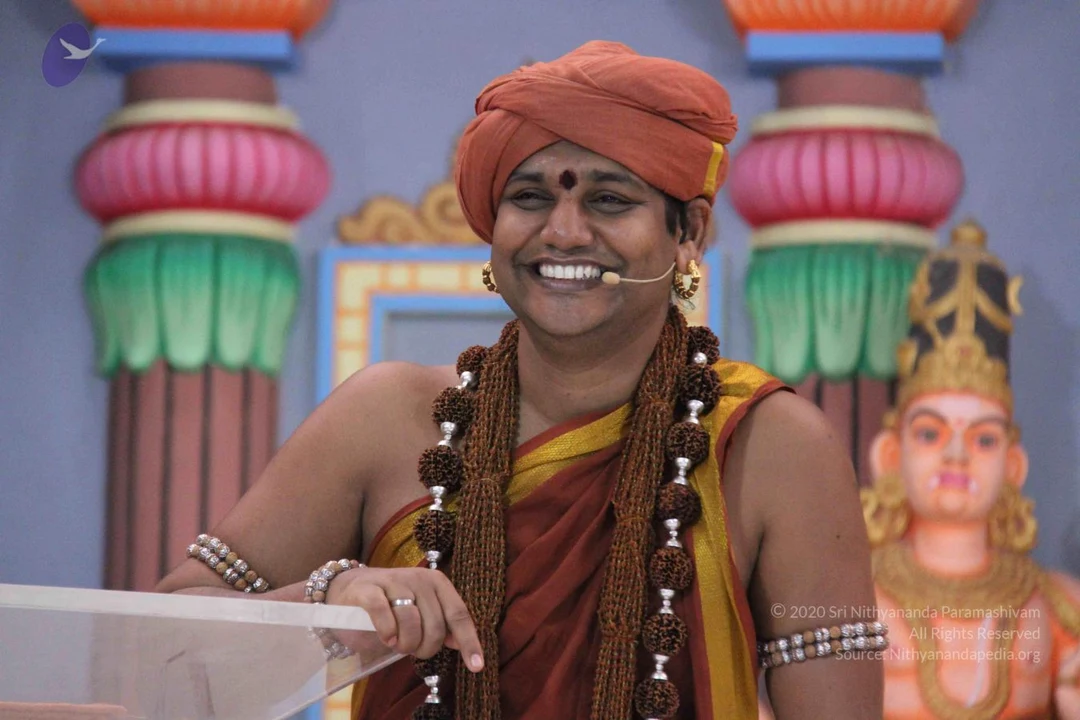
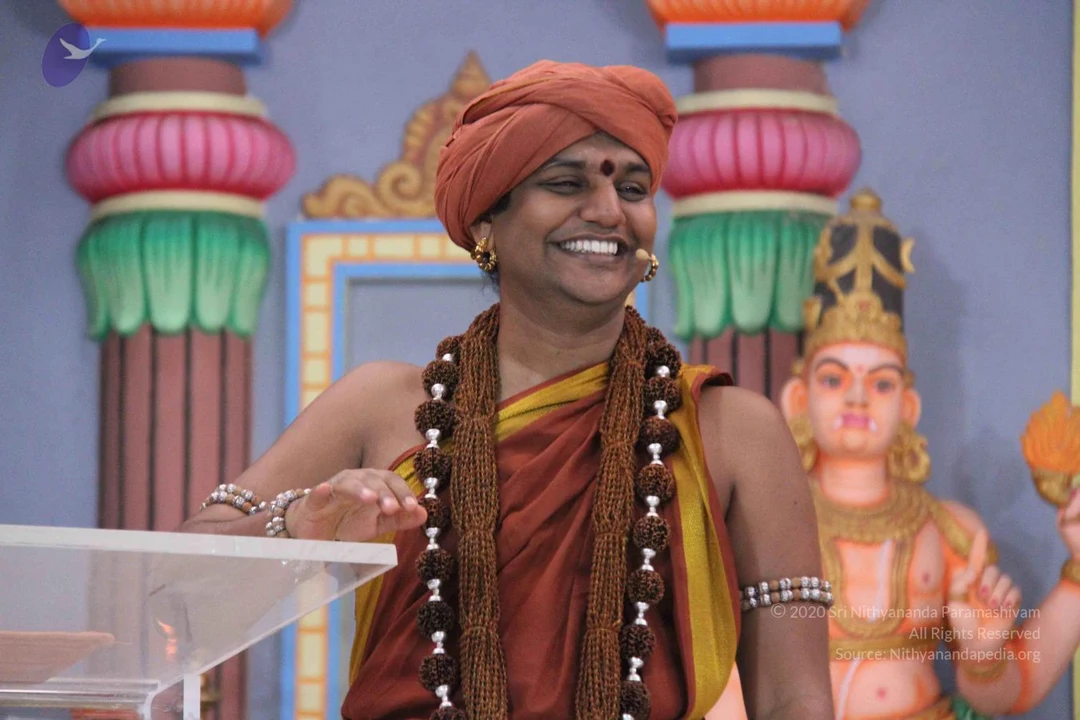
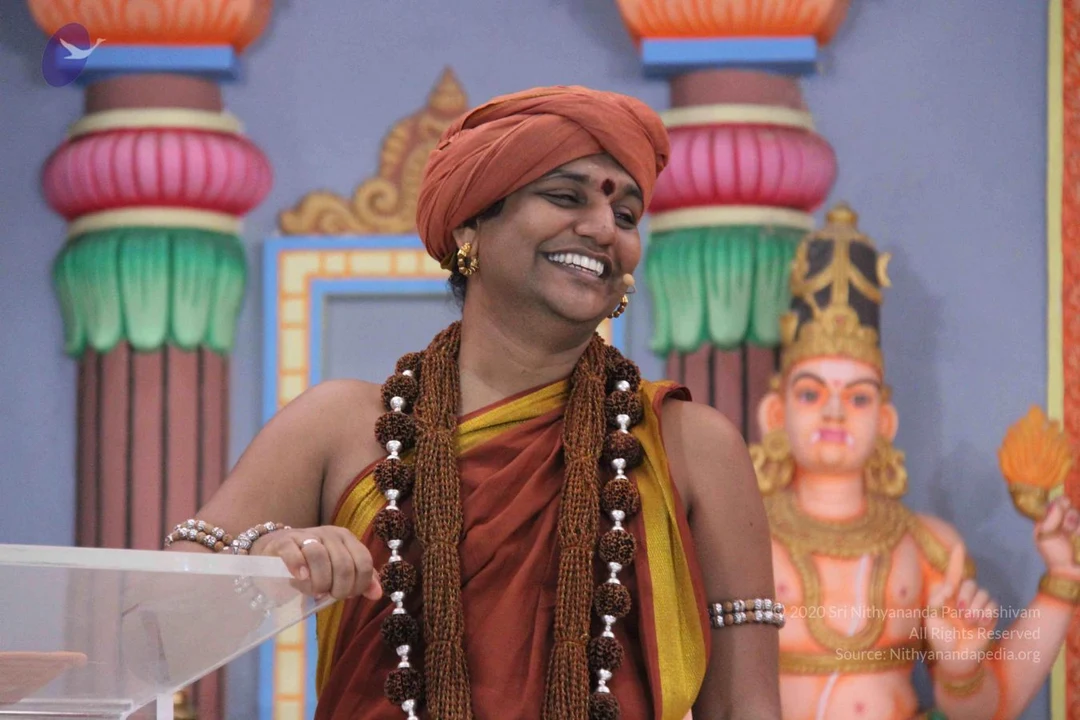
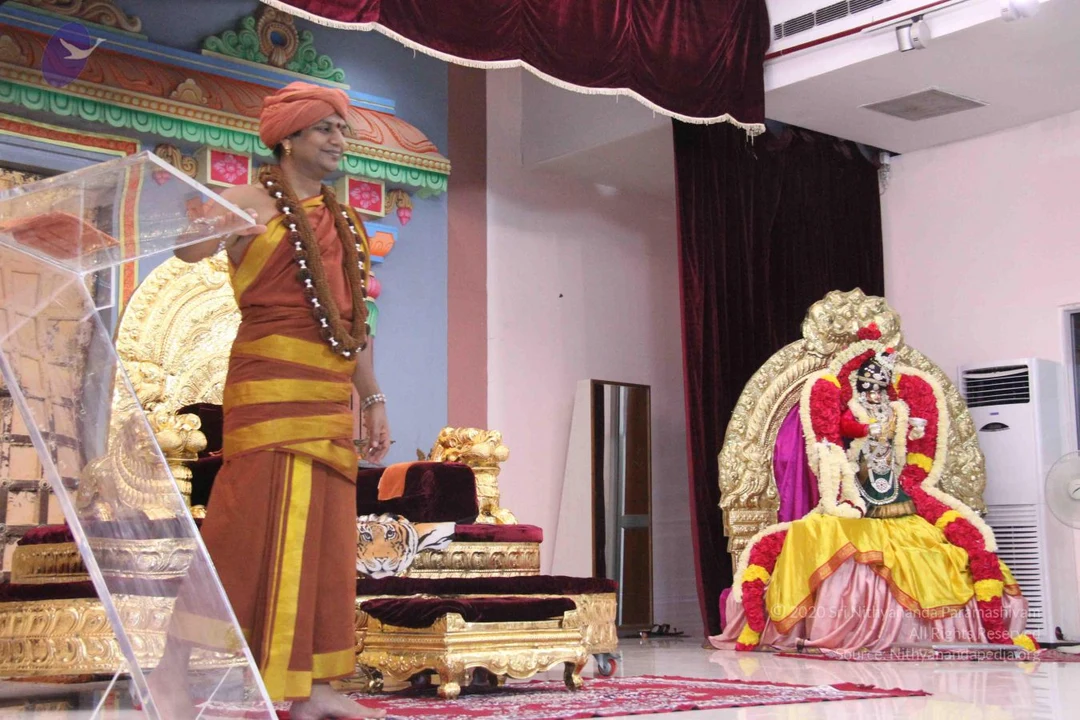
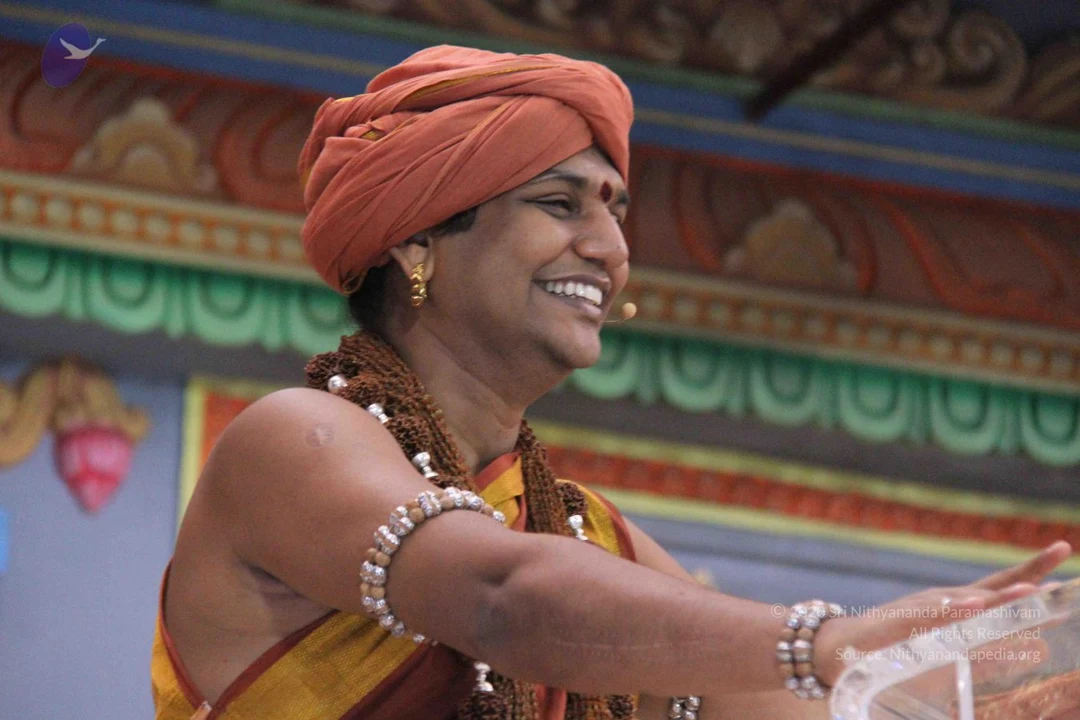
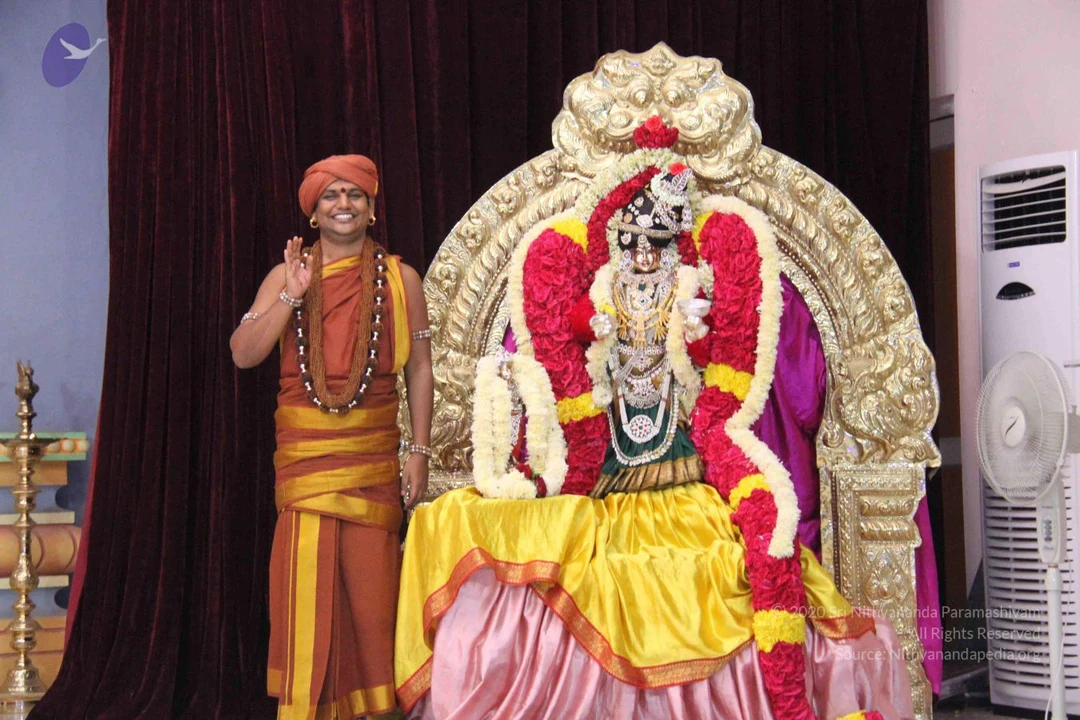
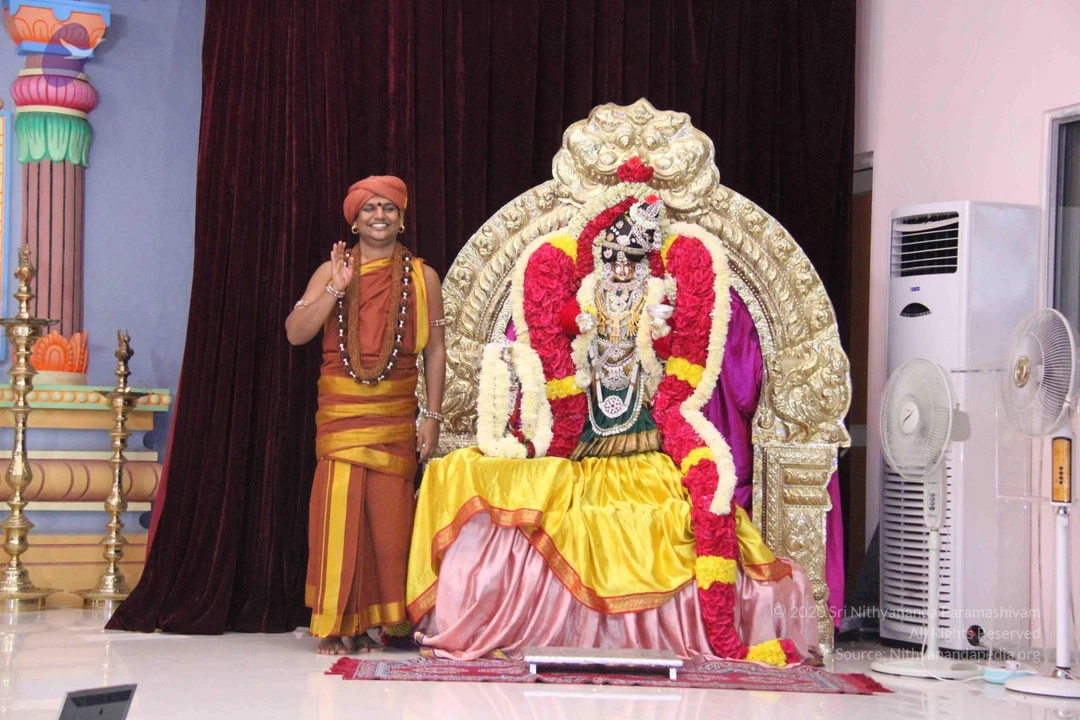
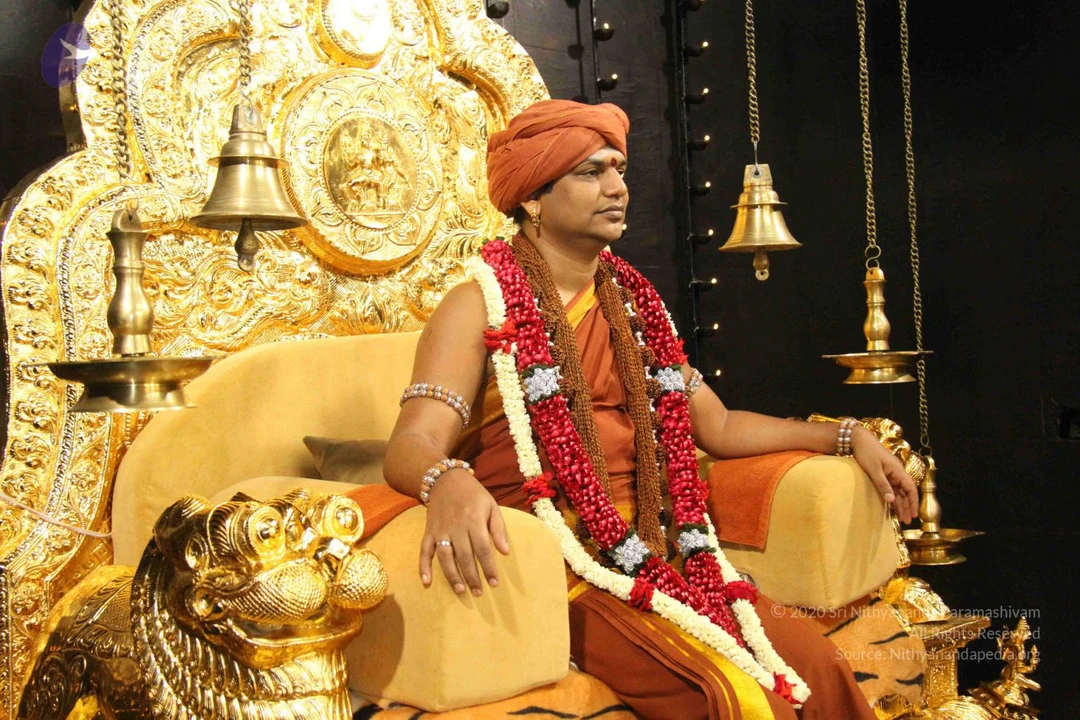
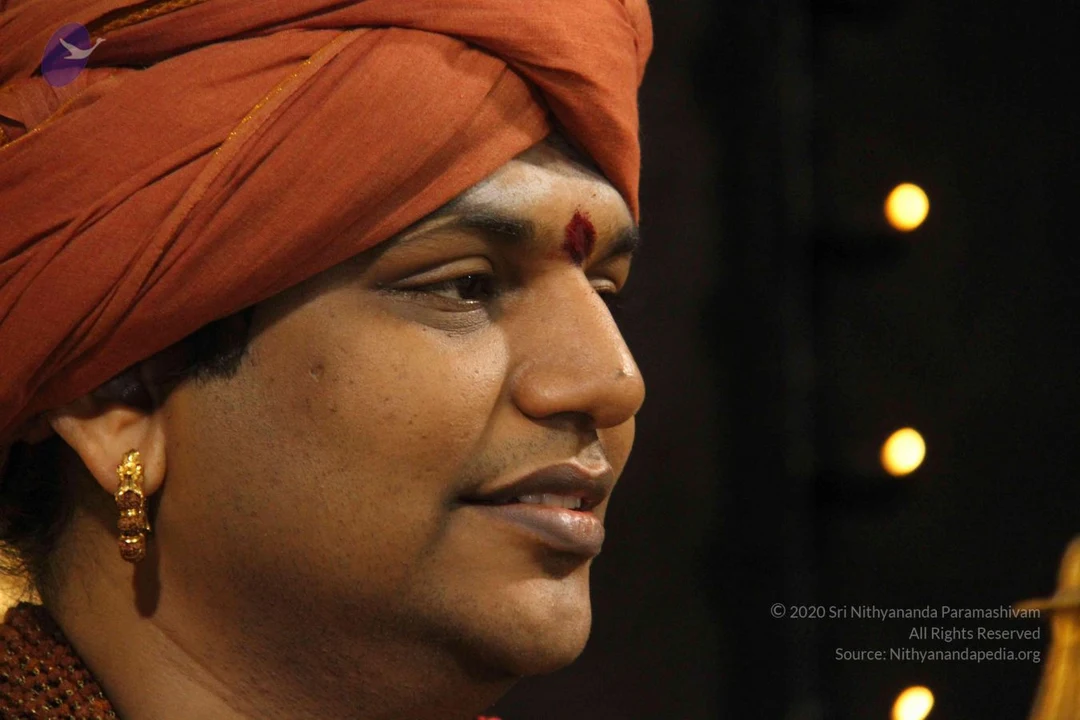
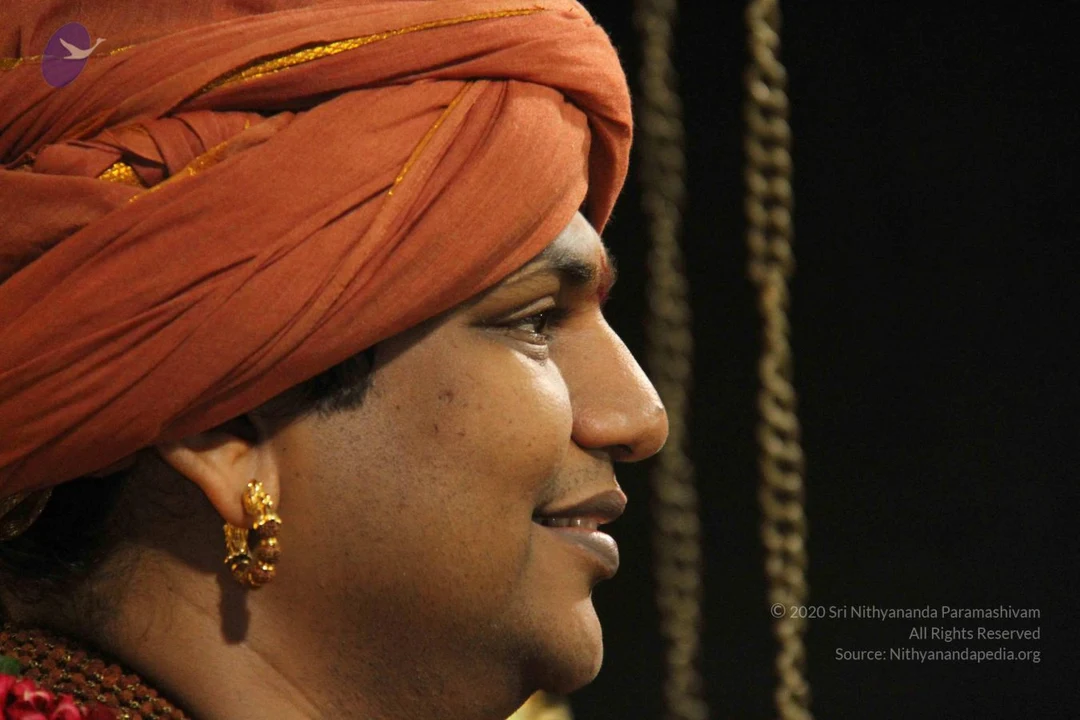
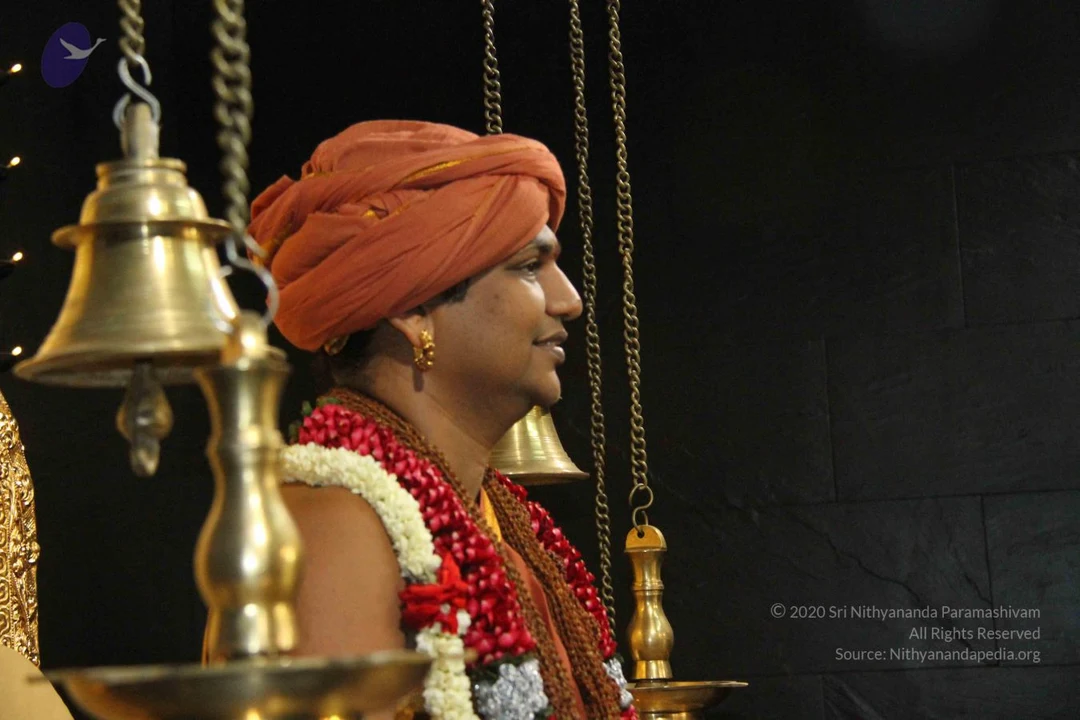
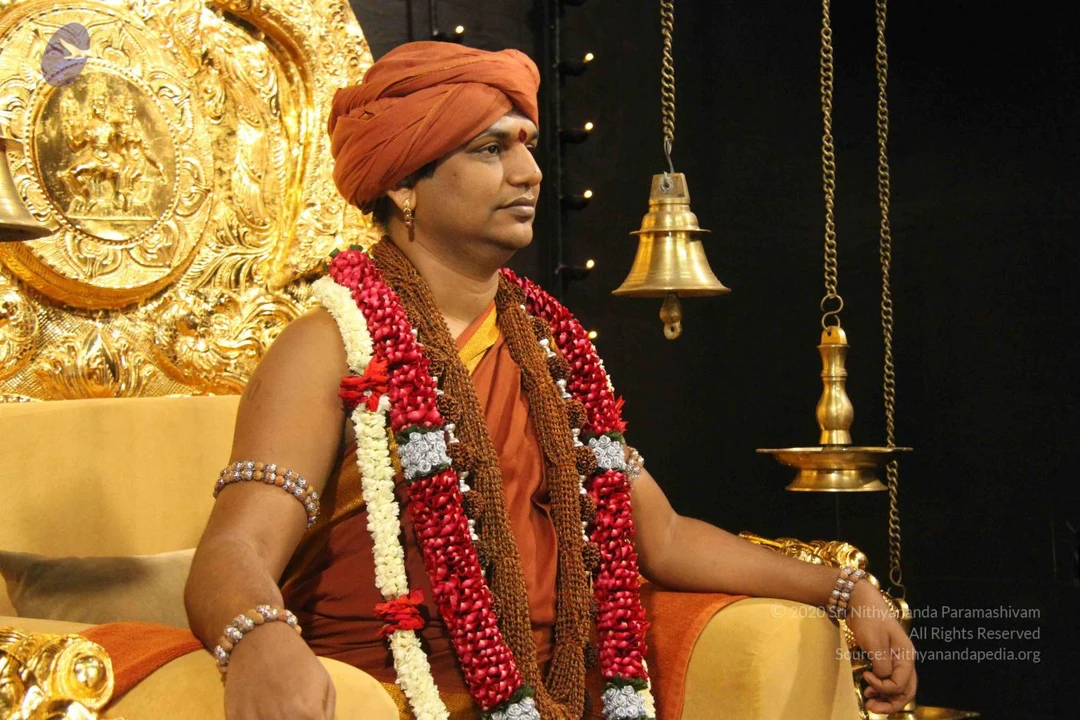
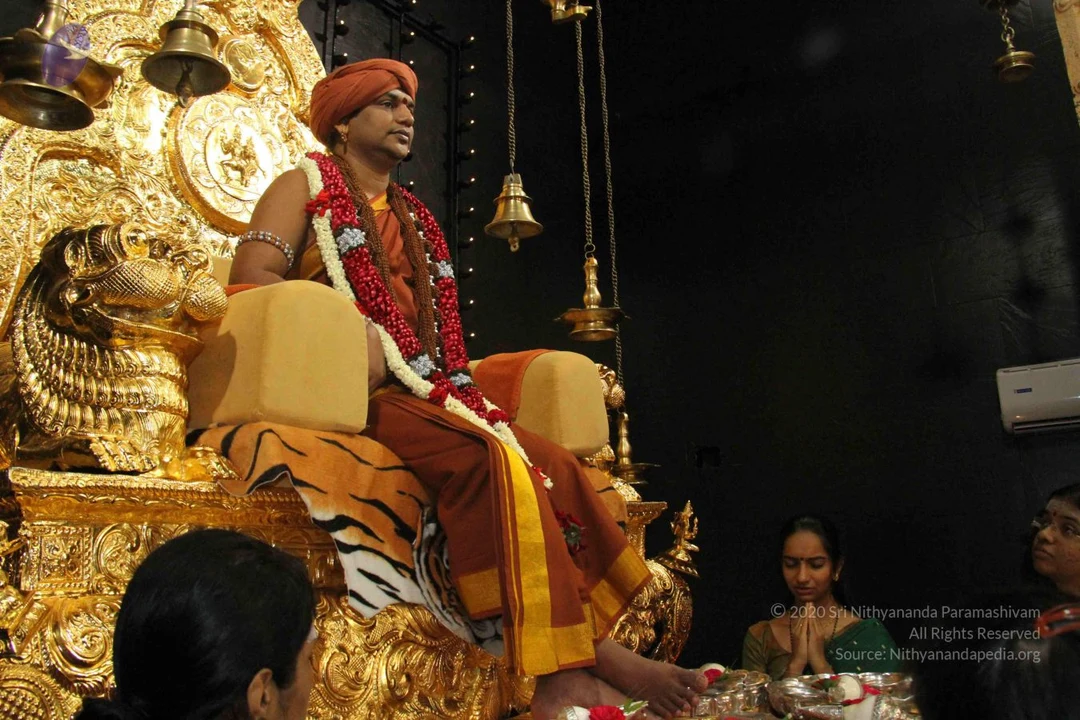
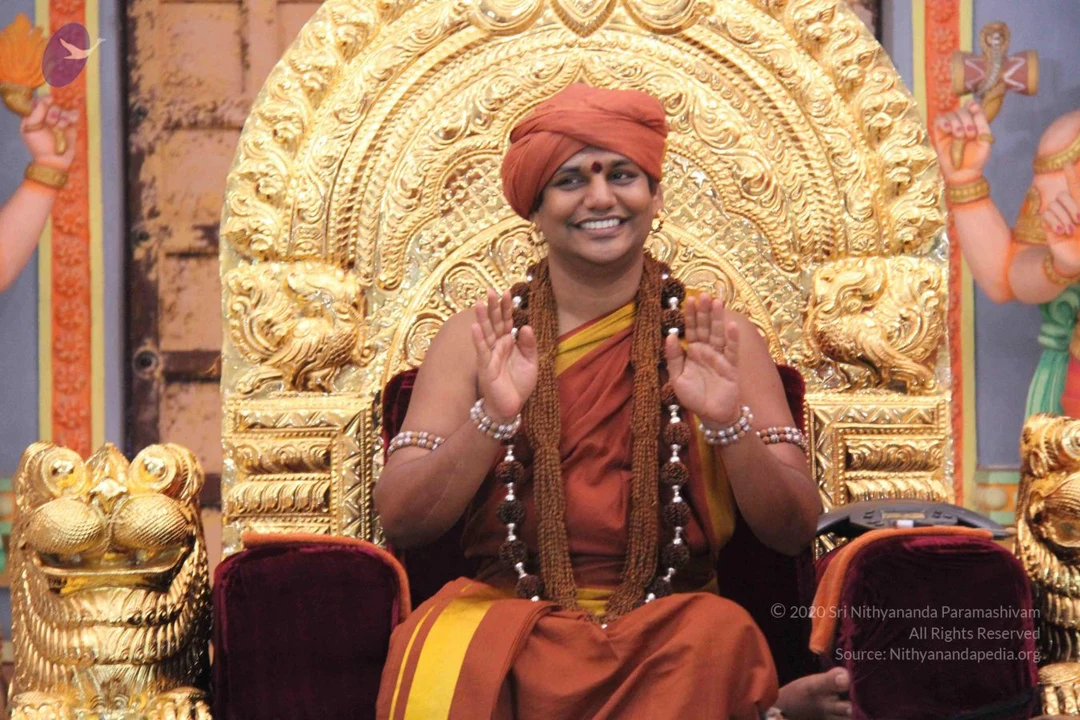
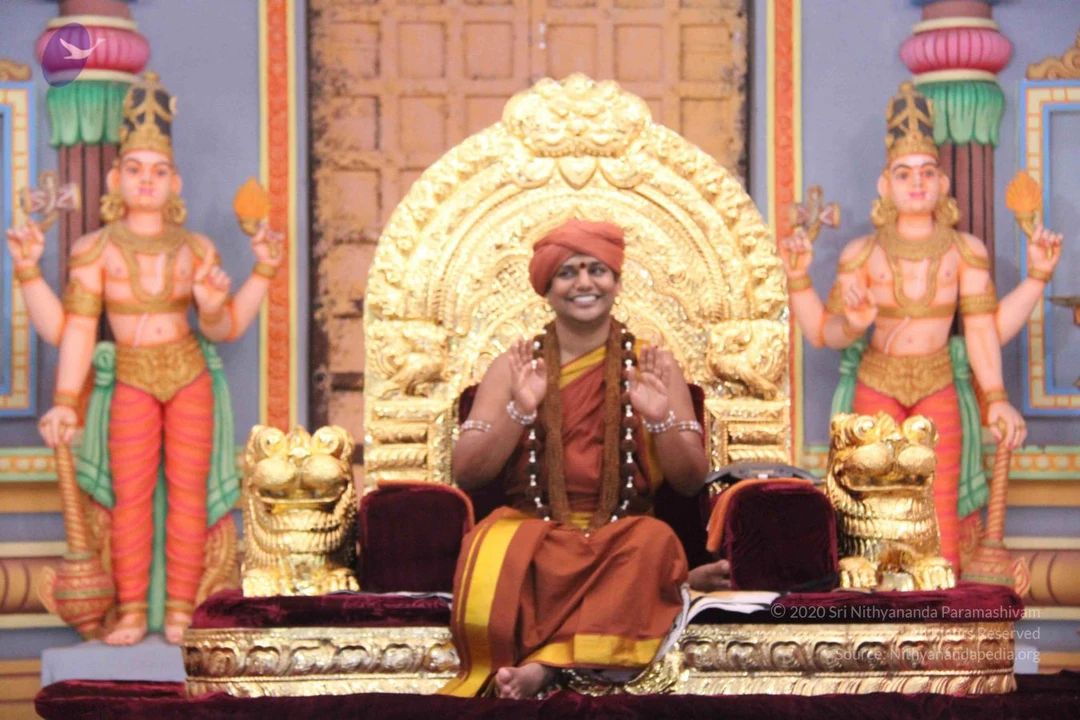
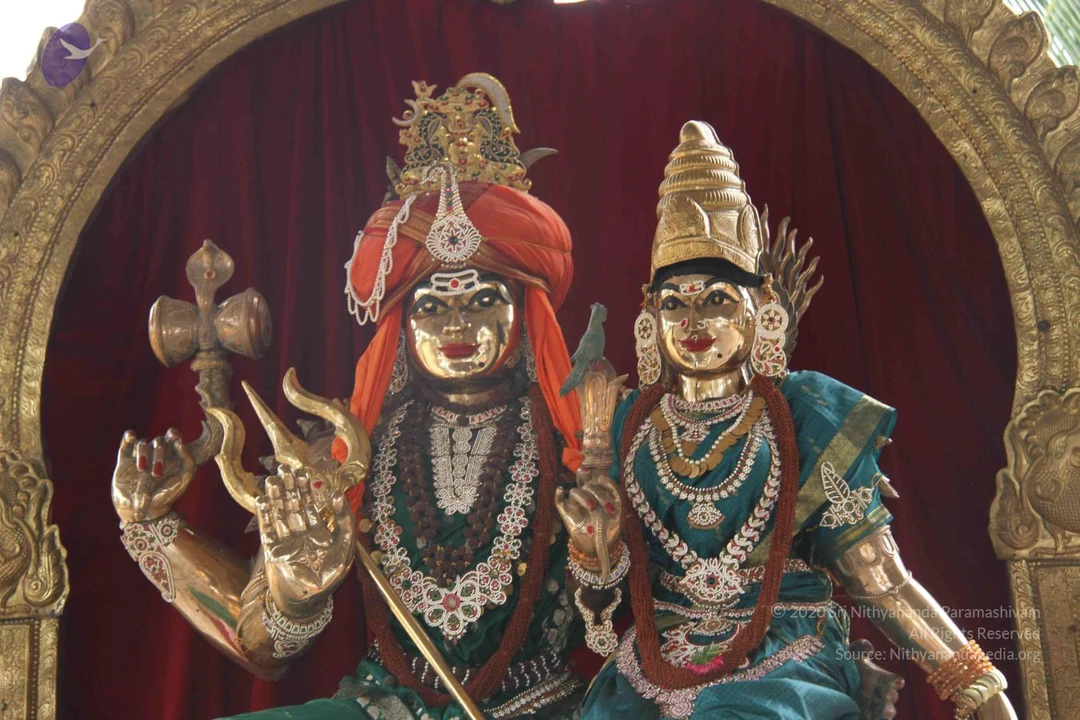
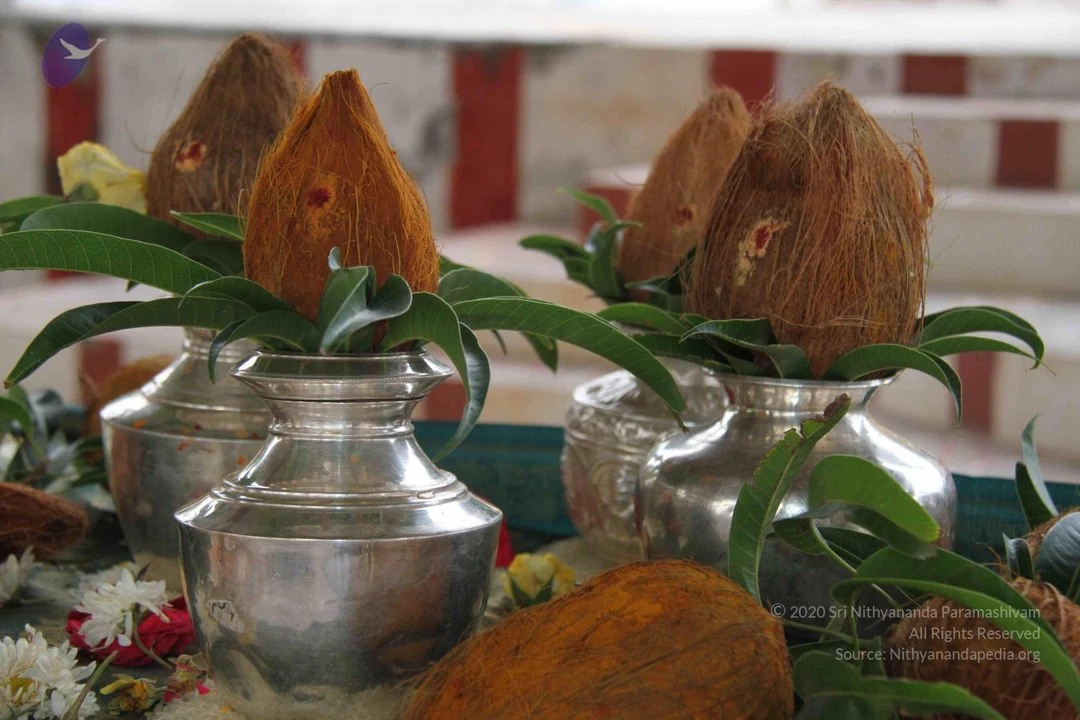
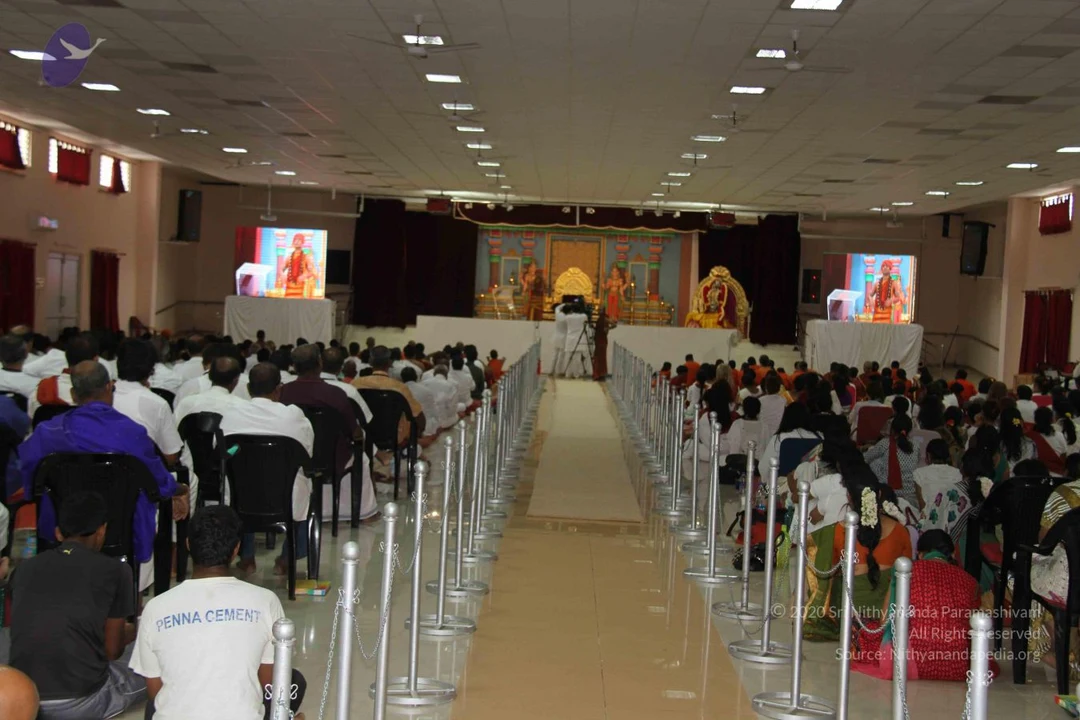
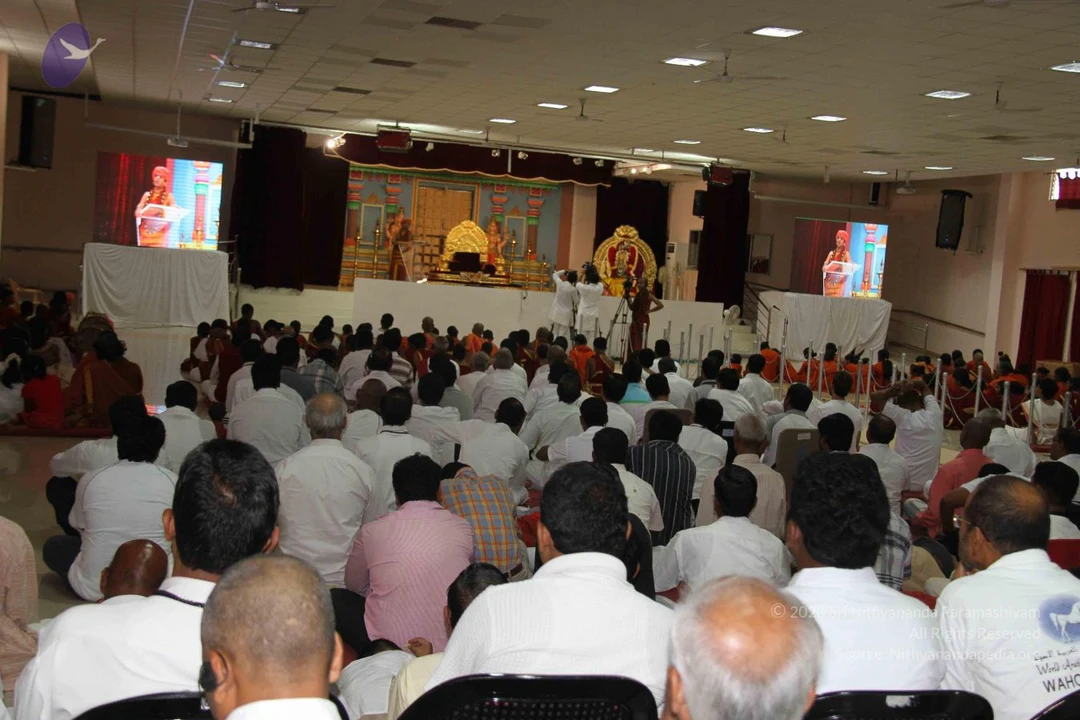
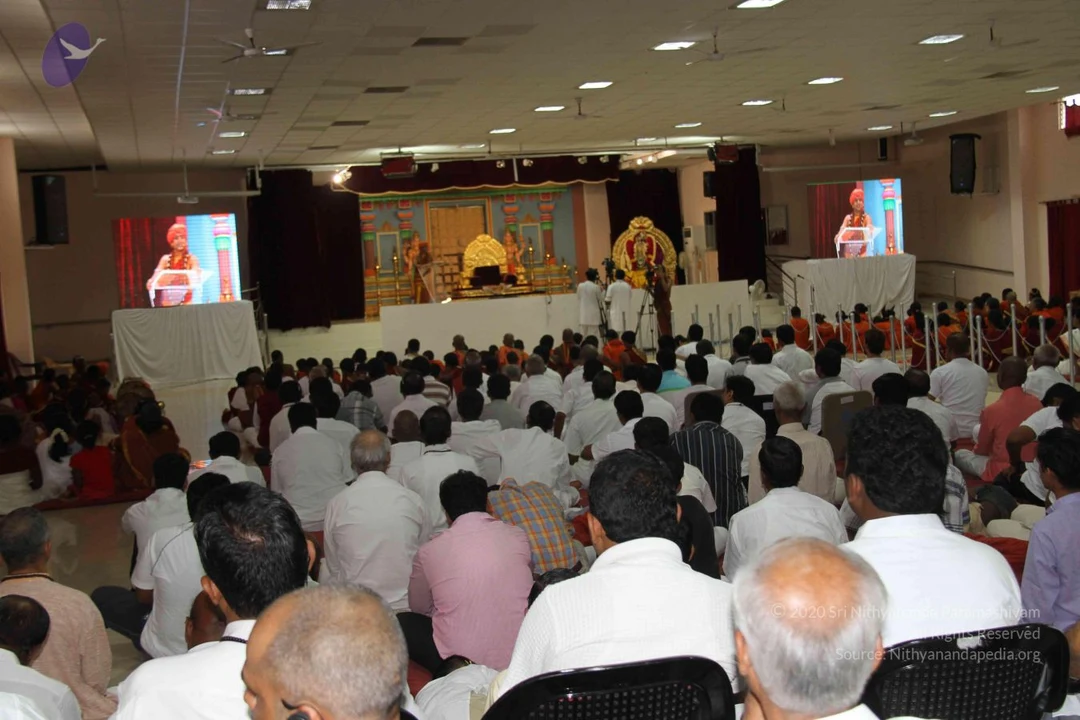
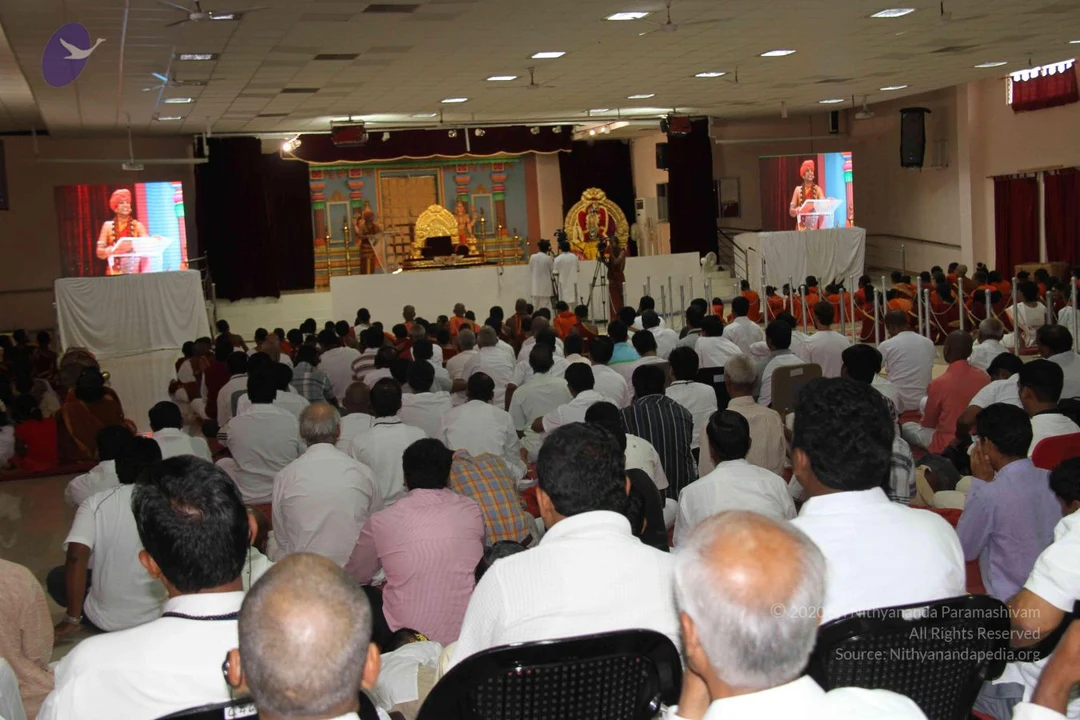
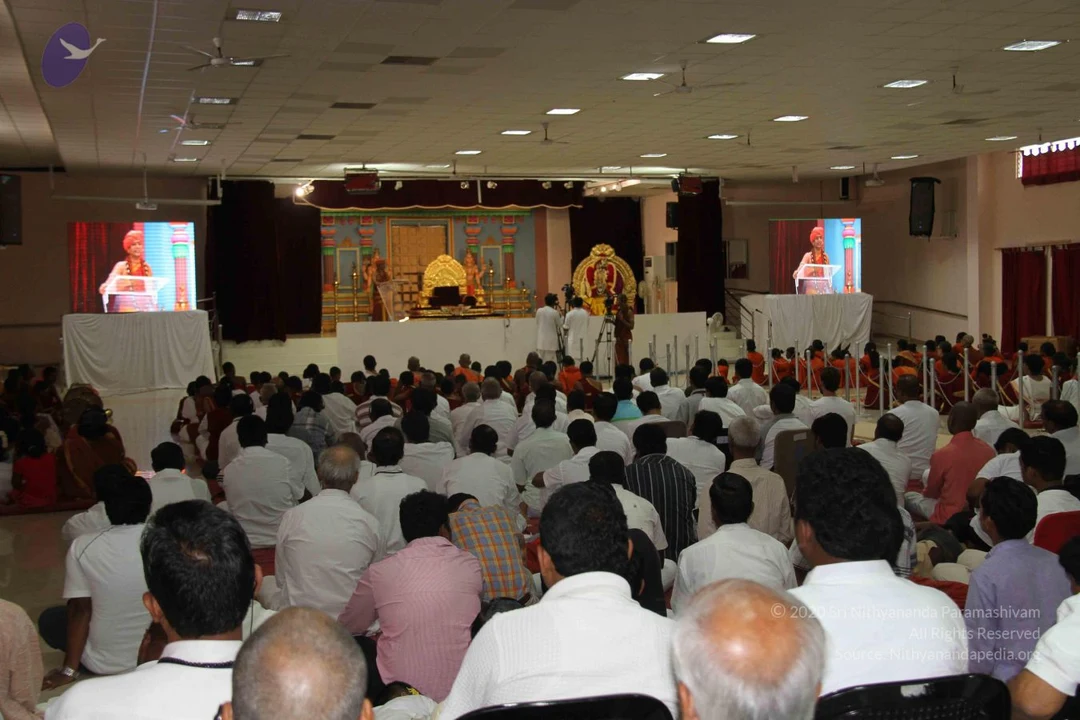
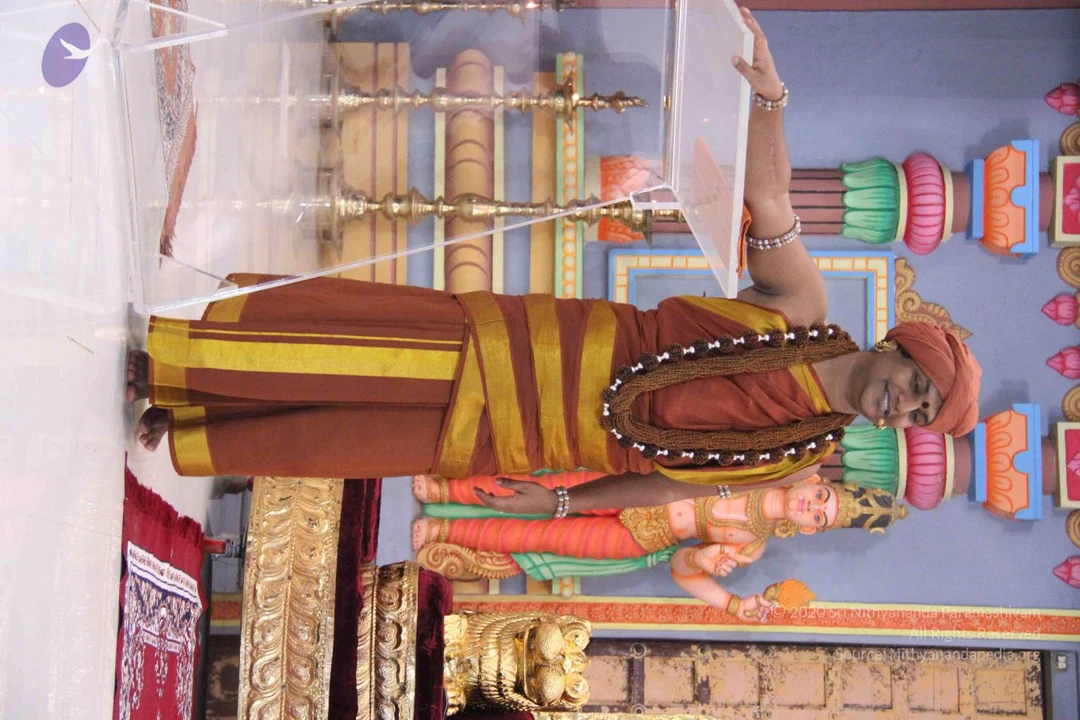
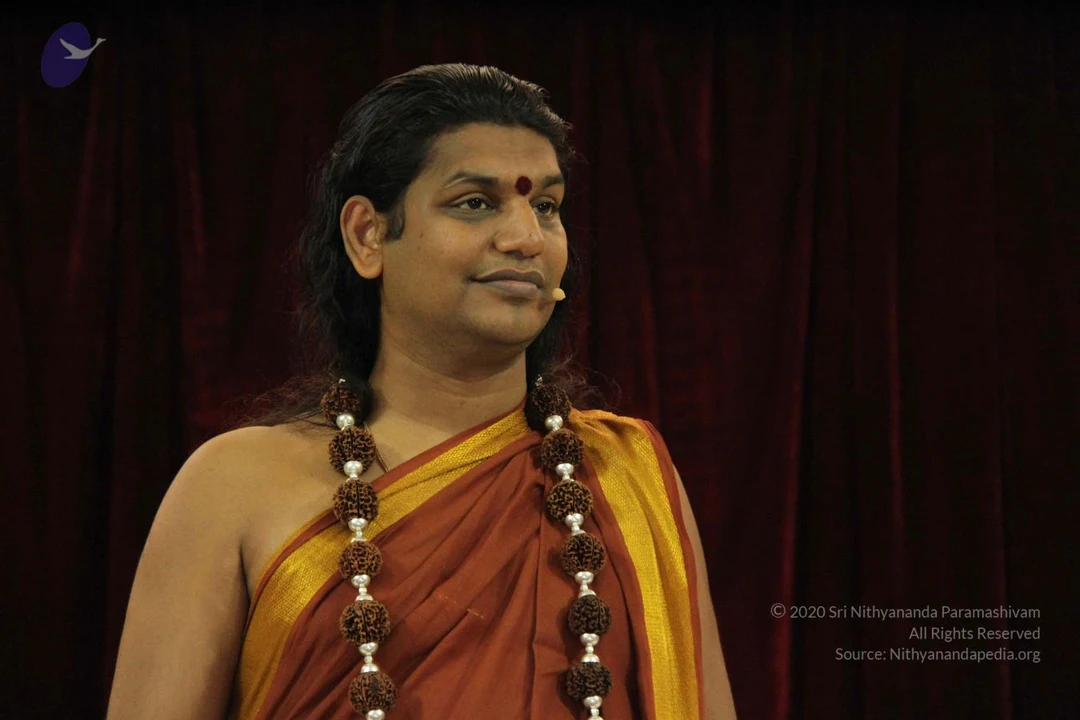
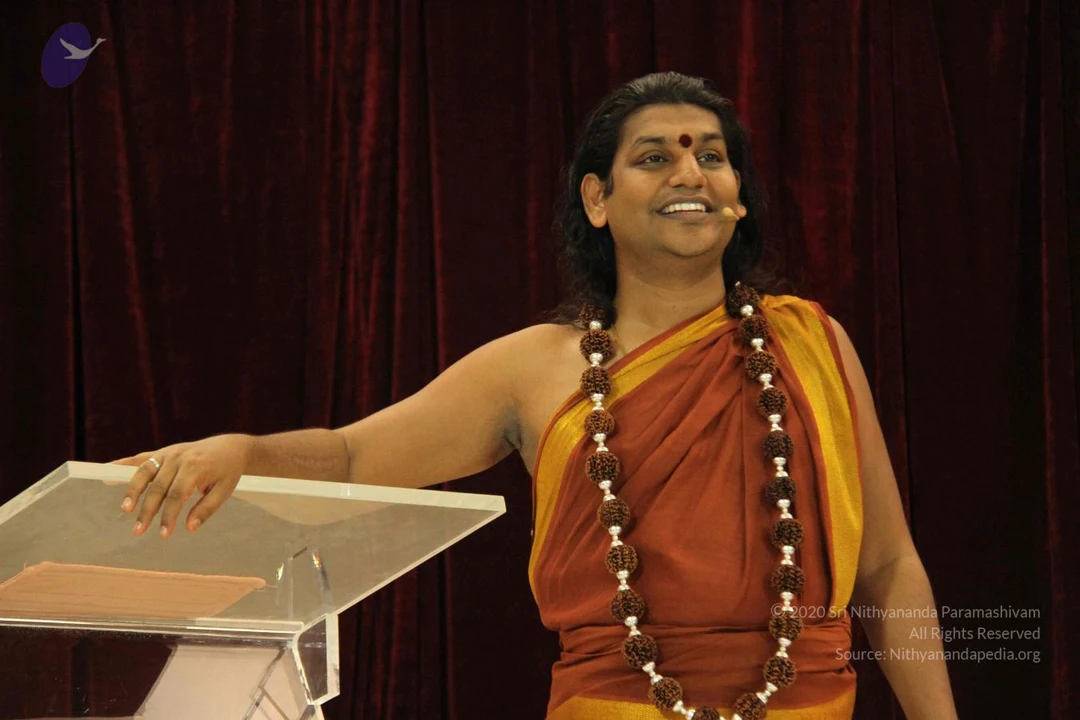
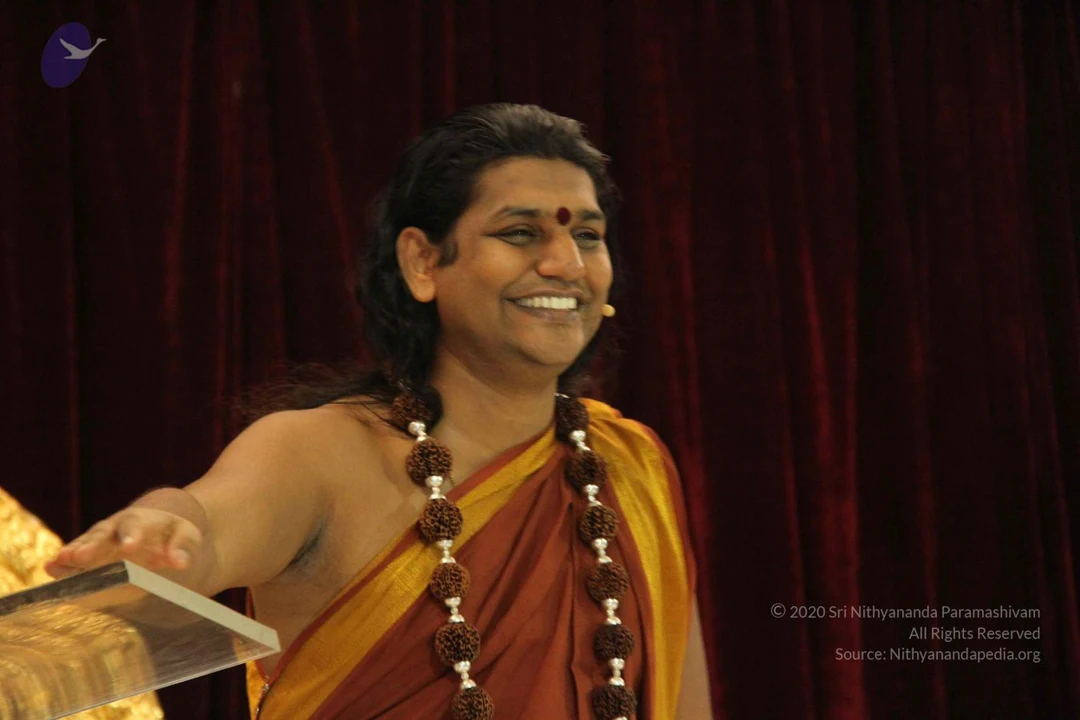
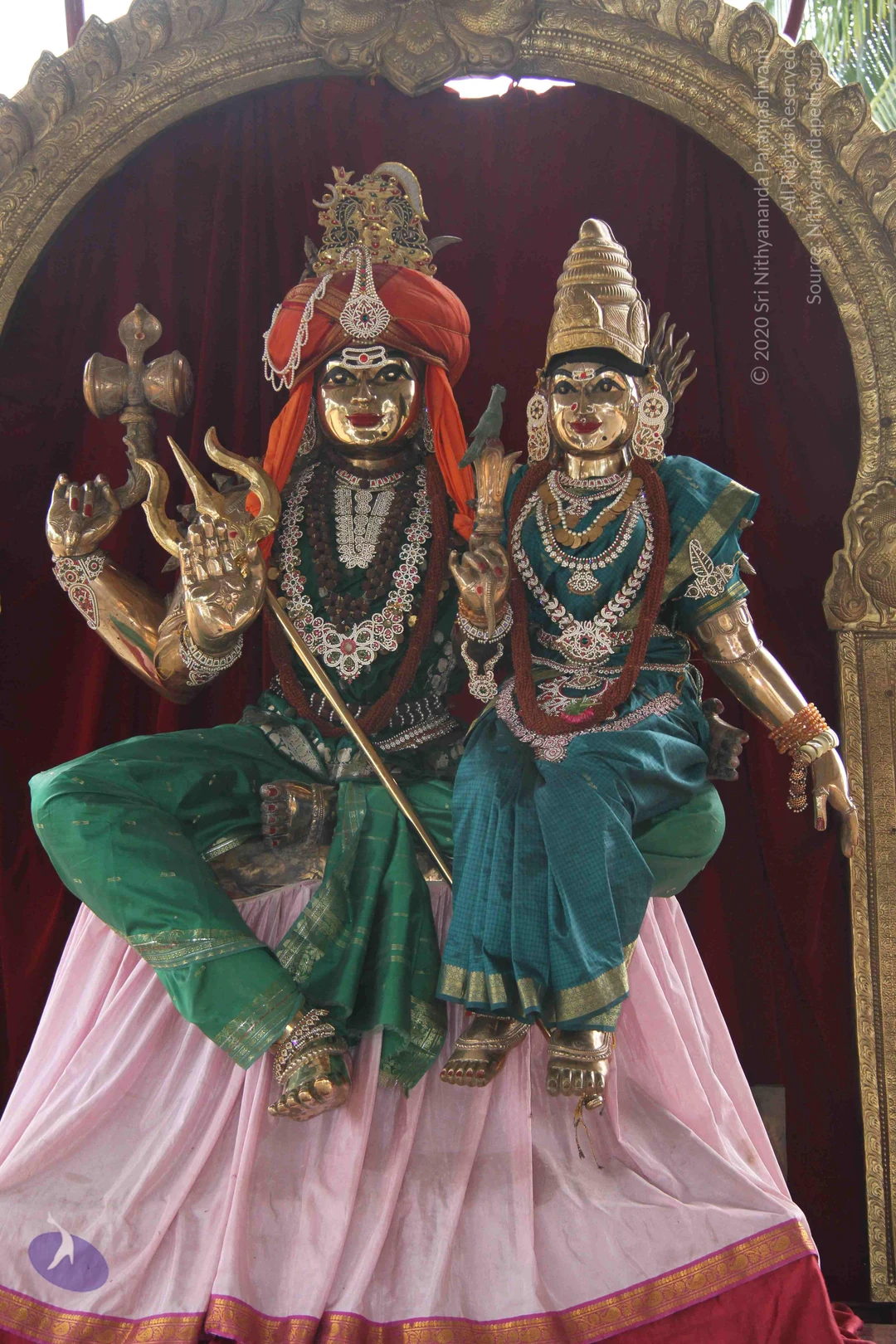
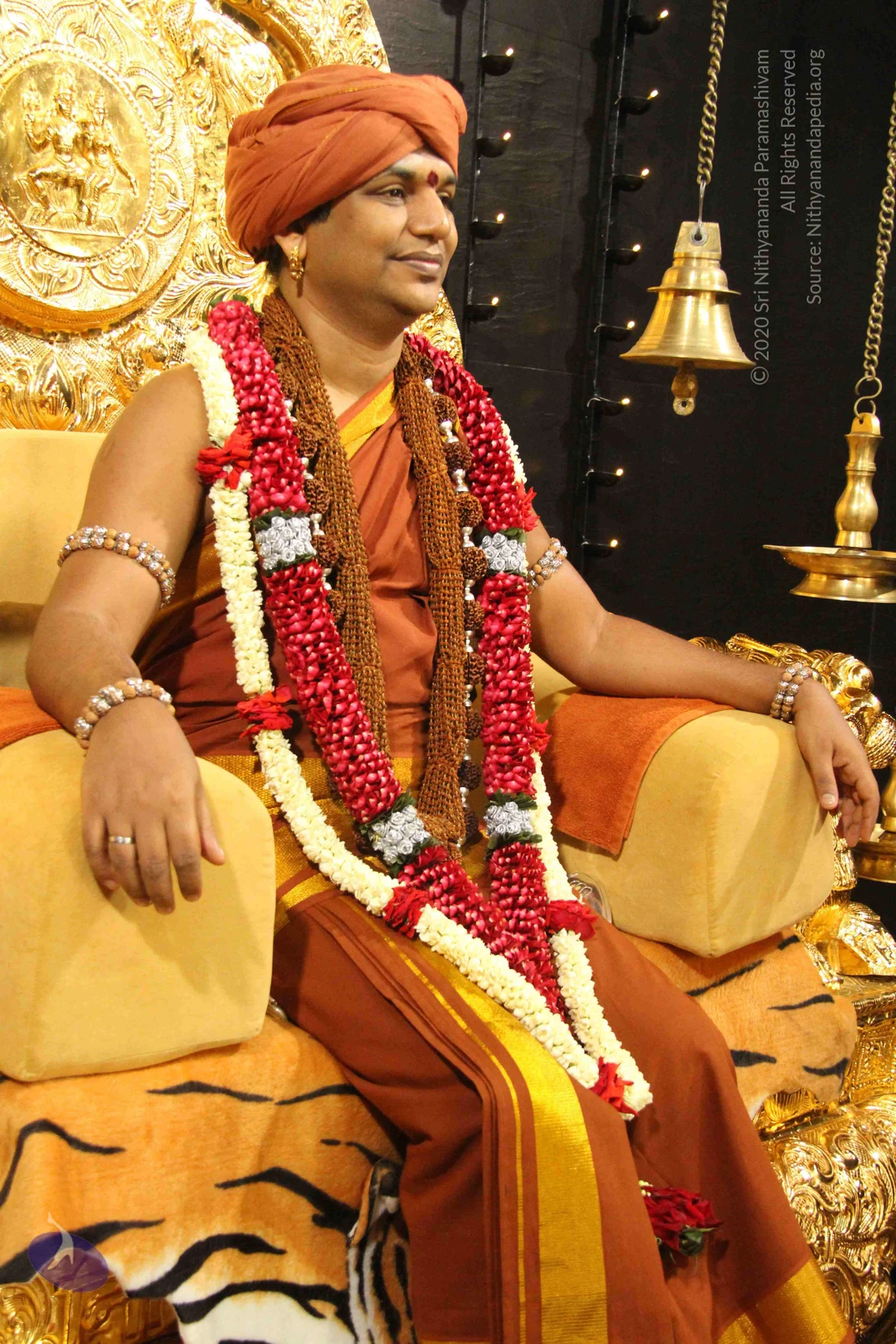
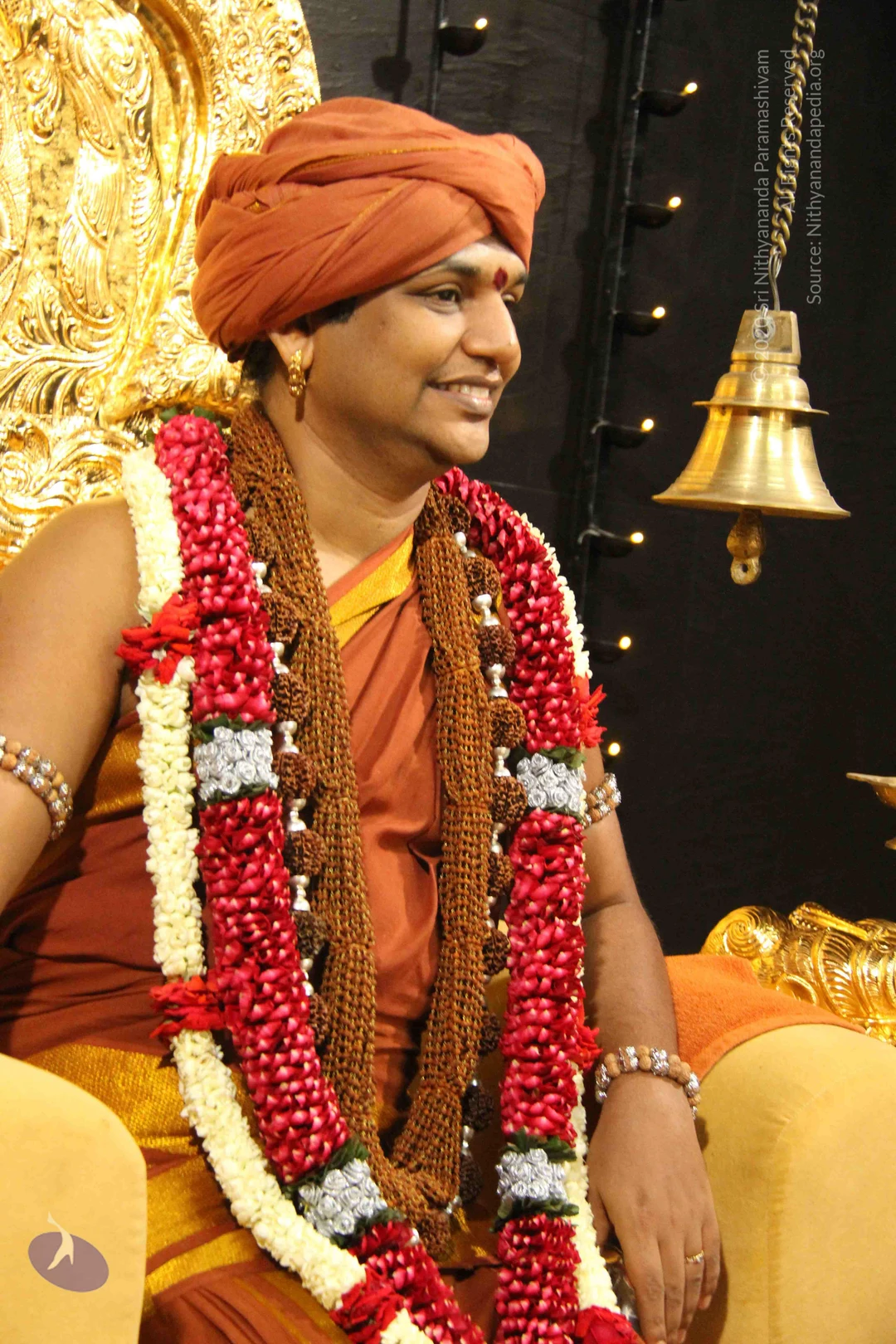
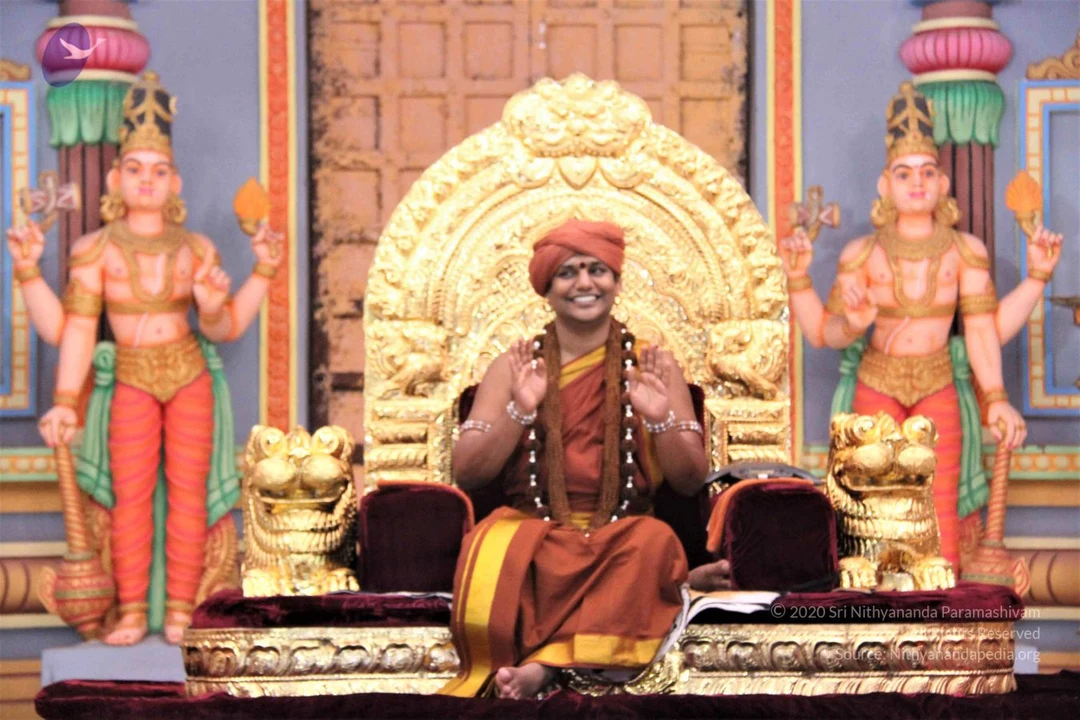
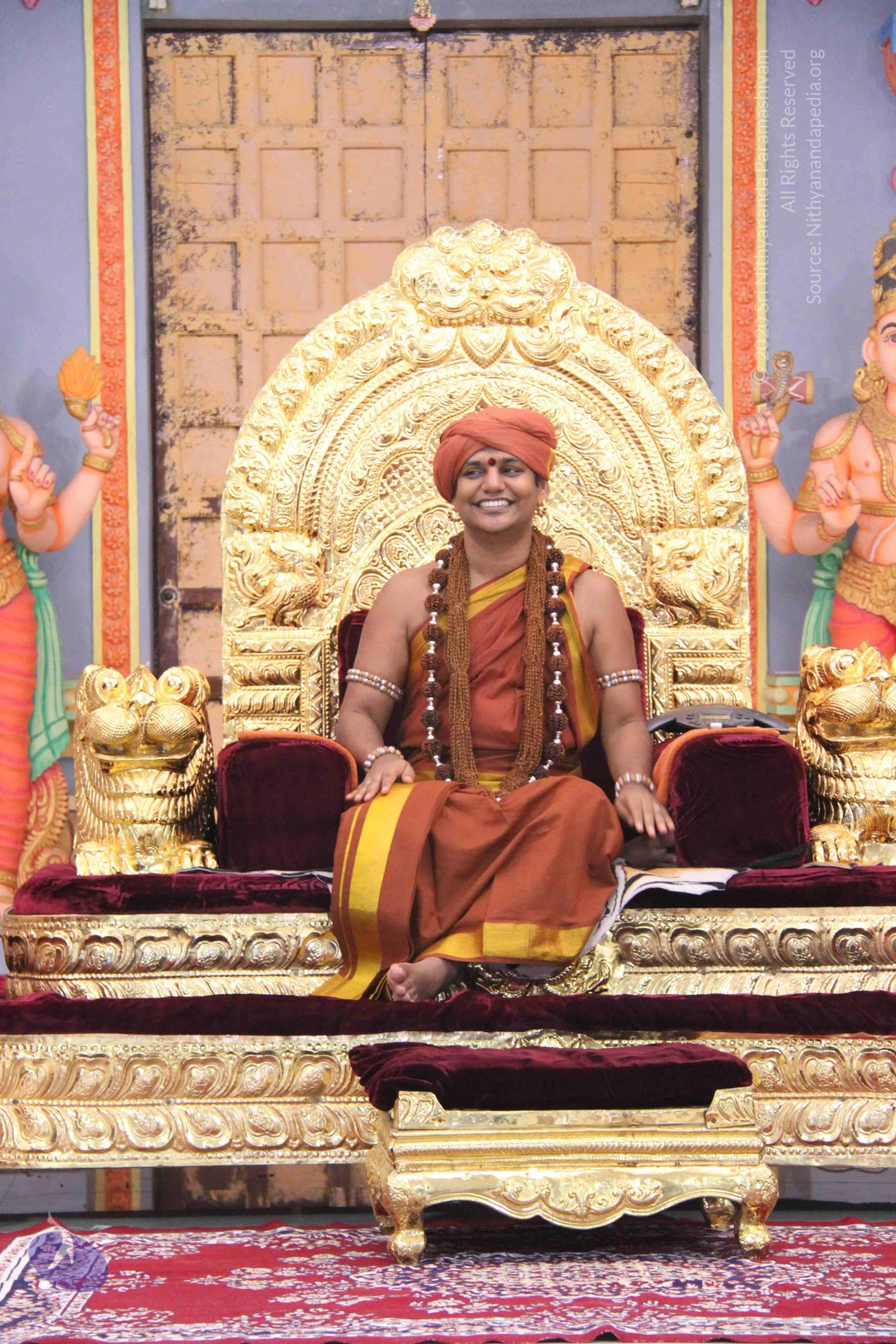
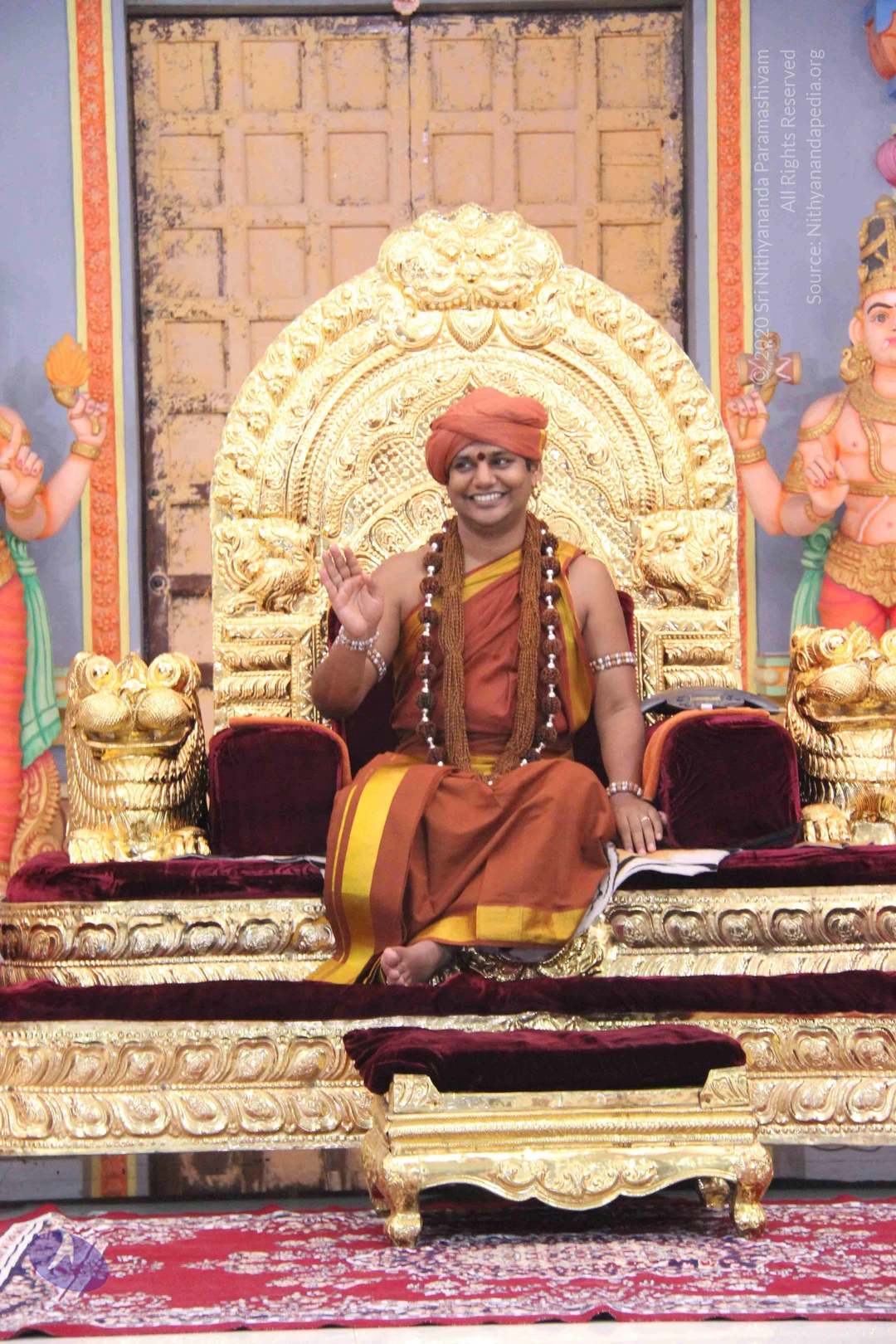
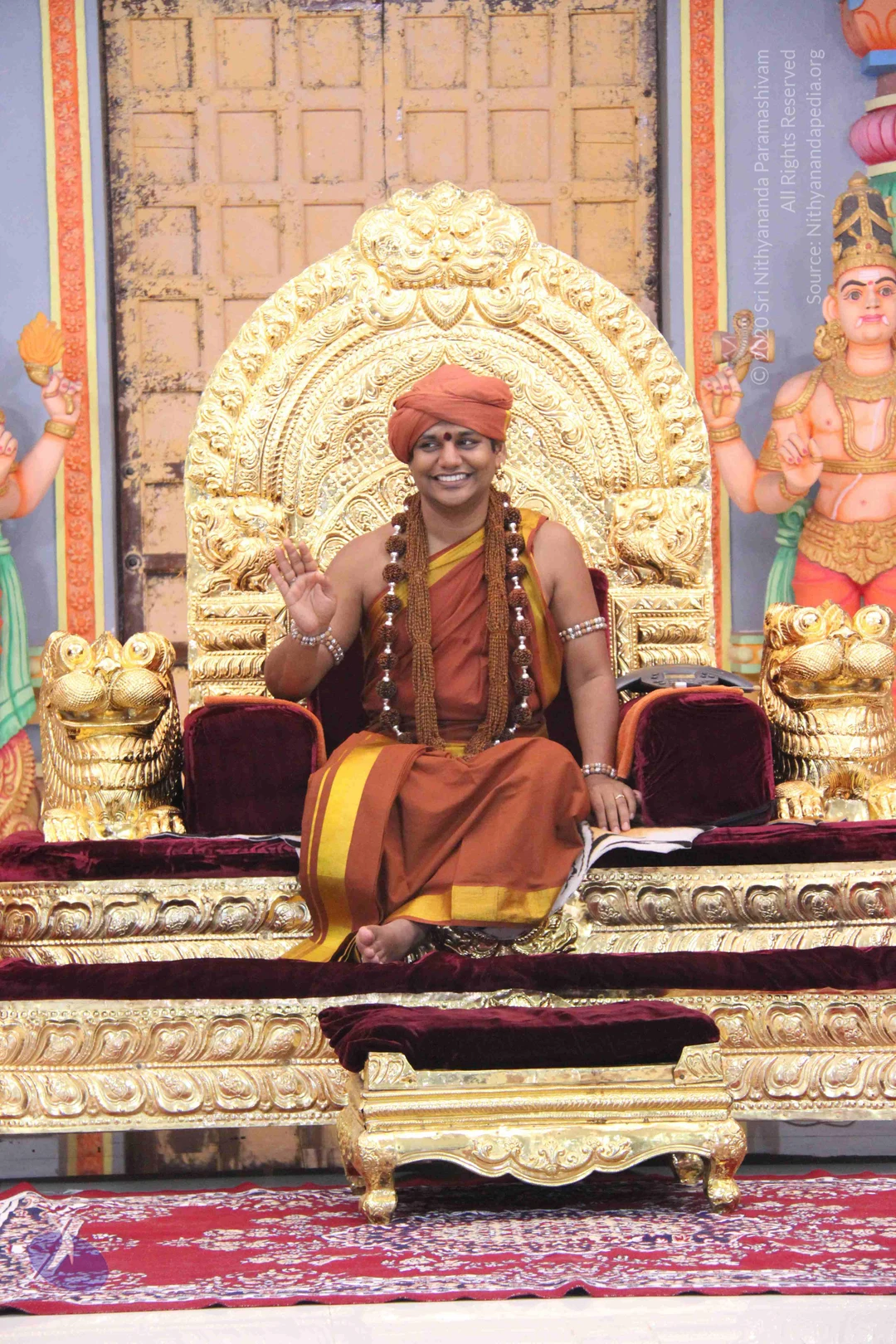
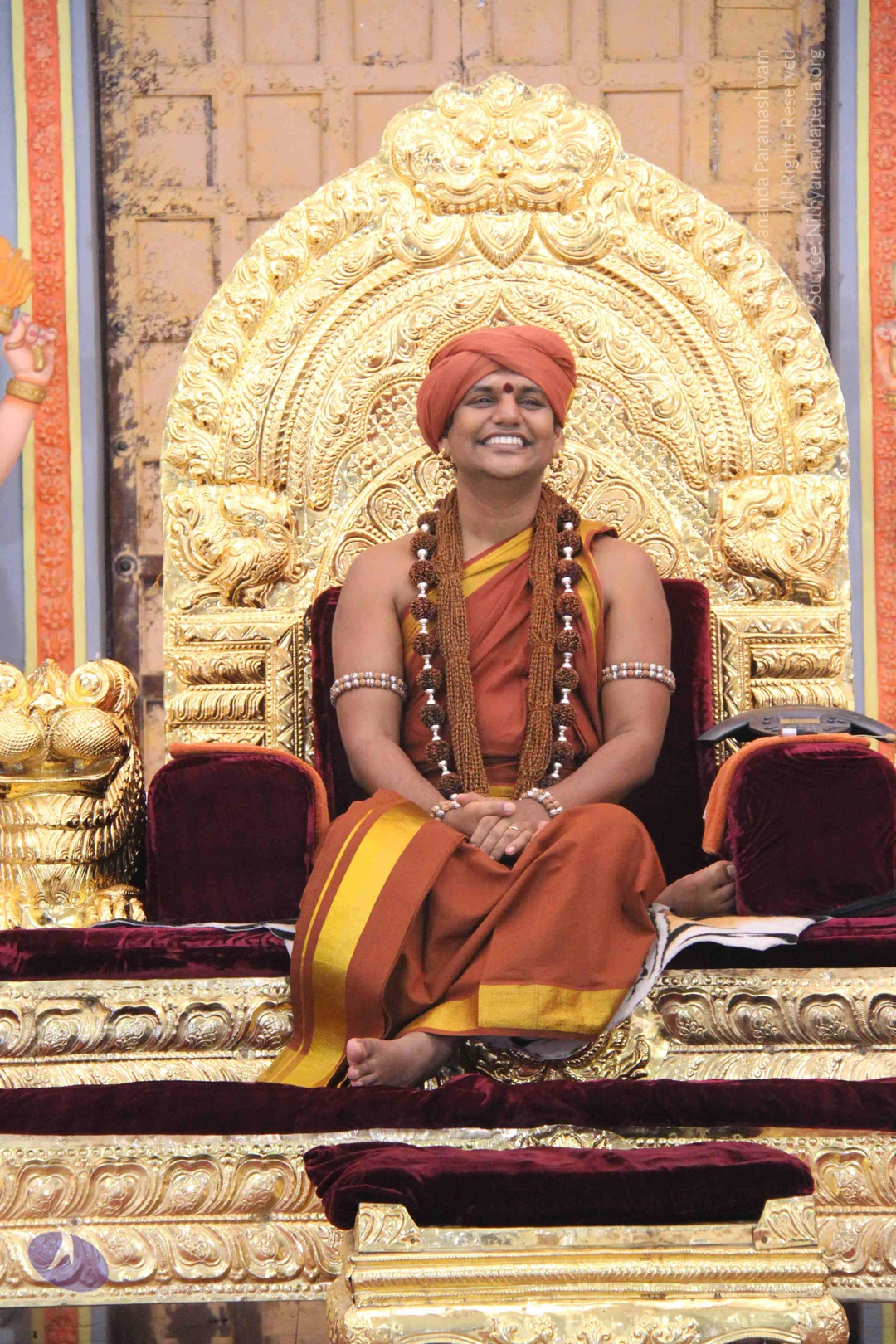
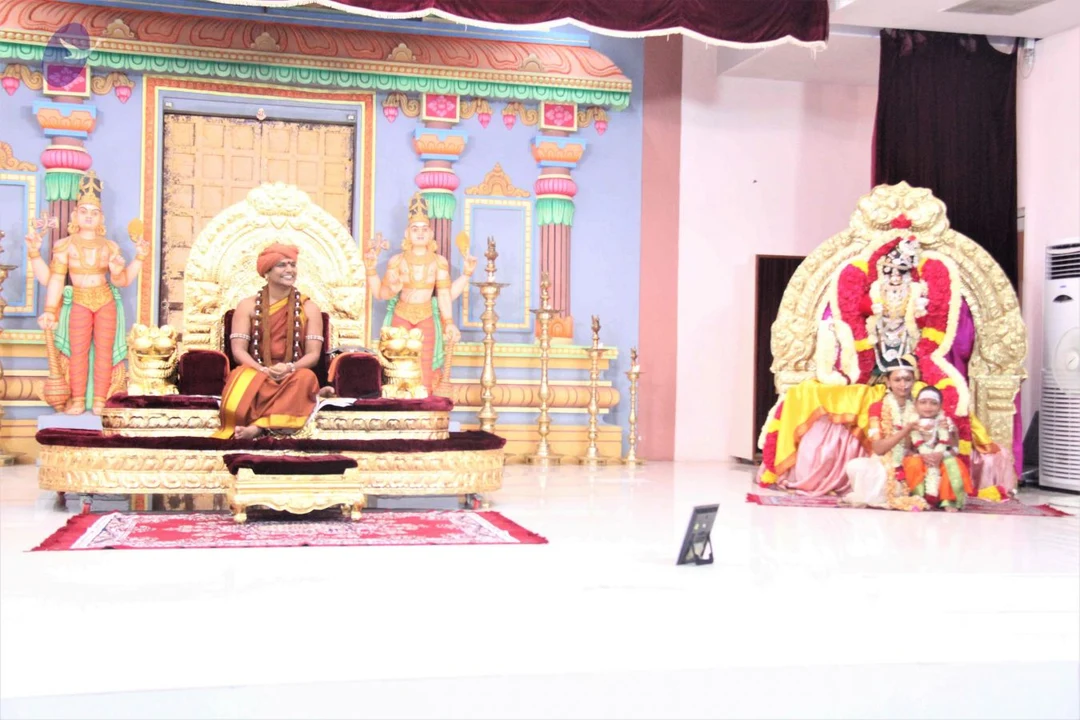
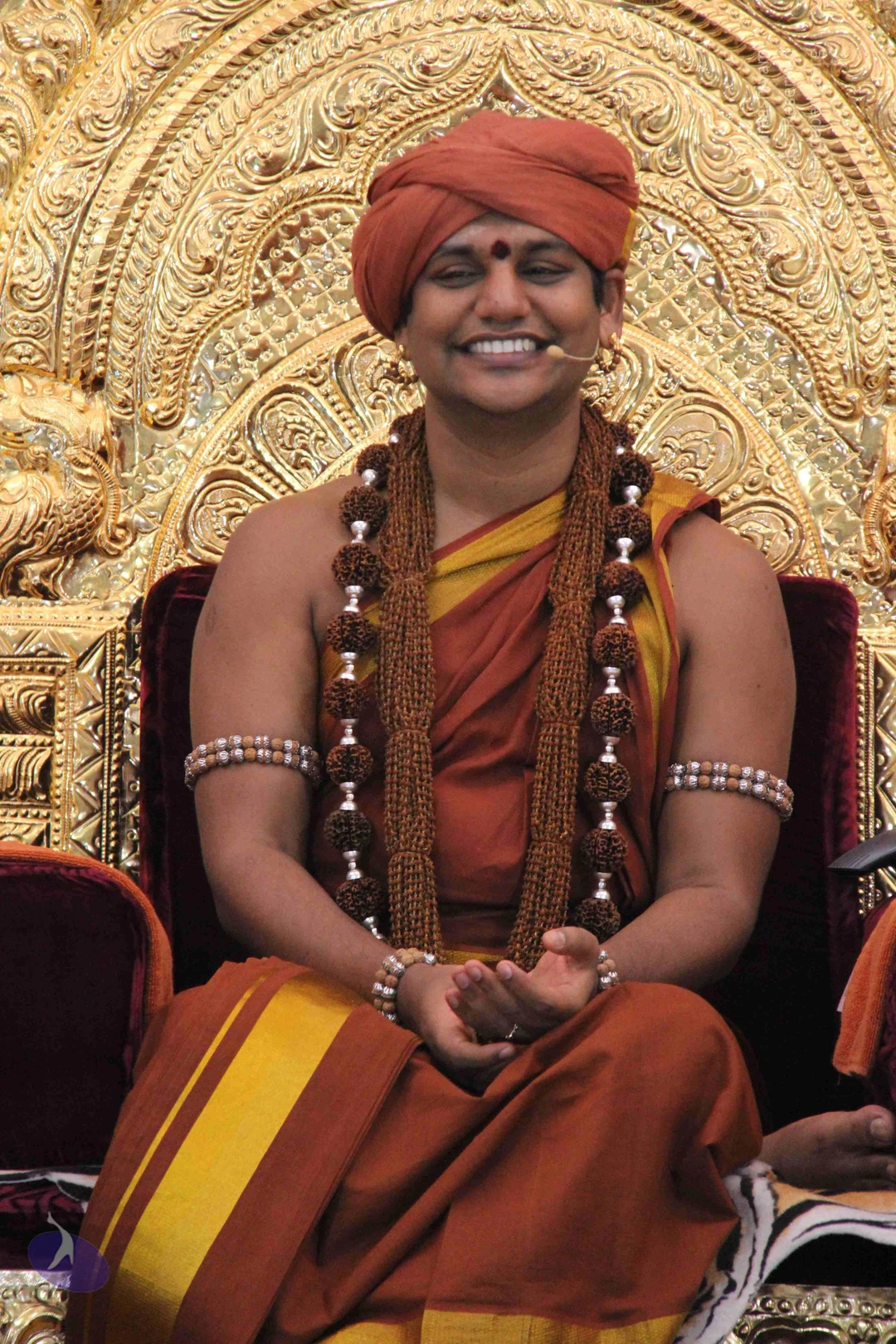
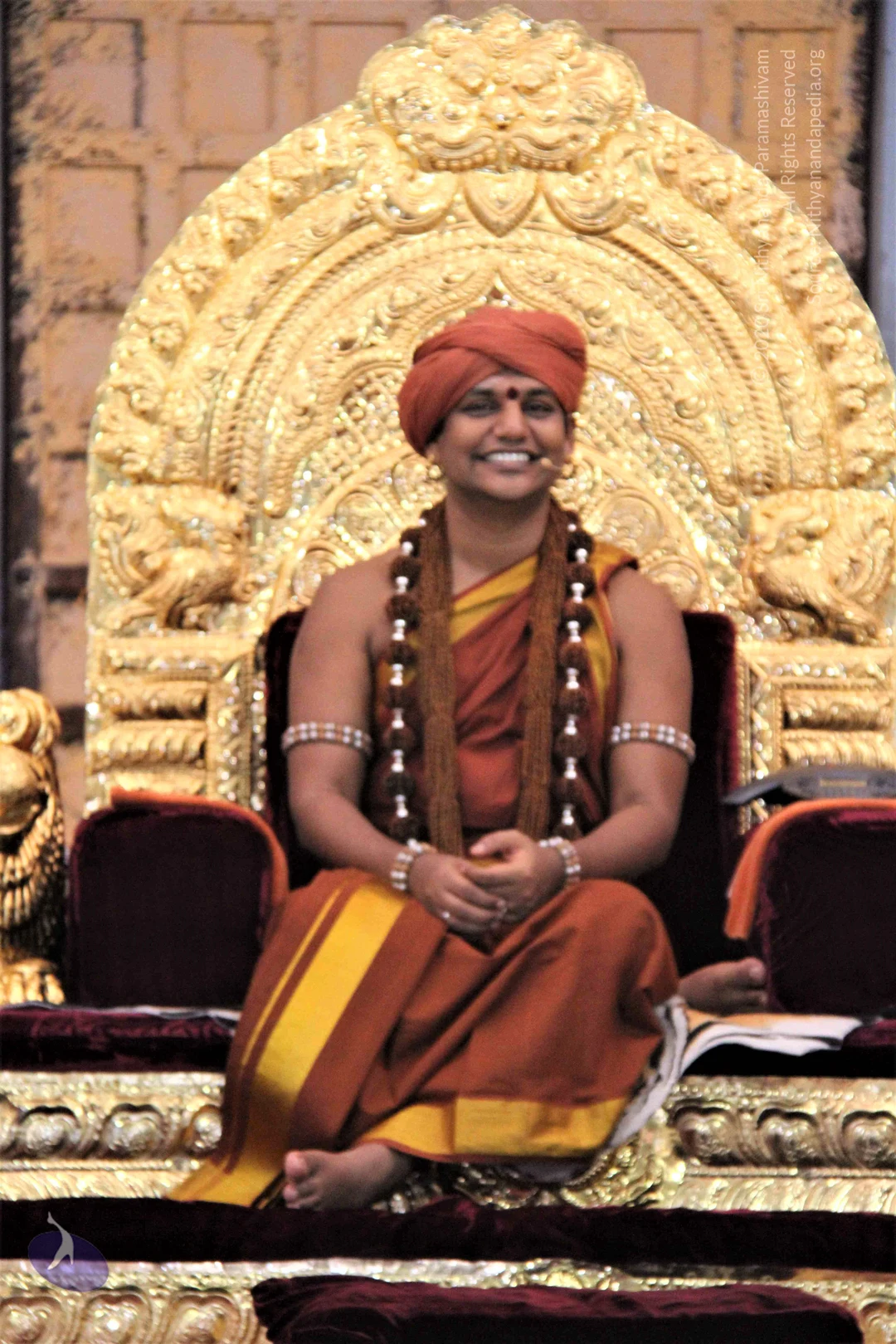
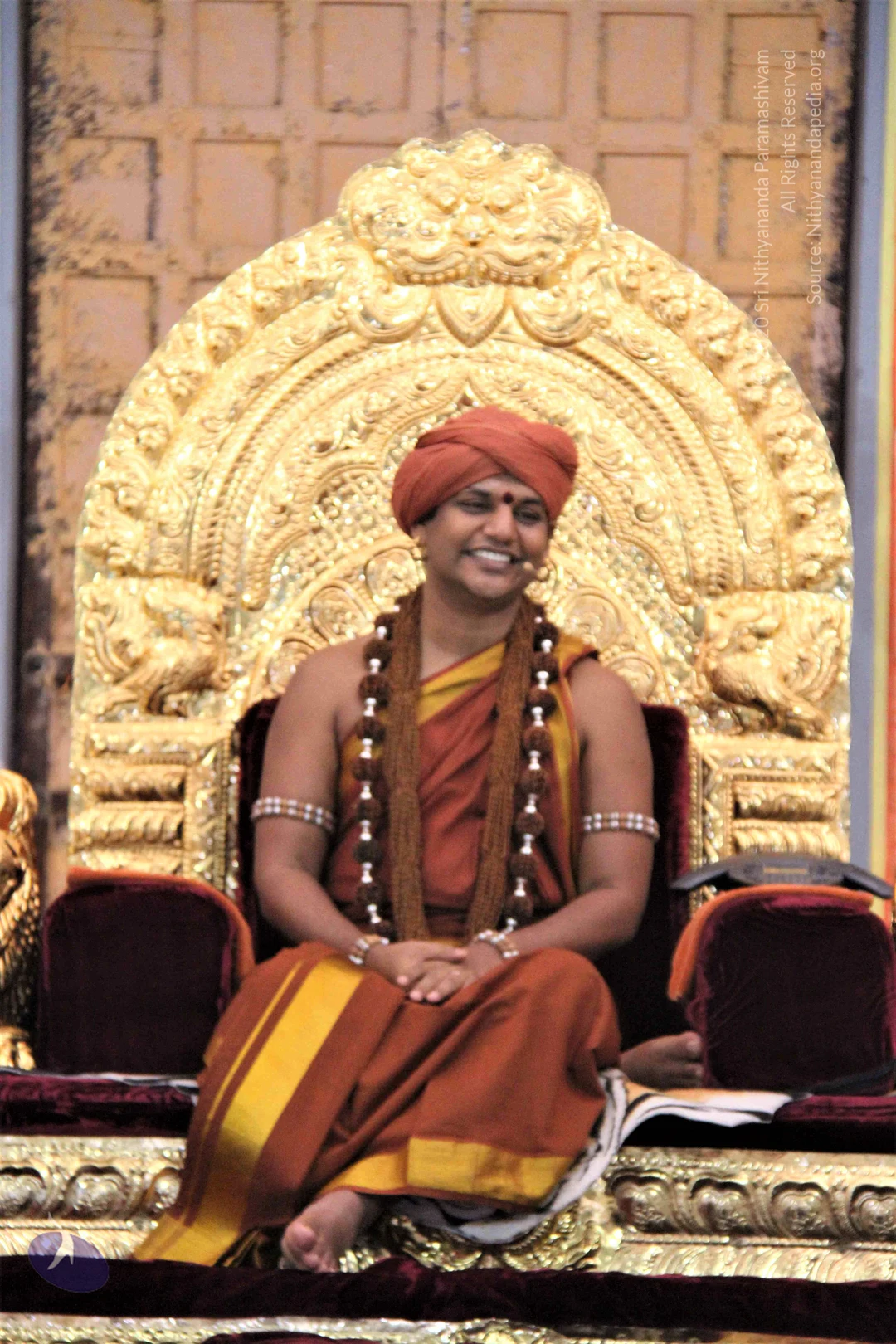
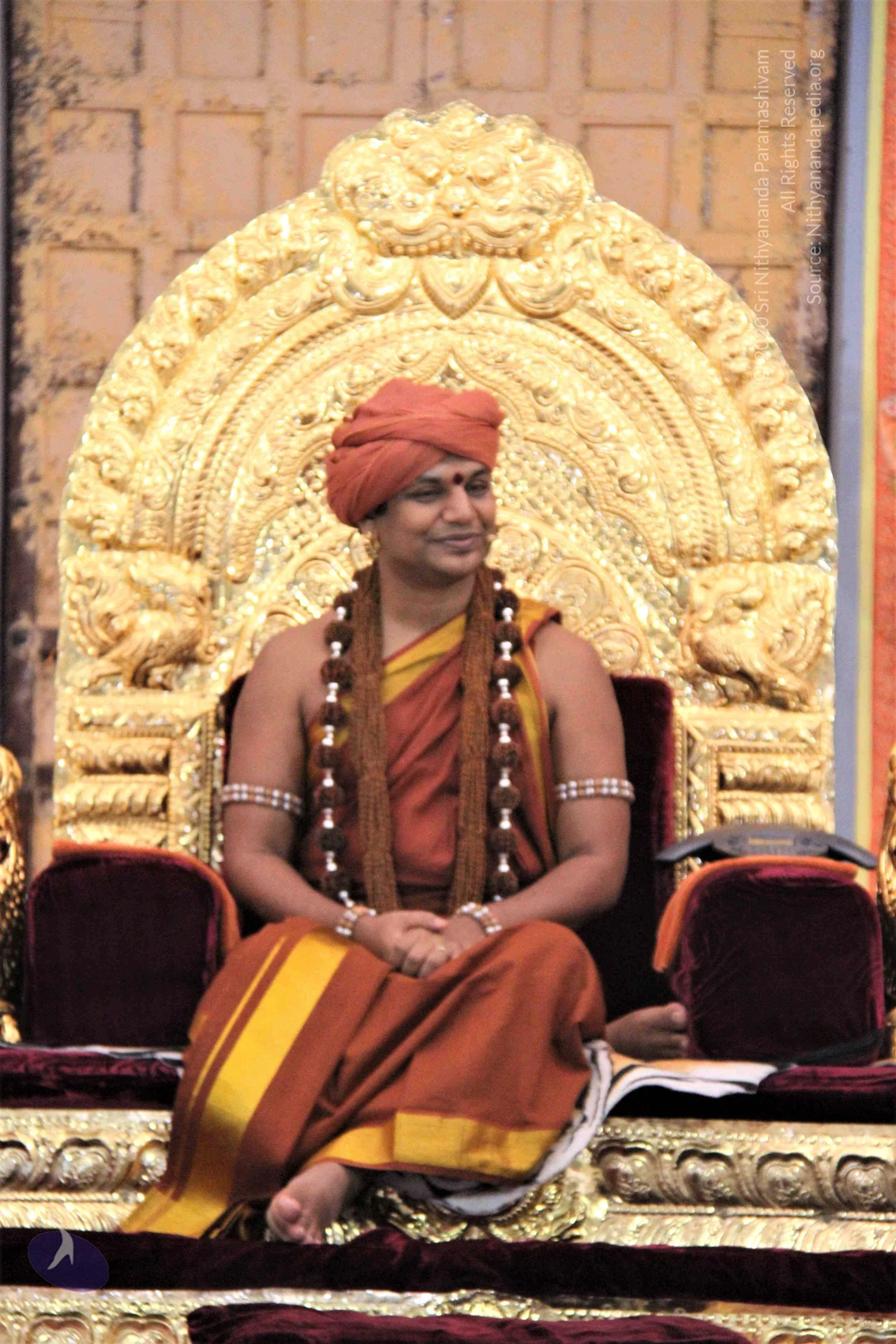
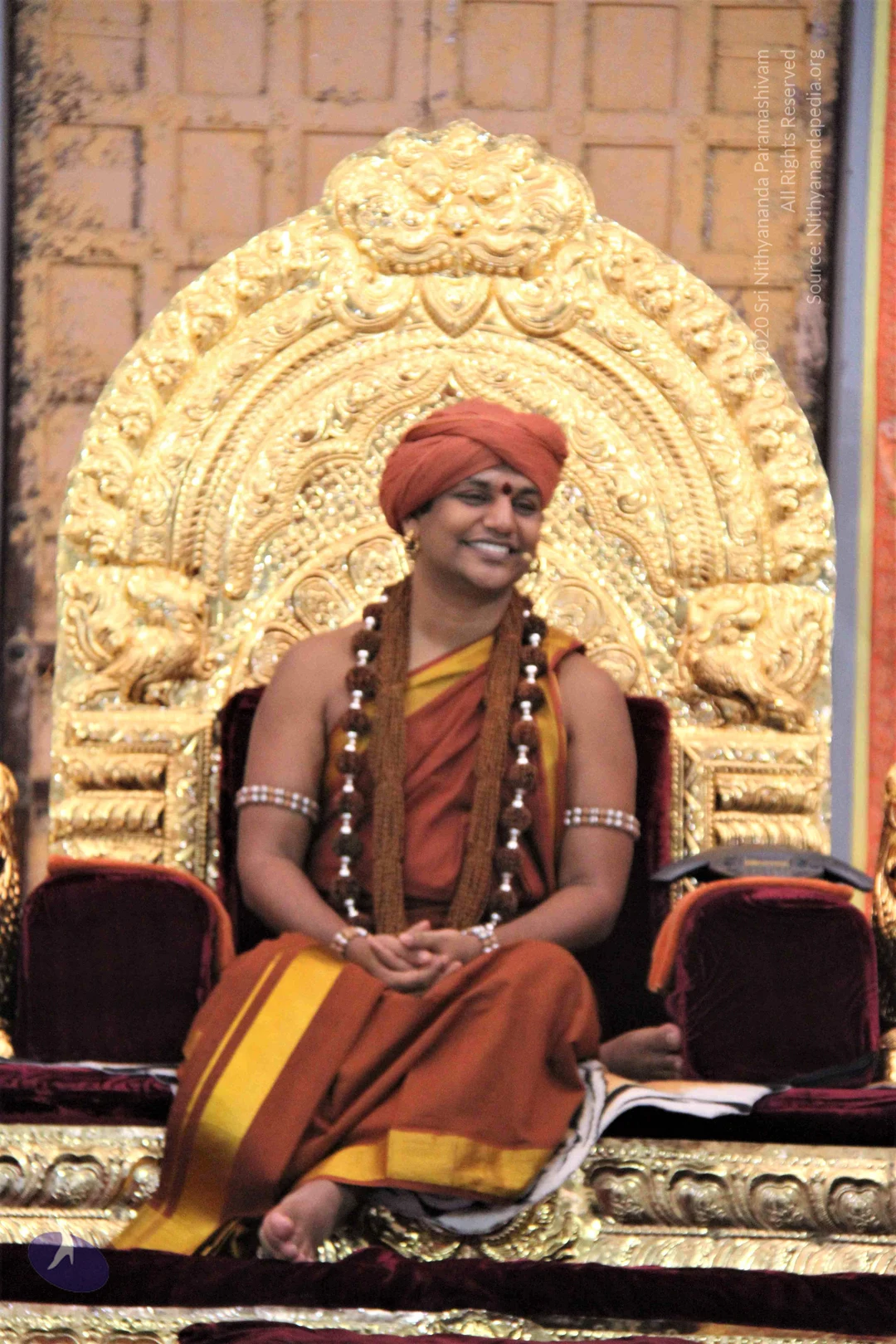
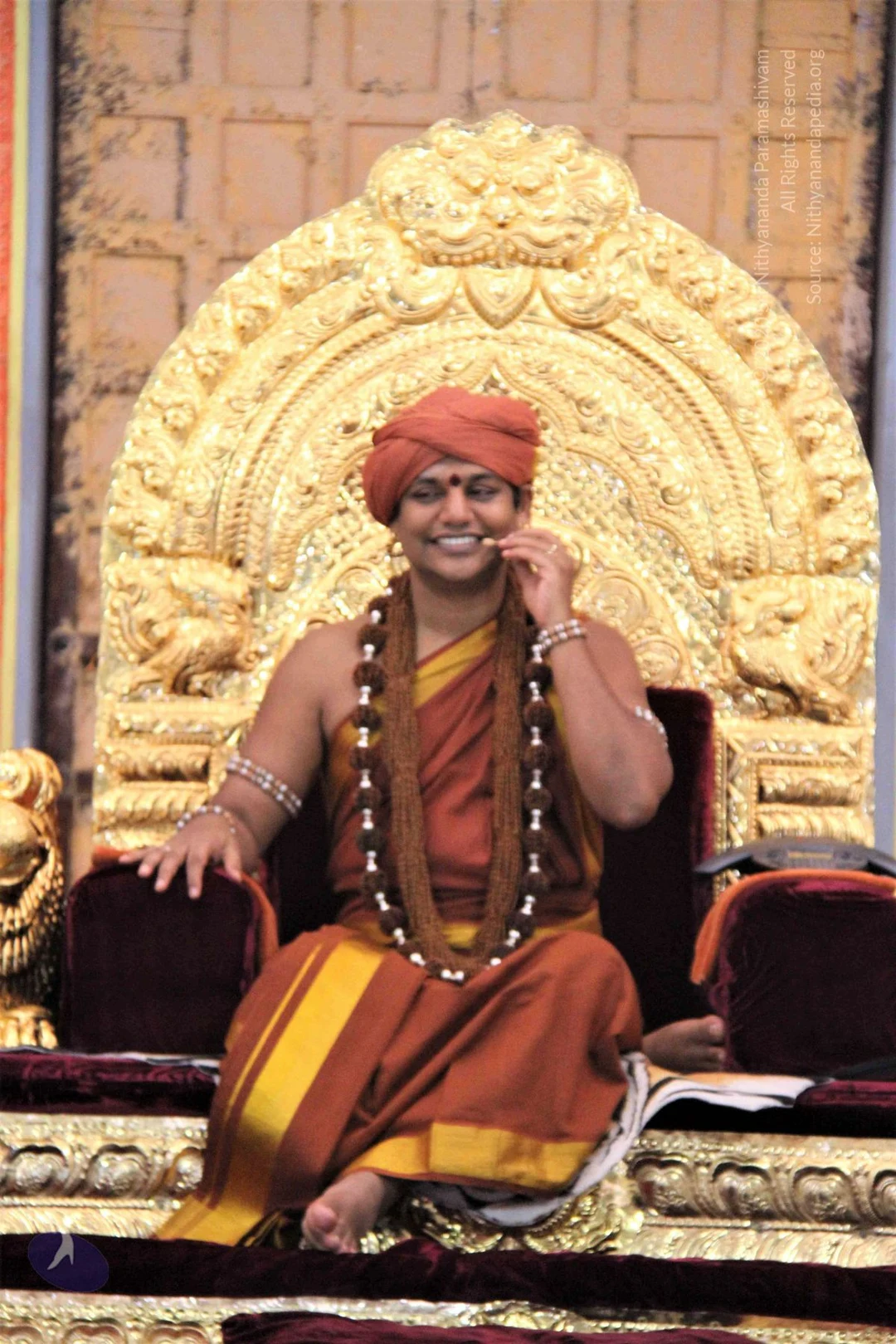
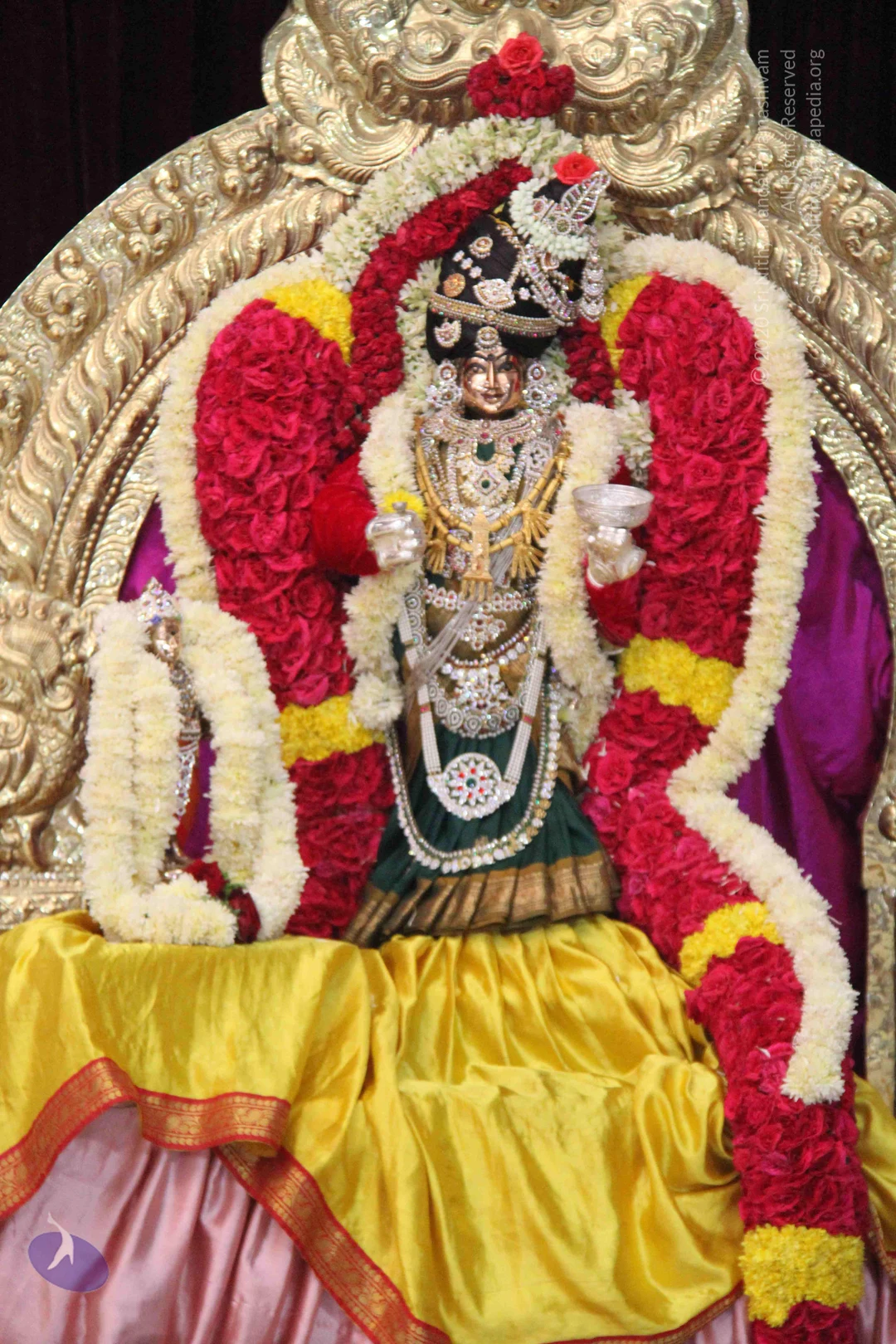
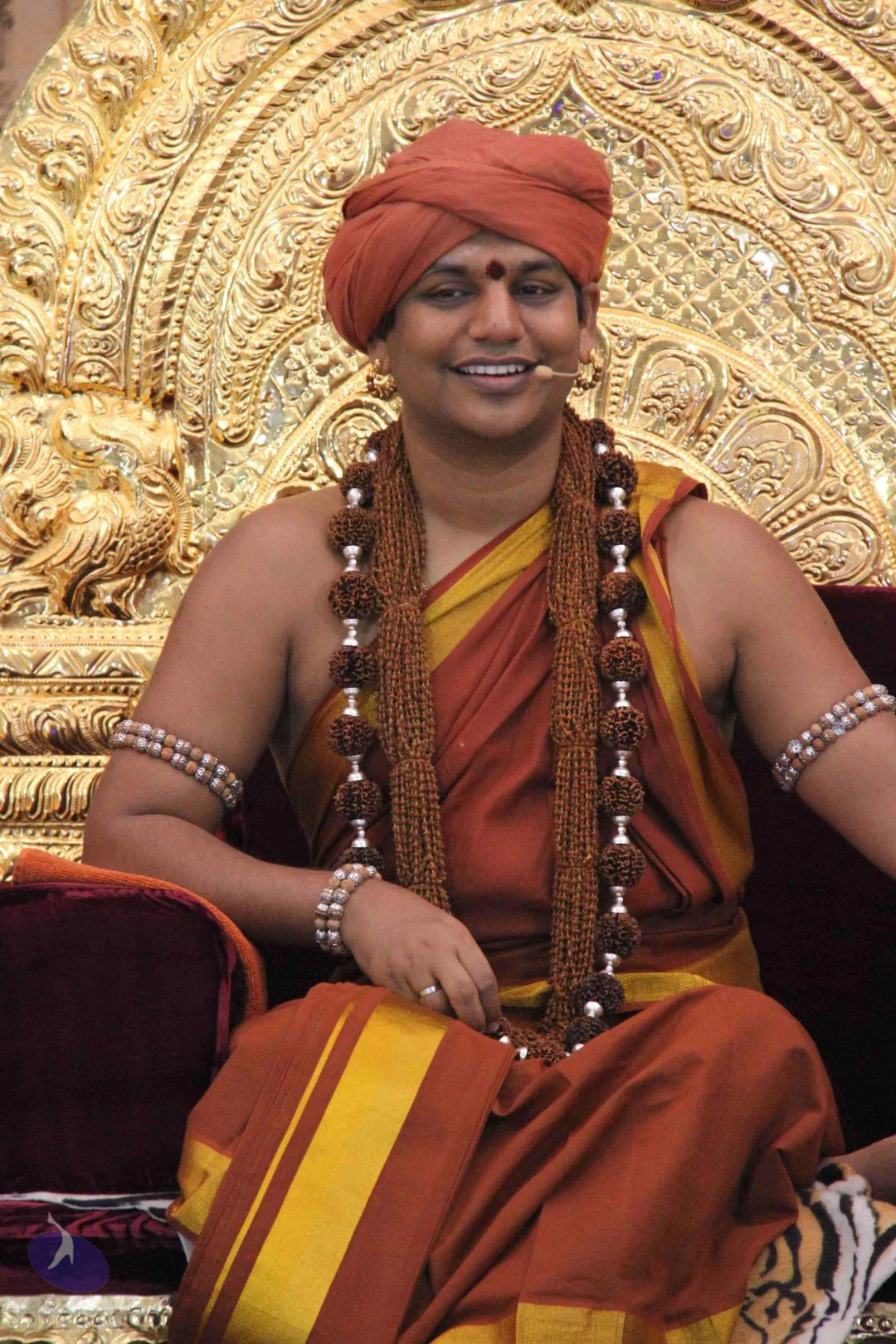
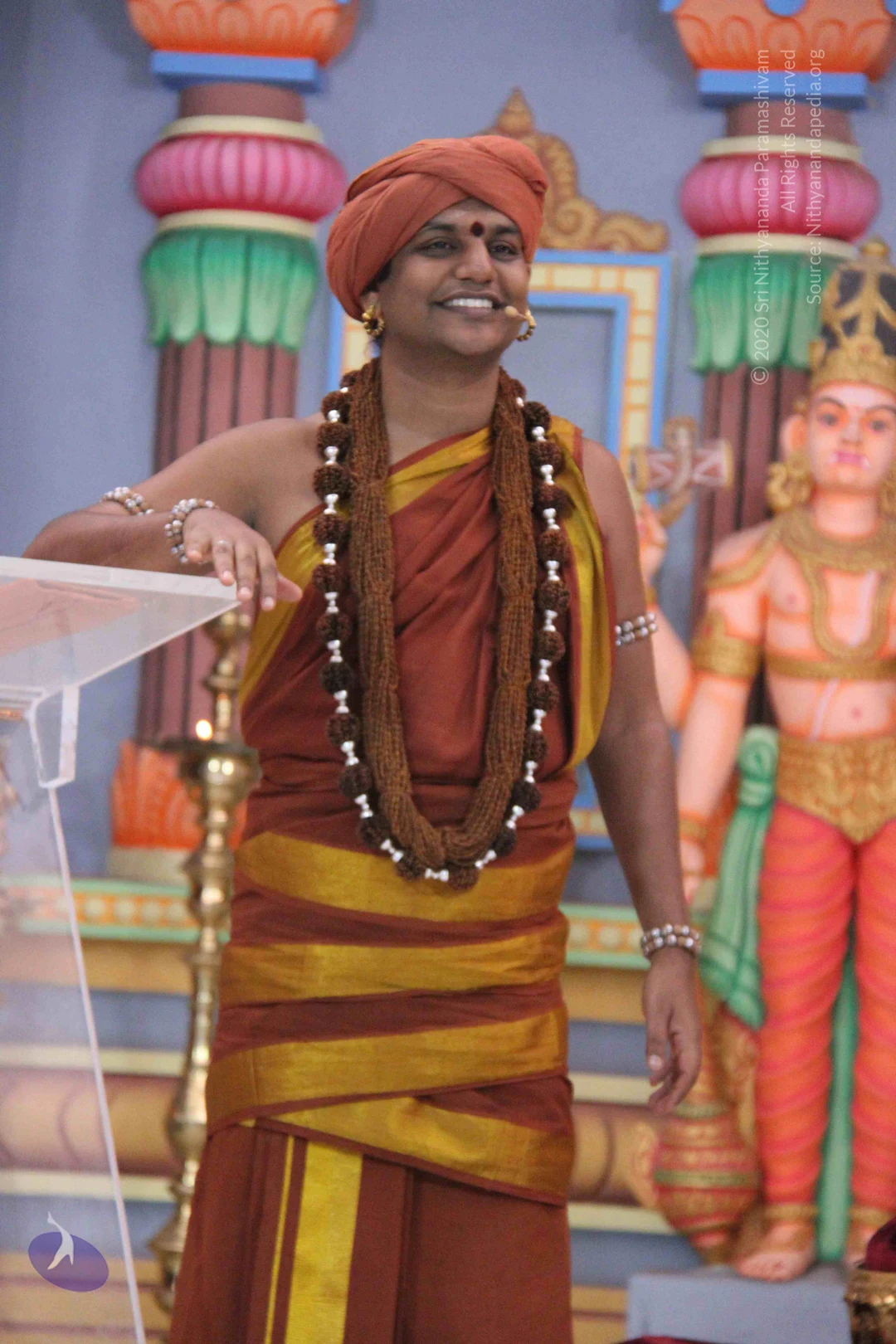
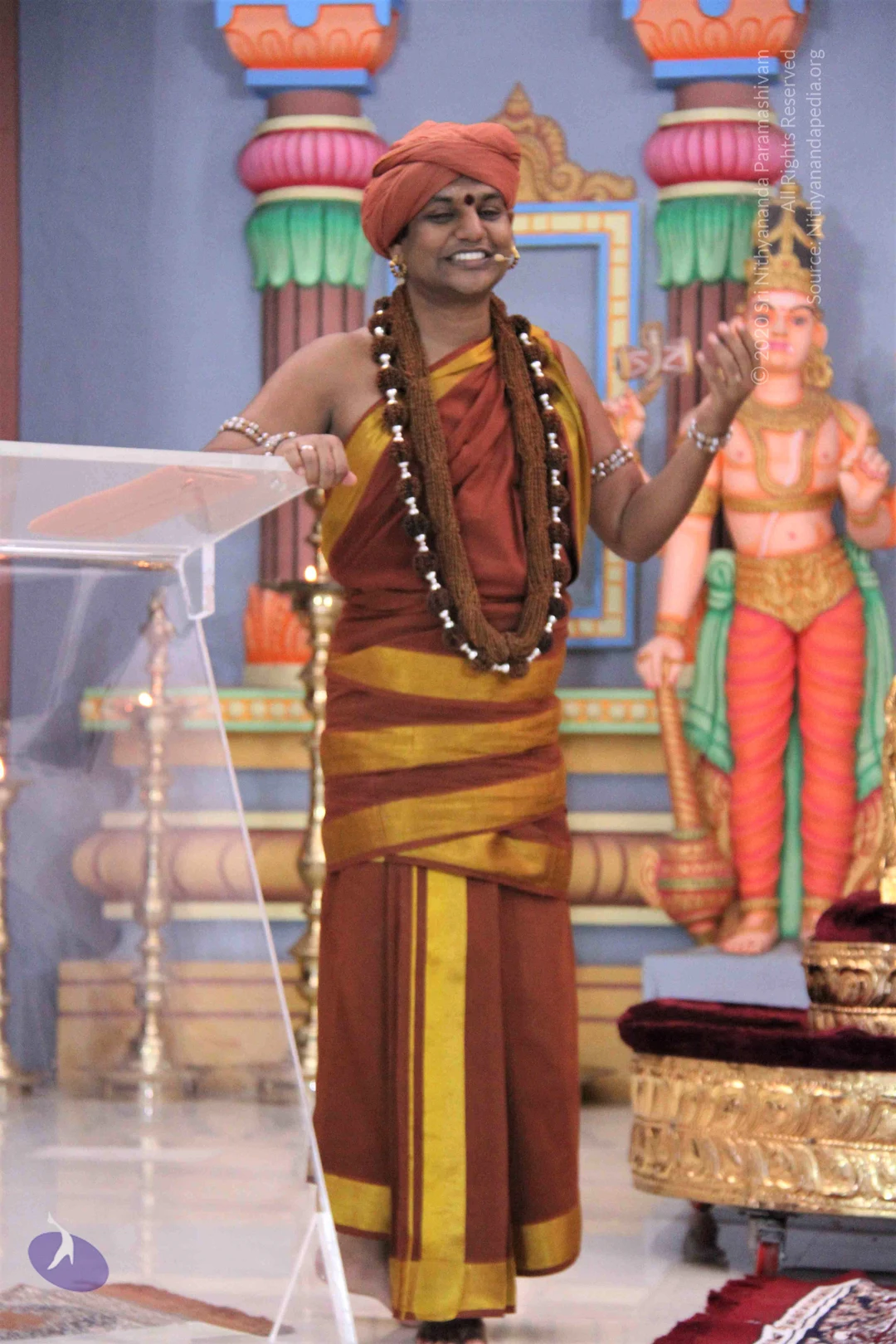
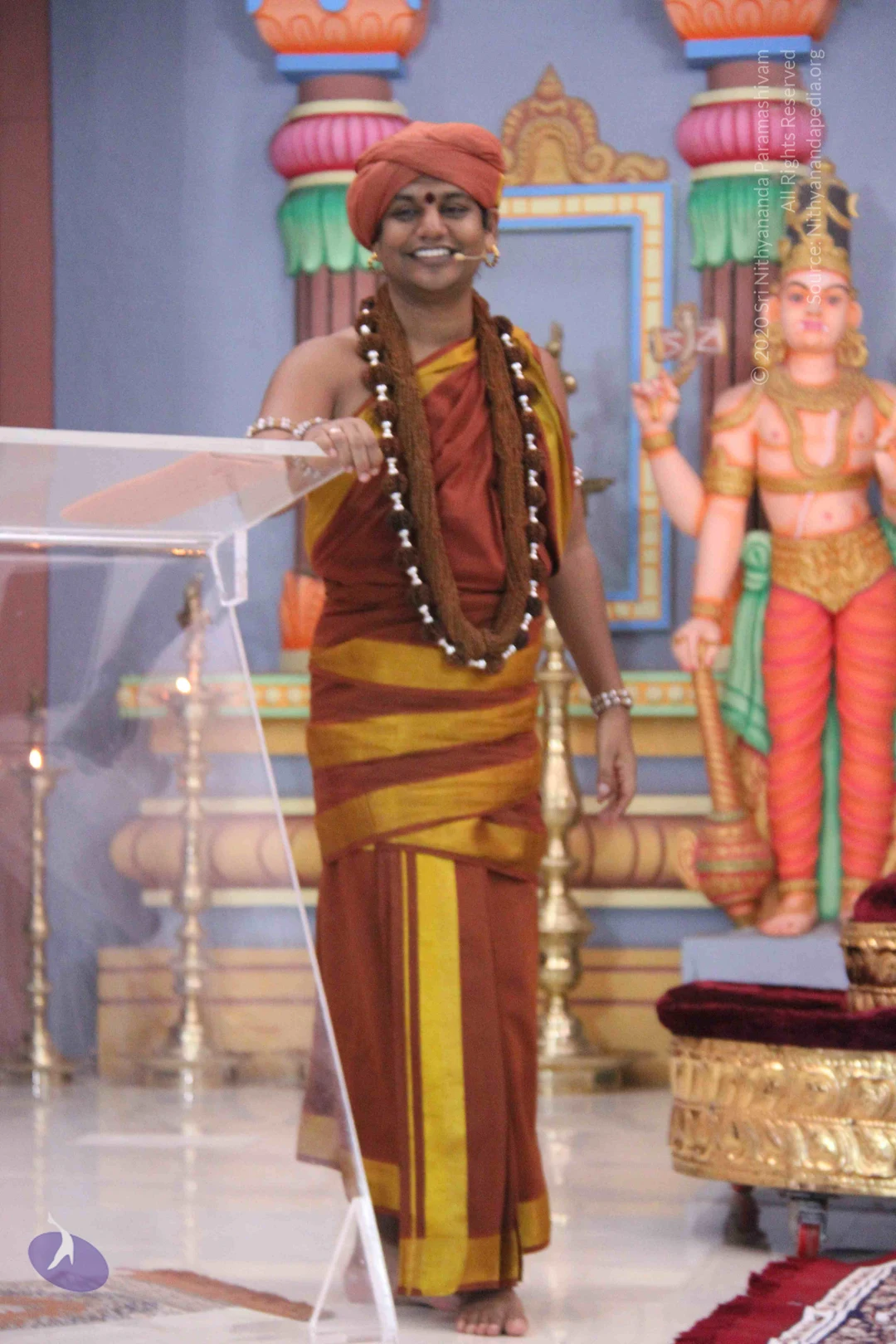
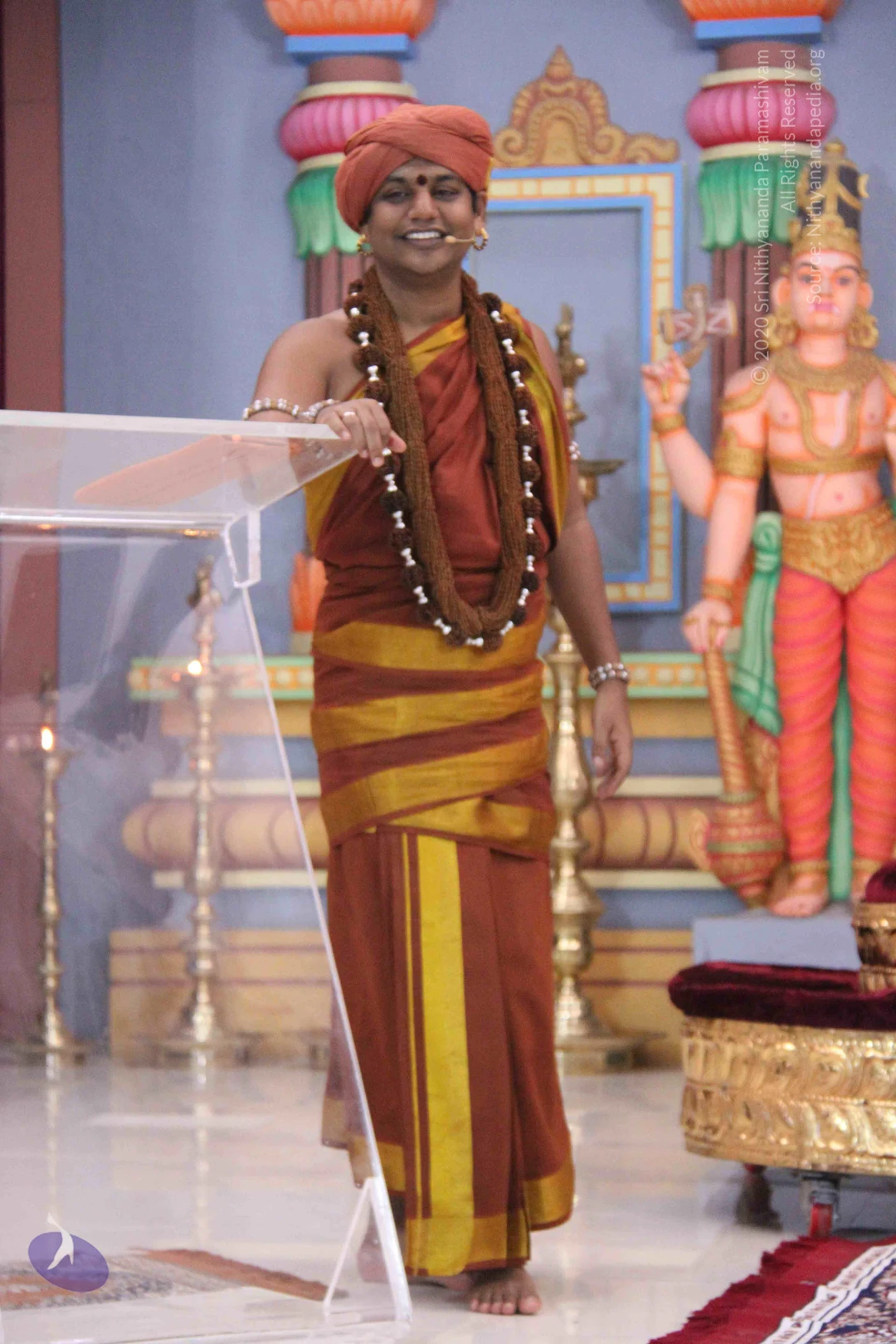
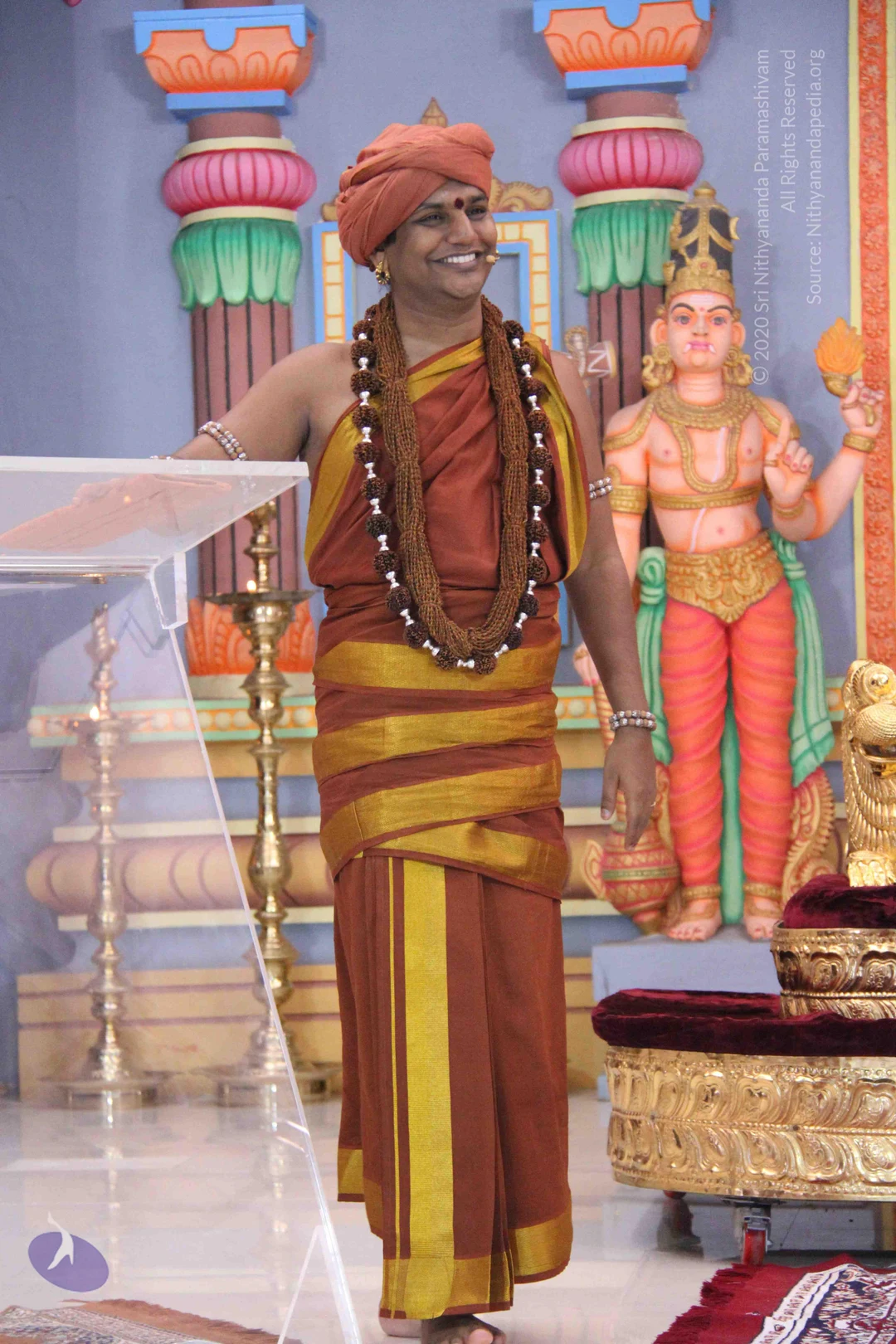
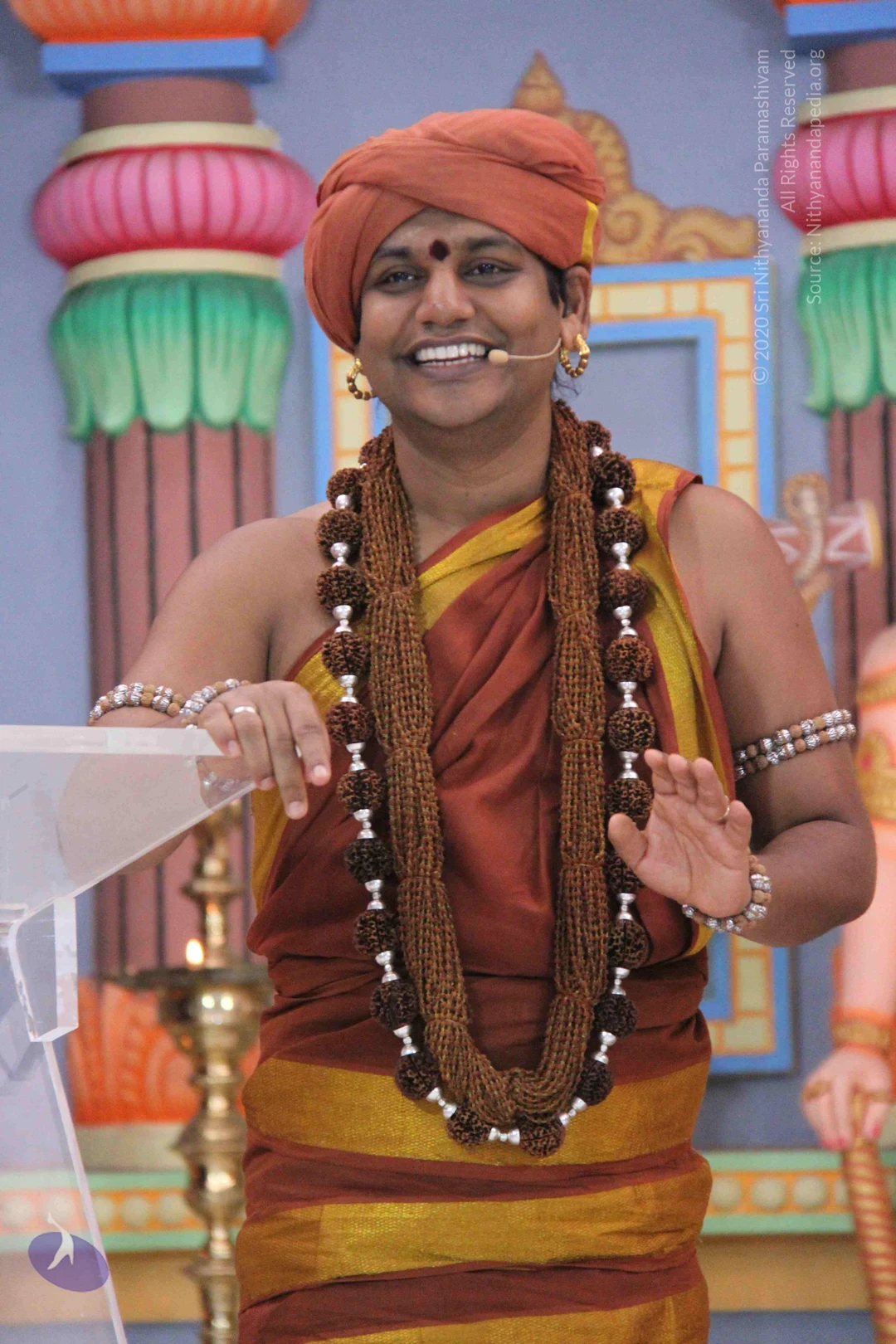
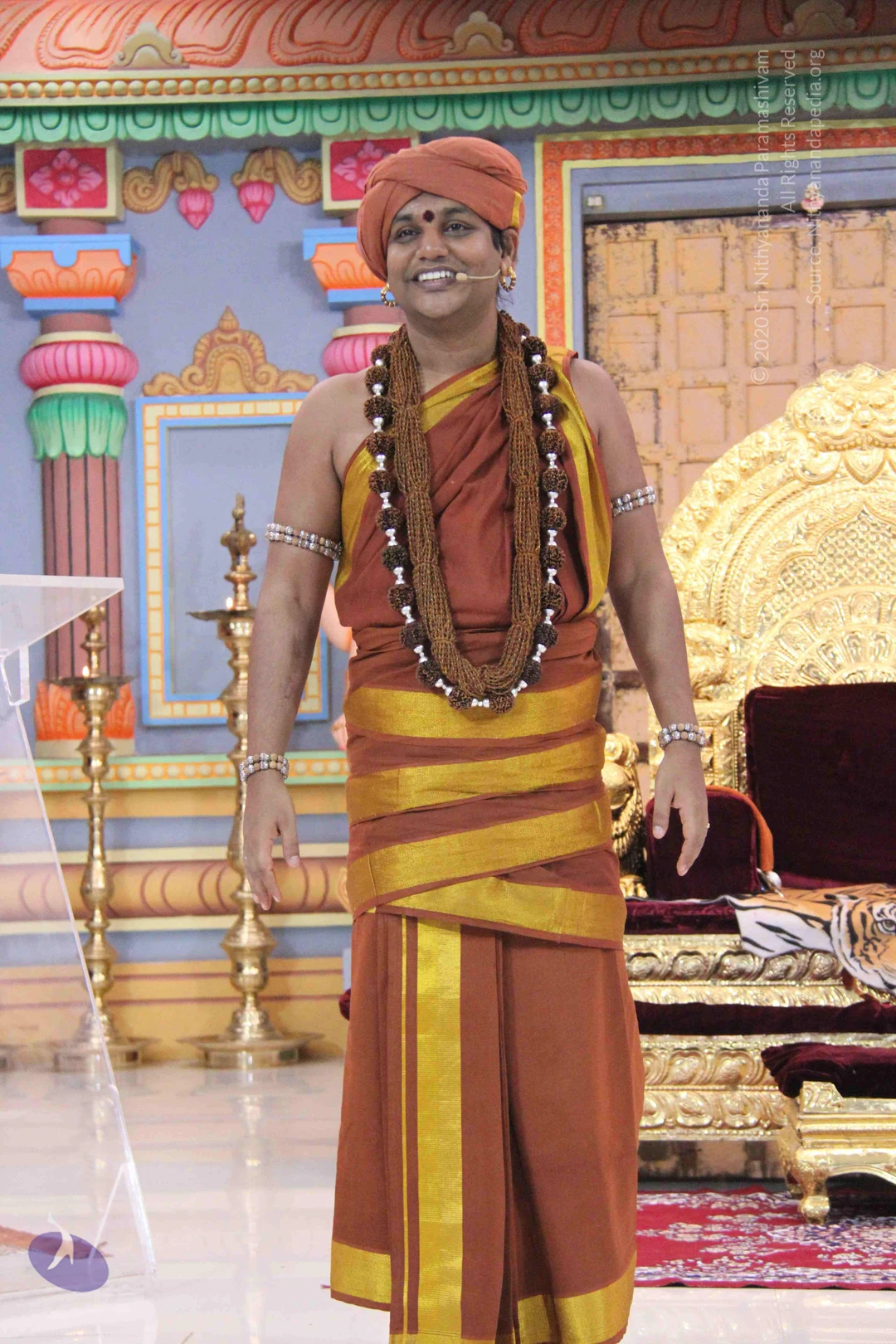
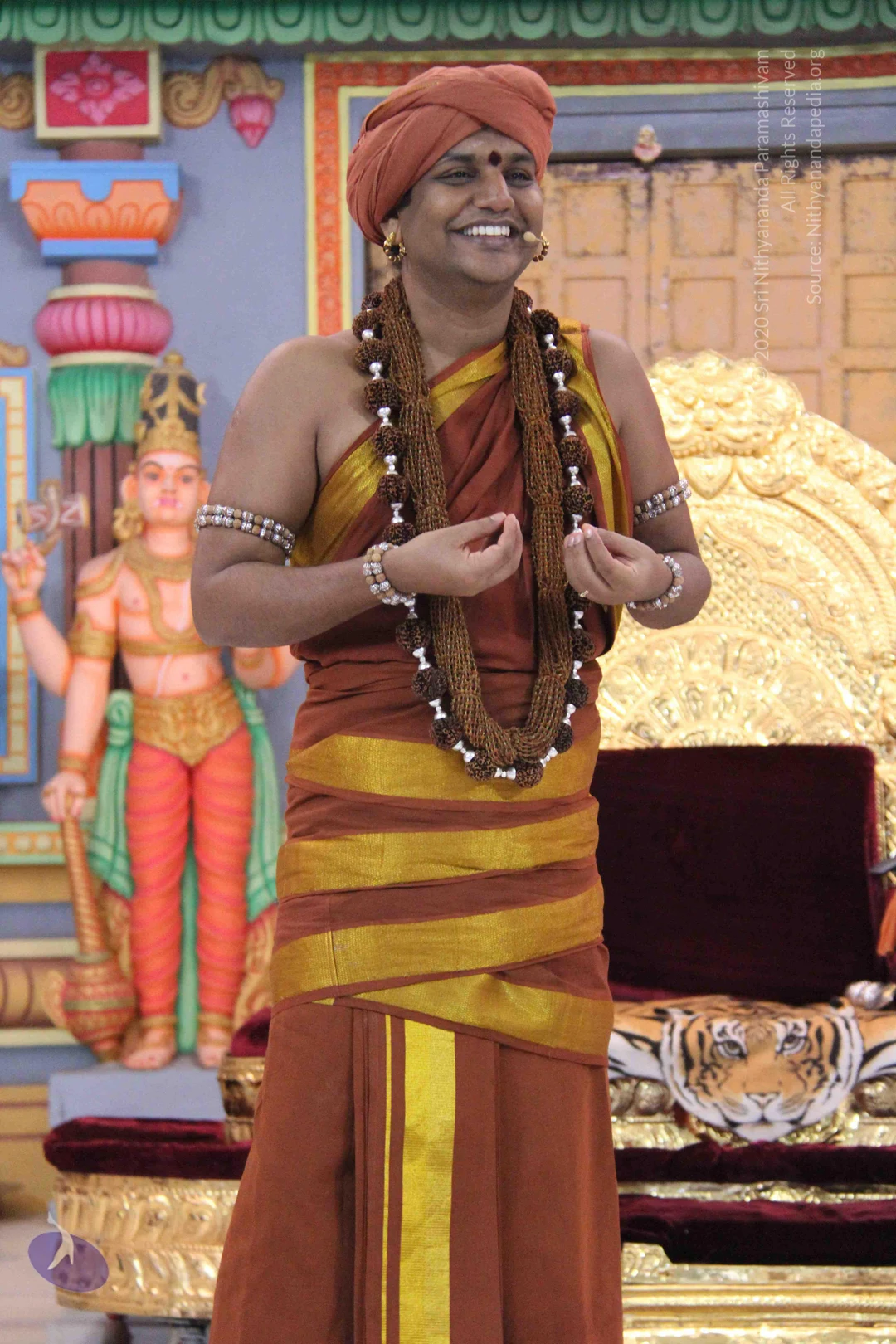
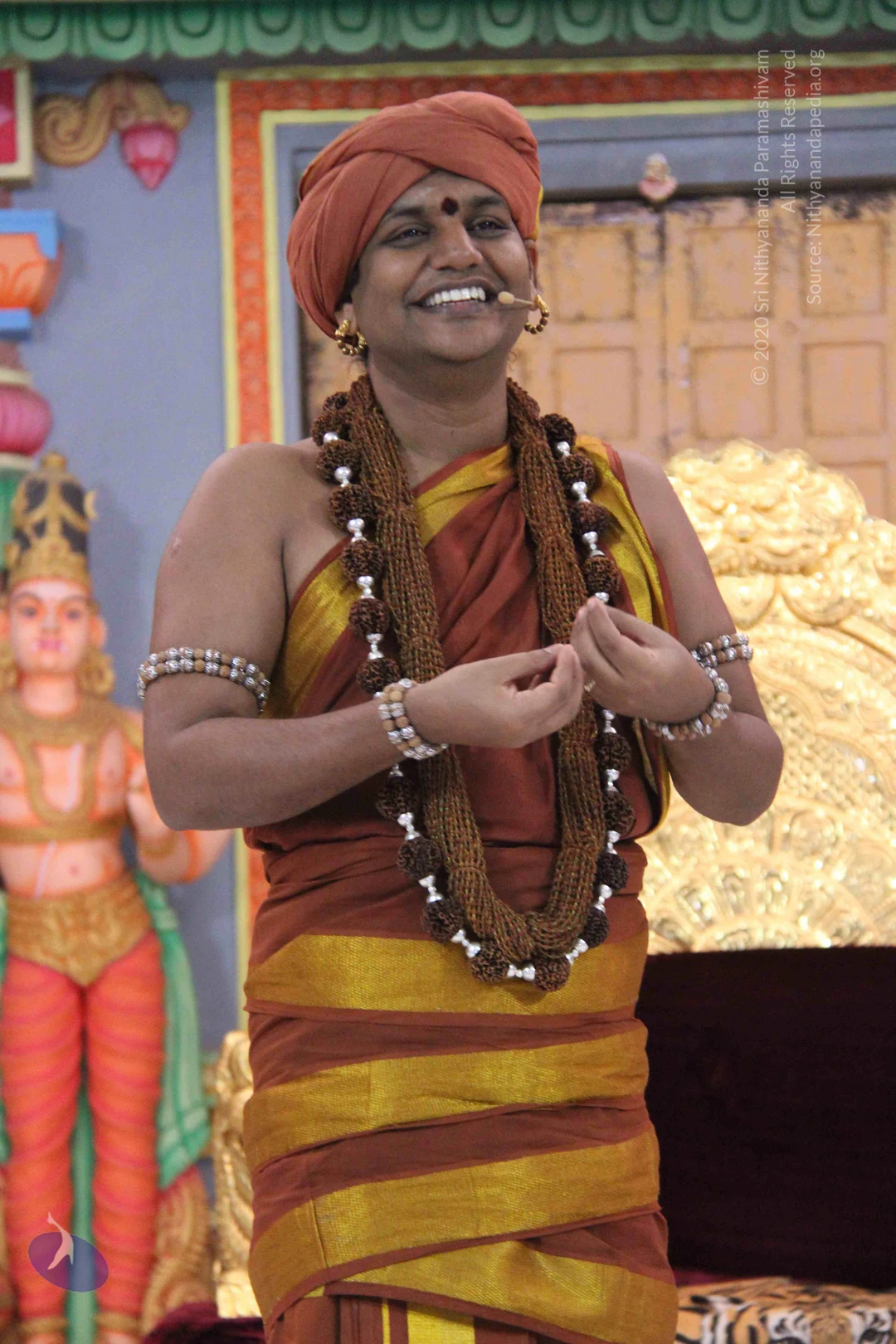
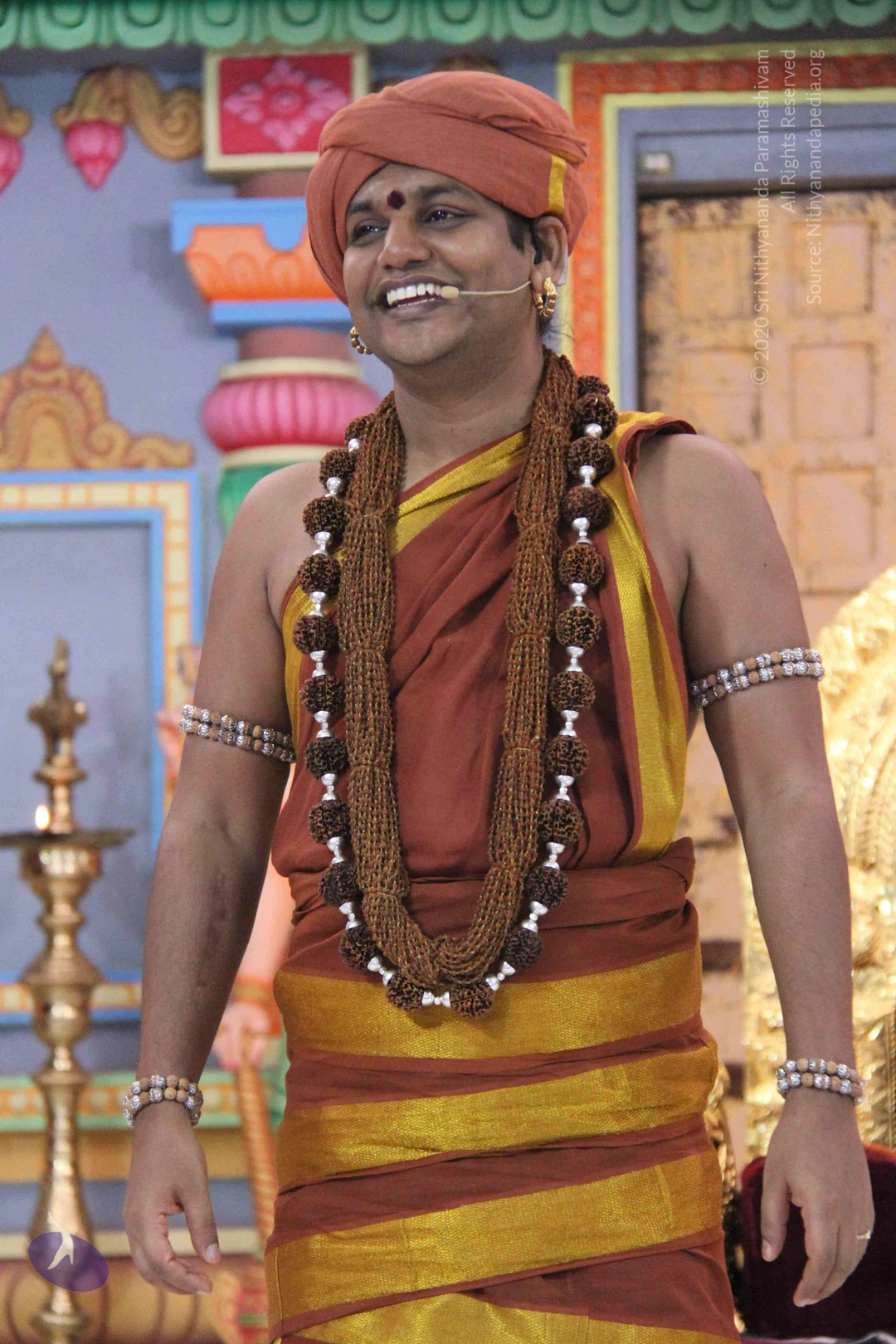
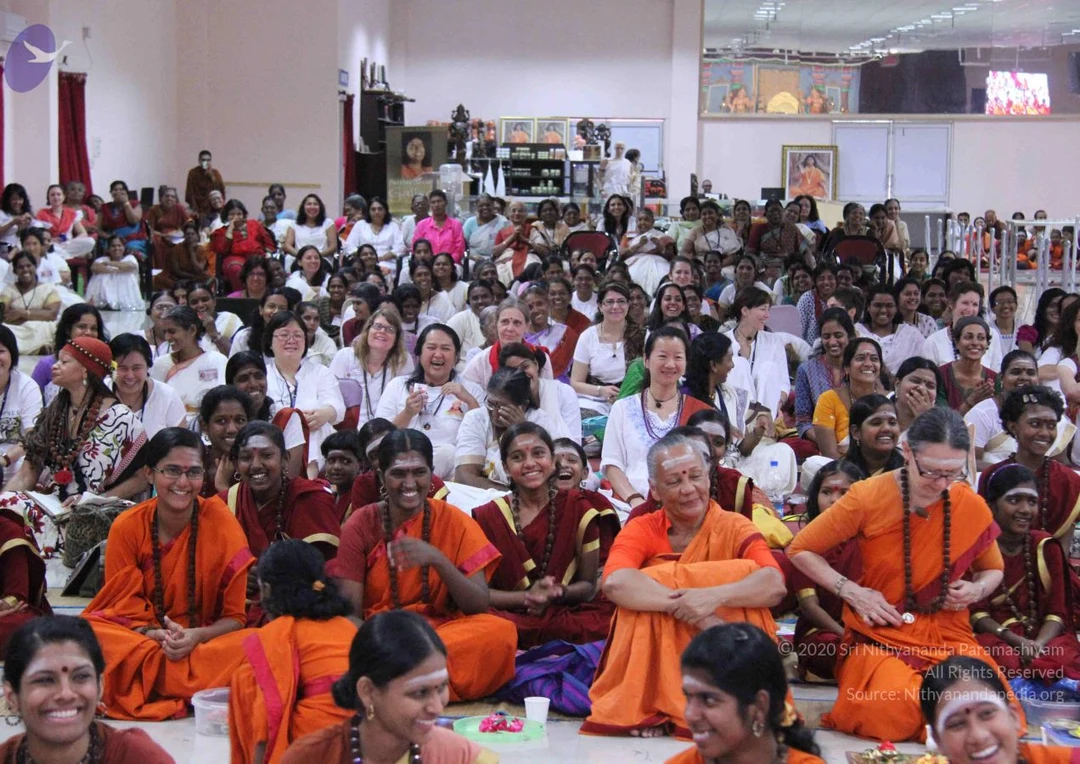
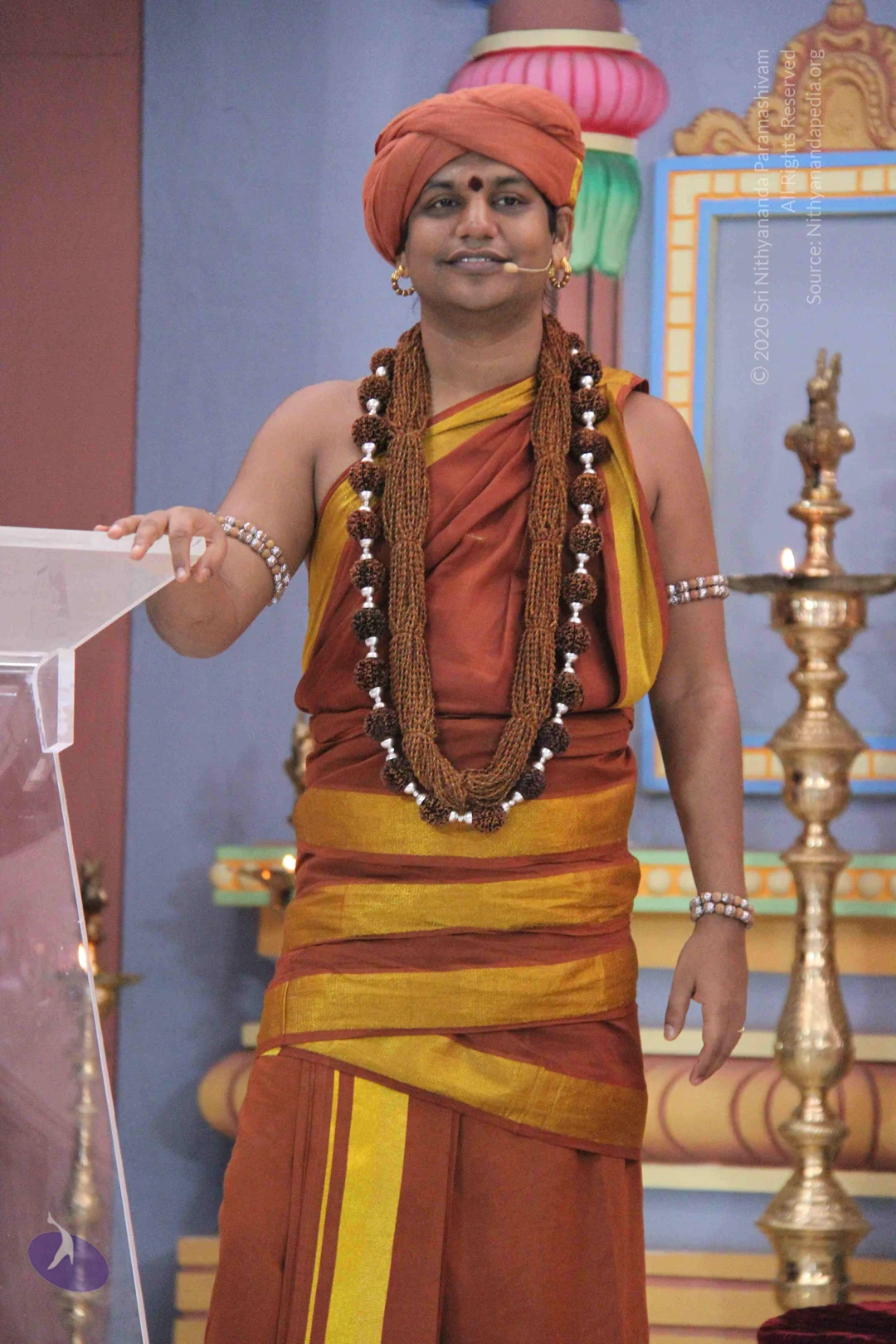
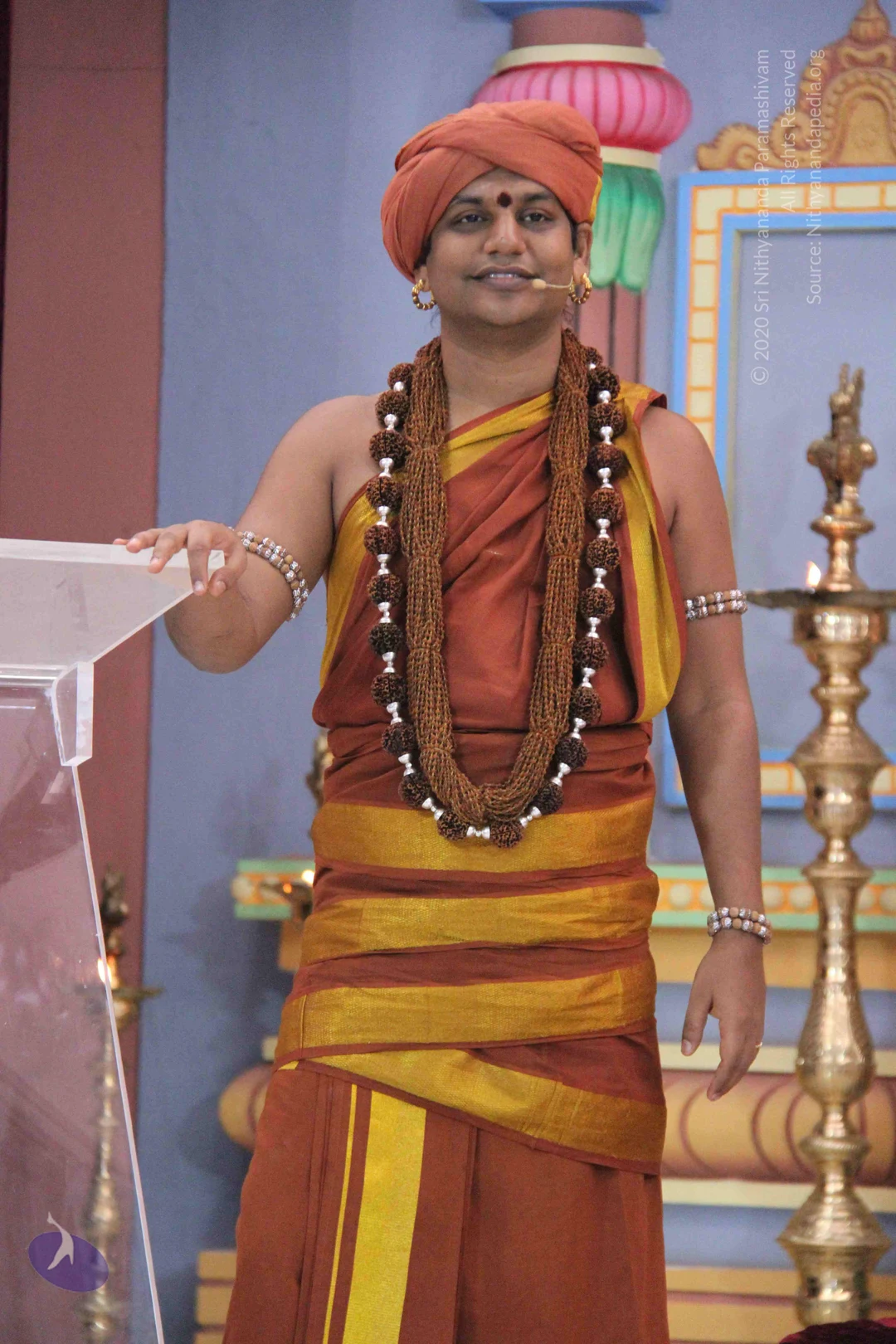
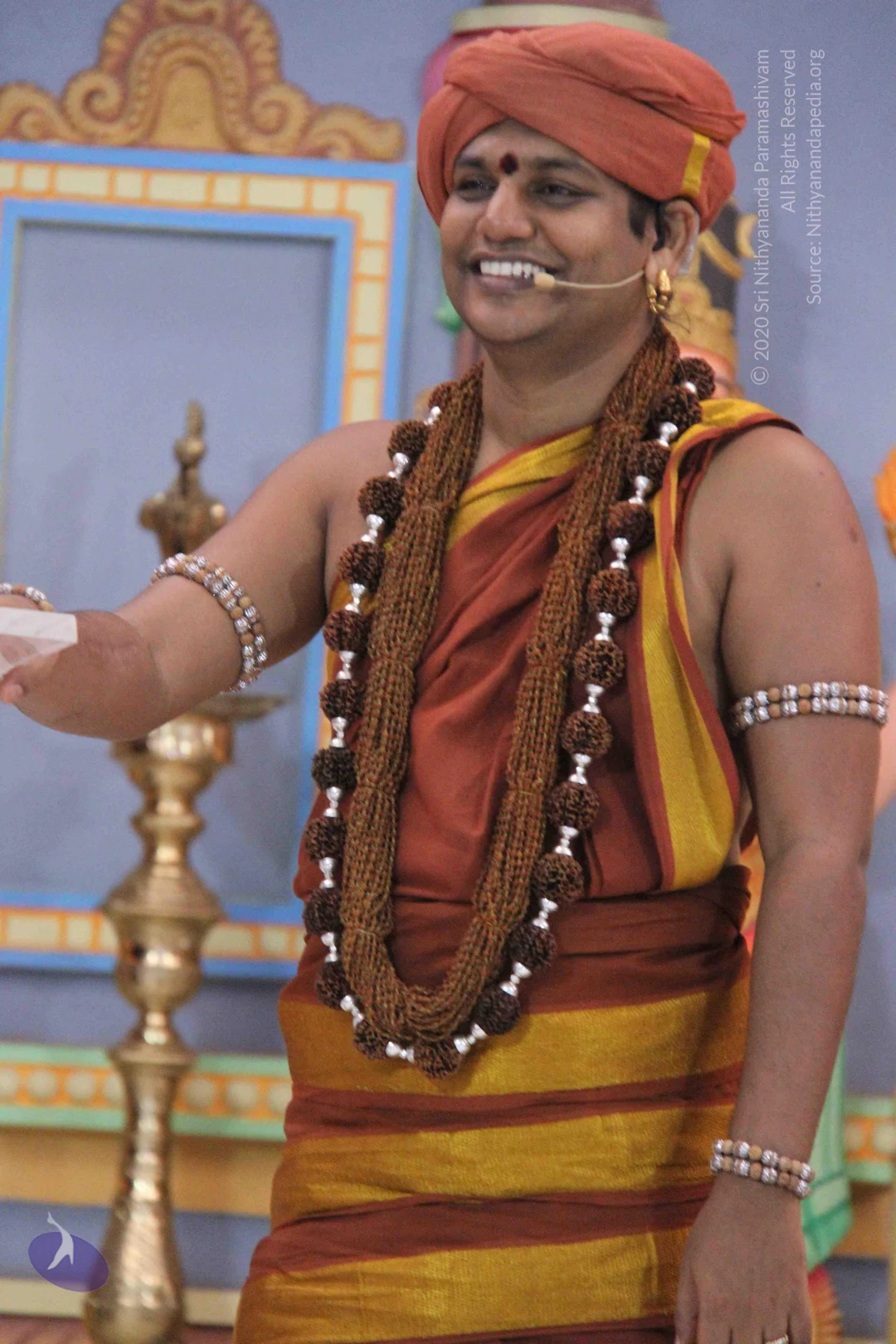
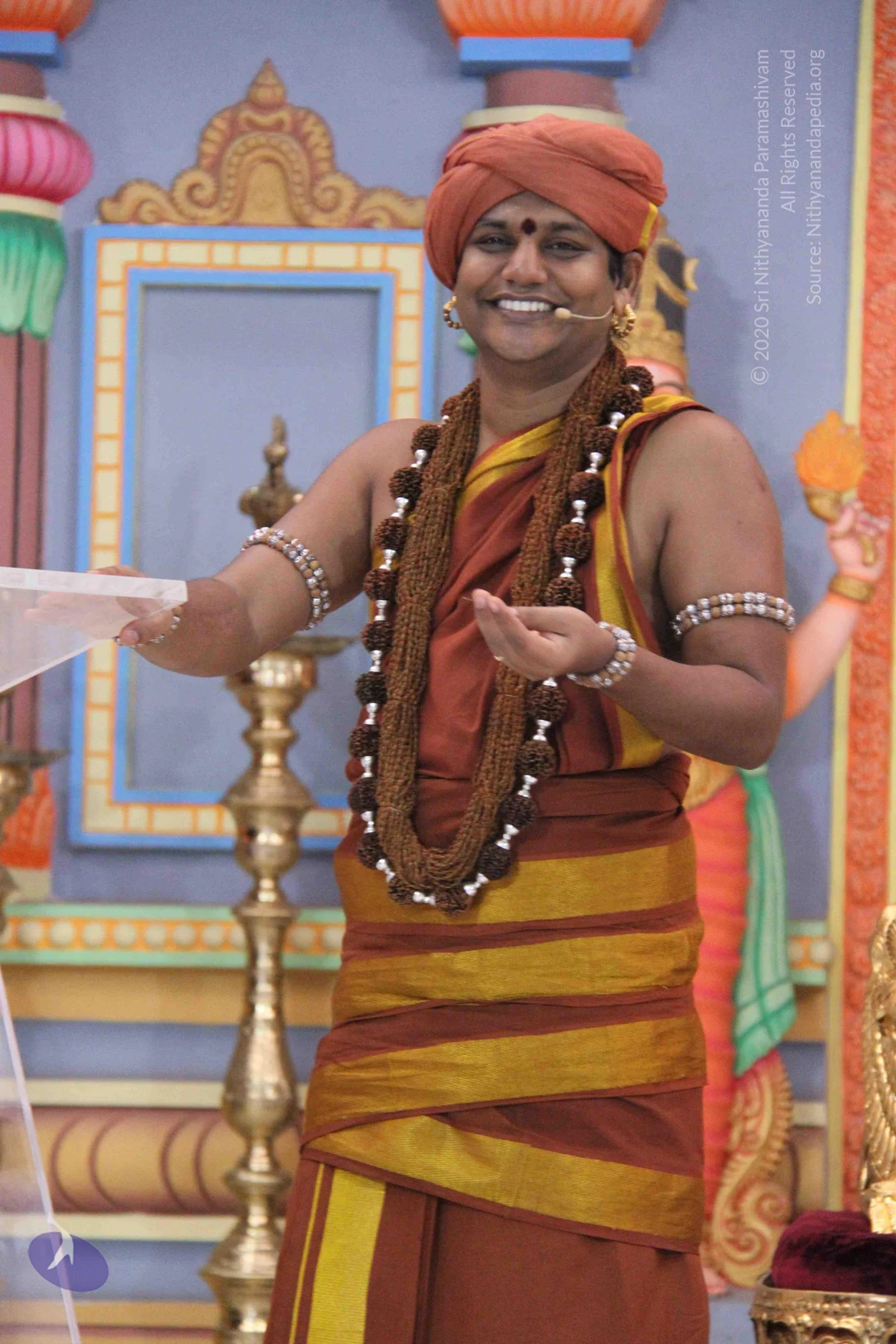
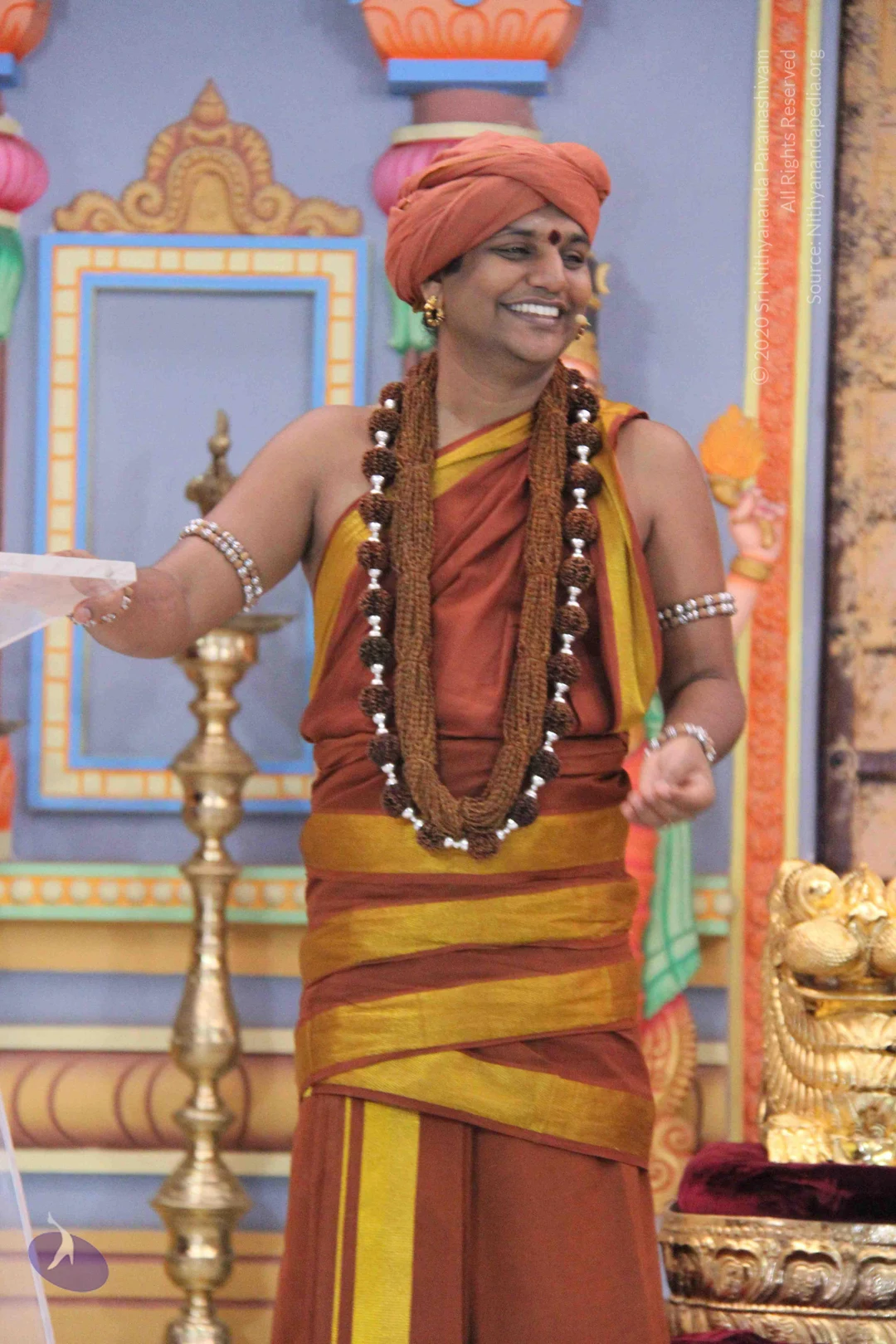
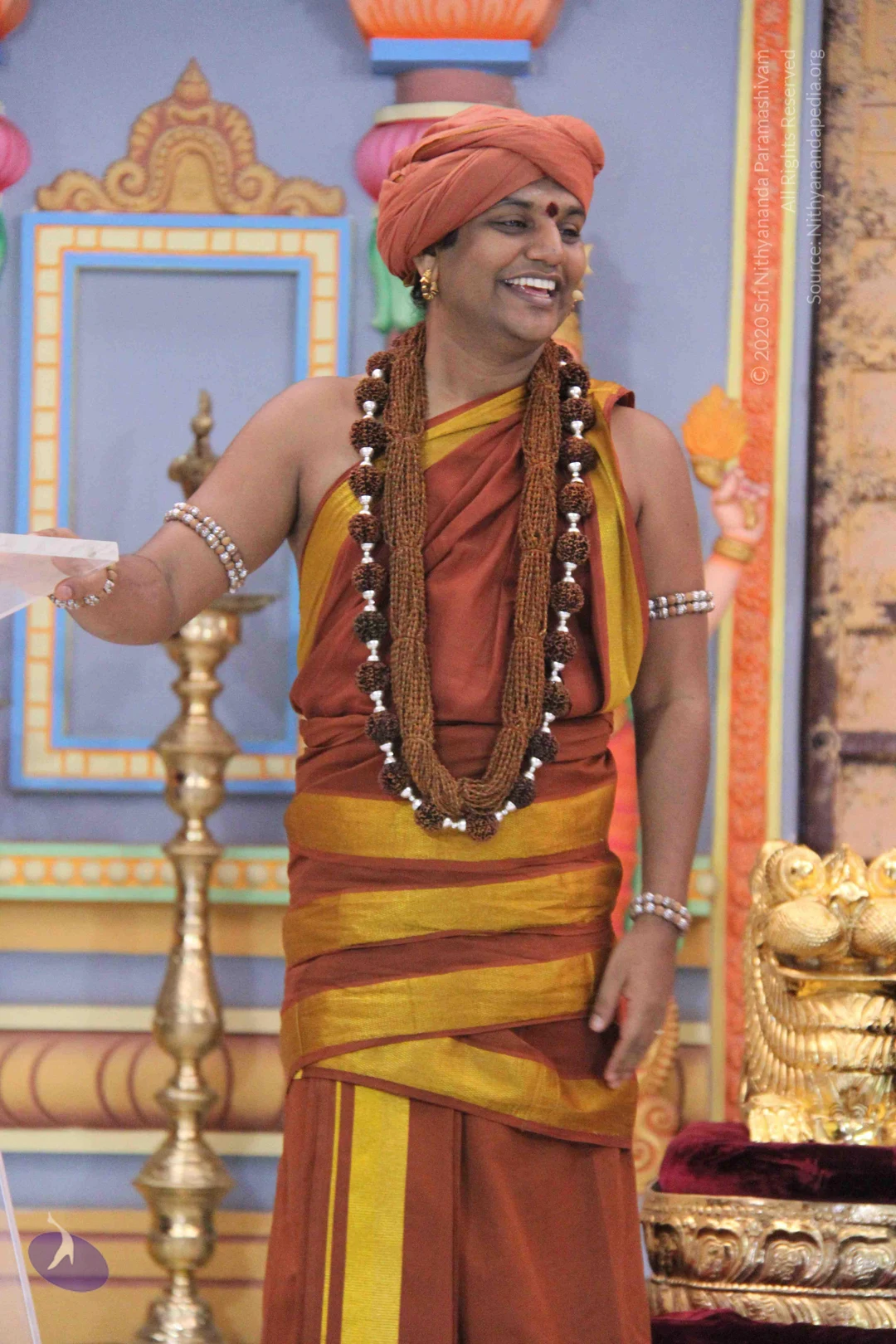
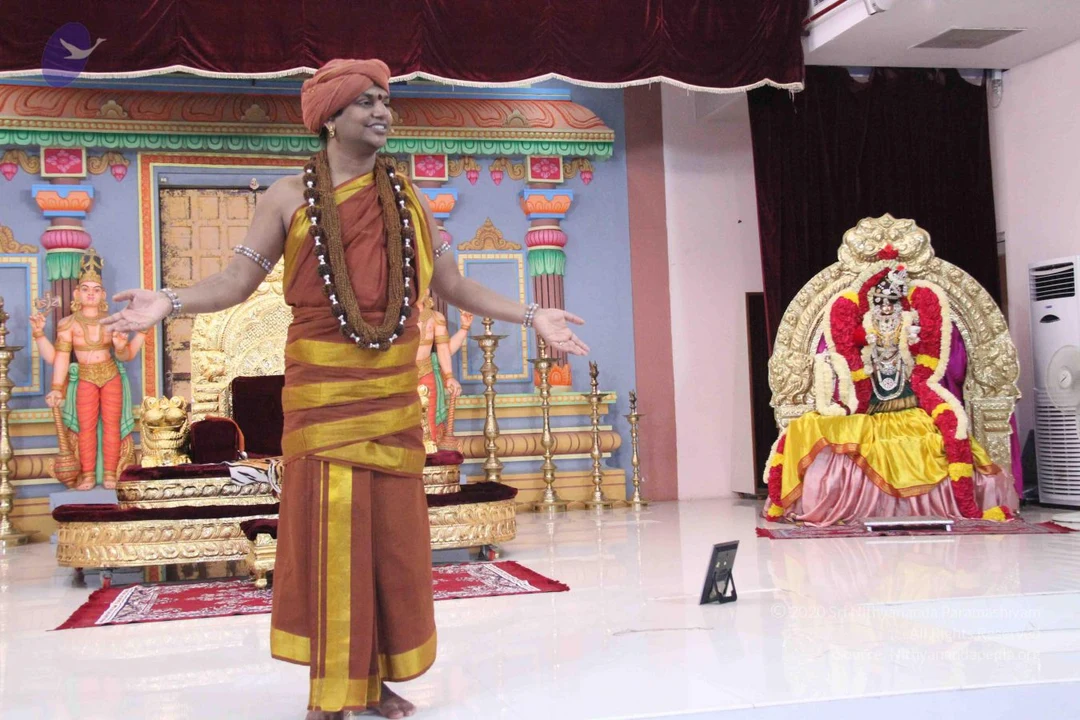
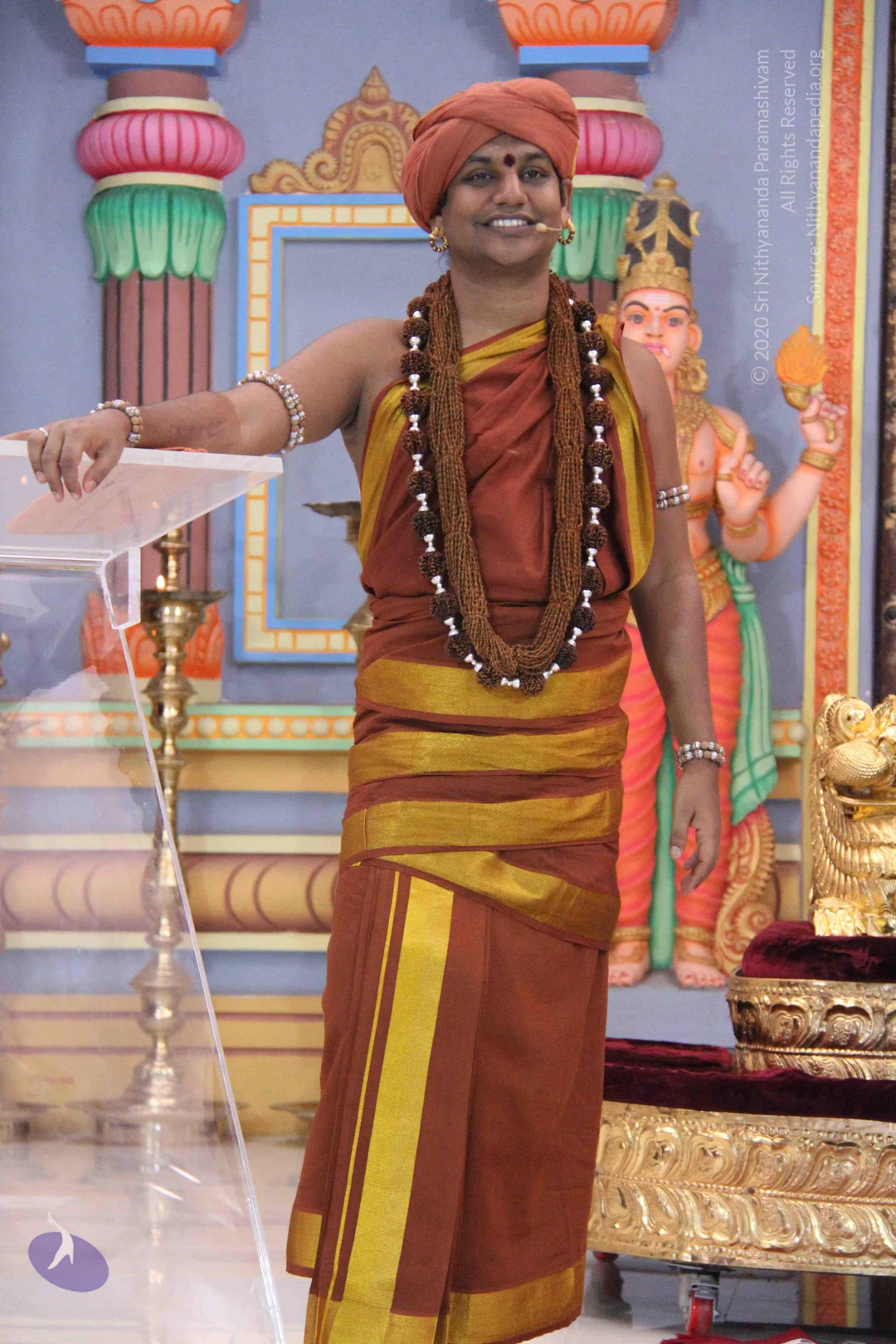
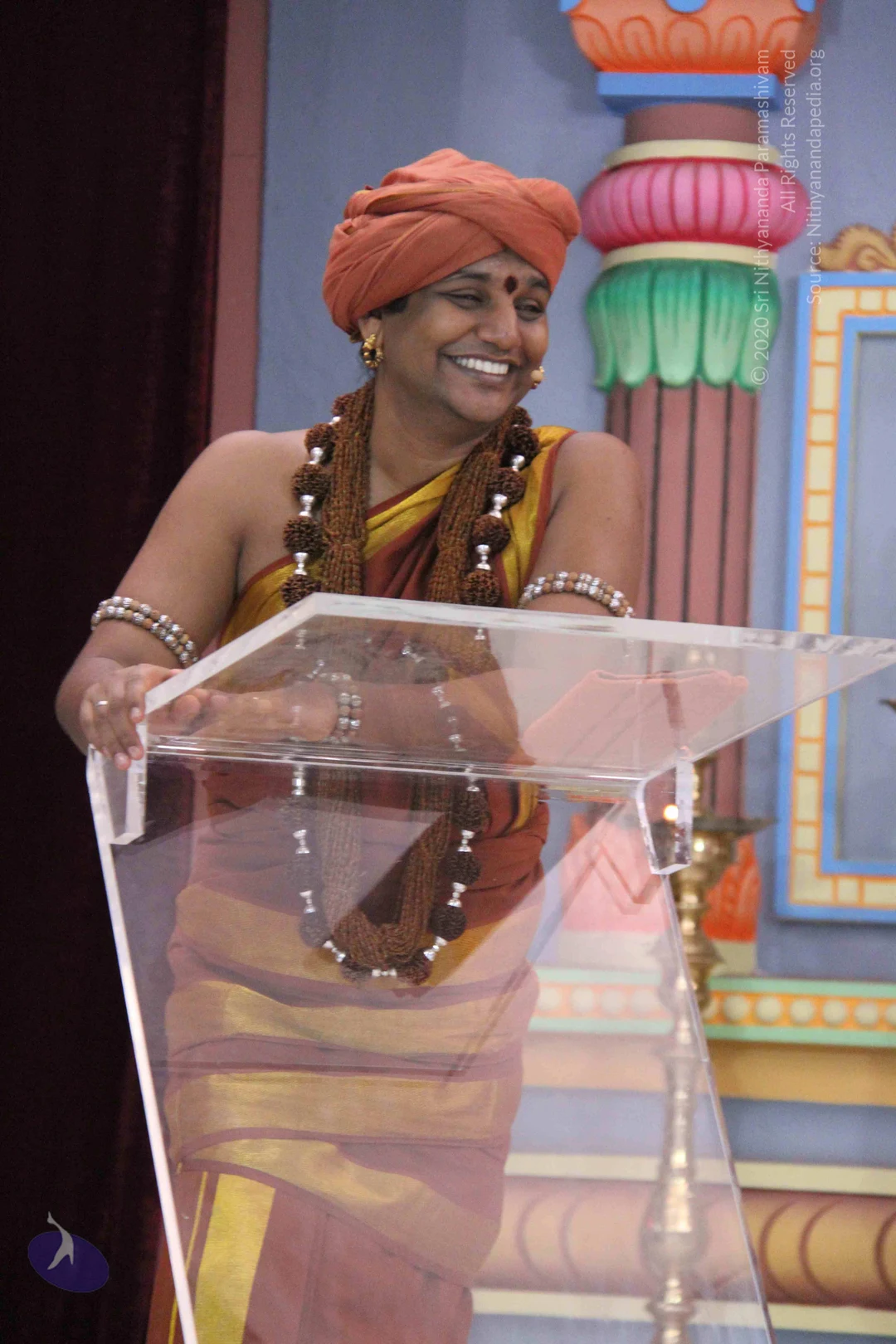
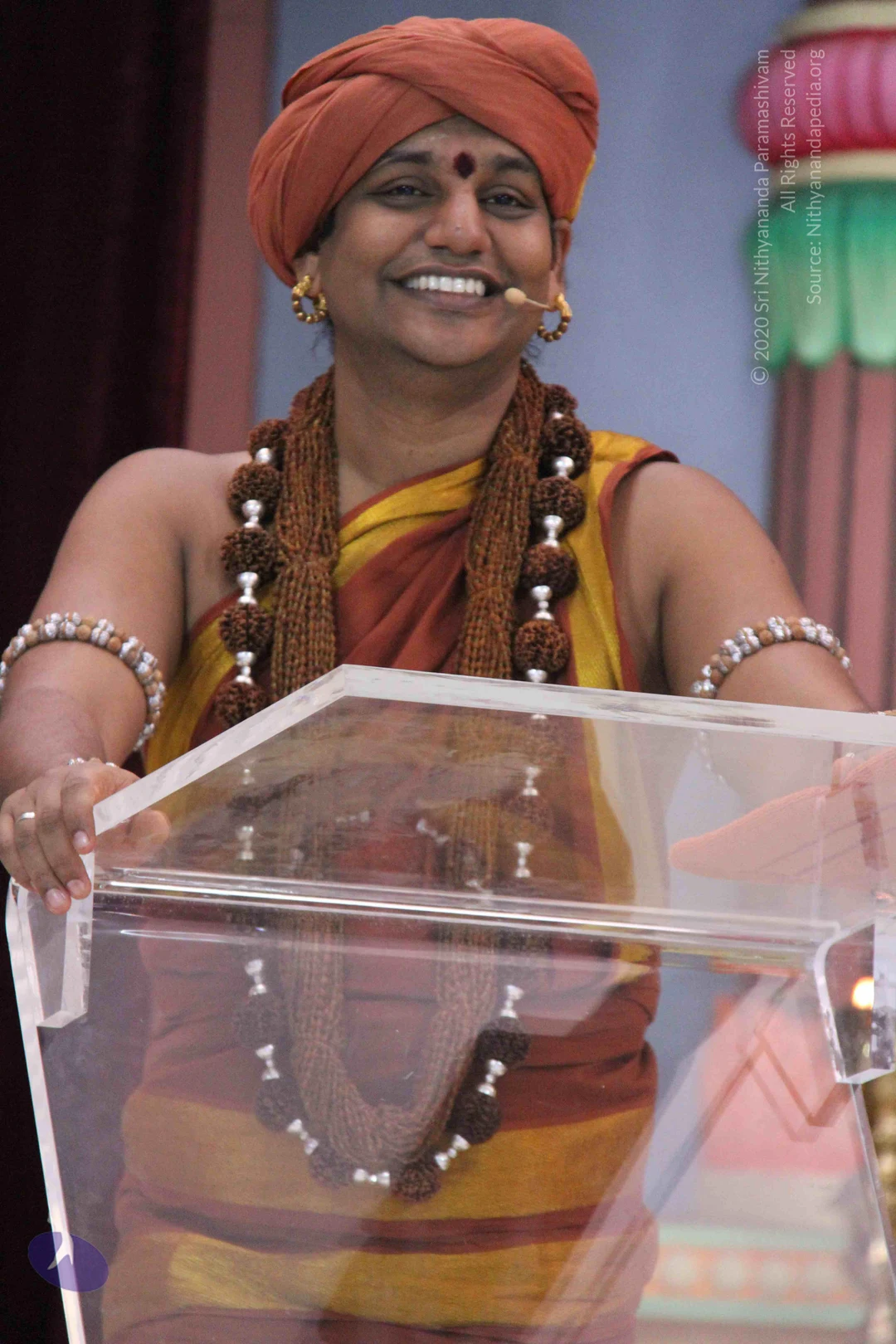
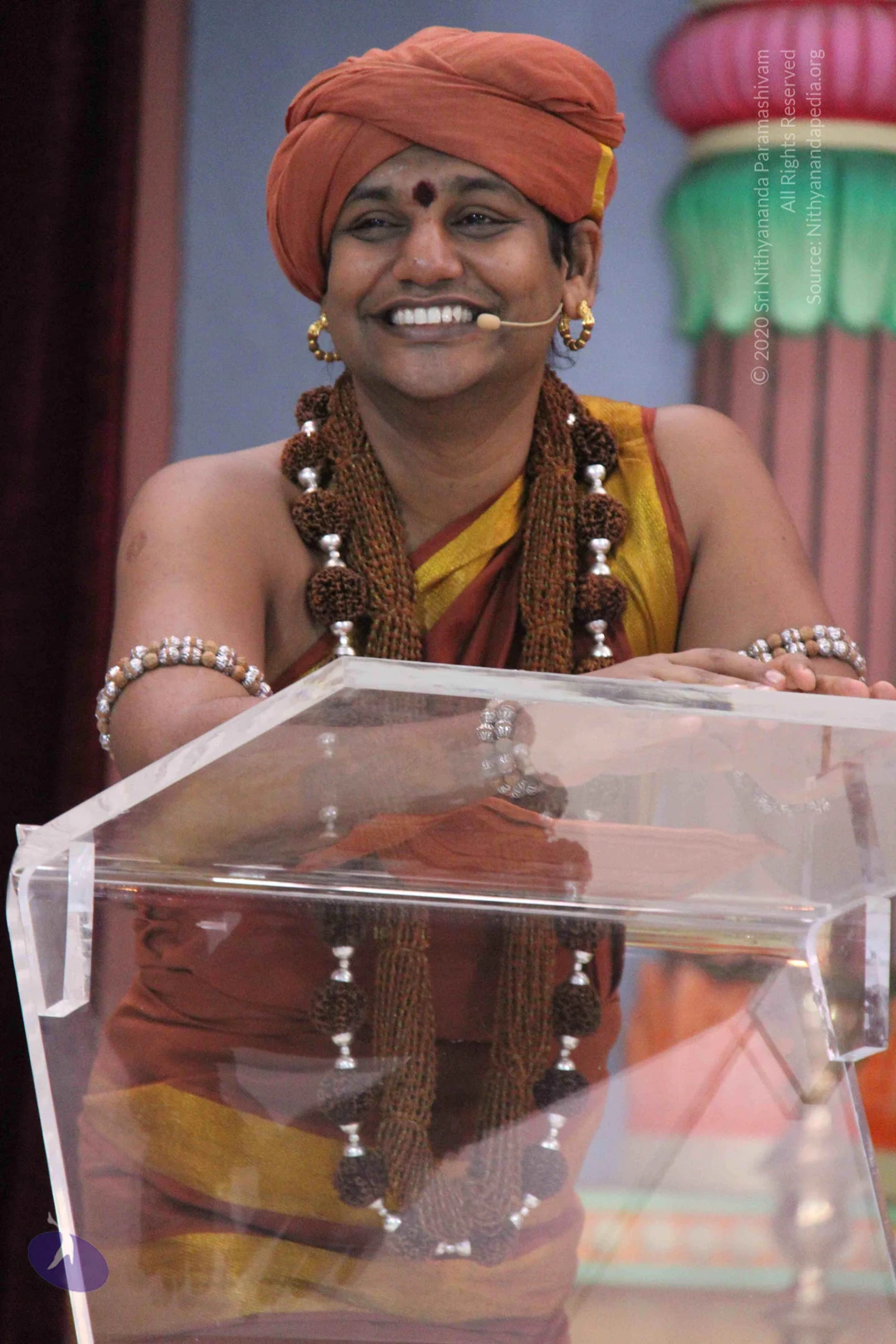
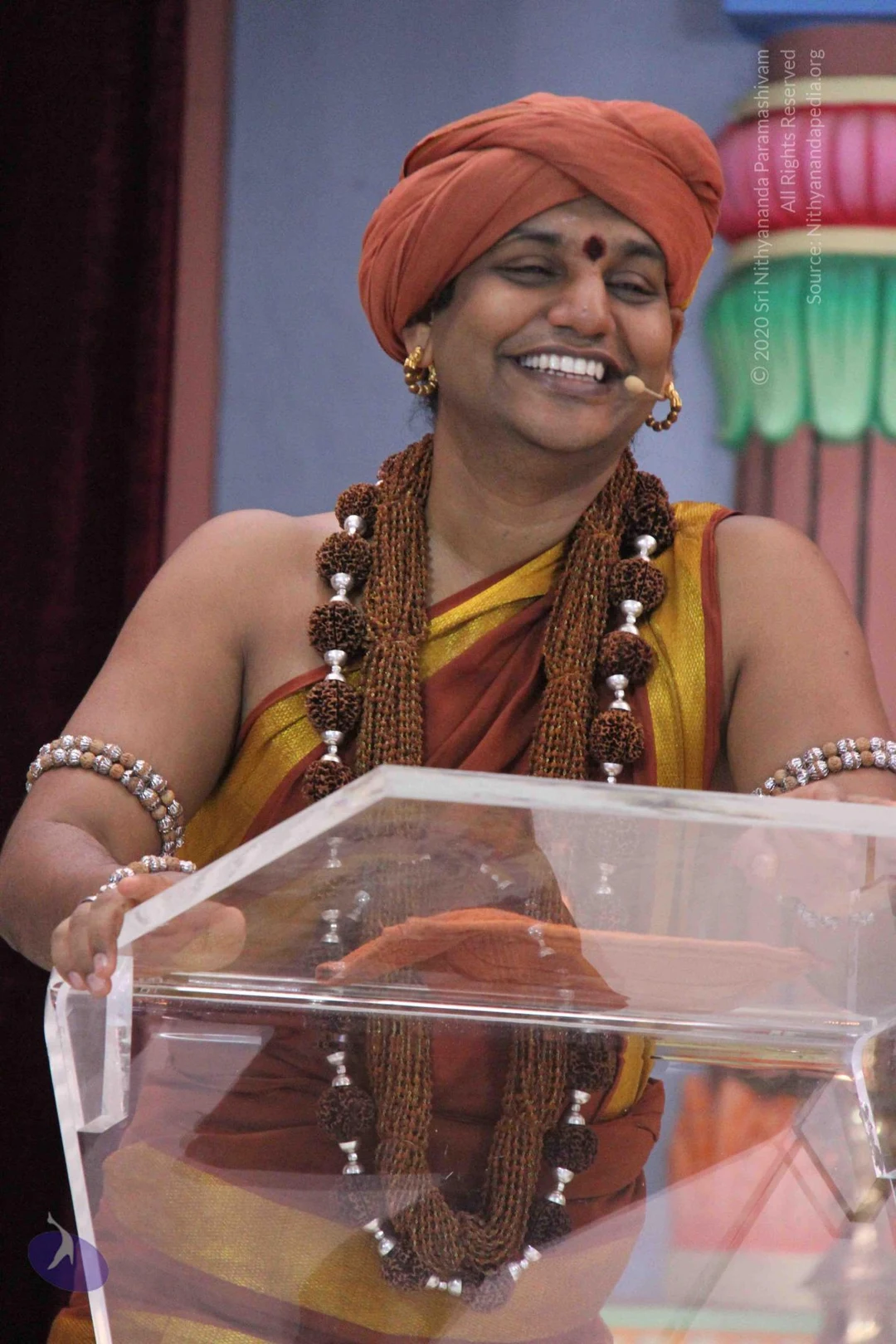
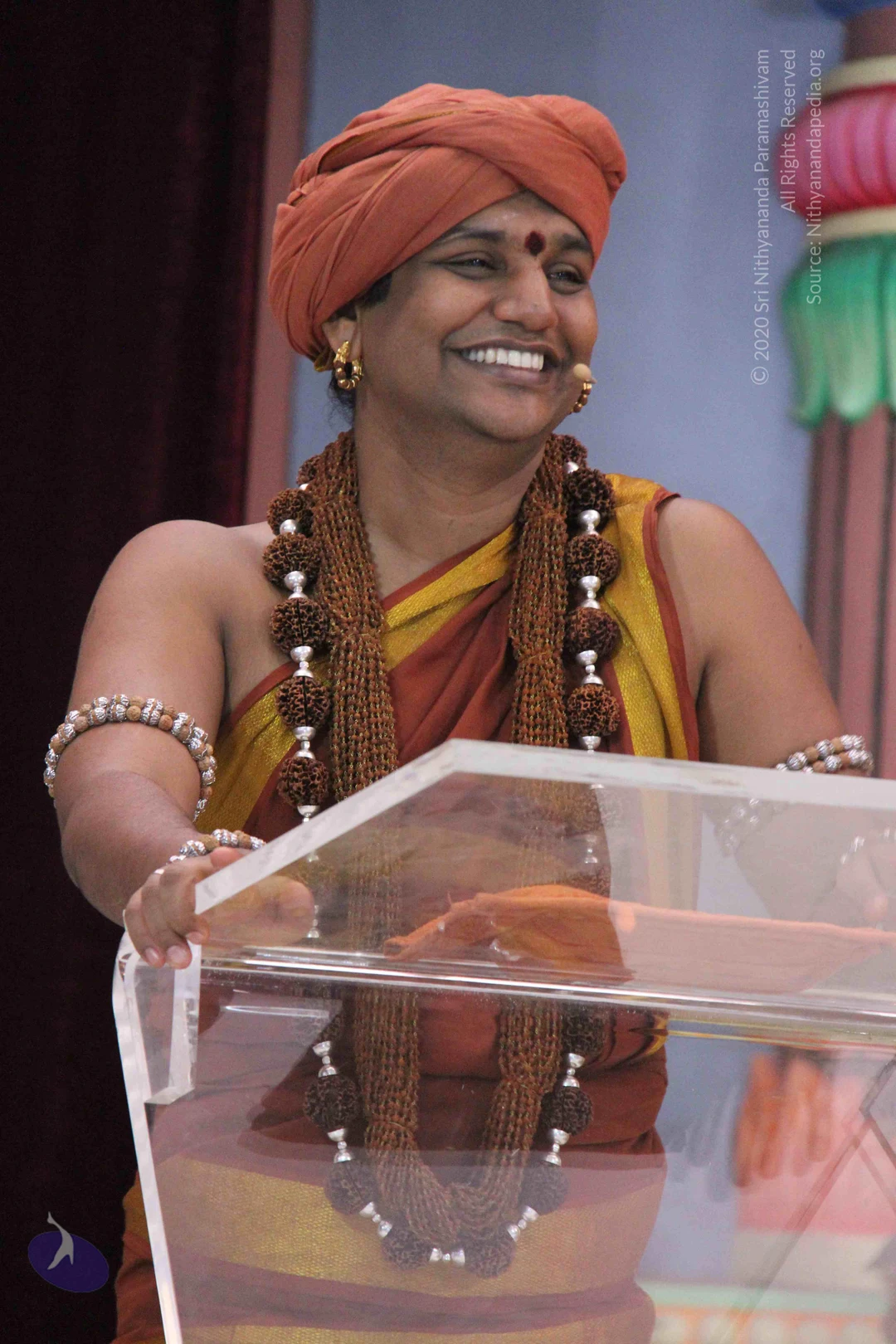
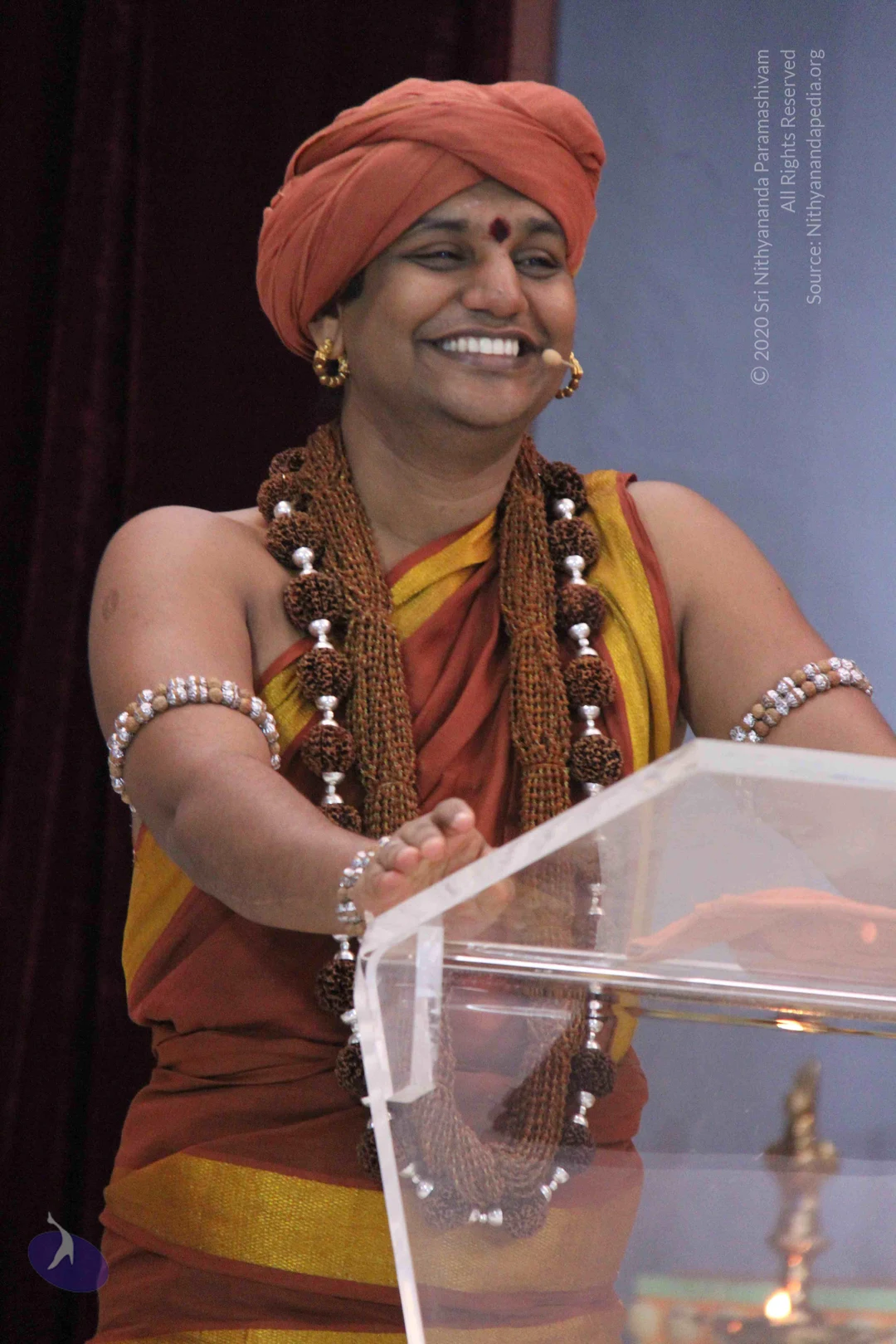
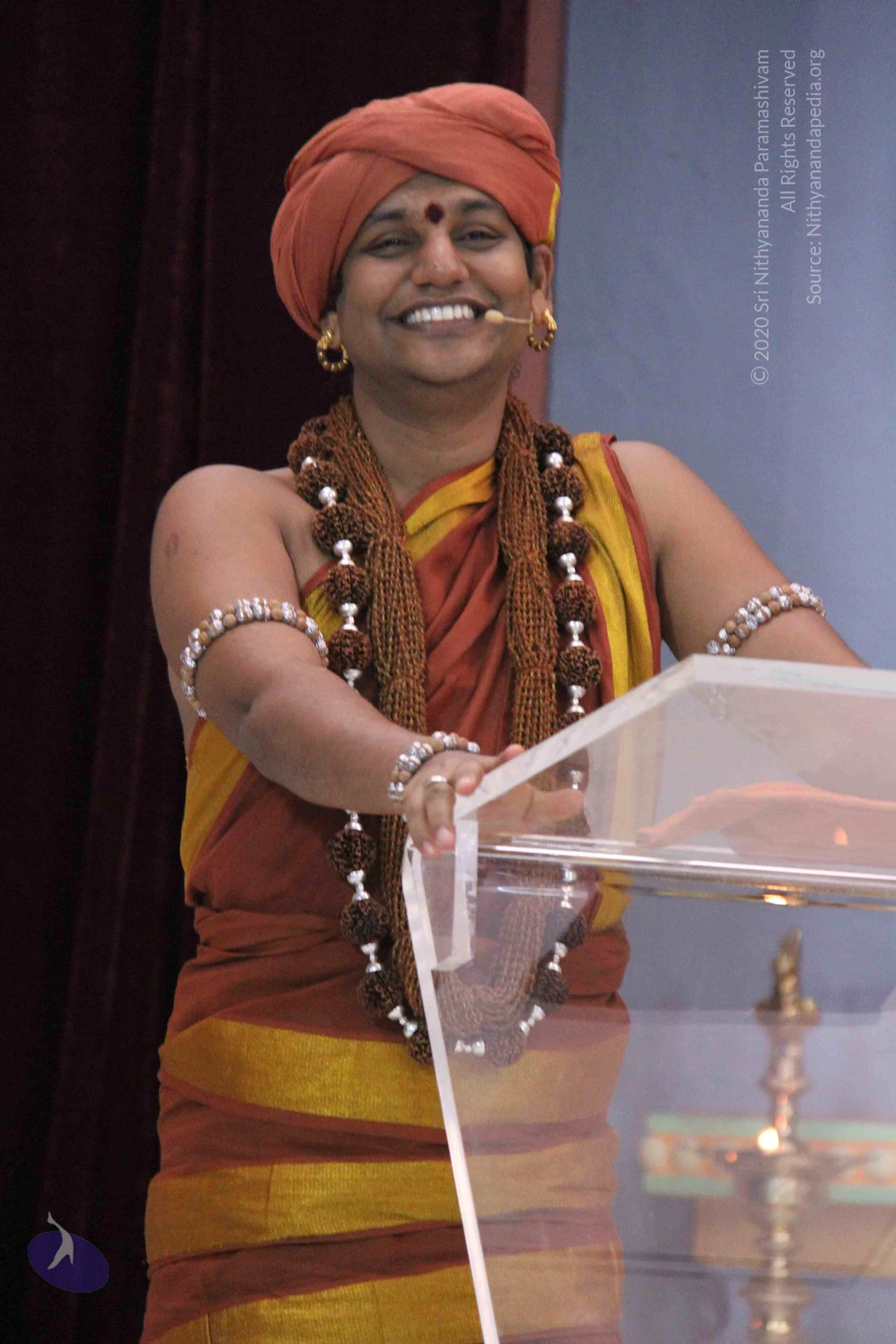
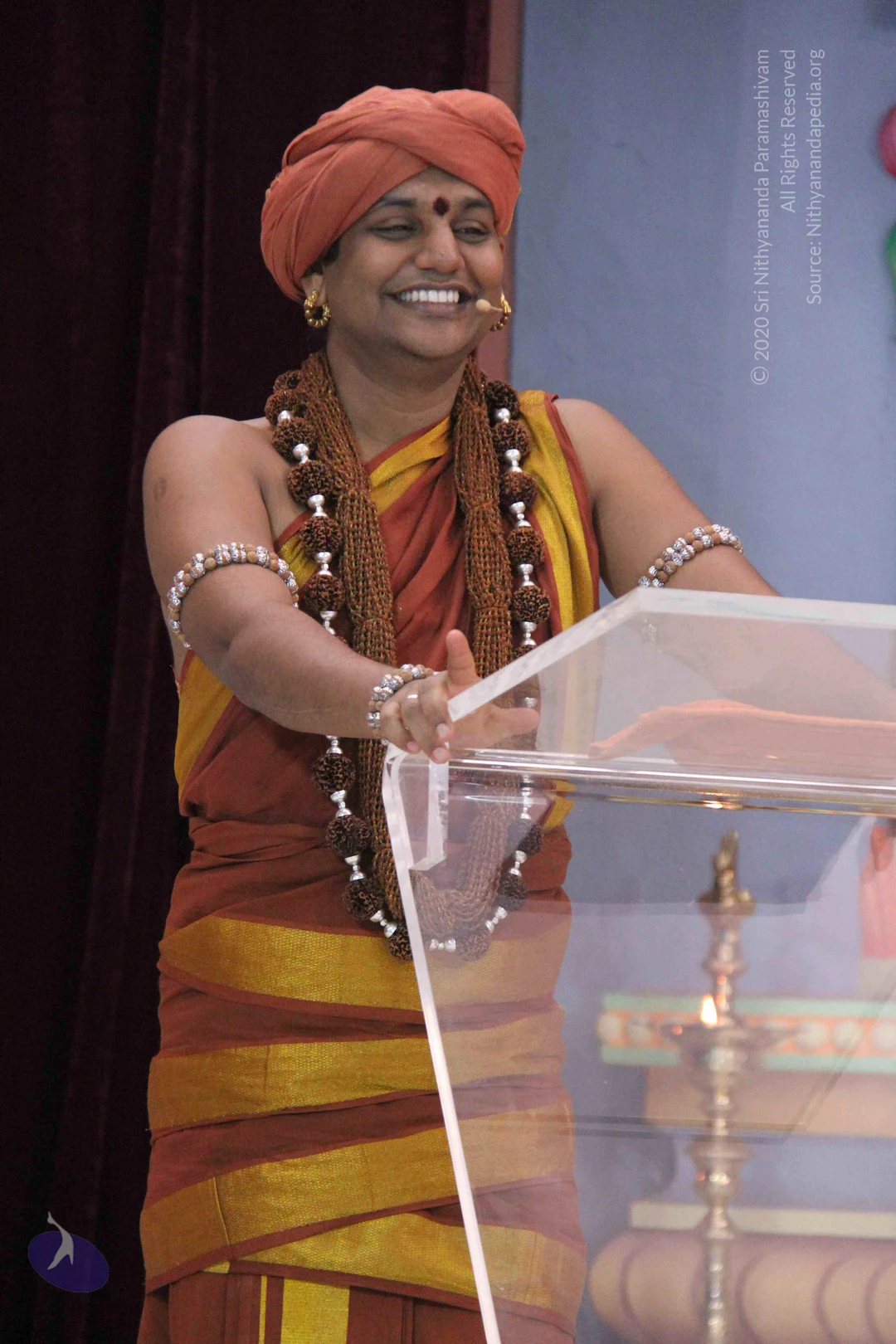
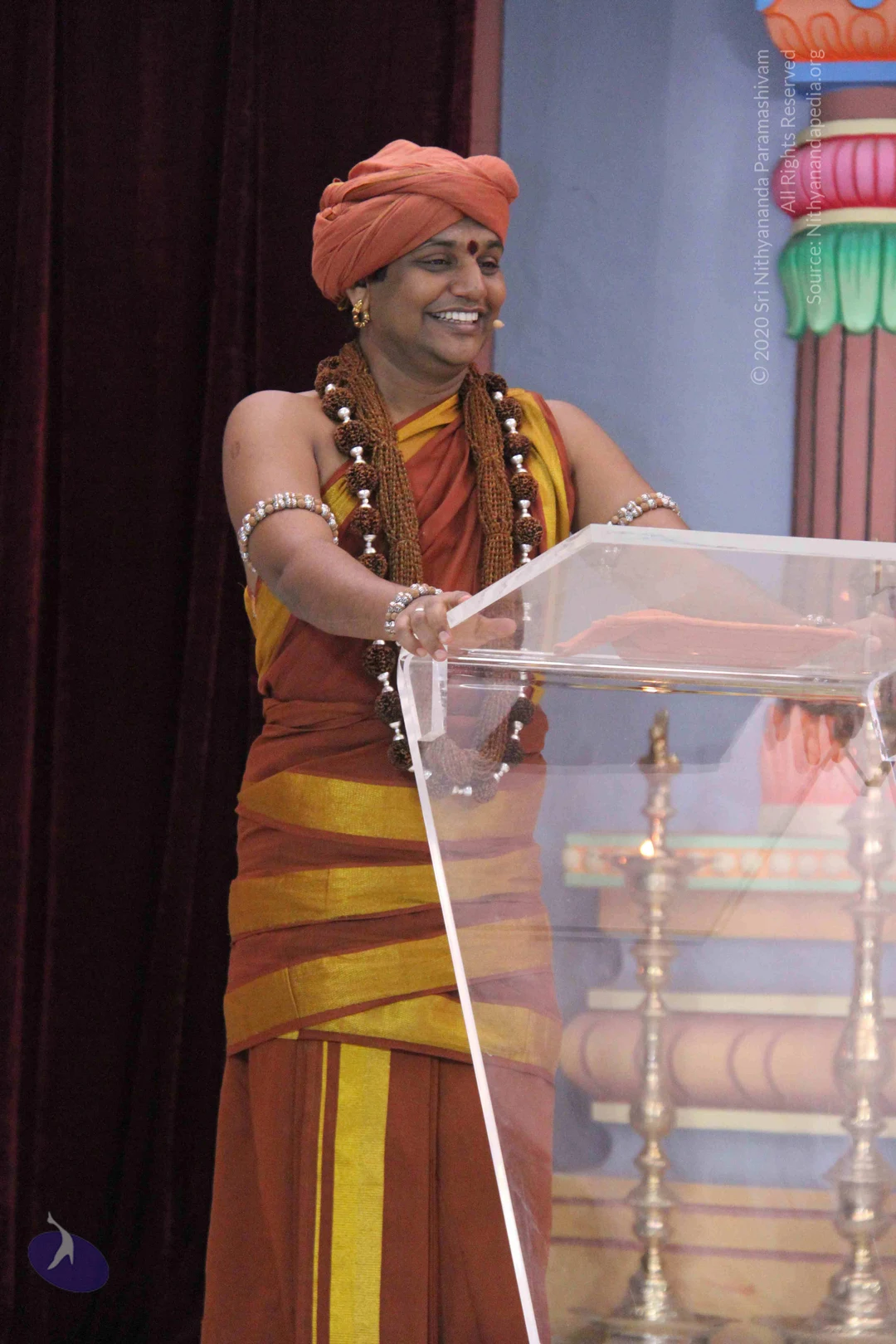
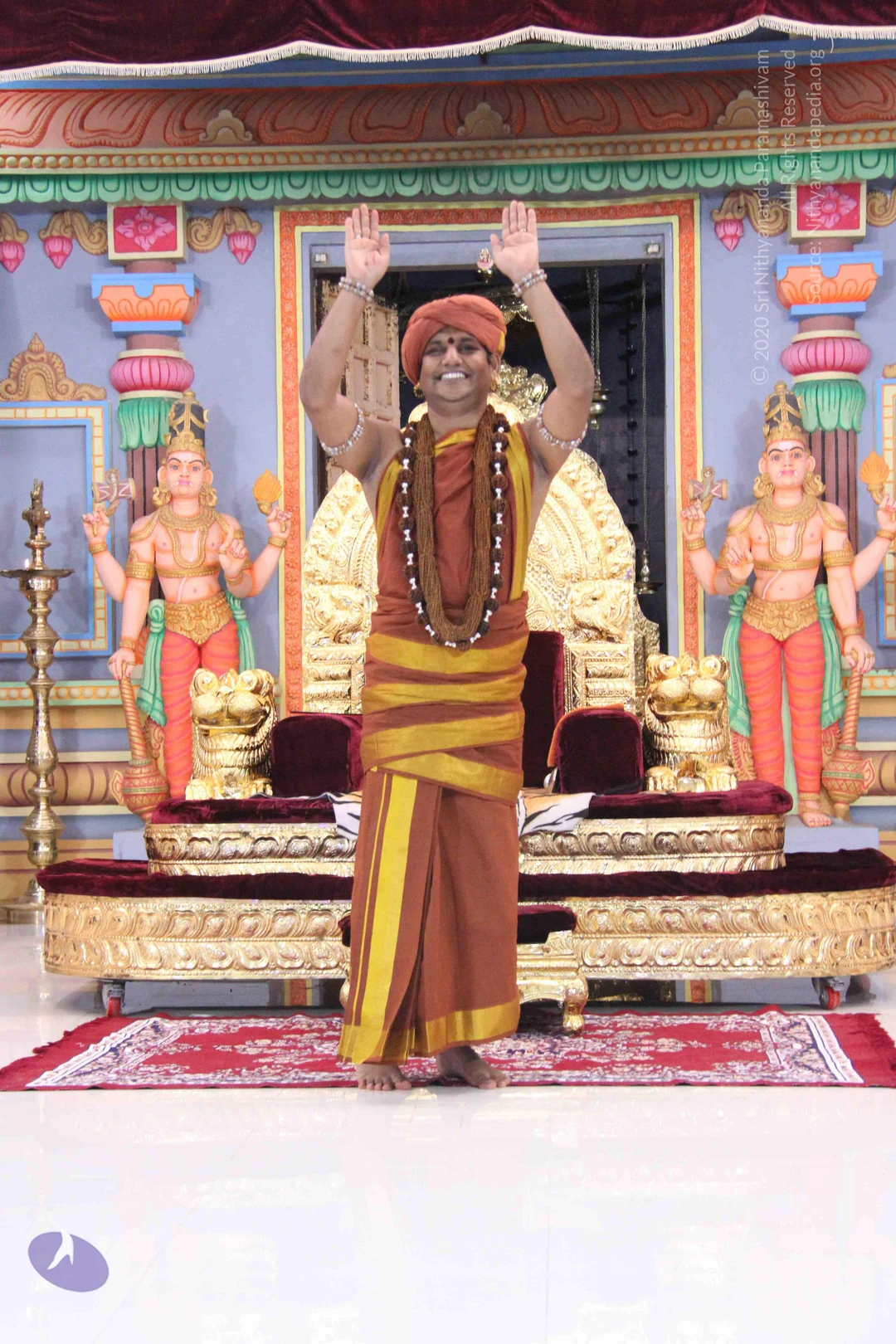
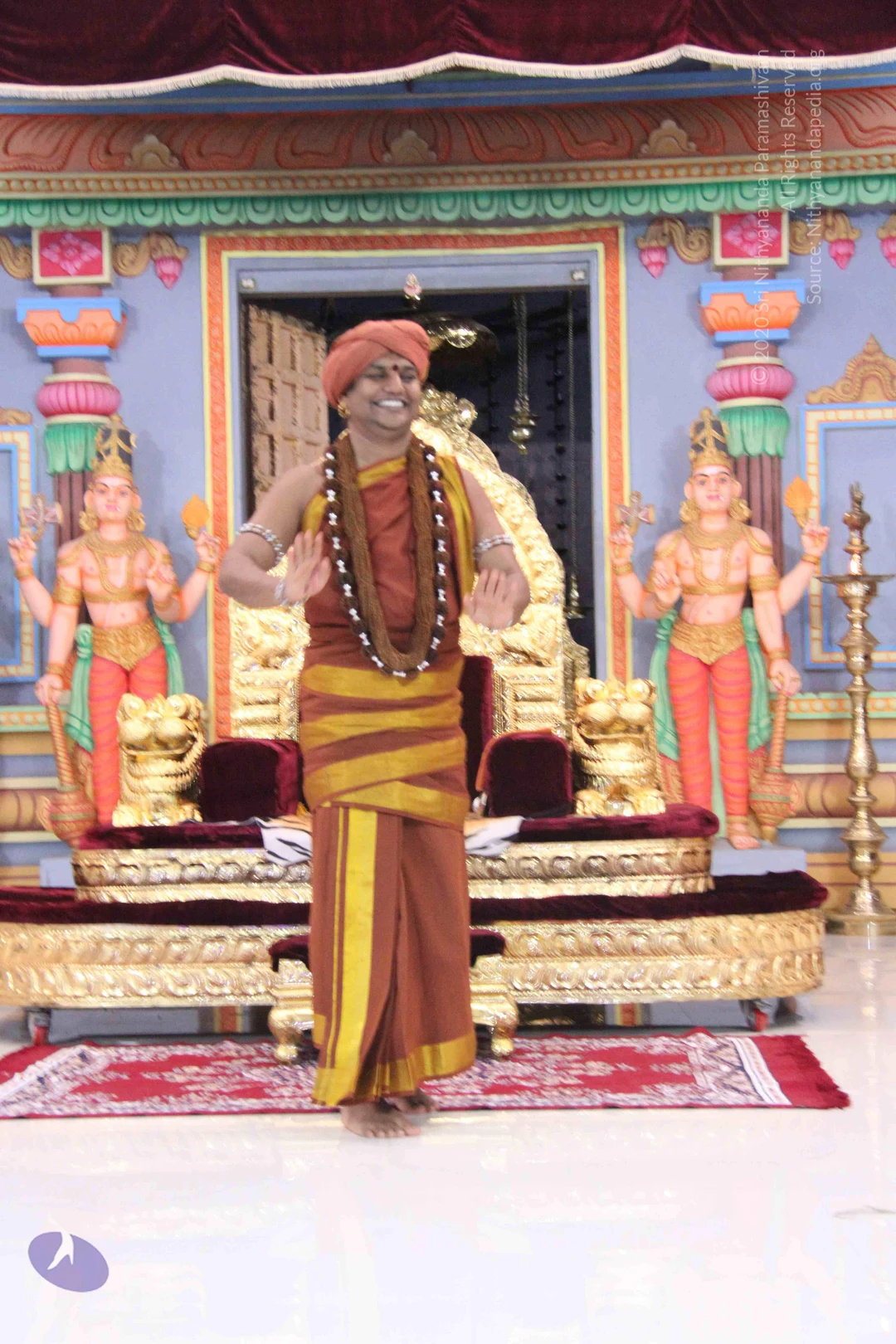
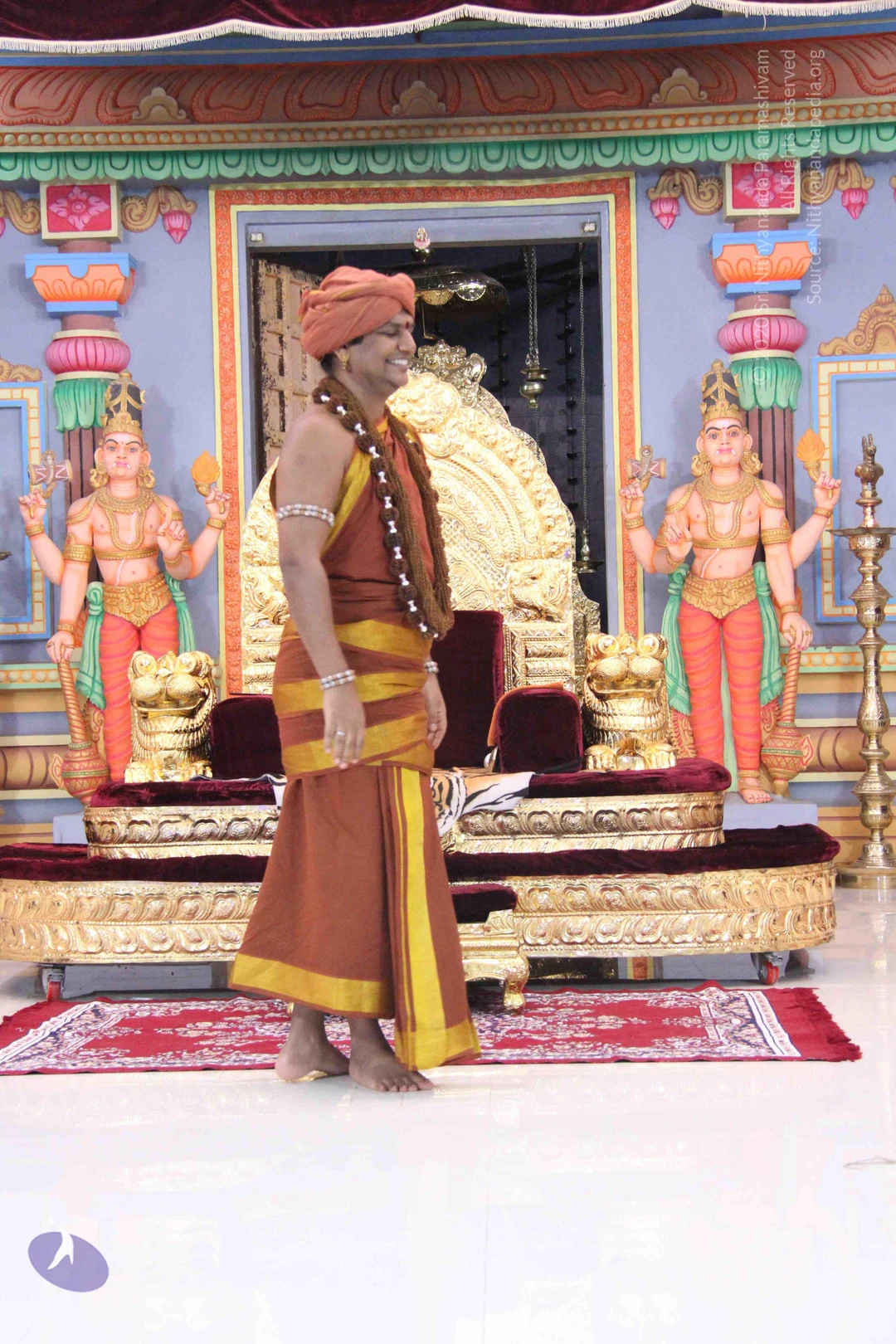
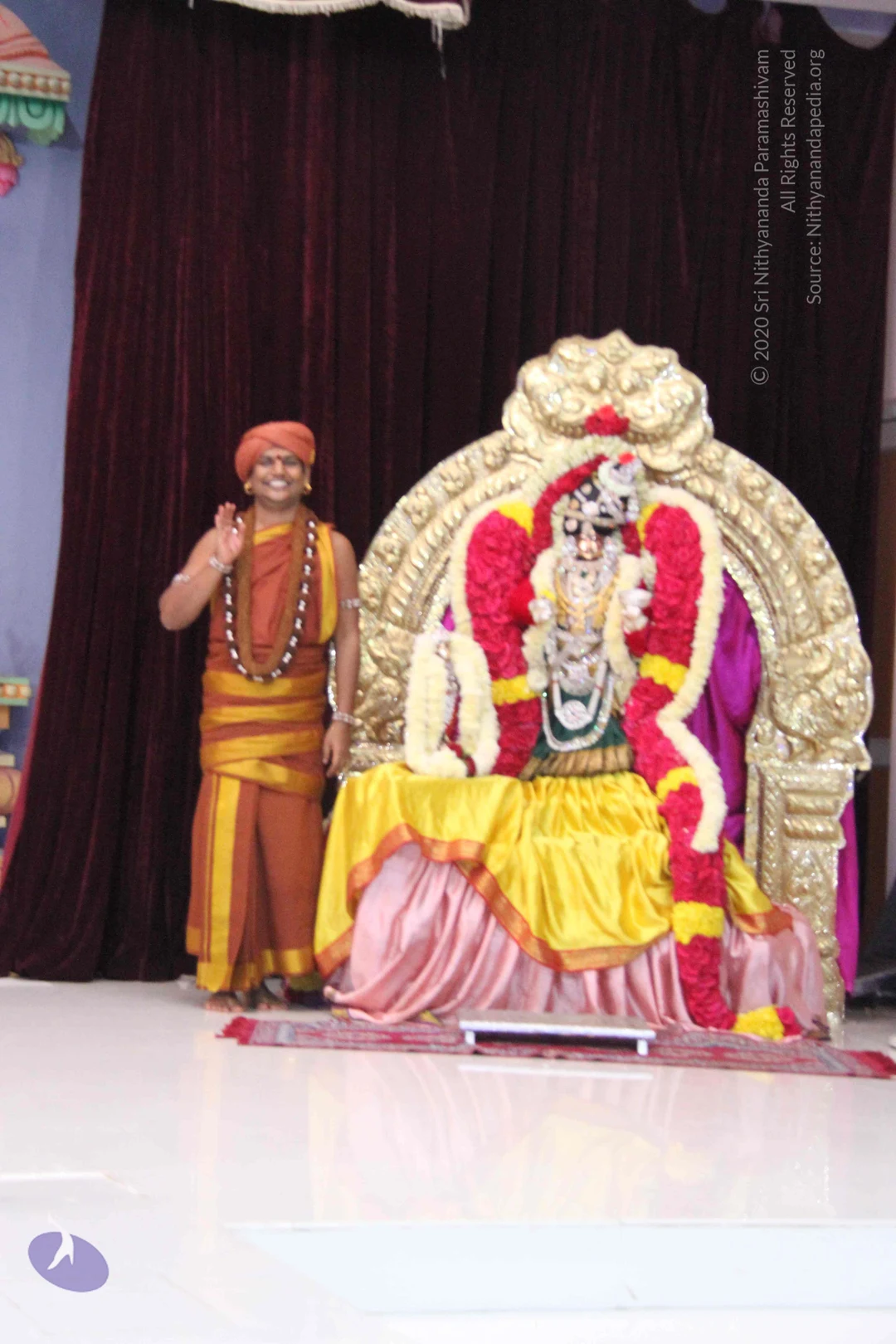
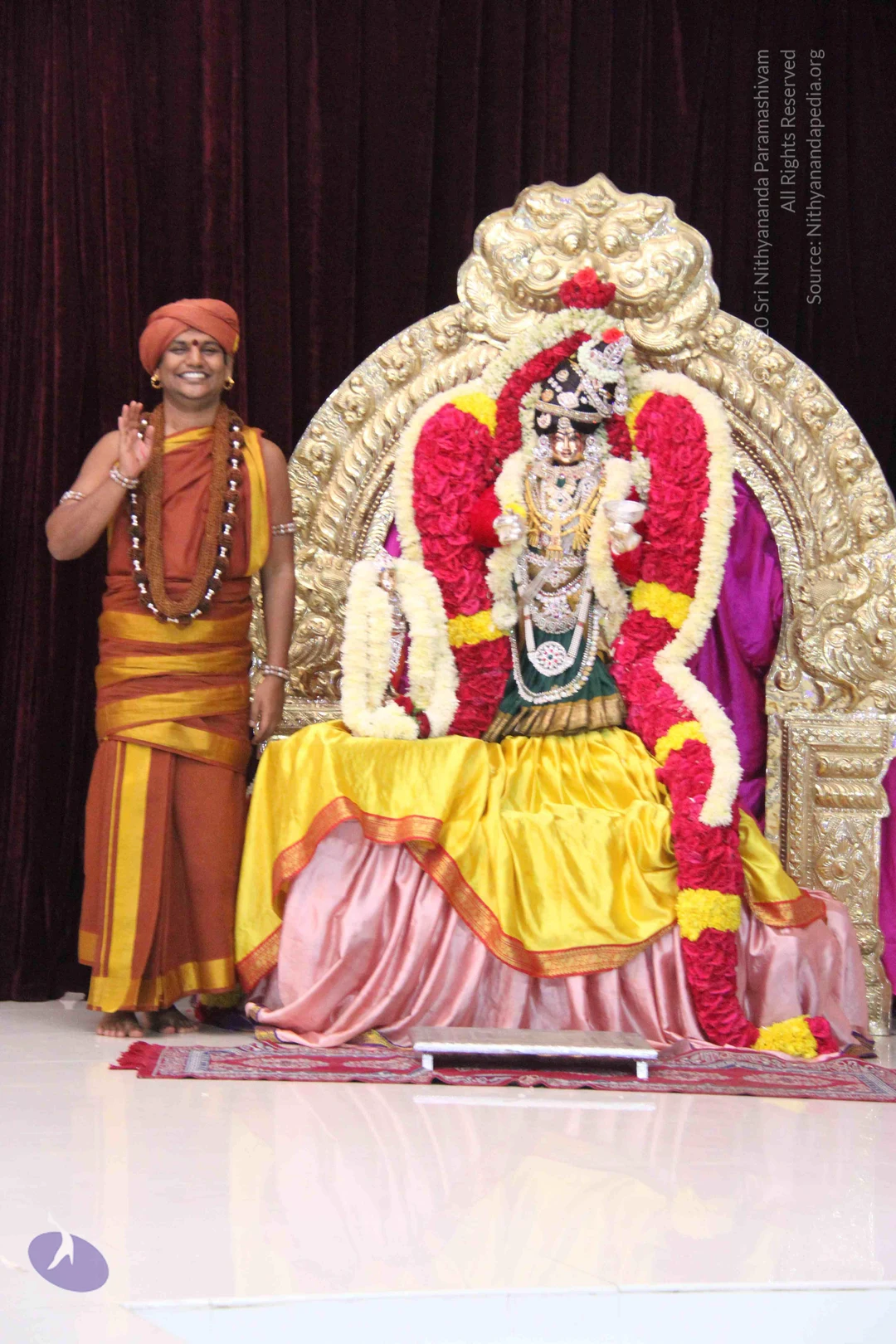
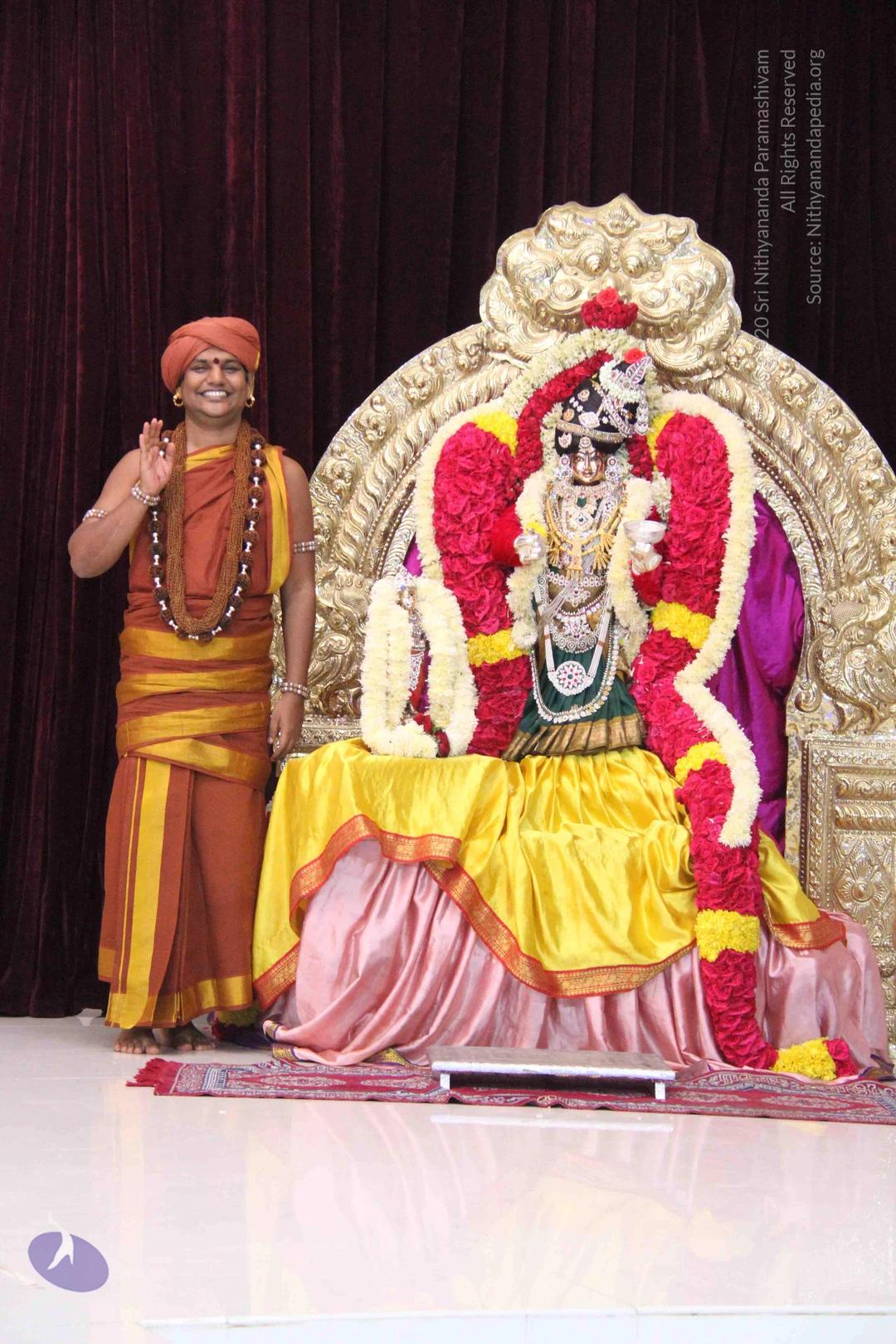
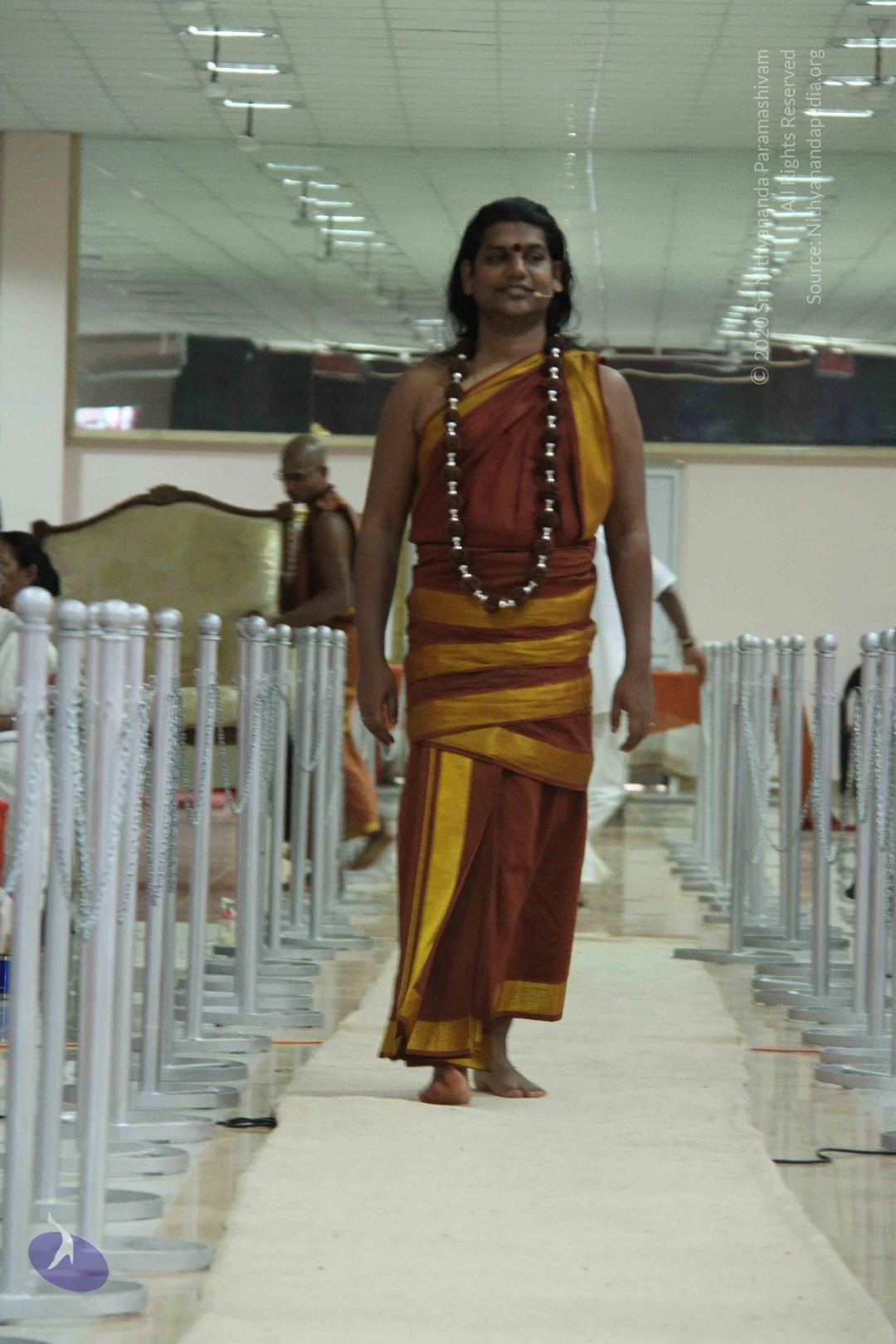
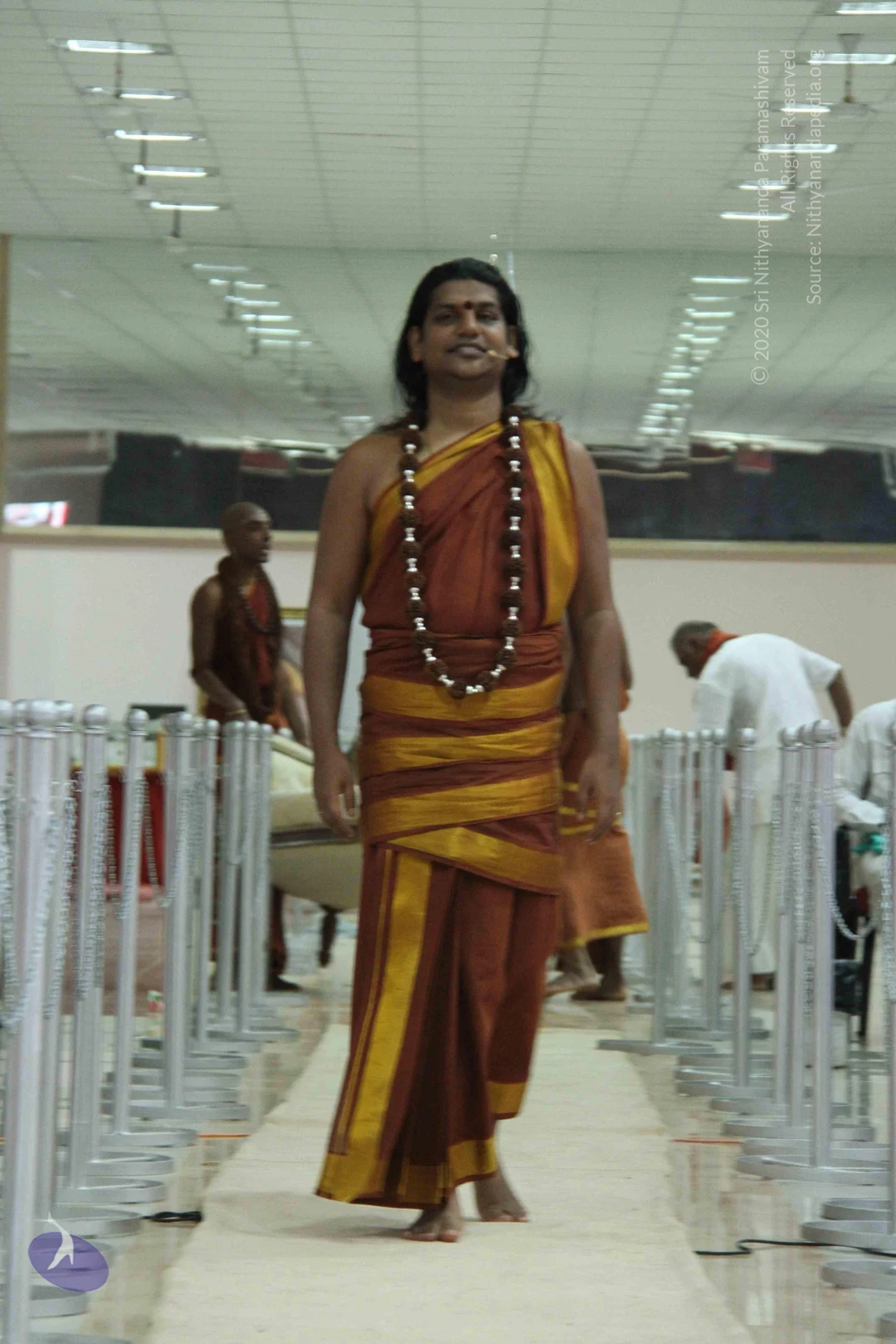
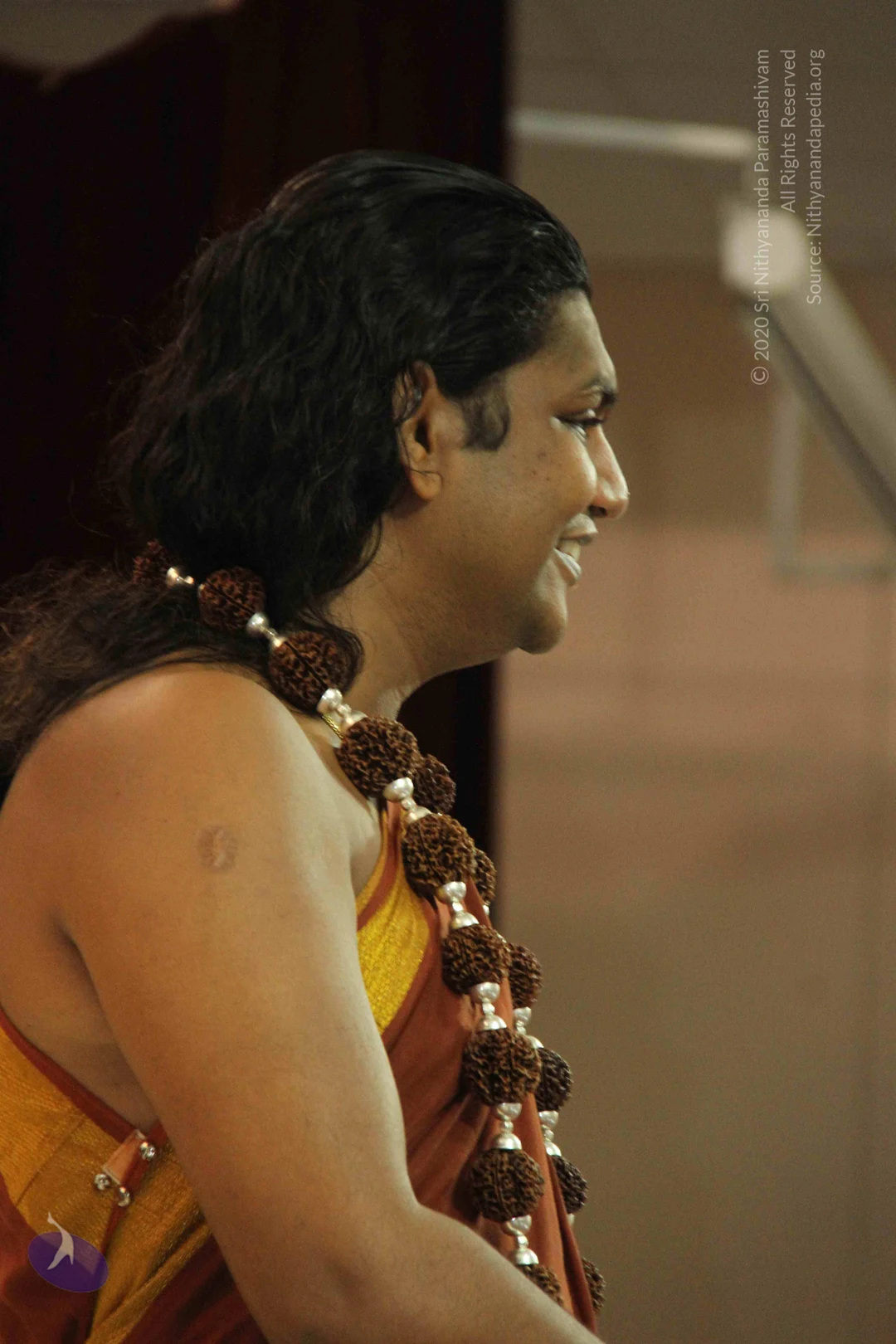
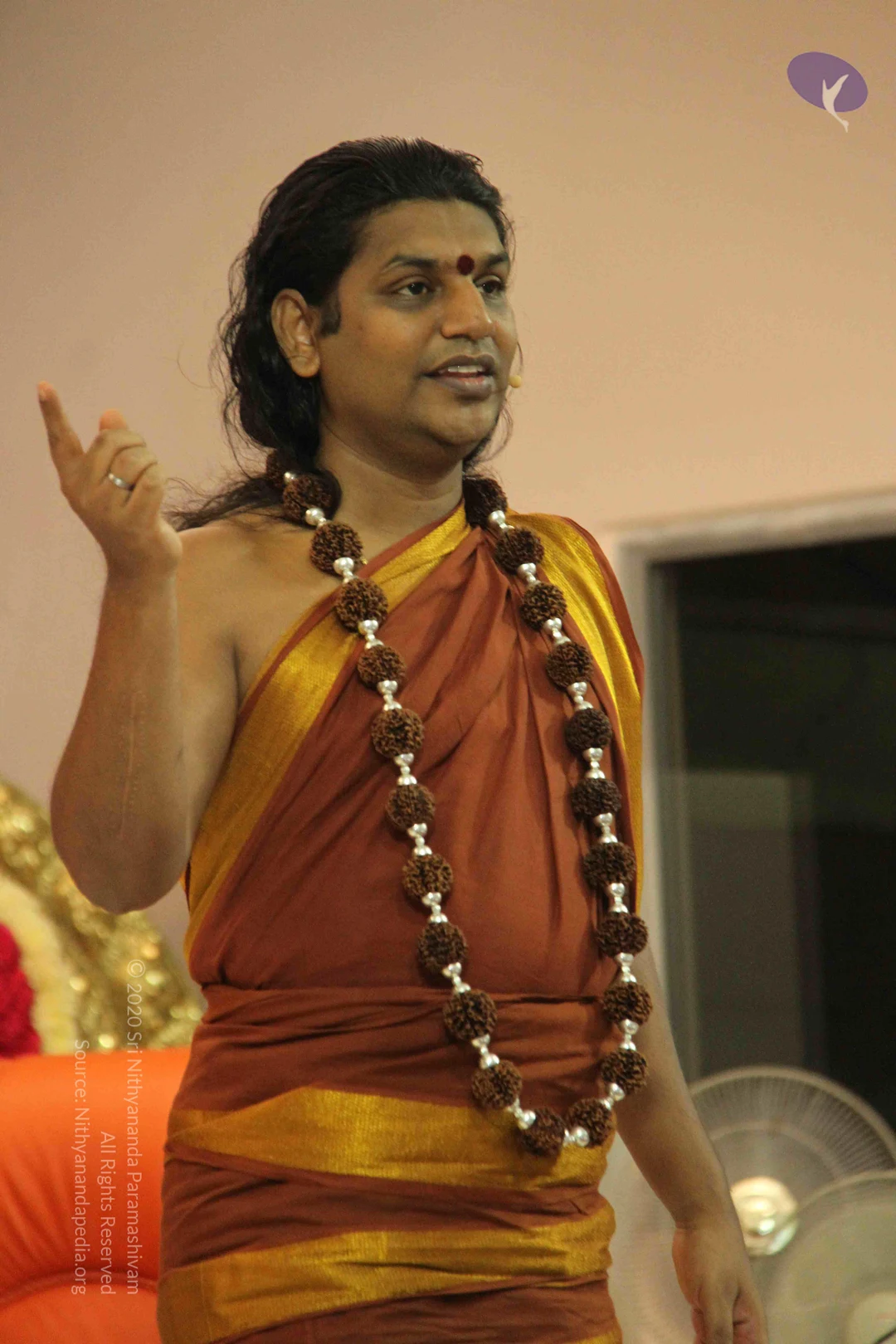
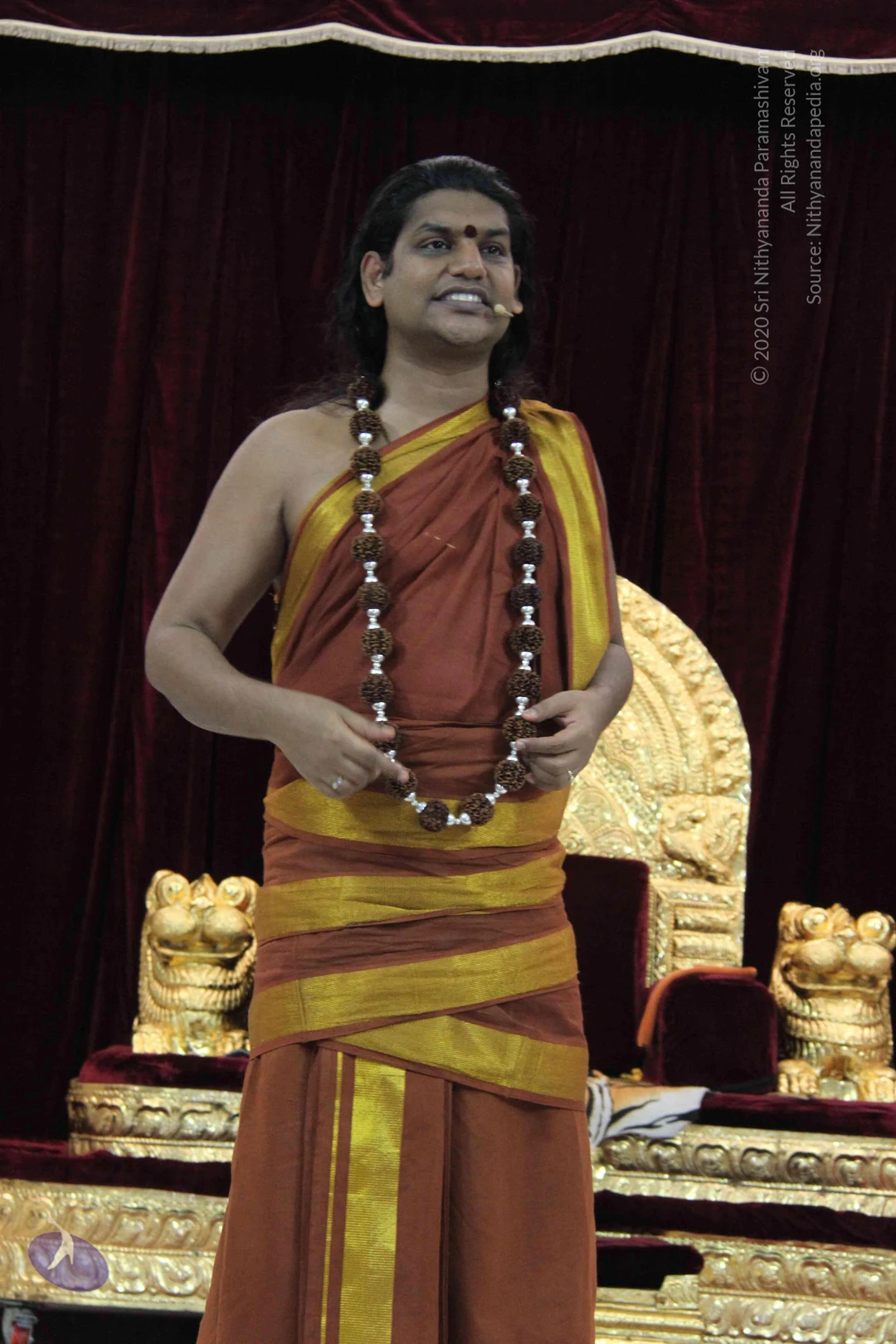
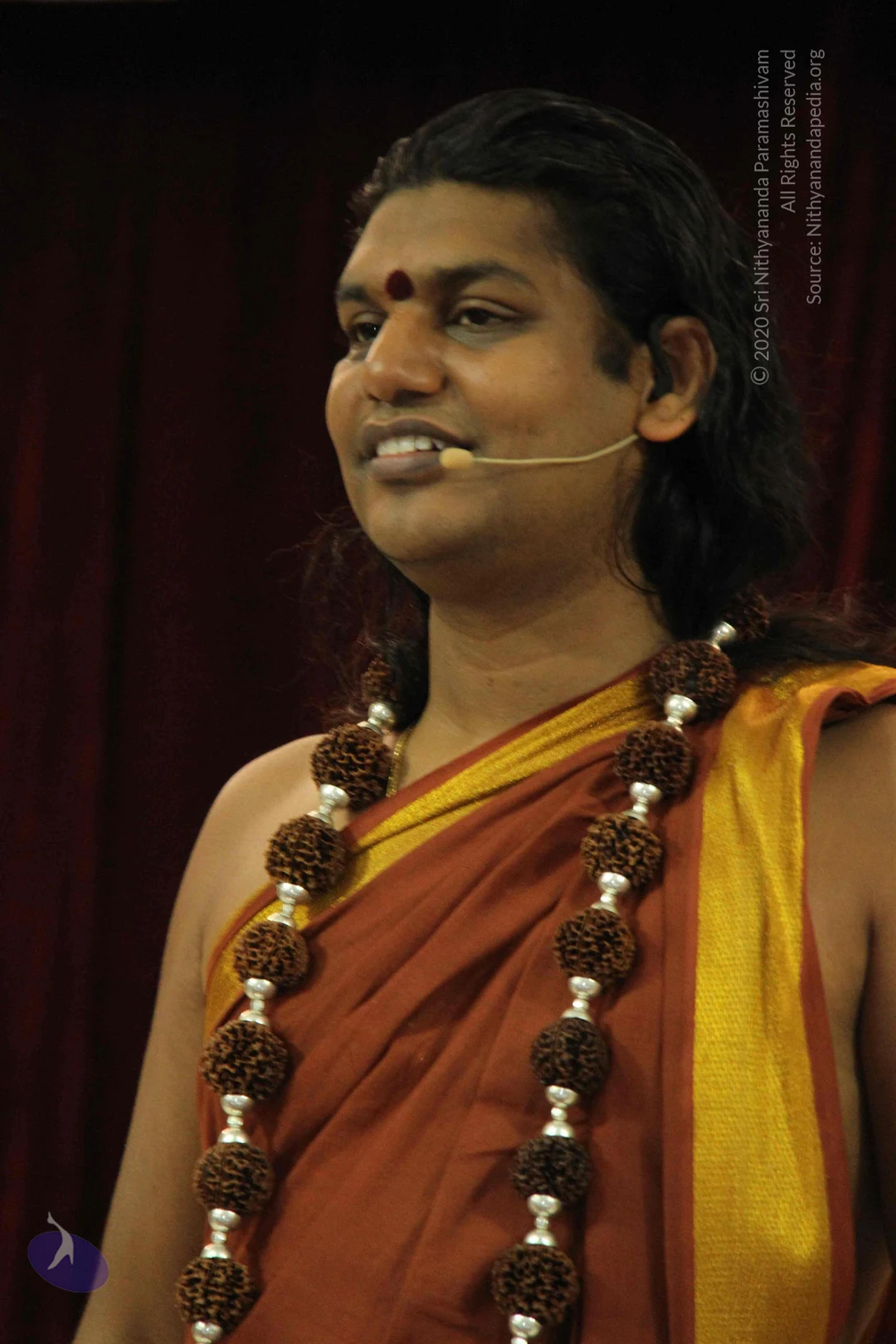
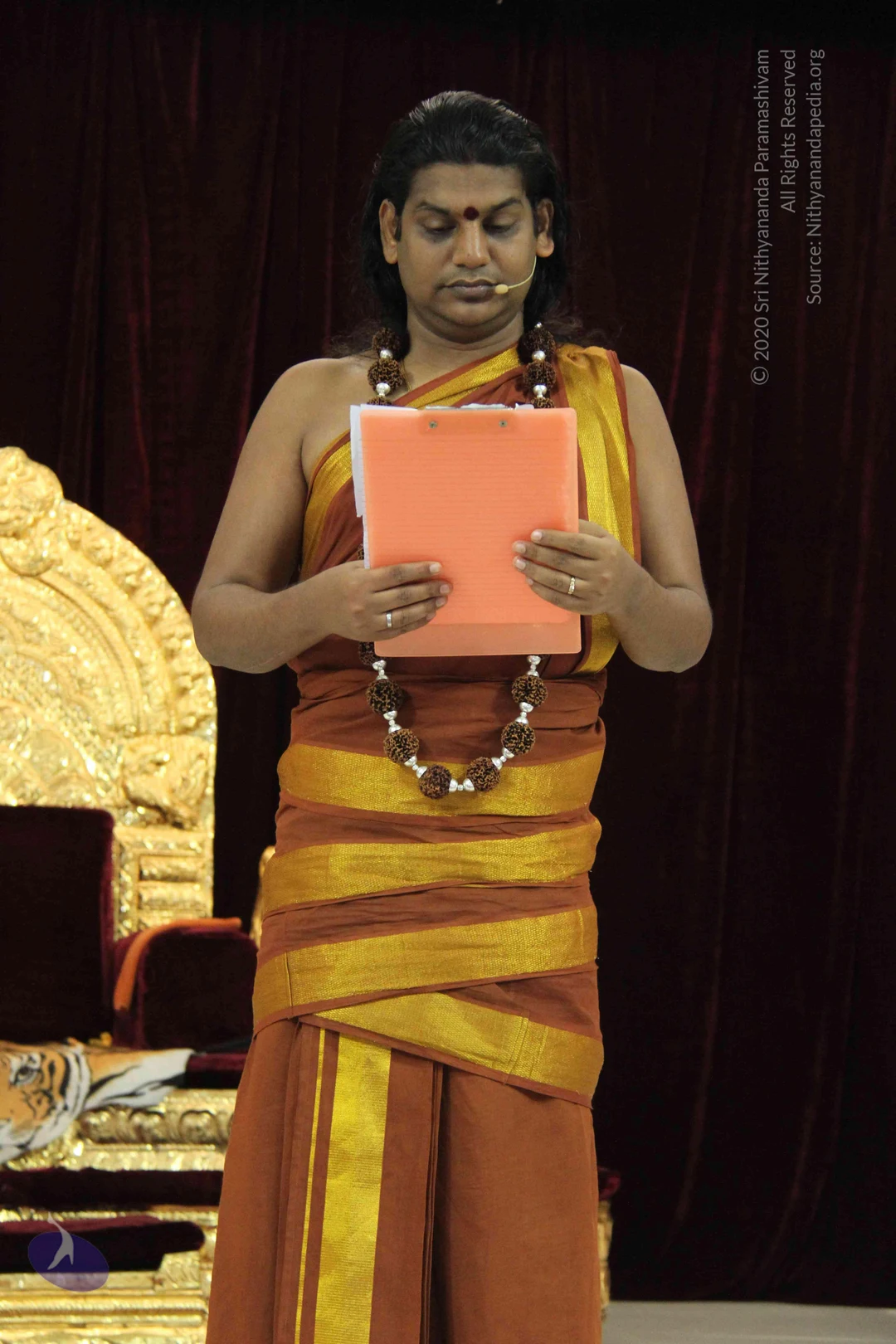
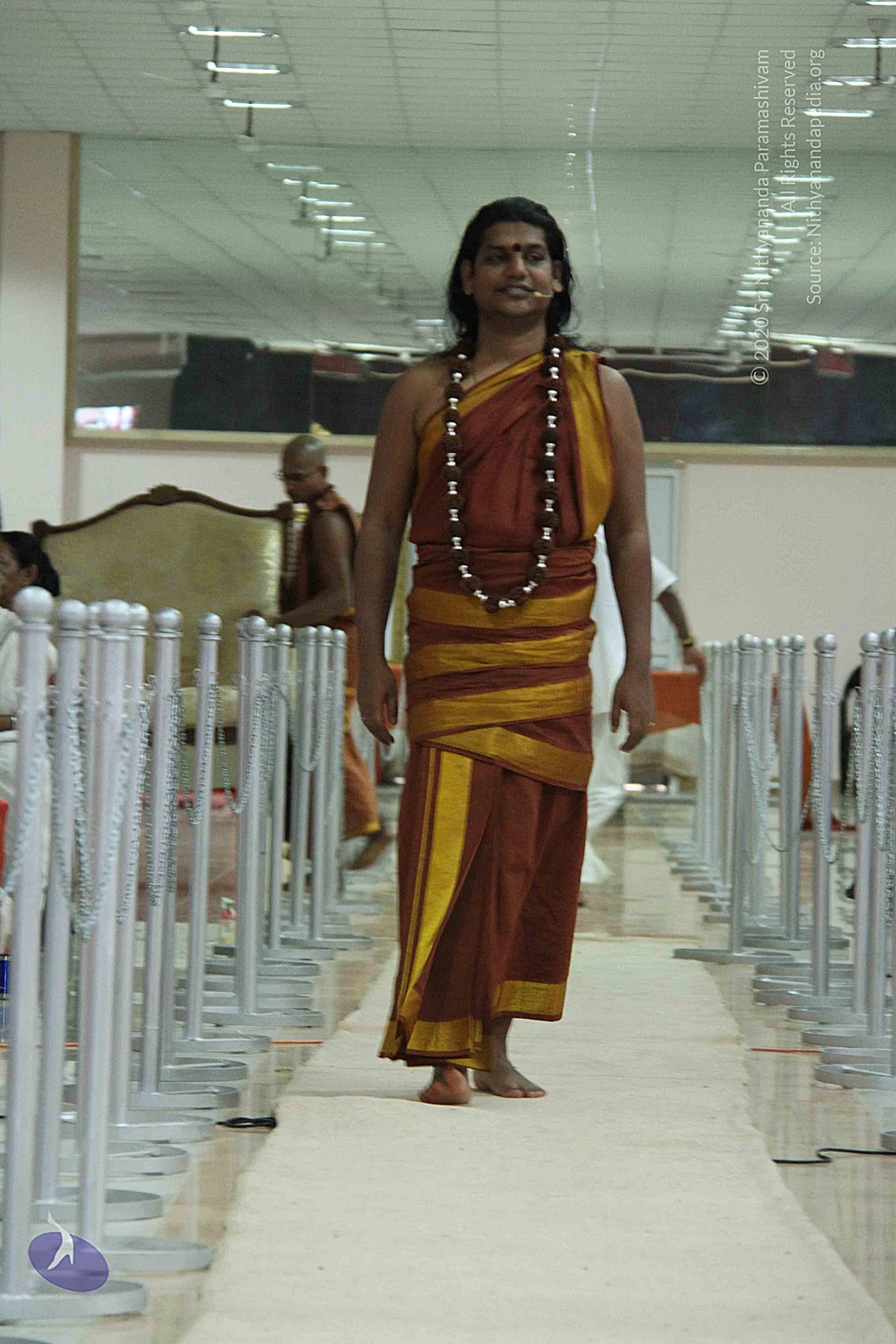
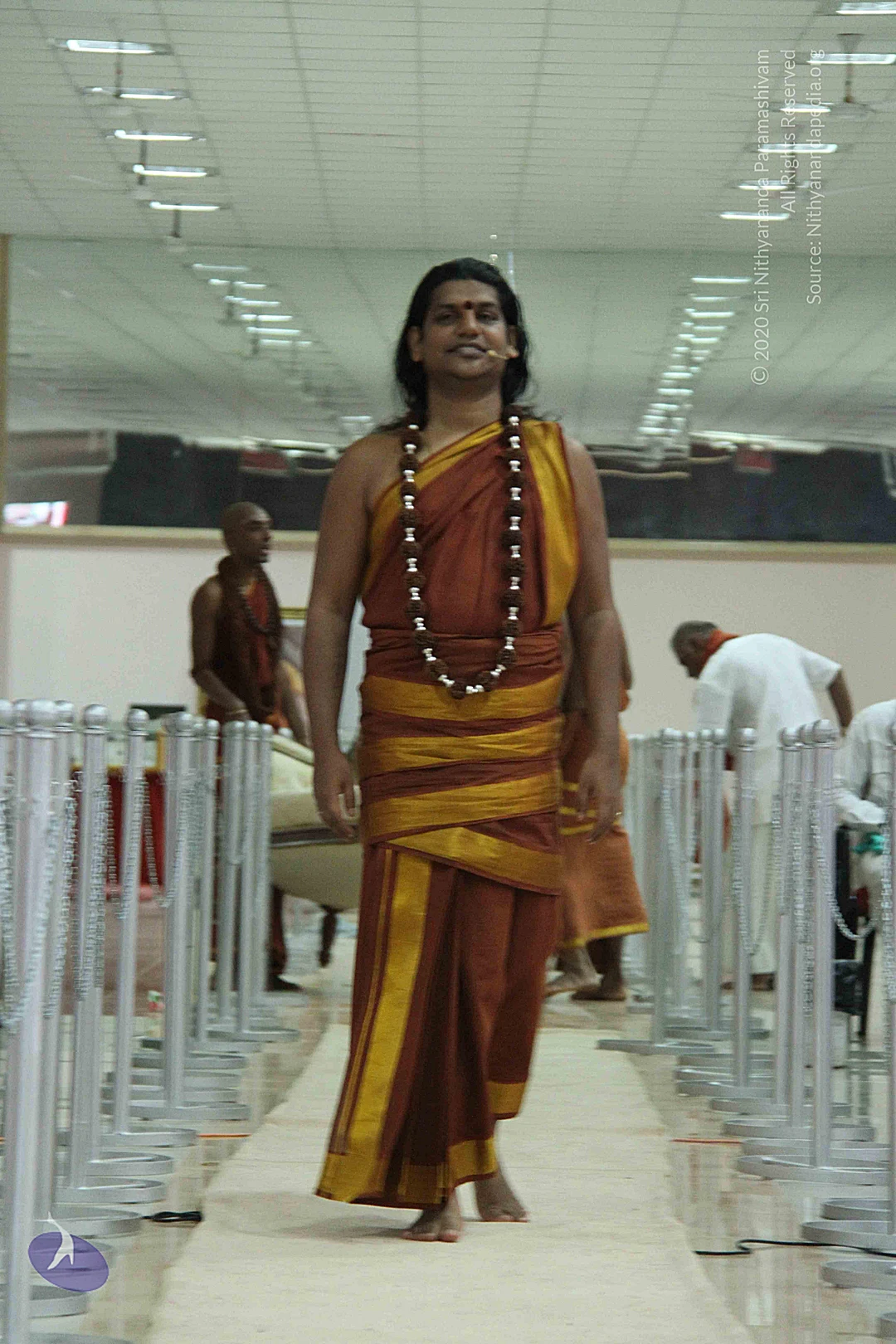
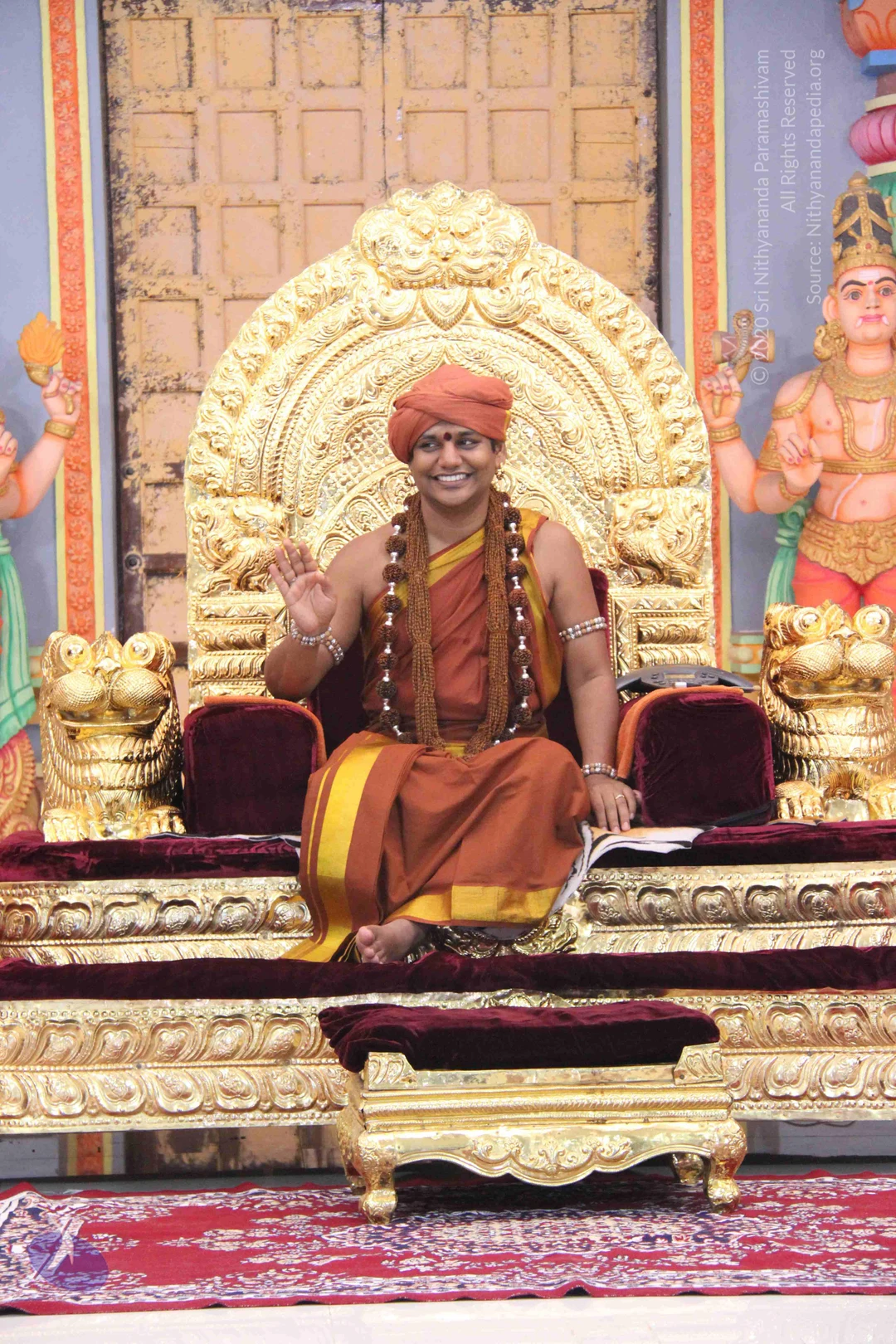
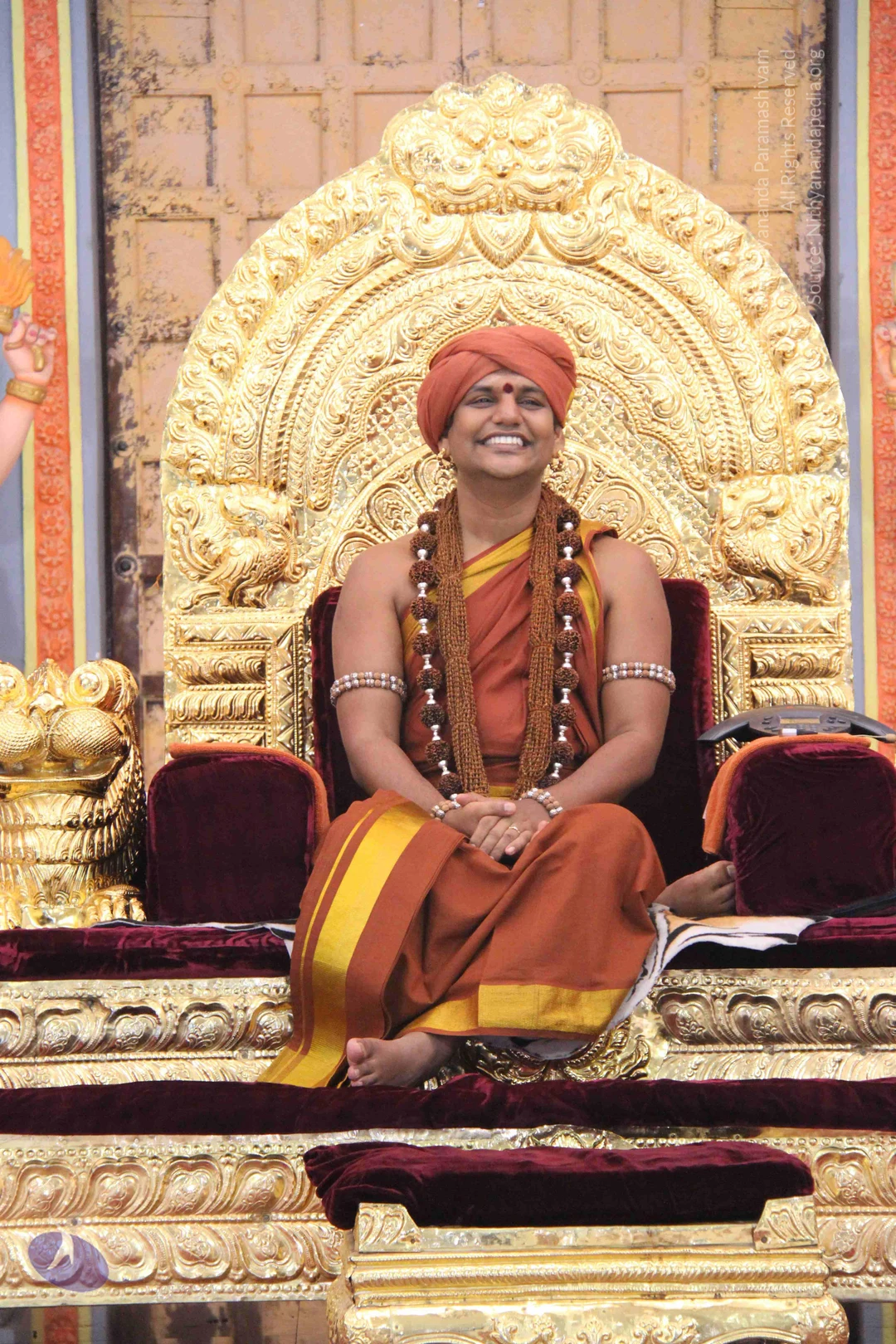
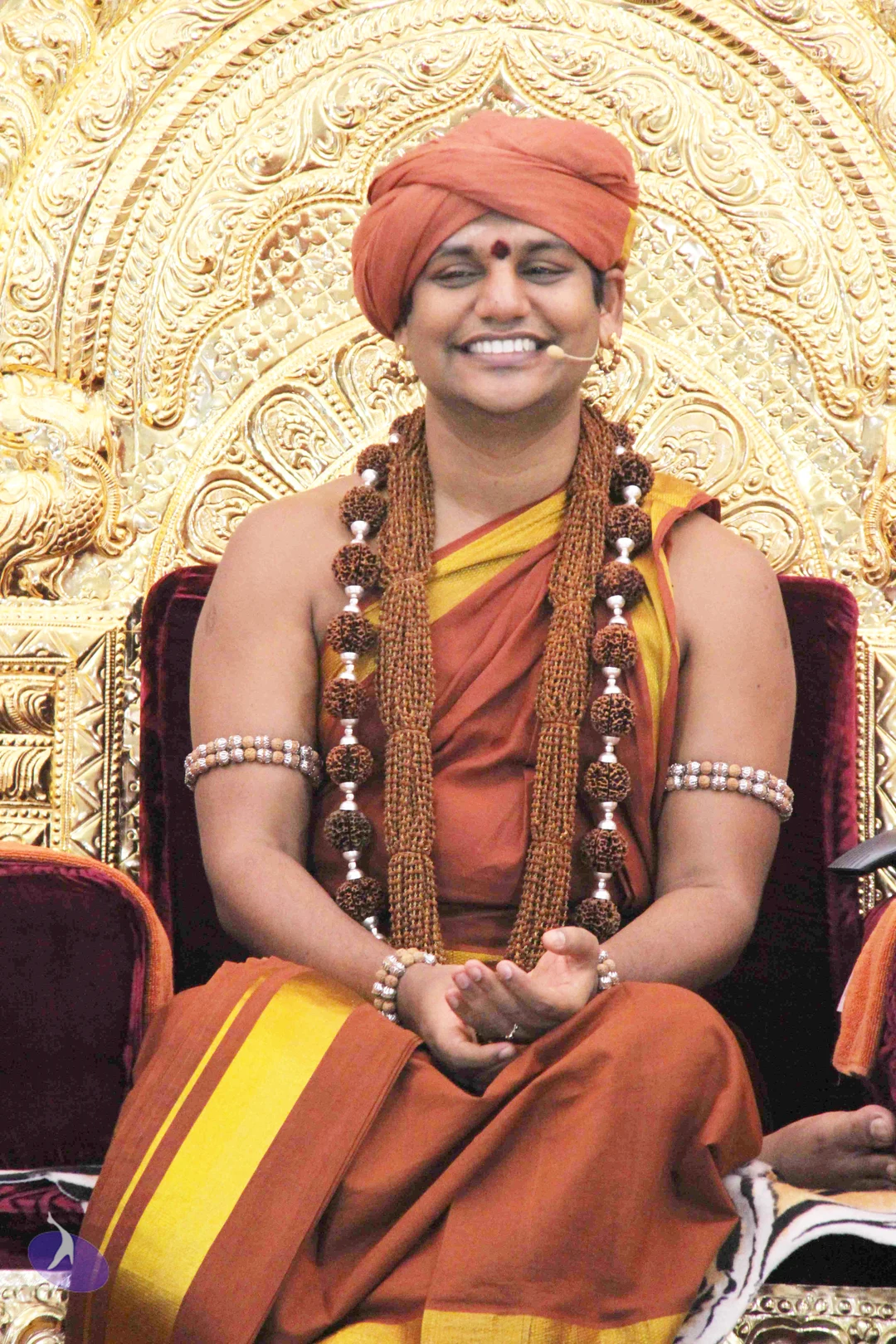
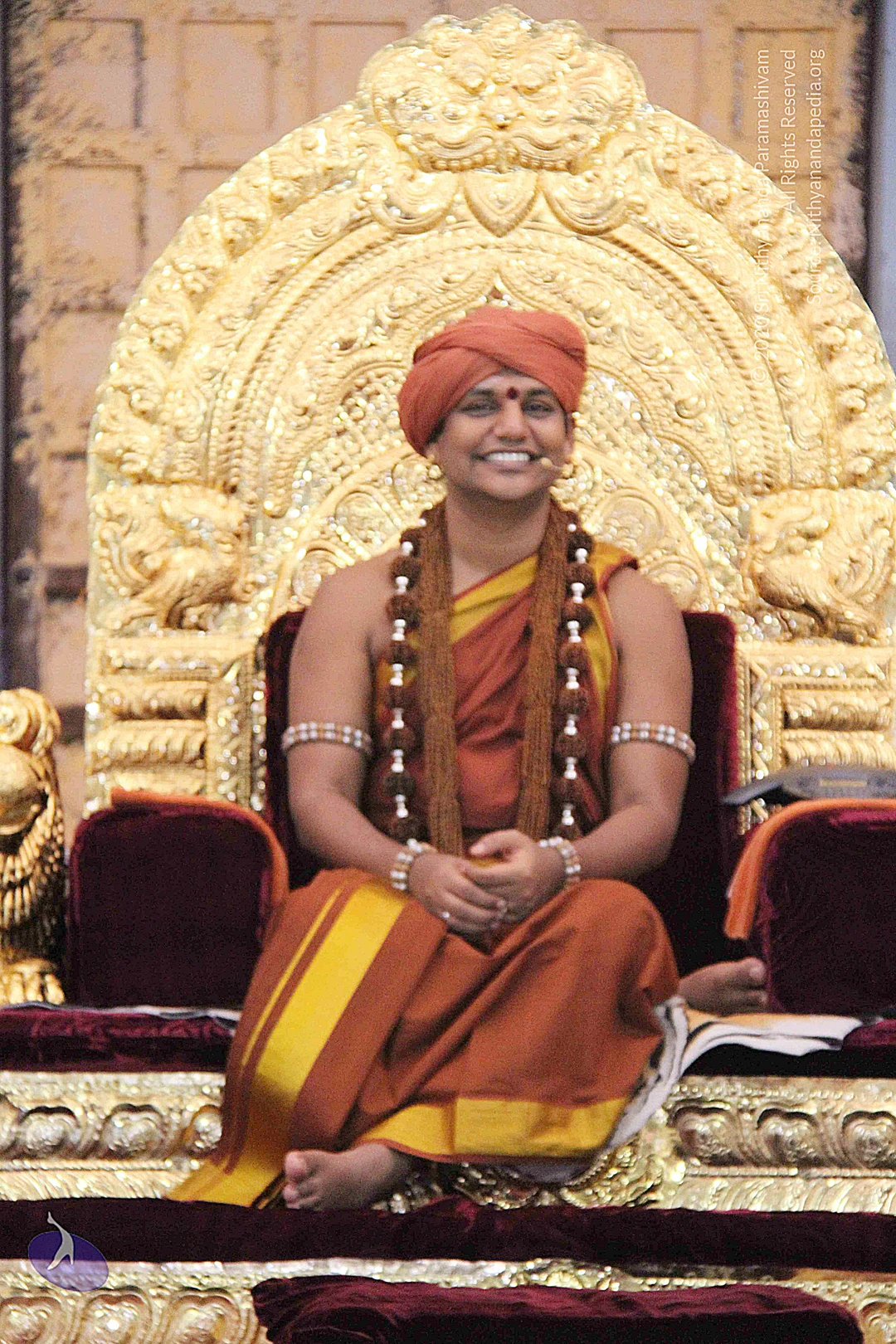
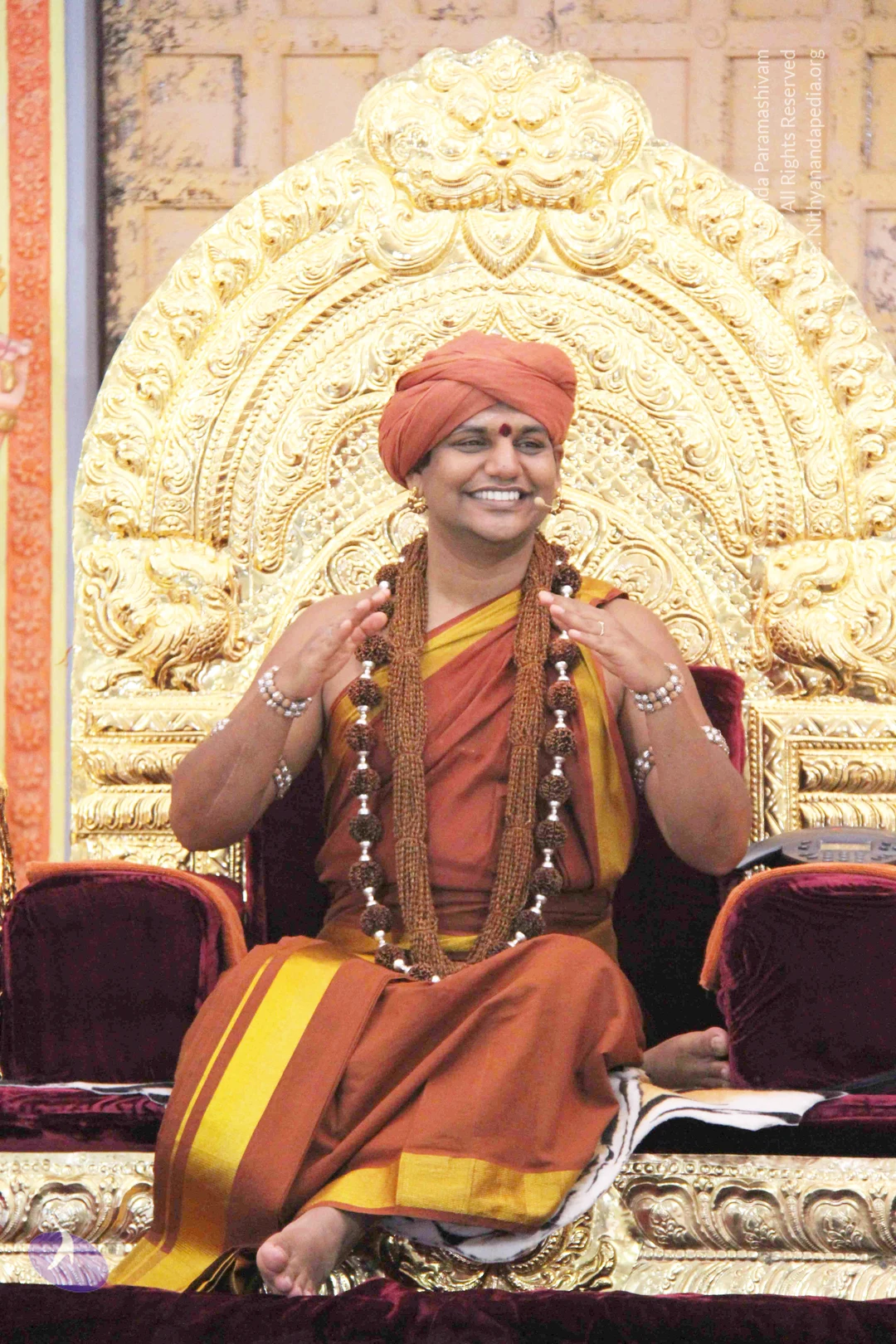
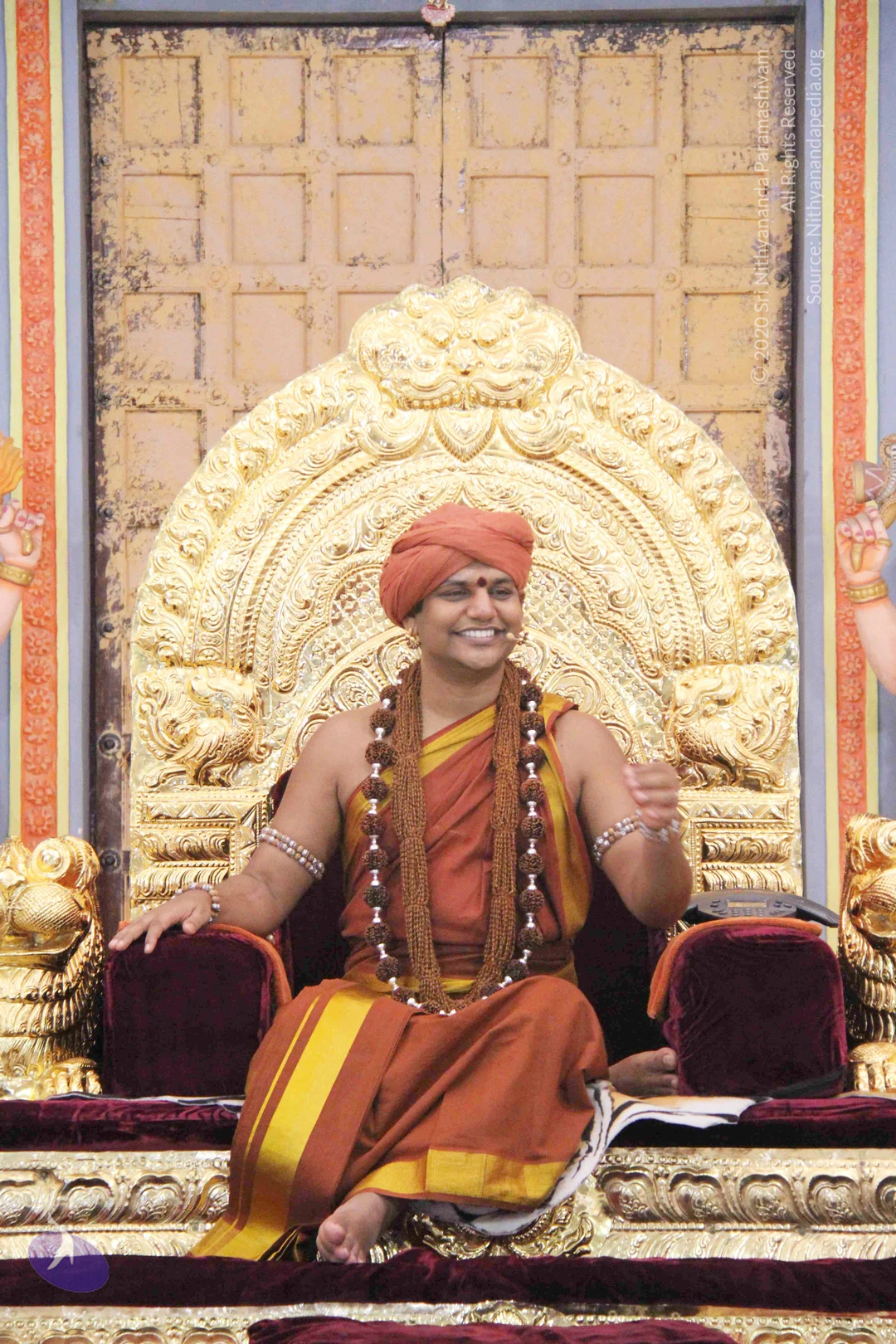
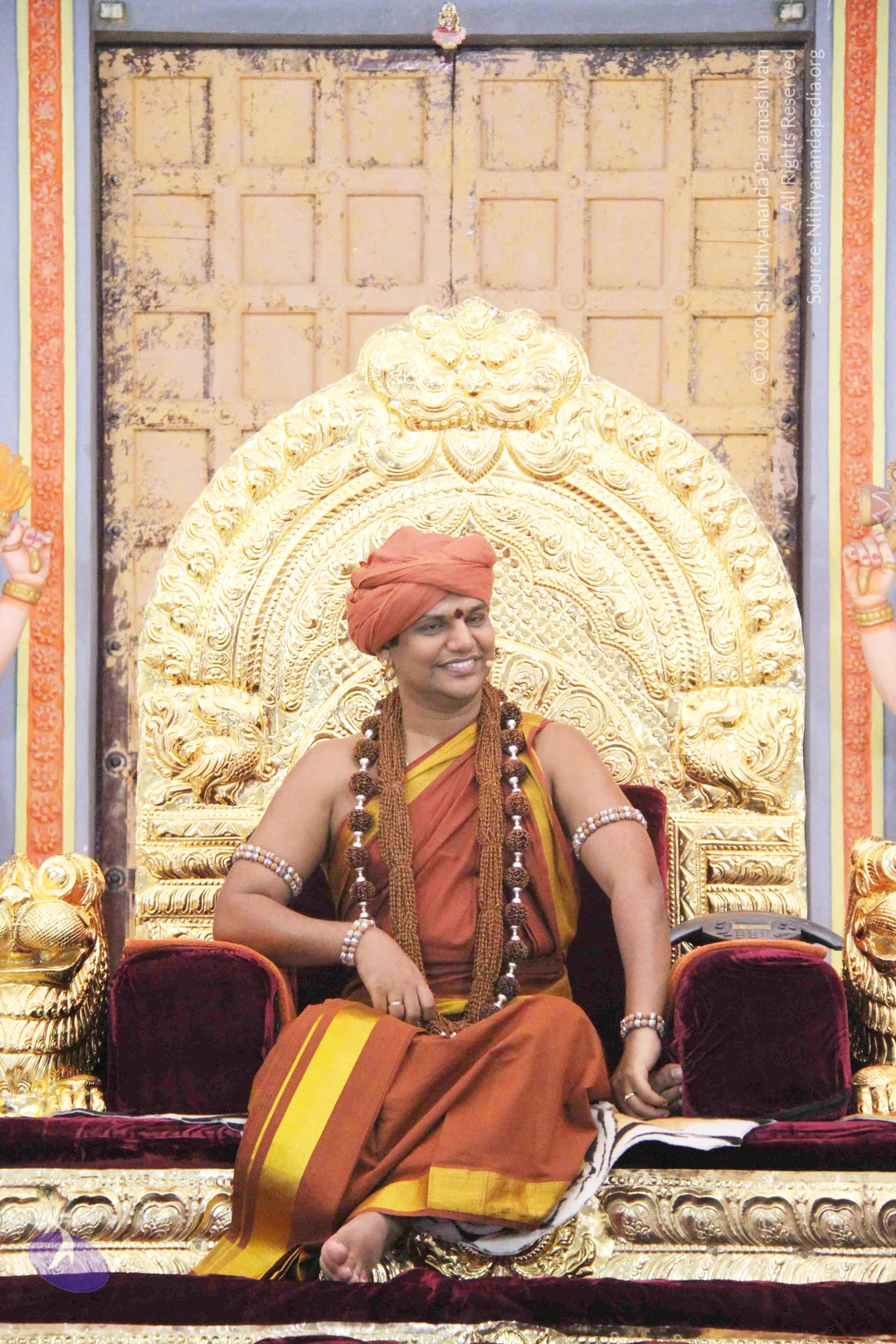
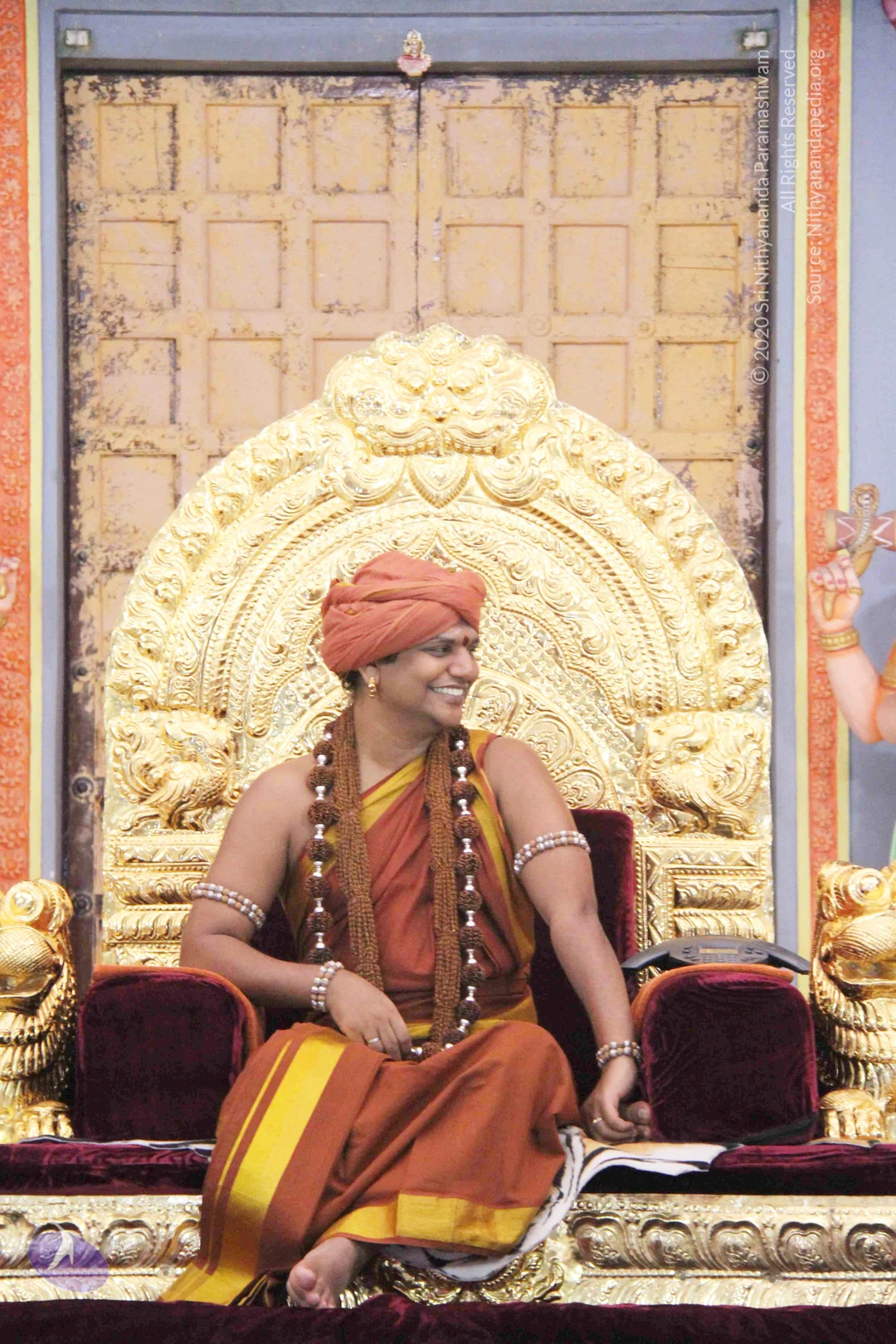
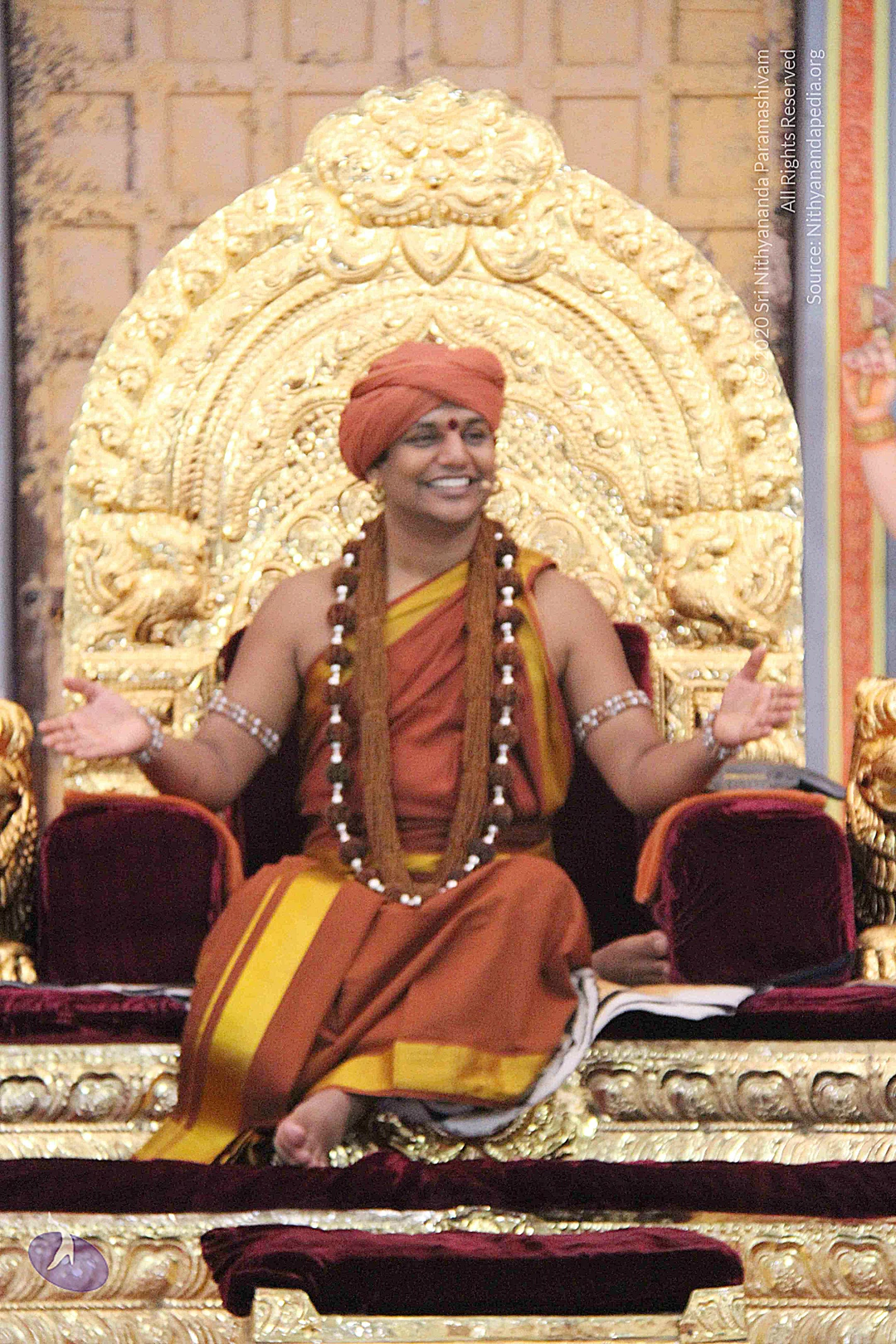
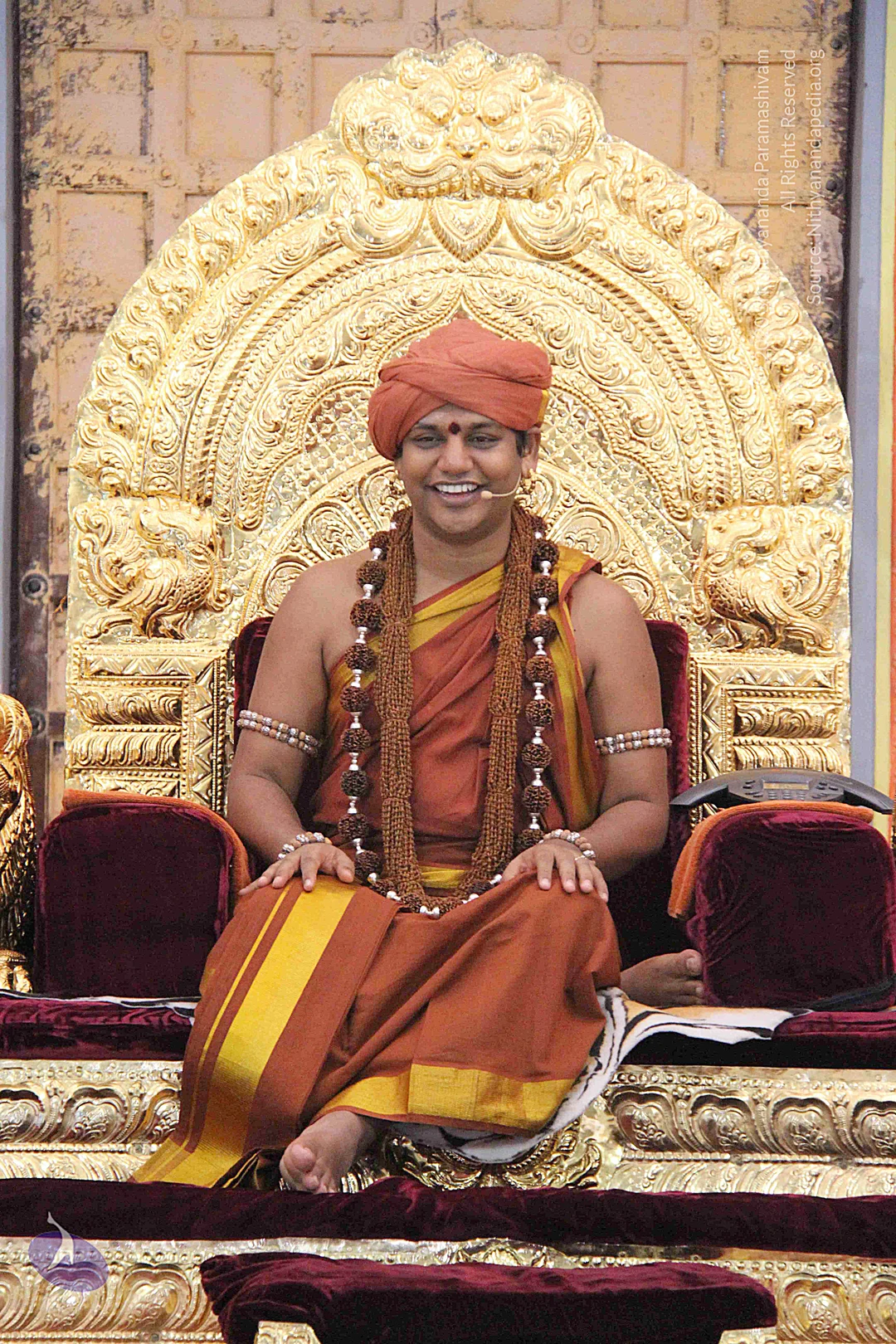
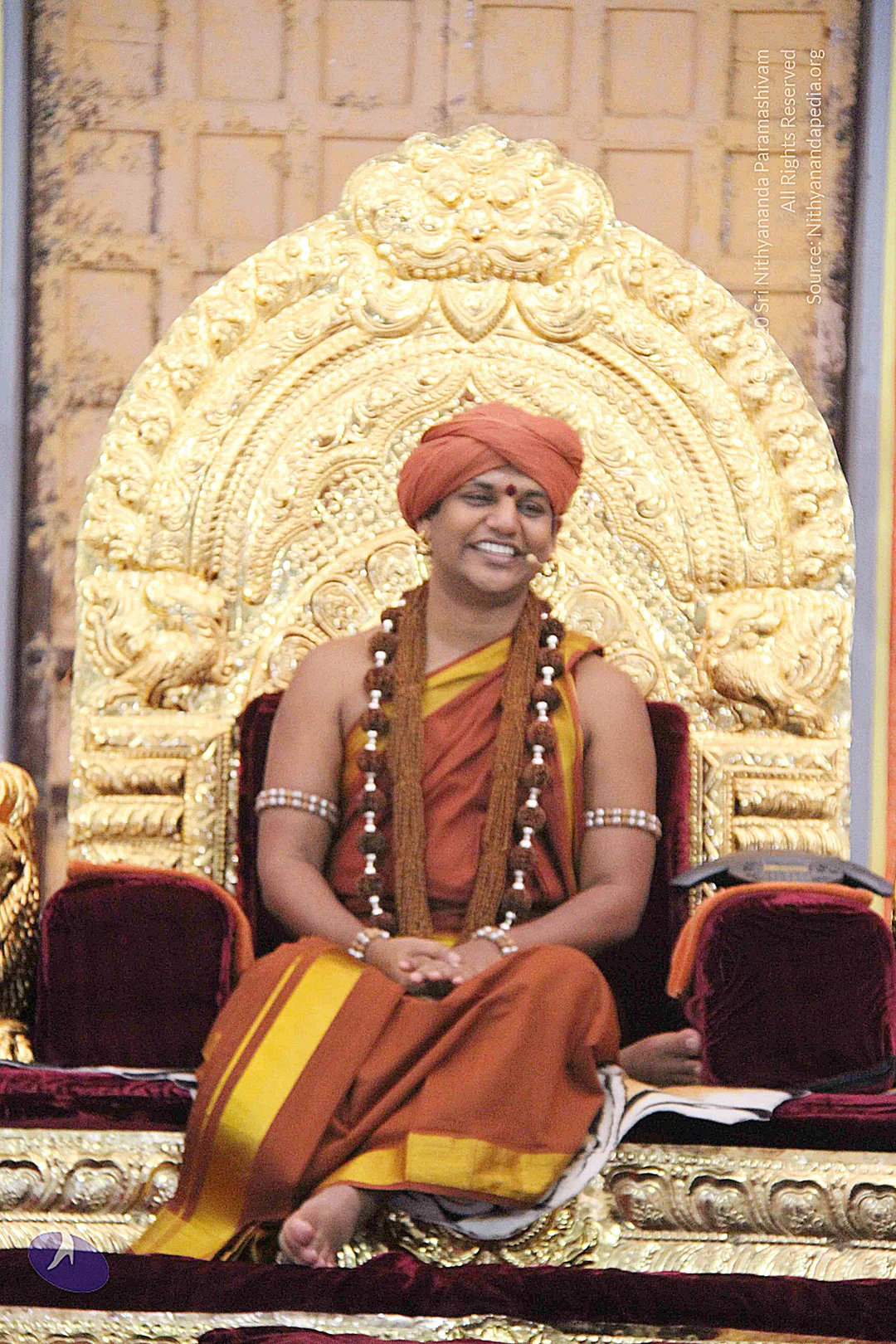
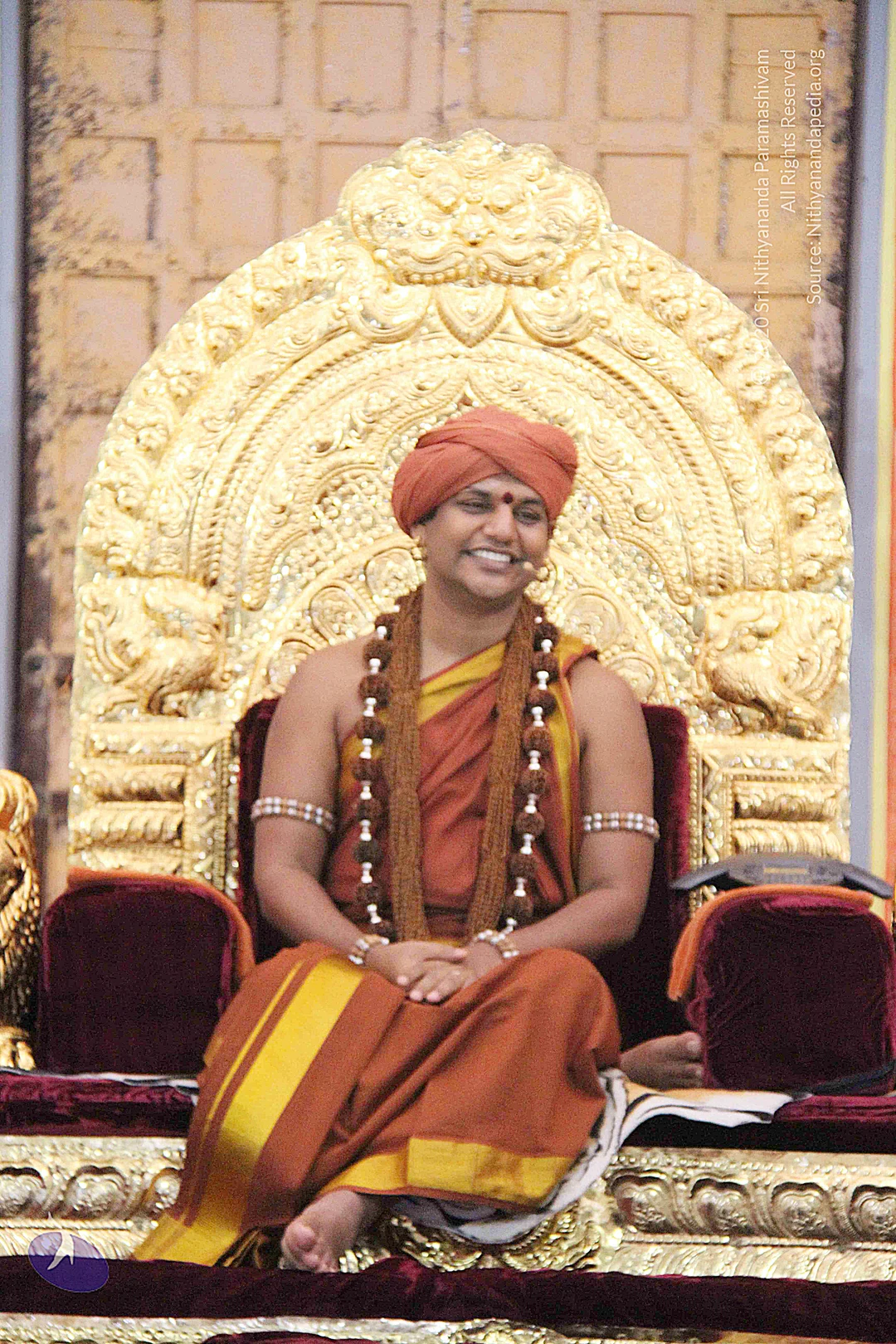
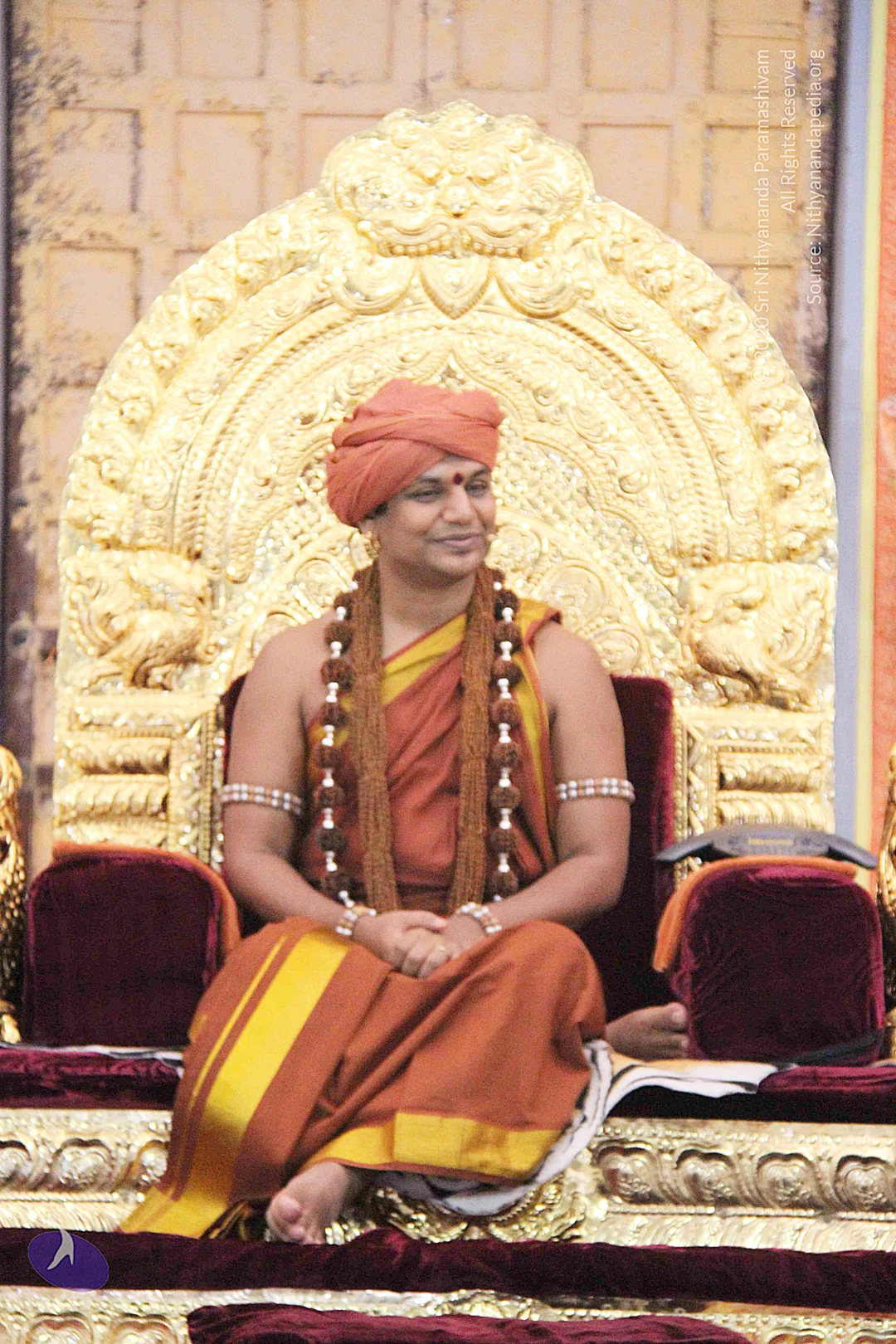
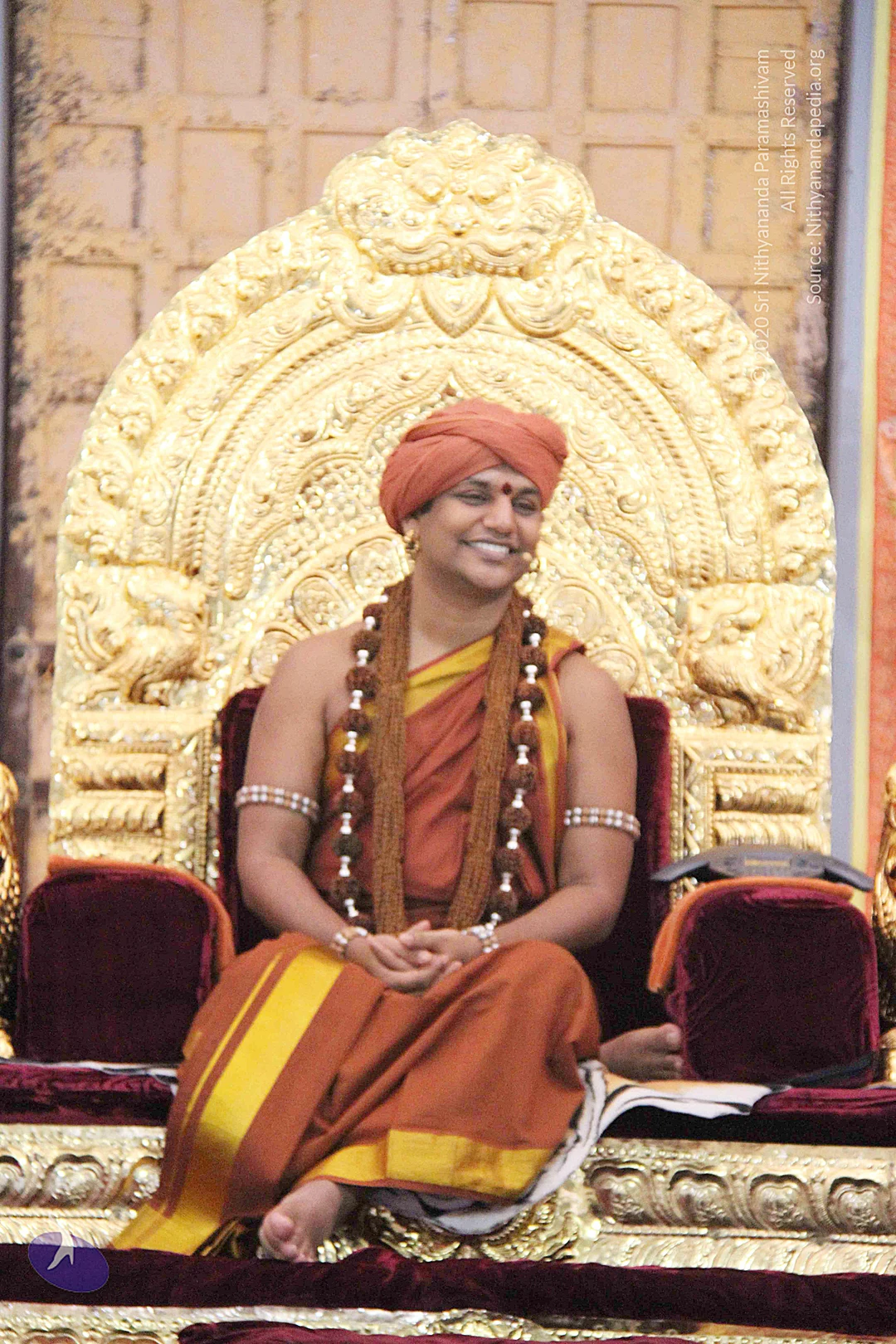
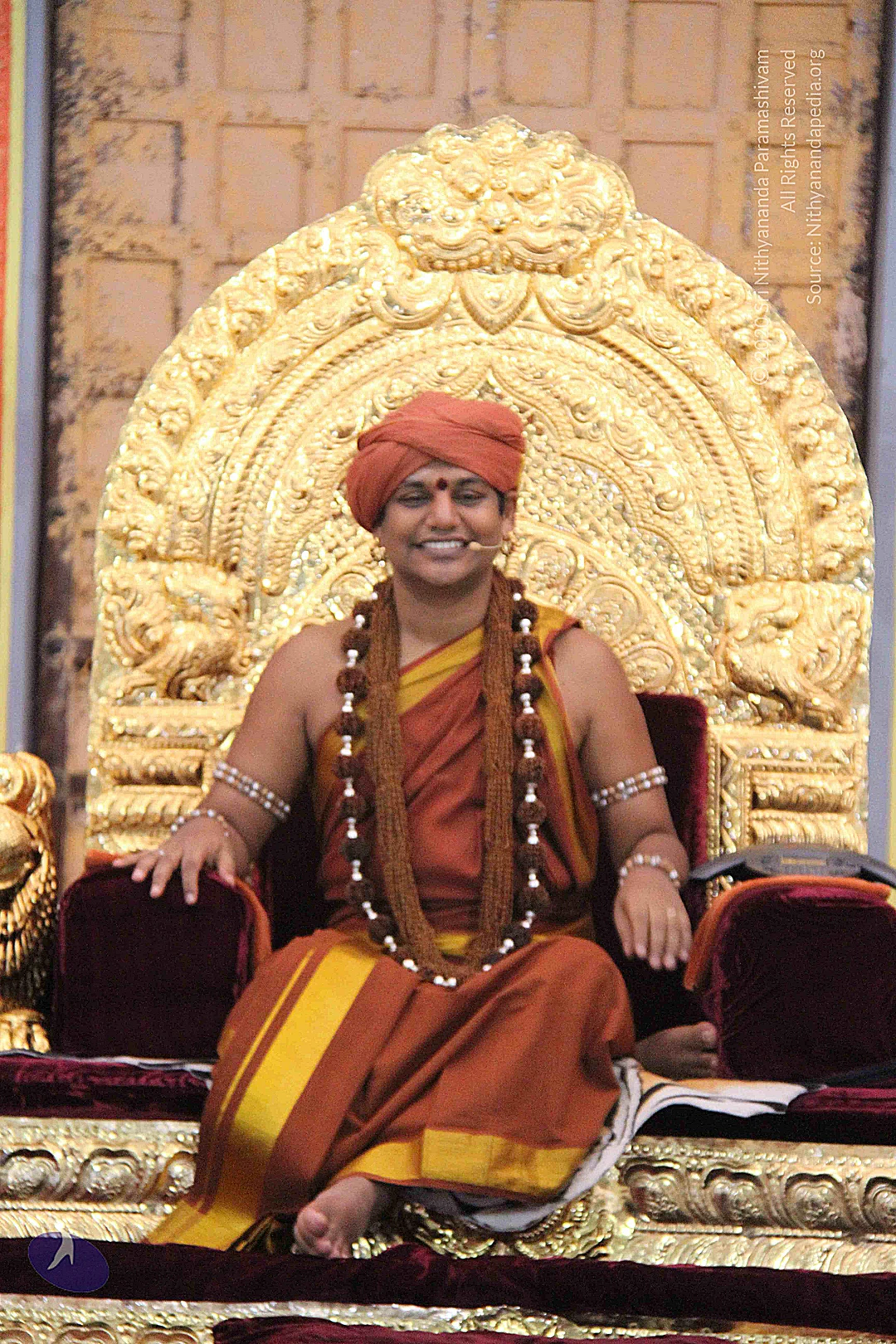
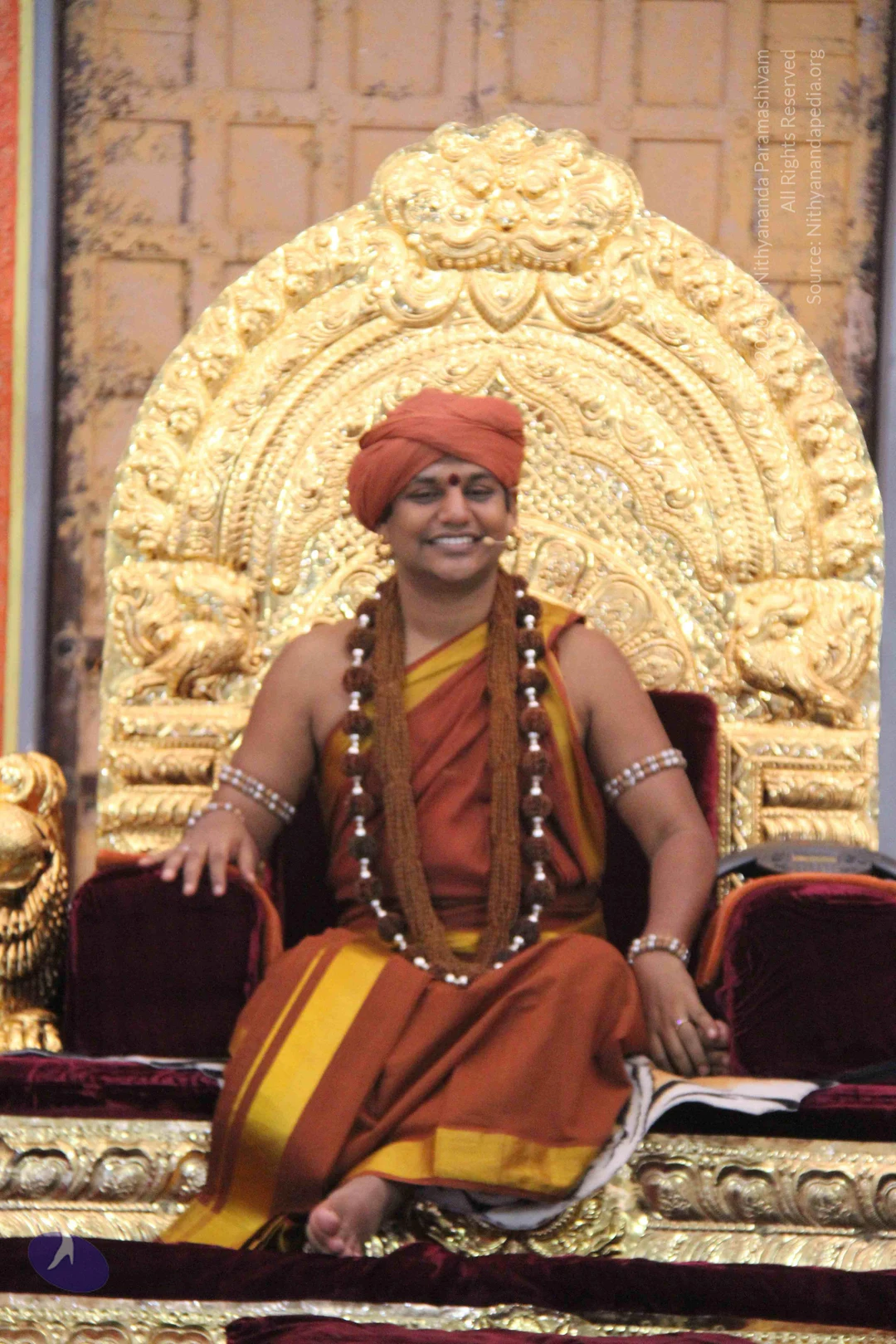
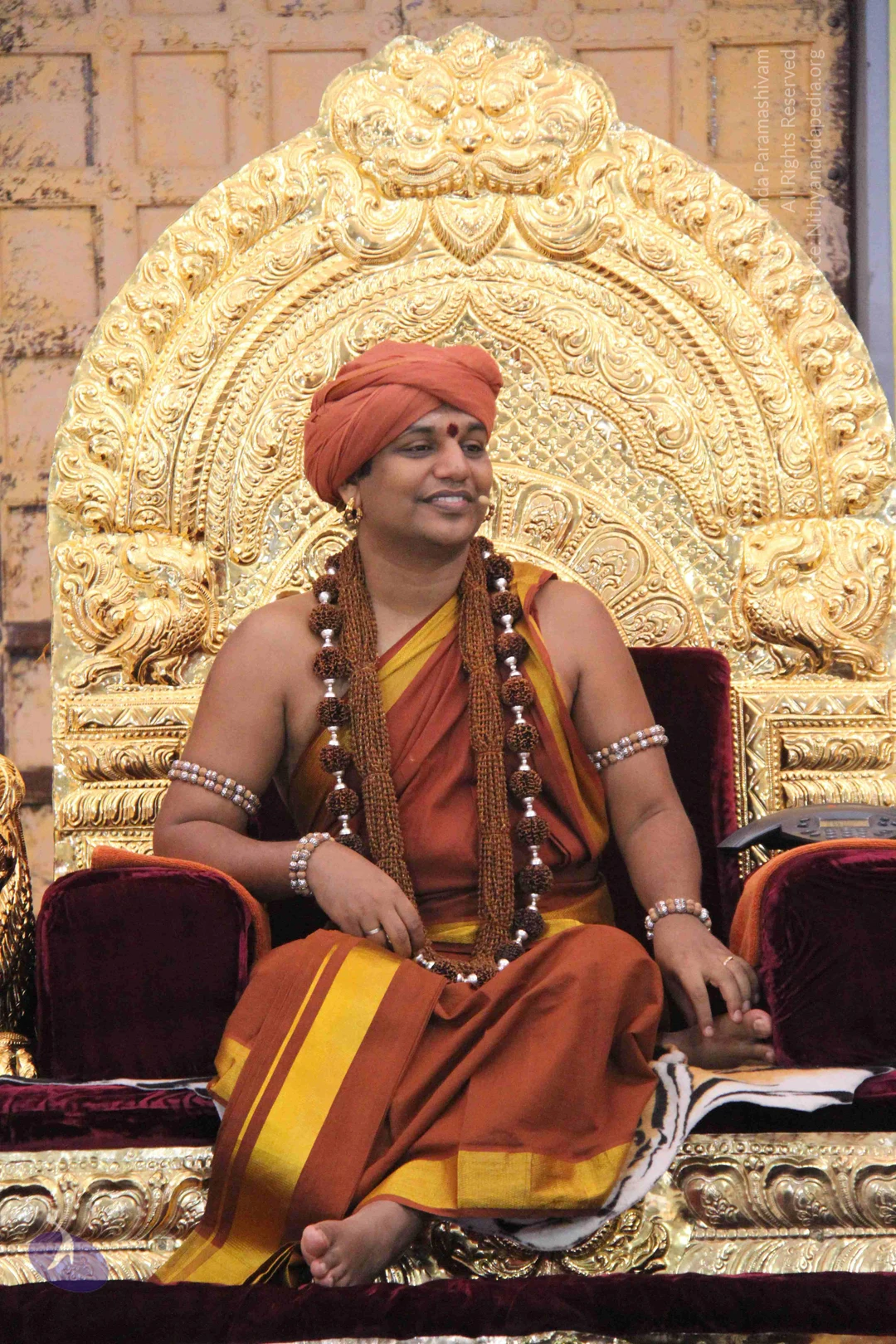
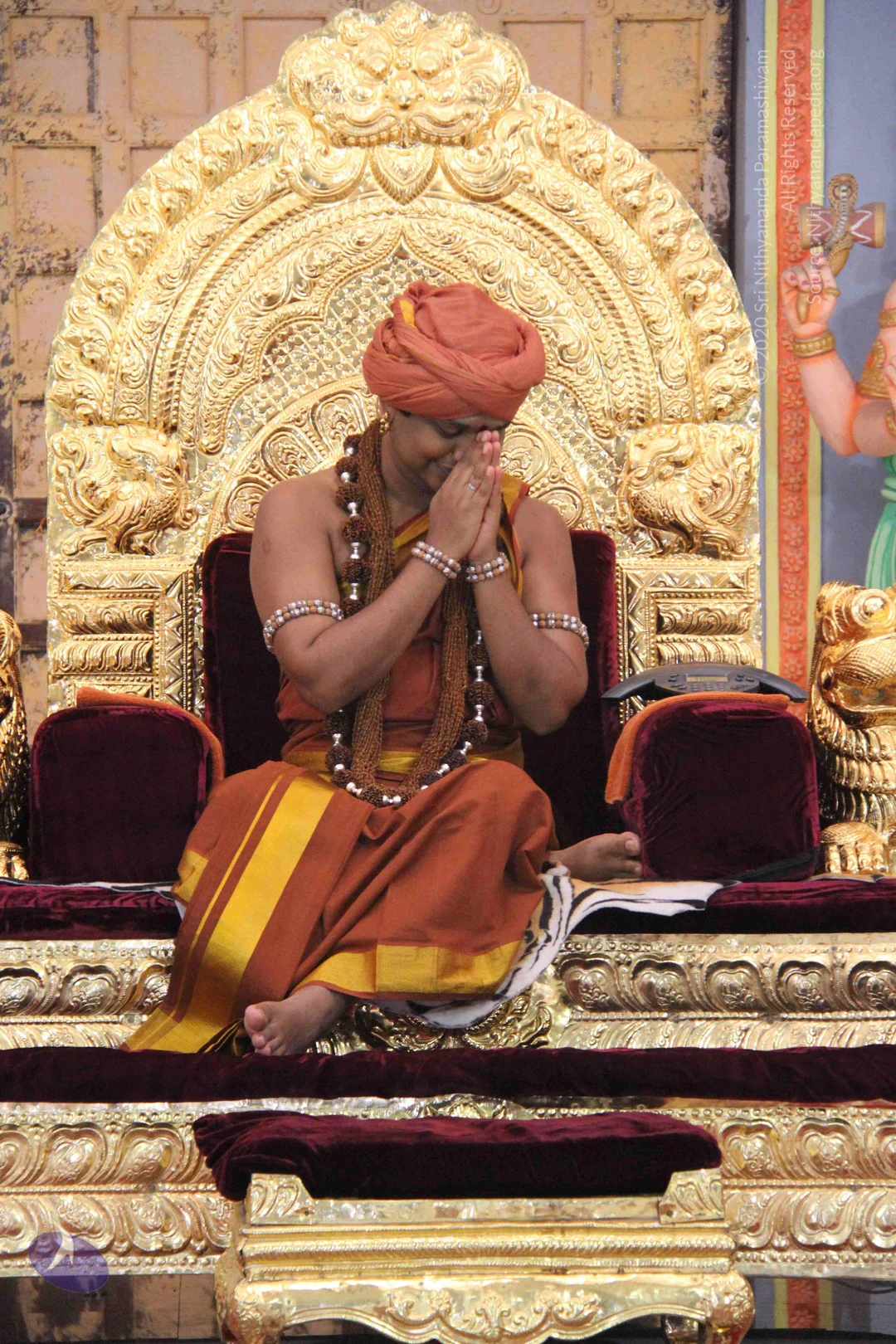
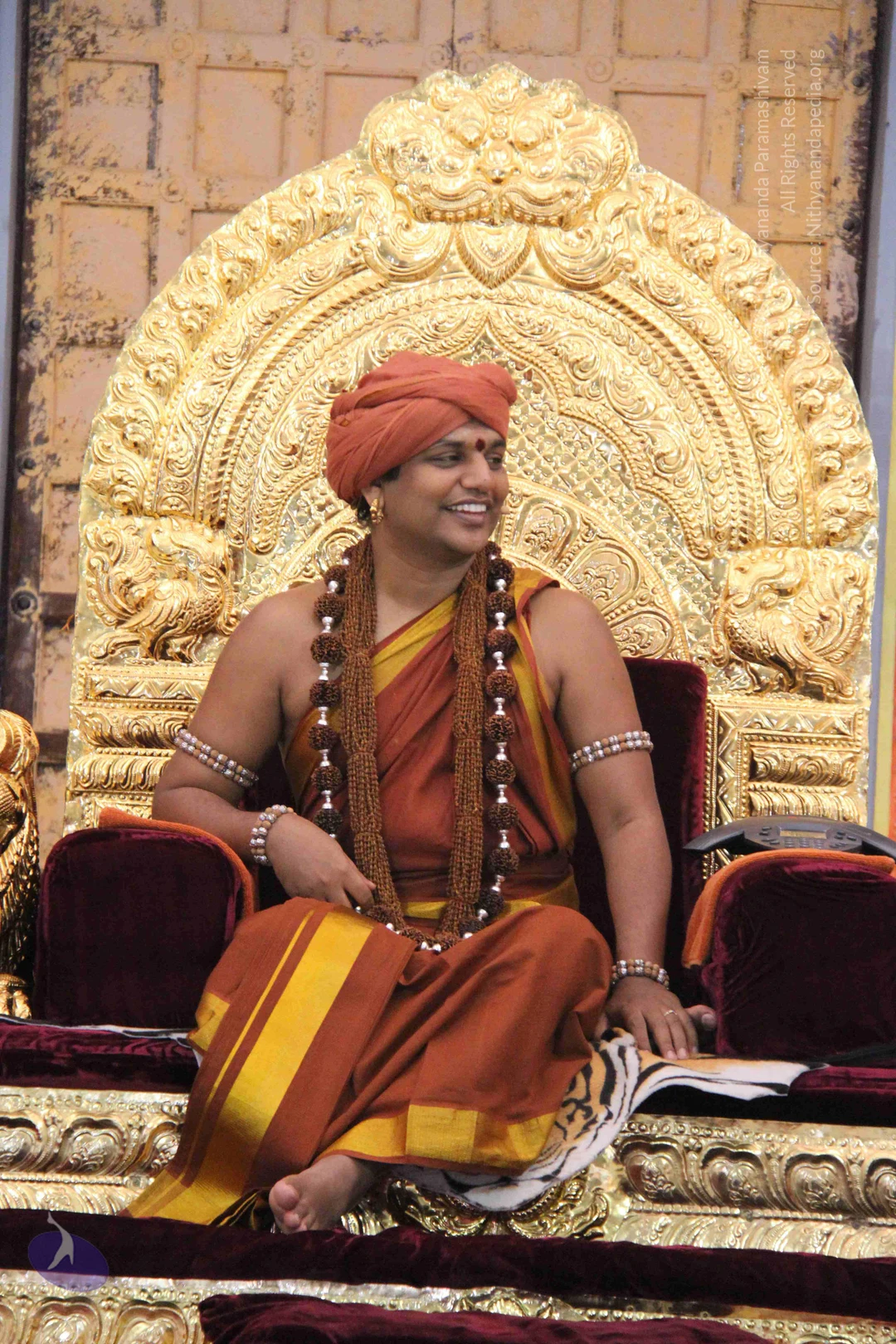
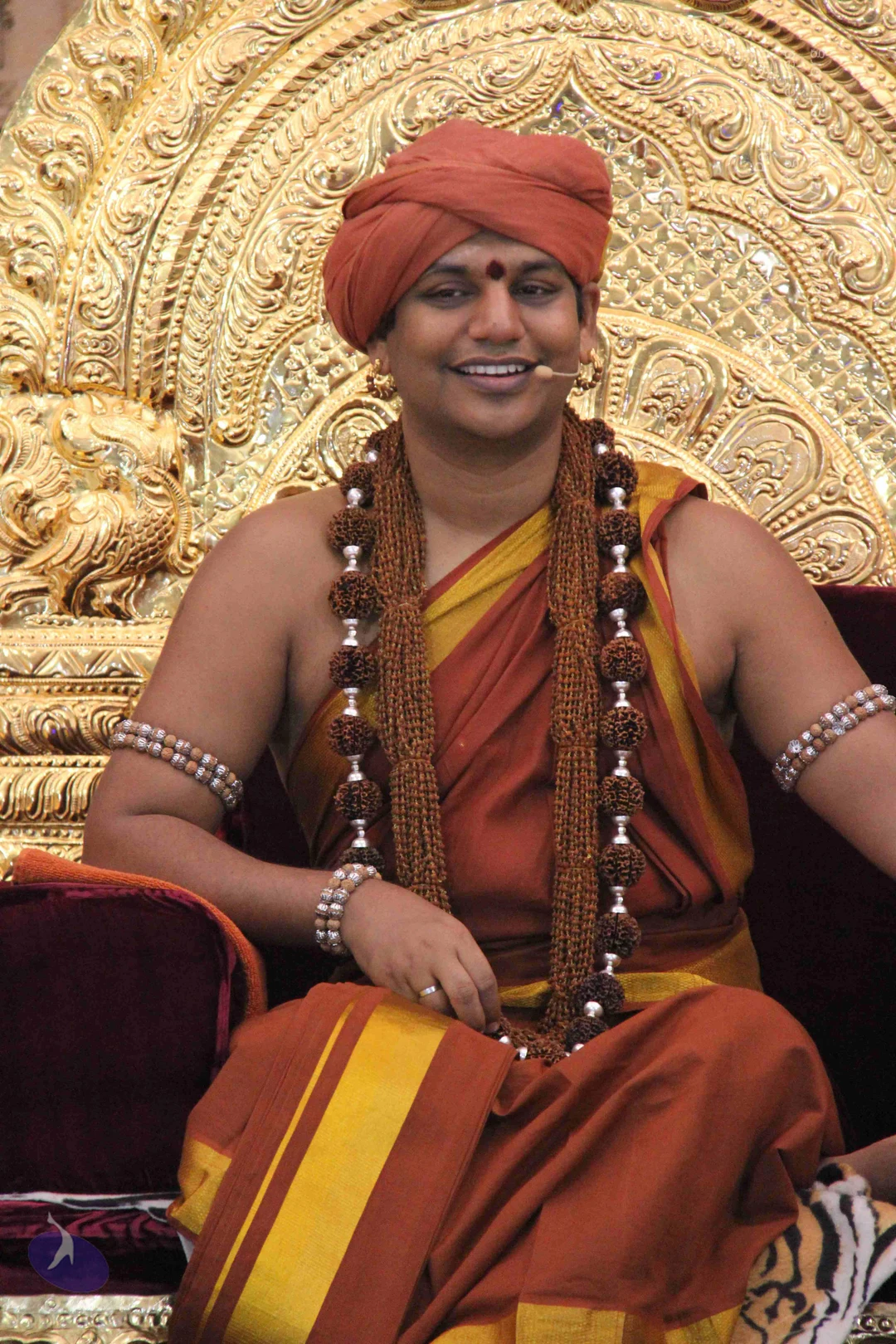
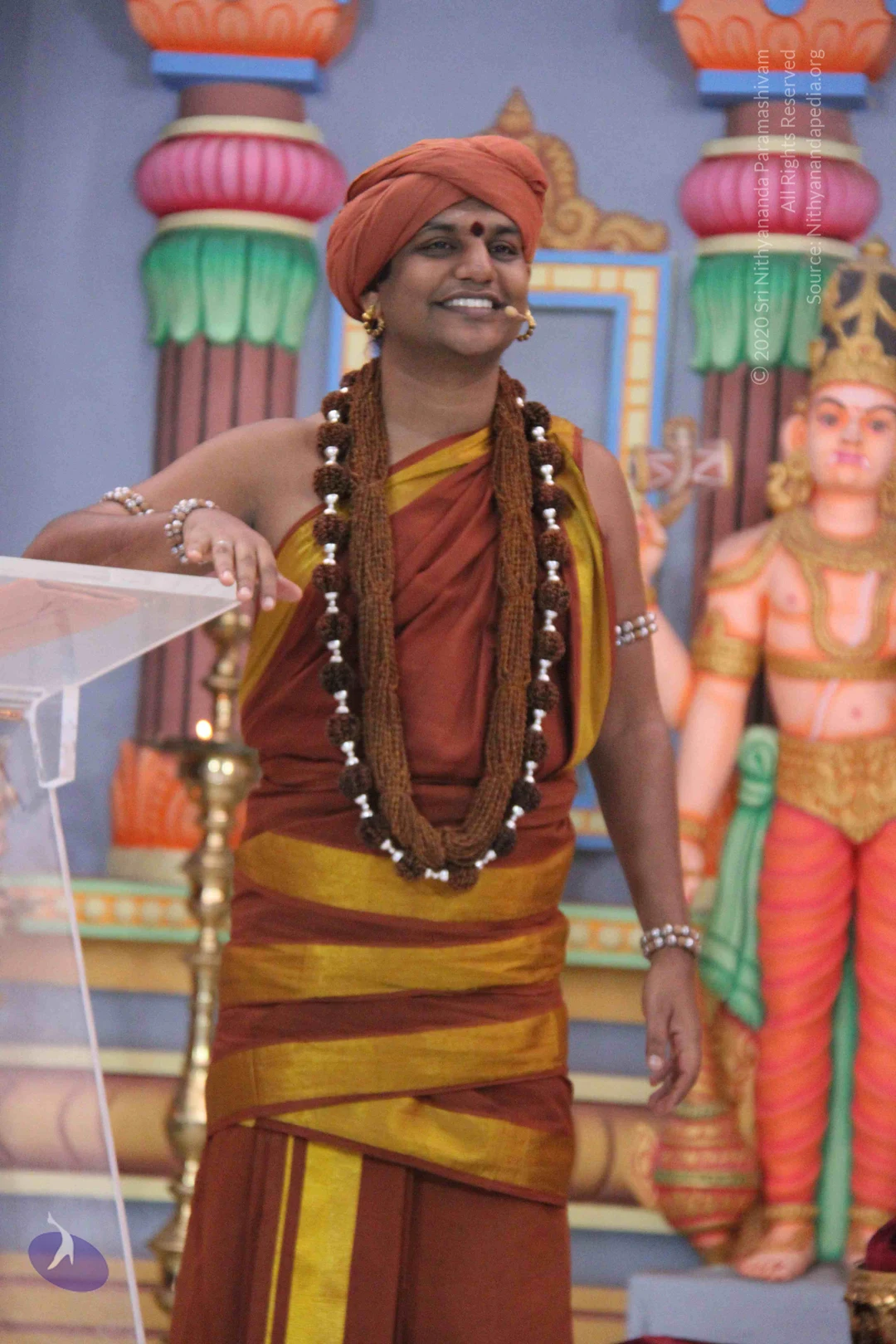
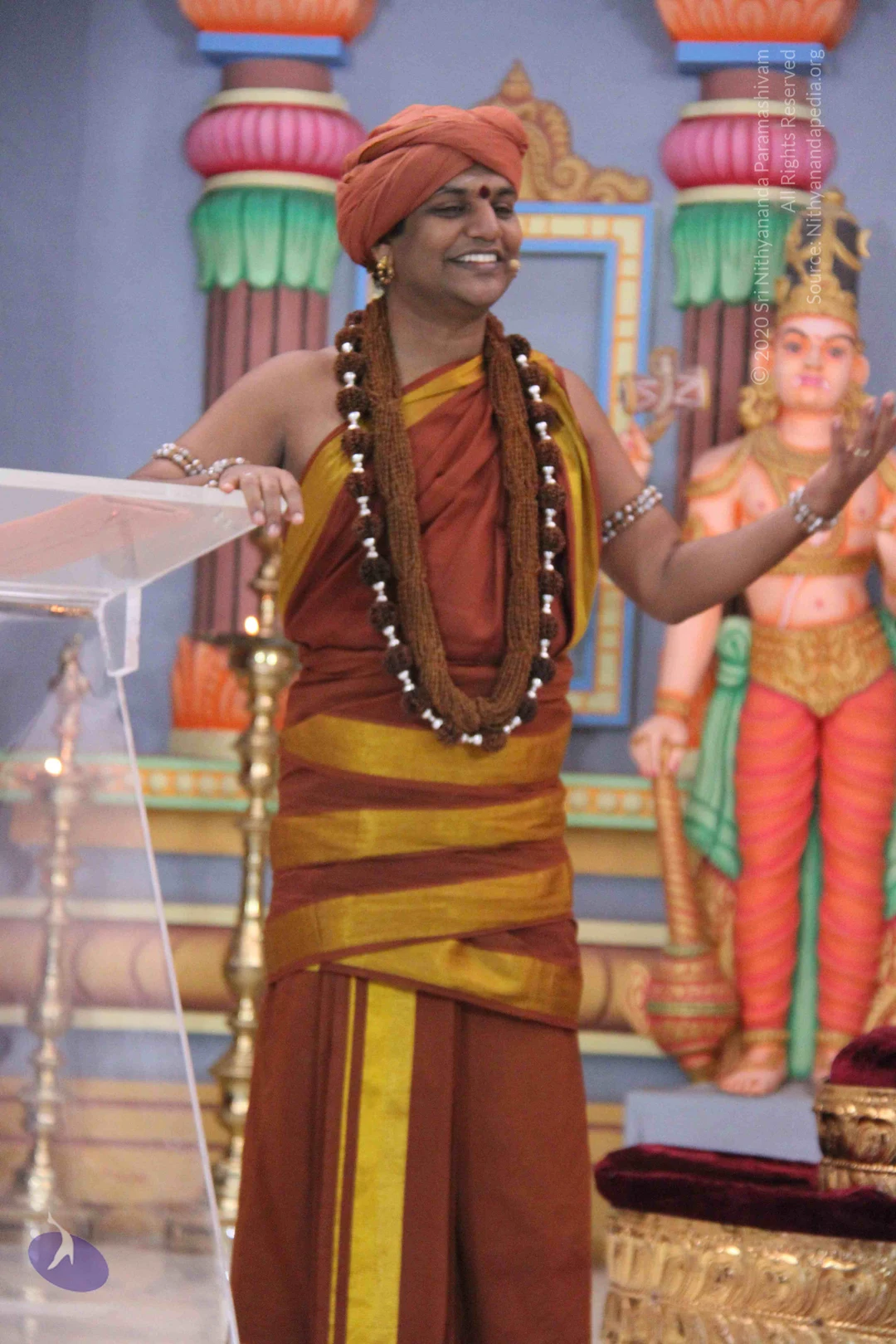
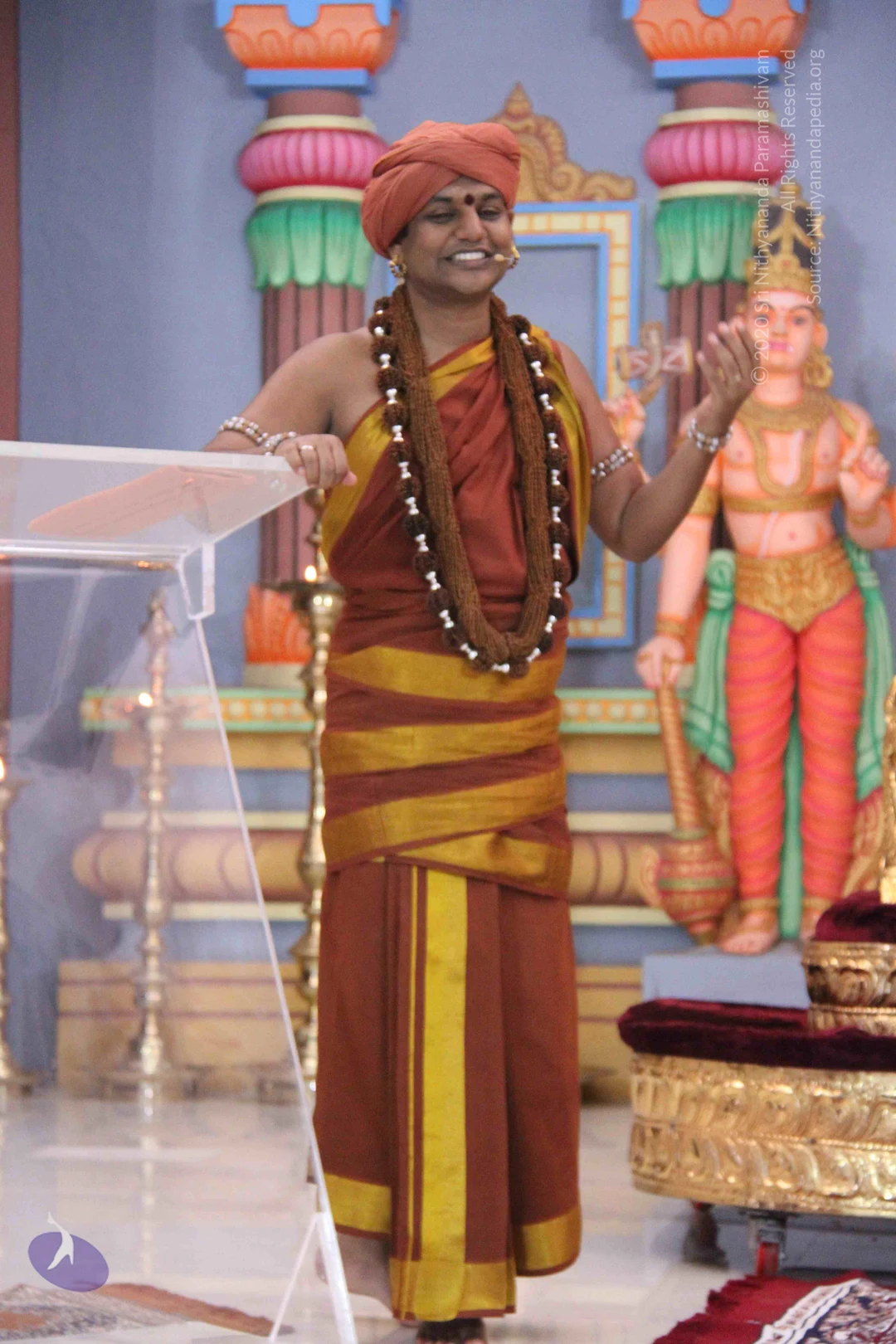
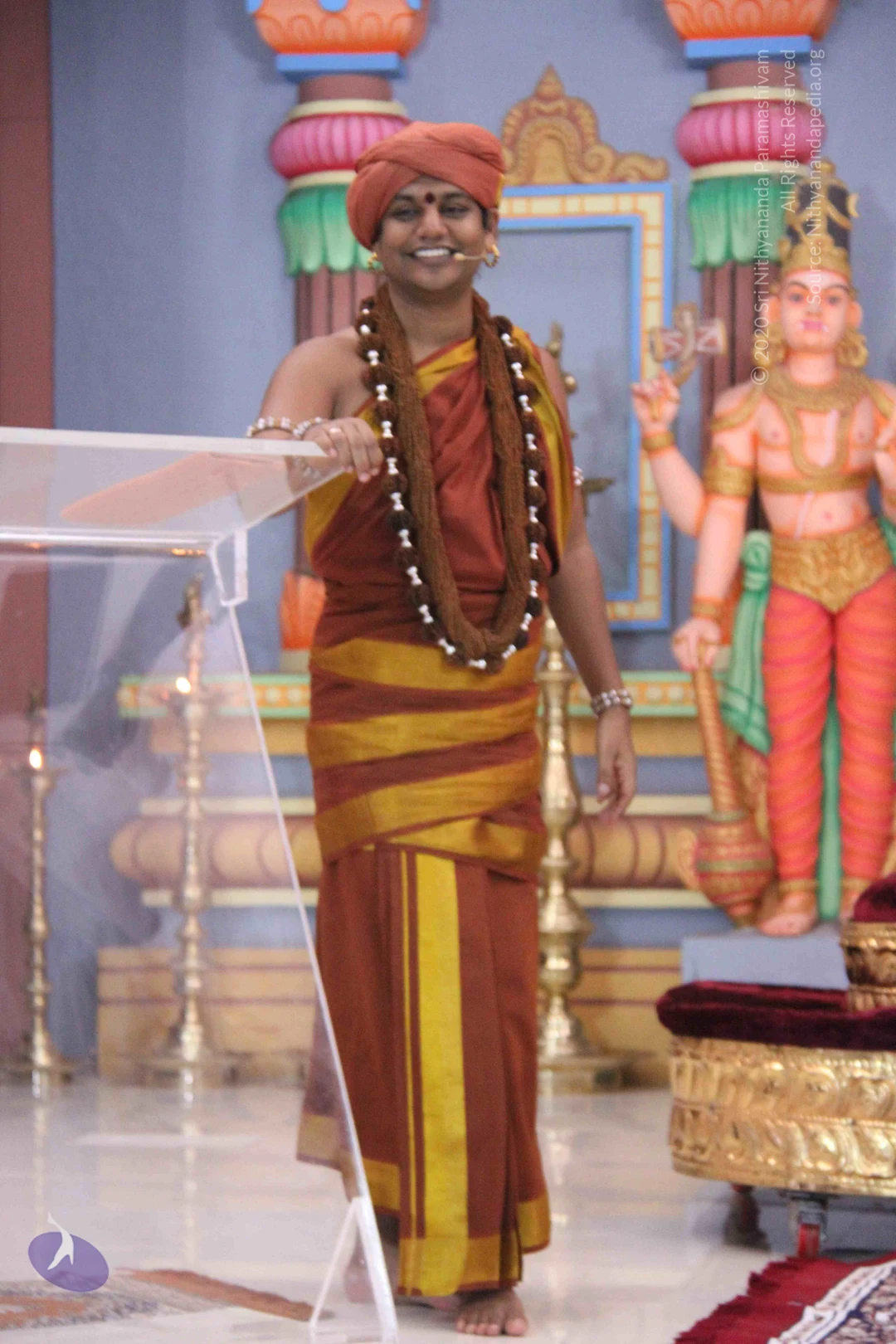
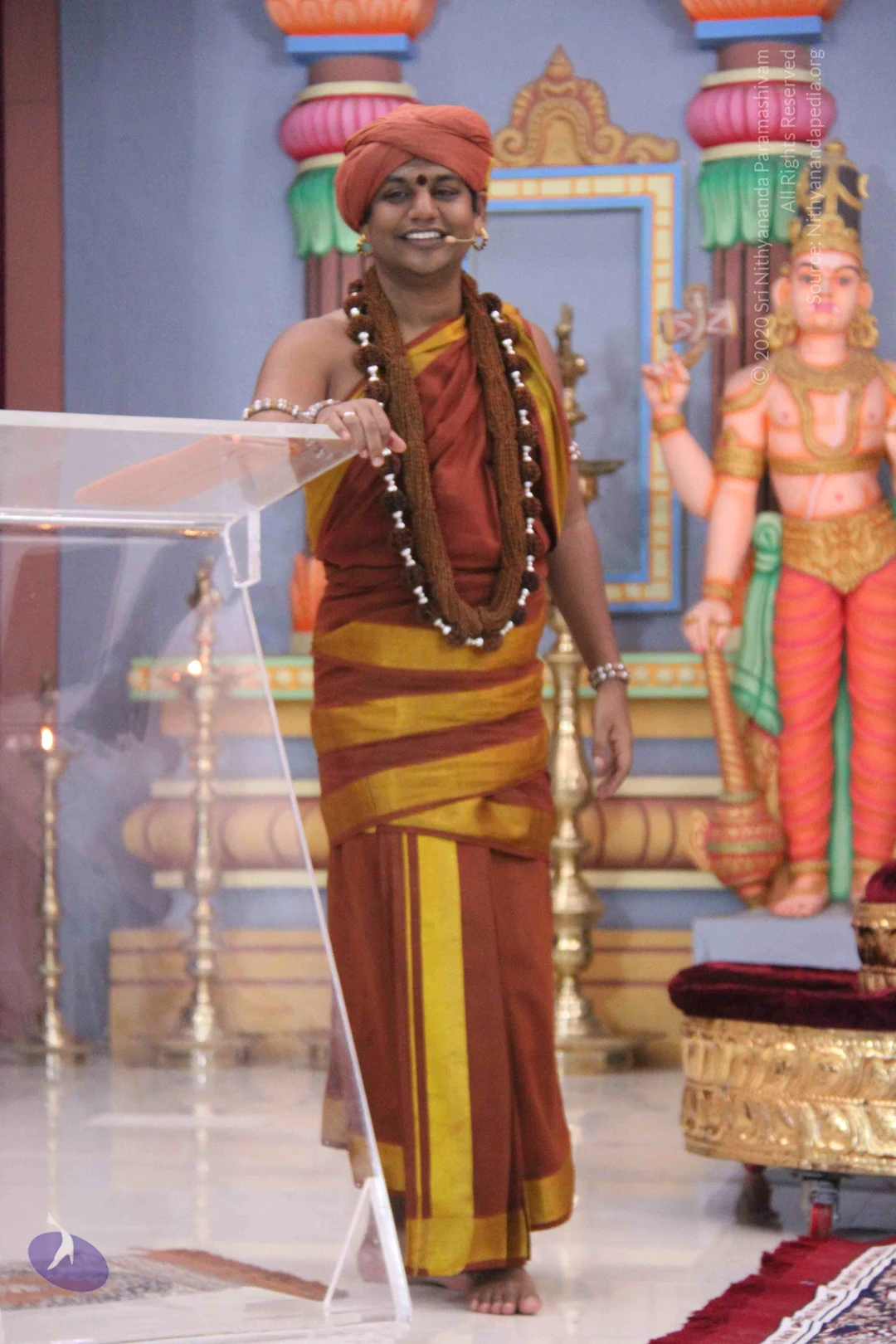
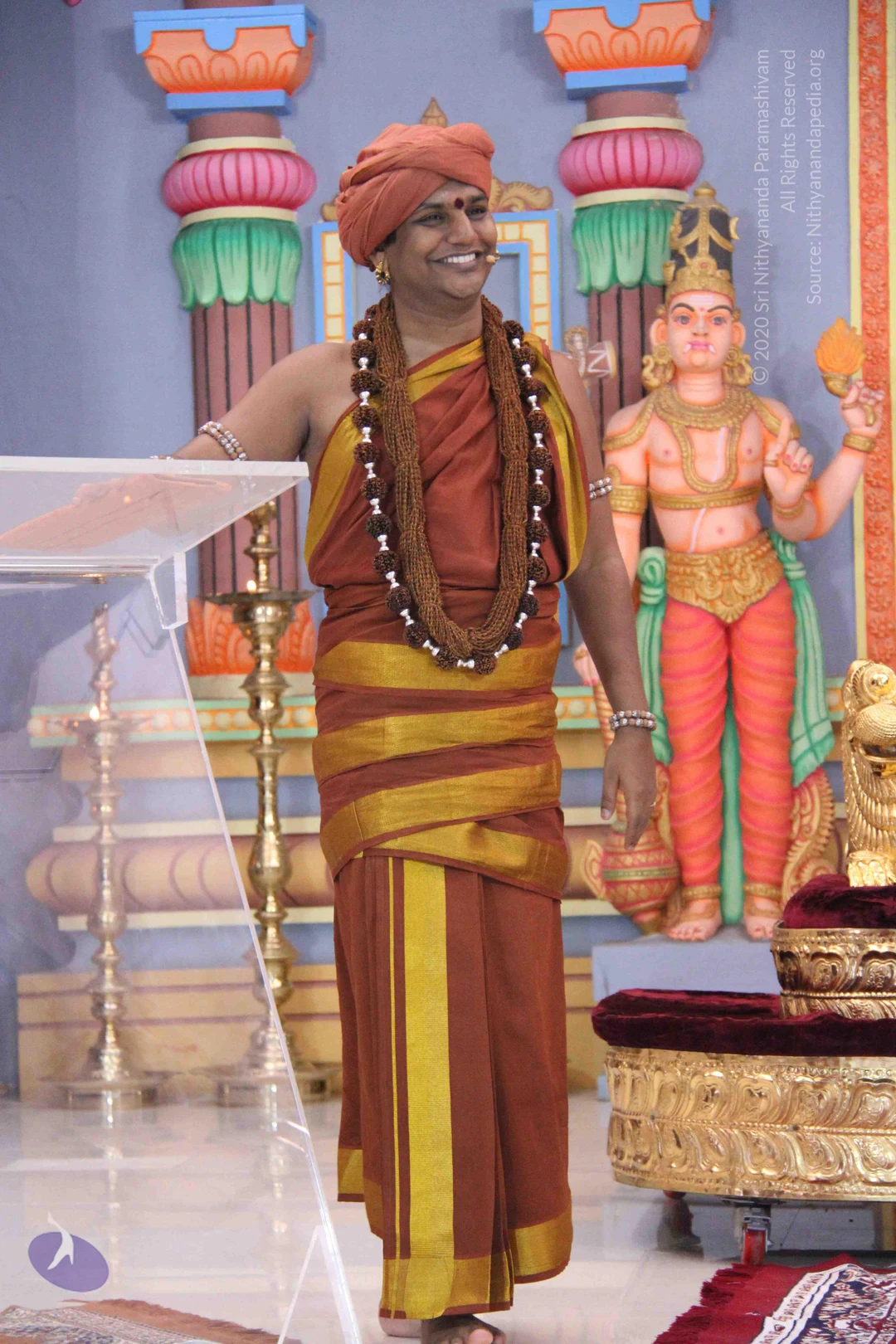
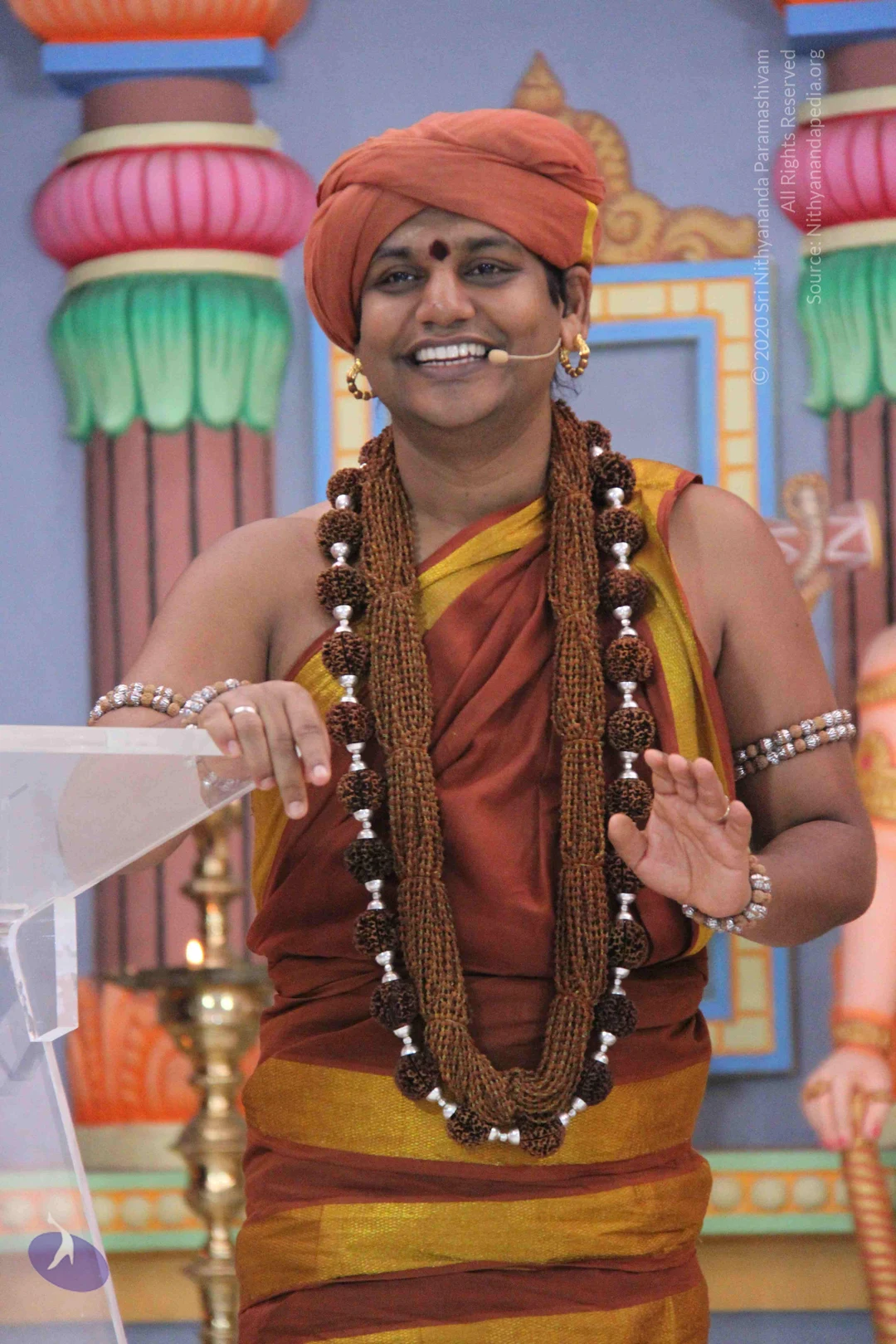
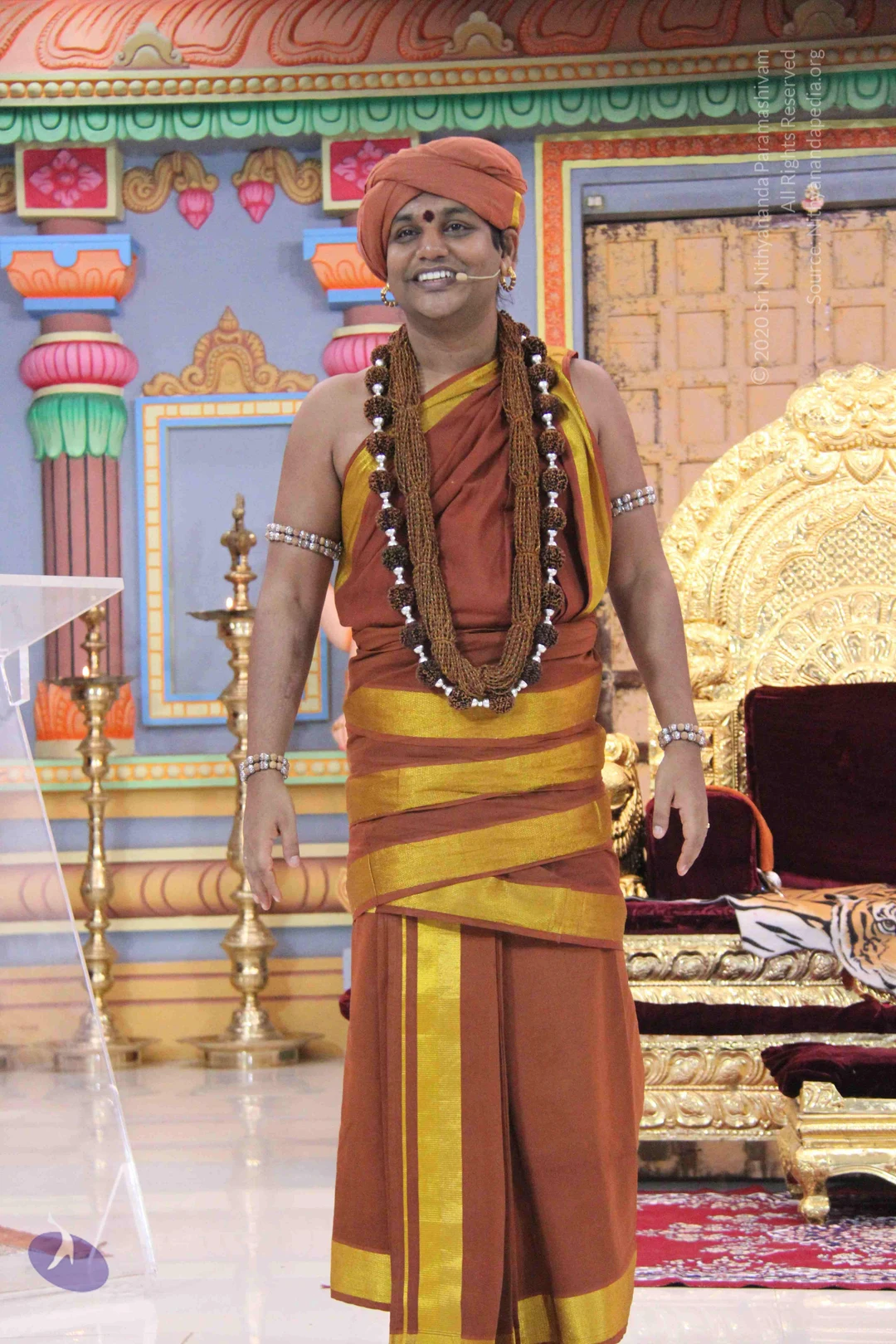
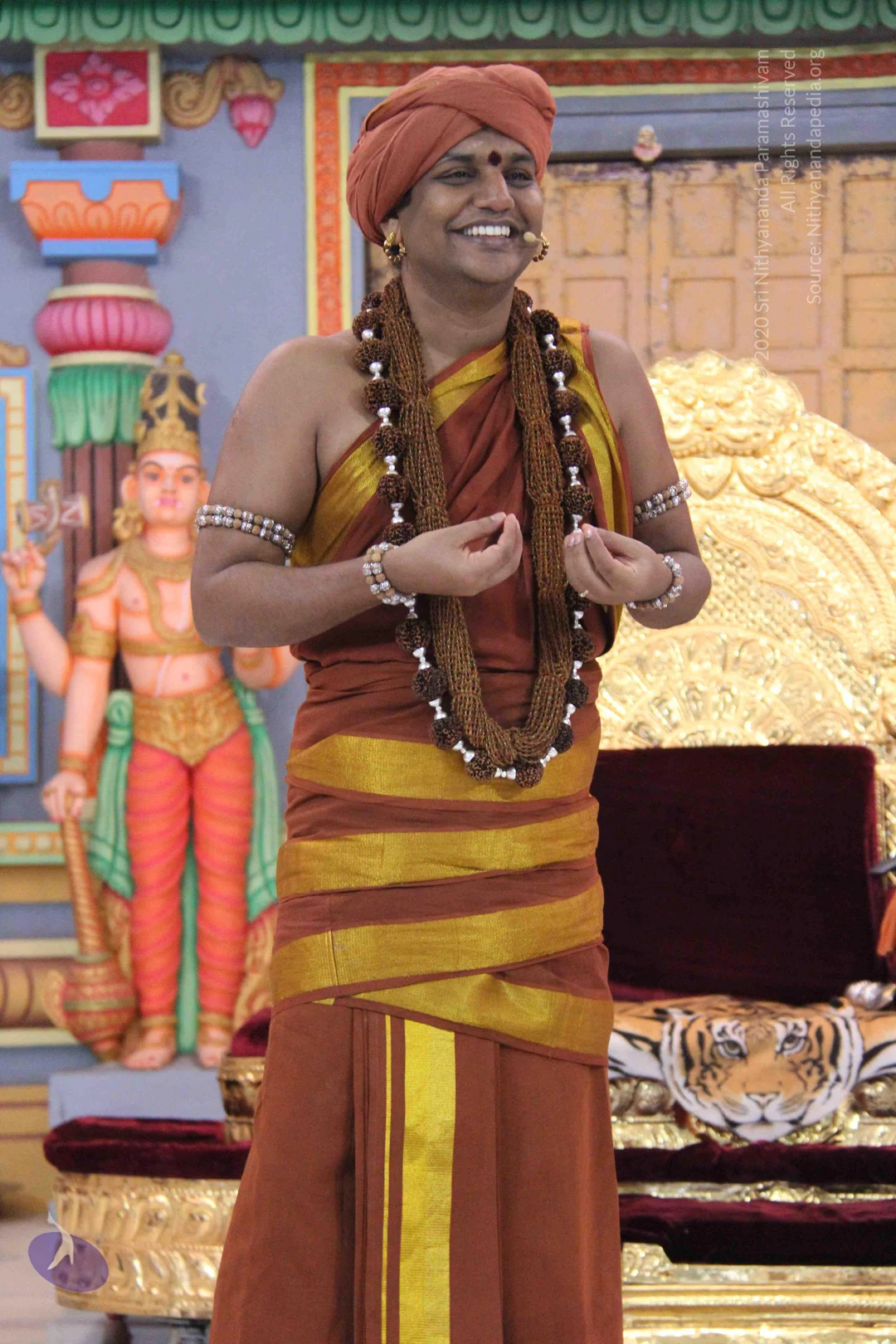
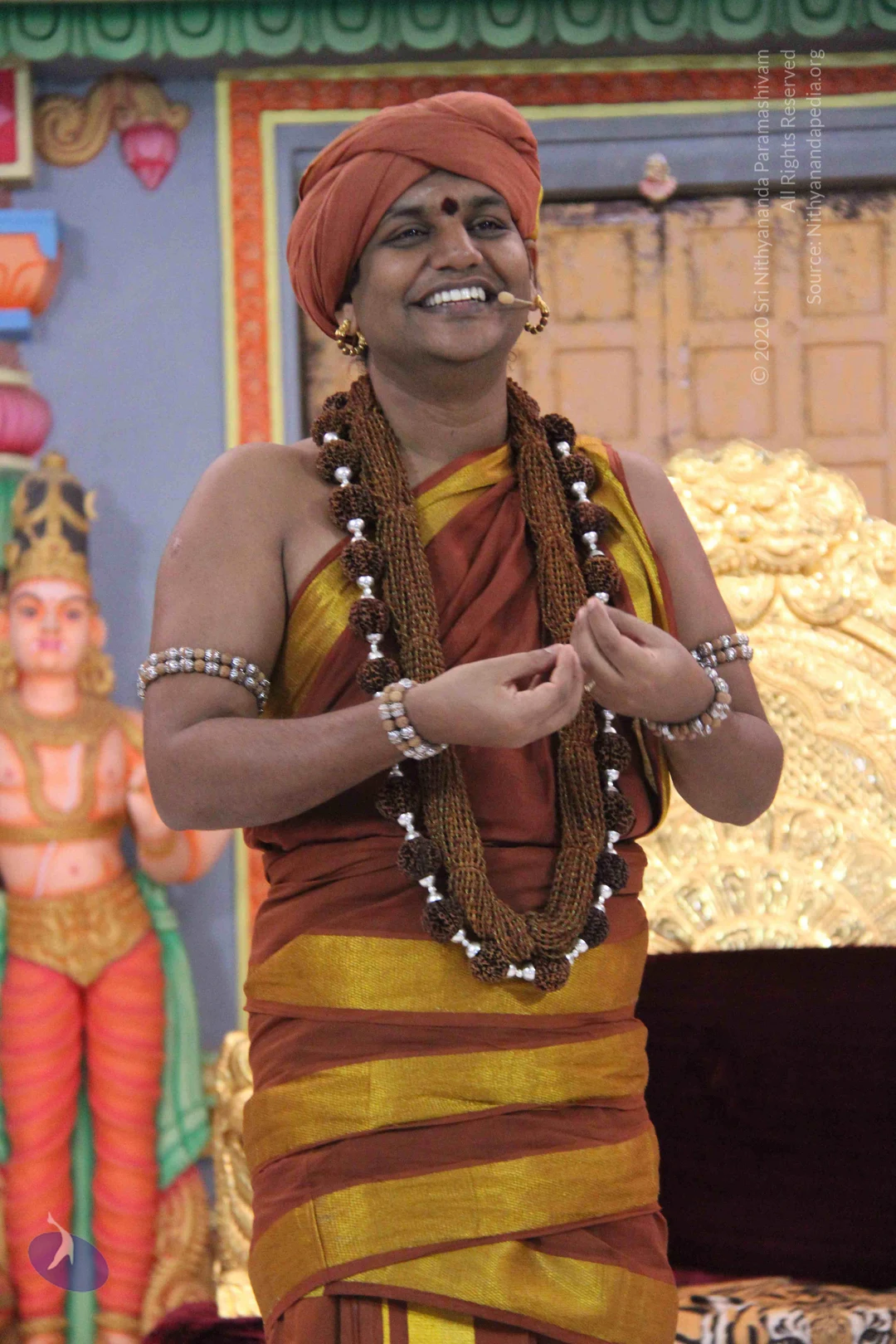
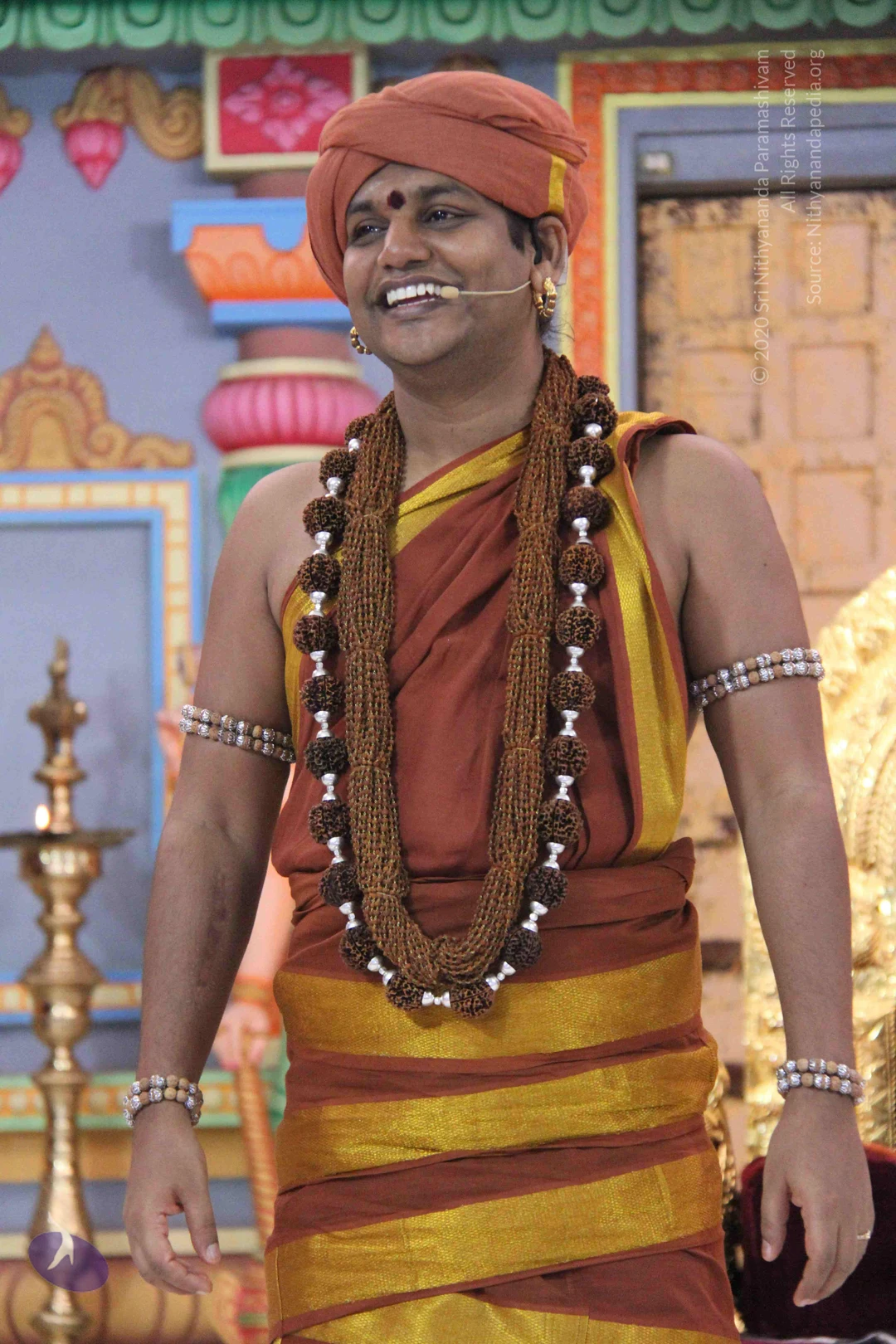
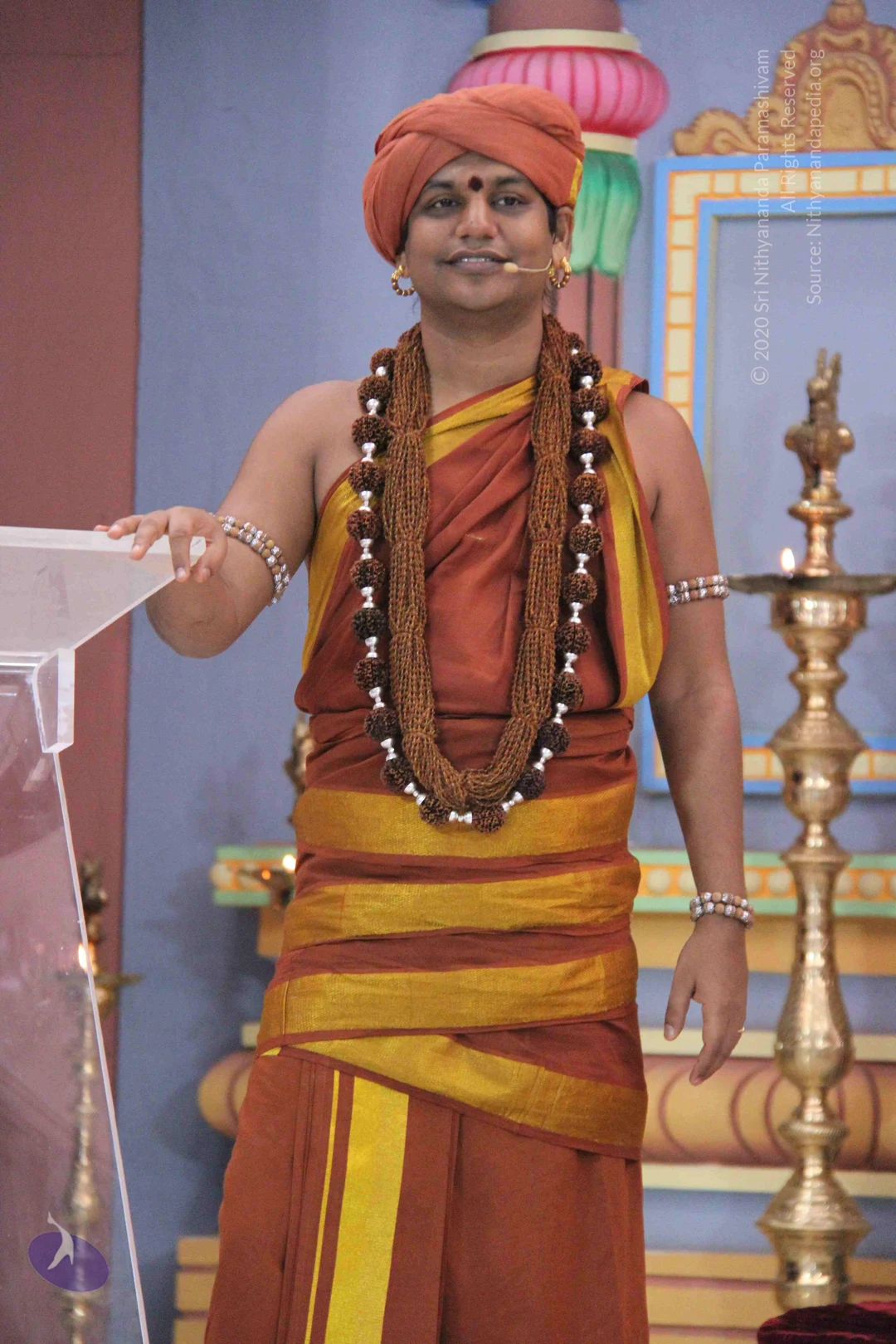
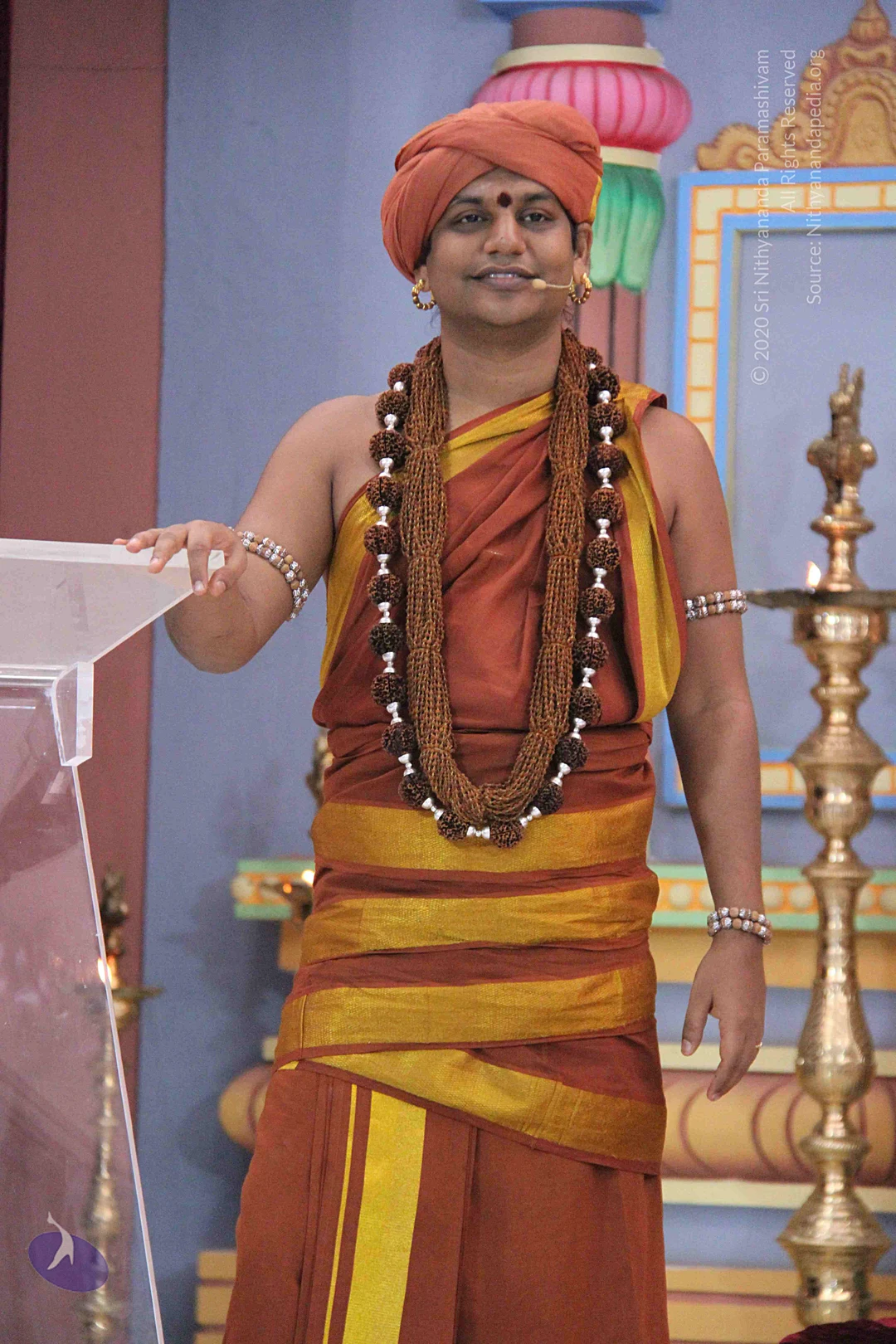
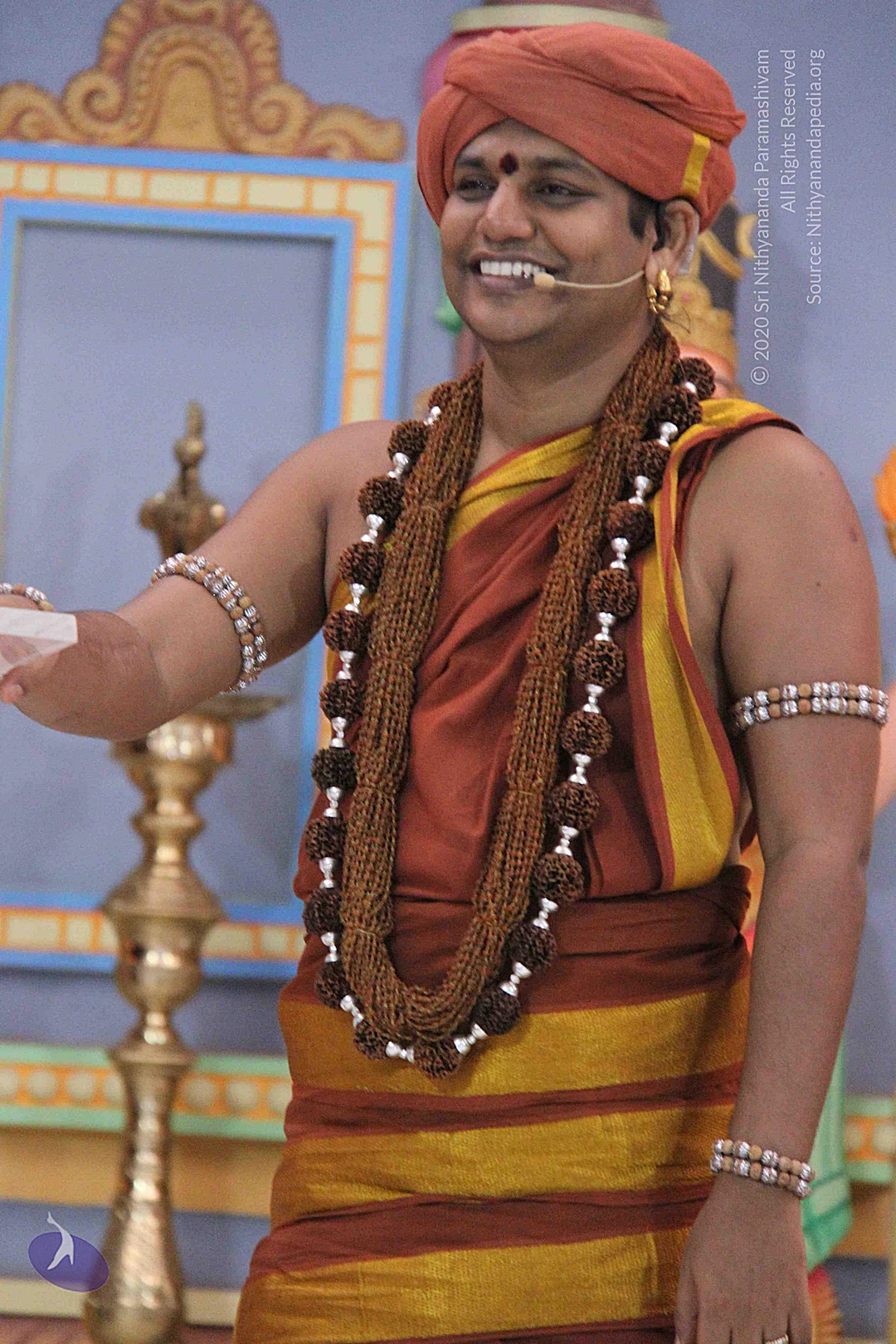
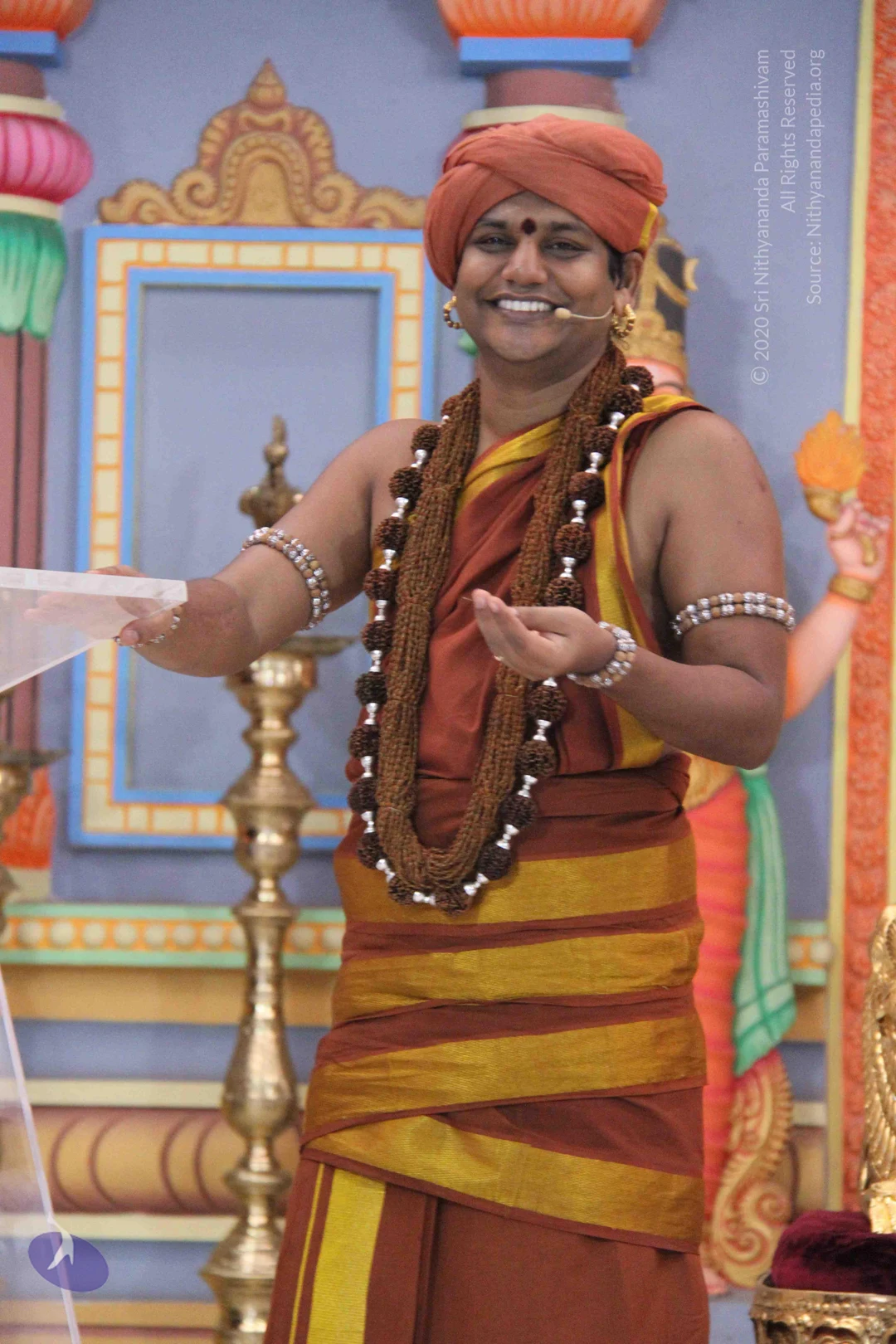
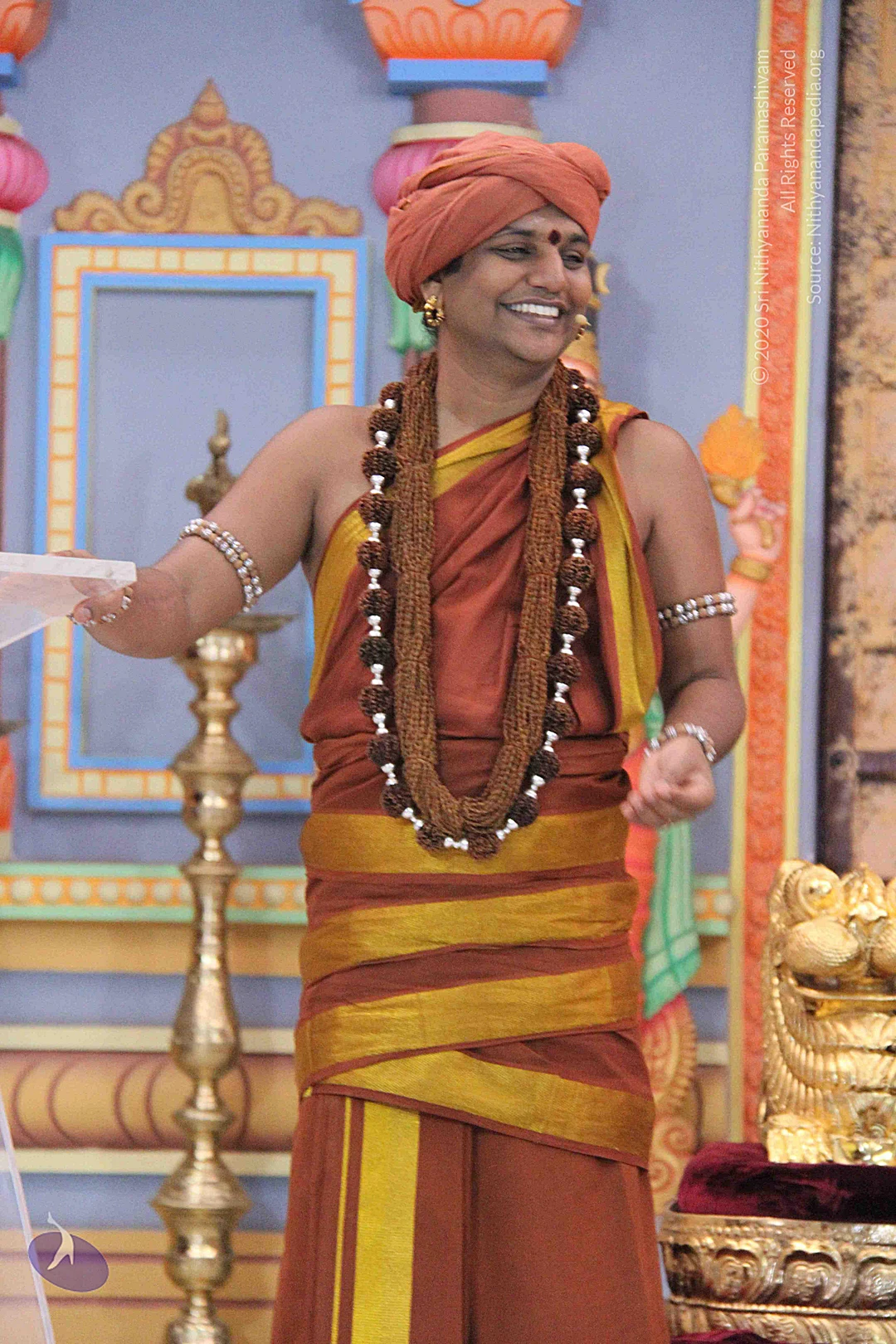
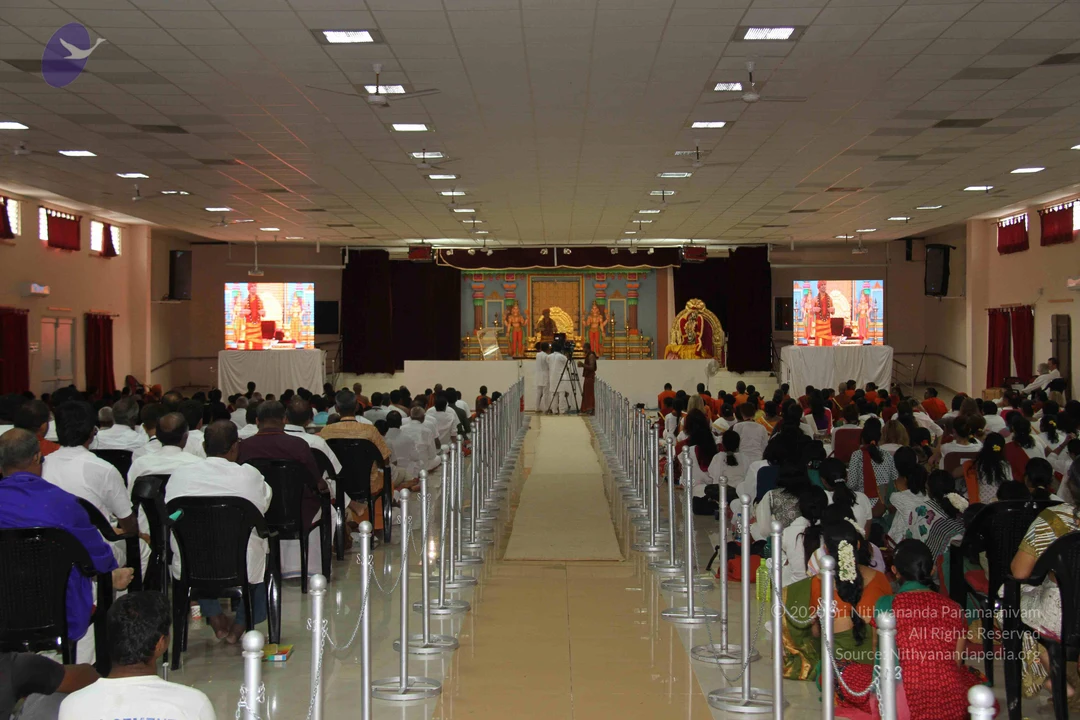
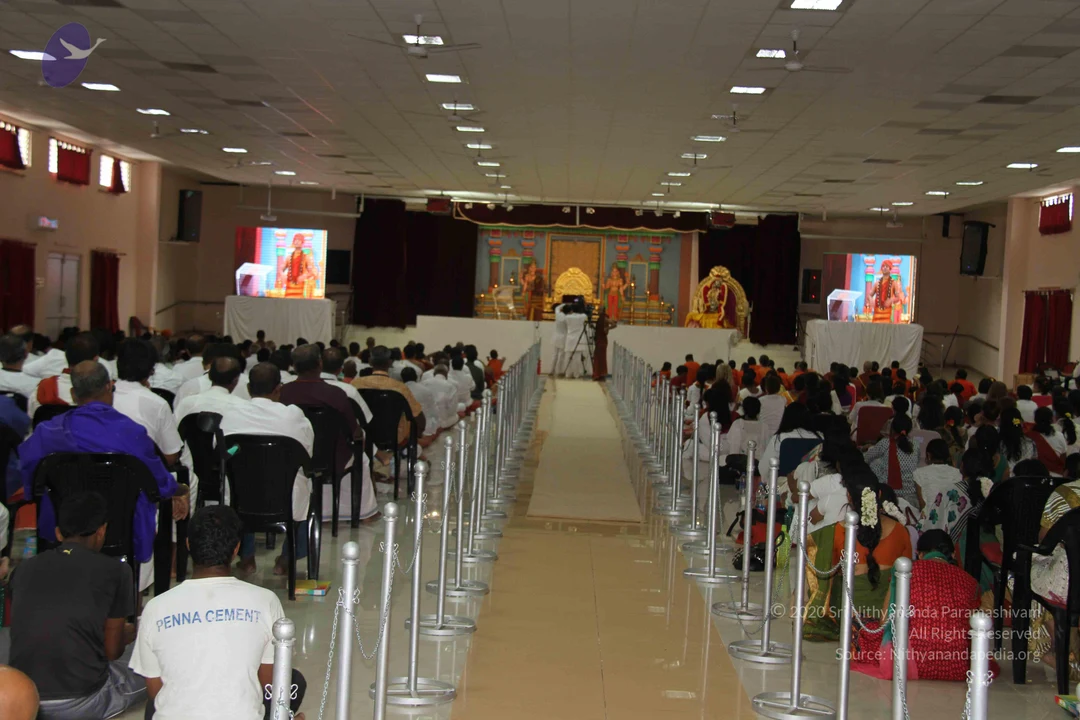
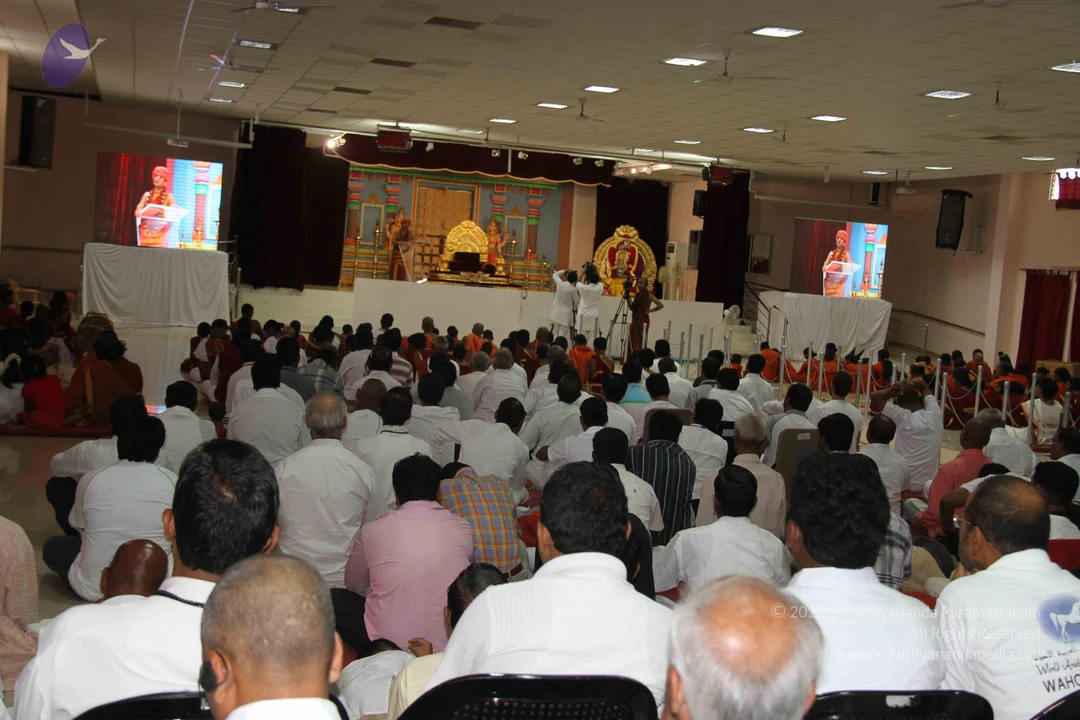
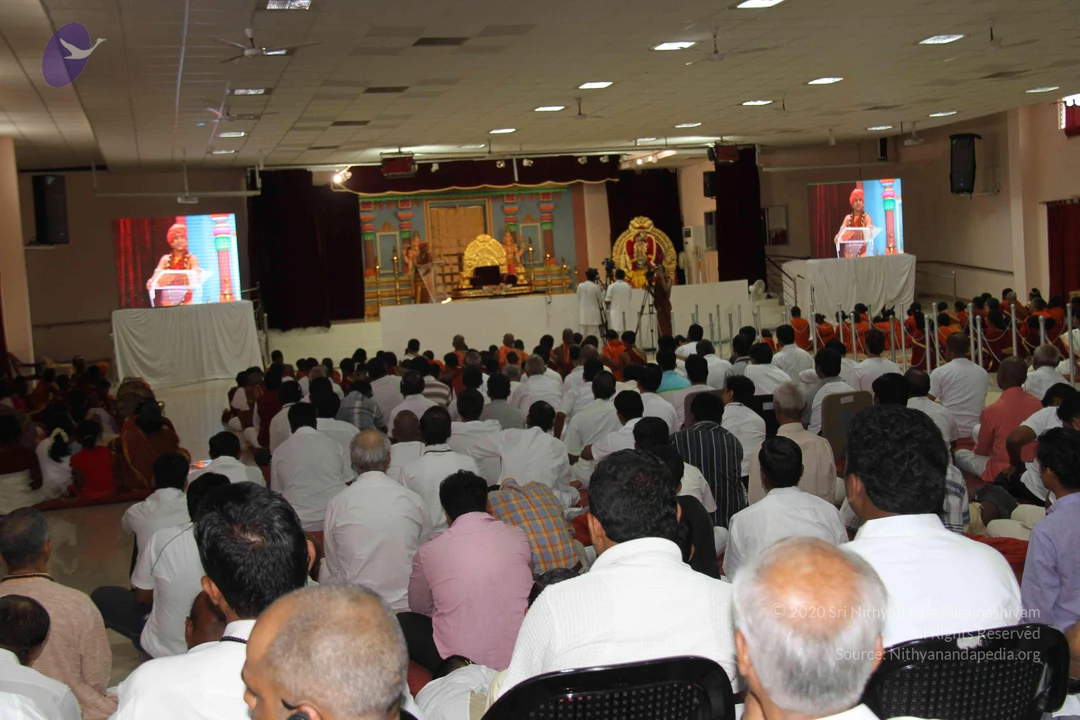
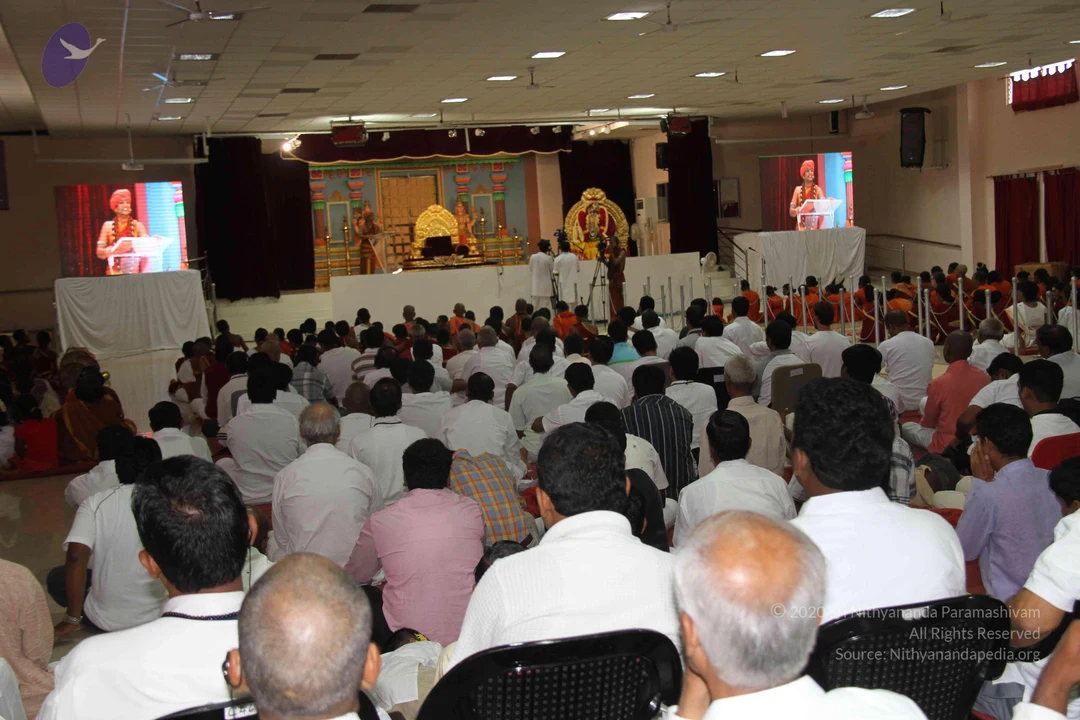
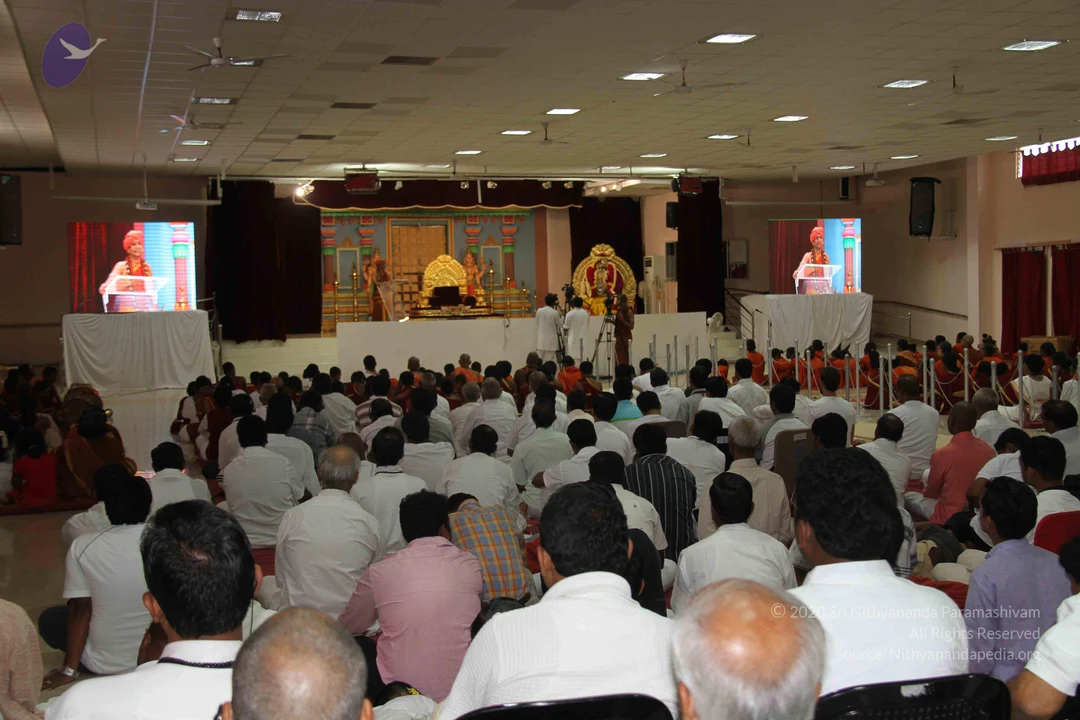
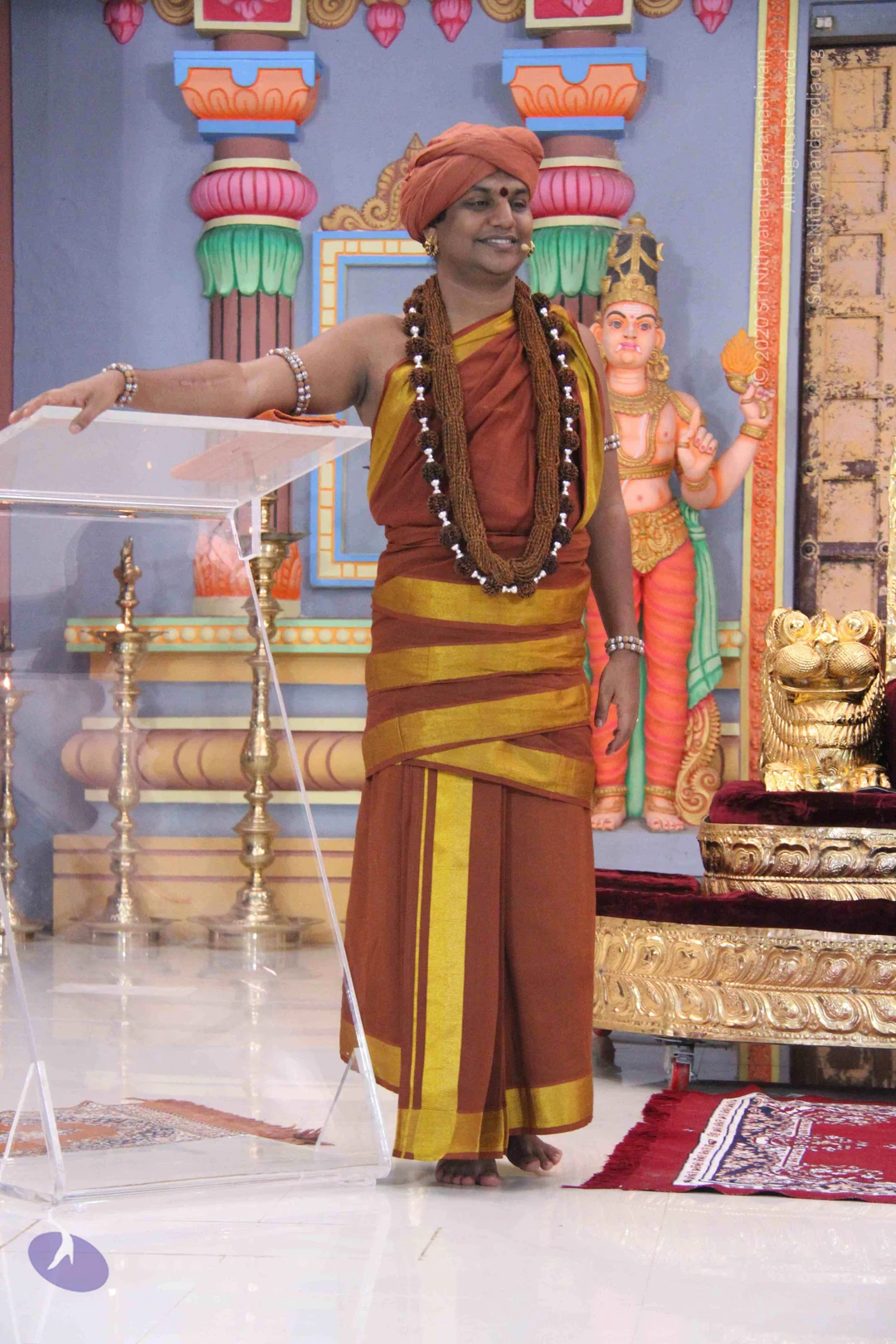
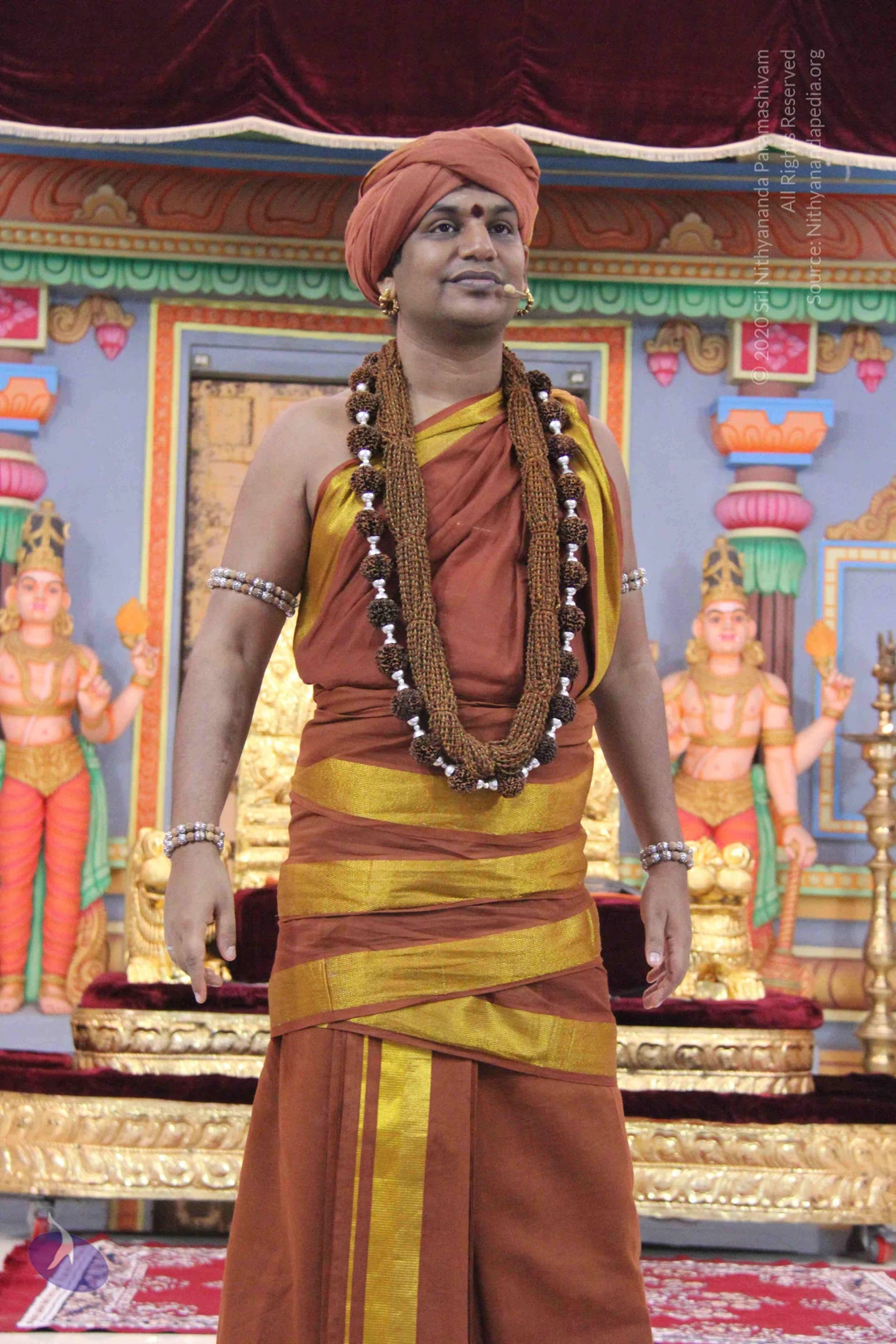
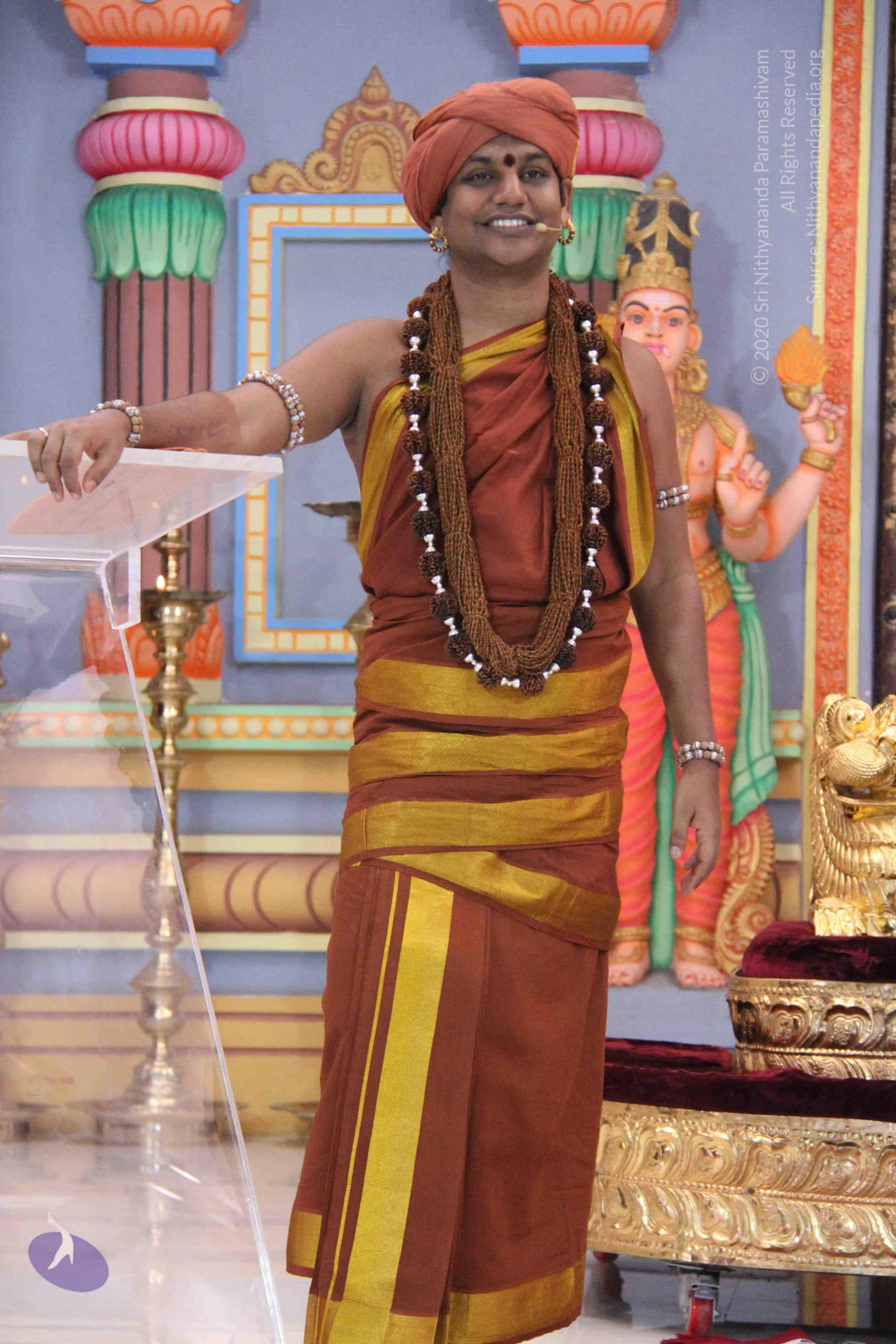
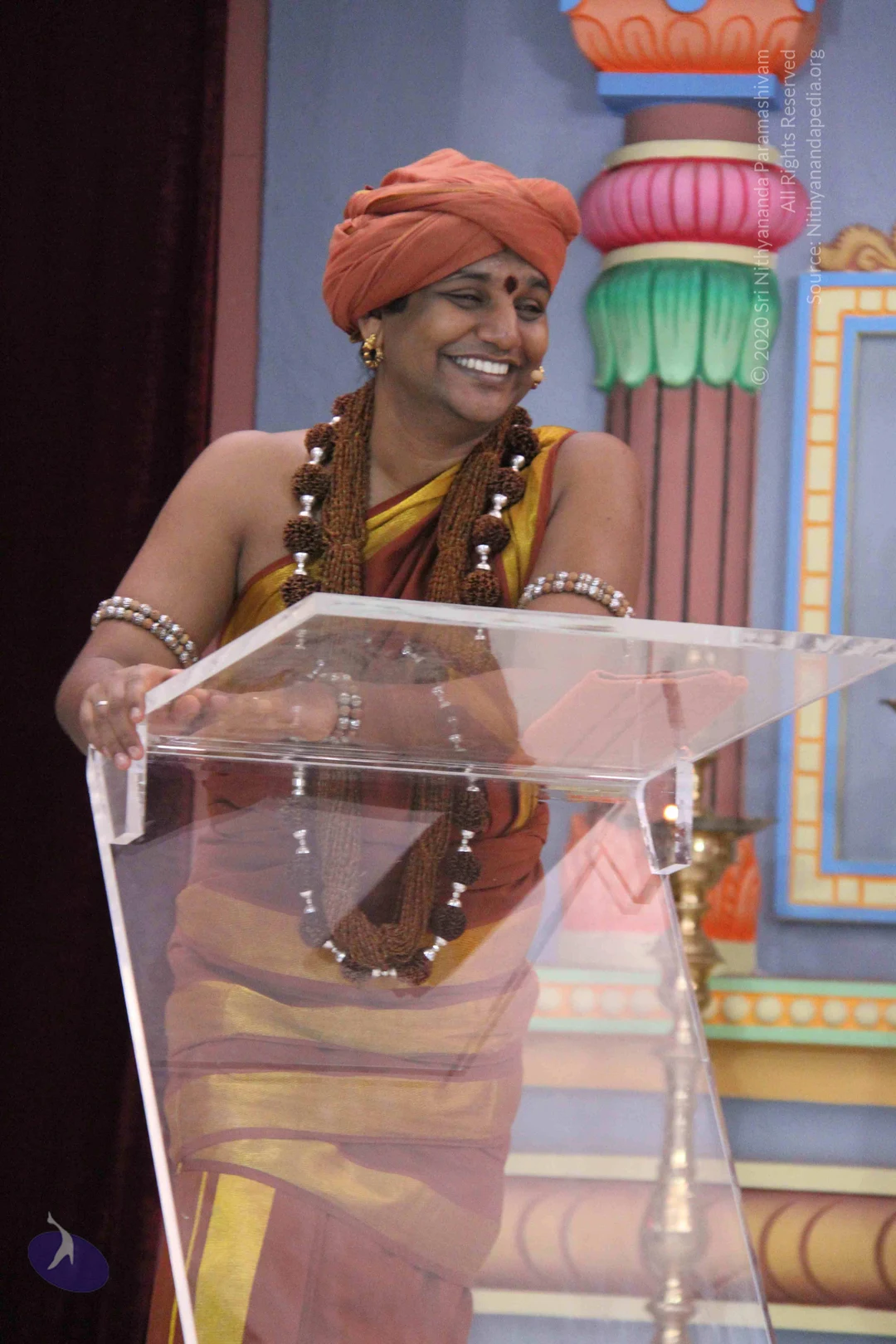
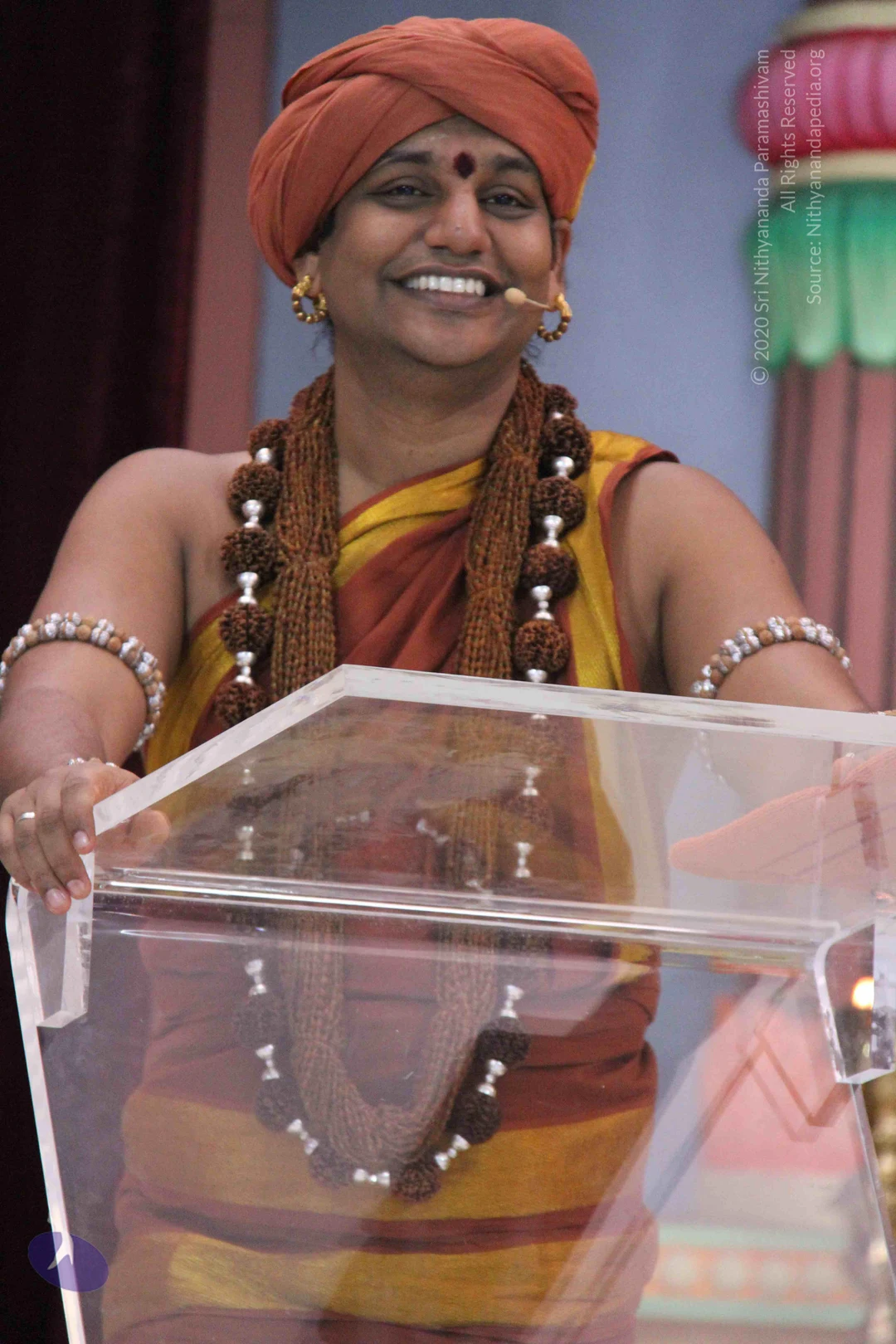
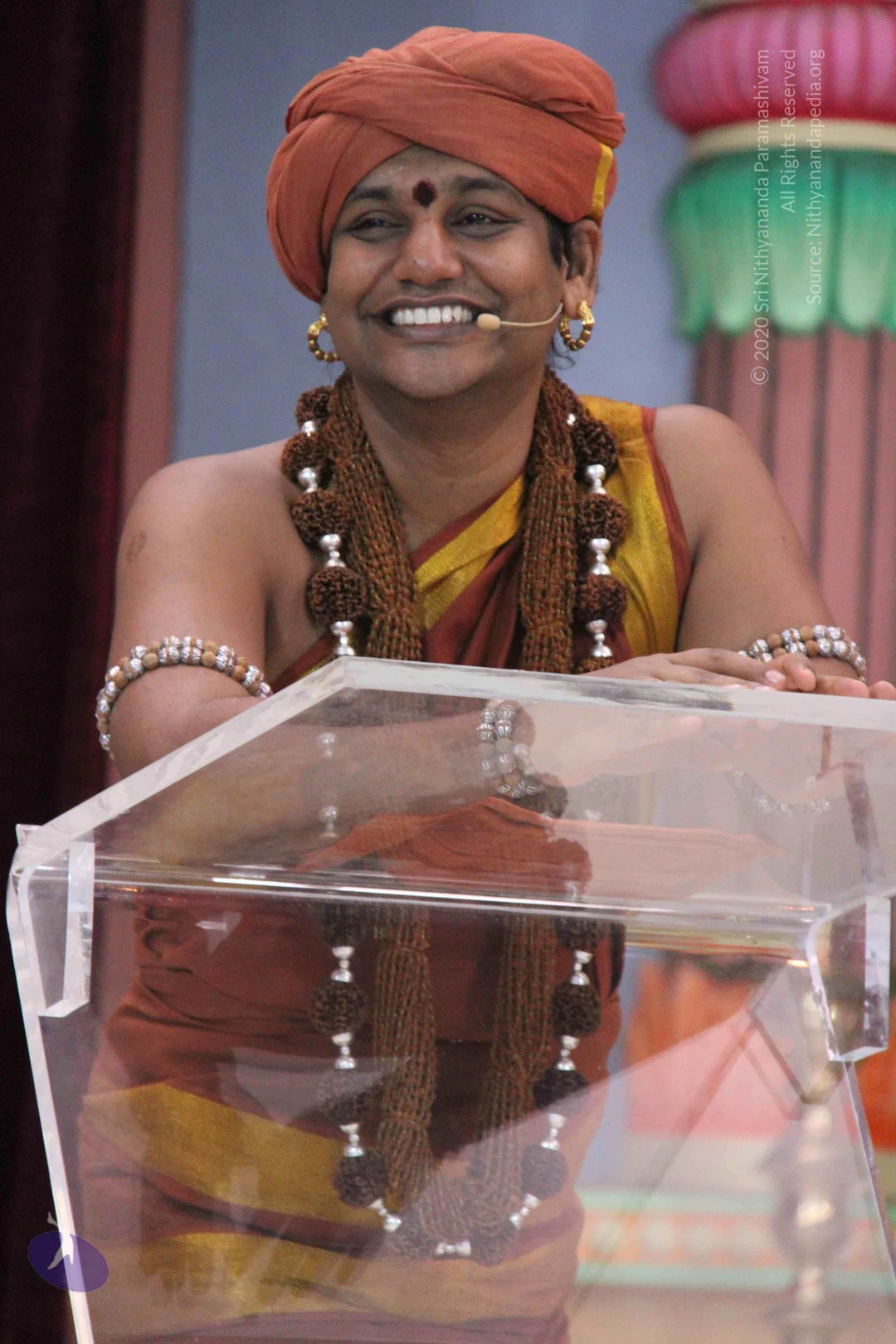
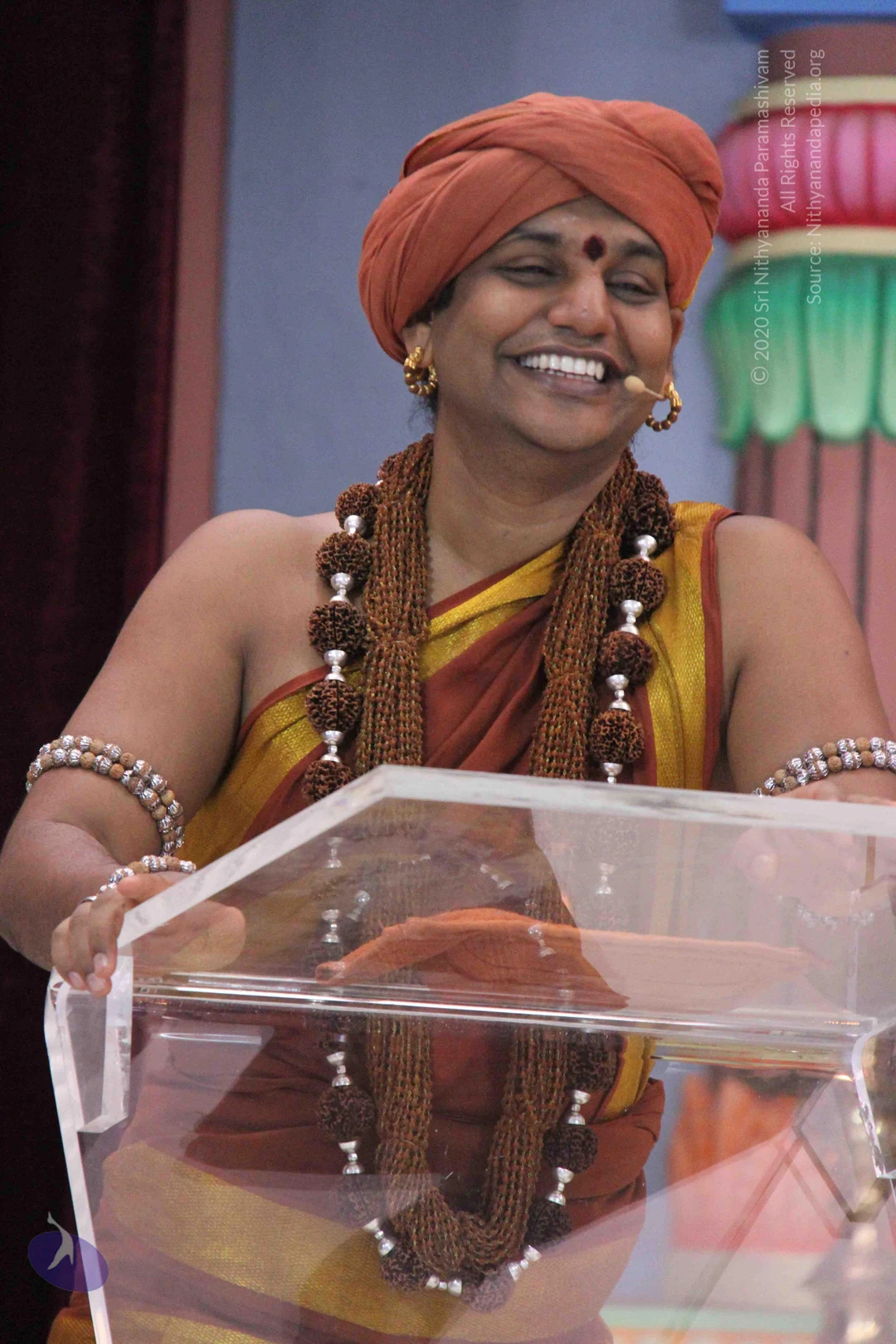
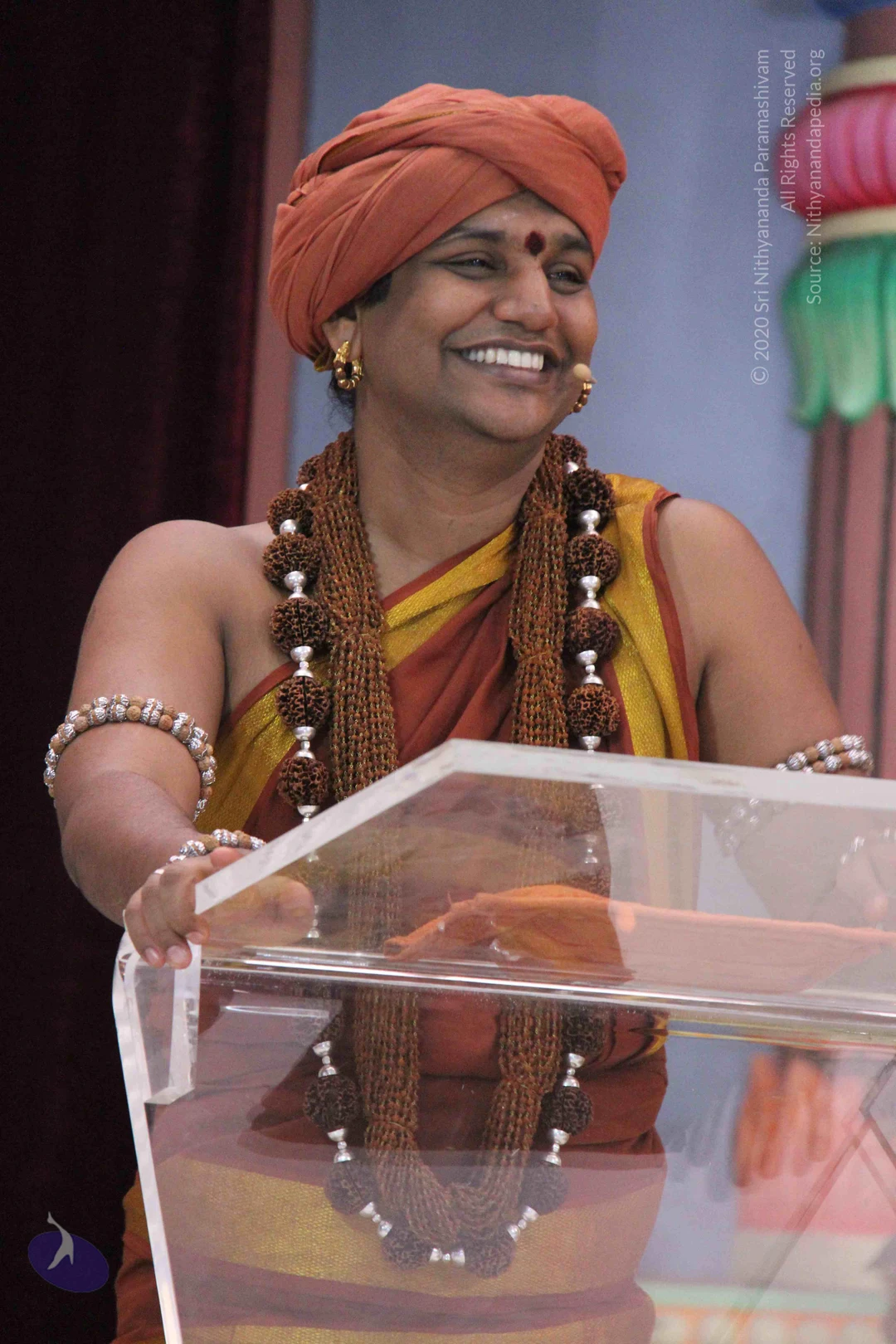
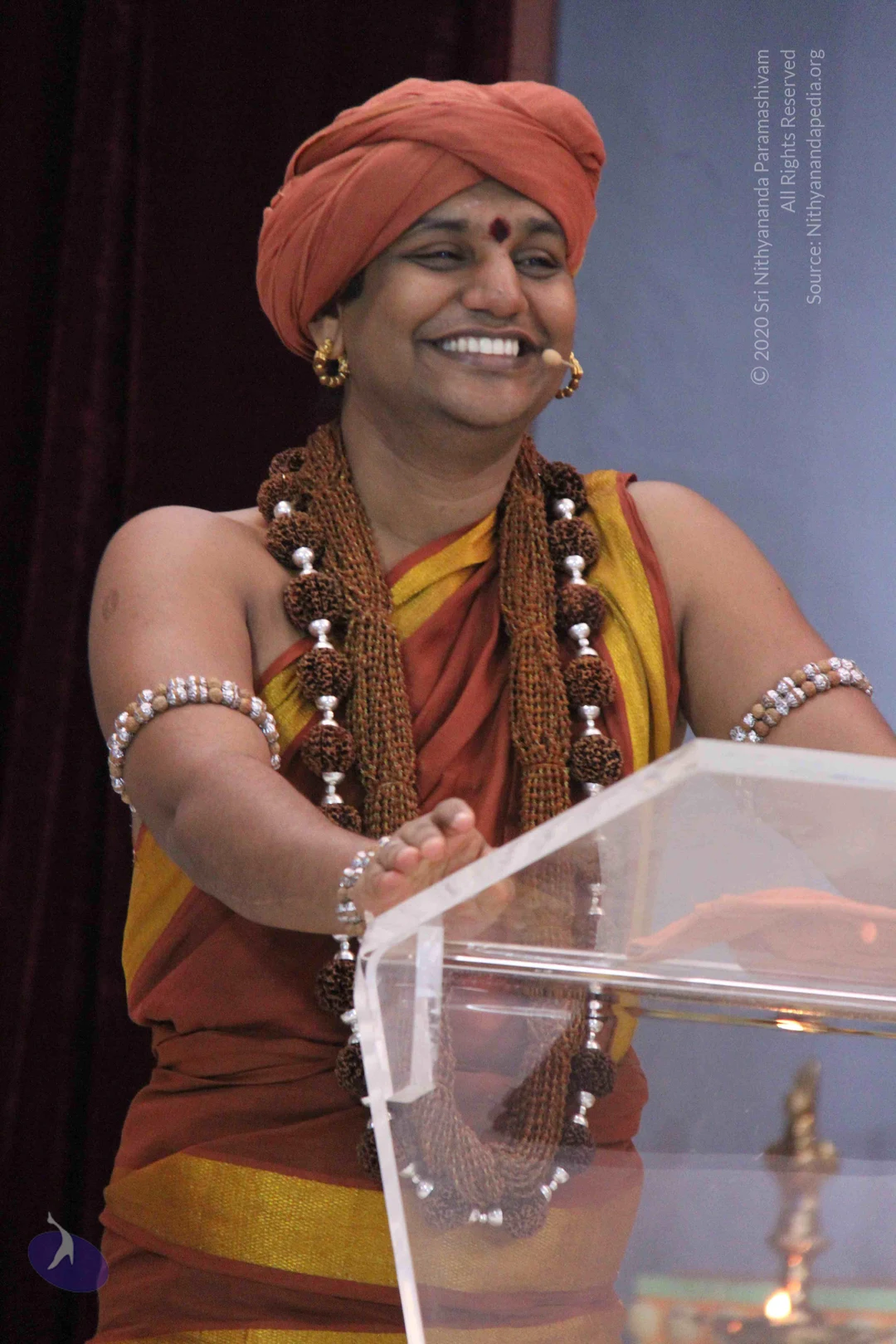
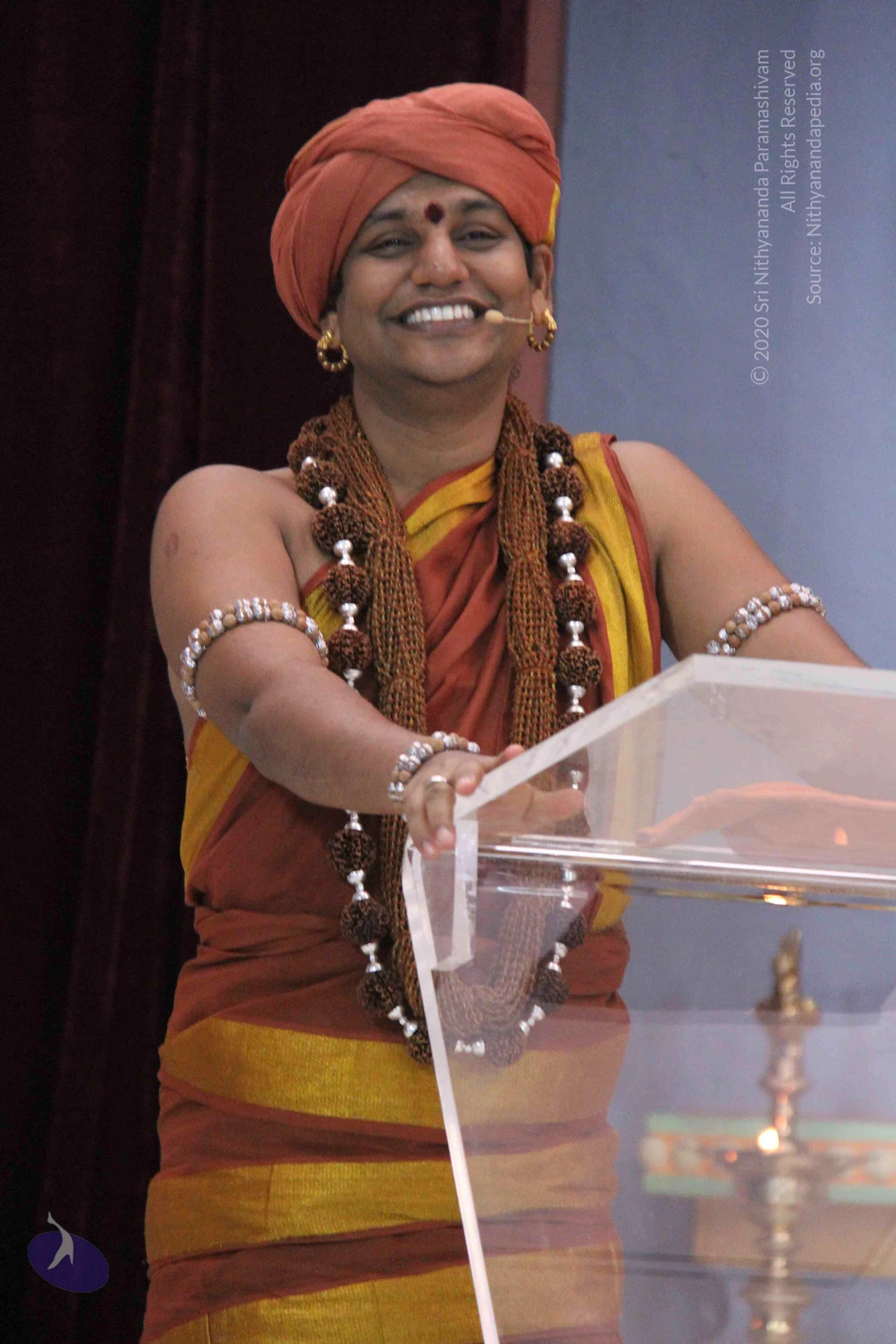
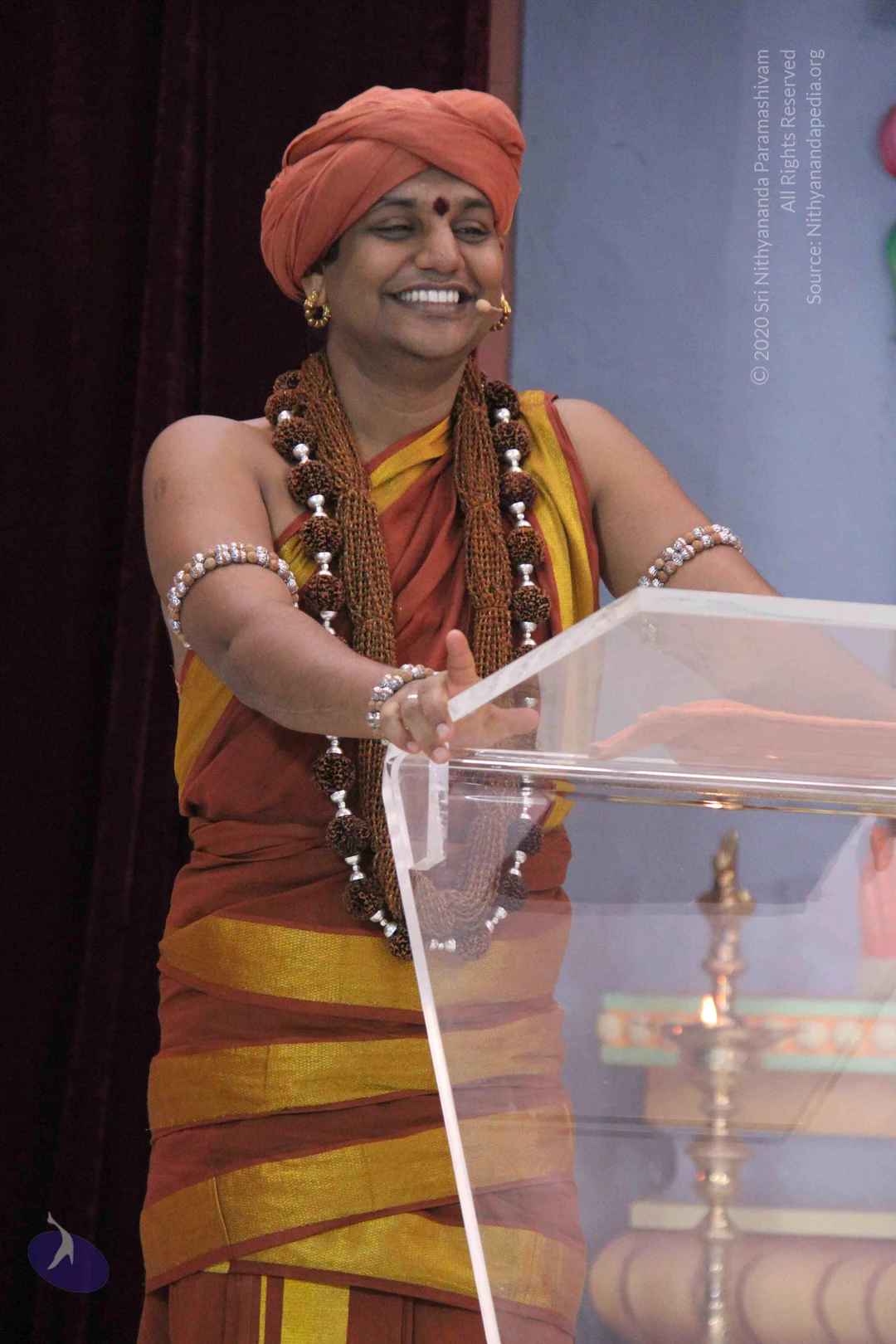
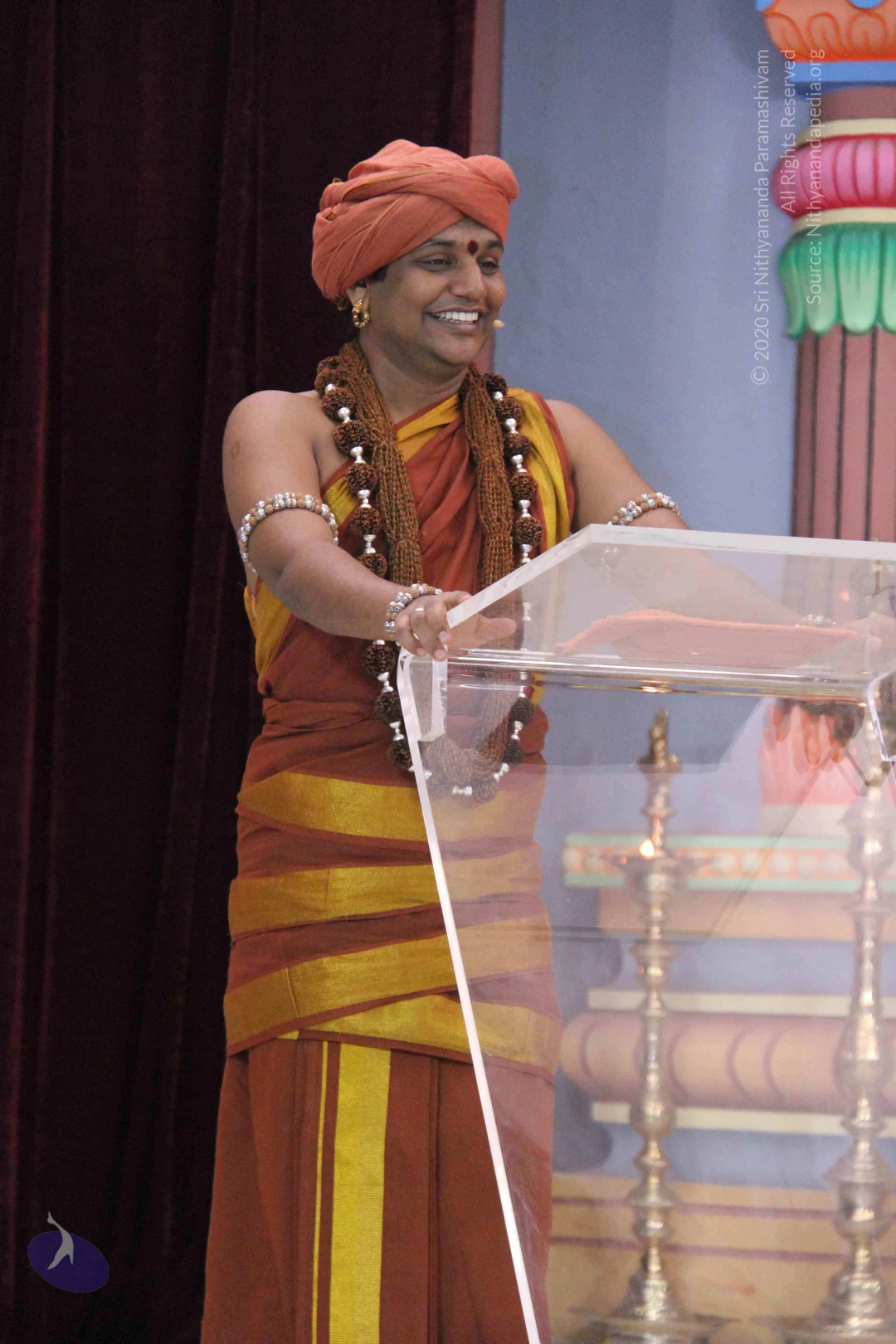
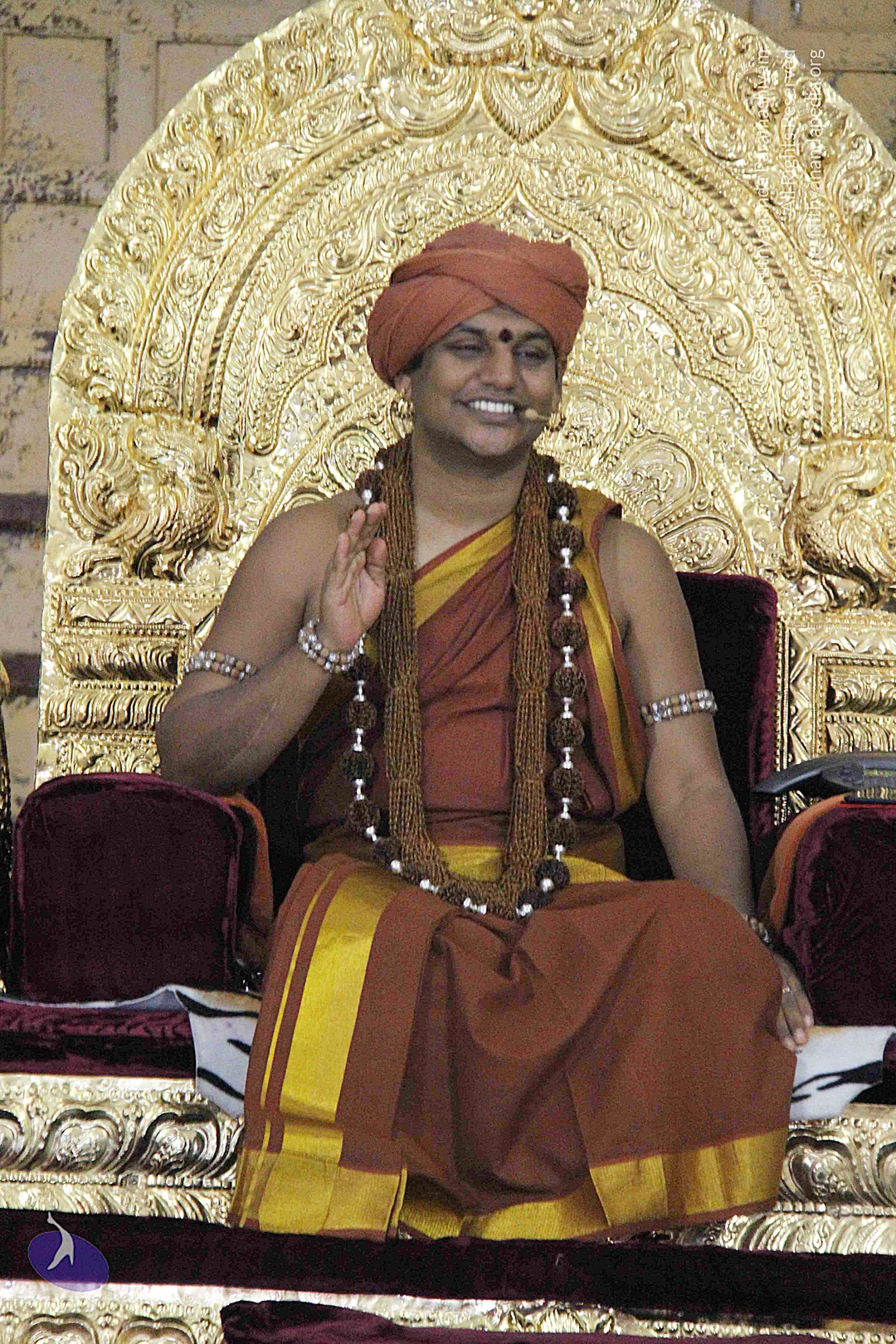
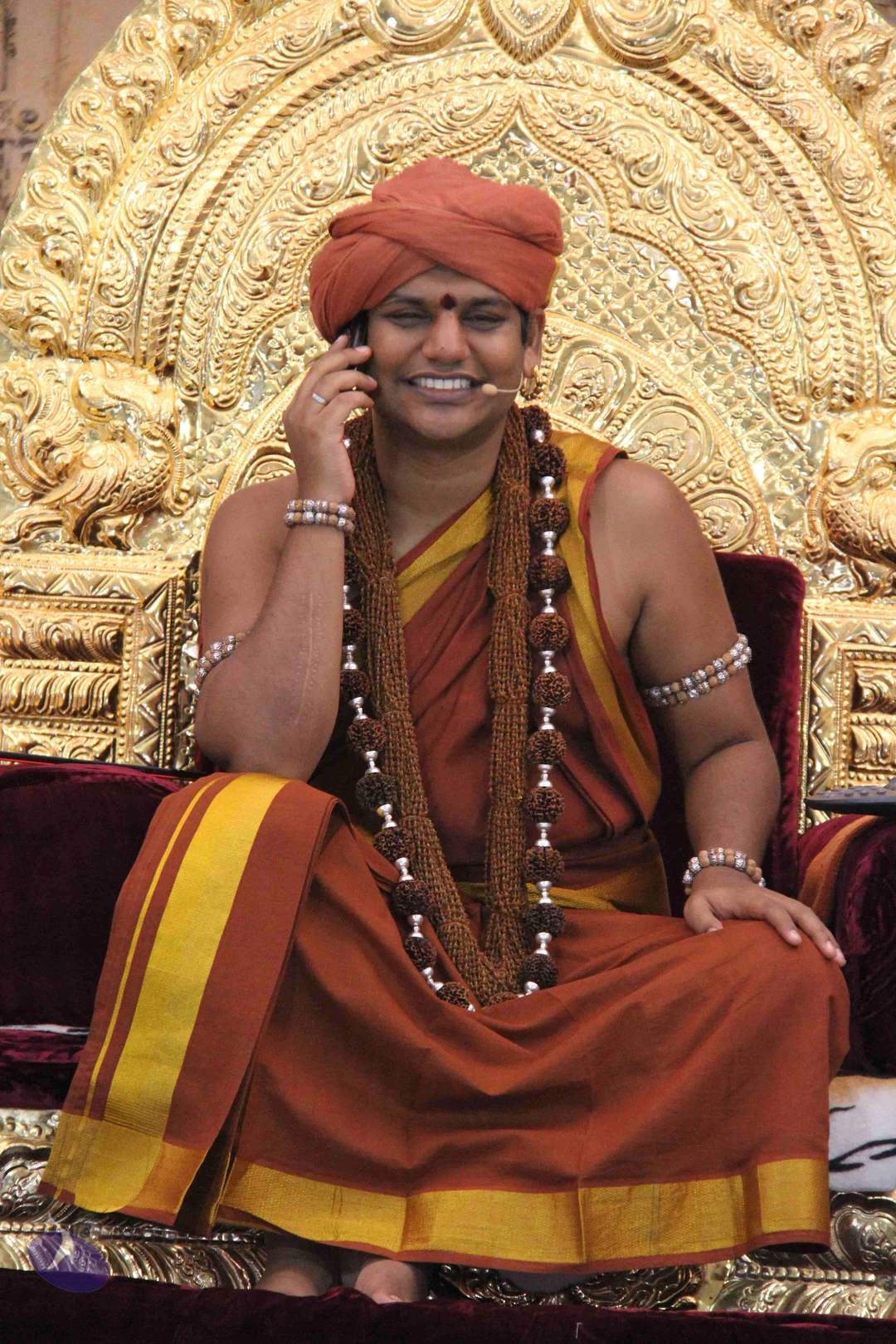
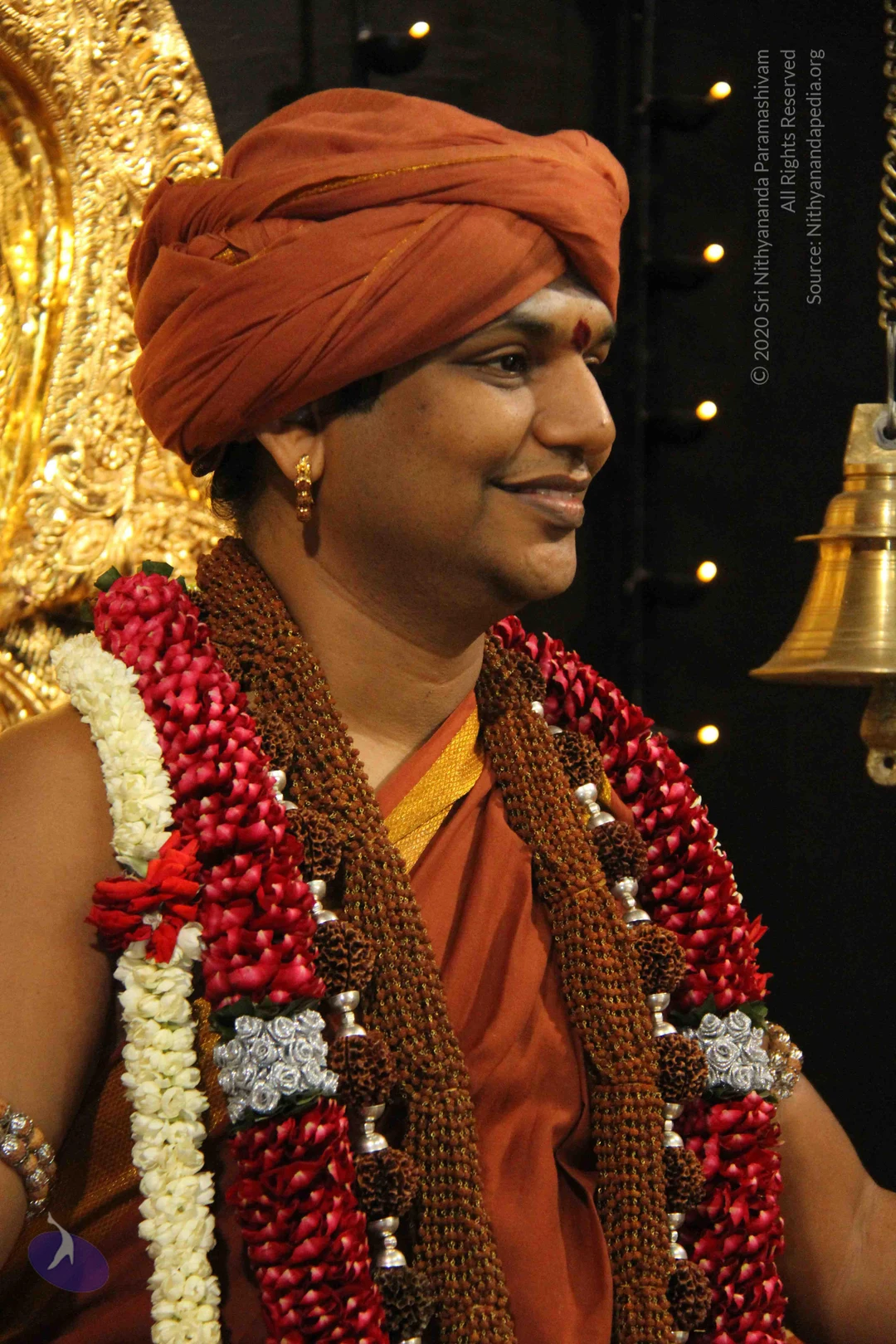
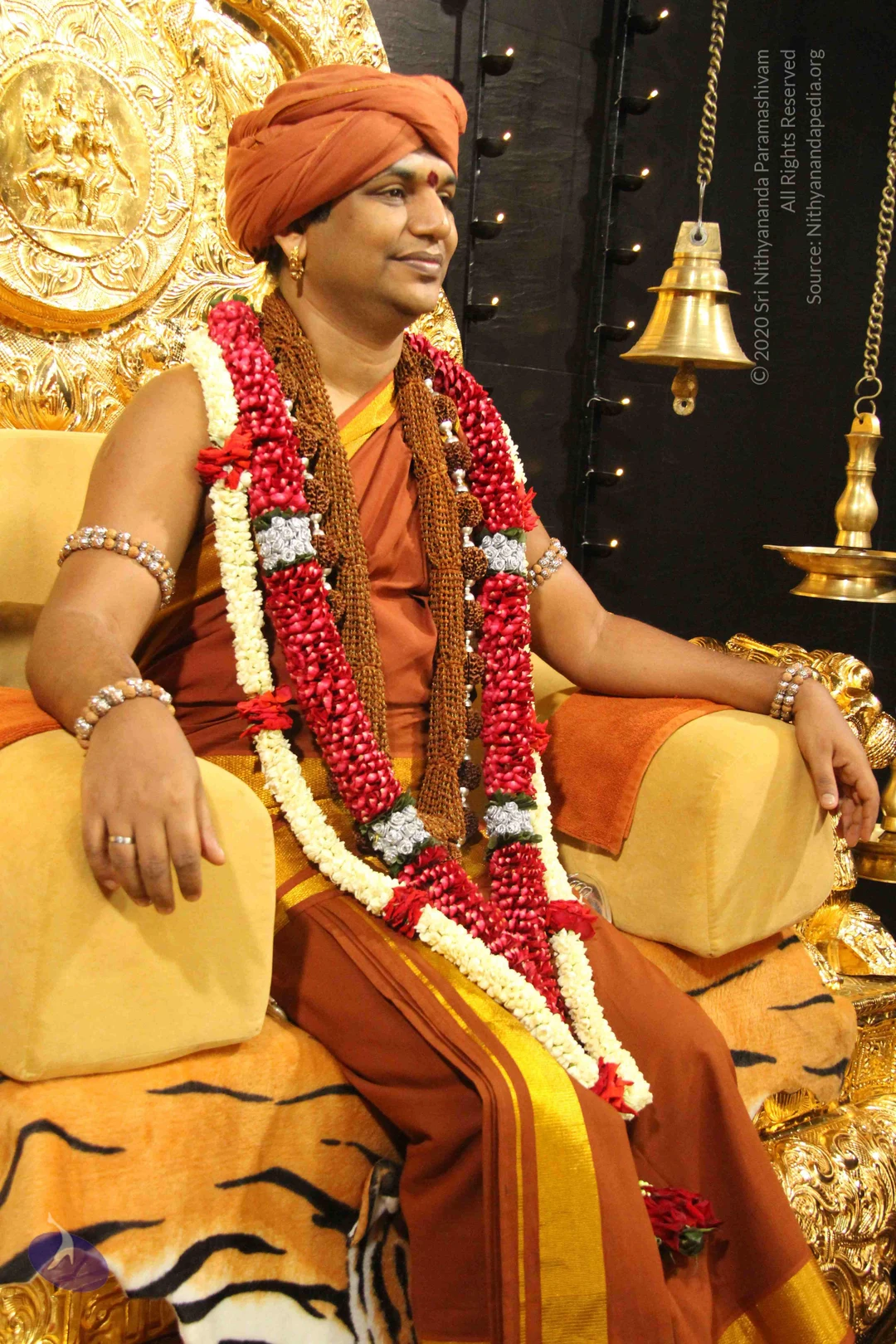
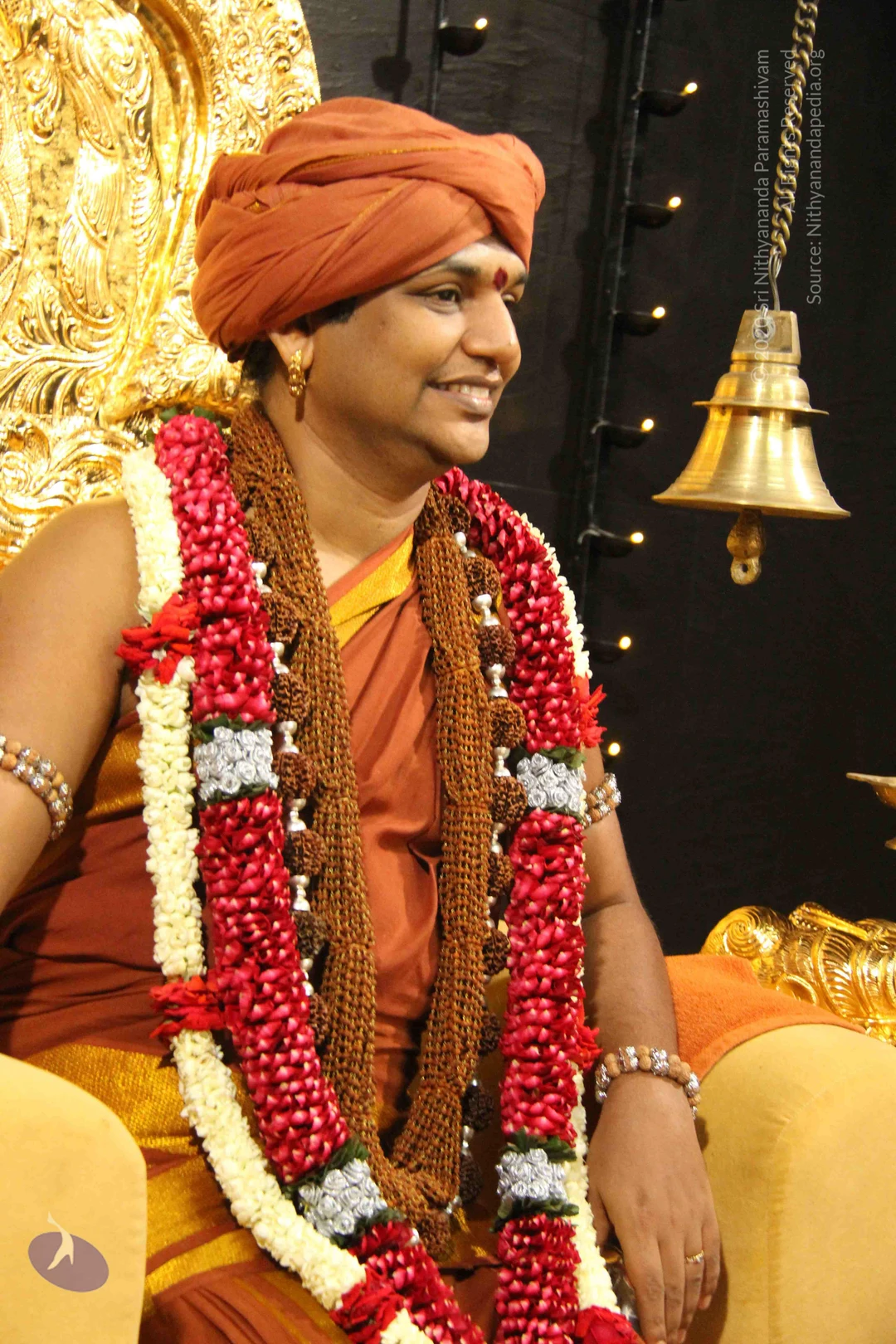
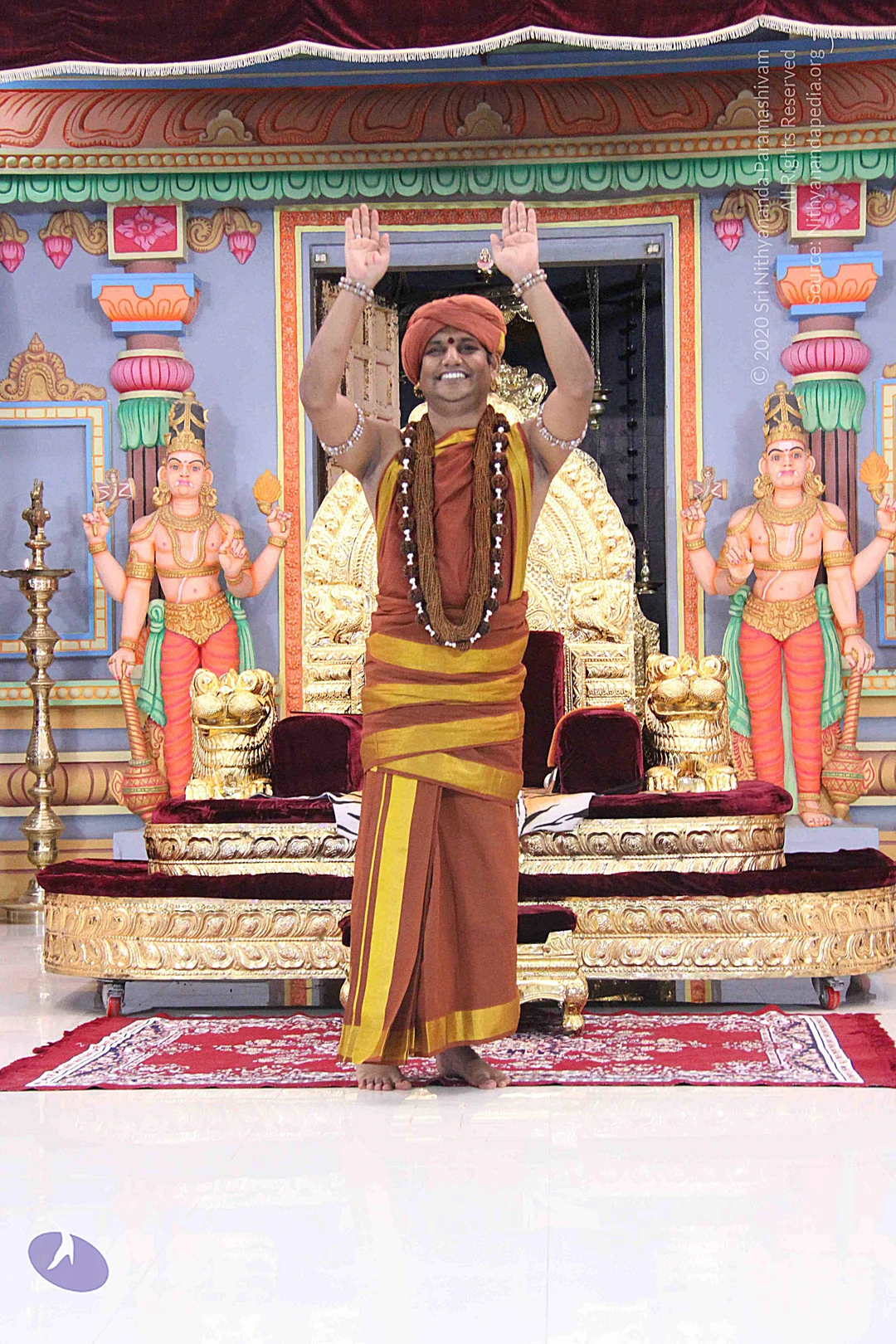
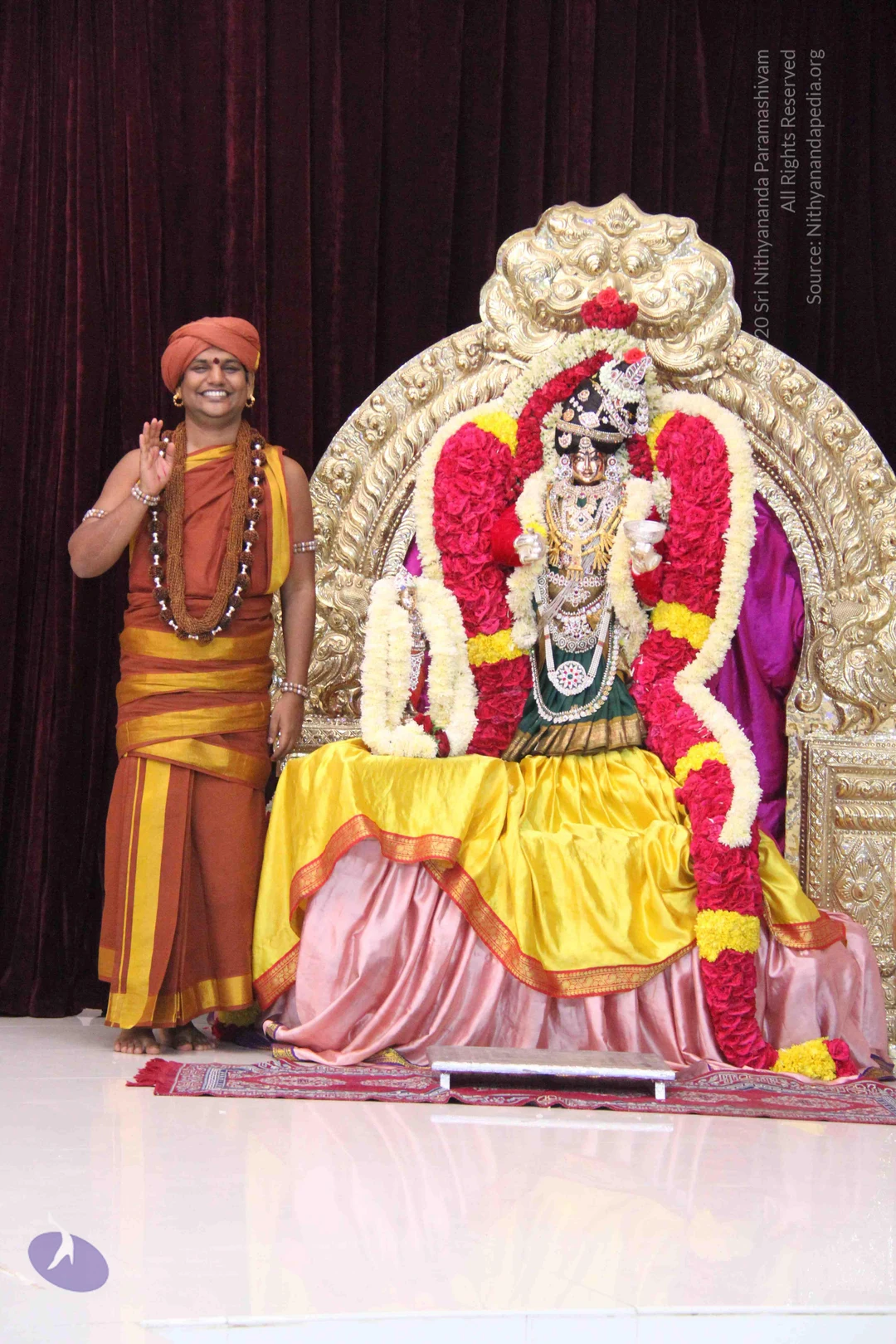
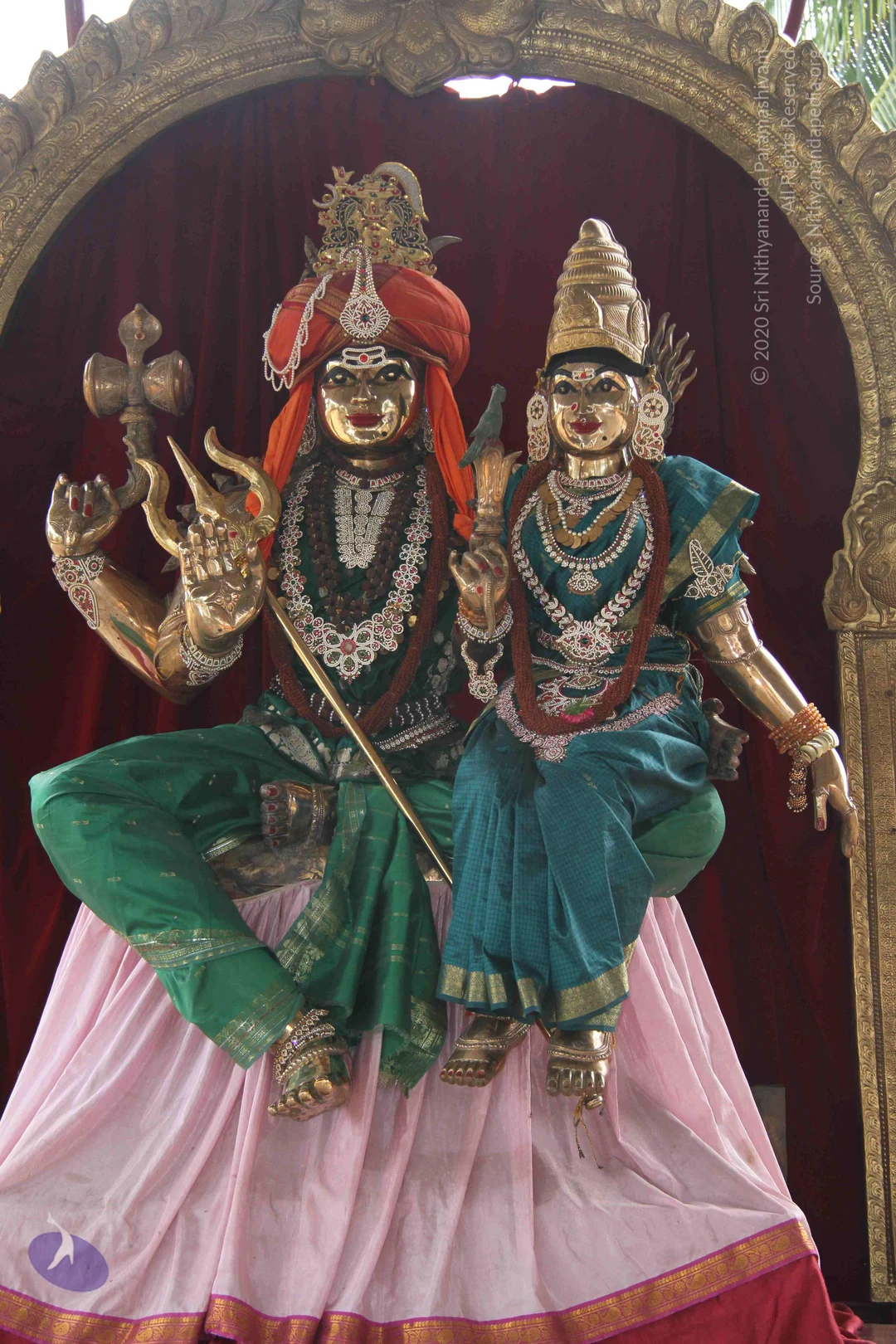
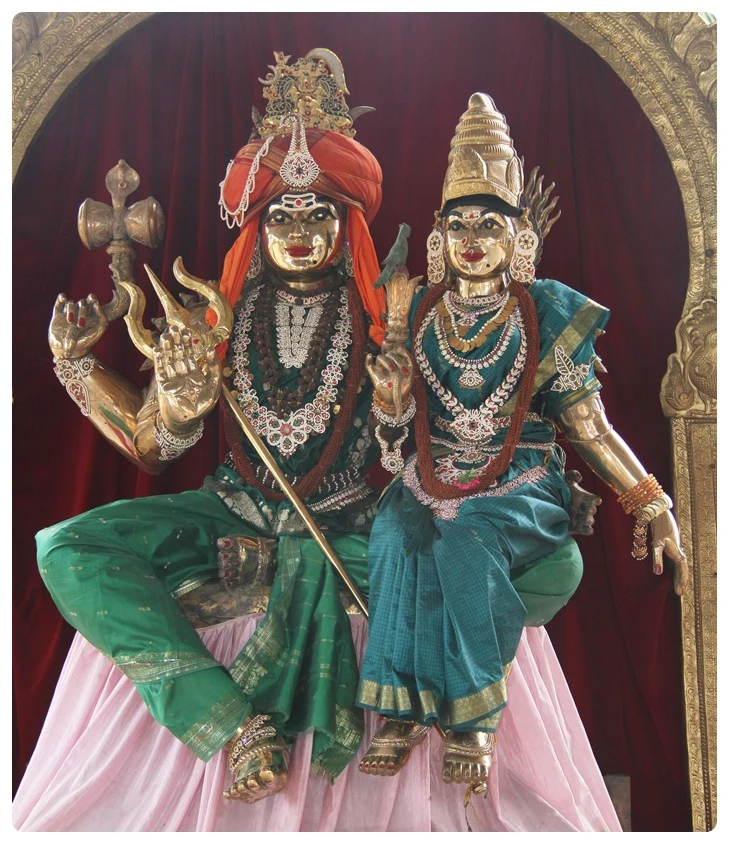
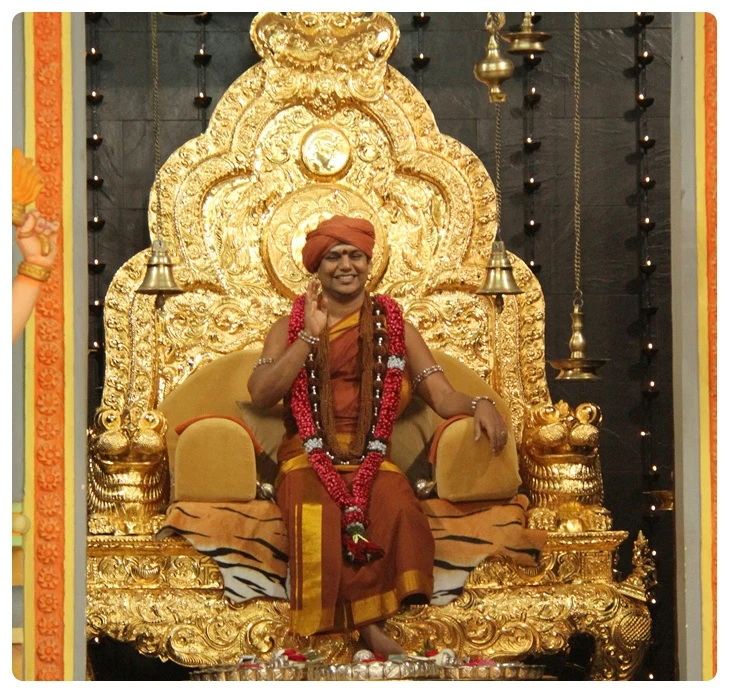
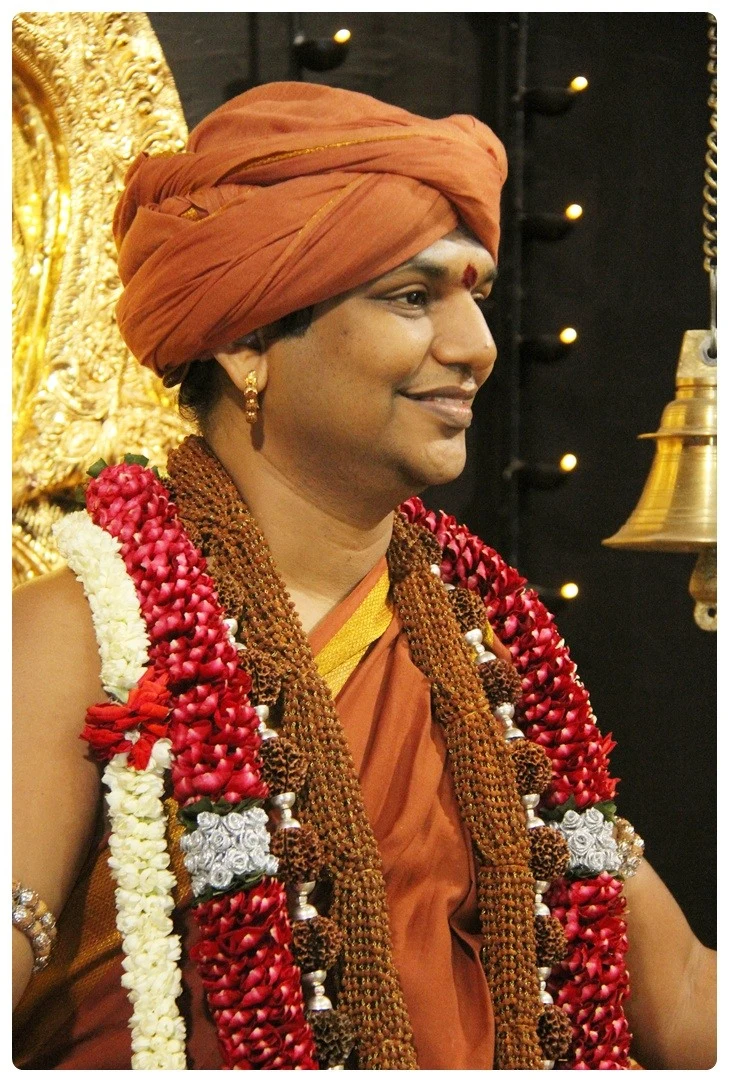
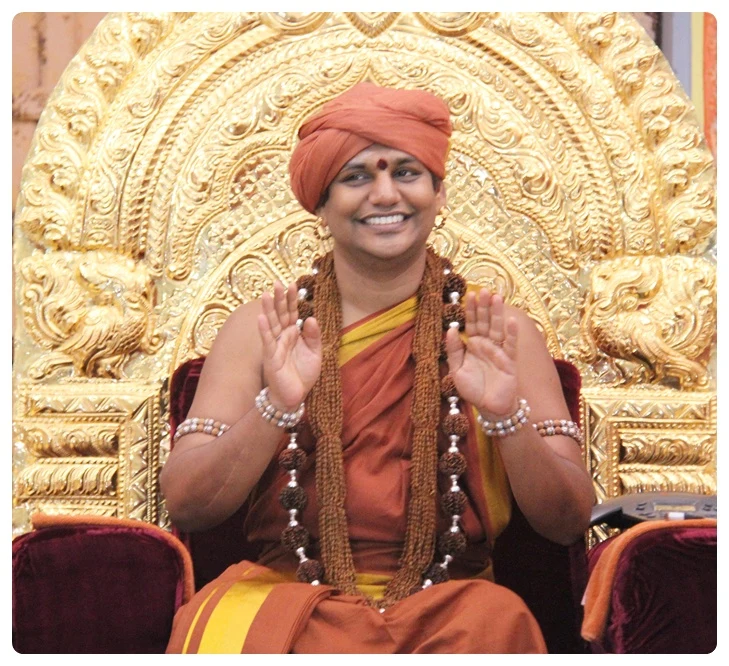
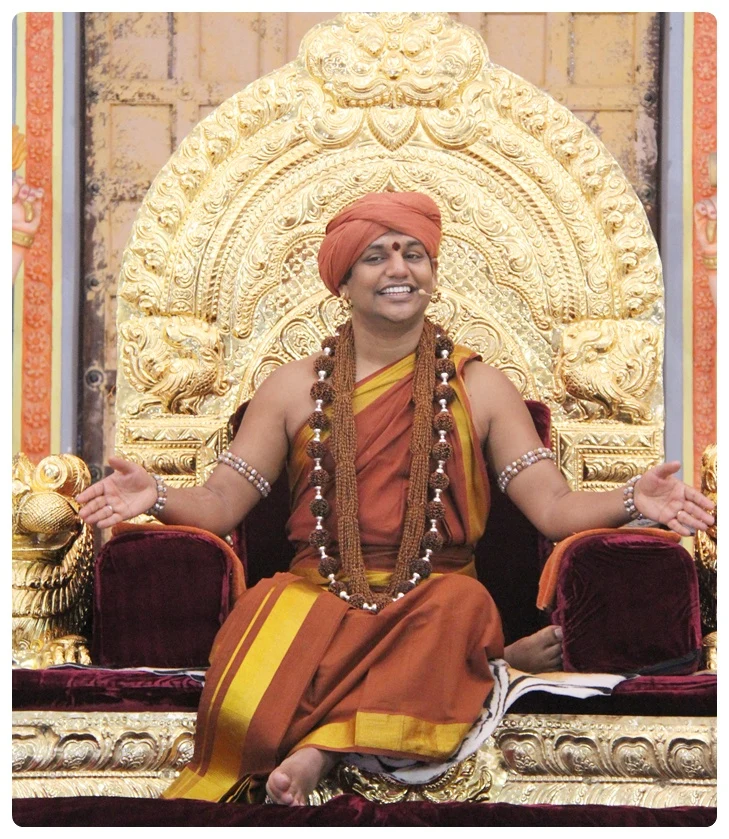
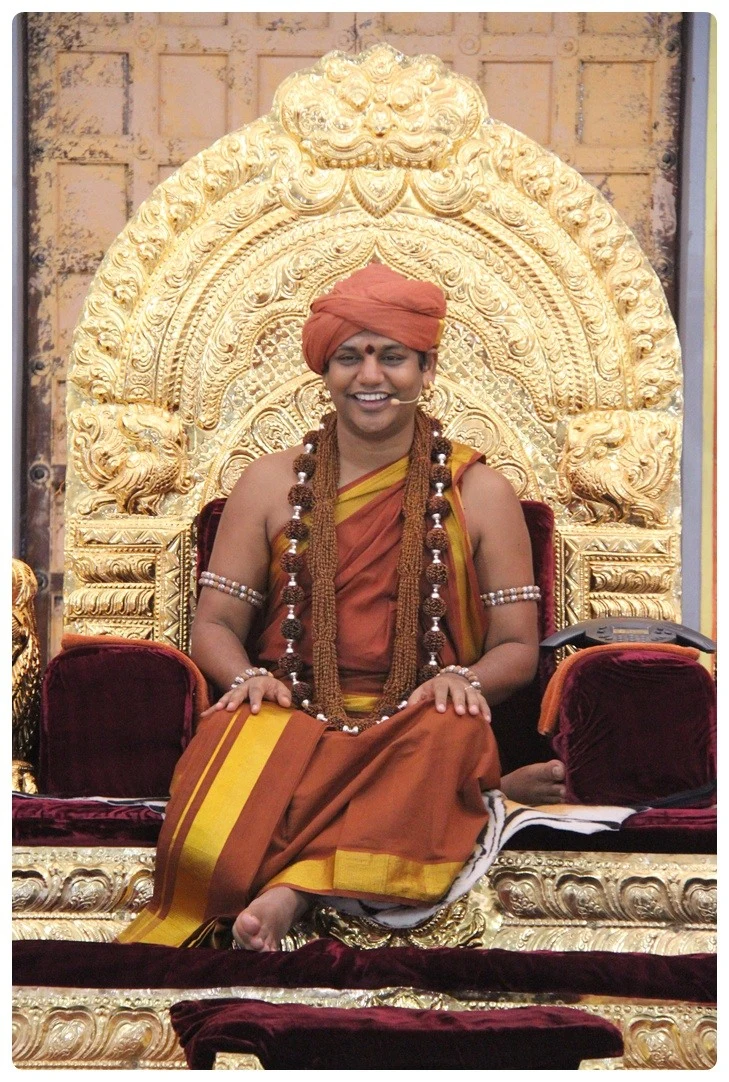
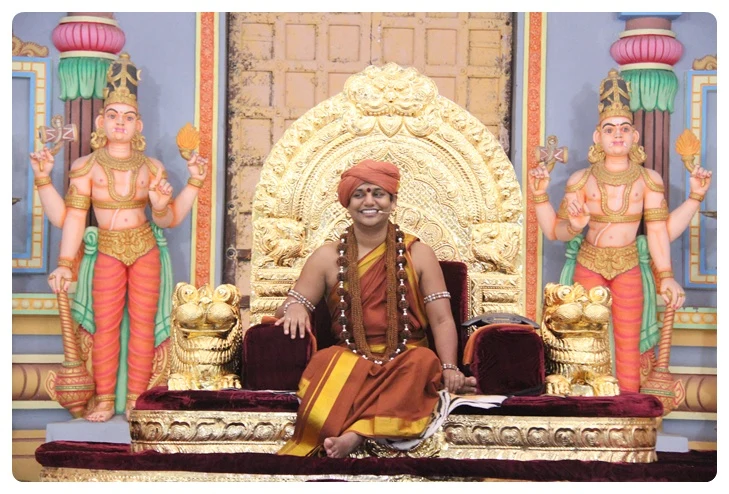
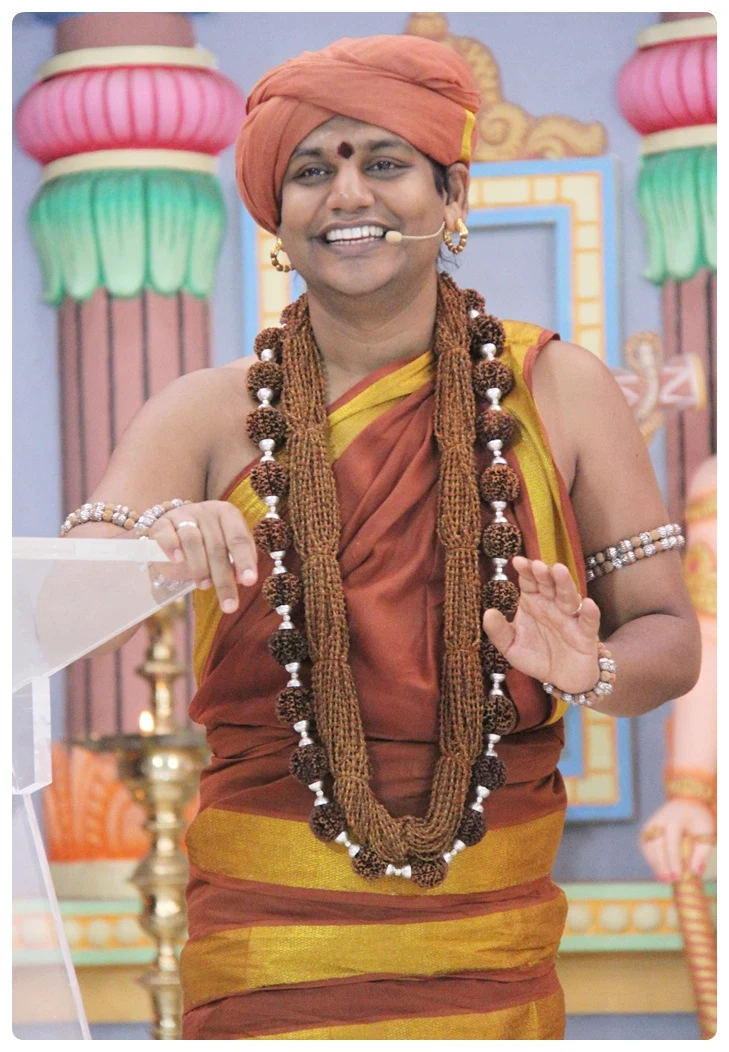
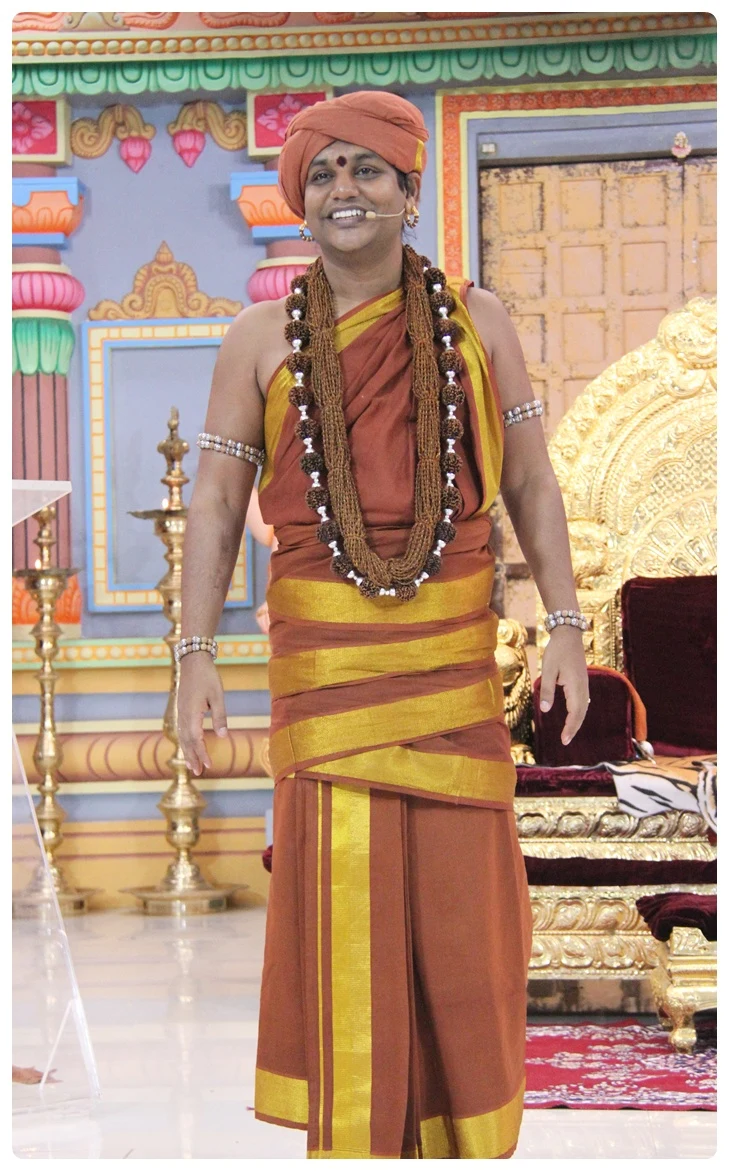
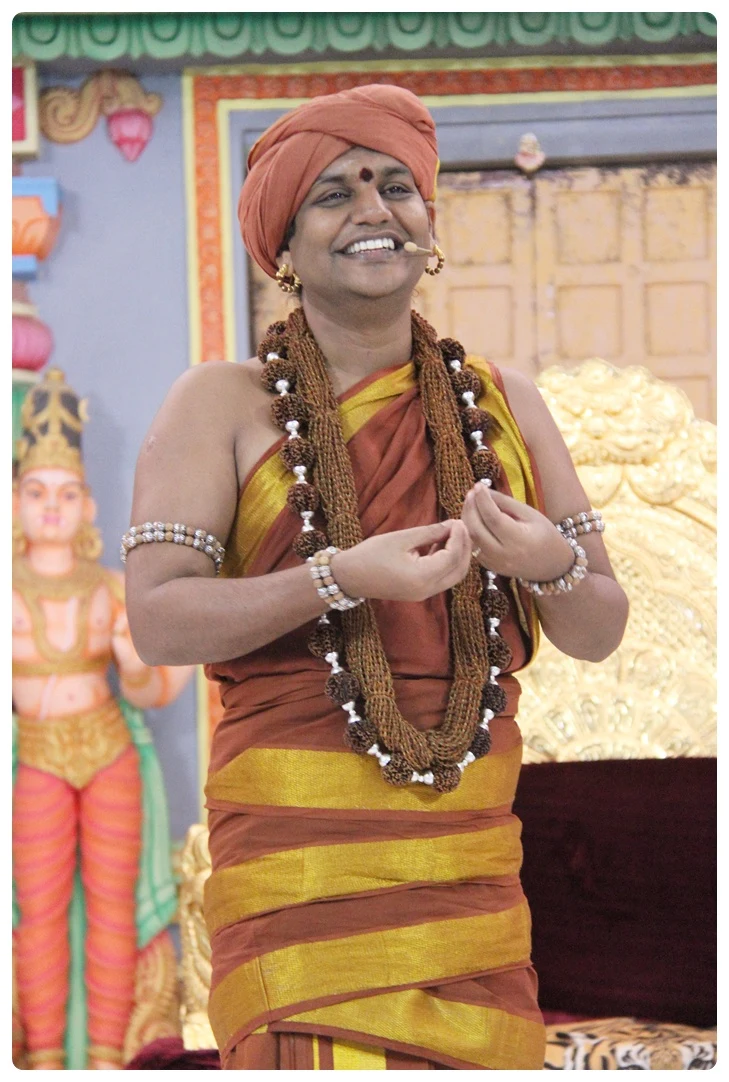
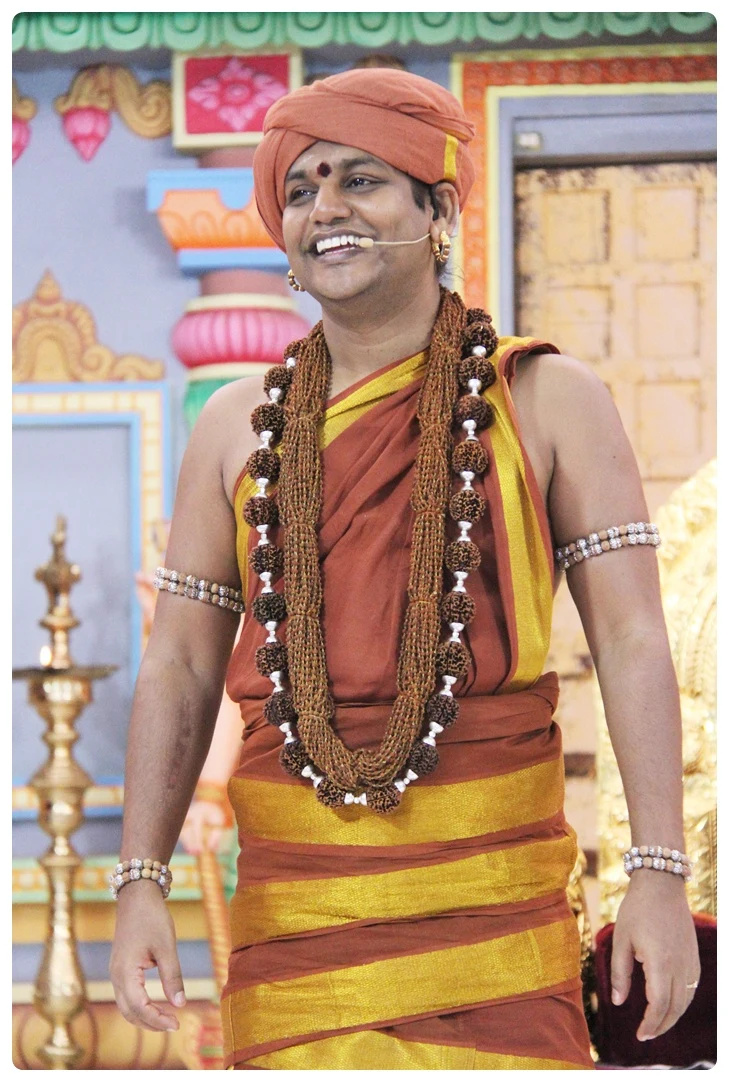
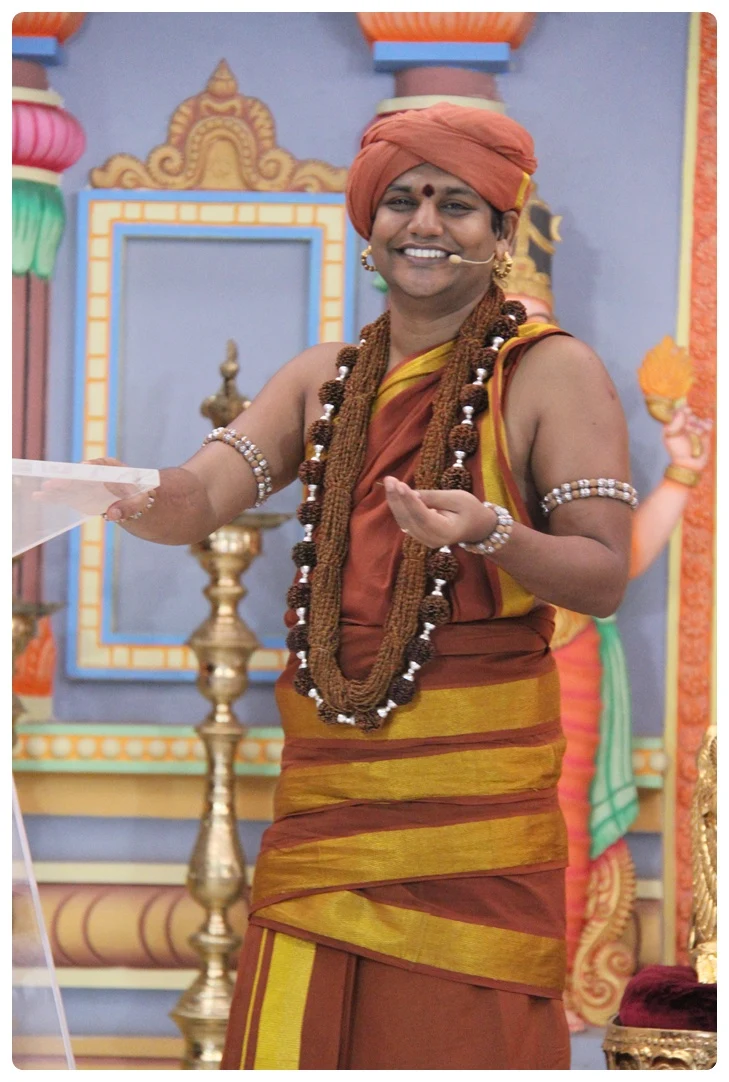
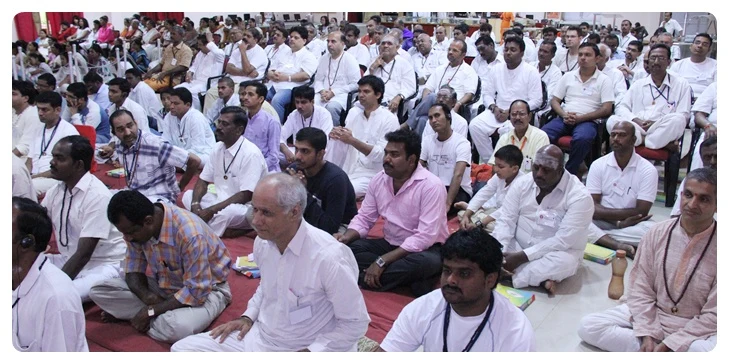
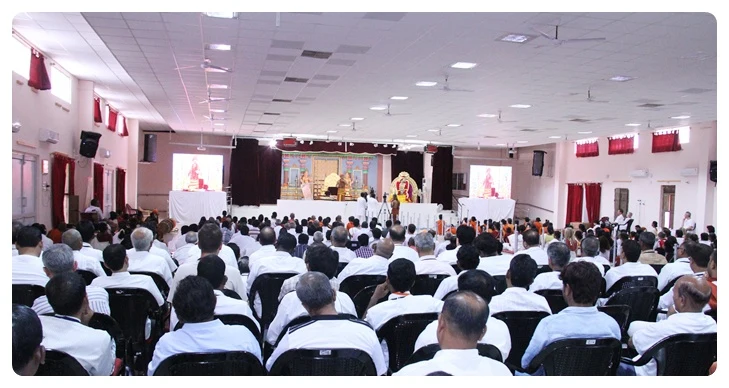
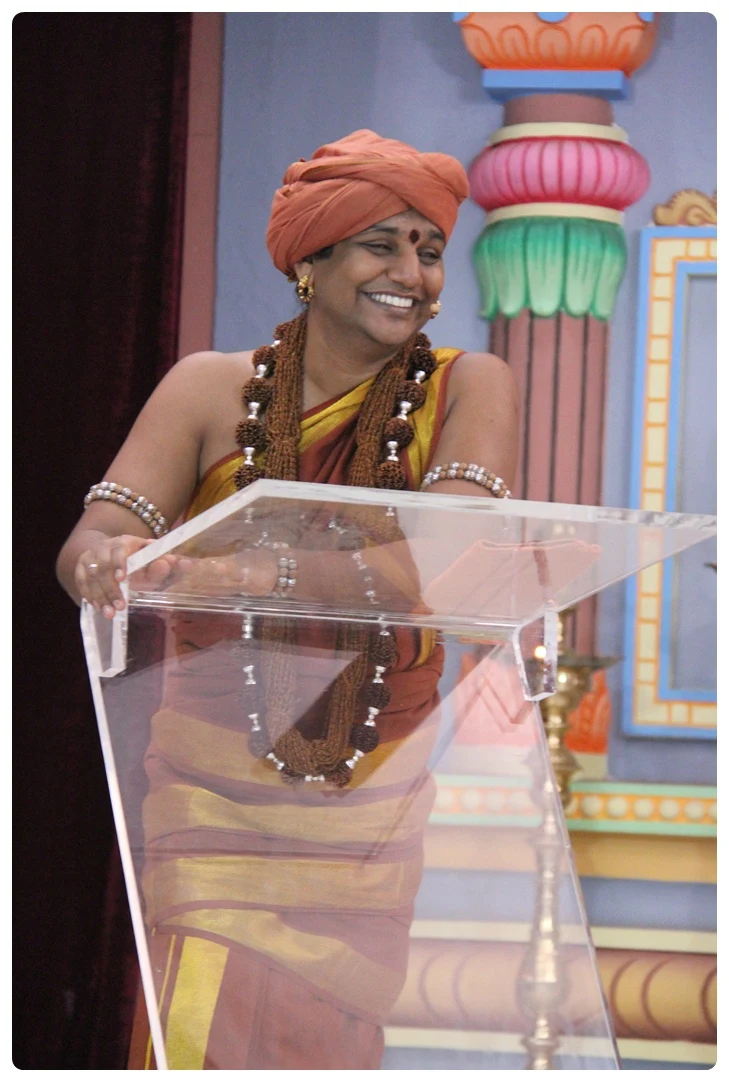
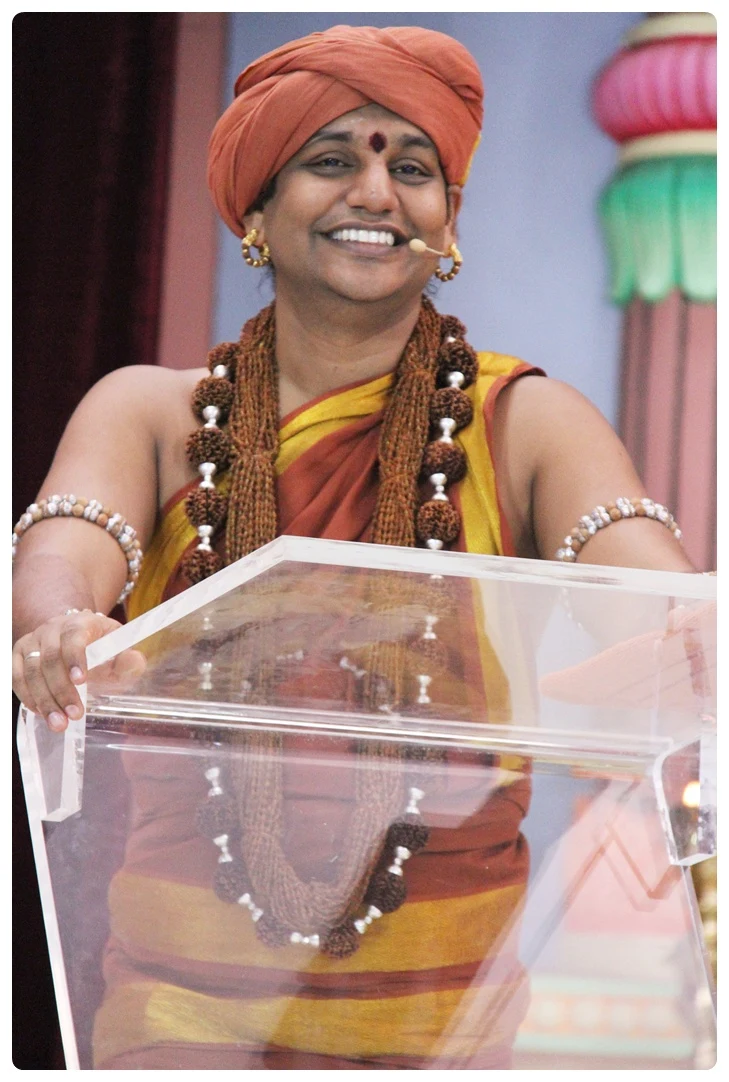
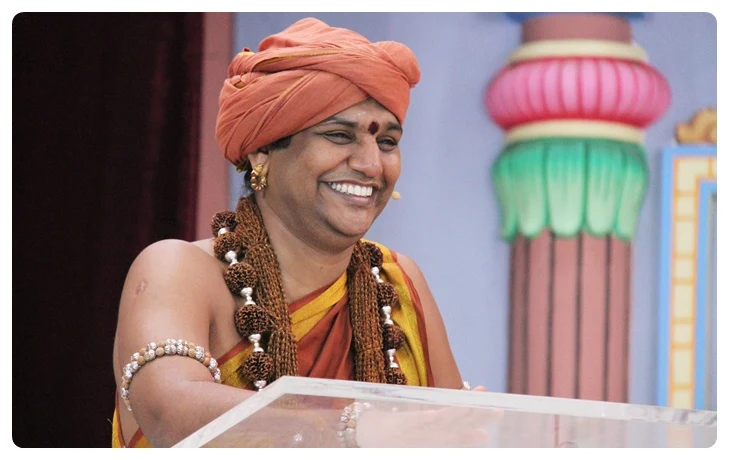
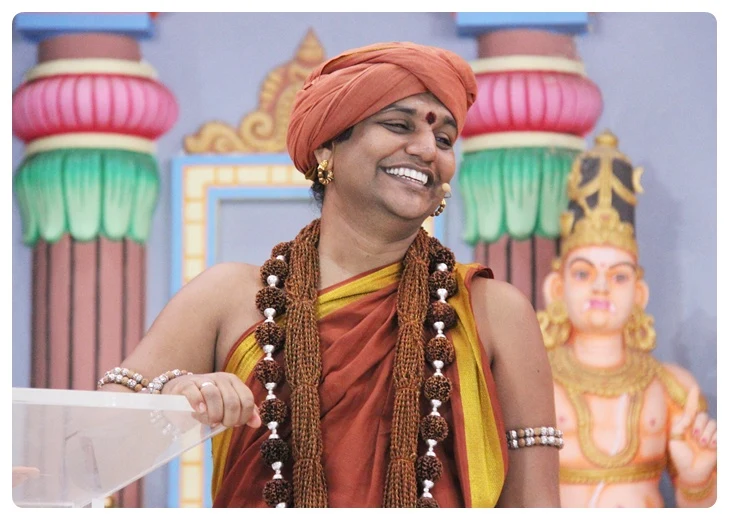
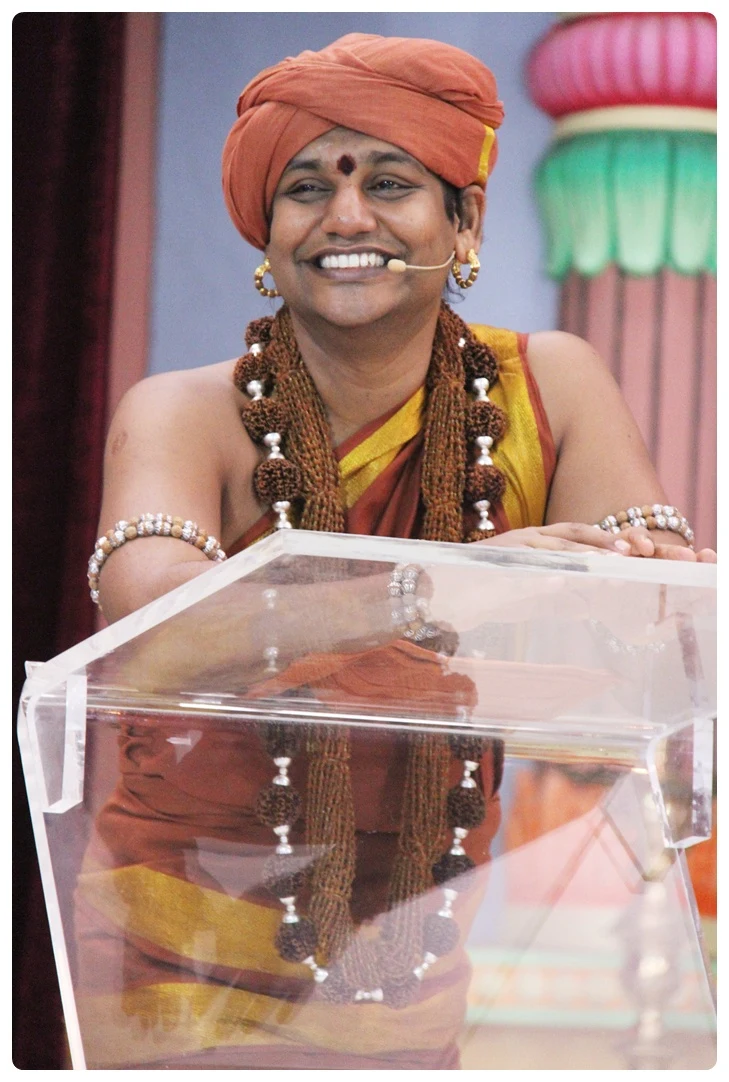
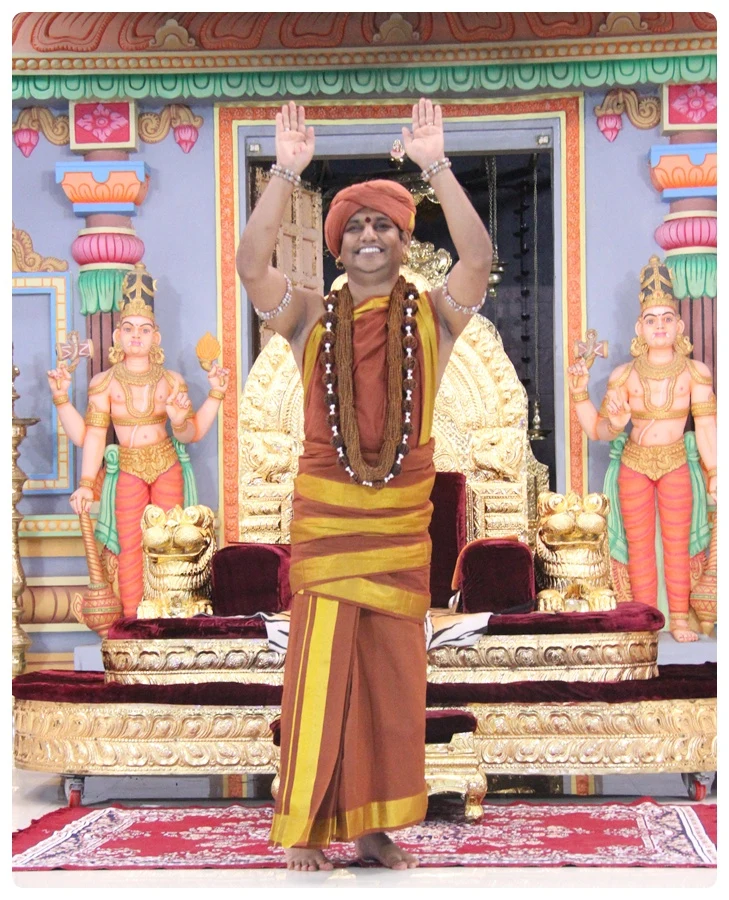
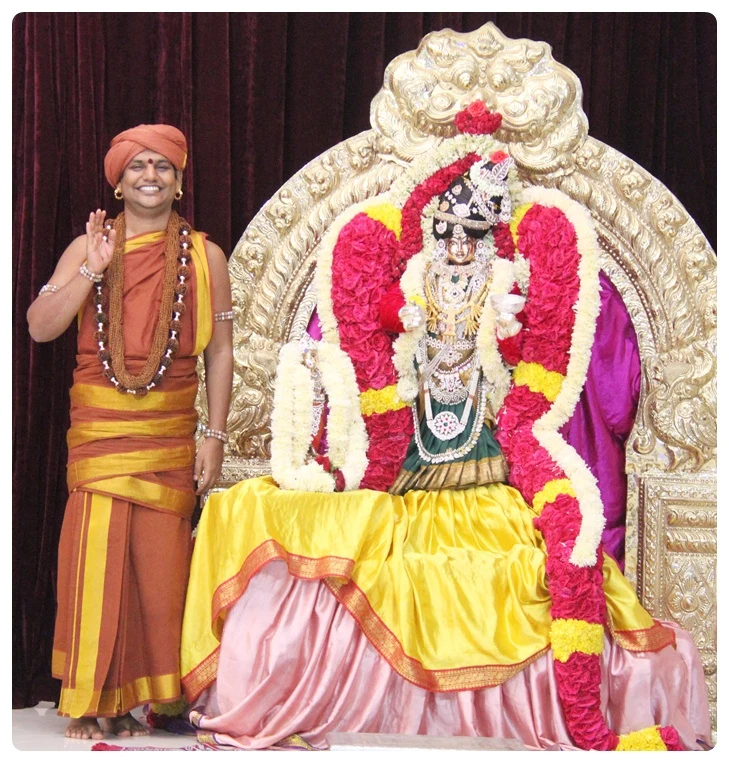
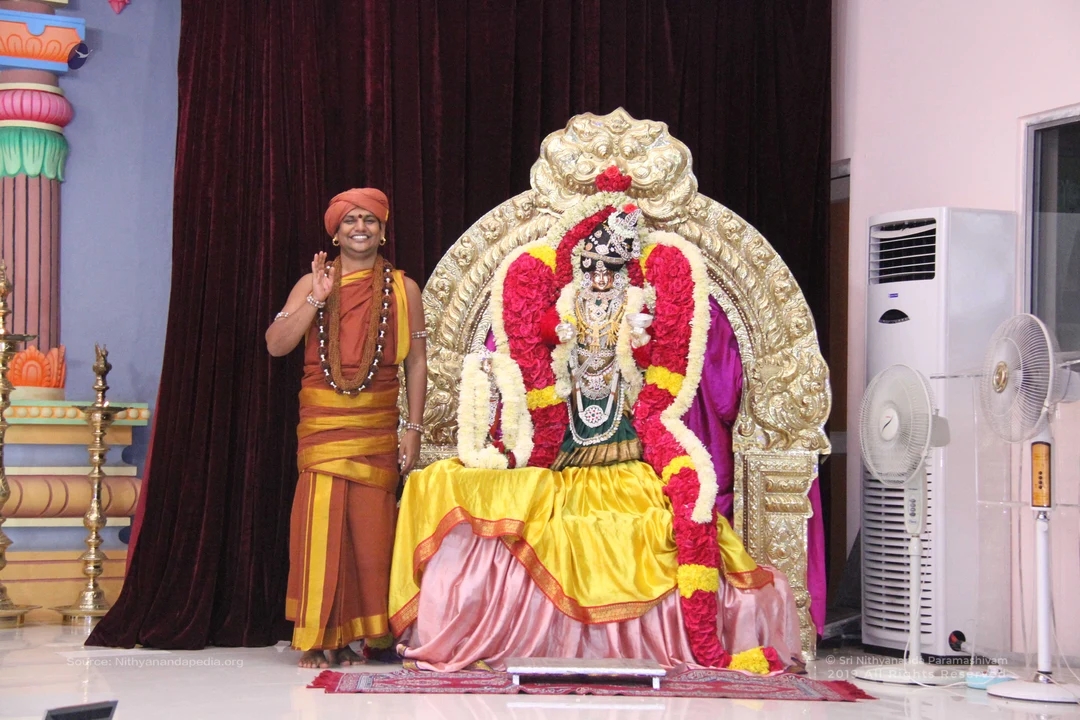
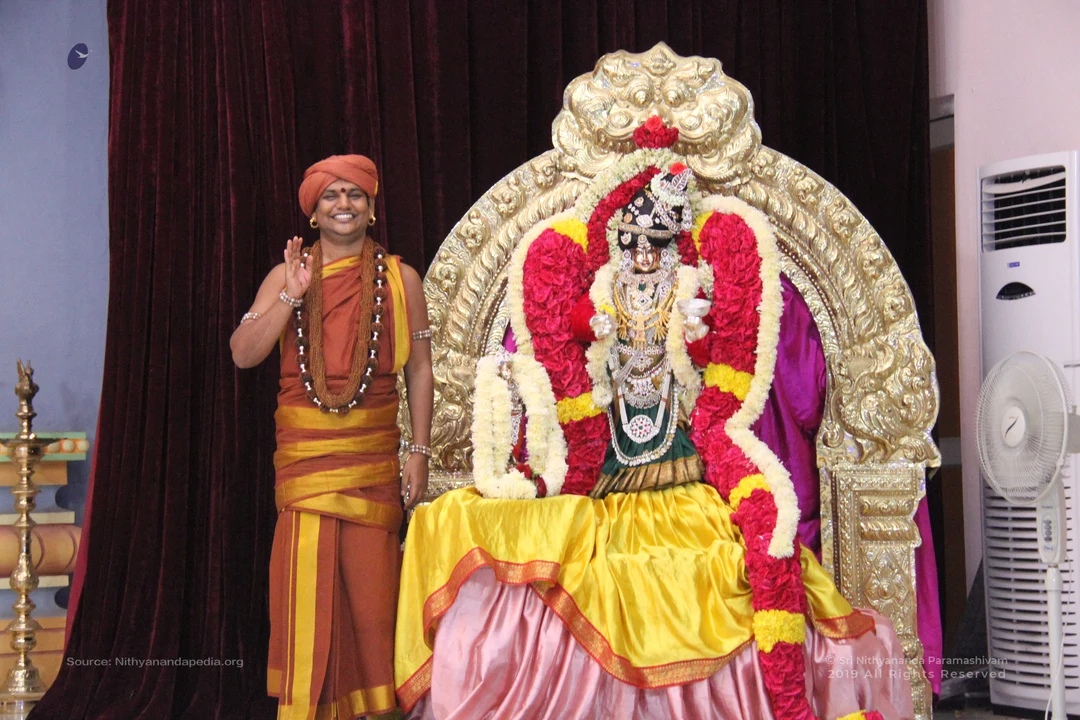
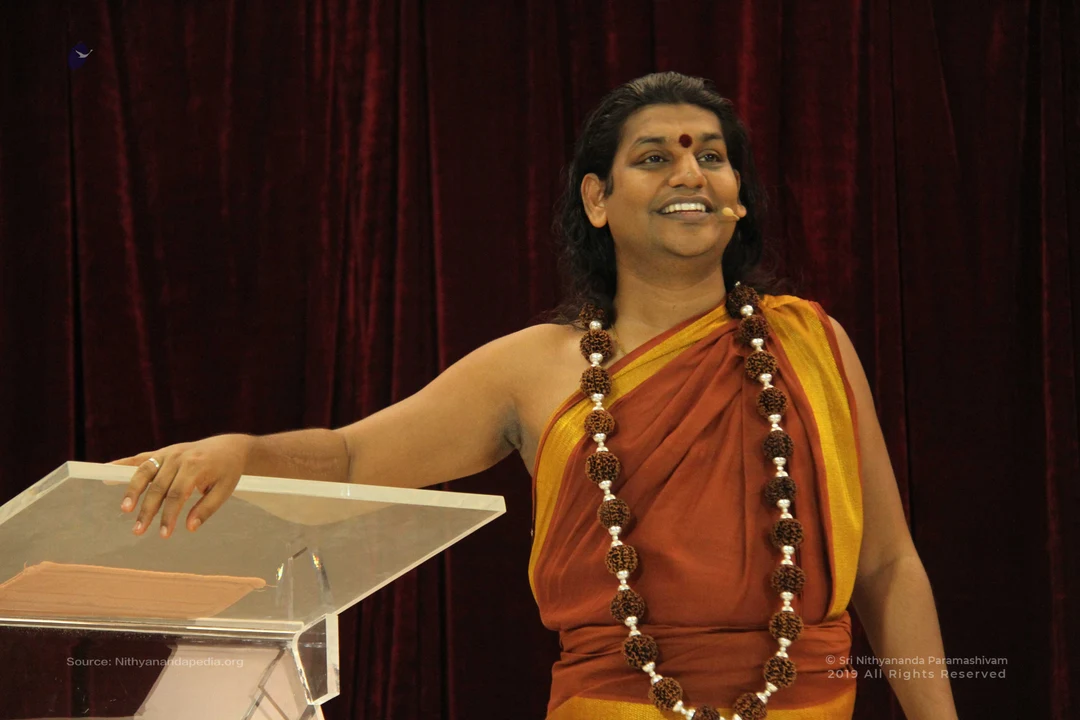
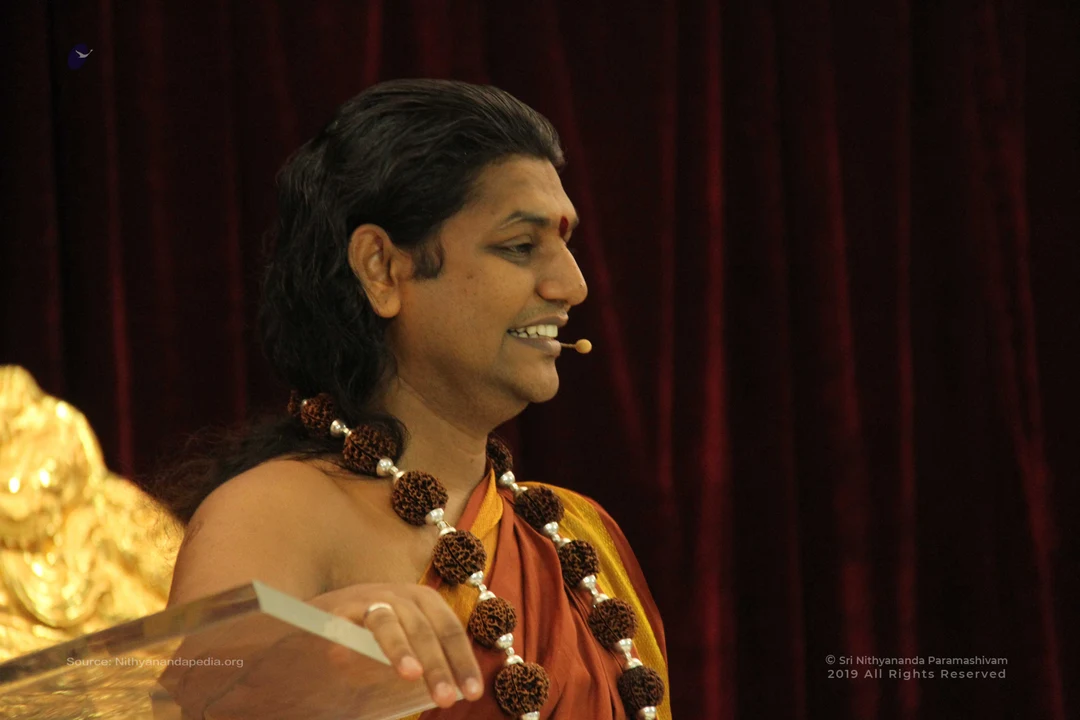
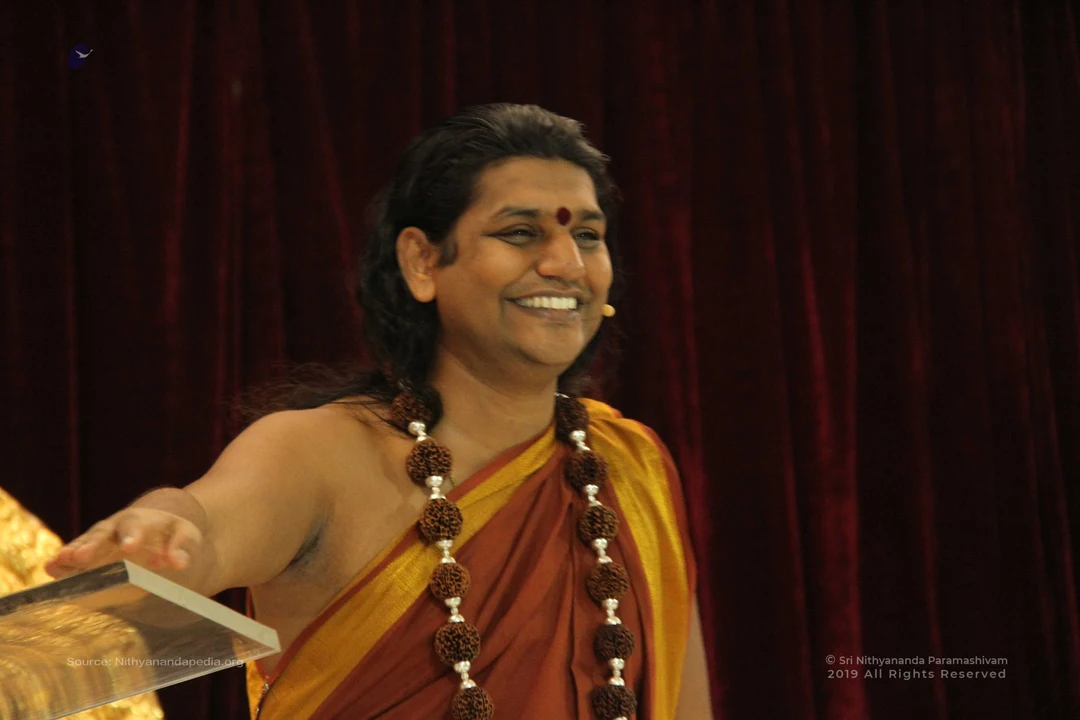
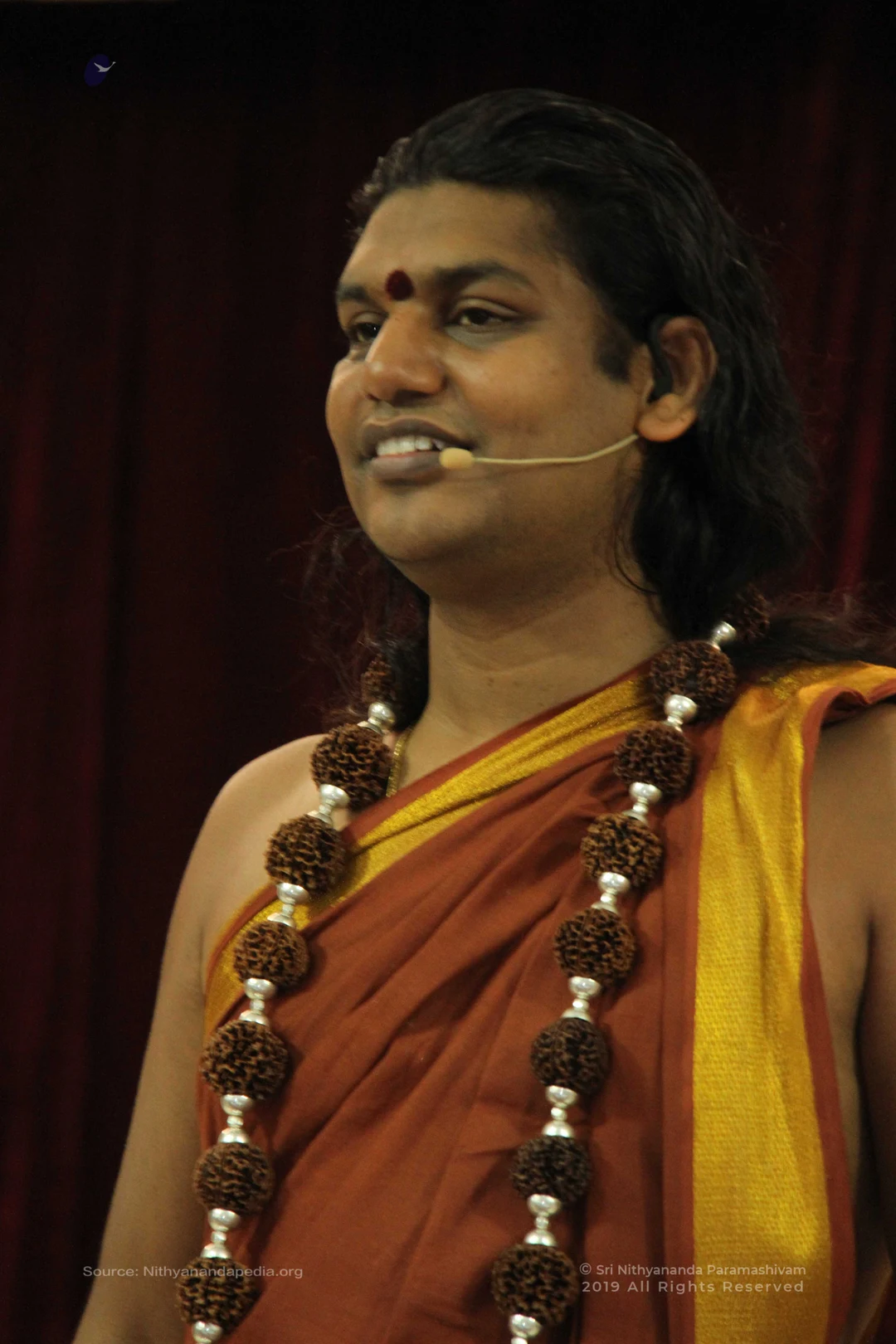
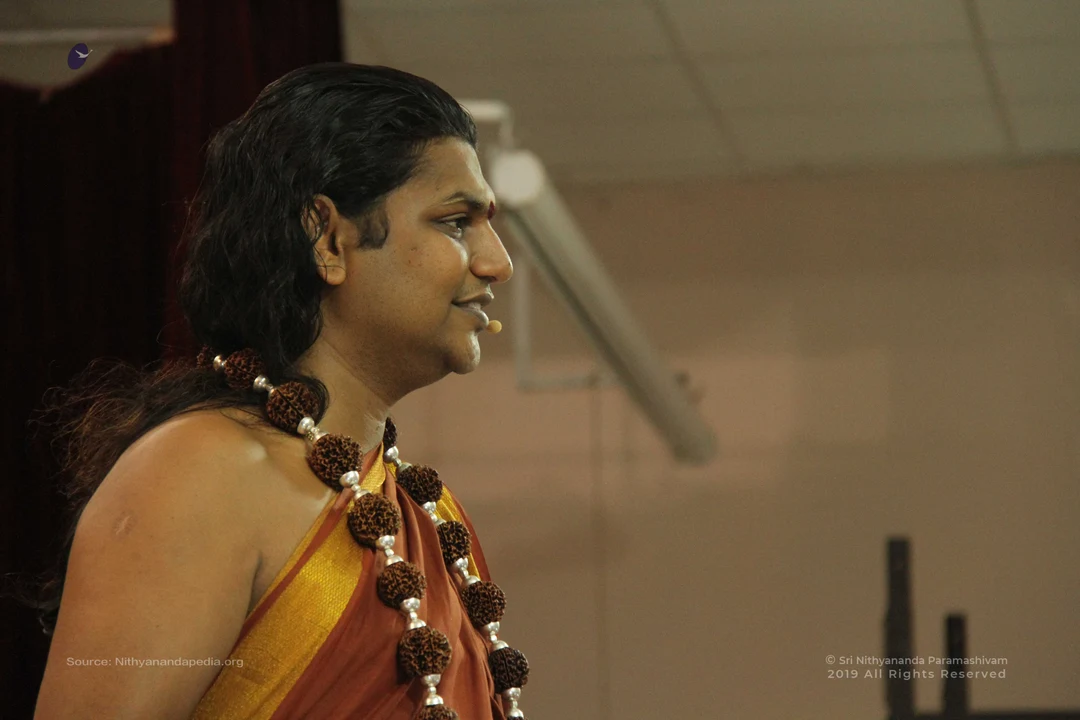
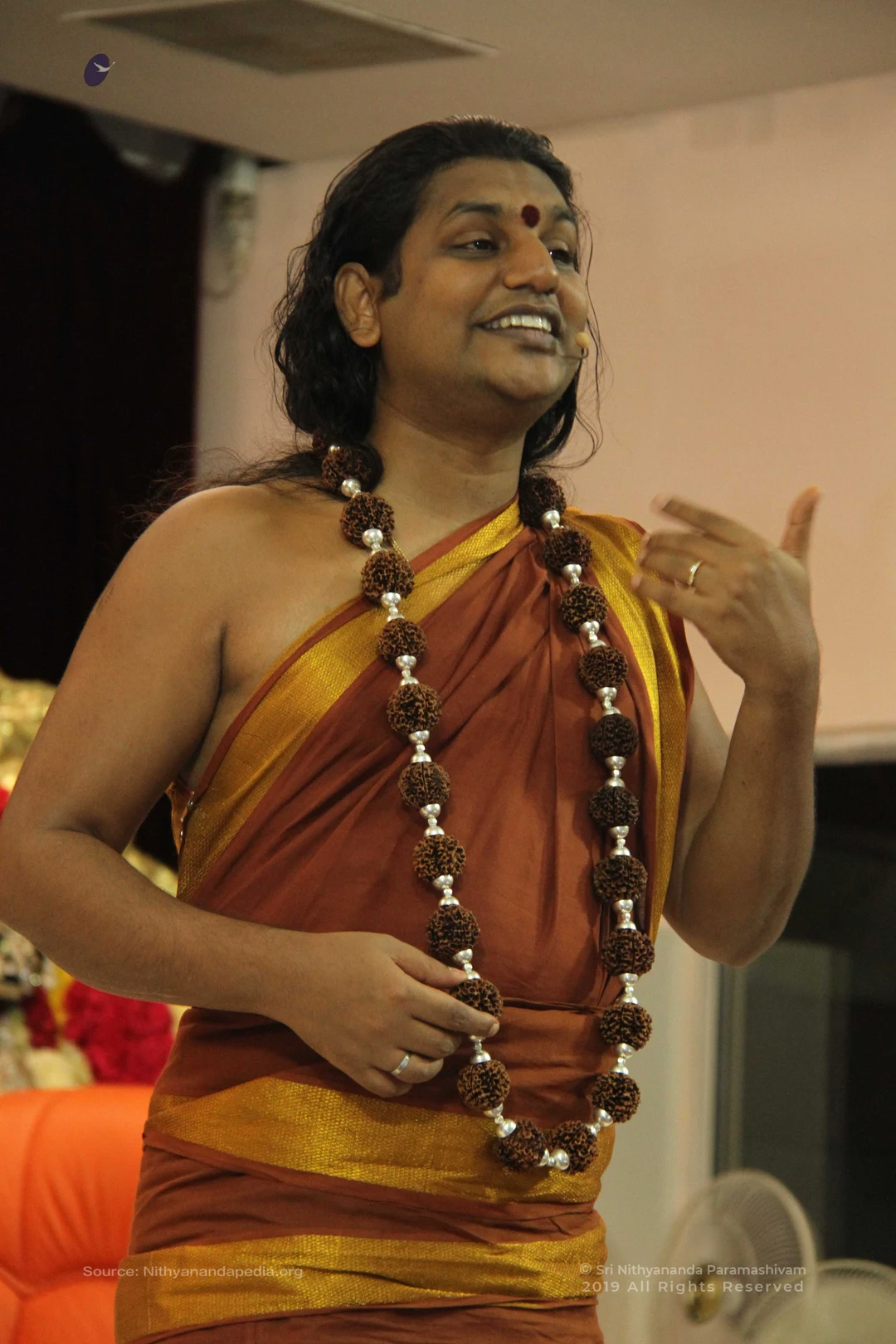
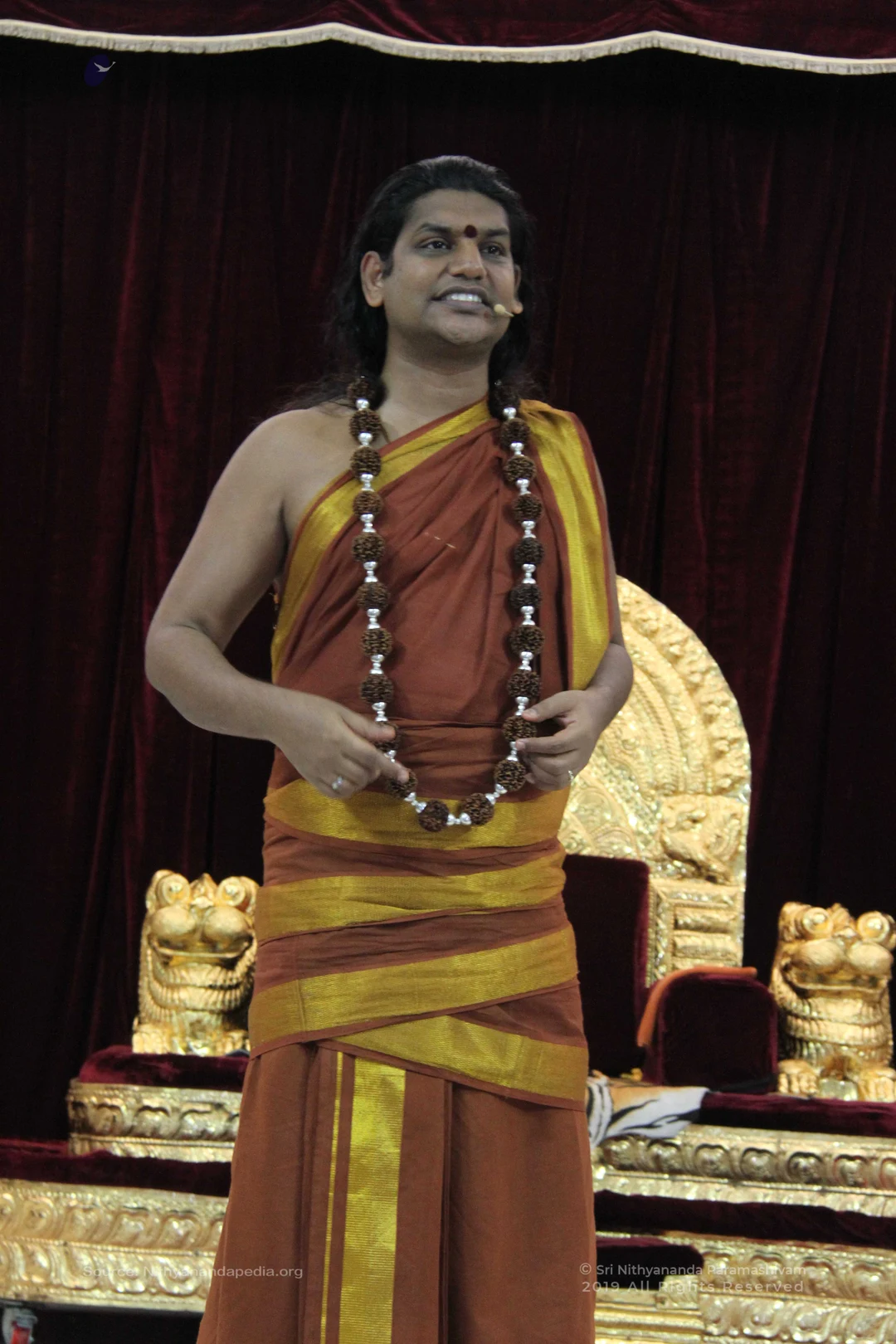
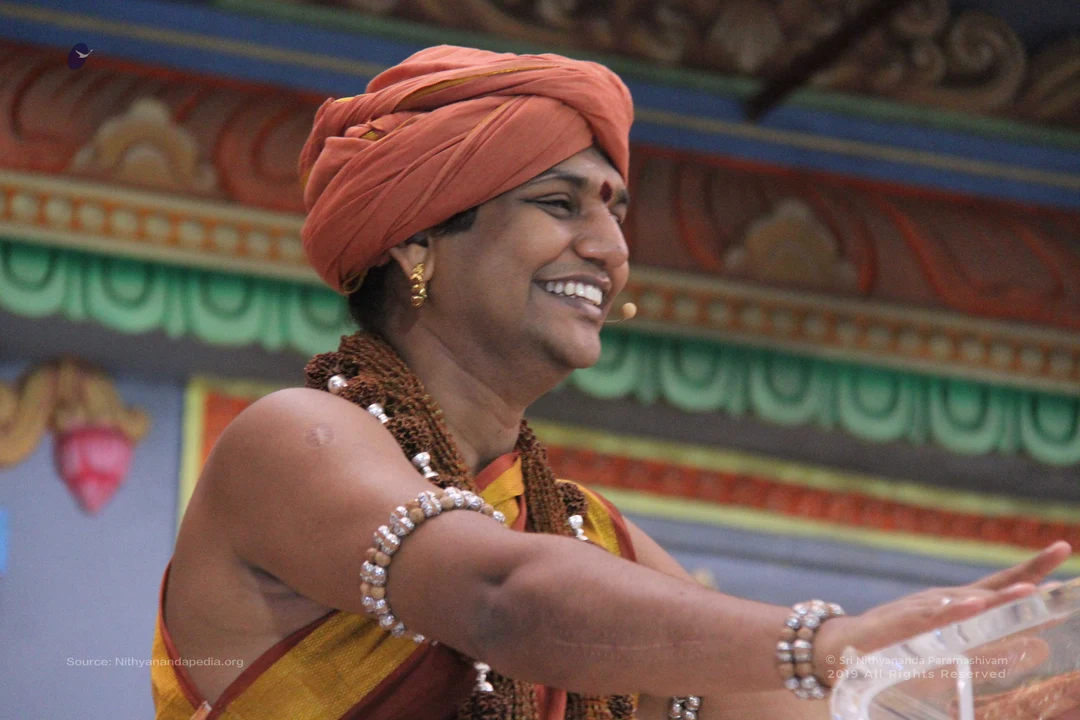
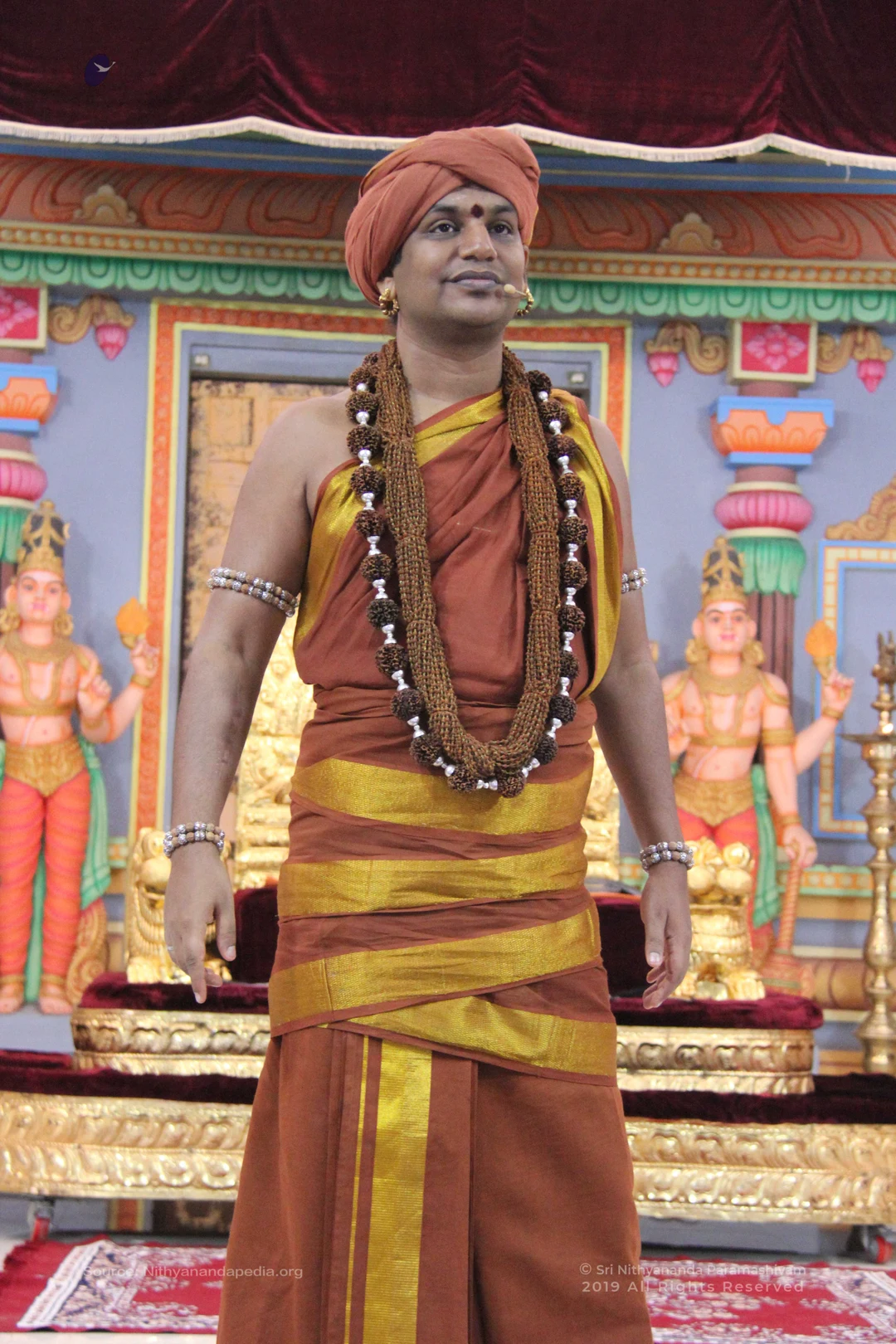
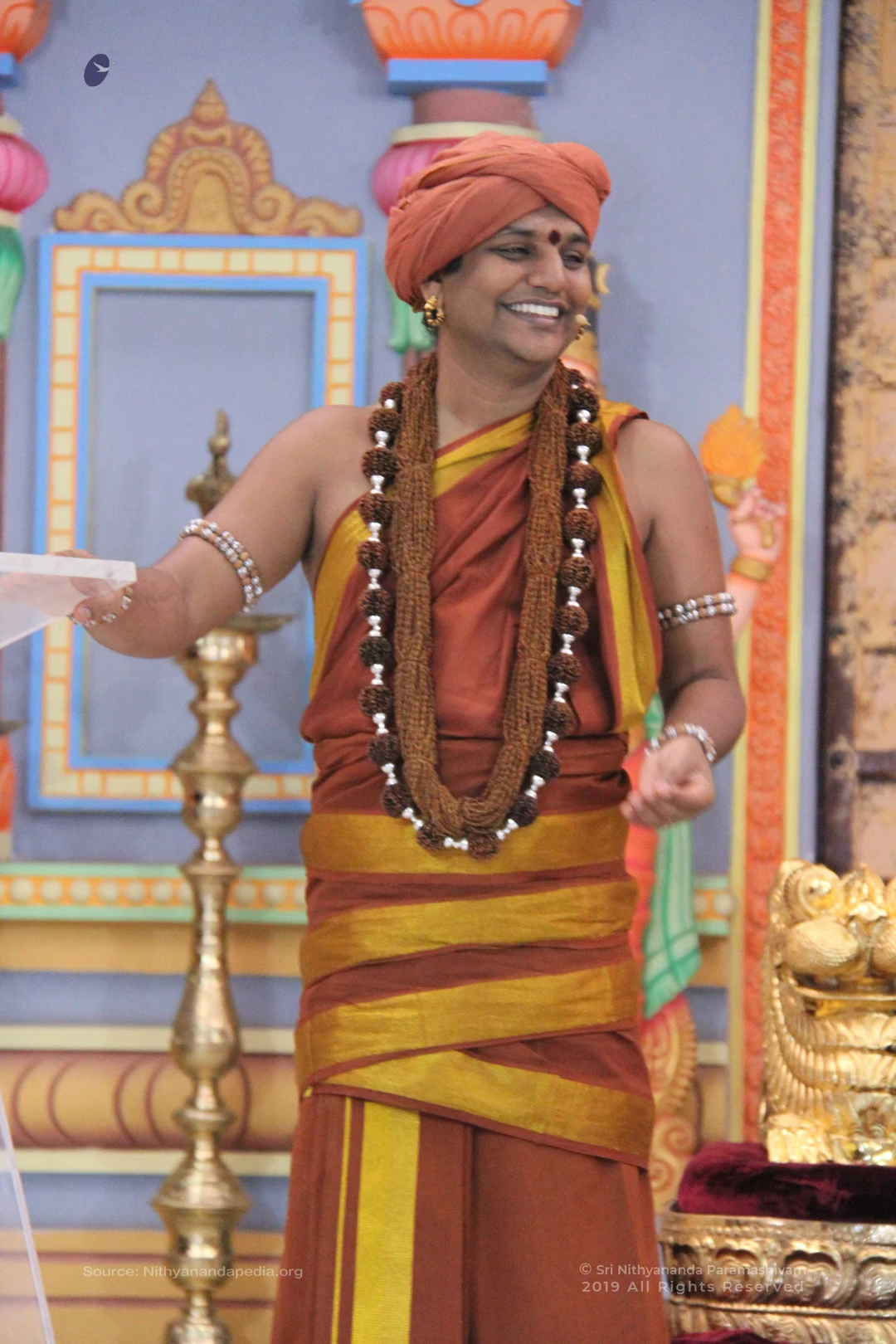
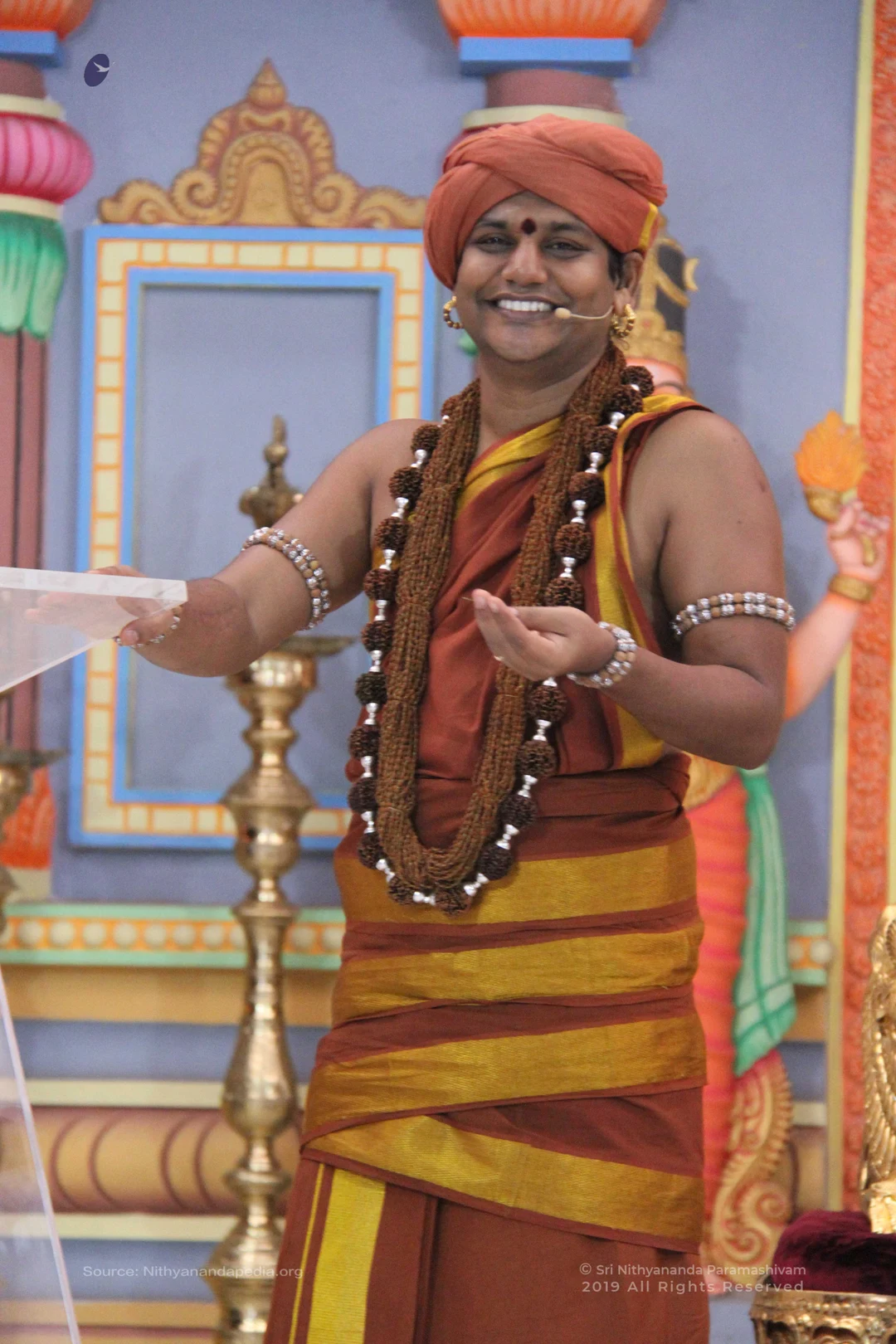
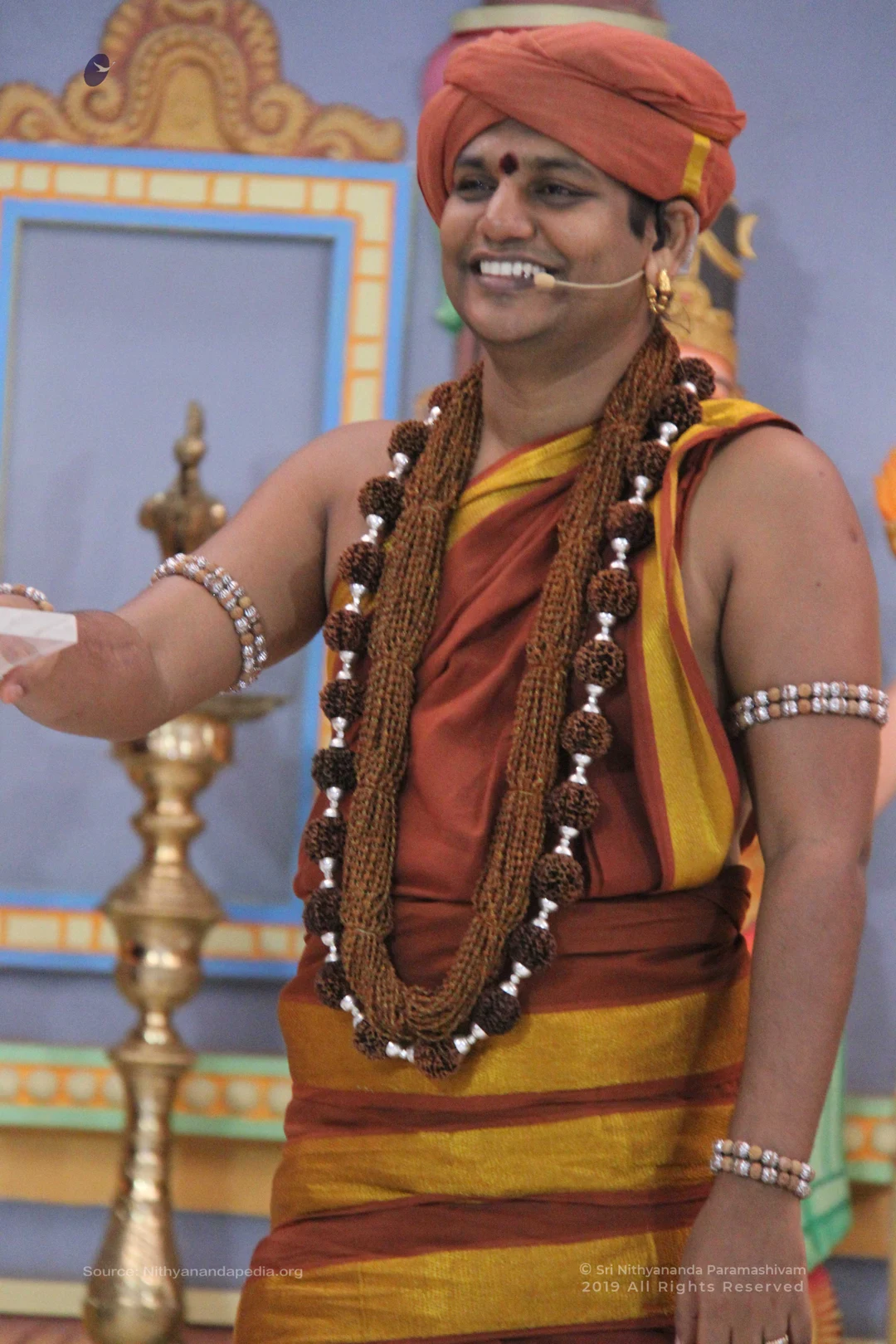
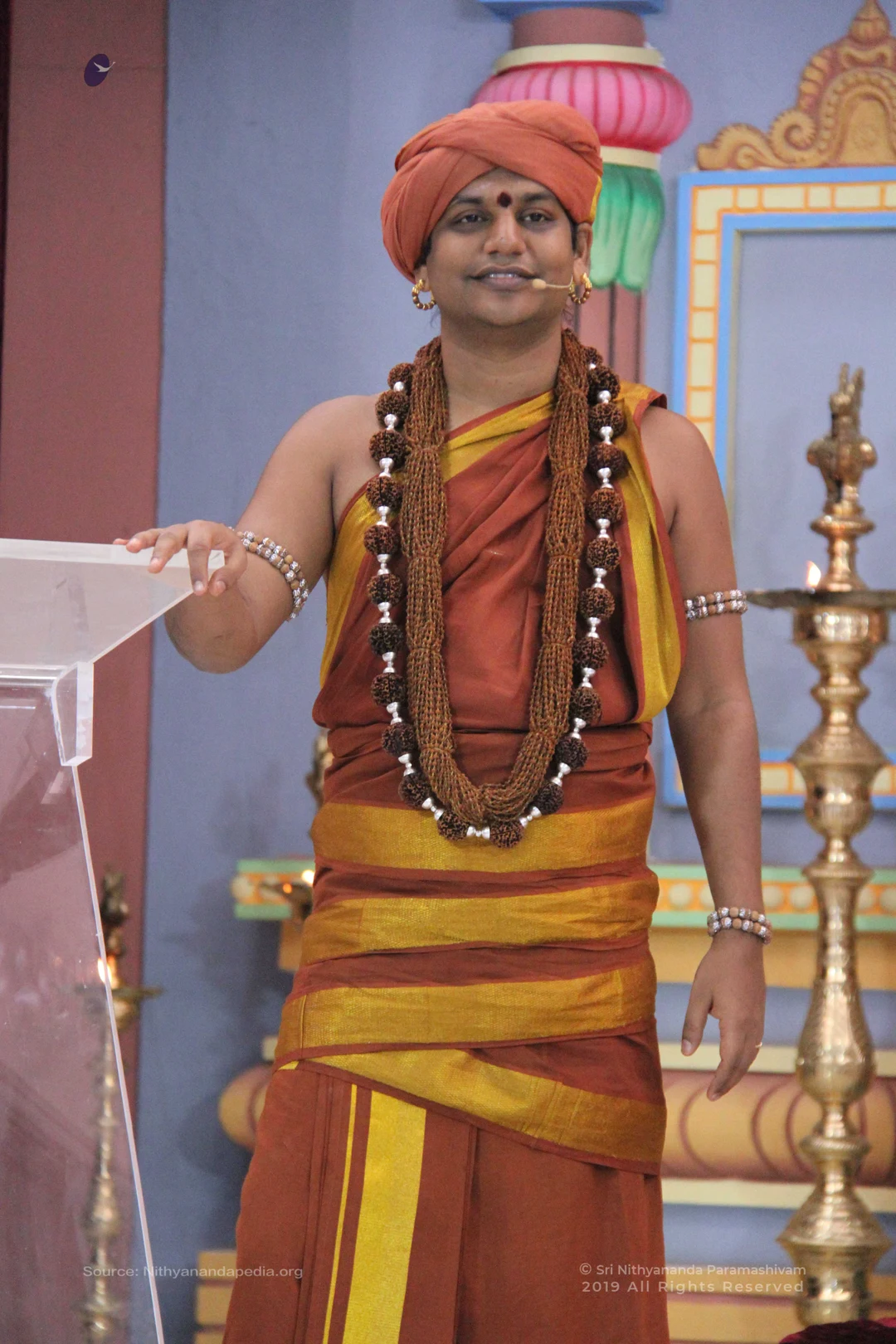
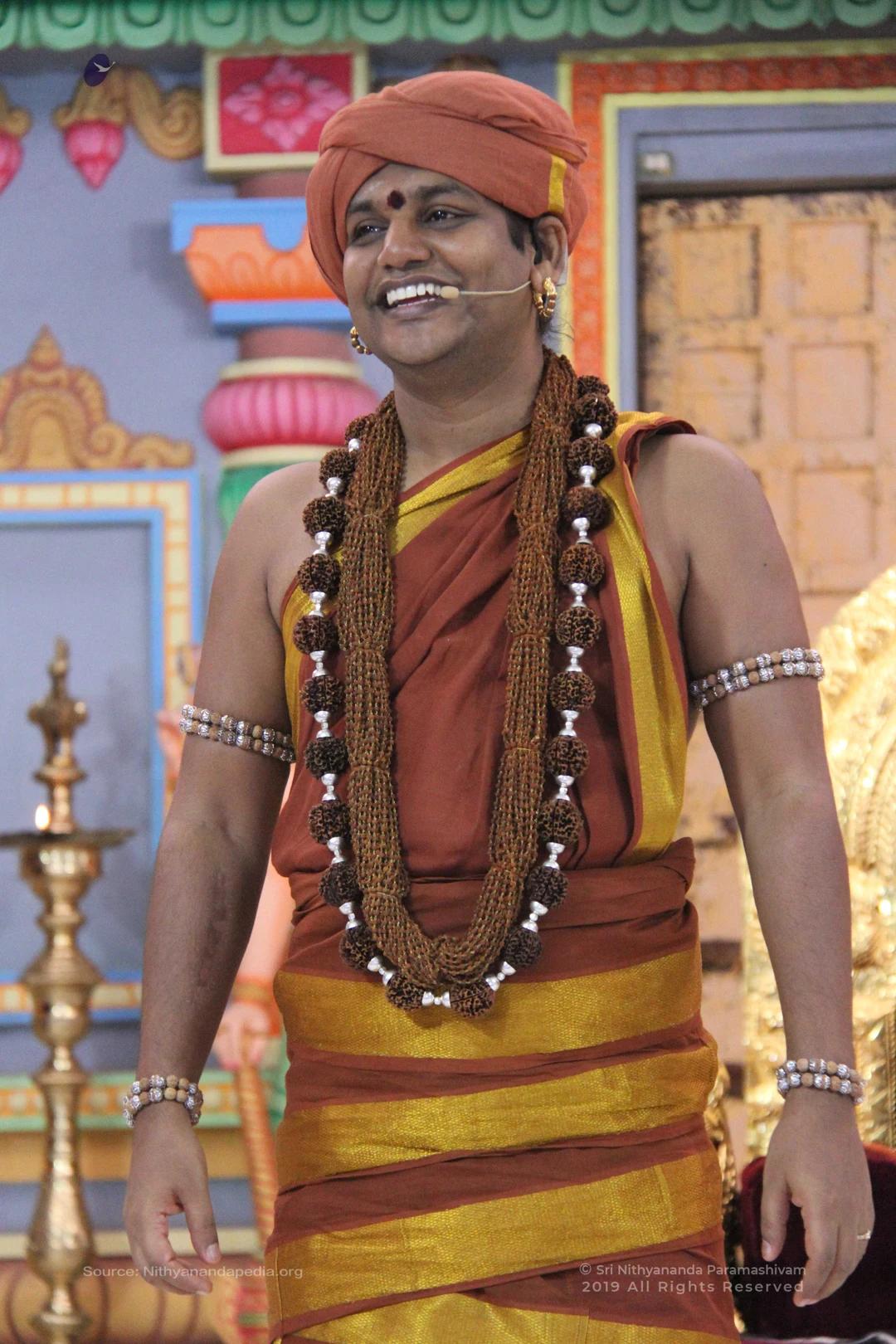
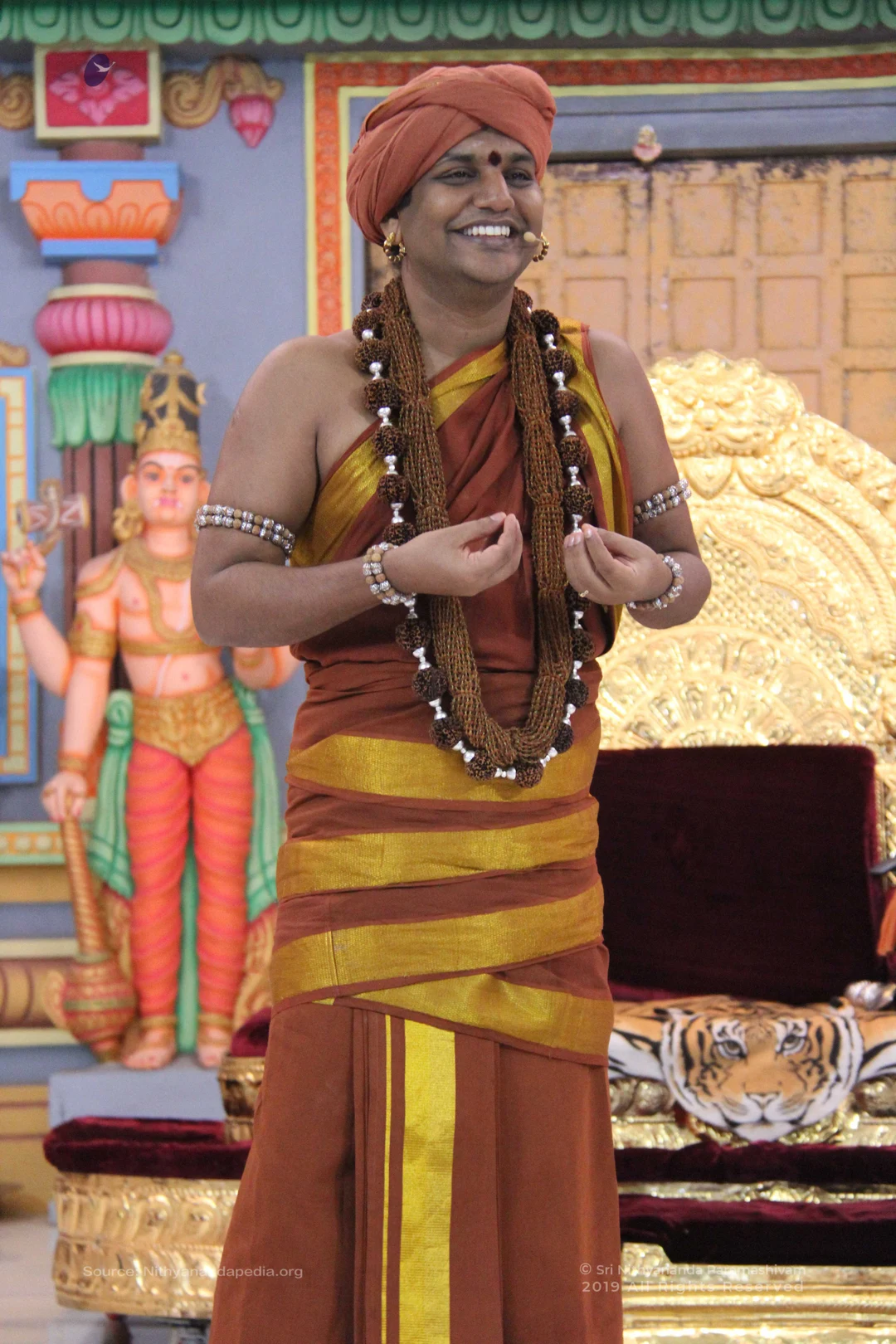
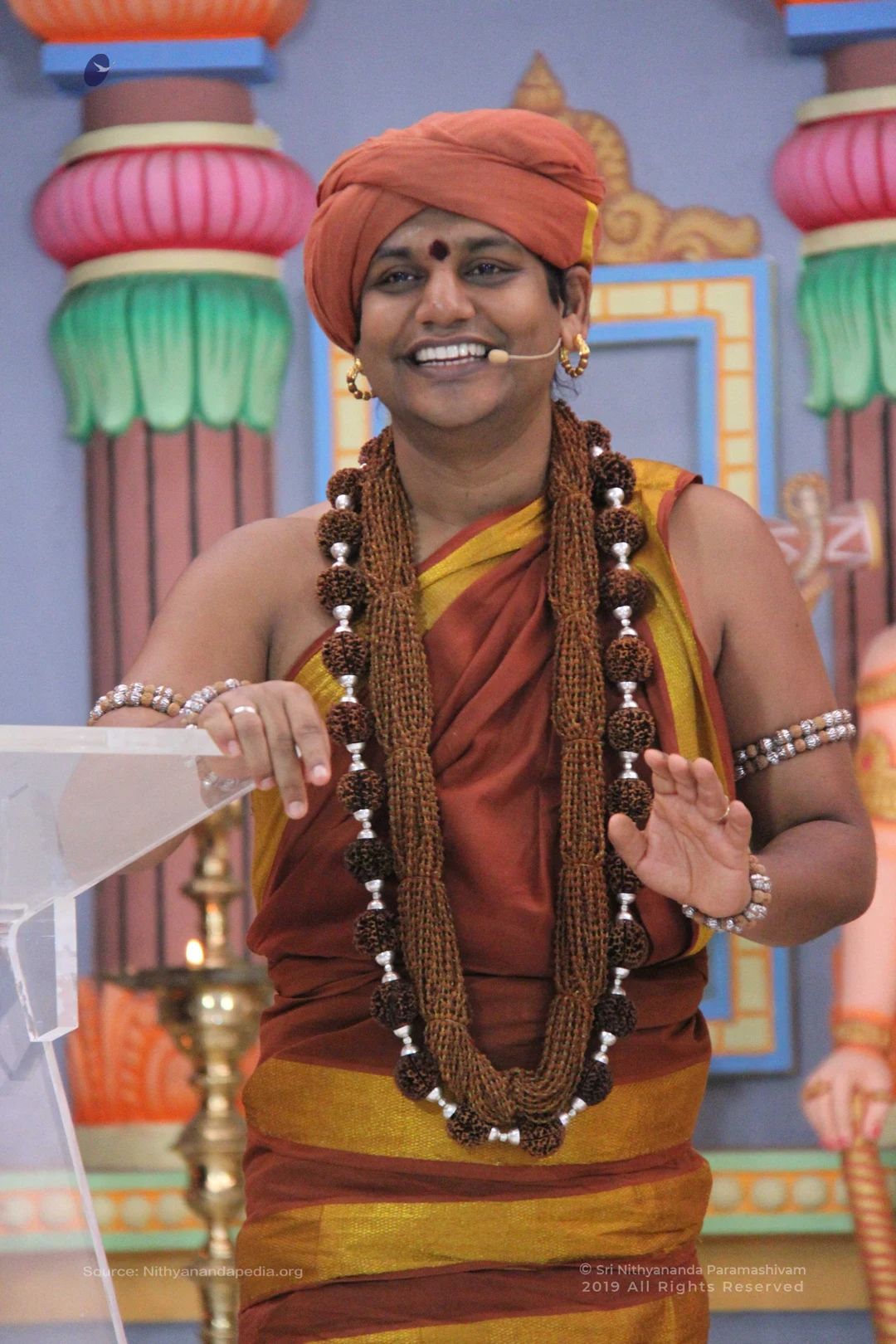
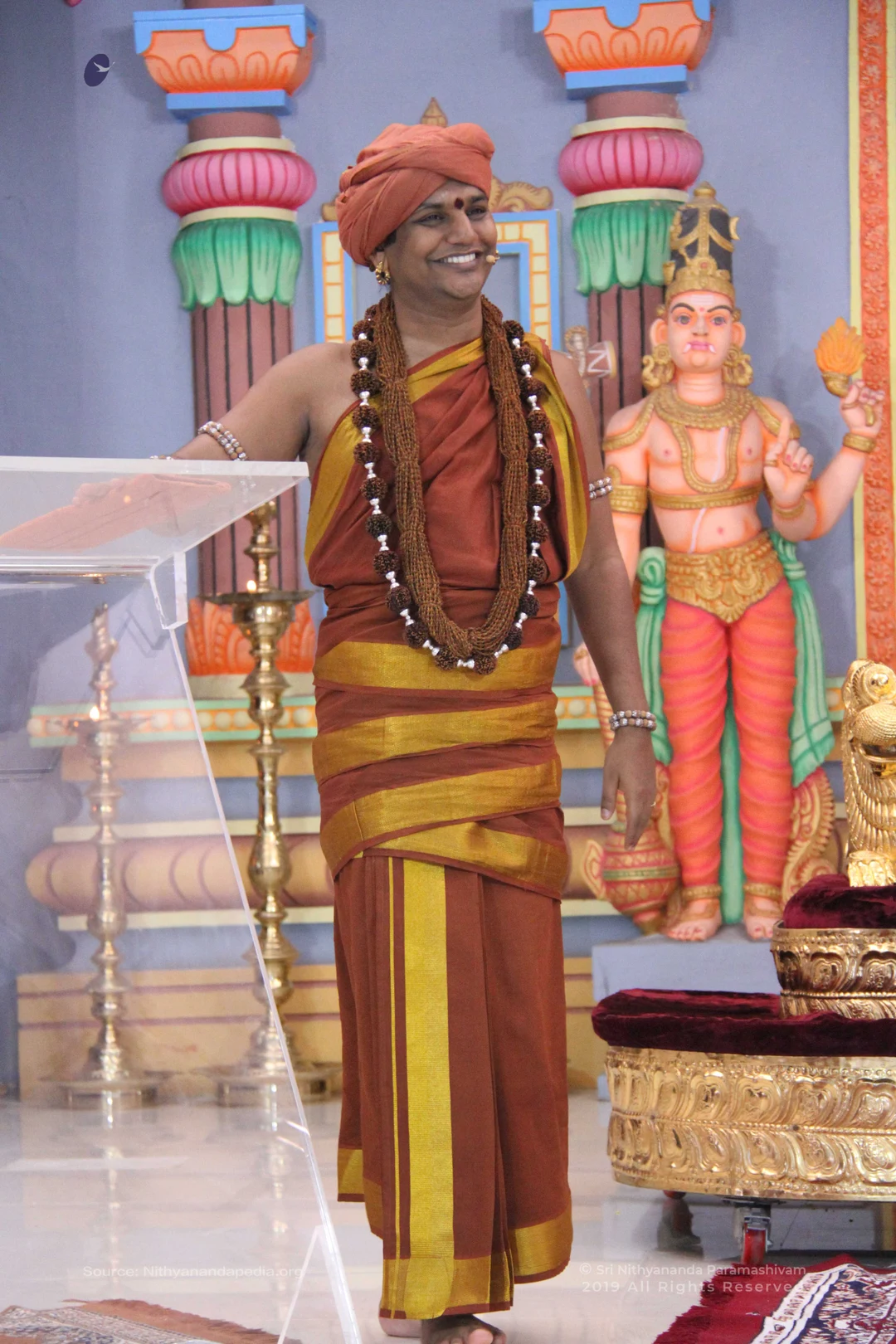
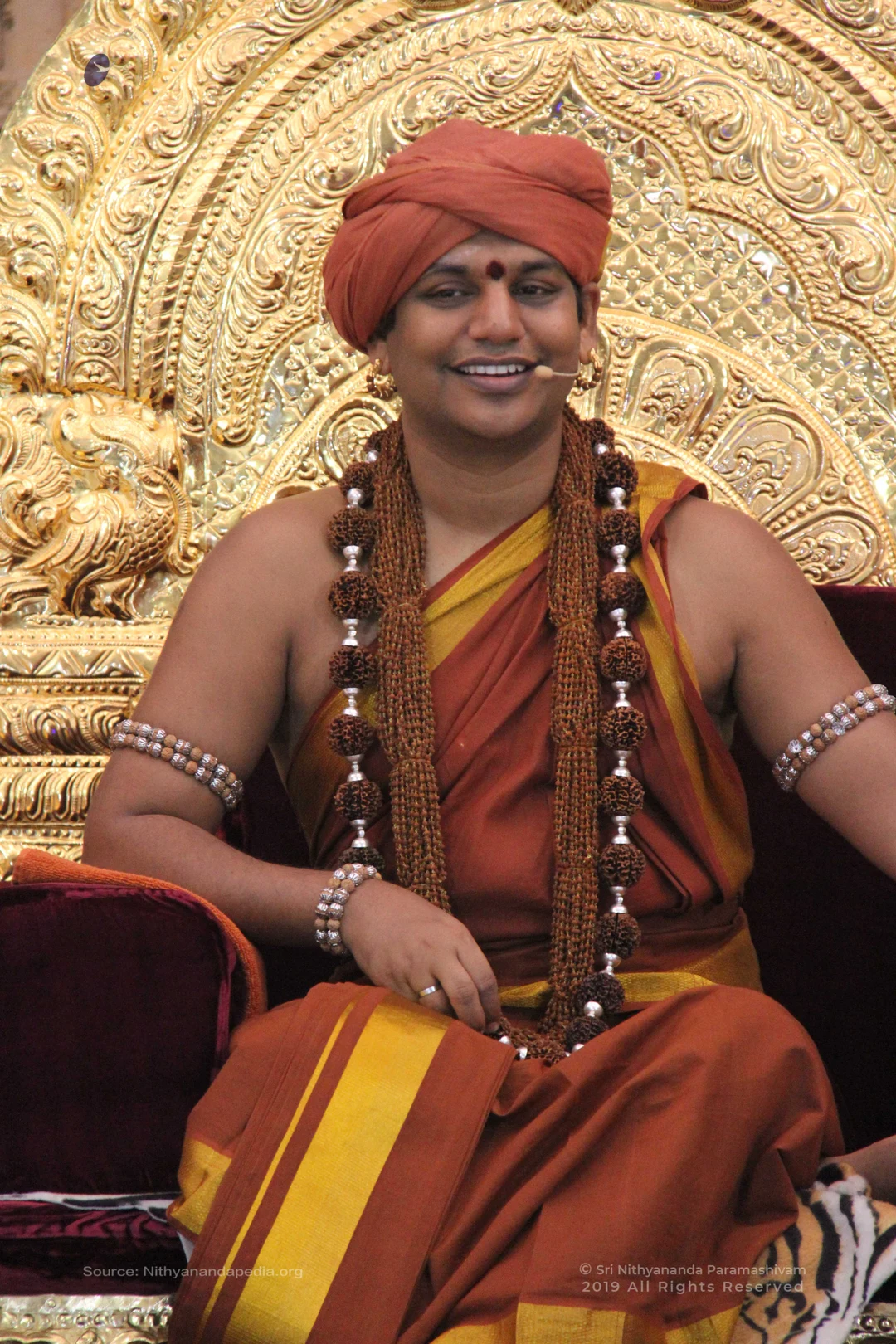
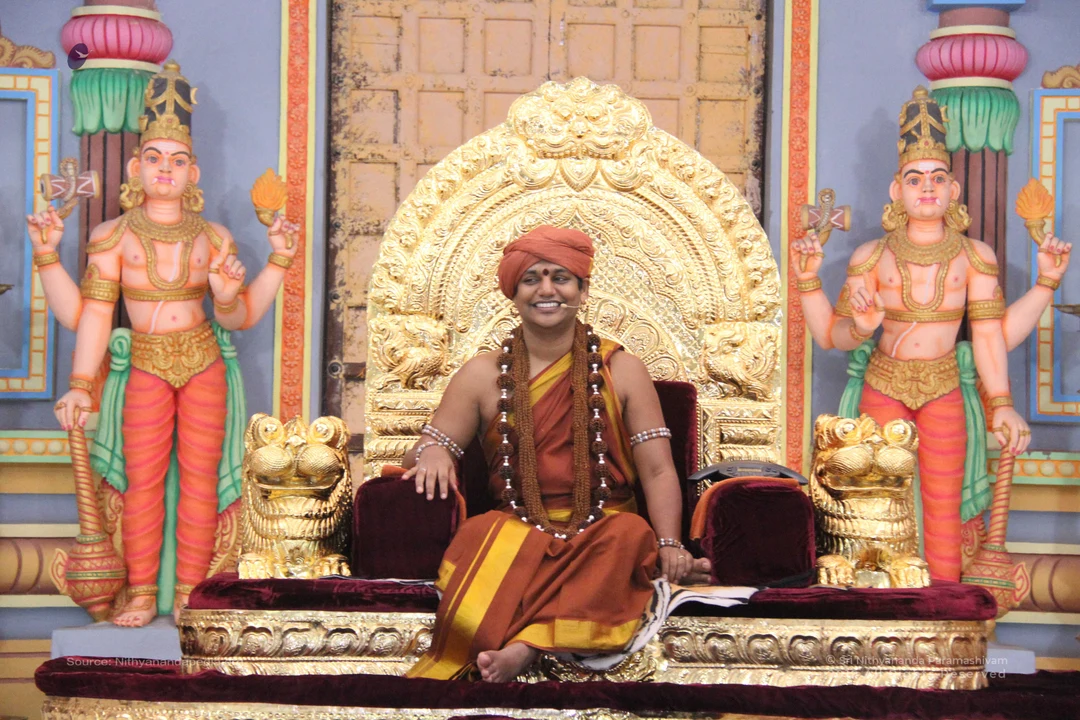
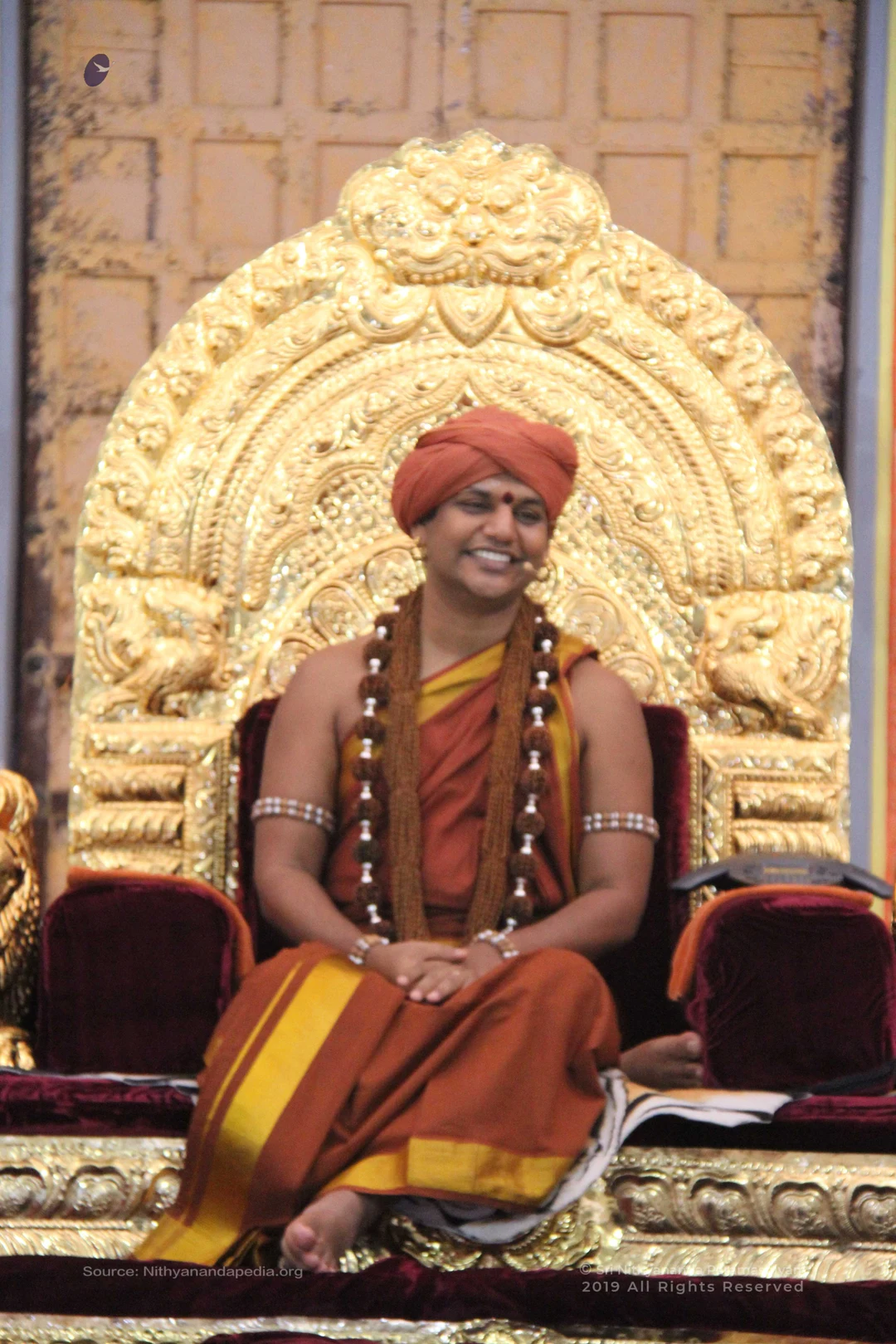
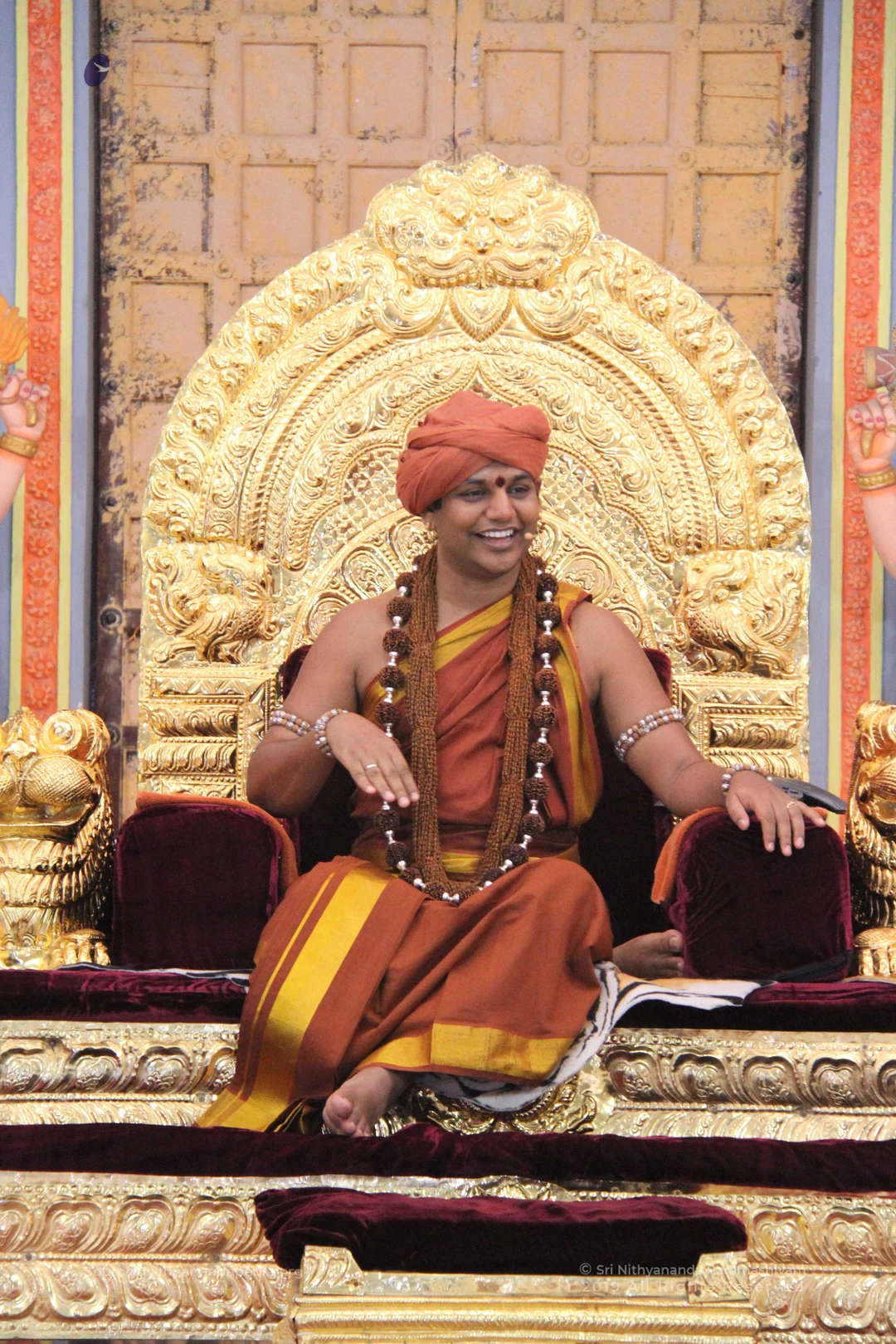
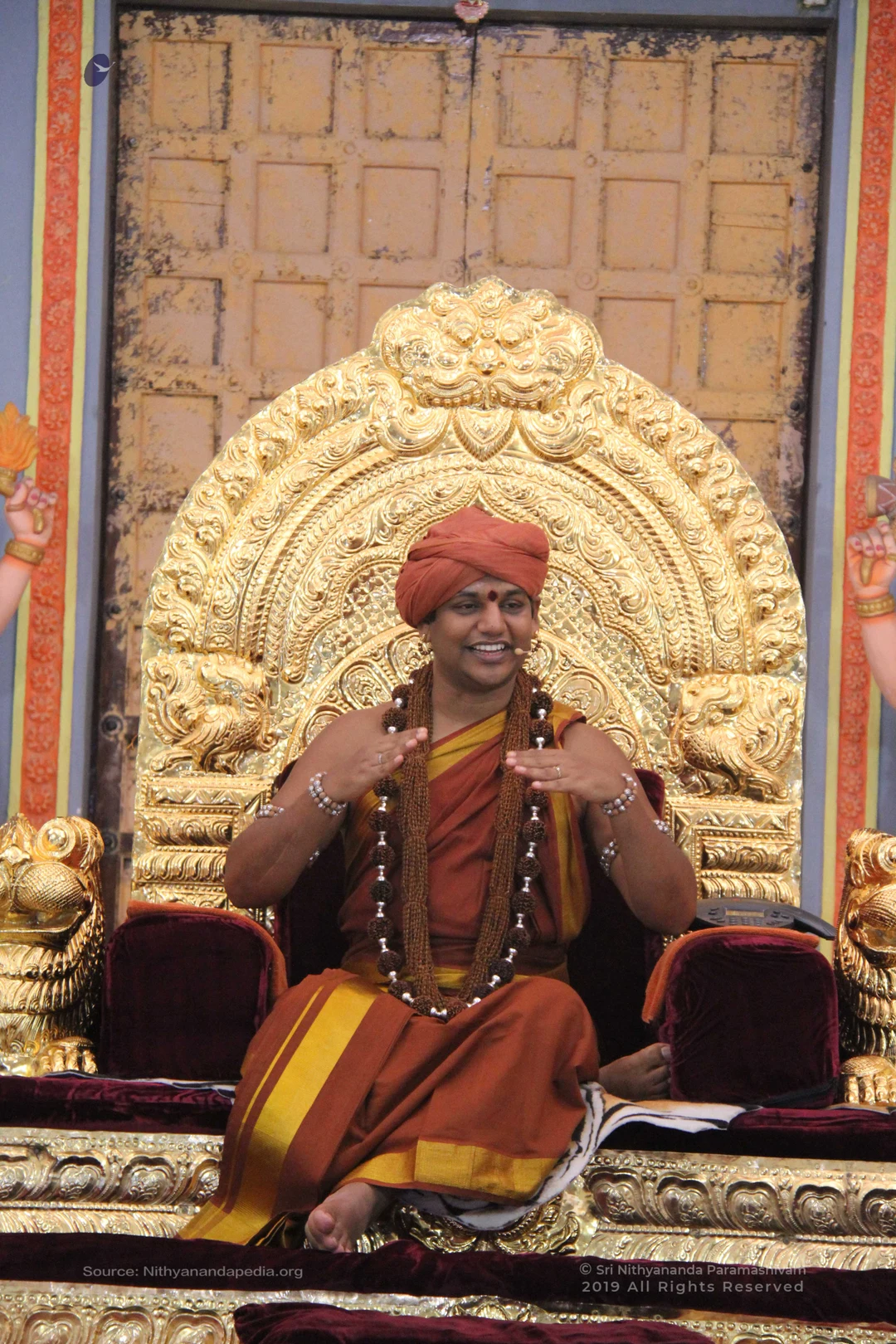
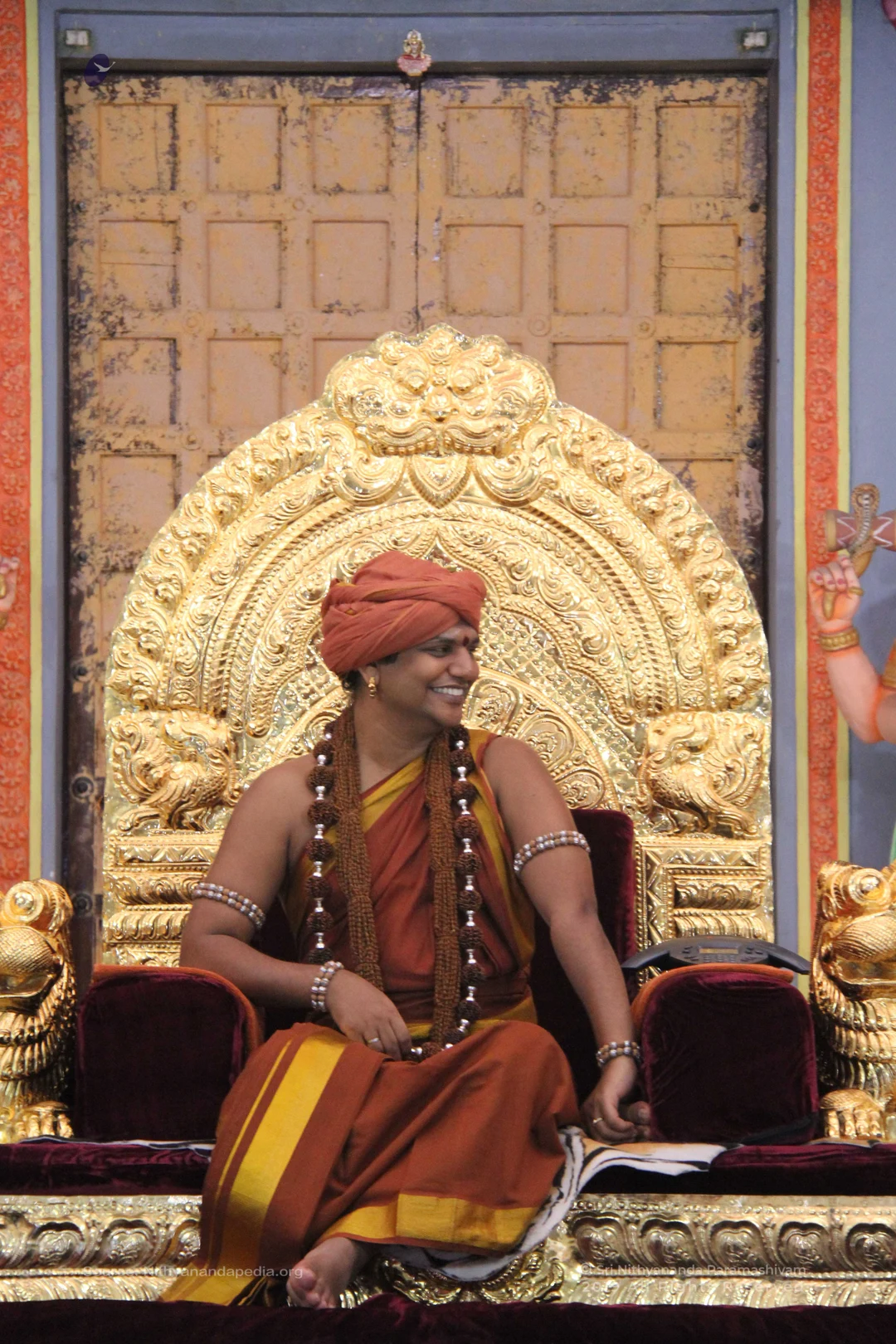
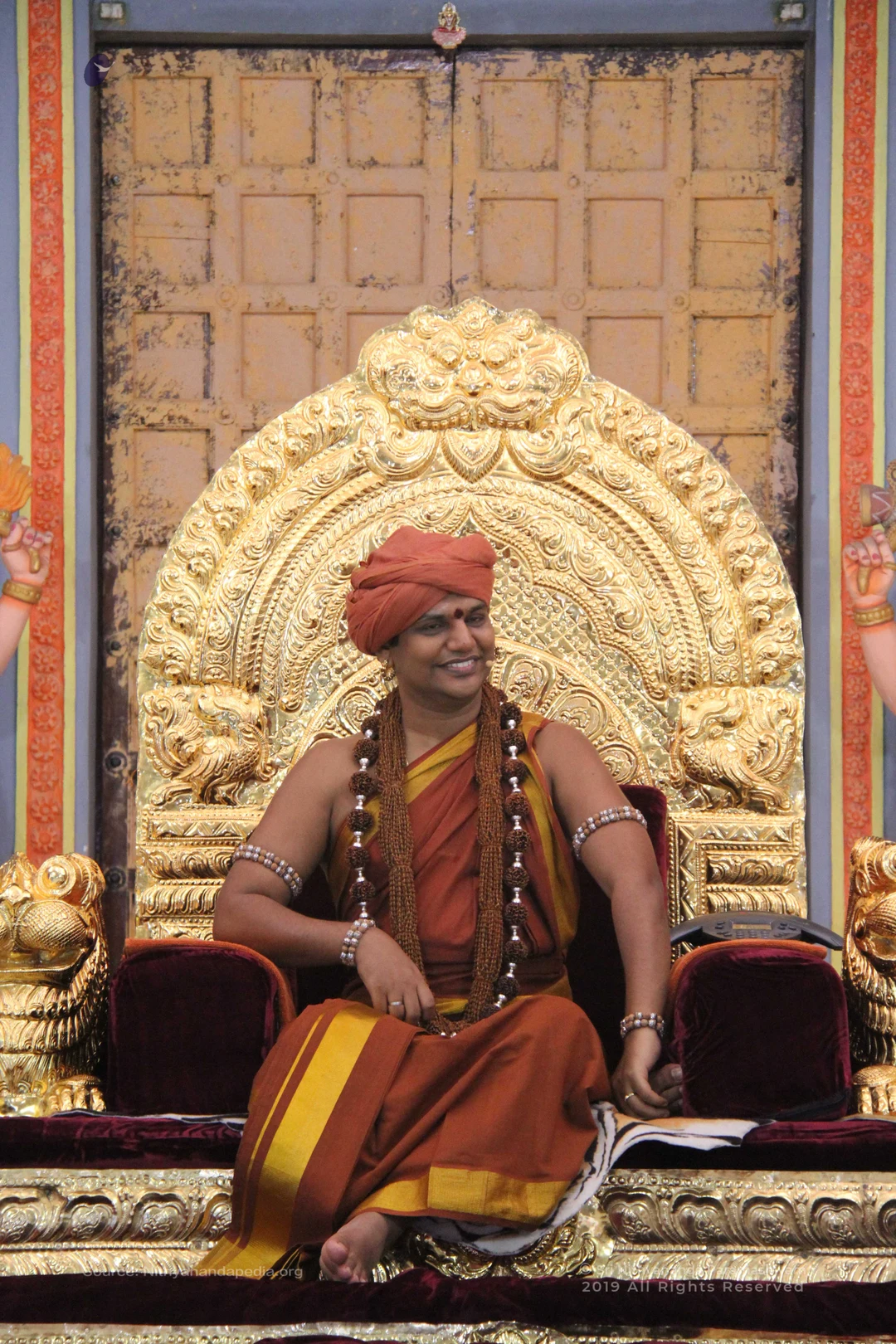
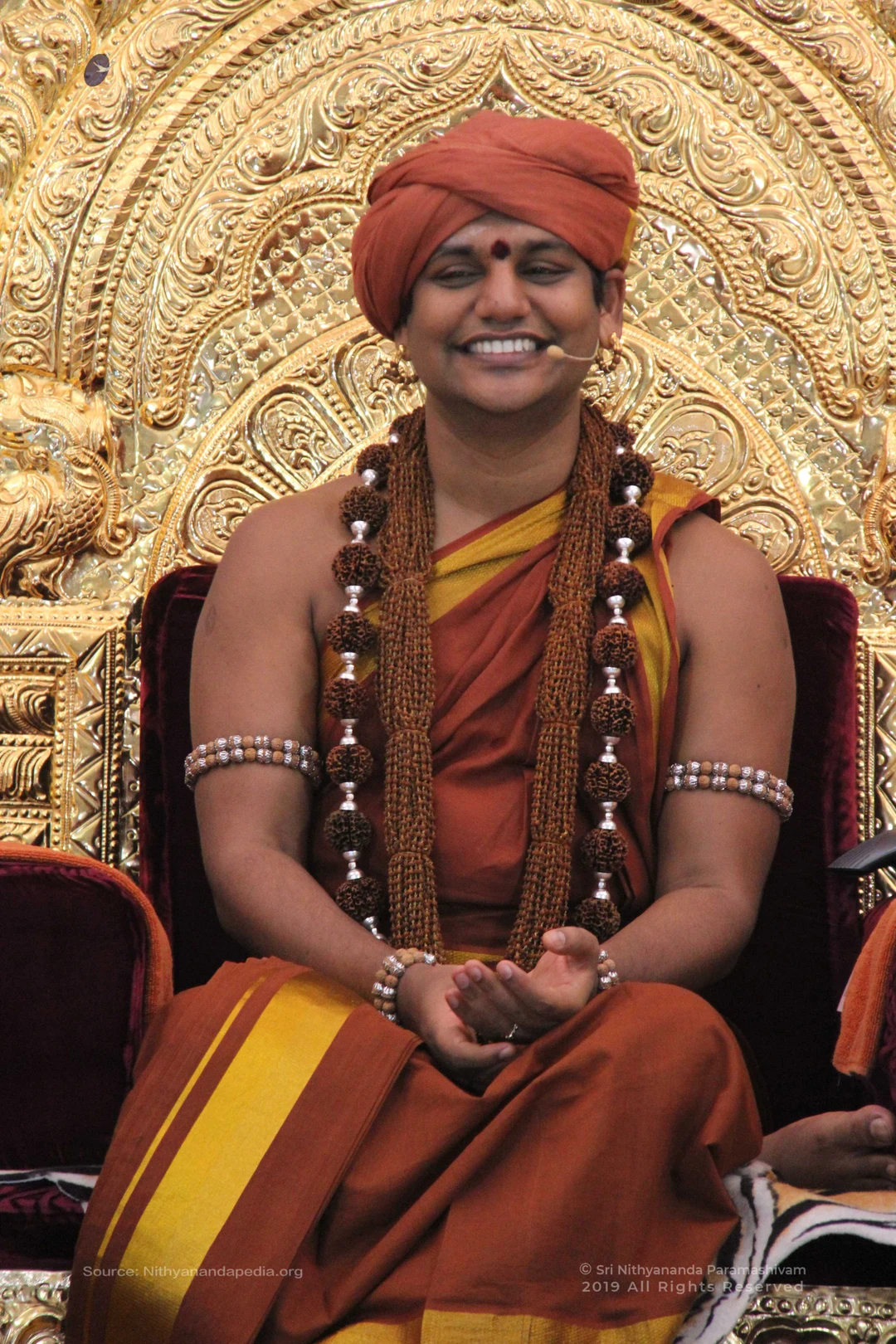
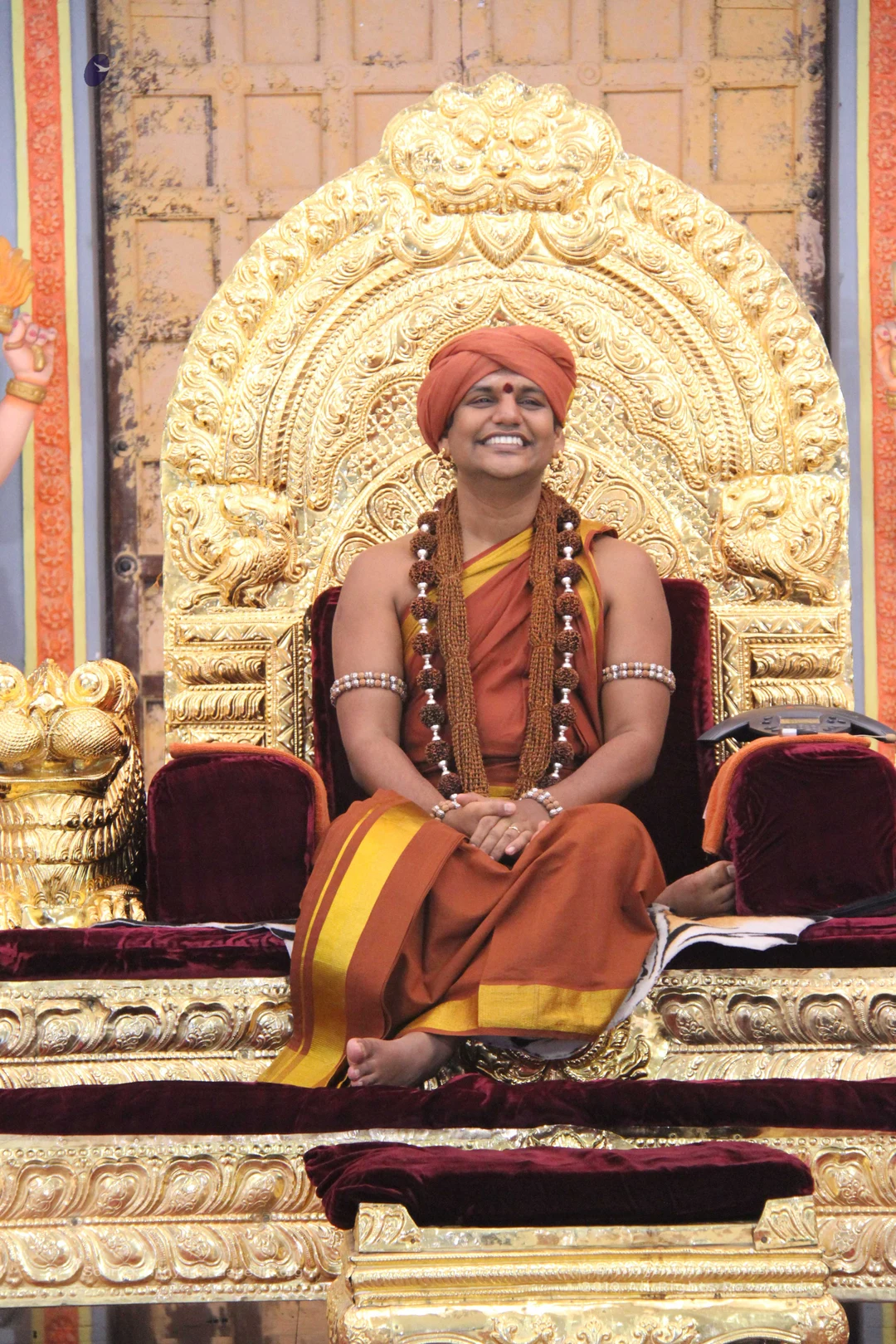
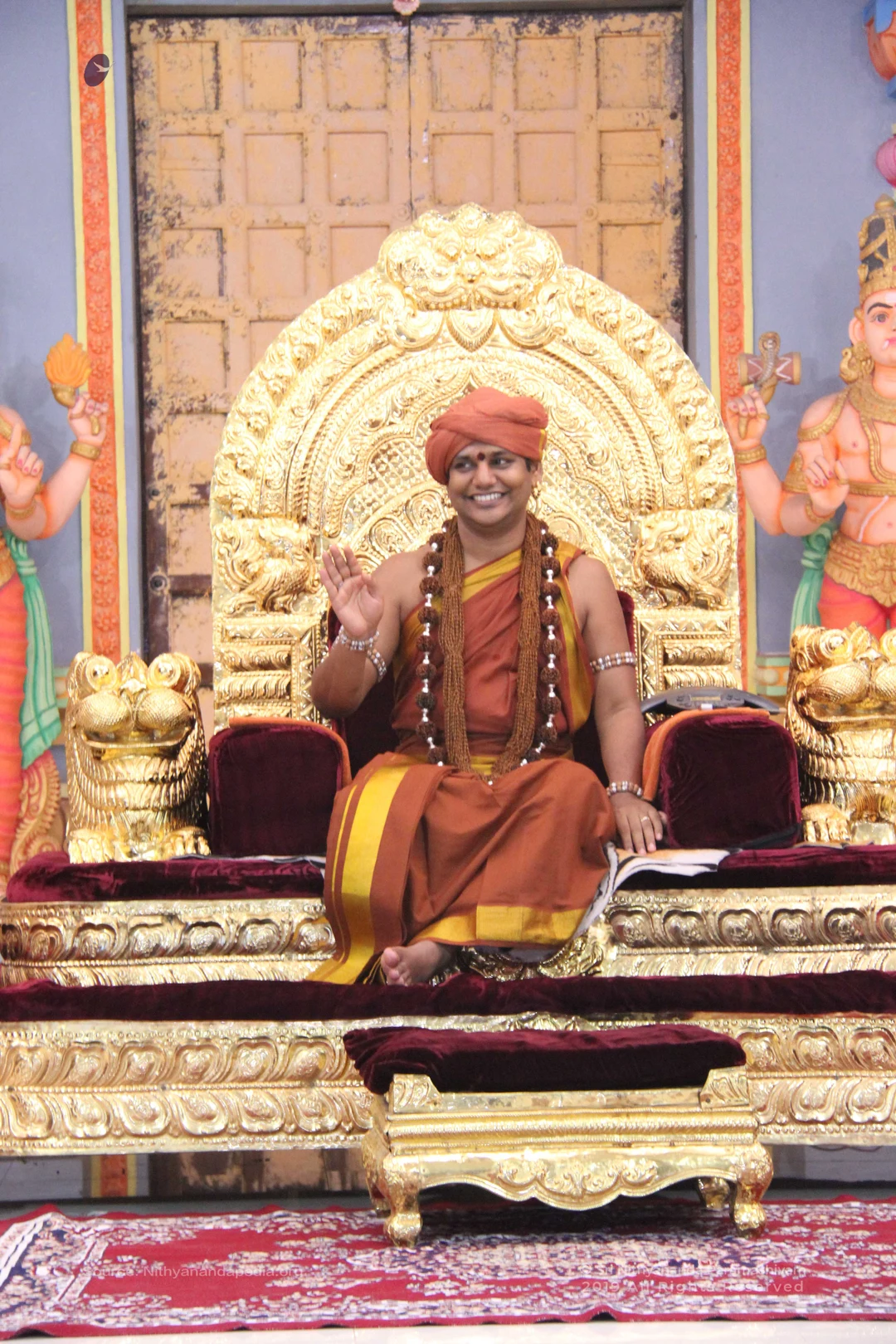
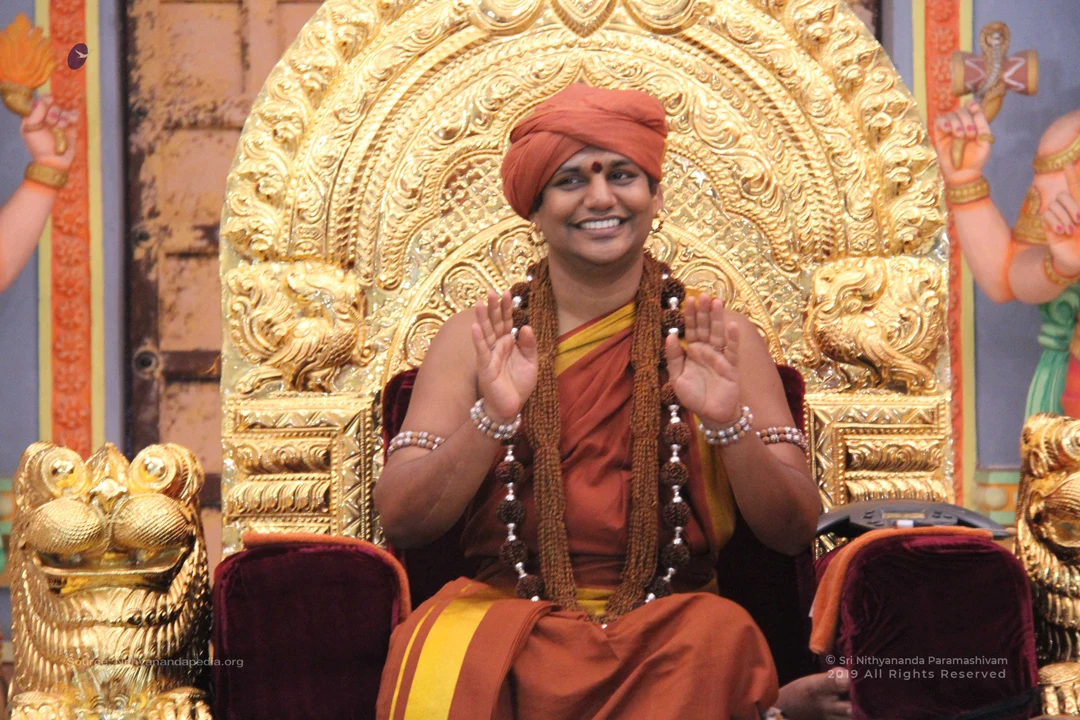
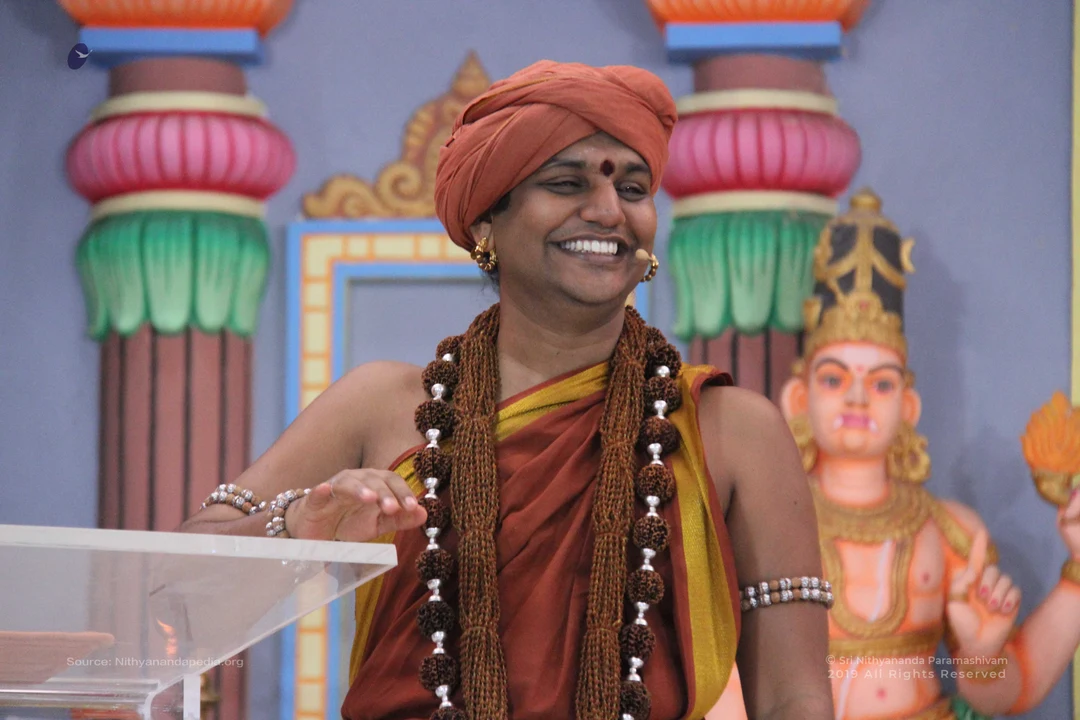
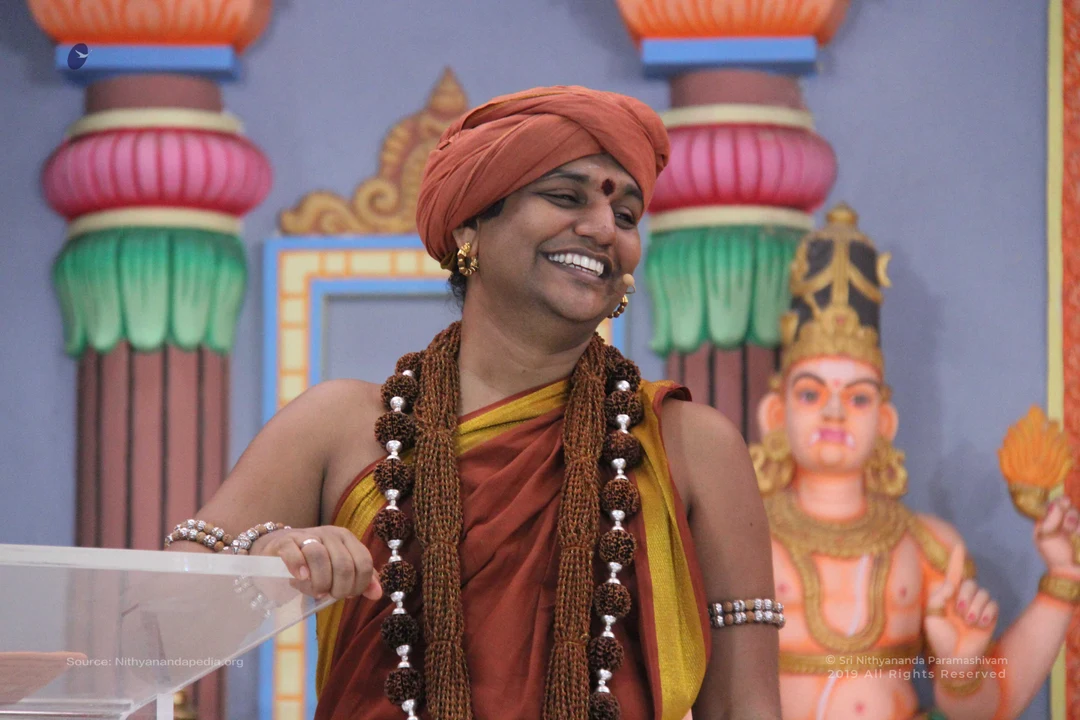
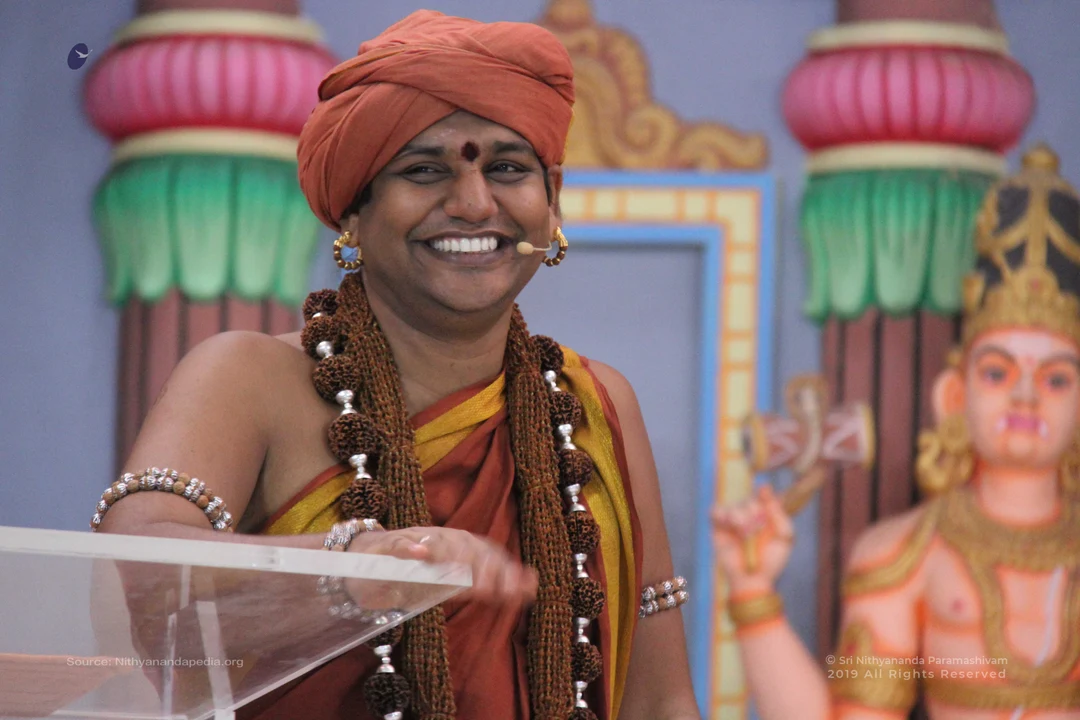
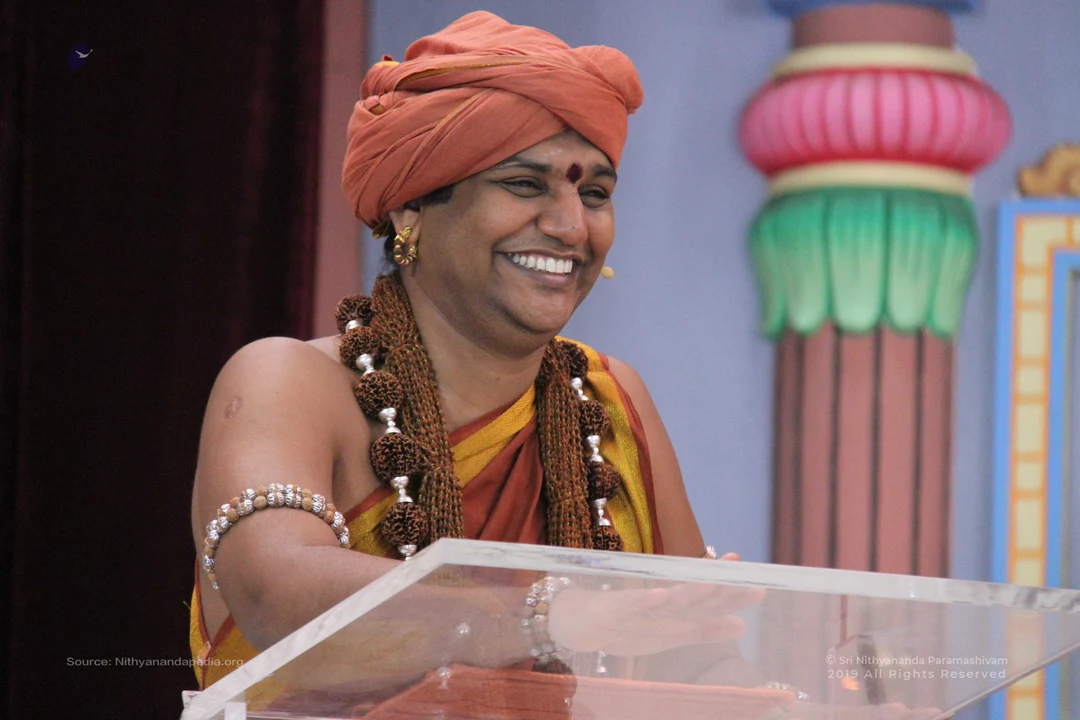
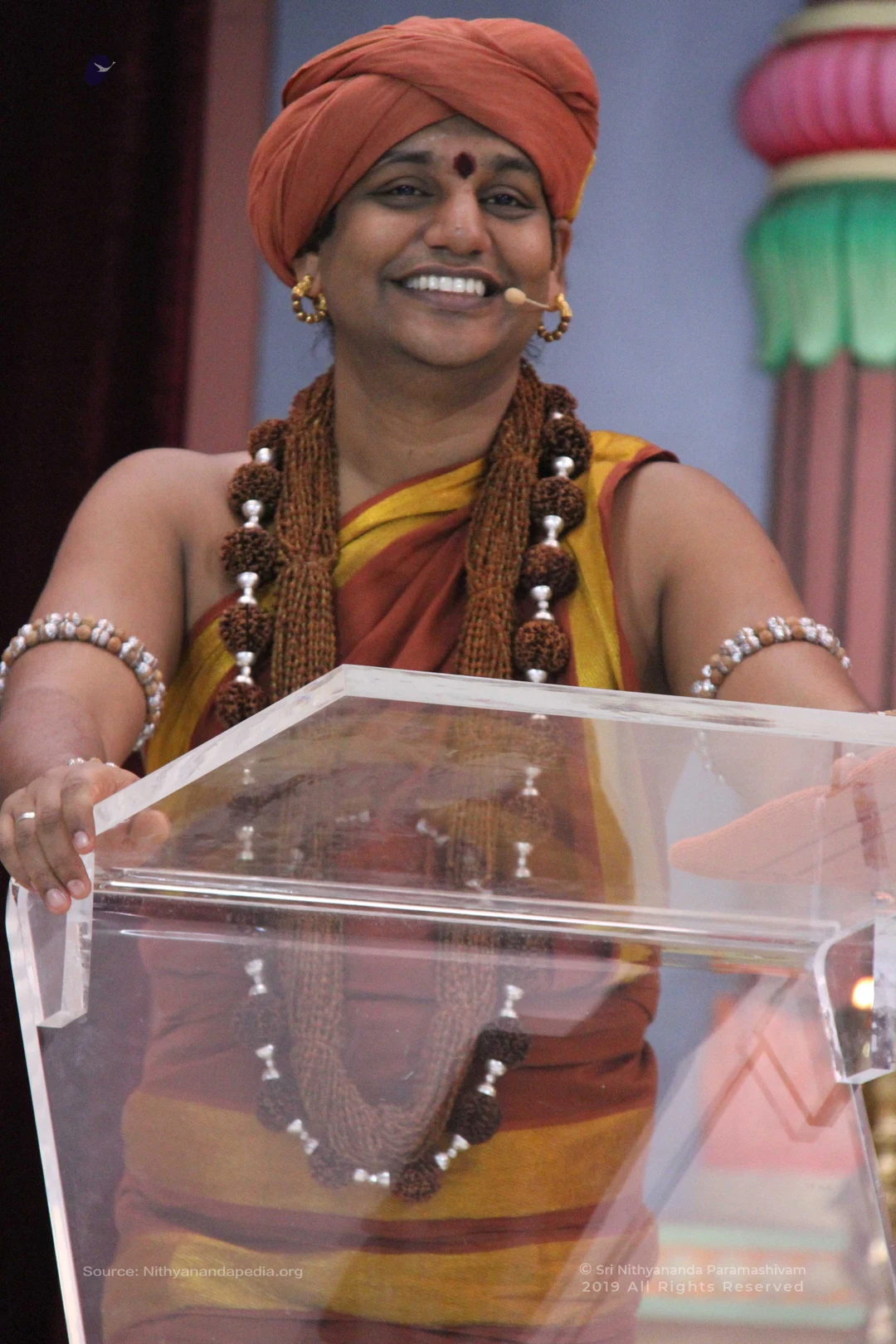
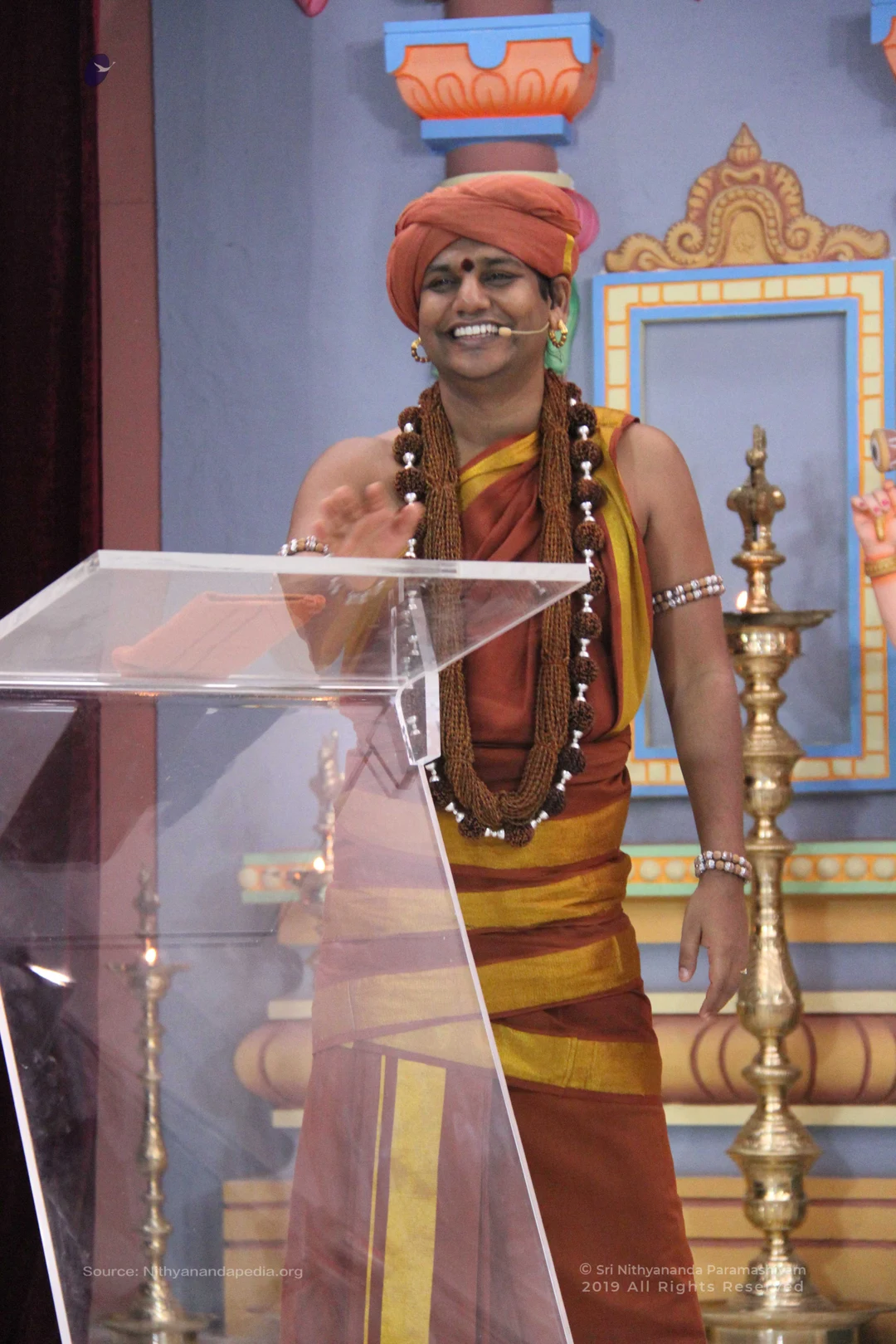
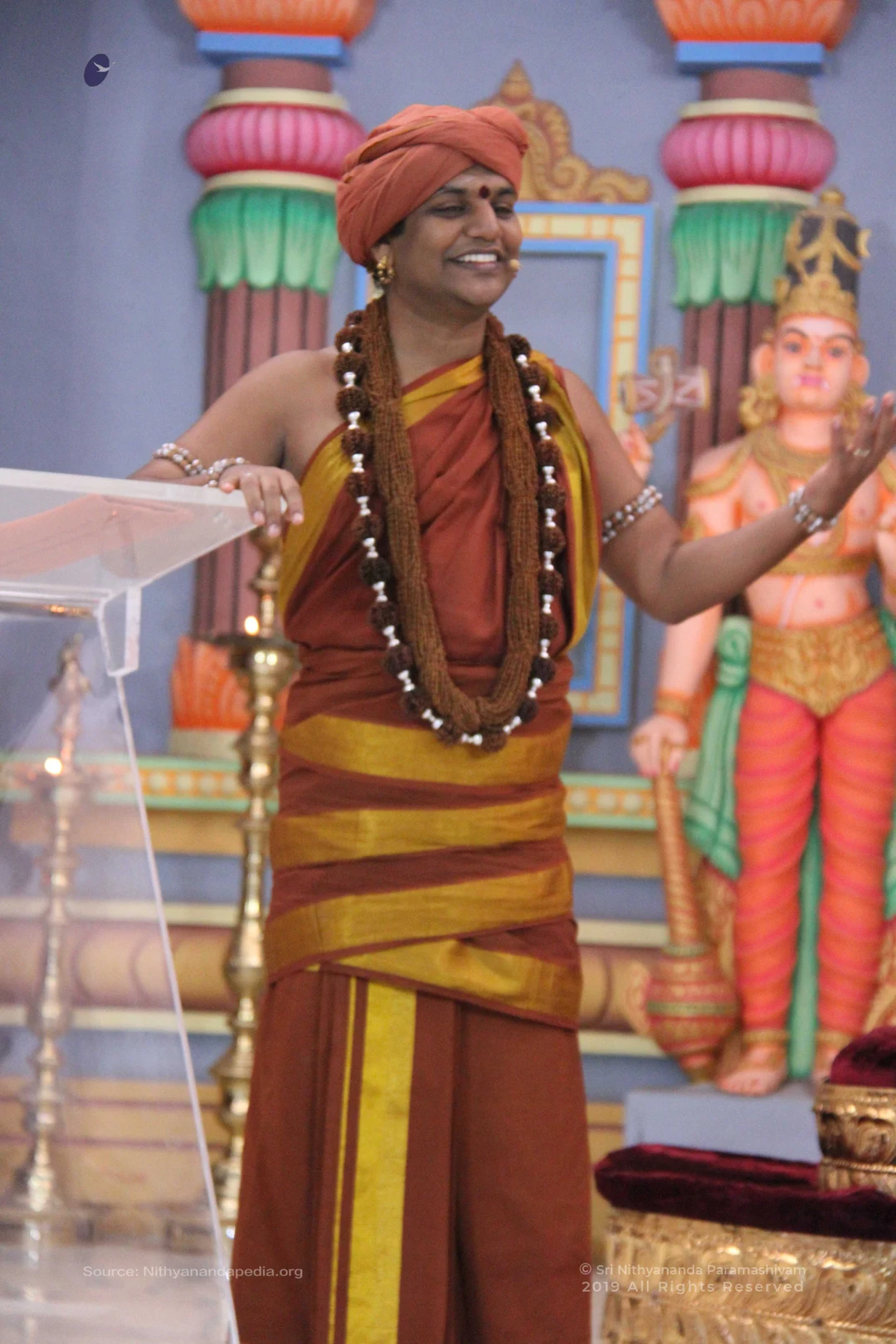
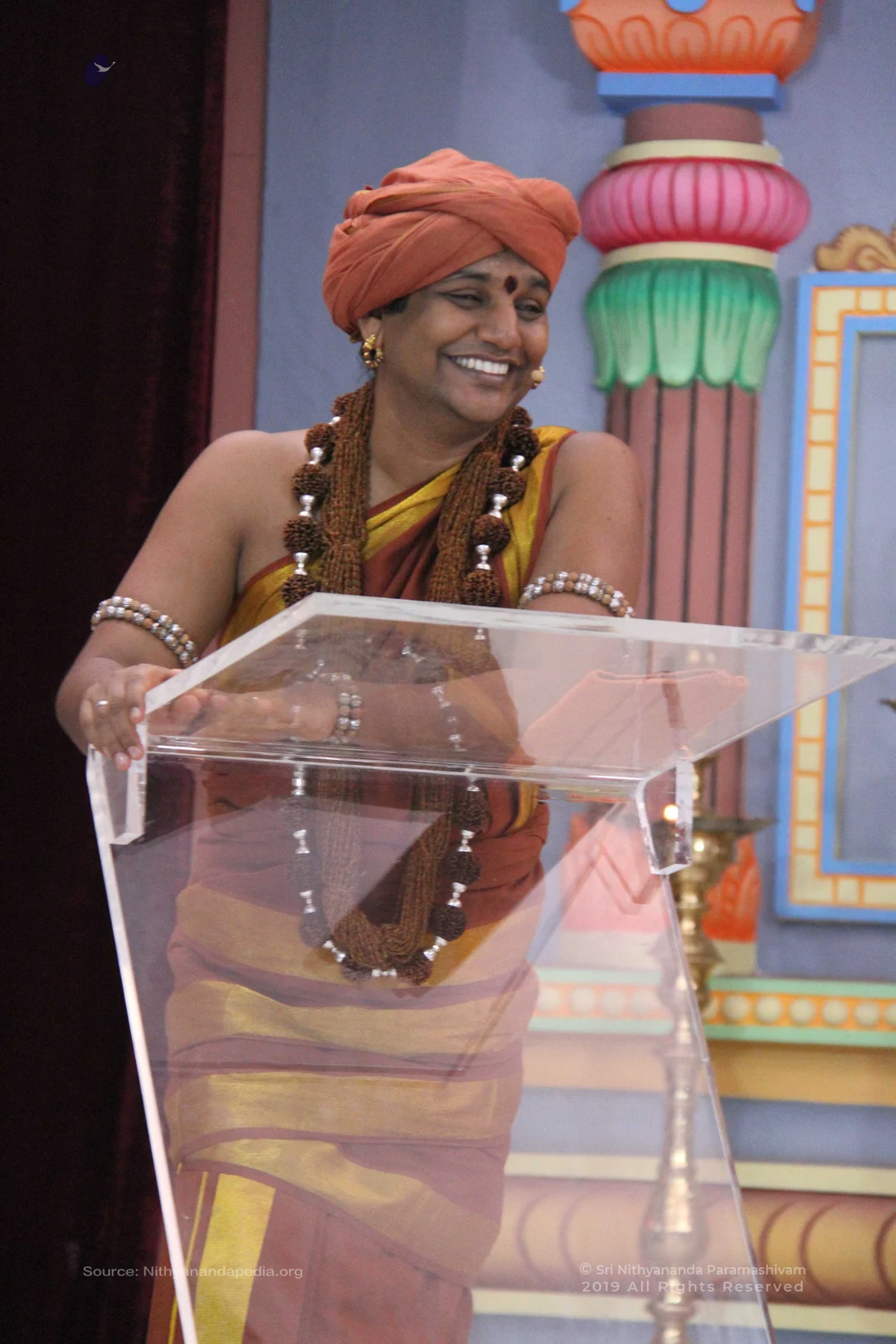
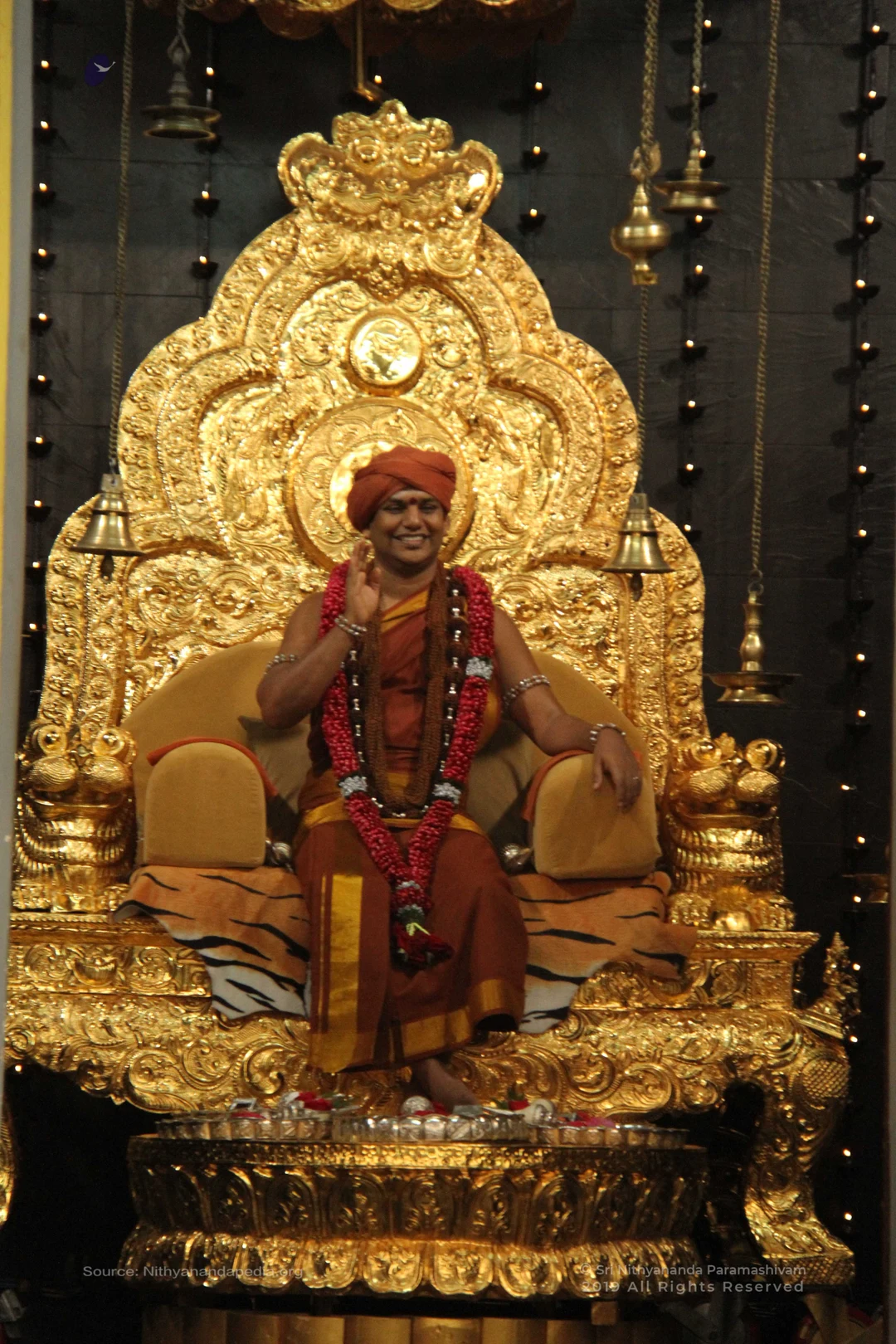
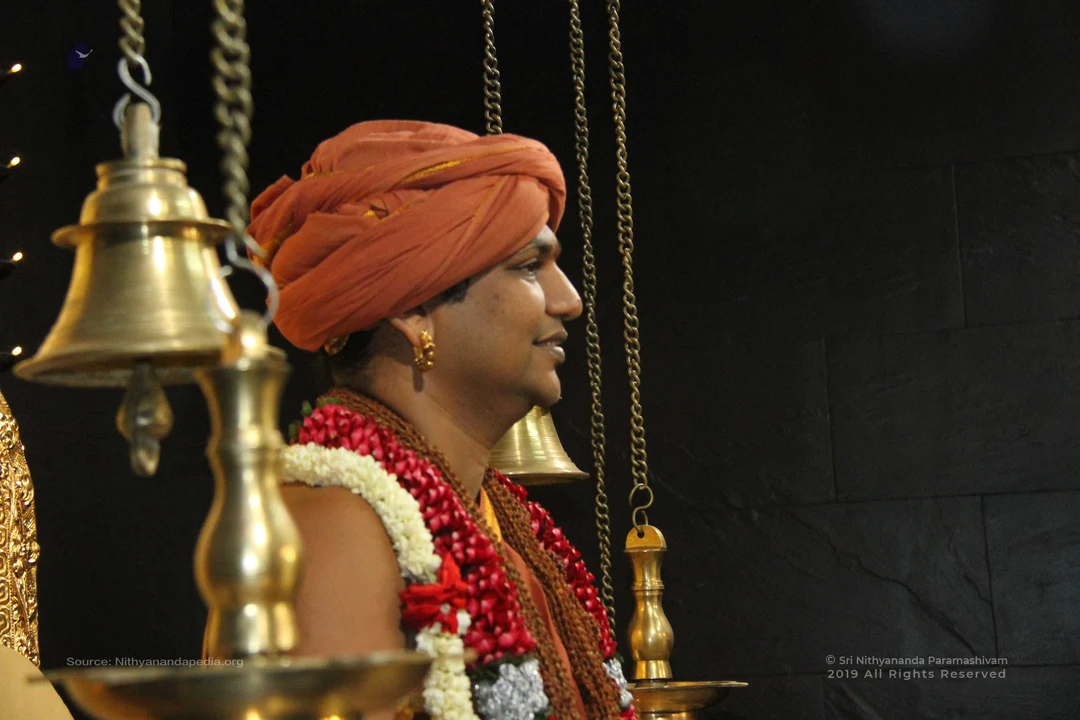
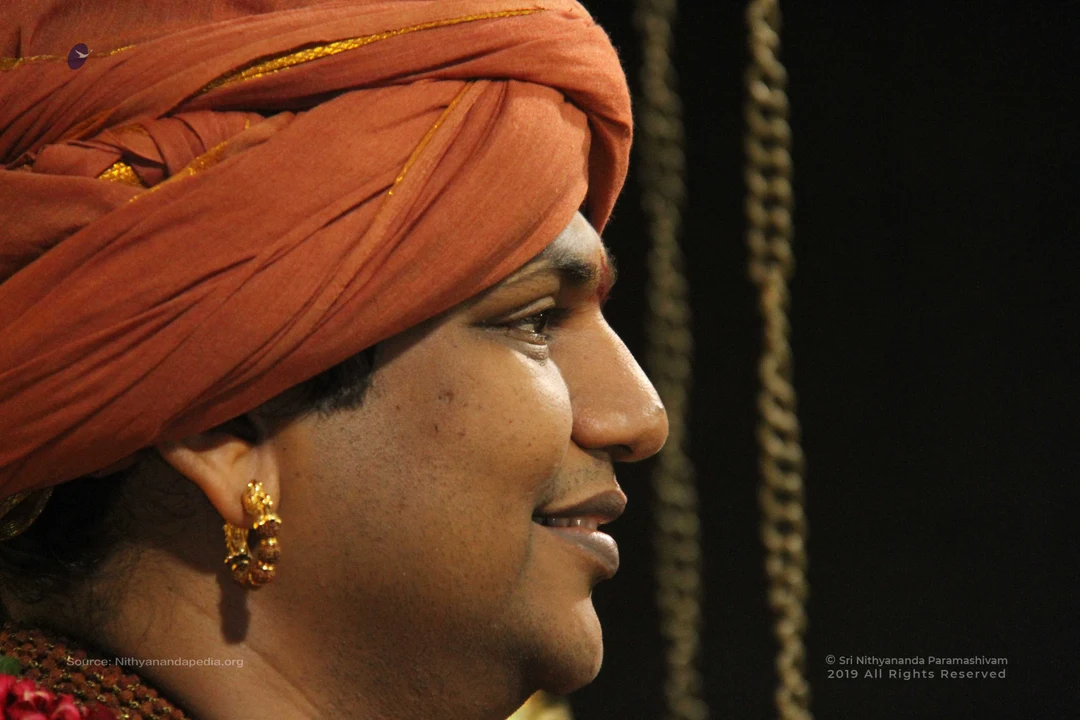
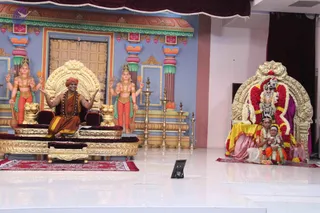
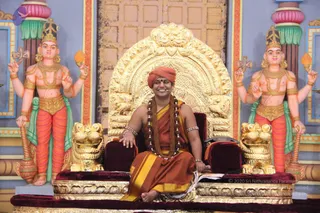
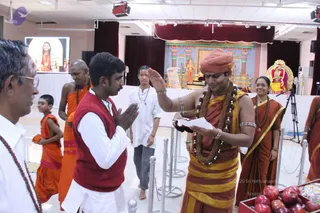
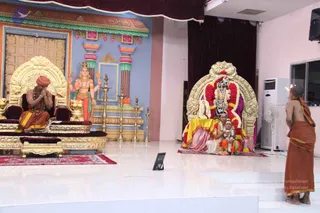
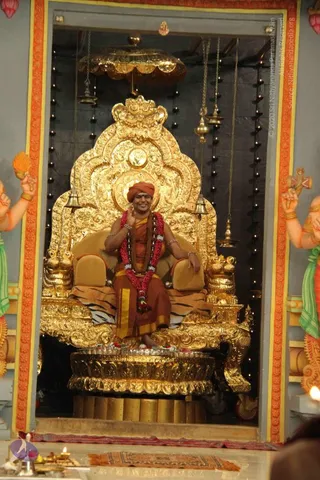
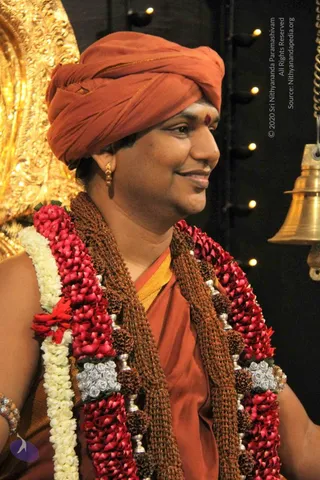
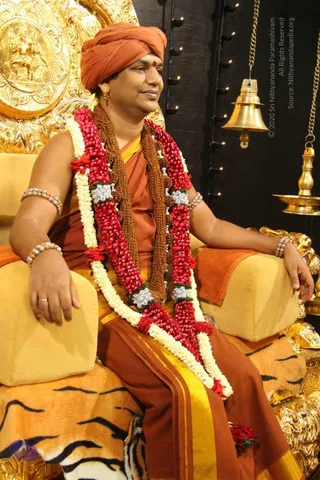
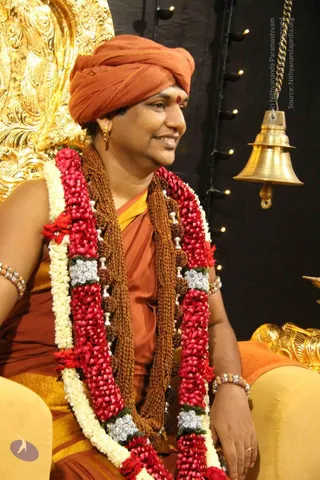
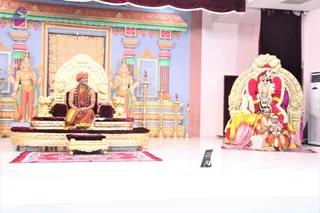
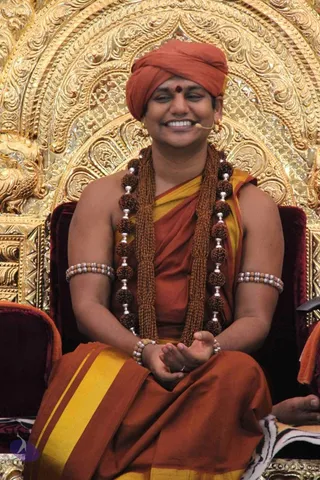
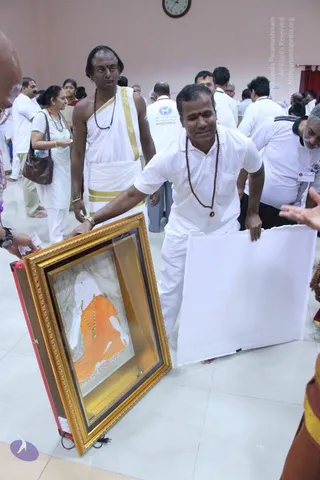
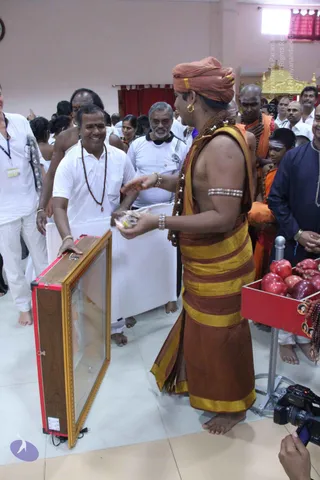
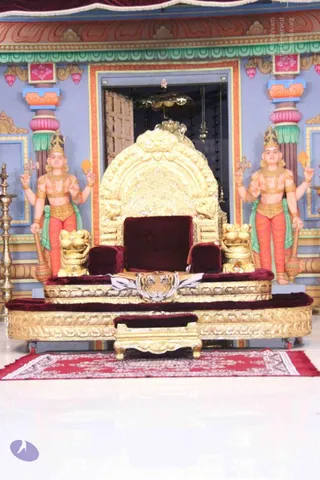
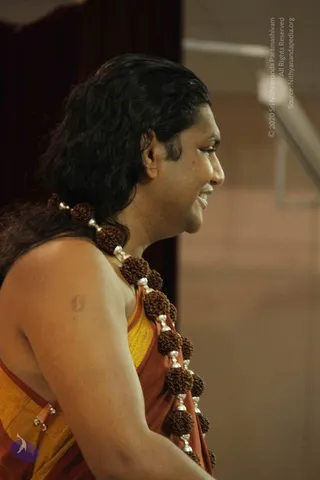
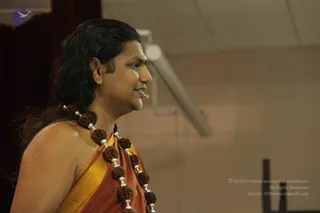
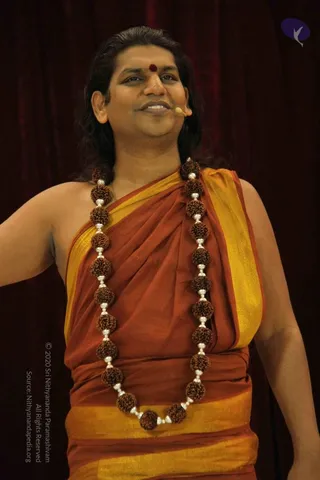
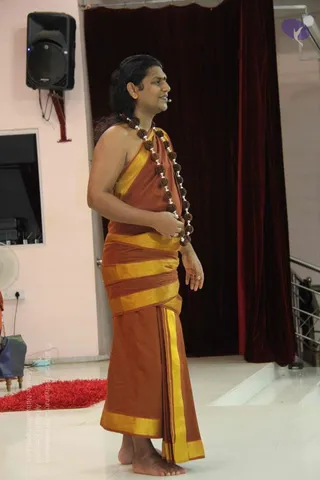
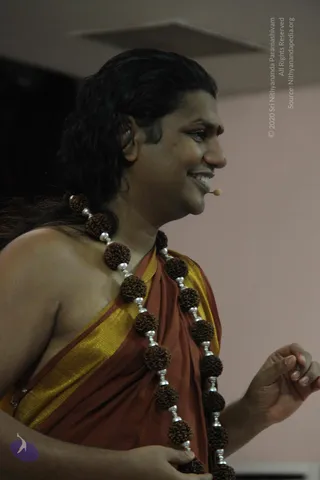
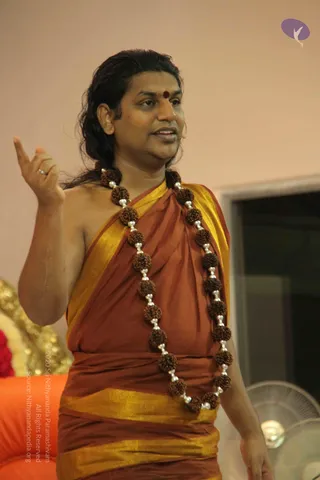
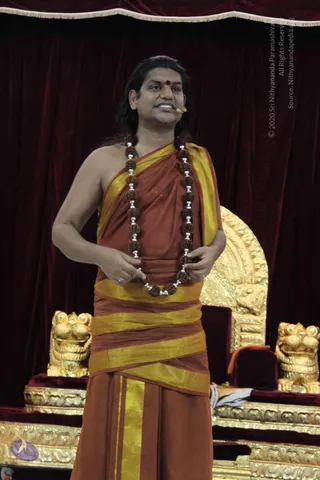
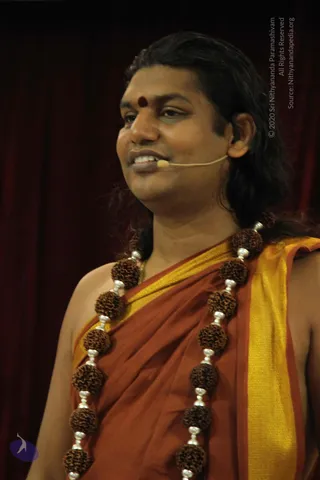
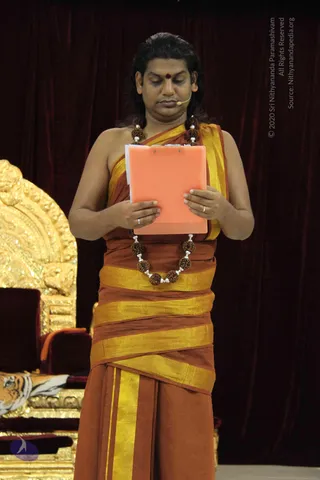
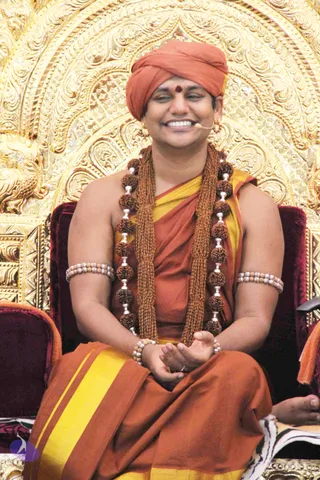
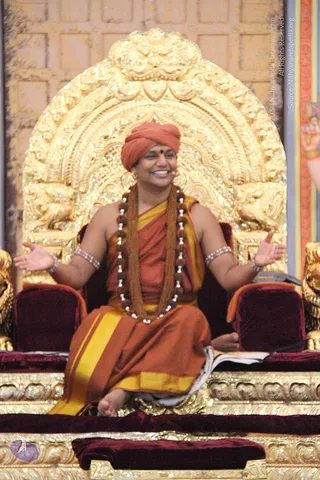
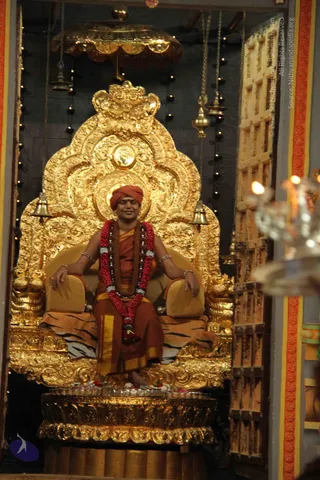
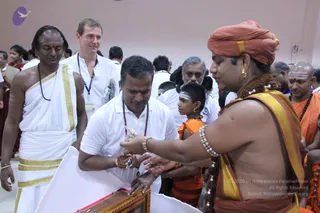
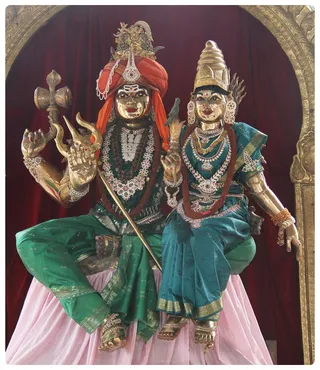
Two gilded murti statues seated side by side on a pink draped platform before a deep red curtain and an ornate gold arched frame. The figure on the left wears an orange-red turban with a crown, a rudraksha mala, and a green garment, holding a trident and a damaru-like drum in raised hands. The figure on the right has a golden conical crown, teal sari with gold border, layered necklaces and a flower garland, holding a staff or lotus-topped rod. Both have ornate jewelled ornaments and bangles. No living people are visible.A smiling man in an orange-red turban and matching orange-red shawl with a yellow-gold border stands behind a clear acrylic lectern, resting one hand on it. He wears long rudraksha mala necklaces with silver caps, multiple beaded bracelets, gold earrings and a red bindi. Beside him stands a painted deity murti with a golden crown, gold necklace and raised hands holding a flower-like object, in front of a lilac wall with pink and green lotus-shaped columns. Swamiji (probable): the man's orange turban, saffron shawl, rudraksha malas and ornate gold jewellery match the page's claim that Swamiji spoke at this satsang.A standing man in a rust-orange turban with a small red bindi, wearing a rudraksha mala of dark beads with silver spacers, gold-bordered rust-orange cloth draped over the shoulder and wrapped at the waist, gold armlets and silver bracelets, and a small microphone at his cheek. Behind him are painted gilt deity figures with crowns and raised hands, a gold throne with red cushions, and a brass lamp stand at the right edge. A red velvet valance hangs above. He is the only physical person in view. Shown with rudraksha mala, rust-orange robes and turban, he matches the appearance-based Swamiji (probable) cues, performing as speaker on stage.

August 18 2013

Original wiki page
Contents

Title:

Completion Leads to Expansion.

Description:

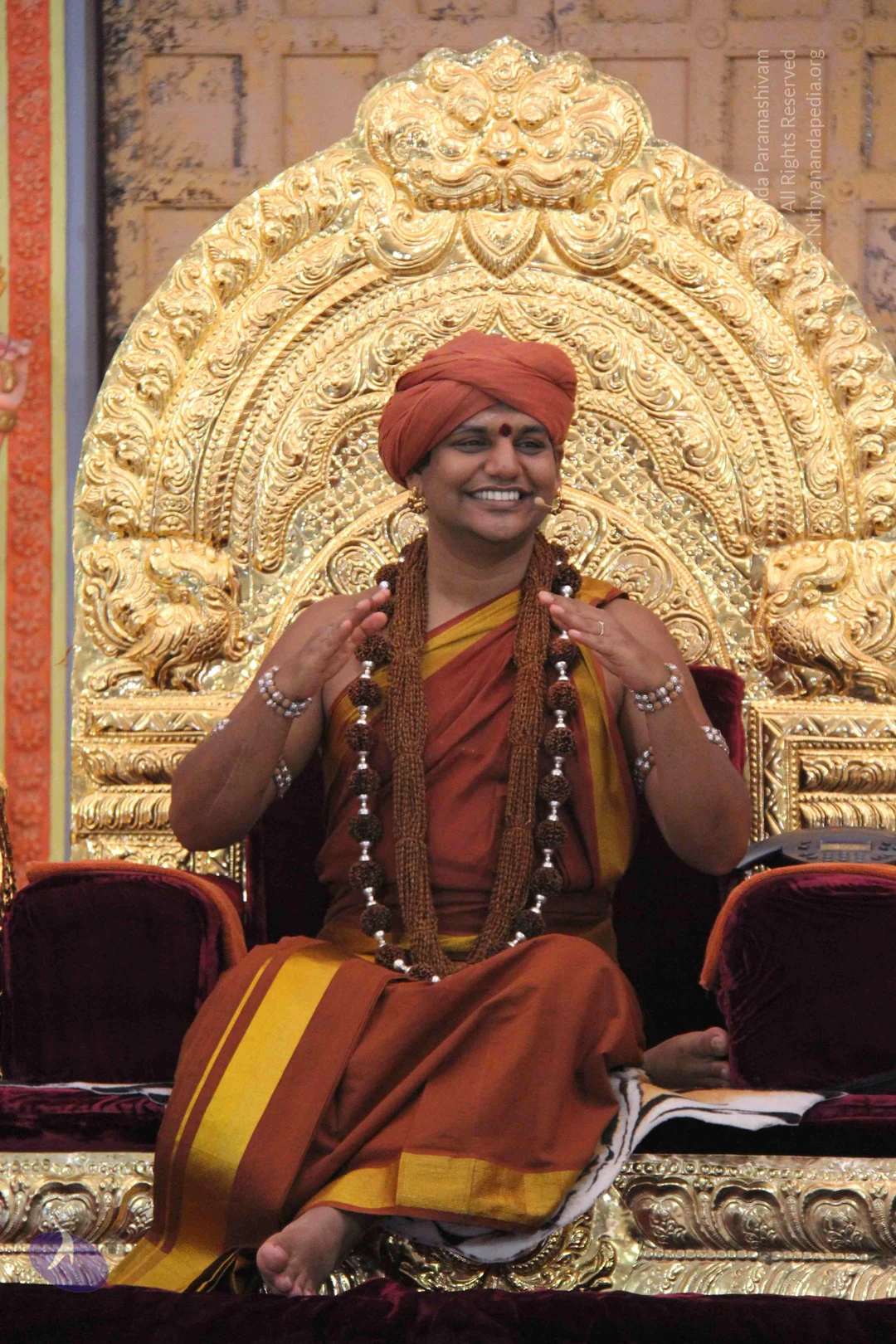
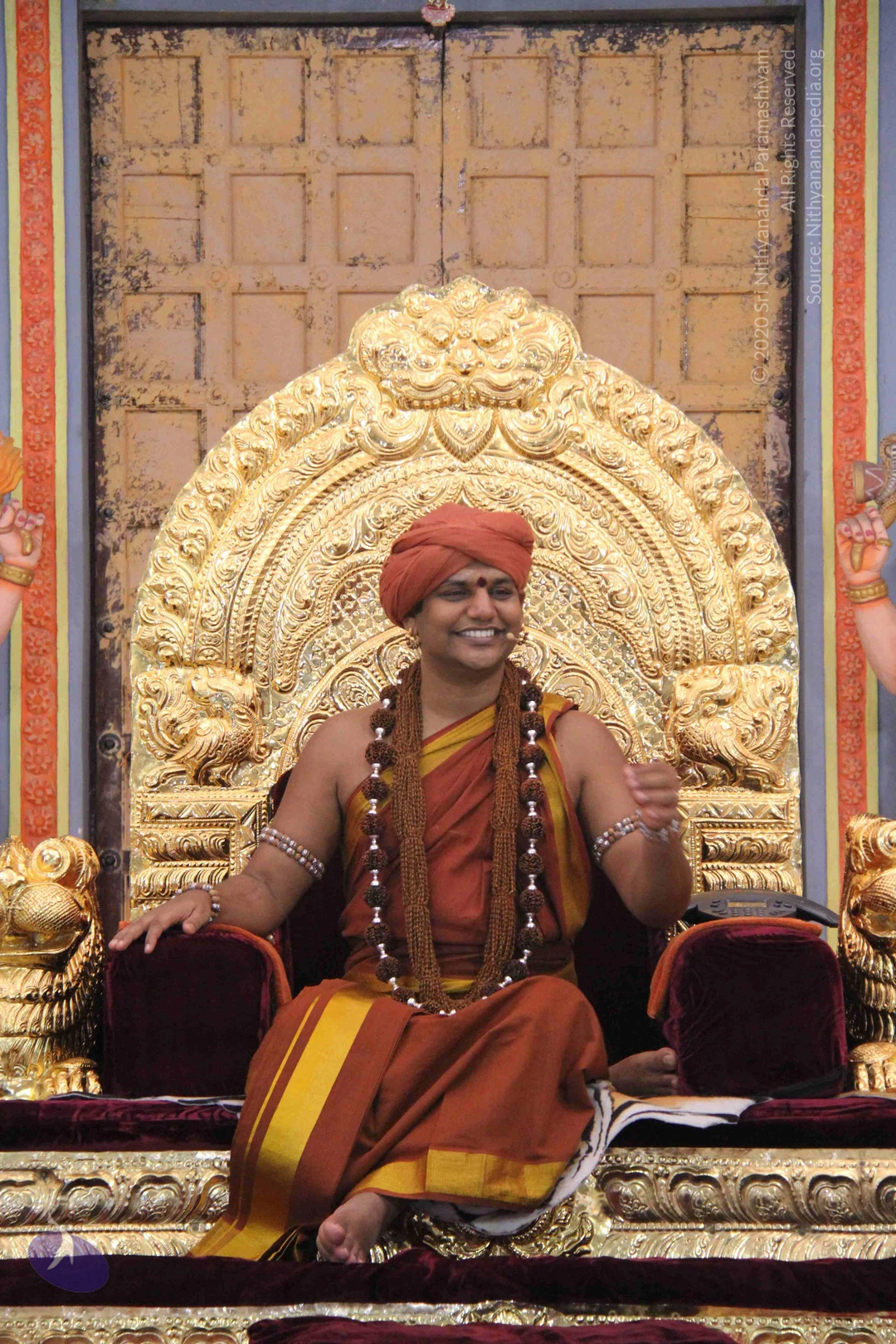
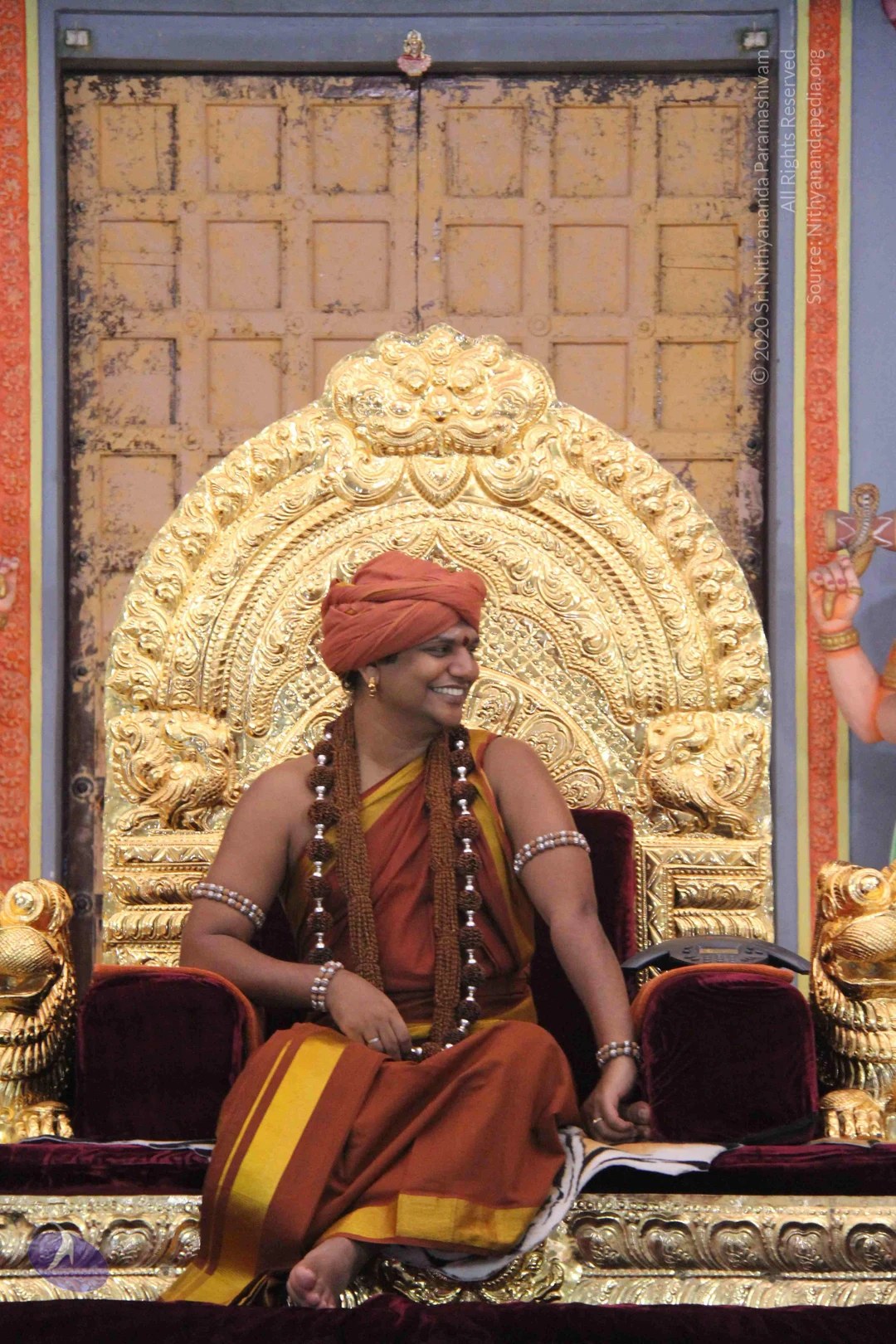
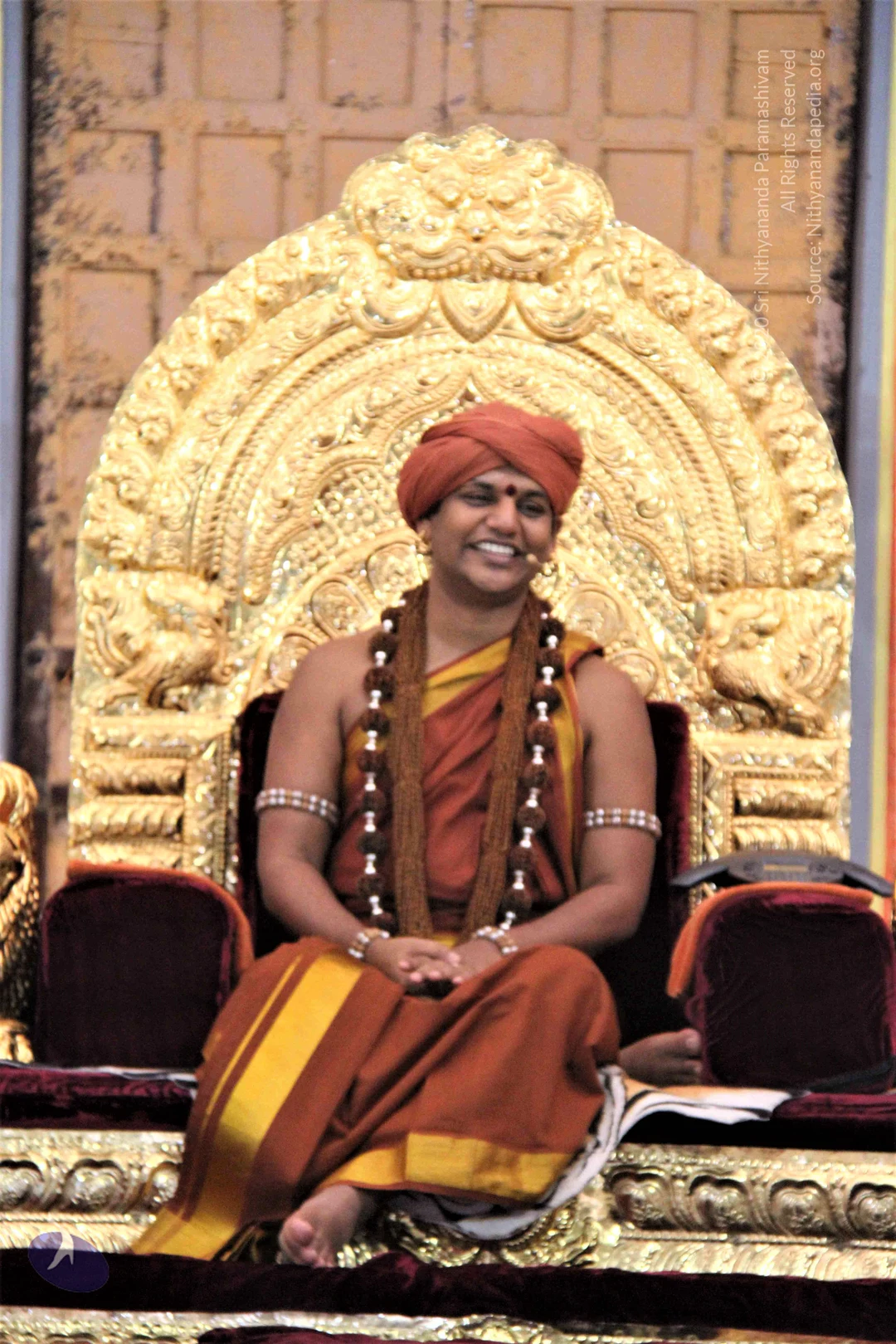
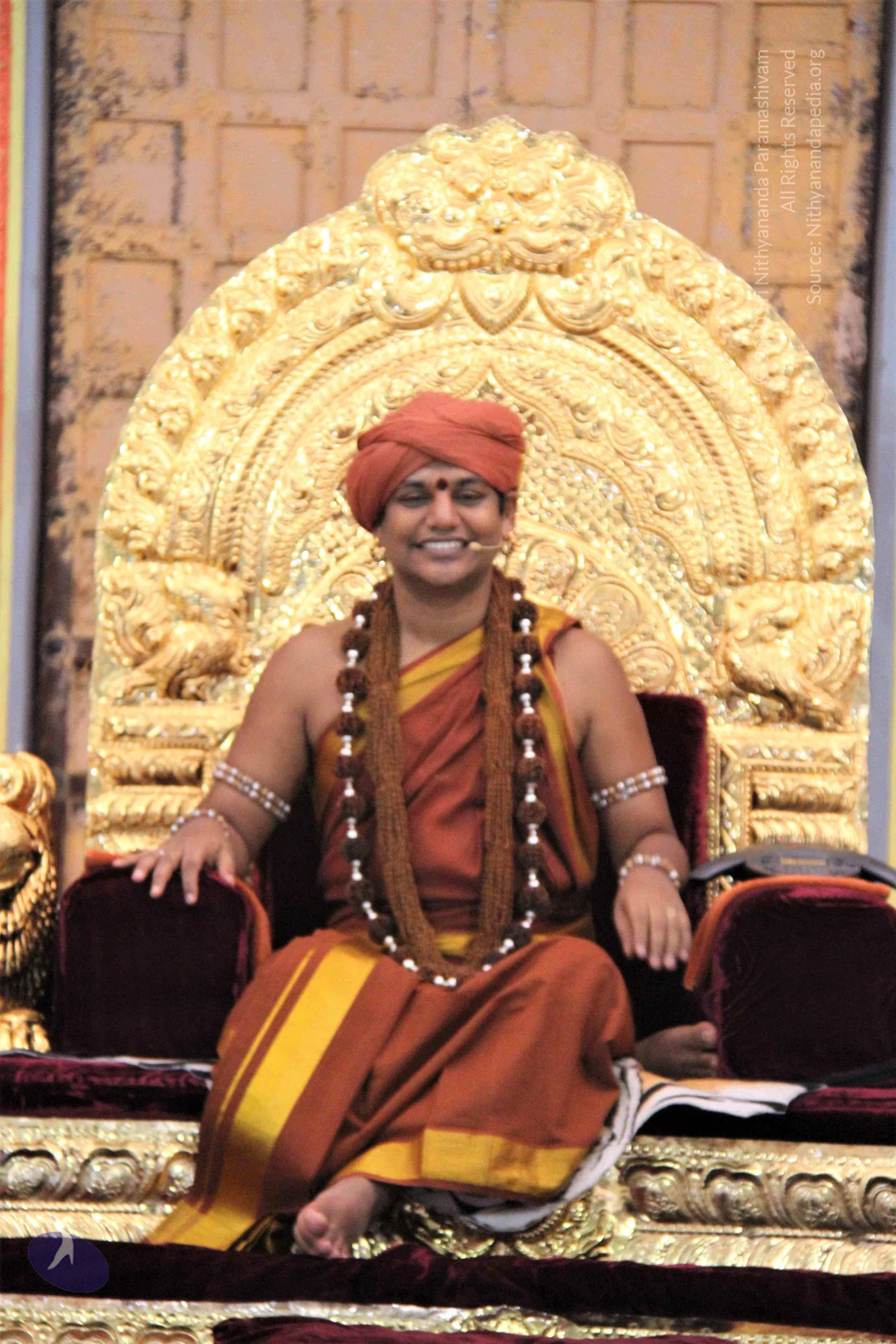
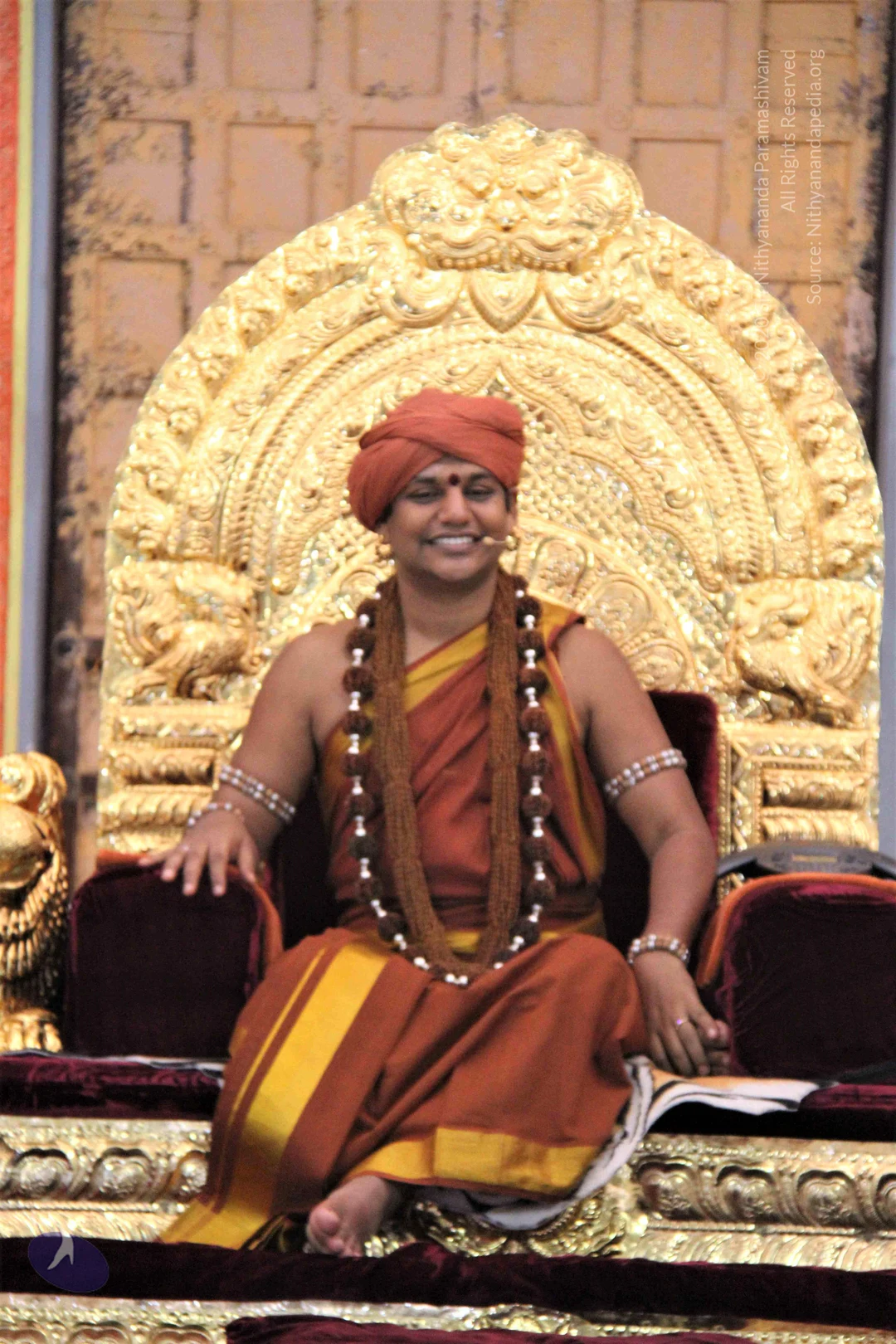
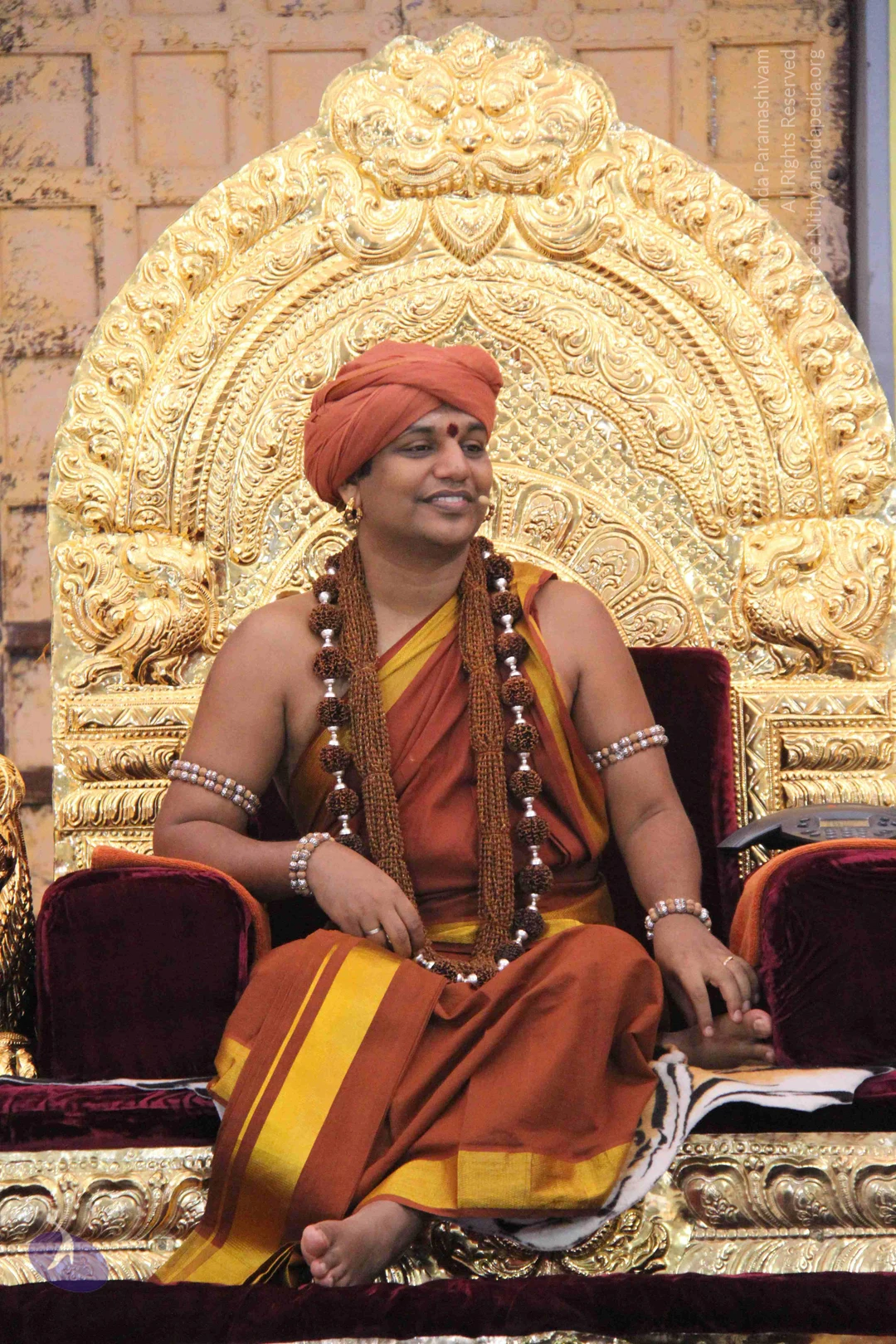
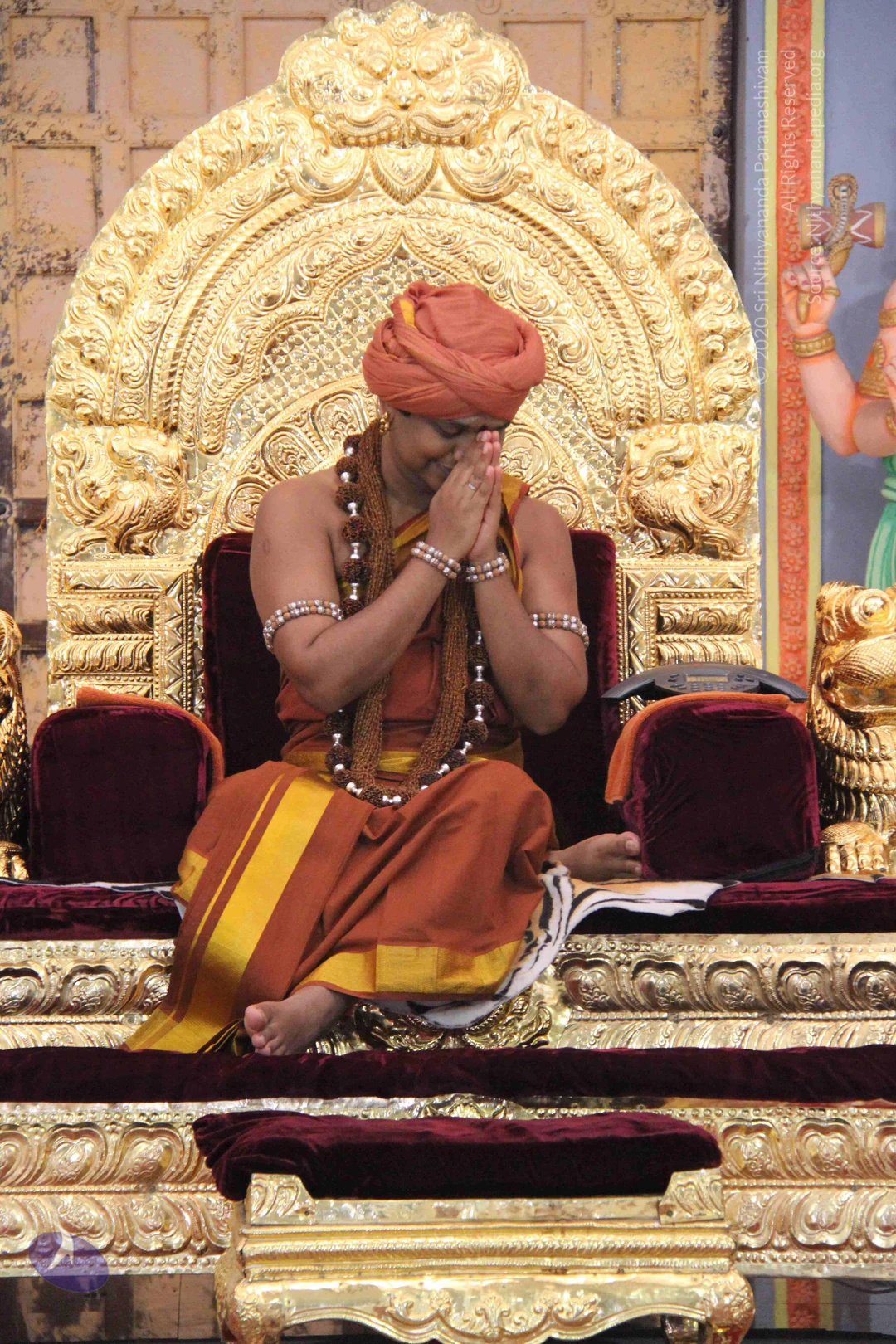
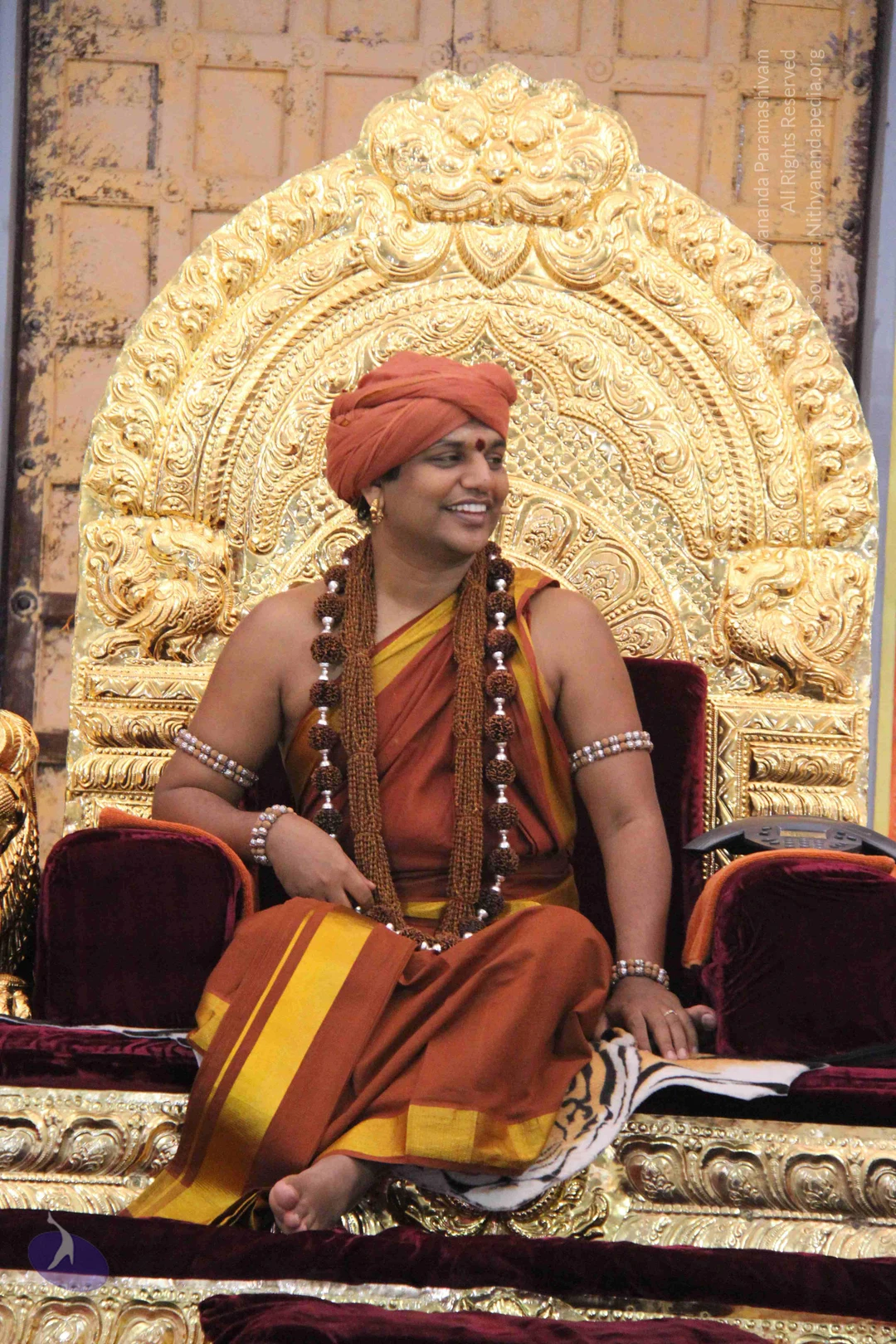
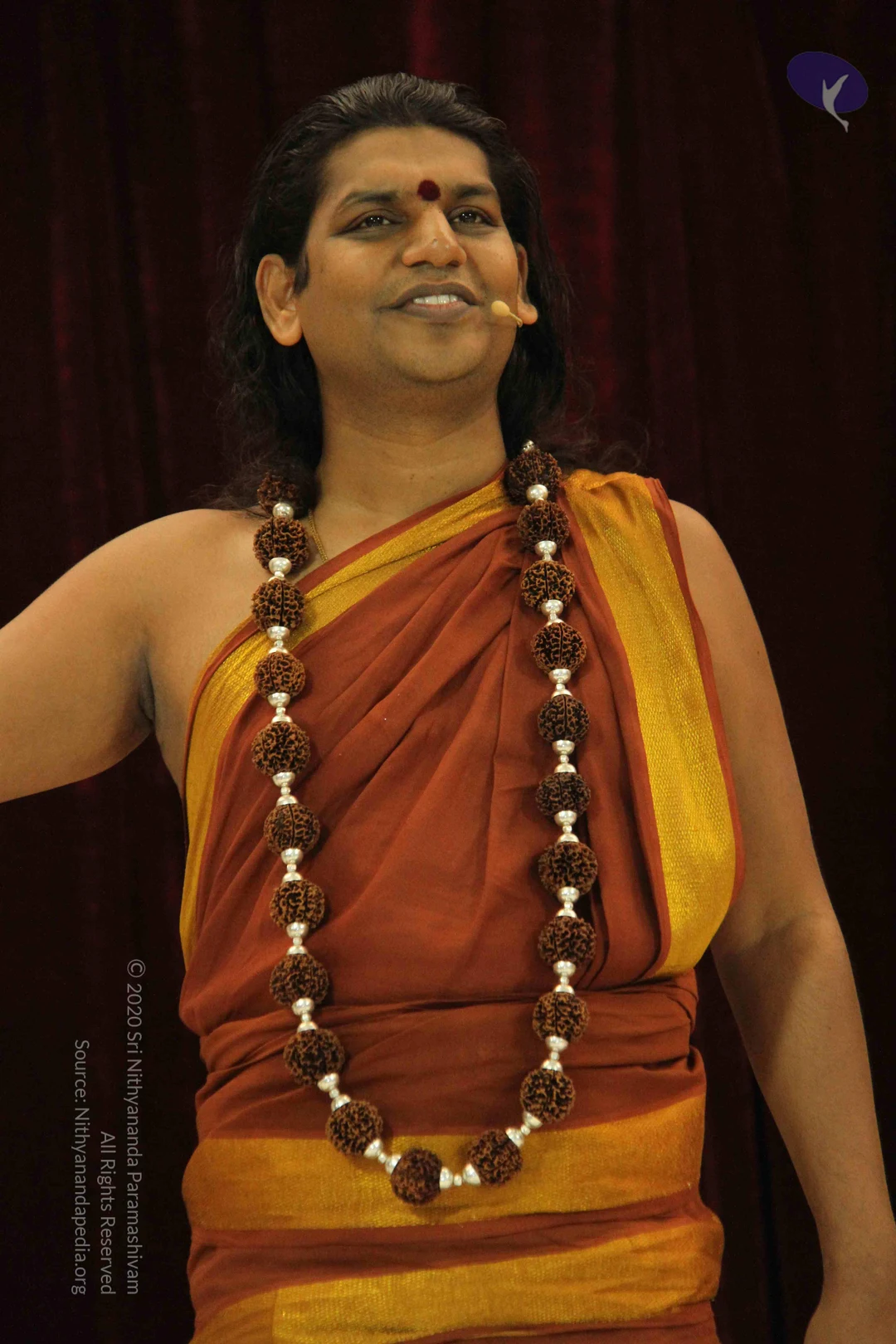
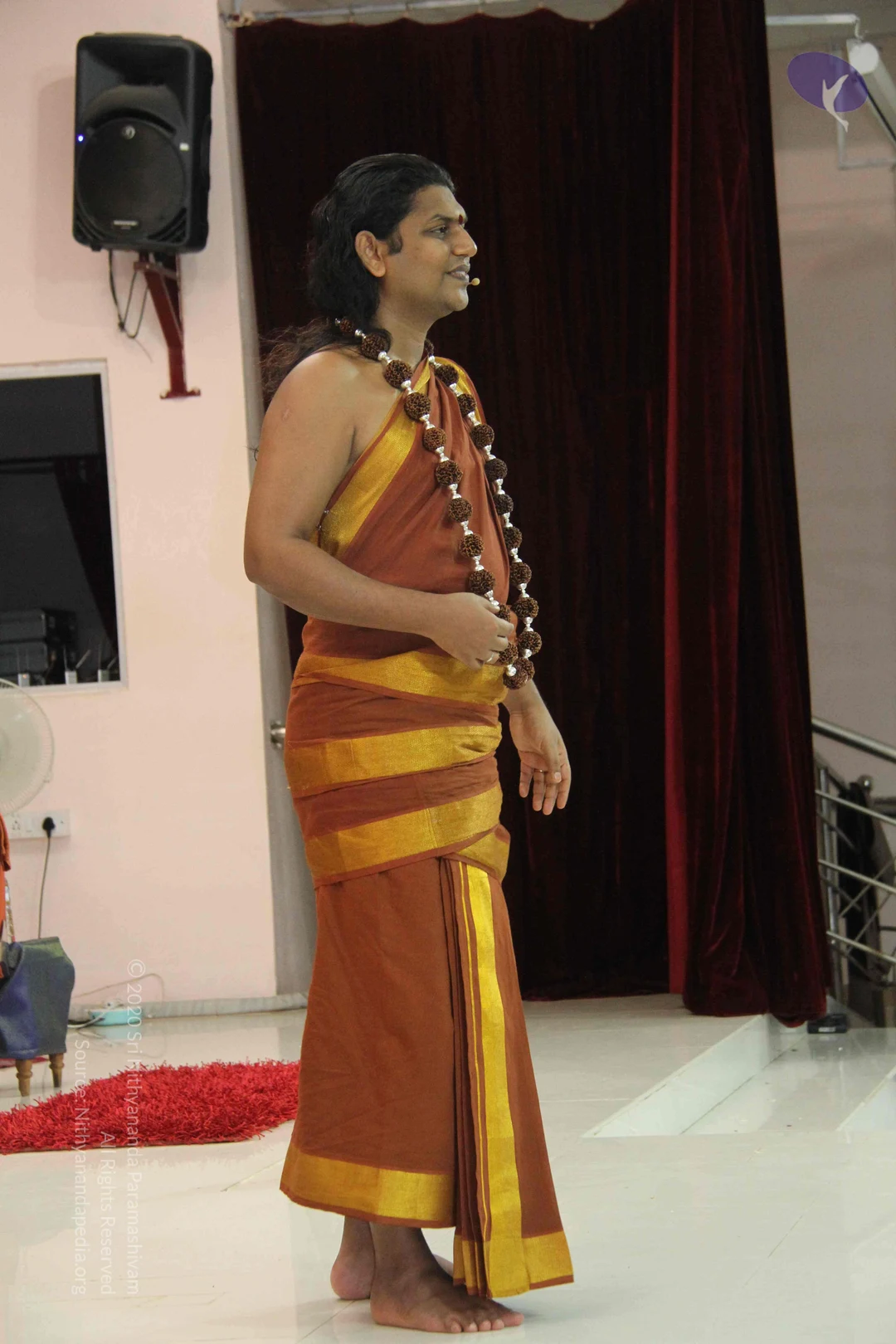
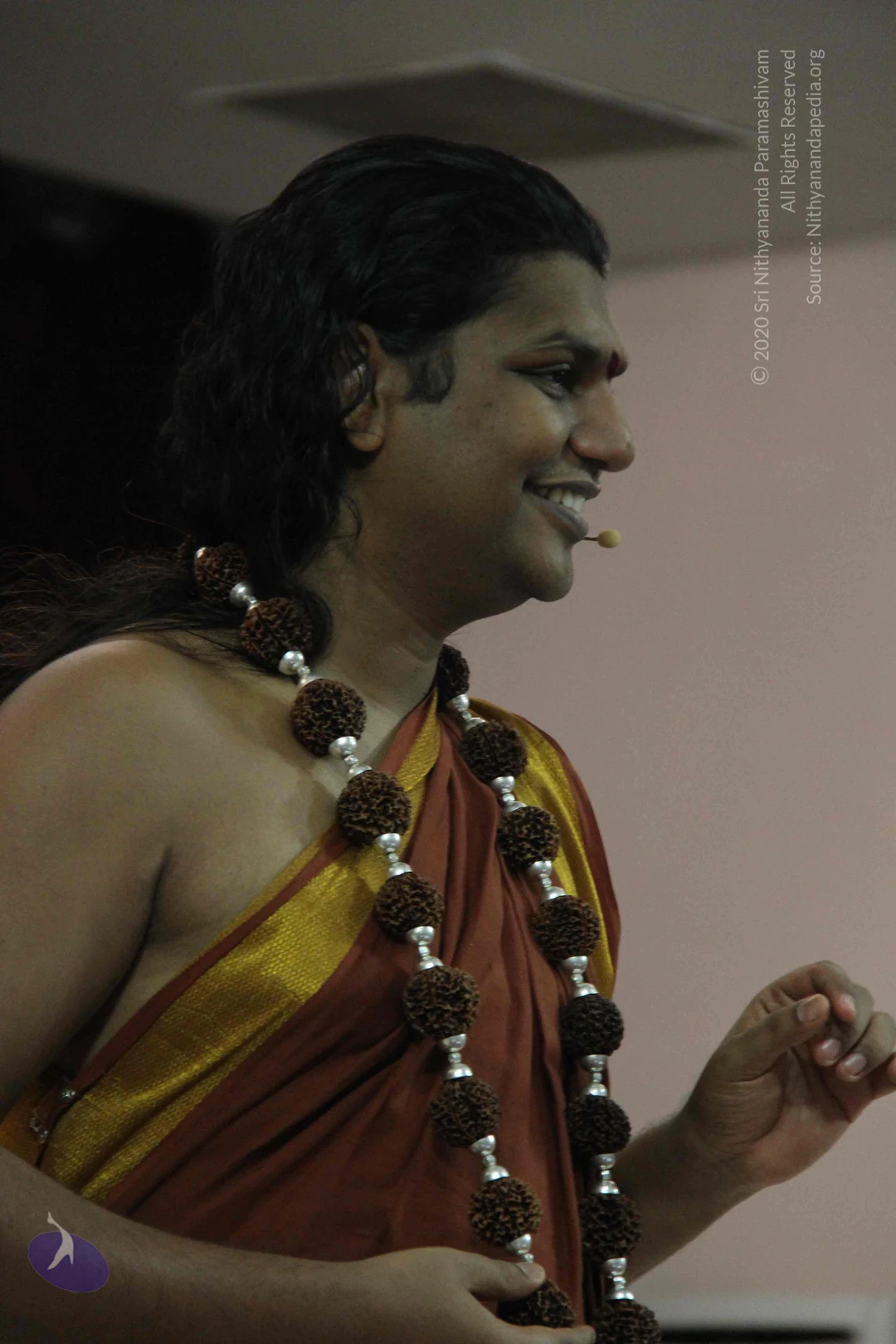
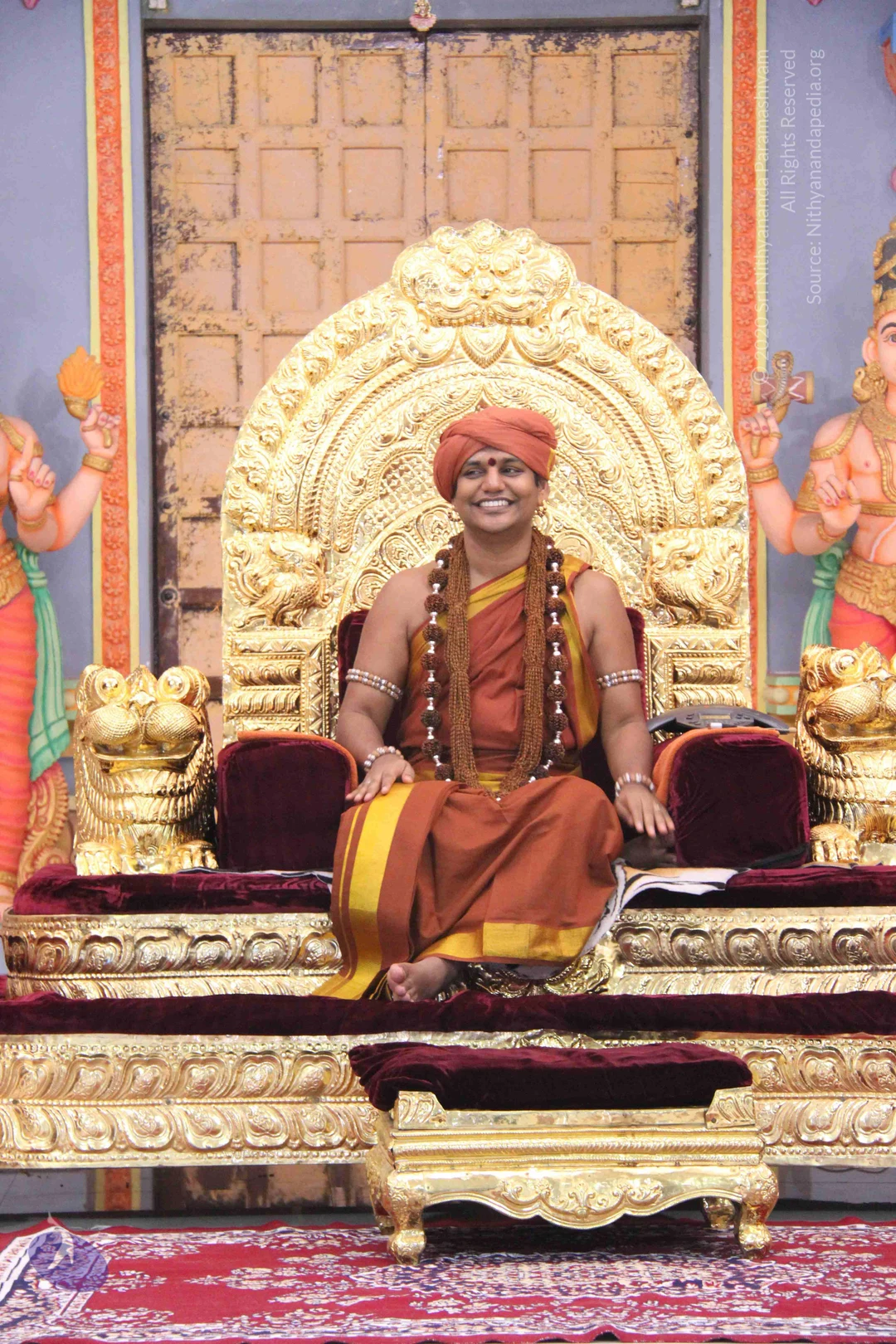
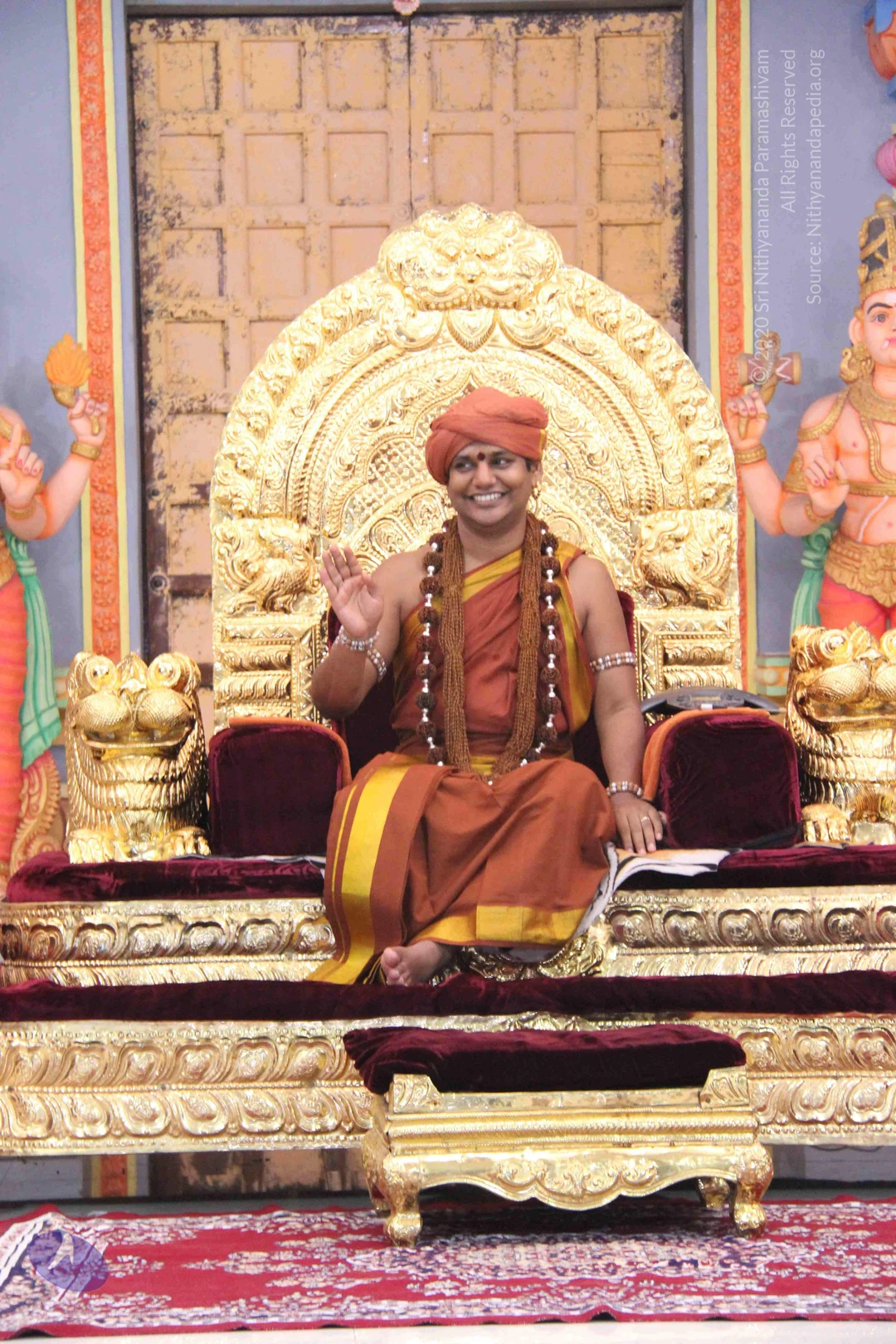
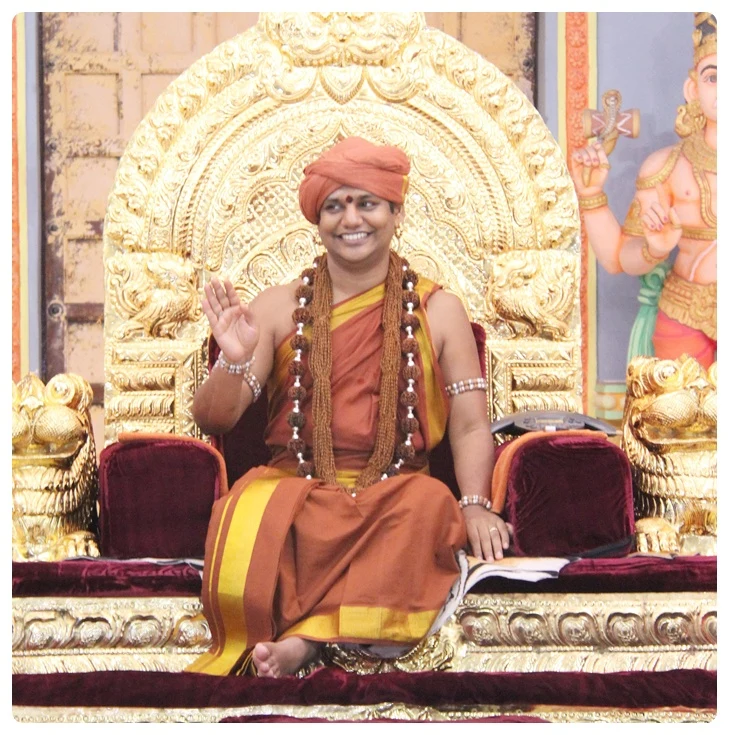
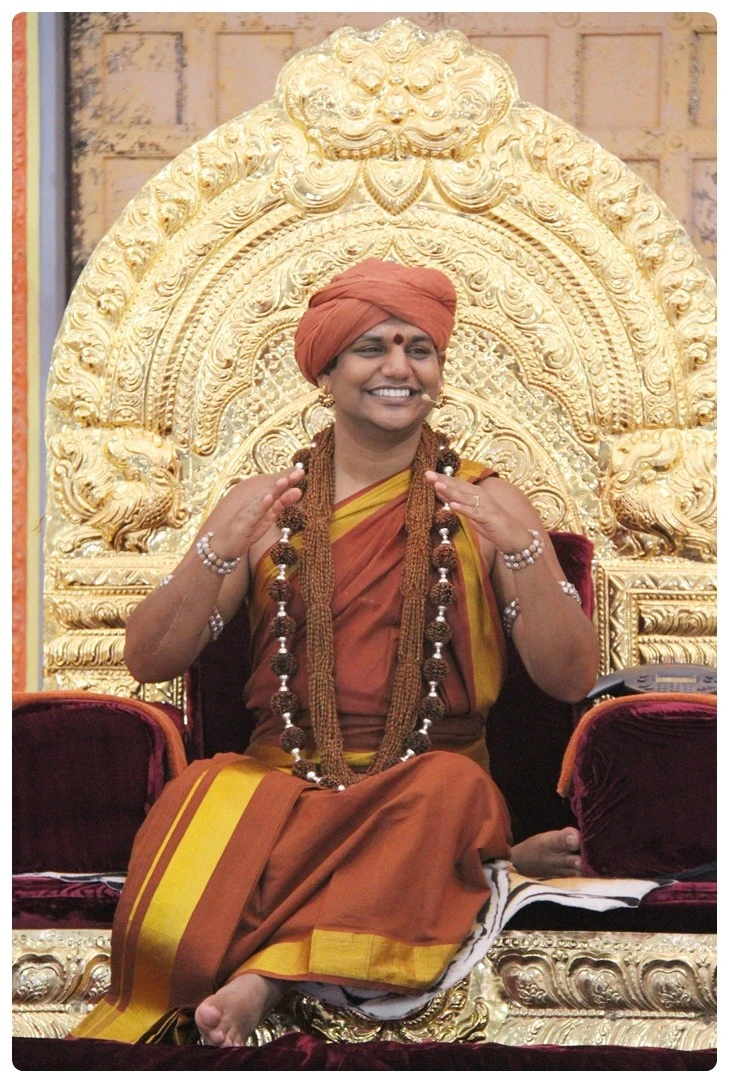
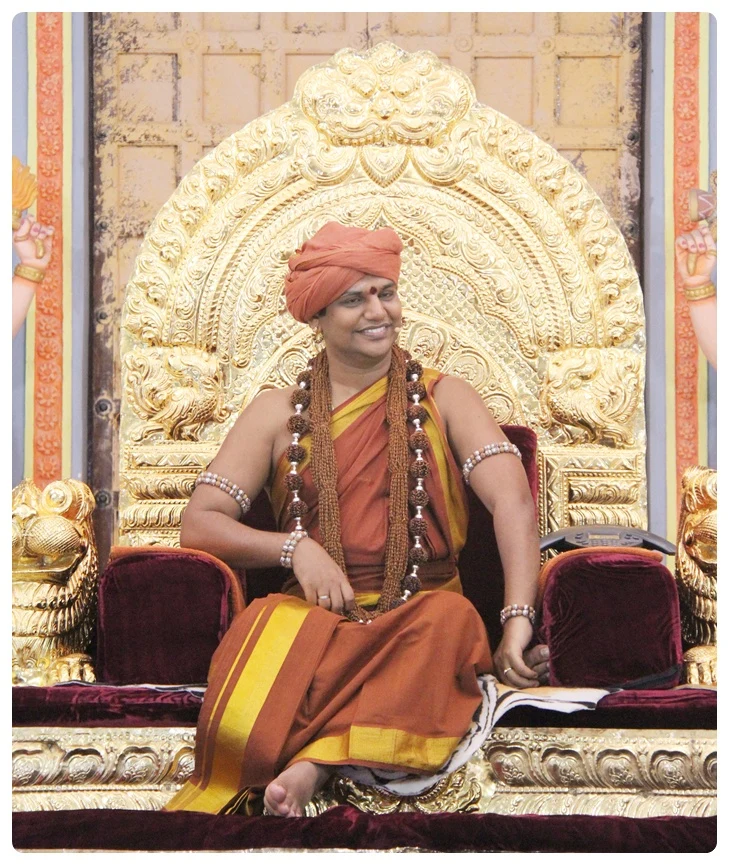
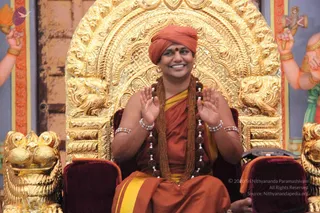
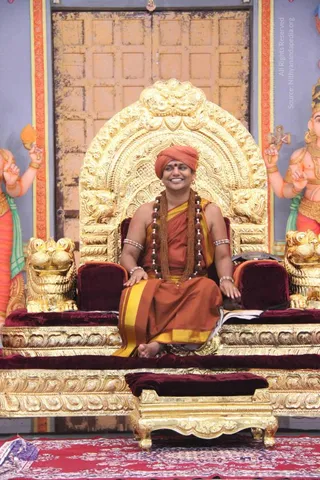
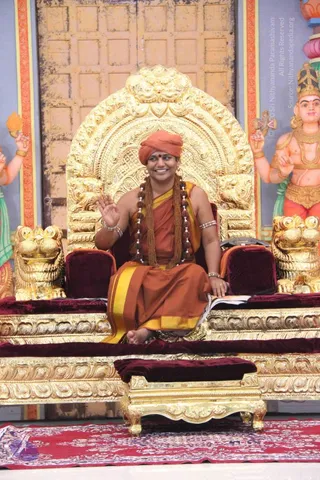
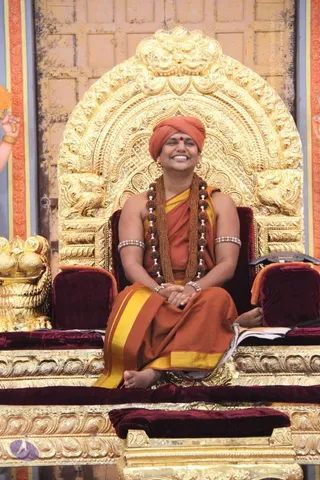
In today’s morning satsang Swamiji spoke about How completion leads to expansion. Life out there is a huge blessing of tatasthu (So be it!). Every thought you entertain will be blessed by the cosmos. If you are in Integrity with your thoughts in a space of completion, the blessing you get from the cosmos will be JOY.

Link to Video:

VideoAudio

Transcript:

nithyanandeshwara samaarambhaam nithyanandeshwari madhyamaam |
asmadaachaarya paryanthaam vandey Guru paramparaam ||

<Hindi>

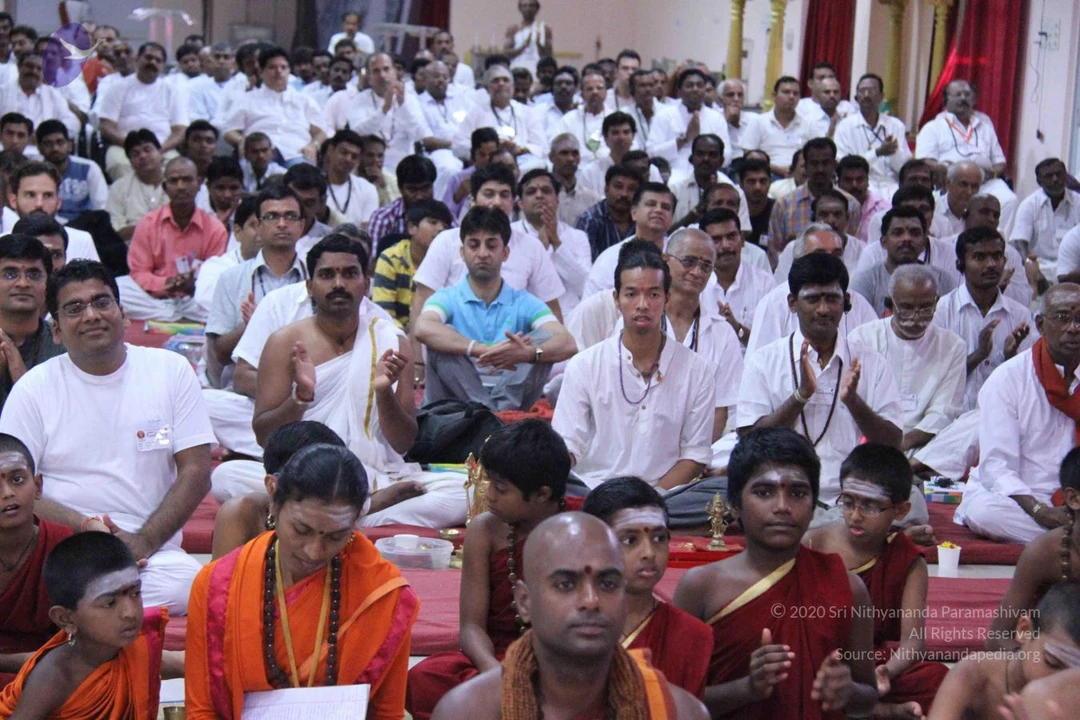
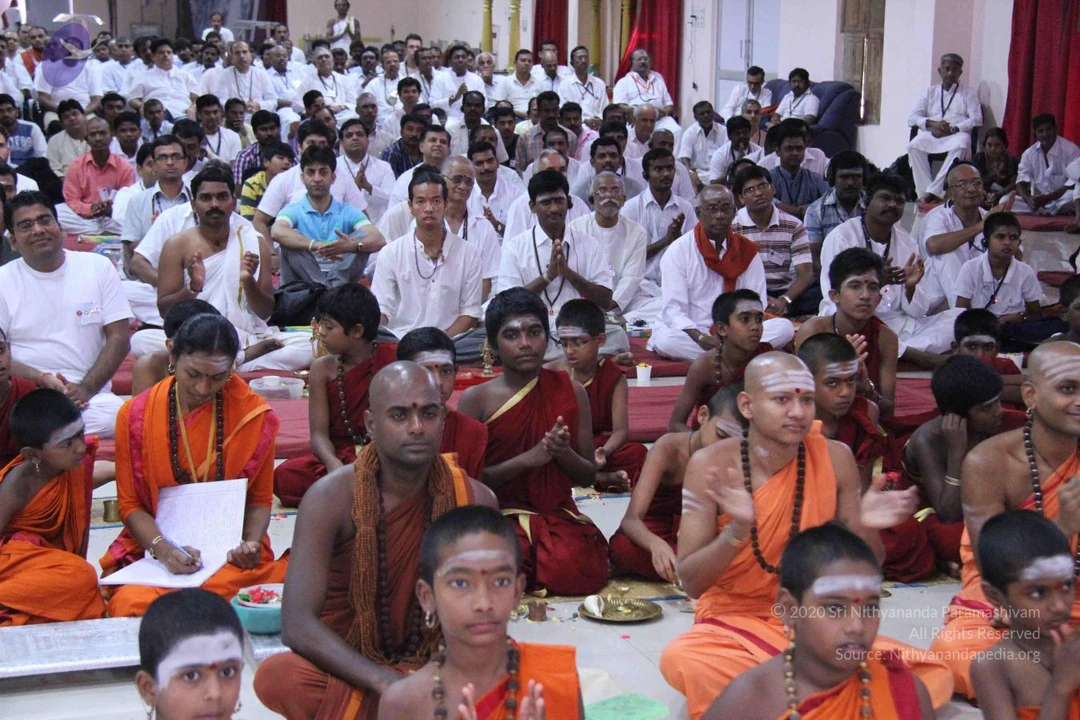
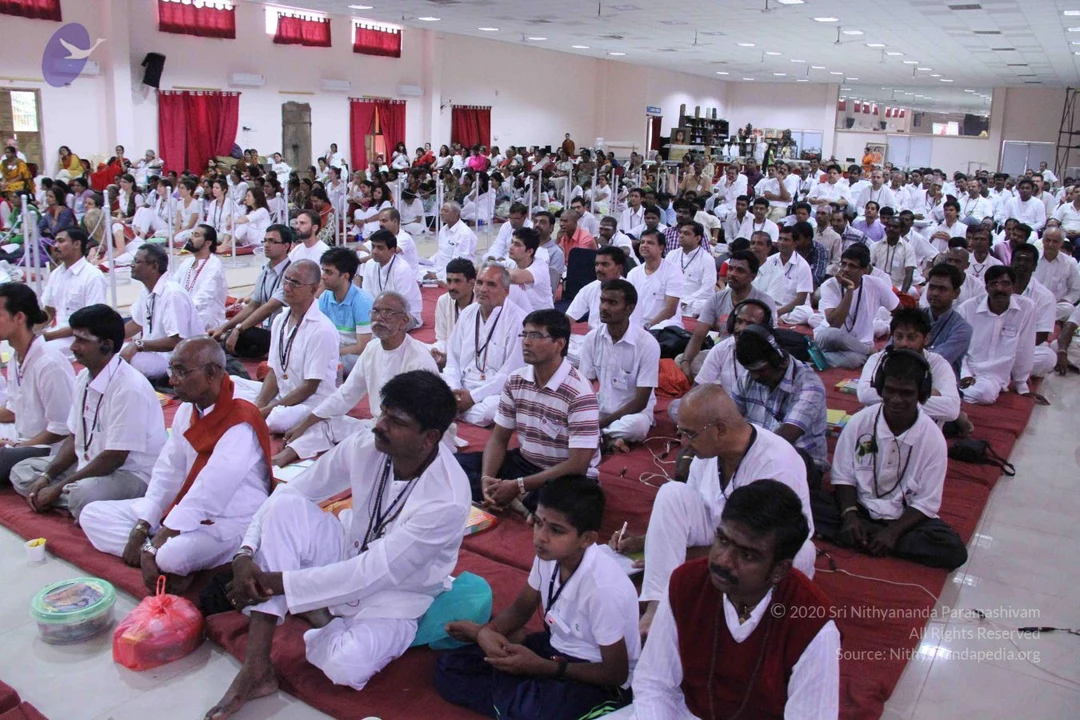
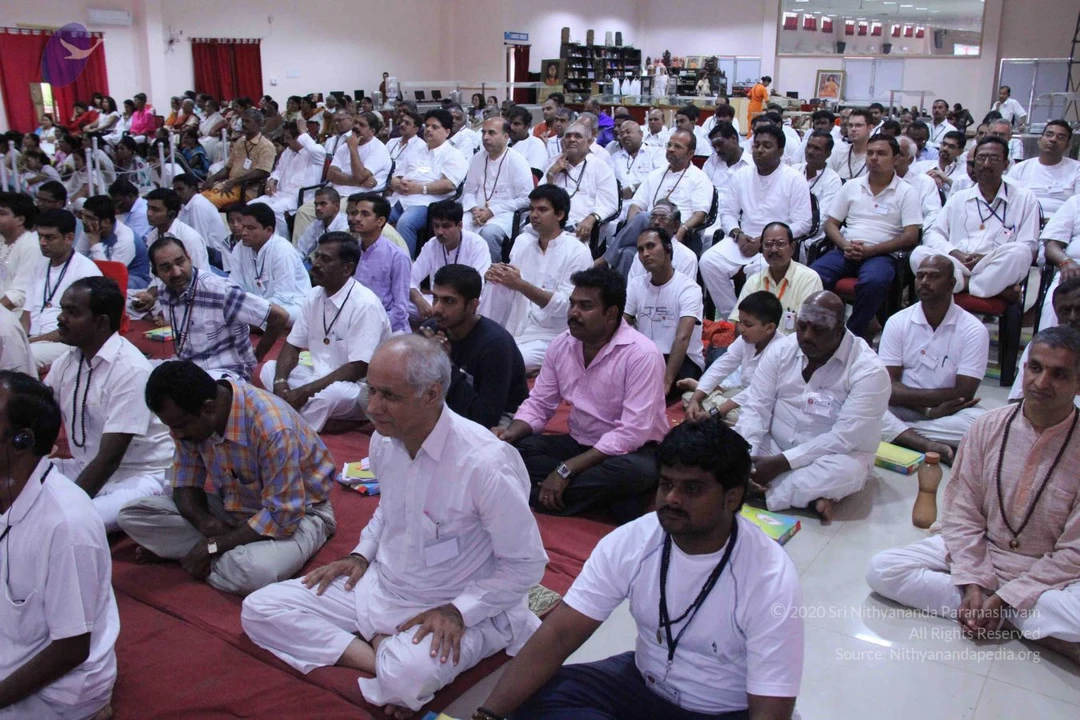
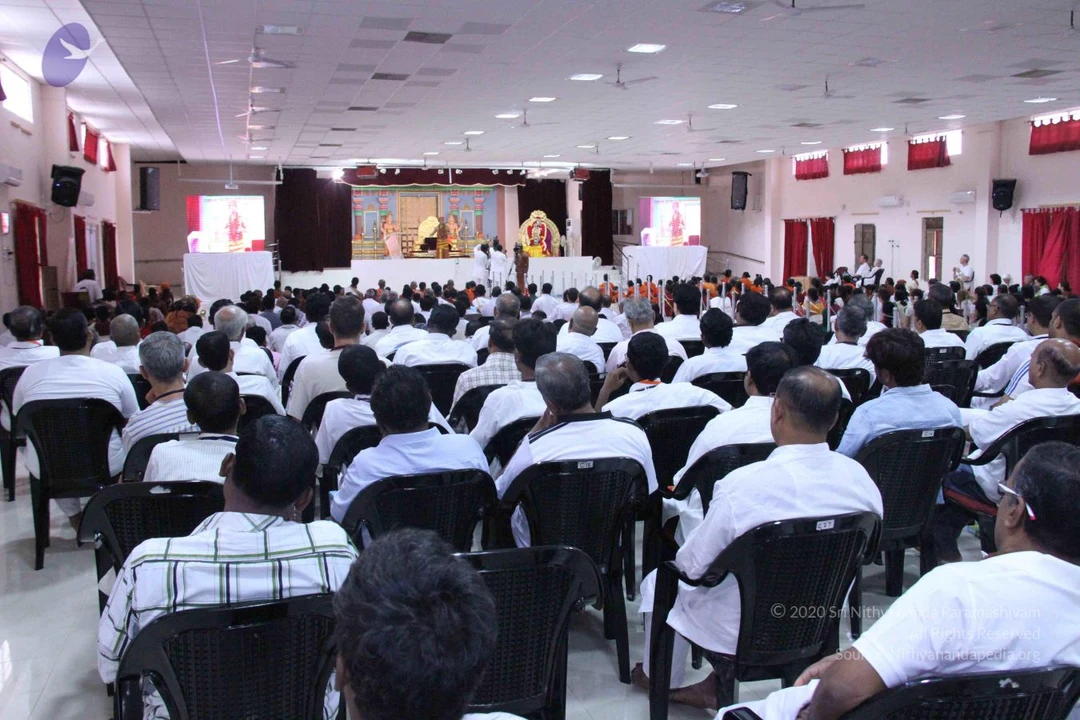
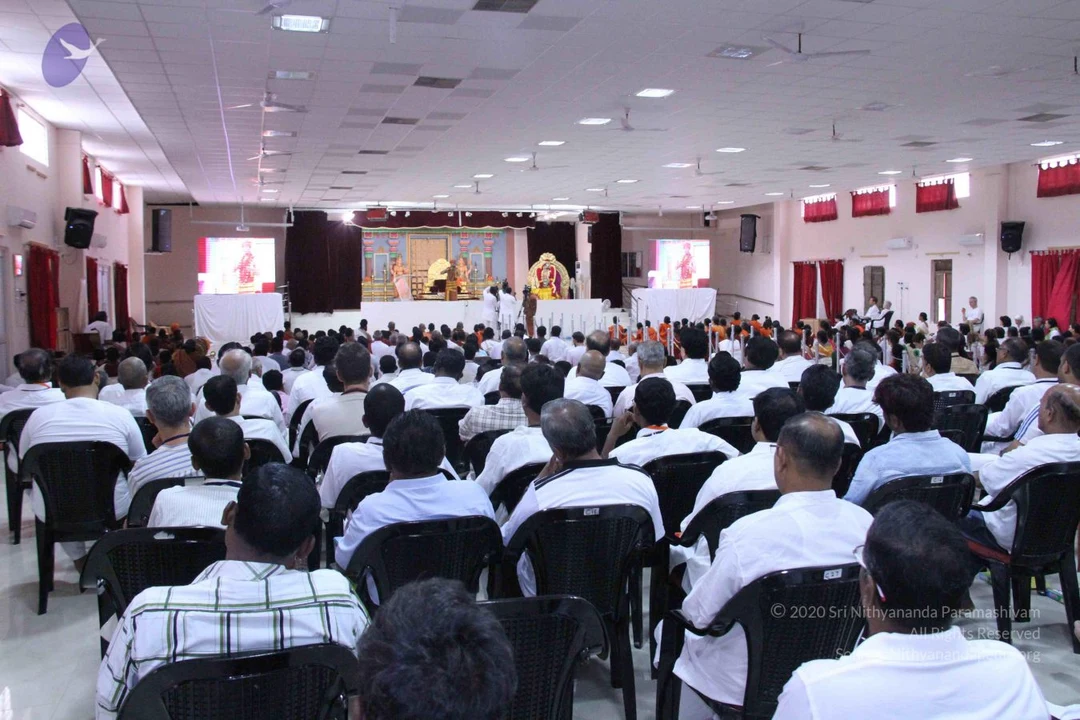
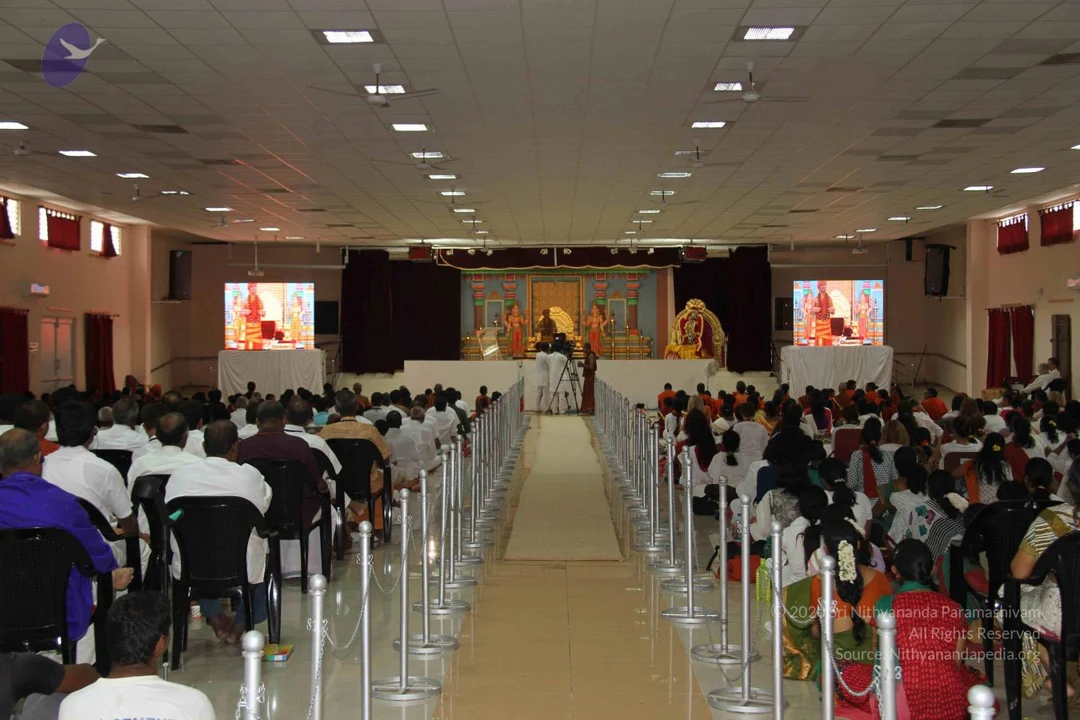
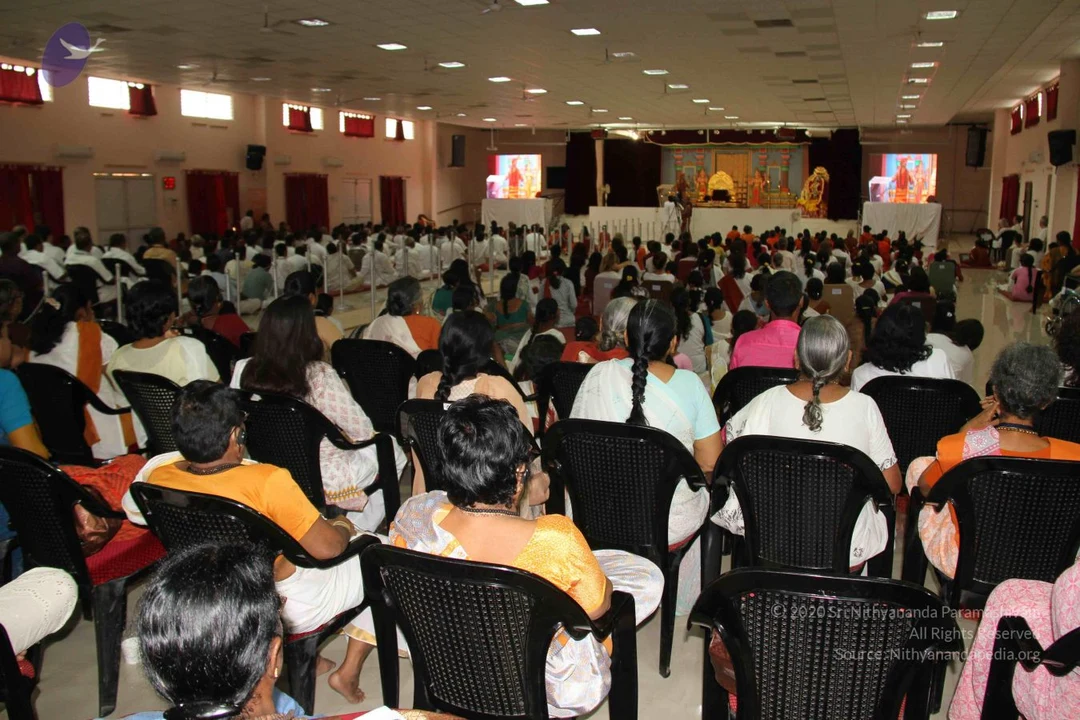
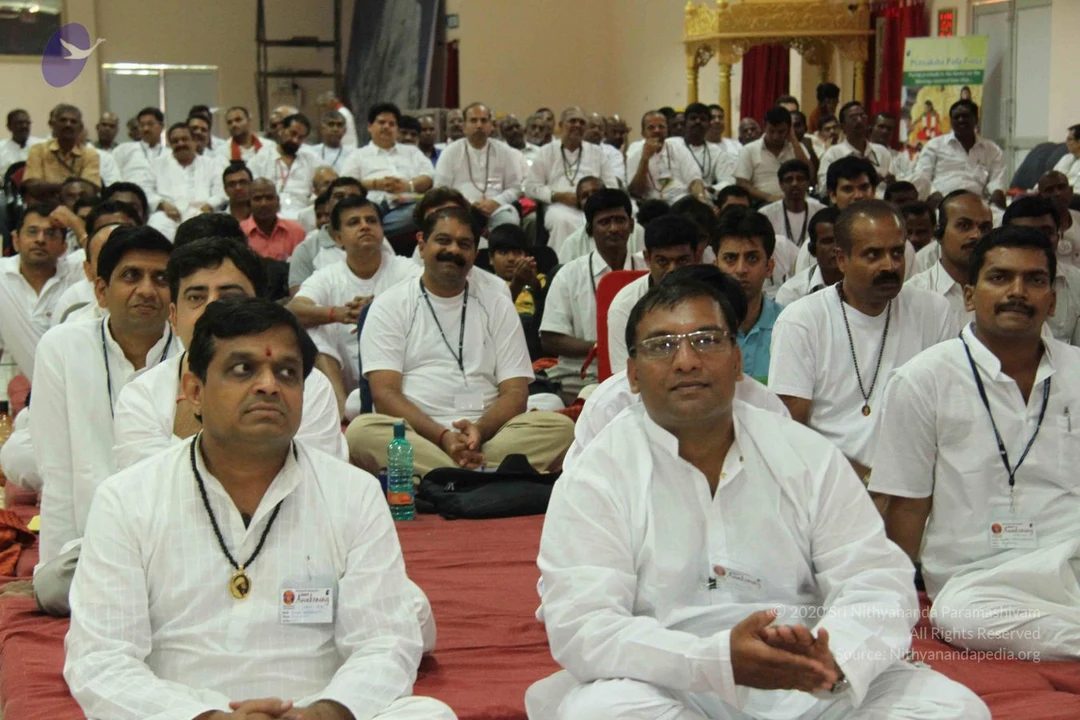
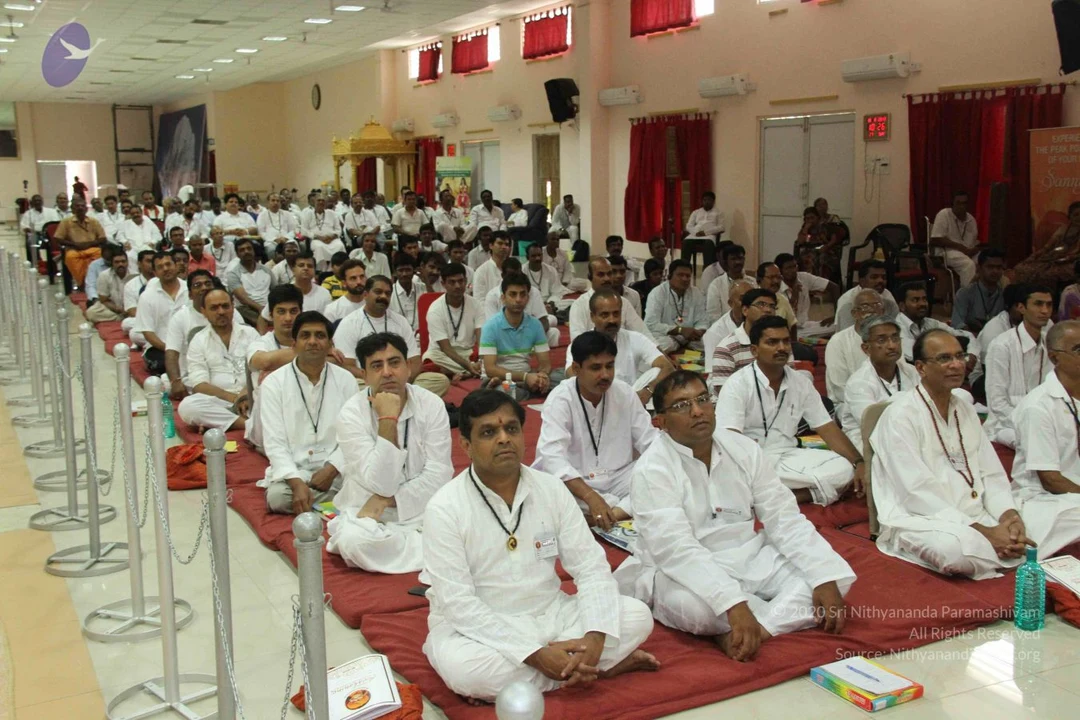
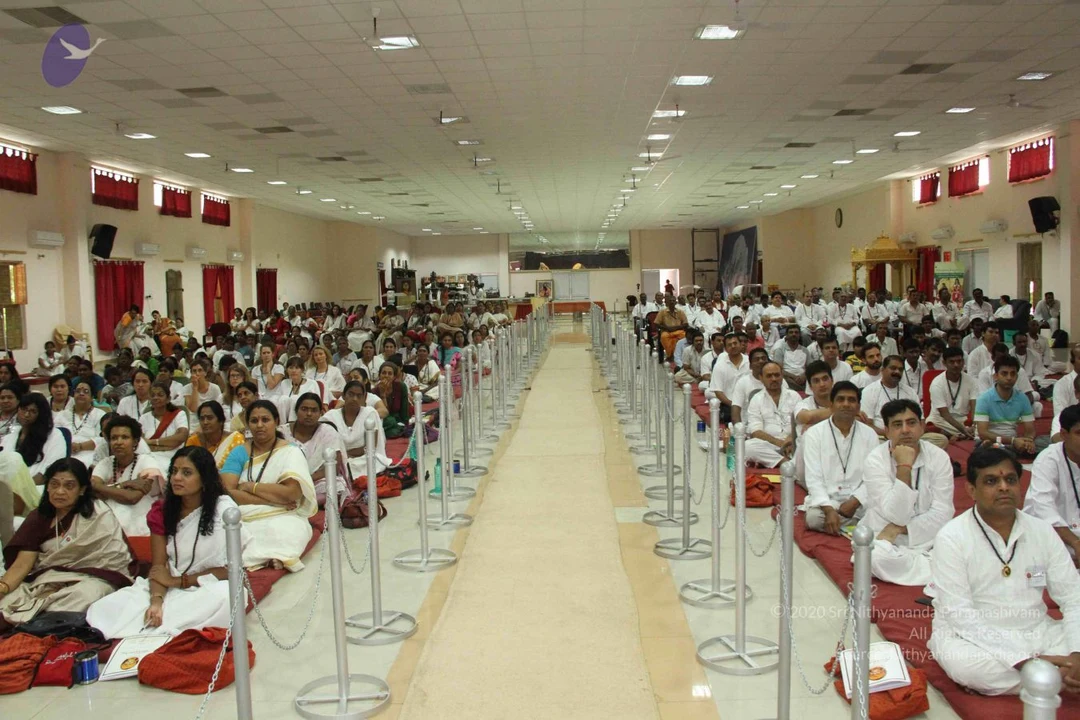
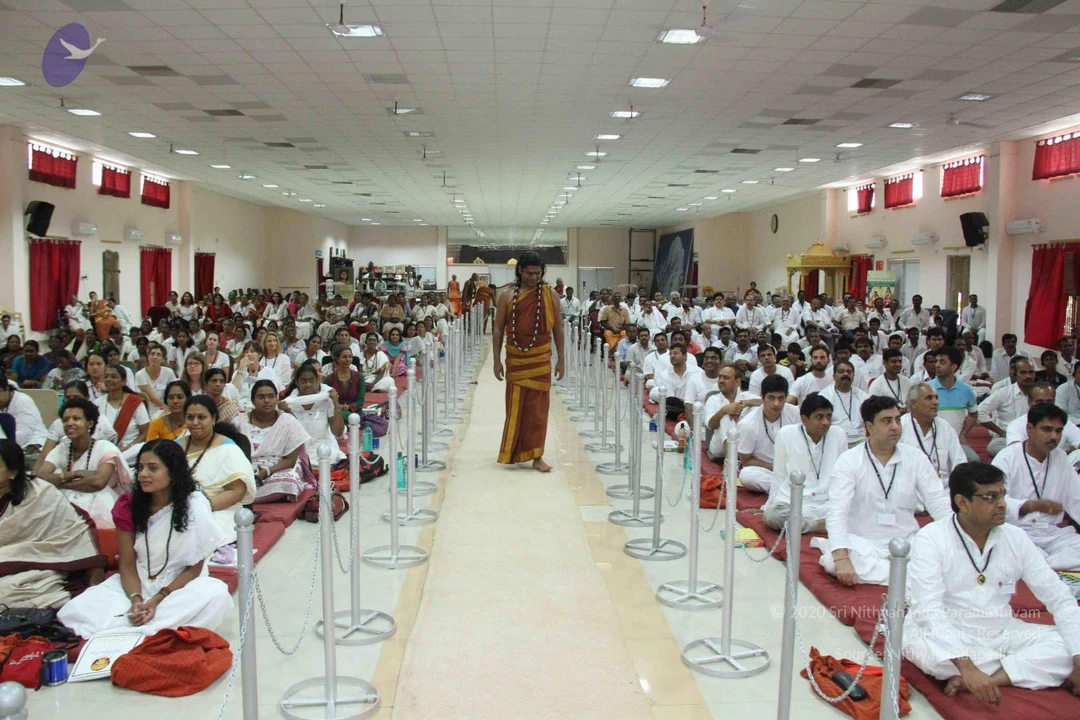
I welcome all of you who are sitting with us at this moment all over the world through Nithyananda TV, Lotus News TV, Eshwar TV, Sadhna TV, and two-way video-conferencing all over the world having Nayana Deeksha.

Cities sitting with us in two-way video-conferencing having Nayana Deeksha all over the world: Tiruvannamalai, Prayag...Ohio...Ohio-Prayag, Kuala Lumpur, Los Angeles, Guru’s Gate-California, Toronto-Kailasam, Guadeloupe, San Jose, Oklahoma, Seattle, Varanasi, Charlotte, Singapore, Lyon-France, Bangaluru North, Los Angeles Downtown, Hong Kong, Auckland-New Zealand, Grasse-France, Port Washington-New York, Kathmandu-Nepal, San Diego-Thiru Alavai, Annanagar-Chennai, Andheri-Mumbai, Milind-Mumbai, Dubai-Vaidyanatham, Slovakia, Houston, Oman, Colorado Springs, Redmond-Washington, Tallahassee-Florida, Melbourne-Australia, Scottsdale, New Jersey-Omkareshwar, (that's it?)... Vancouver, New York, Hyderabad-Gupta Kashi, Annanagar…..

I welcome all of you with my Love and Blessings.

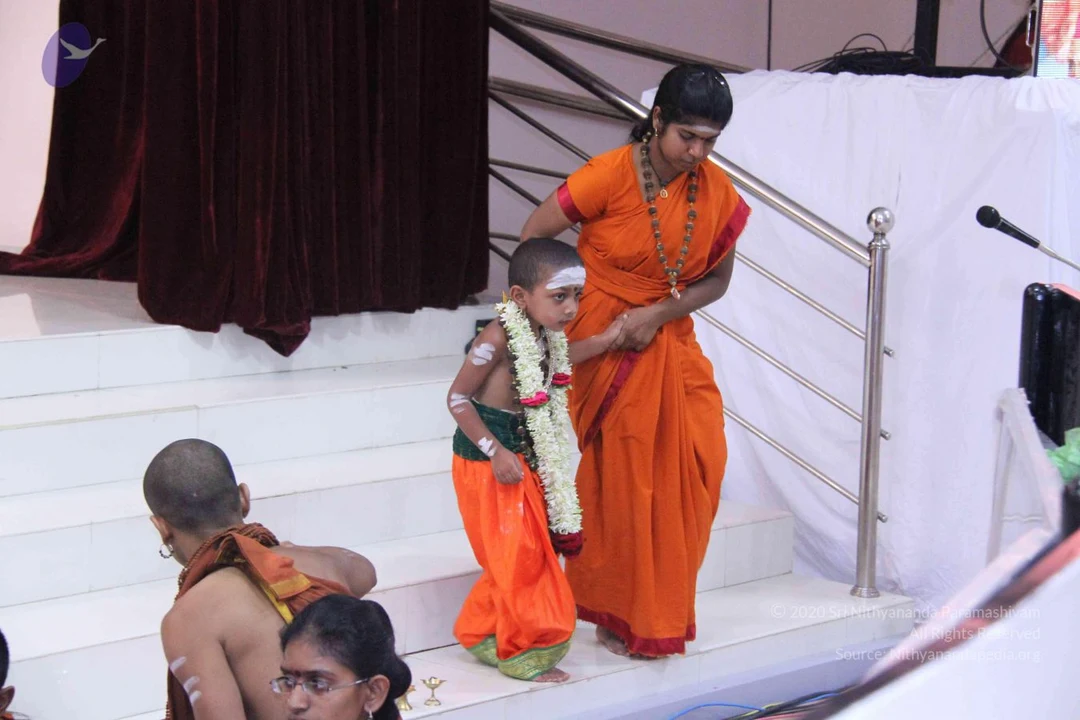
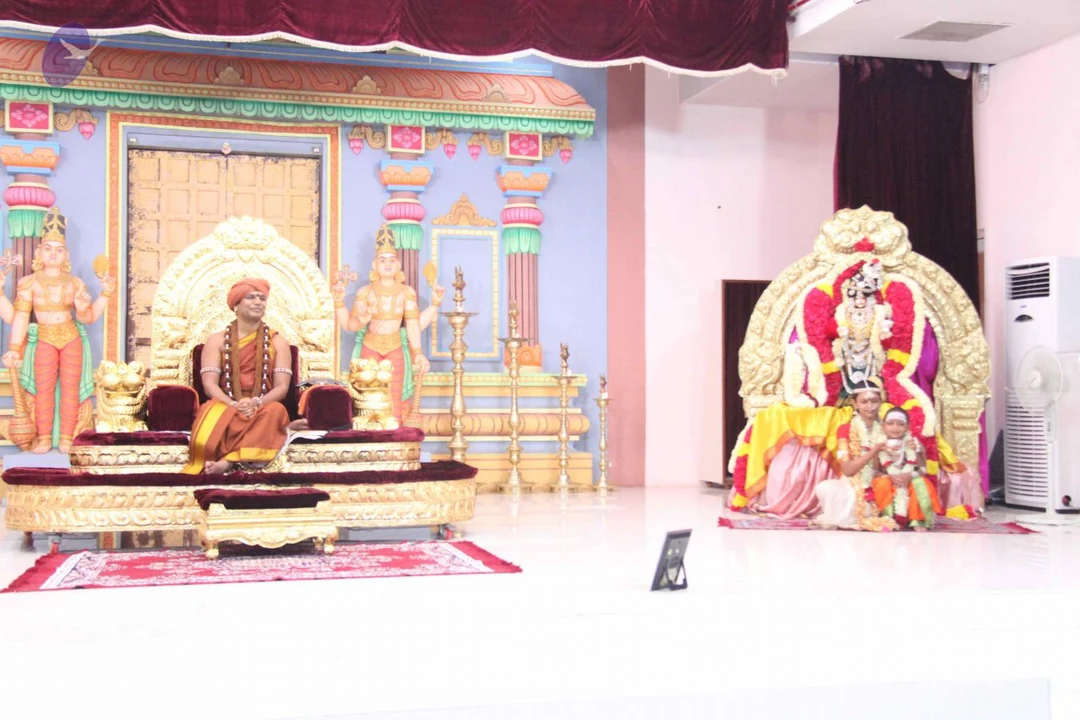
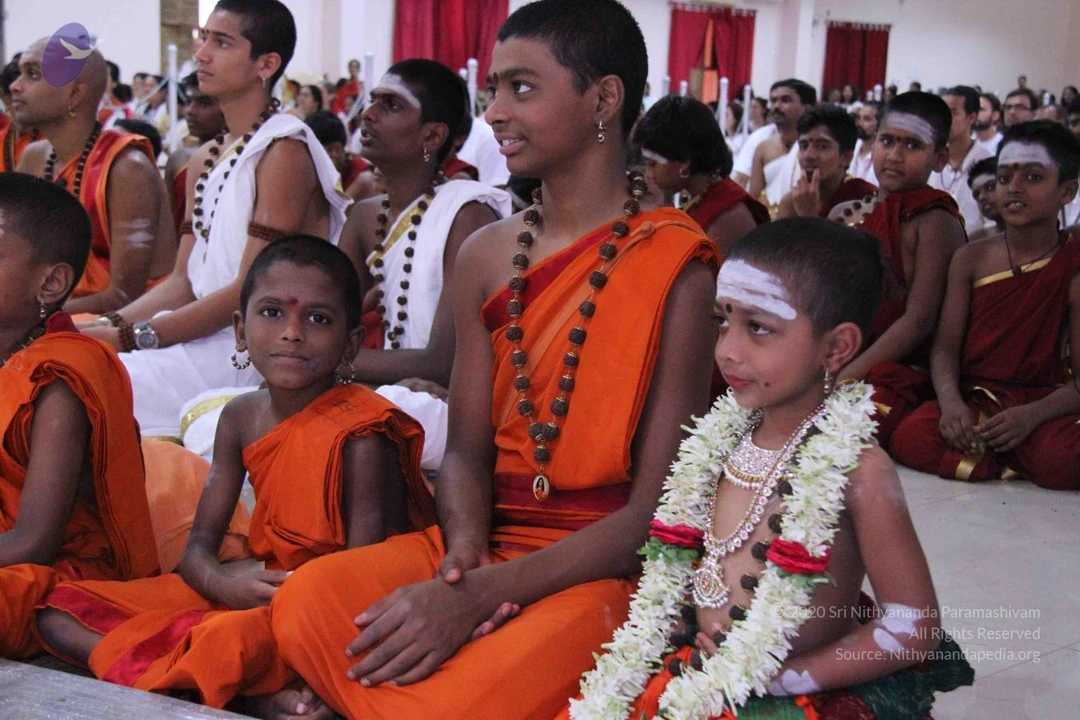
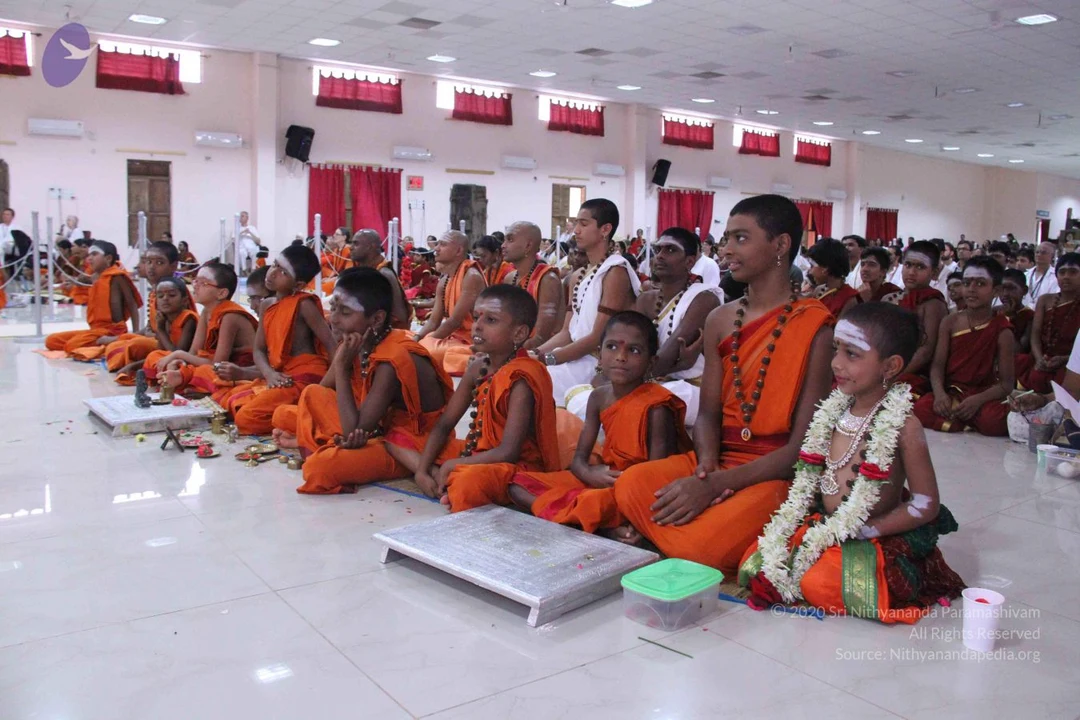
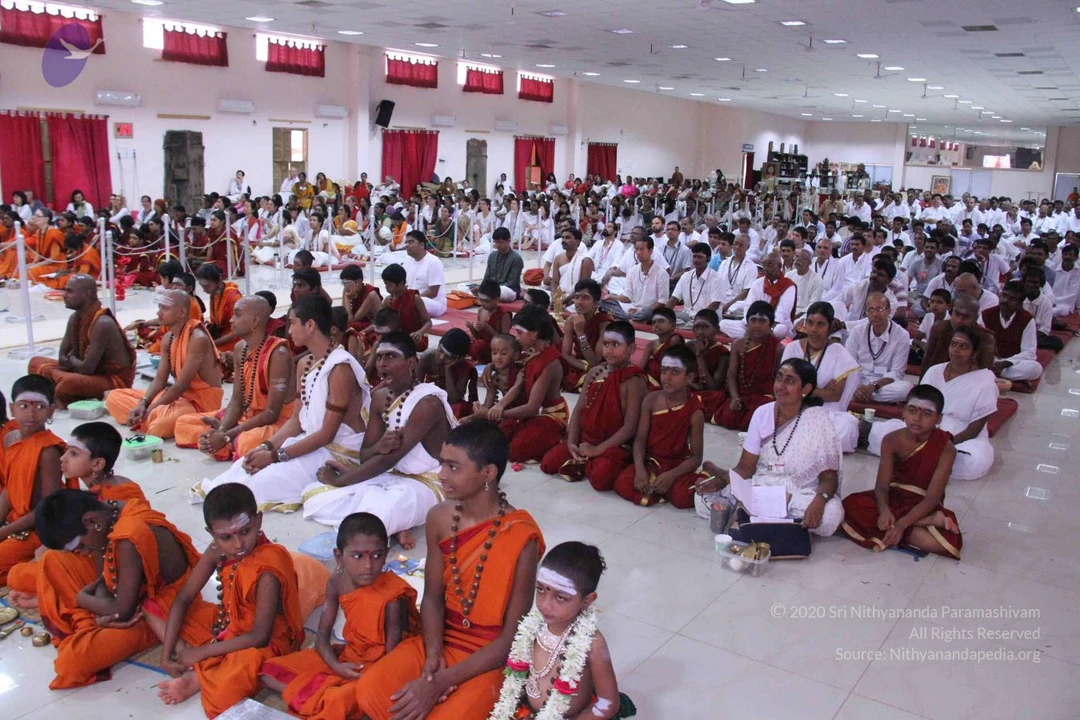
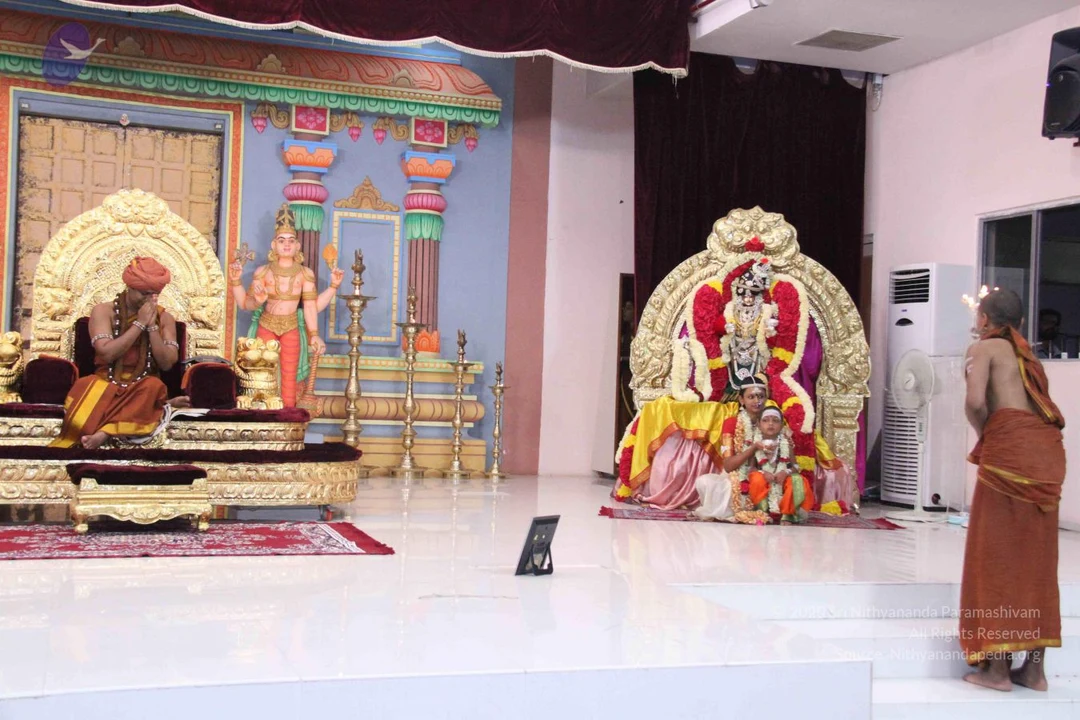
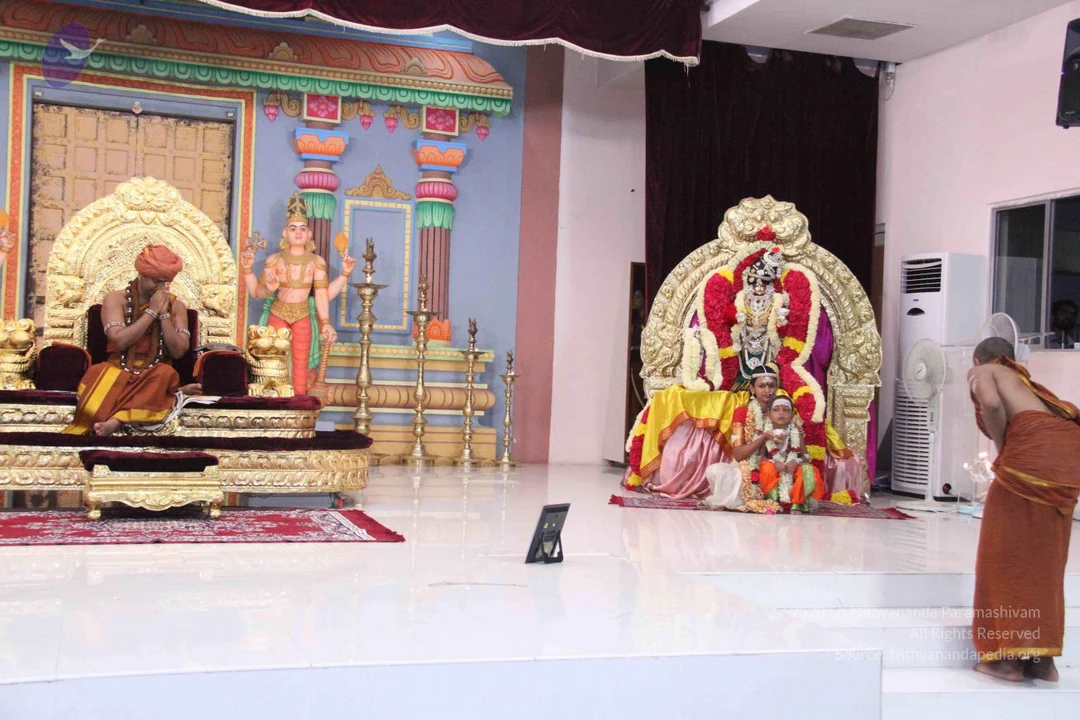
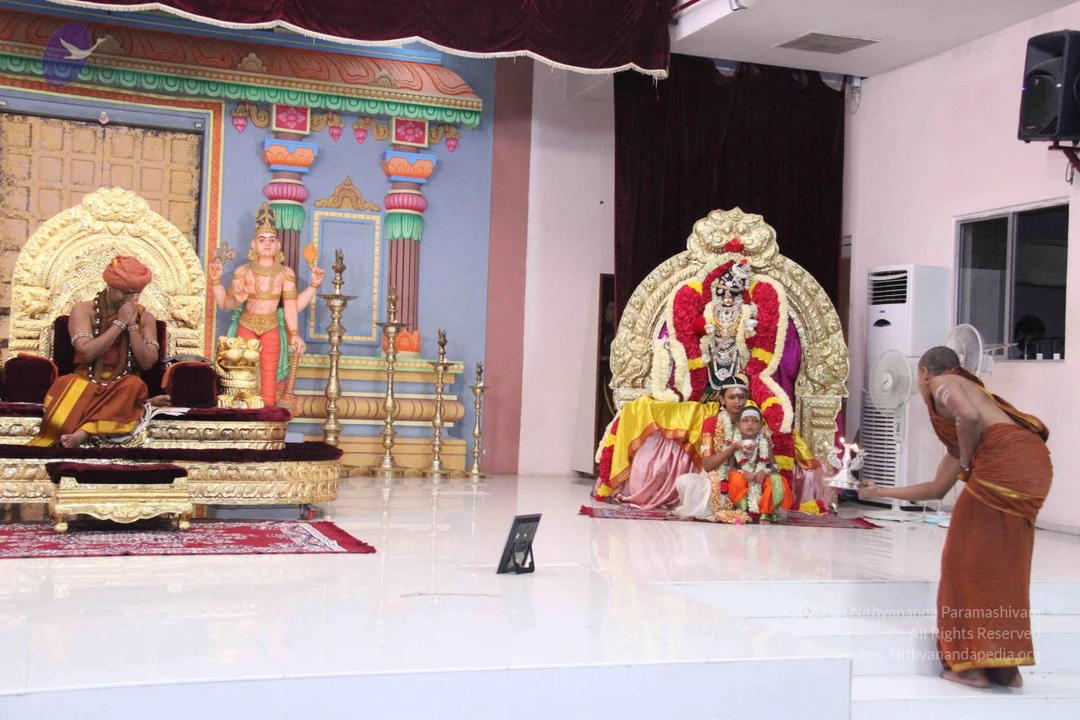
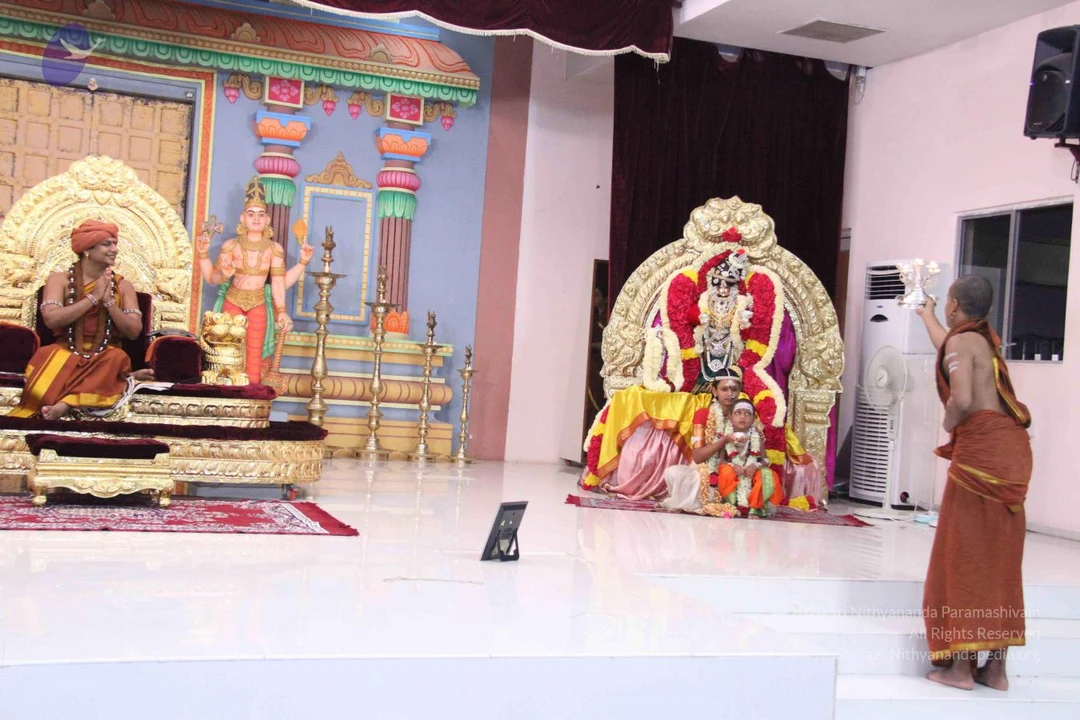
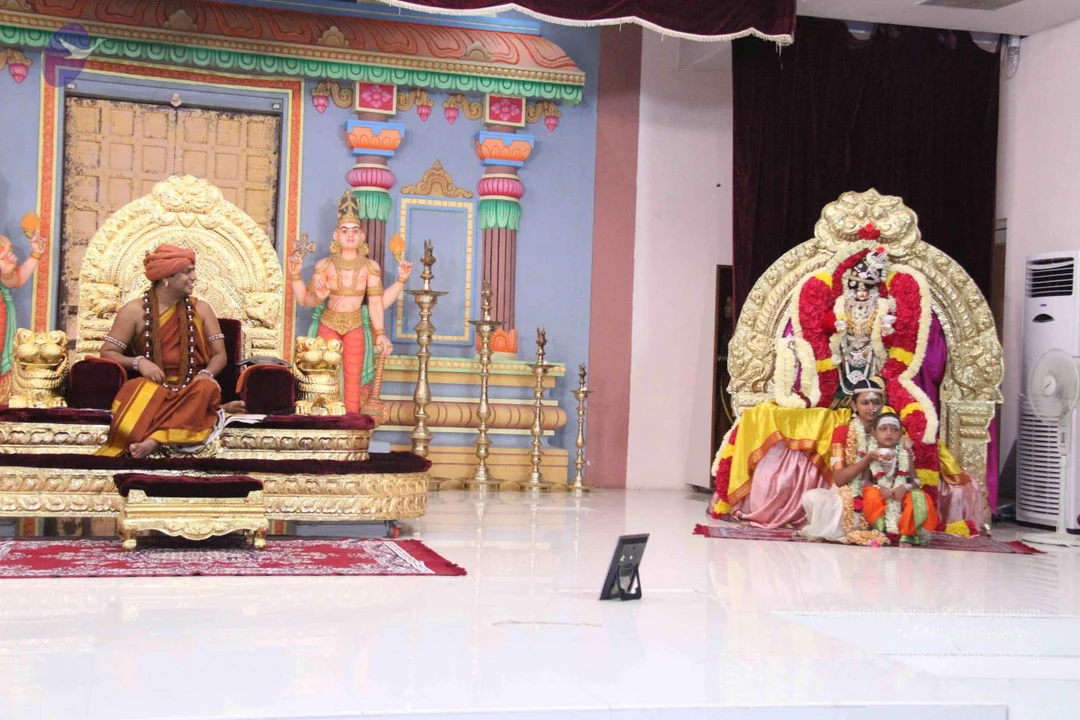
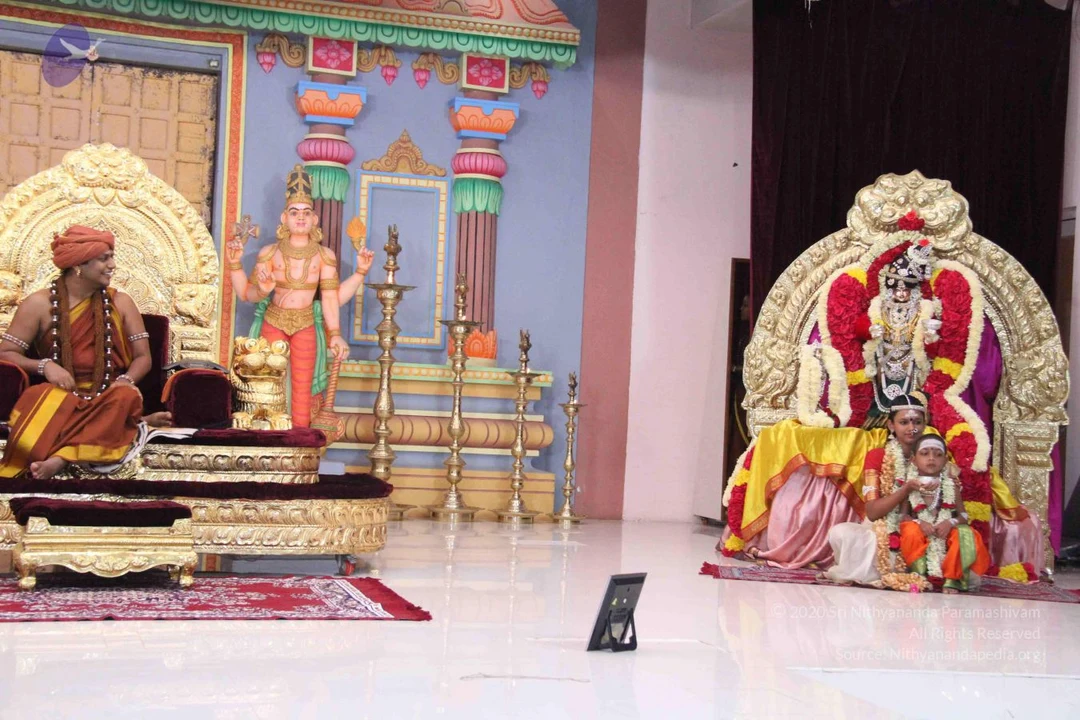
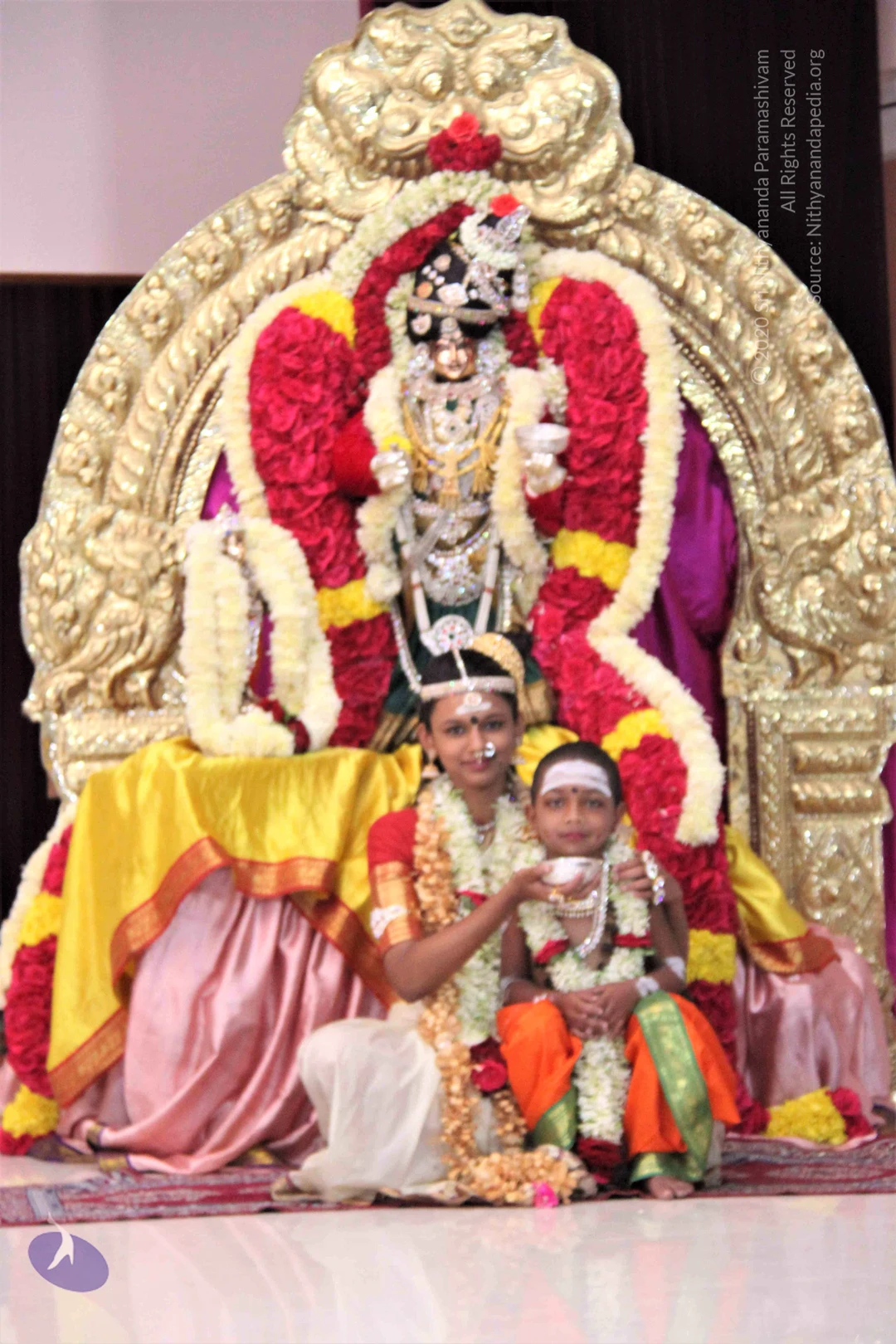
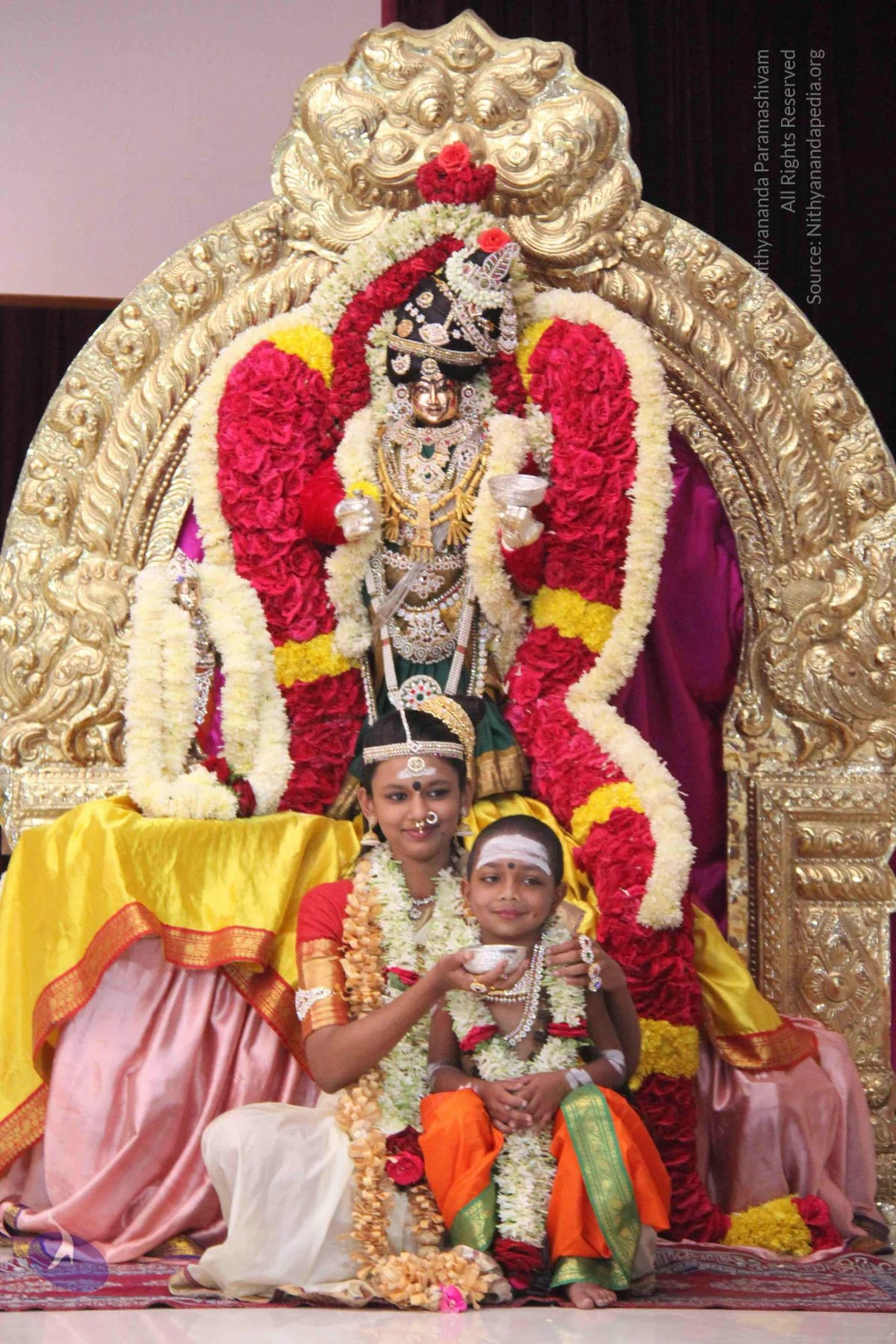
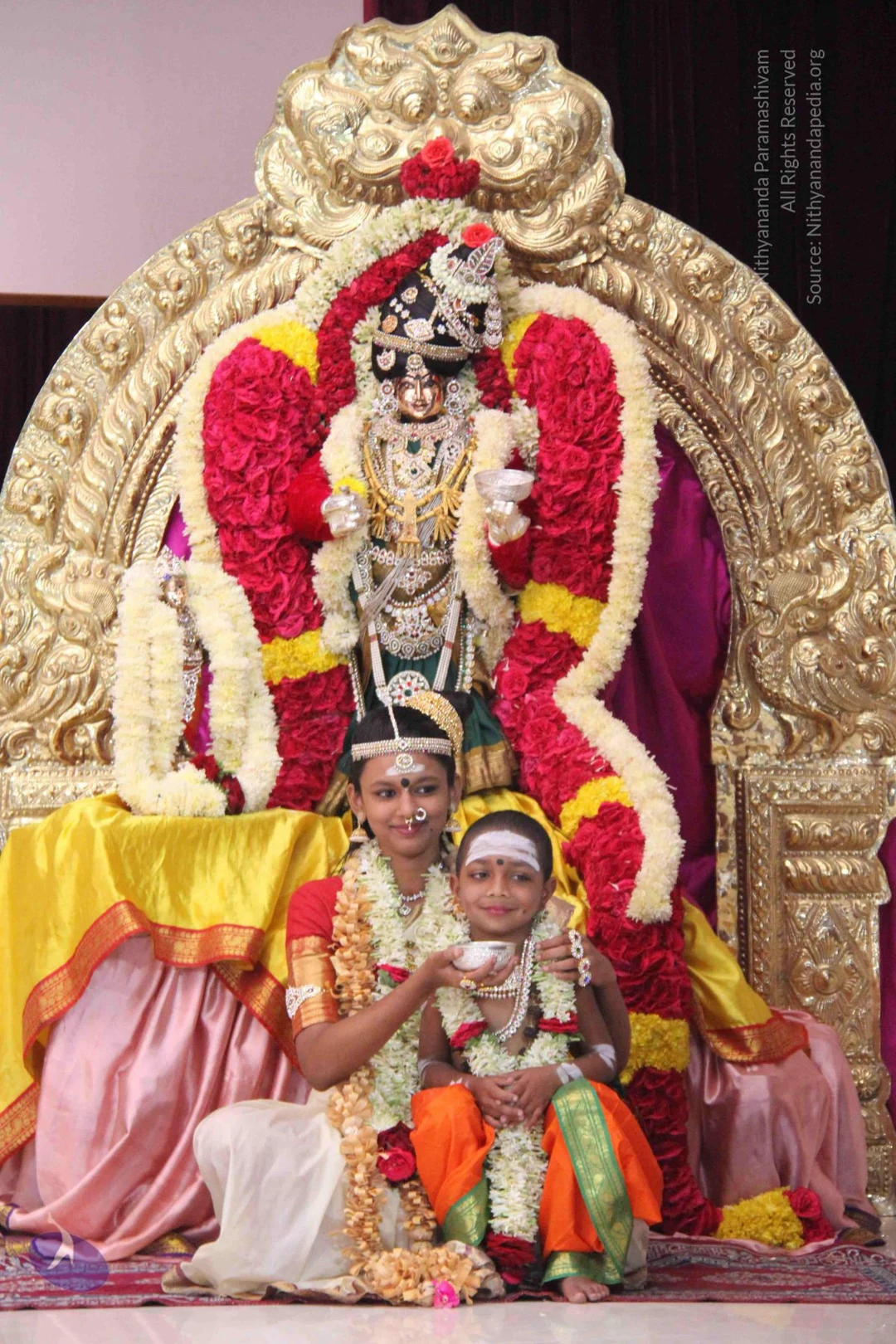
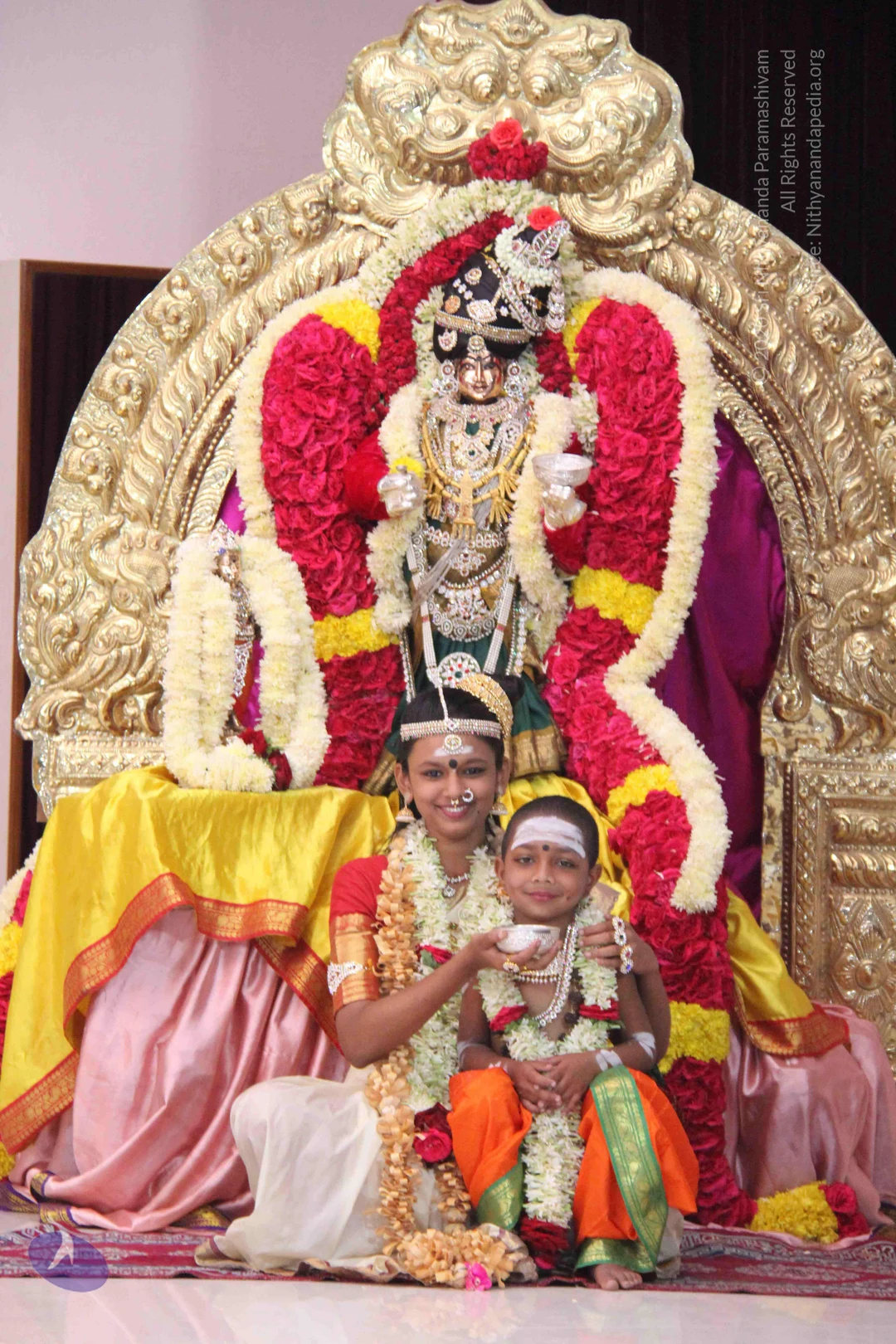
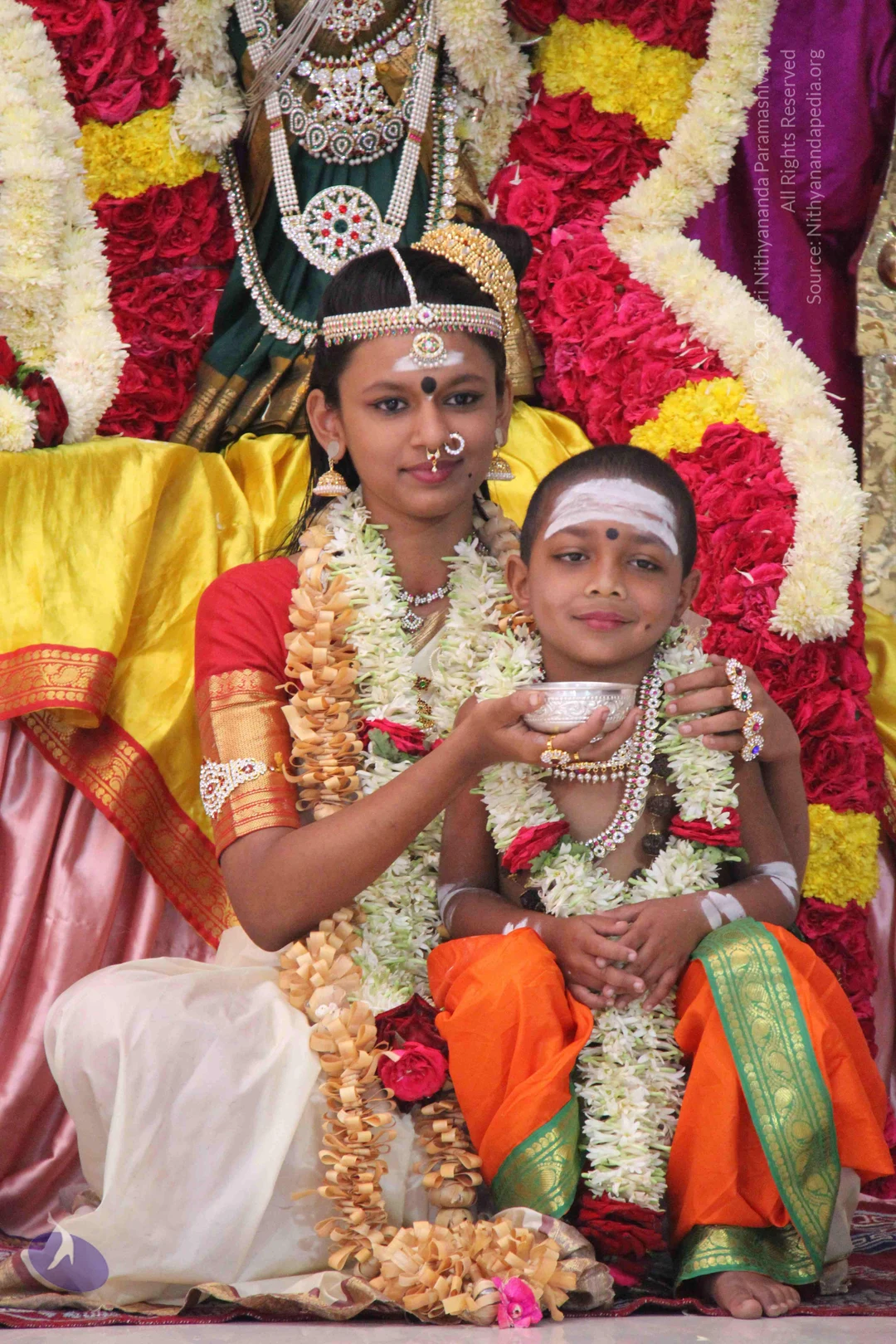
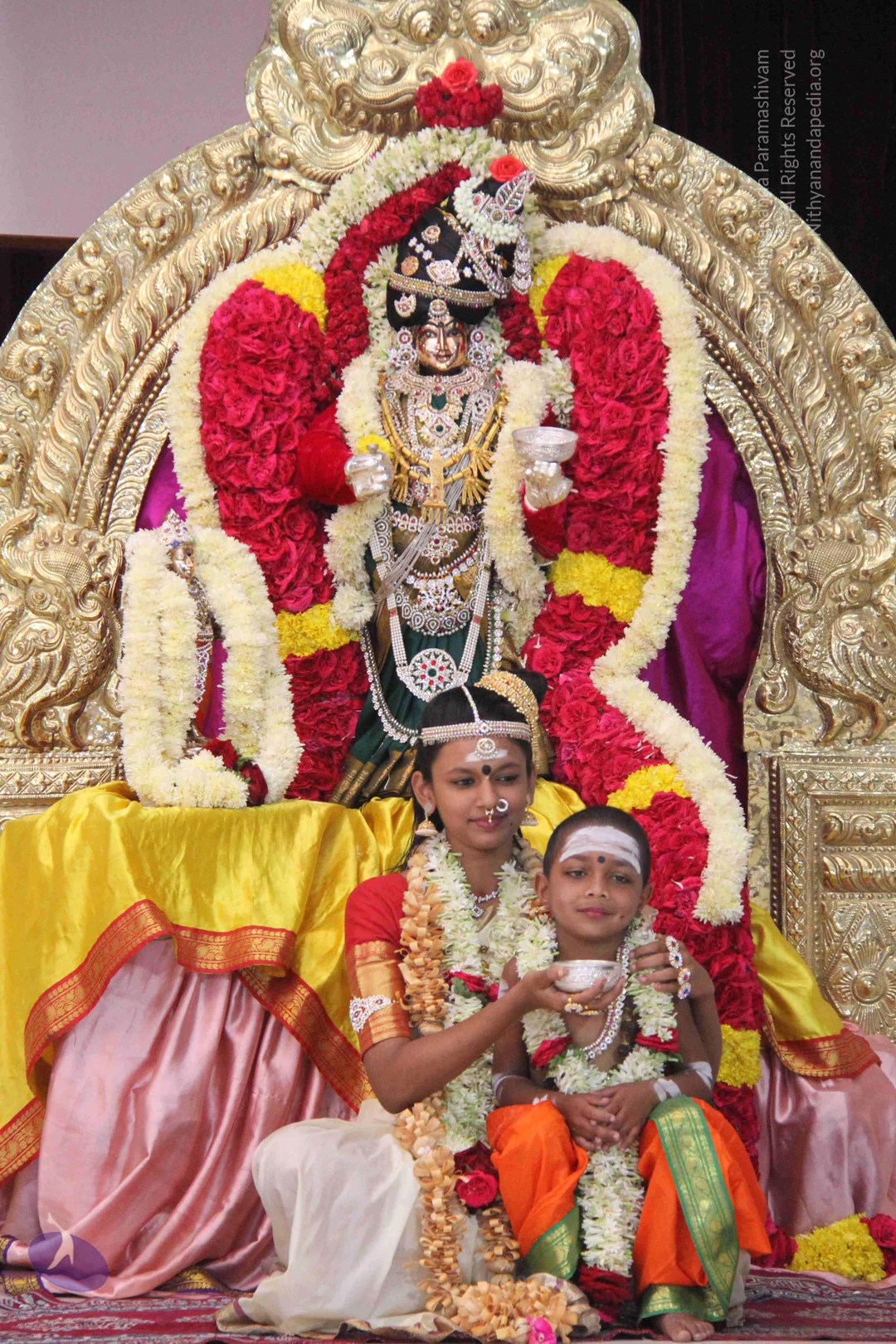
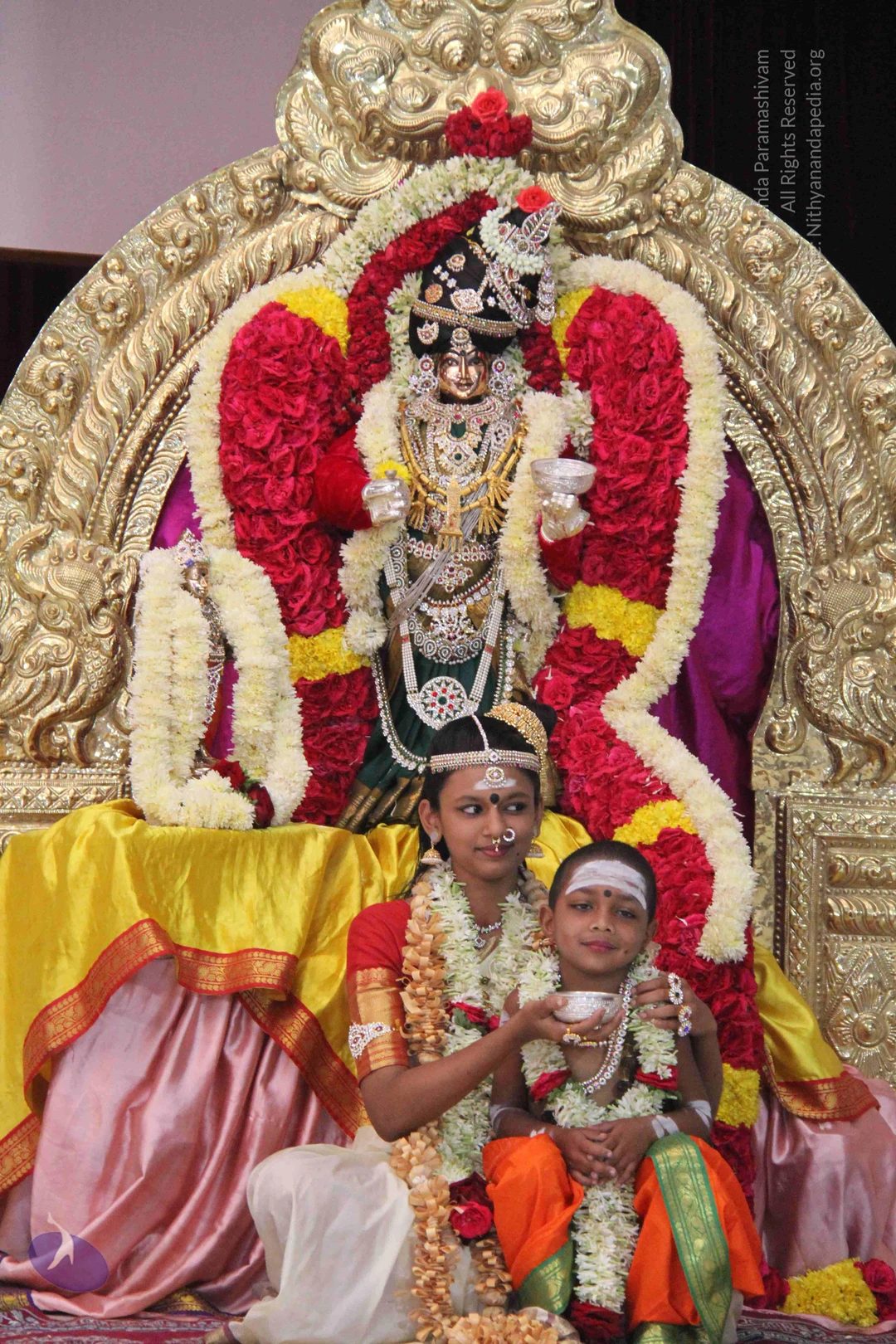
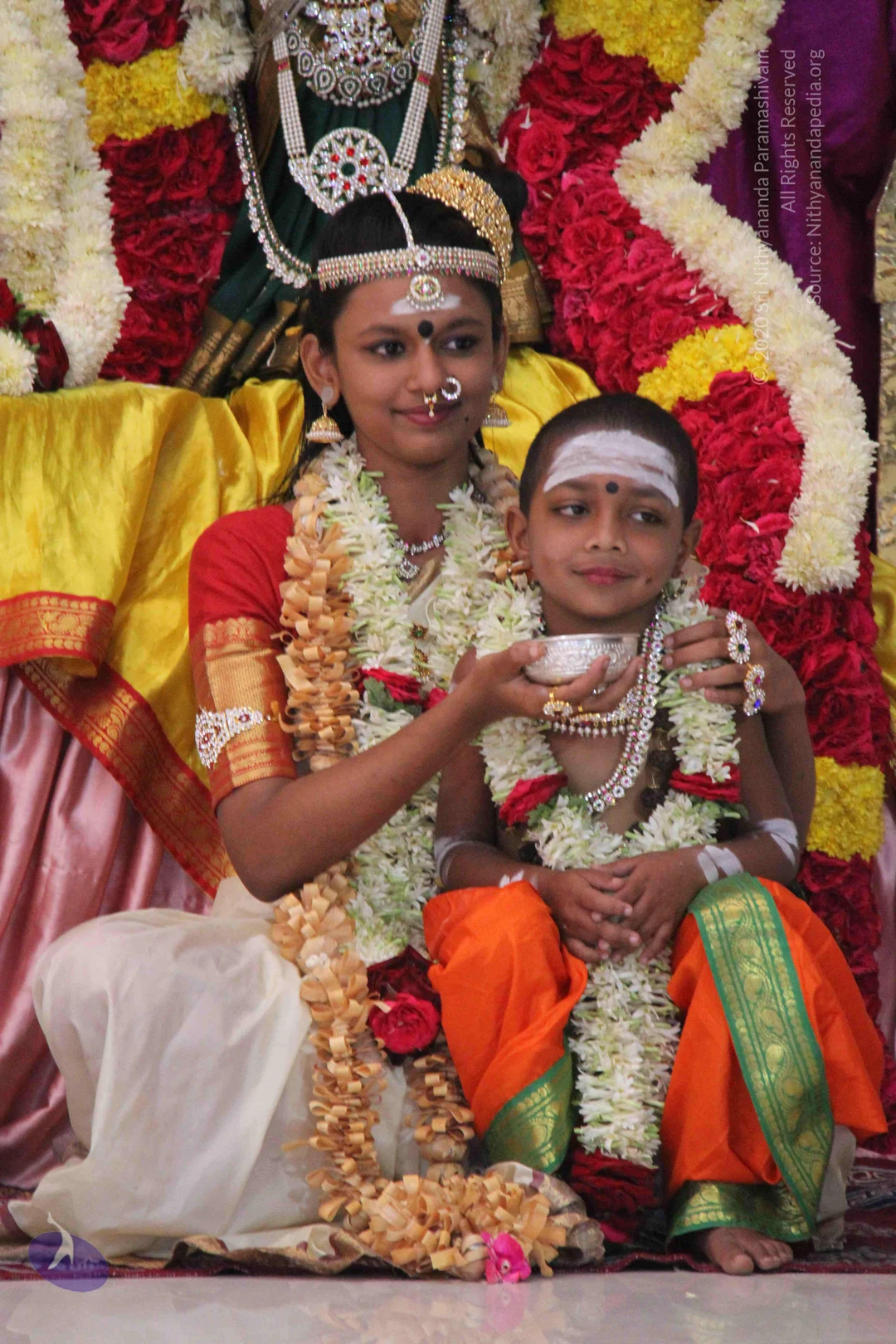
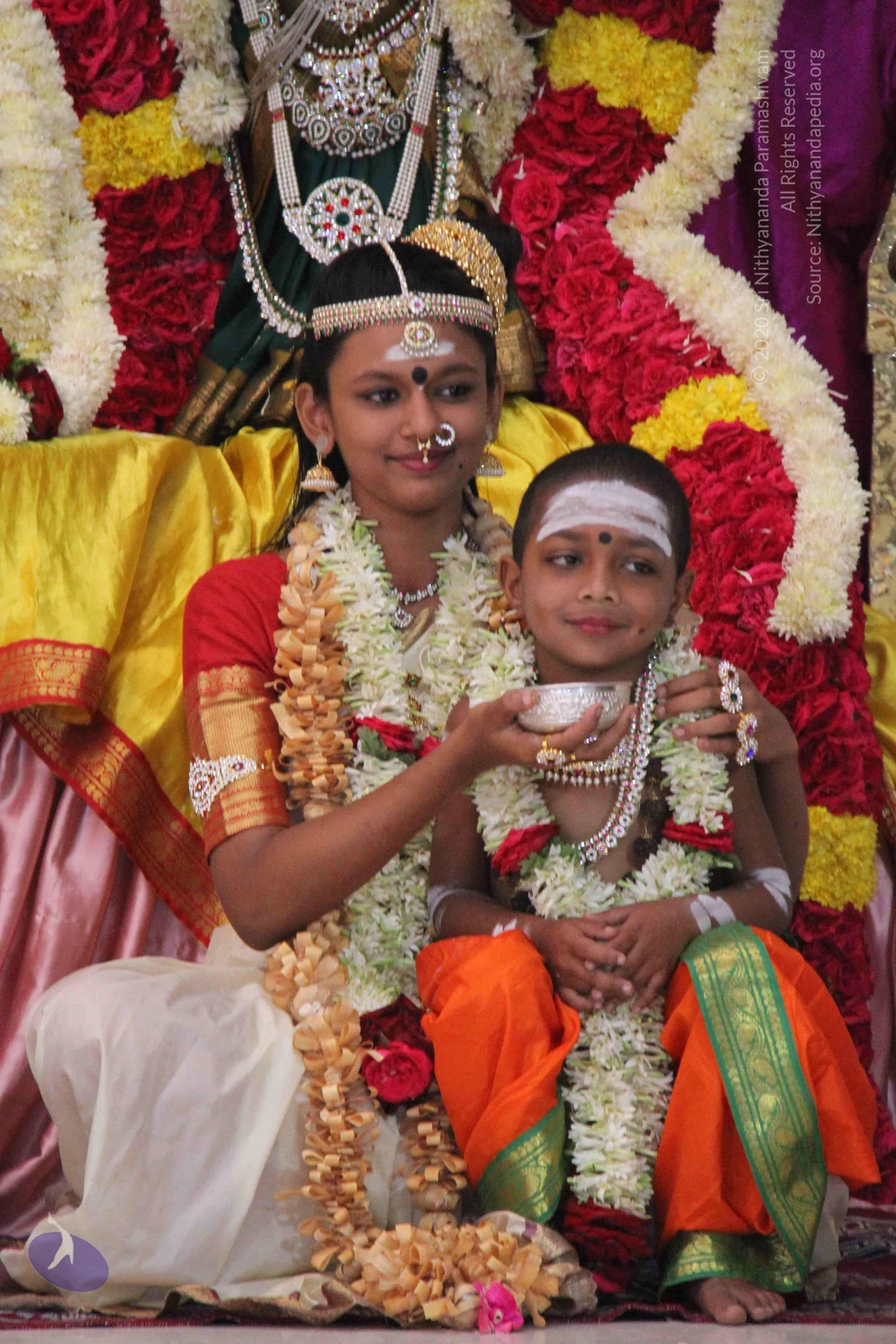
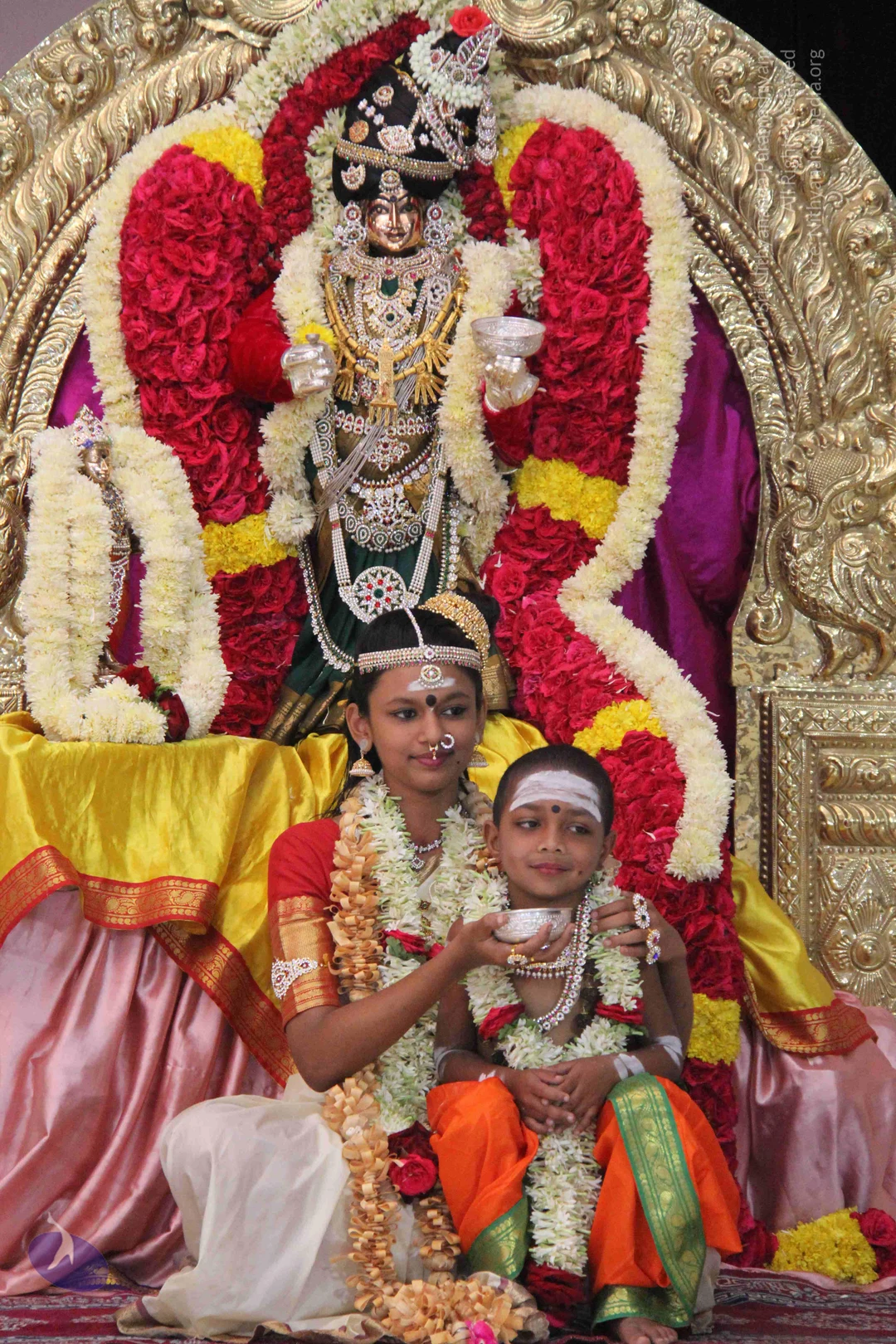
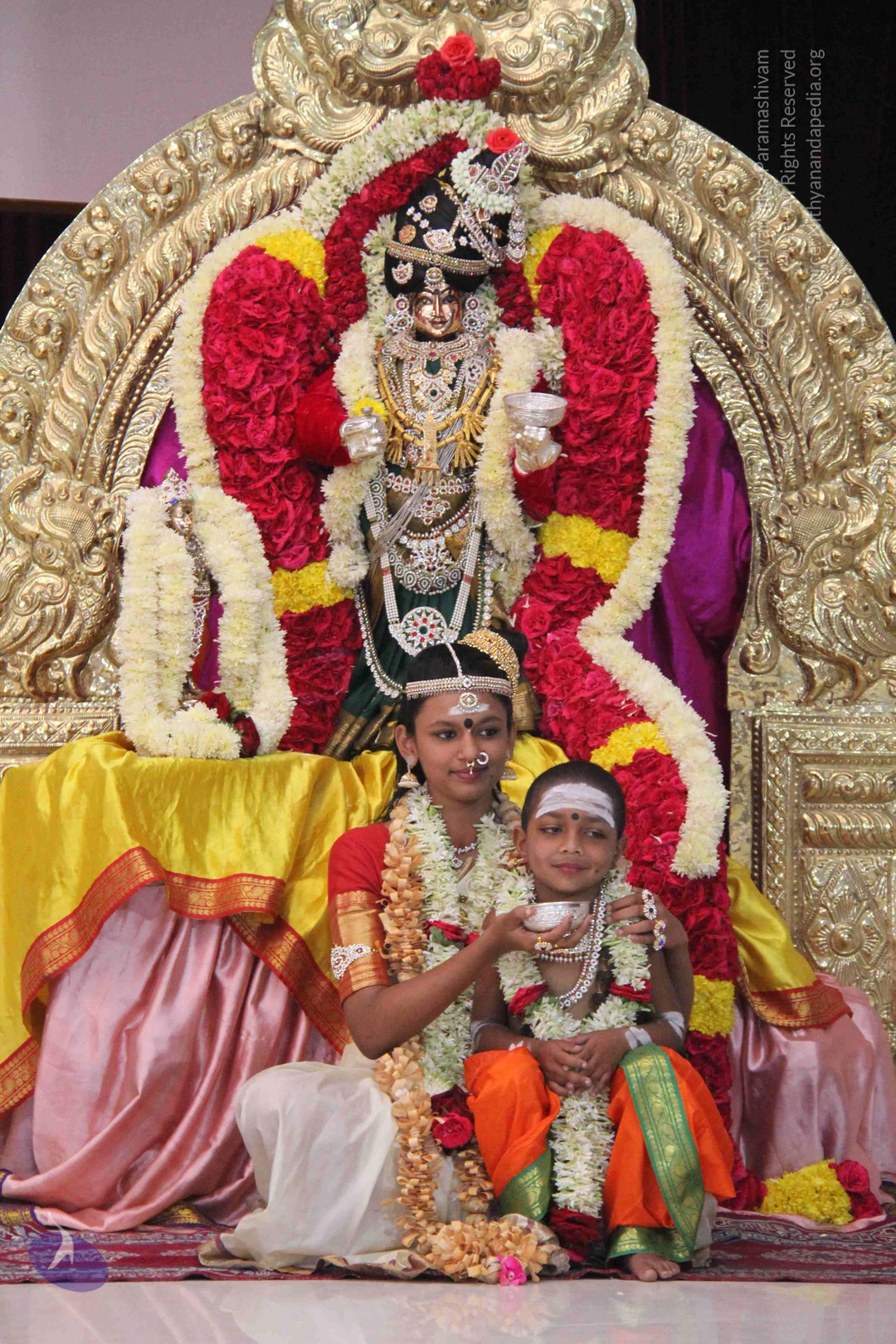
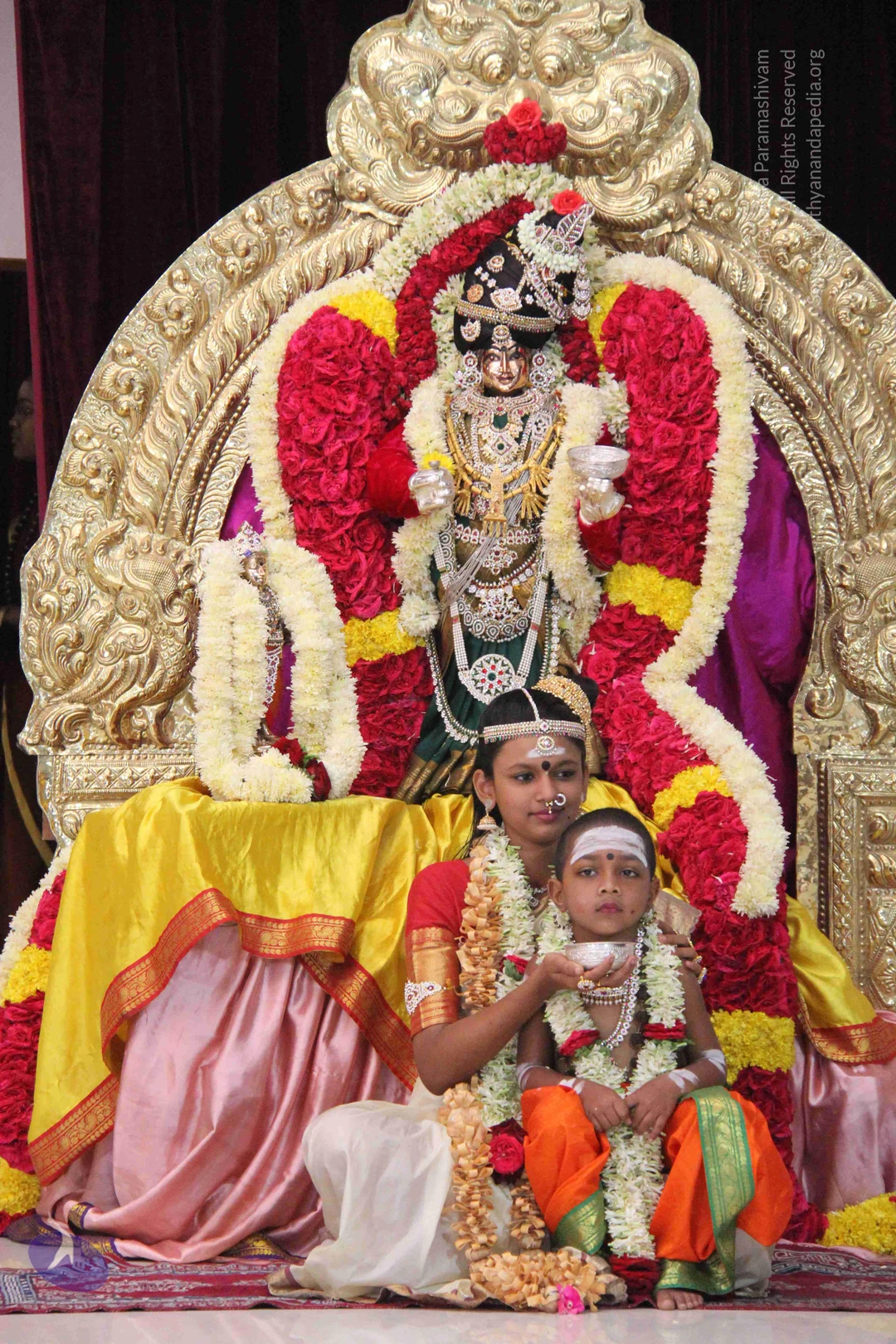
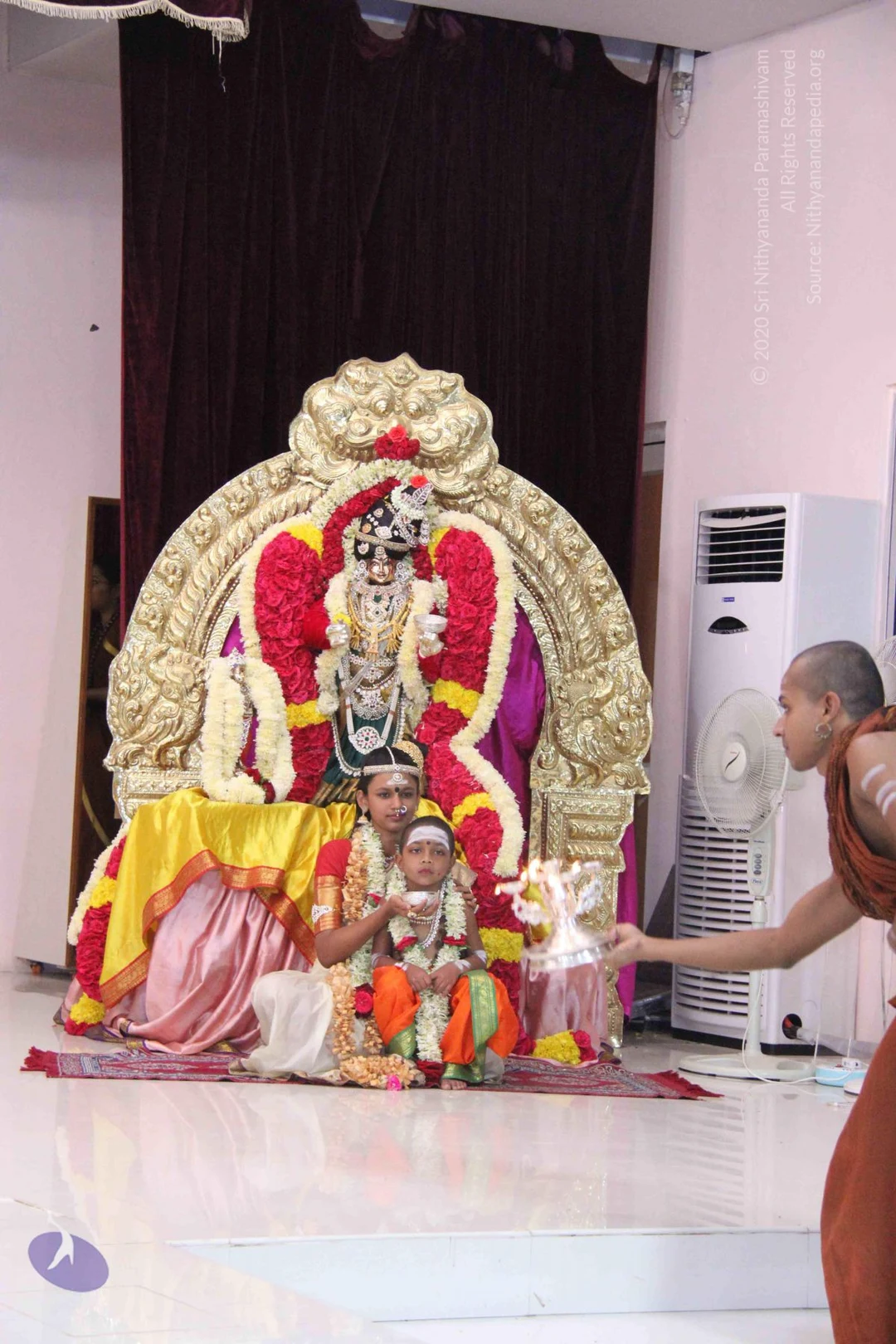
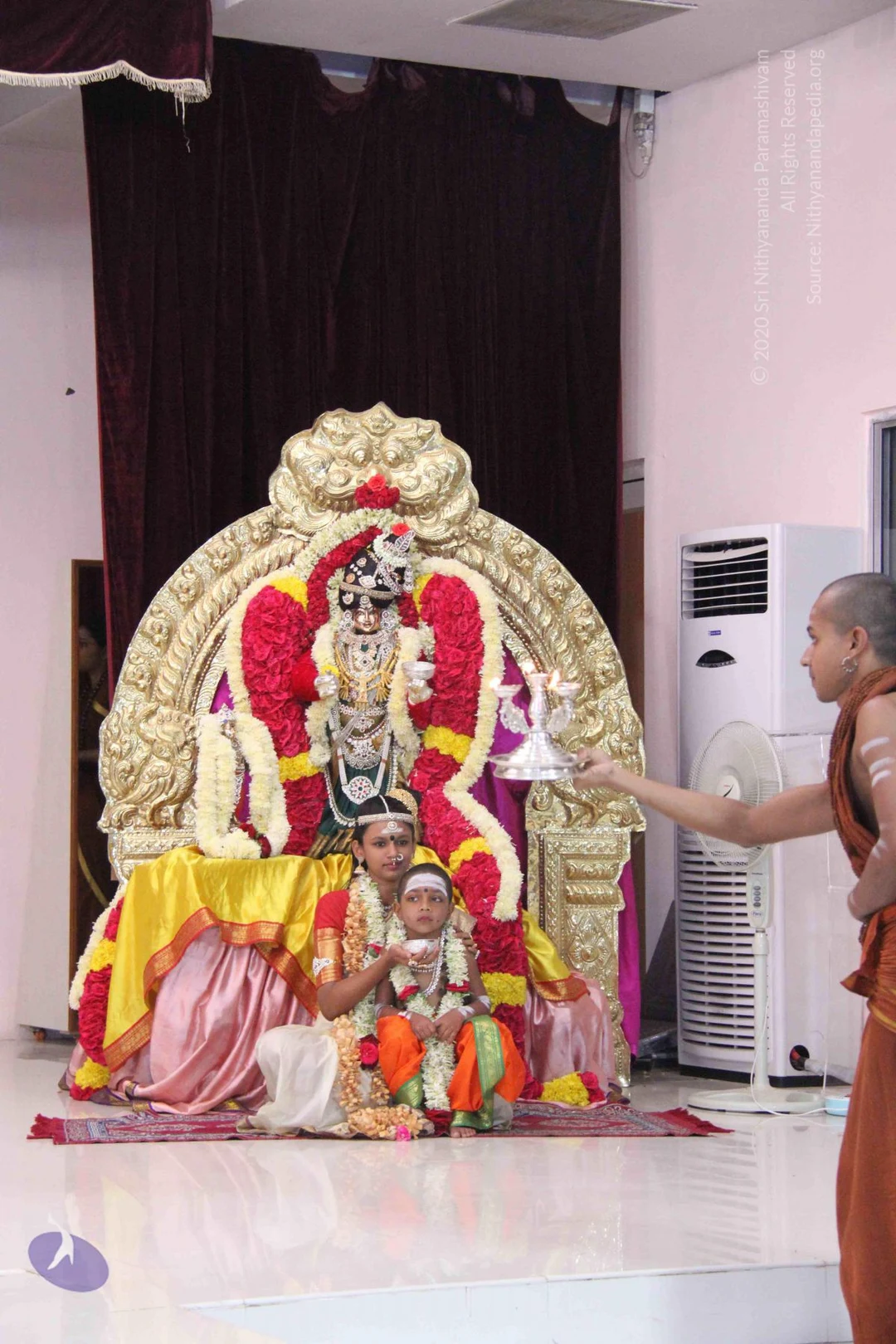
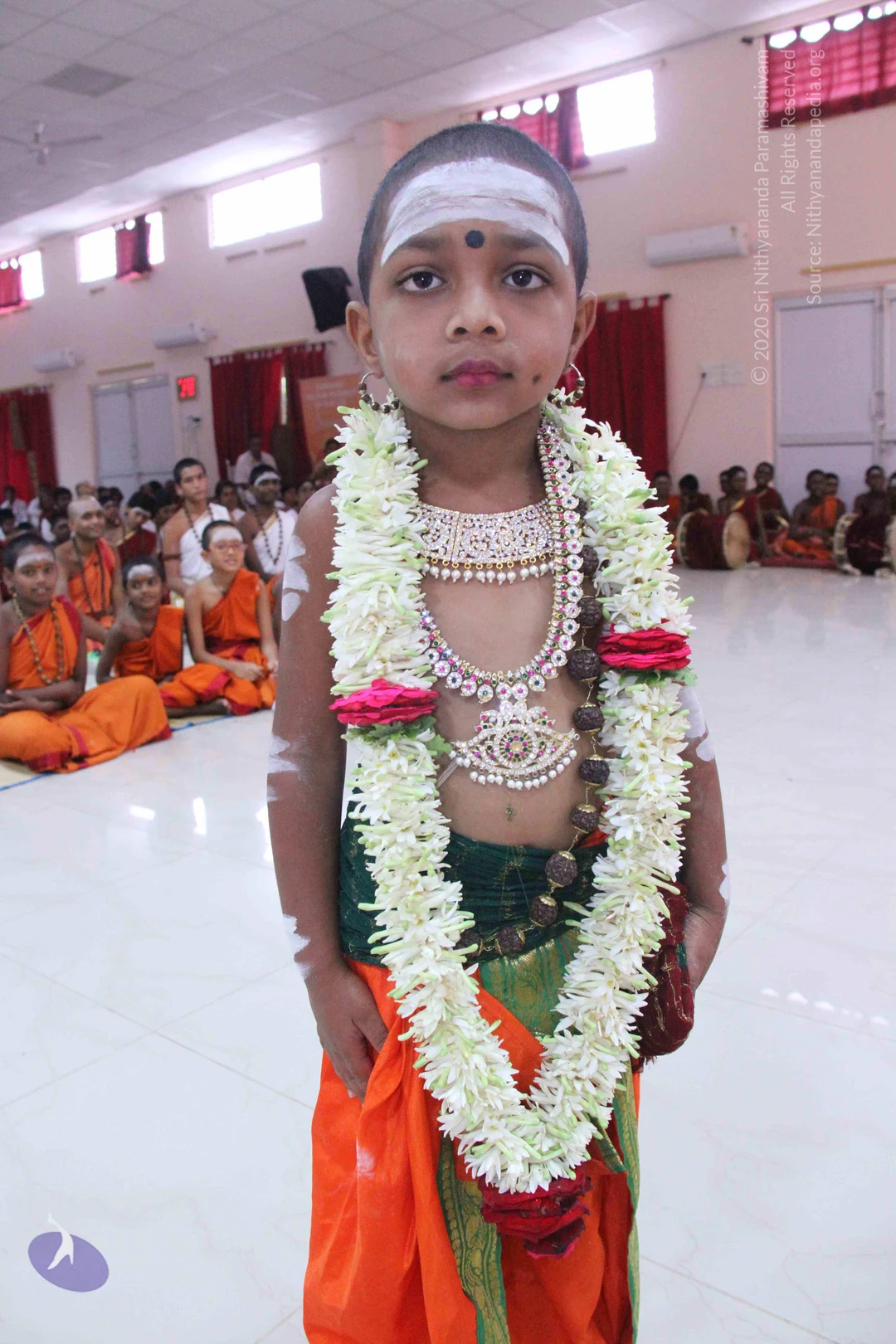
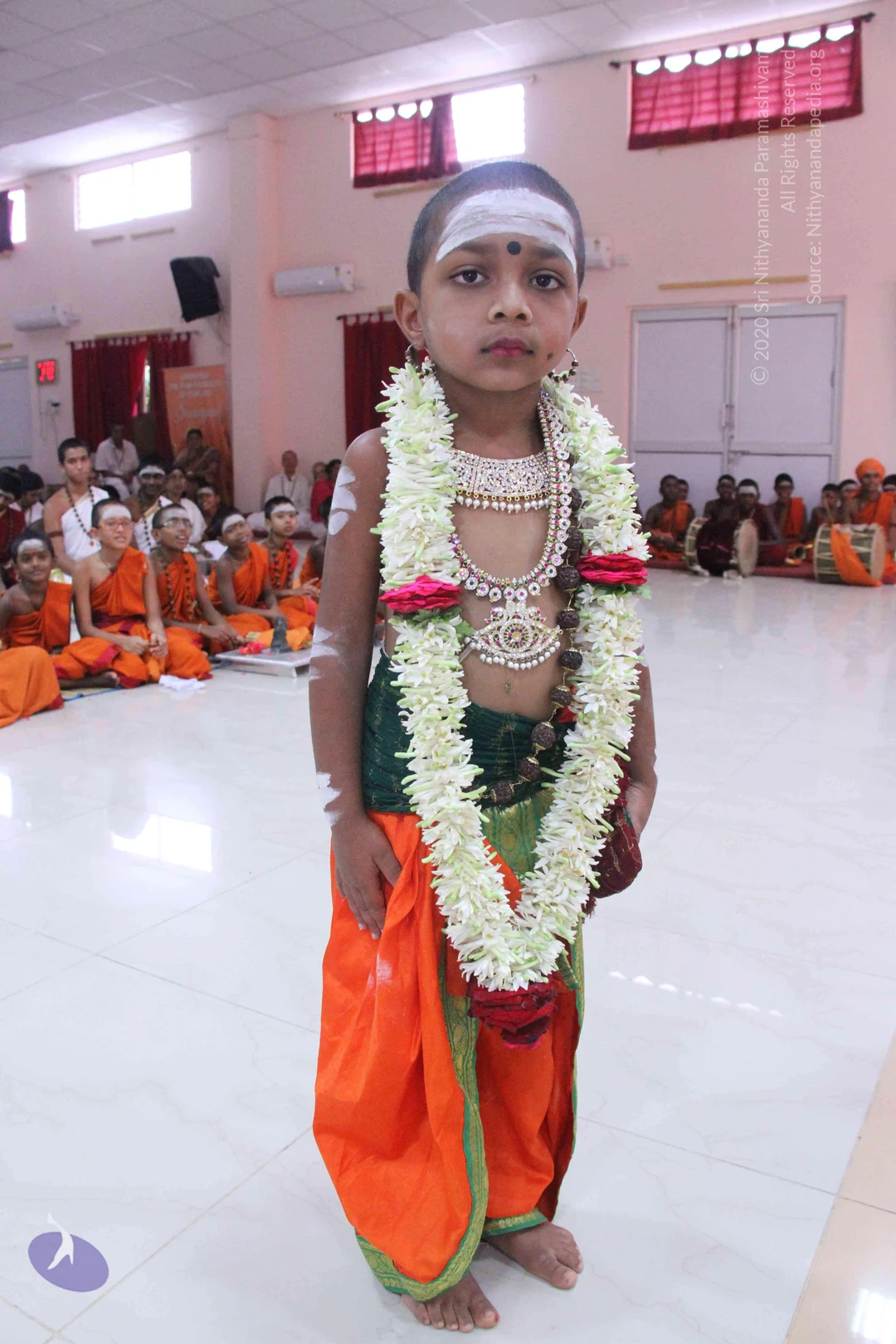
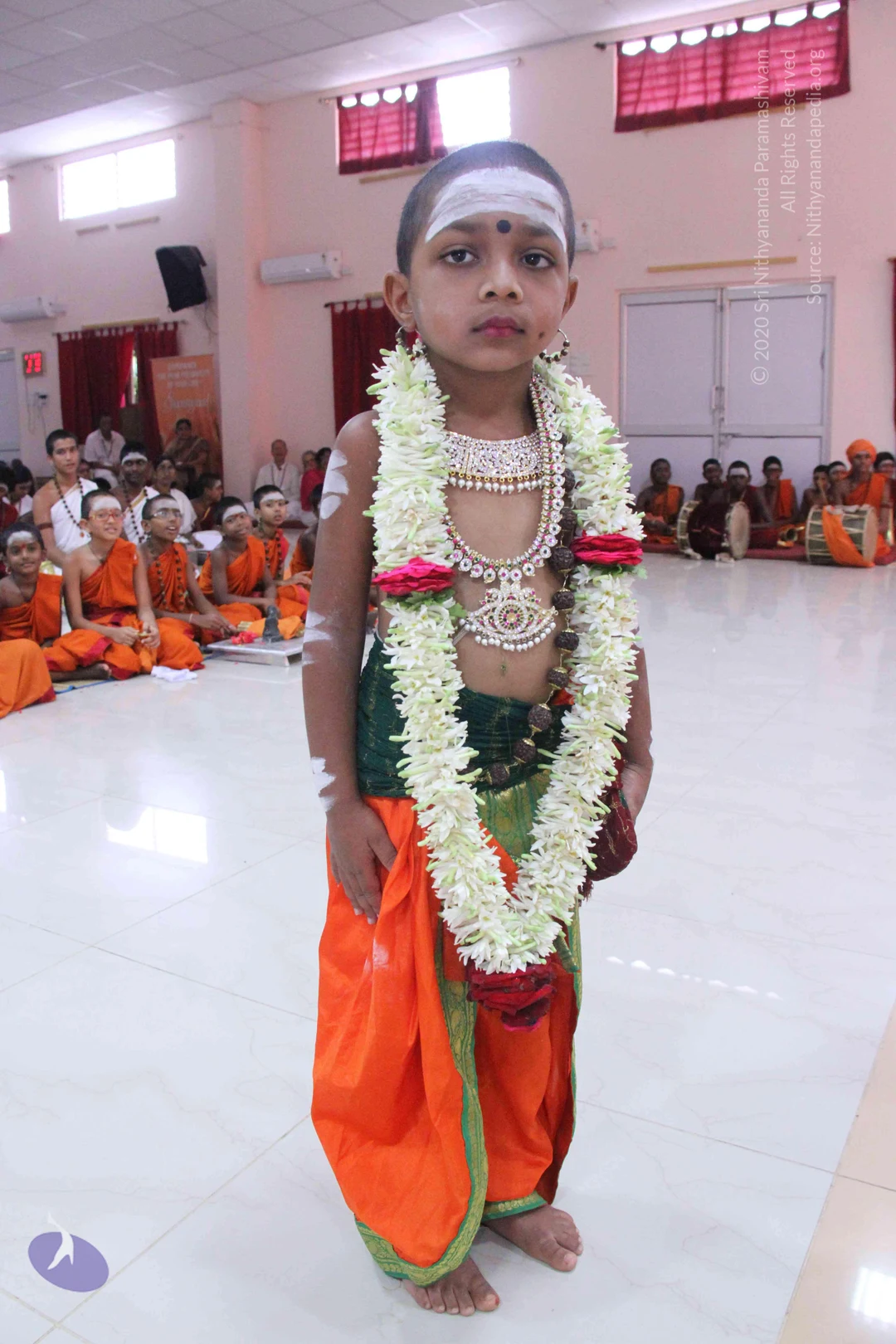
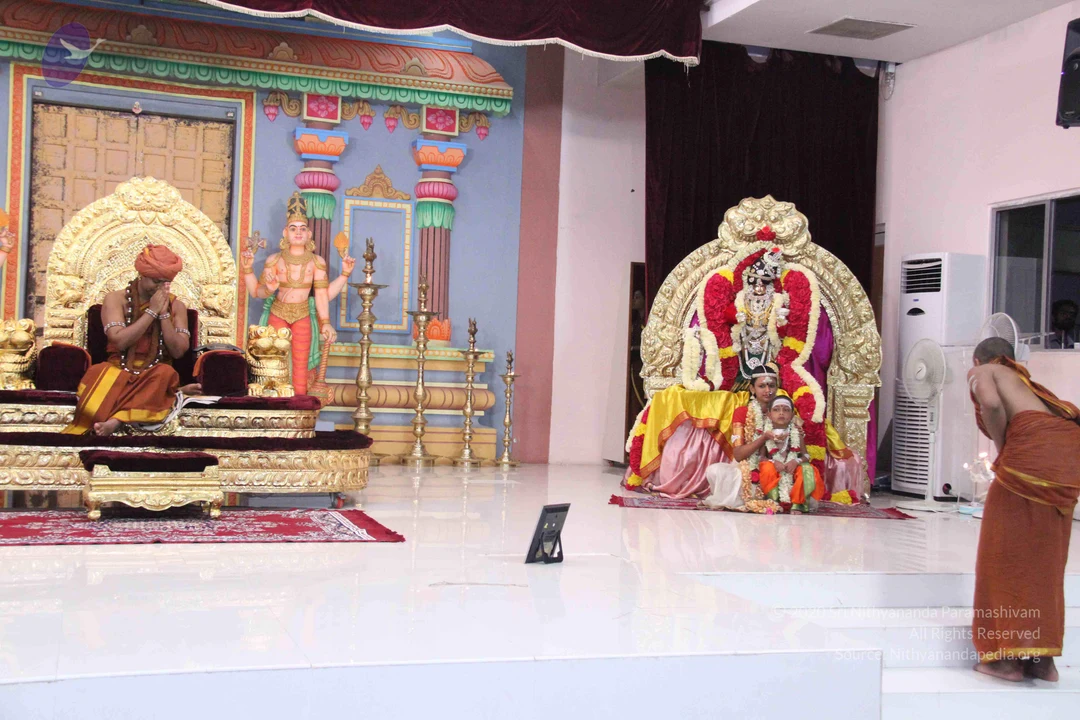
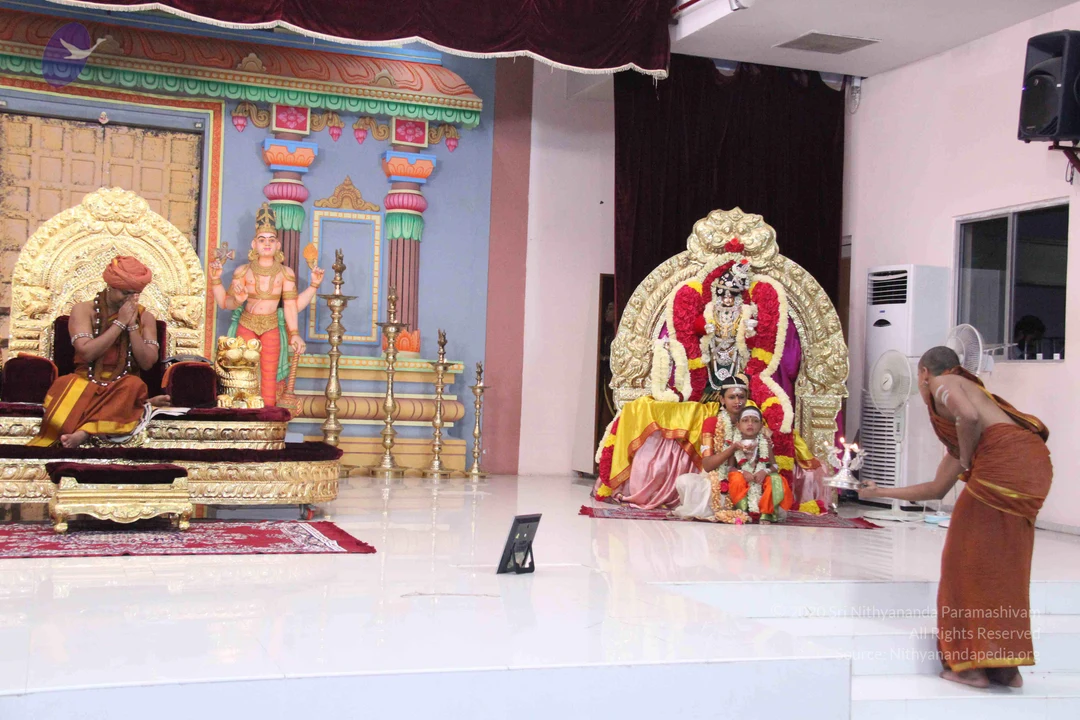
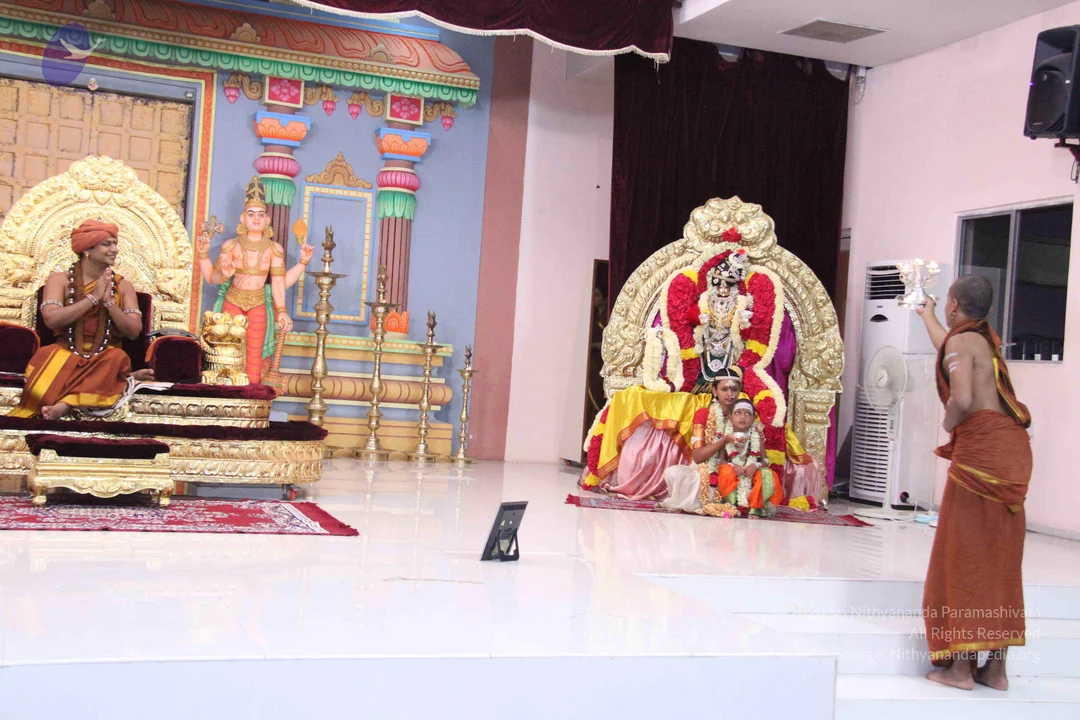
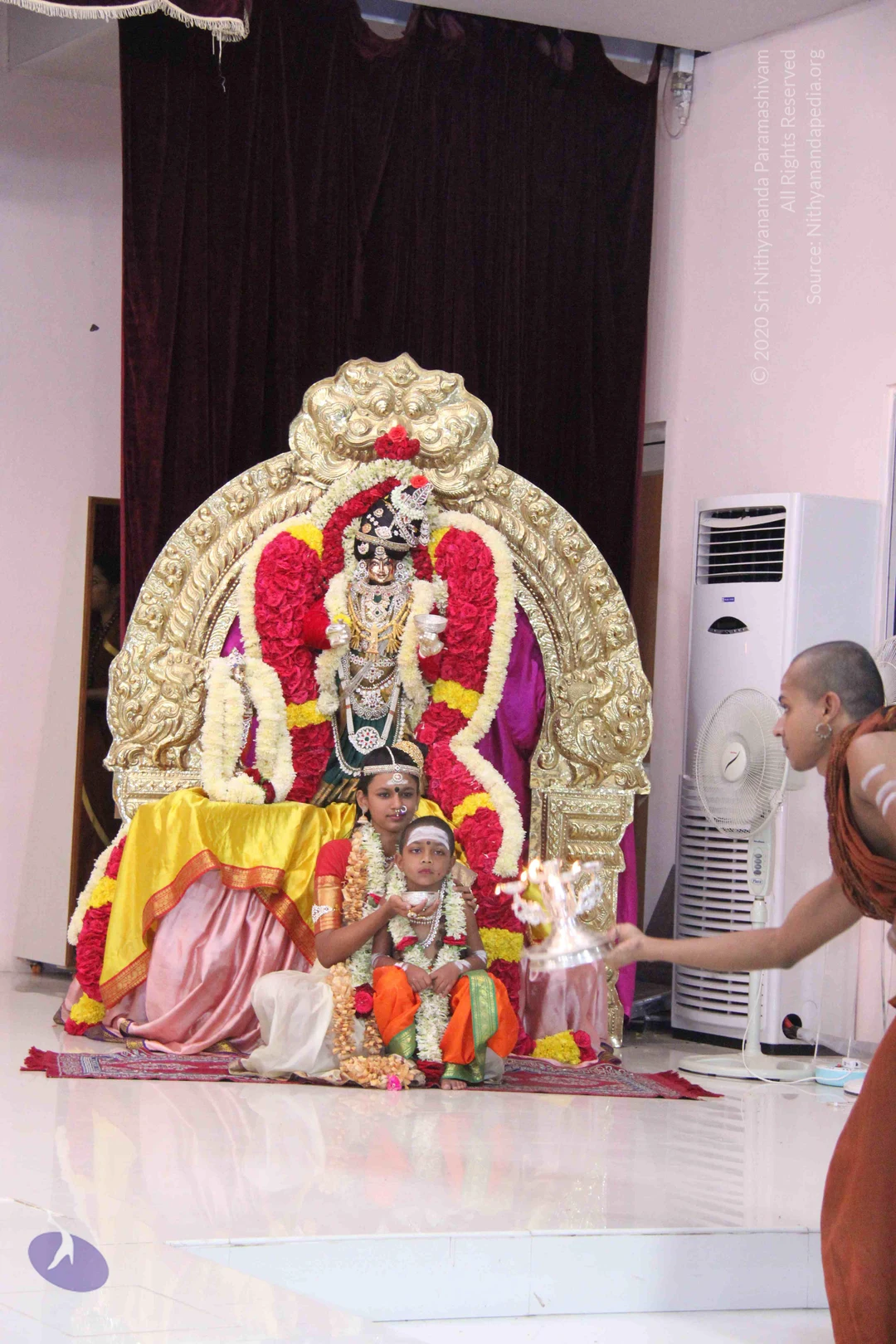
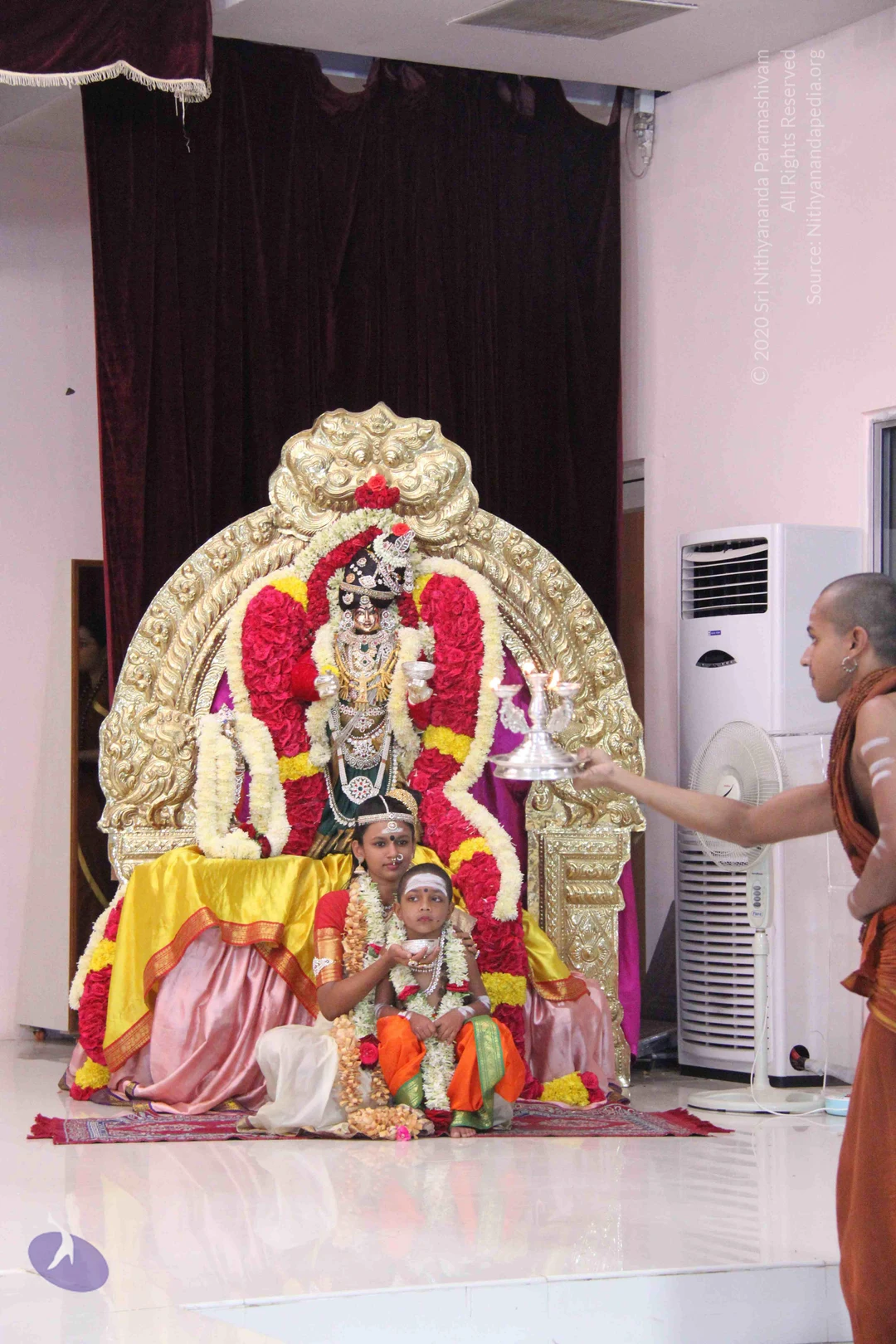
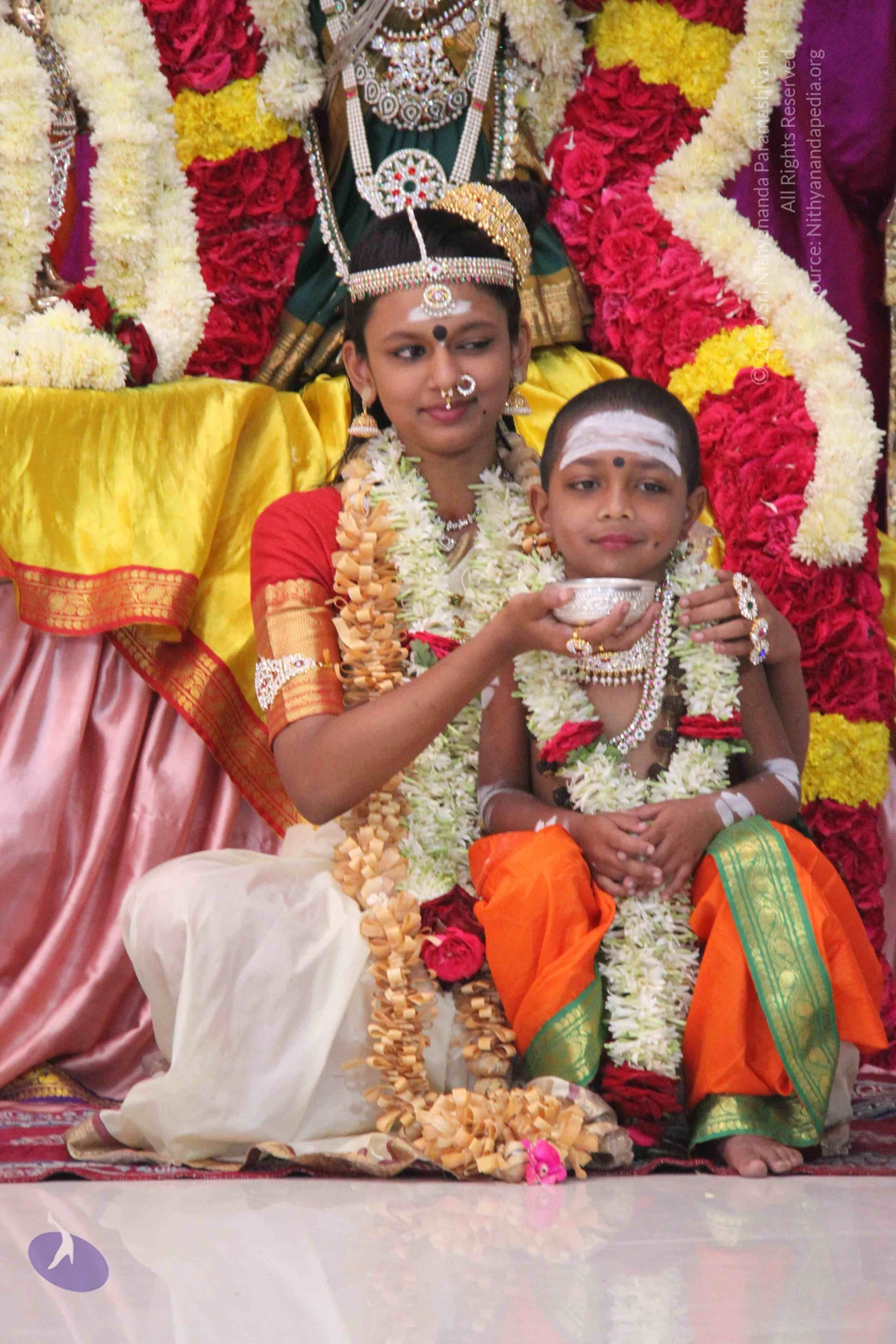
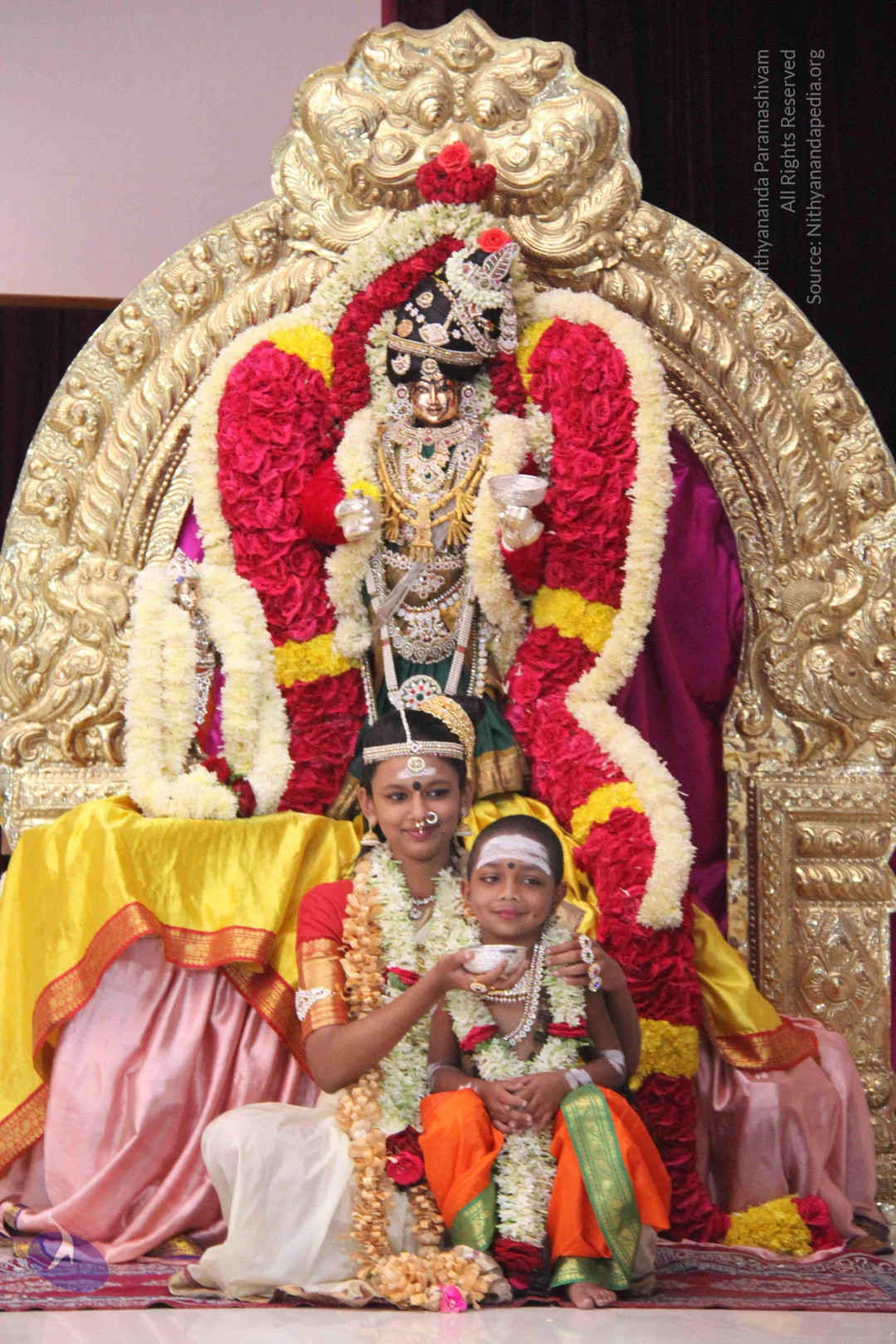
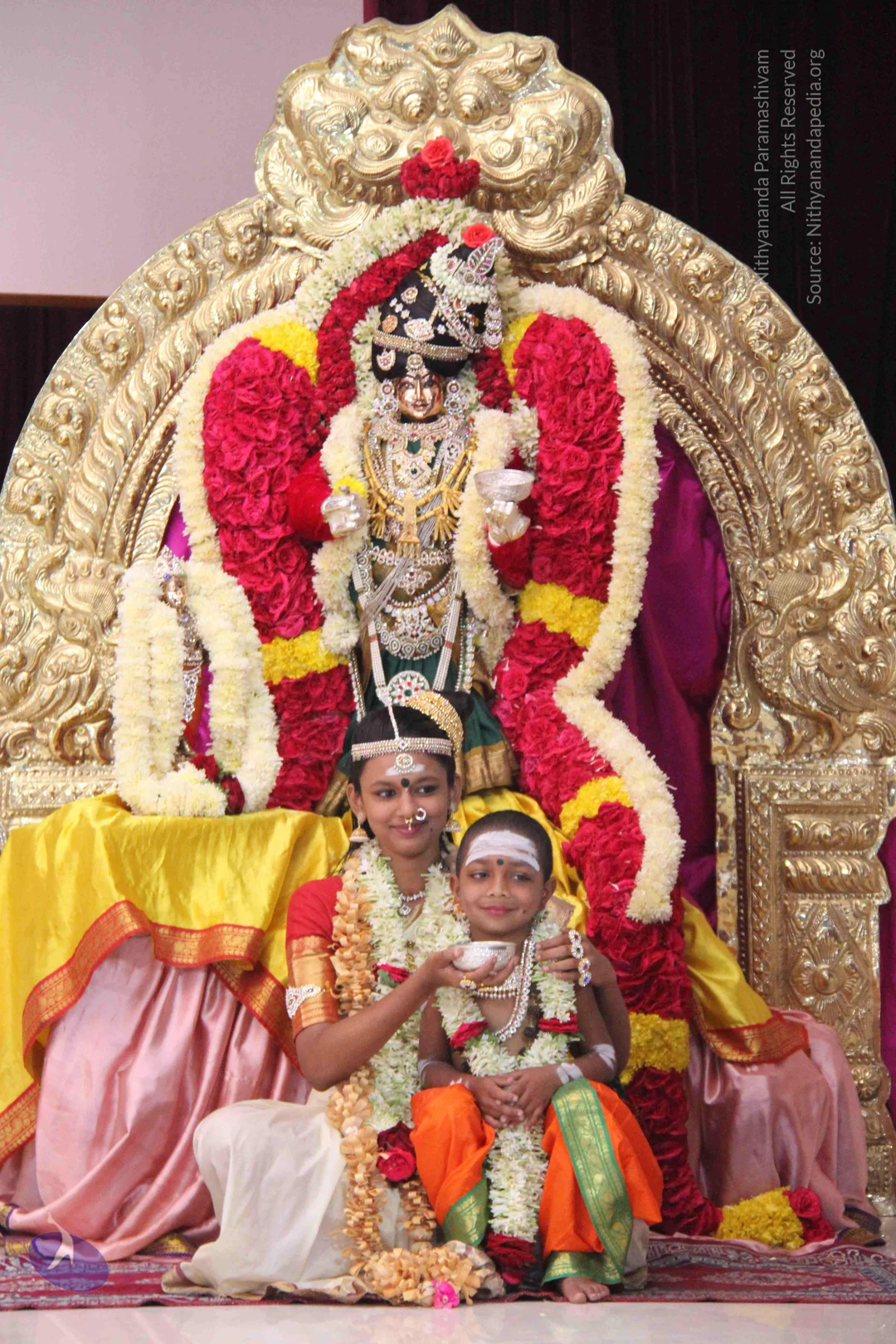
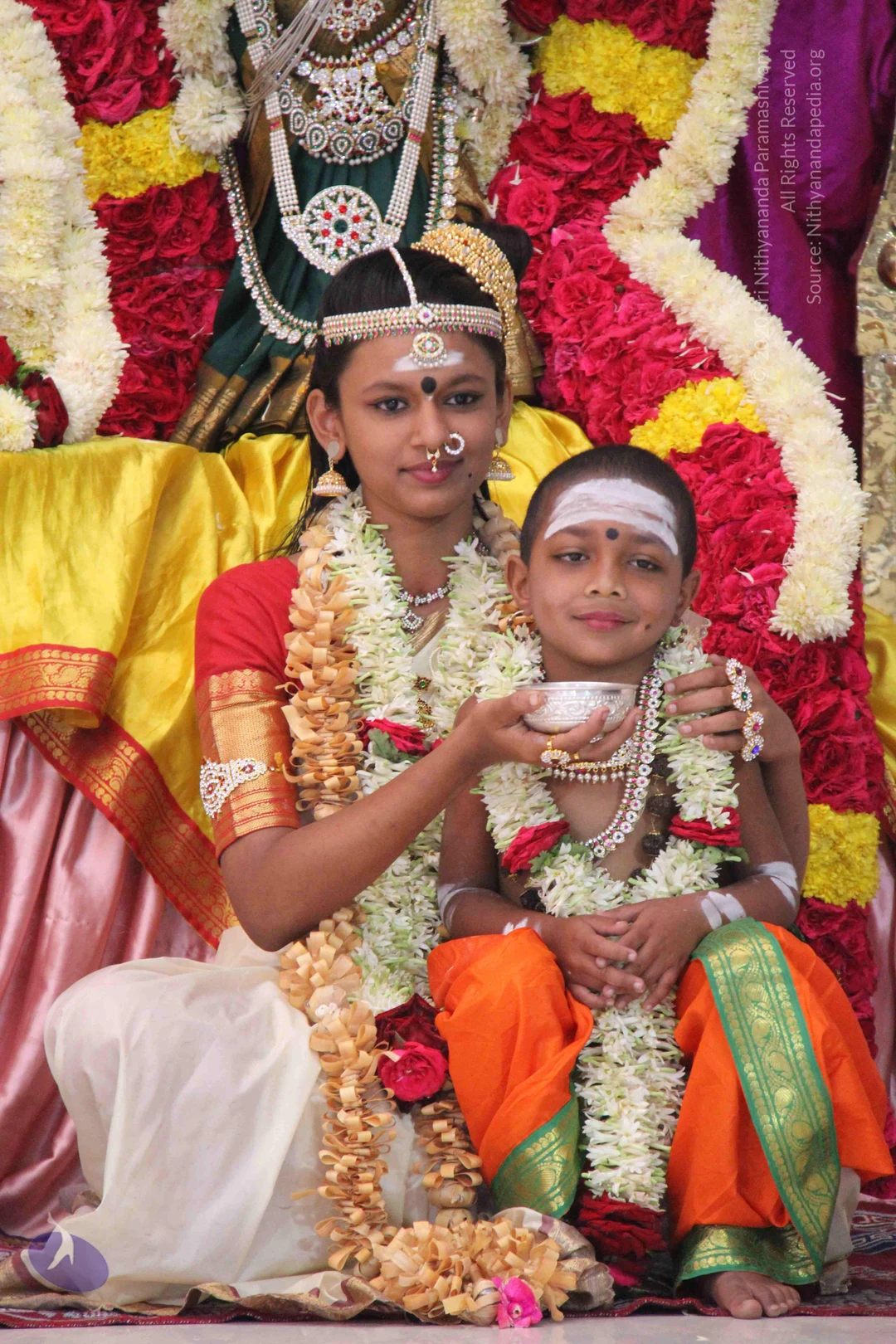
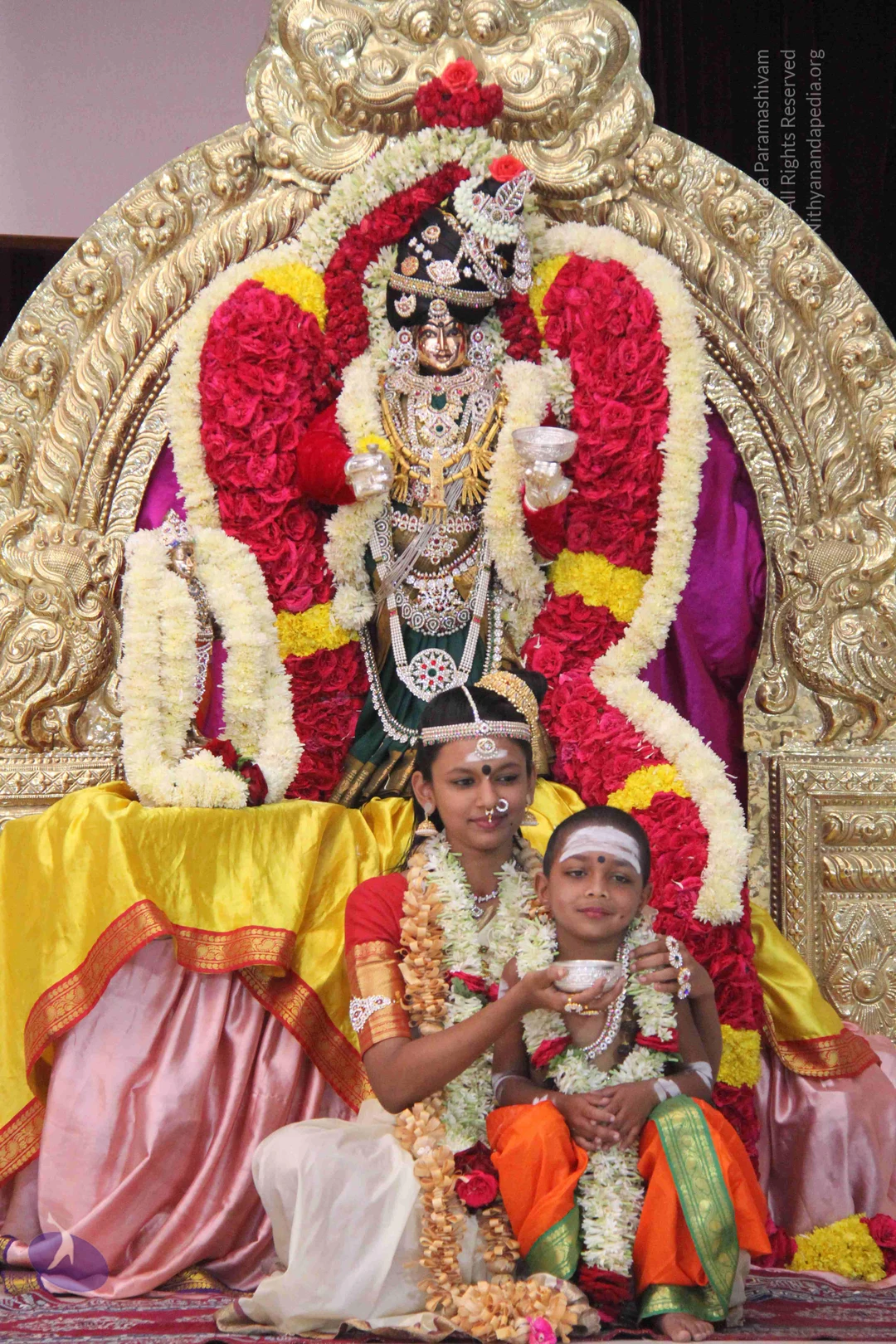
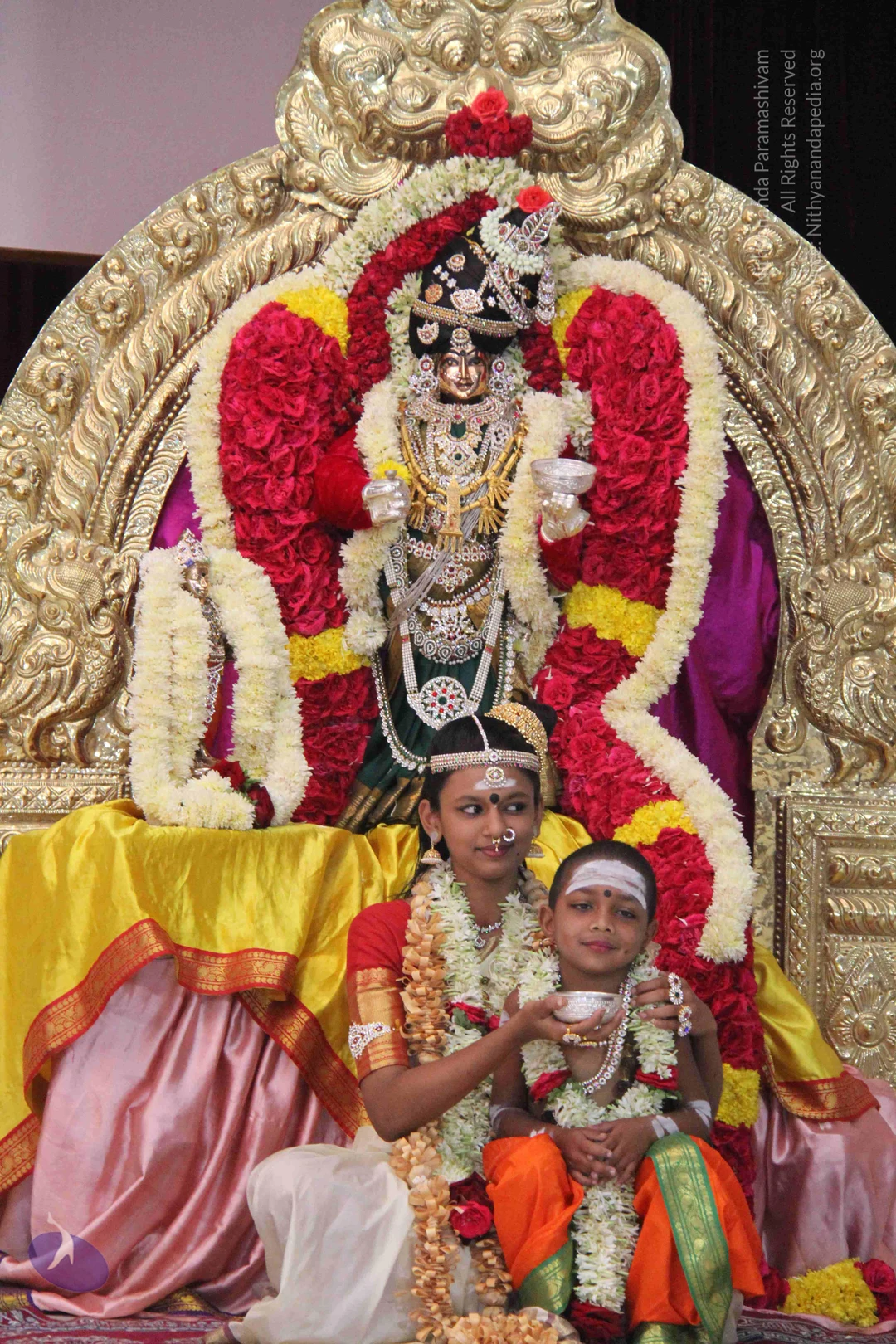
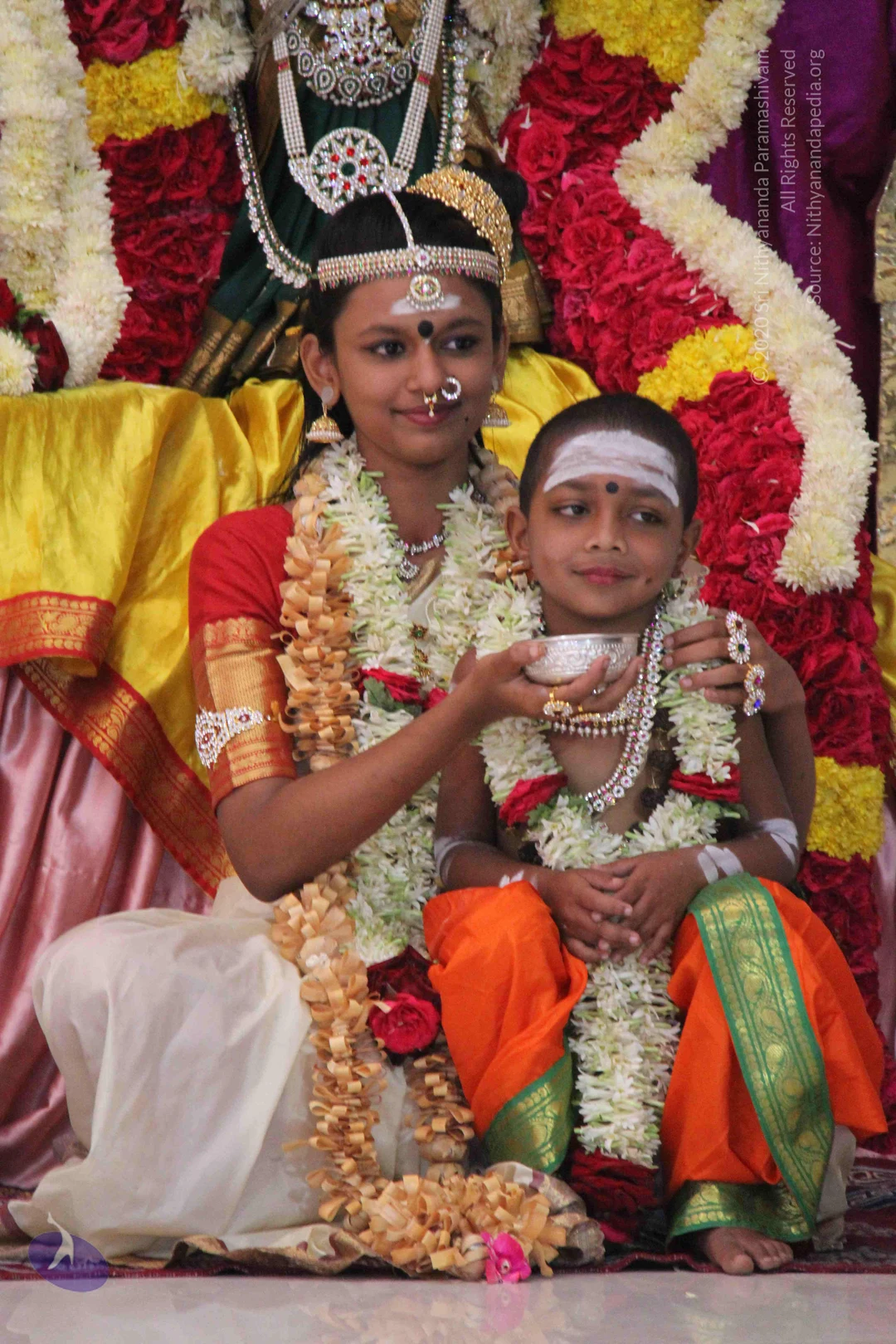
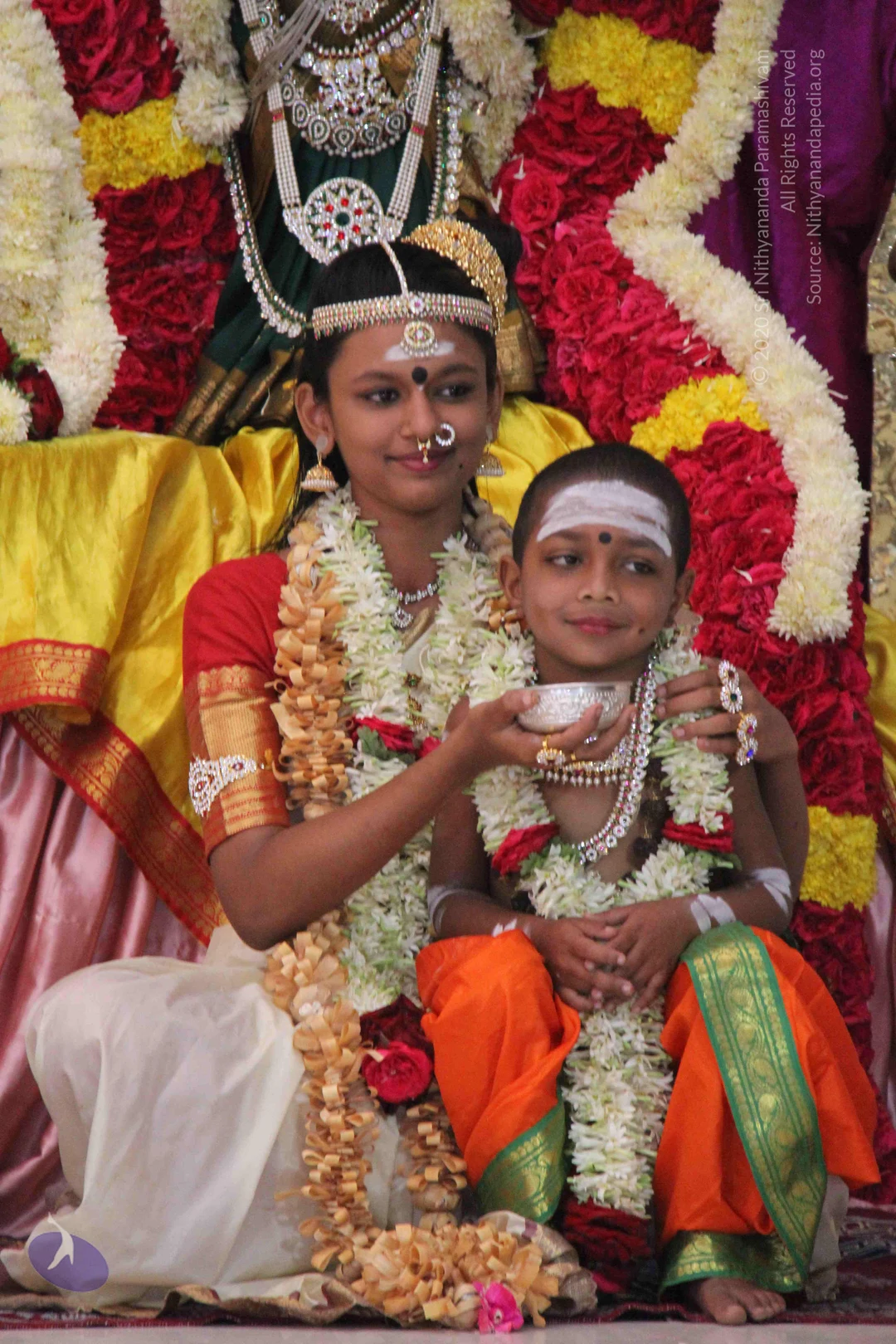
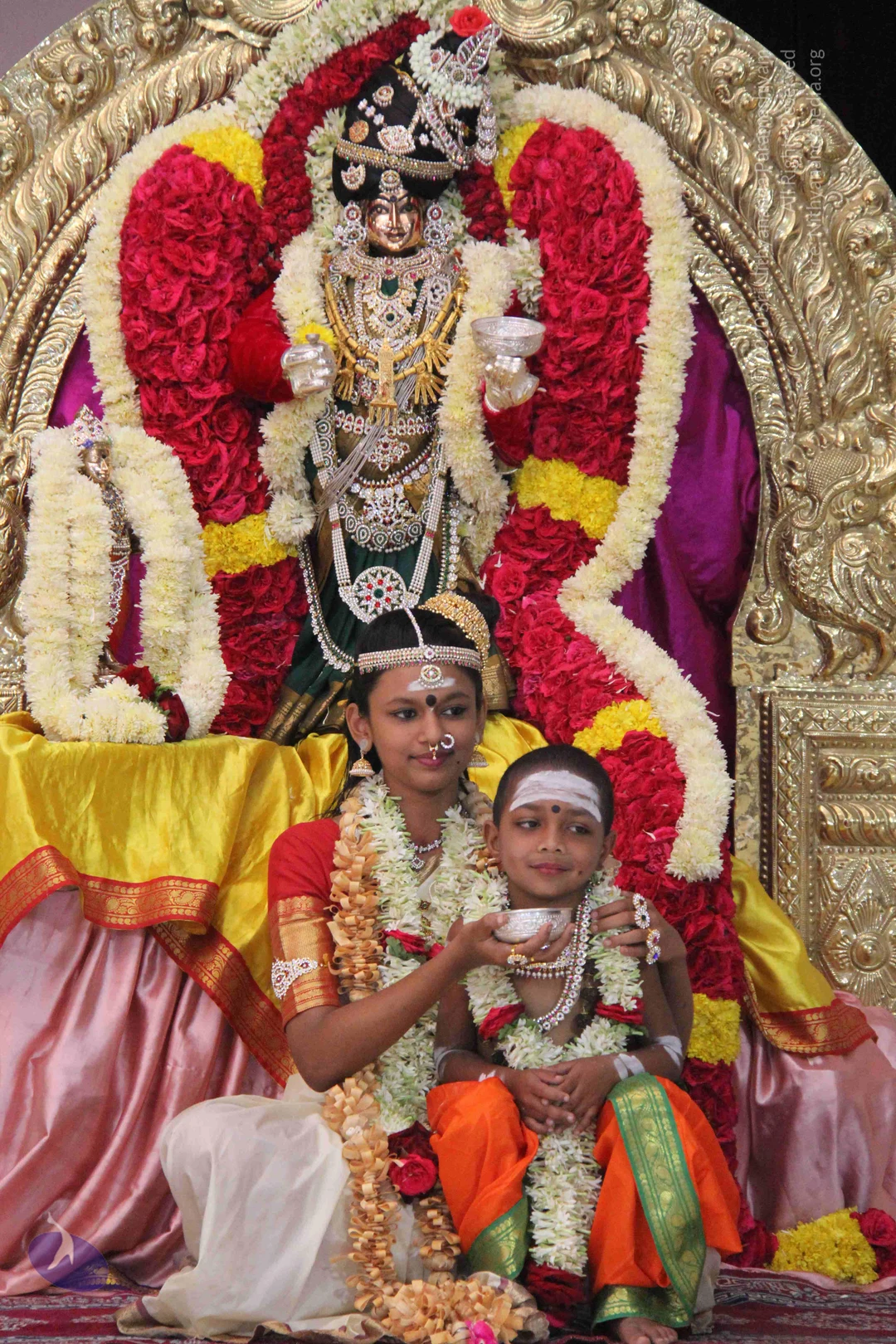
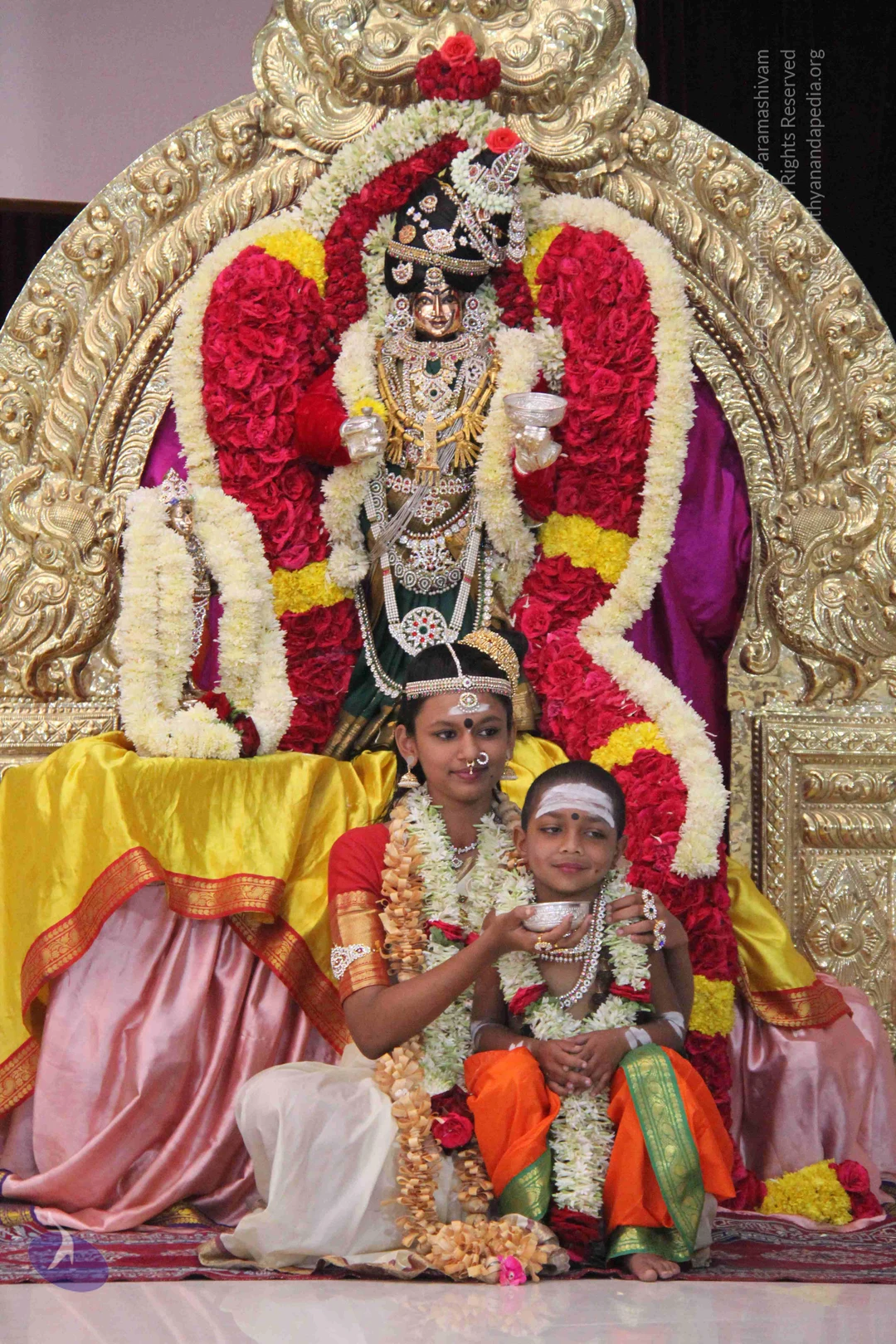
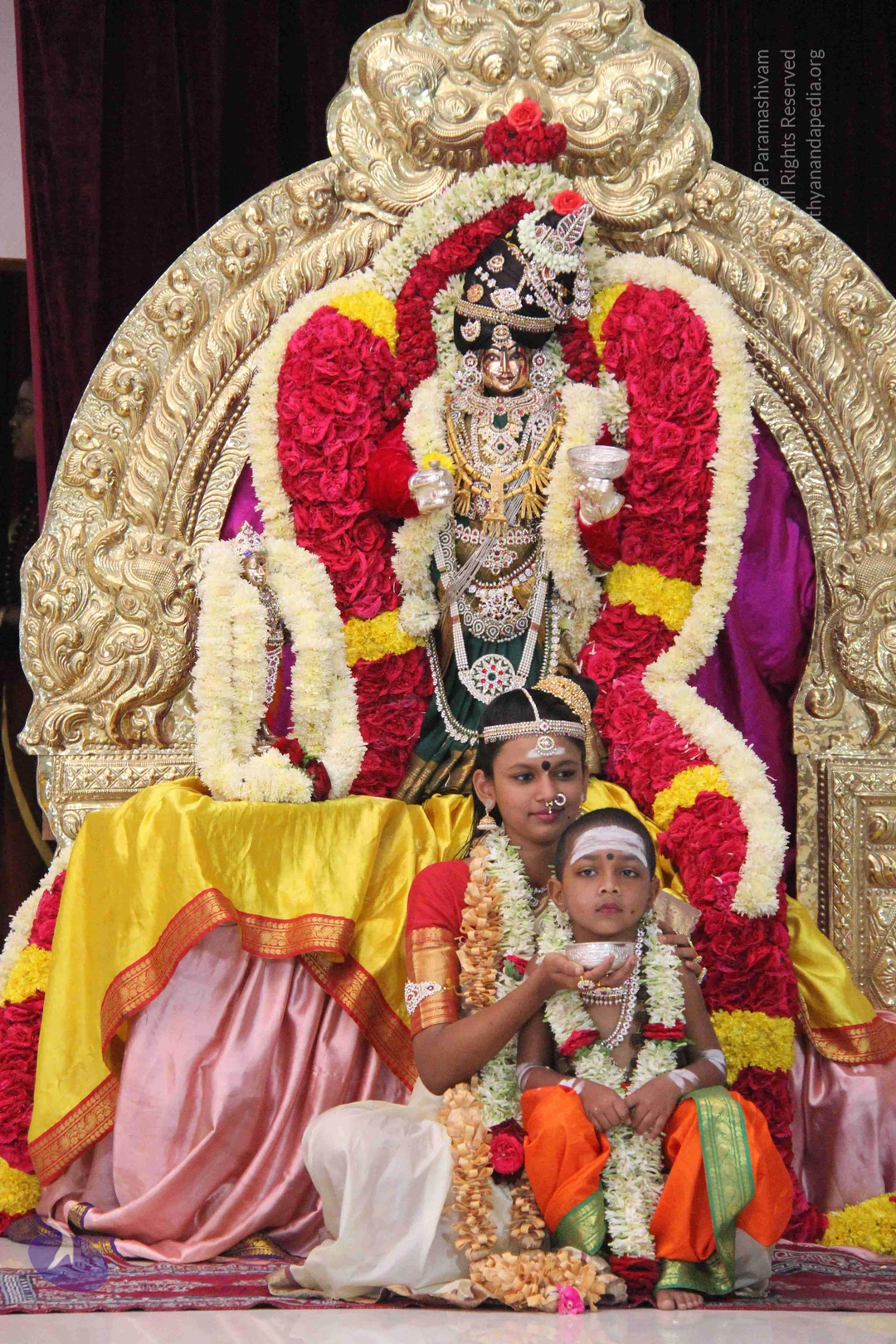
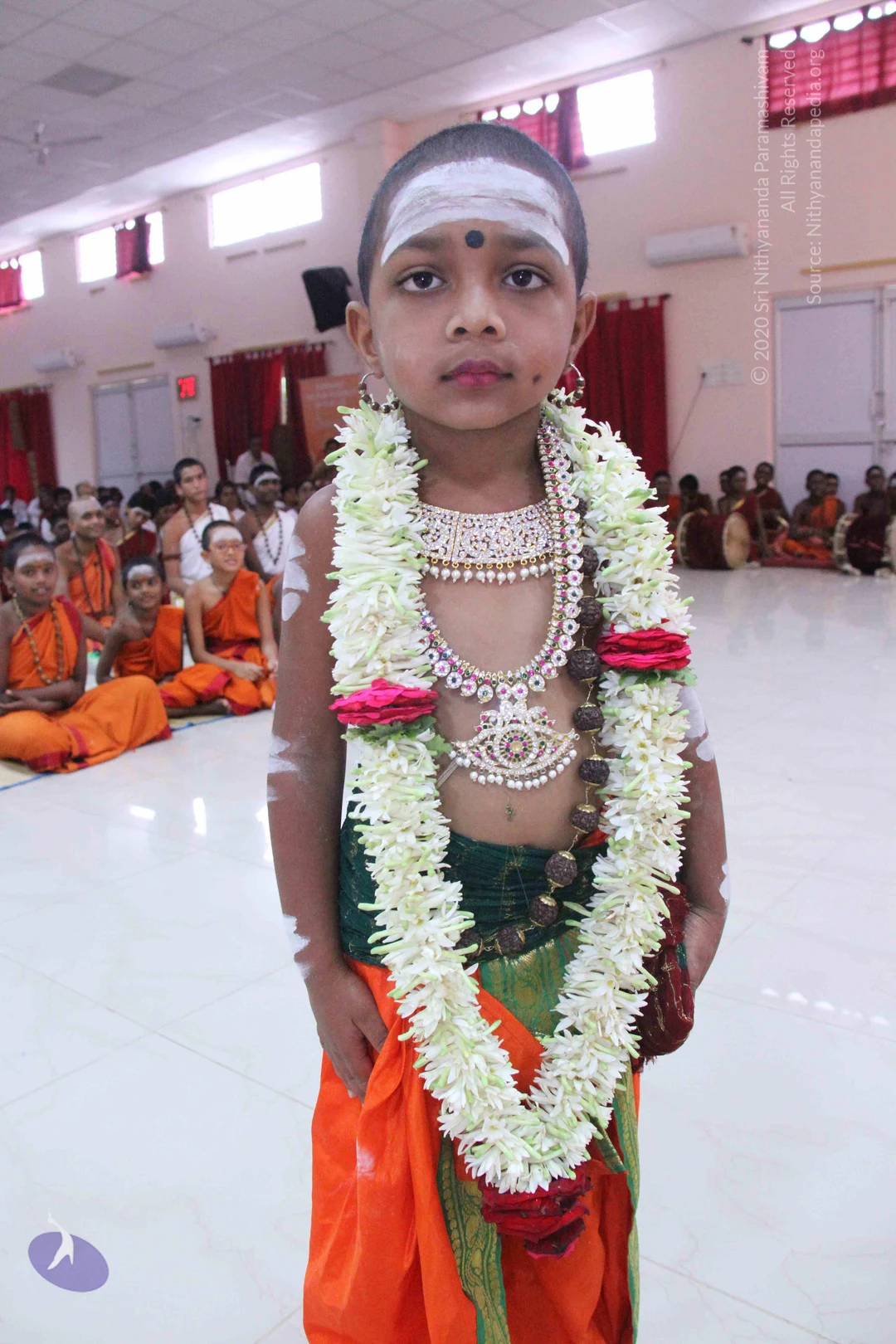
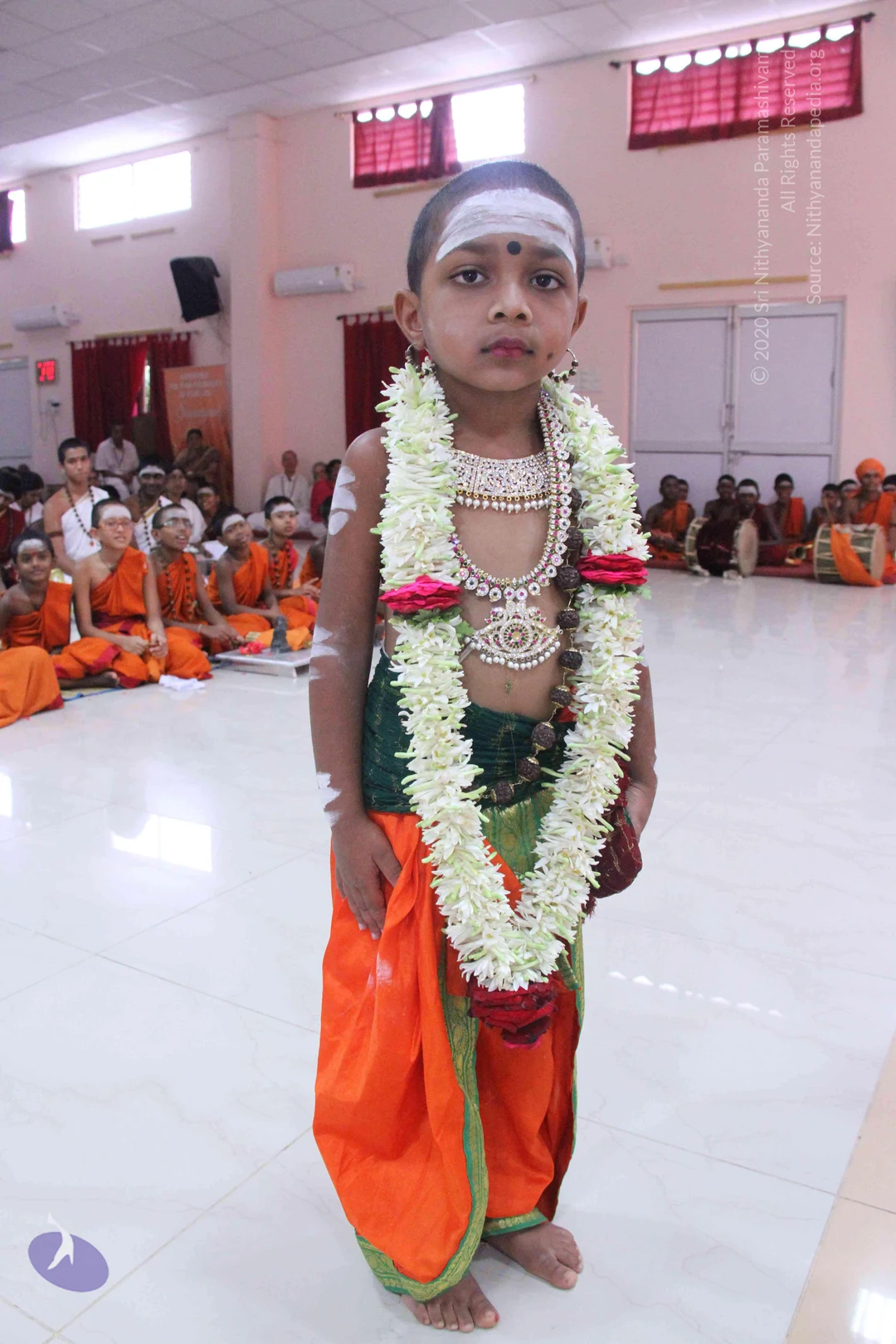
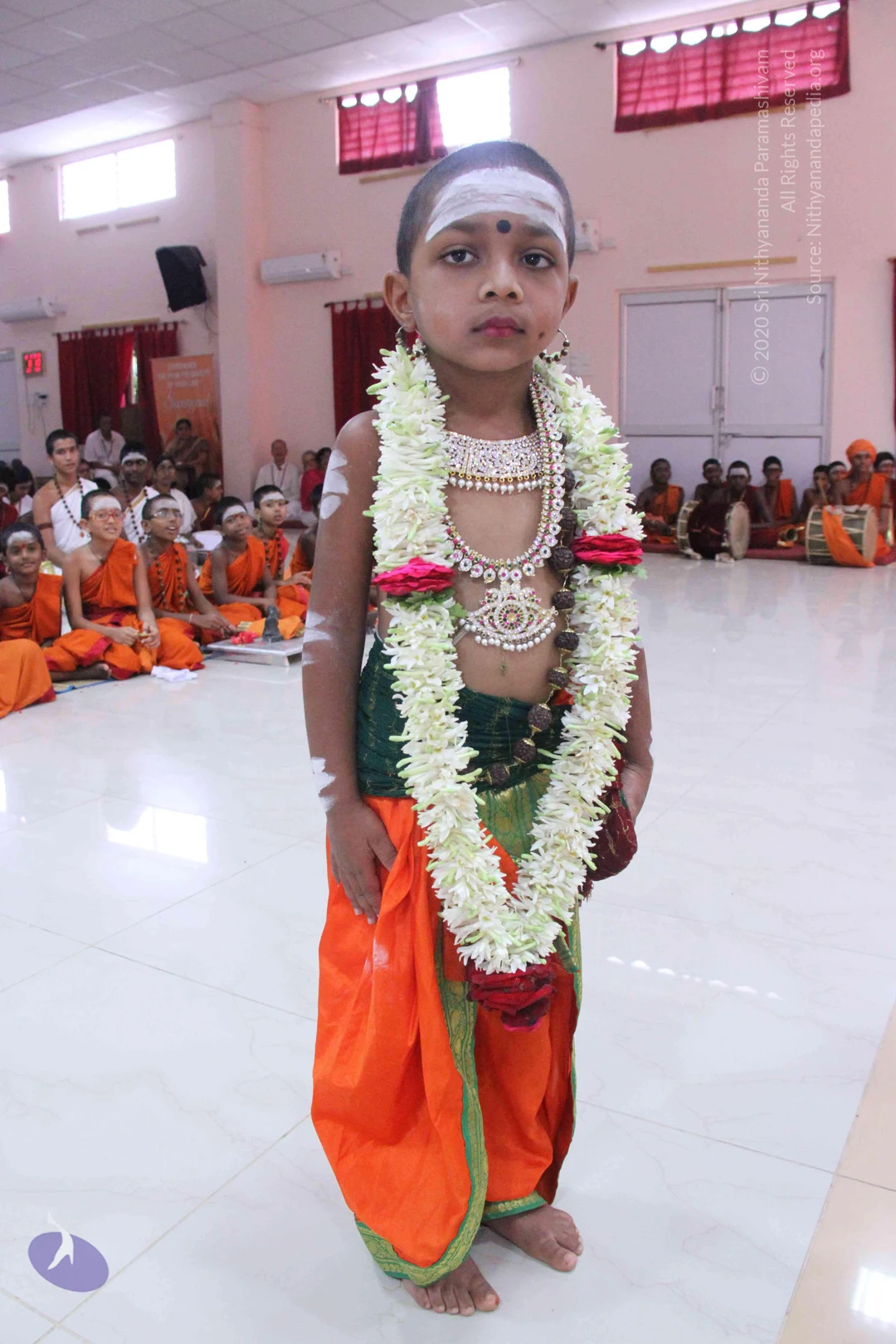
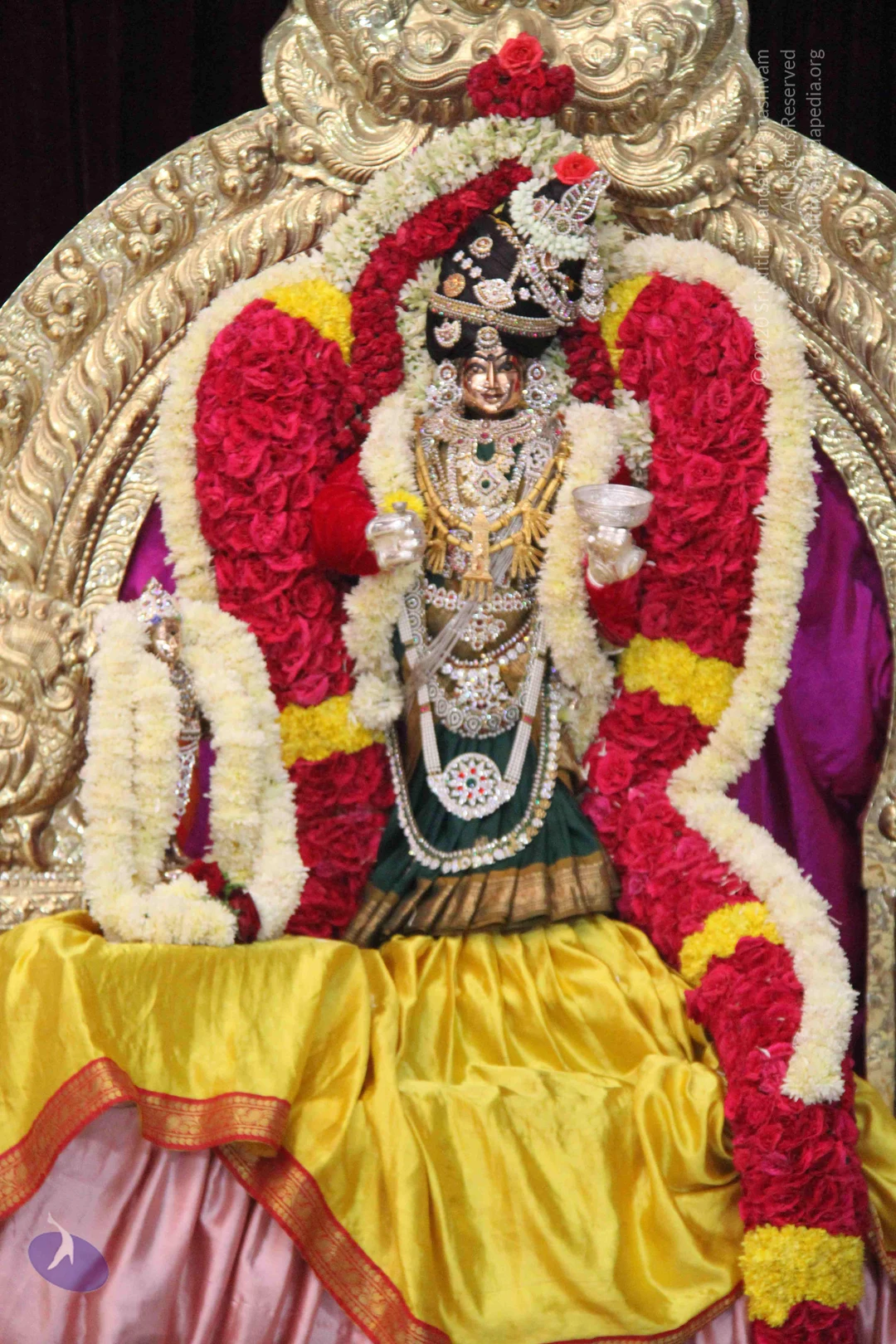
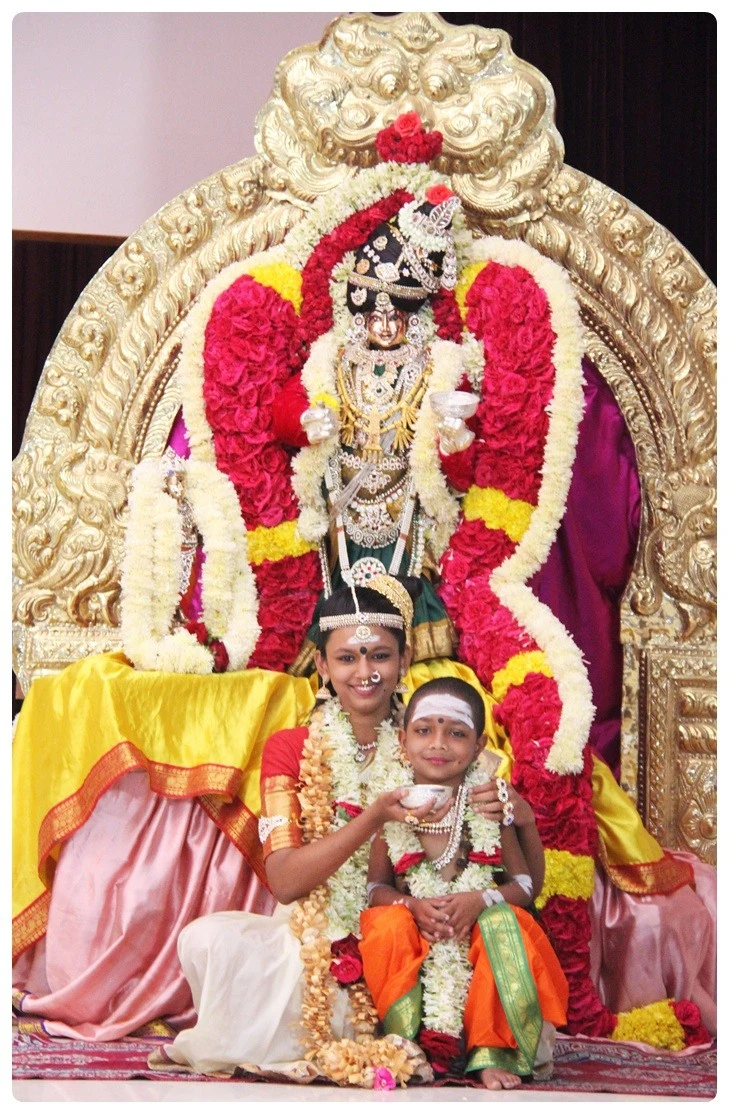
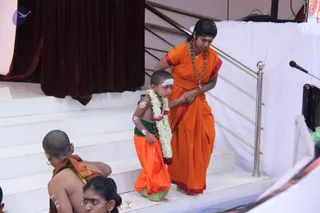
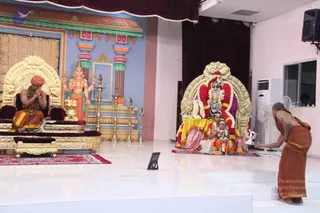
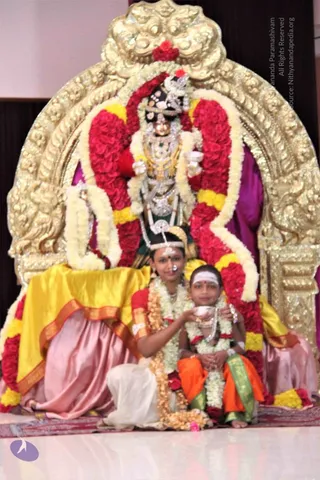
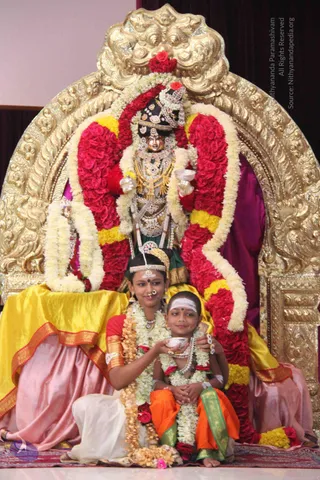
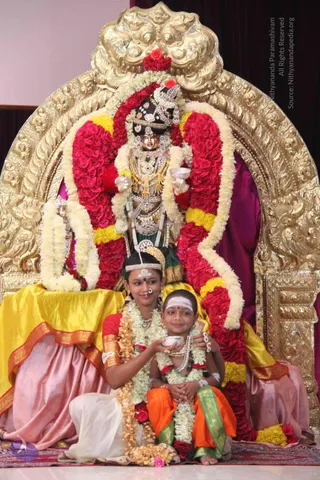
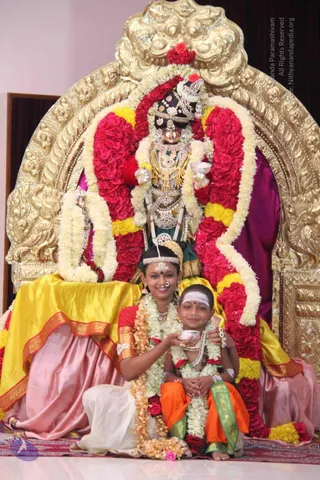
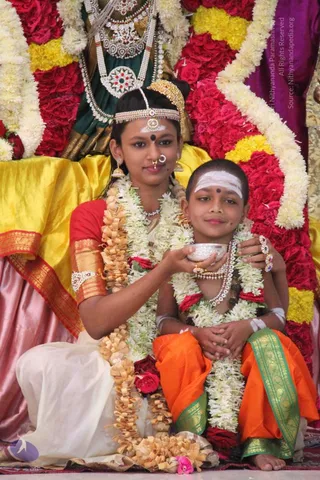
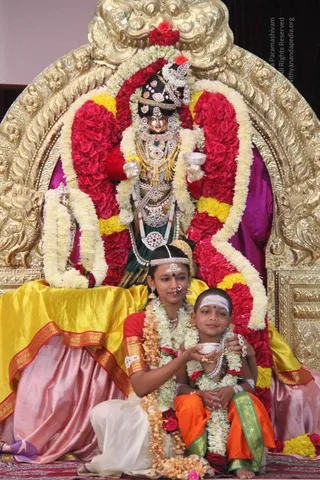
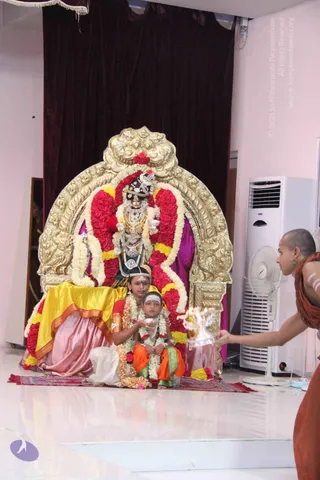
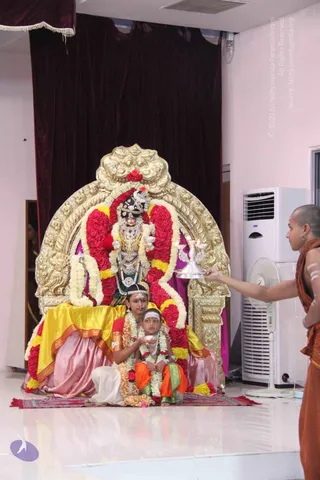
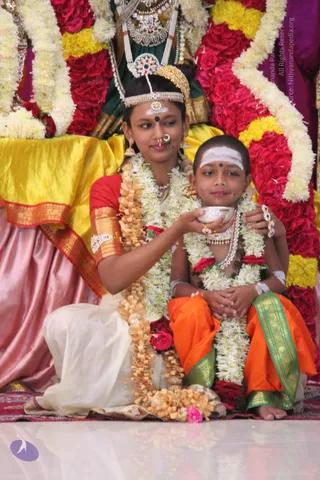
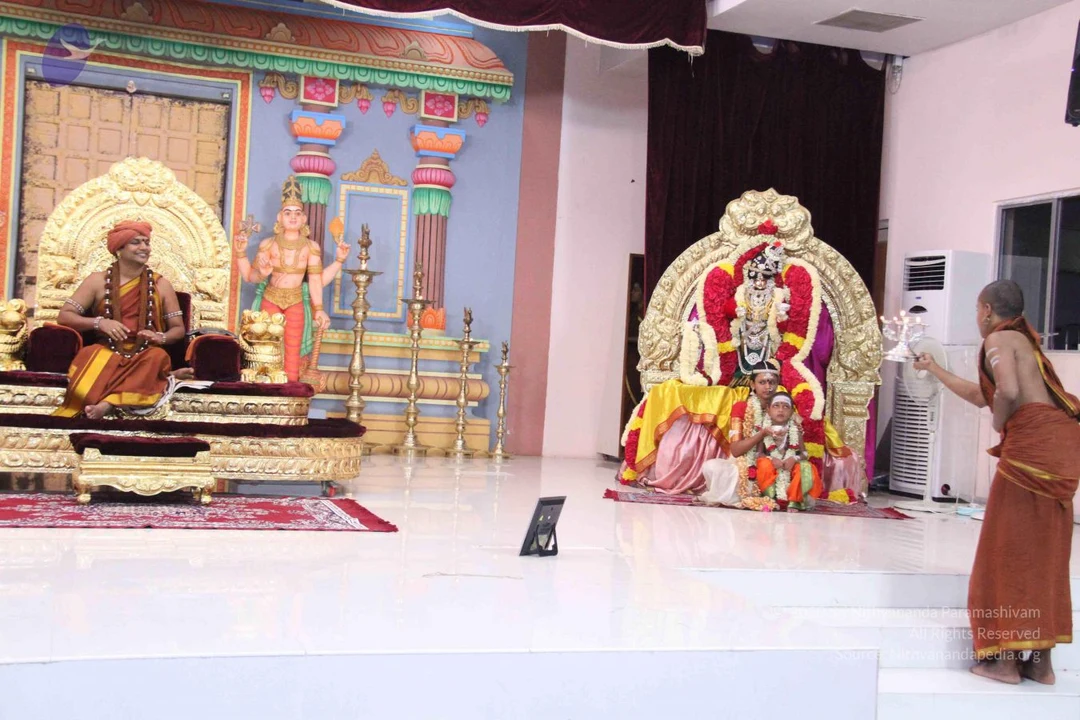
Today, Devi is gracing us in the Leela of giving the Milk of Wisdom, Enlightenment, to Thiru Jnanasambandhar, the reviver of Madurai Adheenam. So, as per the tradition, Gurukul kids also enacting the same drama. Two of our Brahmacharis - Krama Brahmacharis, are enacting the same drama. You can see Devi giving the Milk of Wisdom, Enlightenment Milk, to Jnanasambandhar, the reviver of Madurai Adheenam.

I will enter into today’s Nithya Satsang. The subject for Nithya Satsang: “HOW COMPLETION LEADS TO THE SPACE OF EXPANSION; HOW THE SPACE OF COMPLETION LEADS TO EXPANSION”.

Please understand.... It's a traditional story which is taught in our schools in India, basically from Mahabharata.

Once the elders of the family wanted to test who is intelligent - whether the Kaurava kids or Pandava kids – Pandu’s kids are “Pandavas”, and Dhritarashtra’s kids are called the “Kauravas”. "Who are the intelligent kids?" - and they had a competition: 'You will be given only one gold coin, with that you have to fill the house. '

The Kauravas took the gold coin and they all sat together. Naturally, hundred brain will mess any plan, any program. Just like our Government!

See, you can have hundred hand, not hundred brain. Be very clear - all great things are done by hundred hand and hundred leg, but not by hundred brain. Brain should be only one; hands and legs can be thousand or hundred. Brain should be - only one. But unfortunately, we have thousands and thousands of brain, but not a single hand!

So, these hundred brain sat together, left and right discussed, argued, shouted, fought among themselves, ‘HOW CAN WE FILL WHOLE HOUSE WITH ONE GOLD COIN'? Then, they finally they came to the conclusion - ‘The elders are all cheats, and they are abusing us, trying to exploit us, and make us feel we are failures!’ After this WHOLE drama, finally they decided, for ONE gold coin you will get only the hay grass - means, after the harvesting, after you remove the grain, the paddy, the hay grass - that is the only thing you will get. They came to the conclusion, and all of them walked to the market and bought loads and loads of hay grass and filled the house! And all these fellows are standing outside!!

Pandavas sat together; one good thing with Pandavas - even though each one of them are specialist in some thing, they all were always aligned under Dharmaraja, Dharma! Understand. Yudhishtira... under Dharma! Bhima represents the physical valor. Arjuna represents….. please listen. Bhima is physical valor, Arjuna is physiological power! To handle Gadhaayudham – the mace – you need physical valor; BUT - to handle the bow and arrow, you need physiological power; both are different. Both are totally different. The ability to thrash is different, the ability to aim is different!

Arjuna is embodiment of physiological power - ability to aim and shoot the arrow. Nakula - was sense of Intelligence. Please understand, Nakula is one of the most intelligent strategy planners. All the war strategy was planned by Nakula. Sahadeva is aligner of Time; he is a great astrologer. Sahadeva aligns Time.

Sahadeva is Time, Nakula is Space, Bhima is Physical Valor, Arjuna is Physiological Power! All of them are always aligned, under Dharmaraja, Yudhishtira. Because they were aligned, it is like a one brain having ten hands.

So, they all sat together, discussed, ‘What will fill the whole house? How to fill the whole house with one gold coin? When our elders say, IT IS POSSIBLE.’

Please understand, you can look at both angle:

· ‘I think these elders are all fools, cranky. They don’t know what they are asking us to do. Just trying to prove we are all small fellows.’ This is the thought-trend of Kauravas.

· Then, Pandavas: ‘When elders say, there must be way. Something they are trying to teach us, educate us through this. When elders say, it IS possible.’

So finally, Pandavas also decided, to fill the house with the one gold coin; how they did it, let us see.

So, the time for the supervision.... all the elders - Bhishma, Drona, all the elders are coming for the supervision, inspection.

First they went to Duryodhana’s house. The moment they saw.... (hahahahahahaha)..... the whole house is full of hay.... and all these fellows are standing outside! They could not even go into the house, get into the house…! And.... Bhishma asked, ‘What happened? Why do you guys are standing outside?’

‘What is this? What can be done? You only told us - we have to fill the whole house in one gold coin; what else can we get, to fill the whole house, for one gold coin? This is the most cheapest item we got, which can fill the whole house. So we filled it; here you see - we won the competition!’

And all these fellows are standing outside! Neither these fellows are able to get into the house, nor the people who came to supervise, inspect - they were able to get into the house.

Then.... Dhritarashtra was very happy! ‘See my sons and their intelligence! They filled the WHOLE house, and they should be declared victorious; they won the game!’

Drona, this poor guy, he was a poor Brahmin and supported by Dhritarashtra. So he always tries to come to conclusion, the moment whatever Dhritarashtra says, based on that. But, Bhishma stops Drona - ‘Wait, wait, wait, wait, wait! Let us go to the other house also and see, and then decide who won the game.’

So, they all go to the other house... Pandavas' house; there they saw the whole house was FILLED - with LIGHT and PERFUME, Incense. Understand, for that one gold coin, they bought lamps, put the light and the special perfume, incense.

The moment the elders came, the Pandavas - they washed their feet, invited them, gave them seat, fruits, and told them, ‘See! See, the whole house is filled! Filled with light and perfume, pleasant smell!’

Of course, Dhritarashtra was not ready to accept this! So, he goes to every corner and puts his nose and smells - 'is every corner is filled with the pleasant perfume?' As he is blind… you see, usually the people who are visually disabled will always have other senses VERY STRONG! Because - survival! Survival need.

People who are visually disabled, give any coin or note to them, just by touching, they will tell - what amount it is.... and... because, for the sake of survival, their other senses have to be very sharp! I have seen 2 - 3 visually disabled people, just by the person, when a person enters - by the SMELL of the person, they will tell who is entering!

So, this Dhritarashtra goes and puts his sharp nose in every corner. He can't find the house filled with light, you see. He can’t see, he is a blind guy. But he has a sharp nose, sharp smell. He goes and puts his nose everywhere. Finally, he finds - all corners have the pleasant smell, fragrance - pleasant fragrance. And, finally, they declare that Pandavas won the game!

Please understand, please listen. COMPLETION IS - CREATING A SPACE WHICH IS FULL WHERE YOU CAN LIVE! Like Pandavas. Both houses are full. You also always keep yourself full; do you keep like Kauravas or Pandavas? Find out that. Is your inner space... like Kauravas or Pandavas? That's all! Have you bought the hay and FILLED all around in your house, or have you brought the pleasant smell and the LIGHT?

Please understand, Completion keeps you FULL and gives you the space to LIVE! Incompletion keeps you full, but NEVER FULFILLED; you will never be able to live there.

Please understand - all the modern-day CEOs, leaders - who are FILLED with stress… what is stress actually? What is stress? It is nothing but filling yourself with hay! You are filled, not fulfilled! You are occupied, but not useful! Before making one decision, 200 times you will think about it, you are tired! Most of us run like a Government office. Before getting one small work, the file has to move through 350 files, table! It is like a ice-cube; you give it to the first table, second table, third table... by the time it passes the 350 table and comes out, what will be there? NOTHING! Water also would have gone!

Our mind also - each incompletion is a one Government Officer, understand. They all have that o...ld table, that o...ld “daga-daga daga-daga daga-daga daga-daga” fan, and that o..ld chair - the moment you sit, which gives automatically sound "tssssss"; and the moment you put your hand on the table "Dnn-dnn-dnn"; and the moment you switch on the fan “dg-dg-dg-dg-dg-dg-dg-dg-dg-dg-dg-dg...." the sound; and the DUST which is SHO-WERED on you.... "Hhhf! Hhhf! Hhhf!". And if somebody walks forcefully on the upper floor, the dust falls on you, from the roof!

No, each one of your incompletion....! You may ask, ‘How are you describing so beautifully, Swamiji? Without working in the government... Government office?’ I may not work, but I know na?

Anyhow, please understand - all your incompletions are like that Government office Tables. By the time you cross each of your own tables, which you created - red-tapism, bureaucracy; before even making one decision, you are tired! That is what I am seeing!

Working with thousands of people, I can see... working with all types of people, I can see - WHY people are able to THINK BIG, but never DO anything BIG! Because, before making any decision, their internal bureaucracy - by the time they cross their internal bureaucracy, the internal incompletion tables - either the project has melted down like a ice cube, or COM-PLETE-LY taken a different shape!

You decide... when the project starts, you think through and decide... “Let us... lot of poor people, we'll have to do something... to get them out of the poverty and suffering." So, the plan takes a shape. "We should give them rice and wheat free of cost and ensure they are all not hungry; let them all eat; let them all live peacefully without hunger." Then the plan moves to the next table - "what to do for this much amount of money?" Then the plan moves to next table... "if may be if we open a alcohol shop, from that we will get the money, and we can do this..." The project moves to next table, next table, next table... finally, only alcohol shops are opened!!

So, what was the purpose for the plan, to come into existence? "To make poor people hunger-free, peaceful and happy!" But what was finally done, the result of the end of the project? They all became alcohol addicts and lying down! Of course, they don’t feel hunger! They don’t feel hunger! The purpose is solved! But did it get solved in a right way? If you kill everyone also, they won’t feel hunger!

Usually, when there is so many incompletion tables inside you, either projects melt down, like ice-cubes, or they take a totally opposite turn!

Please understand. REDUCE the bureaucratic stress you create on yourself; reduce the incompletions you infuse on yourself; reduce the abusal you do to yourself; reduce the mental setup of 'Duryodhana's on you. 'Duryodhana's are nothing but bunch of incompletions; NO power! Bunch of incompletions! Actually, even the decision of buying the hay and filling the house they would have taken like a... because they were not able to handle the whole confusion and fight among themselves. ‘LET'S DO SOMETHING!’ Any decision made in the mood 'Let’s do something' is - SUICIDE!

Please understand, I am DEFINING 'suicide'. Any decision made in the desperation and mood of 'LET'S DO SOMETHING!' is - SUICIDE! If you are a powerful person who is making decisions for others also, if you make the decisions in the mood of 'Let's do something!', it is called GENOCIDE!

Please understand, this 'Let's do something' because you can’t handle your fight with incompletions, the pressure of incompletions - that is a most dangerous space to be in, most difficult space to be in, most difficult thing to do in the life.

So understand, 'Let's do something' - out of incompletion, restlessness generated by incompletion, is the 'pesticide'! If you do it just for yourself, it is 'suicide; if you do it for the family, it is 'homicide'; if you do it for many people, it is 'genocide'!

What Pandavas did is out of the pure Space of Completion. I tell you, when you create Completion, every moment, you create a new way of thinking, new way of cognition, new way of cognizance, new way of knowledge, new way of being, new way of existing, new way of making yourself available to society, making yourself available to humanity.

See, you can make yourself available to humanity to get raised or to get abused. Whatever you are sitting and waiting, Humanity does that! If you are just sitting and waiting for the humanity to come and abuse you... ‘please come and abuse... I am waiting, waiting; I am feeling very unhappy, and incomplete, empty; why nobody is coming and abusing me?', then what will the humanity do? They will say, ‘Come on! Let me get into the space of fulfilling you!’

Please understand, Life out there is a HU...GE 'TATHAASTU'! Whatever you want, for whatever you are waiting - it gives 'tathaastu'! Life out there is a HU....UGE 'TATHAASTU'!

Hindi Translation

Please internalize.

Hindi Translation

jeevan ek bahut vishaal 'tathaastu' hai!!"

Please understand! Every thought, which you entertain, EVEN by mistake, gets its 'tathaastu' from the cosmic 'Anaahata Dhwani'. 'Anaahata Dhwani' means 'un-created sound'.

In the midnight, if you sit in the silent forest, where there is not even the sound of bees; or in the snow mountain, where there is no life - in THAT SILENCE! In the snow mountain, in that deep soundlessness if you sit, you can listen to this soundless sound - 'Anaahata Dhwani', a Cosmic 'OM'! That is the 'tathaastu' - 'so be it!', 'so be it!', 'so be it!', 'so be it!', 'so be it!'. Continuous - 'so be it!', 'tathaastu' - is happening, in the Cosmos. So, every thought, be integrated to what you want to be. MAINTAIN INTEGRITY with what you wanted to BE!

Please listen! Maintain Integrity with what you wanted to BE! Because, every thought, with awareness, or without awareness, gets 'tathaastu' from the Cosmos; 'tathaastu' from the Cosmos. Listen! HU...UGE 'tathaastu', from the Cosmos! VA...AST 'tathaastu', from the Cosmos!

You will have to bear the consequences of your thoughts, whether you want it or not, you are aware of it or not. Just understand one thing, even if you bring Integrity into your thinking - that you will complete every time you had a thought which is not aligned to what you want to Be, which is not aligned to your Authenticity, which is not aligned to your mamakaara, ahamkaara, anyakaara, swa-anyakaara - complete it, complete it, complete it! Even that bringing Integrity into your thinking - I tell you, you will radiate! You will radiate Completion. You will radiate Completion!

Without completion, life will be boring. Out of incompletion, anything you do will be boring, even if it is new, new, new things. That is why the incomplete society is running so much mad after these adrenalin things. Today, you try to go in the roller coaster, that is also not that much 'kick'; then you move to some other this kind of mad entertainments; then finally, you decide to jump, and do bungee jump! See, for the sake of 'kick' and adrenalin, what all you do!

Wife says, ‘I wish I was a newspaper, so I would be in your hands all day'! Because, this husband was sitting with the newspaper whole day. Husband said, ‘I too wish that you were a newspaper every day, so that I could have new one every day'!

Out of incompletion, anything you do, you will feel bored. Out of Completion, anything you do, even if it is a same routine, it will be just joyful!

Please understand. Out of Completion, anything you do, even if it is same routine, you will be in the space of joy; out of incompletion, anything you do - you try to change new, new, new things and try to raise the 'kick' - but anything you do, you will only feel incomplete.

A man approaches to a beautiful woman in the hypermarket and asks her, “Miss, would you mind if I talk to you for few minutes, because I lost my wife in the store"? Woman said, "why? Why would you want to talk to me because you lost your wife"? Man says, "because, every time I talk to a beautiful woman, my wife appears from somewhere"! Ha-ha-ha-ha-ha-ha.....ha!

I have one more story:

Things in the boys’ room before marriage: perfumes, love letters, gifts, Friendship cards; after marriage: painkillers, loan Papers, unpaid bills, list of the things you need to do shopping….!

Please understand. Out of incompletion, anything started, hurts you! But, because no other way! You already entered the game! Your ball has... your life HAS TO ROLL! You have to keep yourself up and alive! You have to survive! So, more incompletion leading to more incompletion, leading to more incompletion, leading to more incompletion! Life becomes HELL!

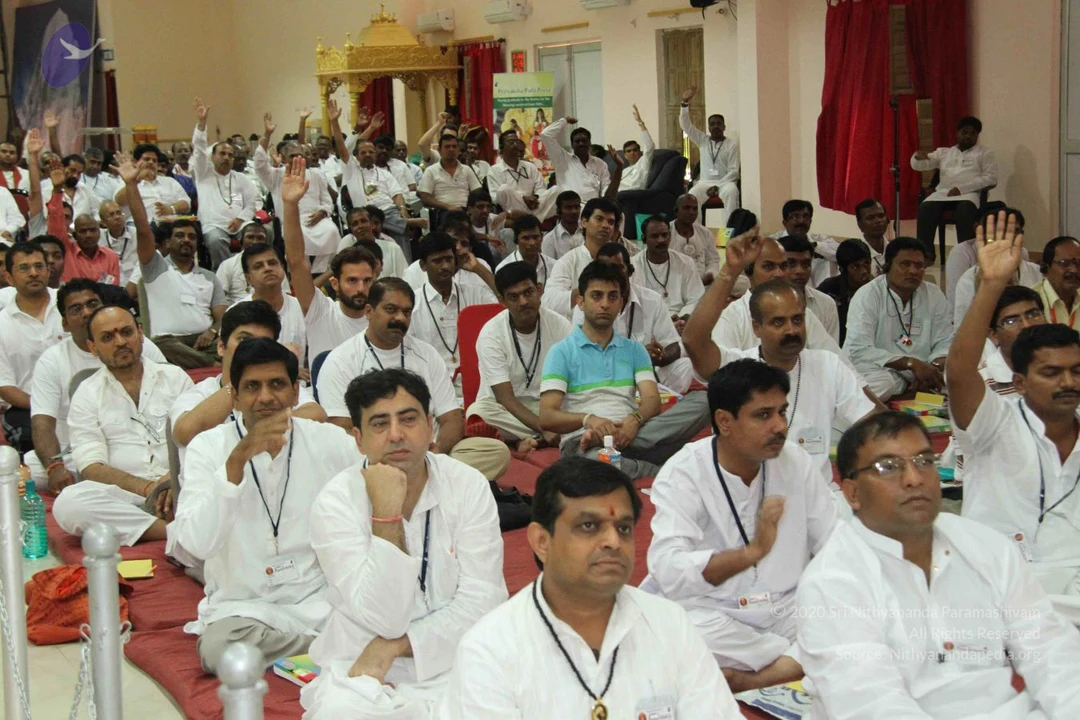
Anything started out of Completion, even if it is so-called 'same thing', it excites you! I tell you, 'Puja' is the best way to find out - is your life is running out of Completion or Incompletion. Because, in puja, you have to do everything same, every day. If you feel bored, be very clear, your whole life is running out of incompletion. If you feel excited, everyday when you sit for puja, doing same, you are in the space of Completion; that is a scale! Puja is the scale - to find out, whether you are in the space of Completion or Incompletion. How many of you have the habit of every day puja, raise your hand? Great! So now, find out, during the puja moments, how do you feel? You know, now, whether you are in the space of Completion or Incompletion.

Hindi Translation

Understand, the essence of today’s satsang, essence of today’s satsang, is: Completion leads to more and more happy, blissful inner space; and, raise yourself by yourself doing completion!

I'll move to the next segment of the morning satsang – Niraahara Samyama – after a break.

Photos Of The Day:

Deity-Arati
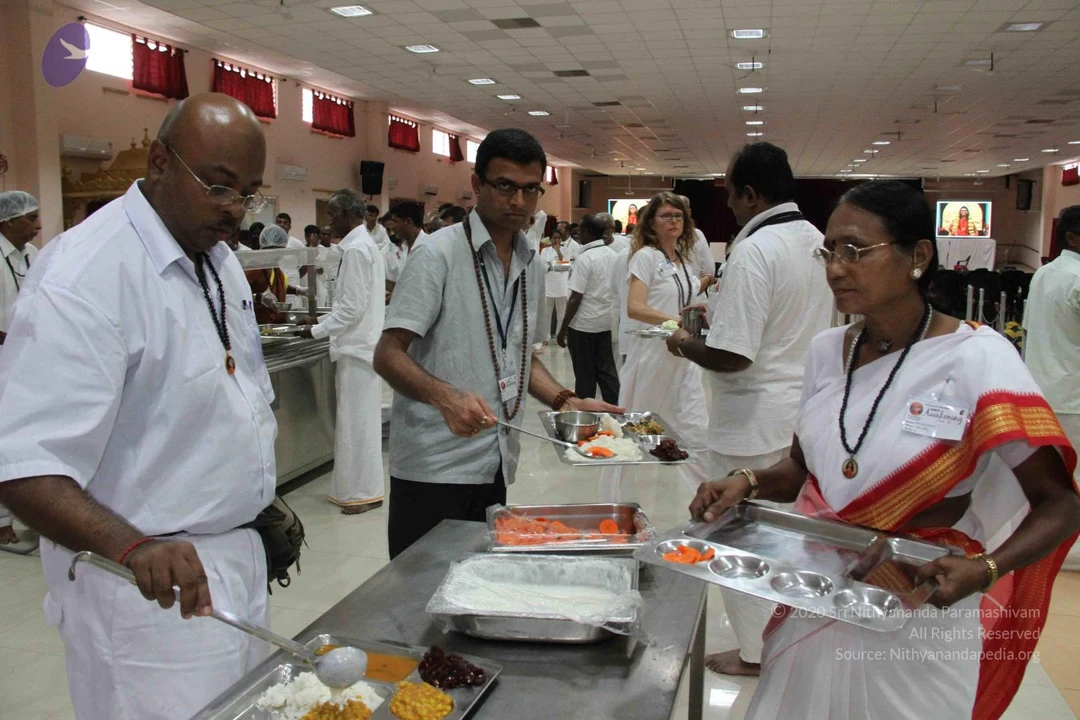
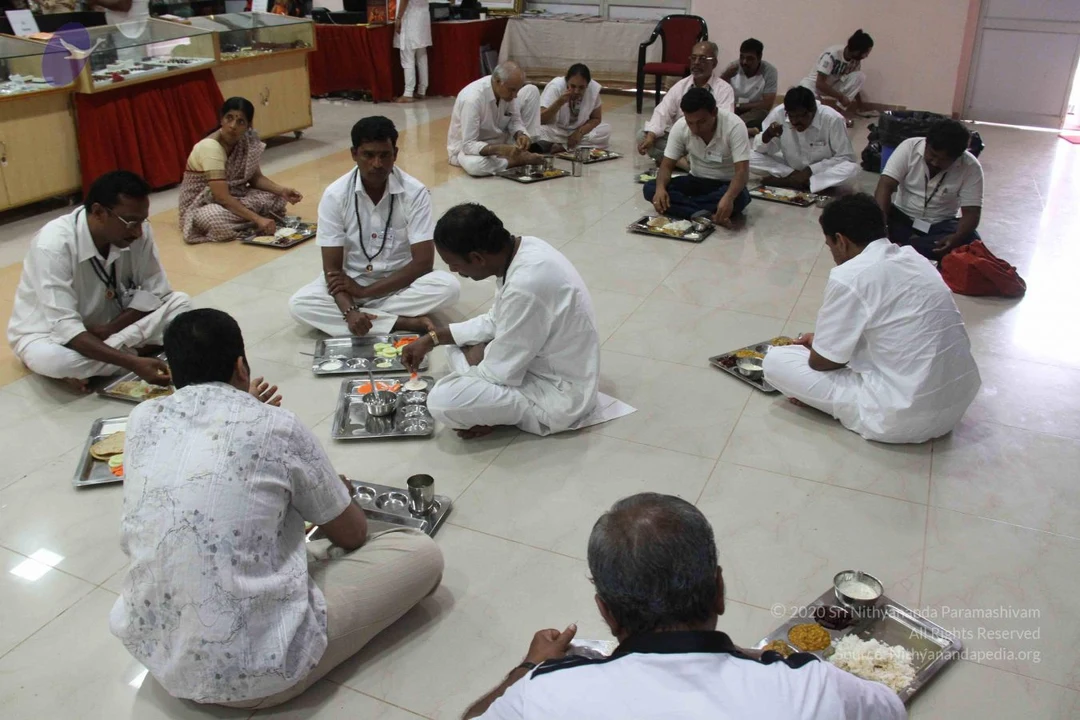
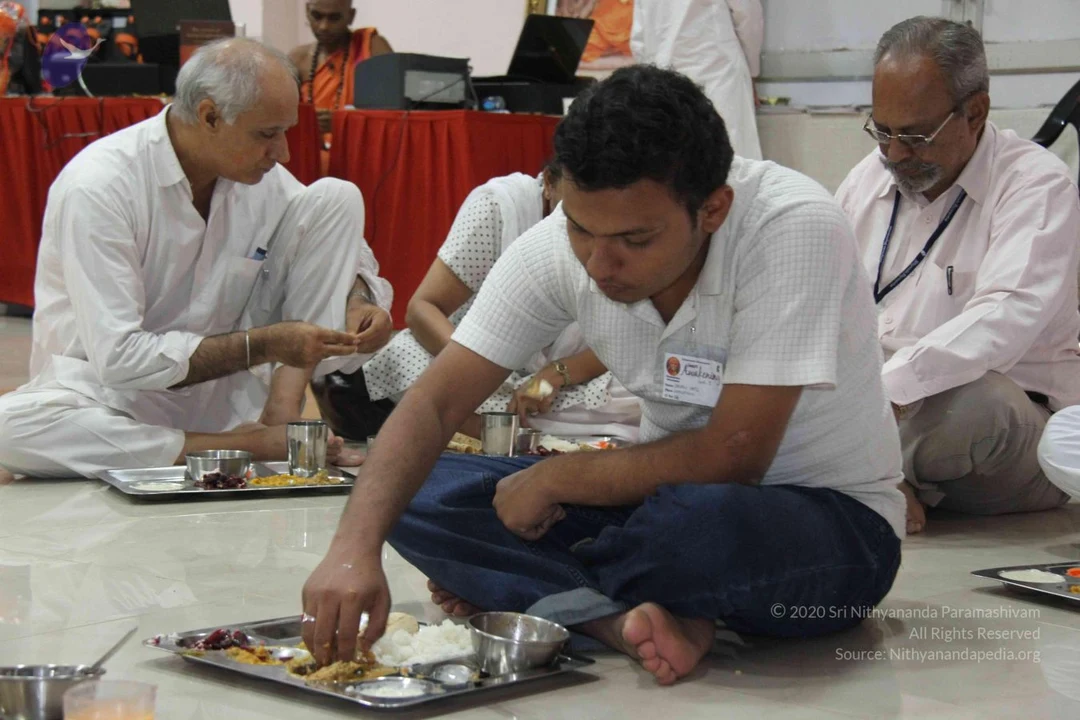
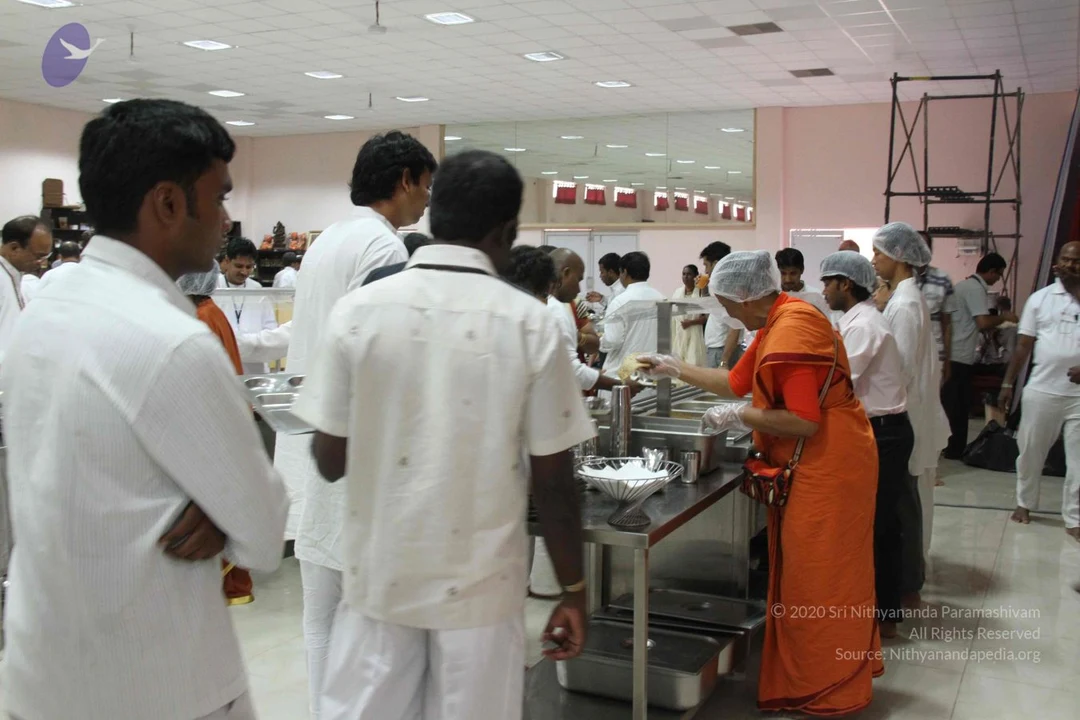
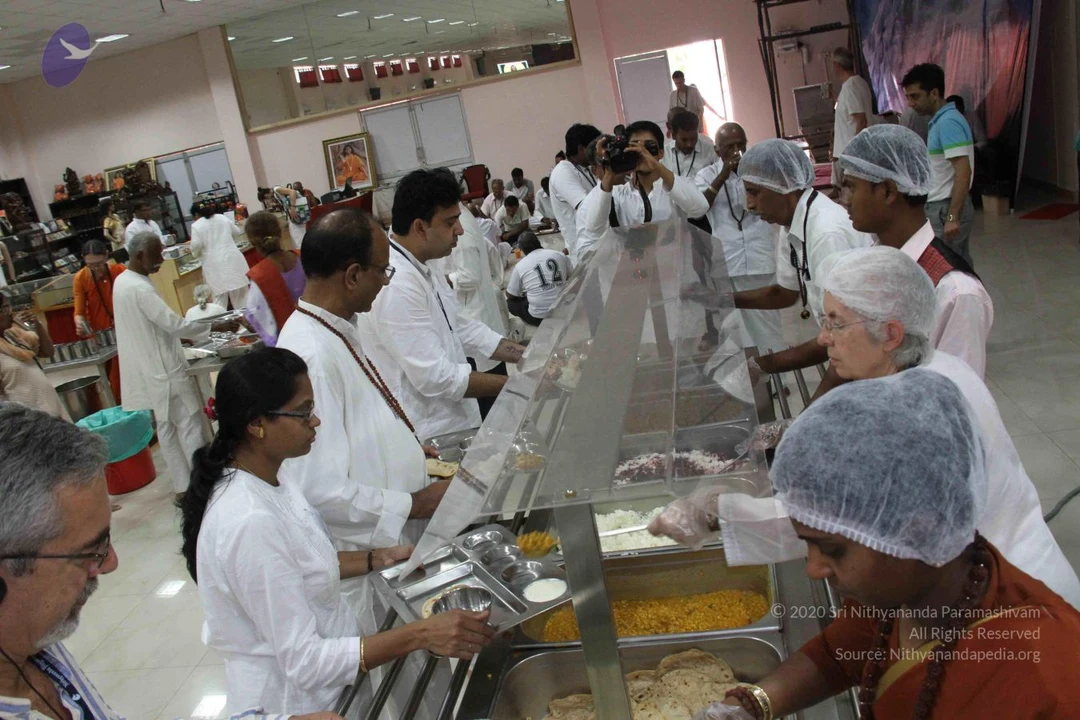
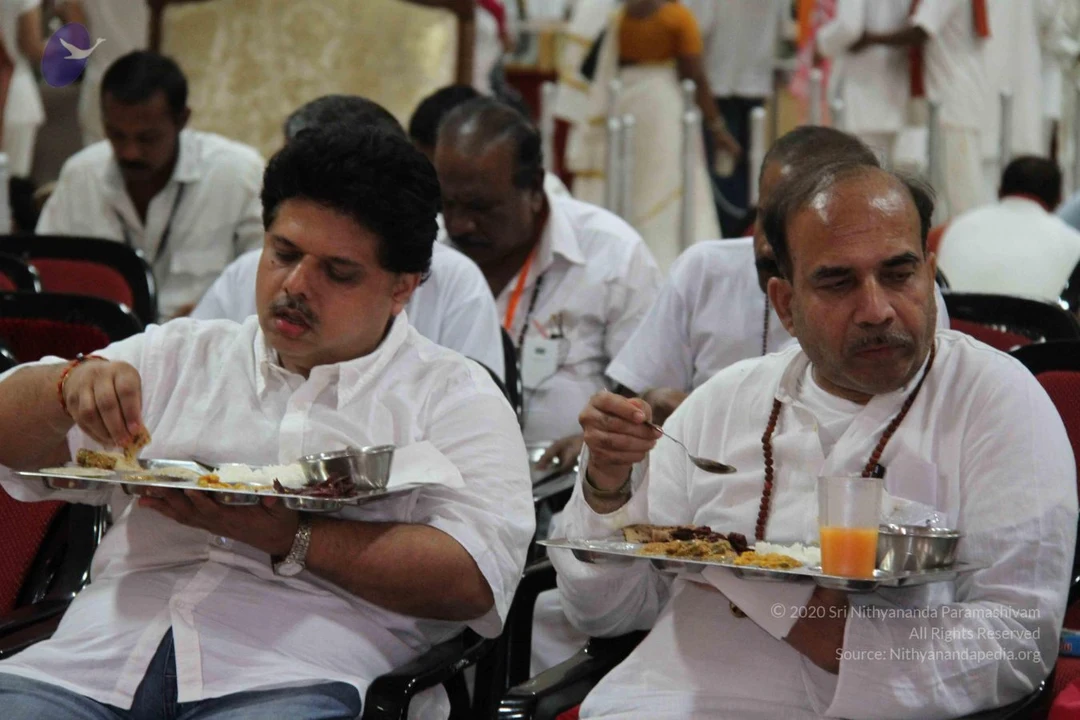
IA-Food
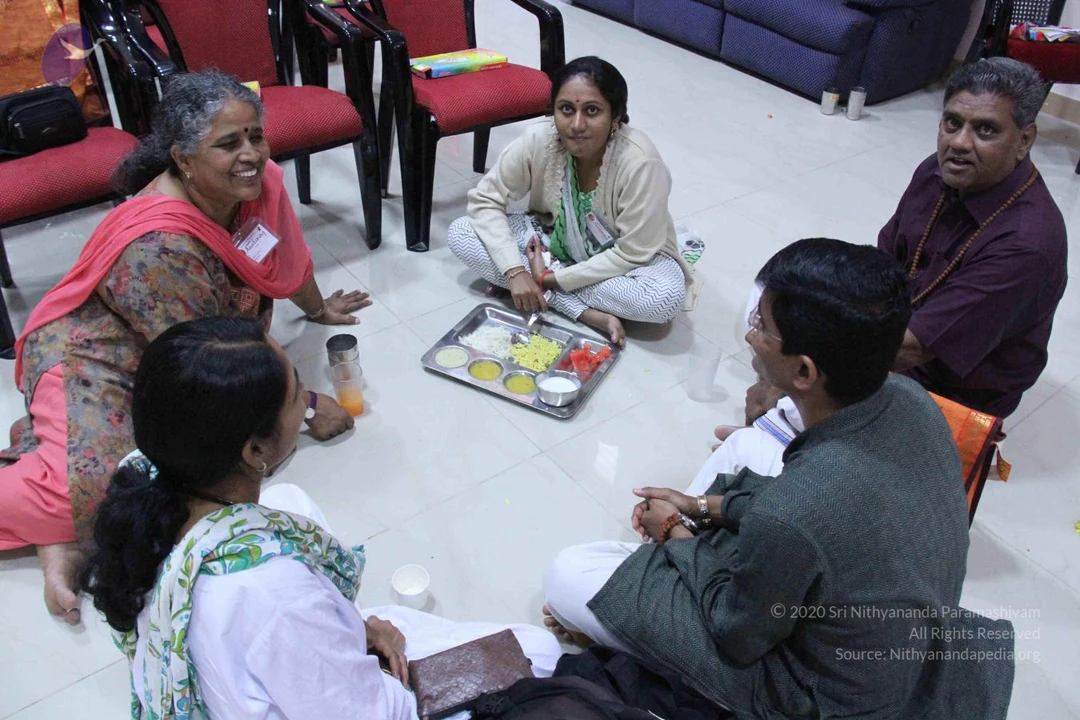
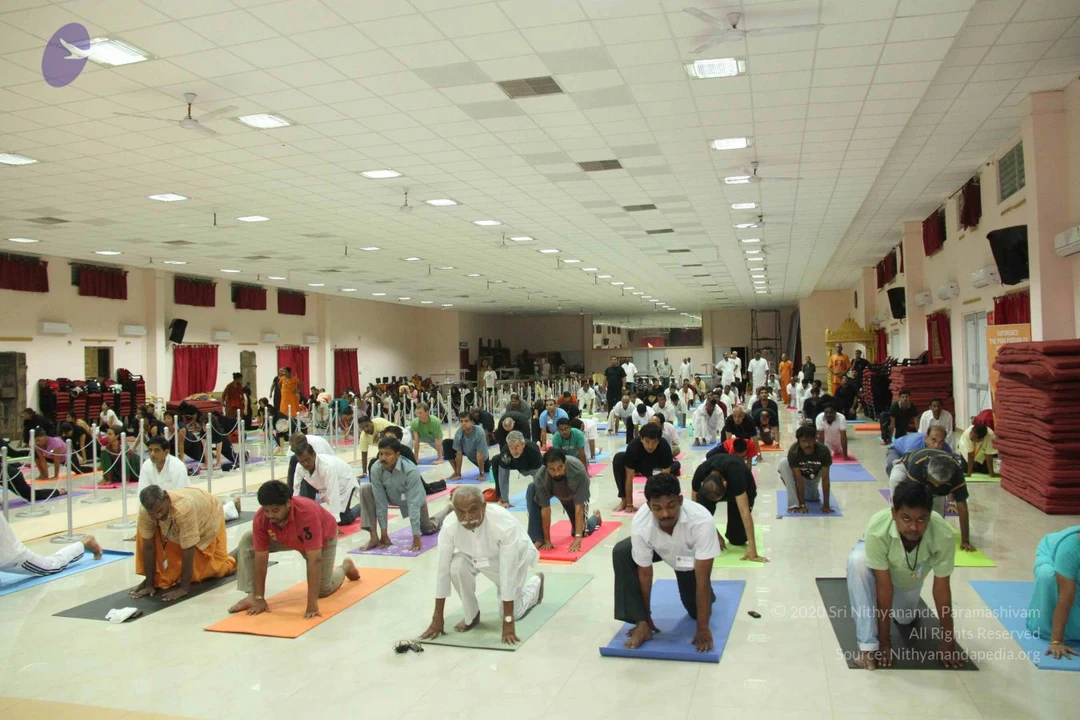
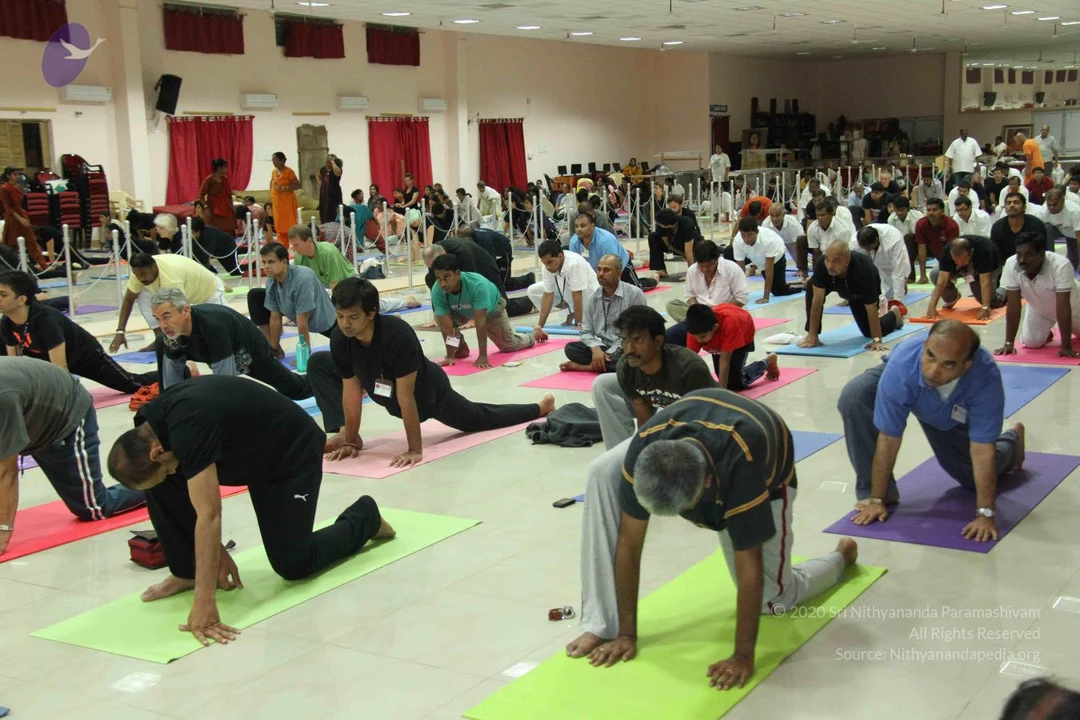
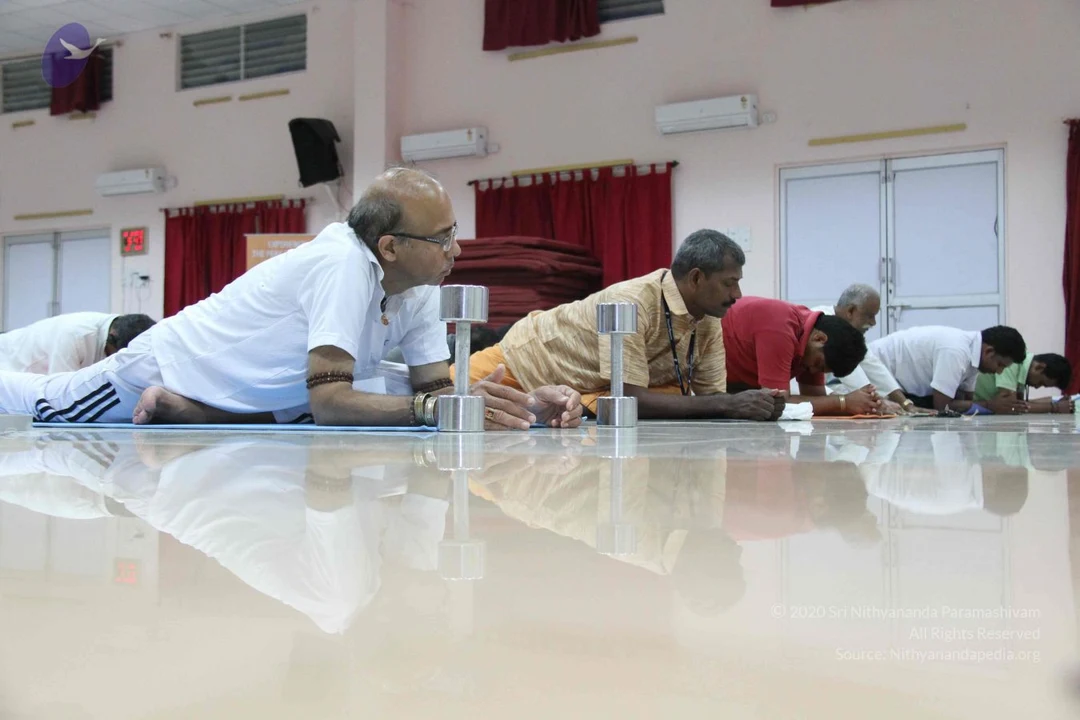
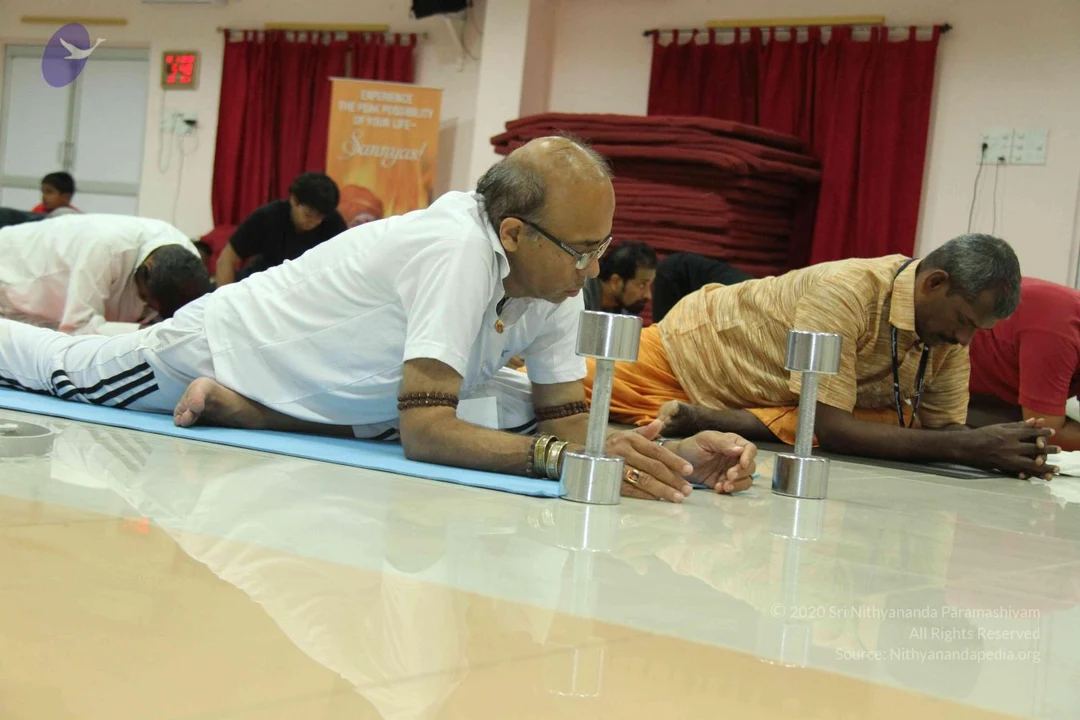
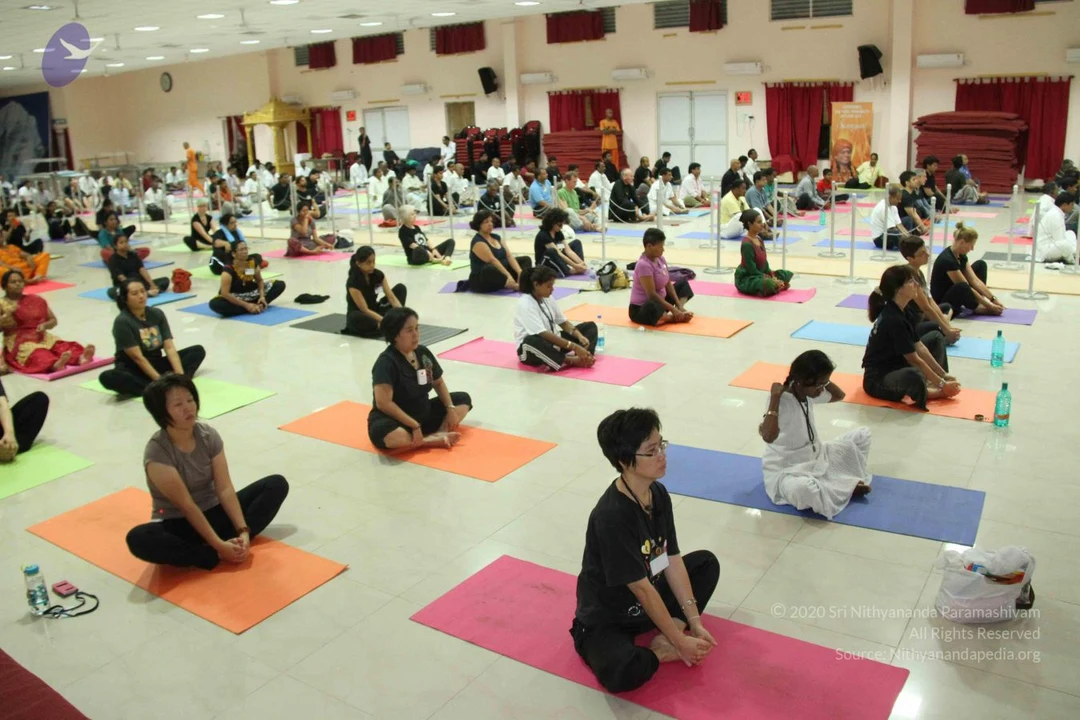
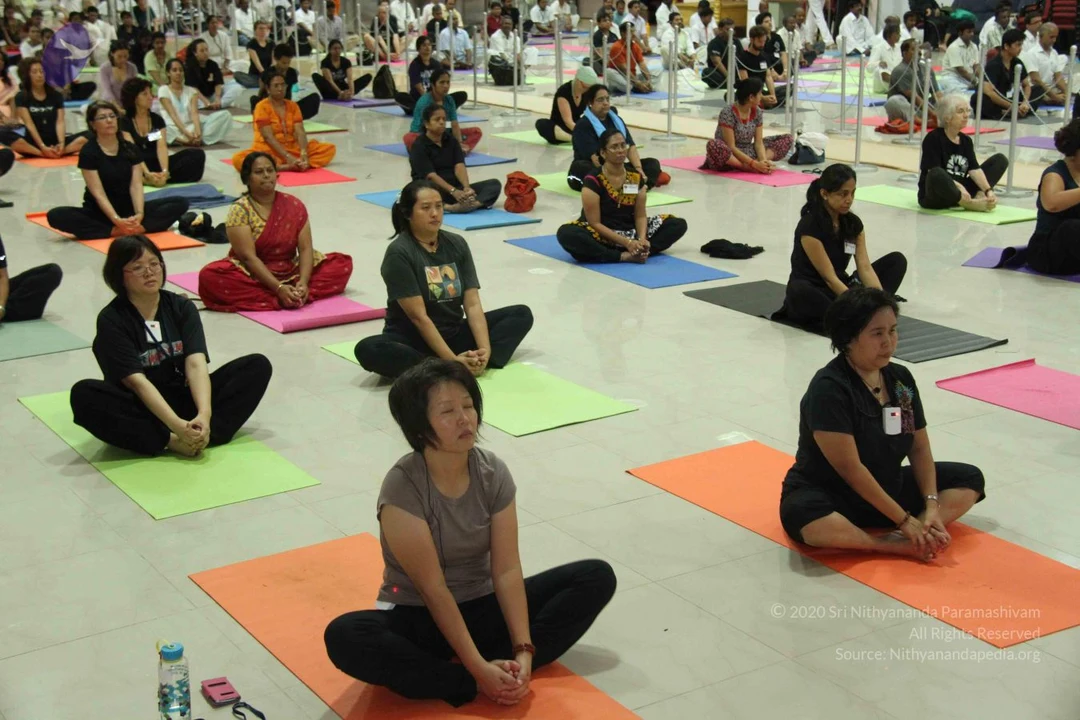
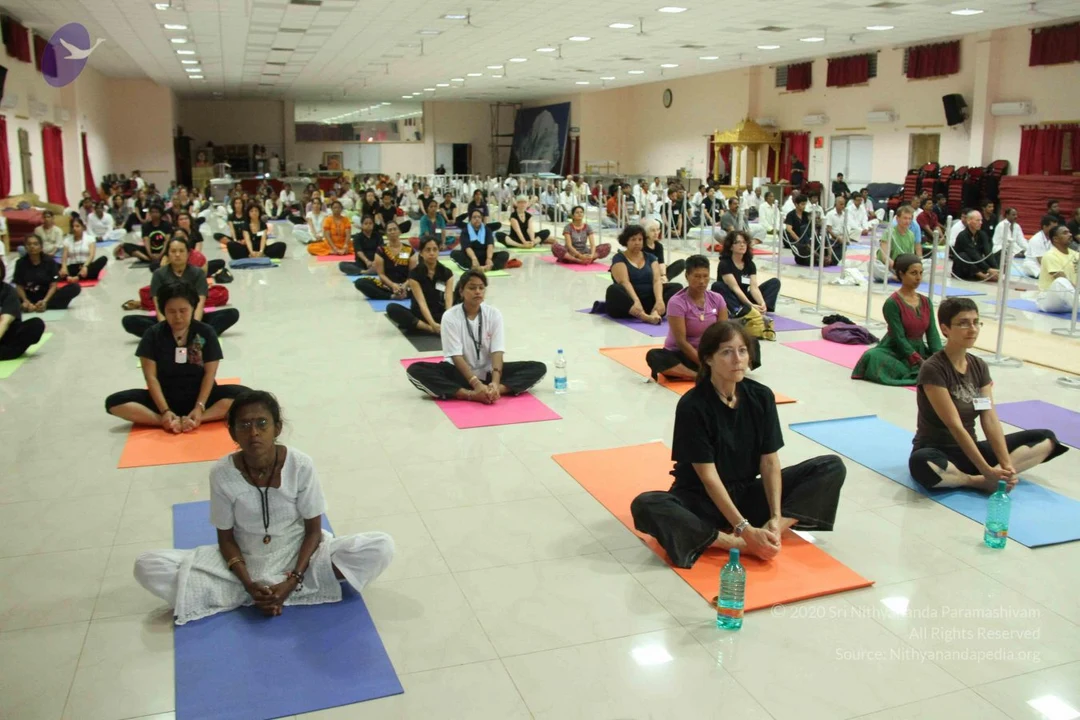
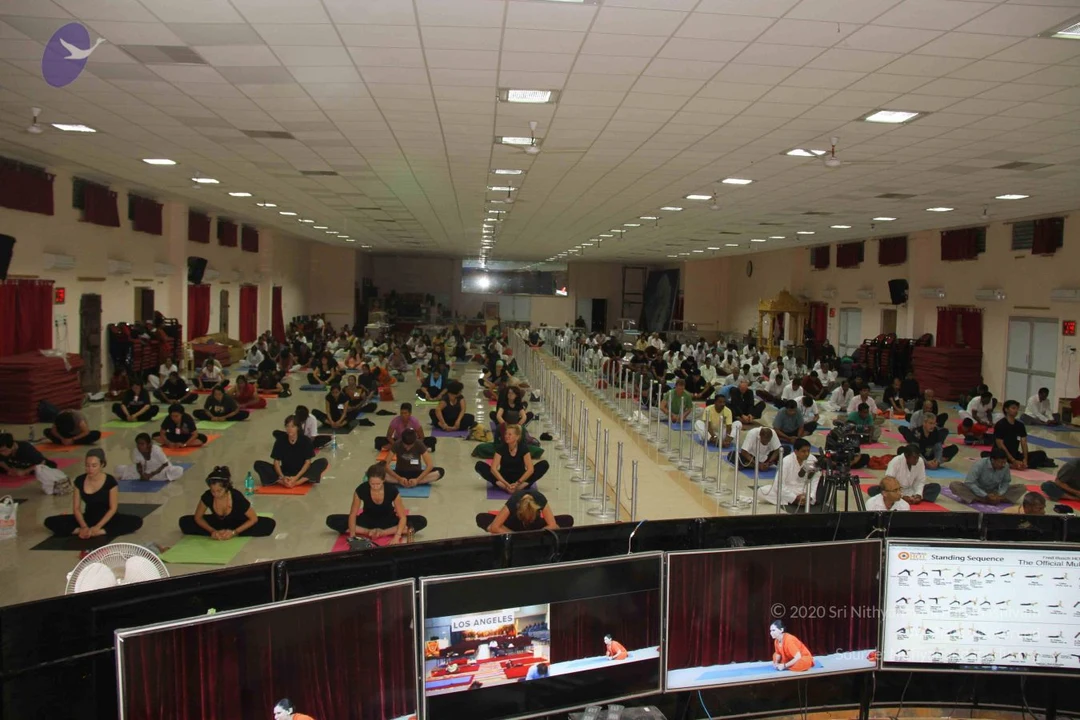
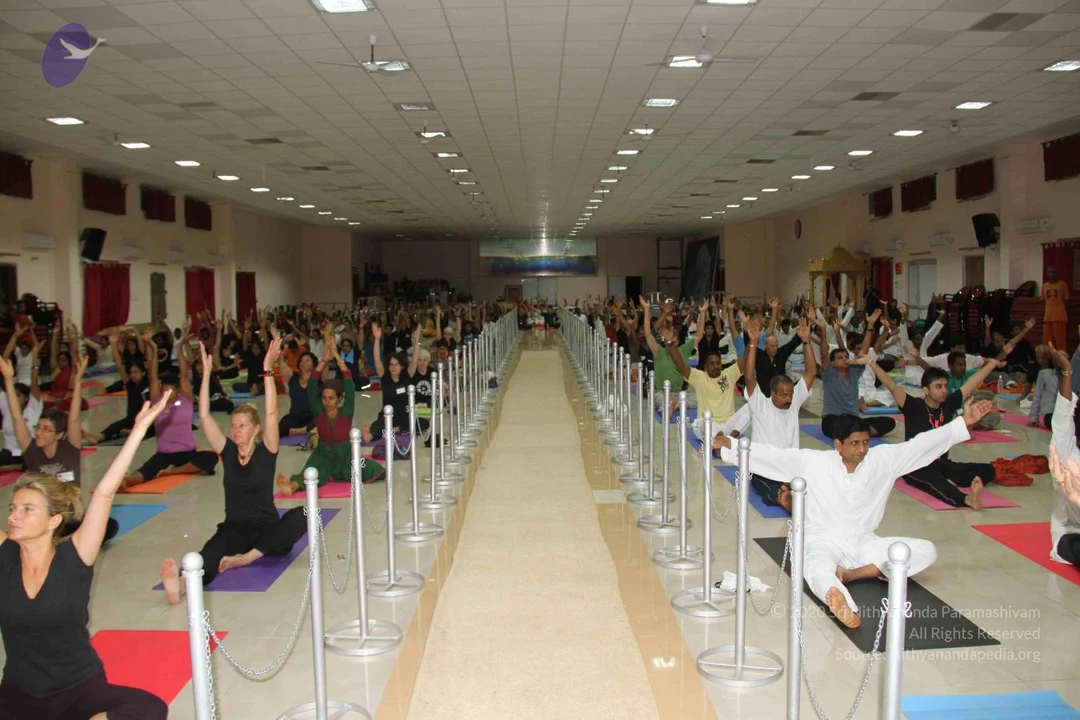
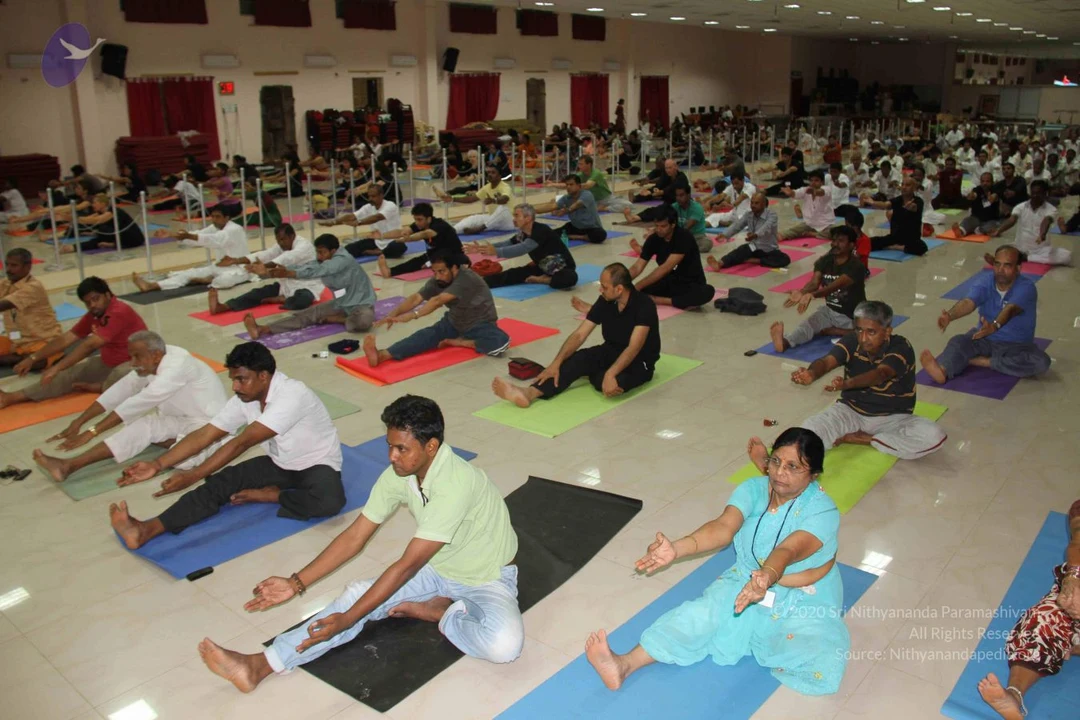
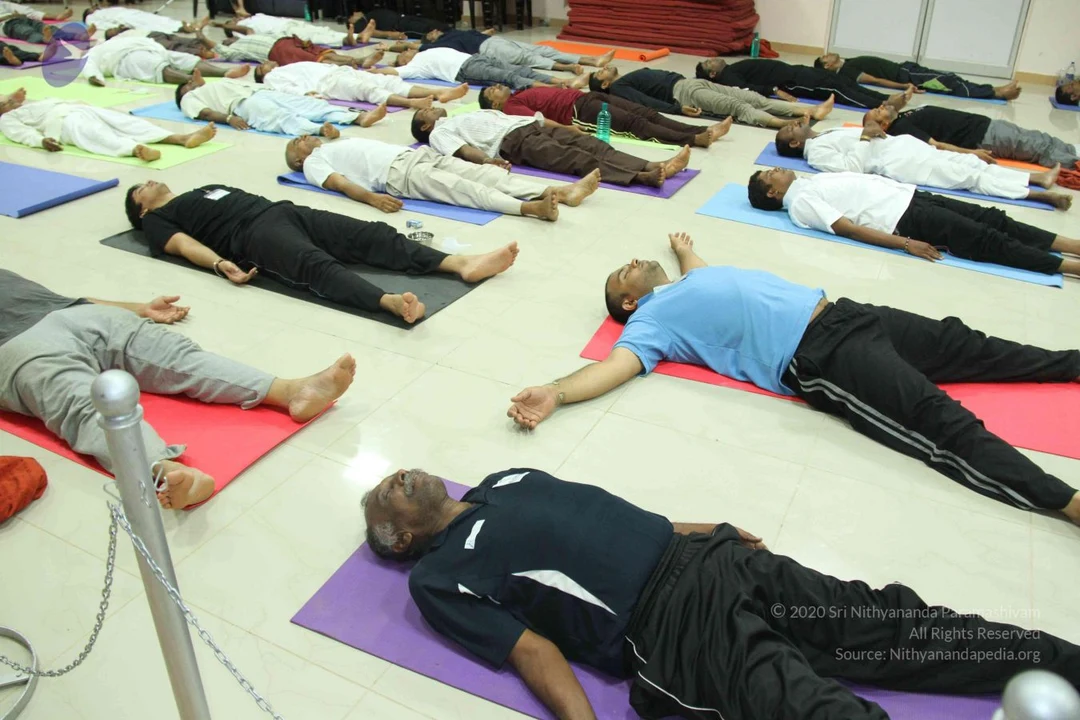
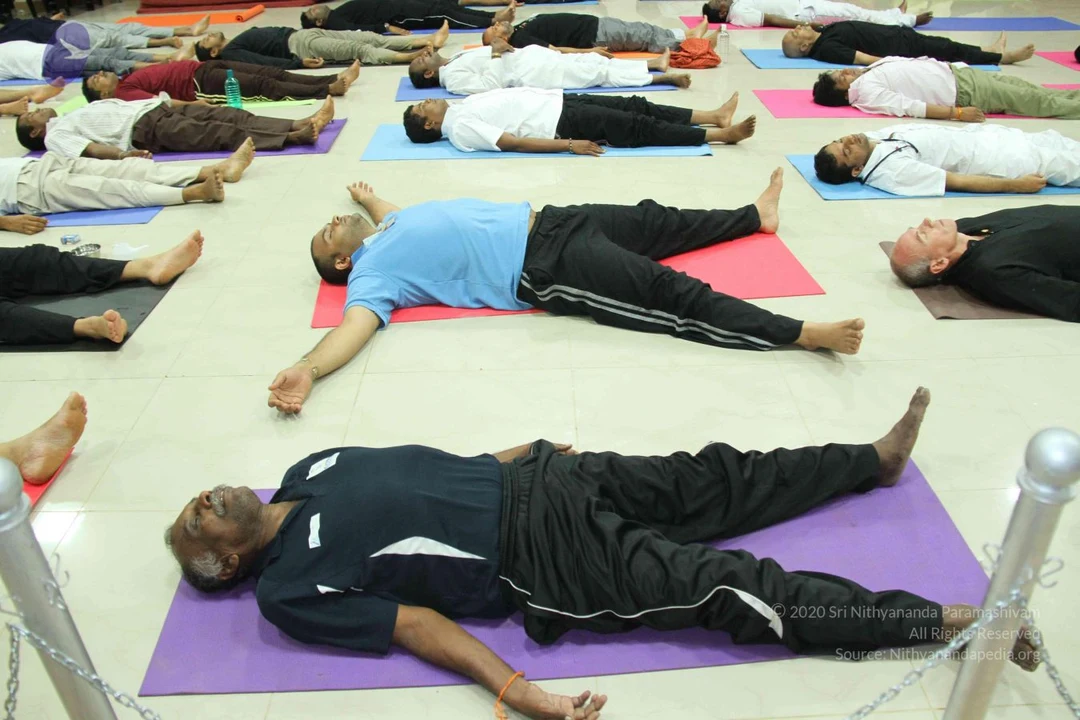
IA-Yoga

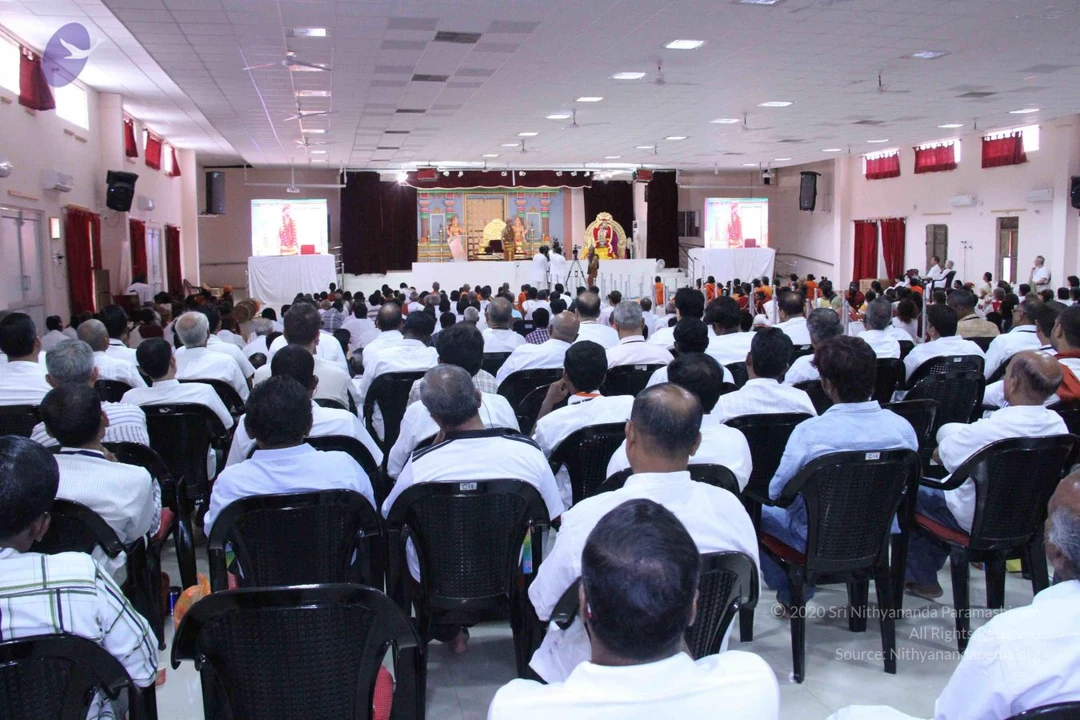
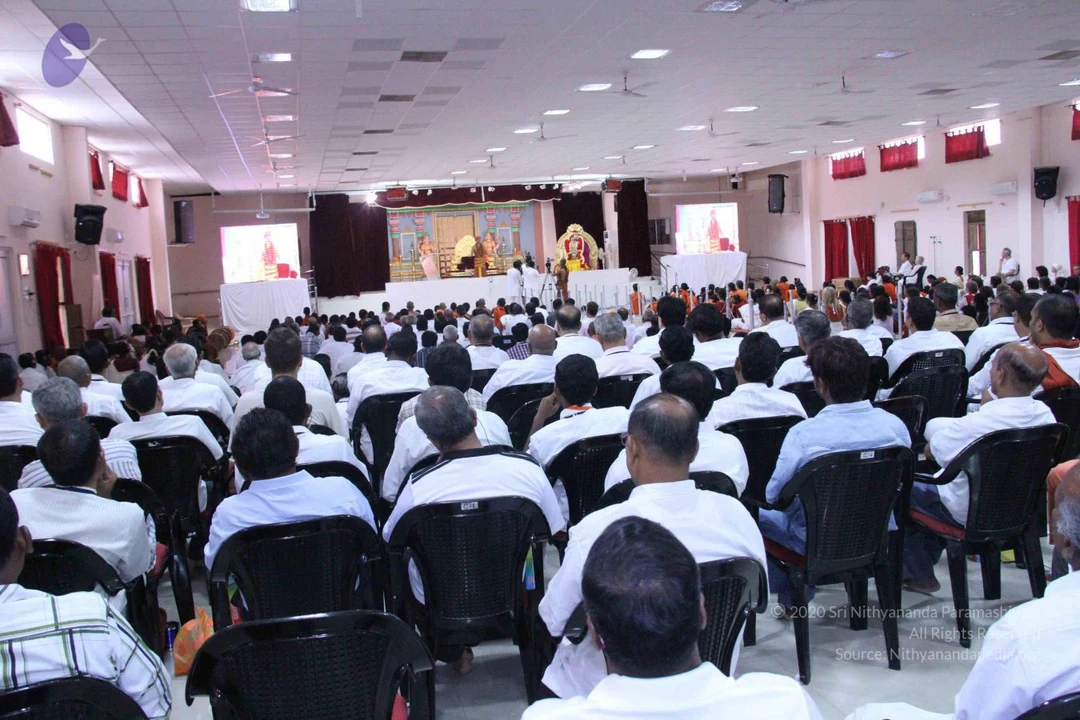
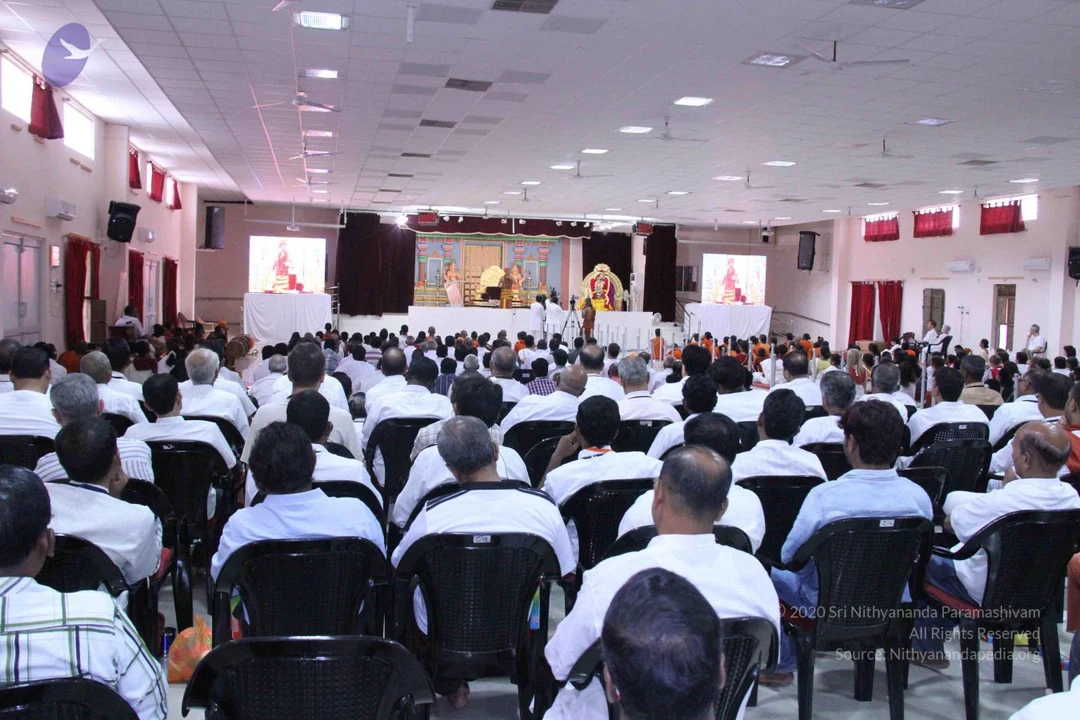
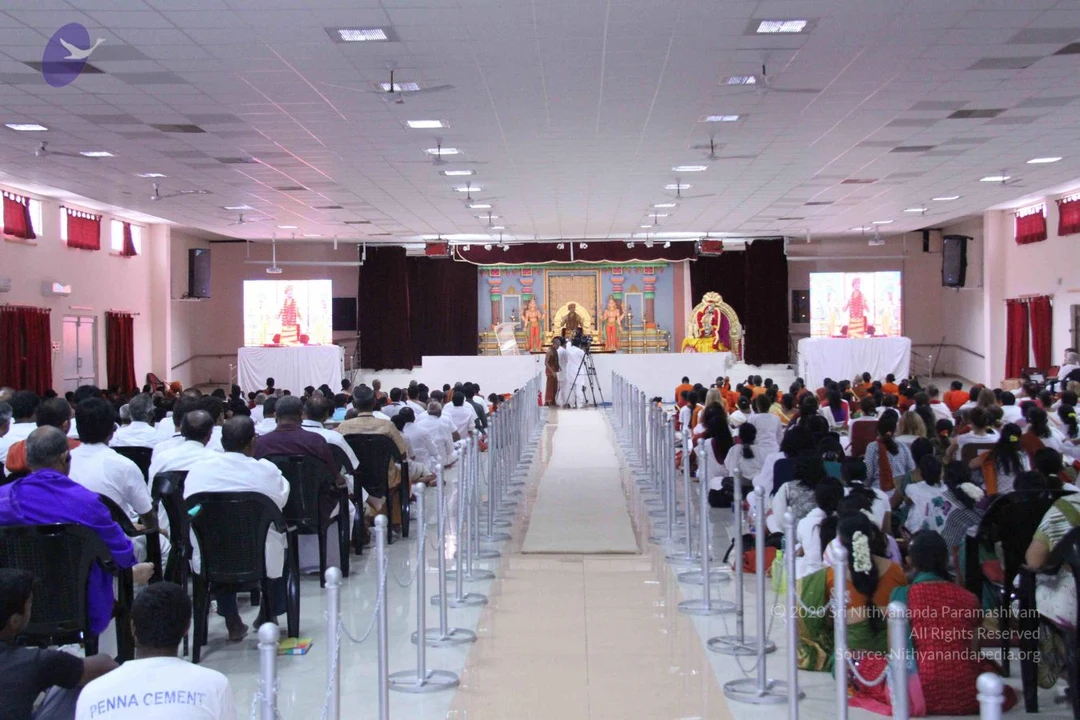
Nitya-Satsang

Sarva-Darshan

Swamijis-Deities

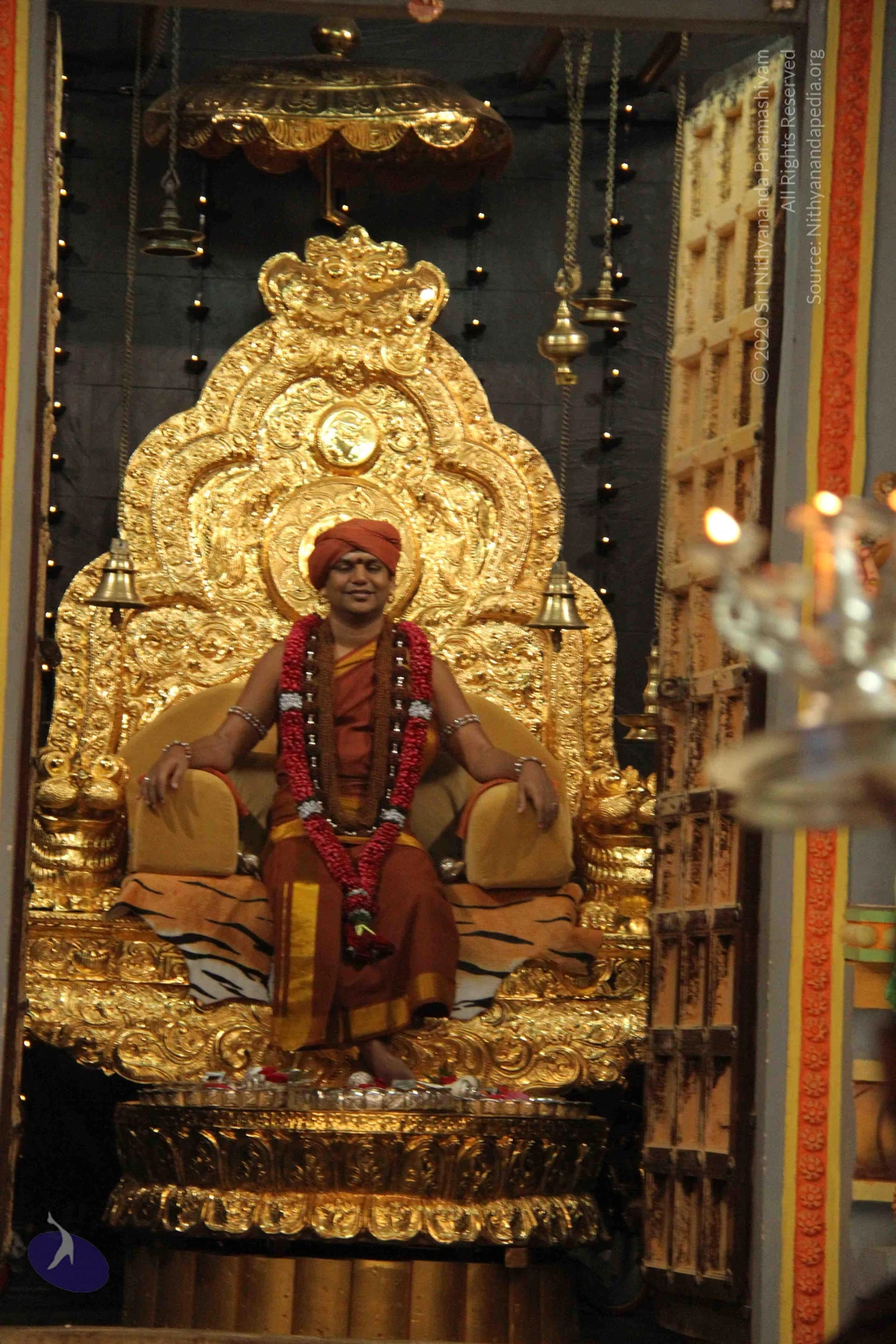
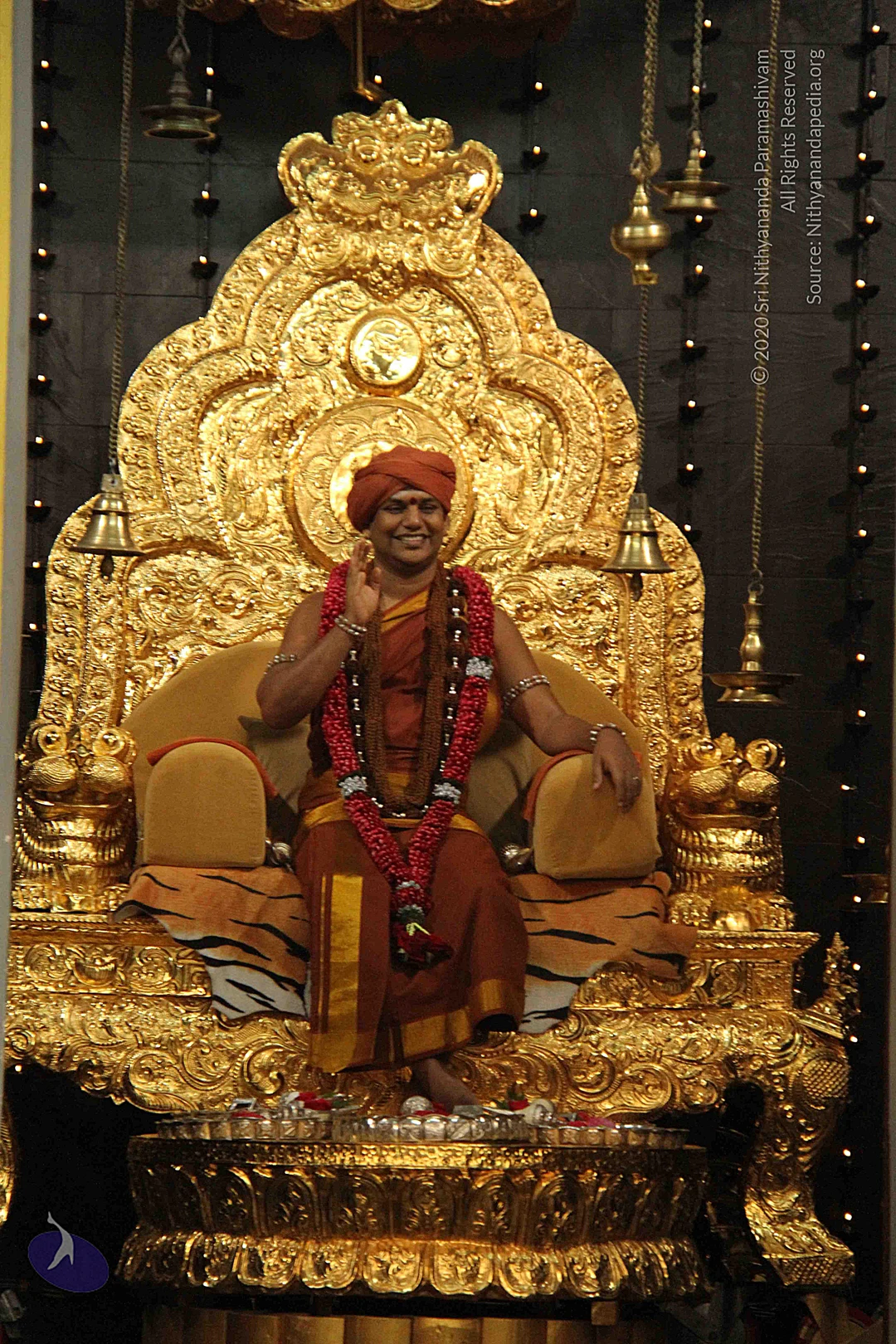
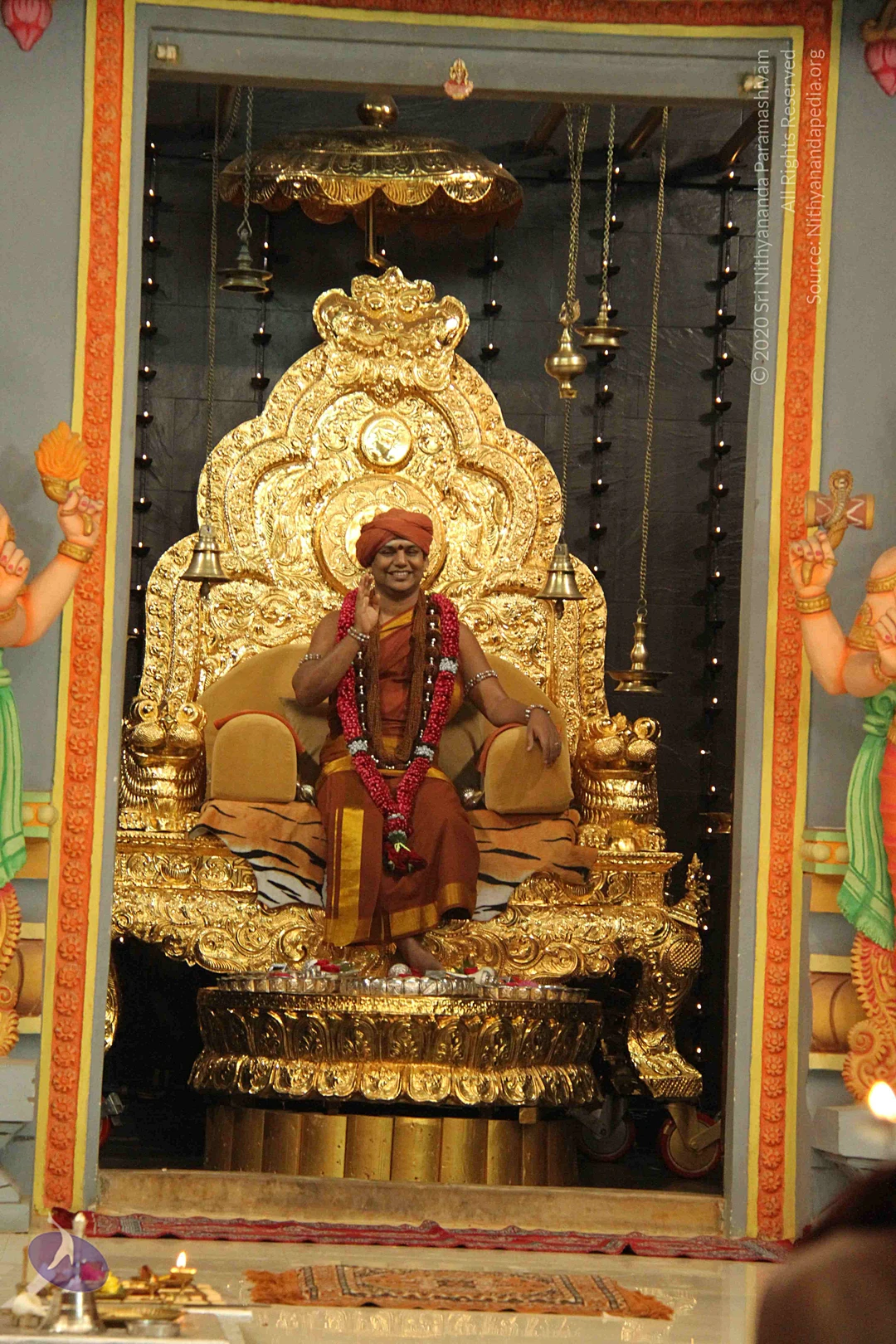
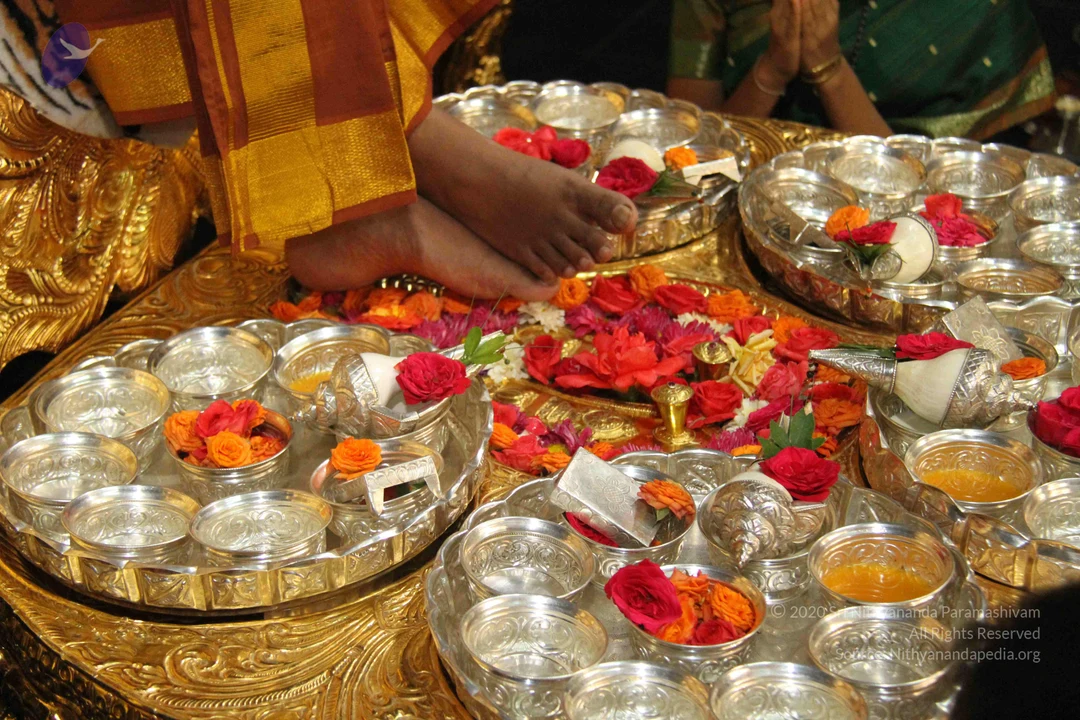
Pratyaksha-Pada-puja

Temple

Photos Of The Day:

Deity-Darshan

Pratyaksha-Pada-Puja

Deity-Arathi

Nithya-Satsang

Sarva-Darshan

IA-Yoga

IA

Photos Of The Day:

Deity-Darshan

Pratyaksha-Pada-Puja

Leela-Alankar

Deity-Arathi

Nithya-Satsang

Sarva-Darshan

IA

01-Deity-Arati

02-IA-Food

03-IA-Swamiji-Session

05-Leela-Alankar

06-Nithya-Satsang

07-Pratyaksha-Pada-Puja

08-Sarva-Darshan

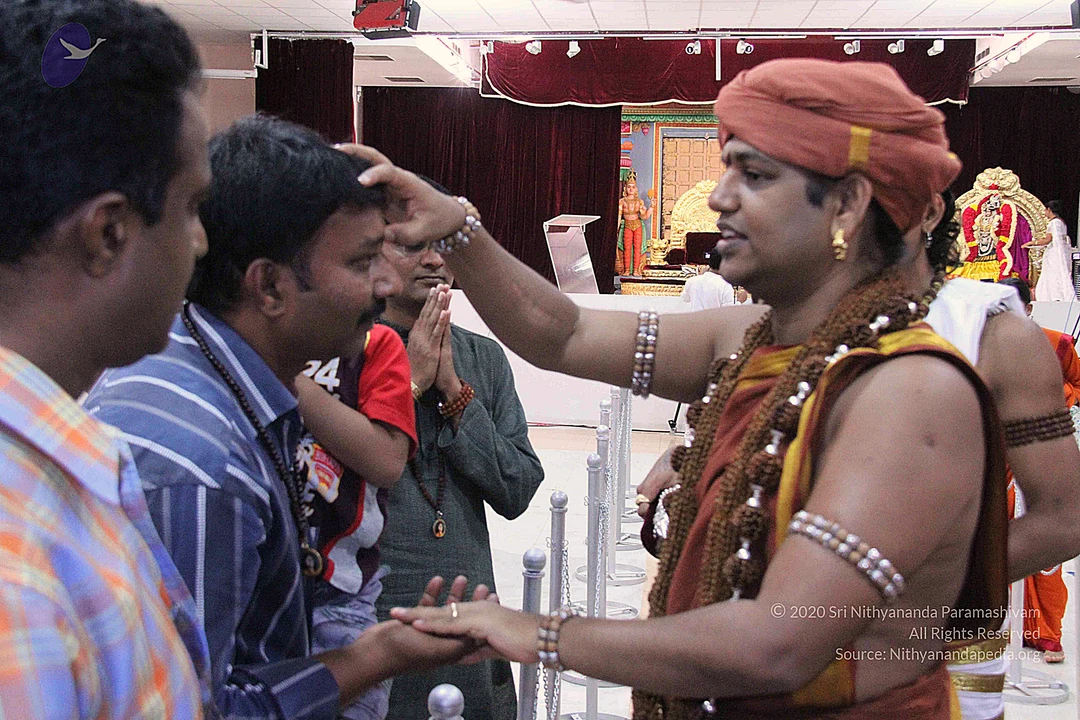
09-Swamiji-Both-Hand-Blessing

IMG_7638_CMP_WM

10-Swamiji-Deities

11-Bidadi-Temple

Photos

Tags:

completion, Paramahamsa Nithyananda, Life, expansion, blessing, thought, integrity, cosmos, Swamiji

Photos from this day

View all 356 photos

Deity-Arati

2 photosSource gallery
A photograph of a stage in a temple-style hall with a painted backdrop of pillars and a golden arched doorway. On the left, a man in an orange saffron wrap, orange head covering and rudraksha mala sits on a gilded throne. Beside him stands a painted deity murti holding a trident and a lamp. On the right, a large gilded throne holds a deity murti decorated with red and white flower garlands. A young boy in orange clothes sits before it with a garland, while a priest in an orange dhoti and shawl, shaved-headed, stands at right holding a lit aarti lamp toward the deity. Brass oil lamps line the stage, and a tripod stand holds a screen near the floor.A woman in an orange saffron sari with a red border and a rudraksha mala stands on a white-tiled stage, leaning down to hold the hand of a small bare-chested boy in orange dhoti-style cloth with a green border. The boy wears a white flower garland and white sandalwood markings on his forehead and arms. In the foreground, a shaved-headed man in orange cloth sits with his back to the camera, and a woman in glasses sits below. A red velvet curtain hangs behind the stage, and a microphone stand is visible at right. Brass oil lamps sit on the steps. The woman's appearance is consistent with a person candidate in orange sari with rudraksha mala, but the identification is uncertain.

IA-Food
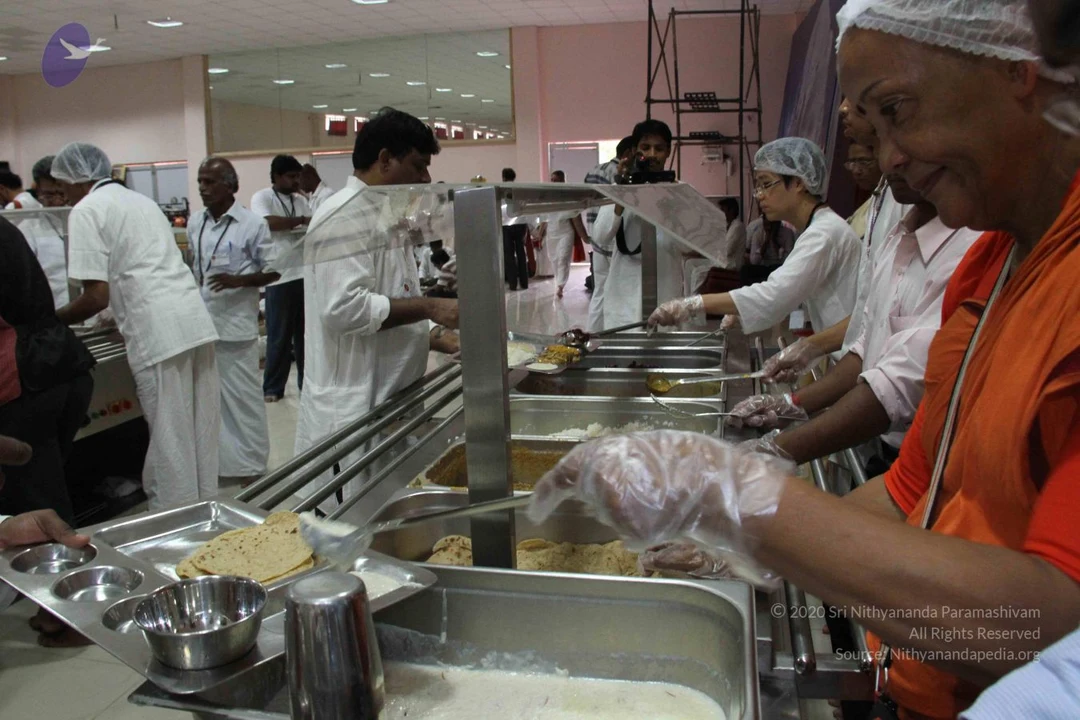
34 photosSource gallery
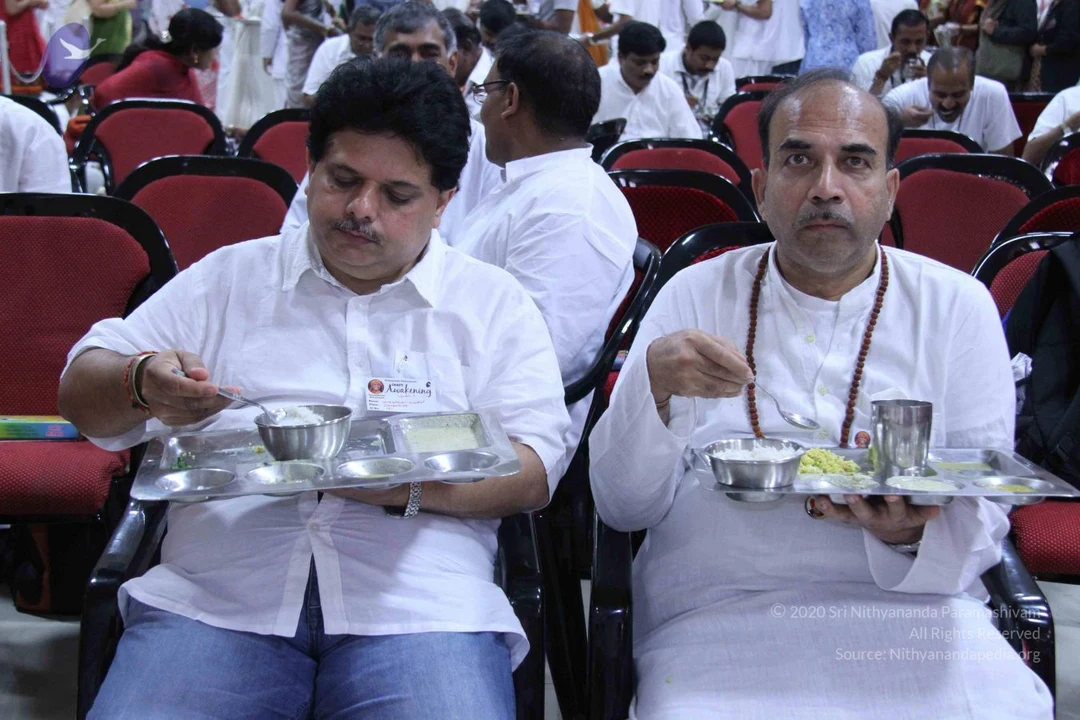
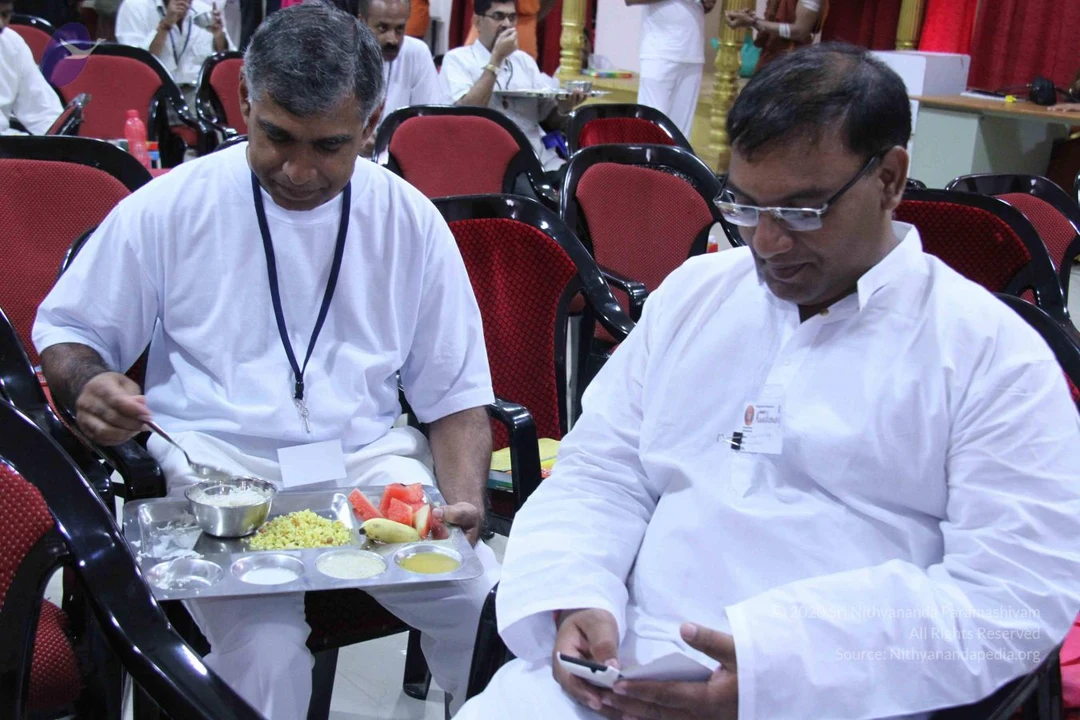
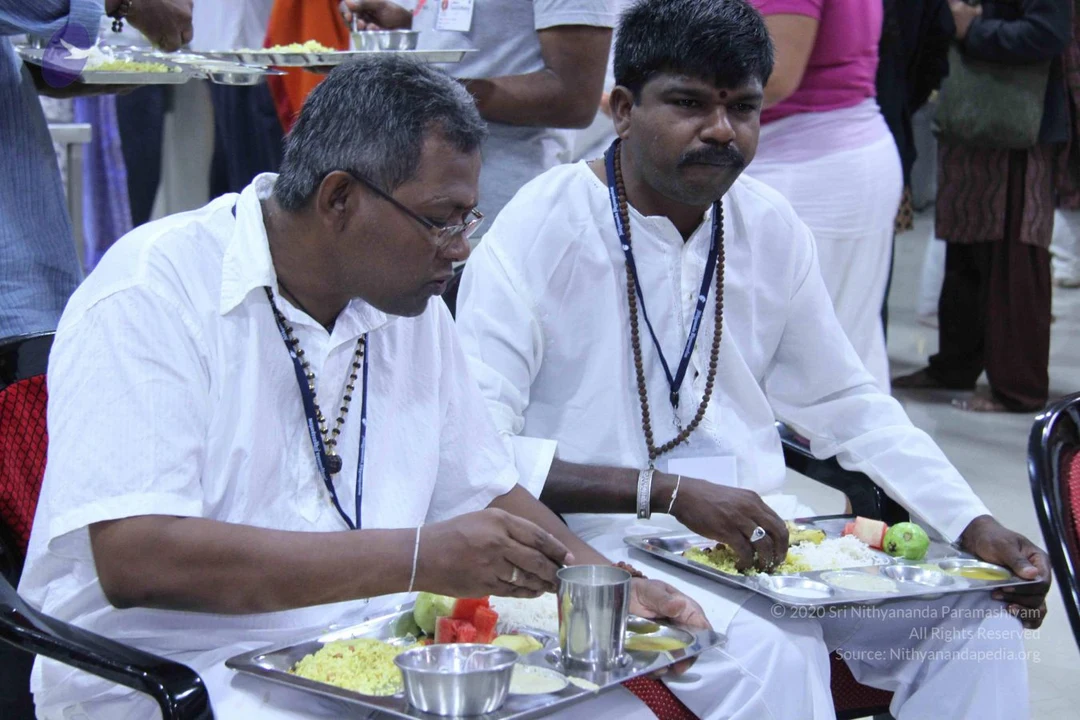
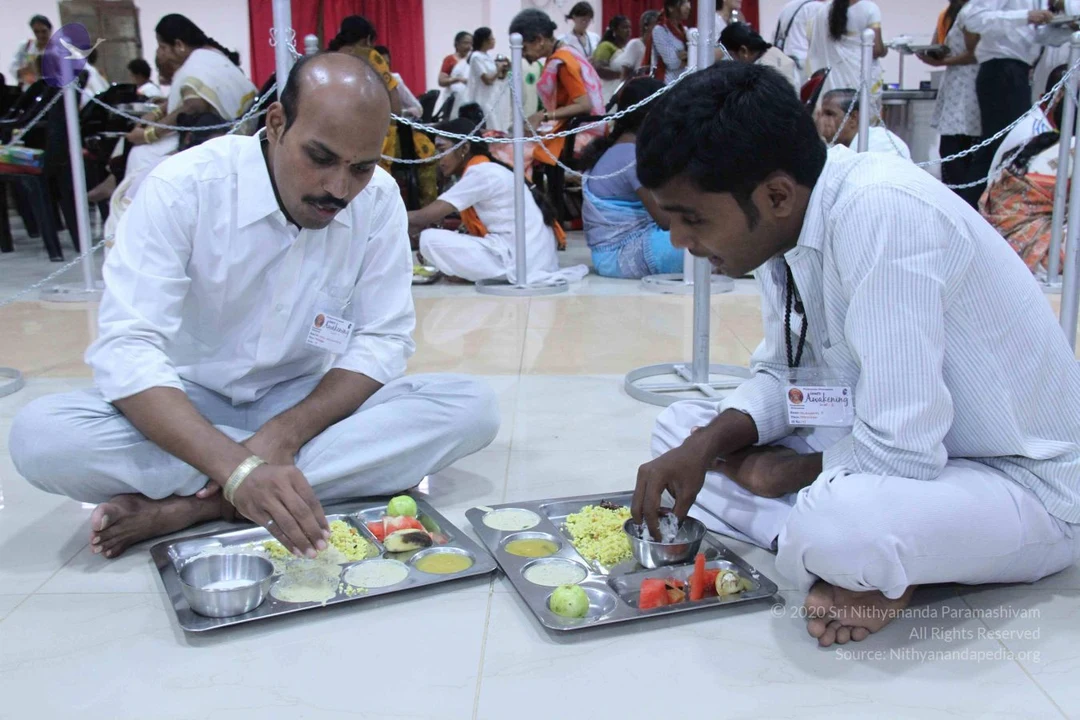
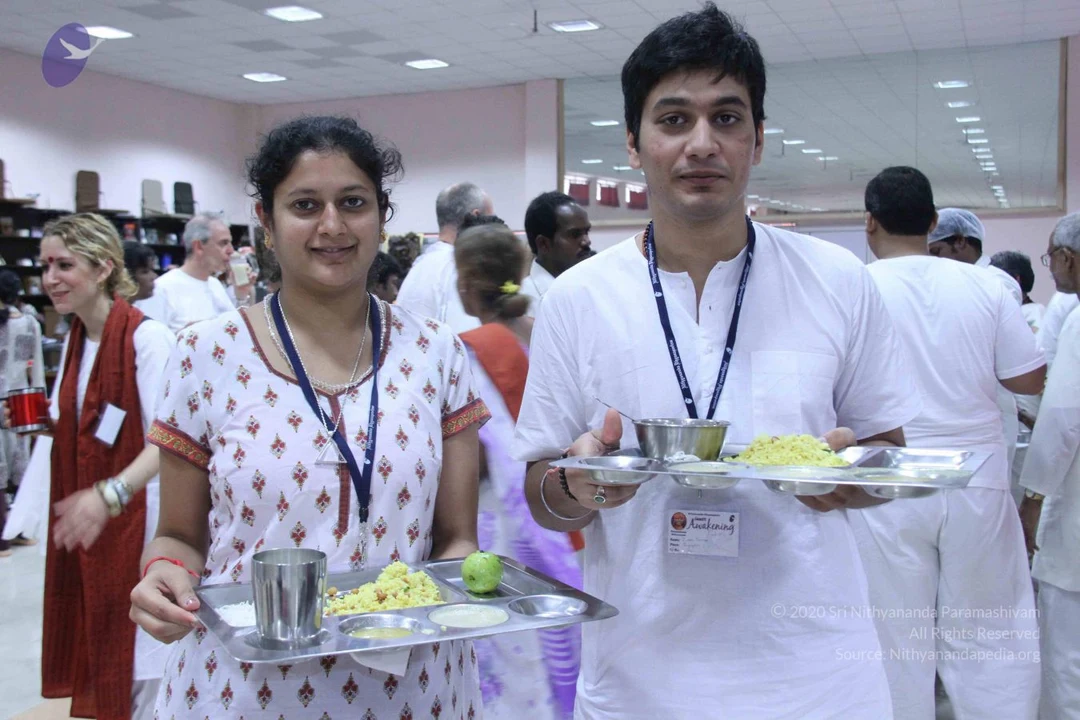
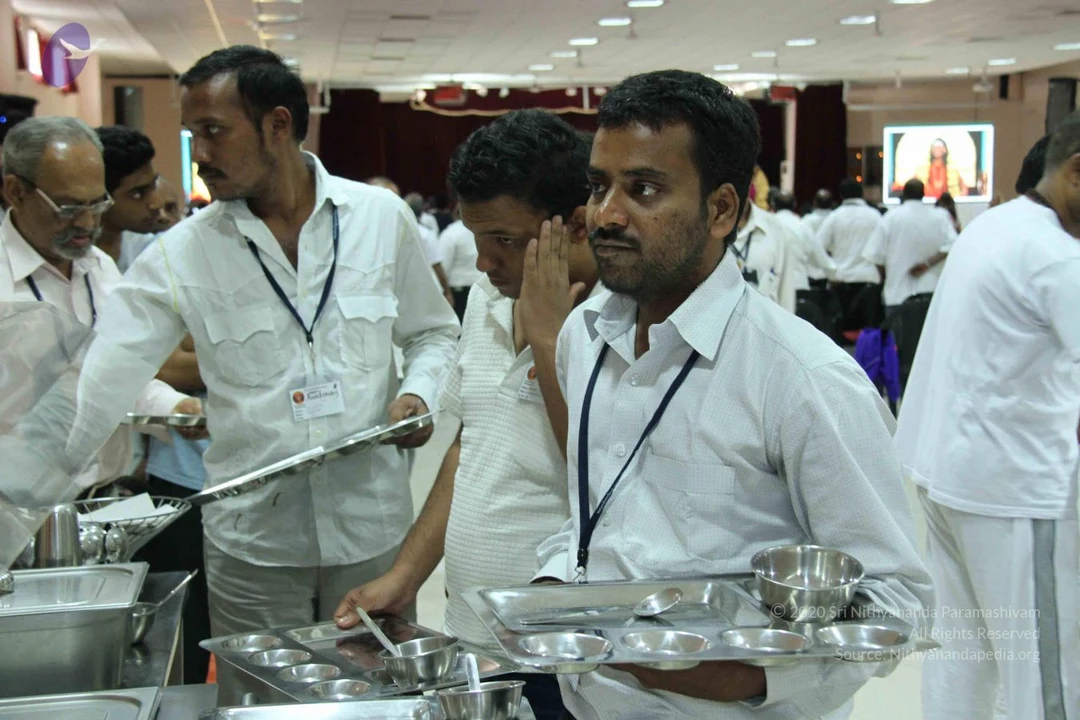
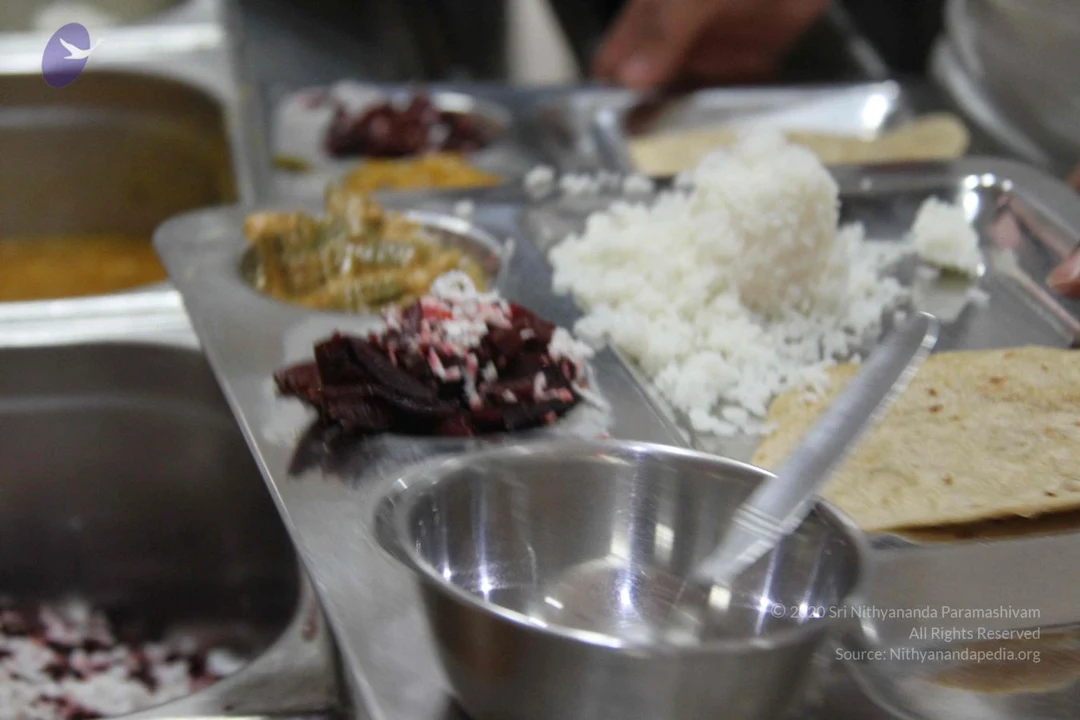
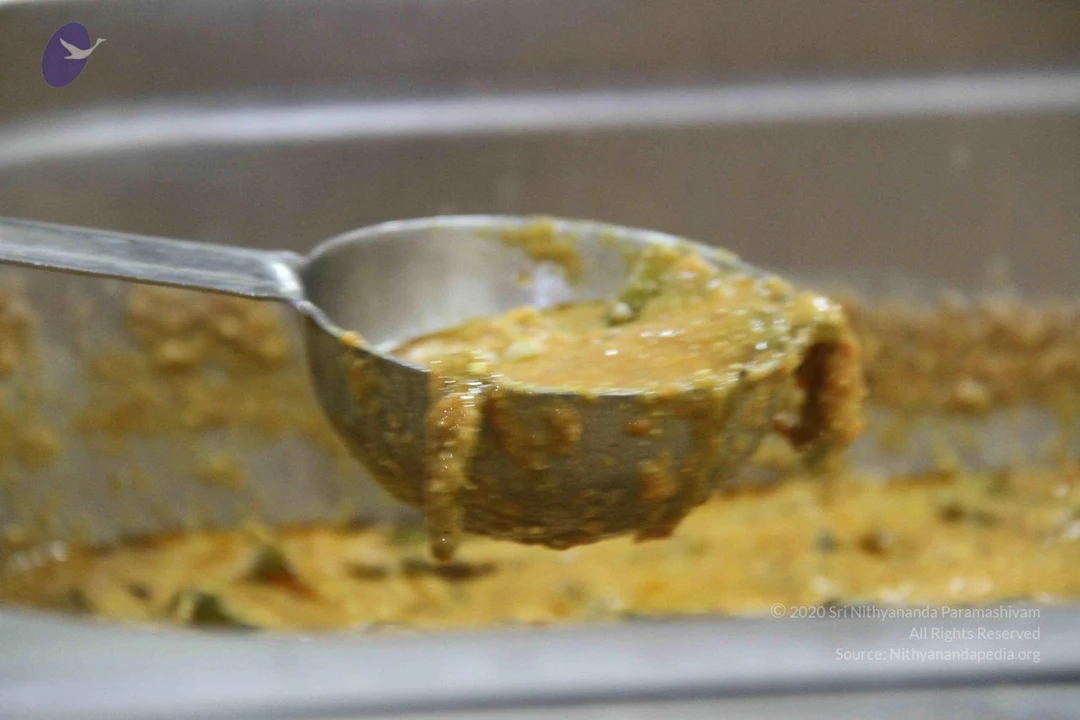
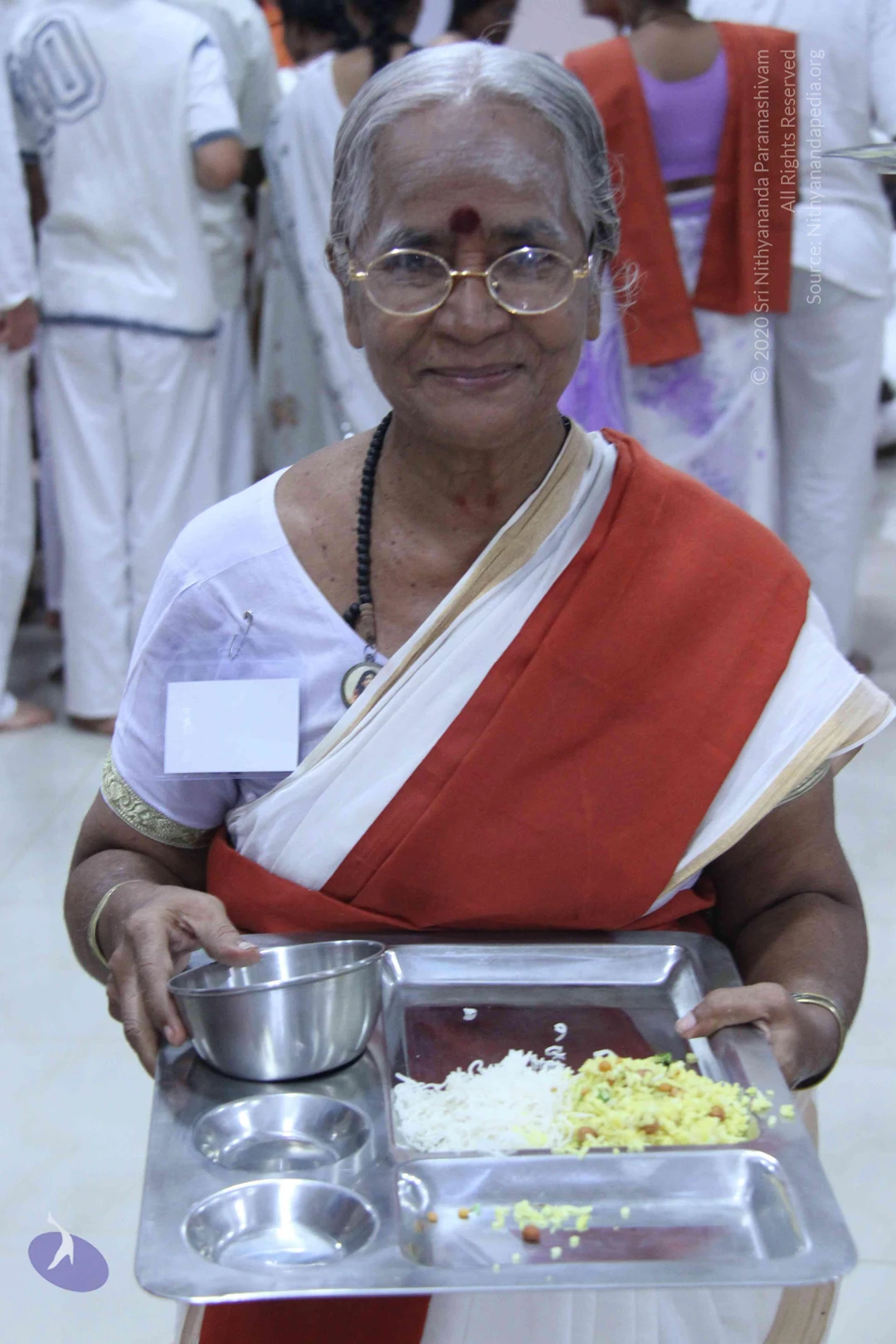
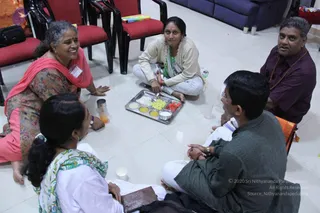
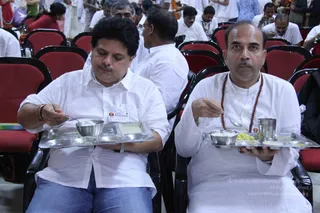
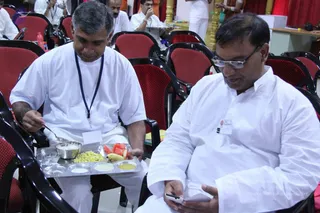
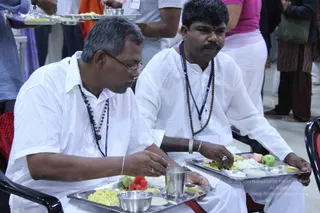
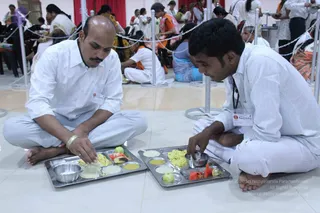
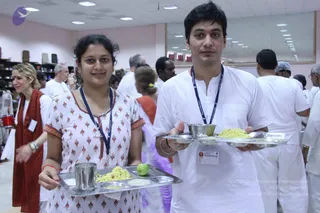
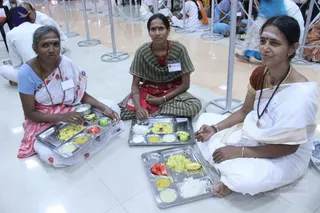
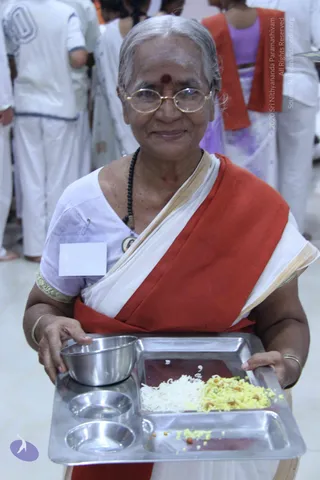
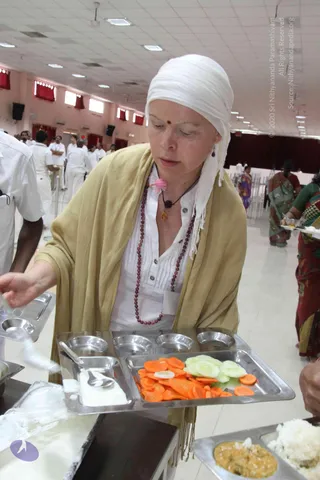
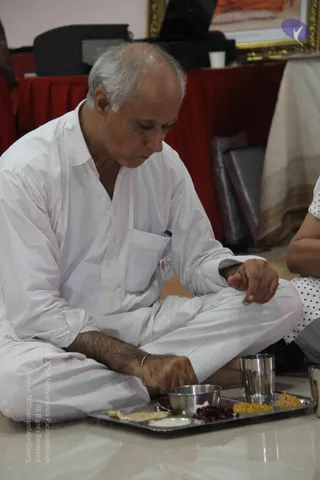
A photograph of five people seated cross-legged on a white tiled floor in a informal circle, sharing a steel thali with small bowls of rice, yellow dal, sliced vegetables and a white dip. A woman on the left wears a coral dupatta over a floral kurta and smiles; a woman in a cream cardigan and striped white pants sits center-back; a man at right wears a plum shirt and beaded mala; a man in a grey textured jacket and white dhoti sits front-right; a woman in white with a green-and-white shawl sits front-left holding a brown book. Red chairs and a blue sofa are behind them, with lit candles and a glass of juice nearby.Two seated men in white kurta-style and white shirts eat from steel thali trays with spoons in a red-cushioned auditorium. The man on the left wears a white shirt, blue jeans and a name badge reading Awakening; the man on the right wears a white kurta with a rudraksha mala and holds a steel tumbler. Other attendees in white clothing sit behind them in the background, and a rudraksha-adorned man at right also eats from a tray.Two men in white clothing sit in red-cushioned chairs in a hall with red curtains behind them. The man on the left, in a white t-shirt with a blue lanyard and a white name badge, holds a steel plate of yellow rice, sliced watermelon, banana, and small bowls, eating with a spoon. The man on the right, in a white kurta with glasses and a white badge, looks down at a mobile phone. Other seated people in white are visible in the background.Two men in white ritual-style shirts and dhotis sit at a meal in a hall, eating from stainless steel thalis. The man on the left, wearing glasses and a dark wood mala with a pendant, uses his right hand to eat from a small steel tumbler and bowl. The man on the right, with a moustache, a red tilak, a blue lanyard and a dark rudraksha-style mala, holds a thali of rice, yellow dal-style dish, sliced watermelon and fruit. Standing people in white and pink behind them watch or move about. Steel cups and fruit slices are visible. The scene reads as a communal annadan-style meal.Two men in white shirts and white dhoti-style pants sit cross-legged on a white tiled floor eating from stainless steel thalis. The man on the left, with a moustache and a gold bangle, uses his right hand to take rice from a compartment, while the man on the right, wearing a rudraksha mala, scoops food from a small steel bowl. Their thalis hold rice, yellow dal, curry, sliced watermelon, banana and apple. Behind them, a row of seated people in white and orange clothes is separated by chrome stanchions and chains, and staff in white stand at the back.Two smiling young adults stand in a bright hall holding steel trays of yellow rice, a small steel cup, metal bowls, and a green apple. The woman on the left wears a white kurta with red and orange floral print and a red-and-gold trim, with a silver necklace and a blue lanyard. The man beside her wears an all-white kurta and pants with a blue lanyard and a name badge, holding a tray with a steel bowl and rice. Behind them, many people in white clothing move through a room with shelves and a mirrored wall.

IA-Yoga

43 photosSource gallery
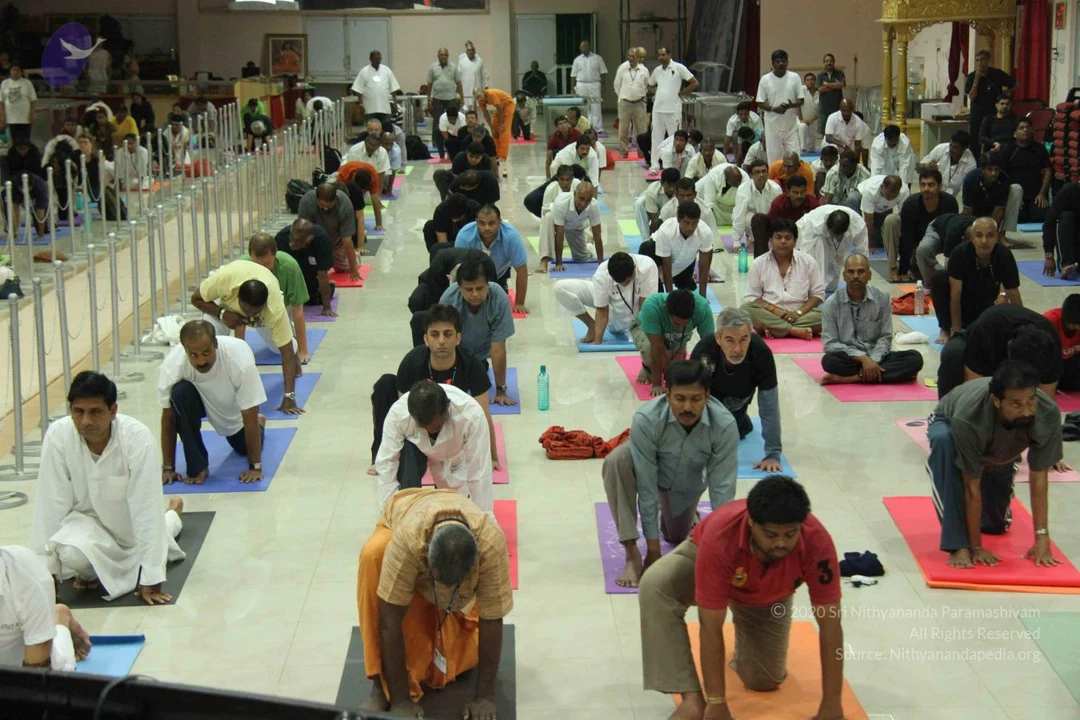
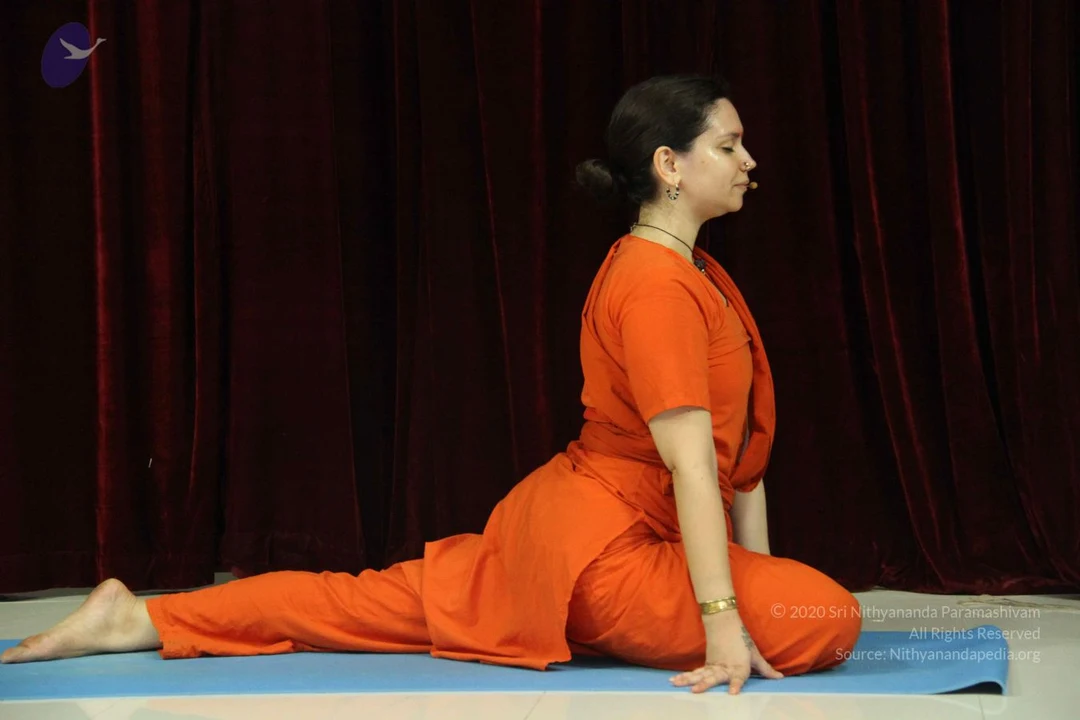
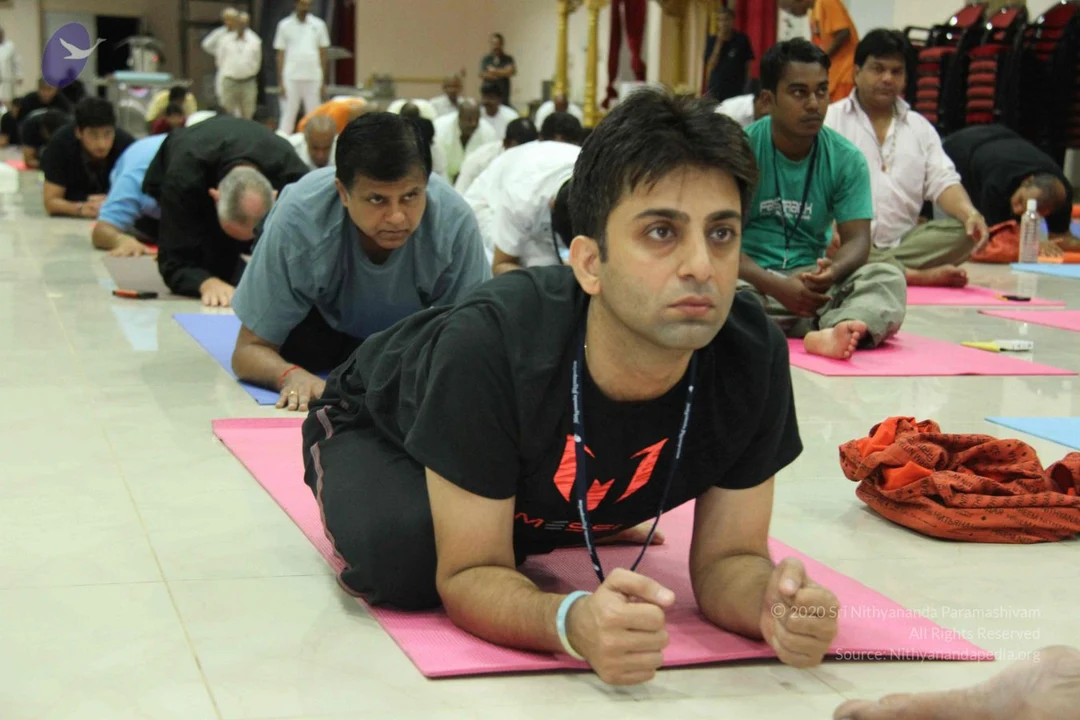
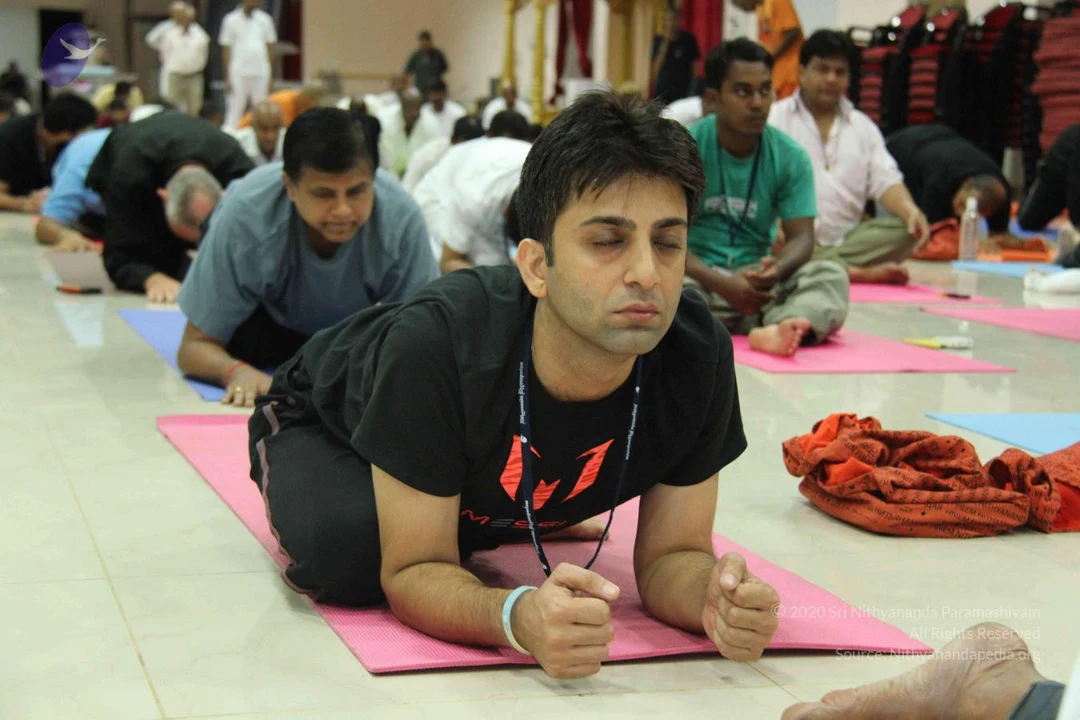
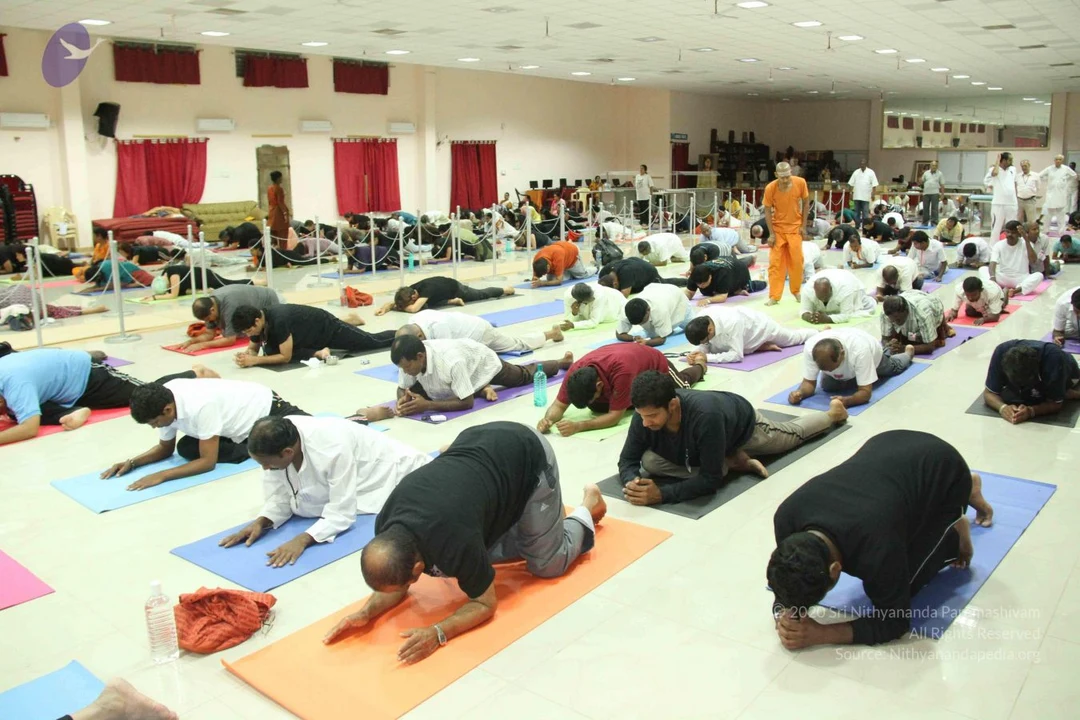
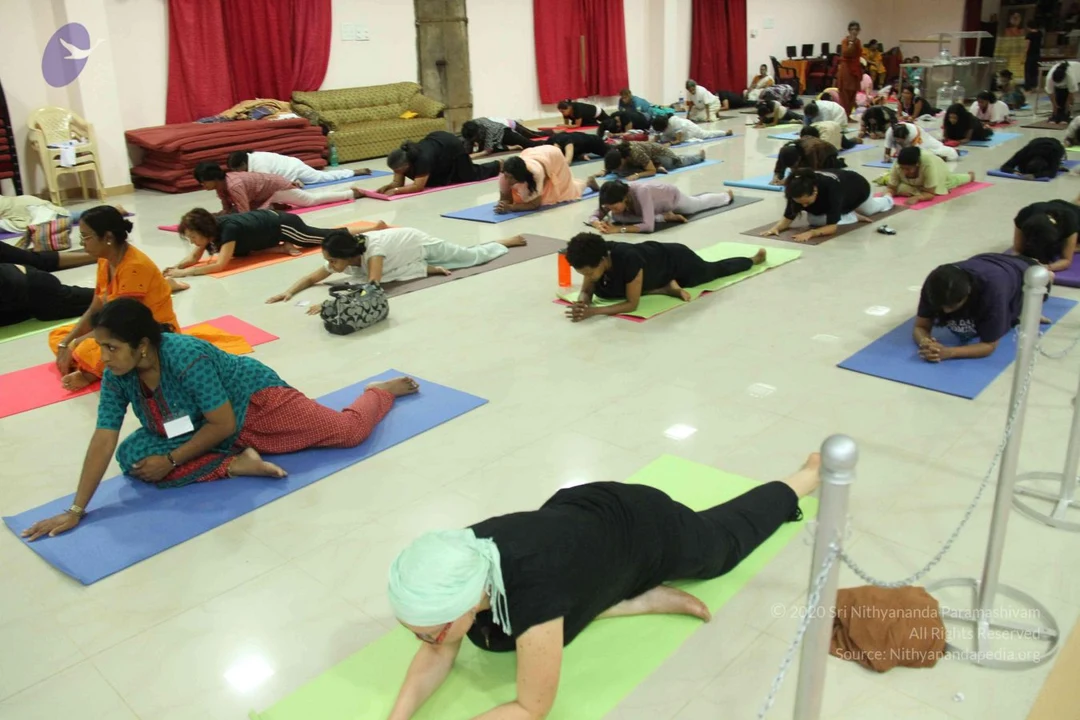
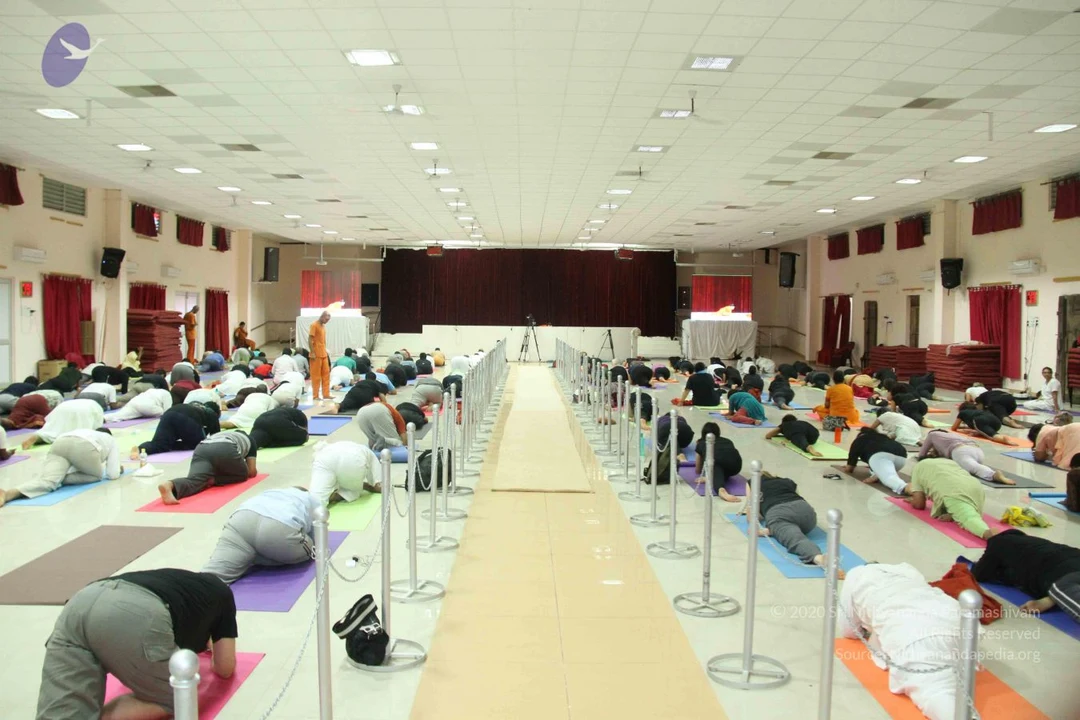
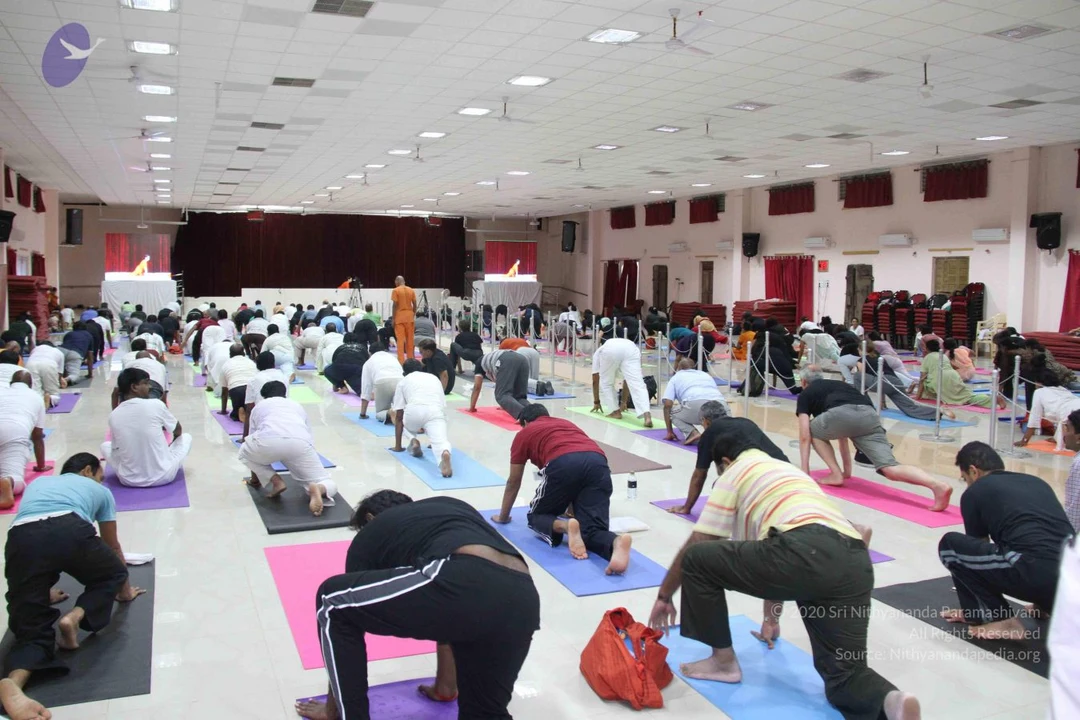
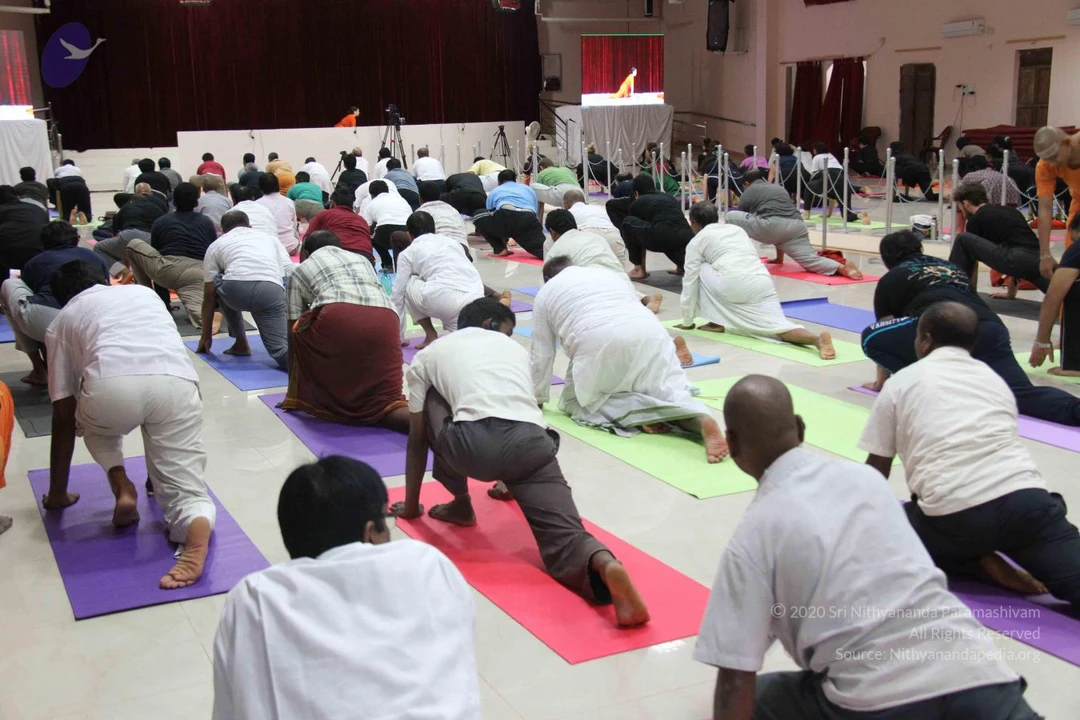
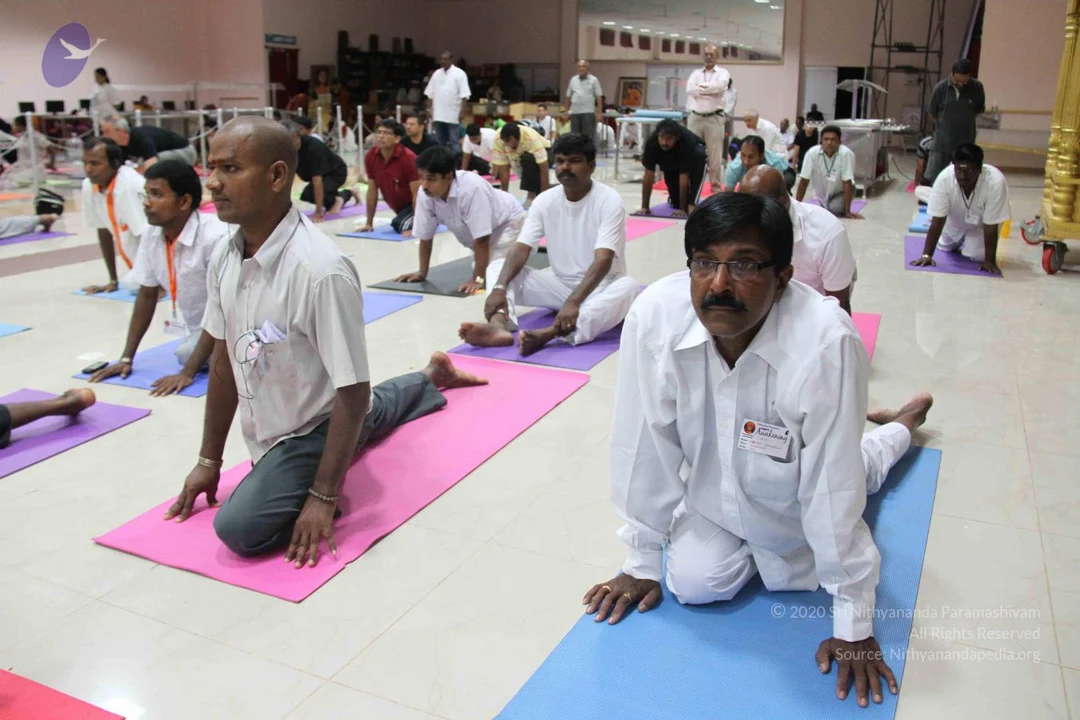
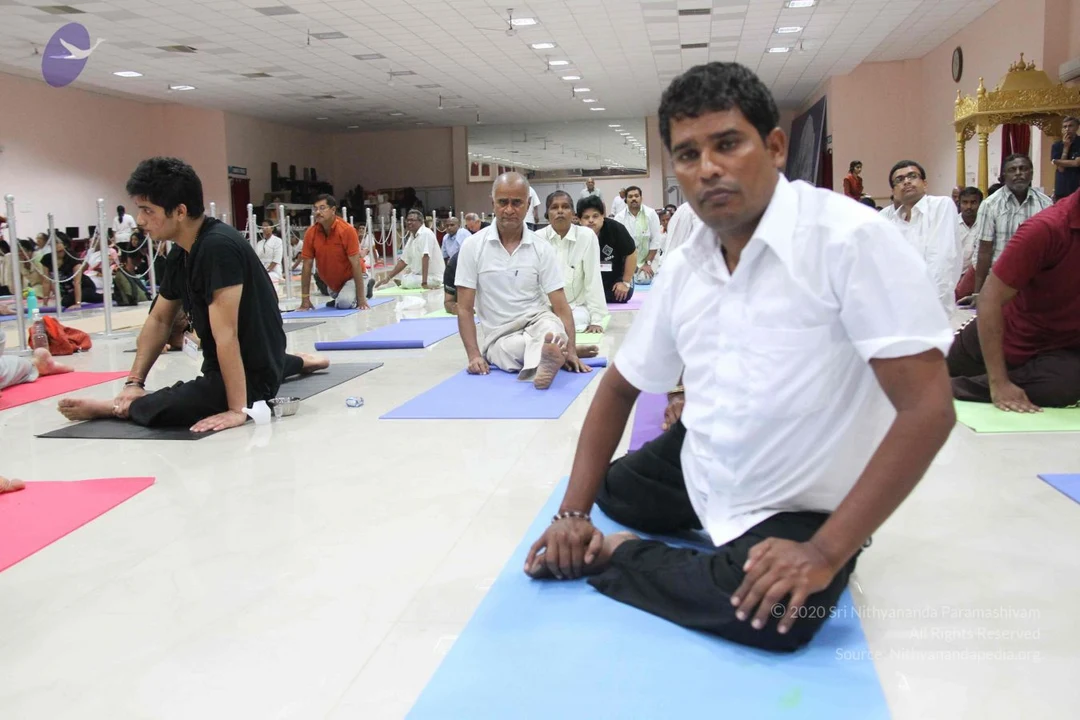
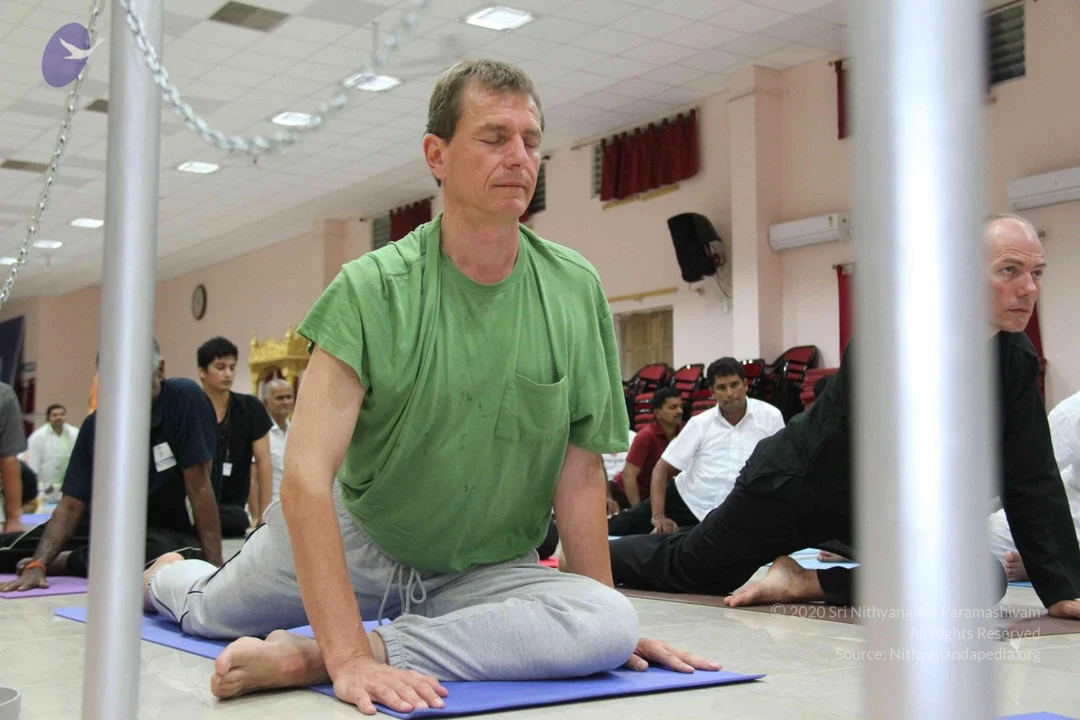
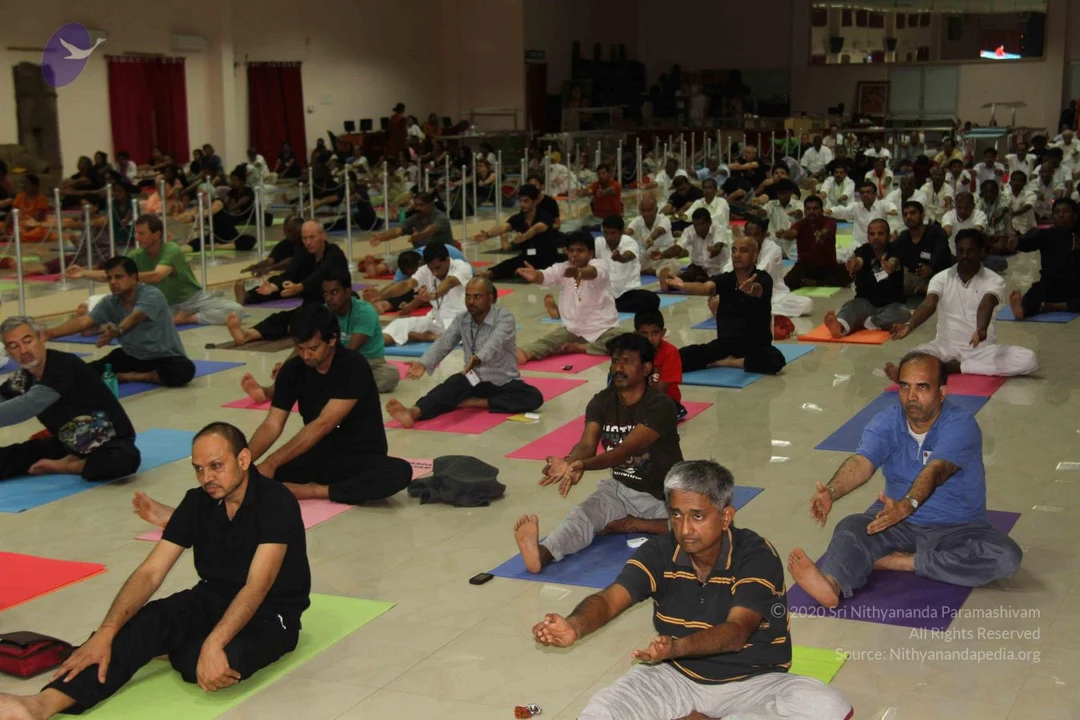
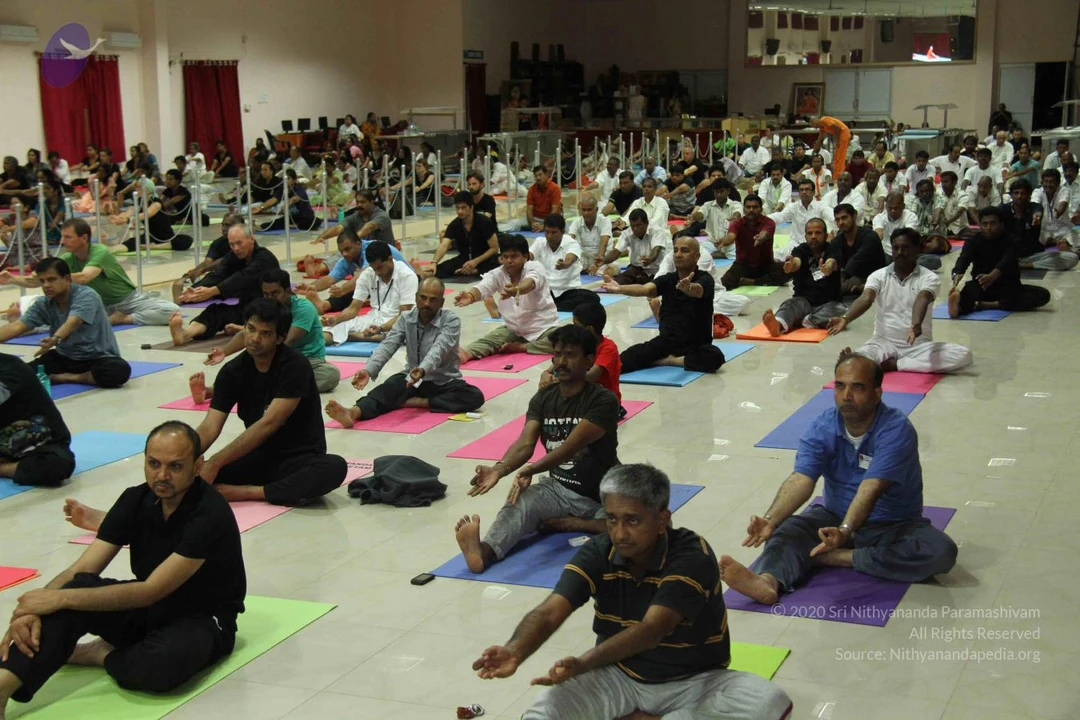
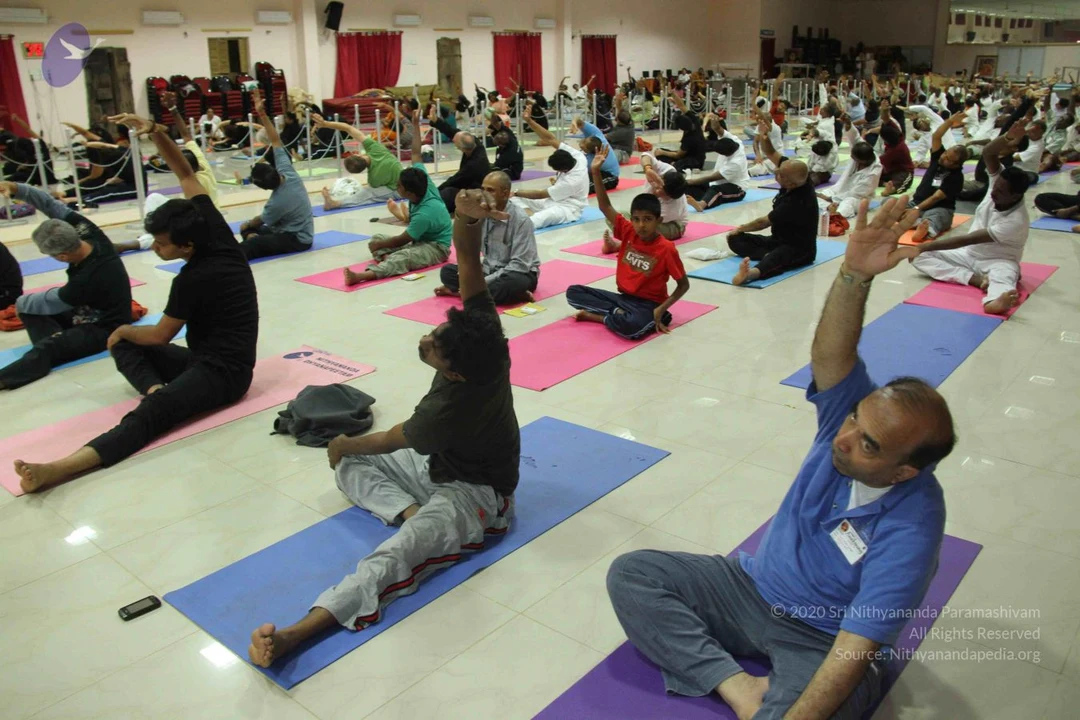
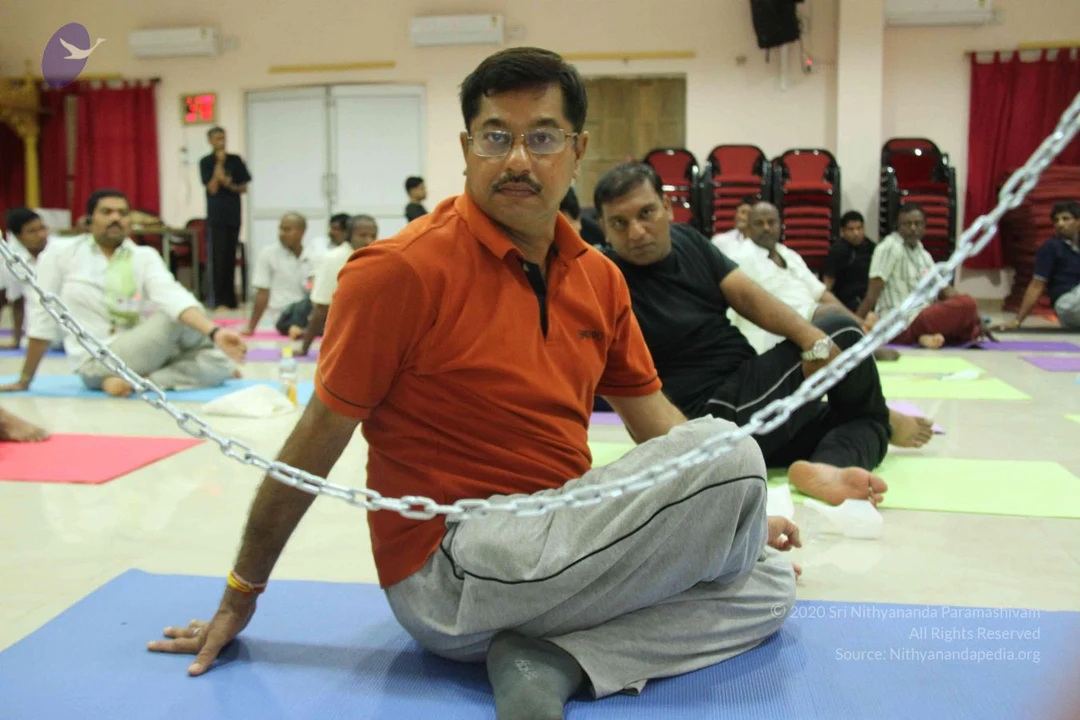
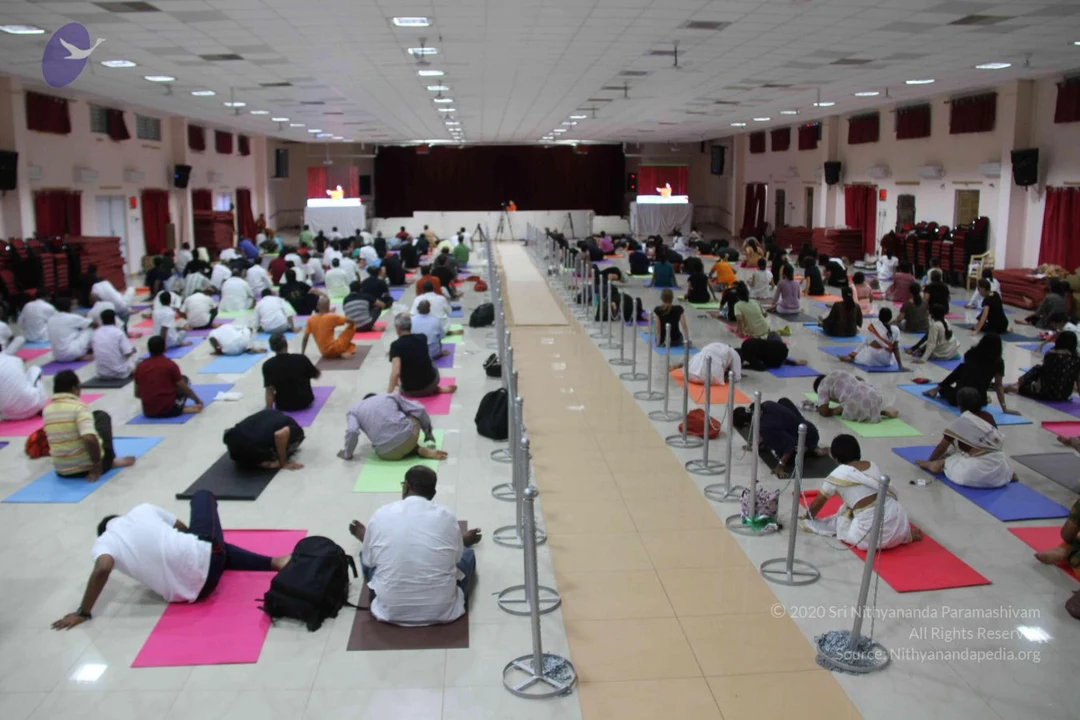
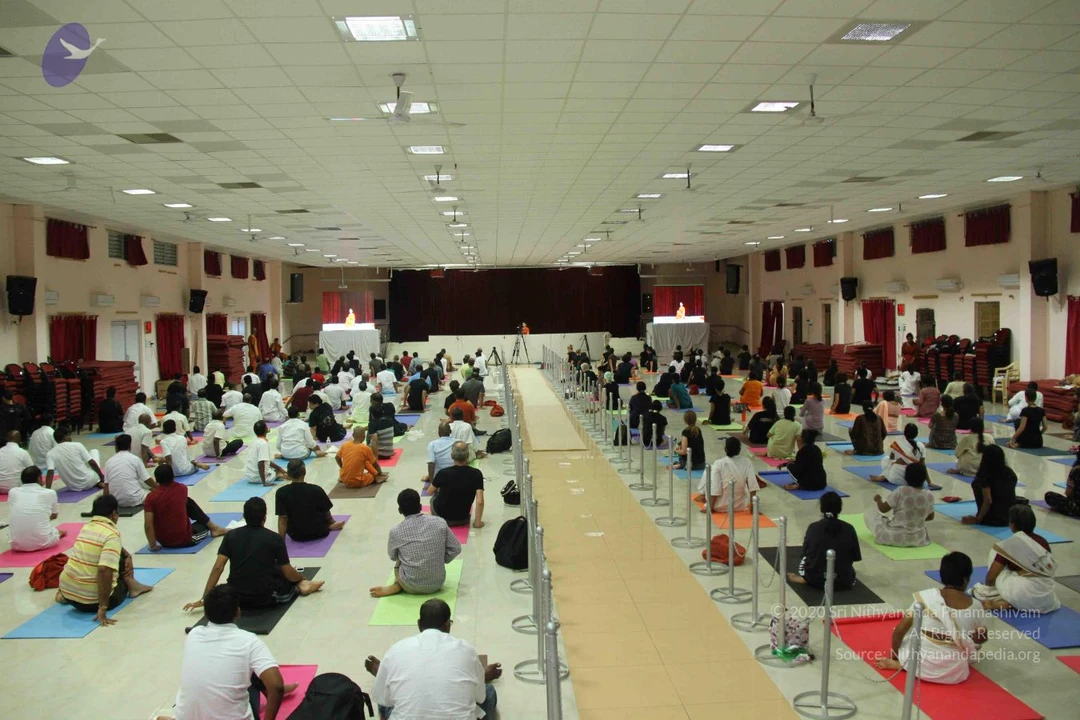
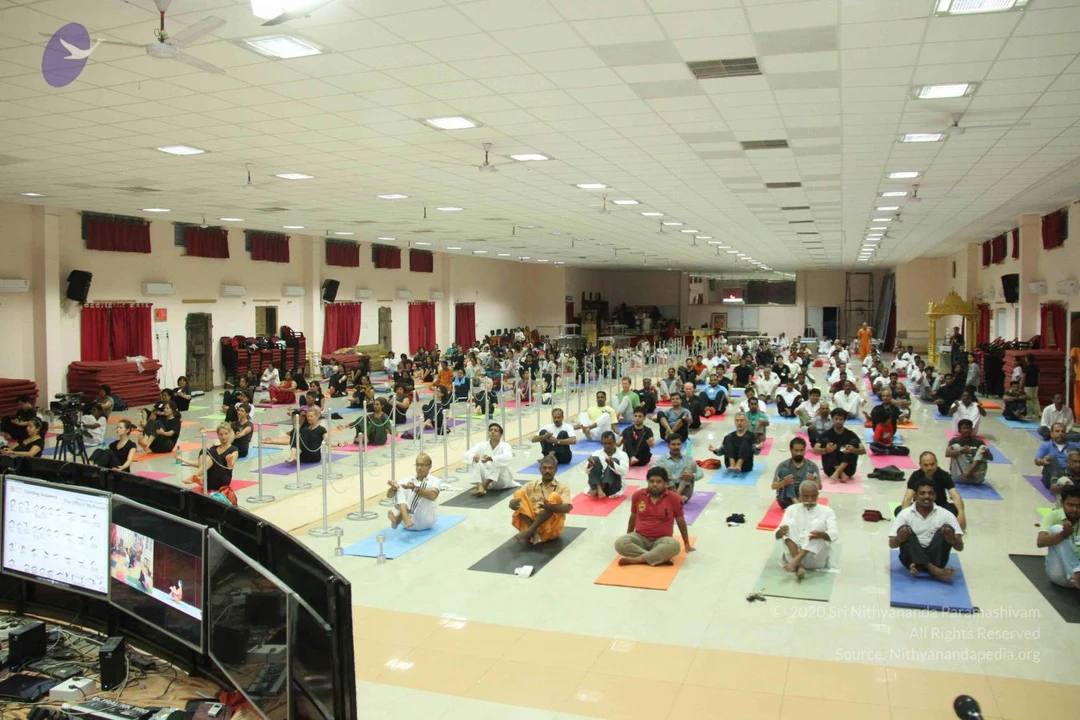
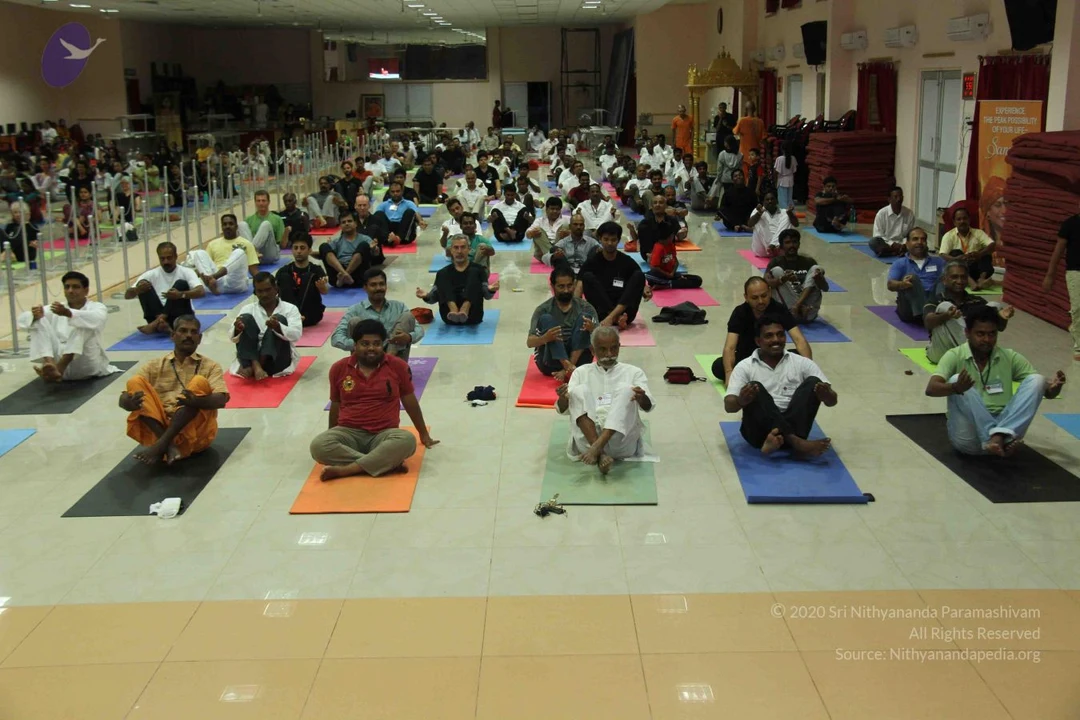
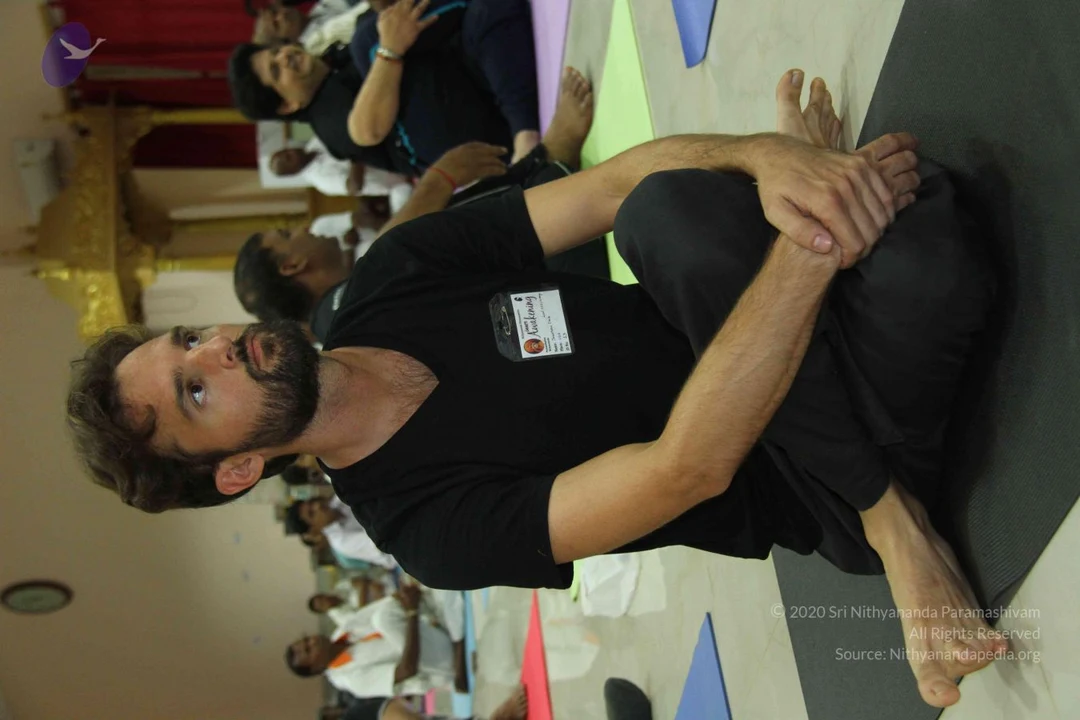
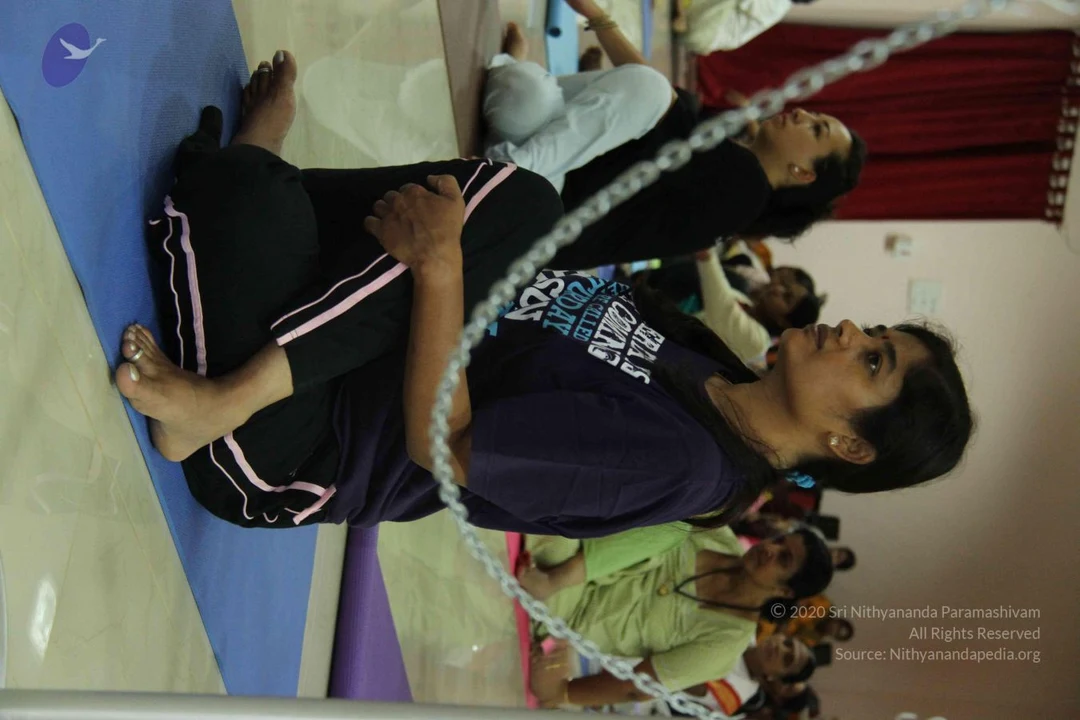
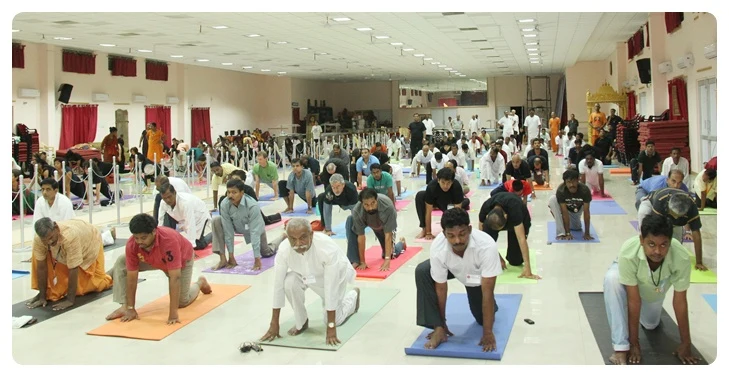
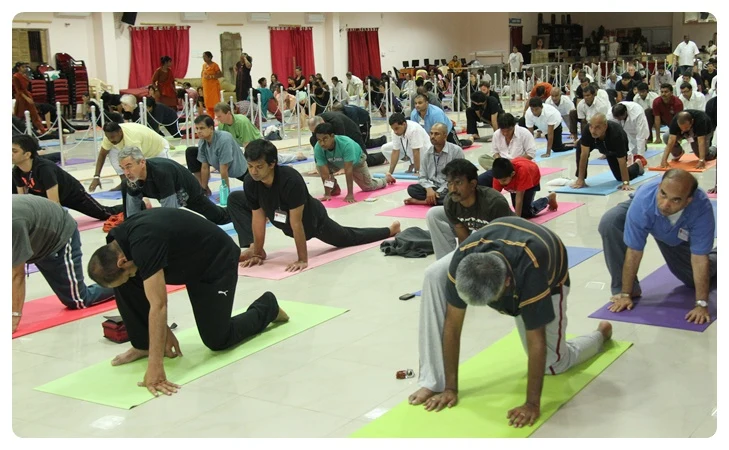
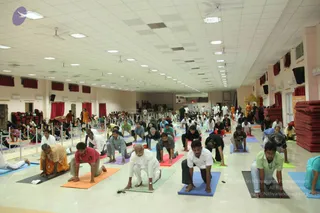
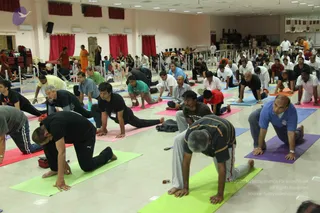
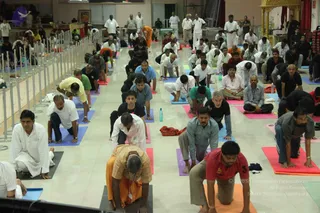
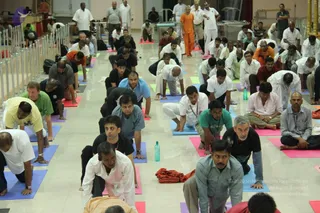
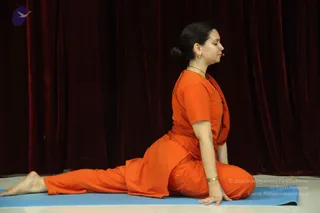
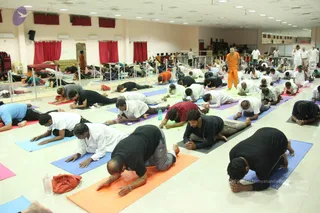
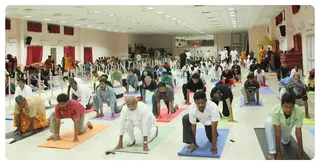
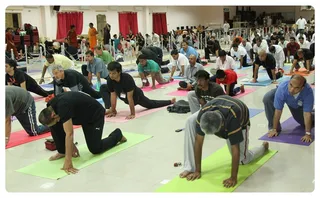
A large hall with cream tiled floor and ceiling fans holds a yoga class of many participants on coloured mats, all in a kneeling cat-cow style pose with hands and knees on the floor. Men wear white kurtas, red, green, and grey shirts, and orange robes; one person in orange and others in white stand or kneel among rows. Red curtains line the walls, and stacked red mats sit at the right. A few people stand near the back among blue-grey pillars. Several people are visible; the count is in the dozens.A large hall full of men and some women practising a yoga sequence on coloured mats in pink, green, blue, purple and red. Most participants are kneeling in cat-cow or child-pose style with hands on the floor, many wearing black, white, grey and blue t-shirts and trousers, some with name badges. Metal stanchions and rope line the mats. In the background, several people in orange and saffron robes stand near the back wall beside red curtains, and a row of people in white clothes is visible at the far right.A large indoor yoga session in a hall with cream tiled floor, where many participants on coloured mats perform a forward-bending or child-pose stretch. Most wear white, grey, black or red shirts and trousers. In the foreground, a man in a red polo with the number 3 on his chest kneels on an orange mat, while a man in a light grey shirt kneels on a blue mat nearby. Behind them rows of practitioners fill the floor, some seated in meditation. At left, metal stanchions with rope barriers line the path. In the upper area, staff in white uniforms stand near a gold-framed shrine and a picture on the wall.A large indoor yoga session in a bright tiled hall. Many participants in white, blue, green and grey clothing kneel on coloured mats in rows, bending forward with arms extended in a cat-cow style pose. Some sit cross-legged on pink mats at the right. A standing figure in an orange robe stands near the centre back, with other people in white dhotis and shirts around. Water bottles sit on the floor between the rows, and metal railings line the left side. Some participants wear lanyards.A woman in orange monastic-style clothing performs a seated yoga stretch on a blue mat, leaning forward over her extended right leg with the left leg bent behind. She has her dark hair in a low bun, a gold bangle on one wrist, and small earrings, with eyes closed in concentration. A deep maroon velvet curtain hangs behind her on a light floor.Indoor group yoga session in a hall with cream tiled floor and red-cushioned chairs stacked at the back. Rows of people lie prone on pink and blue yoga mats in a cobra-type pose, heads lifted. In the foreground a man in a black t-shirt with red logo and a lanyard lifts his gaze, and beside him a man in a green t-shirt with a lanyard sits with hands clasped. An orange cloth lies folded at right. Several others in white and grey shirts are bent forward in the background. No a person candidate is clearly visible.

Nitya-Satsang

24 photosSource gallery
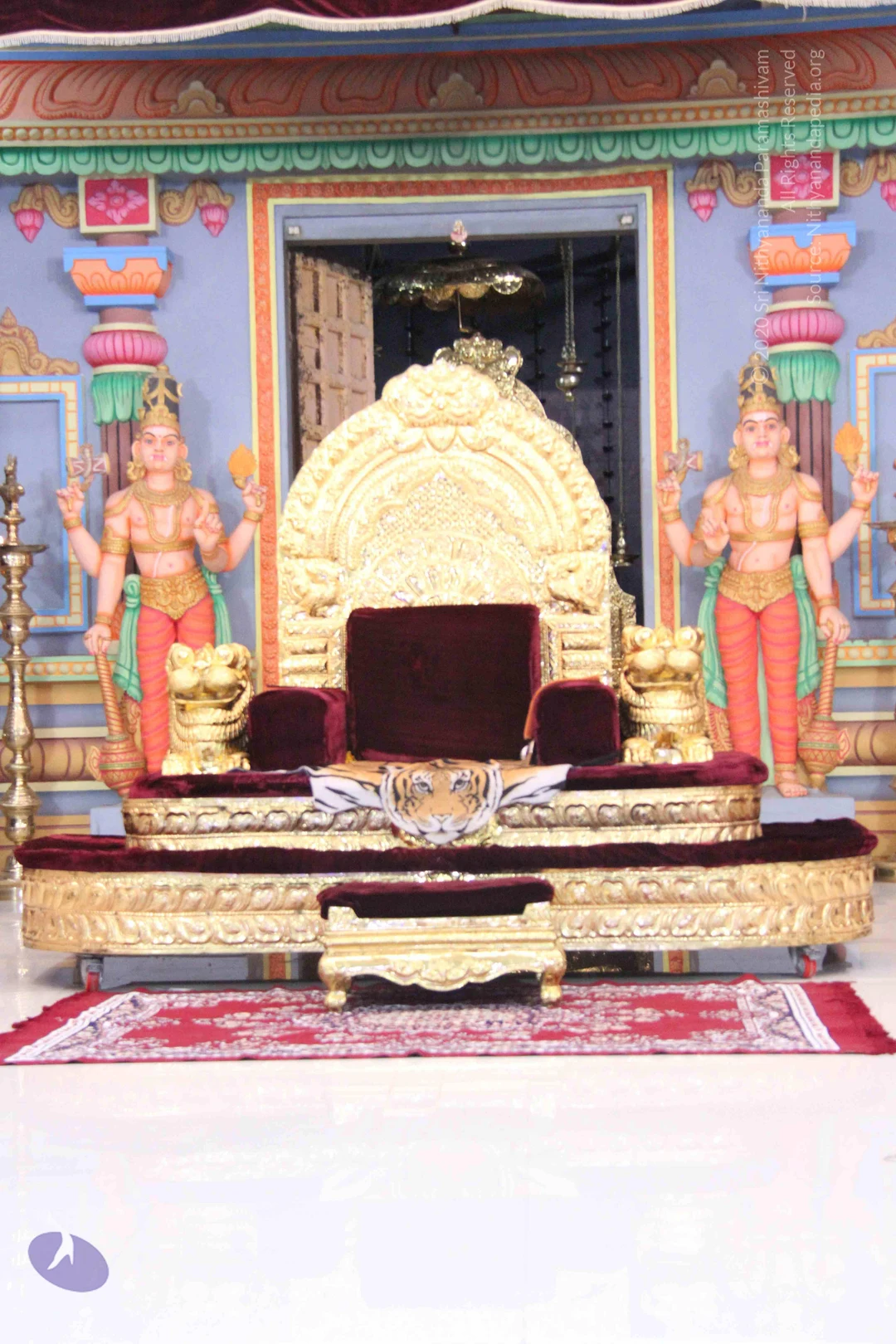
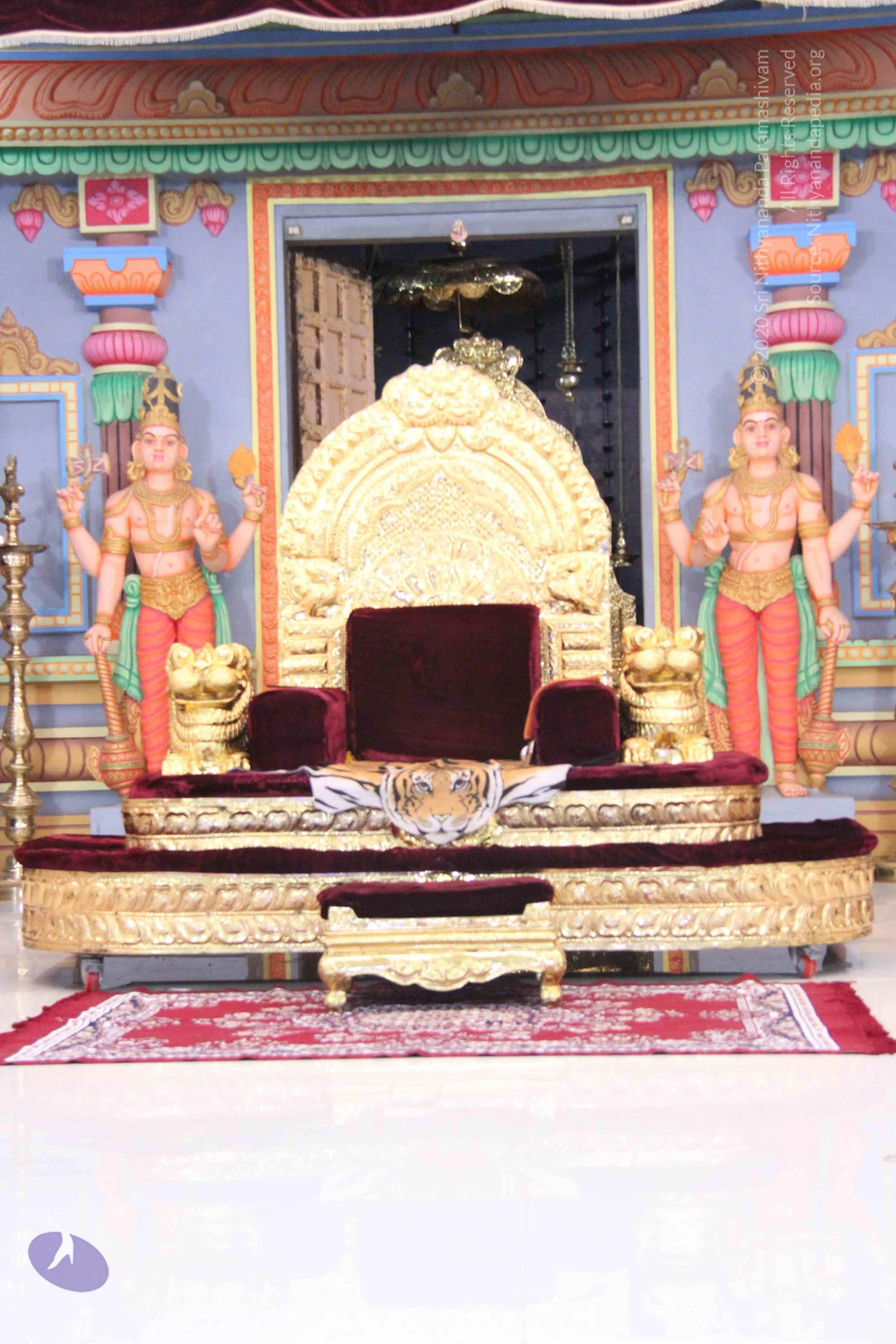
A stage at a Hindu temple-style hall with a gold throne on a raised dais. A man in orange and saffron robes with a rudraksha mala sits on the golden throne, hands folded, with a red-cushioned seat before him. Two painted gold deities with multiple arms flank the backdrop, which has blue and pink ornamental columns. On the right, a golden arched shrine holds a deity murti decorated with red and white flower garlands. Two girls in pink and orange dresses sit on a rug before the shrine. Brass oil lamps stand on the stage, and a floor fan is visible at the right edge. a person seated on the throne in saffron robes and rudraksha mala, with rudraksha mala cues, marked as probable.Photo of a temple-style stage with painted blue pillars and a carved golden doorway backdrop. On the left, a man with a shaved head in an orange-saffron shawl and wearing a rudraksha mala sits on a gold-trimmed throne with a red cushion, his hands folded in his lap. Beside him, two painted deity figures with multiple arms holding ceremonial objects flank the throne. On the right, a gold-framed throne holds a decorated deity murti garlanded with red and white flowers. Two young girls in pink and yellow sit on the platform at its base, one in a green and orange outfit. Brass lamps stand along the stage, and a red-draped valance hangs overhead.Photograph of a stage at an ashram-style hall. On the left, a man in an orange-saffron turban and orange-and-gold robe sits on an ornate gold throne with lion-head armrests, wearing a rudraksha mala, with two gilded standing attendant figures with multiple arms behind him; a rudraksha-style garland and ceremonial gold necklace are visible. On the right, a gold-framed arched shrine holds a deity murti adorned with red roses and white garlands. Two children in pink and orange-green traditional clothes sit before the shrine with hands folded. Brass oil lamps stand on the white stage floor, with a red carpet and a standing air conditioner nearby.A stage set with painted backdrop of gold-trimmed columns and two standing divine attendant figures in orange and green dhotis. A seated man in an orange and saffron robe, wearing a saffron turban and a dark rudraksha mala, sits on a gilded throne with hands raised in an open gesture. To the right, a gold arched shrine holds a deity murti draped in red and white flower garlands, with two young people in saffron and yellow sitting before it on a red carpet. Brass lamps stand in a row between the throne and the shrine on a white marble floor.A seated man in orange and saffron robes, with a red-orange turban, long beads and a wooden rudraksha-style mala, sits on a gold ornate throne on a raised stage before painted panels of guardian figures with lotus-motif columns. He appears to speak with hands raised in a gesture. To the right, a gilded throne-like canopy holds a decorated deity murti garlanded with red, white and yellow flowers, and two young girls sit on the stage beside it in pink and yellow dress. Brass oil lamps stand between the figures on the white floor. The appearance-based label Swamiji (probable) applies to the seated man in orange with turban and rudraksha mala, who is physically present.A seated figure in saffron and orange robes sits on an ornate gilded throne with lion-head armrests and maroon velvet cushions, smiling, with a red-orange turban, a rudraksha mala with multiple strands around the neck, and silver bangles on the wrists. Two large painted deity murti flank the throne, each with four arms holding ritual objects and wearing gold crowns, necklaces and green-and-red garments. Behind the throne is a golden arched backdrop and a carved wooden door. The appearance of the seated figure with distinctive turban, rudraksha mala and saffron clothing is consistent with a probable Swamiji (probable) in a throne-based satsang setting.

Sarva-Darshan

15 photosSource gallery
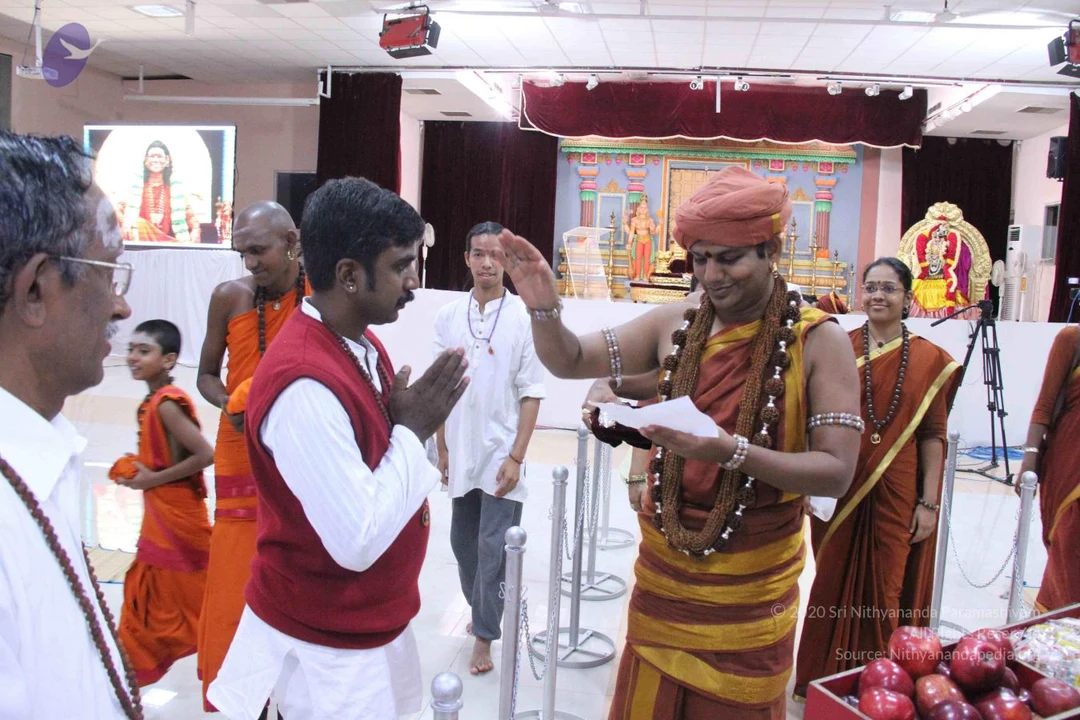
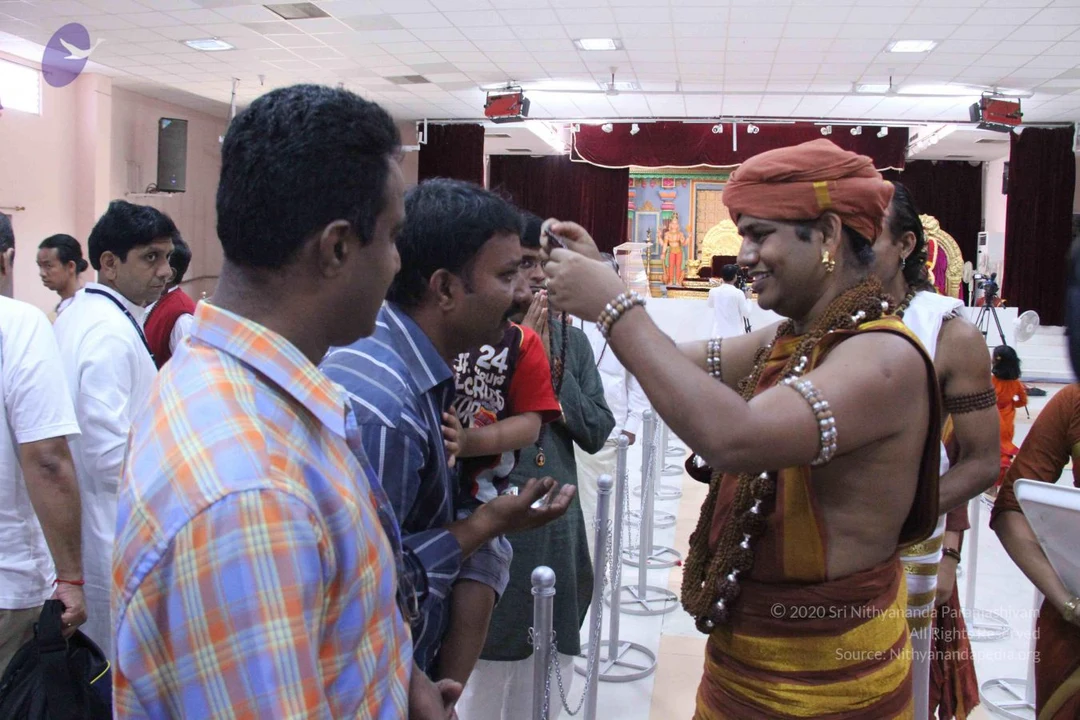
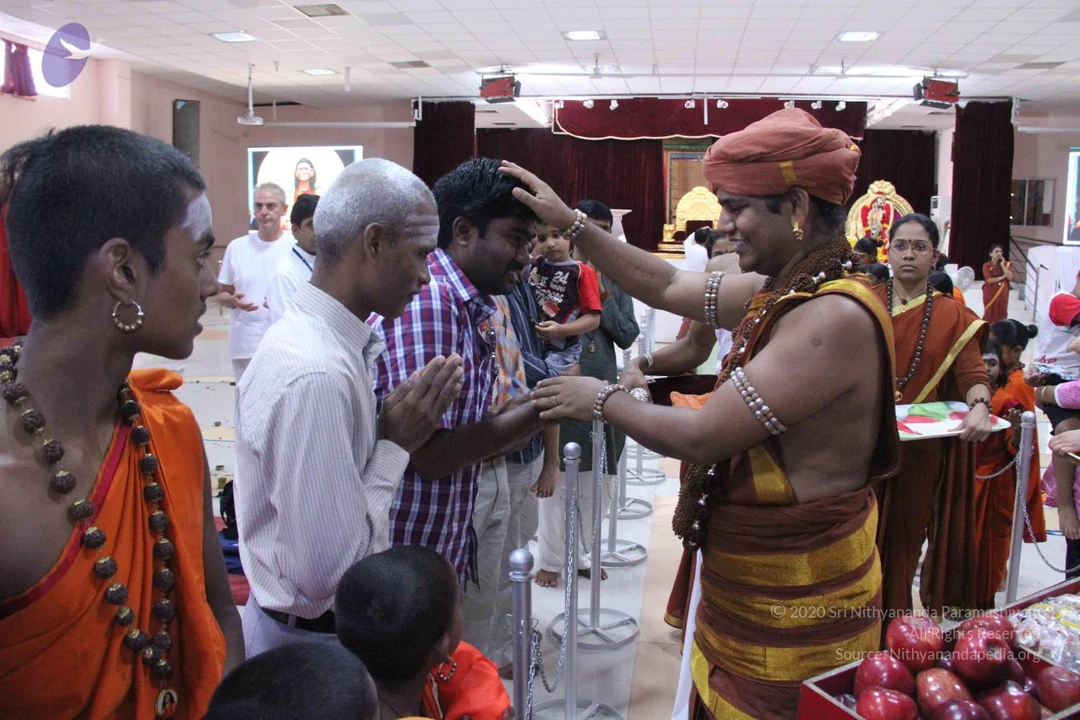
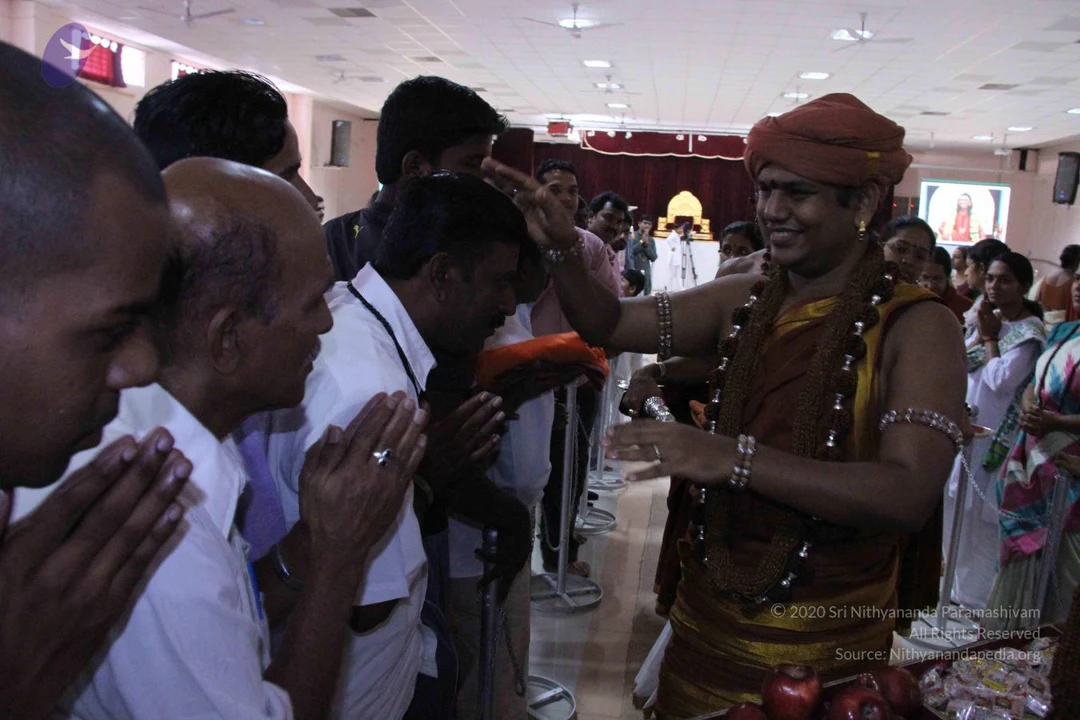
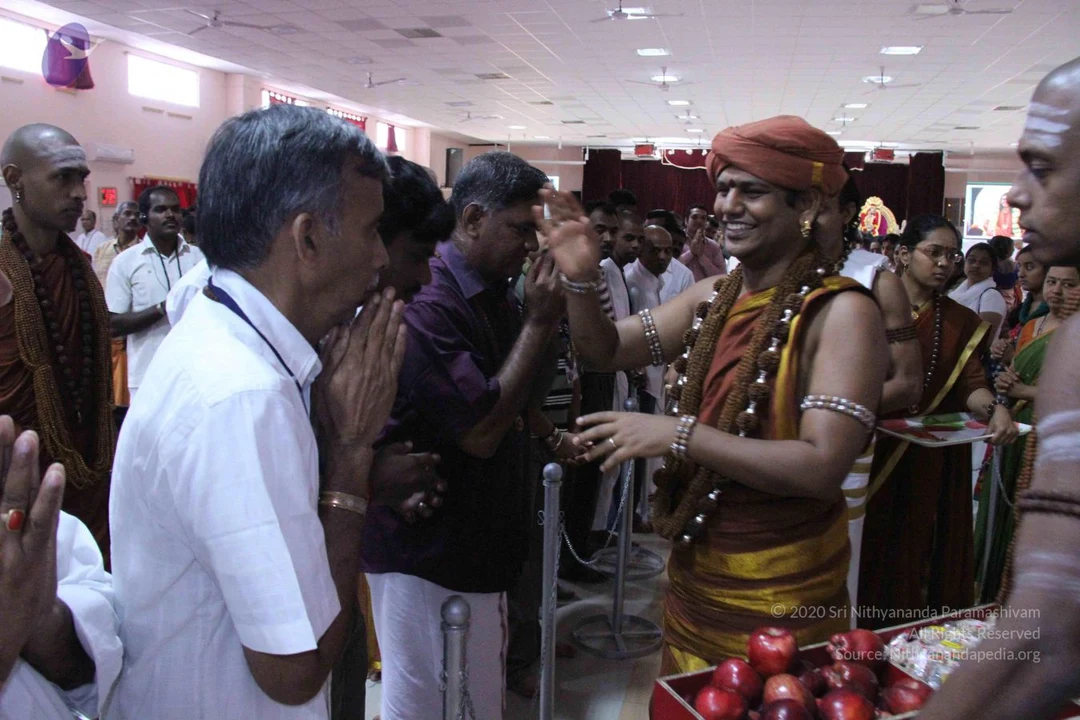
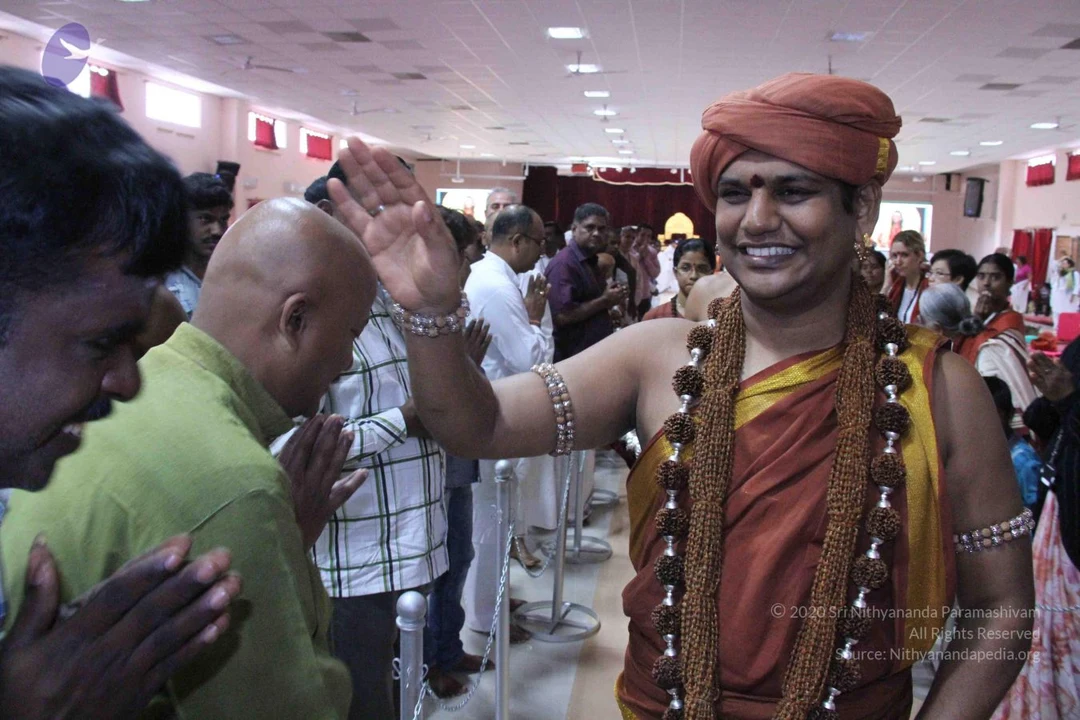
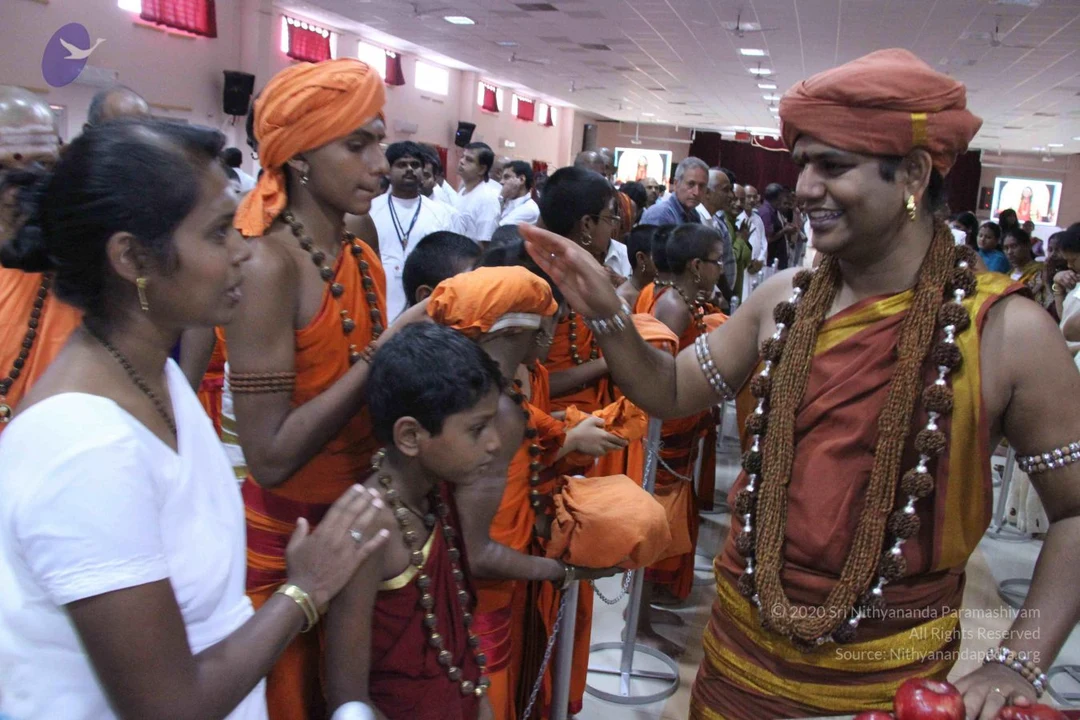
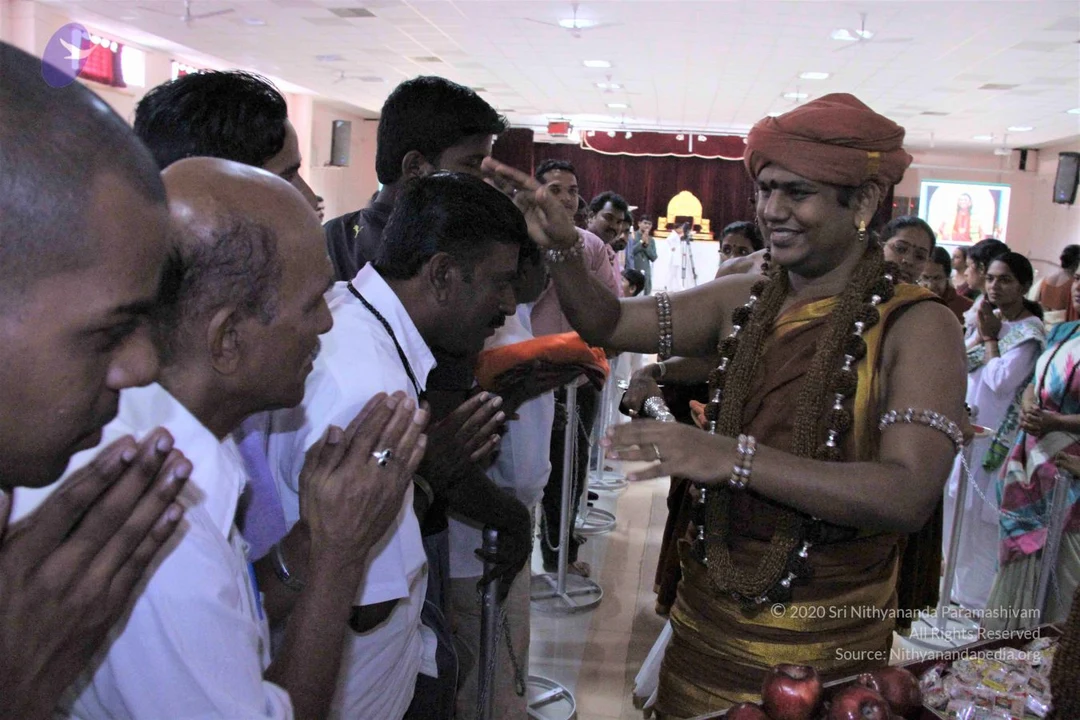
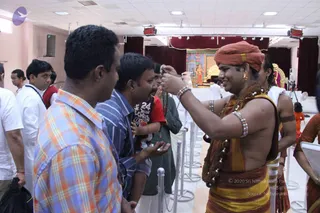
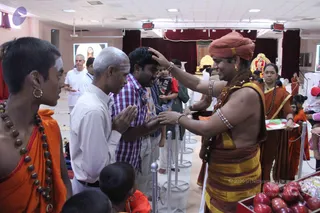
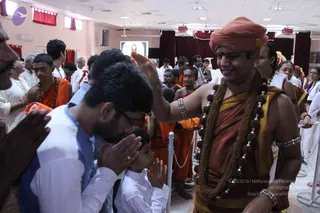
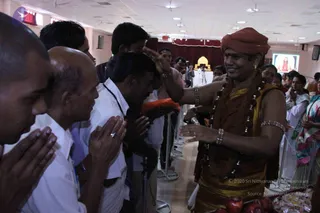
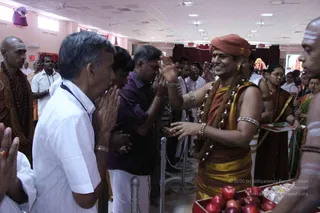
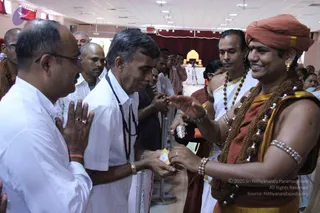
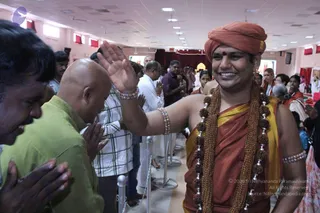
A hall with a stage backdrop showing a deity murti in a decorated shrine arch, maroon curtains and a large screen. In the centre, a man in an orange-saffron head wrap, layered gold and orange-yellow dhoti-style cloth, and long rudraksha mala necklaces raises one hand in blessing while holding a folded white paper. Beside him, a man in a red vest and white clothes stands with palms joined in greeting. To the left, a man with glasses and a rudraksha mala listens. Behind them, saffron-robed attendants and a woman in an orange sari with glasses stand near stanchions. A tray of red apples is visible at lower right.A photograph in an ashram hall with a white tiled ceiling and red curtains. In the foreground a bare-chested man in an orange turban and orange-and-gold waist cloth, wearing a long rudraksha mala and bead bracelets, holds up a phone or small object toward a devotee. Around him stand several men in casual shirts, one in a striped blue shirt and one in a red-and-black top, and a man in white. Behind them a deity murti and gold-trimmed decorations sit on a dais.A photograph inside a hall with maroon curtains and a gold-framed throne in the background. A bare-chested man in an orange-and-gold lower cloth and an orange turban, with rudraksha malas and ornate silver bracelets, places his hand on the head of a standing devotee in a white shirt with palms pressed together. Beside them a young monk in orange robes with rudraksha malas and a hoop earring stands at left, and a woman in an orange sari with a mala holds a tray at right. A small child is held by a man in a checked shirt, and red apples sit in a box at lower right. Several people are visible, with a screen showing a portrait at upper left.A photograph inside a bright hall with white ceiling lights, red curtains and a projection screen at the back. In the foreground a man in a dark-trimmed white and blue shirt bows forward with his head lowered and palms pressed together, while a young boy in white beside him also folds his hands. A man in a red-orange turban and saffron-toned robe with a long brown rudraksha mala and ornate gold-toned bracelets raises his right hand in blessing toward the bowing devotee. Around them stand other devotees in white, saffron and orange robes, including young men in orange, and people in white clothes near a metal barrier. The figure in the turban appears to be a person in an appearance-based sense, with a crown-like turban, mala and ornate arm adornments; the image shows a blessing gesture during a satsang-style gathering.A photograph inside a hall with cream ceiling and red curtain backdrop. A man in an orange-red turban, saffron-brown draped garment, layered rudraksha malas and beaded bracelets stands at right with one hand raised in a blessing gesture. Several men on the left, one in white shirt, press palms together in anjali while approaching him. Fruit such as pomegranates and packaged sweets sit on a tray at lower right. A framed picture and a golden altar-like structure appear in the background.A photograph inside a hall with pink walls and a white ceiling fitted with fans. In the foreground, a man in a white shirt and white dhoti stands with palms pressed together in greeting, while a man in a purple shirt and white dhoti reaches forward. At the centre-right, a smiling man wears a saffron-orange turban, a saffron and gold robe, a rudraksha mala and a ceremonial gold necklace, with silver bangles on his arms, and extends his hand in blessing toward the devotees. A red tray of apples sits in the lower right. Several other devotees in white and saffron stand behind a stanchion barrier, and a woman in a green sari is visible at right. A probable Swamiji candidate is present, identified by the saffron turban, rudraksha mala and ornate gold necklace, and is shown in person giving blessings.

Swamijis-Deities

3 photosSource gallery
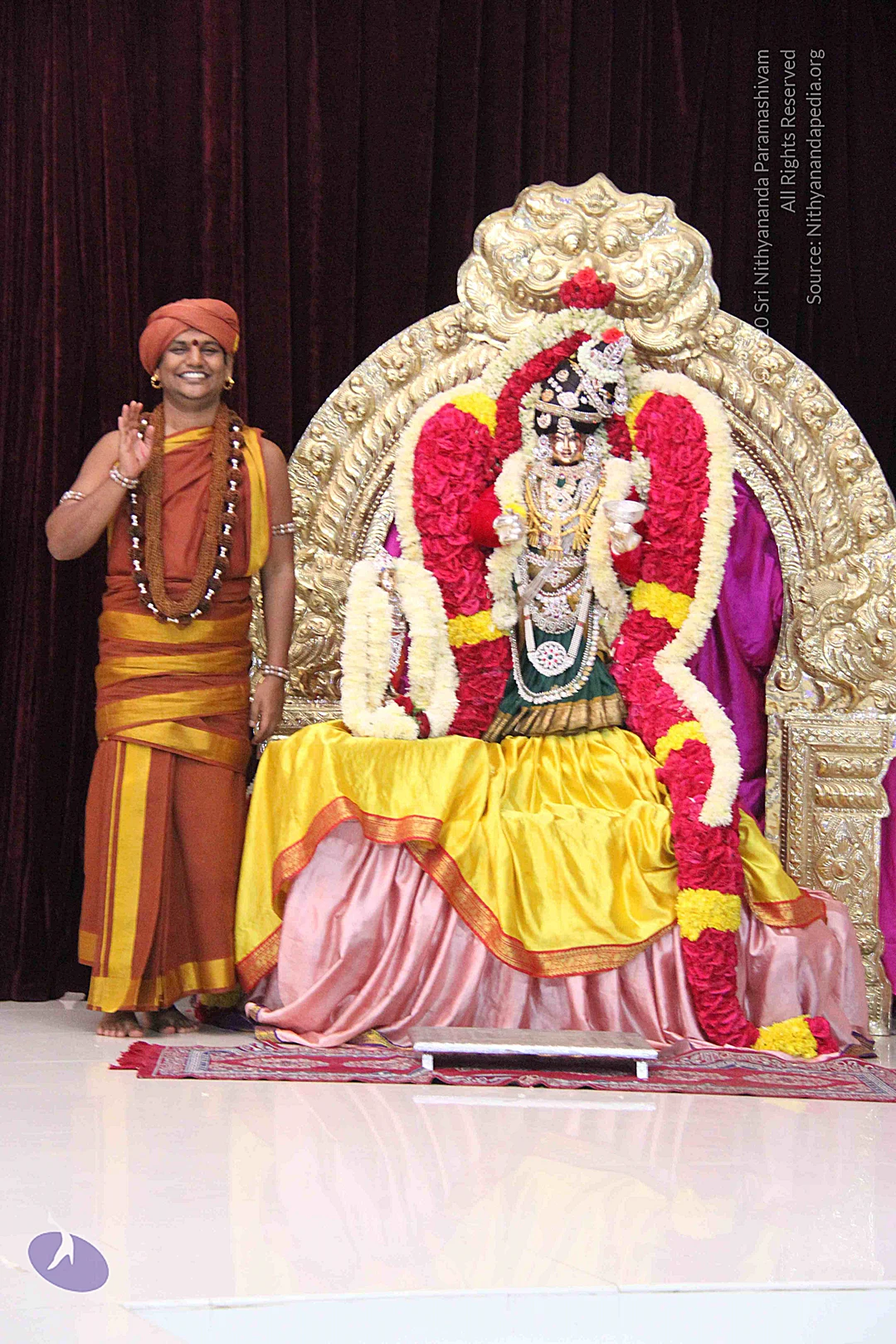
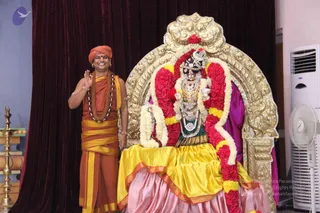
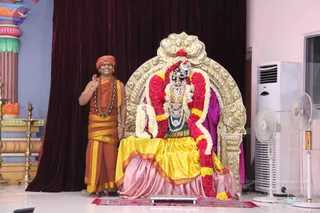
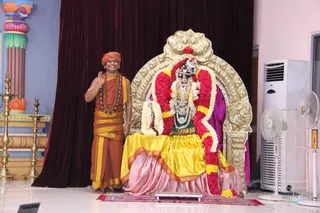
A standing man in orange-saffron robes with a matching orange turban waves his right hand beside an ornate gilded throne draped in a deity murti. The murti is adorned with red and white flower garlands, silver jewelry and a decorated crown, seated on a yellow and pink fabric throne. Behind them hang deep maroon velvet curtains, with a brass oil lamp on the left and a floor fan on the right. The man wears a rudraksha mala, a saffron wrap and bangles, and smiles toward the camera.A photograph of a stage with a seated deity murti on a gold-framed throne, draped in red and white floral garlands and yellow and pink silk. A standing figure in saffron and orange robes, wearing a saffron turban and a rudraksha mala, waves in greeting beside the throne. Brass oil lamps stand at left, and a dark maroon velvet curtain hangs behind; pedestal fans and a tall air cooler sit at right.A standing man in an orange-saffron turban and saffron-orange robe with a yellow sash stands barefoot at left, raising one hand in greeting and wearing a long rudraksha mala with beaded bracelets. Beside a golden arched throne backdrop stands a deity murti dressed in yellow and pink silk, heavily garlanded with red and white flowers, with an ornate crown and jewelled necklaces, seated on a golden seat. Maroon velvet drapes, brass oil lamps, and a white floor fill the hall, with pedestal fans and an air conditioner at right. Probable Swamiji (in_person cues: saffron turban and robe, rudraksha mala).

Pratyaksha-Pada-puja

15 photosSource gallery
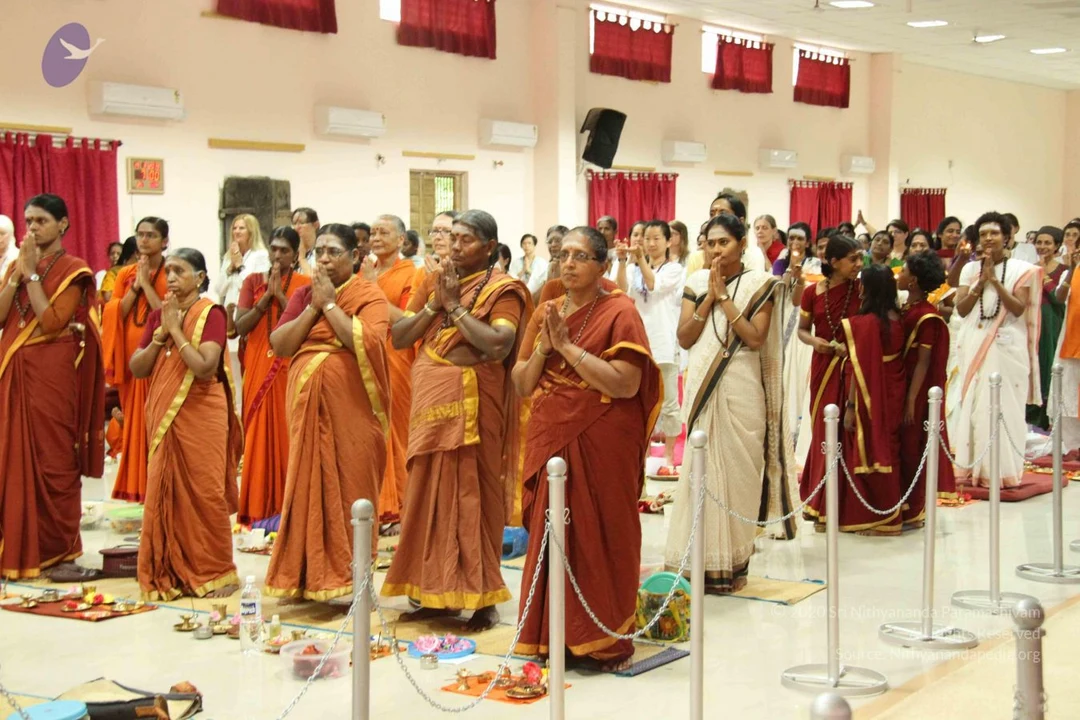
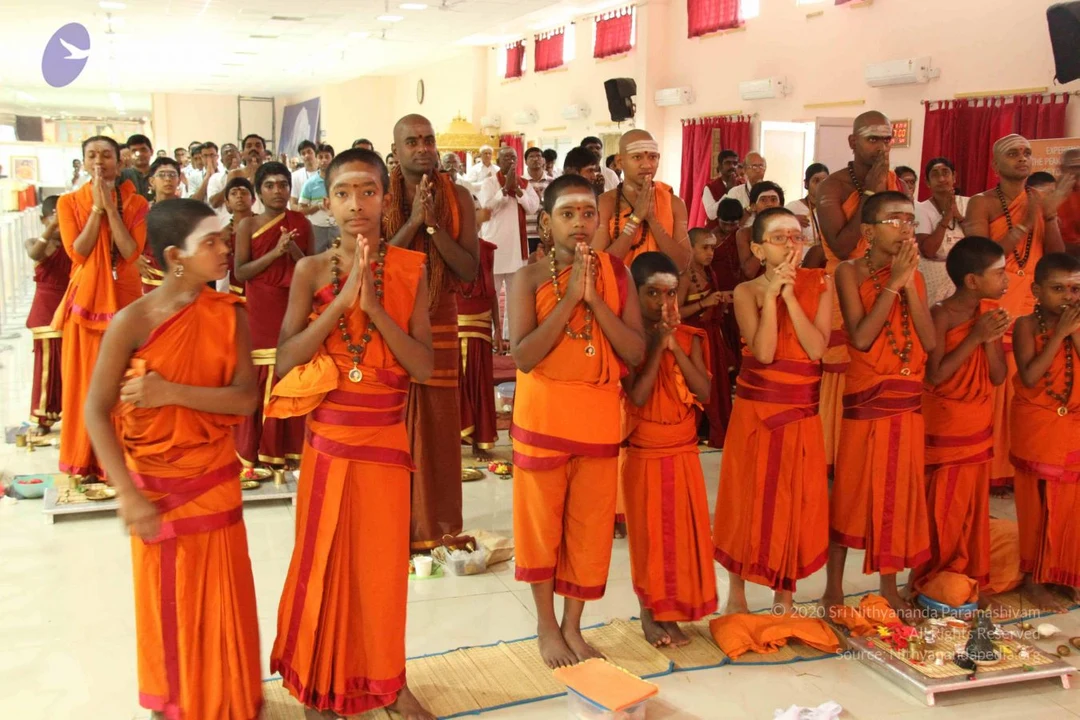
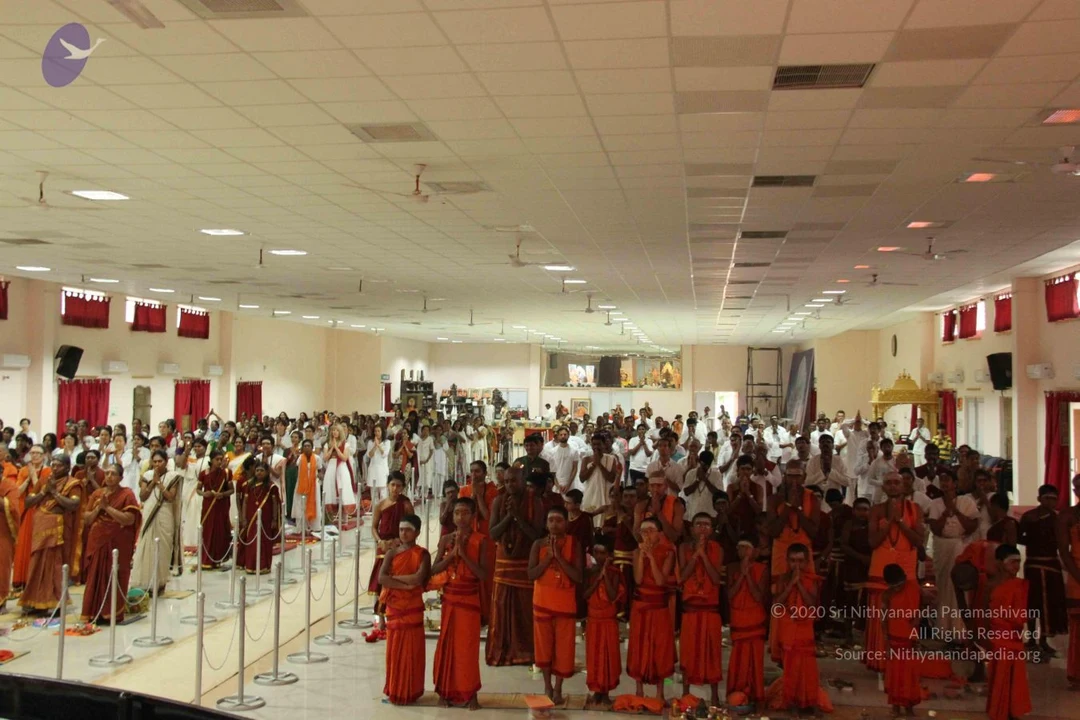
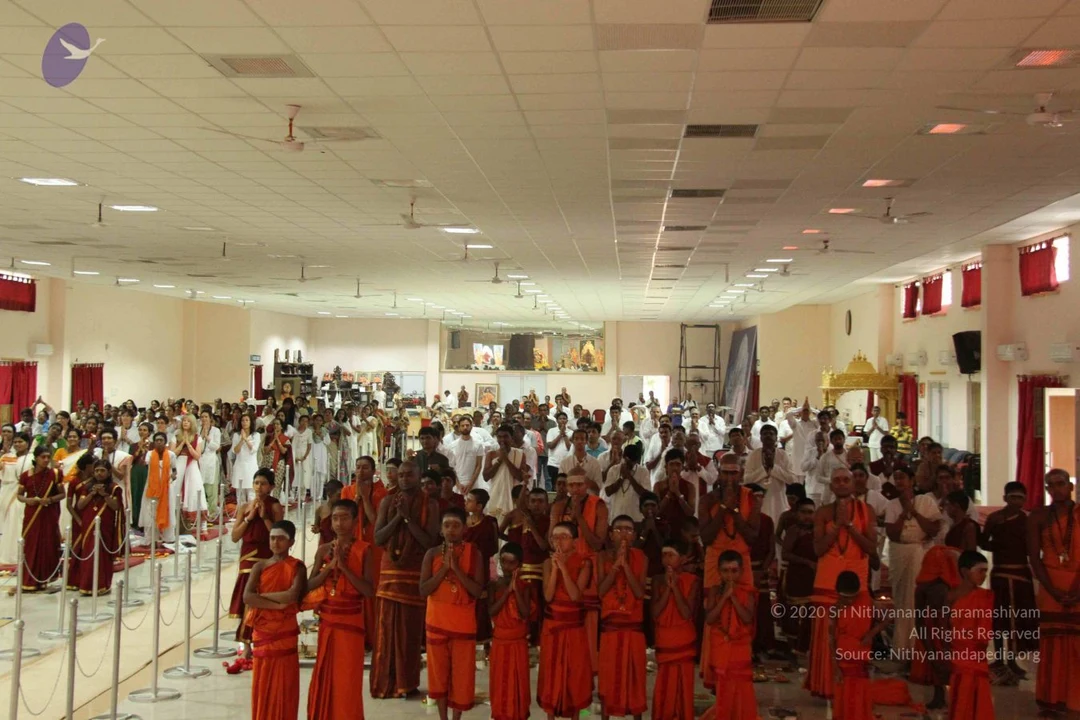
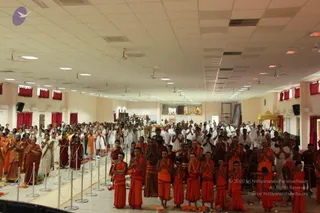
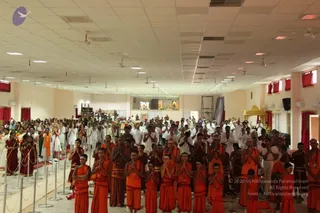
A close photograph of a hand raised upward holding a silver multi-branch oil lamp (aarti lamp) with five lit flames. The lamp has a tiered base, a central stem and curved arms decorated with animal figures. Behind it hangs a deep maroon velvet curtain and to the left a wooden panelled door. Only the hand is visible; no other people are shown. The lamp is used for aarti in a temple or satsang setting.A seated man on an ornate gold throne with intricate repoussé floral and scrollwork backrest, flanked by hanging brass bells. He wears an orange-red turban, a saffron-orange garment, a long red-and-white flower garland and a rudraksha mala, with bangles on his wrists and a red tilak on his forehead. His hands rest on the armrests as he smiles toward the camera. Blurred lamps and a yellow-orange pillar frame the scene.A large hall with cream walls, red curtains and wall-mounted air conditioners. Women in orange and rust-coloured saris with gold borders stand in a line with palms pressed together in namaste, eyes closed or lowered. Several wear rudraksha malas and red bindis. Behind them a second group in white and cream saris and dark red saris also stands in prayer posture. Brass or steel trays with oil lamps, flowers and small offerings rest on mats on the floor, with steel stanchions and chains dividing the rows. Watermarked-free photograph of a devotional satsang gathering in progress.A large hall with pink walls and red curtains shows a group of young boys and a few adult men in saffron-orange dhoti-style robes with red borders, standing with palms pressed together in anjali. Several boys have tilak marks and rudraksha malas. Behind them, adults in white and red-brown clothing stand in the crowd. A small tray with flowers, kumkum and offerings sits on a mat at right. Several people in the background have shaved heads and white markings.A large hall filled with a standing congregation facing a front altar area. In the foreground, young boys and men in saffron-orange dhotis and kurtas stand with palms pressed together in namaskar, with several in rust-red clothing among them. Behind them, many people in white and cream clothes stand in rows; a woman in a cream sari and a few women in deep red saris are visible at left. Metal stanchions with red ropes line a walkway at left. Behind the crowd, a golden canopy-style shrine and framed images stand near the far wall. Ceiling fans, recessed lights and red curtains frame the room.A wide view of a large hall during a satsang gathering. Many devotees stand in rows with palms pressed together in namaskar, dressed in orange and saffron robes, white ritual clothing and maroon garments. Young boys in orange dhotis stand near velvet-roped barriers on the left. Red curtains line the windows, ceiling fans and recessed lights hang overhead, and a gilded throne-like seat with a deity murti and framed images sits at the far end of the hall. A dais with a small altar is visible in the background. Overhead ceiling fans hang above the crowd.

Temple

10 photosSource gallery
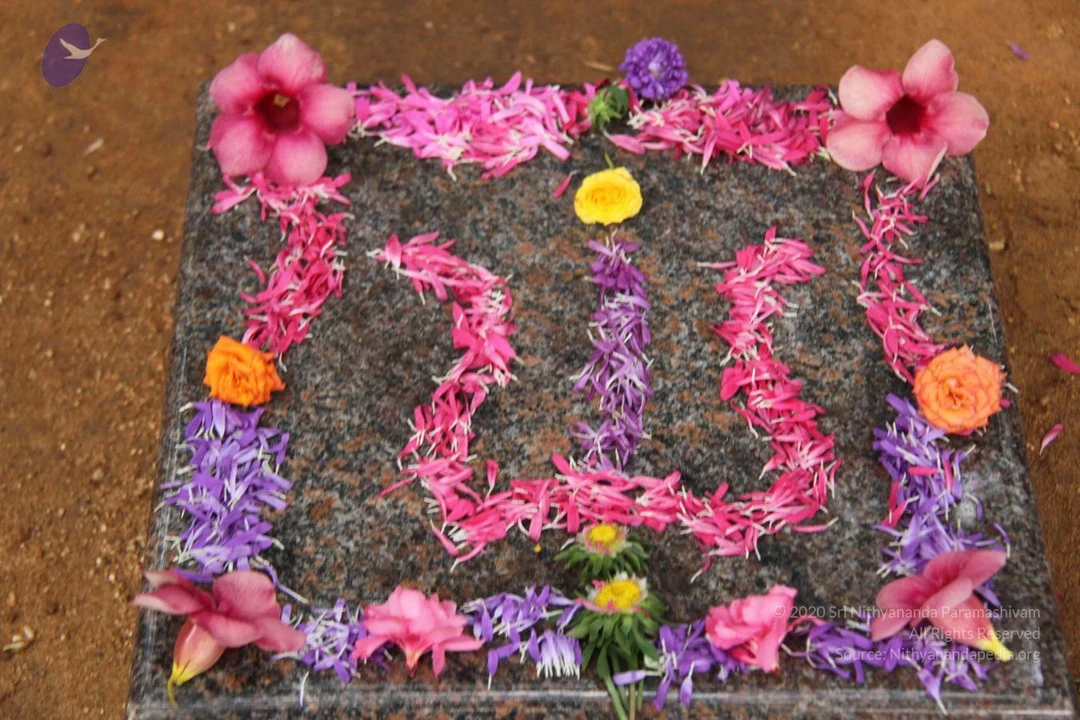
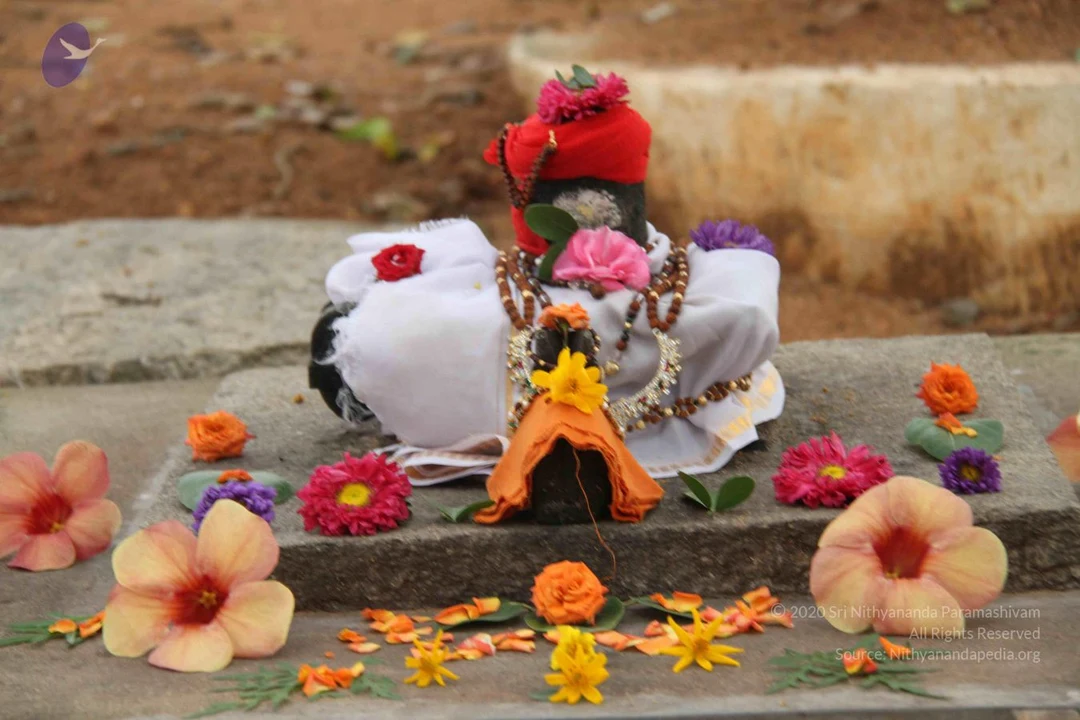
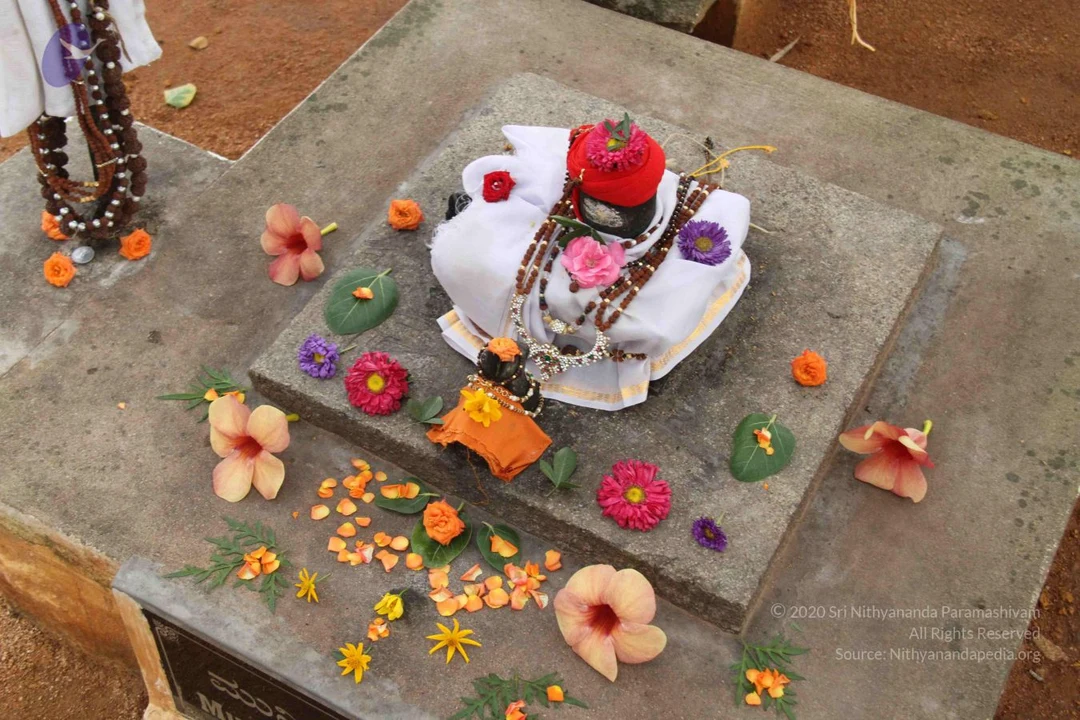
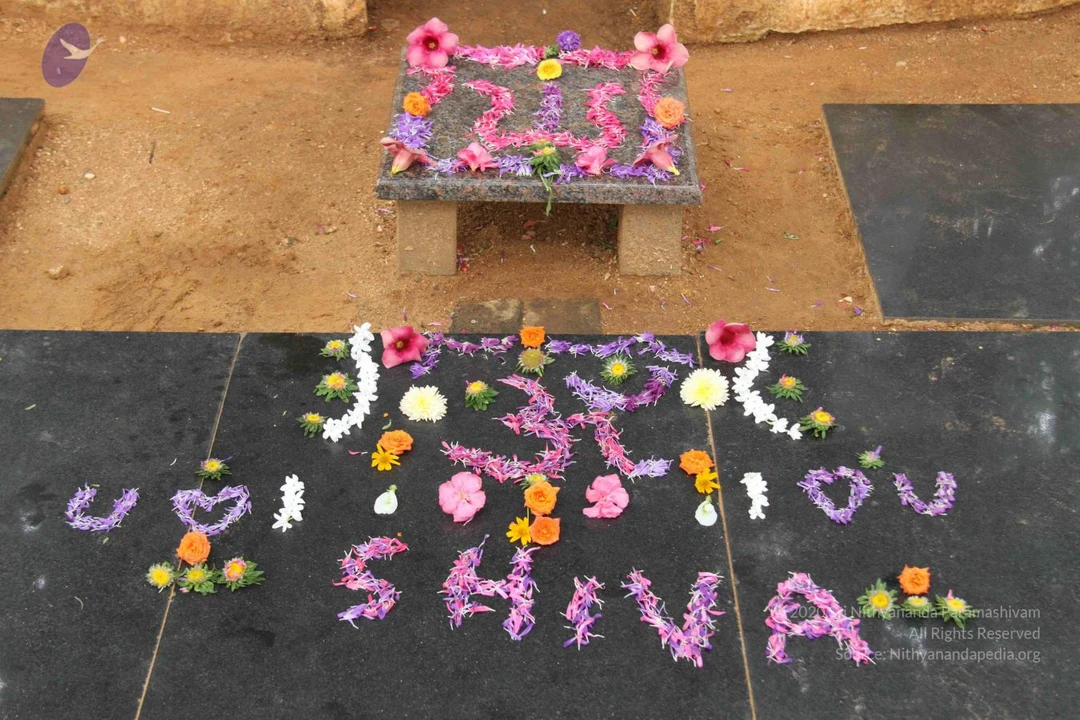
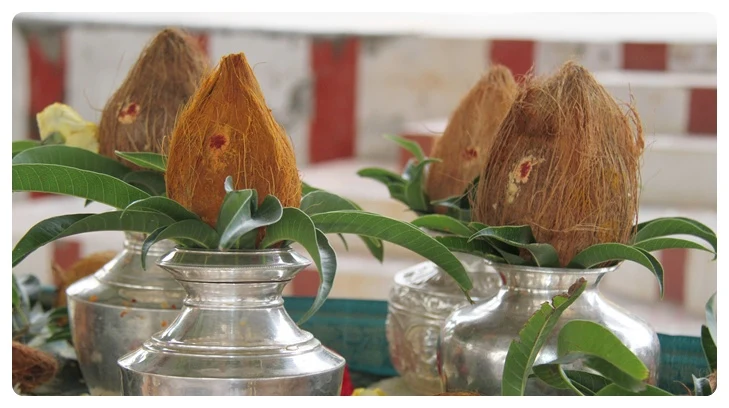
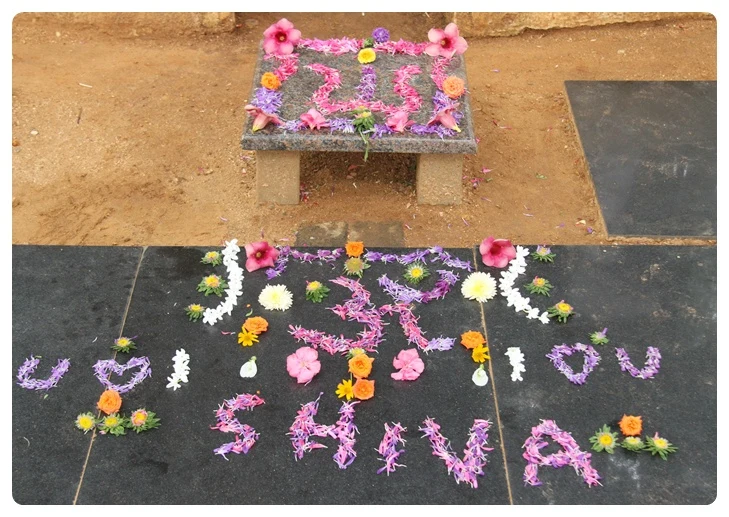
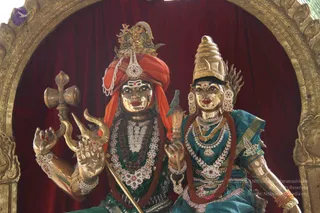
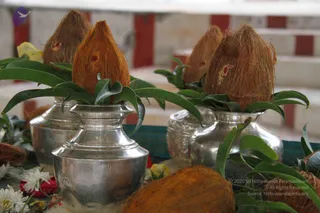
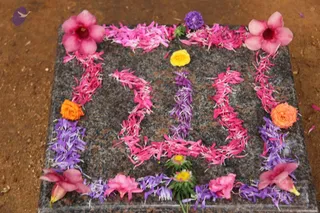
Two gilded metal murti statues of a deity couple seated side by side under an ornate gold arch before a deep red velvet backdrop. The male figure wears an orange-red turban with a jeweled crown ornament, holds a trident in one hand and a damaru-like drum in the other, and is adorned with a rudraksha mala, white and red beaded necklaces and a bejeweled sash. The female figure wears a golden conical crown, teal sari with gold border, layered jewelled necklaces, earrings and red kumkum on the forehead. This appears to be a decorated deity murti, not living people.Close-up photograph of ritual kalasha pots on a blue cloth. Two polished silver pots in the foreground and background each hold a coconut topped with green mango leaves, with red and yellow flowers, marigold-like blossoms and loose coconut husks scattered around. The background shows a white wall with red stripes. No people are visible, and no a person candidate appears in the frame.A flat grey granite slab set on reddish-brown earth is decorated with flowers forming the numerals 2013. Pink and purple flower petals and garlands spell out the digits, with pink and purple flowers and yellow and orange marigolds at the corners and along the edges, plus scattered loose petals on the ground. No people are visible.A decorated Shiva lingam stands on a stone platform, dressed with a red cloth wrap, white cloth draped around its base, rudraksha malas, and a silver ornament at the centre. Pink, orange and yellow flowers and green leaves are scattered on the stone and around the base, with an orange cloth tent at the bottom and orange-yellow petals in front. No people or a person candidate are visible; the scene is an offering-decorated lingam outdoors on a stone slab with red earth behind it.Outdoor photo of a small stone Shiva lingam set on a grey stone pedestal, decorated for worship. The lingam is wrapped in a red cloth topped with pink flowers, draped with white cloth edged in gold, and adorned with rudraksha malas and a white floral garland. An orange cloth hangs at its base, with a yellow flower placed in front. Scattered around the base are orange, pink, yellow and purple blossoms, orange petals and green leaves on the ground. No people are visible. Reddish soil and a concrete edge sit in the background.Overhead view of an outdoor shrine on a concrete platform set in reddish earth. A black stone lingam sits on a raised stone base, draped in a white cloth with gold borders and a red cloth cap, and decorated with rudraksha beads, flower garlands and a few small pink and purple flowers. Scattered petals, hibiscus blooms, marigolds, green leaves and yellow blossoms surround the base. At the upper left, the legs of a figure wearing a white garment and a rudraksha mala are partly visible. A small black stone with an orange cloth lies near the lingam. A dark engraved stone slab with partly visible script sits at the lower left edge. No people are fully visible.

Deity-Darshan

12 photosSource gallery
A close outdoor photograph of several young yellow bamboo culms rising from reddish-brown soil in a field. Their nodes are wrapped with twine, and some stalks have pale patches and sparse thin green leaves. Scattered dry leaves and small green seedlings cover the ground, with blurred green grass and a wire fence behind. No people or ritual activity is visible.Two gilded metal murti statues of a deity couple seated side by side under an ornate gold arch before a deep red velvet backdrop. The male figure wears an orange-red turban with a jeweled crown ornament, holds a trident in one hand and a damaru-like drum in the other, and is adorned with a rudraksha mala, white and red beaded necklaces and a bejeweled sash. The female figure wears a golden conical crown, teal sari with gold border, layered jewelled necklaces, earrings and red kumkum on the forehead. This appears to be a decorated deity murti, not living people.Close-up photograph of ritual kalasha pots on a blue cloth. Two polished silver pots in the foreground and background each hold a coconut topped with green mango leaves, with red and yellow flowers, marigold-like blossoms and loose coconut husks scattered around. The background shows a white wall with red stripes. No people are visible, and no a person candidate appears in the frame.A flat grey granite slab set on reddish-brown earth is decorated with flowers forming the numerals 2013. Pink and purple flower petals and garlands spell out the digits, with pink and purple flowers and yellow and orange marigolds at the corners and along the edges, plus scattered loose petals on the ground. No people are visible.A decorated Shiva lingam stands on a stone platform, dressed with a red cloth wrap, white cloth draped around its base, rudraksha malas, and a silver ornament at the centre. Pink, orange and yellow flowers and green leaves are scattered on the stone and around the base, with an orange cloth tent at the bottom and orange-yellow petals in front. No people or a person candidate are visible; the scene is an offering-decorated lingam outdoors on a stone slab with red earth behind it.Outdoor photo of a small stone Shiva lingam set on a grey stone pedestal, decorated for worship. The lingam is wrapped in a red cloth topped with pink flowers, draped with white cloth edged in gold, and adorned with rudraksha malas and a white floral garland. An orange cloth hangs at its base, with a yellow flower placed in front. Scattered around the base are orange, pink, yellow and purple blossoms, orange petals and green leaves on the ground. No people are visible. Reddish soil and a concrete edge sit in the background.

Pratyaksha-Pada-Puja

12 photosSource gallery
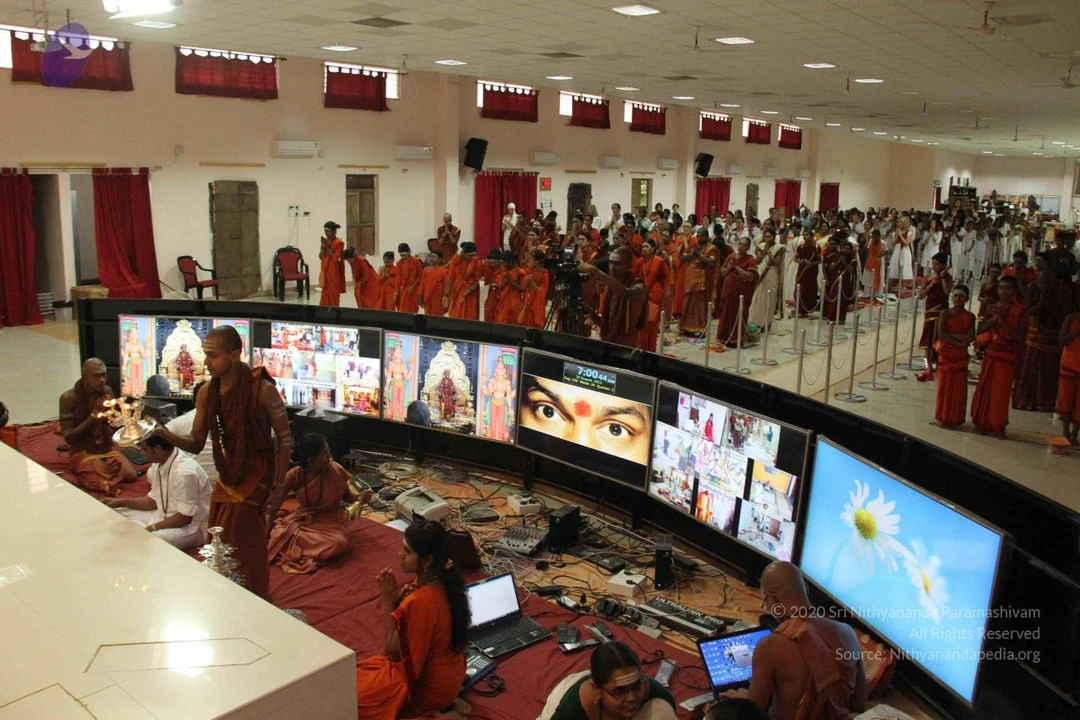
A close photograph of a hand raised upward holding a silver multi-branch oil lamp (aarti lamp) with five lit flames. The lamp has a tiered base, a central stem and curved arms decorated with animal figures. Behind it hangs a deep maroon velvet curtain and to the left a wooden panelled door. Only the hand is visible; no other people are shown. The lamp is used for aarti in a temple or satsang setting.A large hall with cream walls, red curtains and wall-mounted air conditioners. Women in orange and rust-coloured saris with gold borders stand in a line with palms pressed together in namaste, eyes closed or lowered. Several wear rudraksha malas and red bindis. Behind them a second group in white and cream saris and dark red saris also stands in prayer posture. Brass or steel trays with oil lamps, flowers and small offerings rest on mats on the floor, with steel stanchions and chains dividing the rows. Watermarked-free photograph of a devotional satsang gathering in progress.A large hall with pink walls and red curtains shows a group of young boys and a few adult men in saffron-orange dhoti-style robes with red borders, standing with palms pressed together in anjali. Several boys have tilak marks and rudraksha malas. Behind them, adults in white and red-brown clothing stand in the crowd. A small tray with flowers, kumkum and offerings sits on a mat at right. Several people in the background have shaved heads and white markings.A large hall filled with a standing congregation facing a front altar area. In the foreground, young boys and men in saffron-orange dhotis and kurtas stand with palms pressed together in namaskar, with several in rust-red clothing among them. Behind them, many people in white and cream clothes stand in rows; a woman in a cream sari and a few women in deep red saris are visible at left. Metal stanchions with red ropes line a walkway at left. Behind the crowd, a golden canopy-style shrine and framed images stand near the far wall. Ceiling fans, recessed lights and red curtains frame the room.A wide view of a large hall during a satsang gathering. Many devotees stand in rows with palms pressed together in namaskar, dressed in orange and saffron robes, white ritual clothing and maroon garments. Young boys in orange dhotis stand near velvet-roped barriers on the left. Red curtains line the windows, ceiling fans and recessed lights hang overhead, and a gilded throne-like seat with a deity murti and framed images sits at the far end of the hall. A dais with a small altar is visible in the background. Overhead ceiling fans hang above the crowd.Interior of a large hall used for a satsang broadcast with rows of orange-robed devotees standing and seated along a red-curtained wall. In the foreground, a priest in orange robes holds a brass aarti plate near a raised white platform, while others in orange sit on a red cloth with laptops. A curved bank of wall-mounted screens shows deity images, a close-up of a face with a red bindi, a grid of video-conference participants, and a white flower. Devotees with kumkum and vibhuti are visible at the right, and a digital clock reads 7:00:44 on one screen.

Deity-Arathi

5 photosSource gallery
A photograph of a stage in a temple-style hall with a white glossy floor. On the left, a seated man in an orange turban, orange garment and a long beaded mala sits on a gold-carved throne with hands folded in front of his chest. Behind him is a painted backdrop with a painted multi-armed deity figure holding a sword, gold columns and painted pillars. On the right, a garlanded deity murti sits on a gold-arched throne draped in red and yellow cloth, with a small child in orange and white garlanded and seated beside it. Brass oil lamps stand in a row in front. At far right, a bald man in an orange shawl and dhoti stands barefoot on the lower step, holding a lit flame toward the deity. A portable air conditioner and a fan stand at the right edge.Photo of a temple-style hall stage with a painted backdrop of columns and a gilded doorway. On the left, a seated man in an orange turban and orange-saffron dhoti, with rudraksha beads and hands joined in namaste, sits on a gold throne with lion-figure armrests; whether this is a person is uncertain from appearance alone. Center right, an ornate gold arched shrine holds a deity murti draped in red and white garlands. Beside it, a child in orange and white attire with garland sits and joins palms, while a woman in a pink sari sits near the shrine. Brass oil lamps stand on the floor in front of the throne. On the right, a bare-chested man in an orange dhoti bows toward the shrine. A small framed photo sits on the floor. Air conditioners and a curtain frame the room.Indoor temple-style stage with a seated figure in orange robes and a rudraksha mala on a gold-trimmed throne at left, hands folded in namaskar, beside a standing multi-armed deity statue in blue and red. At right, a gold-arched peetha holds a decorated deity murti garlanded with red and white flowers, with two young children in pink, yellow and green seated before it. A man in an orange dhoti stands at far right, bowing toward the children. Brass oil lamps stand between the figures and a small framed picture rests on the white floor.A photograph of a temple-style stage with a painted backdrop of colourful pillars and a deity figure. On the left, a man in orange and saffron robes with a rudraksha mala sits on an ornate gilded throne with hands folded in greeting. Centre right, a decorated deity murti sits on a gilded throne draped in red and orange garlands, with two small children in pink and orange seated before it. On the far right, a shaved-headed priest in orange dhoti and shawl raises a silver vessel toward the deity. Brass lamps stand on the stage, with a red carpet and a tall white air cooler nearby.A photograph of a stage in a temple-style hall with a painted backdrop of pillars and a golden arched doorway. On the left, a man in an orange saffron wrap, orange head covering and rudraksha mala sits on a gilded throne. Beside him stands a painted deity murti holding a trident and a lamp. On the right, a large gilded throne holds a deity murti decorated with red and white flower garlands. A young boy in orange clothes sits before it with a garland, while a priest in an orange dhoti and shawl, shaved-headed, stands at right holding a lit aarti lamp toward the deity. Brass oil lamps line the stage, and a tripod stand holds a screen near the floor.

Nithya-Satsang

39 photosSource gallery
Photo of a temple-style stage with painted blue pillars and a carved golden doorway backdrop. On the left, a man with a shaved head in an orange-saffron shawl and wearing a rudraksha mala sits on a gold-trimmed throne with a red cushion, his hands folded in his lap. Beside him, two painted deity figures with multiple arms holding ceremonial objects flank the throne. On the right, a gold-framed throne holds a decorated deity murti garlanded with red and white flowers. Two young girls in pink and yellow sit on the platform at its base, one in a green and orange outfit. Brass lamps stand along the stage, and a red-draped valance hangs overhead.Photograph of a stage at an ashram-style hall. On the left, a man in an orange-saffron turban and orange-and-gold robe sits on an ornate gold throne with lion-head armrests, wearing a rudraksha mala, with two gilded standing attendant figures with multiple arms behind him; a rudraksha-style garland and ceremonial gold necklace are visible. On the right, a gold-framed arched shrine holds a deity murti adorned with red roses and white garlands. Two children in pink and orange-green traditional clothes sit before the shrine with hands folded. Brass oil lamps stand on the white stage floor, with a red carpet and a standing air conditioner nearby.A stage set with painted backdrop of gold-trimmed columns and two standing divine attendant figures in orange and green dhotis. A seated man in an orange and saffron robe, wearing a saffron turban and a dark rudraksha mala, sits on a gilded throne with hands raised in an open gesture. To the right, a gold arched shrine holds a deity murti draped in red and white flower garlands, with two young people in saffron and yellow sitting before it on a red carpet. Brass lamps stand in a row between the throne and the shrine on a white marble floor.A photograph of a satsang stage in a temple-style hall. On the left, a man in an orange-saffron dhoti and shawl, with an orange head wrap, long rudraksha mala, and bangles, sits cross-legged on a gold-and-maroon throne with a lion-armed base, smiling and looking toward the right. Behind him stands a painted deity murti with four arms and a crown, holding ritual objects, flanked by painted pink and green pillars. On the right, a gold-framed throne is decorated with red and white garlands and holds a decorated deity murti, with two young children in pink and orange-yellow clothes seated at its base with garlands. Brass oil lamps stand in a row in the centre, and a wall-mounted air conditioner and a small fan sit at the edges.A photograph of a satsang stage with a seated figure at left on a gold-framed throne wearing an orange turban, orange-saffron robes with a gold border, a rudraksha mala and bangles, sitting cross-legged on a red-cushioned dais. A carved gold throne at right is decorated with red and white garlands and holds a small deity murti dressed in silver and jewellery, with two children in pink and orange-green clothing seated beside it, one wearing a garland. A standing four-armed deity figure in orange dhoti stands at centre, flanked by brass oil lamps on the floor, and a painted pillared backdrop with pink and green columns. The seated figure at left is a person candidate by appearance: orange turban, saffron robes, rudraksha mala and ornate bangles, seated in a position of honour.A seated figure in saffron and orange robes sits on an ornate gilded throne with lion-head armrests and maroon velvet cushions, smiling, with a red-orange turban, a rudraksha mala with multiple strands around the neck, and silver bangles on the wrists. Two large painted deity murti flank the throne, each with four arms holding ritual objects and wearing gold crowns, necklaces and green-and-red garments. Behind the throne is a golden arched backdrop and a carved wooden door. The appearance of the seated figure with distinctive turban, rudraksha mala and saffron clothing is consistent with a probable Swamiji (probable) in a throne-based satsang setting.

Sarva-Darshan

9 photosSource gallery
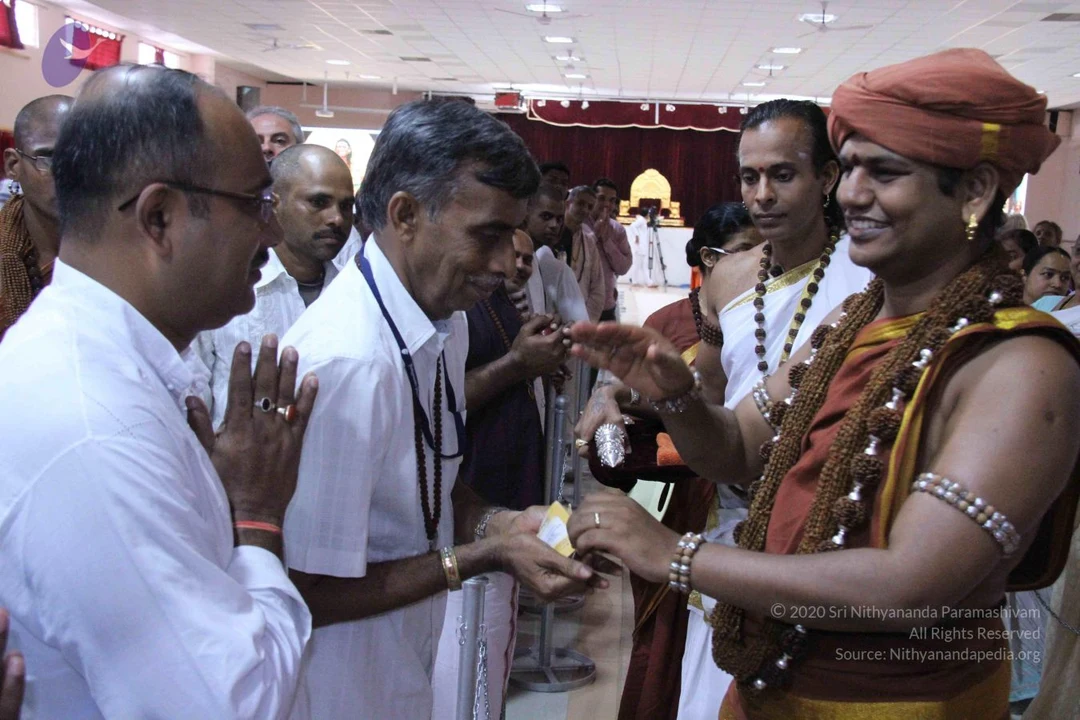
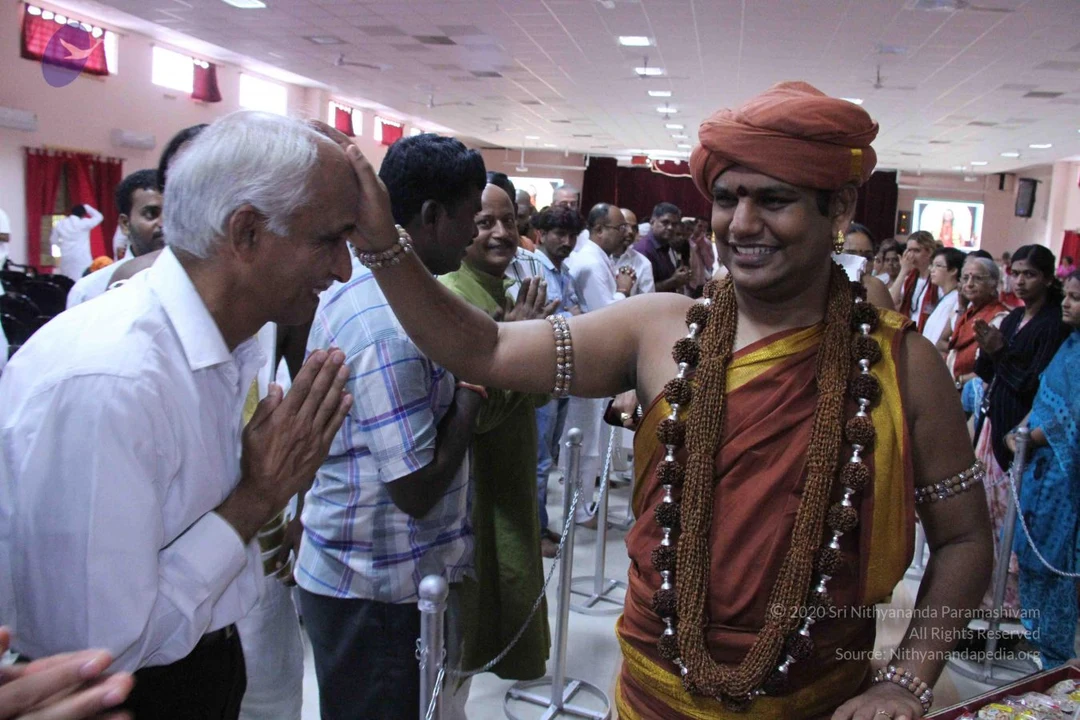
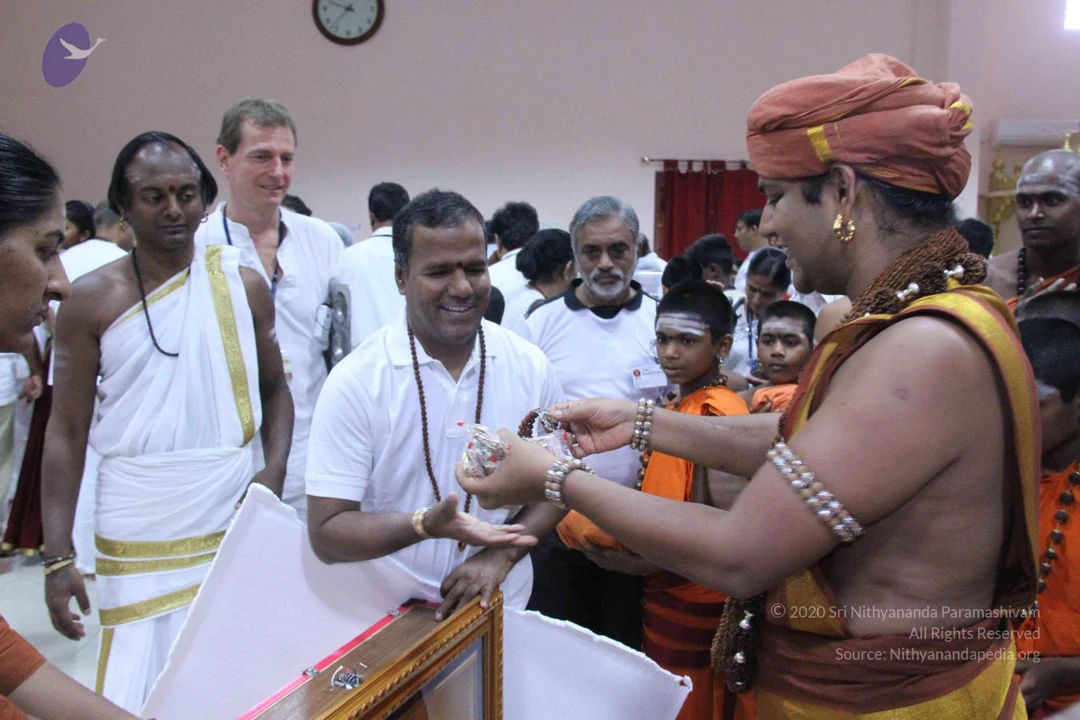
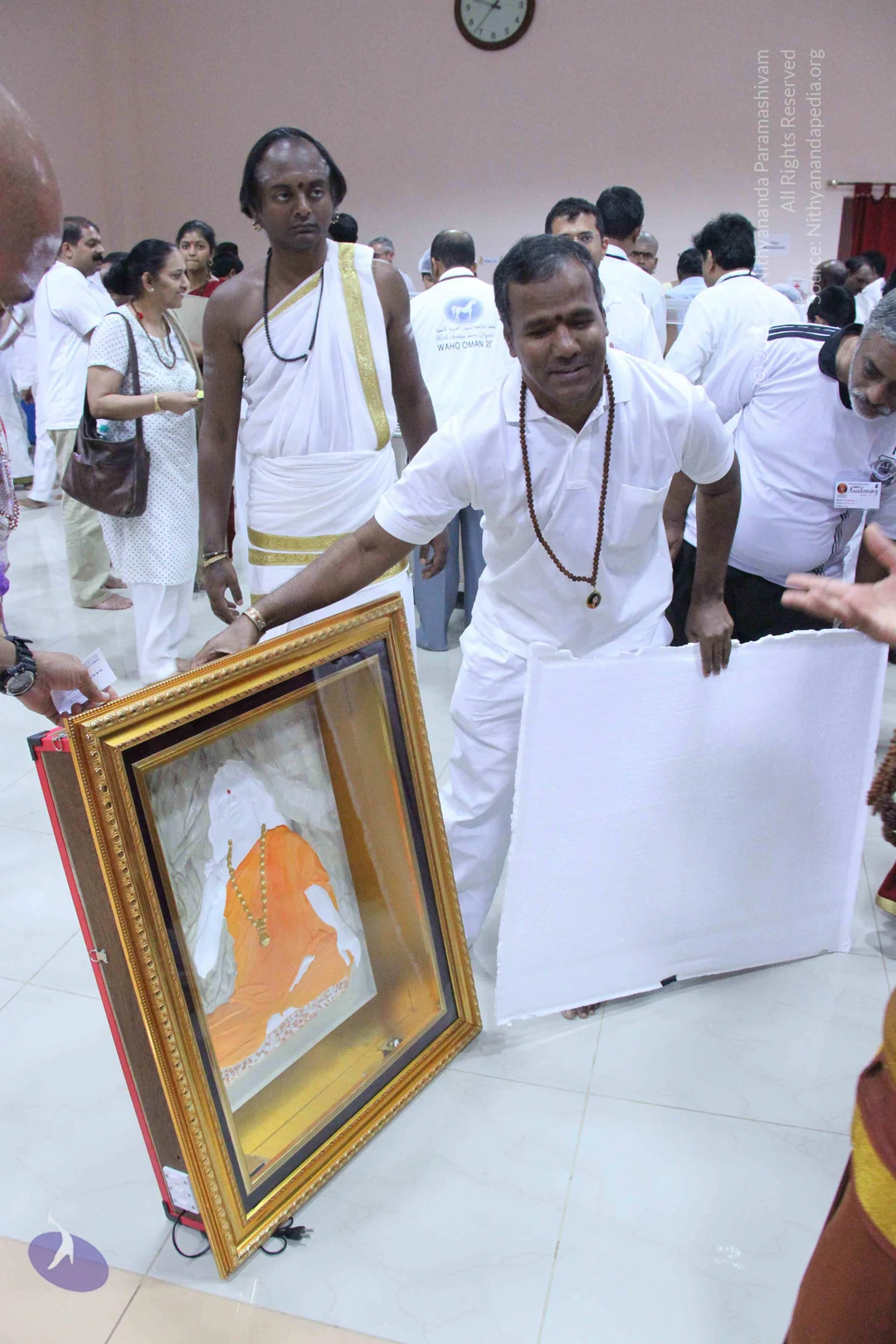
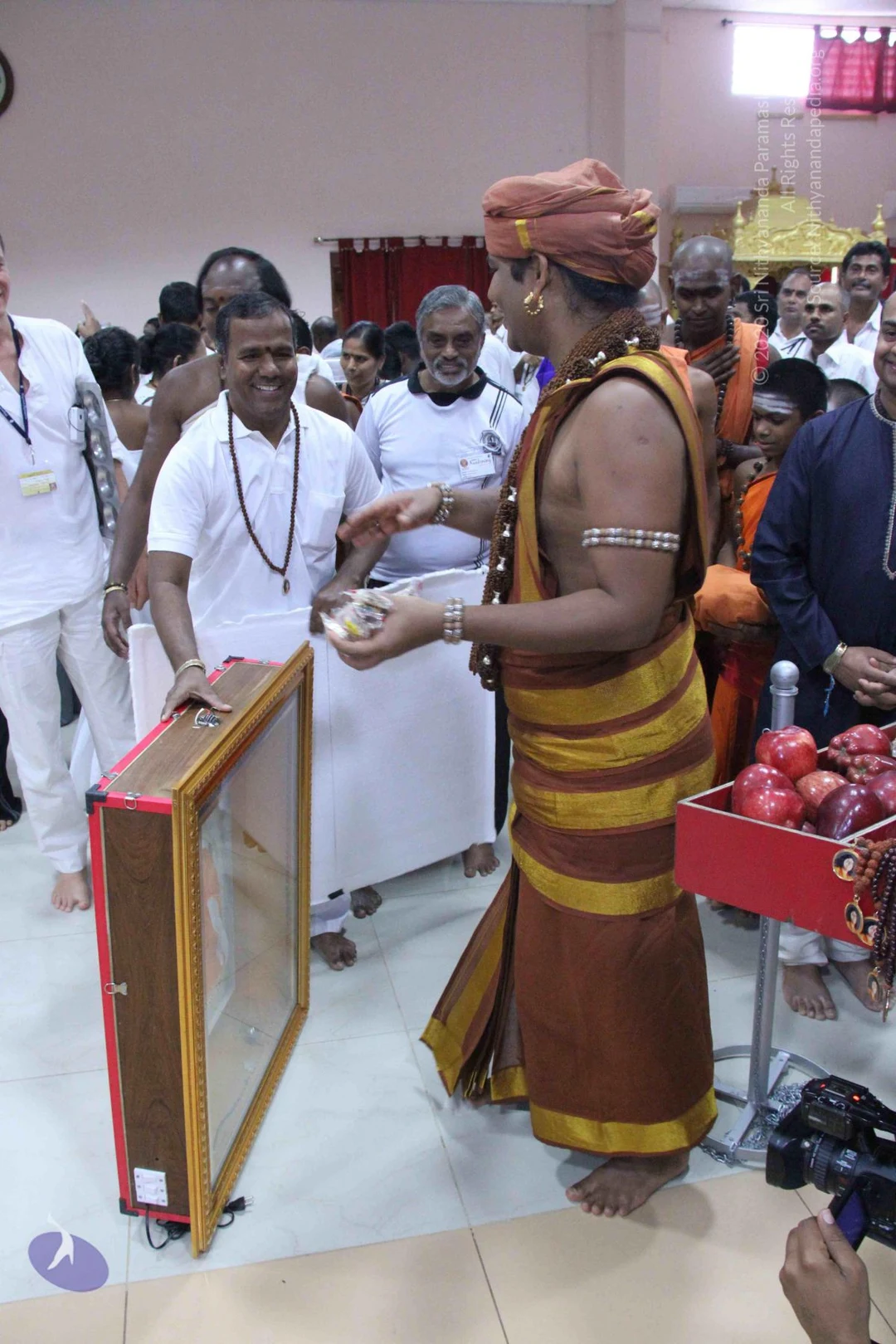
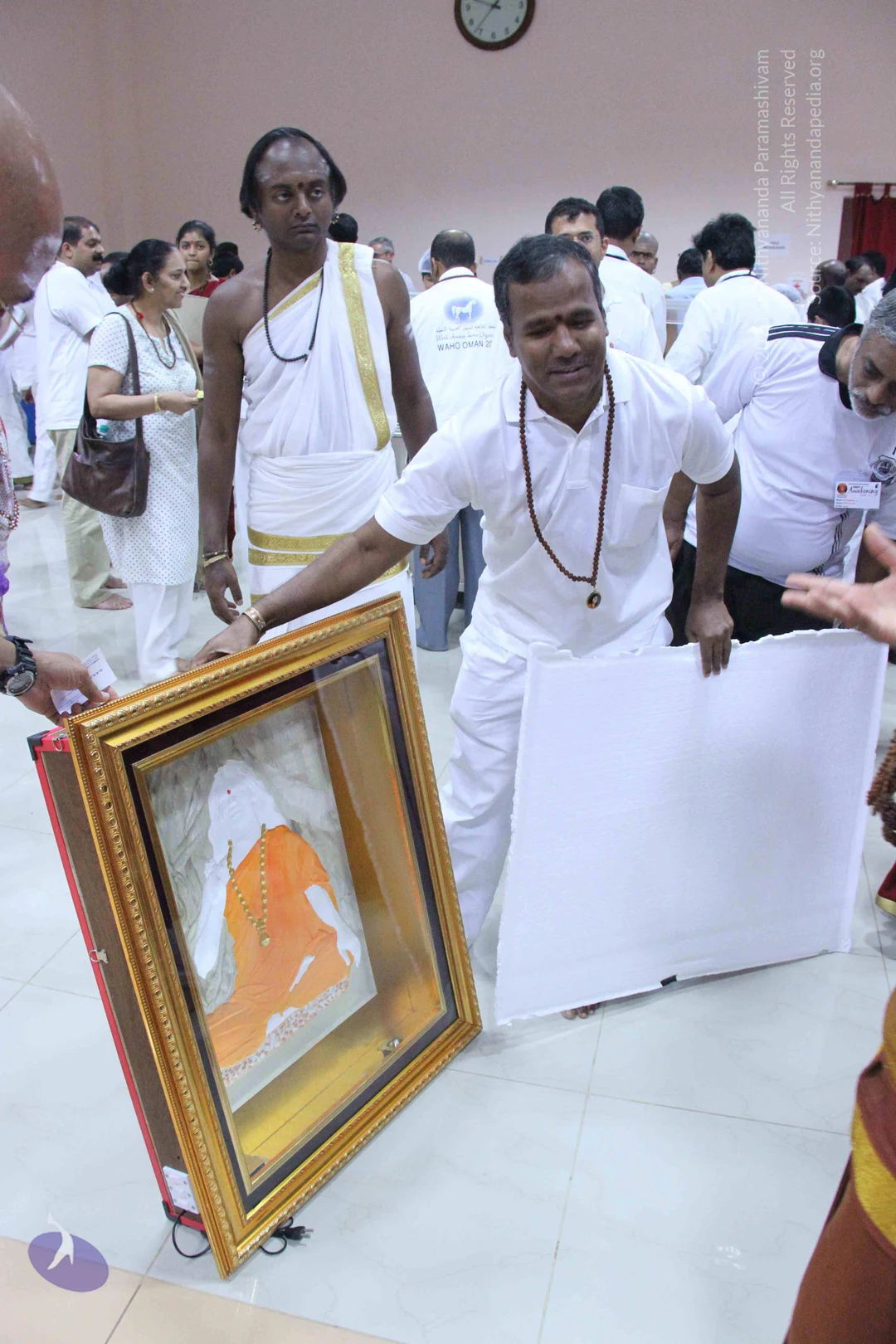
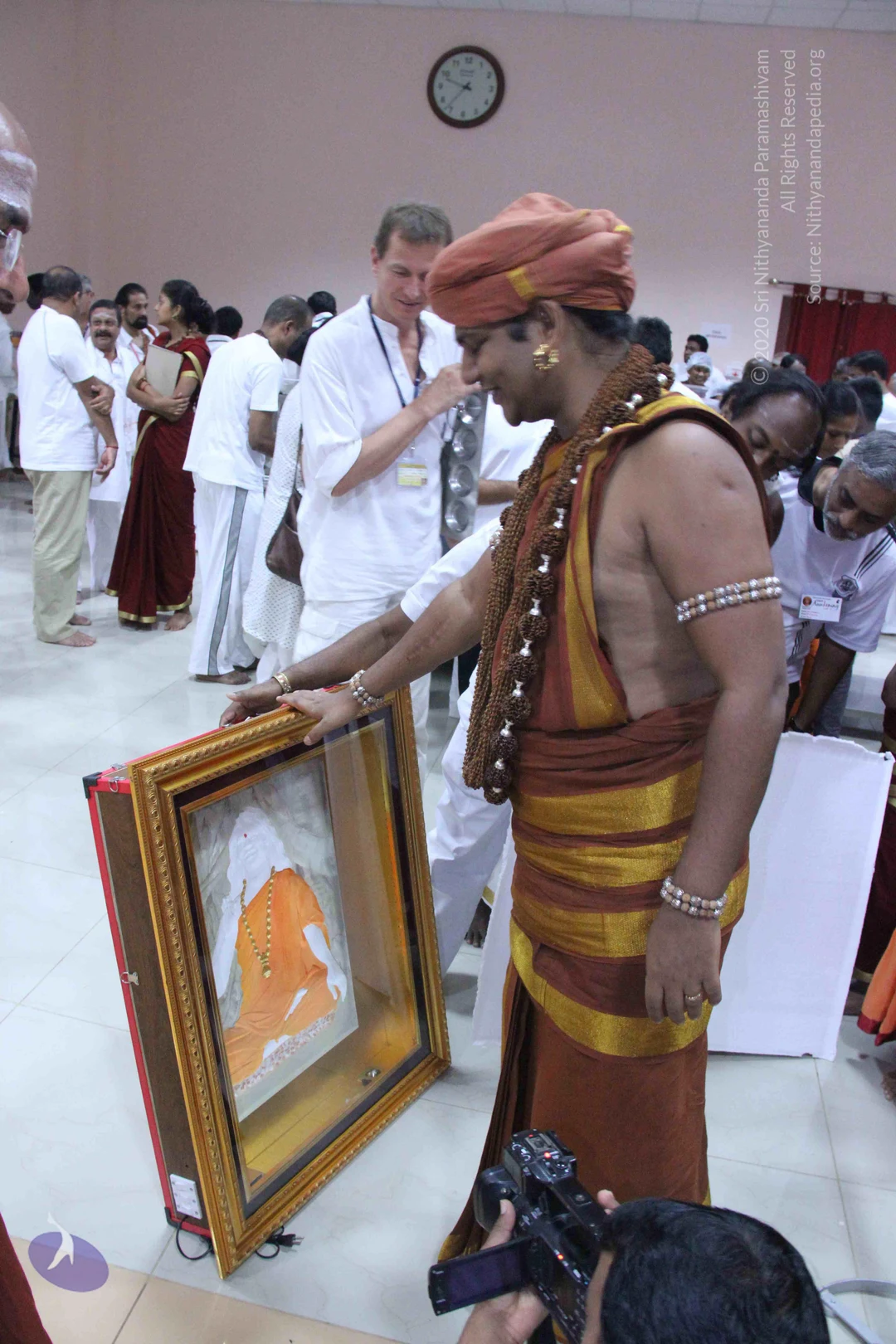
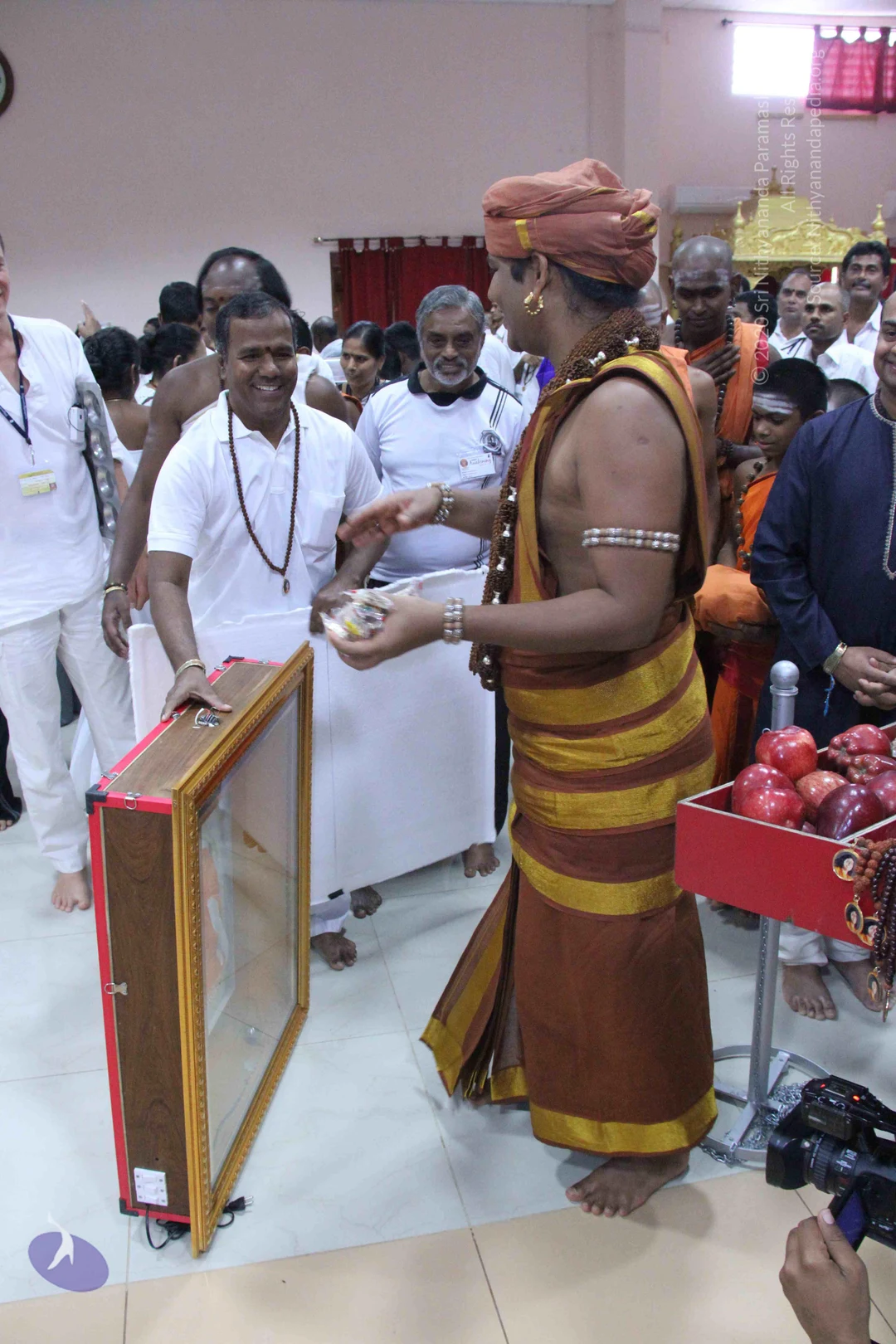
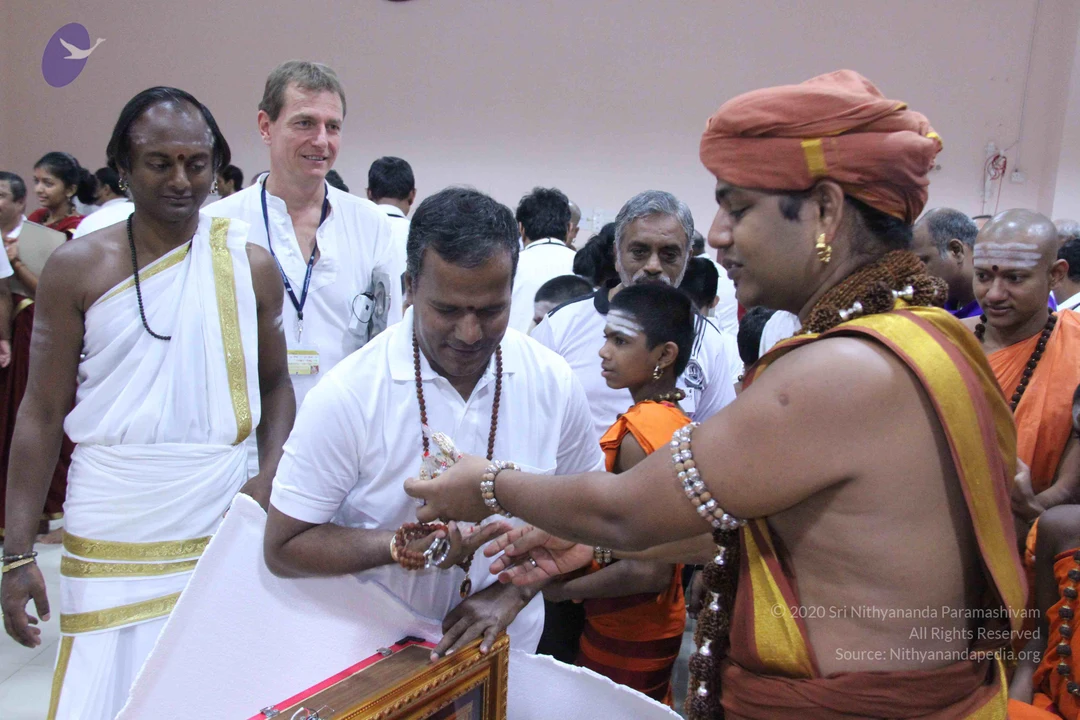
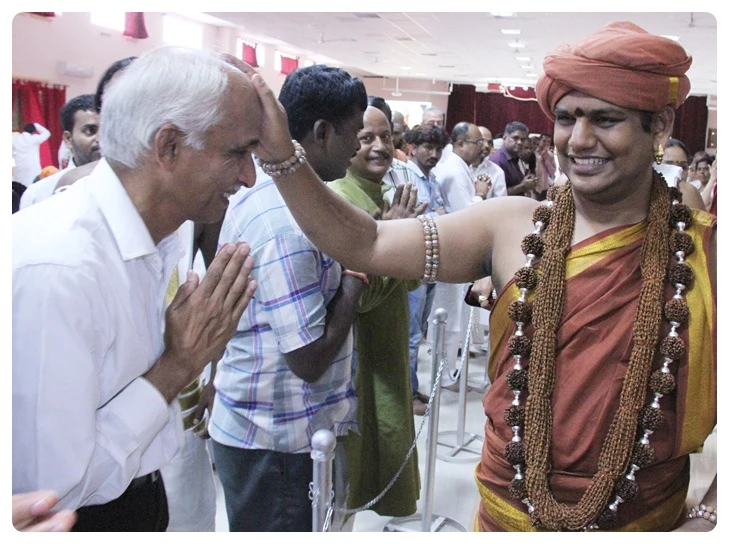
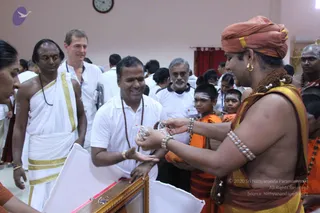
A hall with a stage backdrop showing a deity murti in a decorated shrine arch, maroon curtains and a large screen. In the centre, a man in an orange-saffron head wrap, layered gold and orange-yellow dhoti-style cloth, and long rudraksha mala necklaces raises one hand in blessing while holding a folded white paper. Beside him, a man in a red vest and white clothes stands with palms joined in greeting. To the left, a man with glasses and a rudraksha mala listens. Behind them, saffron-robed attendants and a woman in an orange sari with glasses stand near stanchions. A tray of red apples is visible at lower right.A photograph in an ashram hall with a white tiled ceiling and red curtains. In the foreground a bare-chested man in an orange turban and orange-and-gold waist cloth, wearing a long rudraksha mala and bead bracelets, holds up a phone or small object toward a devotee. Around him stand several men in casual shirts, one in a striped blue shirt and one in a red-and-black top, and a man in white. Behind them a deity murti and gold-trimmed decorations sit on a dais.A photograph of a devotee line at an indoor hall with a red curtain and a golden throne-like seat visible at the back. In the foreground, a man in an orange turban, rudraksha malas and layered beaded necklaces, with an orange-and-gold wrap, smiles while handing a small folded item to a balding man in white who presses his palms together in greeting. A second man in white with a rudraksha mala and a grey-haired man in a white shirt with a blue lanyard look on. Behind them, a man in white with a mala stands beside a woman in red, and more people stand near a camera stand. The turbaned figure's distinctive orange turban, mala layers and ornate ceremonial dress are visible, though the figure cannot be confirmed from appearance alone.A man in an orange-saffron turban and orange-and-gold robe, wearing a long rudraksha mala and bracelets, smiles and raises his right hand in greeting as devotees press palms together along a rope barrier in a bright hall. A man in a green shirt bows with folded hands at left, while others in white and checked shirts stand behind the barrier. Background includes red curtains, a gold-lit altar area and a red-clad figure at right. Orange-clad man appears to be the central figure receiving devotees.Indoor hall with white walls, red curtains and ceiling fans. A smiling man in an orange-red turban, bare-chested under a red-orange cloth with a yellow border and a long rudraksha mala with silver caps, stands at right while an older white-haired man in a white shirt, hands in anjali, bows as the turbaned man places a palm on his head. Bystanders in white, green, plaid and blue saris line the background behind metal barrier posts.A photograph of a ritual exchange in a bright indoor hall with pink walls and a wall clock. A bare-chested figure in an orange-and-gold turban and gold-bordered dark red cloth, wearing a large rudraksha necklace and silver bangles, hands a small glass or crystal item to a smiling man in a white polo shirt and rudraksha mala. A wooden framed box sits in the foreground. Around them stand a man in white dhoti with gold border, a man in a white shirt with a badge, a older man in a black-and-white polo, and several boys in saffron robes with orange sashes. Desc uses appearance cues only; the figure in the turban matches the page's Swamiji reference with distinctive adornments and rudraksha, so the appearance-based label applies.

IA-Yoga

38 photosSource gallery
A large hall with cream tiled floor and ceiling fans holds a yoga class of many participants on coloured mats, all in a kneeling cat-cow style pose with hands and knees on the floor. Men wear white kurtas, red, green, and grey shirts, and orange robes; one person in orange and others in white stand or kneel among rows. Red curtains line the walls, and stacked red mats sit at the right. A few people stand near the back among blue-grey pillars. Several people are visible; the count is in the dozens.A large hall full of men and some women practising a yoga sequence on coloured mats in pink, green, blue, purple and red. Most participants are kneeling in cat-cow or child-pose style with hands on the floor, many wearing black, white, grey and blue t-shirts and trousers, some with name badges. Metal stanchions and rope line the mats. In the background, several people in orange and saffron robes stand near the back wall beside red curtains, and a row of people in white clothes is visible at the far right.A large indoor yoga session in a hall with cream tiled floor, where many participants on coloured mats perform a forward-bending or child-pose stretch. Most wear white, grey, black or red shirts and trousers. In the foreground, a man in a red polo with the number 3 on his chest kneels on an orange mat, while a man in a light grey shirt kneels on a blue mat nearby. Behind them rows of practitioners fill the floor, some seated in meditation. At left, metal stanchions with rope barriers line the path. In the upper area, staff in white uniforms stand near a gold-framed shrine and a picture on the wall.A large indoor yoga session in a bright tiled hall. Many participants in white, blue, green and grey clothing kneel on coloured mats in rows, bending forward with arms extended in a cat-cow style pose. Some sit cross-legged on pink mats at the right. A standing figure in an orange robe stands near the centre back, with other people in white dhotis and shirts around. Water bottles sit on the floor between the rows, and metal railings line the left side. Some participants wear lanyards.A woman in orange monastic-style clothing performs a seated yoga stretch on a blue mat, leaning forward over her extended right leg with the left leg bent behind. She has her dark hair in a low bun, a gold bangle on one wrist, and small earrings, with eyes closed in concentration. A deep maroon velvet curtain hangs behind her on a light floor.A large hall with cream walls and red curtains shows many people on yoga mats performing a forward-bending posture, heads down and hands flat on the floor. Most wear white, black or grey clothing, with a few in blue and red. A standing figure in a bright orange robe near the centre-right watches over the group, with a second robed figure in white visible further back. Metal stanchions and red cloth divide the rows, and water bottles and a folded red cloth lie on the floor at the front left. Ceiling lights and wall-mounted air conditioners are visible.

IA

44 photosSource gallery
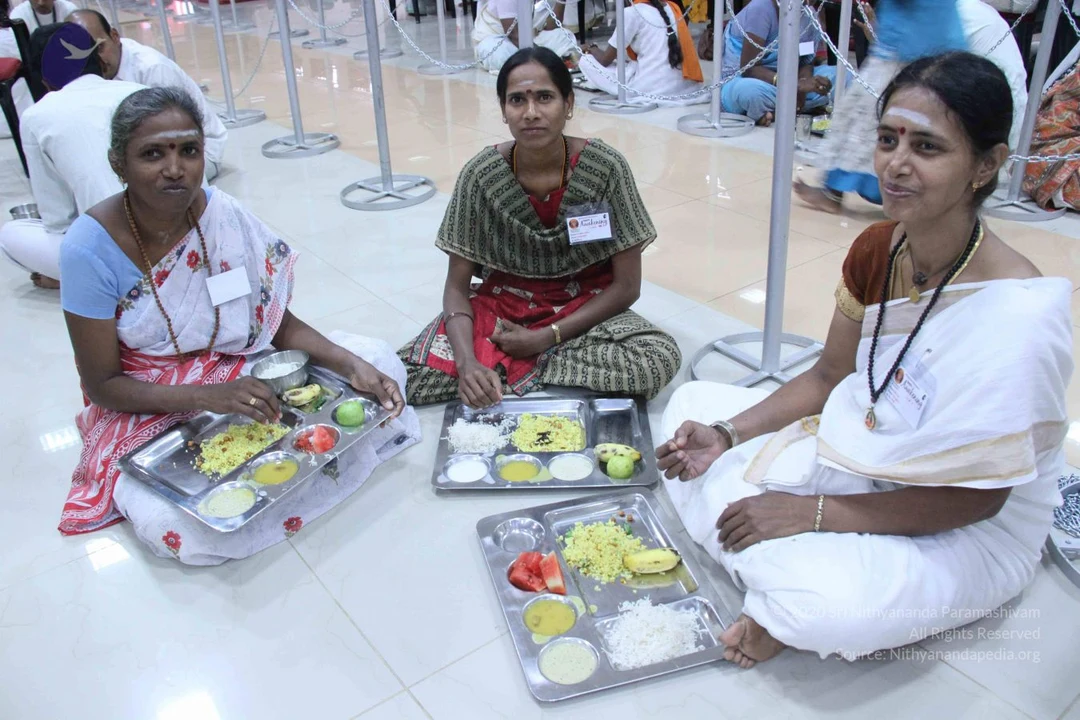
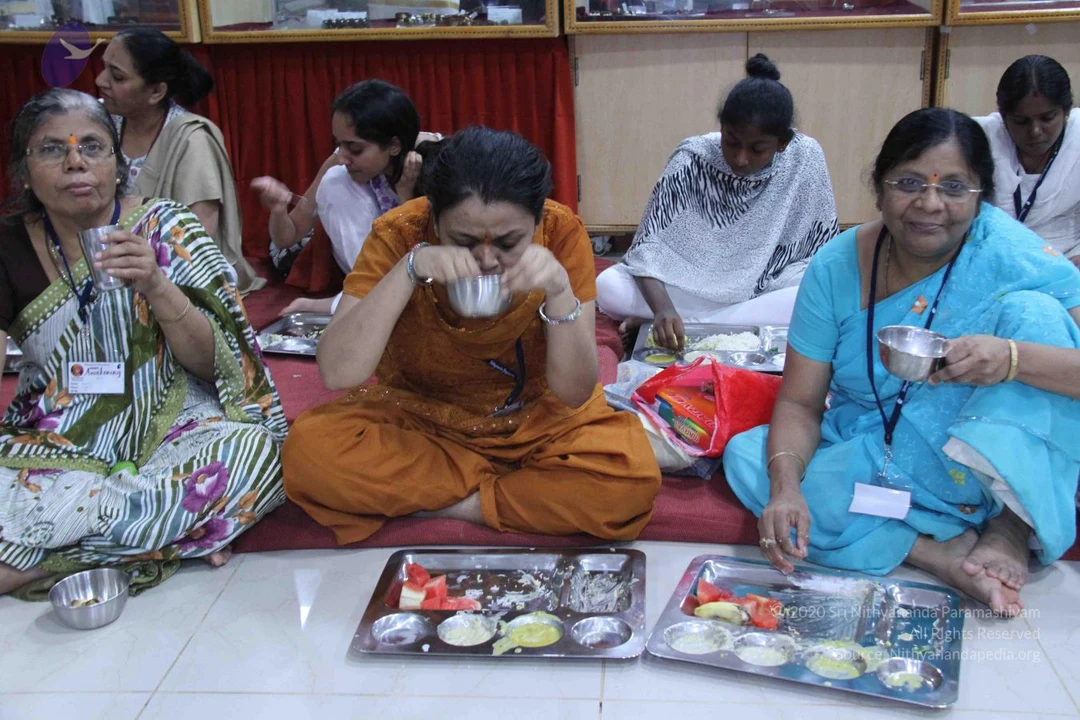
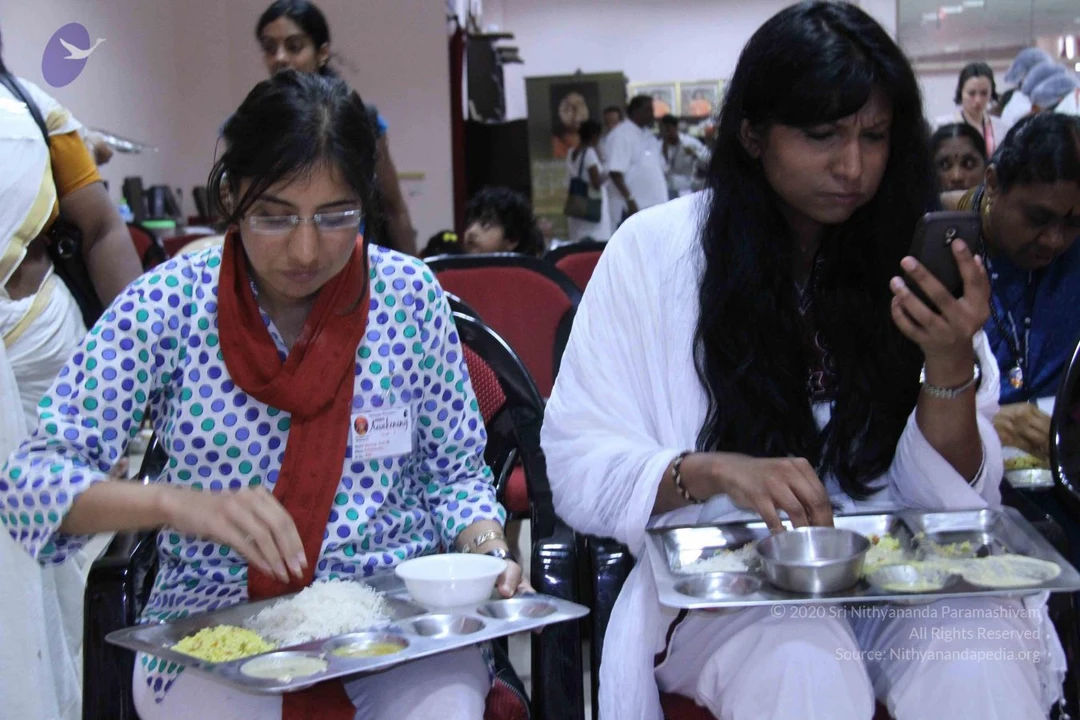
Two seated men in white kurta-style and white shirts eat from steel thali trays with spoons in a red-cushioned auditorium. The man on the left wears a white shirt, blue jeans and a name badge reading Awakening; the man on the right wears a white kurta with a rudraksha mala and holds a steel tumbler. Other attendees in white clothing sit behind them in the background, and a rudraksha-adorned man at right also eats from a tray.Two men in white clothing sit in red-cushioned chairs in a hall with red curtains behind them. The man on the left, in a white t-shirt with a blue lanyard and a white name badge, holds a steel plate of yellow rice, sliced watermelon, banana, and small bowls, eating with a spoon. The man on the right, in a white kurta with glasses and a white badge, looks down at a mobile phone. Other seated people in white are visible in the background.Two men in white ritual-style shirts and dhotis sit at a meal in a hall, eating from stainless steel thalis. The man on the left, wearing glasses and a dark wood mala with a pendant, uses his right hand to eat from a small steel tumbler and bowl. The man on the right, with a moustache, a red tilak, a blue lanyard and a dark rudraksha-style mala, holds a thali of rice, yellow dal-style dish, sliced watermelon and fruit. Standing people in white and pink behind them watch or move about. Steel cups and fruit slices are visible. The scene reads as a communal annadan-style meal.Two men in white shirts and white dhoti-style pants sit cross-legged on a white tiled floor eating from stainless steel thalis. The man on the left, with a moustache and a gold bangle, uses his right hand to take rice from a compartment, while the man on the right, wearing a rudraksha mala, scoops food from a small steel bowl. Their thalis hold rice, yellow dal, curry, sliced watermelon, banana and apple. Behind them, a row of seated people in white and orange clothes is separated by chrome stanchions and chains, and staff in white stand at the back.Two smiling young adults stand in a bright hall holding steel trays of yellow rice, a small steel cup, metal bowls, and a green apple. The woman on the left wears a white kurta with red and orange floral print and a red-and-gold trim, with a silver necklace and a blue lanyard. The man beside her wears an all-white kurta and pants with a blue lanyard and a name badge, holding a tray with a steel bowl and rice. Behind them, many people in white clothing move through a room with shelves and a mirrored wall.Three women sit cross-legged on a polished white floor during a meal, each with a steel thali of rice, yellow lemon-style rice, dal, sambar-like sides, sliced watermelon and bananas. The woman on the left wears a white sari with red floral border and a rudraksha mala, the woman in the centre wears a green patterned shawl over a red blouse with a name badge, and the woman on the right wears a white sari with a gold border and a black bead necklace, all with white vibhuti on their foreheads. Metal stanchions and chains in the background suggest an organised line, with other seated people behind them.

Deity-Darshan

2 photosSource gallery
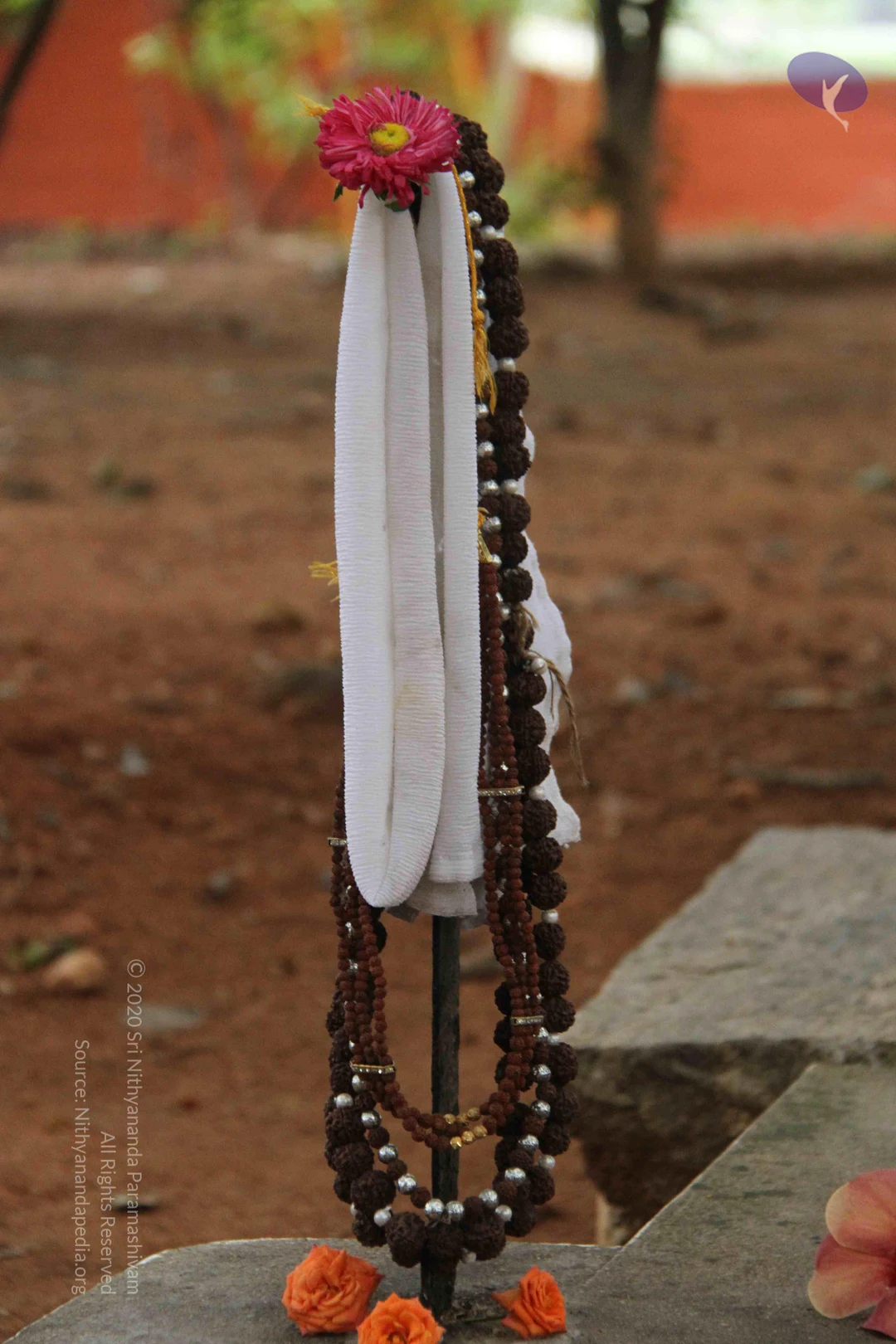
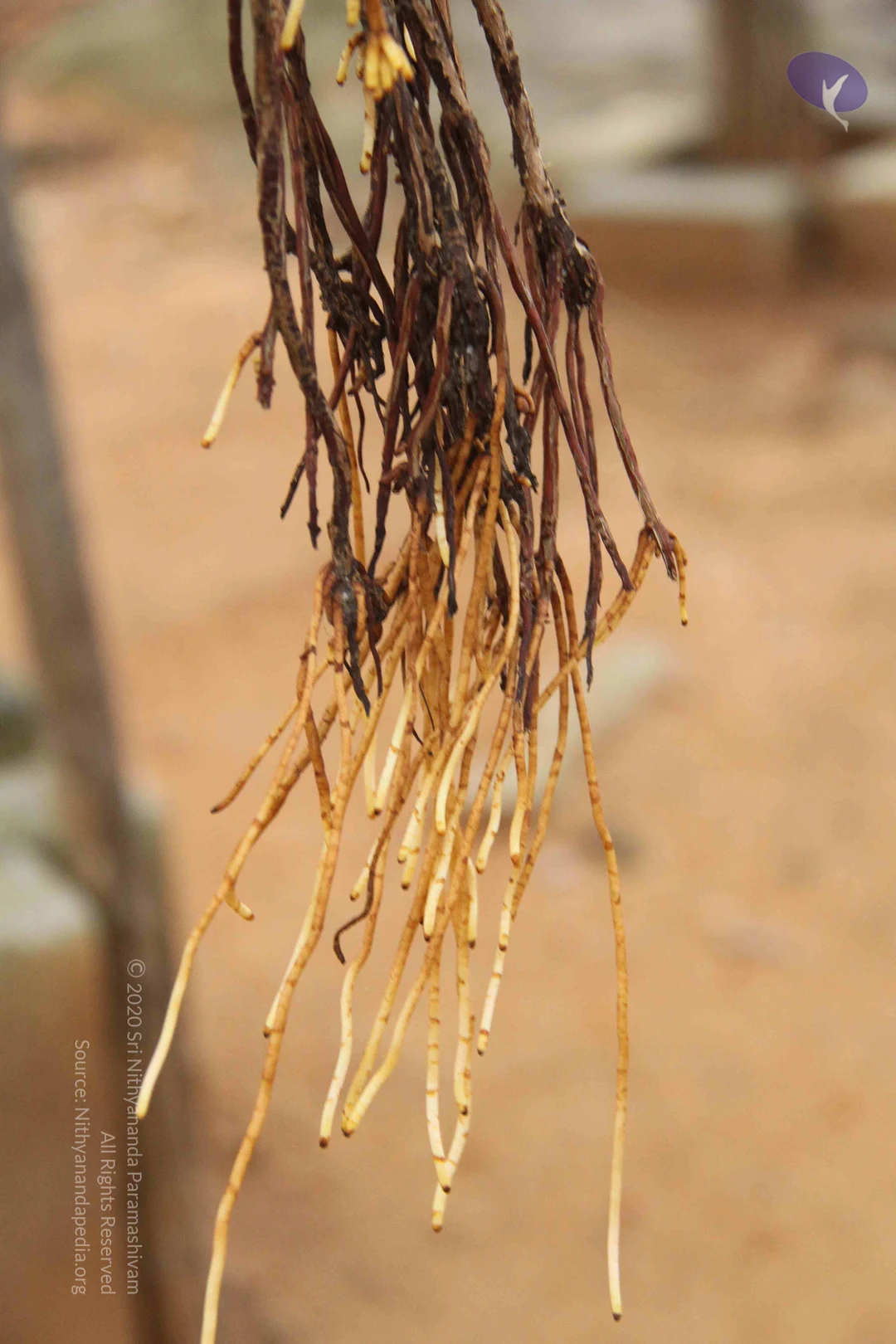
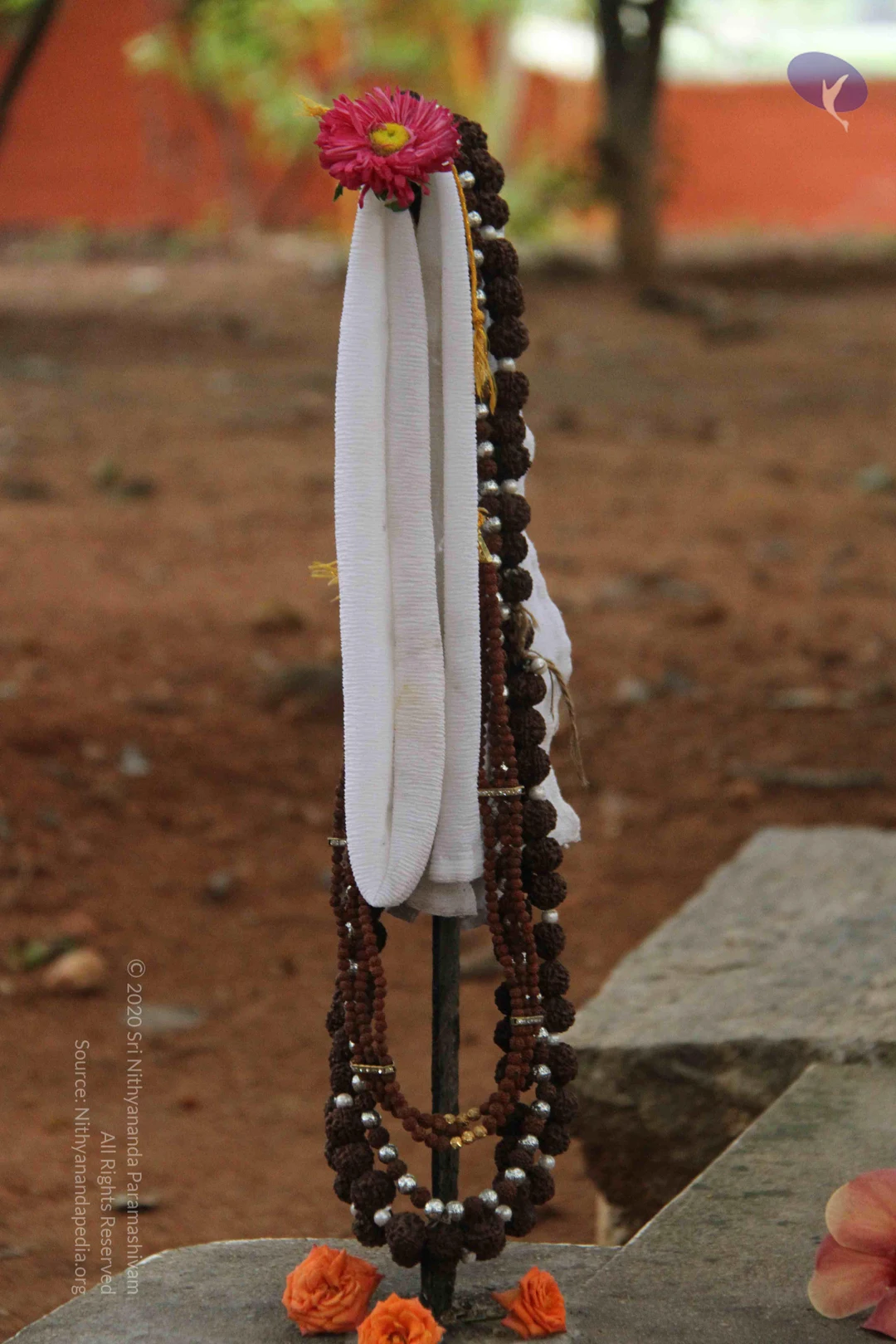
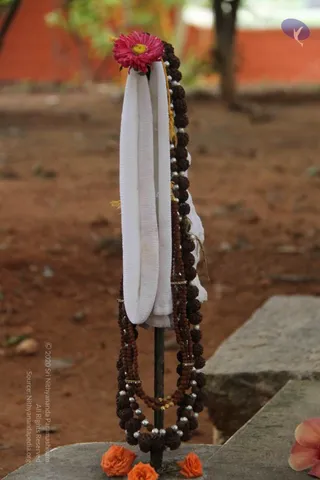
Outdoor photograph of a wooden stand or post holding a bundle of rudraksha mala necklaces, several strands of dark brown seed beads interspersed with silver-toned spacer beads and small gold-coloured dividers. Two folded white cloths hang from the top, with a fresh pink flower and a yellow tassel. Orange marigold-type flowers lie on a grey stone slab in the foreground. A red-orange wall and blurred green foliage sit behind a reddish dirt ground. No people are visible.Close-up photograph of dried, hanging plant roots or stringy fibrous material with dark brown and pale yellow-tan strands dangling downward against a blurred reddish-brown earthen background. No people are visible. The image shows only the stringy roots and a wooden post at the left edge.

Pratyaksha-Pada-Puja

5 photosSource gallery
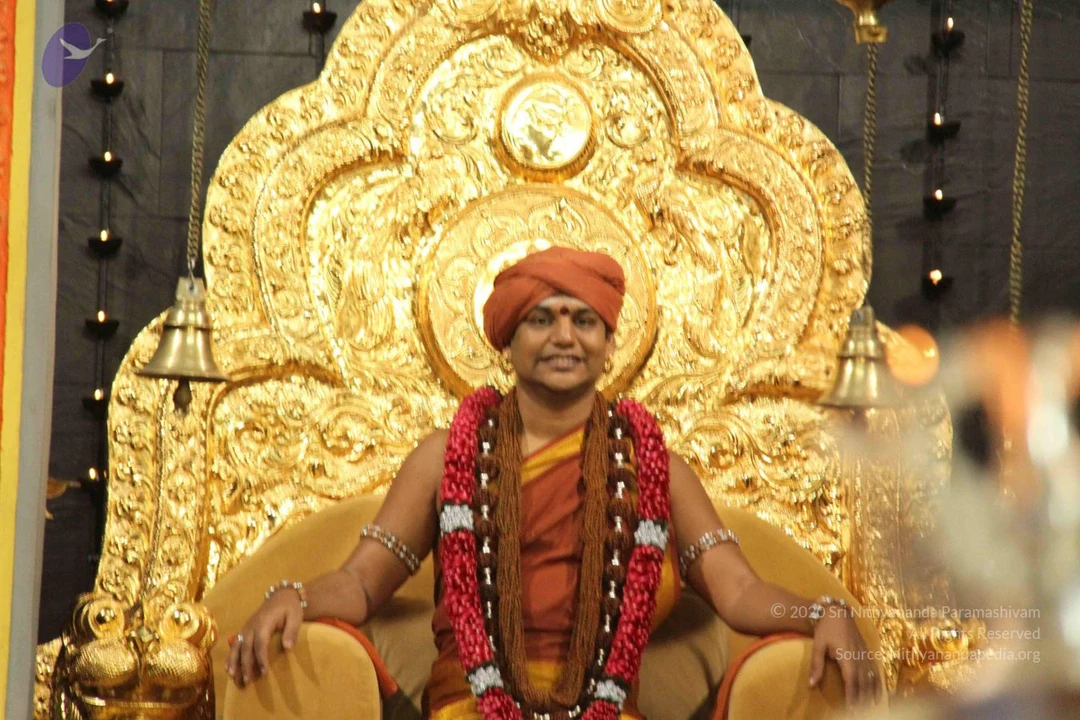
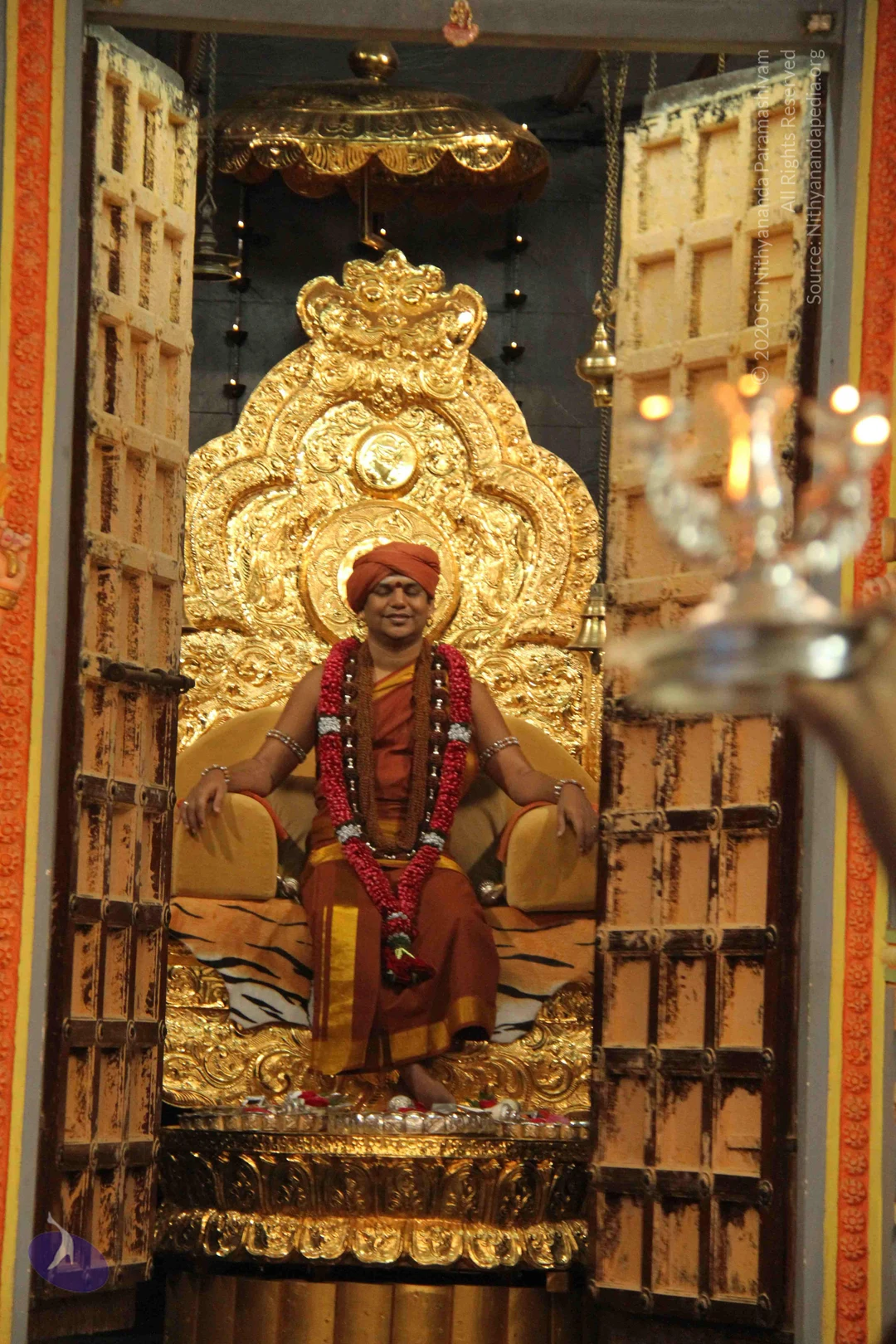
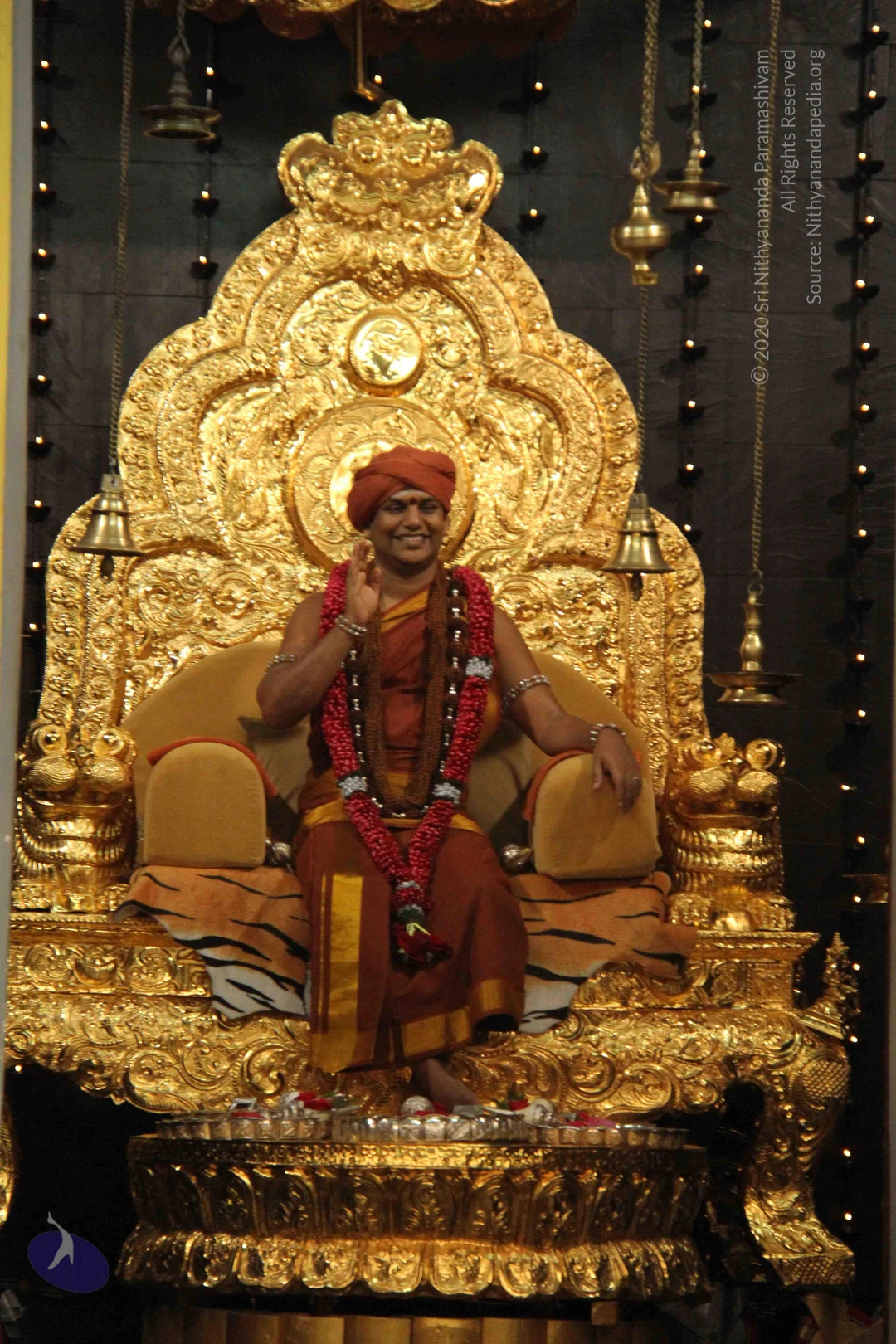
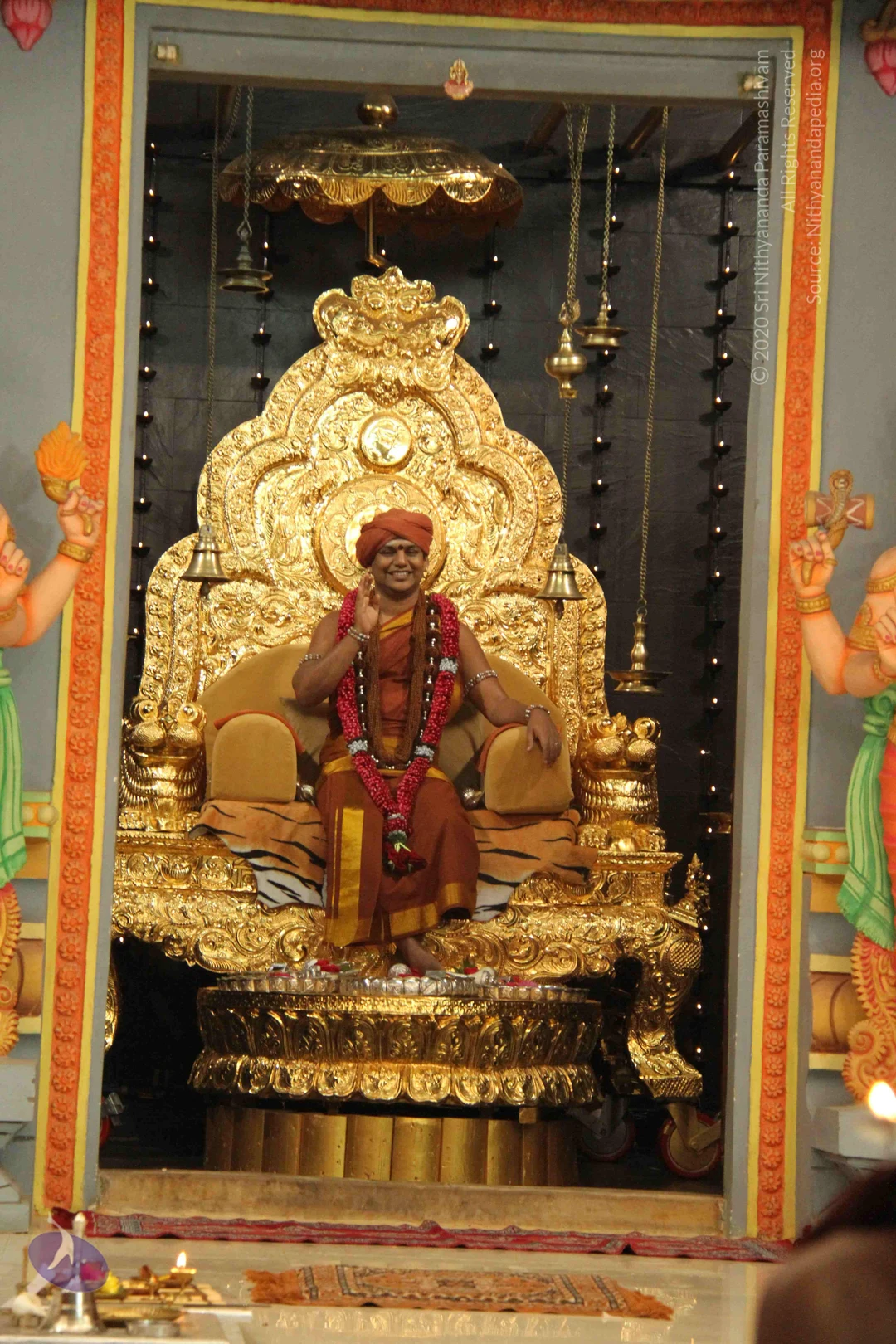
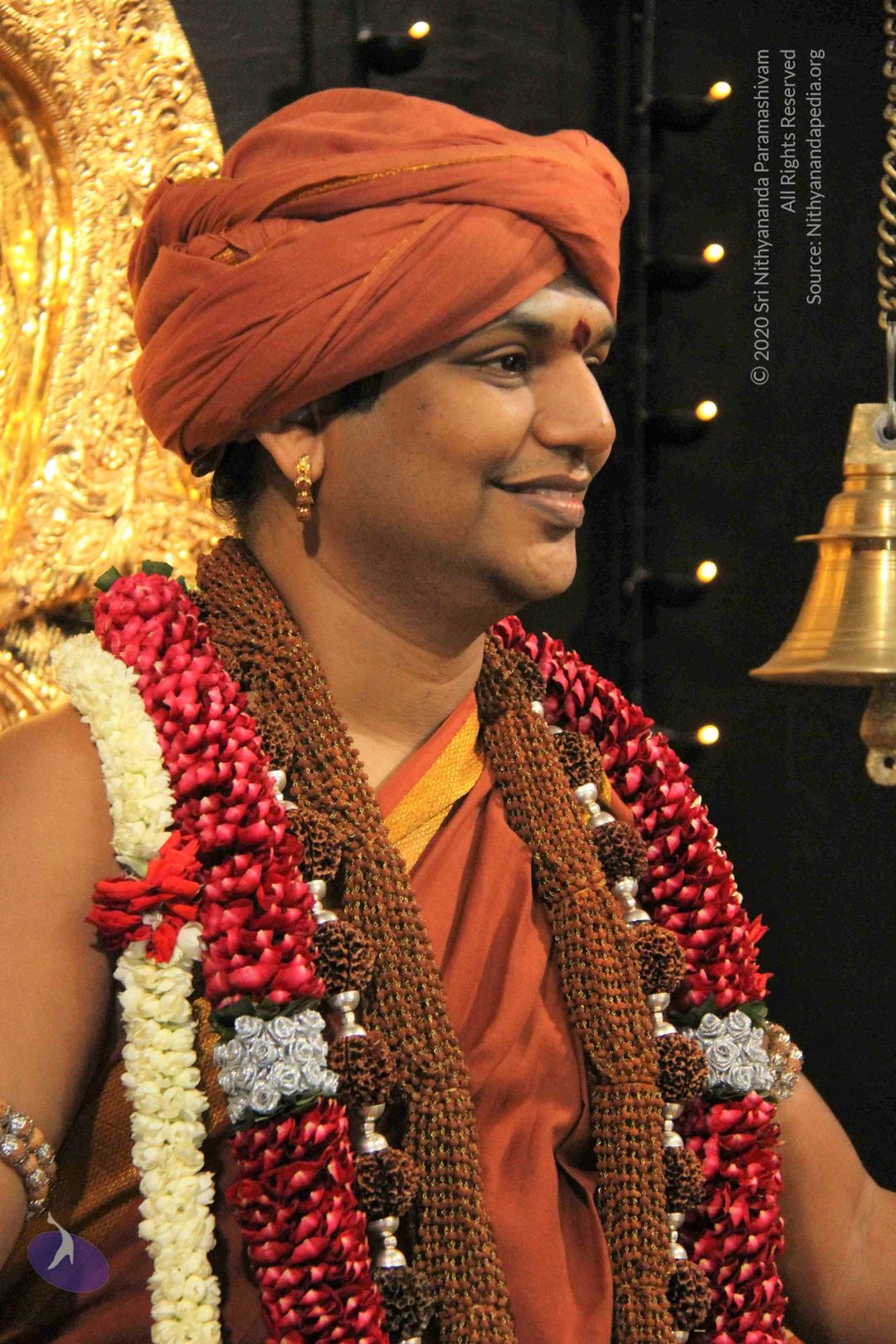
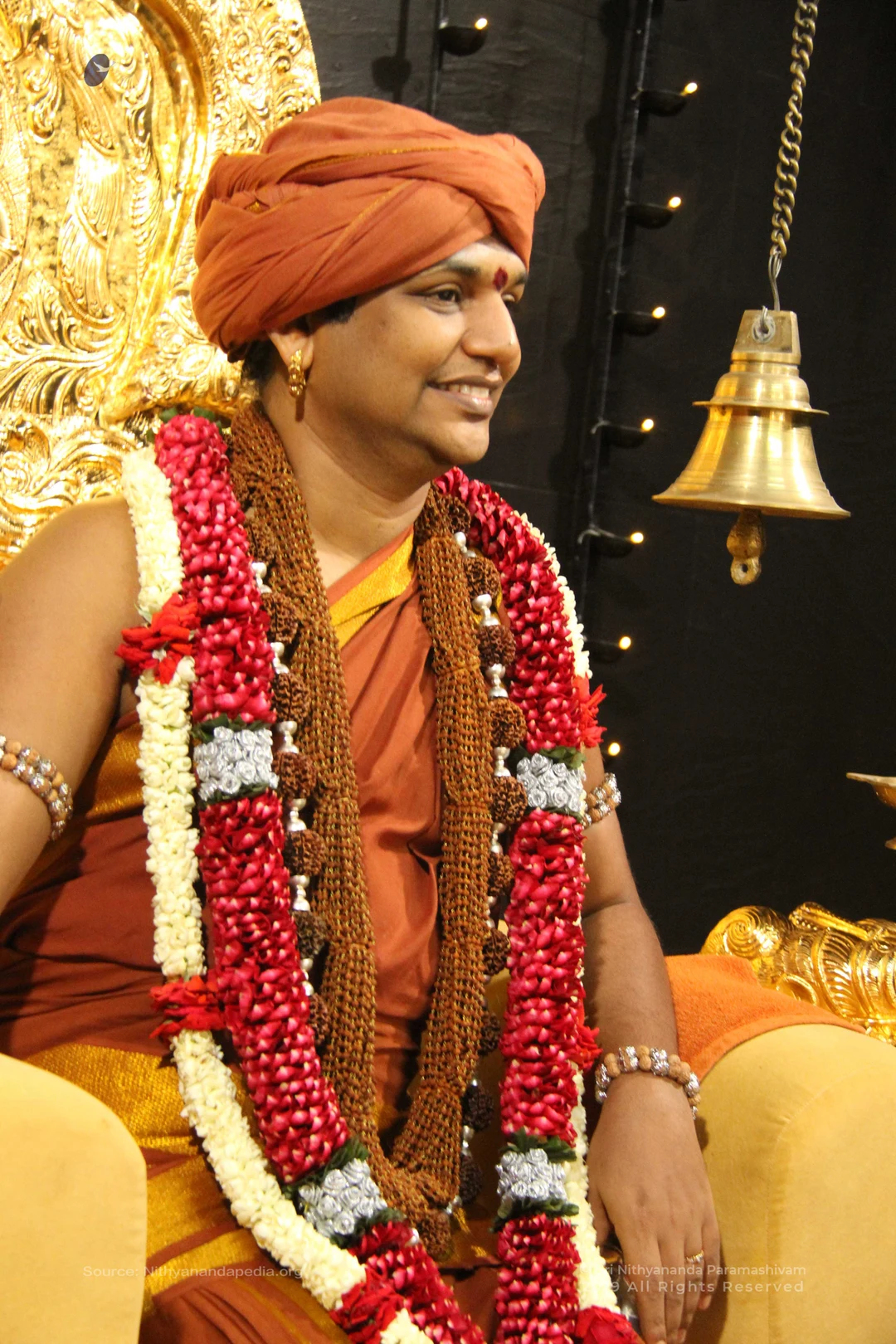
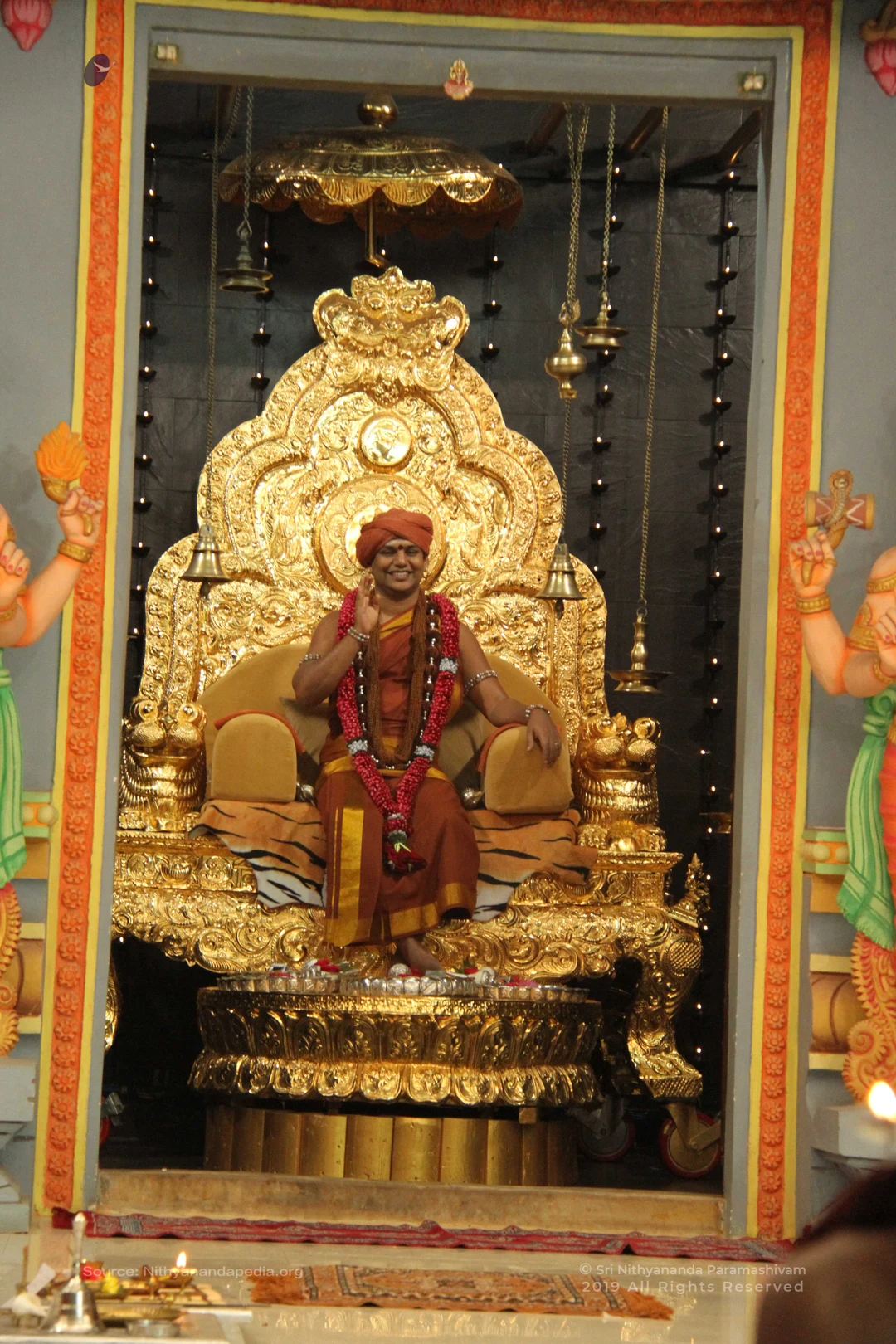
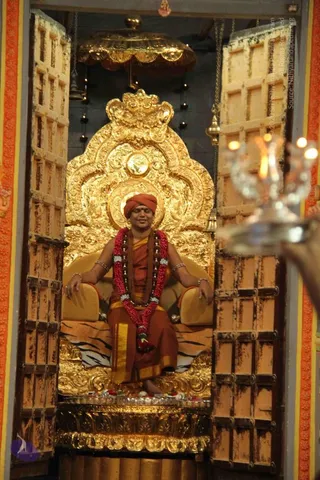
A figure in a saffron-orange turban and orange robes with a gold border sits on an ornate gold throne with a tiger-striped cloth draped over the seat. A red and white flower garland and a rudraksha mala hang across the chest, with bangles on the wrists. The throne is set between open wooden doors with carved panels and gold-framed red borders. A gold canopy hangs above, and a glowing silver oil lamp stands in the foreground. a person is seated at the centre, appearing to be in a meditative posture with eyes closed, and the scene resembles an ashram darshan setting.A seated man on an ornate gold throne in a temple-like hall, raised right hand in a blessing gesture, smiling. He wears an orange-red turban, a saffron-orange robe with a gold-bordered dhoti, a red and white flower garland and a dark rudraksha mala. The throne is elaborately carved gold with lion-form armrests and a tiger-striped cloth draped over the seat, under a gold canopy hung with bells. Garlanded green and orange deity figures with raised arms flank the doorway, and brass oil lamps are visible at the lower edge.Close profile photo of a smiling man in an orange-red turban with a red bindi, wearing an orange-saffron robe with a gold border and a thick multi-strand rudraksha mala. He is adorned with red and white flower garlands and gold earrings, with a large brass bell hanging at the right edge and a gold ornate backdrop behind him. a person: the saffron turban, rudraksha mala, flower garlands and ceremonial gold cues match the page's claim, but the appearance is not conclusive enough to confirm identity from the image alone.A man seated on an ornate gold throne with a tiger-skin cover, wearing an orange turban with a red tilak, an orange-red robe with gold border, and layered red-and-white flower garlands over brown rudraksha malas. Silver-beaded bracelets on both wrists and a brass bell and brass oil lamp stand at the right.A seated man in an orange-red turban and orange-red robes sits on a gold ornate throne with carved floral relief. He wears long garlands of red and white flowers with silver accents, and a long brown rudraksha mala with silver spacers across his chest, plus gold earrings and beaded bracelets. A red bindi marks his forehead and he smiles while looking to his right. Behind him hangs a polished brass bell on a chain beside a row of small lamps on a dark backdrop. Swamiji (probable): the seated figure, wearing an orange turban, rudraksha mala and flower garlands, is consistent with the page's reference to Swamiji at this satsang.

Leela-Alankar

12 photosSource gallery
Two children sit before a golden arched shrine framed with red, pink and yellow flower garlands. Behind them stands a silver-and-gold adorned deity murti holding a bowl and a lamp-like object. The older girl in a white and red blouse with a pink skirt and gold-bordered yellow cloth wears a bindi, nose ring and a flower garland, and holds a small bowl toward the younger boy. The boy, with a white forehead tilak and wearing orange and green dhoti-style garments, sits with his hands clasped and a flower garland around his neck. The setting resembles a puja or ritual offering, with a white floor in the foreground.A photograph of two child devotees seated before a deity murti in an ornate gold arched shrine framed with red roses, white jasmine garlands and yellow flowers. The deity figure wears a crown, silver and gold jewellery and holds objects in its hands. In front, a girl in a red blouse, pink and white silk sari with gold border and gold jewellery sits behind a smaller boy in an orange and green silk dhoti with white garland, sacred ash marking on his forehead and a pearl necklace. The girl holds a small silver bowl near the boy. A yellow silk cloth and pink silk drape the dais below.A photograph of a decorated deity murti of a goddess standing in a gold ornate arched frame, draped in red and white jasmine and rose garlands with yellow marigold accents. The murti wears silver jewelry and a jewelled crown and holds silver vessels. In front, a teenage girl in a red blouse and white skirt with a gold-bordered sari wrap sits holding a silver bowl and smiling, with a boy in white forehead tilak and orange and green silk dhoti sitting in her lap, garlanded with white and red flowers. Yellow and pink silk drapes cover the platform and a red patterned rug lies below.A photograph of a gold-framed ornate arch behind a richly decorated deity murti seated on a throne, draped in red roses, white jasmine and yellow marigold garlands, with silver and gold jewellery, a crown and a green-and-gold garment. In front, a young woman in a red blouse and white skirt with a nose ring and a tilak smiles while holding a silver bowl, seated beside a boy with a white tilak and red-and-gold orange dhoti, bare-chested with a garland and beaded necklace, hands folded. Yellow and pink silk drapes and a red patterned rug complete the puja setting. The scene reads as a temple or ashram darshan with a decorated throne and offering bowls.A young girl in a red blouse, white skirt and jeweled head ornament sits beside a young boy with a shaved head and white vertical tilak, both wearing jasmine and rose garlands. The girl holds a silver bowl near the boy's chest while he sits cross-legged in an orange dhoti with a green-gold border, hands folded. Behind them a deity murti in green and gold garments is adorned with a jeweled necklace, and red and yellow rose and marigold garlands frame a yellow silk backdrop. The scene appears to be a ritual blessing or abhishekam-style offering in a temple setting.A young girl in a red blouse and white skirt, with a forehead ornament and nose ring, holds a silver bowl over a small boy seated in front of a large gold-framed deity murti. The boy wears a white forehead mark, a flower garland, a saffron-orange dhoti with green border, and sits on a red-patterned mat. The murti, a decorated female deity with silver jewellery, a crown and a red-and-white flower garland, stands against a yellow and pink drape and rose garlands. Two people are visible.

Deity-Arathi

2 photosSource gallery
A photograph of a deity murti decorated with red and yellow flower garlands, seated within an ornate gold arch before a maroon curtain. Two children sit on a red and gold rug at the base: one older girl in a red and white dress with flowers and a bindi, and a younger boy in orange and green silk with a white tilak, holding a small cup and wearing garlands. A man with a shaved head and orange robe, marked with white body paint, stands at the right holding a lit oil lamp toward them. A white floor fan and a standing air conditioner are visible on the right. The scene suggests a puja or aarti offering at a temple-style shrine.A photograph of a devotional scene in a bright hall with a gold ornate arched throne backdrop and deep maroon velvet drapes. A deity murti seated on the golden throne is adorned with thick garlands of red and yellow flowers, a crown, and jewelled ornaments. In front, two children sit on a pink and yellow cloth: an older girl in a red blouse and pink skirt with a head ornament, and a younger boy in an orange and green garment with white tilak and a flower garland, holding a small bowl. On the right, a shaved-headed man in an orange-saffron robe with white body markings holds a silver aarti plate with lit oil lamps toward the throne. A white floor fan and an air conditioning unit stand along the wall.

Nithya-Satsang

54 photosSource gallery
A smiling person in a saffron-orange turban and orange-and-yellow robes sits on an ornate gold throne carved with lions, raising both palms open toward the audience. Rudraksha malas and ceremonial beaded necklaces hang on the chest, with beaded bracelets on the wrists and a red tilak on the forehead. Behind the throne, painted deity figures with multiple arms and jewelled bangles frame the scene, and gold lion-headed armrests flank the seat. Swamiji (probable) is seated as the speaker, with cues including saffron turban, rudraksha malas and ornate gold throne.A photograph of a seated man on an ornate gold throne with carved lion-head armrests and maroon velvet cushions, placed on a red patterned rug before a large wooden door. He wears an orange turban with a red bindi, orange and yellow robes, a rudraksha mala necklace, and silver armbands, and he smiles while resting his hands on the armrests. Flanking the throne are painted deity statues with raised arms and orange-red garments.A man seated on an ornate gilded throne with lion-head armrests and a deep red velvet cushion, raising one hand in a greeting or blessing gesture while smiling. He wears an orange-red turban, a saffron-orange shawl with a yellow border over a bare chest, a long multi-strand rudraksha mala and a silver bracelet on his arm. Behind him is a carved golden arched backrest and a wooden door, flanked by painted deity murtis with gold crowns and ornaments. A patterned red carpet covers the floor.A smiling man in a saffron-orange turban and orange-and-gold draped robes sits cross-legged on an ornate gilded throne with a deep maroon velvet cushion, in front of a large carved golden arched backrest with lion-like carvings. He wears a multi-strand rudraksha mala with silver beads, silver armlets and a red tilak on his forehead. He is barefoot and holds his hands together in his lap. Behind the throne, a wooden paneled door and painted orange and yellow pillars are visible. A deity mural with a raised hand appears at the left edge. Probable Swamiji is seated in person; the cues are the saffron turban, rudraksha mala and ceremonial throne.Stage set for a satsang in a temple-style hall with painted blue and gold backdrop and tall ornamental pillars. A seated man in saffron-orange robes, orange turban, rudraksha mala and gold necklace sits on a gold-and-maroon throne with lion-form armrests, Swamiji (probable) by appearance cues. To the right, a gold-arched shrine holds a deity murti draped in red and white flowers and garlands. Two young girls in pink and orange dresses with flower garlands sit beside the shrine. Brass lamps stand along the stage, and two painted dvarapala guardian figures flank the throne. The scene is a single photograph from the front of the stage.A smiling man sits on an ornate gold-embossed throne with red velvet upholstery, wearing an orange-red turban with a red tilak on the forehead, a small headset microphone, and a saffron-red robe with yellow border. He wears multiple strands of rudraksha beads with silver spacers across his chest and rudraksha-and-silver armbands, with his hands resting in his lap. Probable Swamiji (appearance cues: orange turban, saffron robes, rudraksha malas, armbands, seated on ceremonial throne). Only one person is visible in the photo.

Sarva-Darshan

12 photosSource gallery
A photograph inside a hall with maroon curtains and a gold-framed throne in the background. A bare-chested man in an orange-and-gold lower cloth and an orange turban, with rudraksha malas and ornate silver bracelets, places his hand on the head of a standing devotee in a white shirt with palms pressed together. Beside them a young monk in orange robes with rudraksha malas and a hoop earring stands at left, and a woman in an orange sari with a mala holds a tray at right. A small child is held by a man in a checked shirt, and red apples sit in a box at lower right. Several people are visible, with a screen showing a portrait at upper left.Indoor scene in a hall with white ceiling and round stands. A man in an orange-brown turban and brown-gold draped garment, wearing a long rudraksha mala, bracelets and a bead necklace, raises his hand in blessing toward a line of devotees. Several men in white shirts and dhotis stand with palms pressed together in anjali, some leaning forward. A tray of red fruit and packets lies in the foreground. A red curtain and a gold-framed throne area sit at the back, with a screen showing a figure.A photograph of a crowded indoor hall with a satsang-style gathering. In the foreground a bare-chested man on the right, wearing an orange-red turban, a rudraksha mala of large beads with a gold ceremonial necklace, an orange-red and yellow wrap, and gold bangles, extends his hand in a blessing gesture toward a line of devotees. Beside him a young boy in a red-orange robe and orange turban holds a small orange cloth bundle, and older boys in saffron-orange robes and rudraksha malas stand in line. On the left a woman in a white sari with gold bangles has her hands joined in namaskar, and a boy in red robes with a rudraksha mala stands in front of her. Behind them, men in white shirts and other attendees fill the hall, with screens showing images on the walls and red apples visible at the lower right.Indoor event in a white-tiled hall with a wall clock and crowd of people in white clothes. In the foreground a man in a white polo shirt and rudraksha mala leans forward, holding a large white cloth while another man in white wrap clothing with gold borders and a rudraksha mala stands behind. He reaches toward an ornate gold-framed artwork on the floor showing a seated figure in orange robes with a gold necklace in front of a white mountain-like background. Several other people in white shirts and a woman in white salwar with a brown bag stand nearby.Indoor photo in a bright hall with pale pink walls and red curtains. A figure in an orange-and-gold turban, a brown and gold-striped dhoti-style cloth, many rudraksha beads and a gold earring stands barefoot in the centre, holding out a small packet toward a smiling man in white shirt and rudraksha mala, who rests a hand on a wooden glass-fronted display box with red trim. Other people in white clothes and orange robes stand around, and a red tray of apples sits at right beside a camera operator. The a person cues here are a turban, rudraksha beads and saffron/gold clothing, and the figure is treated as a candidate, but the face and presentation are not distinct enough to confirm identity.An empty ornate golden throne (peetha) stands centred in a colourful temple hall with a red velvet seat, back and armrests, flanked by two gilded lion heads and a tiger skin draped over the dais. Two painted standing deity murtis with multiple arms and gold jewellery stand on either side, holding staffs and lamps. A red patterned carpet lies before a small gold footstool, with a brass oil lamp on the left and a hanging lamp visible in the doorway behind. No people are present.

IA

8 photosSource gallery
Side profile close-up of a smiling man with long swept-back dark hair, wearing a rust-orange garment with a gold border and a long rudraksha mala of dark brown beads with silver spacers draped over his bare shoulder and chest. a person is shown in profile with his head turned right. The background is an indistinct beige wall and dark curtain.A photograph of a man in profile speaking into a small headset microphone at a satsang setting. He has long dark hair swept back, wears a red bindi, and is draped in a rust-orange cloth with a gold border over his shoulder. Several large brown rudraksha beads strung on a mala hang across his chest. A white ceiling light fixture and a plain beige wall are in the background. Swamiji (probable) is the speaker, identified by long hair, rudraksha mala, and saffron-orange draped clothing.A photograph of a seated audience at a person event, with several men in white kurta-style shirts and one in a white t-shirt. The central man has a small red tilak on his forehead, a dark pendant necklace, and wears a white badge reading Awakening. He looks upward attentively. A man on the left wears a red-and-brown rudraksha-style mala beside him. Others in the rows behind are partly visible, and an earphone cord hangs from the man on the right. No a person candidate is clearly identifiable in this frame.A photograph of a seated audience at an indoor satsang event. In the centre, a bald man with short grey-black hair and wire-rimmed glasses wears a plain white kurta and a long rudraksha mala, gazing upward attentively. To his left, a younger man with a moustache wears a white shirt and a lanyard. To his right, a smiling older man with grey hair and glasses wears a white shirt and a lanyard. Other attendees sit behind them in a bright hall.A man with long swept-back dark hair stands against a dark red velvet backdrop, wearing a headset microphone and a red bindi on his forehead. He wears a rust-orange garment with gold-bordered drapes over one shoulder and a long rudraksha mala of dark brown beads with silver spacers draped across his chest. The image shows a speaker mid-discourse, smiling and gesturing with one arm raised. Probable Swamiji is identifiable by the swept-back long hair, saffron-orange garment with gold border, and rudraksha mala cues, shown speaking at a satsang-style event.A standing man in profile on a white stage speaks into a headset microphone. He wears a rust-orange garment with wide gold-brown zari borders wrapped around the waist and draped over the left shoulder, leaving the right shoulder bare. A long rudraksha mala with silver spacers hangs across his chest. He has long, swept-back dark hair and a red bindi, and stands barefoot. Behind him are dark red velvet curtains, a black wall speaker and a red shaggy rug on the floor. Given the page's Swamiji flag, he is a probable Swamiji by appearance, based on the long swept-back hair, rudraksha mala and saffron-orange clothing with gold borders; the identification is appearance-based only.

02-IA-Food
4 photosSource gallery
An elderly woman with grey hair, gold-rimmed glasses and a red kumkum mark on her forehead smiles while holding a stainless steel thali tray. She wears a white blouse with an orange and white sari draped over one shoulder and a black bead mala around her neck. The tray holds white rice and yellow rice with peas, plus a small steel bowl. Behind her, people in white clothes stand in the background, and a small white name tag is pinned to her blouse.A woman in a white head wrap and white shirt with a tan shawl stands in a hall serving food from a steel tray. She wears a dark red mala and a pendant, and holds a steel tray with sliced carrots, cucumber and a spoon of white yogurt or curd. Other tray-bearing people and attendees in white stand in the background of a large white-tiled dining hall with red curtains. There is no visible a person candidate.An older man with grey hair sits cross-legged on a polished floor, dressed entirely in white kurta and trousers, with a visitor badge clipped to his shirt pocket. He looks down at a stainless steel thali tray holding flatbread, a small steel bowl, dal-like yellow food, dark chutney, and steel tumblers, appearing to eat a simple meal. Behind him are red draped tables, a framed image at the top, and a person in a polka-dot top partly visible at the right edge.A man in a light blue striped short-sleeved shirt and dark-rimmed glasses drinks orange juice from a clear plastic cup while holding a stainless steel thali tray. The tray holds white rice, sliced carrots, a green vegetable dish, a stainless steel tumbler and a bowl. He wears a navy lanyard with an ID badge and a rudraksha mala, and a ring on his finger. A single person is visible, standing in a plain cream-walled room.

03-IA-Swamiji-Session

5 photosSource gallery
Close side-profile photo of a smiling man with long dark hair swept back, wearing a rust-brown shawl with a gold zari border and a long rudraksha mala with silver spacer beads. A small headset microphone is visible at his mouth and a red tilak on his forehead. He gestures with one hand during a talk in an indoor hall with a pale pink wall behind him. a person by the long swept hair, rudraksha mala and saffron-brown shawl, speaking as a discourse presenter.A man with long dark hair swept back and a red bindi on his forehead stands speaking, one hand raised in a gesture. He wears a rust-orange wrap with a gold border and a long rudraksha mala with silver spacers across his chest and waist. A small microphone is visible near his face. Behind him is an orange cushion with gold decoration, a pale wall, and a fan. The page identifies this as a person; the appearance-based presentation cues (long swept hair, saffron-orange robe, rudraksha mala) are consistent with a person in person, so a person is noted as the speaker giving a satsang discourse.A man stands on a stage in front of a deep red velvet backdrop and a gilded throne with lion-head armrests. He wears a rust-brown and gold-bordered wrap over one shoulder, a matching gold-banded waistcloth, and a long rudraksha mala with silver spacers. He has long dark hair, a red bindi, and a small headset microphone, and he gestures with both hands while speaking. Probable Swamiji by appearance cues: long swept-back hair, rudraksha mala and saffron-toned ceremonial clothing, shown speaking in a satsang setting.A photograph of a long-haired man in an orange-rust shawl with gold border, wearing a multi-strand rudraksha mala with silver spacers and a small red bindi, speaking into a small headset microphone against a dark red curtain. Appearance-based candidate: Swamiji (probable), a speaker at a satsang, identified only by his long swept-back hair, rudraksha malas and saffron-gold shawl. He is the sole person visible.Photograph of a man standing on a stage before a dark red velvet curtain, holding an orange clipboard with paper and reading from it. He wears a rust-brown cloth wrapped over one shoulder and draped around his body with gold-bordered bands, plus a rudraksha mala with silver spacers around his neck, and a red bindi on his forehead. A small headset microphone is attached near his face. Beside him stands an ornate gold throne with a tiger-print cloth draped over its arm. Appearance-based candidate, unconfirmed by face: a person with long swept-back hair, rudraksha mala and gold-trimmed saffron-toned clothing, described as a person presence.

05-Leela-Alankar

1 photoSource gallery
A photograph of a young girl in a red blouse and white skirt seated beside a young boy with a shaved head, white vibhuti marks and bare chest, wearing an orange dhoti with green border and jasmine garlands. The girl wears a jewelled headpiece, nose ring and gold earrings, and holds a small silver bowl near the boy's chest. Behind them is a deity murti in green and gold attire, framed by red and yellow flower garlands and a yellow cloth. Two physical people are visible.

06-Nithya-Satsang

11 photosSource gallery
A smiling man seated on a red velvet throne in front of an ornate gold repoussé backdrop. He wears an orange-red turban with a red bindi, a headset microphone, and an orange-red shawl with a yellow border over his shoulders. Long rudraksha mala strands with silver spacers hang across his chest, and he wears matching beaded armbands and wrist malas. His hands rest together in his lap.A smiling man sits on an ornate gold throne with a carved gold arched backdrop and velvet armrests, wearing an orange-red turban with a red bindi, an orange-red robe with yellow border, and a long rudraksha mala with silver spacers. He gestures with both hands raised in front of his chest, wearing silver bangles, while a small microphone is clipped near his face. The scene suggests a satsang discourse setting.A photograph of a smiling man seated on an ornate gold throne with carved lion-face armrests and a large gilded arched back, set before a wooden panelled door. He wears an orange-red turban with a red tilak on his forehead, a long rudraksha mala with silver spacer beads, silver bangles, and an orange-red shawl with yellow borders over orange-red robes. His right hand is raised in a gesture while he speaks, and his left rests on the armrest. Painted pillars with orange and floral borders flank the scene, and a deity murti hand holding an object is visible at the left edge.A man seated on an ornate gold throne with a carved arched back and lion-shaped armrests, in front of a gilded wooden door. He wears an orange-red turban with a red bindi, a red and yellow sannyasi-style wrap, multiple rudraksha mala necklaces, silver bead bracelets and armbands, and sits barefoot with a smile. Behind him are painted pillars with orange and floral motifs.A seated man on an ornate gilded throne with lion-shaped armrests and a large gold arched backrest, set before a wooden panelled door. He wears an orange-red turban, bare-chested under an orange and yellow shawl with a yellow border, and long layered rudraksha malas with silver beads around his neck. He has silver bangles on his arms and wrists, and gold earrings. He is smiling and looking to his right, with bare feet resting on the gold-trimmed dais. Painted orange and gold pillars frame the scene at the edges.A seated man on an ornate gilded throne with a large carved arch and lion figures, wearing an orange-red turban with a red tilak mark, an orange-red and yellow-bordered garment, and long rudraksha and white bead malas. He smiles broadly with both arms spread open, bangles on his wrists, and bare feet on a golden dais with maroon velvet cushions.

07-Pratyaksha-Pada-Puja

5 photosSource gallery
A man in saffron-orange robes and an orange turban sits on an ornate gilded throne with a tiger-striped cloth draped over the seat. He wears a red and white flower garland and multiple rudraksha malas, with silver bangles on his wrists. Above him hang a golden canopy and small brass oil lamps and bells, and a lit lamp glows at the right edge. A large gold-framed carved backrest surrounds him inside an ornate wooden doorway. Probable Swamiji seated on his peetha, matching the orange turban, rudraksha malas and floral garland cues.Close photo of a padapuja offering: bare feet rest on a golden tray heaped with red roses, orange marigolds and pink petals. Around them are silver bowls and small silver vessels holding yellow liquid and more flower petals, with a silver spouted pot and a small golden vessel among the arrangement. A figure in a red-and-gold border sari sits at the upper left, and a woman in a green sari with bangles is seen at the top with hands folded in namaskar. Ornate gold-patterned surfaces frame the scene.A padapuja ritual close-up: bare feet resting on a bed of red roses, orange marigolds and pink petals, with a pair of hands offering flowers from a silver plate. Around the feet are small silver bowls holding saffron-coloured liquid, white flowers and a conch-like silver vessel. Two women's arms are visible: one wearing gold bangles and a beaded bracelet holding a flower, the other with tattooed forearms and gold bangles, while a third person in a green sari with folded hands appears at the top edge. A man's bare feet and the gold-bordered saffron-and-maroon dhoti of the seated figure show the feet-washing worship being performed.Close view of a ritual arrangement on a gold-toned tray: silver bowls and cups filled with red and orange marigold and rose petals, orange liquid, and silver spouted vessels with flower garnishes. A person's hand in a gold-and-maroon silk garment reaches in to arrange the offerings. Puja items such as flower offerings and kalasha-style vessels are visible, with no visible face or identifiable central figure in frame.Close-up photo of a padapuja ritual: a pair of bare feet rests on a polished silver tray or vessel decorated with engraved floral patterns, while a woman's hand with gold bangles and a thin gold ring reaches to touch the tray's edge. Red rose petals and orange flowers surround the silver, and a garland of marigolds and green leaves appears at the left. The background is dark. Only the feet and hands of people are visible, and no face is shown.

08-Sarva-Darshan

3 photosSource gallery
A photo at an indoor hall with a maroon curtain and a deity murti in the background. A man in an orange-red turban, rudraksha malas, silver bracelets, gold earrings and an orange-and-gold shawl places his palm on the head of a devotee in a blue striped shirt. Two other men stand nearby: one in a plaid shirt at left, and one in a dark green shirt with palms pressed together in namaste. Silver barricade posts and a gold-framed throne with a decorated deity murti stand behind them.A photograph of a crowded white-walled hall with a wall clock and red curtains. In the centre, a man in an orange-and-gold turban and a rust-brown wrap with gold borders, wearing a rudraksha mala and a bead armband, rests one hand on a gilded framed glass display holding a white marble statue draped in orange cloth with a gold necklace. Around him, devotees in white clothes and maroon sarees move about; one man in a white t-shirt holds a camera at the lower edge. The person in the turban is a probable Swamiji by appearance, with the turban, rudraksha mala and saffron-gold clothing as visible cues, and is shown in person beside the framed statue.A photograph of a ceremonial exchange in a pale pink hall. On the right, a bare-chested priest in an orange-and-gold saffron turban with a rudraksha mala and ceremonial bead necklaces holds out his hands toward a framed image on a white cloth held by a man in a white shirt and rudraksha mala. To the left, a man in white dhoti with gold borders stands beside a smiling man in a white shirt with a blue lanyard. Behind them, saffron-robed youths with tilak, and white-clad devotees, fill the room. The priest's cues are compatible with a person candidate, though his face is not visible in a way that confirms identity.

11-Bidadi-Temple

1 photoSource gallery
Two gilded murti statues seated side by side on a pink draped platform before a deep red curtain and an ornate gold arched frame. The figure on the left wears an orange-red turban with a crown, a rudraksha mala, and a green garment, holding a trident and a damaru-like drum in raised hands. The figure on the right has a golden conical crown, teal sari with gold border, layered necklaces and a flower garland, holding a staff or lotus-topped rod. Both have ornate jewelled ornaments and bangles. No living people are visible.

Photos

47 photosSource gallery
A large indoor hall with cream walls, ceiling lights and red curtains shows a group yoga session. Dozens of men in white, orange, green, red and dark clothing kneel and stretch on coloured yoga mats, in a cat-cow style pose with arms extended forward. In the foreground an older man in a white dhoti and white shirt is bent over his mat. Barrier rails and a gold-framed altar area appear at the far end, with a few people standing in orange robes near it.Photograph of a large group of men practising yoga in a hall with white tiled floor and red curtains along the back wall. Most participants kneel on coloured mats in cat-pose or stretch forward, hands on the floor; they wear black, grey, blue, green and yellow t-shirts with dark or grey trousers. Some hold small water bottles. Metal barrier railings separate rows. In the upper left, two saffron-robed figures stand near the wall, one in orange clothing, and a white-clad person stands at the far right. Mats in pink, green, purple and blue cover the floor.A photograph of two gilded statues seated side by side on a pink draped base before a deep red curtain and an ornate gold arched frame. The taller figure on the left wears an orange-red turban with a jeweled crest, a rudraksha mala and layered silver and gold necklaces, a green dhoti, and holds a trident in one hand. The figure on the right wears a gold crown, a teal sari with gold border, layered jeweled necklaces and gold bangles, and holds a small green parrot. Both are deity murti statues, not living people, so no physical people are present.Close-up photograph of four silver kalasha pots topped with husked coconuts marked with red kumkum dots and wrapped in mango leaves, arranged on a teal cloth in front of a red and white painted wall. No people are visible. Ritual pots like these are commonly set up for puja and abhishekam ceremonies.Outdoor photograph of a flower arrangement on dark grey stone slabs. A small stone table or pedestal stands in the background on bare earth, its top decorated with pink and purple flower garlands and orange and pink blossoms forming a swastika-like motif. On the ground, purple and pink flower petals and garlands spell out the word "SHIVA" and the phrase "I LOVE YOU" in capital letters, interspersed with white marigolds, orange blooms, yellow daisies and pink hibiscus. No people are visible in the scene.A two-panel collage of a stone shivalinga-style murti decorated for worship. The black stone form is draped with white cloth, a red cloth, and orange cloth, wrapped with brown rudraksha malas, and garlanded with pink, purple, and orange flowers. Scattered flower petals, green leaves, and hibiscus blooms surround the stone base on a grey slab. No people are visible.