Skip to content
Sunday

4 May 2014

Authentic Experience with The Divine || Part 4 || IA || 04 May 2014

Dated photos
303
Source pages
1
Media
13
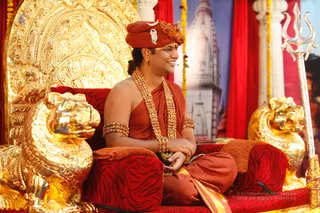
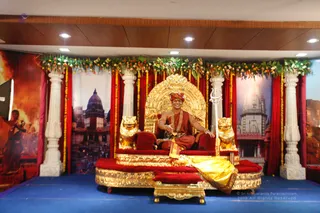
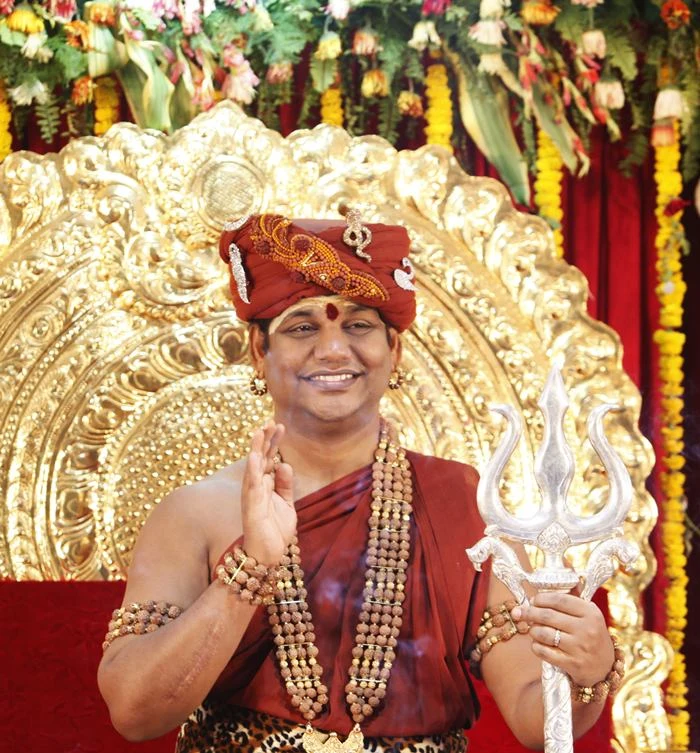
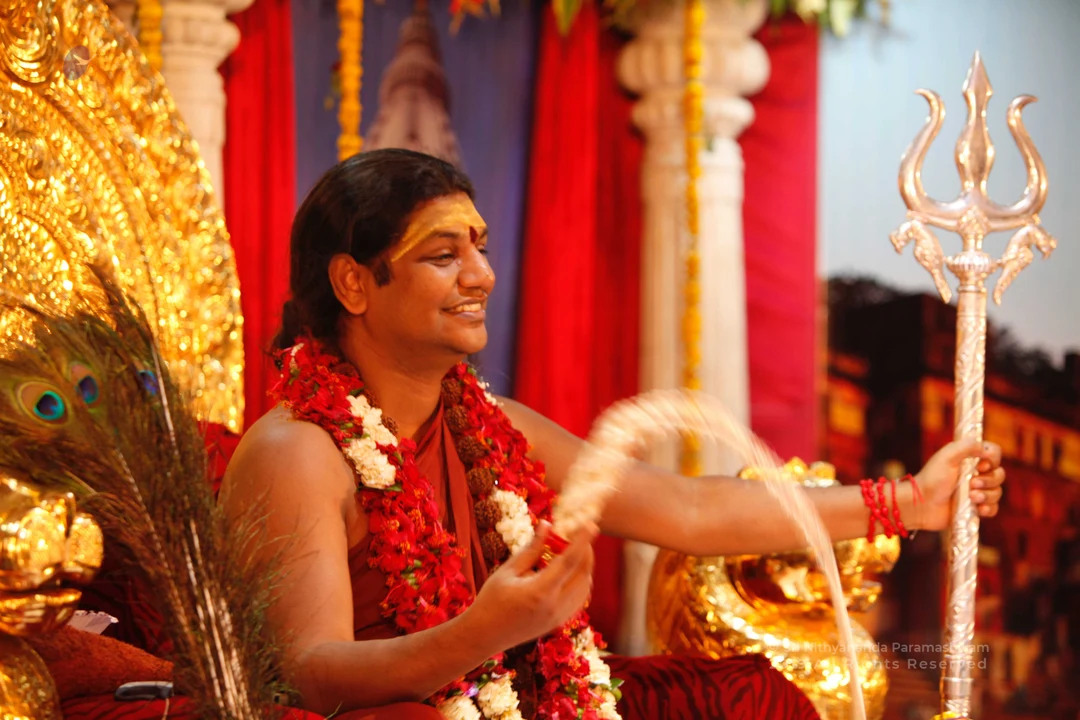
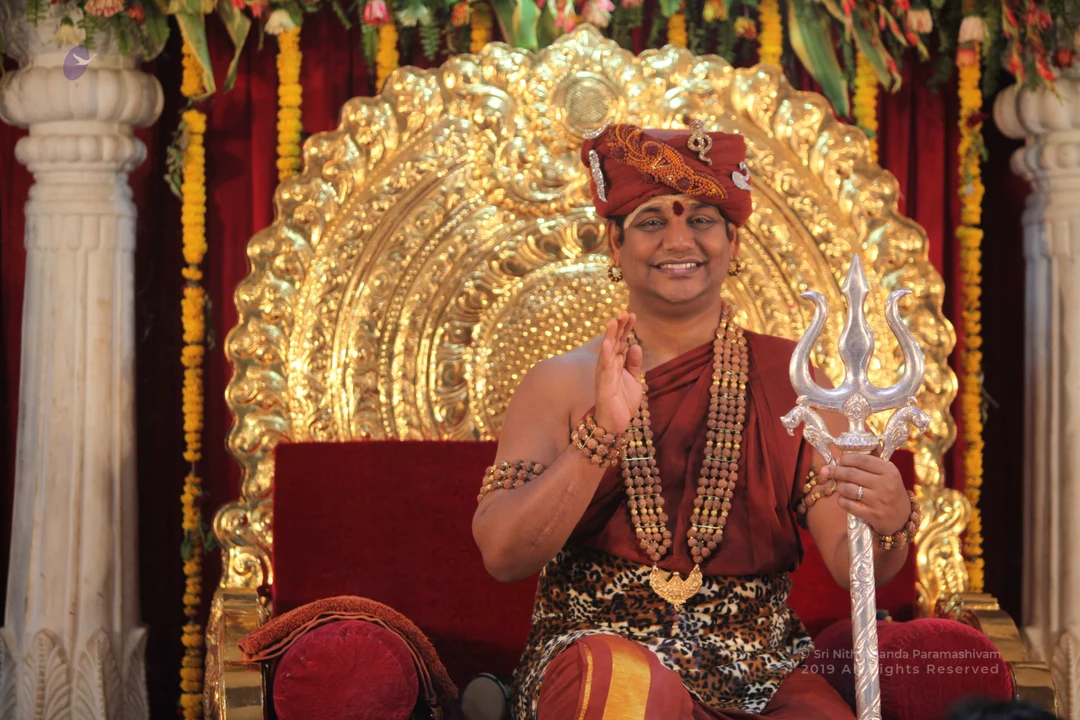
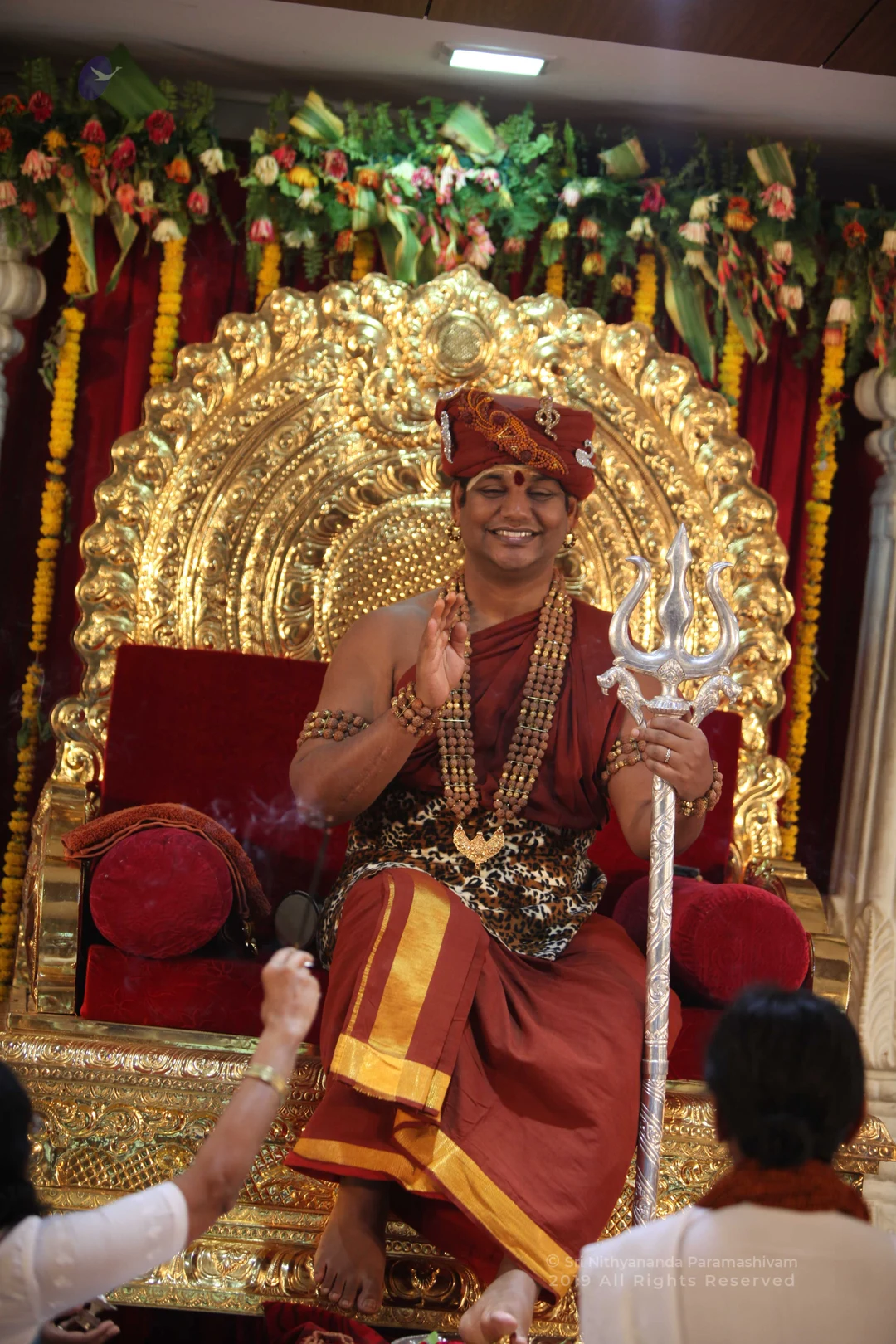
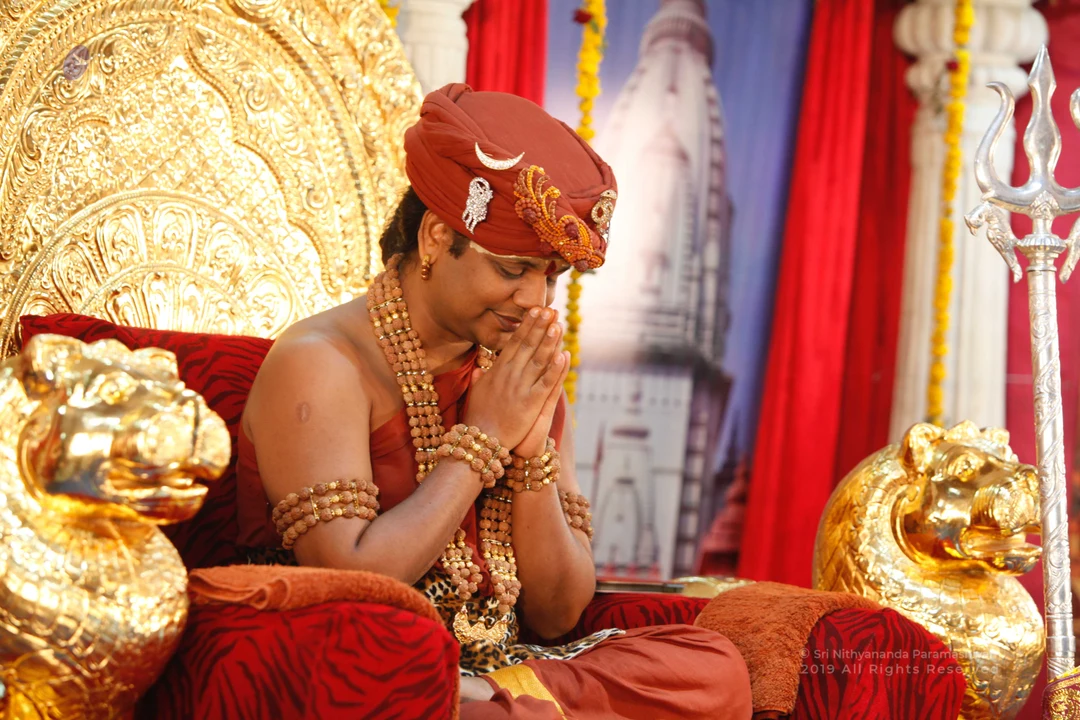
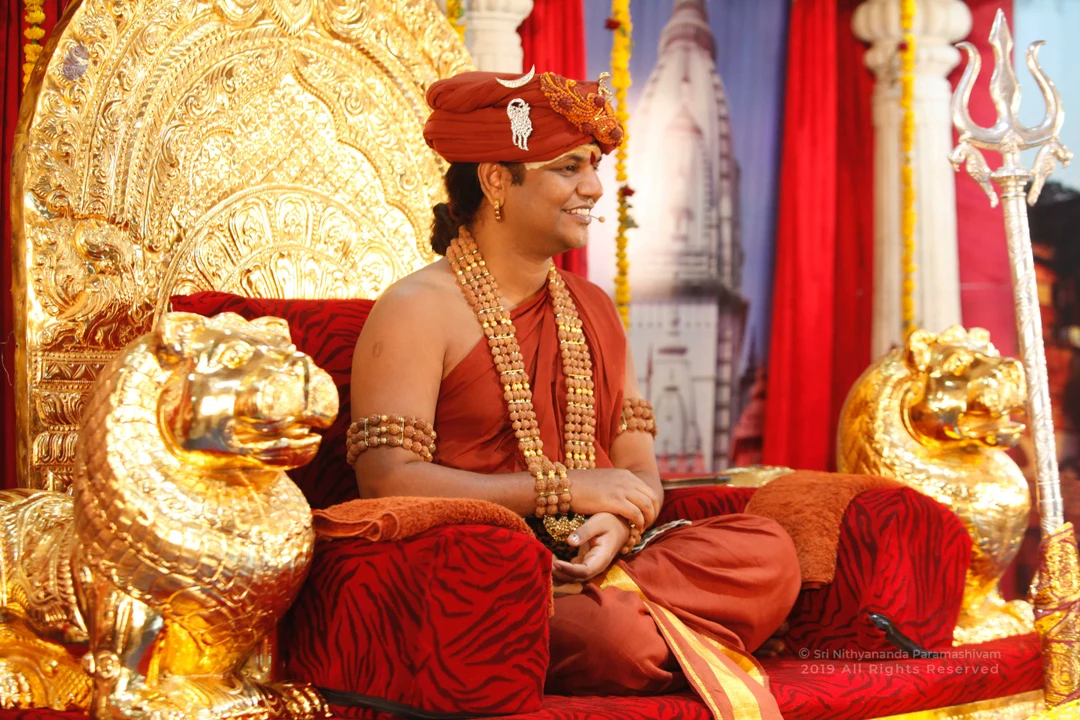
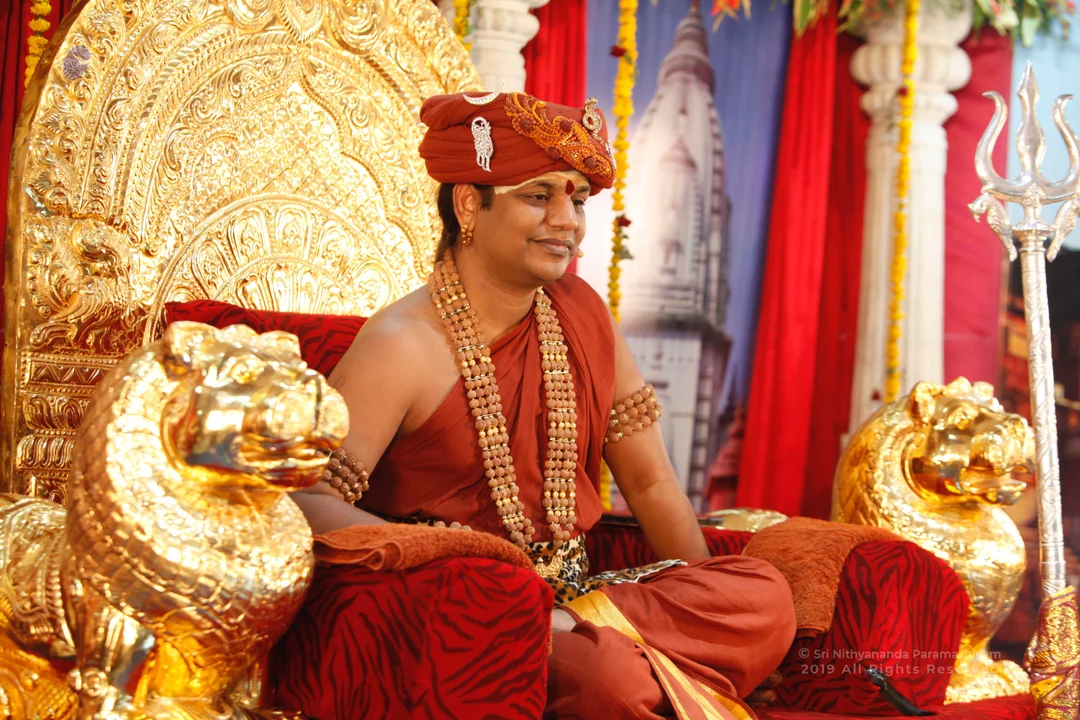
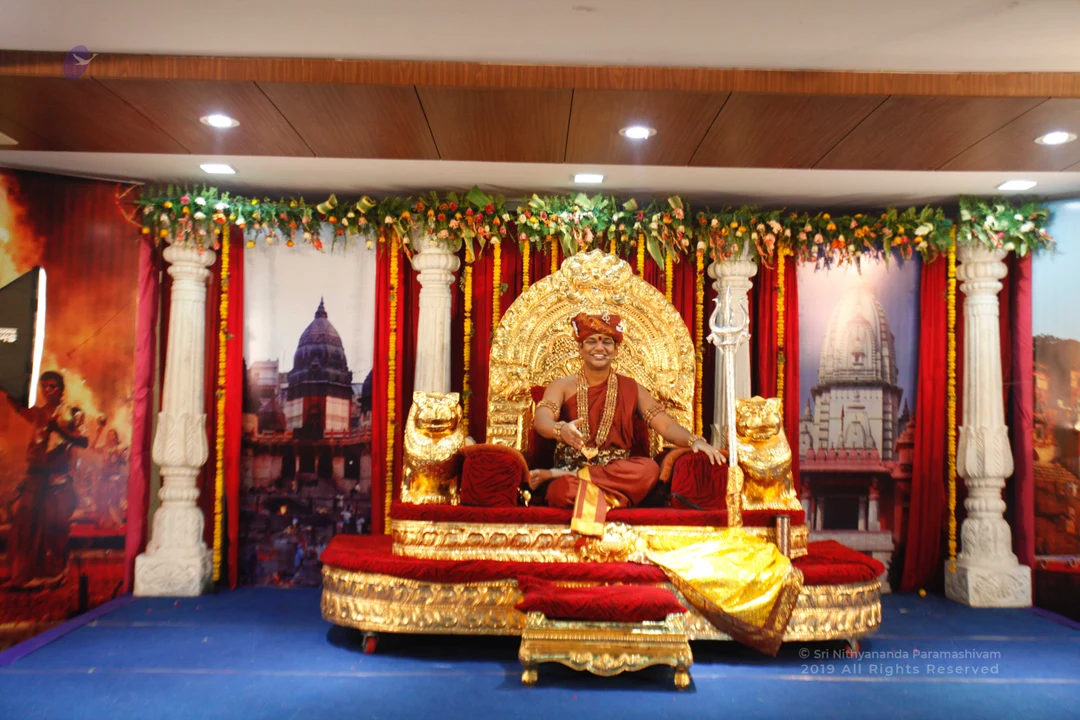
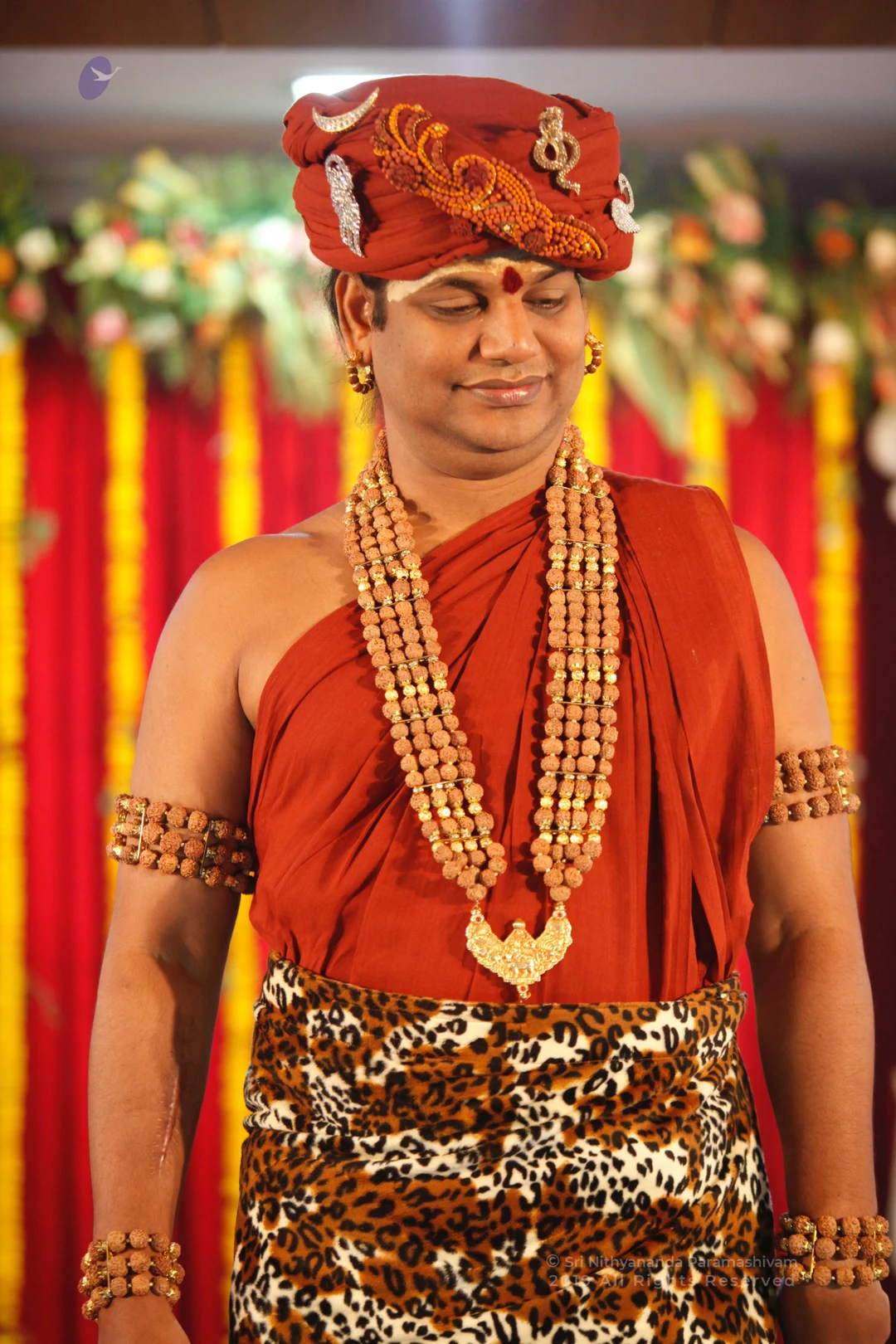
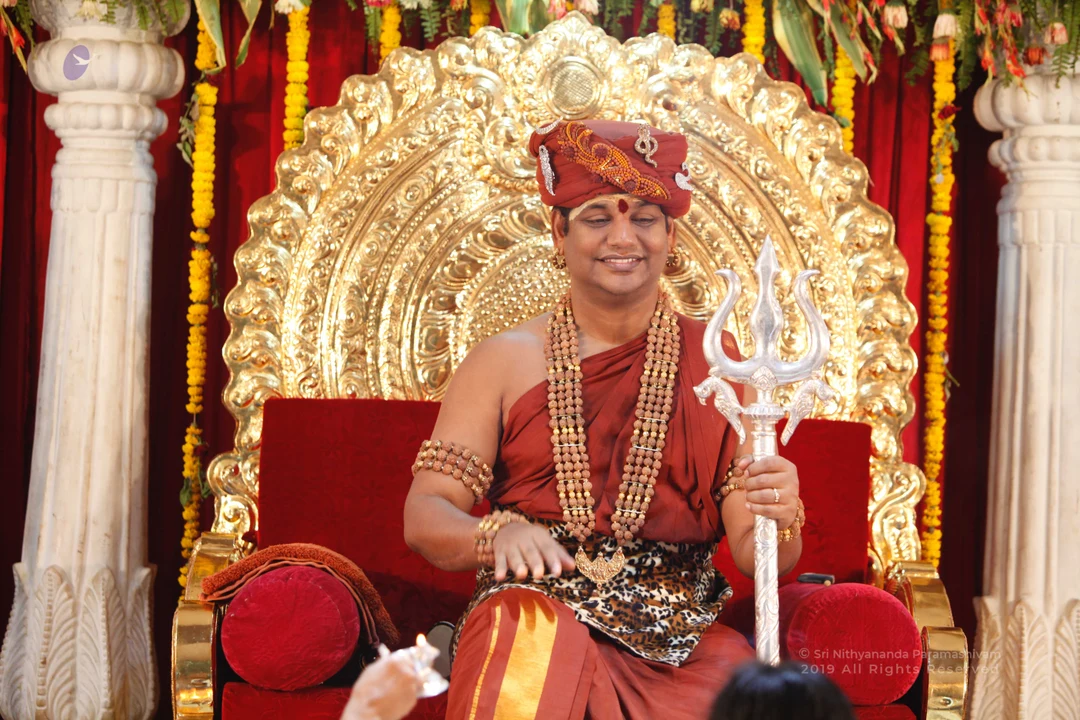
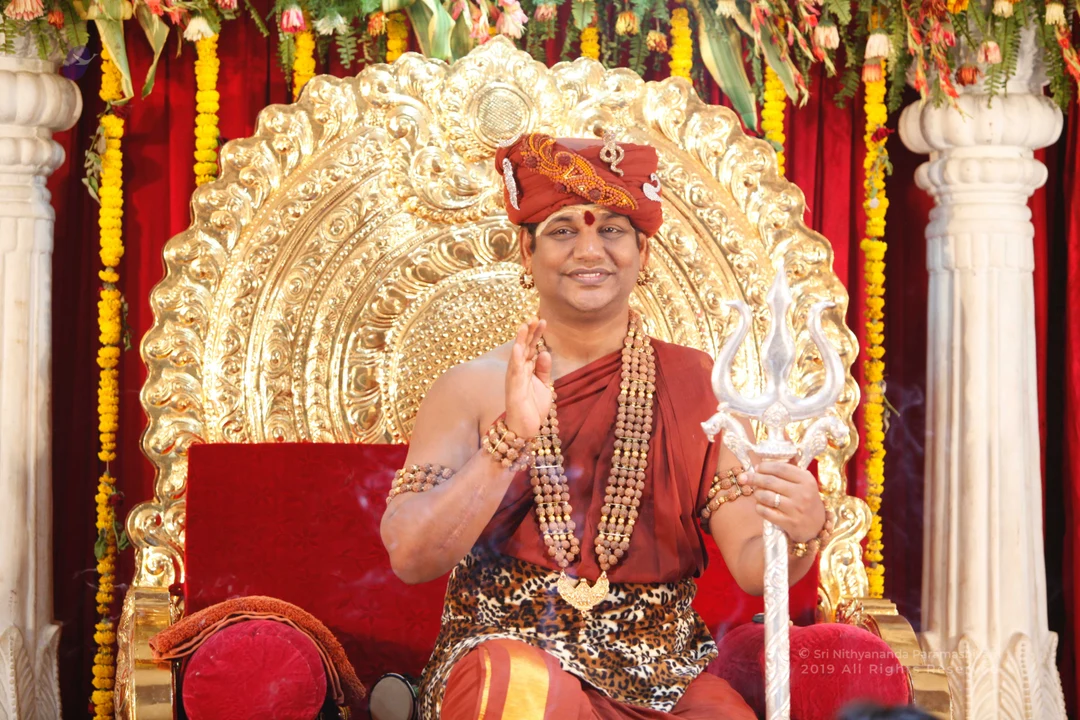
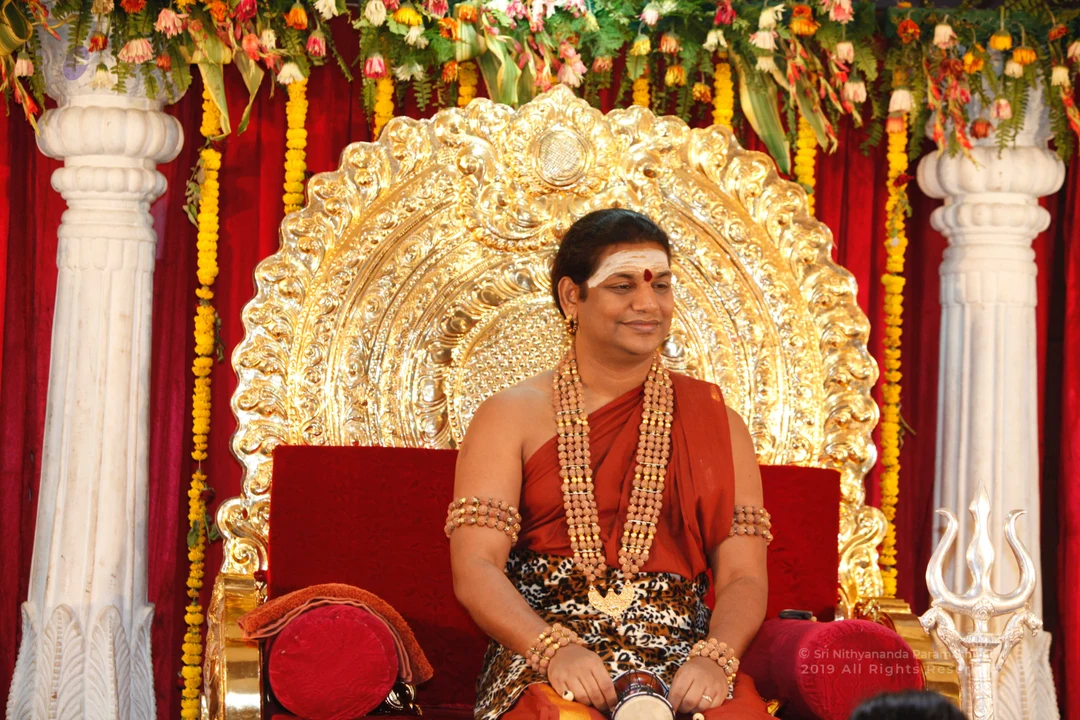
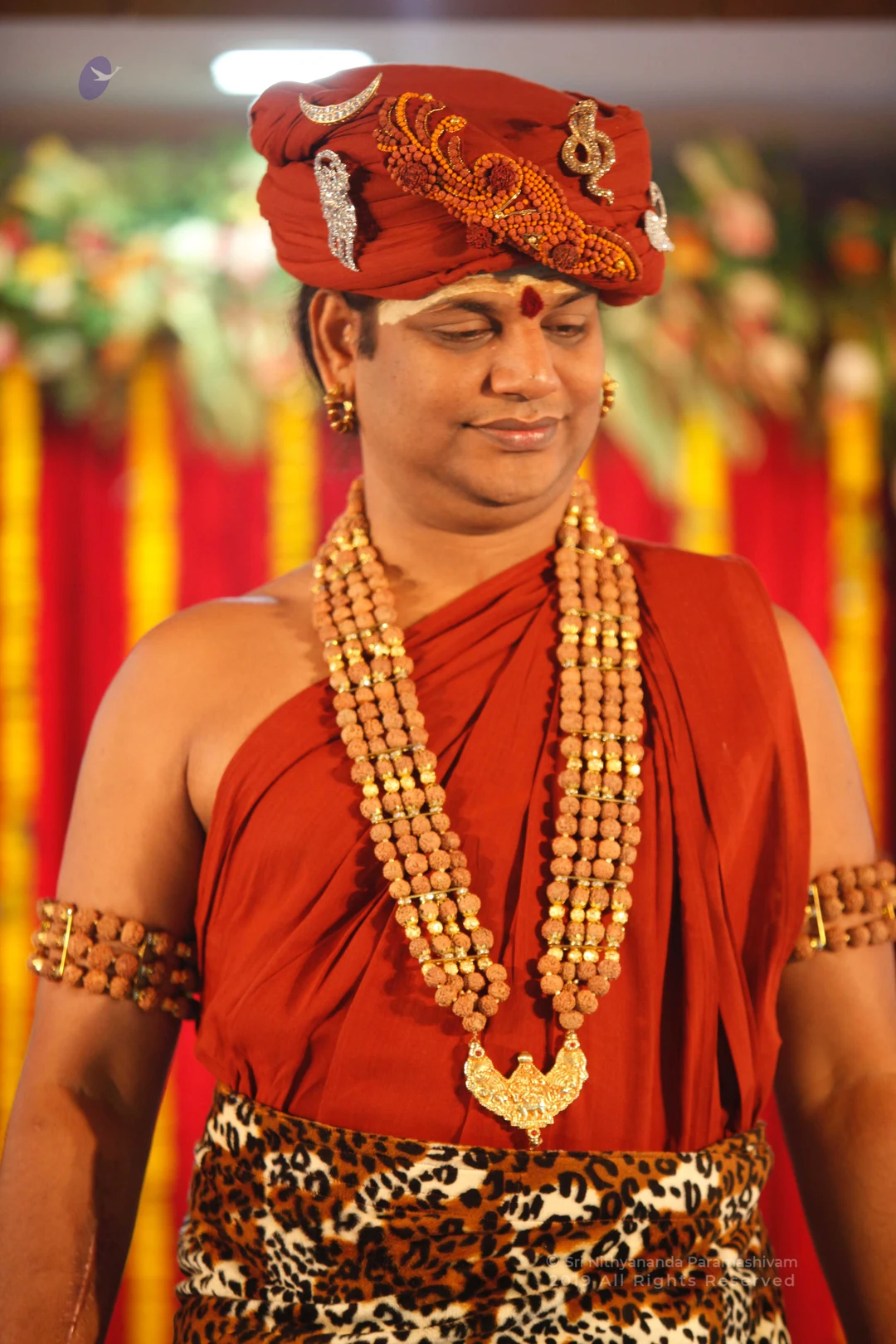
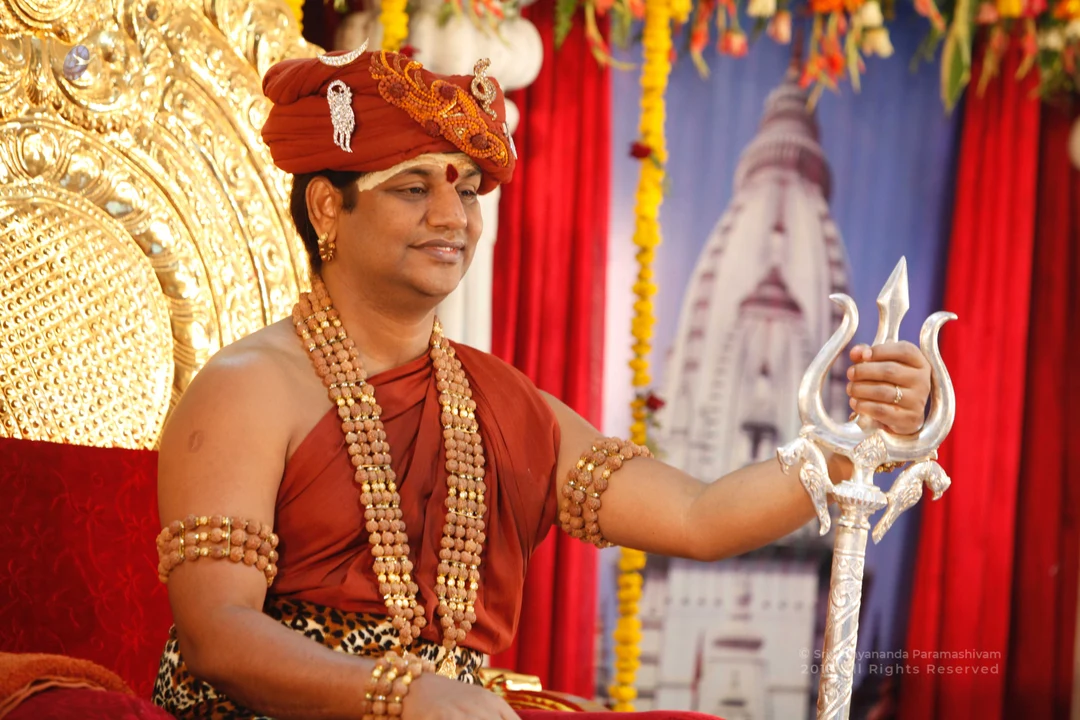
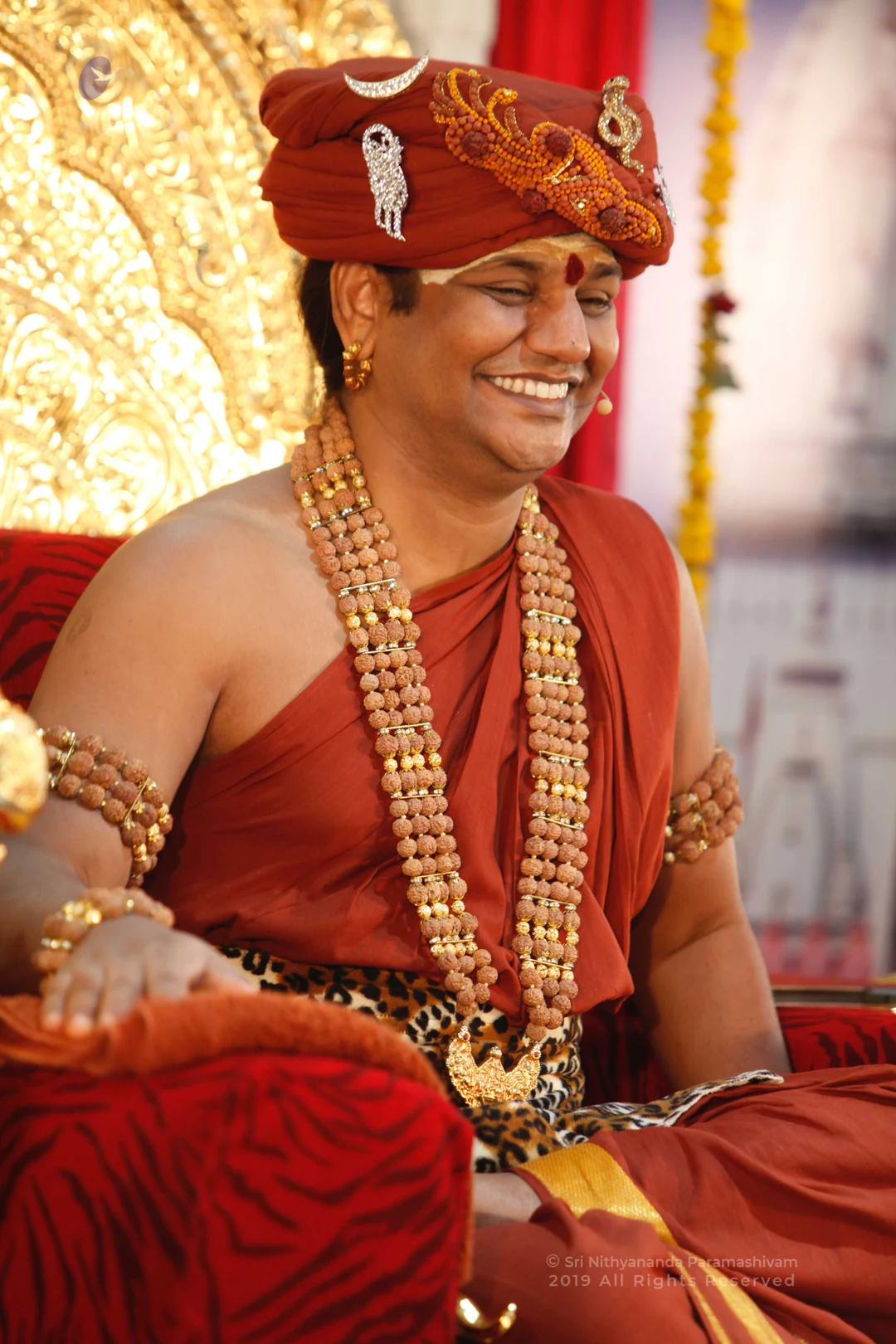
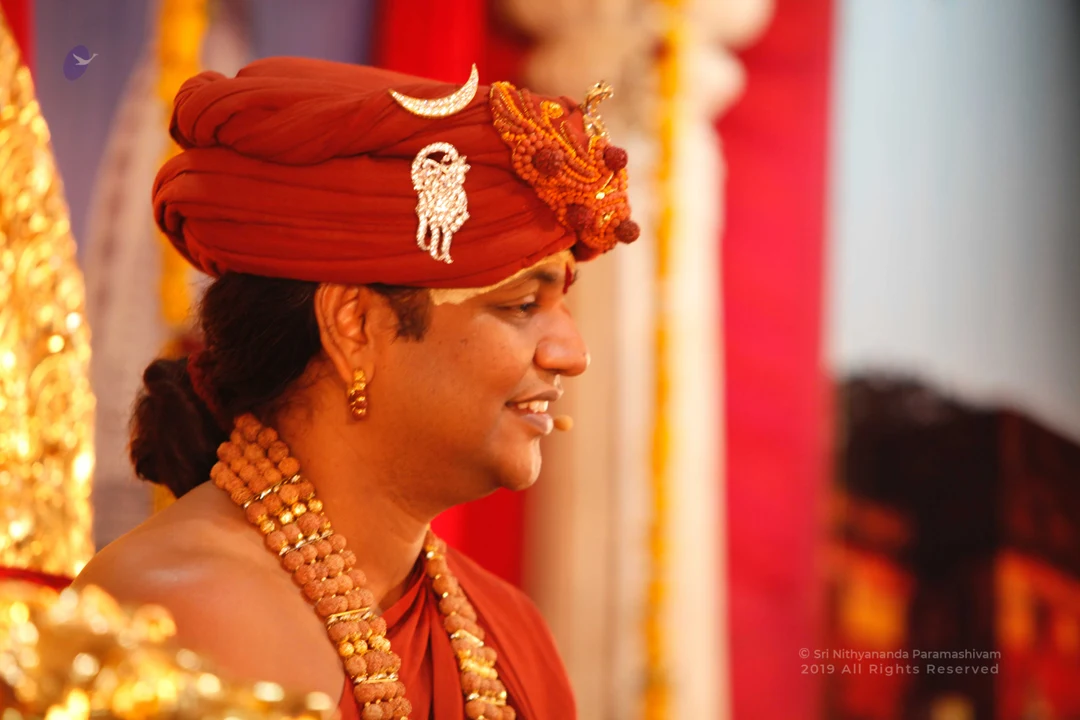
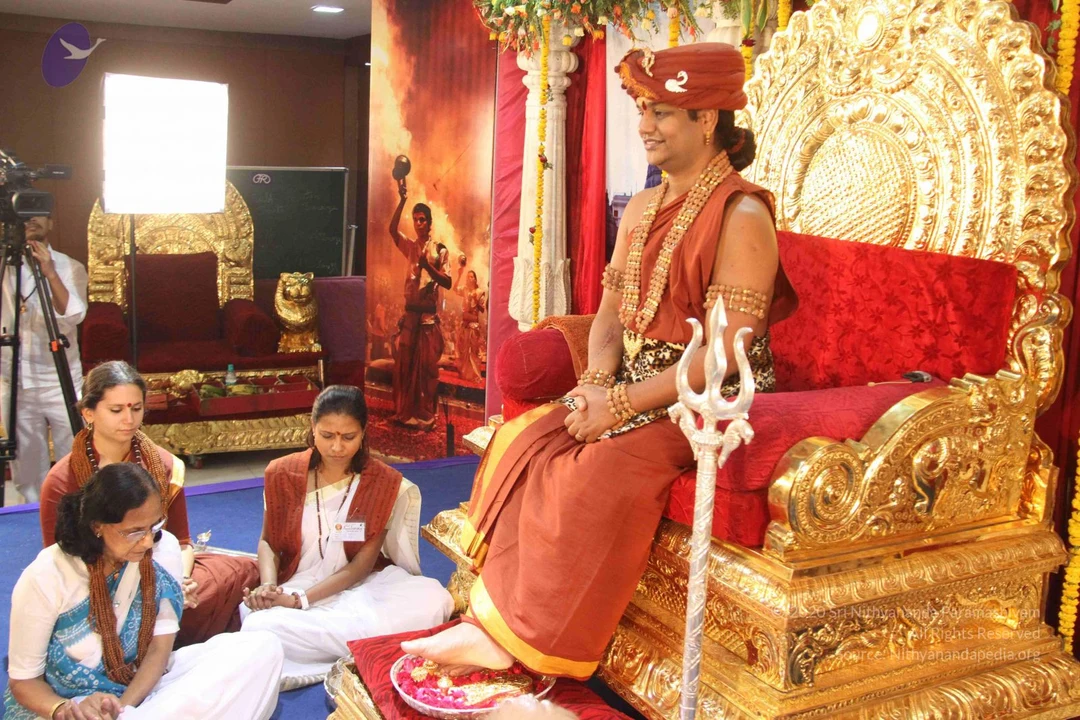
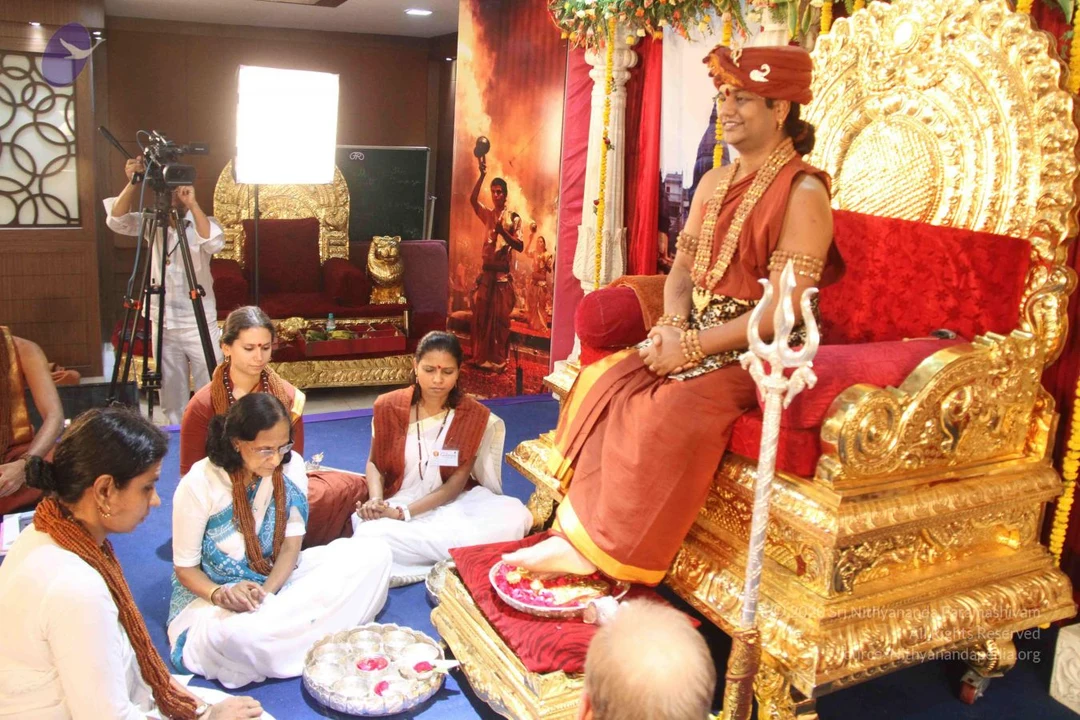
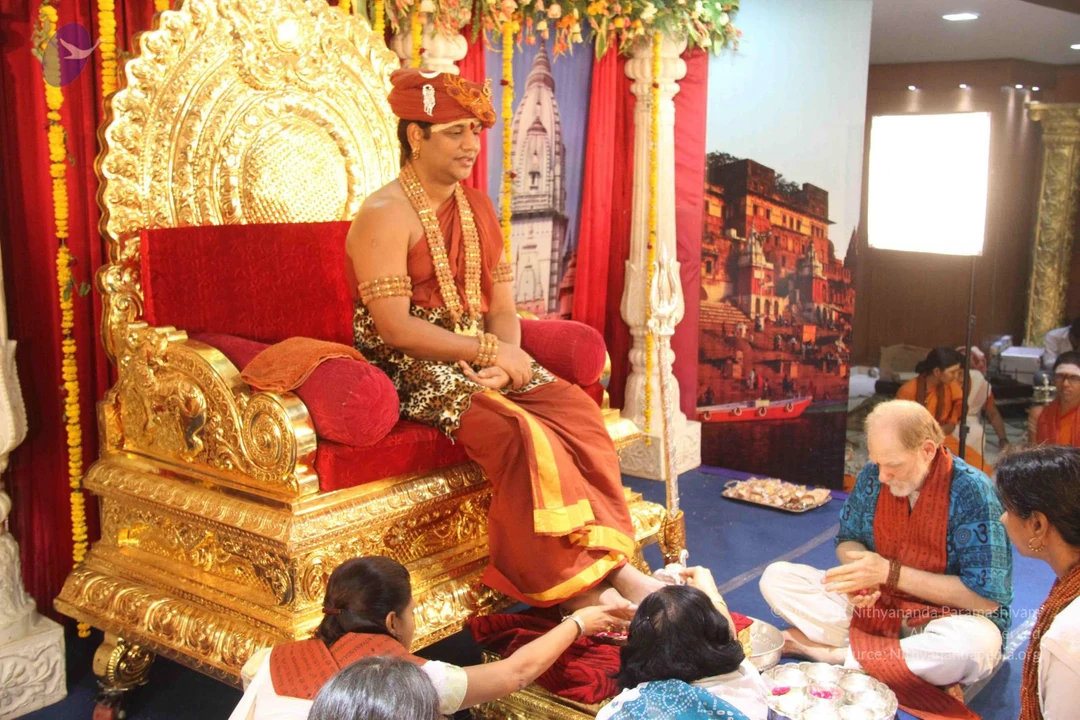
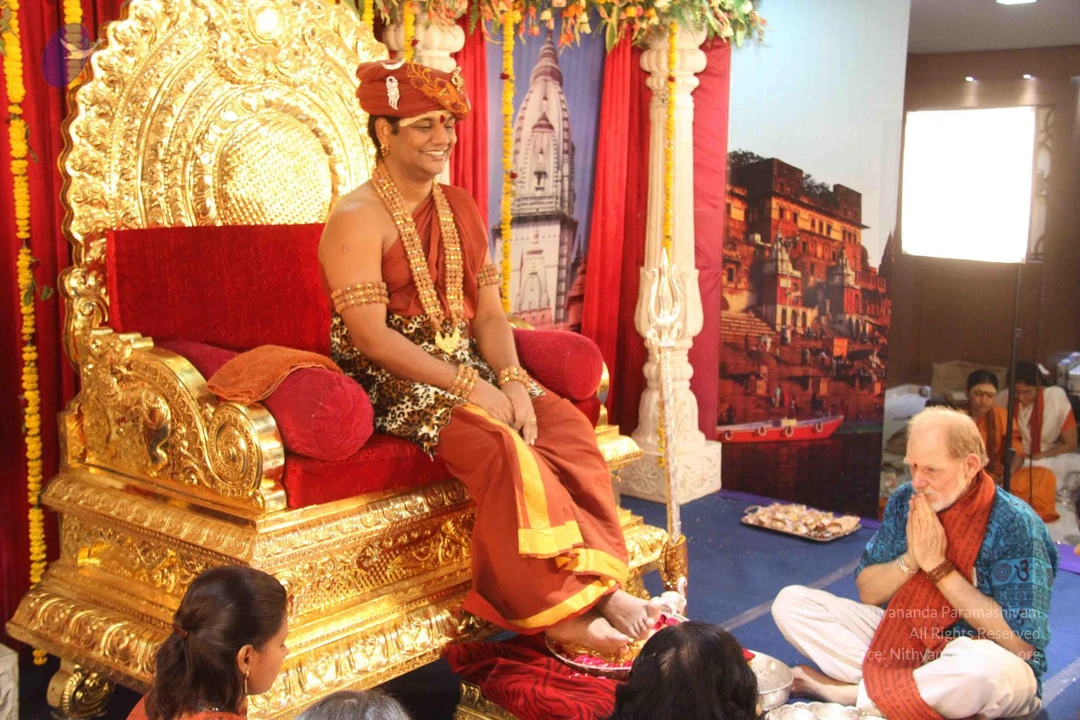
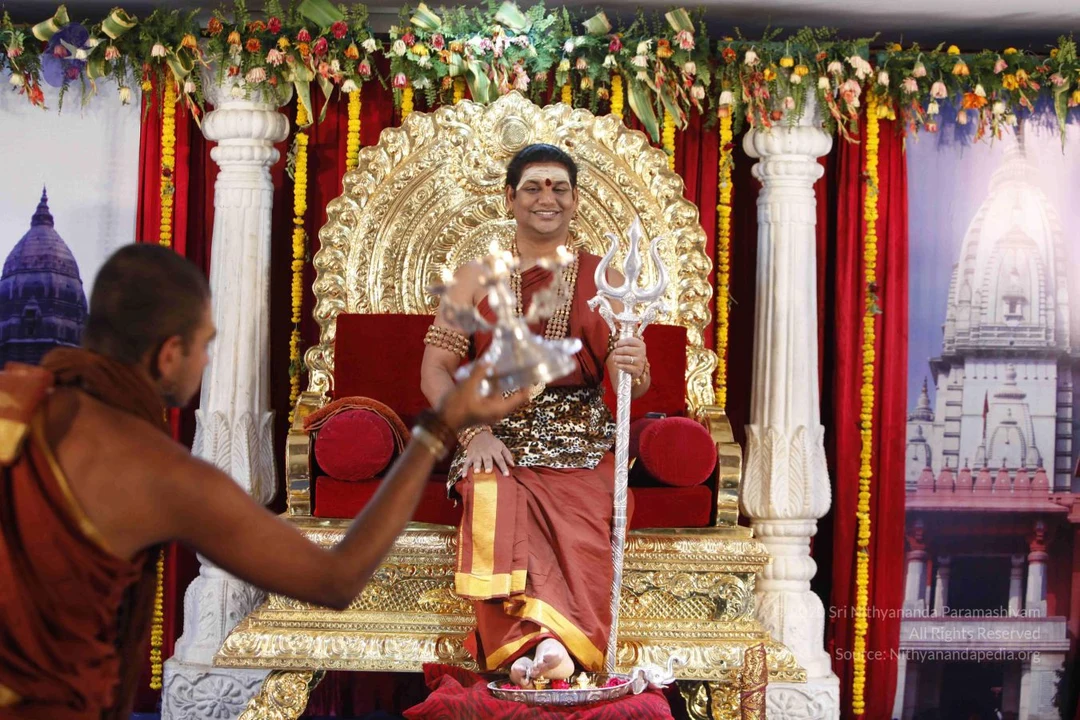
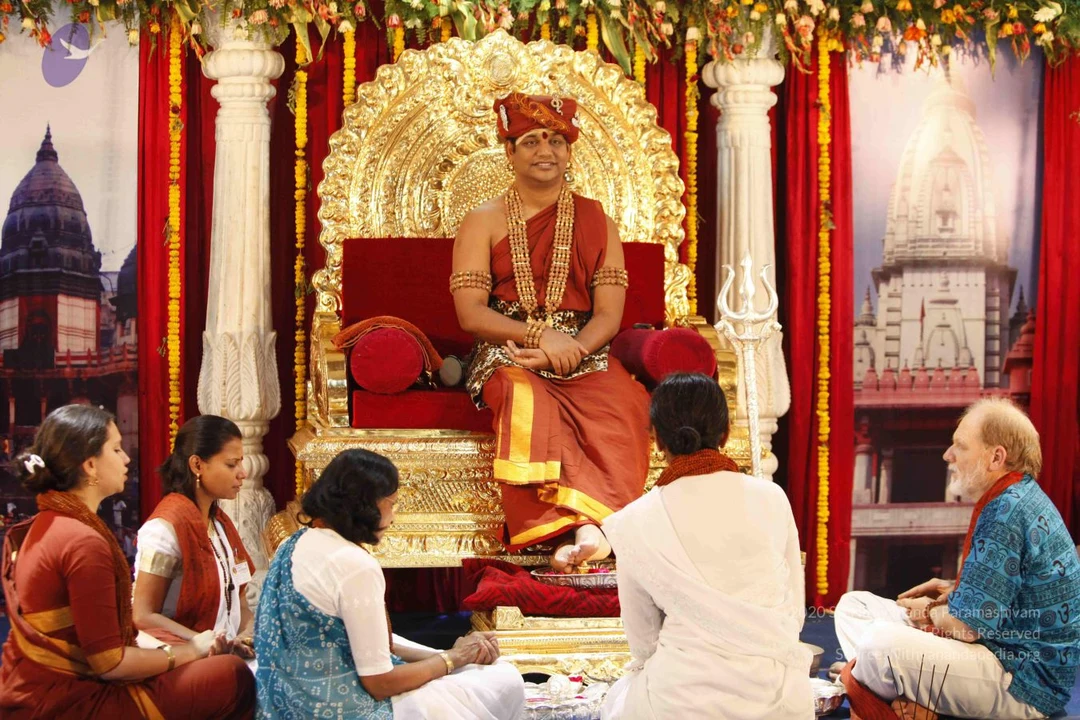
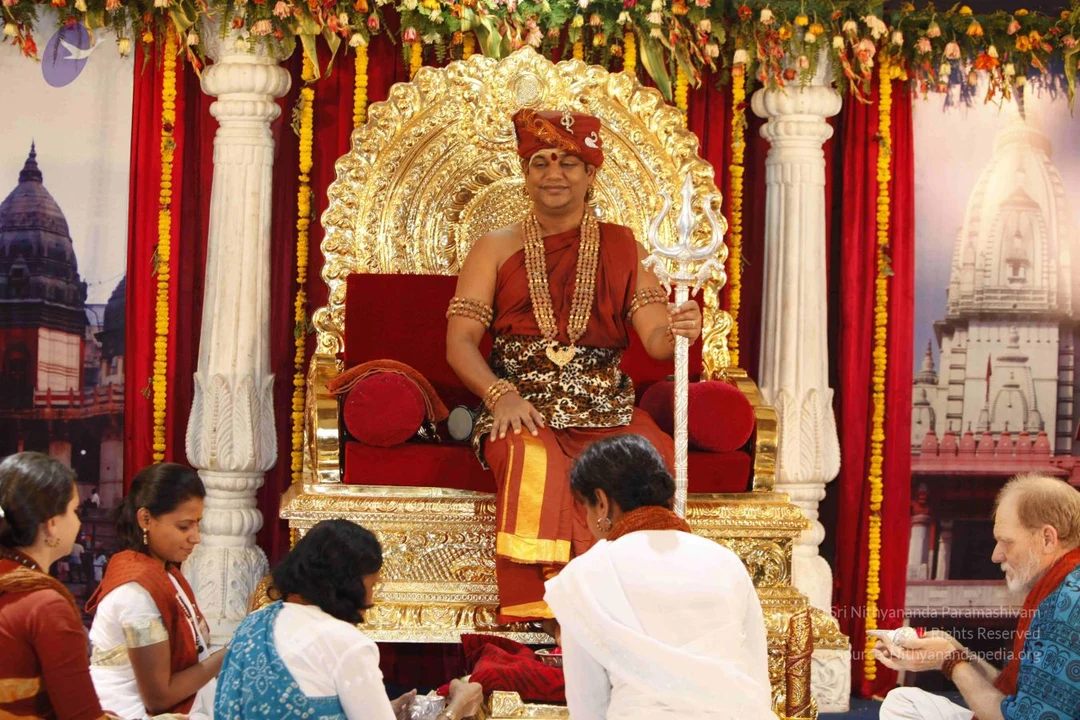
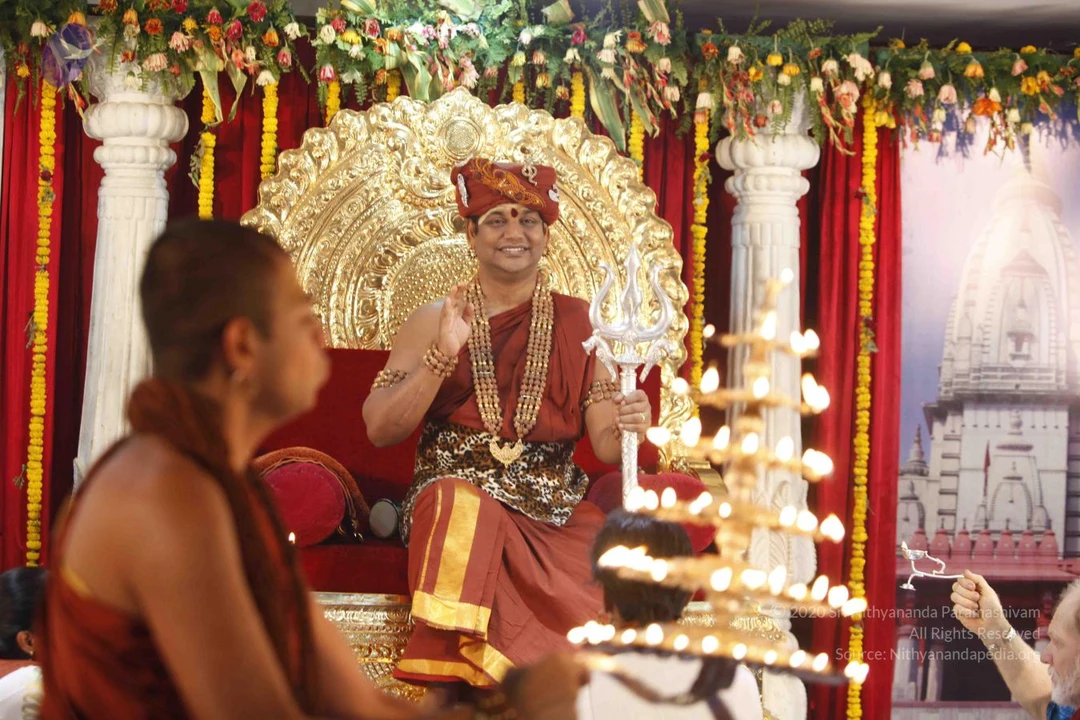
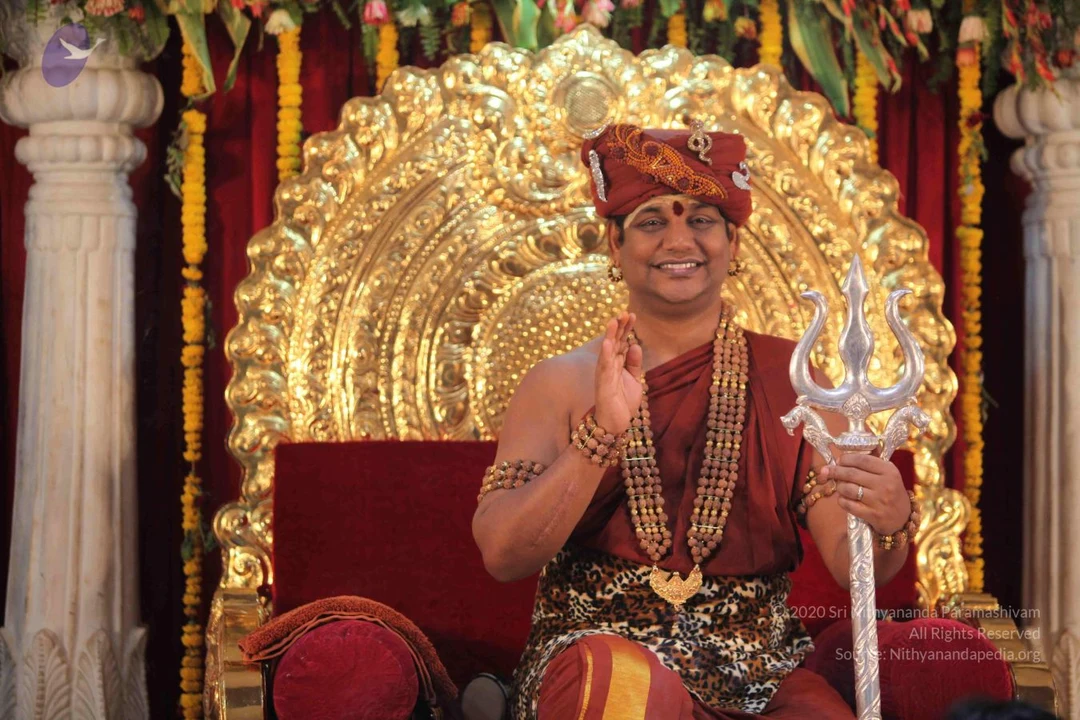
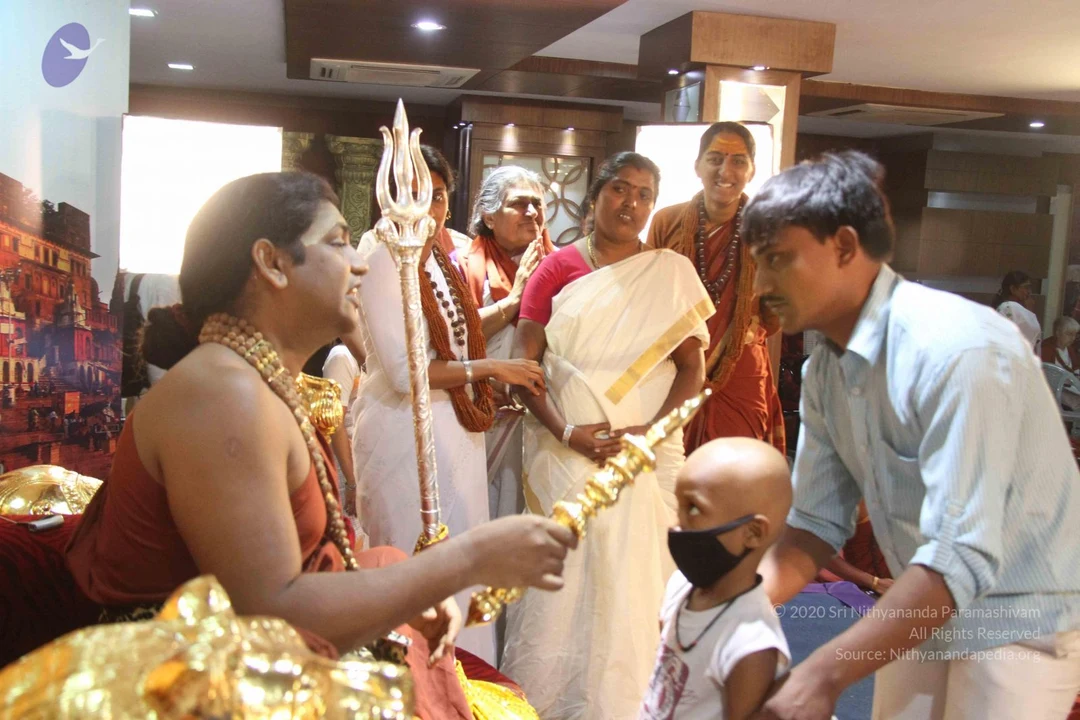
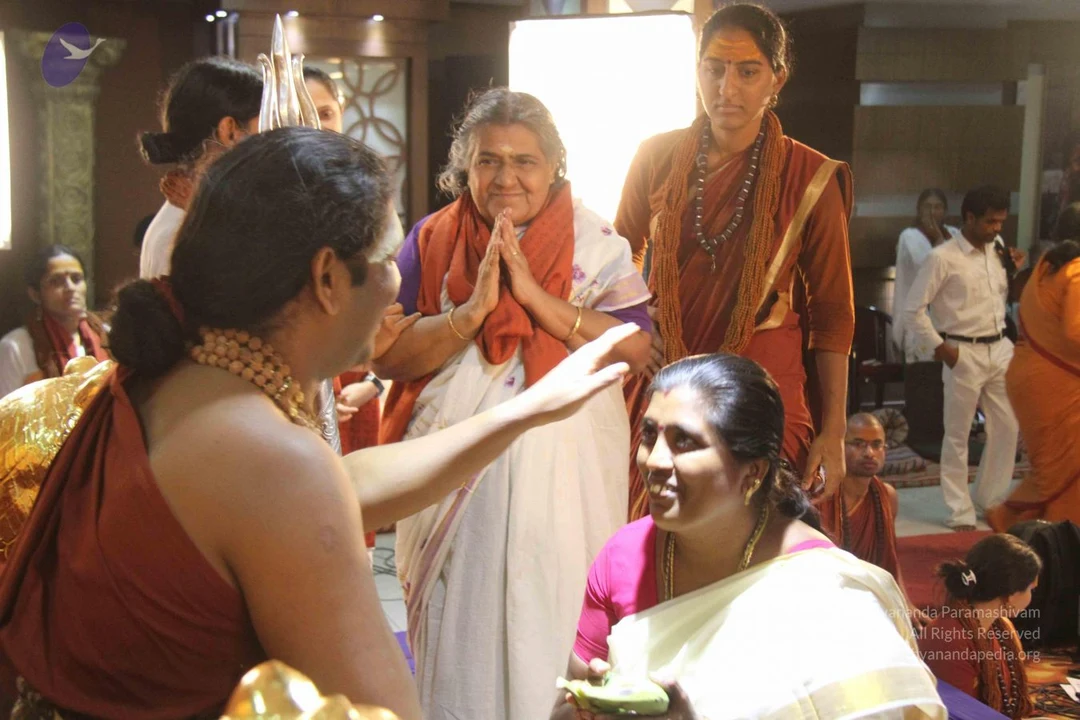
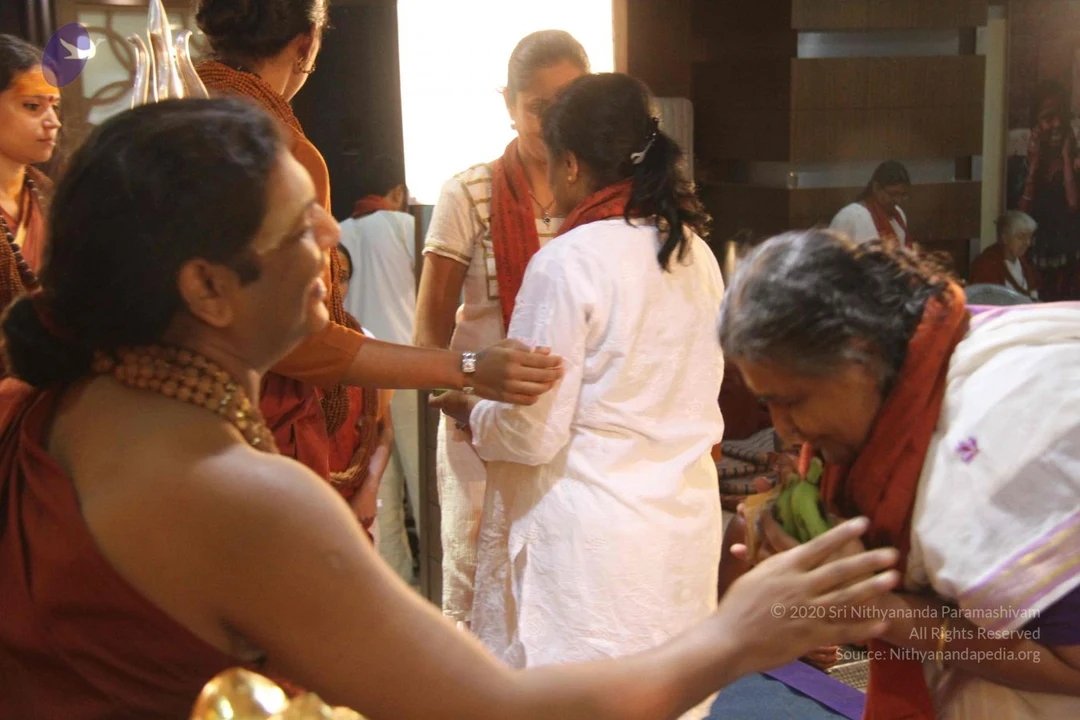
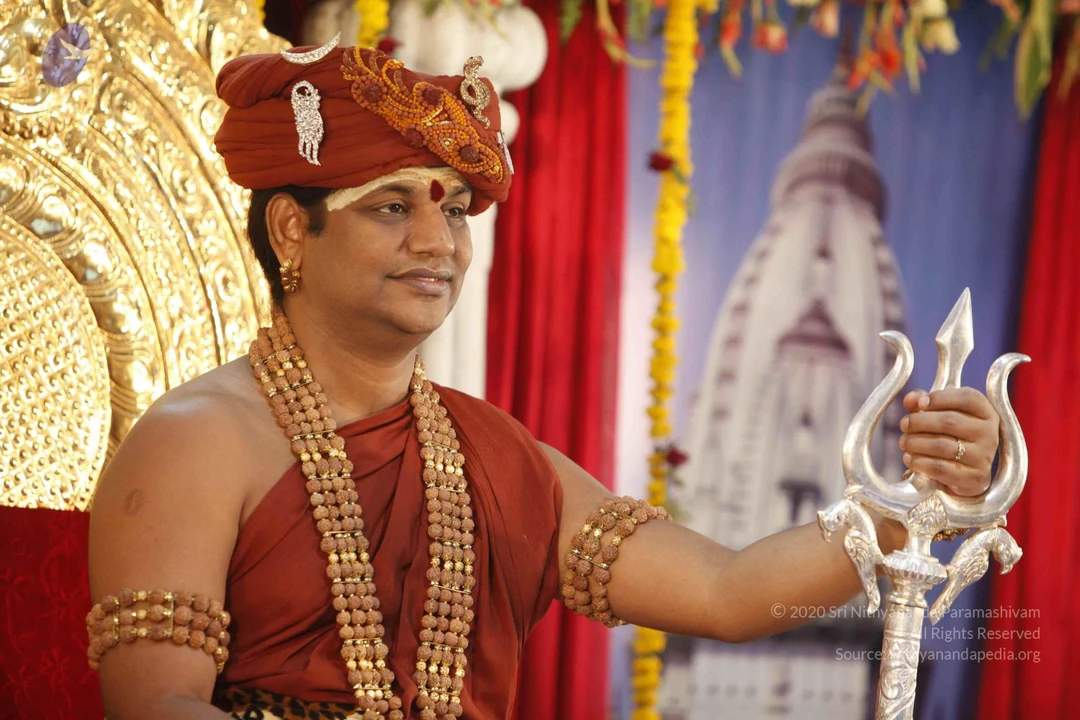
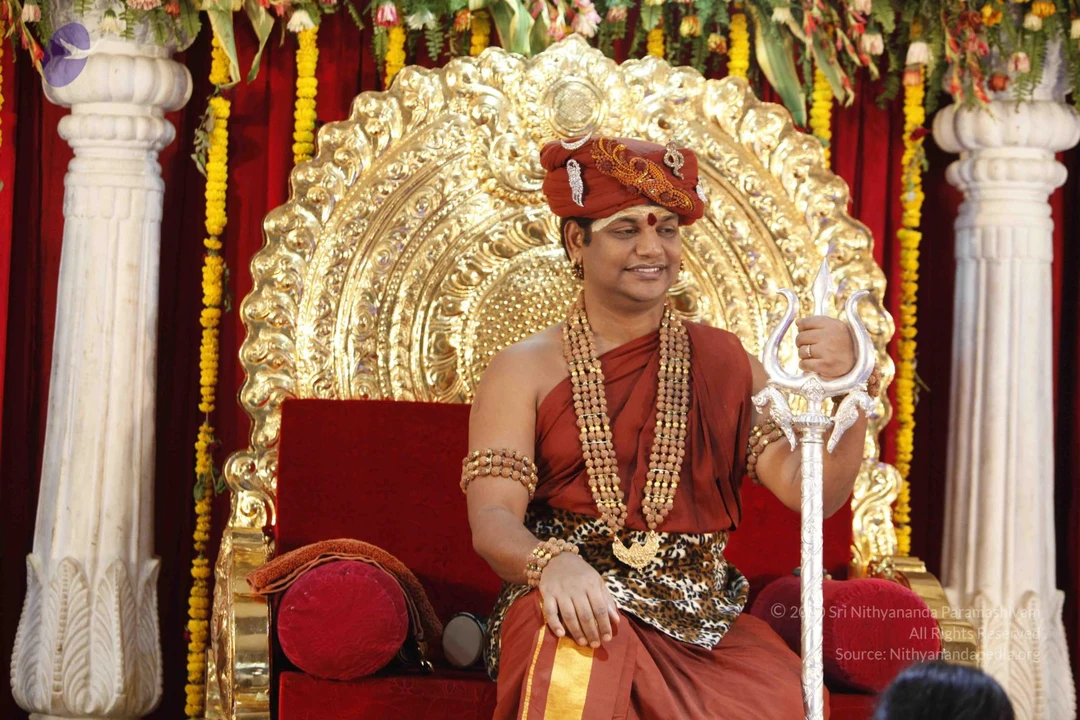
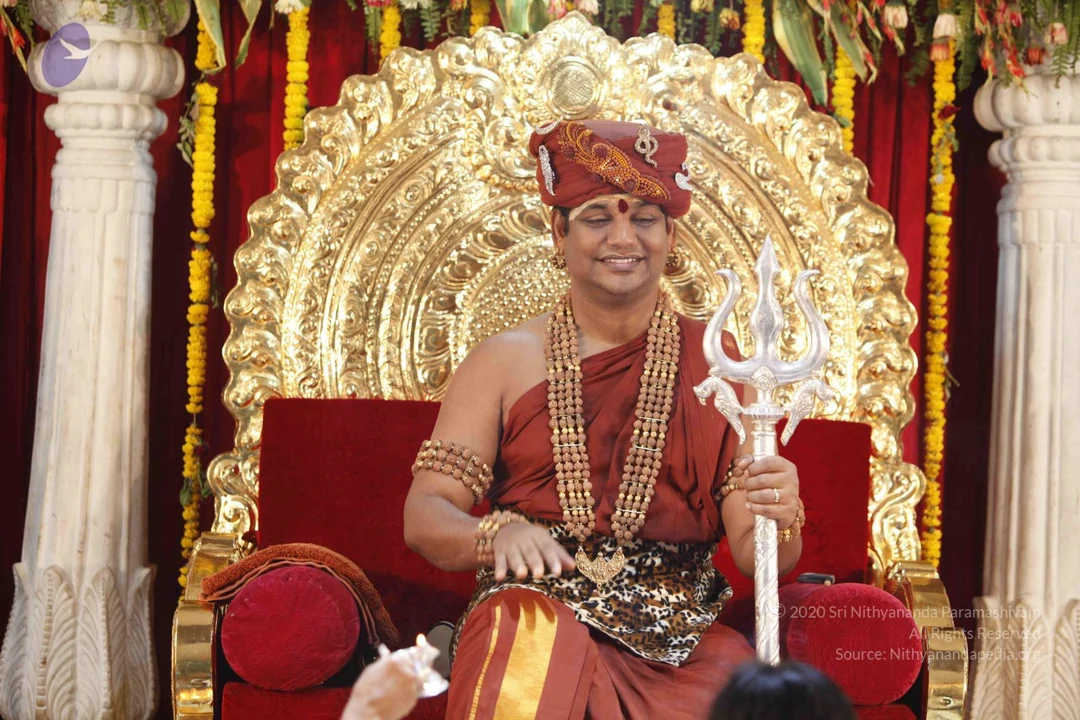
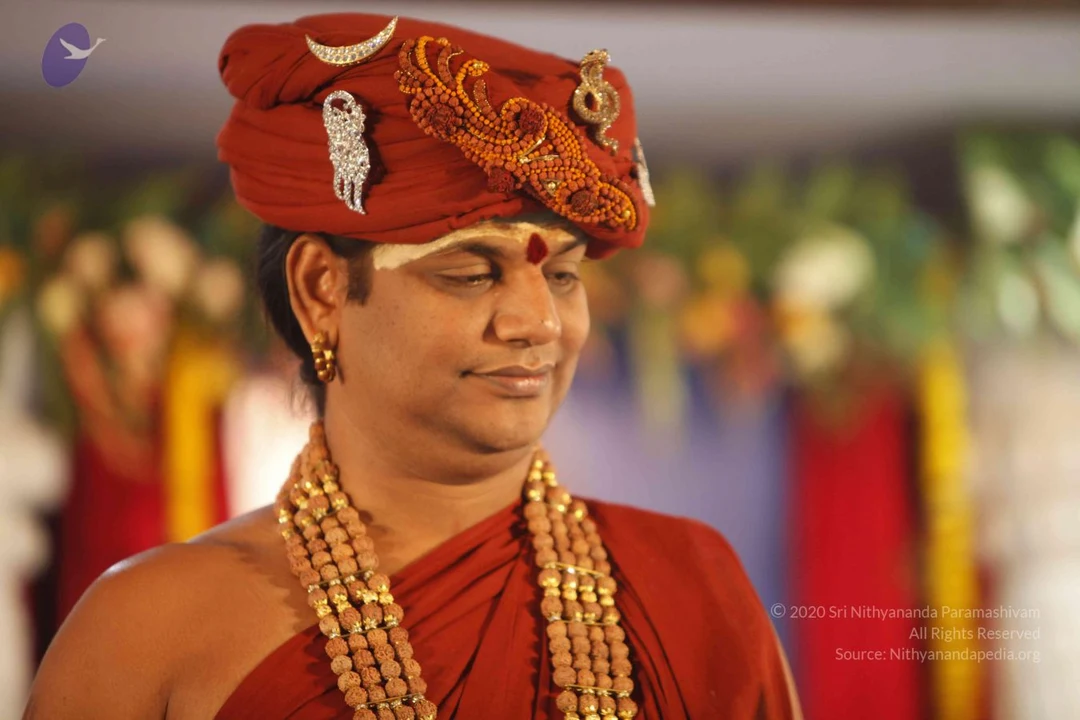
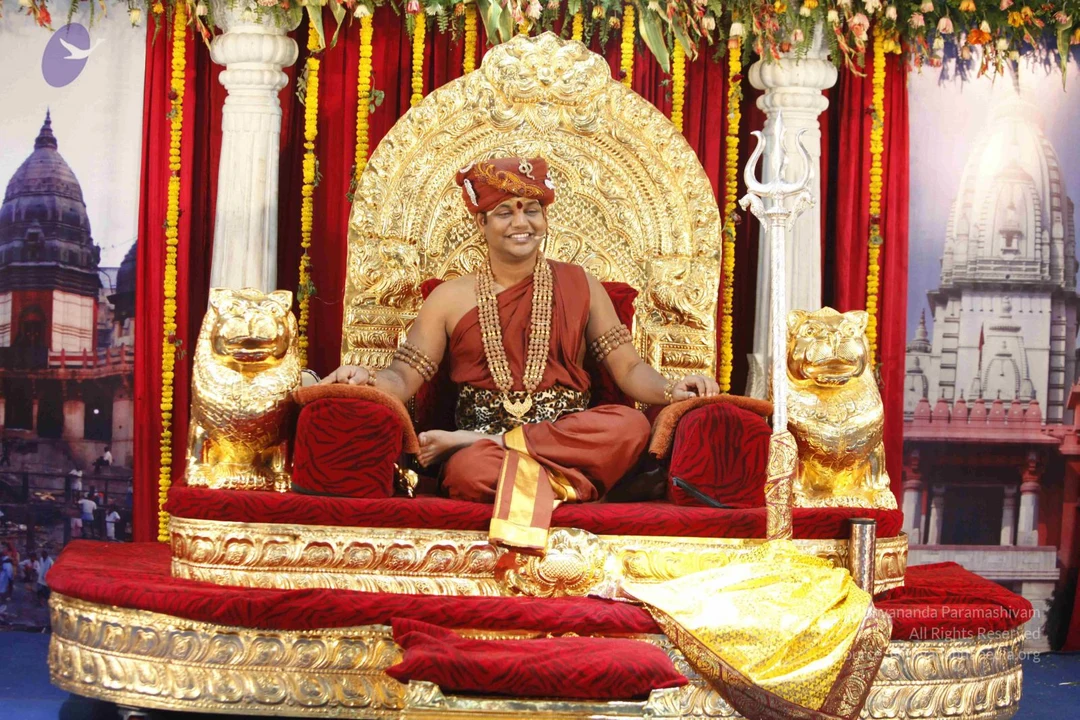
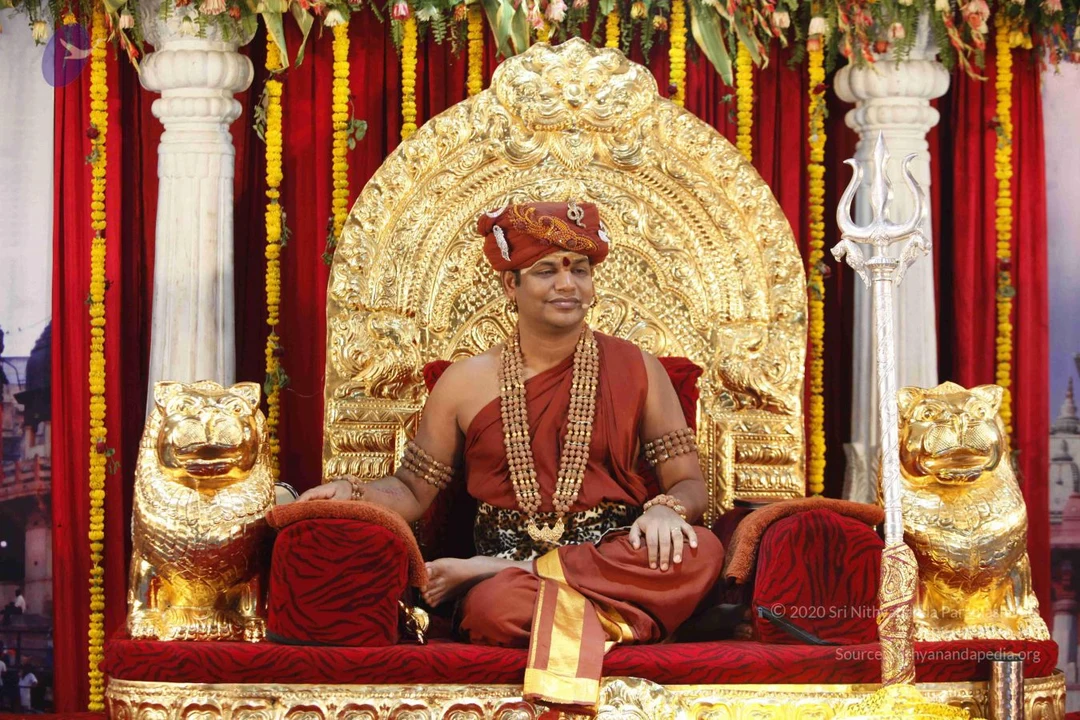
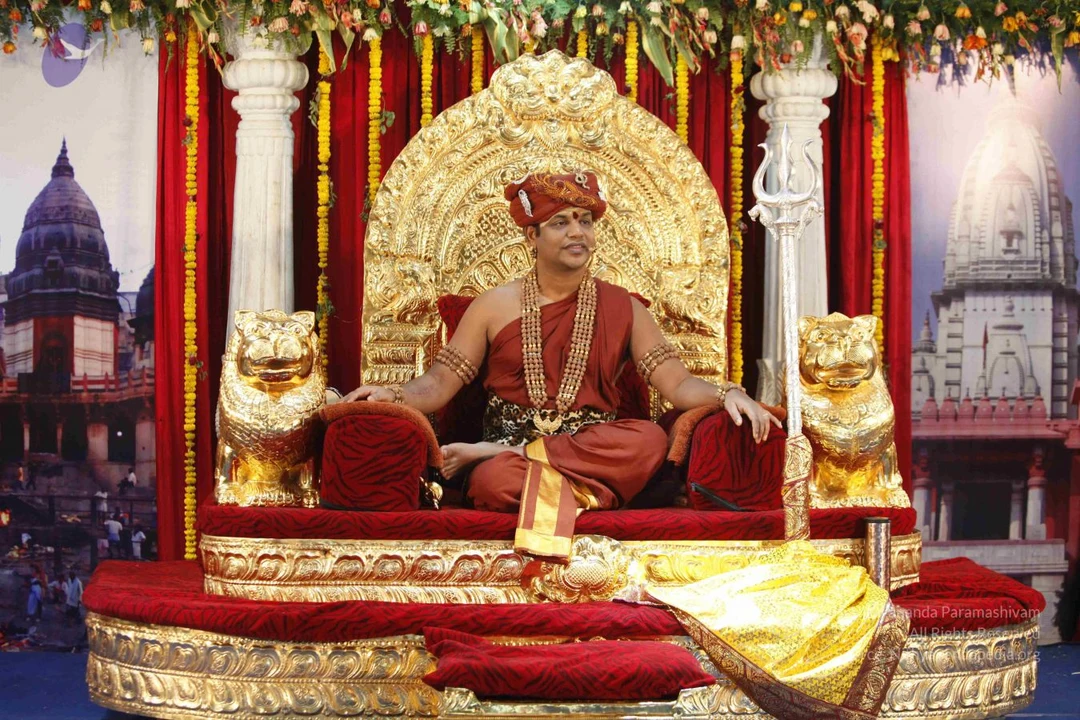
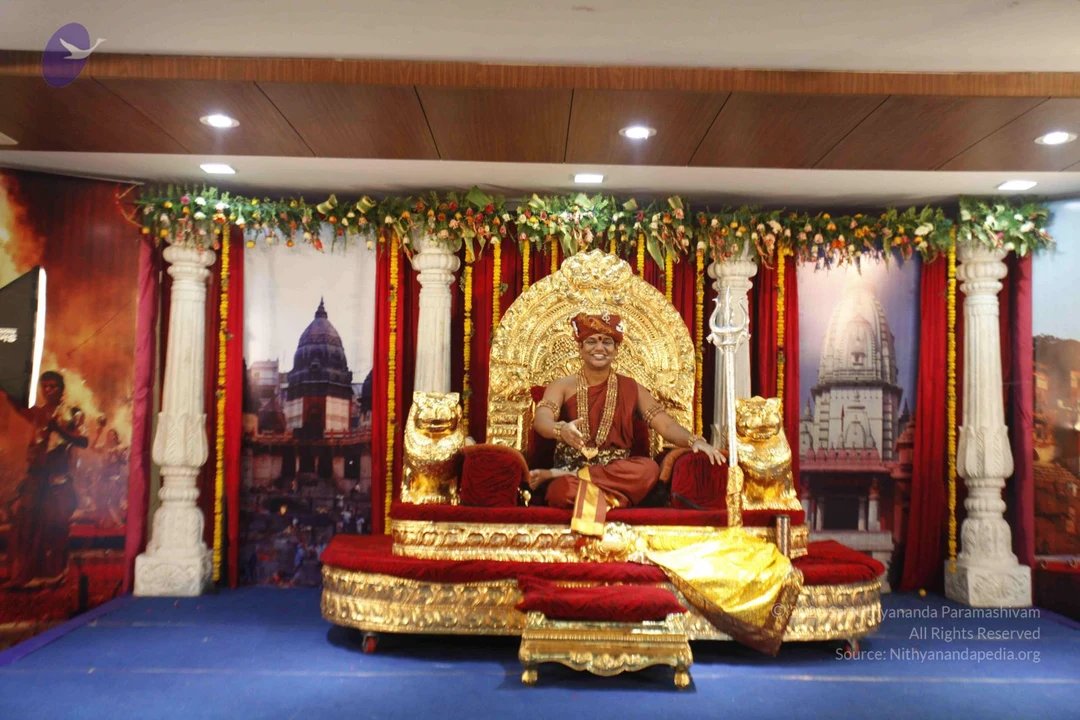
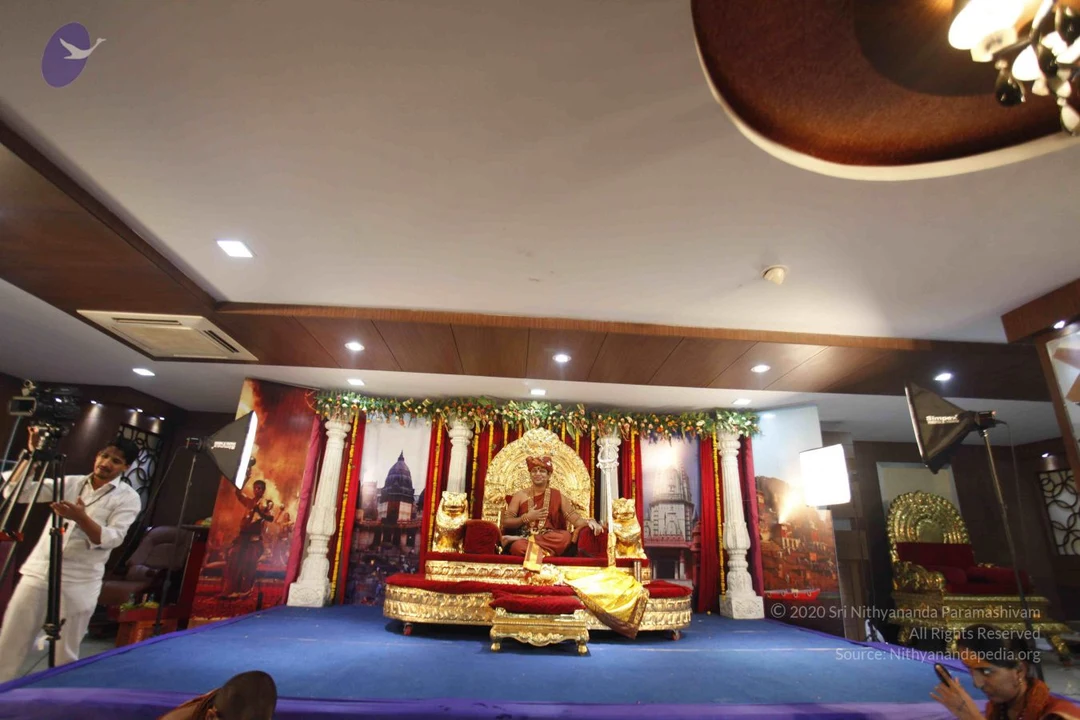
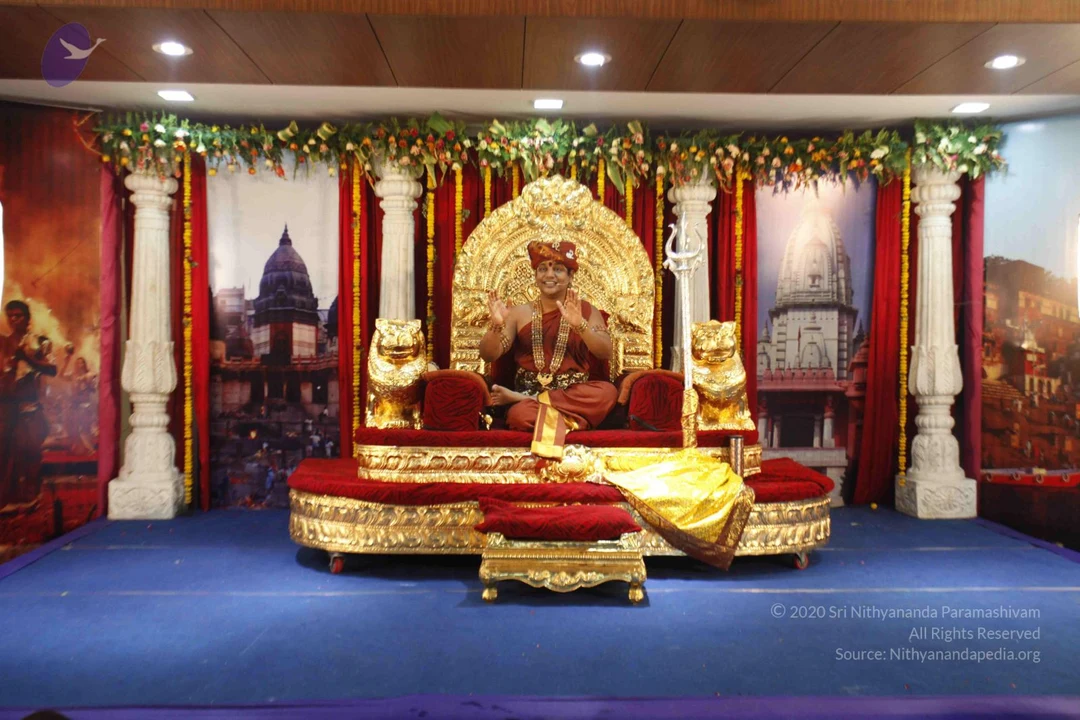
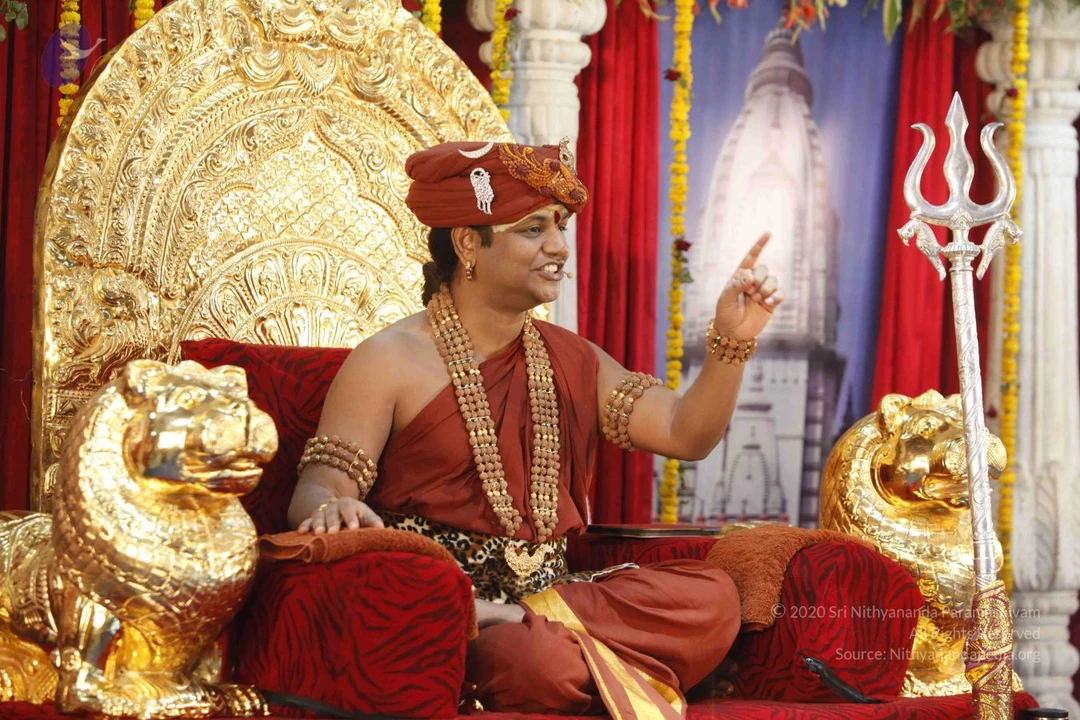
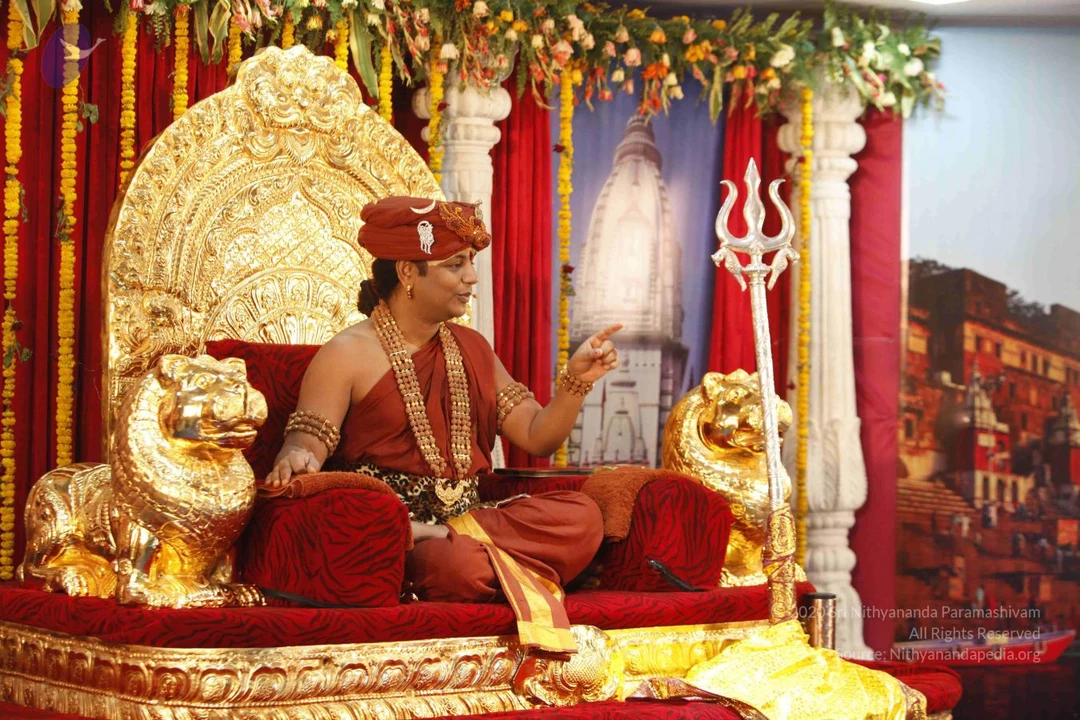
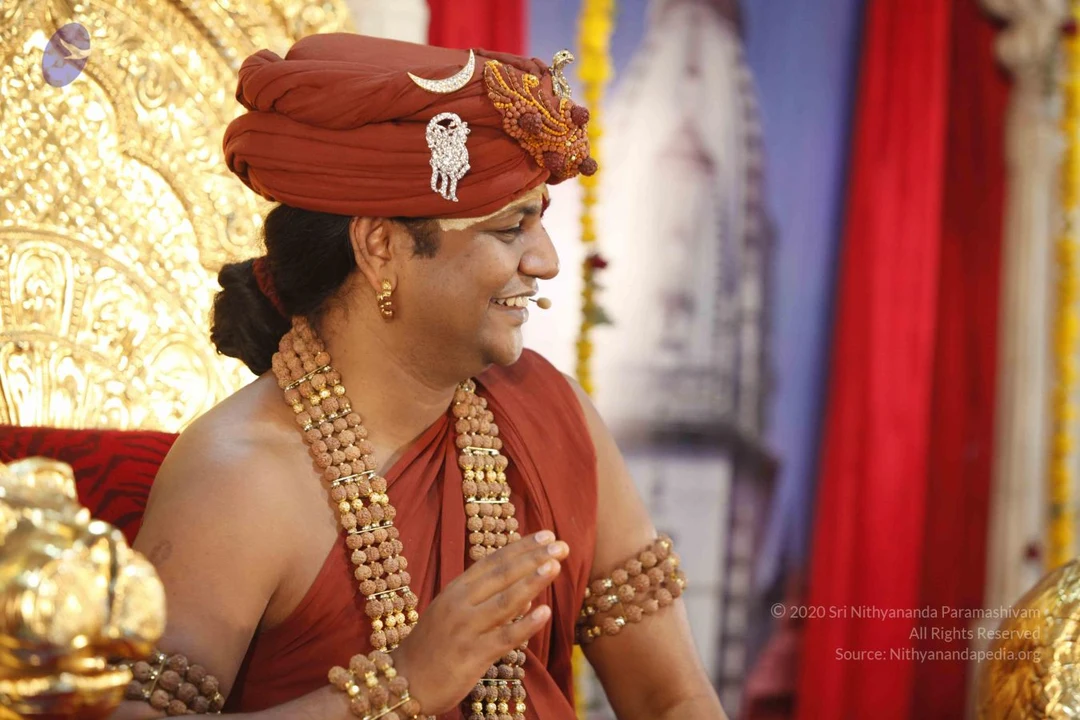
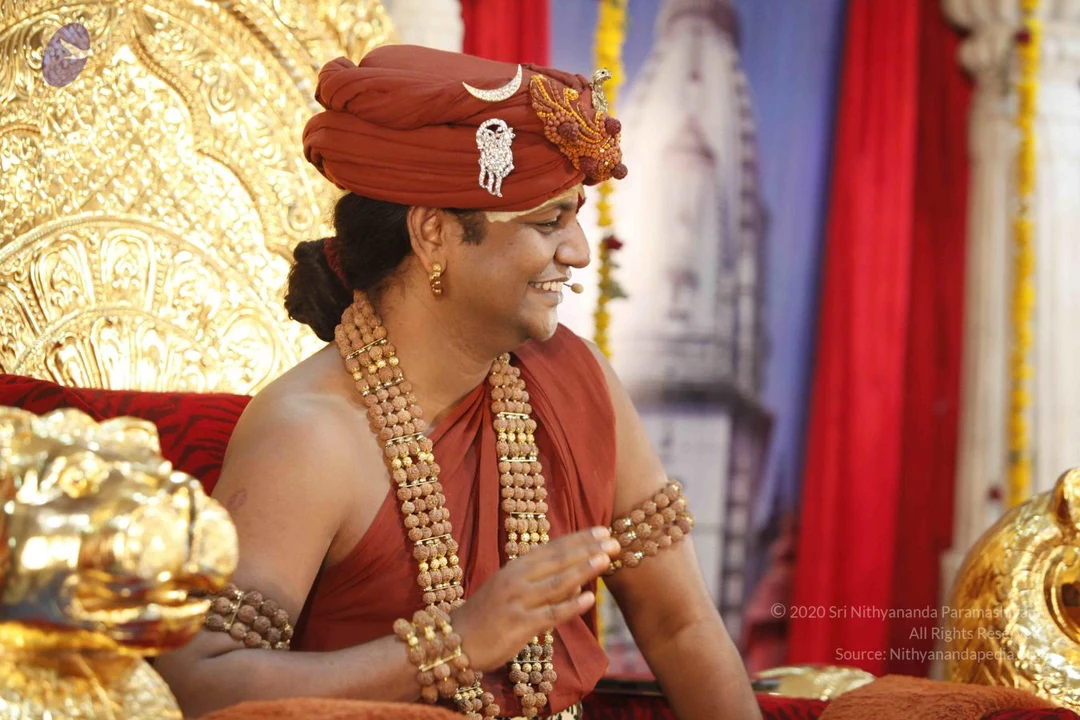
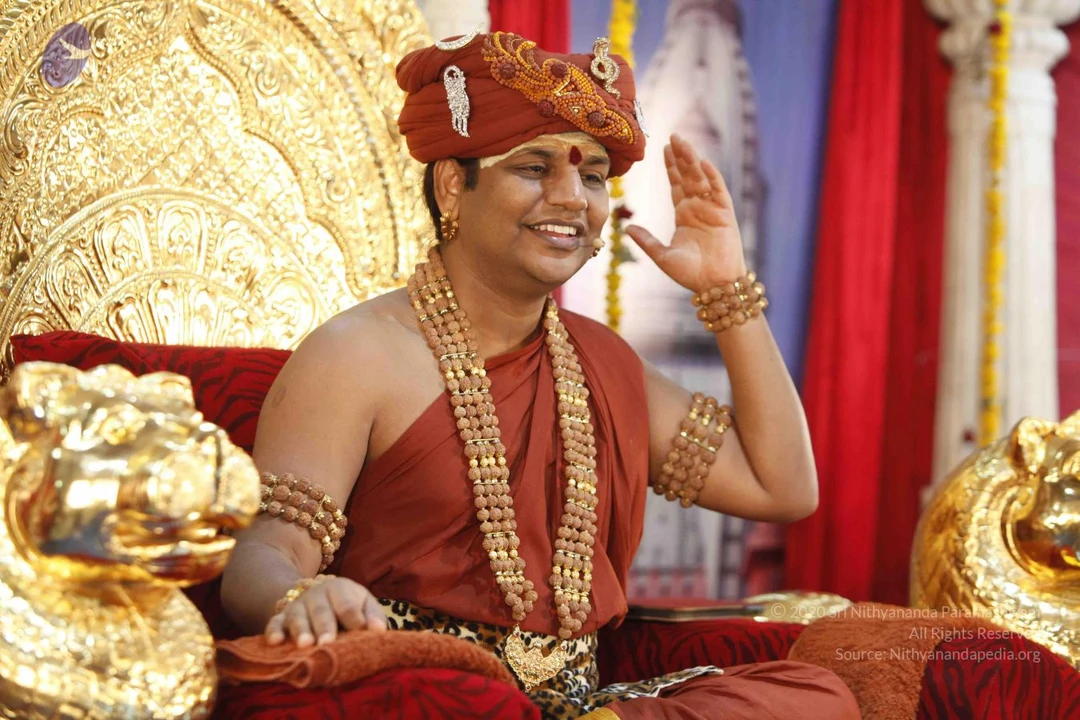
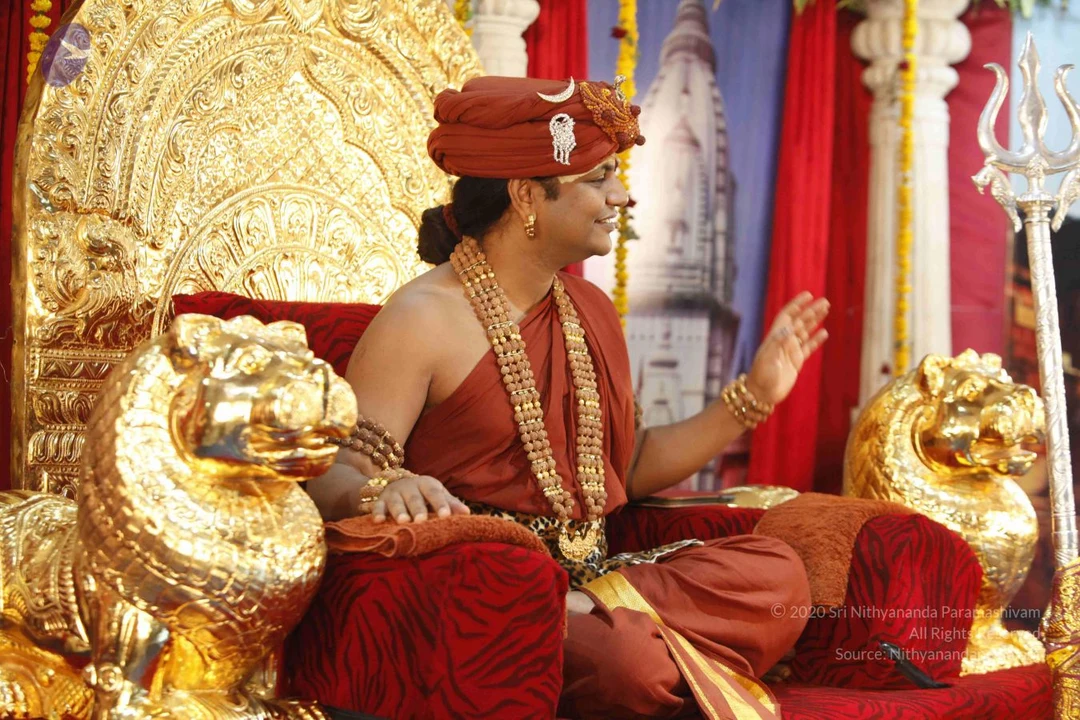
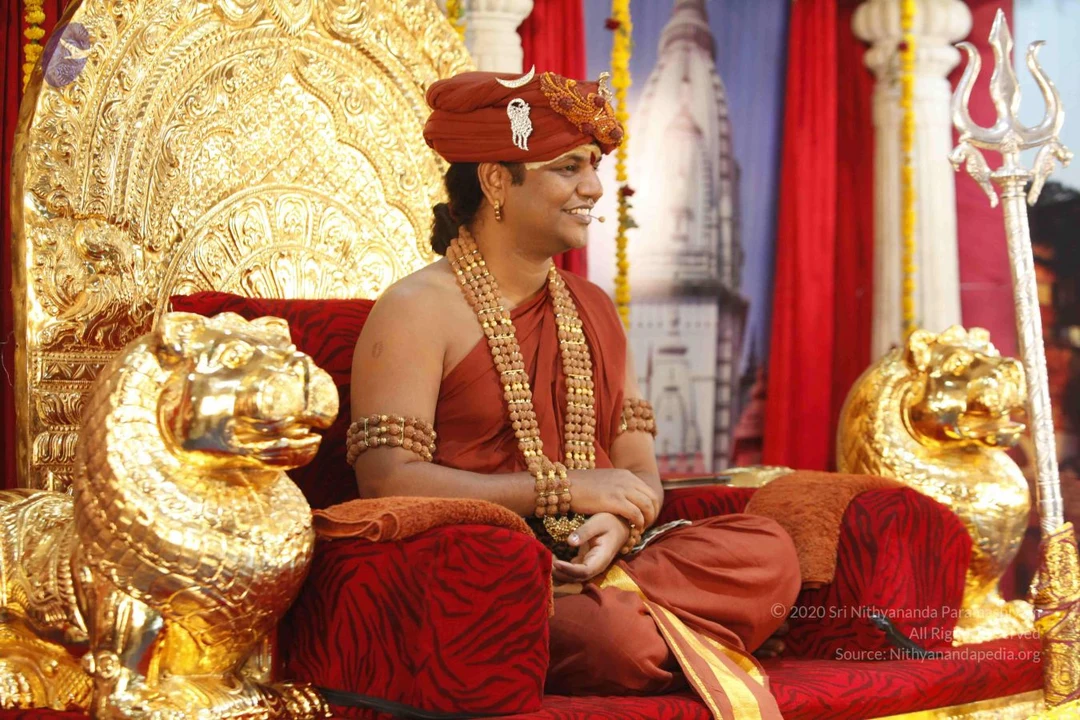
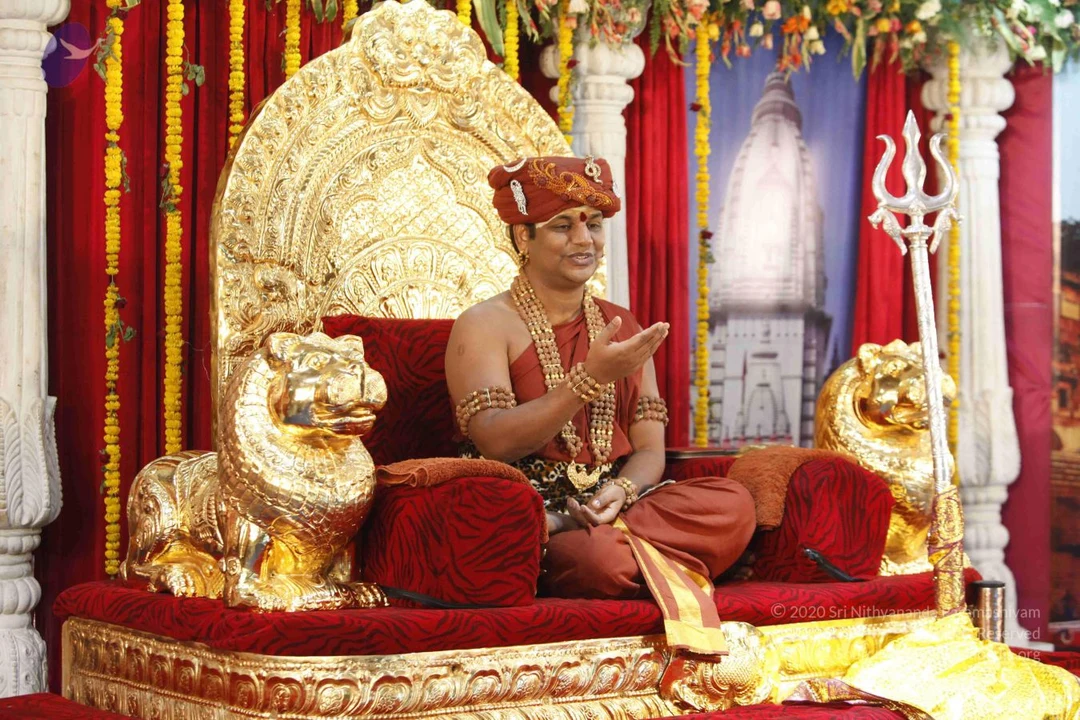
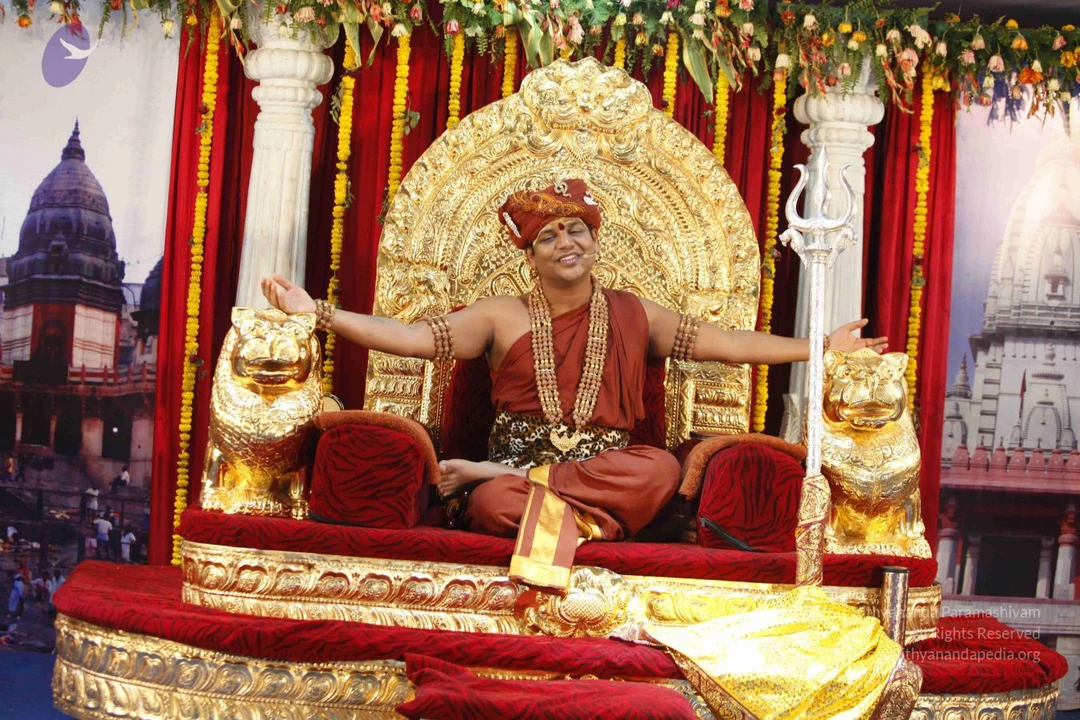
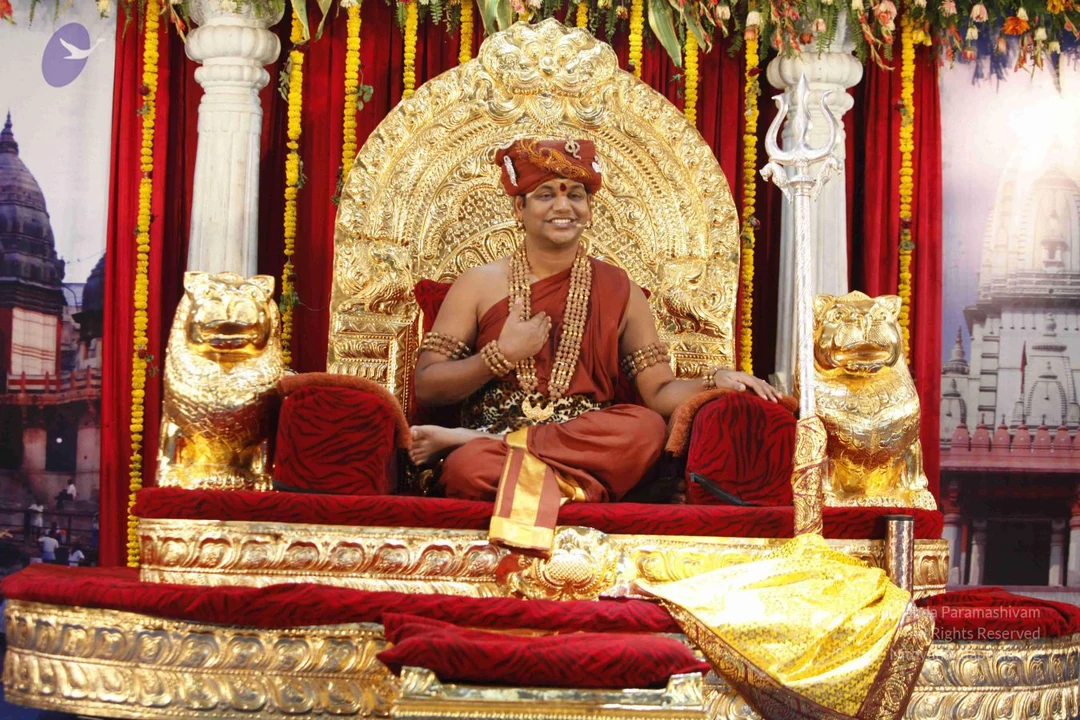
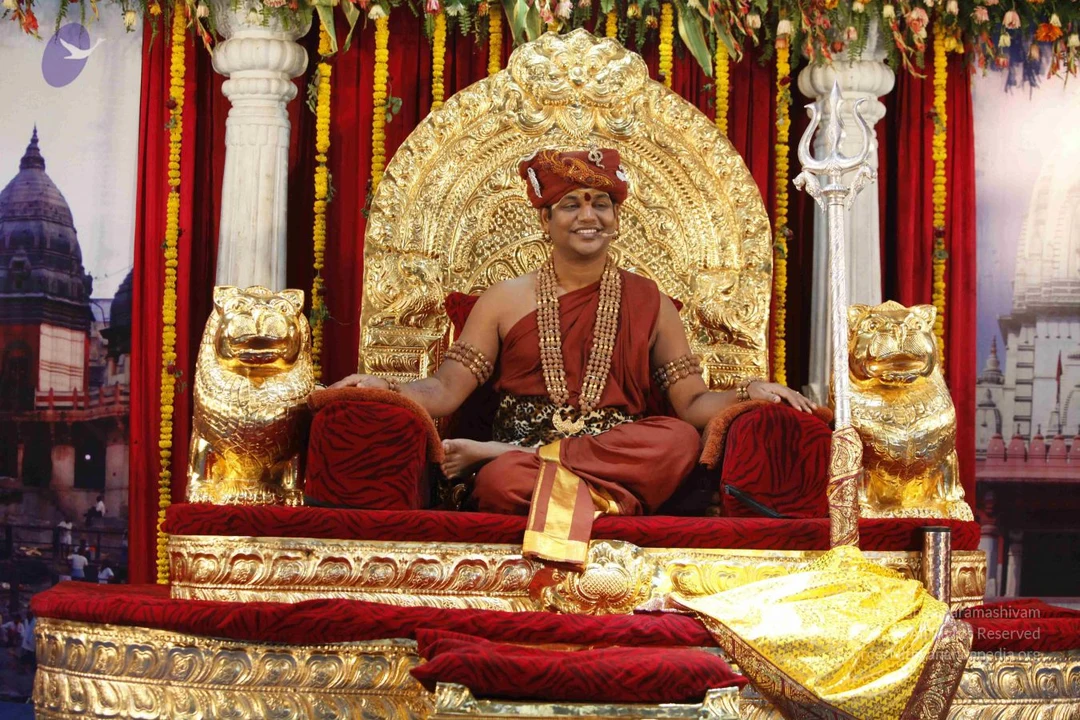
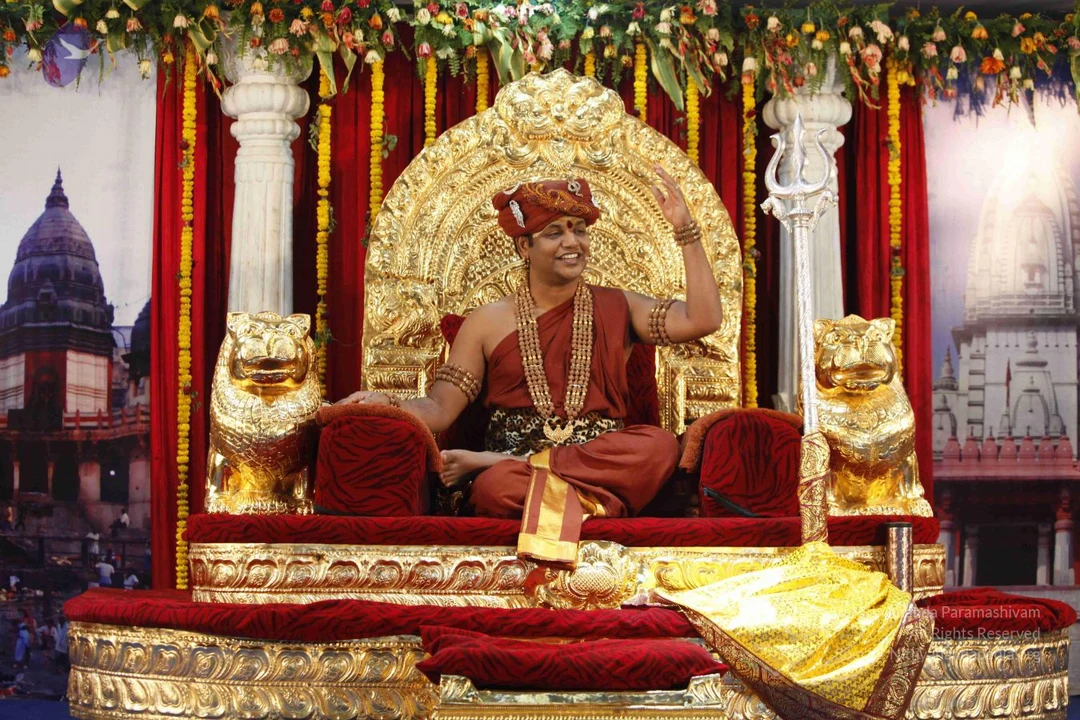
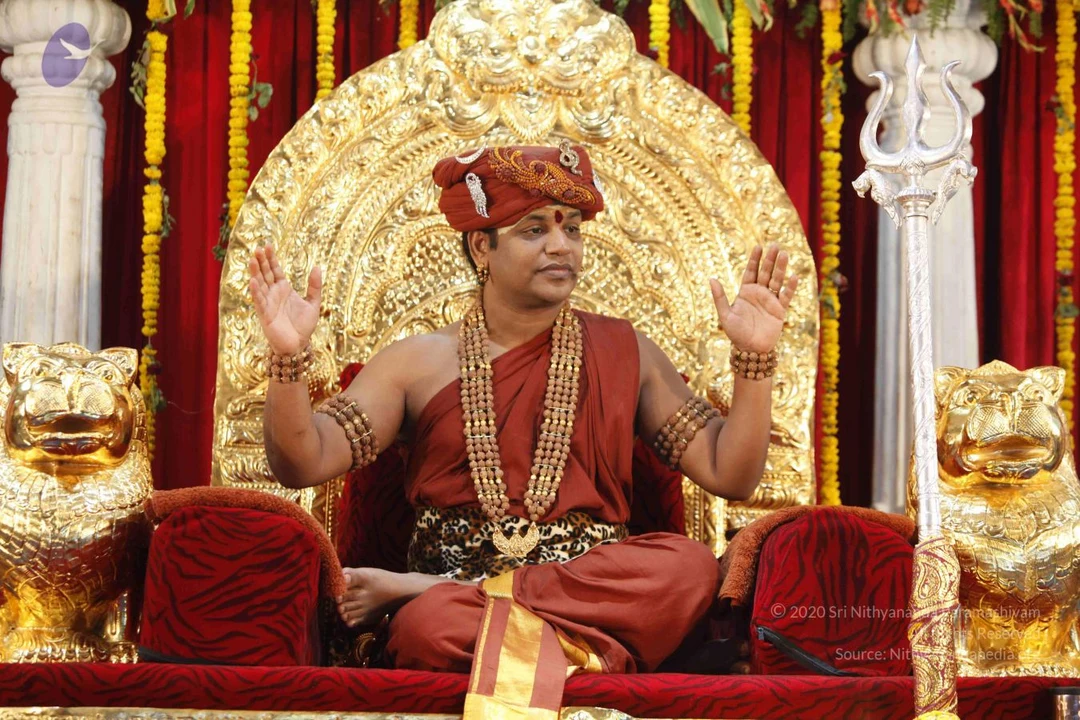
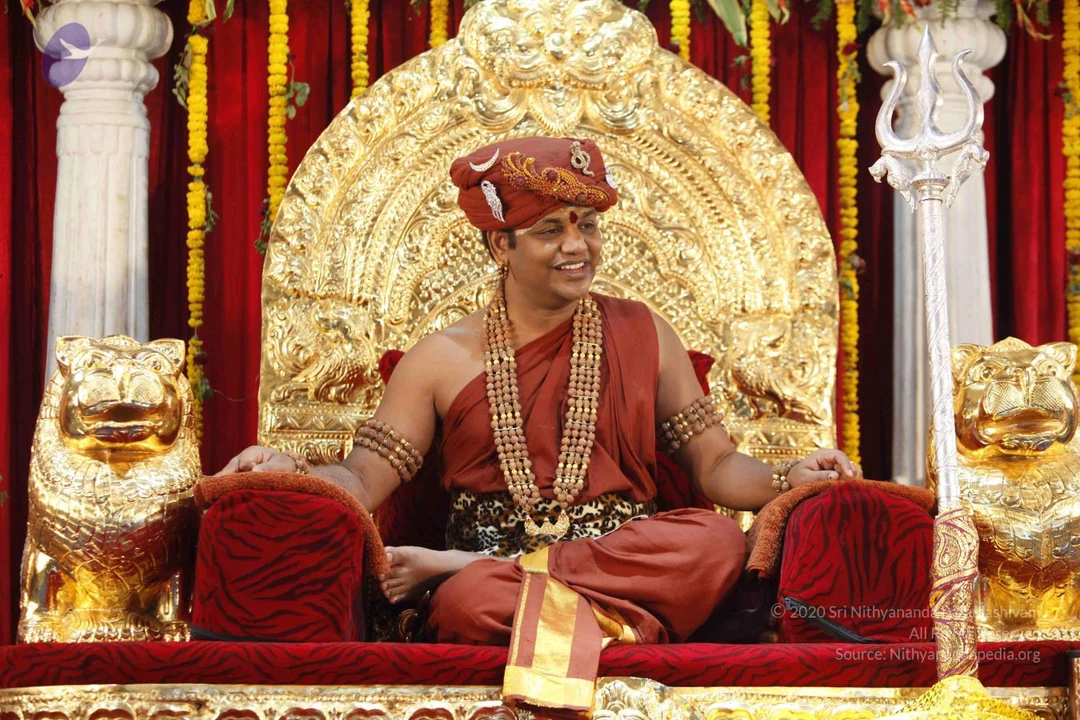
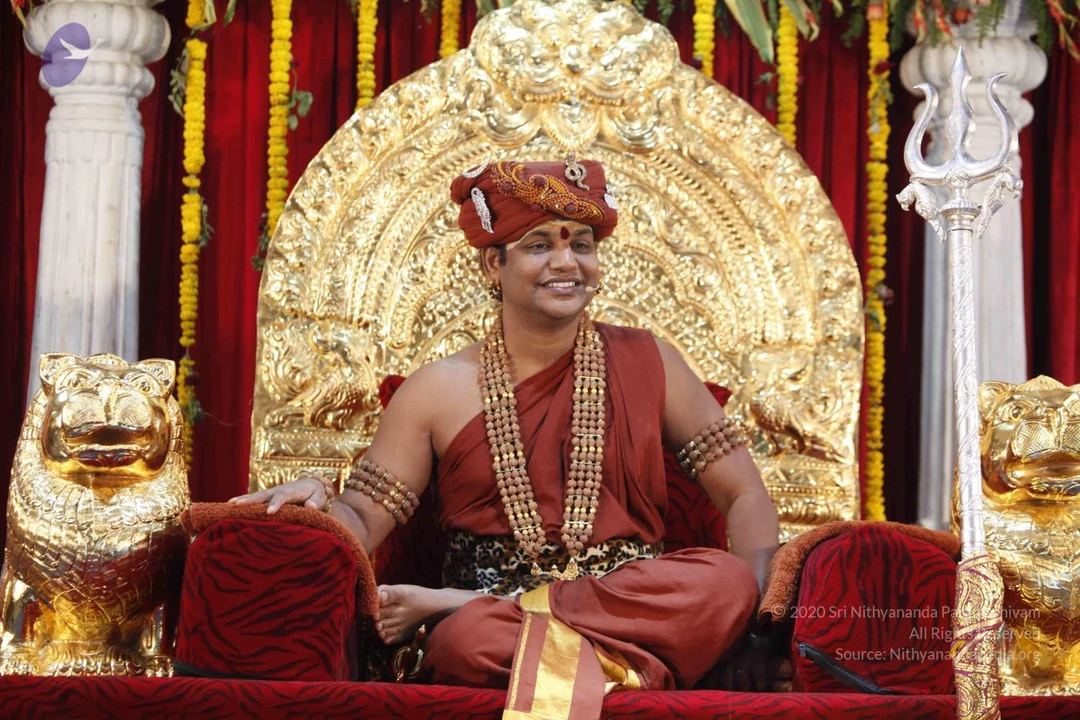
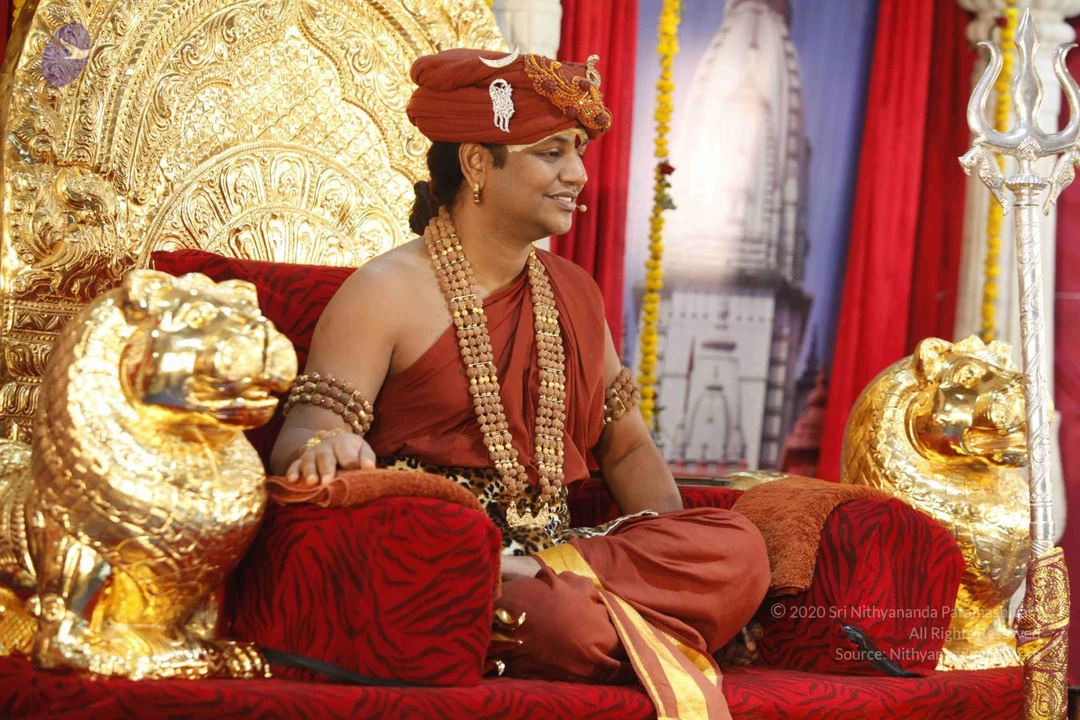
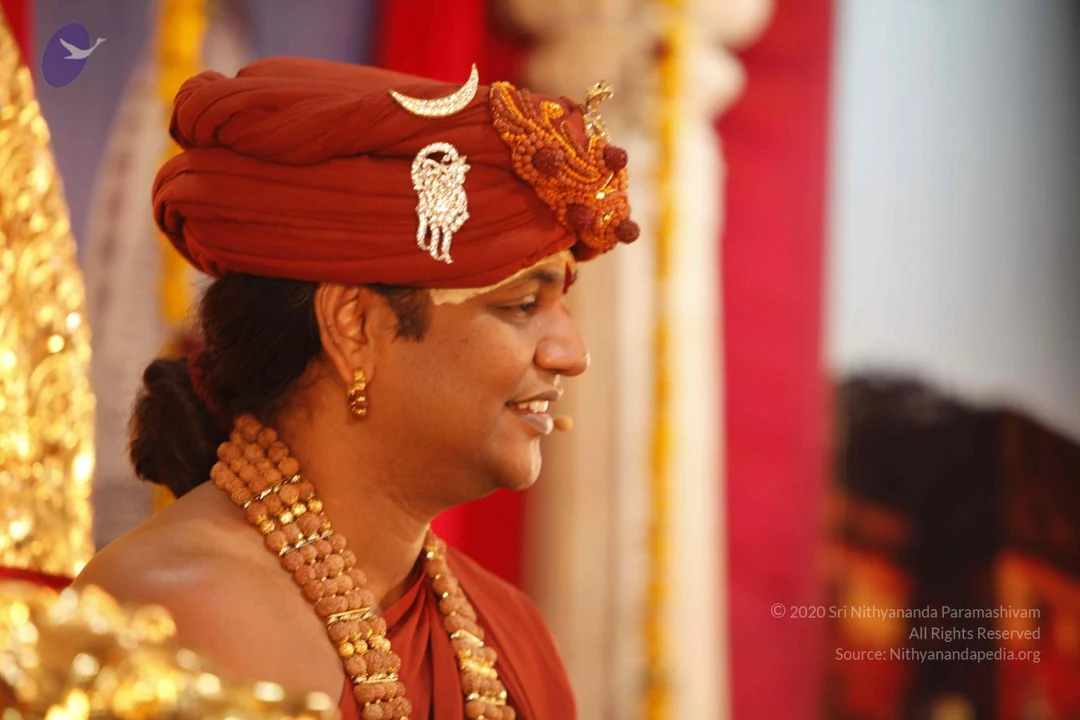
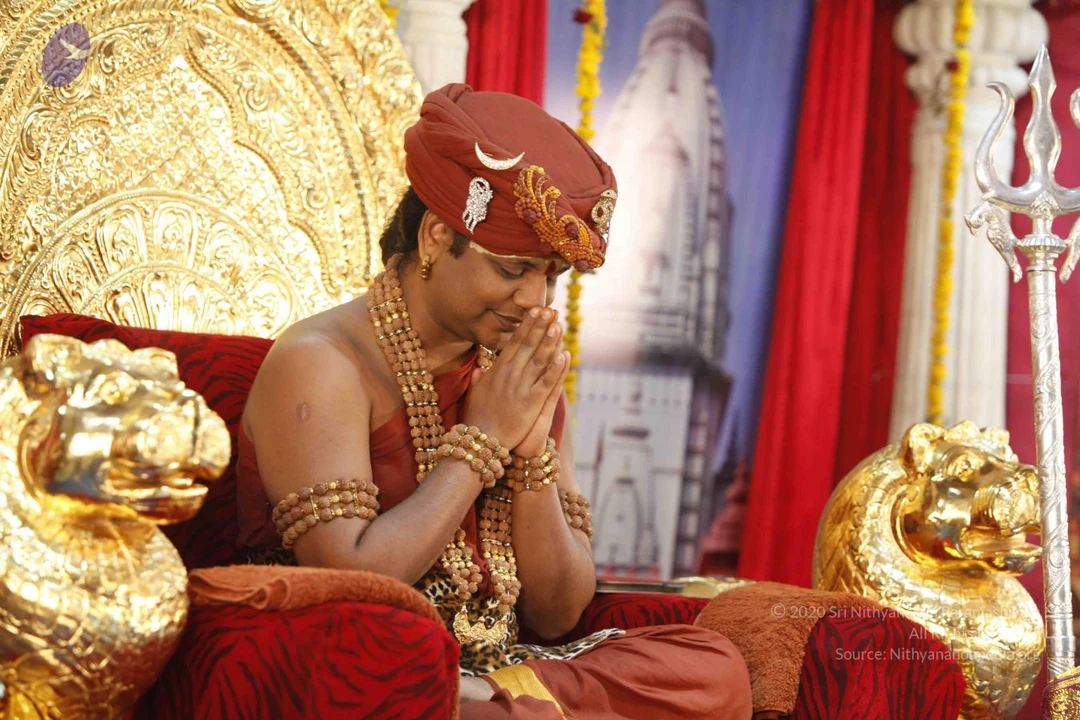
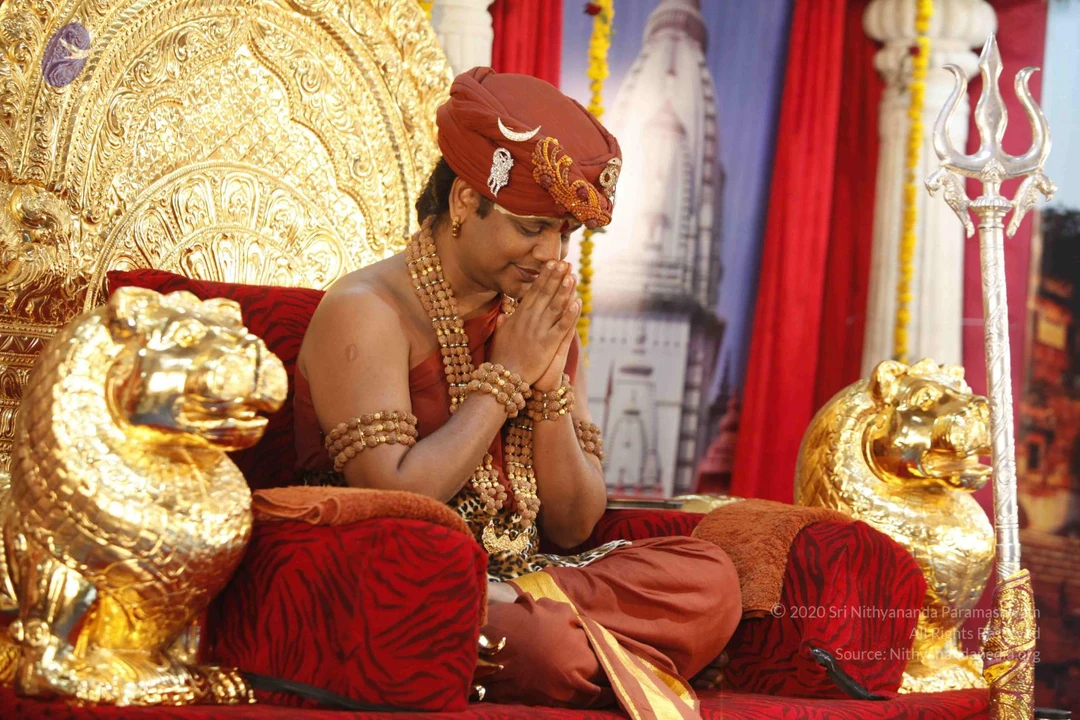
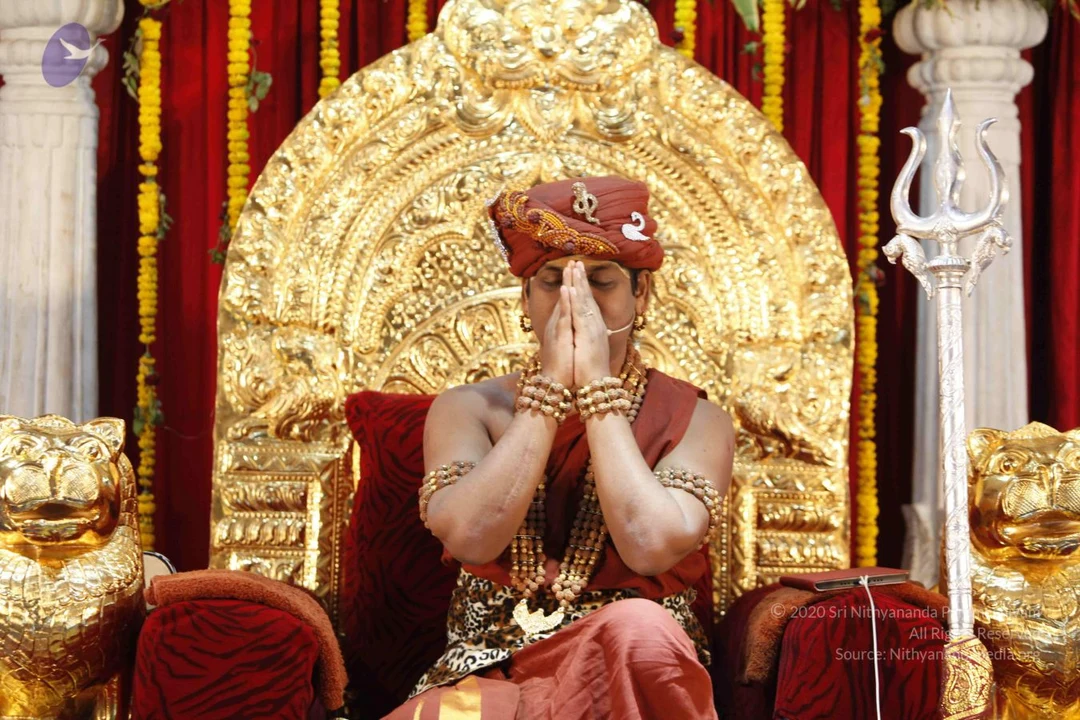
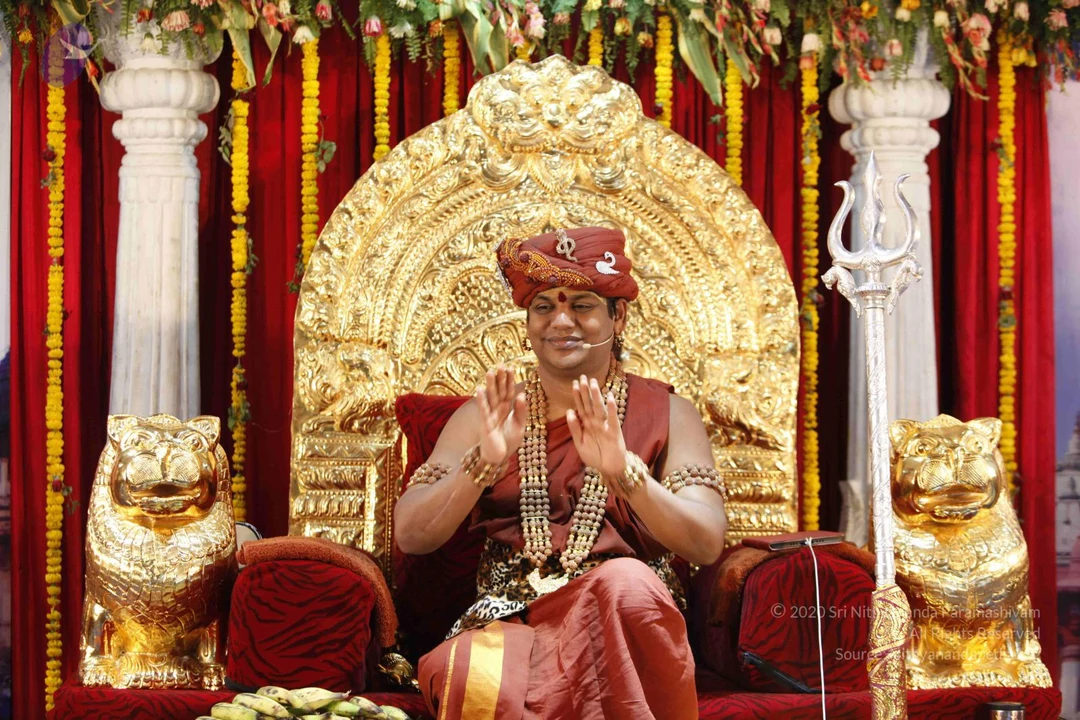
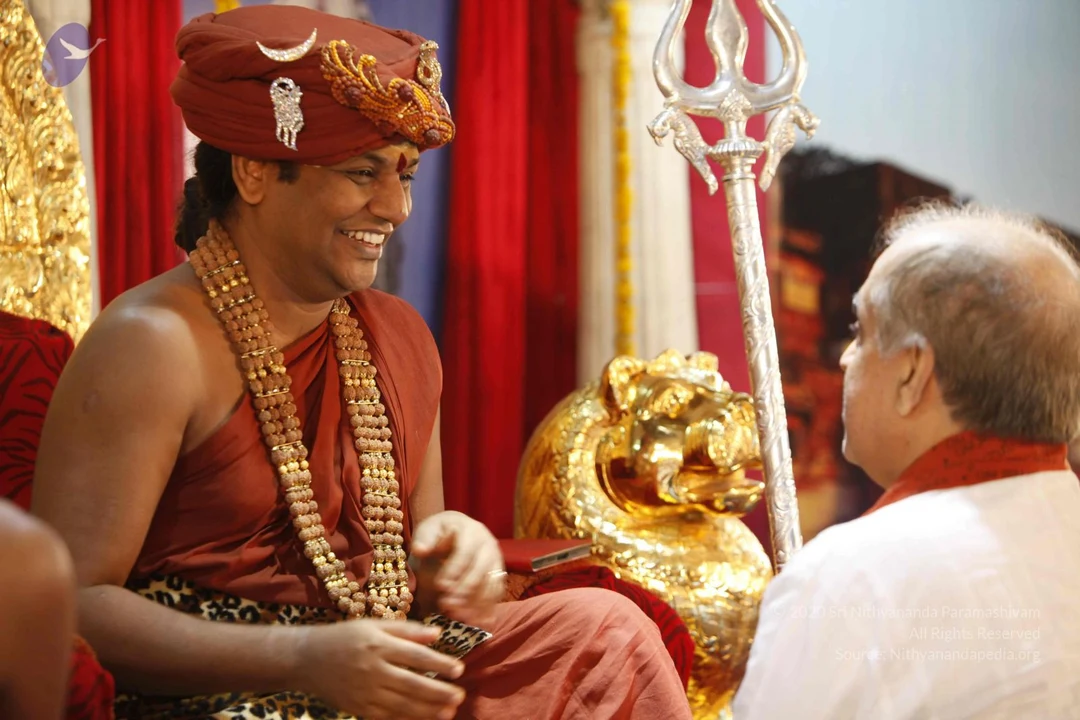
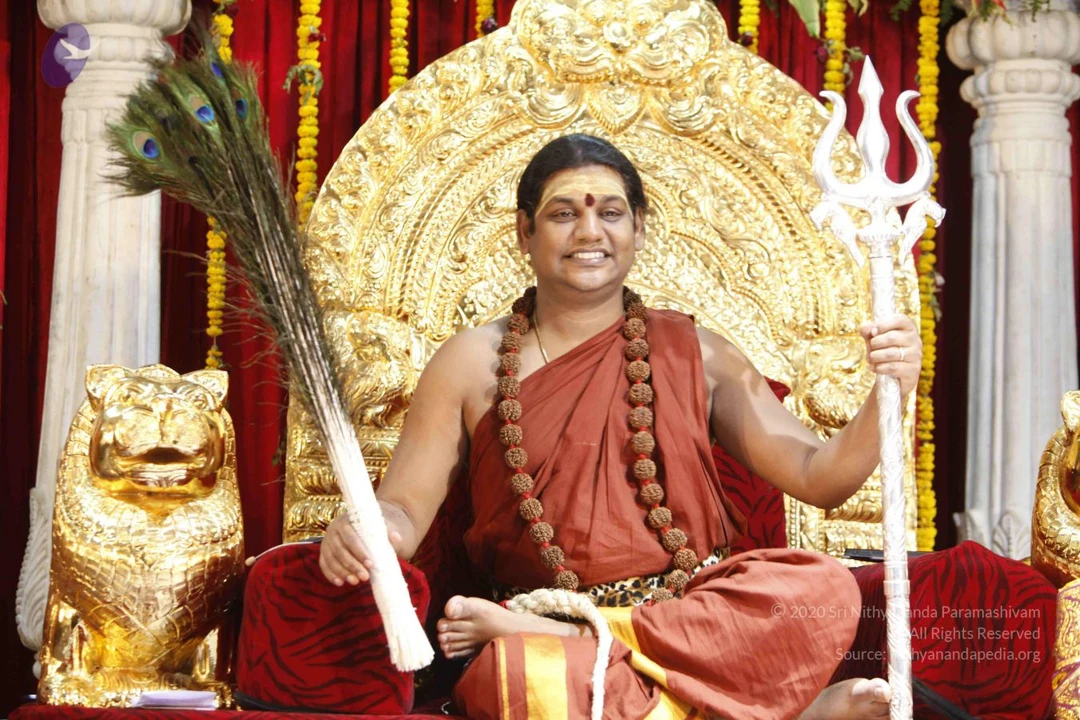
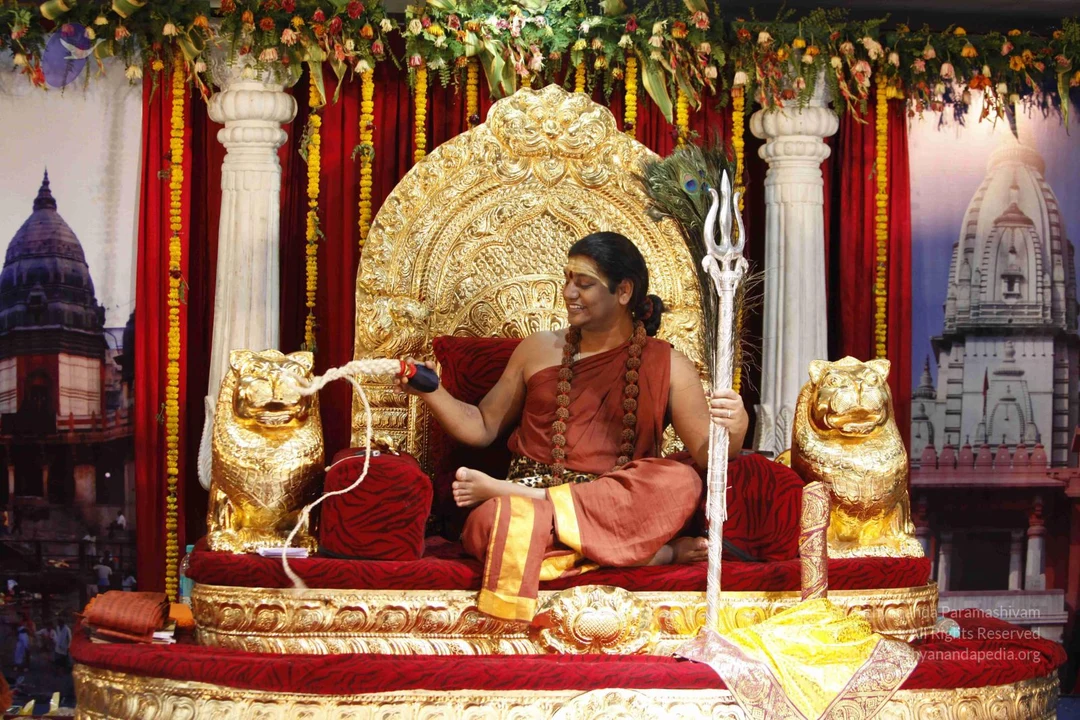
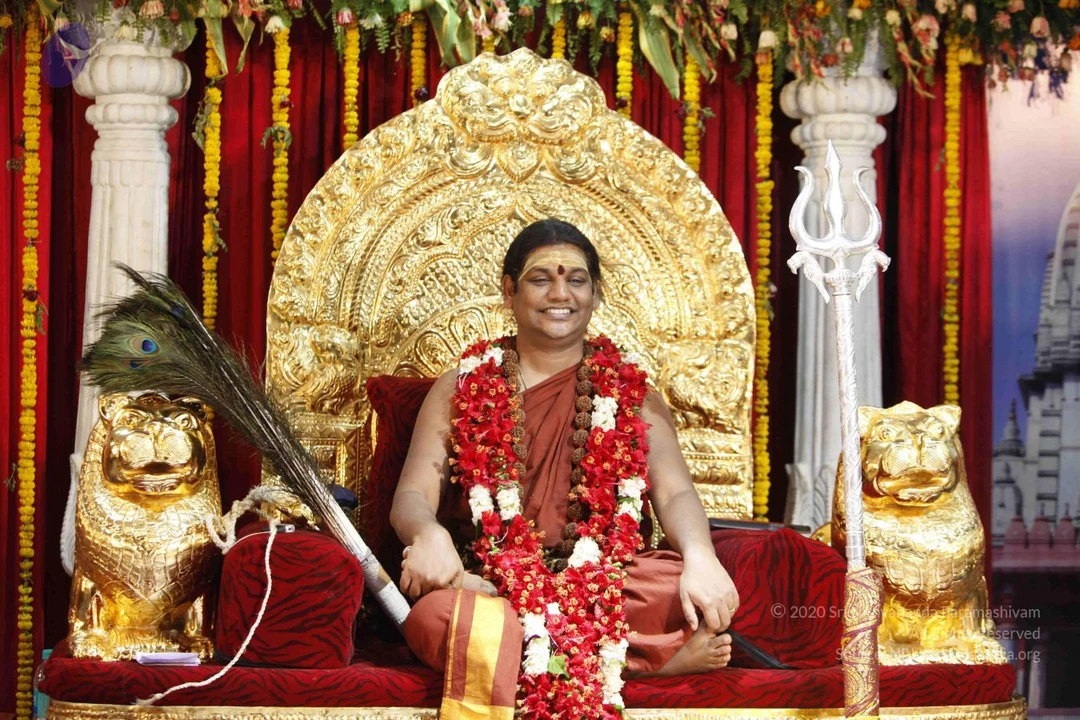
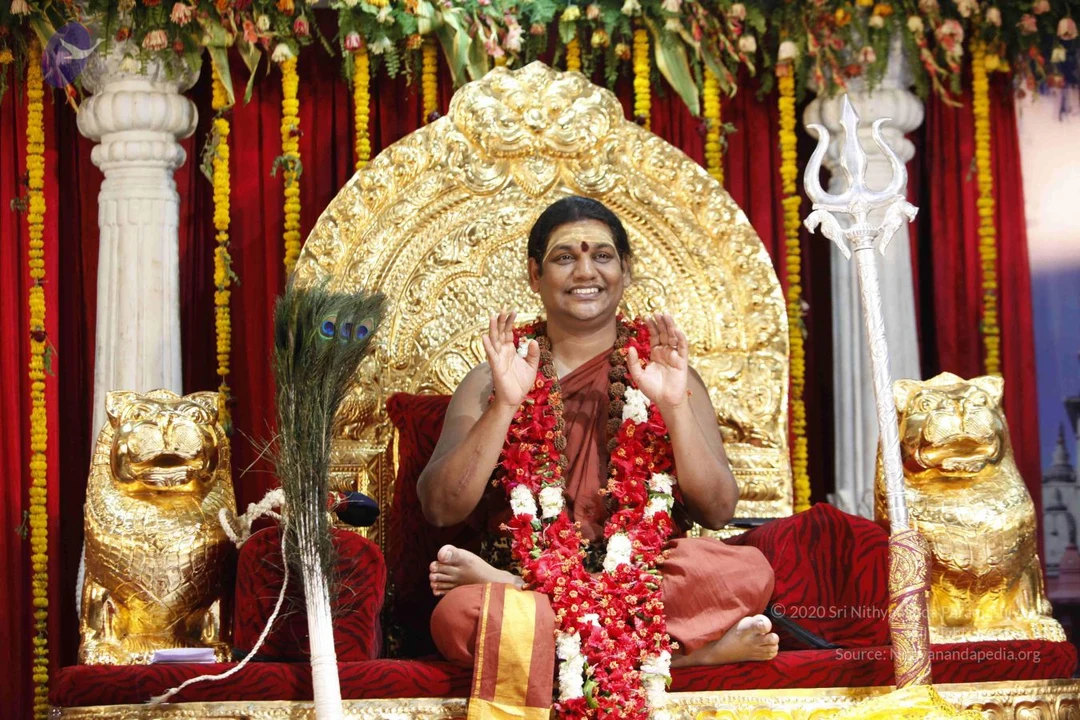
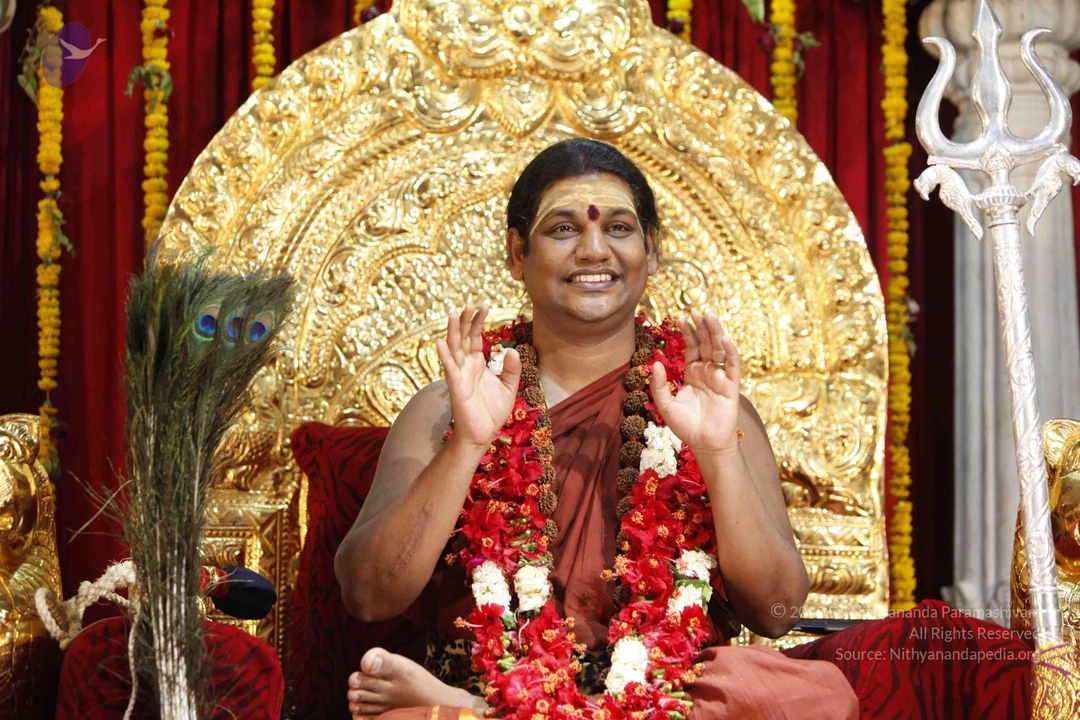
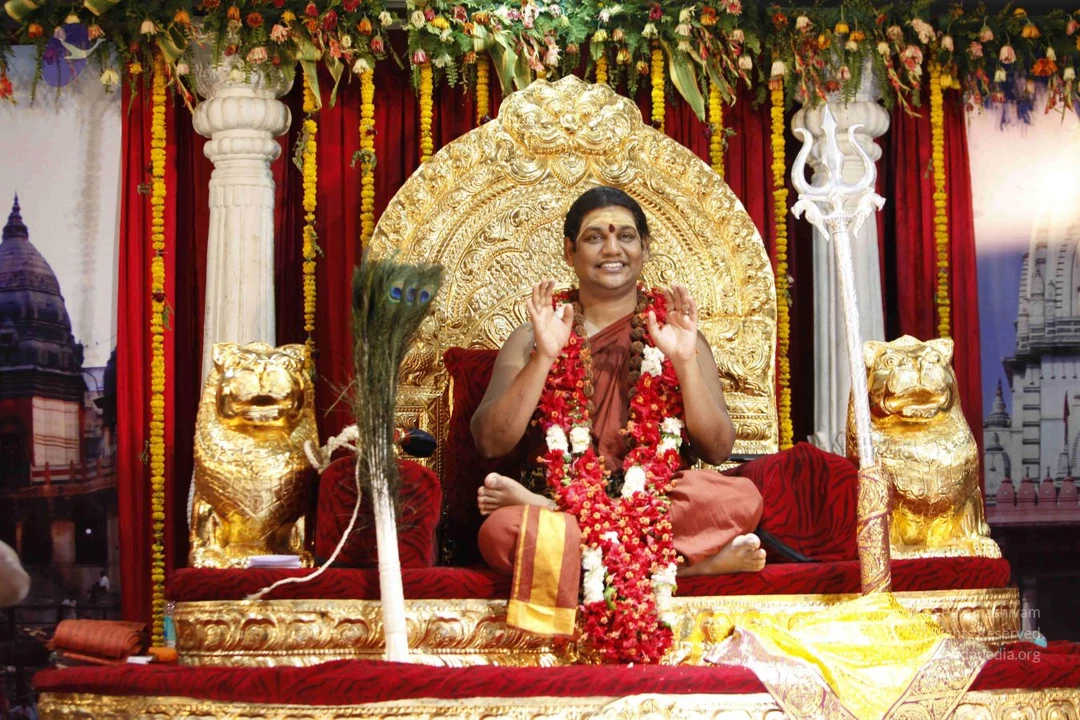
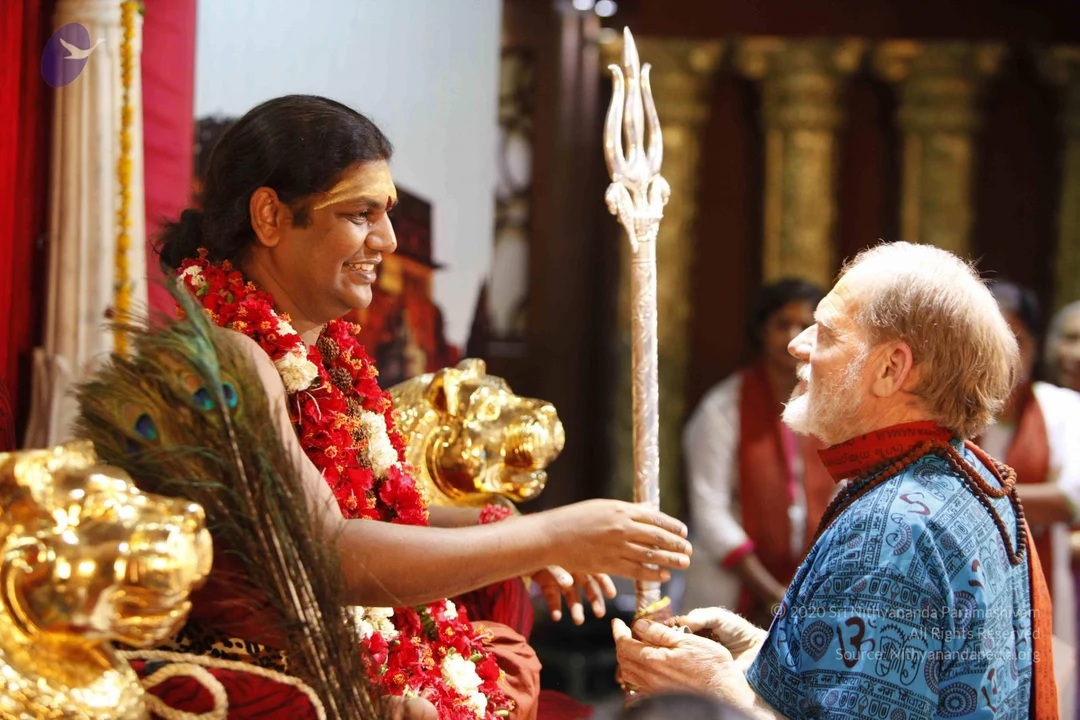
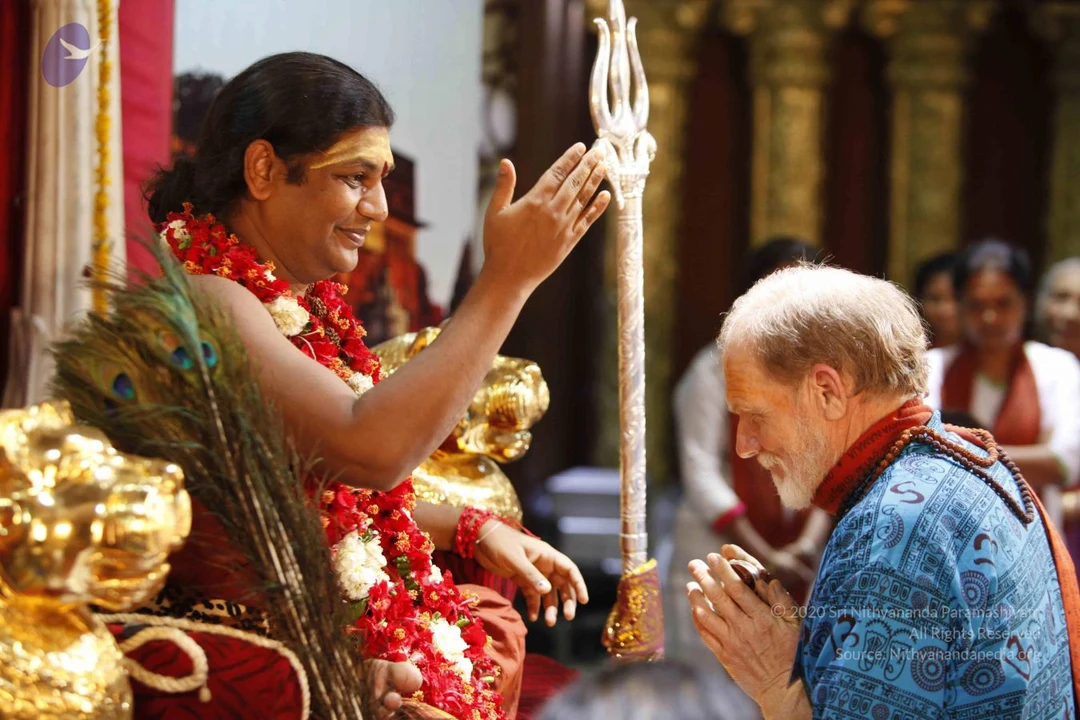
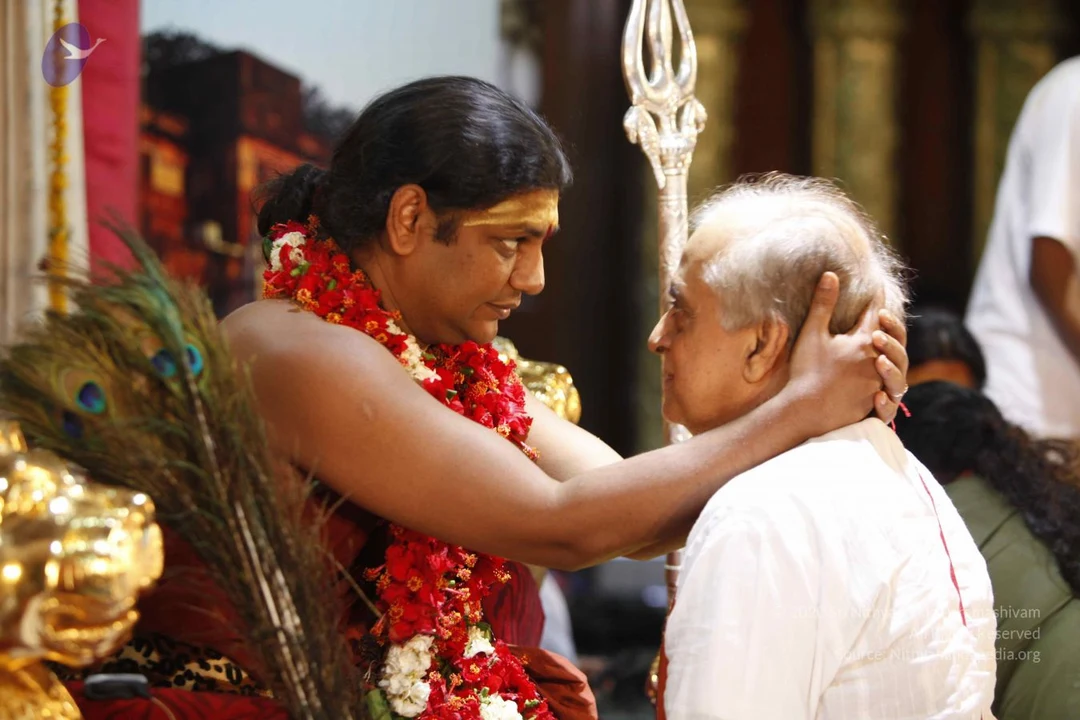
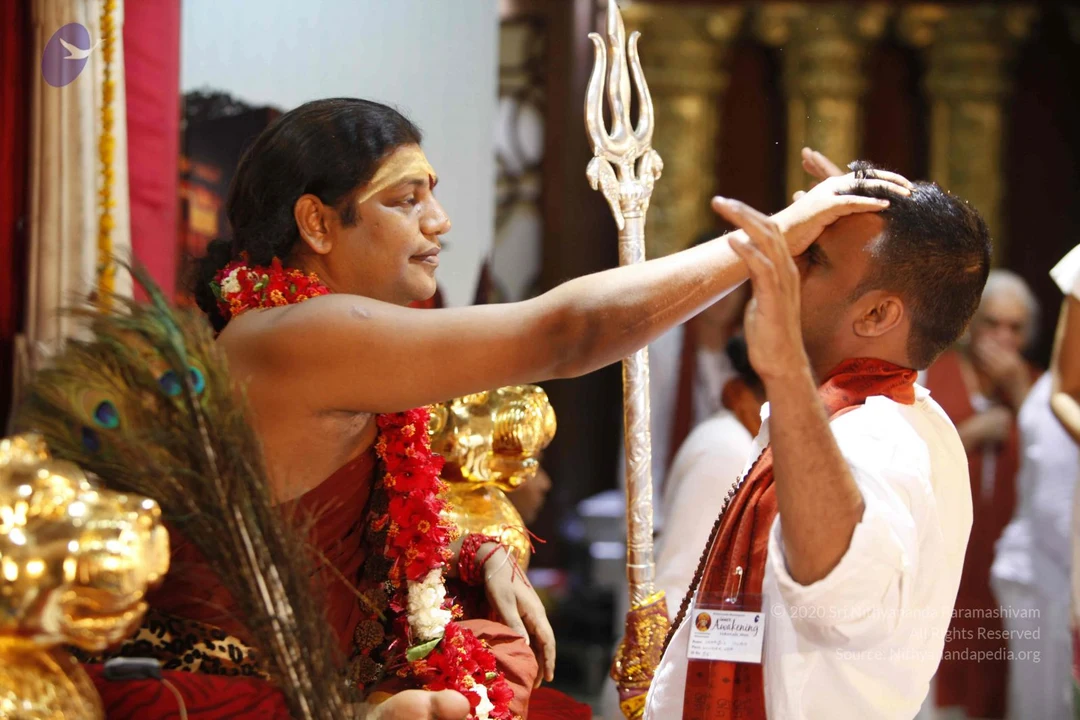
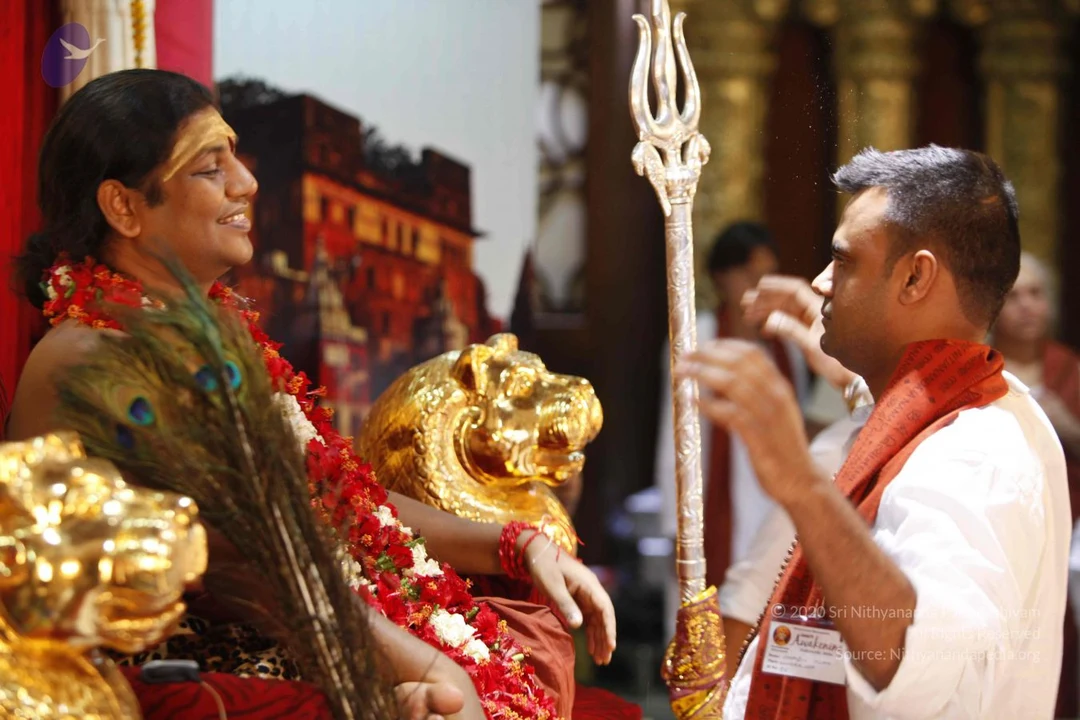
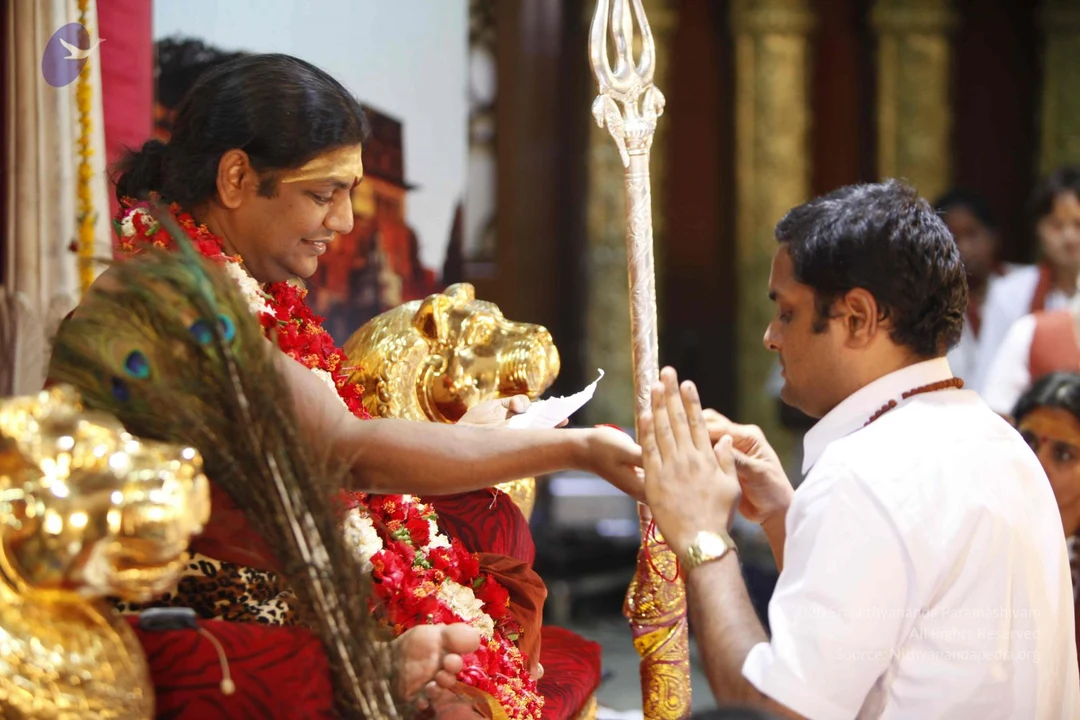
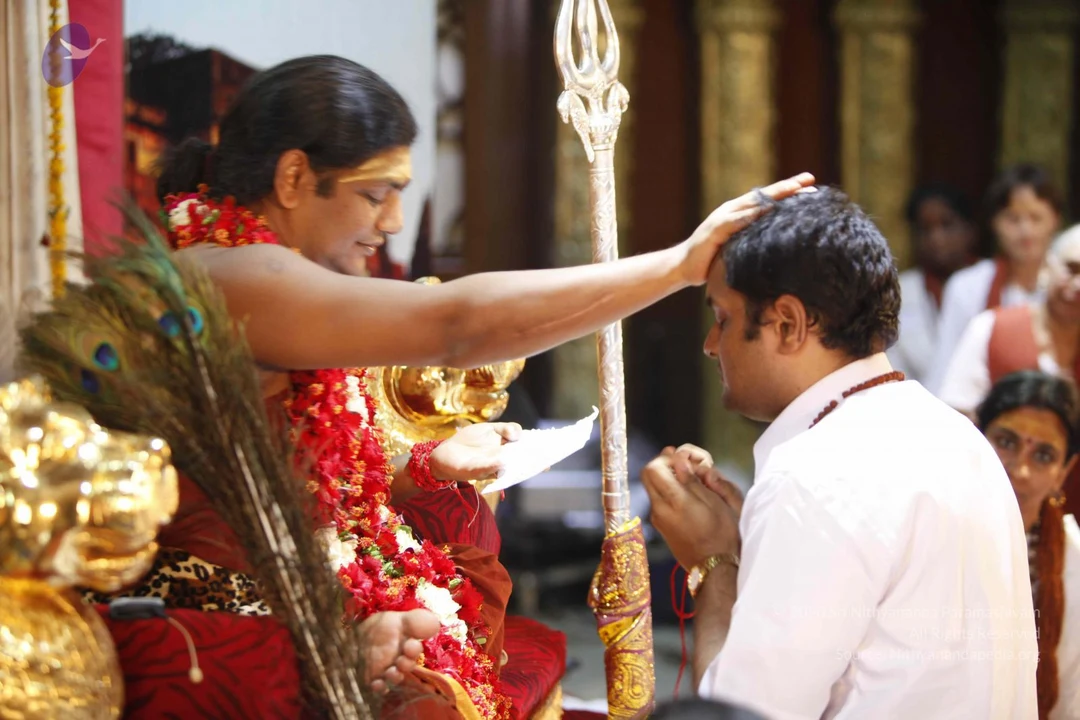
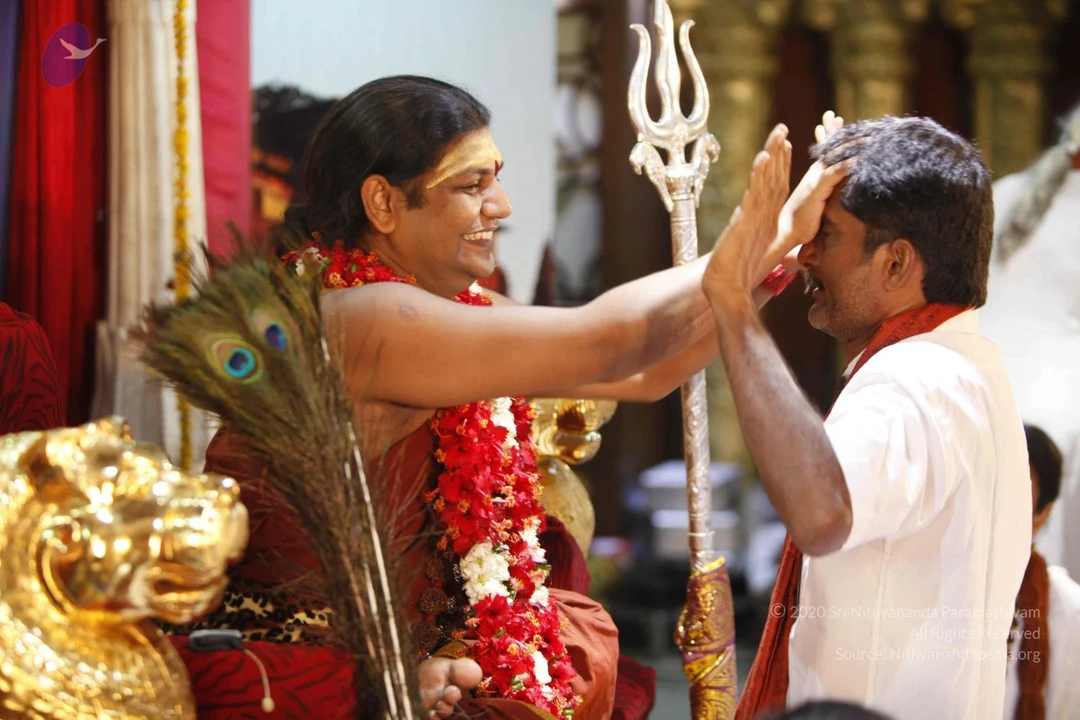
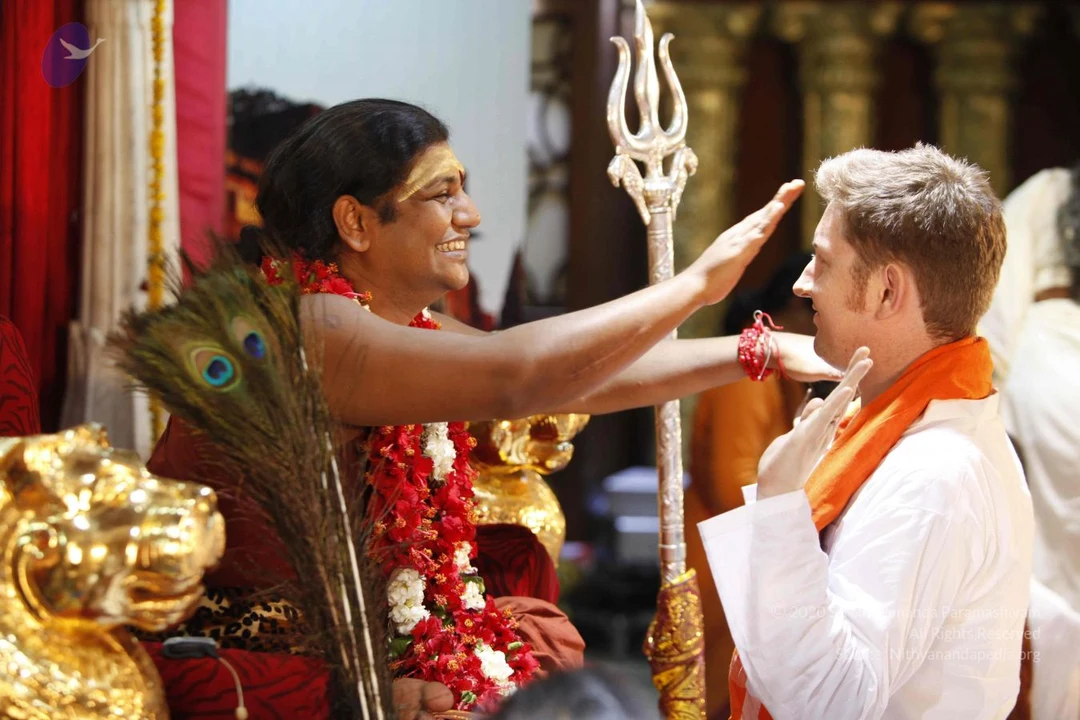
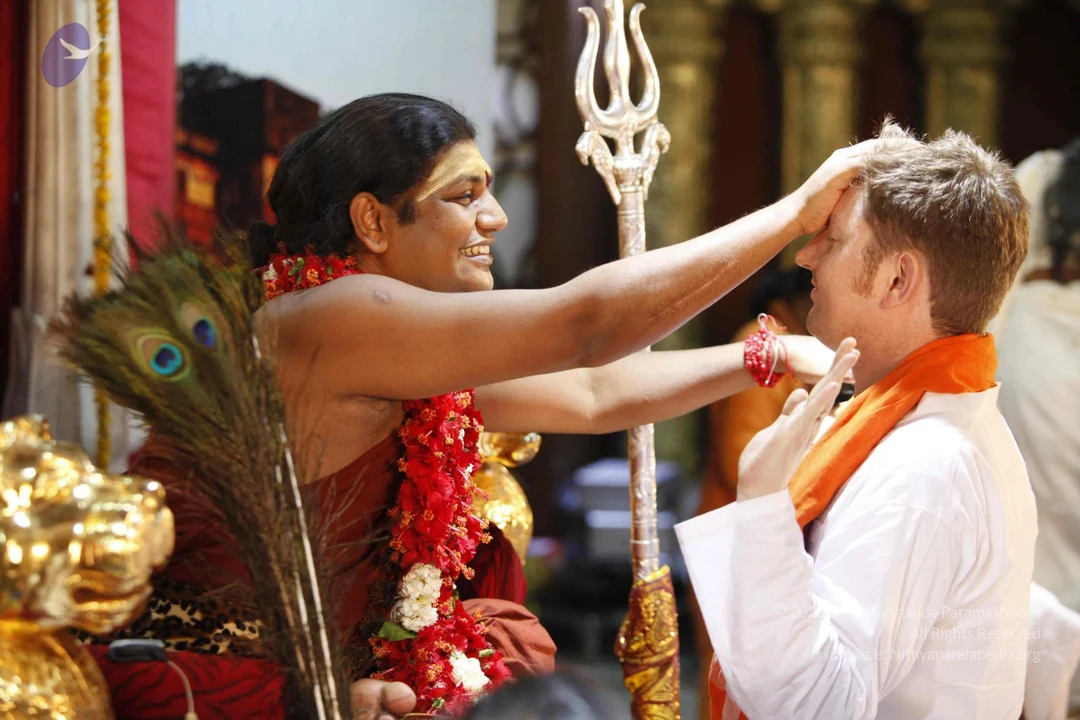
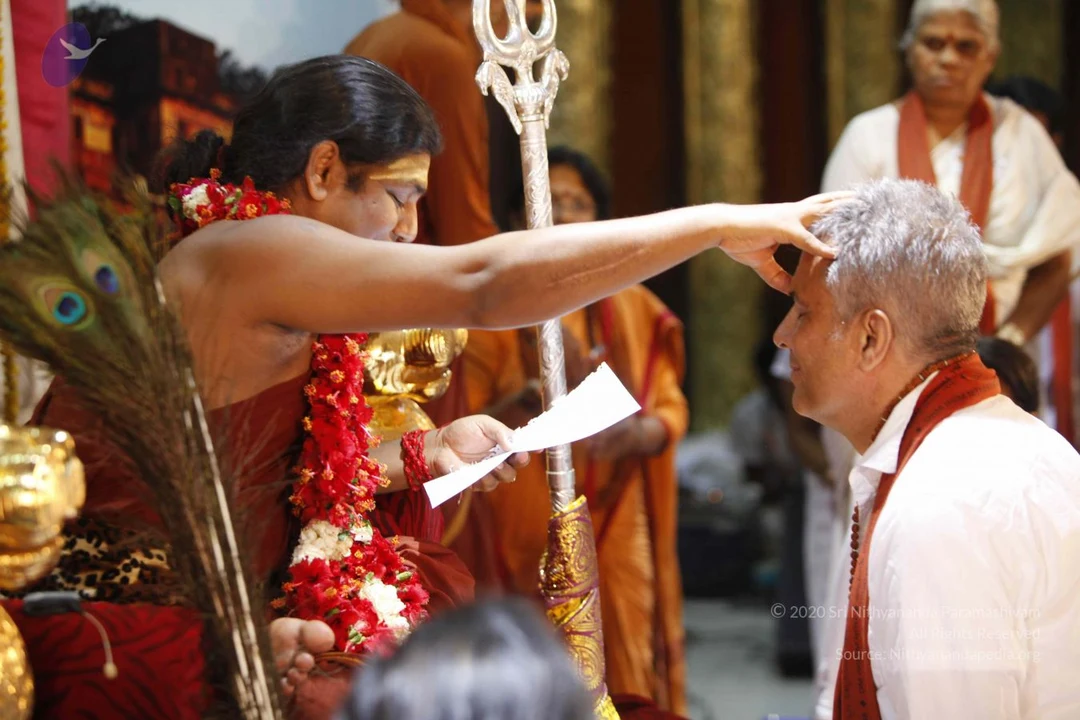
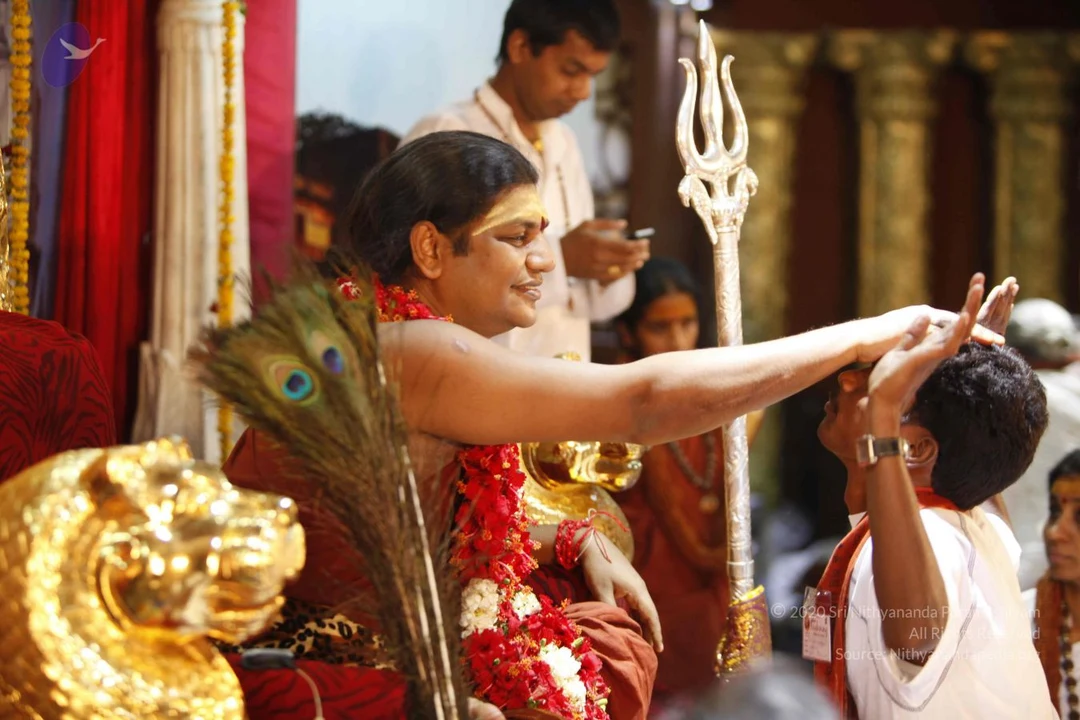
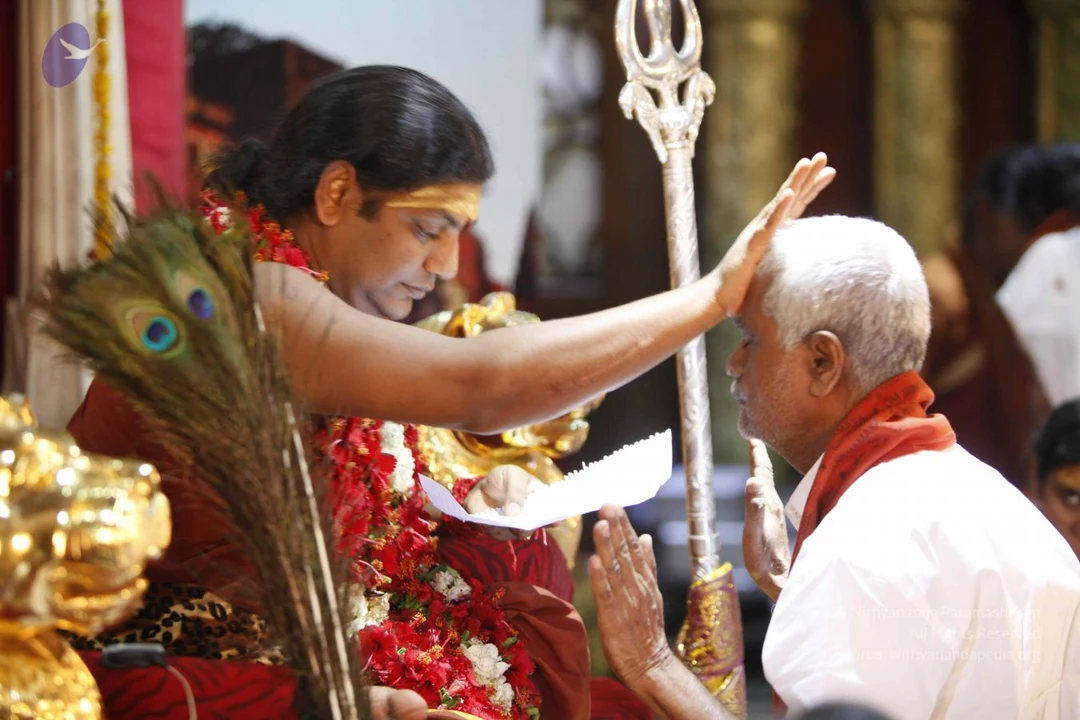
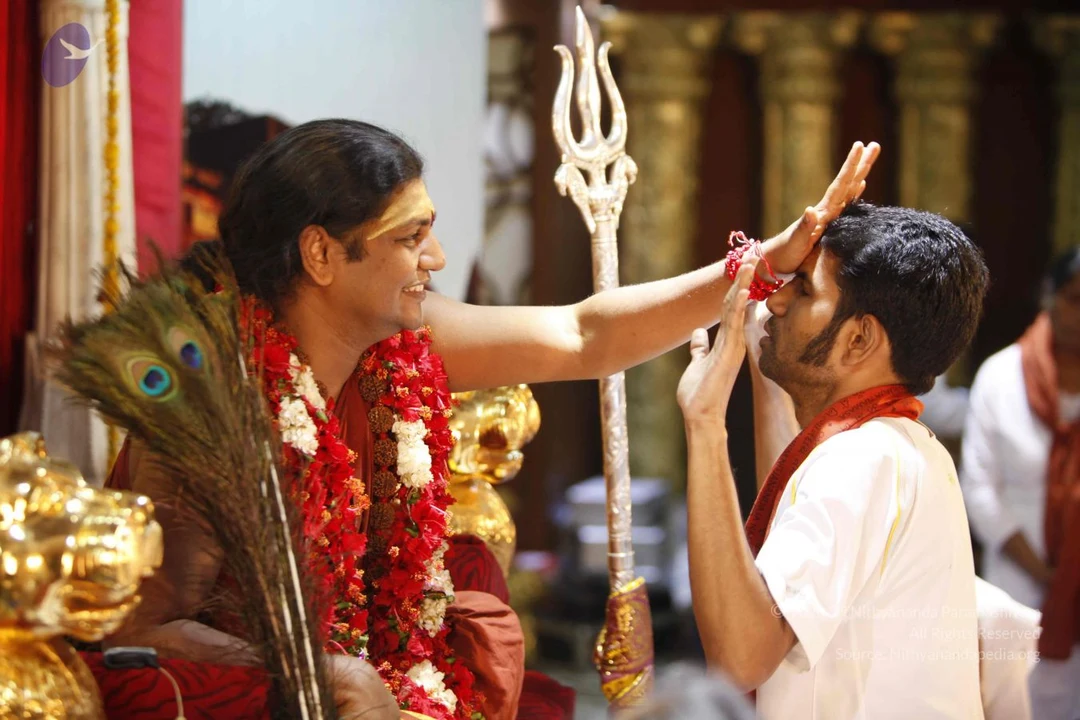
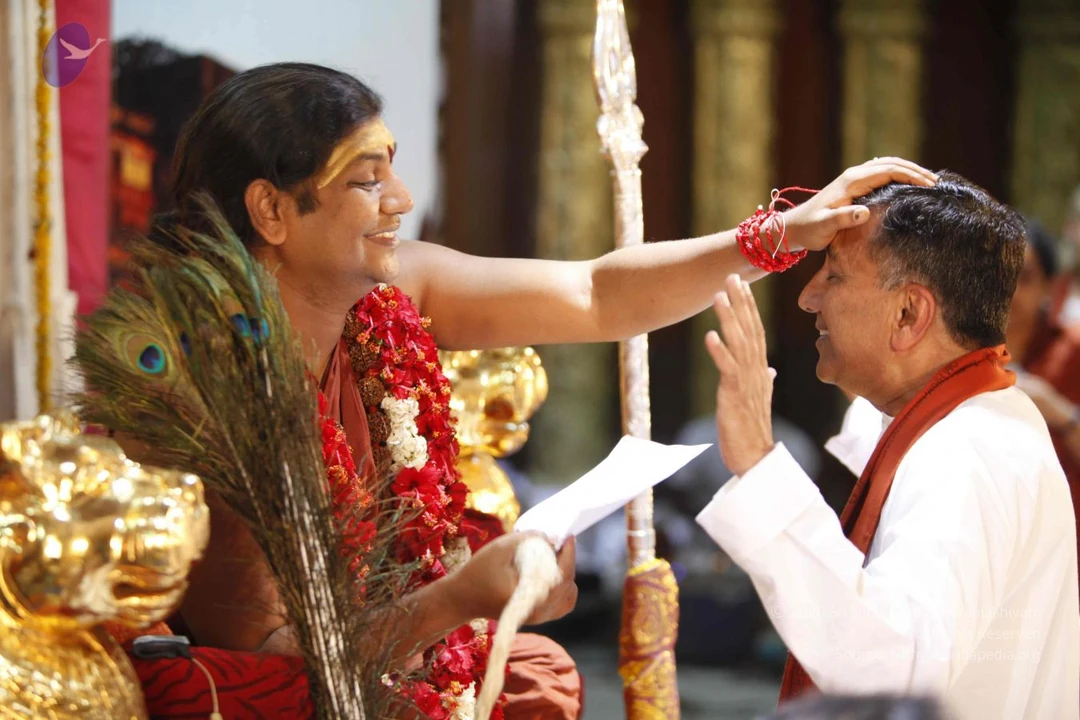
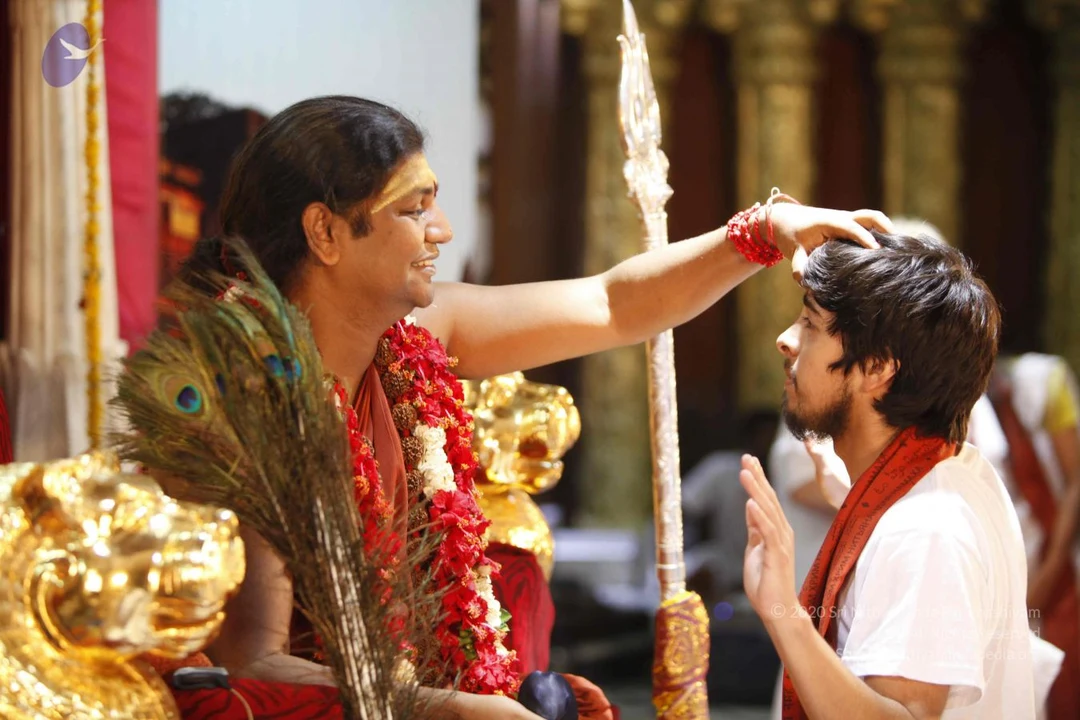
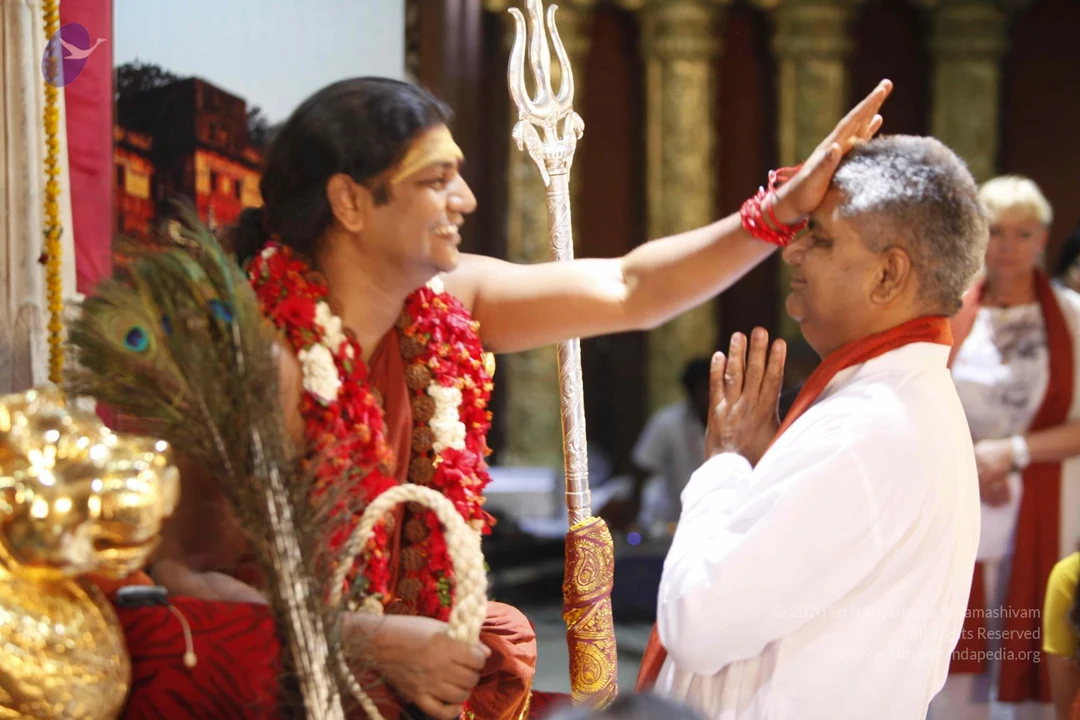
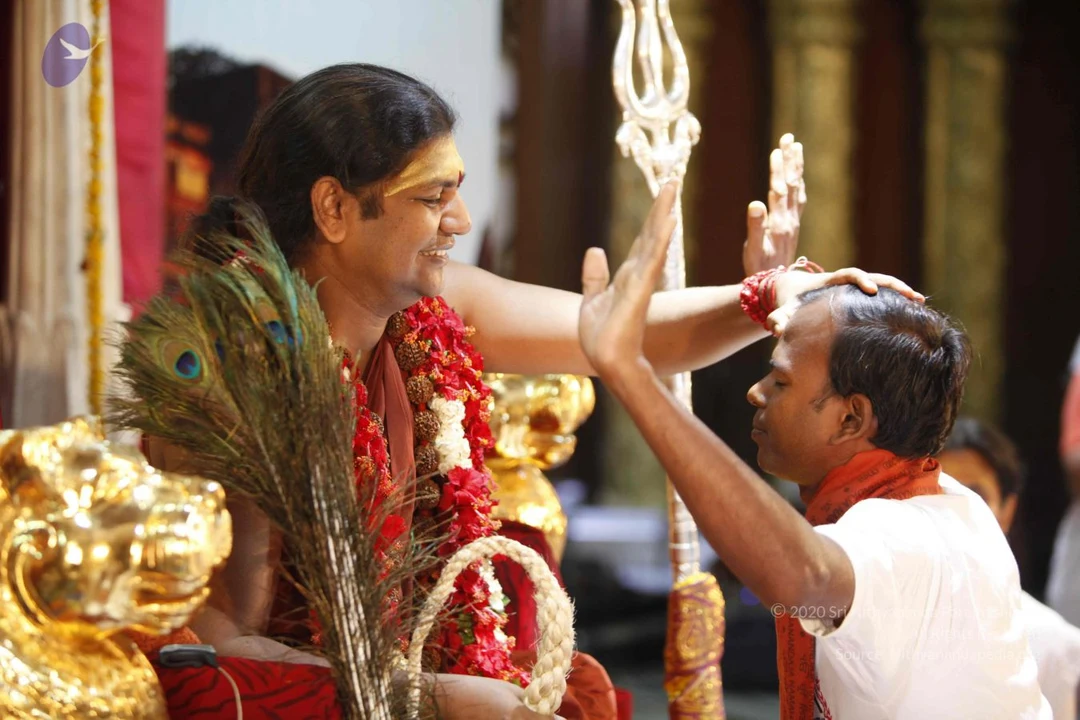
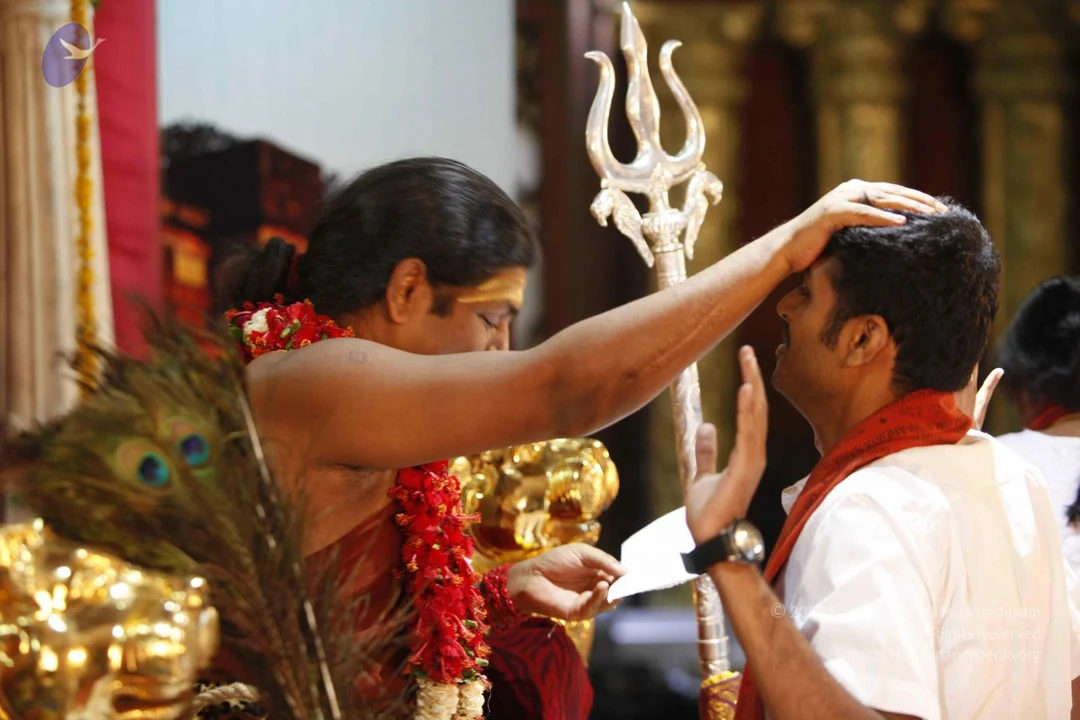
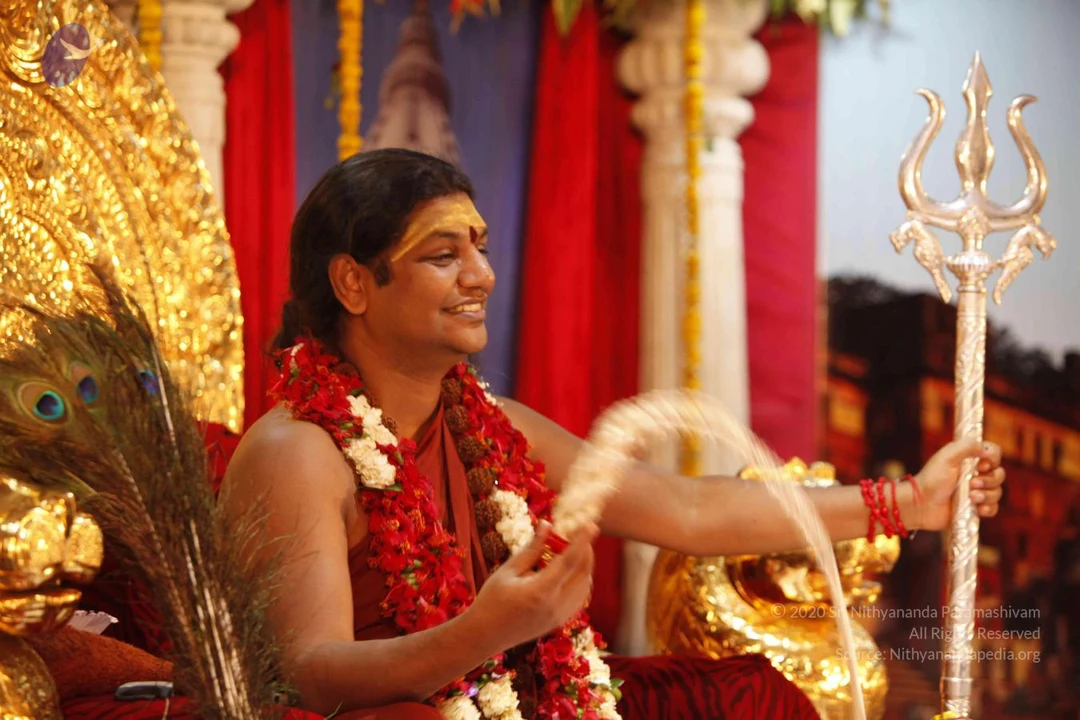
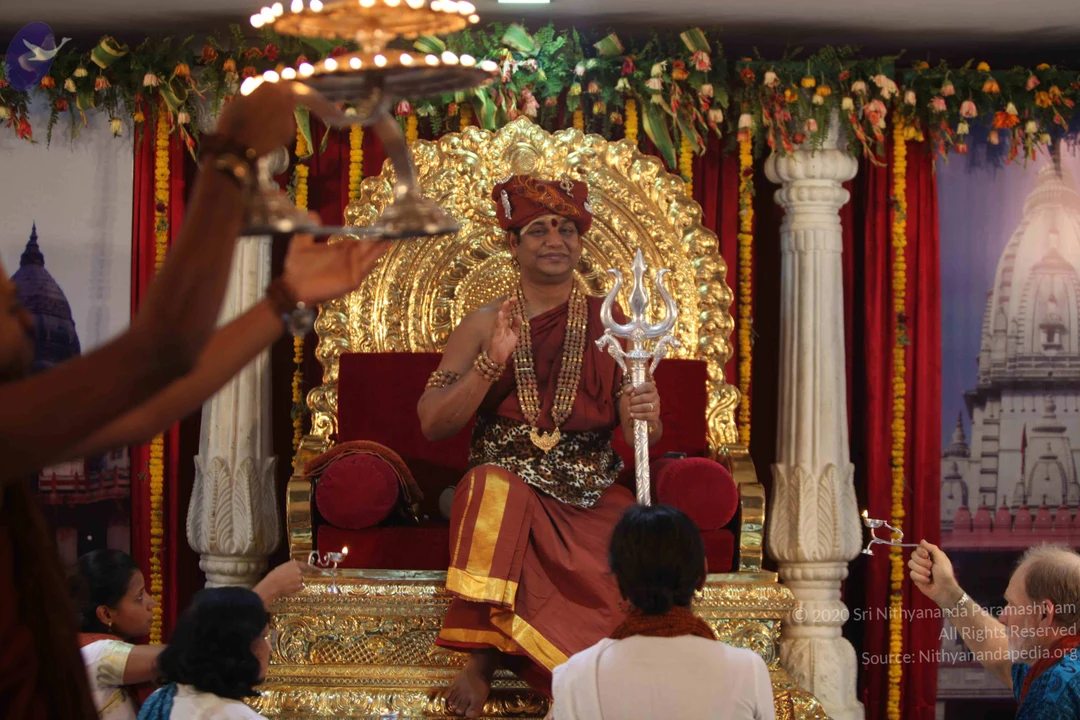
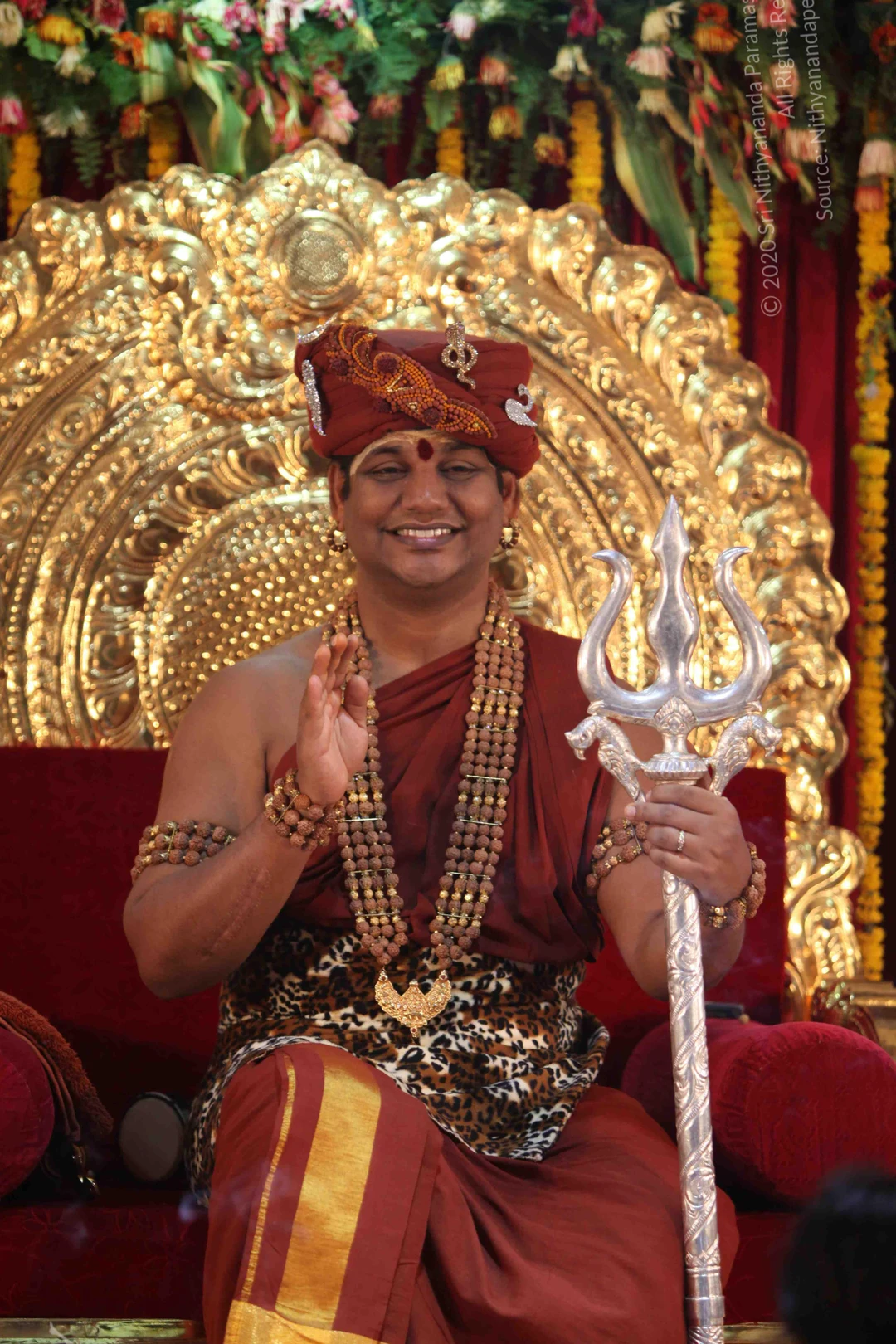
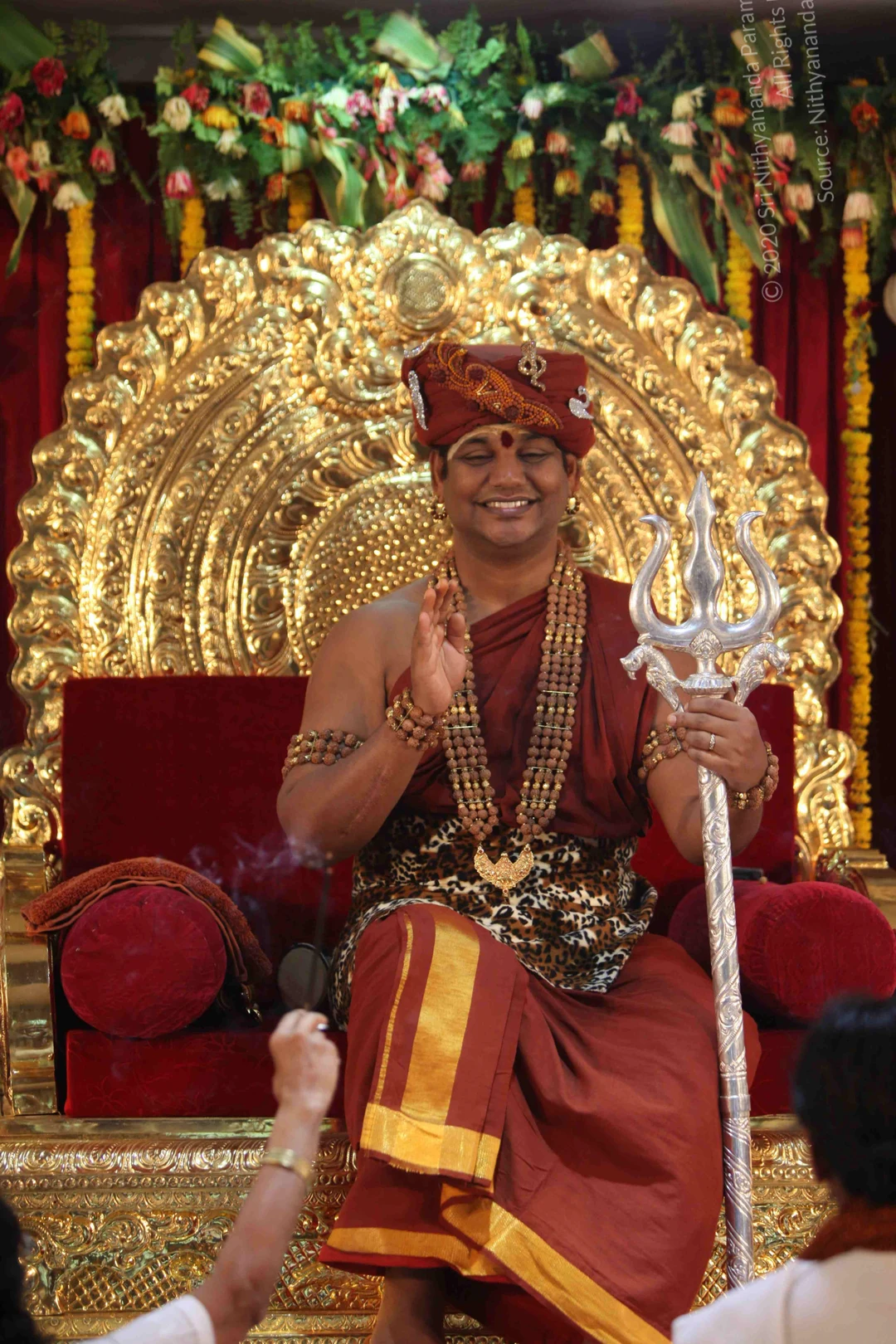
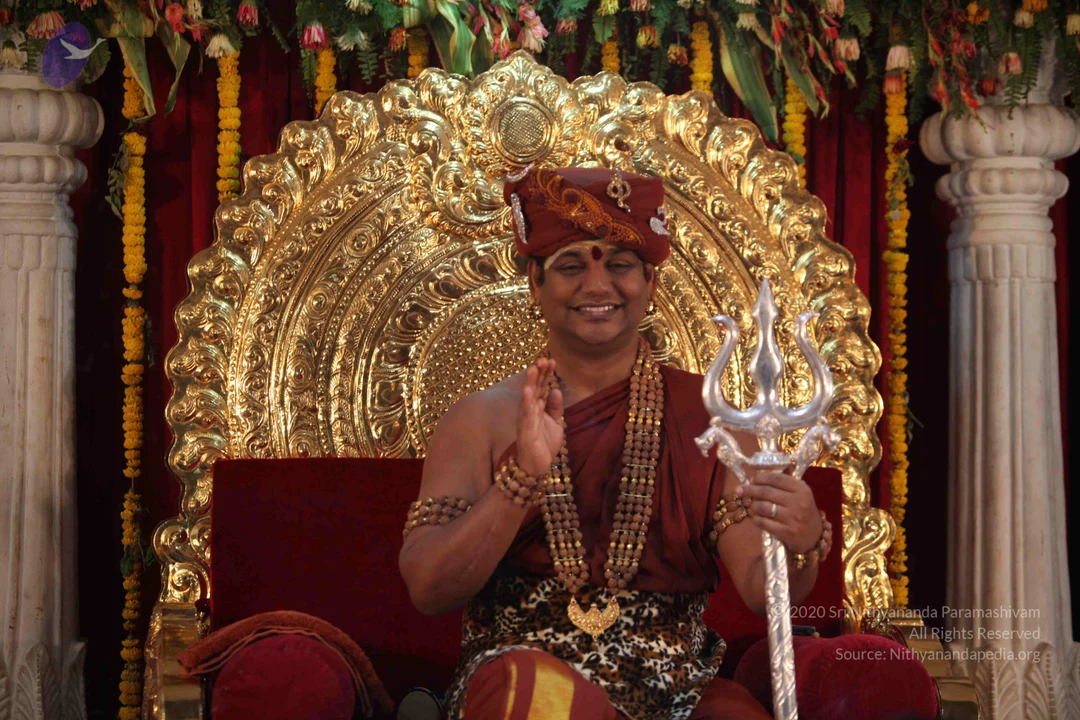
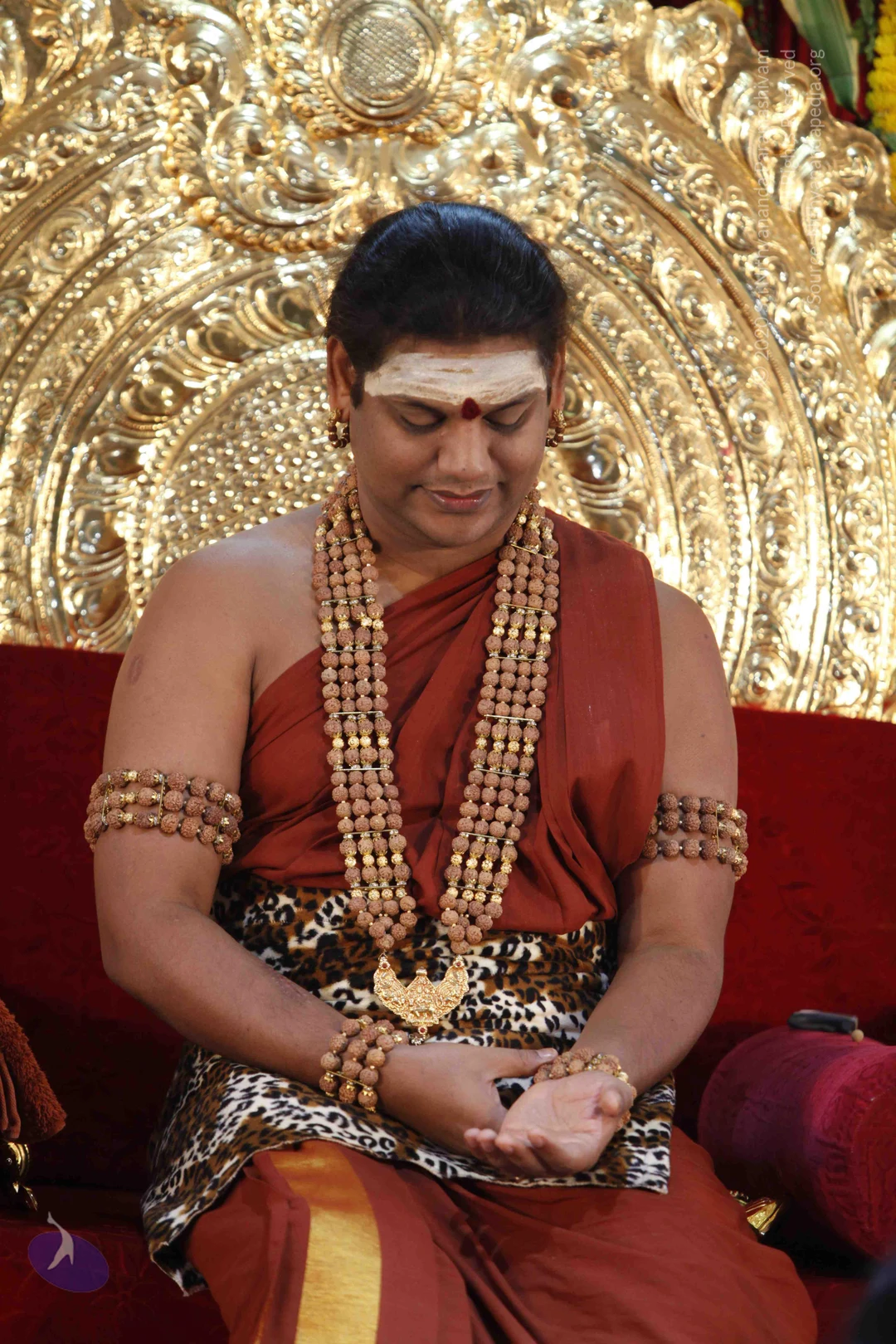
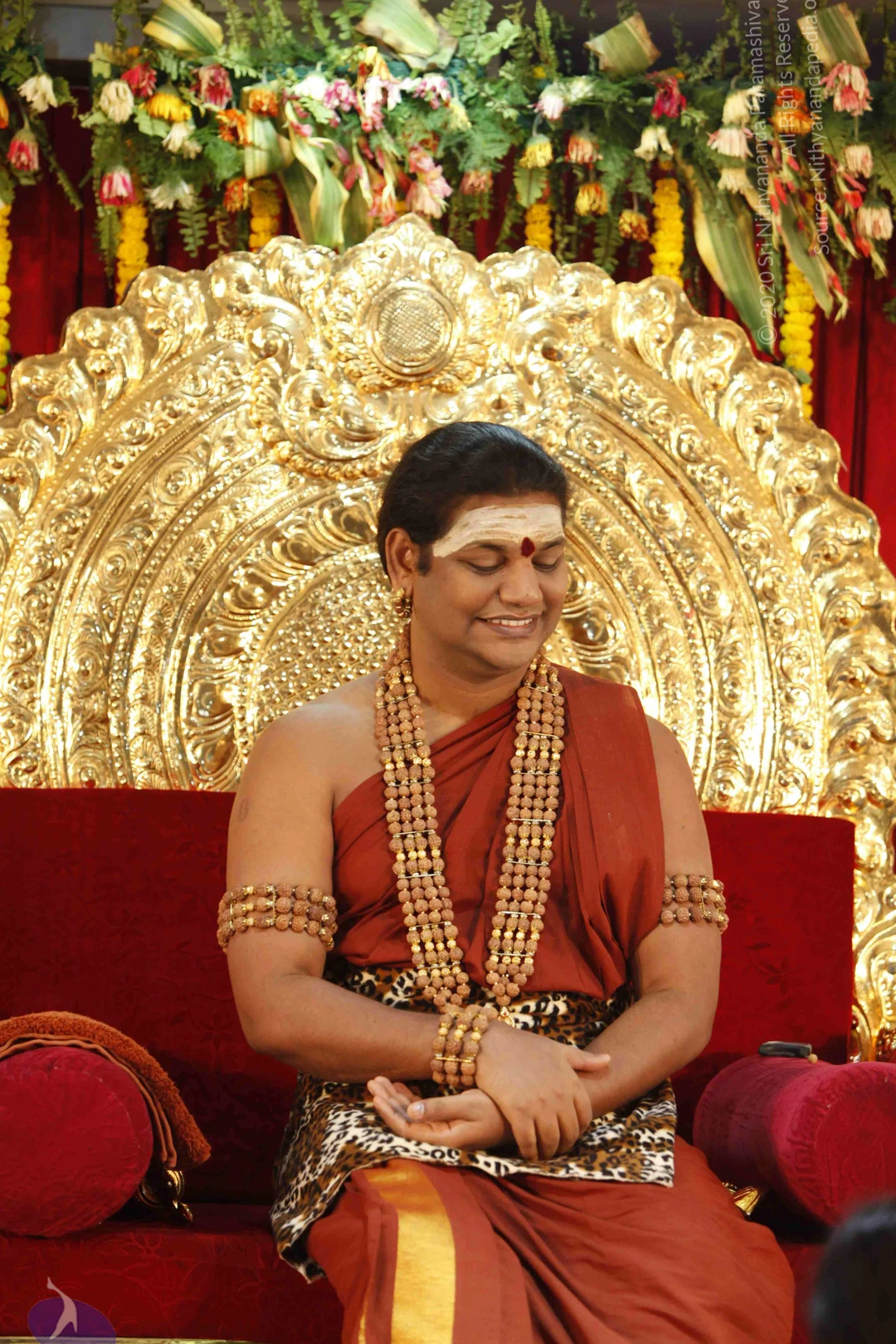
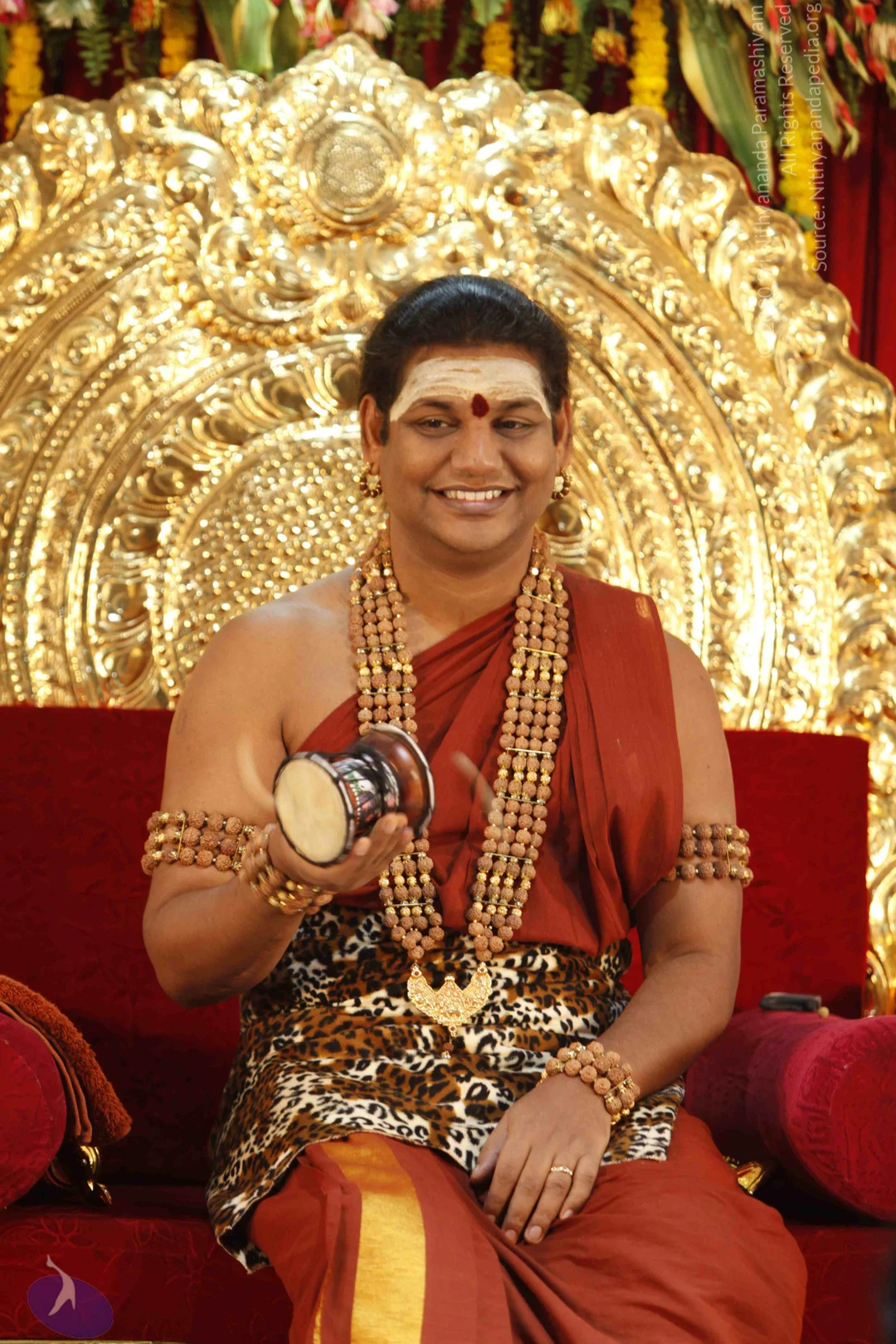
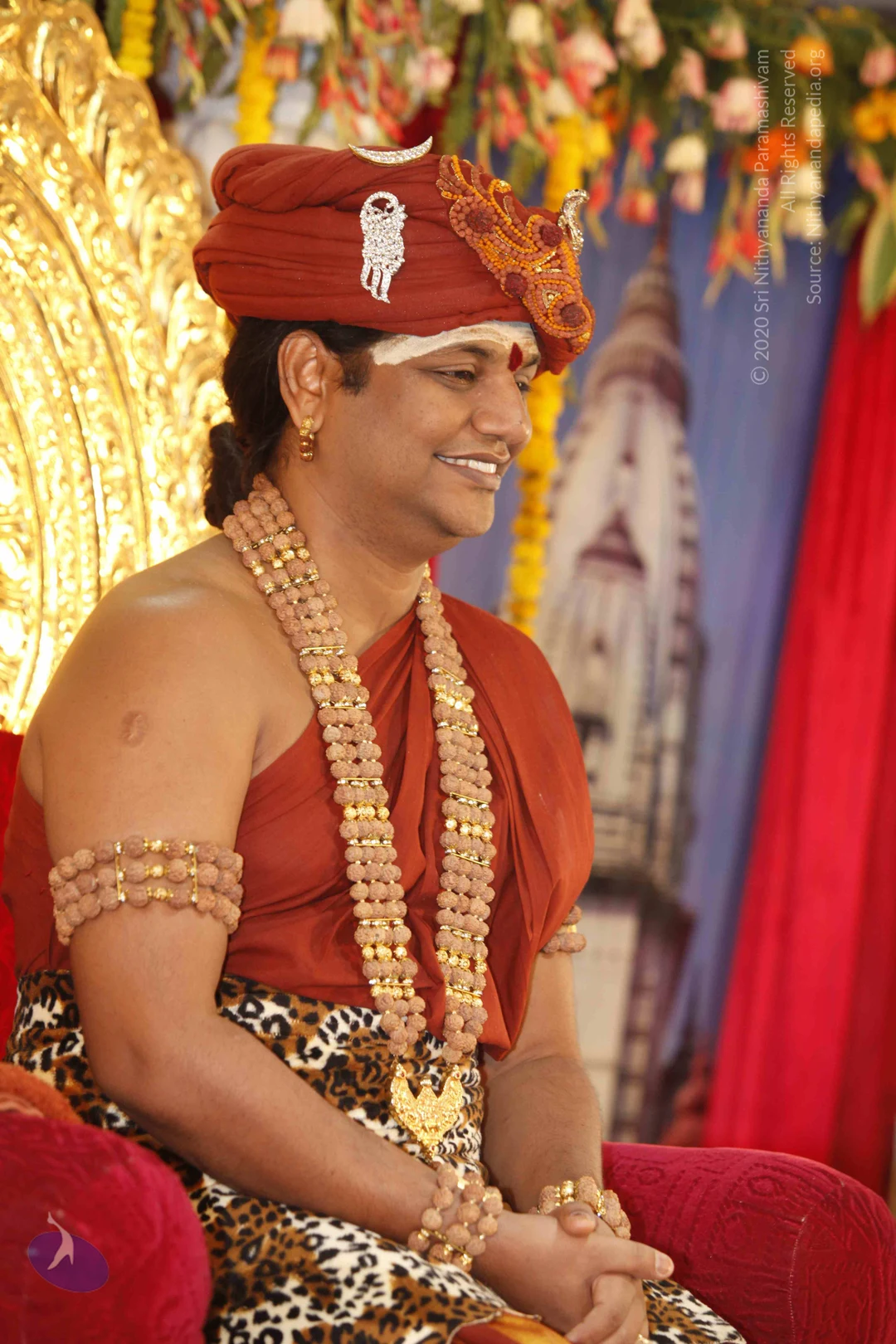
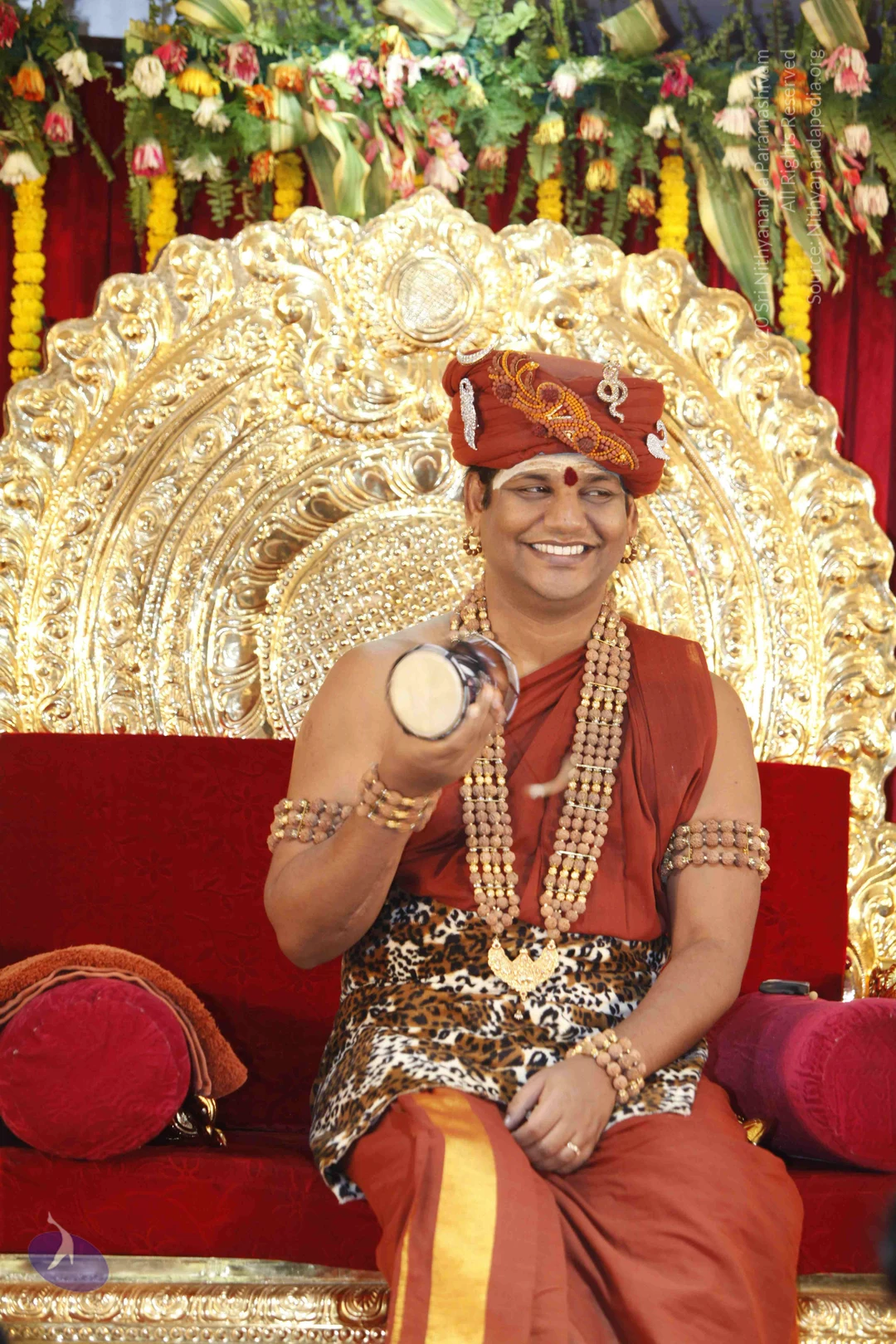
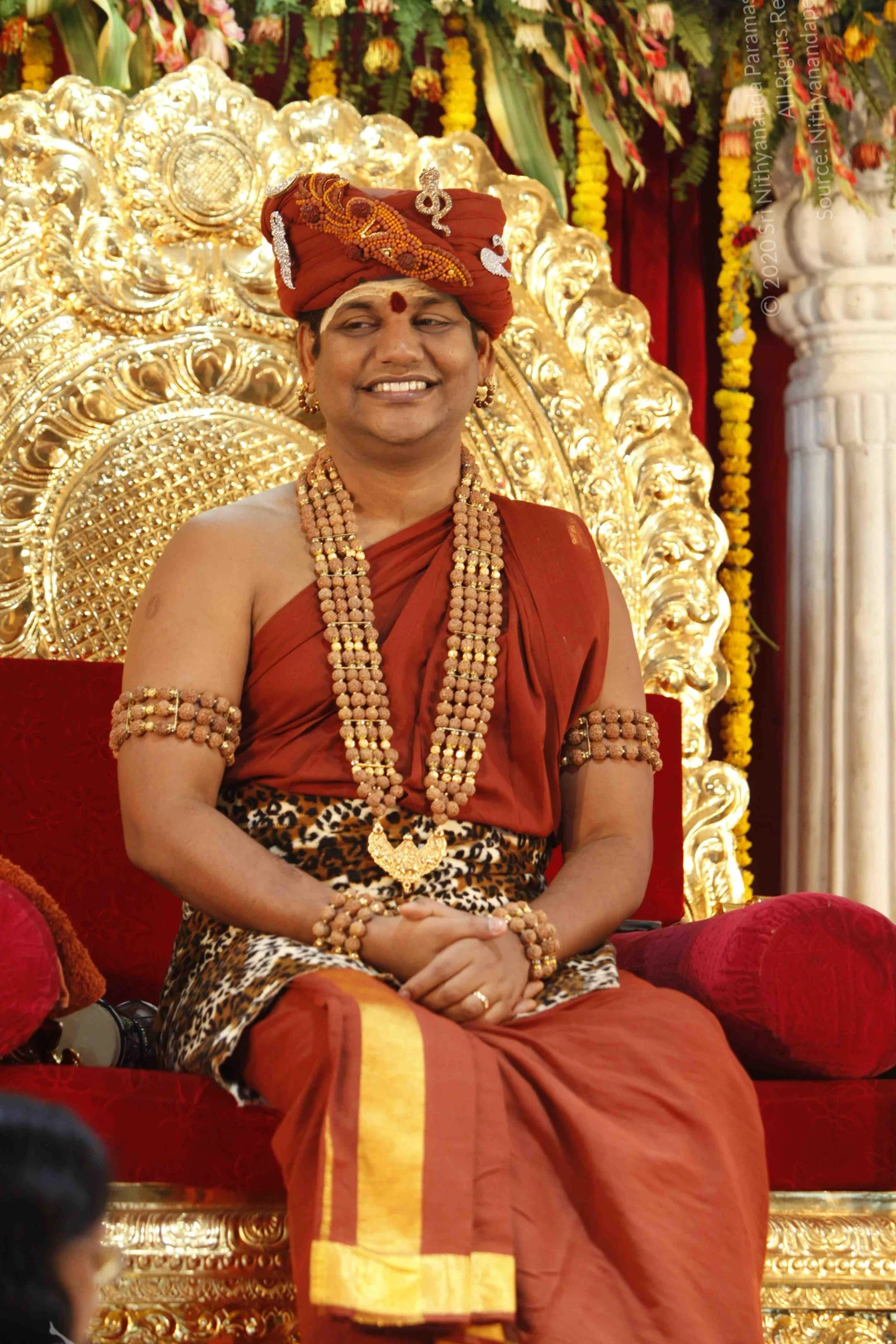
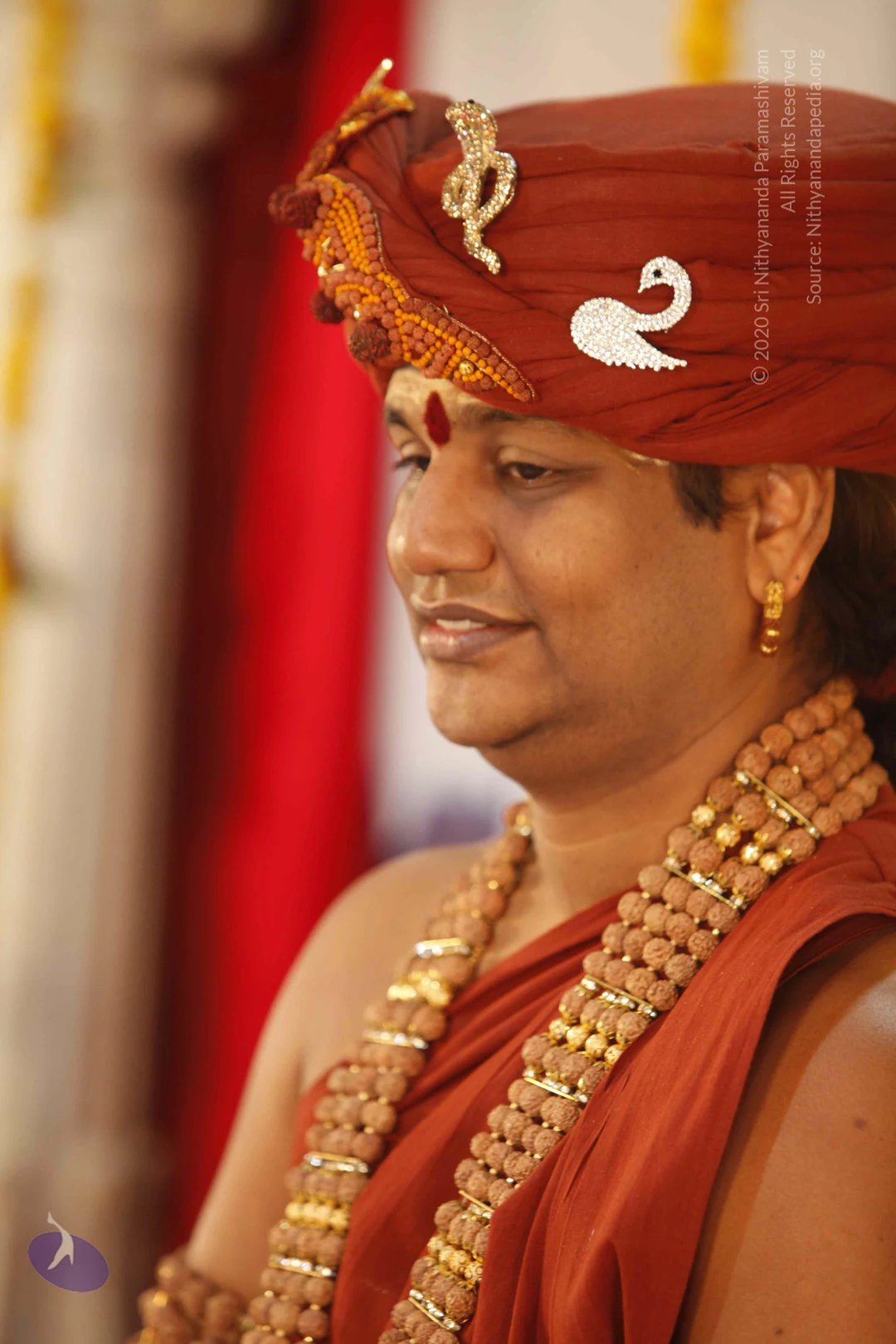
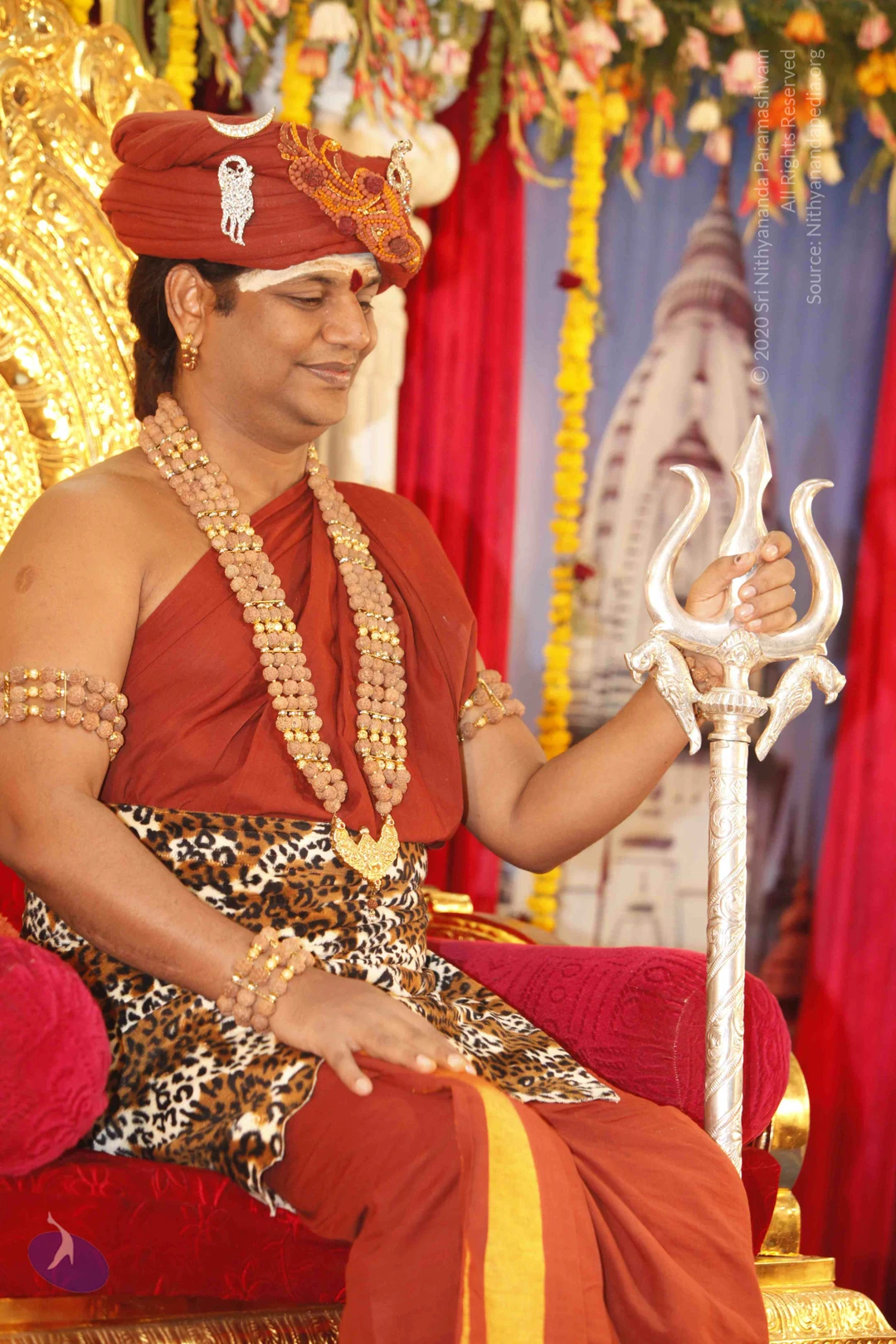
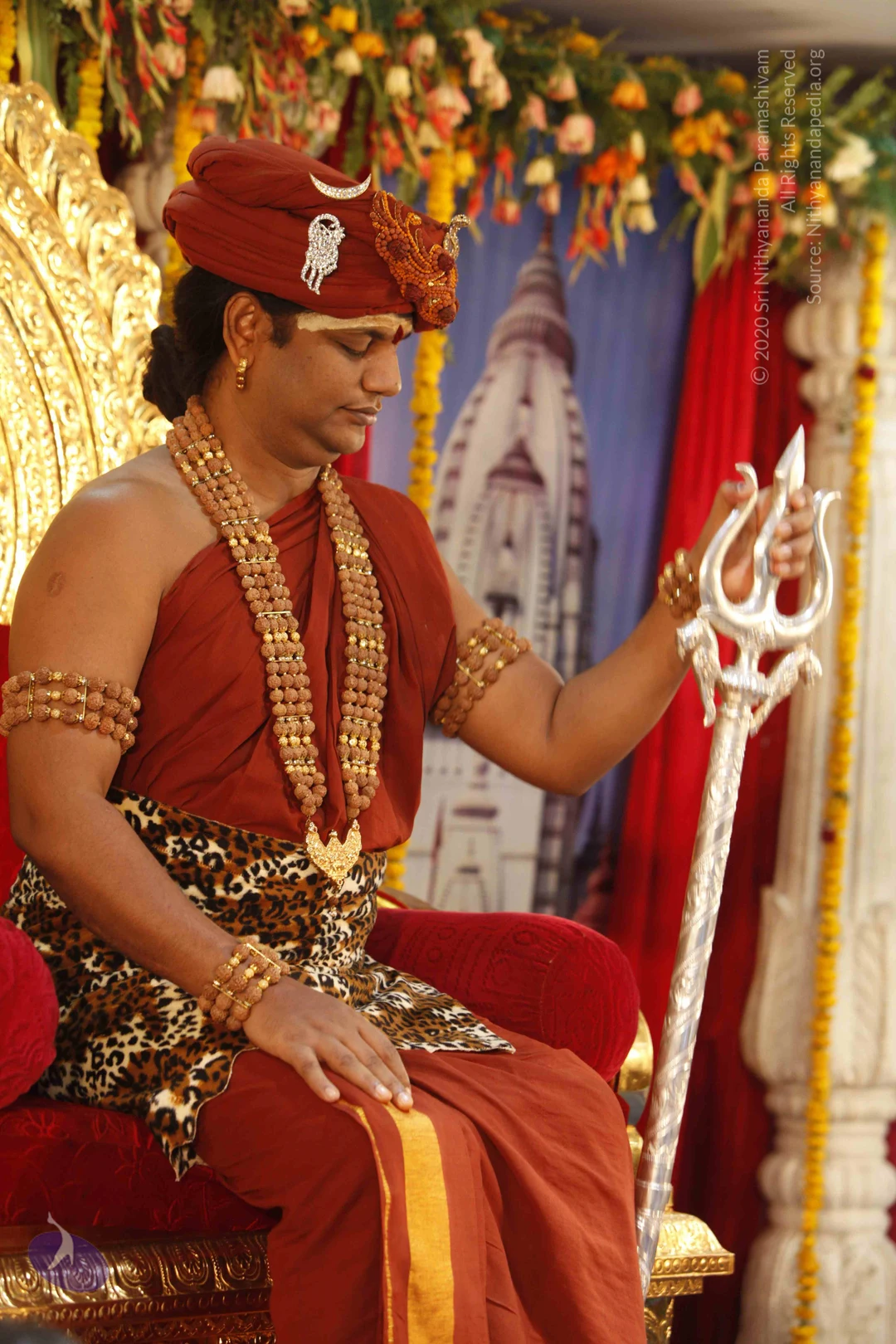
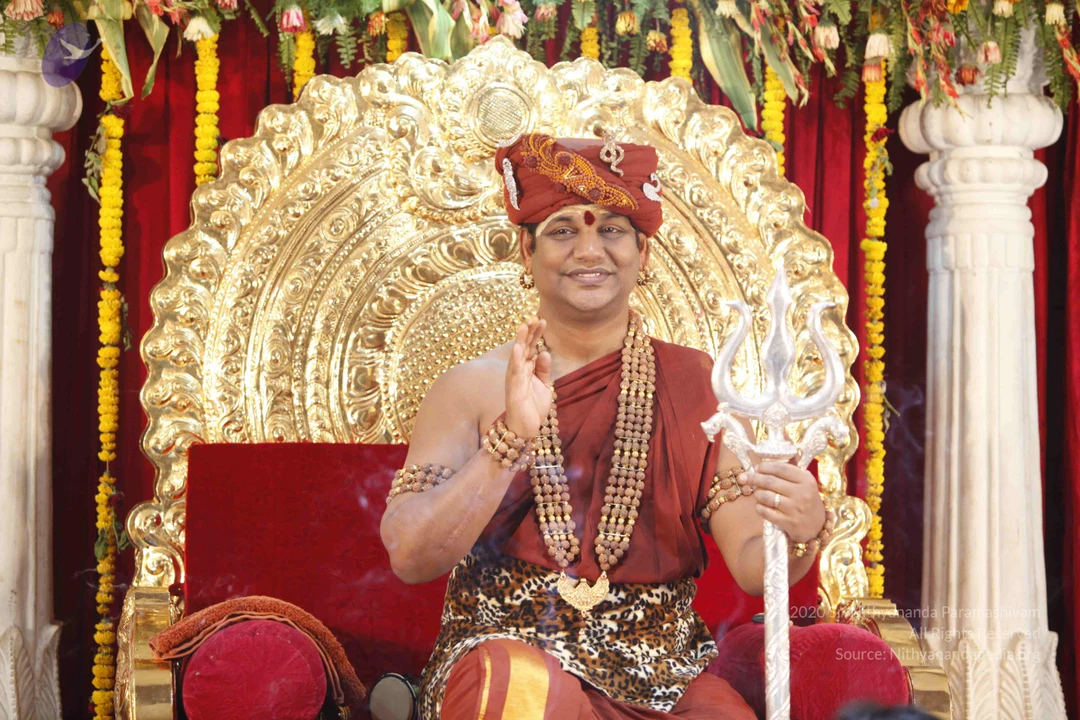
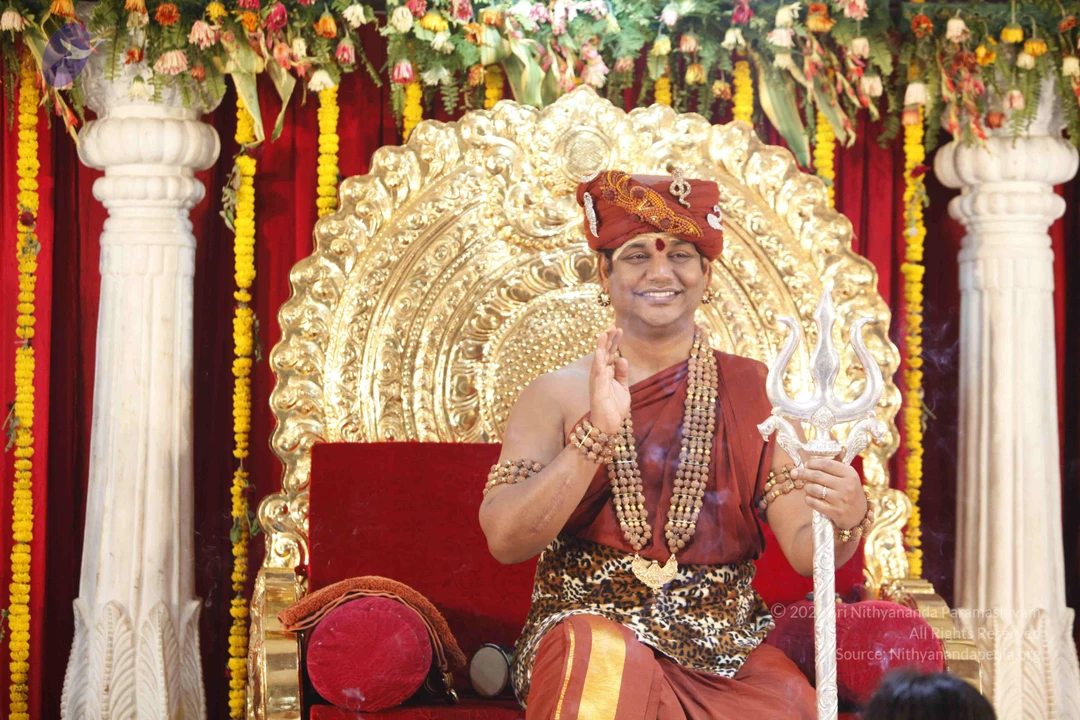
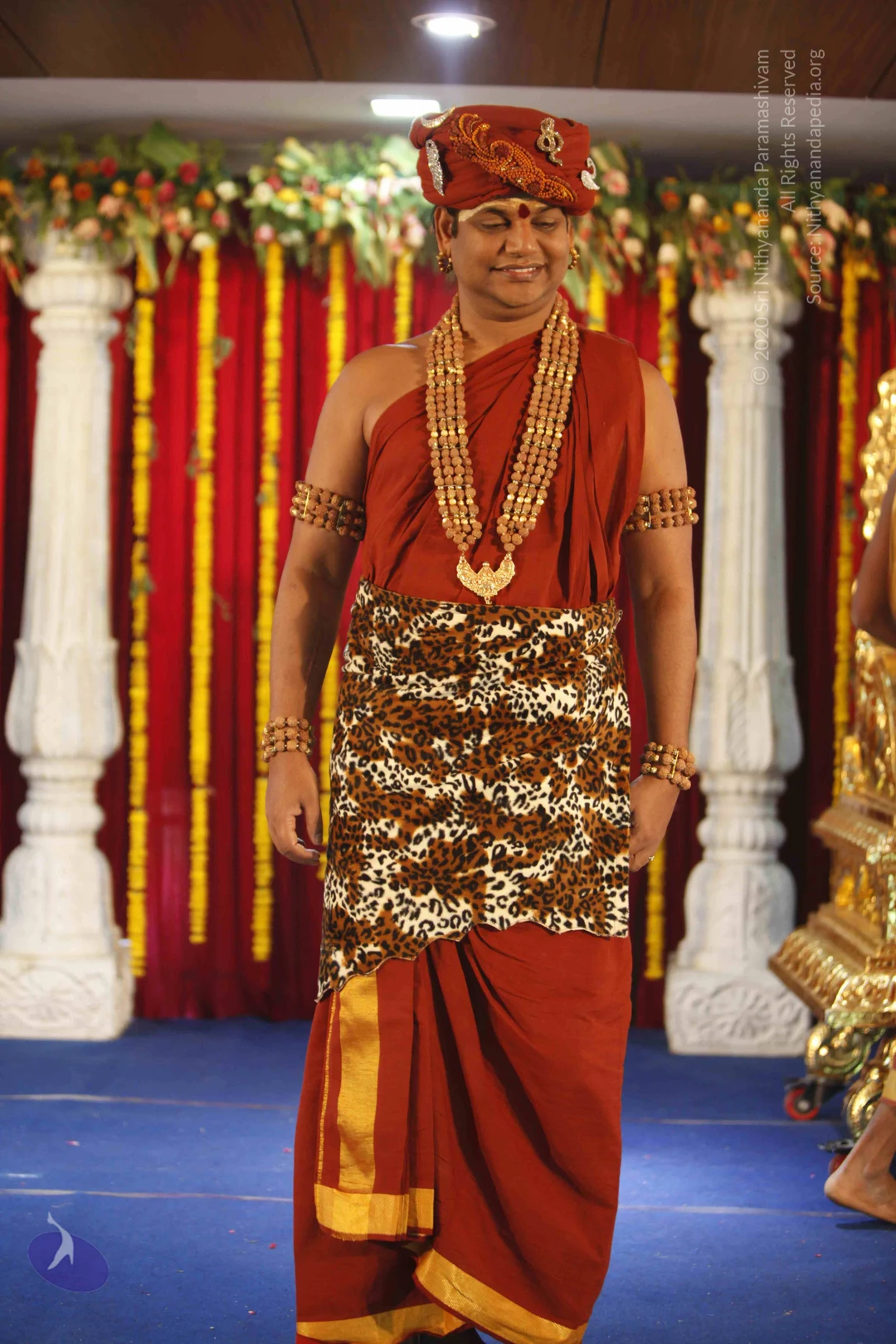
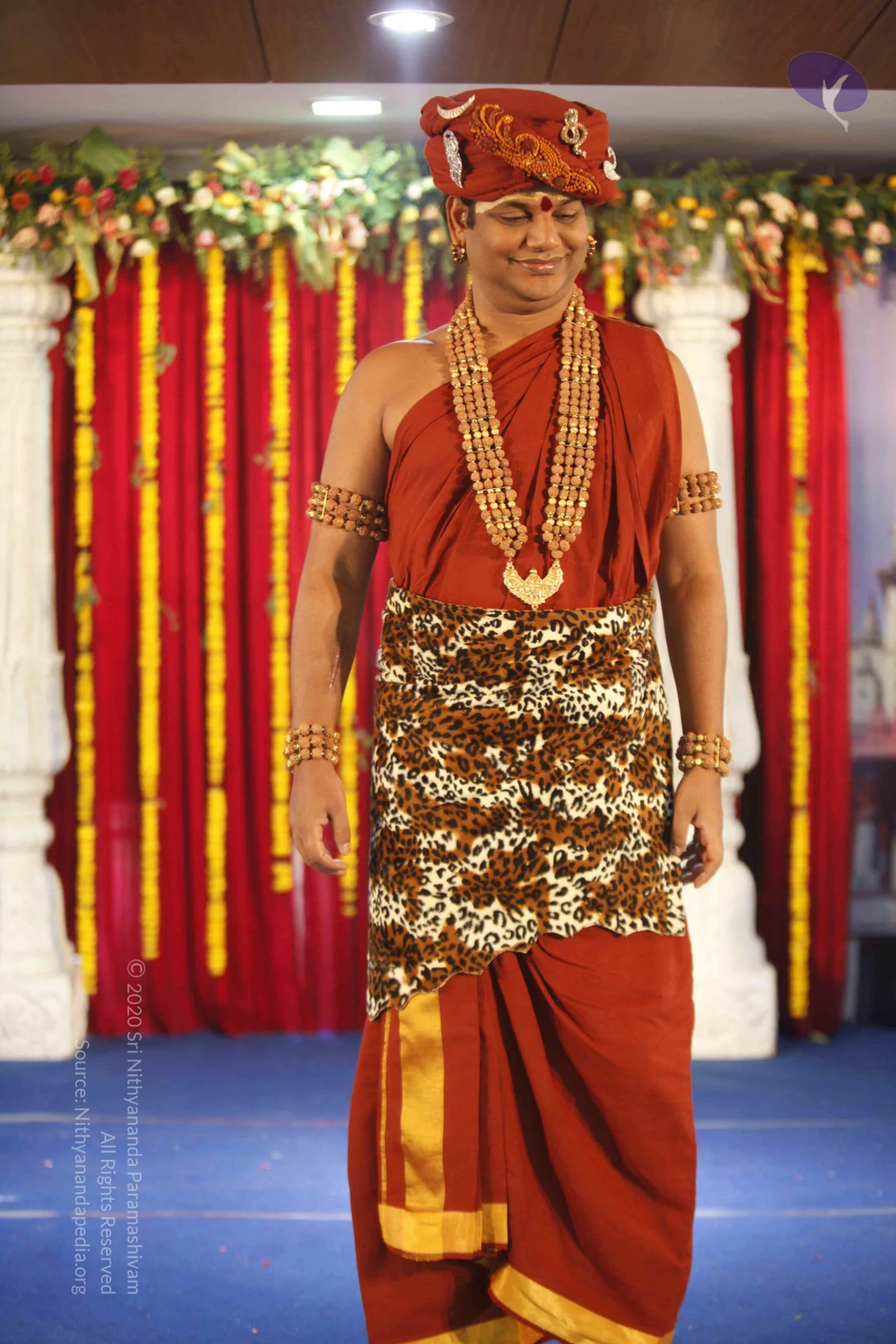
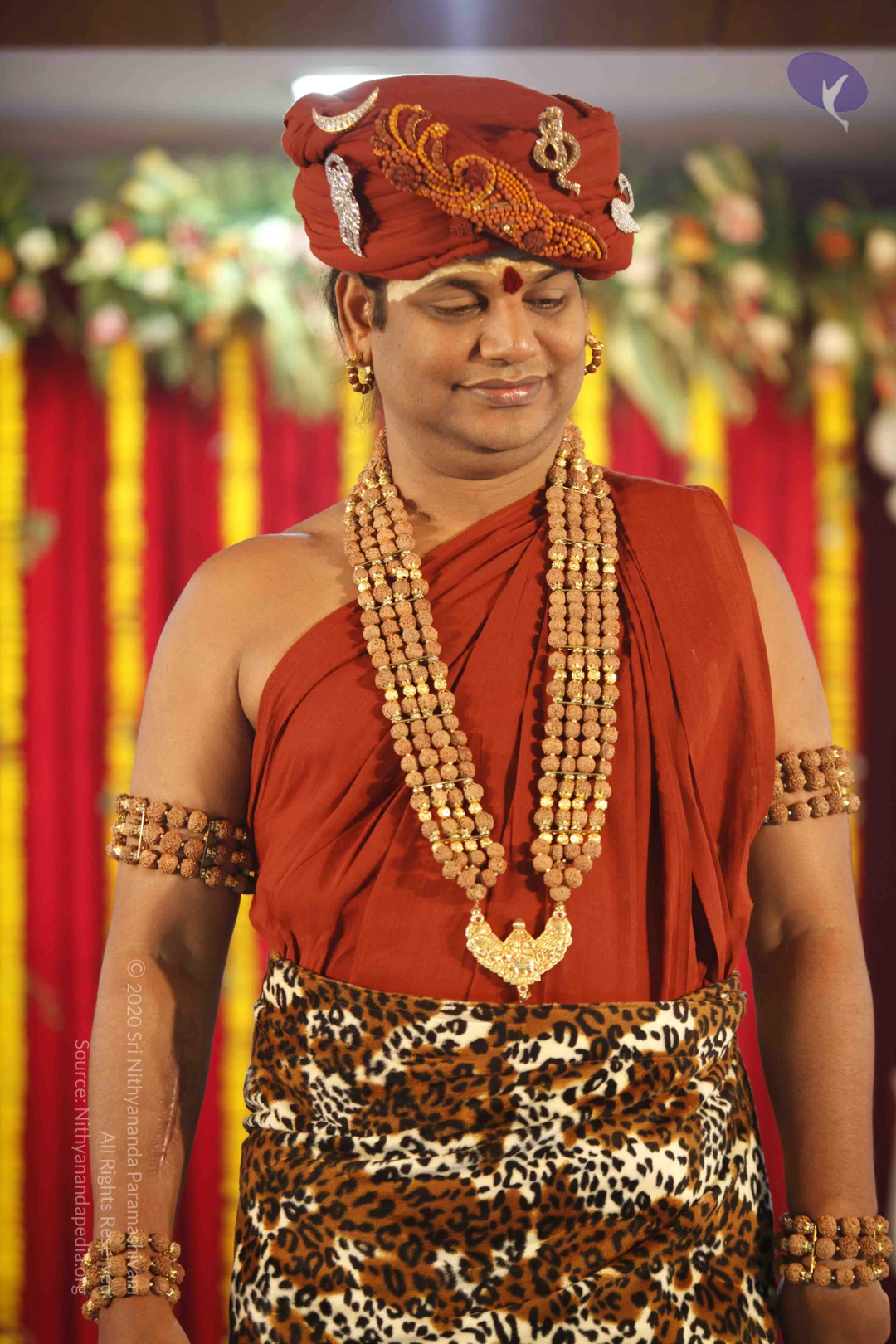
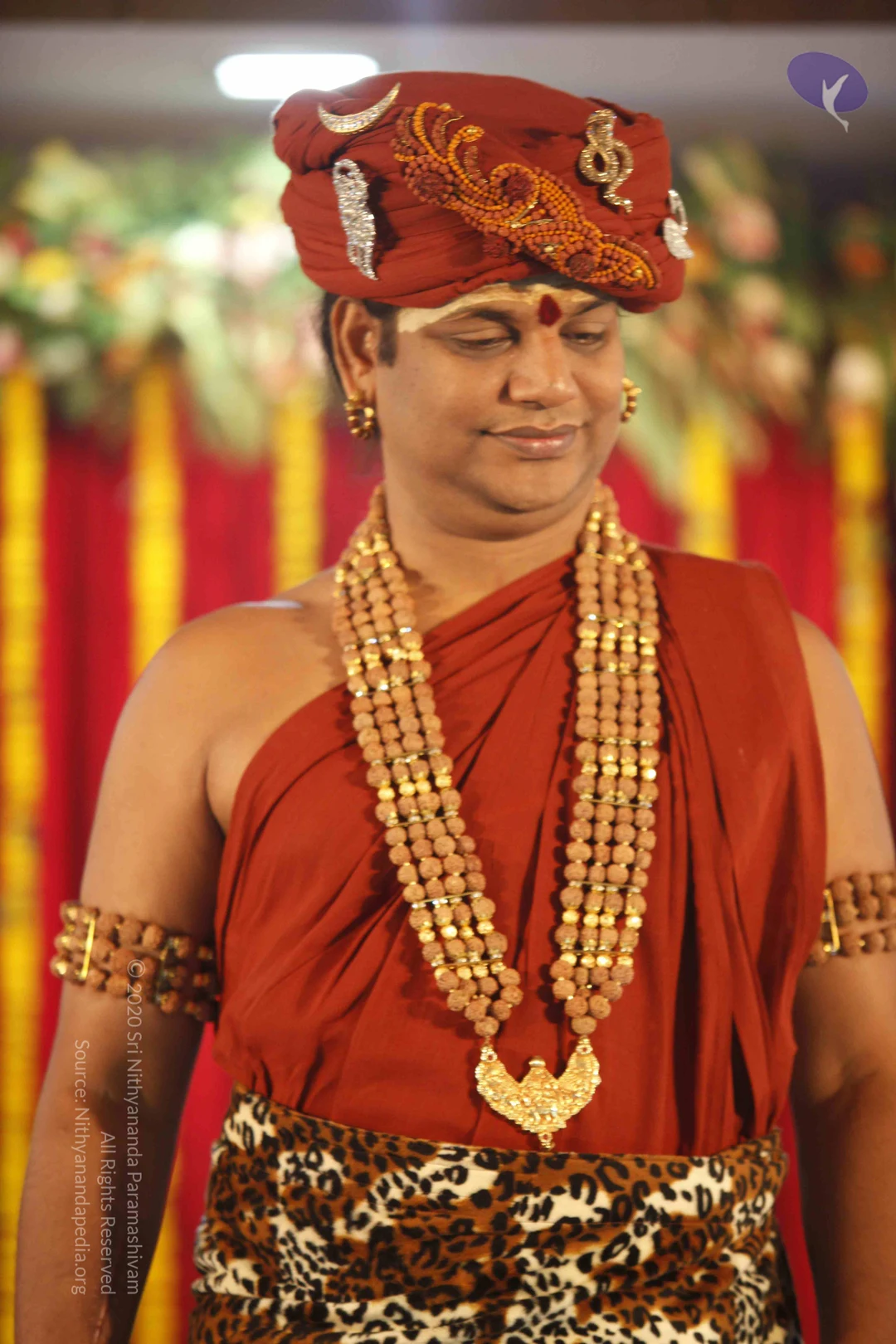
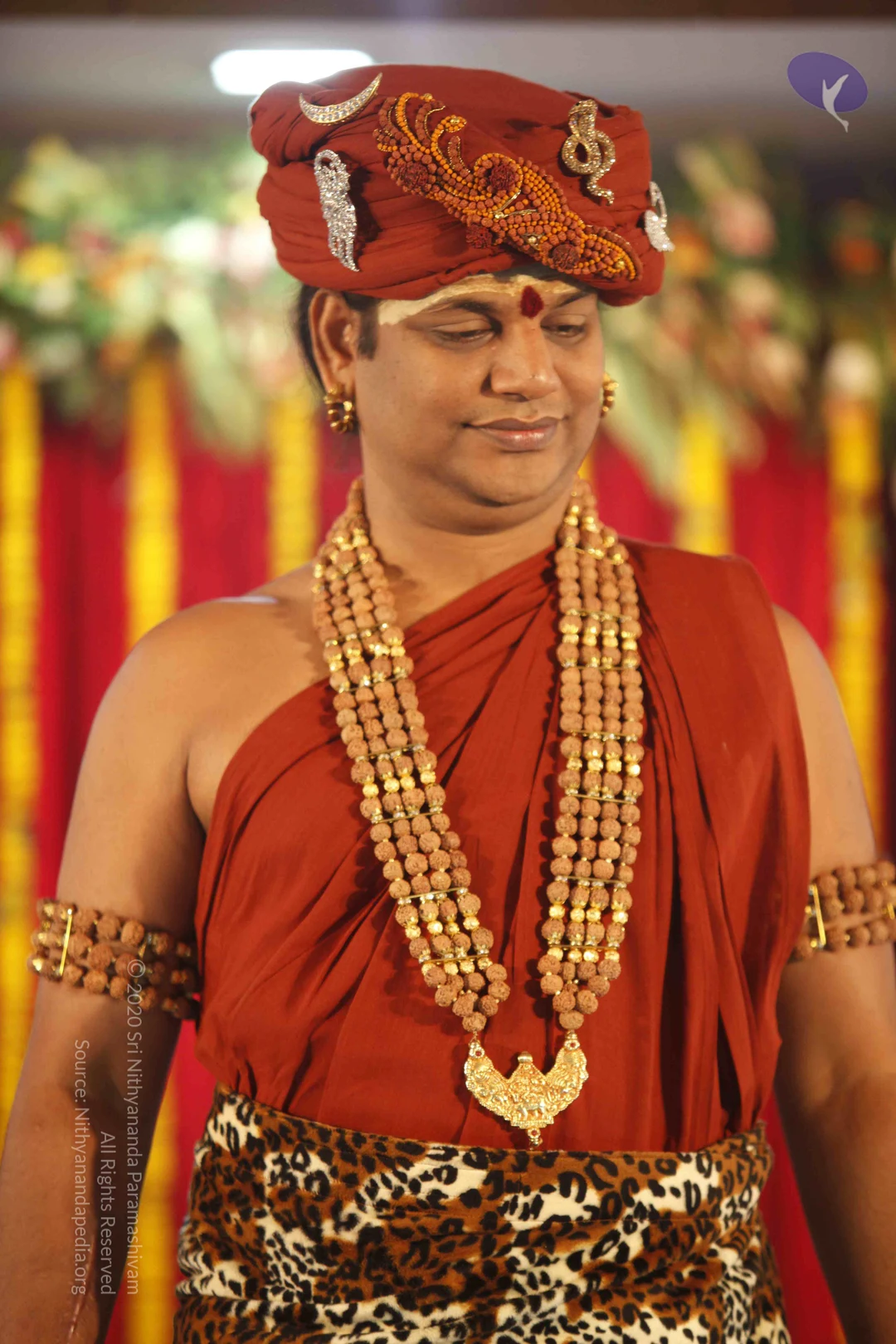
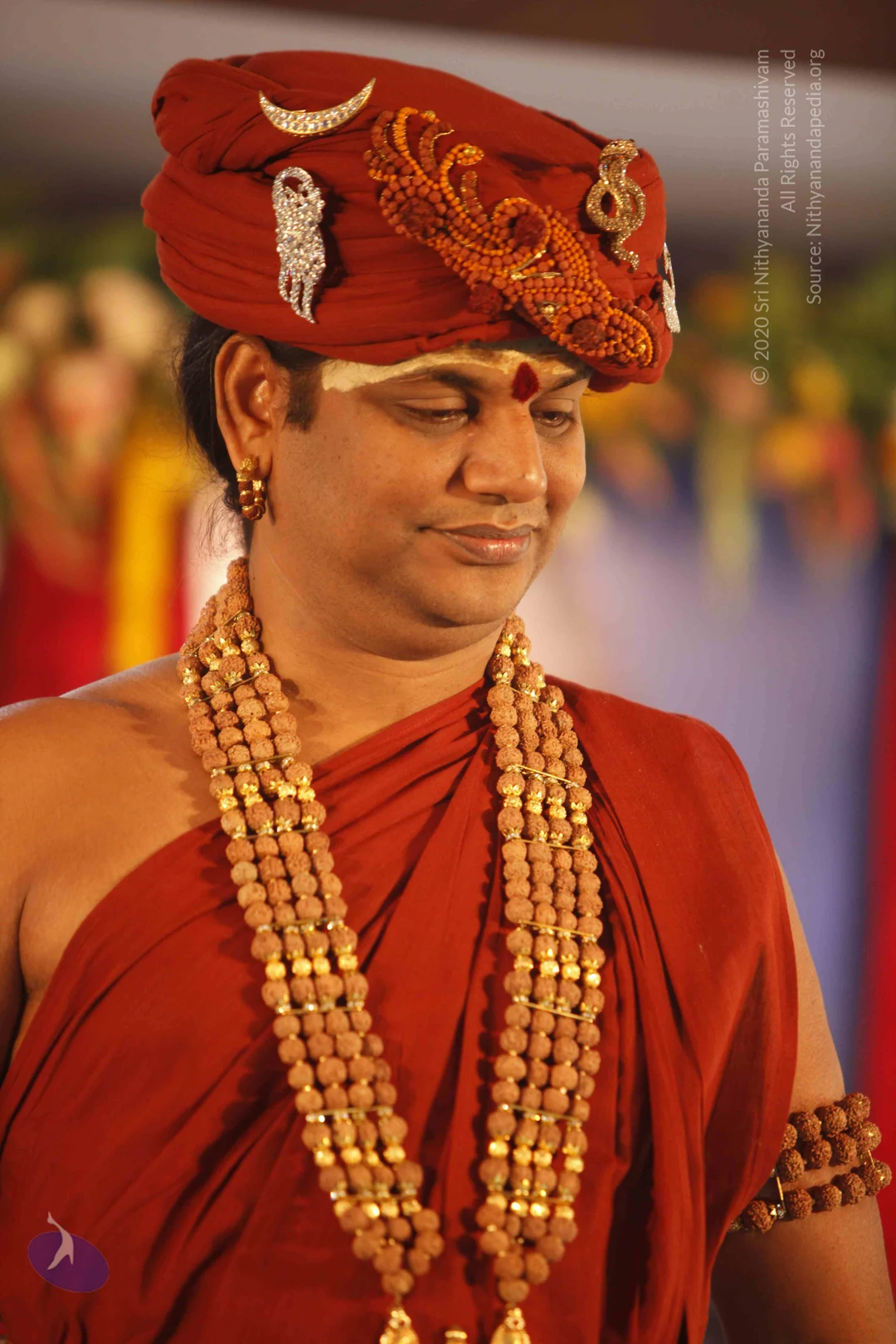
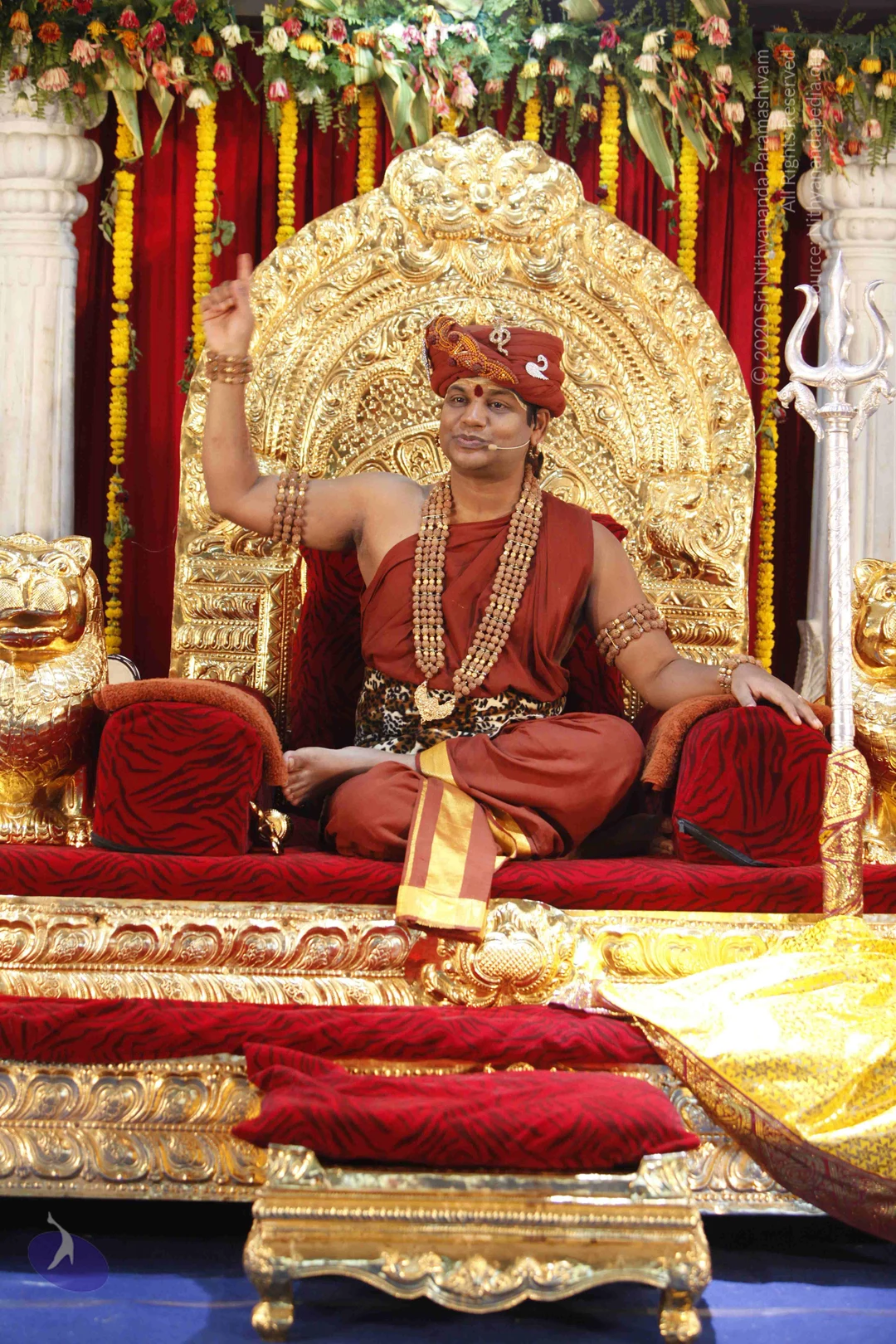
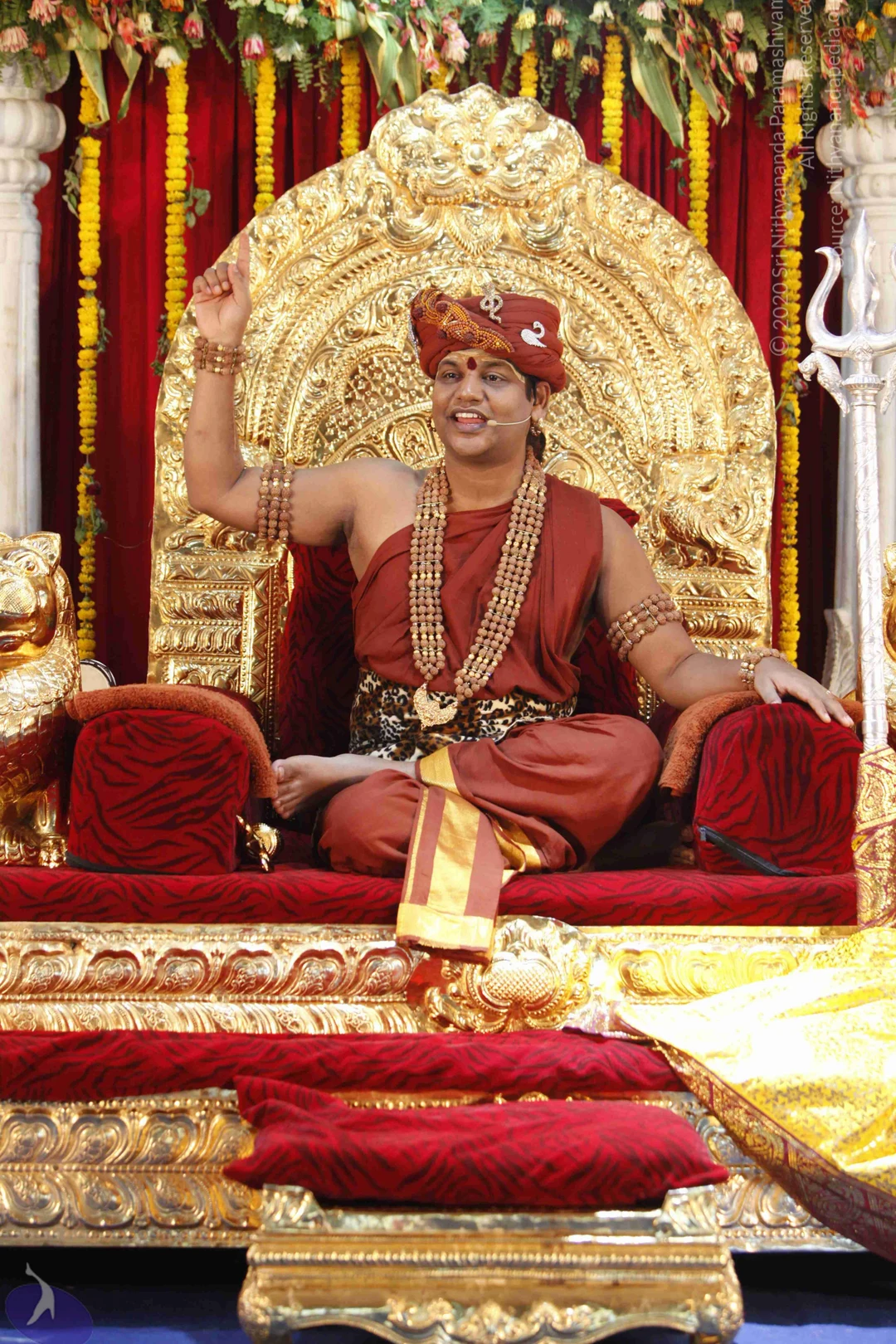
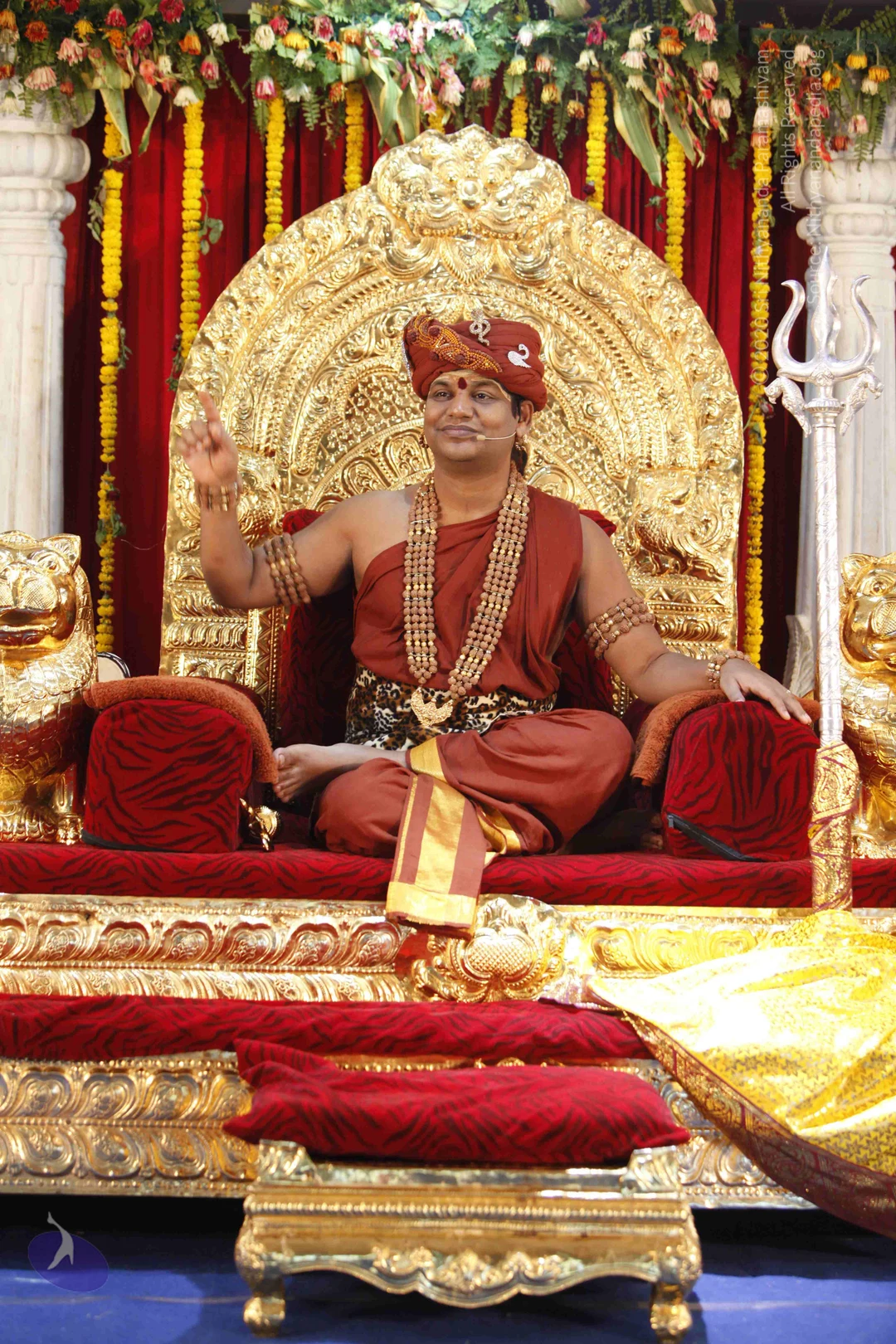
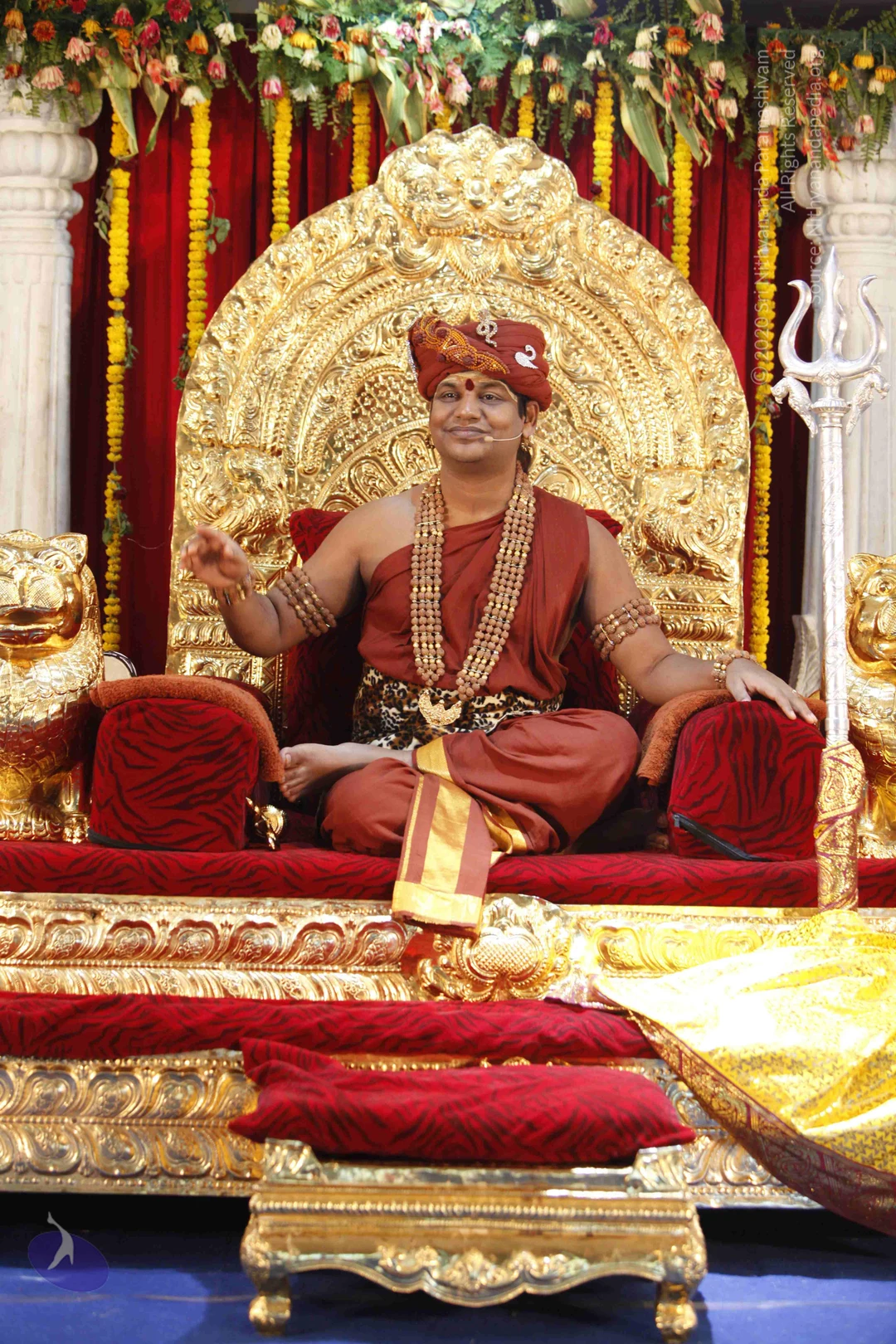
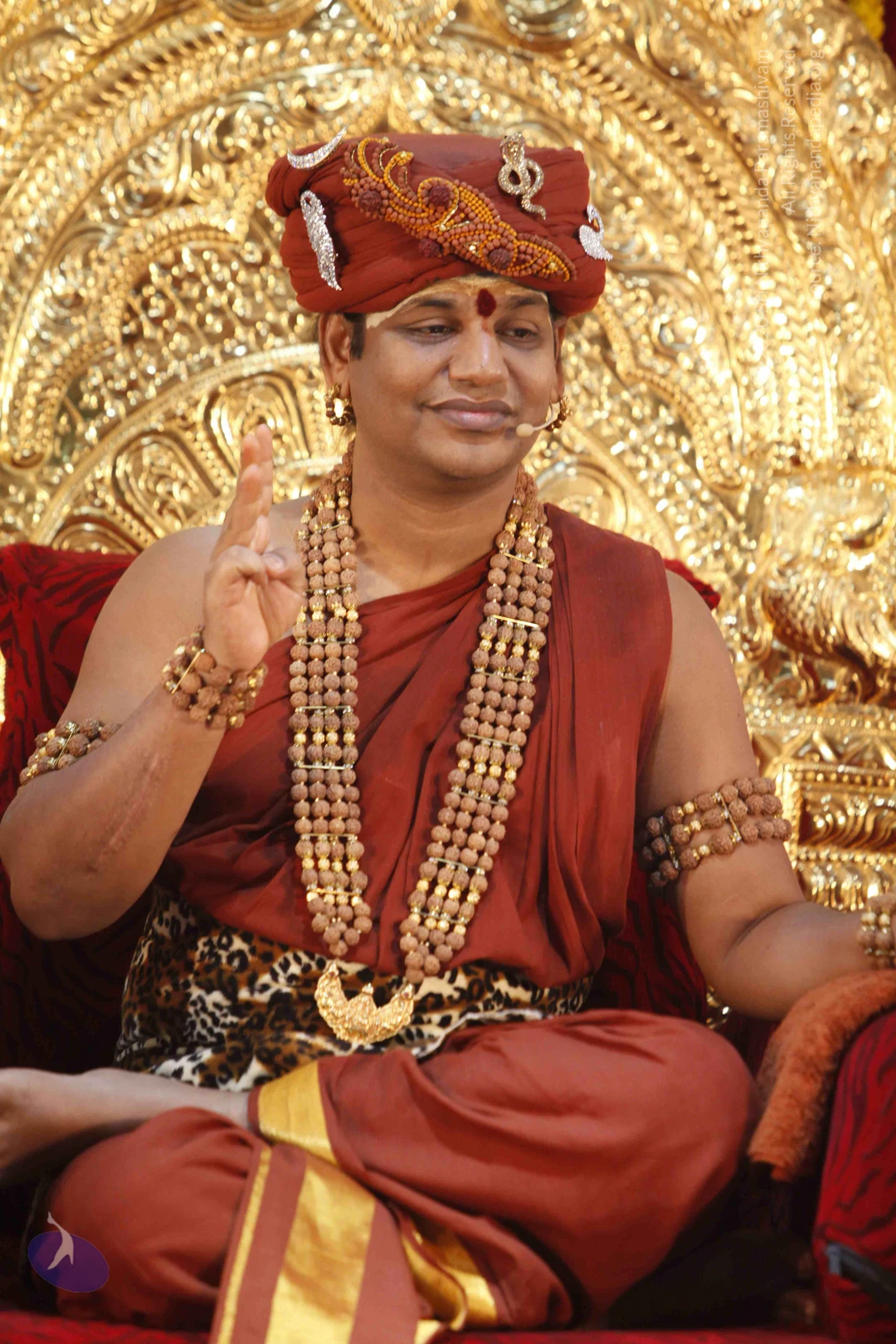
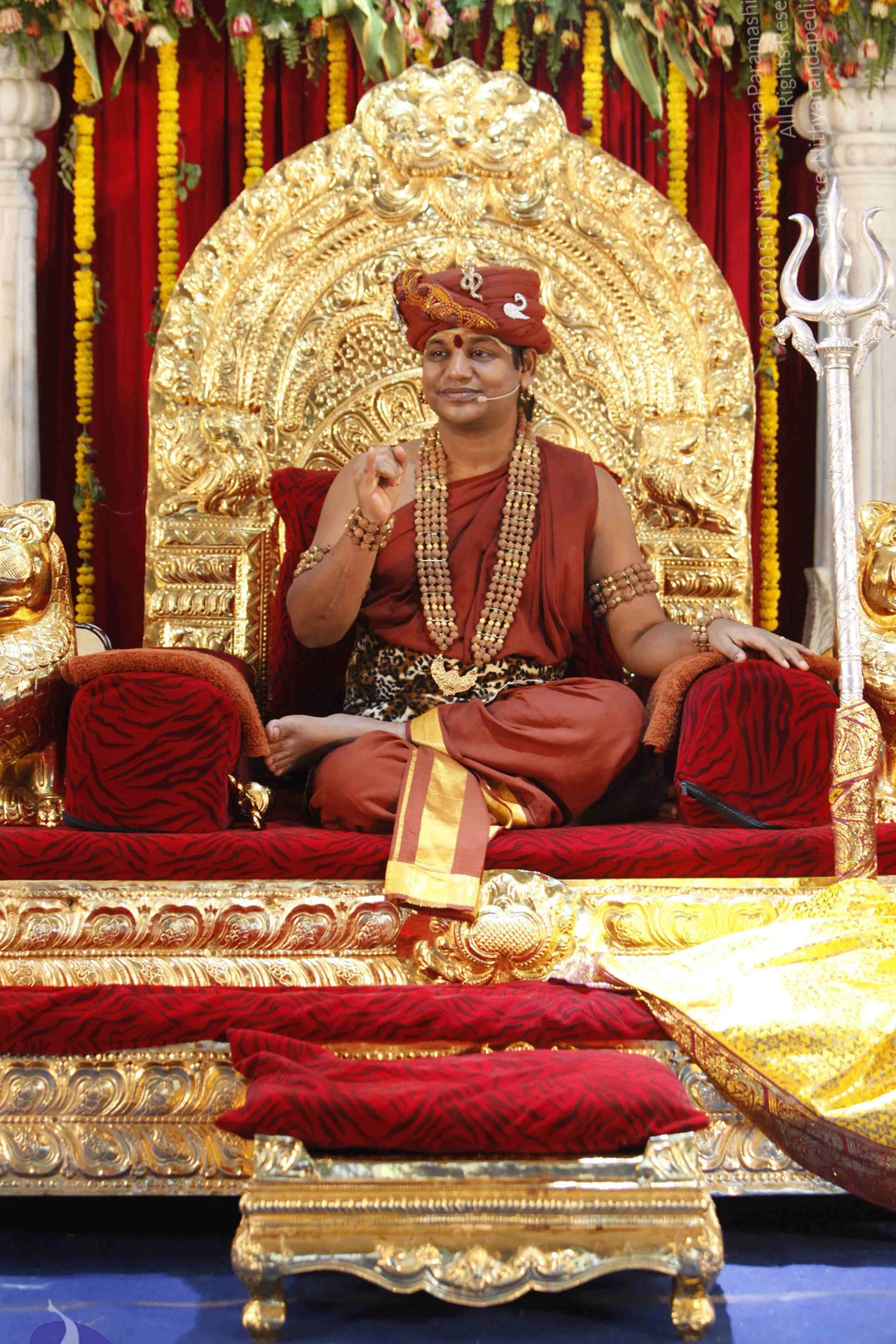
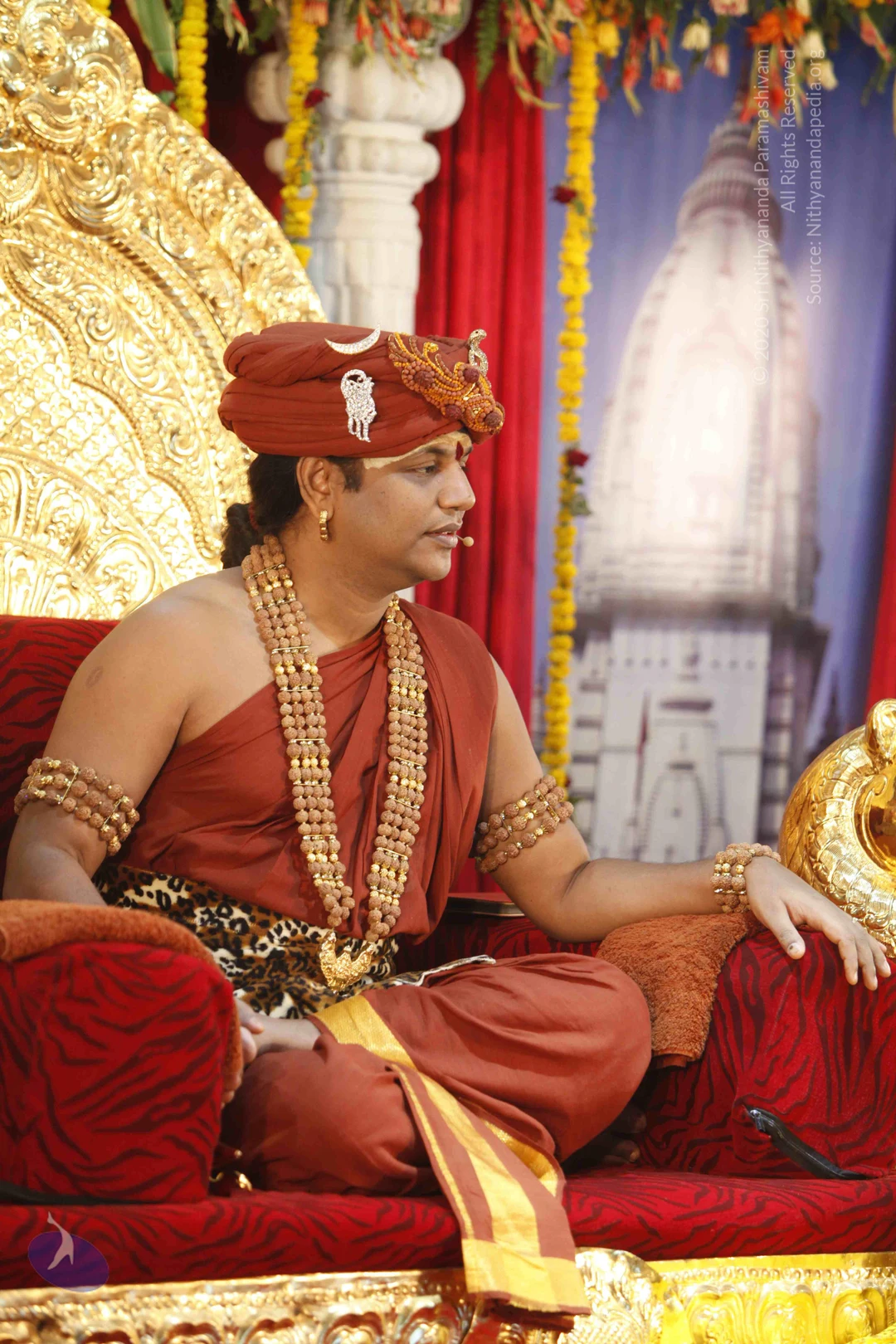
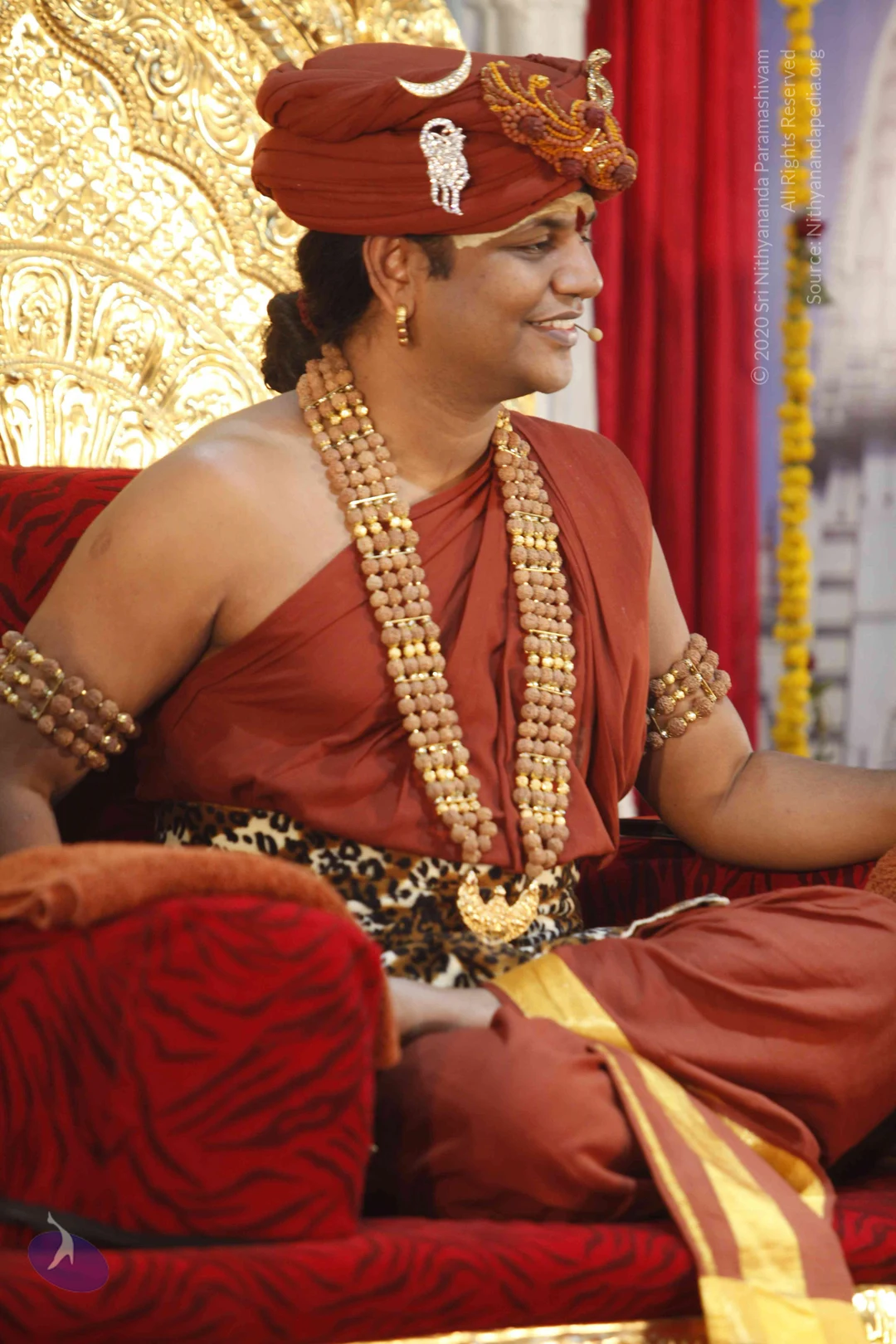
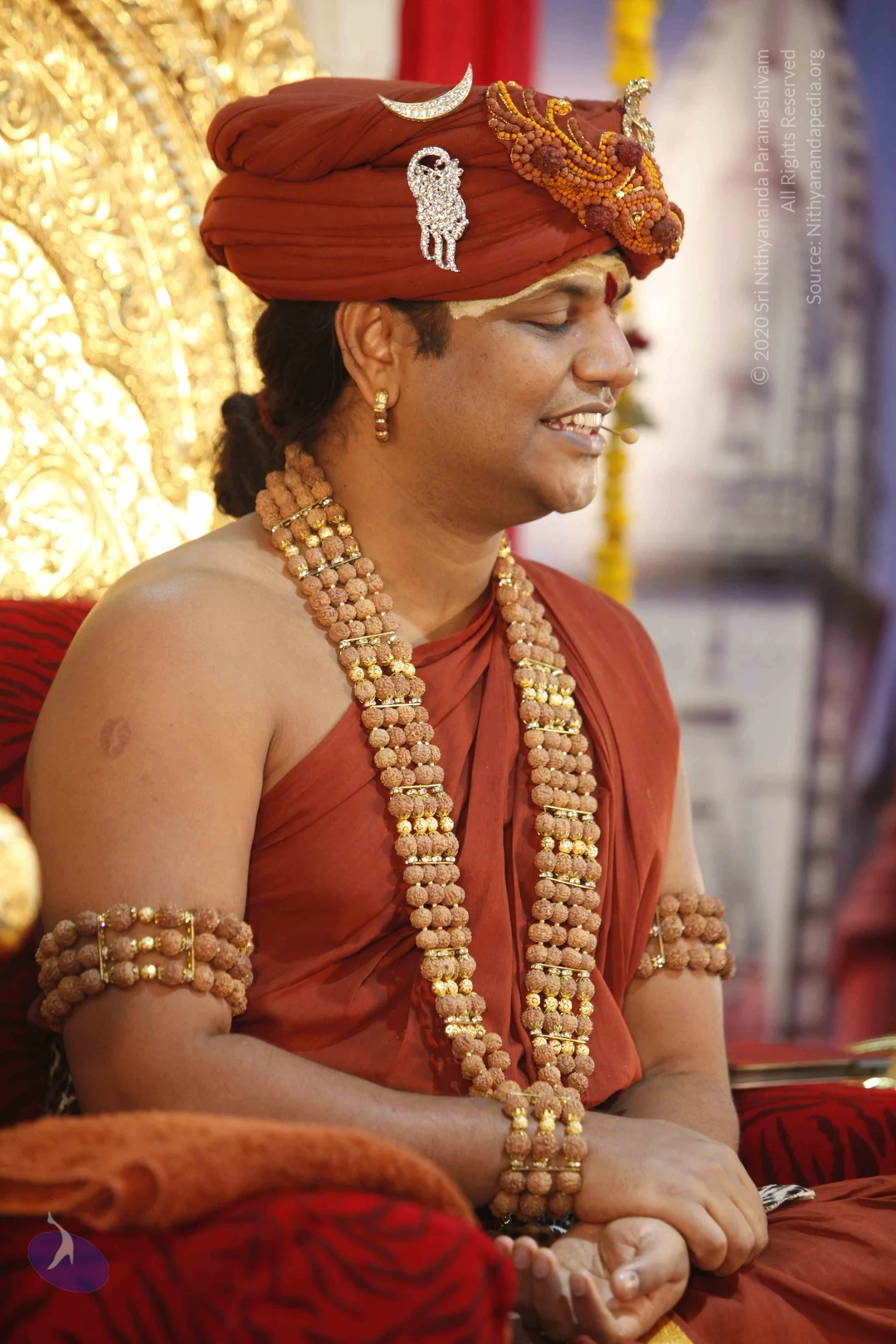
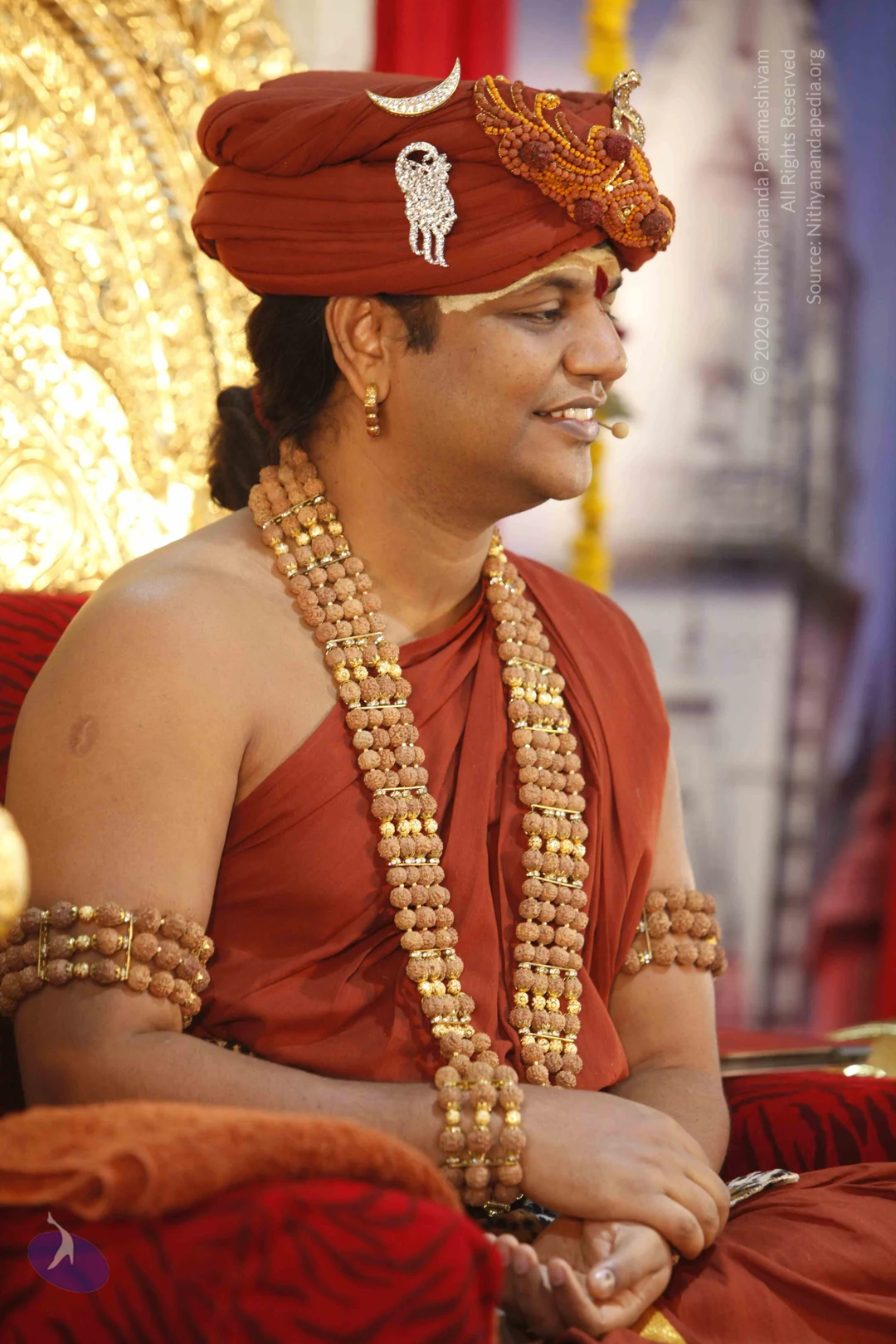
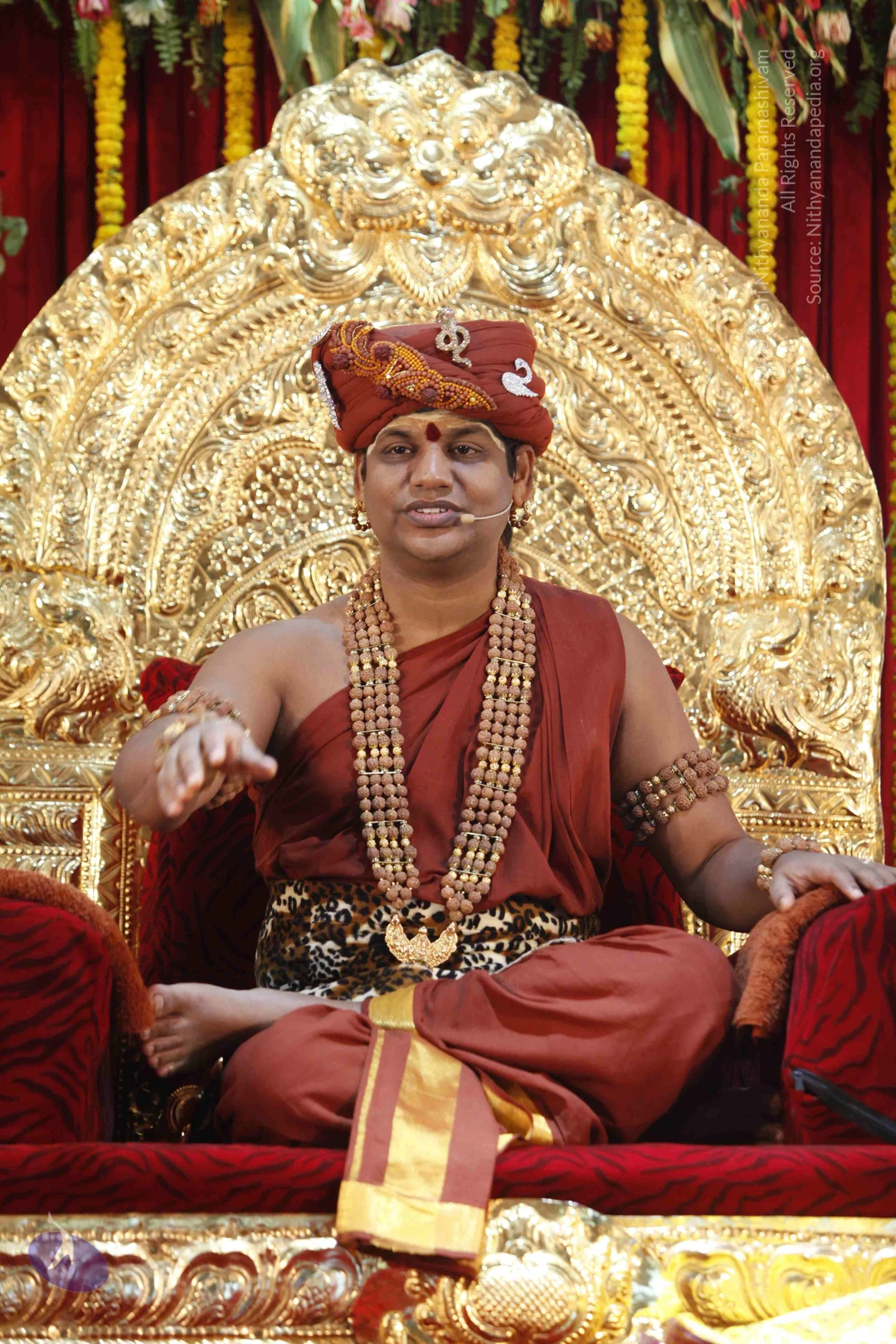
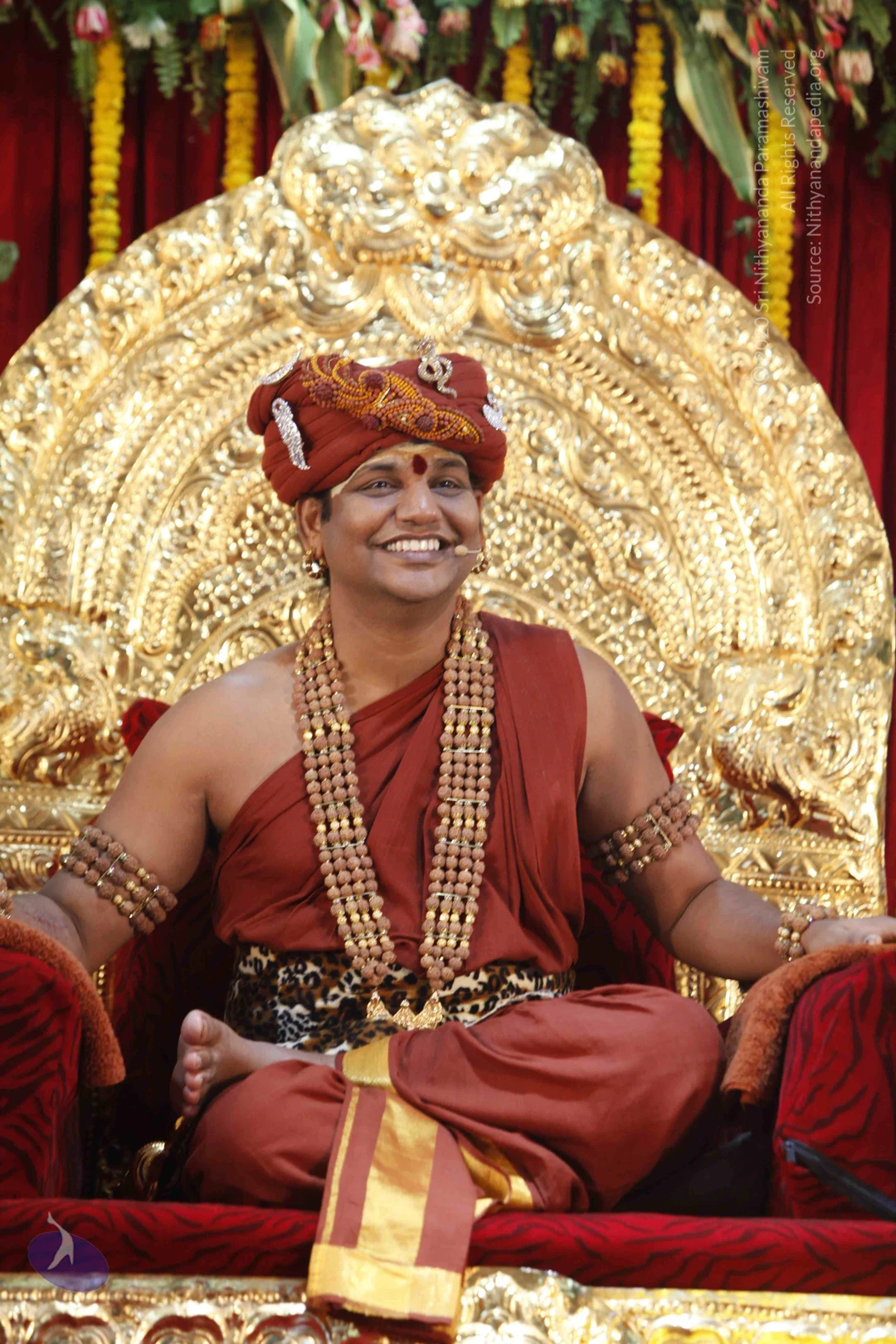
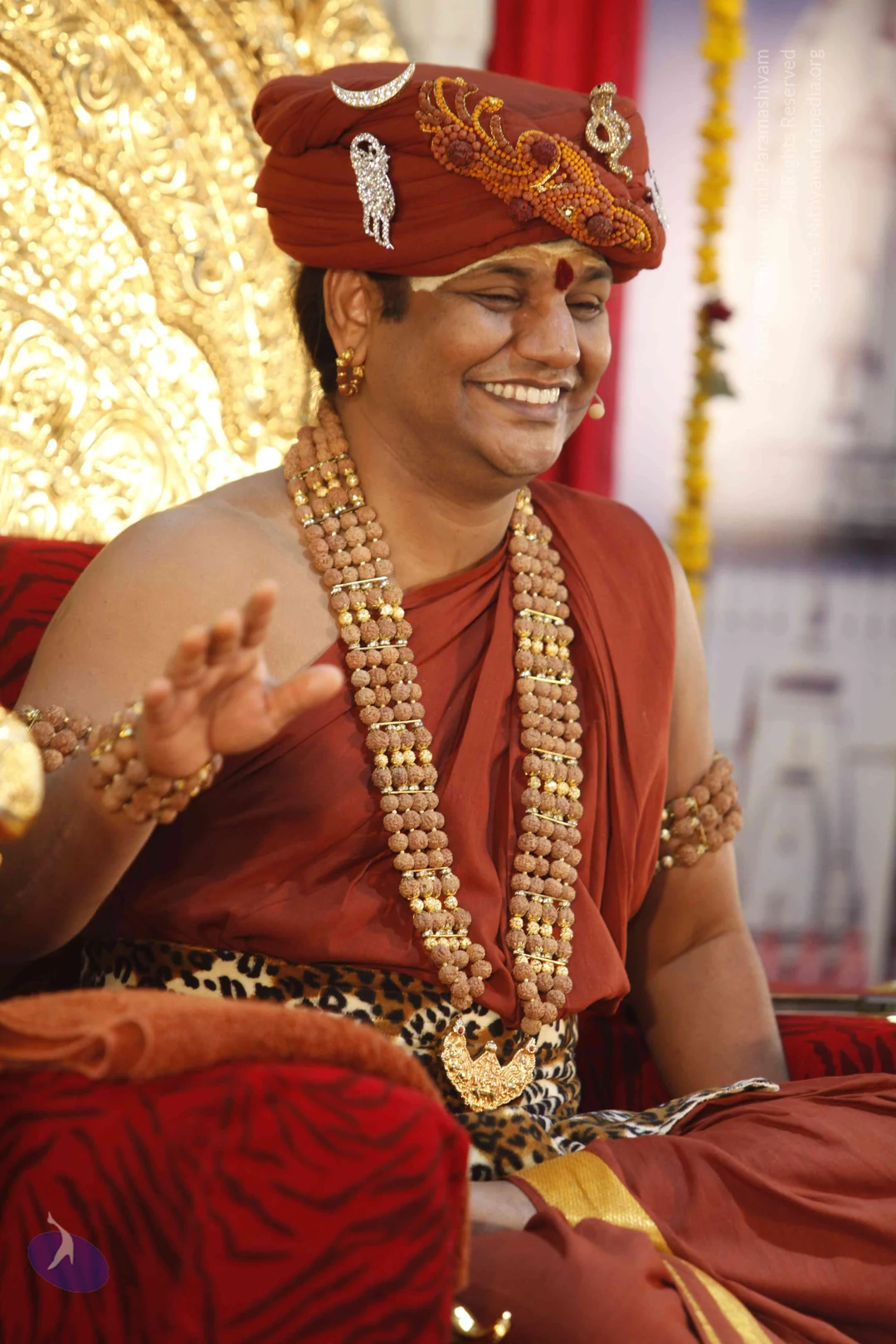
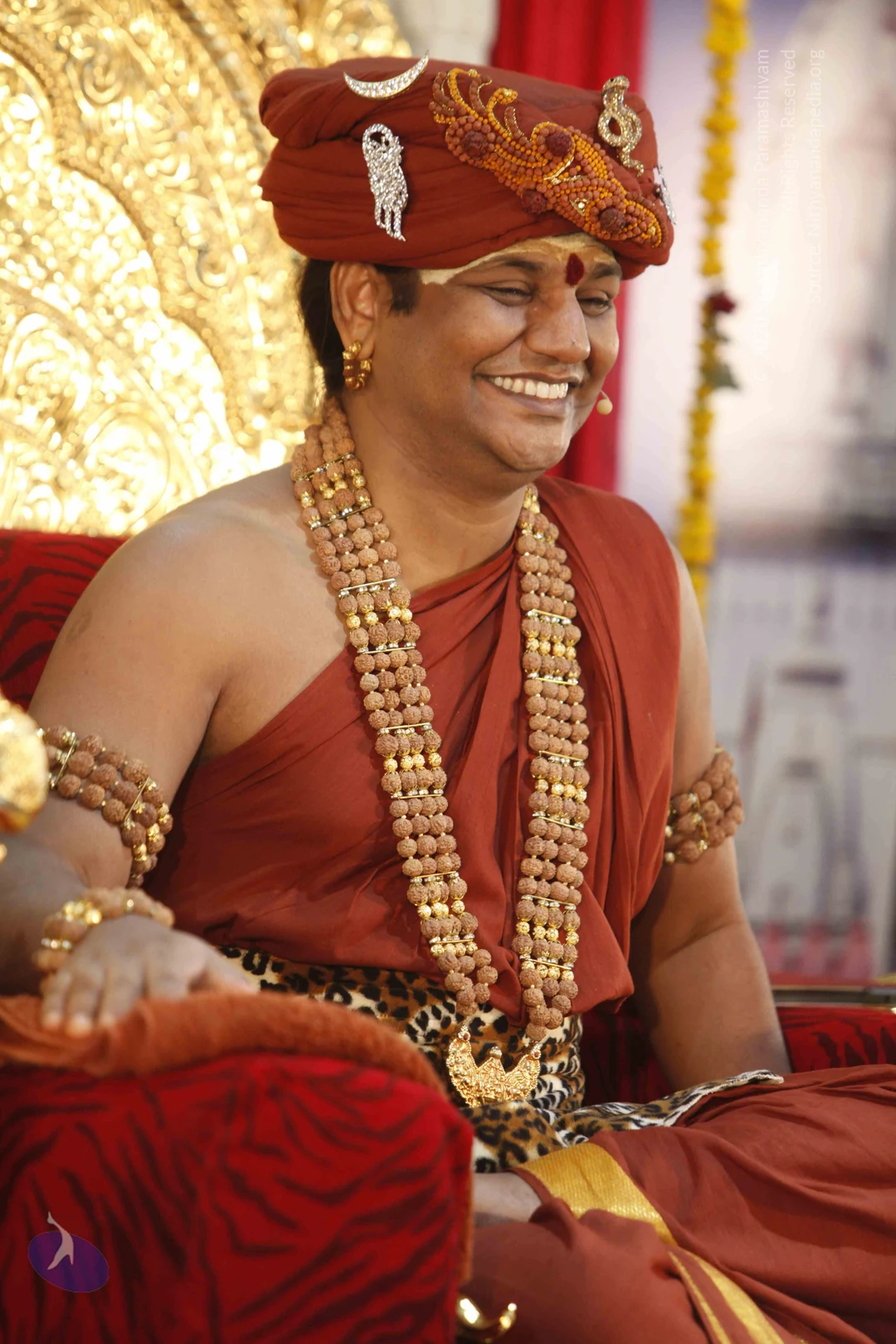
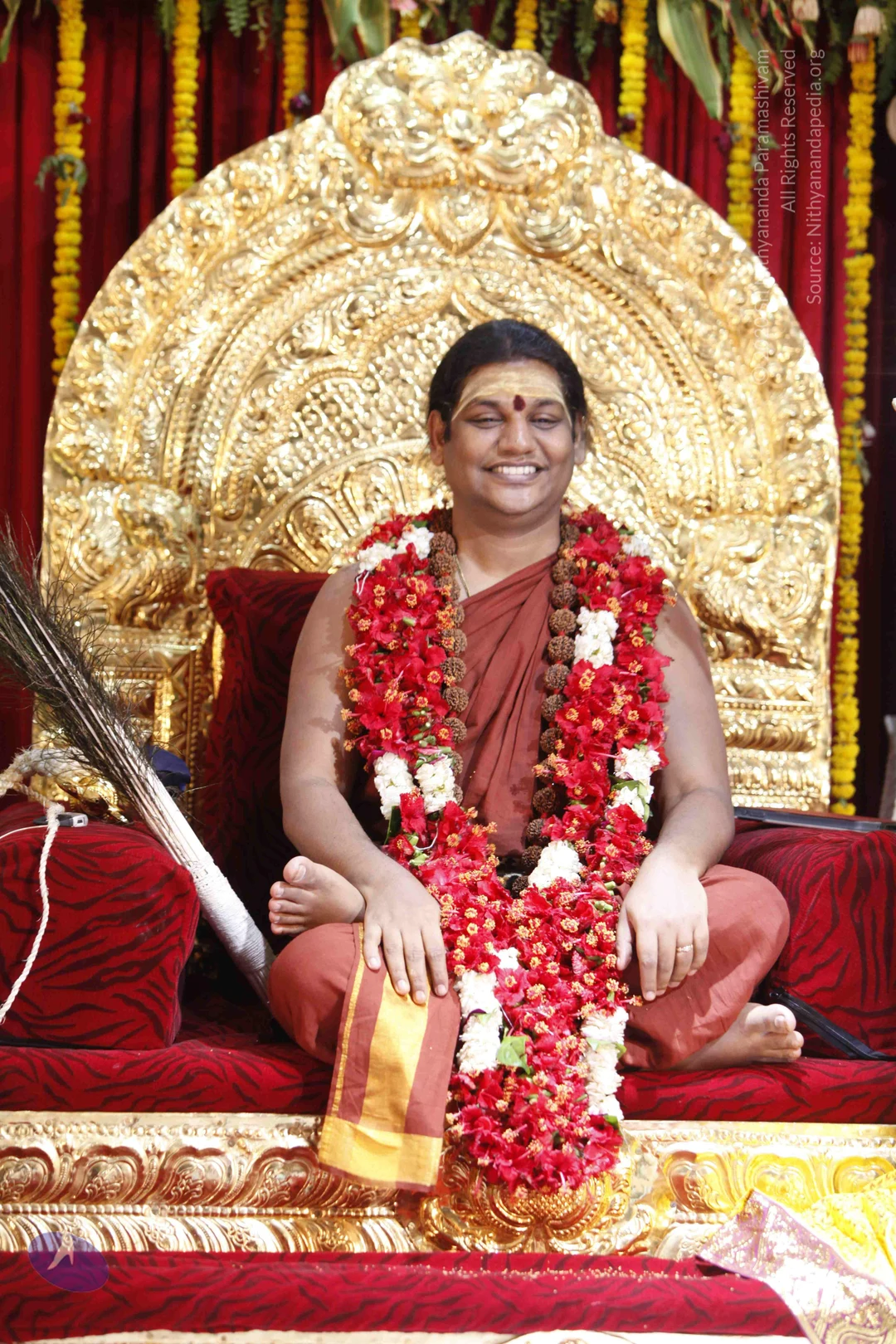
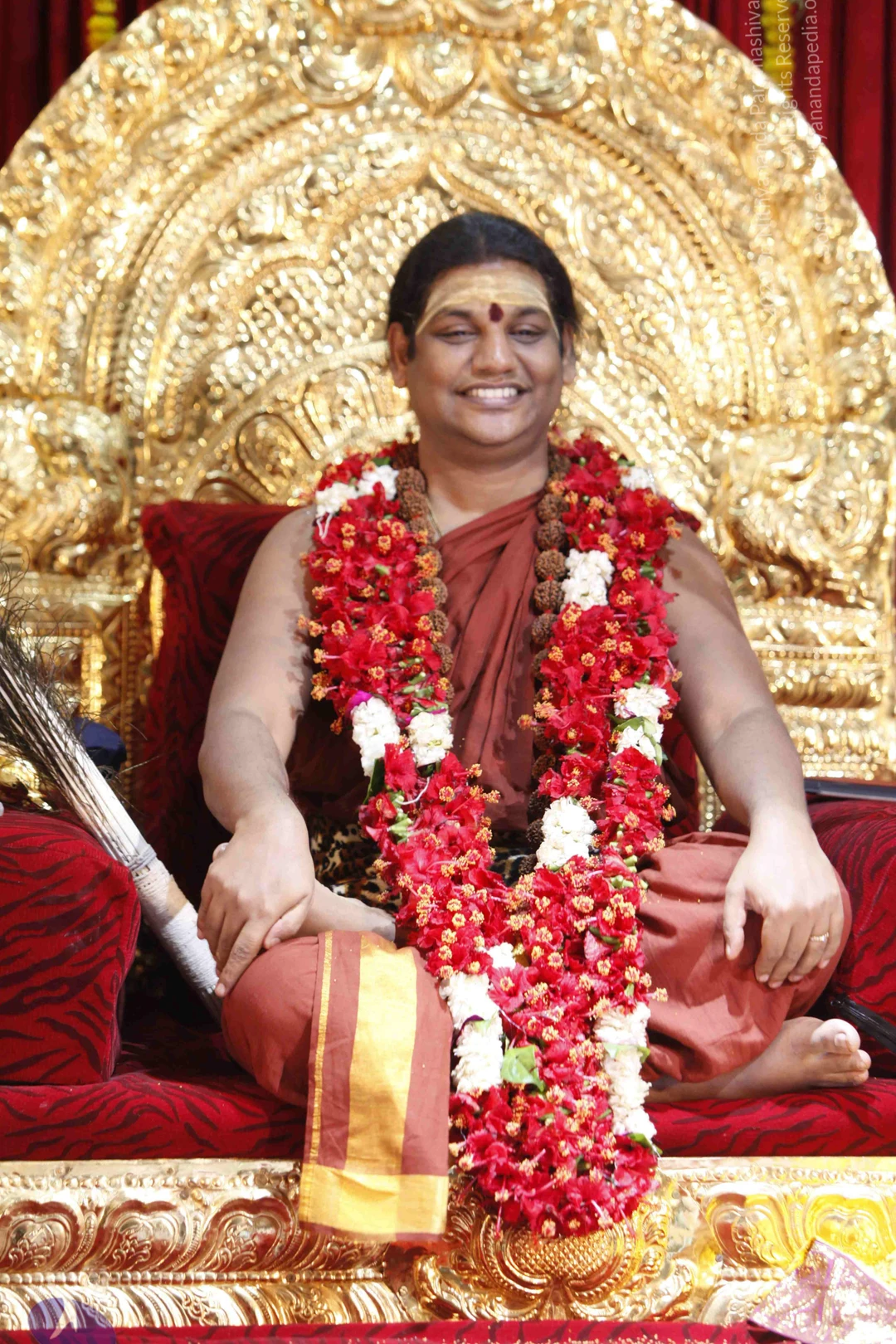
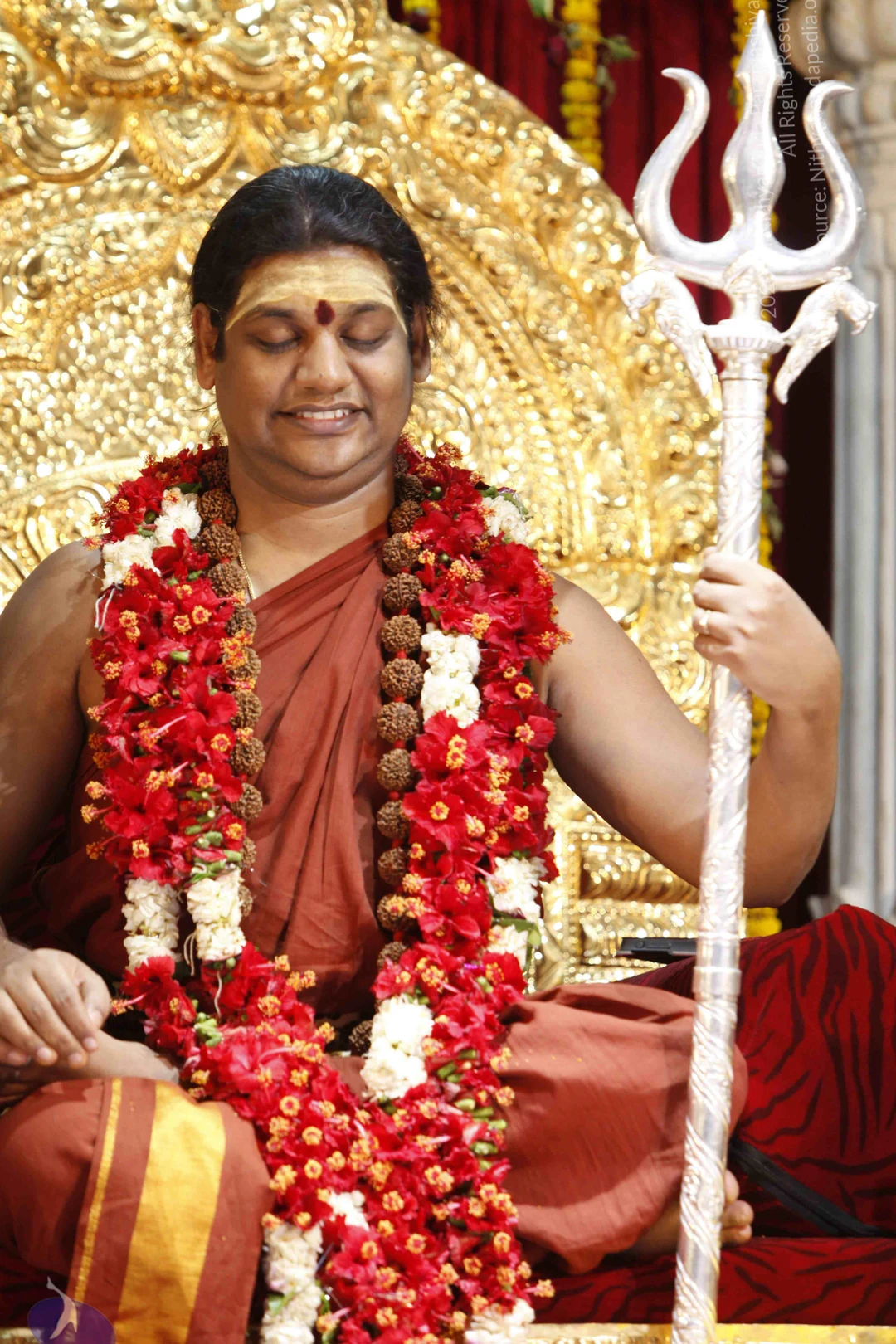
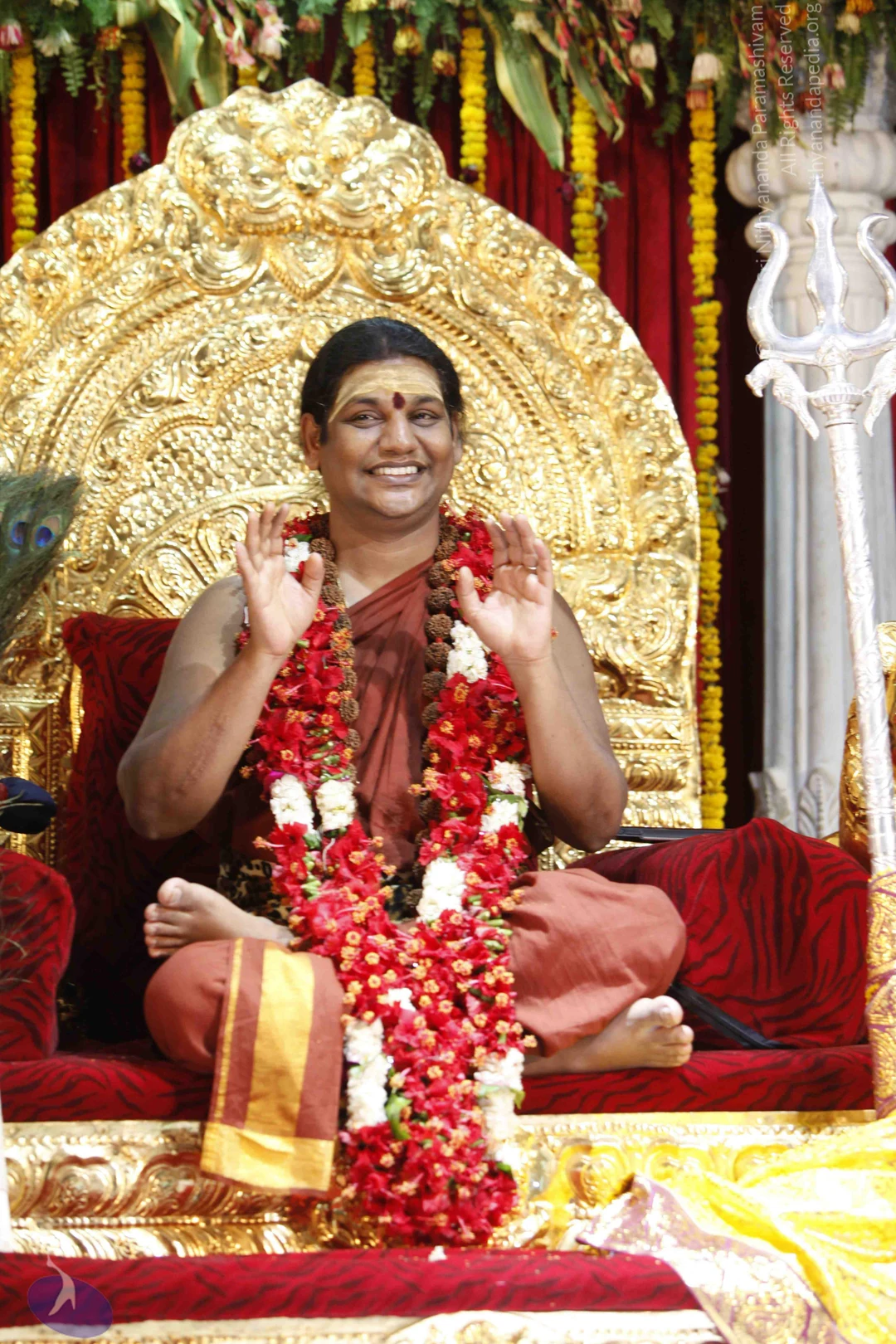
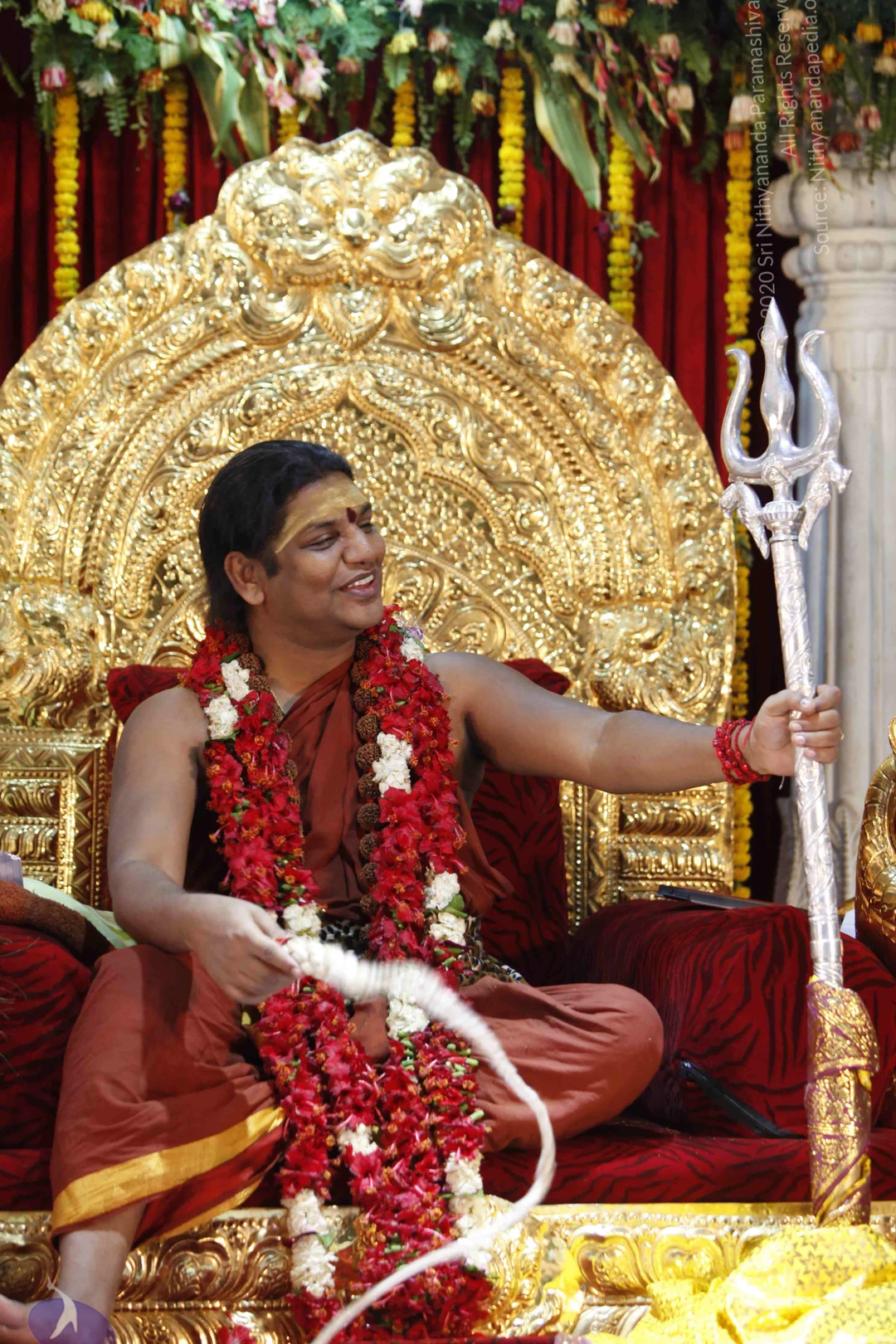
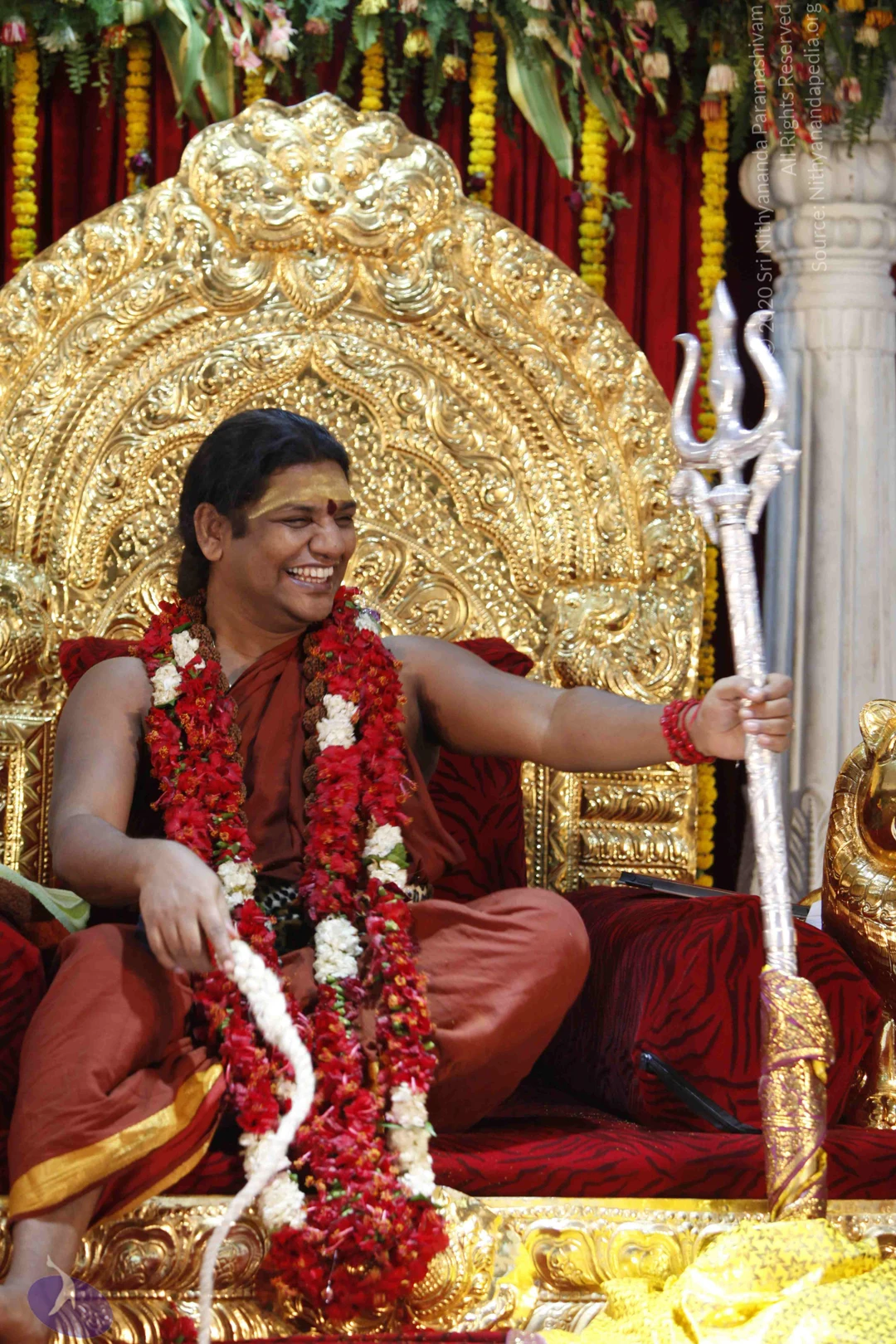
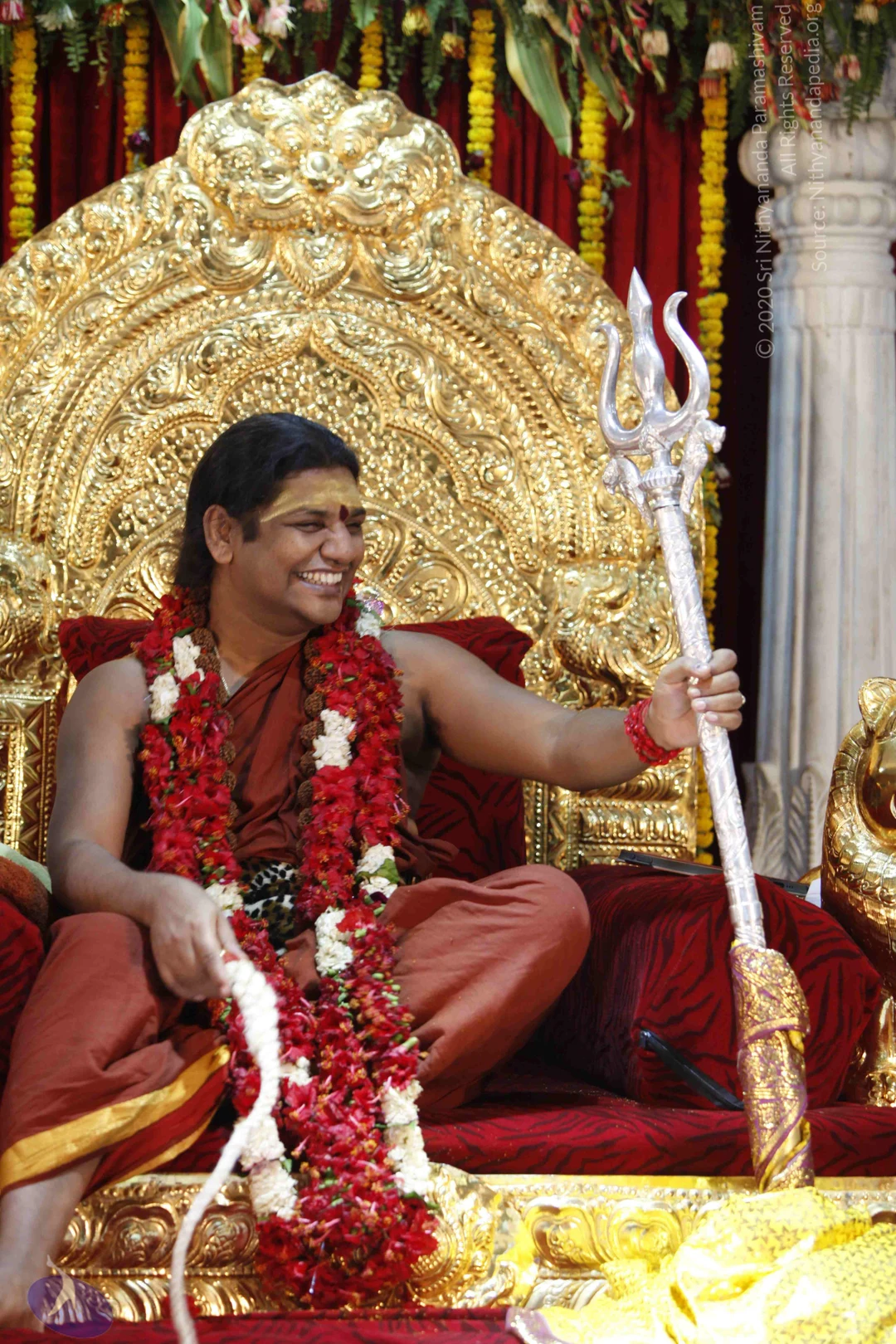
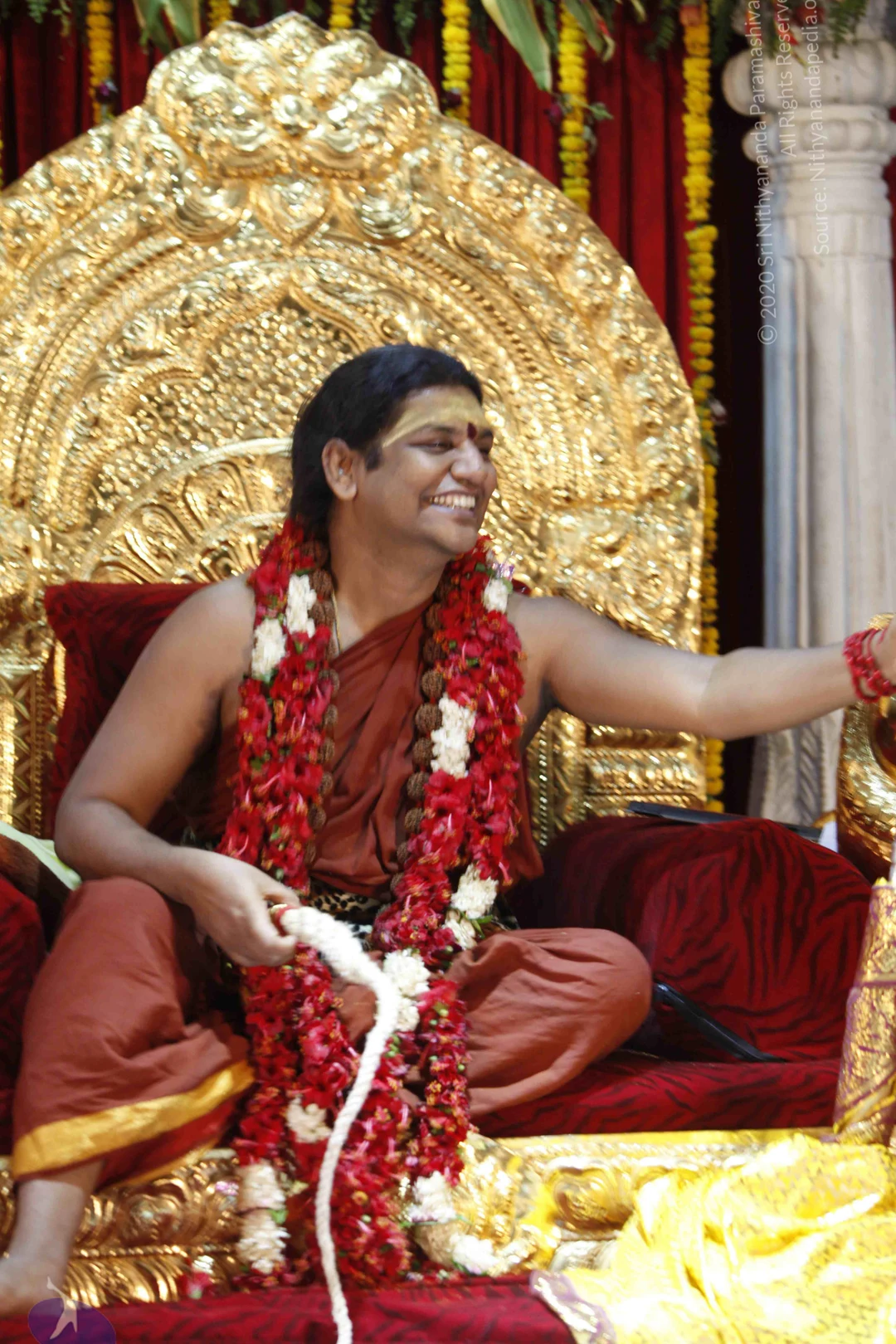
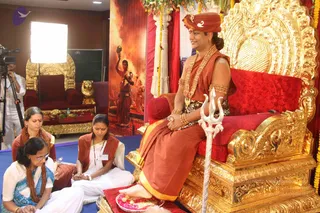
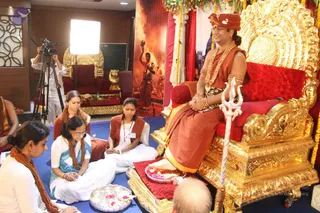
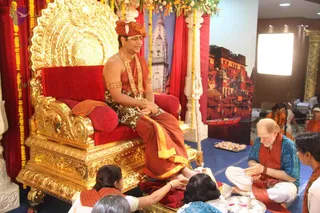
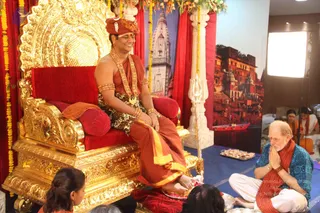
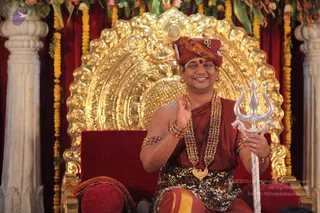
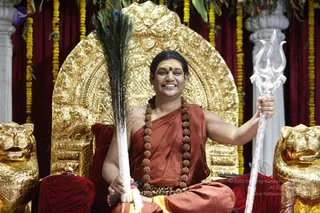
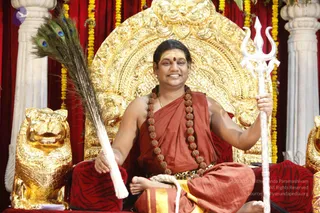
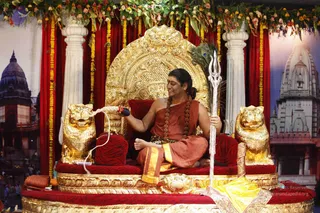
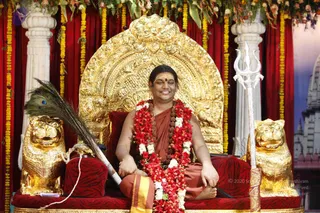
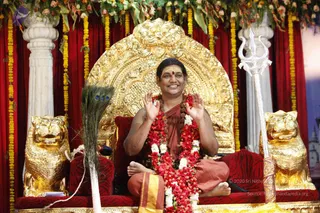
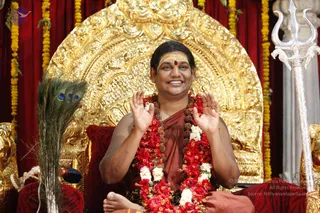
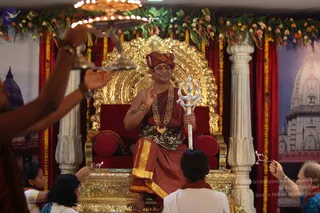
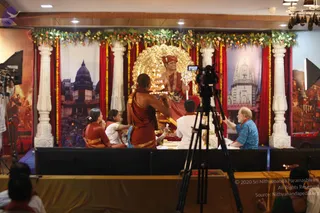
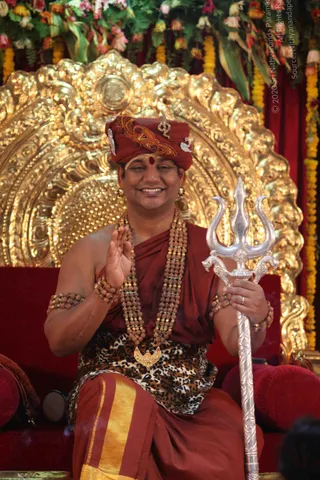
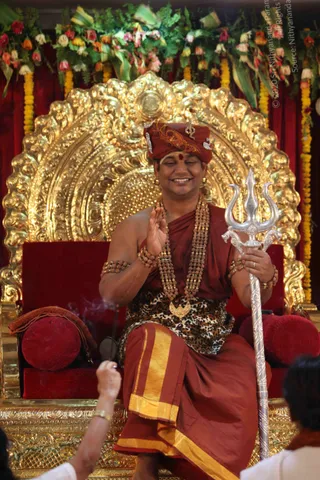
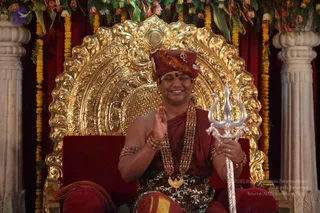
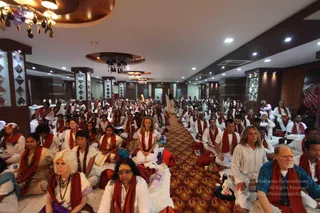
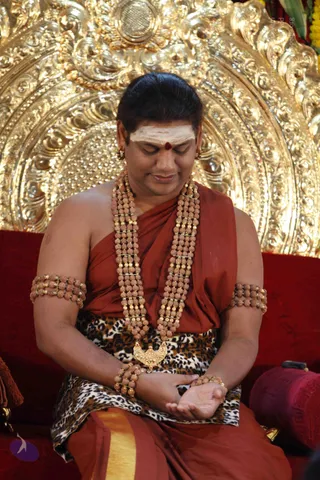
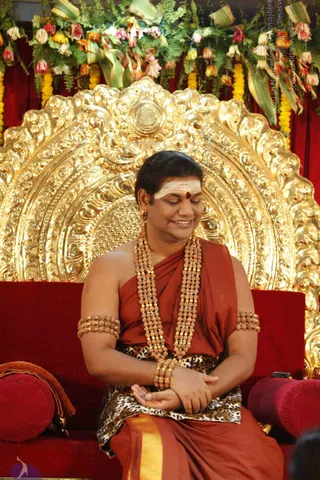
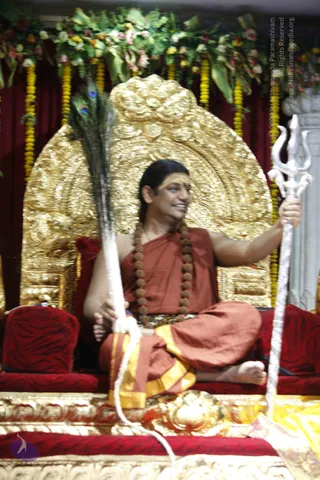
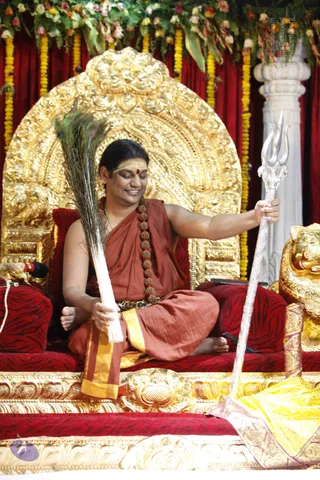
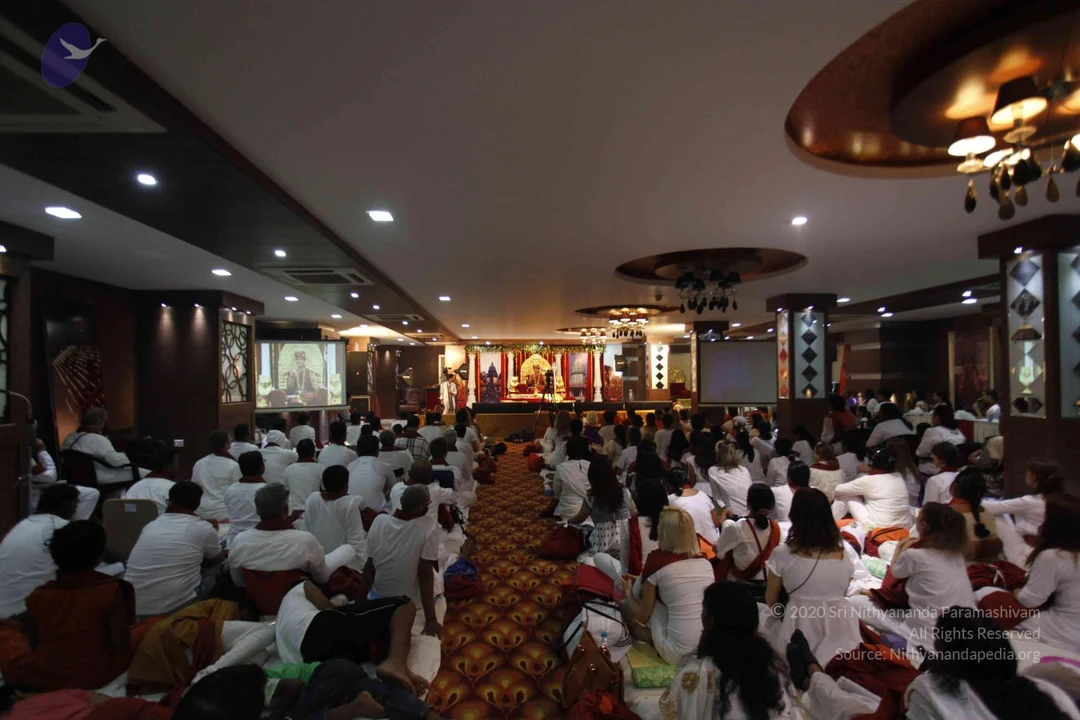
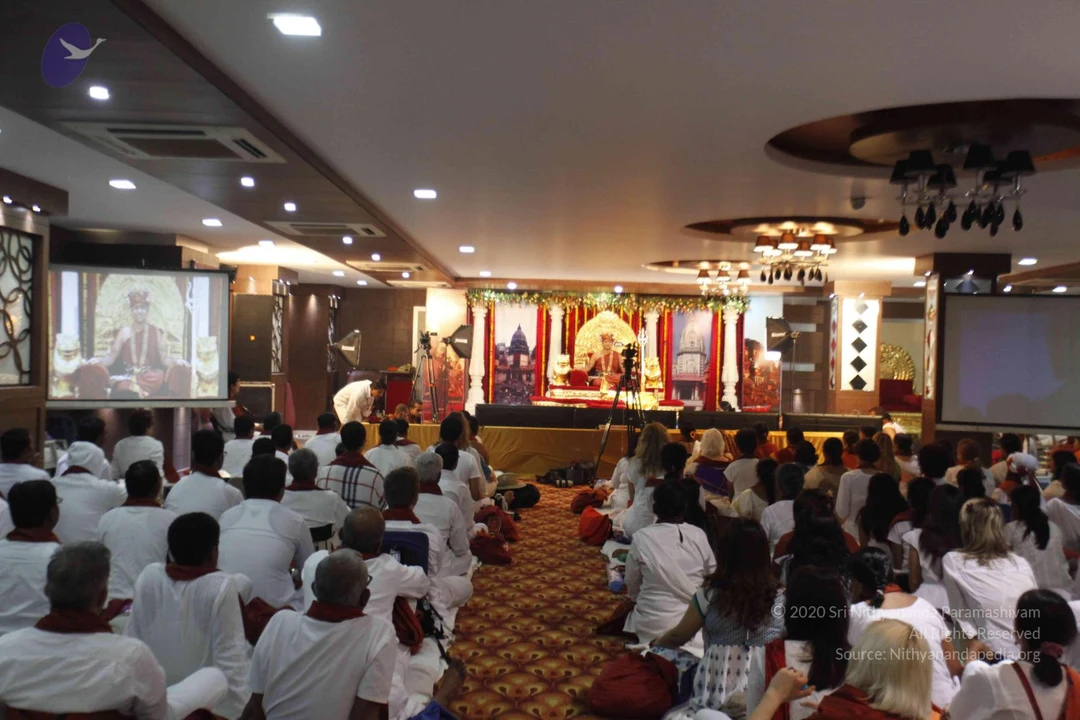
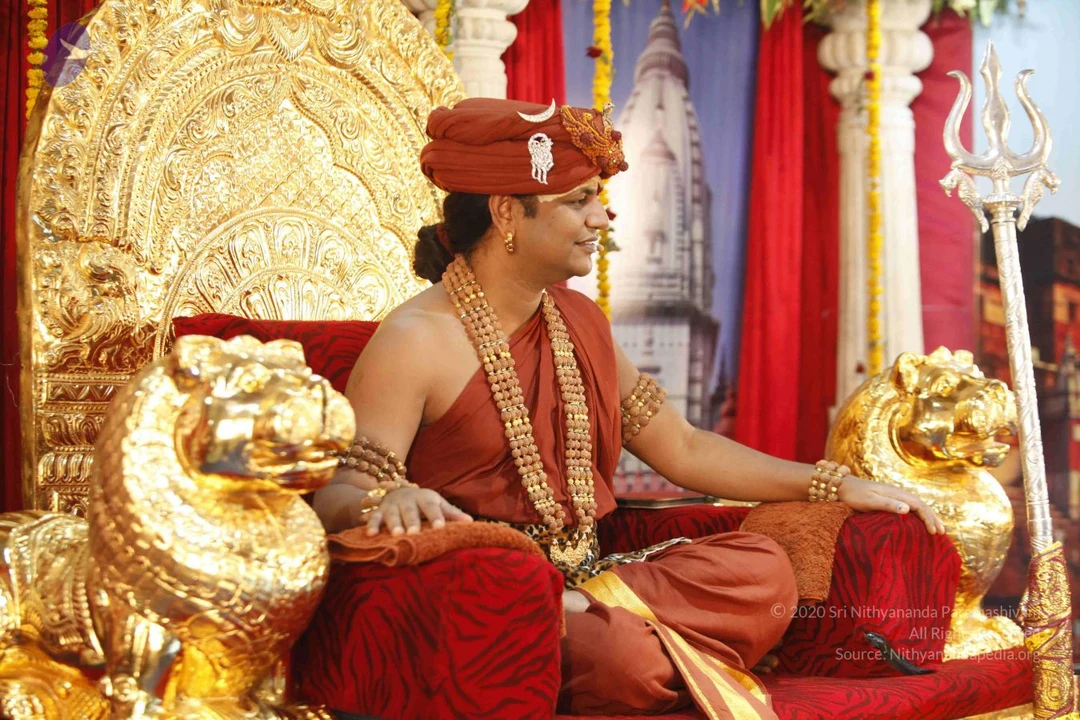
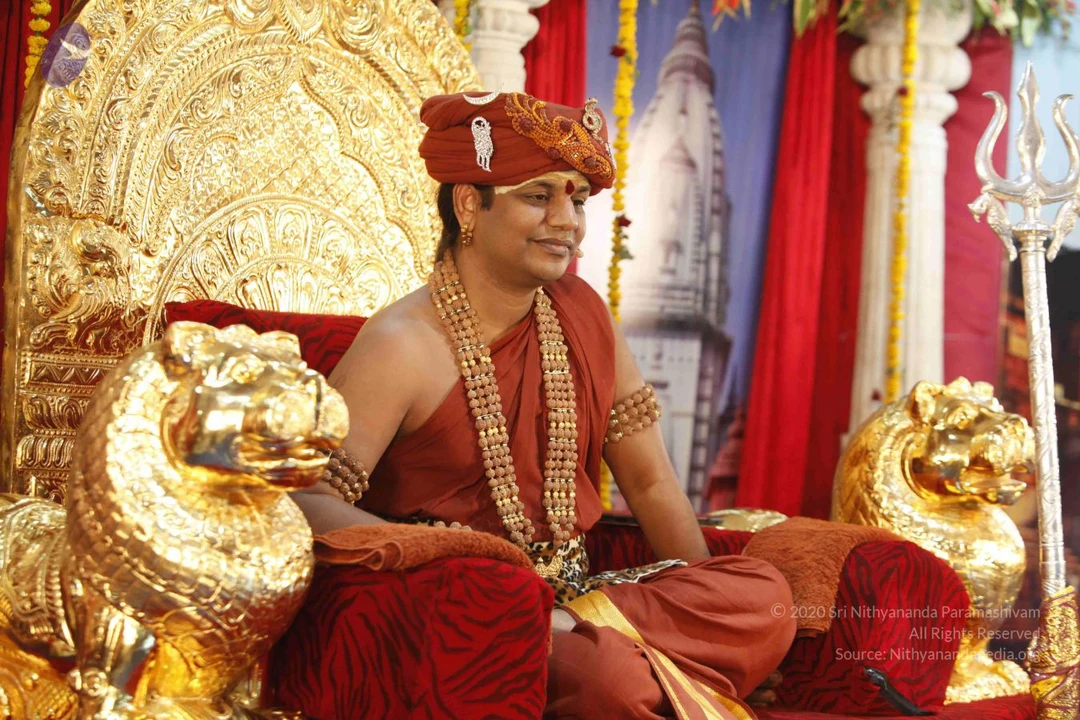
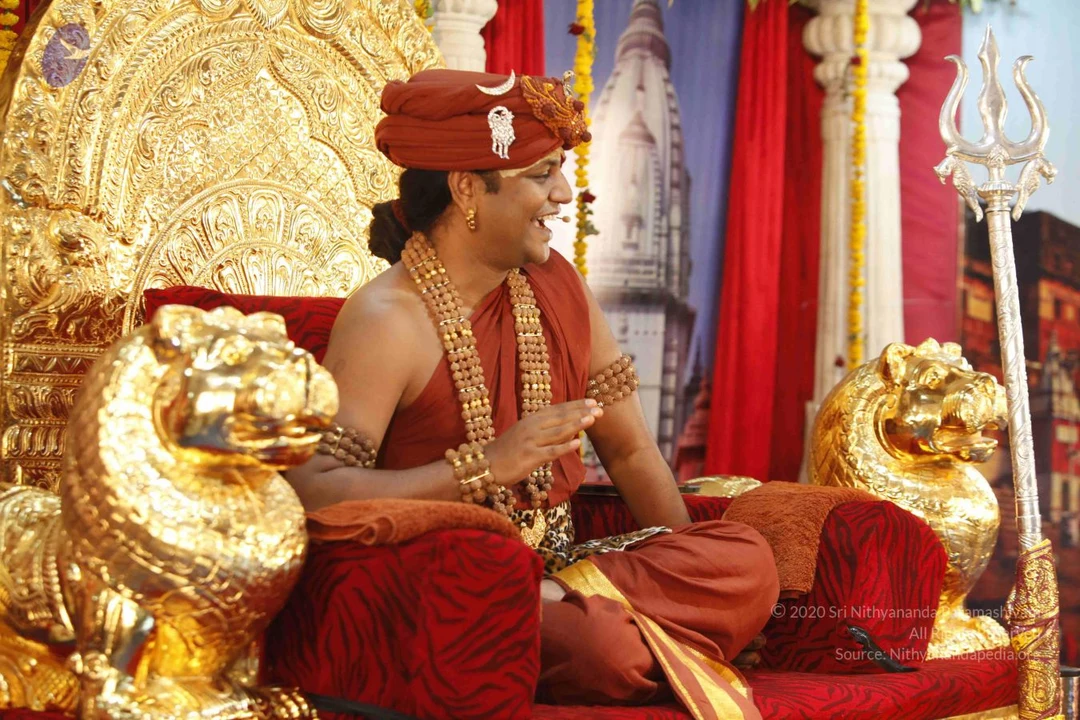
A man seated on an ornate gilded throne with lion-shaped armrests and red tiger-striped upholstery, smiling. He wears a rust-orange turban with a silver crescent and ornament, an orange-red shawl over his torso, multiple layers of rudraksha beaded malas and gold-toned bead necklaces, and beaded armbands. A silver trident stands at right, and a temple-tower backdrop with red drapes and yellow marigold garlands forms the setting. Swamiji (probable): the seated figure with a turban, layered rudraksha malas and orange attire is a.A photograph of an ornate stage set up for a satsang. A man in orange-red robes and a matching orange-red turban sits on a large gold throne with carved lion heads on its arms, wearing a gold necklace and armbands and holding a small object. Behind him are red drapes, garlands of marigolds and green leaves across the top, white pillars, and backdrop prints of a temple spire and ghat steps. A gold-fringed cloth drapes over the dais, a gold trident stands at the right, and the floor is blue carpet.A photograph of a smiling man in profile, shown from the side and slightly upturned, wearing a red-orange turban decorated with a silver crescent, a silver ornament and orange beadwork. He wears layered rudraksha malas with gold spacers and gold earrings, and a red-orange garment draped over the shoulder. A small microphone headset is visible near his mouth. Behind him are gold and red draped fabrics and a gold-embroidered cloth at the left edge.

May 04 2014

Original wiki page
Contents

Description:

In today’s morning Satsang from Varanasi, Paramahamsa Nithyananda announced that today is Adi Shankara’s Jayanthi, and that he respects Shankara for choosing to be part of the lineage that created him rather than breaking from Sanatana Hindu Dharma and starting his own sect. This same day is also the Jayanthi of Acharya Ramanuja; who had the patience and compassion to stay in the body for 127 years. He then encouraged us to live the core beliefs, lifestyle and fashion of Sanatana Hindu Dharma to the minutest detail.

Link to Video:

VideoAudio

Transcript:

NithyanandeshwaraSamaarambhaam

NithyanandeshwariMadhyamaam |

AsmathAachaaryaParyanthaam

Vandhey Guru Paramparaam ||

I welcome all the devotees, disciples, samajis, satsanghis, Shrimahants, Mahants, Kotharis, Thanedars, sitting with us all over the world through Nithyananda TV, Sadhna TV, and two-way video-conferencing having Nayana Deeksha in many cities, many countries, around the world.

Cities sitting with us in two-way video-conferencing: Peethadeshwaris Training Centre-Salem, Hong Kong-Sirkazhi, High Point-North Carolina, Gyaneshwar-Nepal, Port Washington-New York, Tallahassee-Florida, TuenMun-Hong Kong, Hyderabad-Gupta Kashi, New York-Varanasi, Kastav-Croatia, Guadeloupe-Rameshwaram, Scottsdale-Arizona and Hong Kong-Sirkazhi, Melbourne-Australia, Philip Island-Australia, TuenMun-Hong Kong, Port Washington-New York, New Jersey-Omkareshwar, Houston-Kalahasti, Houston Sangha, Jorpati-Nepal, High Point-North Carolina, Melbourne-Australia, Hong Kong-Sirkazhi, Scottsdale-Arizona, Guadeloupe-Rameshwaram, Kastav-Croatia, New York-Varanasi, Hyderabad-Gupta Kashi, Oklahoma-Somanatham, San Jose-Madurai, Kuala Lumpur-Palani, St. Louis-Tirumala, Ohio-Prayag, Toronto-Kailasam, Nithyananda University-Los Angeles, Nithyananda University-Paris, Nithyananda Nagar-Tiruvannamalai, NithyanandaNagara-Bidadi, NithyanandaNagaramu-Hyderabad, Vancouver-Bhubaneshwar, Tiruvanmiyur-Chennai, Washington DC-Sripuram.

I welcome all of you with my love and blessings.

3:31

Today, very important day for the whole Hinduism, Sanatana Hindu Dharma, the day, the greatest reviver of our Dharma, our Acharya, AdiShankara is born. Even though it feels like a grammar mistake, I can’t use ‘was’ for any of these Acharyas. So, I am using ‘is’, even though it is grammar mistake.

AdiShankara, one of the greatest being, greatest Master, the reviver of Hindu tradition, Sanatana Hindu Dharma, he was more charismatic than Buddha, but not greedy to be a separate cult. That is why he stood by the Sanatana Hindu Dharma. There are few people who try to make themself hero just by saying ‘No’ to everything which is prior to them. But there are some people who can demonstrate their unique contribution without saying ‘No’ to whatever exists prior to them. The second needs more intelligence. Shankara was charismatic enough. If he has said ‘No’ to all the prior things existed before him, he would have become another one religion. He has all the components to become a separate religion – charisma, intelligence, infrastructure, ability to convince people, play with words, everything he had; ultimately, ability to transmit the experience. But his sacrifice, the ultimate sacrifice: he just decided to be one Acharya in the great lineage. He was so grateful to the tradition which made him. I am not disrespecting Buddha. Just two days before I had so much of praise for Buddha. Please don’t mistake me. But the stark realities had to be told to you.

I don’t repent at all sending all these Kotharis, Mahants, Thanedars, out of the hall with such a strong words “Get out of this hall. Apply the chandan and come back.” I don’t repent. If I don’t do this, I am afraid, after I leave the body, you guys may separate yourself from Sanatana Hindu Dharma, which I don’t it want to happen. Just one step – having Kali inside Ramakrishna Mission – if they had decided, so much good would have happened to Sanatana Hindu Dharma. I am not underestimating their contribution, Ramakrishna Mission’s contribution to Hinduism. But just this one decision – having Kali also inside their temples and ashrams – so much good would have happened to Sanatana Hindu Dharma. In future, I do not want you guys to remove Mahadeva’s deity from our ashrams and temples. That is why I insist I take time, even though it looks very strong when I use such a strong word, Get out of the hall and apply chandan and come back.’ I know I am training you guys to keep something very valuable for Planet Earth forever; forever.

8:26

I am very clear; I will always be reviver of Sanatana Hindu Dharma, never founder of anything new. My deep gratitude to my Masters, my Gurus! I had the fortune of getting enriched by more than one Guru, enlightened beings. My gratitude to my Gurus who made me is I will ever remain as only the reviver of Sanatana Hindu Dharma, never a founder of something separate, away from Sanatana Dharma. I want all the Mahants, Kotharis, Thanedars who are the owners of the Sangha to remember this: You will all follow the minute details, understand?

In any culture, there are core things, lifestyle things, fashion things. For example, in the western culture, if I have to say

Core things – your belief about life, death, materialism, your belief about money, what for you work whole day, what you think as joy and pain – all these are core things.

Then Lifestyle – the number of cars you want to own, the number of houses you want to own, the number of items you want to own, the way you want to be remembered by your friends and family – lifestyle things.

Then Fashion – the handbag you carry, the lipstick you use, the shoe you wear, the tie you use – the fashion.

Understand, my disciples, you guys will follow Sanatana Hindu Dharma in all these three level – Core Beliefs, Lifestyle, Fashion.

Our Core Beliefs are like major questions we have about life – life, death, karma, renunciation, dharma, artha, kaama, moksha – all these are Core Beliefs.

Then Lifestyle – what we own, what we share, how we earn, how we showcase ourselves – lifestyle.

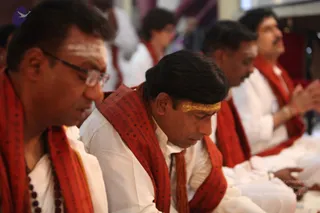
Then Fashion – this chandan, big-big rudrakshamalas, the sacred jewelleries, sacred clothing style.

So, in all the levels, you guys will revive. Your body should be moving hoarding, billboard for Vedic tradition. Your mind should be moving billboard for the Vedic lifestyle. Your consciousness should be moving billboard for the Vedic core teachings, core message.

Only mortals need to be afraid to become martyr. I am immortal and never be a martyr, understand. I am immortal and intelligent enough not to be martyr. I am not talking out of any arrogance or pride, please understand. I am very clear about what I want to do. I want to make a fashion statement about the beauty and glory of everything of Sanatana Hindu Dharma. The way we cook, the way we eat, the way we dress, the way we reside, everything; let it be brought back to life!

13:44

On this great day, AdiShankara’s Jayanthi Mahotsava; it is not birthday, Jayanthi Mahotsava. Please understand, birthday is as per the English calendar. Jayanthi Mahotsava is as per the Vedic calendar. Earlier, in our Sangha, we used to celebrate both days – birthday and Jayanthi. Recently I banned birthday, and, last three years, we are celebrating only Jayanthi. Today is AdiShankara’s Jayanthi as per the Vedic calendar. On this great day, once more I commit and I request our whole Sangha, whoever considers me as Guru, all of you will commit and declare - ‘We rededicate ourself to Sanatana Hindu Dharma, to live Sanatana Hindu Dharma Core Beliefs, Lifestyle and Fashion; in all the three level. Core Beliefs, Lifestyle and Fashion, in all the three levels we will celebrate and live Sanatana Hindu Dharma.’

Be very clear, I wanted to make this statement very clearly on this great day of AdiShankaracharya Jayanthi: We will follow the Core Beliefs, Lifestyle, Fashion, in all these three, the great Sanatana Hindu Dharma.

And, today is also the Jayanthi of one more great spiritual giant. I will personally regard this second great spiritual giant, whom I am going to introduce, one step more than AdiShankaracharya – Acharya, great Ramanuja. Today is the same day, Acharya, great Ramanuja was also born. You may ask why I will put Ramanuja one step further. Please understand, an Acharya has certain responsibility and he is given all the powers needed to fulfil those responsibility. Living in the body for long period and establishing what for he happened, also is one of the responsibility, which Ramanuja fulfilled very responsibly by living 127 years. He lived in the body for 127 years. Who wants to live in this world? But he took the responsibility. It is not that Ramanuja did not have the problem Shankara had. Both of them had same problem which I am having now. It is eternal. I don’t want to say Shankara did not have the power to extend his life as he want. He has. All Acharyas are given that free hand, understand. No Acharya is asked to come back unless he decides. So, I can say, Ramanuja was more responsible in that one angle. That’s the reason I am putting in my personal feeling Ramanuja one step more. Because, see when you stay, you can stabilize.

18:37

I tell you, even now, the number of enlightened being produced by the RamanujaSampradayis are more, because he standardized the whole structure and process by living more than 127 years; 126 plus. If Vivekananda would have lived twenty more years, he would have made a living stream of enlightened beings on the Planet Earth. It is very unfortunate that he has to leave the body.

Thanks to the tortures done to him that he had to finally give up. But I tell you guys, I am not going to give up. I will be alive in this body! Again, I am not disrespecting Shankara, but I have to tell you the stark realities. We can say Shankara contributed this thirty-two years itself everything. But, I will naturally expect an Acharya to stay for some more time, not just contribute. See, there are different levels of doctors –who just give prescription, who just get the medicine and ask you to take, who just opens your mouth and puts the medicine, who uses a stick to get the medicine inside your mouth and see to it, it digests in you and you are rid of the disease. I was brought up, enriched, strengthened by my Gurus for quite a long period. When I was seventeen only, they passed away, both of them left the body. From the time I remember myself, I grew up with both of them. So, when you spend time with your disciple this many years, the kind of maturity you bring to the disciple, the kind of strength you cause to the disciple’s consciousness, I am the witness. I am the witness. That is why I am telling you, Masters need to live longer period in the body. See, if you just want to make a intellectual contribution, just writing books is enough. But, if you want to make a living enlightened stream, the stream of living enlightened beings, then lot of work need to be done on the consciousness of the disciples.

22:23

From AdiShankaracharya we will learn to be a reviver of Sanatana Hindu Dharma. From Ramanuja we will learn to live in the body for a long period. I offer humble respects to both the Acharyas, and both Acharyas will have shrines in our Bidadi temple. In all our major temples, both Acharyas will have shrines. We are working on it. As a Sangha, on behalf of me, and as a Sangha, we bow down to both the Acharyas, remembering them, honouring them, rededicating ourself to them, rededicating ourselves to them. We will stand as a reviver of Sanatana Hindu Dharma, and as a strength for Sanatana Hindu Dharma in the Core Beliefs, Lifestyle and Fashion, in all the three levels.

We will go on be aligning more and more ourselves to Sanatana Hindu Dharma. I know, many things are lost; even we are not completely pure, because, many things we ourself do not know. We are yet to retrieve. We will retrieve, recover, reinvent, revive all of them as early as possible and make them as part of us to rejuvenate ourselves. I think, this will be the real gratitude we offer to both the great Acharyas - AdiShankaracharya and Ramanujacharya.

25:12

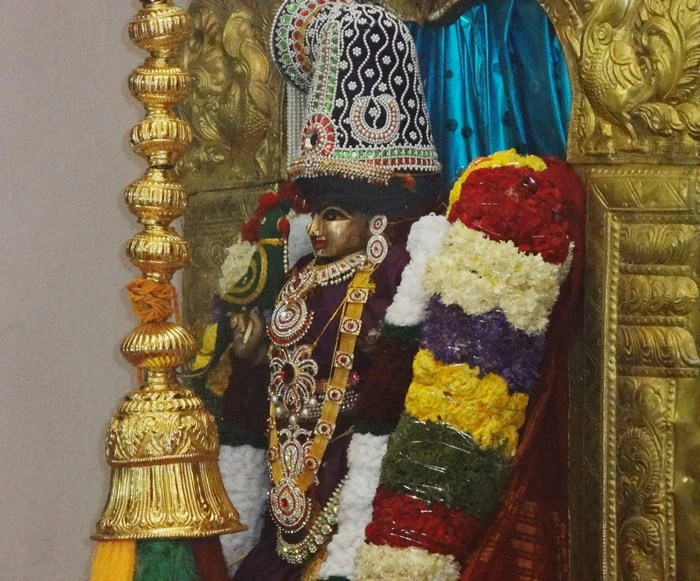
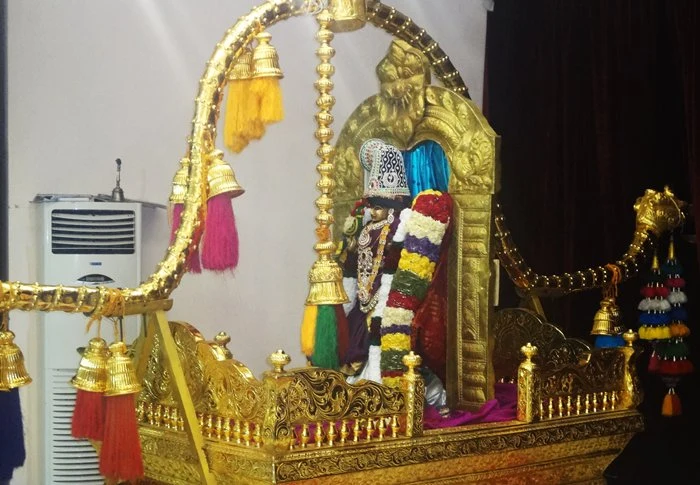
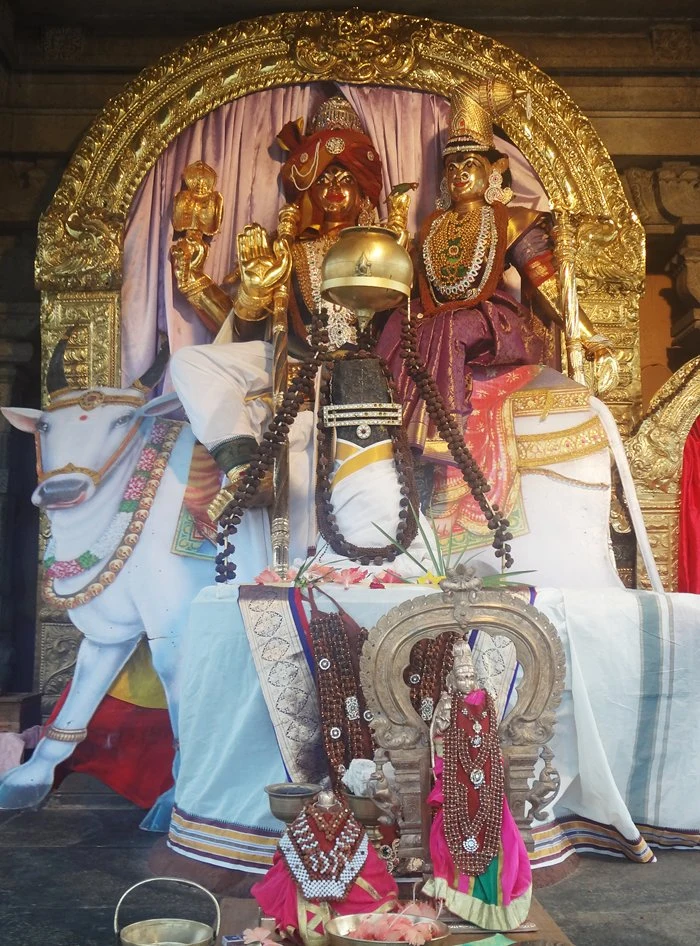
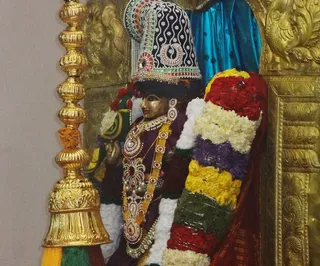
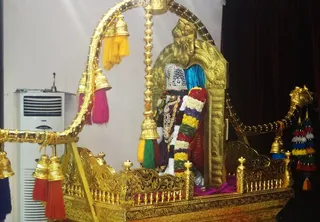
Today is also the fourth day of Meenakshi Brahmotsavam. Devi graces the Golden Palkhi, the Golden Palanquin.

Today is also the beginning of Agni Nakshatra, where, today is the day the unique sun energy lands on the earth. All the Shiva temples, the deity will be constantly having abhishekam. Means, constantly the deity will be showered from today to next few days. Till 28th, constantly the deities will be showered, given abhishekam, sacred bath. So, all our temples also should have that vessel where rose water or Ganges water, sacred water is constantly showered on the deities. So, from today, we start that ritual of TaaraPaathram. There is a tradition also, when you put the TaaraPaathram, means, the constant dripping of water on Shiva Linga, you sit and concentrate on it. Your mind also gets concentrated; the dhaarana happens. Dhaarana, it is a very powerful technique to make dhaarana happen.

There are a few Masters who just say ‘No’ to everything which existed prior to them. There are some Masters who revive whatever existed prior to them and align themself to be an Acharya of that great lineage. There are some who are completely confused, don’t know what to do, and don’t know what is their stand. ‘Whatever gets money now, come on, let us do that. Whatever gets little name and fame, money, this prize, that reward, this reward, let us do that now.’ I am very clear about my stand from the beginning. I want to be remembered as a reviver of Sanatana Hindu Dharma, and I want our Sangha to work in that direction, reiterating our direction, reiterating about our authenticity. This is what I want to do today on this great day, AdiShankara’s Jayanthi, Ramanuja’s Jayanthi.

29:14

Today, in the Inner Awakening, we will be working on our authenticity, and the process of completing all the incompletions. My only request to Inner Awakening participants - Please co-operate with the class by being on time and all these; because, we have so much to do. See, because we are in Varanasi, we have to see so much and we have to do so much. Varanasi yatra itself needs separate twenty-one days, and the Inner Awakening needs separate twenty-one days. I am doing both in one twenty-one days.

See, I am co-operating by cancelling all the Kalpataru Darshans I have given to many cities. I already started cancelling many Kalpatarus; because even this morning, if there is Kalpataru, the morning breakfast break will be little longer. I don’t want to waste even that half an hour one hour. I am cancelling many of the Kalpataru Darshans this whole month; sorry, these twenty-one days, not whole month, this twenty one days. I am co-operating from my side everything possible. And, especially election time, whichever temple we want to go, first we will have to study that there is no political rally on that day, so that we will not be stuck in the traffic jam. So, so many factors we have to consider and organize the whole program. So, please let’s use the time to its fullest extent, and the space of Varanasi, Vishwanatha.

I bless you all. Let you all radiate with Integrity, Authenticity, Responsibility, Enriching, and Causing eternal bliss, Nithyananda. Thank you.

Title:

Authentic Experience with The Divine || Part 4 || IA || 04 May 2014

Description

Name Of The Program : Inner Awakening
Session on: Authenticity
Date : 4 May 2014
Venue : Varanasi, India

In this video Supreme Pontiff of Hinduism HDH #Nithyananda Paramashivam puts the participants through the #authenticity process and process of #completion.

Link to Video:

VideoAudio

Transcript

(0:15) I want to tell you guys I am always in the space of completion. I have no problem at all. You can always be in the space of completion; you can take this for granted. You don’t have to feel at all you will be incomplete with me or I am incomplete with you anytime. I can never be incomplete. You understand, I can never be incomplete. And you also you don’t have to feel you will, you have some incompletion with me. Only when you abuse that becomes a blockage and, the what is it, the umbilical cord gets disconnected. That is the only time the incompletion happens. If that is not happened in your life, don’t even bother. You are always in completion with me in the space of completion, I’m always in space of completion with you. Be assured, don’t worry at all. You understand, never have any doubt, self-doubt, SDHD about completion, being complete with me. Don’t think that “oh I am not complete with Swamiji. No!” And one more thing even if you abuse, I have no incompletion with you. You will distance you, that’s all. Nothing can be done. I have no incompletion. Don’t worry, I may, may not accept what you do. Sometime if I feel that free, I’ll tell you, don’t do that. If I don’t feel that free with you, I may not tell but I have no incompletion. That’s all. I have no incompletion. And, other than abusal, nothing else even puts you in incompletion. If you have not abused don’t worry any other act does not amount incompletion. It does not separate you from the master. When you abuse, you say no to him, so as a ethics of Enlighten being he moves away. He says okay, hmm, that’s all. Participant “ Thank you Swamiji”.

(02:32) Participant – “Swamiji just a few more things”, “Mmm”, “I want to live everything and everyone as you, me and see the entire cosmos as my teamily.” “Mmm, Mmm” “Umm I want to move through life with ease, without struggling,” “Mmm” “I want to live myself for who I am.” “Mmm” “Without fear, doubt” 'Mmm, Mmm” “judgements.” “I want to work with full enthusiasm, energy and joy in the master’s mission and sangha.” “Mmm” “I want to go beyond my eating and sleeping habits.” “Mmm” “So what I need to do for this is to overcome SDHD, root patterns, “Mmm” achieve complete completion with swamiji’s grace”. “Tathastu” “Thank you Swamiji” “Tathastu!” “And aa attending IA and I want to go back and share with others what I have learnt, and um mm empower others to attend IA as well and umm I commit to participate fully umm, umm and just not entertain any incompletions.” “Tathastu” “Thank you Swamiji” “And why did I come here, is aa, umm, umm, the right process with the right person in the right place.” “Haha” “So” “Haha” “Tathastu” “Ya, and umm, ya Swamiji. So Thank you Swamiji. “Blessings” (03:48) Participant – “Pranams Swamiji! My purpose of life, I always want to serve people in need but I never knew who really needs what and, how do I reach them to my capability. Swamiji, it is you, your discourses, your satang’s gave me an ultimate clarity to my purpose, with beautiful space within me out of my own experiences and clicks I had after having got connected to you. Were in I could clearly see what anyone and everyone need to my own self. Enriching myself with authenticity, integrity and responsibility, I am now confident of fulfilling the ultimate need of me. My near and dear ones, my Kith and Kin, and all those who I commit in my life, not only enriching them but also connecting them to you. Thank you swamiji. That is now my ultimate goal and I seek your support for that.”

(04:38) “Tathastu!” (04:39) Participant “Swamiji I live in a colony where there are about 600 families. So, I saw many mishappenings taking place. I was clearly able to see how the colony became still with negativity, between each other. It was your initiation what has inspired me and made take an action which is going through families, radiating authenticity and integrity and also responsibility to quite an extent. Now this process going on from last 2 months Swamiji.”

(05:09) Beautiful, teach some completion. Participant “ It has not” That’s all. Nothing else is required, just sit with them, counsel them until some completion. That will make the whole colony into heaven. My blessings. Let it become Nithyanandapuri. See actually, living is only reviving Sanatana Dharma. We are not a number based religion, understand, we are not a conversion based, number based religion. Just live it, you will see, we revived it. Anyhow, I am free, oh! still one person, go ahead, go ahead. (05:50) Ahh haa, okay go ahead, anyhow I committed so I’ll listen, I’ll sit and listen.

(05:58) Participant “Nithyanandam. The purpose of my life, I see in two parts. Before, May 2013 IA, and after 2013, now 2013 IA. um no, no, after 2013 IA, actually I’ll take some other occasion to explain what all I accomplished during this one-year period. But the purpose of my life after 2013 IA what I found was that I have to serve the humanity because serving the humanity is serving the cosmos. Now I realize that you have been serving the humanity, so I want to be part of you and serve the humanity through you”.

Title

Gurukul - The Magical Vedic School || Part 2 || IA || 04 May 2014

Description

Name Of The Convention: Inner Awakening
Session on: Authenticity
Date: 4 May 2014
Venue: Varanasi, India

In this video Supreme Pontiff of Hinduism HDH #Nithyananda Paramashivam puts the delegates through the authenticity process and process of completion. HDH shares the authenticity of Nithyananda Gurukul initiated balasanth in their spiritual process and ability to manifest rain after homa and pooja. HDH elaborately describes the power of Nithyananda #Gurukul initiated balasanth to drop the thorns of rose plants as part of the manifestation of power.

The Supreme Pontiff of Hinduism Jagatguru Mahasannidhanam His Divine Holiness Nithyananda Paramashivam (HDH) is the reviver of #KAILASA - the ancient enlightened civilization and the great cosmic borderless Hindu nation. Revered as the incarnation of Paramashiva - the primordial Hindu Divinity, HDH has a following of 2 billion Hindus worldwide with de facto spiritual embassies in over 150 countries. He has worked untiringly for over 26 years for the revival of Kailasa, for global peace and to give super conscious breakthrough to humanity. He has survived the worst persecution of multiple assassination attempts on person and on character by anti-Hindu elements. He is collecting, organising, preserving, time capsuling, decoding, spreading and reviving 20 Million source books of Hinduism and the 64 sacred arts & sciences like Ayurveda, music, dance, sculpting, astrology, vastu and much more. Close to 20,000 hours of HDH’s timeless talks have been recorded till date (Sep 2020), which are a treasure trove of powerful cognitions to solve individual and global problems of any kind.

Link to Video:

VideoAudio

Title

An Authentic Experience with The Divine || Part 3 || IA || 04 May 2014

Description

Name Of The Convention: Inner Awakening
Session on: Authenticity
Date: 4 May 2014
Venue: Varanasi, India

In this video Supreme Pontiff of Hinduism HDH #Nithyananda Paramashivam puts the delegates through the authenticity process and process of completion. The delegates shared their goal and how to achieve them during the session. Delegates were also lead into #Kalpataru Meditation to manifest their desires and aligning to the personal goals.

The Supreme Pontiff of Hinduism Jagatguru Mahasannidhanam His Divine Holiness Nithyananda Paramashivam (HDH) is the reviver of #KAILASA - the ancient enlightened civilization and the great cosmic borderless Hindu nation. Revered as the incarnation of Paramashiva - the primordial Hindu Divinity, HDH has a following of 2 billion Hindus worldwide with de facto spiritual embassies in over 150 countries. He has worked untiringly for over 26 years for the revival of Kailasa, for global peace and to give super conscious breakthrough to humanity. He has survived the worst persecution of multiple assassination attempts on person and on character by anti-Hindu elements. He is collecting, organising, preserving, time capsuling, decoding, spreading and reviving 20 Million source books of Hinduism and the 64 sacred arts & sciences like Ayurveda, music, dance, sculpting, astrology, vastu and much more. Close to 20,000 hours of HDH’s timeless talks have been recorded till date (Sep 2020), which are a treasure trove of powerful cognitions to solve individual and global problems of any kind.

Link to Video:

VideoAudio

Title

Kalpataru - Manifest Your Desires || IA || 04 May 2014

Description

Name Of The Convention: Inner Awakening
Session on: Kalpataru - Manifest Your Desires
Date: 4 May 2014
Venue: Varanasi, India

In this video Supreme Pontiff of Hinduism HDH #Nithyananda Paramashivam puts the delegates through the authenticity process and process of completion. The delegates shared their goal and how to achieve them during the session. Delegates were also lead into #Kalpataru Meditation to manifest their desires and aligning to the personal goals.

The Supreme Pontiff of Hinduism Jagatguru Mahasannidhanam His Divine Holiness Nithyananda Paramashivam (HDH) is the reviver of #KAILASA - the ancient enlightened civilization and the great cosmic borderless Hindu nation. Revered as the incarnation of Paramashiva - the primordial Hindu Divinity, HDH has a following of 2 billion Hindus worldwide with de facto spiritual embassies in over 150 countries. He has worked untiringly for over 26 years for the revival of Kailasa, for global peace and to give super conscious breakthrough to humanity. He has survived the worst persecution of multiple assassination attempts on person and on character by anti-Hindu elements. He is collecting, organising, preserving, time capsuling, decoding, spreading and reviving 20 Million source books of Hinduism and the 64 sacred arts & sciences like Ayurveda, music, dance, sculpting, astrology, vastu and much more. Close to 20,000 hours of HDH’s timeless talks have been recorded till date (Sep 2020), which are a treasure trove of powerful cognitions to solve individual and global problems of any kind.

Link to Video:

VideoAudio

Title

Chant Your way To Kalpataru || IA || 04 May 2014

Description

Name Of The Convention: Inner Awakening
Session on: Chant Your Way To Kalpataru
Date: 4 May 2014
Venue: Varanasi, India

In this video Supreme Pontiff of Hinduism HDH #Nithyananda Paramashivam puts the delegates through the authenticity process and process of completion. The delegates shared their goal and how to achieve them during the session. Delegates were also lead into #Kalpataru Meditation to manifest their desires and aligning to the personal goals.

The Supreme Pontiff of Hinduism Jagatguru Mahasannidhanam His Divine Holiness Nithyananda Paramashivam (HDH) is the reviver of #KAILASA - the ancient enlightened civilization and the great cosmic borderless Hindu nation. Revered as the incarnation of Paramashiva - the primordial Hindu Divinity, HDH has a following of 2 billion Hindus worldwide with de facto spiritual embassies in over 150 countries. He has worked untiringly for over 26 years for the revival of Kailasa, for global peace and to give super conscious breakthrough to humanity. He has survived the worst persecution of multiple assassination attempts on person and on character by anti-Hindu elements. He is collecting, organising, preserving, time capsuling, decoding, spreading and reviving 20 Million source books of Hinduism and the 64 sacred arts & sciences like Ayurveda, music, dance, sculpting, astrology, vastu and much more. Close to 20,000 hours of HDH’s timeless talks have been recorded till date (Sep 2020), which are a treasure trove of powerful cognitions to solve individual and global problems of any kind.

Link to Video:

VideoAudio

Title

Goddess of Ayurvedic Herbs || Part 1 || IA || 04 May 2014

Description

Name Of The Convention: Inner Awakening Session on: Authenticity Date: 4 May 2014 Venue: Varanasi, India

In this video Supreme Pontiff of Hinduism HDH #Nithyananda Paramashivam puts the delegates through the authenticity process and process of completion. Sharing the power of Haritaki an #ayurvedic herb. HDH shares how spiritual processes that requires requires consumption of this powerful herb.

The Supreme Pontiff of Hinduism Jagatguru Mahasannidhanam His Divine Holiness Nithyananda Paramashivam (HDH) is the reviver of #KAILASA - the ancient enlightened civilization and the great cosmic borderless Hindu nation. Revered as the incarnation of Paramashiva - the primordial Hindu Divinity, HDH has a following of 2 billion Hindus worldwide with de facto spiritual embassies in over 150 countries. He has worked untiringly for over 26 years for the revival of Kailasa, for global peace and to give super conscious breakthrough to humanity. He has survived the worst persecution of multiple assassination attempts on person and on character by anti-Hindu elements. He is collecting, organising, preserving, time capsuling, decoding, spreading and reviving 20 Million source books of Hinduism and the 64 sacred arts & sciences like Ayurveda, music, dance, sculpting, astrology, vastu and much more. Close to 20,000 hours of HDH’s timeless talks have been recorded till date (Sep 2020), which are a treasure trove of powerful cognitions to solve individual and global problems of any kind.

Link to Video:

Photos
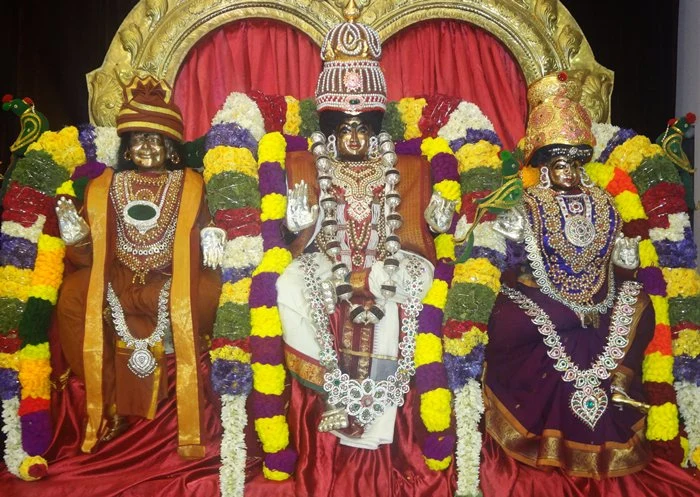
Varanasi Inner Awakening Day - 4 | Meenakshi Brahmotsavam Day -4 | Padapuja | Nithya Satsang

Tags:

Varanasi, Paramahamsa Nithyananda, Adi Shankara, Jayanthi, Sanatana Hindu Dharma, Acharya Ramanuja, core beliefs, lifestyle

Photos Of The Day:

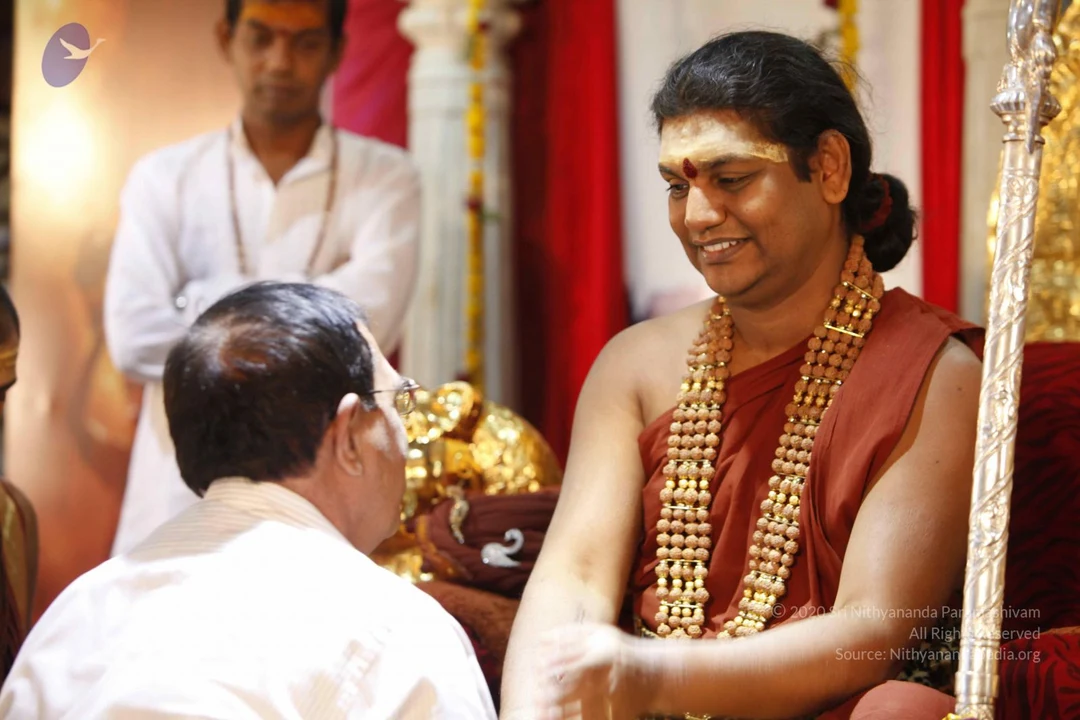
PadaPuja
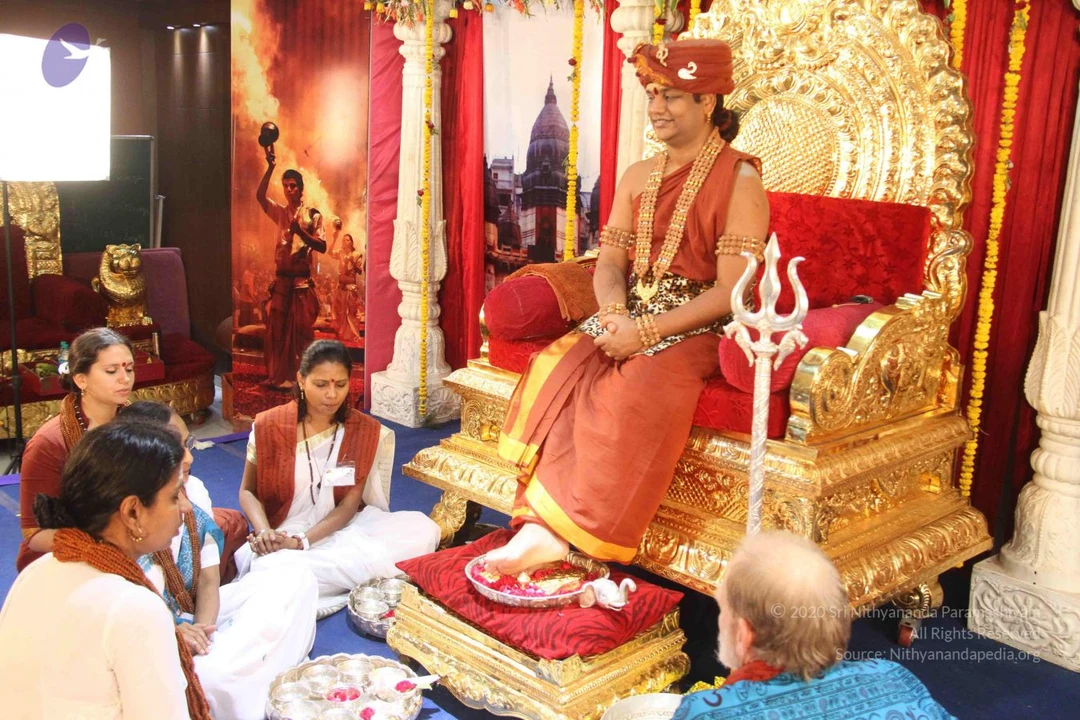
Morning-Satsang
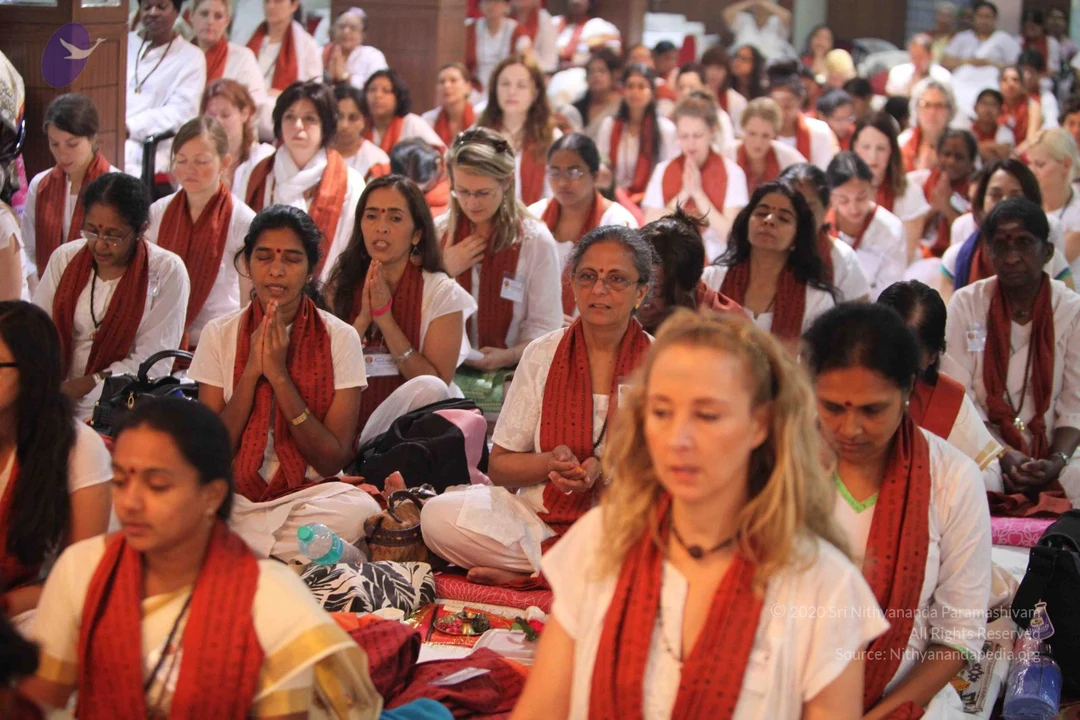
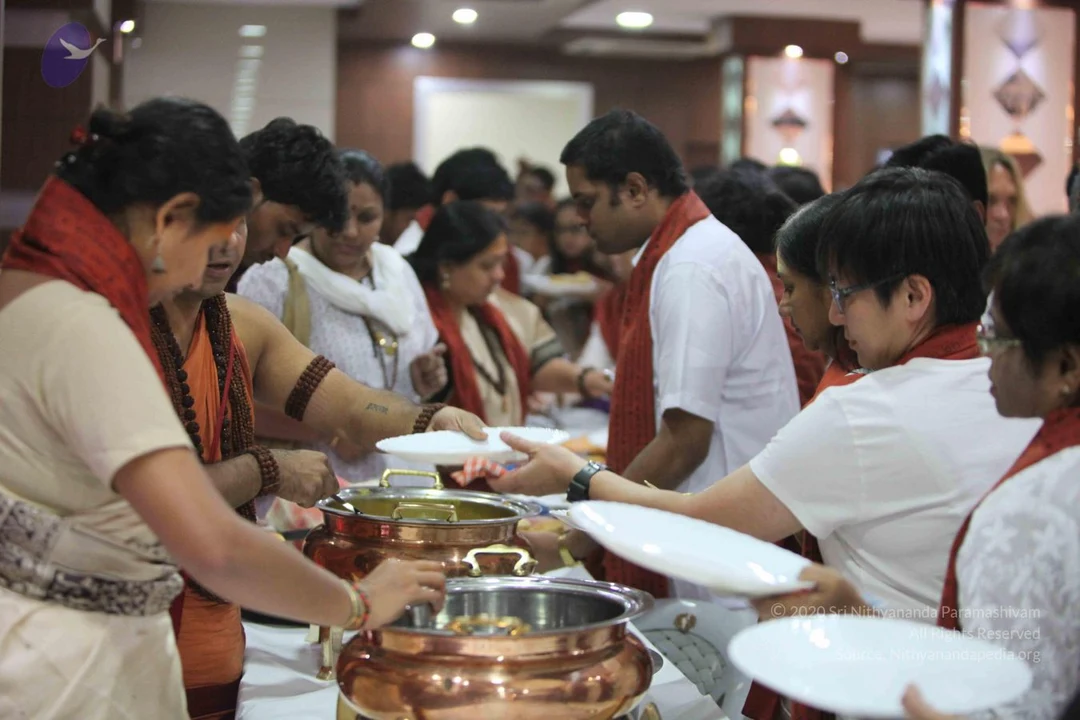
IA-Lunch

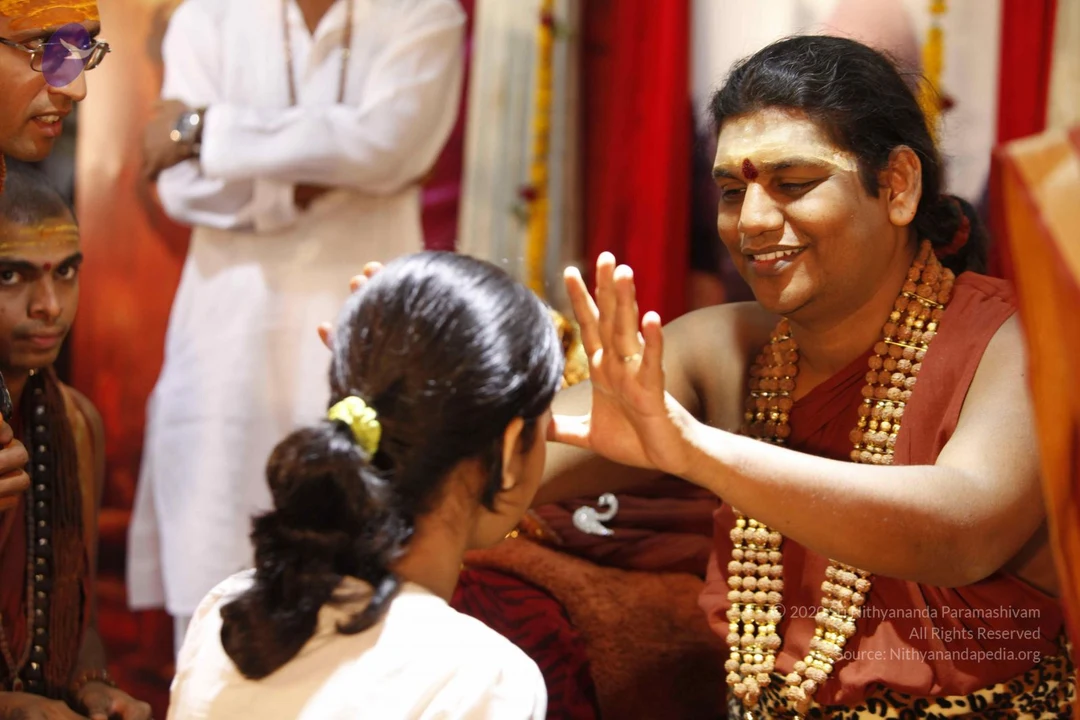
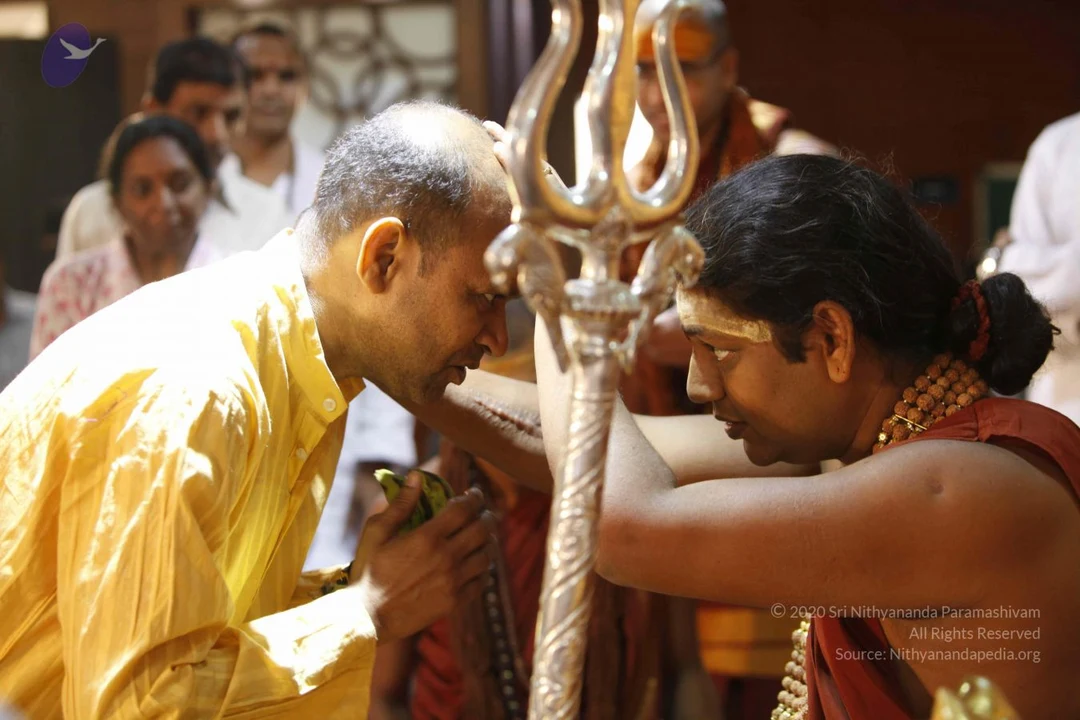
Darshan

Kalabhairavar-Homa

Others

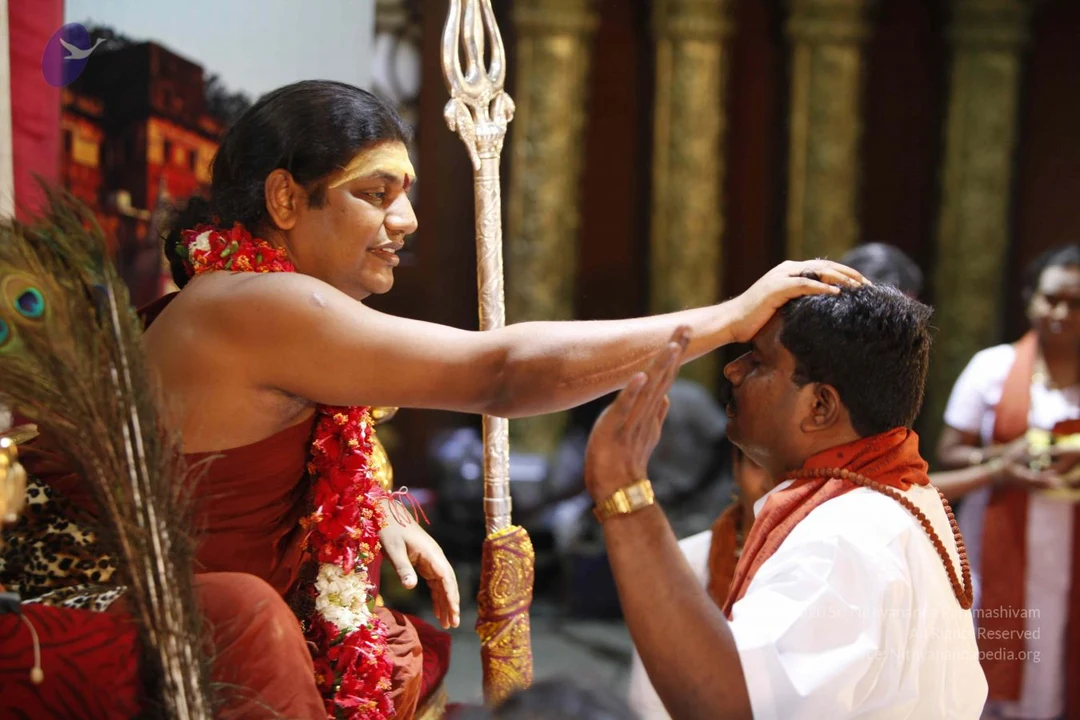
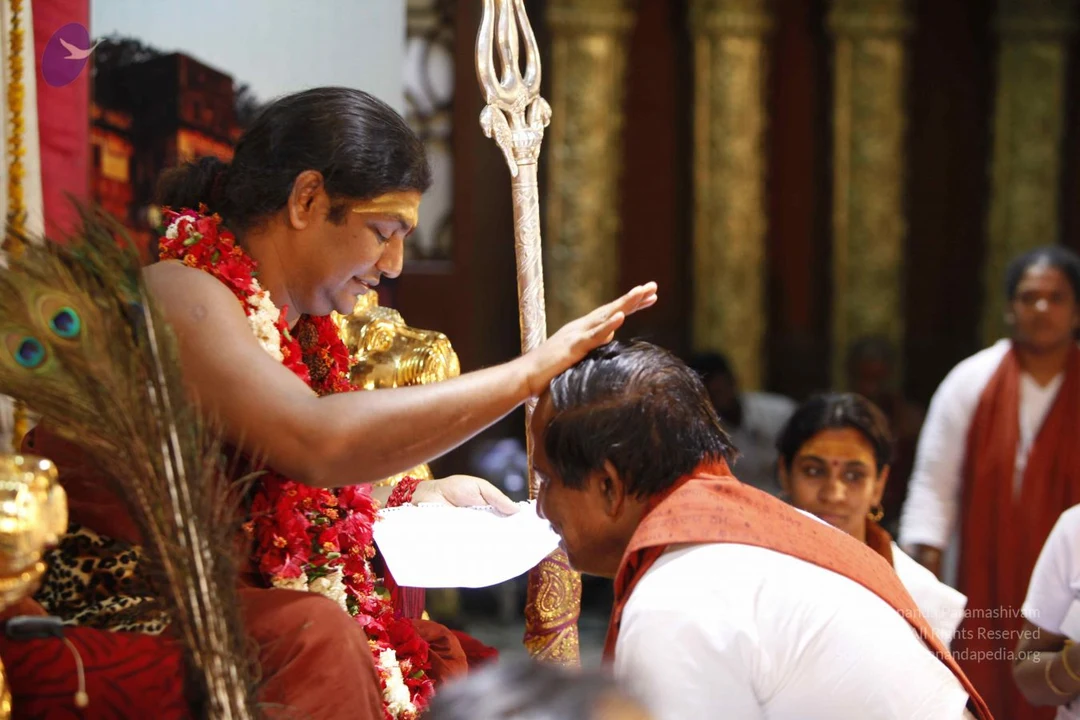
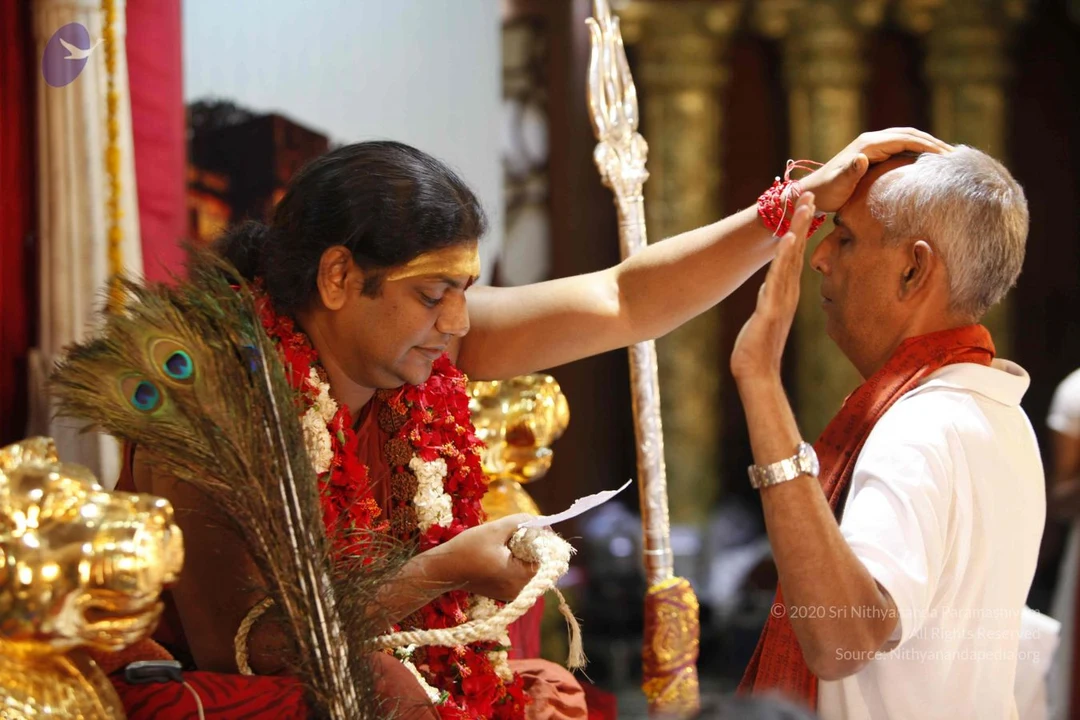
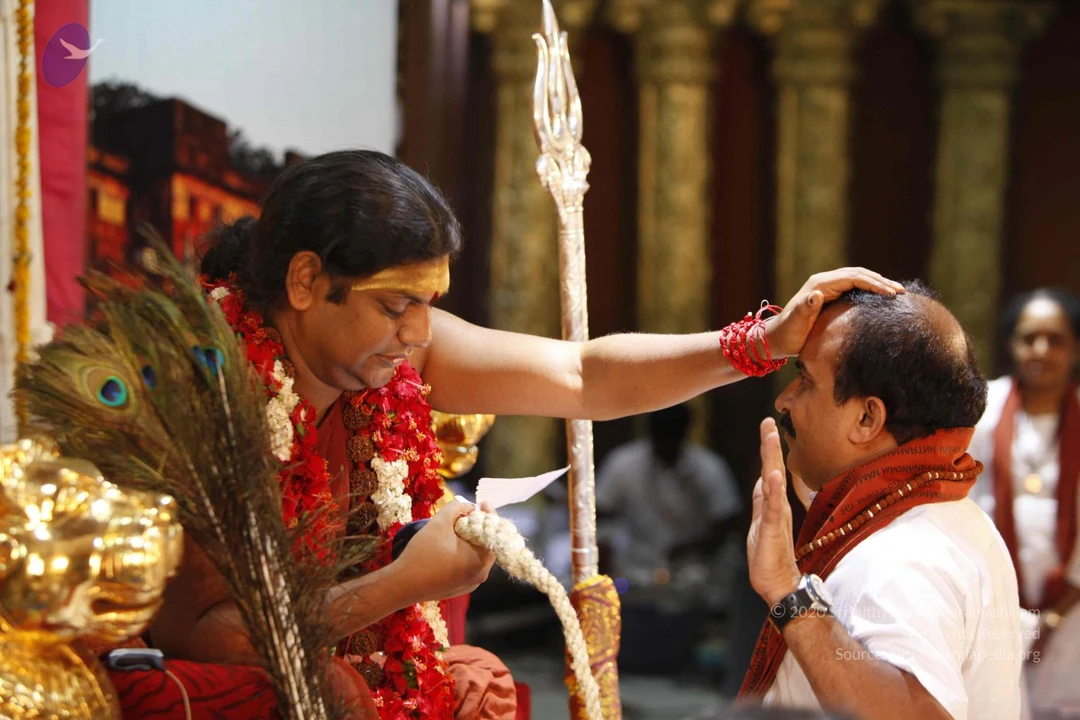
1-PadaPuja

2-MorningSatsang

3-IA-Lunch

4-Darshan

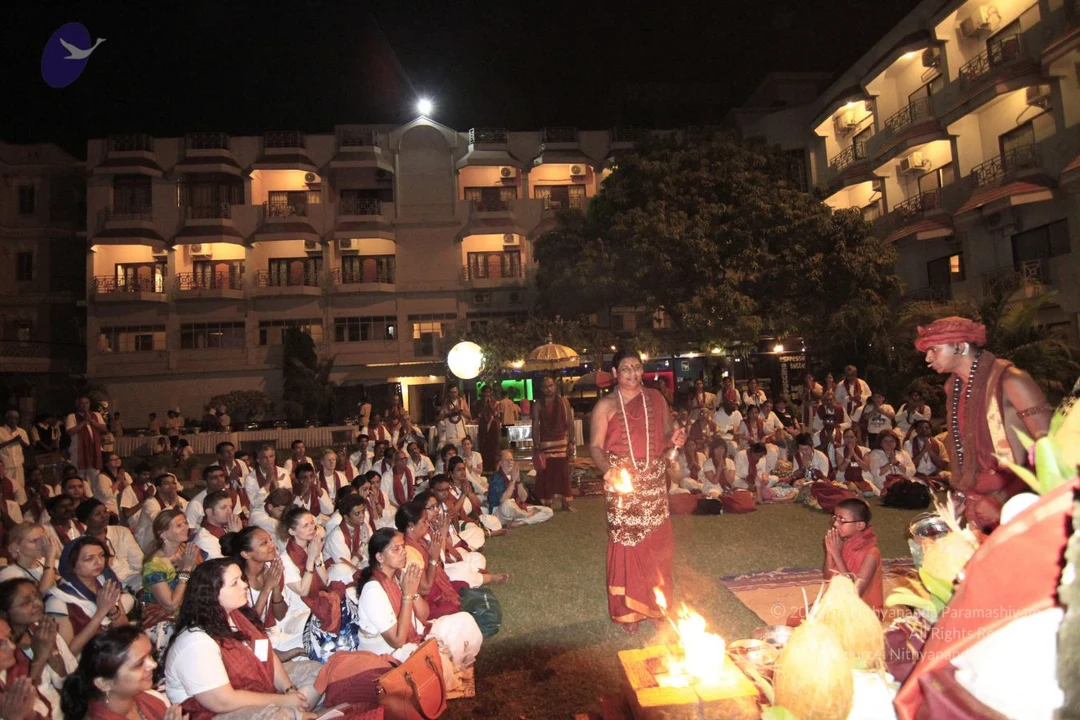
5-Kalabhairavar-Homa

Photos from this day

View all 303 photos

Photos

16 photosSource gallery
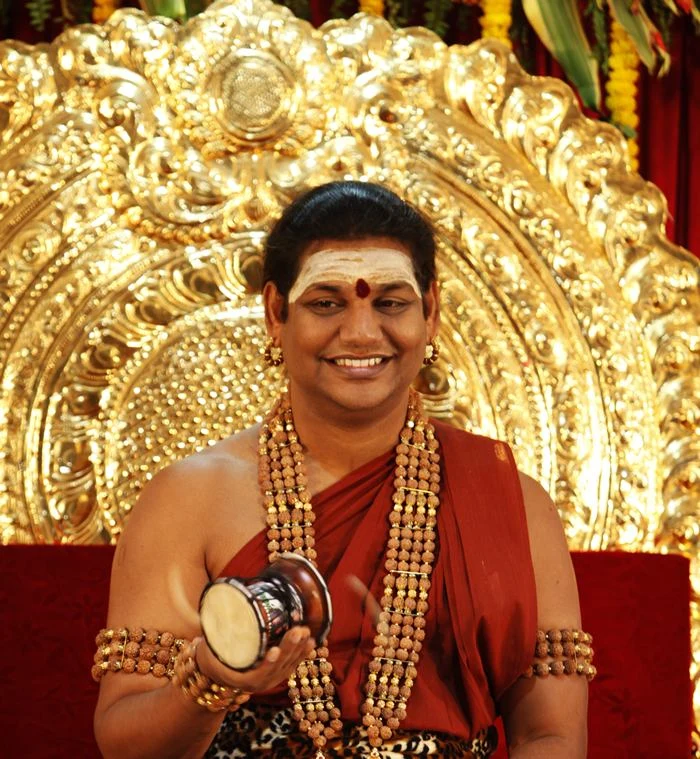
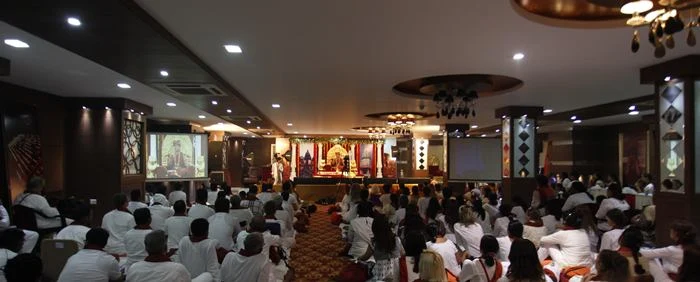
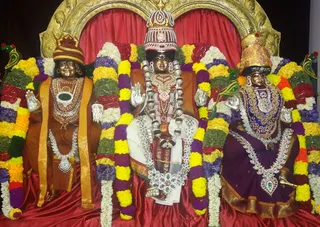
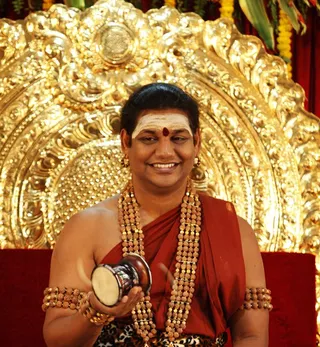
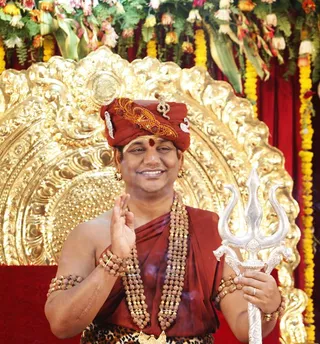
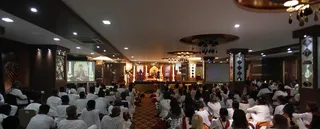
A photograph of three deity murtis seated together on a red draped stage before a gold arched backdrop, decorated with long garlands of yellow, purple and green flowers. The central figure wears a tall ornate crown, a white dhoti, silver arms and a large beaded necklace, holding a staff. The figure on the left wears an orange-gold garment and a jewelled necklace, and the figure on the right wears a purple sari with gold border and heavy jewelled necklaces with a gold crown. No physical people are visible.A smiling man sits before an ornate gold repoussé throne with a red velvet seat and garlands of marigold at the top edge. He wears a red-orange saffron-toned cloth draped over one shoulder, multiple strands of rudraksha malas and ceremonial gold necklaces, rudraksha bracelets on both upper arms, gold earrings, and a white vibhuti tripundra with a red kumkum dot on his forehead. He holds a wooden damaru drum in his right hand. Appearance-based label: a person, seated in the role of a presiding teacher during a satsang setting.A photograph of a man standing before an ornate gold carved backdrop framed by marigold garlands and flowers. He wears a red-orange jeweled turban with a decorative emblem, a red-orange cloth wrap over a shoulder, multiple rudraksha mala necklaces, bead bracelets, and a leopard-print lower garment. He holds a silver trident in his right hand and raises his left hand in a blessing gesture while smiling. A red dot marks his forehead. He is a single person in the scene.A wide photograph of a satsang hall with a large seated audience, mostly dressed in white, filling rows of chairs and floor mats facing a raised stage. On the stage, several robed figures sit before an ornate throne-like seat with gold and red decoration and a colourful backdrop. Large screens on the left and right show the stage. Warm ceiling lights, chandeliers and wooden paneling frame the room.A decorated deity murti of Meenakshi standing within a gilded golden palanquin frame. The figure wears a tall jewelled crown with white, red and black patterned embellishment, a dark purple garment, and a heavy layered gold and red-stone necklace. Long garlands of white, red, yellow, purple and green flowers drape over the shoulder and arm. A golden finial with kalasha-like tassels stands at the left, and a teal drape and golden peacock carvings frame the background.A photograph of a golden palanquin decorated with ornate gilt carvings, hanging tassels in yellow, pink, green and red, and small gold bells. Standing inside the central gilt shrine niche is a deity murti dressed in purple and white cloth, wearing a tall decorated crown, a gold necklace and a long garland of red, purple, yellow and white flowers. Draped fabric in blue and red frames the niche. Behind the palanquin is a white wall, a floor standing air cooler and dark curtains. No people are visible.

Varanasi Inner Awakening Day - 4 | Meenakshi Brahmotsavam Day -4 | Padapuja | Nithya Satsang

8 photosSource gallery
A photograph of three deity murtis seated together on a red draped stage before a gold arched backdrop, decorated with long garlands of yellow, purple and green flowers. The central figure wears a tall ornate crown, a white dhoti, silver arms and a large beaded necklace, holding a staff. The figure on the left wears an orange-gold garment and a jewelled necklace, and the figure on the right wears a purple sari with gold border and heavy jewelled necklaces with a gold crown. No physical people are visible.A smiling man sits before an ornate gold repoussé throne with a red velvet seat and garlands of marigold at the top edge. He wears a red-orange saffron-toned cloth draped over one shoulder, multiple strands of rudraksha malas and ceremonial gold necklaces, rudraksha bracelets on both upper arms, gold earrings, and a white vibhuti tripundra with a red kumkum dot on his forehead. He holds a wooden damaru drum in his right hand. Appearance-based label: a person, seated in the role of a presiding teacher during a satsang setting.A photograph of a man standing before an ornate gold carved backdrop framed by marigold garlands and flowers. He wears a red-orange jeweled turban with a decorative emblem, a red-orange cloth wrap over a shoulder, multiple rudraksha mala necklaces, bead bracelets, and a leopard-print lower garment. He holds a silver trident in his right hand and raises his left hand in a blessing gesture while smiling. A red dot marks his forehead. He is a single person in the scene.A wide photograph of a satsang hall with a large seated audience, mostly dressed in white, filling rows of chairs and floor mats facing a raised stage. On the stage, several robed figures sit before an ornate throne-like seat with gold and red decoration and a colourful backdrop. Large screens on the left and right show the stage. Warm ceiling lights, chandeliers and wooden paneling frame the room.A decorated deity murti of Meenakshi standing within a gilded golden palanquin frame. The figure wears a tall jewelled crown with white, red and black patterned embellishment, a dark purple garment, and a heavy layered gold and red-stone necklace. Long garlands of white, red, yellow, purple and green flowers drape over the shoulder and arm. A golden finial with kalasha-like tassels stands at the left, and a teal drape and golden peacock carvings frame the background.A photograph of a golden palanquin decorated with ornate gilt carvings, hanging tassels in yellow, pink, green and red, and small gold bells. Standing inside the central gilt shrine niche is a deity murti dressed in purple and white cloth, wearing a tall decorated crown, a gold necklace and a long garland of red, purple, yellow and white flowers. Draped fabric in blue and red frames the niche. Behind the palanquin is a white wall, a floor standing air cooler and dark curtains. No people are visible.

PadaPuja

12 photosSource gallery
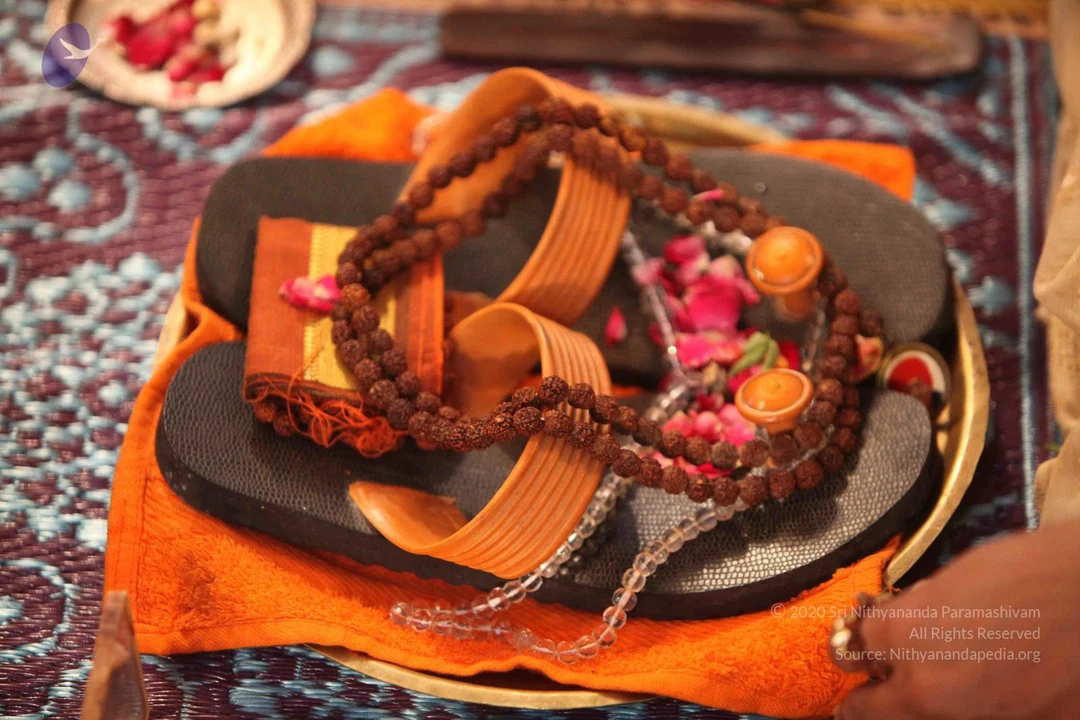
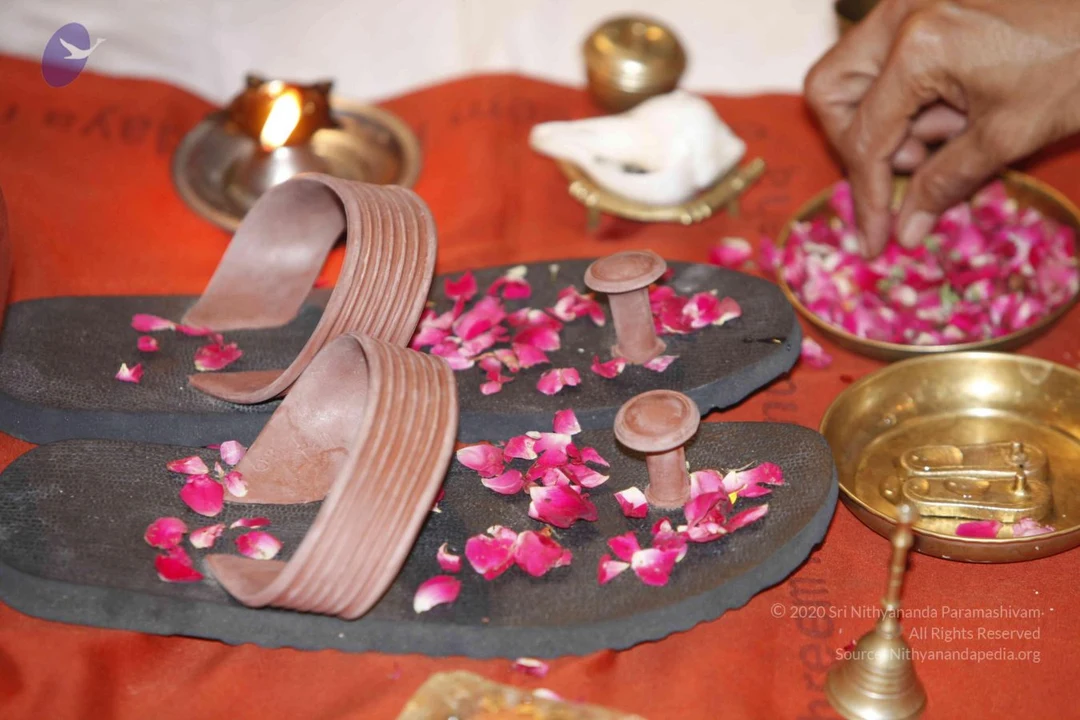
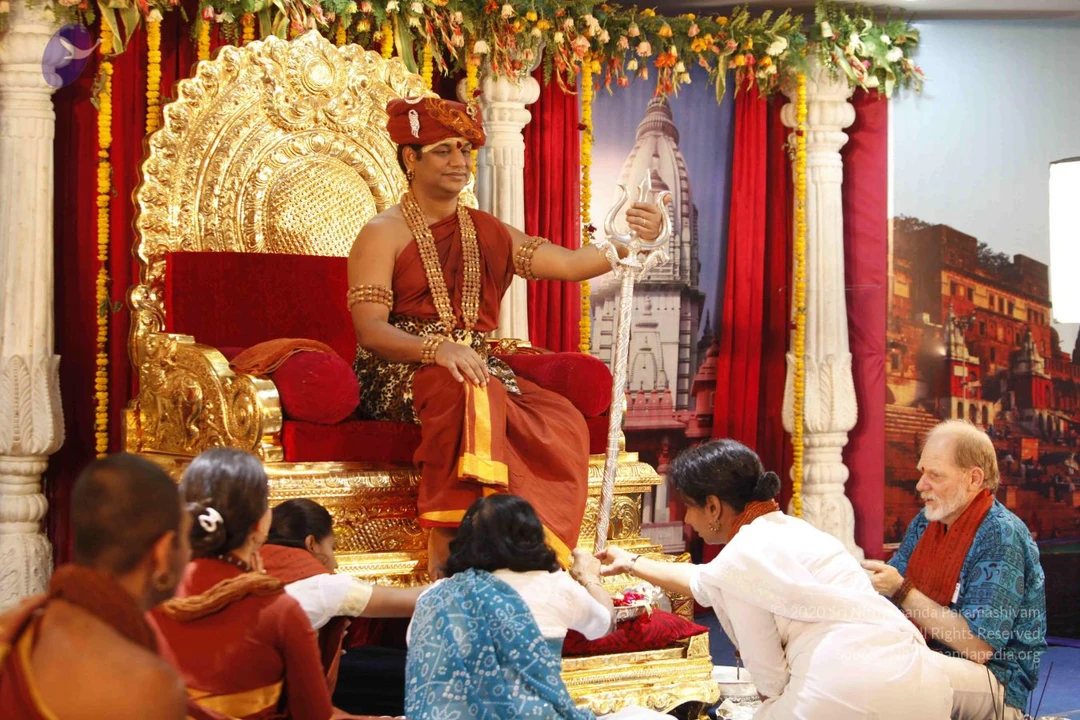
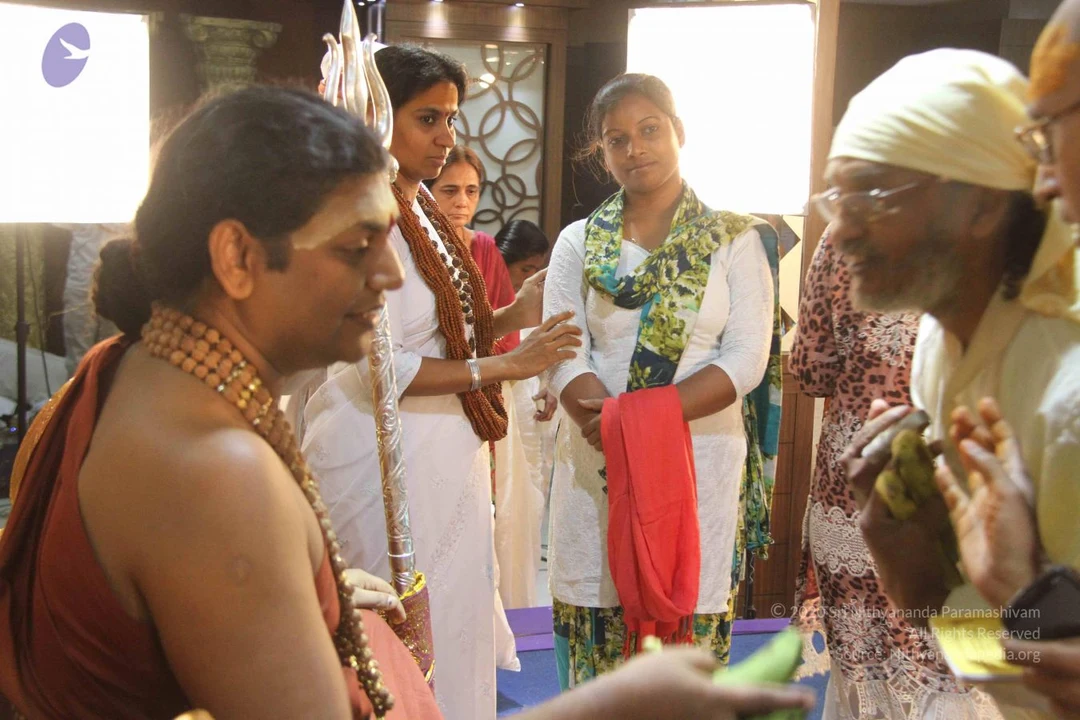
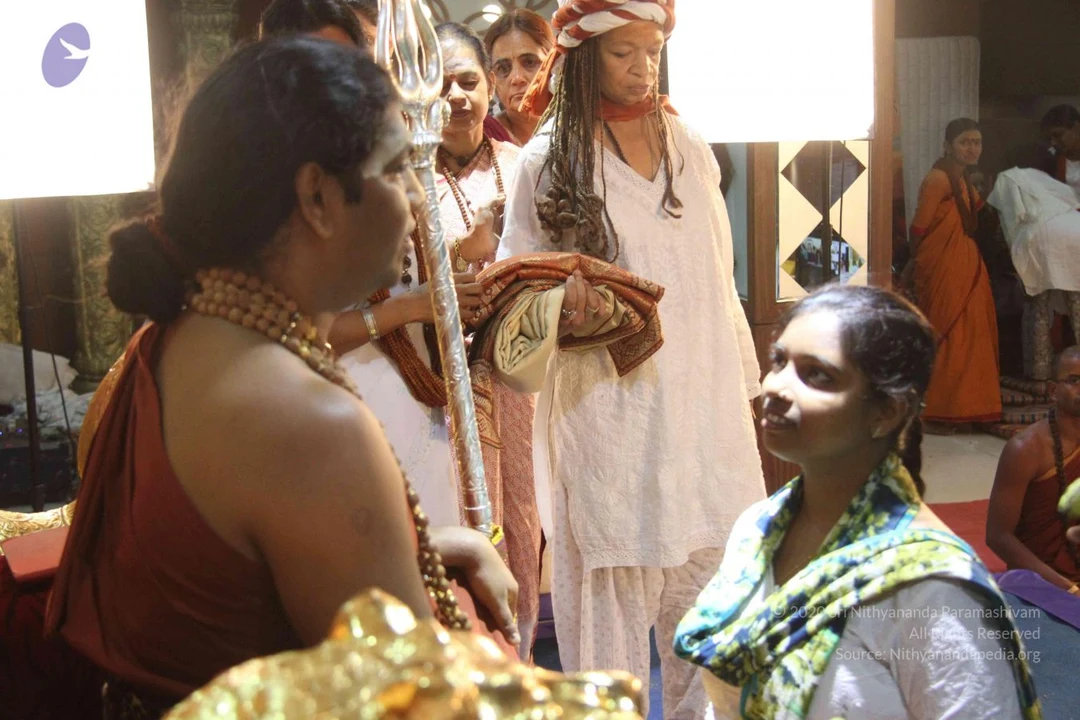
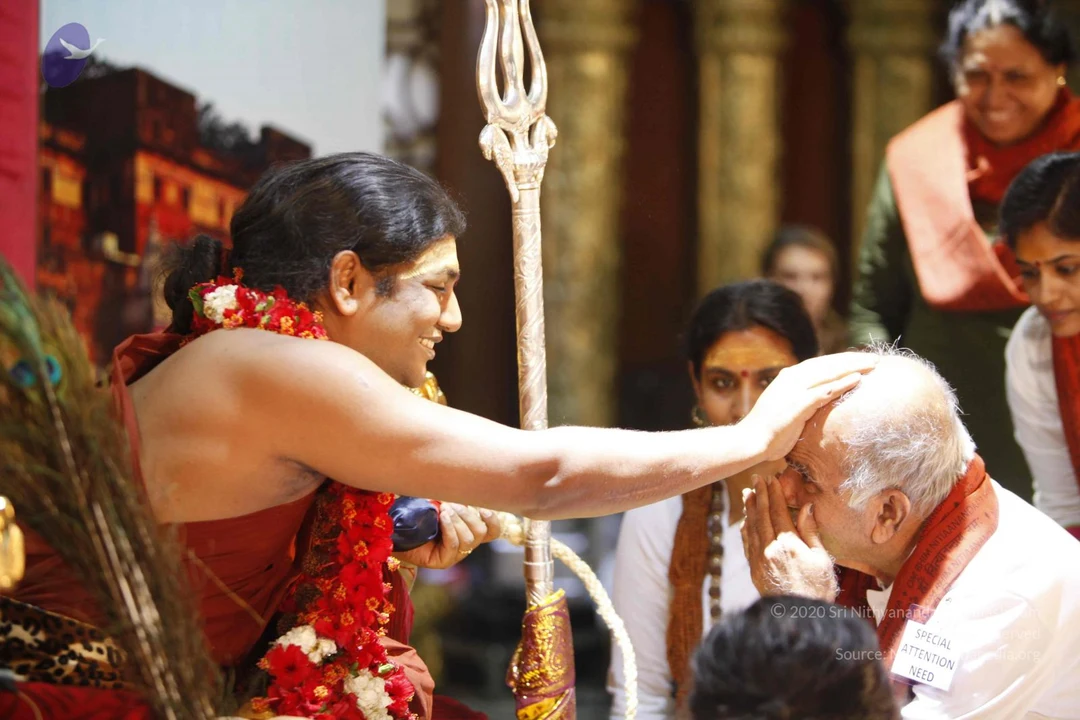
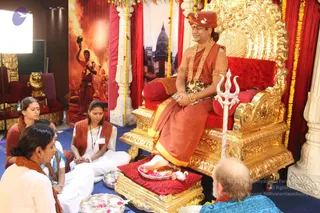
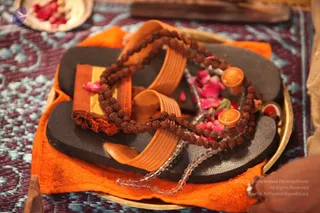
A seated figure in saffron-orange robes, a saffron turban, rudraksha-style beaded necklaces and gold bangles sits on an ornate gold throne with red cushions, beside a silver trident. Devotees sit on blue mats before him: a woman in white with a red shawl and a name badge holds her hands in anjali, another in white and red sits nearby, and a woman in an orange shawl sits at left. A silver plate of flowers and petals rests at the feet of the seated figure, and an older man with grey hair sits at lower right. Red drapes, marigold garlands and a backdrop of a sunlit Varanasi-style temple complete the scene. Swamiji (probable): the seated figure in saffron robes, turban and beaded necklaces on the throne.A seated figure on an ornate gold throne with red cushions, wearing a saffron-orange turban with a silver emblem, rudraksha-style beaded necklaces, layered bead malas, gold armlets and bangles, and a saffron-orange dhoti. A silver trident stands beside the throne. Three women sit on a blue mat in front of the throne: one in a blue sari with brown beads, one in a white sari with a brown shawl and hands folded in prayer, and one in a brown top and dark skirt with hands together. A tray of flowers and offerings sits near the feet. Behind them hangs a backdrop painting of a figure holding a pot, and garlands decorate the setting. The figure on the throne matches the a person cues of distinctive saffron attire, turban and ornate adornments, in a satsang-style setting.Indoor ceremonial scene in a hall with blue carpet and a golden ornate throne. A figure seated on the right wears a rust-orange dhoti and shawl, a multi-strand rudraksha-style mala and gold necklace, gold armbands and an orange-and-red turban, and holds a silver trident beside the throne; the appearance is consistent with the Swamiji (probable) candidate, shown in person on the throne. Four women in white and rust-coloured garments sit on the carpet with hands folded, one wearing a blue sari, while a silver plate with flower petals and a tray of oil lamps sits in front. A cameraman with a tripod-mounted camera films on the left, and a red-and-gold backdrop with painted figures stands behind.Ceremonial padapuja scene: a man in a red-orange turban, orange dhoti with yellow border, rudraksha-style beaded necklaces and gold armbands sits on an ornate gold-and-red throne, his bare feet being washed by a woman in orange sari kneeling before him. Another woman in a dark top and a man in white dhoti with a blue patterned shirt and orange shawl kneel nearby with brass plates of petals and offerings. A backdrop shows a Varanasi ghat with temple spire and boats, a trident stands beside the throne, and marigold garlands hang above. a person appearance-based label applies to the seated man wearing turban, beaded malas and gold ornaments.A seated man on an ornate gold throne with red cushions, wearing a red-and-orange turban, orange and gold dhoti, a leopard-print shawl and multiple beaded gold necklaces and armlets, smiles while a devotee performs padapuja, washing his feet from a brass plate. A man in white pants and a blue patterned shirt with a red-orange shawl sits cross-legged at right with palms pressed together. A backdrop shows a Varanasi ghat with a boat on the river, and a trident stands beside the throne. Other devotees in orange and white sit in the background, and a woman with dark hair sits at lower left. Flowers and marigold garlands decorate the canopy. The image is a photograph; the seated man is an appearance-based a person candidate.A close photograph of a pair of dark sandals placed on an orange cloth over a brass tray, with a large rudraksha mala draped over them. Clear glass beads trail beside the mala. Pink rose petals scattered across the sandals and tray, and two small orange clay oil lamps sit among them. A folded orange-and-gold cloth lies at the left. A patterned purple-and-blue mat covers the table, and a person's hand is visible at the lower right edge. No people are seated or standing in the scene as a whole, and no portrait or deity murti appears.

Morning-Satsang
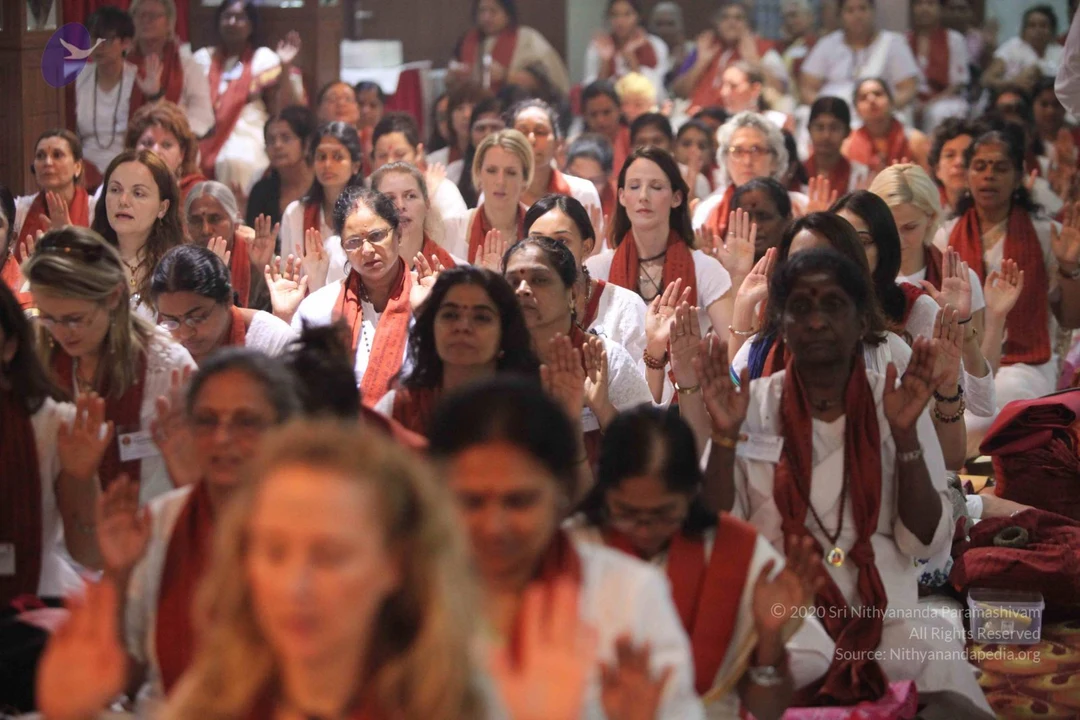
61 photosSource gallery
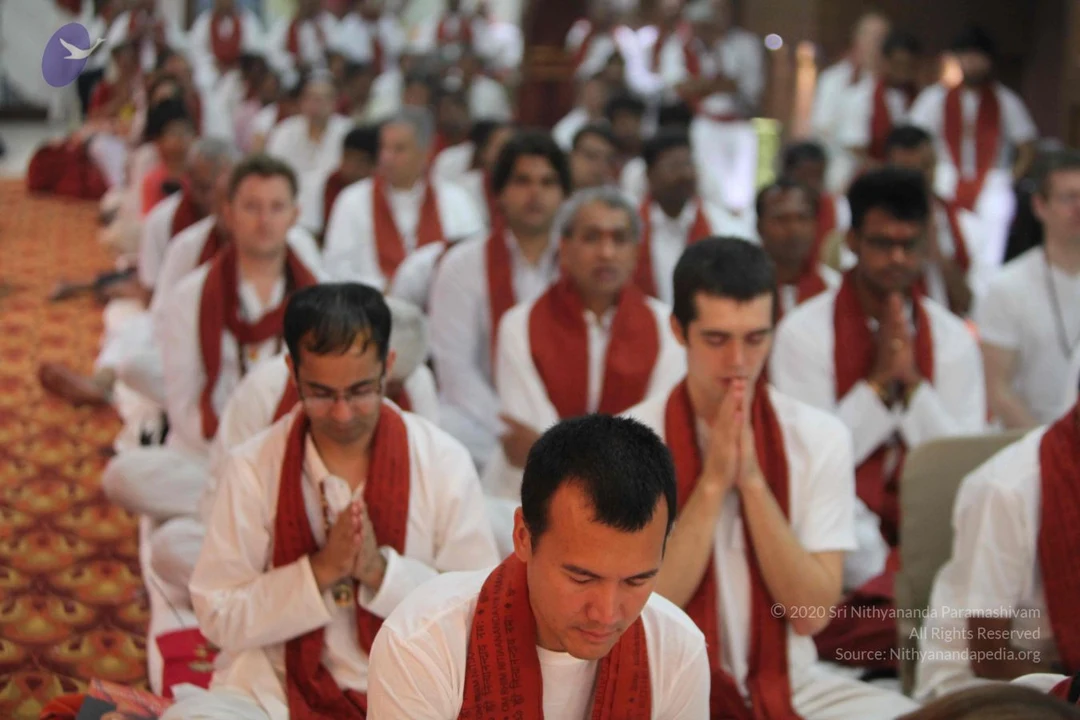
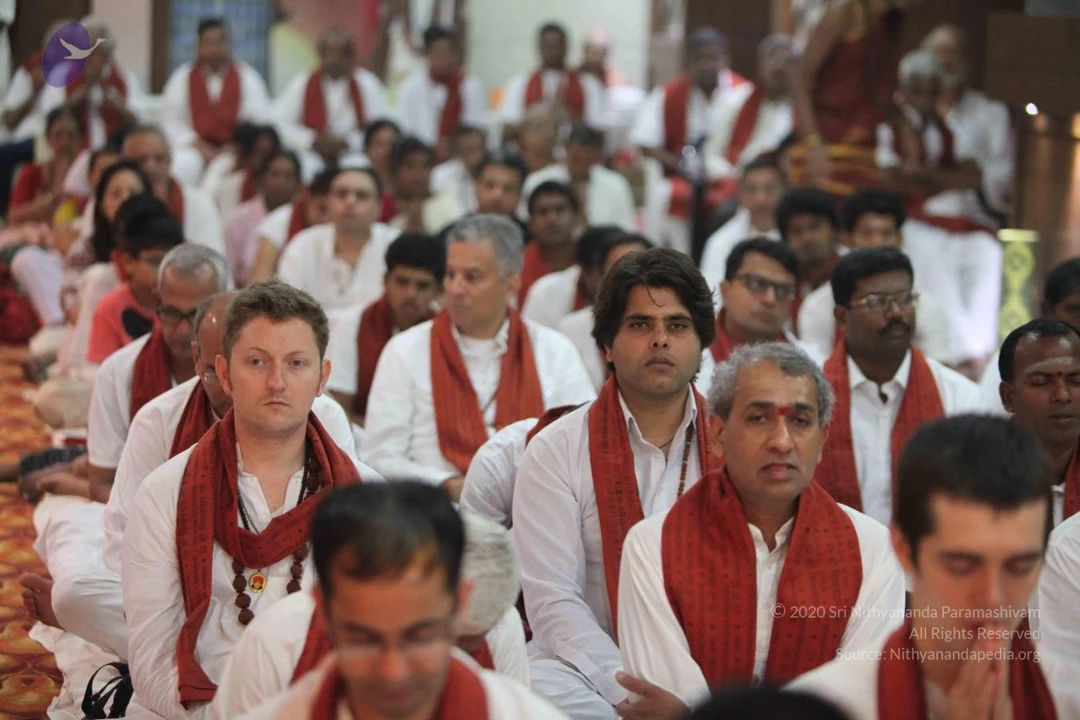
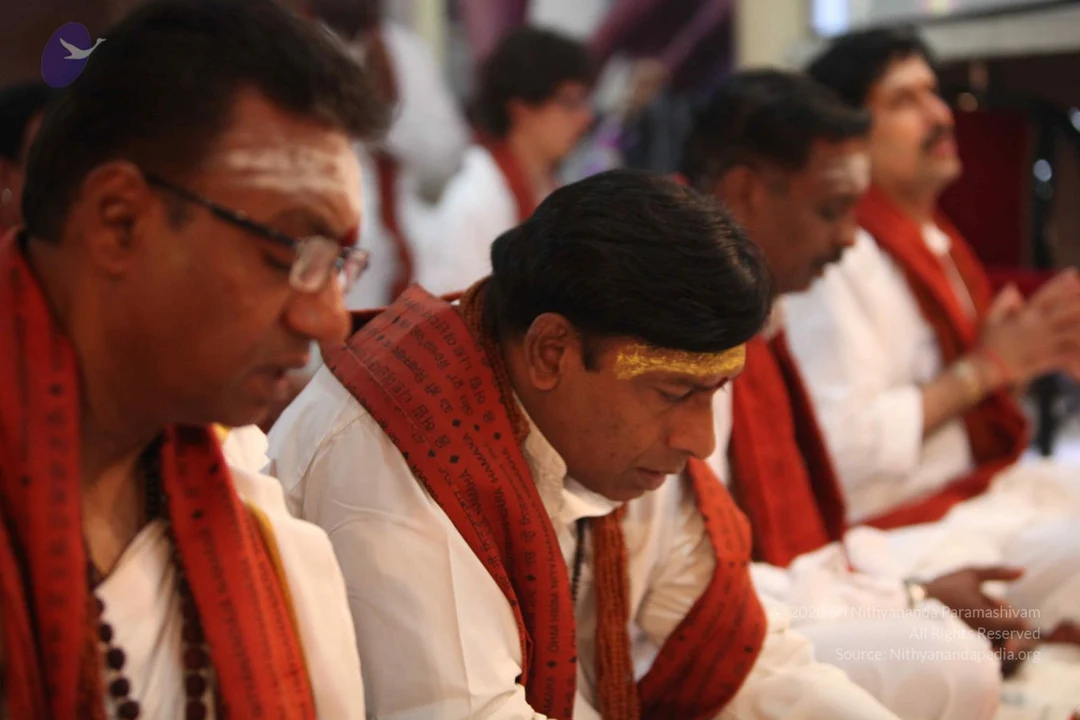
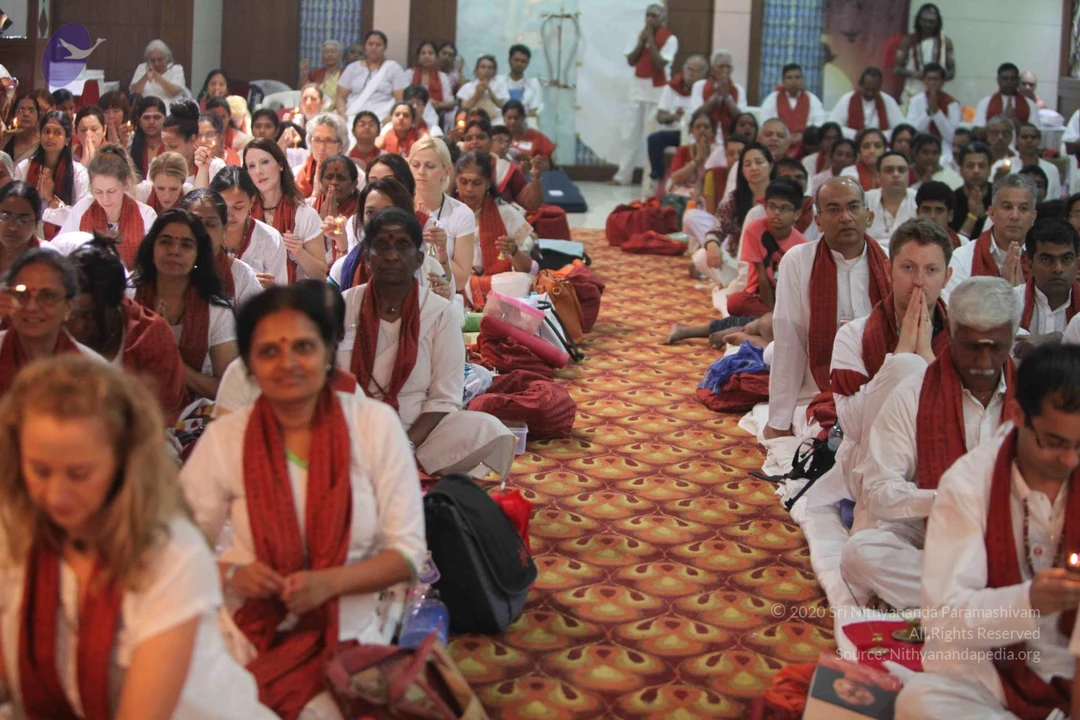
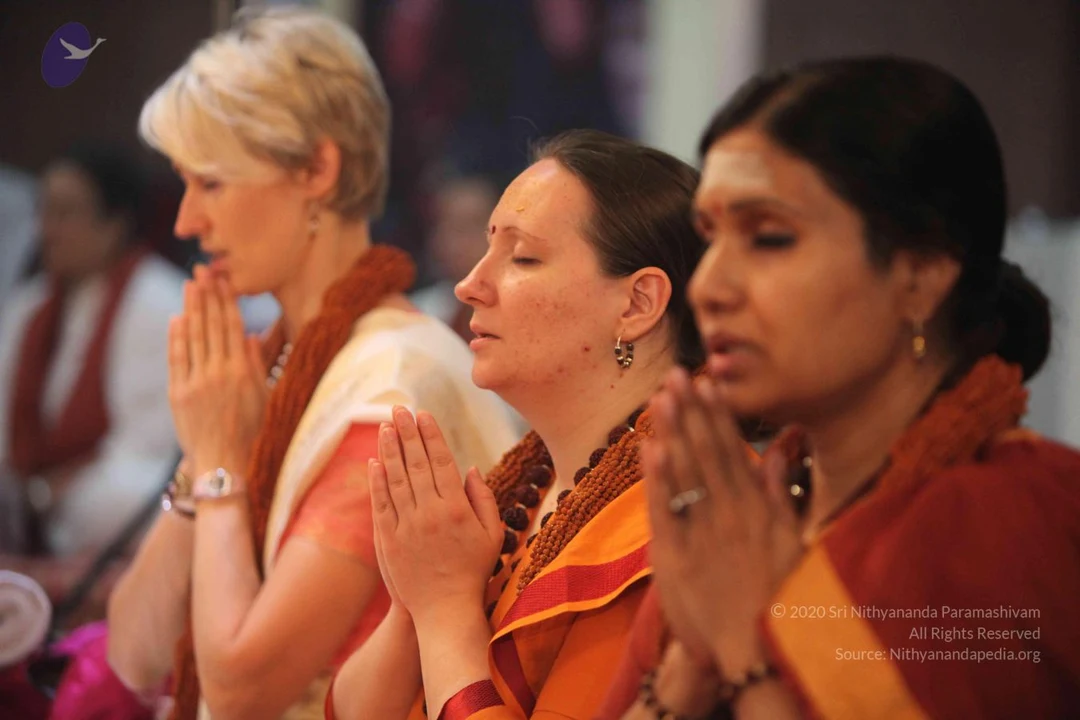
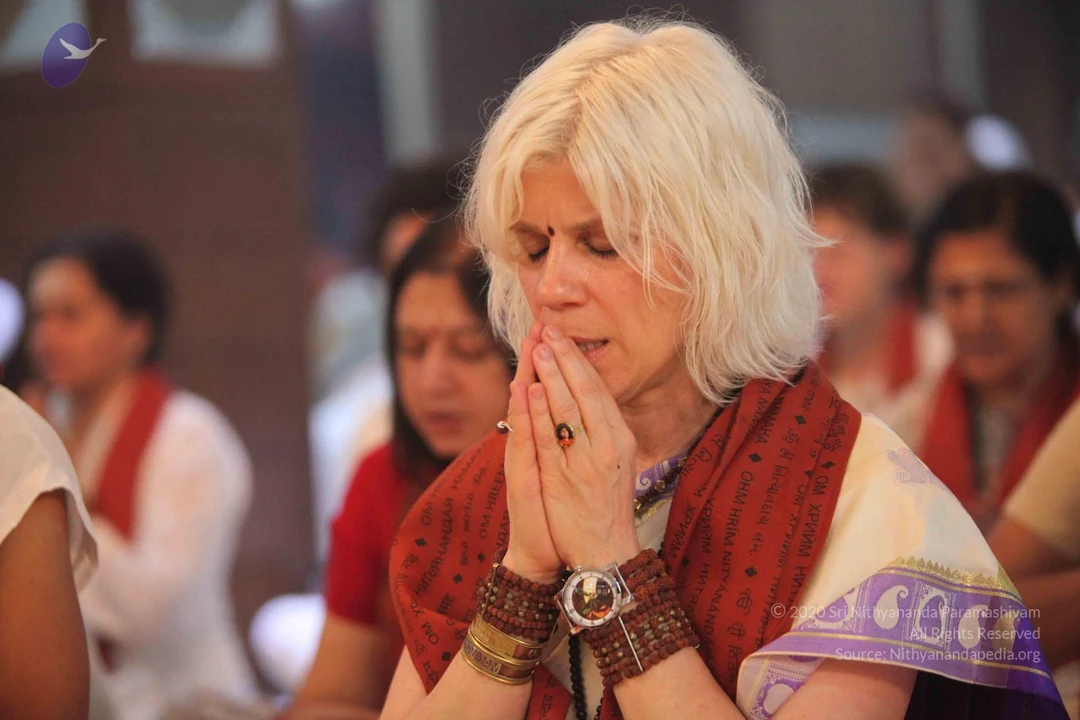
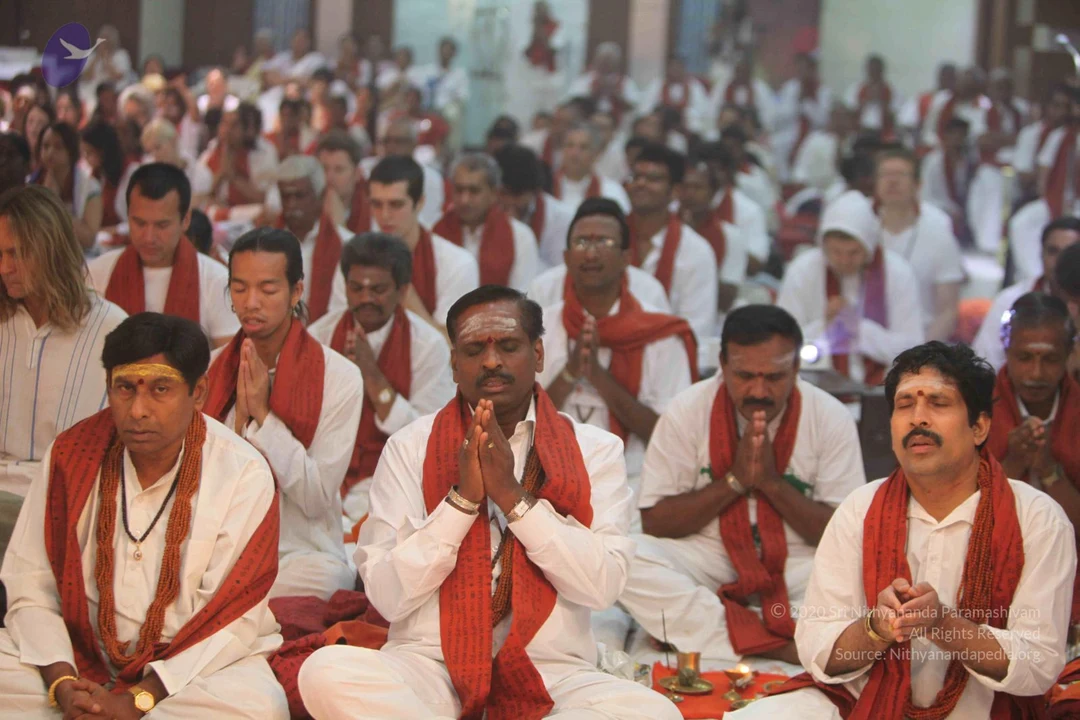
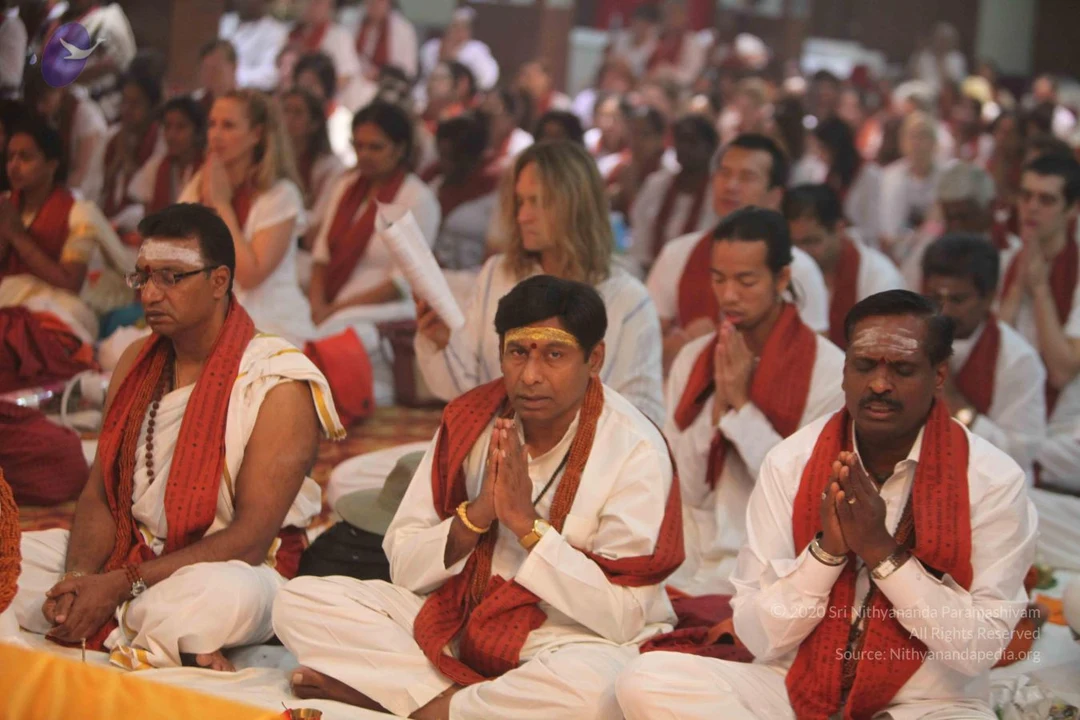
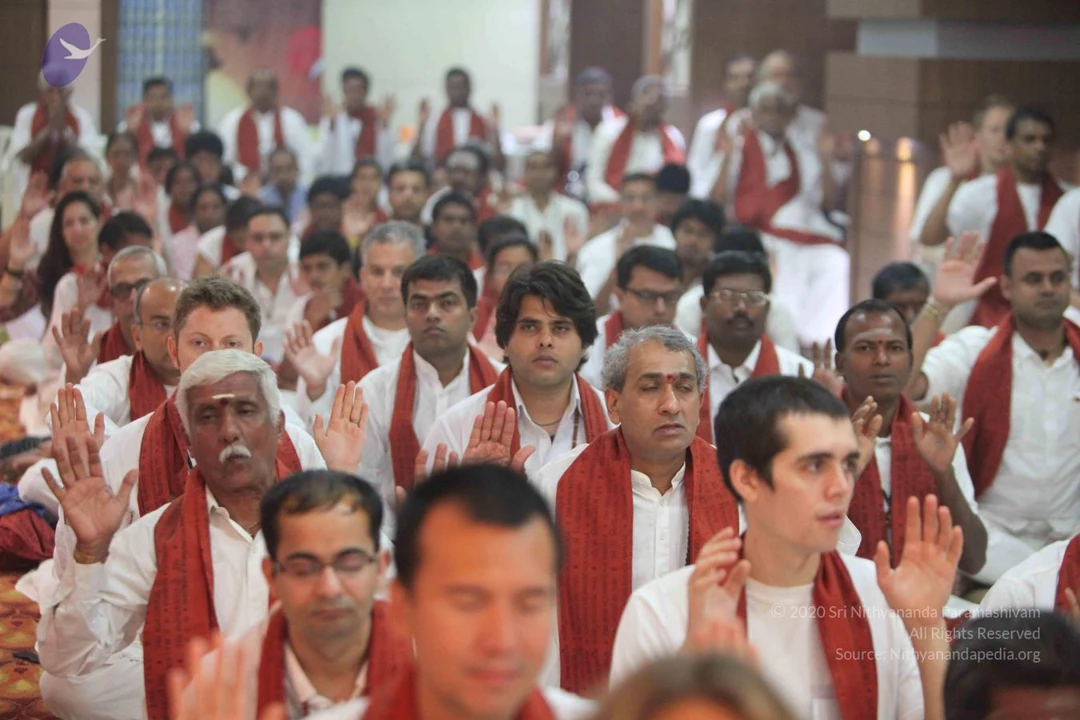
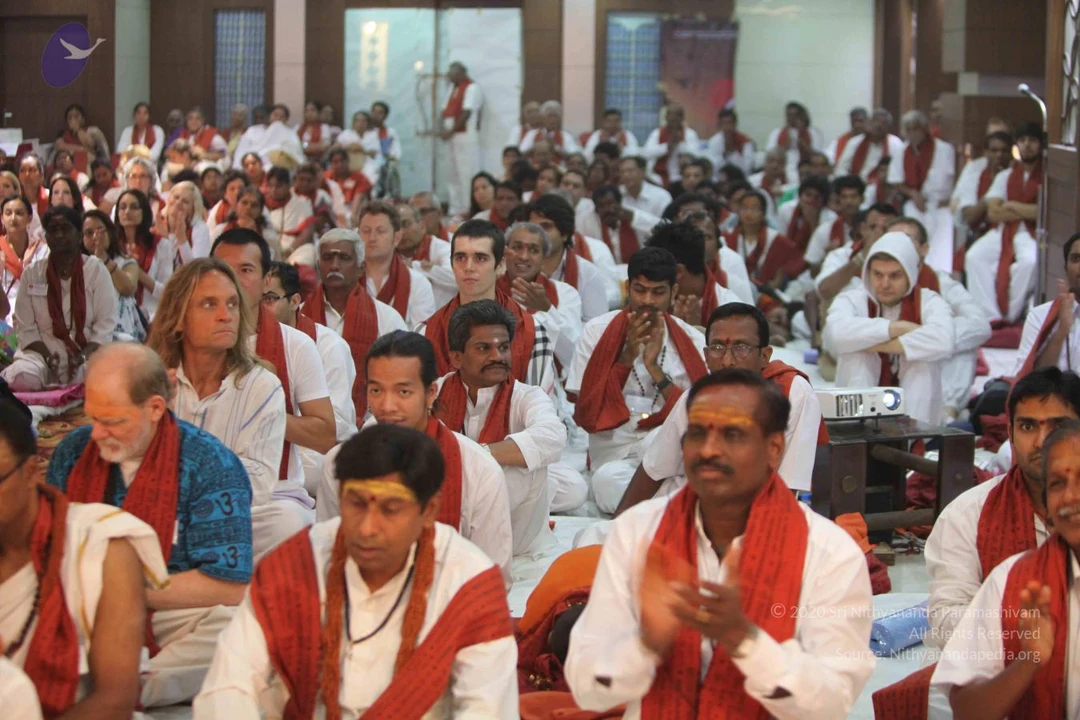
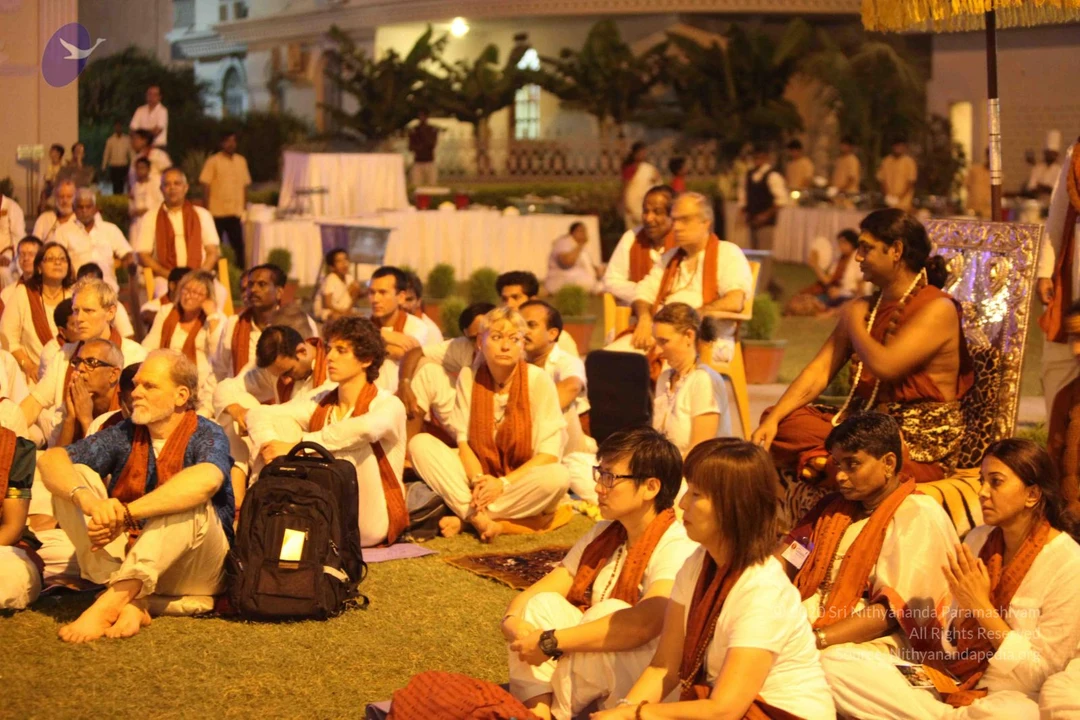
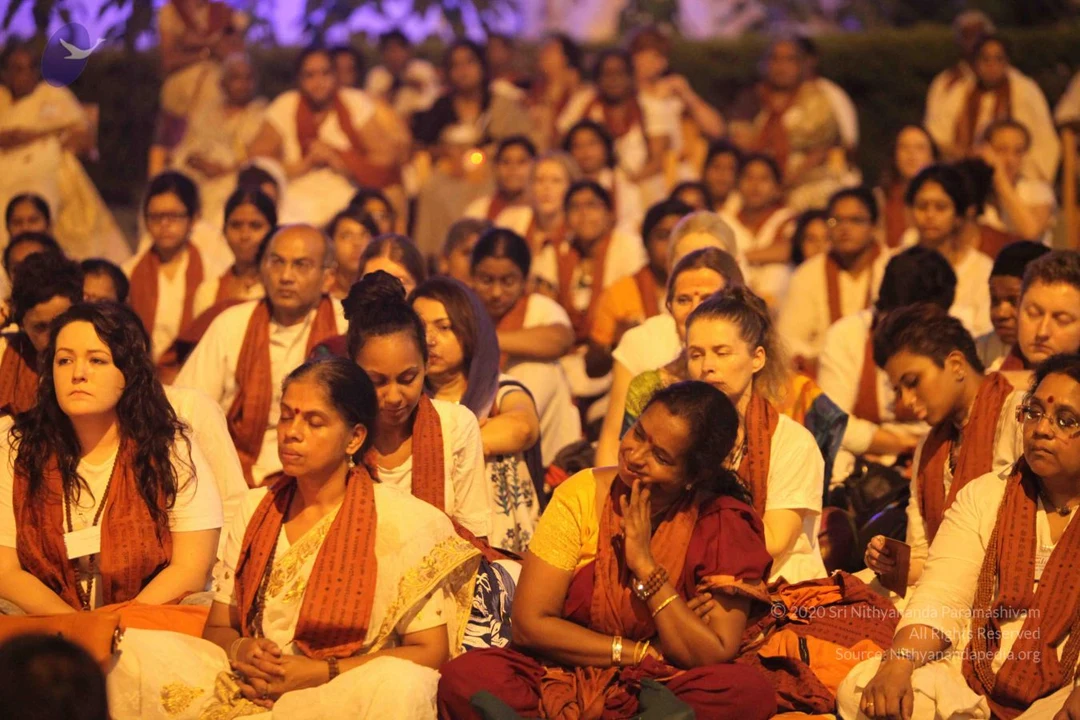
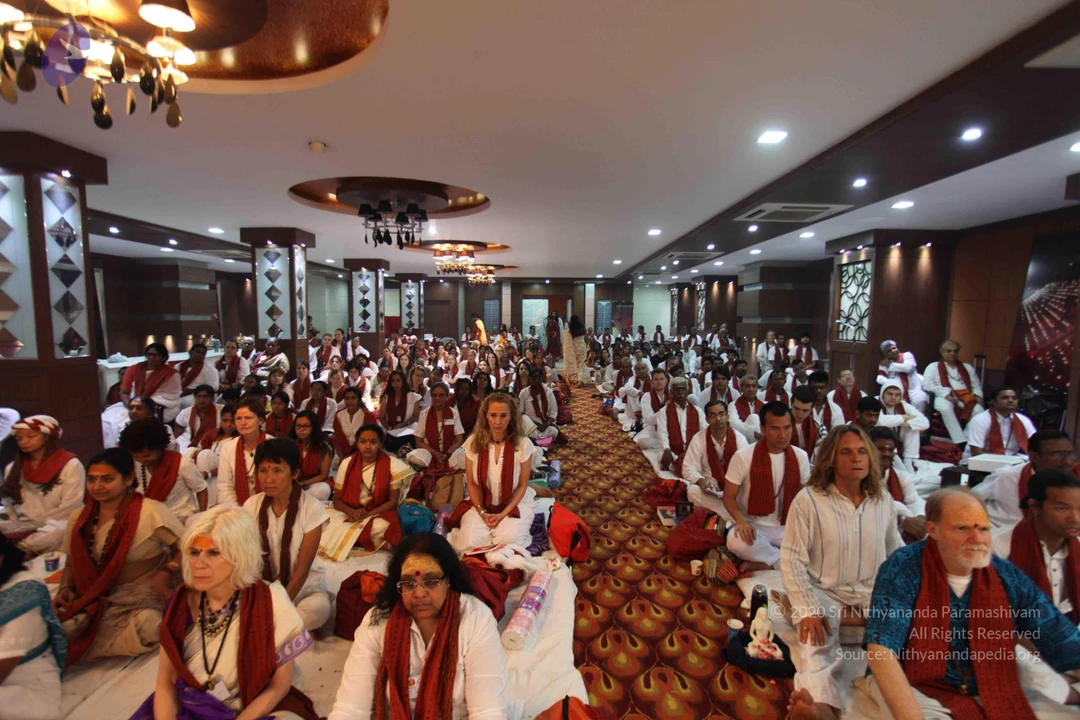
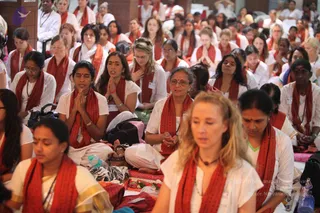
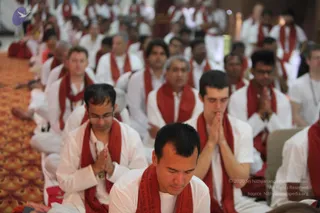
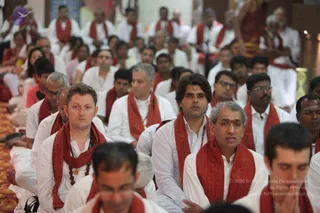
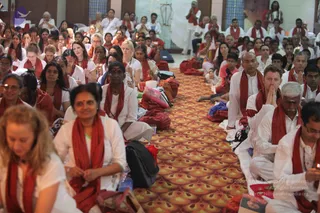
A large seated crowd of devotees in white clothes and red-orange shawls attends a satsang hall. In the foreground, a woman with blonde hair in a white top and a long beaded necklace sits with eyes closed, while a woman in a white sari with a red bindi holds her palms together in namaste. Several women in the middle row sit with hands folded or pressed in prayer. Water bottles, bags and a small brass object lie on mats in front of them. No a person candidate is visible; the people are seated in meditative posture facing forward toward an unseen front of the hall.Large seated congregation of devotees in white kurtas and red shawls with printed patterns, many with palms pressed together in anjali mudra, eyes closed or lowered, during satsang. Foreground men sit close to the camera; rows recede into a hall with an ornate red and gold carpet patterned with lotus or pot motifs. No a person visible in frame. Partial figures at the edges and background add to the count.A seated congregation of devotees in white dhotis and white kurta-style shirts with red shawls, attending a satsang hall. Many men sit cross-legged on a red and gold carpet, several with rudraksha mala necklaces and some with vertical tilak marks. A few faces are lit by overhead light while the front row sits with hands joined or eyes closed in meditation. Behind them, a robed priest in saffron-red garments stands near a pillar.Photograph of several male devotees seated closely together in white kurtas with red shawls printed in black script, eyes lowered in prayer or meditation. The man in front centre has a yellow turmeric tilak on his forehead, and the man at left wears glasses and white tripundra marks with a rudraksha mala at his neck. Others to the right have clasped hands and white vibhuti marks. Background is blurred.A man seated on an ornate gilded throne with a red velvet cushion, smiling and raising one hand in blessing while holding a silver trident. He wears a maroon turban with gold embroidery and a crescent-style ornament, a maroon robe, layered rudraksha malas and a gold pendant necklace, bead bracelets, and a leopard-print wrap at the waist. Yellow marigold garlands drape the throne and red curtains behind him, with white fluted columns at the sides. A single photograph with no other people clearly visible.A large seated congregation of devotees fills a carpeted hall, most wearing white clothes with red shawls draped over their shoulders. Many have their palms pressed together in anjali or hold them in prayer, and some hold small lit lamps near the lower right. Women in white with red stoles sit in rows at left, while men in white and red seat themselves along the right side. Bags, cushions and red bundles lie among the seated devotees on the patterned red carpet. No single speaker or deity murti is clearly visible in the frame. a person cannot be confirmed from appearance here, so the candidate is not described.

IA-Lunch

16 photosSource gallery
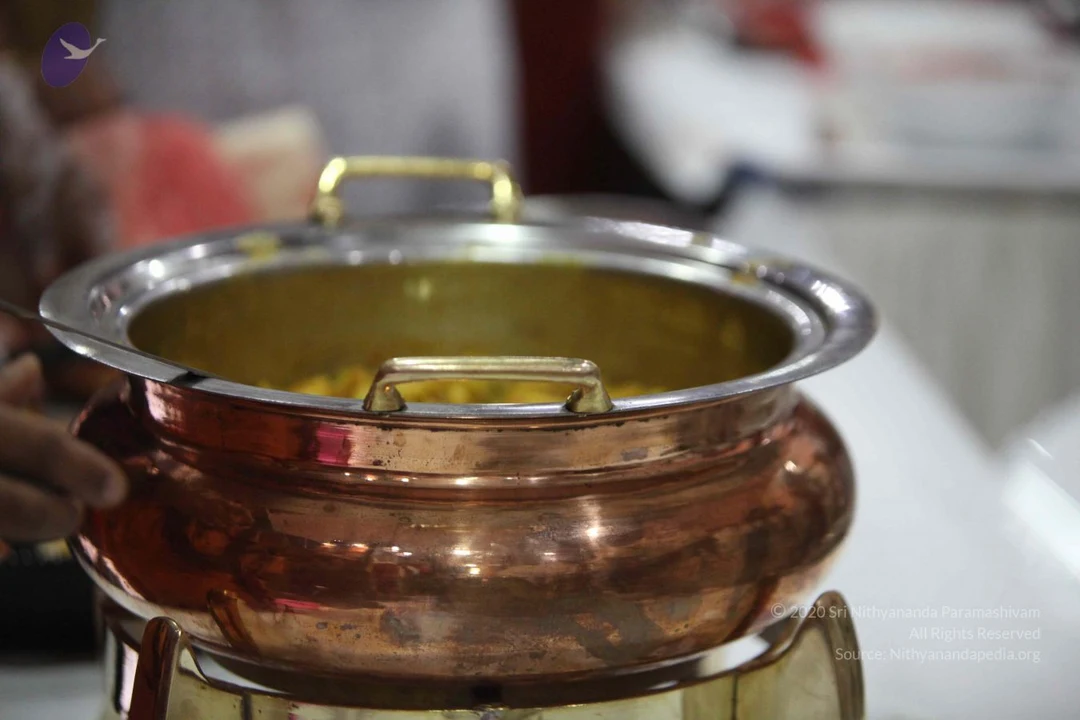
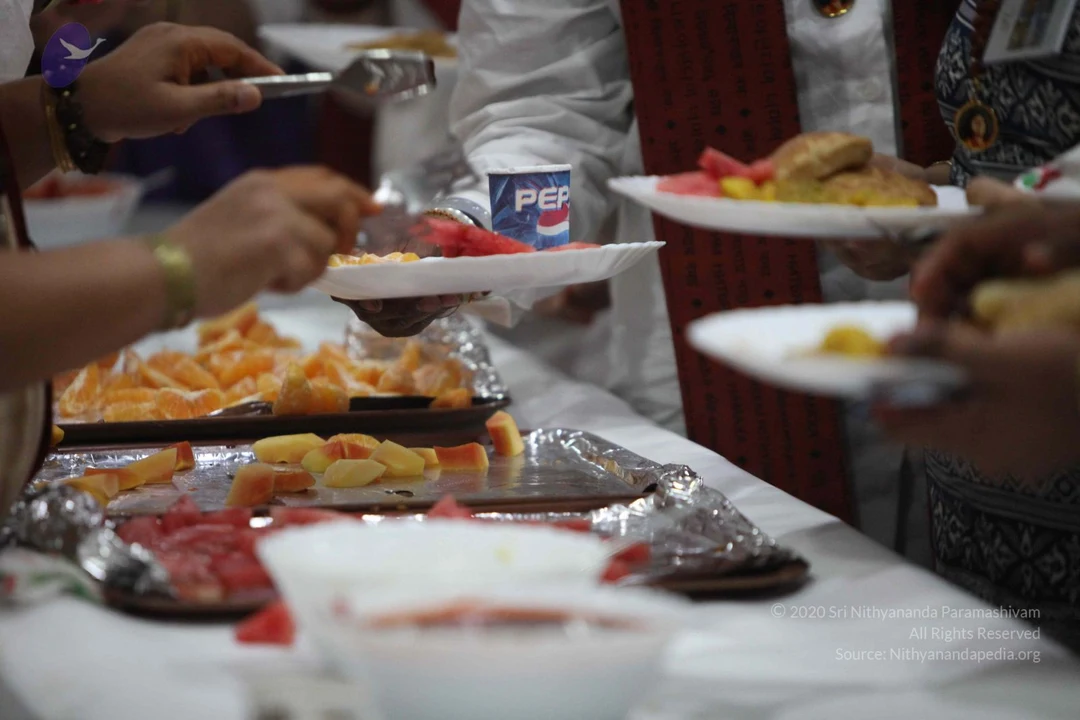
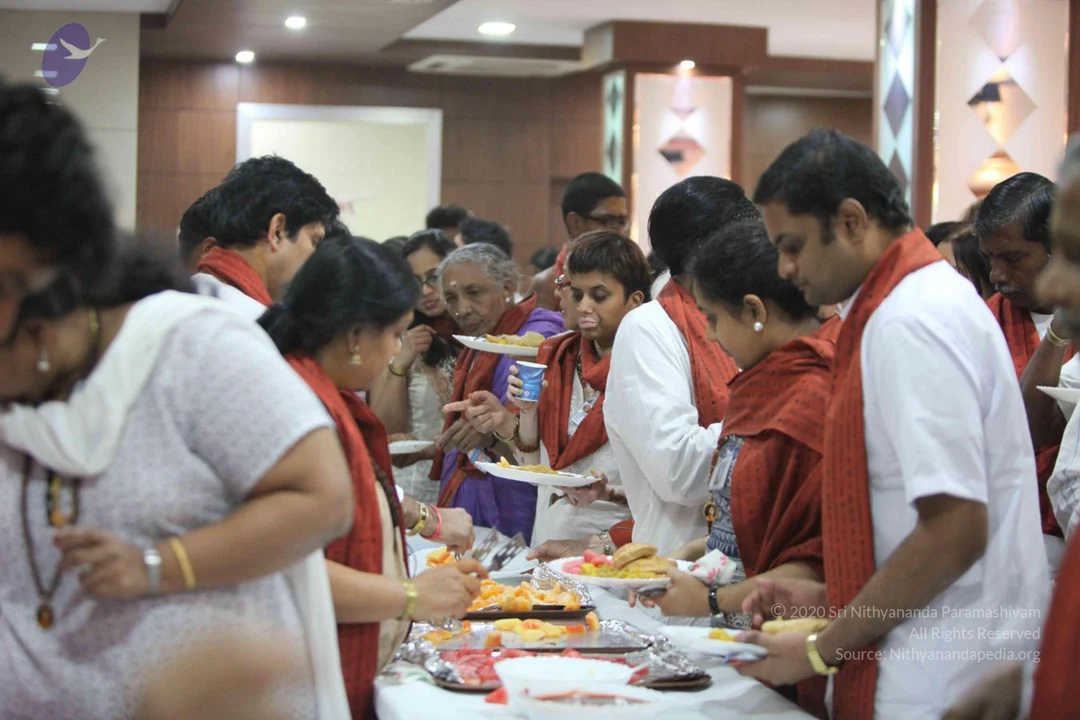
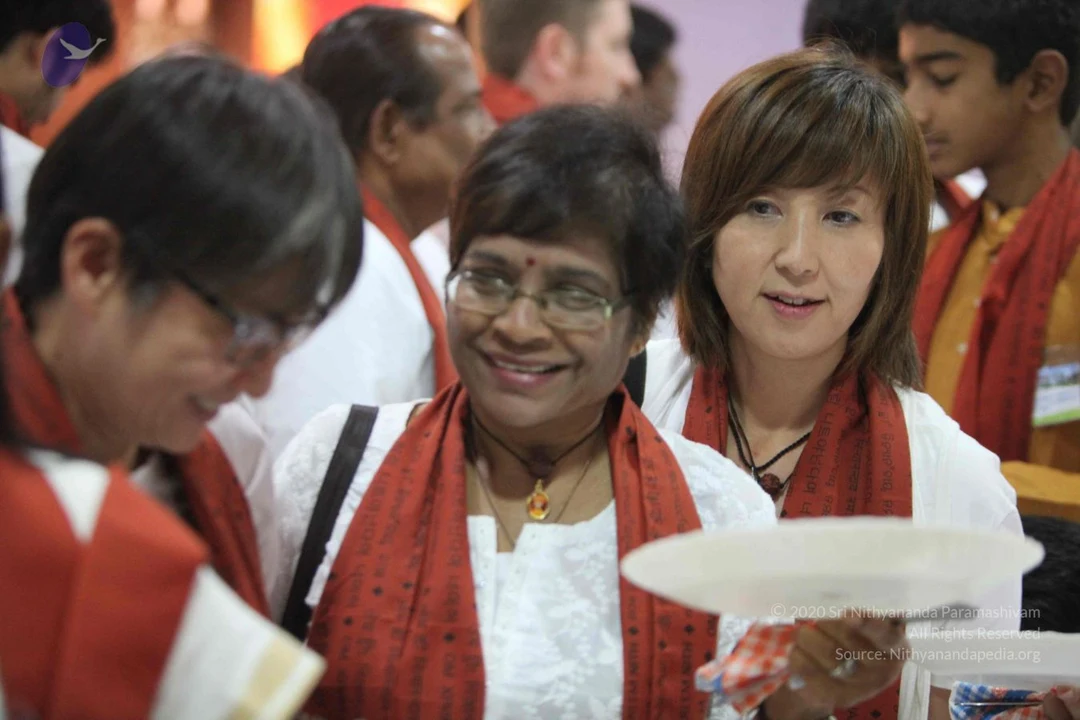
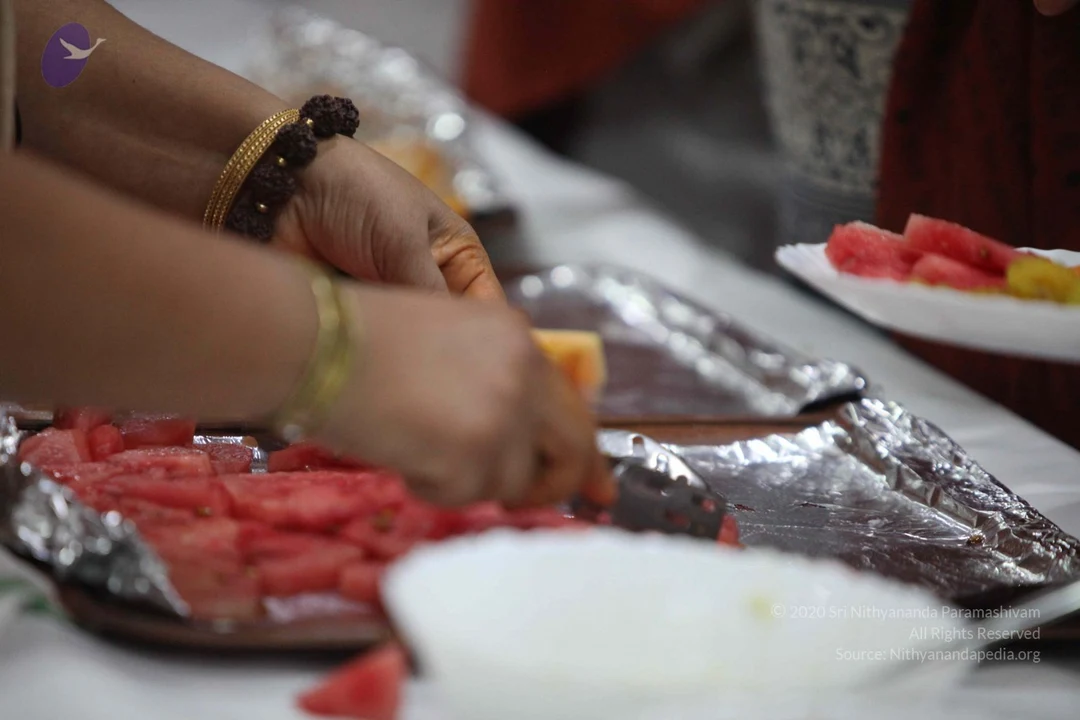
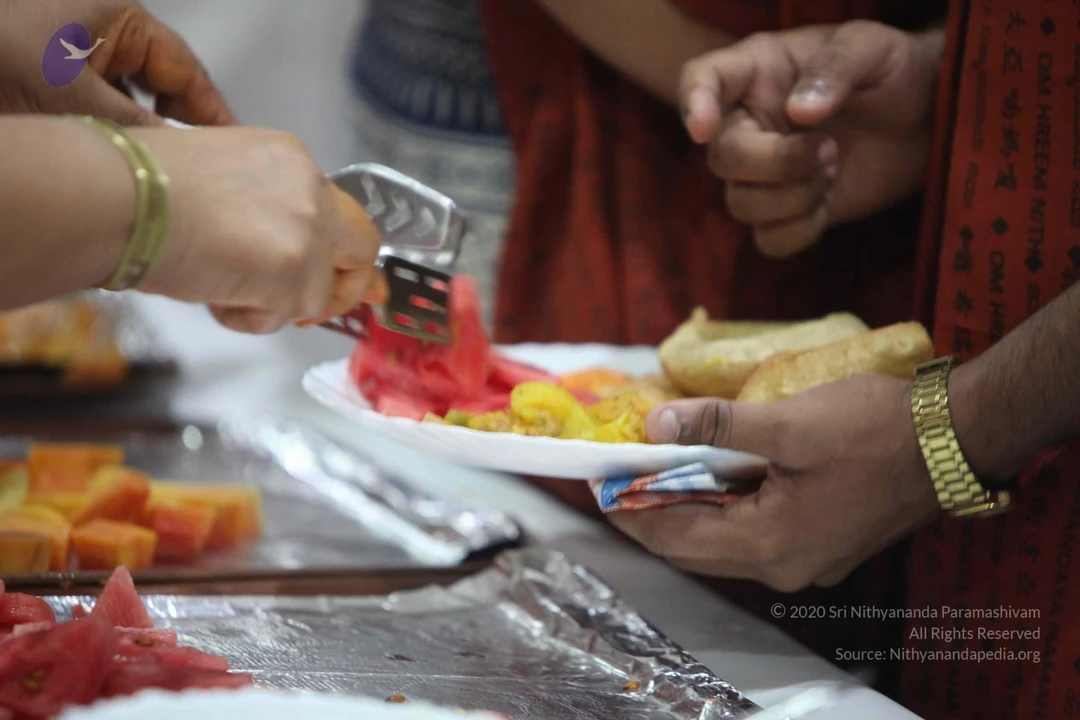
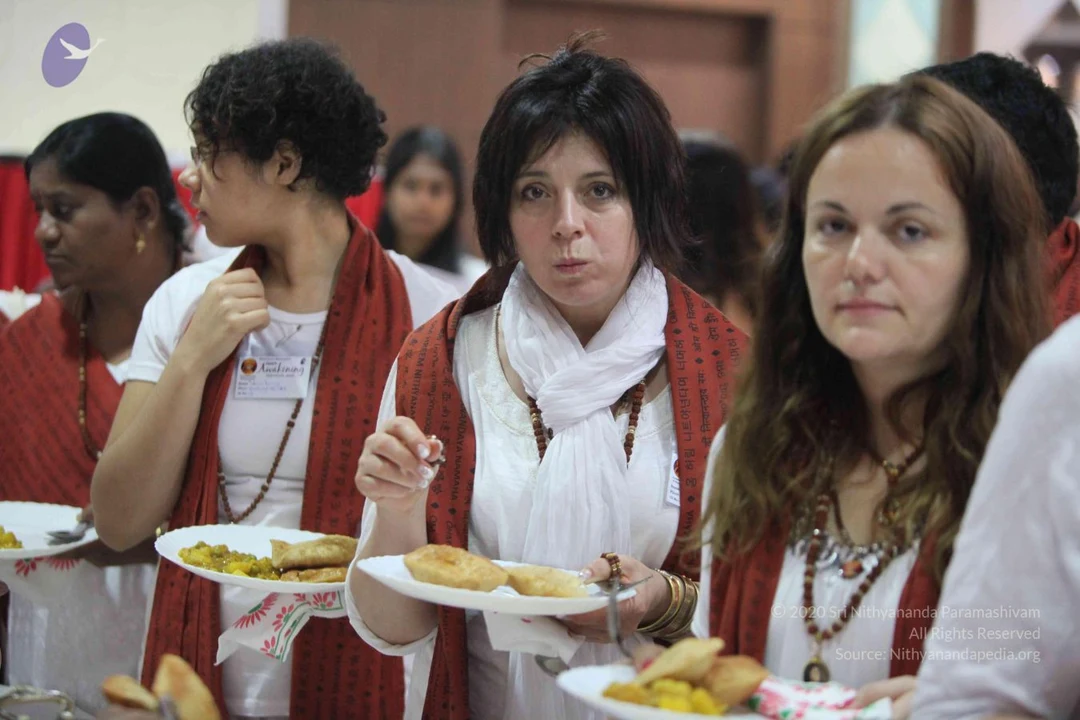
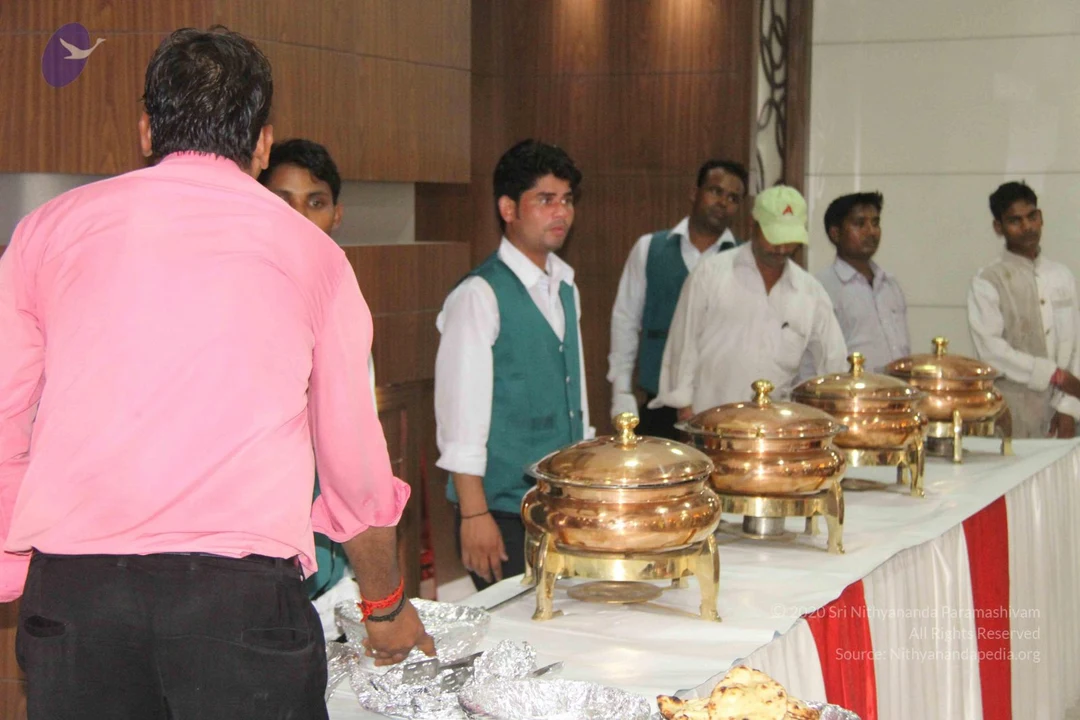
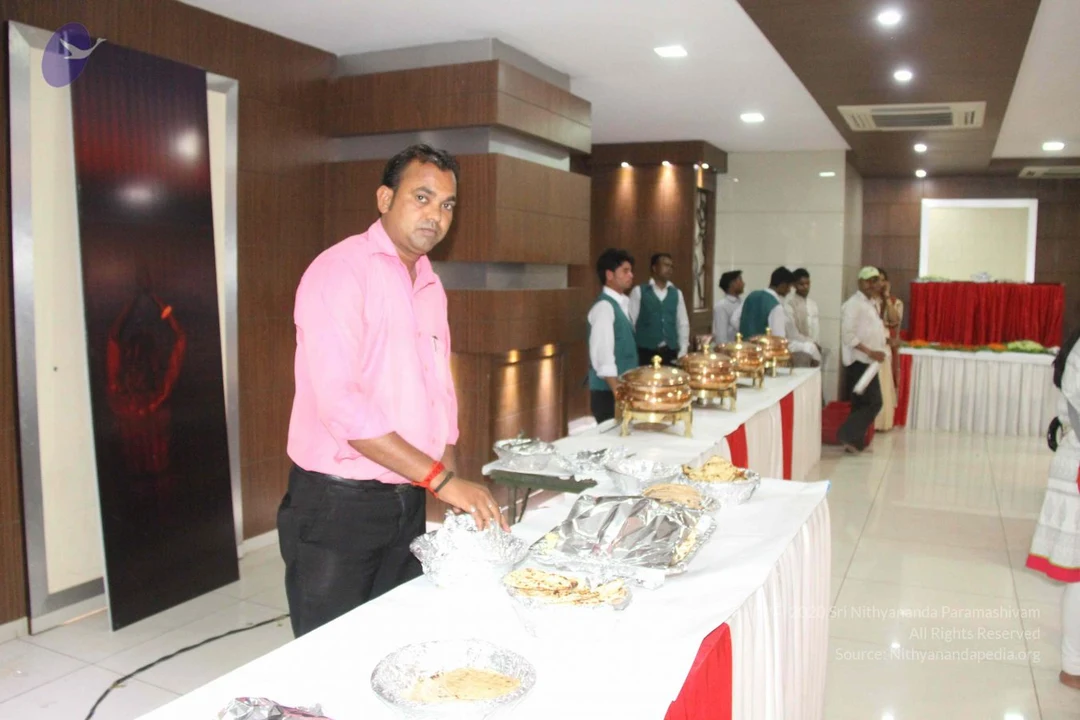
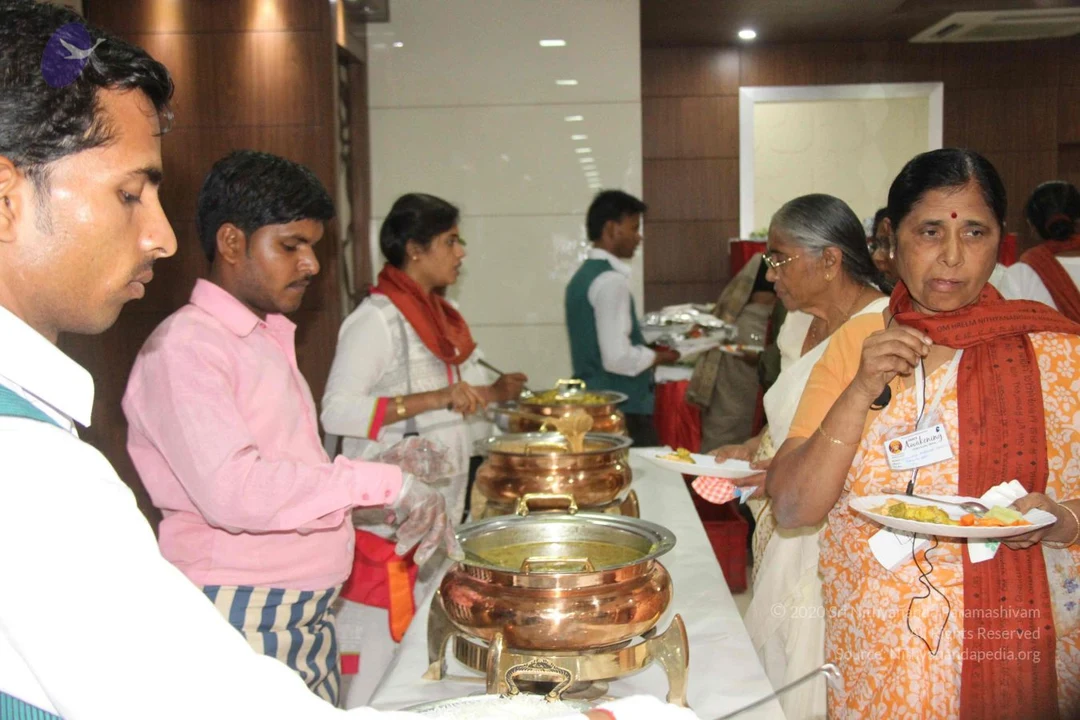
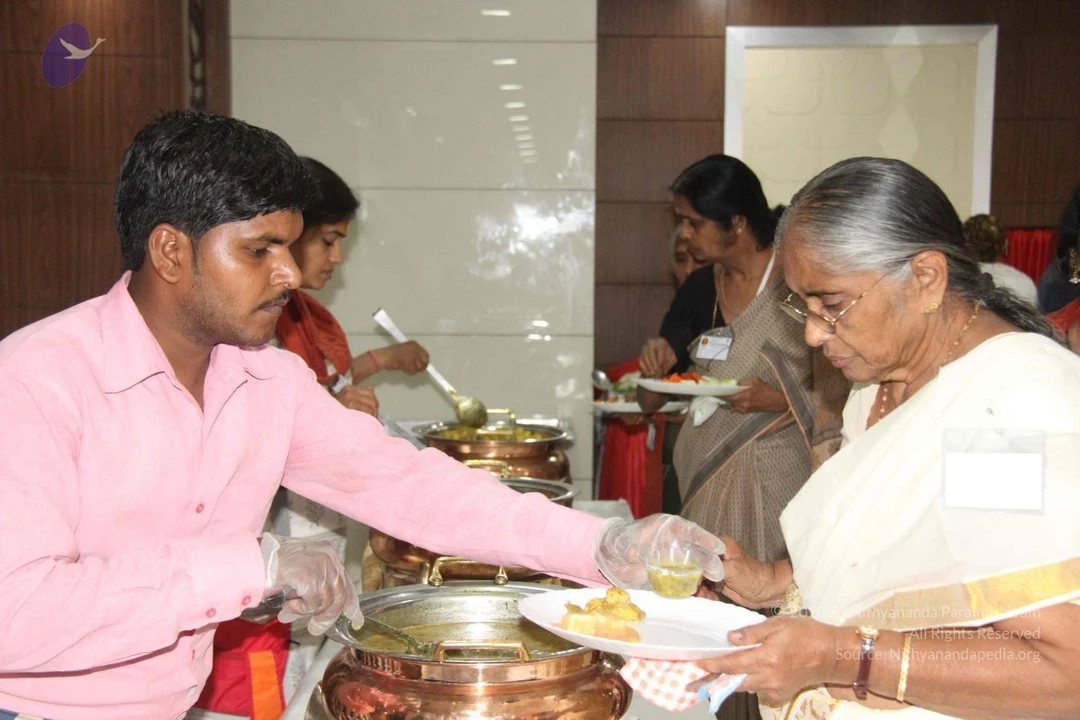
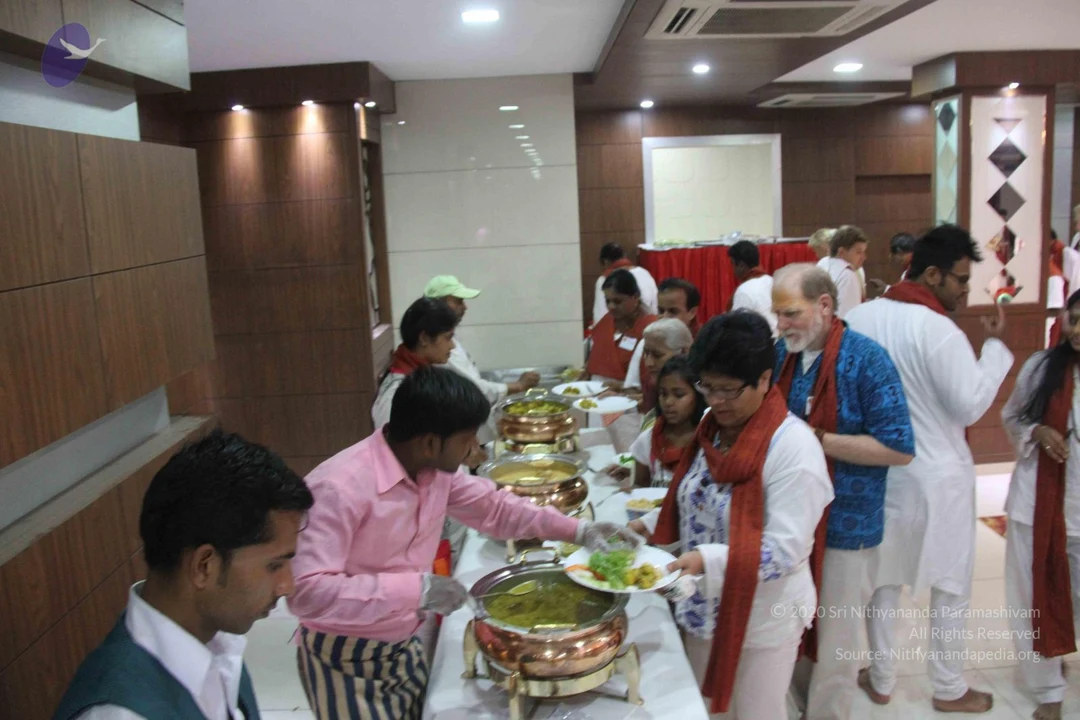
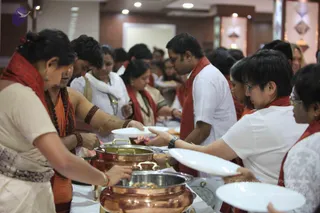
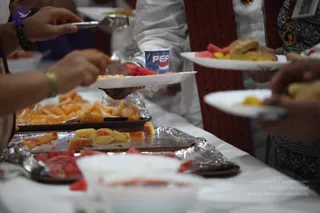
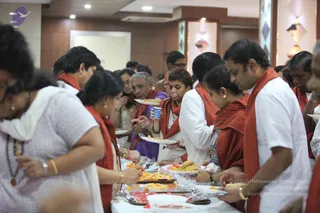
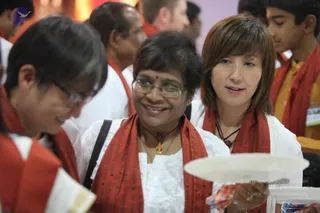
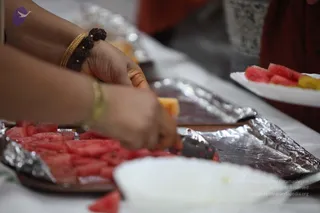
A photograph of an indoor serving line at a community meal. In the foreground a woman in a cream sari with a red shawl ladles food from a large copper pot with brass handles into a plate held by a person in a white top. Beside her a man in an orange garment and rudraksha beads serves from a second copper vessel. Several devotees wearing white clothes and red shawls stand along the table holding white plates, while others stand behind them in the background. Warm wall lights and wood panelling frame the hall.Close-up photograph of a large copper cooking vessel with a polished brass rim and handles, set on a brass stand over a warming base. Its interior holds yellow food, and a long metal serving spoon rests against the rim at the left edge. The background is blurred, showing a partly visible person's hand and a white table.Close photo of a buffet table being served with fresh fruit. Metal tongs lift watermelon and papaya onto white paper plates, and sliced oranges and mangoes sit on foil-lined trays. A person in a white garment with a red-and-black patterned sash stands at the table, holding a Pepsi cup in one hand and reaching with the other. Other hands hold plates of watermelon and a bread roll at the right edge, and a small bowl of cut fruit is in the foreground. The scene suggests an annadan or prasadam serving. Only partial arms and hands of people are visible, plus a sliver of a torso in white.A photograph of devotees queuing at a buffet table in an ashram dining hall, serving themselves food onto paper plates from foil trays of fruit and sweets. Several people wear red-orange shawls over white clothing; one older woman in a purple sari holds a plate, and a woman in white holds a blue paper cup. Wood-panelled walls and a diamond-patterned wall fixture frame the scene.Close candid photo of devotees at an event. Three women in white clothes with red-and-black printed shawls stand together; the woman in the centre wears glasses, a red bindi and a pendant necklace and smiles, while the woman on the right holds a white paper plate and looks toward the others. A woman at left, partly turned, also wears a red shawl. Behind them are more people in red shawls, including a young man in a yellow-orange shirt at upper right. No a person candidate is clearly identifiable in the frame.Close-up photograph of two hands cutting slices of watermelon on a foil-lined tray at a serving table. The wrist of the nearer arm wears a gold bangle and a dark rudraksha bracelet. A woman in red clothing is partly visible at the right edge, and a white tablecloth covers the table. This shows a serving of fruit.

Darshan

82 photosSource gallery
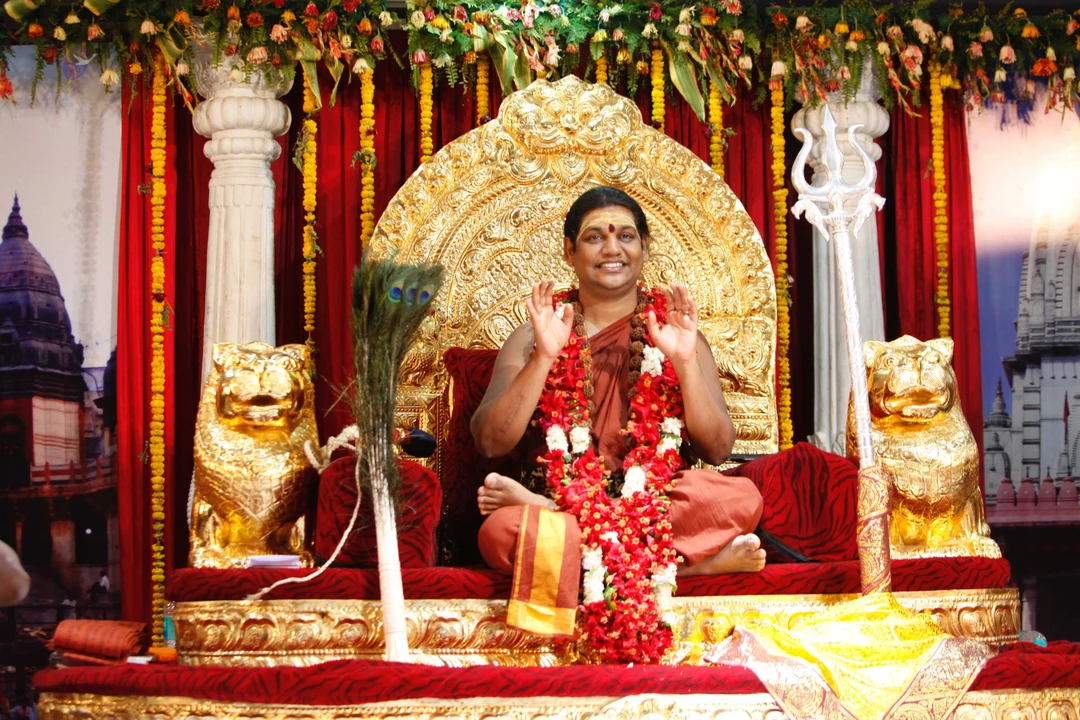
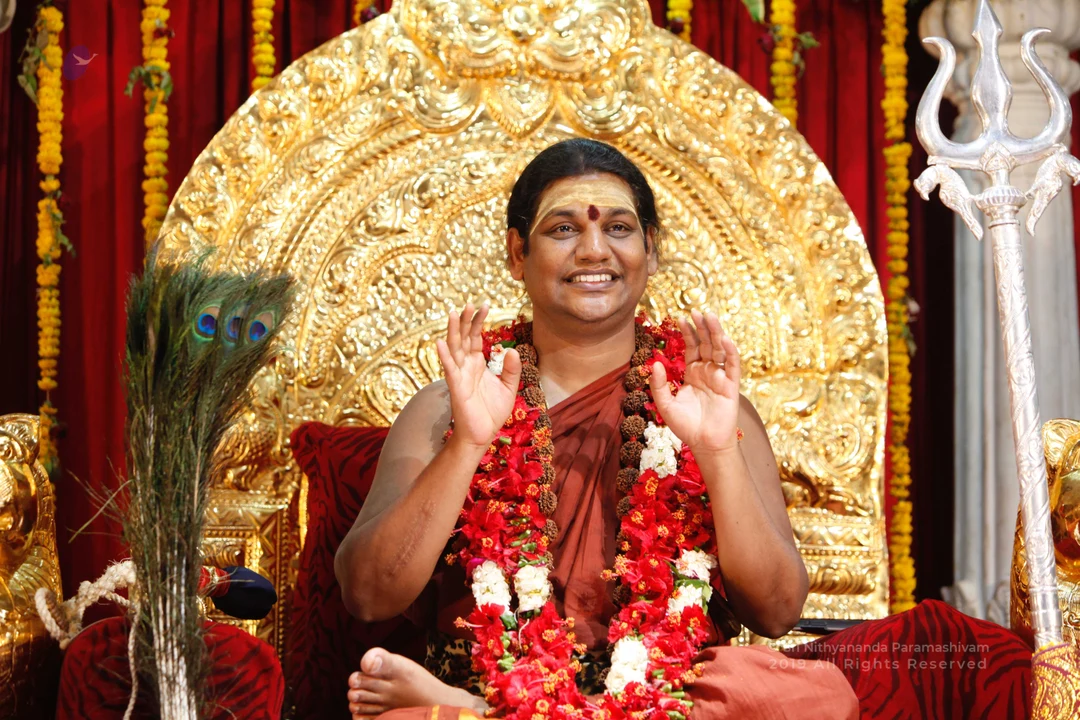
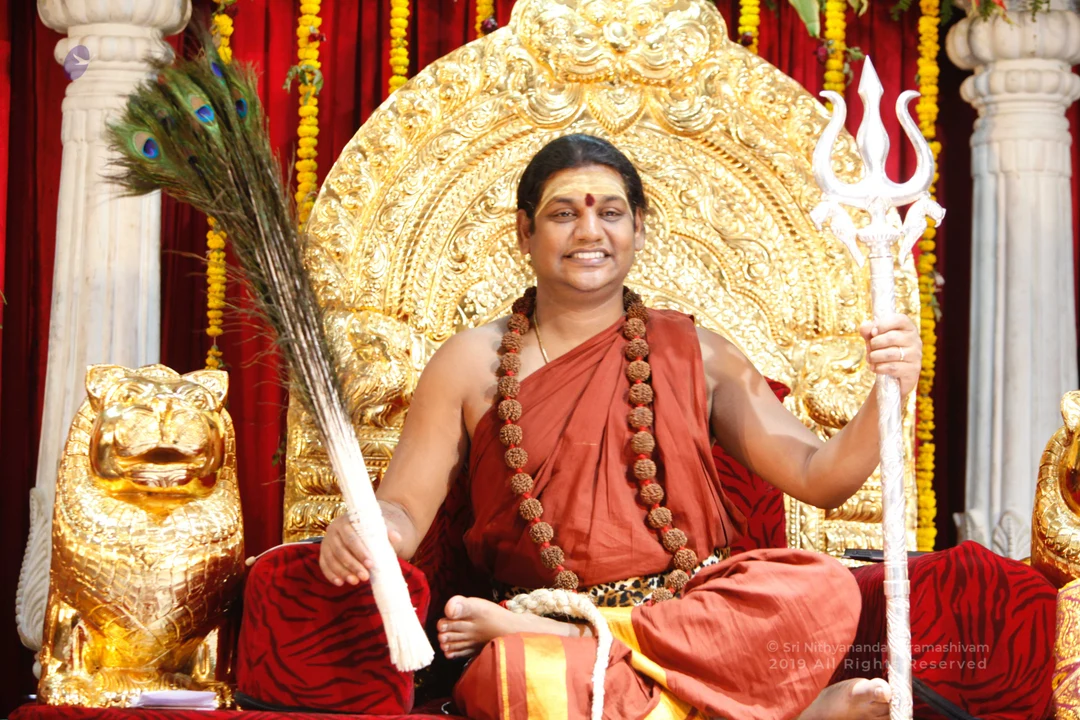
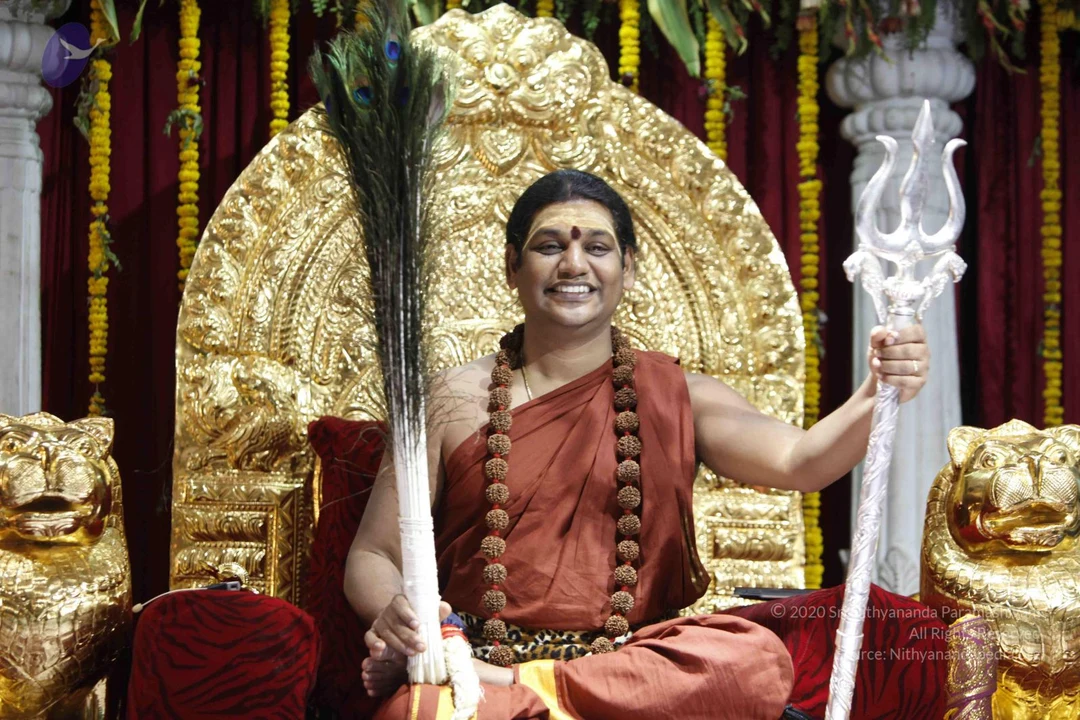
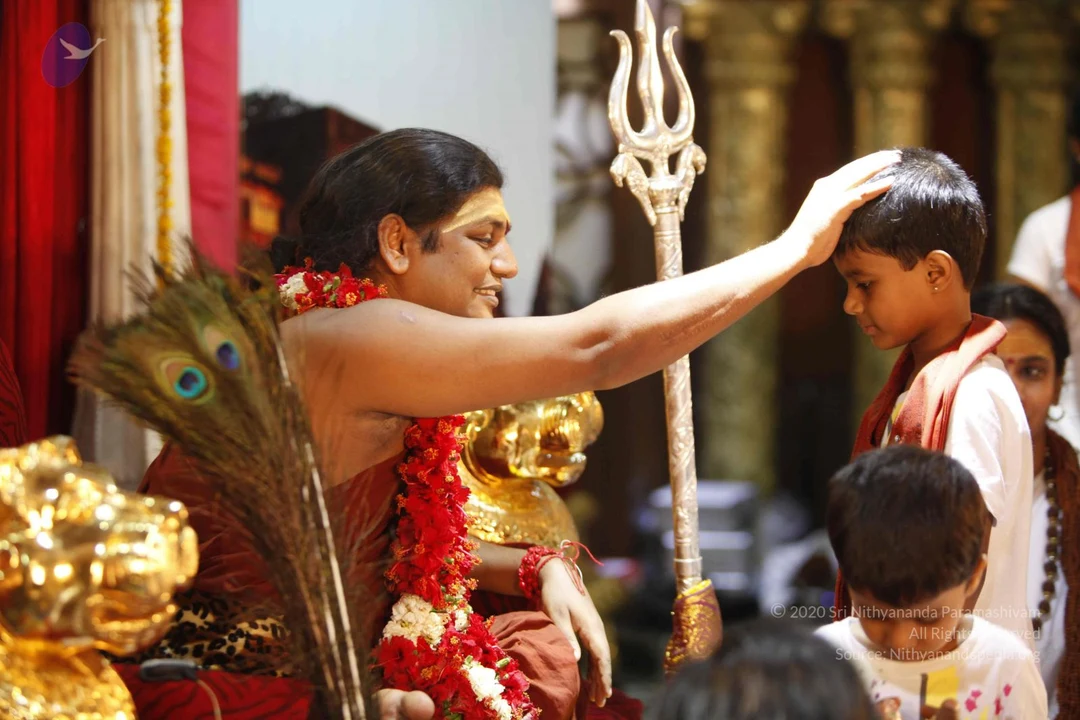
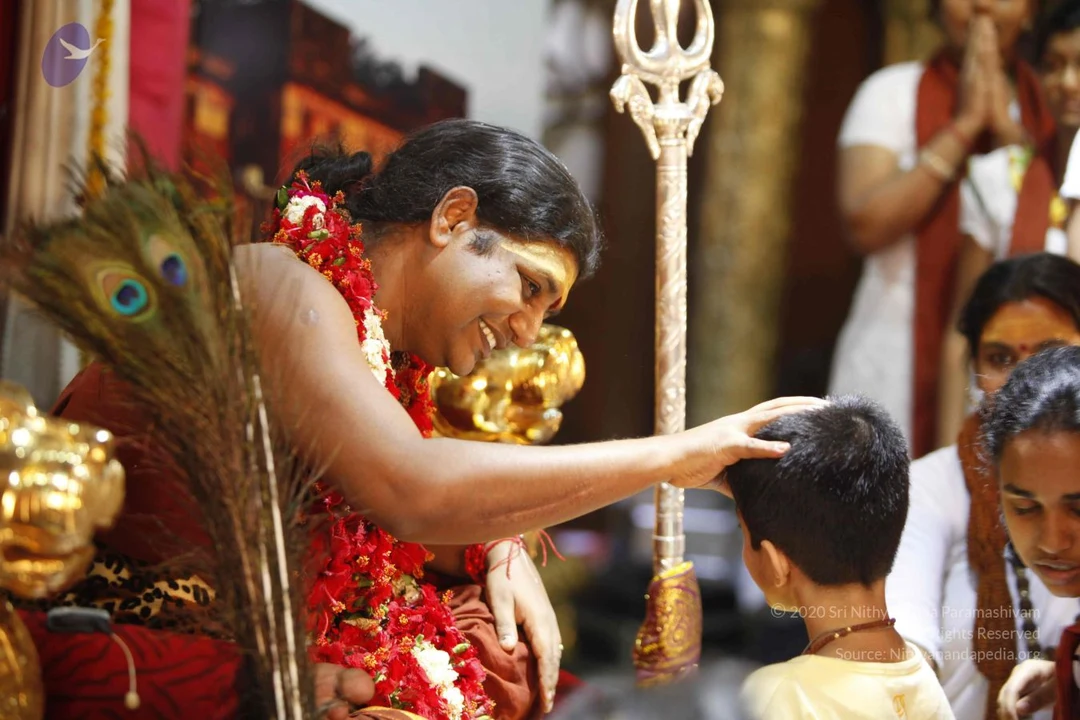
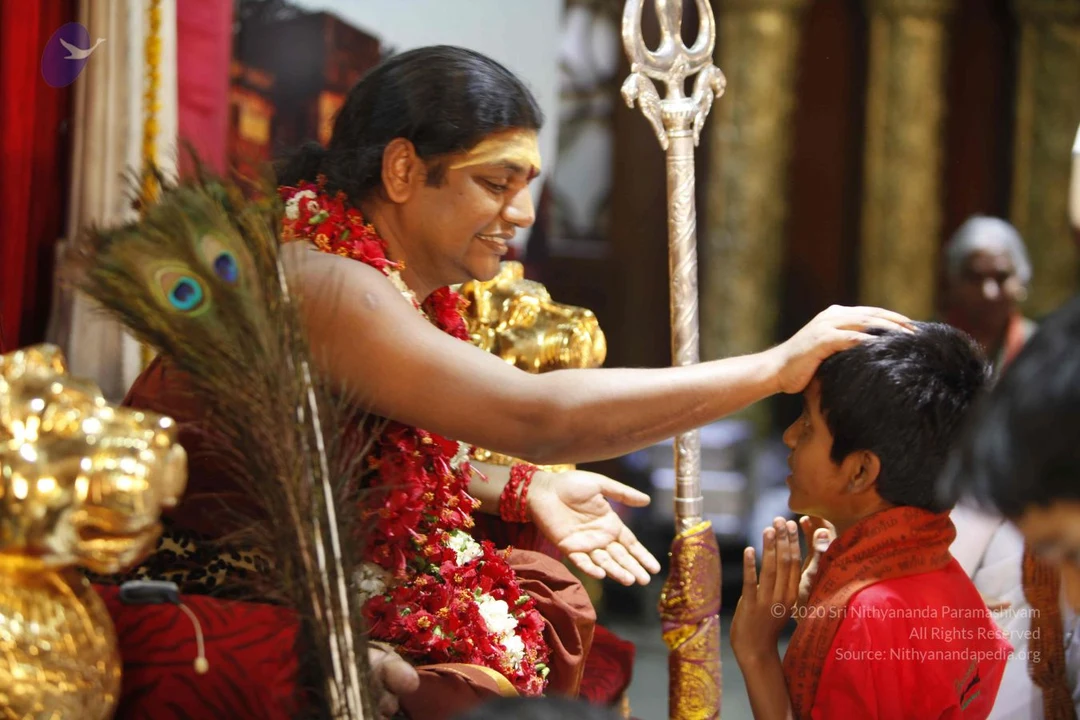
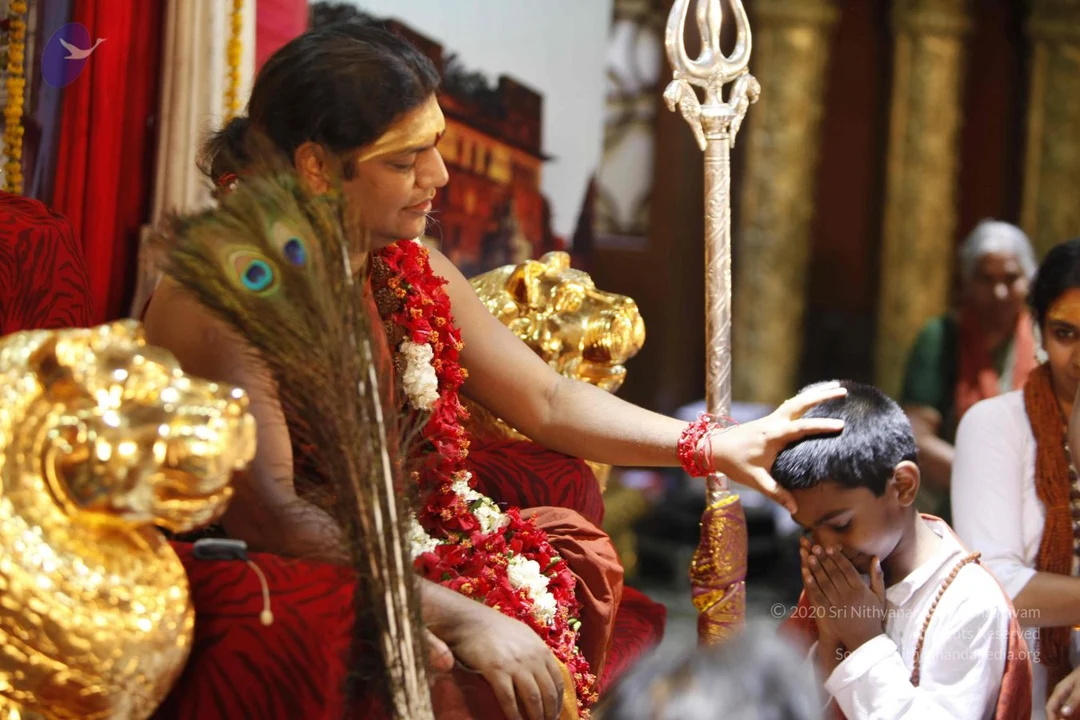
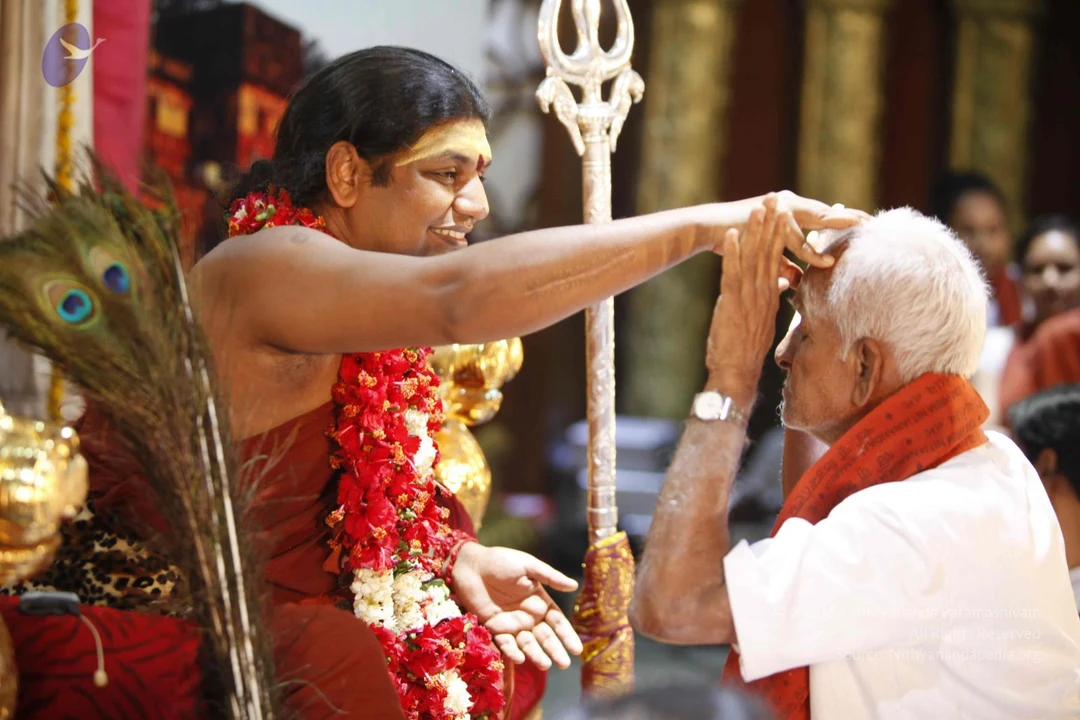
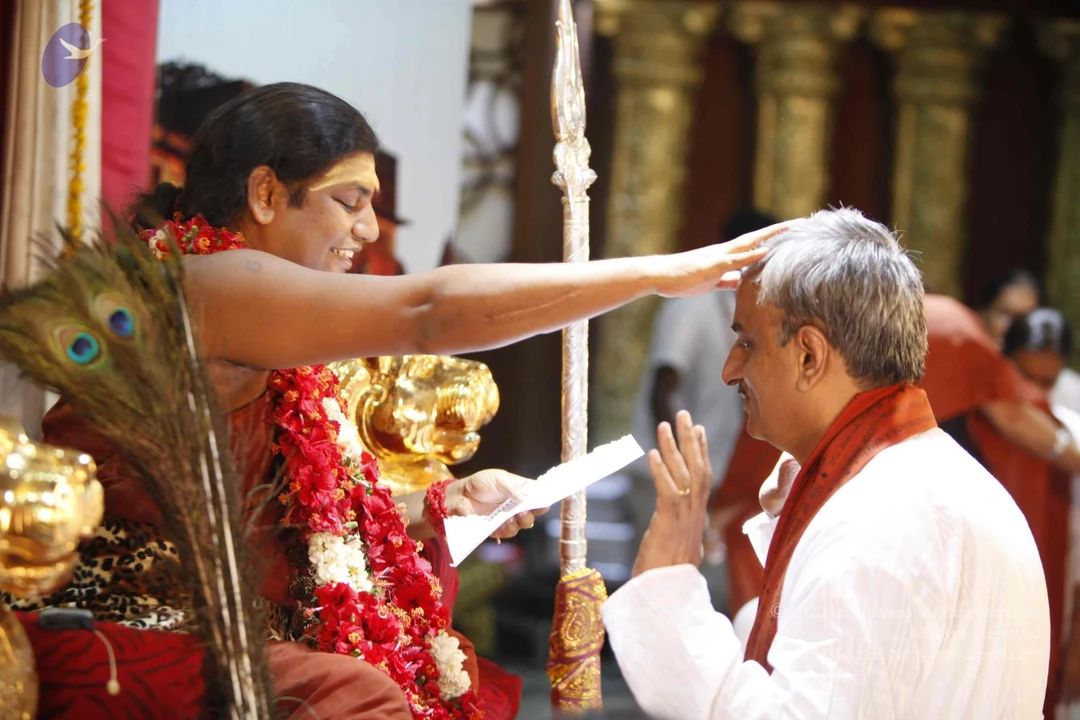
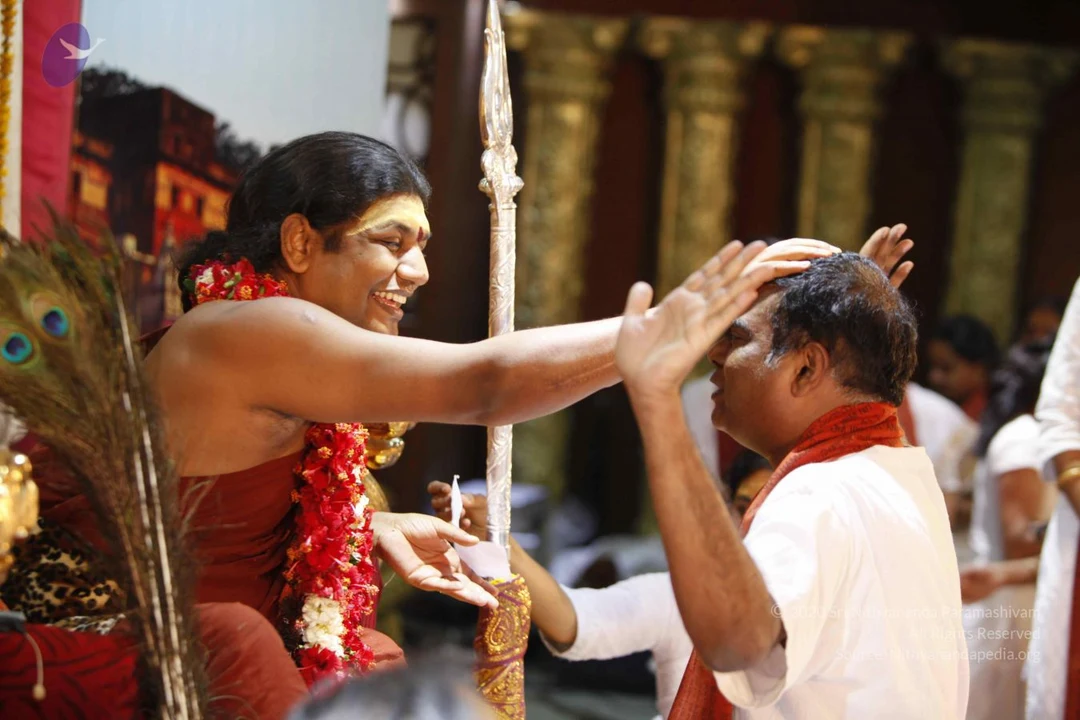
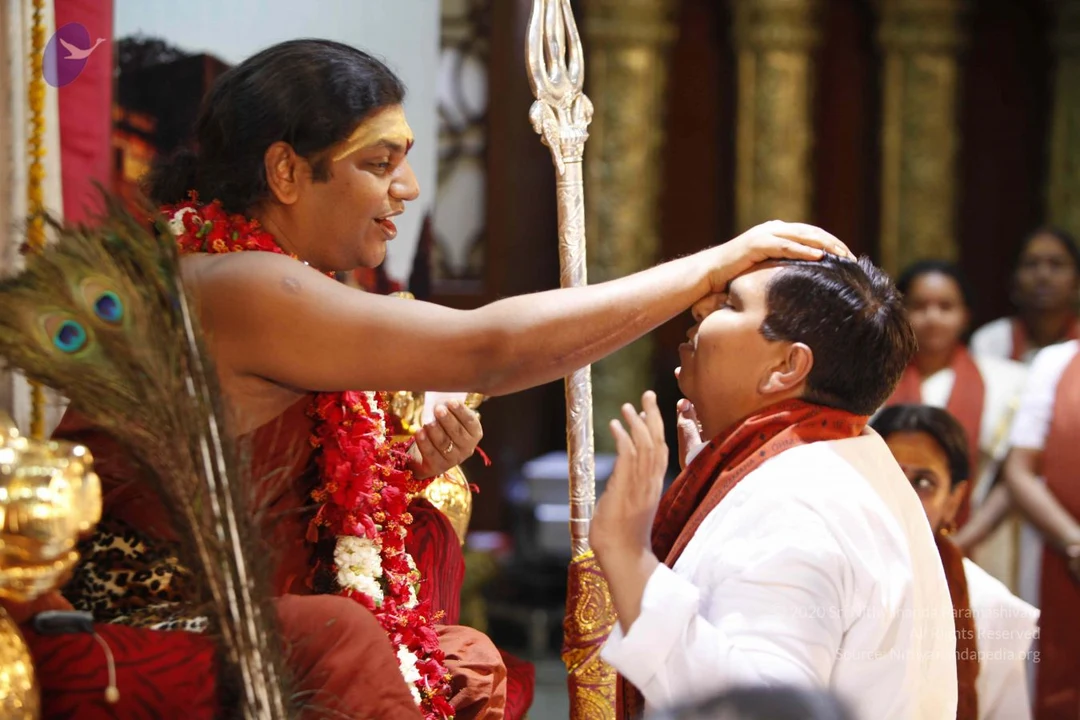
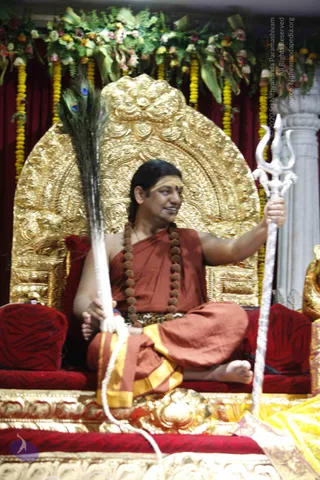
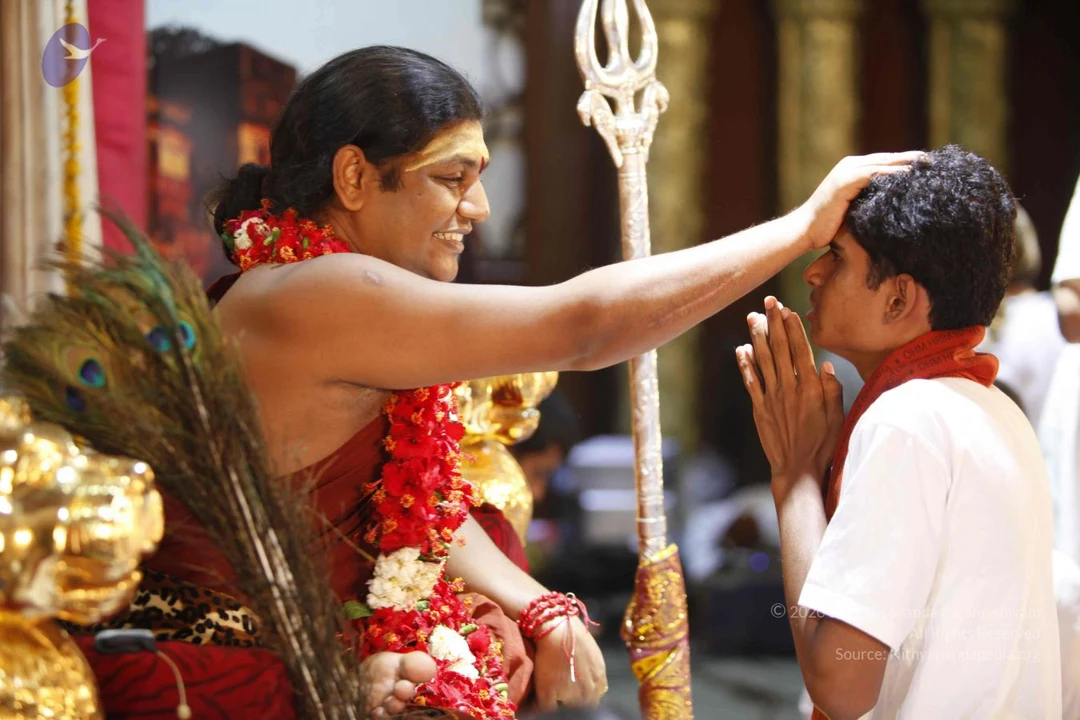
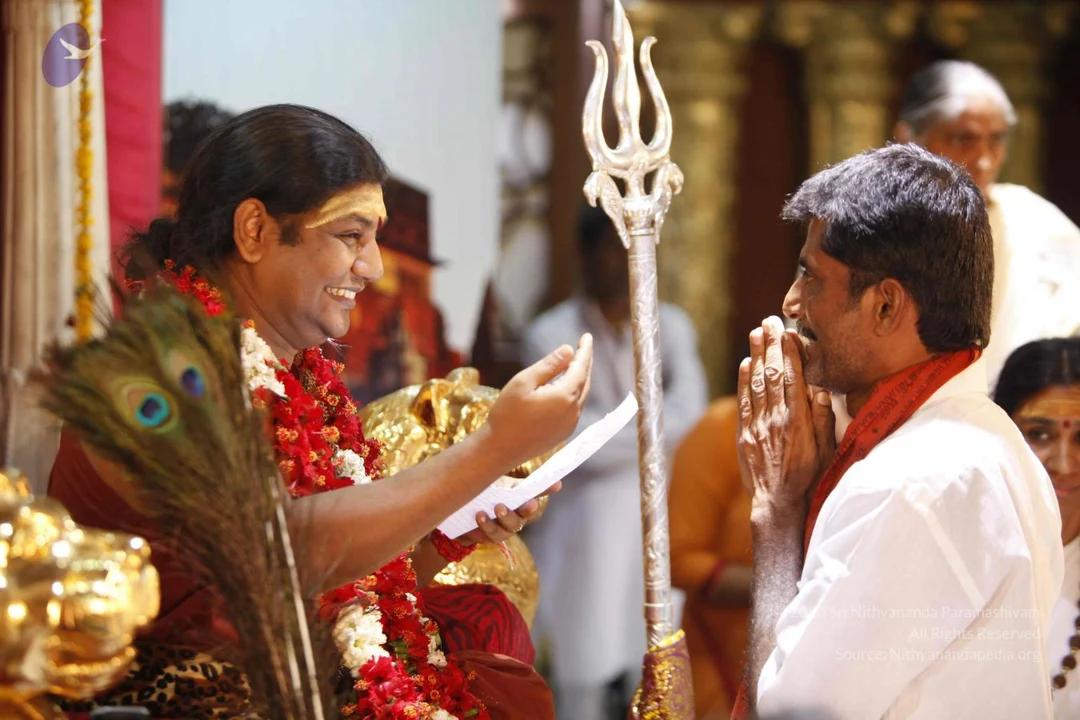
A smiling man seated on an ornate gilded throne with carved lion-face armrests, flanked by golden lion statues. He wears a red-orange saffron robe, a long rudraksha mala with large beads, and a red bindi with a horizontal tilak. He holds a white peacock-feather fan in one hand and a silver trident in the other. Yellow marigold garlands hang on the red draped backdrop and white pillars behind him. a person: the saffron robe, rudraksha mala, trident and throne are present, but the photo cannot confirm identity beyond these cues.A seated man in a rust-red saffron wrap and a long rudraksha mala sits cross-legged on an ornate gold throne with carved lion heads, holding a silver trident in his right hand and a white-and-green peacock-feather fan in his left. He wears a red bindi and sacred ash marks on his forehead and smiles. Golden lion sculptures flank the throne, red velvet cushions sit beneath him, marigold garlands hang behind, and white pillars and red drapes frame the stage. a person appears as the central figure, based on the rudraksha mala, saffron-red robes and ornate gold throne.A man in a saffron-orange robe with a rudraksha mala sits cross-legged on an ornate gold throne with a red cushioned seat, flanked by two golden lion statues. He holds a white trident-shaped staff and a red cloth-wrapped object while smiling. Behind him are red drapes, white pillars, marigold garlands and a peacock feather fan. Painted backdrops show temple spires. Swamiji (probable): long swept-back hair, ornate gold-and-orange ceremonial attire and a rudraksha mala on a throne, consistent with the page's attribution.A seated man in saffron-orange robes sits on an ornate gold throne with a carved arched back, flanked by two golden lion figures. He wears a red-and-white flower garland and a rudraksha mala, with a tilak on his forehead, and holds a silver trident beside him. A peacock-feather fan rests at the left, red velvet cushions surround him, and marigold garlands hang on white pillars behind. A backdrop shows a temple tower at the right edge.A seated man in a golden ornate throne with red cushions, flanked by two golden lion figures, a silver trident on the right and a peacock feather fan on the left. He wears an orange-red robe, a red and white flower garland, a red-and-gold border cloth and a vertical tilak on his forehead, hands raised in blessing. Marigold and rose decorations hang from the red draped backdrop above, with white pillars on either side. a person is shown in person, given the saffron-orange robe, flower garlands, and throne setting.A seated man in a rust-brown robe sits before an ornate gold throne with a red velvet backdrop. He wears a red and white flower garland and a rudraksha mala, with a white vibhuti marking and red bindi on his forehead, and raises both hands in a mudra while smiling. Beside him stand a silver trident and a peacock-feather fan, and yellow marigold garlands hang on the throne. a person is shown in person in this ceremonial setting.

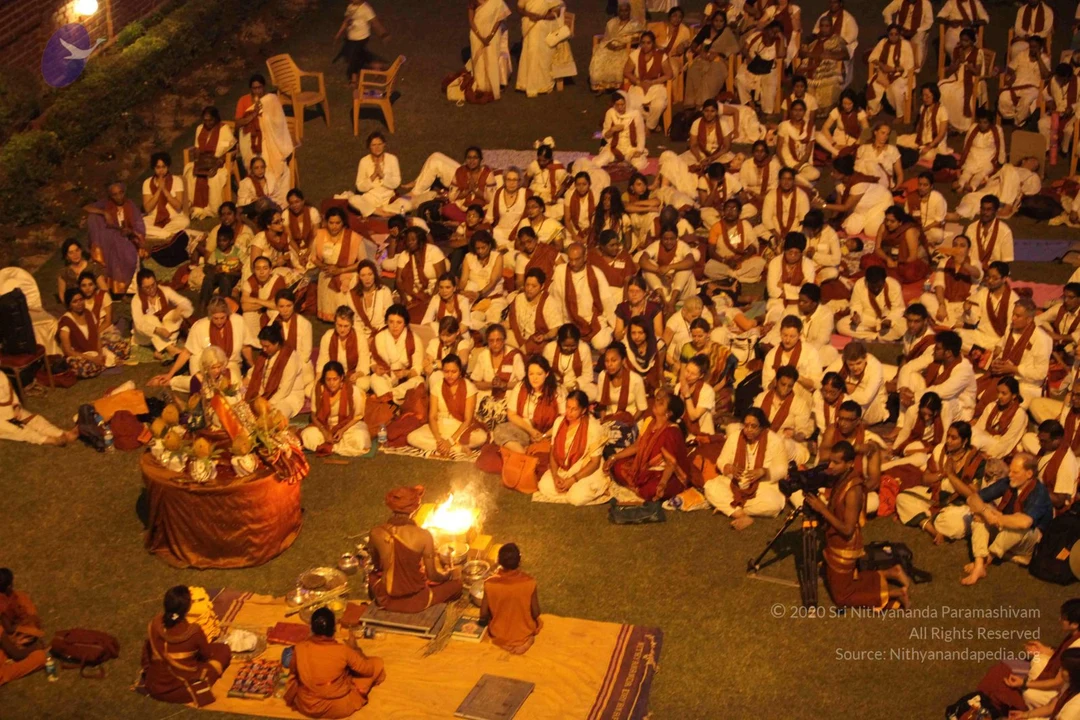
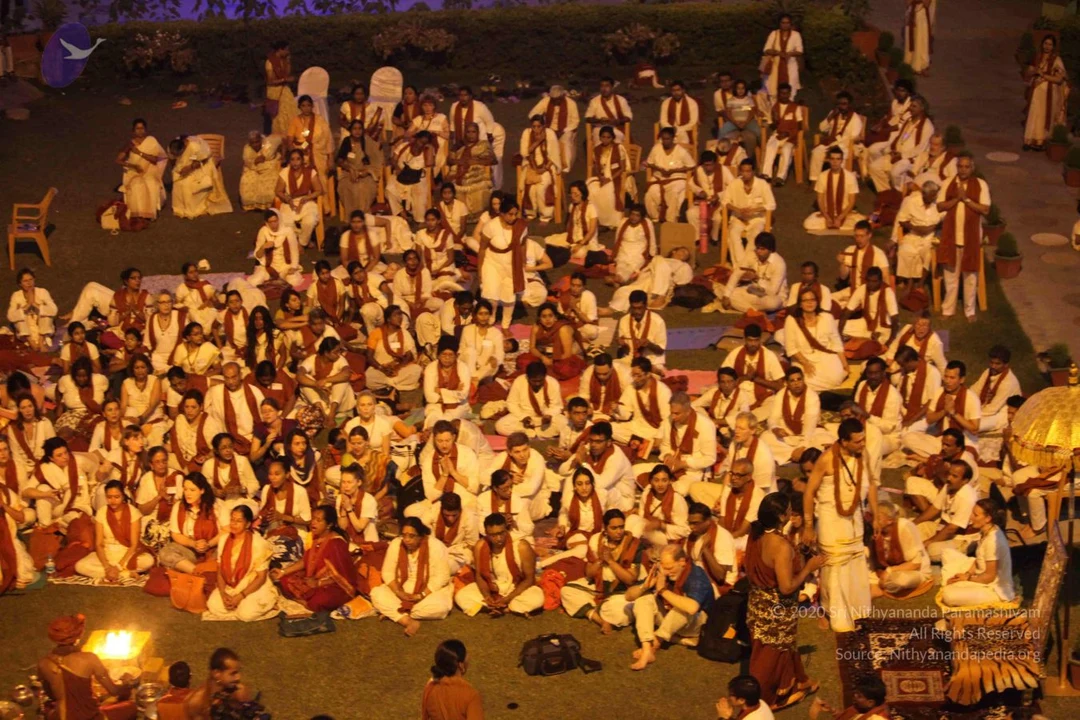
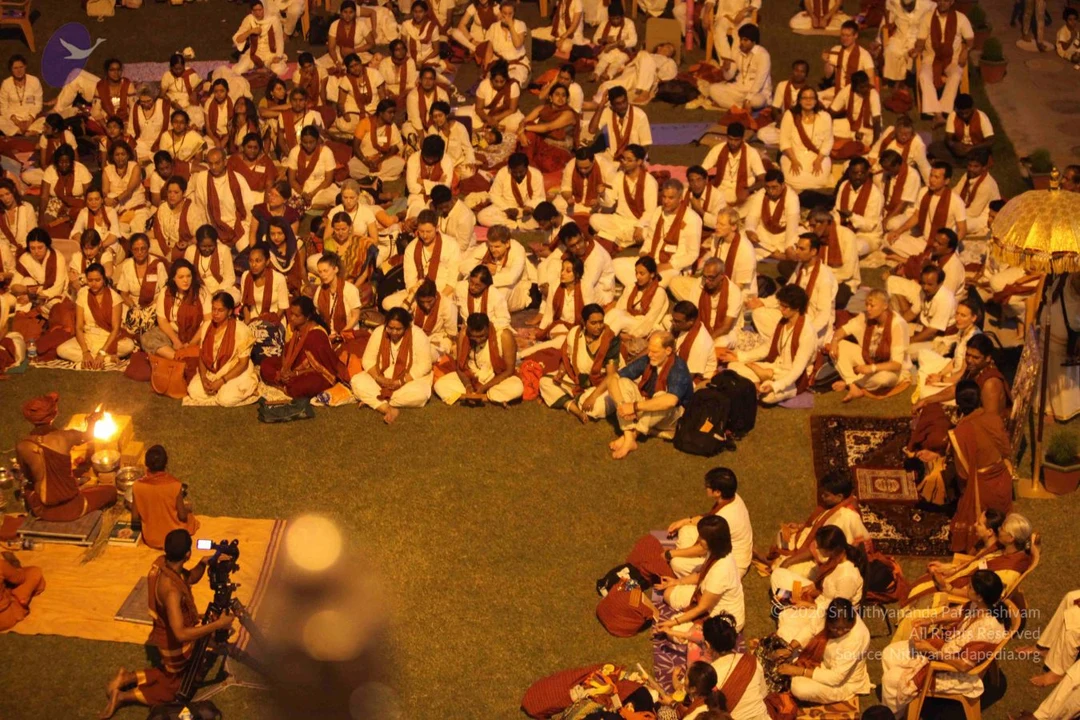
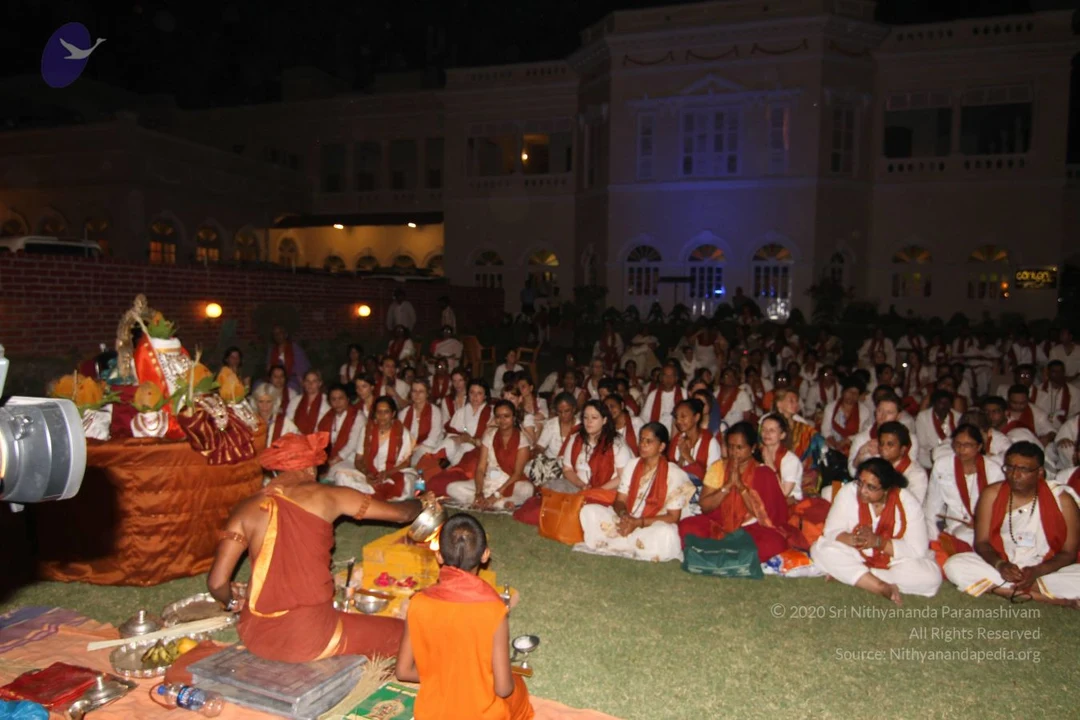
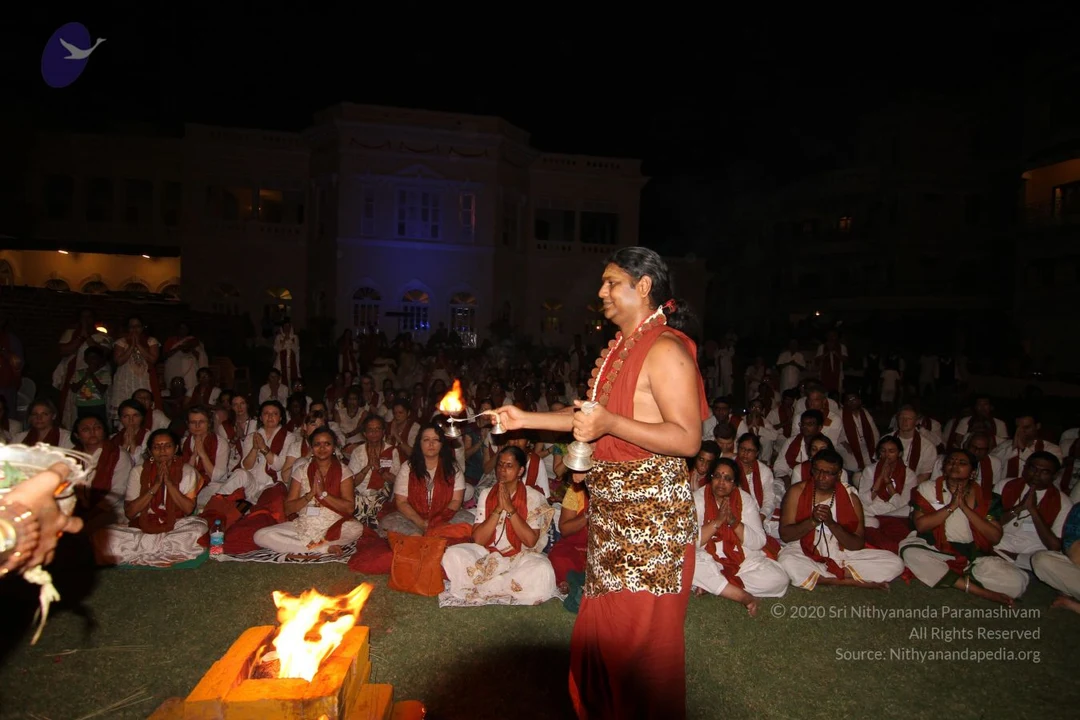
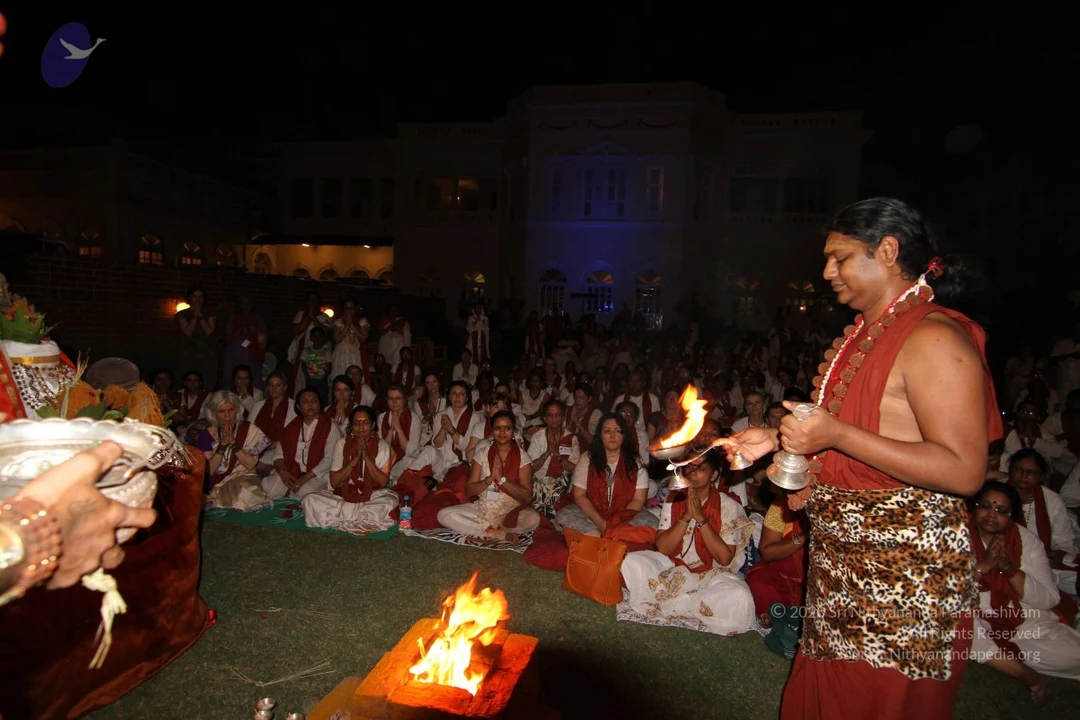
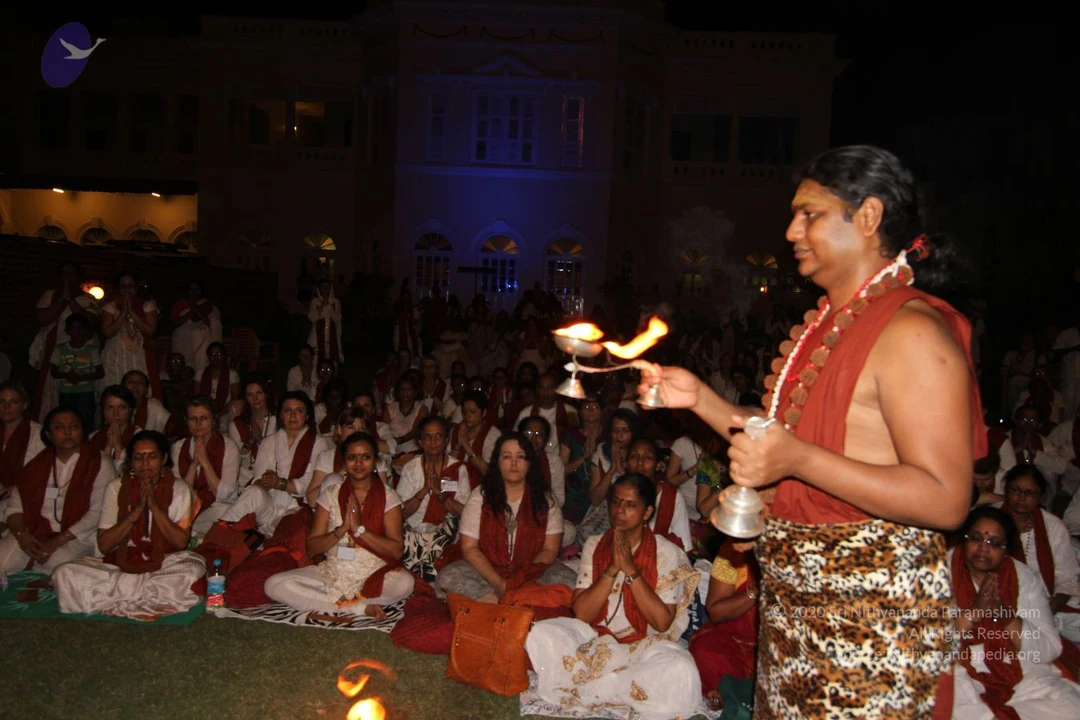
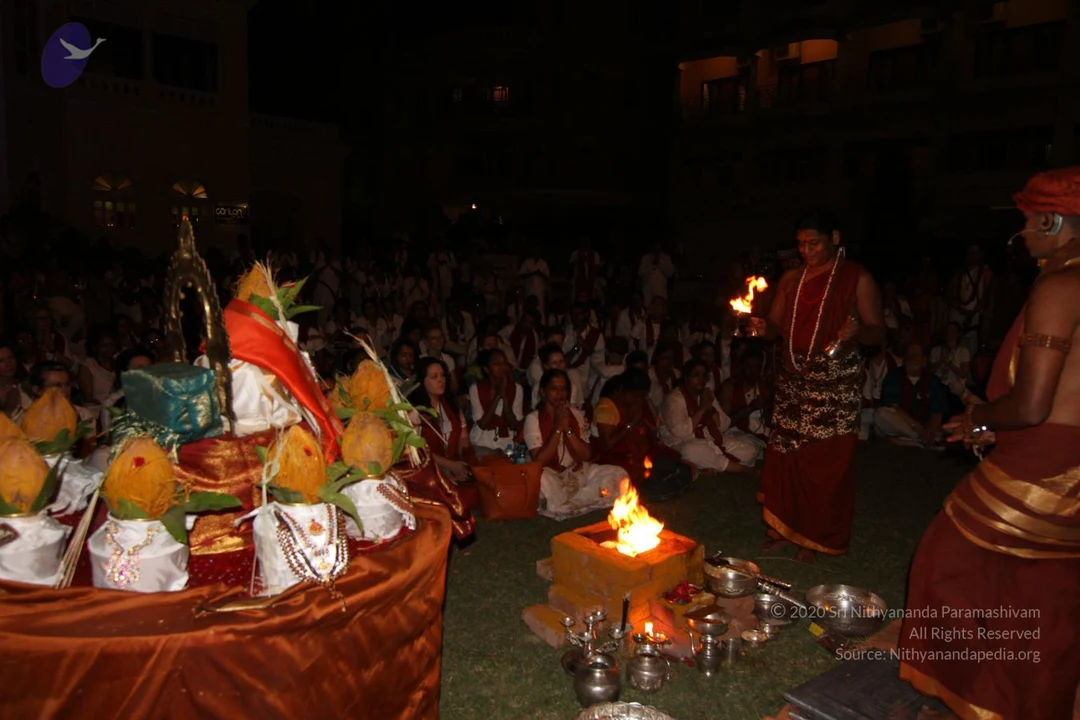
Kalabhairavar-Homa

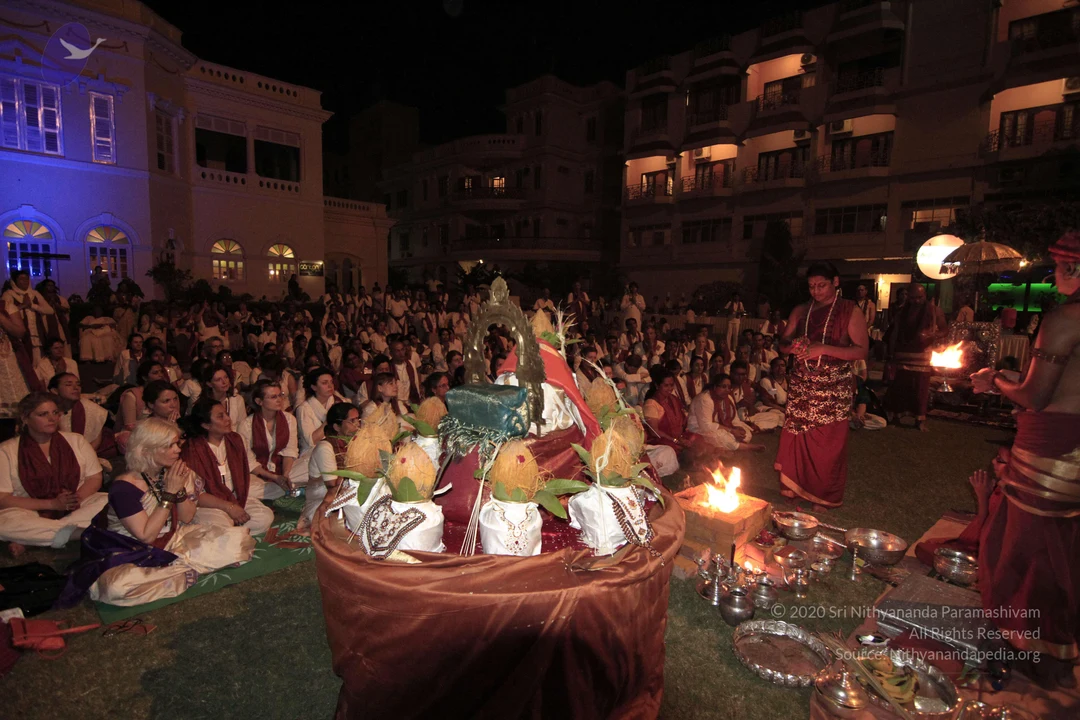
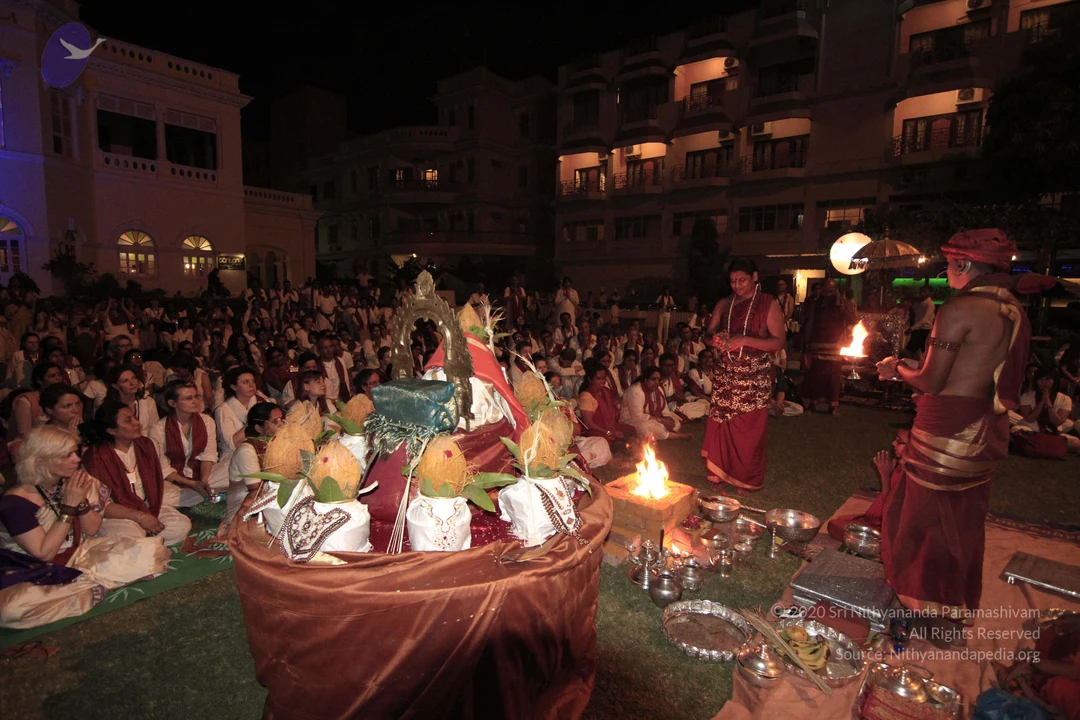
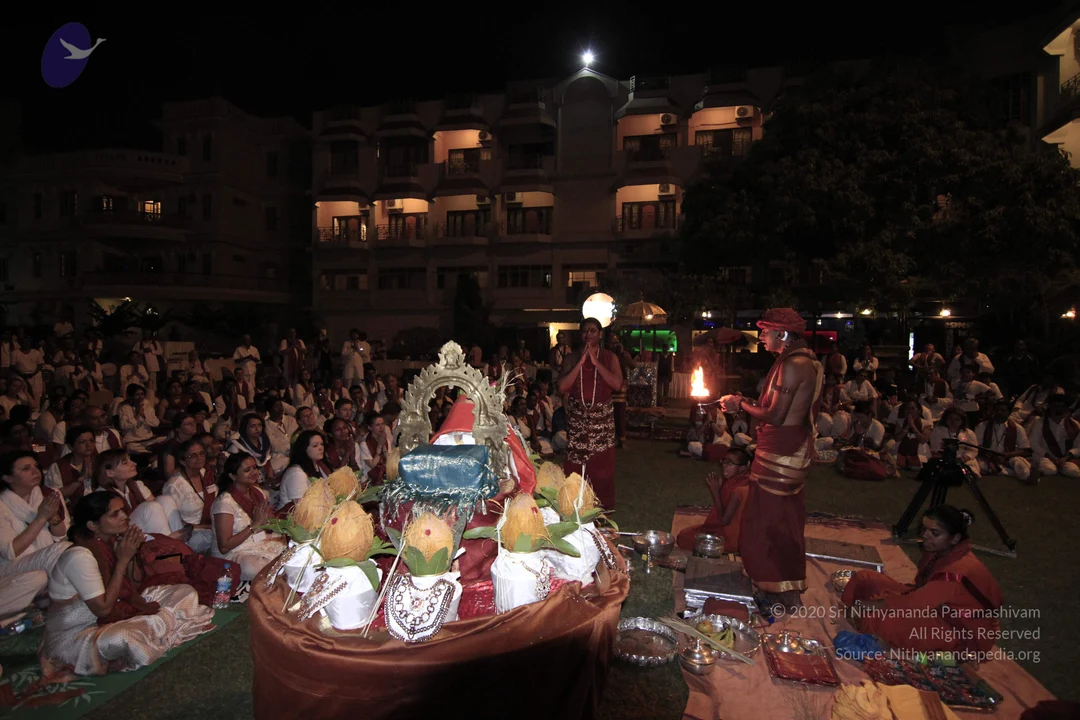
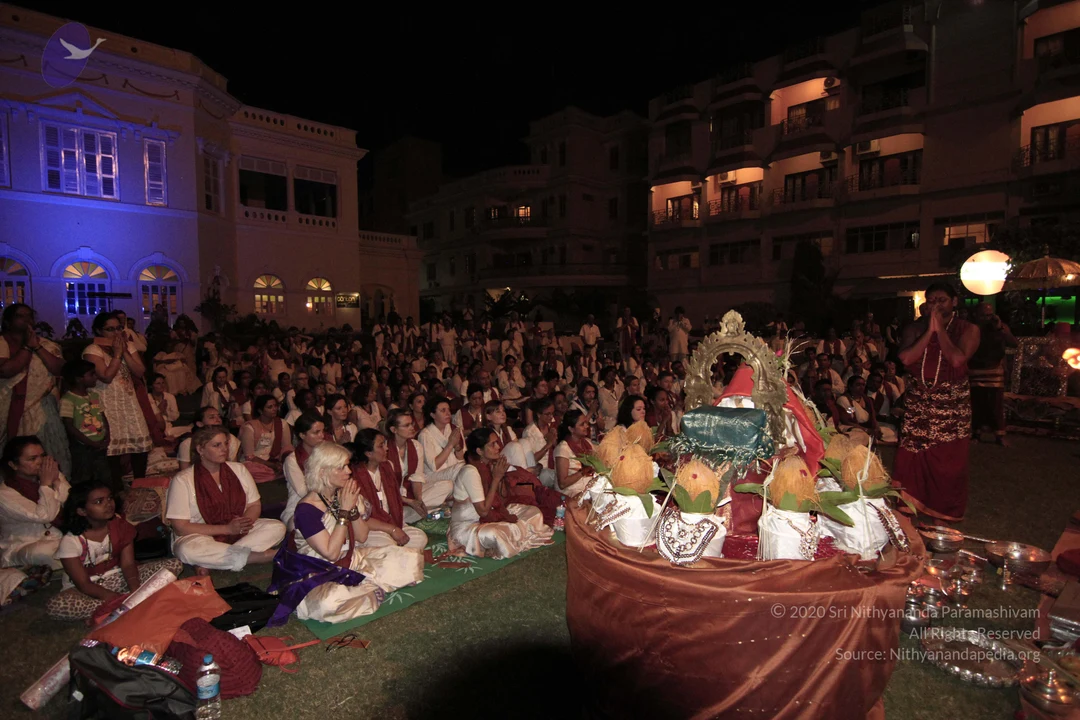
28 photosSource gallery
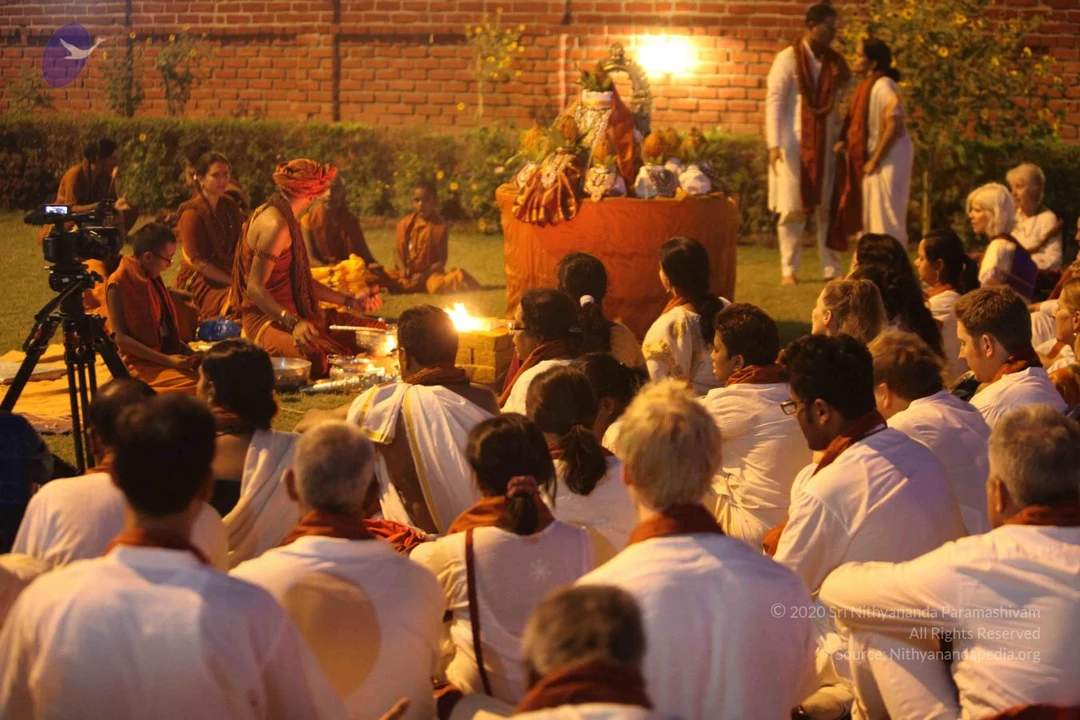
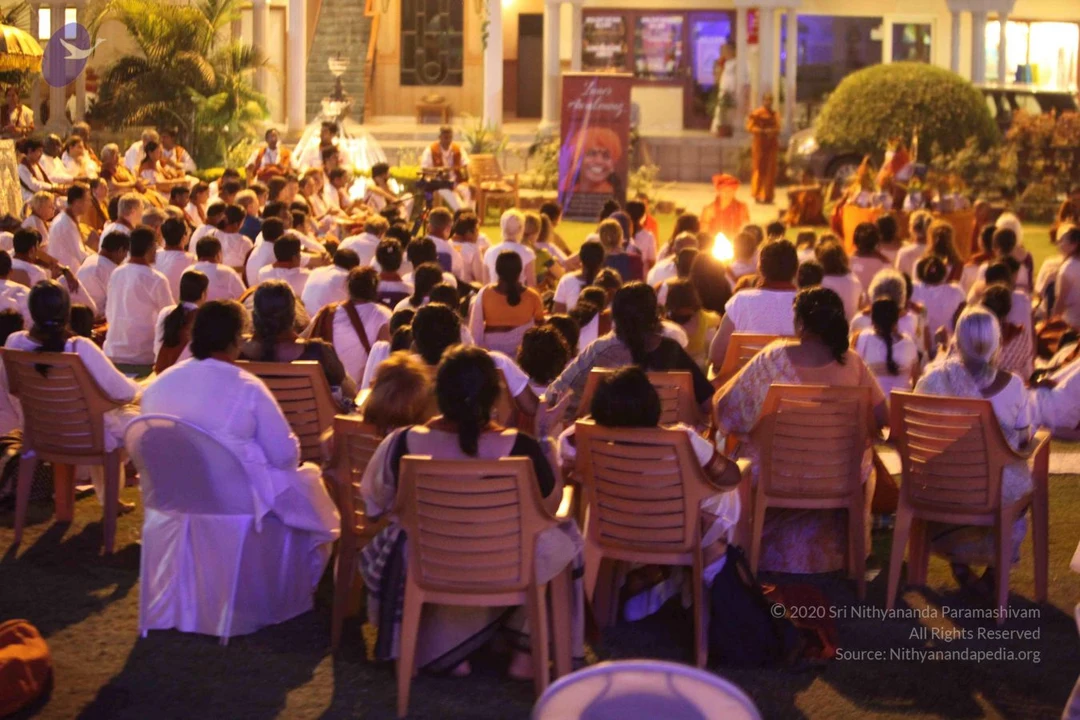
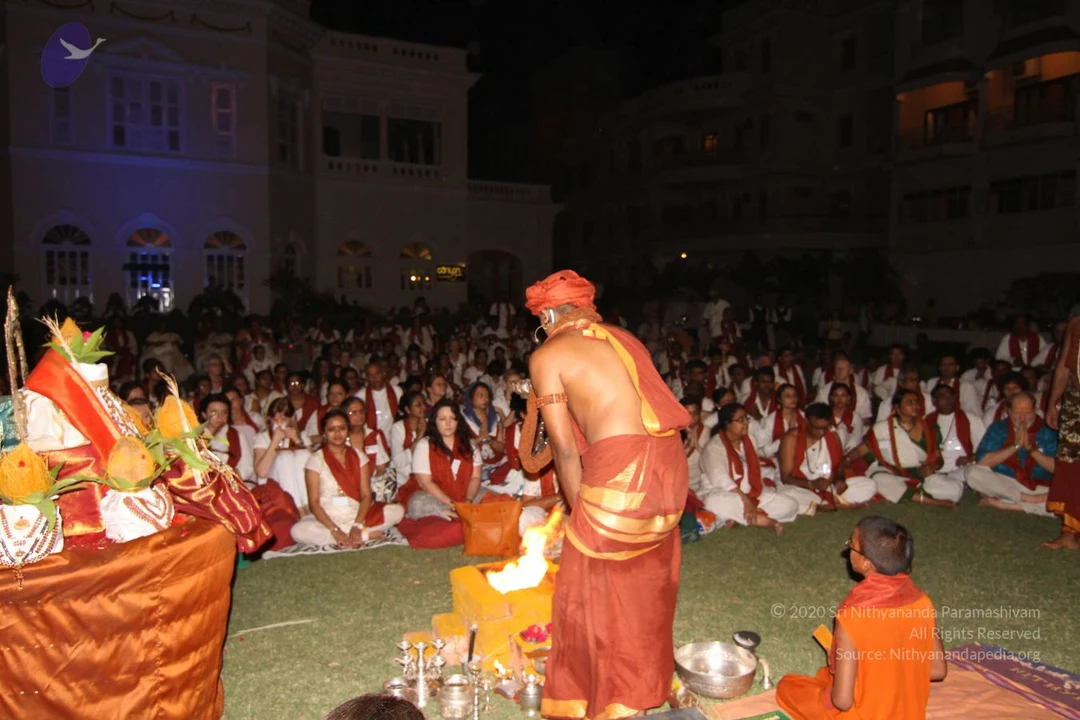
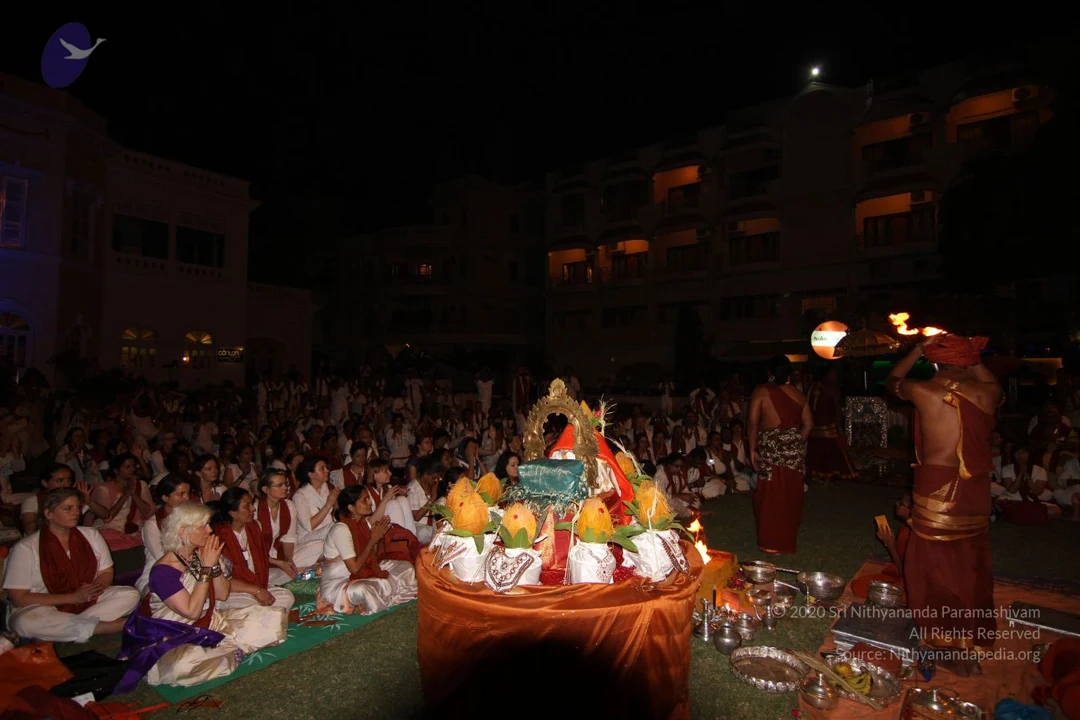
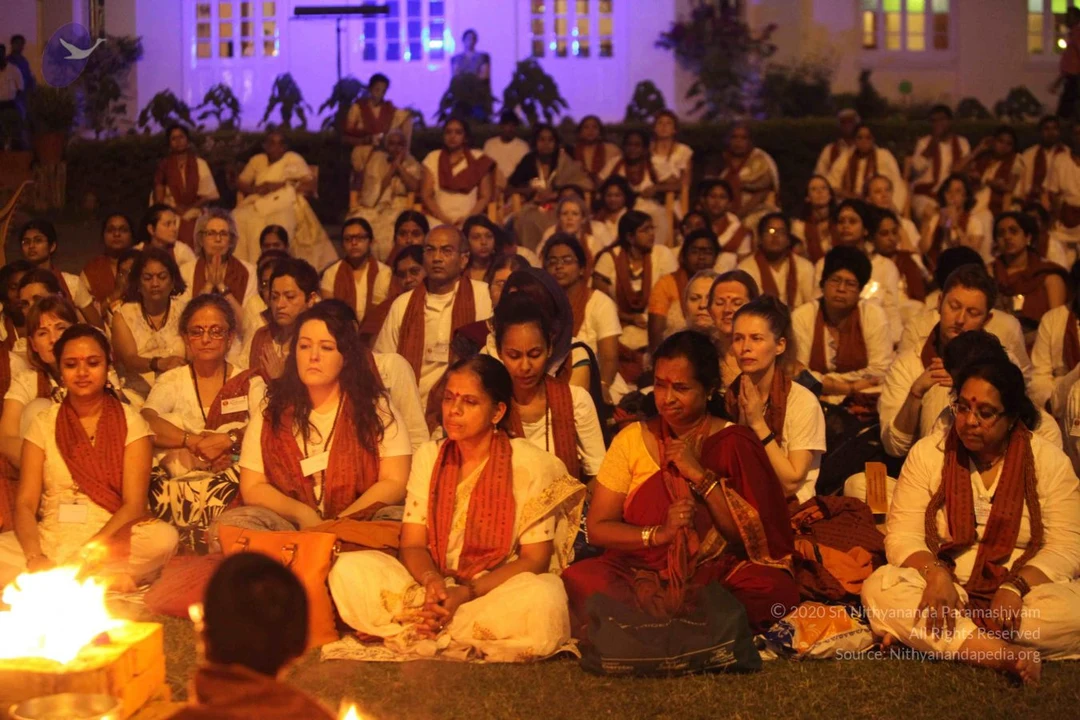
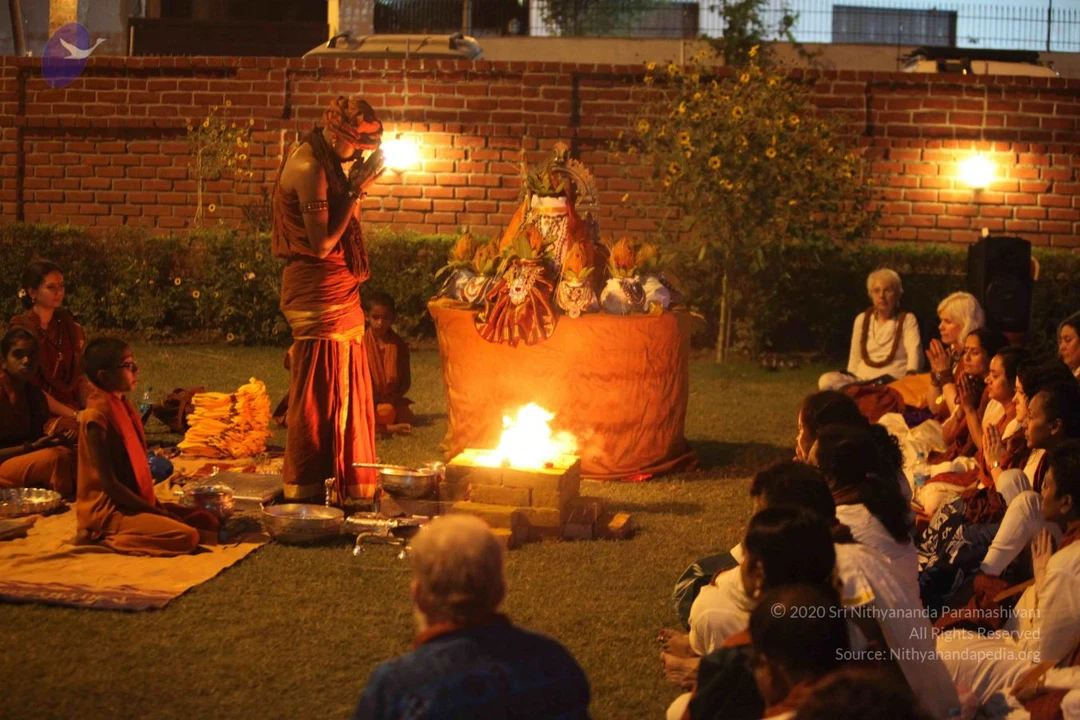
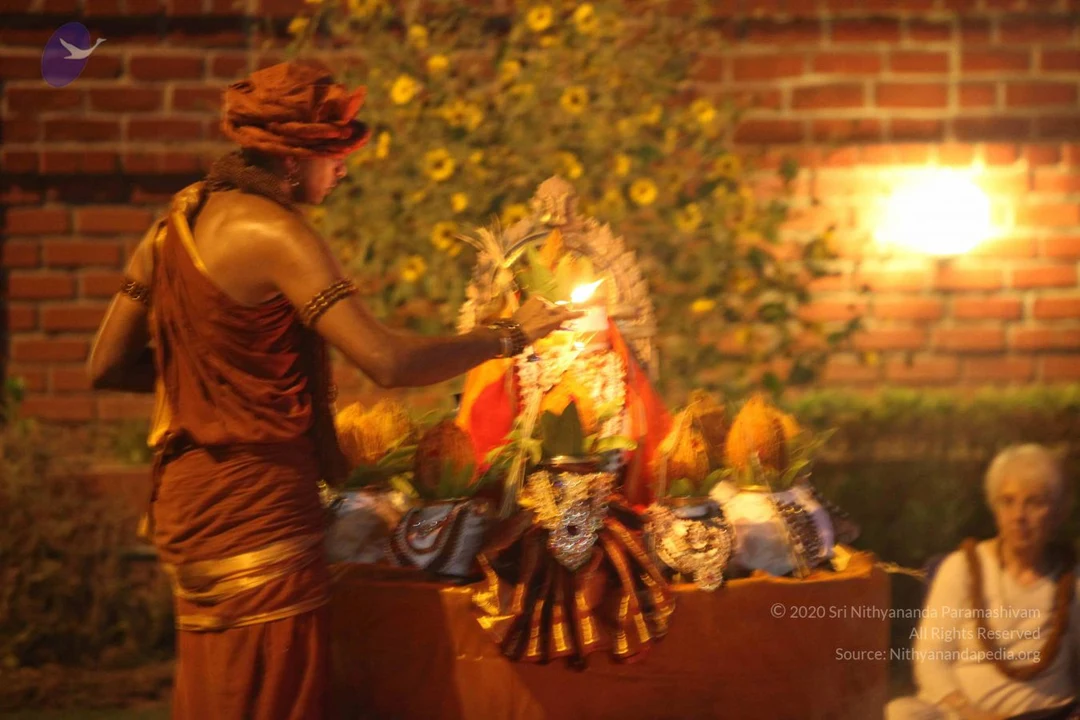
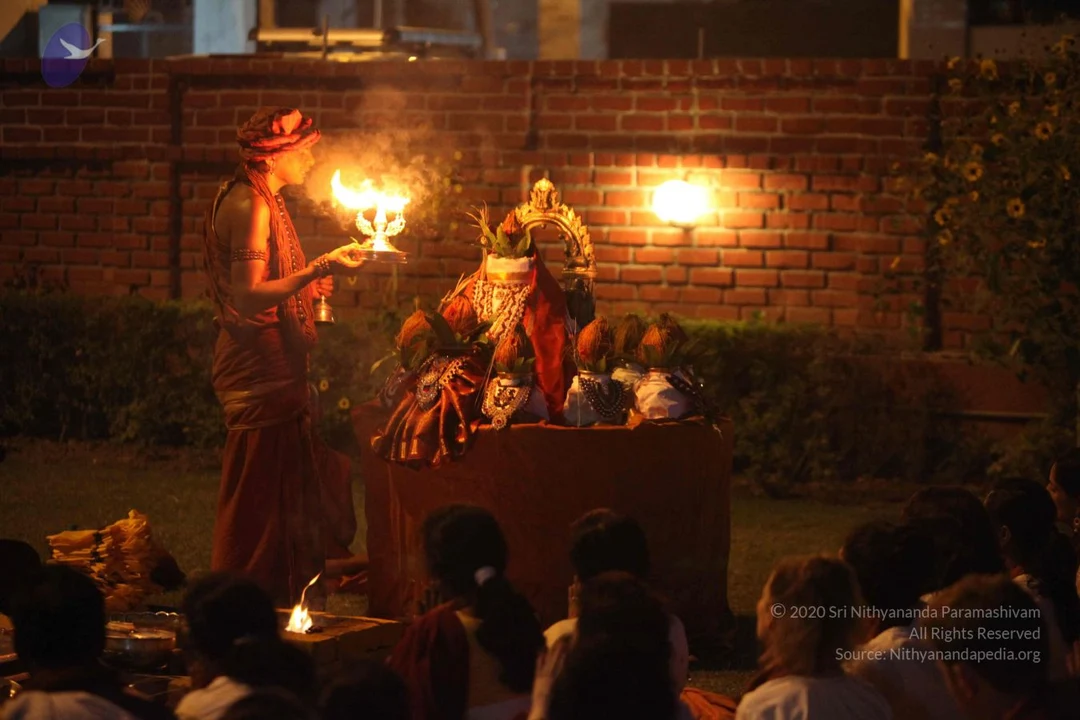
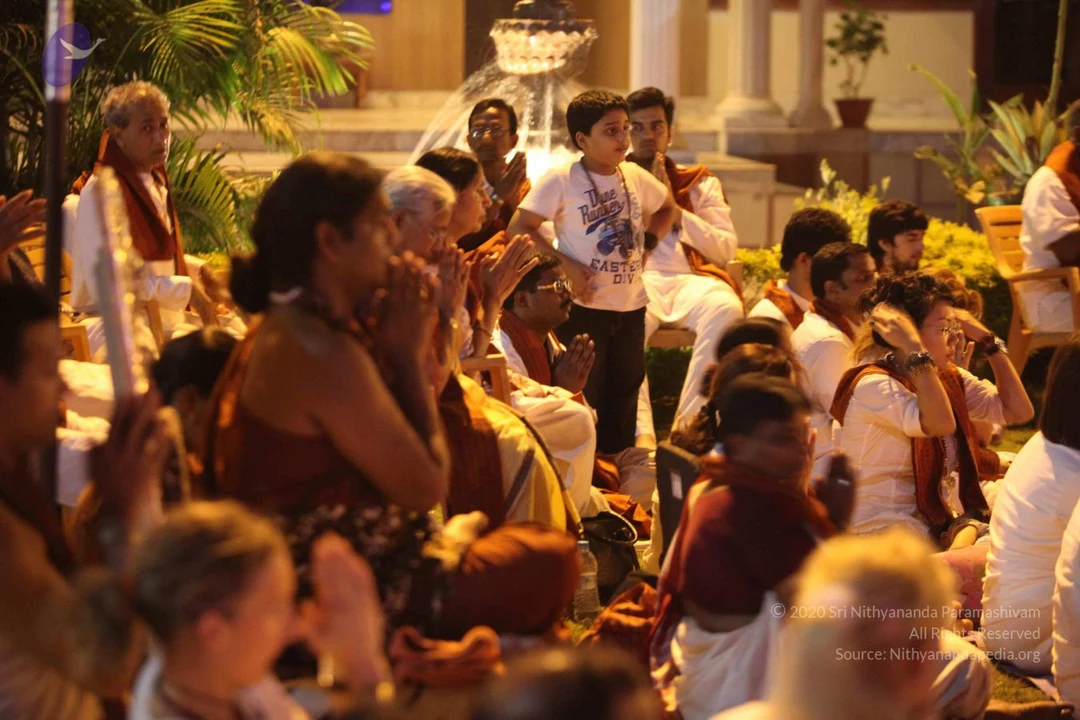
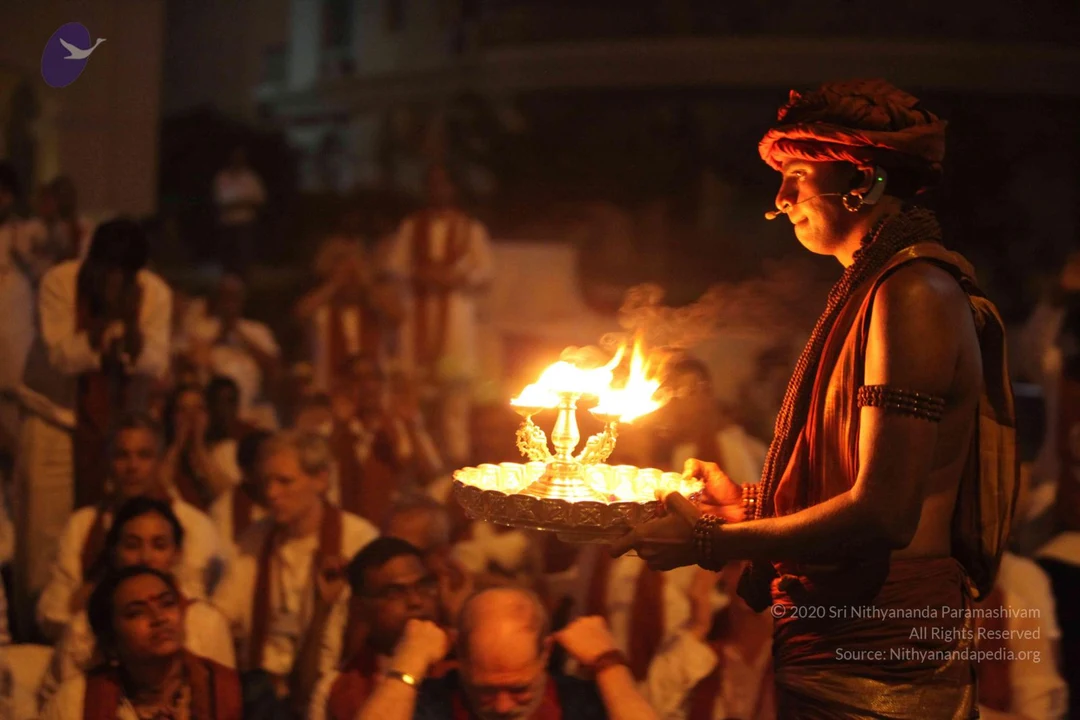
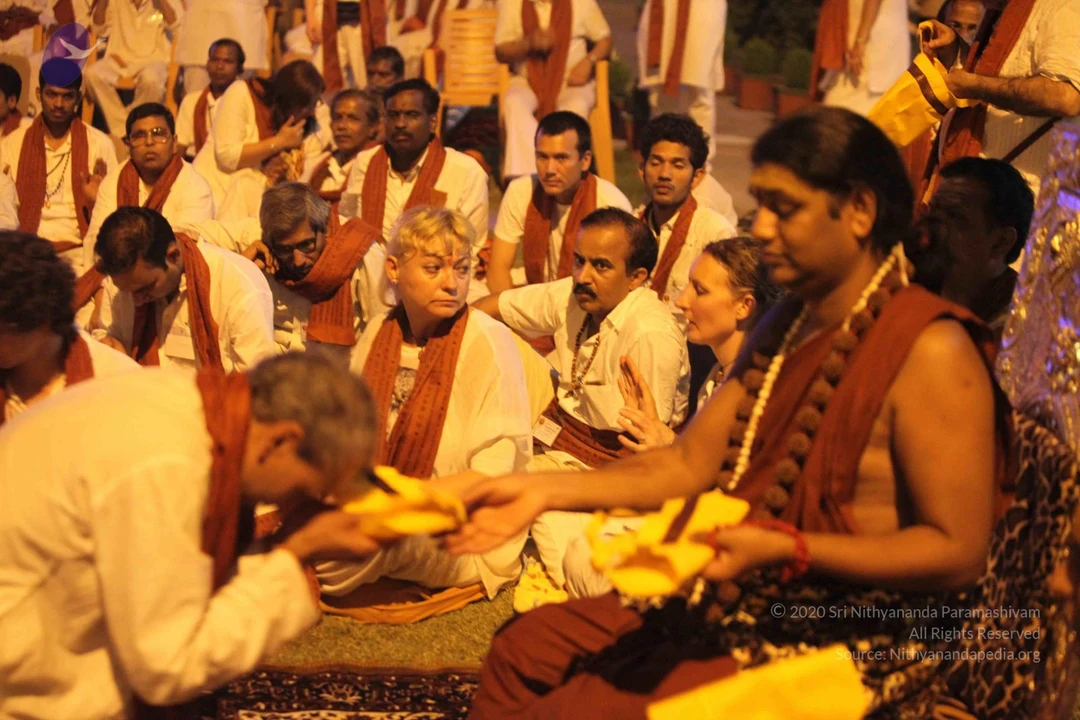
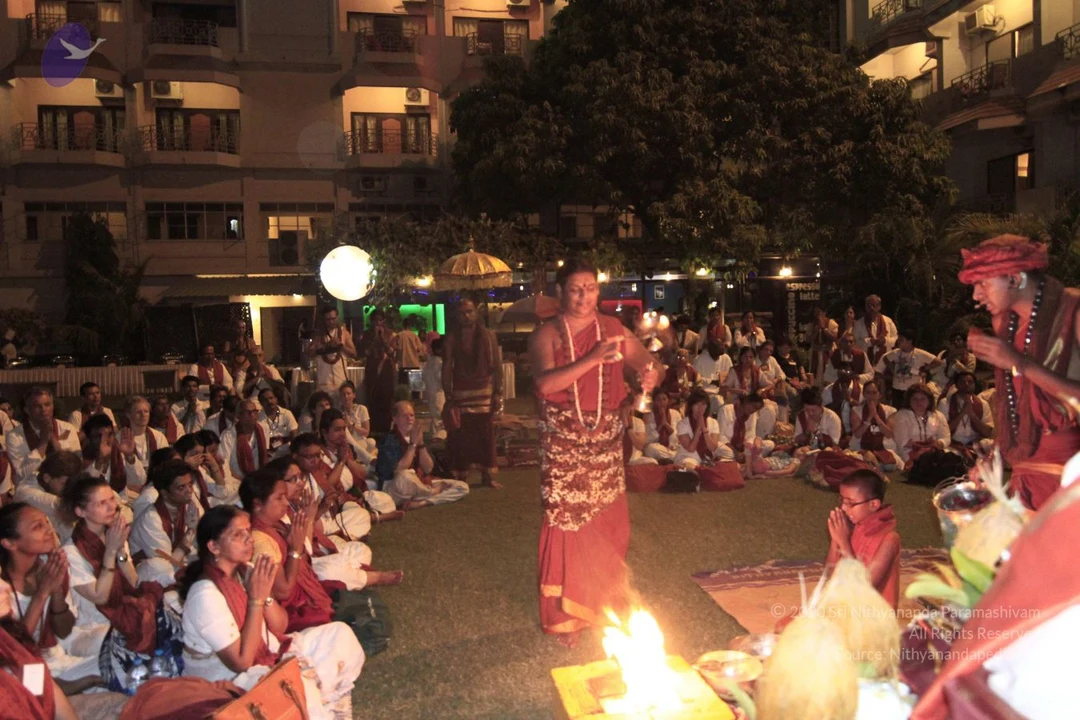
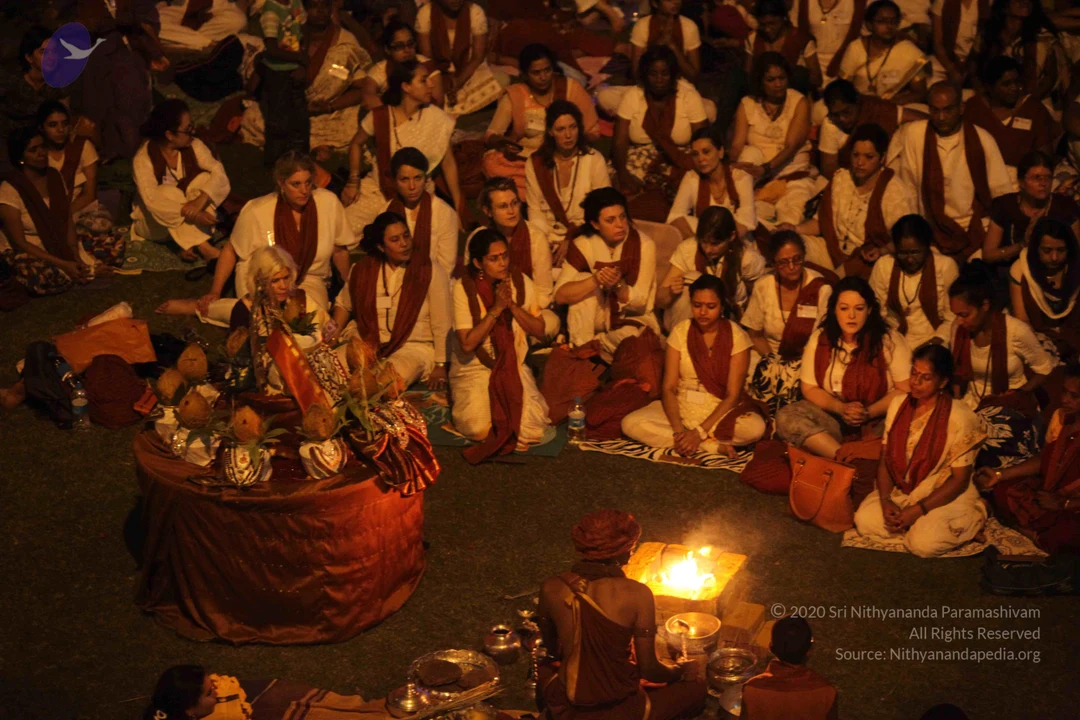
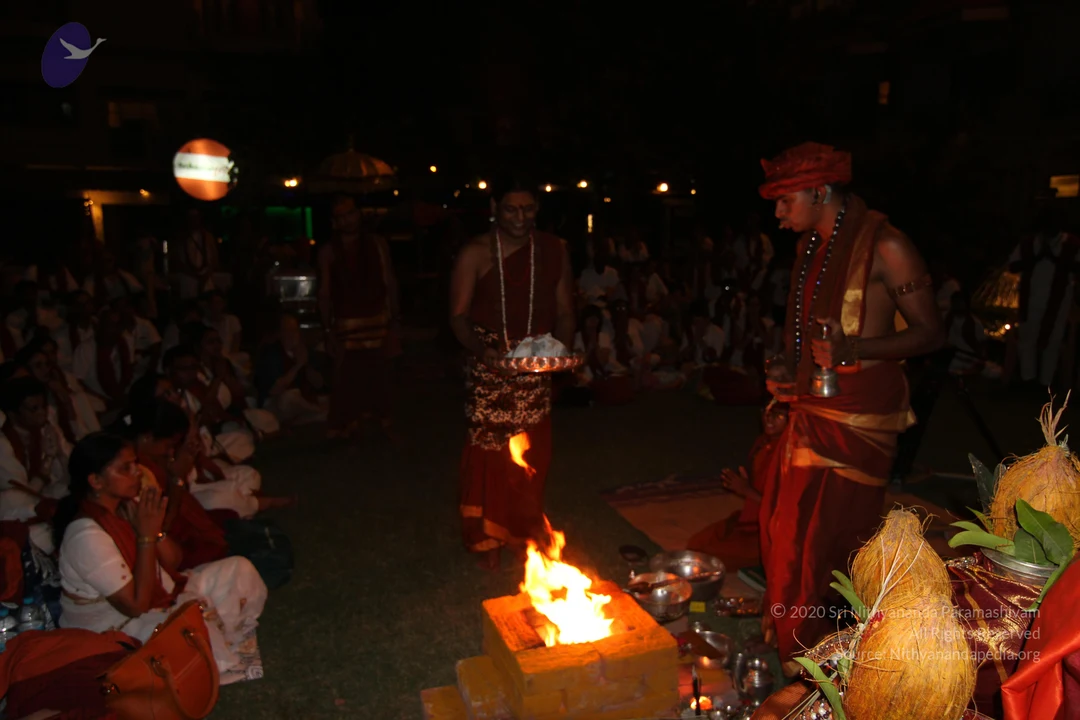
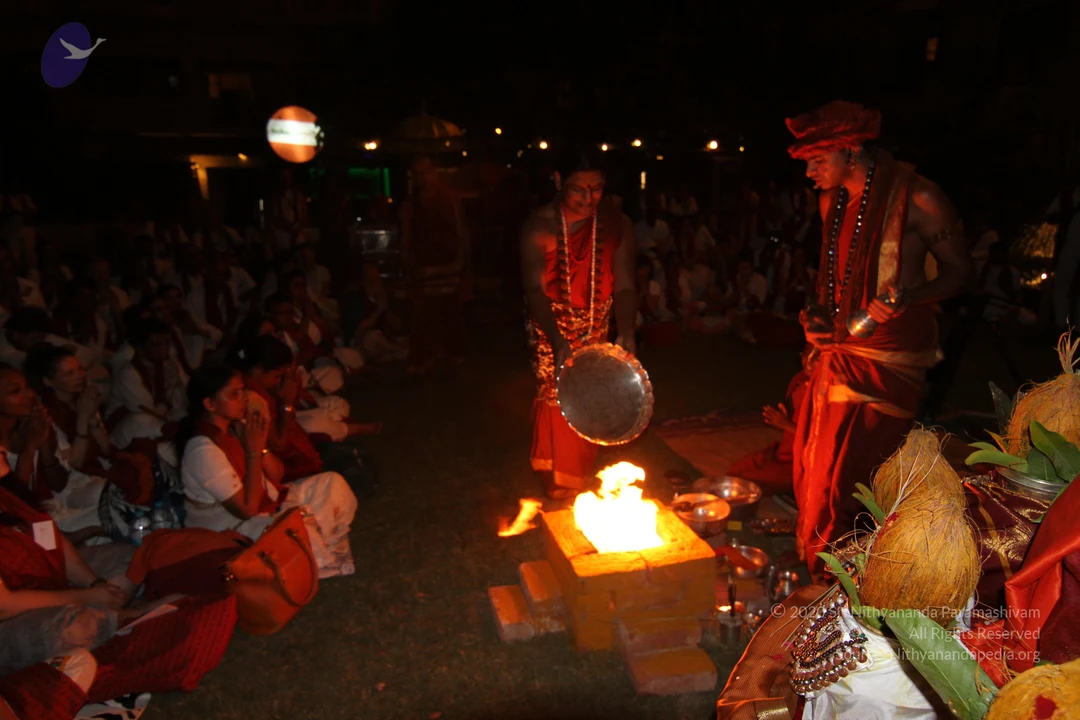
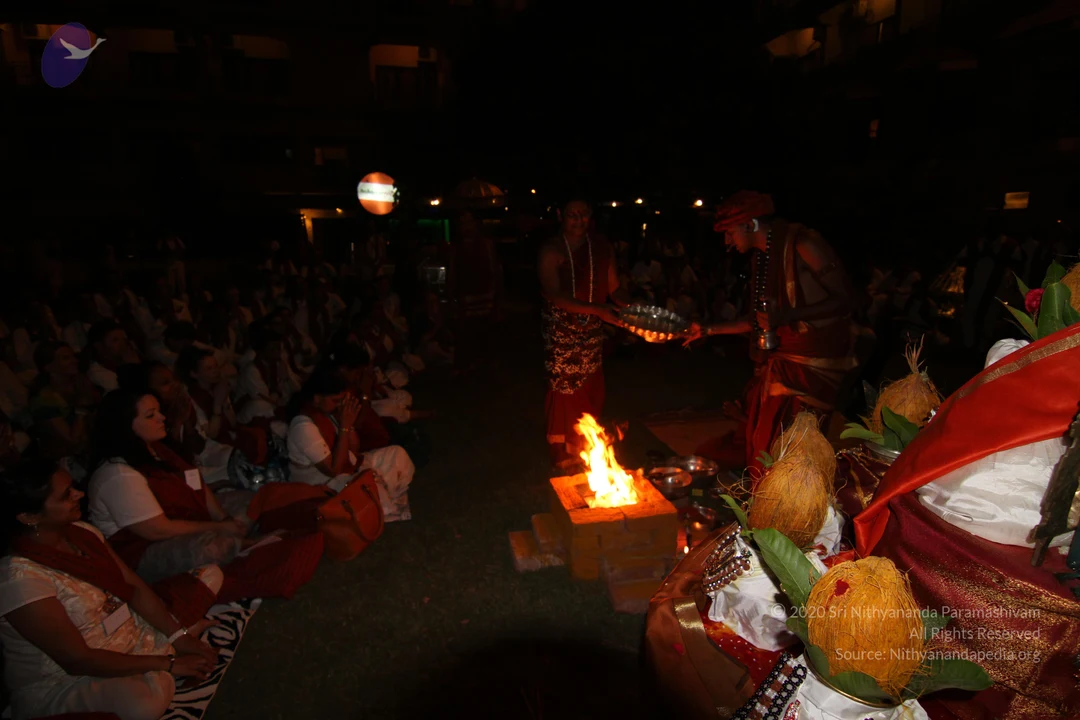
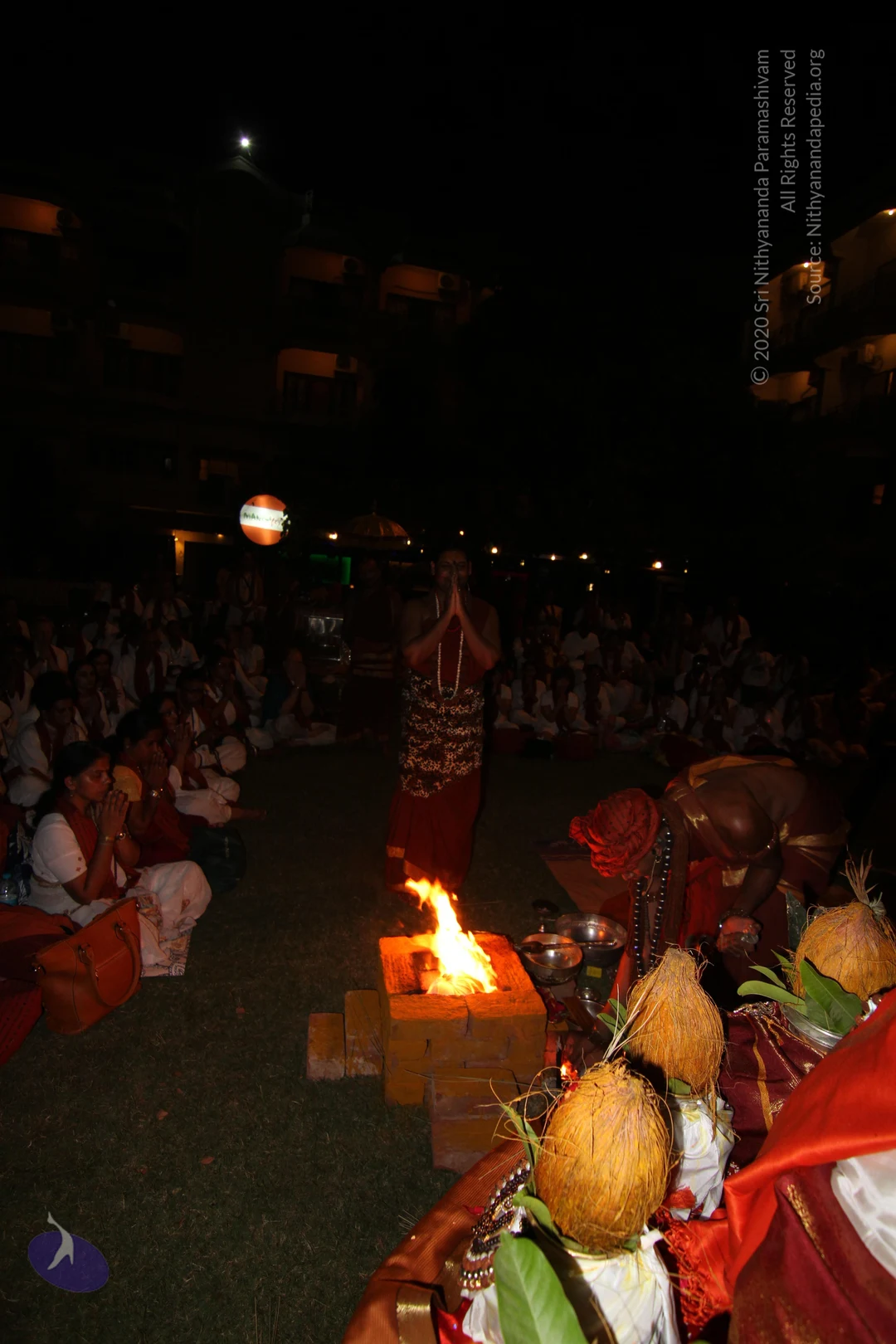
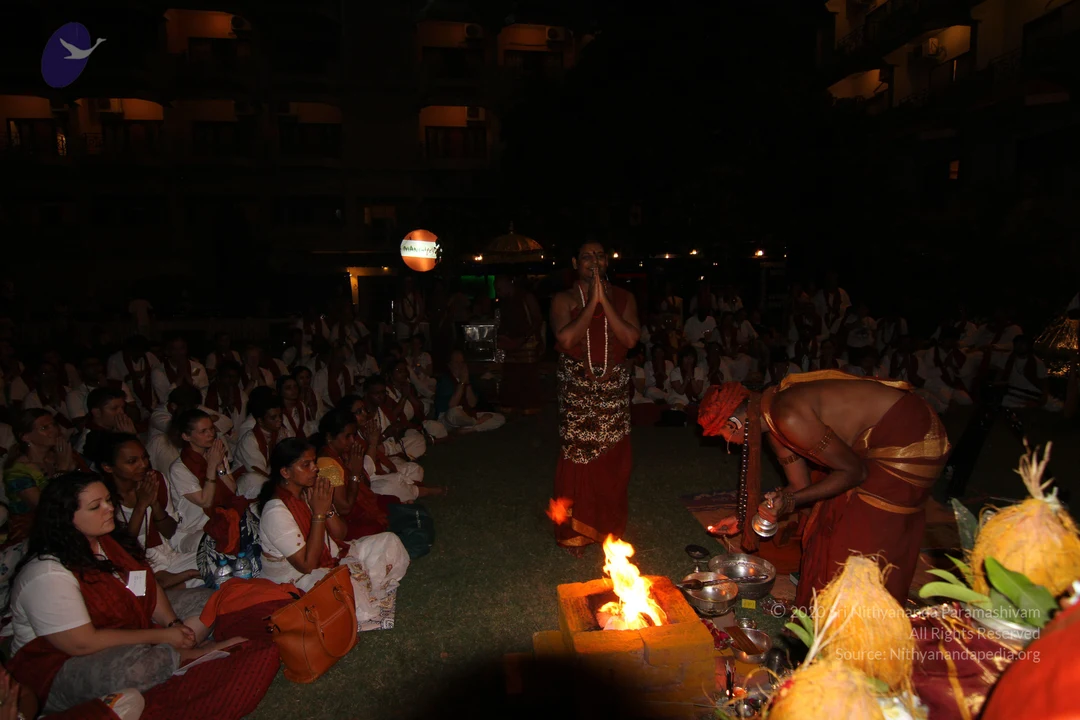
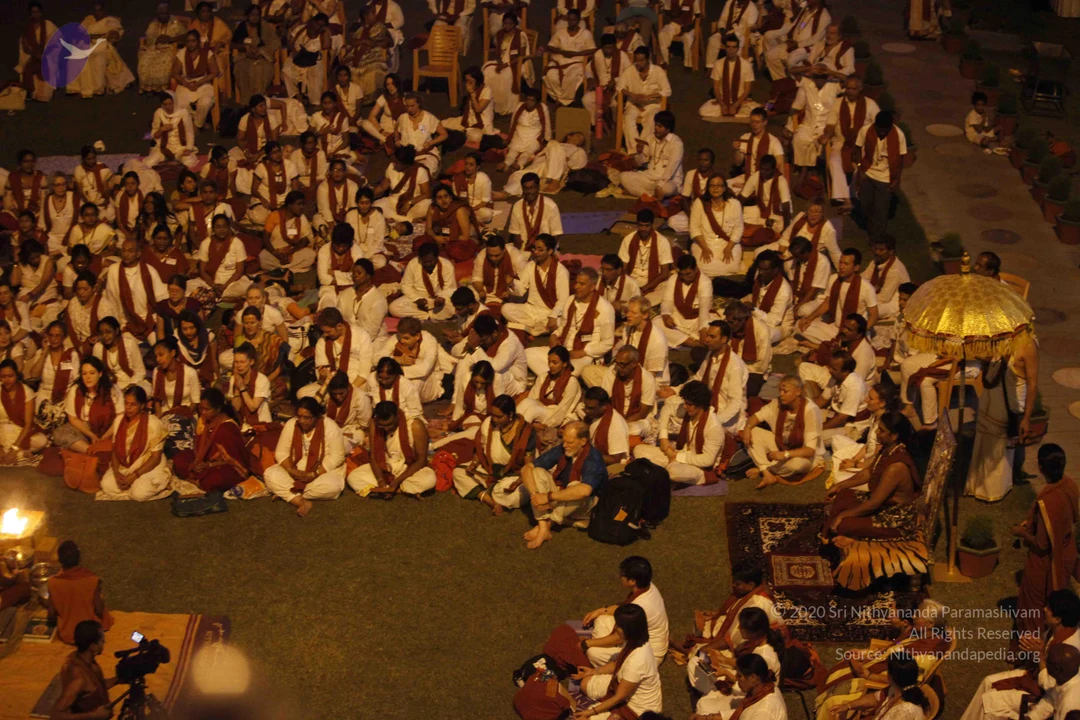
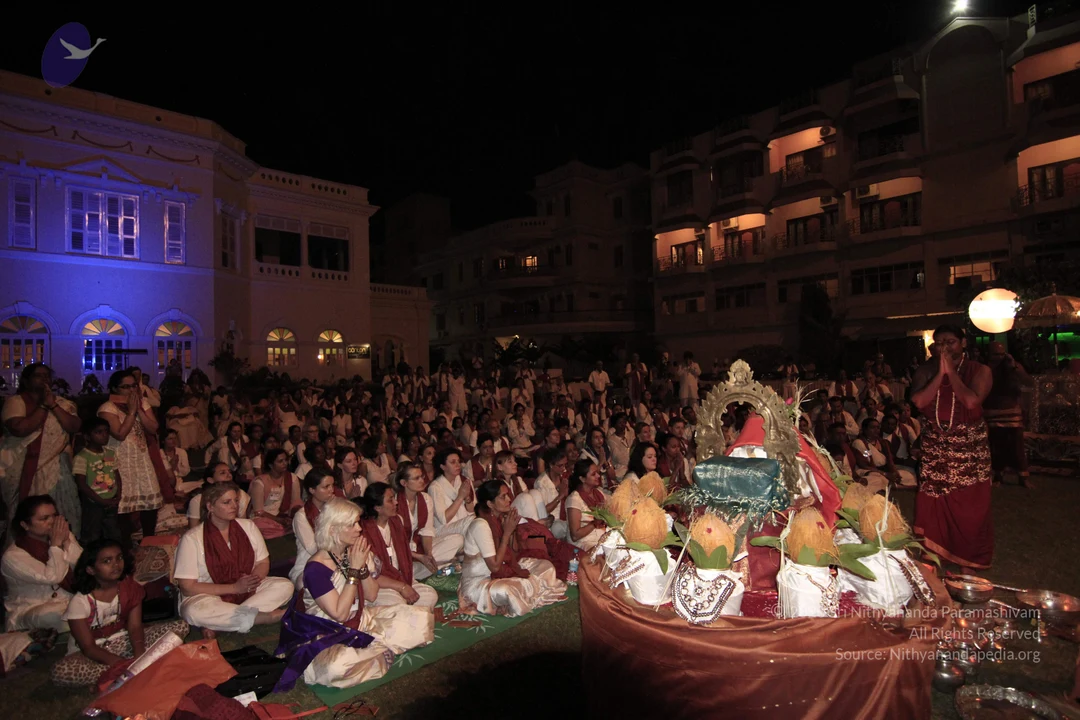
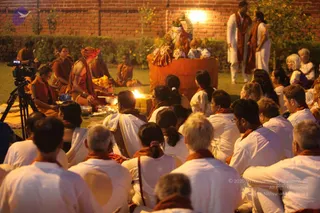
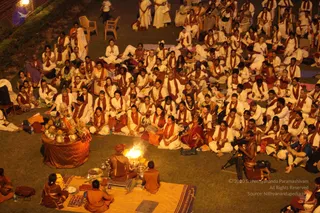
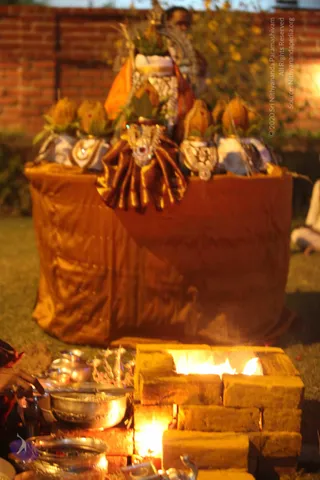
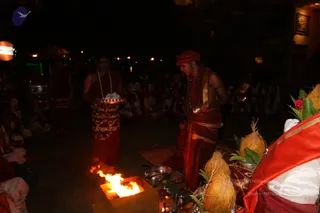
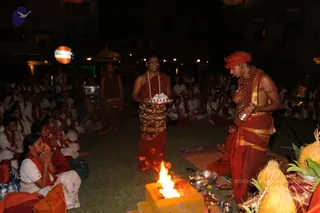
Evening outdoor ritual in a garden in front of a red brick wall. Seated priests in saffron and orange robes tend a small fire on the grass, with a brass bowl and offering trays nearby. Behind them stands a decorated orange-draped platform with a kalasha-like arrangement, flowers and cloth bundles. Two standing figures in white with saffron shawls stand at the right. A seated audience of devotees in white clothes with saffron shawls faces the fire, and a camera on a tripod is at left. A man in a saffron turban and orange-red garments sits at the centre-left near the fire, appearing to lead the homa. Warm lamplight and a glowing lamp on the wall illuminate the scene.Evening outdoor gathering on a lawn in front of a pale ashram building with columns. Dozens of devotees sit on orange plastic chairs and on the grass, many in white kurtas and white shirts, some women in sarees and salwar. A large crowd faces a raised stage at the far end. A banner beside the stage shows an orange-robed figure with a crown-like turban and reads a printed caption. A lit flame or oil lamp glows near the stage, with a few orange-clad people seated beside it. Purple stage lights and a potted tree frame the scene.Night outdoor gathering on a lawn with a large crowd of seated devotees, many in white clothing with red-orange shawls and sashes. In the foreground, a priest in orange robes sits before a small blazing fire, a homa or yagna, with brass vessels and a plate of offerings nearby. A second orange-robed attendant sits beside him on a yellow mat. To the left, a draped table holds fruit, flowers and a decorated kalasha. A cameraman in orange clothing films the scene on a tripod. Oil lamps and string lights glow in the background, and a few people stand near rows of chairs.Evening outdoor gathering on a lawn with a large seated crowd of devotees in white and cream clothing with red-orange shawls and garlands. Many sit on mats and chairs in rows; some hold their hands in anjali or pray with eyes closed. A lit oil lamp or fire is visible at the lower left beside a priest in orange-brown cloth tending it. At the right, a standing man in white dhoti and shawl with a red sash stands near a large ceremonial yellow-and-gold umbrella. Potted plants and garden paths frame the scene.Night outdoor gathering on a grass lawn with a large crowd of devotees seated in rows, mostly in white and saffron-red shawls and sashes. At the lower left, a man in orange robes sits near a small lit fire and brass vessels, apparently conducting a ritual, while a cameraman in orange kneels beside a video camera on a tripod. A golden ceremonial umbrella stands at the right edge over carpeted seating. Many devotees sit cross-legged or on chairs, some with hands joined.Night outdoor puja on a lawn in front of a pale, colonnaded building with lit windows. A priest in red-orange robes and a red turban sits cross-legged on a mat, facing a seated audience, holding a ritual vessel toward a small shrine. Beside him, a younger attendant in orange sits near brass plates of fruit, flowers and oil lamps. On the left, an ornately decorated deity murti or altar stands on an orange cloth, garlanded with yellow and orange flowers. Over one hundred devotees in white and red-orange shawls sit in rows, many with hands folded in prayer. A sign reading 'a person' is not applicable here: no figure matches the appearance cues needed for identification, so the seated priest is described only by role.

Others

4 photosSource gallery
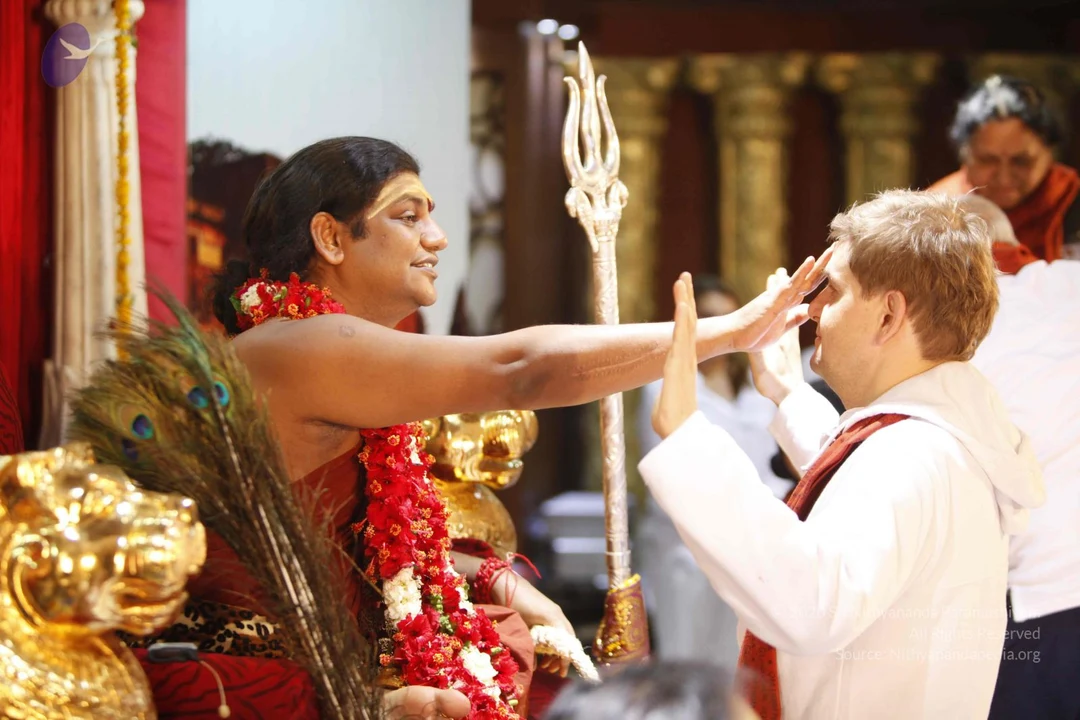
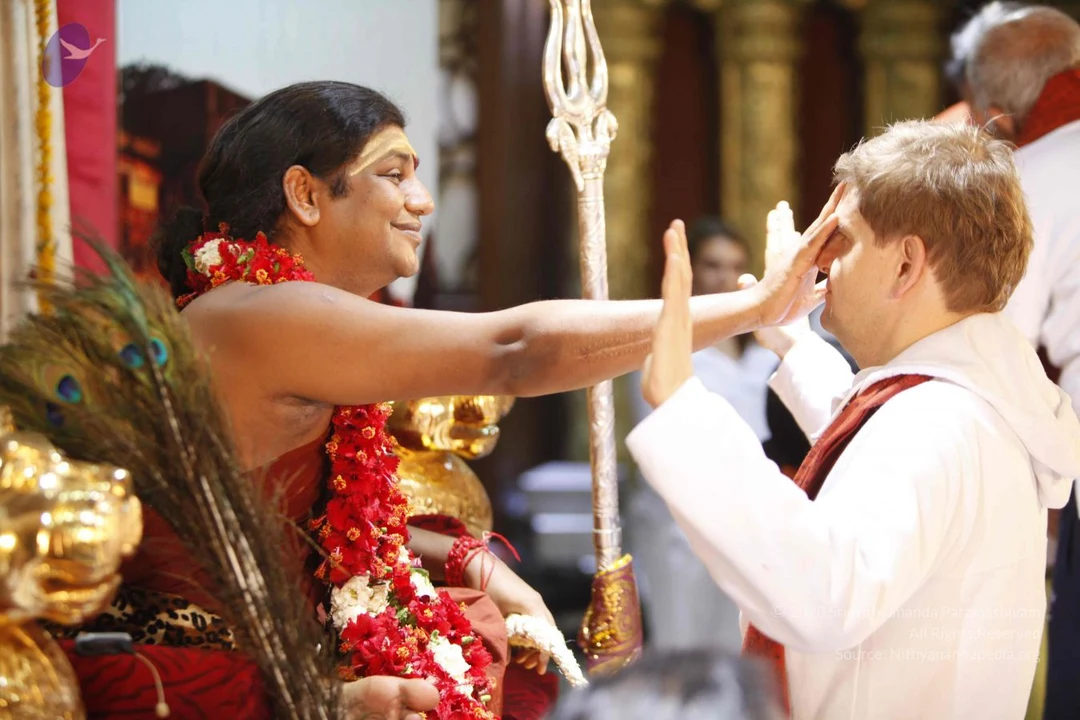
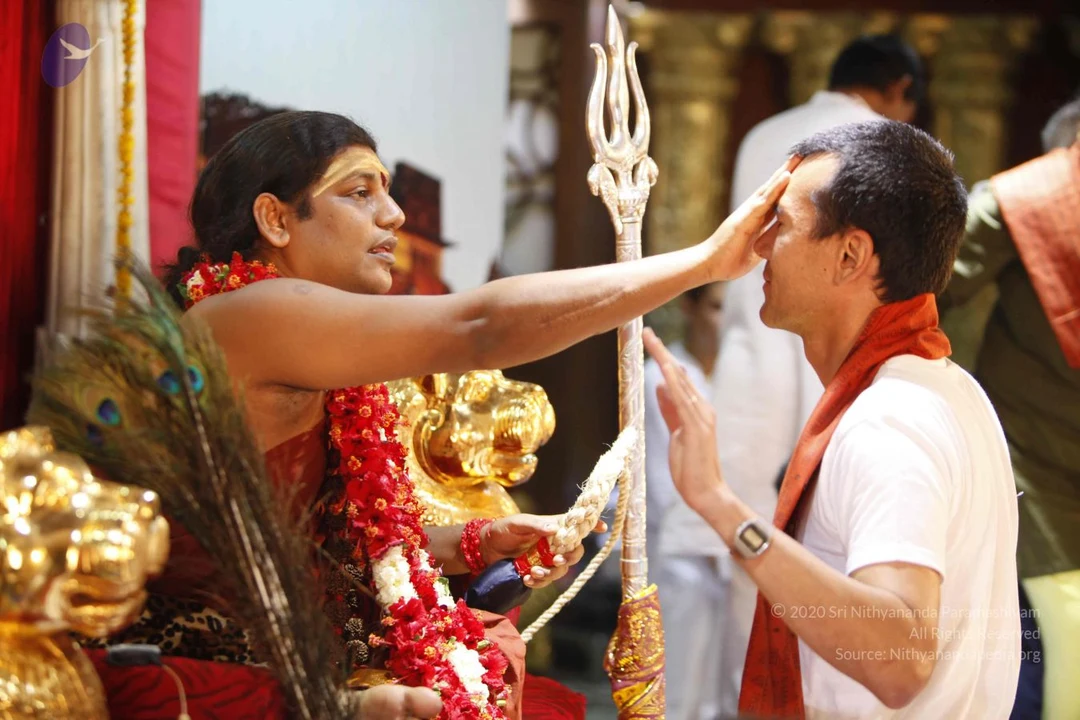
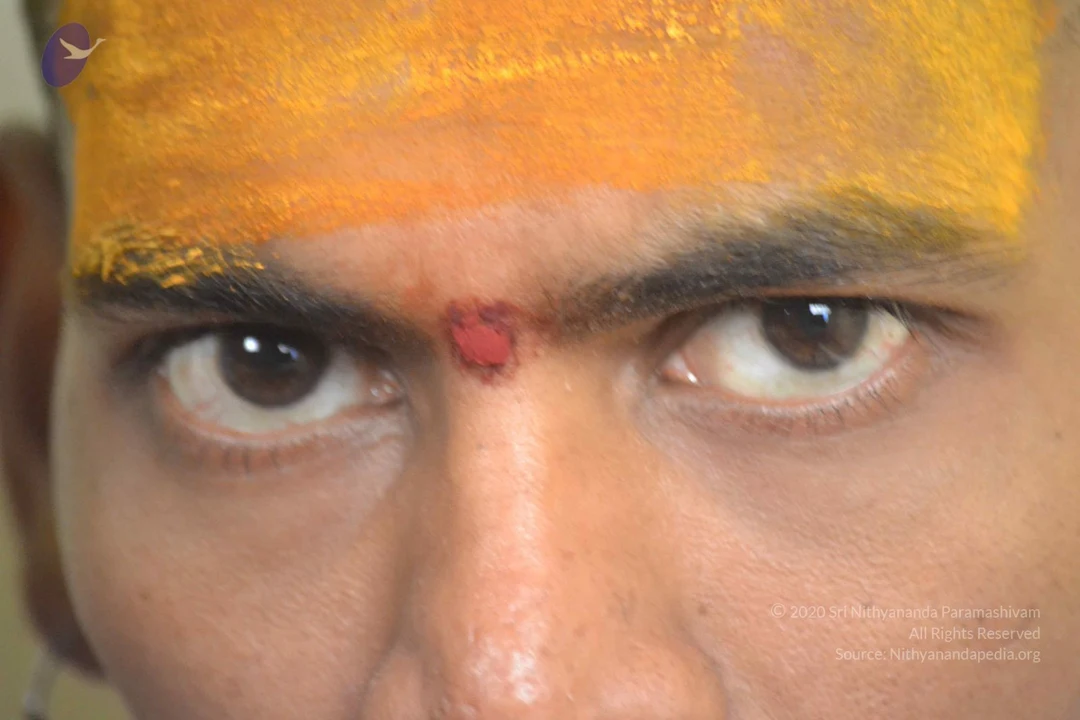
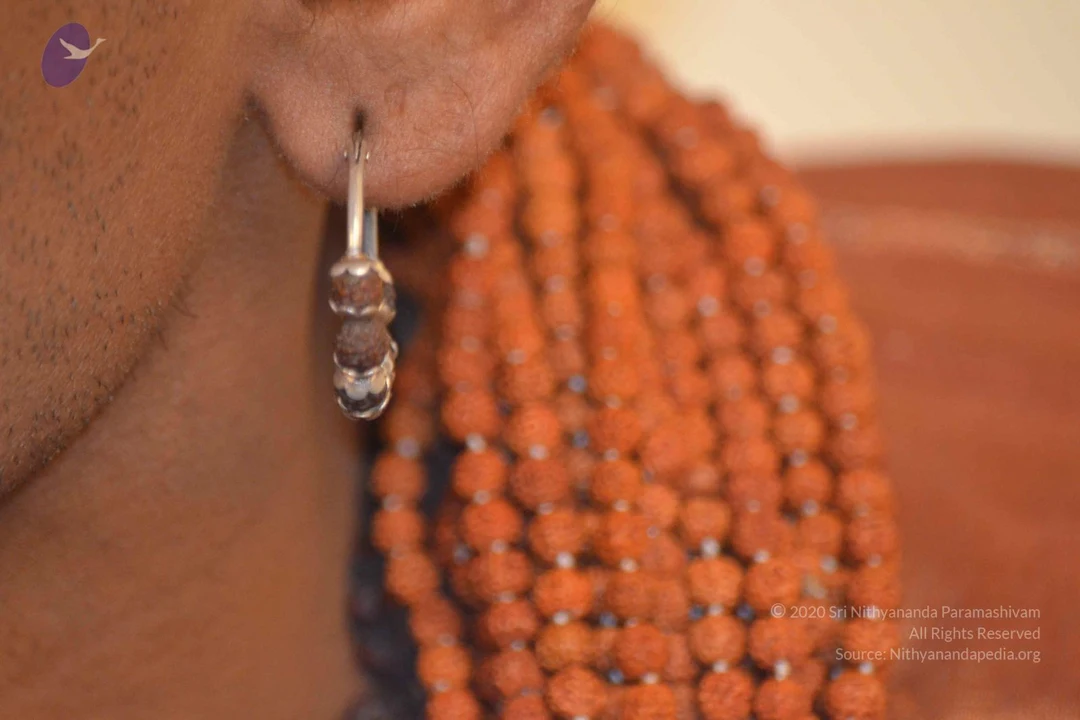
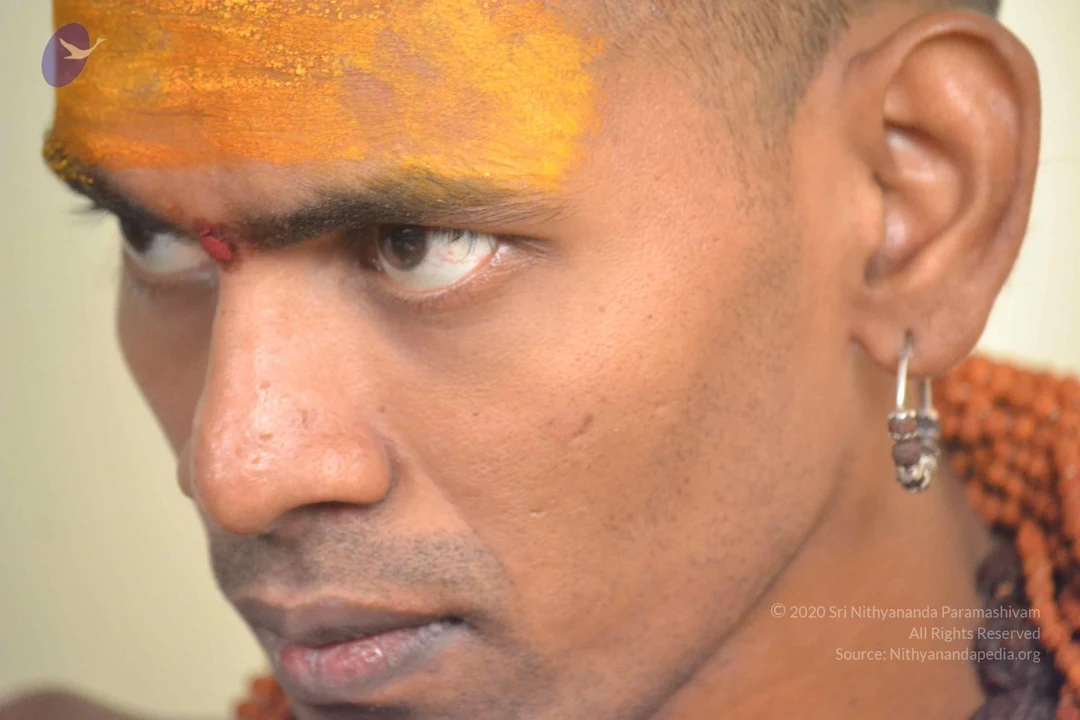
Extreme close-up of a man's face showing his eyes, nose and forehead. A broad band of bright yellow-orange paint or tilak covers his forehead, with a small red kumkum dot at the brow centre between dark eyebrows. No ceremonial garments, malas or throne are visible, and the frame is cut off at the eyes and nose. The face is too tightly framed to confirm the person's presentation beyond these forehead markings.Close-up photograph of a person's ear and neck. A hoop earring holds two dark brown rudraksha beads, and multiple strands of orange-brown rudraksha mala beads with silver-toned spacers hang over the shoulder against a blurred warm background. No face is shown, so no individual is visible beyond the ear, neck and beads. The image carries a faint purple bird logo at top left and a copyright line at lower right.Close-up photograph of a shaven-headed man seen in profile, his forehead smeared with bright yellow-orange paste and a small red kumkum mark between the brows. He wears a silver hoop earring and a dark rudraksha-bead garment at the shoulder, with a plain pale wall behind him.Close-up photograph of a man with short dark tousled hair, a trimmed moustache and stubble beard, wearing a white collared shirt, against a plain pale yellow-green wall. He faces the camera with a neutral expression.

1-PadaPuja

3 photosSource gallery
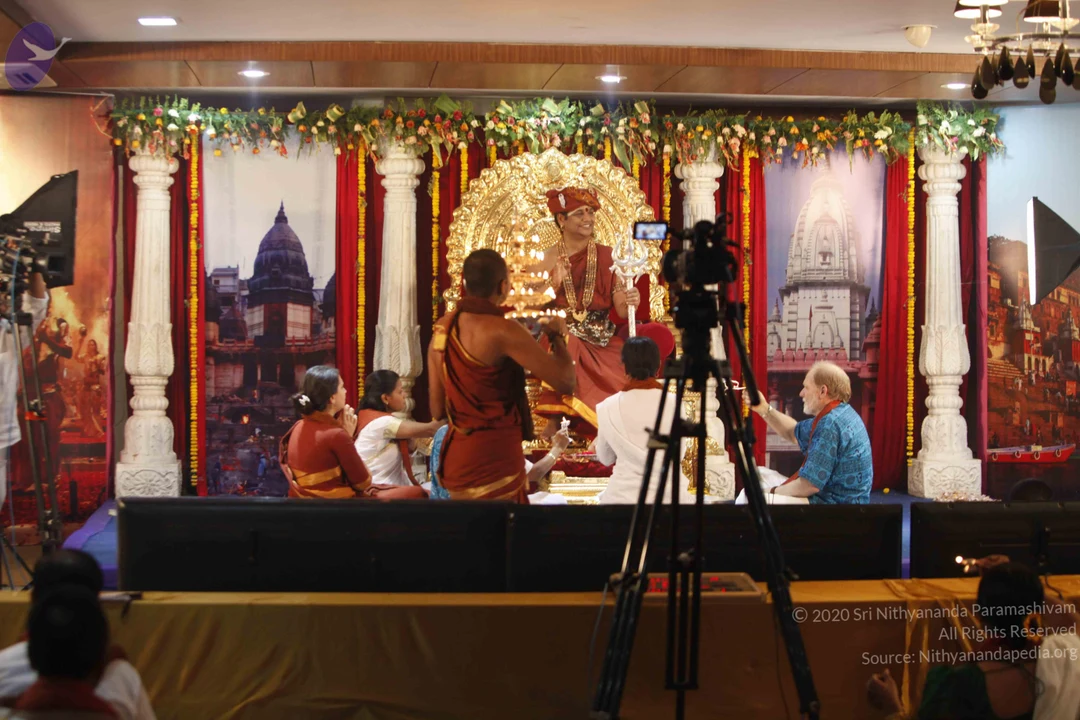
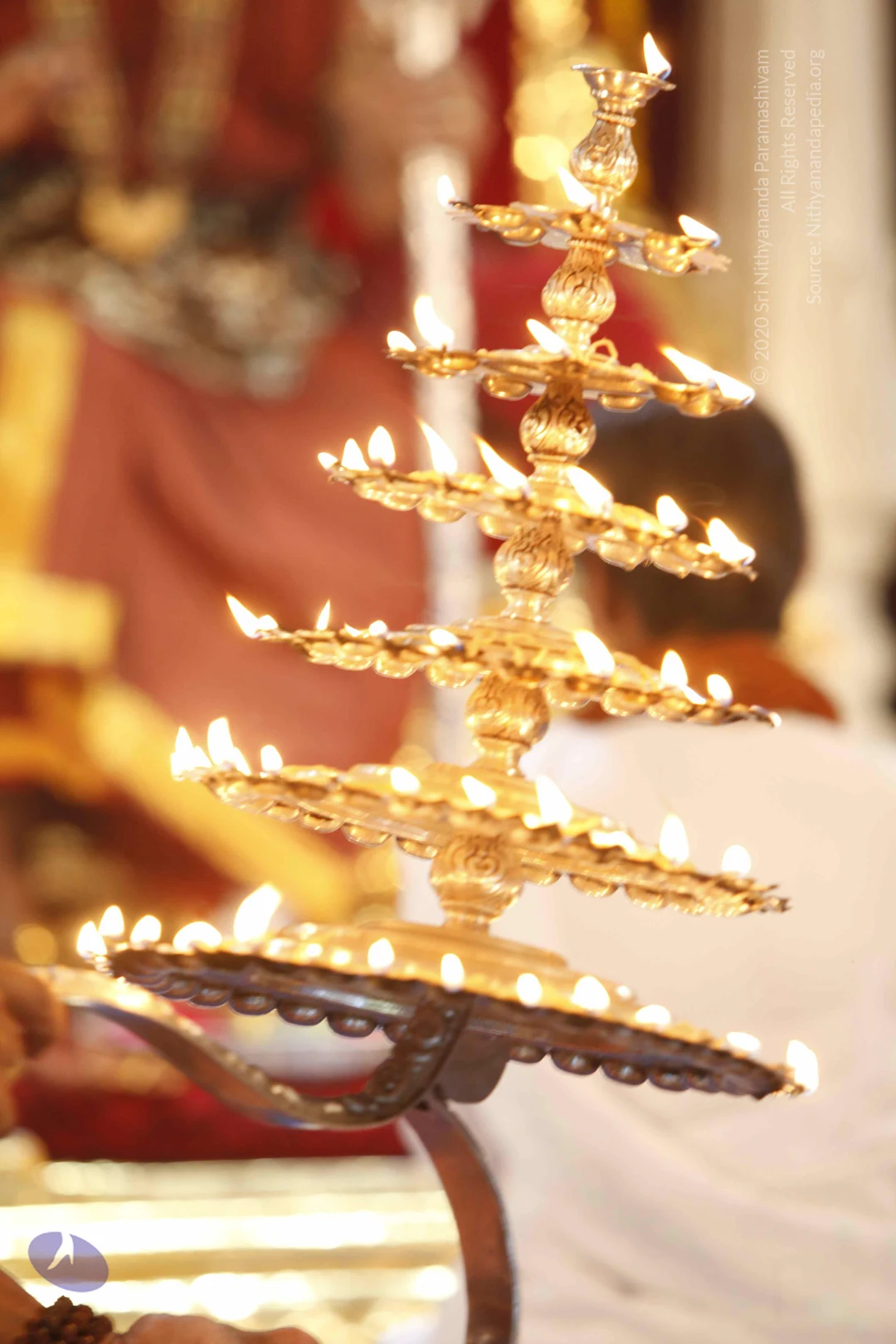
A photograph of a ceremonial scene in a flower-decorated hall. A man seated on an ornate gold throne with red cushions wears a deep red-maroon wrap, a red head-cloth, and a long beaded rudraksha mala with a gold pendant, raising one hand in blessing while holding a silver trident. Marigold garlands and red drapery frame the throne, with white pillars on either side and a painted temple backdrop. In the foreground, a hand holds a lit multi-wick oil lamp aarti, and a woman in white sits with her back to the camera. Other attendees in white kneel or sit nearby, and a hand holds a small lamp at the right edge. The seated figure's appearance matches a person candidate with rudraksha mala, red head-cloth and trident cues.A photograph of a staged ritual set with a golden ornate throne against a backdrop of white pillars, marigold garlands, and printed Varanasi temple and ghat images. A seated figure in a red turban and red robe with a gold necklace holds a silver trident, seated on a golden throne. A man in saffron-orange robes kneels or sits near the throne holding a lamp or ritual object, while a woman in red-orange and a woman in white sit on the floor nearby. A man in a blue patterned shirt sits to the right with a red shawl. Video cameras and tripods are in the foreground, and a standing figure in orange is visible at the bottom right. Lit oil lamps are placed near the throne. a person: the seated figure wears a red turban, red robe, gold necklace and holds a trident on a golden throne.A tiered brass aarti lamp with multiple tiers of lit oil lamps, the flames glowing warmly against a blurred background of red and gold fabric. In the background a person in red clothing with gold ornaments stands partly out of focus. The brass stand has a curved handle and repeated flame wicks on each tier. Only the lamp and one blurred figure are visible; no clear face or identifiable person is shown.

2-MorningSatsang
38 photosSource gallery
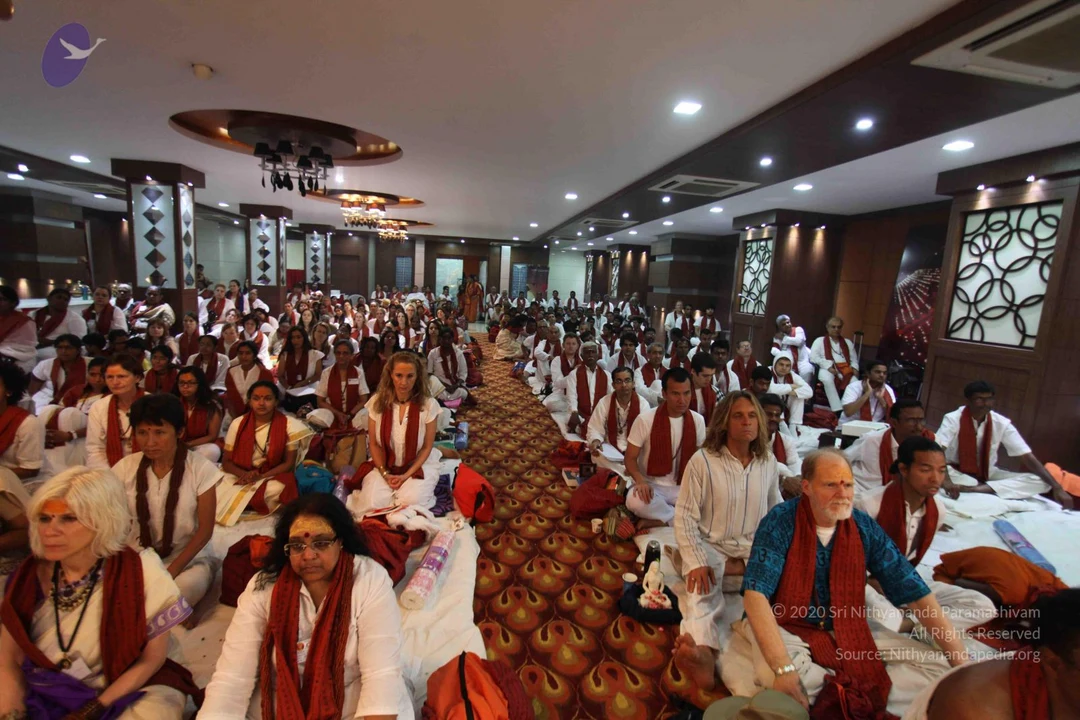
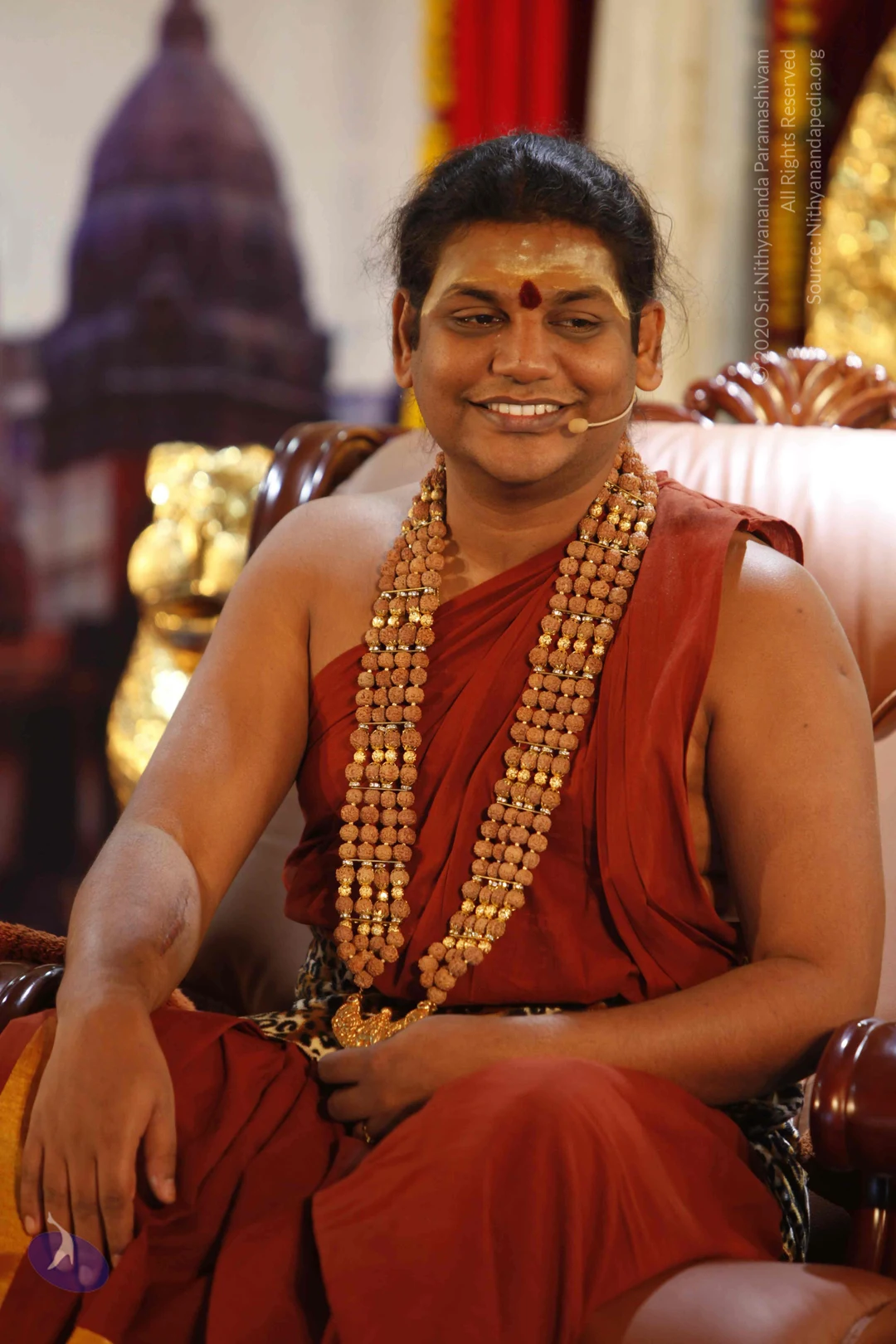
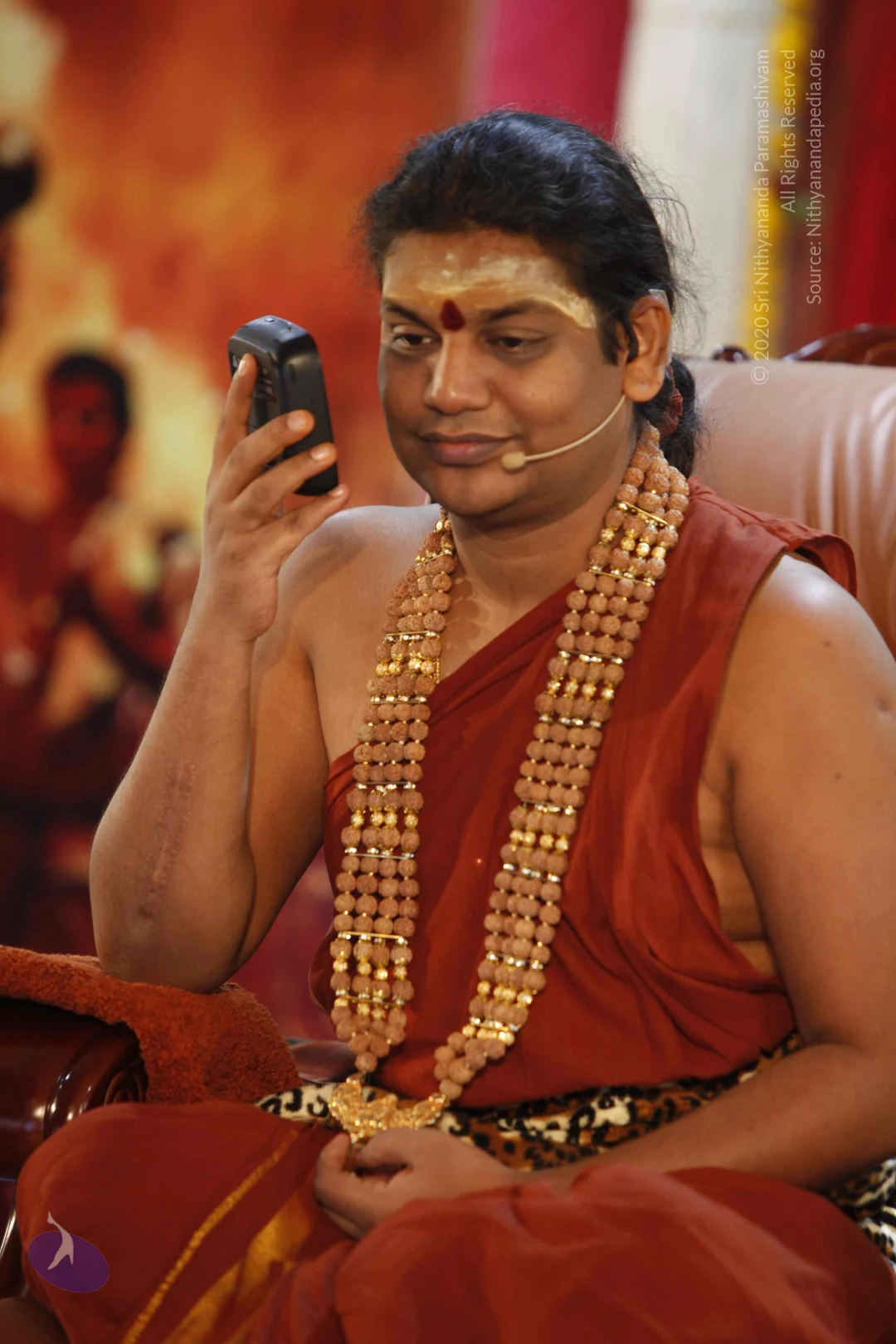
A smiling man seated on a red cushioned seat before an ornate gold throne-back, with marigold and flower garlands above. He wears a maroon turban with beaded embroidery and a small white tilaka mark, and is dressed in a maroon garment with a leopard-print wrap and gold-bordered cloth. Multiple tiers of rudraksha mala hang around his neck with a gold pendant, and rudraksha bracelets are on his wrists and arms. He raises one hand in blessing while holding a silver trident in the other.A seated man in a maroon turban with a red bindi and smiling eyes closed, sits on an ornate gold throne with red cushions, in front of a backdrop of marigold garlands and flowers. He wears a maroon and gold-bordered dhoti, leopard-print cloth, layered rudraksha malas, bead bracelets and a gold pendant, and raises one hand in blessing while holding a silver trishula. Incense smoke rises at lower left, and two people's arms and shoulders in white clothing are visible at the bottom edges.A seated man on an ornate gold throne with a carved gold backrest, flanked by white pillars and marigold garlands with red flowers above. He wears a maroon head wrap with gold embroidery, a maroon robe, a leopard-print lower garment, layered rudraksha beaded malas, a gold pendant, and beaded bracelets; he holds a silver trident in his right hand and raises his left hand in blessing while smiling. The appearance is a person seated in a teaching role, with the trident and throne as ceremonial cues.A large indoor satsang hall with a patterned red-and-gold carpet runway running down the center between rows of seated devotees. Most attendees wear white clothing with red-and-maroon shawls draped over their shoulders. Foreground figures include a woman with white hair and round glasses, a woman with a vermilion mark and dark-rimmed glasses, and a bald man with vibhuti on his forehead wearing a blue jacket over a red shawl. Ornate ceiling lights, chandeliers and wooden paneling frame the room. A small white figurine sits near the front right. Several dozen people are visible; a central figure stands near the far end of the carpet.A seated man in a rust-red saffron-toned shawl and leopard-print lower garment sits eyes-lowered before an ornate gold throne-back with repoussé floral patterns. He wears multiple strands of rudraksha beads with gold spacers, rudraksha armlets, a gold pendant and a white horizontal forehead mark with a red bindi. His hands rest in a meditative mudra on his lap.A man in a saffron-red dhoti and shawl sits on a red cushioned seat before an ornate gold throne with a repoussé arched backrest, decorated with flower and leaf garlands above. He wears multi-strand rudraksha malas across his chest, rudraksha armbands, a gold-and-rudraksha bracelet, and a white vibhuti tilak with a red kumkum dot. He smiles with eyes lowered, hands folded in his lap. A leopard-print cloth is draped over his lap.
3-IA-Lunch

4 photosSource gallery
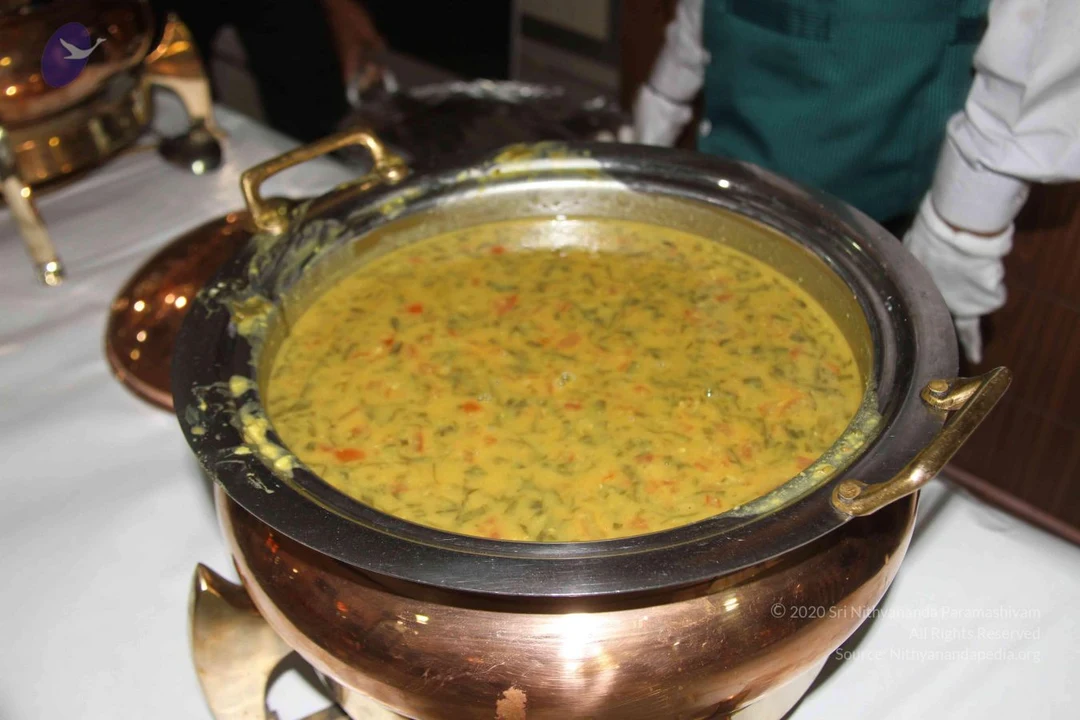
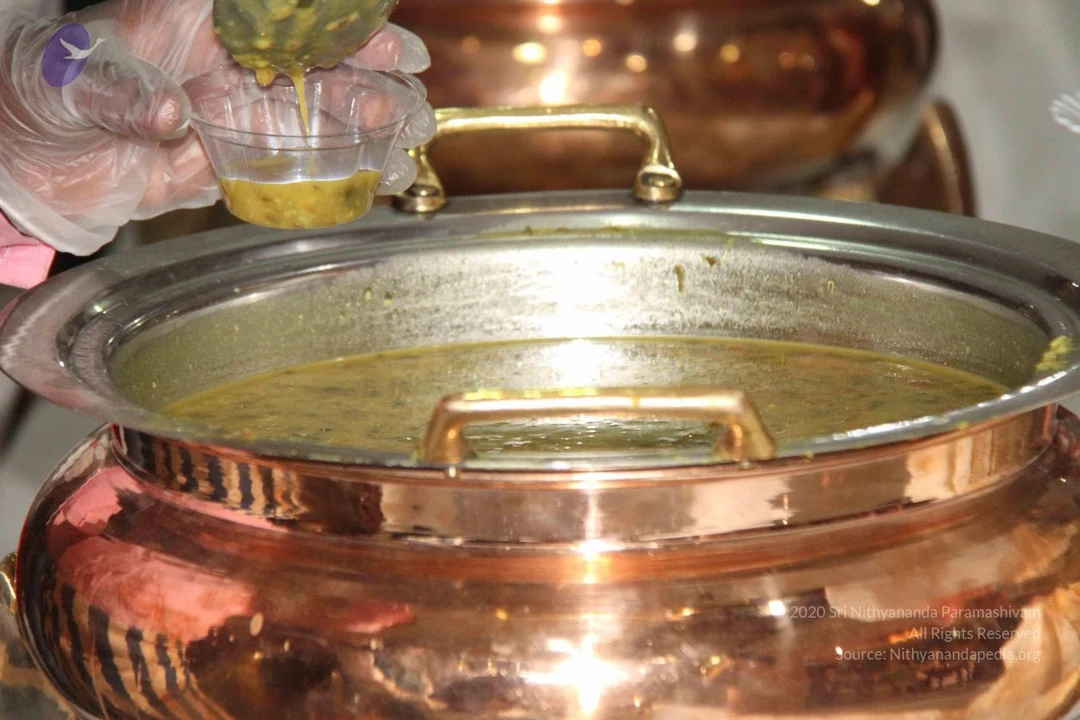
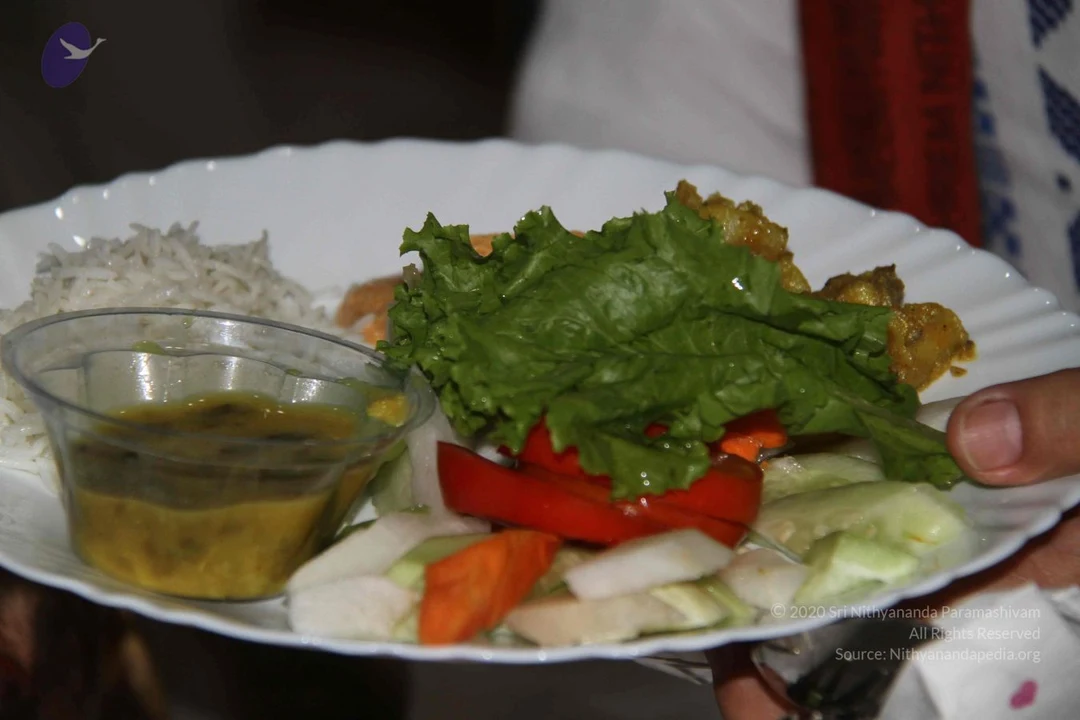
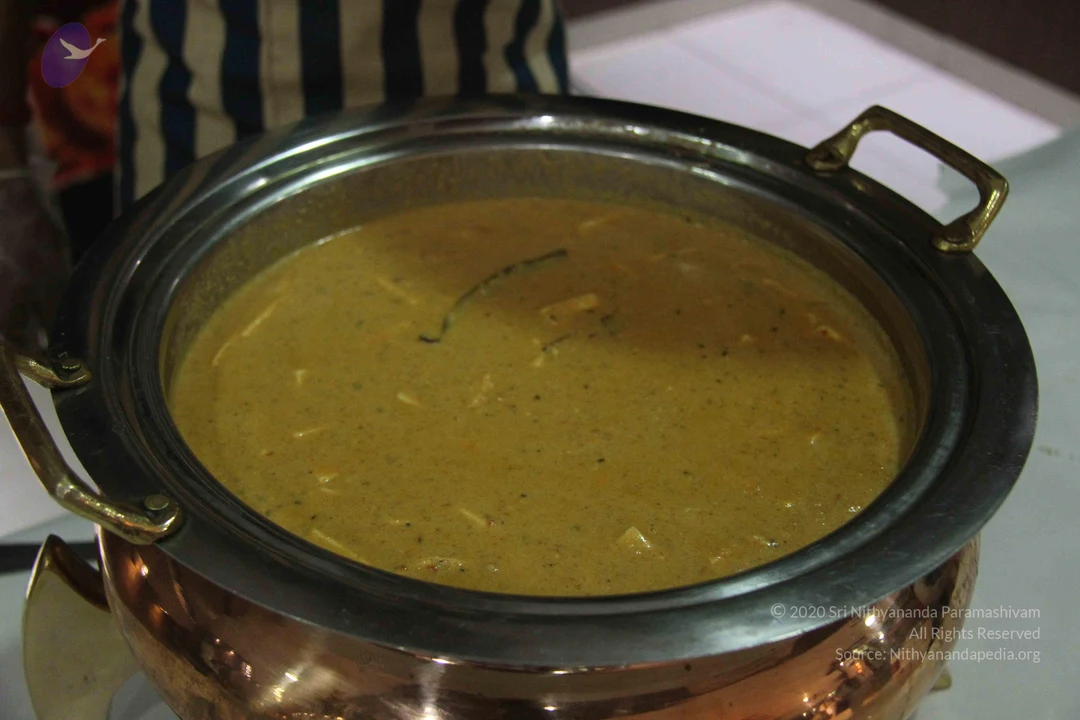
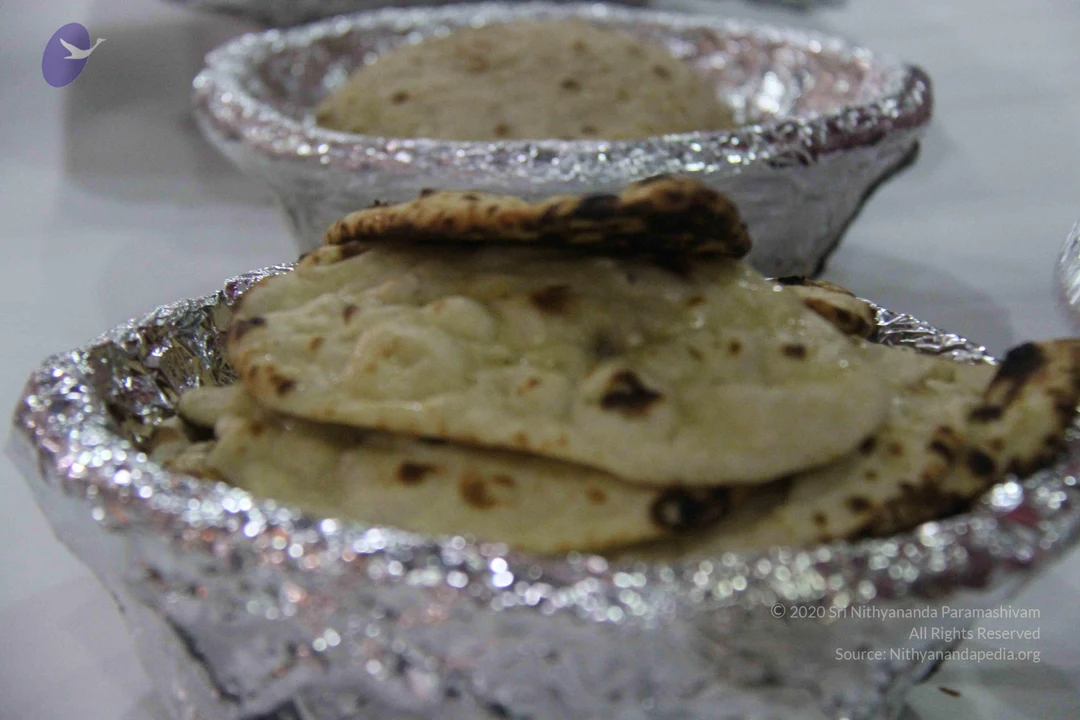
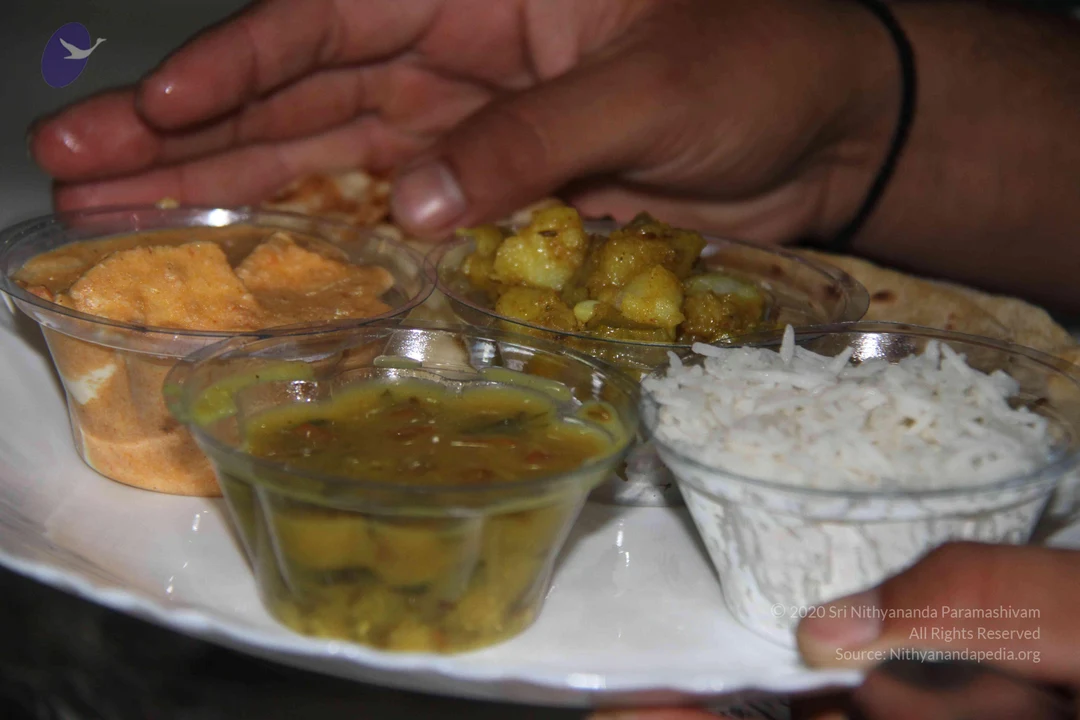
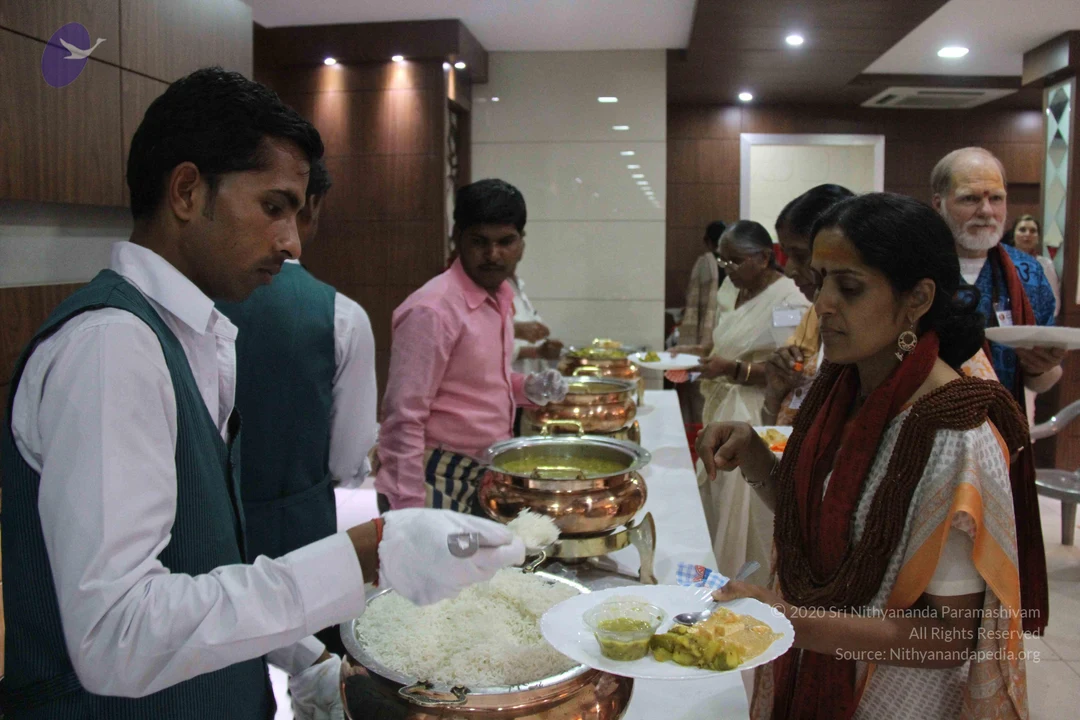
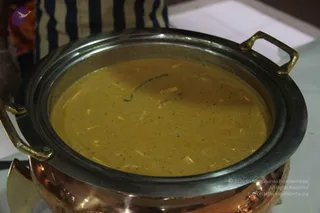
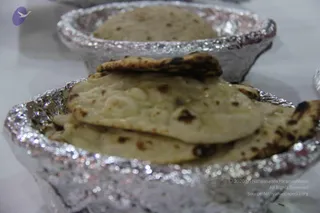
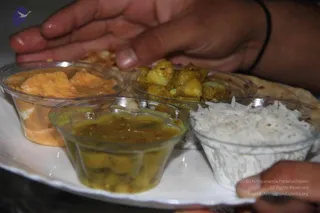
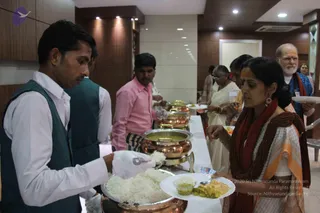
A large copper and stainless-steel serving vessel with brass handles holds a thick golden-yellow curry with pieces of vegetable and a curry leaf floating on top. The vessel sits on a white surface, and a blurred striped fabric is visible at the top edge. No people are visible in the frame.Close-up photograph of flatbreads. One bread is folded or layered over another in the foreground, with charred browned spots visible on the surface. Another foil bowl with a flatbread sits behind it on a white surface. No people are visible.Close-up photo of a white plate of lunch served in clear plastic cups. Clockwise from the left are a creamy orange-brown dish, a yellow-green dal, a bowl of plain white rice, and a dish of yellow potato curry; a golden flatbread (roti) sits behind them. Two hands hold the plate, one with a black thread bracelet on the wrist. No a person candidate is visible, and the scene shows only food and hands.A buffet lunch line in a modern hall with wooden wall panels. A young server in white shirt, dark green waistcoat and white gloves serves steamed rice from a large copper vessel. Behind him a man in a pink shirt ladles curry from copper pots on a warmer. A woman in a red shawl and white saree with orange border holds a plate of food with a small bowl of dal and vegetables and a spoon. Beside her an older woman in a white saree and a bearded man in a blue shirt with a red scarf wait with plates. Several other guests stand along the table.

4-Darshan

16 photosSource gallery
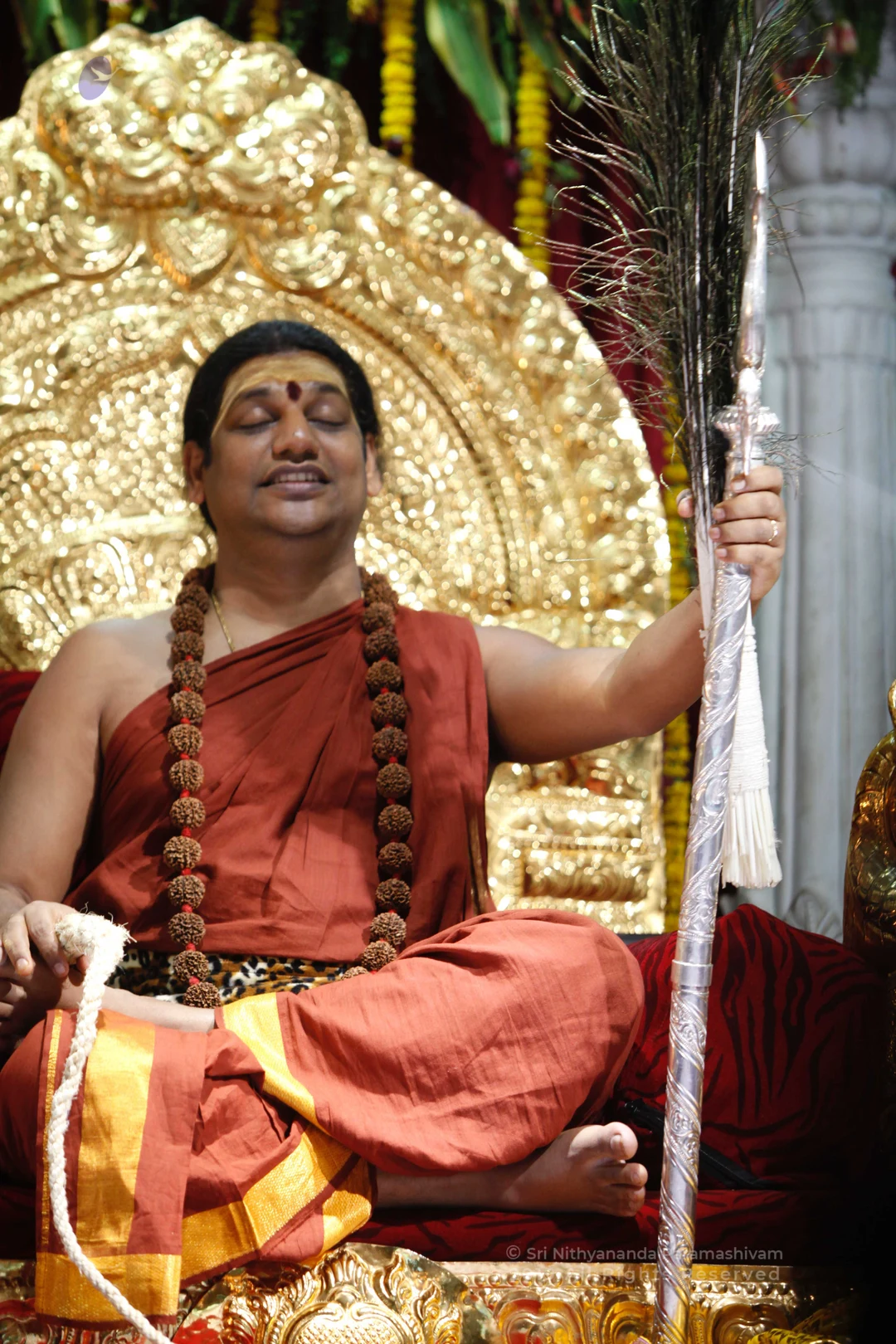
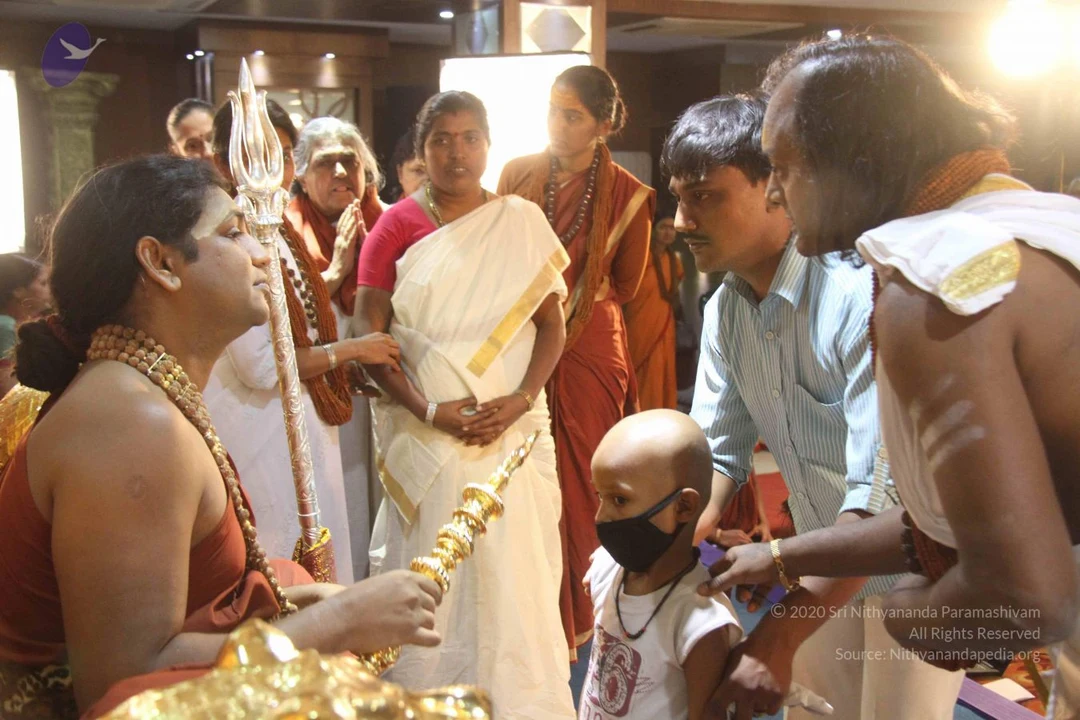
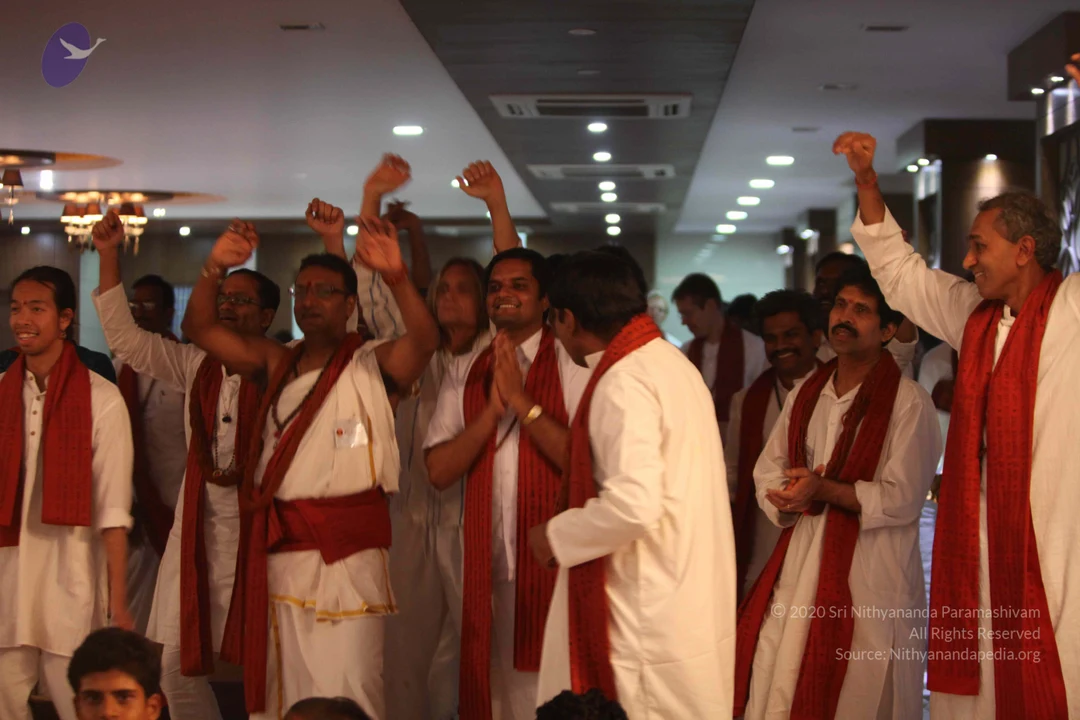
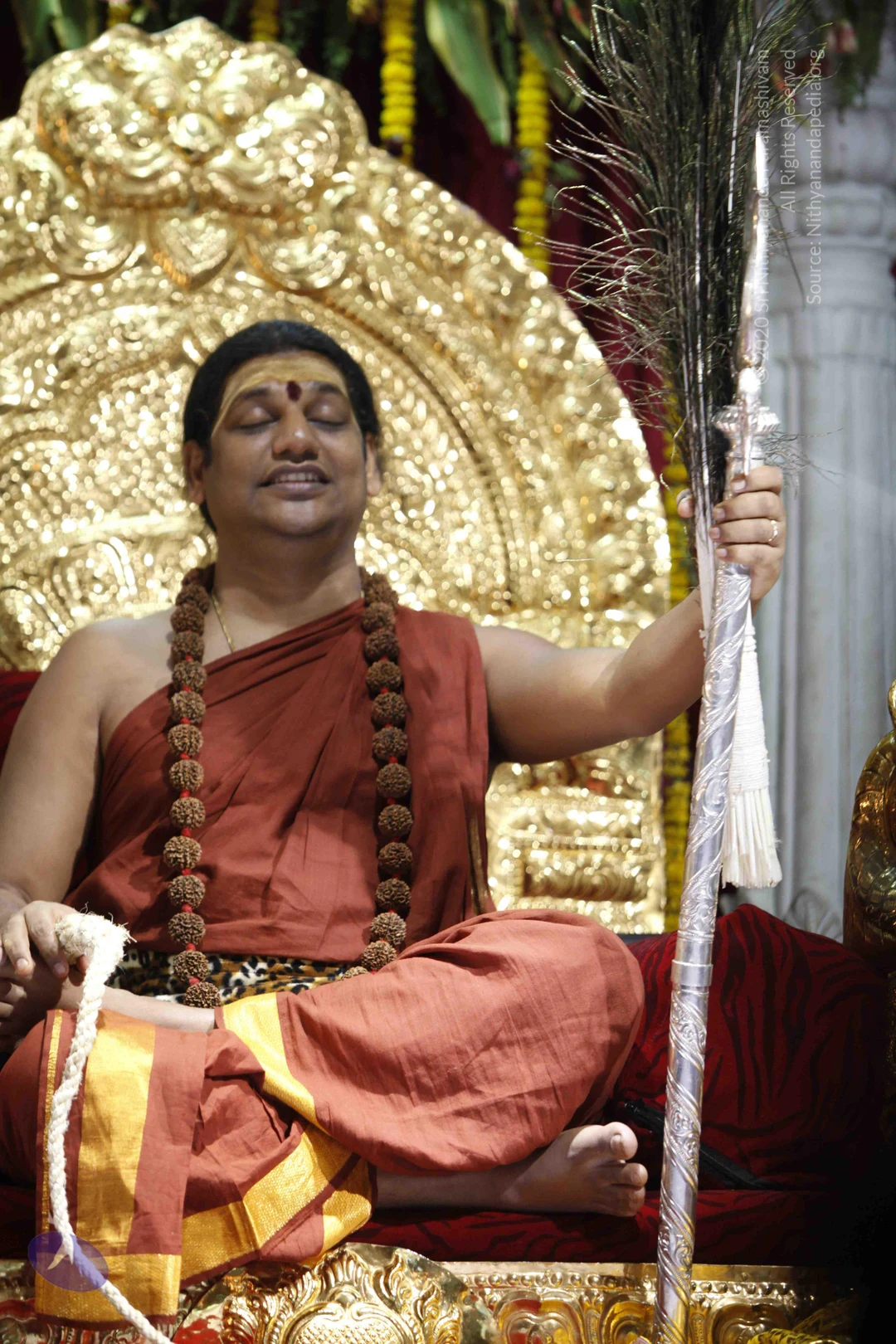
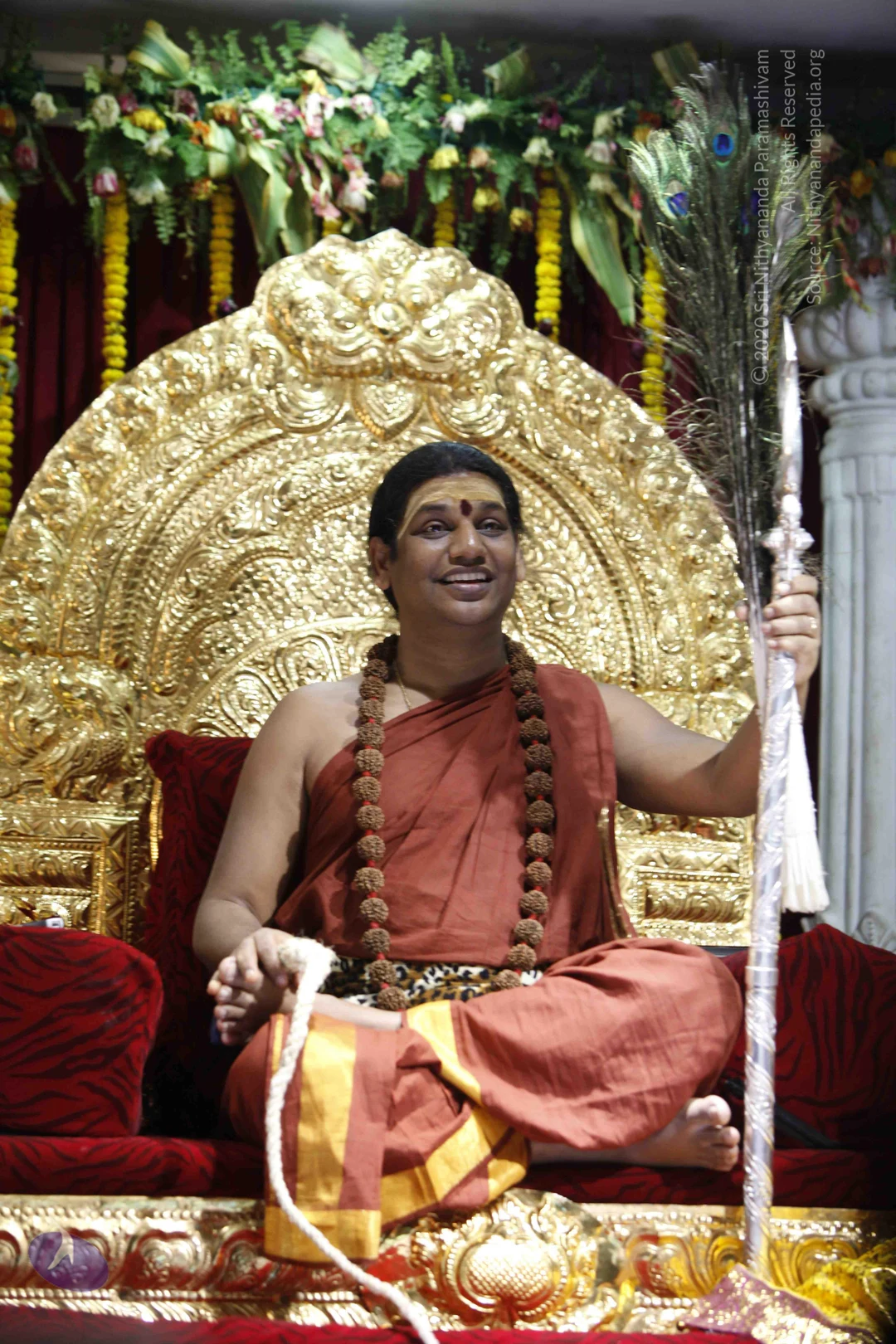
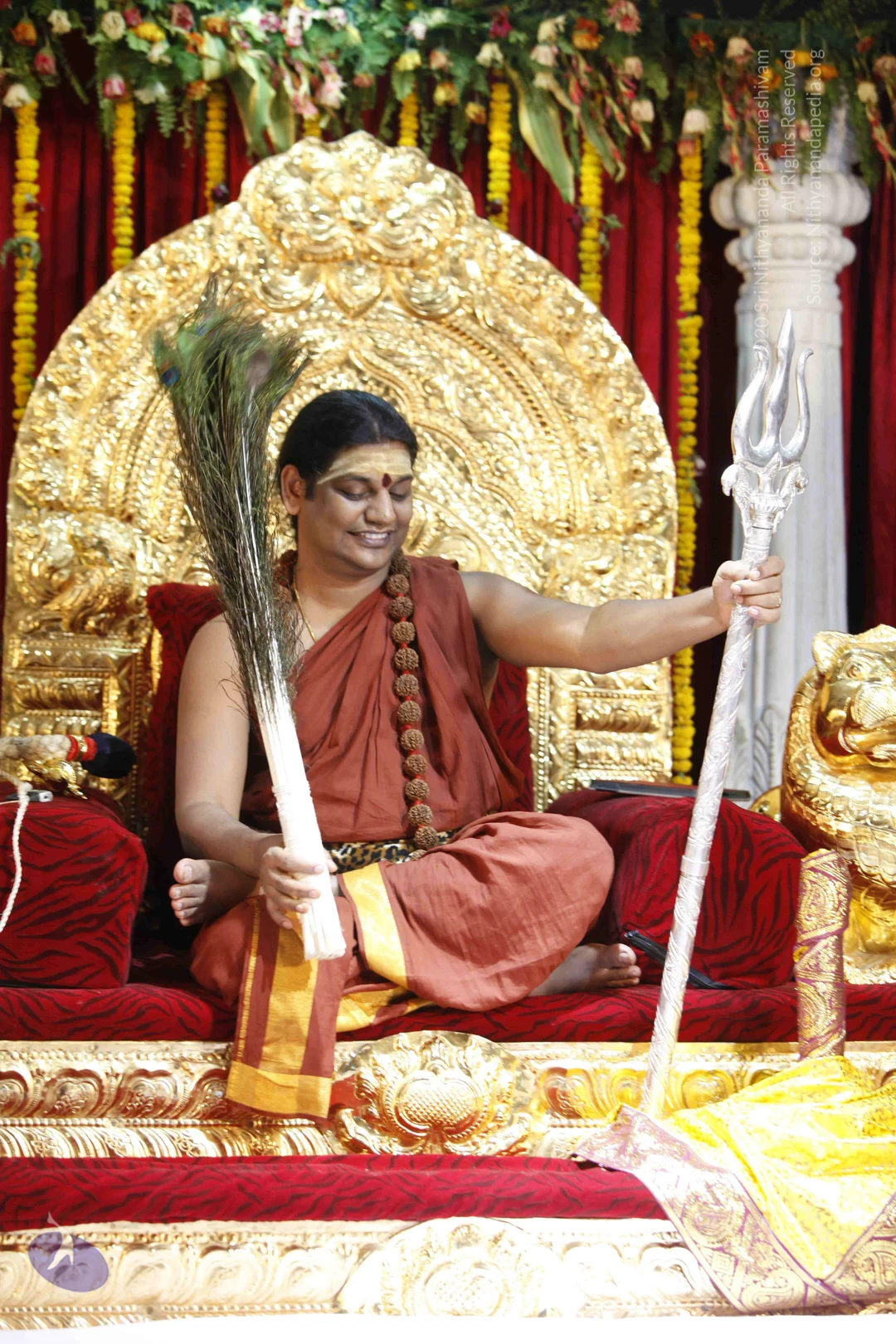
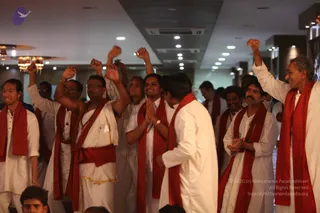
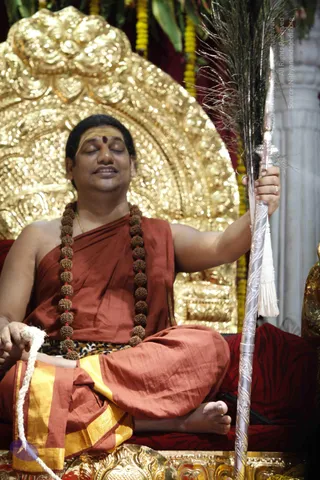
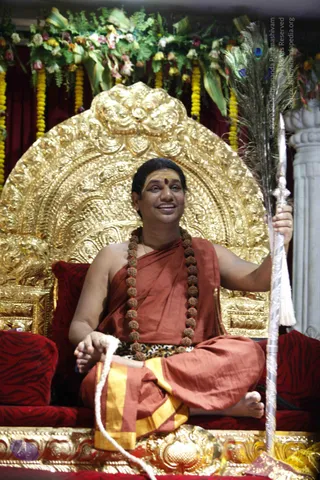
A photograph of a crowded indoor hall with ceiling lights and air-conditioning vents, where a group of men in white dhotis and kurtas with red shawls raise their fists and clap, some smiling. One man in the foreground with a red shawl and rudraksha mala raises his arm, another in the centre presses his palms together in greeting. Several white-clad devotees stand behind them, and a few heads are visible at the bottom edge. No identifiable a person candidate is clearly distinguishable among those present.A seated man in a rust-red sannyasi robe with gold-bordered dhoti eyes closed in meditation on a gold-embossed throne. He wears a long rudraksha mala with red threads, a sandalwood tilak with red kumkum dot, and holds a silver staff topped with a peacock-feather plume and white tassel. A white rope is held in his lap. Golden floral garlands hang behind the throne.A smiling man sits cross-legged on an ornate gold throne with a carved arched back, red tiger-striped cushions and a gold-trimmed base, framed by yellow marigold garlands and pink and white flowers. He wears an ochre-red robe with a gold-bordered dhoti, a long rudraksha mala with red threads, and a red kumkum bindi with white vibhuti markings on his forehead. He holds a silver staff topped with a peacock-feather fan in his right hand and a white cord in his left. A white pillar stands at the right edge.A man seated on an ornate gold throne with a red-cushioned seat, wearing a rust-red robe with a gold-bordered dhoti, a long rudraksha mala across his chest, and a sandalwood-coloured tilak on his forehead. He holds a silver trident in his right hand and a peacock-feather fan in his left, with flower and marigold garlands hanging behind the throne. A white column and another gold-clad figure appear at the edges.A man seated on an ornate gilded throne with a carved golden backrest, draped in red-orange robes with a gold-bordered dhoti, bare-shouldered, wearing a rudraksha mala with a yellow-and-red ornamental belt. He holds a silver trident in his right hand and a peacock-feather fan in his left, with a sandalwood tilak on his forehead. Behind him are garlands of yellow marigolds and pink and white flowers with green foliage, and red-and-black tiger-striped cushions surround the throne. The setting is a decorated stage with a golden peetha. He is seated in person.A seated figure in an ornate gold throne with a gold lion armrest and red tiger-striped cushions, backed by red drapes and marigold garlands. He wears a rust-red robe with a gold-bordered dhoti, a long rudraksha mala, and a vertical tilak with a red bindi. He holds a peacock-feather fan in one hand and a silver trident in the other, smiling with eyes lowered. Appearance-based cues including long swept-back hair, rudraksha malas and ornate ceremonial setting suggest the Swamiji (probable), seated on a throne in an event setting.
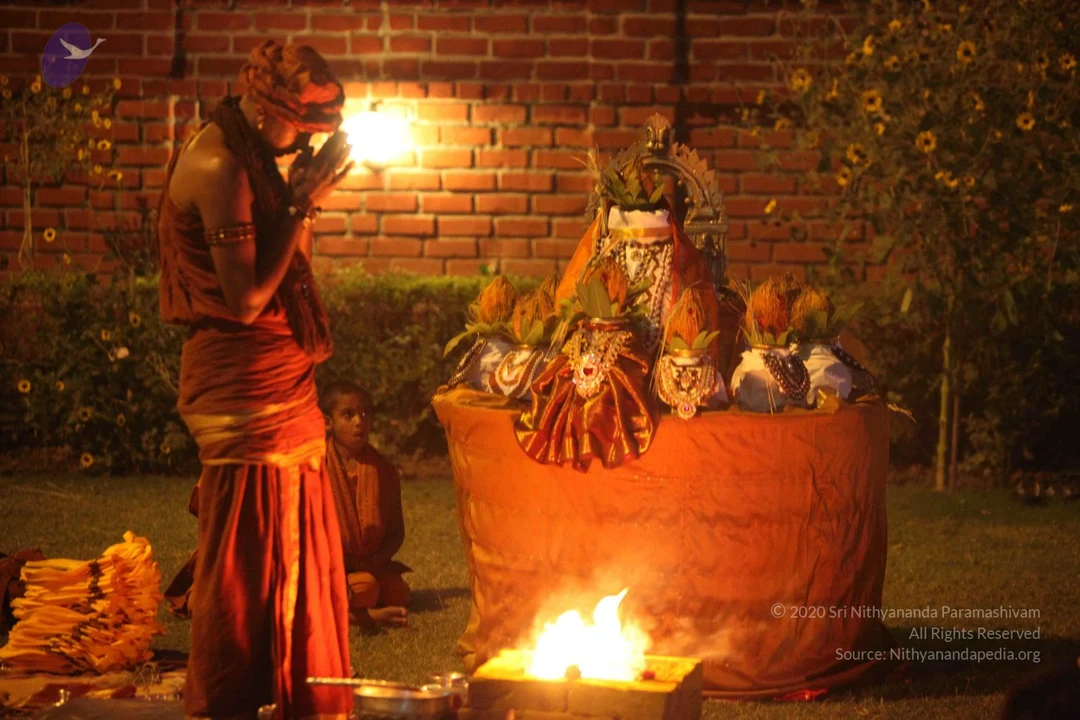
5-Kalabhairavar-Homa
23 photosSource gallery
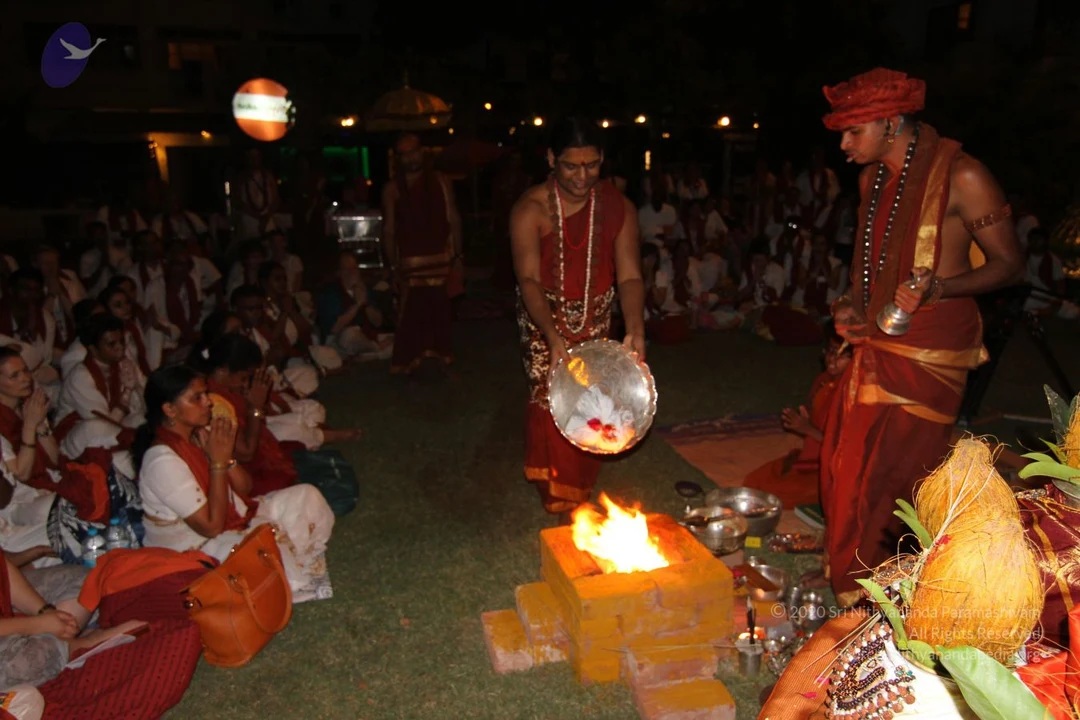
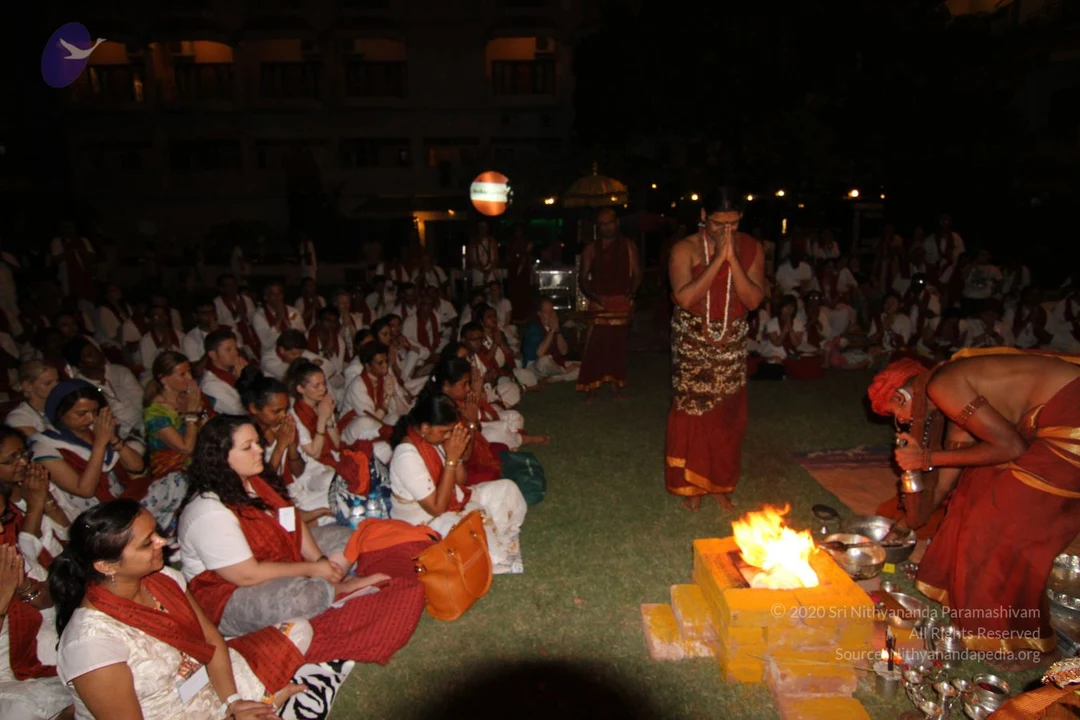
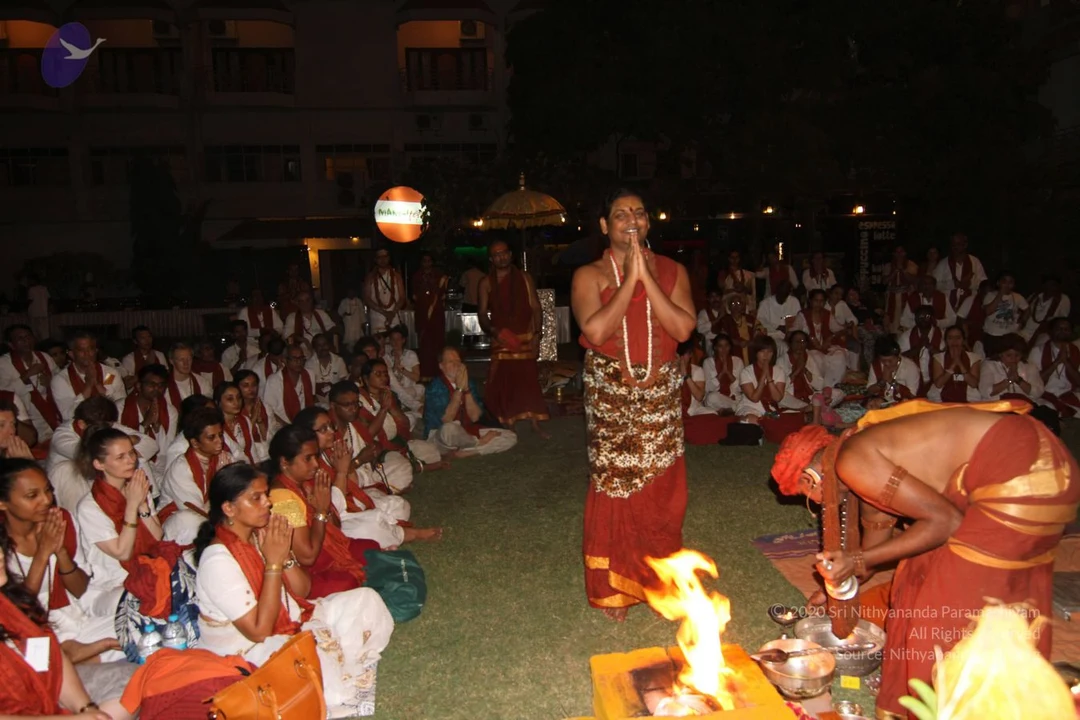
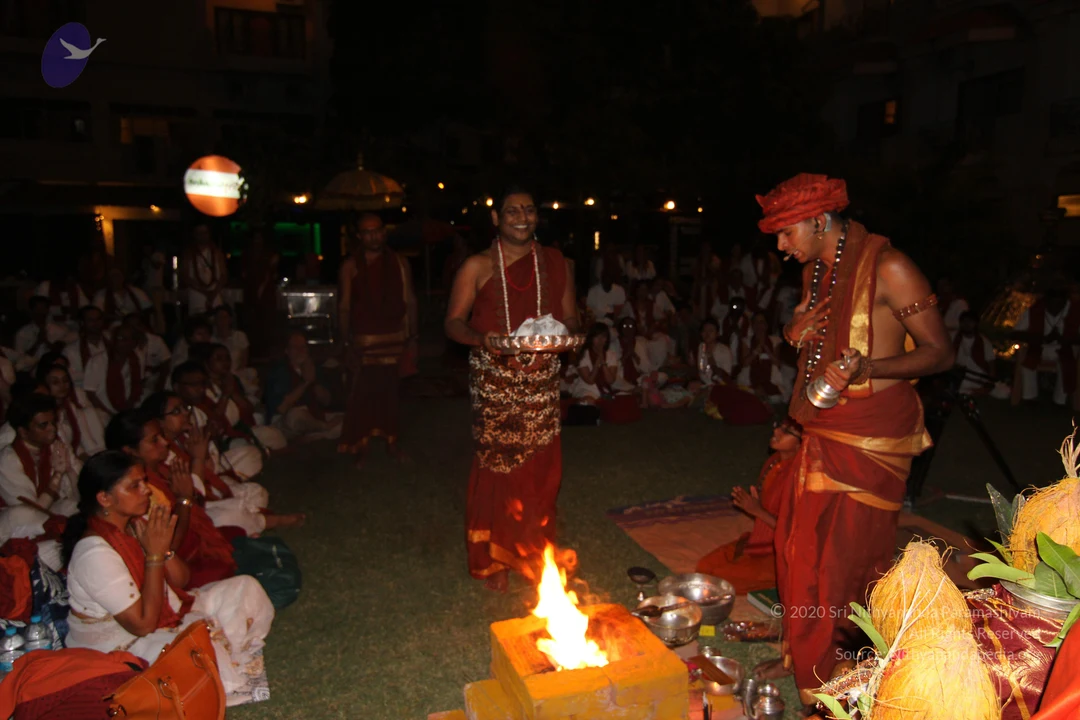
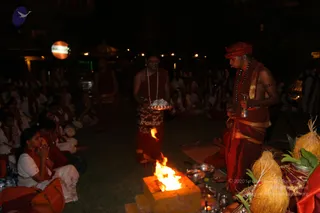
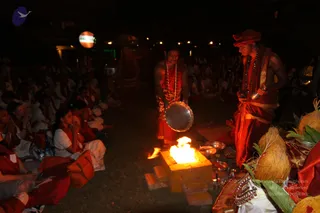
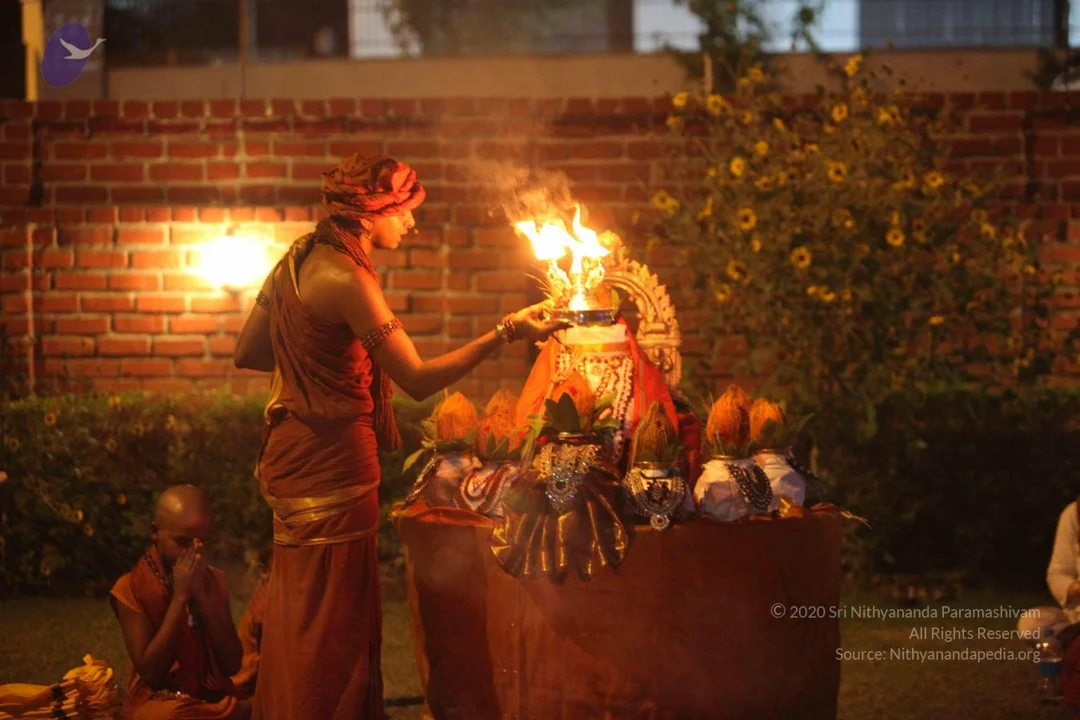
Outdoor evening ritual photo showing a homa fire built from stacked bricks, with flames rising from the fire pit in the lower right. Behind it stands a tall altar draped in orange-gold cloth, decorated with coconuts, green leaves, white cloth wraps, a silver-and-gold ornamental arch and jeweled decorations. Brass and steel pots and vessels sit at the fire's edge, and a partially visible hand holds a ladle near them. A brick wall and flowering shrub frame the background. No clearly identifiable person is visible in the scene.Night outdoor homa ceremony with a small fire burning in a rectangular fire pit on a low platform in the lower centre. A priest in a maroon wrap and red head covering sits behind the fire with brass vessels and a plate of offerings in front. To the left a deity murti decorated with flowers and garlands sits on a draped maroon altar with coconuts. Around them roughly 50 seated devotees in white ritual clothes and maroon shawls sit in rows with hands folded in prayer, many wearing rudraksha beads, while some hold bags and water bottles. The ground is dark and the scene is lit mainly by the fire and lamps. No clearly identifiable a person is visible among the seated devotees.Night outdoor homa at the Kalabhairavar Homa. A small brick fire pit burns brightly in the foreground beside brass bowls, a coconut and leafy offerings. Two priests in red and orange ritual cloth stand at the fire: the nearer one wears a red turban, rudraksha mala and a shawl, holding a silver spoon. The other, bare-chested, carries a tray of flowers and an offering. Behind them a seated audience in white fills the dark ground under string lights and a banner in the background. Coconuts draped with red cloth sit at right.Outdoor night homa at a fire pit on a grassy ground, with a small orange-yellow brick fire pit blazing in the foreground. A man in red-orange robes with a red turban and rudraksha malas stands at right holding a small metal vessel, while a second robed man in red stands centre holding a silver tray with white offerings and a white garland. Behind them a large seated crowd in red and white clothing sits in rows, many with palms pressed together. Metal bowls, coconuts and green leaves are arranged near the fire, and lit buildings and lamps appear in the background.Night outdoor homa at a fire pit built of stone blocks, with a bright flame rising from it. Two priests in red and orange-red dhotis stand at the fire: the central one, bare-chested with a white-beaded necklace, holds a plate of white offerings, and the one on the right wears a red turban, a rudraksha mala and a red-brown shawl, holding a small metal vessel. Brass bowls and coconuts with green leaves lie around the fire. Seated devotees in red and white fill the foreground and background, some with hands folded, one woman in white clasping her palms. Lamps and warm lights glow in the dark background.Night outdoor homa at a fire pit built of stacked bricks, with a bright flame burning on top. A bare-chested man in red-orange dhoti and a red-orange turban stands at right, adorned with a rudraksha mala and holding a ladle over the fire. Beside him a person in red-orange garments and a long necklace holds a large round metal plate. Coconuts, brass vessels and leaves surround the fire in the foreground. Seated devotees in red and white garments, many with hands folded, fill the dark field behind them, with lanterns and a glowing paper lantern in the background.