Skip to content
Monday

5 May 2014

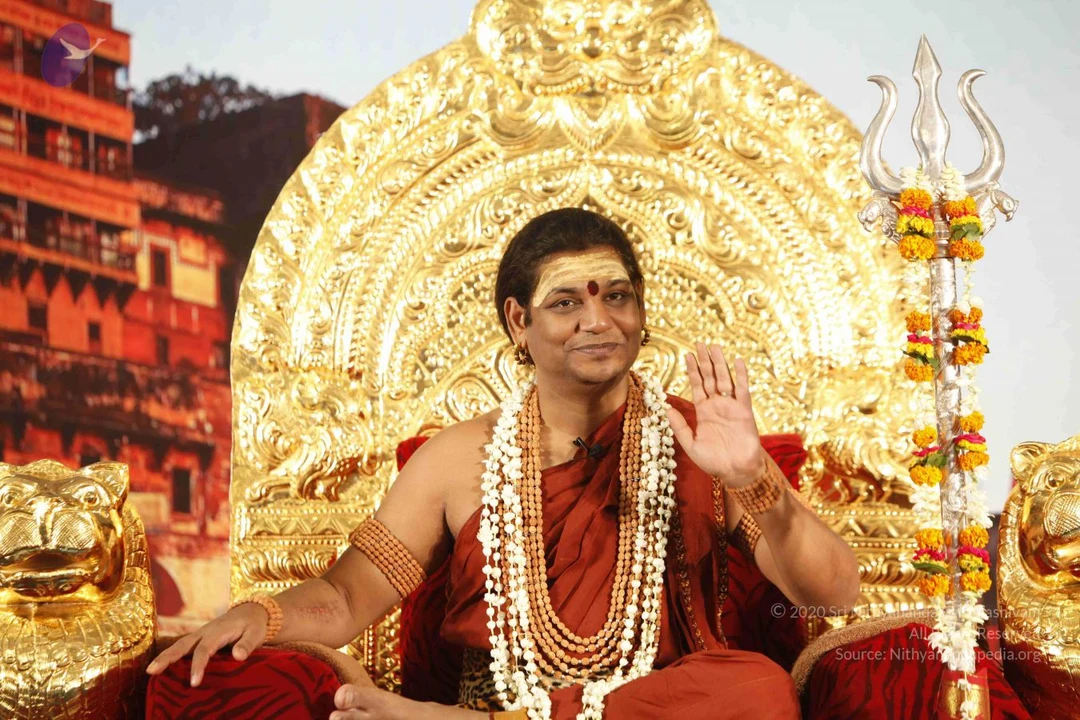
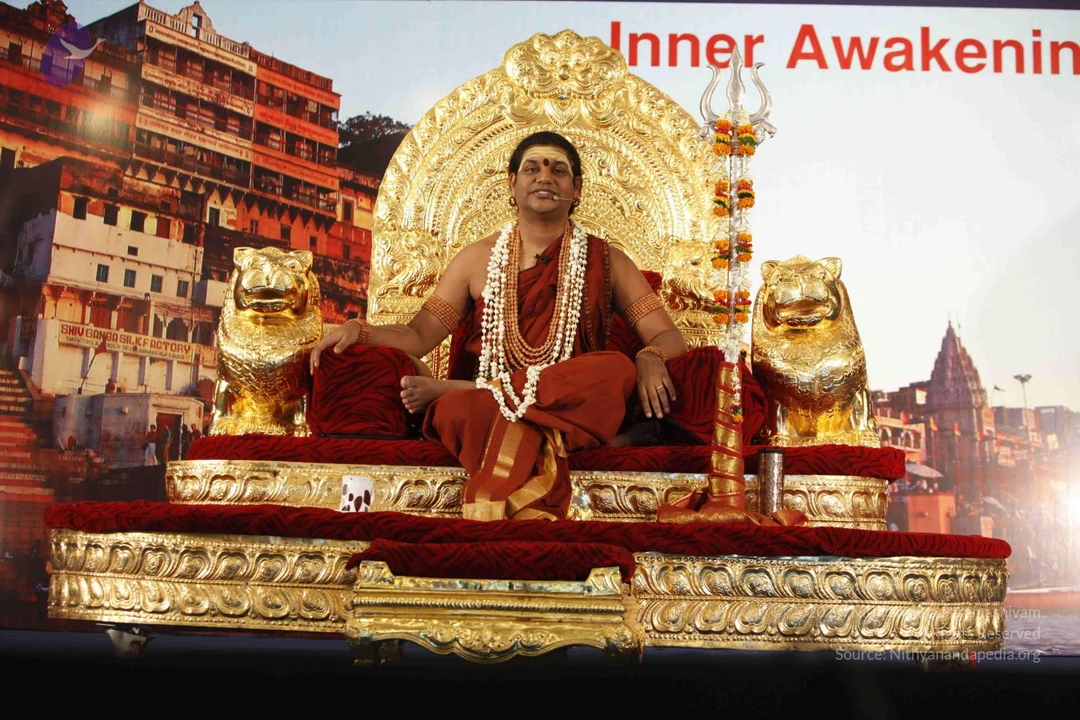
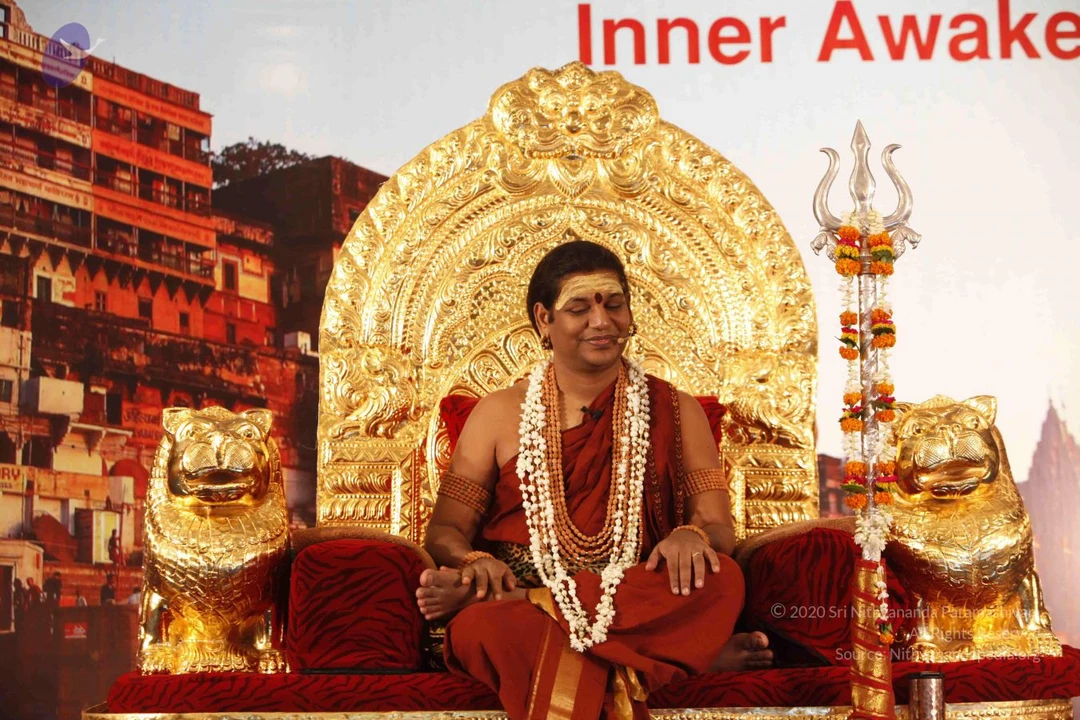
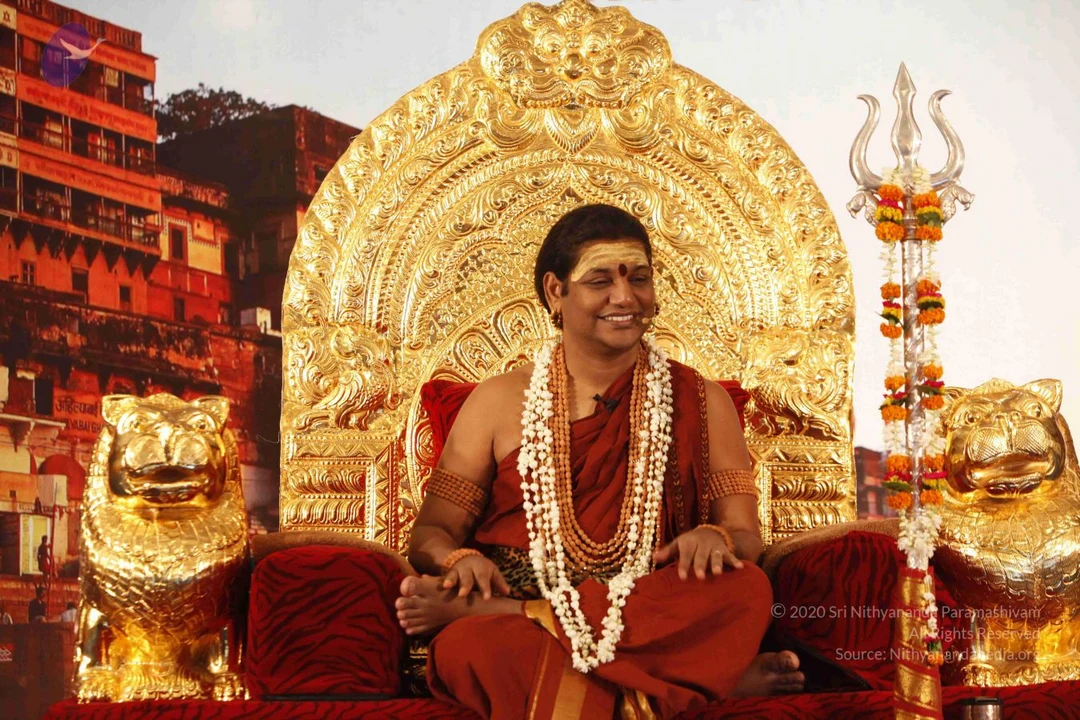
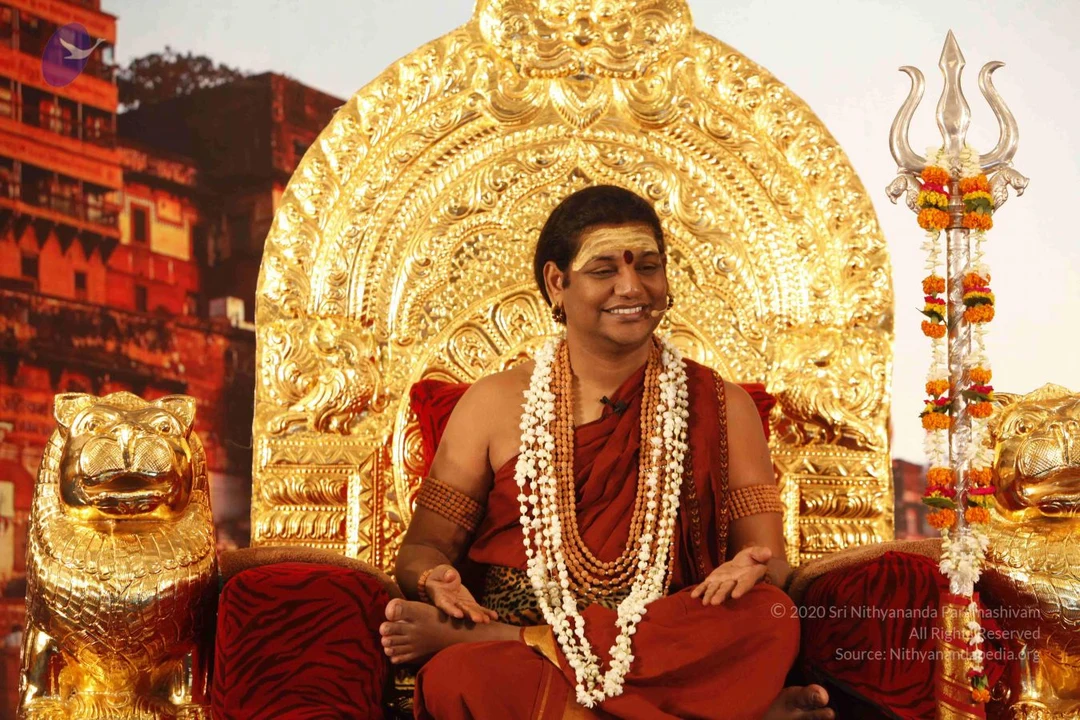
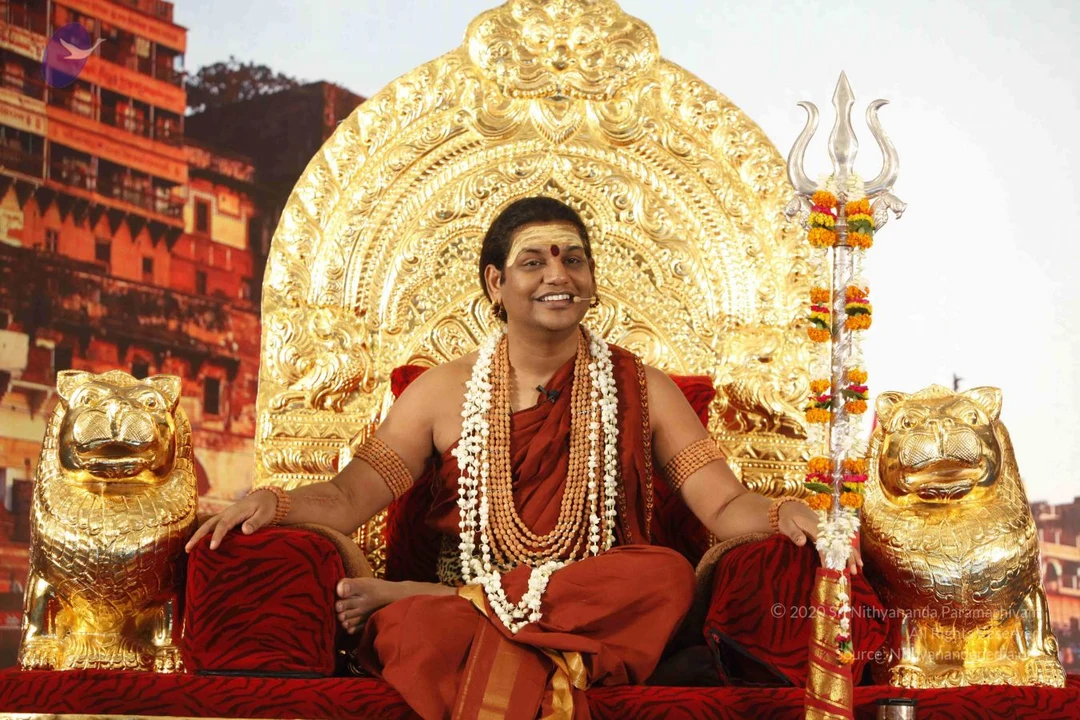
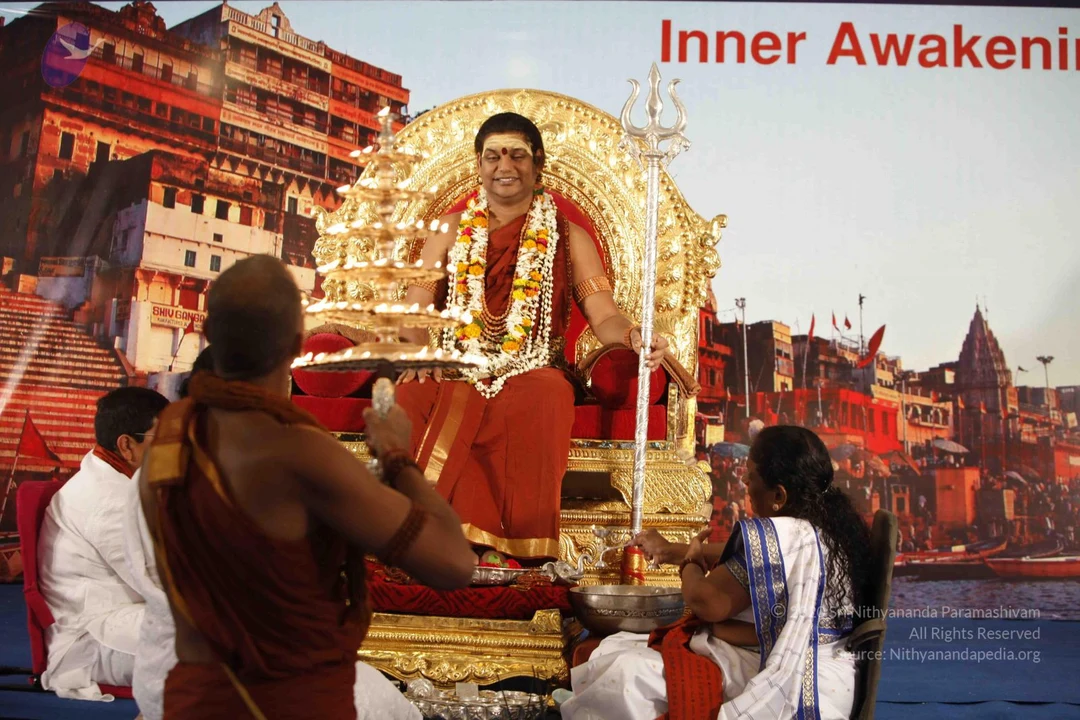
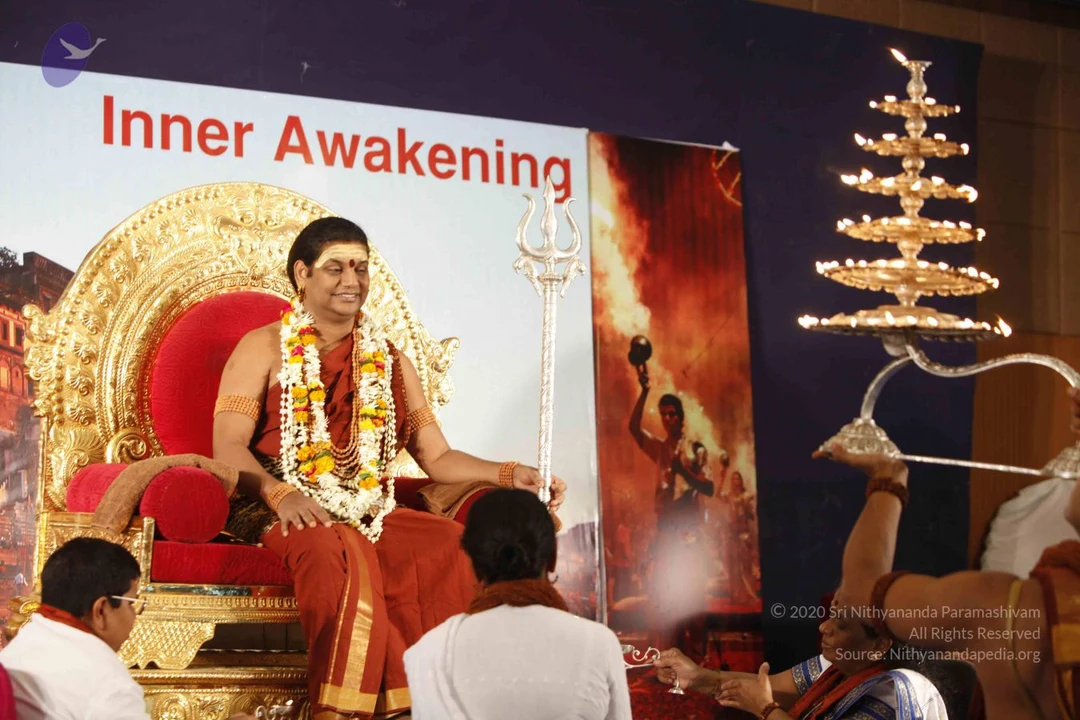
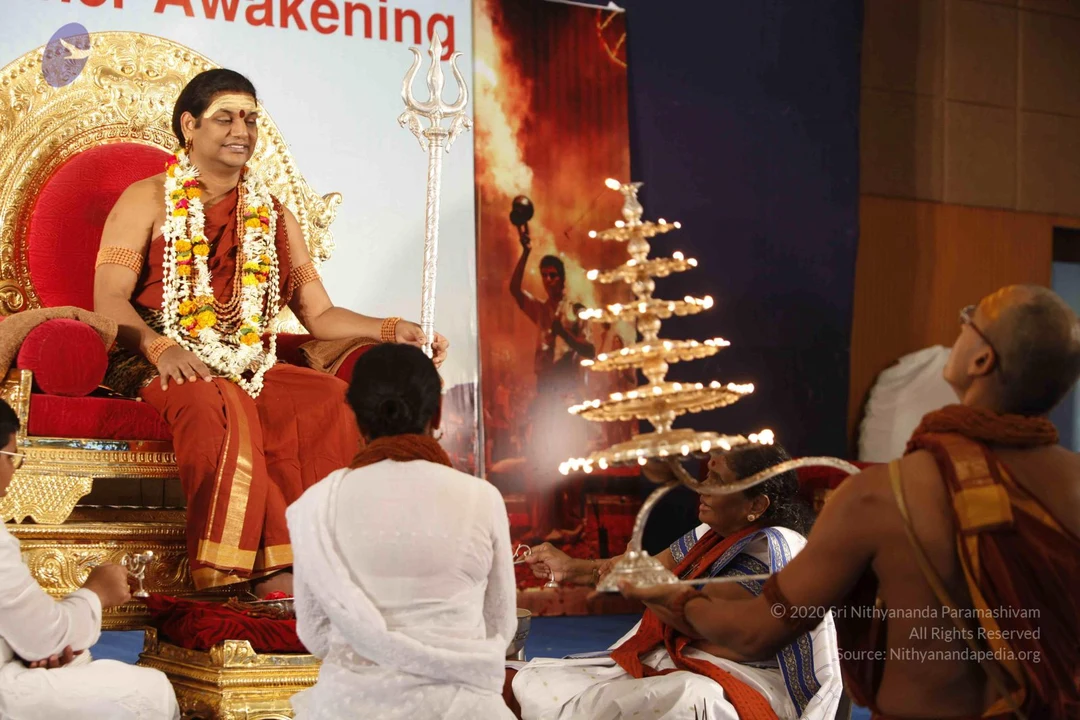
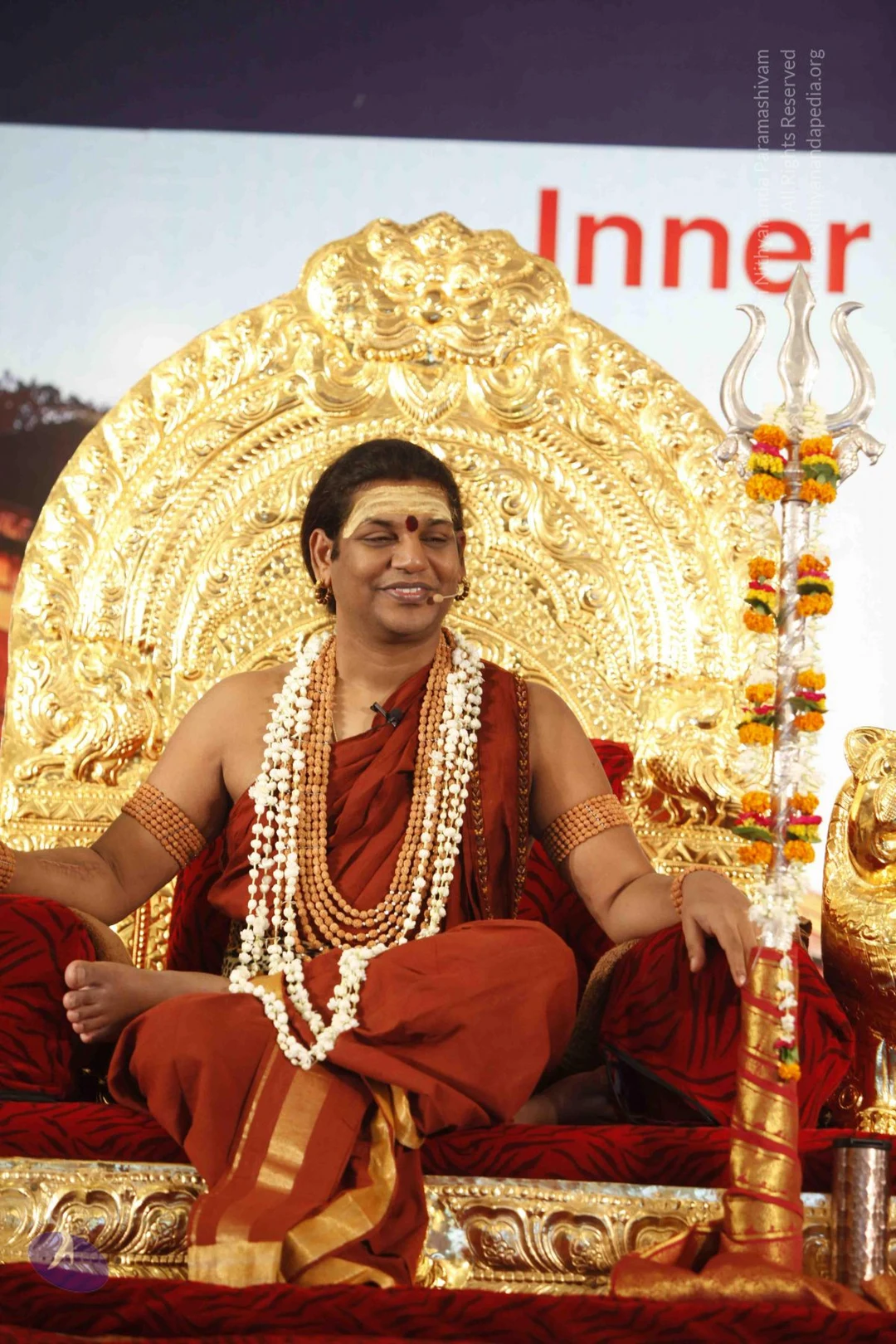
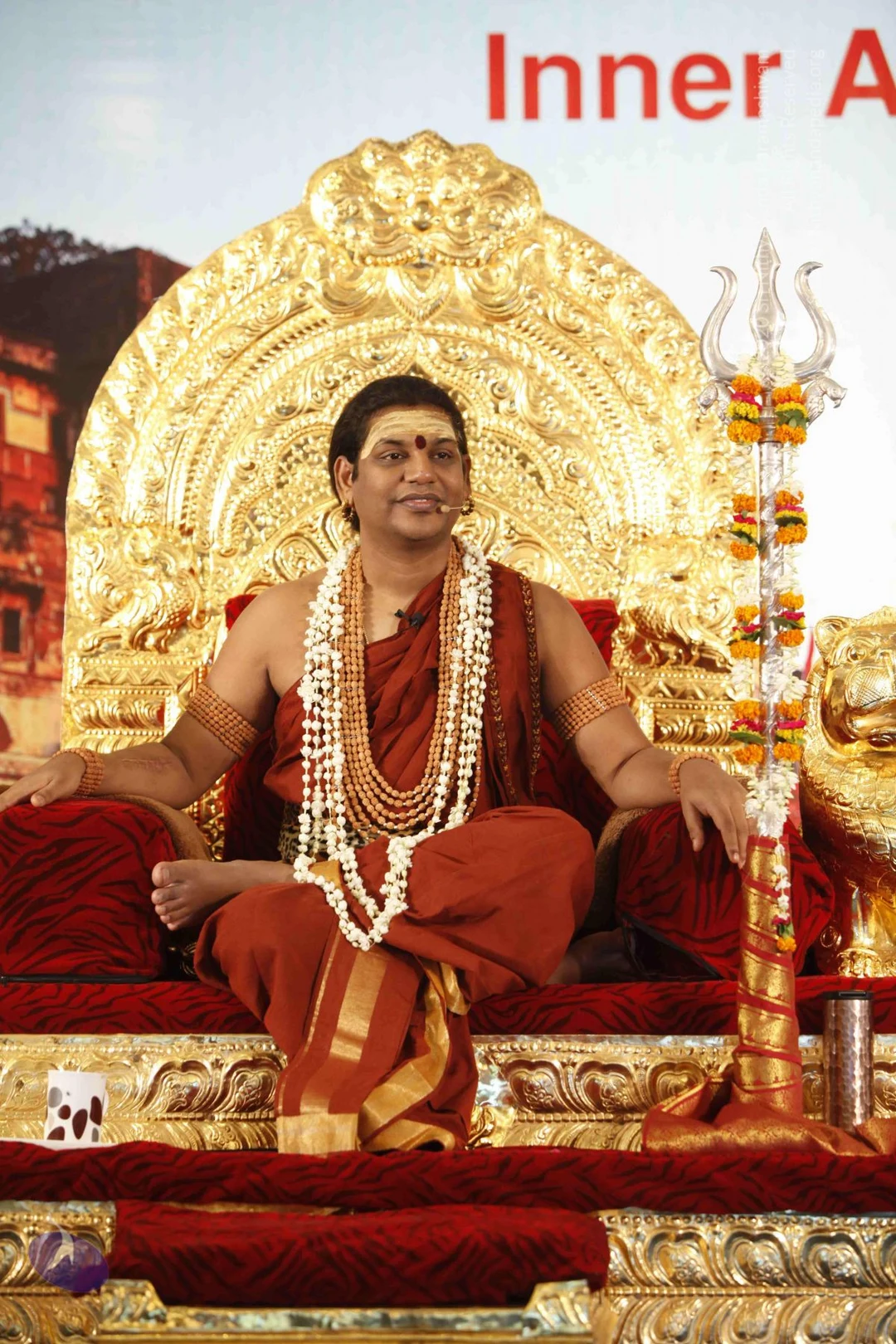
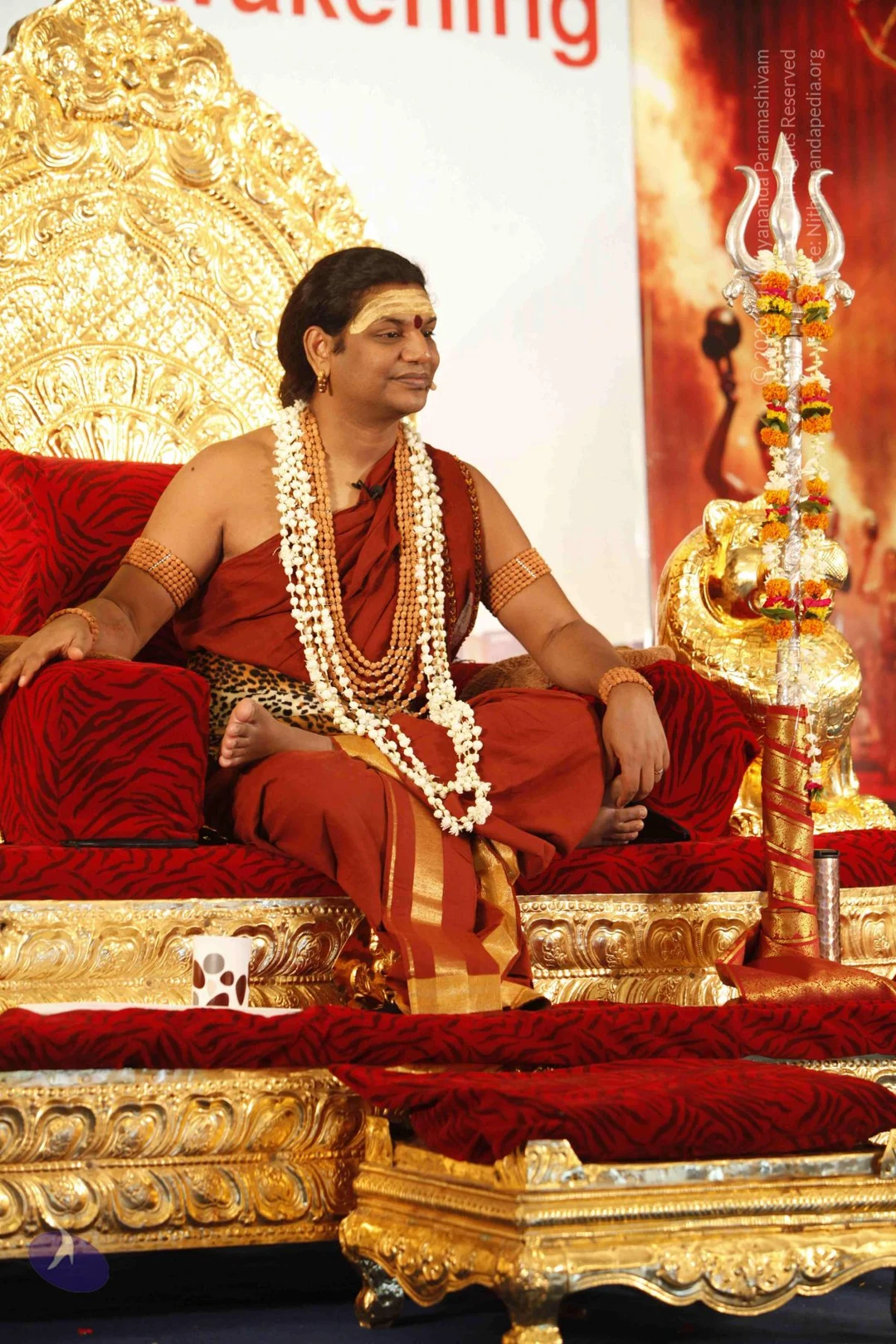
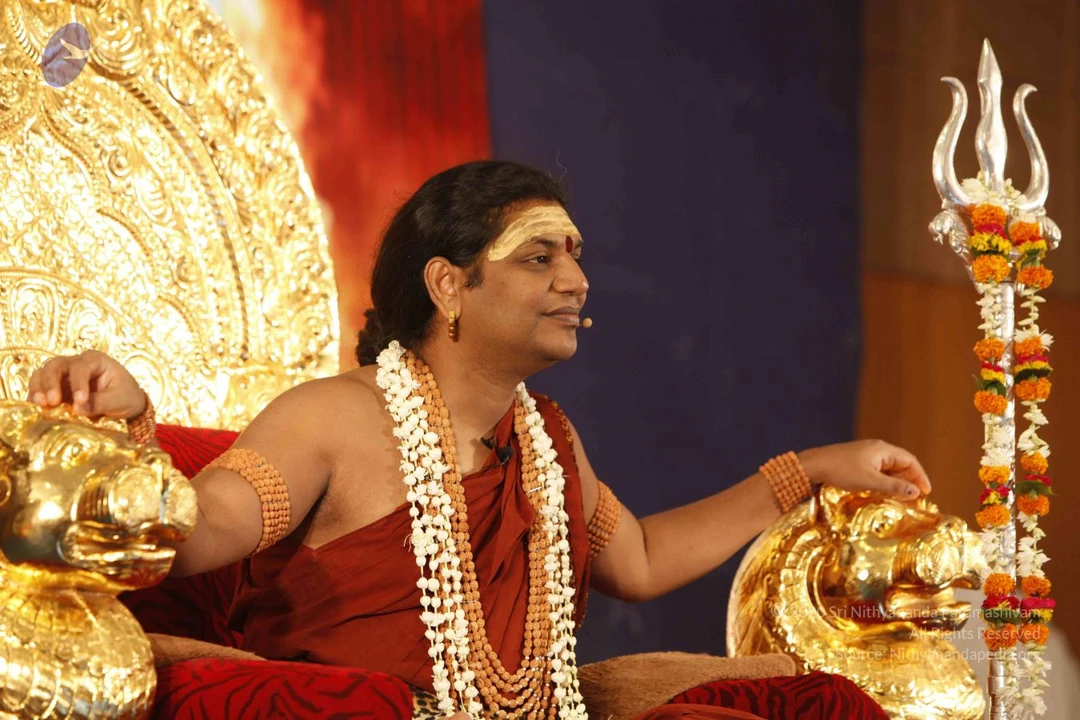
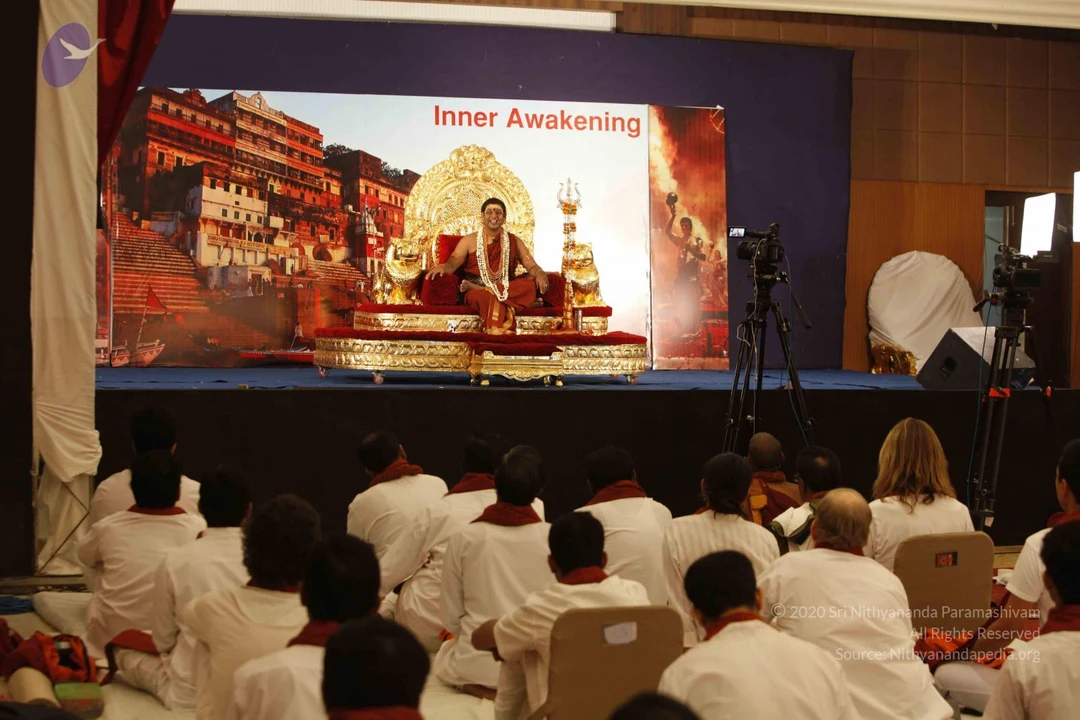
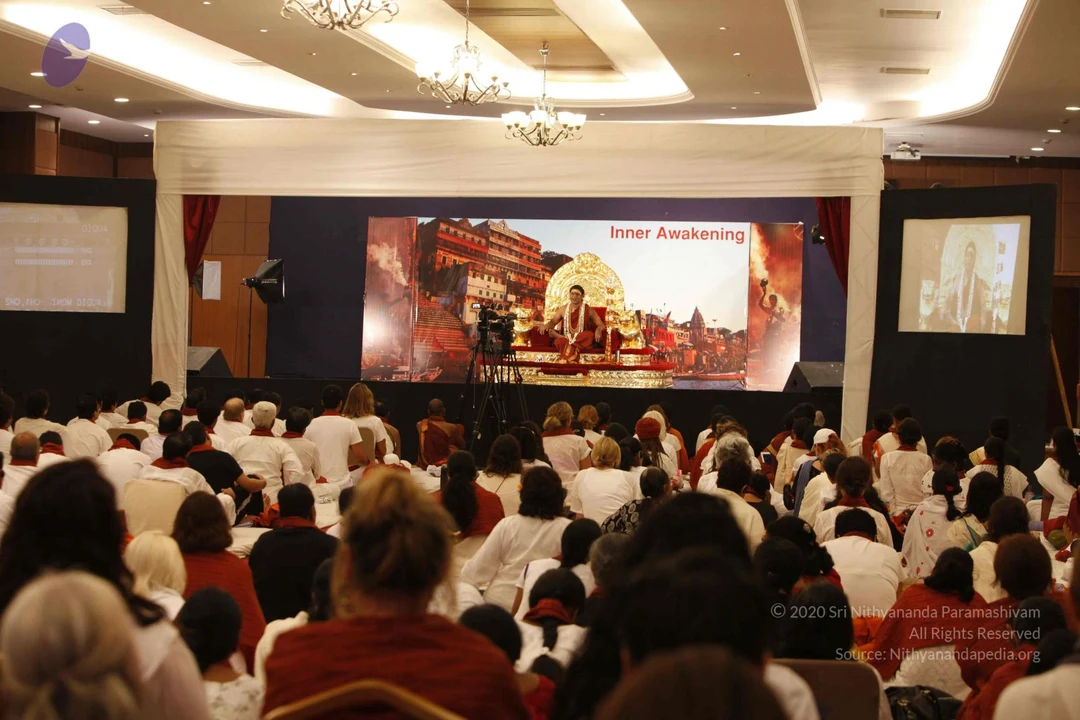
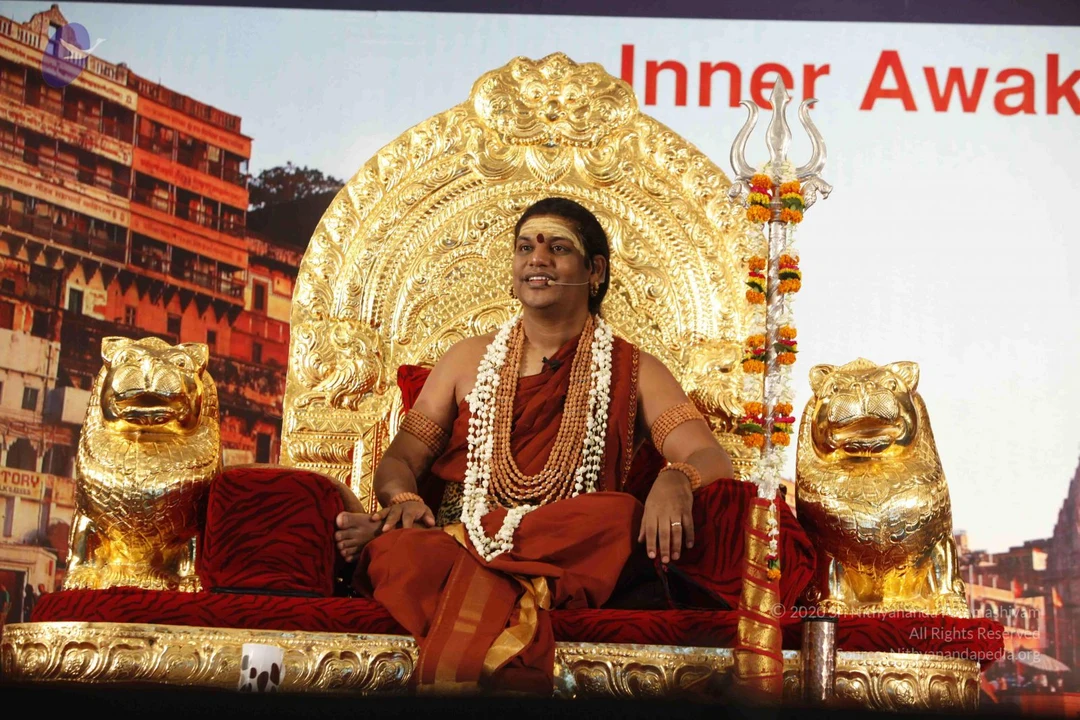
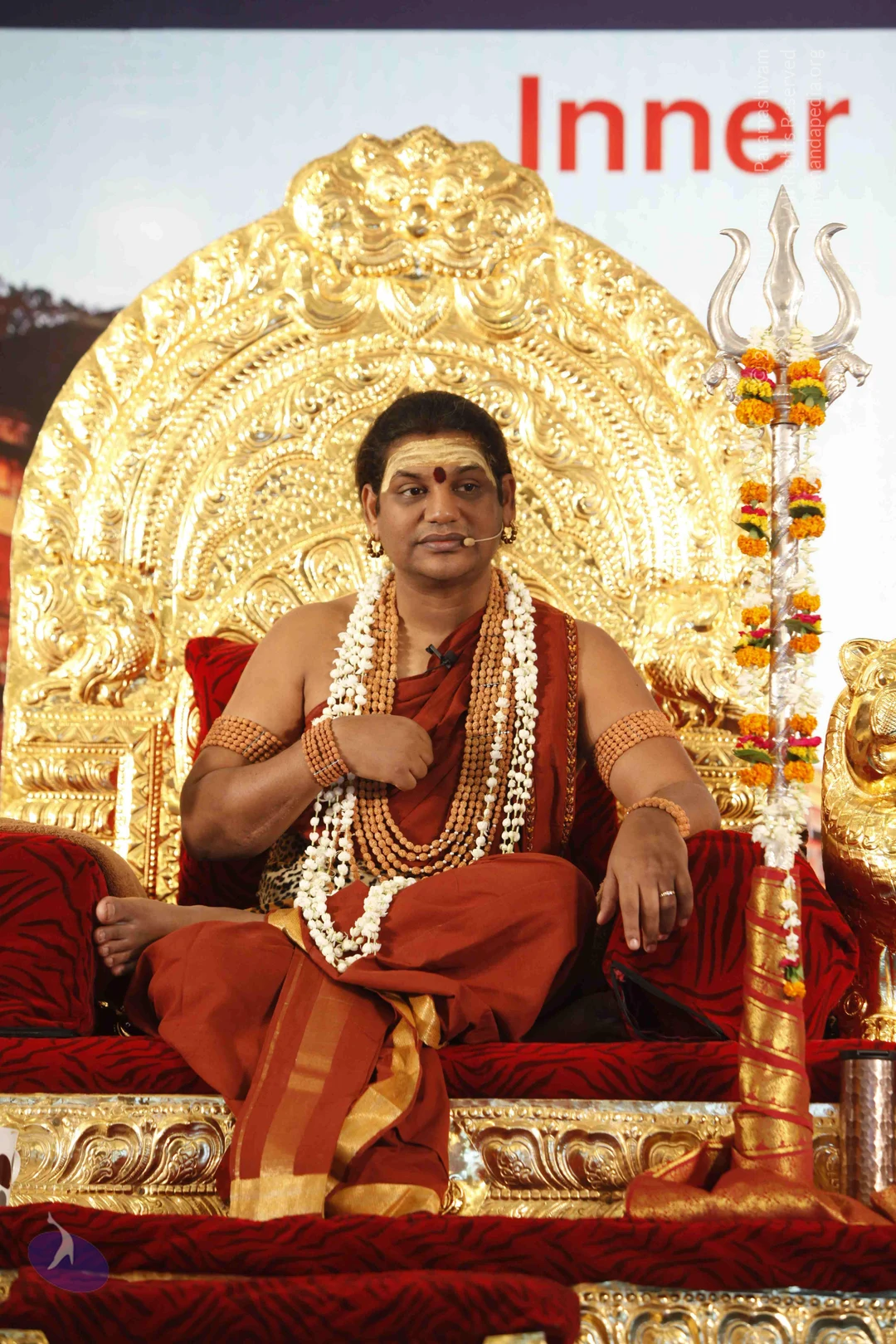
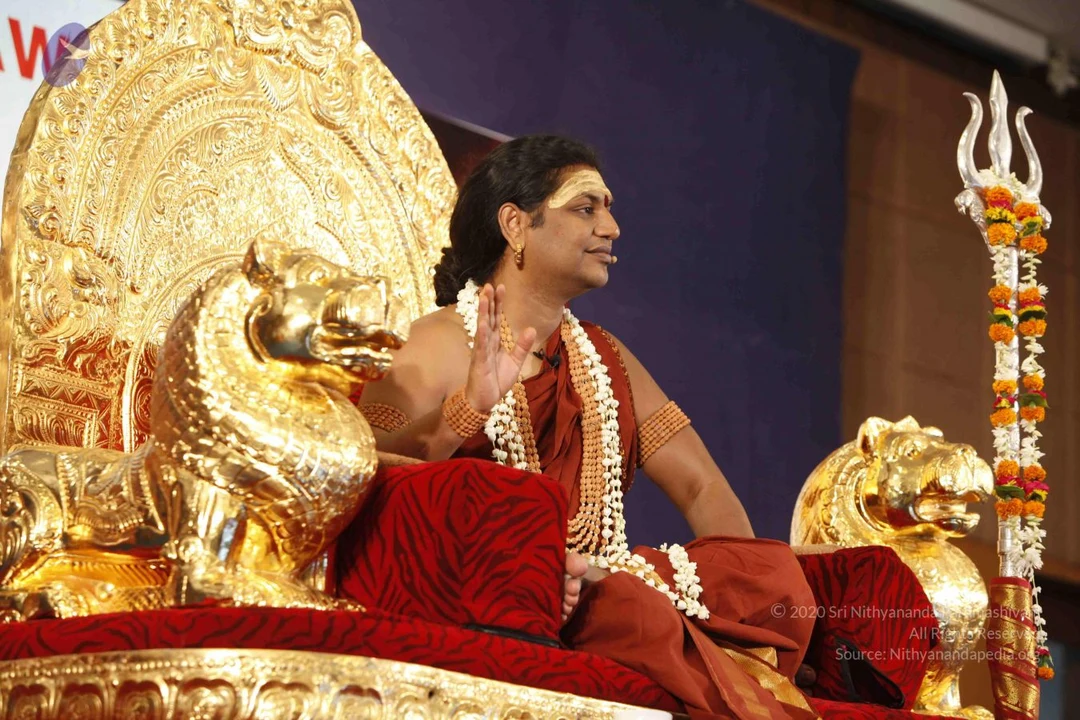
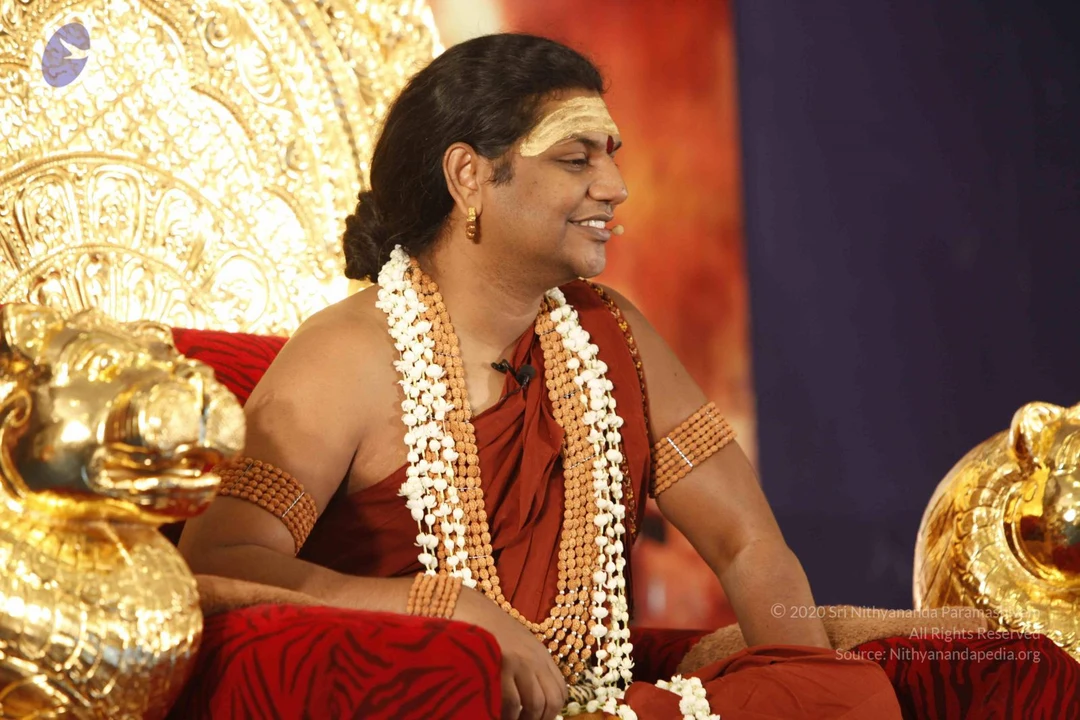
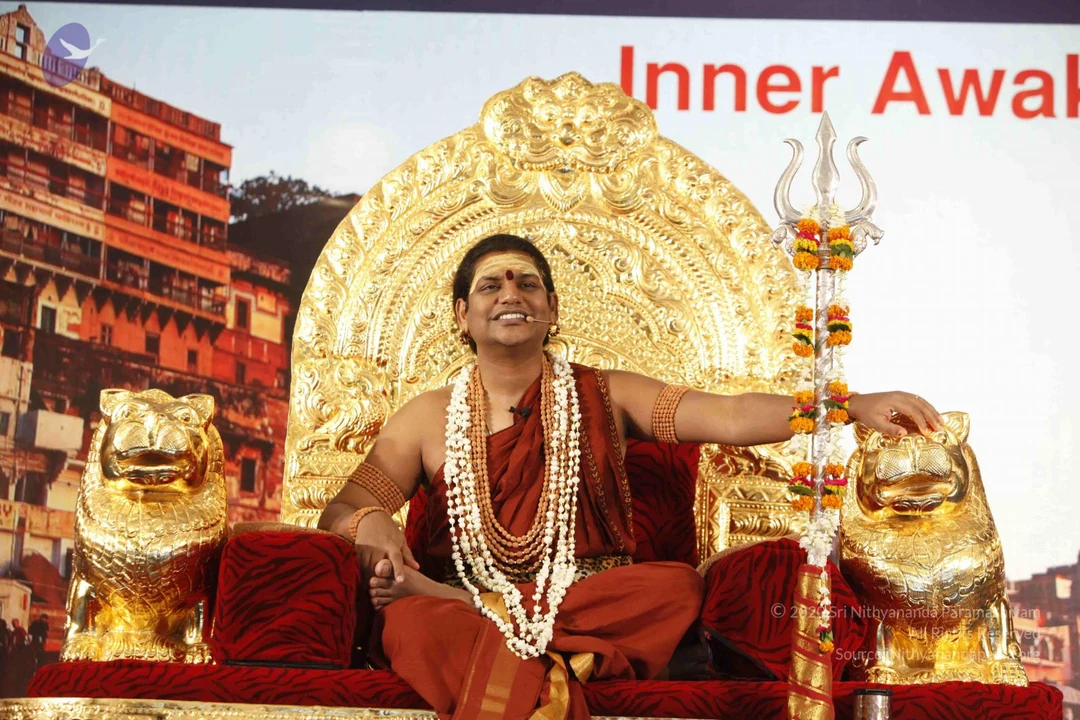
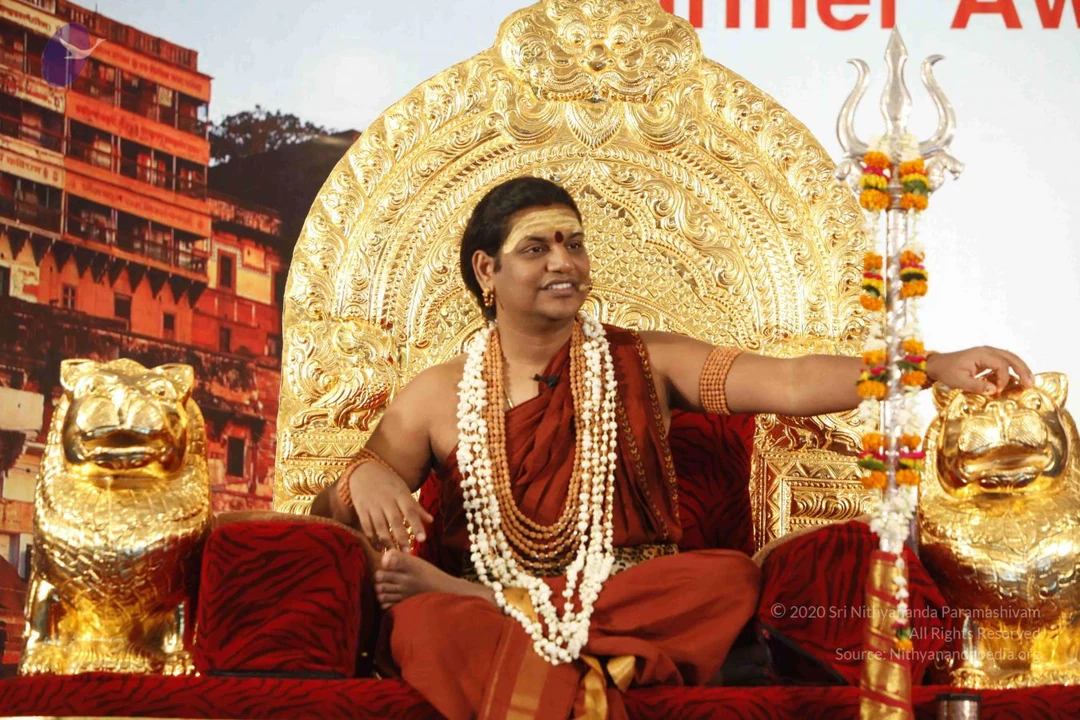
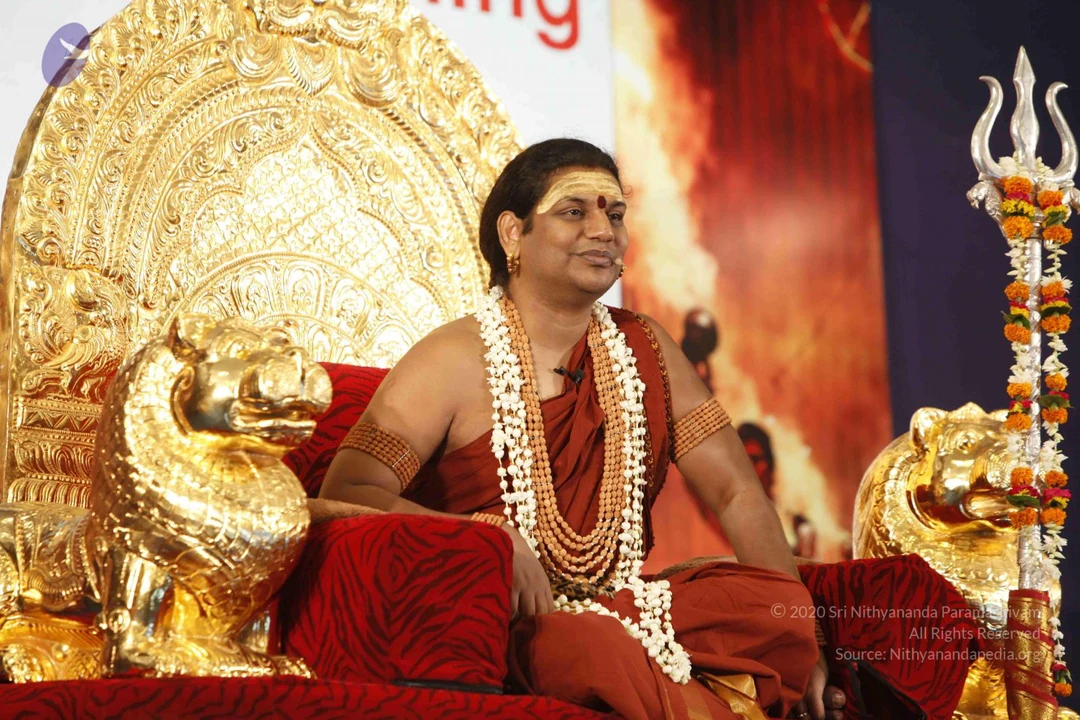
Inner Awakening Program May 2014 by The Supreme Pontiff of Hinduism HDH Nithyananda Paramashivam

Dated photos
227
Source pages
2
Media
17
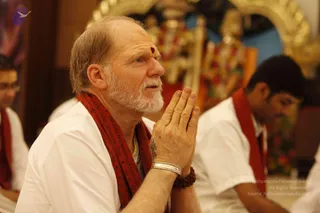
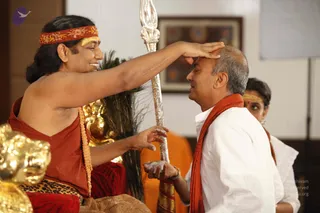
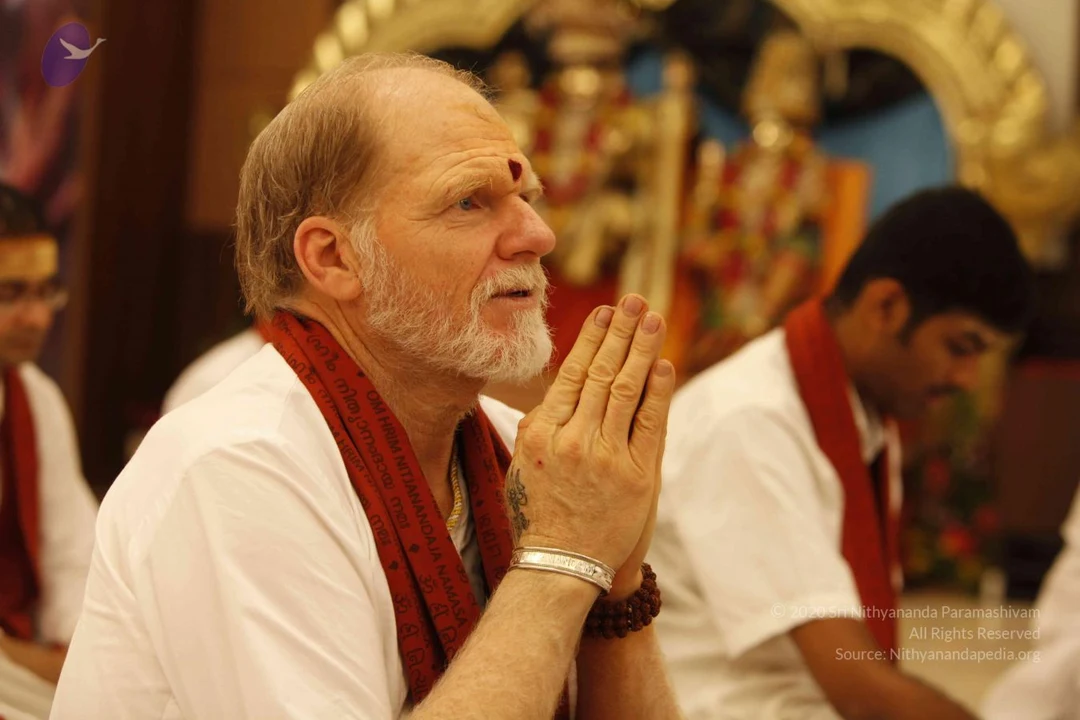
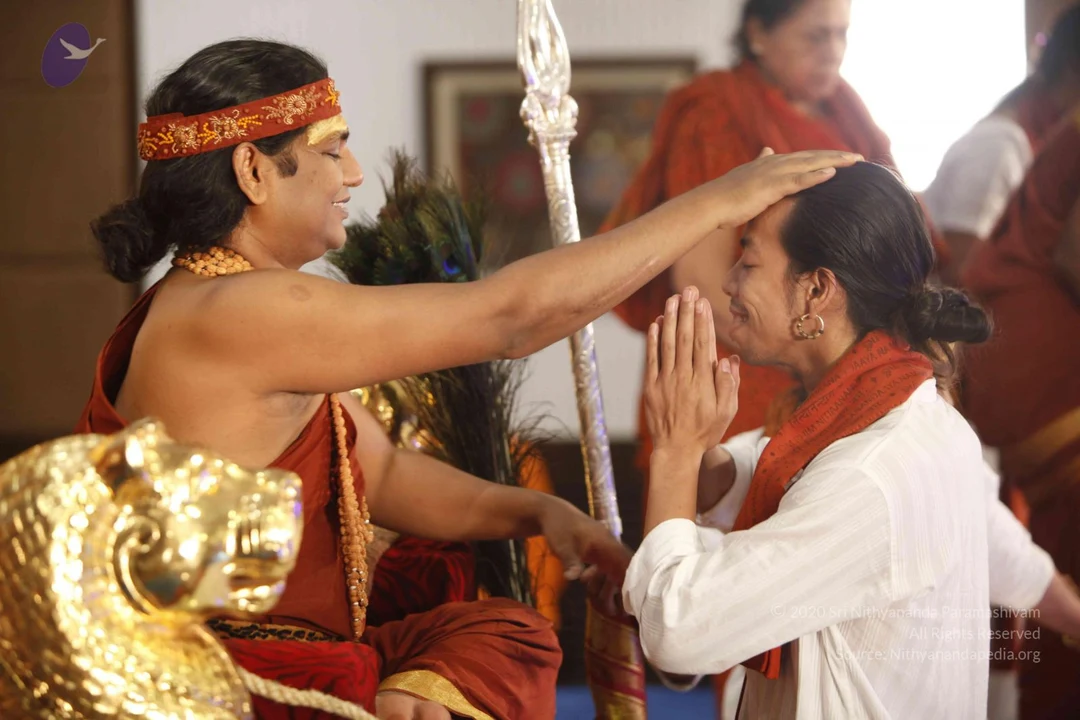
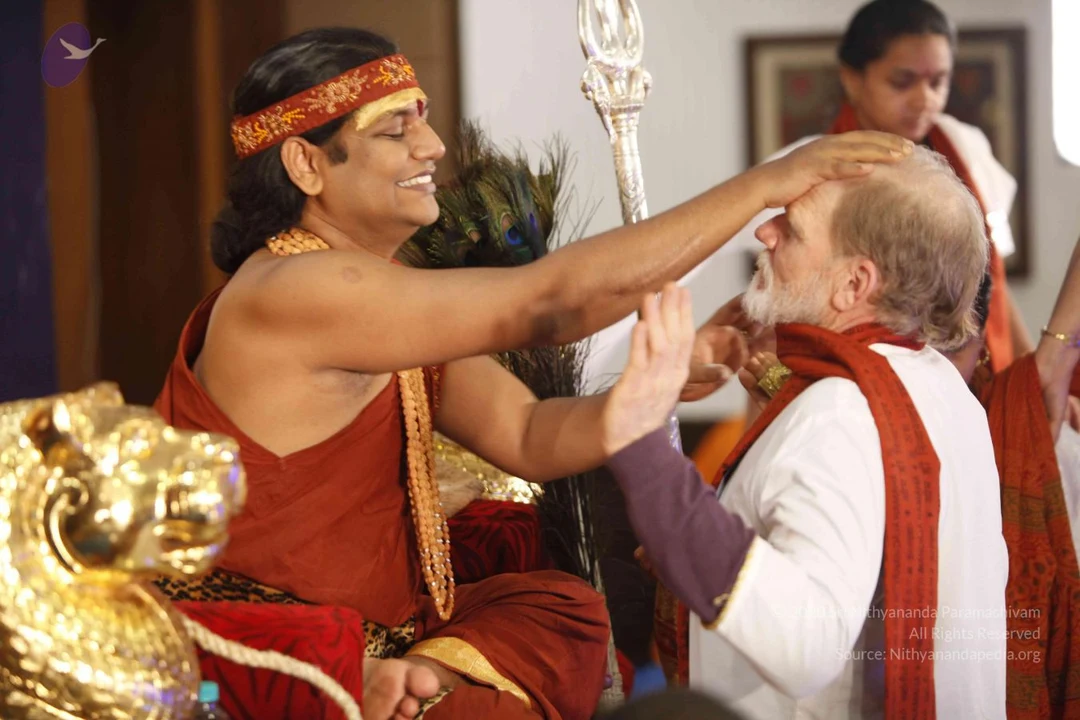
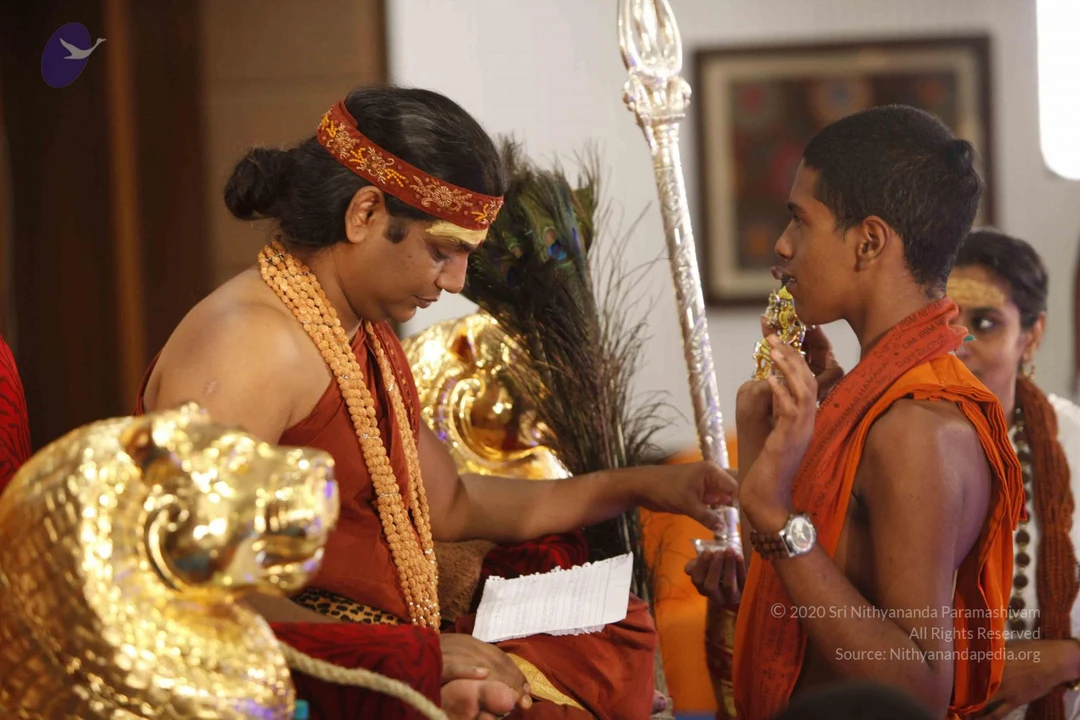
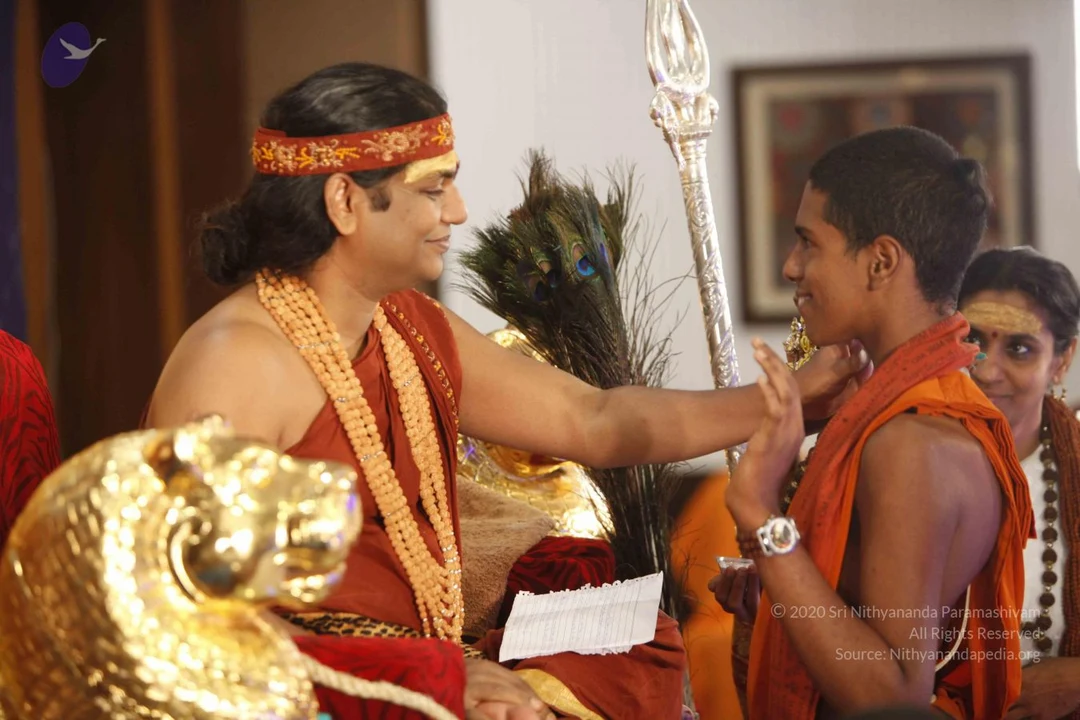
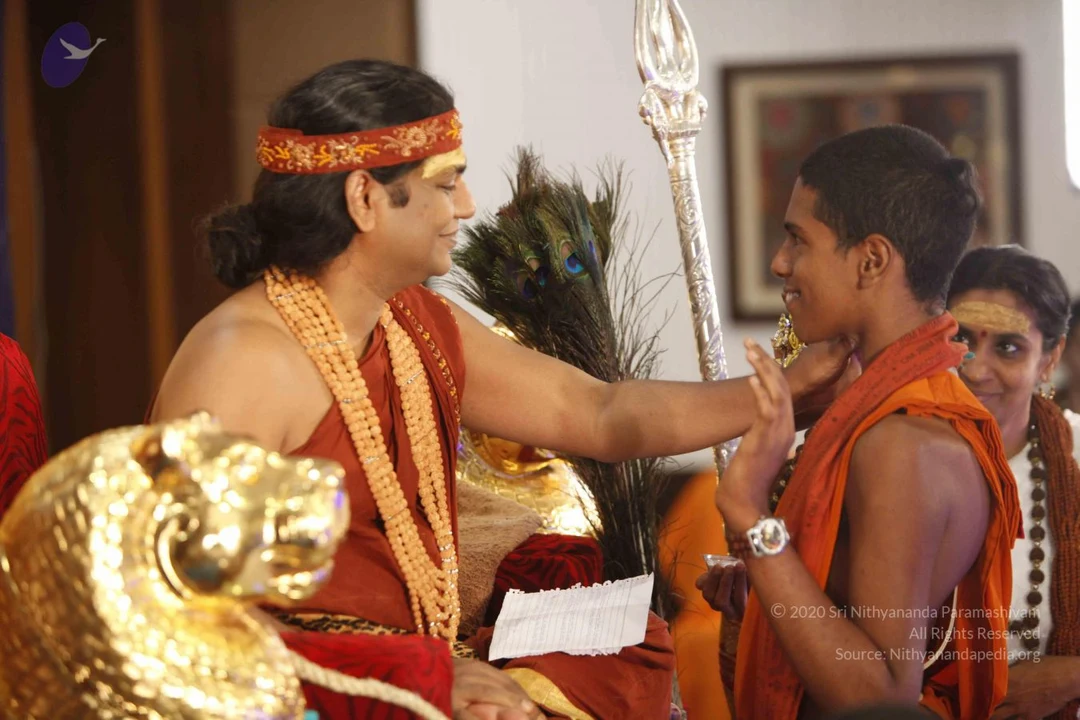
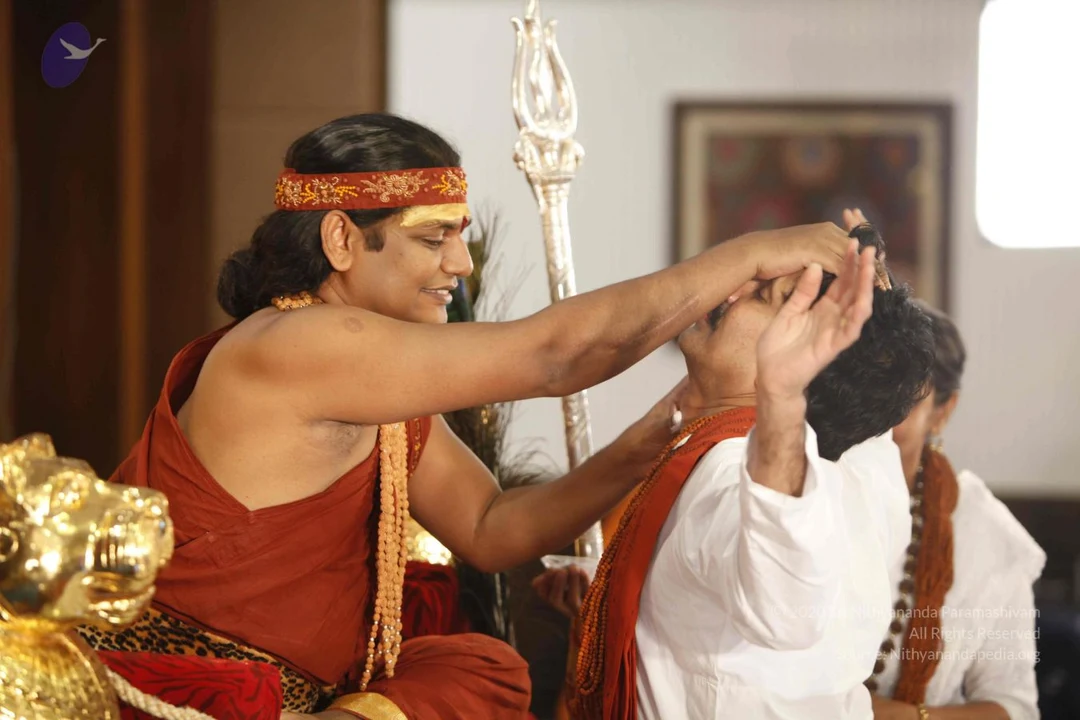
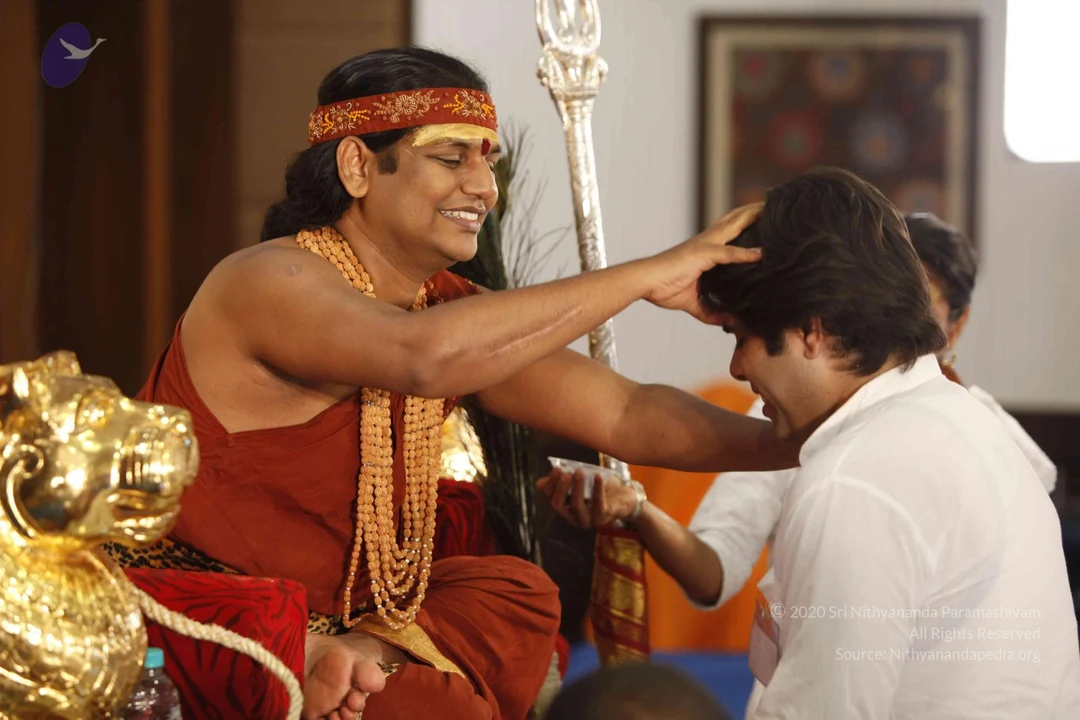
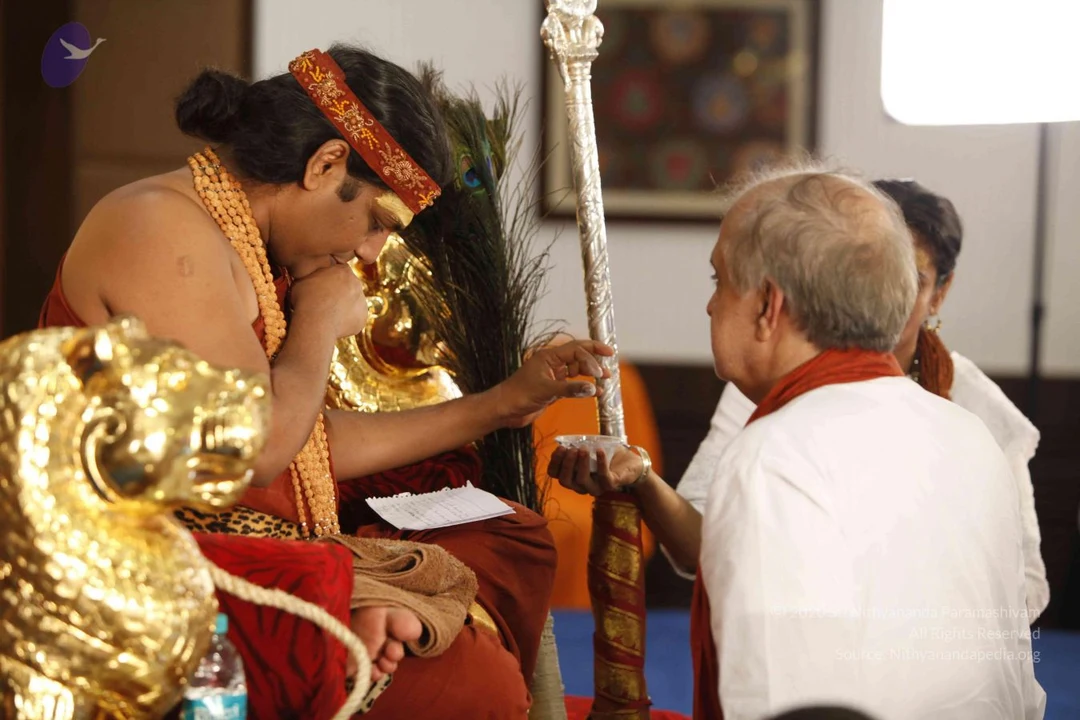
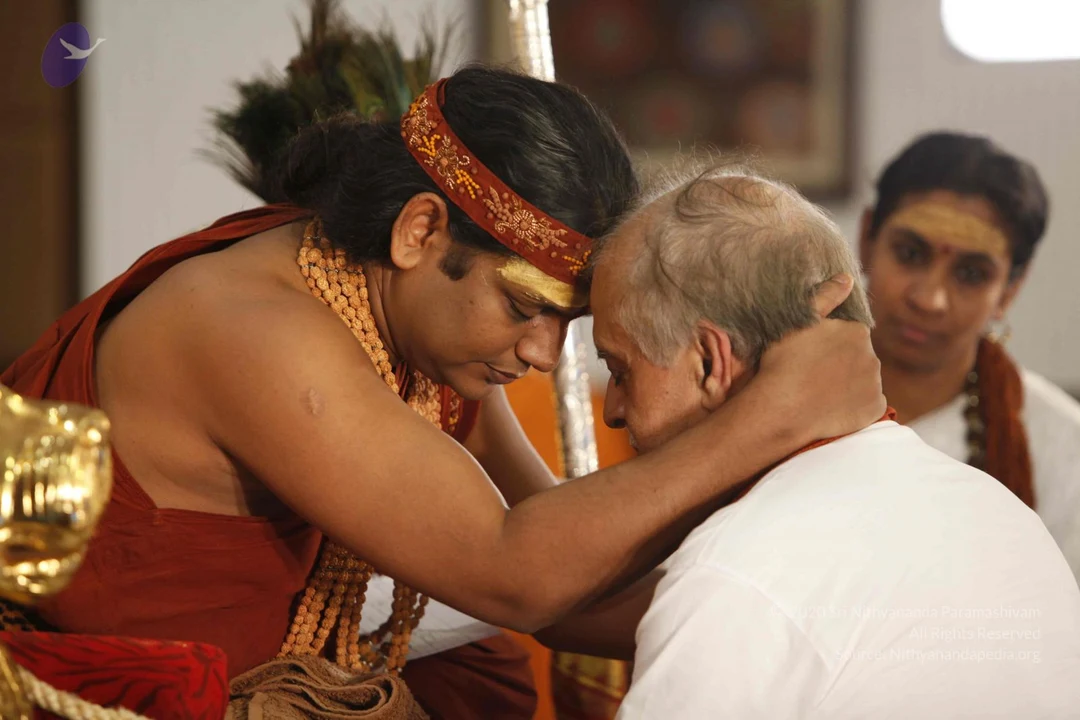
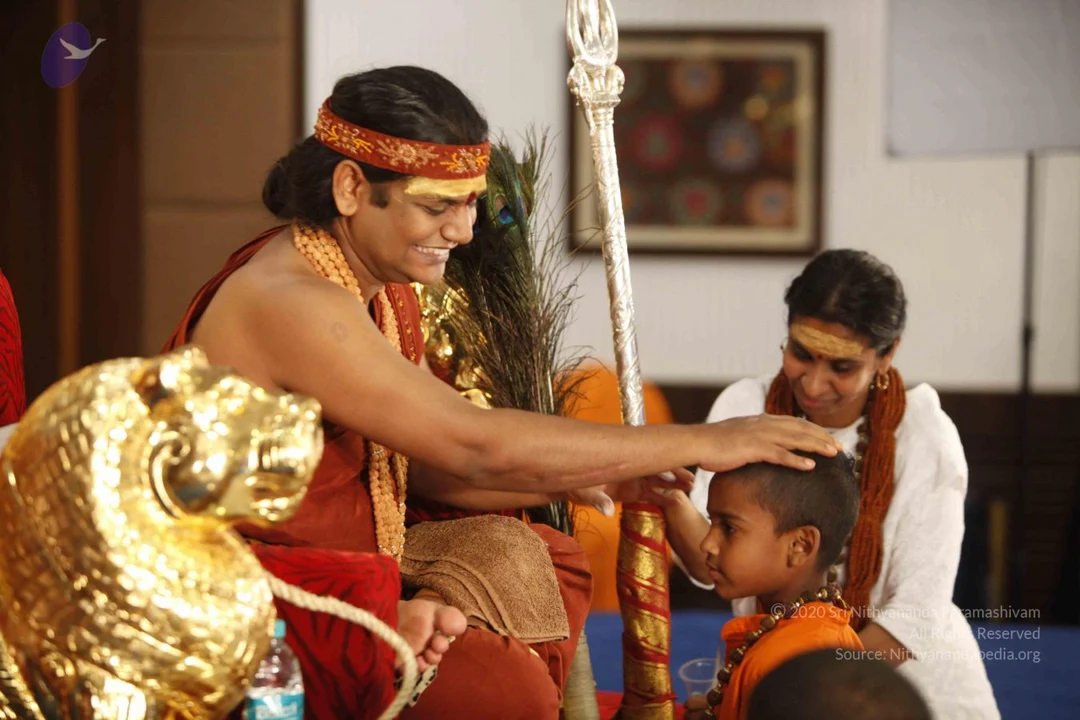
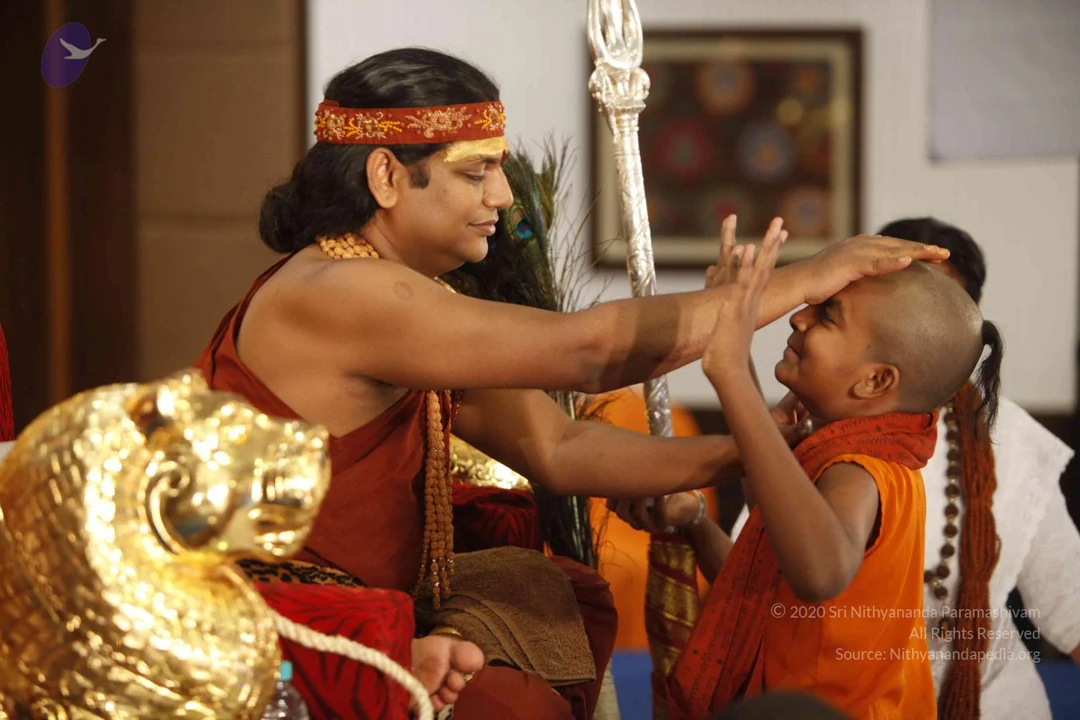
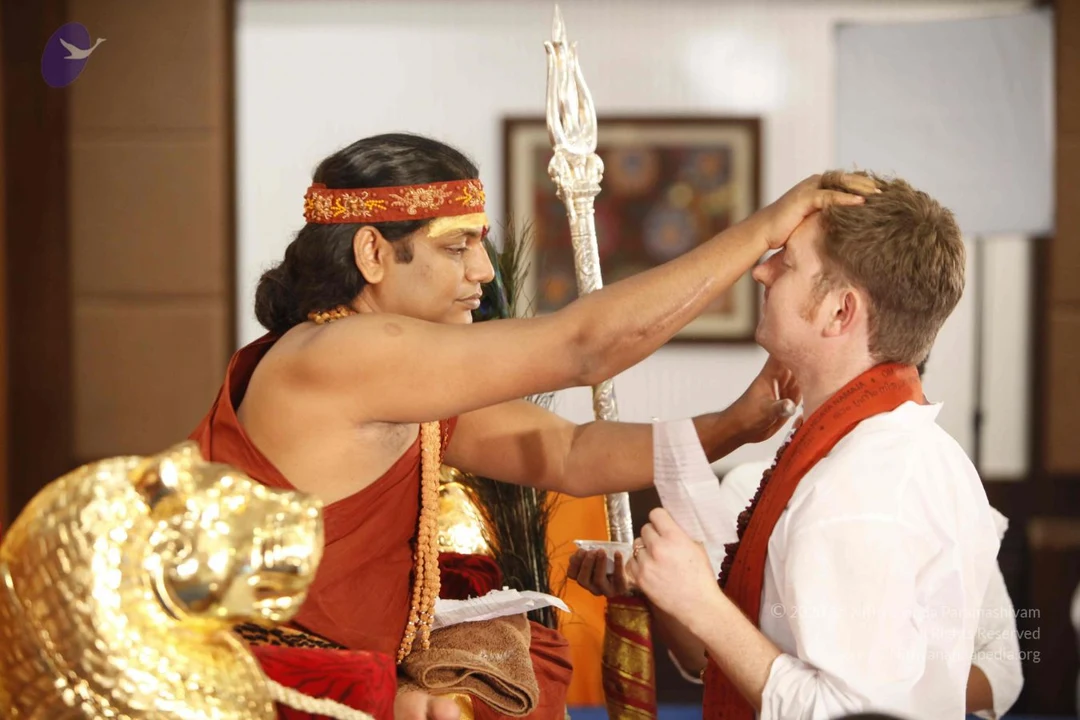
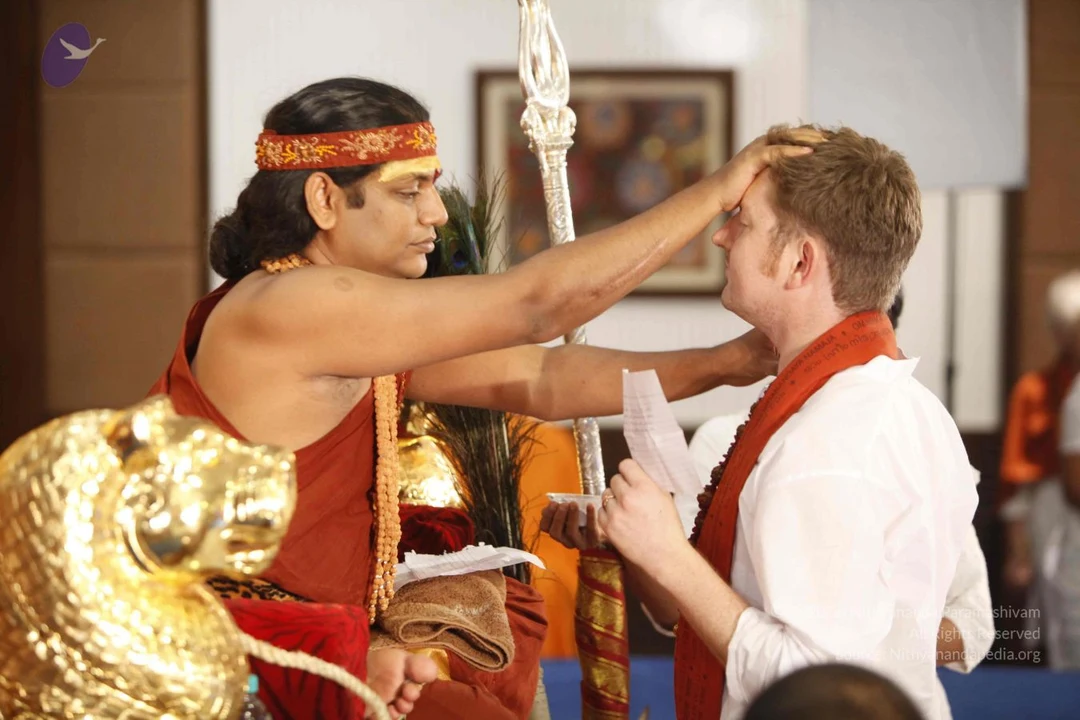
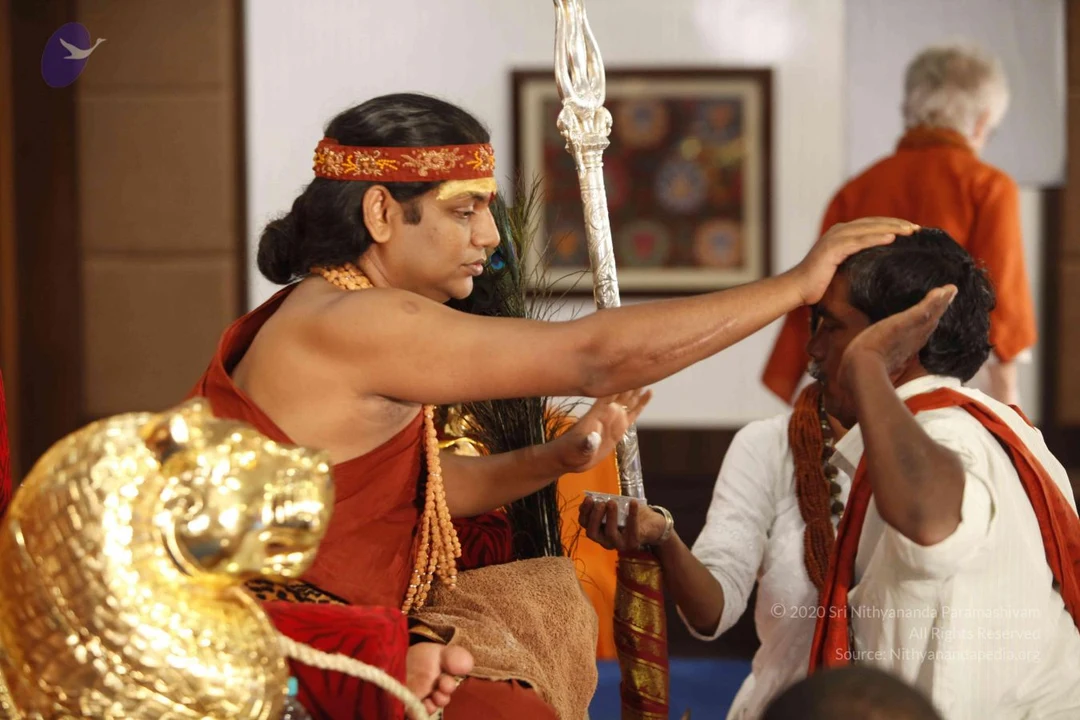
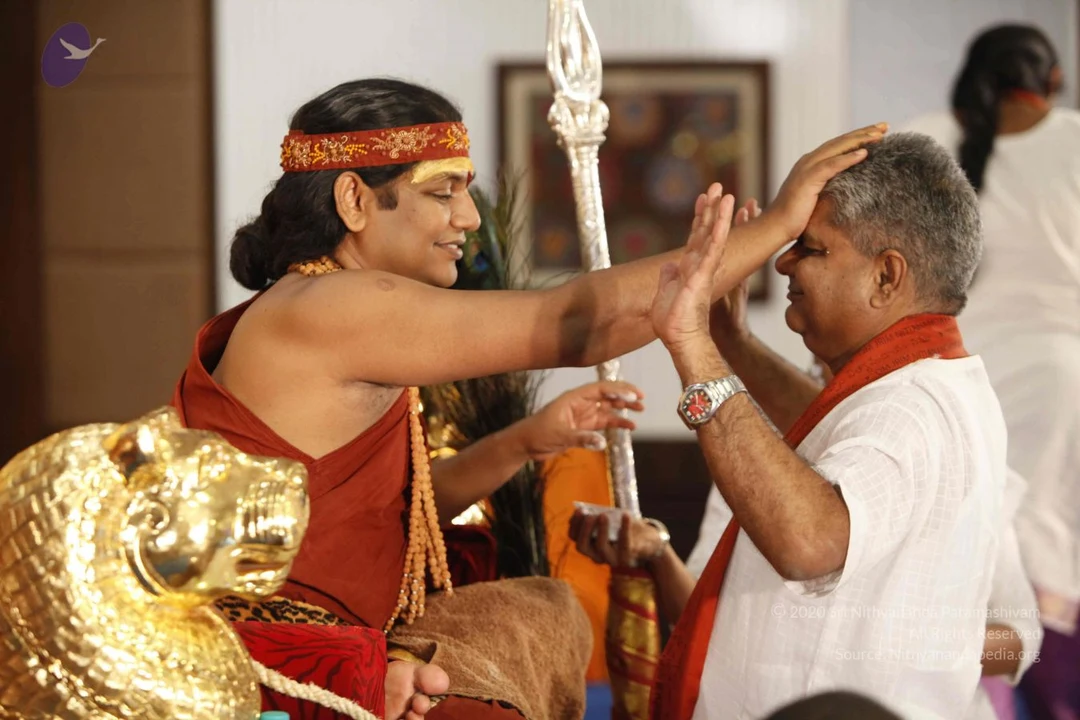
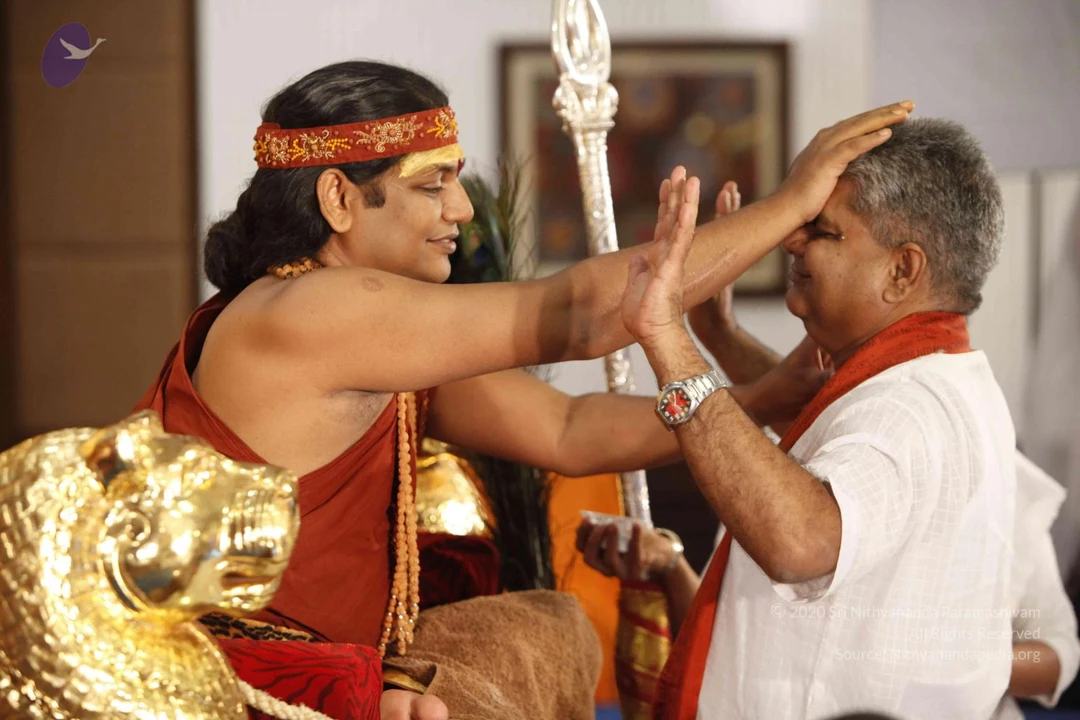
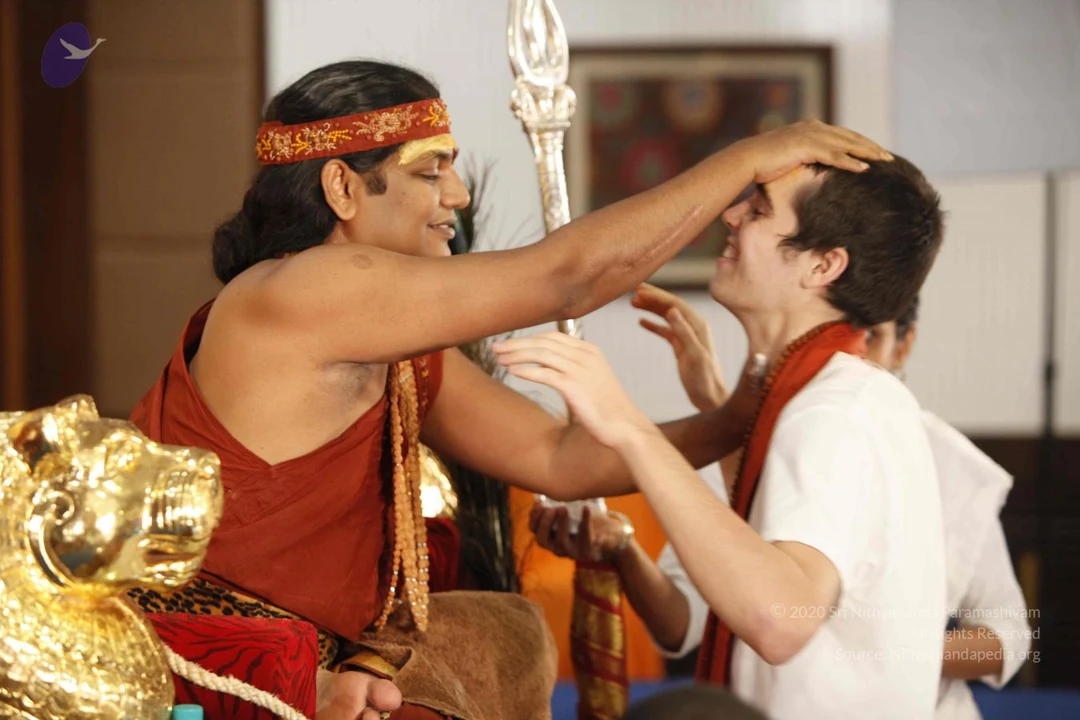
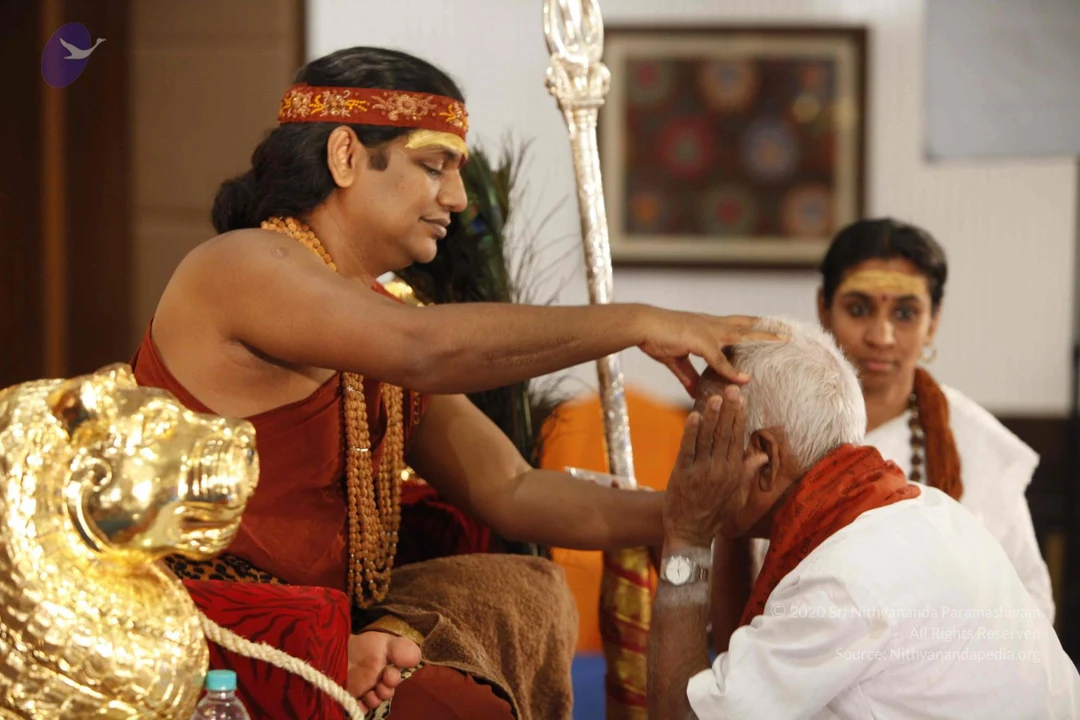
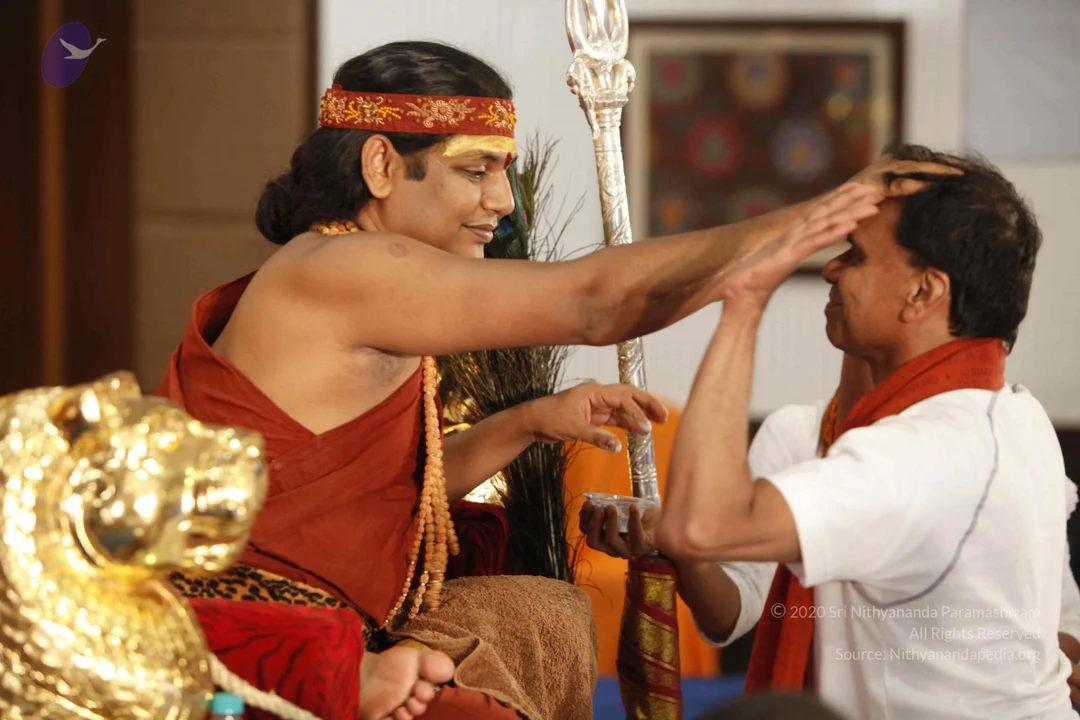
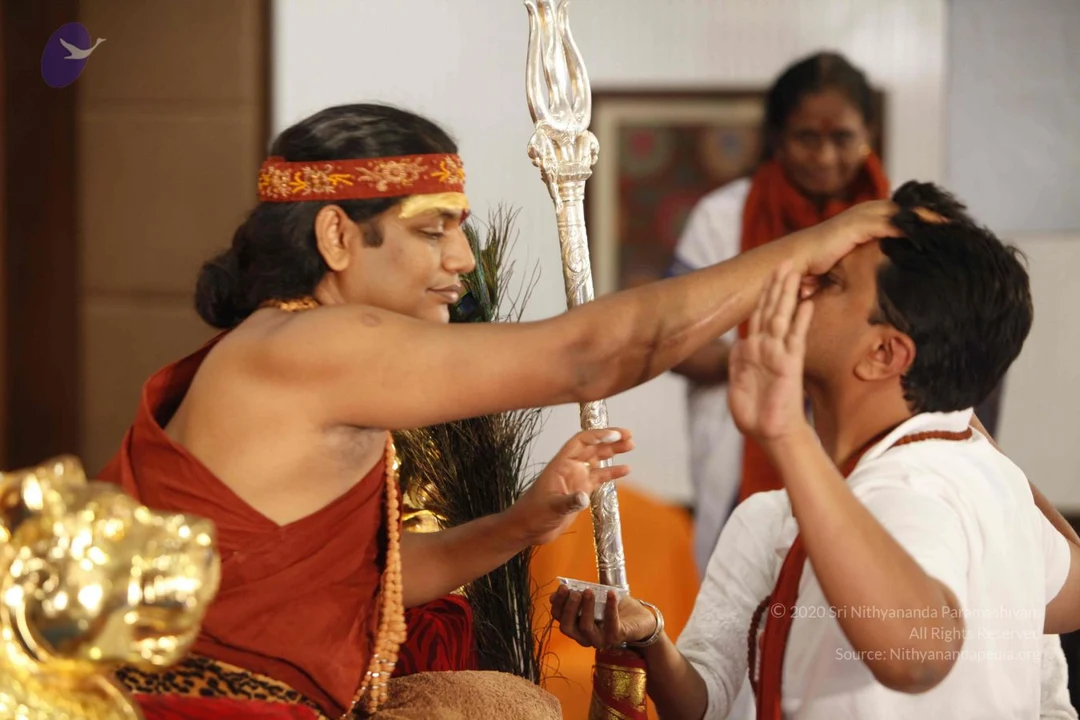
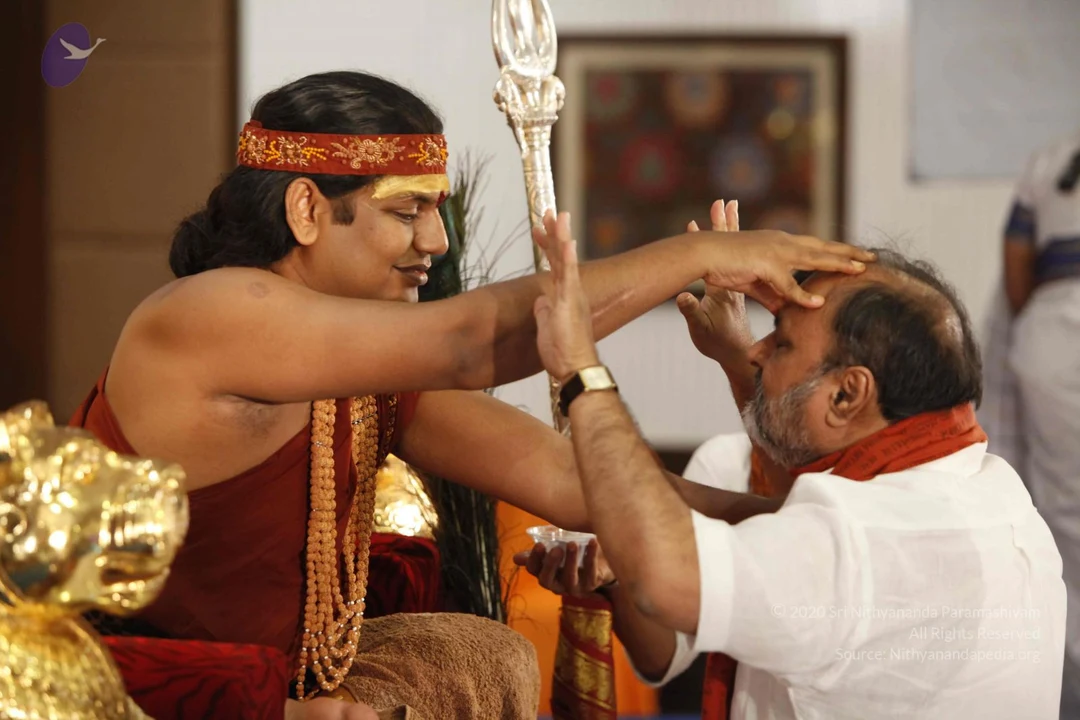
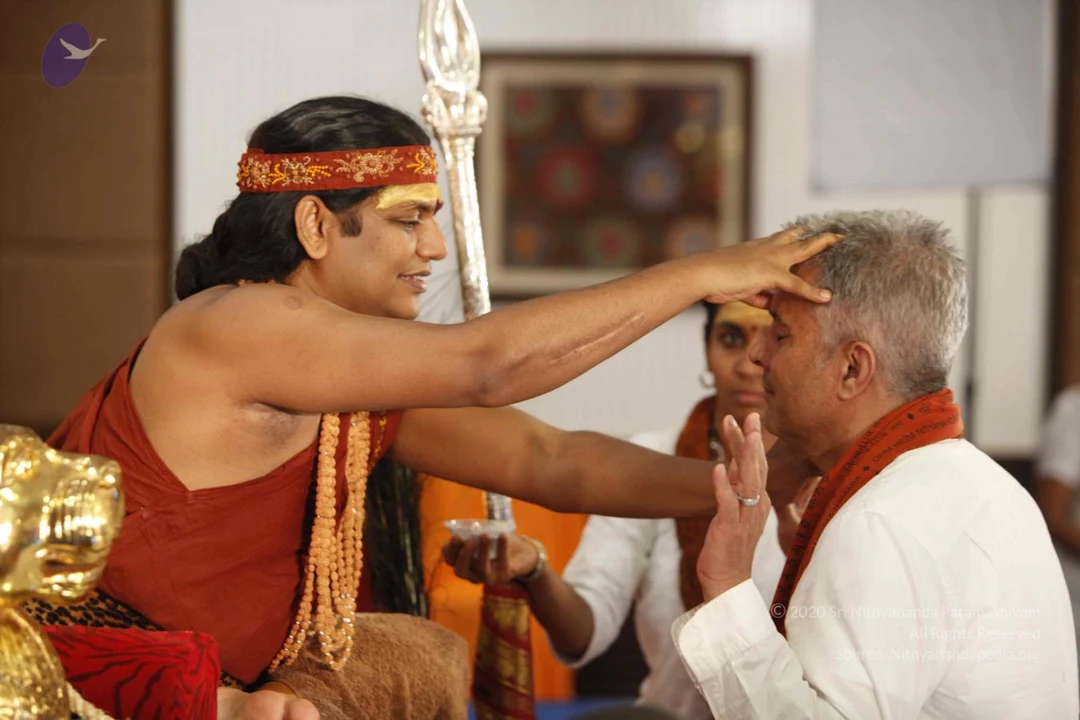
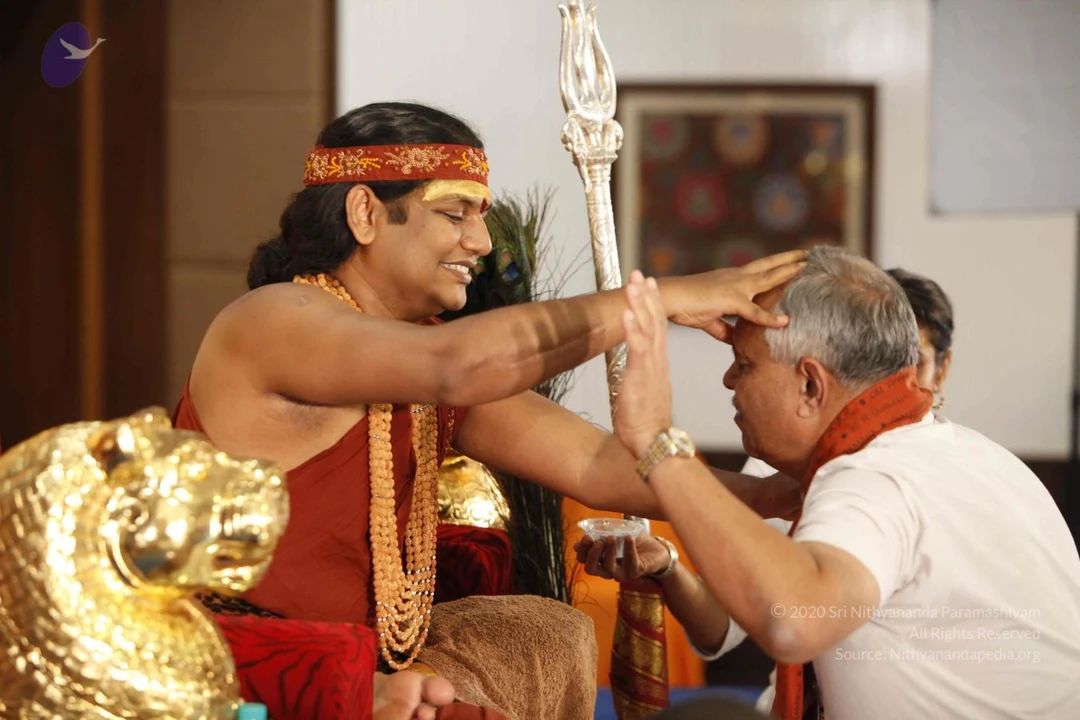
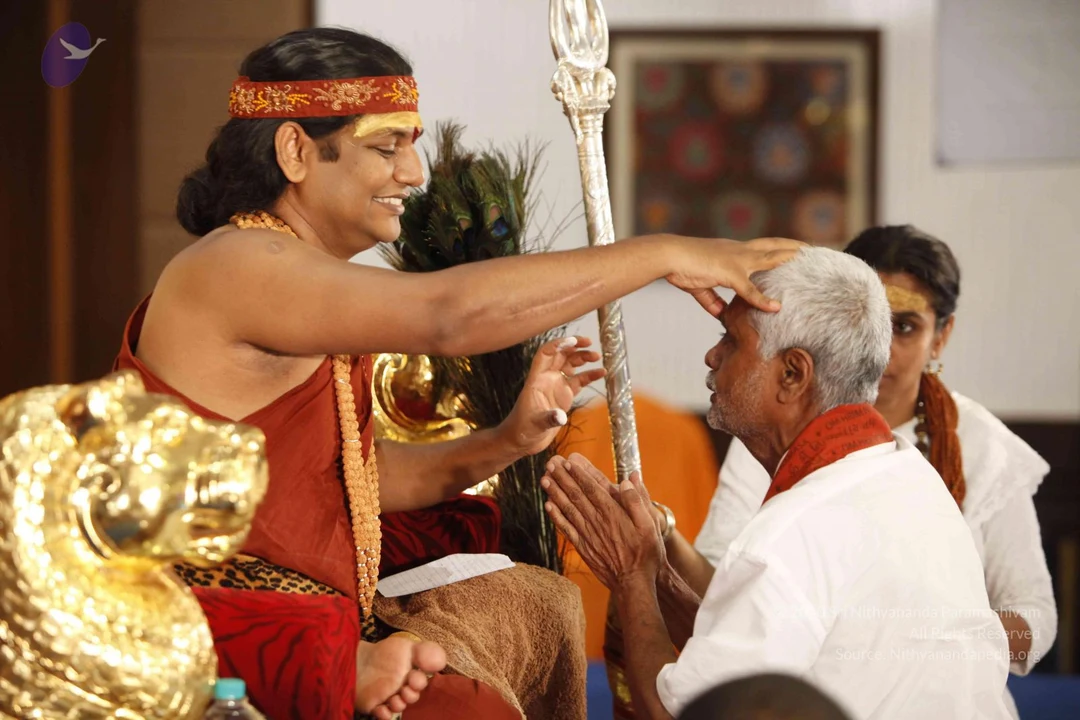
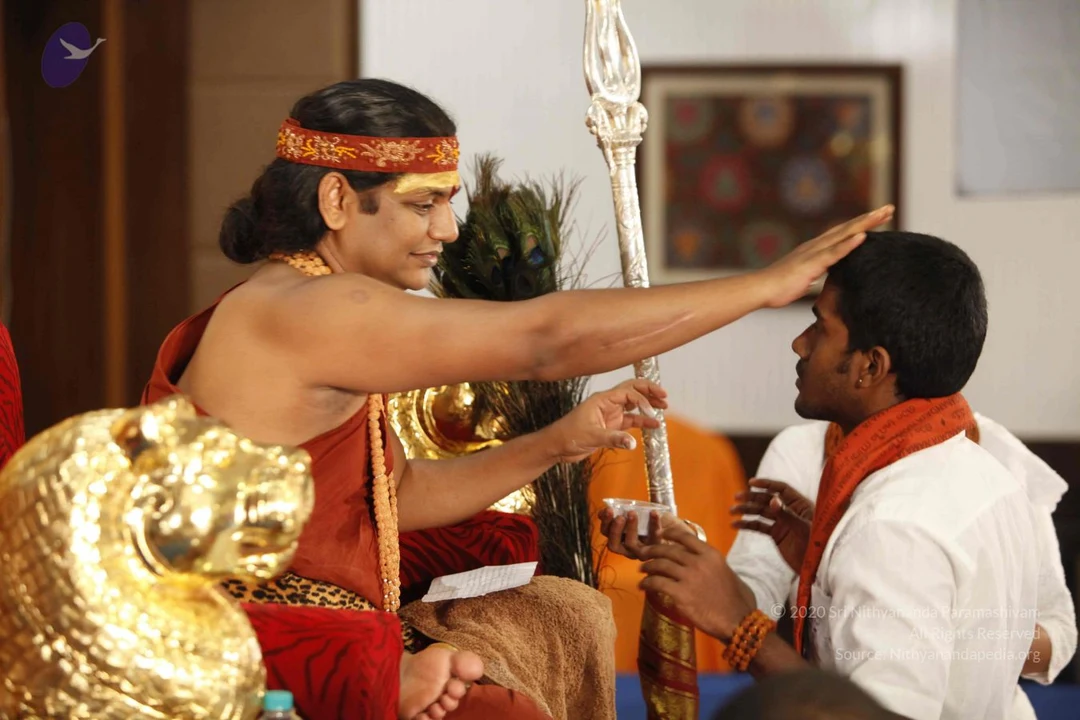
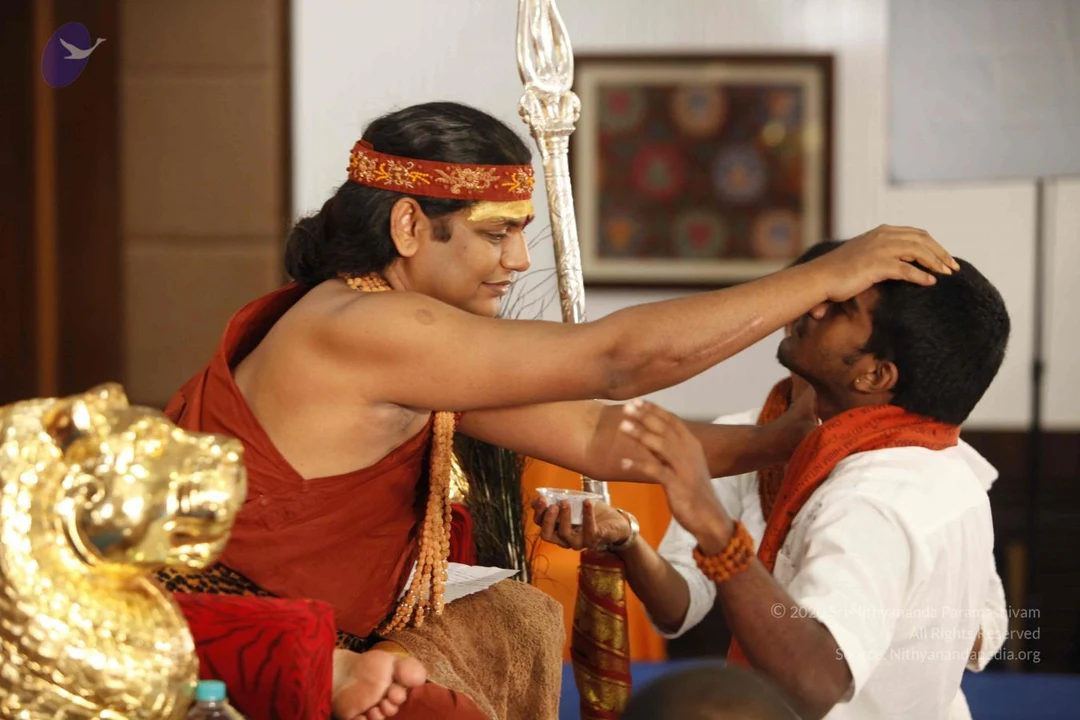
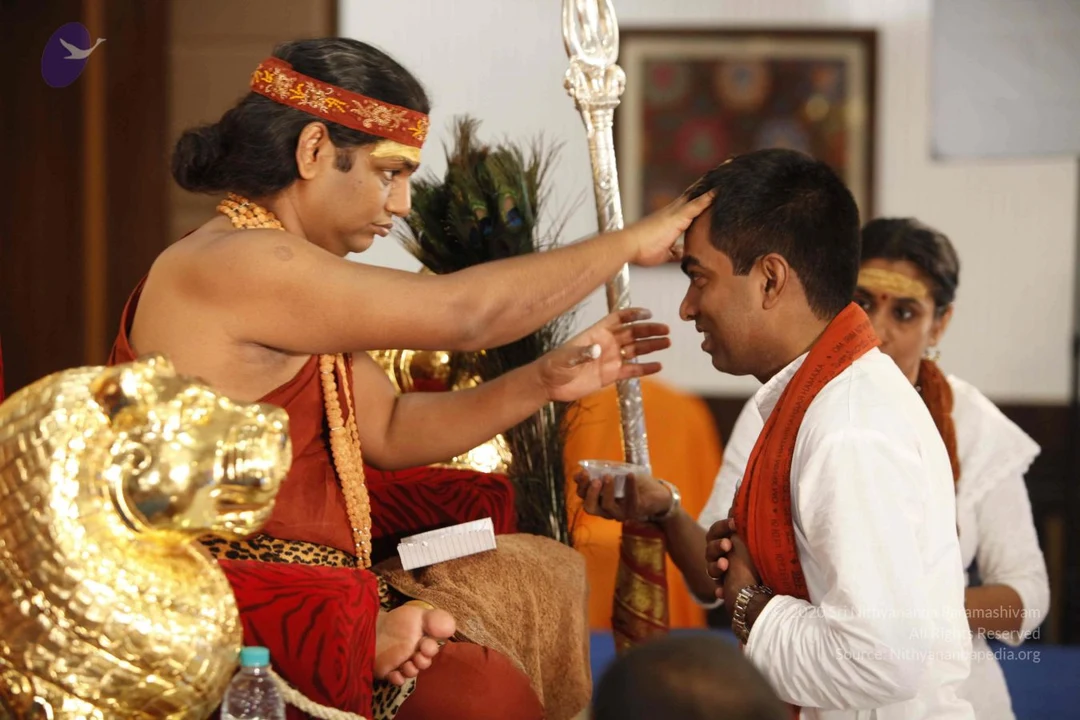
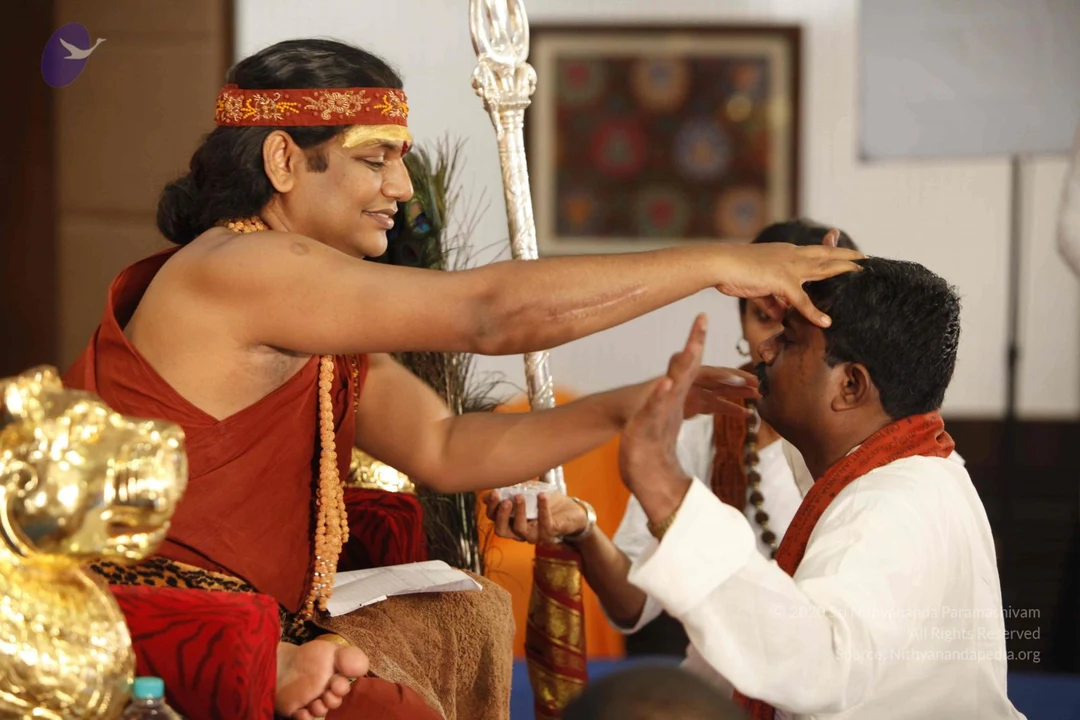
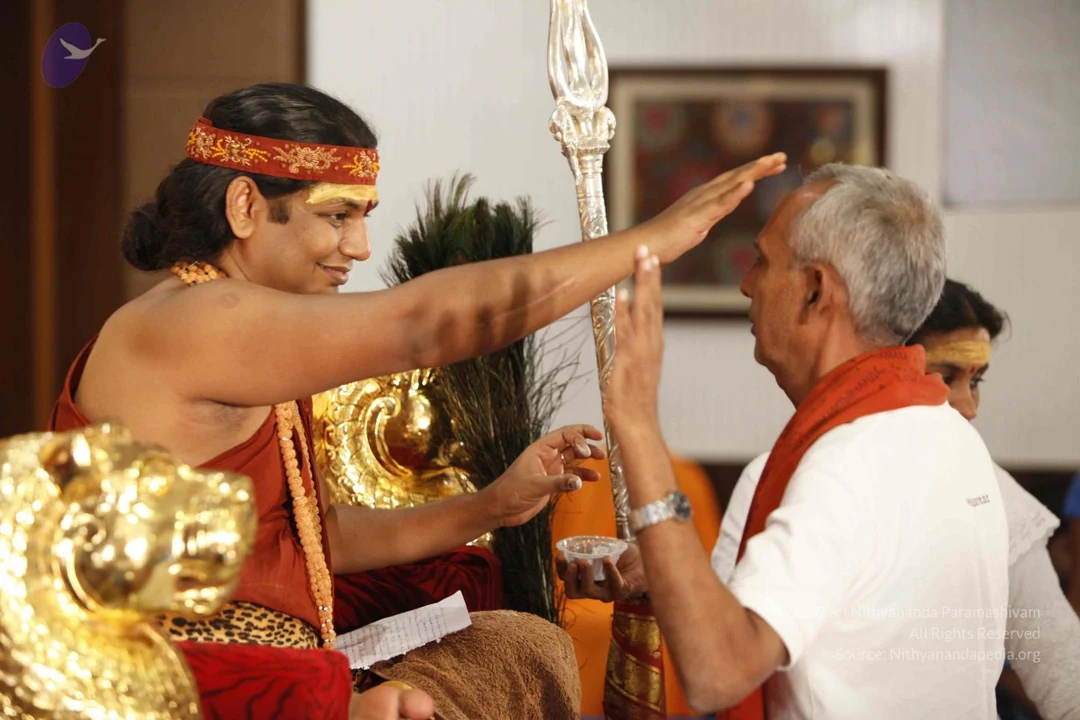
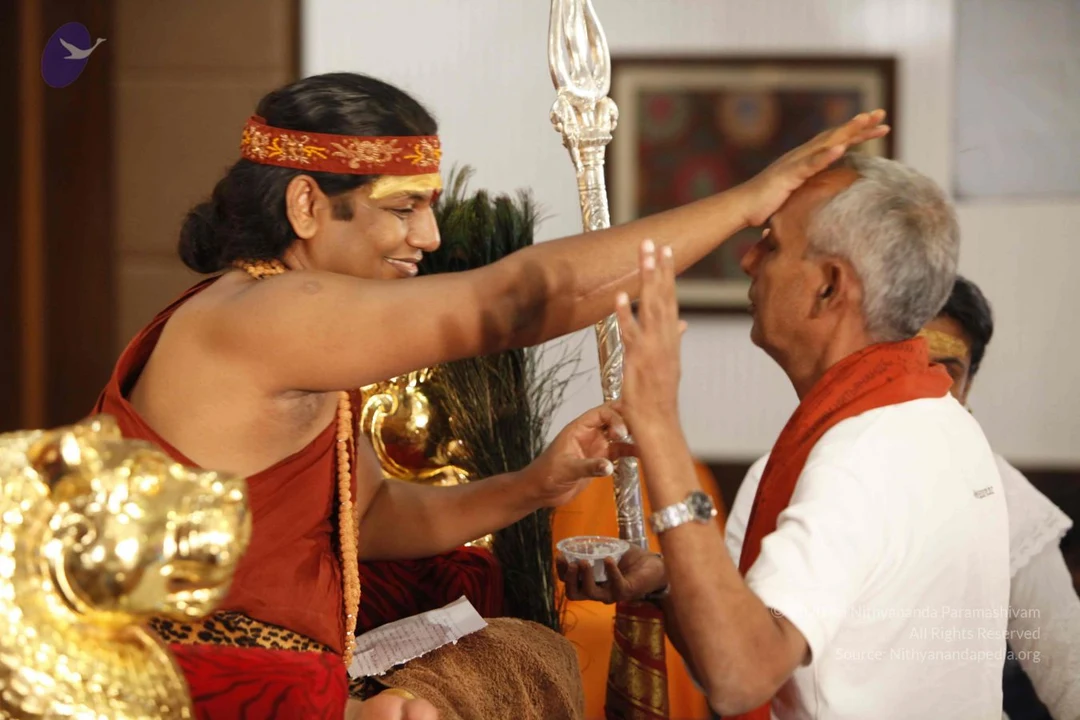
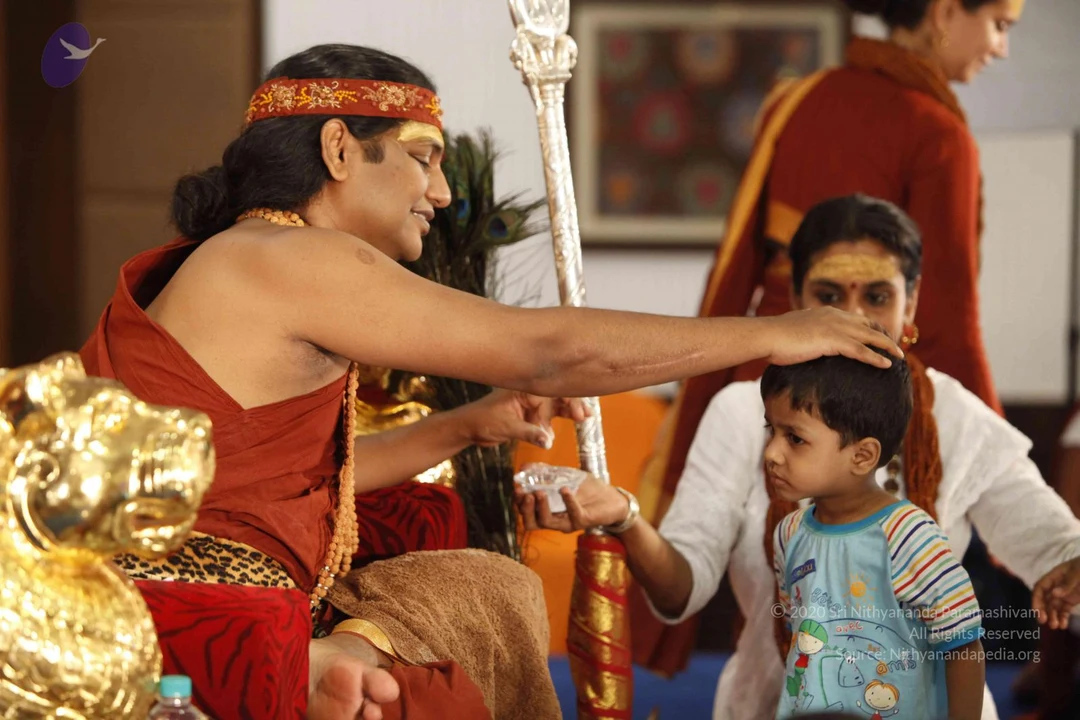
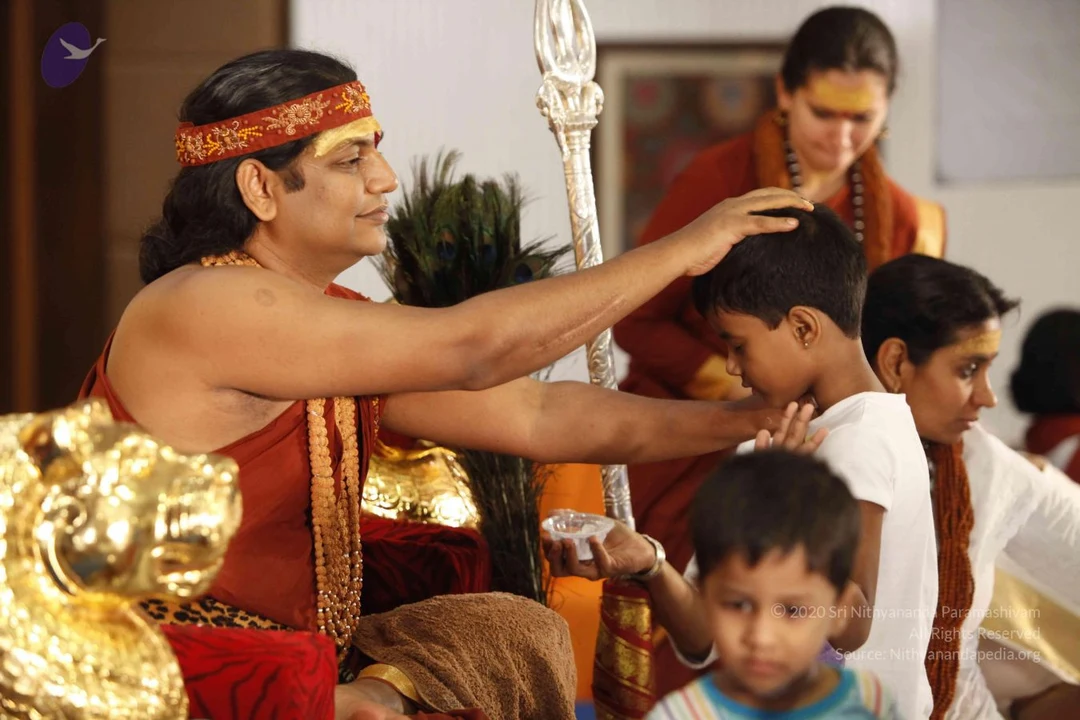
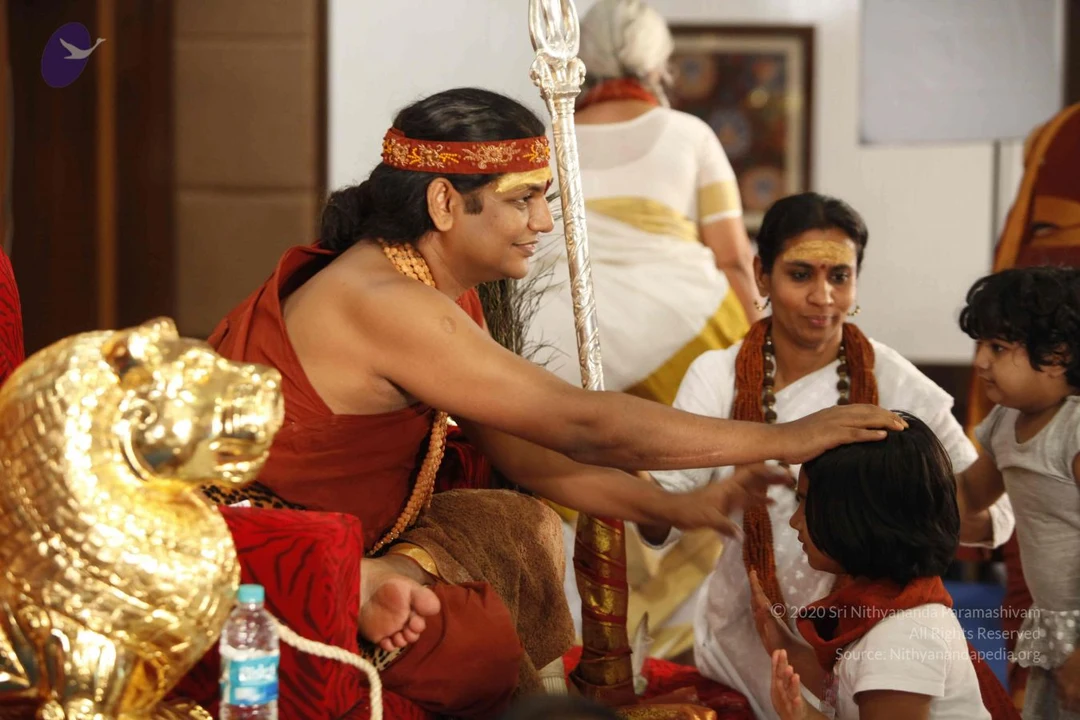
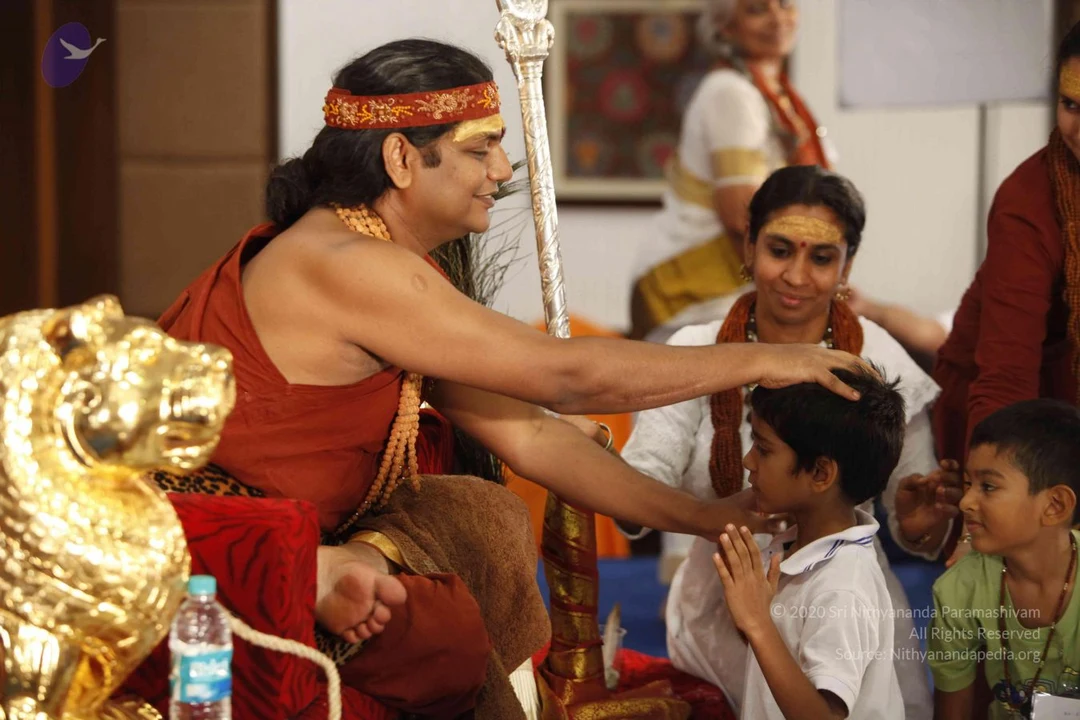
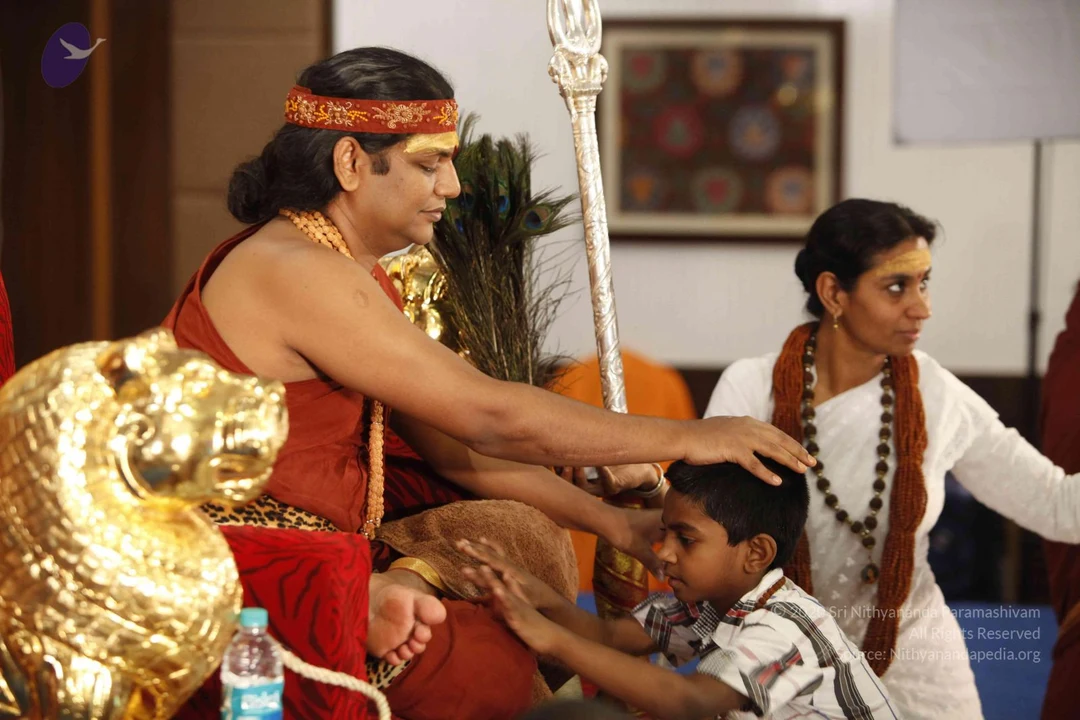
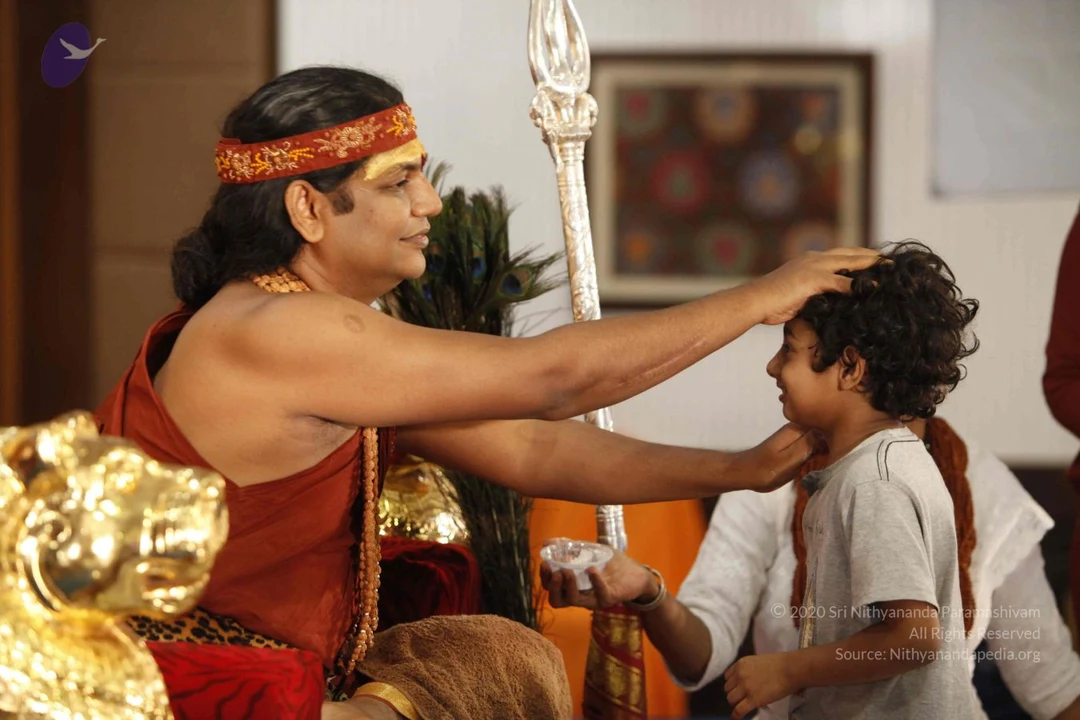
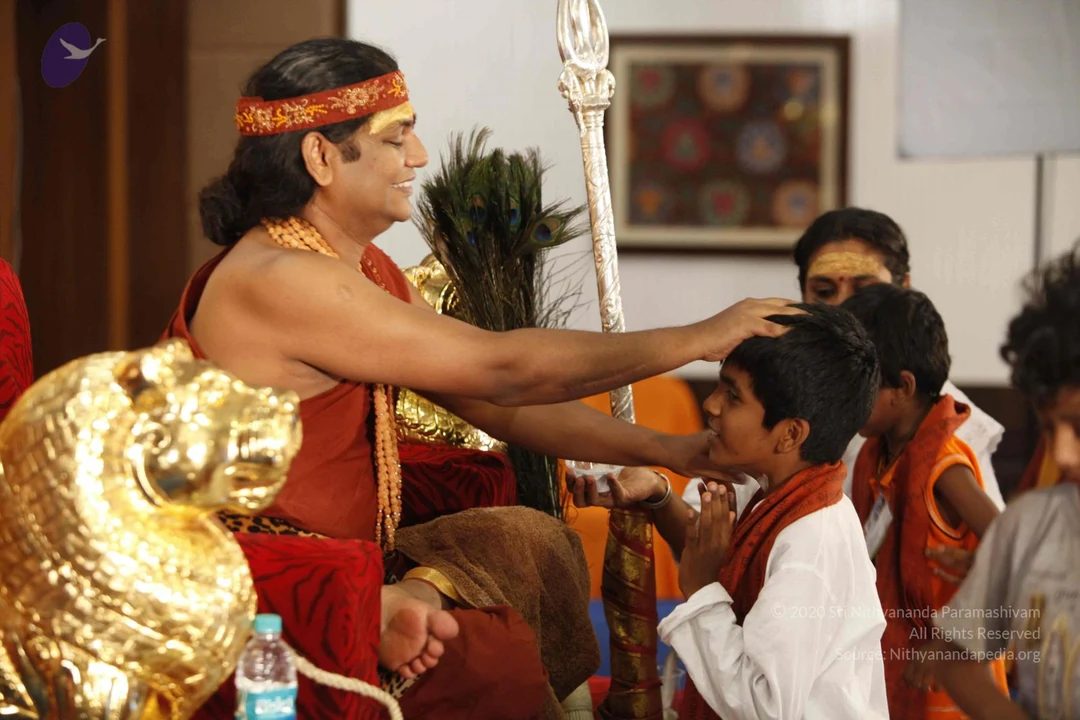
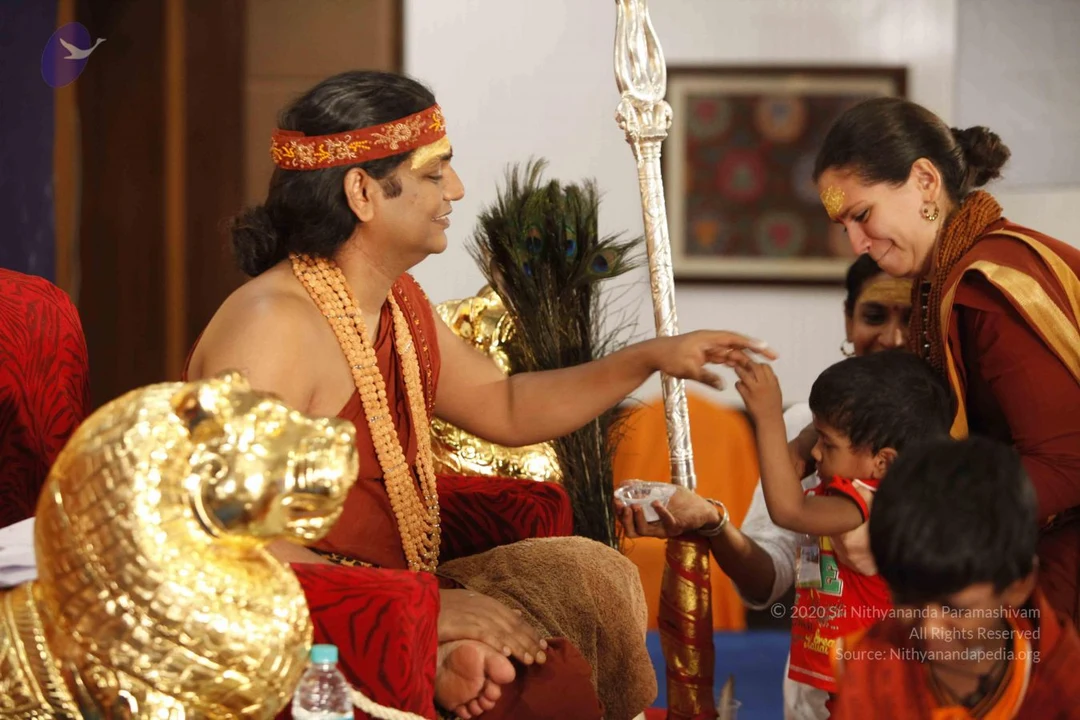
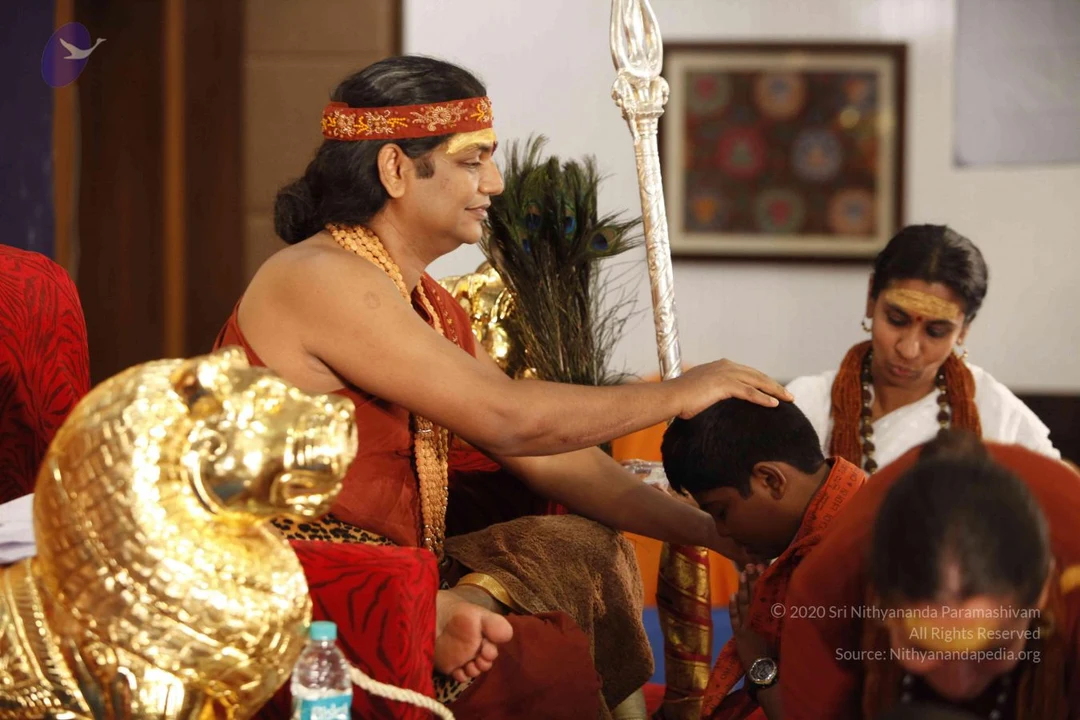
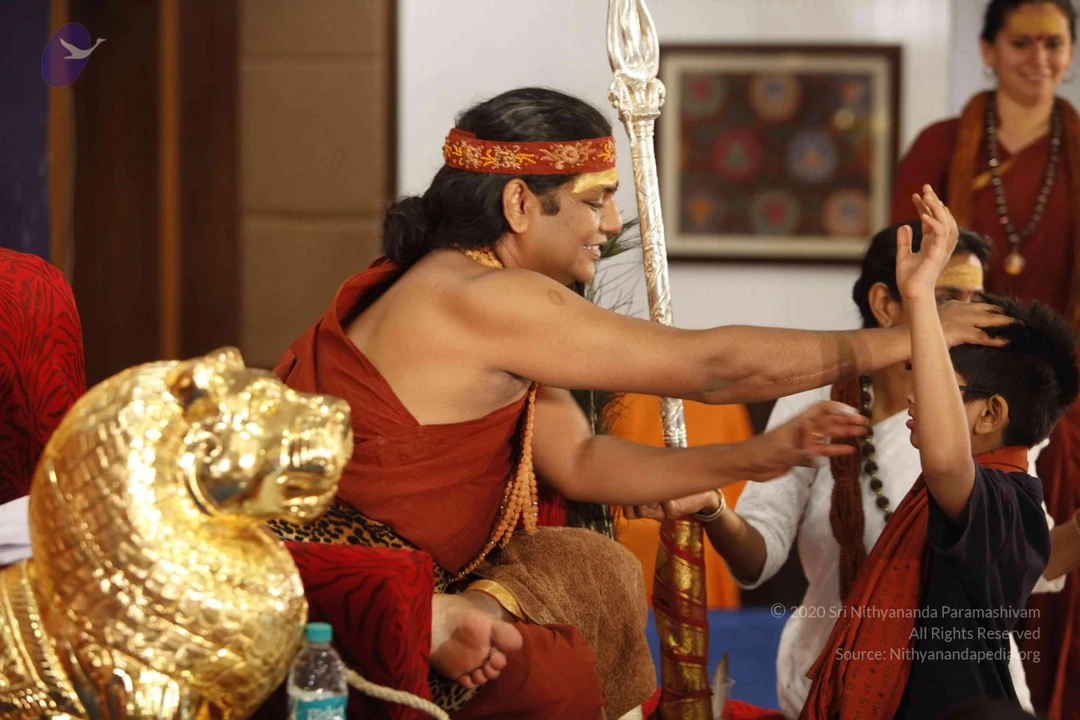
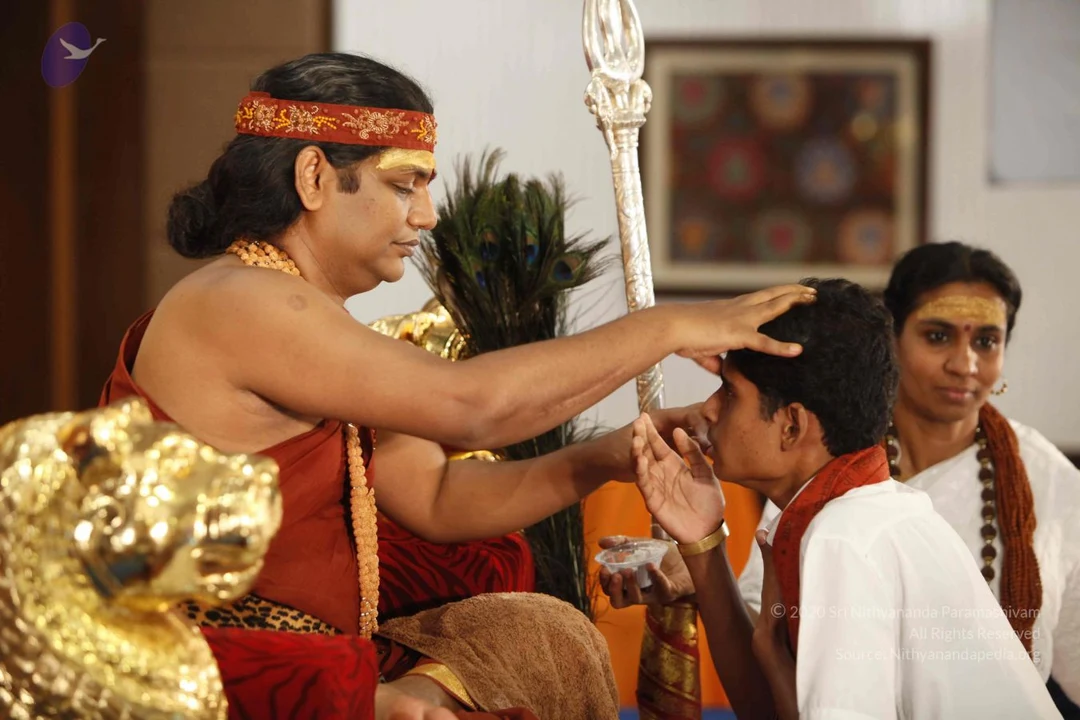
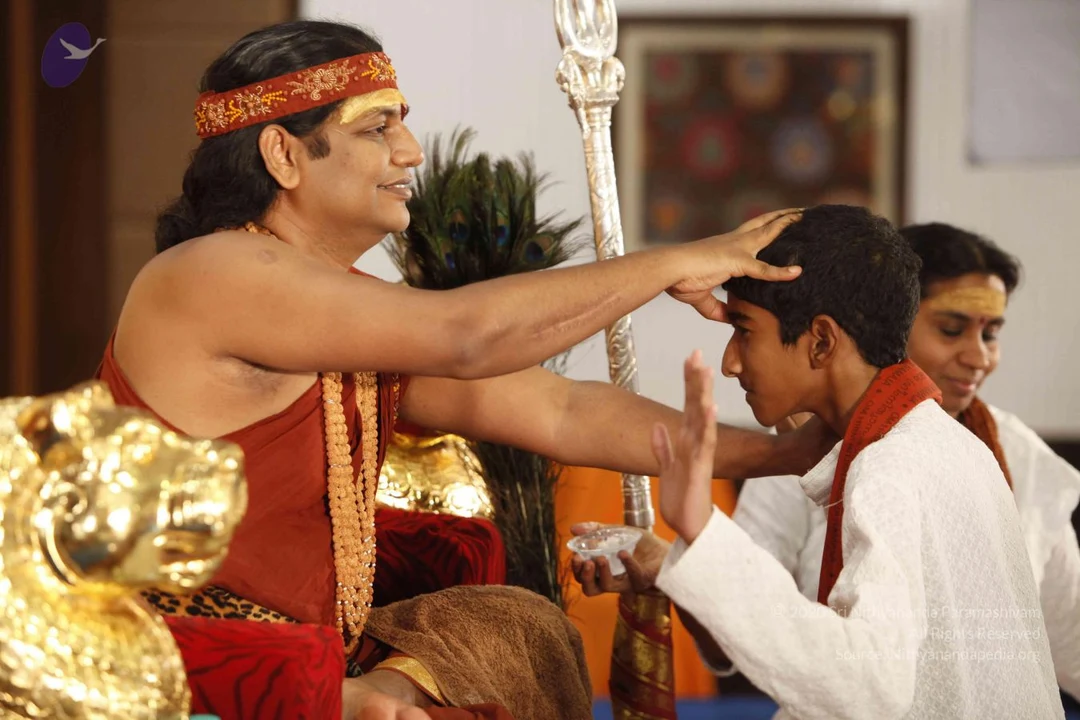
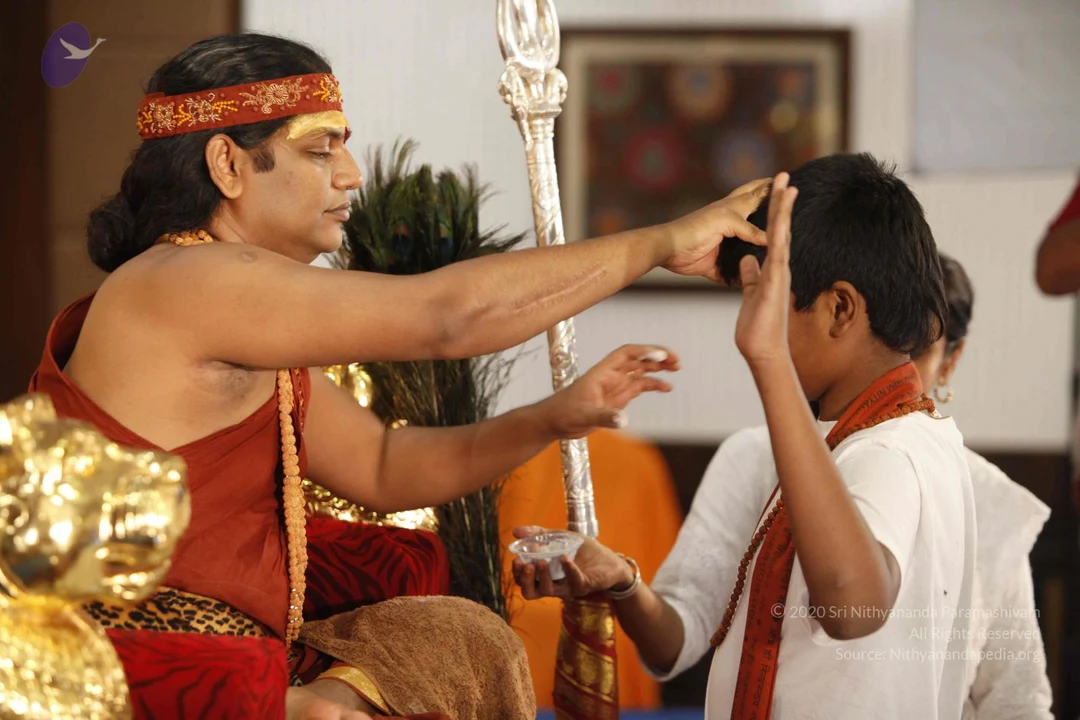
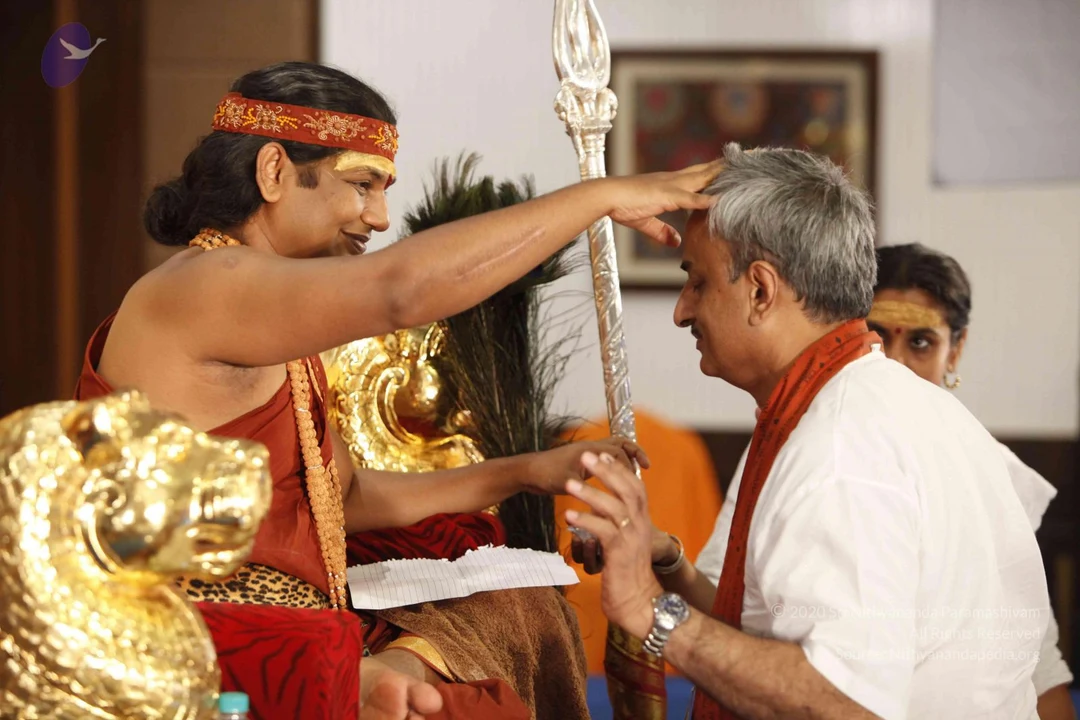
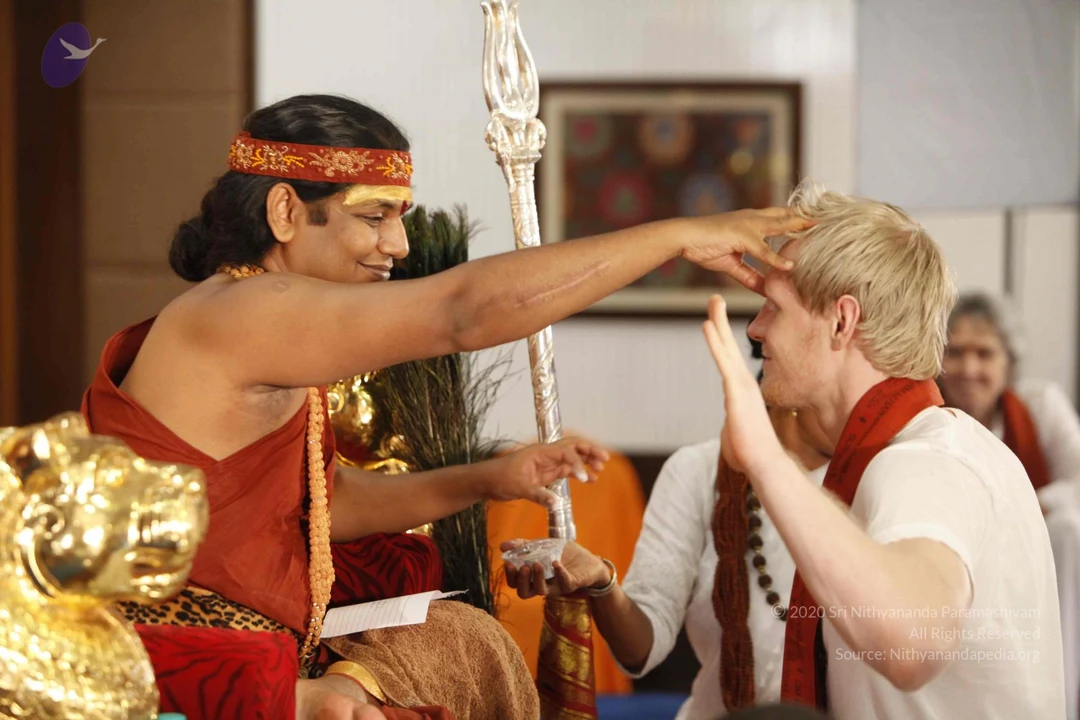
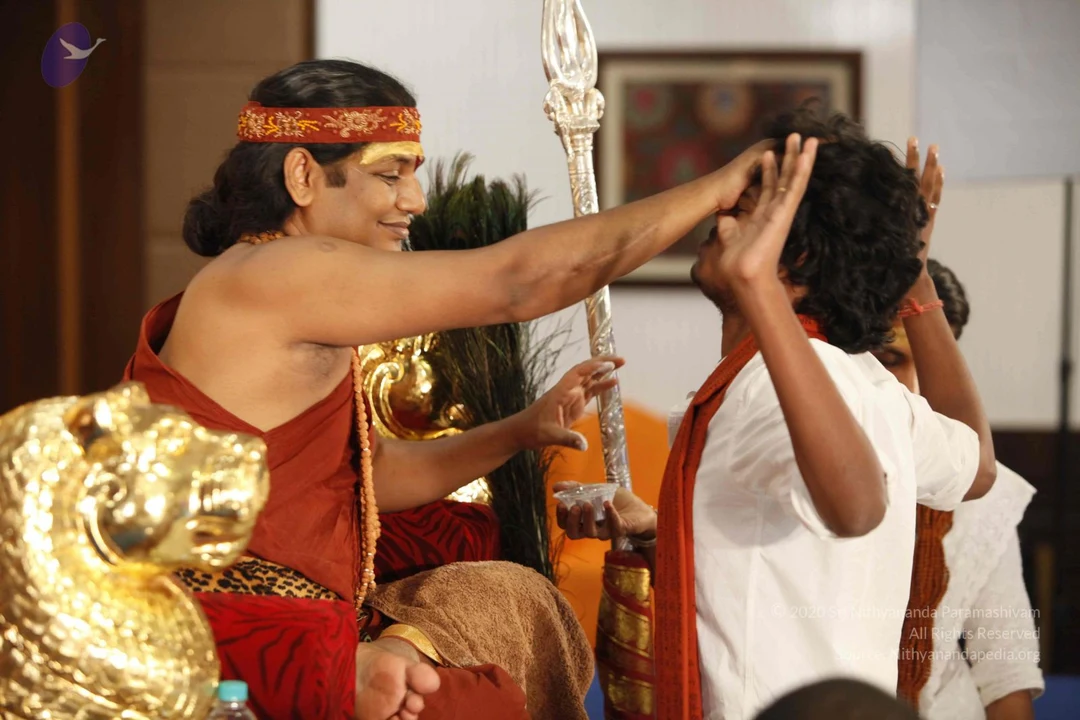
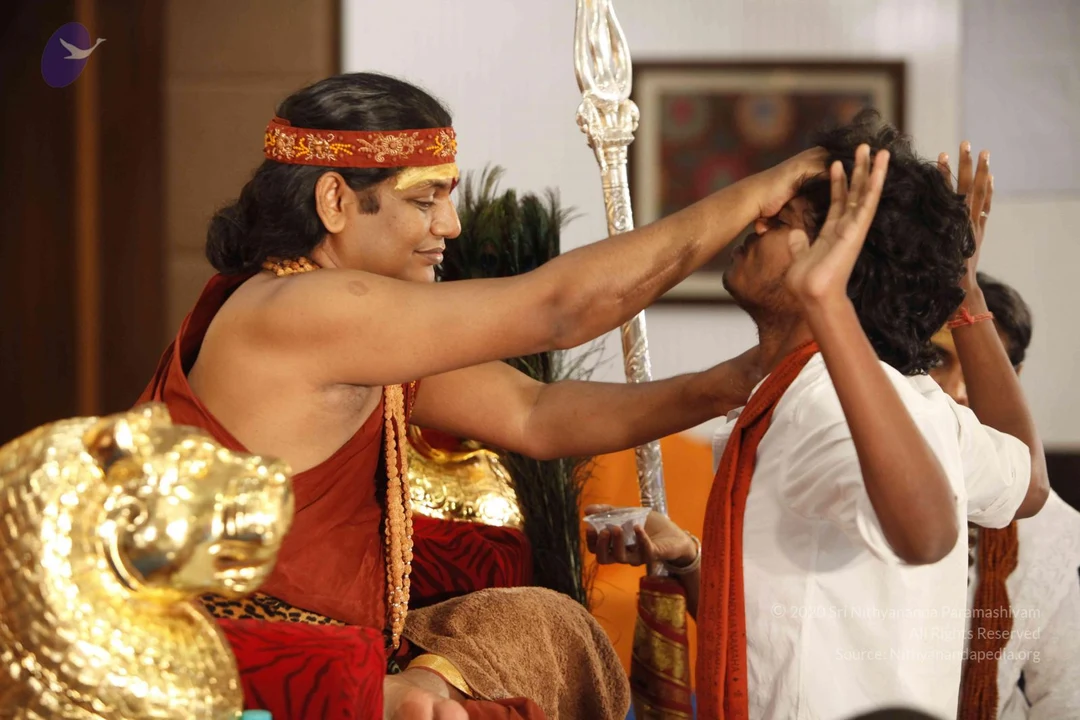
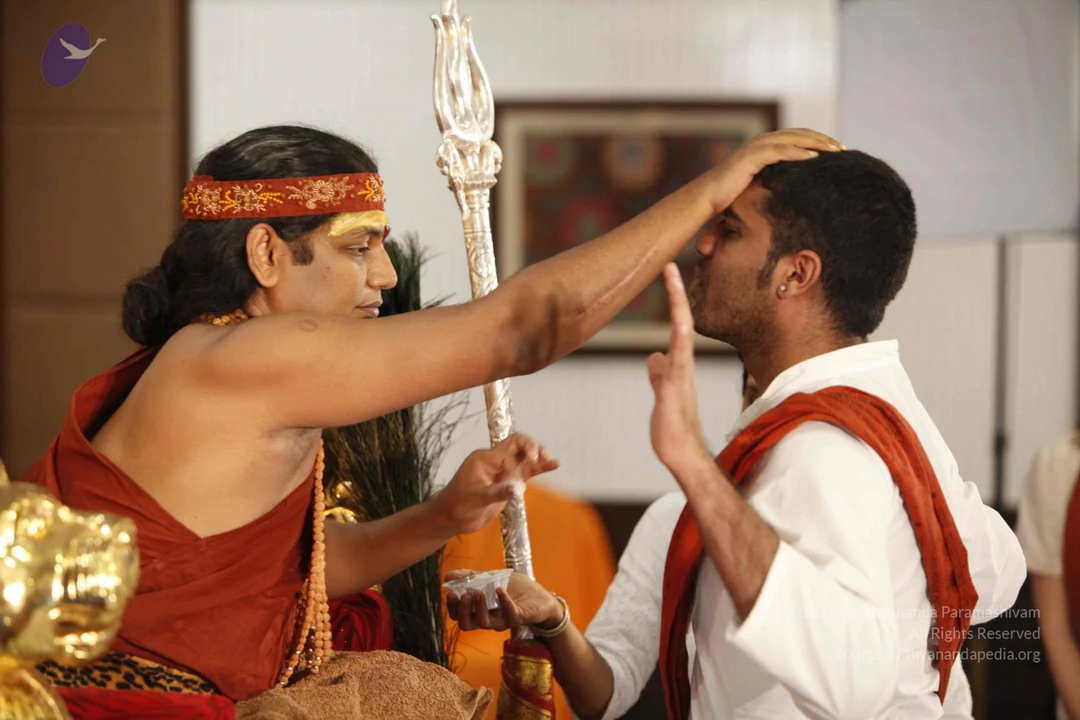
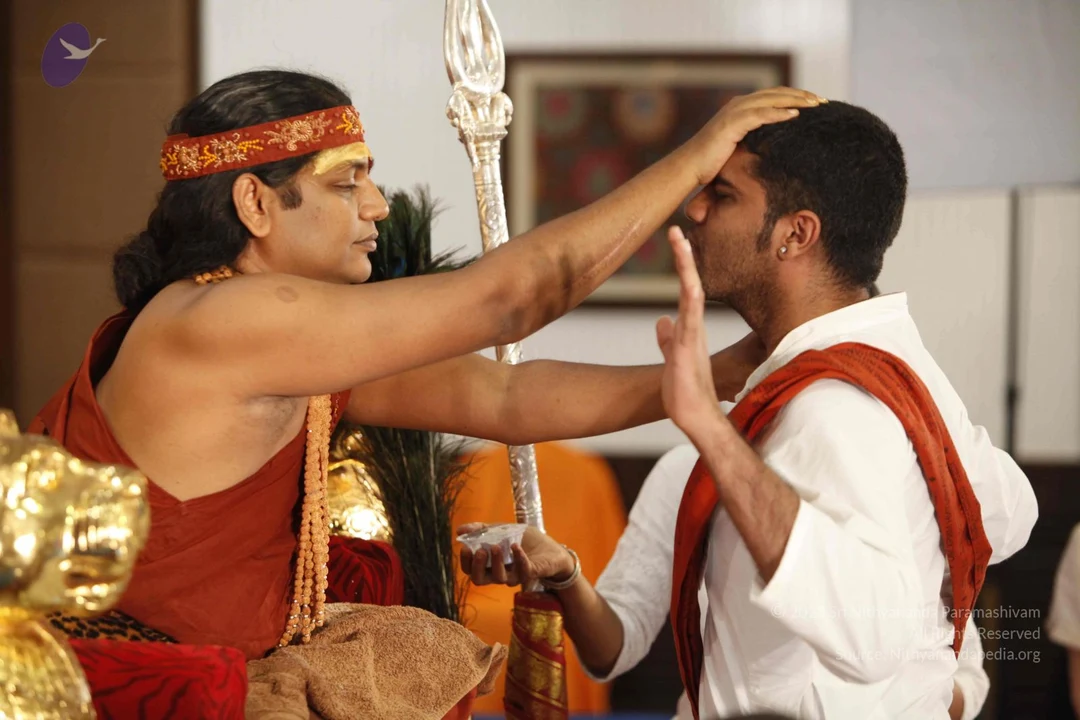
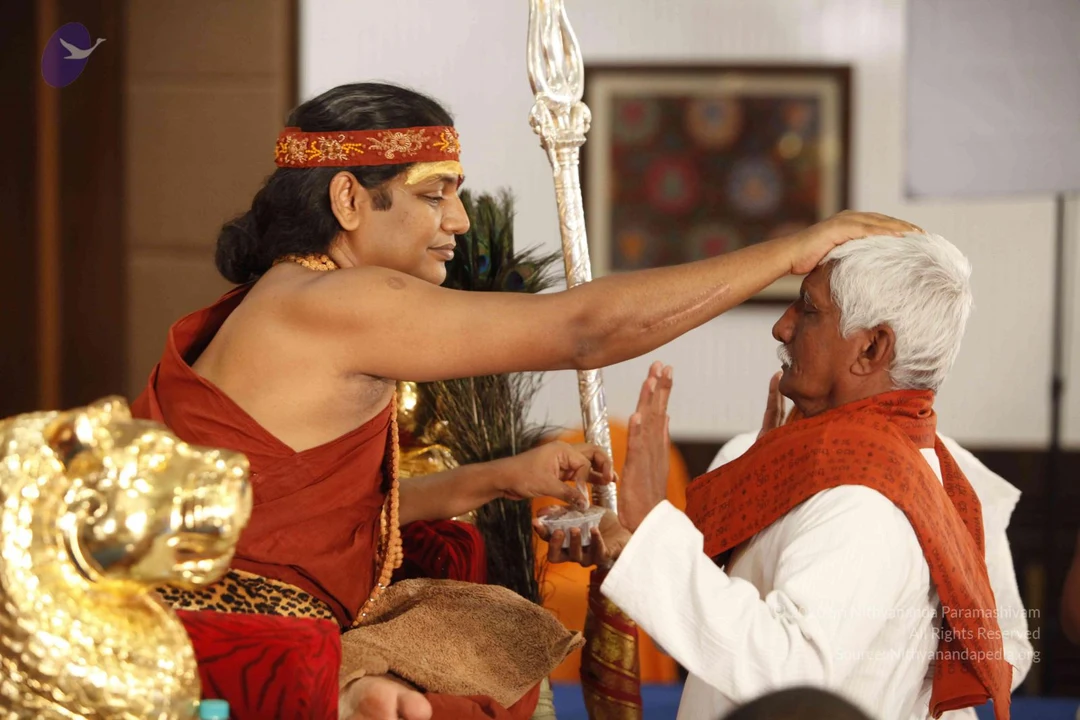
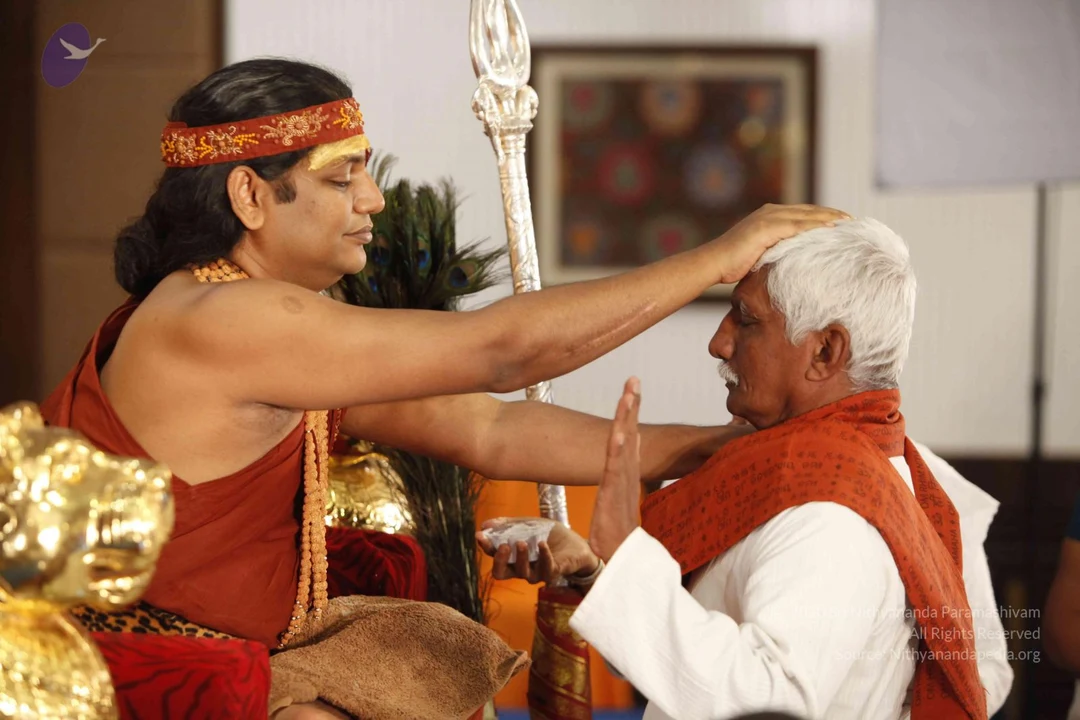
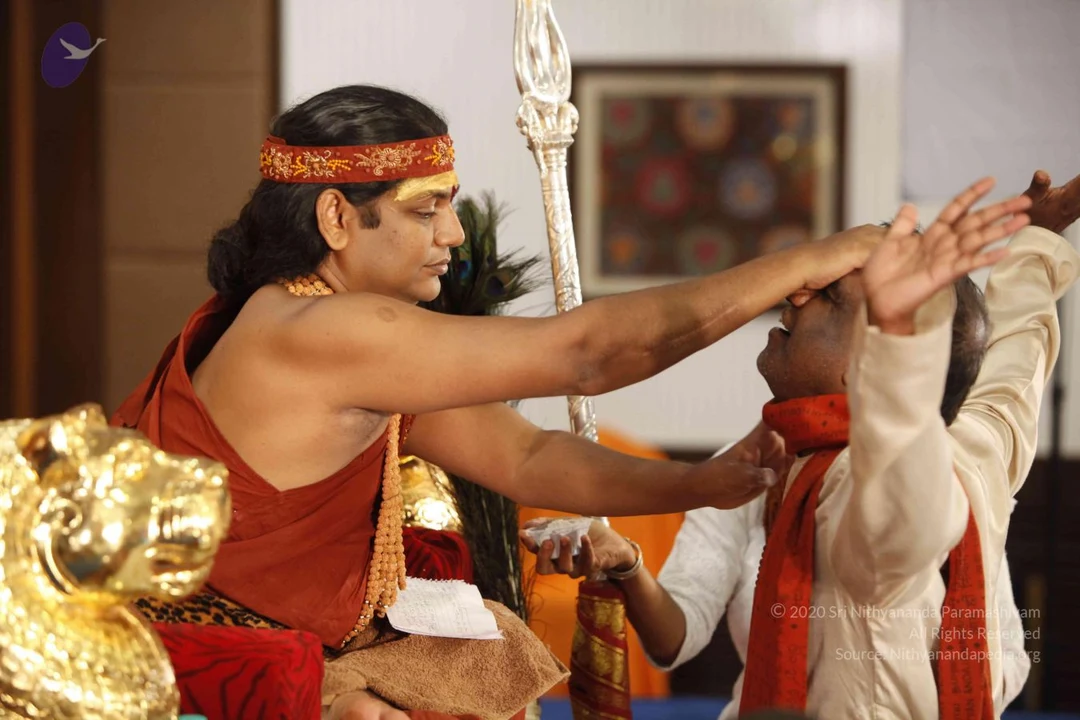
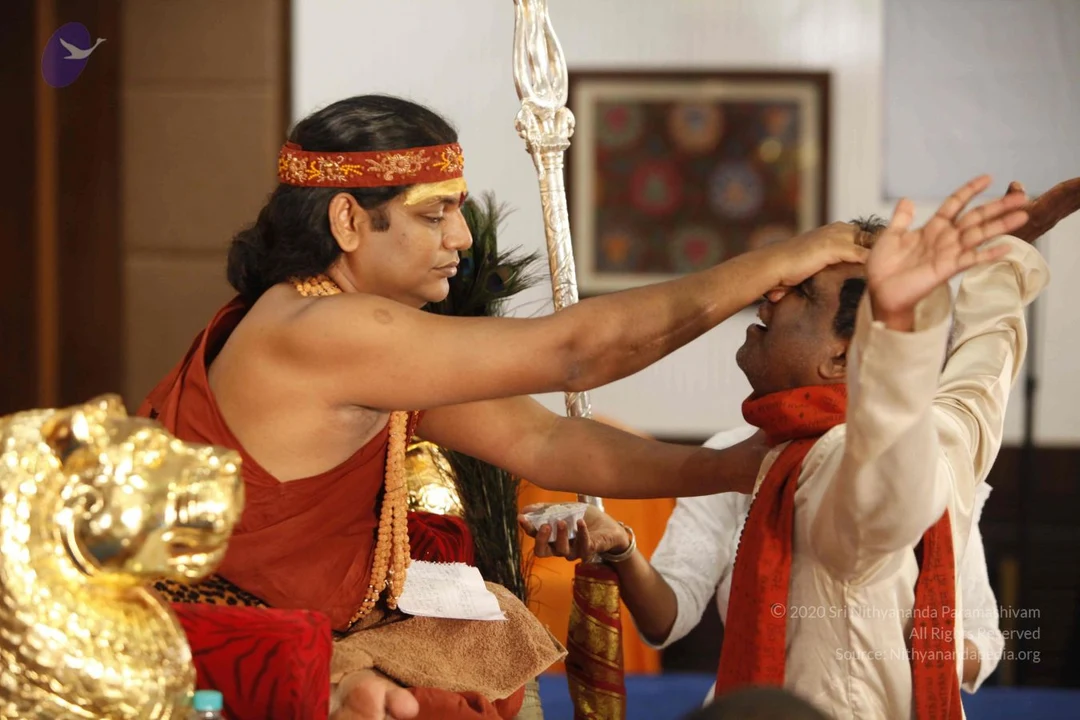
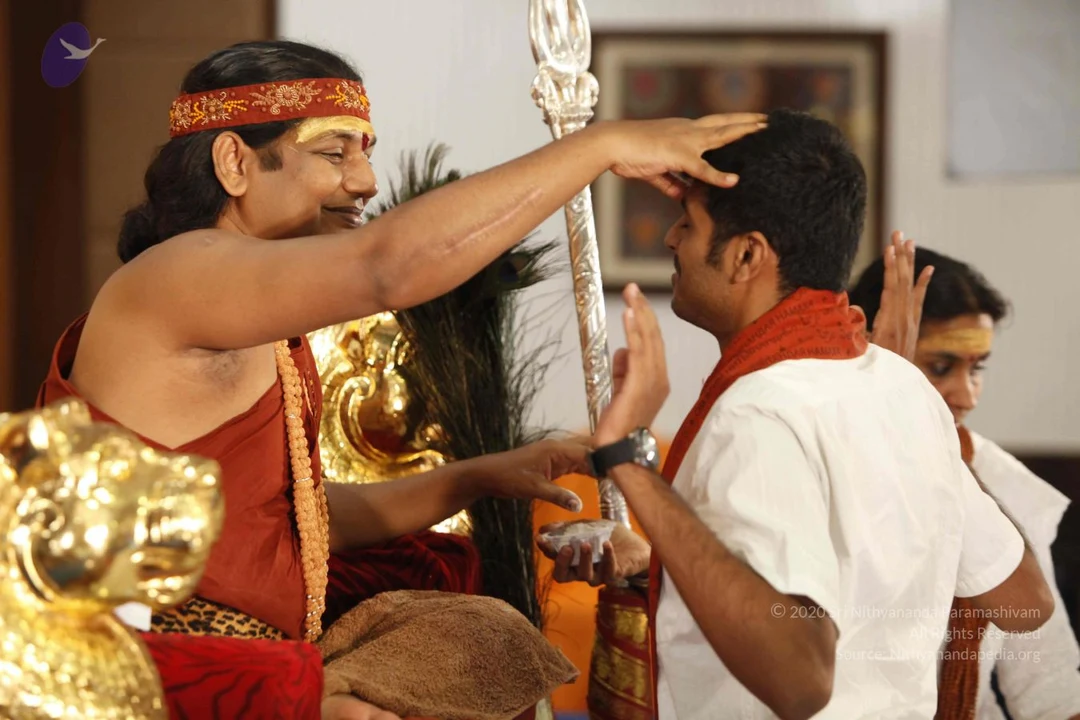
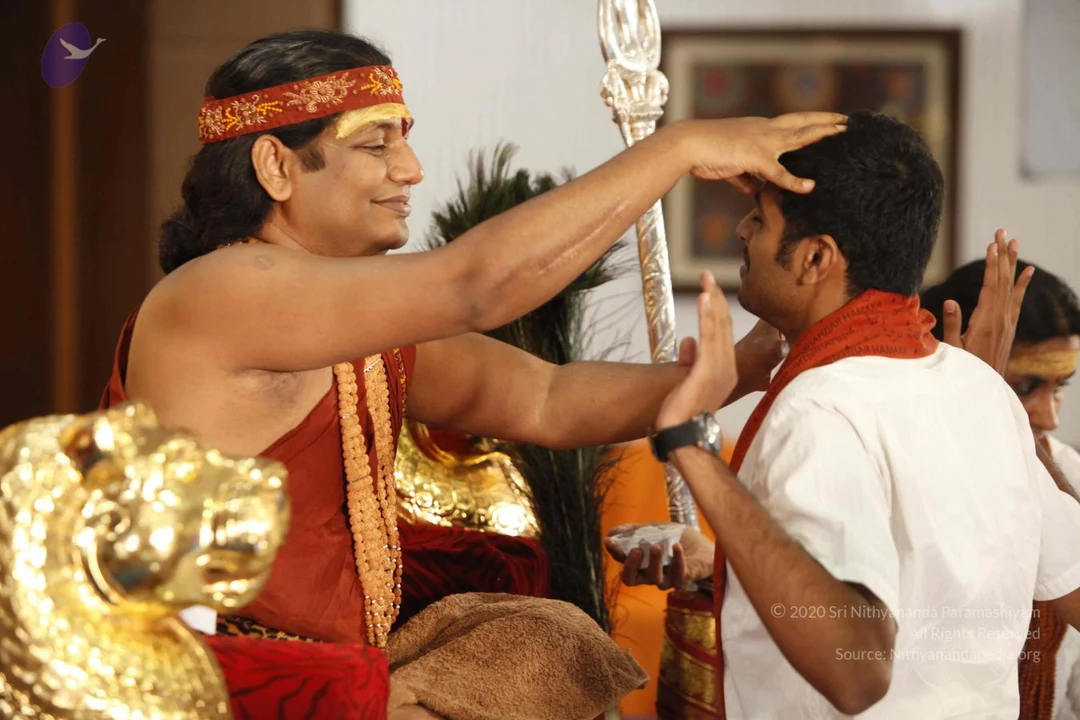
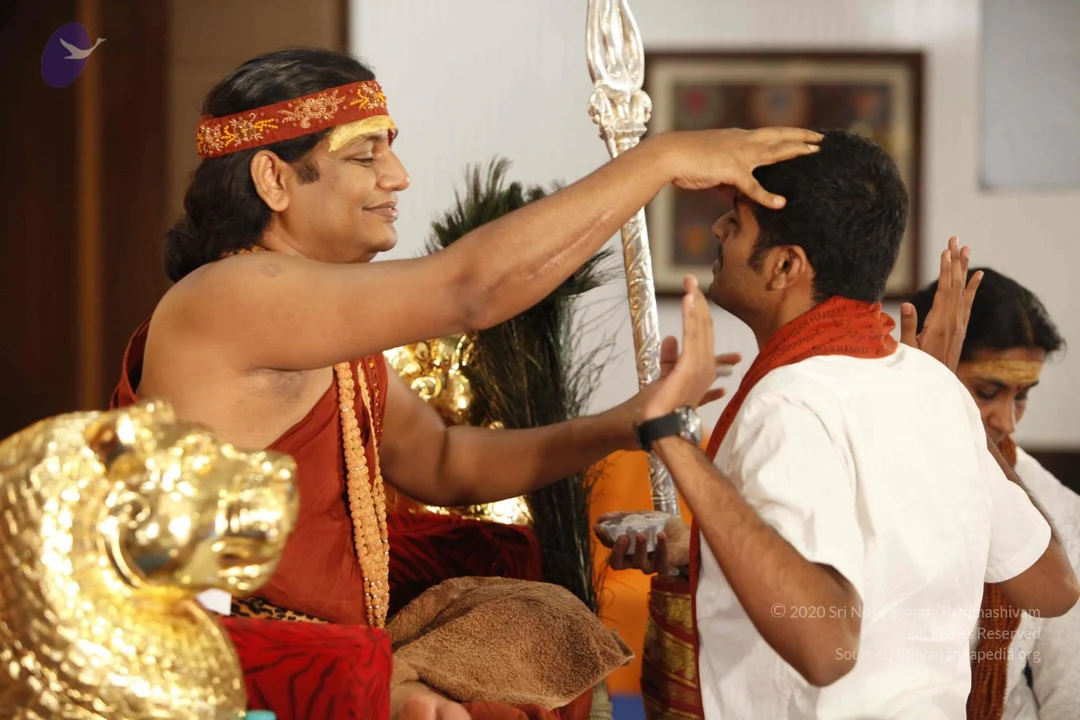
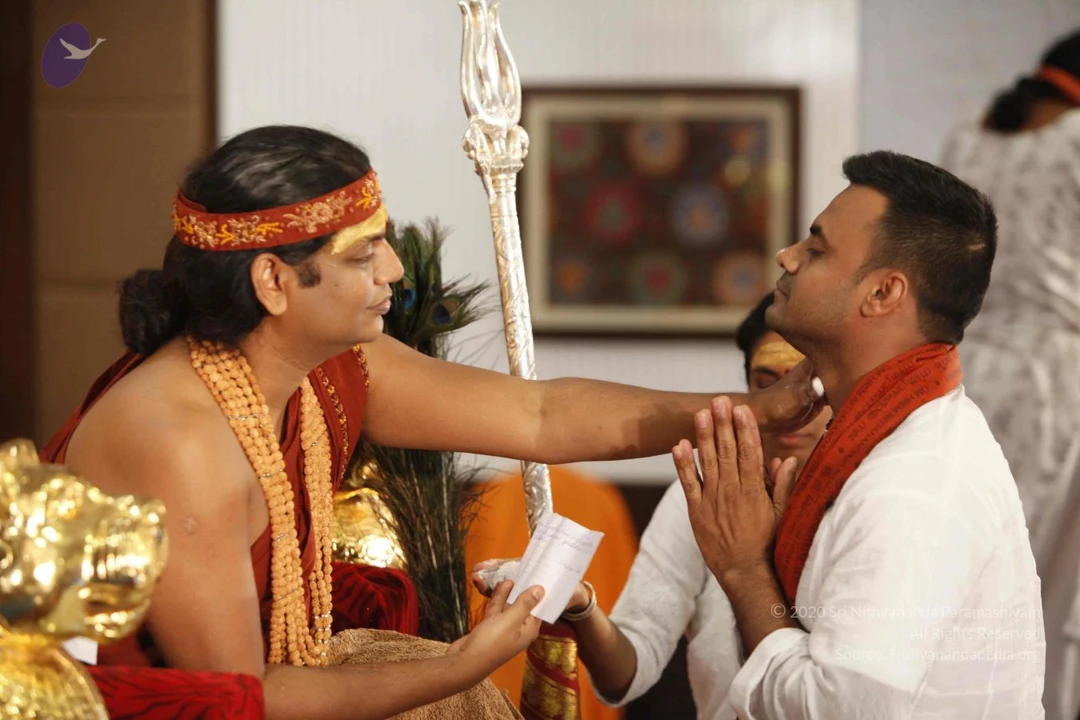
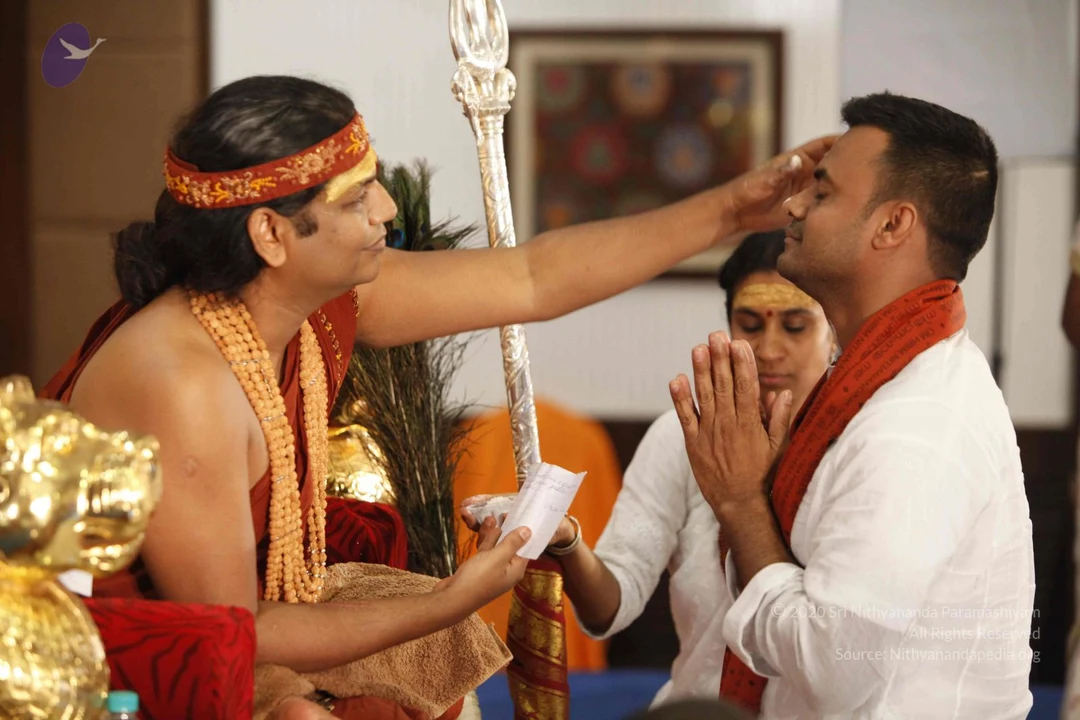
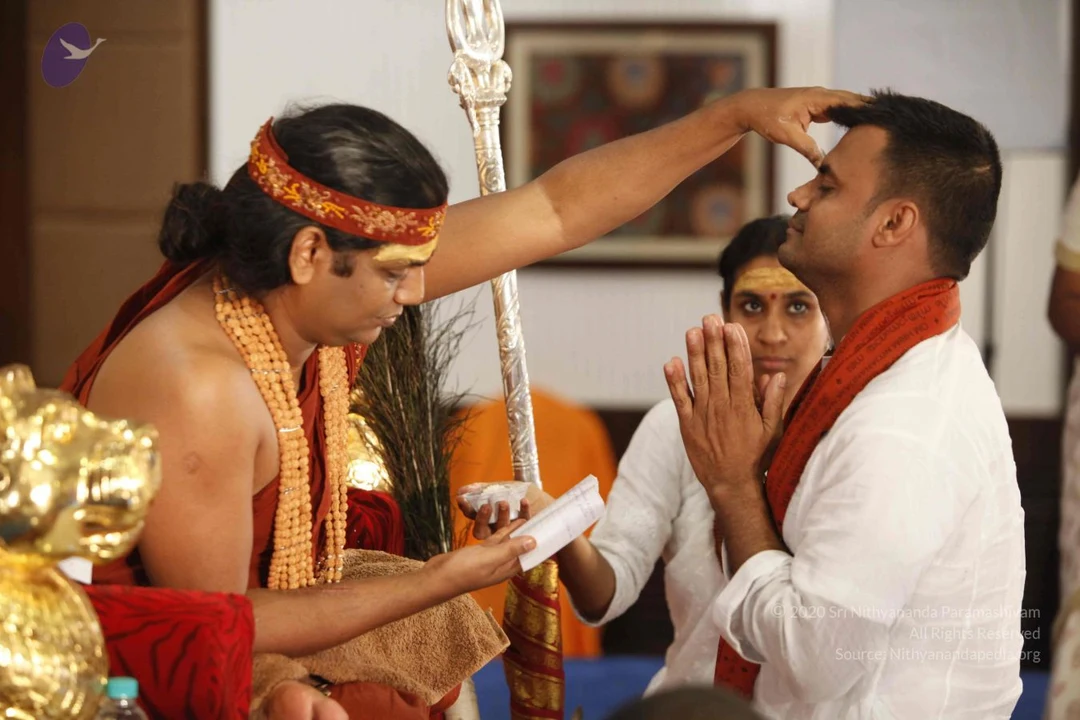
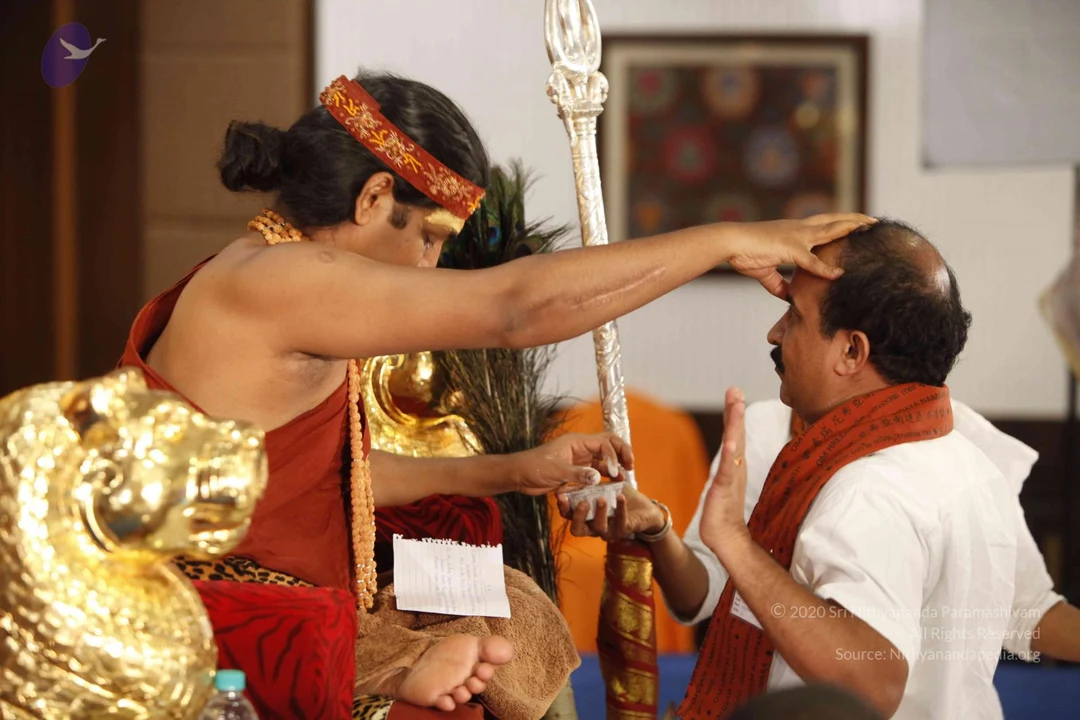
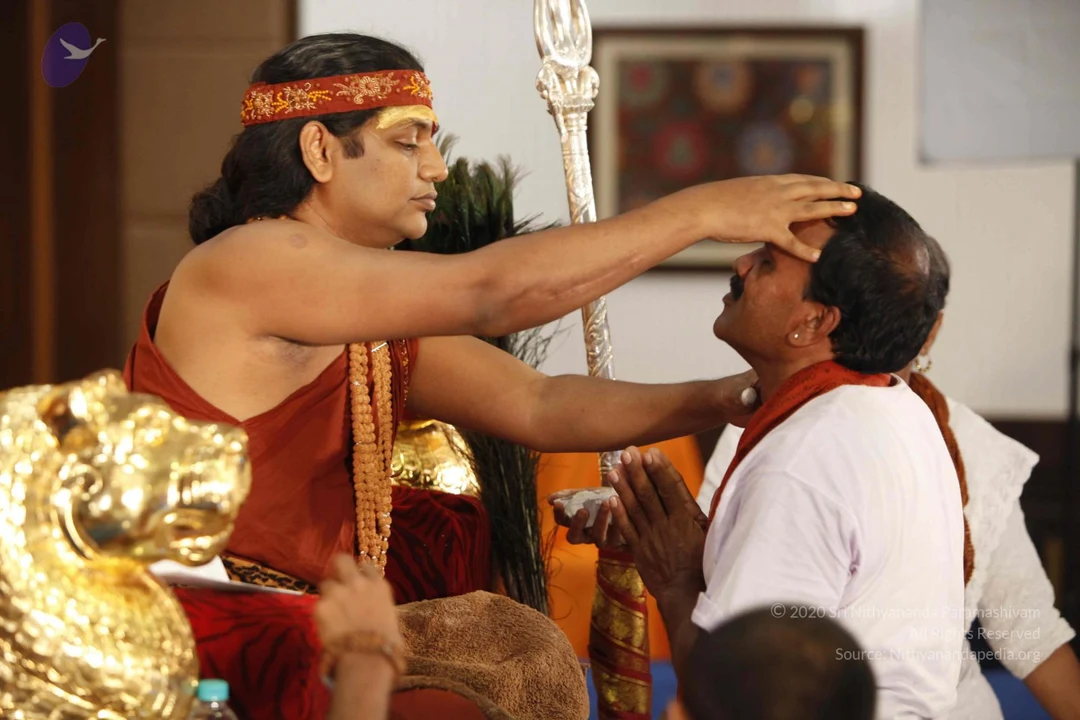
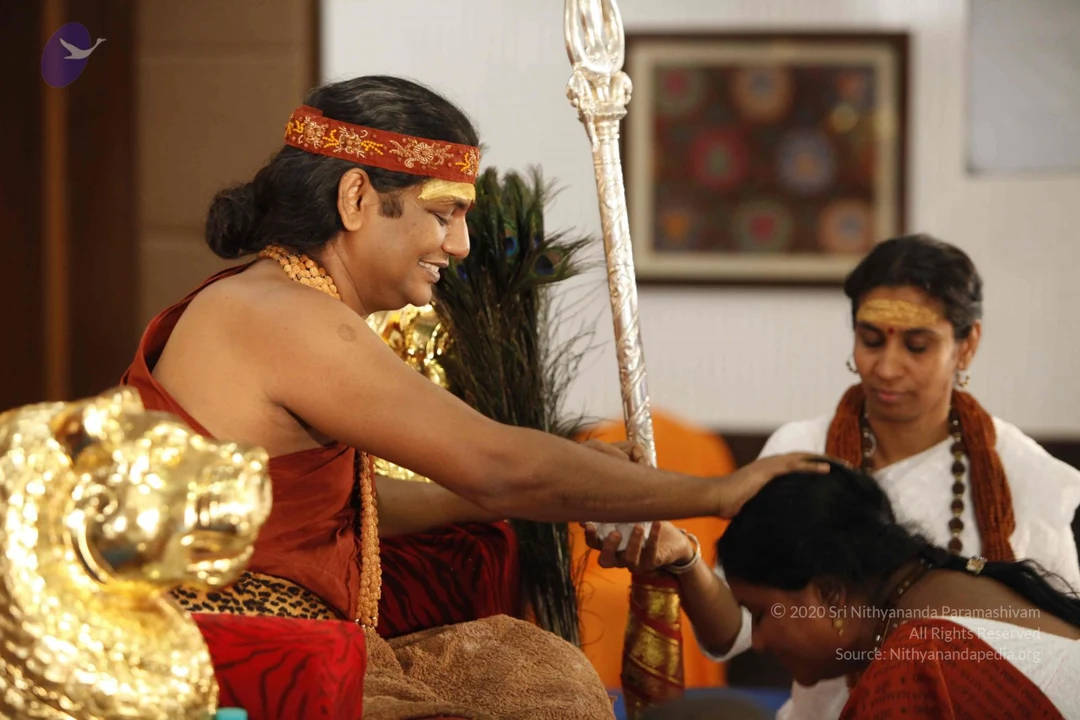
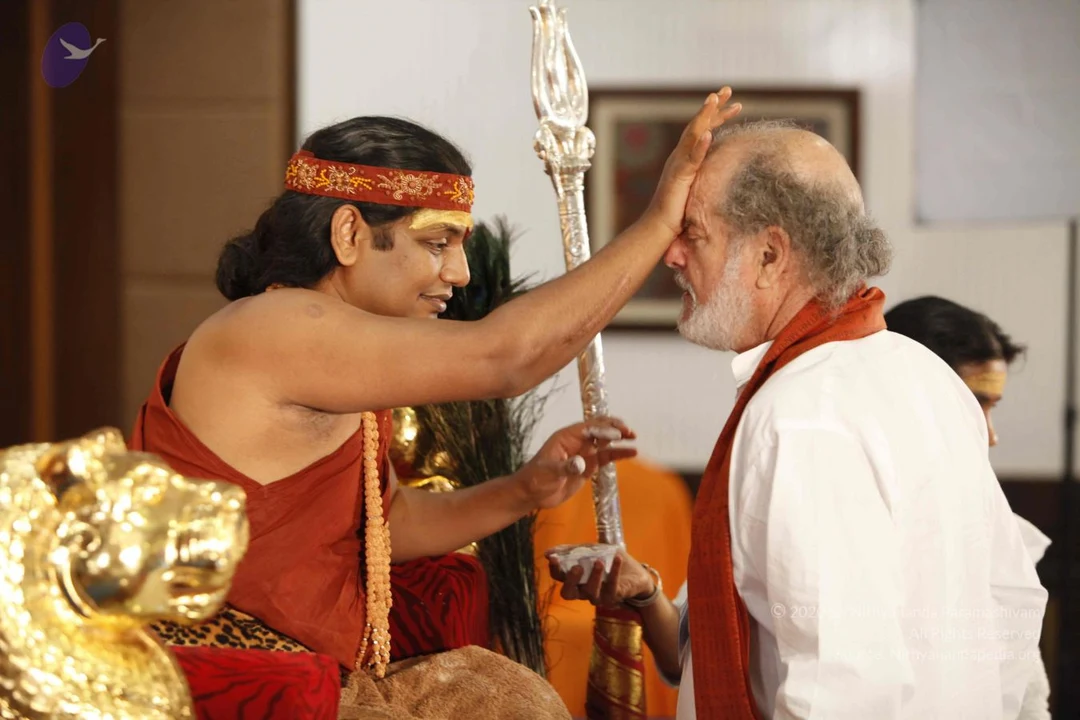
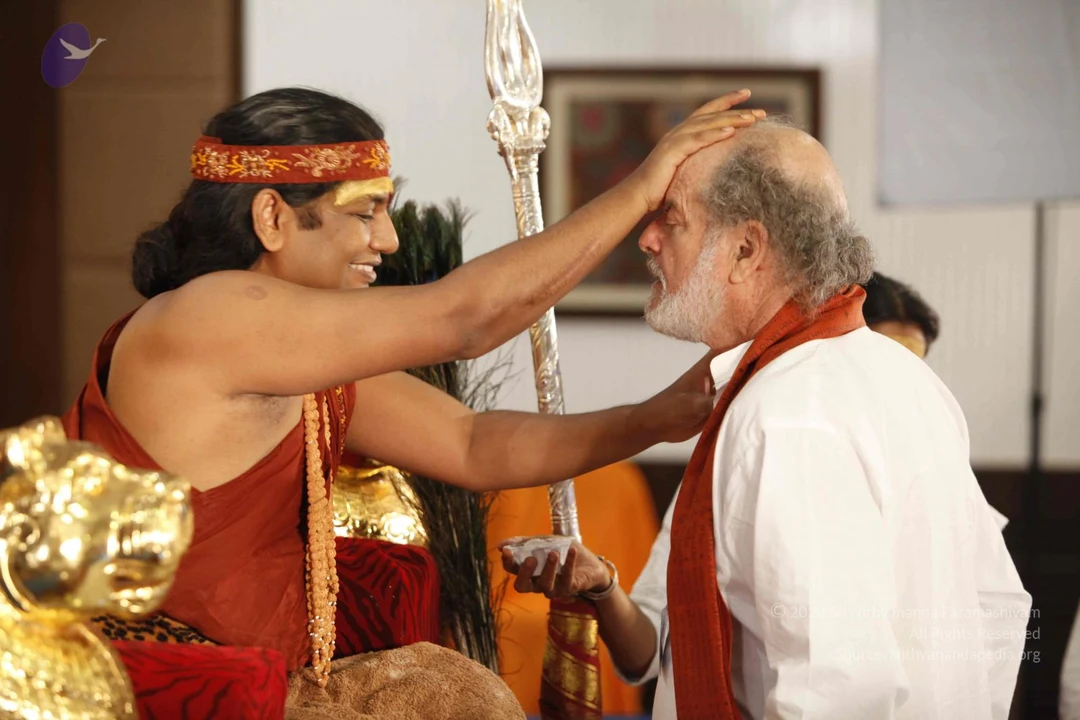
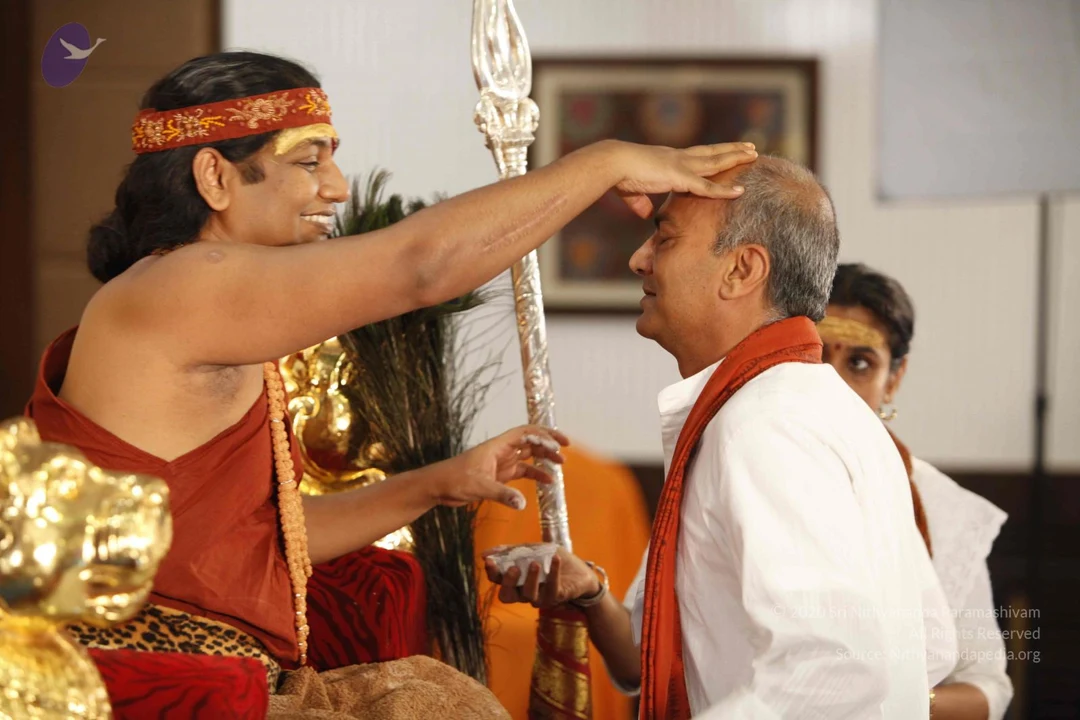
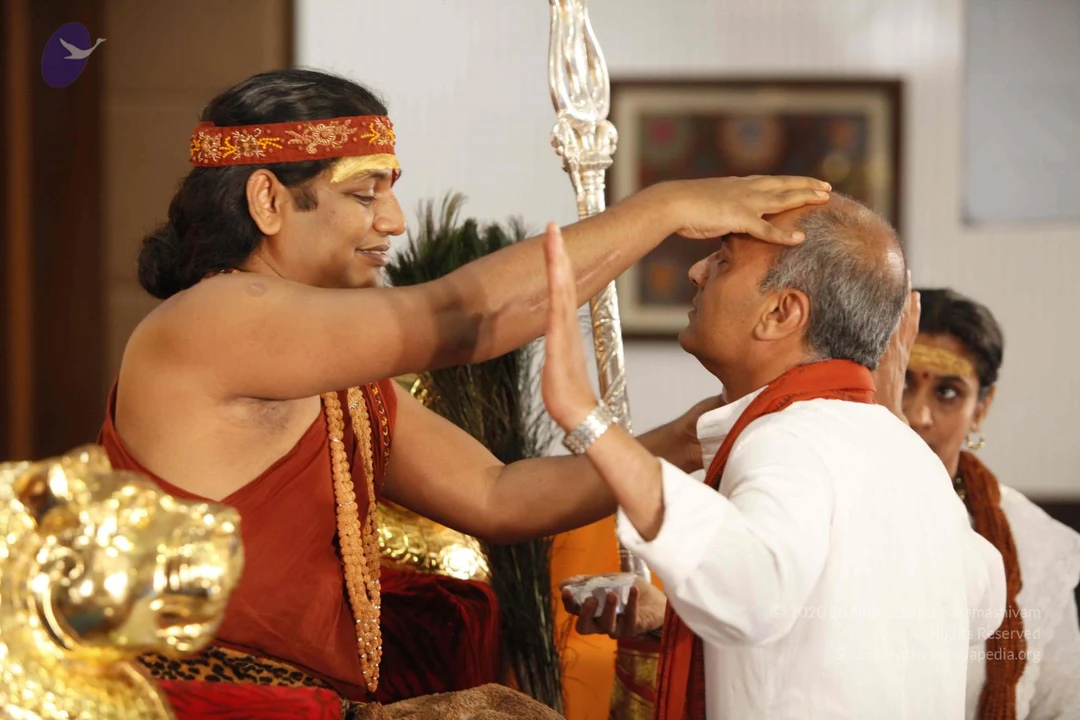
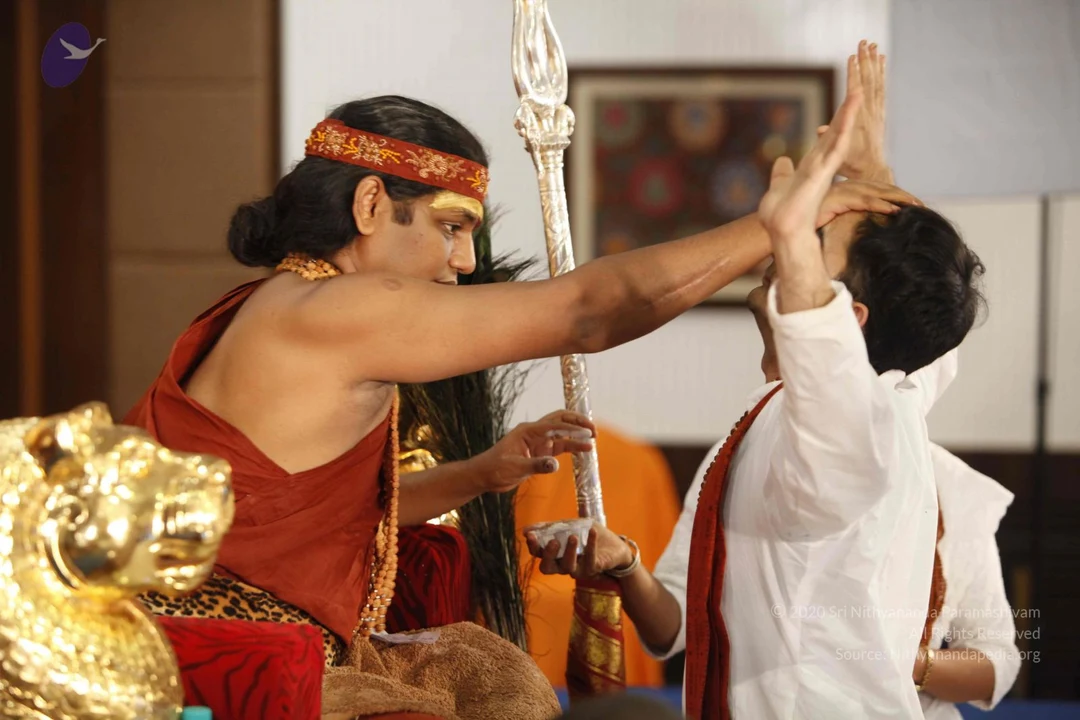
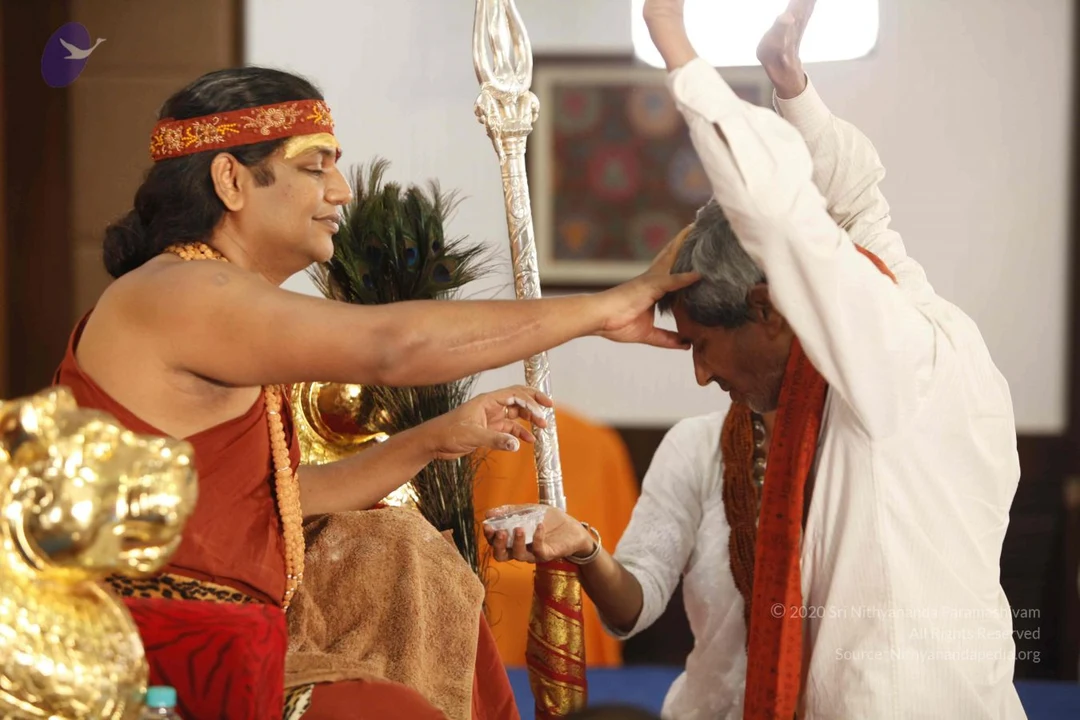
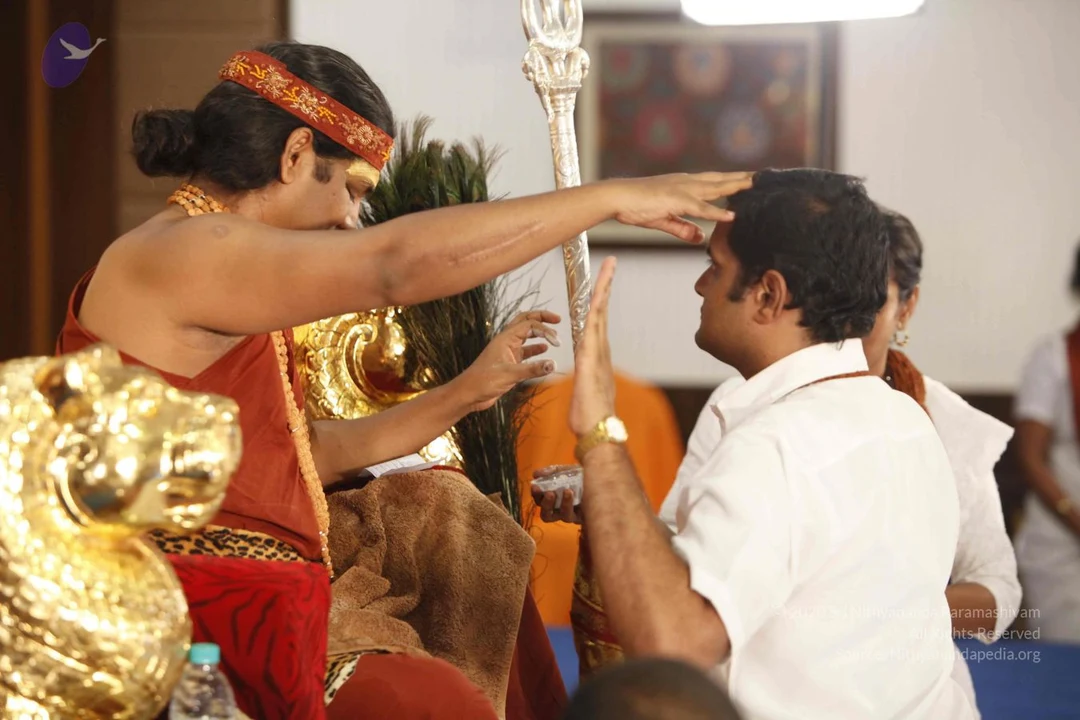
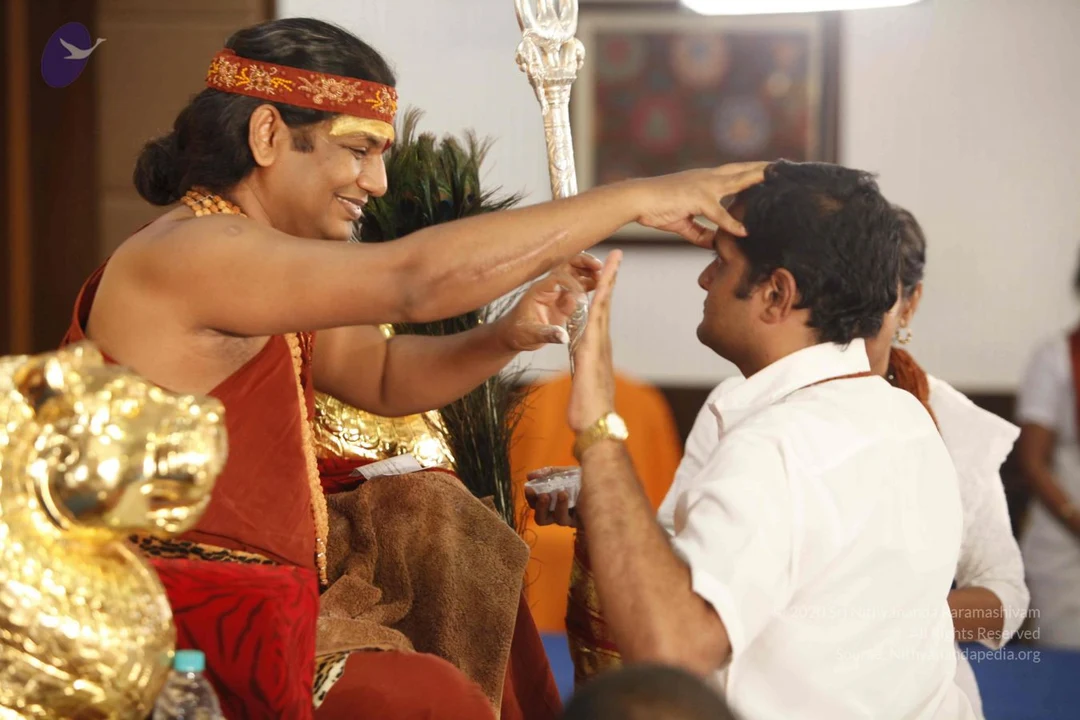
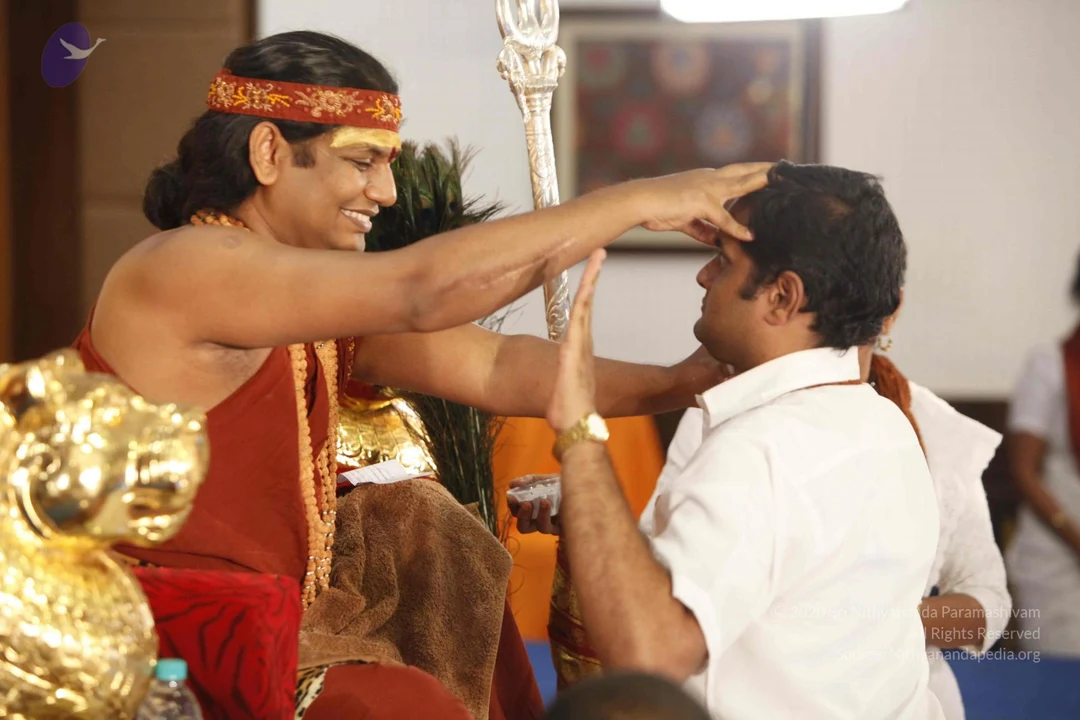
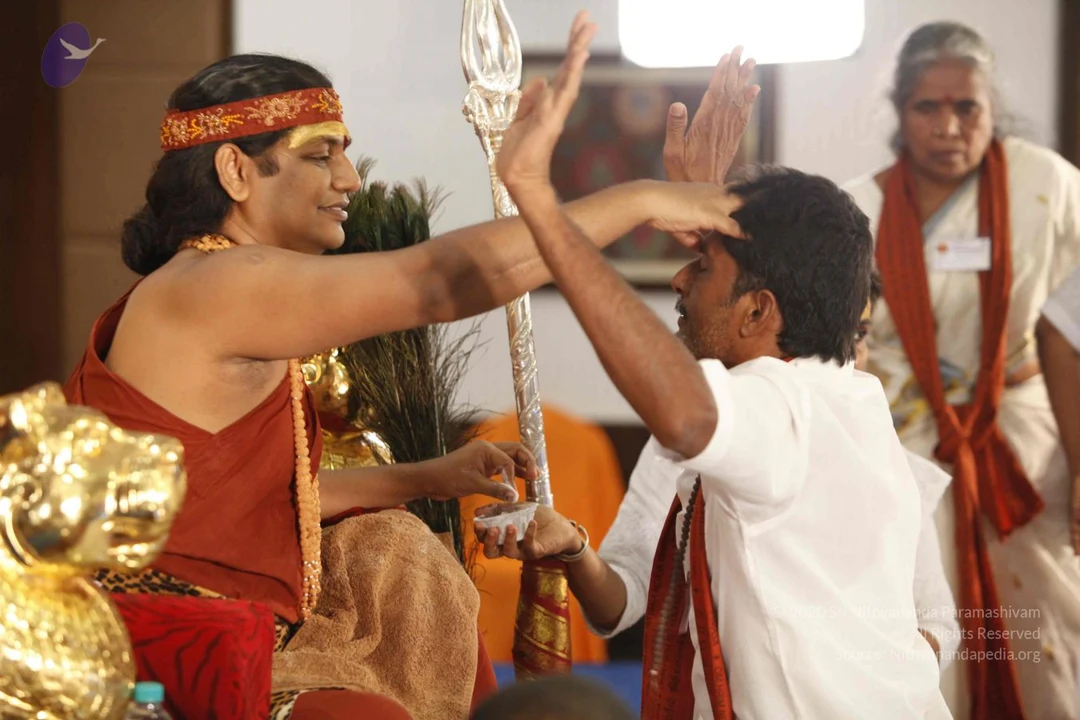
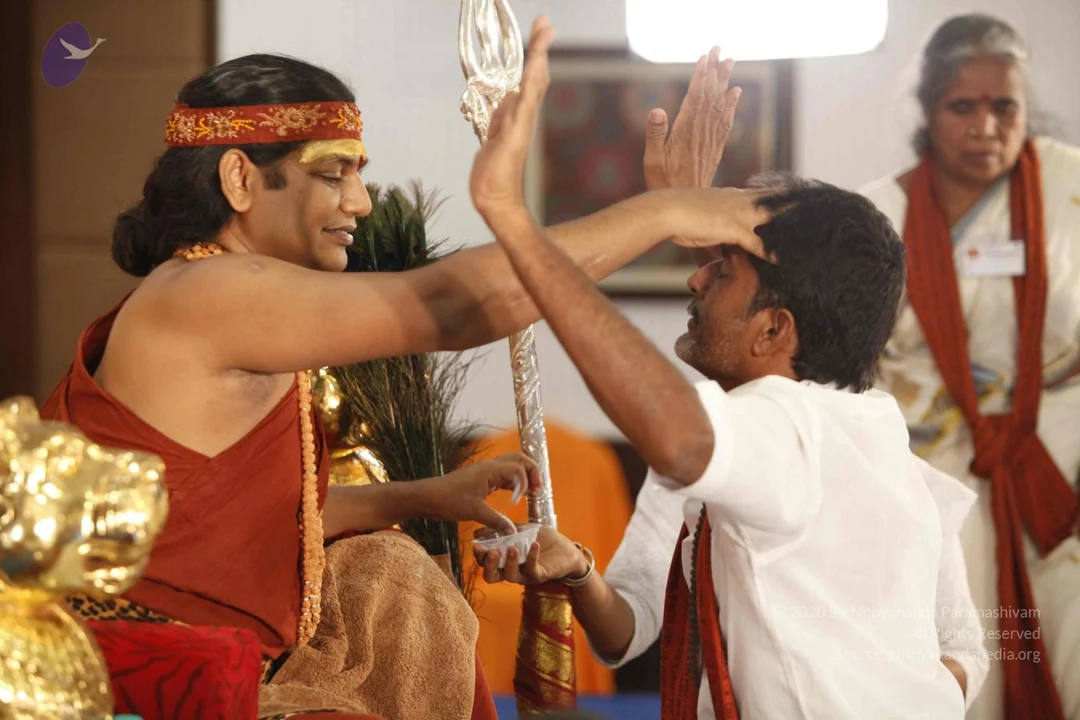
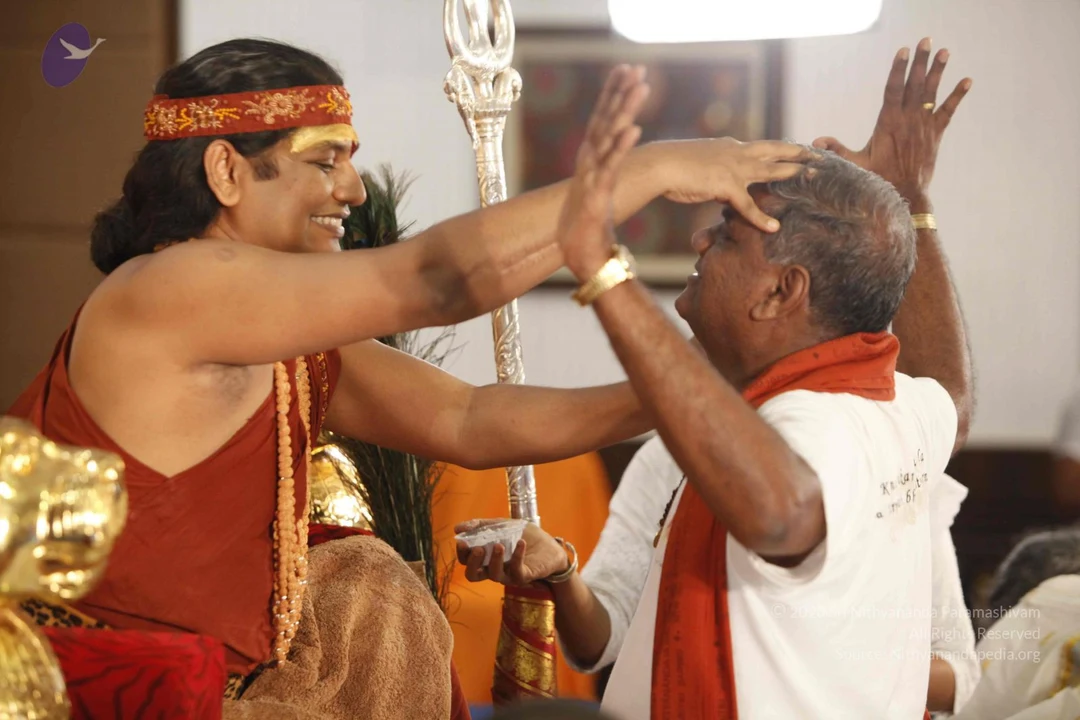
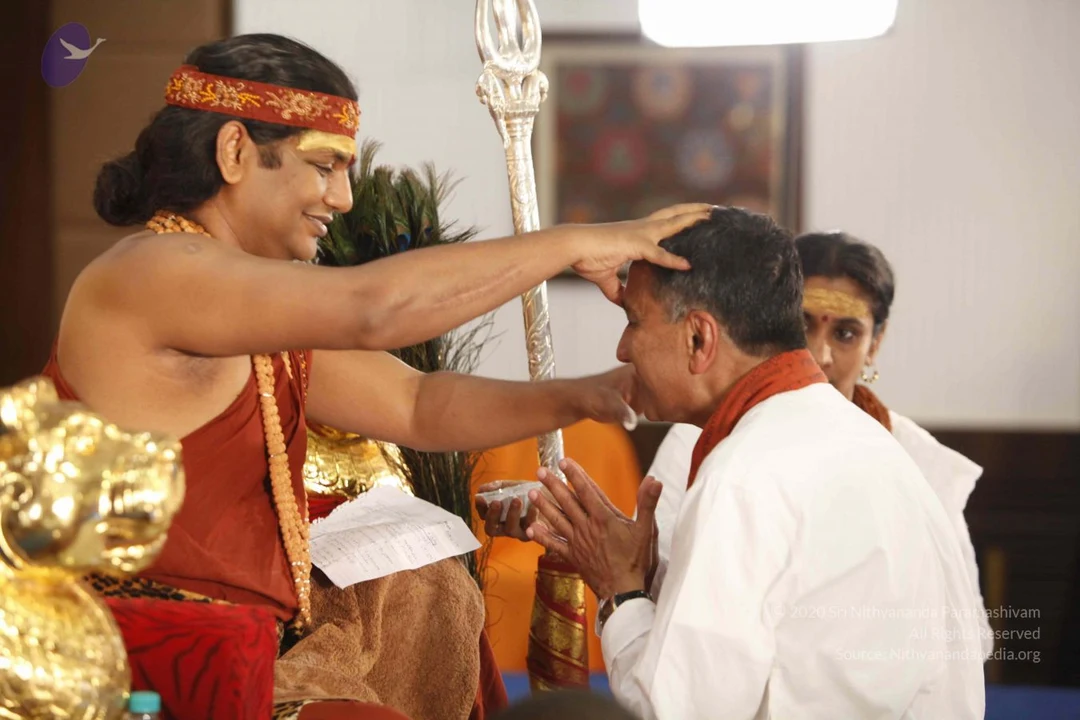
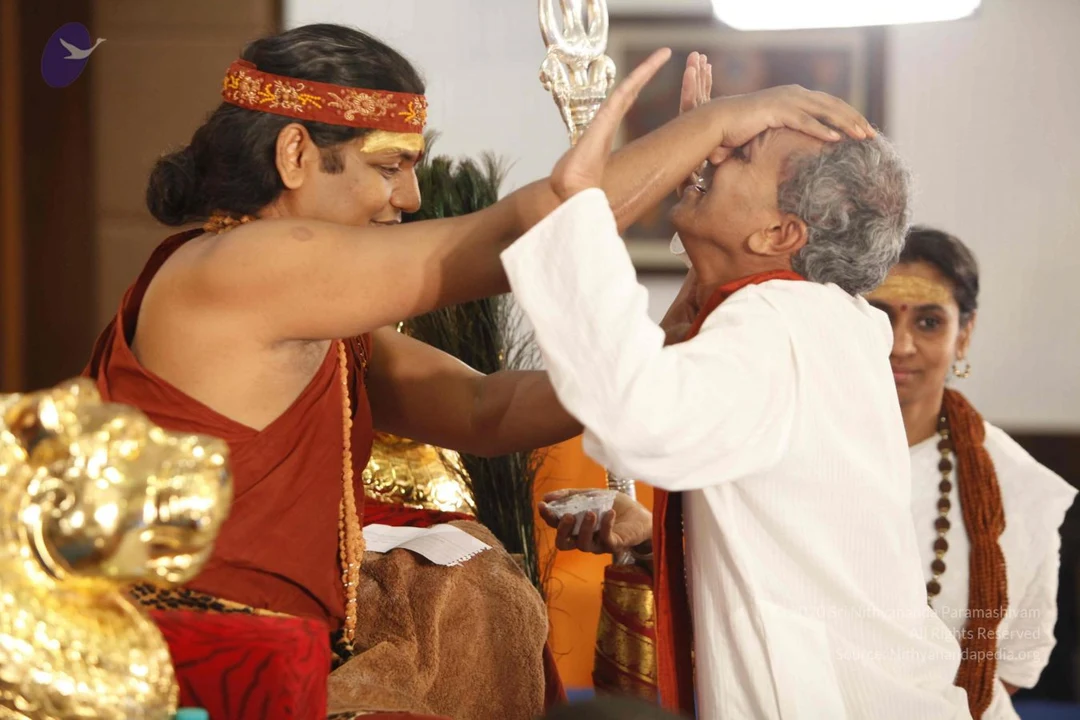
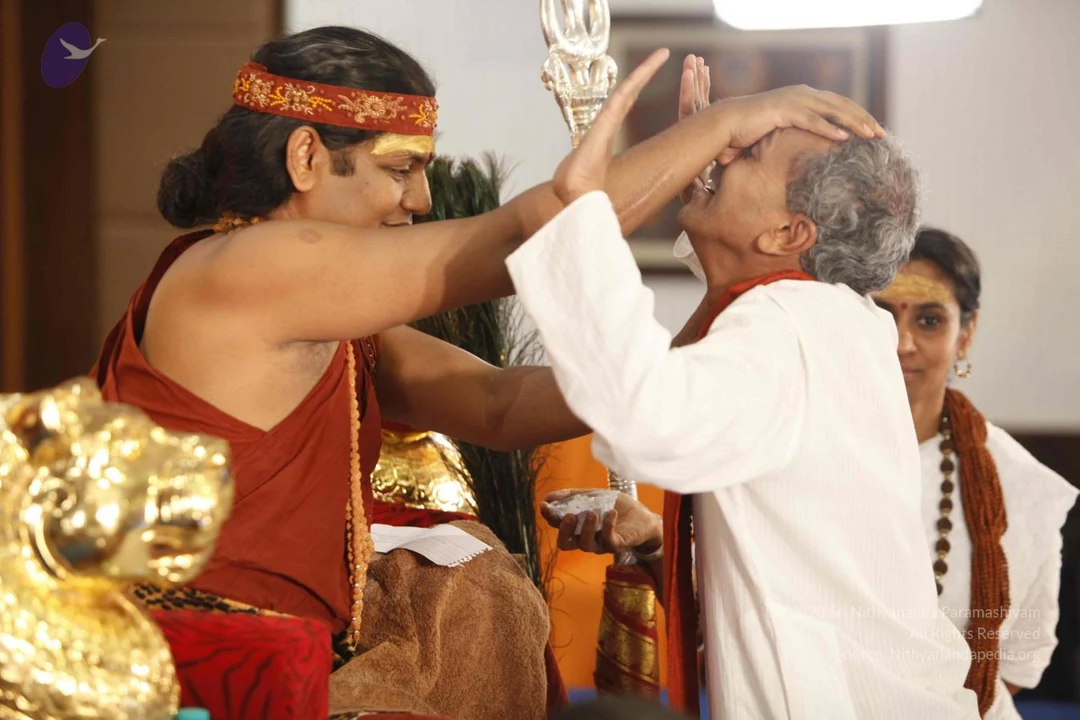
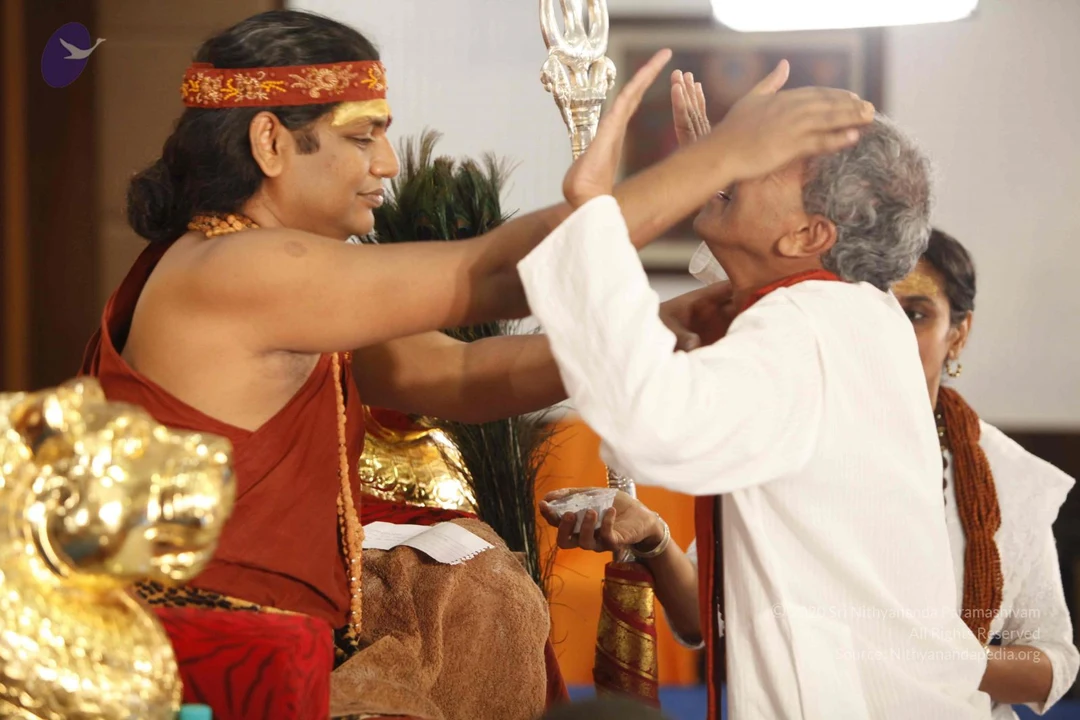
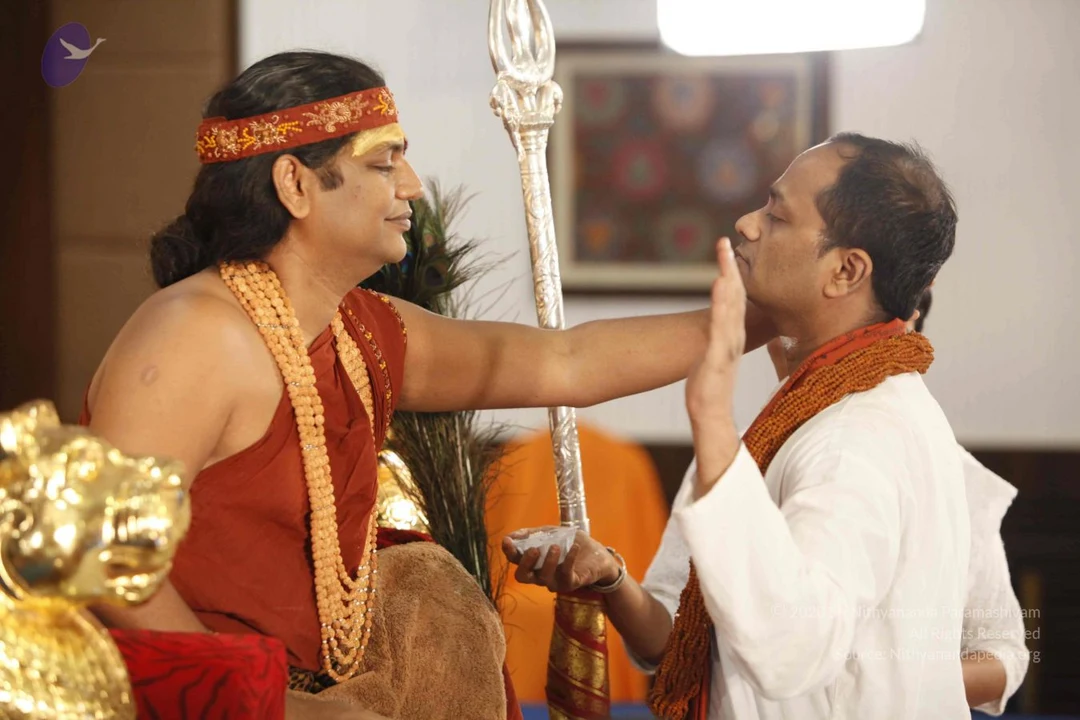
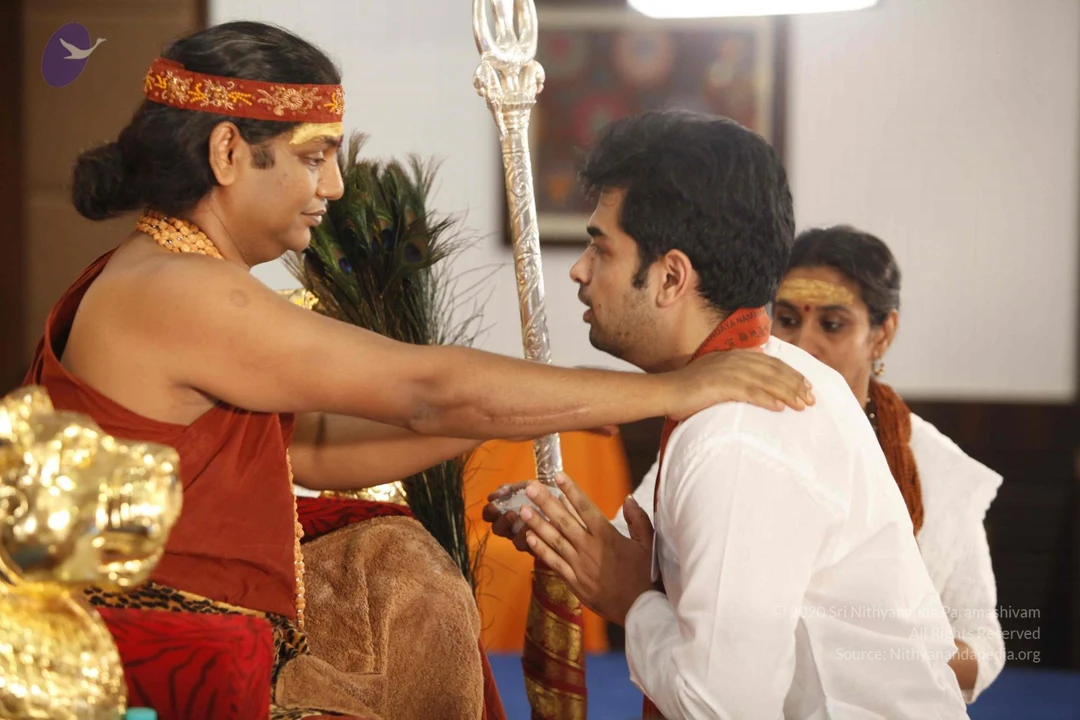
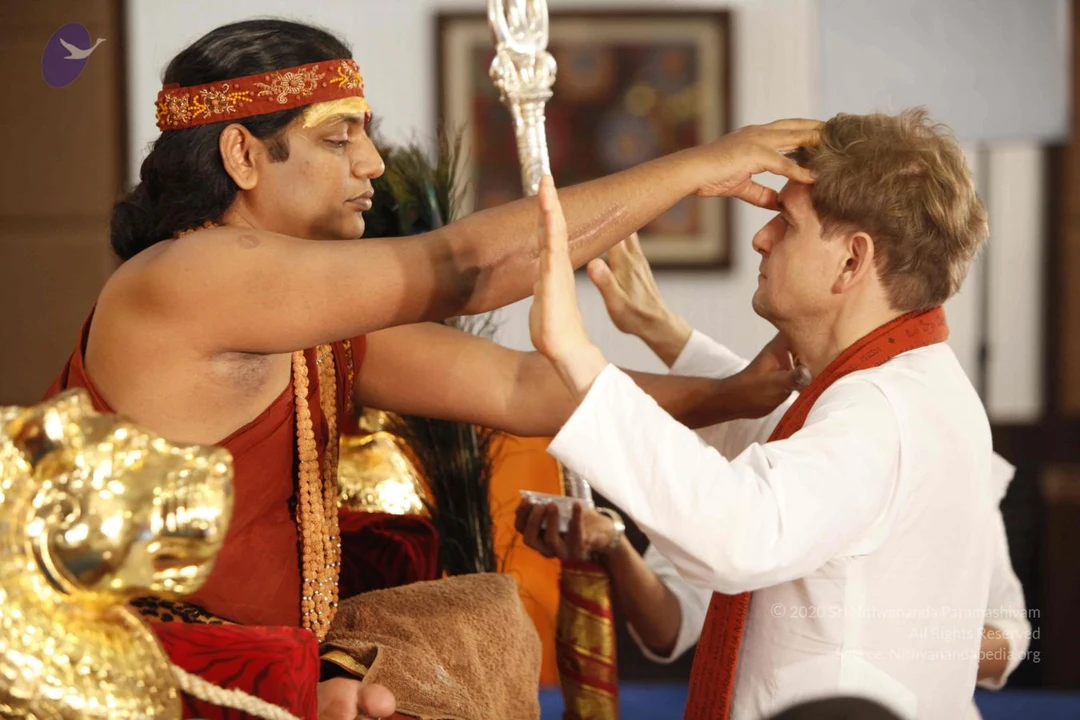
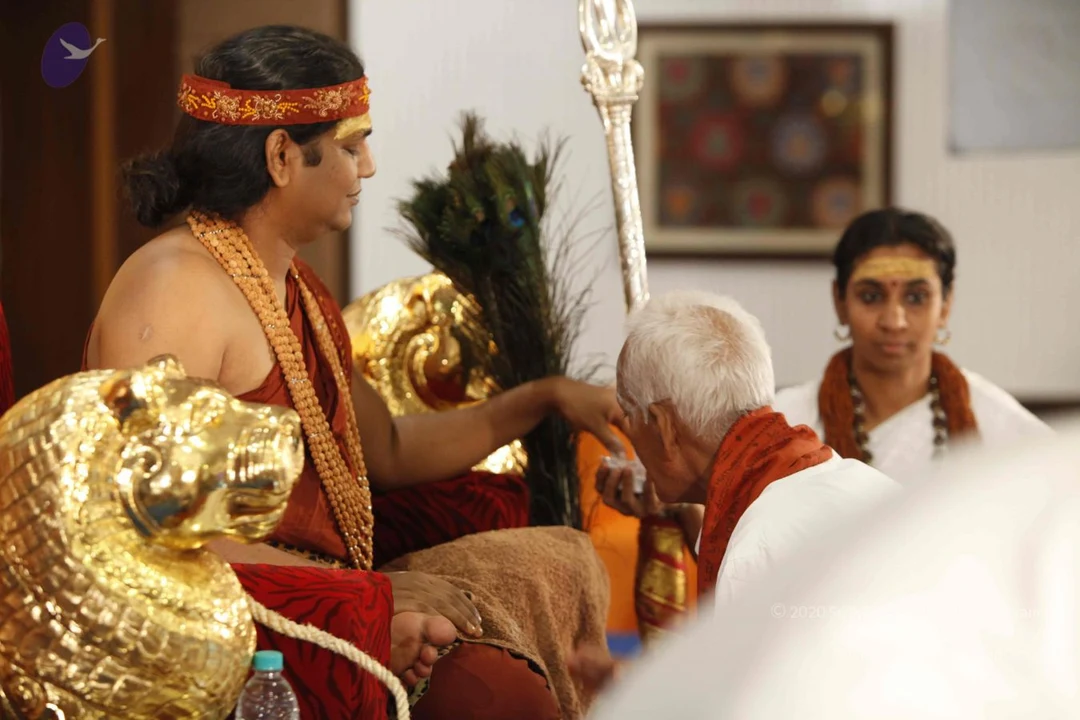
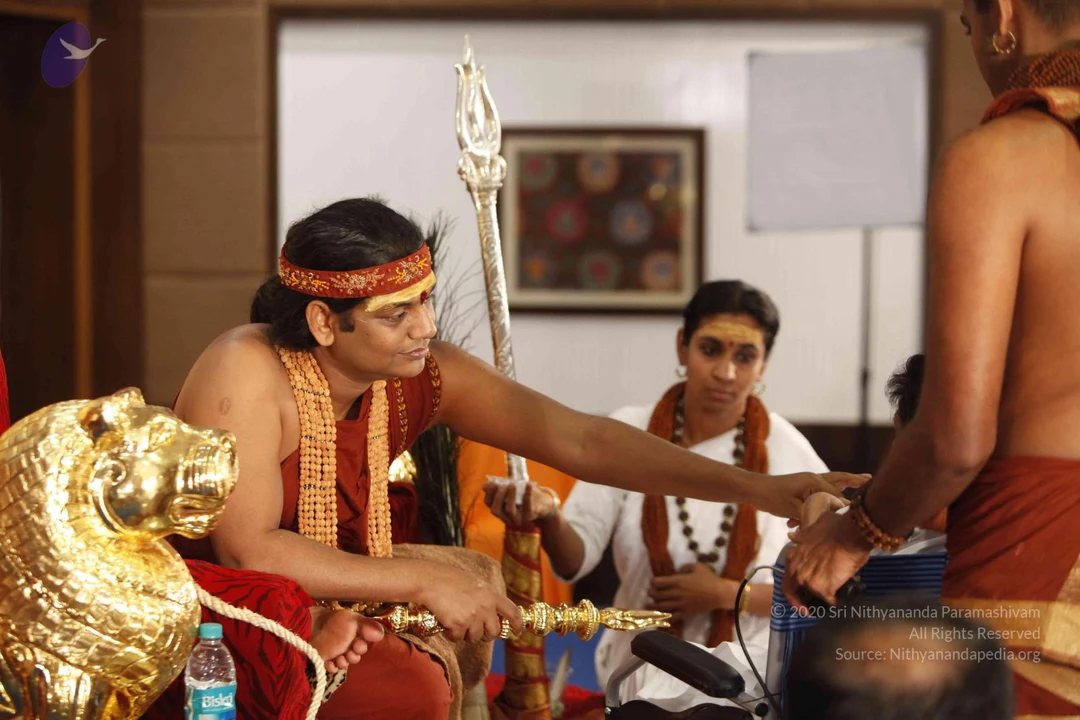
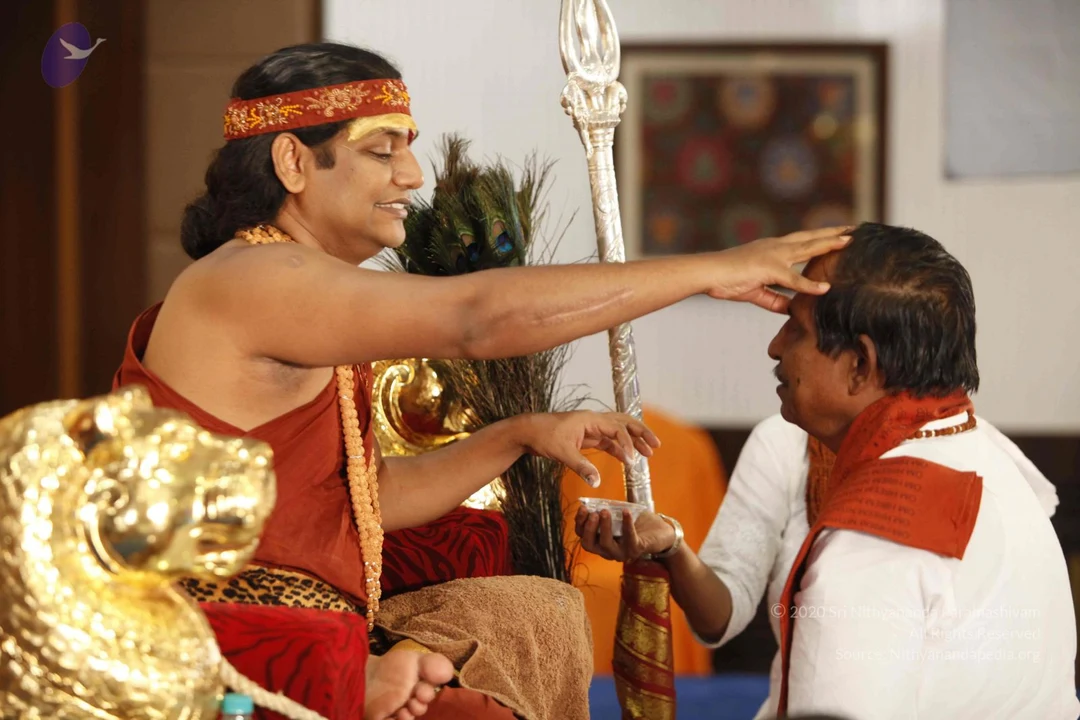
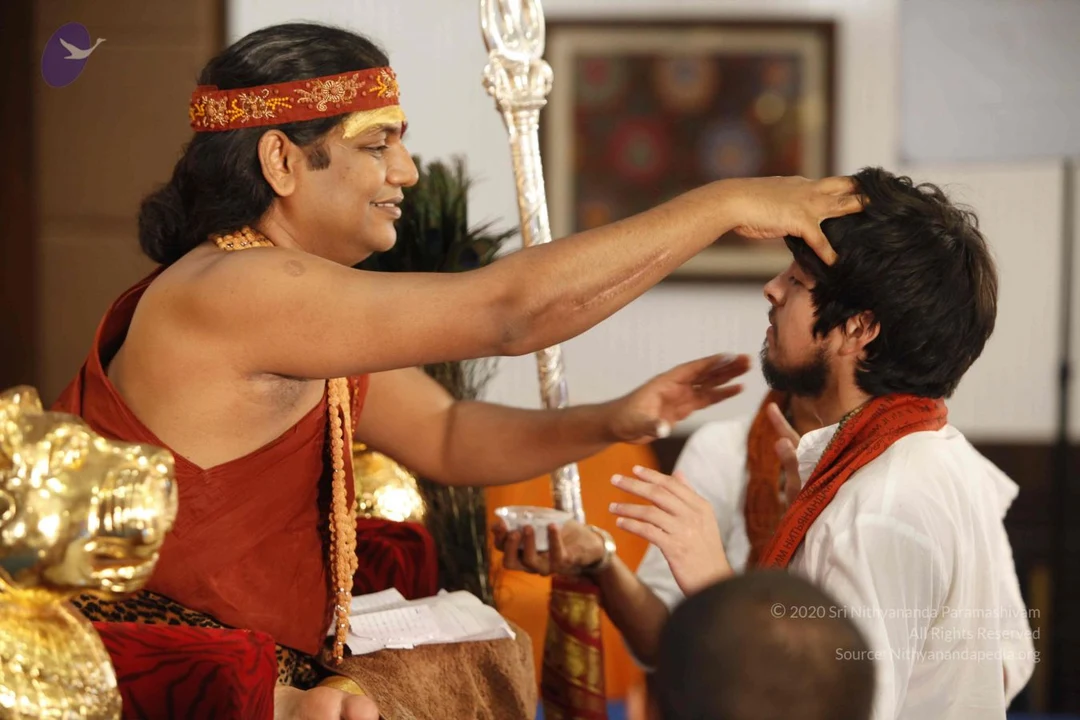
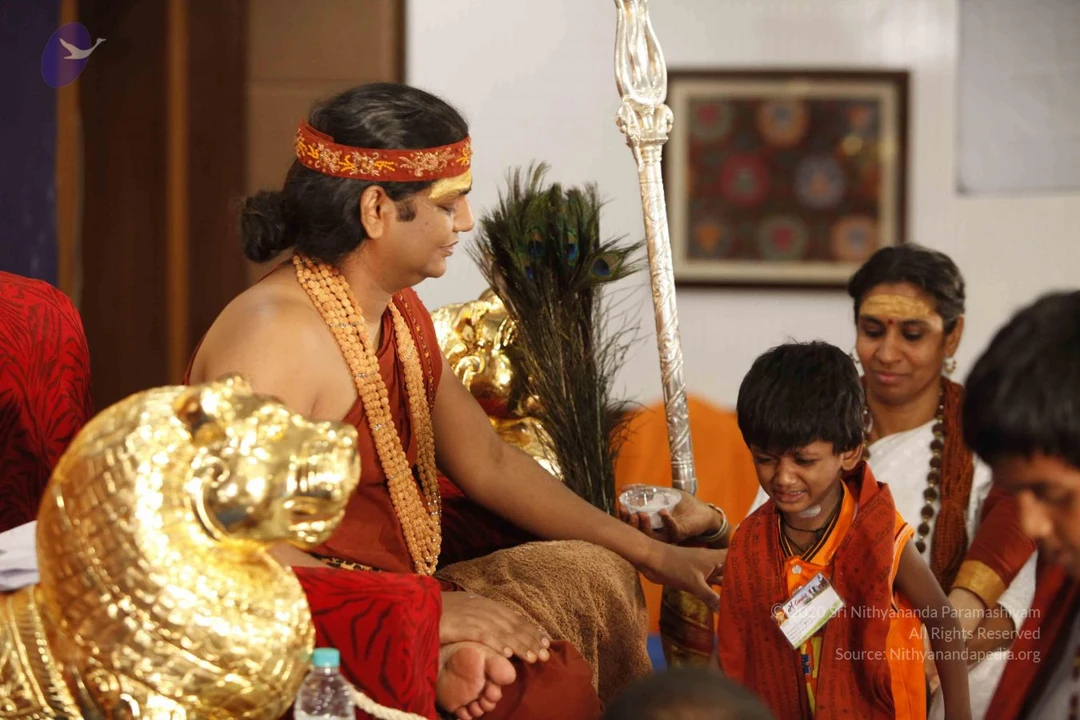
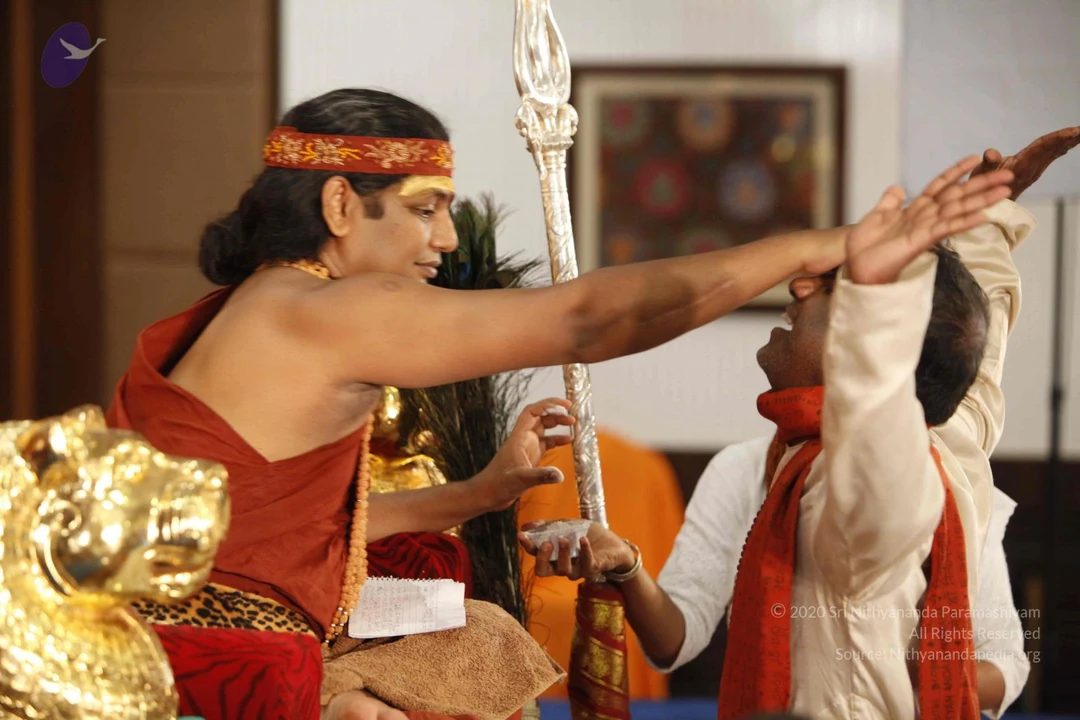
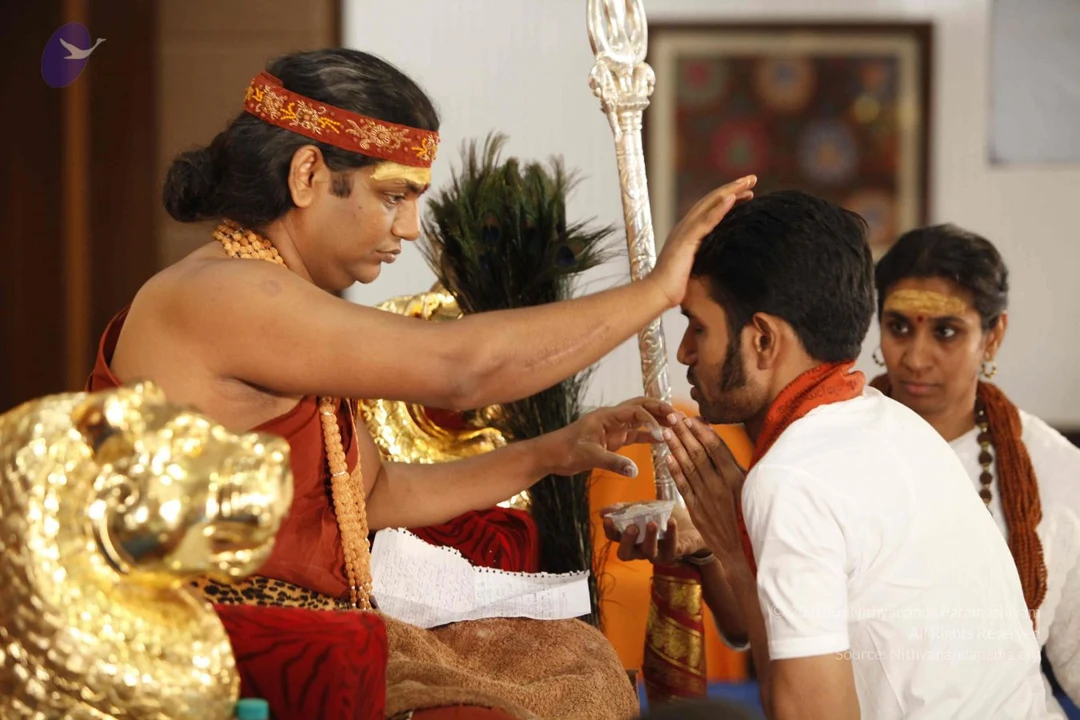
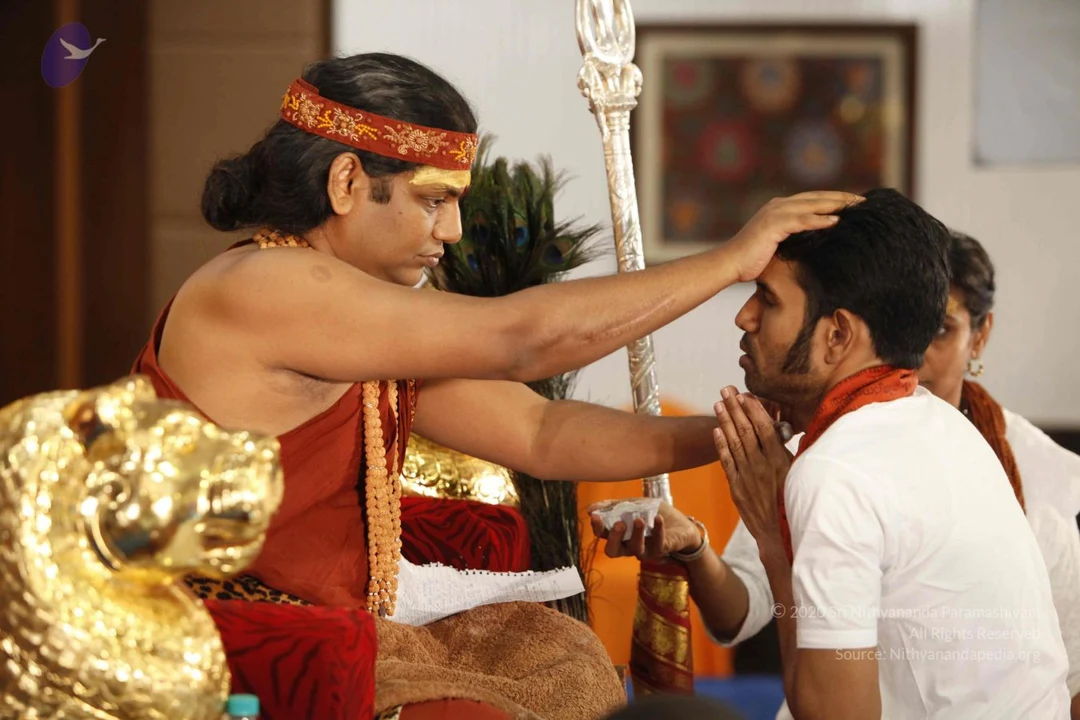
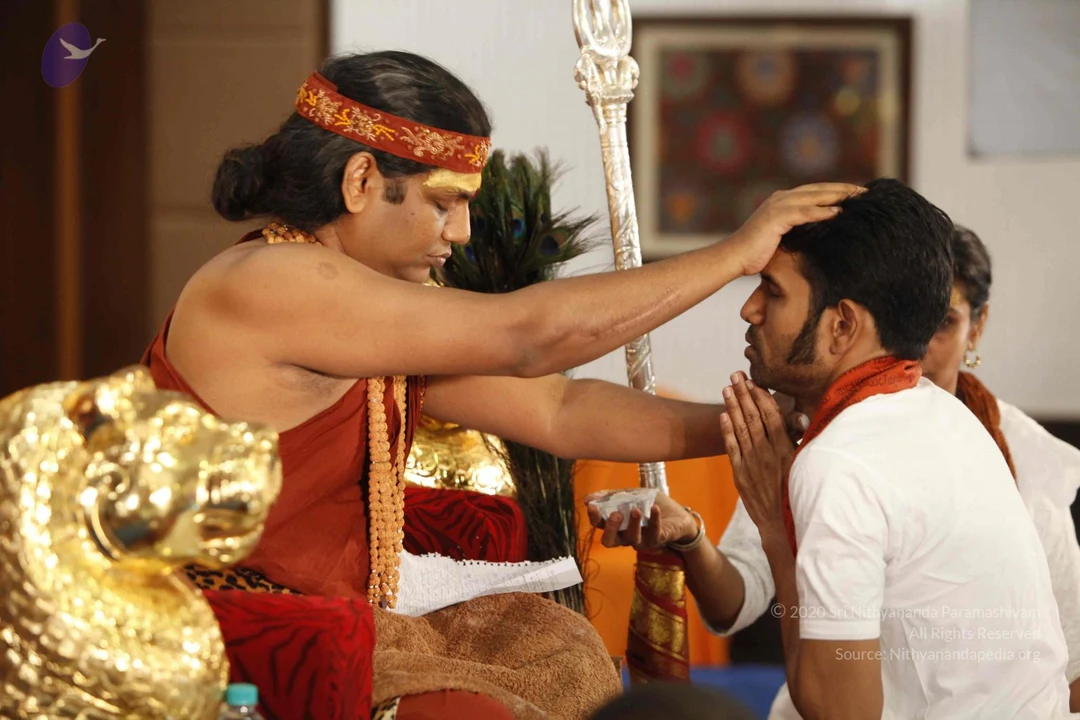
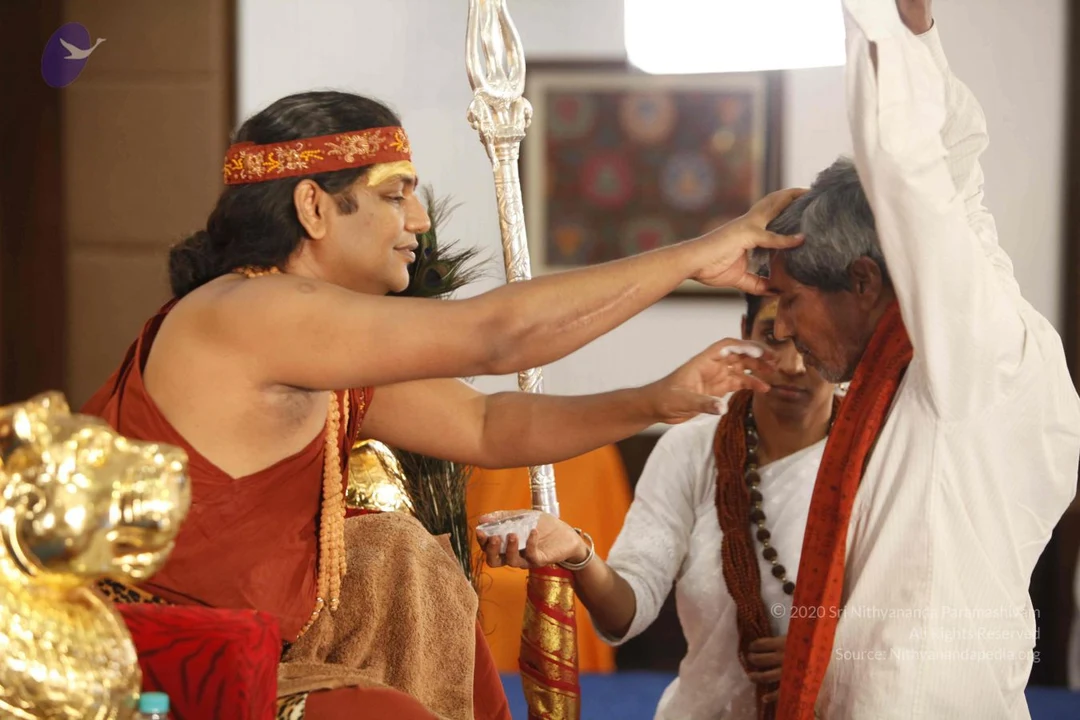
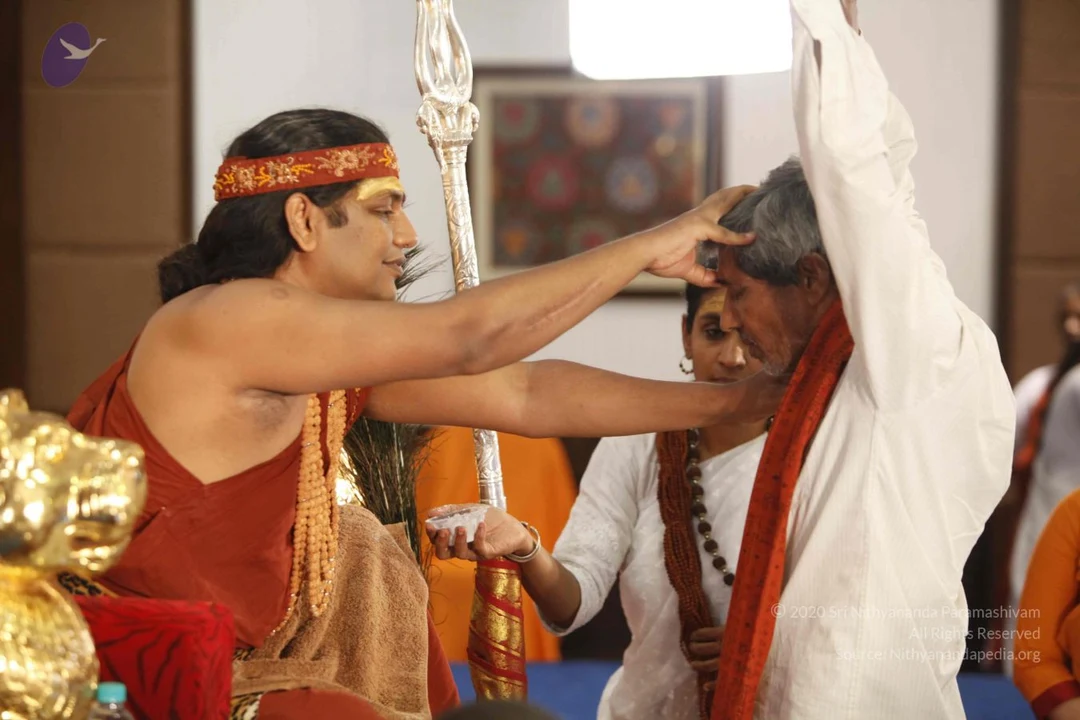
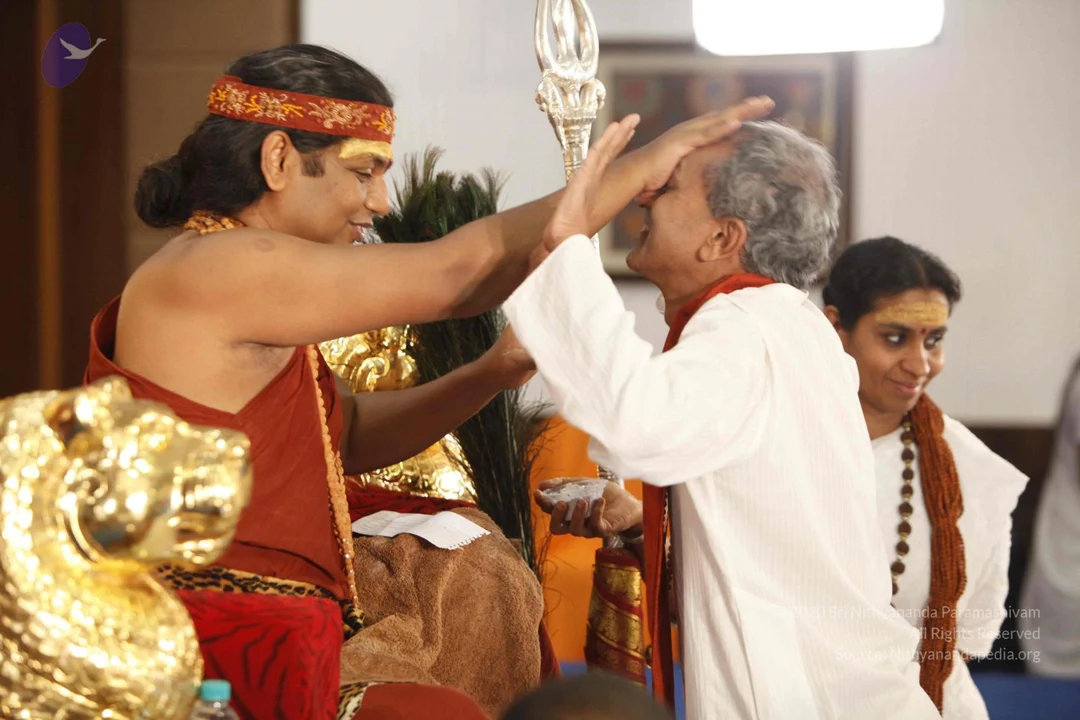
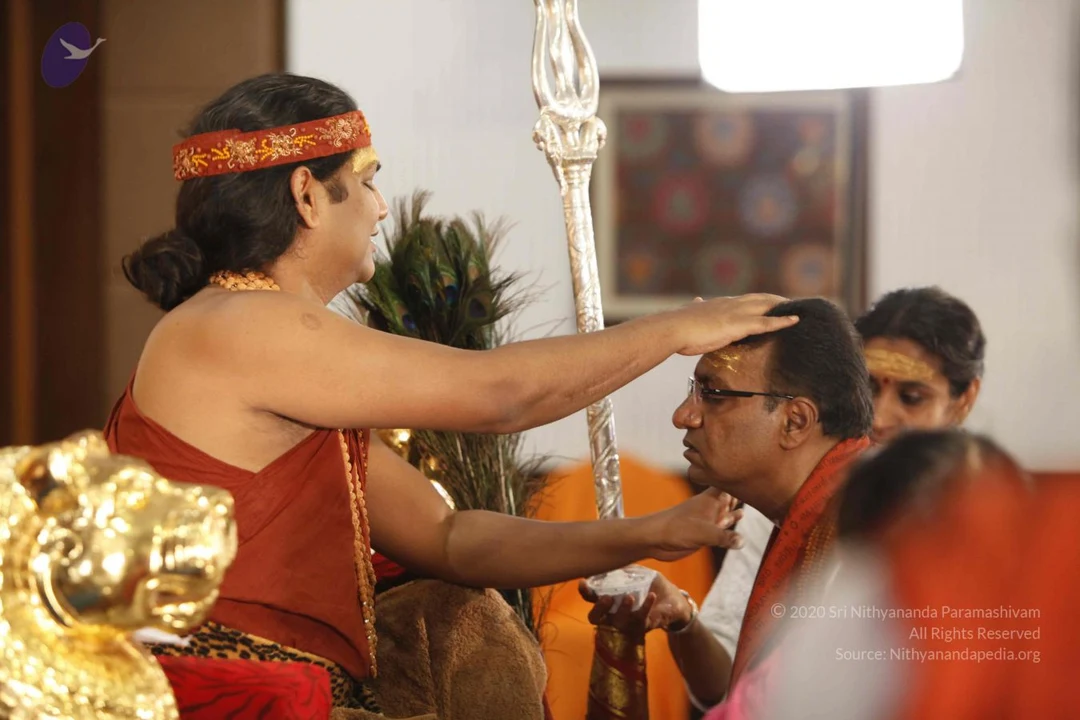
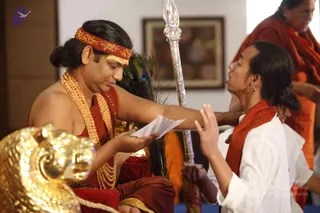
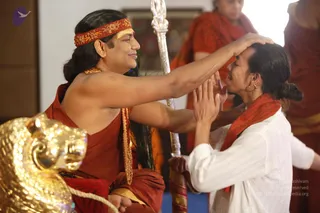
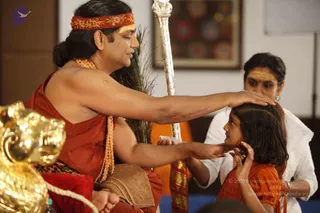
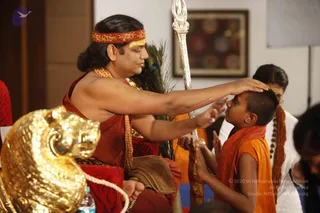
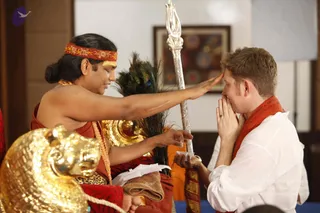
A photograph of a balding, white-bearded man in a plain white shirt and red shawl printed with mantra text, seated with palms pressed together in anjali, a red tilak on his forehead, a silver bangle and rudraksha mala on his wrist. Beside him a younger man in white with a red shawl sits with eyes lowered. Behind them, a blurred altar shows deity murtis and gold-framed ornamentation with garlands.A seated figure in a red-orange wrap and rudraksha mala, with a red headband and a gold-coloured forehead mark, leans forward to press a hand on the head of a man in a white shirt and white dhoti who raises one arm. a person is the central figure, distinguished by the rudraksha mala, red headband and orange-red clothing, and is performing a blessing. Behind him a silver trident stands beside a peacock feather fan, and a golden lion-shaped figure is in the foreground at left. The recipient holds a small plastic cup and wears a lanyard. Another person's head is partly visible in the lower right, and a framed textile panel hangs on the wall behind.A photograph of a ceremonial blessing. A man with long dark hair, a red headband with gold floral pattern, a gold tilak on his forehead, bare upper body wrapped in a rust-red cloth, and a rudraksha mala around his neck extends his right hand to press onto the forehead of a middle-aged bald man with grey hair, eyes closed, wearing a white shirt and an orange-red shawl. The recipient holds a small silver dish with white powder in his other hand. Behind them stands a woman with a gold tilak in an orange-red shawl and white top, and a silver staff with a trident-like top stands beside them. Gold figurines and a peacock-feather fan sit nearby, and a framed picture hangs on the white wall. The blessing appears to be a touching or anointing rite, with a sitting figure presiding over it. Swamiji (probable): the seated figure wears long swept-back hair, a red headband, gold tilak, rudraksha mala and rust-red clothing, presiding over the blessing.

May 05 2014

Original wiki page
Contents

Title

Inner Awakening Program May 2014 by The Supreme Pontiff of Hinduism HDH Nithyananda Paramashivam

Description:

In today’s morning Satsang from Varanasi, Paramahamsa Nithyananda defined the Root Pattern which is the pattern through which you keep your struggles alive, thus preventing breakthrough. It is the biggest block to enlightenment. He went on to explain that the Root pattern is what you hold the people around you with. How you hold the people around you is how life will hold you; however it is possible to complete with the root pattern.

Link To Video

Kalabhairava Ashtakam || Part 1 || Nithya Satsang || 05 May 2014
In this video Supreme Pontiff of Hinduism HDH #Nithyananda Paramashivam shares His presence for #Kalabhairava Ashtakam on the Brahmotsavam happening before the morning Satsang. The Kalabhairavashtakam written by the great incarnation Sri #Shankaracharya describes #Kalabhairava to be the bestower of fame and all the worldly pleasures and the Supreme bliss. In #Shiva temples Kalabhairava is installed near the entrance of the temple, as He is the Kshetra Palaka – the protector of the energy field. In Adikailaasa Bengaluru Aadheenam, Swamiji has installed Kalabhairava near the main entrance of the Adheenam.

VideoAudio

Link To Video

Re-Establish Yourself In Advaita || Part 2 || Nithya Satsang || 05 May 2014
Supreme Pontiff of Hinduism HDH #Nithyananda Paramashivam expands on Living Advaita Teamily Process. Swamiji explains the technique to experience the "Non-Duality" space with whom we share our life and with people we work, defining it as TEAMILY(Team+Family).The technique leads one to cause their reality in life by Advaita.

VideoAudio

Link To Video

Re-Establish Yourself In Advaita || Part 3 || Nithya Satsang || 05 May 2014
In this video Supreme Pontiff of Hinduism HDH #Nithyananda Paramashivam expands on Living Advaita Teamily Process where Swamiji explains the technique to experience the "Non-Duality" space with whom we share our #life and with people we work, defining it as TEAMILY(Team+Family).The technique leads one to cause their reality in life by #Advaita.

VideoAudio

Link To Video

HDH Defends Aghori Tradition || Part 4 || Nithya Satsang || 05 May 2014
In this video Supreme Pontiff of Hinduism HDH #Nithyananda Paramashivam expands on Living #Advaita Teamily Process and continues with His stand for #Aghoris.

VideoAudio

Link To Video

Let Your Words Become Reality || Part 1 || IA || 05 May 2014
In this video Supreme Pontiff of Hinduism HDH #Nithyananda Paramashivam leads into the Intranalysing process for accessing the #Power of Words. The technique involves #completion with words. Any incompletion with Words affect the root i.e Vaak and leads one into Dilemma. The Vaak when properly handled will give "Vaak Sidhi" the power of words becoming into reality.

VideoAudio

Link To Video

Let Your Words Become Reality || Part 2 || IA || 05 May 2014
In this video Supreme Pontiff of Hinduism HDH #Nithyananda Paramashivam leads into the Intranalysing process for accessing the Power of Words. The technique involves #completion with words.Any incompletion with Words affect the root i.e Vaak and leads one into Dilemma. The #Vaak when properly handled will give "Vaak Sidhi" the power of words becoming into reality.

VideoAudio

Title

Completion with Your Words || Part 1 || IA || Varanasi || 5 May 2014

Description

Name Of The Program : Inner Awakening Session on : Integrity Part 1 Date : 05 May 2014 Venue : Varanasi, India

In this video, Supreme Pontiff of Hinduism HDH #Nithyananda Paramashivam guides Inner Awakening participants through a process for completing with their unfulfilled commitments to themselves and others.

"Don't let your unfulfilled words remain in your Vaak and become a pattern of confusion."

The Supreme Pontiff of Hinduism Jagatguru Mahasannidhanam His Divine Holiness Nithyananda Paramashivam (HDH) is the reviver of #KAILASA - the ancient enlightened civilization and the great cosmic borderless Hindu nation. Revered as the incarnation of Paramashiva - the primordial Hindu Divinity, HDH has a following of 2 billion Hindus worldwide with de facto spiritual embassies in over 150 countries. He has worked untiringly for over 26 years for the revival of Kailasa, for global peace and to give super conscious breakthrough to humanity. He has survived the worst persecution of multiple assassination attempts on person and on character by anti-Hindu elements. He is collecting, organising, preserving, time capsuling, decoding, spreading and reviving 20 Million source books of Hinduism and the 64 sacred arts & sciences like Ayurveda, music, dance, sculpting, astrology, vastu and much more. Close to 20,000 hours of HDH’s timeless talks have been recorded till date (Sep 2020), which are a treasure trove of powerful cognitions to solve individual and global problems of any kind.

Link to Video:

VideoAudio

Title

Completion with Your Words || Part 2 || IA || Varanasi || 05 May 2014

Description

Name Of The Program : Inner Awakening Session on : Integrity Part 2 Date : 05 May 2014 Venue : Varanasi, India

In this video, Supreme Pontiff of Hinduism HDH #Nithyananda Paramashivam guides Inner Awakening participants through a process for completing with their unfulfilled commitments to themselves and others.

"Don't let your unfulfilled words remain in your Vaak and become a pattern of confusion."

The Supreme Pontiff of Hinduism Jagatguru Mahasannidhanam His Divine Holiness Nithyananda Paramashivam (HDH) is the reviver of #KAILASA - the ancient enlightened civilization and the great cosmic borderless Hindu nation. Revered as the incarnation of Paramashiva - the primordial Hindu Divinity, HDH has a following of 2 billion Hindus worldwide with de facto spiritual embassies in over 150 countries. He has worked untiringly for over 26 years for the revival of Kailasa, for global peace and to give super conscious breakthrough to humanity. He has survived the worst persecution of multiple assassination attempts on person and on character by anti-Hindu elements. He is collecting, organising, preserving, time capsuling, decoding, spreading and reviving 20 Million source books of Hinduism and the 64 sacred arts & sciences like Ayurveda, music, dance, sculpting, astrology, vastu and much more. Close to 20,000 hours of HDH’s timeless talks have been recorded till date (Sep 2020), which are a treasure trove of powerful cognitions to solve individual and global problems of any kind.

Link to Video:

VideoAudio

Title

You Don't Need to Suffer! | Nithyananda Satsang | 05 Mar 2014

Link to Video:

Transcript:

[00:15]

Nithyānandeśvara samārambhām Nithyānandeśvari madhyamām | asmat āchārya paryantām vande guru paramparām ||

[00:37]

Iss samay hamare sath upasthit sabhi darshakon aur bhakton ka main prem evam aashirwad sahit swagat karta hun.

[00:48]

I welcome all the devotees, disciples, samajis, satsangis, Shrimahants, Mahants, Kotharis, Thanedars, sitting with us all over the world at this time through Nithyananda TV, Lotus News Channel, Sadhna TV, Janashree TV, Eshwar TV, and two-way video-conferencing having Nayana Deeksha in thirty-two cities around the world. Thirty two cities in many countries around the world. Cities sitting with us in two-way video-conferencing around the world: Devon-UK, Guadeloupe-Rameshwaram, Houston-Kalahasti, Hyderabad-Gupta Kashi, Tun Moon-Hong Kong, London-Kashi, Los Angeles-Arunachalam, Jorpati-Nepal, Indrani - New Jersey, Dakota Dunes, Charlotte-Srisailam, Kuala Lumpur-Palani, Paris-Home Temple, Ohio-Prayag, Nithyananda Nagaramu-Hyderabad, Juarez-Mexico, Singapore - Singapuram, Talahassee-Florida, San Jose-Madurai, Phoenix-Kanchipuram, Nithyananda Nagaramu-Hyderabad, Santa Fe-New Mexico, Toronto-Kailasam, Oman- Sivagangai, San Antonio-Texas, Tiruvanmiyur-Chennai. I welcome all of you with My love and blessings. Tomorrow we are starting the twenty-fifth Inner Awakening program. And, today I wanted to expand how much this Science of Completion is required to remain sane in your day-to-day life.

[02:43]

Please understand. I am defining insanity: For any action which you have done, any thought you have had, any space you have cherished and entertained, if you are not able to handle the side-effect and after-effect of that, you are insane. Please listen. I am defining insanity: Any action you have done, thought you have cherished, space you have entertained, if you are not able to handle the side-effects and after-effects of it, you are insane. Look into the life, look into the life, it is really, really, really unfortunate that every day you prove yourself to be insane. Please understand. One of the difficult things is, after you prove yourself to be insane for ten times, eleventh time you give up on yourself and you think this is normal and you use others insanity to justify your insanity. I tell you, comparison is such a great healer for you; that is why you entertain comparison. When it hurts, you try to get rid of it; but it is a great healer and tranquilizer you are using. Comparison is one of the greatest tranquilizers human-beings are using. It is one of the great tranquilizer; that is the right word I will use, to keep you remain unconscious, to keep you in the same space of unconscious. To keep you ever in the space of unconsciousness, comparison helps. “Oh, all human-beings are like this only. All are like this only.” No. All are not like that. All are not like that. It is very unfortunate, it is really, really, really unfortunate. Understand that we justify others’ insanity for us to remain insane. Just because others are unconscious, we come to the conclusion we can also be unconscious. No. No. Move your life from the pattern of unconscious and struggling.

[06:17]

See, any guru, any Master, any incarnation can give the science. They can make you even realize. But YOU have to realize. Understand. YOU have to realize. Finally the living has to be done by YOU, not by any one else. No one else can realize it for you. YOU have to realize it. YOU have to live it. YOU have to radiate it. Last few days I am sitting and working on a complete syllabus, up to doctorate, on Samyamas on the whole Yoga system. There are major twelve streams of Yoga: The Natha Yogis: Gorakhnatha, Matsyendranatha – the Navanatha Yogis, one sampradaya,

Siddha Yoga Sampradaya: the South Indian great siddhas, Saiva siddhas – Agastyar, Pulipani, Bogar - those great siddhas, they have a unique stream of yogic tradition, and

The Yoga tradition by Nandi, Nandinatha Sampradaya: Thiru Kailasa Paramparai, Nandinatha Sampradaya; a great saint Tirumoolar, he brought it to the South - his tradition, and

Patanjali, Patanjali’s Yoga tradition;

[08:35]

Totally major twelve streams of Yoga is available. I am making a PhD course syllabus, up to PhD. It is like a, first Diploma, then Degree, Post Graduation, then M. Phil., and Doctorate. Collecting all the best of all these twelve tradition. It was never done before, because nobody, unfortunately nobody had a access to all this knowledge, and access to the consciousness, enlightenment. There were few who had enlightenment access to only Siddha Sampradaya. There were few who had enlightenment access to only the Natha Sampradaya. There were few enlightened who had only access to Patanjali’s Yoga Sampradaya. Fortunately, by the grace of all the yogis, first time, the enlightenment and all these twelve traditions are meeting and merging in one brain and in one body. I am sitting and capsuling all these as courses and programs. Thanks to some of the great modern-day Masters, acharyas, translators, like Swami Satyananda Saraswathi, Laxman Joo, and Lonavala Yoga Institute, Sriram Sharma of All-World Gayatri Parivar, thanks to all of them and their amazing translations and interpretations.

[10:57]

Only when I am designing this whole course, I am understanding human life does not need to have any suffering. Please understand. I used to tell this from My own experience in… from various contexts: ‘Human-beings don’t need to suffer, don’t need to suffer.’ But when I look at this vast contribution by these great yogis, I was wondering, ‘Oh god! What an amazing compassionate beings who left this knowledge for us, for this generation.’ When I remember their compassion see… just for some disorder or disturbance in the eye, you have at least hundred and fifty techniques and kriyas and yoga. Any one if you do, that’s enough, the eyes will be cleared. Same way, most of the subtlest modern day mental disorders, our ancient Masters five-thousand years before, Nandi clearly pens down the solution. Nandi is Mahadeva’s first disciple. I can say, close disciple. Devi is first disciple, because Devi had initiation, only then Nandi comes to Mahadeva. What an amazing contribution. When I read and align, I only have one word in My heart: ‘Pranamaam Muhurmuhu – I bow down again and again!’ I bow down again and again.

[13:30]

Some of the Swamis yesterday who came to see Me, they said, “What is this Swamiji? You are just sitting in the midst of books.” Because I am sitting and capsuling this whole science. You guys can expect... I have given so many commitments to all you guys; still I have to deliver all that. But, this I already started the work. So, you can expect at least by Vijaya Dashami, by Navaratri, on the complete works of Yoga tradition, a clear course, a thorough courses on Yoga: body, mind, breathing, anatomy, physiology, everything. As per the Vedic tradition, diagnosis, cure, very authentically which works even now for human-beings. You can predict a person’s death based on some symptoms. You can predict a person how long he is going to live, unless otherwise there is an accident. All these, this whole science which even now works, we will organize it. This will be almost like a Encyclopedia of the Yogic traditions of India, all the major twelve streams of Yoga Sampradaya, the best of all the twelve streams. But when I condense this syllabus and analyze and organize and put it, I had some of the insights which I wanted to share with all of you. That’s the reason I even started this subject.

[16:13]

First thing, you do not need to suffer. Second thing, you don’t suffer because of your ignorance; you suffer because of your arrogance. Maybe the arrogance comes by ignorance; but if you understand your suffering is because of arrogance, you can do something about it. The moment you classify that as a ignorance, you decide you can’t do anything about it. Just ignorance without arrogance is never a suffering. Understand. Just ignorance without arrogance is never a suffering. It is the deadly combination of arrogance and ignorance is suffering. Deadly combination of arrogance and ignorance is suffering. That is the exact word I will use – “deadly combination.” Deadly combination of arrogance and ignorance is suffering. If you just give up arrogance, life will be completely new, it will not be insane.

[17:48]

One great thing with our Masters, our yogis - such an amazing compassion and a thorough, thorough research and analysis and documentation. No modern university can be compared, the unbiased research approach of our Indian yogis. Please understand. In the modern day, any medical research is given by the pharmaceutical company which finally wants to bend the result as per their vested interest. Please understand. All your medications are not the result of pure research and analysis, survey; there is lot of mixture of economical reasonings, economical logic, into your medications. I tell you, food and pharmacy mafia in the world, these two fellows, their vested interests guides all research, understand.

[19:35]

No scientist, no modern-day researcher can be so unbiased, neutral, and without any vested interests. Because these yogis don’t even need food from people. They don’t need anything. A king cannot threaten them. Hats off to our civilization where kings have no place when it comes to the research and development. Politicians have no place. They can’t even sit equal. Such a great apolitical, unbiased, completely not influenced by the economical aspirations. Because, not only they kept themself as poor, not wanting anything, they made it as a rule that their whole generation, their community will continue to remain poor educating people. At least in My case sometime I think, ‘No, no, no, all My Swamis should live comfortably.’ Our Indian yogis did not even think of this. They said, ‘No! Not only we will remain in the space of poverty, we will make sure our disciples also continue to remain in the space of poverty.’ Maybe from the right context… not from the wrong context, right context. Only then they will be active, alive and contributing.

[21:44]

I tell you, when you don’t have wealth around you, you have some unique quality - you have to contribute for the sake of survival. Contributing just for the sake of survival, that mechanism, that methodology was adopted not just by Buddha. Buddha is a junior, very junior. Starts from Kapila. Buddha is initiated by Mahanirvani Akhada. After he became popular, whether he disowned or his disciples disowned is different; but all his words you can see directly from us.

[22:35]

Sometimes they try to create their own organization; but all the words if you see it will be Mine. 😊😊 Completion, Authenticity! This Shivaratri also one fellow came. He has taken all My teachings and compiled some books and dedicated it to the “Formless, Eternal Bliss, Nithyananda”! He came and gave that book to Me. I said, ‘Did you learn all this from formless Nithyananda?’ He did not have an answer. I said, This knowledge is free. Don’t even bother; I am not going to question you. In our Sampradaya, in the Hindu tradition, knowledge is free, but gratitude to the Master is compulsory. In the Western tradition, knowledge is not free, copyrighted; gratitude to the Master is not required. These cunning fellows, they use very conveniently....in India’s Hindu tradition knowledge is free. Okay, great, take it! But gratitude to the Master, what about that? This knowledge will not be helpful for you. Gratitude is very important. Acknowledging is very important. That is why, even if I read, learnt something from somebody’s translation, I don’t forget to mention their name. I think even today’s satsang, when I started I mentioned few names, just because I learnt from their translation.

[24:29]

Understand. Our Rishis were such an amazing yogic contributors, such an amazing contributors, Yogis. In every step their unbiased, pure analysis, survey, research, the way they recorded the statistics, for the medicines or the kriyas which is going to work hundred percent, they used different word, which has the probability of eighty percent they have a different word, which has the probability of sixty percent curing rate, they have a different word. So beautifully they recorded. Sometimes I wonder, I wonder the kind of a intelligence they had, the unbiased, unaffected consciousness they had. It is our responsibility to keep the whole thing alive, to keep this whole thing alive.

[26:22]

Please understand. I was feeling, “Arrey, just one stream of thought – Yoga – I started organizing. Already I am overwhelmed.” Because, the material is going to be almost like a encyclopedic volume, it will come around eighty to ninety volumes. Eighty to ninety volumes of an encyclopedia book size. If I condense it, I can… Maybe I will be able to condense it upto fifty. I am talking about Diploma, Degree, Post Graduation, M. Phil. and Doctorate. Still I have not touched the Science of Devotion, Science of Liberated Thinking. All that has to start. But this itself is overwhelming Me, seeing the amazing contribution. Once all this syllabus is established.... Of course, I will surely establish it within next two-three years. At least this science, the Yoga and the yogic tradition – that will be established by Vijaya Dashami. I may add more, but the first level, the first cut will be prepared and presented to all of you by Vijaya Dashami. After that, I wanted in our Nithyananda Puri, one-one street dedicated to one-one tradition, where all those Masters’ deities will be created and kept and their contributions will be carved in stone and presented so that it is kept alive forever. People remember it forever. I wanted a huge library; it will be like a...it should be the size of a mall, and each section will have that Master who contributed, his deity.

[29:41]

One thing, be very clear: There is no need for you to suffer. Second, ignorance is not a cause of suffering; it is the arrogance which actually leads to suffering. If you understand that, at least you can do something about it, you can do something about it. Essence of today’s satsang: You do not need to suffer. Ignorance is not the main cause of suffering. It is the deadly combination of ignorance and arrogance is the root of suffering. Ultimately, whatever may be the issue, our Masters have found solution; it can be solved.

[31:06]

Photos
Tags:

Varanasi, Paramahamsa Nithyananda, Root Pattern, breakthrough, enlightenment, possible, complete.

Photos Of The Day:

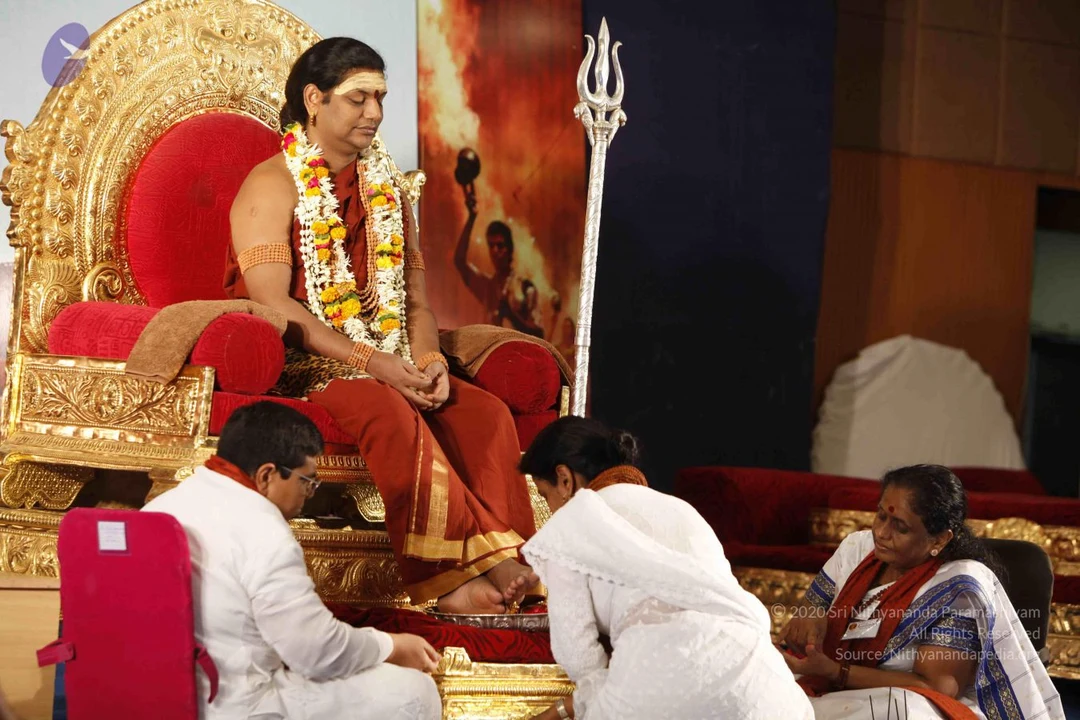
Pada-Puja
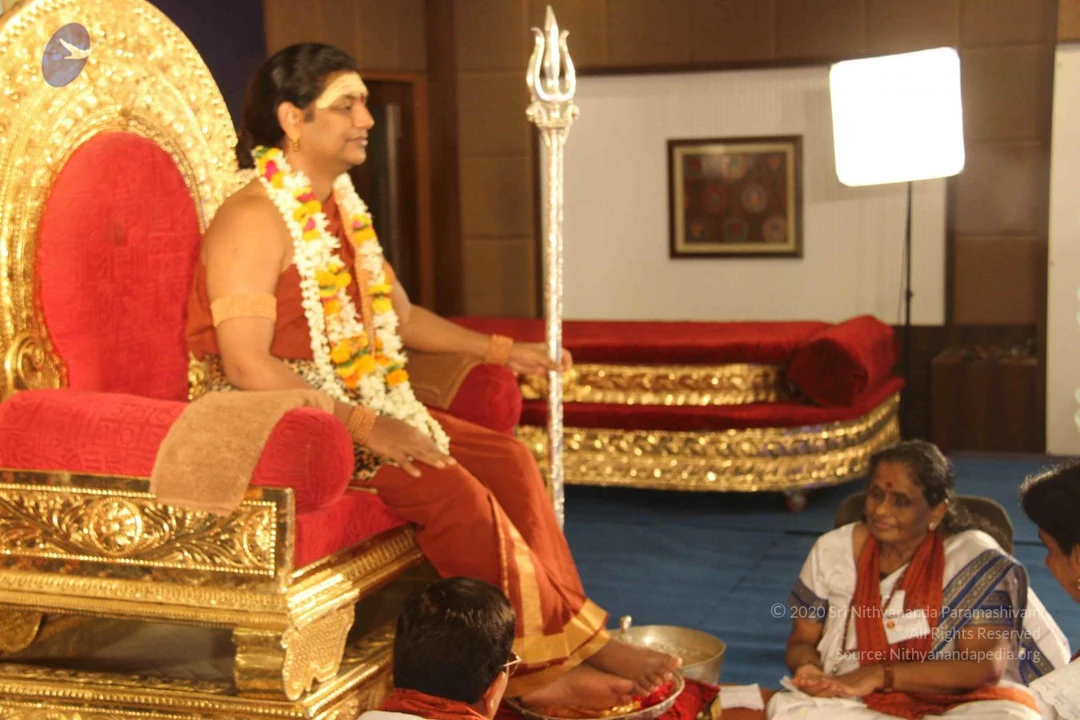
Satsang

Yoga-session

IA-Darshan

Documentry

Photos Of The Day:

Pada-Puja
IA-Darshan

Testimonial

May 5 2014

Original wiki page
Contents

Link to Video:

Description:

In today’s morning Satsang from Varanasi, Paramahamsa Nithyananda defined the Root Pattern which is the pattern through which you keep your struggles alive, thus preventing breakthrough. It is the biggest block to enlightenment. He went on to explain that the Root pattern is what you hold the people around you with. How you hold the people around you is how life will hold you; however it is possible to complete with the root pattern.

Tags:

Varanasi, Paramahamsa Nithyananda, Root Pattern, breakthrough, enlightenment, possible, complete.

Transcript:

Here is the transcript

Photos From The Day:

Copy Content From the Google Sheet Here With Photographs Links

Photos from this day

View all 227 photos

Photos

5 photosSource gallery
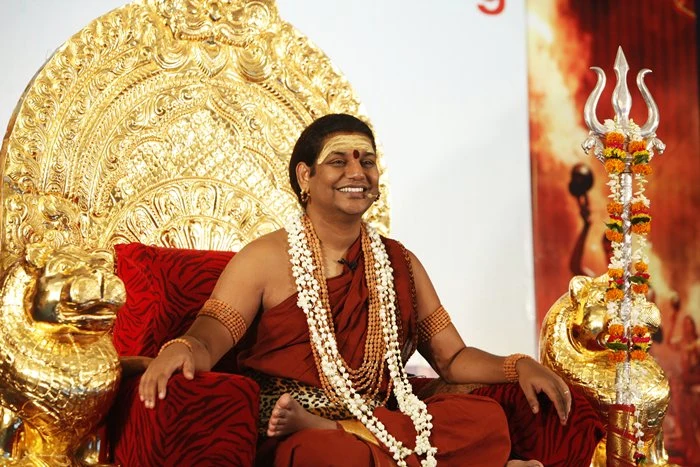
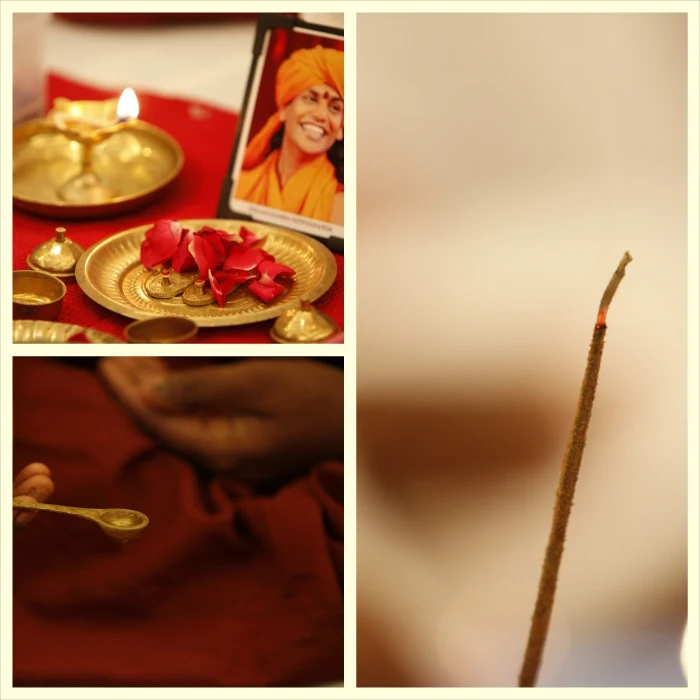
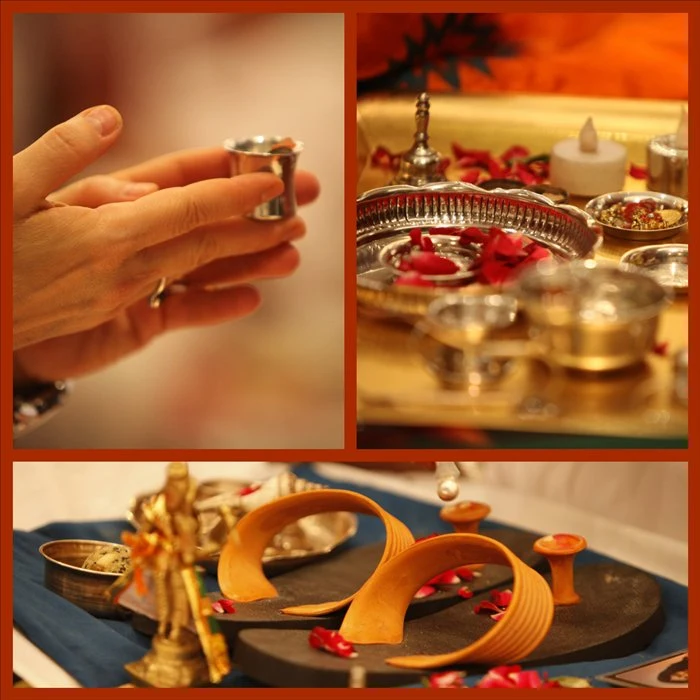
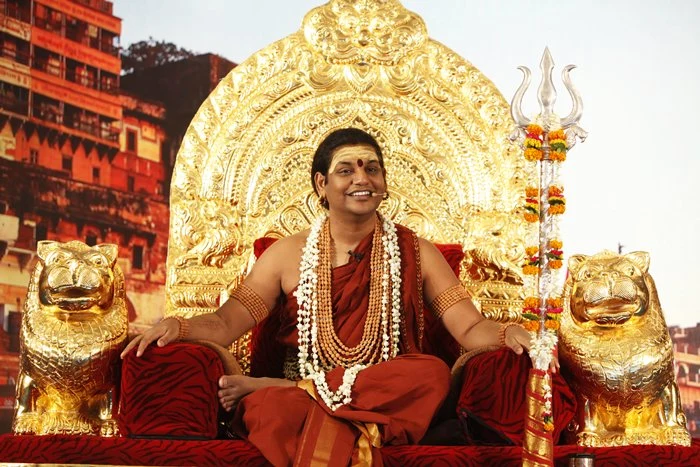
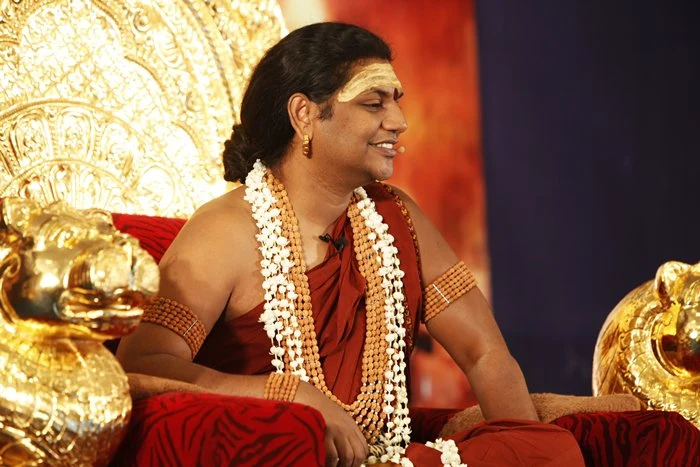
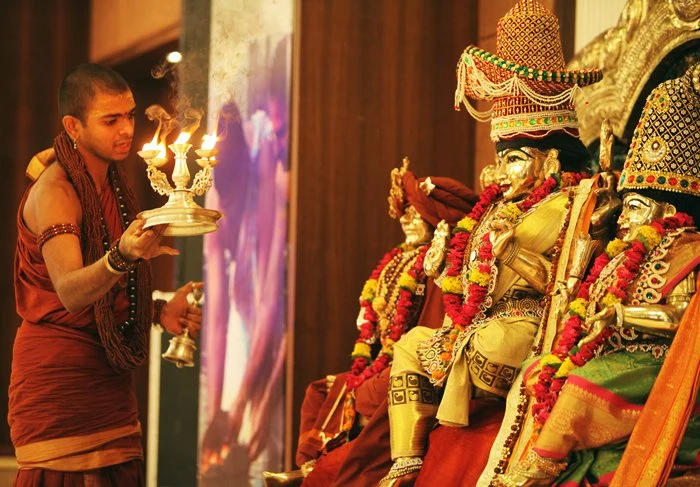
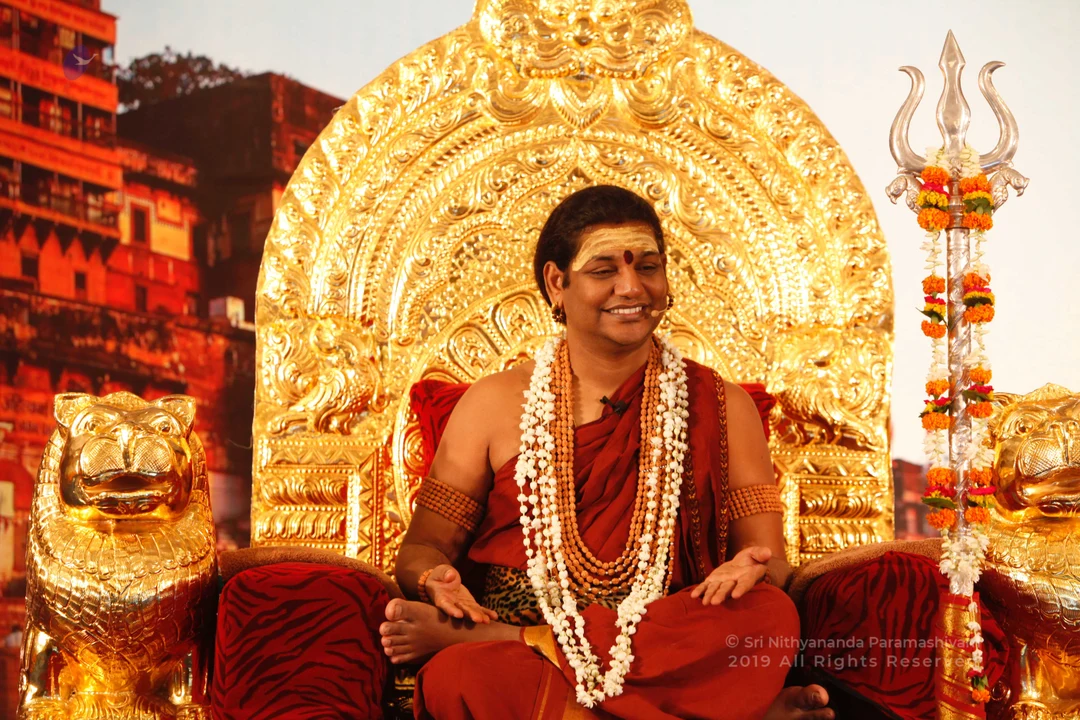
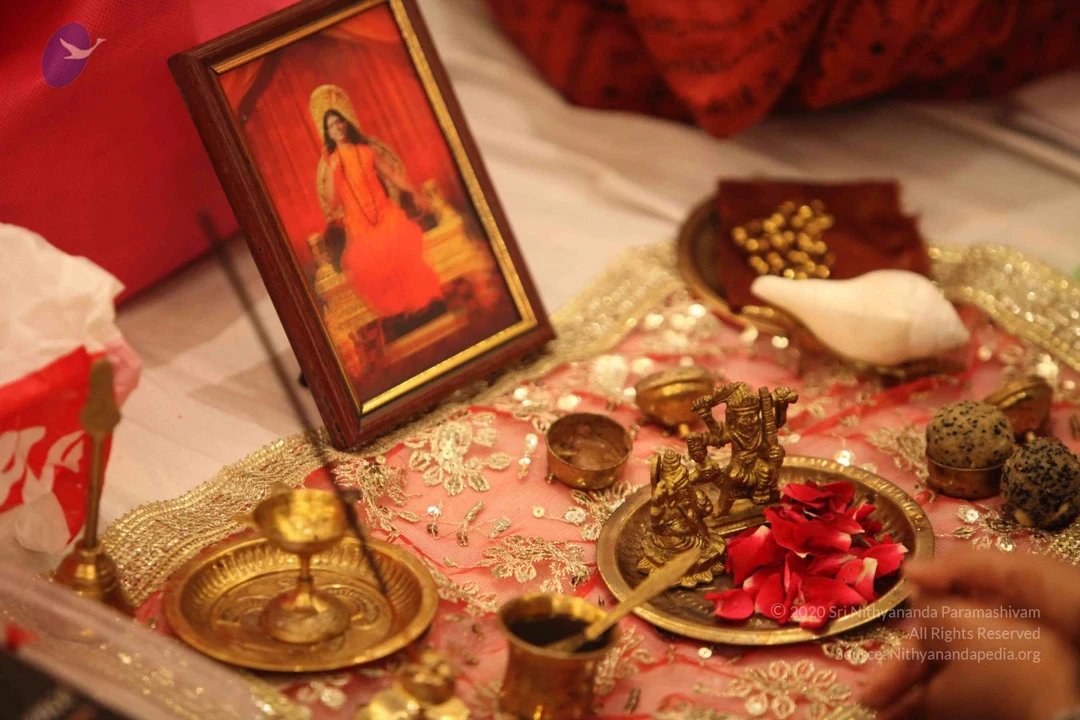
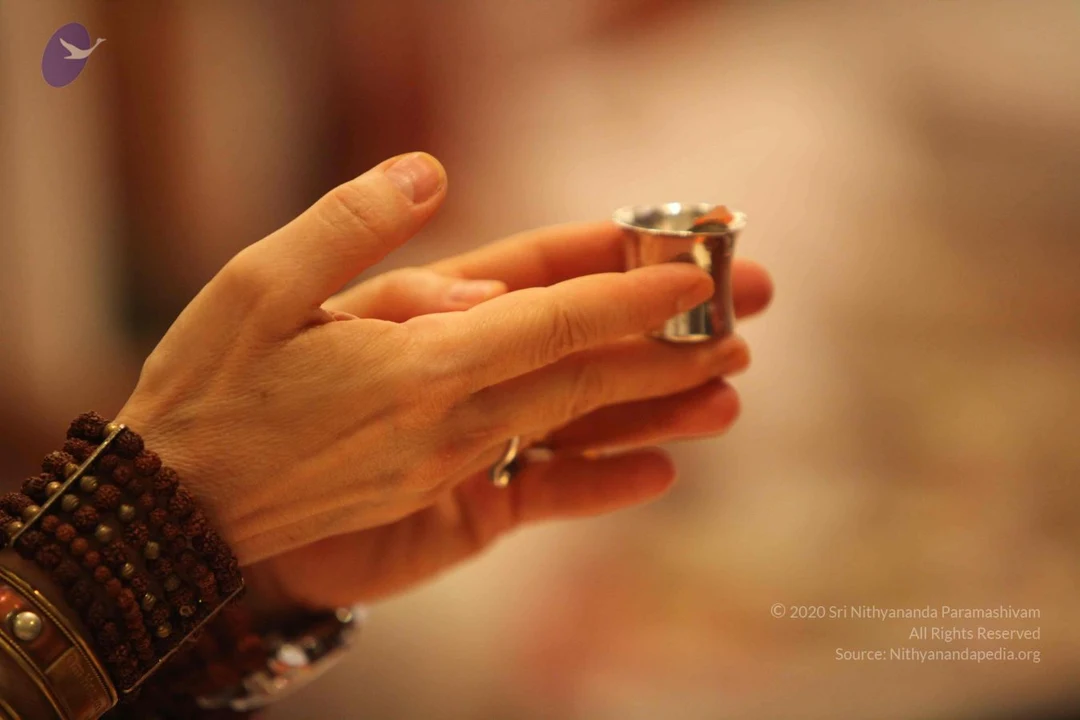
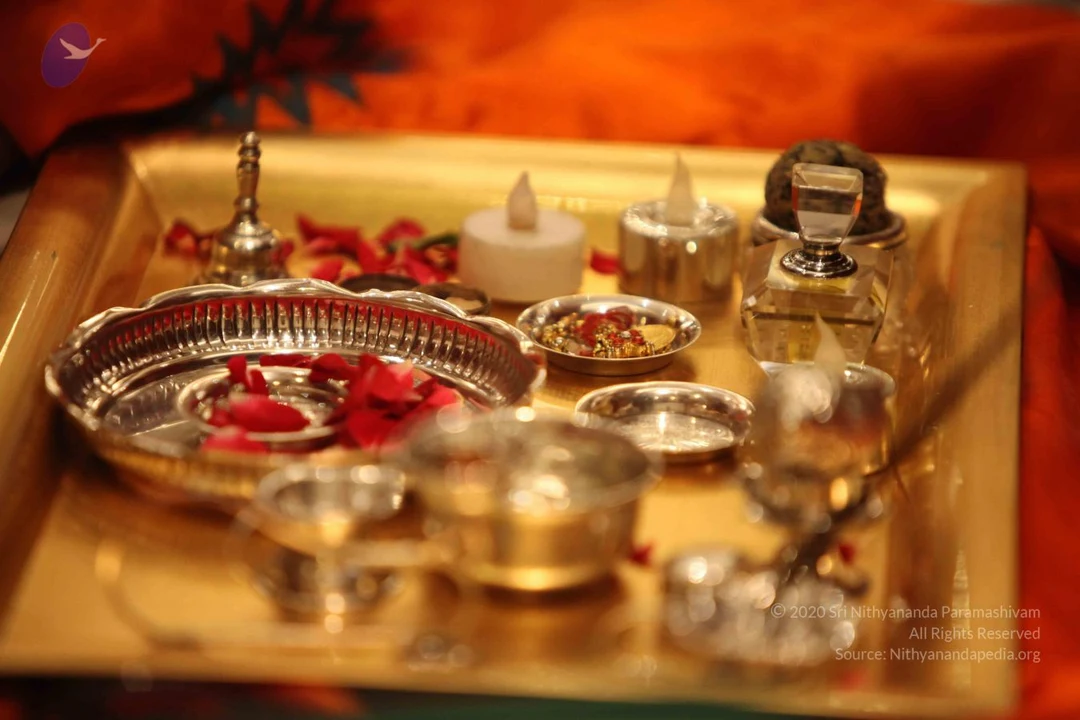
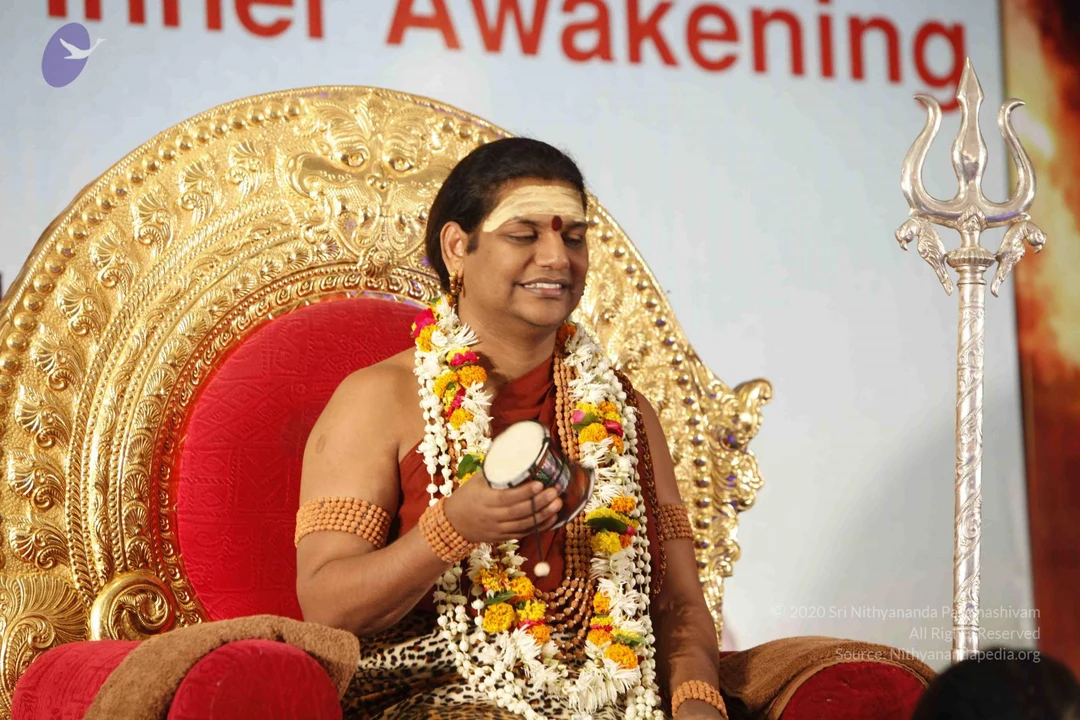
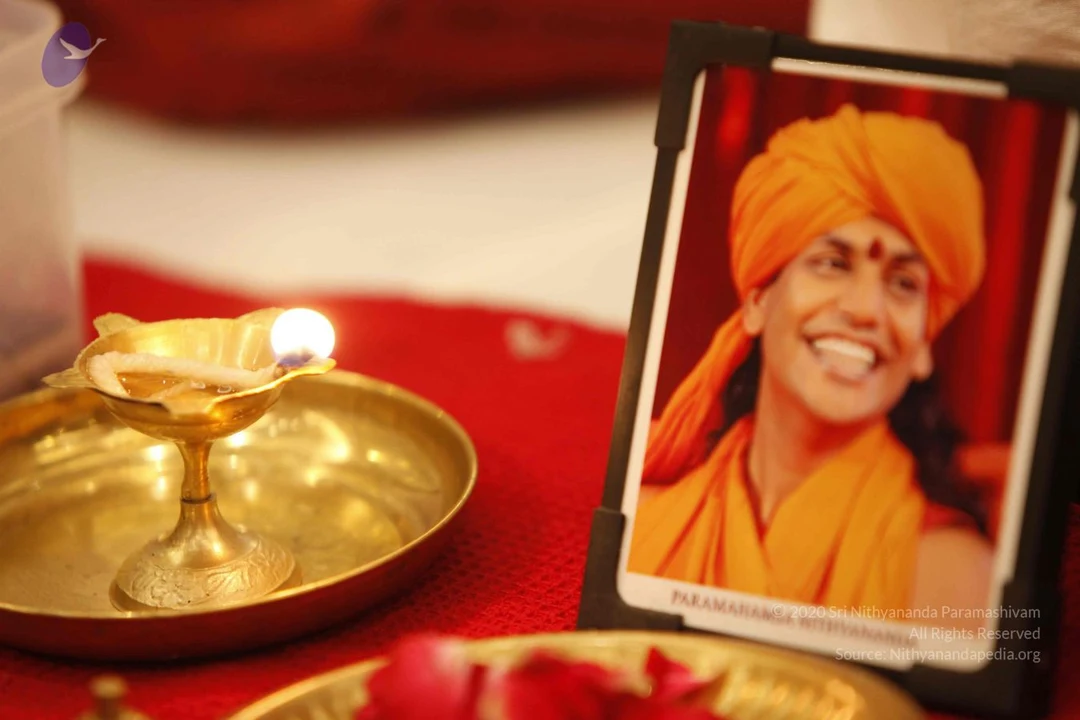
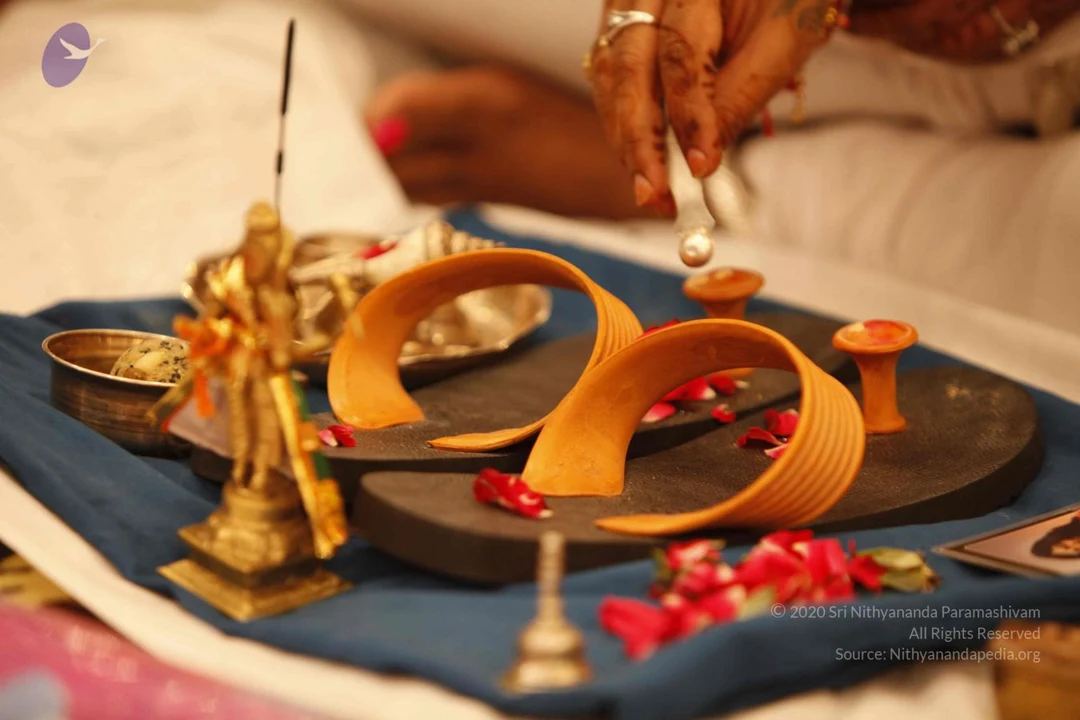
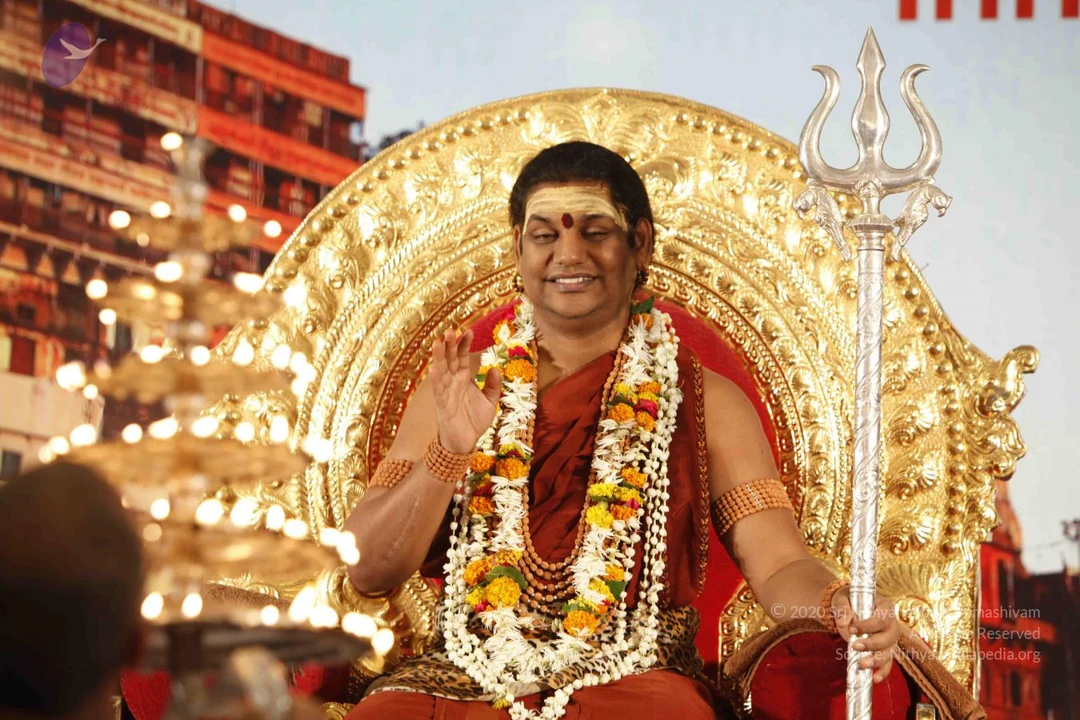
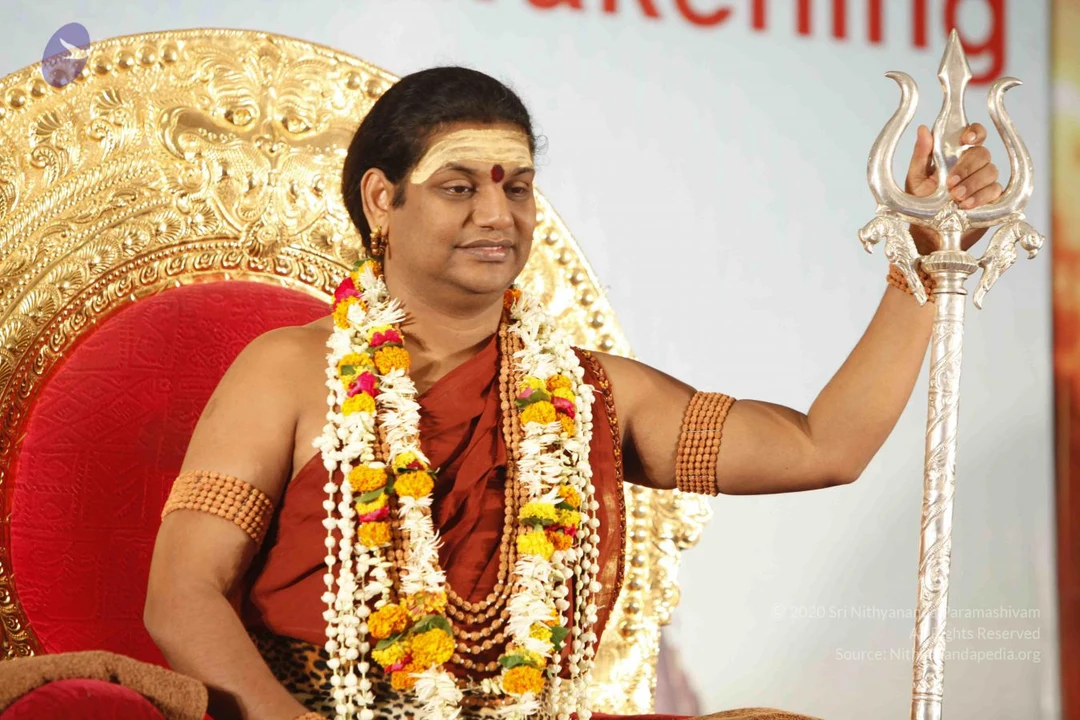
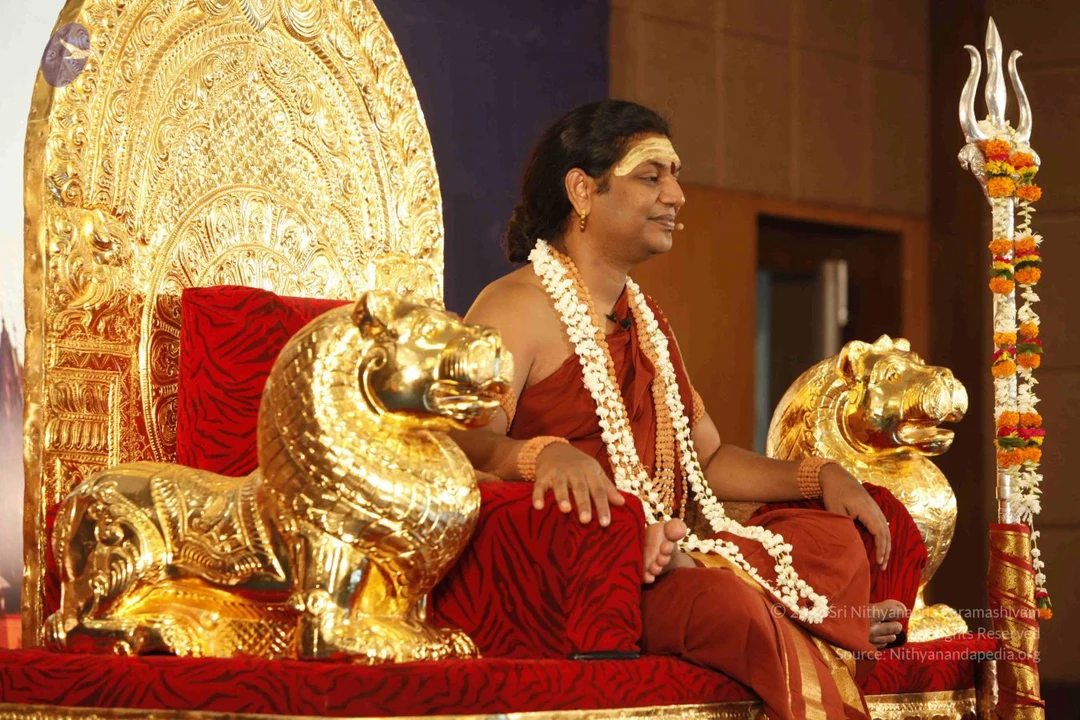
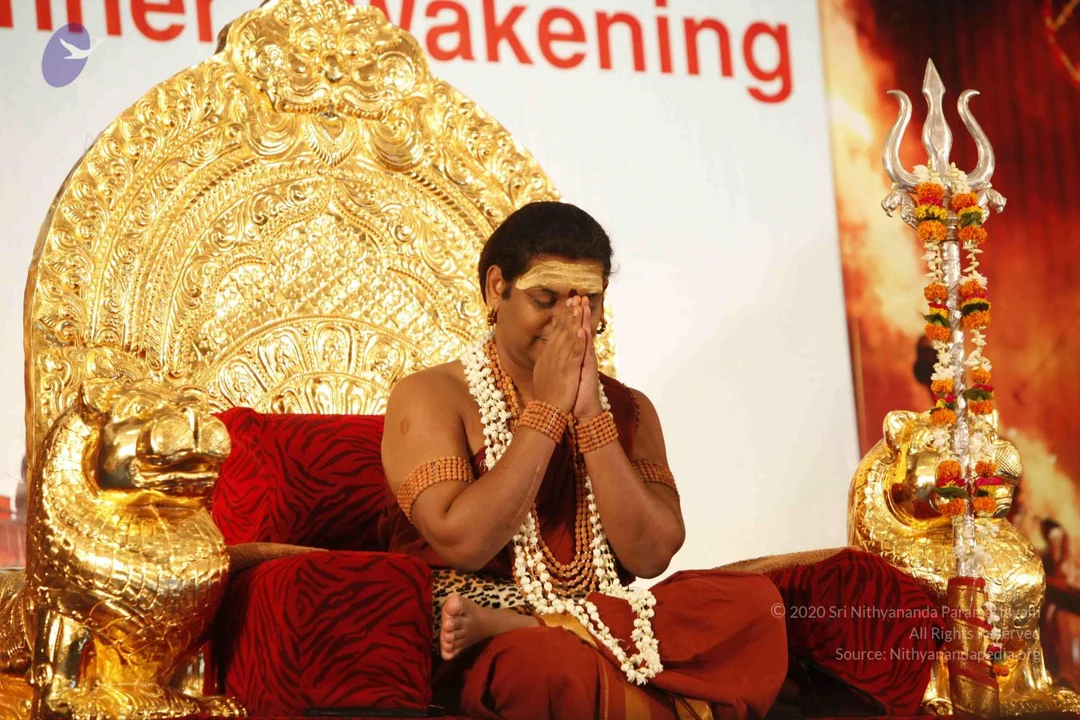
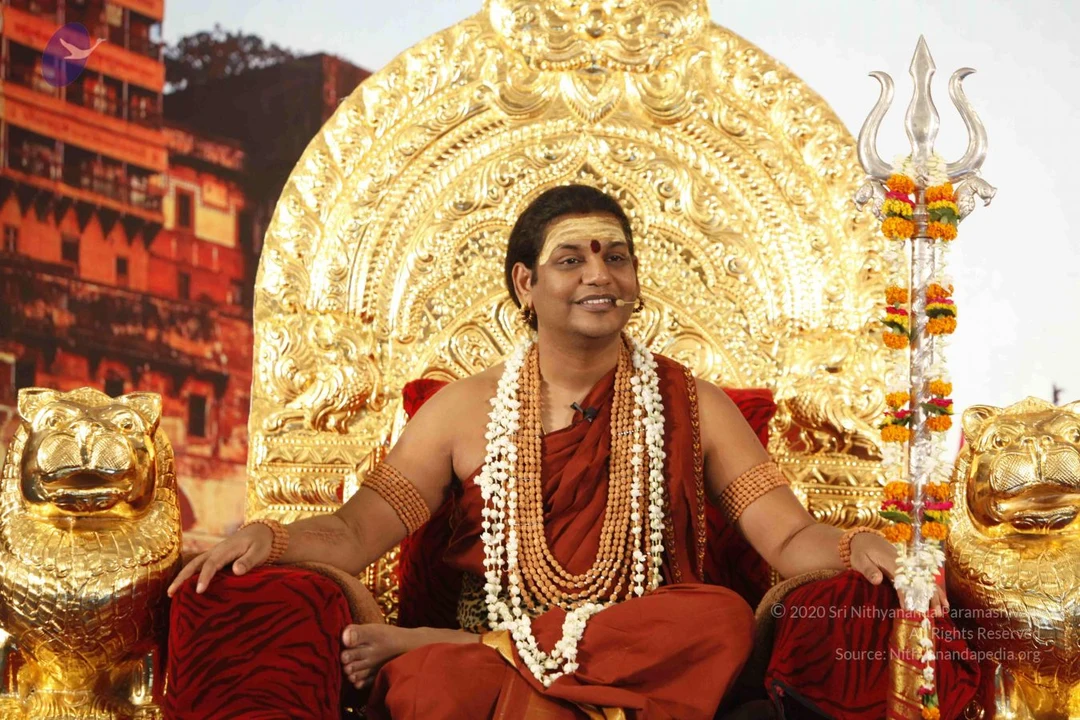
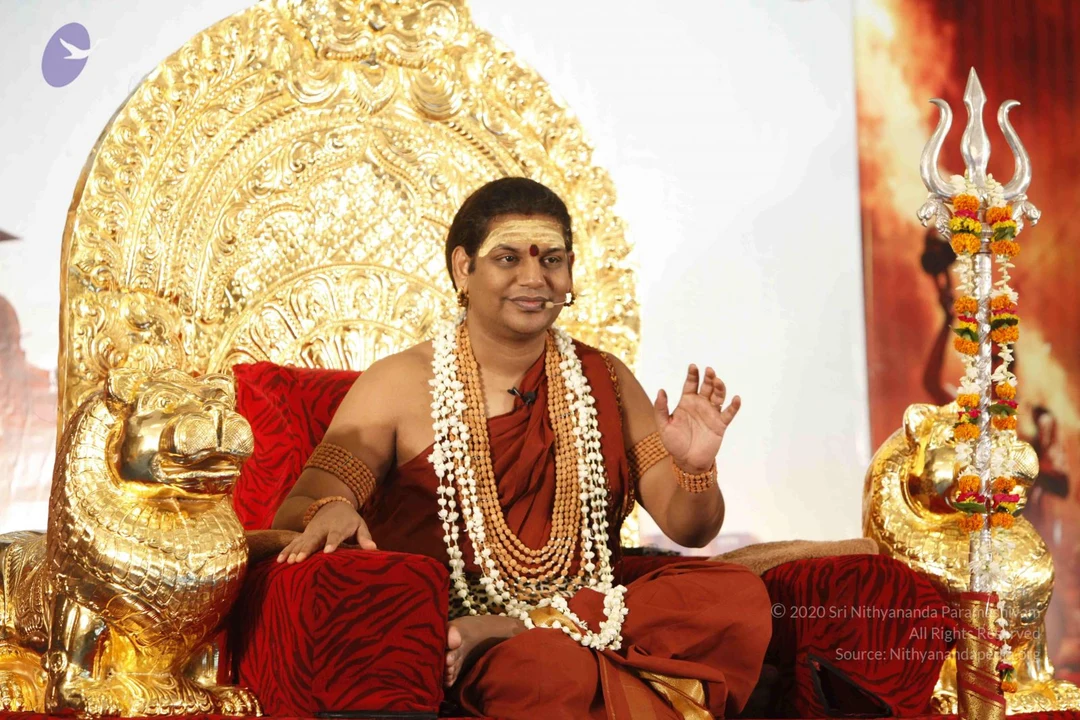
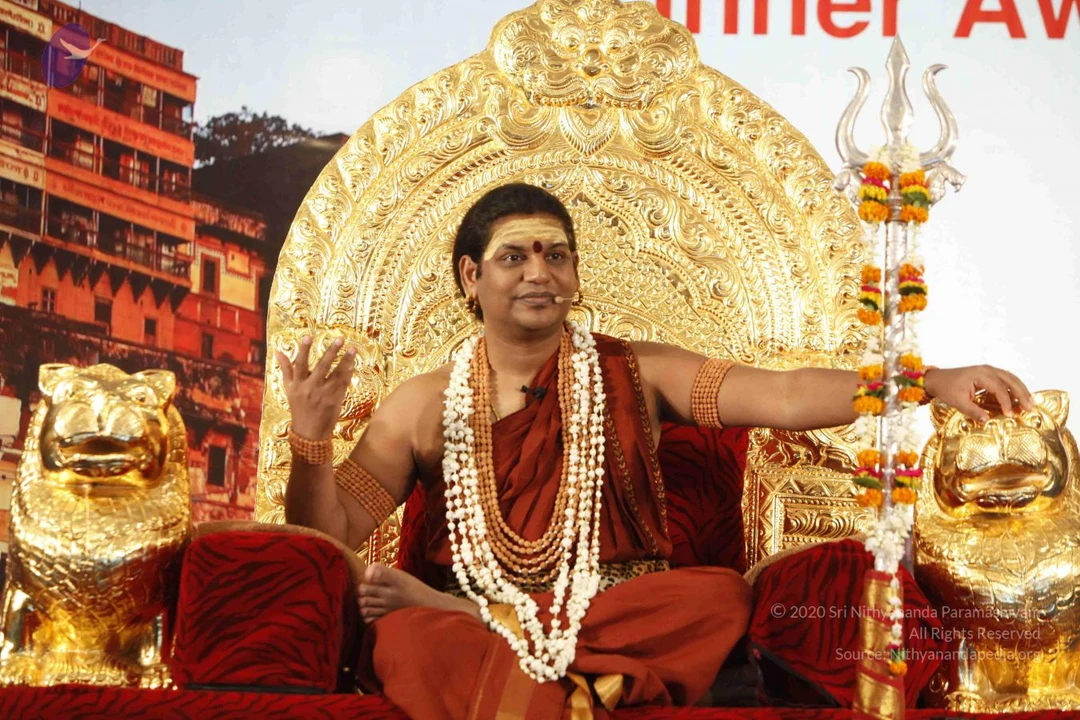
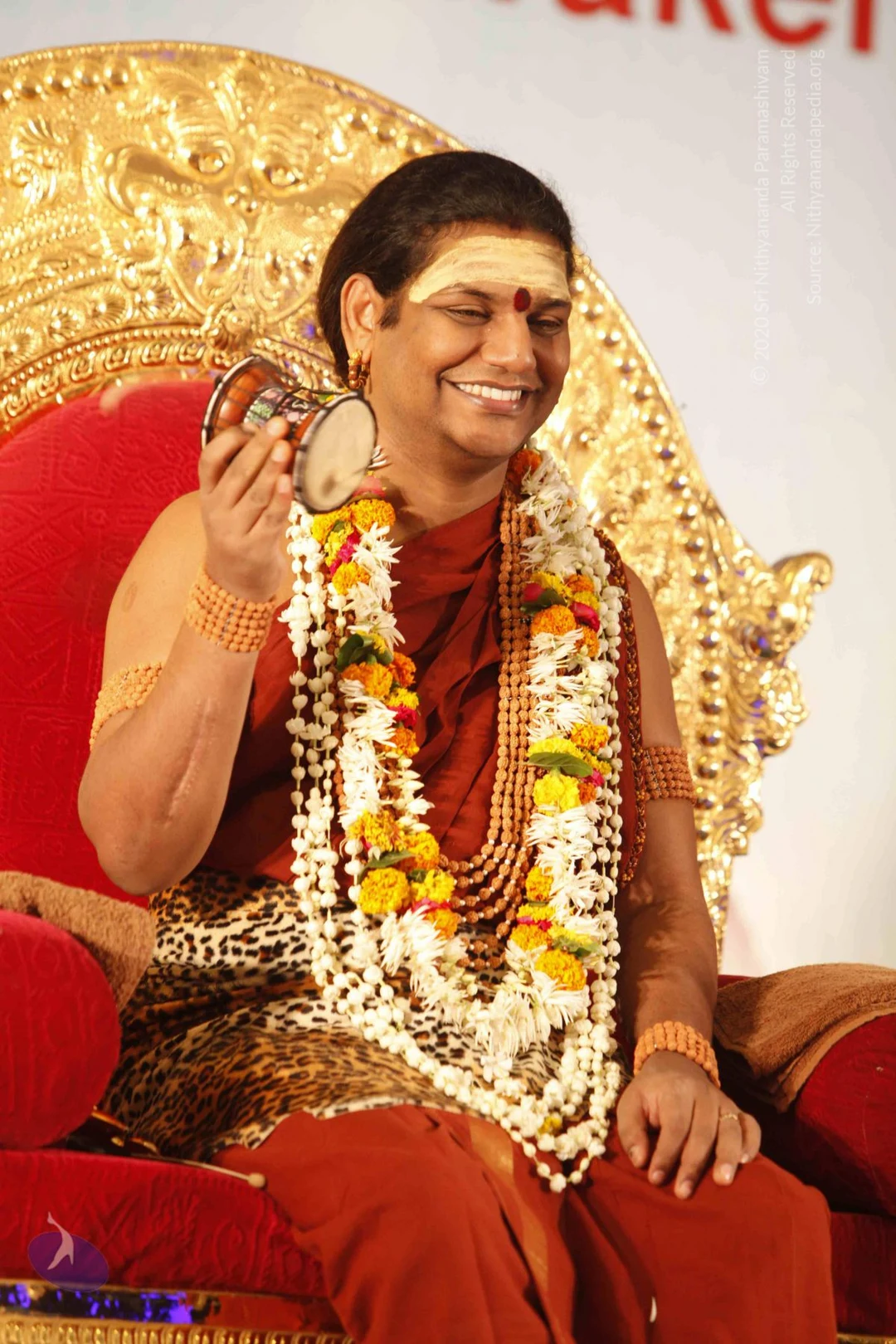
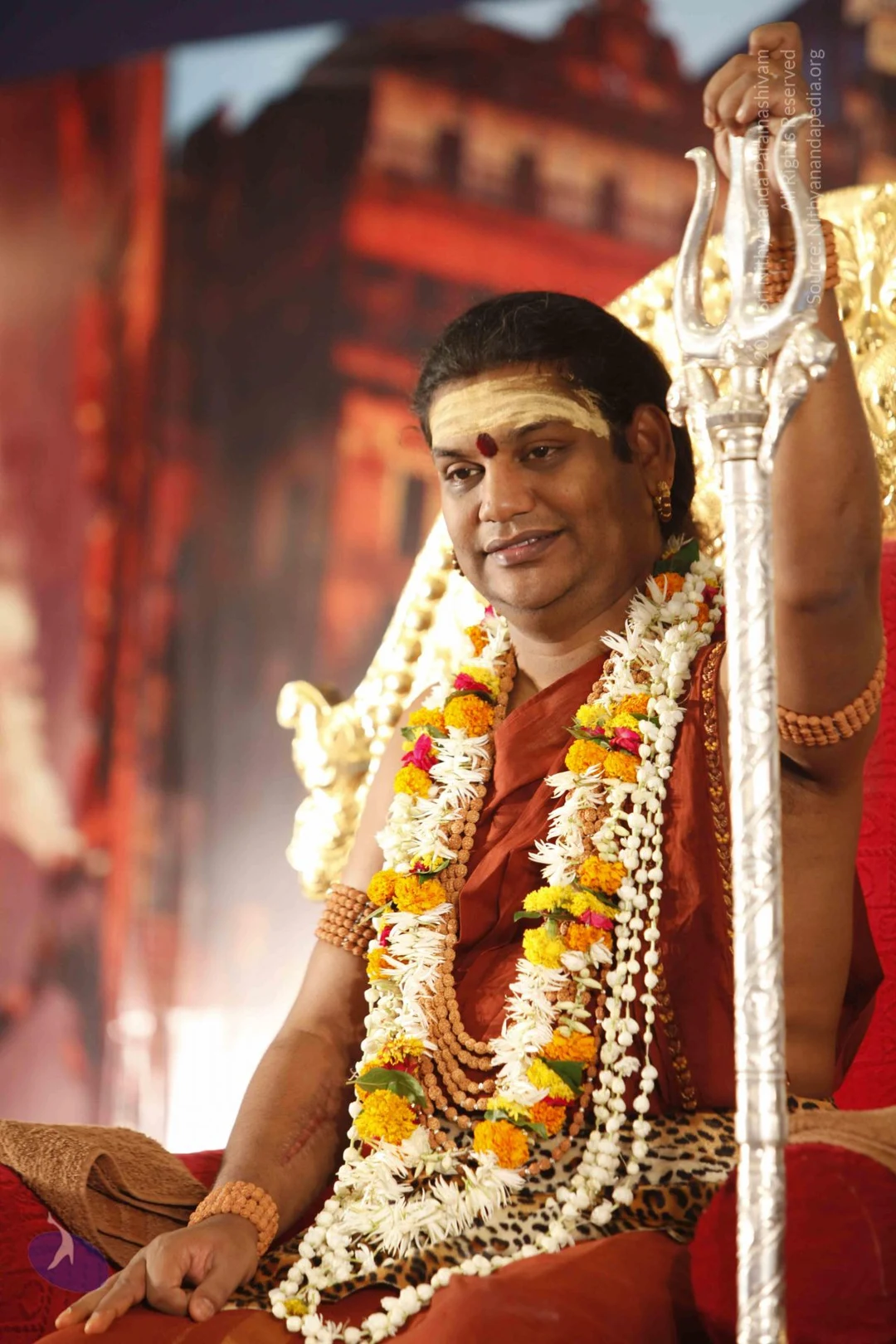
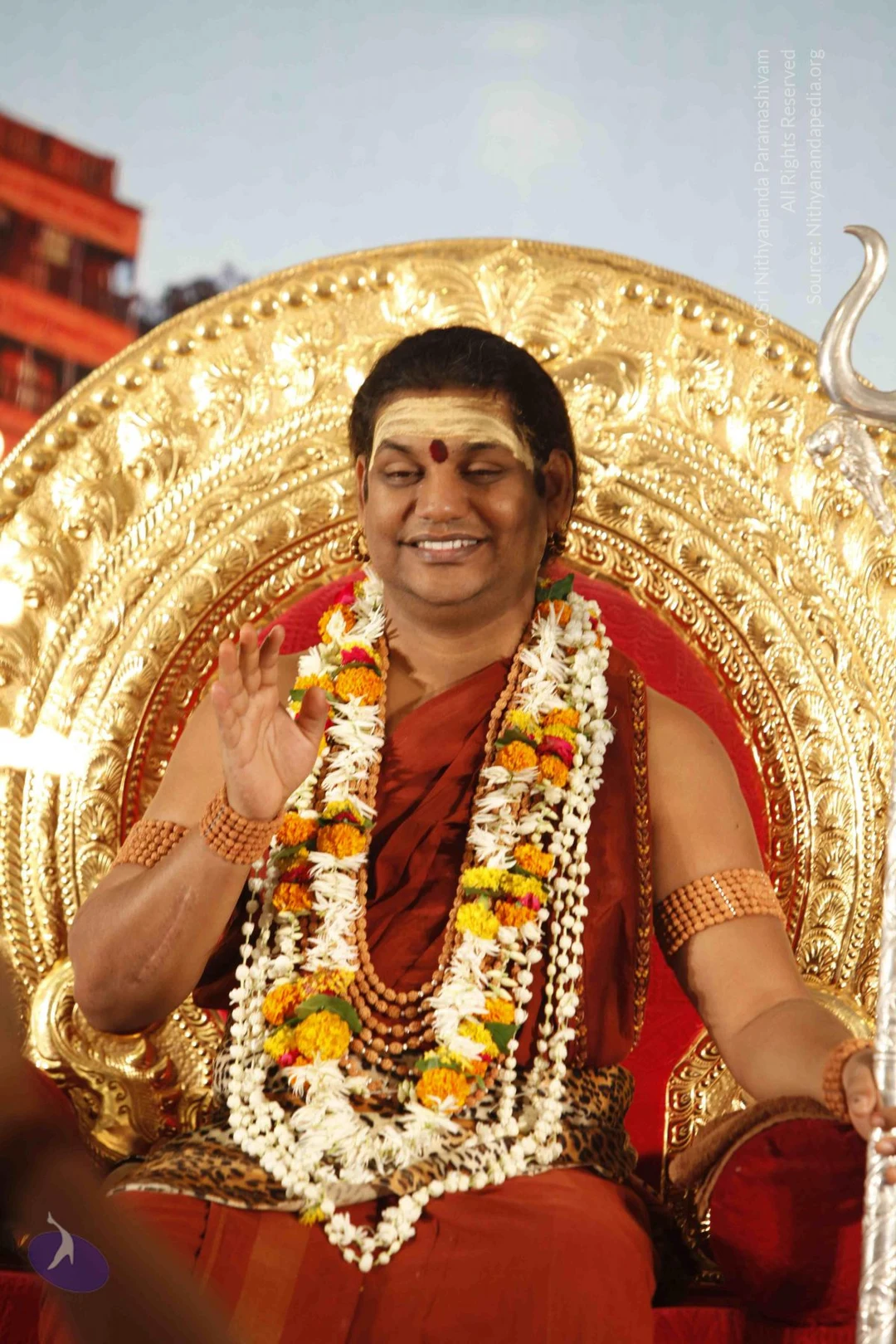
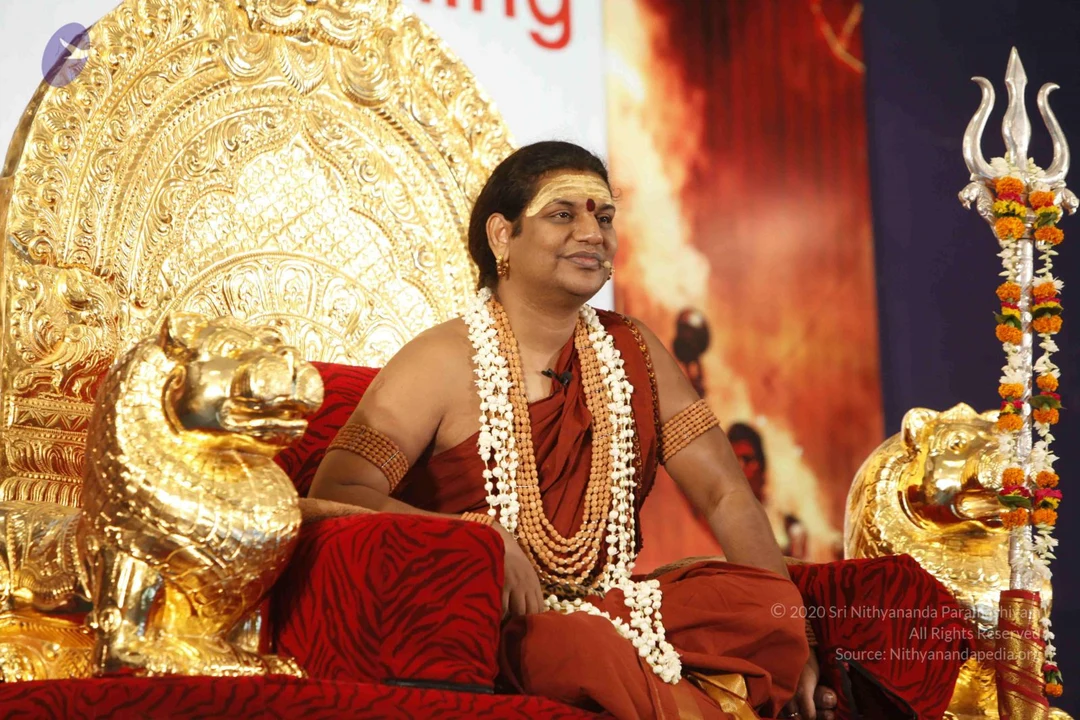
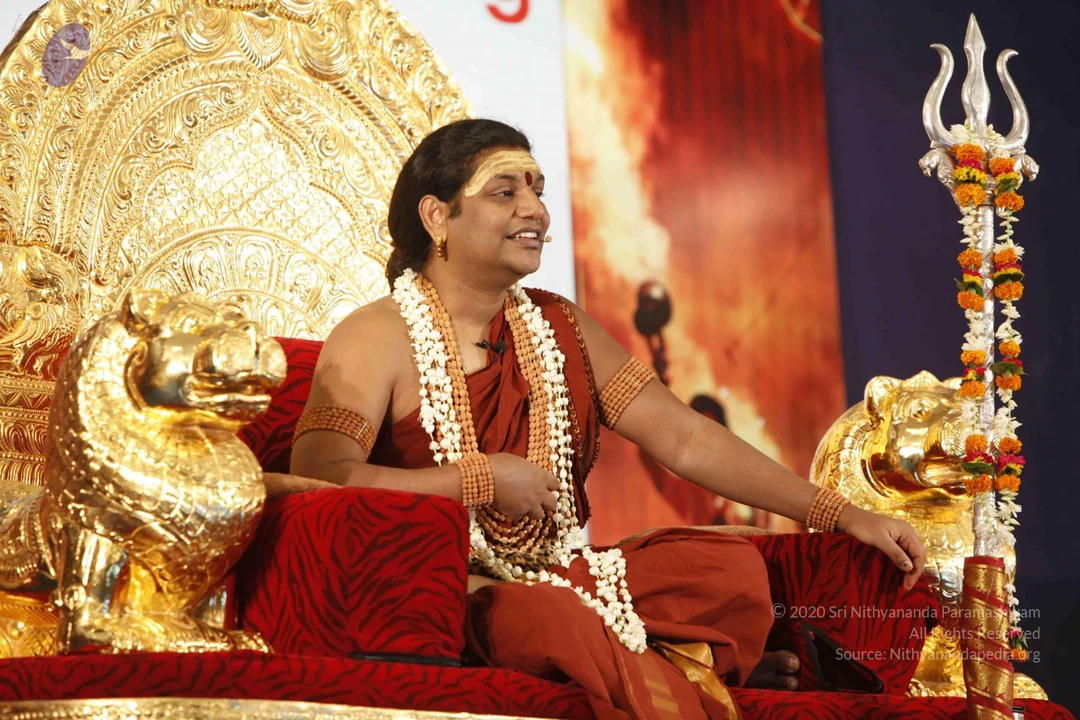
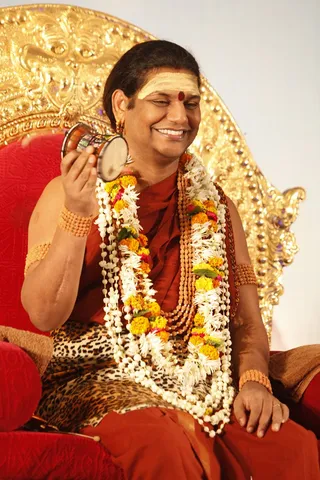
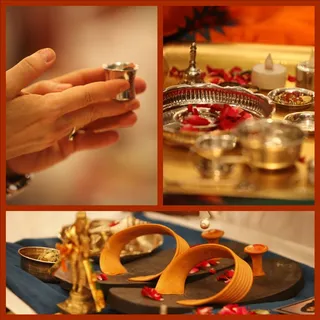
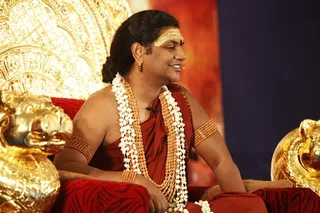
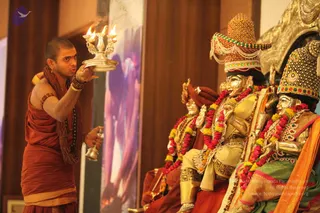
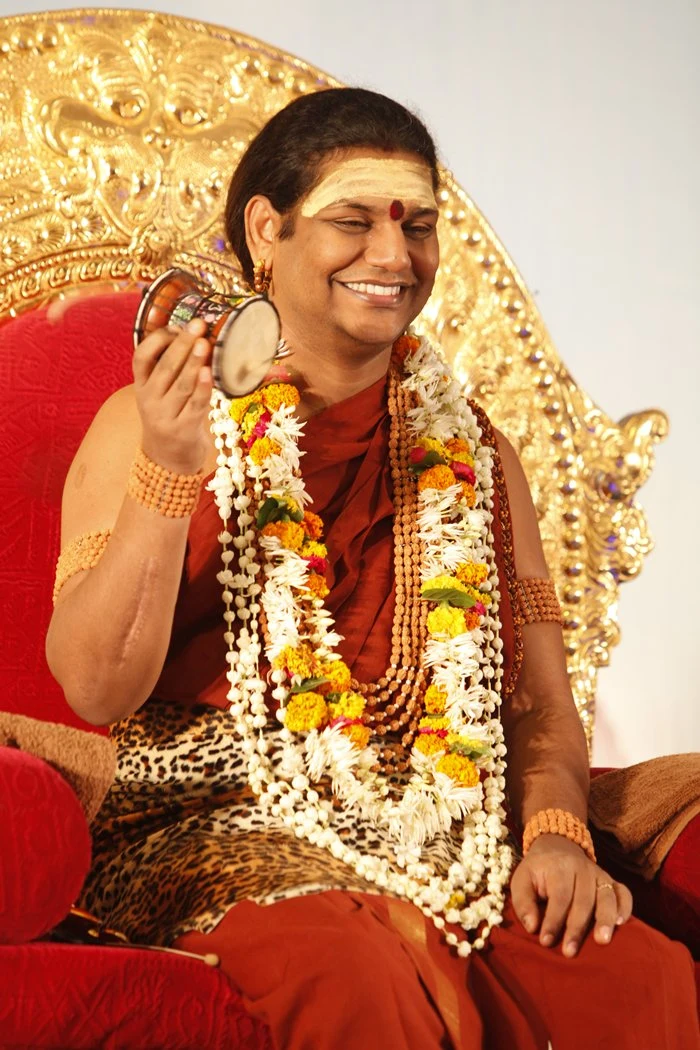
A smiling man seated on a red upholstered throne with an ornate gold carved back, holding a small damaru drum raised near his shoulder. He wears a rust-red robe, a leopard-print cloth over his lap, multiple rudraksha mala strands and a garland of white jasmine and orange-yellow marigolds with red accents. A pale sandalwood tilak with a red dot marks his forehead, and gold bangles cover his wrists and upper arms. Appearance-based identification is probable: the swept-back hair, saffron-red robe, rudraksha malas and ornate gold throne fit a Swamiji (probable) candidate seated in a satsang setting.A four-panel collage of puja details on a red cloth. Top left: a brass oil lamp with a lit flame beside a brass plate of red rose petals and small brass cups, next to a framed portrait of a smiling man in an orange turban and orange robe with a red bindi, labelled as a portrait. Bottom left: a hand in a red garment holding a small brass spoon. Right: a close-up of a lit incense stick with a glowing orange tip against a blurred background. The collage shows no physical people in full view; only a hand appears.A four-panel collage of photographs from a puja setting. Top left shows a hand holding a small silver cup. Top right shows a gold tray with a silver bowl of red rose petals, a lit tealight, small brass vessels and a bell. Bottom shows a pair of carved wooden paduka sandals with red petals, a small brass deity figure, a silver bowl with offerings and a blue cloth. No physical people beyond a single hand are shown; no a person depiction is visible.A man seated on an ornate gold throne with carved lion-head armrests, wearing a red-orange cloth wrapped over the shoulders and a white flower garland over an orange bead necklace. He has a white-and-gold tilak on his forehead, gold armlets, and a small microphone clipped near his face. He looks to his right with a smile. The background is a warm orange and purple stage backdrop. Appearance-based label: a person, seated in person.A photograph of a ritual arati before seated figures in a hall. On the left, a young priest with a shaved head and a reddish-brown dhoti and shawl holds a silver multi-wick oil lamp in his right hand, its flames lit, and a small brass bell in his left, with a rudraksha-style mala around his neck. To the right, three large seated deity murtis. The background is a warm brownish-purple wall with a faint smoke haze. a person is not visibly present; the only person is the priest.

Pada-Puja
37 photosSource gallery
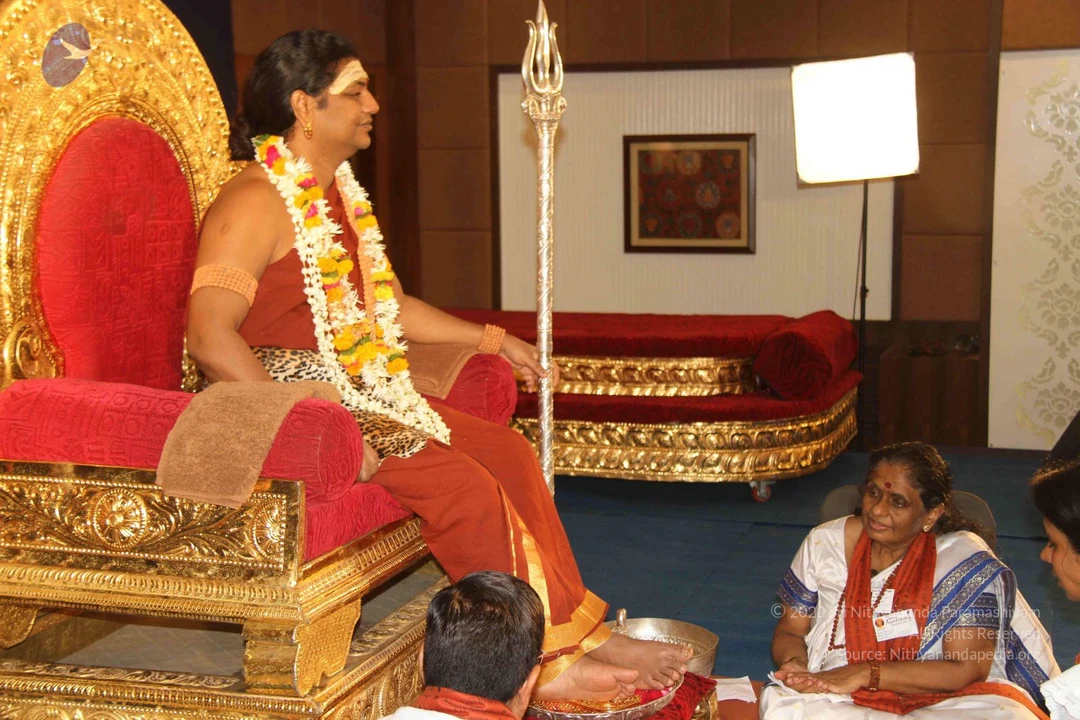
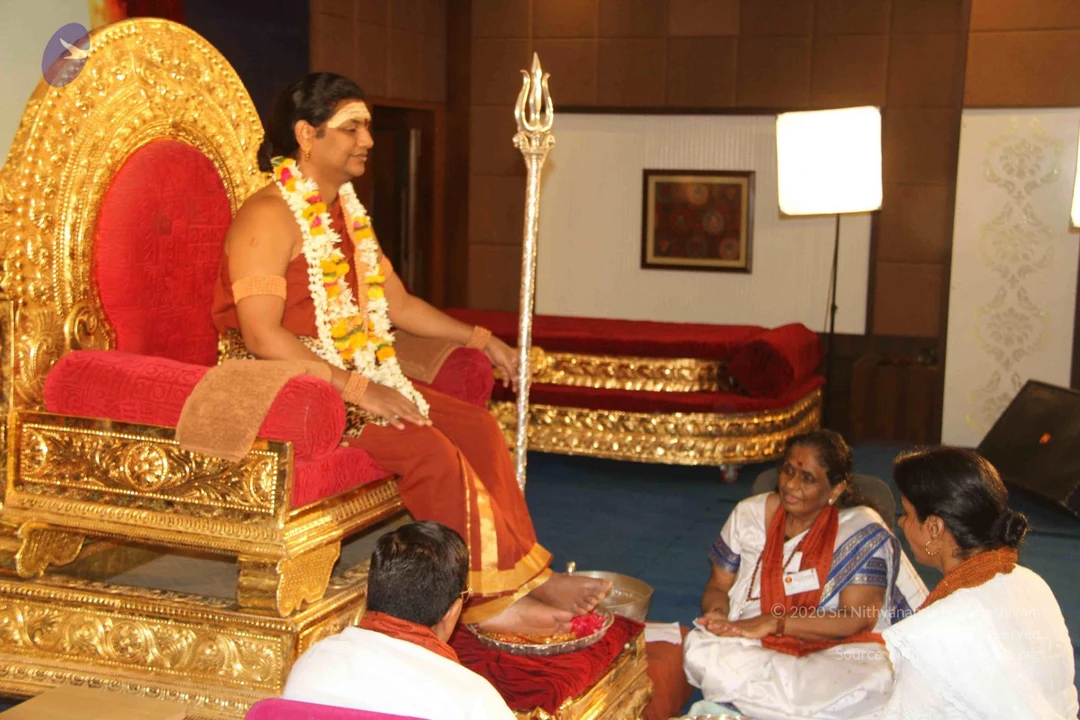
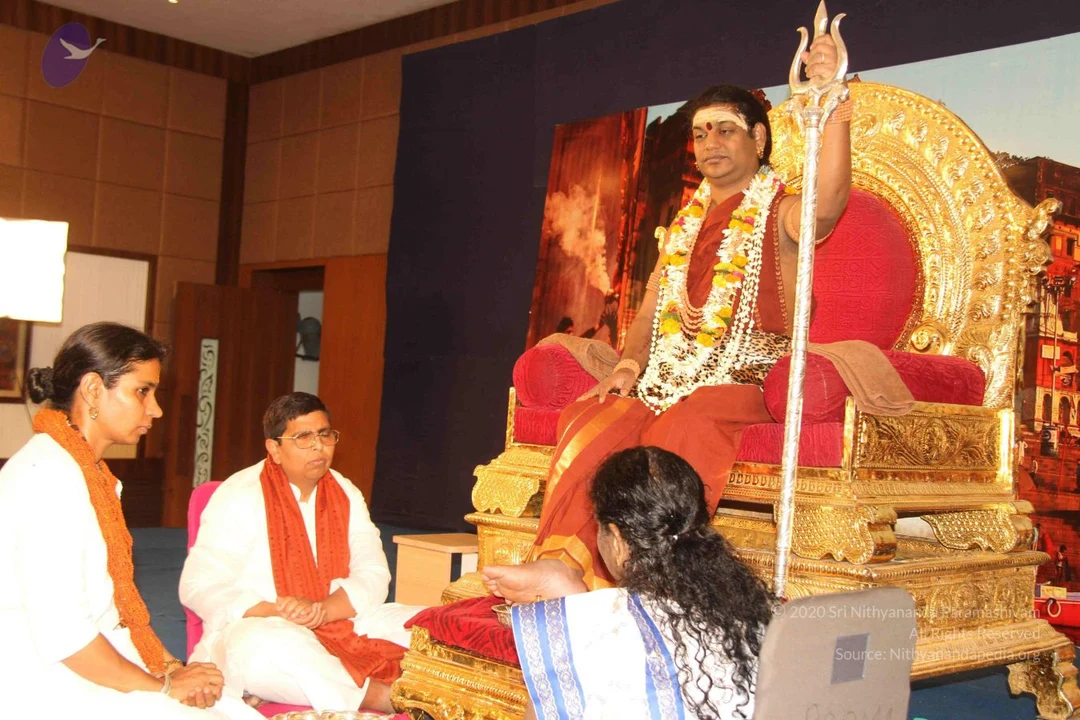
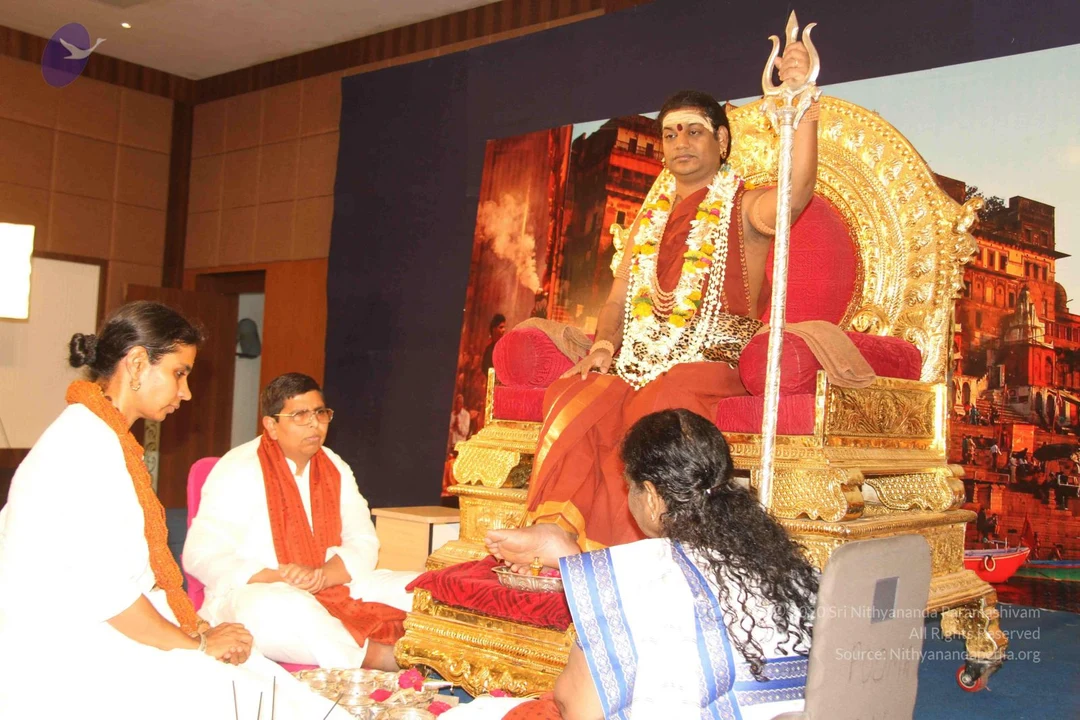
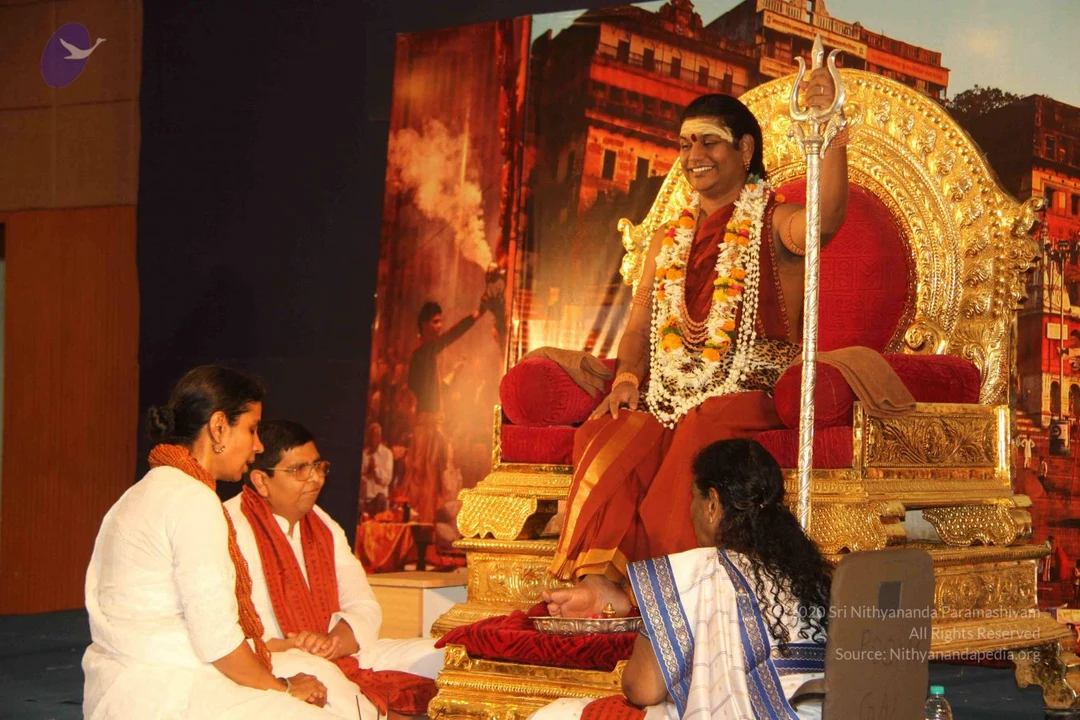
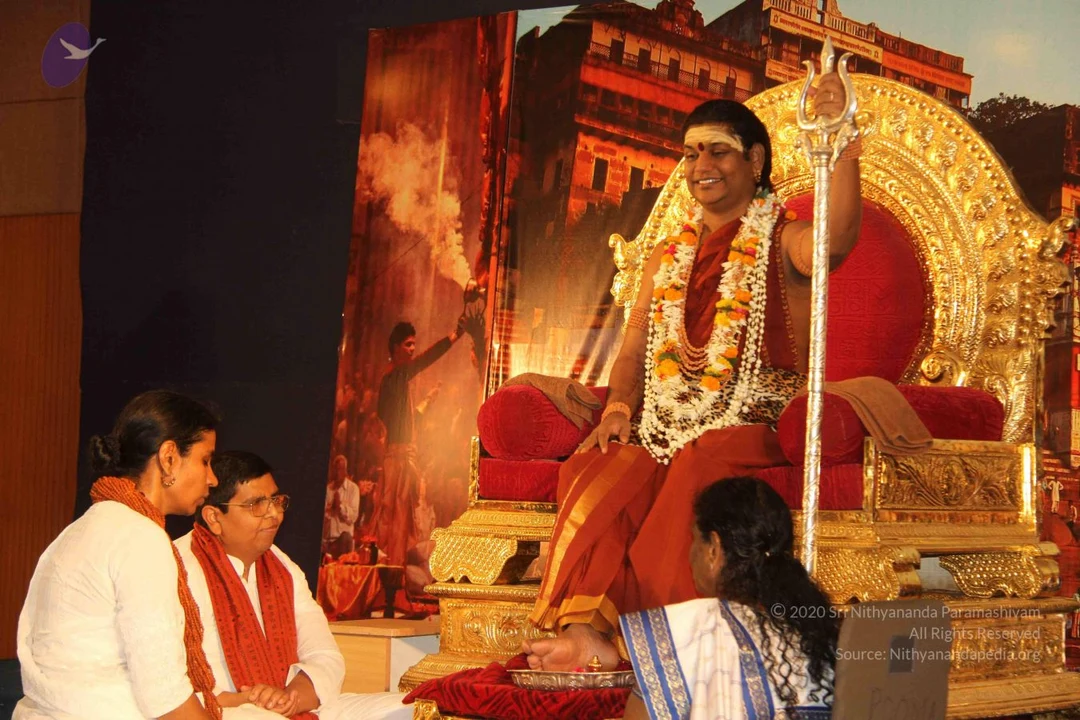
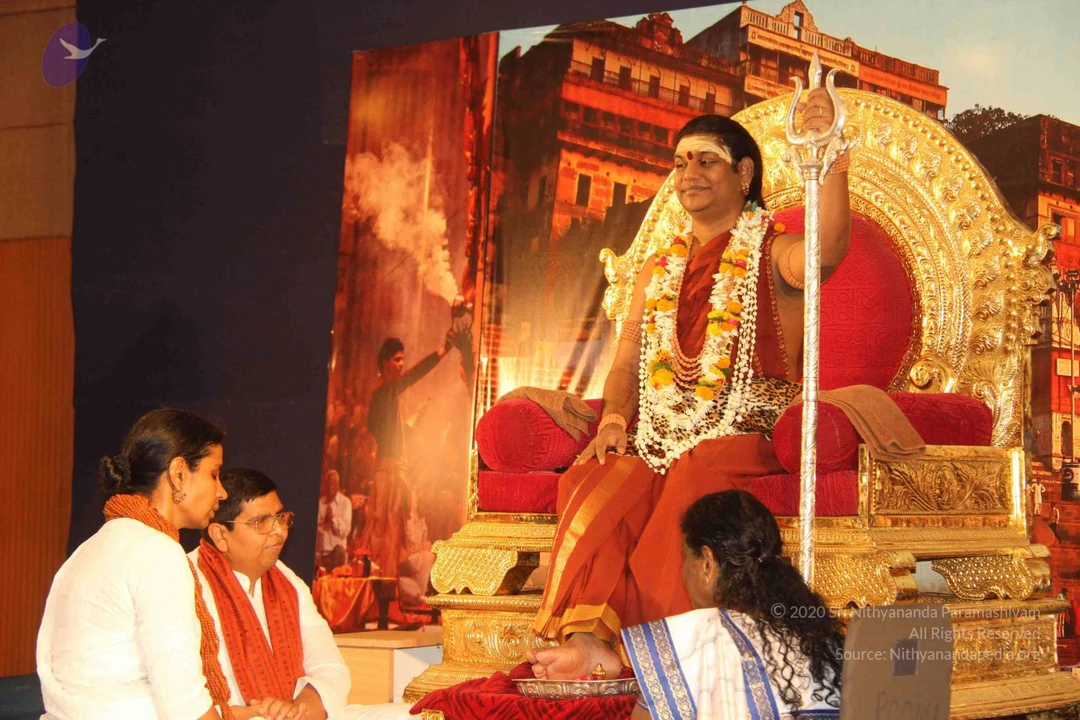
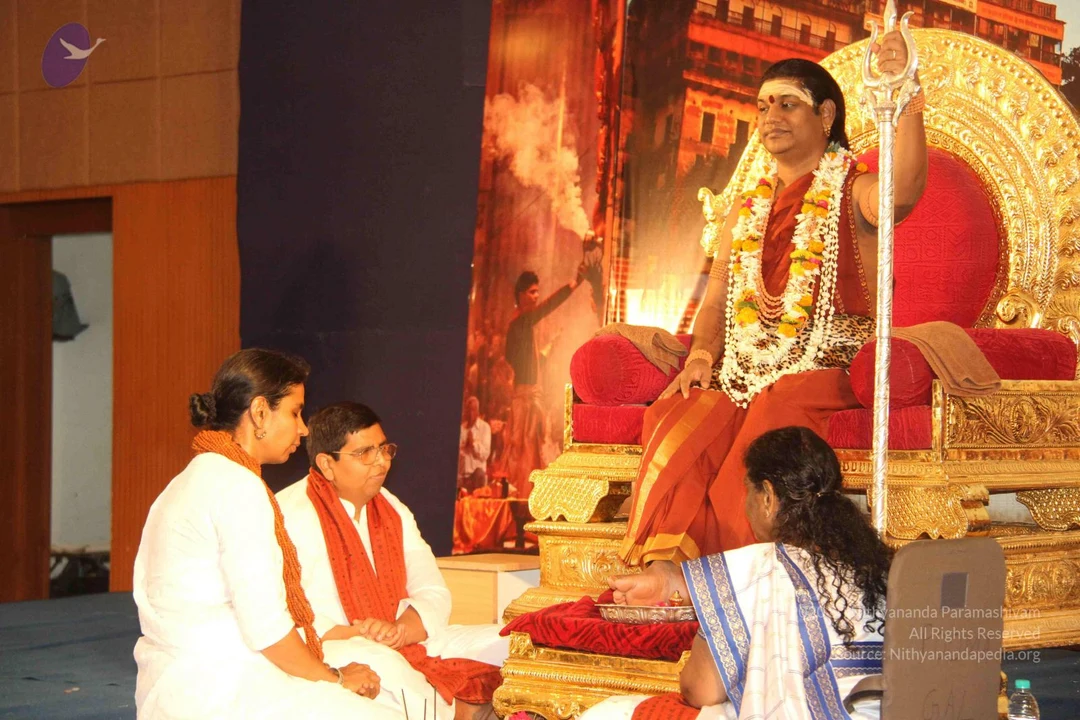
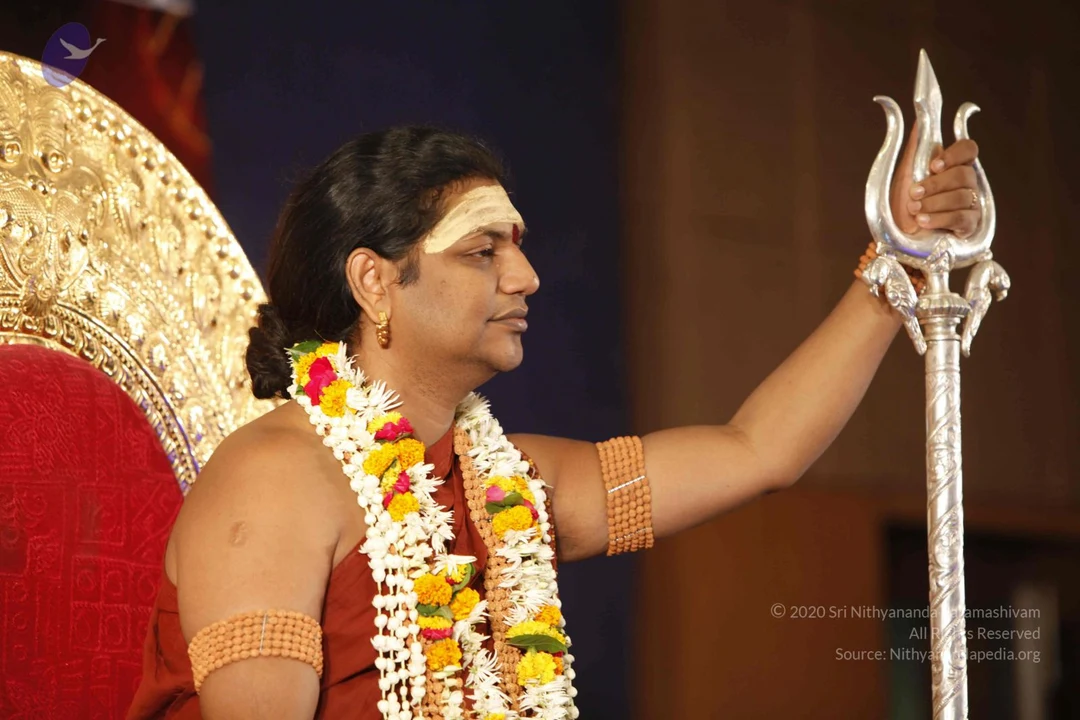
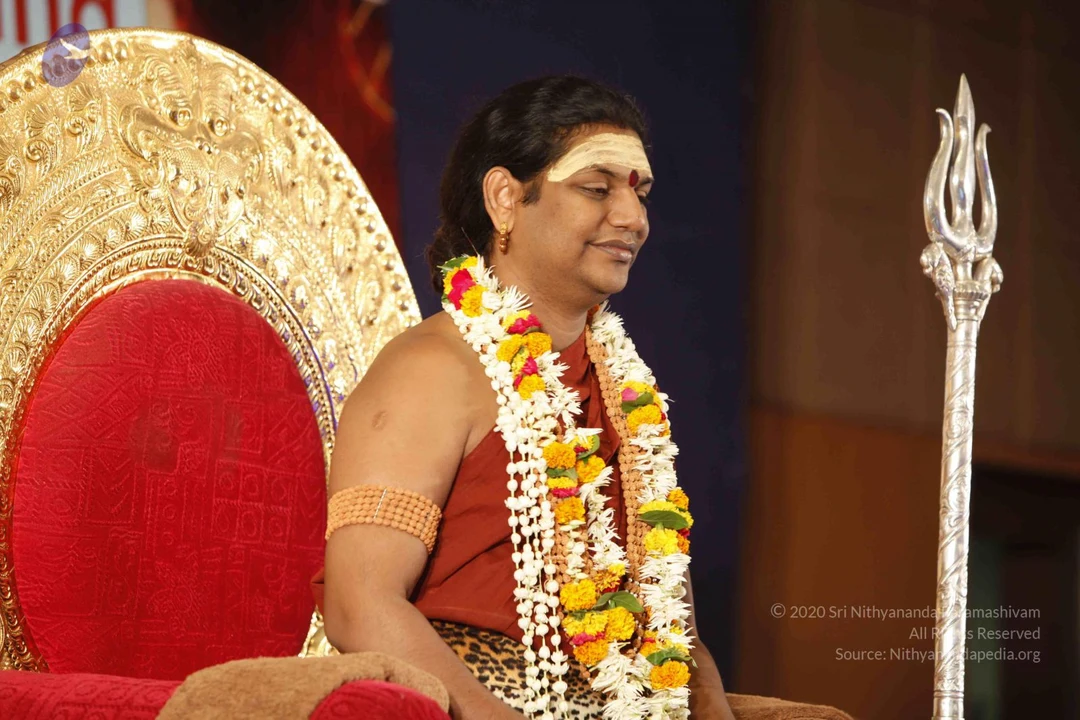
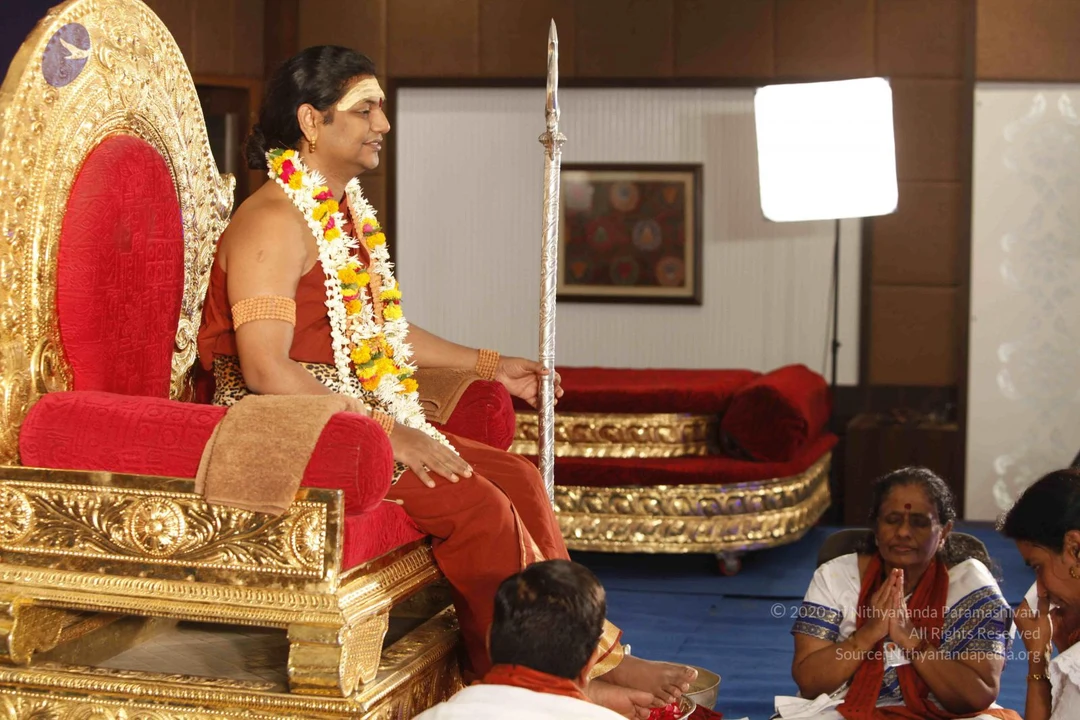
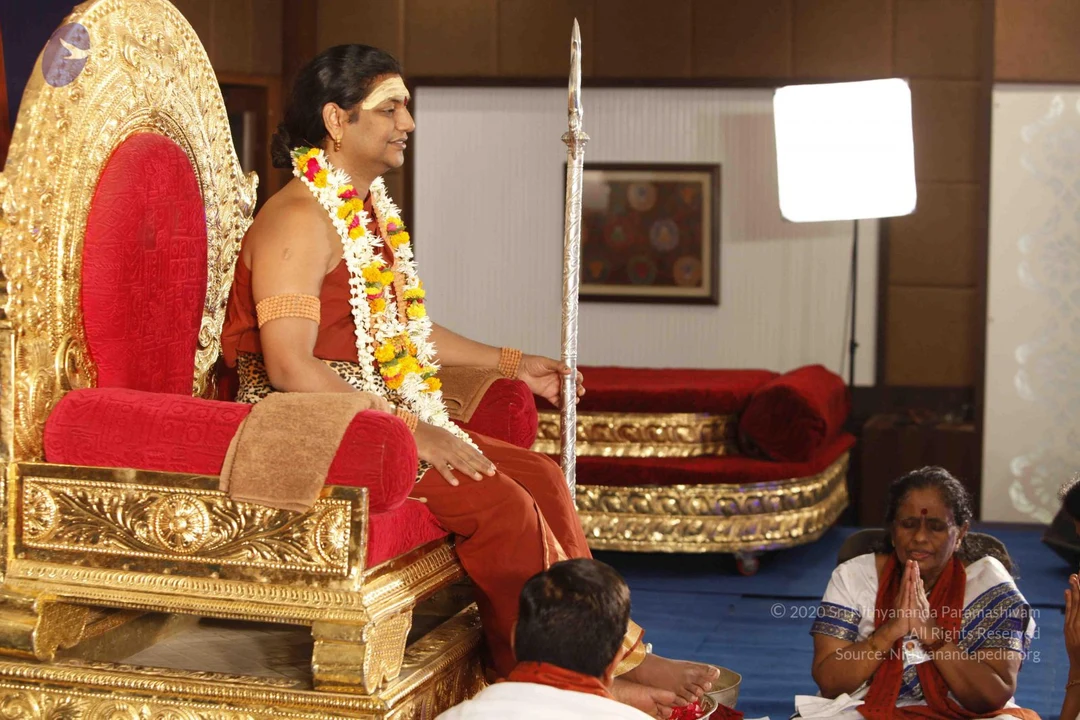
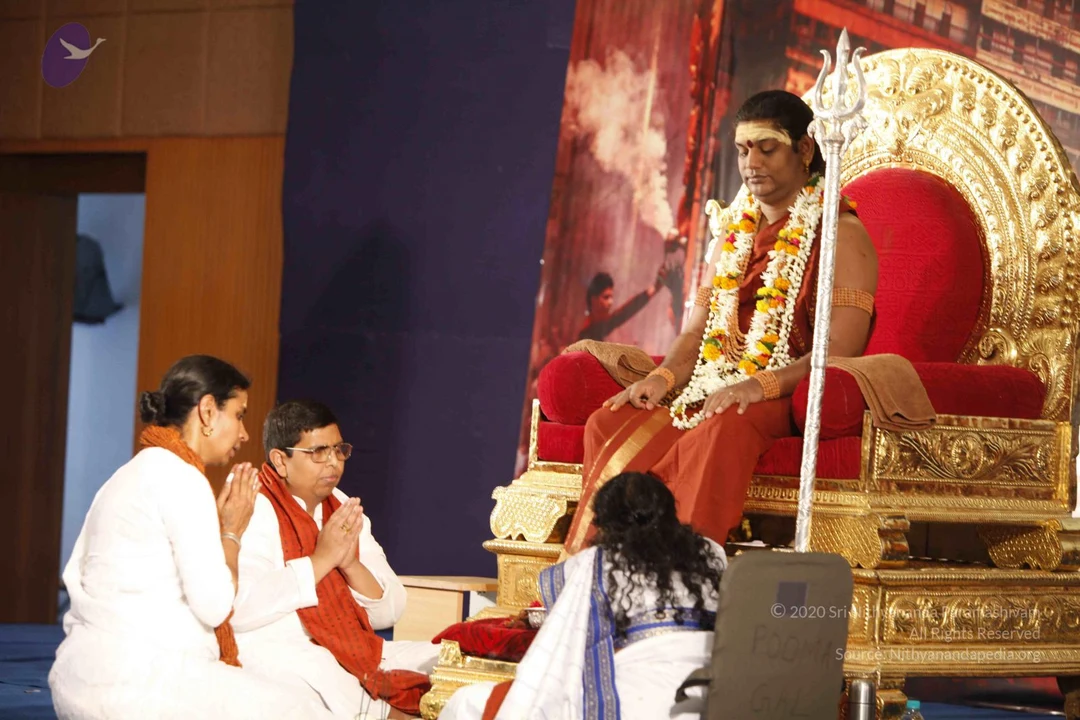
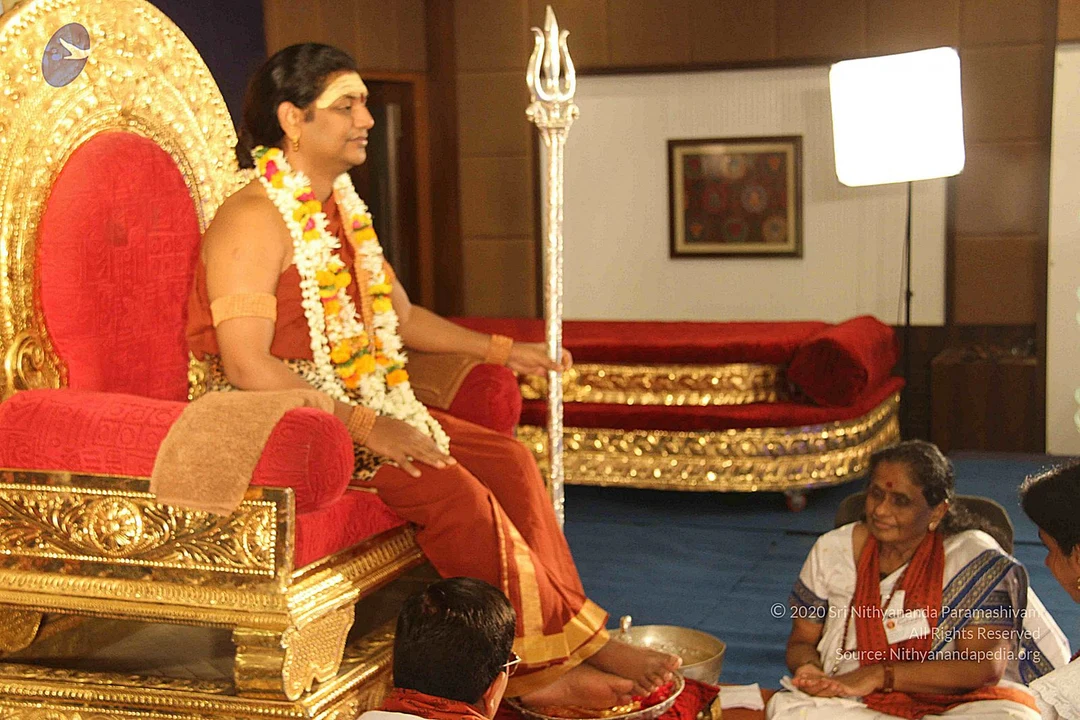
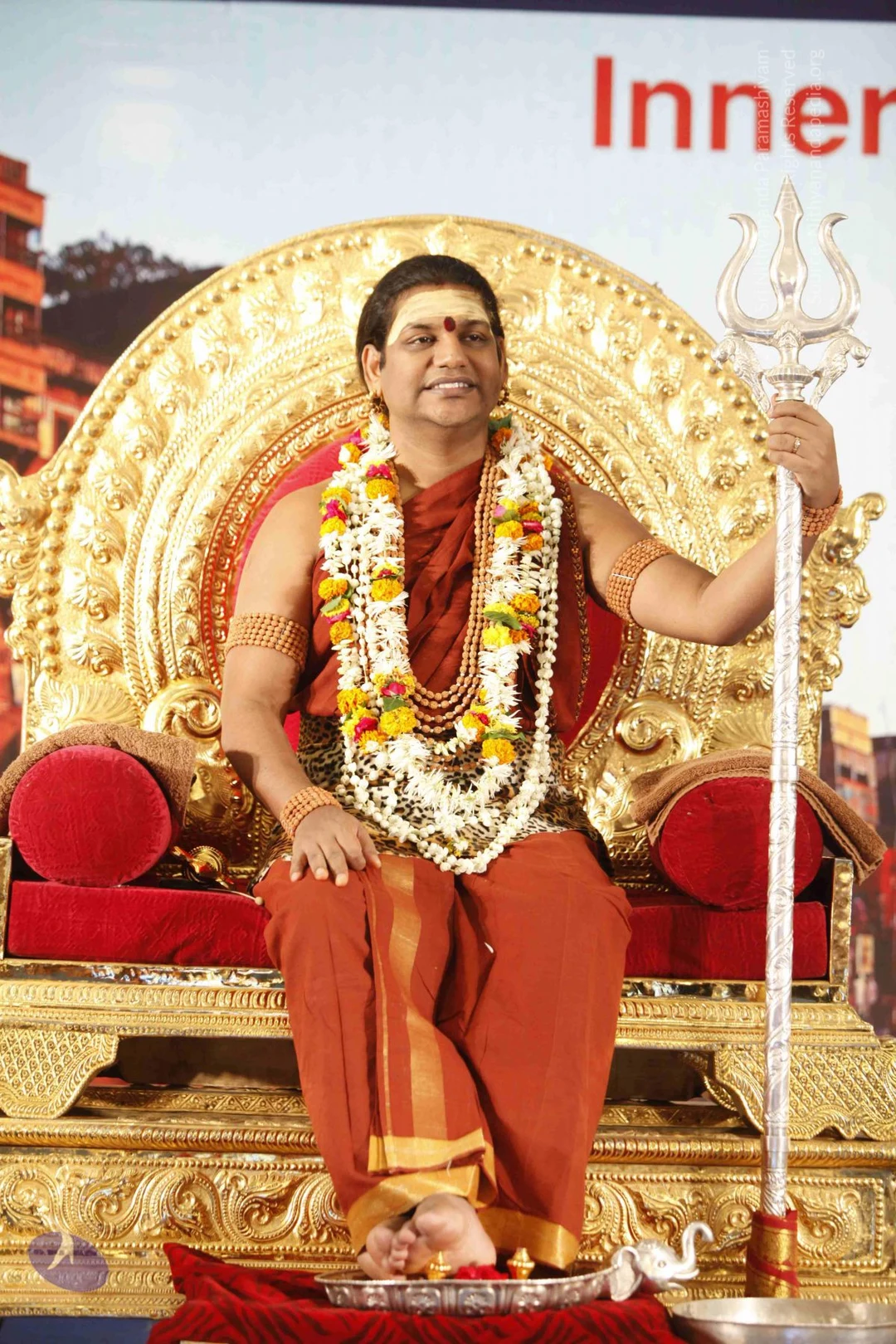
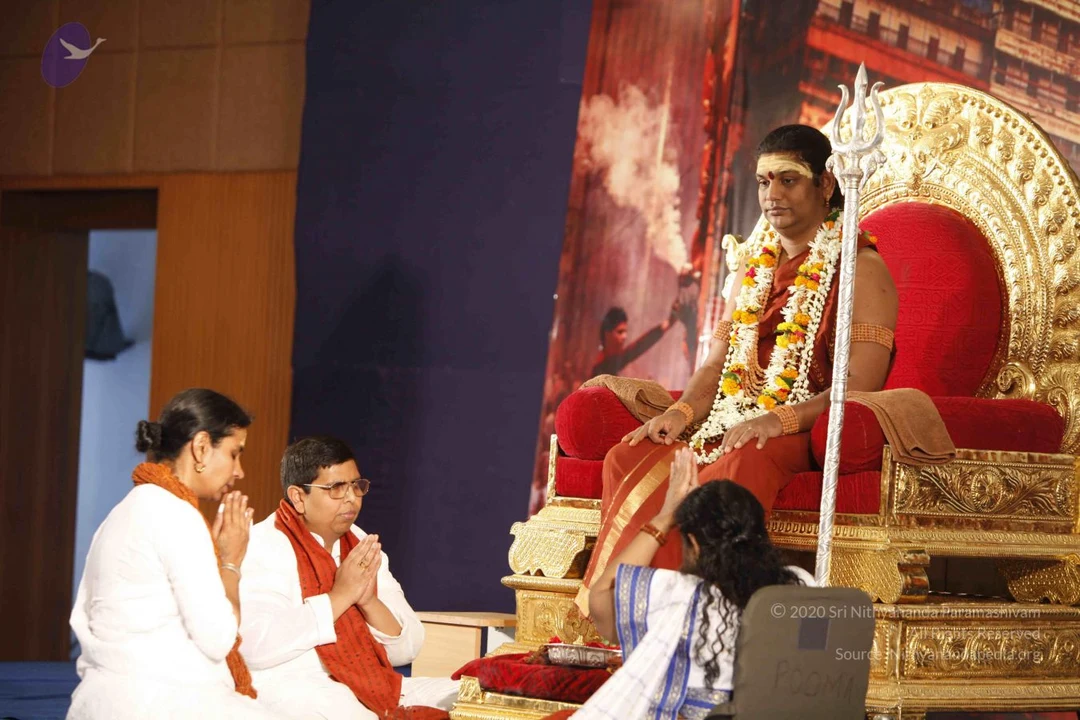
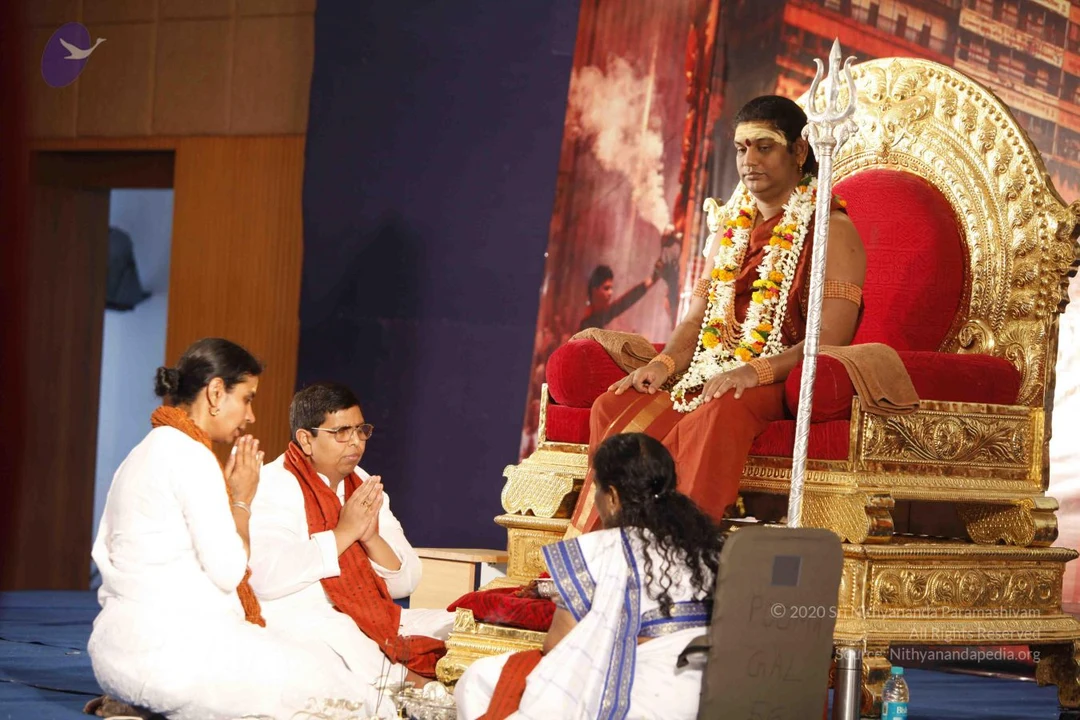
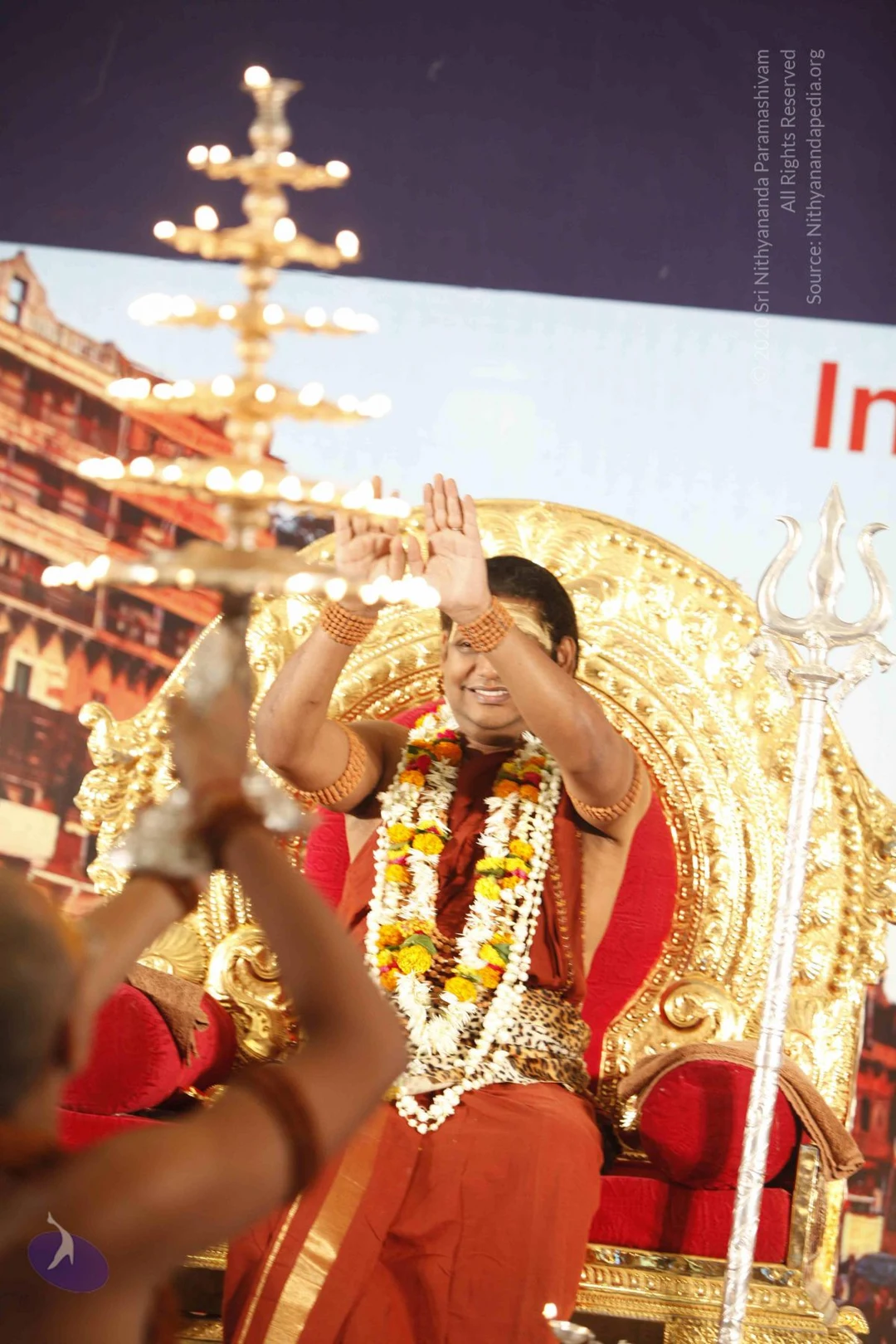
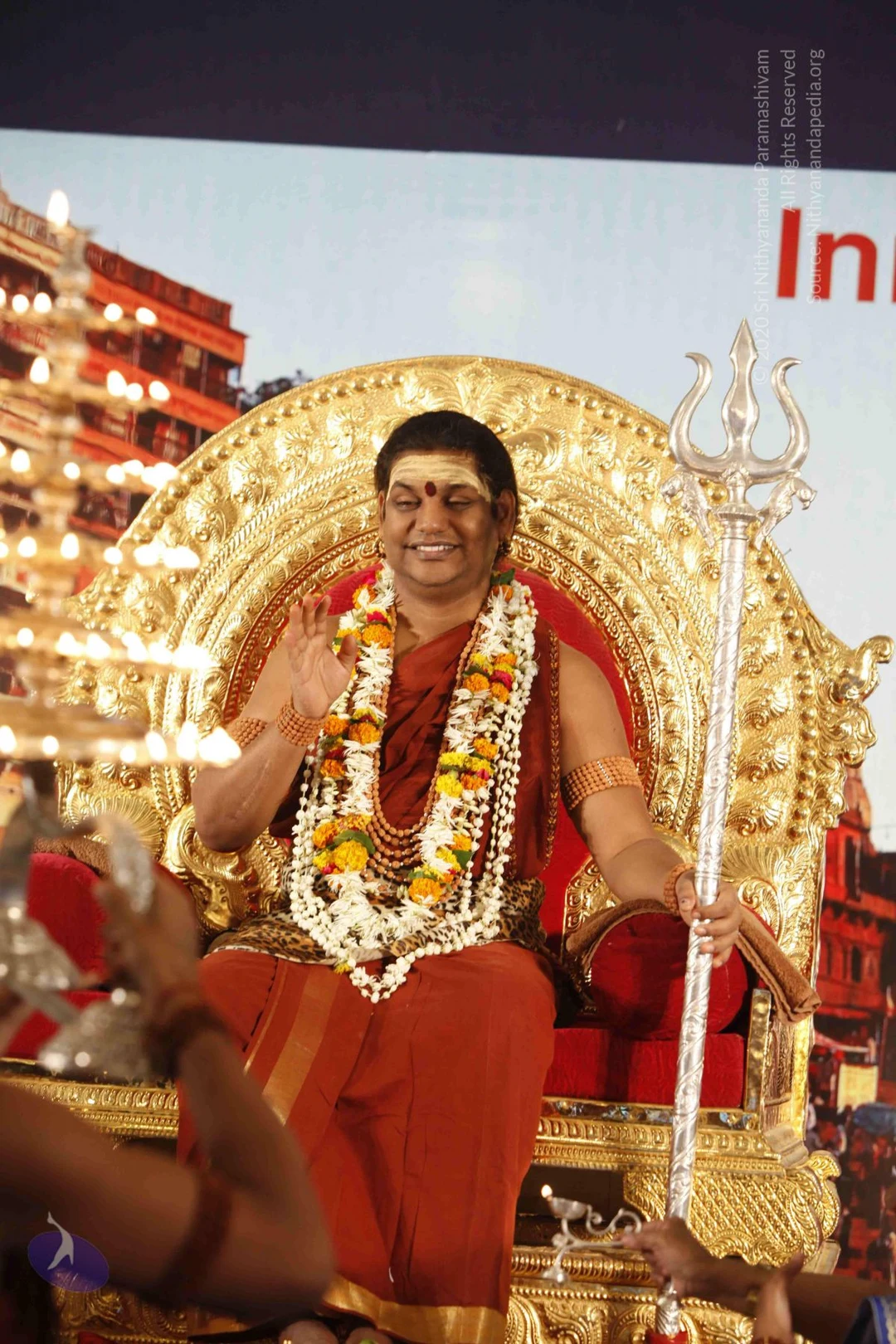
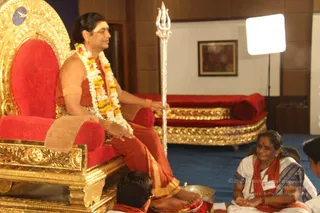
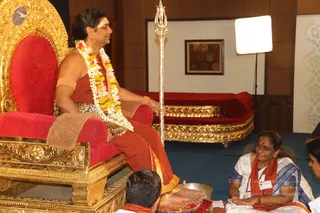
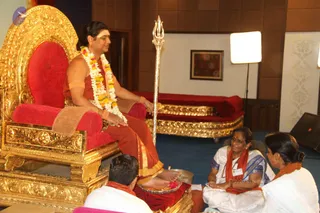
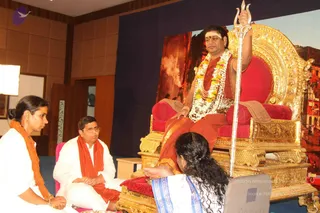
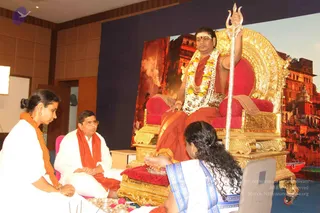
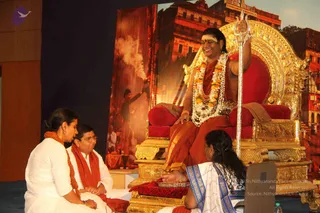
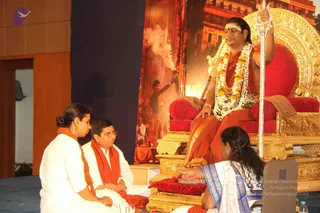
A seated man in a rust-orange dhoti and matching shawl sits on an ornate gold-and-red throne with cushioned armrests, wearing a multicolour flower garland and a sandalwood-marked forehead. A silver trident stands beside the throne. Seated on the blue floor in front, a woman in a white sari with a red-bordered shawl smiles with folded hands, while a man in glasses and a red cloth bends over a brass bowl, washing or offering at the seated man's bare feet. A gold-trimmed red couch and a framed wall picture sit in the background. a person: the seated figure has a long swept-back hairstyle, ceremonial gold ornaments, orange ritual dress and a garland, seated on a throne in the role of the honoured teacher receiving padapuja.A man seated on an ornate gold-and-red throne, wearing a saffron-orange dhoti and shawl, a white-and-orange floral garland, a leopard-print cloth over the lap, and a white tilak on the forehead; a tall silver trident stands beside him. Seated on the floor at right, a woman in a white sari with an orange-red shawl and rudraksha mala is seated before him with hands folded, while a man in a red shawl sits at lower left near a silver tray and bowl at the feet. Behind them are a gold-trimmed daybed, a framed patterned picture and a studio light.A seated man in a red-and-saffron robe with a white-and-yellow flower garland sits on an ornate gold-and-red throne, with a silver trident standing beside him. A forehead tilak is visible. Before him, a man in a white shirt with an orange shawl bends over a brass plate with red flower petals, while two women in white saris with orange shawls sit on the floor, one holding a name badge. A gold-trimmed red daybed and a framed artwork are in the background.A seated man on an ornate gold-and-red throne holds a silver trident aloft in his right hand while addressing a satsang. He wears a red-orange garment, a white floral garland, multiple rudraksha malas and a tilak on his forehead. Two women and a man sit on the stage floor in front of him: the woman at left wears a white outfit and orange garland, the seated man beside her wears white with an orange shawl, and a woman in a white sari with blue border sits in the foreground with her back to the camera. A backdrop shows a temple-town scene. Identity is a visual appearance-based candidate only: a person, seated on the throne with a trident and rudraksha malas, presiding over the satsang.A seated man in an ornate gold and red throne holds a silver trident upright in his right hand. He wears a saffron-orange garment, a white flower garland and a beaded necklace, with a red tilak on his forehead. Two people in white ritual clothing sit on the left, one with an orange shawl and one with a rose-coloured cloth, while a woman in a white sari with blue border kneels at lower right holding a brass plate with offerings. A backdrop shows a riverside city with ghats and boats. Scattered flower petals and small items sit on the floor. Description: appearance-based candidate is a person, seated on the throne with the trident, saffron clothing and garland.A photograph of a satsang on a stage. A man seated on an ornate gold throne with red cushions wears an orange-red dhoti and shawl, a white floral garland, orange and white flower strands, a red-and-gold bindi and a forehead band, and holds a silver trident upright in one hand. A probable Swamiji candidate with long swept-back hair, a rudraksha-style red-and-gold ornamentation and ceremonial clothing is seated centrally. Two women in white kurtas with orange-red shawls sit on the floor to his left, and a woman in a white sari with blue border sits at the lower right, holding a brass plate with a lamp.

Satsang

18 photosSource gallery
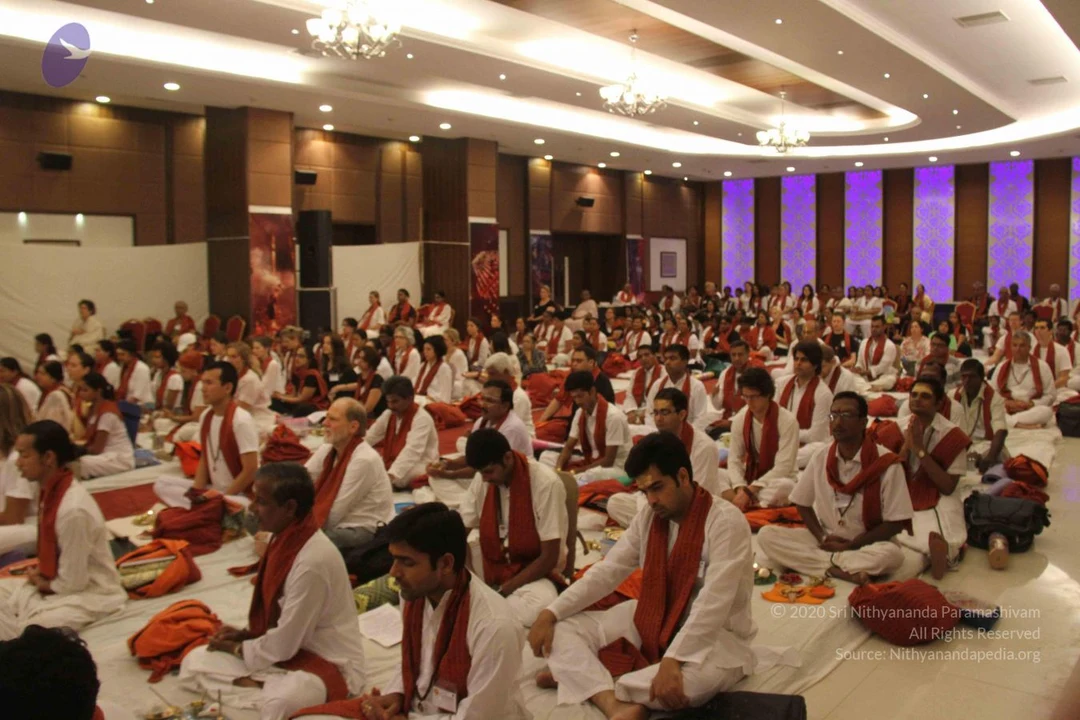
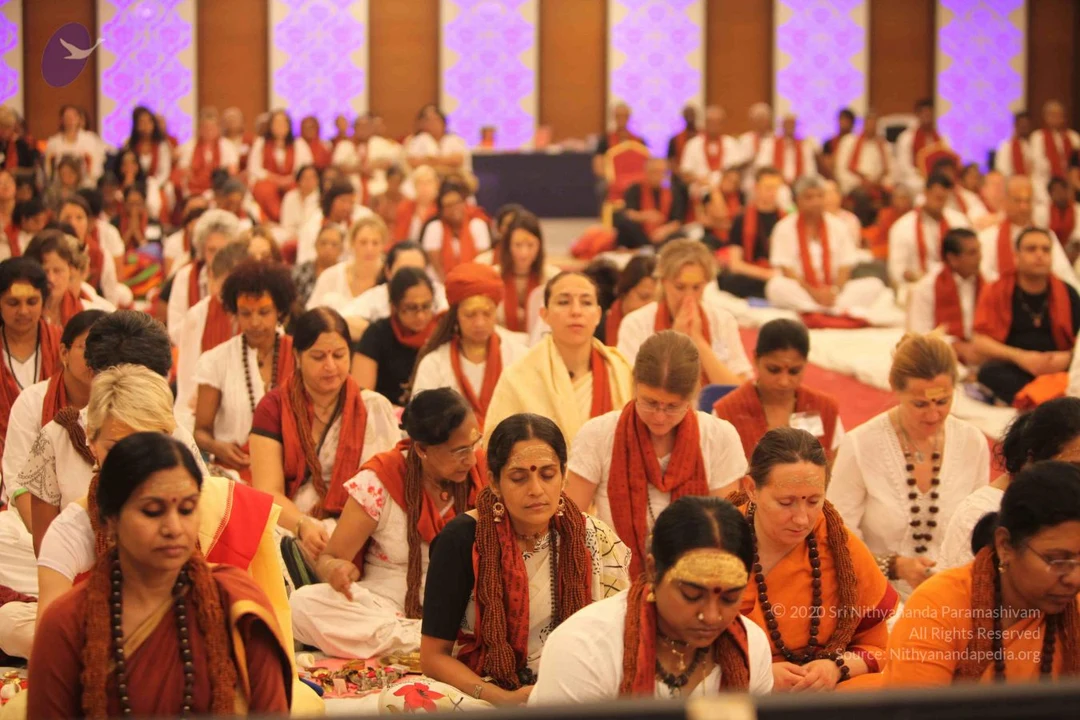
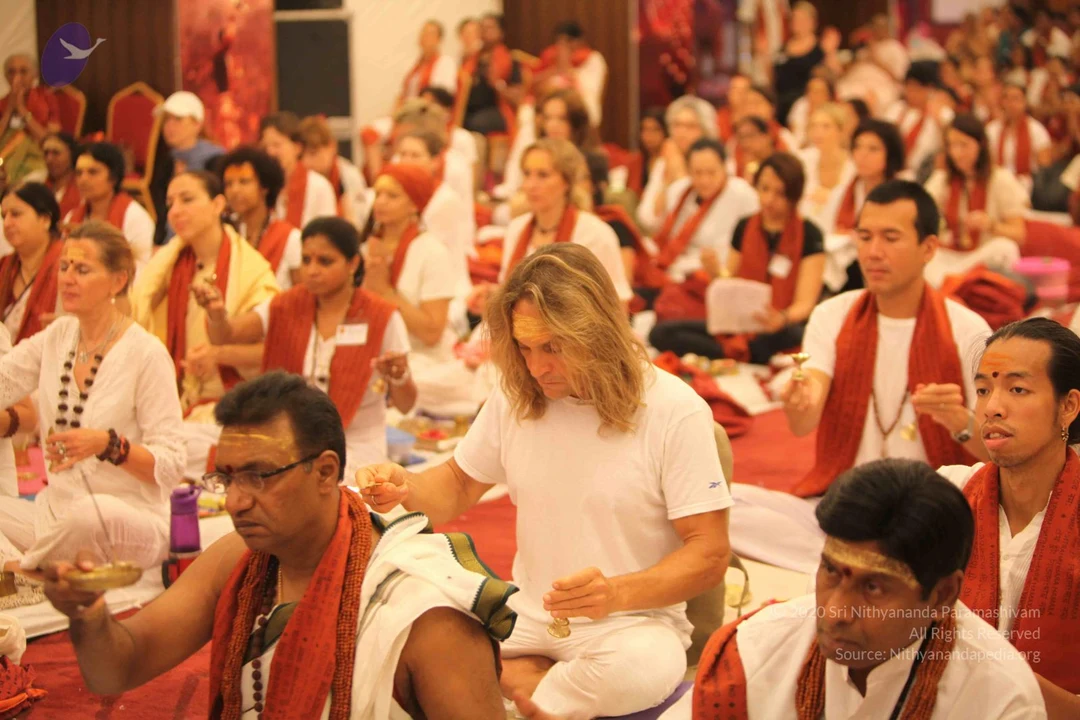
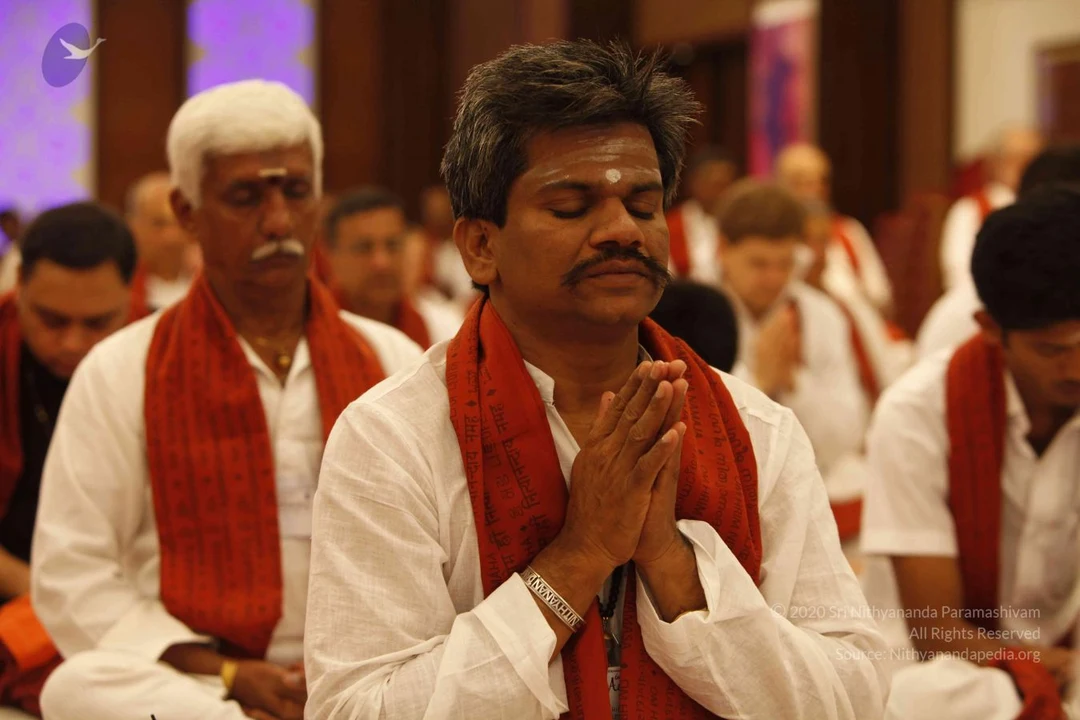
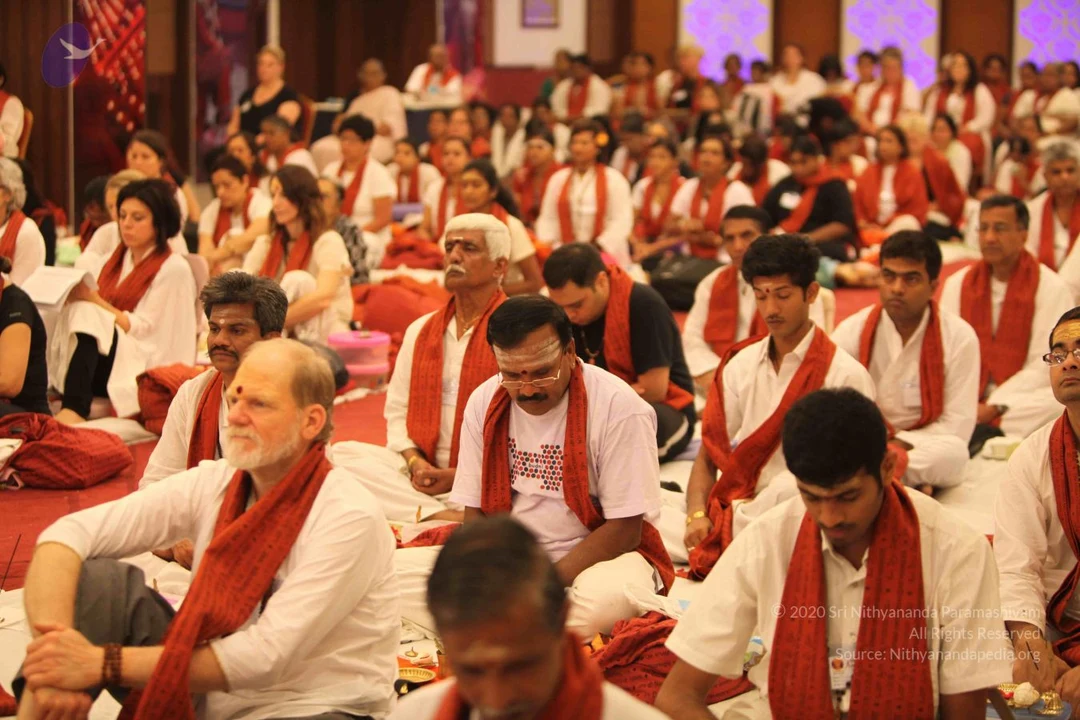
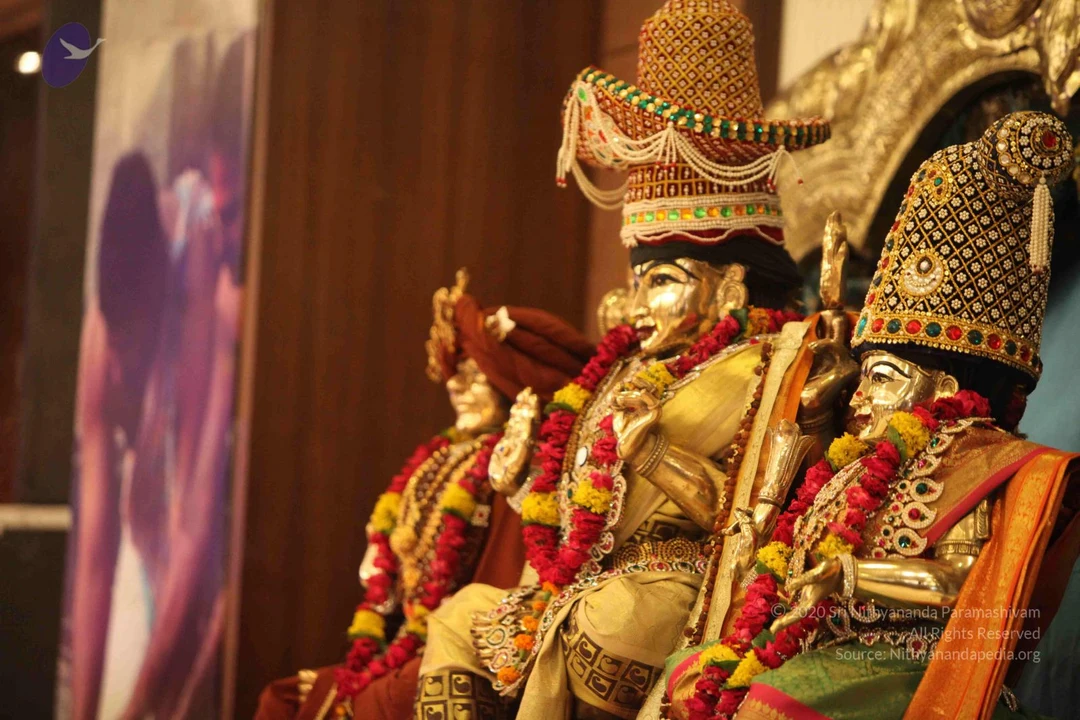
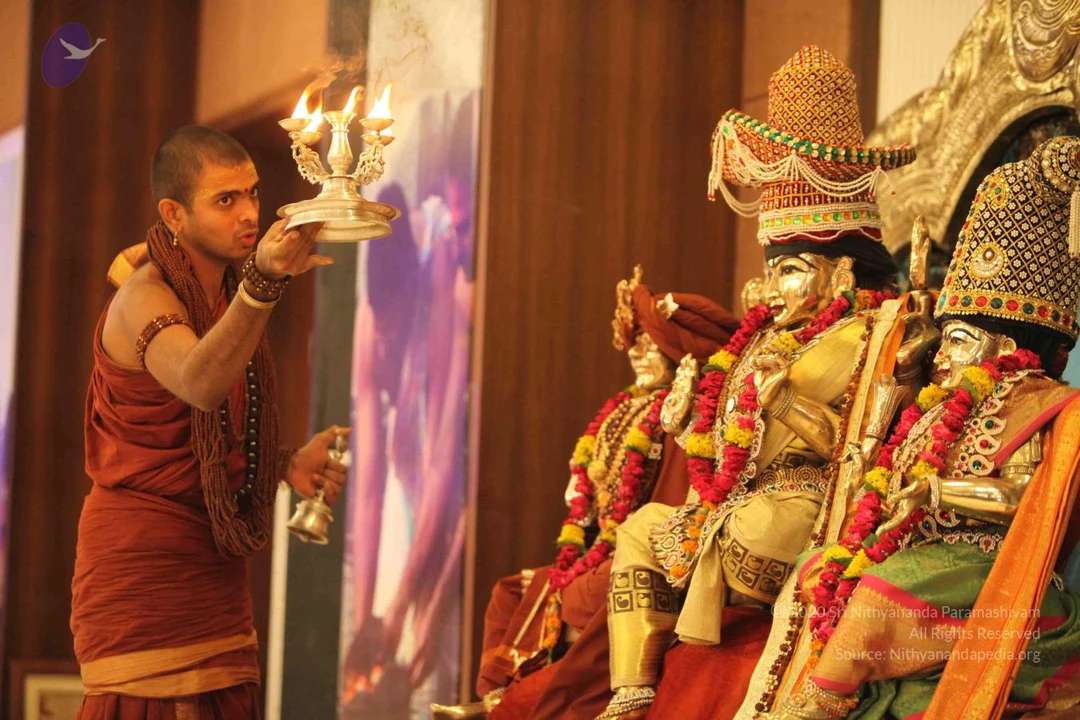
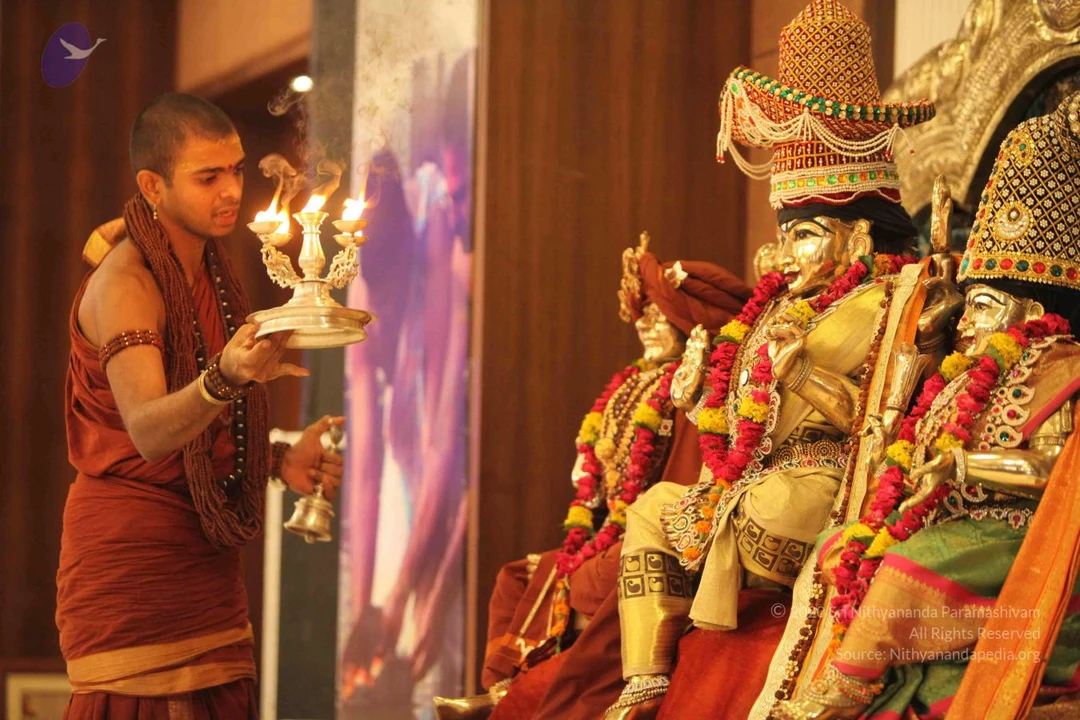
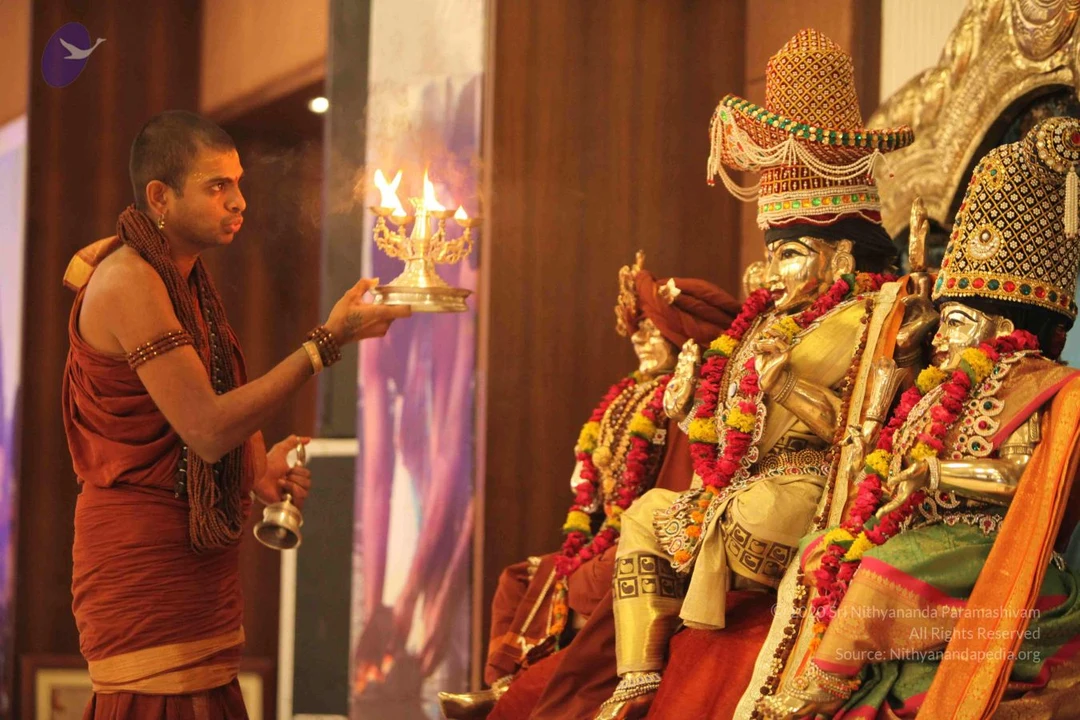
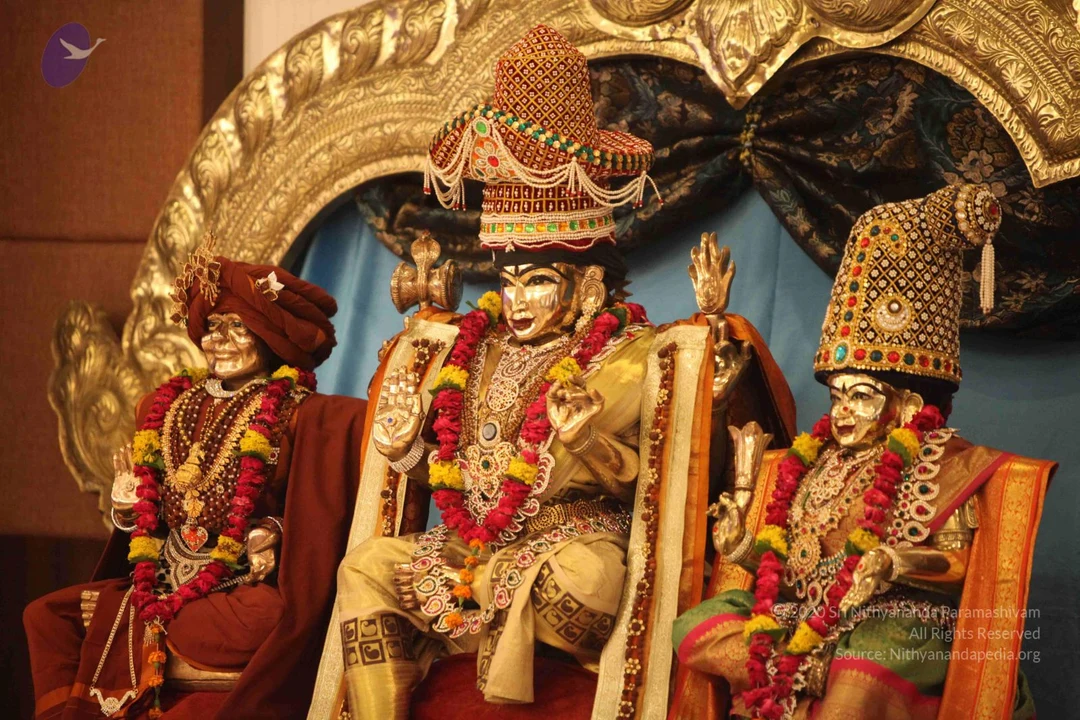
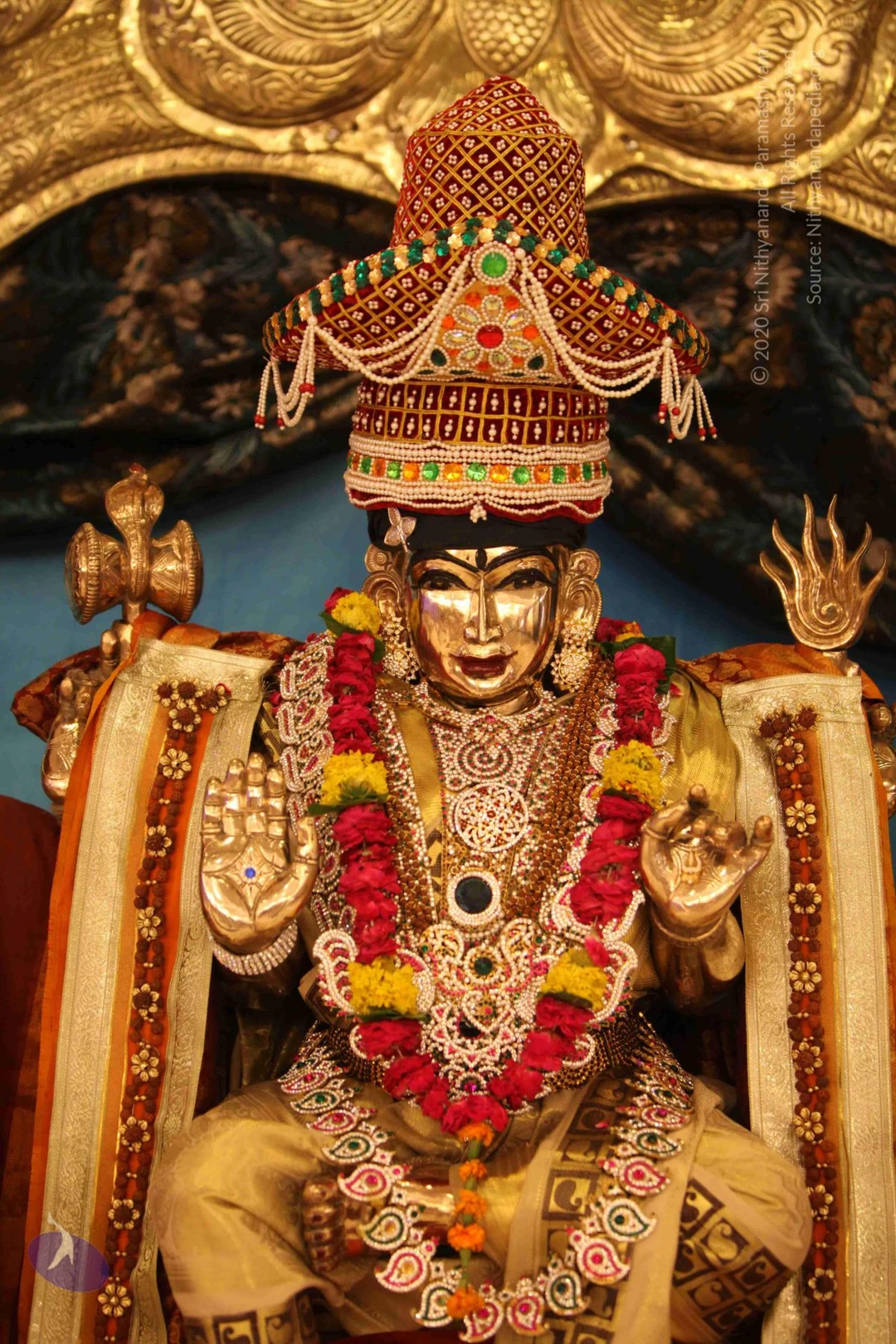
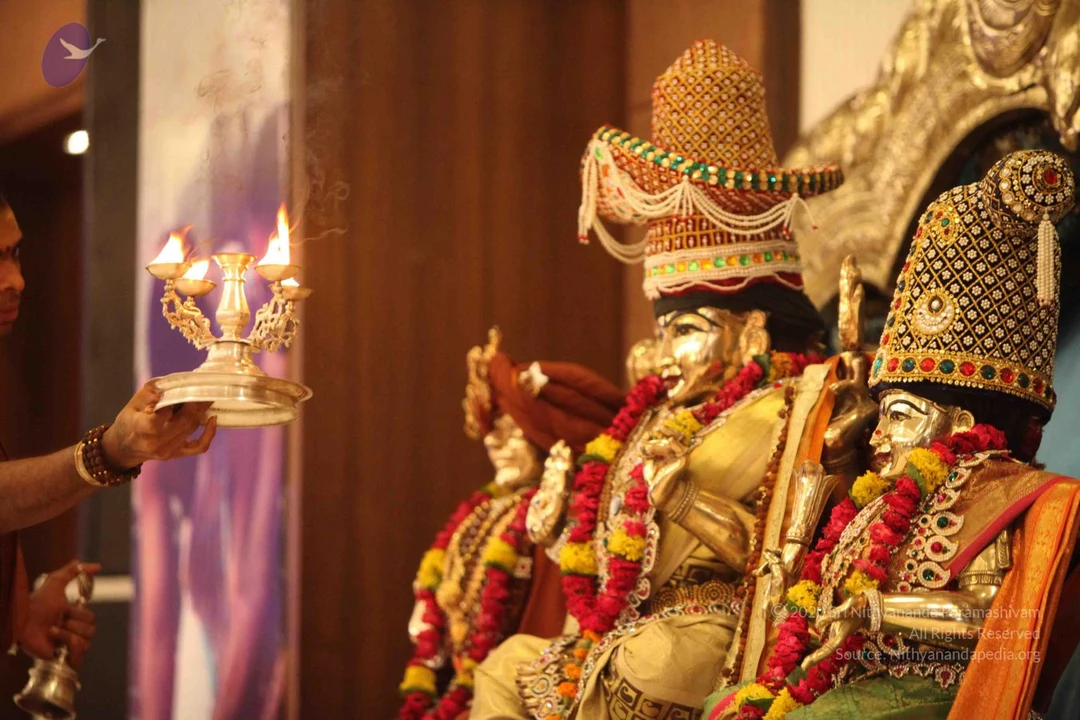
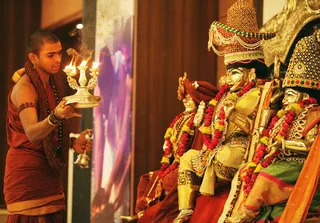
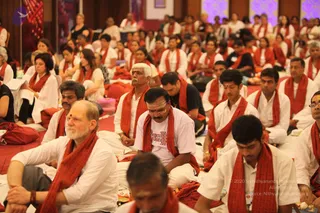
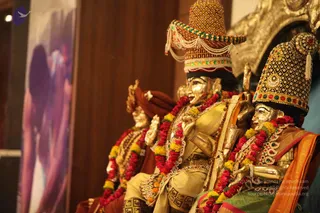
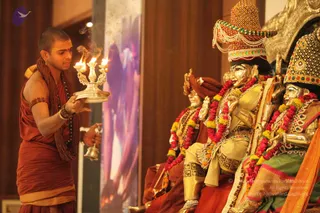
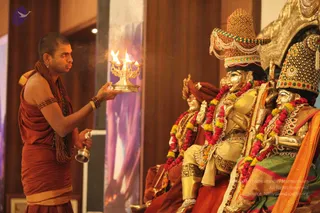
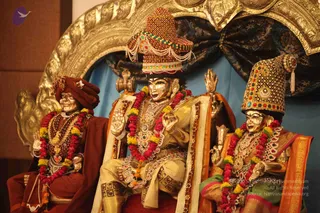
A seated audience of devotees fills a hall with red carpet, many wearing white kurtas or shirts and red shawls draped over their shoulders. A man in front wears a white t-shirt and red shawl with a vibhuti mark on his forehead, eyes closed in meditation. A bald man with a white beard in the foreground wears a white shirt and red shawl. Other people sit cross-legged on red cushions, some with bags and small containers beside them. Behind them stands a pink-lit stage backdrop with a purple lotus-patterned panel. Visible printed copyright and source overlay text marks the image. The setting suggests a satsang or meditation program with a large group of attendees.Photograph of three seated deity murti in an indoor hall with a wooden wall behind them. The central golden figure wears an ornate jeweled crown with red and green gem bands, a white beaded fringe, and a gold-toned robe, with a red and white flower garland around the neck. The figure to the right wears a dark jeweled headdress and an orange-and-green silk garment, also garlanded with red and yellow flowers. A partly visible figure on the left wears a brown cloth and a red garland. A tall vertical banner with a blurred purple image hangs at the left edge. Statues only; no physical people are visible.A photograph of a ritual aarti before deity murtis. A young shaven-headed priest in rust-orange dhoti and shawl, with rudraksha mala and bangles, holds a lit silver five-flame oil lamp in his right hand and a small silver bell in his left. Behind him, two large seated deity murtis in silver-gold finish wear ornate crowns, garlands of red and yellow flowers, and jewelled ornaments; the figure on the right wears a green and orange sari-style cloth. A purple-pink backdrop and wooden panels frame the scene. The priest is not a person by visible cues; the figures on the throne are statues.A young priest in saffron-red dhoti and upper cloth, with rudraksha mala and bead bracelets, holds a silver multi-wick oil lamp with flames aloft while ringing a small handbell in his other hand. Beside him, seated golden deity murti are adorned with fresh marigold garlands; the central figure wears an ornate red and gold crown and jewelled ornaments, and the right figure wears a jewelled golden headdress and green silk. The setting is an aarti offering in a temple-like hall with a purple-lit backdrop and a warm wooden wall, with incense smoke rising. Visible people: one priest.A young shaven-headed priest in a rust-orange dhoti and wrap, with a rudraksha mala across his chest and beaded bracelets, holds a silver multi-wick oil lamp with flames aloft in his right hand and a small silver handbell in his left. He stands at left, facing a row of seated metal deity murtis adorned with red and yellow flower garlands. The central murti wears a tall ornate gold crown and a gold-and-cream dhoti; the murti at right wears an ornate gold crown and a green and orange silk garment. Warm wood-panelled walls form the backdrop.Three figures seated on a gilded throne-like chair before a blue drape, appearing to be statues or murti-style figures rather than living people. The central figure wears an elaborate gold and red embroidered crown with tassels, a gold-and-white brocade robe, and layers of red and yellow marigold garlands, with ornate gold necklaces. The figure on the left wears a deep maroon turban, a maroon shawl, and a gold-beaded necklace with a garland. The figure on the right wears a tall gold-and-gem studded headdress, a red-and-orange sari-style garment, and a garland. All three have gold-tone masked faces and are adorned with flowers and jewelry.

Yoga-session

8 photosSource gallery
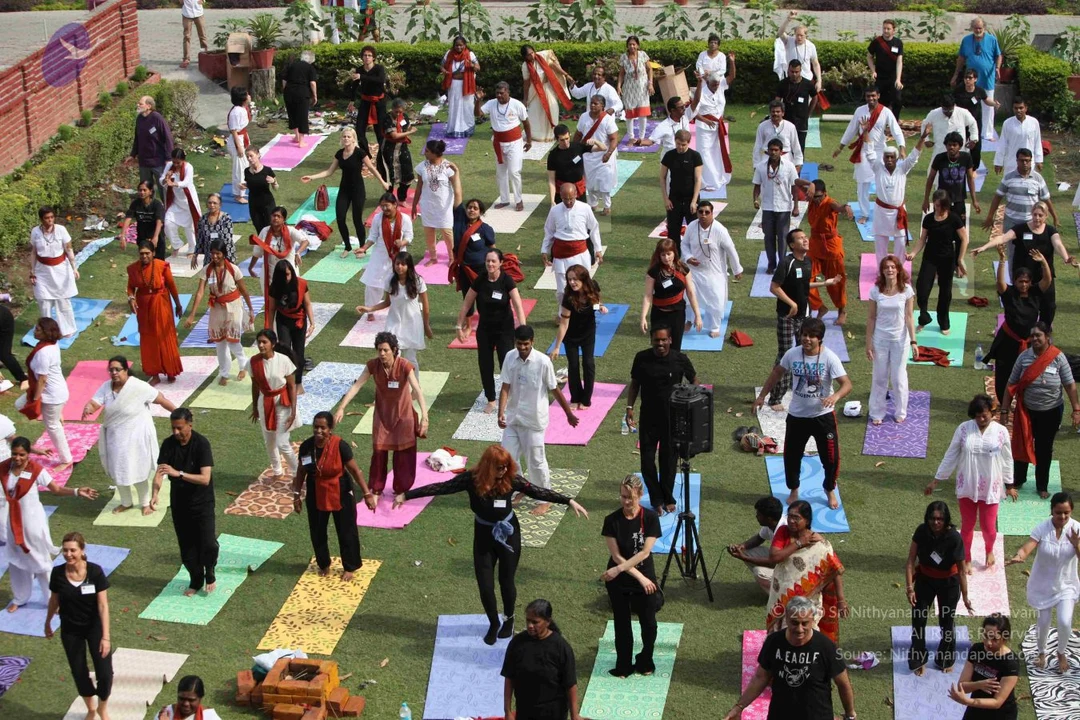
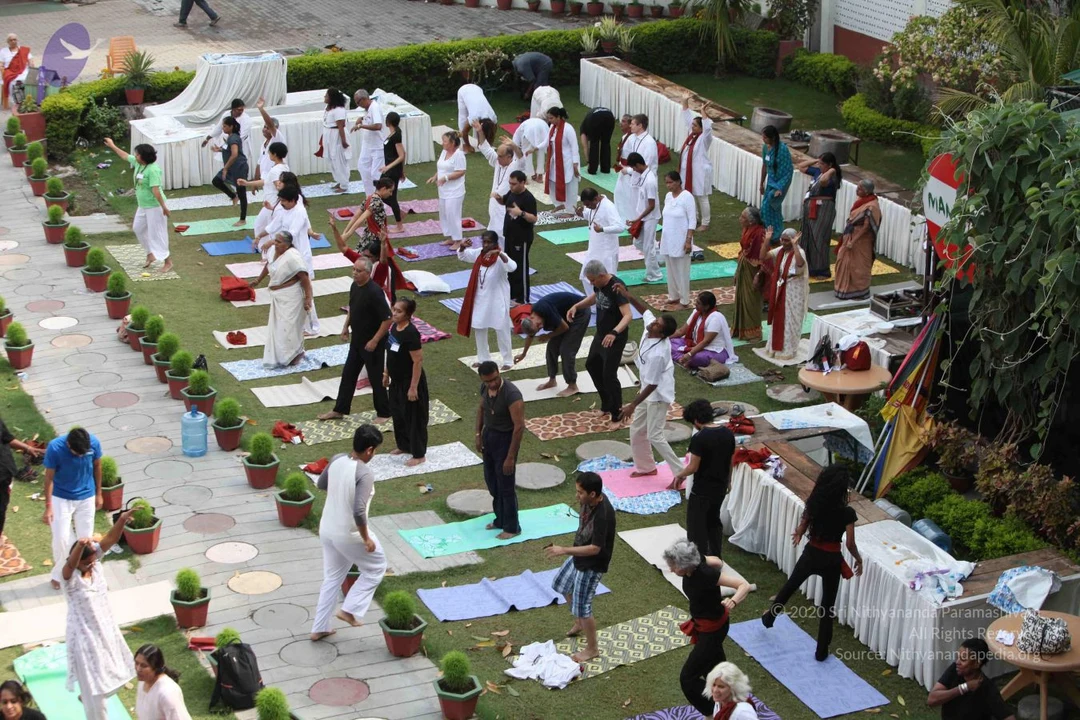
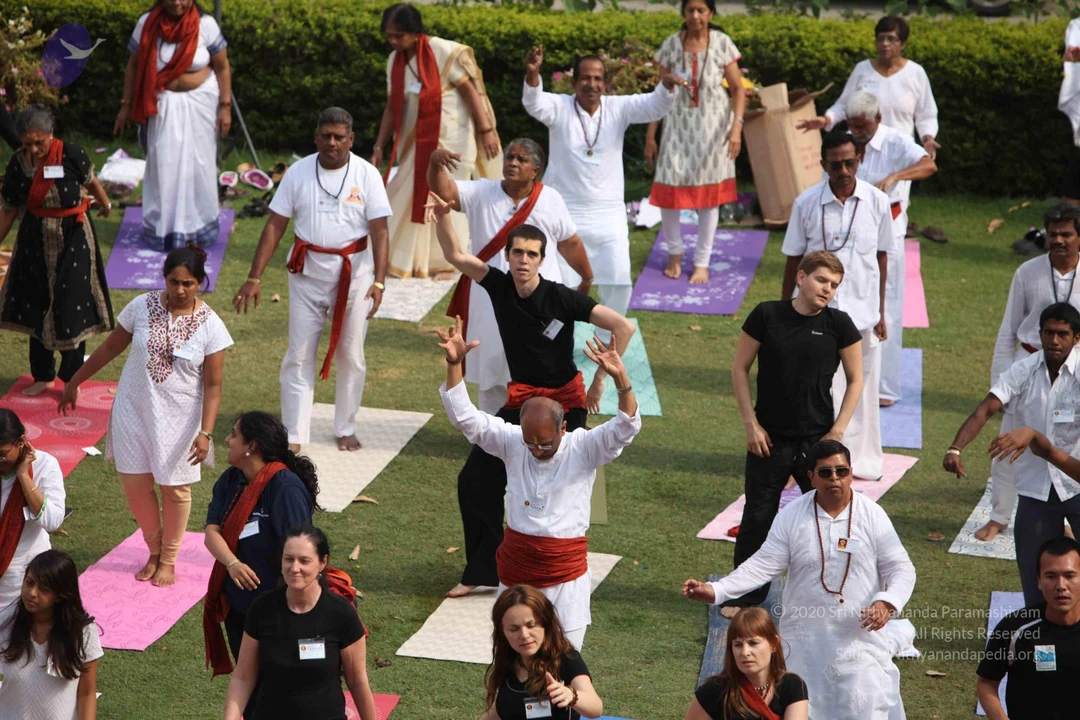
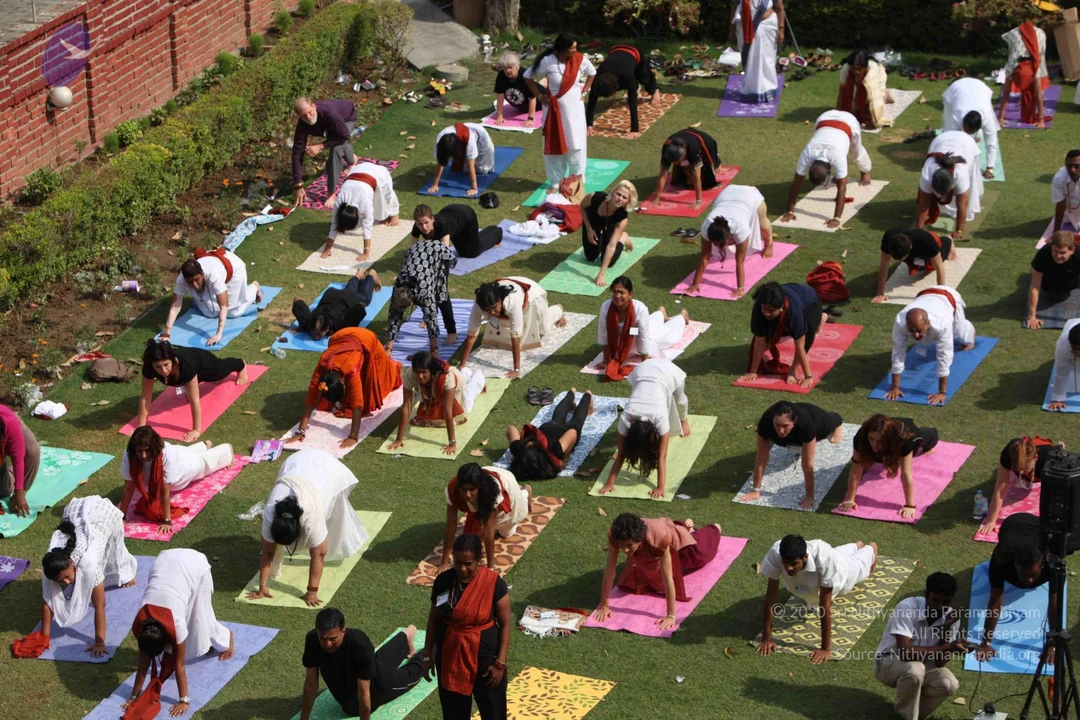
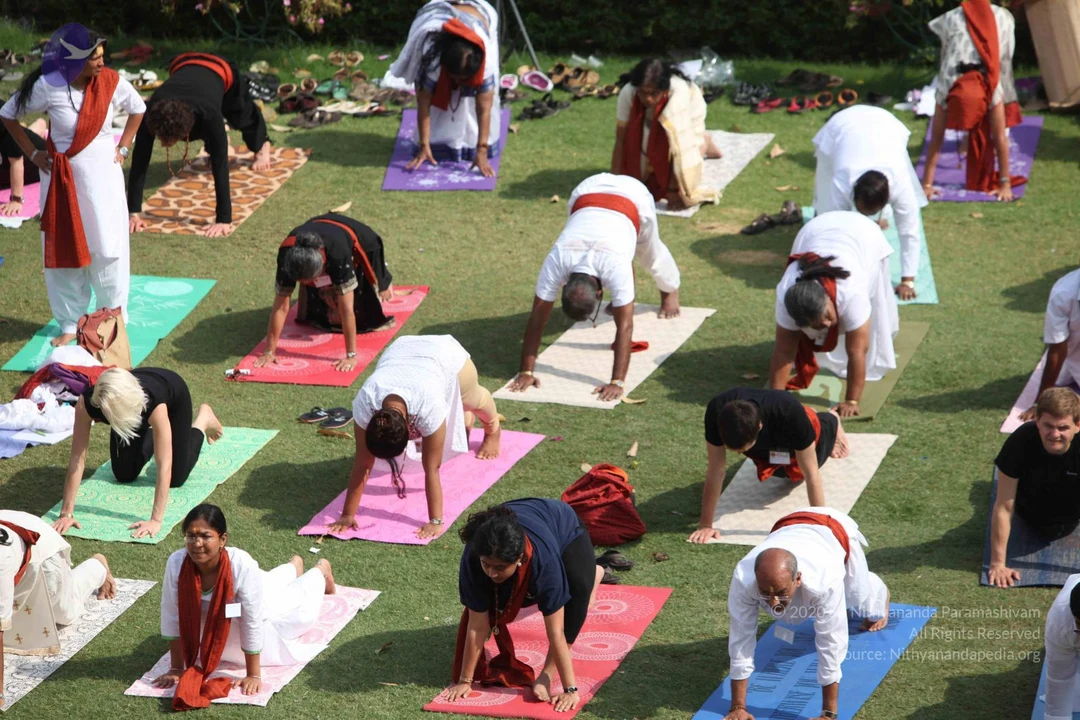
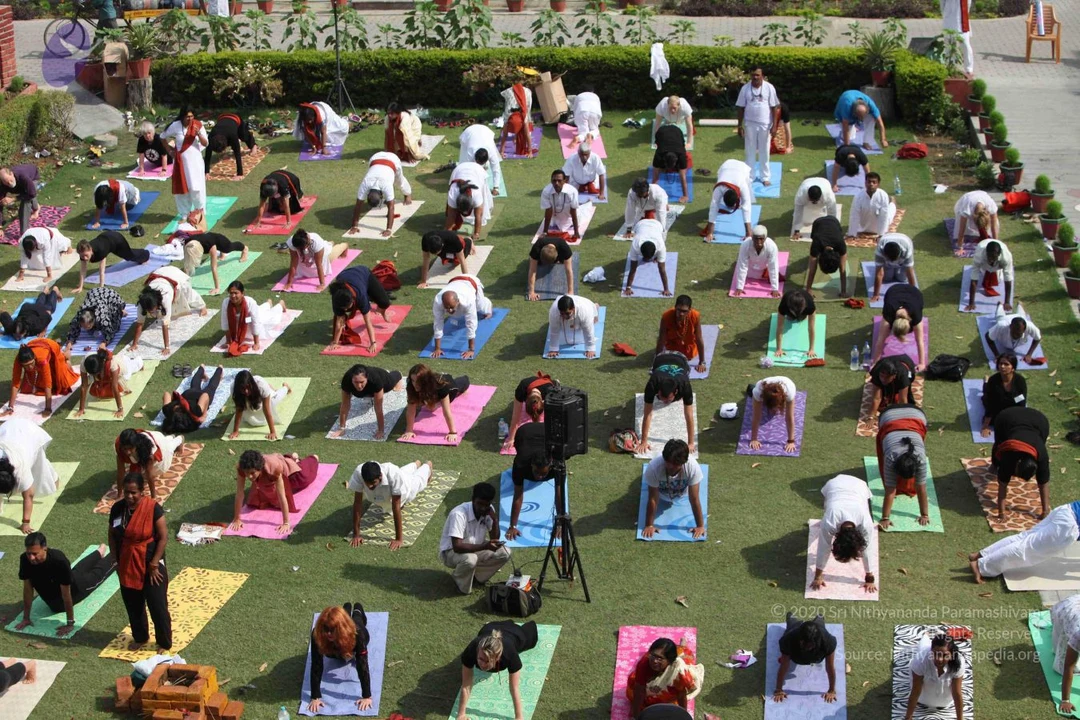
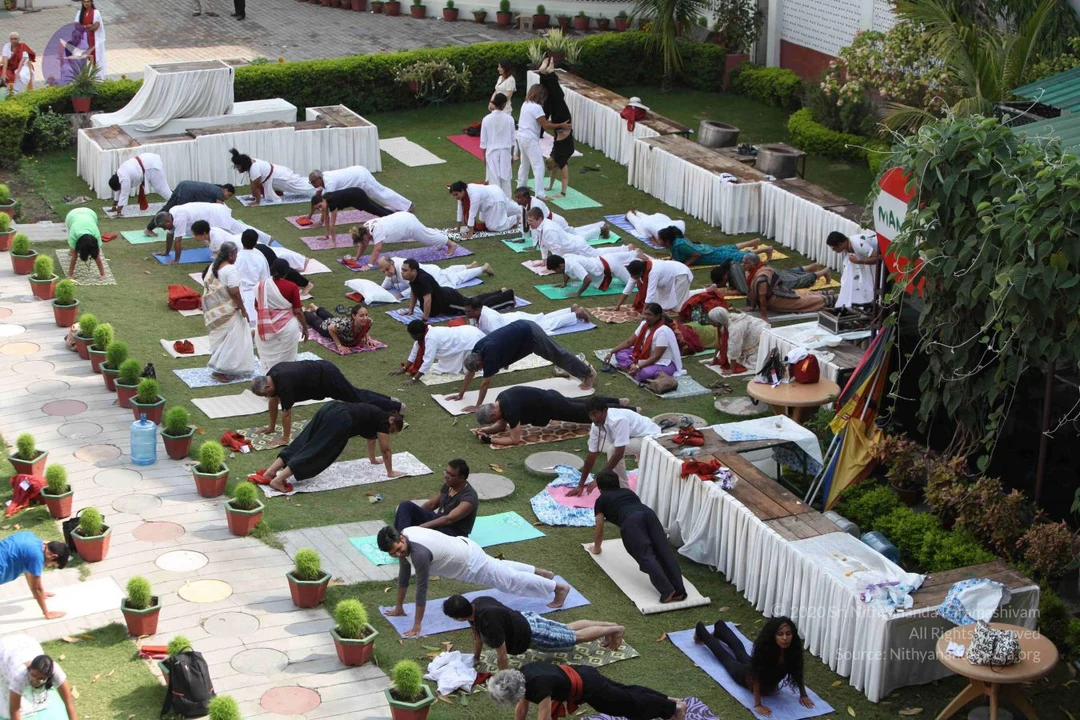
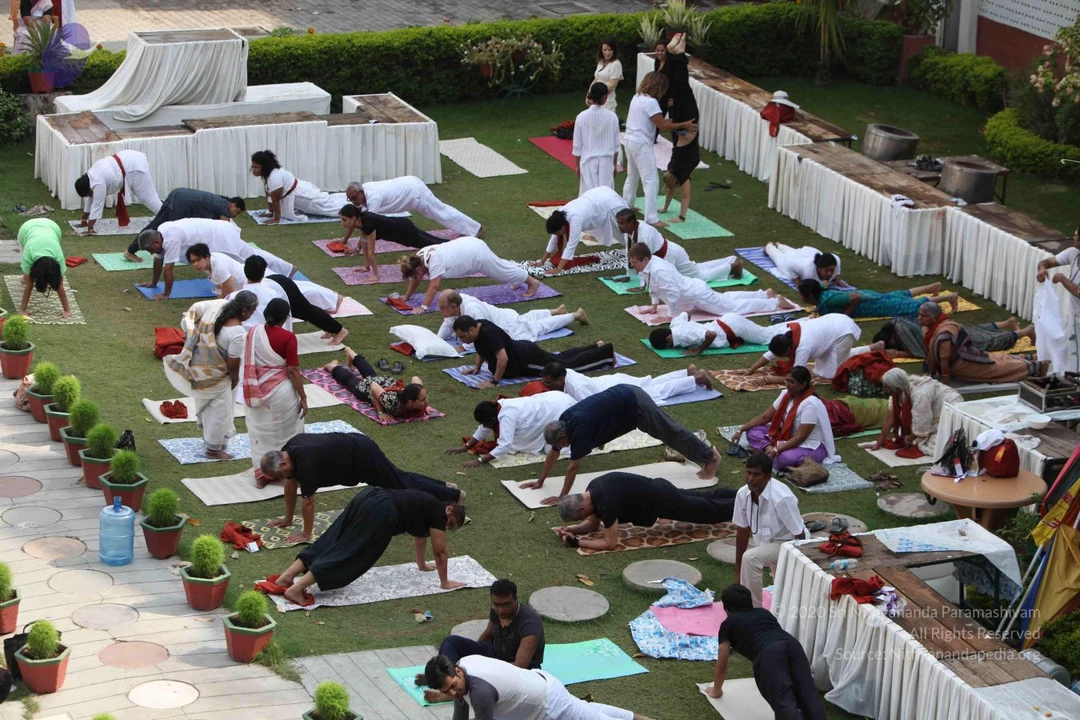
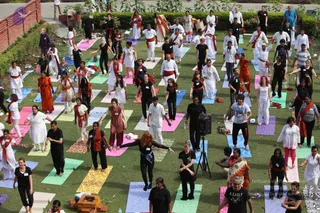
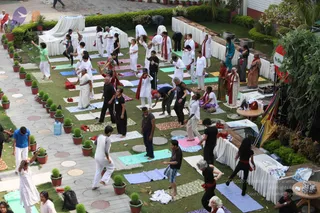
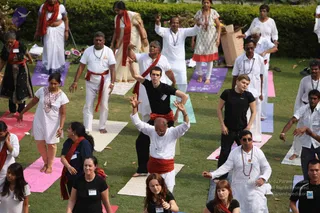
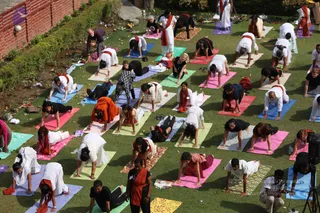
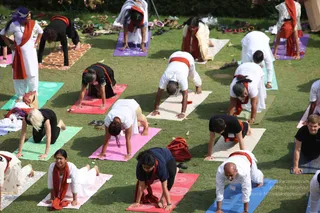
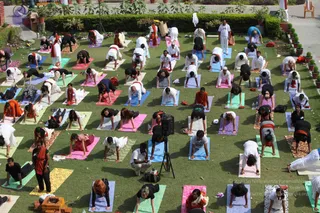
Outdoor group yoga session on a green lawn, with dozens of participants standing on colourful yoga mats in rows. Many wear white kurta-style or white tops with red or orange sashes, while others wear black tops and trousers; a few wear orange or saffron robes and a woman in a red and orange outfit stands in the foreground. Some have arms raised or outstretched in asanas, and a black speaker on a tripod stands among the mats. Brick paths, hedges and a red-brick wall frame the scene.Outdoor photo of a yoga session on a lawn, with many participants on coloured mats arranged in rows. Most wear white or black clothing, and many wear red stoles or red scarves around their necks. Some stand in tree-like poses, others bend forward or stretch. Potted topiary plants line a stone path on the left, and white-draped tables with a red banner partly visible on the right. Some people in the foreground wear dark shirts and dark trousers. Some participants wear saris in red and orange tones.Outdoor group yoga session on lawn with many participants on colourful mats, mostly in white and white-and-red clothing. Participants wear red sashes and rudraksha-style beaded necklaces, with arms raised in a stretching or movement posture. A man in white with a red waist sash stands at centre with arms up, another in black with red sash nearby. Women in white salwar and saree and a woman in a white kurta stand among them, with hedges and trees behind.A photo of a large outdoor yoga session on a green lawn beside a brick wall and hedge. Dozens of participants on coloured mats in cat-stretch or child-pose positions wear white kurtas and black tops, many with red shawls or sashes. A few people in black stand on the grass and an instructor in white stands at upper left. A camera on a tripod is at lower right.Outdoor yoga session on a lawn with many participants on coloured mats, bending forward into a downward or child-like stretch. Most wear white or black tops and trousers with orange-red shawls draped over their shoulders. Shoes are lined up on the grass at the back. A few people in the foreground lean forward on pink, green, blue and white mats.Aerial view of a large outdoor yoga session on a green lawn, with many participants in white, black, and orange clothing bending forward or stretching on coloured yoga mats in pink, blue, green, purple, and zebra and leopard prints. A few people in orange and red robes stand among them, and a woman in a red shawl stands at the left edge. A man in a white shirt crouches at a camera on a tripod, and a black speaker sits in the middle. Potted topiary lines the right edge and a bush-filled border runs across the top.

IA-Darshan

96 photosSource gallery
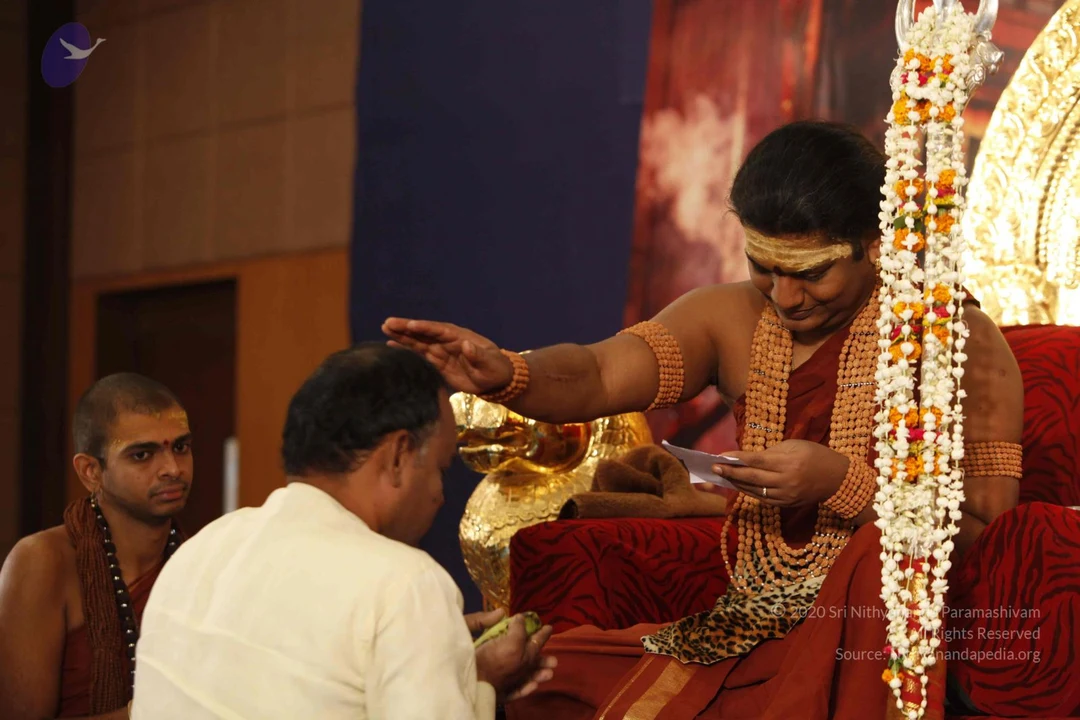
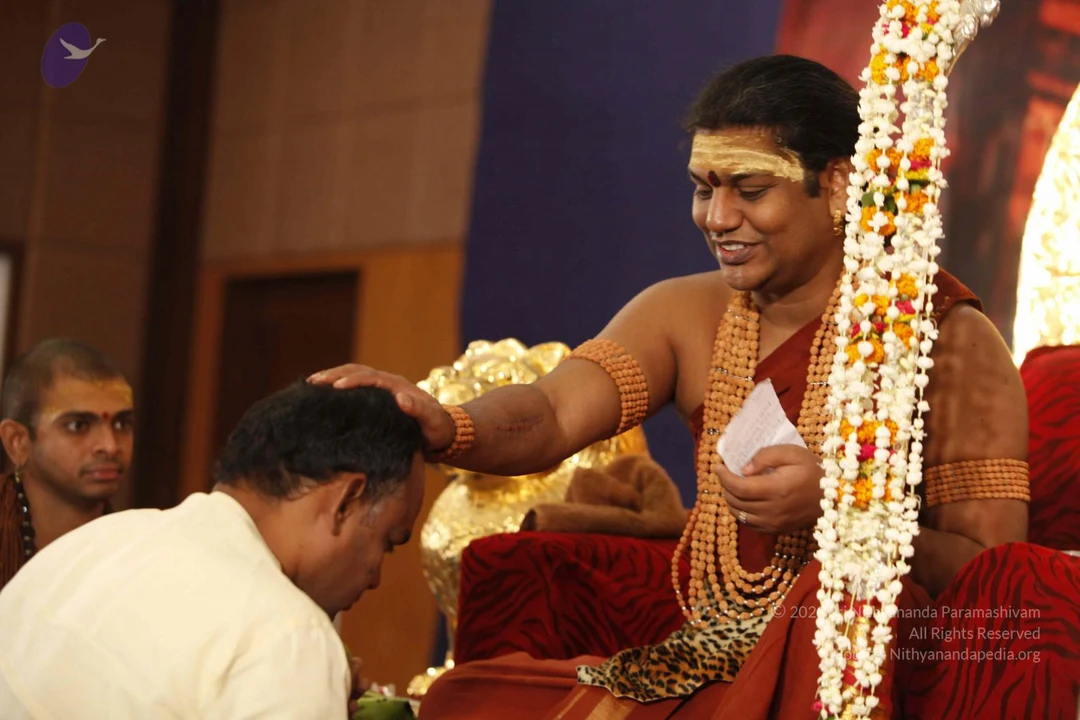
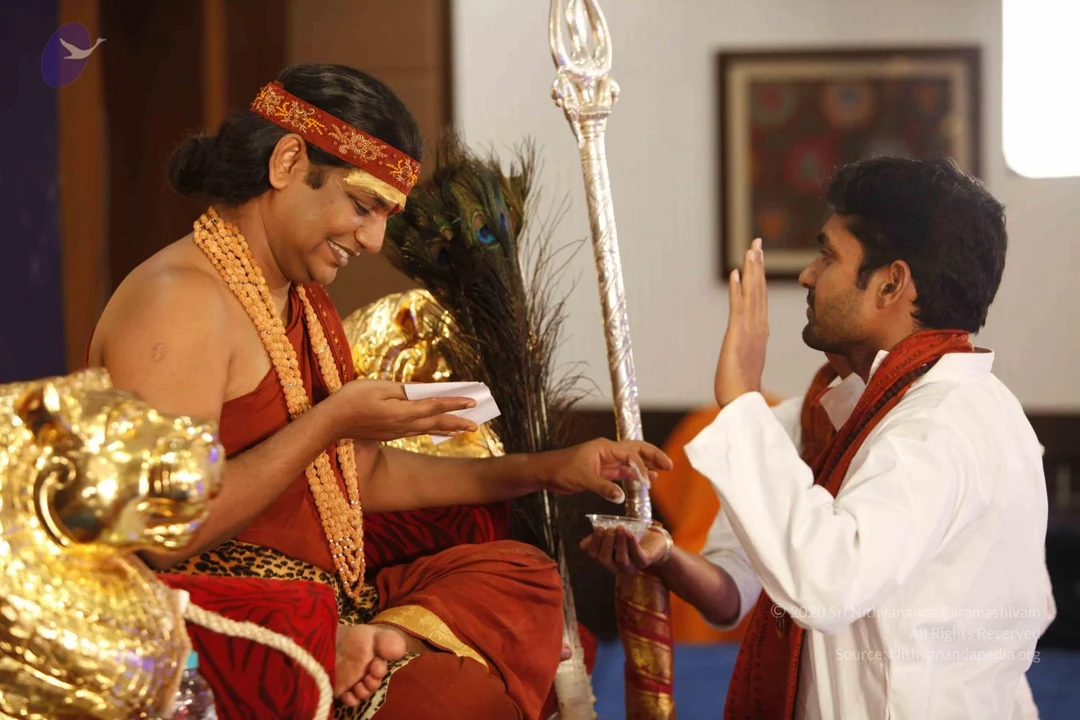
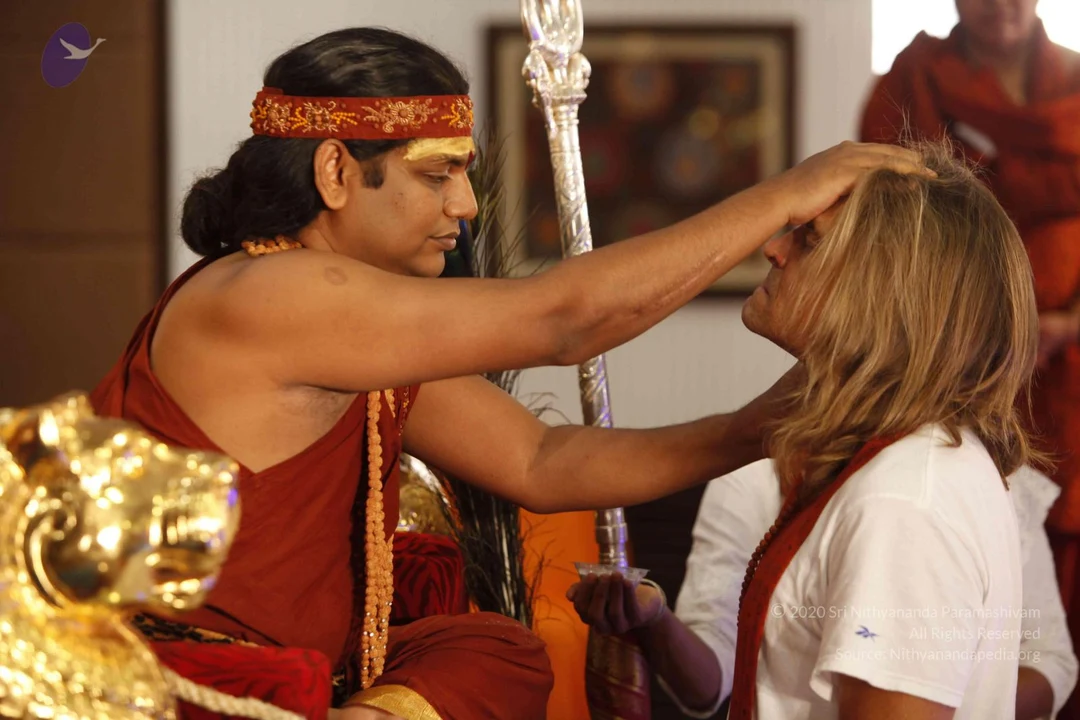
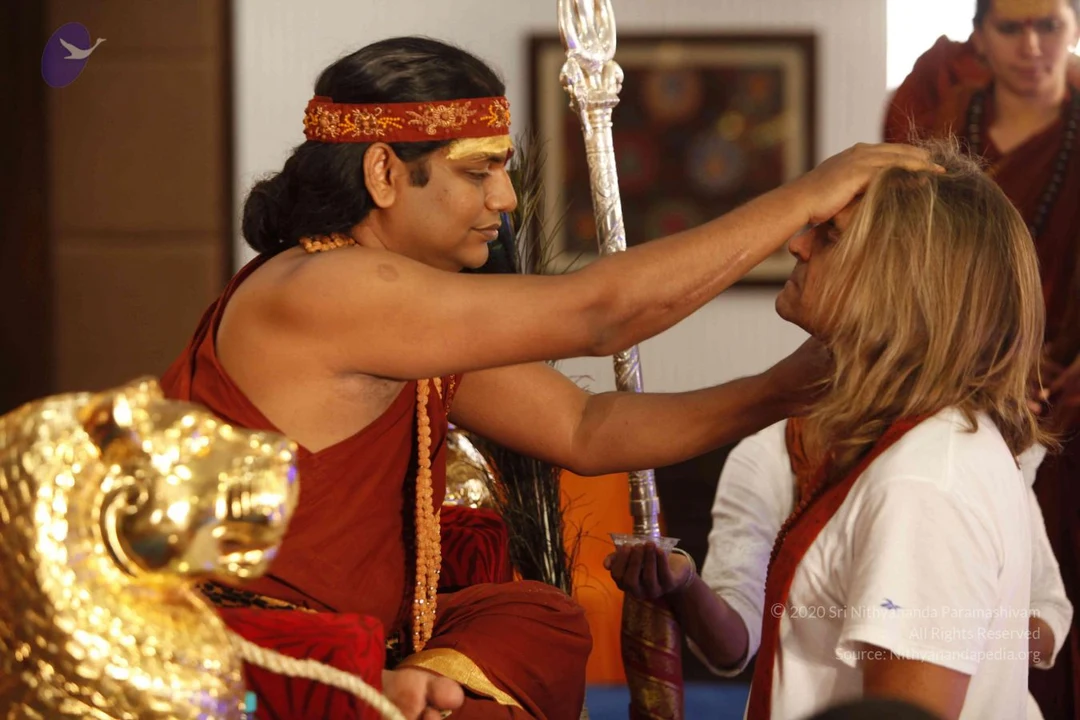
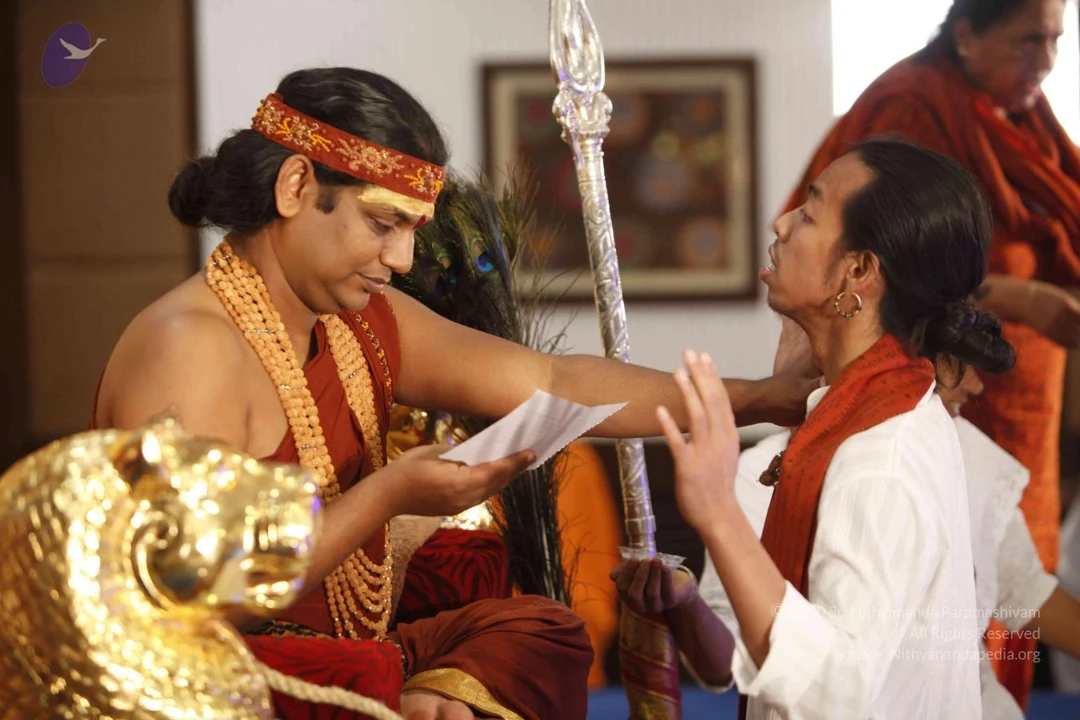
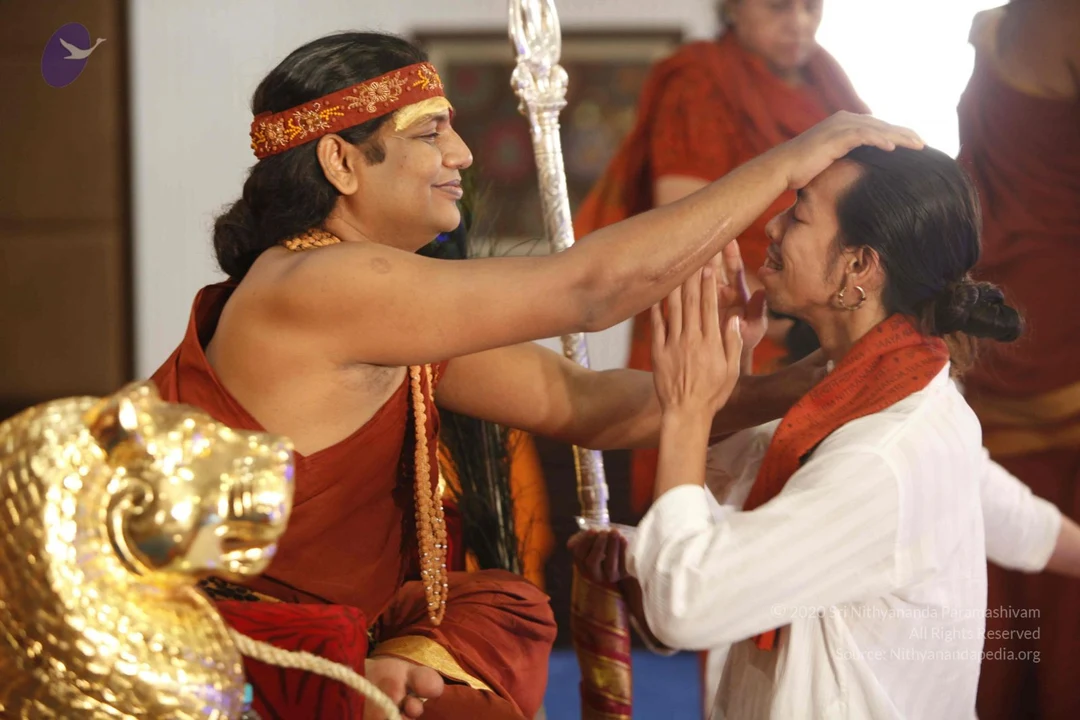
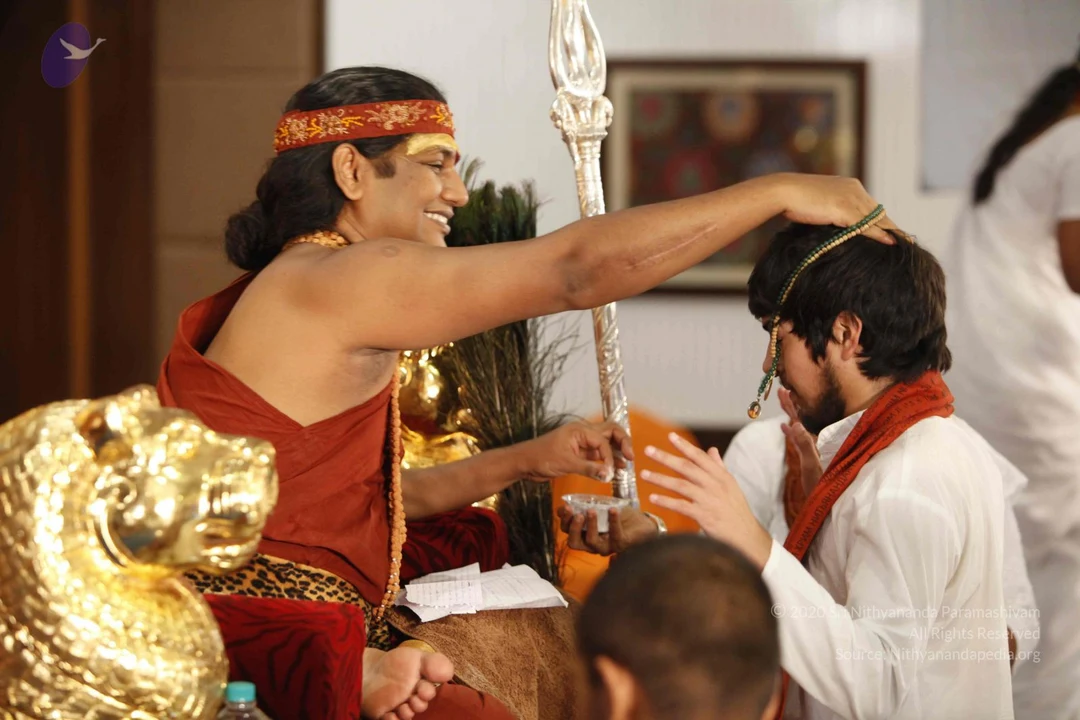
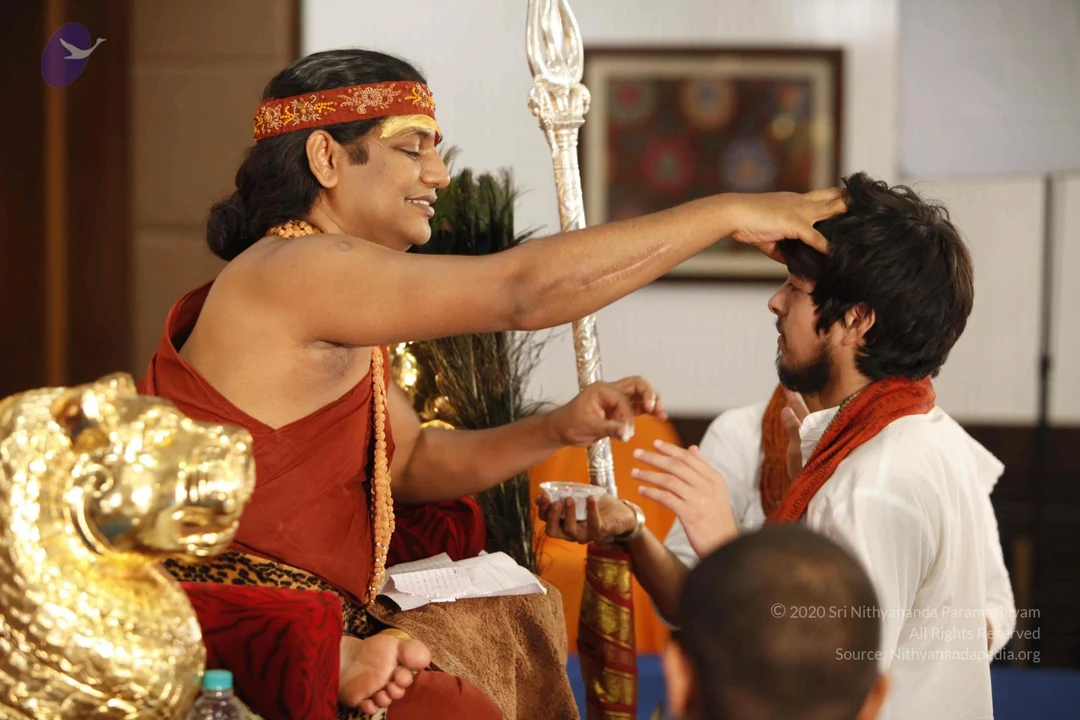
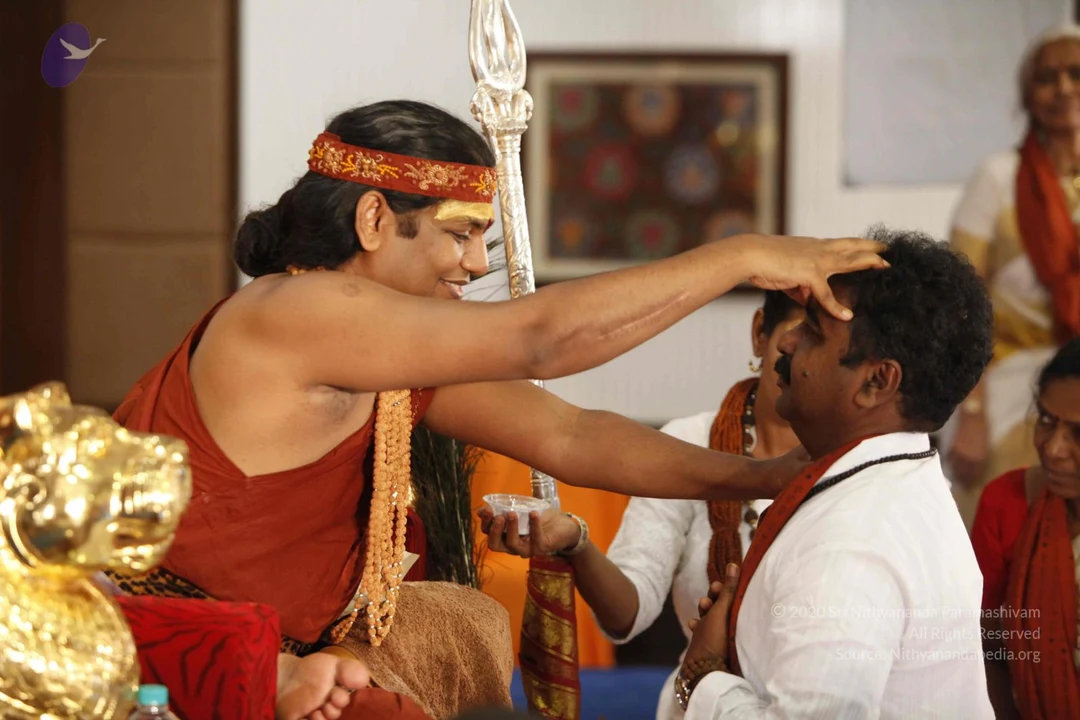
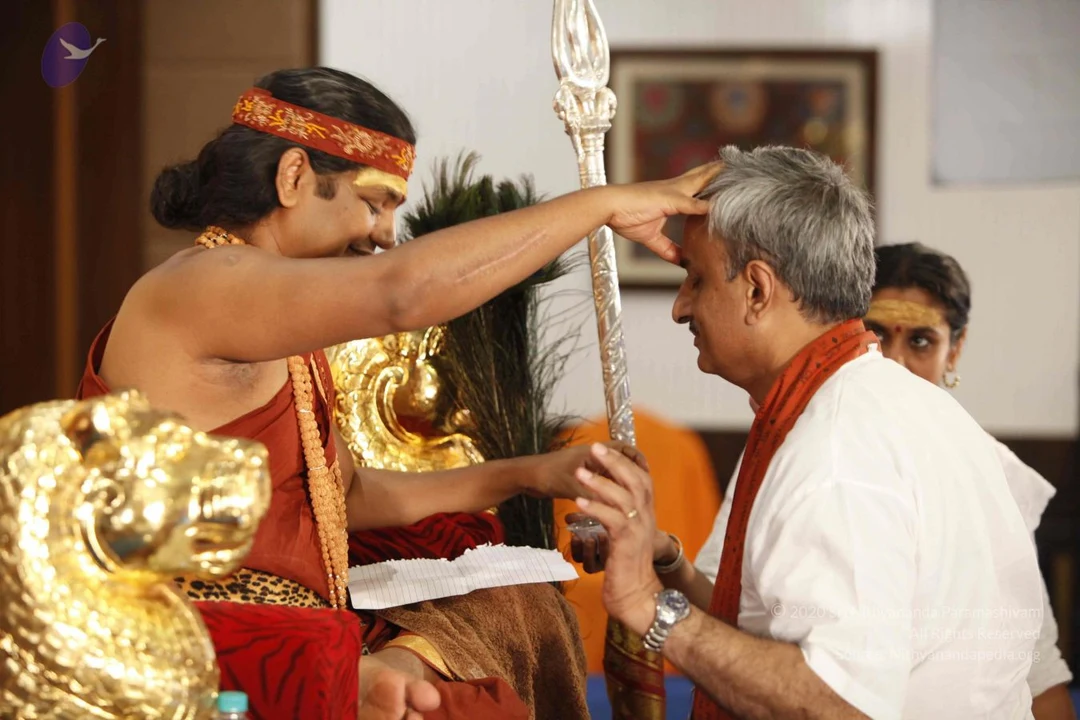
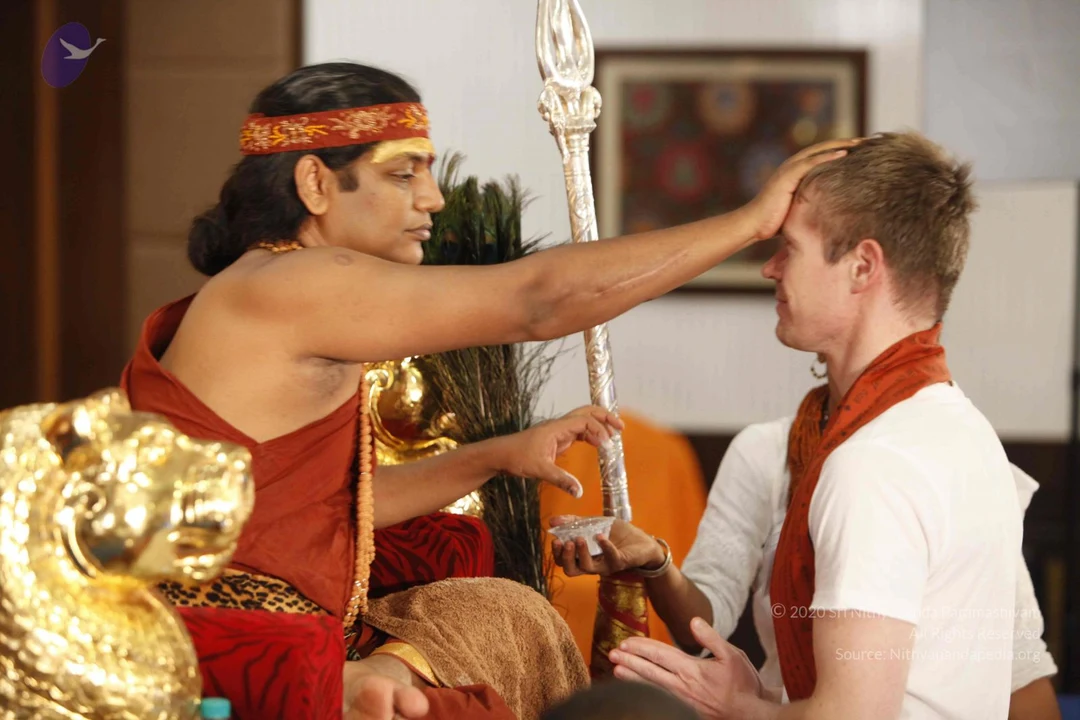
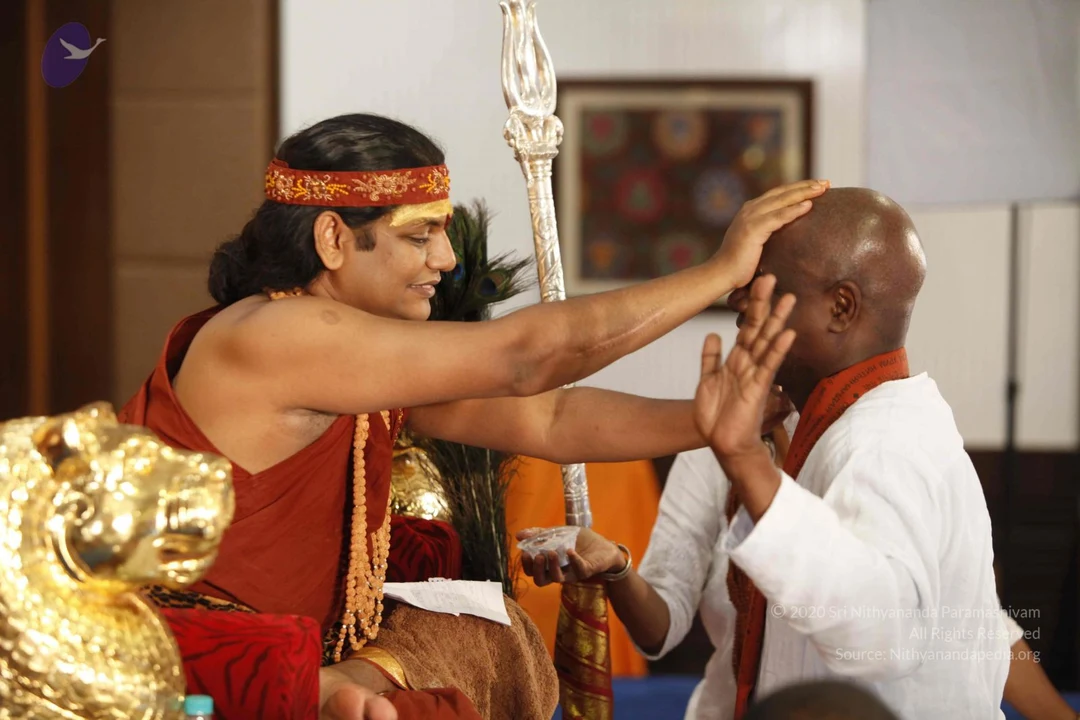
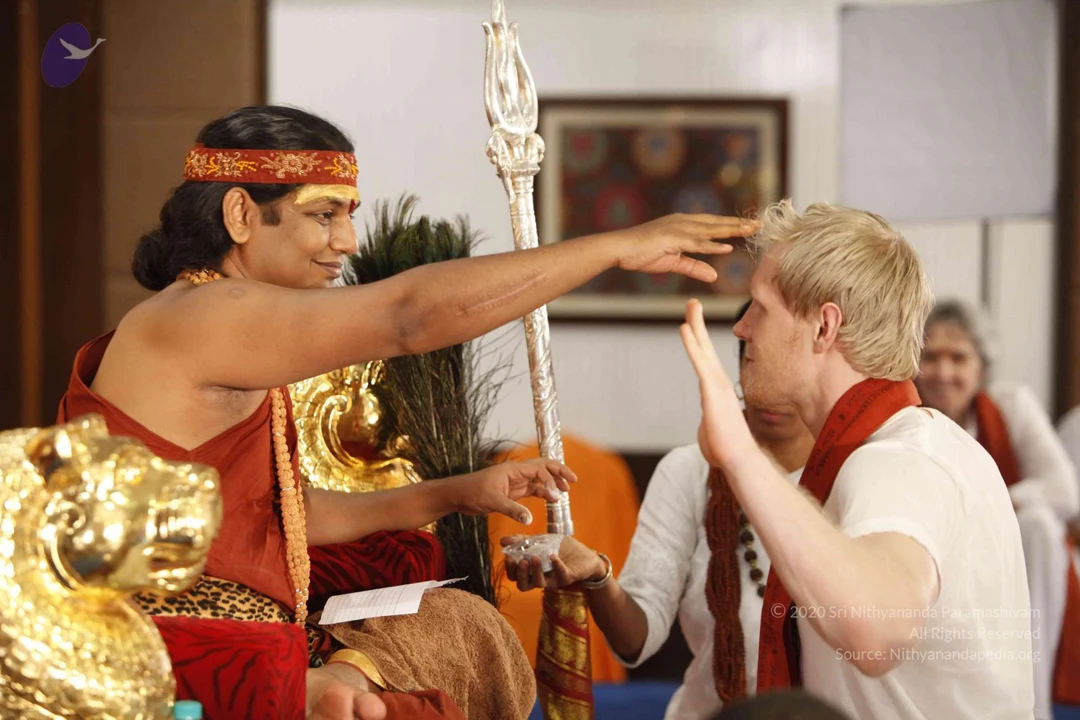
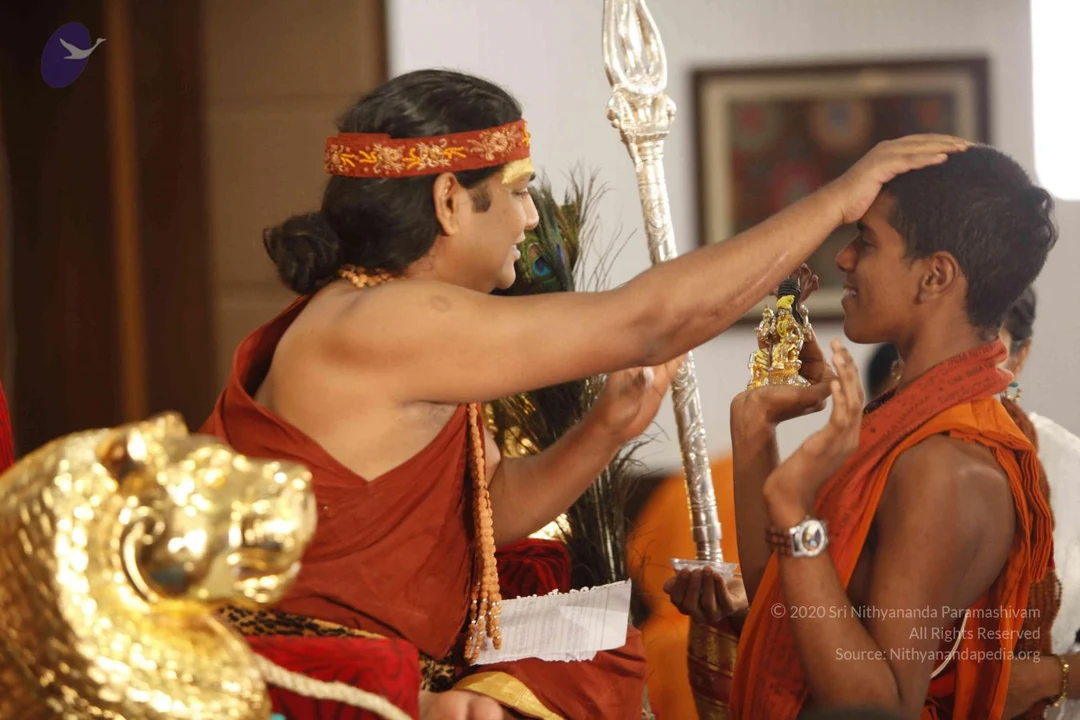
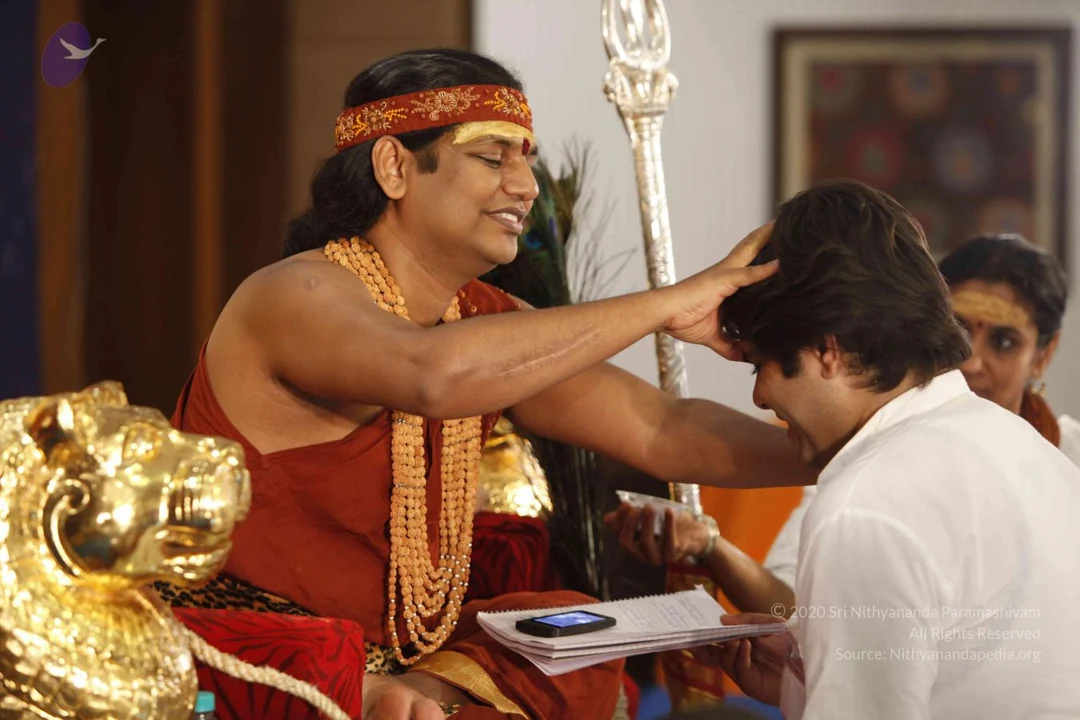
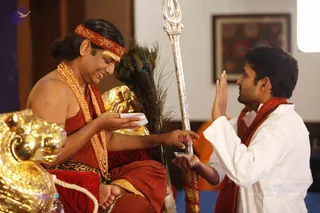
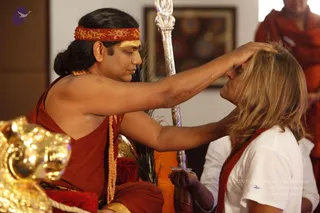
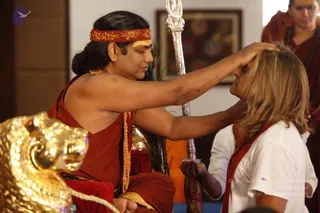
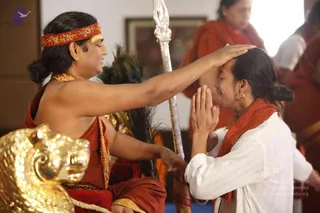
A photograph of a seated man with long dark hair tied back and a red-and-gold headband, wearing an orange-red wrap, a leopard-print cloth and a beaded orange necklace of large seeds. Beside him stands a silver staff decorated with a peacock-feather fan and gold lion-shaped figures. A kneeling man in a white shirt and red shawl, palms raised, faces him and holds a small cup while the seated man holds a folded white paper. The seated man, with his distinctive hair, ornate beaded necklace and orange-red clothing, is a person appearing in person. The kneeling man is a devotee. Two people are visible.A photograph of a seated man in red-maroon robes with a red and gold headband and a beaded rudraksha-style necklace placing his right hand on the head of a long-haired blond person in a white t-shirt with a red shawl and beaded mala. A tall silver staff stands behind them, a gold lion or ornamental figure sits at the left edge, and an attendant in orange robes stands at the upper right. The man presses his palm to the devotee's forehead in a blessing. a person: the seated man in red robes with a red headband, beaded mala and gold necklace is the presumed a person, shown giving a blessing to a devotee.A seated man in a rust-red robe and red headband with gold embroidery, wearing an orange-beaded necklace, presses his right palm onto the forehead of a long-haired woman in a white top with a red shawl. Behind him stands a silver trident and a golden lion-shaped seat, with a framed painting on the wall. A man in white holds a small bowl in the foreground, and another person in red robes and a rudraksha mala stands at the right edge. The setting suggests a blessing or initiation moment during a satsang gathering.A photograph of a ritual exchange in an indoor room. A seated man with a red headband, bare upper body, long peach-coloured beaded necklaces and red-orange cloth on his lap holds a folded paper and touches the face of a younger man in a white shirt with an orange-red shawl and hoop earring. Behind them a peacock-feather fan and a silver staff stand near a gilded lion figure in the foreground. A woman in orange robes is partly visible at the upper right. The seated man shows a person cues: a red headband, bare-chested ritual dress and ornate beaded necklaces, so the appearance is a probable match.A photograph of a satsang moment in which a man in a red-orange shawl and red-orange headband with gold embroidery places his right hand on the forehead of a person in a white shirt with a red-orange shawl, the recipient has closed eyes and earrings and hair pulled back. The blessing giver wears a rudraksha-style beaded necklace and bare torso draped in orange cloth; a golden lion or simha figure sits at lower left, and a silver staff with red base rises in the centre. Other people in orange robes stand behind, and a red-orange cloth hangs at right.A photograph of a blessing scene indoors. A bare-chested man in orange-red cloth wears a red floral headband, a rudraksha mala and a gold ceremonial necklace, and places his right hand on the forehead of a kneeling devotee. The devotee wears a white shirt with an orange-red shawl and has his palms pressed together in namaskar with eyes closed. Behind them stands a silver staff topped with a peacock-feather bunch, and a gold lion or simha figure rests in the lower left. Another person in orange clothing stands in the background. Swamiji (probable): the seated blessing figure shows long swept-back hair, a red headband, orange-red clothing and rudraksha and gold necklace cues.

Documentry

1 photoSource gallery
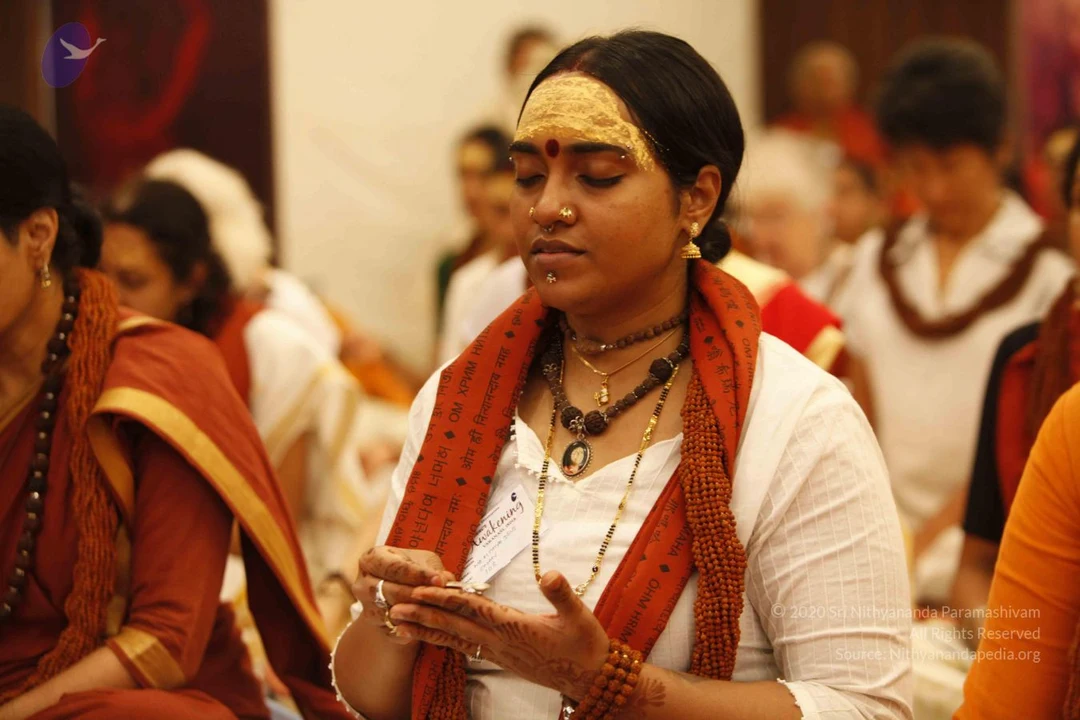
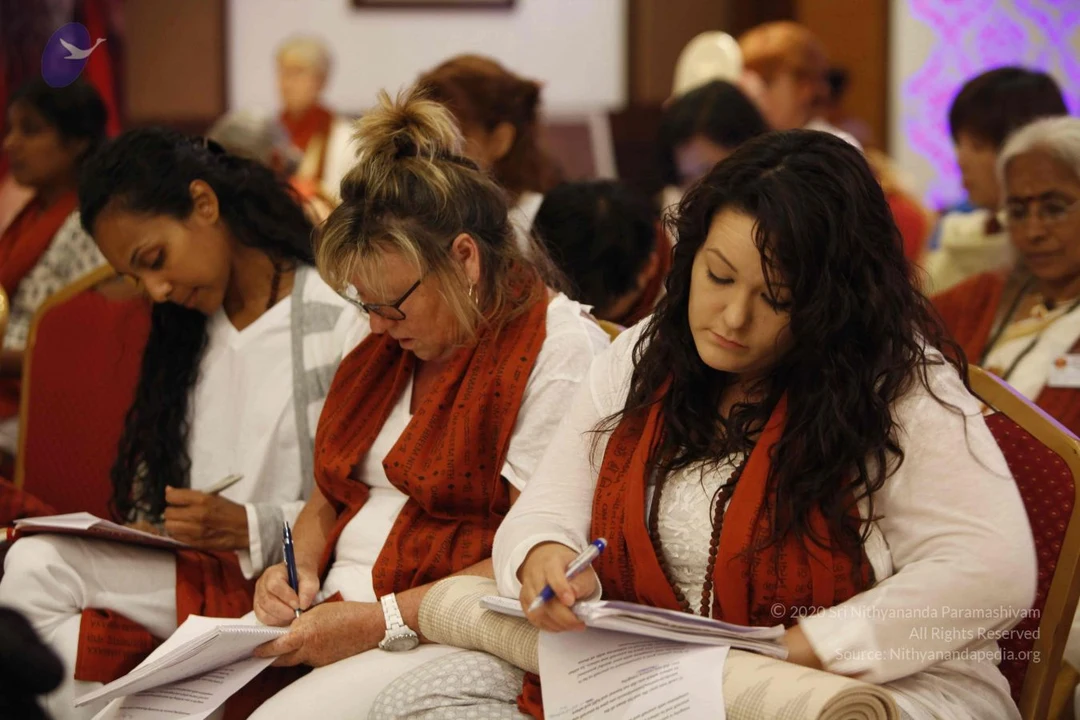
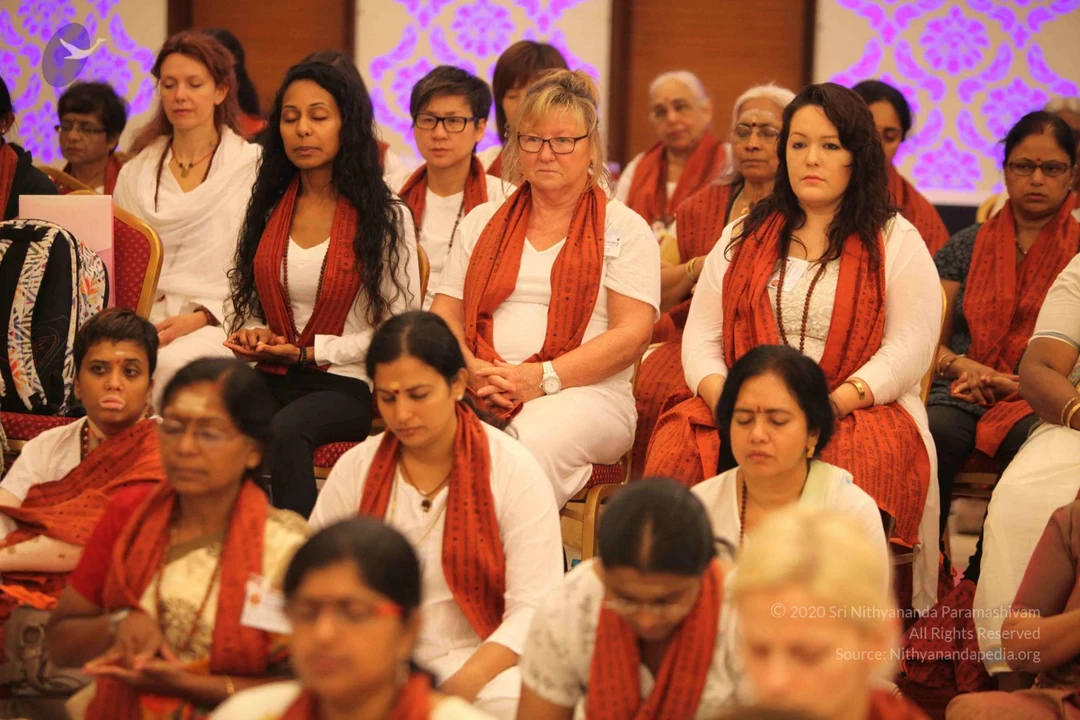
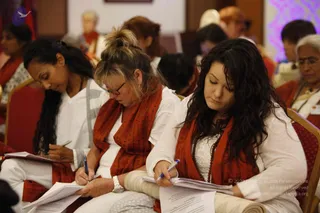
Several women sit in rows of red chairs at a seminar, writing in notebooks with pens. In the foreground, a woman with long dark curly hair in a white top and rust-orange shawl with printed script leans forward and writes; beside her, a blonde woman with glasses and a hair bun, wearing a white top and orange shawl, also writes. A woman with a long dark braid in white clothes writes at left, and an older woman in orange shawl sits at right. Behind them, more attendees in white and orange shawls listen. No swami or a person is visible in the frame.

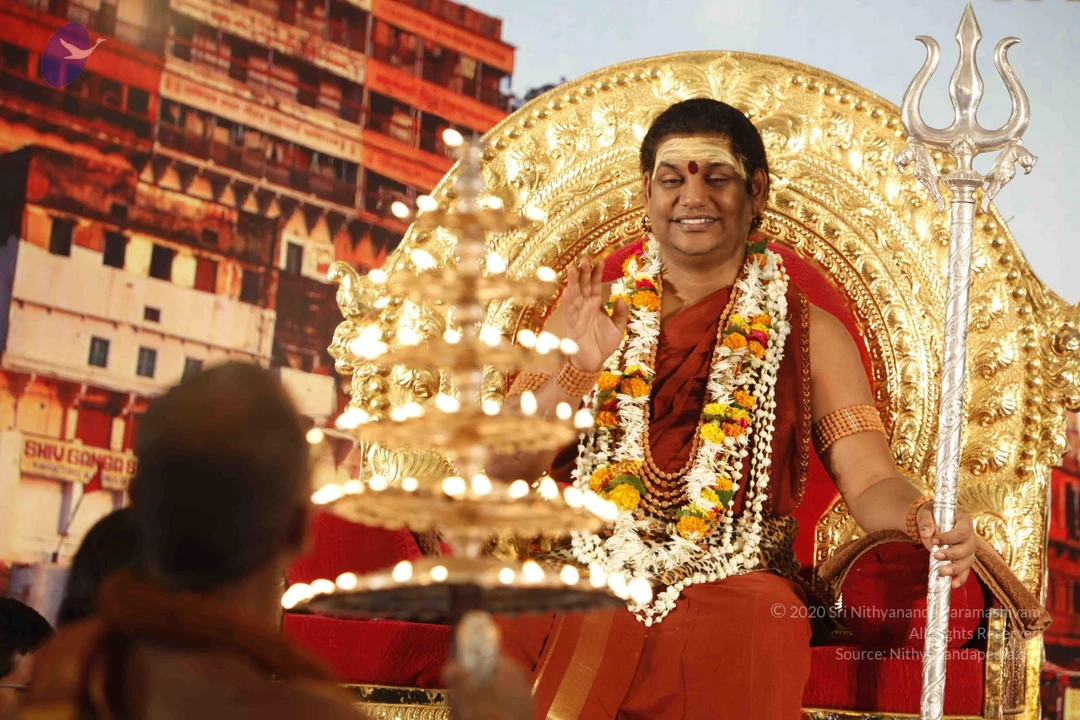
Pada-Puja
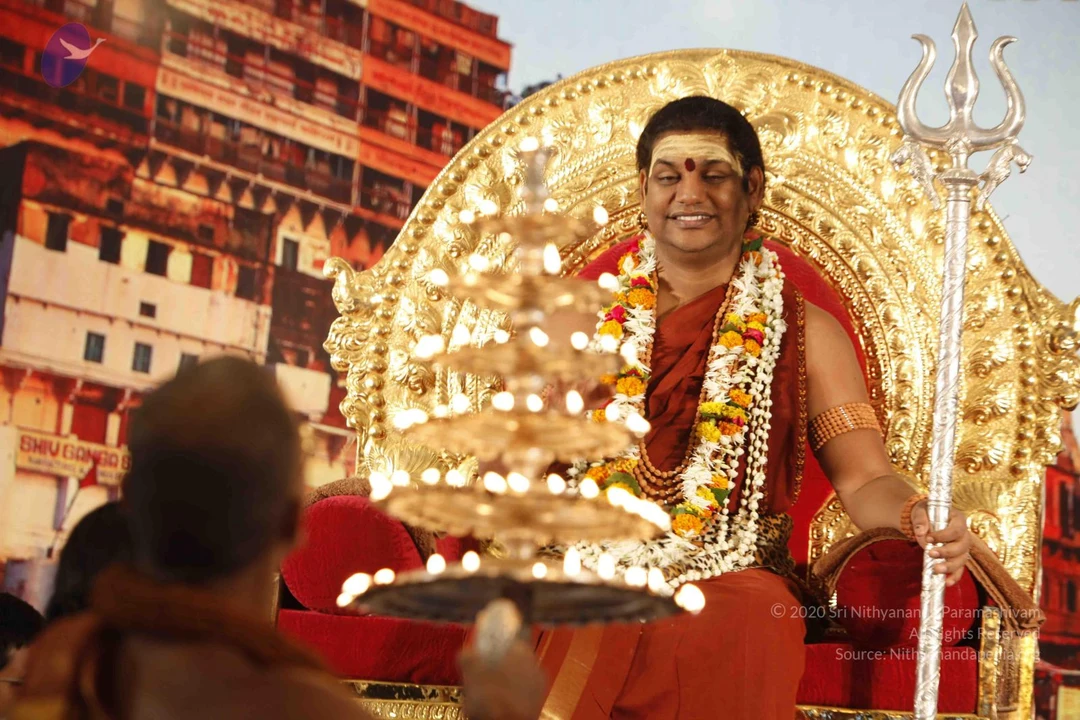
42 photosSource gallery
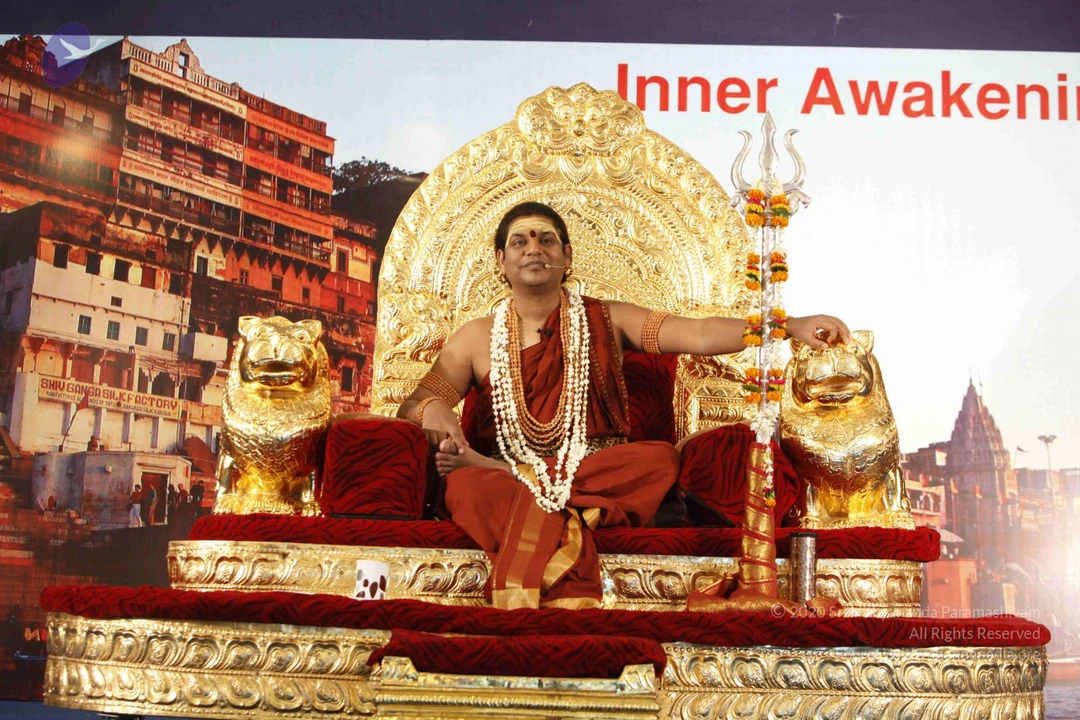
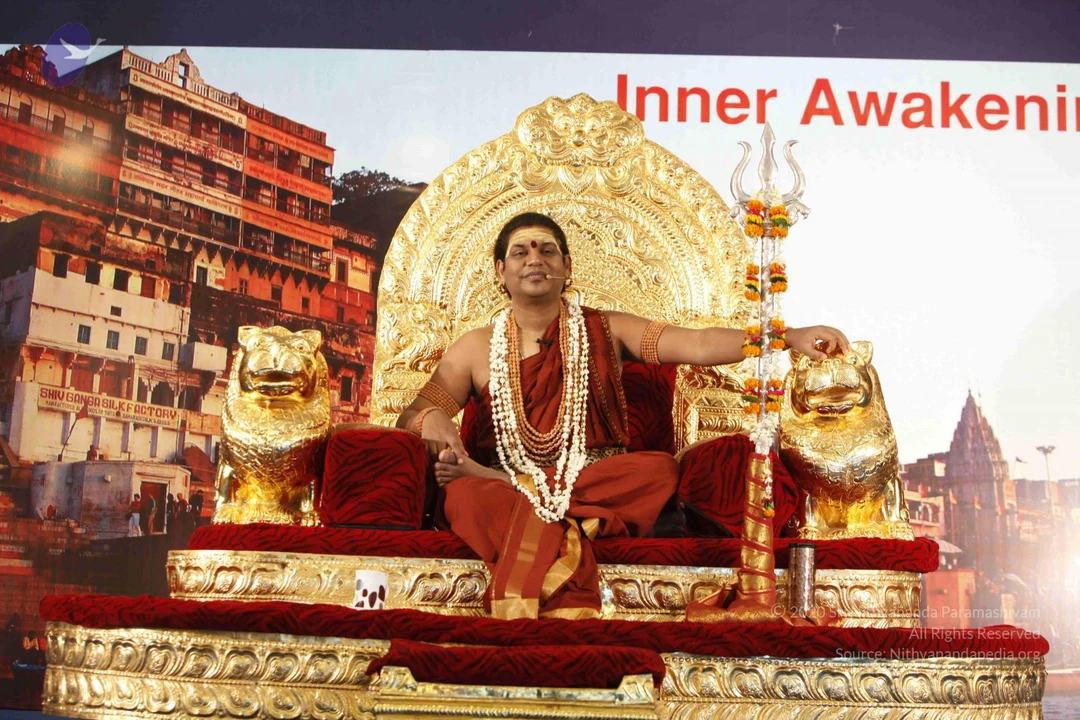
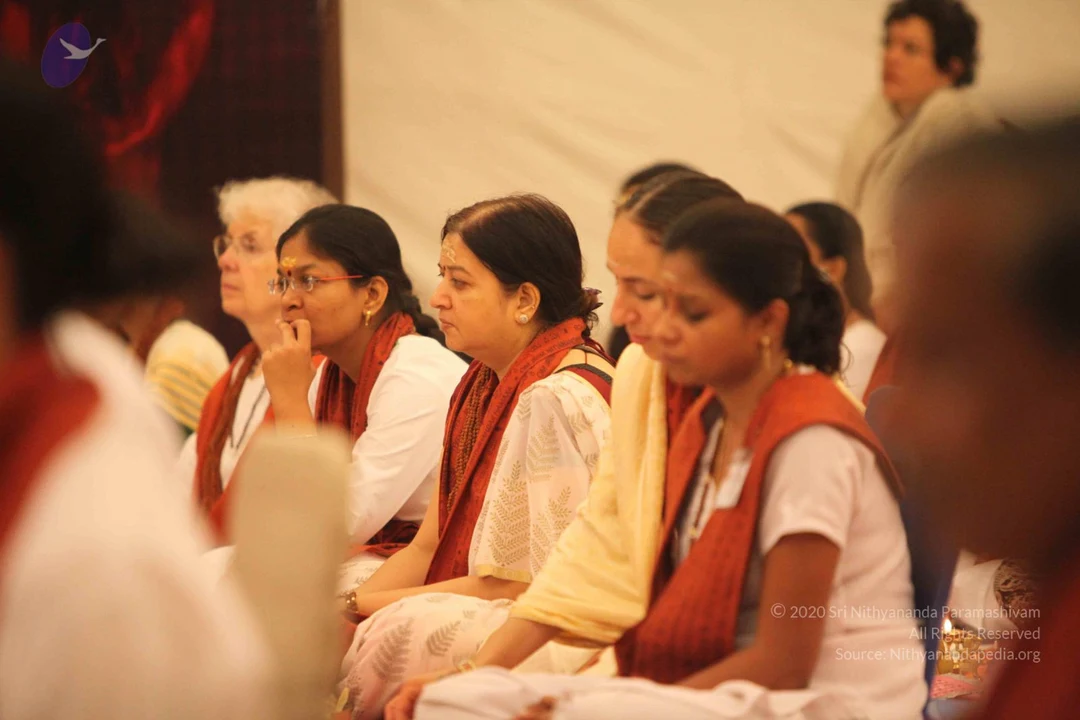
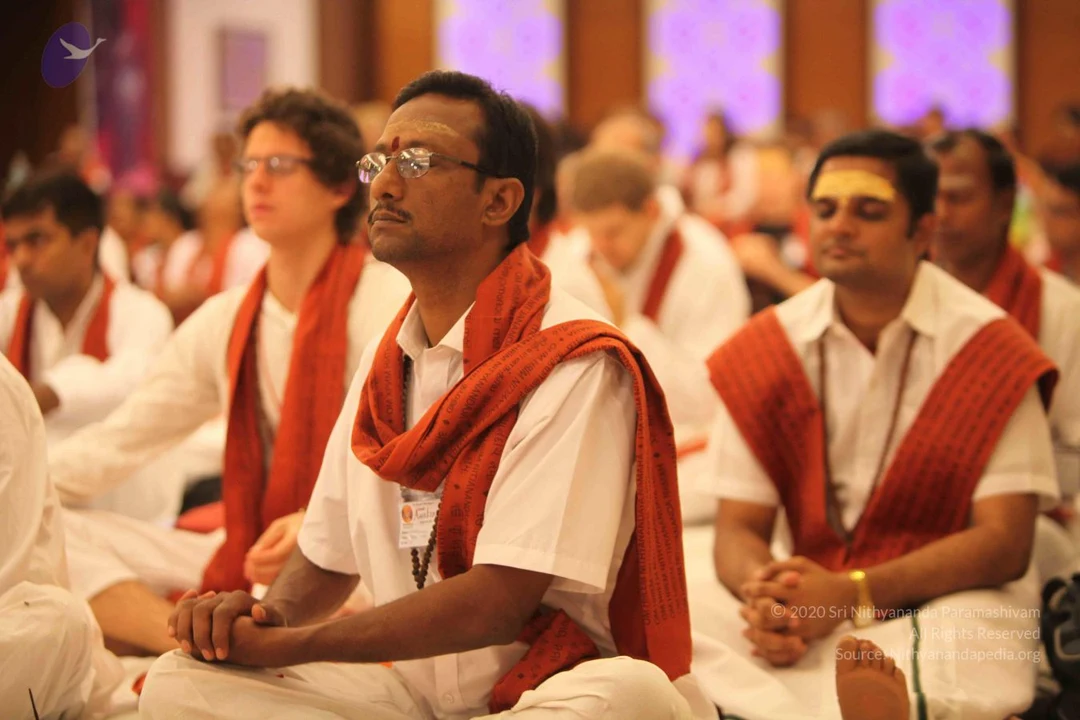
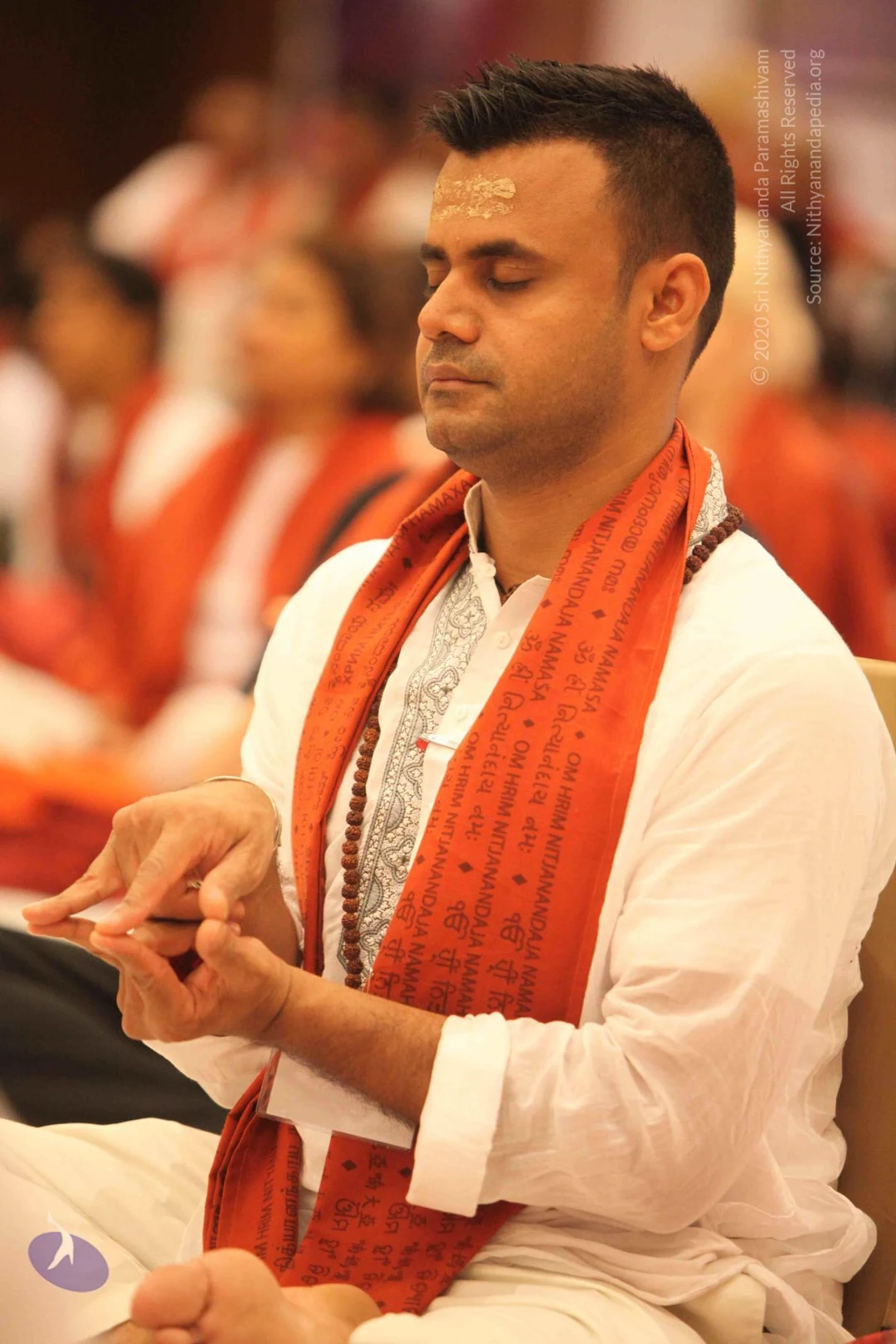
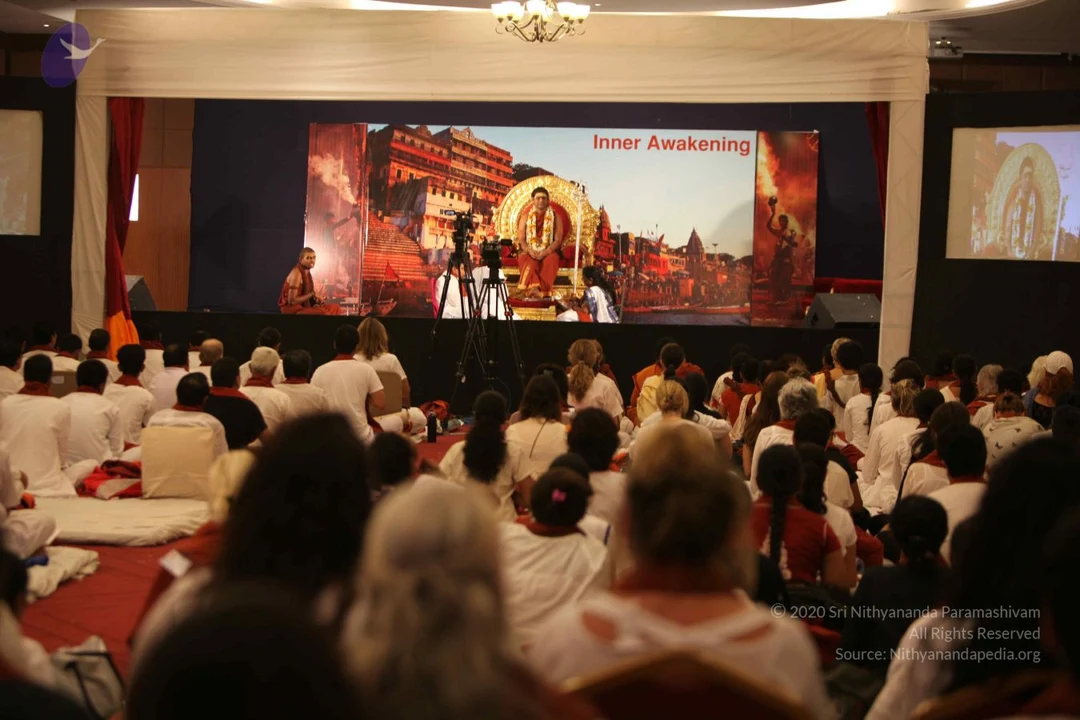
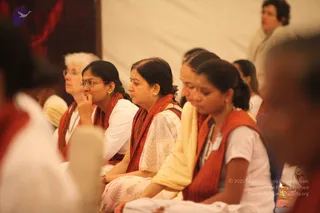
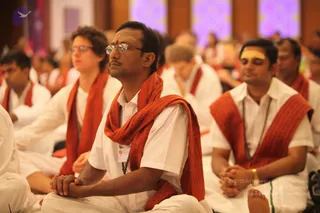
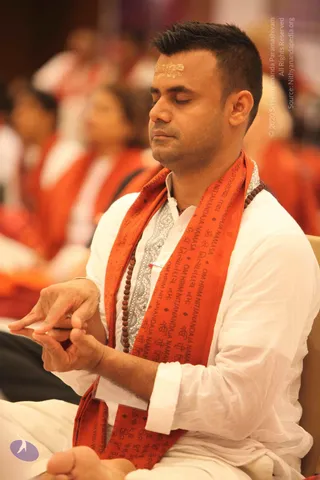
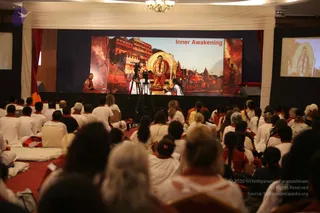
A seated man in an ornate gold and red throne holds a silver trident upright in his right hand. He wears a saffron-orange garment, a white flower garland and a beaded necklace, with a red tilak on his forehead. Two people in white ritual clothing sit on the left, one with an orange shawl and one with a rose-coloured cloth, while a woman in a white sari with blue border kneels at lower right holding a brass plate with offerings. A backdrop shows a riverside city with ghats and boats. Scattered flower petals and small items sit on the floor. Description: appearance-based candidate is a person, seated on the throne with the trident, saffron clothing and garland.A seated man in saffron-orange robes sits on an ornate gold-and-red throne on a stage, wearing a long garland of white and yellow flowers and a rudraksha mala, with a trident (trishul) raised beside him in one hand. Before the throne, a woman in a white and blue-bordered sari kneels and holds a silver tray or plate. Two seated people in white clothes with orange shawls sit at the left edge, a woman and a man in glasses. Behind them a backdrop shows a painted scene with a figure holding a torch and a burning fire. A water bottle sits on a table at the right. The man on the throne has a distinctive appearance, with a long swept-back hairstyle and ornate ceremonial adornments, consistent with the page's a person reference (probable).A photograph of a seated congregation inside a white tent during a satsang. Several women sit cross-legged in a row wearing white or cream clothes with orange-red shawls draped over their shoulders. The woman in the centre has a red bindi and small gold earrings, and a woman in the foreground wears a red shawl over a white top, looking down. A woman on the left wears glasses and a red shawl, and a woman at the back right wears a light jacket. Blurred figures in the foreground and an oil lamp at the lower right frame the scene. No one in the image is identifiable as a person, and the seated attendees are devotees.Devotees sit cross-legged in white shirts and dhotis with saffron-orange shawls printed with script, seated on the floor of a large hall during a satsang. In the foreground a bespectacled man with a vibhuti mark on his forehead holds his hands in lap with eyes closed in meditation, a rudraksha mala visible at his neck. To the right a man with a yellow tilak and eyes closed sits with hands clasped. Behind them more seated devotees fill the room under purple lit panels.A seated man with short spiked hair, closed eyes and a white tilak on his forehead sits in meditation, hands in a mudra with fingers touching. He wears a white kurta with a light embroidered placket, a rudraksha mala, and an orange shawl printed with repeated Om and mantra text. Blurred seated devotees in orange and white fill the background of a hall.A photograph taken from the back of a large hall filled with seated devotees in white and red clothing, many with red shawls, facing a stage. On the stage screen behind, a large projected image shows the ghats of Varanasi with stone steps and temples, flanked by a figure in a golden arch. A central figure in orange-red robes with a garland sits on an ornate golden throne (peetha) in the centre of the stage, with a seated attendant in orange to the left and another person in white nearby. Video cameras on tripods film the stage. A banner-like screen reads Inner Awakening. Camera equipment and cables are visible in the foreground.

IA-Darshan
22 photosSource gallery
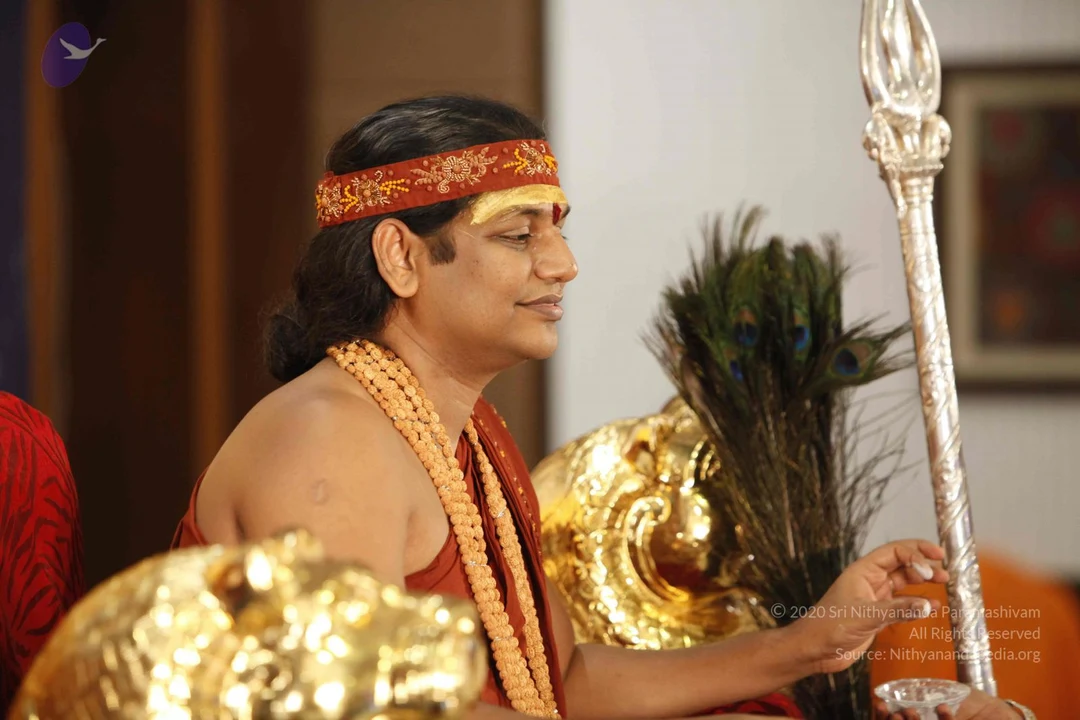
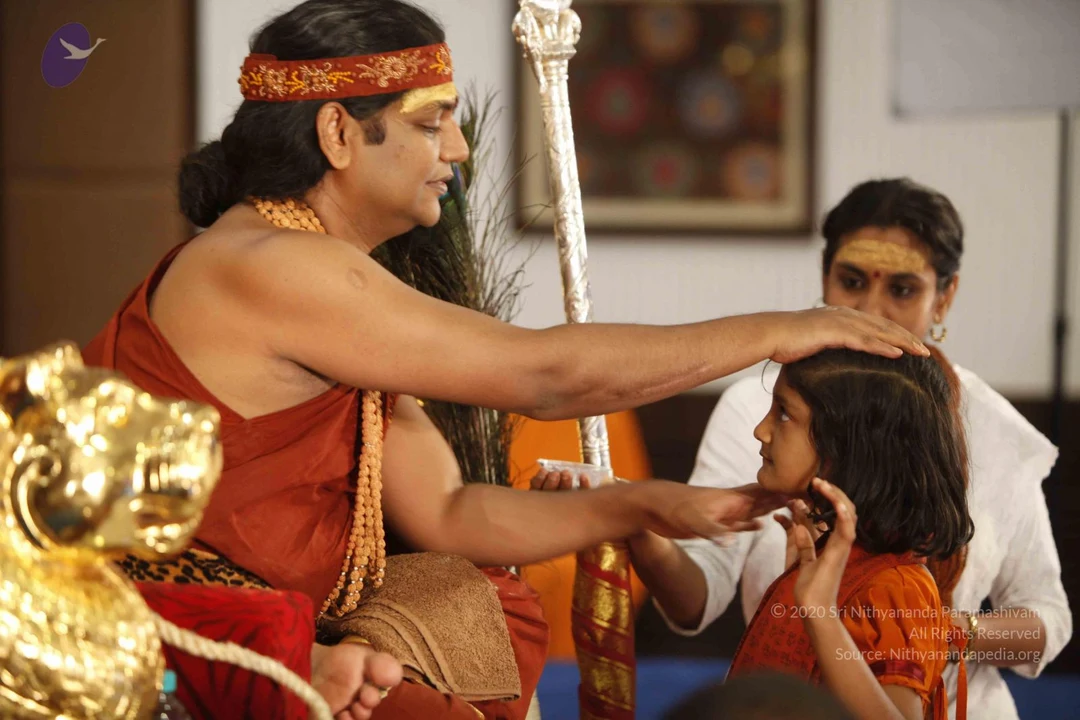
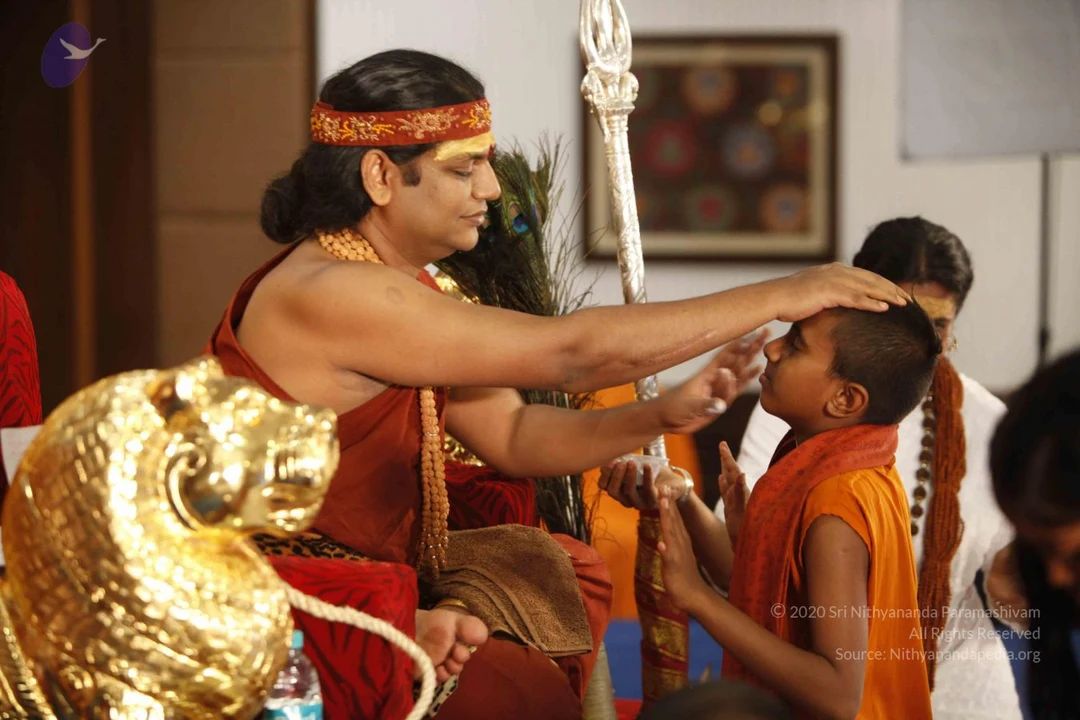
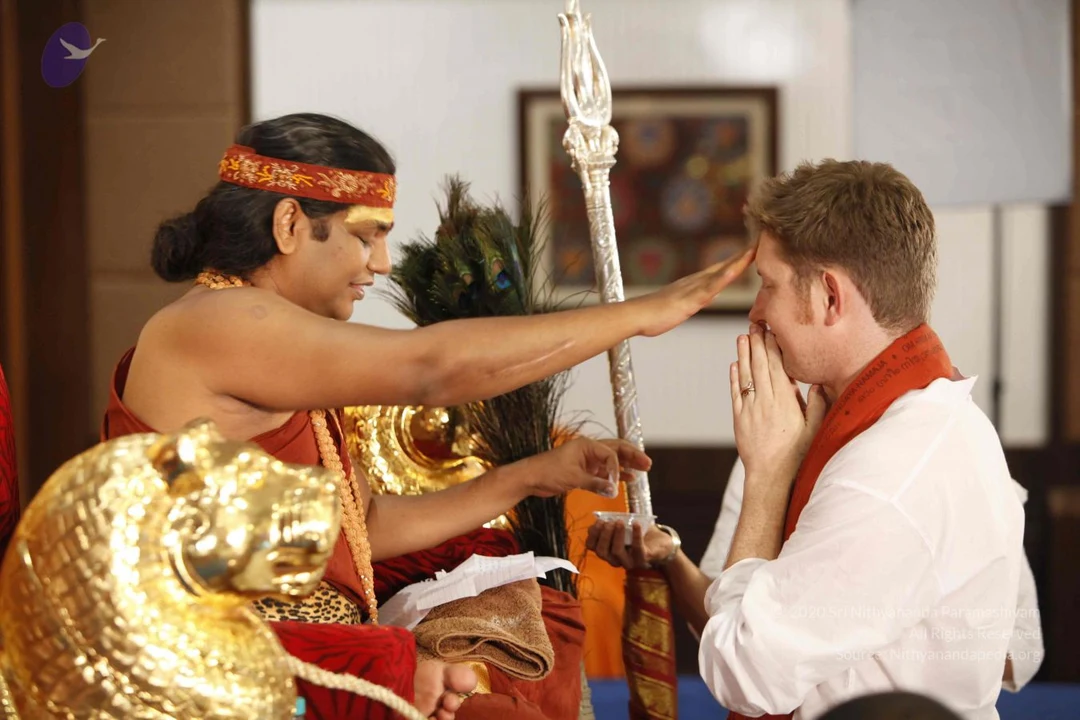
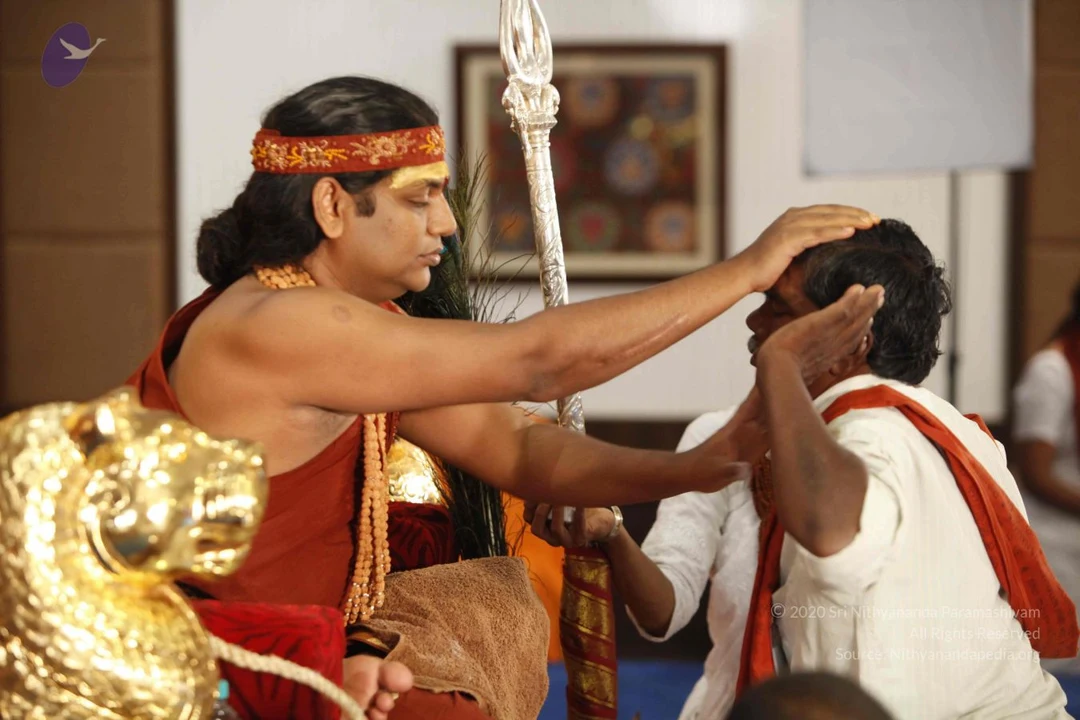
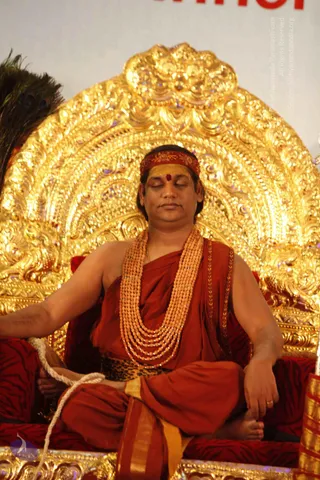
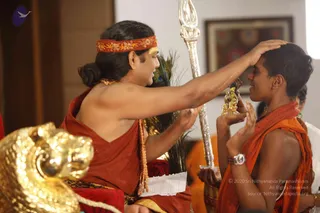
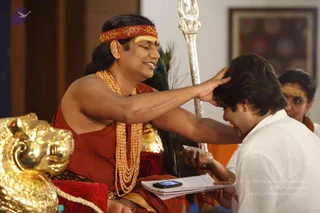
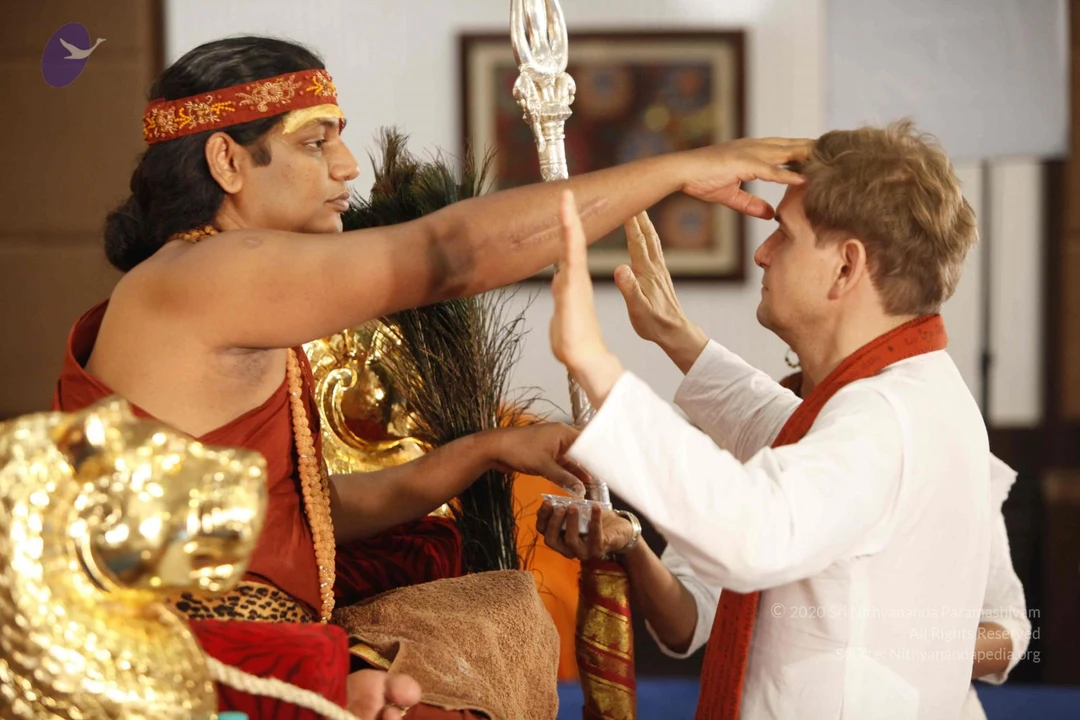
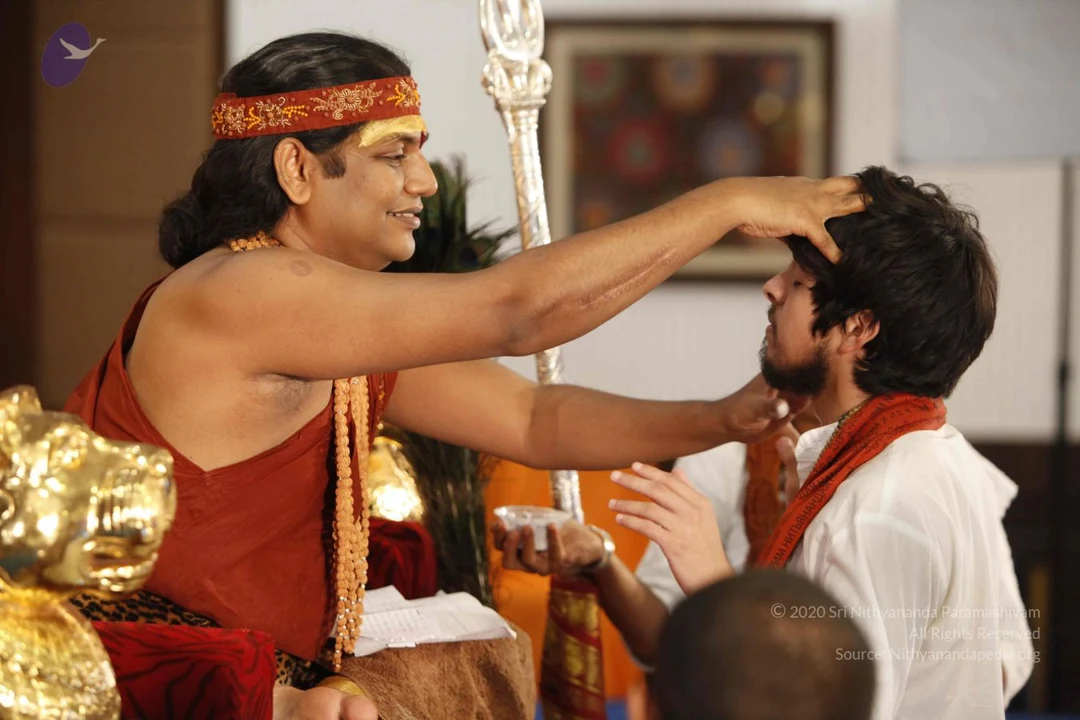
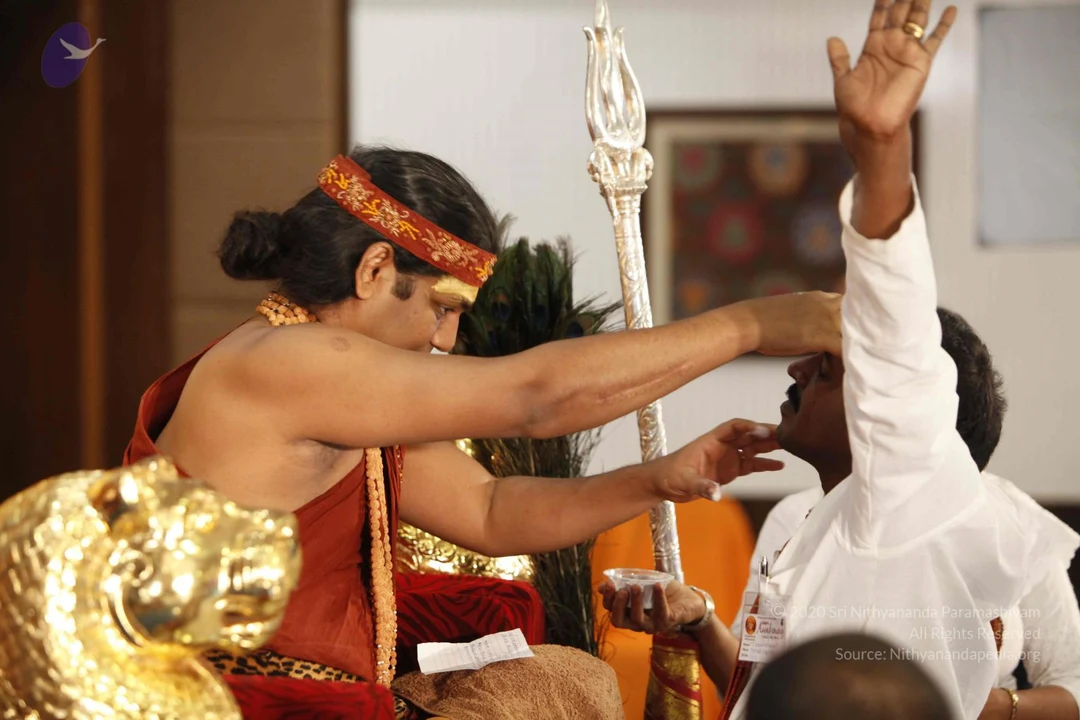
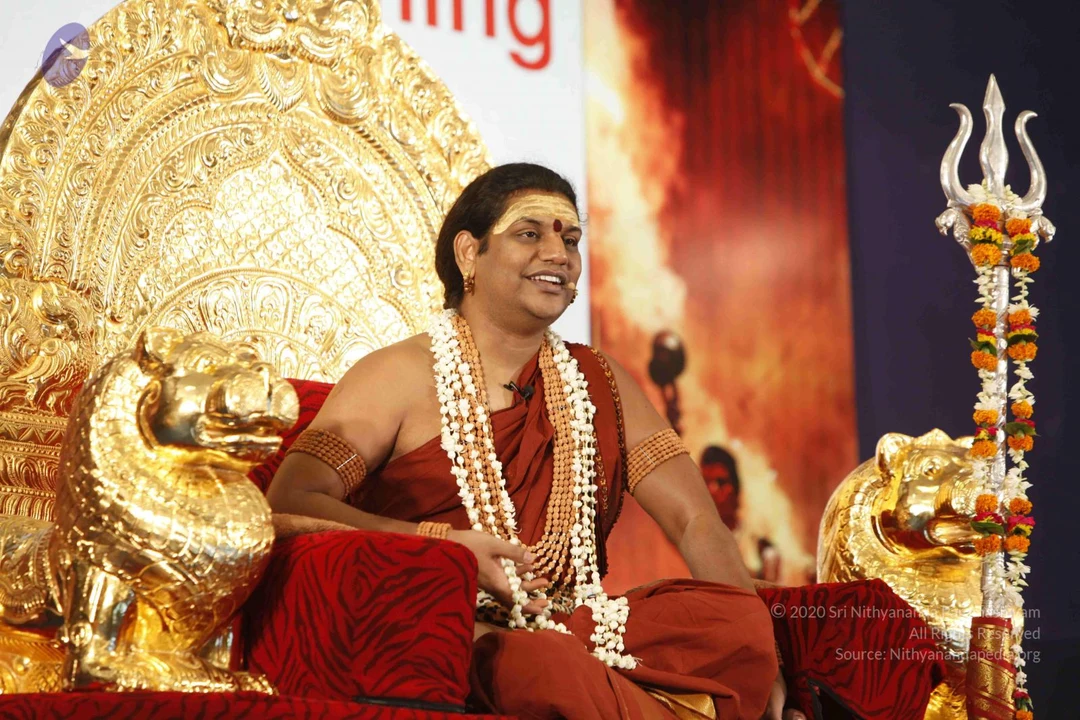
A man seated cross-legged in meditation on a red cushioned throne with an ornate gold arched back. He wears an orange-red robe, a red and gold headband, sandalwood-coloured tilak with a red dot on his forehead, and multiple strands of large beaded rudraksha-style necklaces. His eyes are closed and his hands rest on his knees. A peacock-feather fan appears at the left edge. Behind him is a white backdrop with partial red lettering.Photo of a ritual blessing. A man with long hair tied back, a red headband with gold embroidery, bare shoulders, a red-orange cloth wrap and an orange-beaded rudraksha-style mala lays his right hand on the forehead of a young man in an orange shawl and wristwatch. The blesser holds a silver staff topped with a trident, a peacock-feather fan rises behind him, and a small gold deity murti is held near the young man's face. A gilded lion figure sits in the lower left foreground. The young man is a devotee receiving the blessing.A seated man in a red-orange shawl and a red headband with gold embroidery sits on a throne-like chair beside a gold lion-head armrest, wearing multiple strands of orange-beige beaded necklaces. He places his right hand on the head of a younger man in a white shirt who bows his head toward him, while a silver staff topped with a finial and a peacock feather stand behind them. A woman with yellow turmeric on her forehead stands at the right, and a notebook and phone rest on a wooden surface in the foreground. Candidate a person: the seated man wears a red headband and shawl, ornate beaded necklaces, and sits on a throne with a ceremonial staff, giving a blessing to a devotee.Photo of a ritual blessing indoors. A bare-chested man in a red-orange cloth wrap with a red-and-gold headband and a beaded orange rudraksha-style necklace sits on a seat, his right hand resting on the head of a young girl in an orange dress. He holds a silver staff wrapped in gold and a peacock-feather fan behind him. A woman in a white top with yellow forehead marking stands behind the girl. In the lower left, a gold deity murti with a hooded head sits in the foreground. Blurred framed artwork hangs on the wall. a person, the man seated and blessing, with saffron-red wrap, red headband and beaded necklace; the girl and woman are devotees.A seated man in a rust-red dhoti and shawl, bare-chested, with a red headband, yellow tilak on his forehead, long swept-back dark hair and multiple orange-beaded rudraksha malas, presses one hand on the head of a young boy in an orange robe and red shawl. The boy stands with cupped hands holding a small silver vessel. Behind them is a silver staff and a bundle of peacock feathers, and a golden lion sculpture sits at the left edge. A person in white with a beaded mala is partly visible at right, and a framed artwork hangs on the wall. Swamiji (probable): the seated man has long swept-back hair, rudraksha malas and ornate red and gold clothing, giving the appearance-based label; he is blessing the boy during a ritual.A photograph of a ritual blessing indoors. A man with long dark hair tied up, wearing a red-and-gold headband, bare-chested with a red-orange cloth draped over his lap and an orange-beaded necklace, extends his right hand to touch the forehead of a kneeling man in a white shirt with an orange-red scarf and folded hands. The blessing giver has yellow sandal paste on his brow and holds a small white cloth or offering in his left hand. Behind them stand a tall silver staff, a bundle of peacock feathers, and gold lion-shaped ornaments on the floor, with a framed colourful painting on the wall. A probable Swamiji is the blessing giver, identified by long hair, bare-chested ceremonial dress with adornments and saffron-red garments, so the appearance is a probable match.
Testimonial

1 photoSource gallery
Several women sit in rows of red chairs at a seminar, writing in notebooks with pens. In the foreground, a woman with long dark curly hair in a white top and rust-orange shawl with printed script leans forward and writes; beside her, a blonde woman with glasses and a hair bun, wearing a white top and orange shawl, also writes. A woman with a long dark braid in white clothes writes at left, and an older woman in orange shawl sits at right. Behind them, more attendees in white and orange shawls listen. No swami or a person is visible in the frame.