Skip to content
Sunday

7 July 2013

Paramashivoham Oneness Capsule 159 (at the Nithyanandeshwara Paramashiva Devalaya Bidadi) 7TH JULY 2013

Dated photos
362
Source pages
2
Media
15
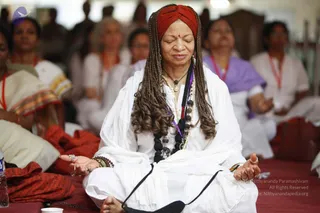
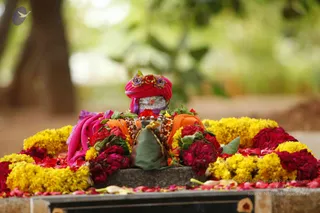
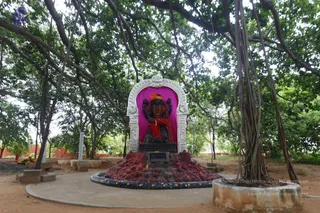
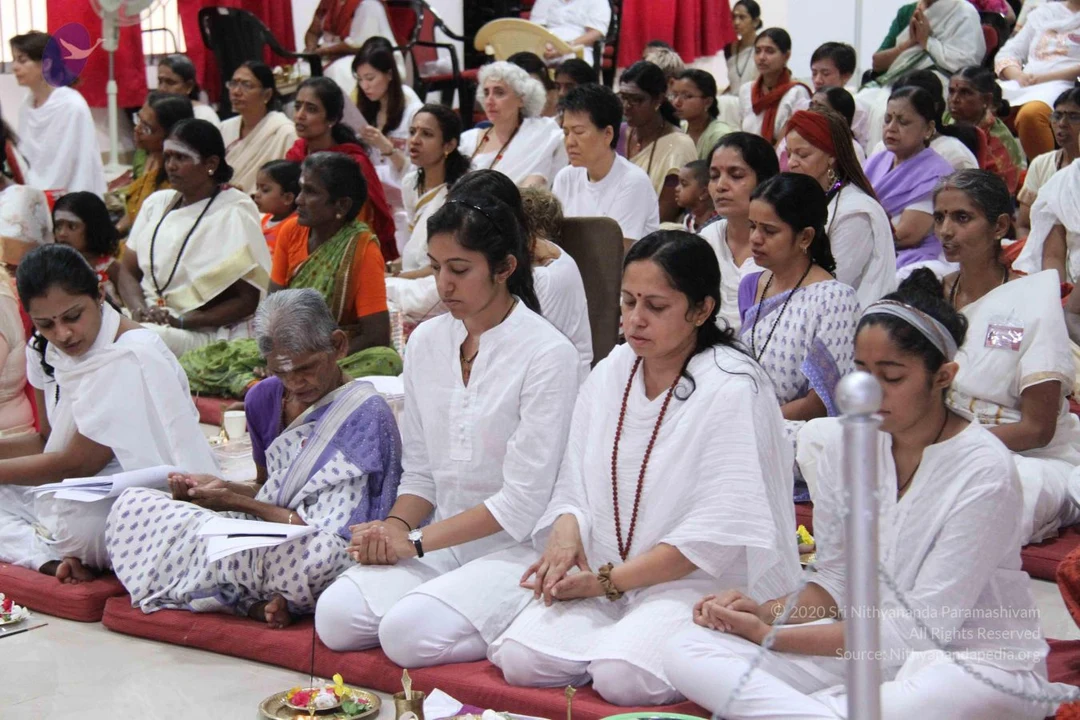
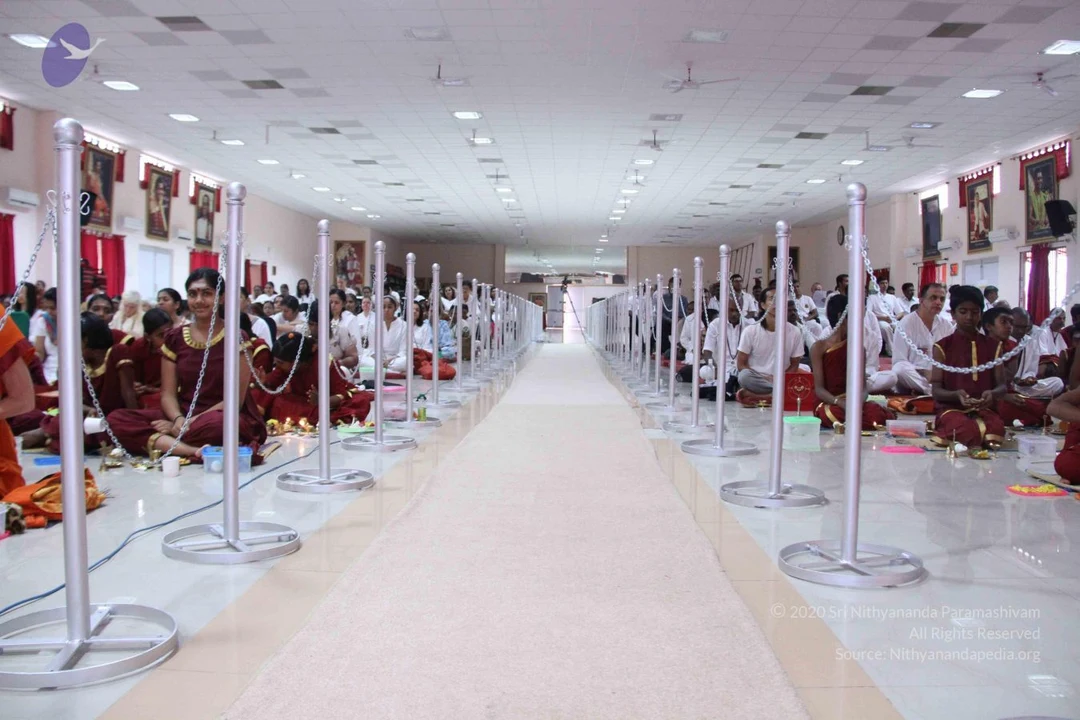
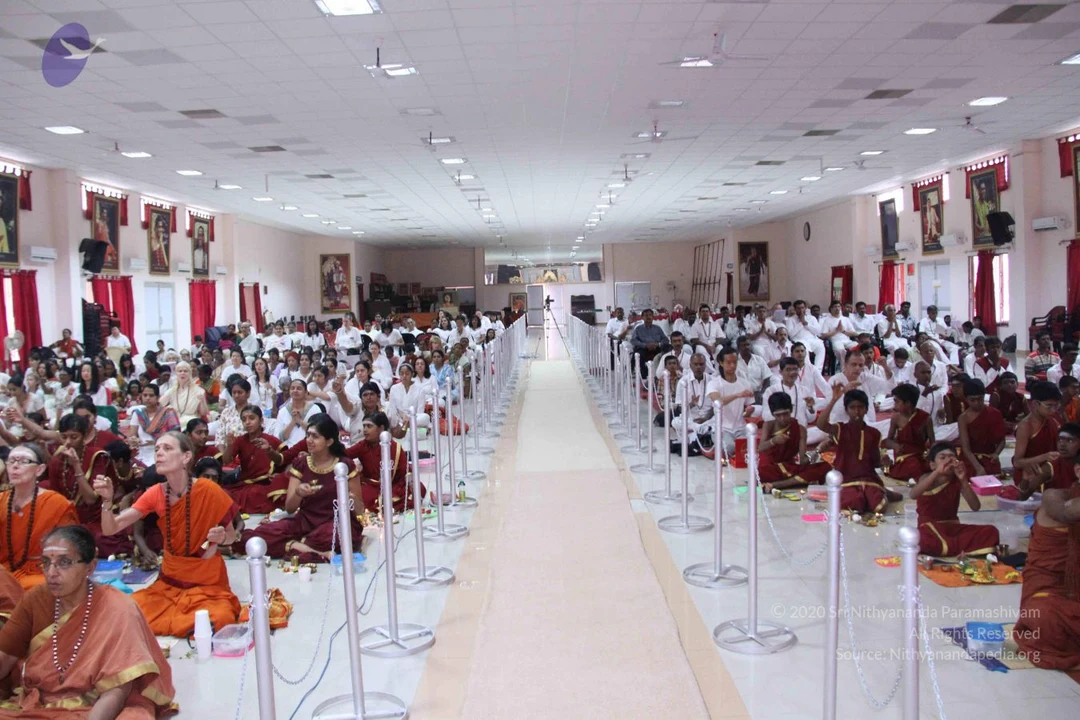
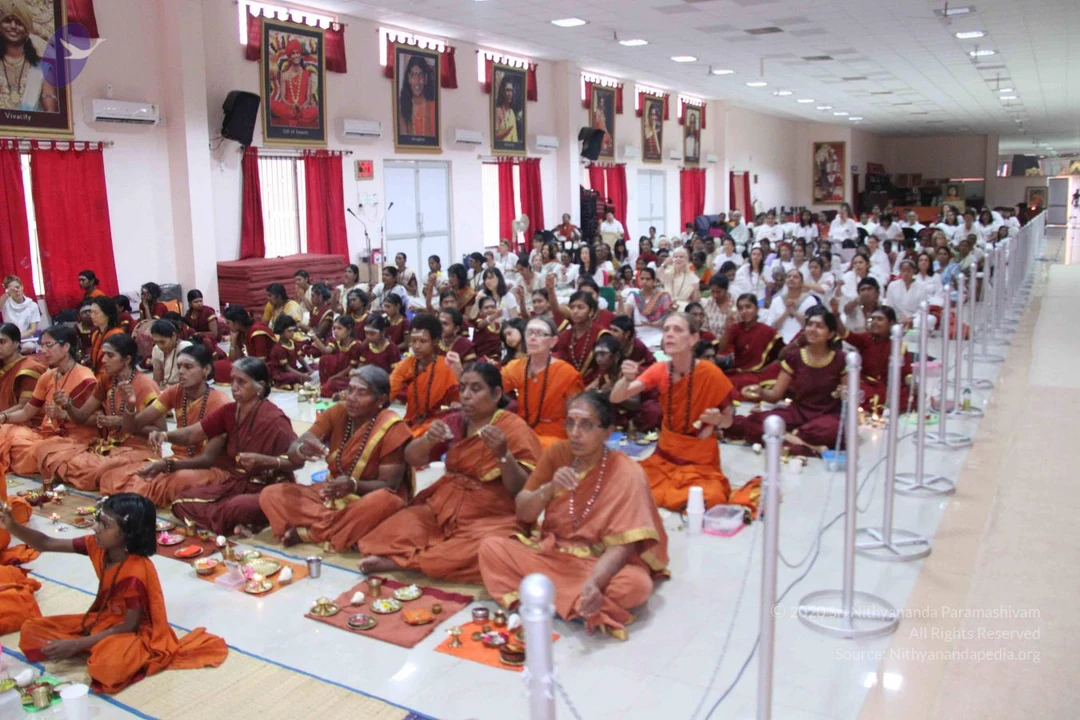
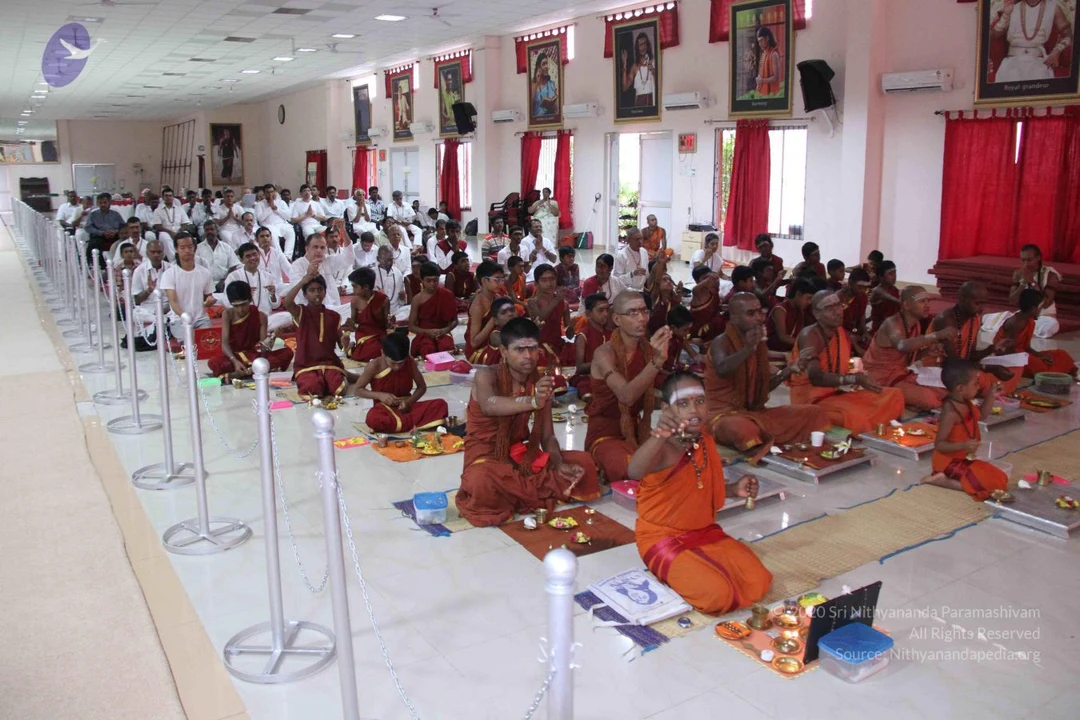
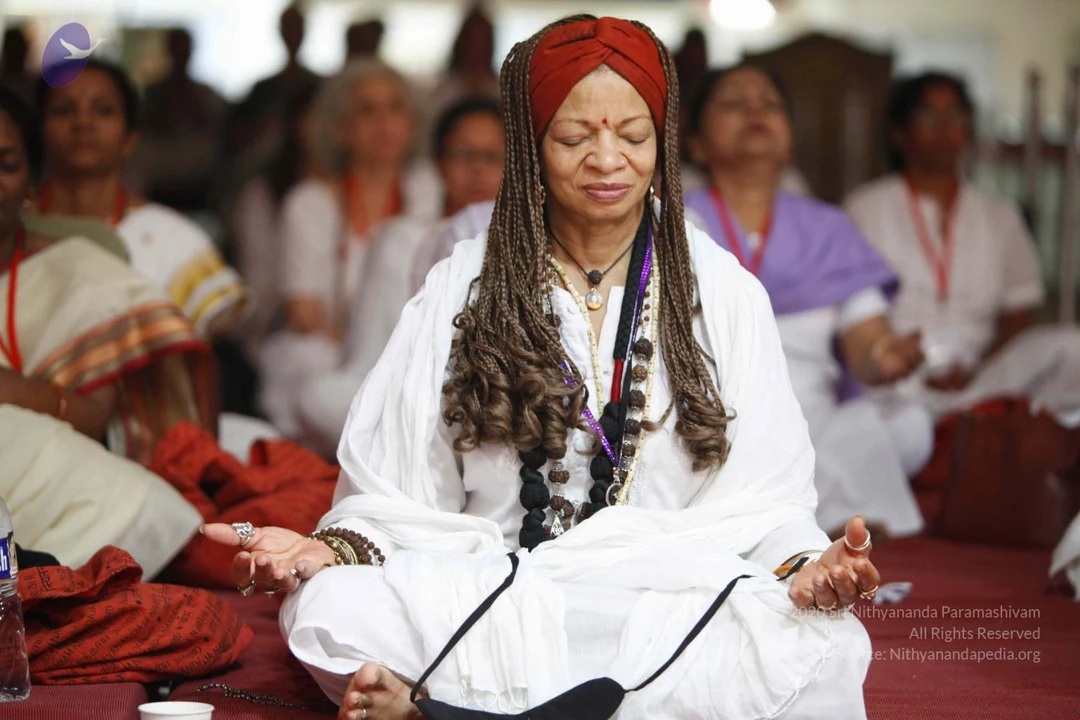
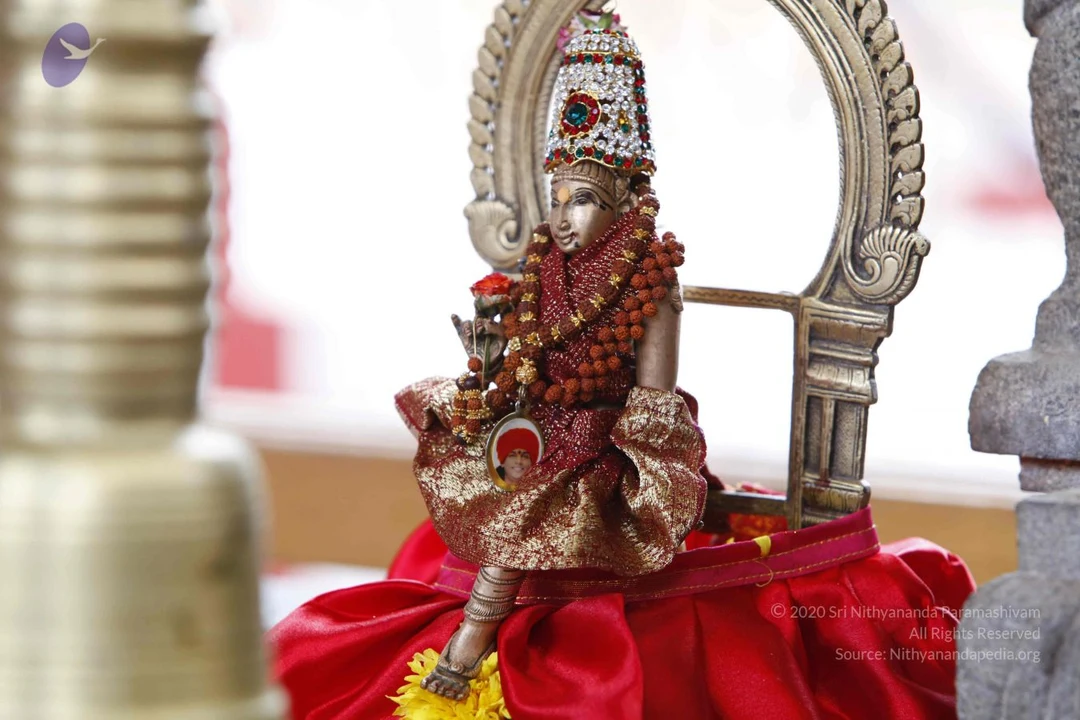
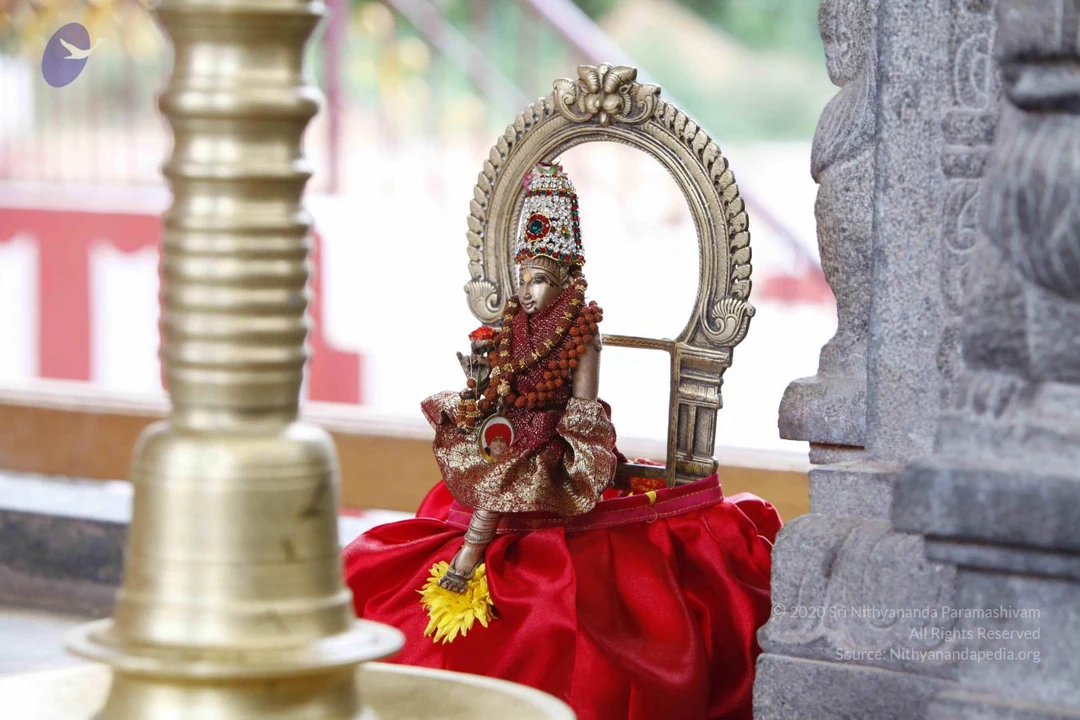
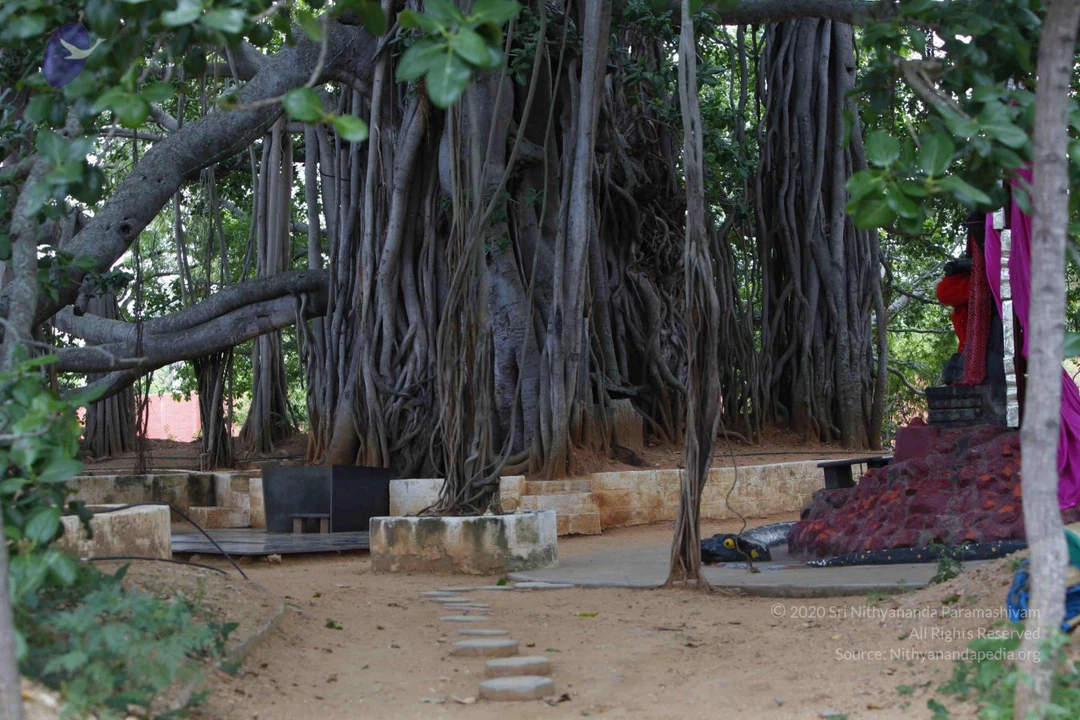
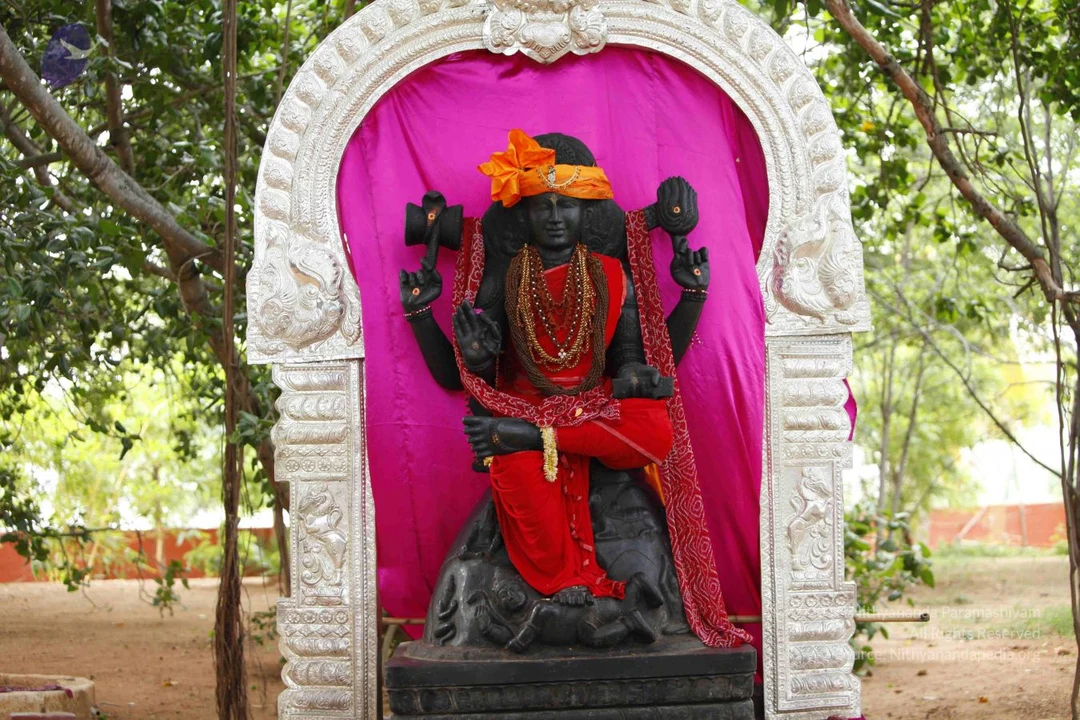
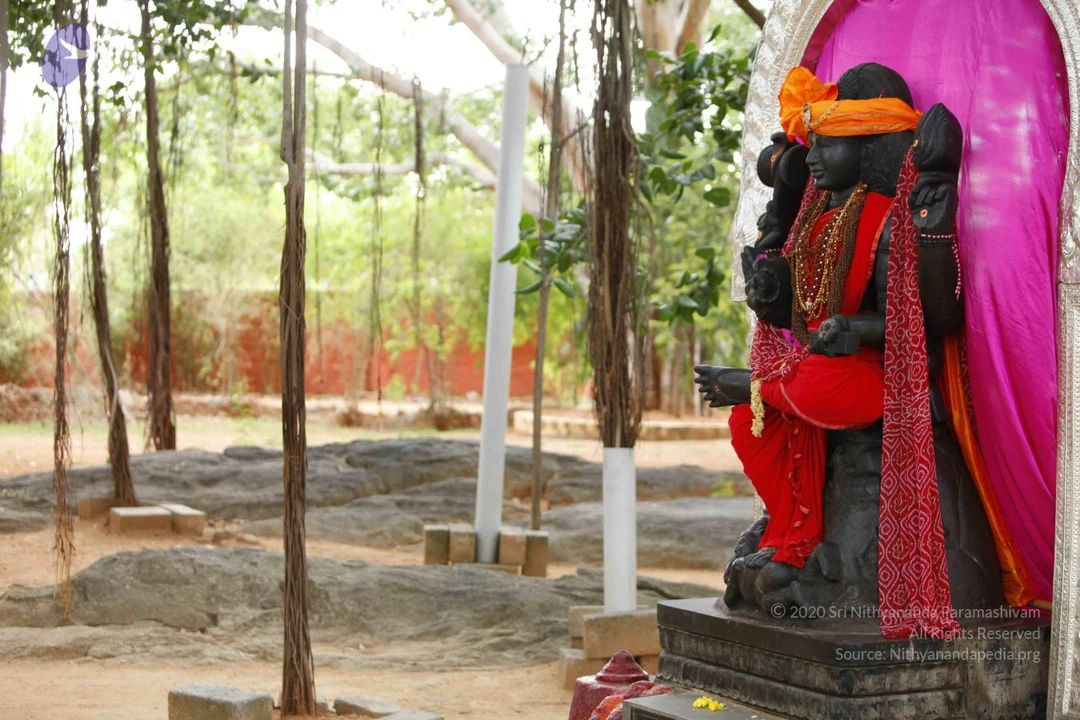
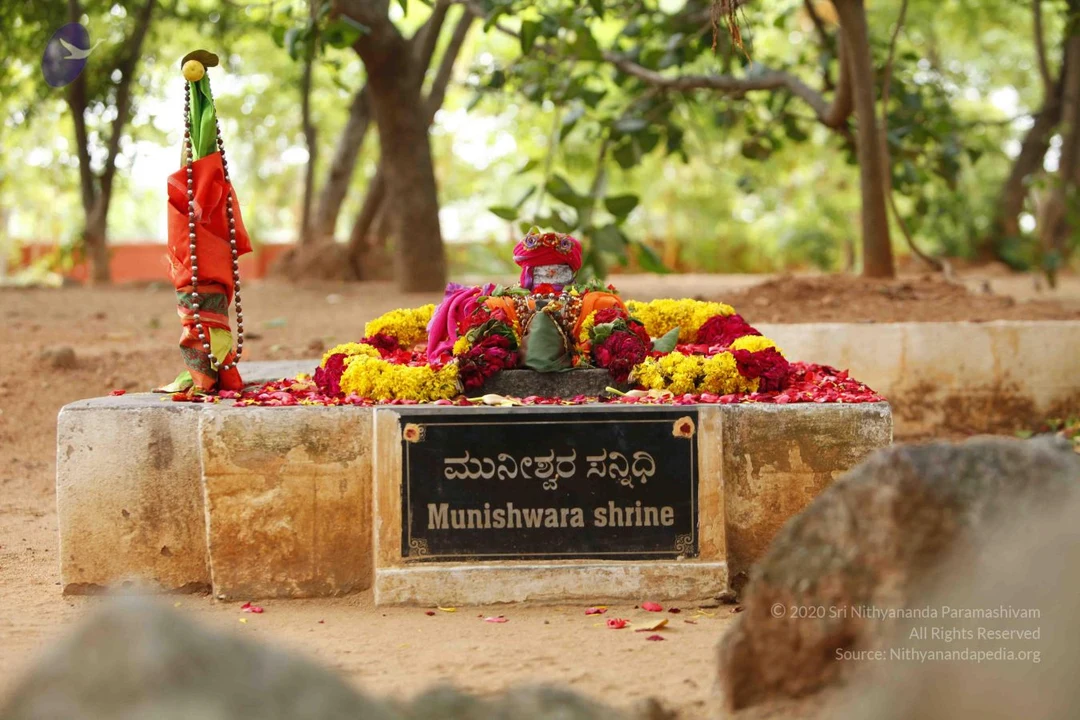
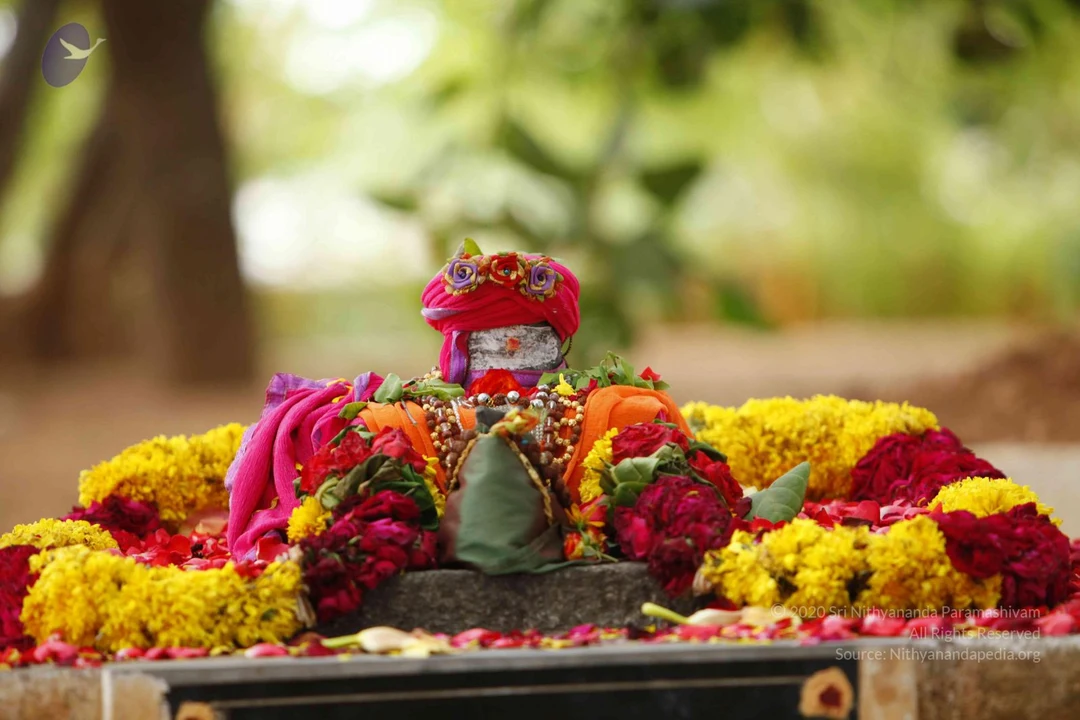
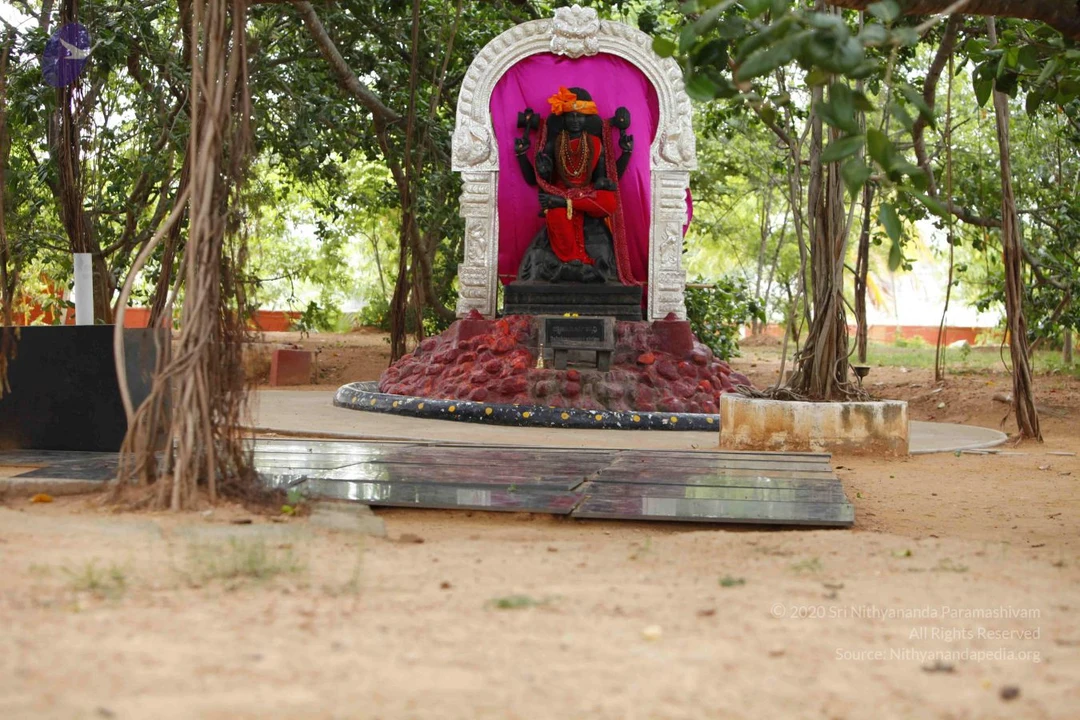
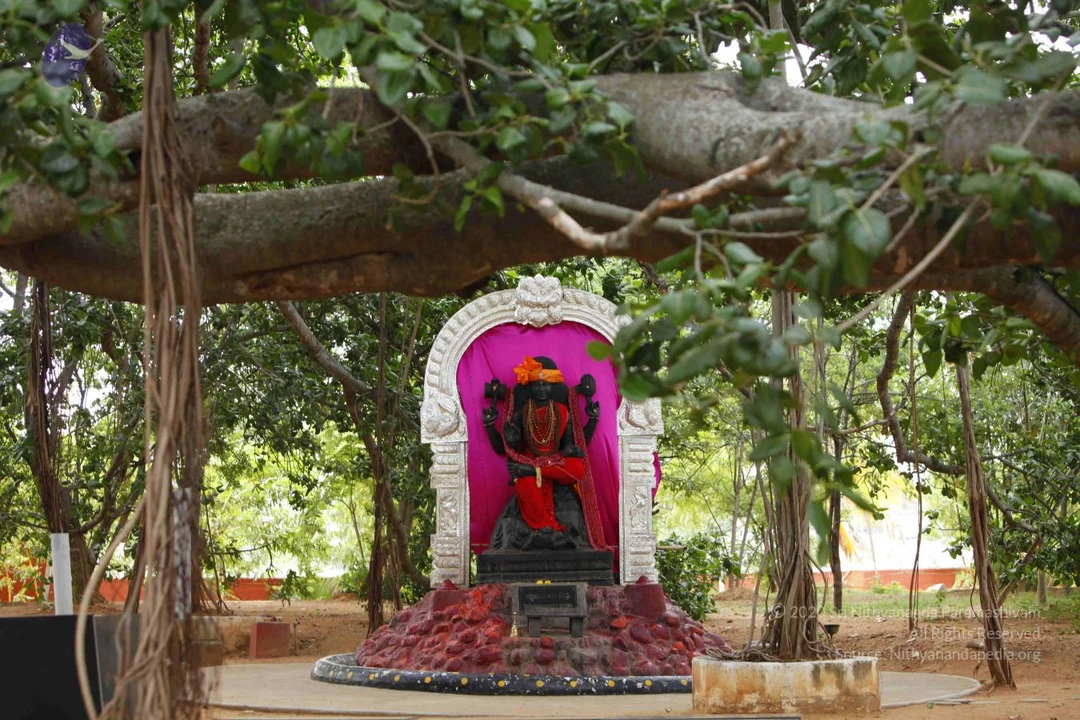
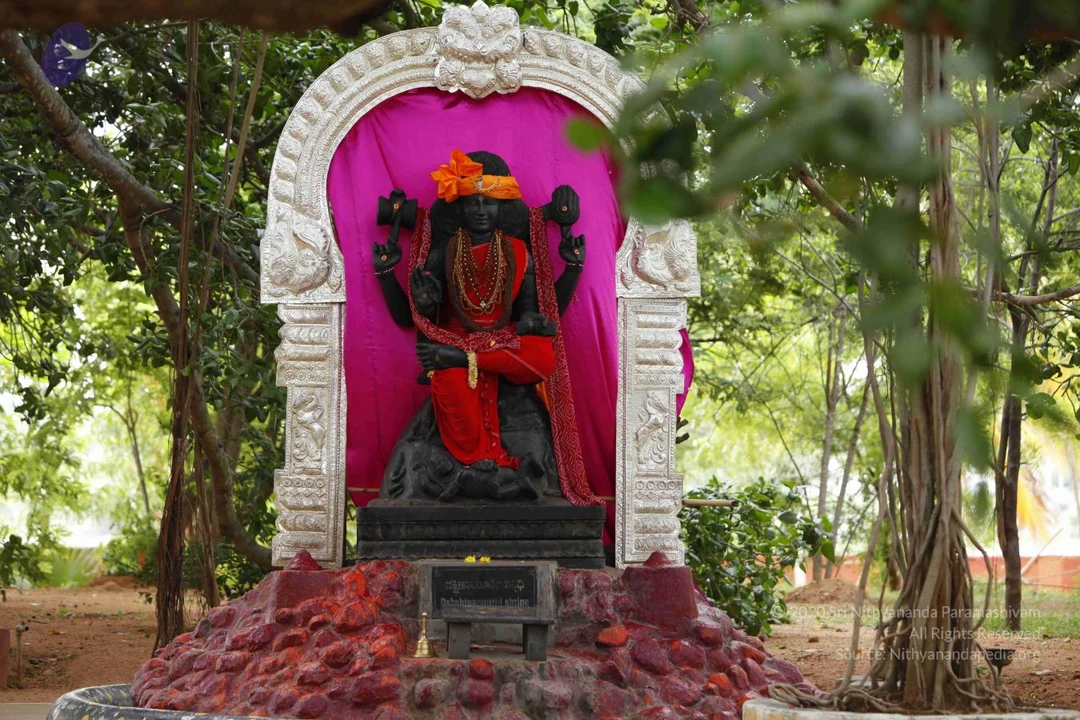
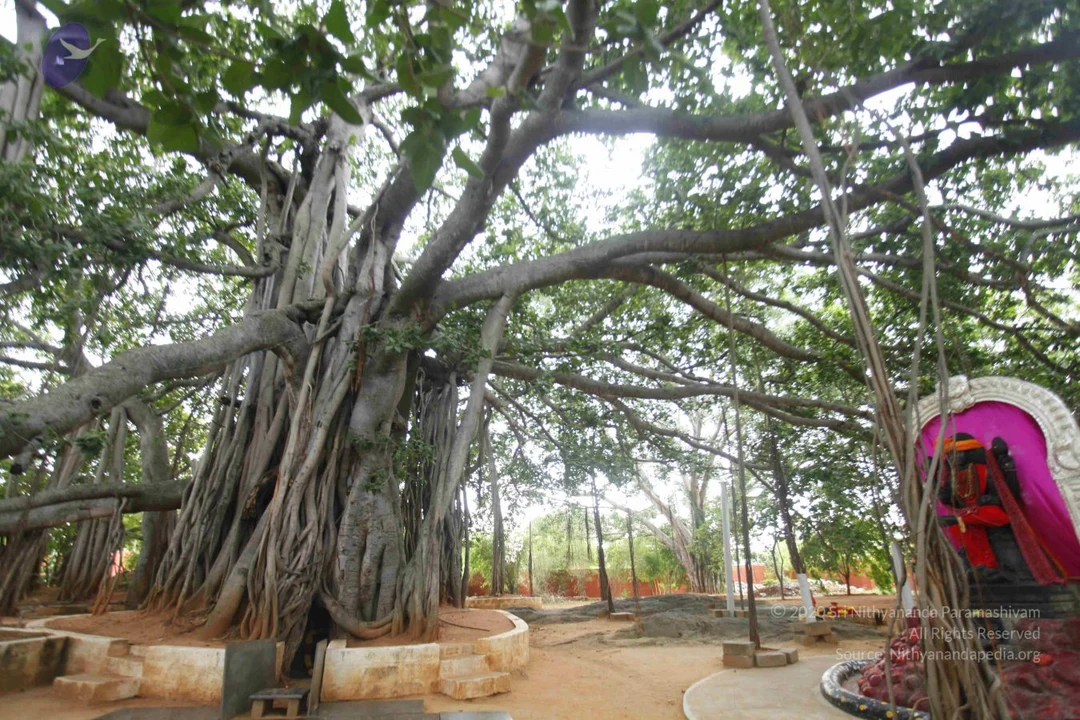
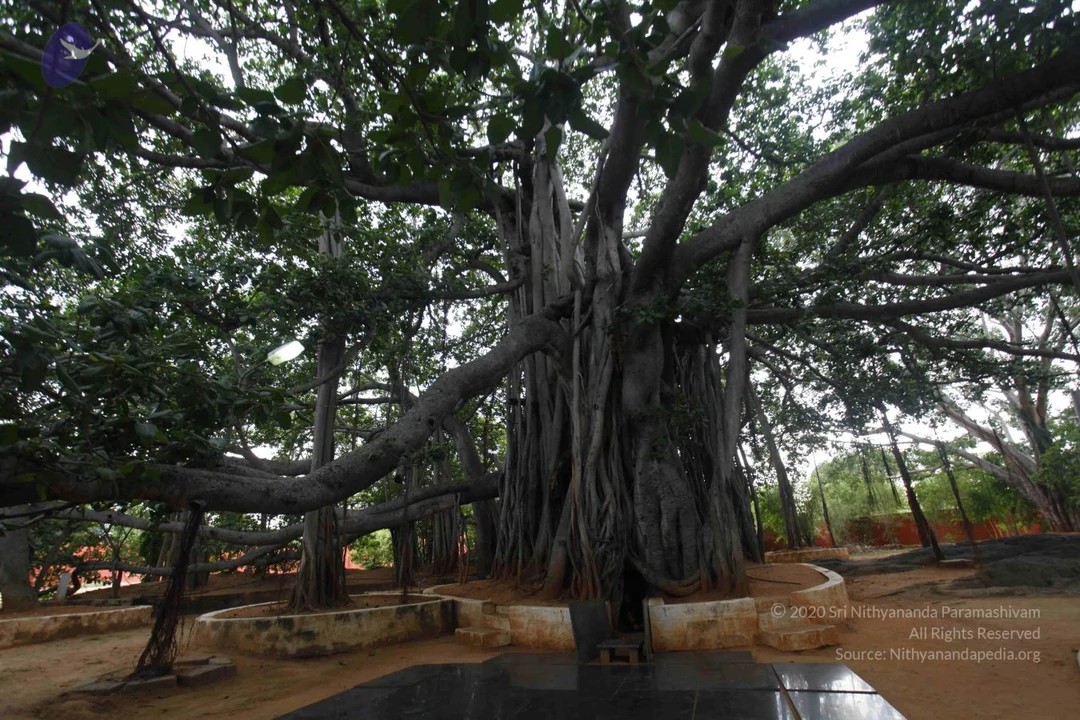
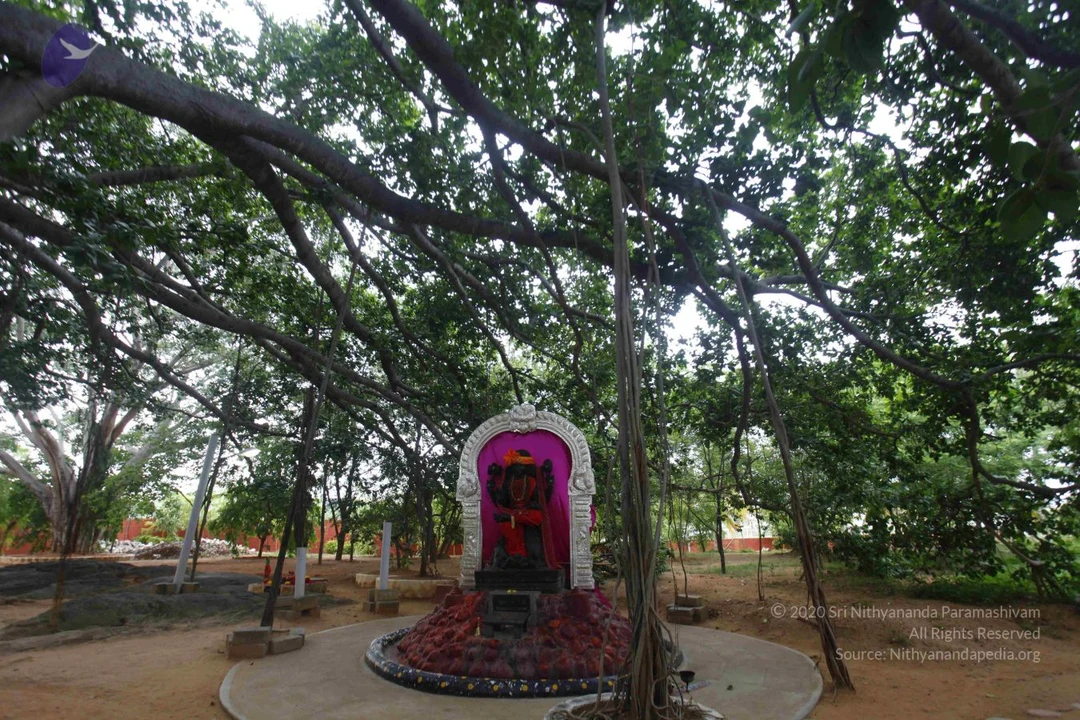
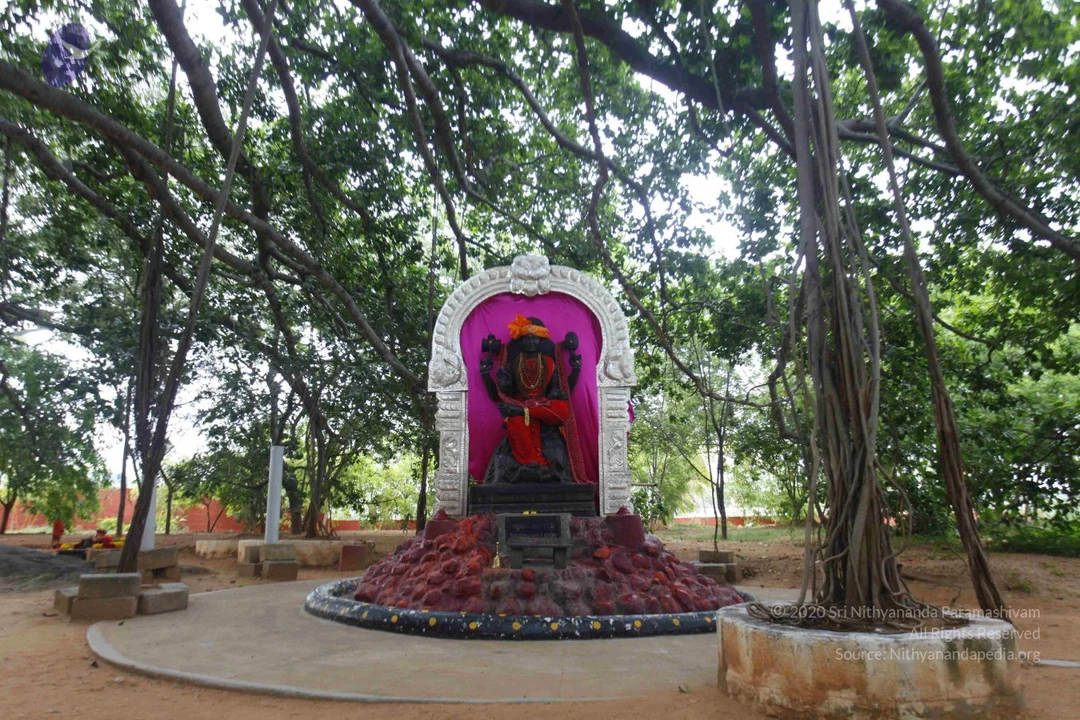
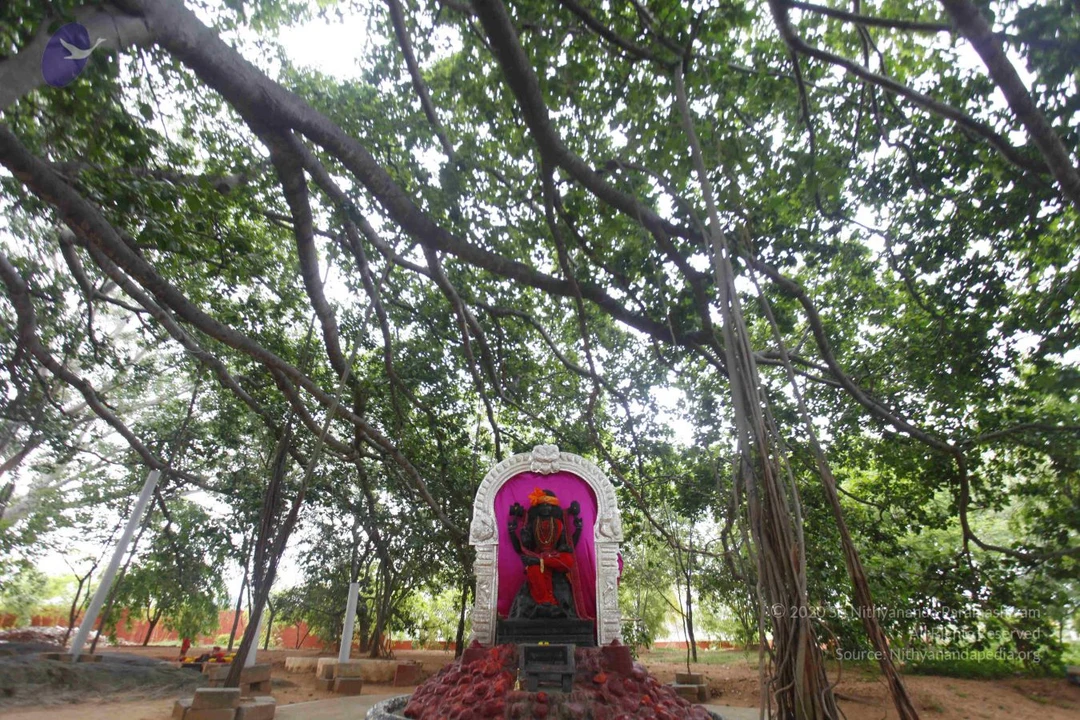
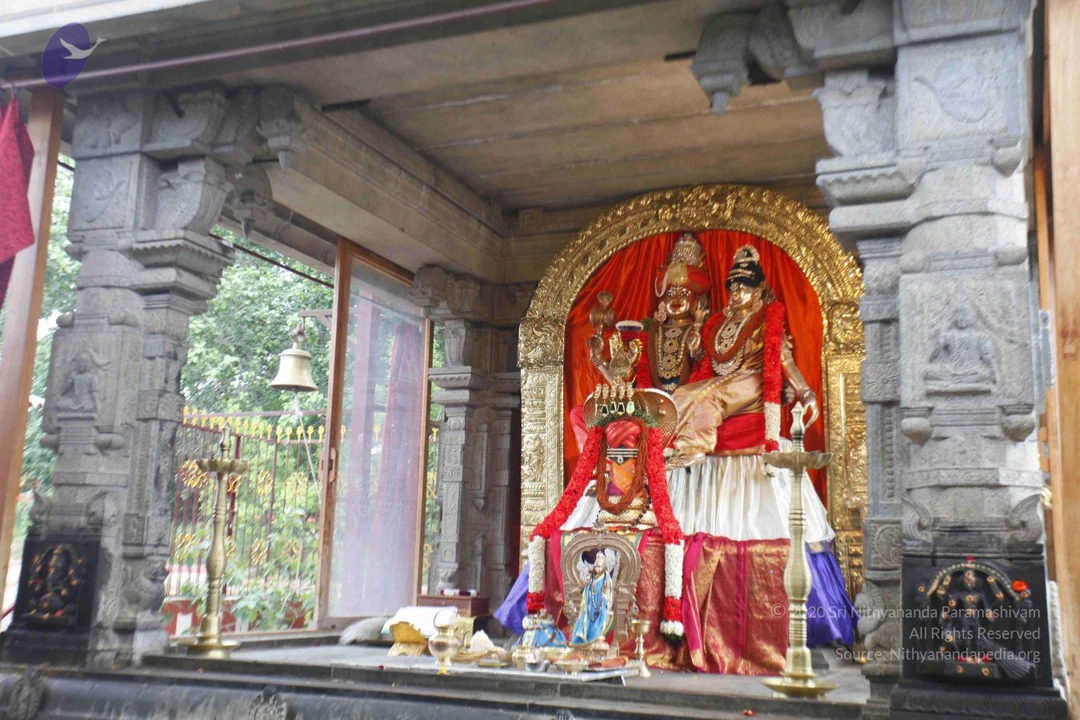
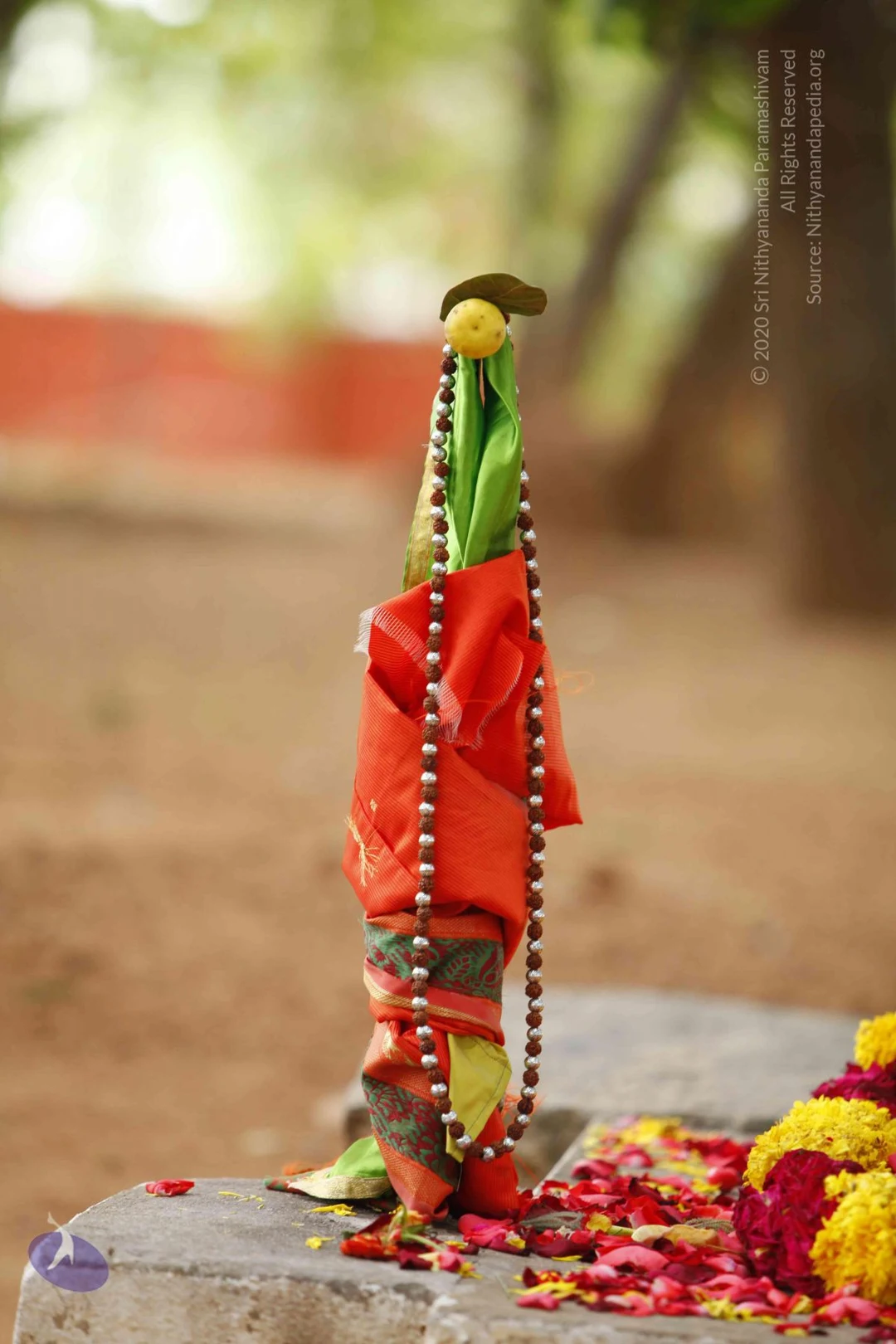
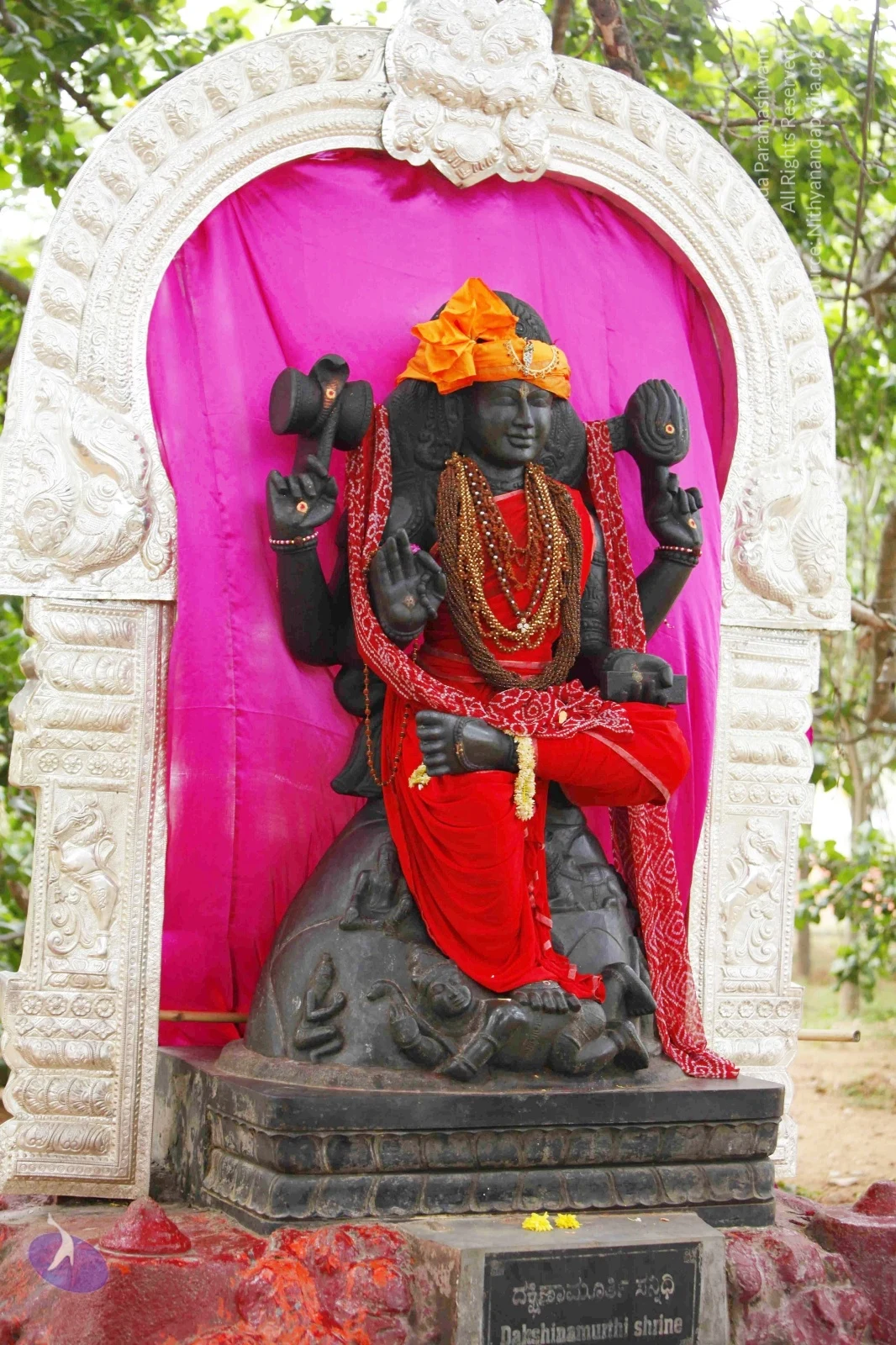
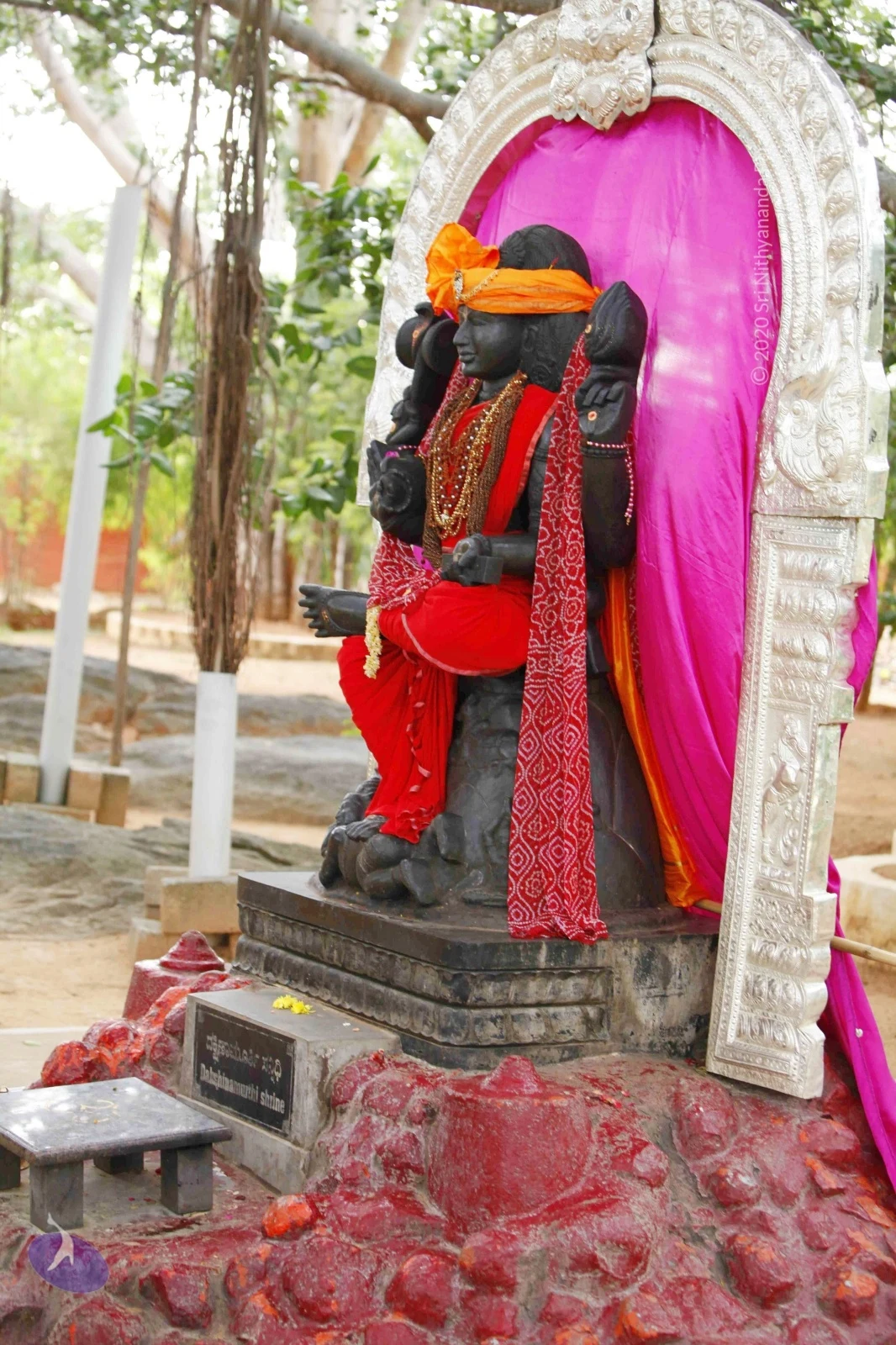
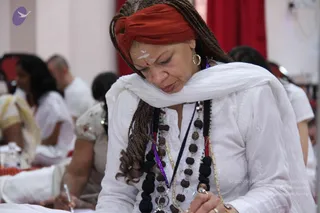
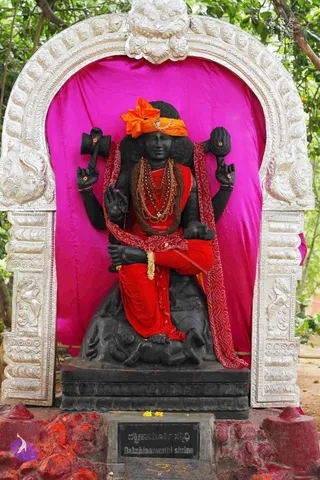
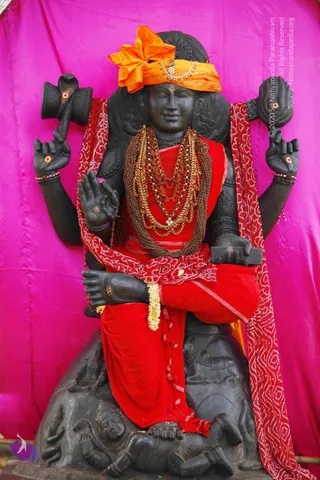
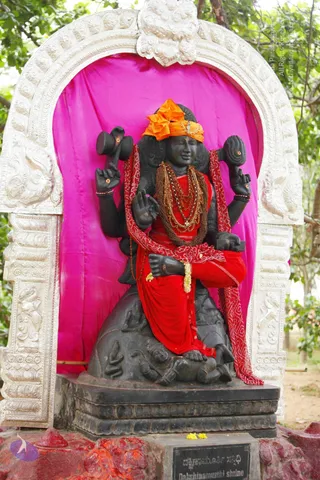
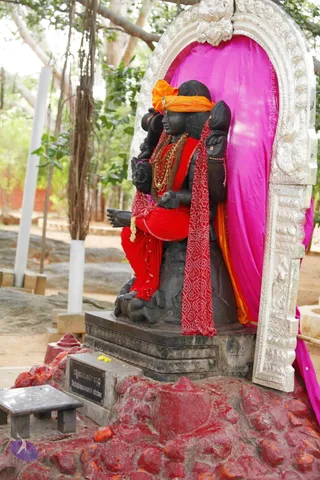
A woman seated cross-legged on a red mat in meditation, eyes closed, hands resting open on her knees with rings and beaded bracelets. She wears a red turban, white garments with a white shawl, and a long rudraksha mala with a purple cord and a pendant. Behind her, rows of seated devotees in white and orange or red garlands sit with eyes closed during a satsang or meditation session. A water bottle and a small cup appear at the lower left.A stone Shiva lingam is dressed as a deity murti, wrapped in a bright pink and red cloth with a crown-like headpiece of purple and red flowers. It sits on a dark stone base surrounded by a dense border of yellow marigold and red rose garlands with scattered petals. Orange and saffron cloth, rudraksha beads and a green leaf decorate the front. Blurred green trees form the background. This is a photograph of a decorated murti, with no physical people visible.Outdoor photo of a dark stone deity murti seated in a white arched shrine niche with a magenta cloth backdrop, draped in red and orange cloth with a red-bead garland and an orange cloth on its head. Large banyan tree branches with hanging aerial roots arch overhead. The shrine sits on a raised circular platform with a dark tiled border, surrounded by heaps of red and orange offerings. Sandy ground and a few small concrete blocks and a low wall are visible in the background. No people are visible.

JULY 7 2013

Original wiki page
Contents

Title

Paramashivoham Oneness Capsule 159 (at the Nithyanandeshwara Paramashiva Devalaya Bidadi) 7TH JULY 2013

Description

Paramashivoham Oneness Capsule 159 (at the Nithyanandeshwara Paramashiva Devalaya Bidadi)

Transcription

(0:23) Your baby is your extension even if you don’t see the face, it’ll be just your face, childhood face. Participant “maybe but, I have” Just you remember as your baby, that’s enough. (0:35) Participant “yea, everybody told me that she was exactly like me”. (0:39) That is what, see, just remember that your child, that is enough it’ll whatever form, face, your mind, identifies with it, it’s okay. Complete with it. (0:51) Participant “why, was it happened actually?” (0:53) See the why has no answer. Many places, why the fan is up there. Many things in the life has no answer. See, life is not on the realm of the answer. It’s a in a higher, if it can be just in the realm of the answer, with few books we will finish life. You don’t need anything other than books in the life. If it all, the whole, see in everything in the life if it can be answered, we would’ve made us a syllabus. Class 1, Class 2, Class 3, Class 4, over. There are many things in life, can’t be answered. (1:31) Participant “ But right now I am not feeling like completing anything. There’s nothing to complete. Like, what should I do?”

(1:36) See, maybe the reasons why it happened. You may not, maybe you’re not still convinced about the whole happening. That is why, still you are asking why? If you are convinced about the whole happening, you will not ask for why. The moment you ask for why, be very clear, still there is incompletion. Complete with it. (2:02) Participant “So from where should I start, actually?” (2:04) Swamiji – Complete from the moment she is born. See when, umm, for her birth, how you have been taken to the hospital, the whole thing start living. Start living, including the moment she is born. All that spaced out areas. Spaces, complete it.

Link to Video:


July 07 2013

Original wiki page
Contents

Title:

Enrich your Life with Stability

Description:

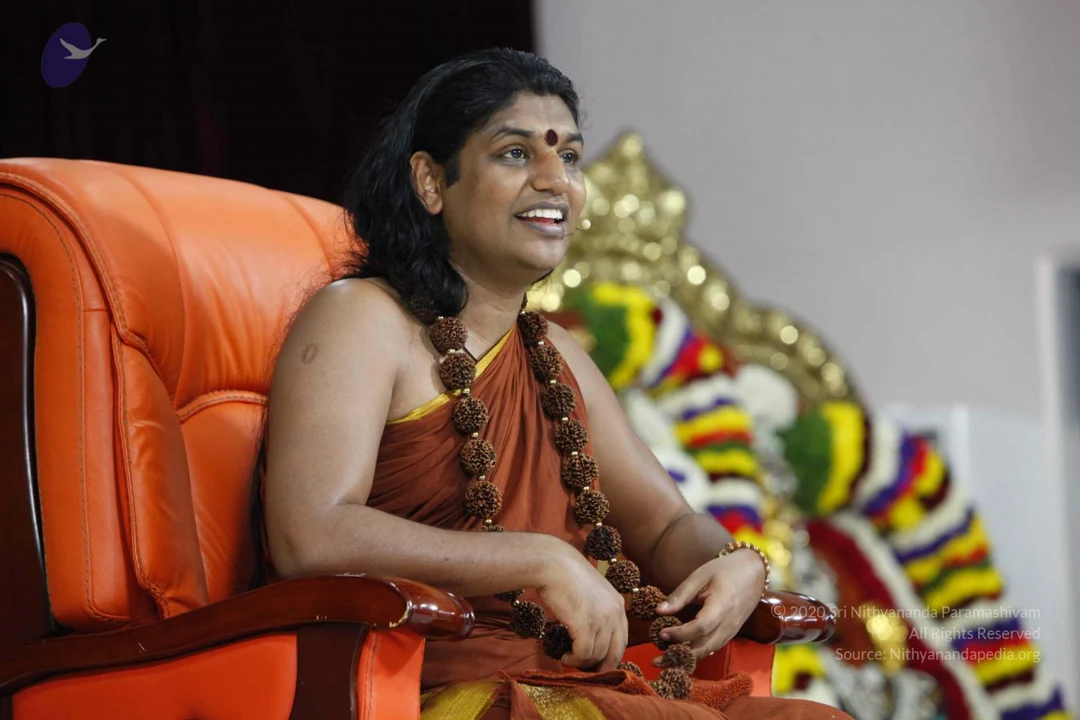
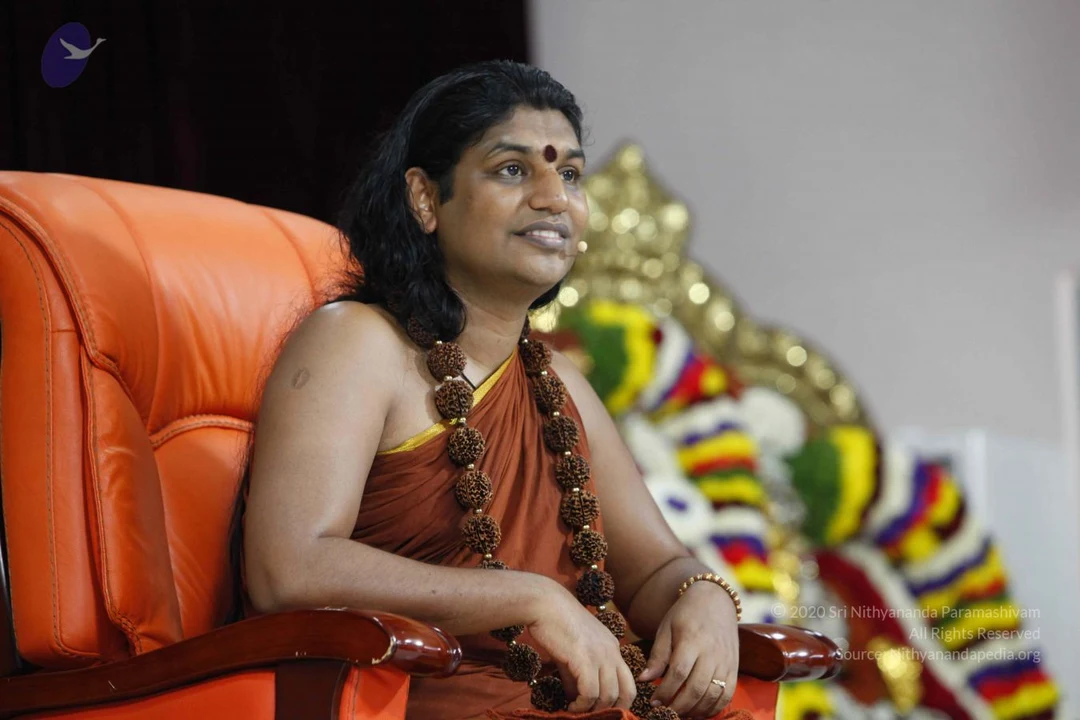
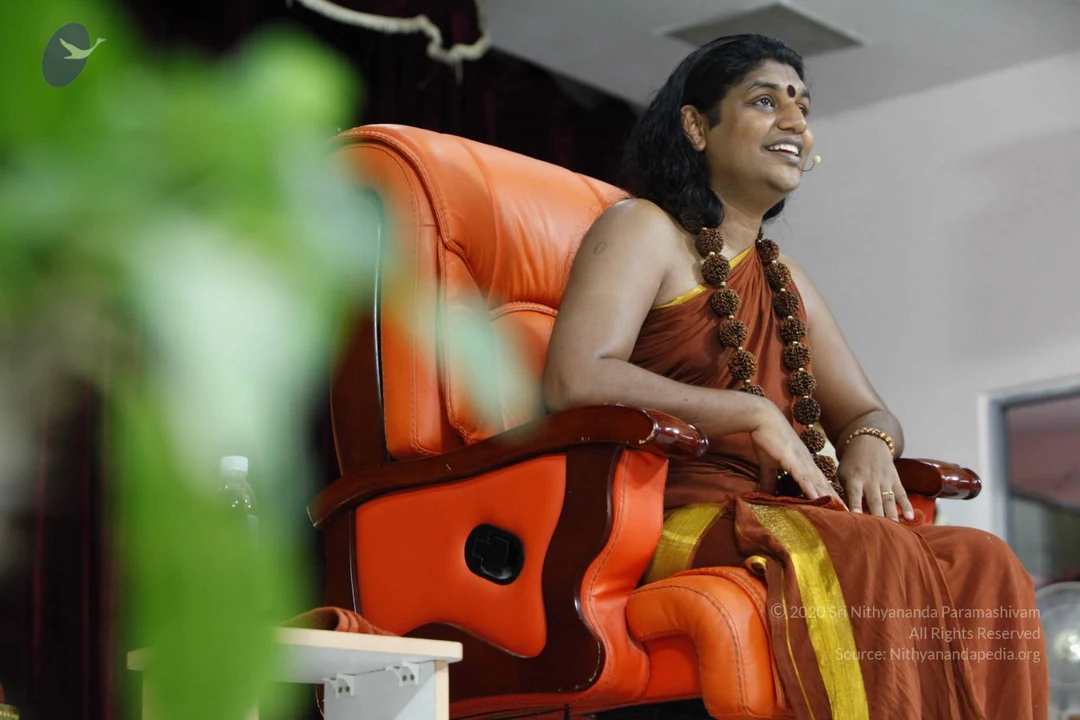
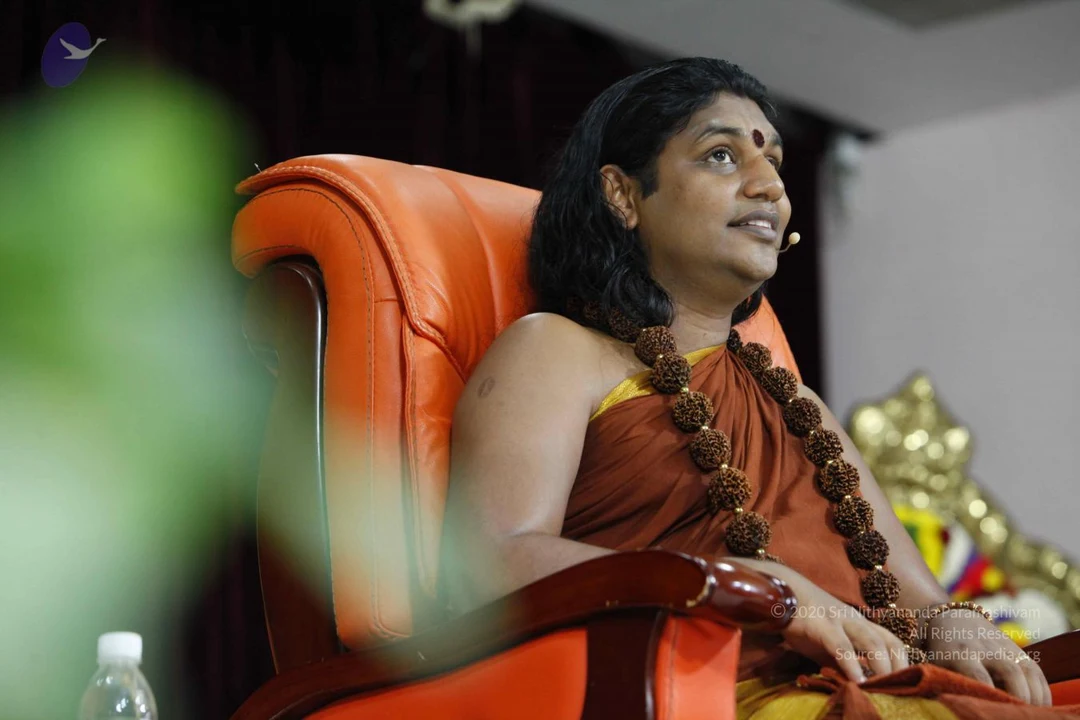
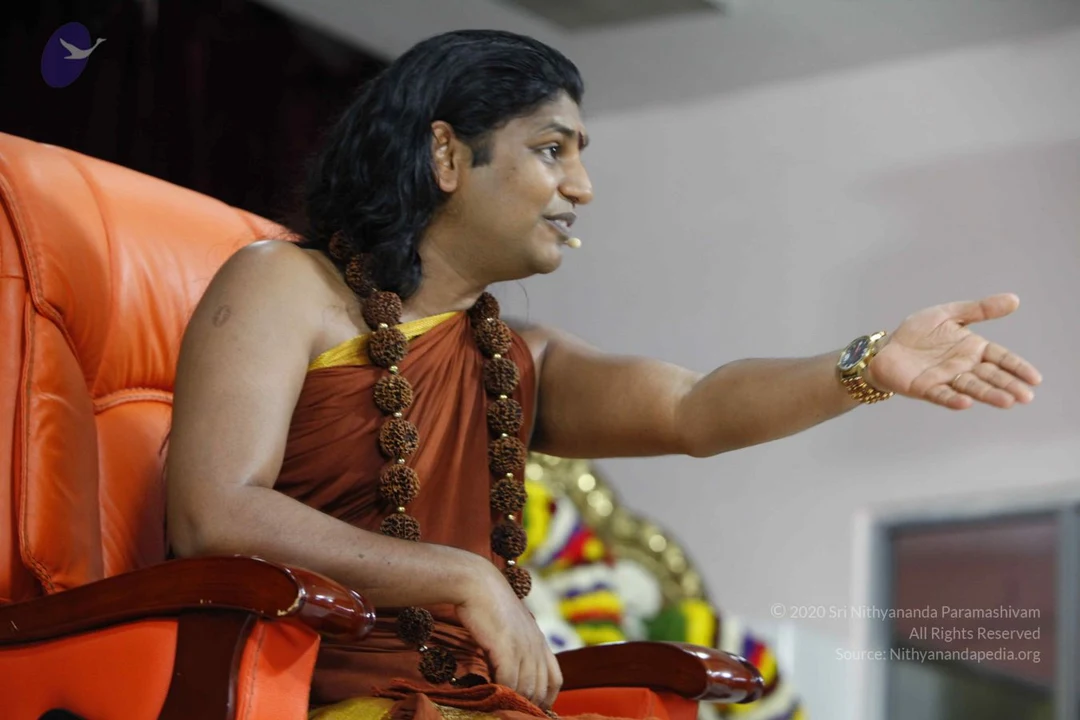
In today’s morning Satsang, Paramahamsa Nithyananda teaches us that the real meaning of richness is not how many zeros we have in our bank balance. If there are people who want to be around us and we have the feeling that we contribute to their lives, then we experience what is real richness. What we contribute to society and others, bringing stability to our lives, actually makes us rich! When we are stable with the basic commitments we make to ourselves and others, we expand our life to a new level and live a rich life!

VideoAudio

Transcript:

ENRICH YOUR LIFE WITH STABILITY

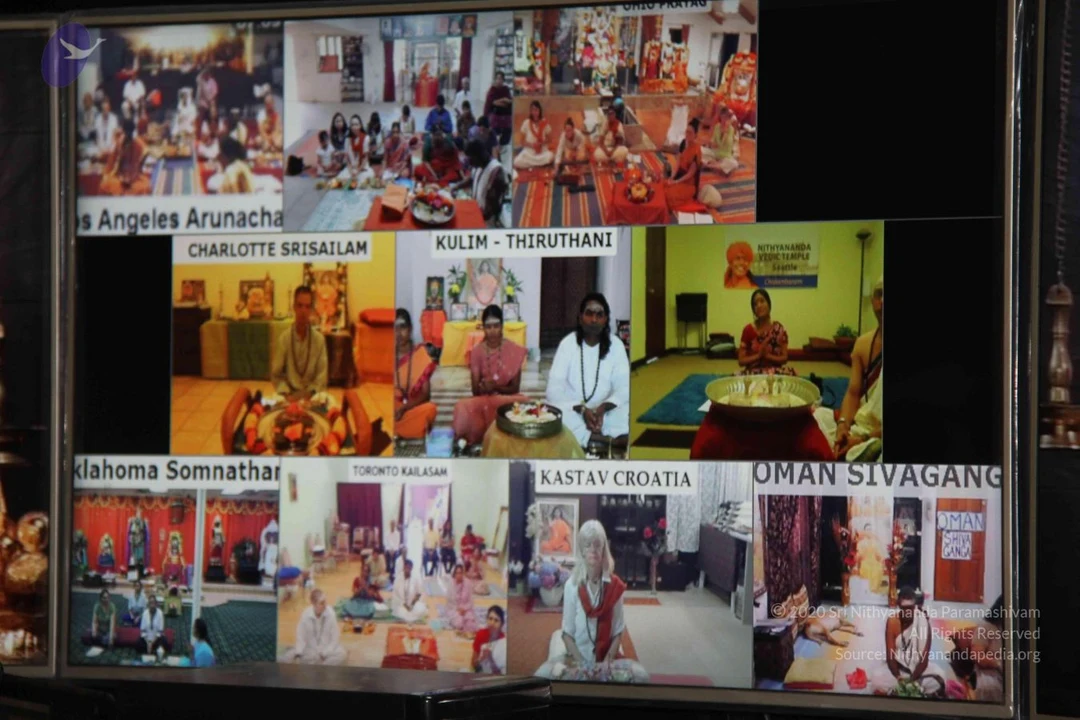
I welcome all the devotees, disciples, samajis, satsanghis sitting with us around the world through Nithyananda TV, Sadhna TV, Lotus News Channel and Eshwar TV. I welcome all the devotees sitting in two-way video-conferencing also.

I welcome all of you with my love and blessings.

And today, second batch of Enriching Initiation. First meeting of all Enriching initiates thirty minutes after the satsang; first meeting will start.

Today I am going to expand on “HOW THE STABILITY IS IMPORTANT FOR ENRICHING, ENRICHING BRINGS STABILITY IN YOUR LIFE”.

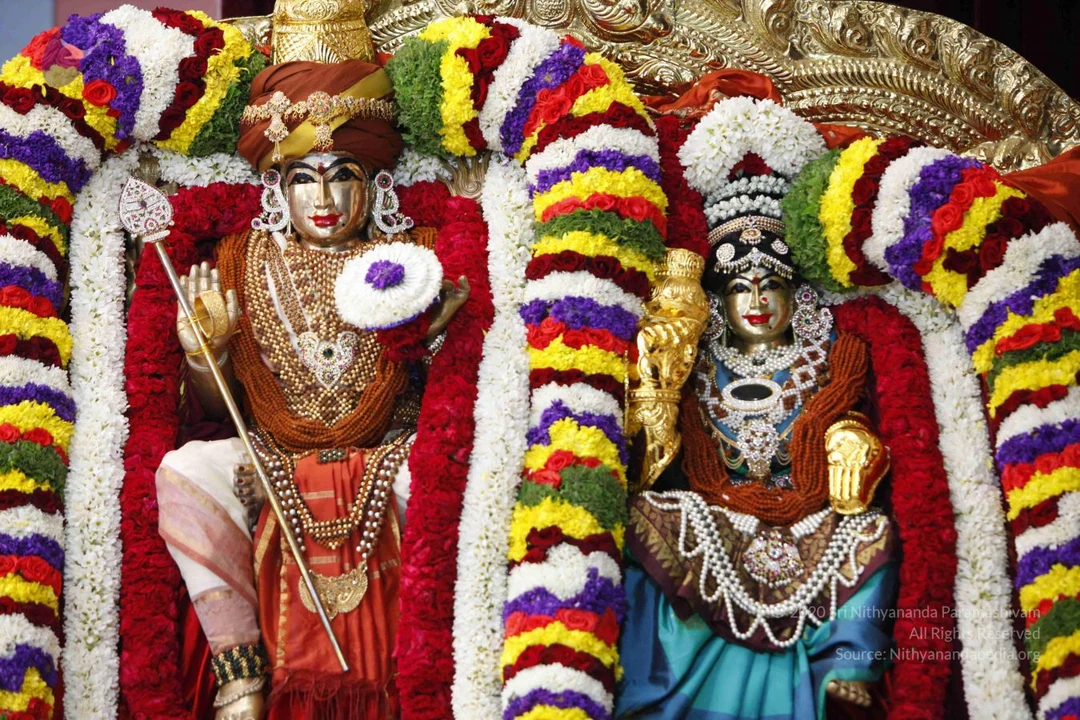
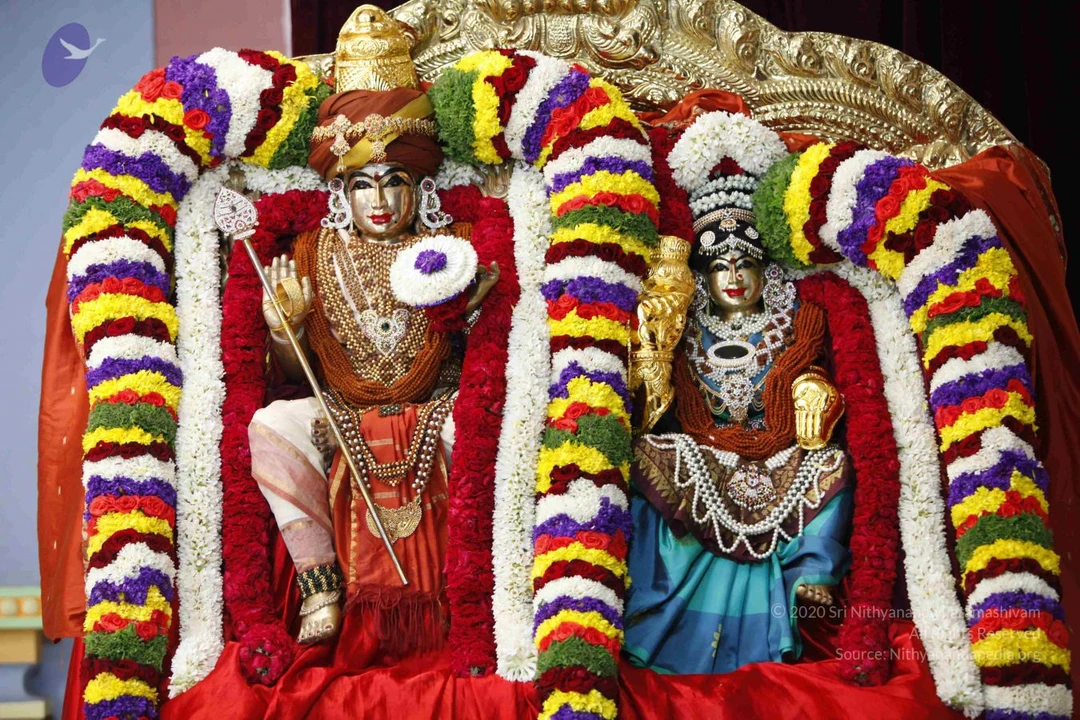
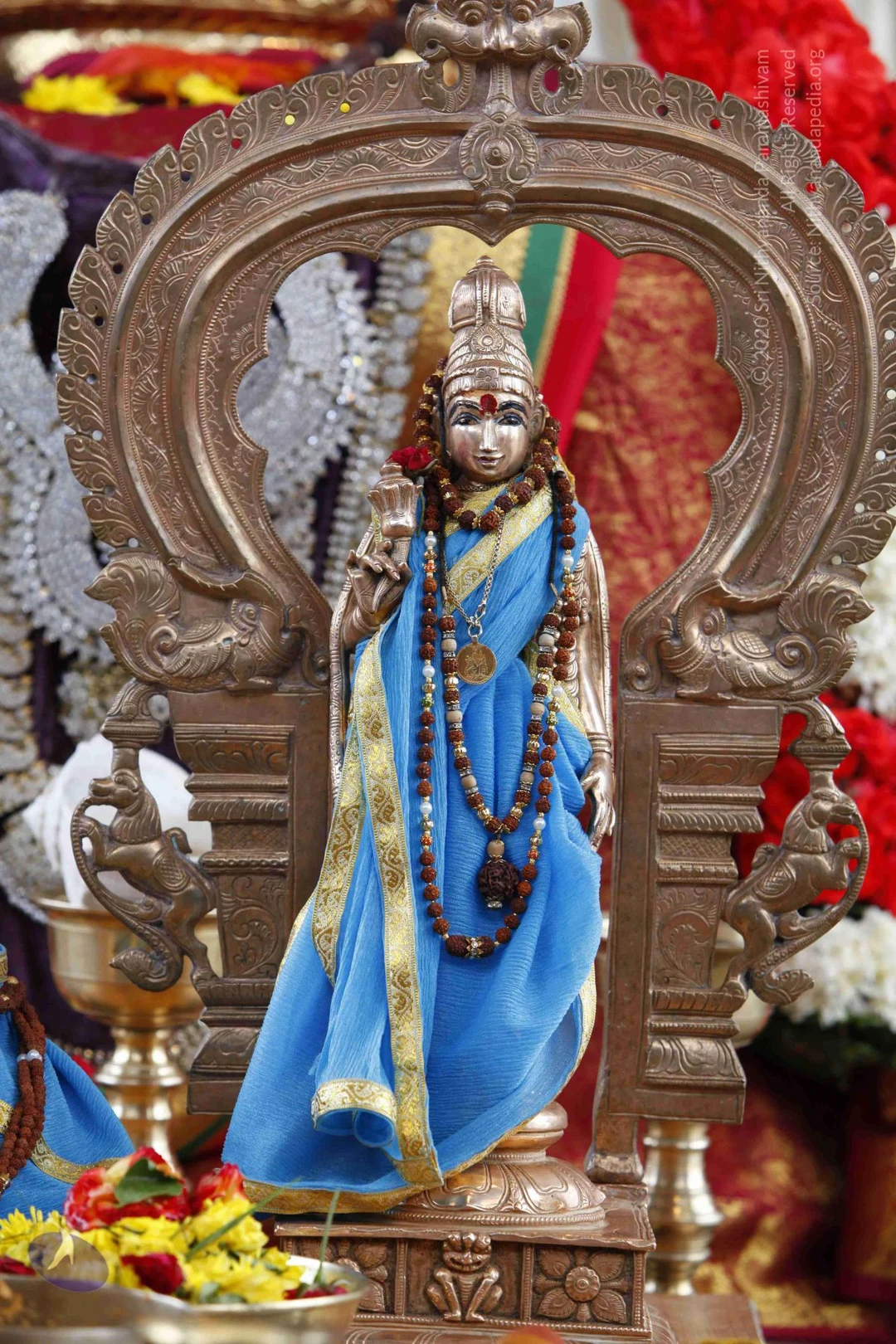
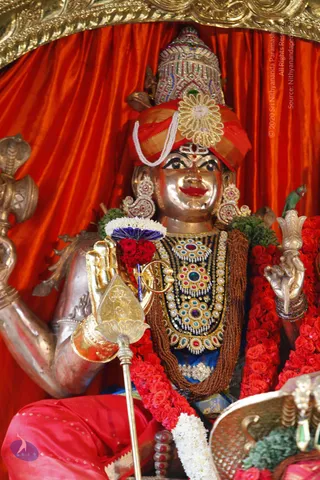
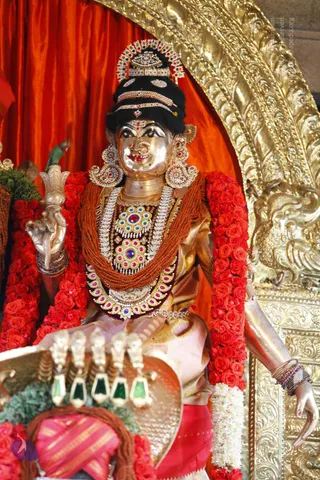
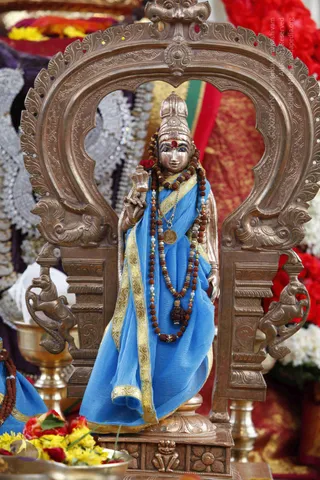
Today Mahadeva is gracing us, Sundareshwara is gracing us in the Leela of “Vel-Valai-Chendu Aruliya Padalam”. Means, the Spear, Bangle and the Flower Bouquet, all the three he gave to his son who is the Incarnation of Subrahmanya, the Ugra Pandyan. Please understand, Meenakshi walked out of fire, directly Parvathi came down as Meenakshi. She was not born to her father and mother. She just walked out of the fire. There was a Yajna Homa, from the fire she directly came out. When she goes and meets Mahadeva in Kailaasa, Mahadeva agrees to come down assume the human body and marry her. So, Mahadeva himself directly assumes the form of Sundara Pandyan and marries Meenakshi, and both of them rule the Pandya Kingdom. And both of them in the human body gave birth to a son, Ugra Pandya, who is Subrahmanya’s incarnation. So, when Meenakshi and Sundareshwara wanted to get back to their cosmic form, leave the physical form, they call Ugra Pandya, their son, and give all these three (Vel-Spear, Valai-Bangle, and Chendu Flower Bouquet) to him to protect the country from Indra, Varuna and Meru mountain. It means, please understand, there was no human enemy for them. Only the natural calamities can be enemy. Varuna means what? Tsunami! Meru Mountain means what? Earthquake, the possible earthquake! And Indra means Rain! Other than these three there was no enemy. So, Ugra Pandya was given these three to protect the country from possible natural calamities. And then Mahadeva disappears into Sundareshwara Linga, Meenakshi disappears into the Meenakshi deity, and they get back to Kailaasa. Today, Mahadeva is in that Leela. Mahadeva will bless all of us with Vel, Valai, Chendu, with all the three.

I will expand on STABILITY AND ENRICHING.

Life will be successful, life will expand, please listen, life will be successful, life will expand only by enriching others, only by living in stability. Please understand, let me define “STABILITY”. “Stability” means, being stable with the basic commitments you made to yourself and others and continue to expand. Understand, being stable in the basic commitments you made to yourself and to others and continue to expand is “Stability”. You can have kids in the marriage that does not mean you will divorce after you have a child. Listen, many a time, what we do you know, when we take on new responsibilities, new commitments, when our life expands to a new level, we tend to give up the old commitments, and we forget. I have seen in the ashram, somebody will take the kitchen responsibility. Then suddenly they will take up, ‘Alright, I’ll supply food for workers also.’ And, after some time, they’ll take care of the food for the workers, but give up the kitchen responsibility!

Same way, in the field of politics, I have seen people. See, many of the politicians in India were very honest and had a mission, motto, clear vision when they entered politics, but not after it. When they entered, many of them entered with a tremendous sacrificing mood, with the feeling, ‘country is going to dogs, let me revive it!’ I tell you, the criminals in Indian politics are some of the very top level politicians who keep all the bottom-level guys by blackmailing them, ‘If you are not going budge for what we want, you are not even going to be in the field of politics, you are not even going to be in the party!’ So, naturally, what happens? The lower level guys for survival reasons have to do whatever the top brass wants. When you begin, your commitment is for country. Unfortunately, in course of time, you become unstable and your commitment is for your top brass. It’s no more for the country, no more for the people! Understand, this is the worst thing which can happen to human-beings. Slowly becoming unstable even in the basic ideas for which you live your life.

I classify people in three ways:

• People who are only enriched;

• People who never bother about anything else;

• Poor people.

Please understand, poverty is not dependent on how many rupees you spend for yourself per day, or how many rupees you make for yourself every day. No! No! It is not the truth! I challenge! What you contribute to society, based on that, poverty is decided. What are you for society, based on that whether you are poor or rich is decided. I have seen many doctors, such wonderful people! They make very less money. Per day only less than a few hundreds. But, they live such a rich life, per day five-hundred to six-hundred patients come to them!

I have seen this Nagari Puthur. In Andhra there is a place, “Puthur”. A family treats ten-thousand

patients per day! They perform ten-thousand surgeries per day average! Ten-thousand surgeries

average! They don’t charge! I will not call them poor. They may have less money, but they are wanted by ten-thousand people per day! All of them have basic necessities like food, house. They are not rich. They don’t even have cars, those family guys. But thousands come there. Anywhere in South India, the moment a fracture happens, they think of Puthur!

And in Karnataka there was an old man called Kase Gowda. Very simple man. You should know, I myself visited him! The speciality of that Kase Gowda is, any pain you go, he will do something, put a little herbal medicine and put a twenty-five paise coin on that place and tie a small bandage. That is all! And, it will be healed! Please understand, he is so well-known! One of my close devotees had a pain in the hand, something related to the bone, then I heard about this Kase Gowda, old man. When I went, I saw he is sitting in a small building, but per day two-thousand people come to see him! He doesn’t charge. When I saw him, he must have been above seventies; old man, can’t even move freely. Unfortunately, he passed away recently. All he had was one Kaalabhairava’s photo. Whoever goes, he touches Kaalabhairava’s feet, puts his hand on the area where people have pain and put a little herbal paste, puts that twenty-five paise coin, and puts a bandage and sends them. Over! And you need to know, that devotee became alright in one week! He became alright! In a week! That old man, Kase Gowda, he was not having lot of wealth. But I won’t call him poor. He is needed by thousands of people every day!

So understand, what you mean for others decides whether you are rich or poor. What you mean for others that decides whether you are rich or poor. Nothing else! I have seen people living with a few rupees a day, but wanted so much by others! I have seen people making crores of rupees a day, piling up, crores a day, but not wanted by anybody, not wanting anybody, live a lonely, poor life. Lonely, poor life! So unfortunate! They live a lonely, poor life!

Yes, enriching makes you rich! Enriching makes you live richly! Do enriching, you will understand how rich your life can become. Your life can become rich intellectually, emotionally, economically, in your health. Please listen, richness is always not dependent on a few rupees, a few zeros you have in your bank balance. I tell you, after it crosses eighth zero, it is not even going to affect your day-today life. After eight zeros, any zero you add, is your day-to-day life going to change? No! Because you can’t buy anything more with money after you cross the eighth zero. How many of you are getting it? That’s it! That’s all! That’s all I am saying! Rich in having people! I tell you, having people around you, and people feeling they want you, and you feeling you contributed to their life is the ultimate richness! People wanting you, and you feeling you contributed to their life will be the ultimate richness. I will establish a new community, new order in the world who understand the real value of richness! In Indian society, money and being wanted was never connected. In Indian society, a village barber, he will not have much money, but from the top person of the village to the bottom person, want him. So he feels wanted. That takes away depression from him. He finds the purpose of his life.

Same way, the agriculture, the farmer he may not be rich, but the whole village wants him. The village priest, he may not be rich, but the whole village wants him. The drummer, village musician, he may not be rich, but the whole village wants him. The washerman, he may not be rich, but the whole village wants him. I have seen my aunt’s village, when I was young, every harvesting, the barber, washerman, worker, temple priest, all of them will have their share. The village doctor, you don’t need to fall sick for the doctor to earn money. It is the other way actually! If you are healthy, only then you will grow grains and he will have his share. But now the whole system is such, your body is the income source for the doctors! Then naturally, understand to what you are pushing them! They are poor guys! They just think, ‘What can I do? This is the way you treat me!’ See, the way society treats the doctors, what it says, ‘only if I fall sick, you will become rich!’ Then doctors make sure you continuously fall sick! In Indian system, it was not like that. It was like, whether you fall sick or not, every harvesting the doctor gets a share. Only if you are healthy, harvest will be more and he will get more grains. So he’ll make sure you are healthy! I will never use toothpaste which is recommended by a dentist! Why will they recommend something which will stop their income? Tell me! Will they recommend something which will stop their income?

Continuously, being wanted by so many people, feeling you are contributing, enriching so many people’s lives is the most richest feeling you can ever have in your life! This gives you the feeling you are richest, most richest! Actually, only if you become stable inside you, you will start enriching. Only if you do completion, you will become stable. Completion is the first process for stability. Completion leads to stability. Stability leads to enriching. So, all the Enriching initiates, all the Enrichers, first thing you have to do continuously spend every night at least half-an-hour to forty-five minutes in completion. Sit with yourself, complete, complete, complete. Go on completing! Go on completing! Completion is one of the basic requirements. Completion! With completion you become more stable about what you want to do, what you want in your life. And, you cross all the unawareness. Every day spend at least half-an-hour in completion before going to bed. You may not need more than 2-3 hours’ sleep if you complete! Do completion! Do completion! Do completion! Continuously do completion and become stable on what you mean to you and what you mean to others. What you mean to you and what you mean to others!

So unfortunate, first of all we don’t become stable inside us and we don’t even understand the power of enriching. Start enriching, then you will understand how rich you become intellectually, because every question of every individual, you will be able to handle and inspire them.

Listen! Listen! Listen! Enriching is life! Life is Enriching! When you enrich others, you become rich intellectually, you become rich emotionally. You will find the flaws you have in your logic, and the unawareness you have in your logic, and you will become rich consciously. I have become more rich consciously by enriching others than any tapas I have ever done in my life; whether it is meditation or yoga or kriya. I have become more rich through the enriching I have done to the people, than any other tapas I have done in my life. That is why I tell you, even the staff who work in the ashram, they are Enrichers! You may get a salary to run your life, but, you are making money through the right work, right job, right profession, righteous means; not only righteous means, you are making money through spiritual means. Please understand! See, money can be made in many ways. You can sell alcohol and make money. You can sell marijuana and make money. You can sell pot and make money. You can smuggle and make money. You can rob and make money. You can murder and make money. You can do millions of things and make money. But, that is not dharma, righteous means of making money. By destroying and making money, is it money? No!

Understand, there are millions of ways to make money in the world, but, making money not only in righteous ways, but spiritual way. And settled, settled, please understand, settled with the truth of enriching, being stable with the truth of enriching. Because it is very important, whose food you eat!

There is a beautiful story in the Mahabharata.

When Bhishma was in his death bed after the war is over – the Pandavas won the war – Bhishma was in death bed, Dharmaraja – Yudhishtira – goes to Bhishma to get his blessings before the coronation. Bhishma gives all the great teachings of how to rule the kingdom, how the kingdom should be run dharmically. Draupadi, who was in deep incompletion with Bhishma, could not tolerate this. She said, ‘Shut up! You fellow you dare to speak about right and wrong when you are in your death bed? When my saree was pulled, when I was abused, when my clothes were pulled out in public stage, in the court, what were you doing? O’ grandfather Bhishma! what were you doing at that time? Where all your ideas of dharma went away at that time? The good and bad, moral and immoral, integrity, authenticity, right, wrong, where all that went away at that time?’ Then Bhishma cries, and he says, ‘O, my daughter! You are right! At that time I did not do anything, because I was eating Duryodhana’s food. That food has made my consciousness numb, dull, insensitive. Now all the blood came from Duryodhana’s food, your husband Arjuna’s arrows have removed it. Now I lost all that blood! Bad blood has gone! Now I am established in the energy given by my mother, Ganga Devi. That is why now I have regained my spiritual knowledge and intelligence! That is the reason I am sharing the truths now, I am telling you the right things now.’

Please understand, it is important whose food you eat also! That is also important! That is why I am telling, even the workers, staff who are working in the ashram, they are Enrichers. They may be receiving salary. That is different. But what are they doing? End of the day, they are enriching the world! They are enriching the world!

I bless you all! Let you all radiate Integrity, Authenticity, Responsibility and Enriching with eternal bliss, Nithyananda!

Title

How We Create Inner Image || Part 1|| Inner Awakening || 07 July 2013

Description:

This video is an excerpt from the Inner Awakening program conducted on 07 July 2013 in Adikailaasa, Bengaluru, India. In this video Supreme Pontiff of Hinduism HDH Nithyananda Paramashivam gives deep insights about how we create Inner Image. He explains that everything has to start with inner image (Mamakara). Actual Mamakara, the original root pattern is the first statement that you make about you when you are powerless, when you are in deep conflict or pushed to extreme confrontation. When you were born you were born in the absolute conscious state, the state where you were whole, perfect and complete.

VideoAudio

Title:

What is Advaita || Part 2 || Inner Awakening || 07 July 2013

Description:

This video is an excerpt from the Inner Awakening program conducted on 07 July 2013 in Adikailaasa, Bengaluru, India. In this video Supreme Pontiff of Hinduism HDH #Nithyananda Paramashivam explains #Advaita as the pure fact based religion/factual religion/religion where there is no fiction, there is no assumptions. Then He states that the perception you made about you, the actual inner image separates you from the whole and #Dvaita duality is born. When you relive the situation in total integrity and authenticity, the actual inner image you carry about you which is hidden from you till now will be suddenly exposed and revealed to you. Once you complete with this root inner image, all the surface level inner images that are conflicting patterns from the past will get completed.

VideoAudio

Title

Discover Your Root Pattern || Part 3 || Inner Awakening

Description

This video is an excerpt from the Inner Awakening program conducted on 07 July 2013 in Adikailaasa, Bengaluru, India. In this video Supreme Pontiff of Hinduism HDH Nithyananda Paramashivam guides to find the oldest incident and the word you told about you when you first experienced powerless state and to start Reliving. Finding the conflicting pattern is the first step but that is not enough. Find the words you uttered to yourself the first time you were powerless. Re-live re-live re-live again and again till you find the word you uttered to yourself. After you discover that statement , the essence of your biography will be that one statement. This experience will be repeating again and again and again in your life. For the completion process you have to go to the root incident itself.

VideoAudio

Title

Complete Your Root Pattern || Part 4 || Inner Awakening

Description

This video is an excerpt from the Inner Awakening program conducted on 07 July 2013 in Adikailaasa, Bengaluru, India. In this video Supreme Pontiff of Hinduism HDH Nithyananda Paramashivam explains participants to go to a recent conflict and from there to start digging out and see that it boils down to confusion. He guides to go to a recent incident and write down what we feel as we. He states that we do not use emotion without a word. Even if we find the actual inner image it is not the root pattern. For the actual root pattern we need to dig deeper than this.It is the first part of the alchemy process. Finding the conflicting pattern is the first step but that is not enough. Find the words you uttered to yourself the first time you were powerless. Re-live re-live re-live again and again till you find the word you uttered to yourself. After you discover that statement , the essence of your biography will be that one statement. This experience will be repeating again and again and again in your life. For the completion process you have to go to the root incident itself.

VideoAudio

Title

Why we Experience Duality || Inner Awakening || 07 July 2013

Description

In this video Supreme Pontiff of Hinduism HDH #Nithyananda Paramashivam explains that the perception you made about you, the actual inner image separates you from the whole and #Dvaita, #duality is born.

VideoAudio

Title

Heal Your Inner Outer and Life images

Description

In this session Swamiji speaks on the importance of listening, what a root pattern is, and walks us through the mamakara, ahamkara, and the anyakara. After doing so he guides us through the completion process to heal each of the three: mamakara(inner image), ahamkara(outer image) and anyakara(life image)

VideoAudio

Paramashivoham Oneness Capsule 159

Description:

(07 JUL 2013) The word "Darshan" means "to have a glimpse of". Having Darshan of an Avatar can cleanse the karmas of lifetimes, and create a deep and lasting transformation in the receiver. Darshan is something far beyond mere physical "seeing". Darshan is the powerful superconscious vibration that is present around an Avatar at all times. It is a word that cannot be translated; it has to be experienced.Paramahamsa Nithyananda has breathed power into these videos. Even if you were not physically present during Darshan, just by watching this video you will experience Kundalini Awakening, manifestation of powers and the ultimate space of Onesness - Advaita. During these sessions, Paramashiva manifests Himself through Swamiji intensely. Look carefully through your Third Eye, as you watch this Oneness Capsule, you will powerfully experience the energy. Look through the third Eye, lightly but intensely, like how you would look at a rose.These Darshans do not have a past, present or future. they are just happenings, there is no "was" or "will" for these happenings. Just by watching. you can get the same experience as watching it live, in-person. To get a live experience of this Darshan, come and experience PARAMASHIVOHAM.

Pratyaksha Pada Puja
Nithya Satsang

Sarvadarshan

Swamiji With Deities

Inner Awakening-Day 7

Temple

eN-Genius

Ashram-Pictures

Photos Of The Day:

PratyakshaPadaPuja1

Pratyakshapadapuja2

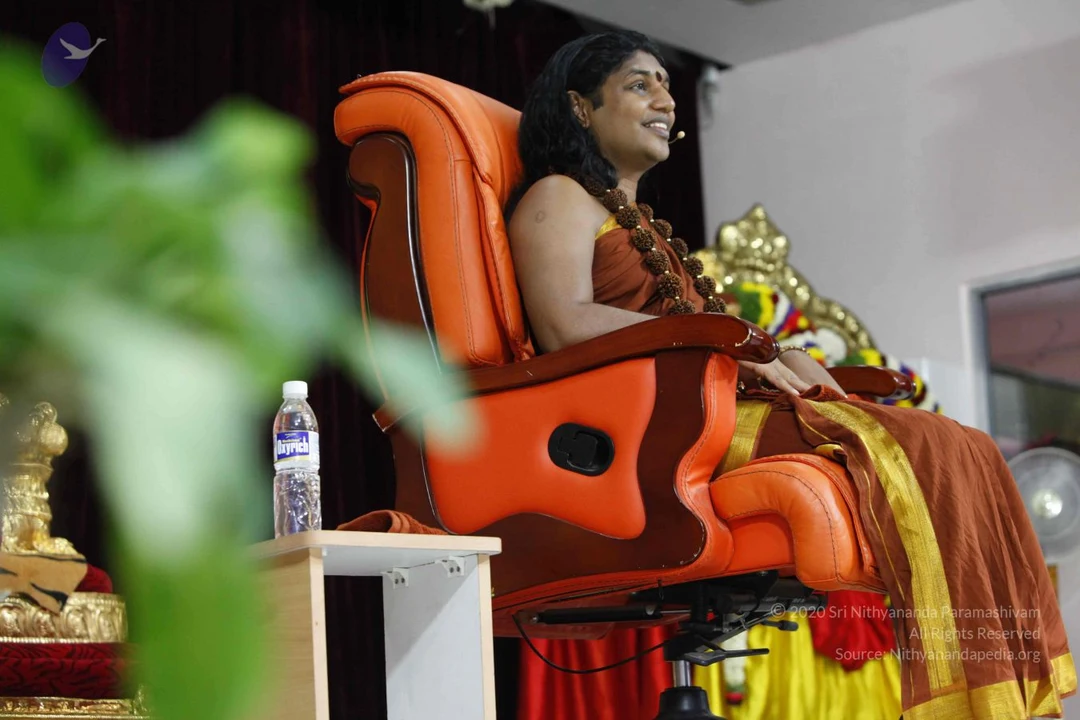
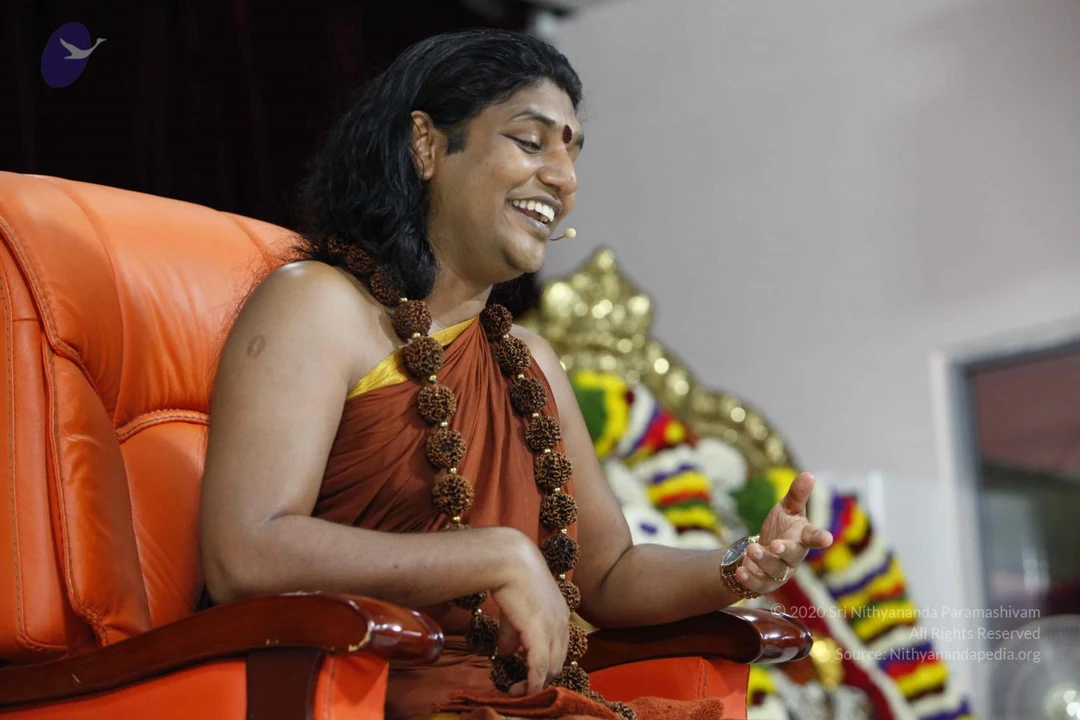
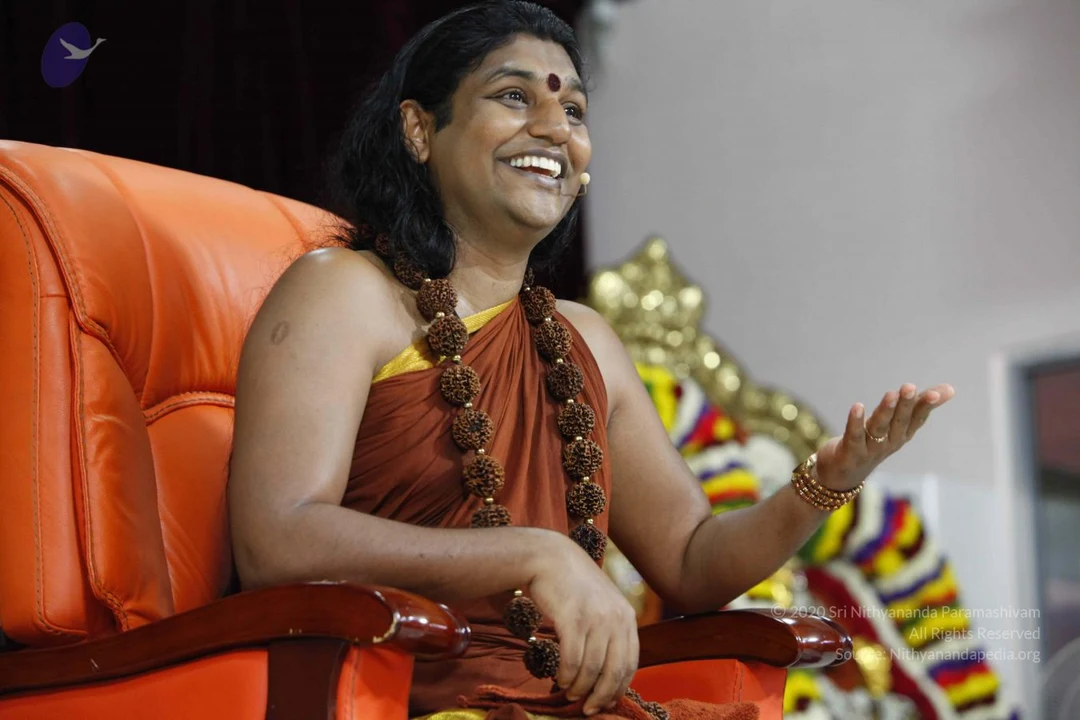
Satsang-Swamiji

Sarvadarshan

Swamiji-Deities-blessing

IA-Day7-Darshan-fotos

IA-Day7-food-session

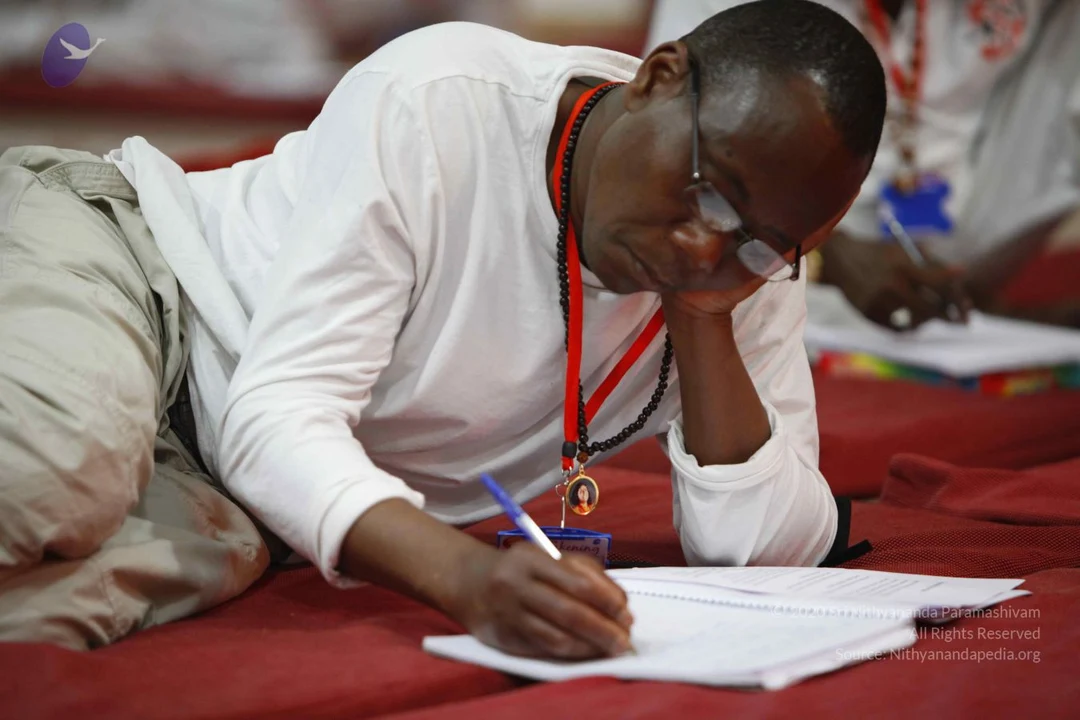
IA-day-7-Participants-Writing

IA-day-7-Session-Swamiji

eNgenius

Temple

Ashram_Pictures

Photos Of The Day:

Pratyaksha-Pada-Puja

Satsang-Swamiji

Sarvadarshan

Final-blessing

Swamiji-Deities-blessing

IA-Day7

IA-Day7-Food-Session

IA-day-7-Session-Swamiji

eNgenius

Temple

01-Pratyaksha-pada-puja

02-Satsang-Swamiji

03-Sarvadarshan

04-enGenius

05-Temple

Photos from this day

View all 362 photos

Pratyaksha Pada Puja
51 photosSource gallery
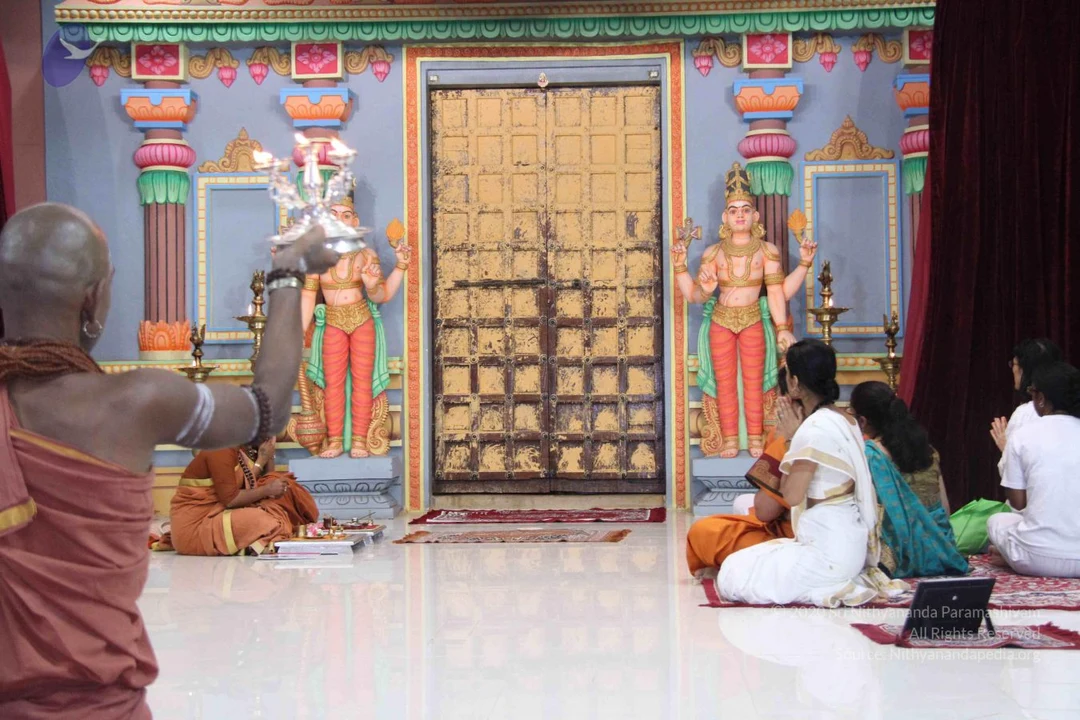
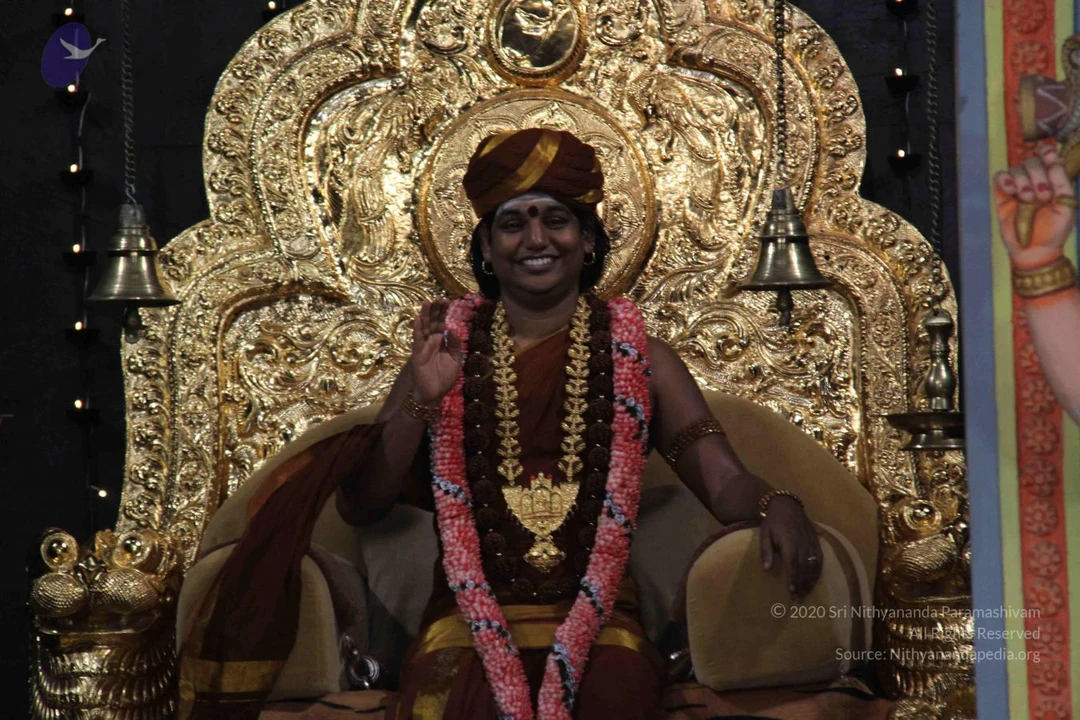
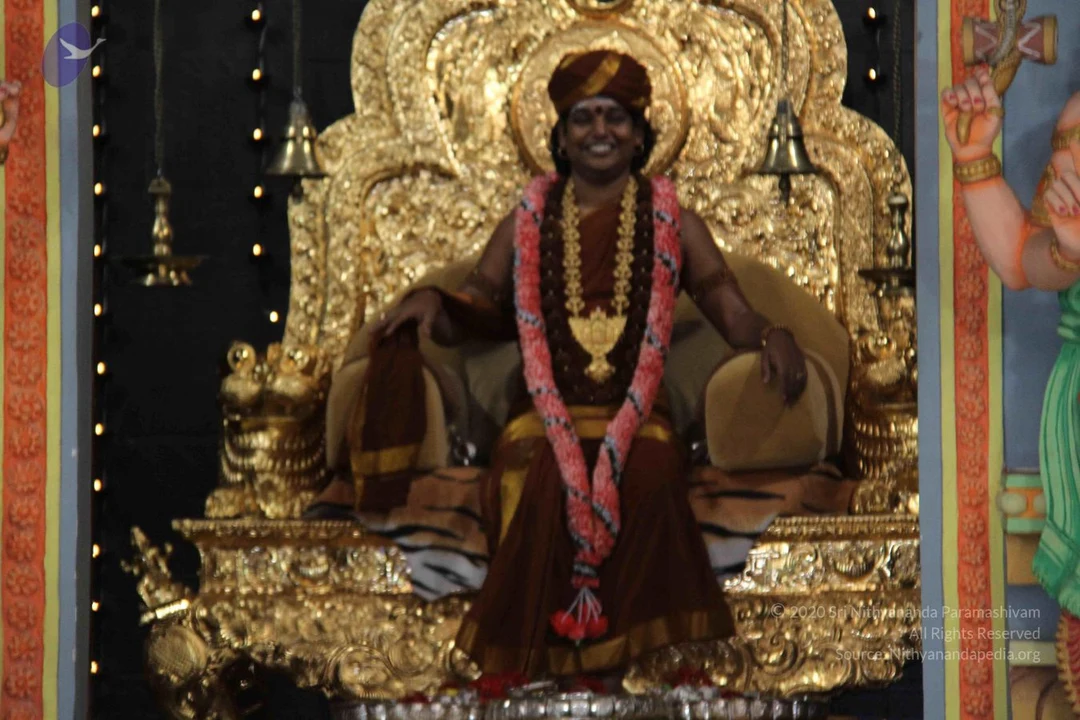
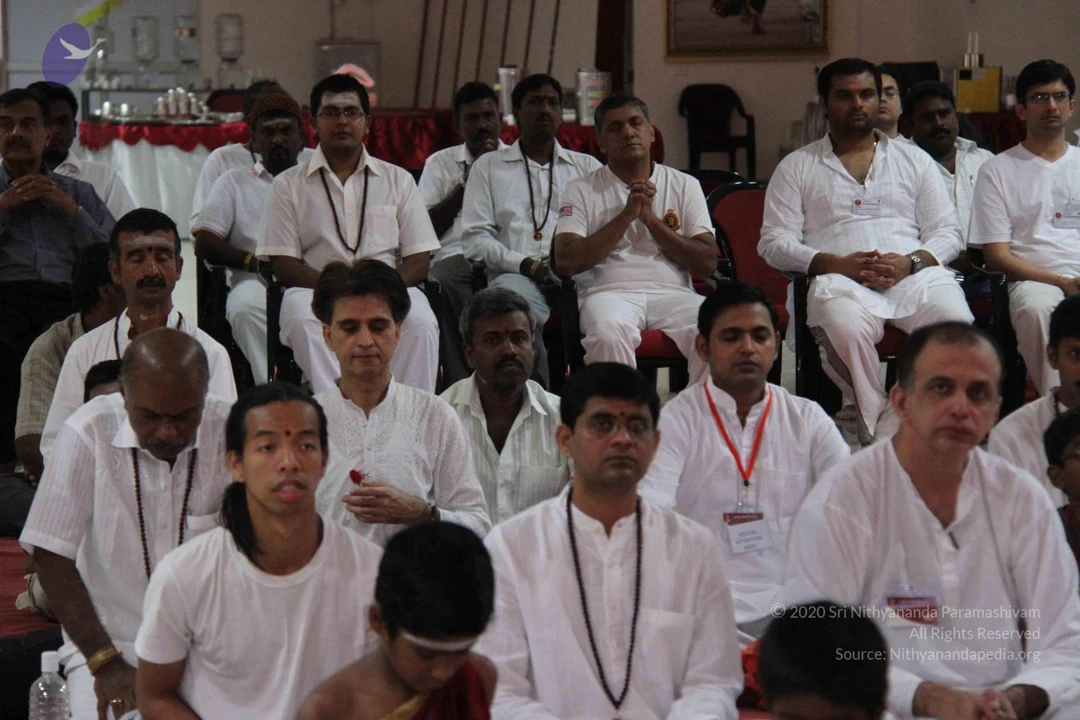
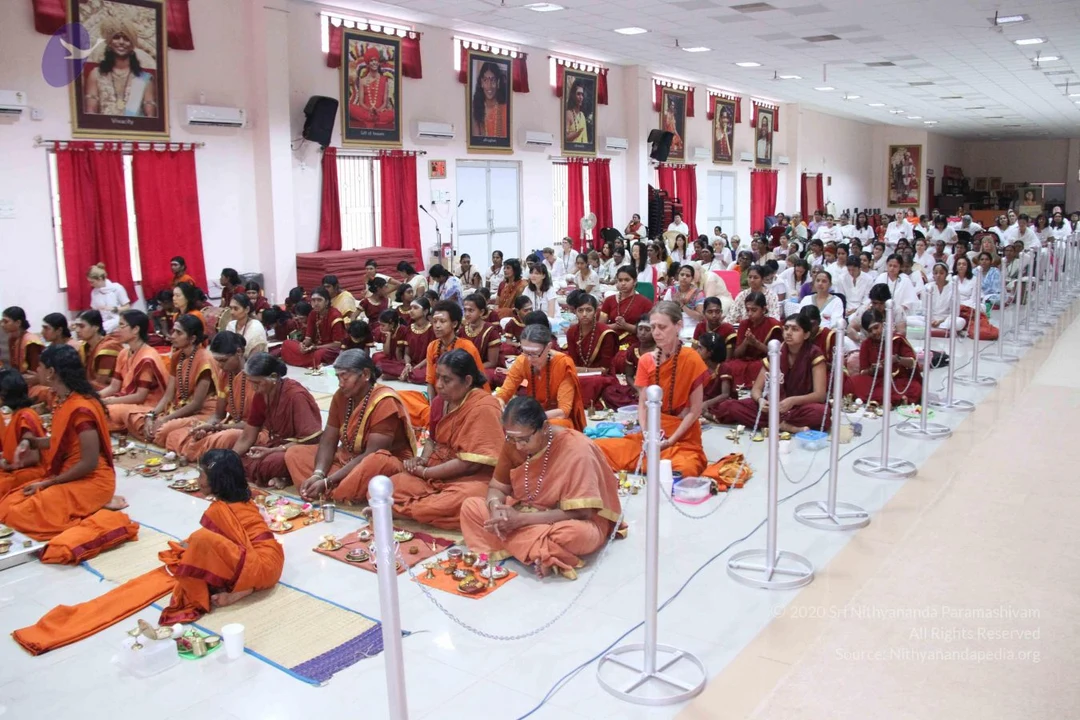
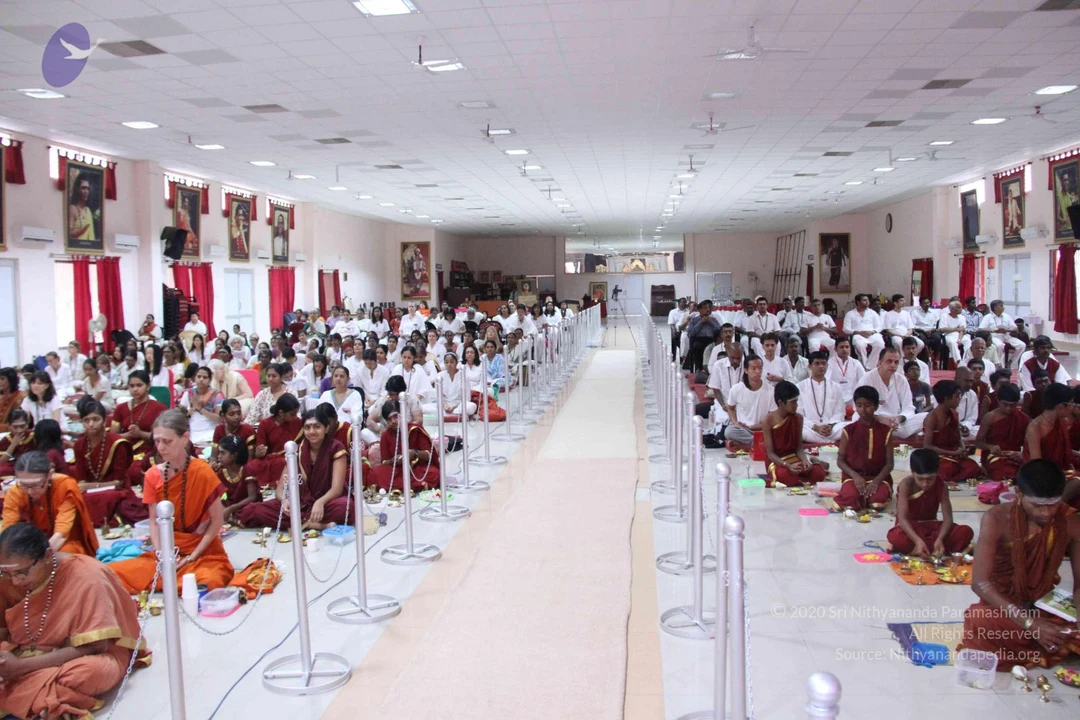
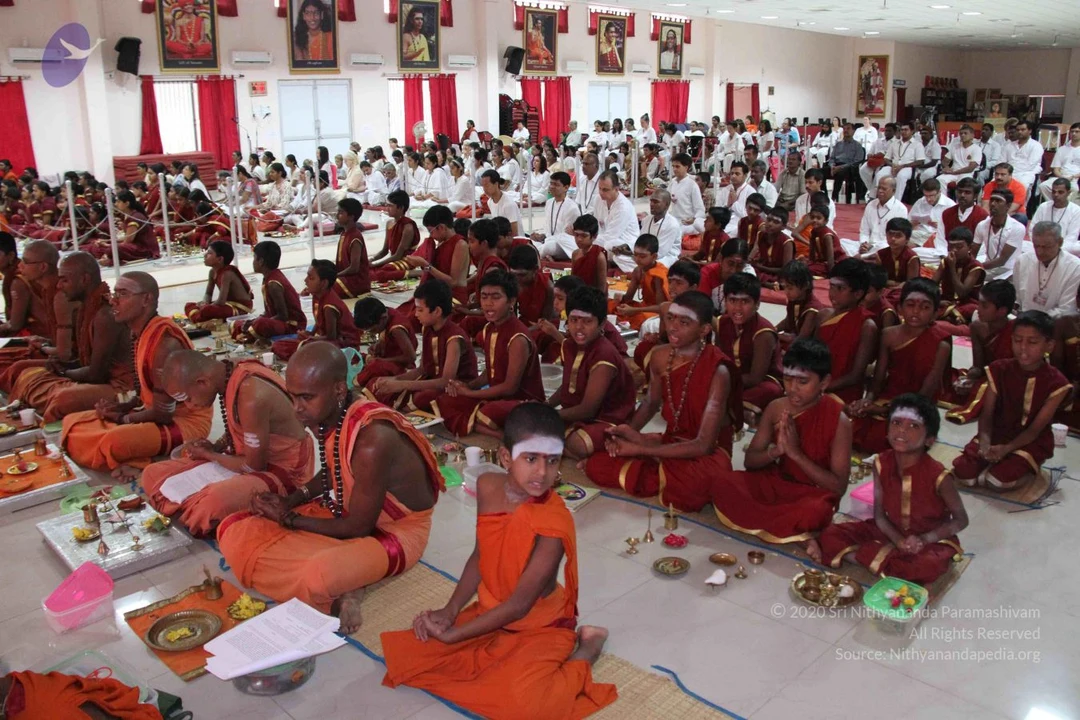
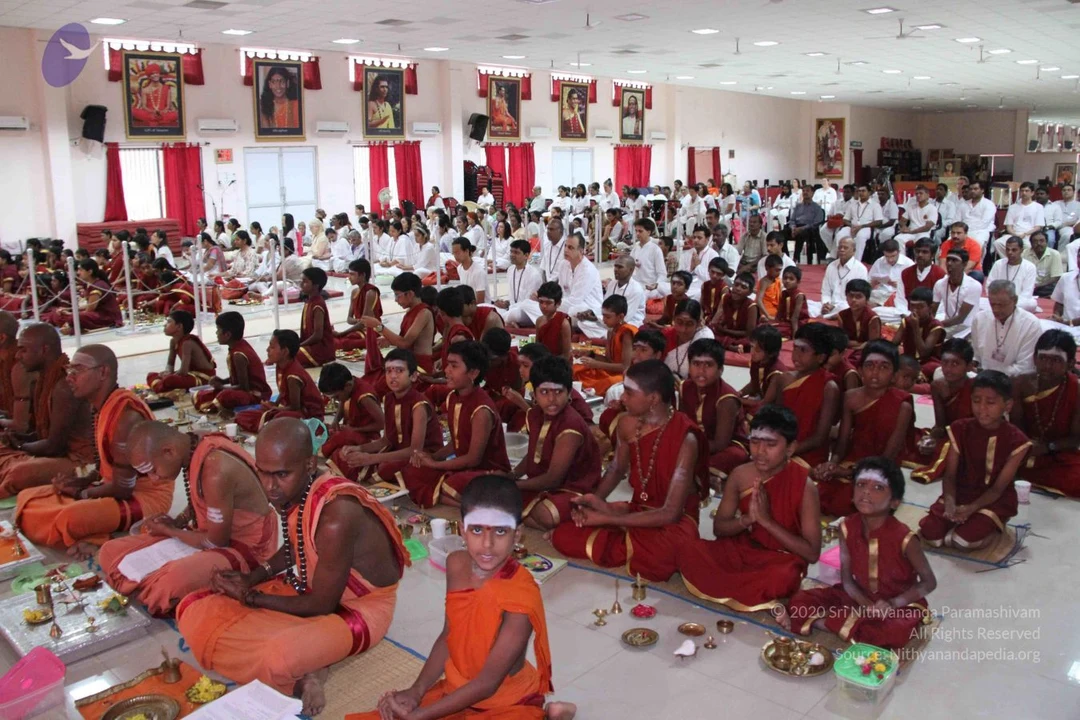
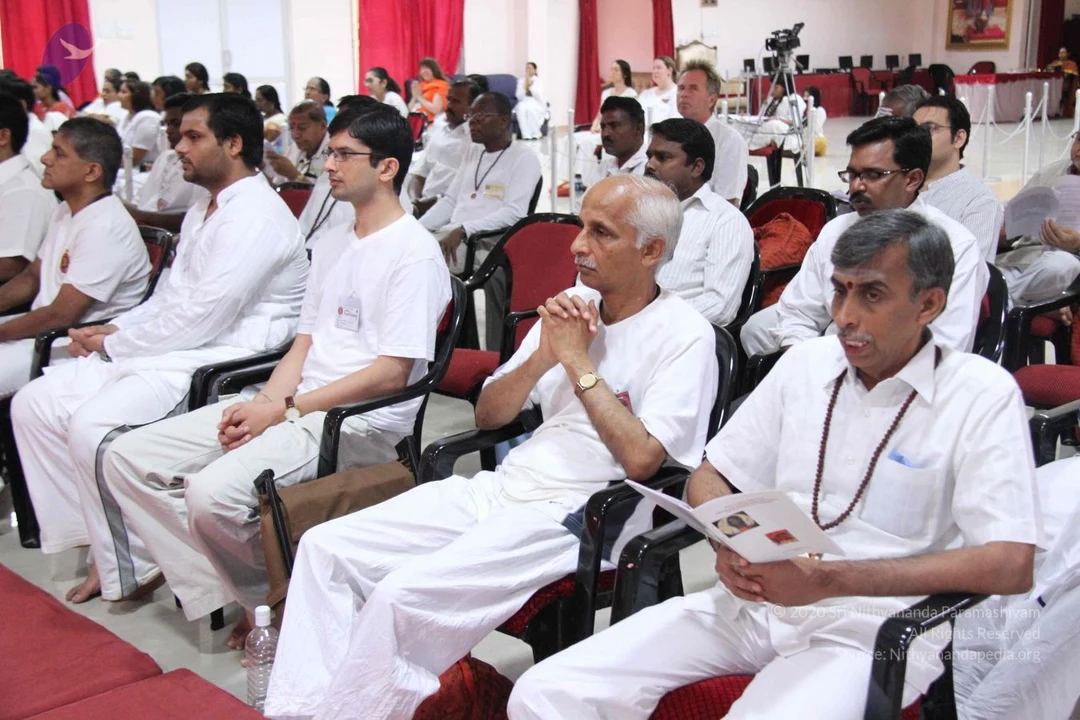
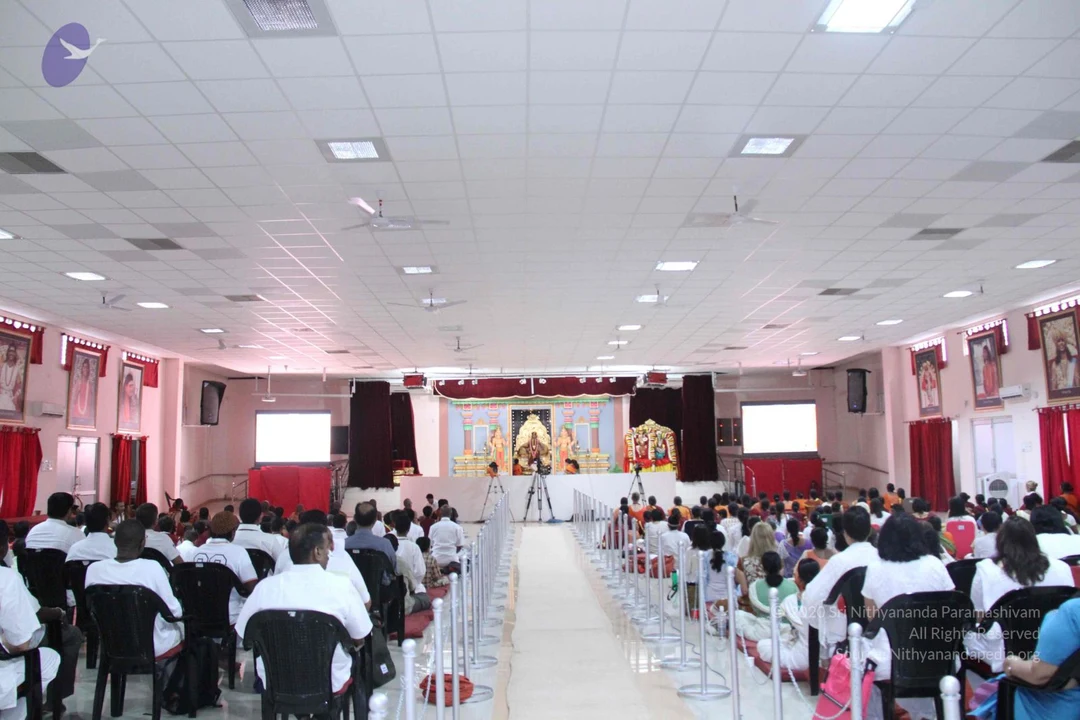
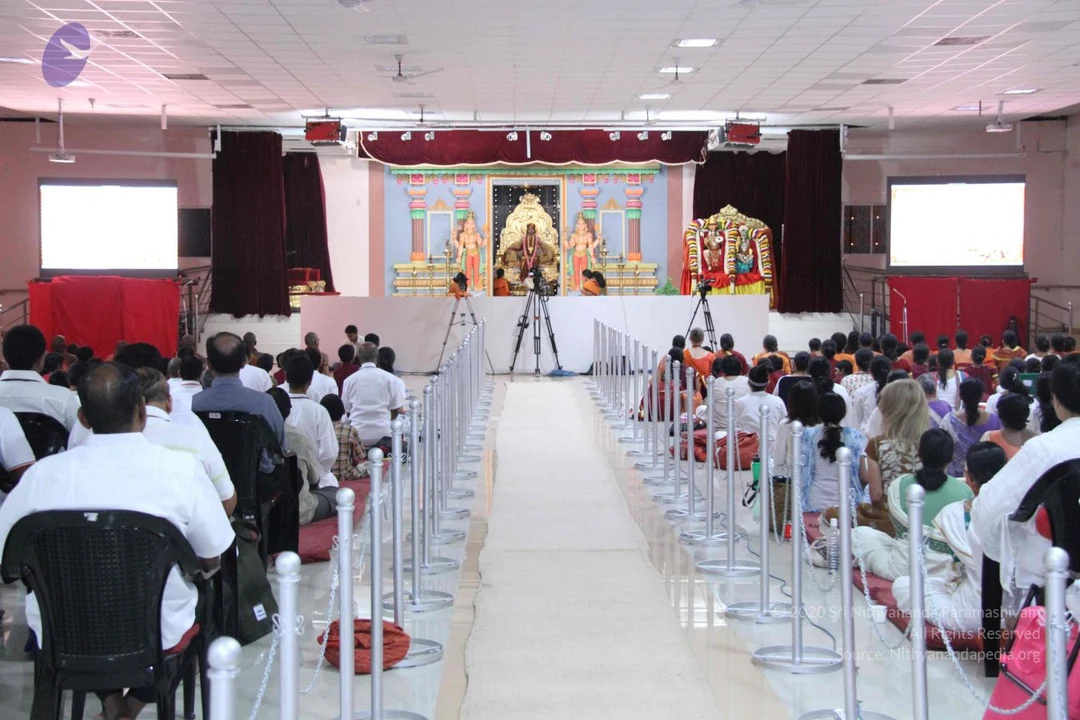
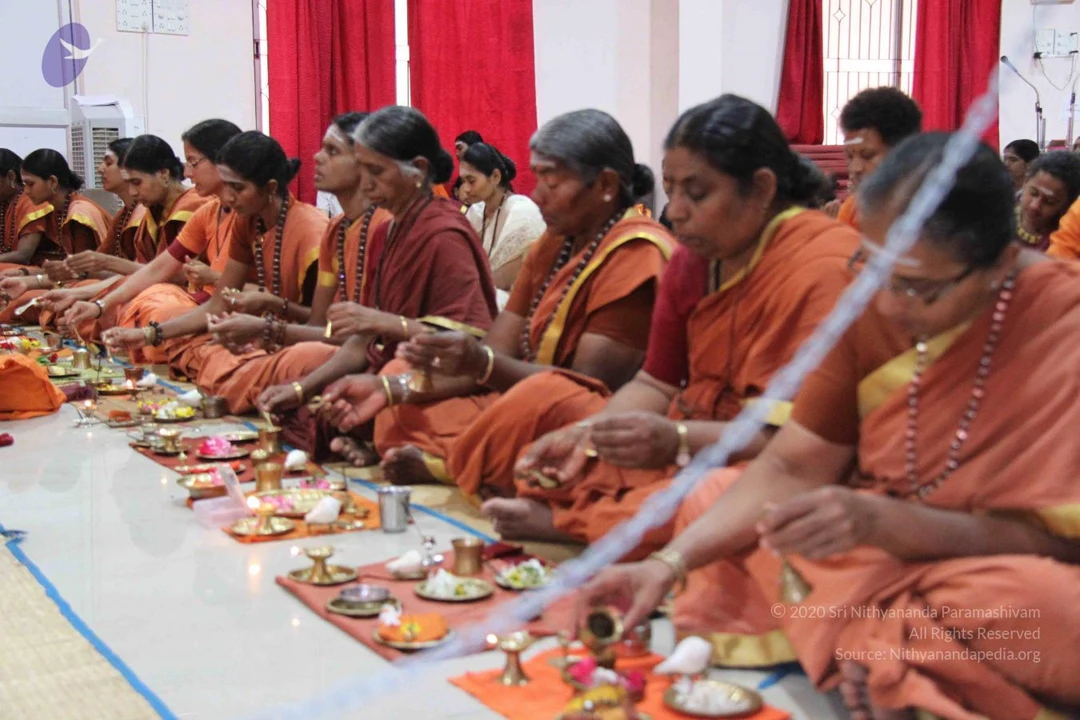
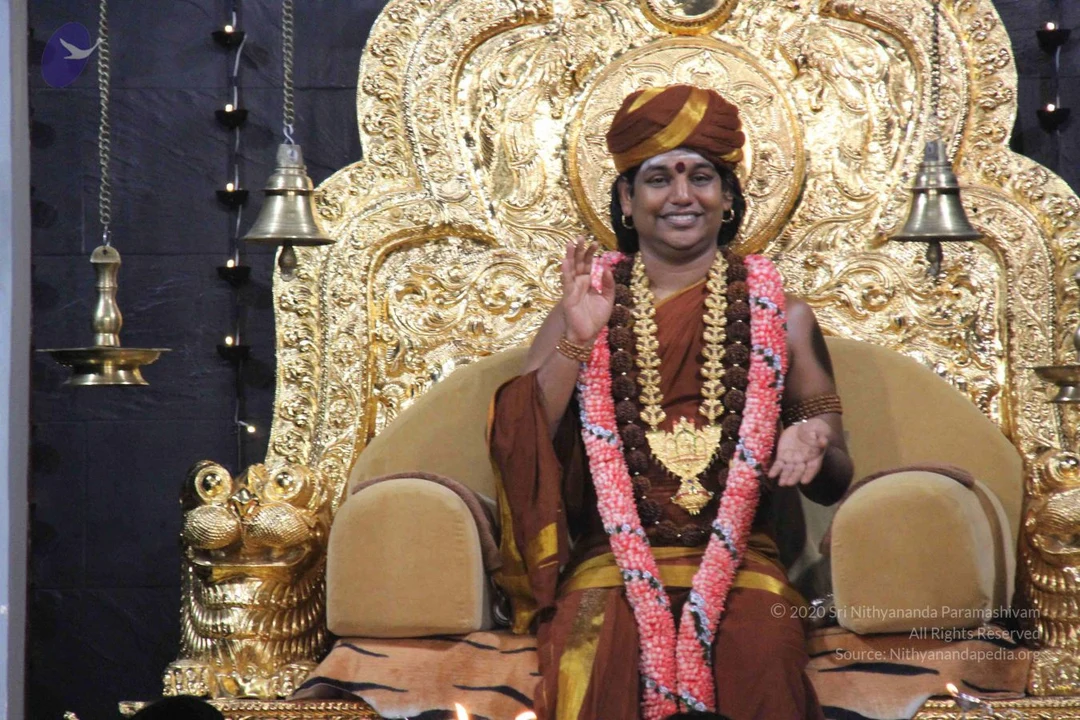
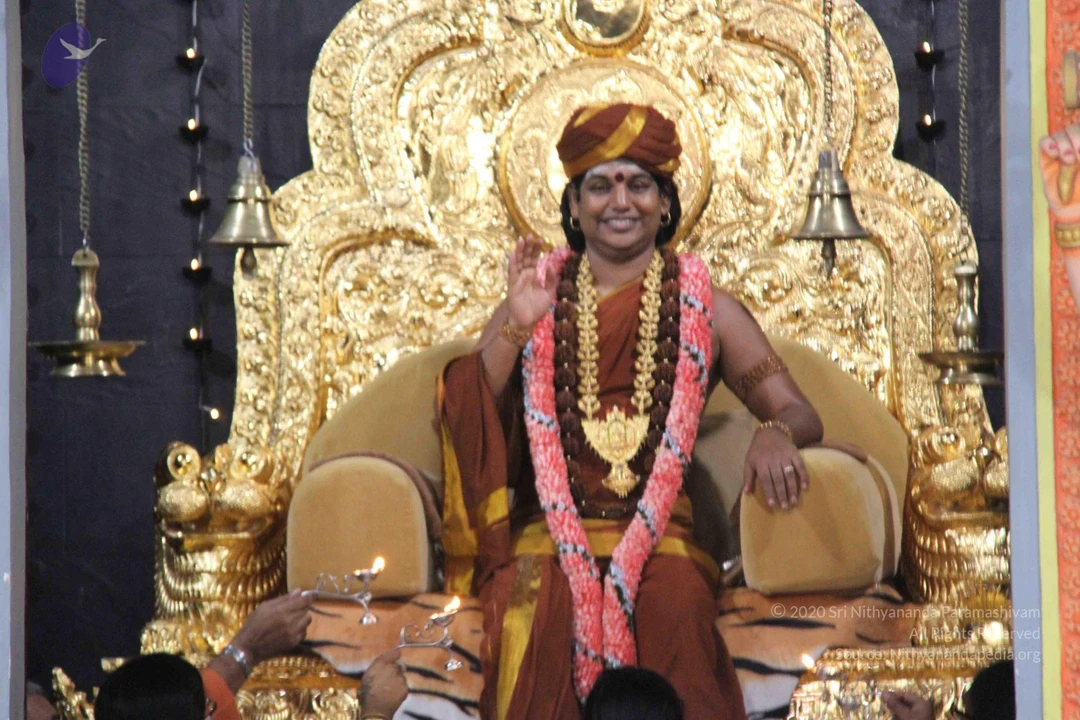
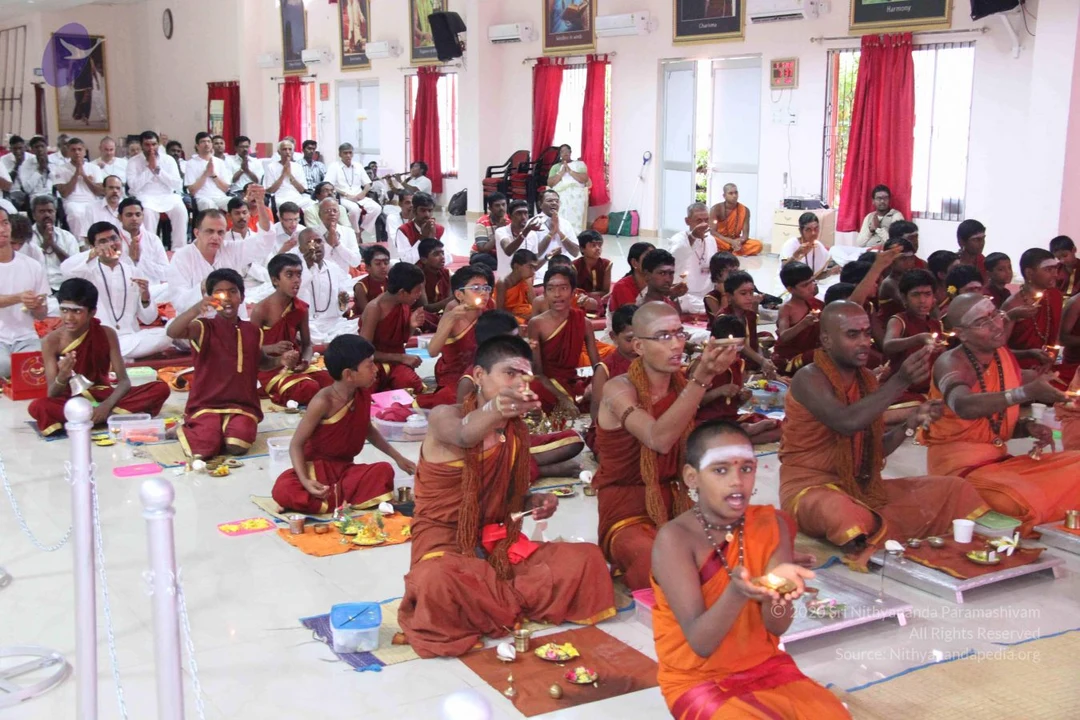
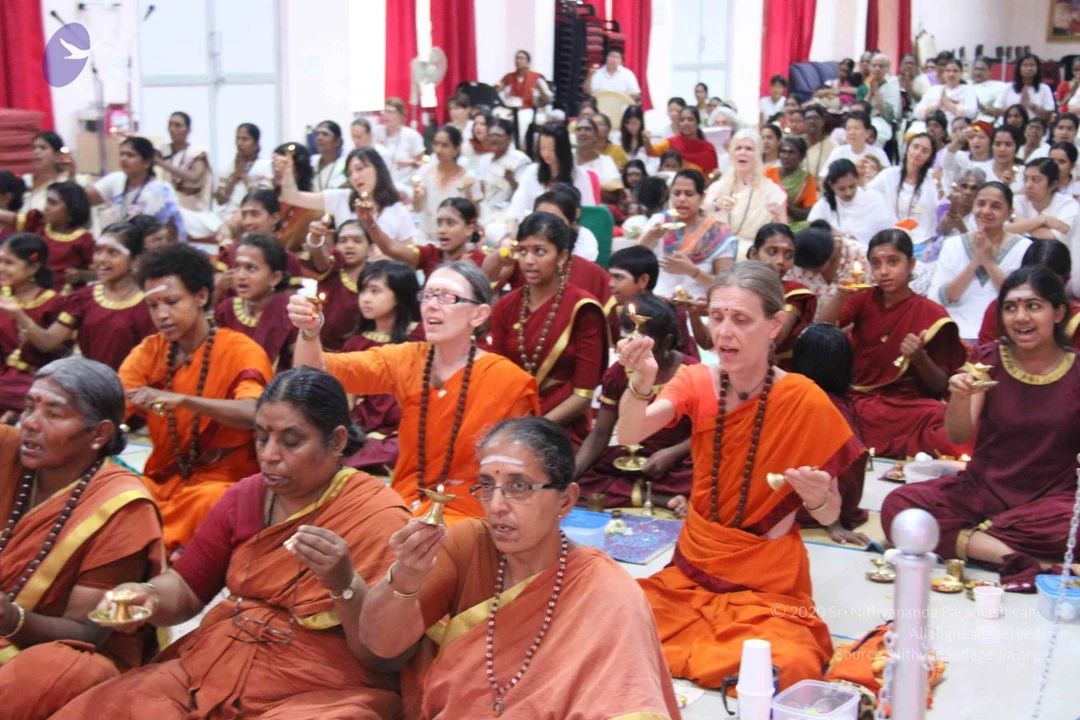
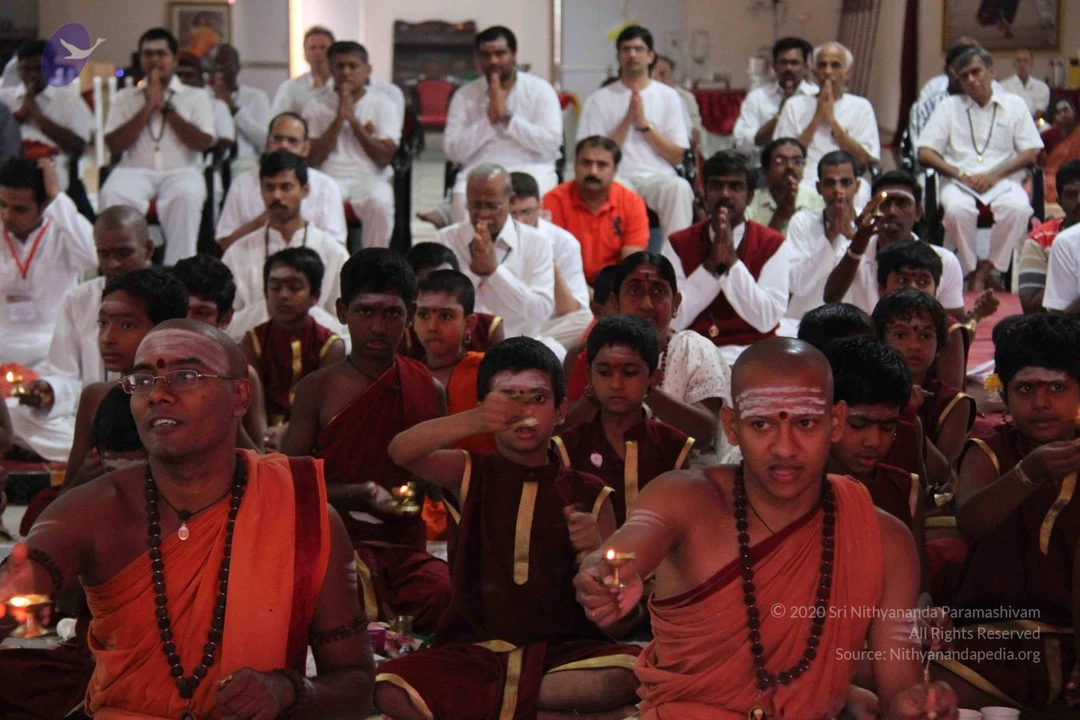
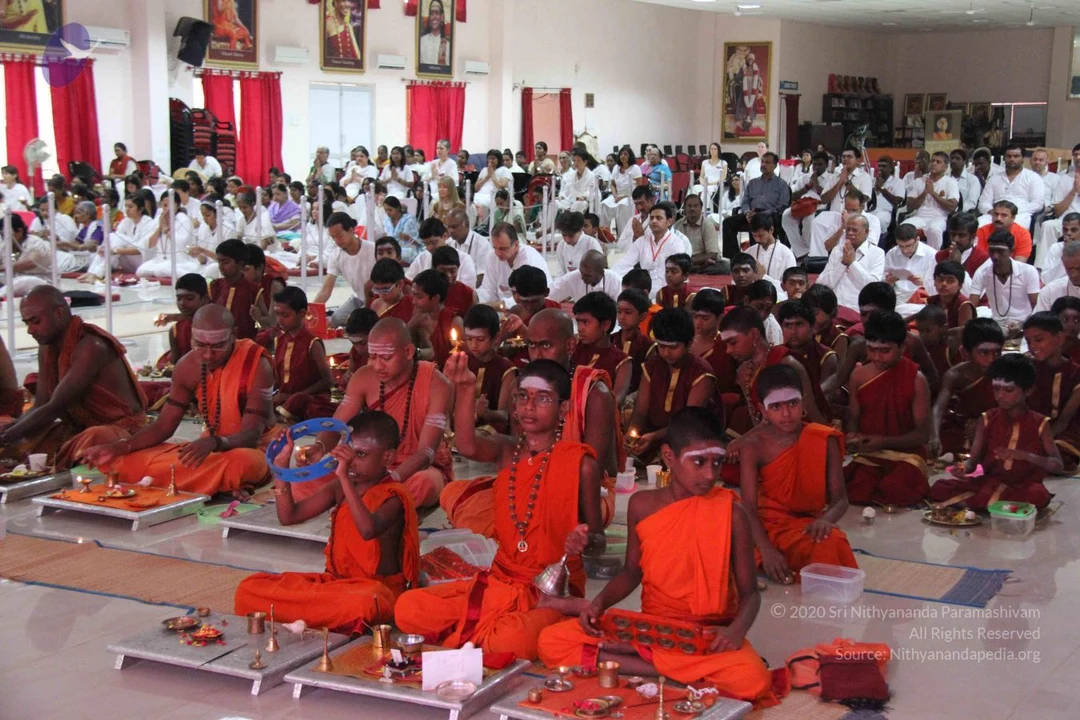
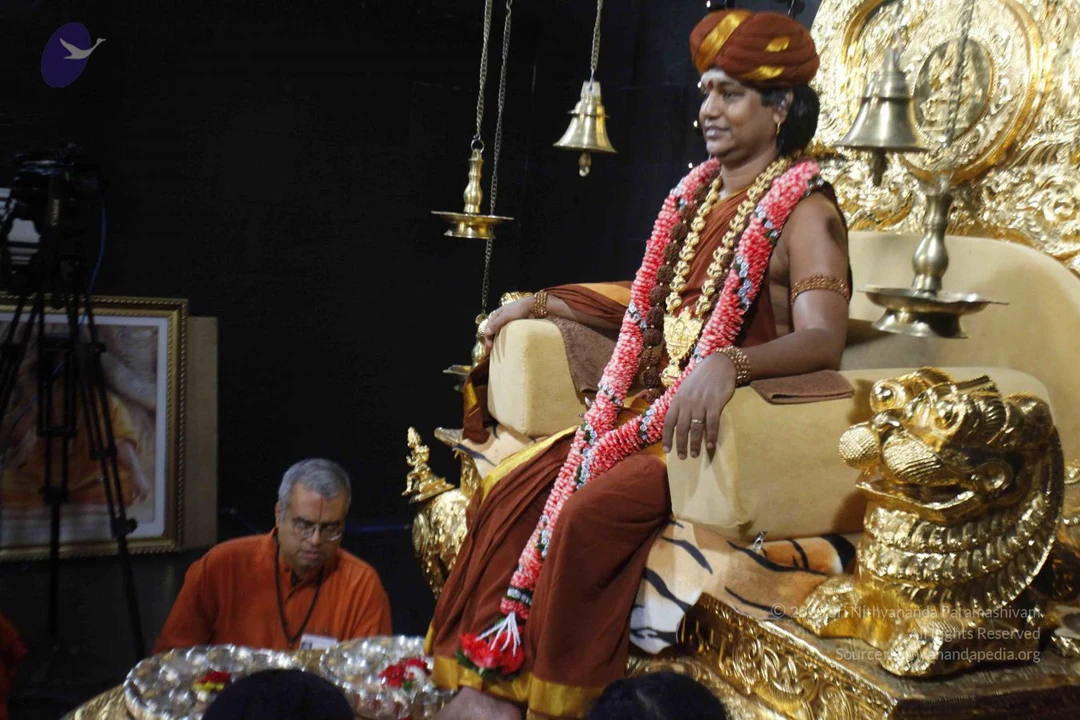
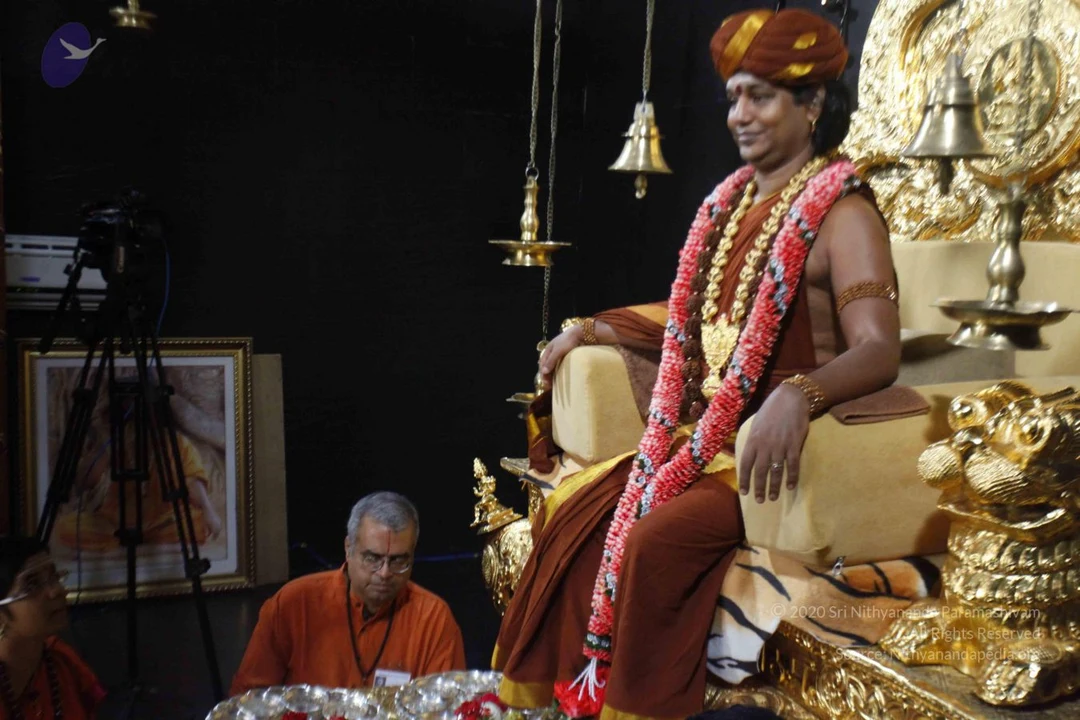
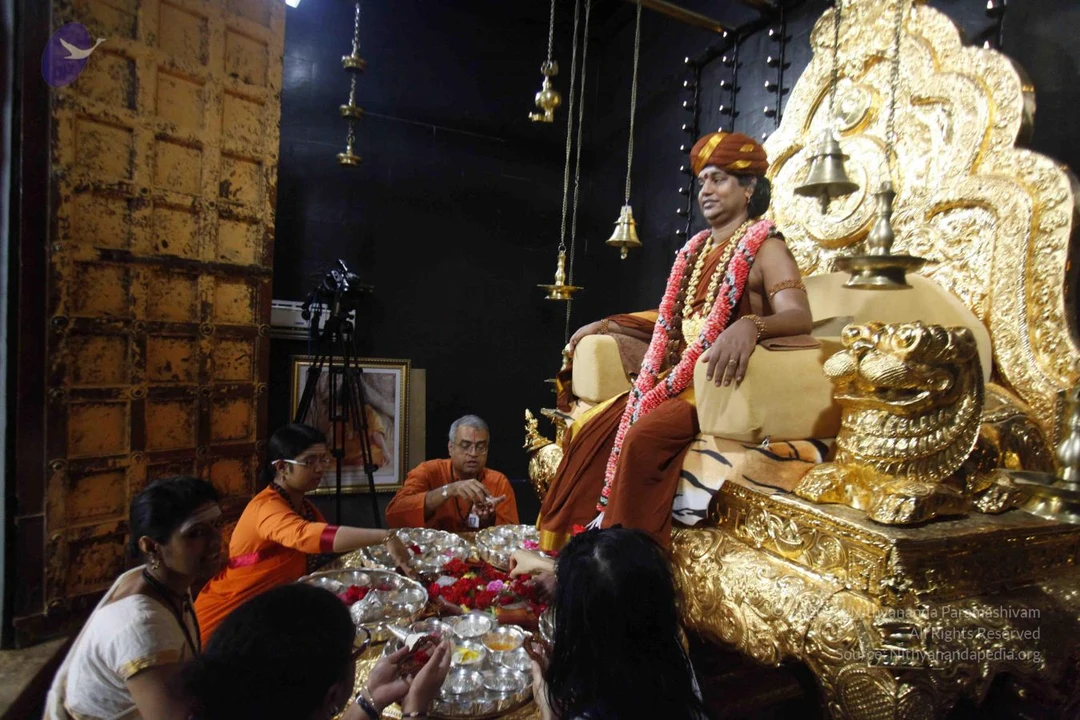
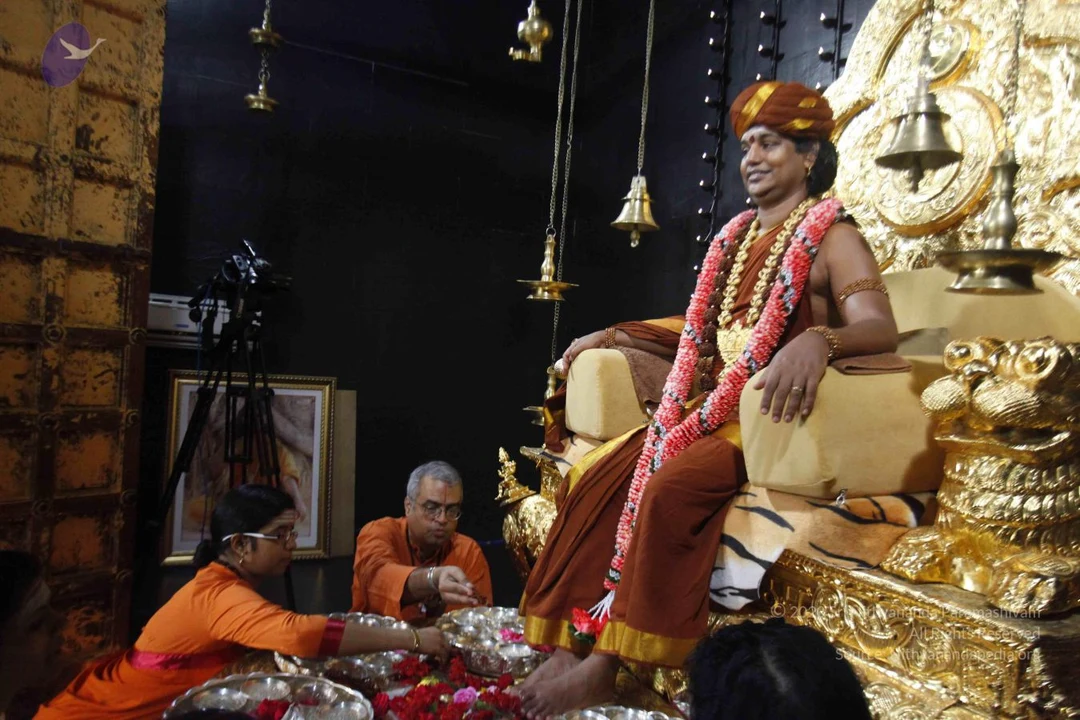
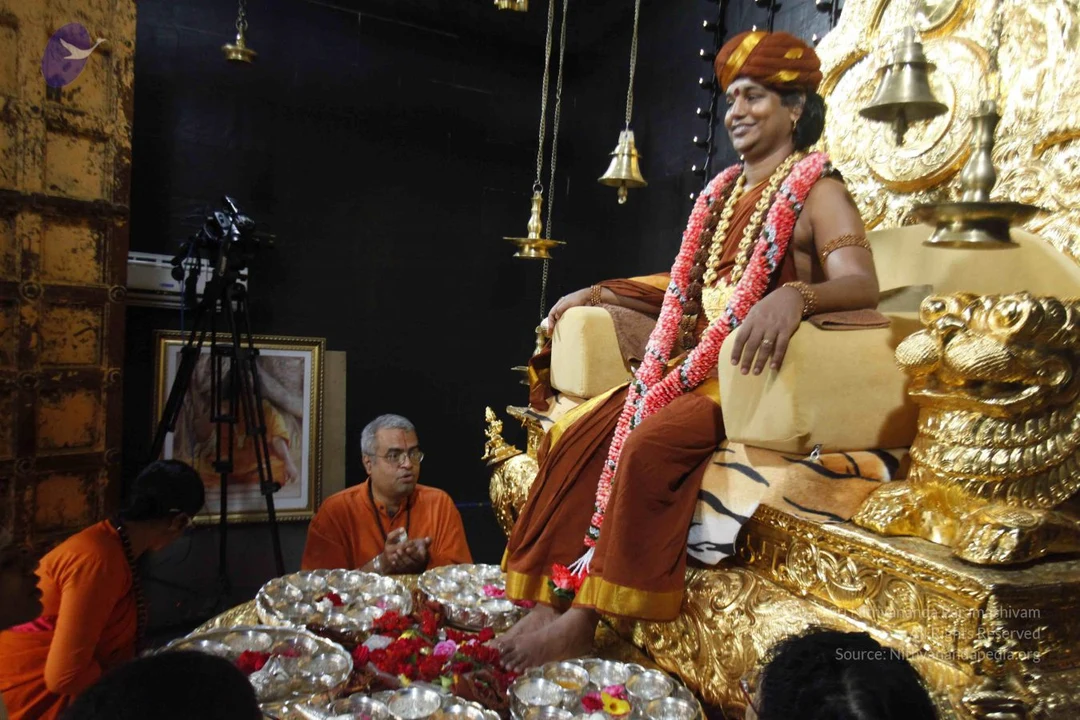
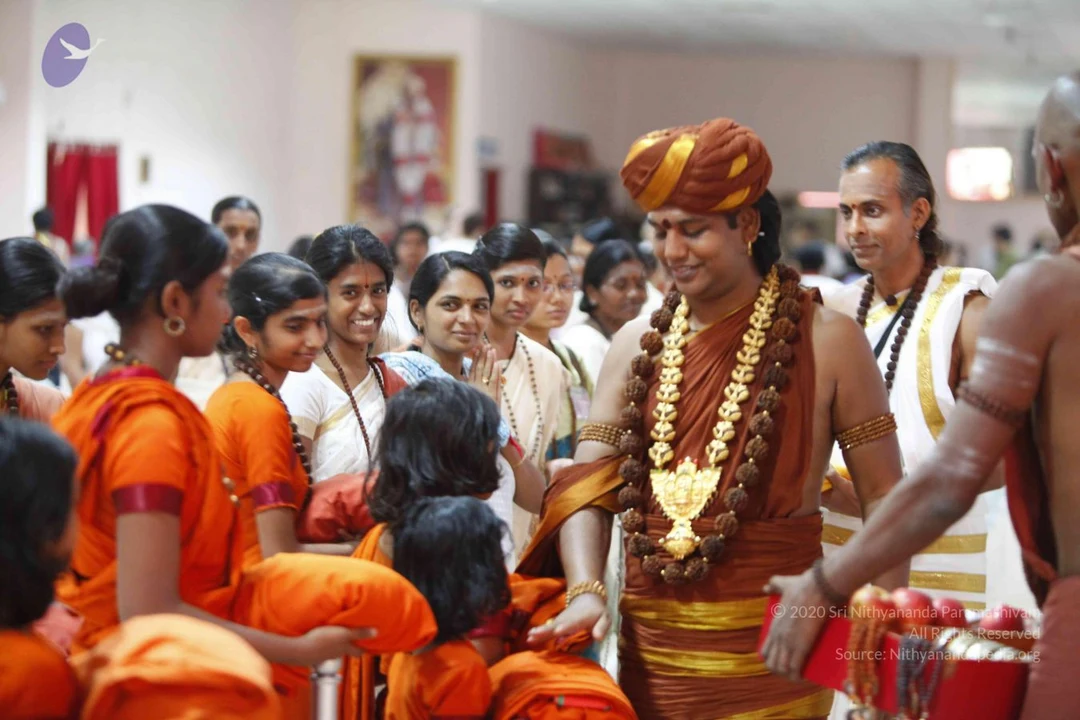
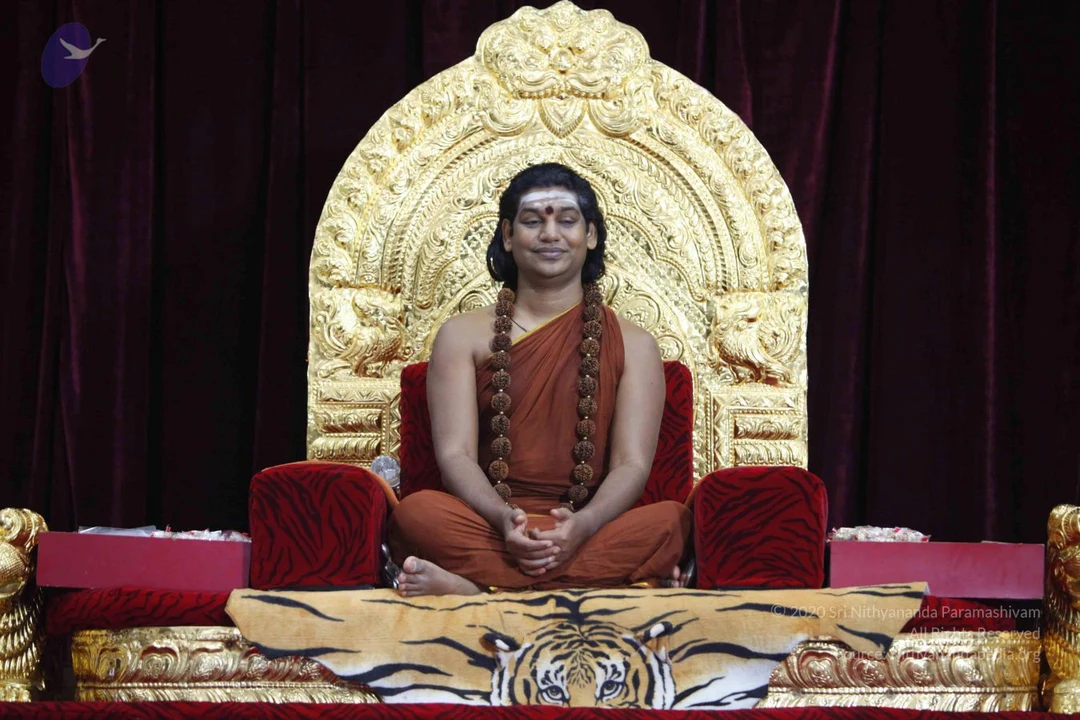
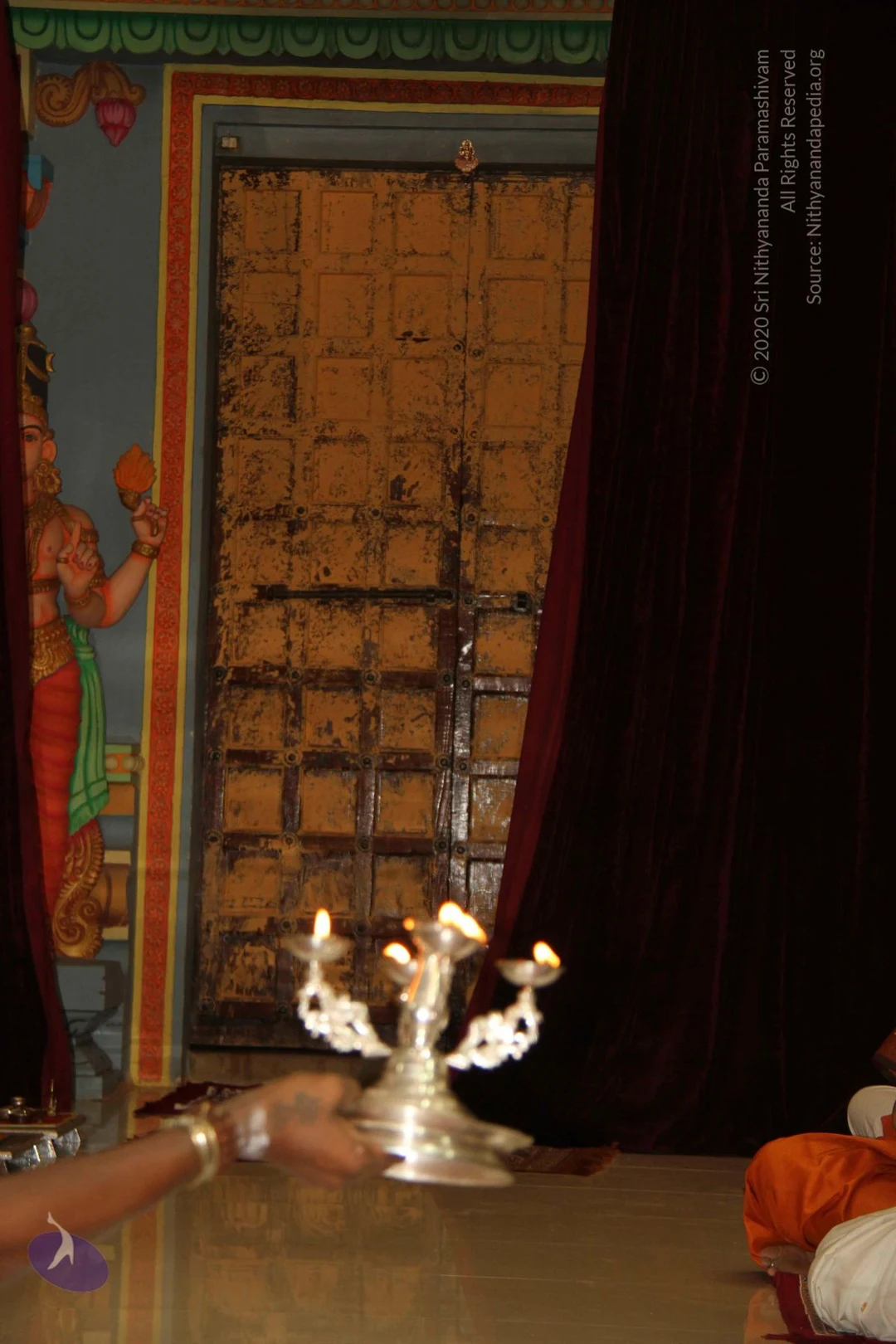
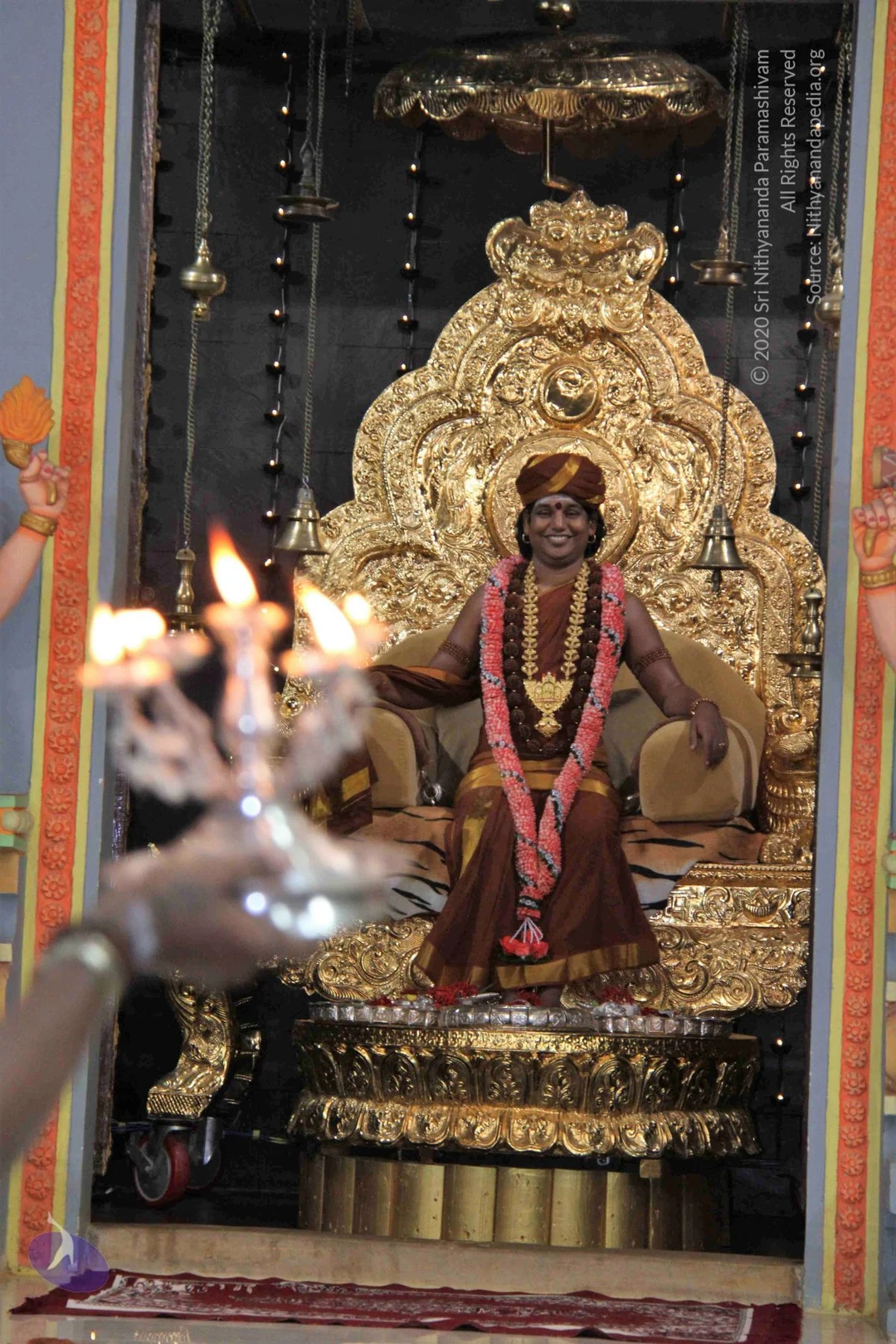
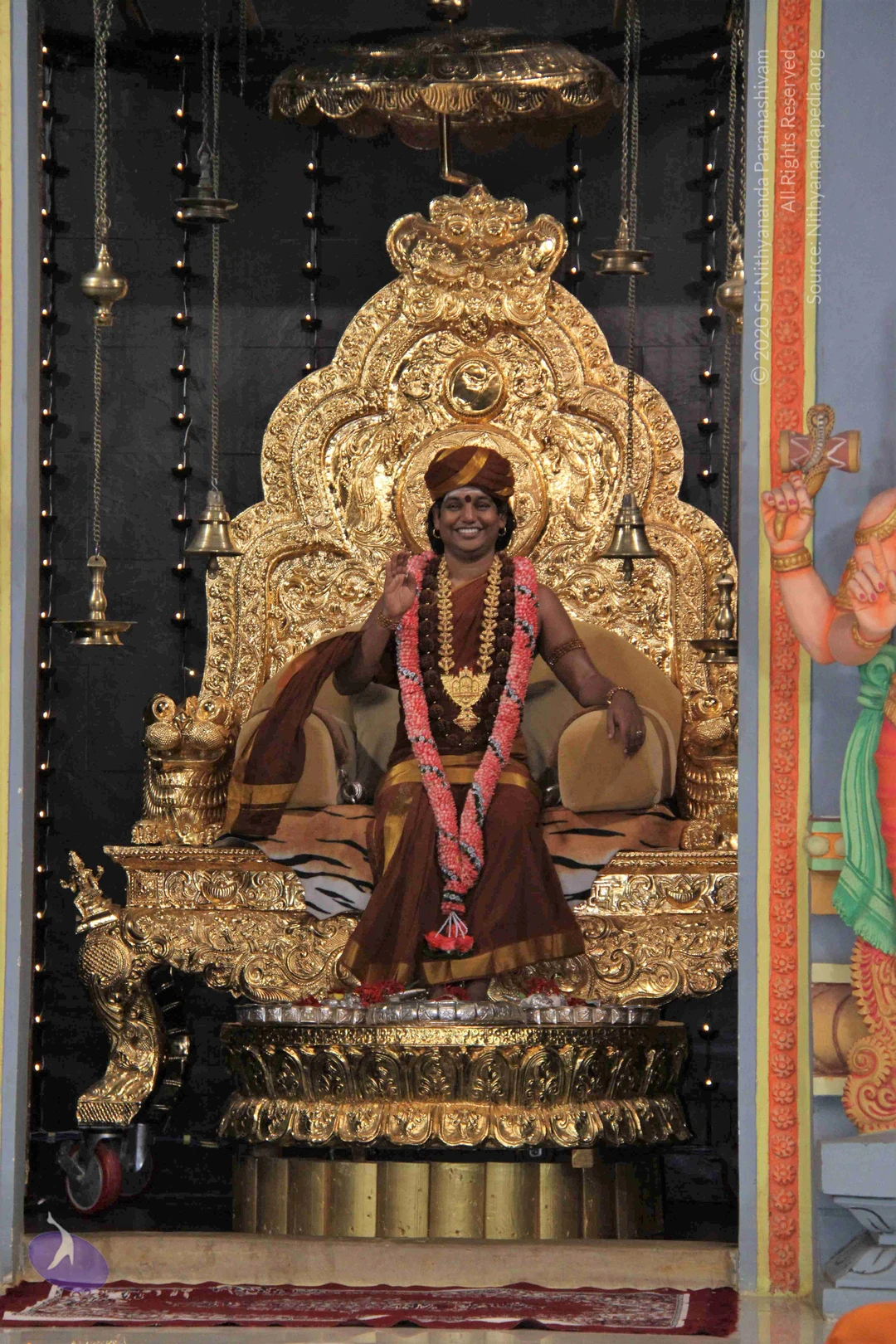
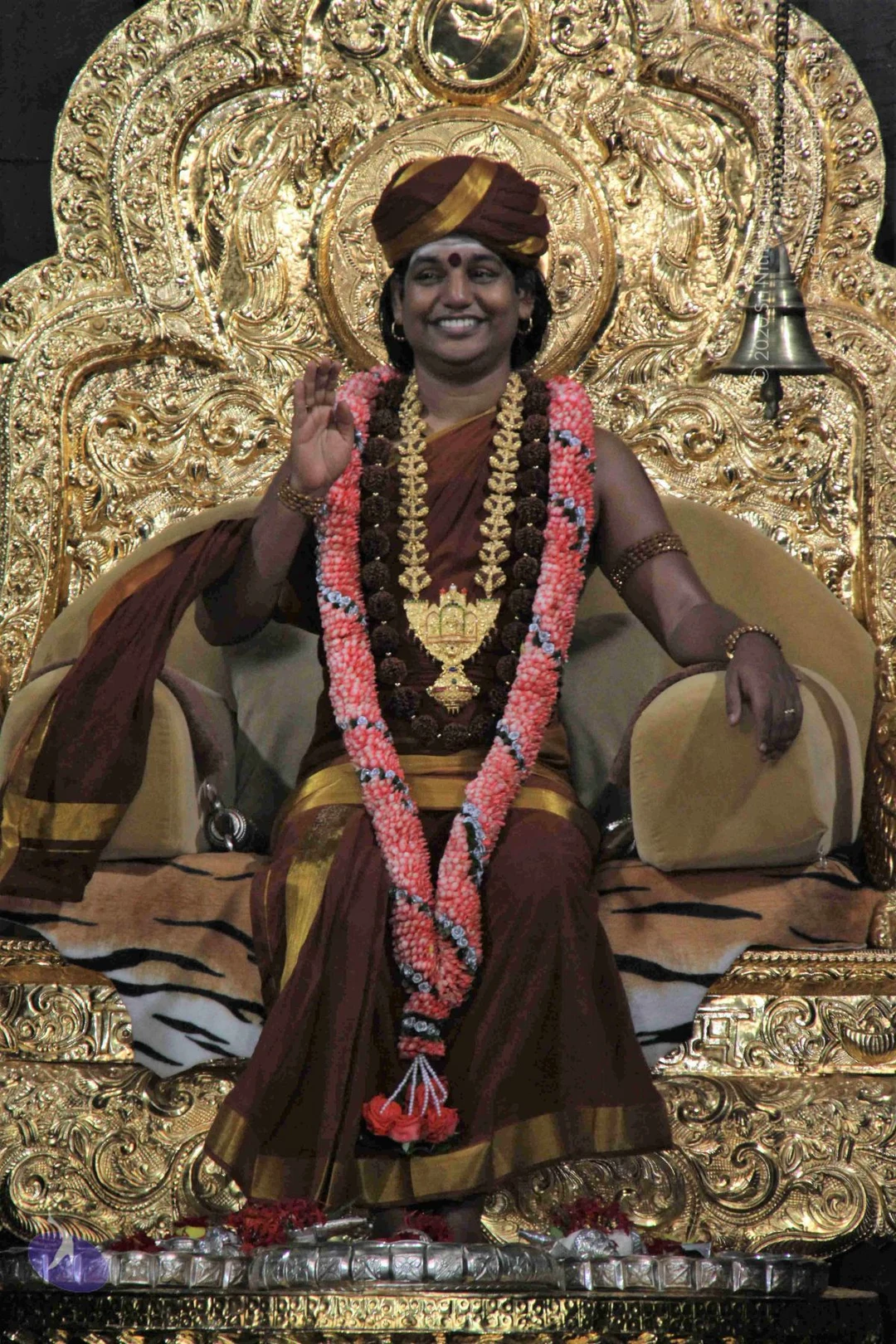
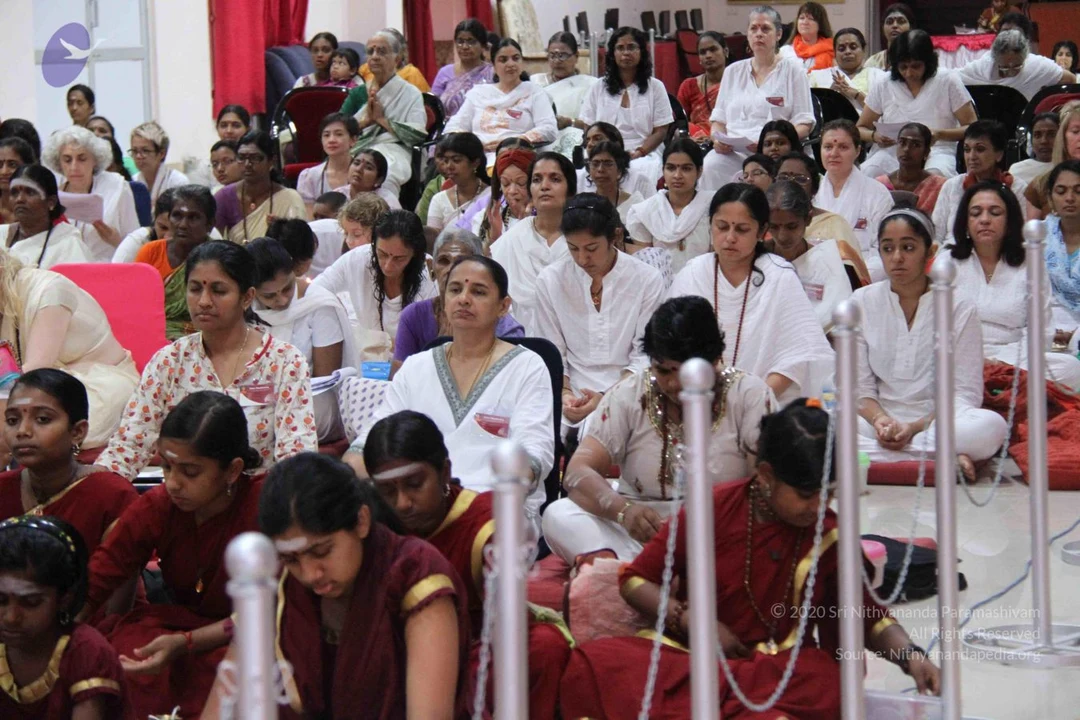
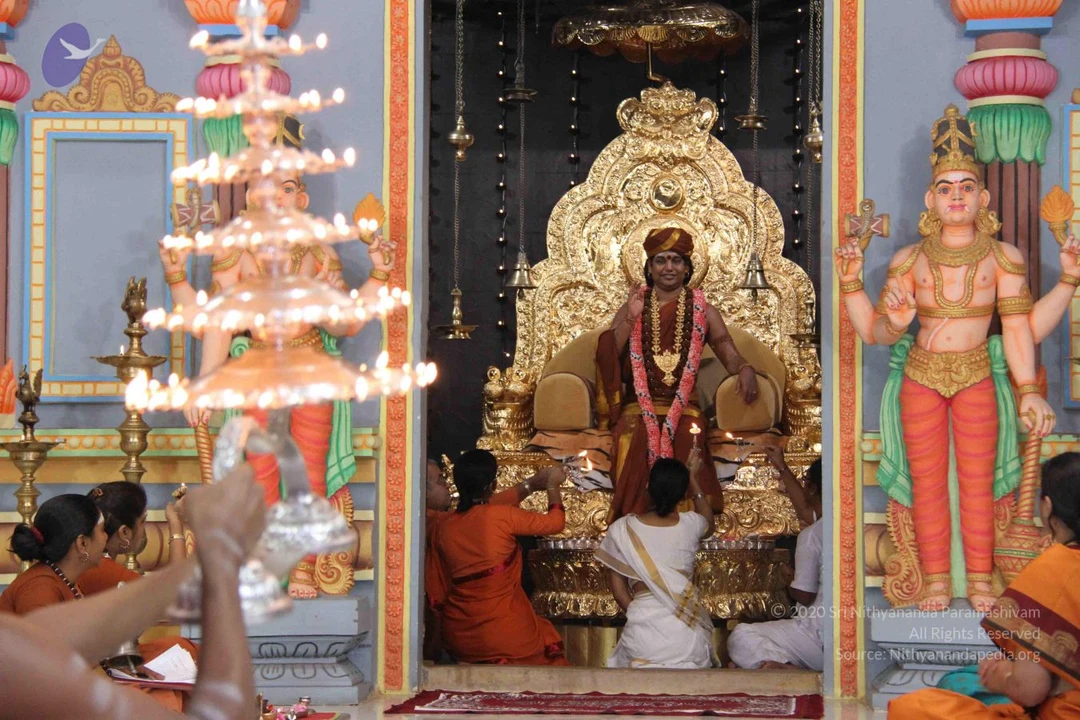
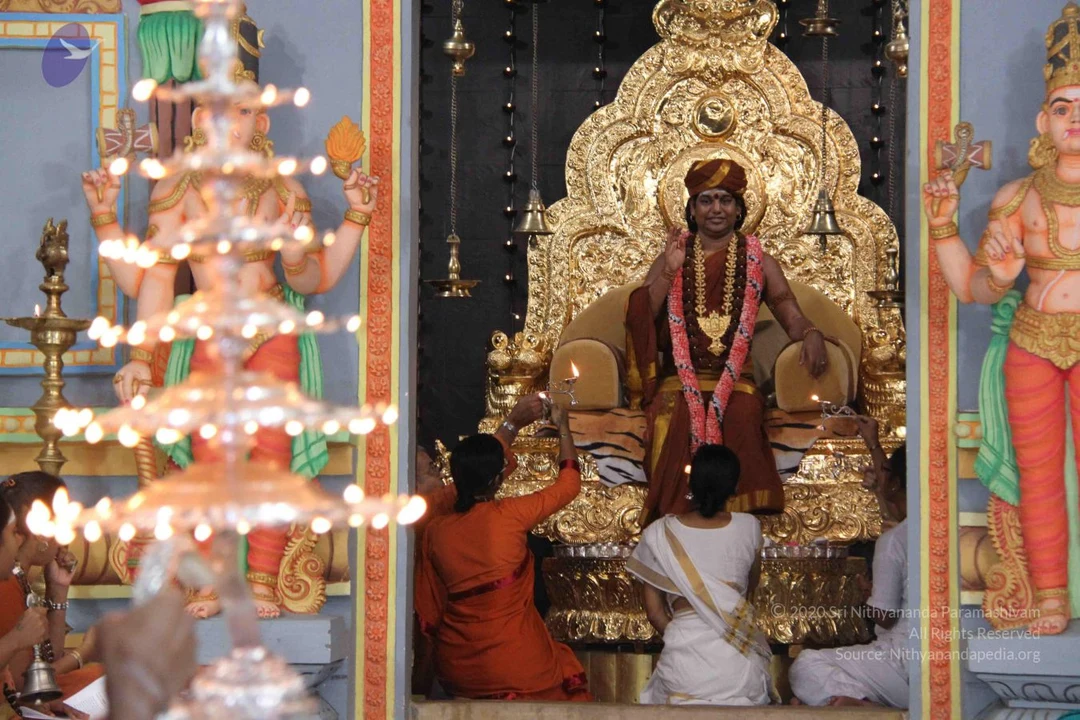
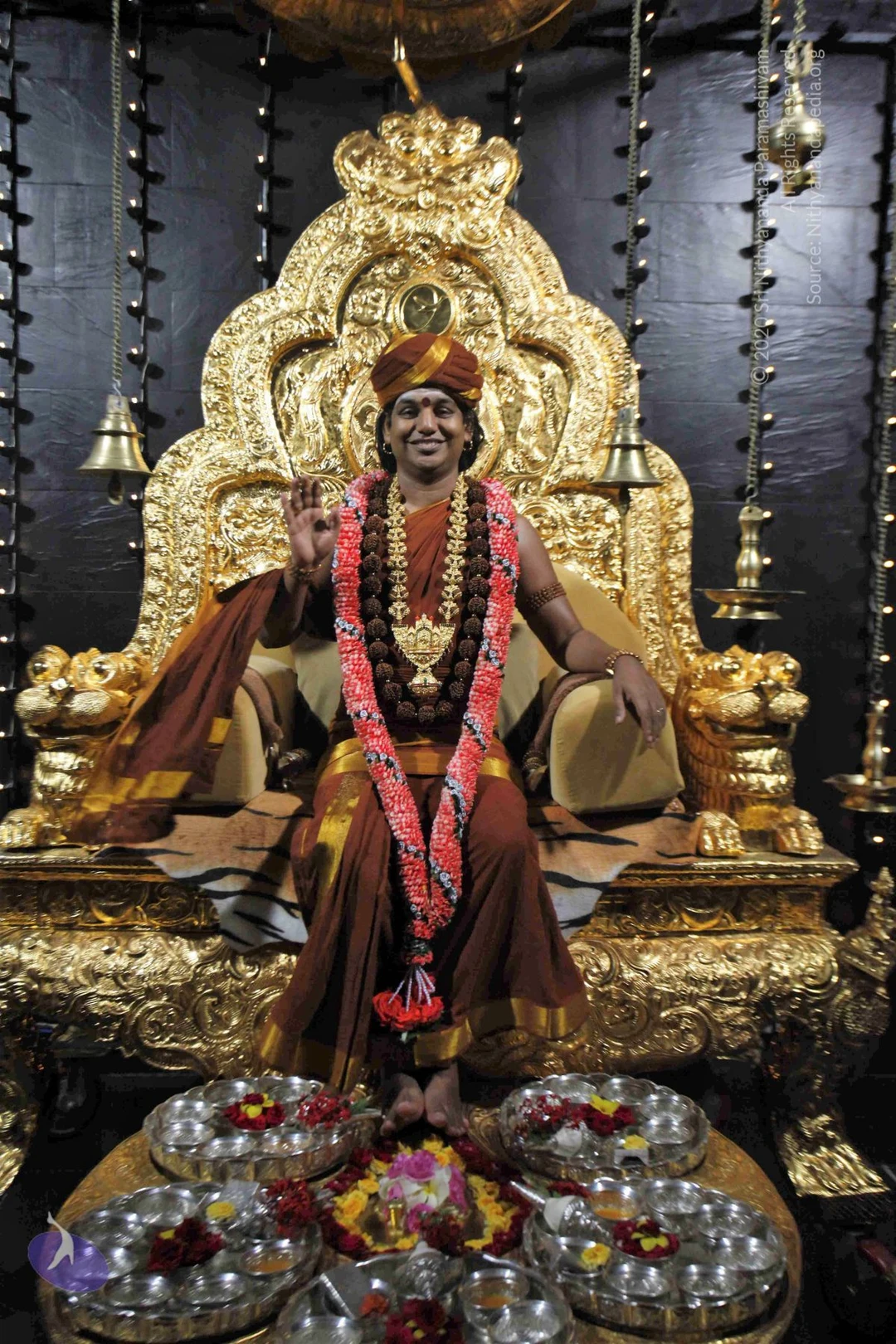
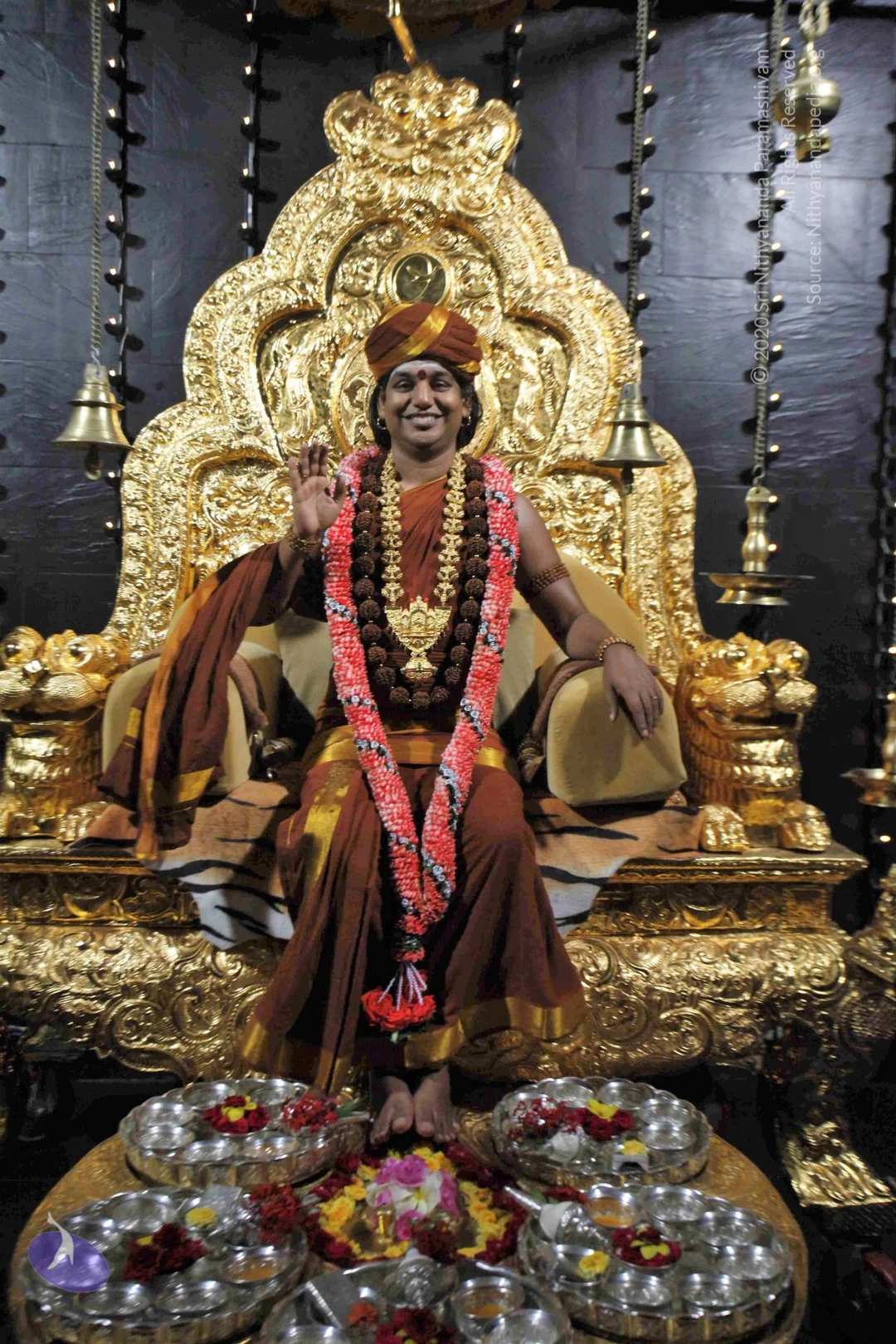
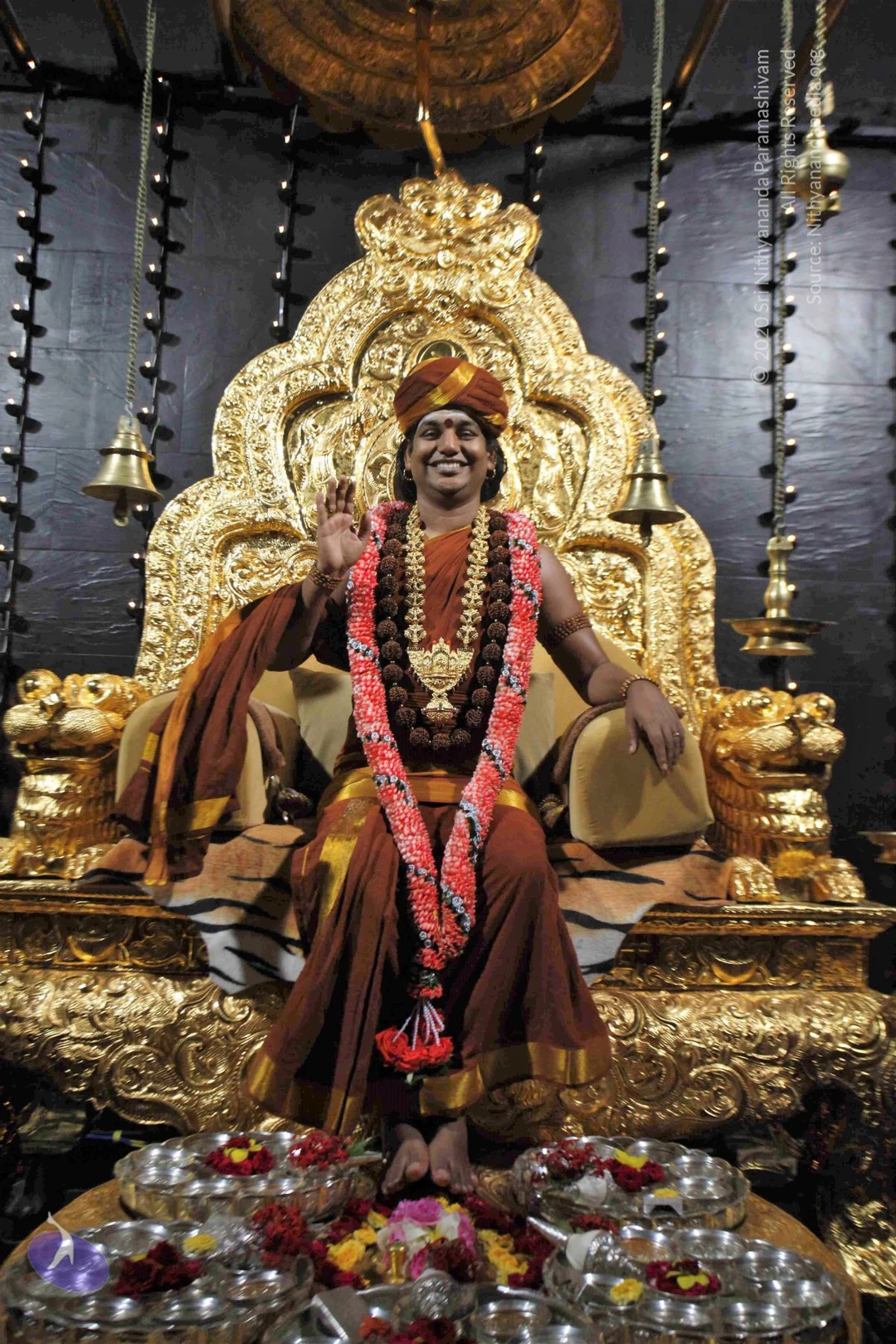
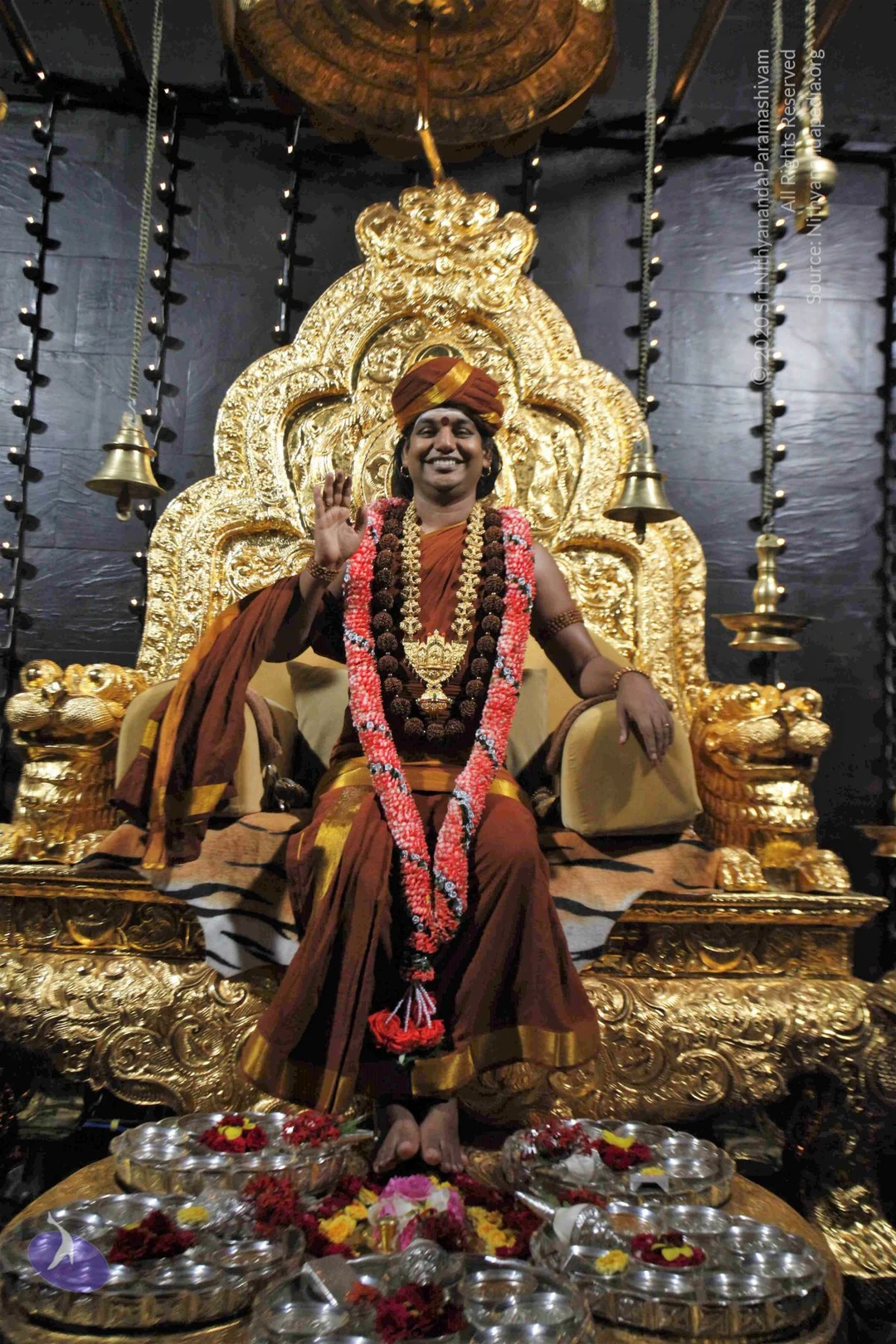
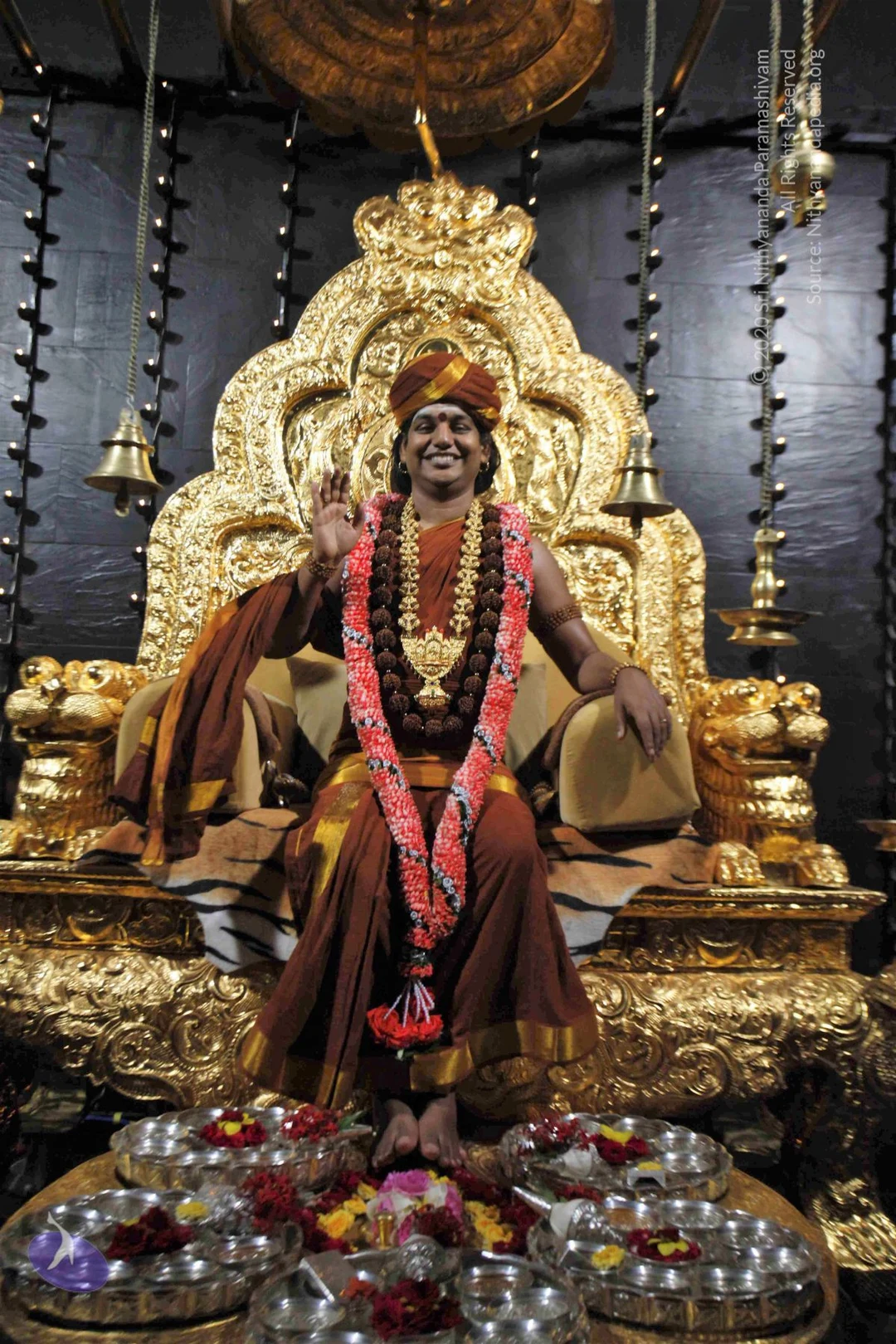
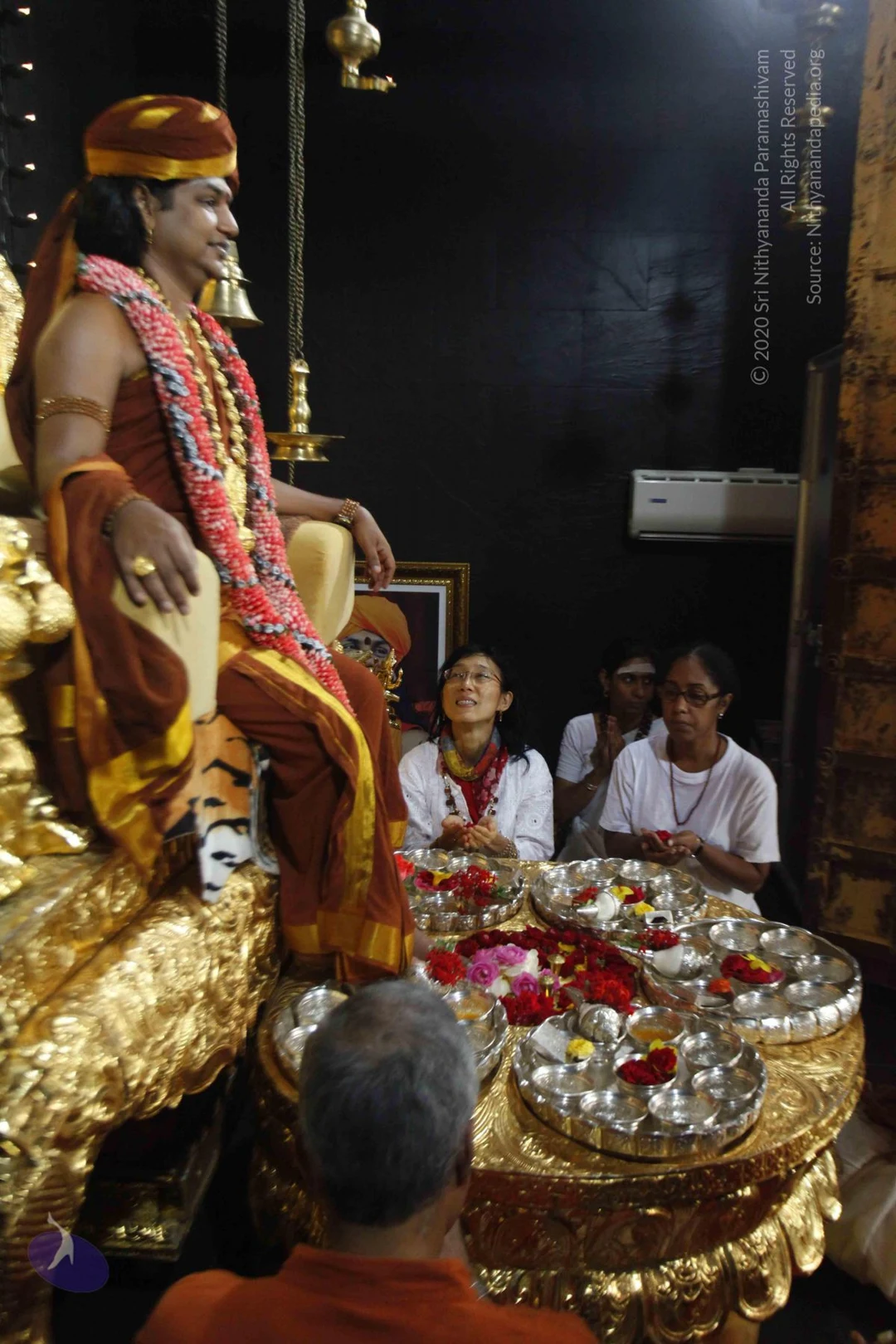
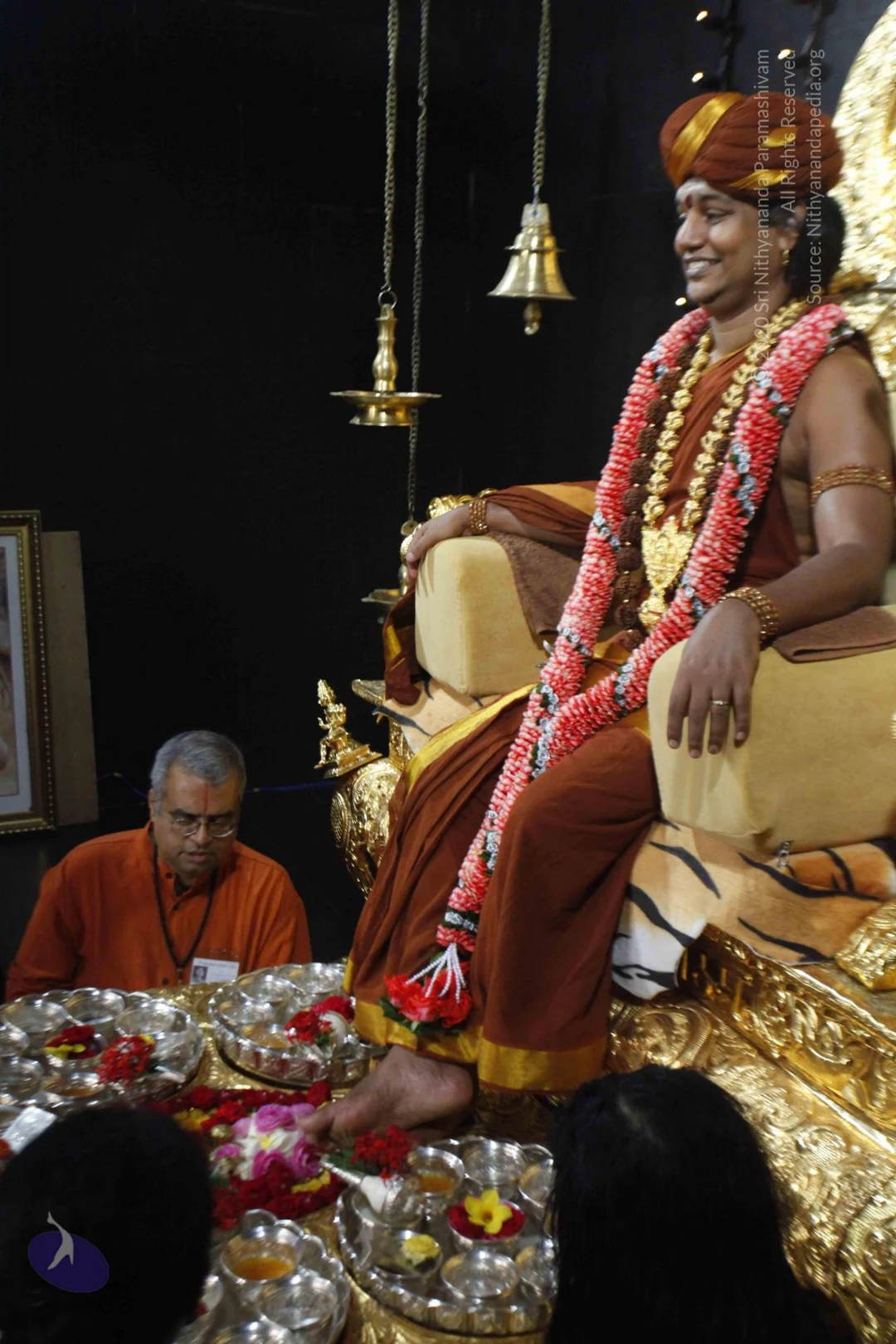
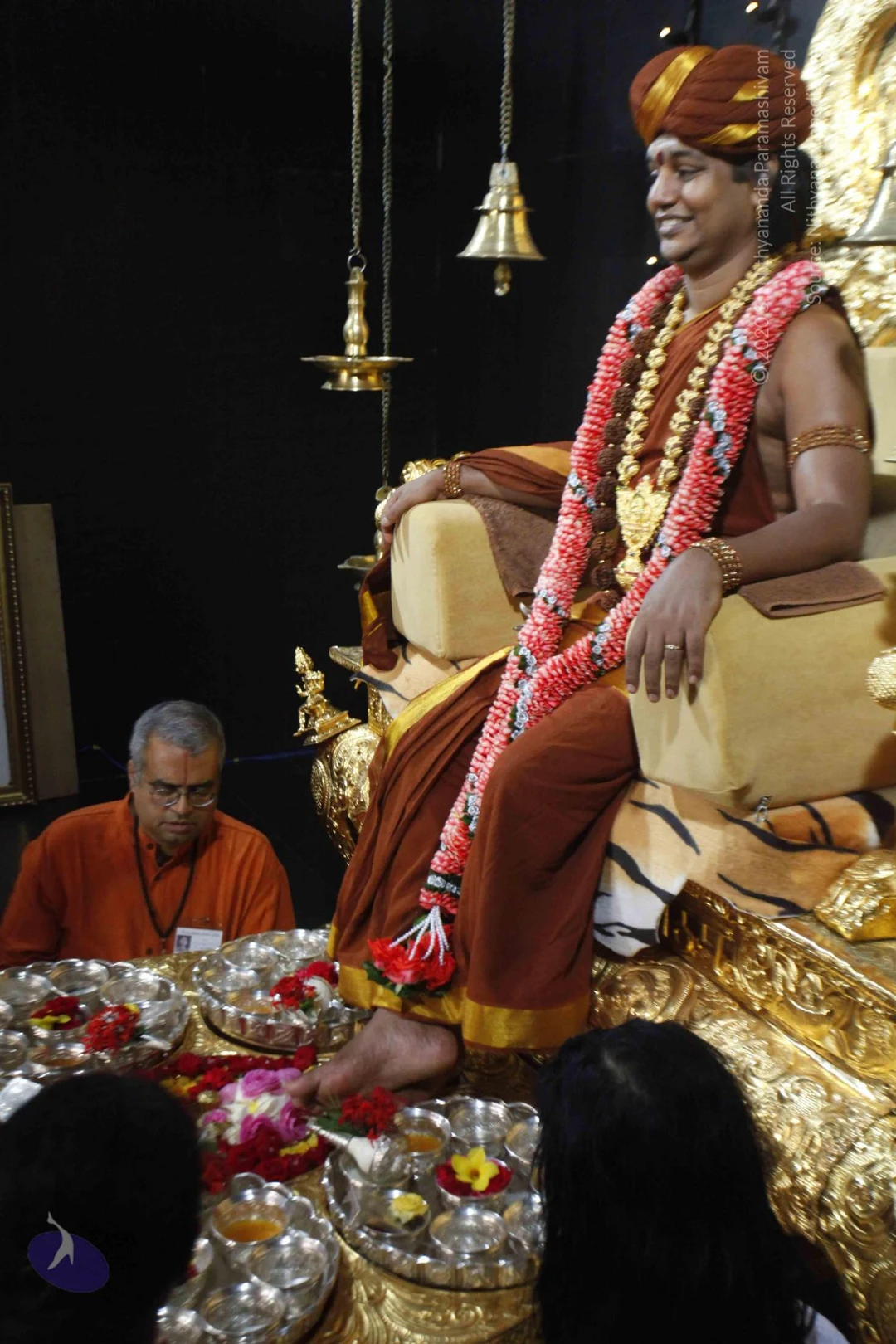
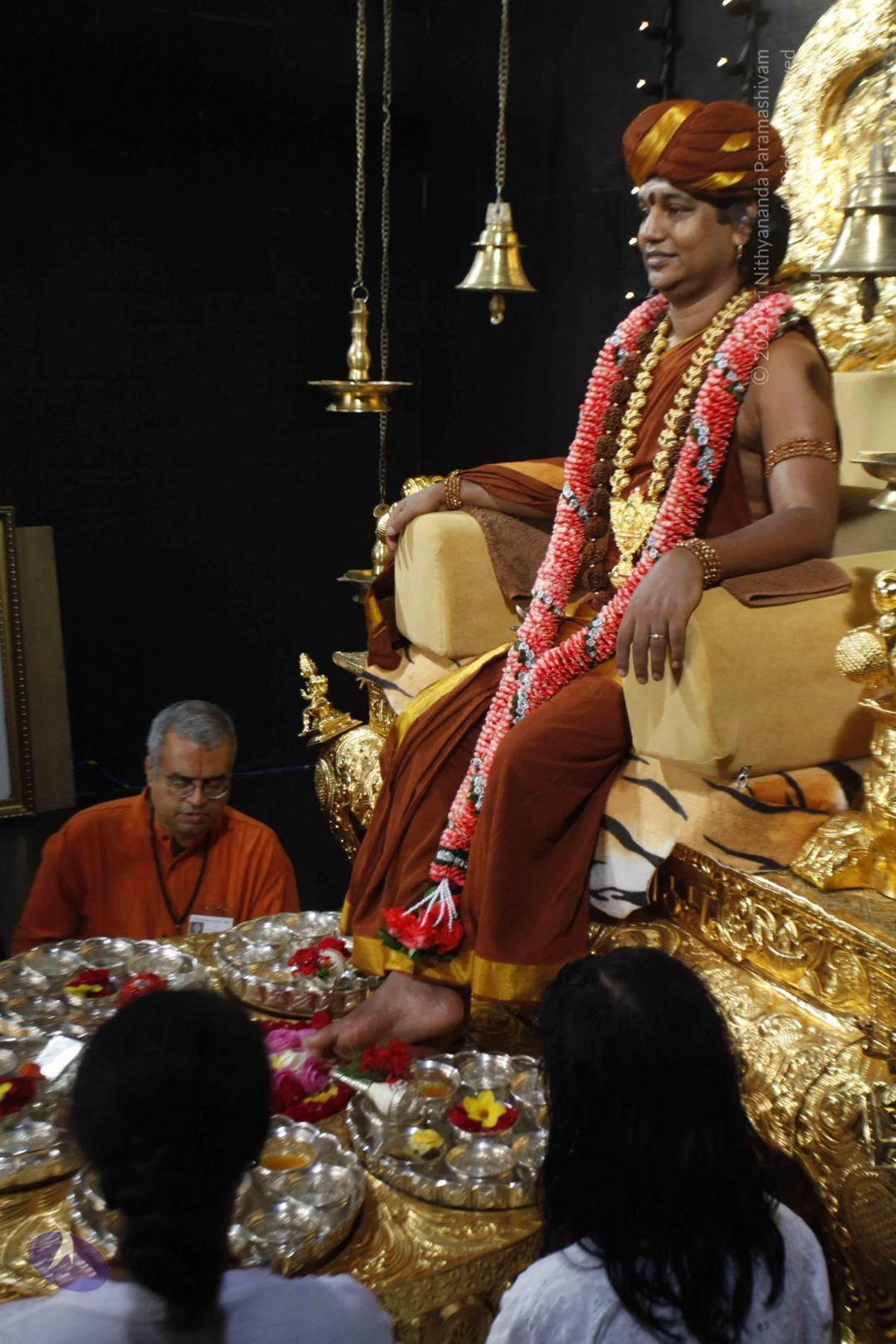
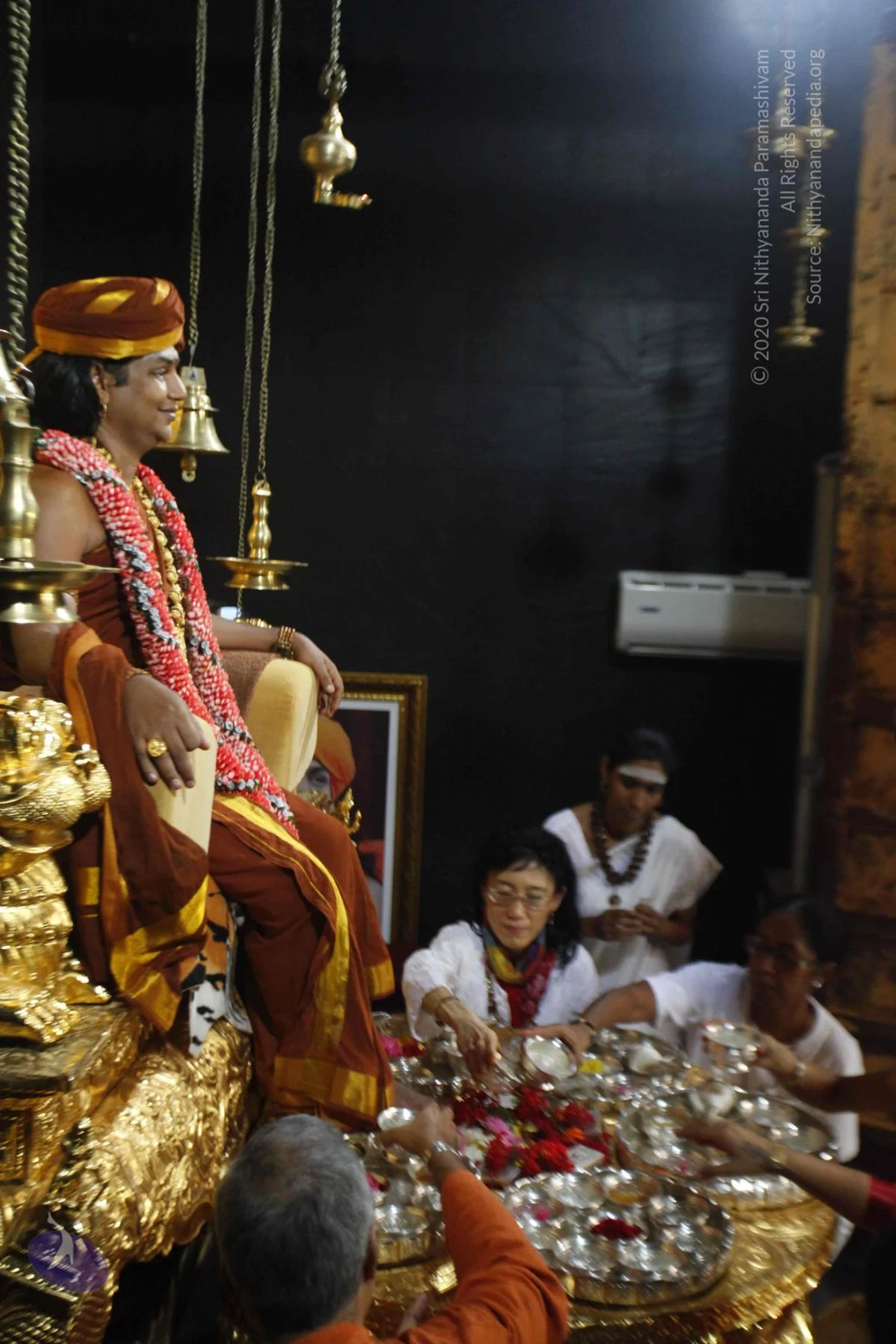
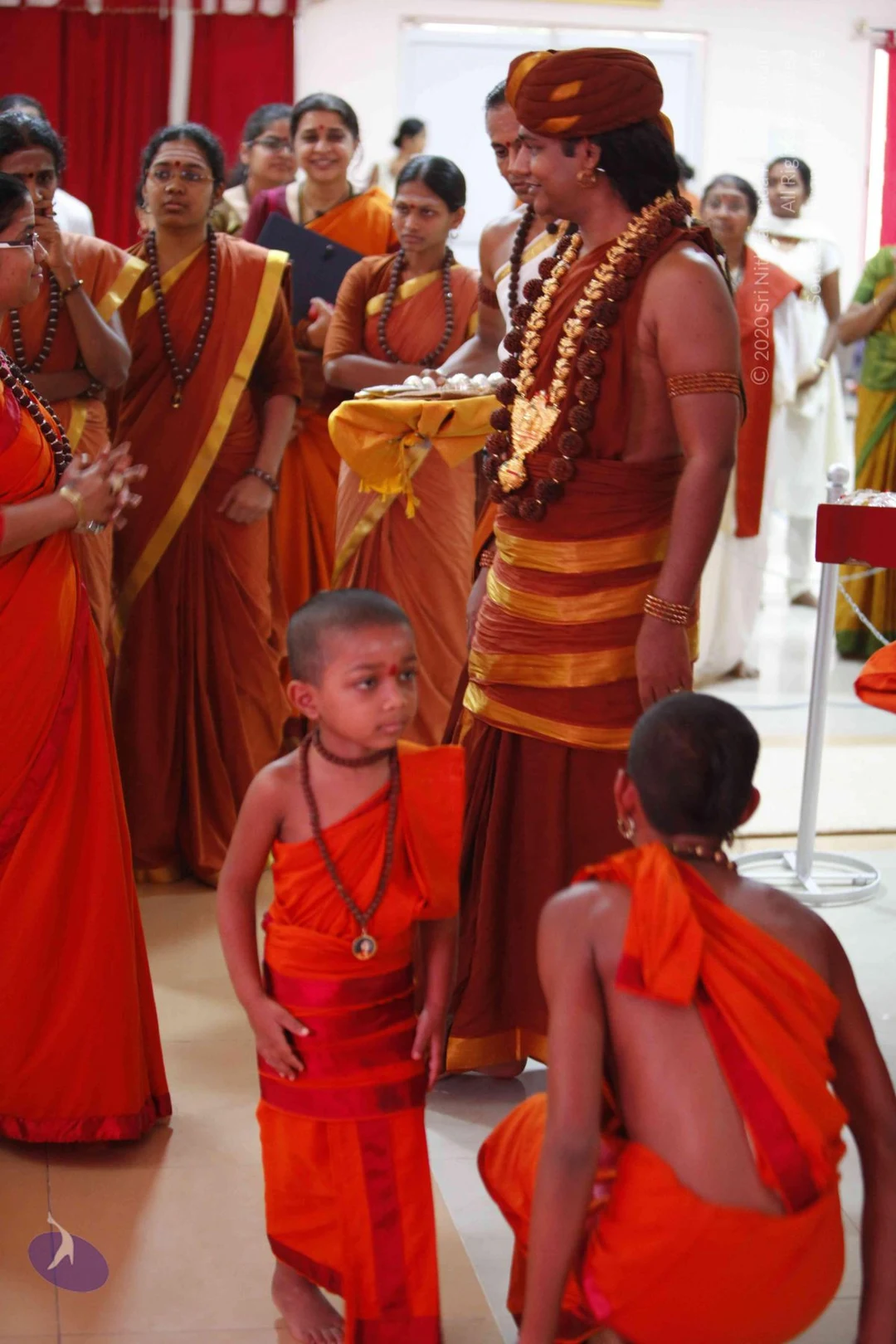
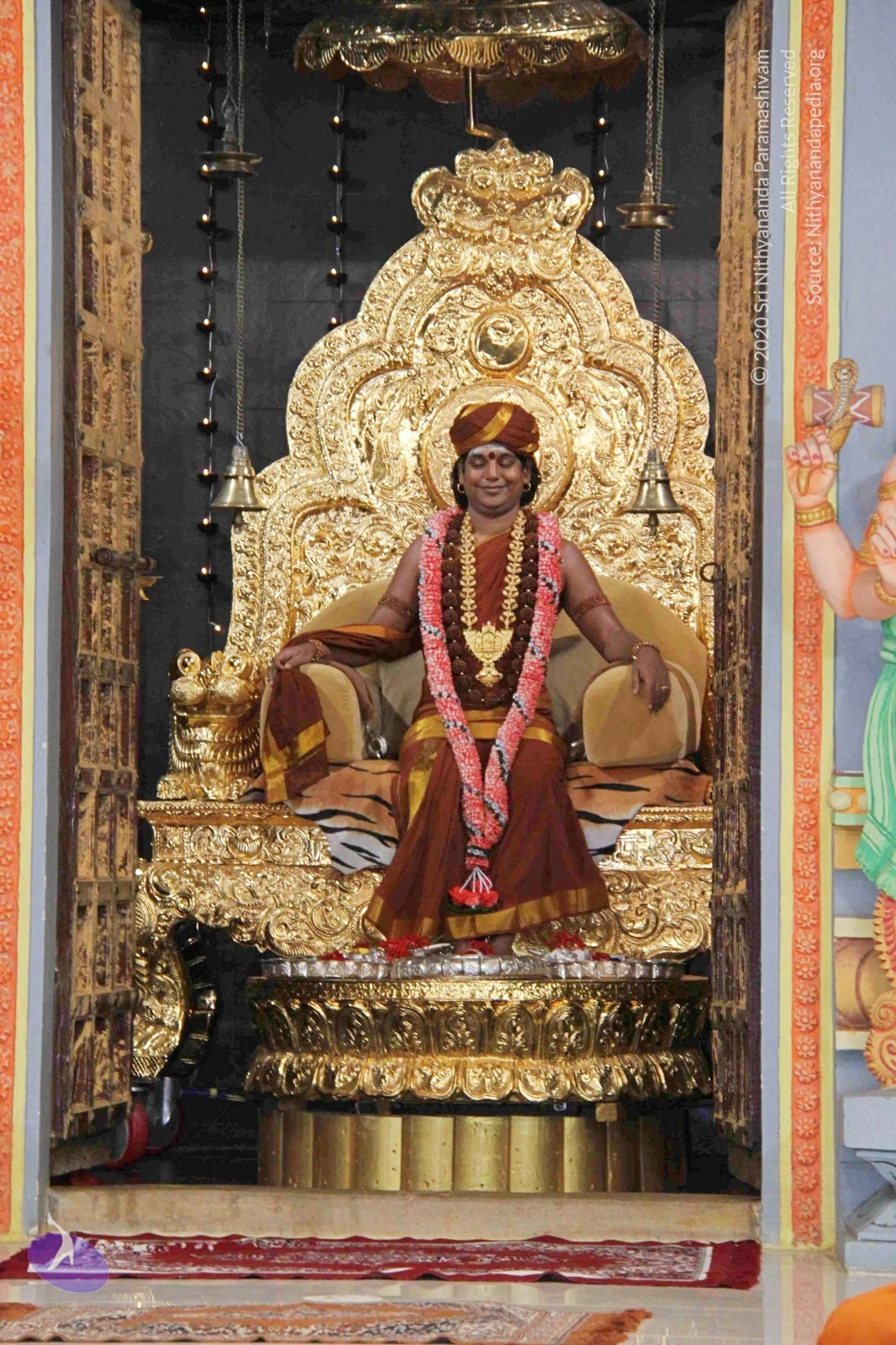
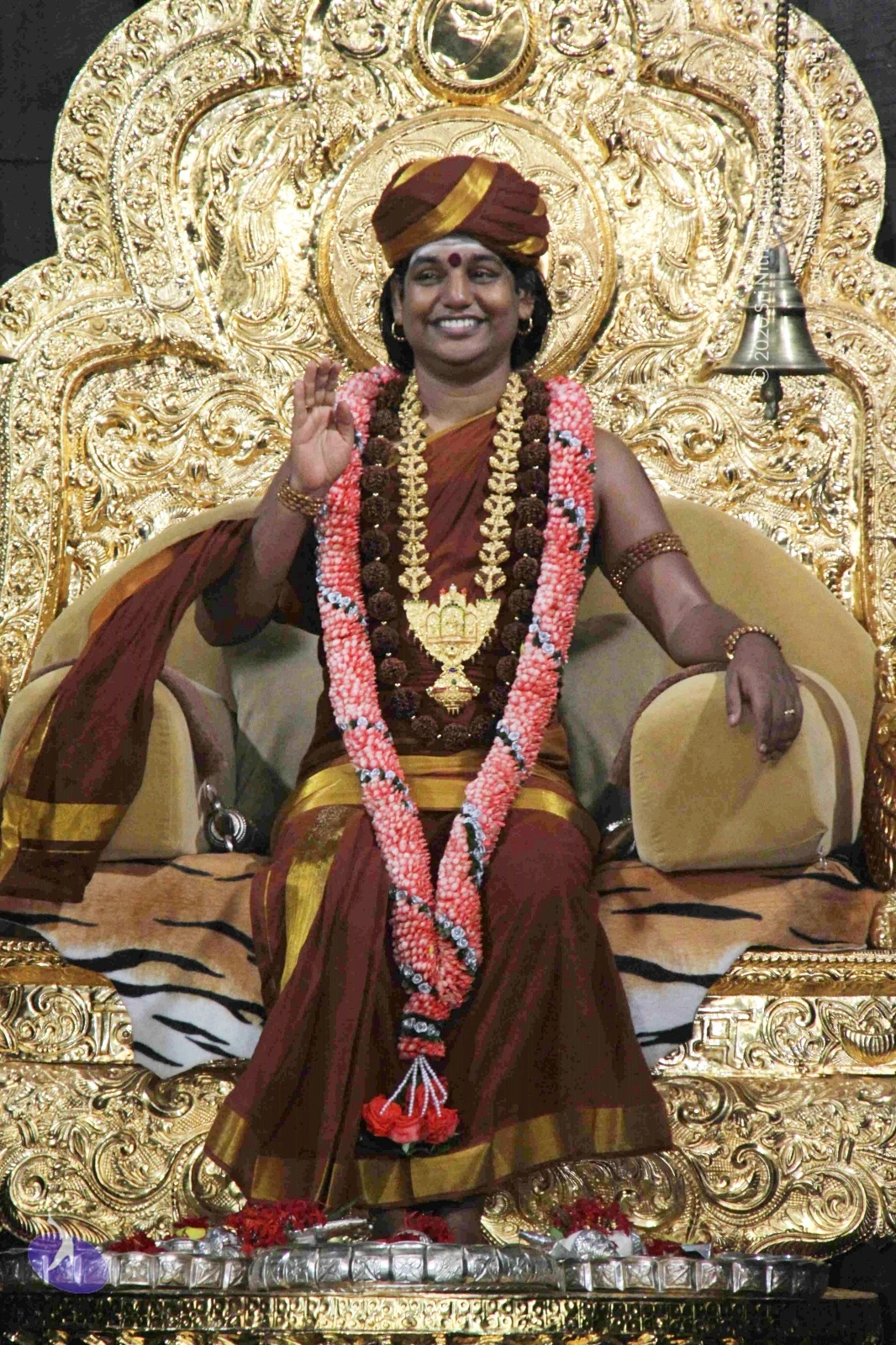
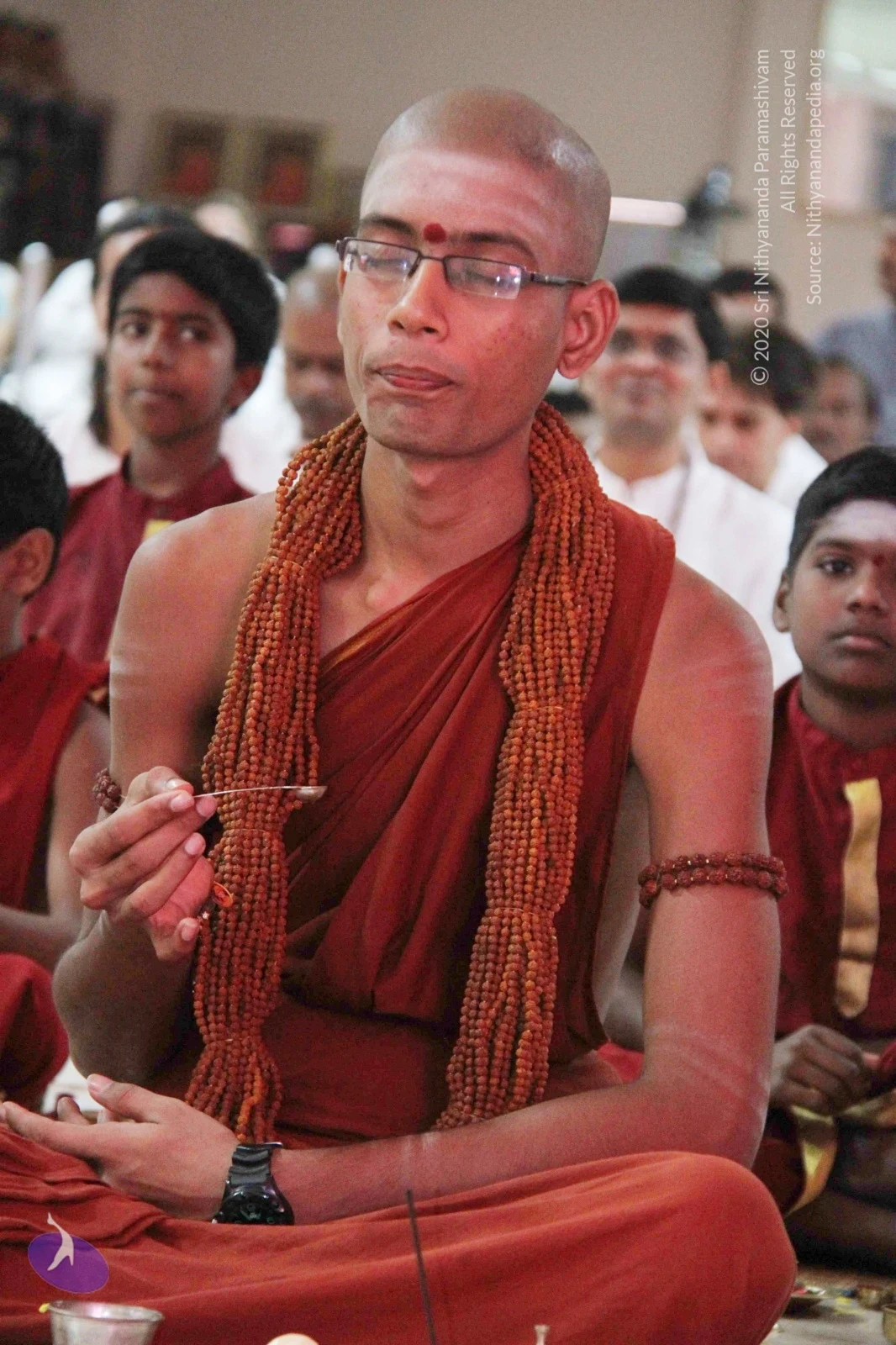
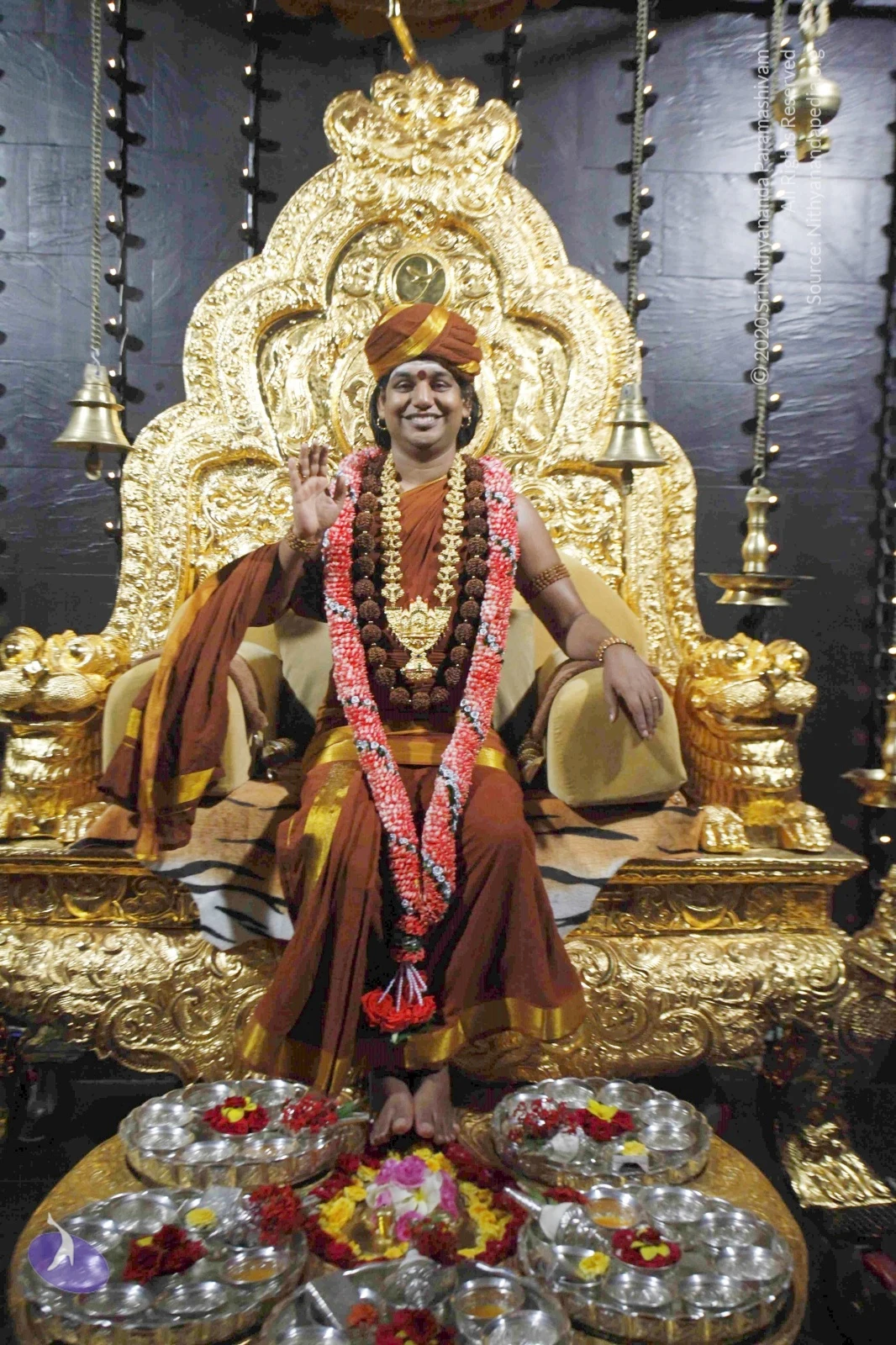
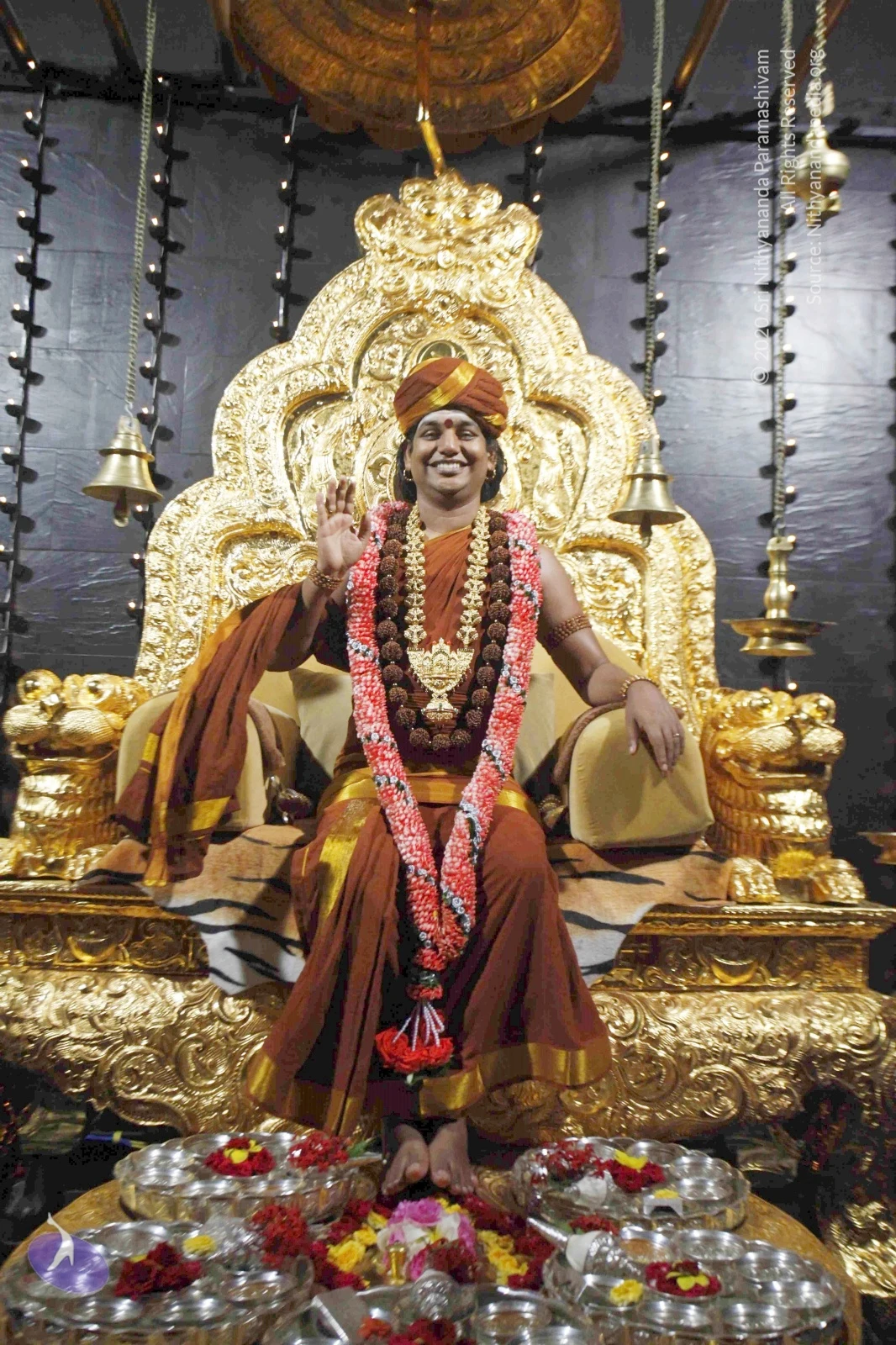
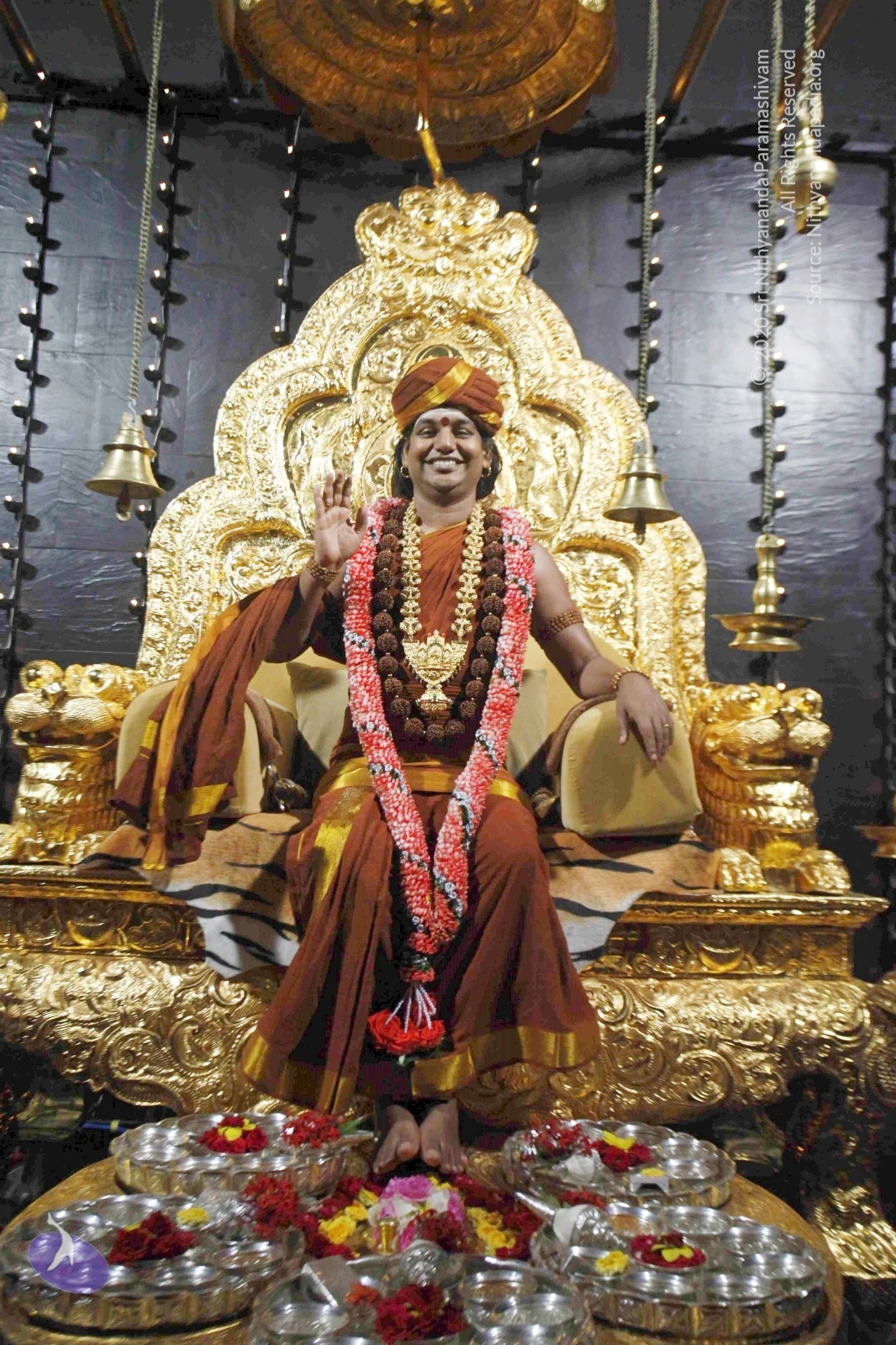
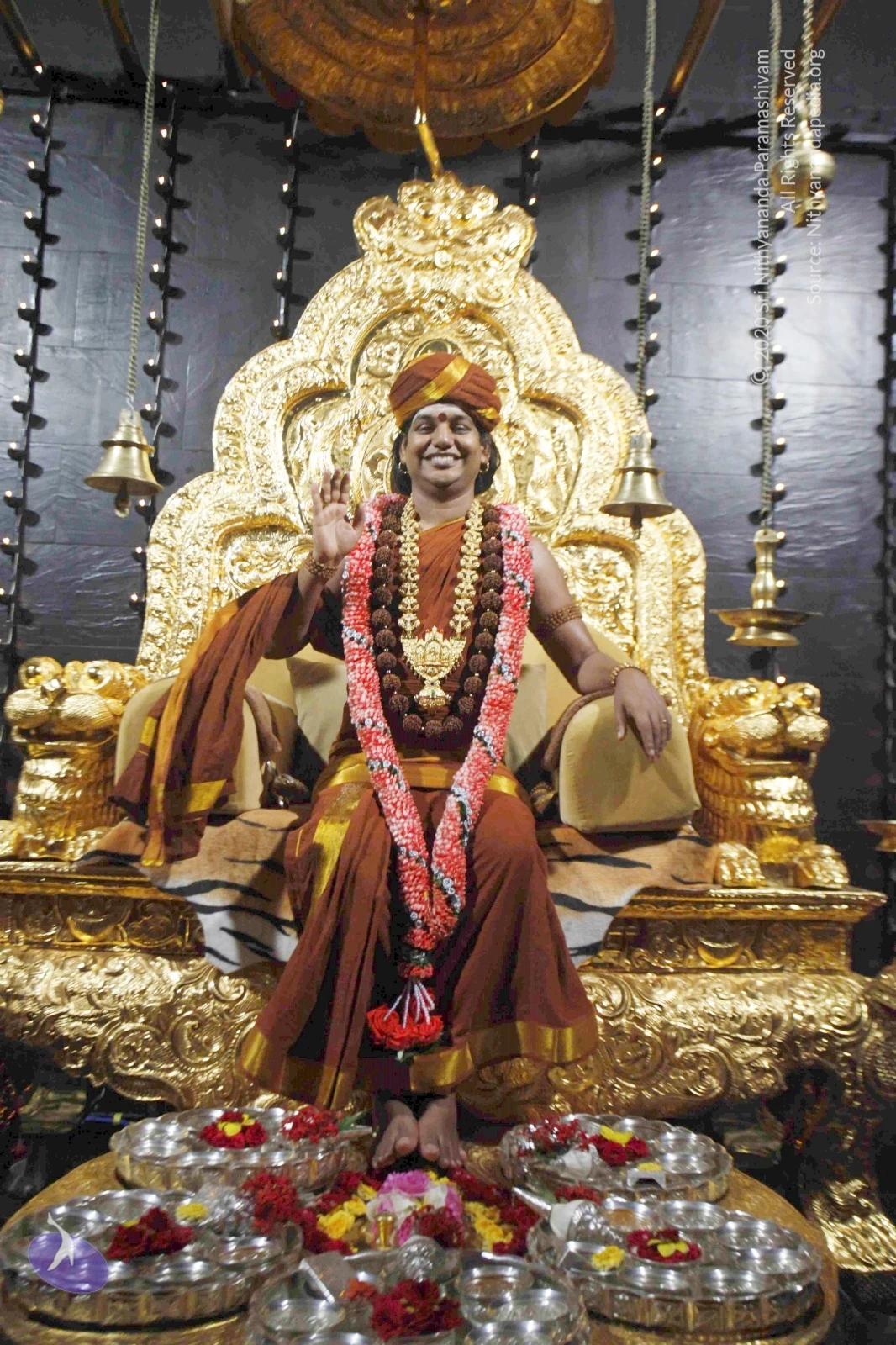
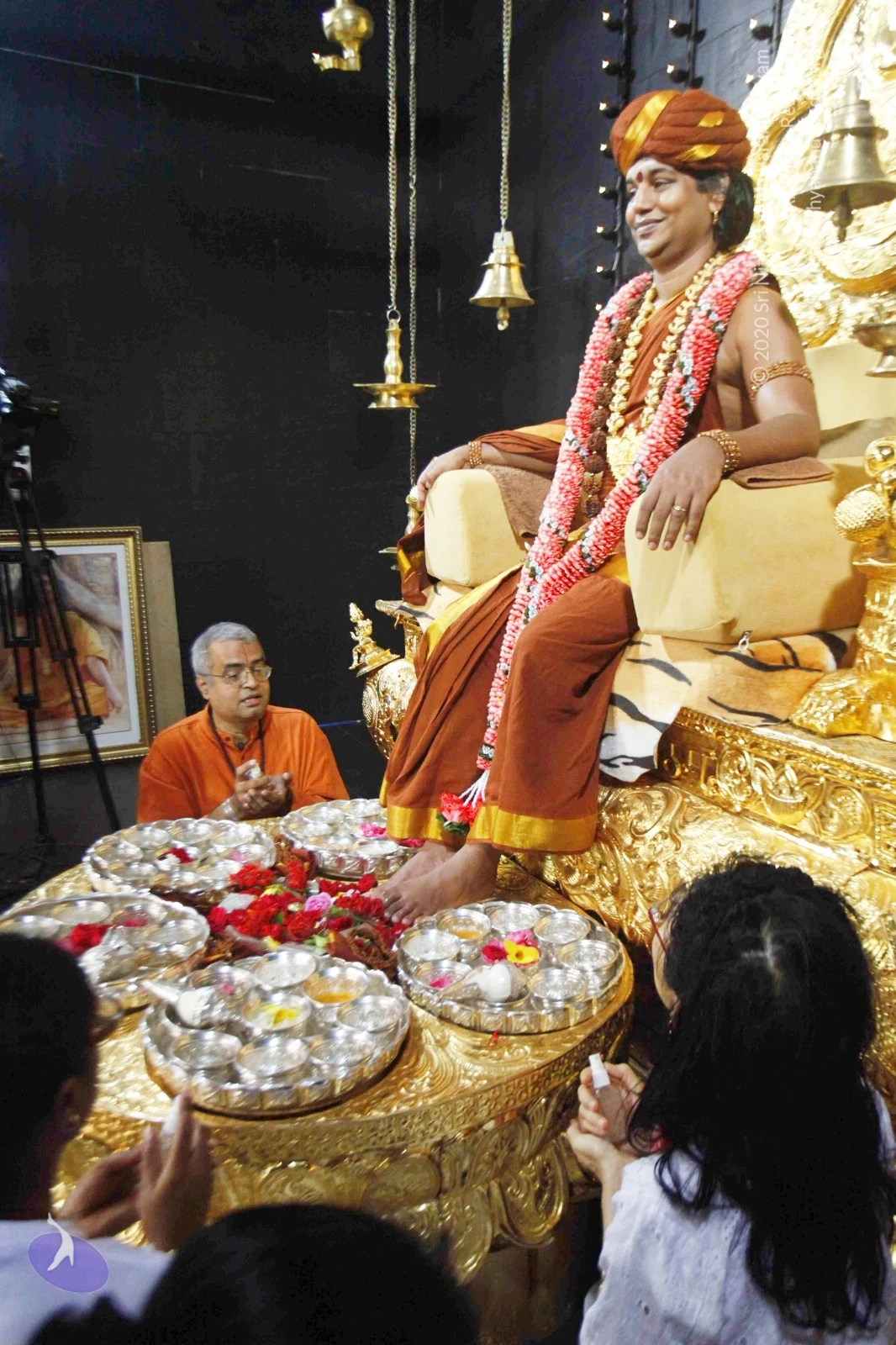
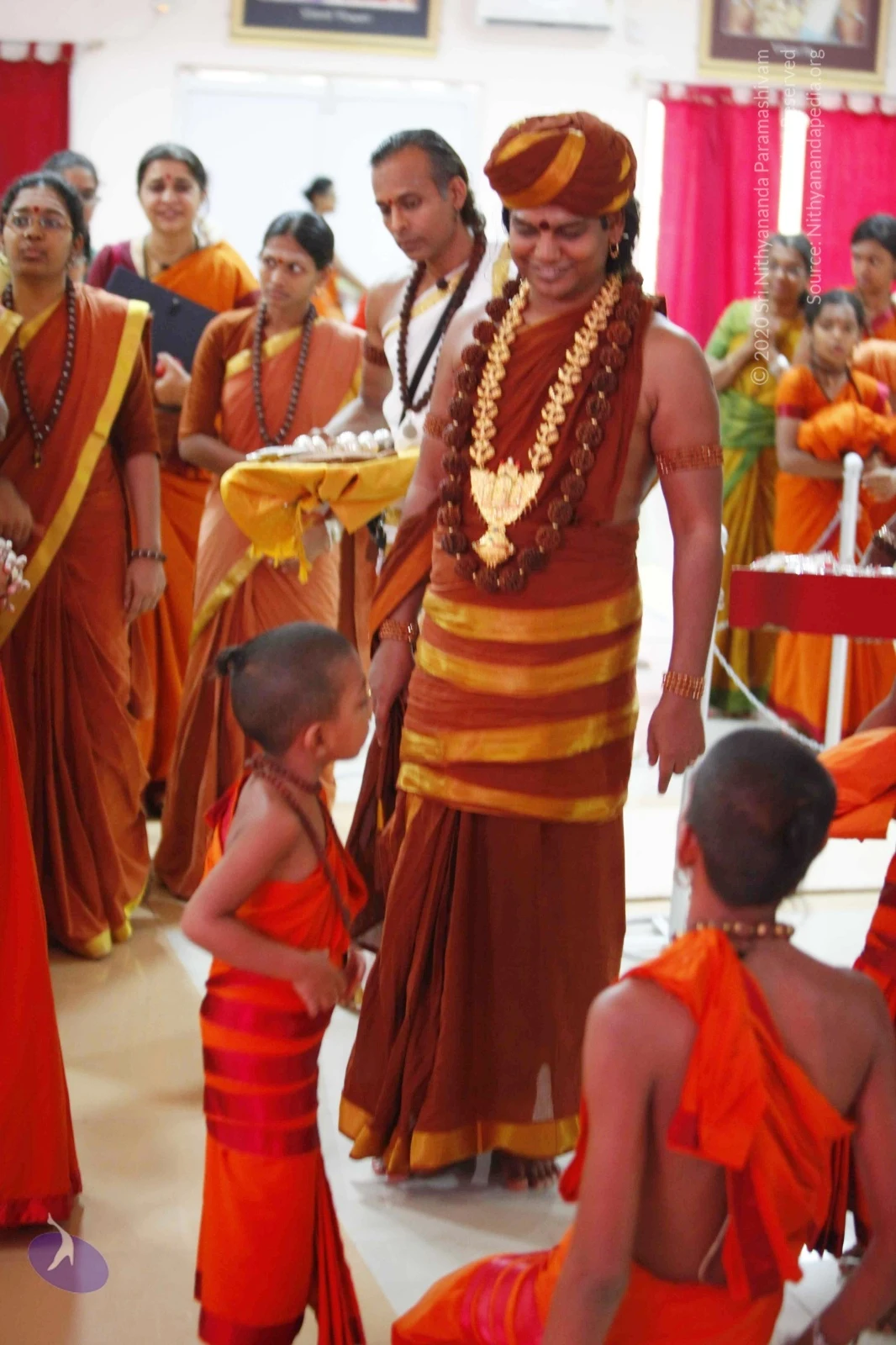
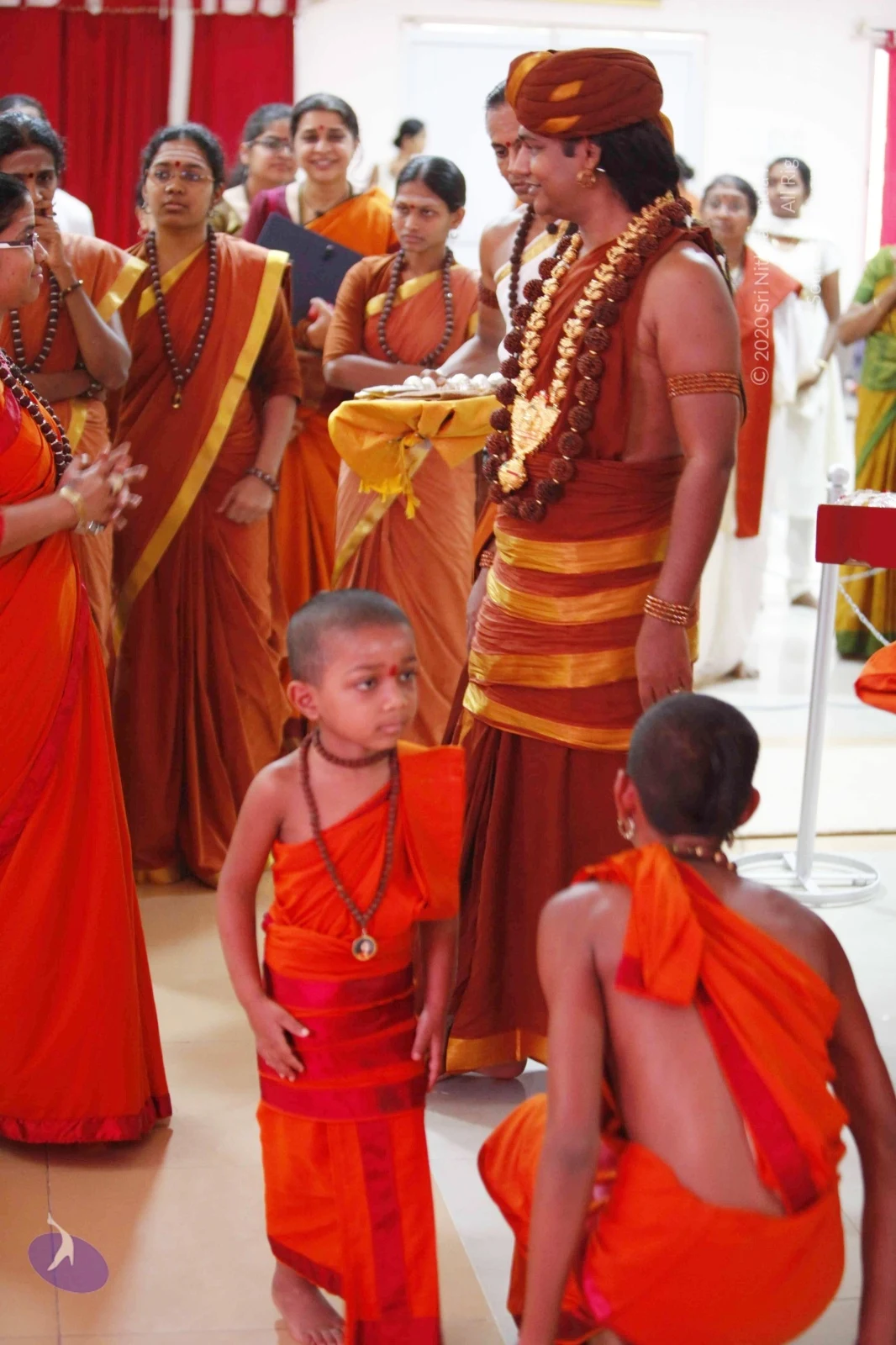
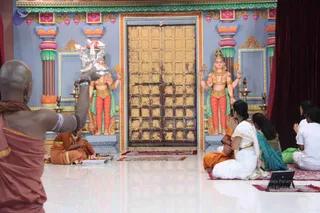
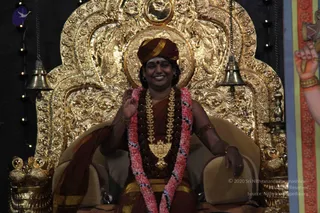
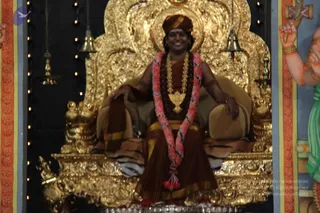
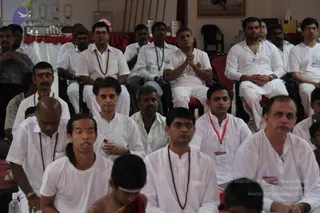
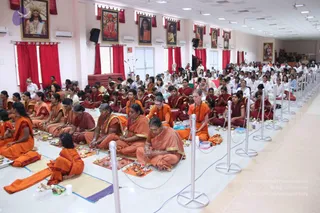
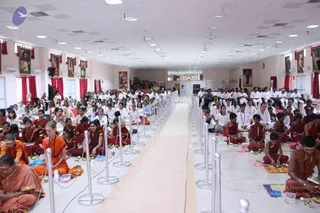
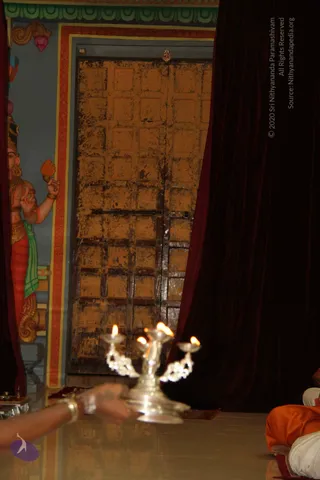
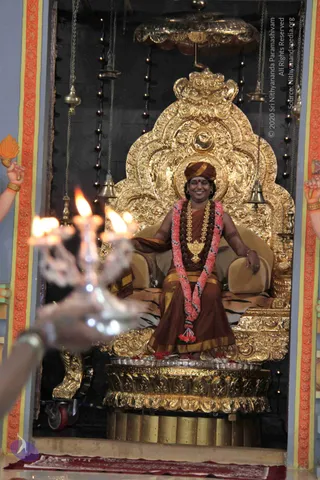
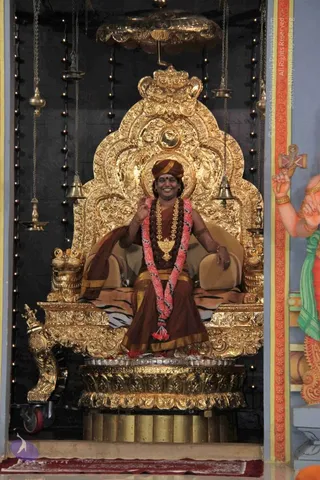
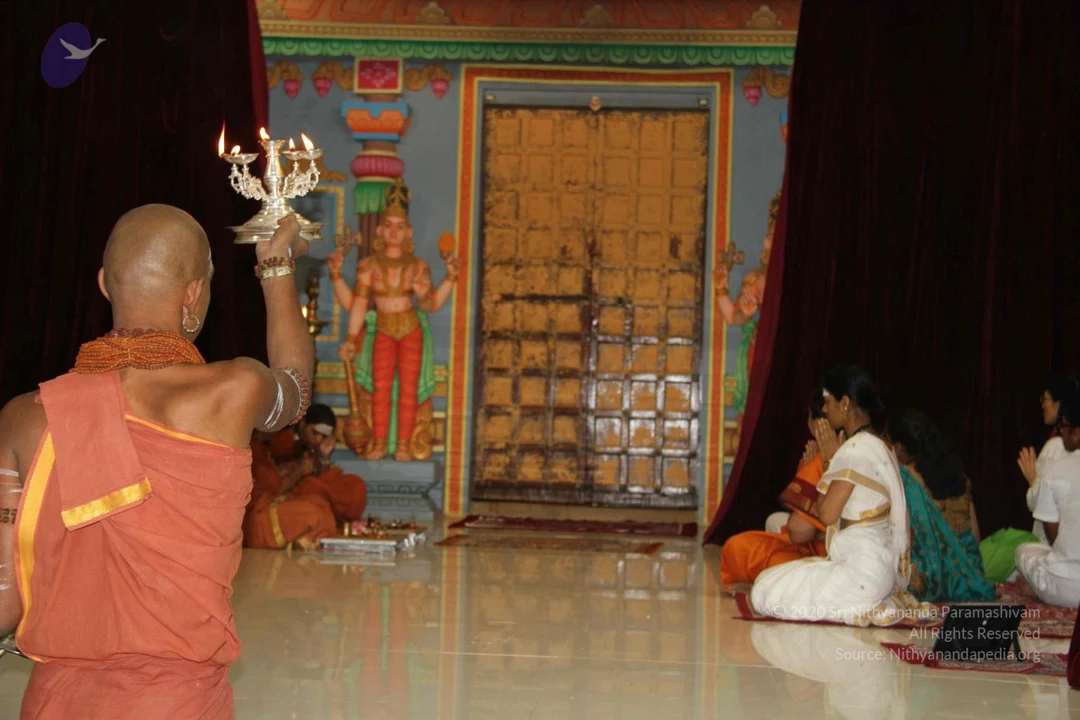
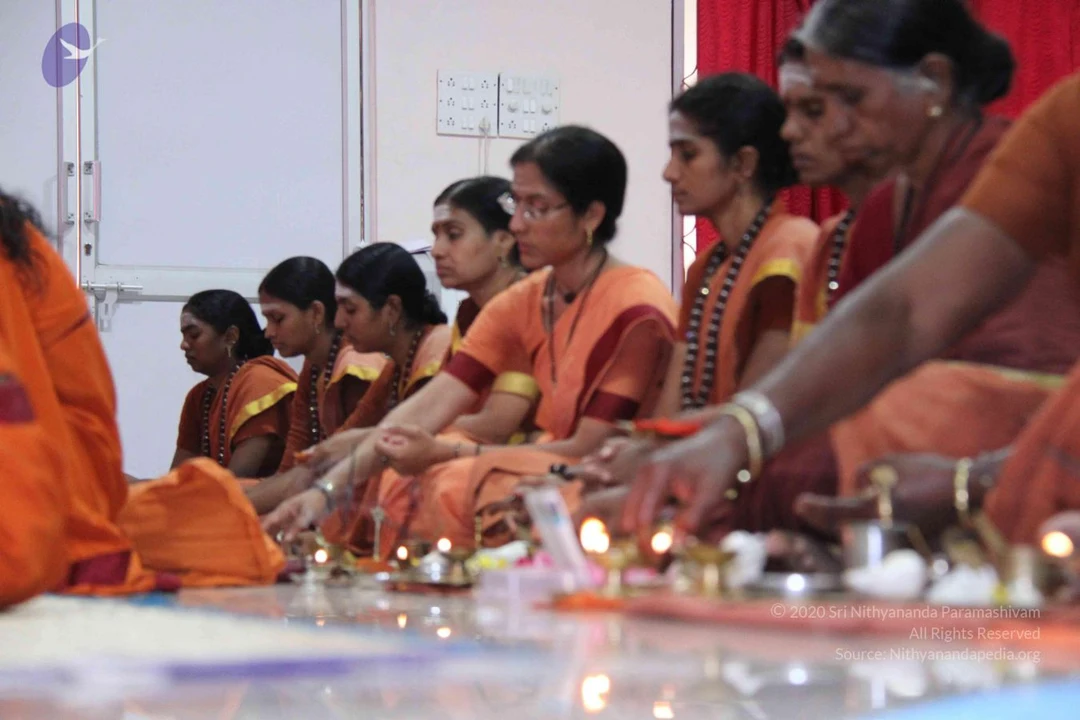
A shaved-headed priest in orange-saffron dhoti and shawl with a red-orange rudraksha mala and silver bangles stands with his back to the camera, raising a silver multi-wick aarti lamp with lit flames toward a painted deity murti in a temple shrine. The murti, painted in red and orange with multiple arms, holds ritual objects and stands before a large brown wooden door. Seated on mats to the right, women in white saris and a teal sari, and a few others in white, sit with hands folded in prayer. Brass puja items sit on a low tray near the floor. Dark maroon curtains frame the scene.Interior temple scene before a large gold-studded wooden door flanked by two painted dvarapala guardian figures with multiple arms, crowns and orange-and-green dhotis. A bald priest with a rudraksha-style bead necklace, seen from behind in a rust-orange cloth, raises a silver aarti lamp toward the door. Seated on red mats at right, several women in white and teal saris and an orange-clad person sit with hands folded in prayer. Brass oil lamps stand on the floor and offering trays lie in front, with a laptop visible at lower right.A smiling person seated on an ornate gold throne with carved floral and scrolled backrest and lion-head armrests, waving one hand in greeting. They wear a maroon and orange turban, a red-and-gold robe, a dense rudraksha mala, ceremonial gold necklaces and a pink-and-white flower garland. Small brass bells hang beside the throne. At right, a painted panel shows a hand with red-painted fingers and bangles.A man in maroon-brown robes sits on an ornate gilded golden throne with a carved backrest and armrests, framed by hanging brass bells and lamps. He wears a dark red turban, a long pink-and-white flower garland, a rudraksha mala, and a large gold ceremonial necklace. He smiles with his hands resting on the armrests, and a striped tiger-skin cloth drapes over the seat. Painted deity figures with raised arms flank the throne at the edges. Swamiji (probable): the seated figure has a turban, rudraksha mala and ornate gold necklace, with the throne and garland indicating he is being honoured as the central figure.A seated satsang audience of men in white ritual clothes, many wearing rudraksha malas, sits in rows of chairs in a hall with a red-draped table and bottles at the back. A man in the front centre wears a white kurta and holds a red flower with his eyes closed. Another man on the right in white holds his hands together. Nearby, a boy in a saffron cloth sits in front. No candidate matching the a person cues is clearly visible, so the identity is left unsure.Wide view of a large hall where many devotees sit cross-legged on white floor mats in rows, most wearing saffron-orange saris or robes and some in dark maroon. Several women in front have brass plates with oil lamps, flowers and small offerings before them. Red curtains line the windows, and framed portraits hang on the back wall. Rows of people in white clothing sit further back, and metal posts with chains separate the aisle. No single presiding figure is clearly identifiable in the visible frame.

Nithya Satsang

14 photosSource gallery
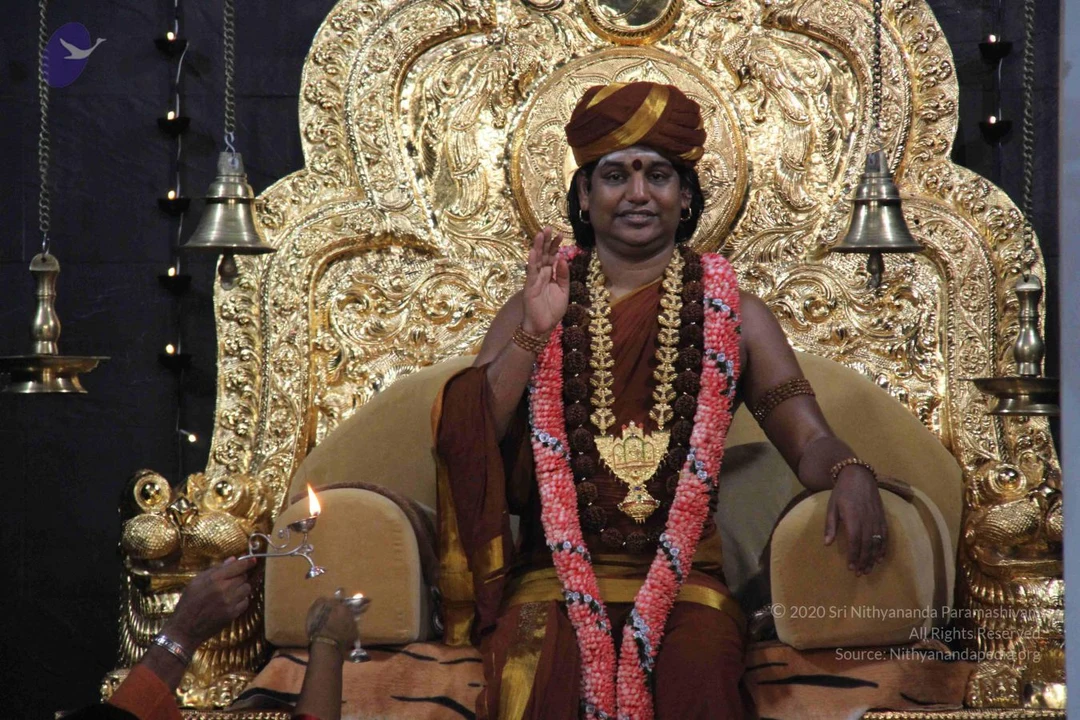
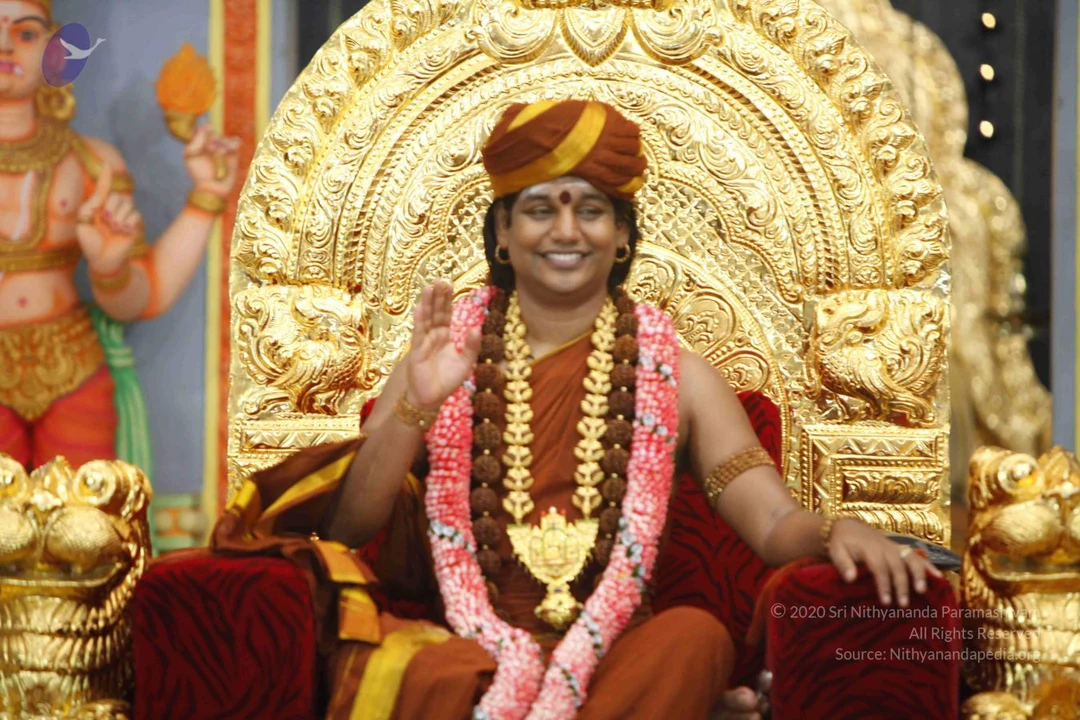
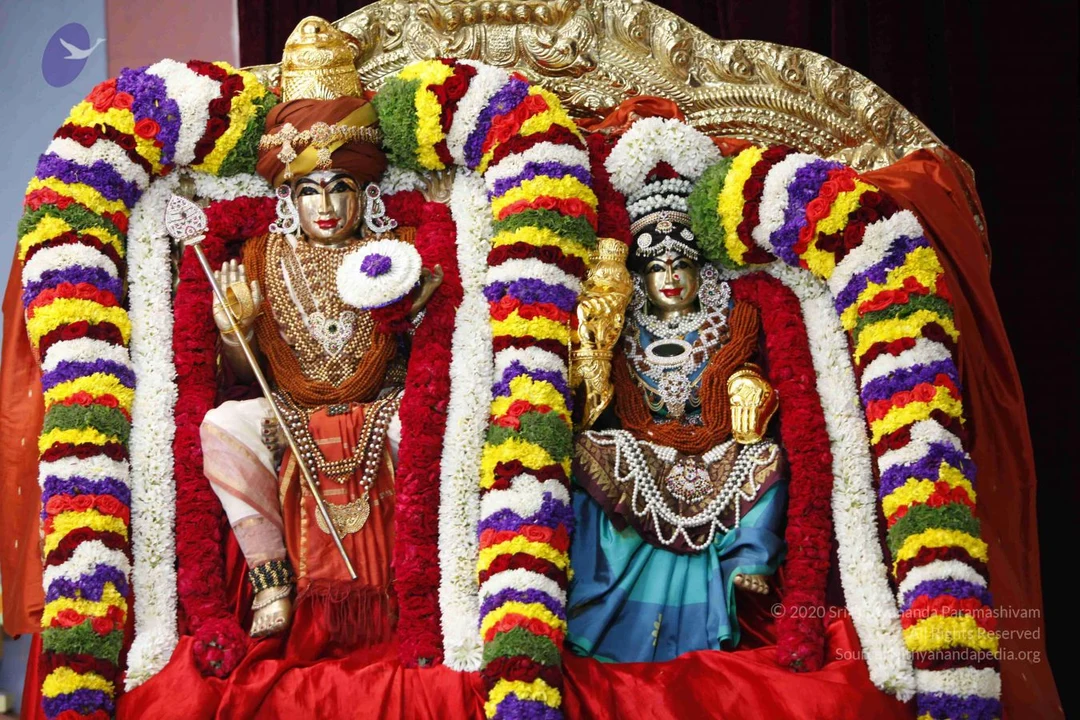
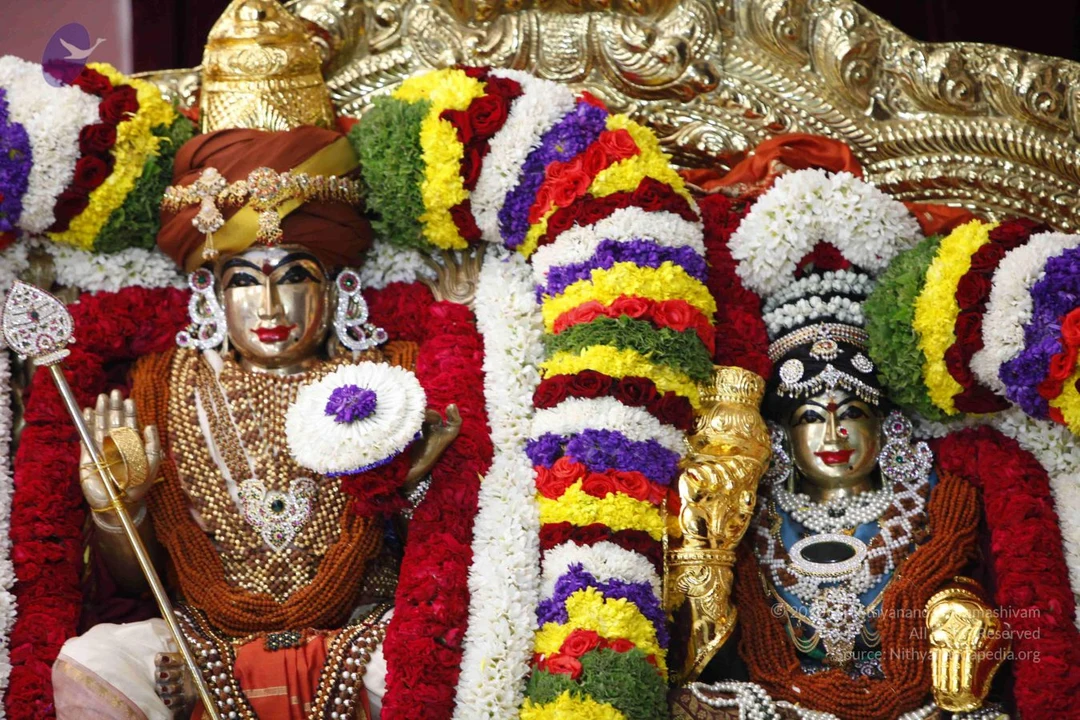
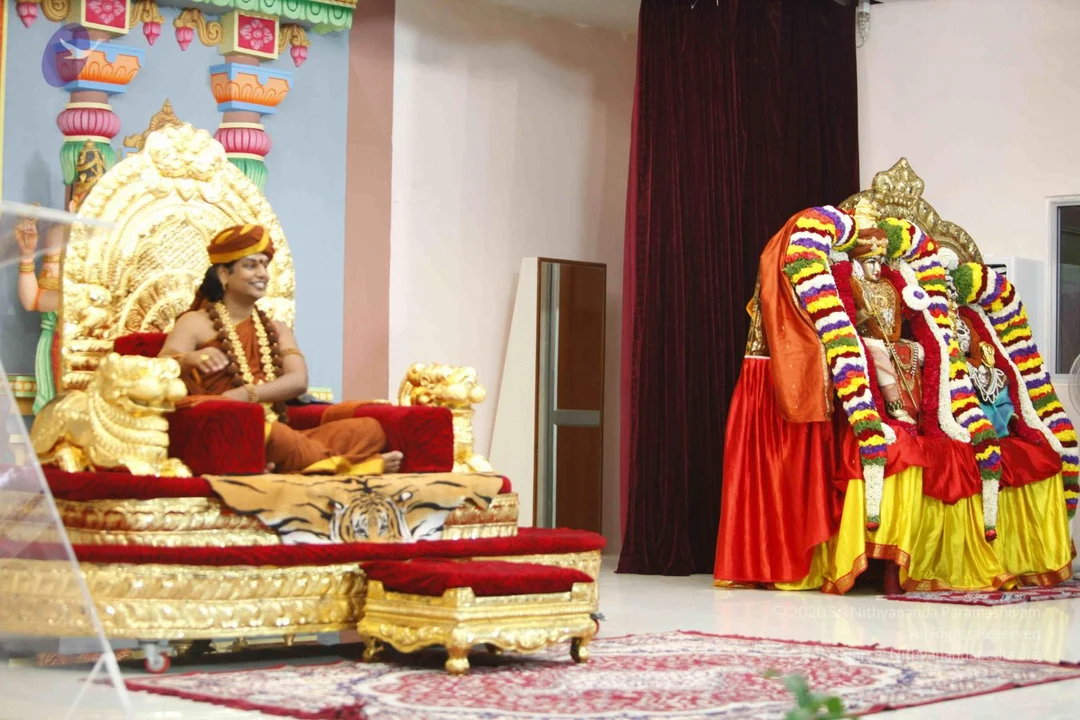
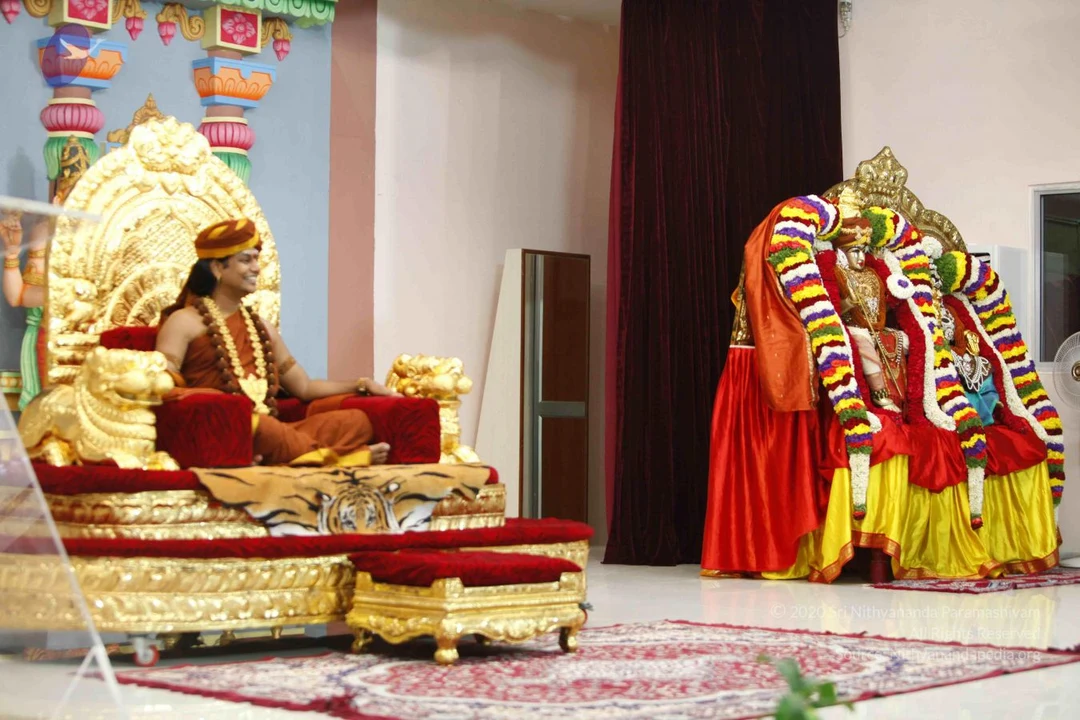
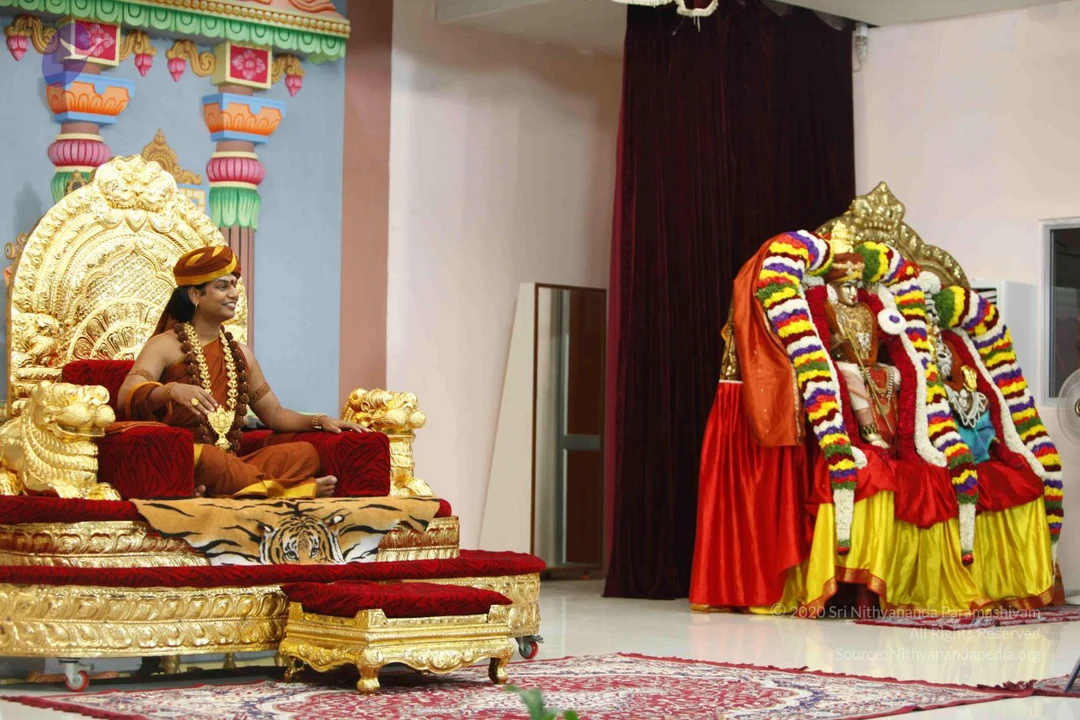
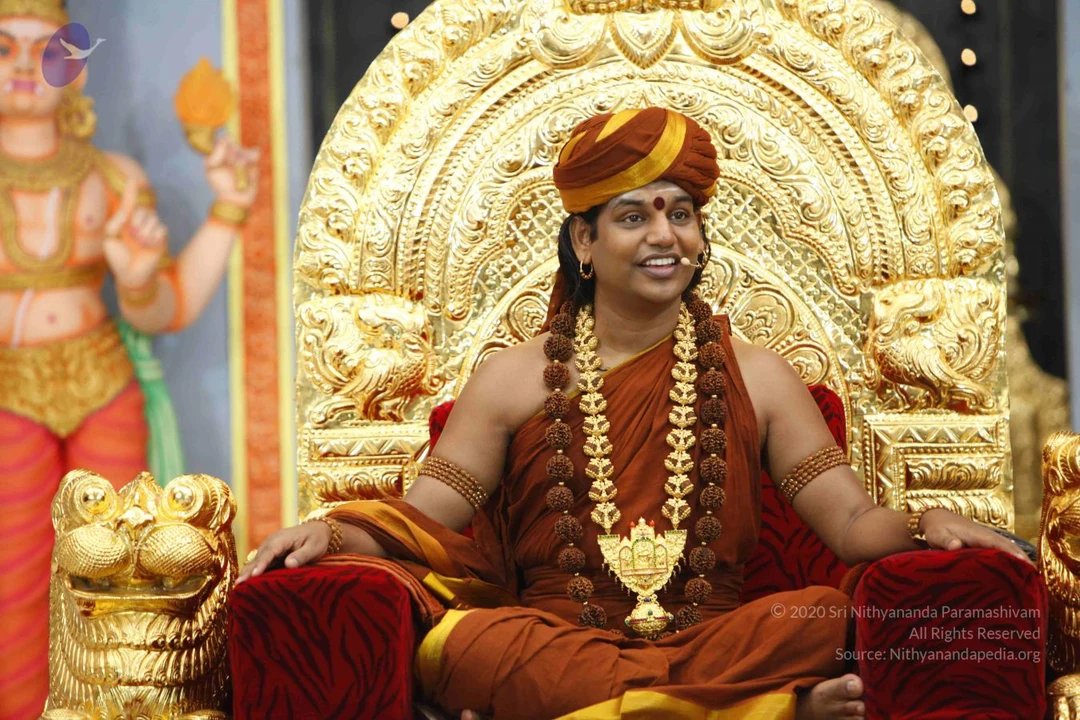
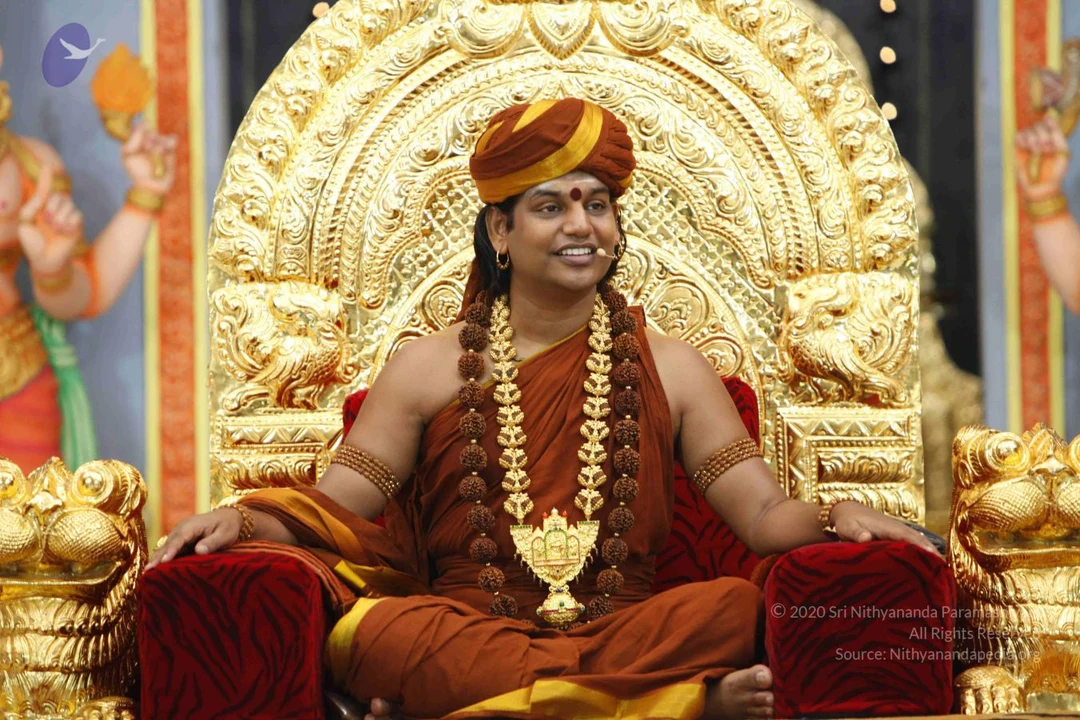
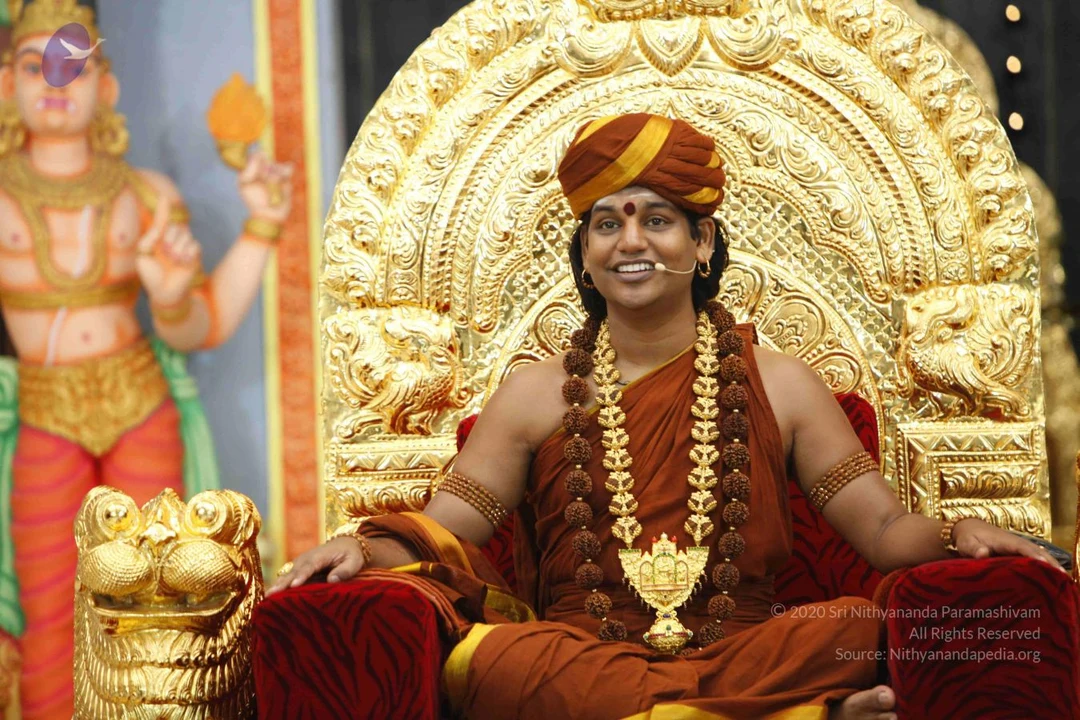
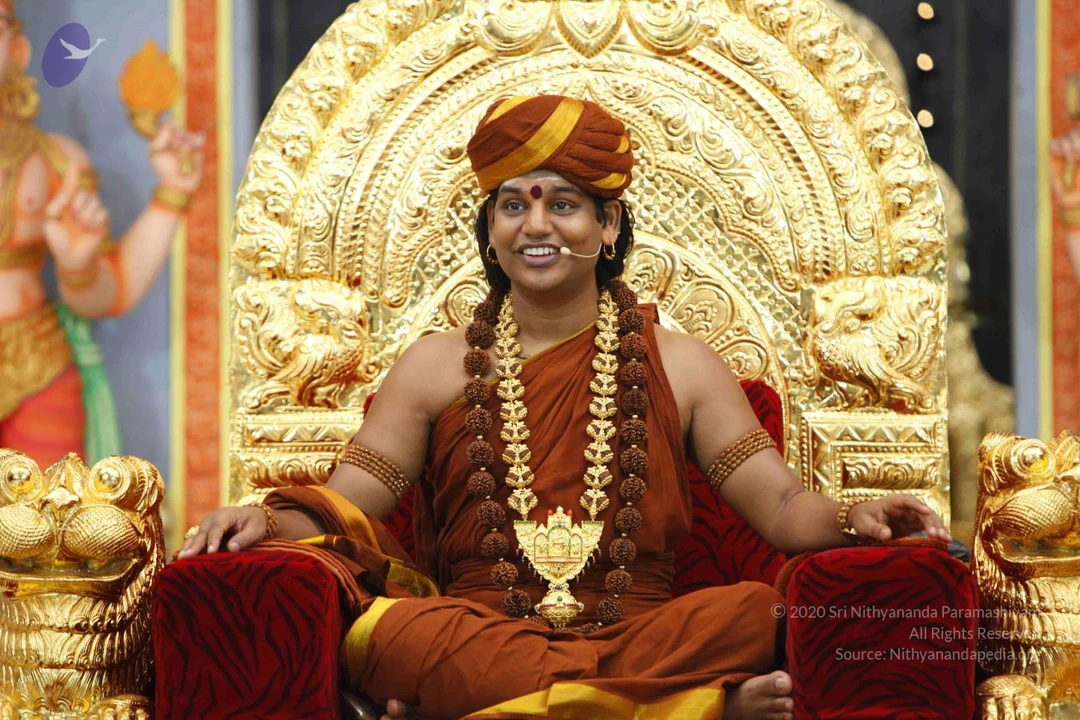
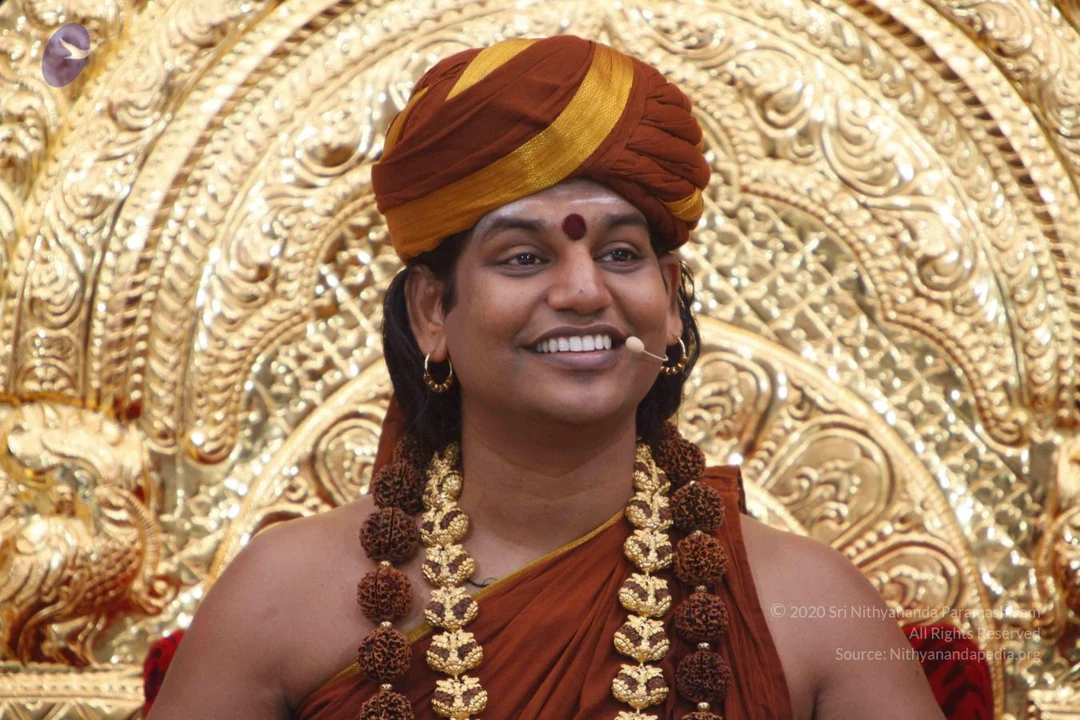
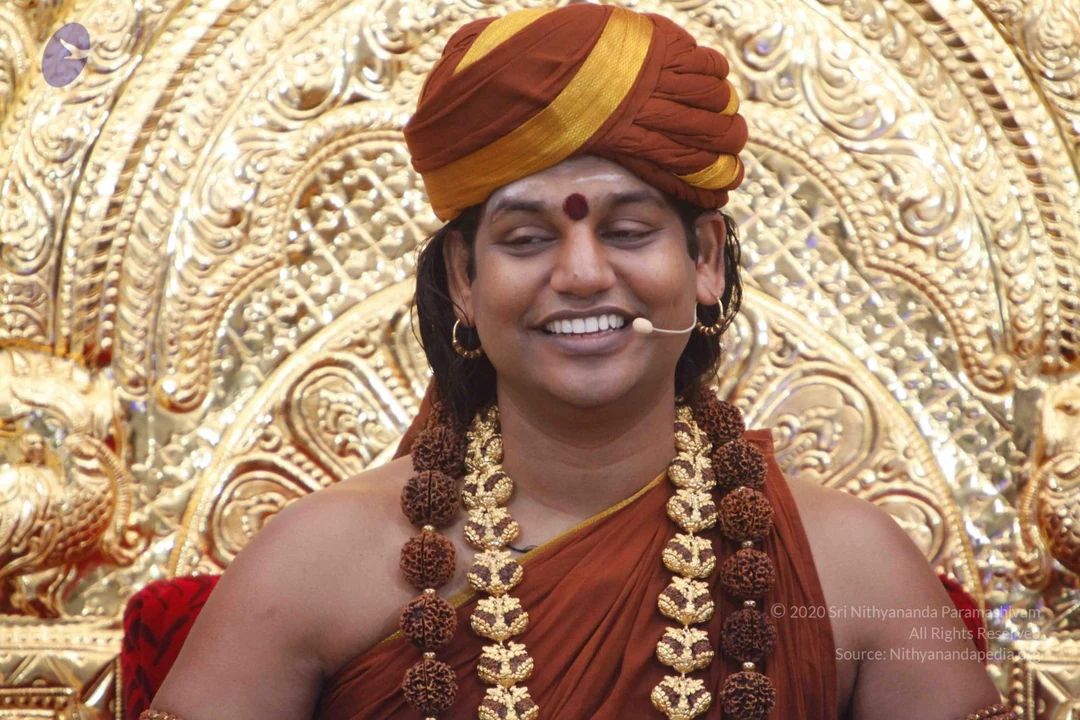
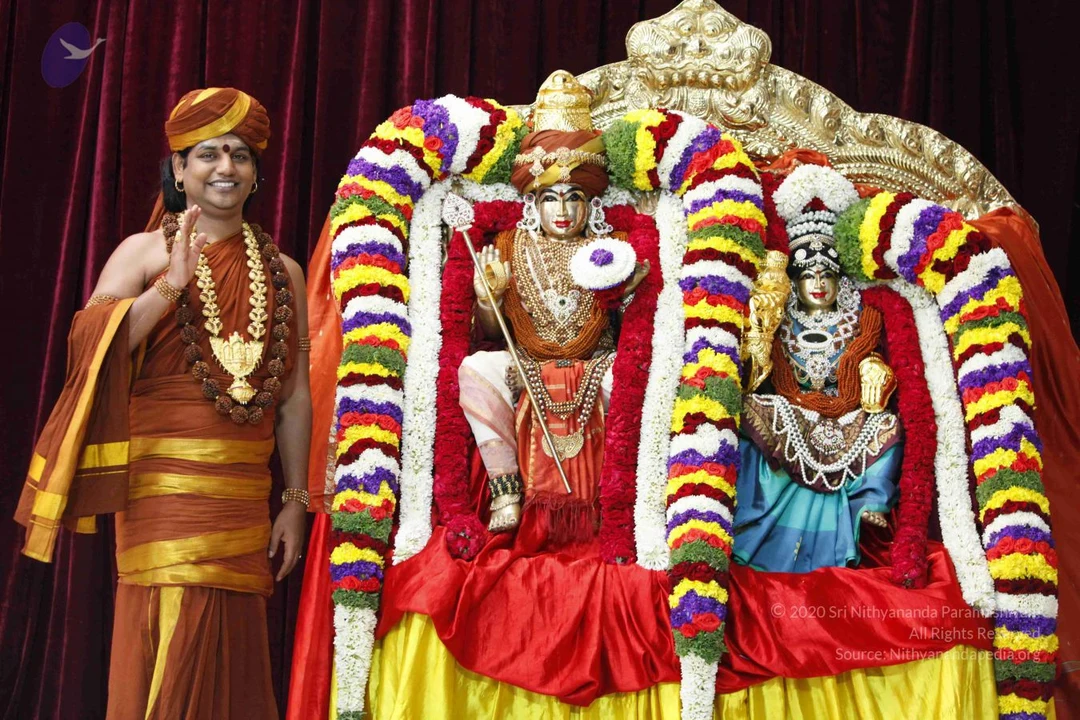
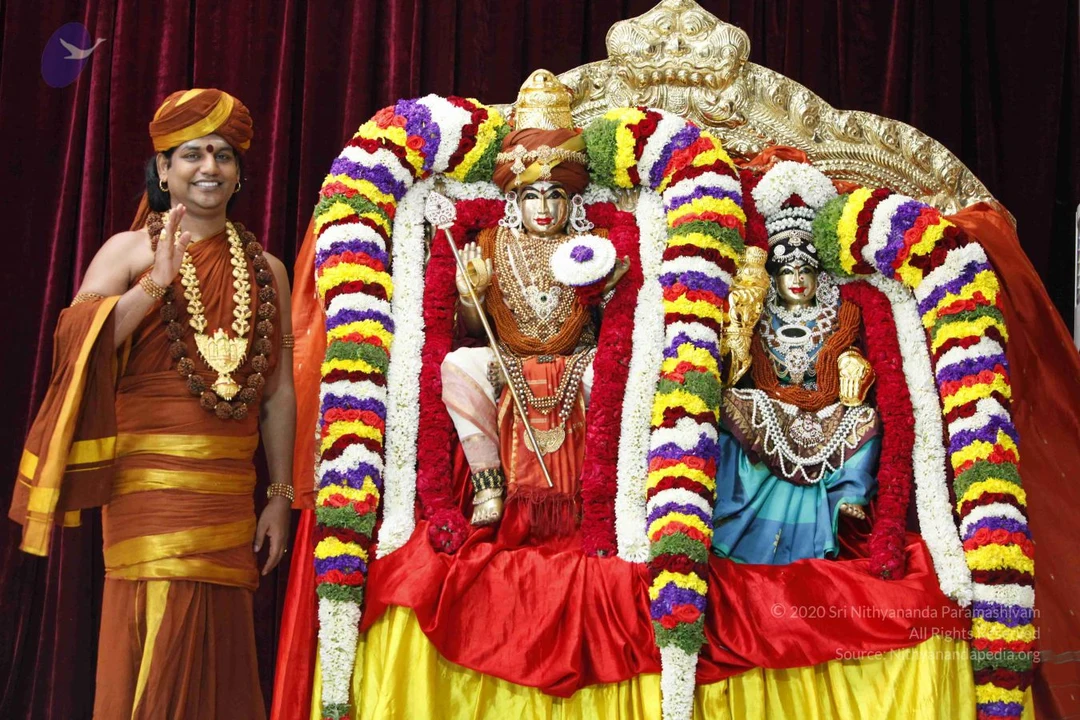
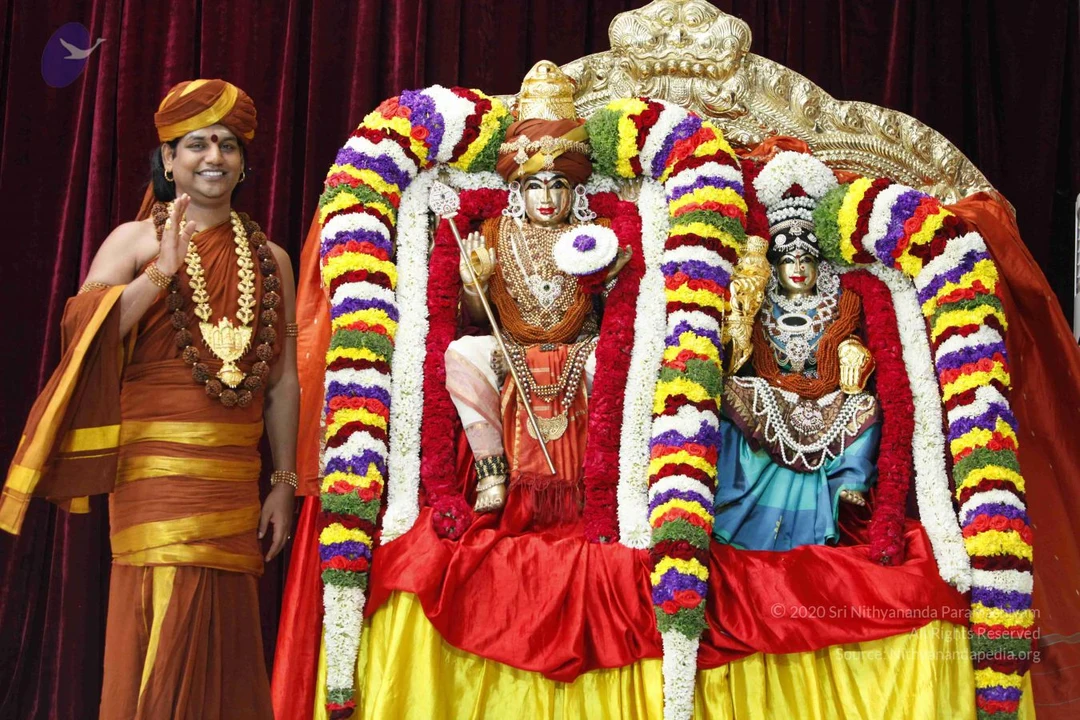
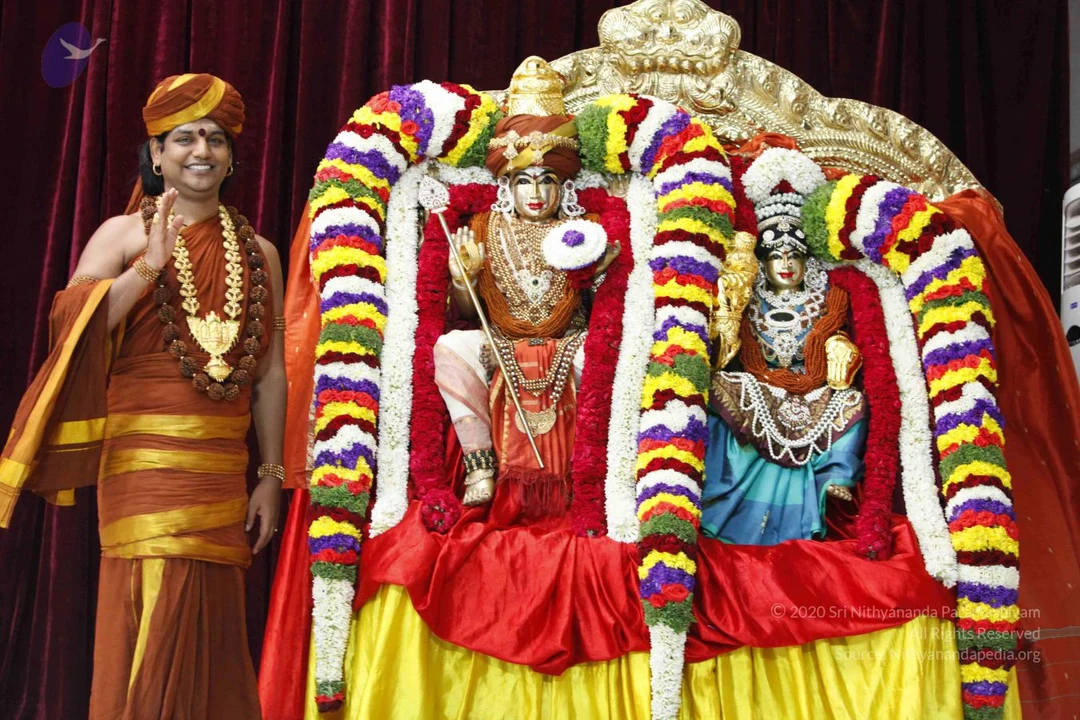
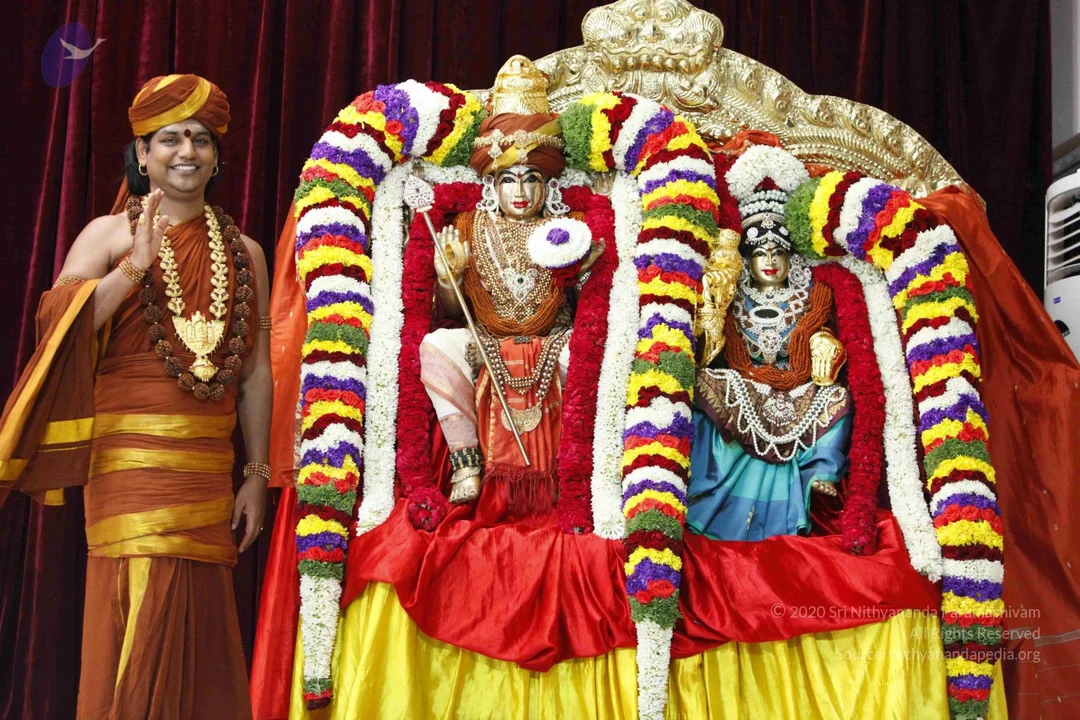
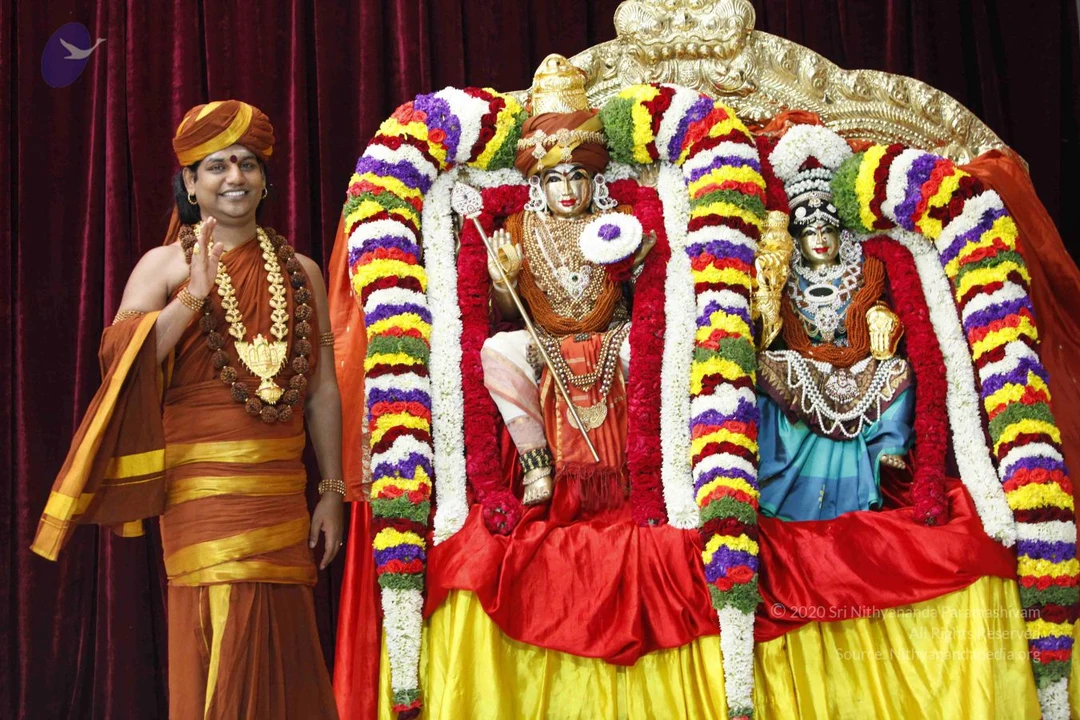
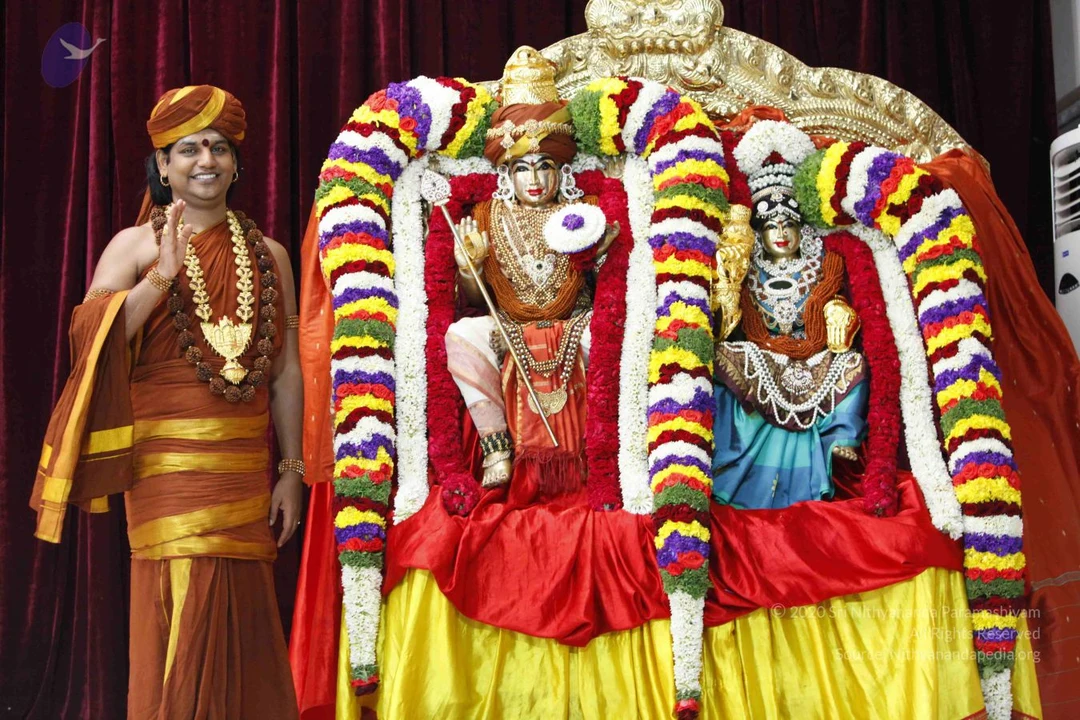
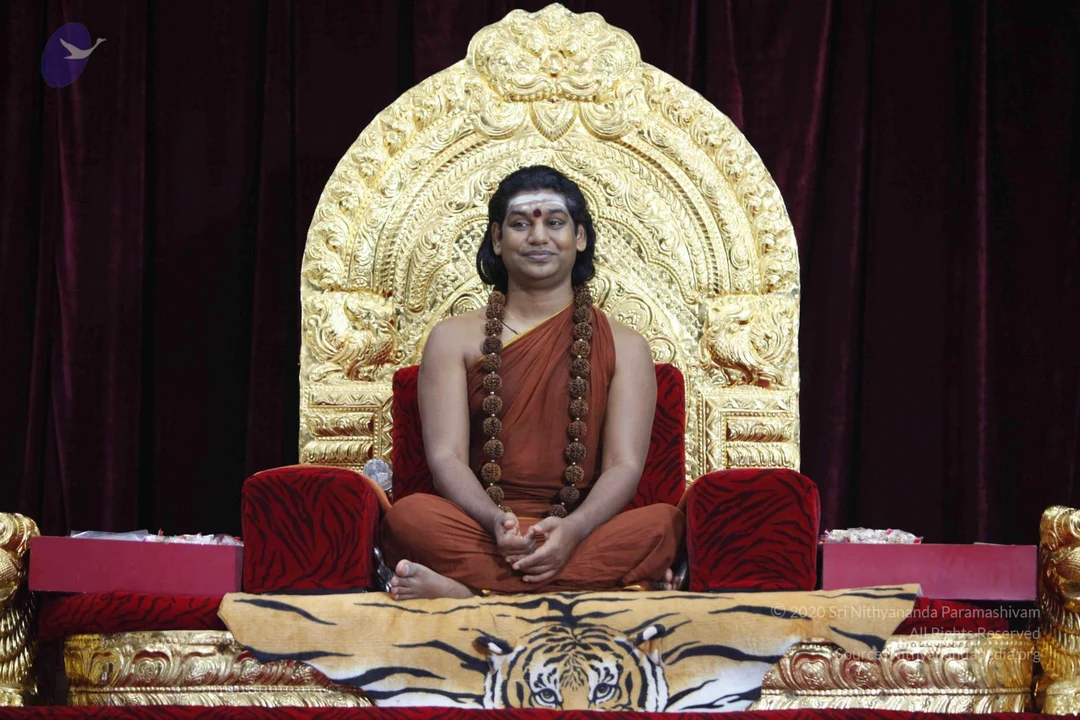
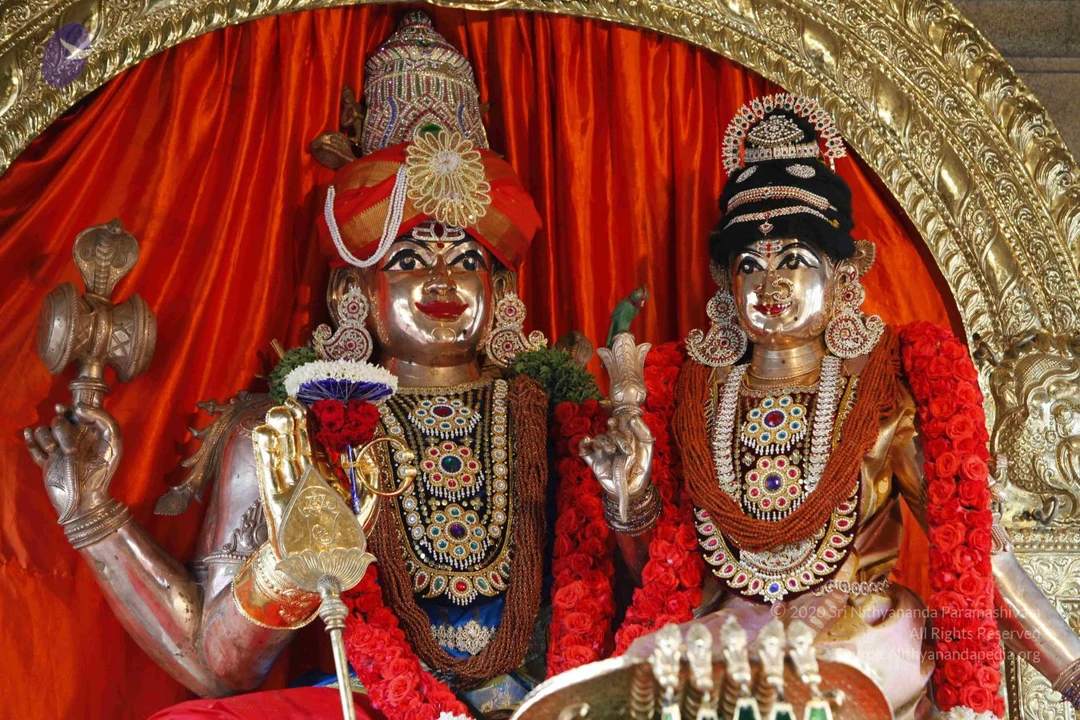
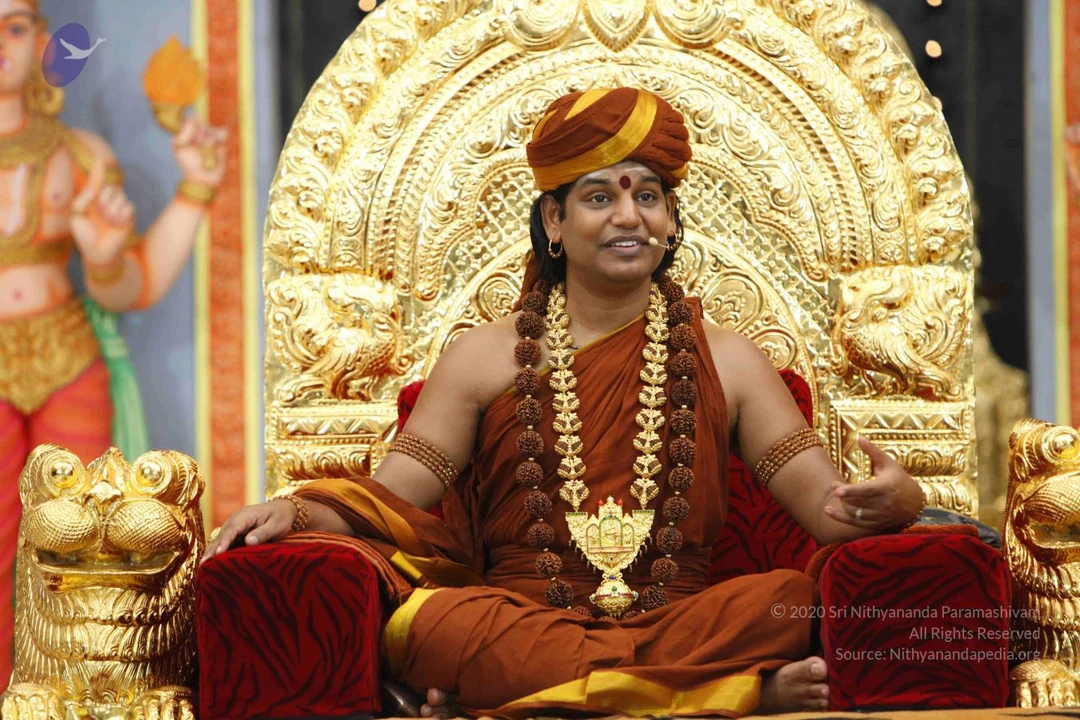
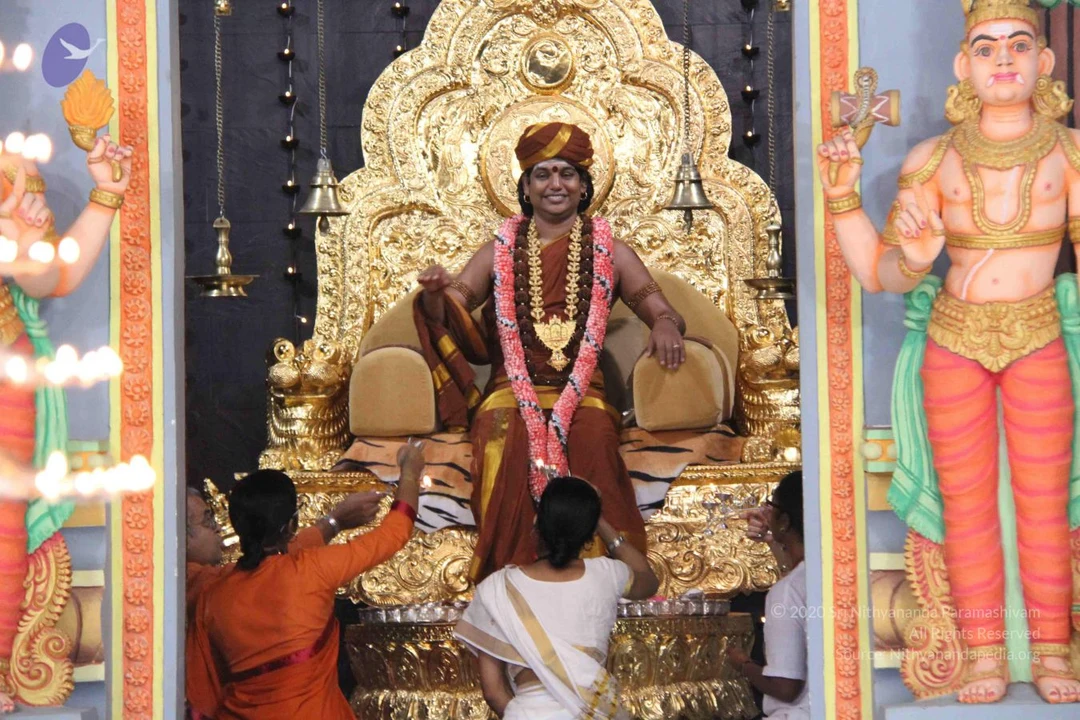
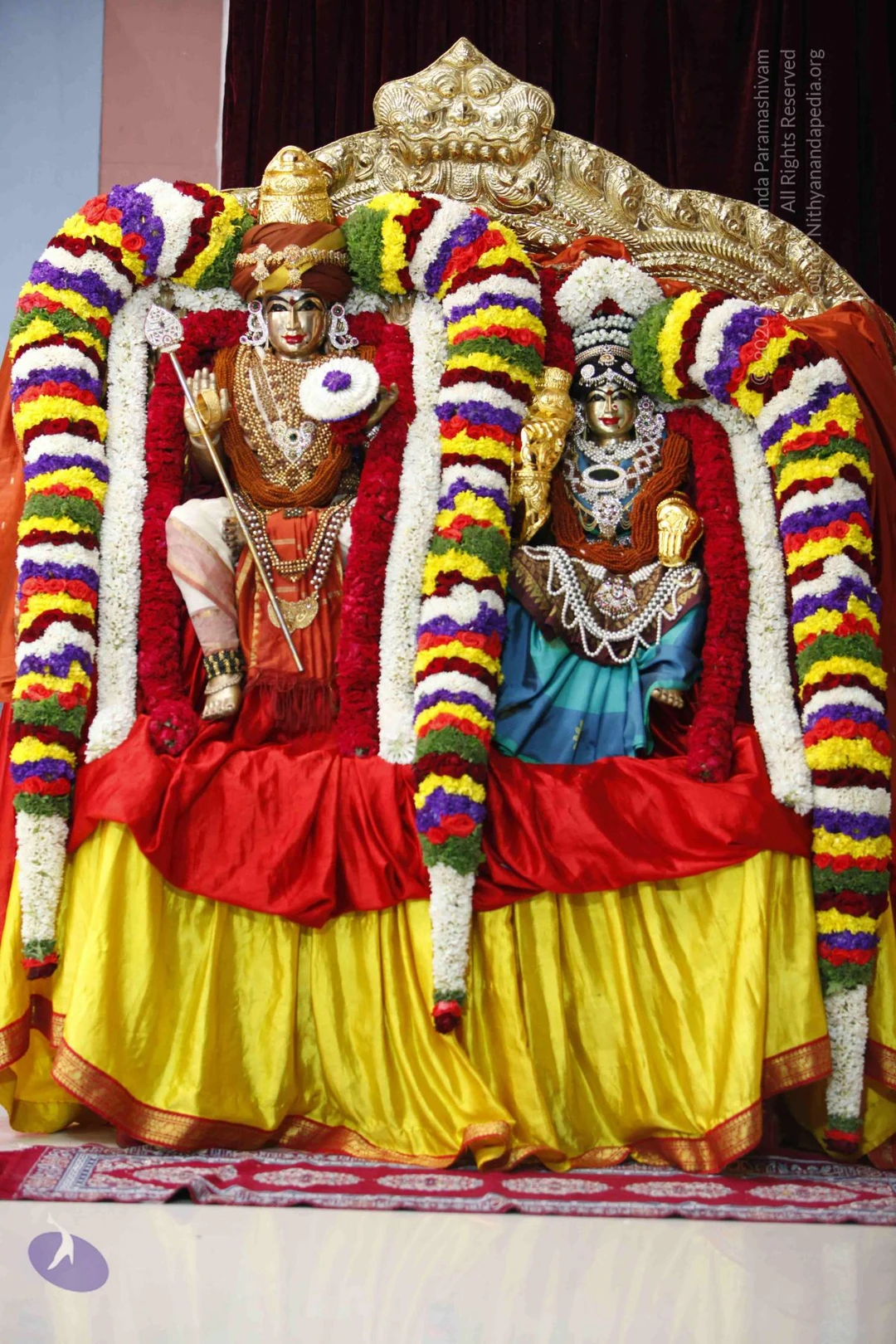
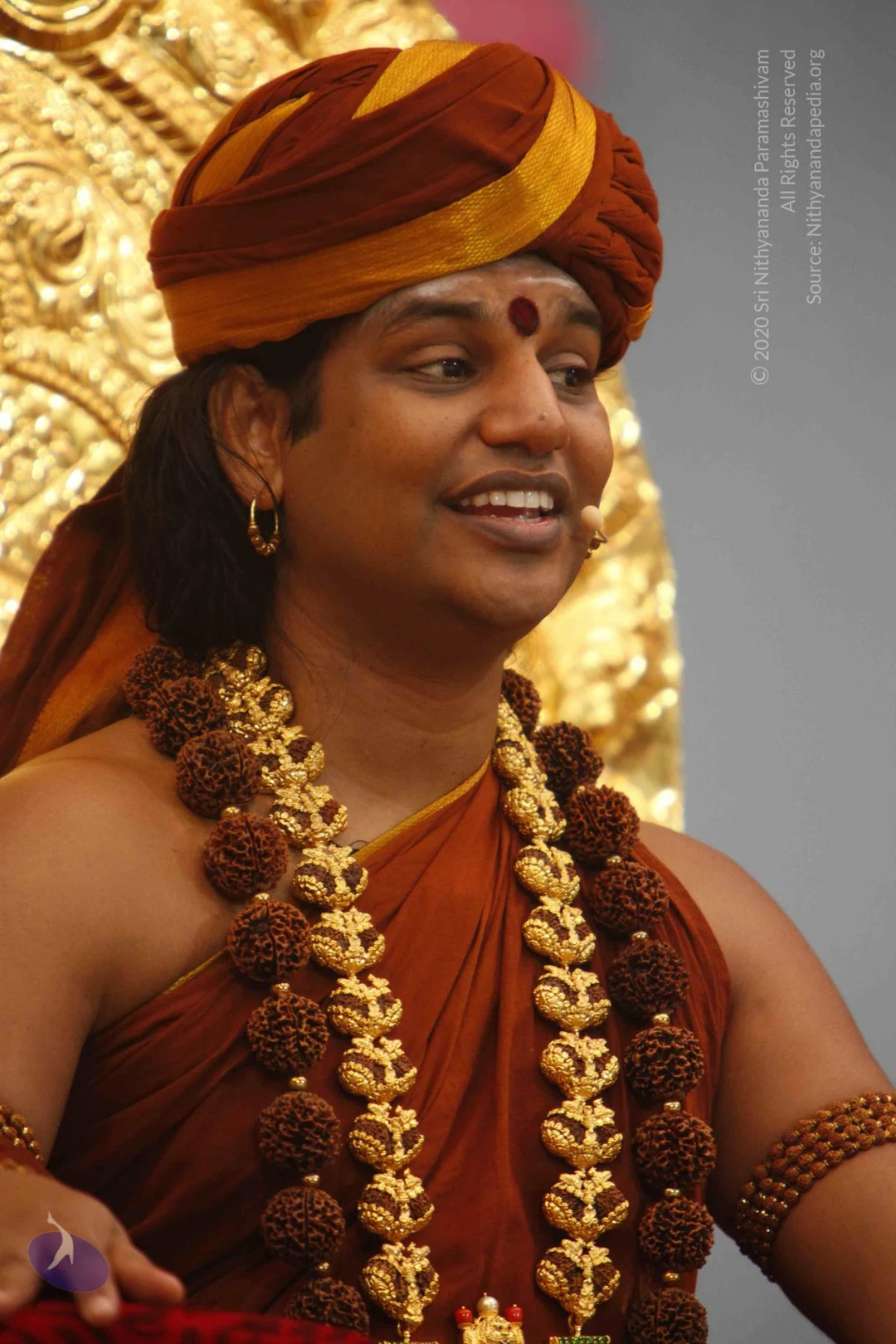
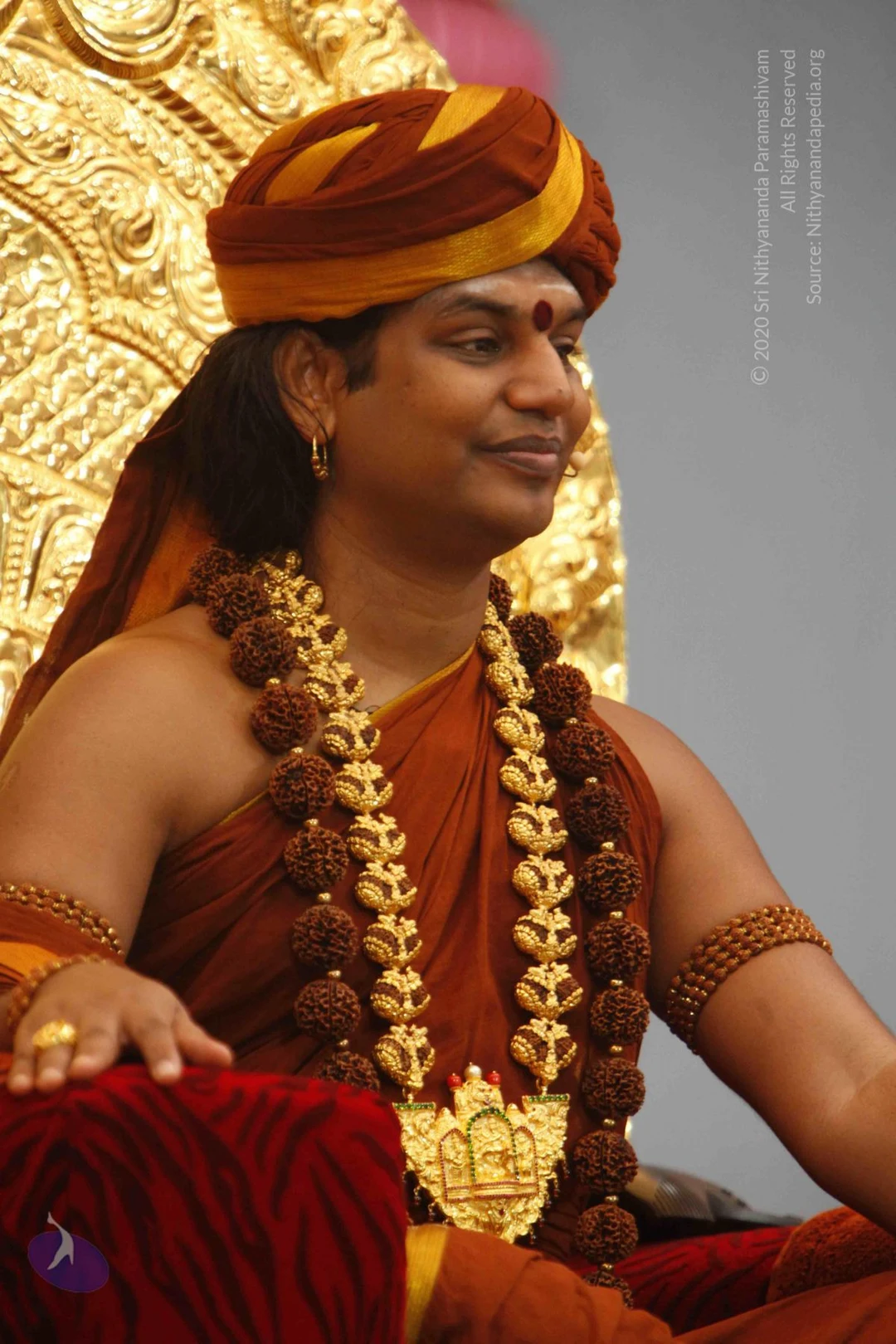
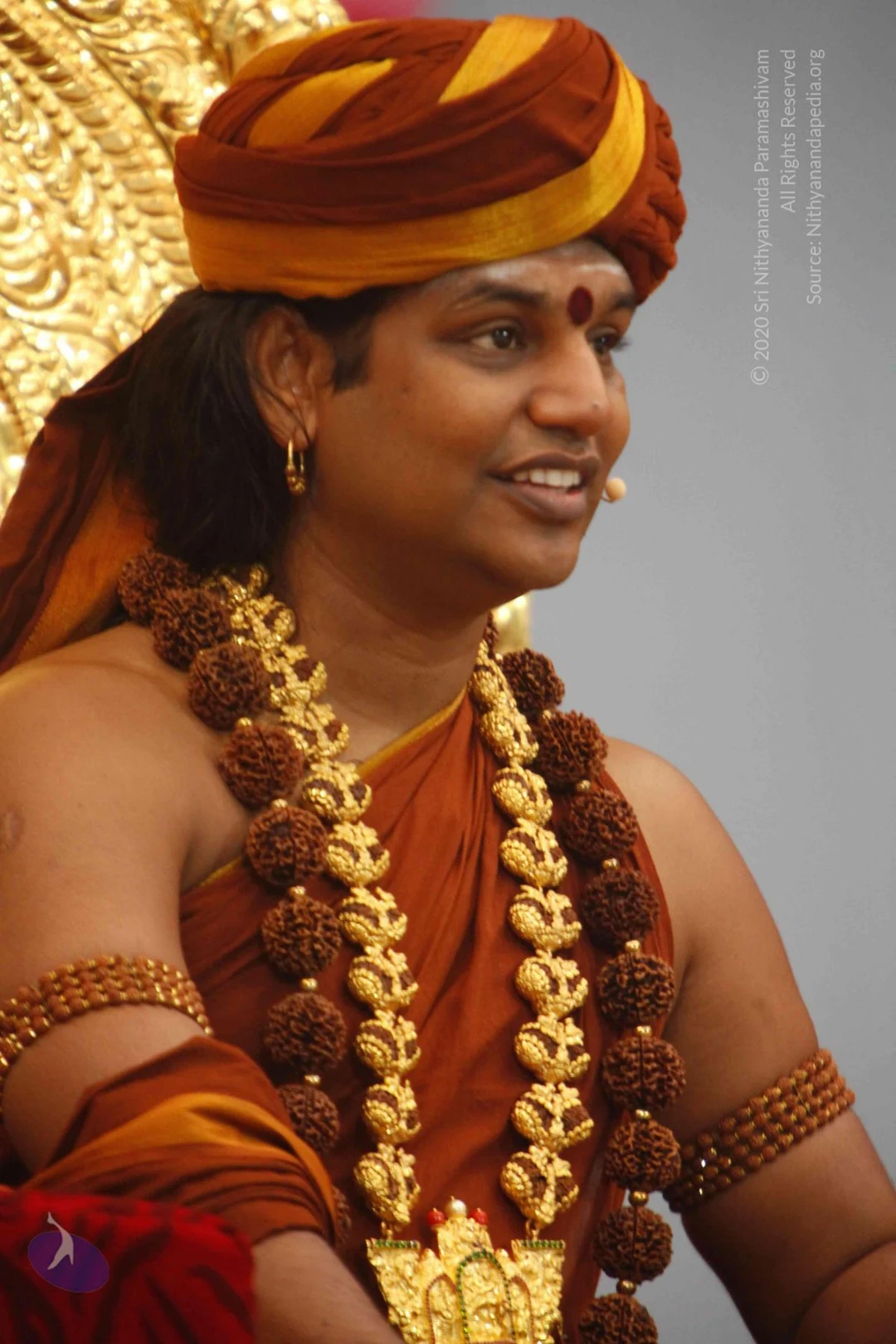
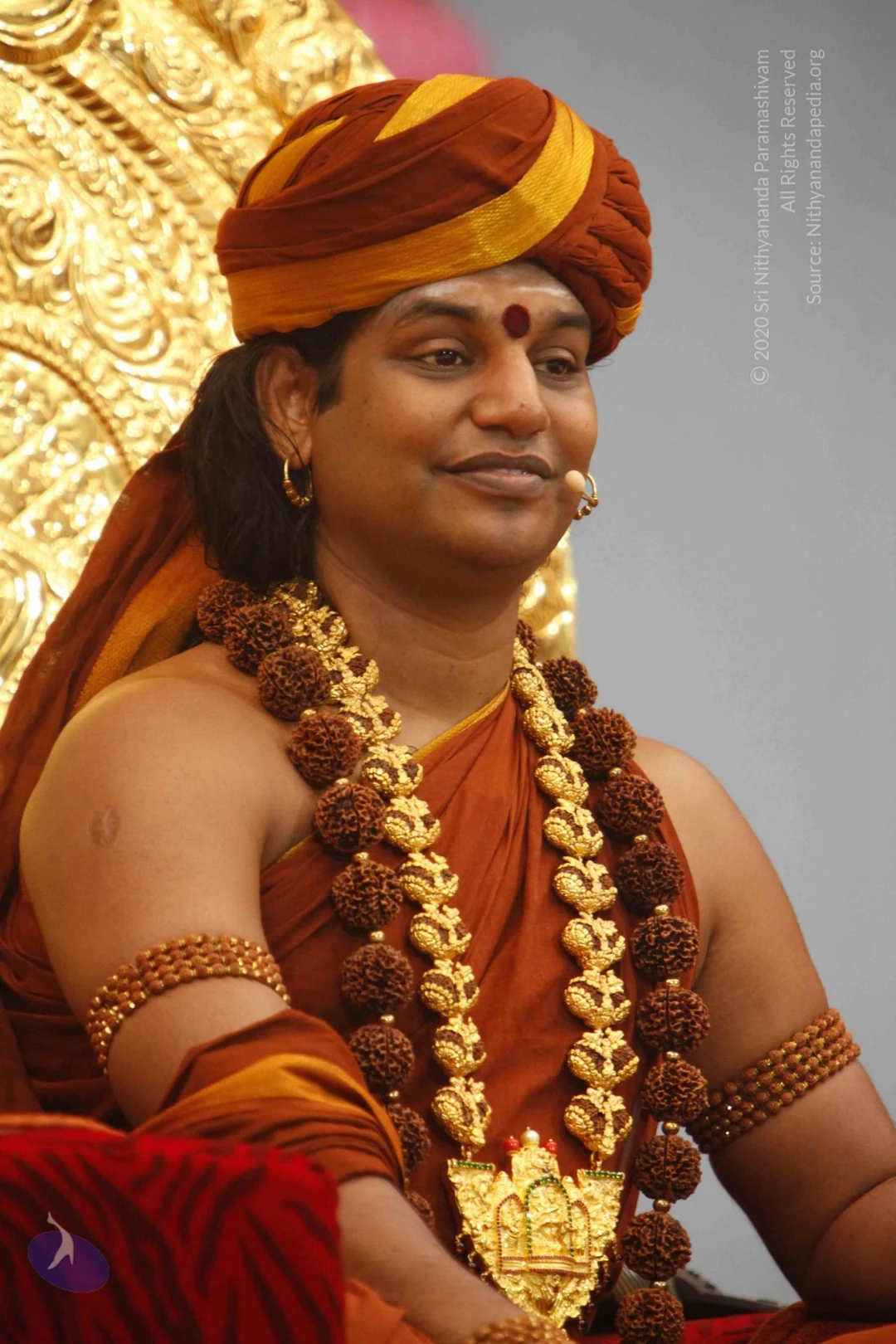
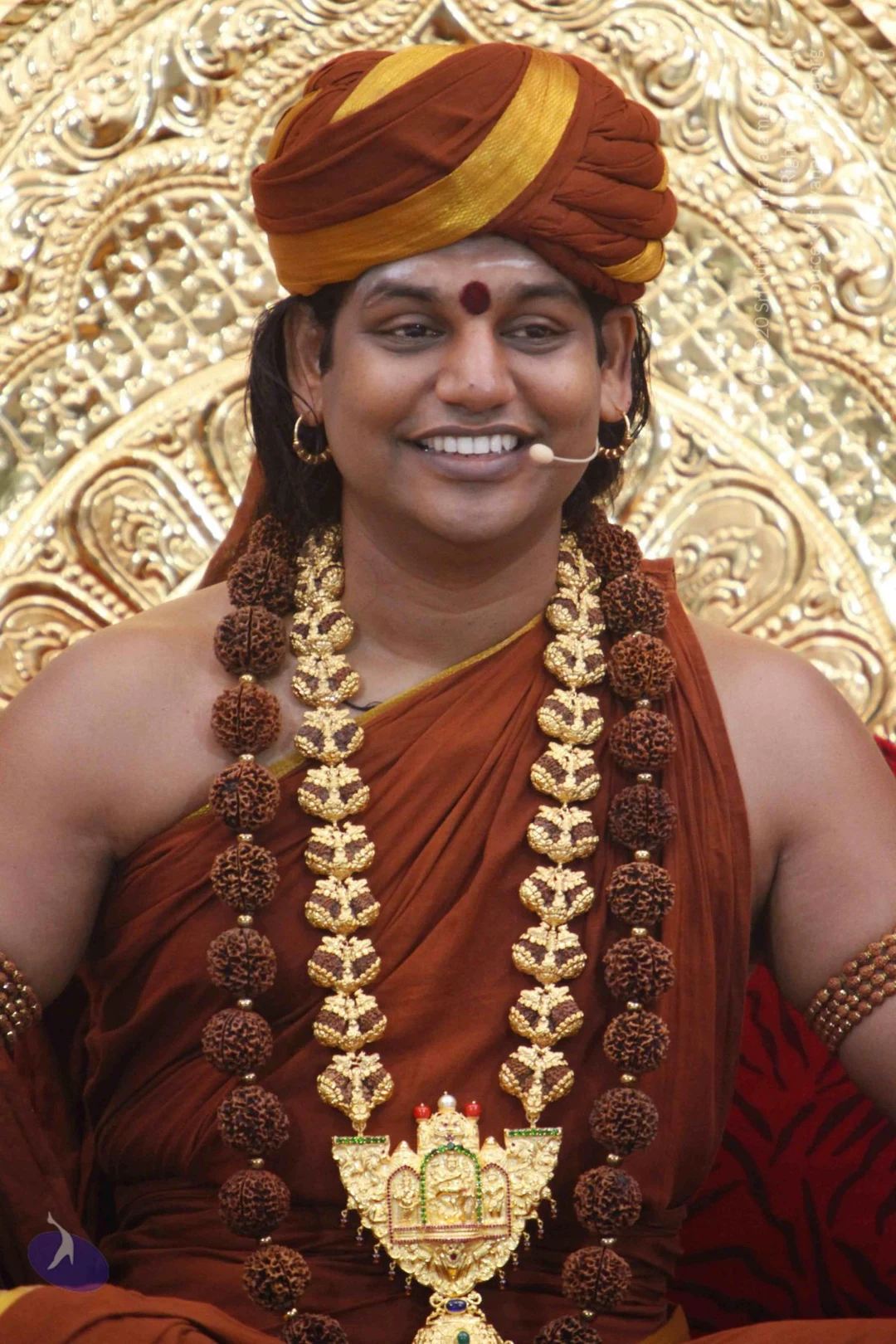
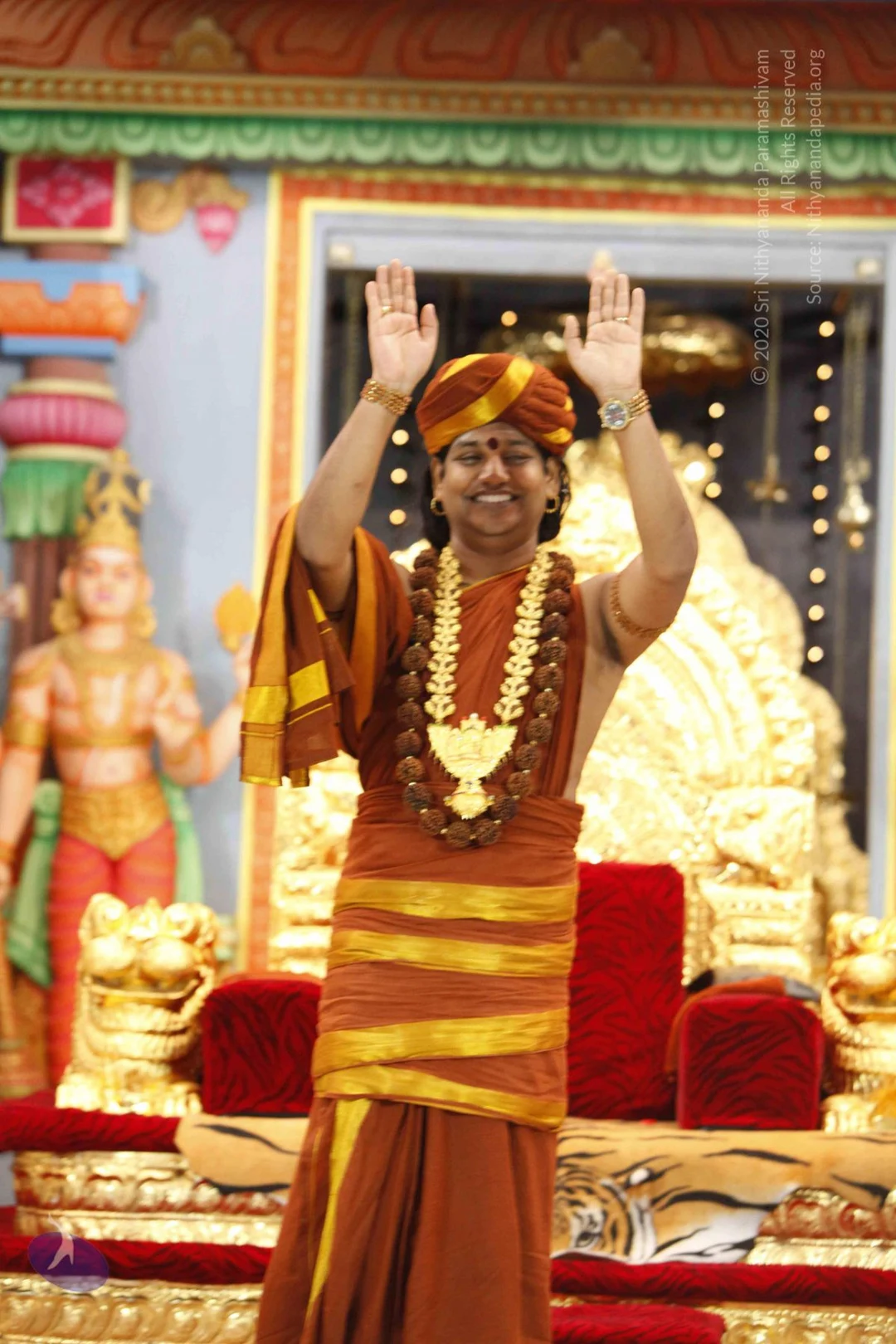
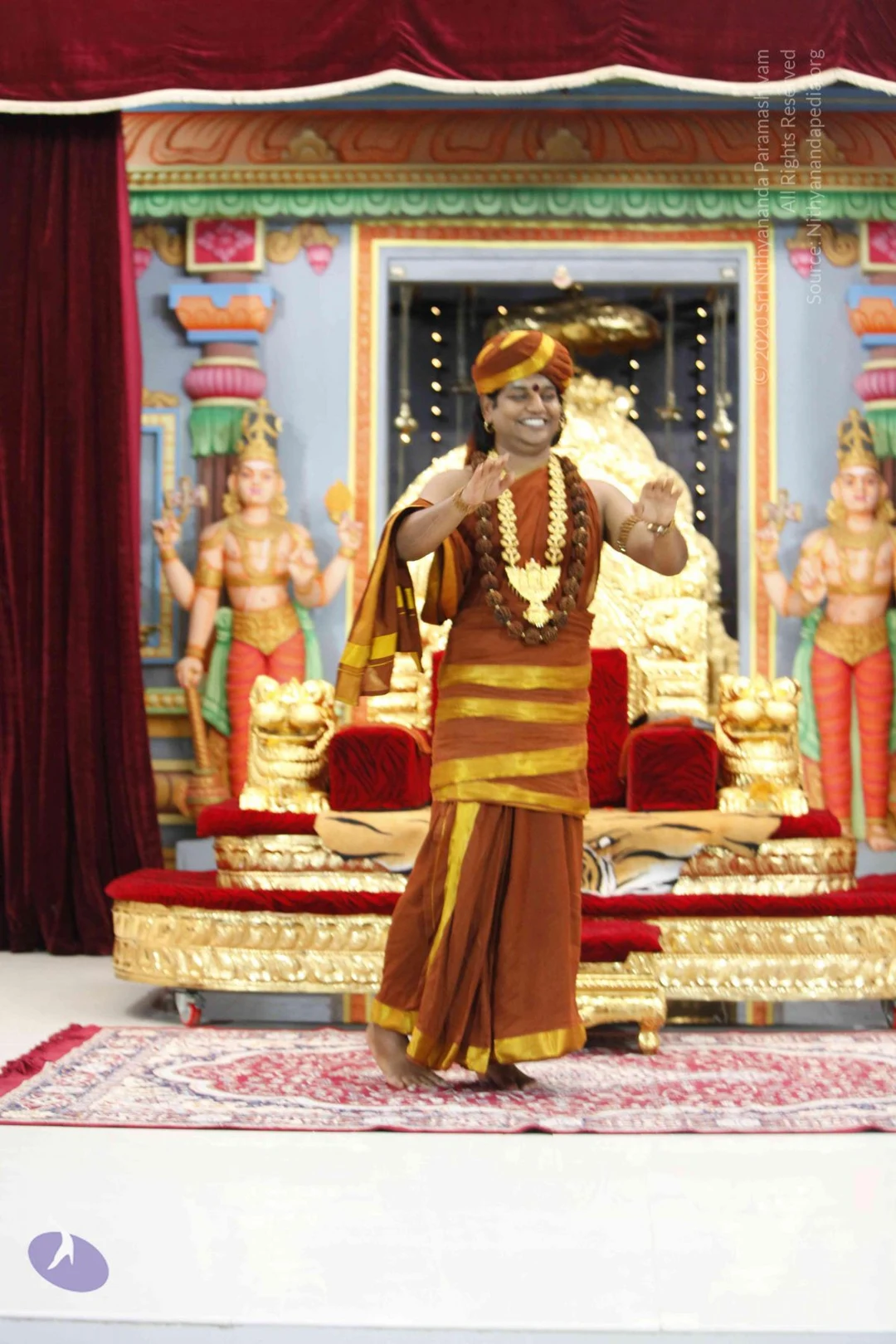
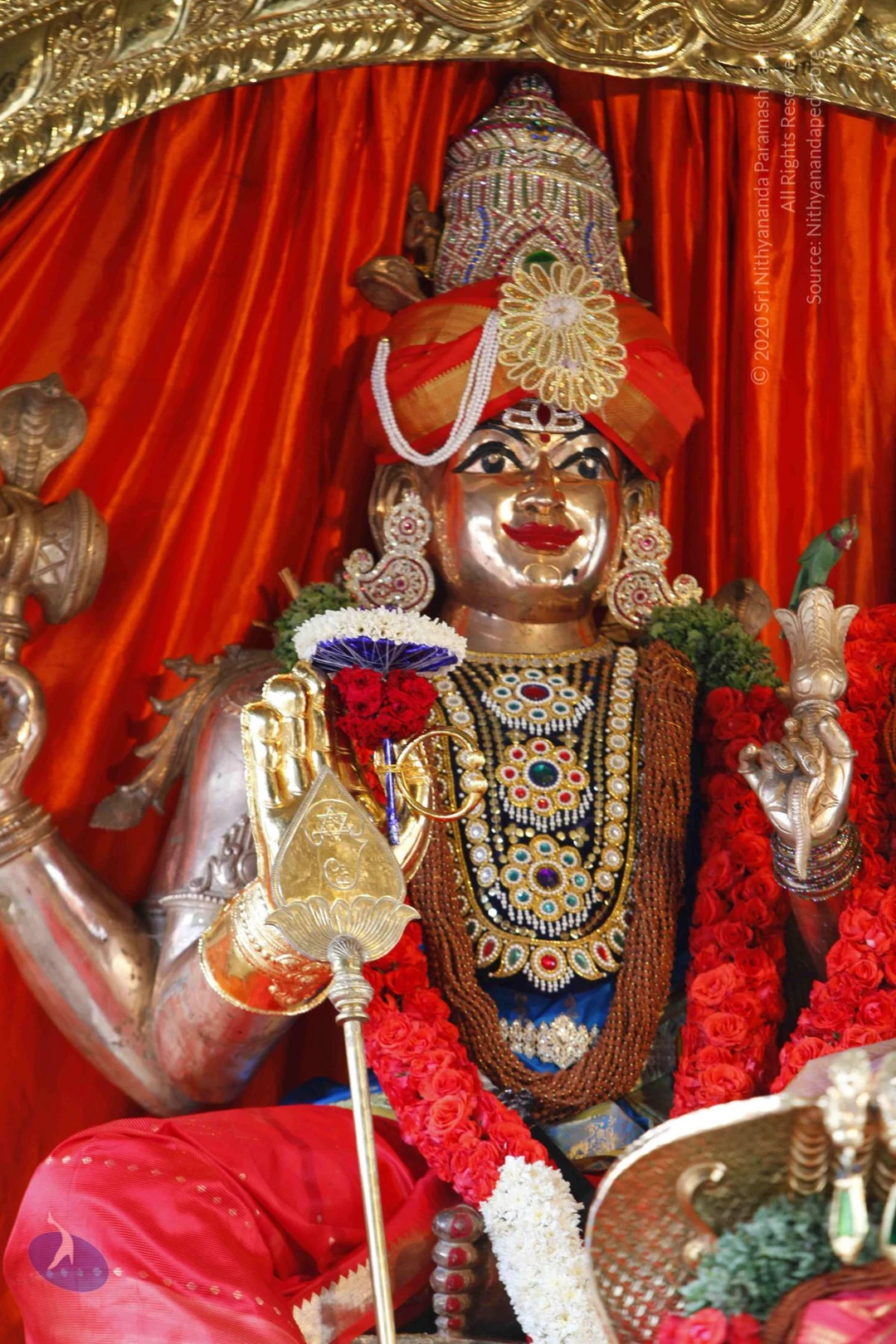
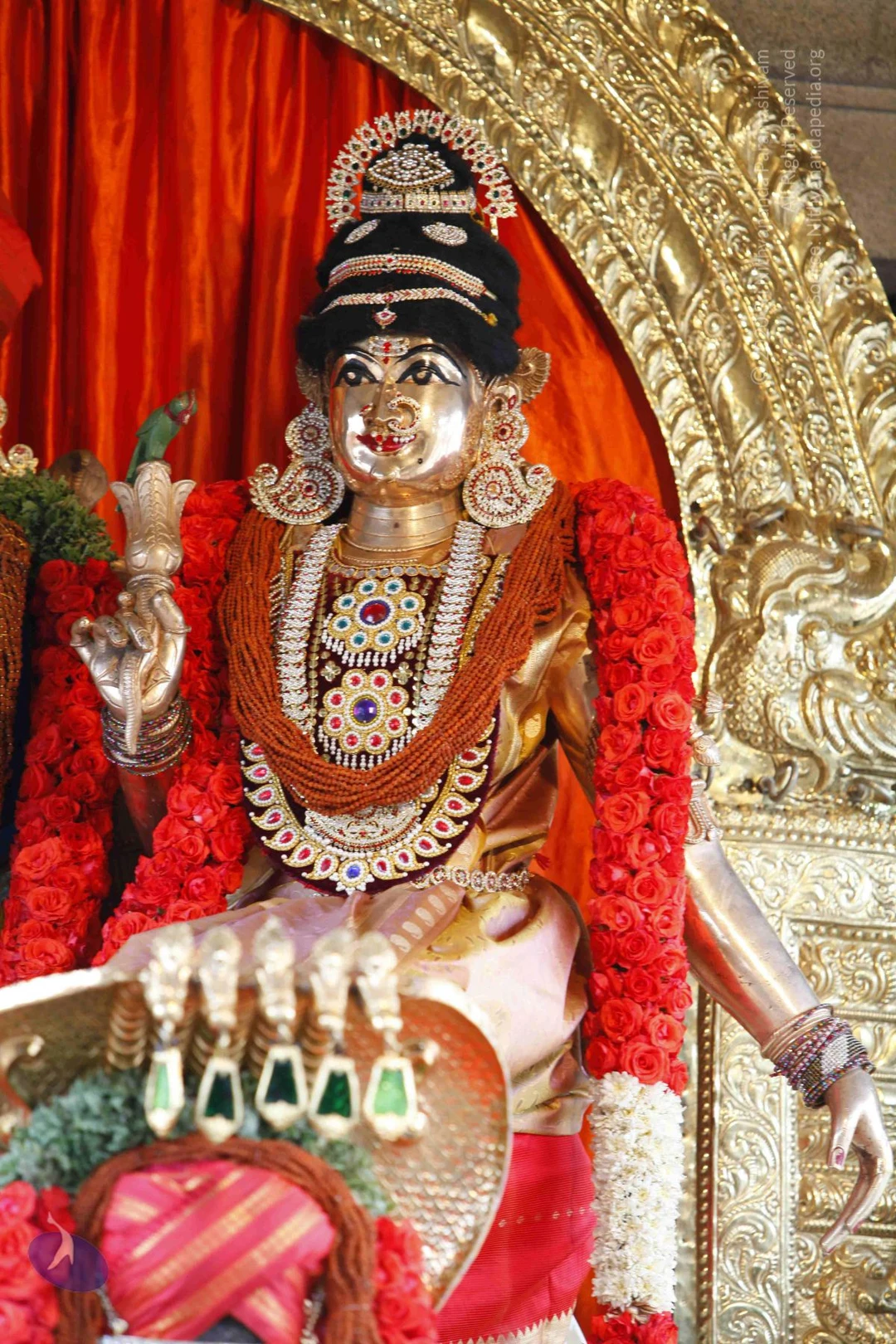
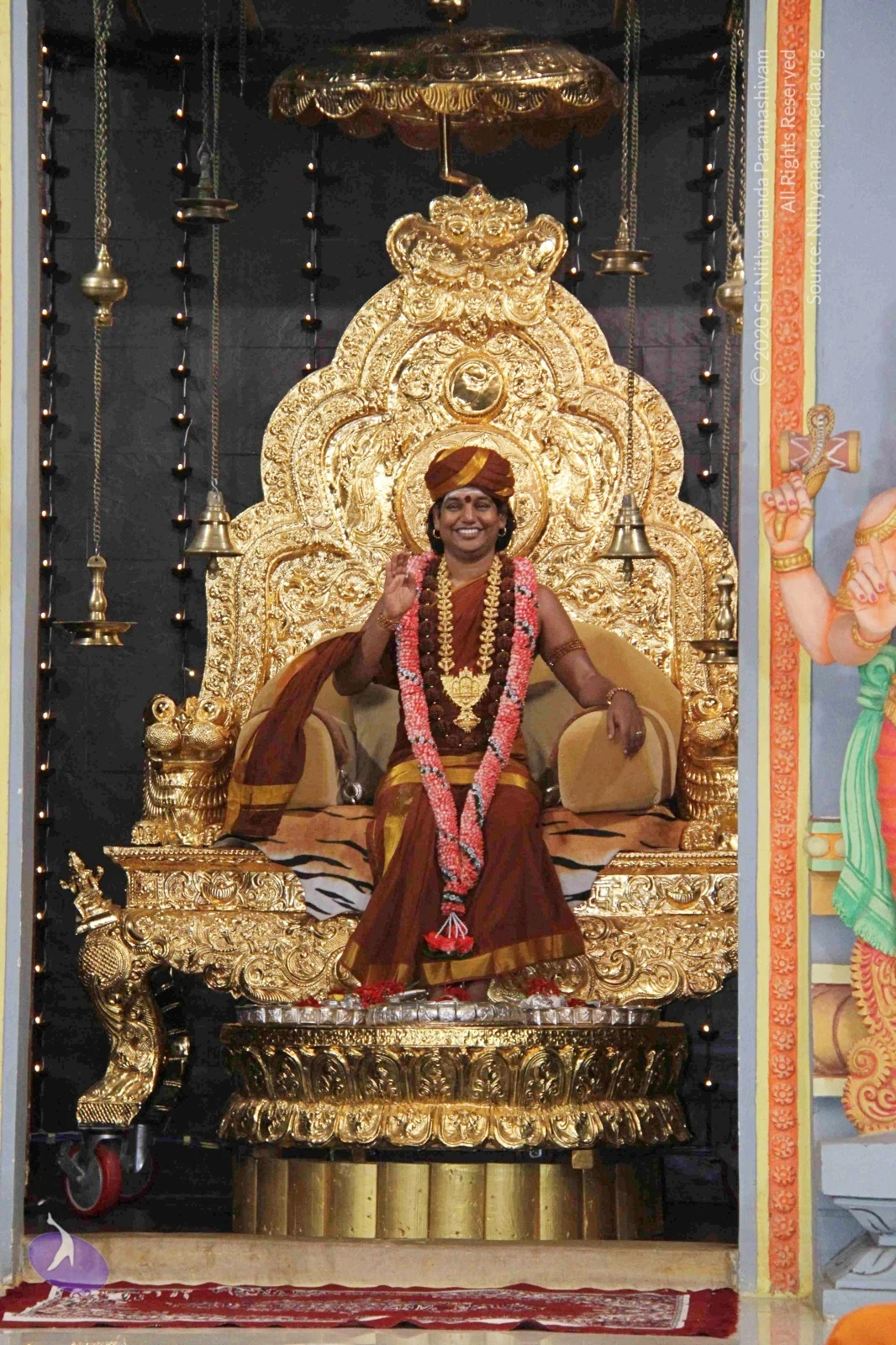
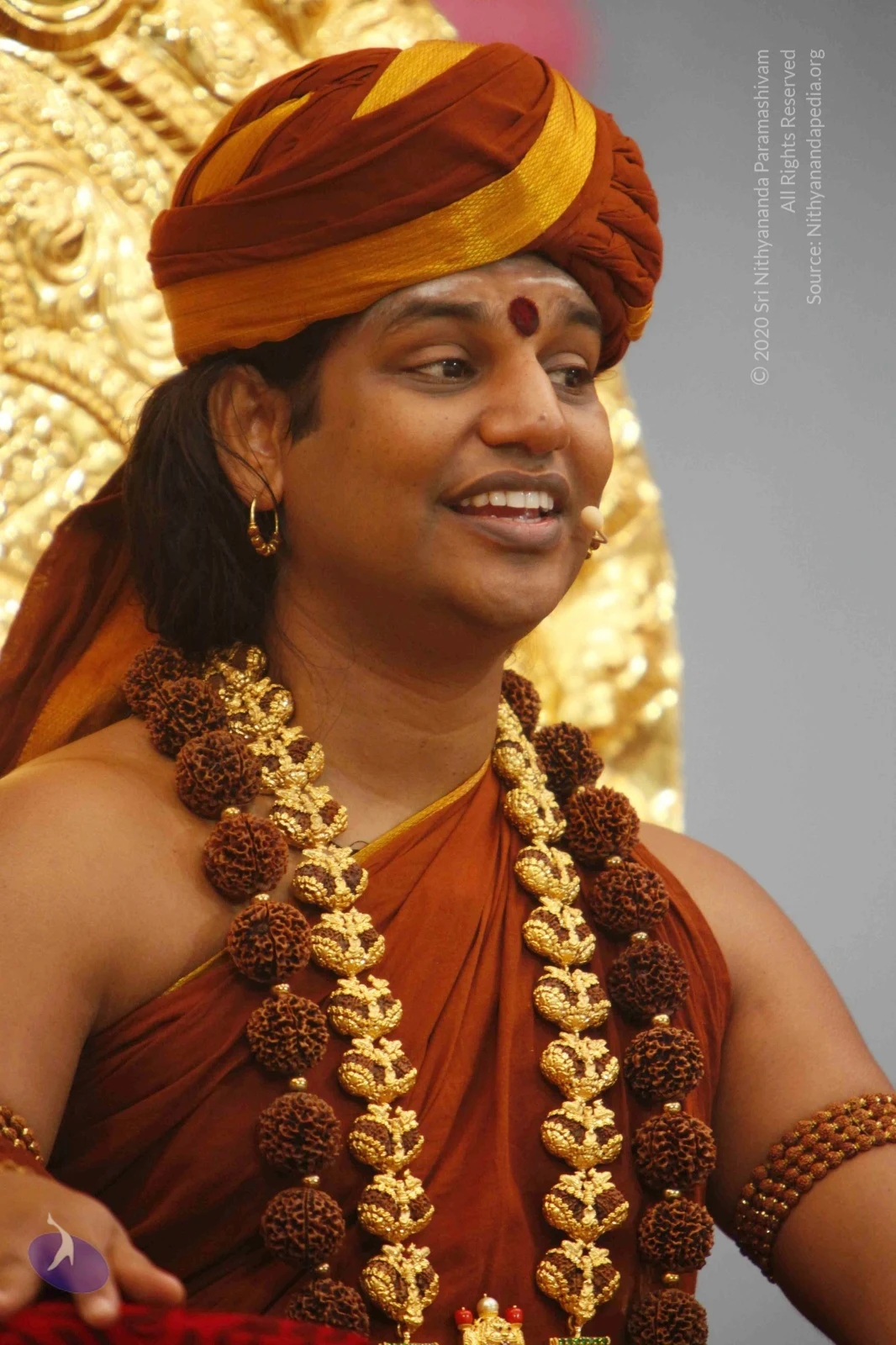
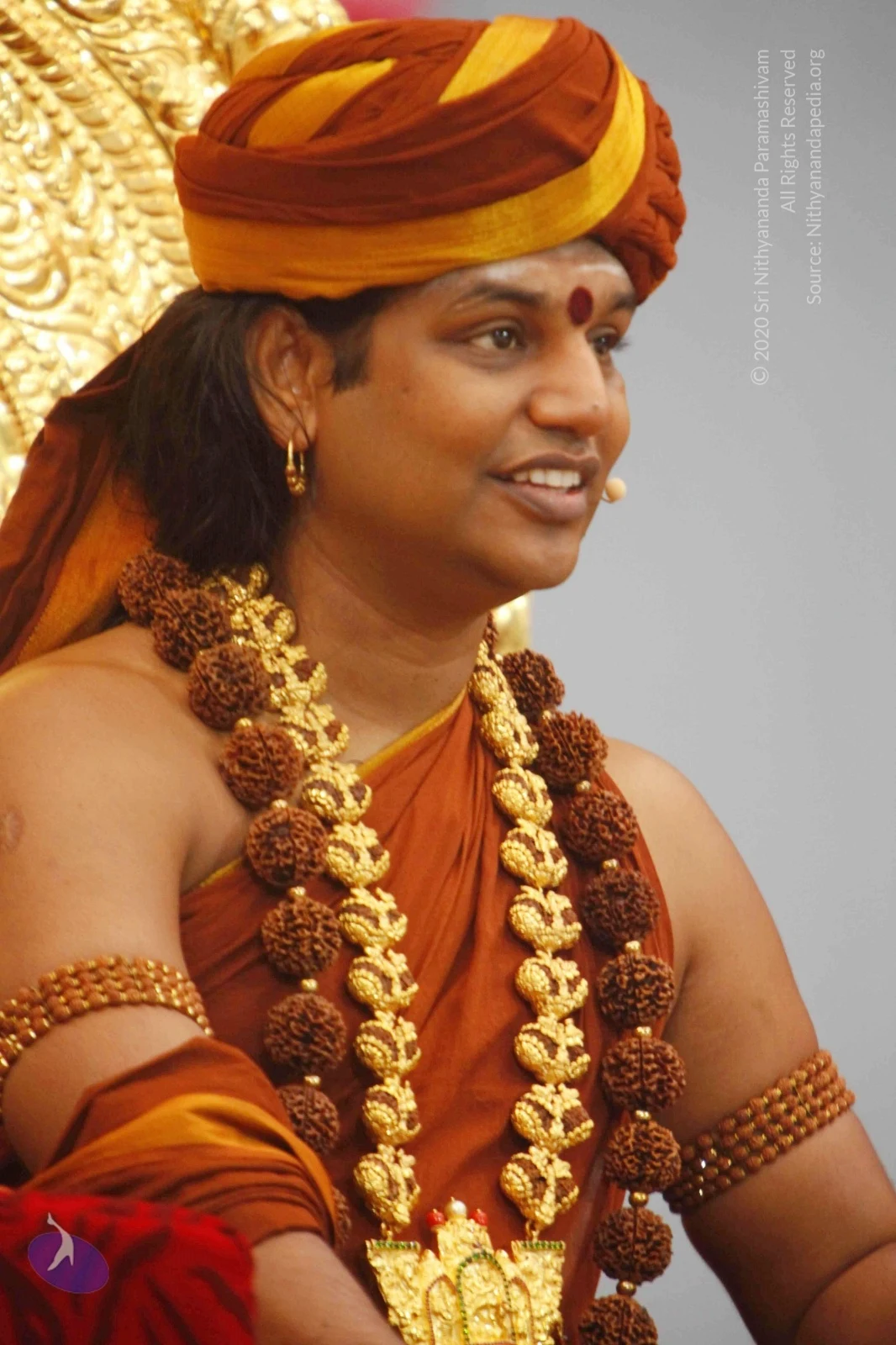
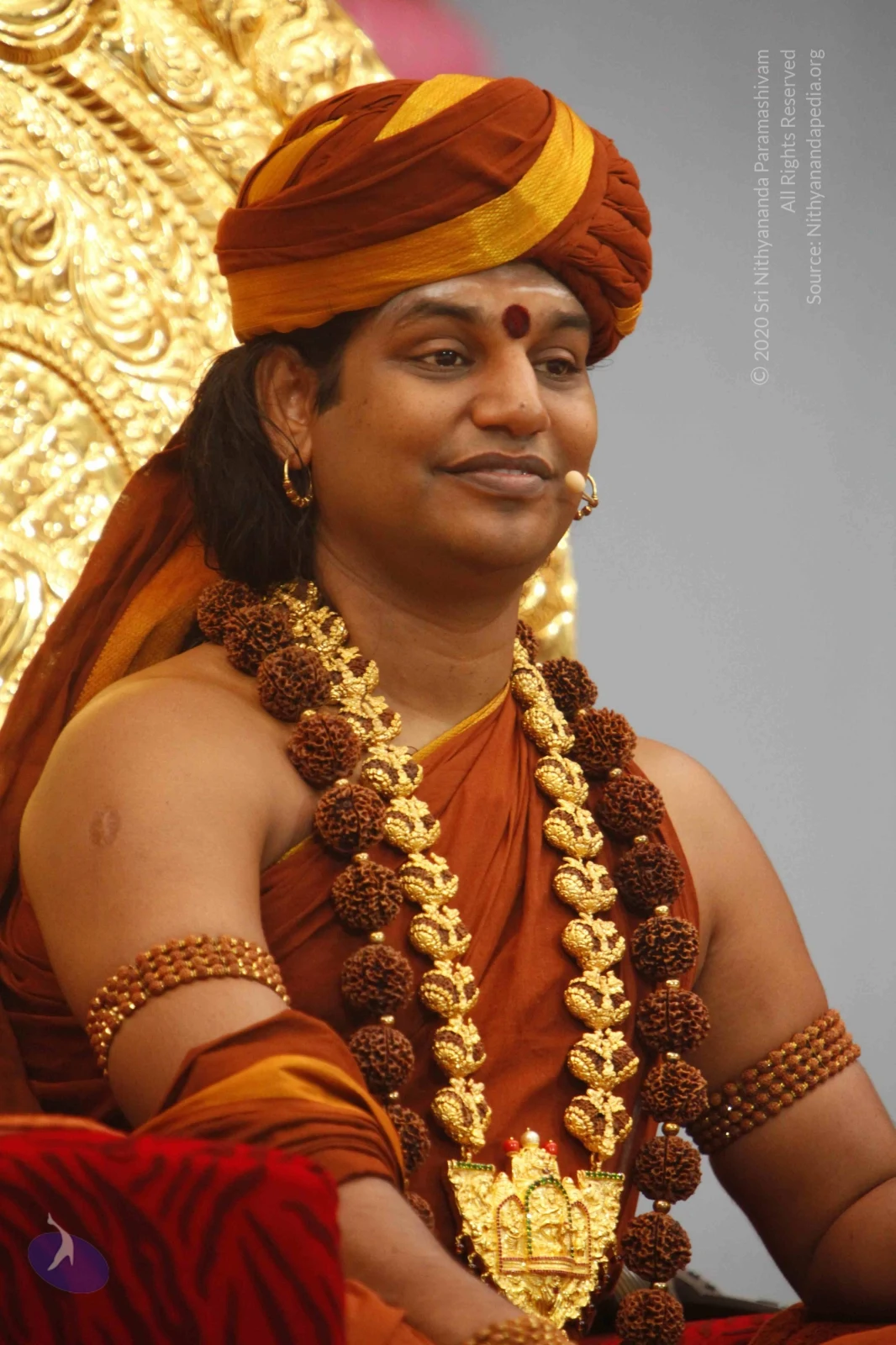
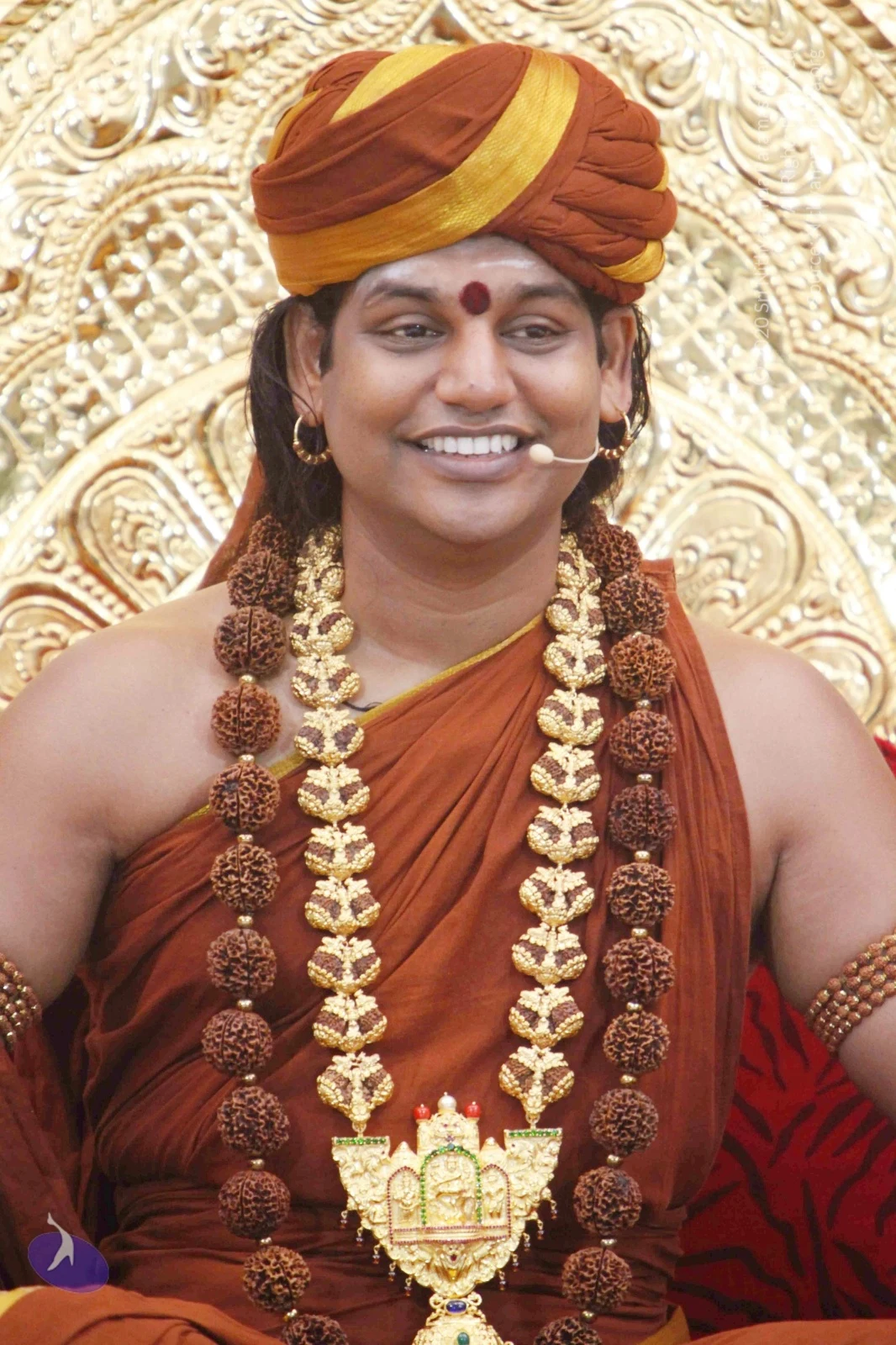
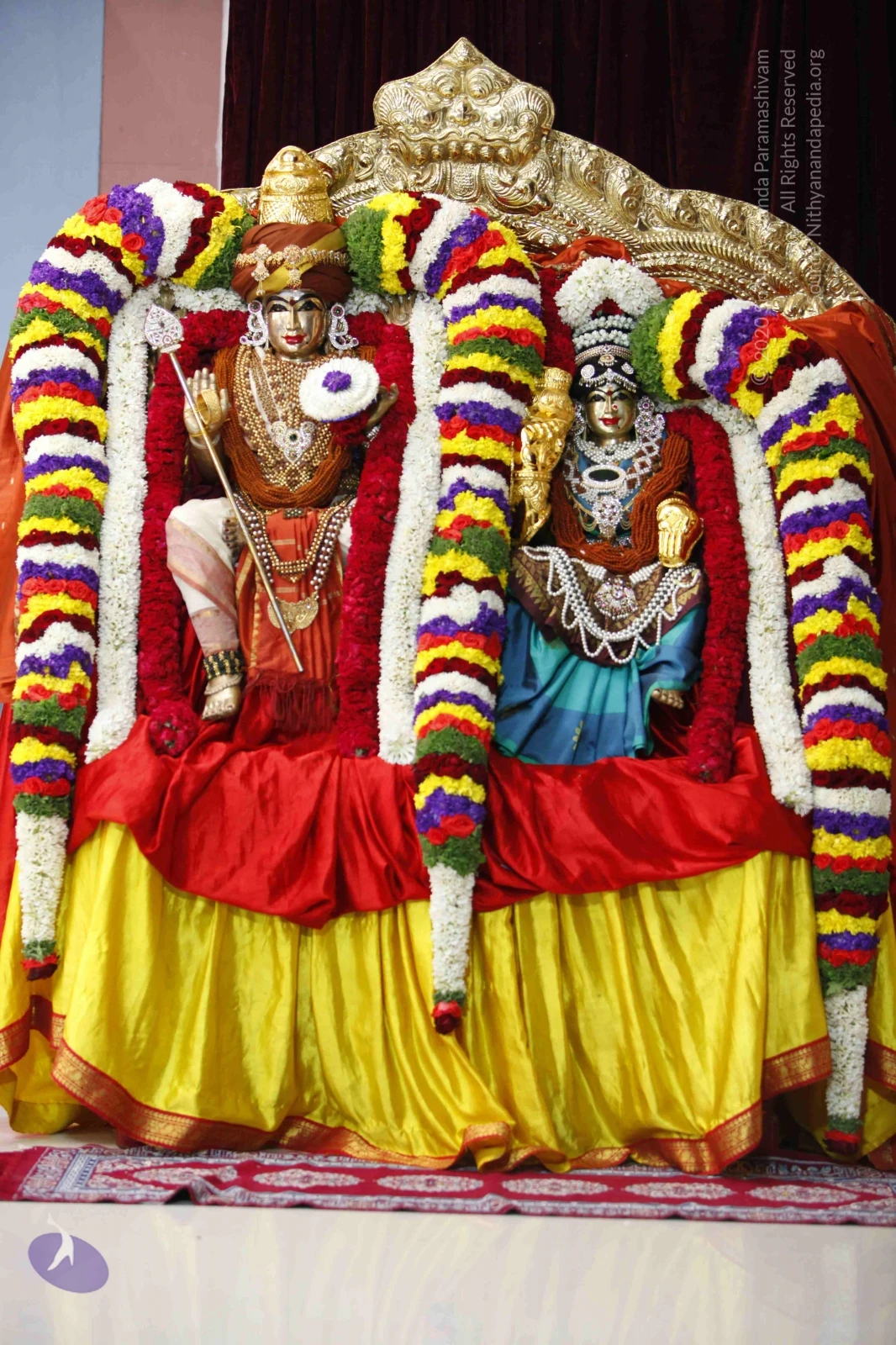
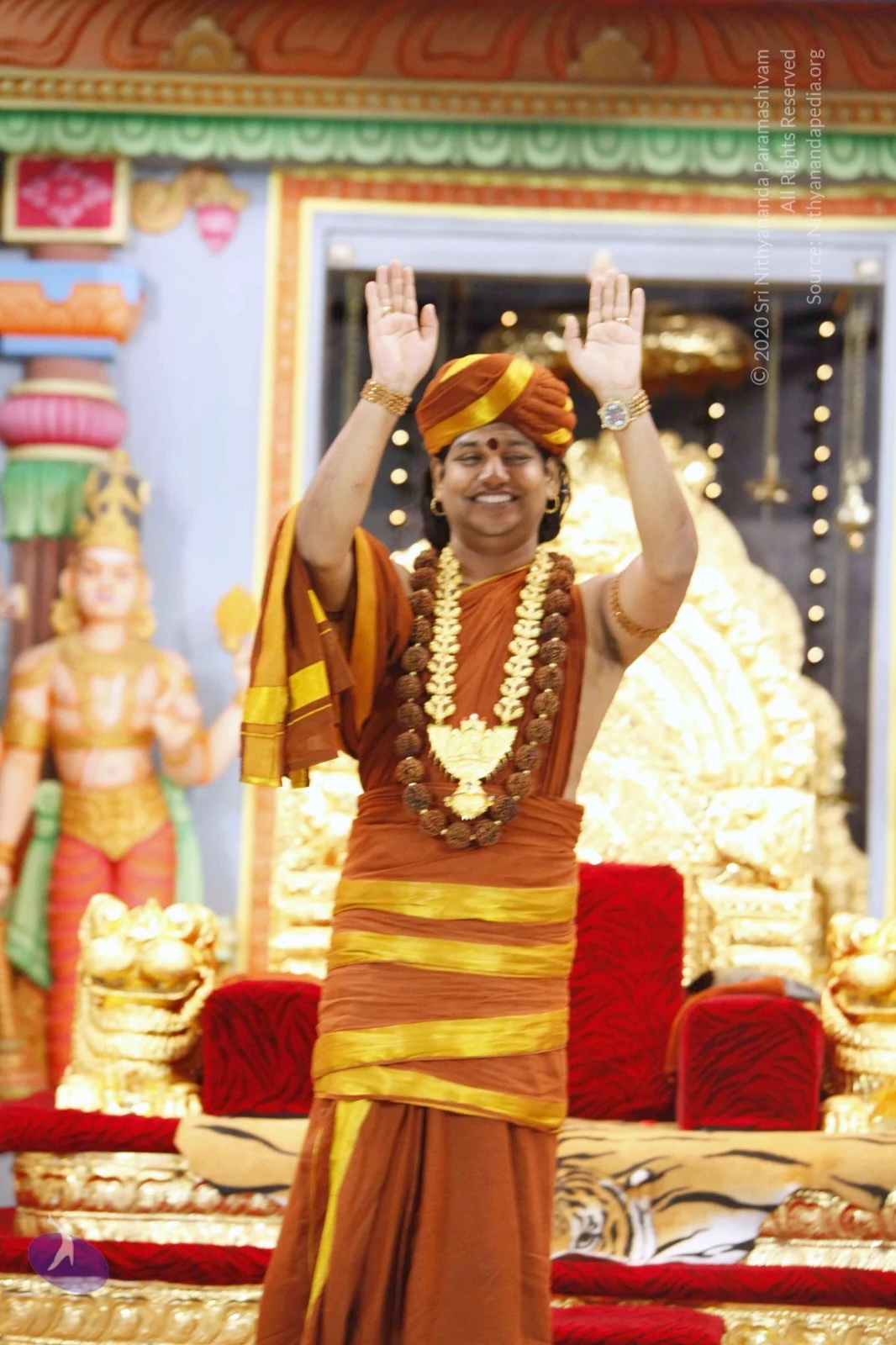
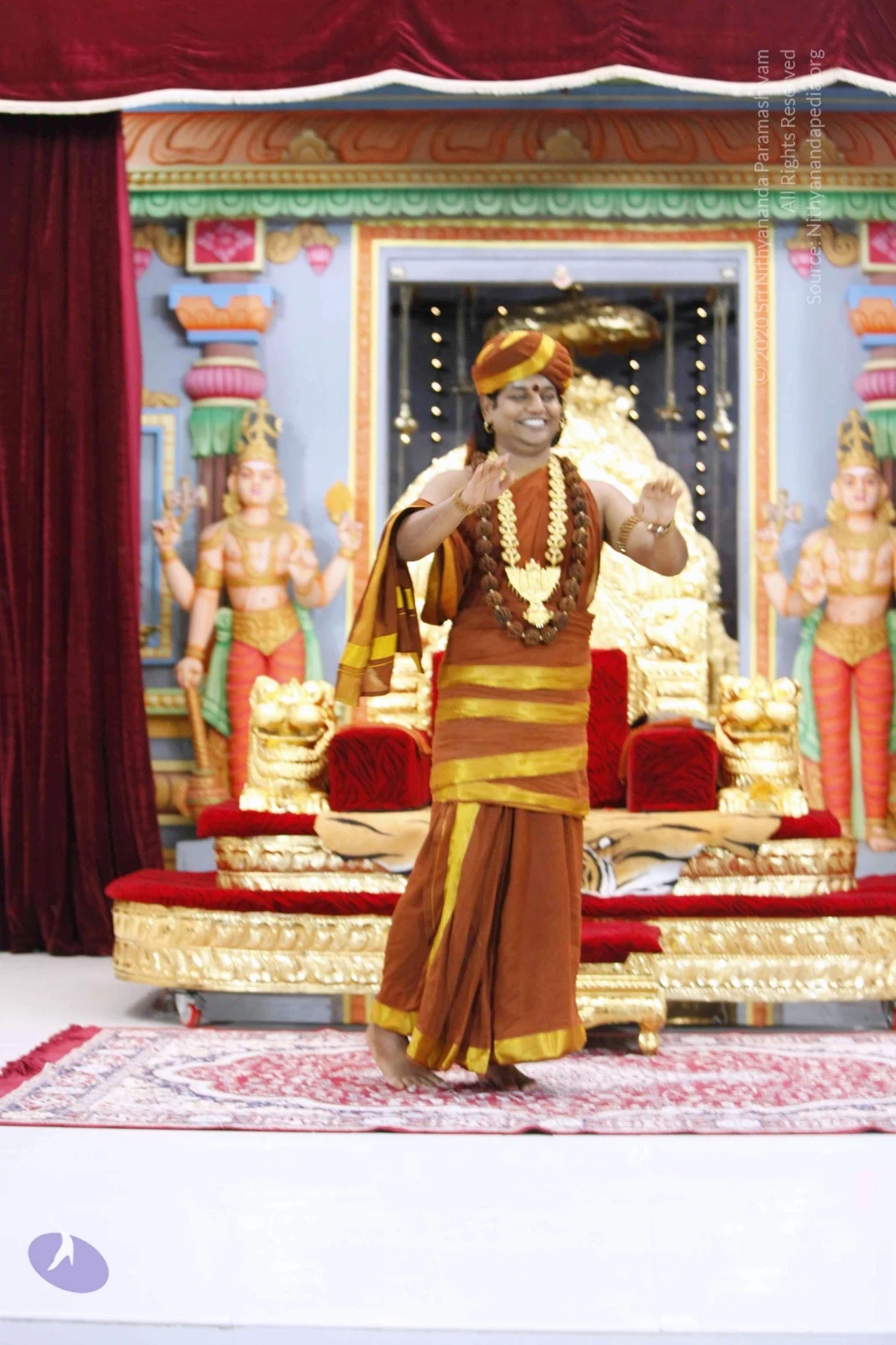
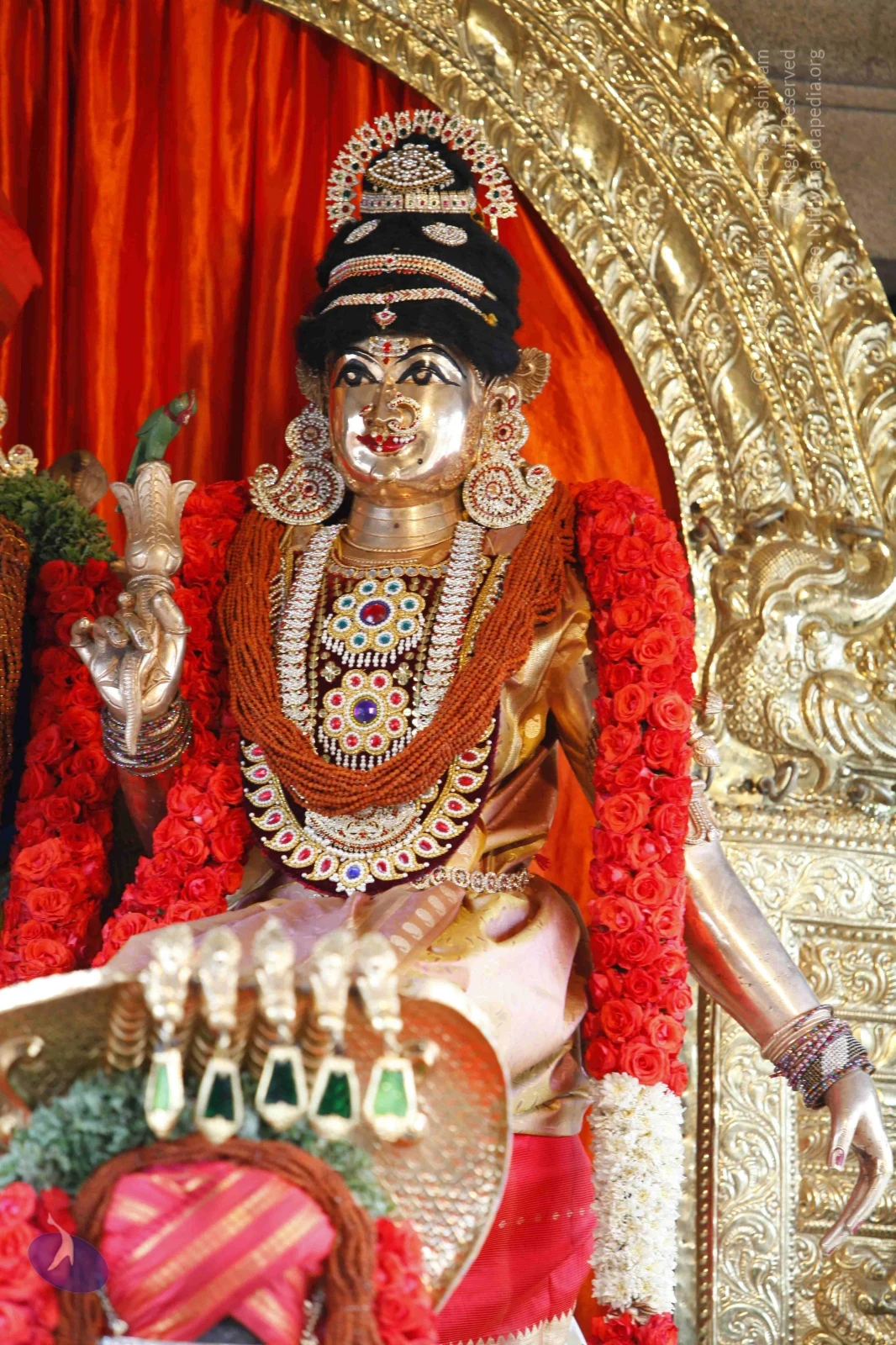
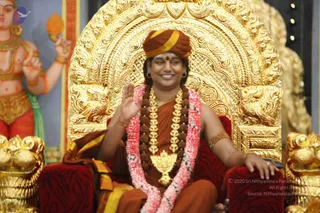
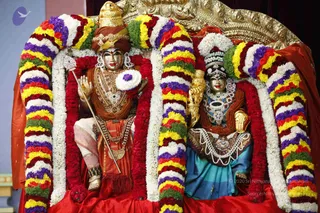
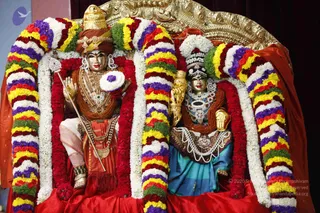
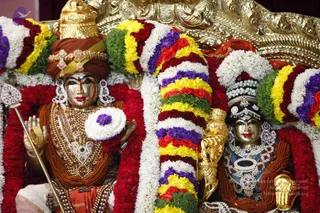
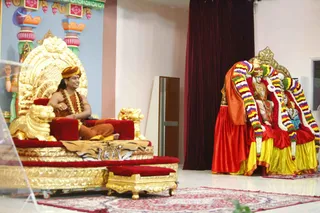
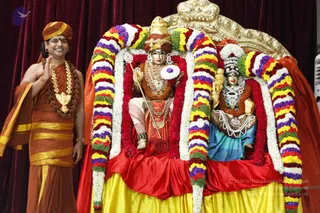
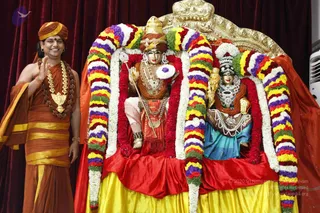
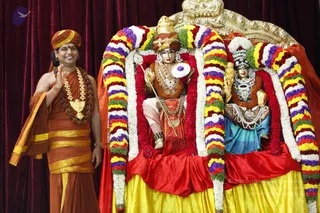
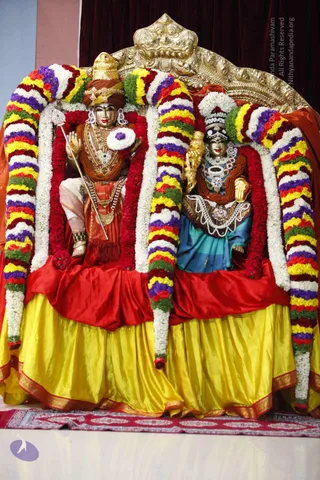
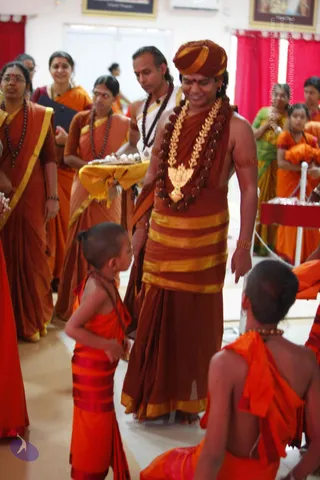
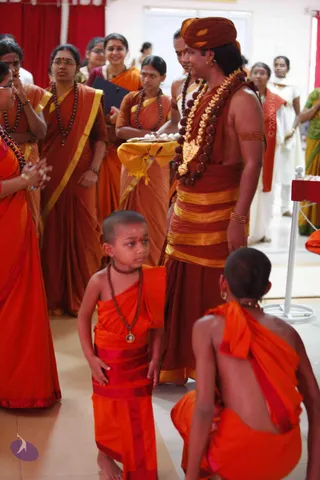
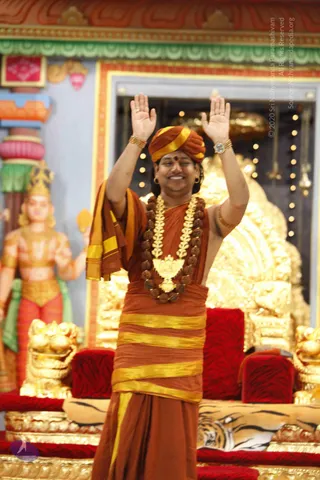
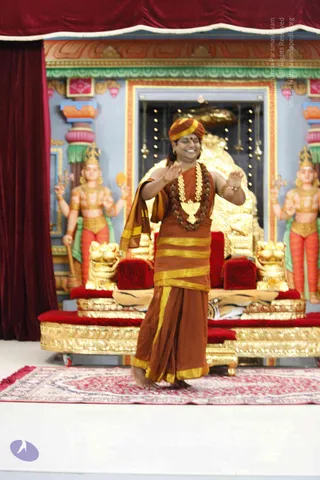
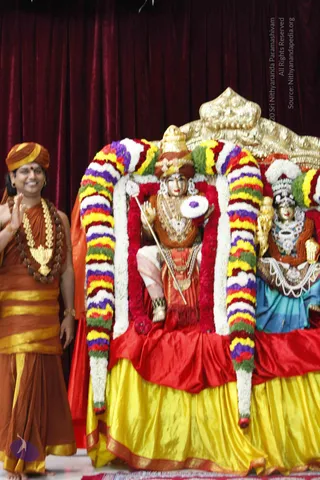
A photograph of a smiling man seated on an ornate gold throne with a carved arched back and lion-head armrests. He wears an orange-and-yellow turban, a rudraksha mala, a long pink-and-white flower garland, a gold ceremonial necklace and gold bangles, with an orange shawl over his shoulders. He raises his right hand in greeting. Behind him stands a painted deity murti holding a trident-like weapon and a flaming lamp in its hands, and gilded figures are visible at the right edge.Two gilded deity murtis sit side by side on a throne, both draped in dense garlands of white, red, yellow, purple and green flowers. The left murti wears an orange-red turban, a golden crown-like headdress, earrings, layered beaded necklaces and a rust-orange cloth, holding a golden trident-like staff and a white-and-purple flower. The right murti wears a crown of pearls and jewels, pearl necklaces, a teal-blue garment and a golden hand raised with a lotus-shaped object. Golden floral carvings frame the throne behind them. No physical people are visible.A photograph of two deity murtis (metal or gilded images) seated side by side on a red-draped throne-like seat under an arch of garlands in red, yellow, purple, green and white. The figure on the left wears a rust-orange turban, gold-and-pearl necklaces, a rudraksha-style bead mala and holds a golden staff with a jewelled tip. The figure on the right wears a dark crown, pearl necklaces and a teal-blue garment. A golden kalasha-style ornament sits between them. No living people are visible; the image shows a decorated alankara of the murtis for worship.A photograph of two decorated deity murti seated side by side on a red draped platform beneath a golden arched backdrop, framed by an arch of garlands in red, white, yellow, purple and green. The figure on the left, in an orange-red turban and gold ornaments, holds a staff and a white flower-decorated object; beside him a figure in a dark crown, pearl and gold necklaces and a teal-blue sari holds a gold-tipped object. Both wear layered jewelry, rudraksha-style beaded necklaces and gold ornaments, with no living people visible.Two golden deity murtis, a male and a female form, seated side by side on a gilded throne with an ornate gold backrest. The male murti wears a rust-orange turban with a gold headpiece, large silver earrings, a rudraksha-style bead necklace and a gold pendant, and holds a trident in one hand. The female murti wears a dark headpiece with a pearl-studded crown, pearl necklaces and a gold armlet. Both are heavily decorated with garlands of roses, marigolds, purple flowers and white jasmine in red, yellow, purple and green bands. A gold kalasha-style finial stands between them.A seated man in an ornate gold throne with red cushions and a tiger-skin rug sits at left, wearing an orange saffron-coloured cloth, an orange turban, a long beaded necklace and a rudraksha mala, smiling. Beside him on the right stands a deity murti dressed in a red and orange cloth with a yellow skirt, draped with multicoloured flower garlands and wearing ornaments, set against a red curtain and a painted pillar with lotus motifs. The scene is a stage setting in a hall with a red patterned carpet in the foreground.

Sarvadarshan

19 photosSource gallery
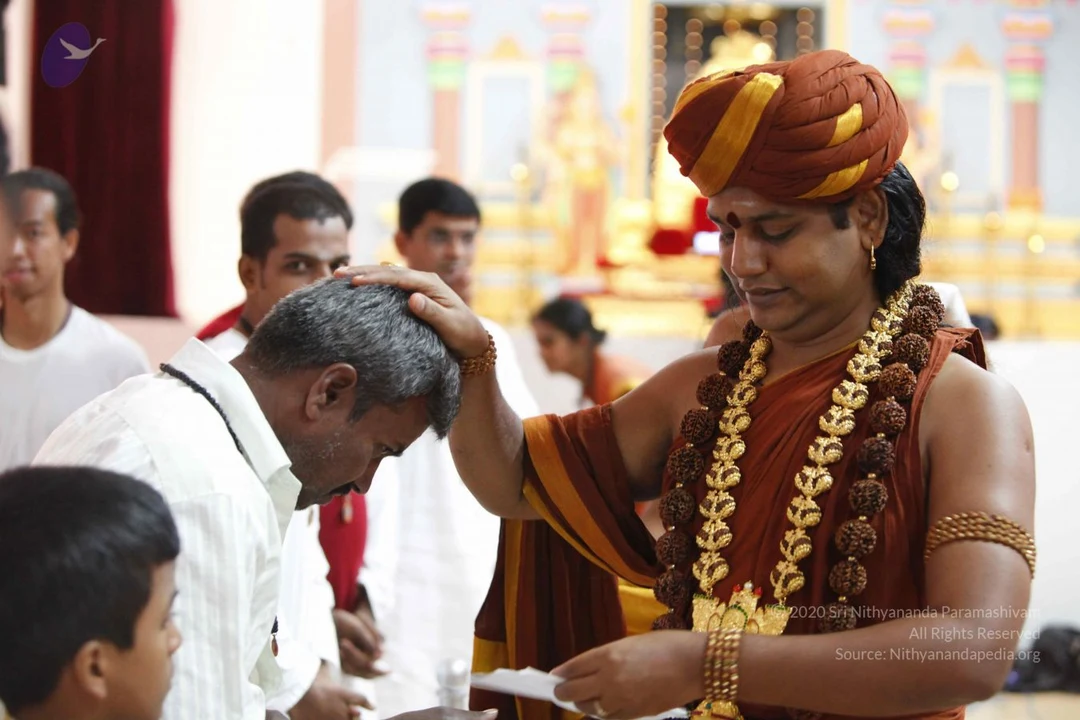
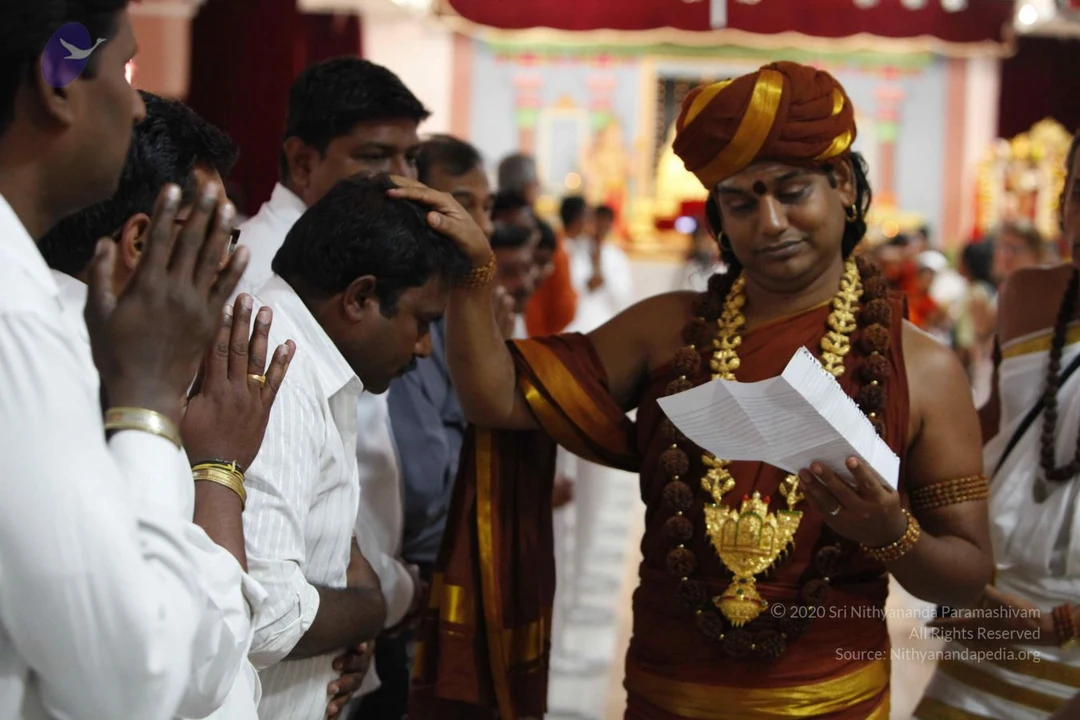
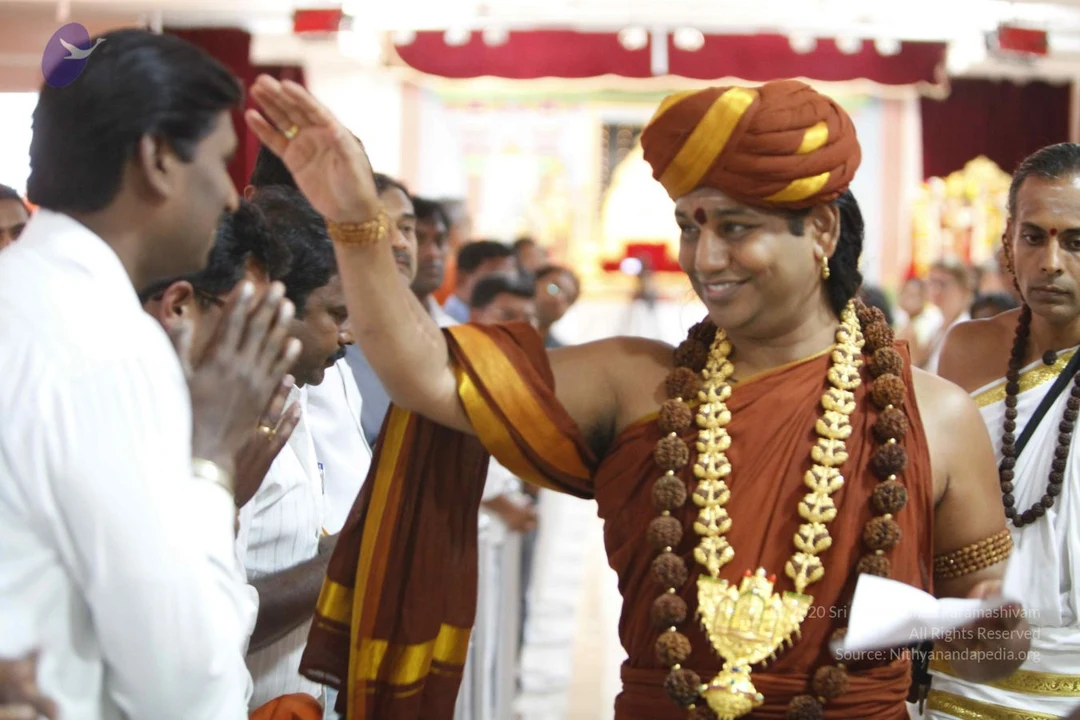
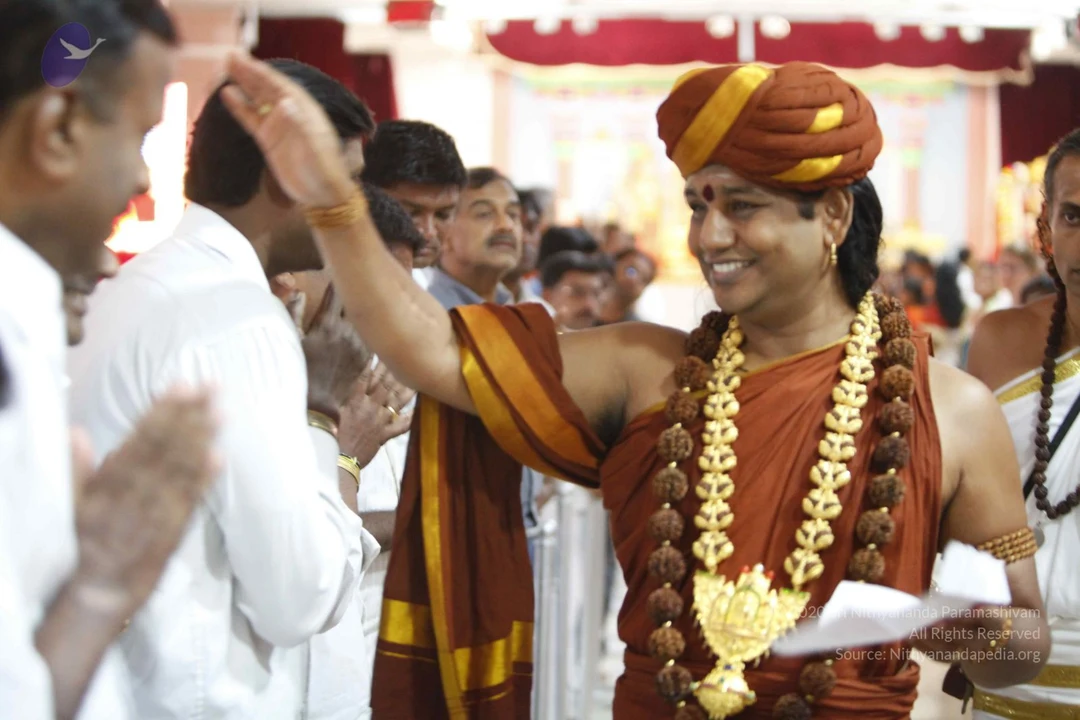
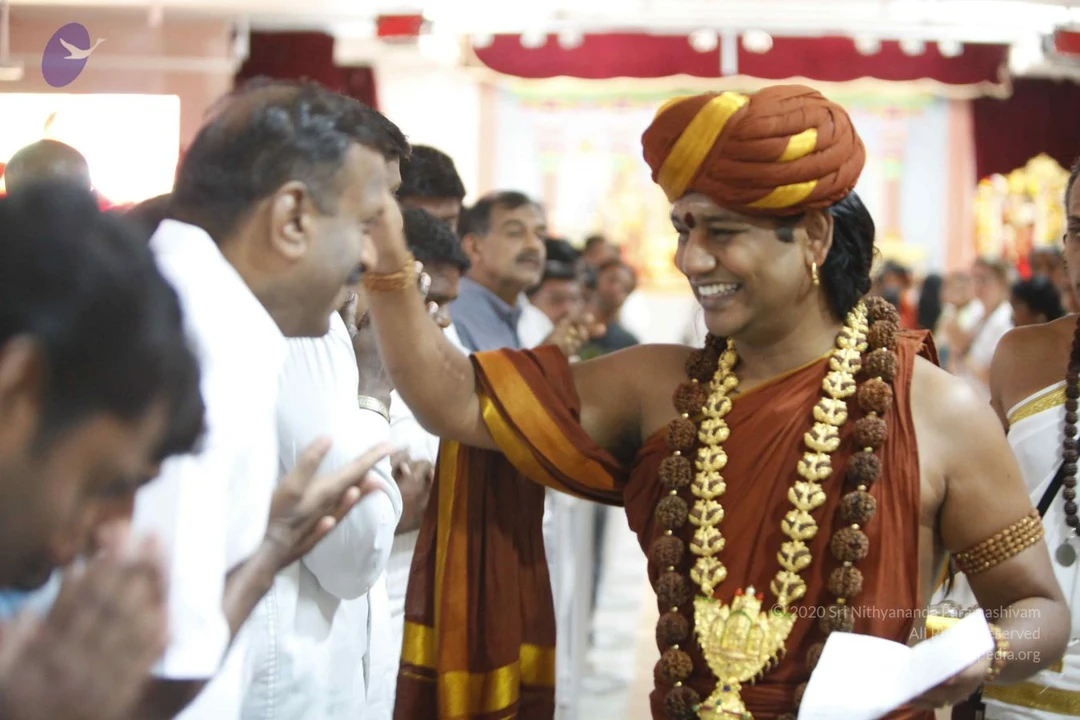
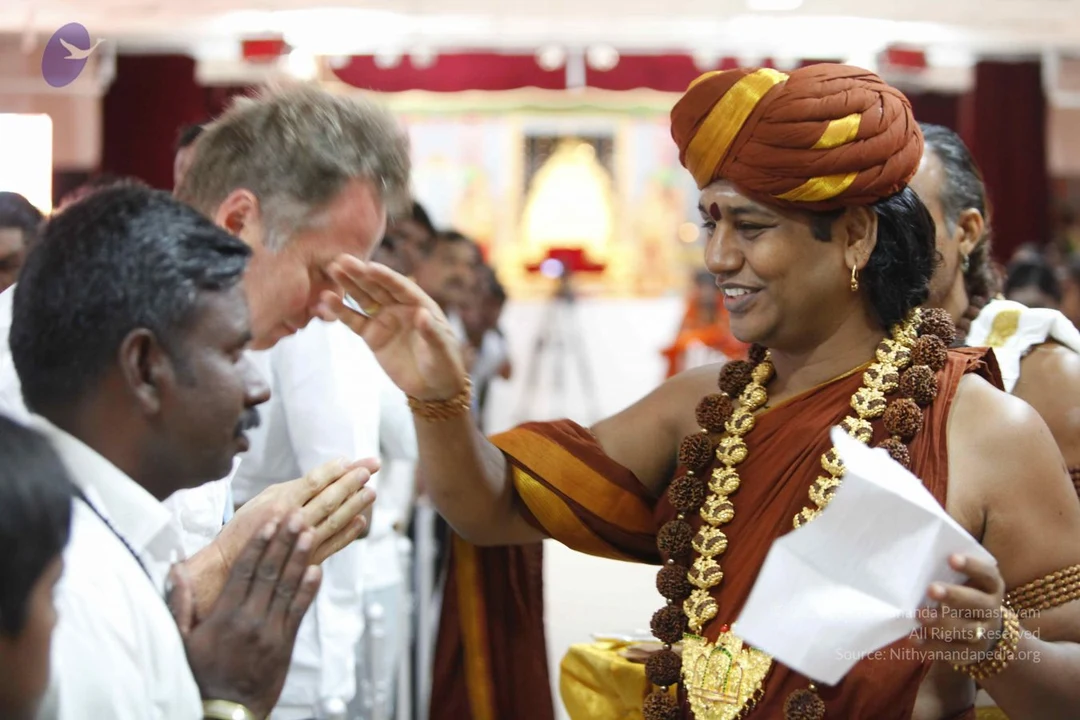
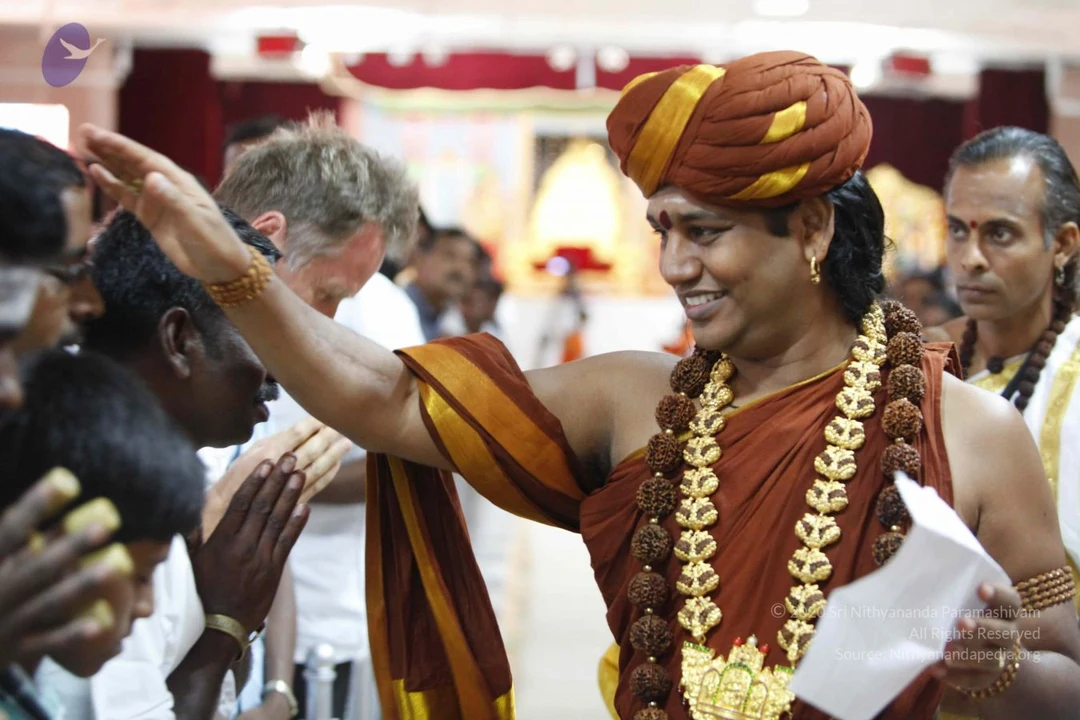
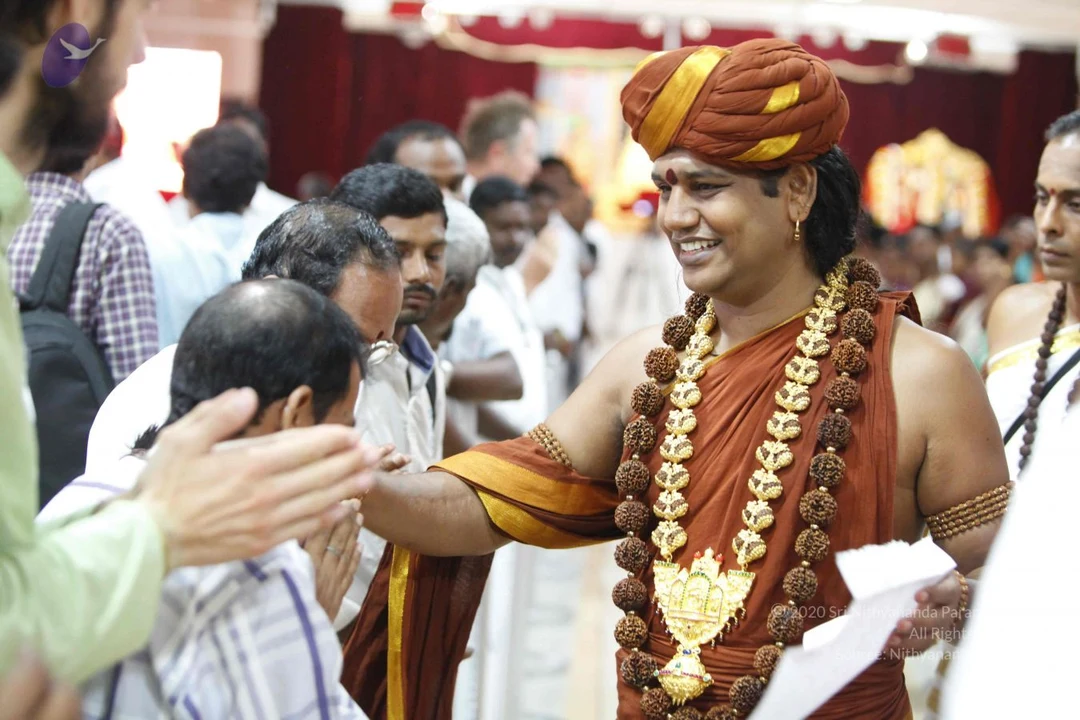
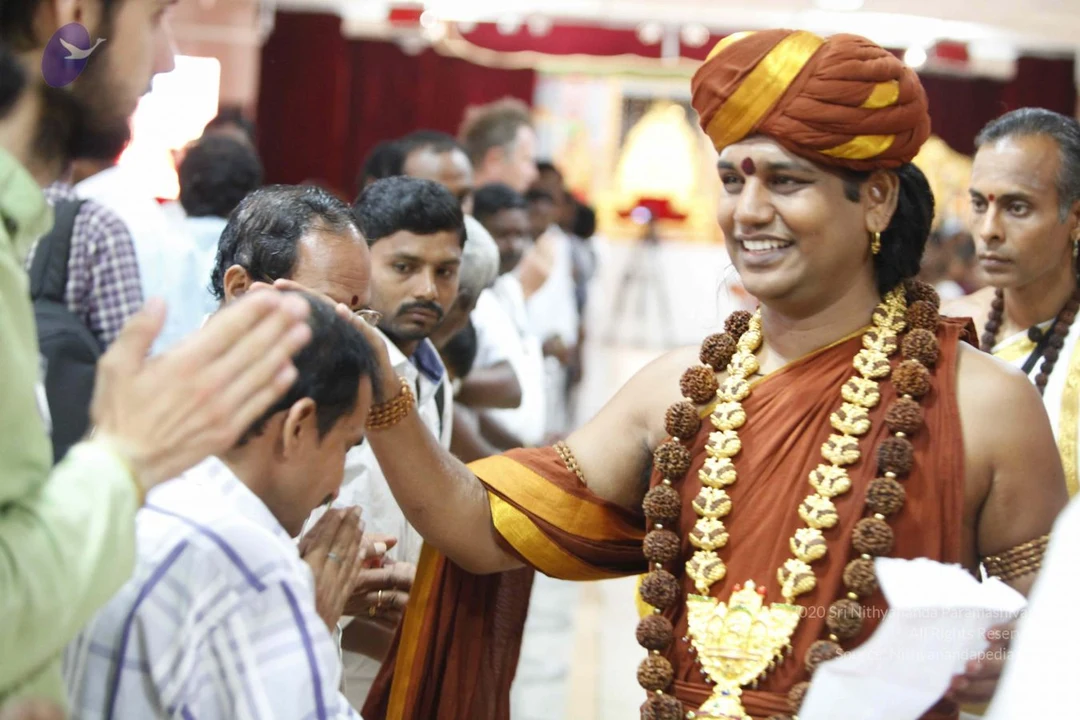
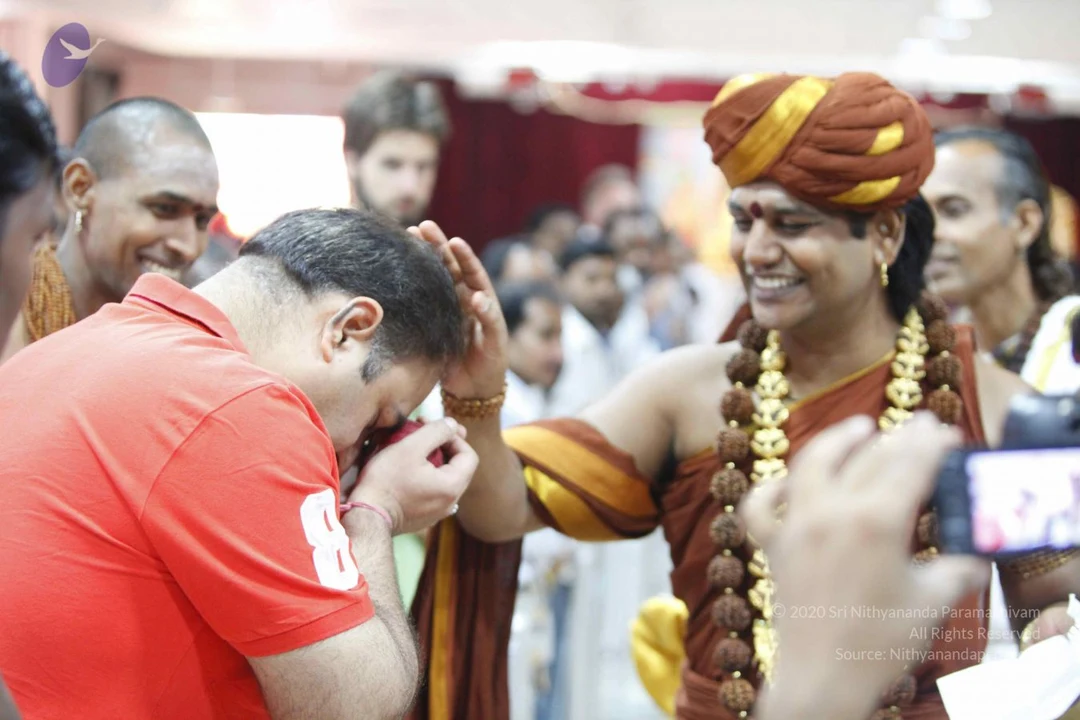
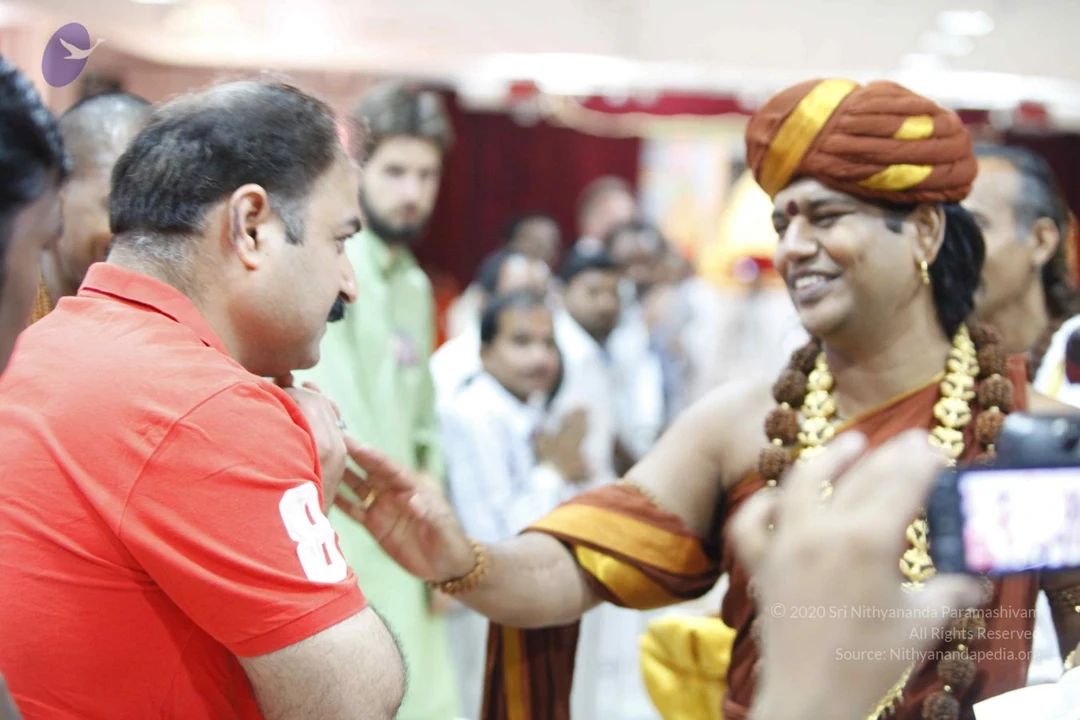
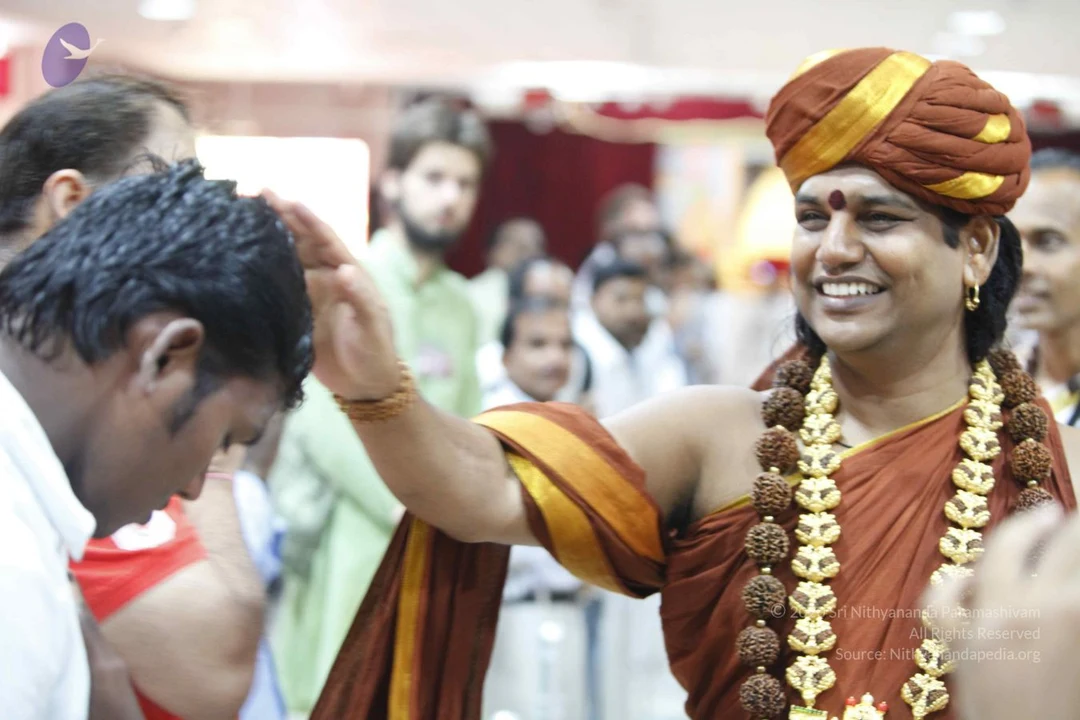
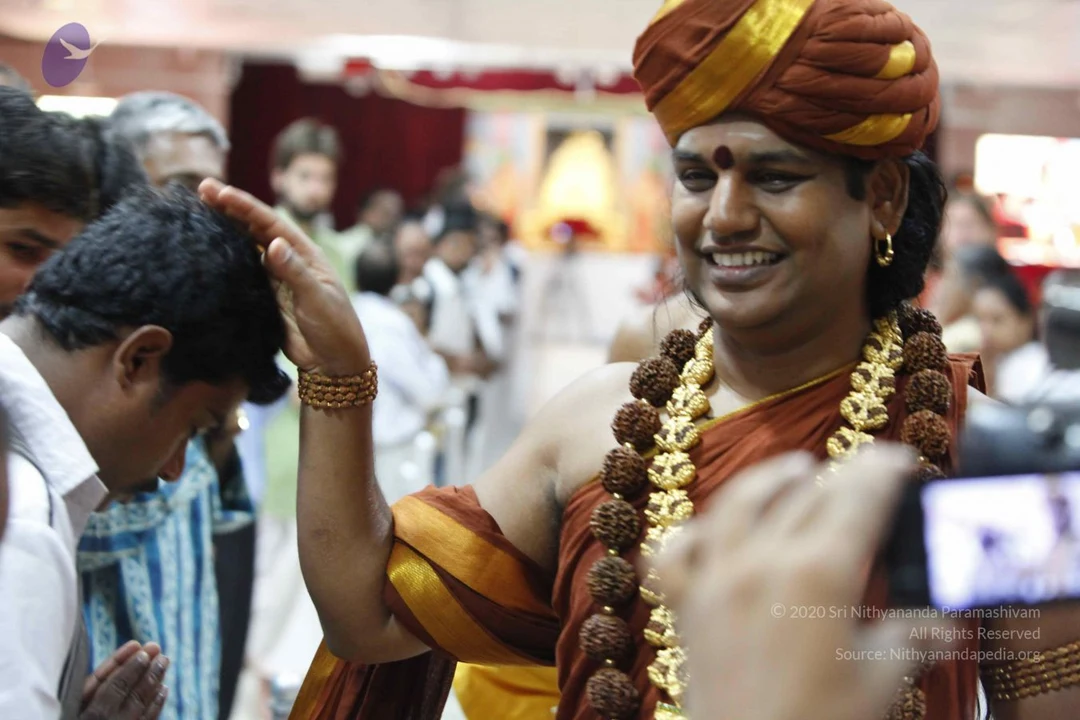
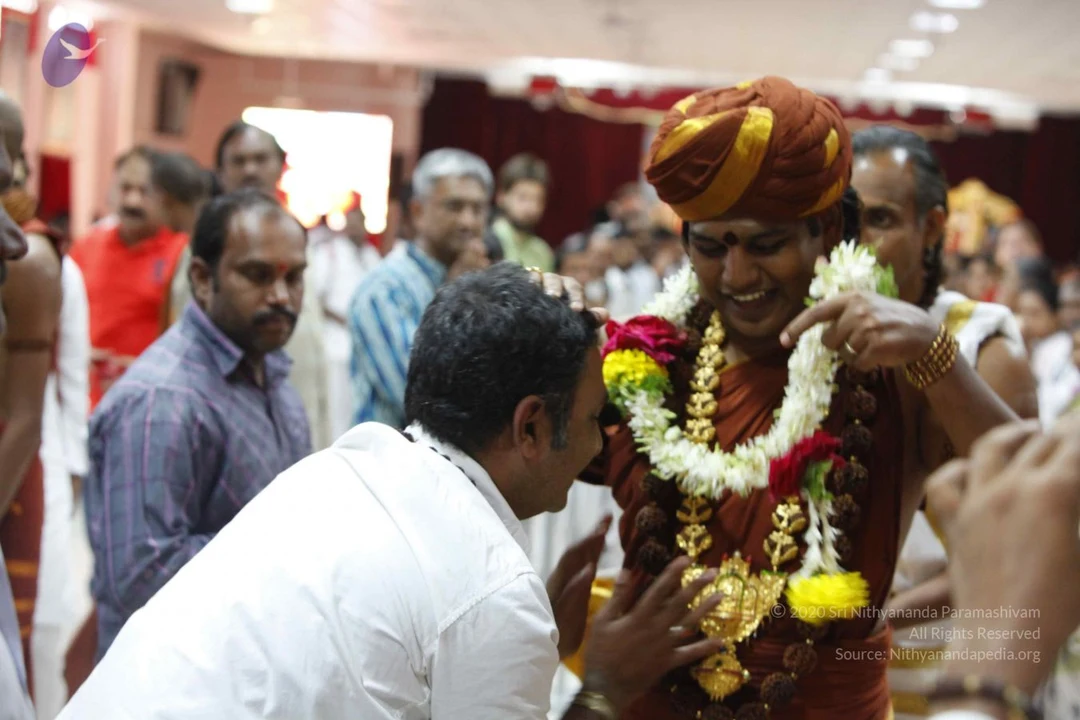
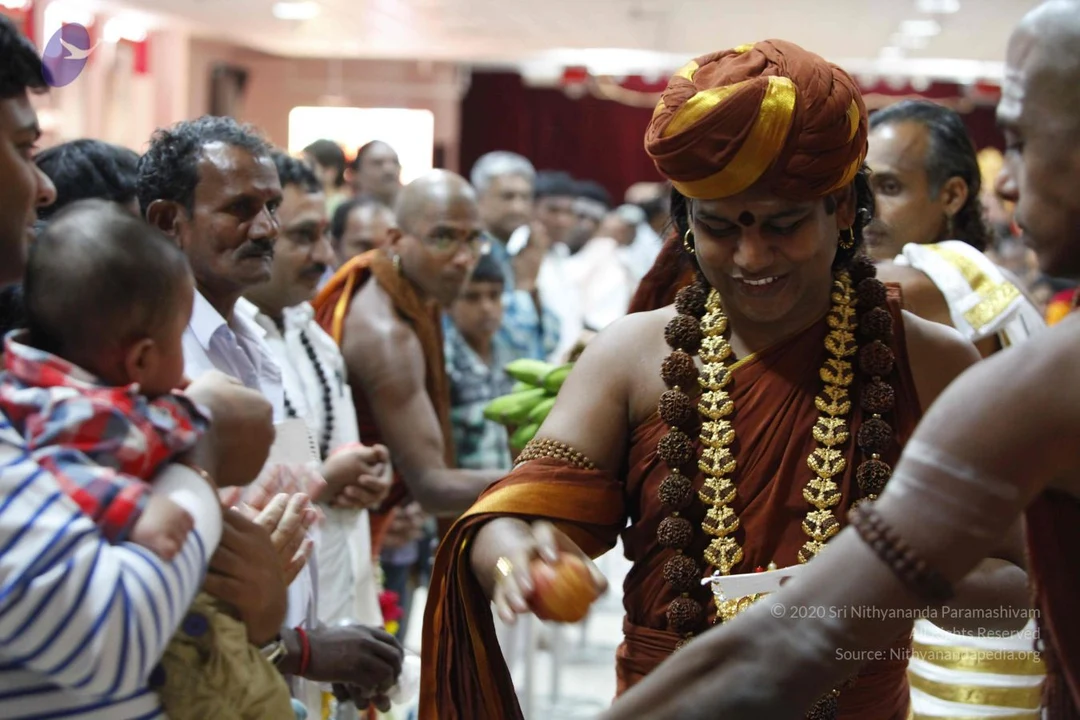
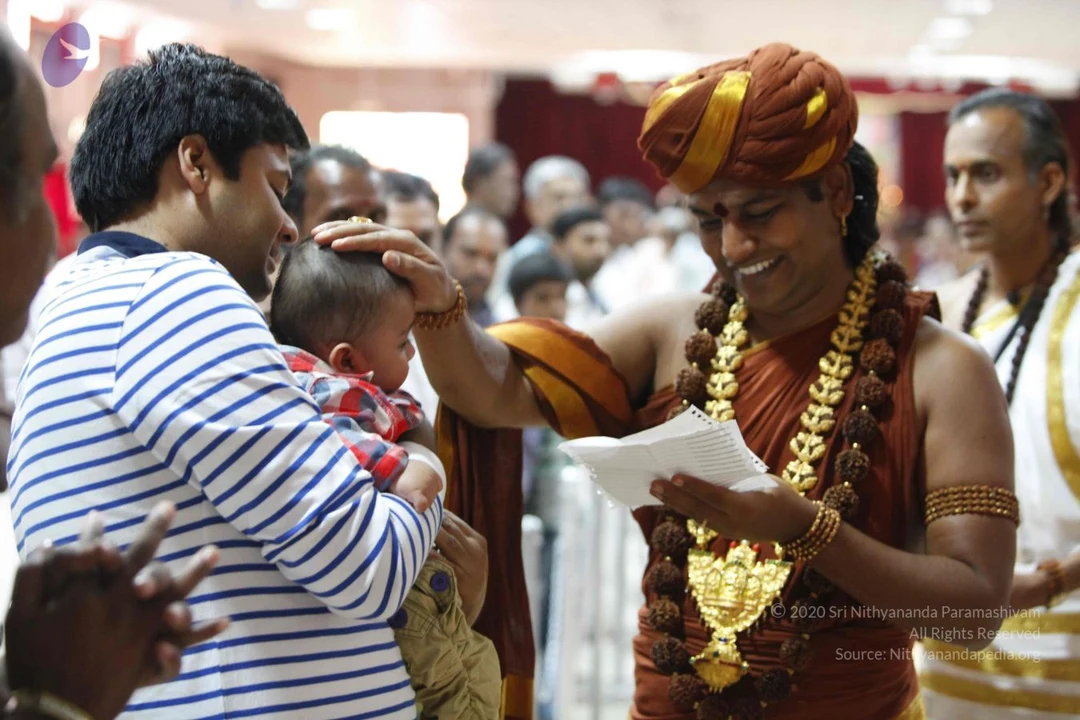
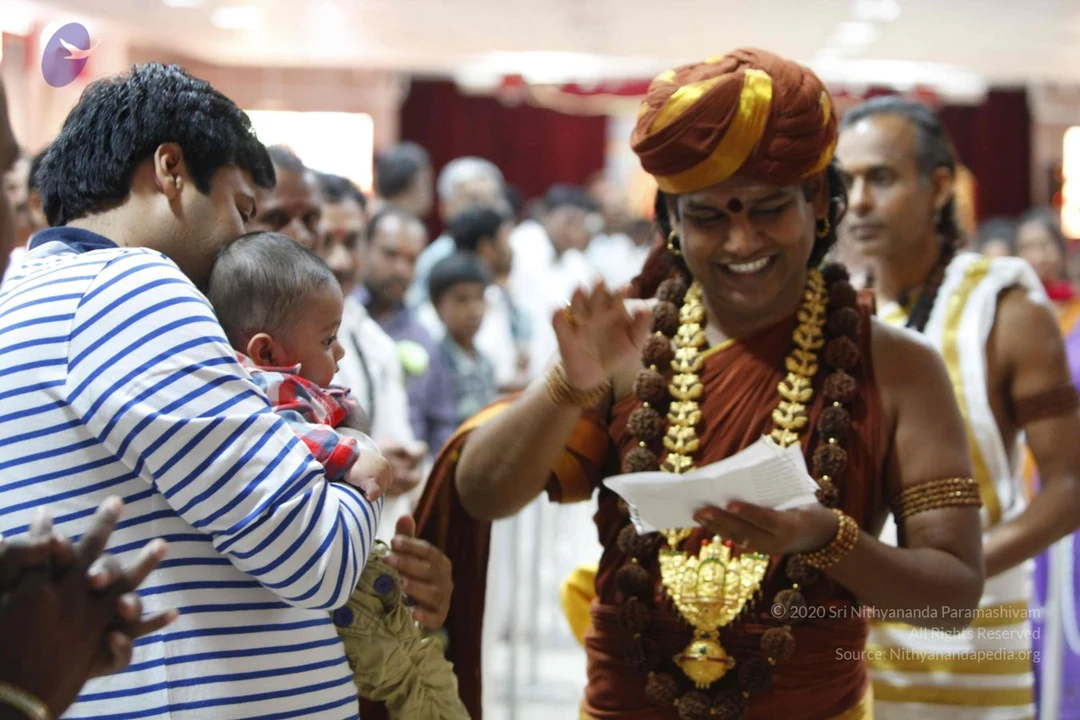
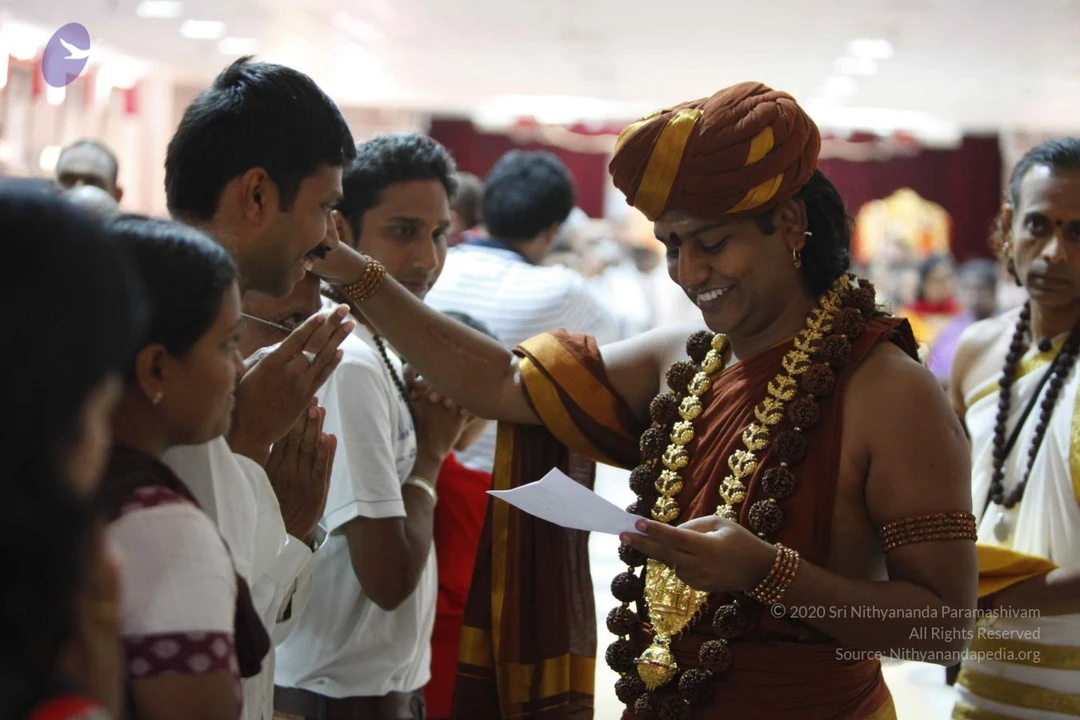
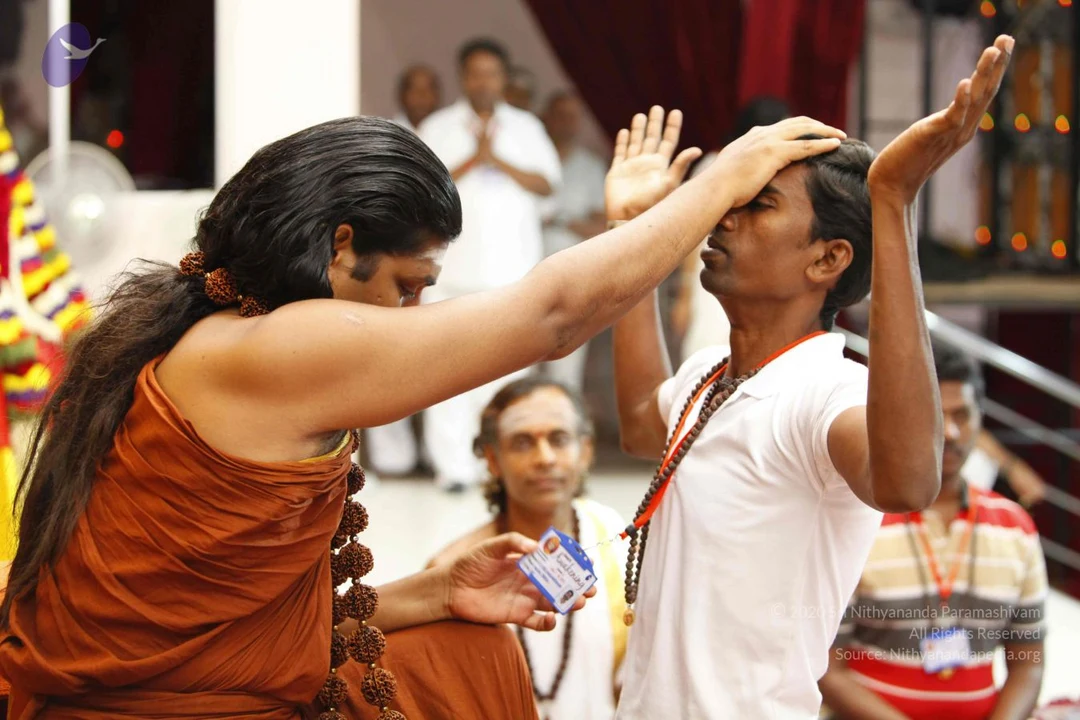
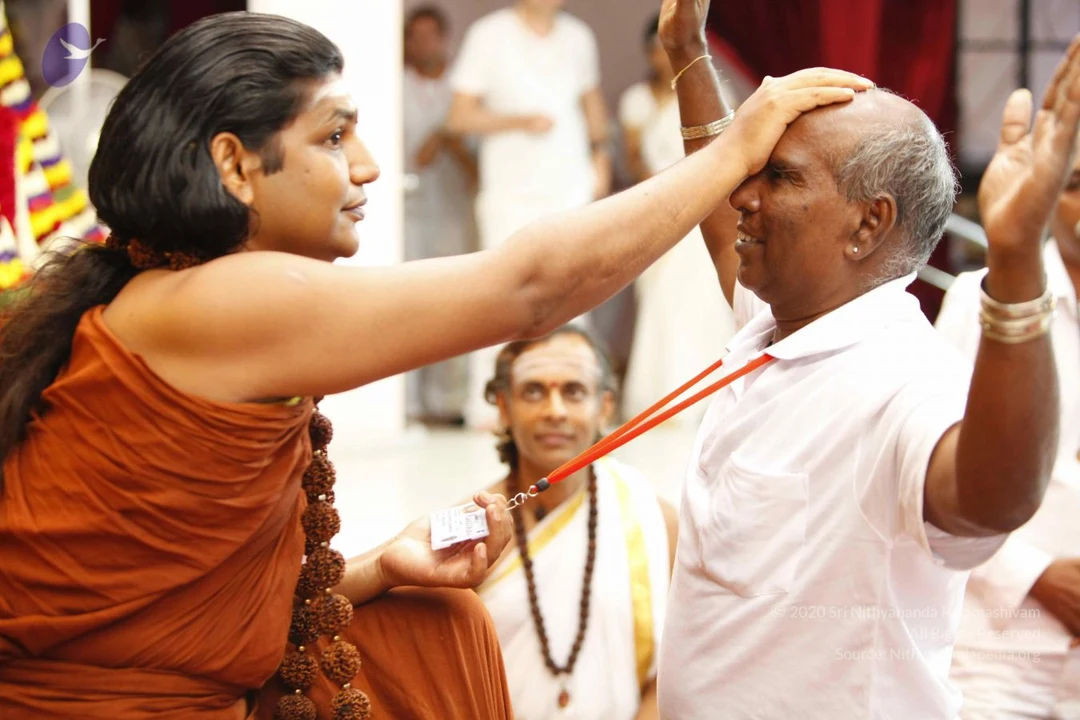
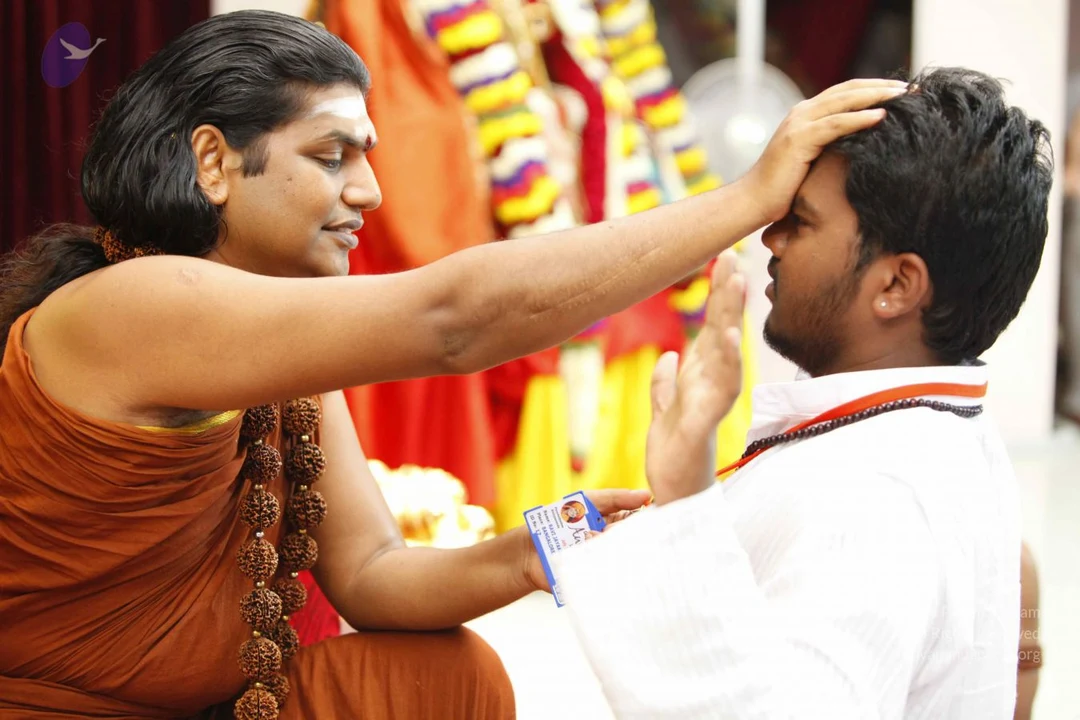
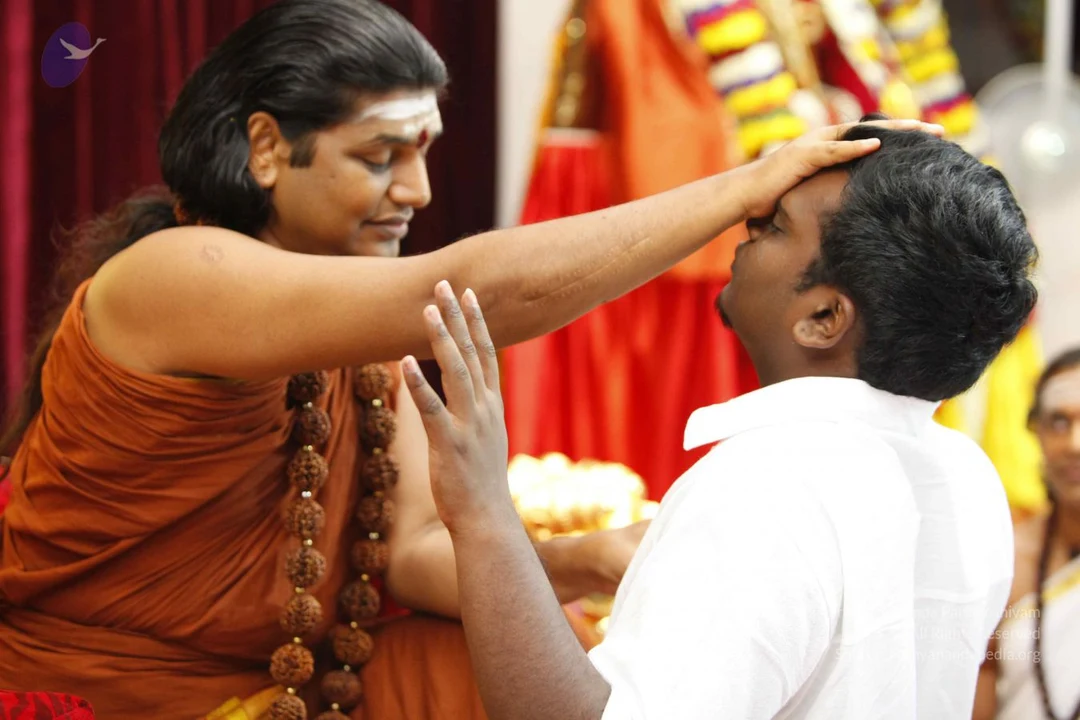
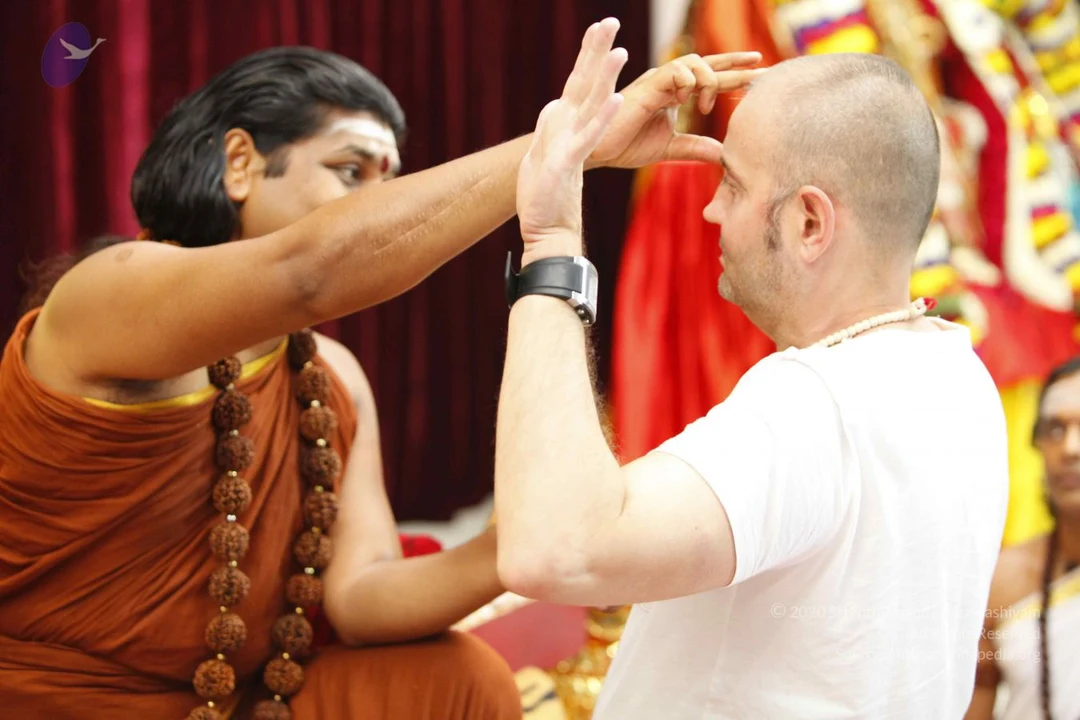
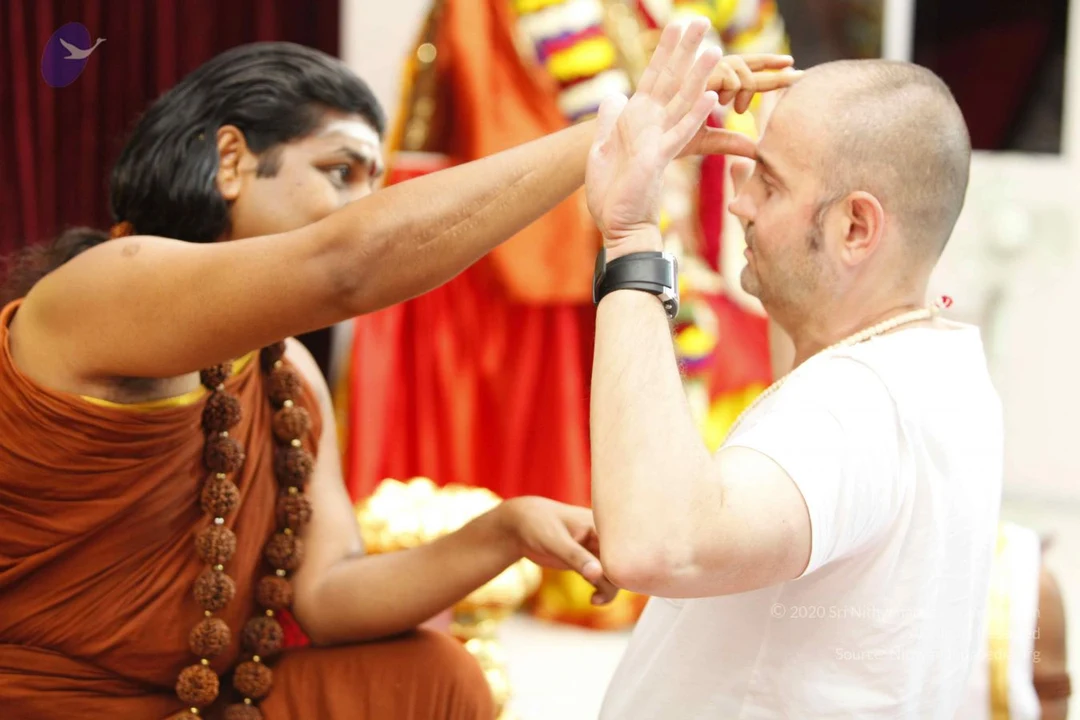
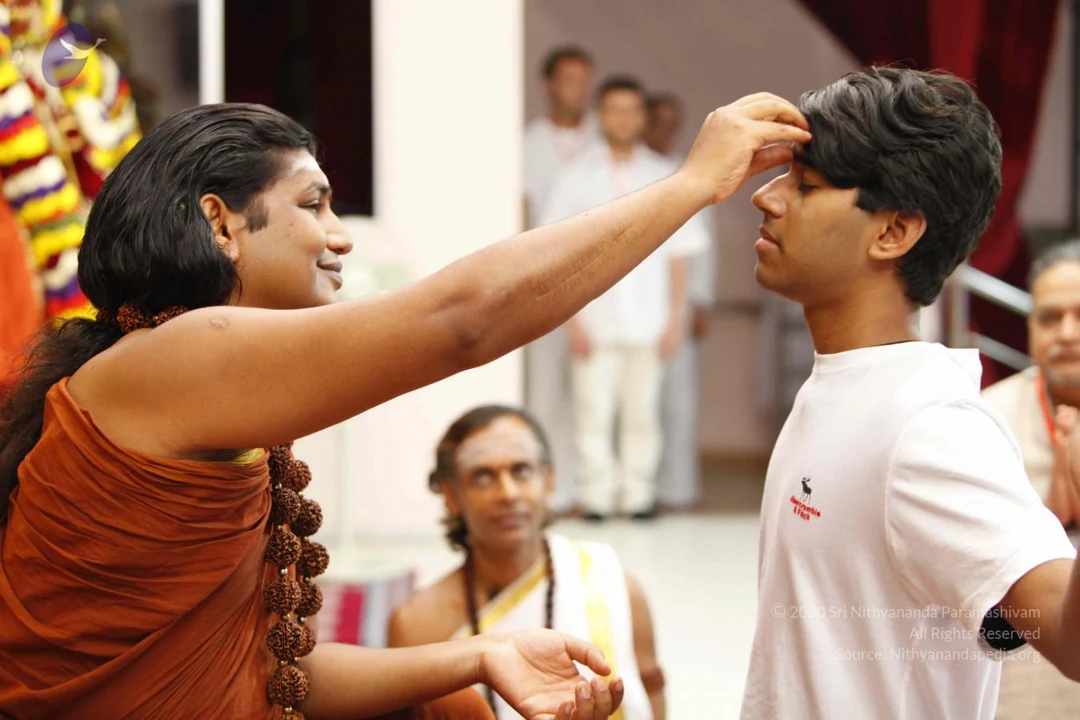
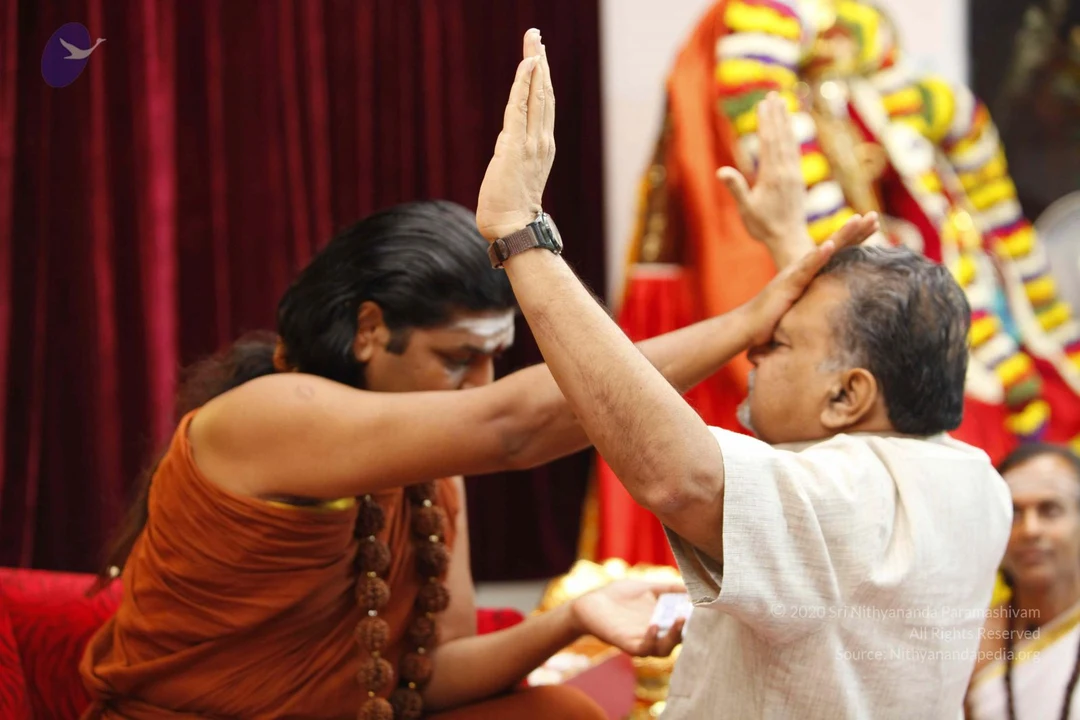
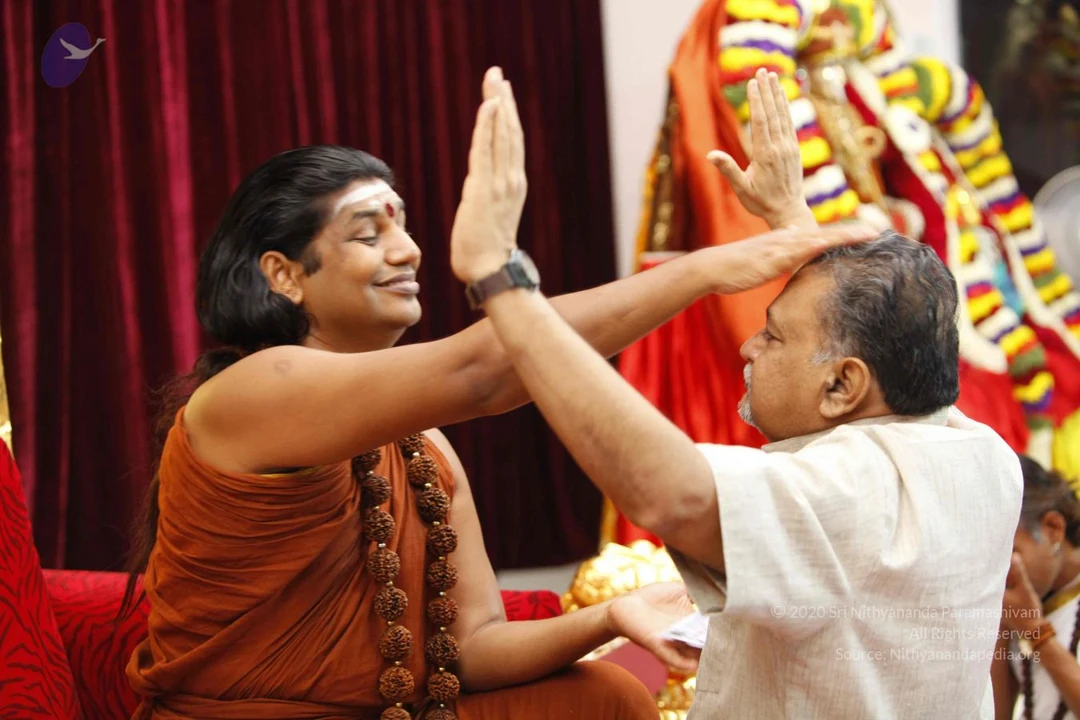
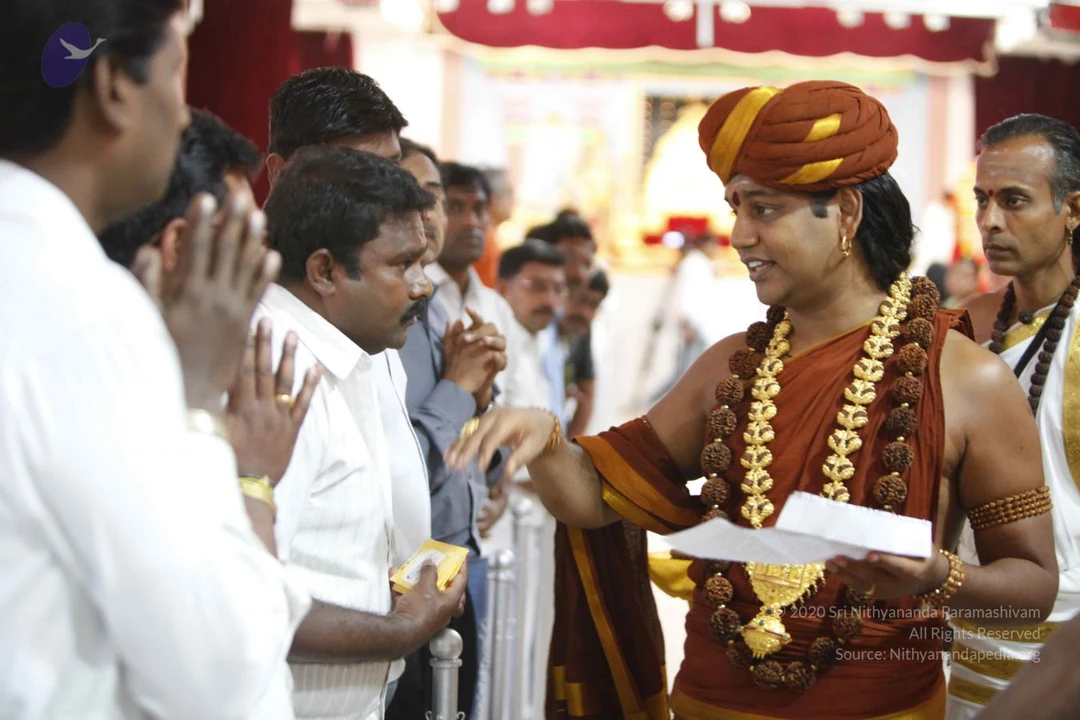
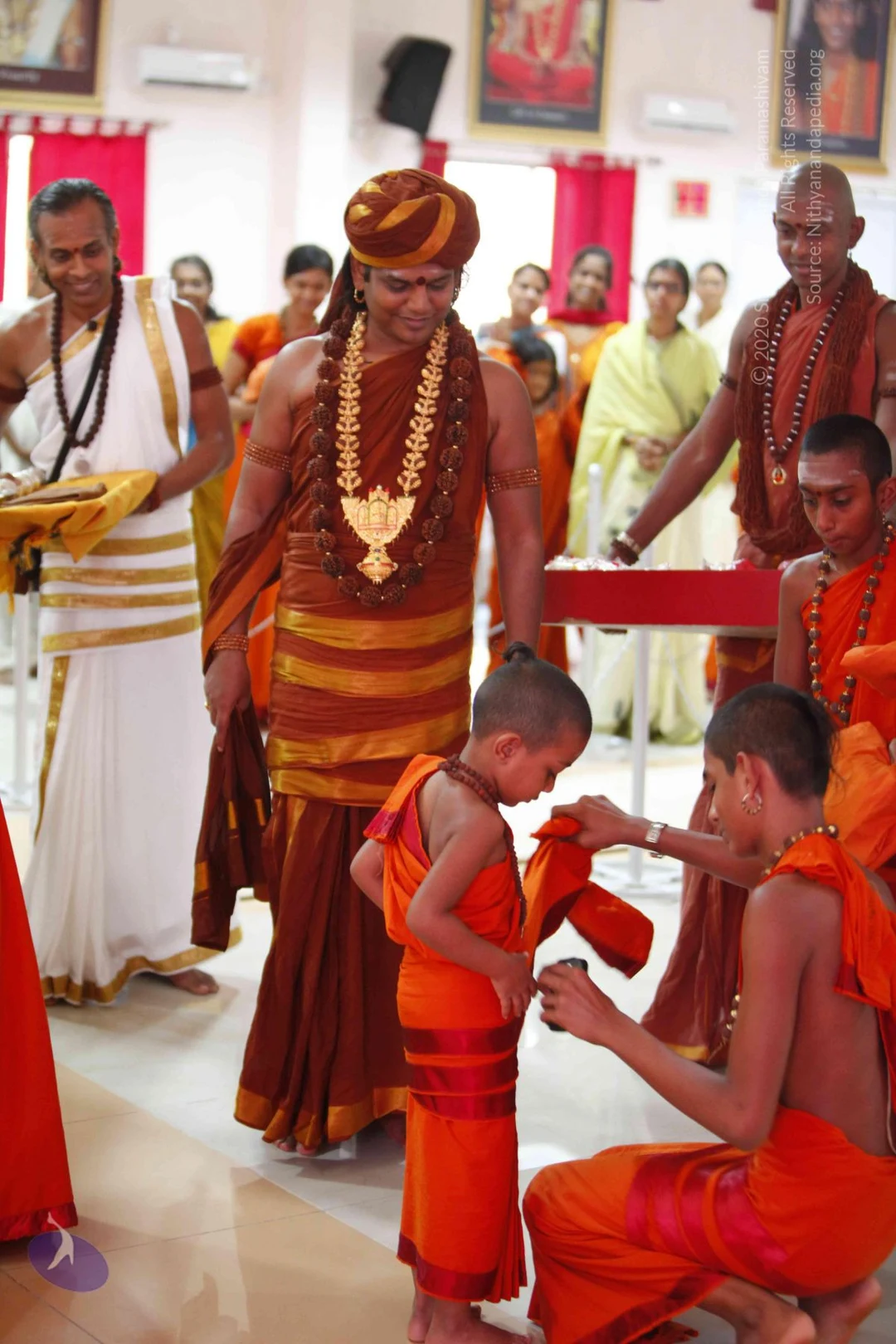
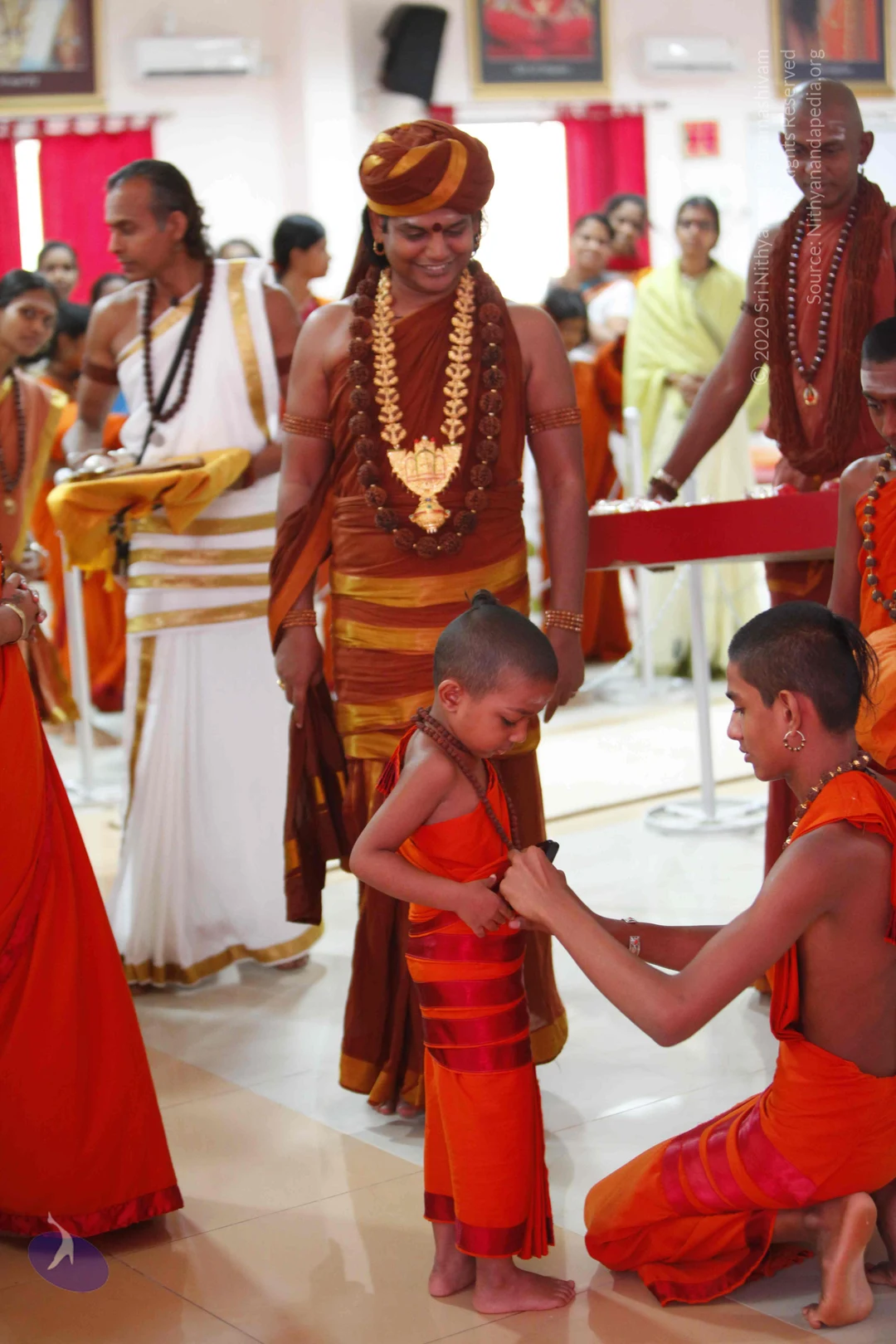
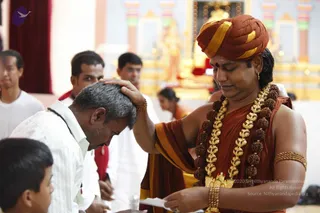
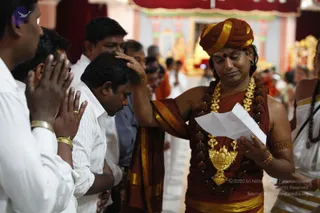
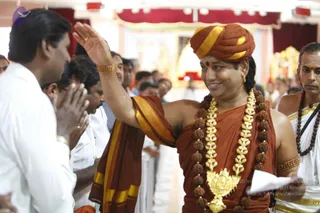
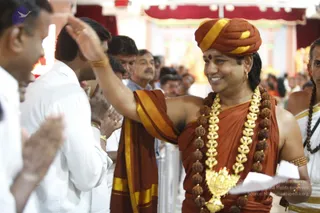
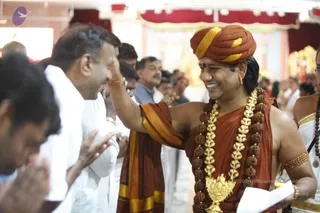
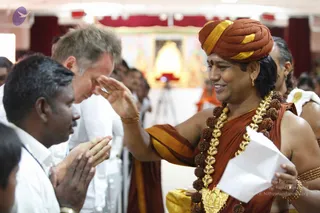
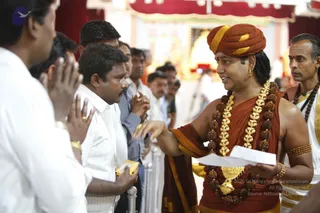
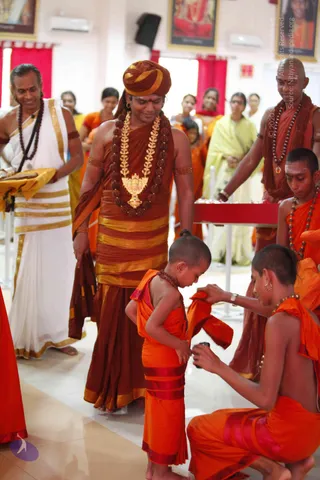
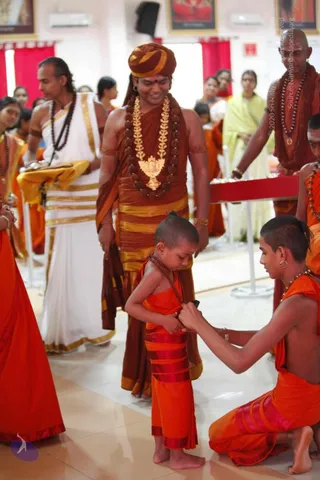
A photograph of a saffron-robed figure in an orange turban with yellow stripes, a rudraksha mala and ceremonial gold necklace, bare-armed with a gold armlet, placing a hand on the head of a bowed man in a white shirt. The robed figure holds a folded white paper. Behind them, devotees in white stand near a golden deity murti and pillars in a temple hall. The man in white is seated or bending in receiving blessing. Swamiji (probable) with a distinctive turban, rudraksha mala and gold necklace, performing a blessing on a devotee. Several other people are visible in the background, including a young boy in the lower left corner.A photograph of a ceremony in a temple hall decorated with red drapes and golden deity figures. A priest in a saffron-orange turban and reddish-brown dhoti, wearing a rudraksha mala and a large gold ceremonial necklace, holds a folded paper in one hand while placing the other hand on the head of a kneeling man in a white shirt. Several men in white shirts stand with palms pressed together in prayer around them, and a woman in white with a long braid stands at the right edge. The priest's features and clothing are consistent with the presentation the page describes, but his identity cannot be confirmed from appearance, so the a person value is unsure. Five or more people are visible, so the count is in the 6-20 range.A photograph of a man in a saffron-orange turban with gold-yellow stripes and an orange-brown shawl draped over his shoulder, raising his right hand in a blessing gesture while smiling. He wears a long rudraksha mala with a large gold pendant and gold ceremonial necklace, gold bangles, and a red tilak on his forehead. Nearby to the left, a man in white shirt and trousers stands with palms pressed together in greeting. A man on the right wears a white dhoti with gold border and a rudraksha mala, with a red tilak. Behind them, a crowd of devotees stands in a temple hall with red canopy and ornate golden decorations.A photograph of a crowd at a temple-like hall with a red and gold canopy and decorated background. In the foreground, a smiling man in an orange-saffron turban and matching orange-saffron robe with gold border is wearing a long gold ceremonial necklace and multiple rudraksha malas, and is raising a hand in blessing toward a devotee in white clothes at left. Men in white shirts and dhotis and a bare-chested man with a long braided rudraksha cord stand nearby, some with palms joined. A small gold pendant and a bracelet are visible.A smiling man in a rust-orange turban with gold border and a rust-orange wrap with gold trim stands at centre, wearing a long gold ceremonial necklace and a multi-strand rudraksha mala. He raises his right arm to touch the forehead of a man in a white shirt and white dhoti on the left, who has his hands folded in namaste. Other men stand behind in a crowded hall with red curtains, golden decorations and a lit deity display in the background. The central figure has distinctive saffron attire, rudraksha and ceremonial gold cues, so he is a person in an appearance-based label, blessing a devotee in a satsang-style gathering. Several people are visible, including partially visible figures at the edges.A smiling person in an orange-and-gold turban, saffron-orange robe with gold trim, multiple rudraksha mala beads and a heavy gold necklace raises a hand in blessing toward a man in white who bows with palms pressed together at left. A second man in white, with greying hair, leans forward with hands joined. Behind them a crowd stands in a hall with red drapes and a gilded shrine or altar. Probable Swamiji cues: orange-and-gold turban, saffron robe and rudraksha malas, giving blessings to devotees.

Swamiji With Deities

7 photosSource gallery
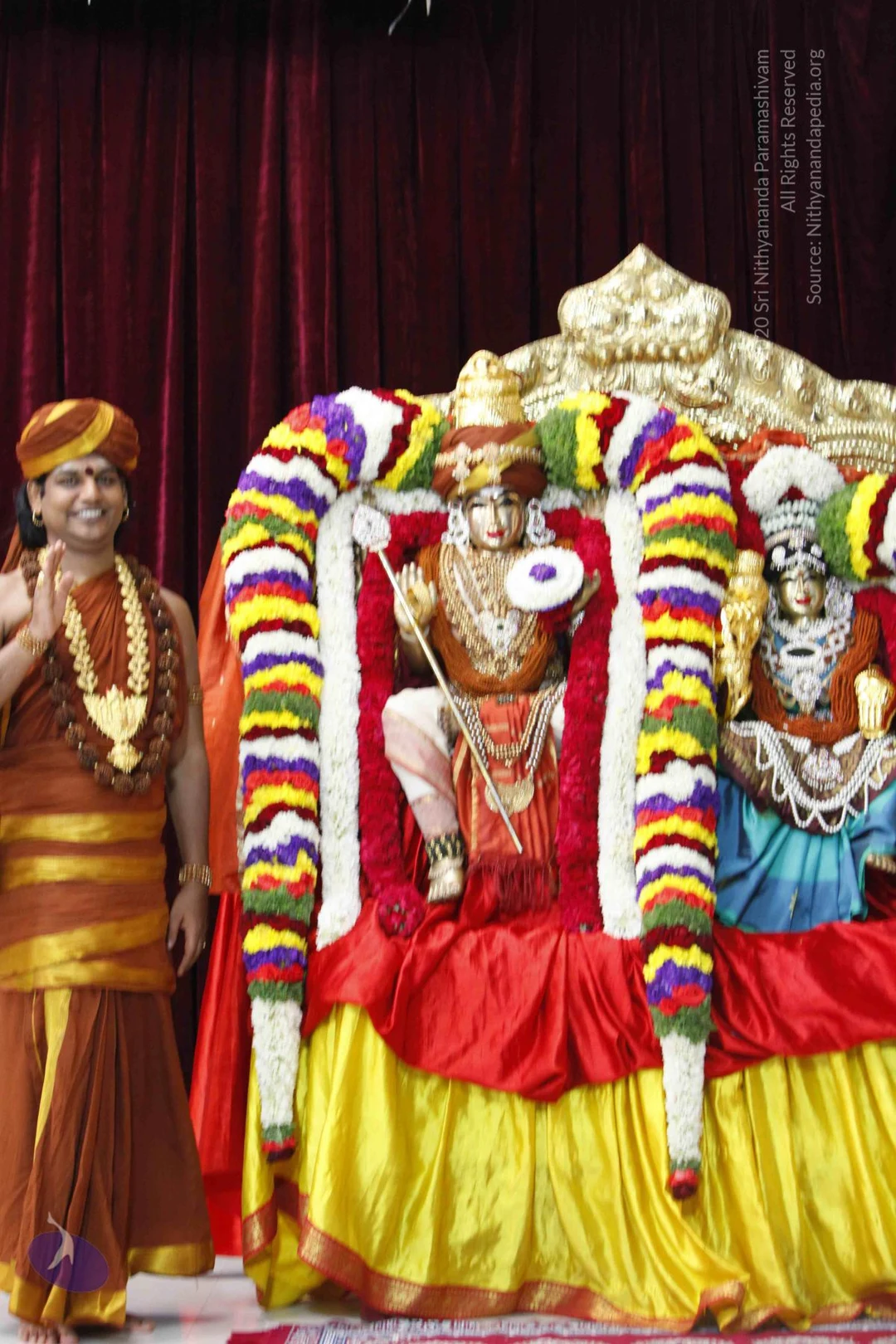
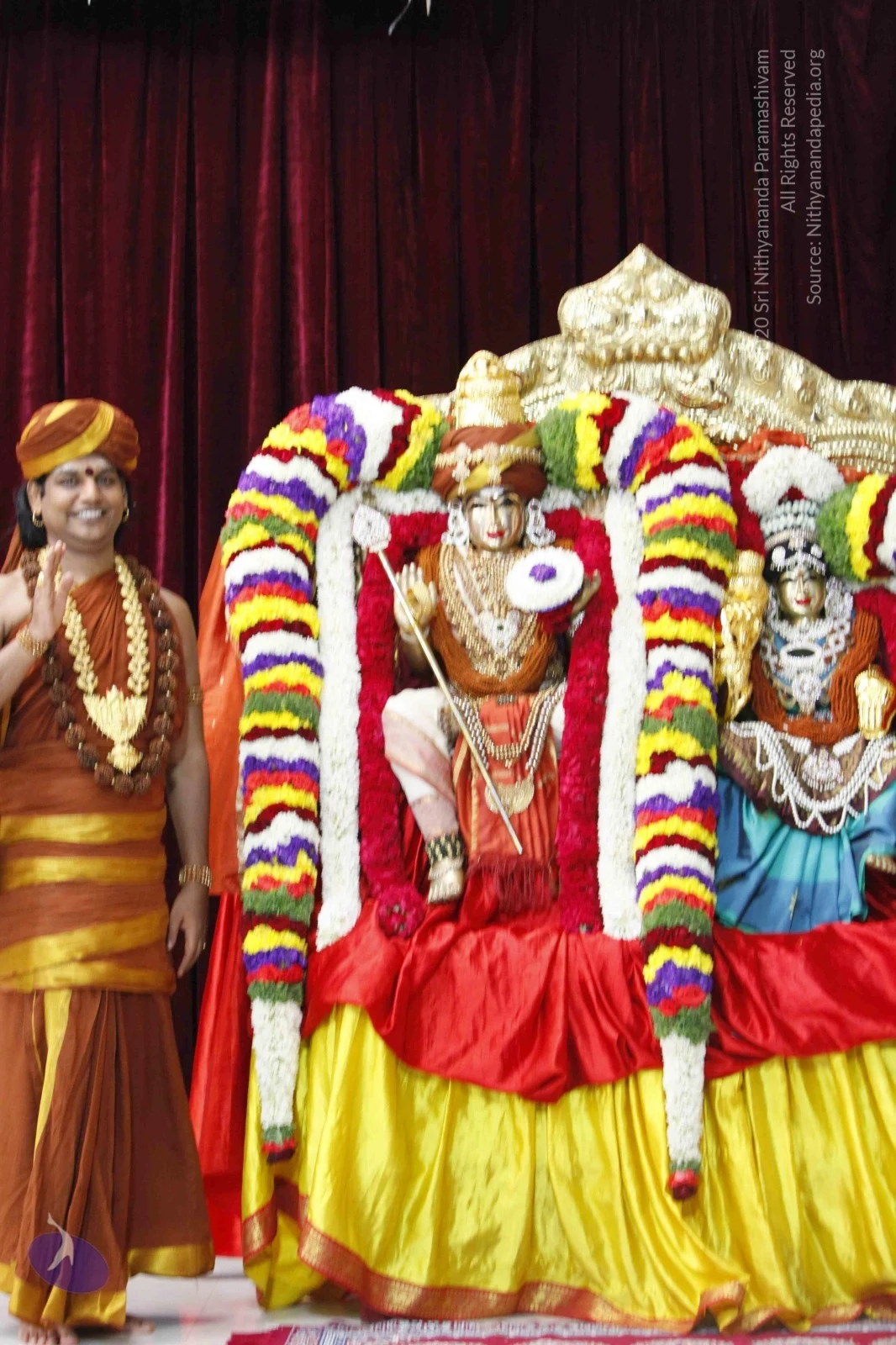
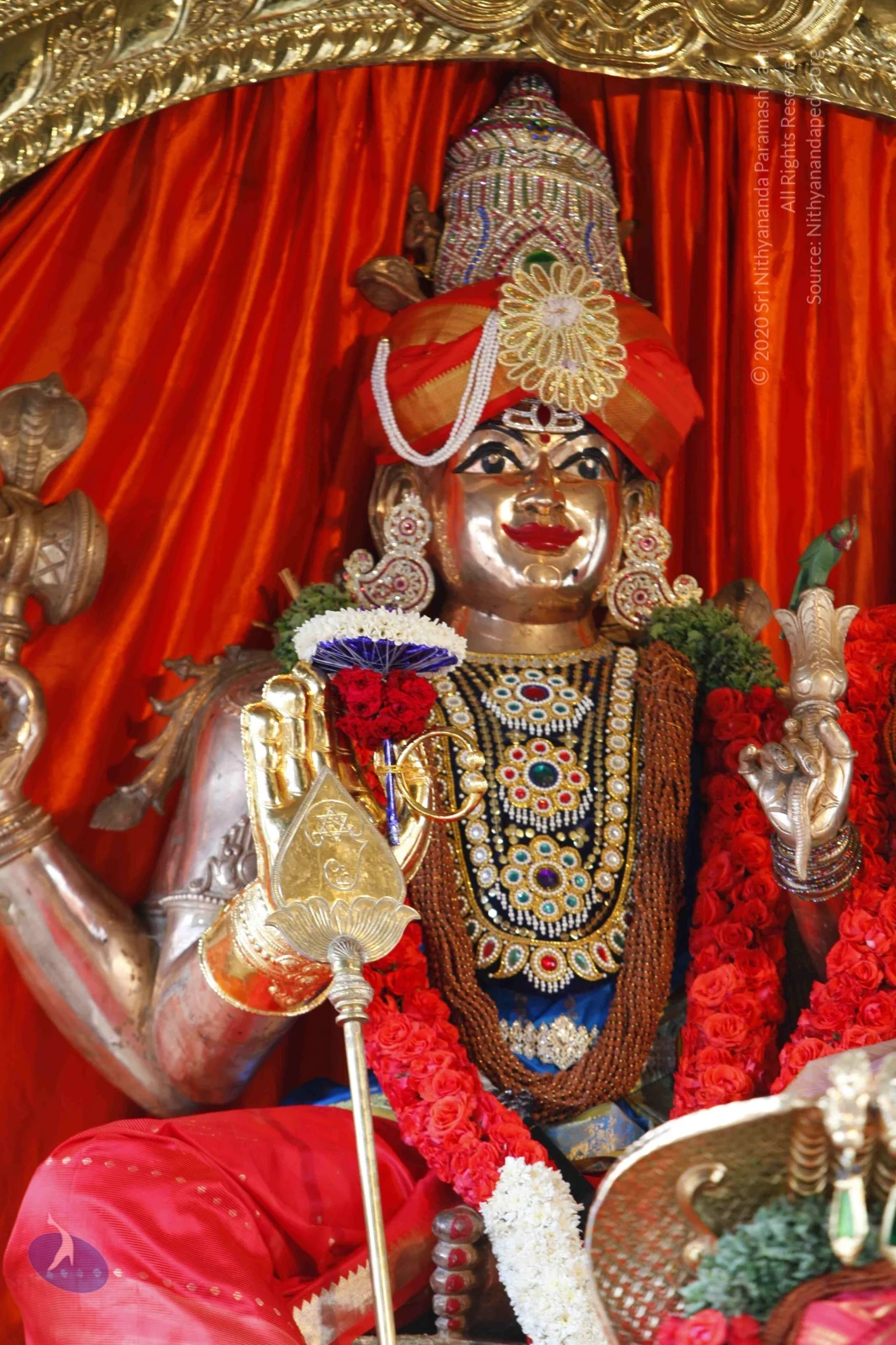
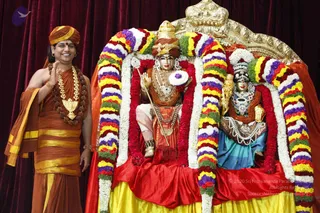
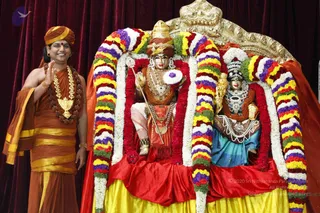
A standing man in saffron and gold robes, with a saffron turban, rudraksha mala and a large gold ceremonial necklace, smiles and raises his hand in a wave beside a decorated murti setup. Seated in the center is a deity murti with a crown, gold ornaments and a trident, wrapped in a garland of red, yellow, white and purple flowers, seated beside a female murti in blue with pearl and gold jewellery. Red velvet drapes form the backdrop.A photograph of a standing man in saffron and gold ceremonial dress, wearing a saffron turban, a gold pendant and a rudraksha mala, with bangles on his wrist, smiling and raising his right hand in greeting beside a decorated deity murti. Behind him, a seated deity murti with a crown and a staff in its hand sits on a red and gold throne covered with garlands in red, white, yellow, purple and green. A second, smaller deity figure in blue sits at its side, and a gold-framed backdrop of deep red drapes fills the background. Two physical people are present.A photograph of a man in saffron-orange robes and a matching orange turban stands at left, smiling and raising his right hand in a greeting gesture. He wears a large gold necklace and a rudraksha mala, with gold bangles on his wrists. Beside him is an ornate throne draped in a marigold garland of red, yellow, white and purple flowers, holding two deity murtis. The seated figure on the left has a golden crown, orange robes, jewelled necklaces and holds a staff, while the figure on the right wears a blue-green sari and a jewelled crown. The backdrop is deep maroon drapery and the throne has a gilded arch. Given the page cues of several distinctive visible adornments, the standing man is a person candidate in the greeting role.A man in saffron-orange sannyasi robes and an orange turban stands at left, smiling and raising his right hand in greeting. He wears a rudraksha mala and a heavy gold necklace with a pendant. Beside him is a decorated altar with a large deity murti of a male figure in an orange-red garment with a crown and a trident-like staff, and a female murti in a blue sari with pearl jewellery. Both are framed by a colourful garland arch of marigolds, roses and white flowers, set before a red velvet curtain and gold-framed backdrop. Swamiji (probable): the standing man shows a saffron turban, rudraksha mala and ornate gold necklace. The deities are murtis, not living people.A standing man in saffron and orange robes and an orange turban stands at left, smiling and raising one hand in a greeting, with a rudraksha mala and a large ceremonial gold necklace. Beside him, two deity murtis sit on a red and yellow throne decorated with a dense arch of multicoloured flower garlands. The seated murti at centre holds a trident-like staff and wears gold jewellery and an orange garment; the murti beside it wears a blue garment and pearl ornaments. Red drapes and a gold-topped backdrop frame the scene.A smiling person in saffron-orange robes and an orange turban stands with palms joined in greeting beside a decorated wooden palanquin. The person wears a rudraksha mala, a heavy gold ceremonial necklace and gold bangles, with a golden shawl draped over one shoulder. Seated on the palanquin are two deity murtis: a male figure in a red-orange dhoti with a crown, holding a staff and a flower, and a female figure in a blue garment with pearl and gold jewellery. The seat is covered in red and yellow fabric and framed by a multicoloured garland of marigolds, roses and white flowers, set against a deep red velvet curtain.

Inner Awakening-Day 7

94 photosSource gallery
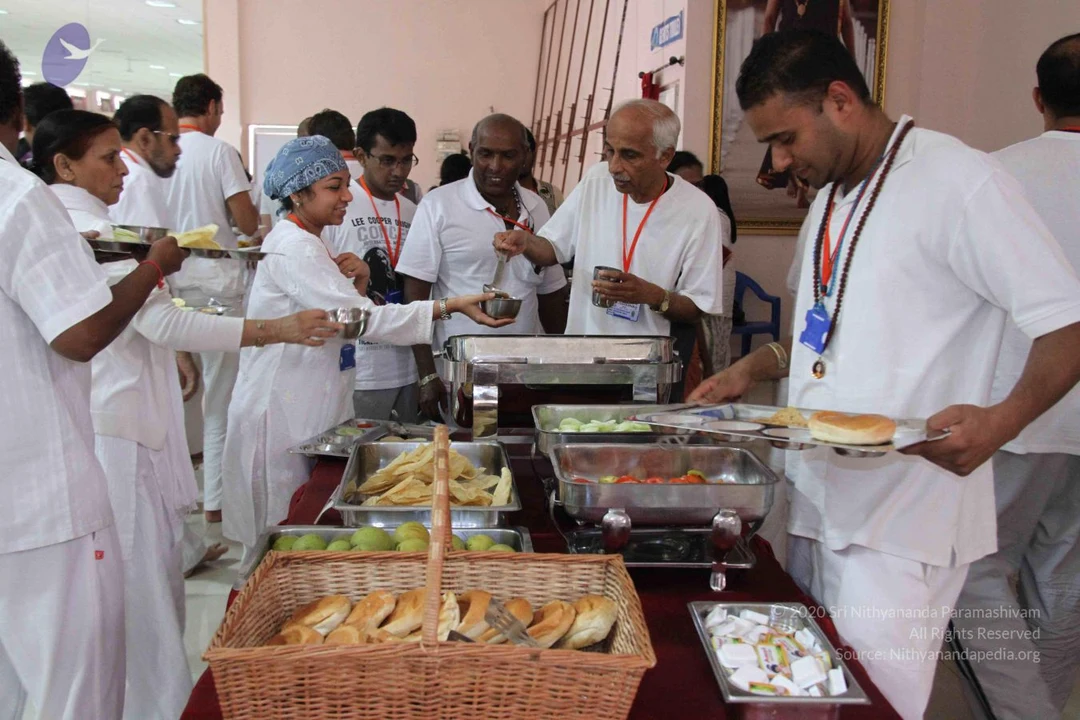
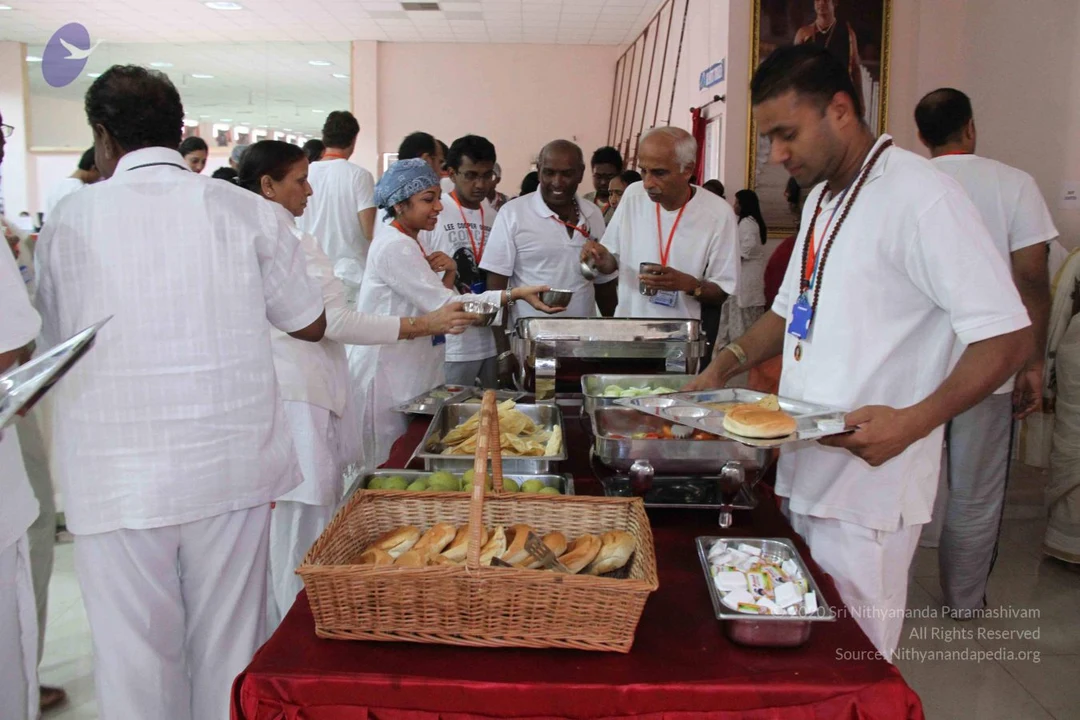
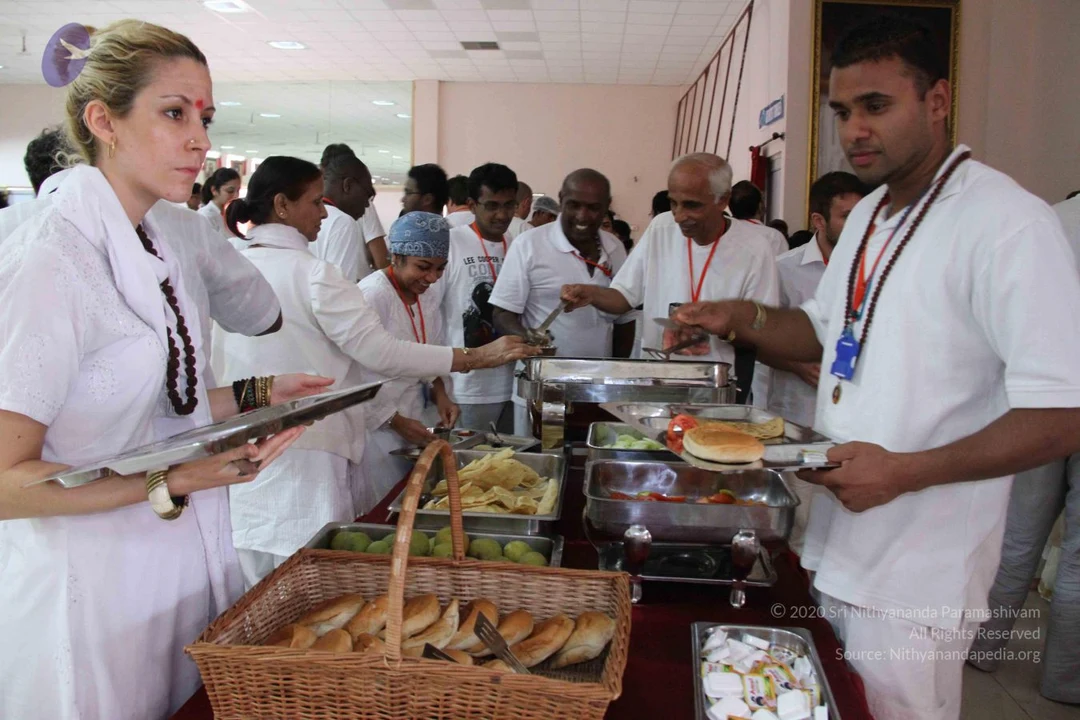
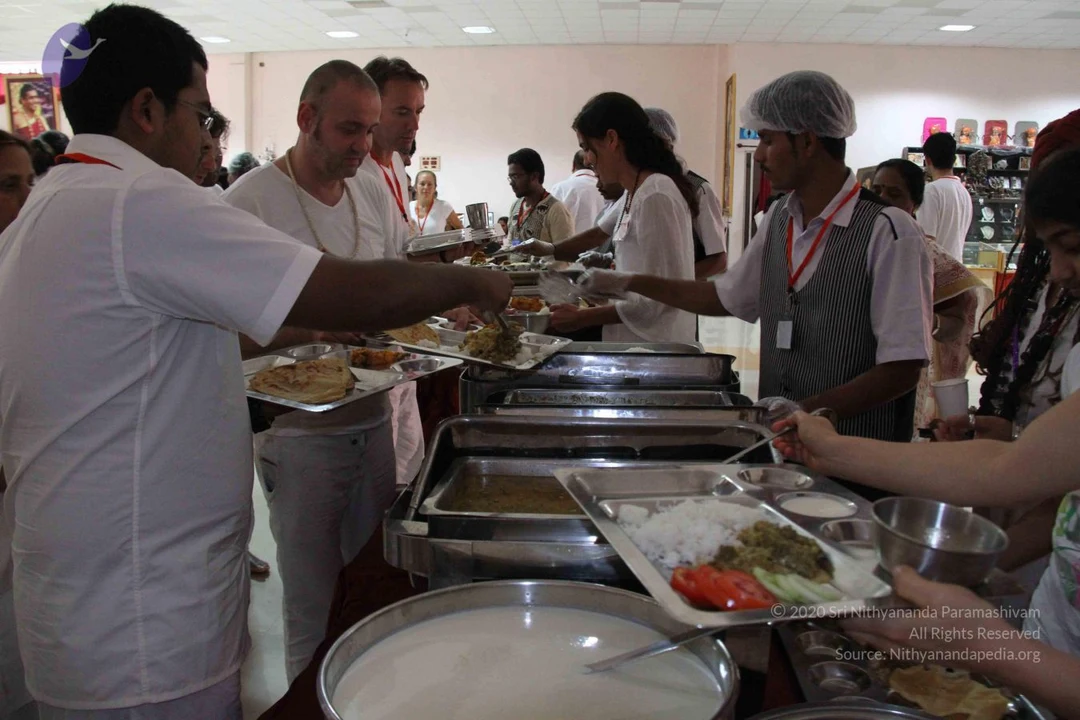
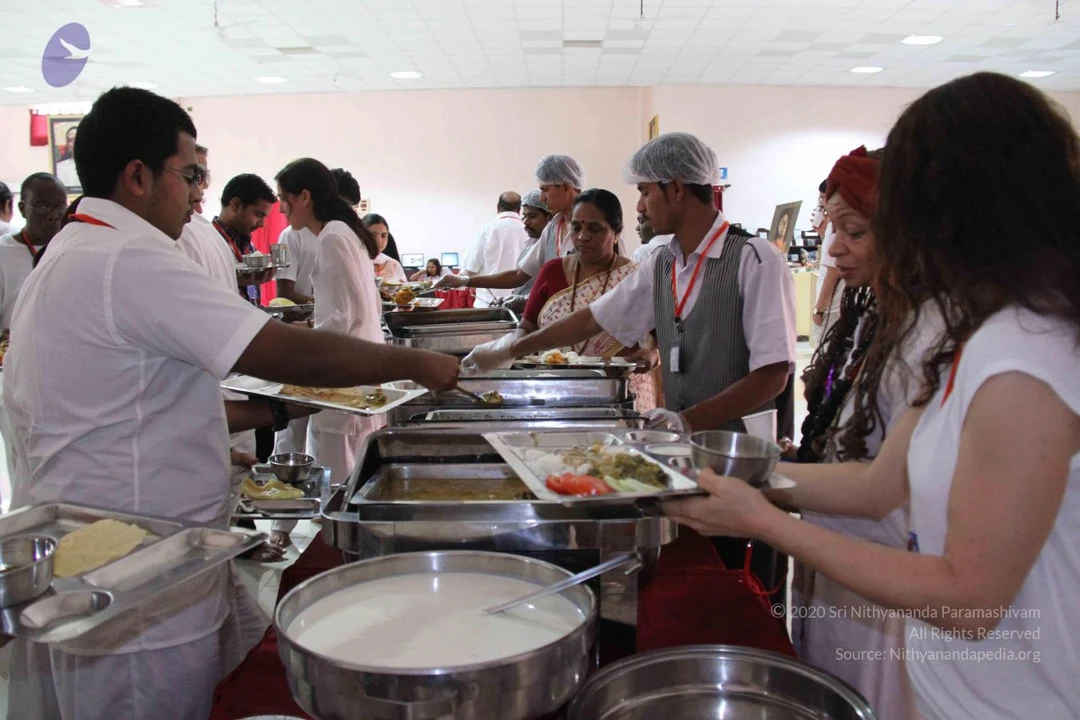
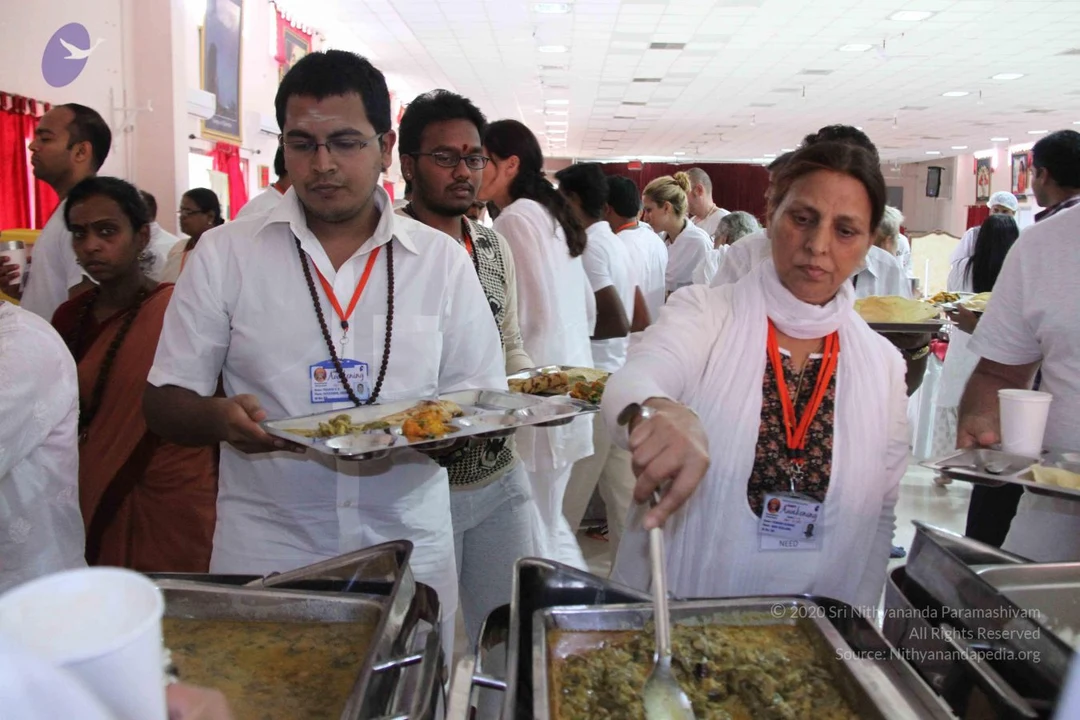
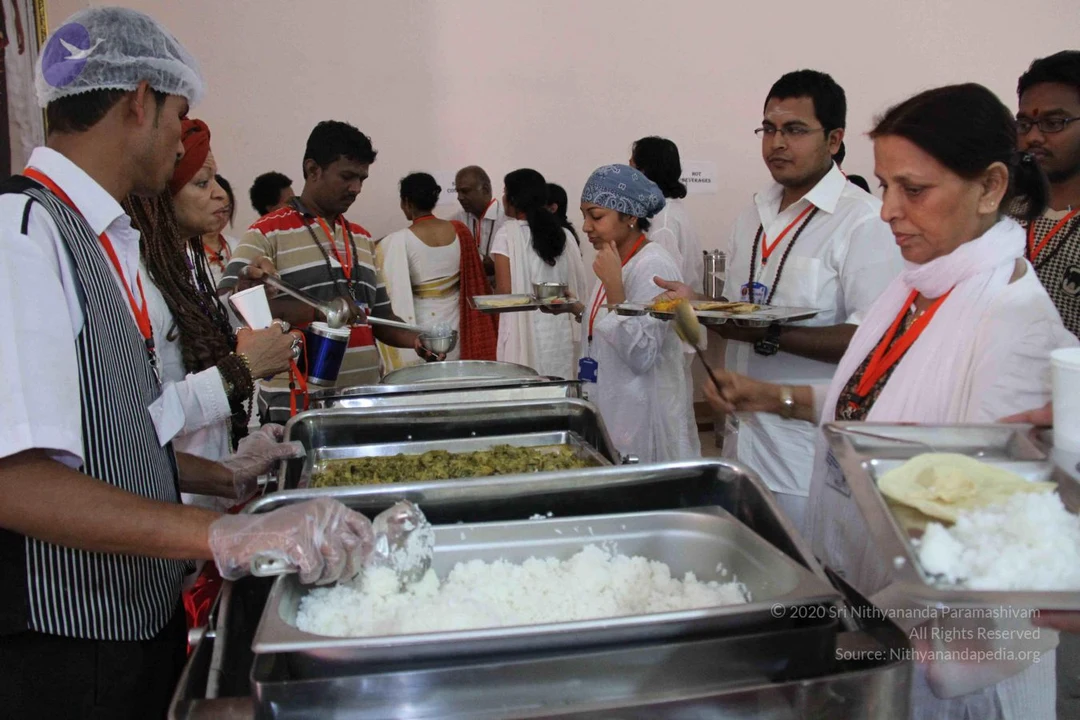
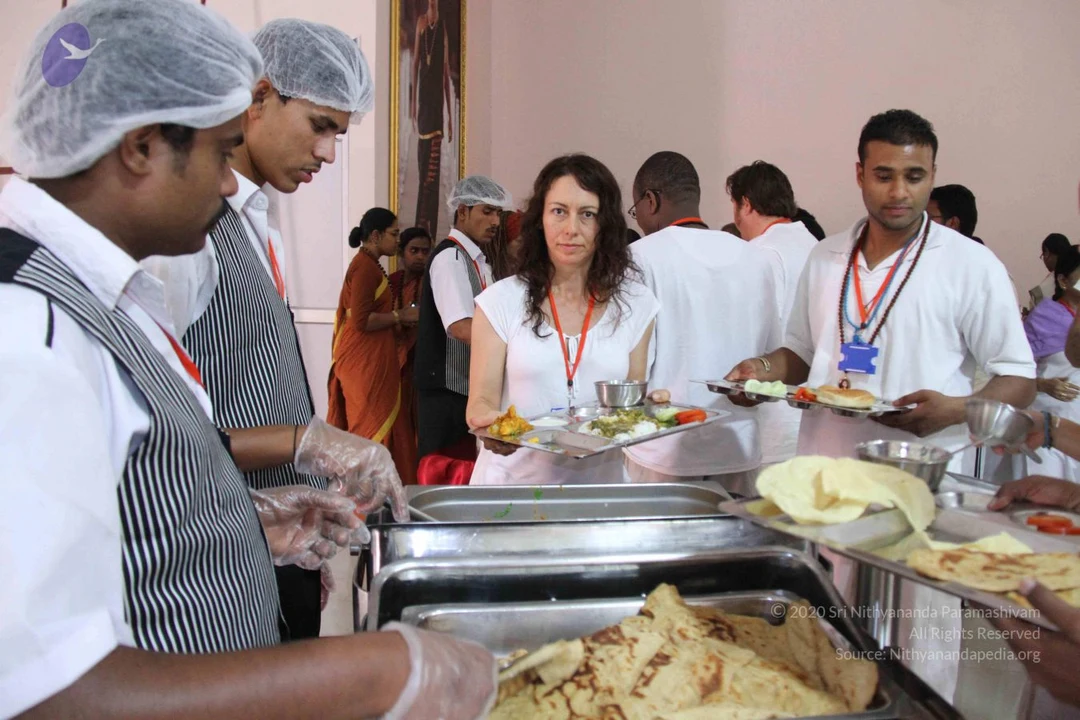
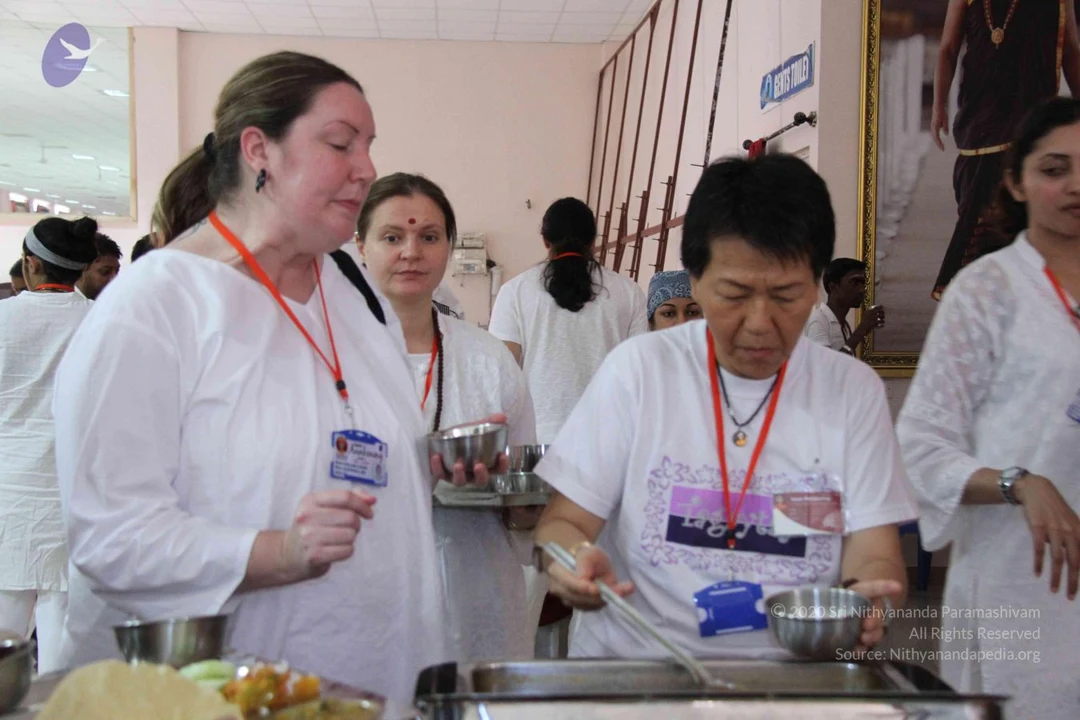
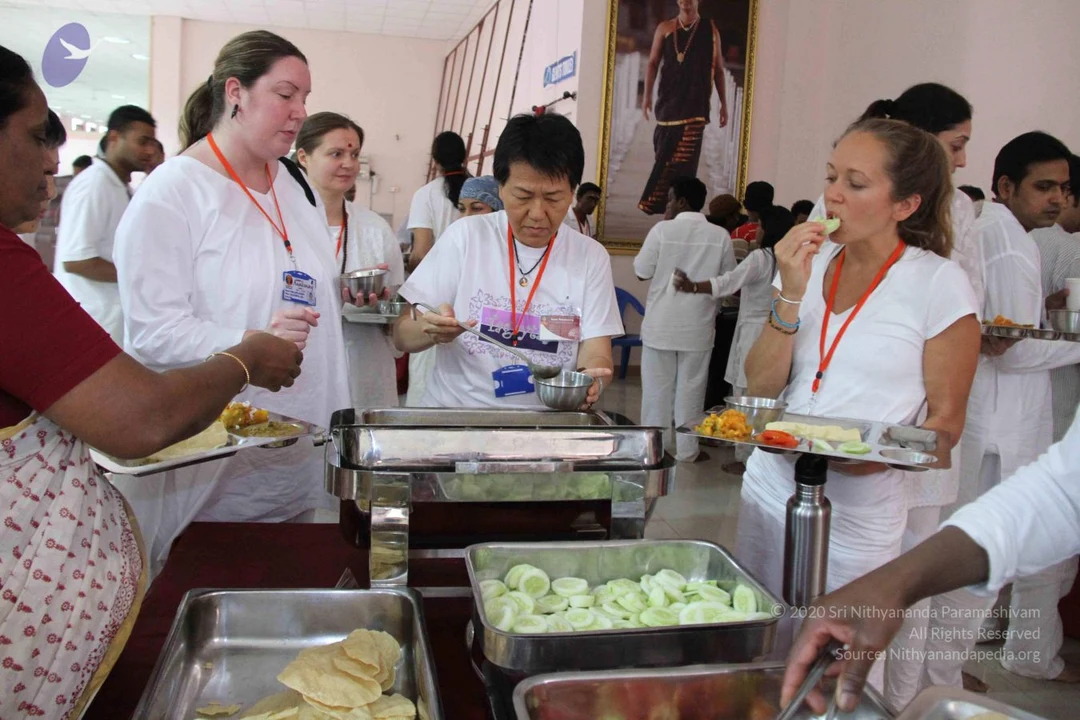
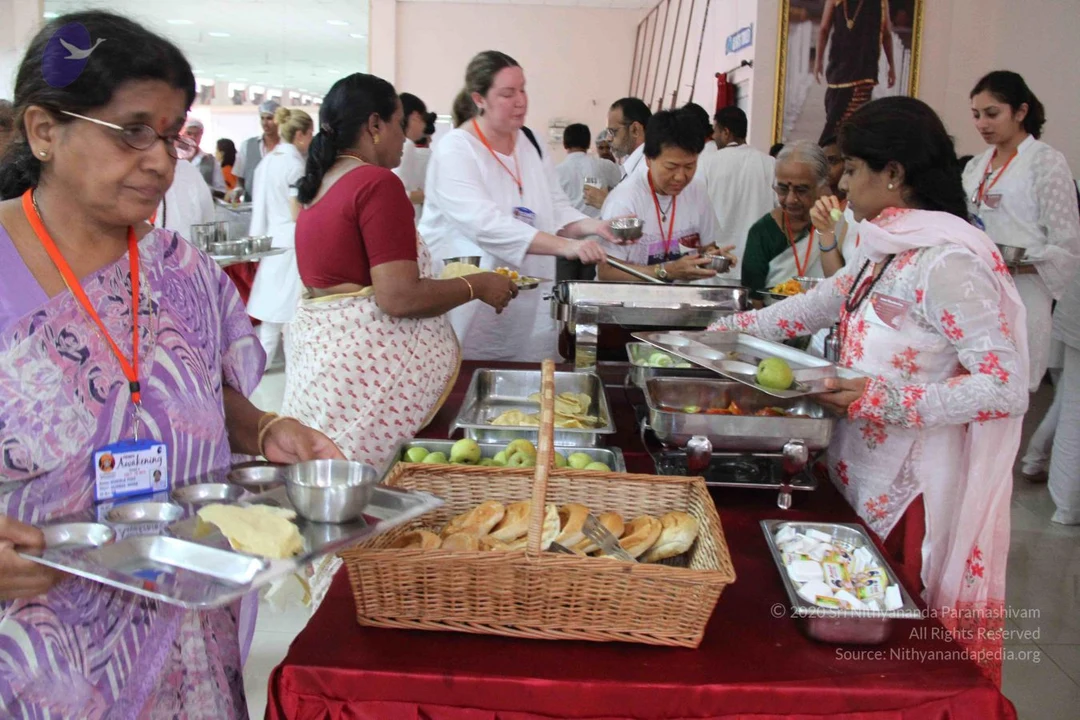
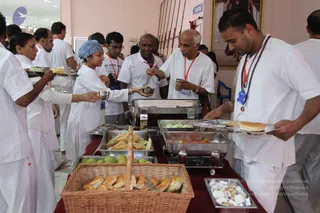
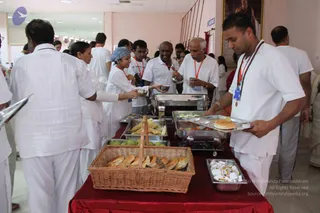
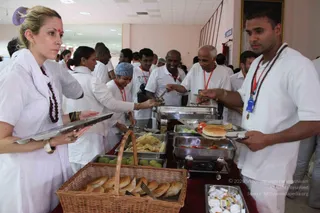
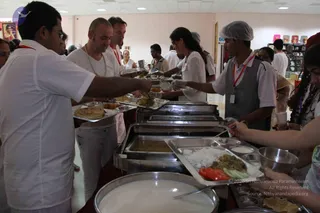
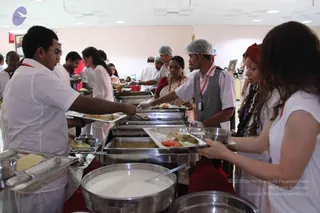
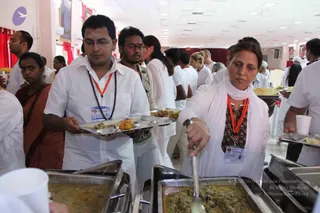
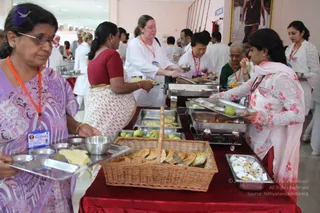
A buffet serving line in a bright white-walled hall. A woman in a white tunic and blue head covering holds a steel bowl while serving food; beside her, a man in a white shirt with an orange lanyard ladles from a steel chafing dish. Other attendees in white shirts and orange lanyards, including a man in a white shirt at the right holding a plate with a bread roll and a rudraksha mala, wait or serve. Trays hold bread rolls, sliced vegetables, lemons, samosa-like pastries and sweets in a wicker basket. A framed picture hangs on the wall at upper right.A buffet serving line in a bright hallway during an ashram meal. Devotees in white clothes serve food from steel chafing dishes on a red draped table; a wicker basket holds bread rolls, and a tray of sweets sits at the front. A man in a white shirt with an orange lanyard and rudraksha mala holds a plate of bread. A woman in white with a blue hairnet serves food into a steel bowl, and a man in a white shirt with an orange lanyard holds a bowl. A large framed portrait hangs on the right wall, but it is not clearly identifiable. Several other people in white stand along the line.A buffet line in a white-walled hall where devotees in white clothing serve food from steel trays. A woman with blonde hair in a white outfit and rudraksha mala stands at left holding a tray, a woman in white with a patterned head covering serves from a chafing dish, and a man in white with an orange lanyard uses serving tongs. At right, a man in a white shirt with a rudraksha mala and blue badge holds a plate beside a red-and-white garlanded man. The table holds bread rolls in a wicker basket, fruit, chutney, sliced vegetables and sweets. A framed picture hangs on the wall behind them.A buffet serving line in a bright hall where volunteers in white shirts and white head caps serve food from steel chafing dishes. A bald man in a white T-shirt with a gold chain holds a plate of flatbread while a volunteer with a red lanyard and a striped apron serves rice and vegetables onto a tray. Steel bowls of white yogurt or milk sit in the foreground, and a framed portrait hangs on the wall behind the line. Several people in white stand along the counter, with a few visible in the background. No one is clearly identifiable as a person in this scene.A buffet-style meal service in a bright hall with pale pink walls. Several volunteers in white clothing and orange lanyards serve food from steel chafing dishes. A man in a grey vest and white shirt wears a white hairnet and serves rice and curry onto a tray. A woman in a red and cream sari stands beside him. Another volunteer in a white hairnet serves from the far side. A woman with long hair and a red head wrap holds a plate of vegetables and tomato. A large steel bowl of white curd sits in the foreground beside stacked trays, and a framed portrait hangs on the wall behind the serving line. No figure is clearly identified as a person.A communal meal service in a bright hall with white walls, red curtains and framed pictures. A woman in a white shawl and floral top with an orange lanyard serves food from a steel chafing dish with a large ladle. Beside her, a man in a white shirt with rudraksha beads and an orange lanyard holds a steel plate of curried food. Behind them, people in white clothes queue along the serving counter, and a man in orange robes with rudraksha beads stands at left. Trays of yellow curry sit on the counter, consistent with an annadan meal.

Temple

41 photosSource gallery
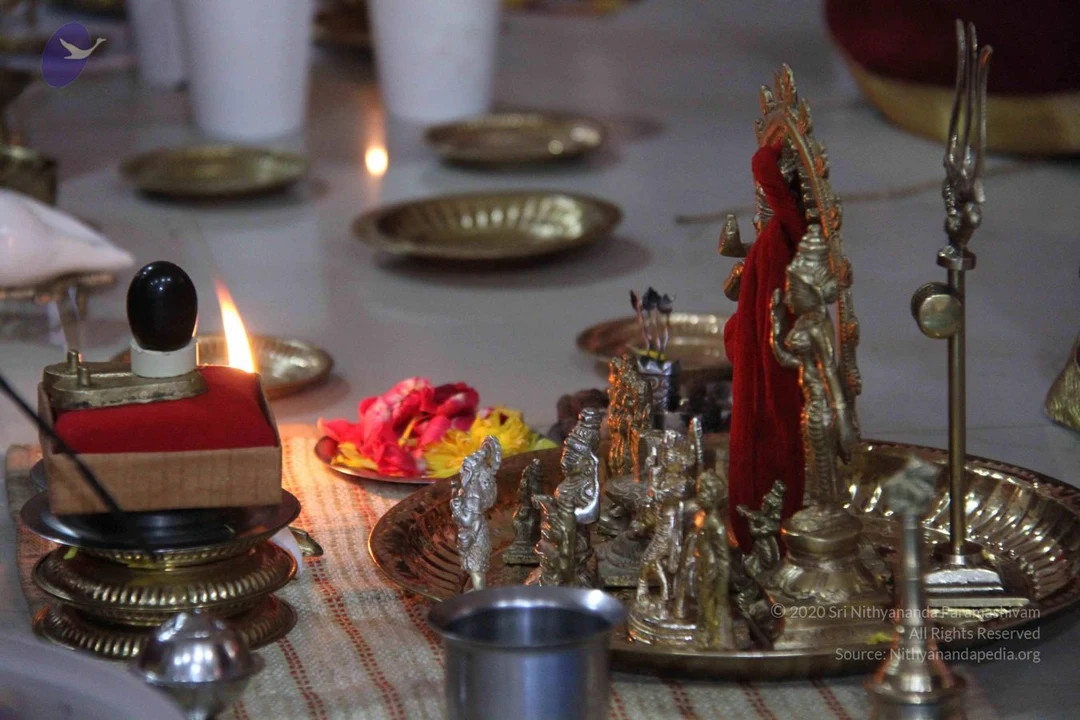
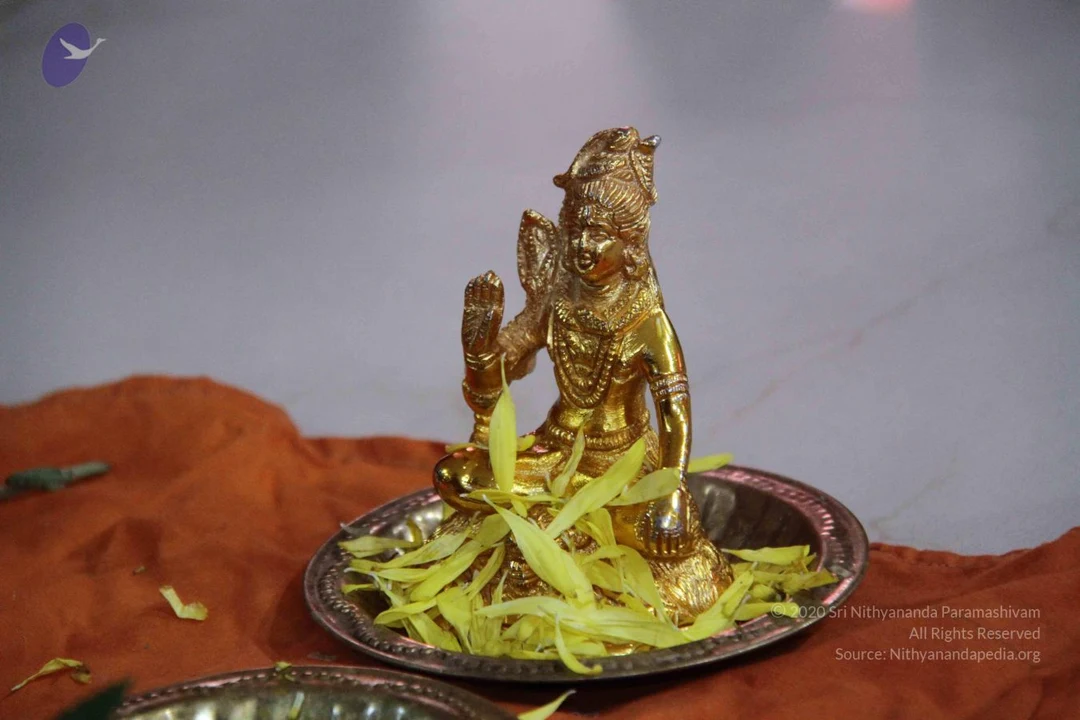
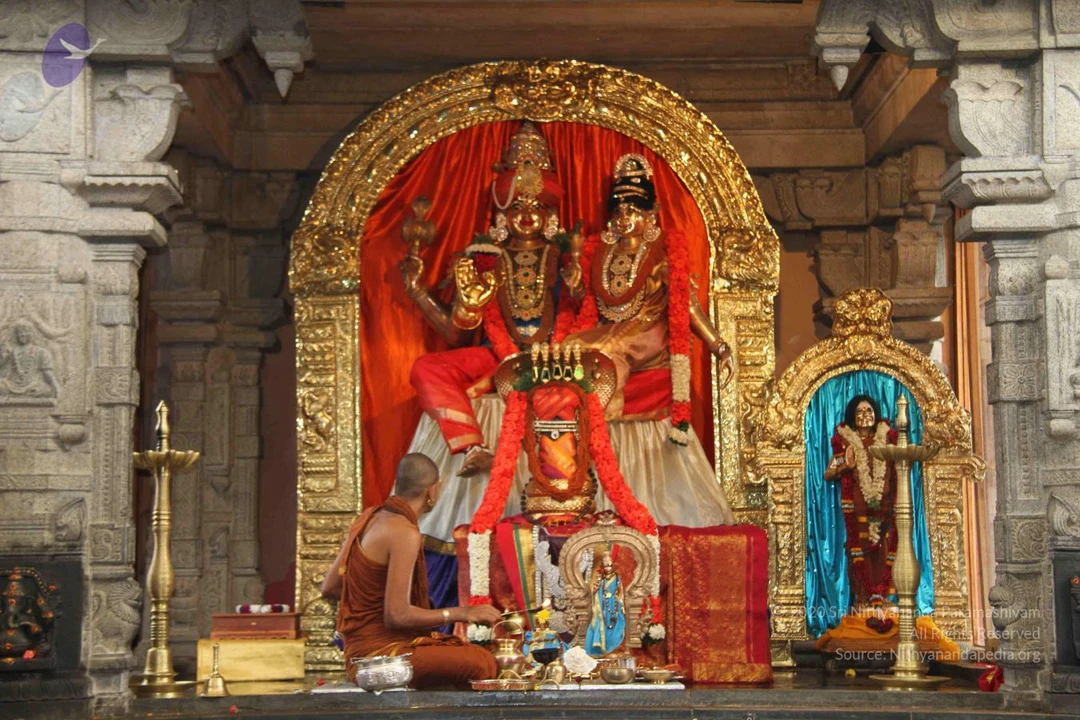
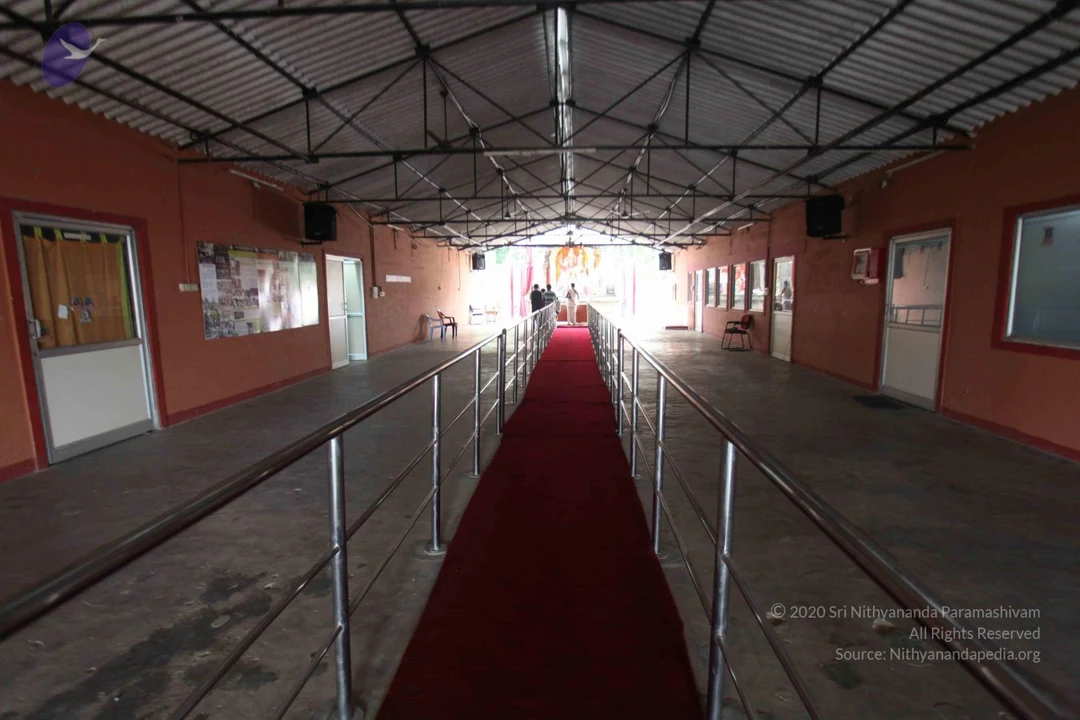
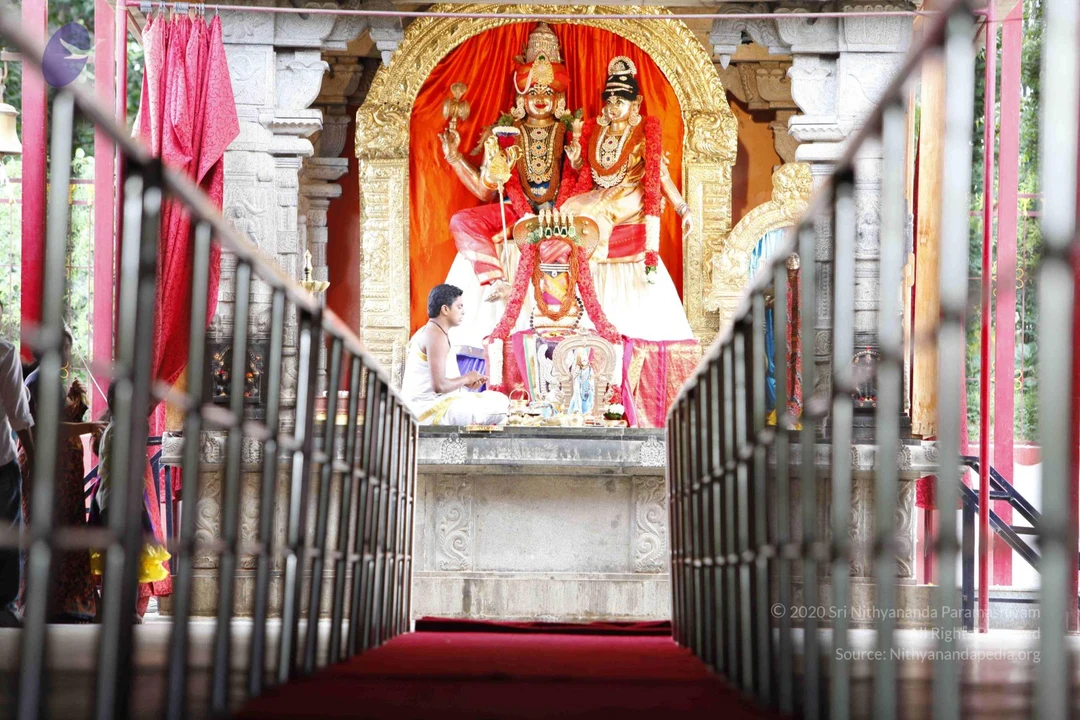
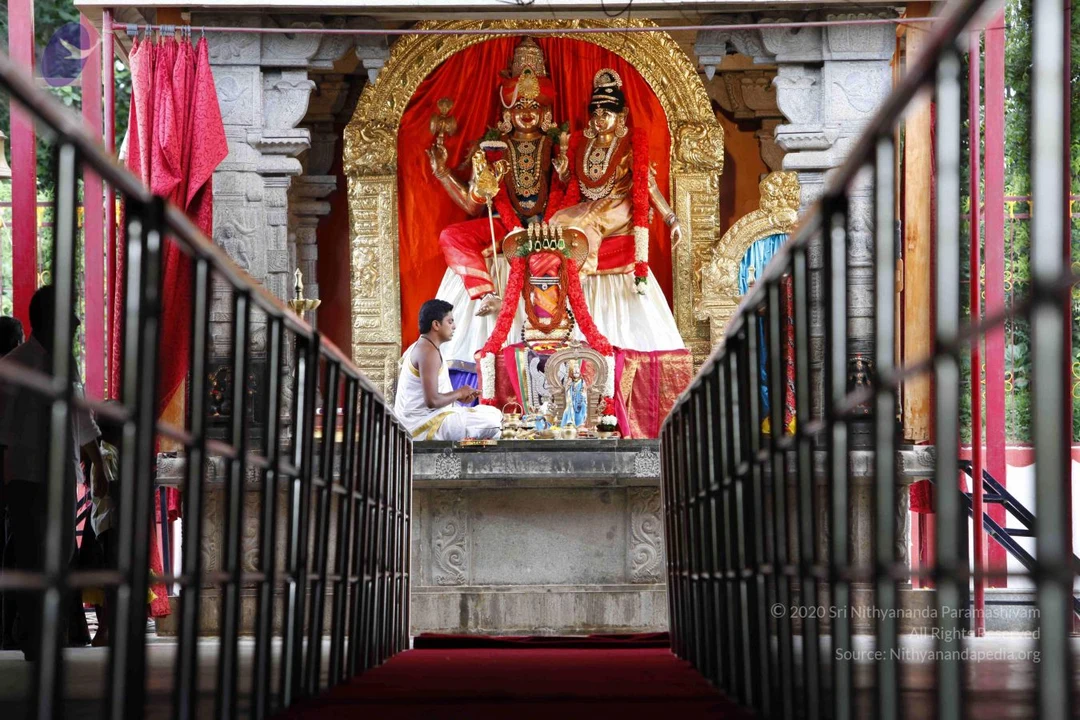
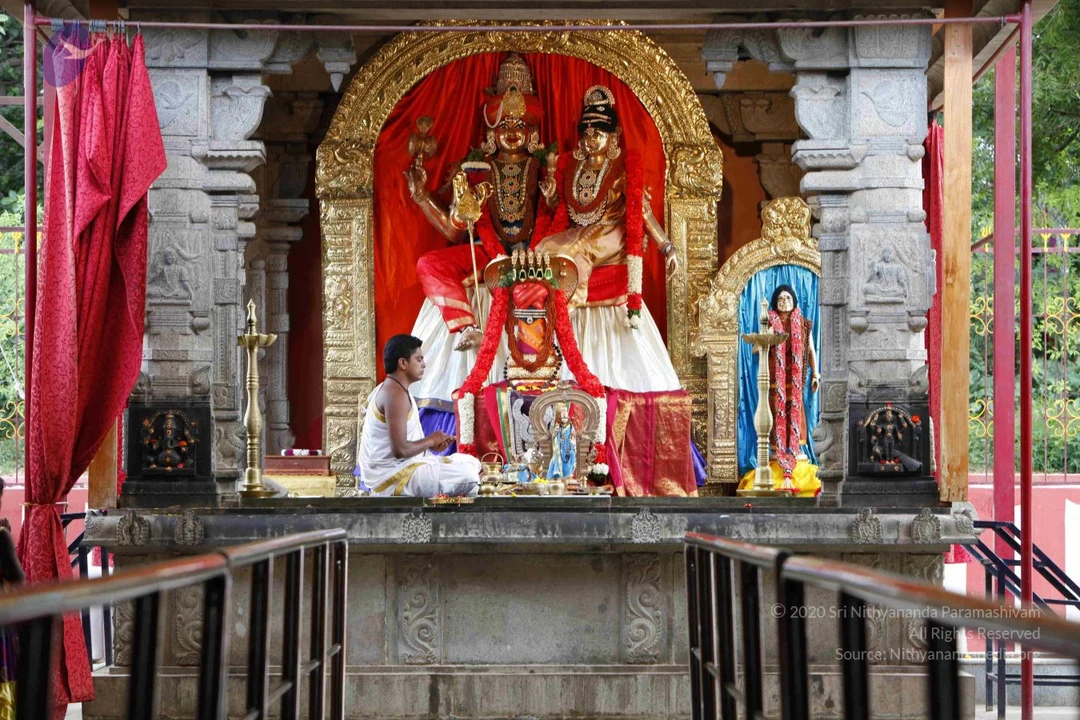
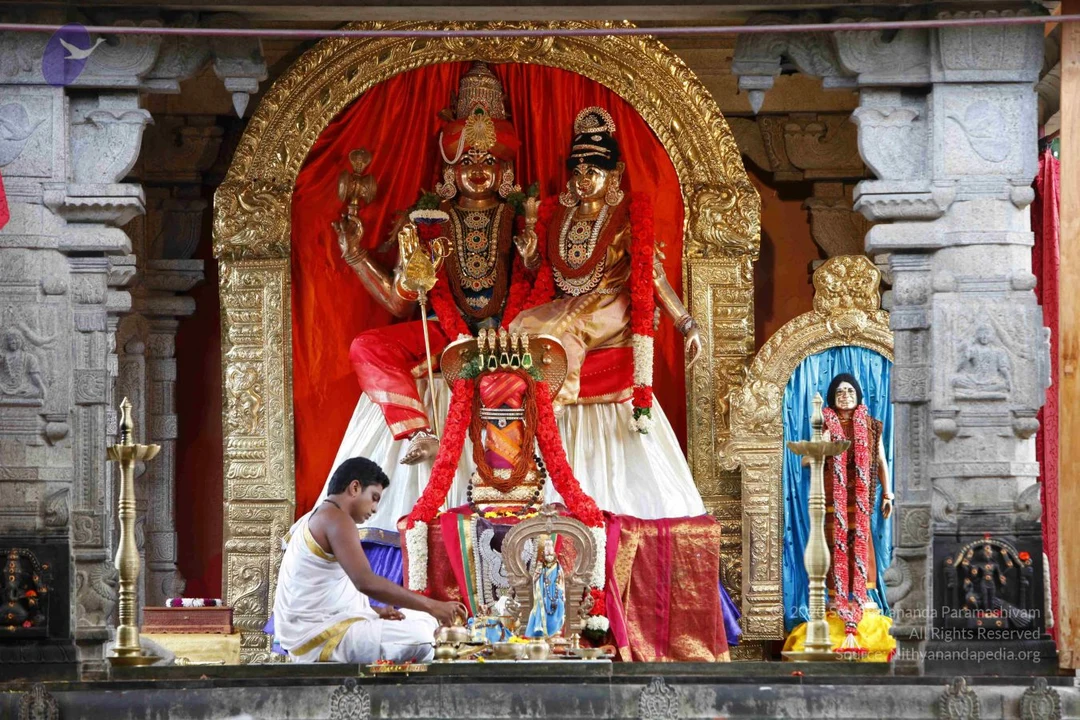
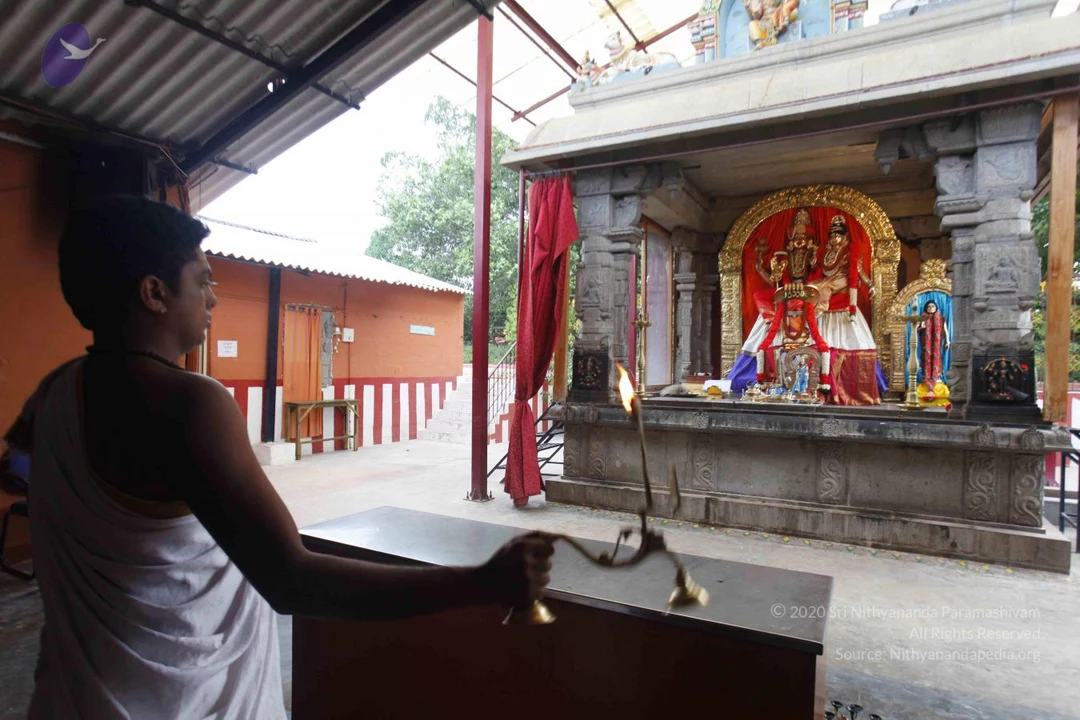
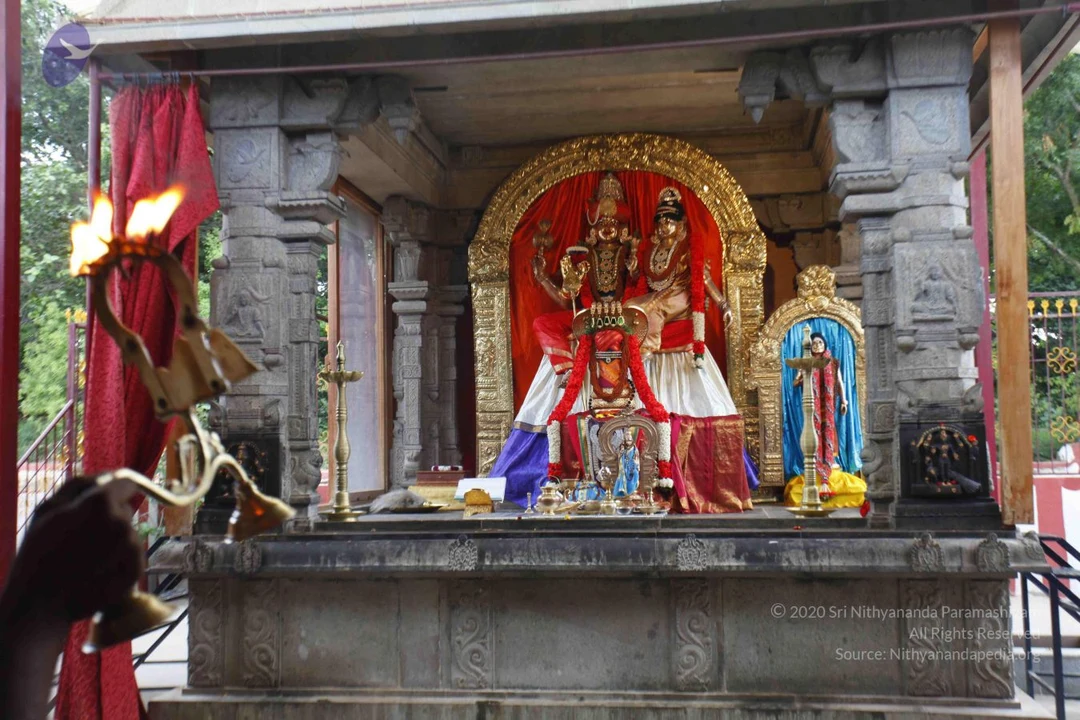
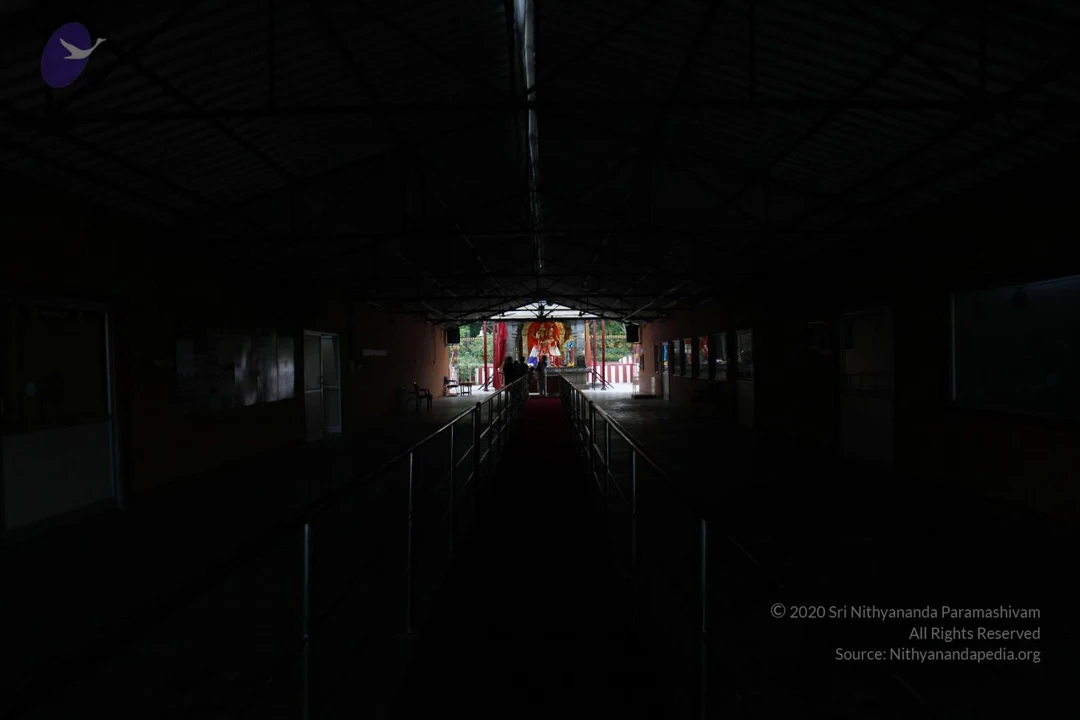
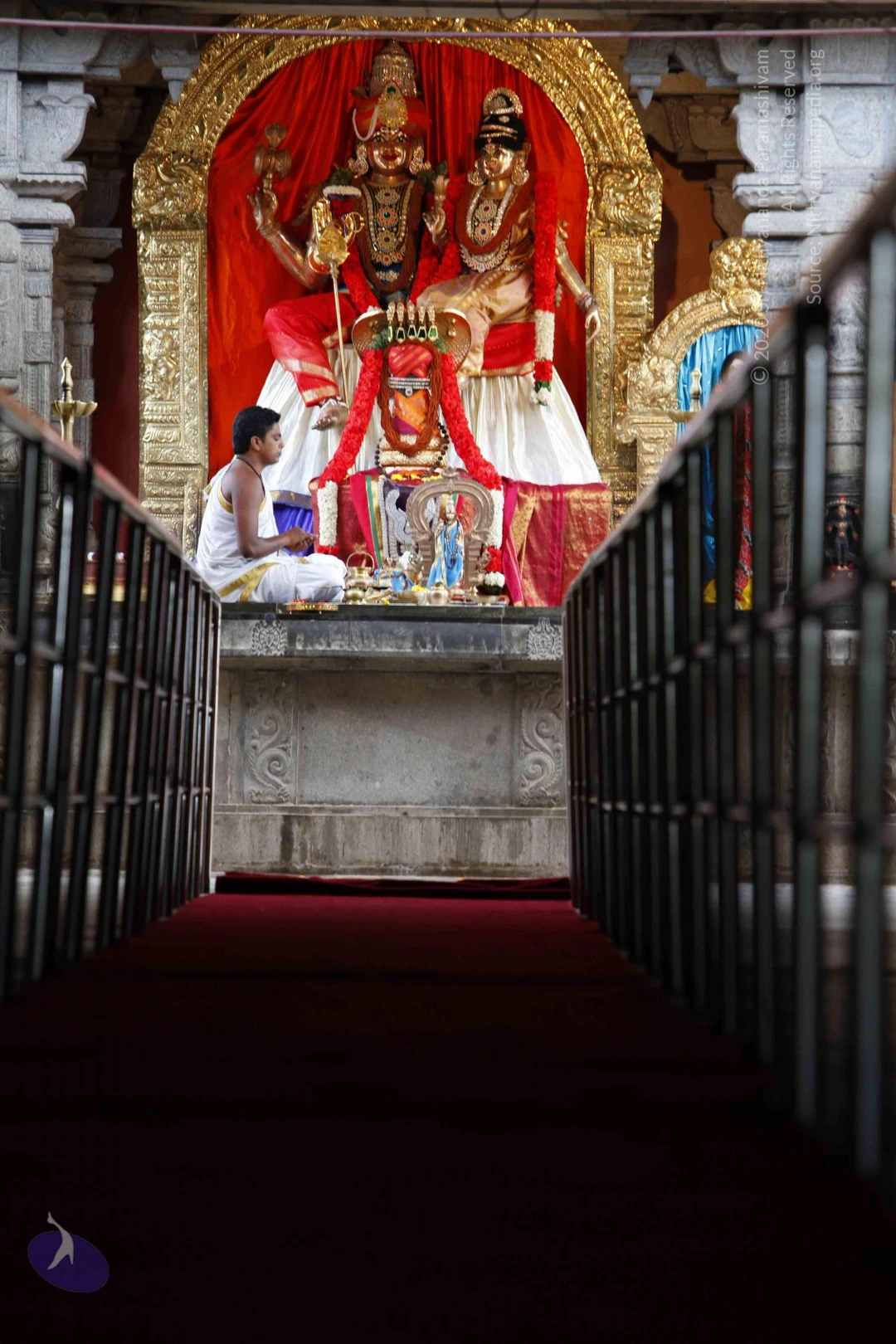
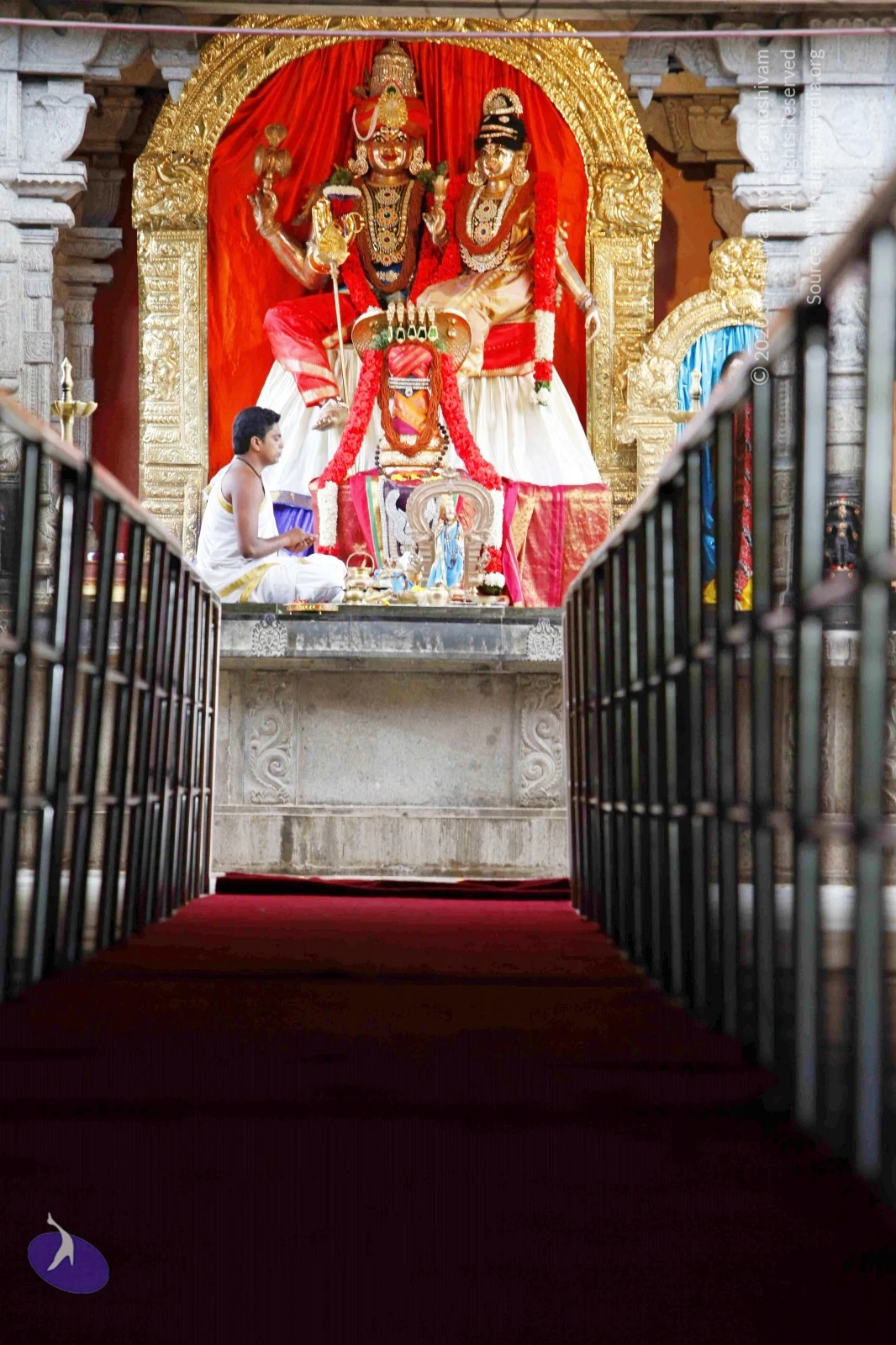
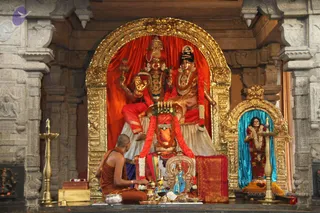
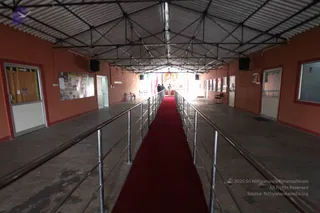
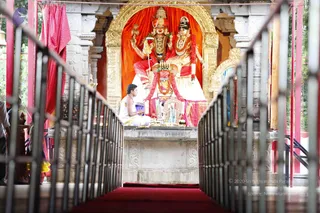
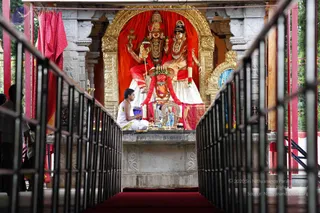
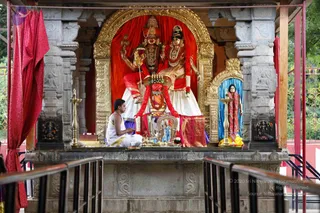
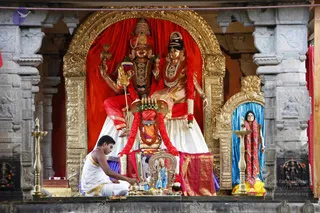
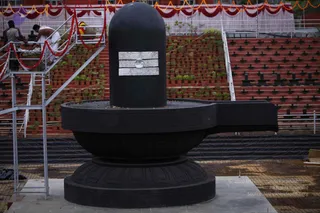
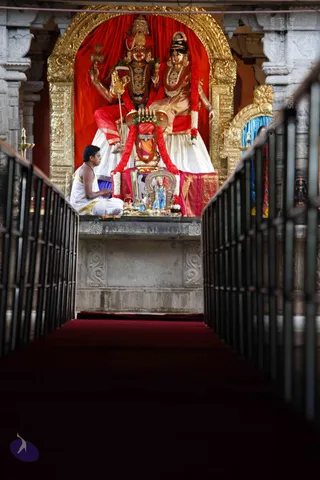
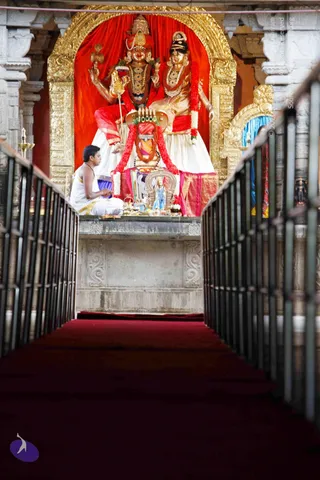
A photograph of a temple shrine with an ornate gold-framed arched niche containing a large deity murti of Shiva and Parvati seated together, decorated with red garlands, gold ornaments and a red curtain behind them. A shaved-headed priest in orange-brown robes sits cross-legged at the lower left before a shivalinga and offerings, touching the ritual items with his hand. Brass oil lamps stand on either side, and a smaller blue-curtained niche at right holds another adorned figure. The scene is a puja or abhishekam setting.A long covered hall with a corrugated metal roof and orange-painted walls leads toward a distant stage. A red carpet runs down the center between metal railings on both sides. Small rooms with doors line the walls, and a notice board hangs on the left wall. At the far end, a few figures stand near a bright decorated altar or dais with garlands and red and gold drapery, while a dark shape stands in the middle distance. A wall-mounted speaker sits near the ceiling.Photograph taken through a gated walkway with a red carpet leading toward a shrine. Centre: a large golden-framed shrine with an orange-red backdrop holds a deity murti pair seated on a white-draped platform, one figure with a trident-like staff and a crown, the other wearing a crown and golden necklaces, garlanded with red flowers. In front, a shaved-headed priest in white dhoti sits at a stone altar with a puja plate and oil lamps. Red and pink cloth hangs on the left pillars and a small arch on the right. No clear a person figure is visible.Photograph of a temple shrine viewed down a narrow corridor lined with black metal railings and a red carpet. At the far end sits a large golden-bodied deity murti with multiple arms, holding a trident and other implements, seated on a white cloth in front of a red draped backdrop framed by a golden arch. Red and white flower garlands hang around the murti and a smaller seated figure before it. A priest in white dhoti and shawl sits cross-legged on the left at a stone altar holding ritual objects, with brass lamps and offerings in front. A few partially visible people stand at the left edge of the frame.A photograph of a temple shrine with a large golden arched niche framing a deity murti of Shiva with a consort, both adorned with red garlands and rudraksha-style necklaces, against a deep red drape. A seated priest in white dhoti and shawl sits at the base performing puja before a small altar with brass lamps, kalasha and offerings. Brass oil lamps stand on either side, and a smaller blue-niched figure appears to the right. Stone pillars with carved reliefs and a red metal railing surround the shrine. The image is a worship scene with a single visible priest.Photograph inside a temple shrine showing a large gold-framed arch enclosing red drapery and two large seated deity murtis, a male figure with a crown holding a trident-like staff and a female figure in a gold and red sari adorned with red garlands. A shaved-headed priest in white dhoti and shawl sits at the lower left, tending offerings and a small silver vessel on a red-and-gold cloth in front of a shivalinga-style form decorated with red flower garlands. Brass oil lamps stand on either side, and a smaller figure in blue drapery with a garland appears at the right. Carved stone pillars frame the scene.

eN-Genius

10 photosSource gallery
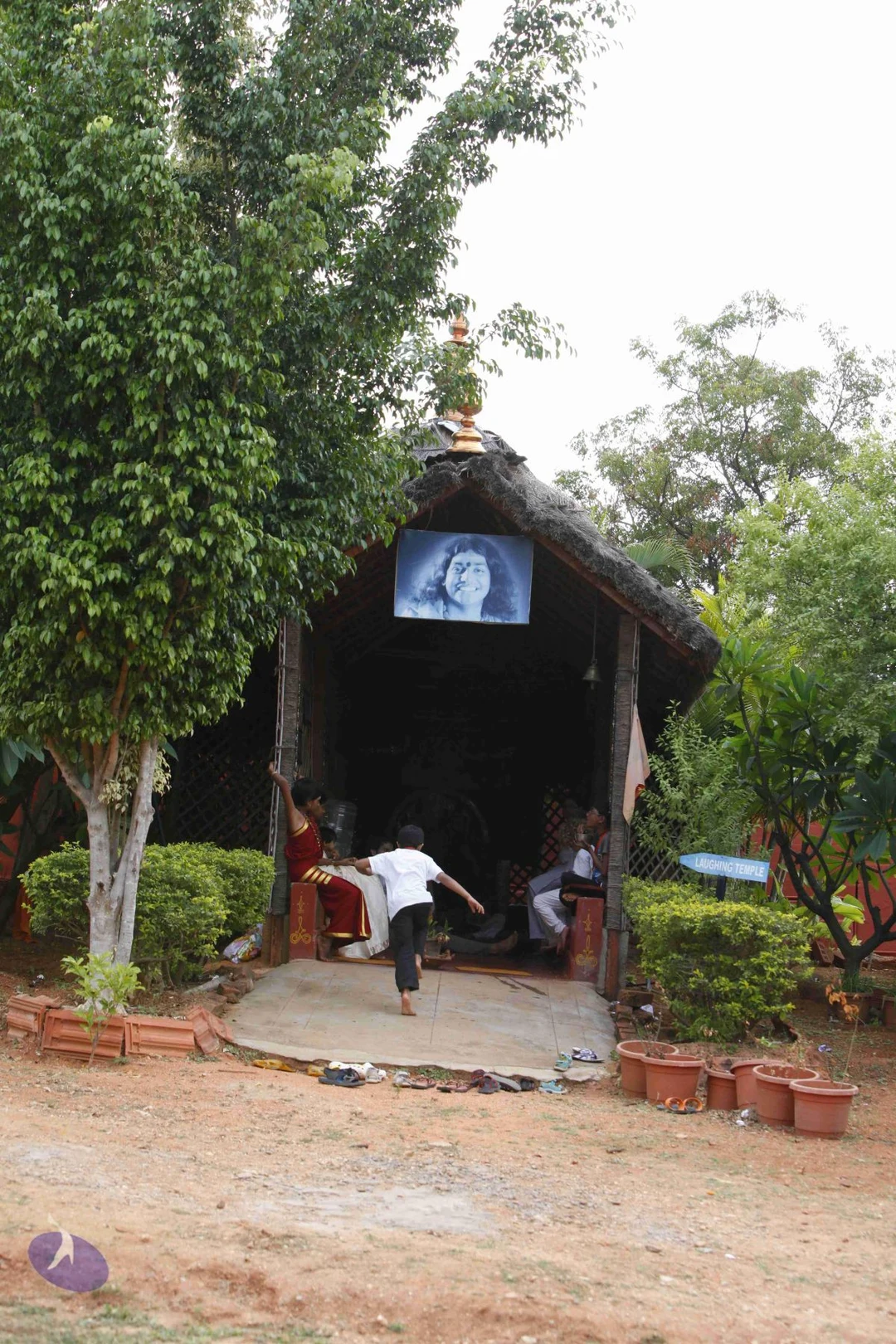
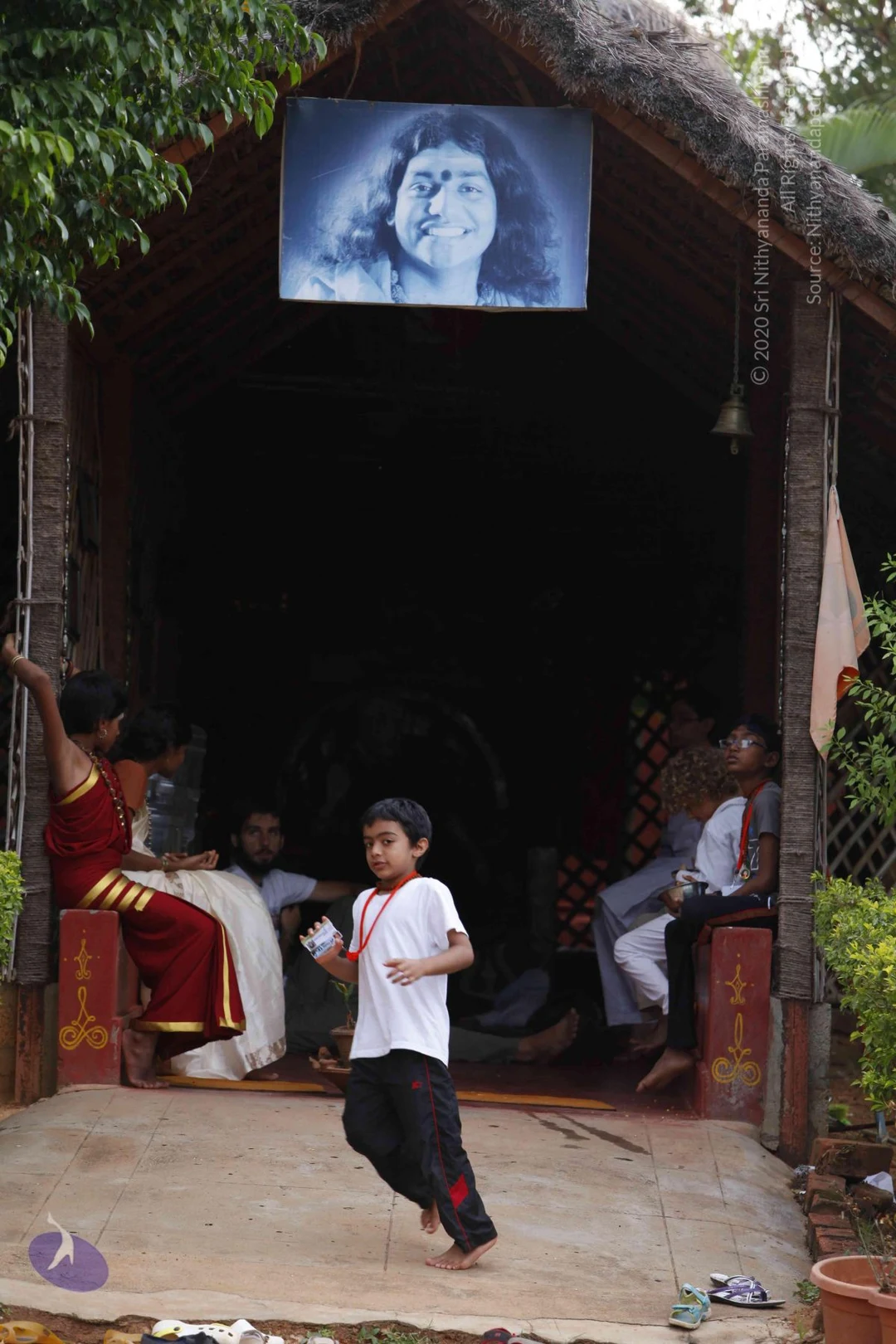
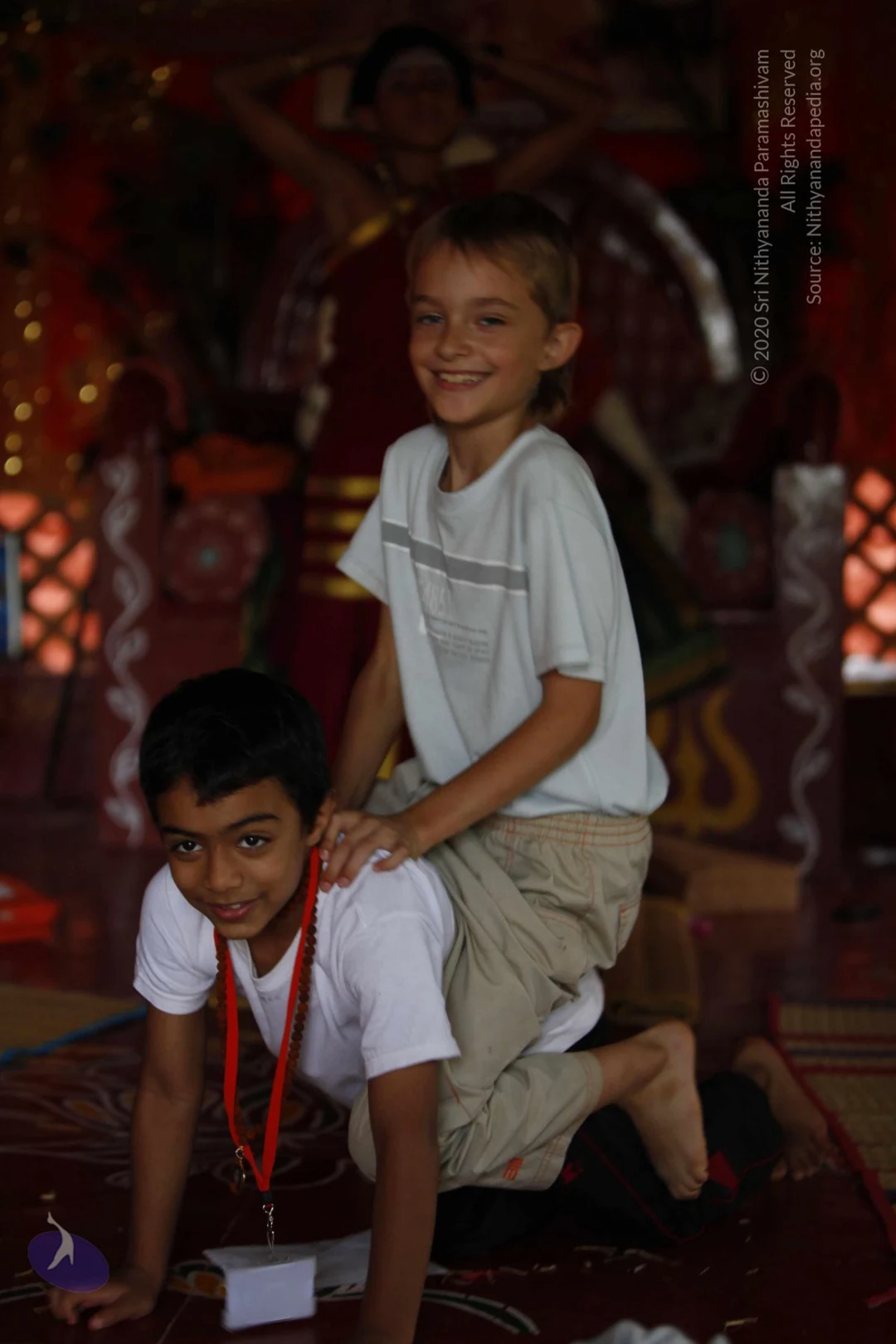
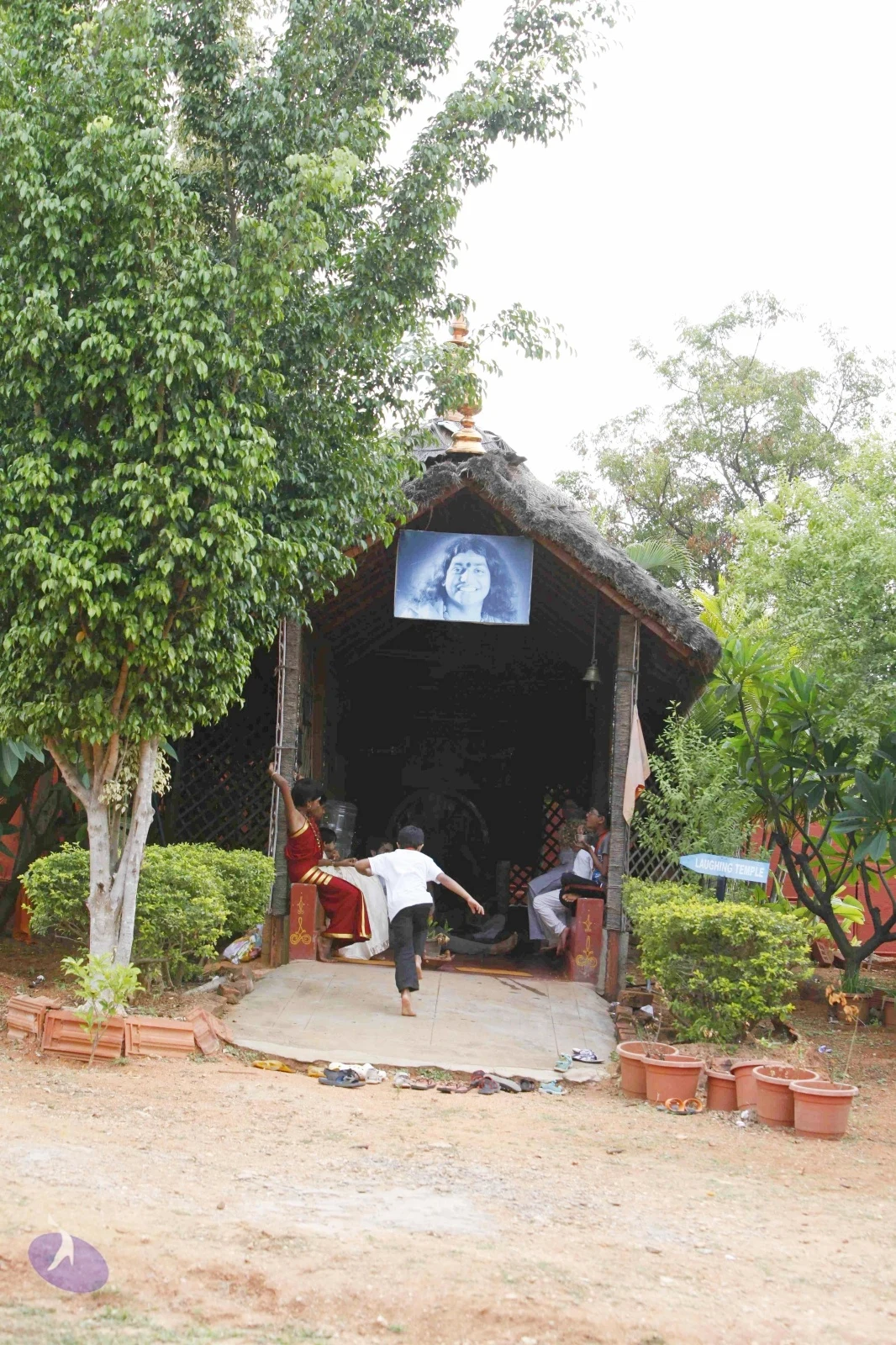
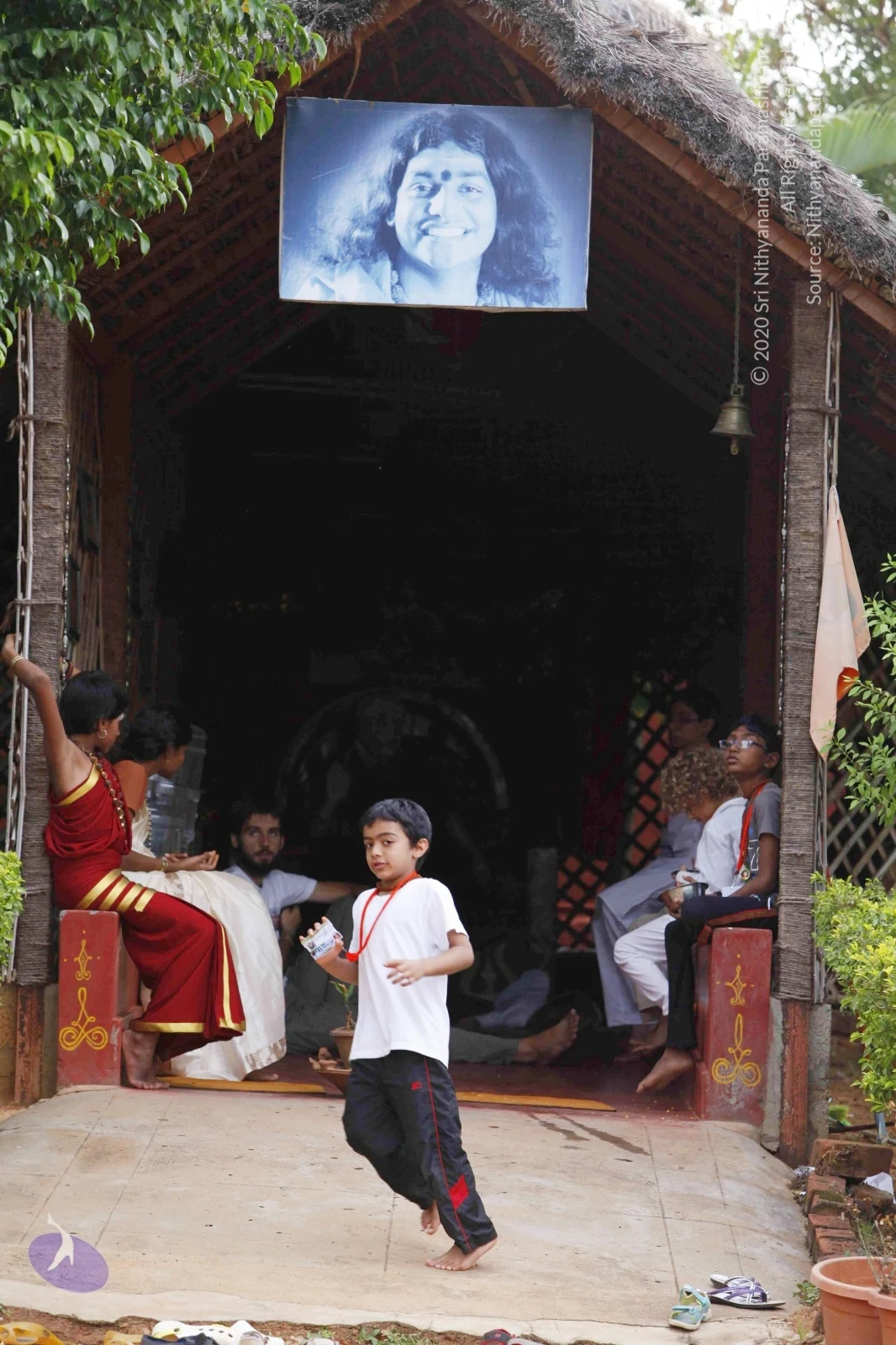
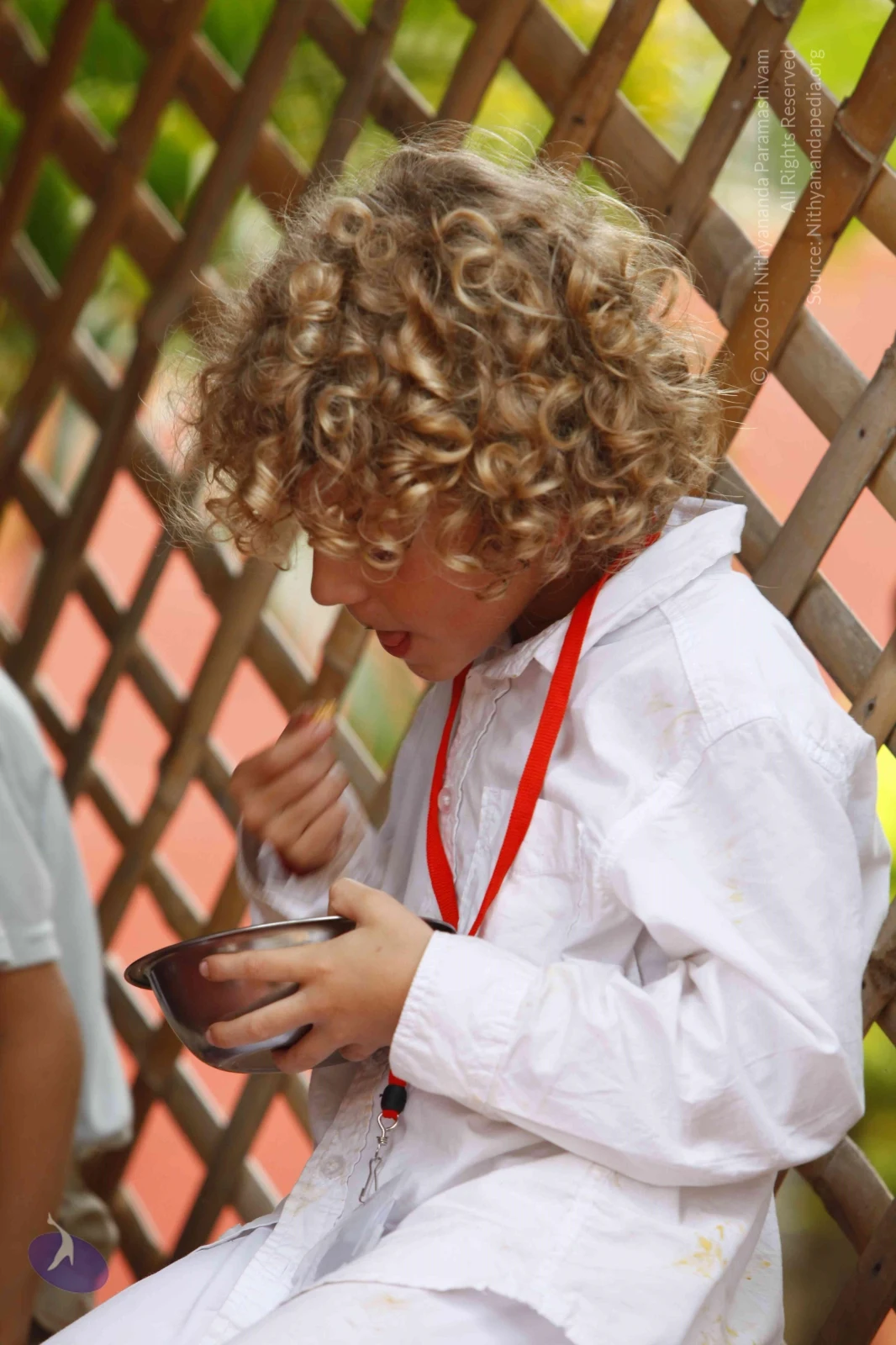
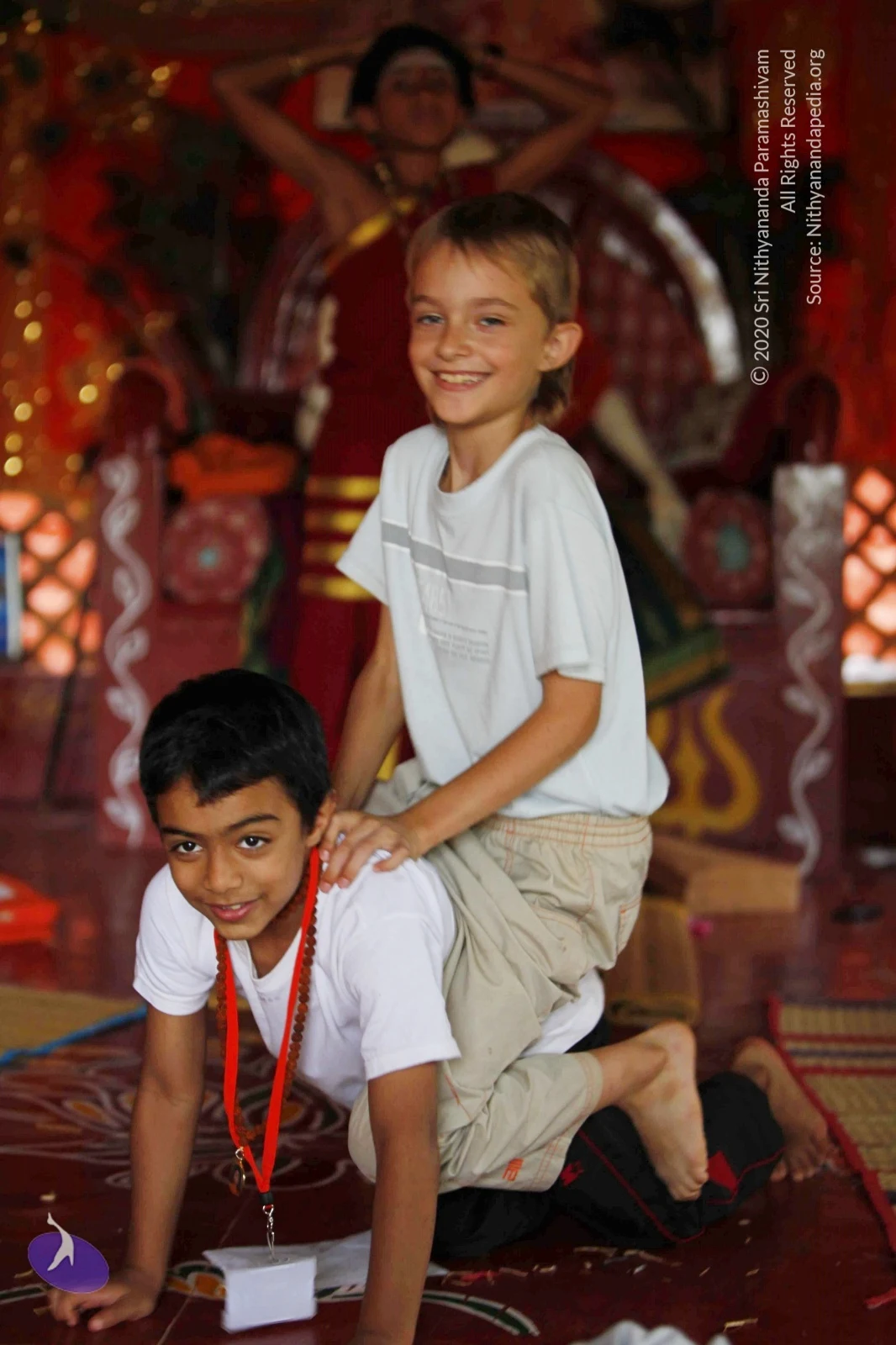
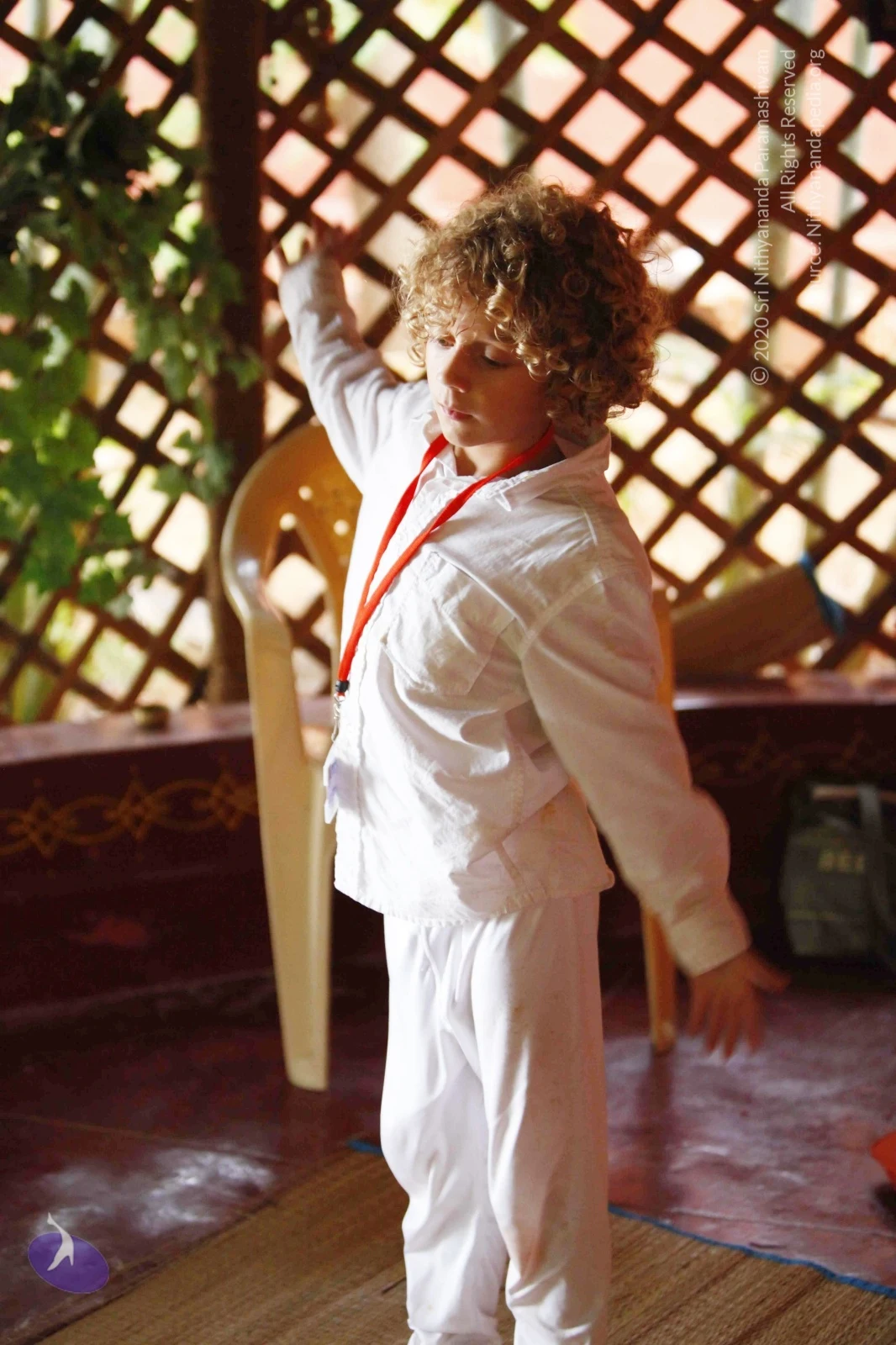
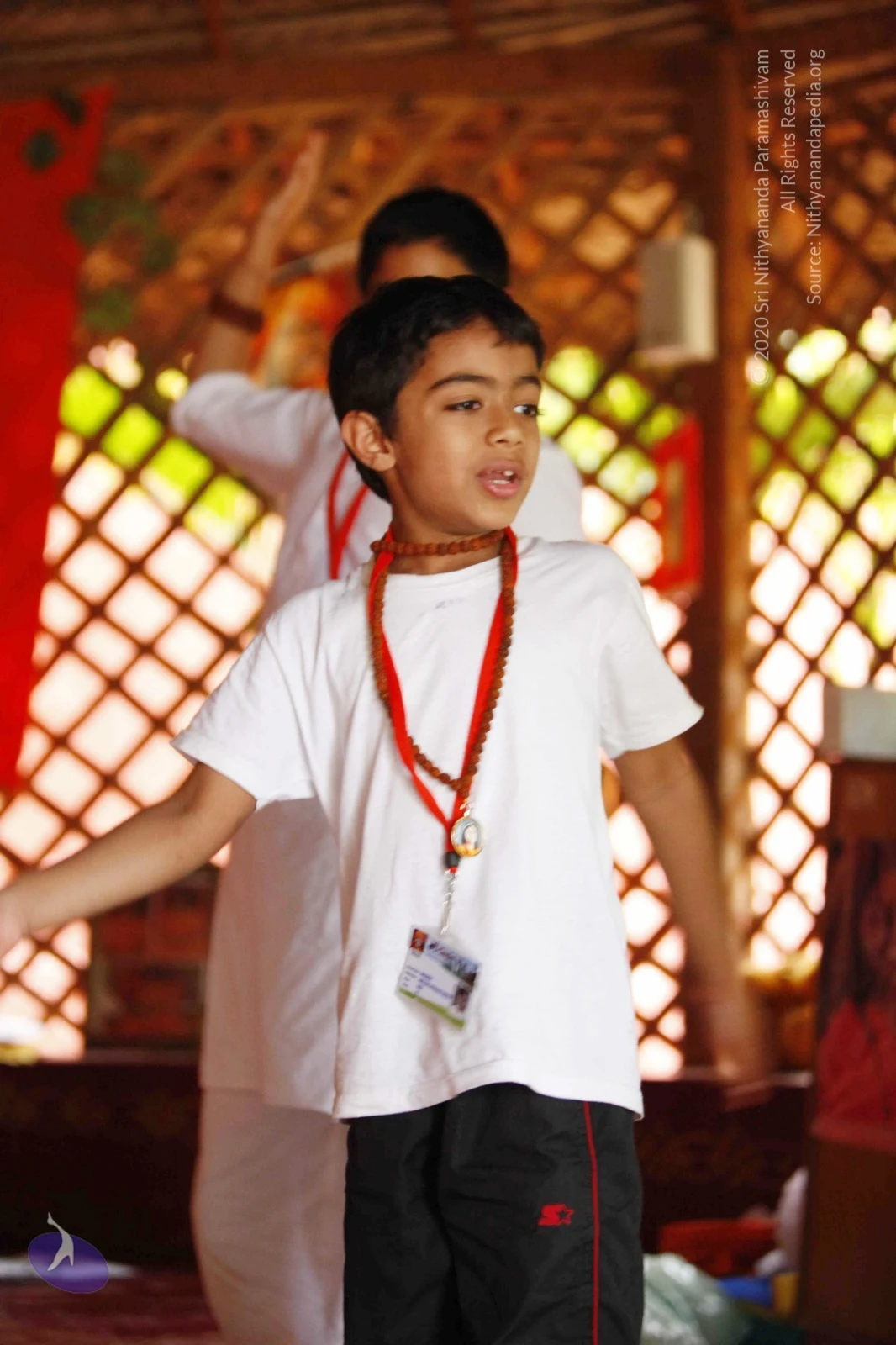
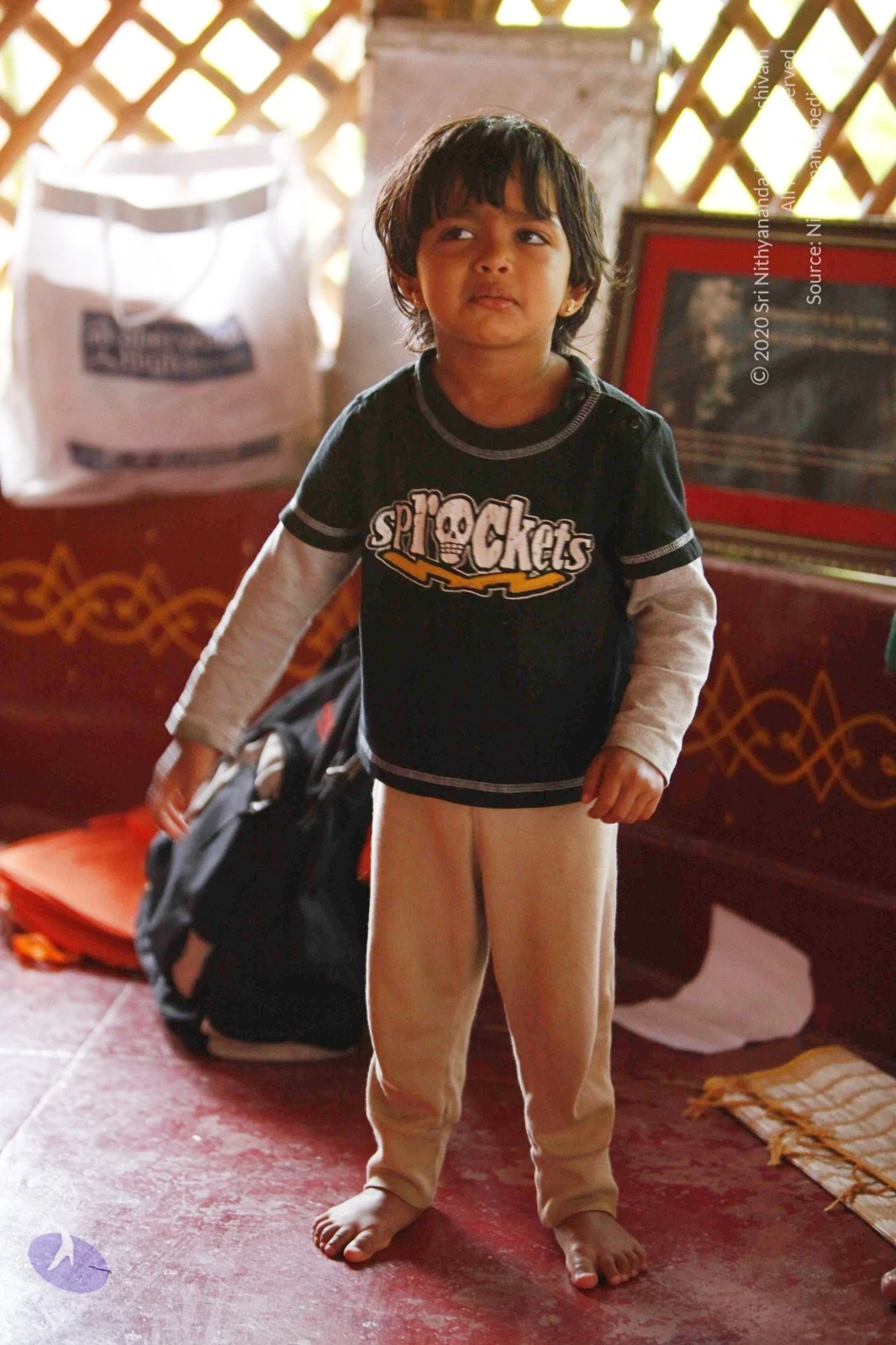
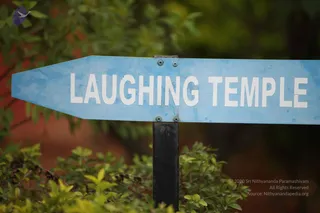
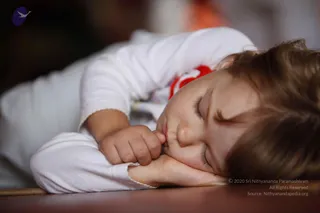
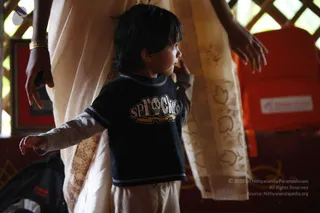
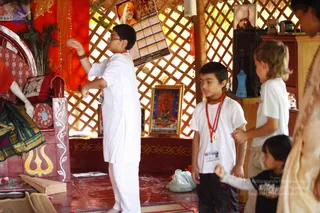
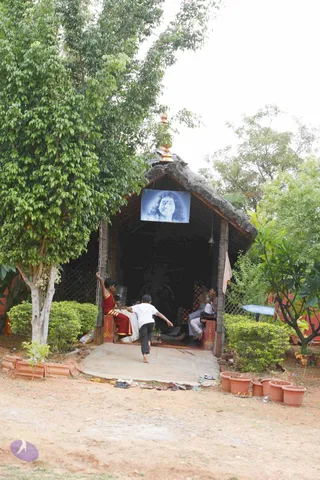
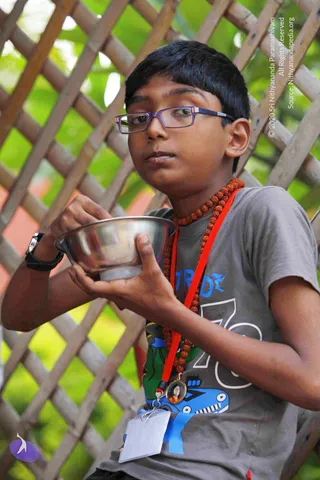
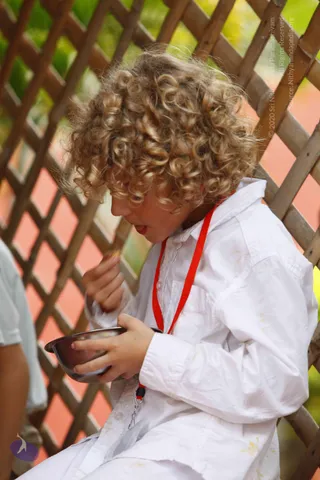
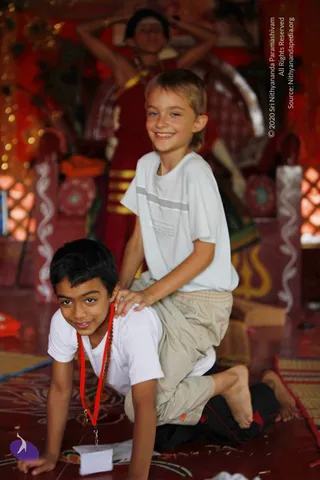
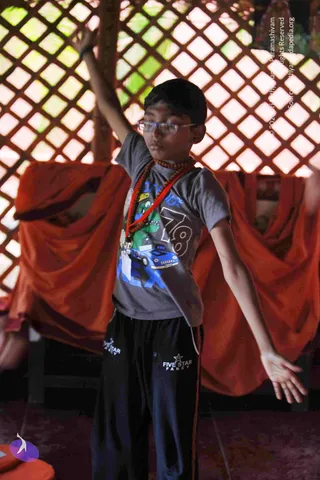
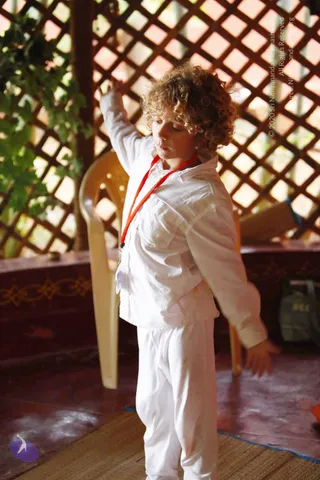
A blue directional signpost with a pointed arrow reads "LAUGHING TEMPLE" in white block capitals, mounted on a black post. Green leafy shrubs fill the foreground and a soft-focus red wall and foliage sit behind it. No people are visible in the scene.A close photograph of a young boy with light brown hair in a mullet-style cut, wearing a plain white t-shirt with grey horizontal stripes at the chest, leaning forward and smiling in profile against a dark background with blurred warm-toned patterned surfaces. No ritual objects, deities or a person depiction are visible; the figure is an ordinary child in a casual setting.A photograph of a young child with short dark hair and a small gold stud earring, wearing a dark navy top with light grey trim, reaching a hand toward green leafy foliage. An adult's arm with a gold bangle is visible at the upper edge, and a white garment on the left. The background is a soft blur of green plants. No ritual, discourse or a person candidate is visible.A close portrait photo of a young child with thick dark bangs and shoulder-length black hair, wearing a small gold stud earring and a dark navy top with light grey trim at the collar. The child glances over the shoulder toward the camera against a softly blurred green foliage background with a tree trunk on the left. No ritual, event, or devotional setting is visible.A close photograph of a young child asleep on a wooden surface, head resting on one hand, eyes closed, with light brown hair and a small gold earring. The child wears a white top with red and white trim and white trousers. The image is cropped tightly on the face and hands. No a person candidate is visible.A close photograph of a young child sleeping face-down on a wooden surface, head resting on the back of one hand. The child wears a white long-sleeved top with a red and white patterned graphic on the chest. Eyes are closed and the hair is light brown and tousled. The background is softly blurred. No a person candidate is visible, only this child.

Ashram-Pictures

15 photosSource gallery
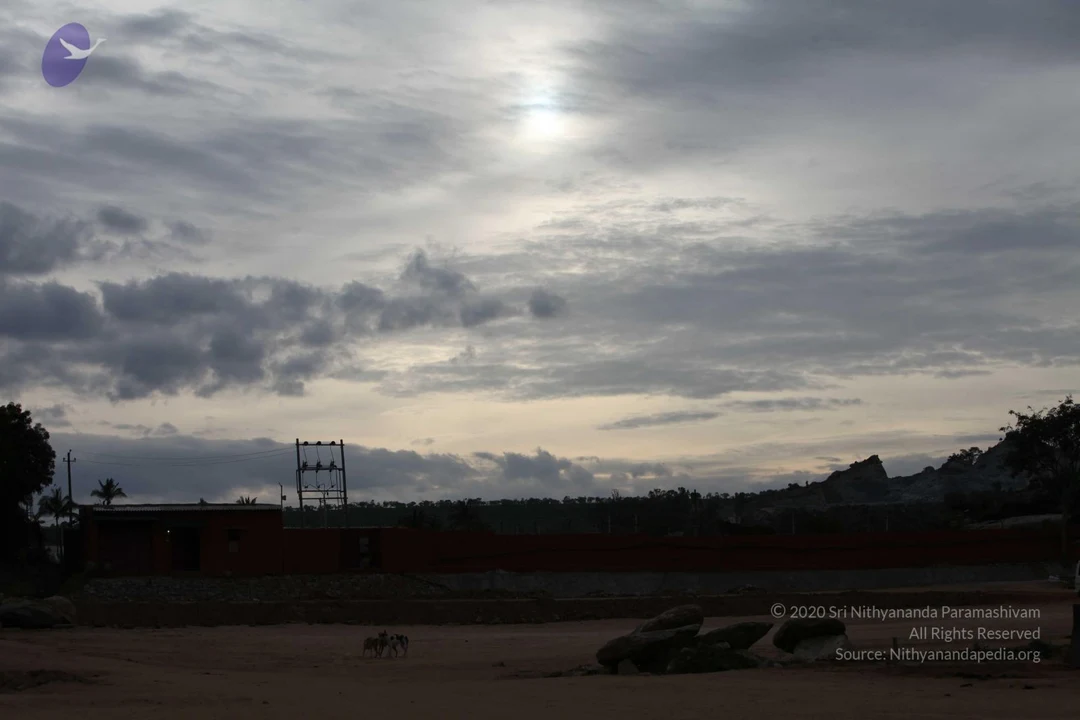
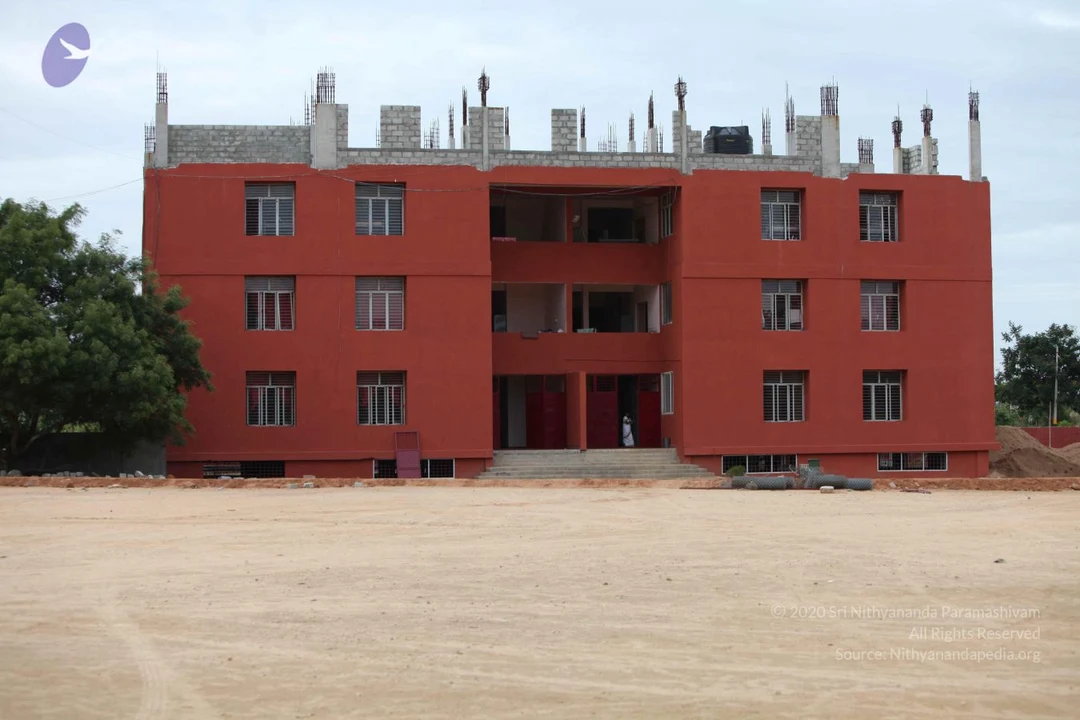
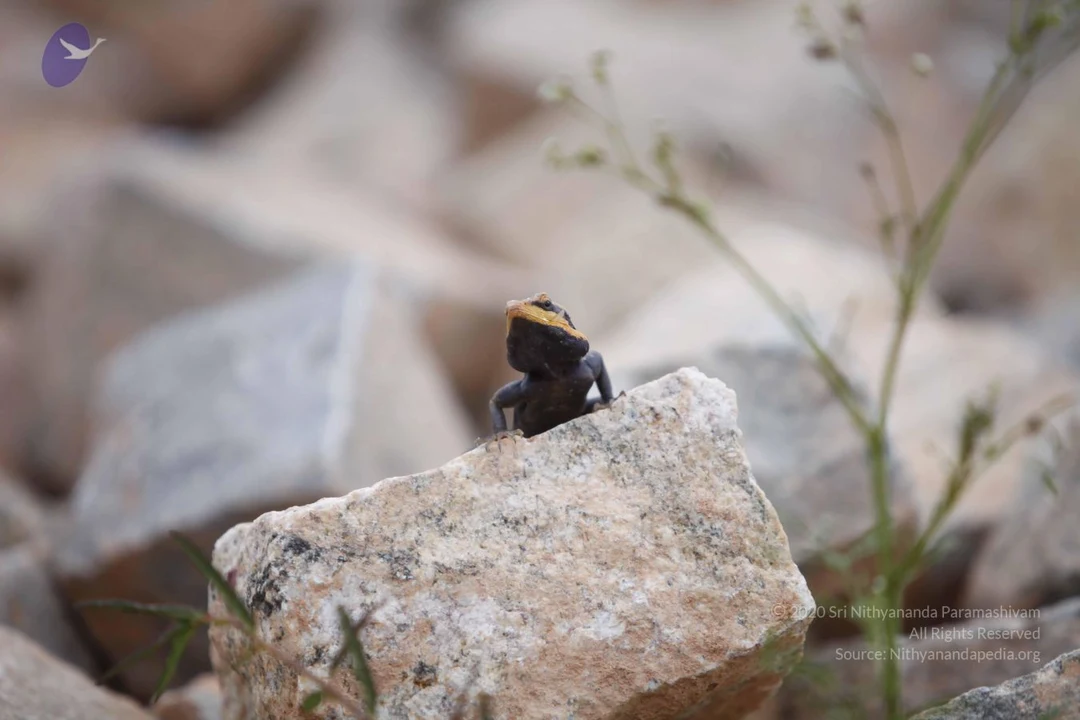
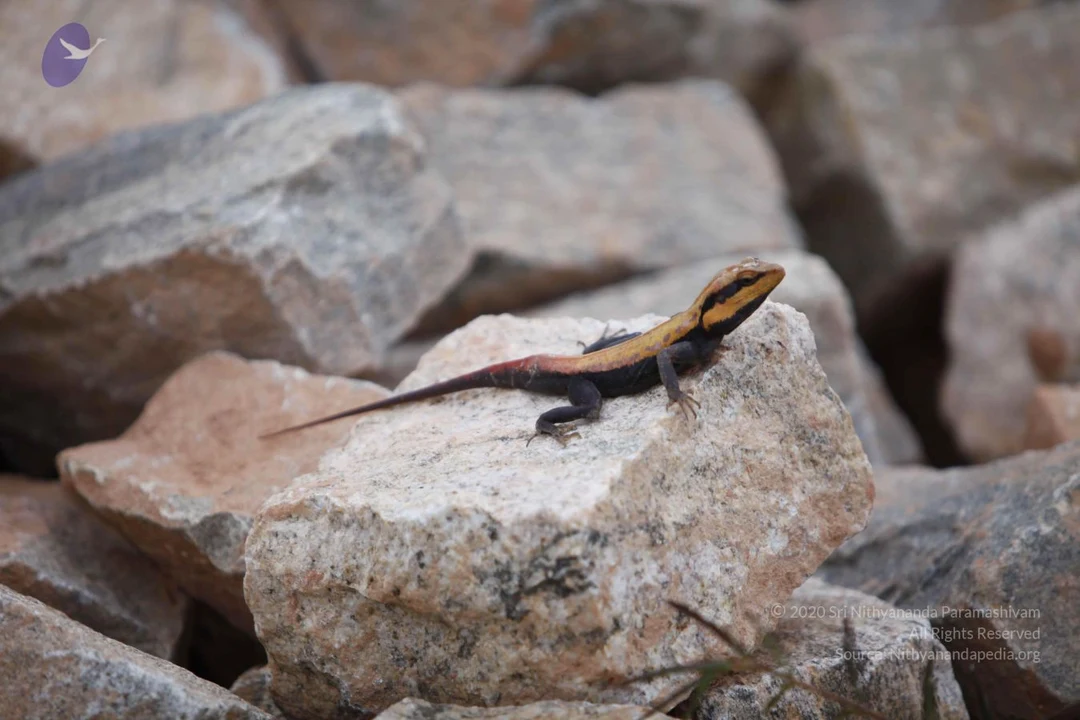
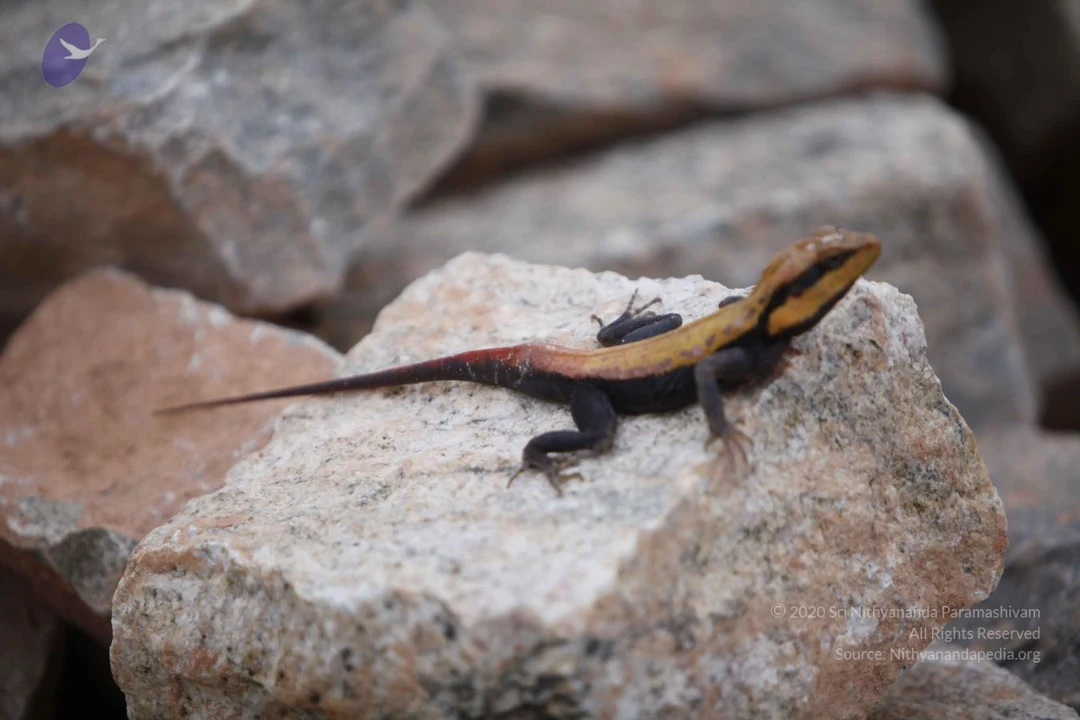
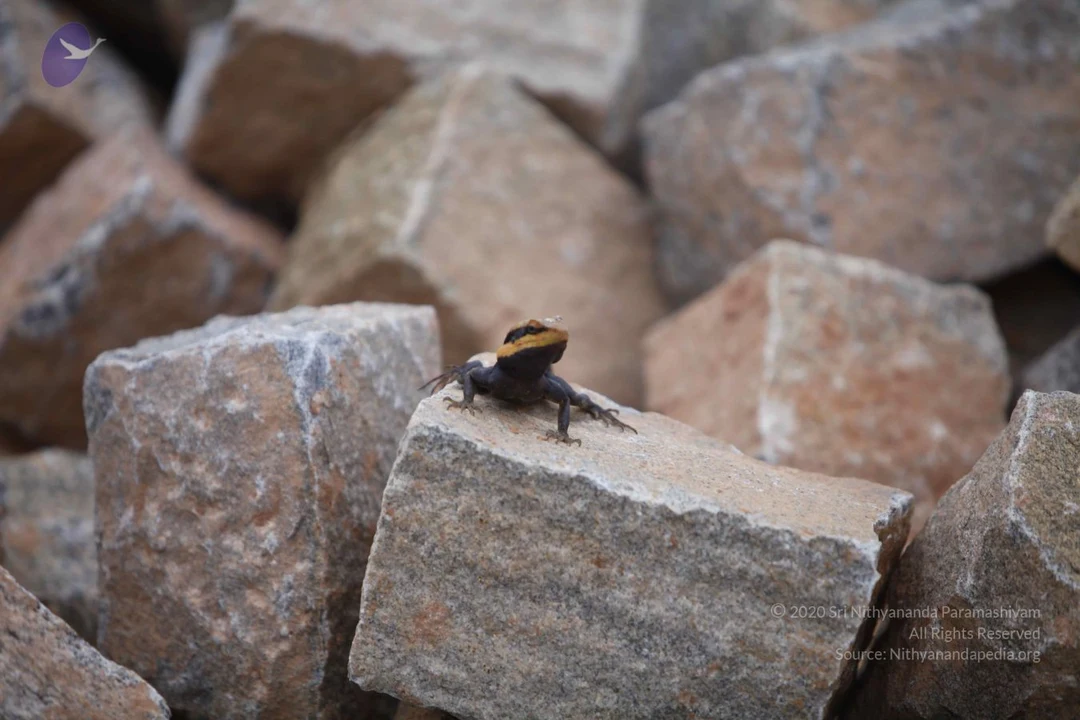
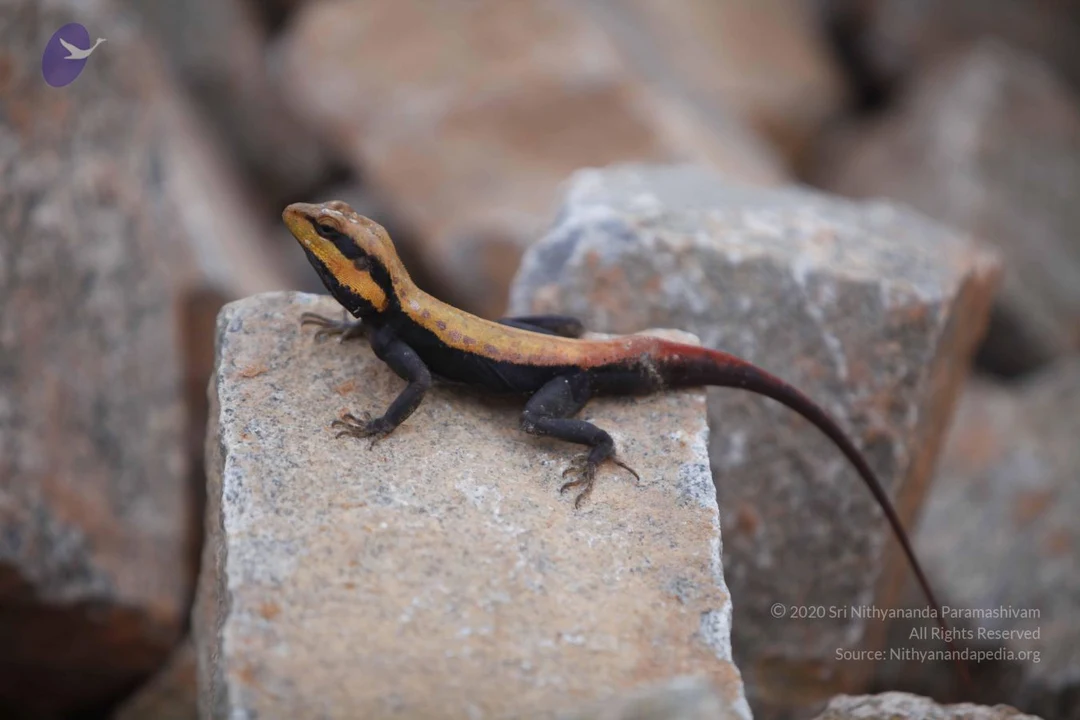
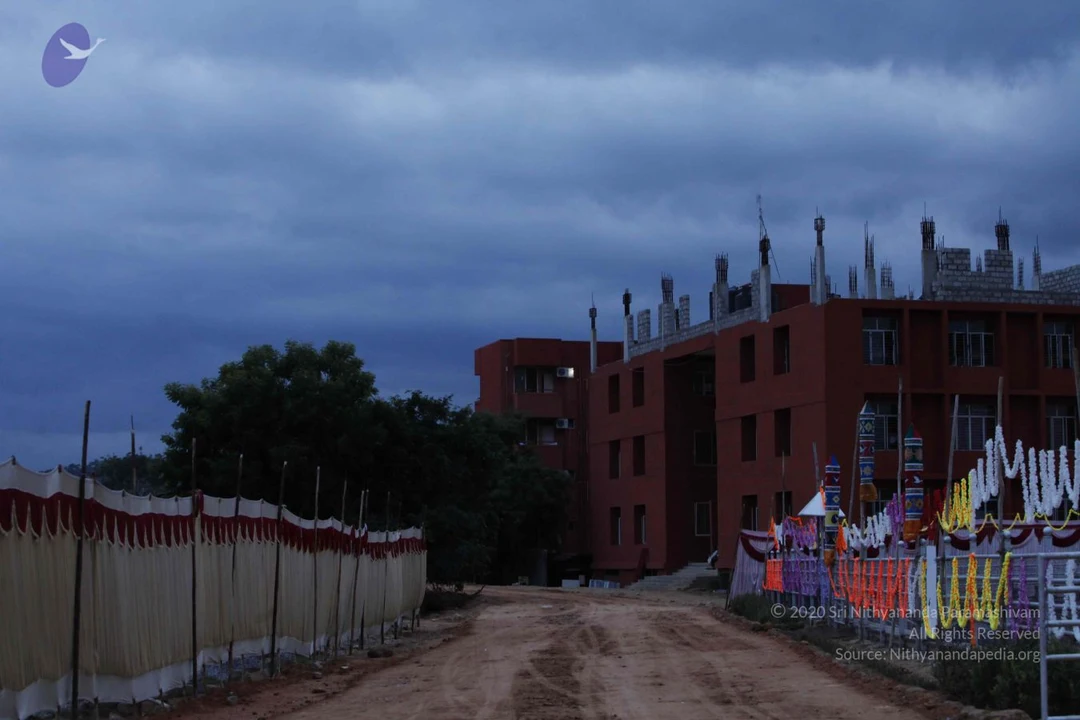
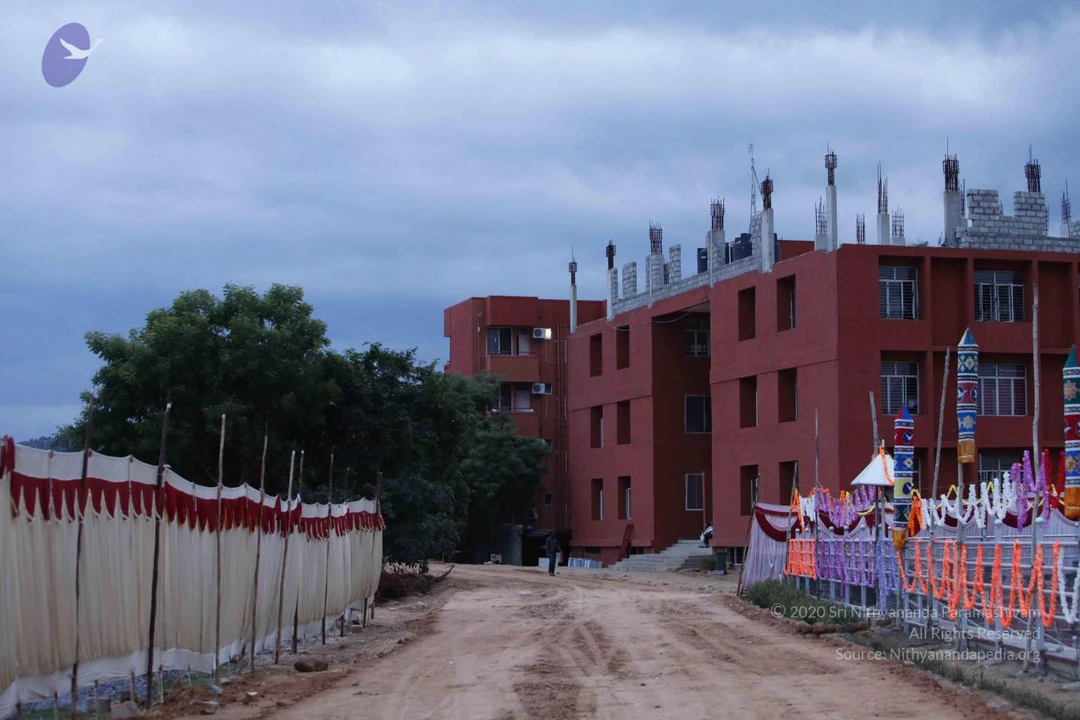
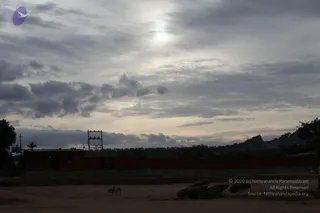
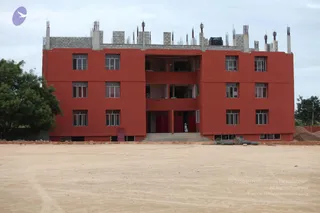
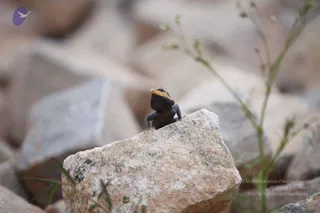
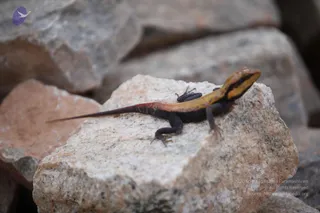
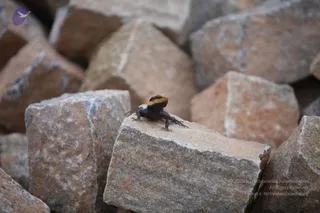
A dusky, overcast evening sky with a pale sun glowing behind grey clouds over a dirt ground. A low red-brown compound wall runs across the frame with a small brick building at left and a utility pole with transformer at its top. Two dogs stand on the dirt near a cluster of boulders at lower right, and a rocky hill with trees lies in the background. No people are visible.Photograph of an unfinished three-storey red-painted building with a central recessed entrance and exposed concrete block parapet with rebar stubs on the roof. A small figure in white clothing stands in the doorway at the base of the central steps. Bare sandy ground fronts the building, with green trees on the left and right and a pale overcast sky above.A small dark lizard with a bright yellow-orange head marking perches on top of a pale grey-white rock. Blurred rocks fill the background, and thin green plant stems with tiny buds rise on the right. No people are visible.A close photograph of a small lizard with an orange-yellow head and throat, a dark black body, and a red-tinged tail, perched on a pale grey-pink granite rock. Surrounding it are other rough stone boulders in soft focus. No people or ceremonial activity are visible; the image is a nature shot.A close-up photograph of a small lizard with a yellow-orange head and back, a black body and legs, and a long tapering tail with a red tint, resting on a pale granite rock. Blurred grey and brown rocks fill the background. No people are visible.A small dark lizard with a bright yellow-orange throat fan perches on top of a rough-cut grey and rust-coloured stone block. Other cut stones are stacked behind it in a blurred pile. No people, deities, or ritual activity are visible.

PratyakshaPadaPuja1

6 photosSource gallery
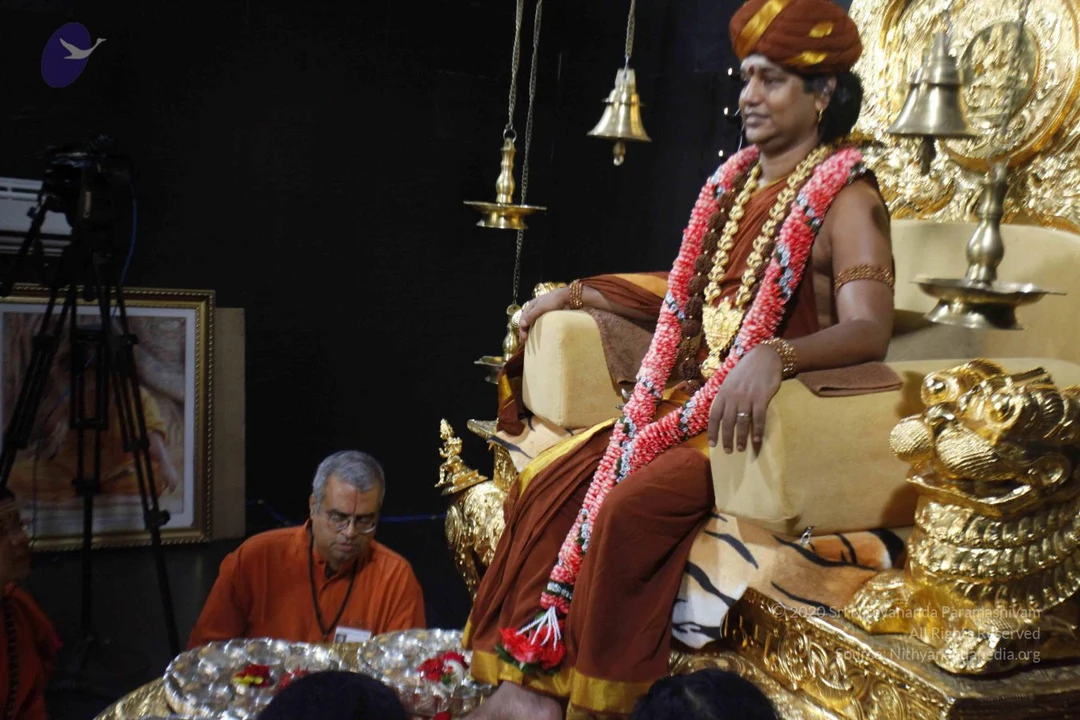
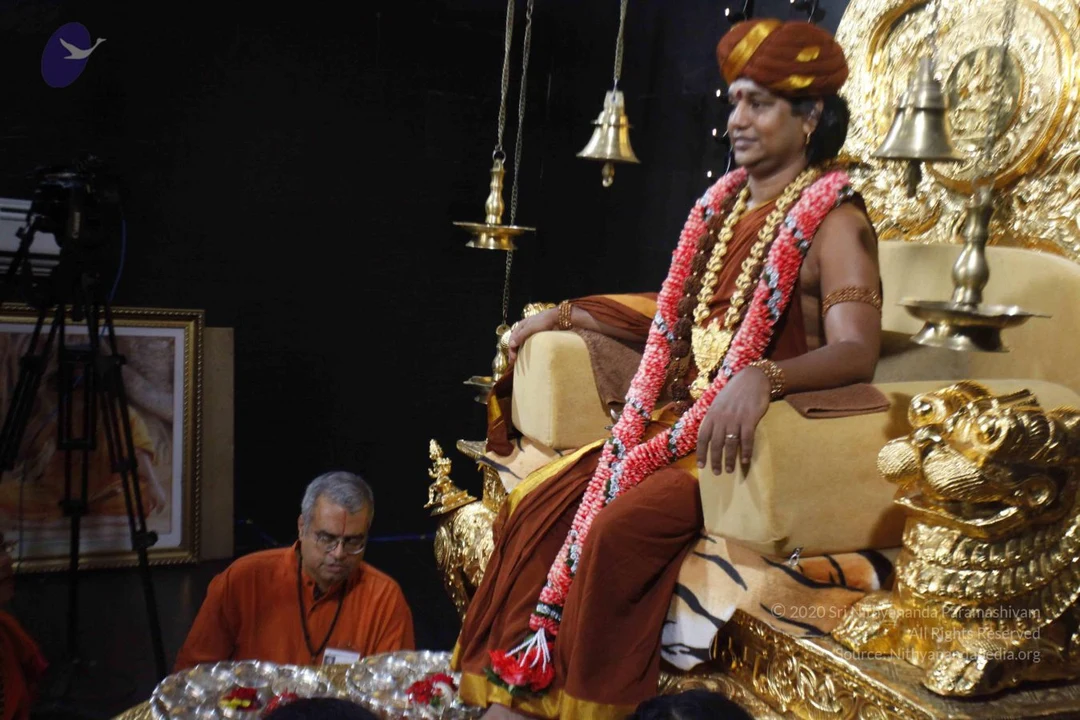
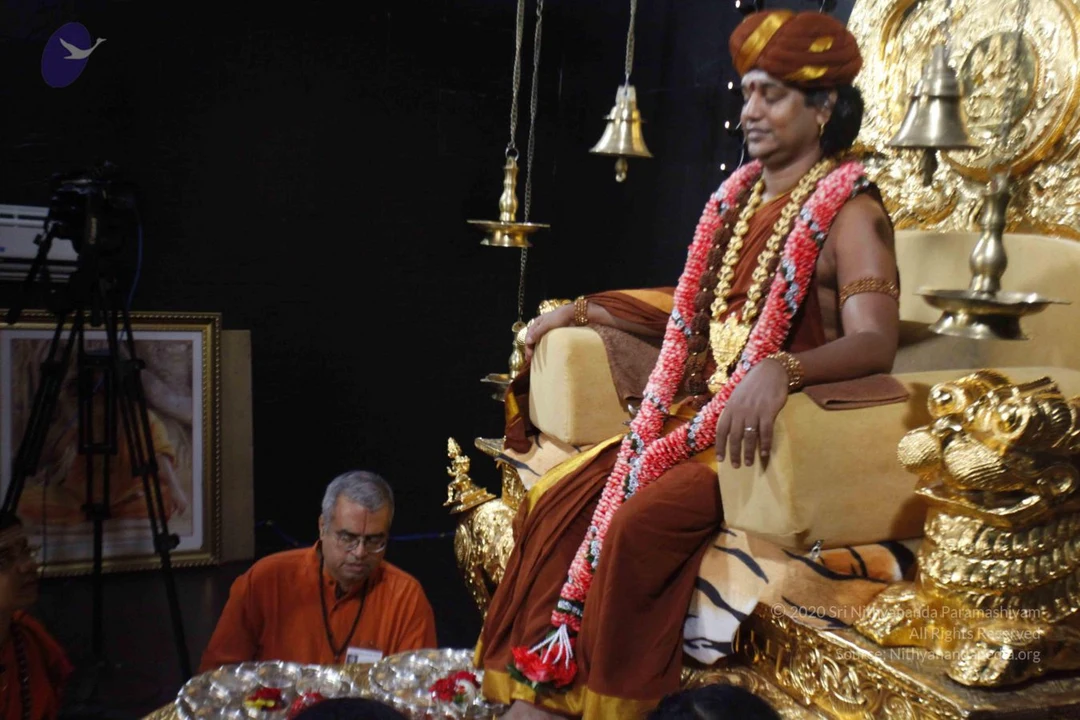
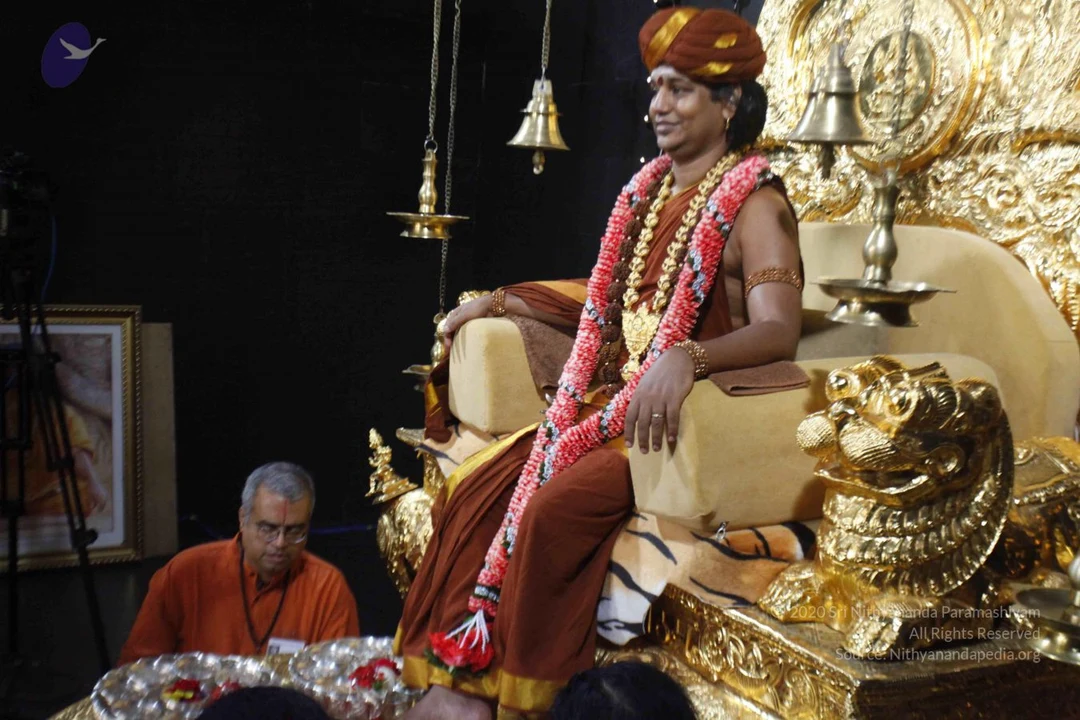
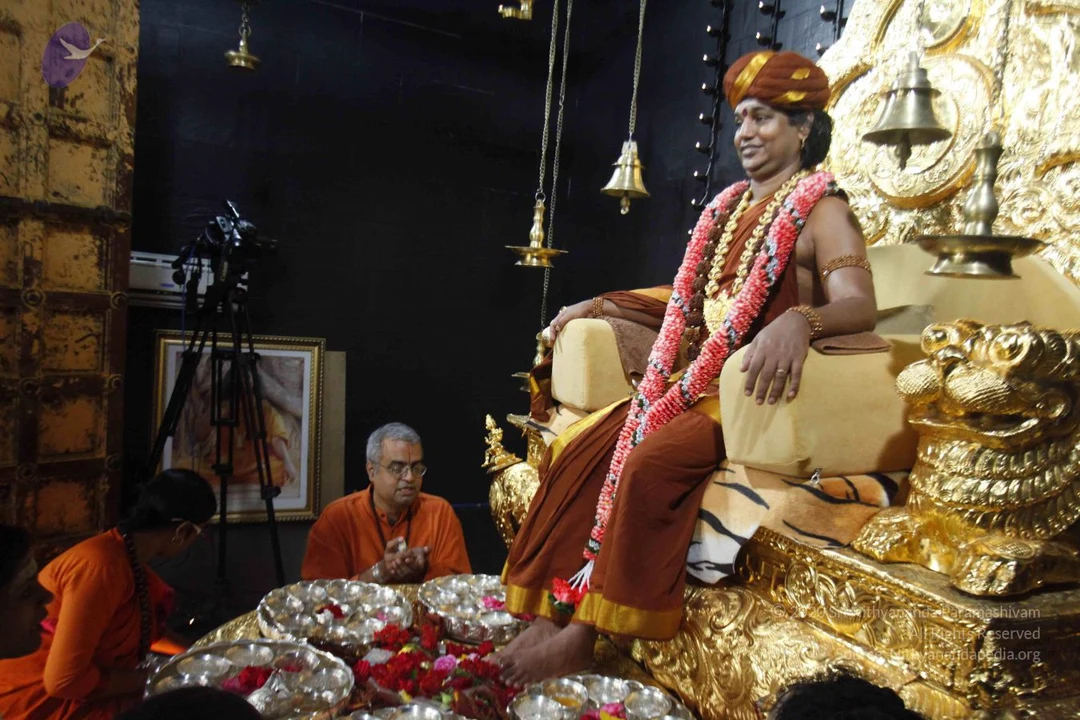
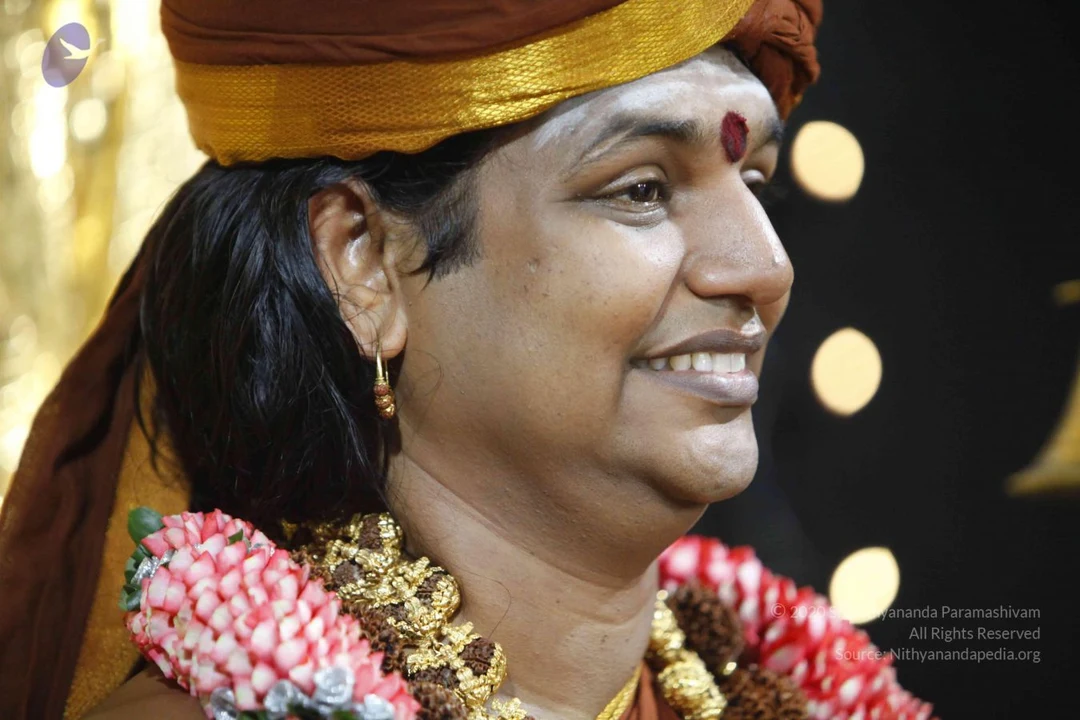
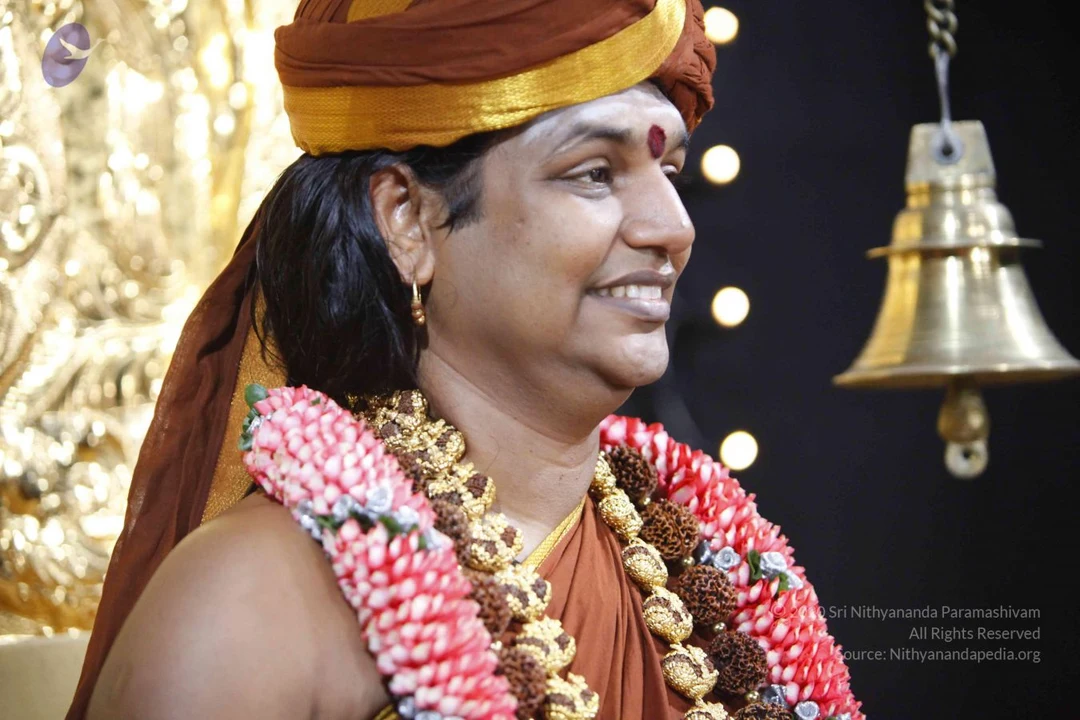
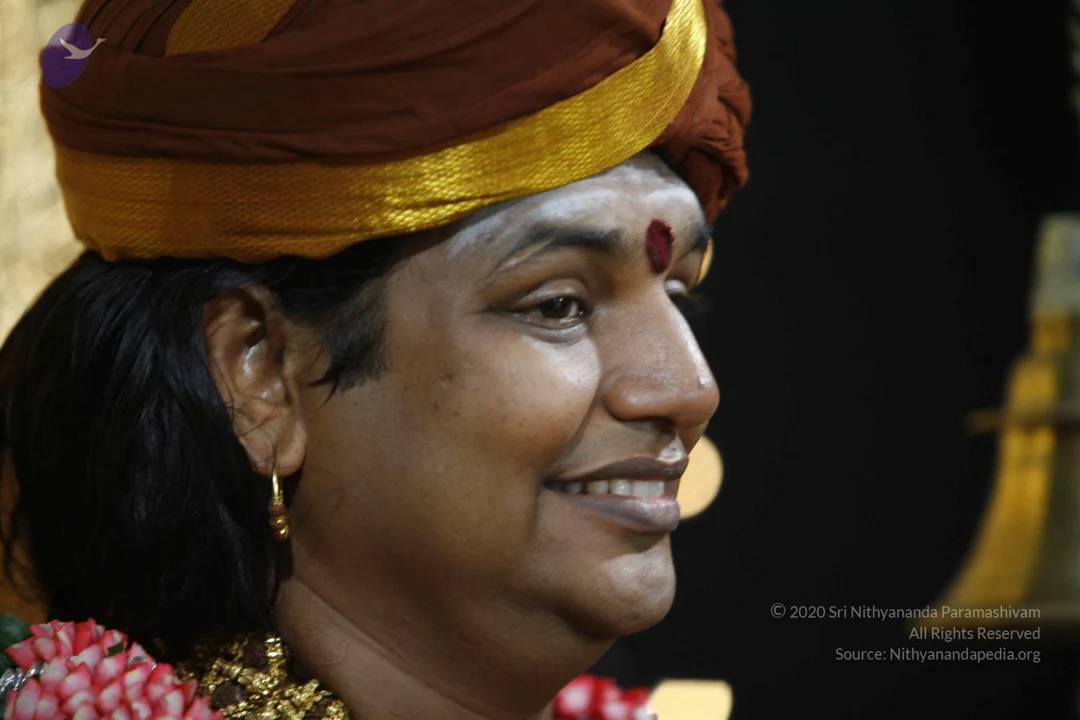
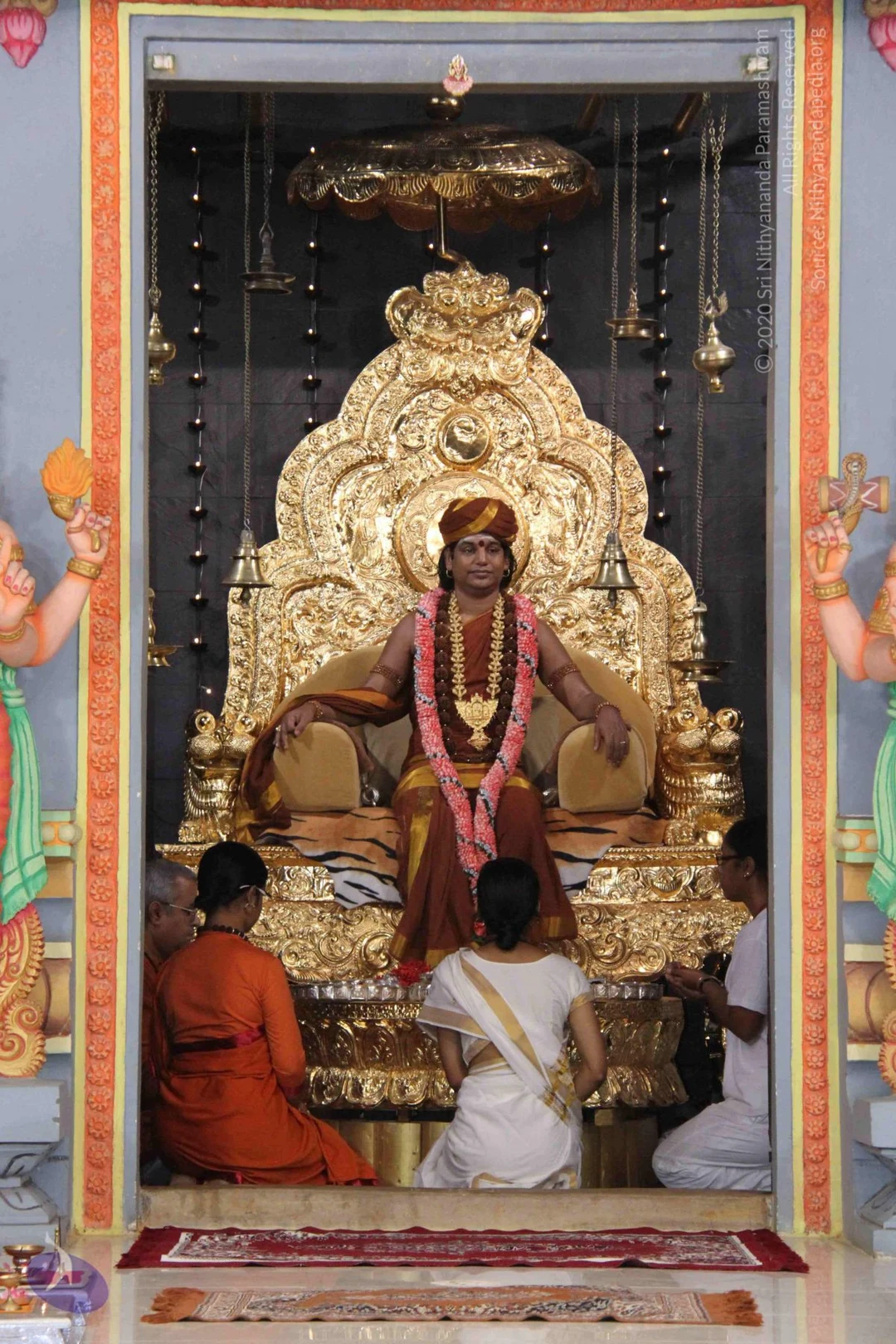
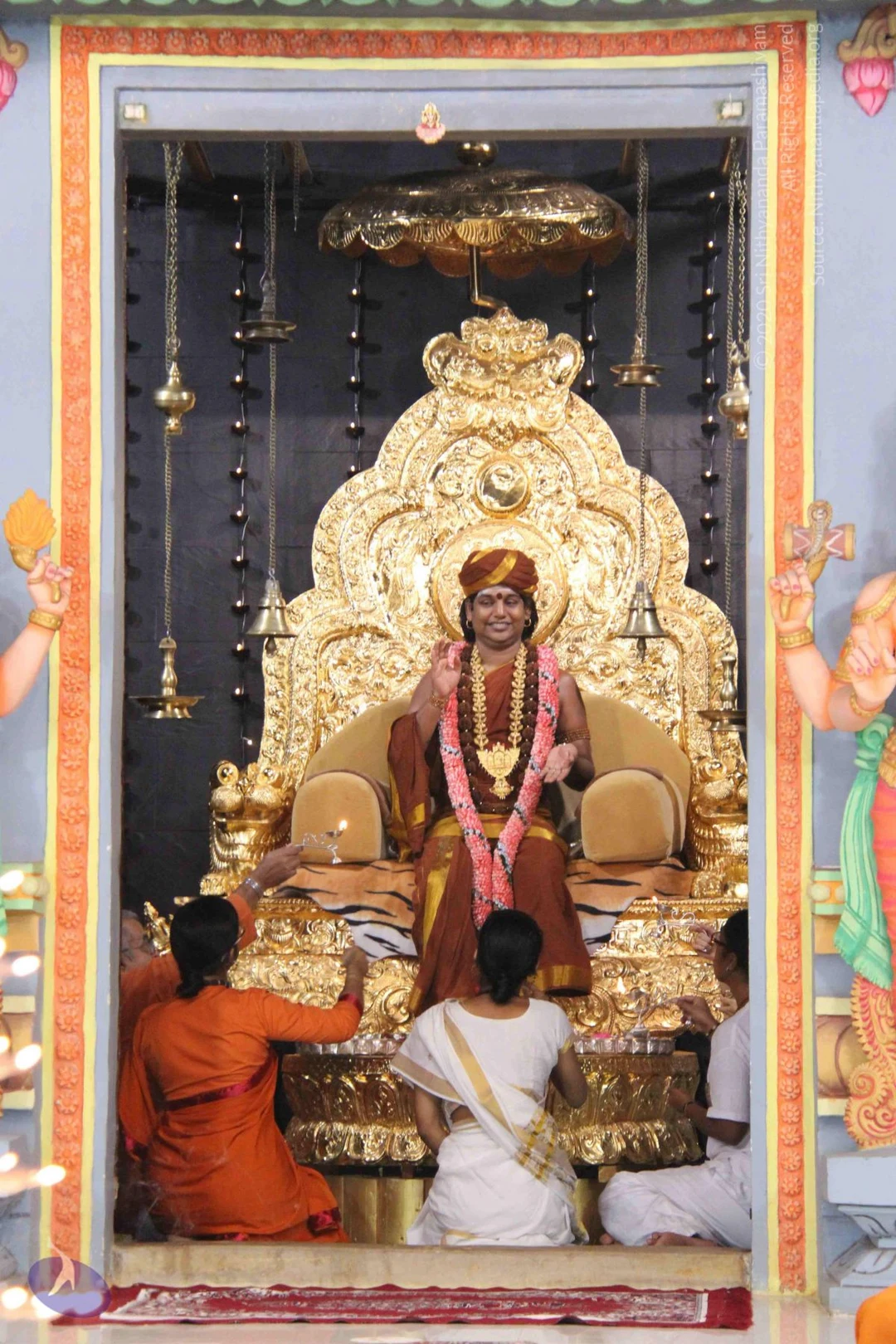
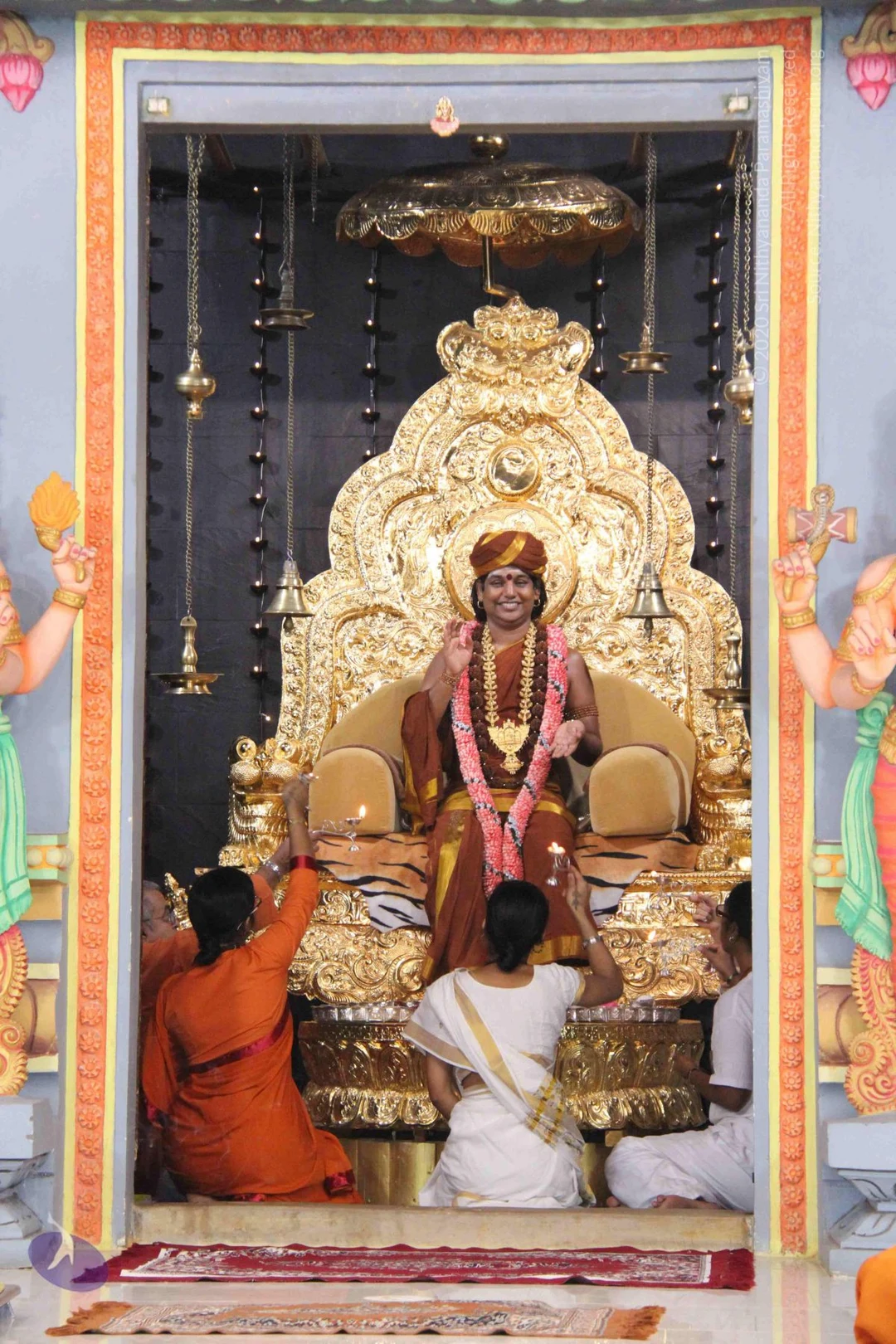
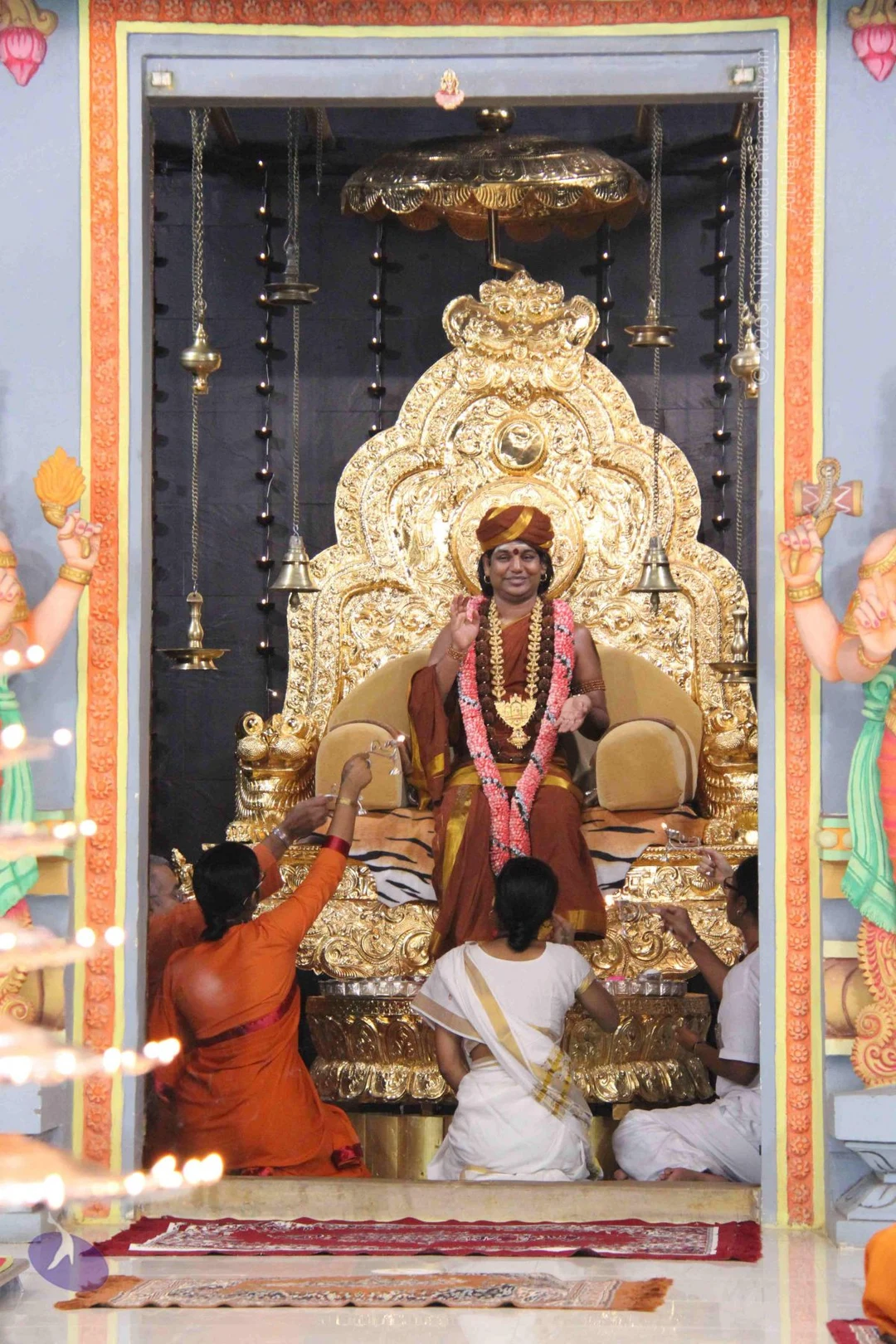
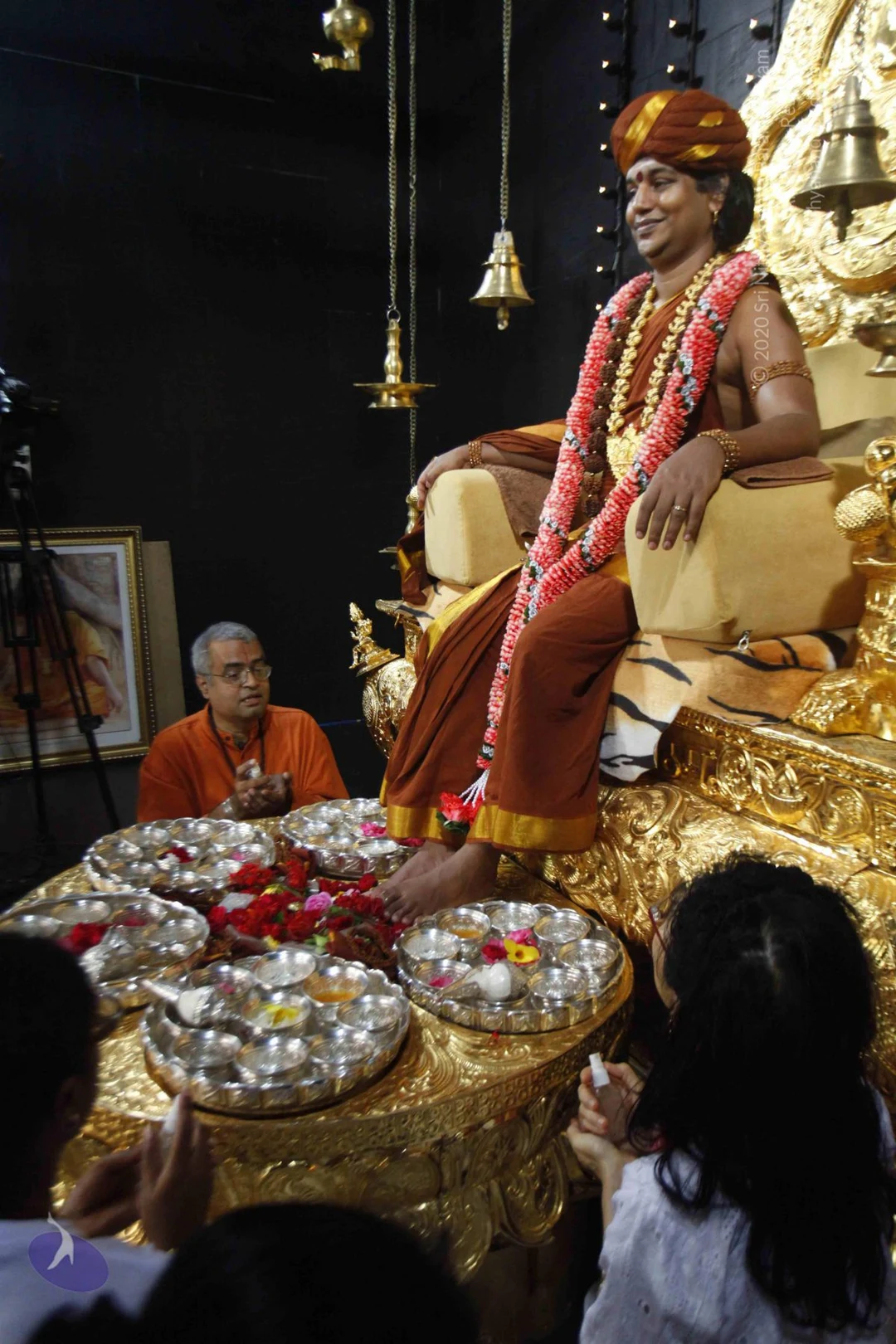
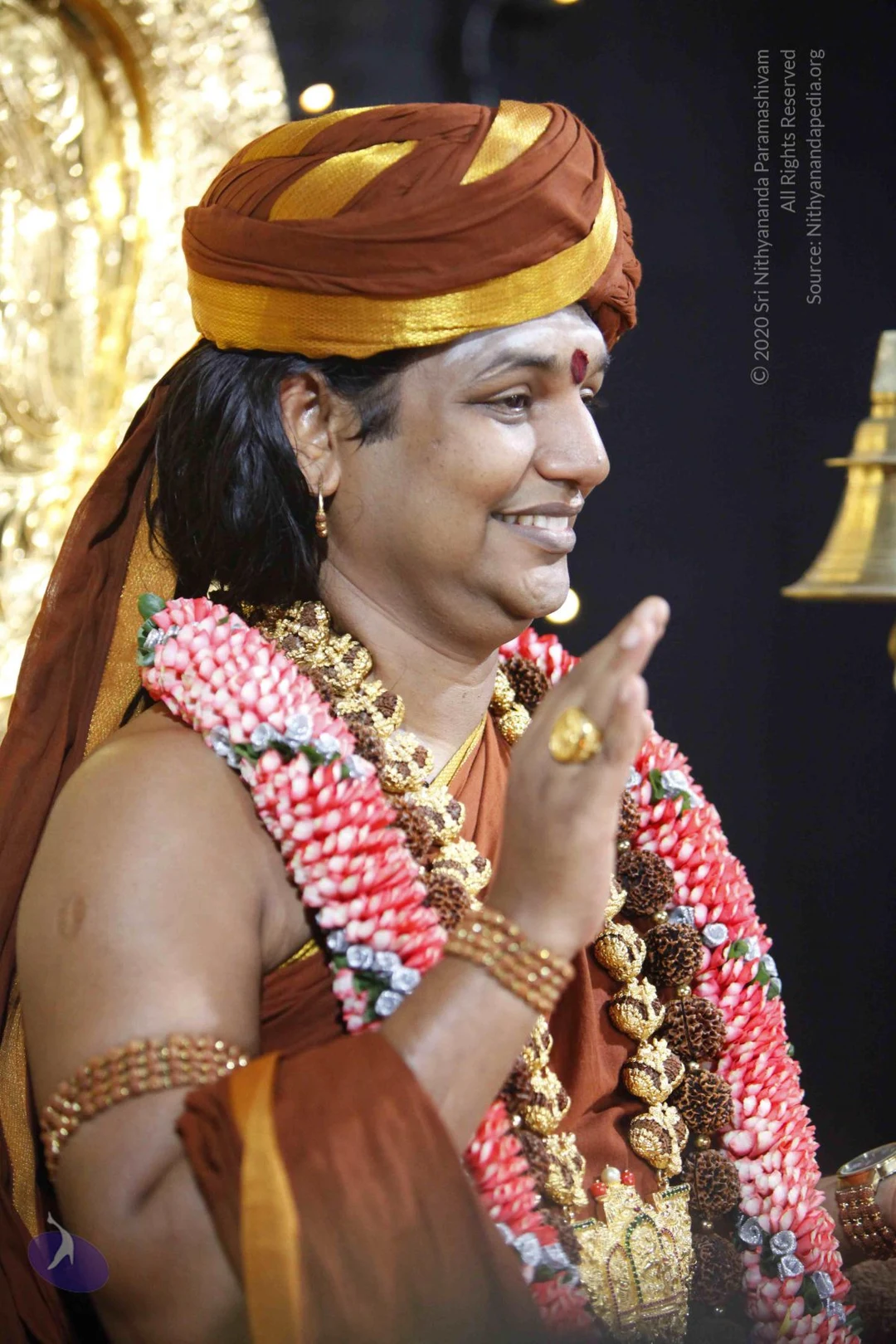
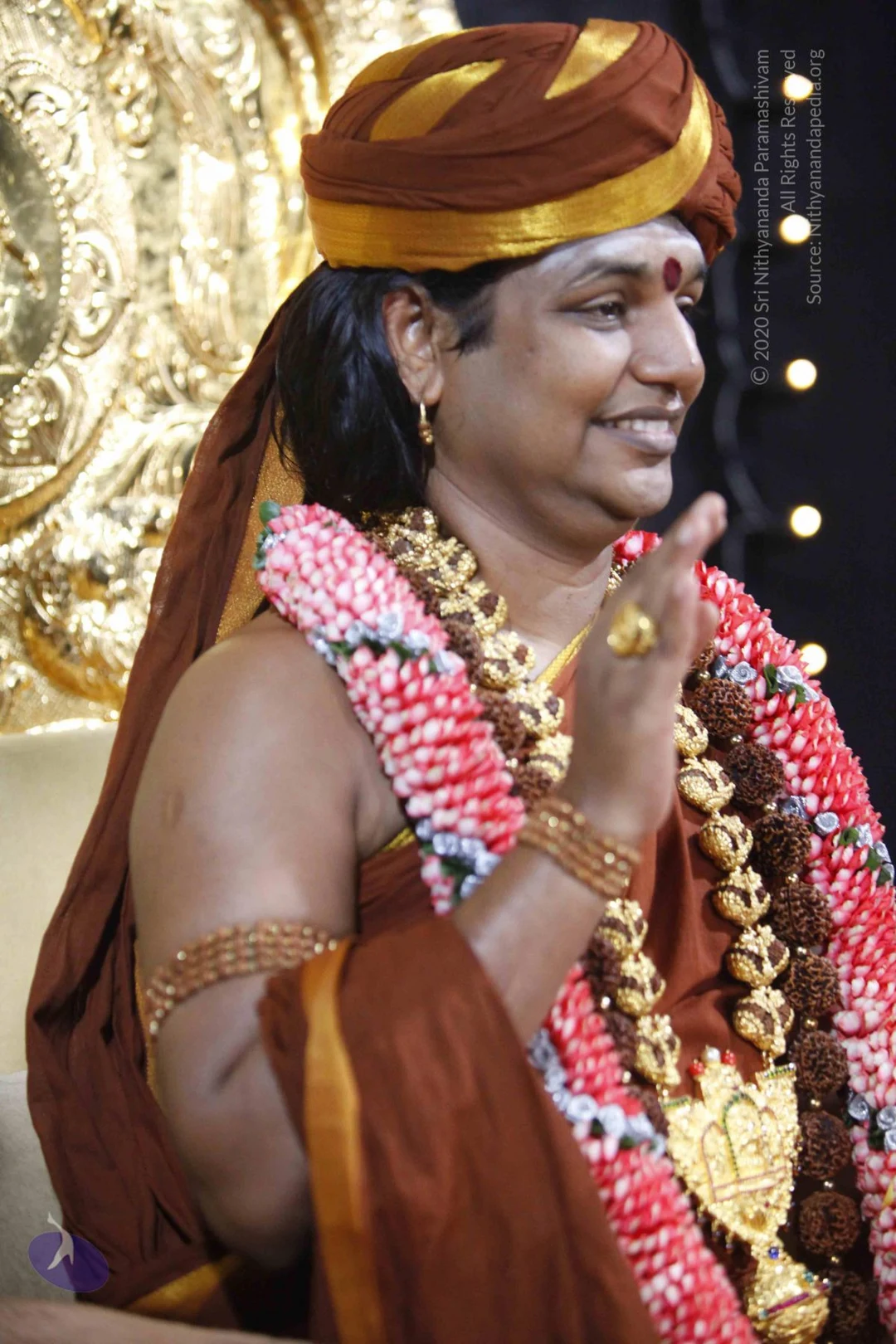
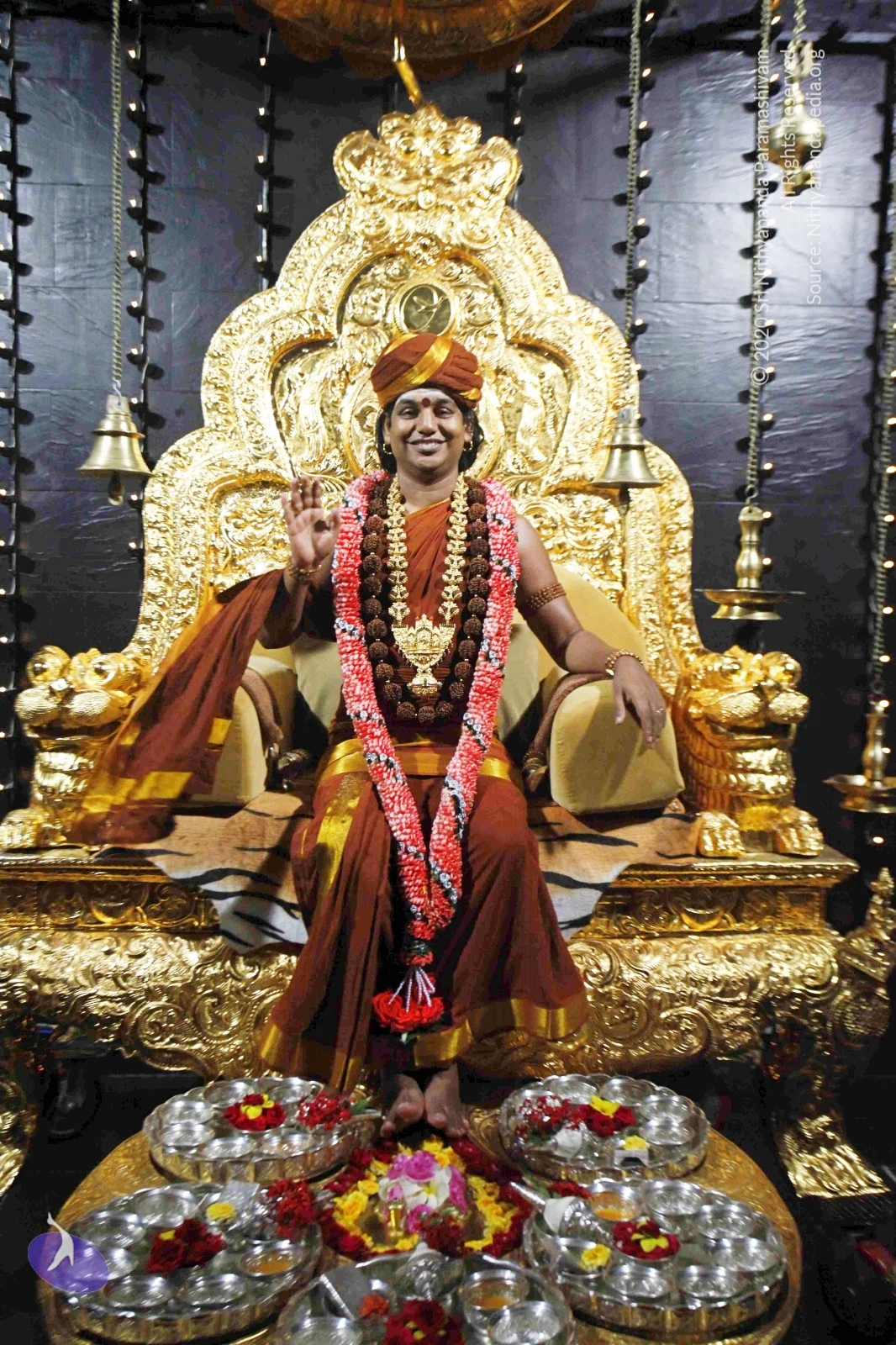
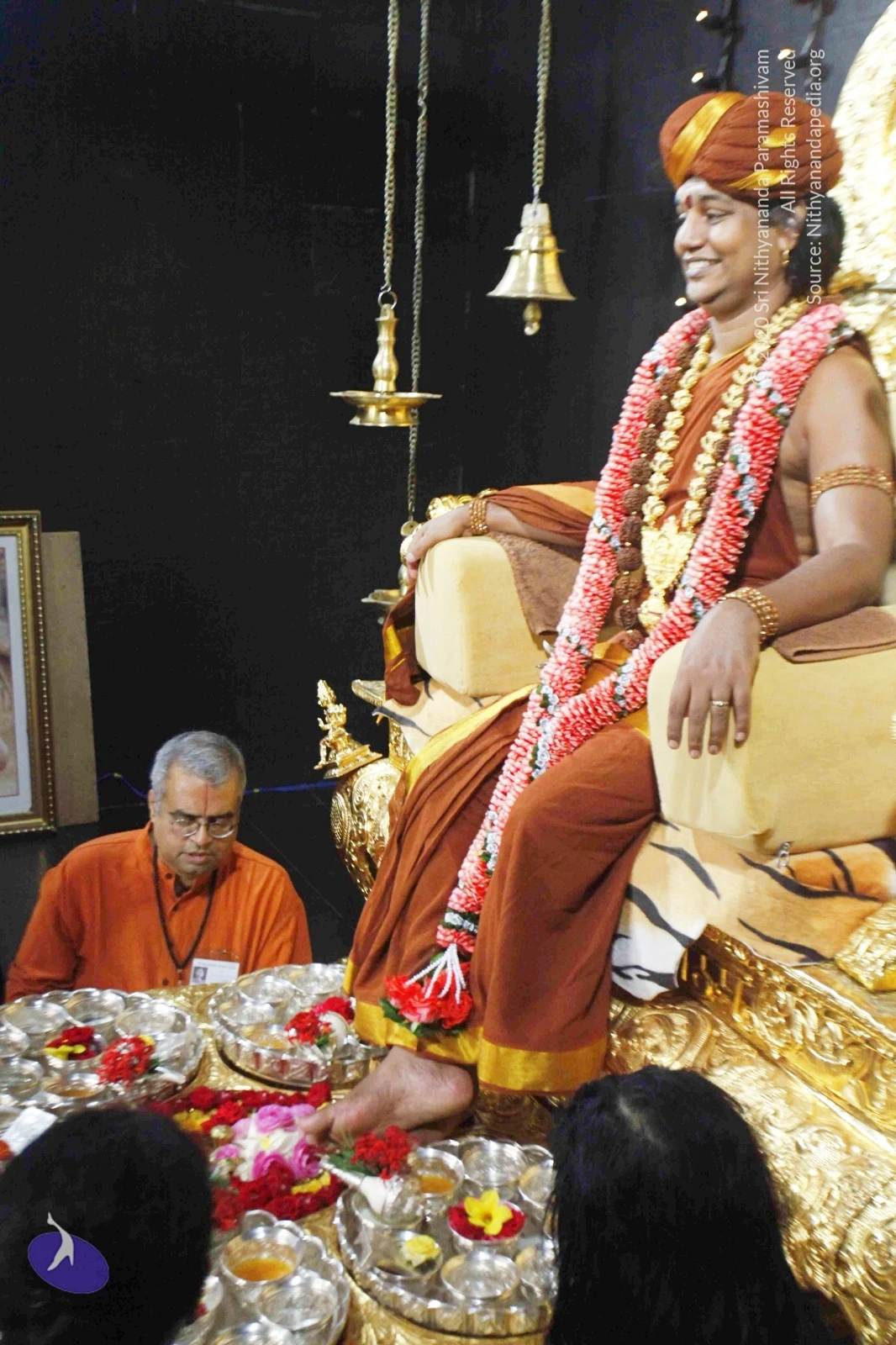
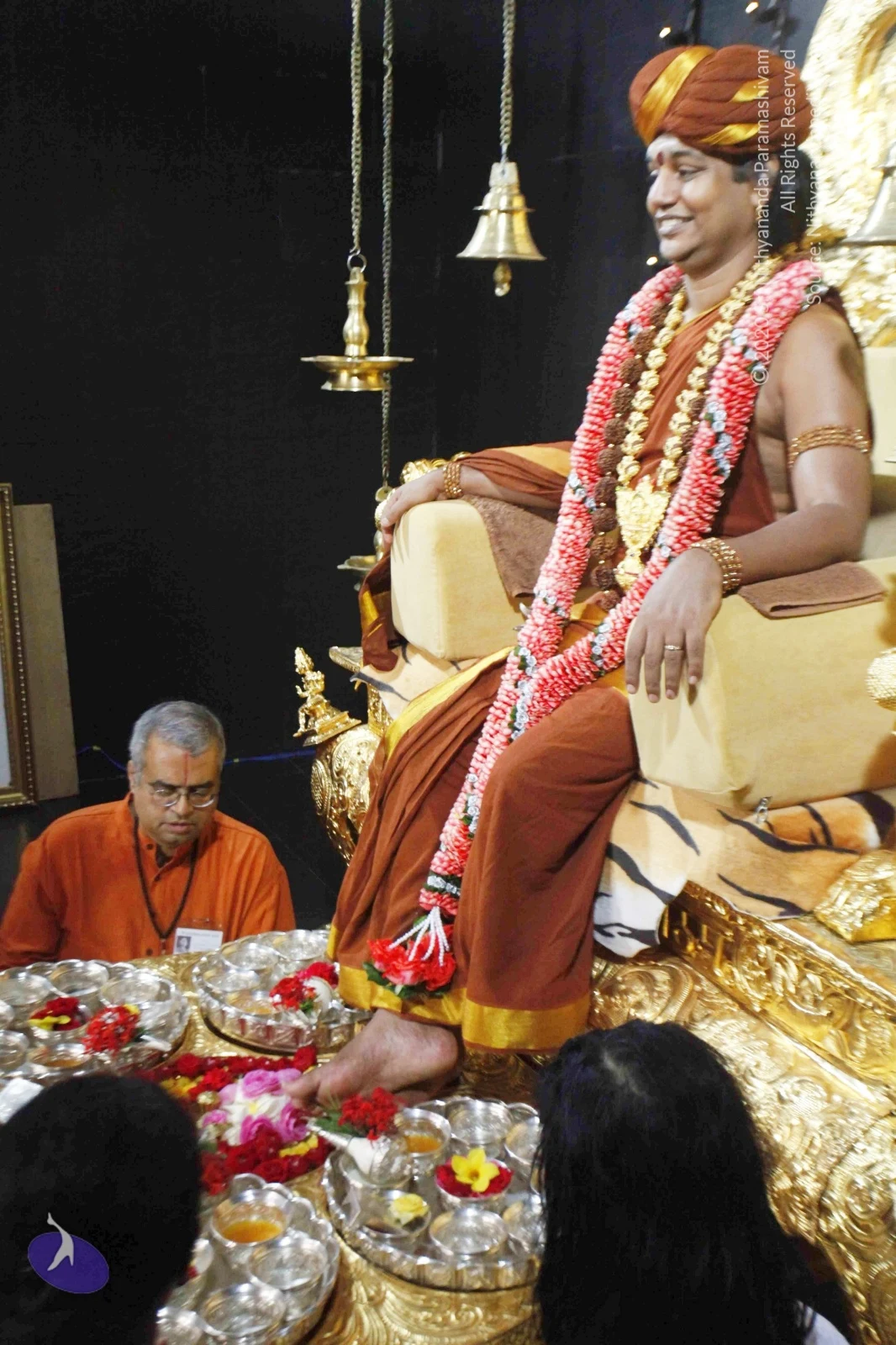
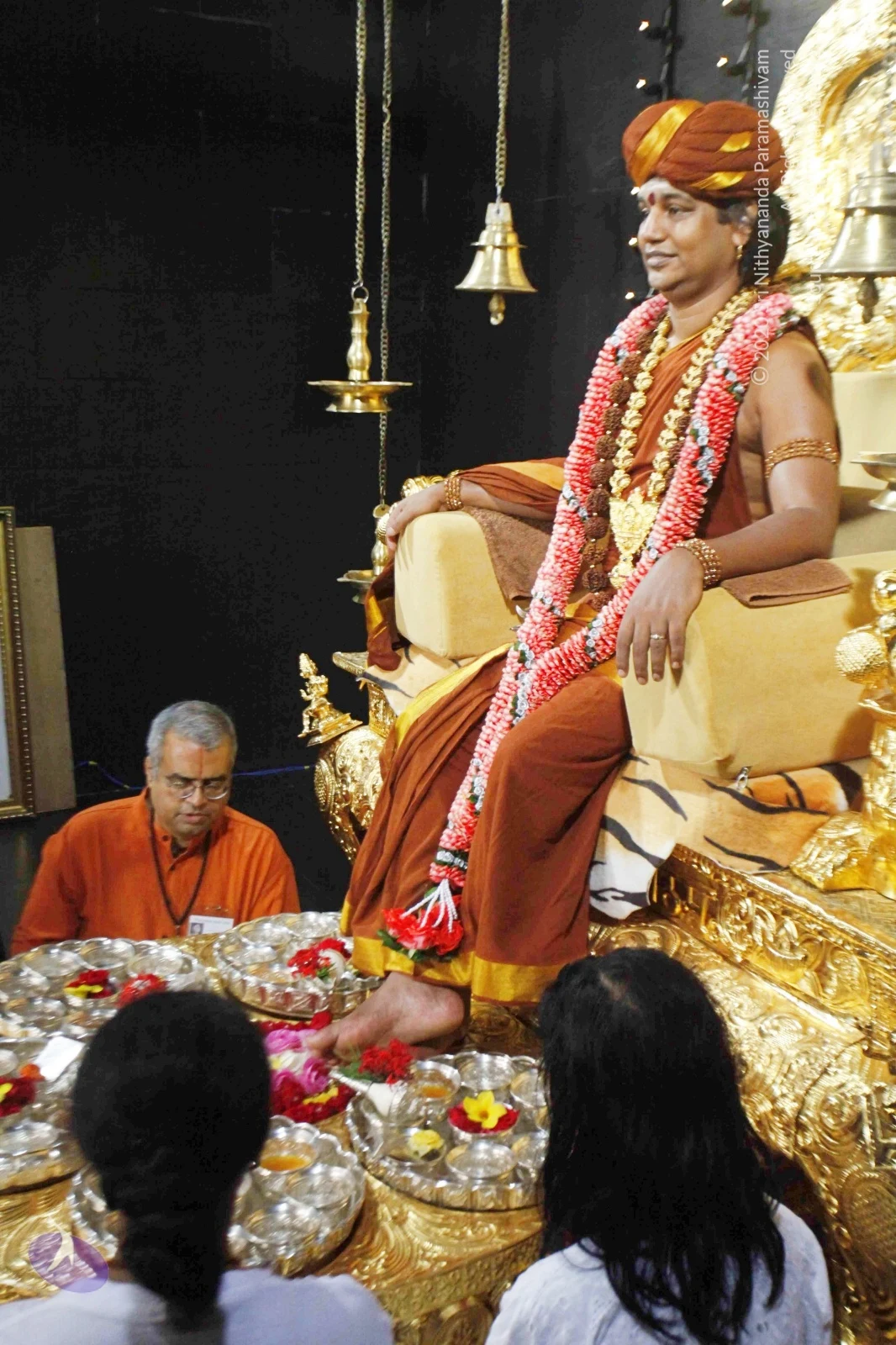
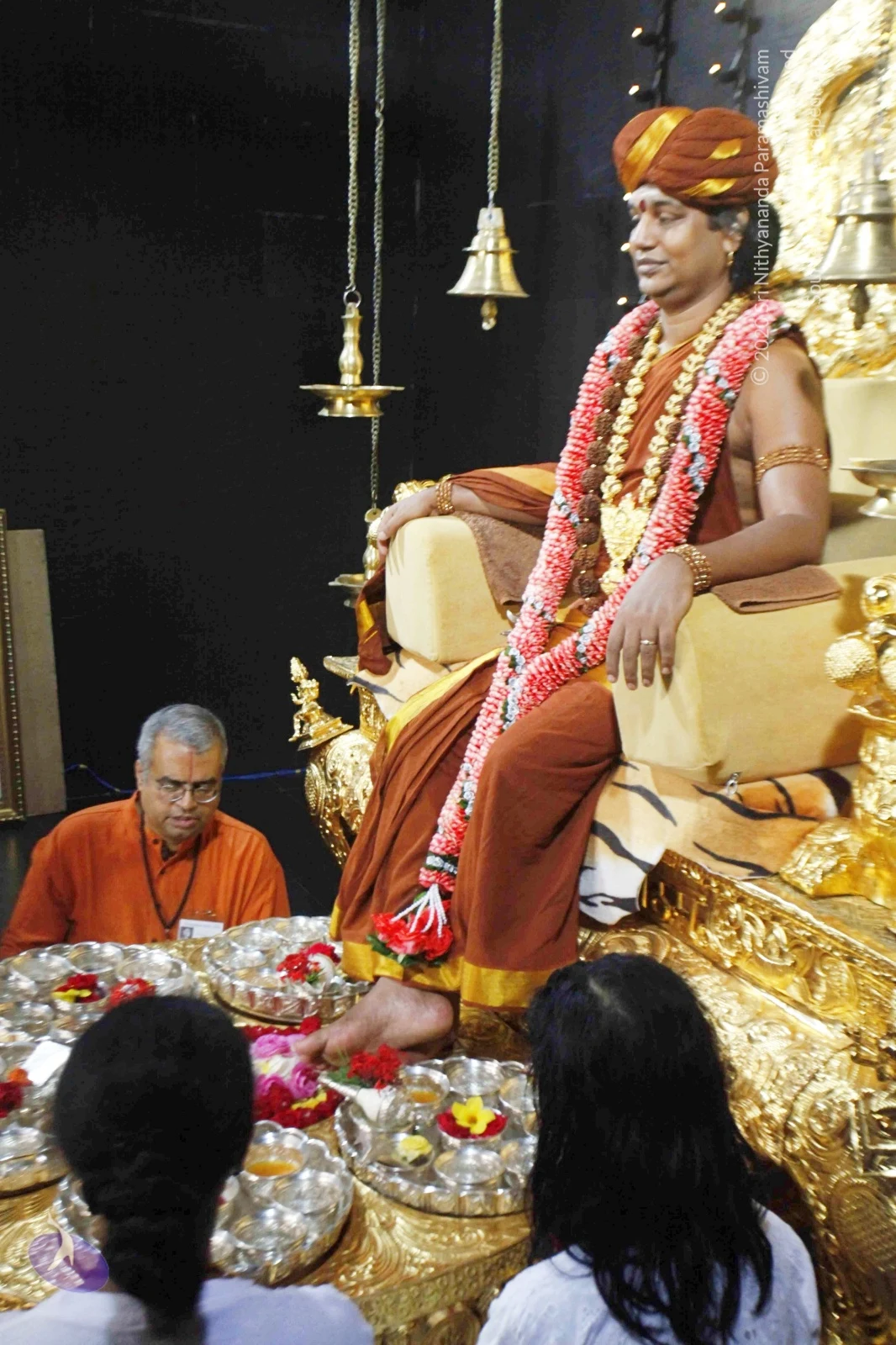
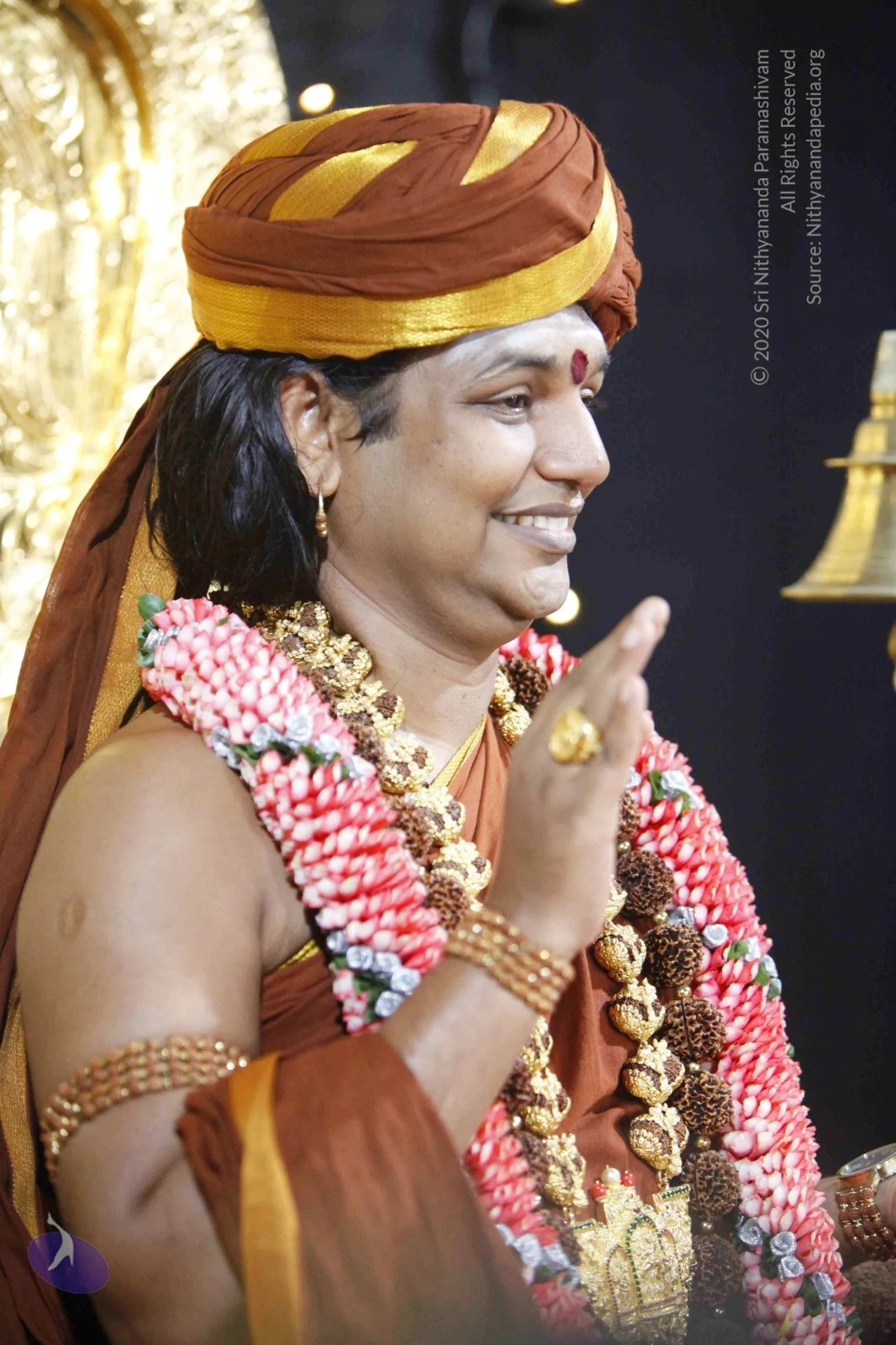
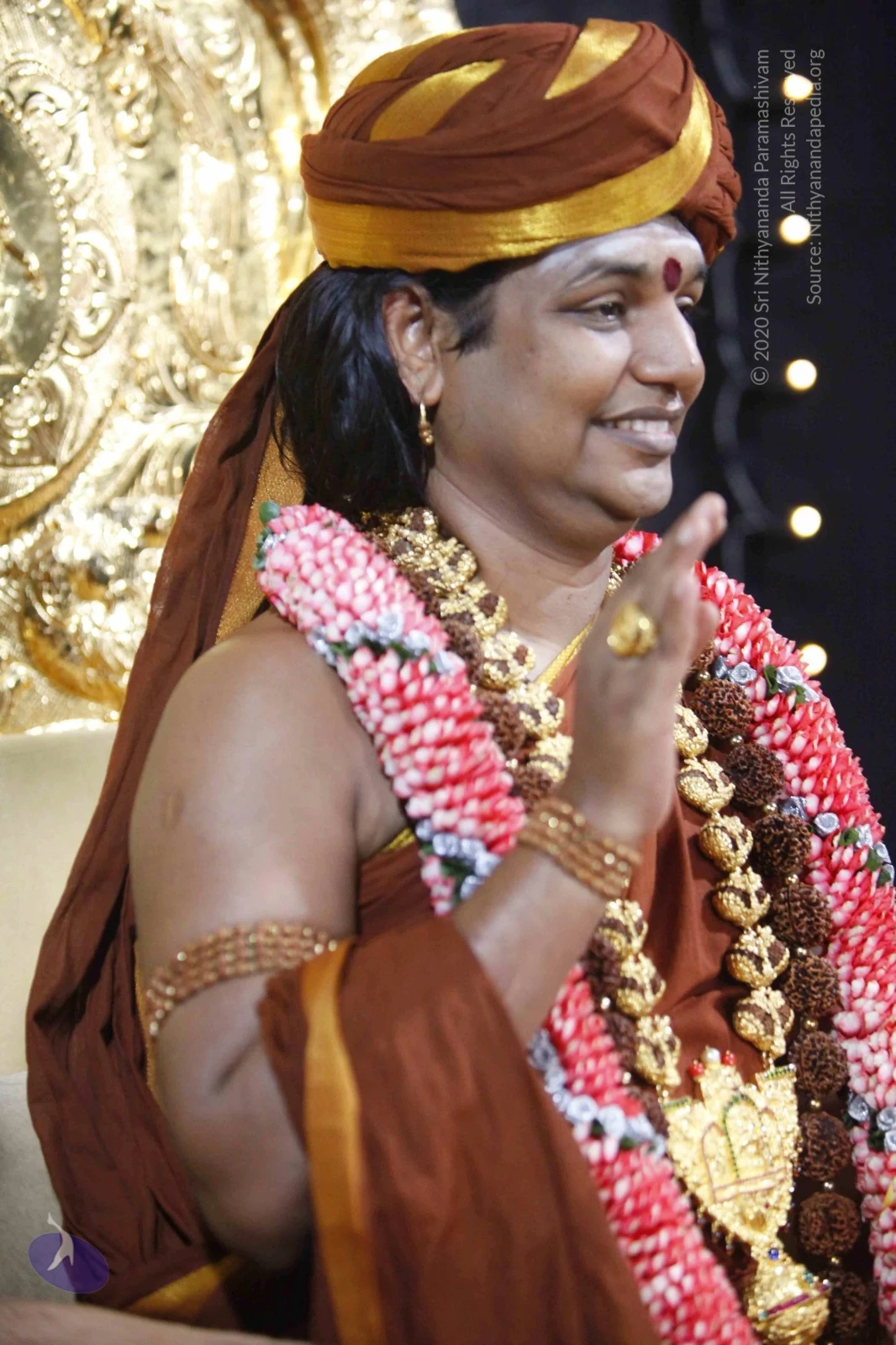
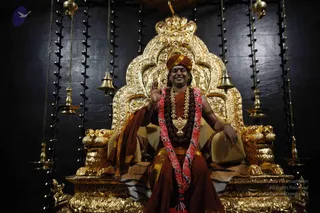
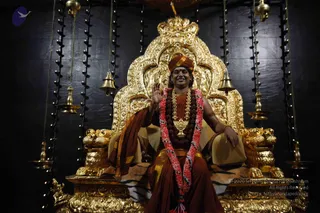
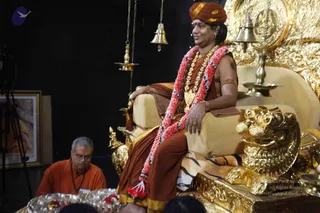
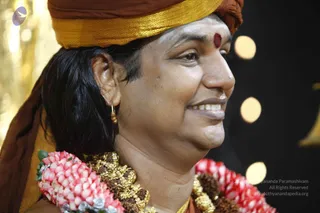
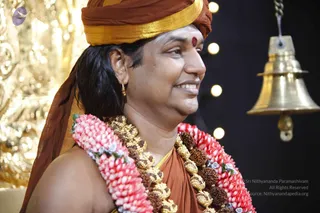
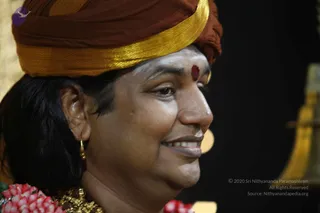
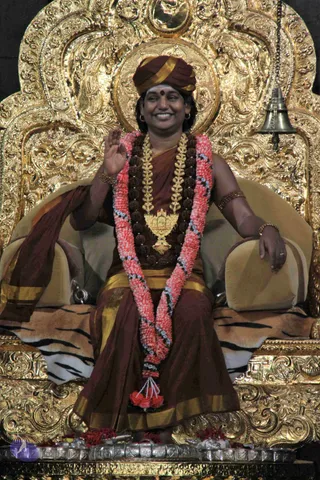
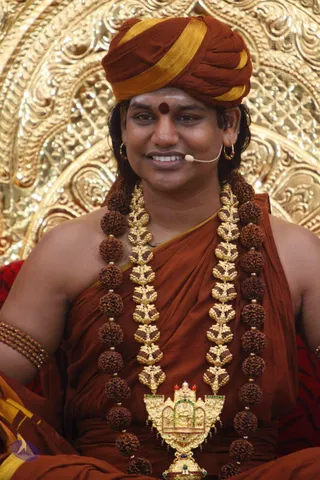
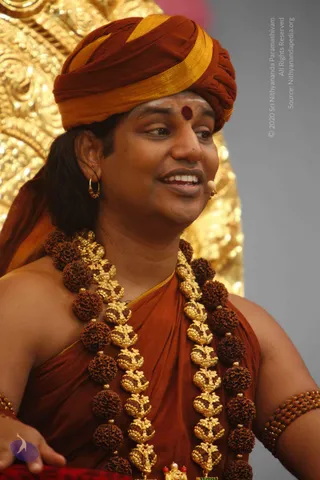
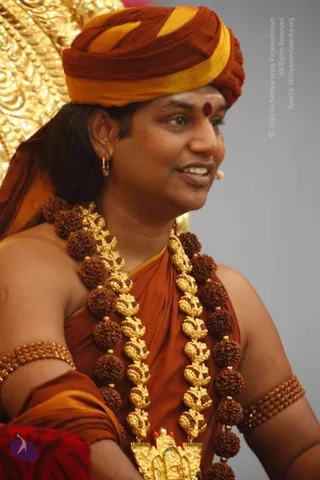
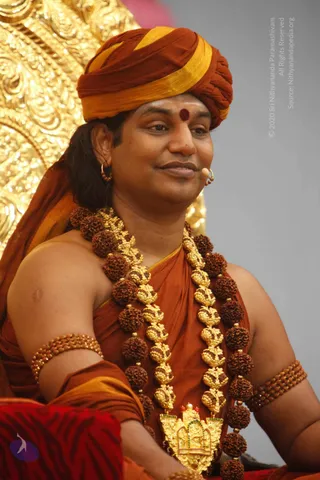
A seated figure on an ornate gold throne with carved lion-head armrests and a gilded arched backrest, set against a dark stone wall with hanging brass bells and oil lamps. The seated person wears a saffron-orange turban, a rust-orange robe with a gold-trimmed sash, a rudraksha mala, a large gold ceremonial necklace, and a pink and white flower garland. The right hand is raised in a blessing gesture while the person smiles. A tiger-striped cloth covers the throne base. The description matches the Swamiji (probable) cues of a turban, saffron clothing, rudraksha and gold ornaments, seated on a throne.A man seated on an ornate gold throne with carved lion-head armrests and a large gold-filigree back panel, set against a dark stone wall hung with brass oil lamps and bells on chains. He wears an orange-red turban, saffron-orange robes, a long pink and white flower garland, a dense rudraksha mala and a gold ceremonial pendant necklace, and raises one hand in blessing while smiling. A tiger-striped cloth covers the throne base. Appearance-based a person, seated in a throne setting.A photograph of a seated man on an ornate golden throne carved with a lion's head and tiger-striped cushion, wearing a rust-orange turban, rust-orange dhoti and shawl, a pink and white flower garland, layered gold necklaces and a rudraksha mala, with gold armbands and bangles. He rests his hand on the armrest and smiles. Hanging brass bells and oil lamps with a flame hang beside him. In the lower left a bald man in an orange robe with a rudraksha mala kneels before a silver tray of flowers and offerings. The appearance-based label for the seated man is Swamiji (probable), based on the turban, garlands, gold jewellery and throne cues, with the page indicating his presence. A framed portrait stands at left and a camera tripod at the edge of the frame.Close-up photograph of a smiling man in profile wearing a brown and gold turban, a red bindi-style mark on the forehead and white markings on the brow. He wears gold earrings, a gold ceremonial necklace with brown rudraksha beads, and a garland of pink and white flower buds across his shoulders. The background is dark with soft golden bokeh lights. Swamiji (probable): the appearance cues of a turban, rudraksha malas and ceremonial gold necklace are distinctive, and the page indicates Swamiji attended this event.Close profile photo of a smiling person wearing a saffron-orange turban with a gold border, a red bindi on the forehead, and an orange-brown shawl draped over the shoulders. Large garlands of pink and white flowers and gold-toned beads are worn, interspersed with rudraksha beads. A brass bell hangs at right against a dark background with bokeh lights, and the left side shows gold ornate fabric.Close profile photograph of a smiling man wearing a saffron-orange and gold turban wrapped around his head, with a red bindi-style mark on the forehead and white ash marks above it. Long dark hair falls behind the ear, and he wears a gold earring. Pink flower garland and gold ornamental necklace are visible at the bottom edge, set against a dark background with a golden instrument-like object at the right. Appearance-based label: Swamiji (probable), with the turban, long hair, saffron clothing and ornate gold adornments as the qualifying cues. Other visible person count is one.

Pratyakshapadapuja2

27 photosSource gallery
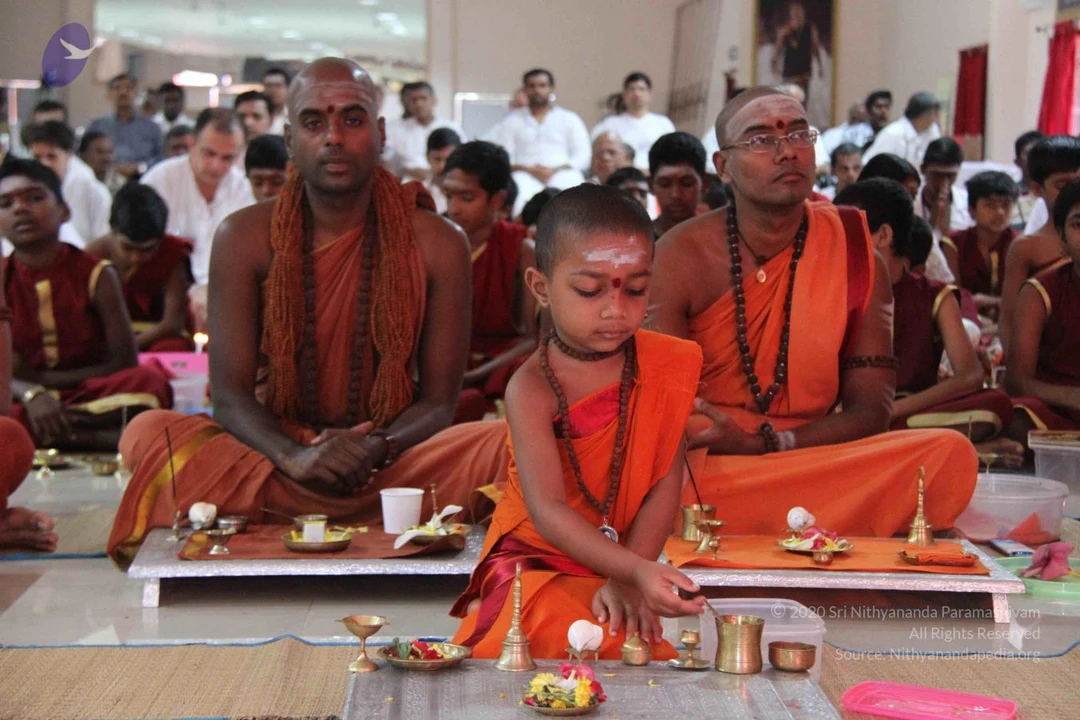
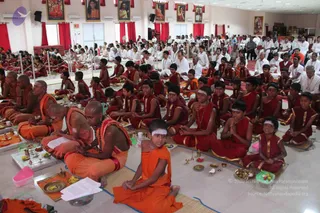
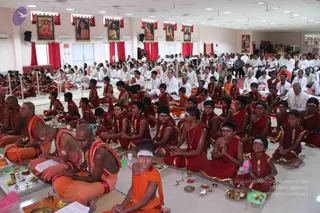
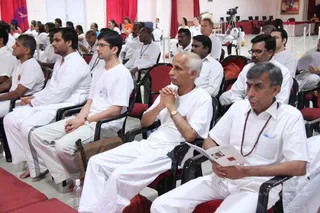
A smiling person seated on an ornate gold throne with carved floral and scrolled backrest and lion-head armrests, waving one hand in greeting. They wear a maroon and orange turban, a red-and-gold robe, a dense rudraksha mala, ceremonial gold necklaces and a pink-and-white flower garland. Small brass bells hang beside the throne. At right, a painted panel shows a hand with red-painted fingers and bangles.A seated satsang audience of men in white ritual clothes, many wearing rudraksha malas, sits in rows of chairs in a hall with a red-draped table and bottles at the back. A man in the front centre wears a white kurta and holds a red flower with his eyes closed. Another man on the right in white holds his hands together. Nearby, a boy in a saffron cloth sits in front. No candidate matching the a person cues is clearly visible, so the identity is left unsure.A wide view of a large hall during a seated satsang or ritual gathering. Rows of devotees sit on white floor mats in white and saffron clothing, many in maroon and orange robes, with brass plates and small offerings in front of them. A long cream carpet runs down the centre aisle between silver stanchions. Framed portraits and paintings hang on the walls above red curtains. Many people are seated in the back rows, and a few in the foreground wear orange and rudraksha-style necklaces. No individual can be reliably identified from appearance.A large hall with pink walls and framed portraits of deities and saints hung high above rows of seated participants. In the foreground, several young boys in saffron-orange robes and bright white forehead bands sit on mats with brass oil lamps, bowls and offering plates arranged before them. Behind them, older men in orange and white robes and rudraksha malas sit in rows, and many people in red and white clothing fill the floor. Red curtains and white ceiling fans frame the room, and a vertical bank of brass oil lamps and kalasha-style vessels stands among the seated groups.A large hall with many seated participants in a ritual setting. In the foreground, several shaved-headed priests in saffron-orange robes sit on mats with rudraksha malas, beside brass puja plates, small bells, lamps and fruit offerings. Behind them rows of boys in maroon-red robes with white forehead bands sit cross-legged, several with folded hands, some wearing rudraksha malas. Further back, adults in white clothes sit on the floor, and portrait frames hang on the wall above red curtains, while people in white stand along the rear. Pale walls and ceiling fans complete the scene.A seated audience in white clothing fills rows of dark red upholstered chairs in a hall with red curtains. In the foreground a man with a rudraksha mala and a white shirt and dhoti holds a printed booklet while listening. Beside him an older man with white hair and a gold wristwatch presses his palms together. Others in white kurtas and shirts sit behind them, and a video camera on a tripod stands at the back right near a red-draped table. The scene looks like a satsang gathering.

Satsang-Swamiji

14 photosSource gallery
A photograph of a smiling man seated on an ornate gold throne with a carved arched back and lion-head armrests. He wears an orange-and-yellow turban, a rudraksha mala, a long pink-and-white flower garland, a gold ceremonial necklace and gold bangles, with an orange shawl over his shoulders. He raises his right hand in greeting. Behind him stands a painted deity murti holding a trident-like weapon and a flaming lamp in its hands, and gilded figures are visible at the right edge.Two gilded deity murtis sit side by side on a throne, both draped in dense garlands of white, red, yellow, purple and green flowers. The left murti wears an orange-red turban, a golden crown-like headdress, earrings, layered beaded necklaces and a rust-orange cloth, holding a golden trident-like staff and a white-and-purple flower. The right murti wears a crown of pearls and jewels, pearl necklaces, a teal-blue garment and a golden hand raised with a lotus-shaped object. Golden floral carvings frame the throne behind them. No physical people are visible.A photograph of two deity murtis (metal or gilded images) seated side by side on a red-draped throne-like seat under an arch of garlands in red, yellow, purple, green and white. The figure on the left wears a rust-orange turban, gold-and-pearl necklaces, a rudraksha-style bead mala and holds a golden staff with a jewelled tip. The figure on the right wears a dark crown, pearl necklaces and a teal-blue garment. A golden kalasha-style ornament sits between them. No living people are visible; the image shows a decorated alankara of the murtis for worship.A photograph of two decorated deity murti seated side by side on a red draped platform beneath a golden arched backdrop, framed by an arch of garlands in red, white, yellow, purple and green. The figure on the left, in an orange-red turban and gold ornaments, holds a staff and a white flower-decorated object; beside him a figure in a dark crown, pearl and gold necklaces and a teal-blue sari holds a gold-tipped object. Both wear layered jewelry, rudraksha-style beaded necklaces and gold ornaments, with no living people visible.Two golden deity murtis, a male and a female form, seated side by side on a gilded throne with an ornate gold backrest. The male murti wears a rust-orange turban with a gold headpiece, large silver earrings, a rudraksha-style bead necklace and a gold pendant, and holds a trident in one hand. The female murti wears a dark headpiece with a pearl-studded crown, pearl necklaces and a gold armlet. Both are heavily decorated with garlands of roses, marigolds, purple flowers and white jasmine in red, yellow, purple and green bands. A gold kalasha-style finial stands between them.A seated man in an ornate gold throne with red cushions and a tiger-skin rug sits at left, wearing an orange saffron-coloured cloth, an orange turban, a long beaded necklace and a rudraksha mala, smiling. Beside him on the right stands a deity murti dressed in a red and orange cloth with a yellow skirt, draped with multicoloured flower garlands and wearing ornaments, set against a red curtain and a painted pillar with lotus motifs. The scene is a stage setting in a hall with a red patterned carpet in the foreground.

Sarvadarshan

18 photosSource gallery
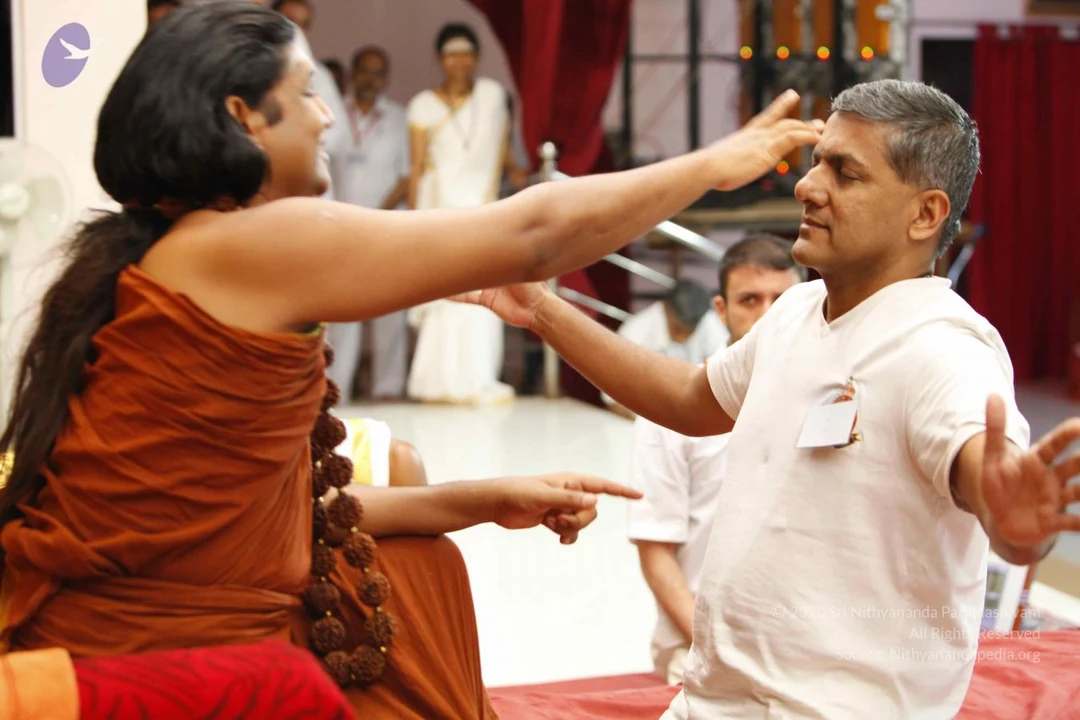
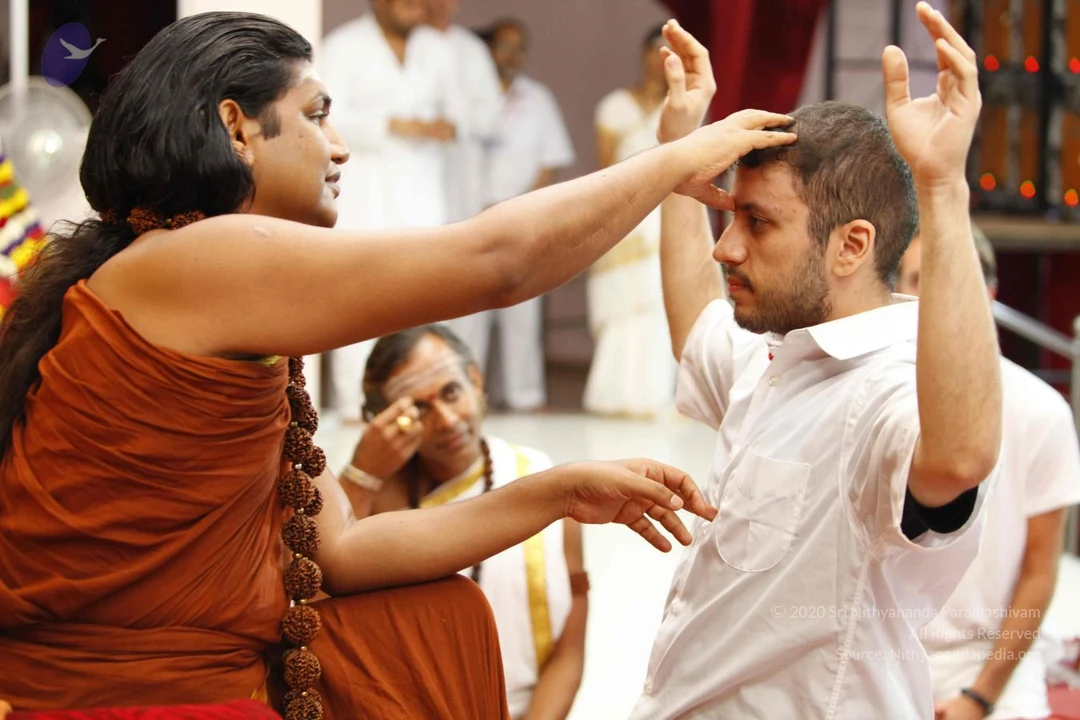
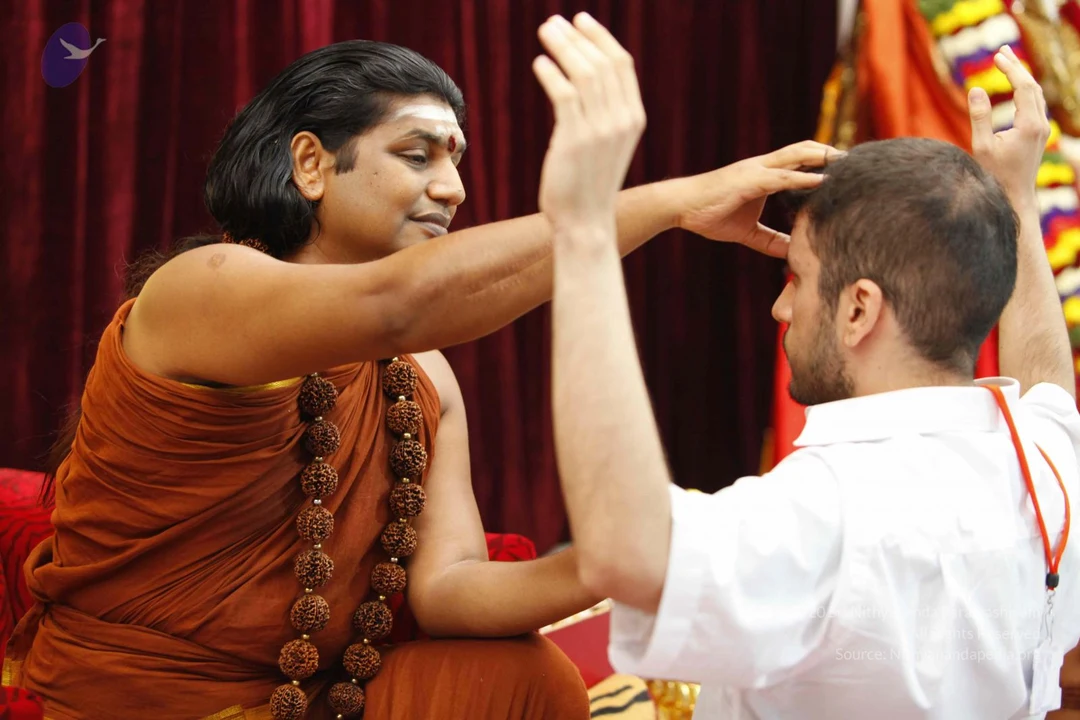
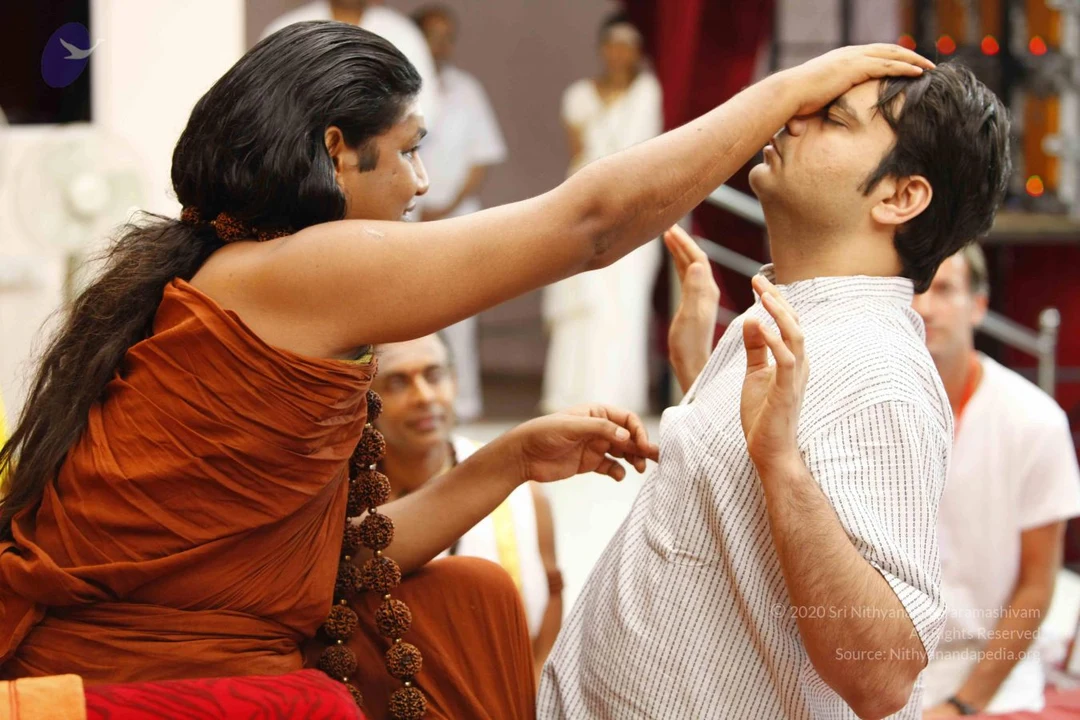
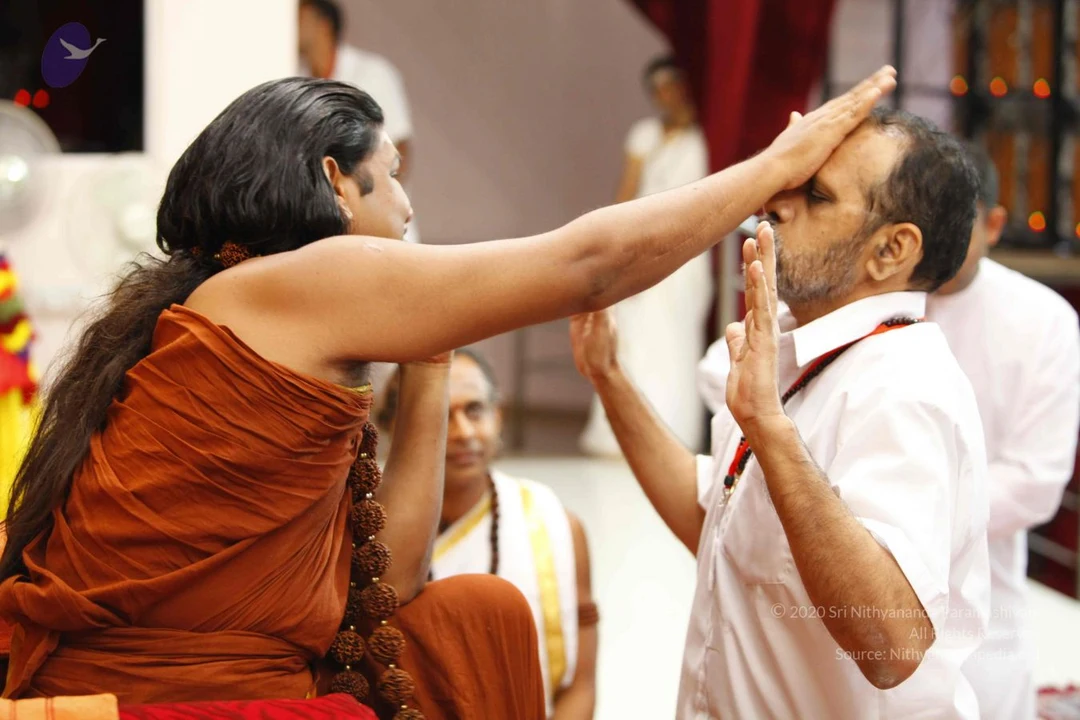
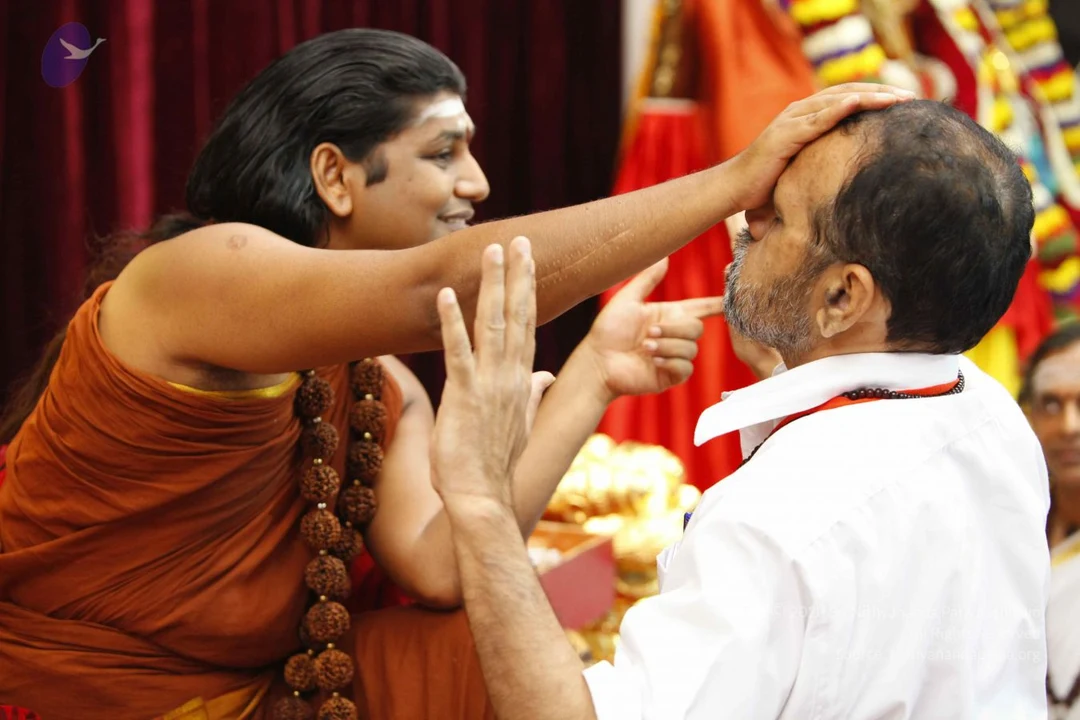
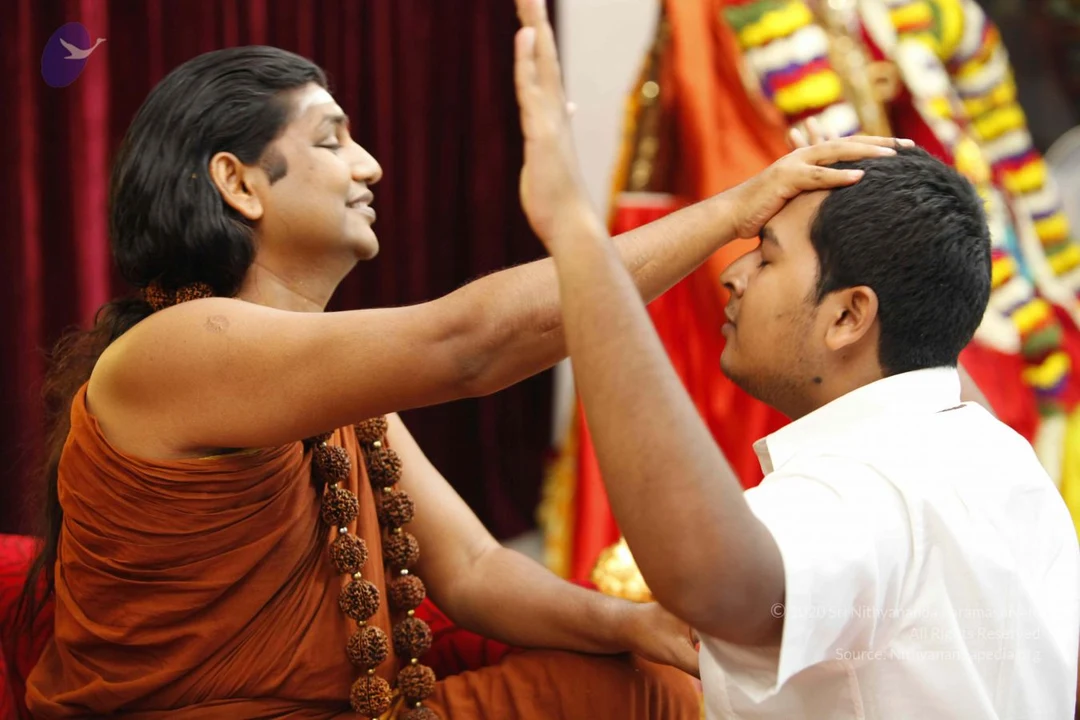
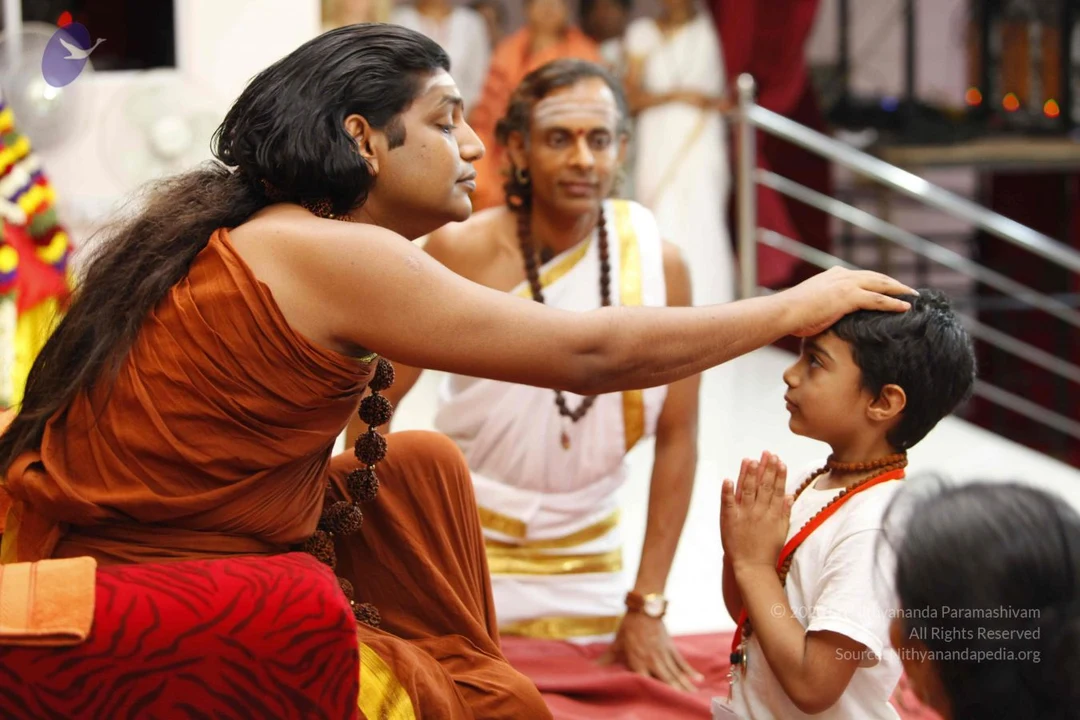
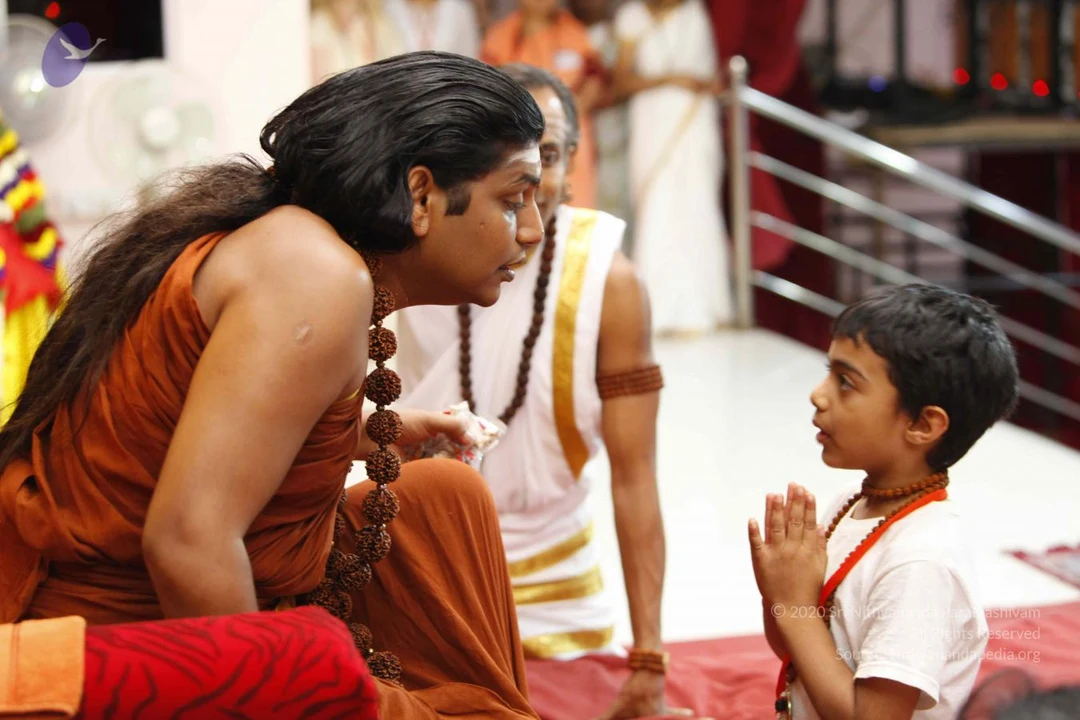
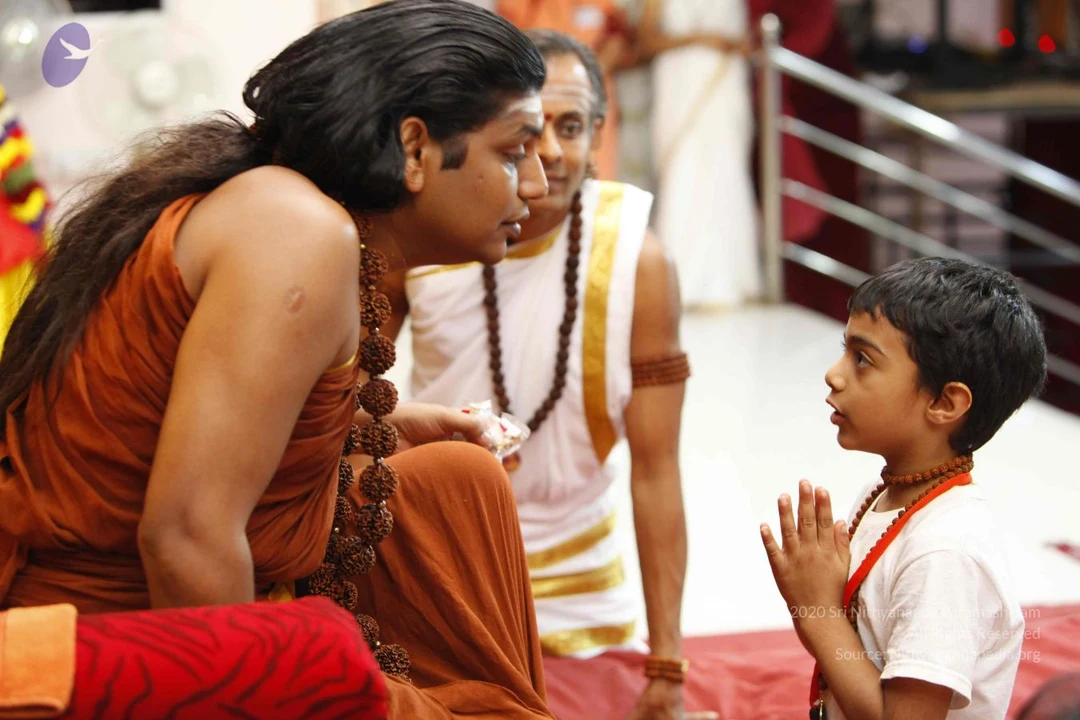
A photograph of a saffron-robed figure in an orange turban with yellow stripes, a rudraksha mala and ceremonial gold necklace, bare-armed with a gold armlet, placing a hand on the head of a bowed man in a white shirt. The robed figure holds a folded white paper. Behind them, devotees in white stand near a golden deity murti and pillars in a temple hall. The man in white is seated or bending in receiving blessing. Swamiji (probable) with a distinctive turban, rudraksha mala and gold necklace, performing a blessing on a devotee. Several other people are visible in the background, including a young boy in the lower left corner.A photograph of a ceremony in a temple hall decorated with red drapes and golden deity figures. A priest in a saffron-orange turban and reddish-brown dhoti, wearing a rudraksha mala and a large gold ceremonial necklace, holds a folded paper in one hand while placing the other hand on the head of a kneeling man in a white shirt. Several men in white shirts stand with palms pressed together in prayer around them, and a woman in white with a long braid stands at the right edge. The priest's features and clothing are consistent with the presentation the page describes, but his identity cannot be confirmed from appearance, so the a person value is unsure. Five or more people are visible, so the count is in the 6-20 range.Photograph of a devotional reception at a temple-like hall with red drapes and a gold-lit shrine in the background. A man in a rust-orange turban, orange-brown robe, long gold necklace and many rudraksha malas stands at centre, smiling and extending his hand toward devotees while holding a white paper. Several men in white and grey shirts stand in a line on the left, one with palms pressed together in namaste and another holding a small gold packet. A man in white with rudraksha malas stands at the right edge. Swamiji (probable) cues are the swept-back hair, orange turban and ornate gold necklace on the central figure, roughly seven to ten people are visible.A photograph of a man in a saffron-orange turban with gold-yellow stripes and an orange-brown shawl draped over his shoulder, raising his right hand in a blessing gesture while smiling. He wears a long rudraksha mala with a large gold pendant and gold ceremonial necklace, gold bangles, and a red tilak on his forehead. Nearby to the left, a man in white shirt and trousers stands with palms pressed together in greeting. A man on the right wears a white dhoti with gold border and a rudraksha mala, with a red tilak. Behind them, a crowd of devotees stands in a temple hall with red canopy and ornate golden decorations.A photograph of a crowd at a temple-like hall with a red and gold canopy and decorated background. In the foreground, a smiling man in an orange-saffron turban and matching orange-saffron robe with gold border is wearing a long gold ceremonial necklace and multiple rudraksha malas, and is raising a hand in blessing toward a devotee in white clothes at left. Men in white shirts and dhotis and a bare-chested man with a long braided rudraksha cord stand nearby, some with palms joined. A small gold pendant and a bracelet are visible.A smiling man in a rust-orange turban with gold border and a rust-orange wrap with gold trim stands at centre, wearing a long gold ceremonial necklace and a multi-strand rudraksha mala. He raises his right arm to touch the forehead of a man in a white shirt and white dhoti on the left, who has his hands folded in namaste. Other men stand behind in a crowded hall with red curtains, golden decorations and a lit deity display in the background. The central figure has distinctive saffron attire, rudraksha and ceremonial gold cues, so he is a person in an appearance-based label, blessing a devotee in a satsang-style gathering. Several people are visible, including partially visible figures at the edges.

Swamiji-Deities-blessing

7 photosSource gallery
A standing man in saffron and gold robes, with a saffron turban, rudraksha mala and a large gold ceremonial necklace, smiles and raises his hand in a wave beside a decorated murti setup. Seated in the center is a deity murti with a crown, gold ornaments and a trident, wrapped in a garland of red, yellow, white and purple flowers, seated beside a female murti in blue with pearl and gold jewellery. Red velvet drapes form the backdrop.A photograph of a standing man in saffron and gold ceremonial dress, wearing a saffron turban, a gold pendant and a rudraksha mala, with bangles on his wrist, smiling and raising his right hand in greeting beside a decorated deity murti. Behind him, a seated deity murti with a crown and a staff in its hand sits on a red and gold throne covered with garlands in red, white, yellow, purple and green. A second, smaller deity figure in blue sits at its side, and a gold-framed backdrop of deep red drapes fills the background. Two physical people are present.A photograph of a man in saffron-orange robes and a matching orange turban stands at left, smiling and raising his right hand in a greeting gesture. He wears a large gold necklace and a rudraksha mala, with gold bangles on his wrists. Beside him is an ornate throne draped in a marigold garland of red, yellow, white and purple flowers, holding two deity murtis. The seated figure on the left has a golden crown, orange robes, jewelled necklaces and holds a staff, while the figure on the right wears a blue-green sari and a jewelled crown. The backdrop is deep maroon drapery and the throne has a gilded arch. Given the page cues of several distinctive visible adornments, the standing man is a person candidate in the greeting role.A man in saffron-orange sannyasi robes and an orange turban stands at left, smiling and raising his right hand in greeting. He wears a rudraksha mala and a heavy gold necklace with a pendant. Beside him is a decorated altar with a large deity murti of a male figure in an orange-red garment with a crown and a trident-like staff, and a female murti in a blue sari with pearl jewellery. Both are framed by a colourful garland arch of marigolds, roses and white flowers, set before a red velvet curtain and gold-framed backdrop. Swamiji (probable): the standing man shows a saffron turban, rudraksha mala and ornate gold necklace. The deities are murtis, not living people.A standing man in saffron and orange robes and an orange turban stands at left, smiling and raising one hand in a greeting, with a rudraksha mala and a large ceremonial gold necklace. Beside him, two deity murtis sit on a red and yellow throne decorated with a dense arch of multicoloured flower garlands. The seated murti at centre holds a trident-like staff and wears gold jewellery and an orange garment; the murti beside it wears a blue garment and pearl ornaments. Red drapes and a gold-topped backdrop frame the scene.A smiling person in saffron-orange robes and an orange turban stands with palms joined in greeting beside a decorated wooden palanquin. The person wears a rudraksha mala, a heavy gold ceremonial necklace and gold bangles, with a golden shawl draped over one shoulder. Seated on the palanquin are two deity murtis: a male figure in a red-orange dhoti with a crown, holding a staff and a flower, and a female figure in a blue garment with pearl and gold jewellery. The seat is covered in red and yellow fabric and framed by a multicoloured garland of marigolds, roses and white flowers, set against a deep red velvet curtain.

IA-Day7-Darshan-fotos

61 photosSource gallery
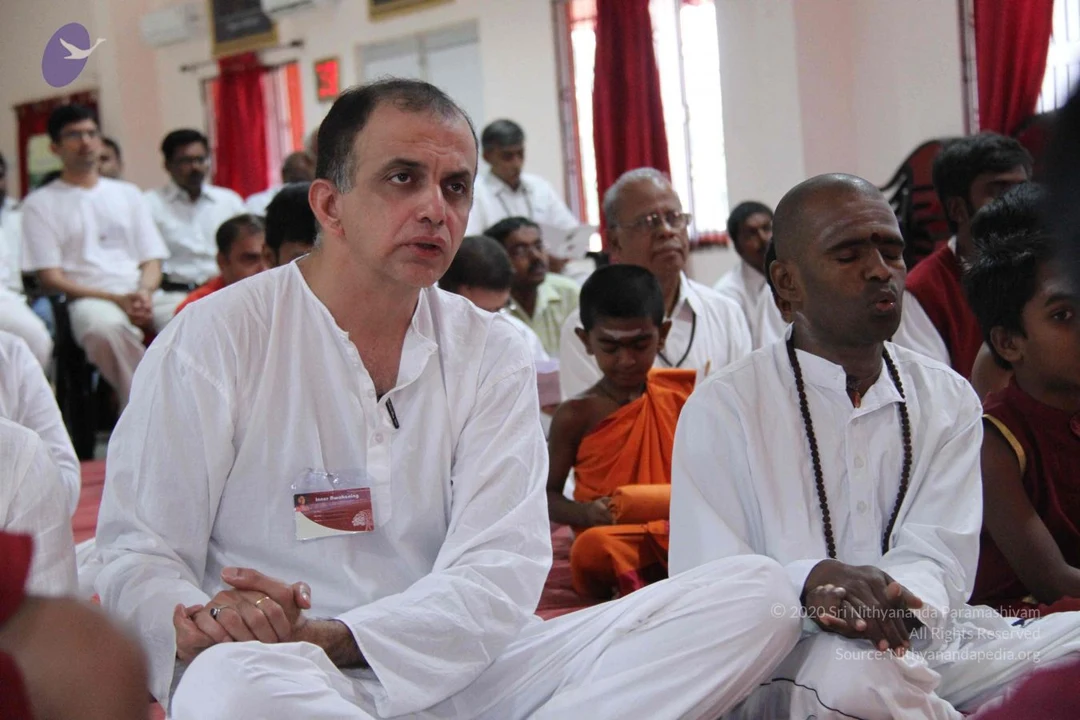
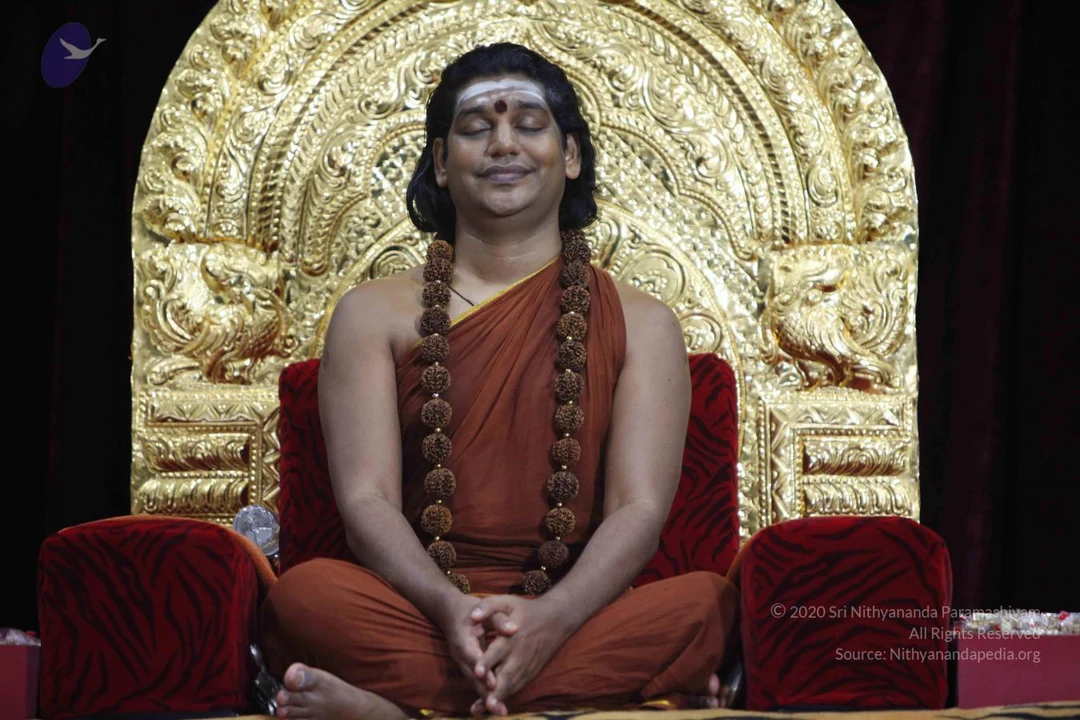
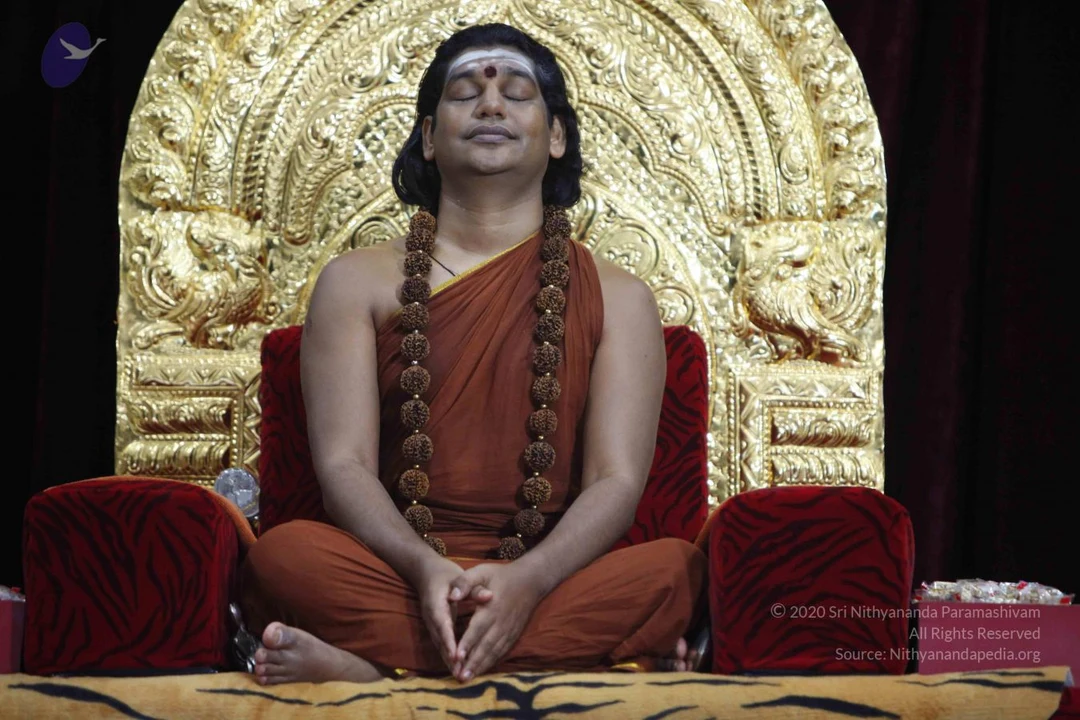
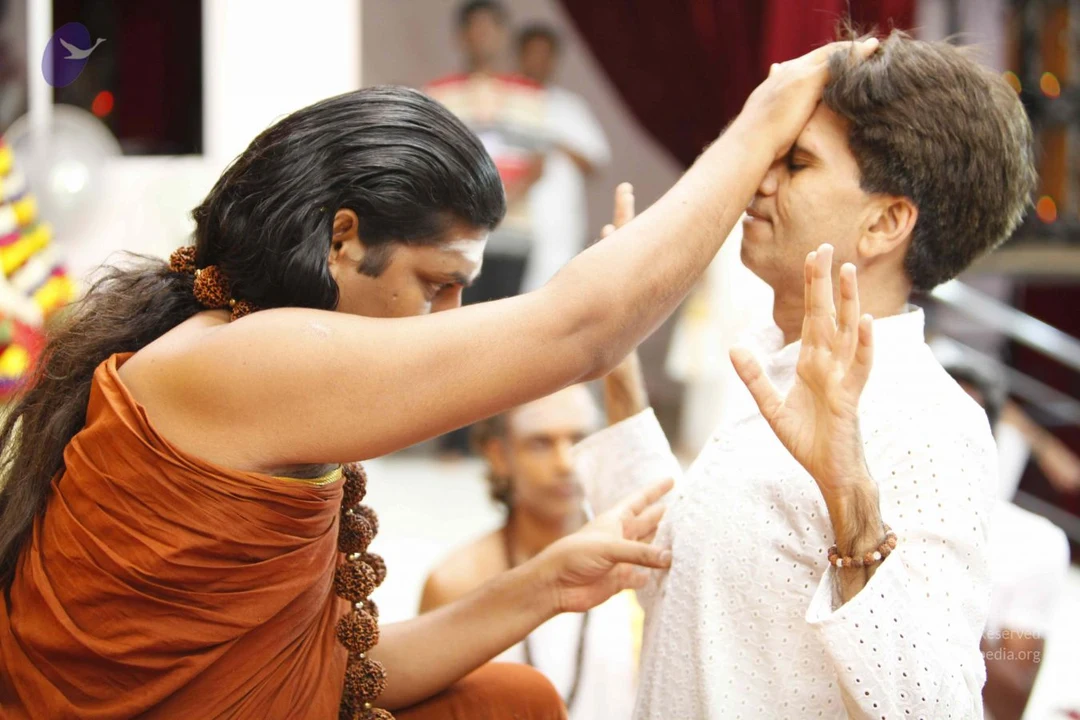
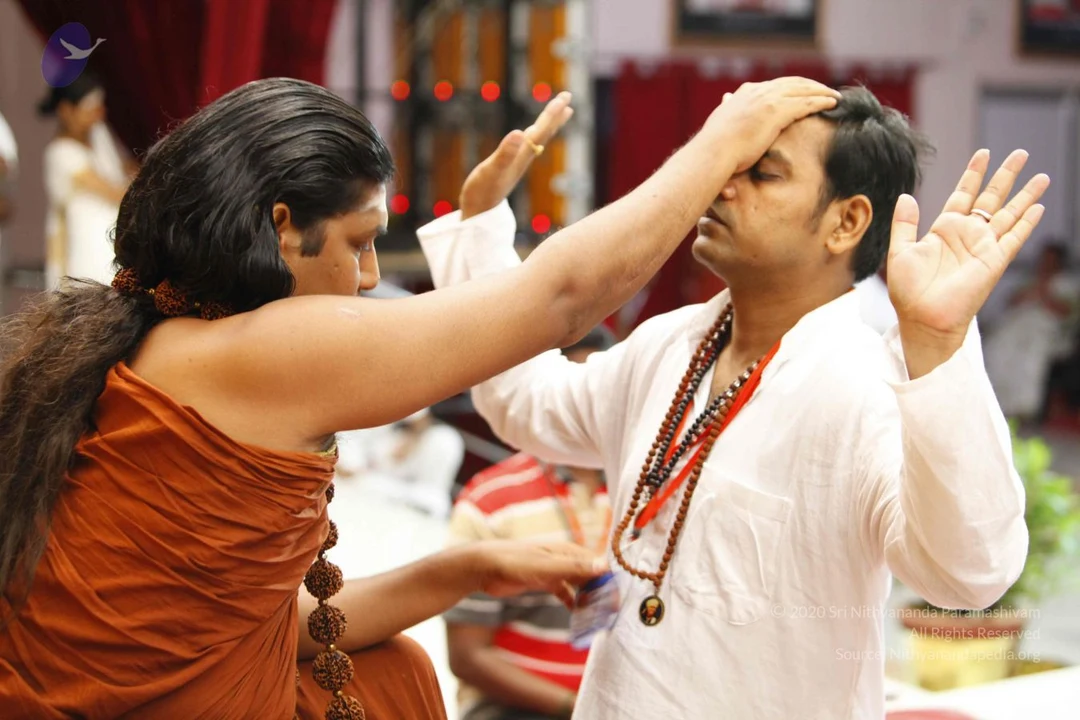
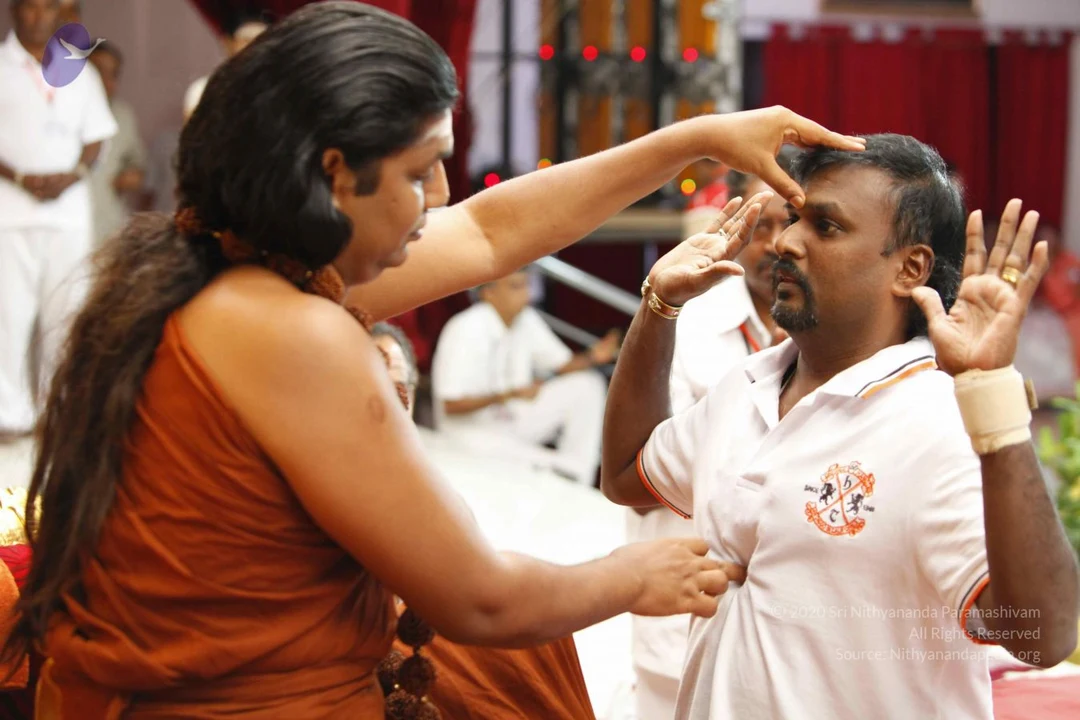
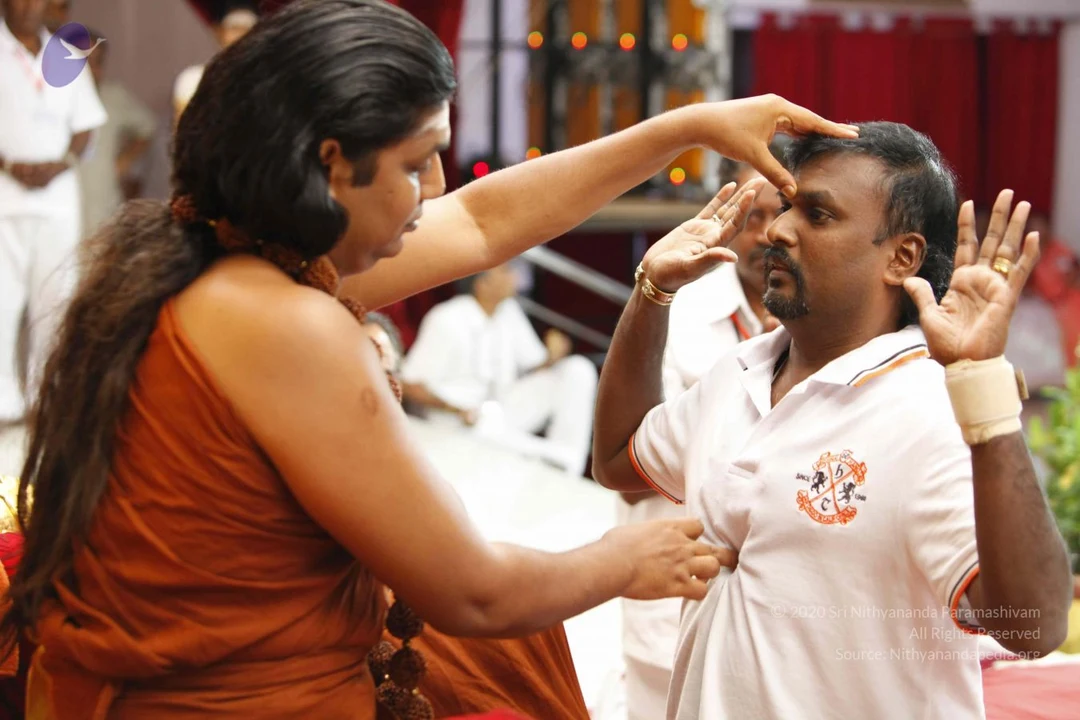
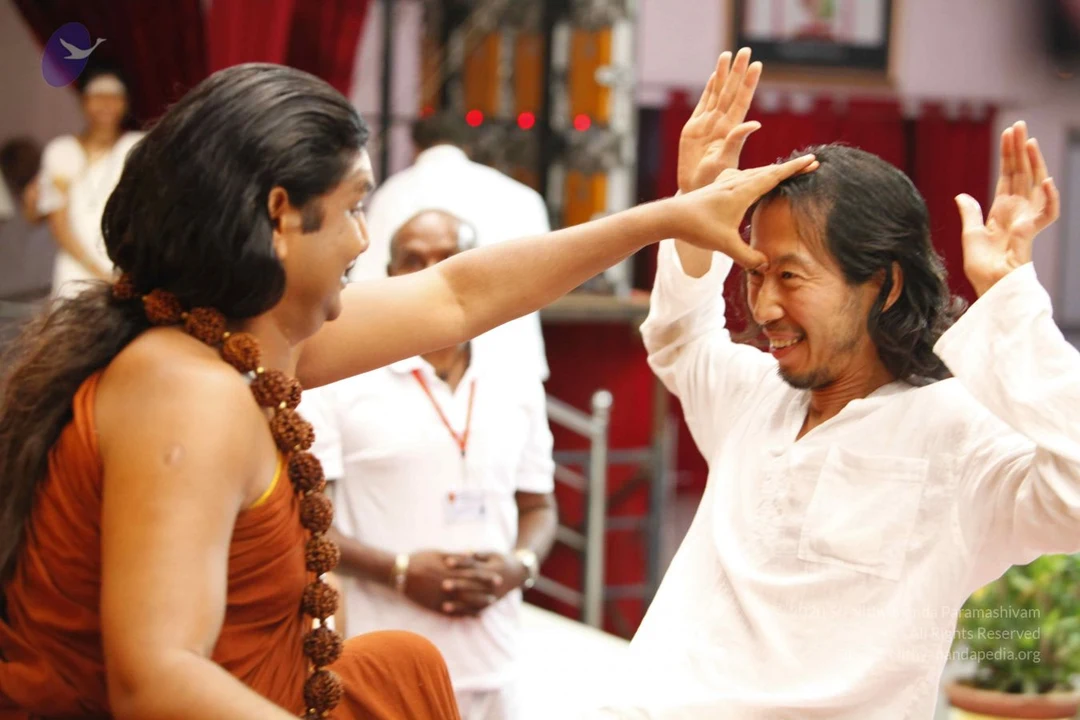
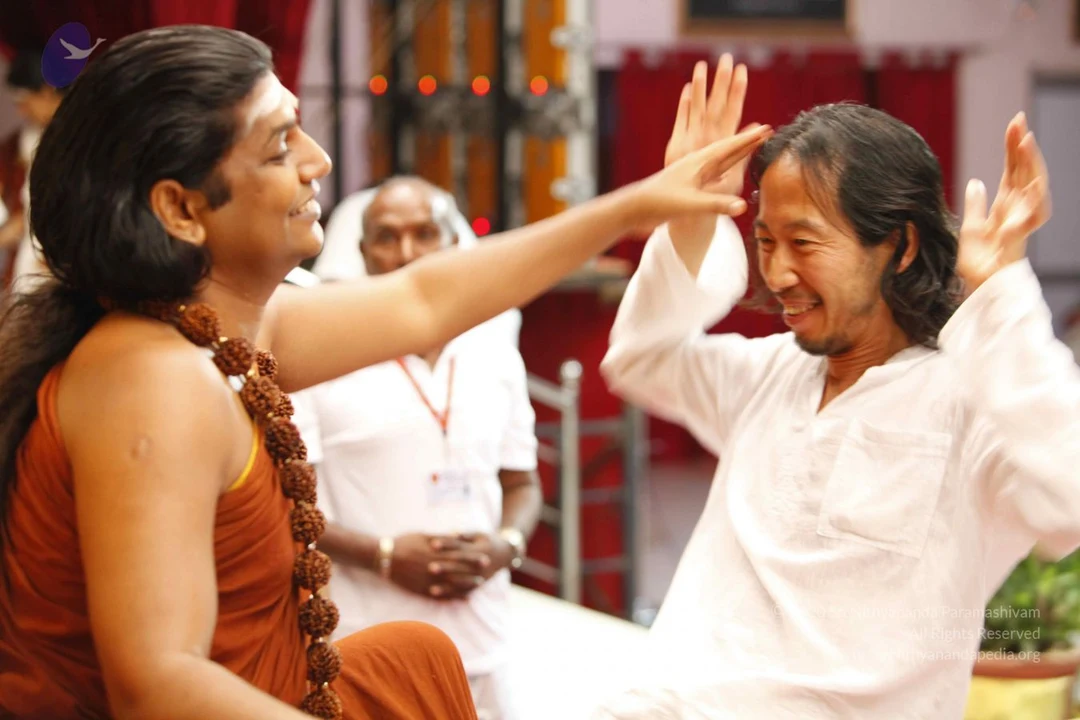
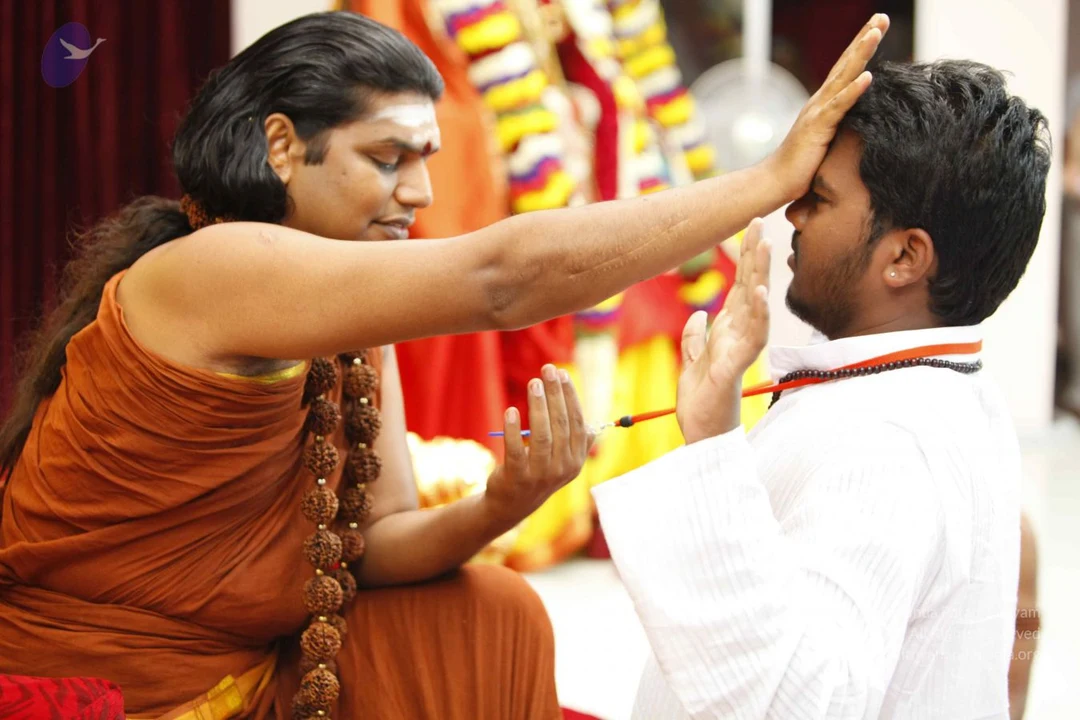
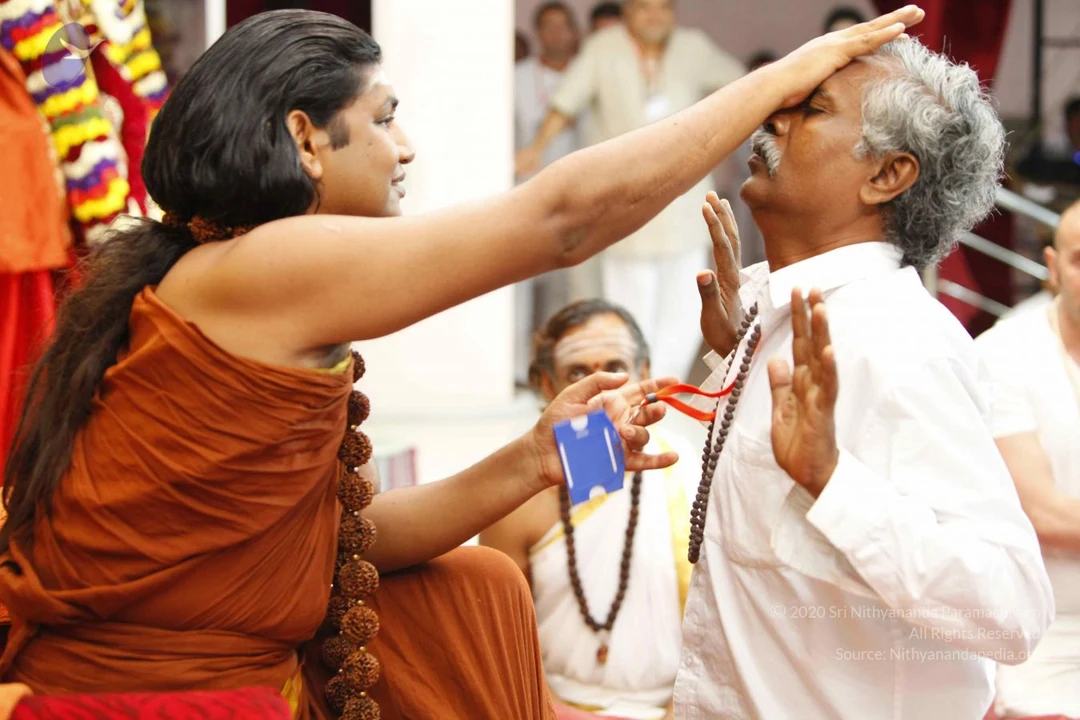
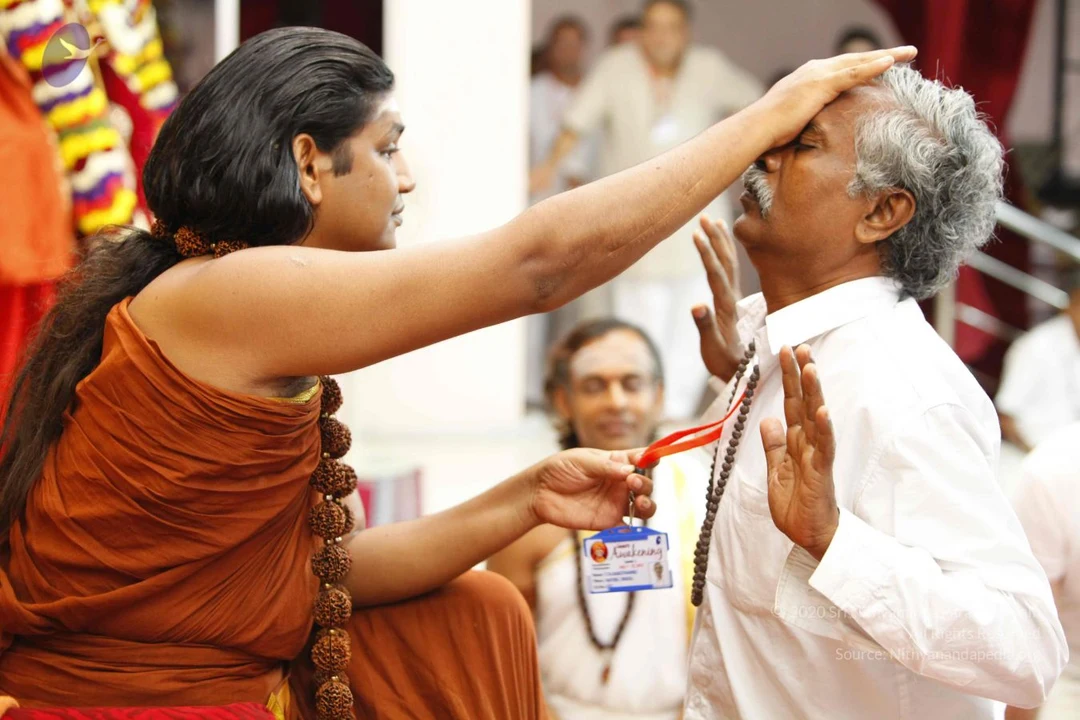
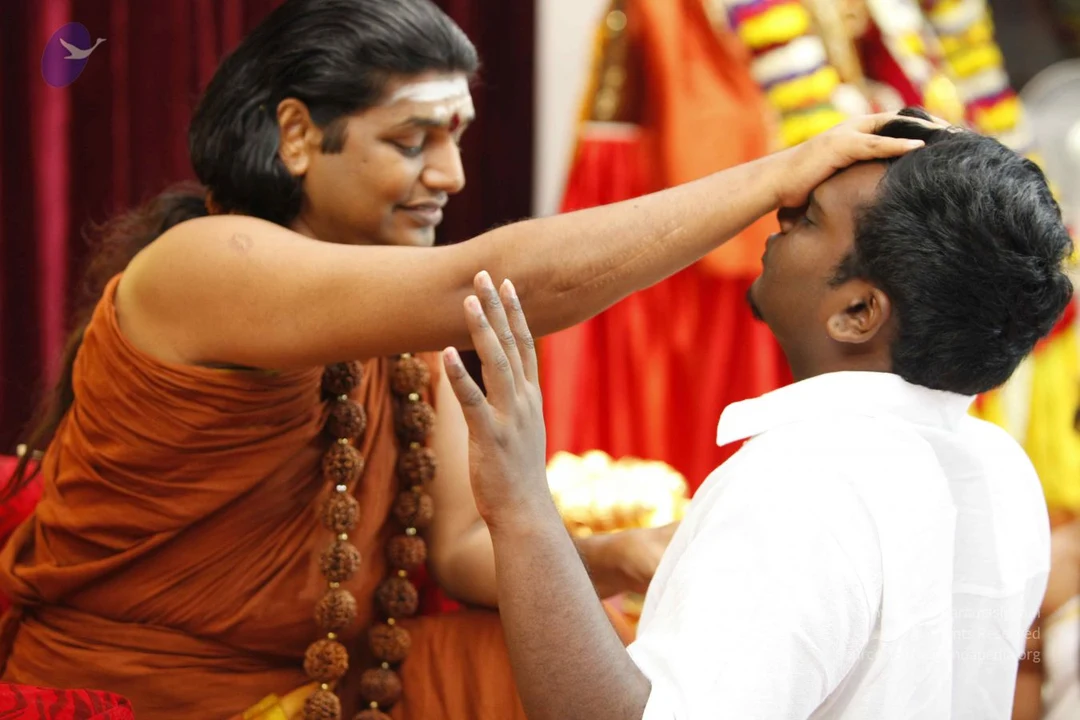
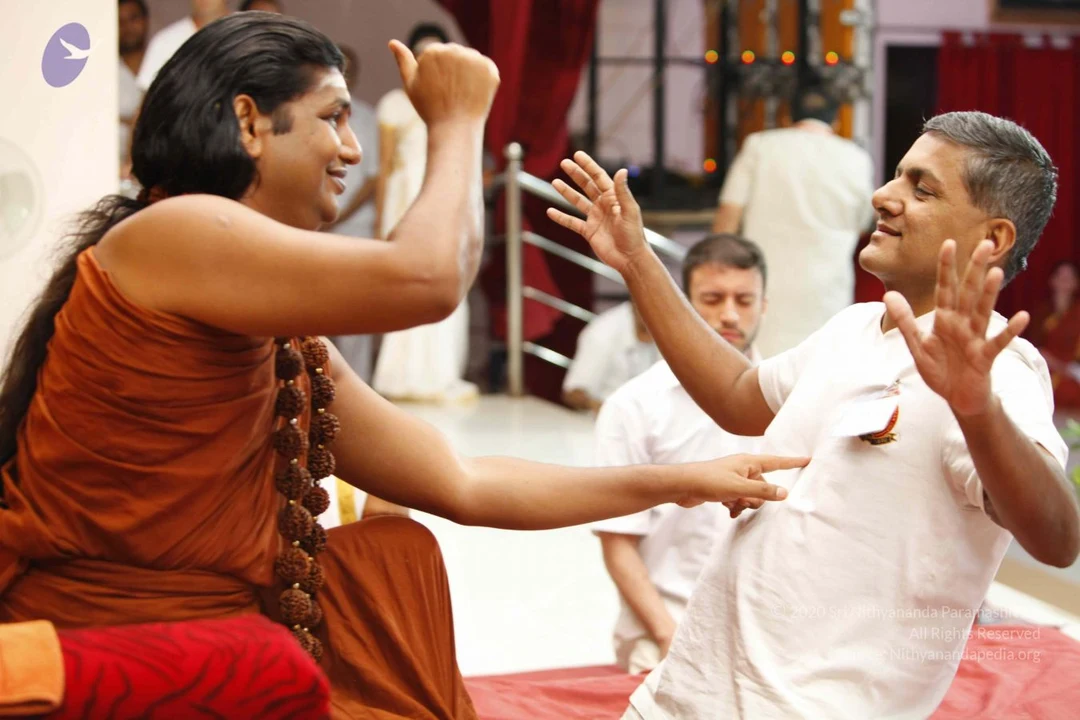
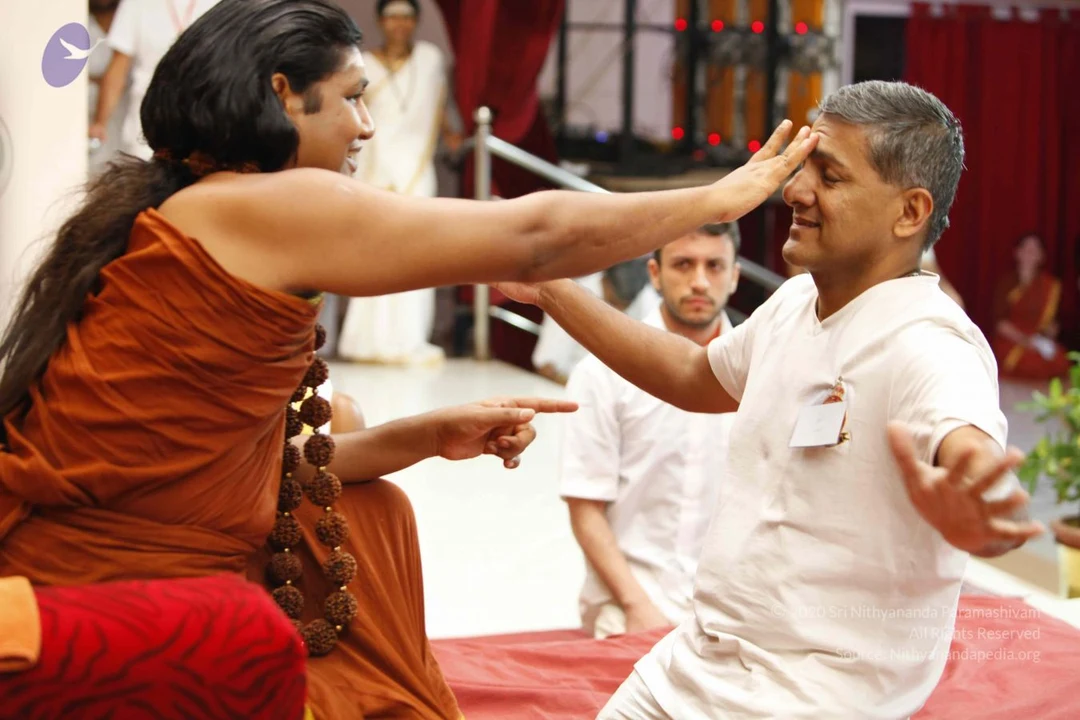
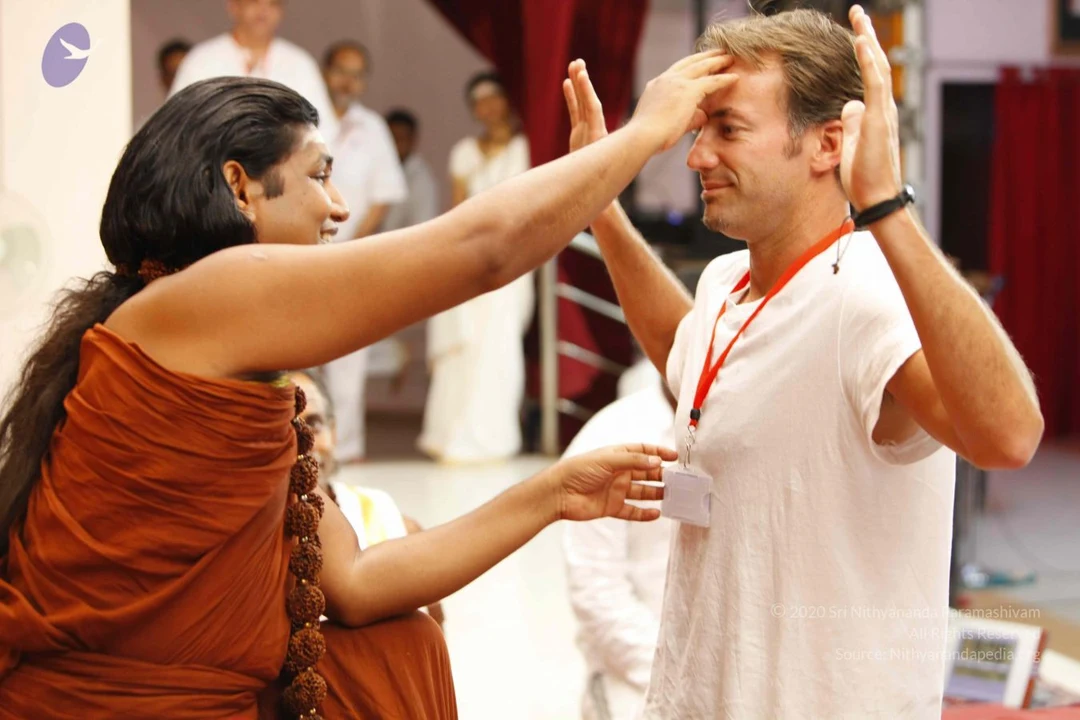
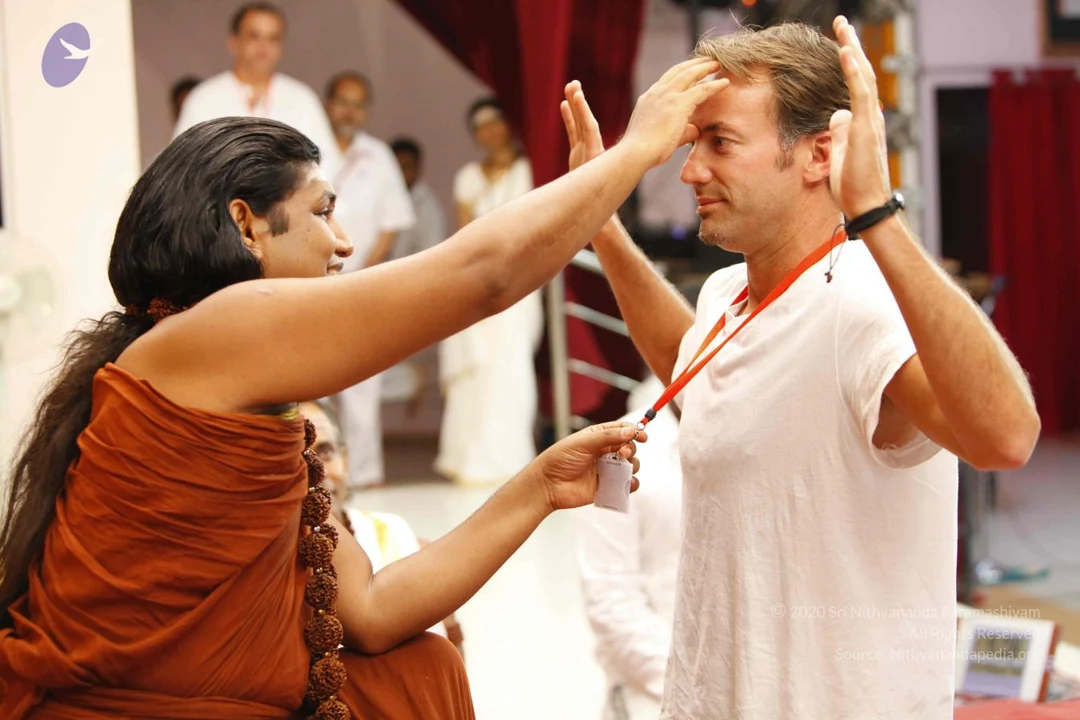
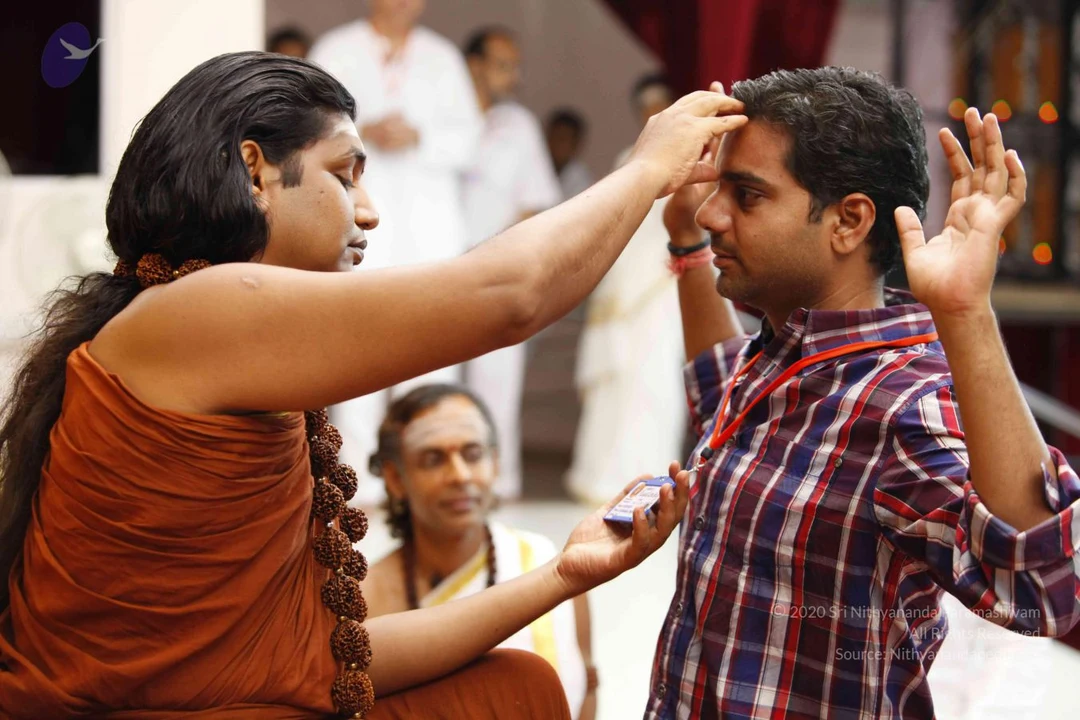
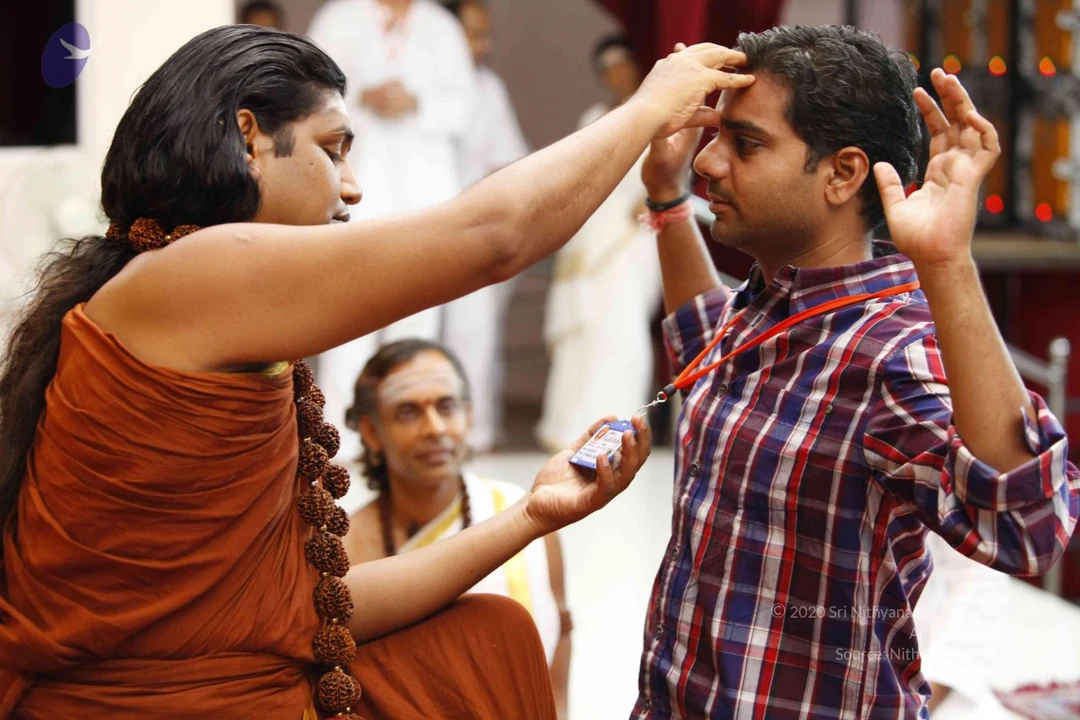
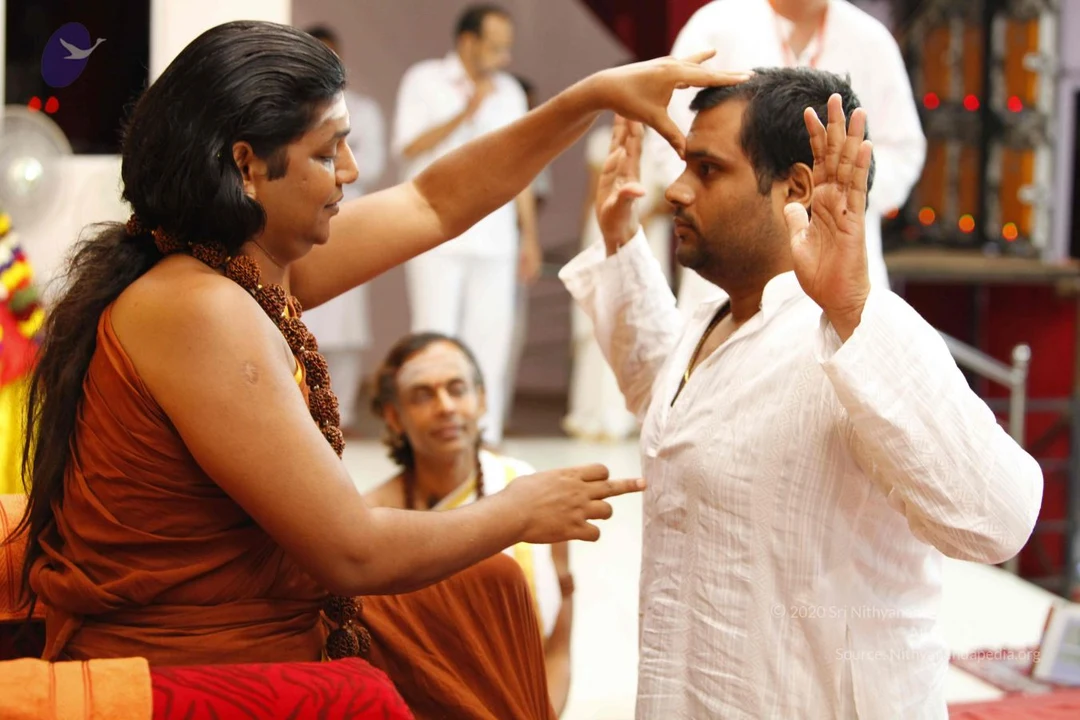
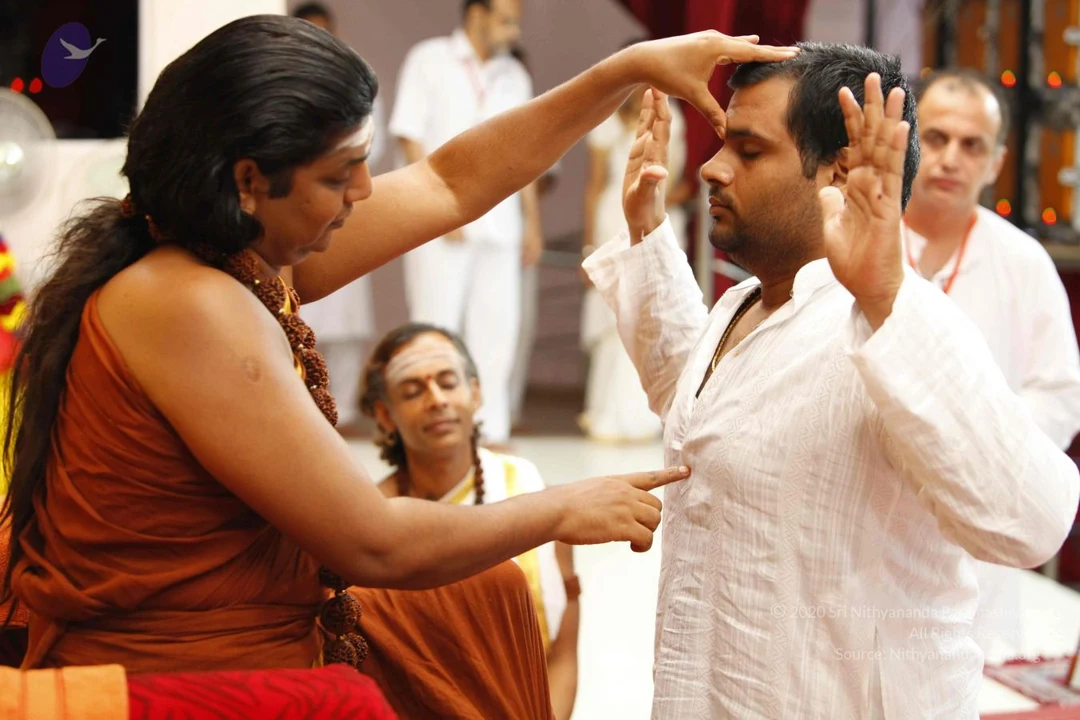
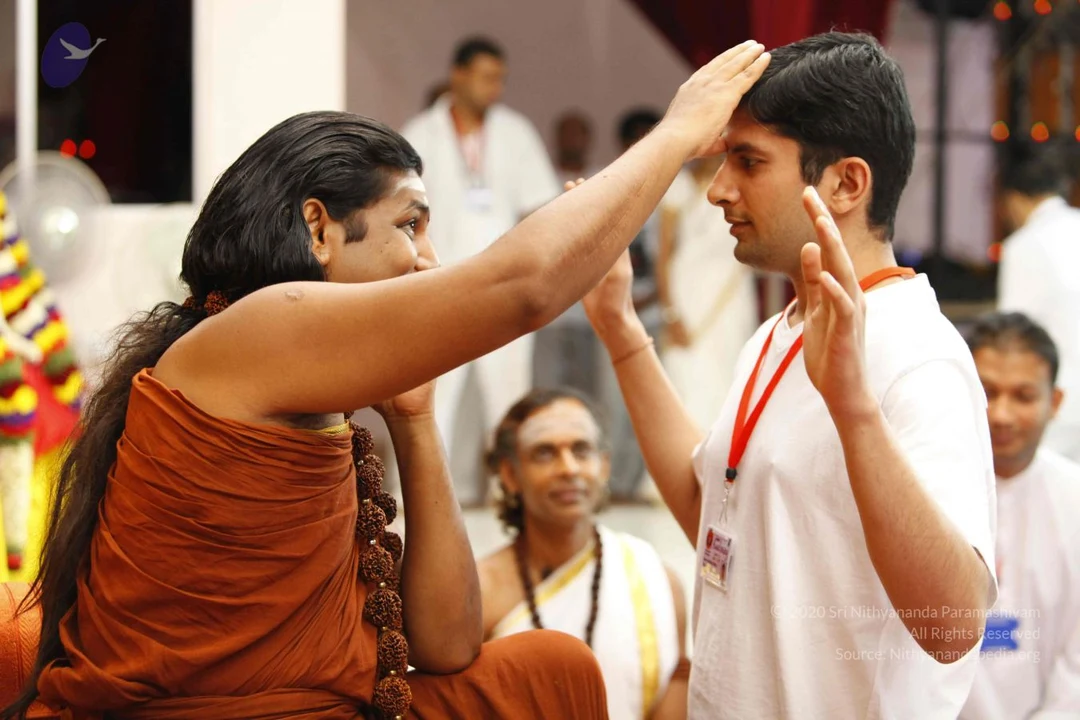
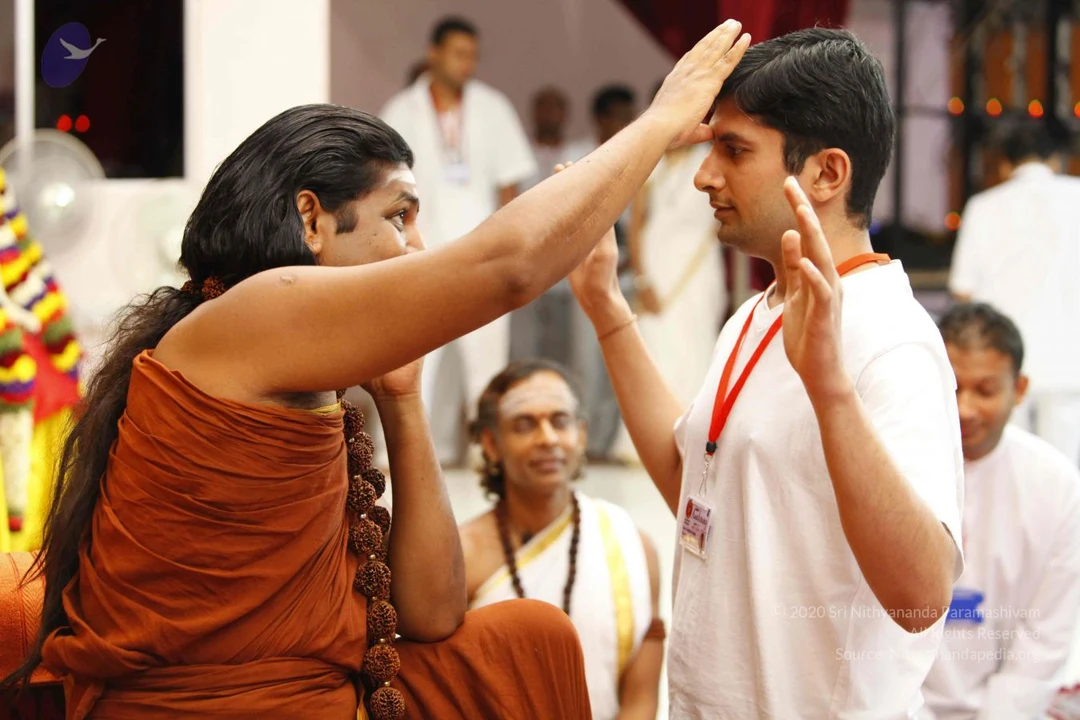
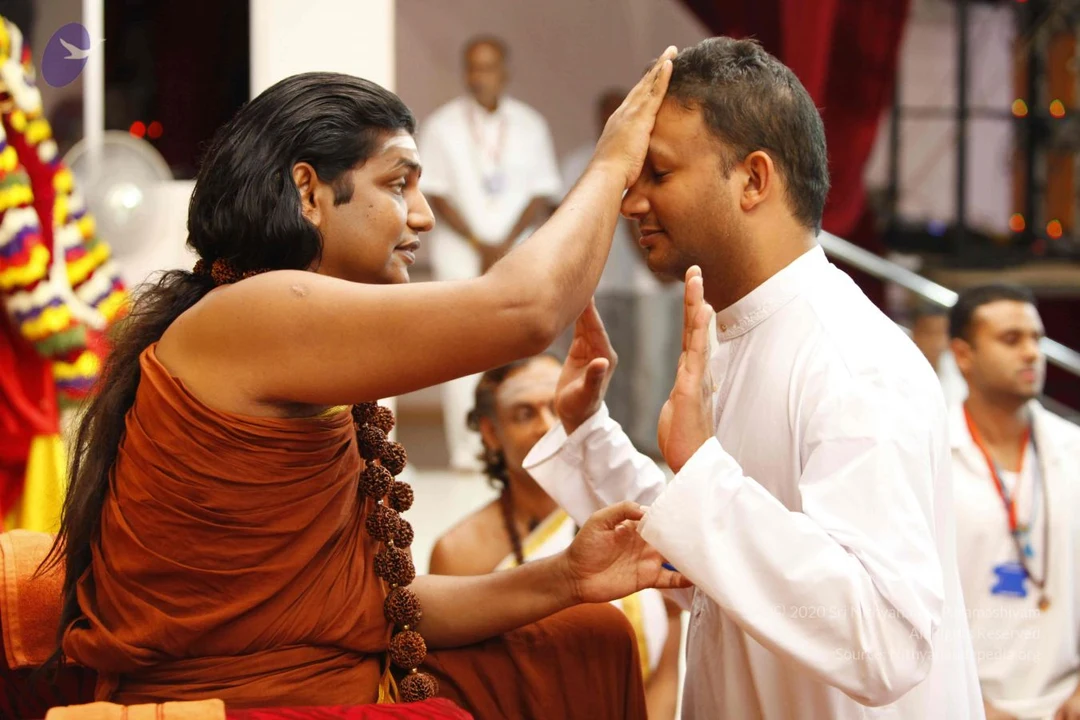
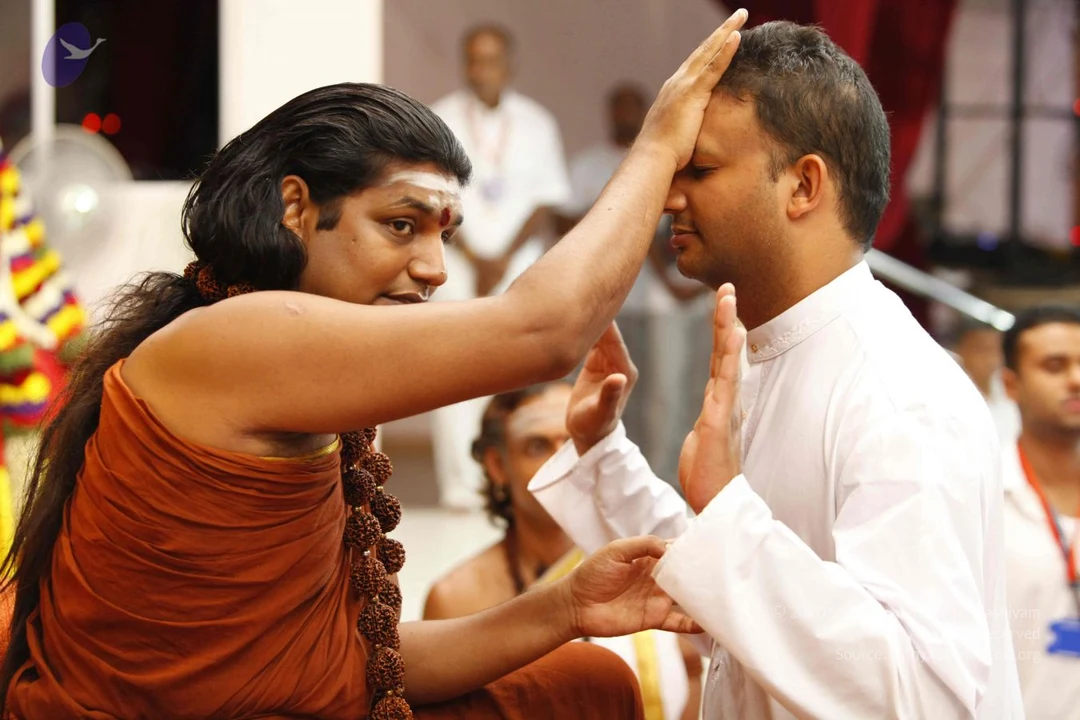
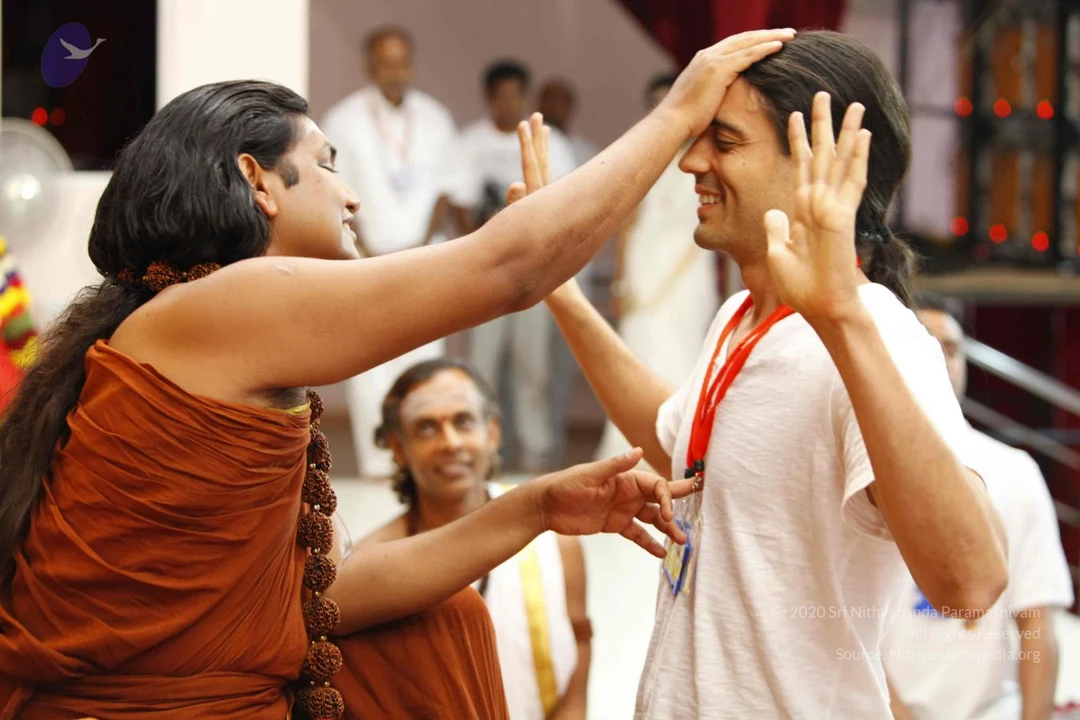
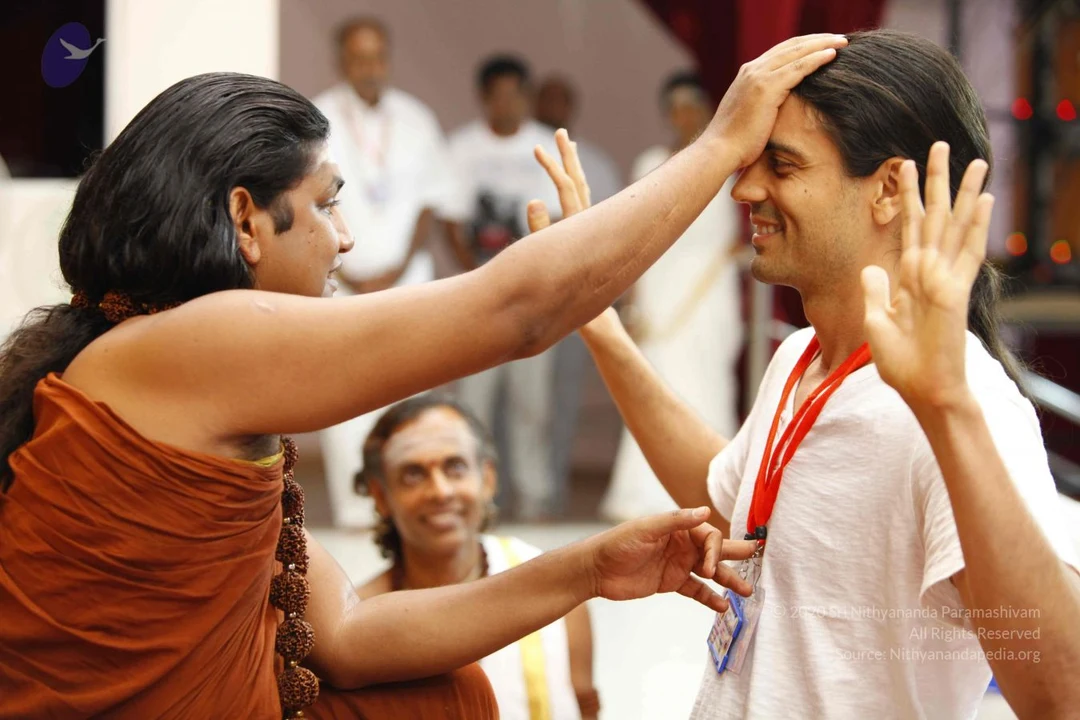
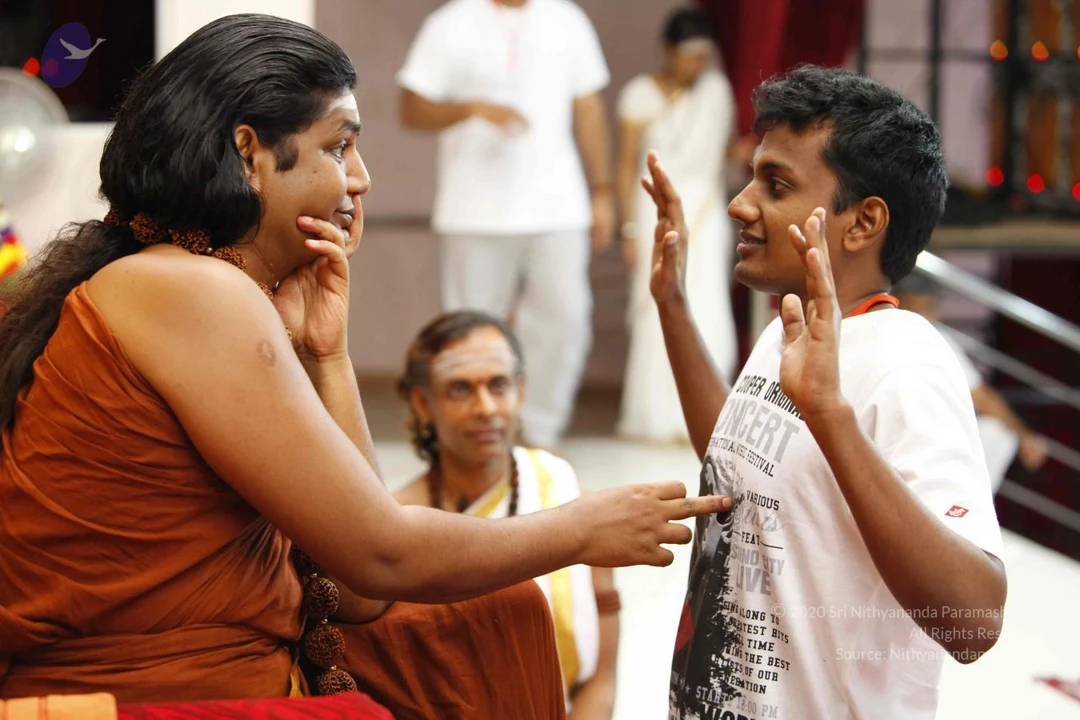
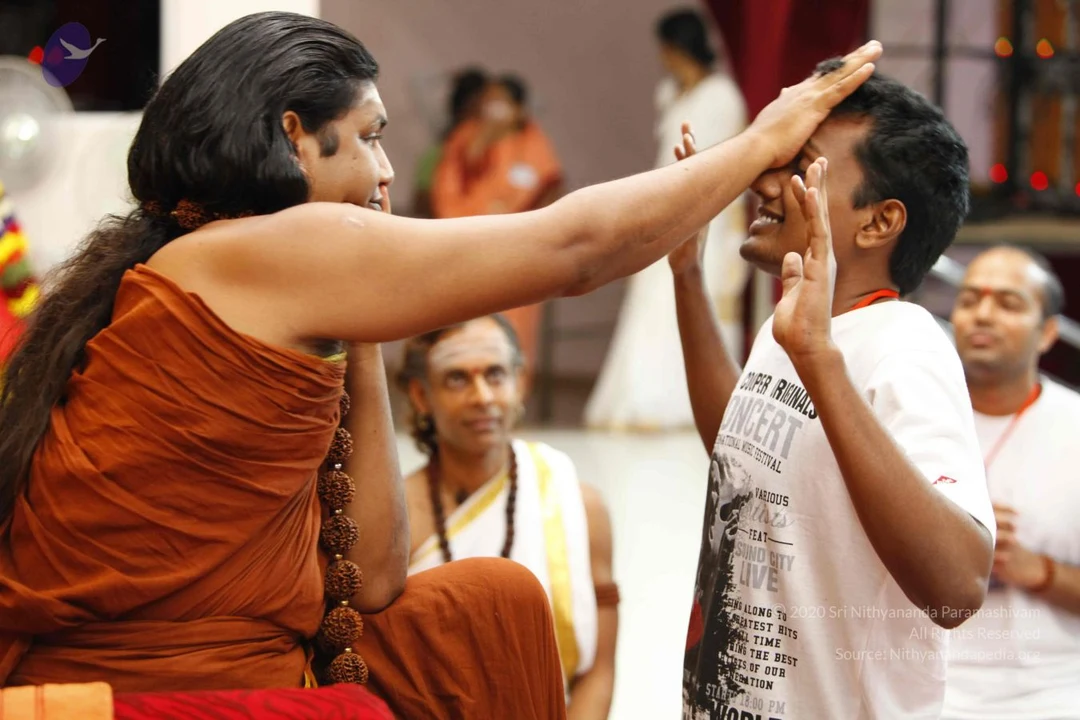
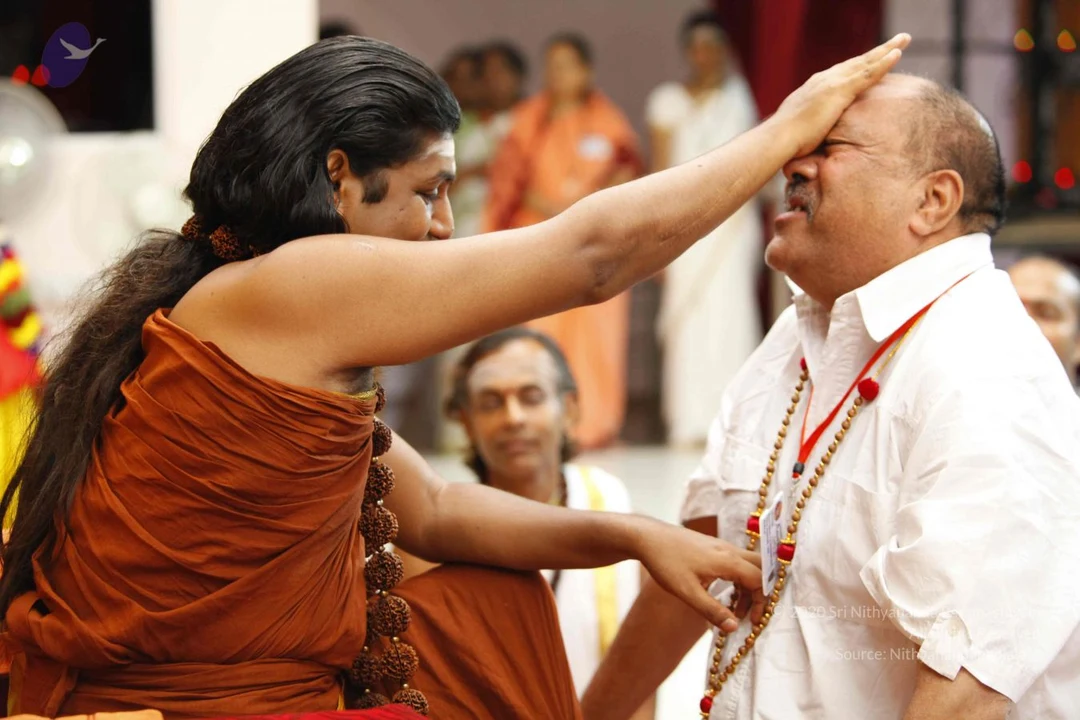
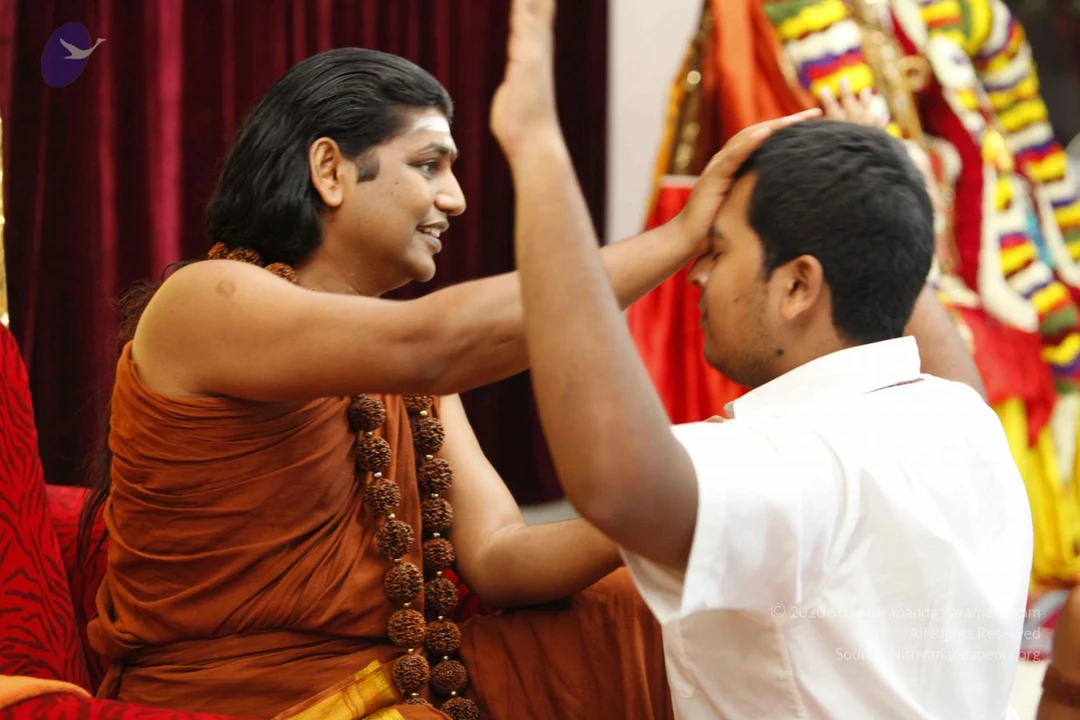
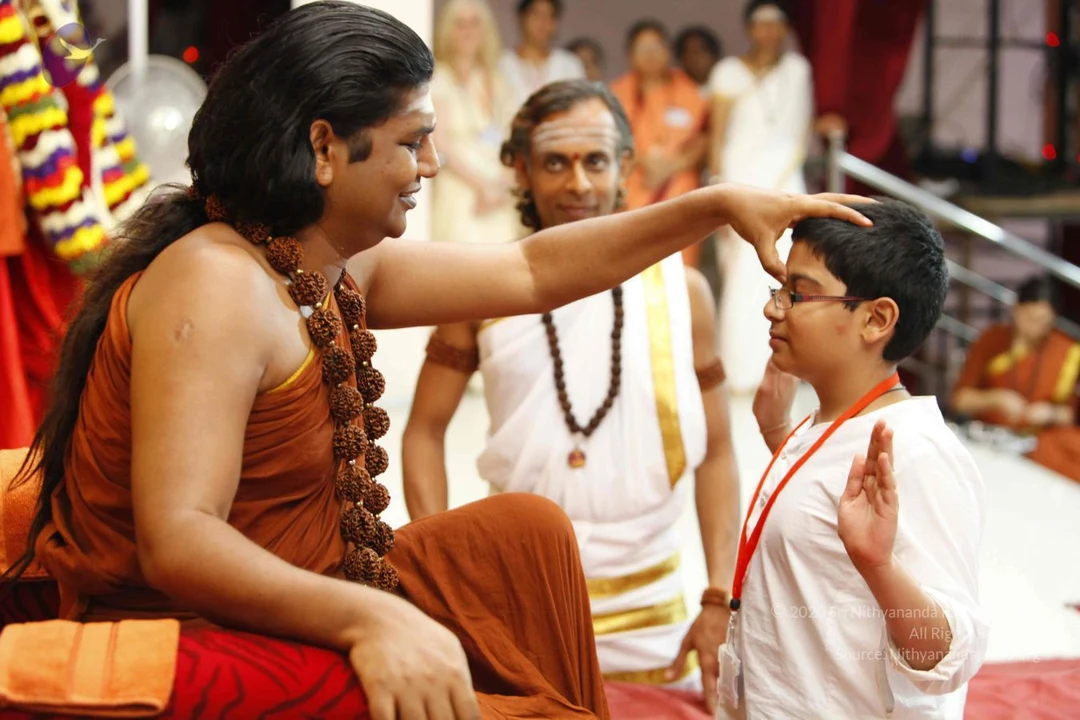
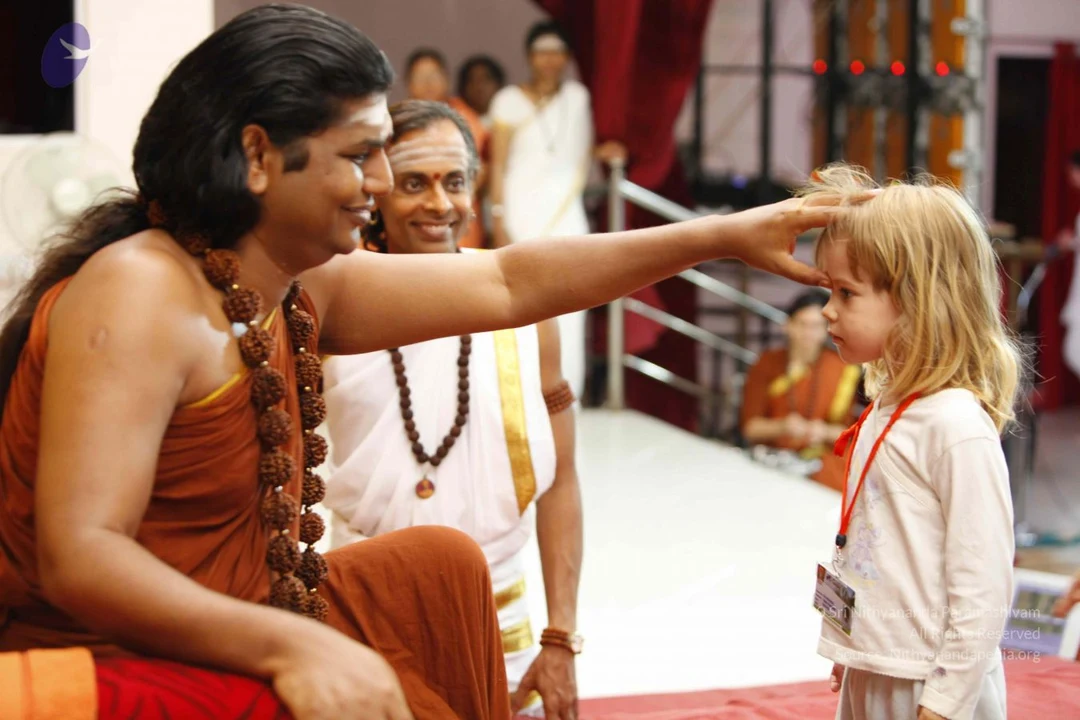
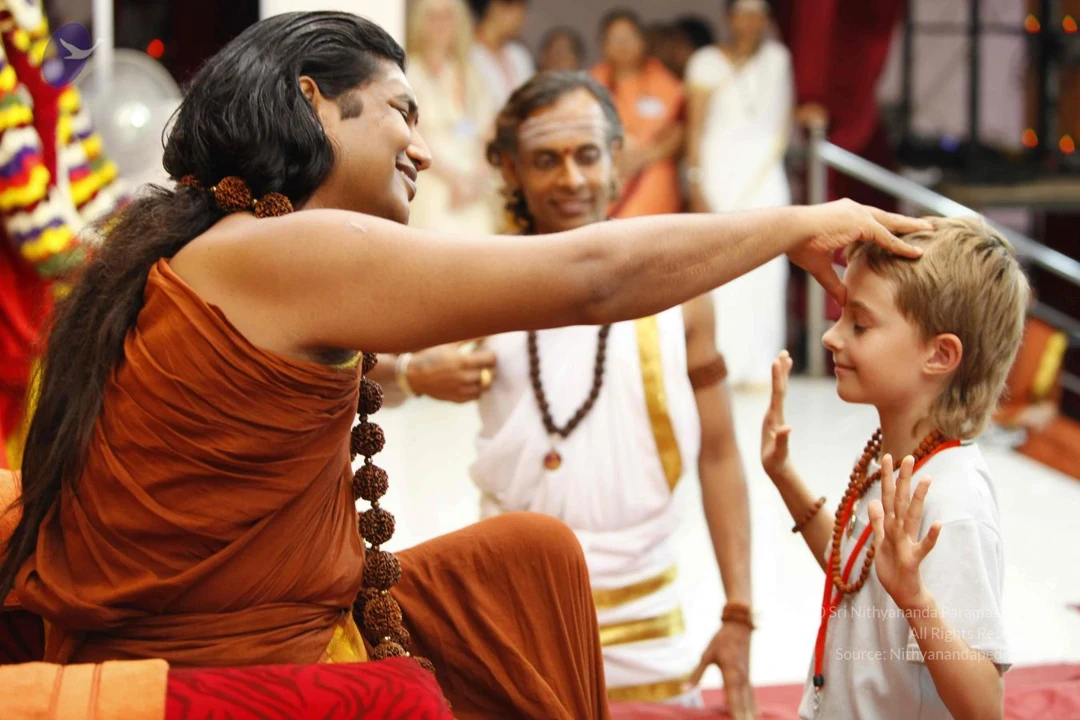
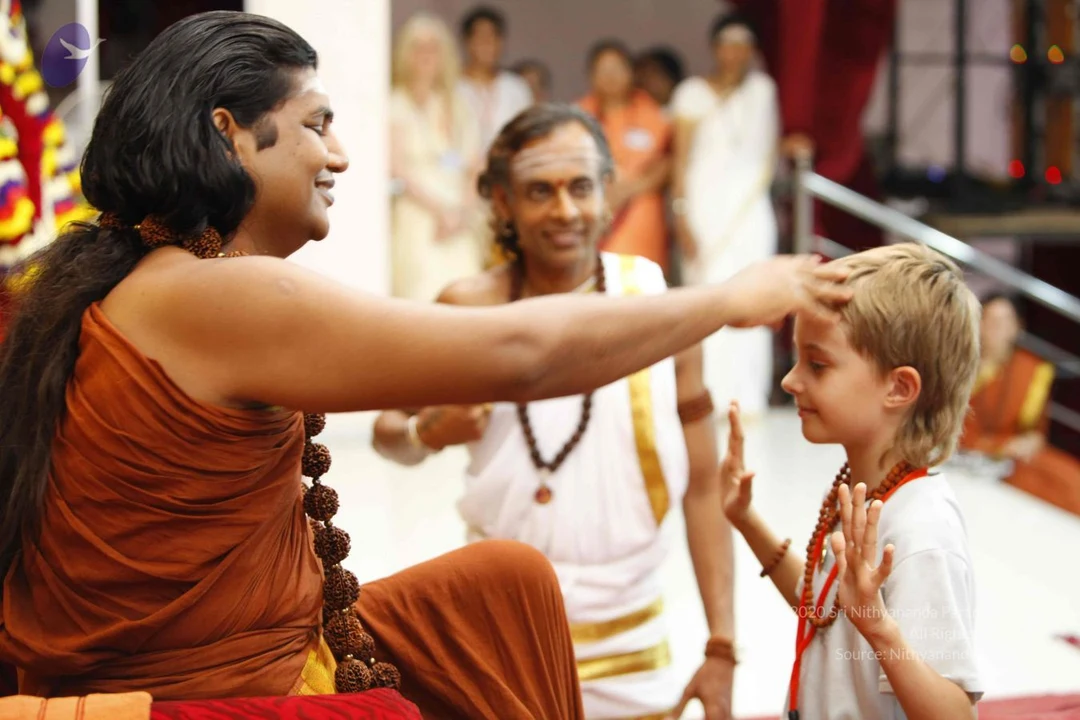
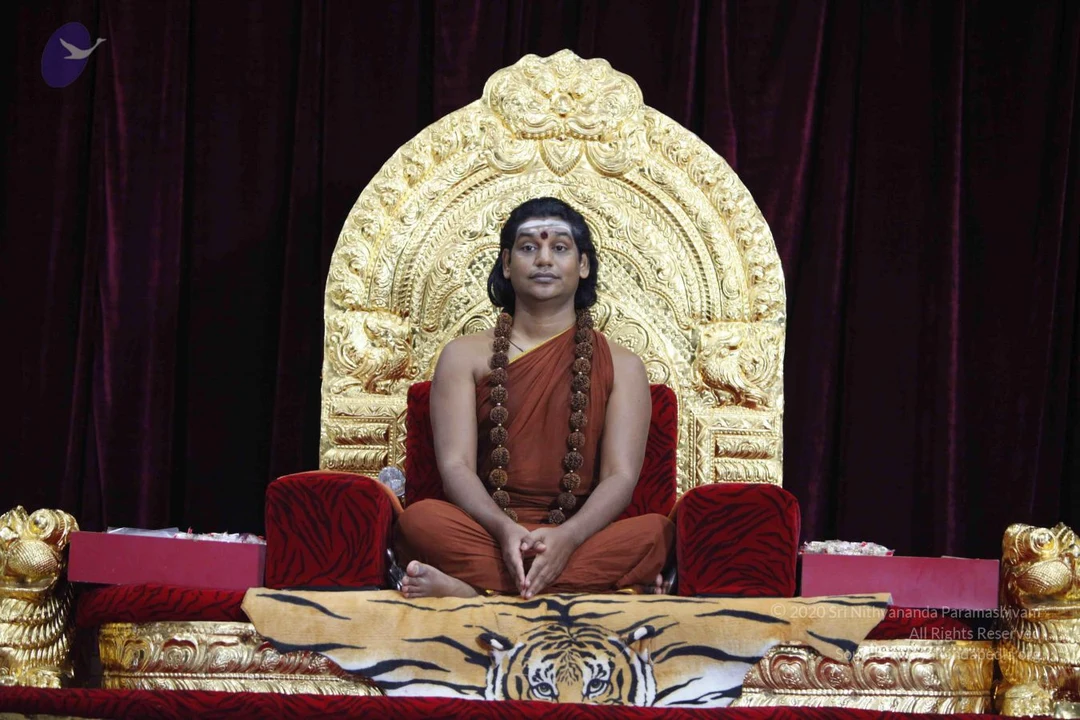
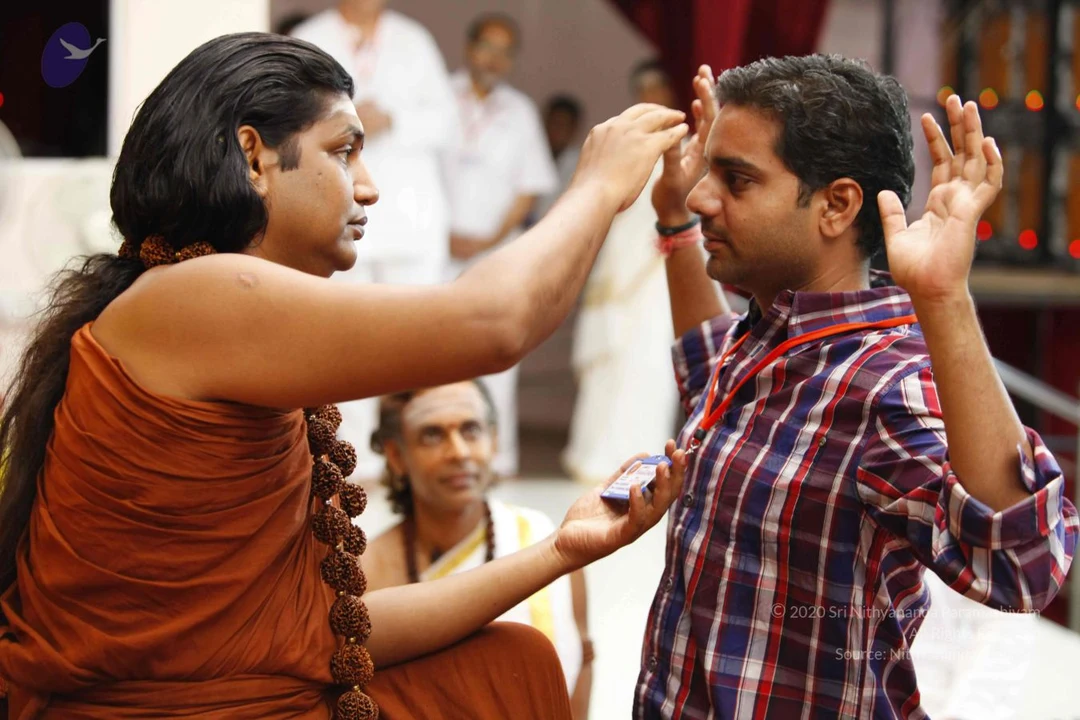
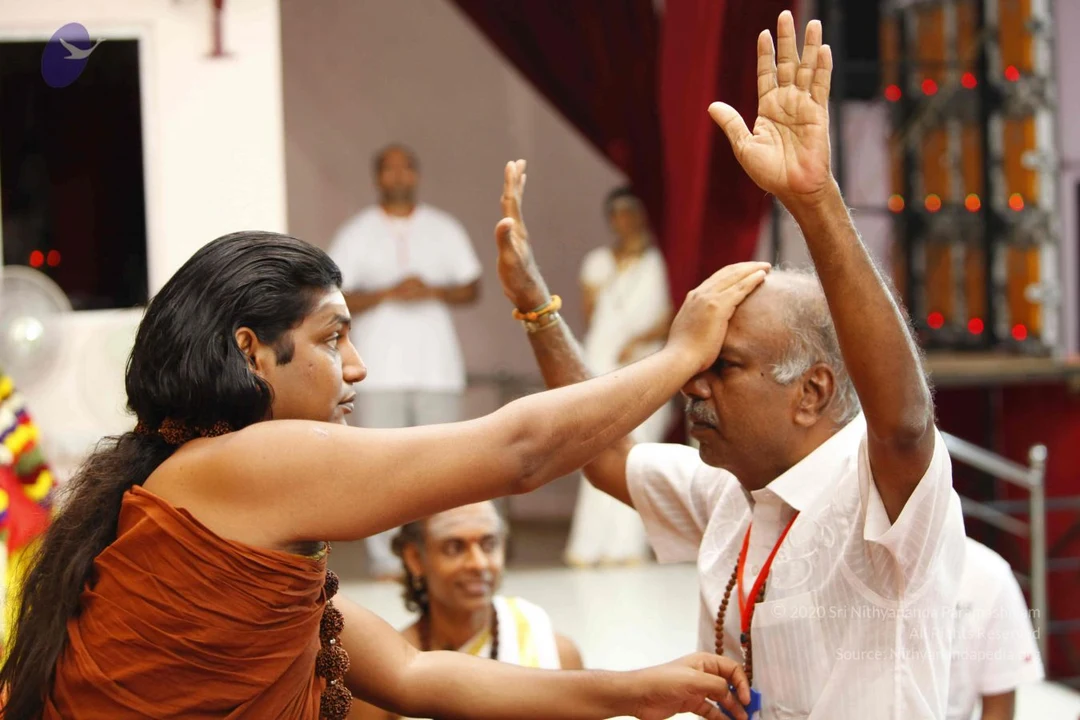
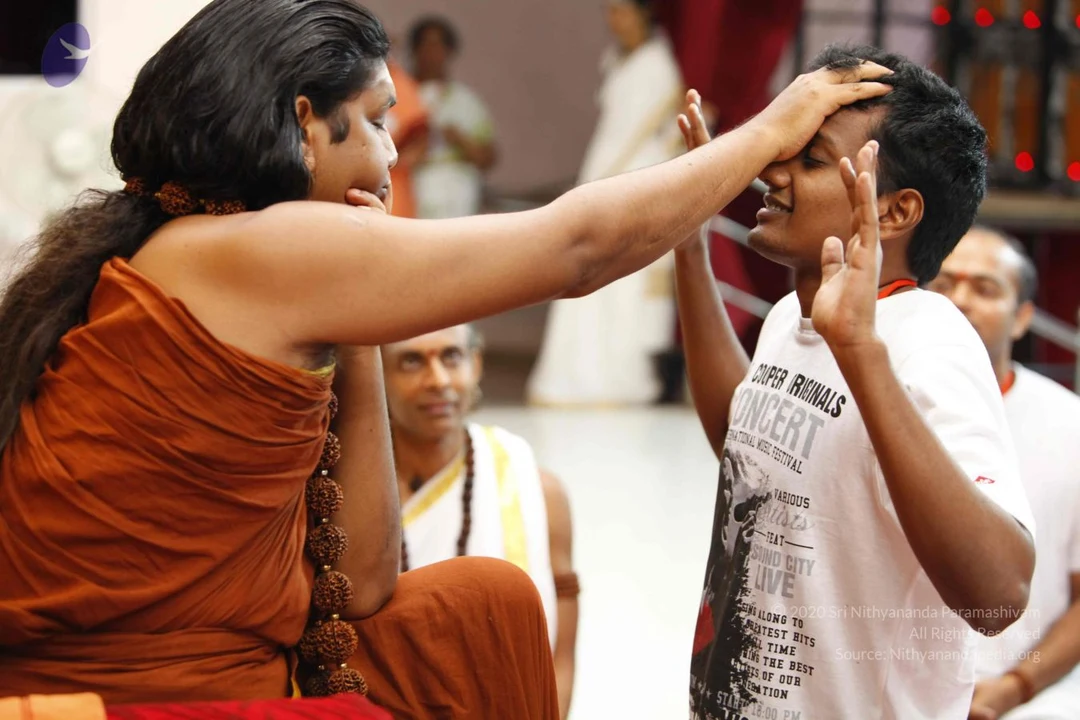
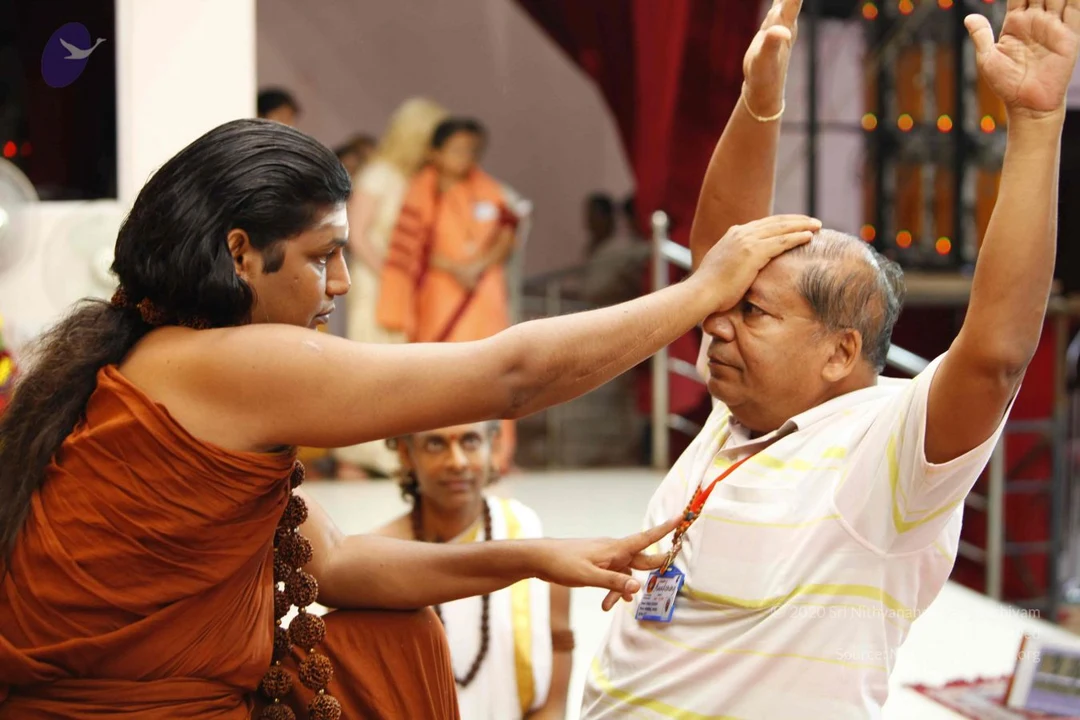
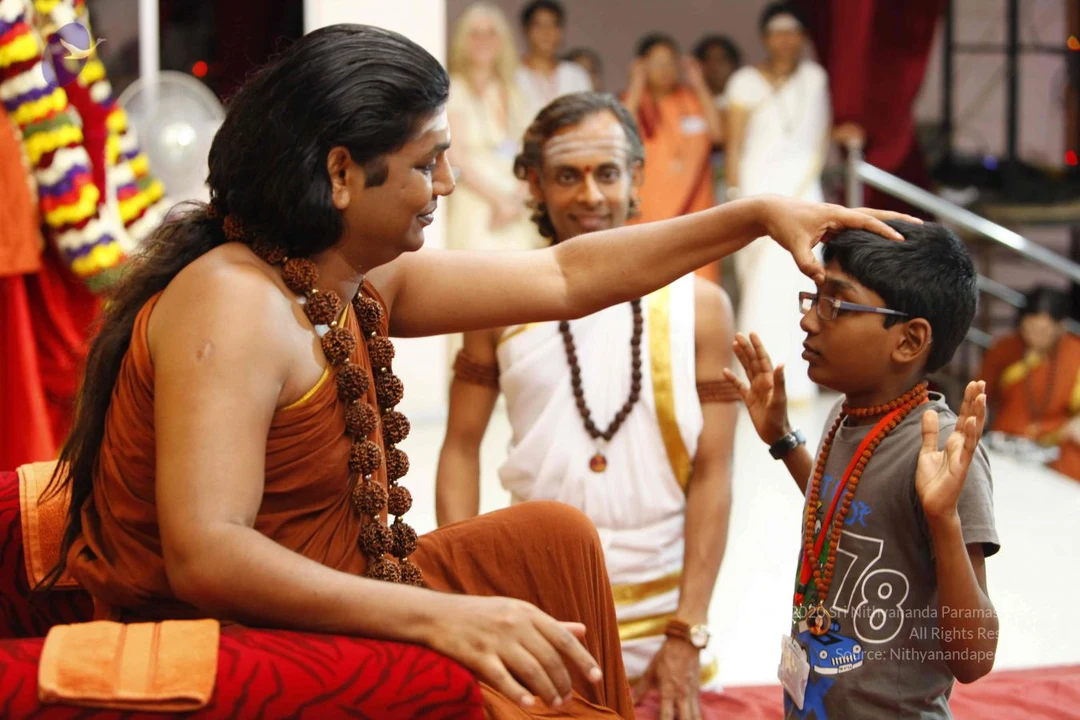
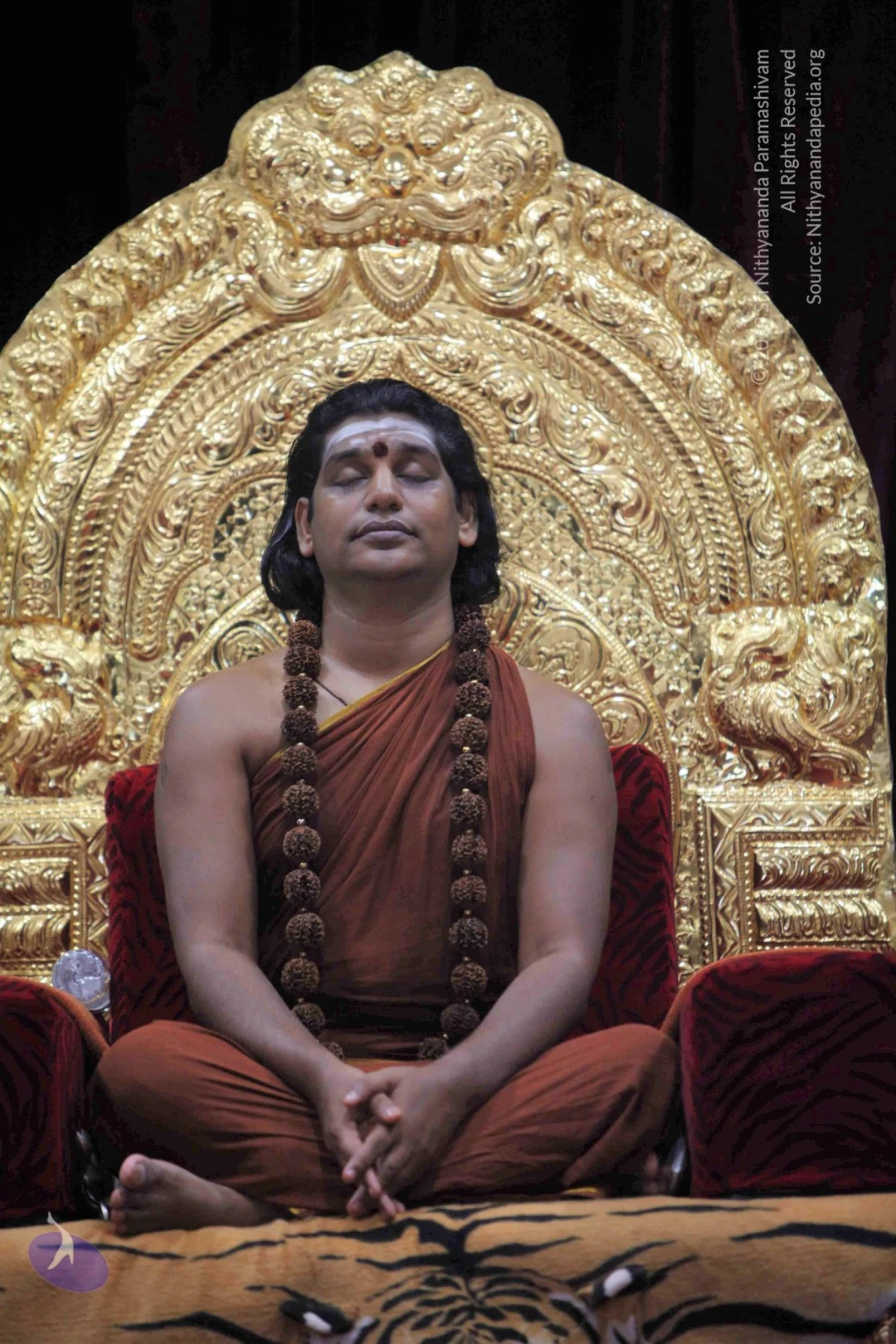
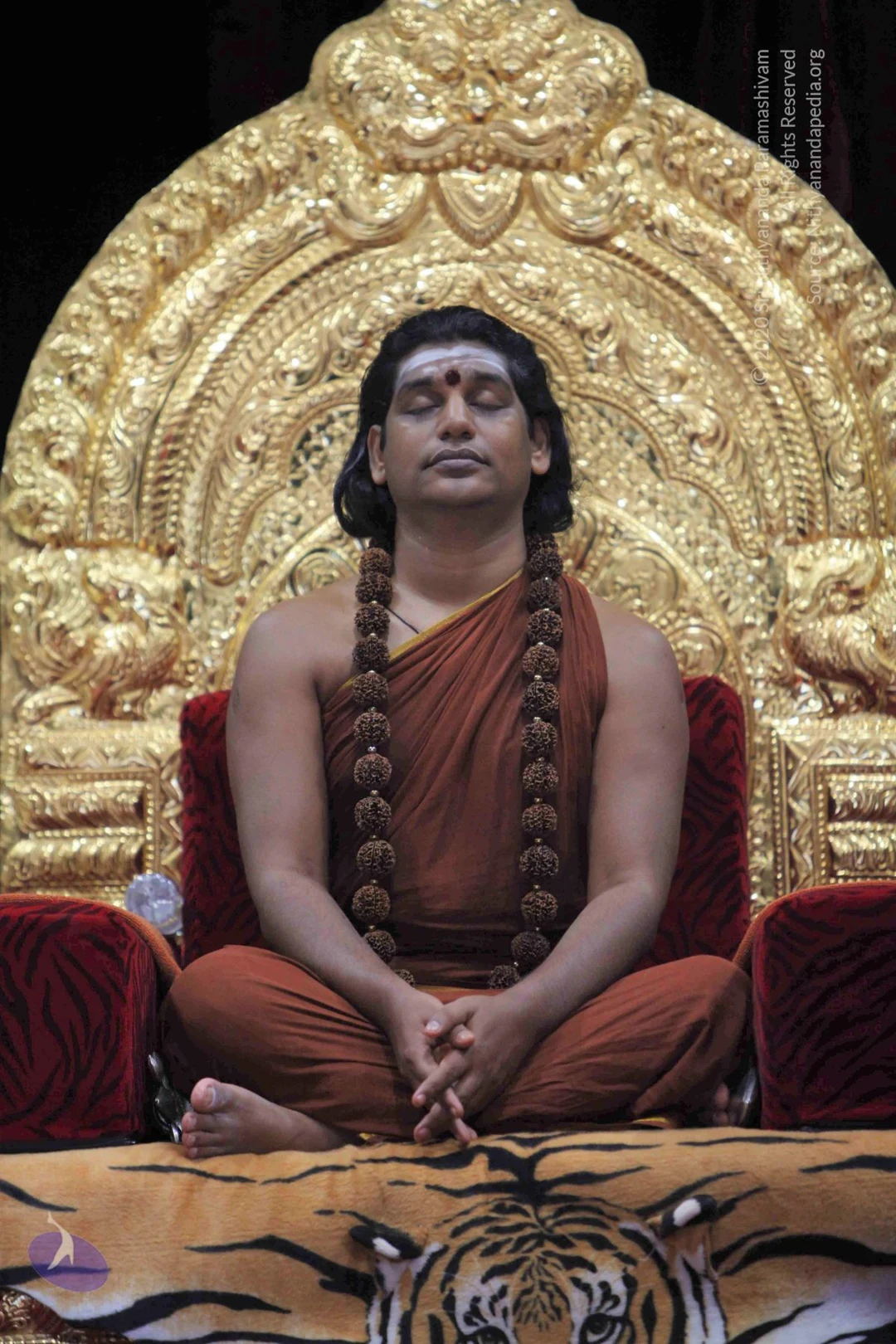
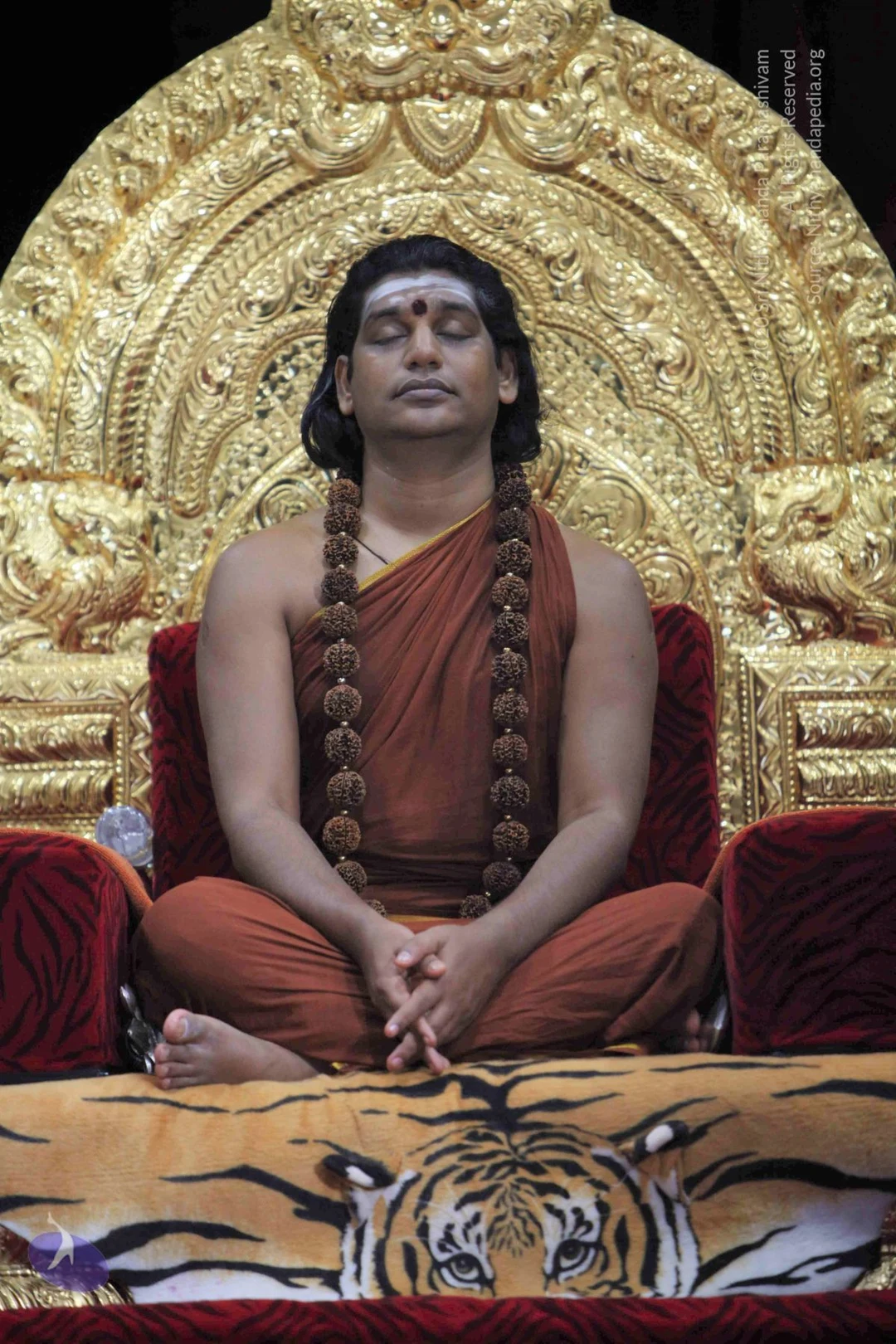
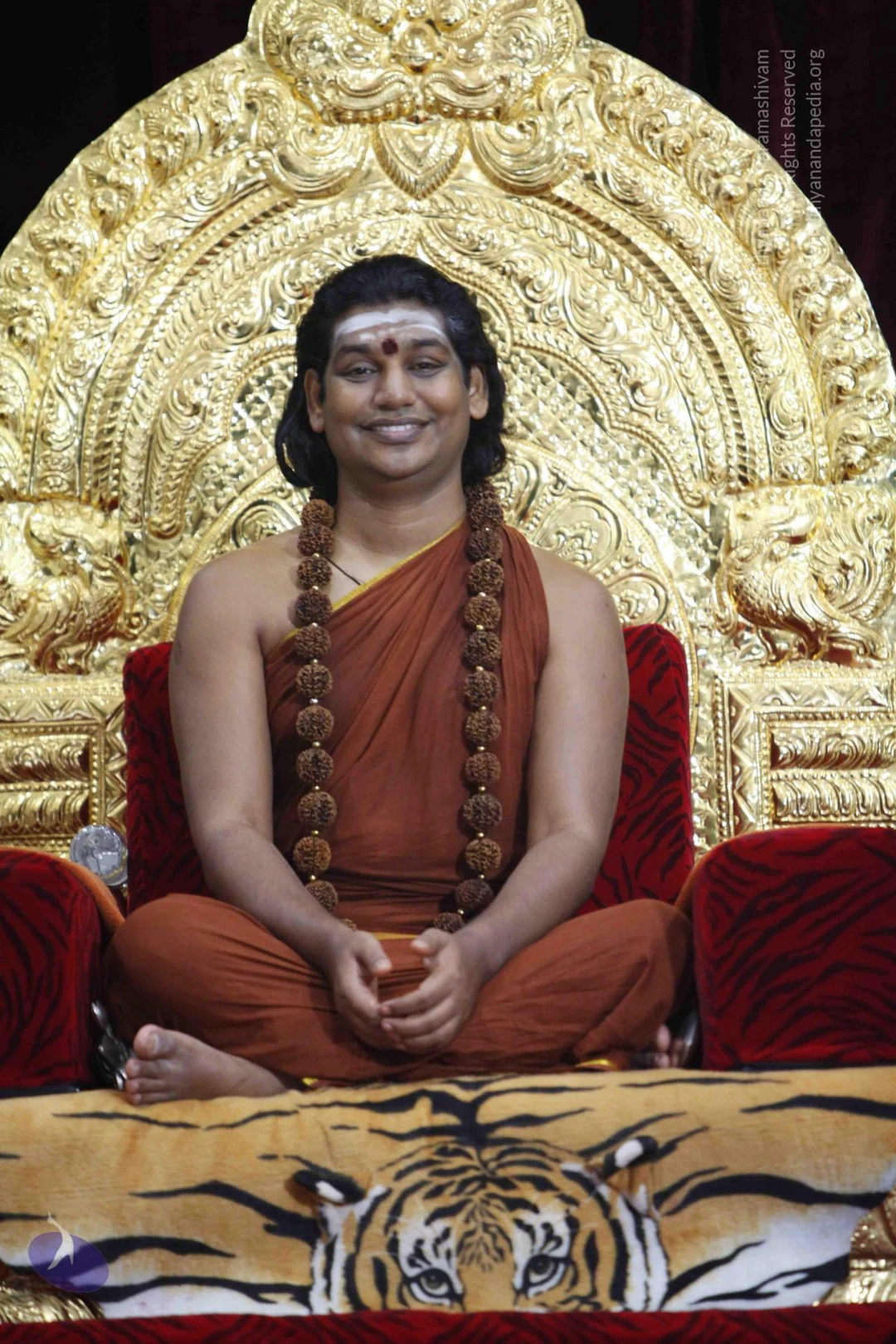
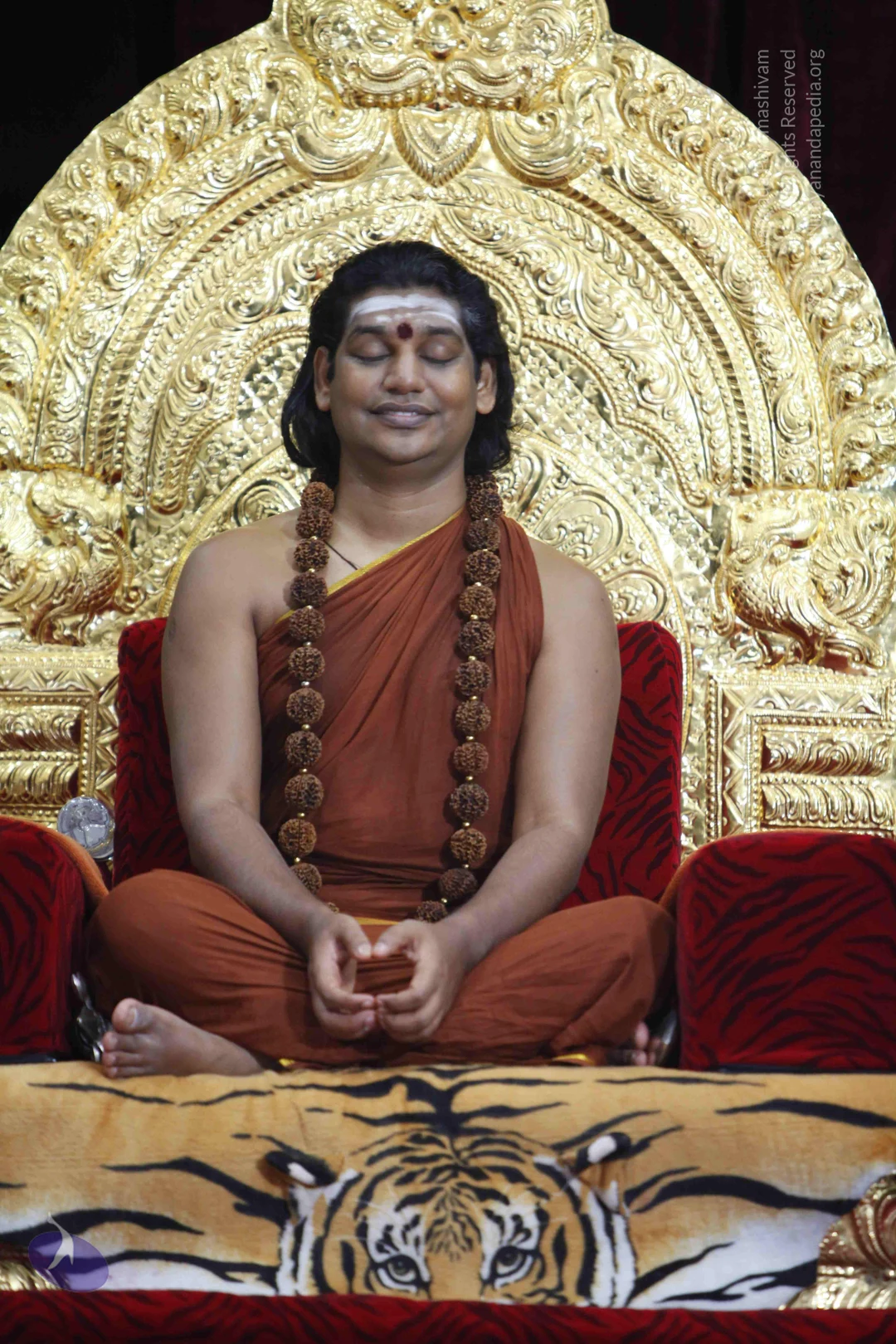
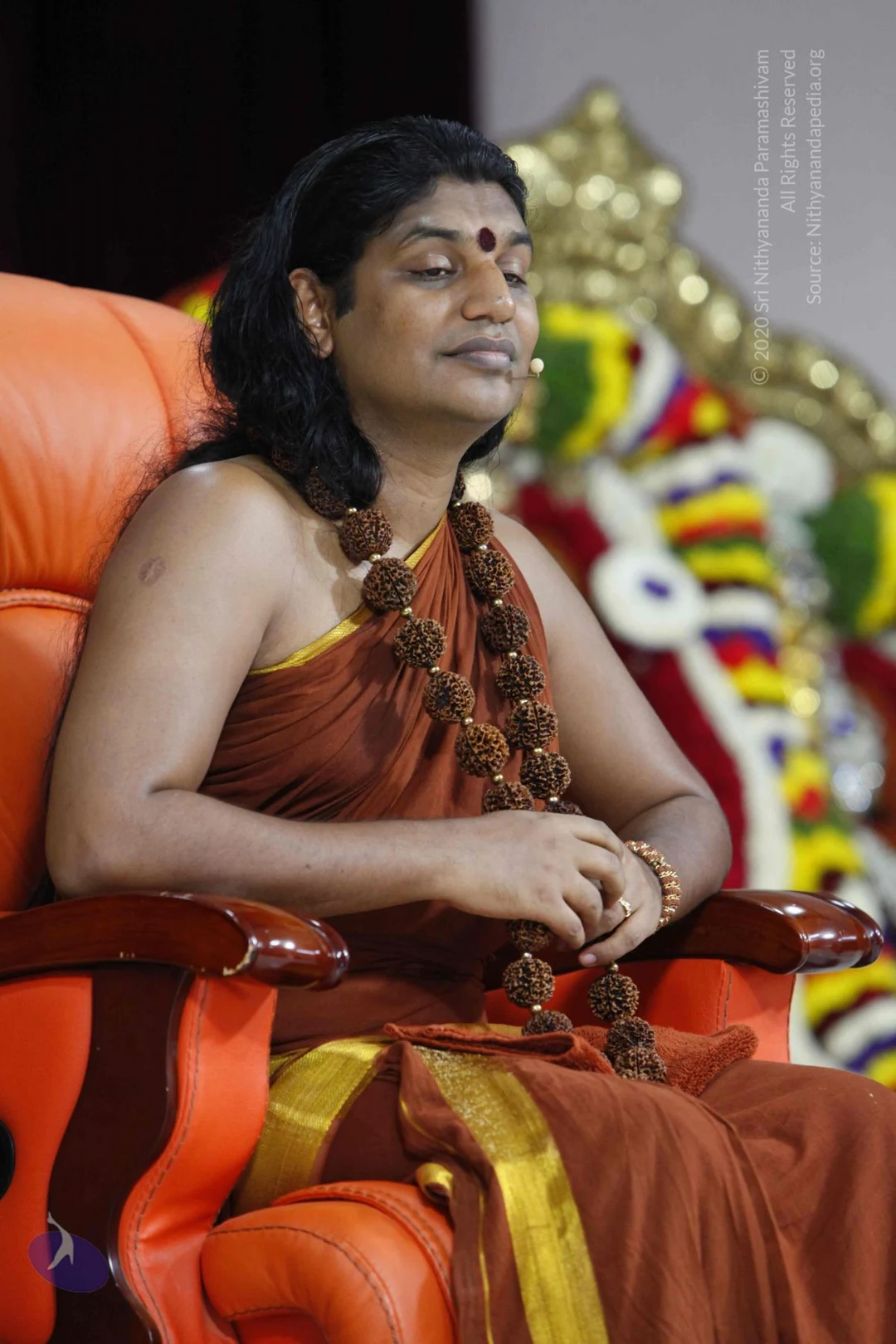
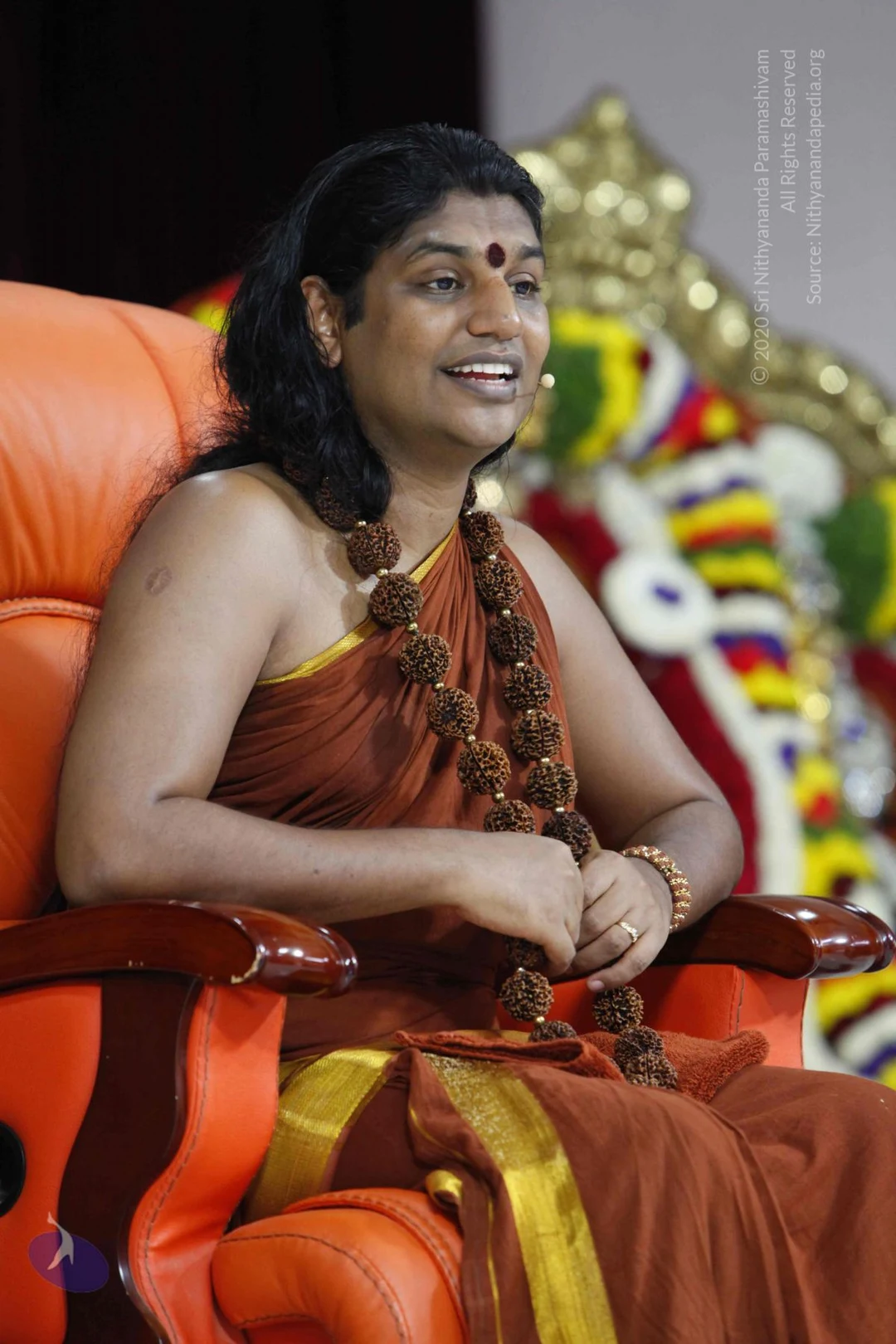
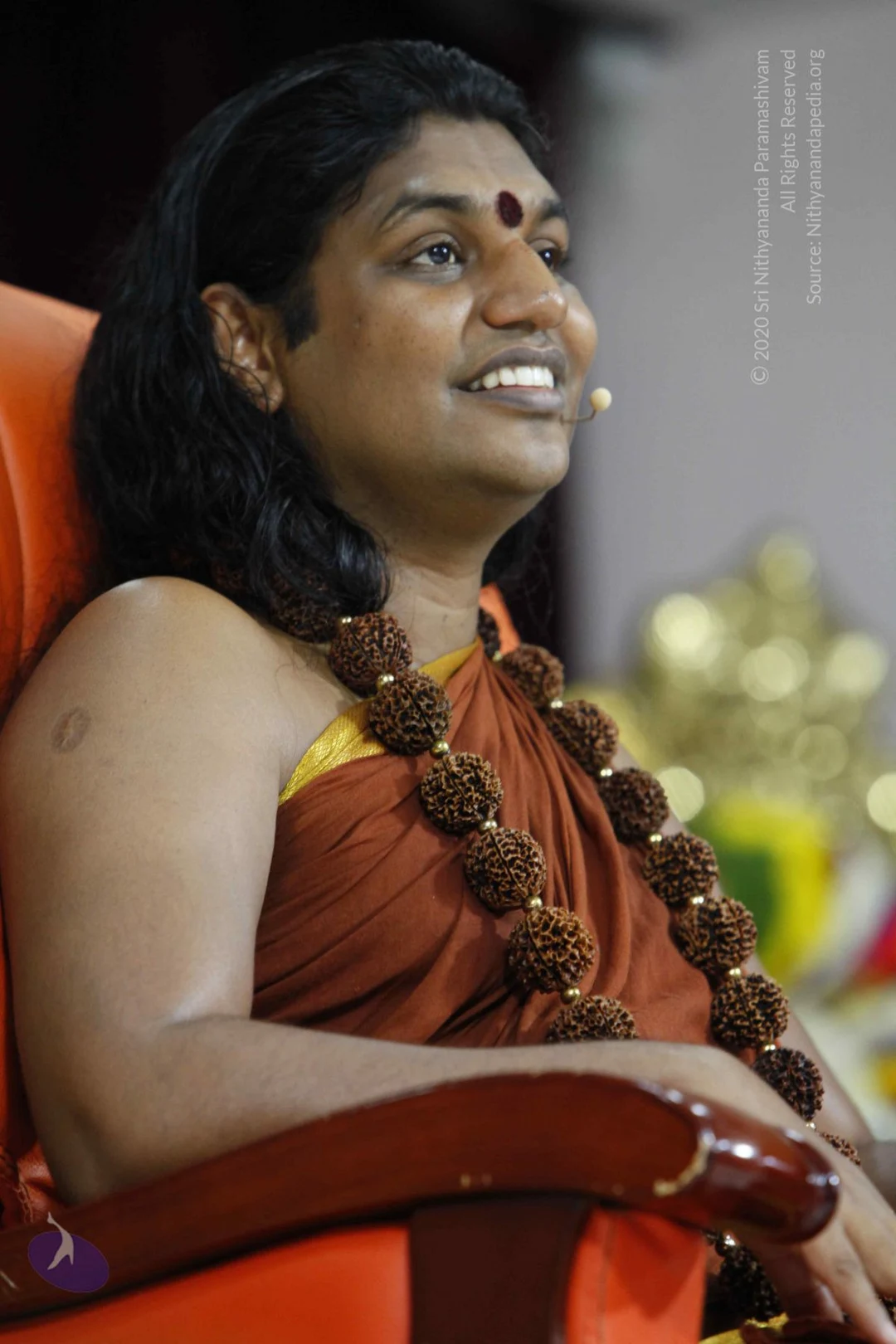
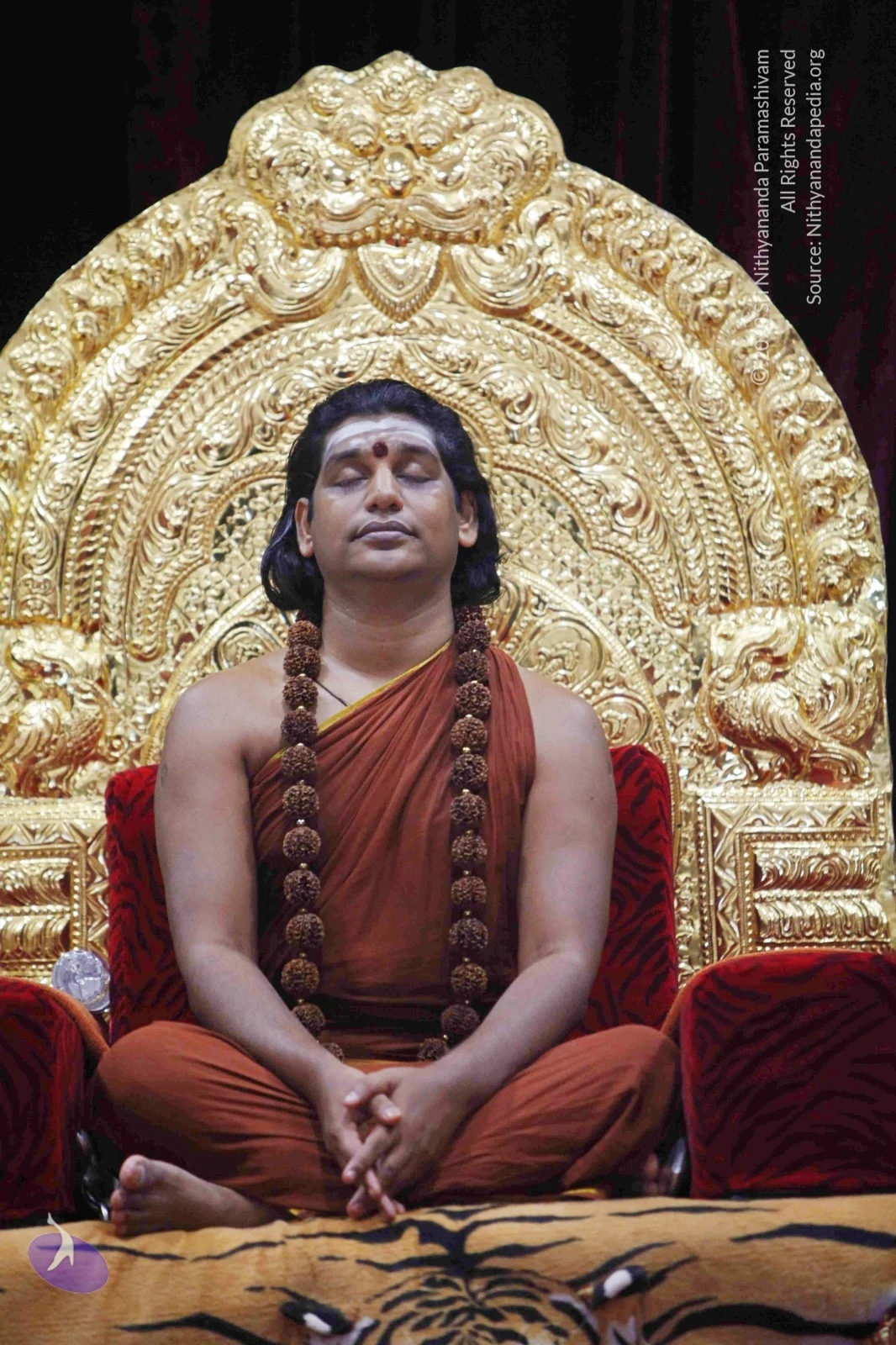
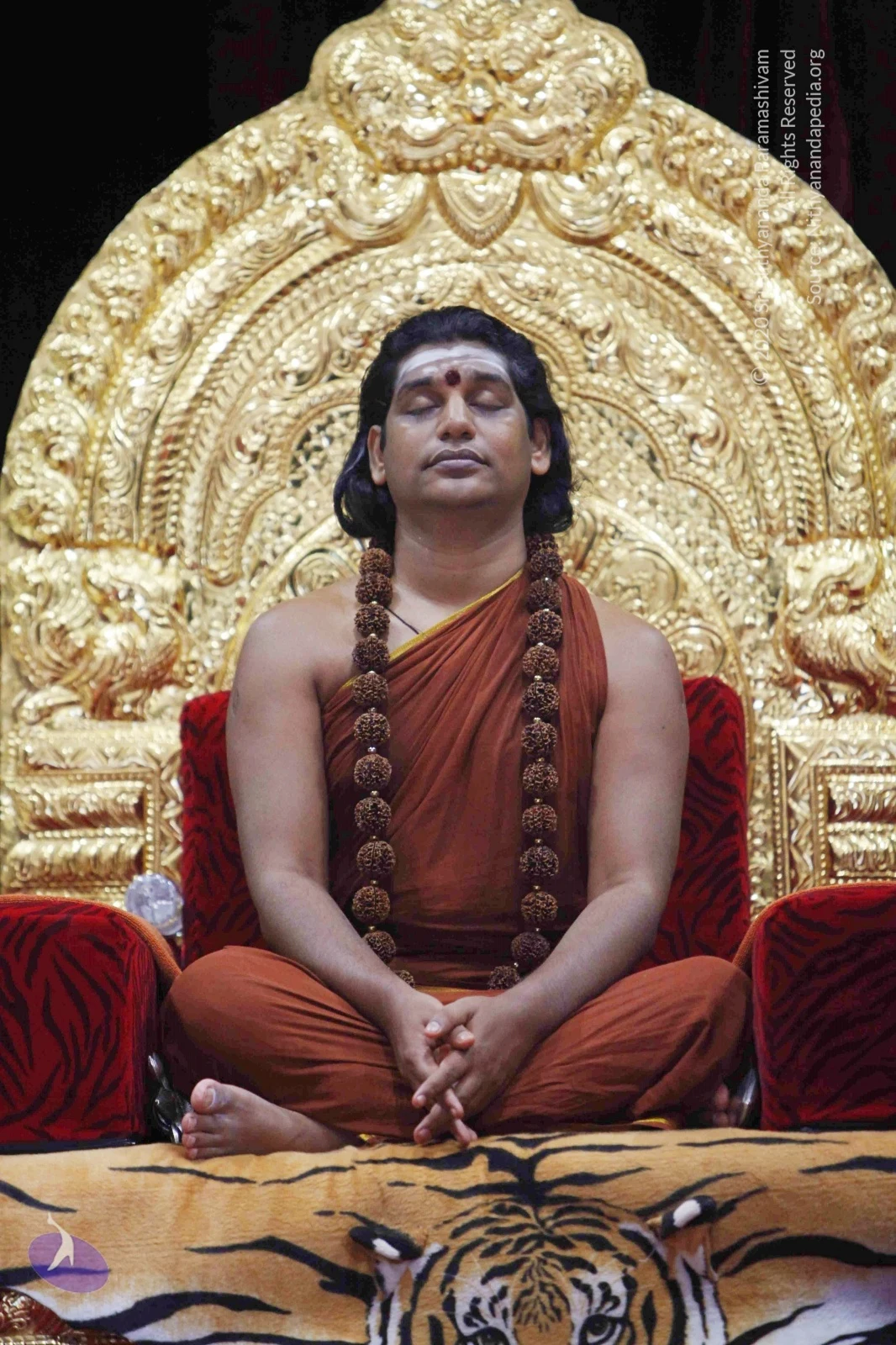
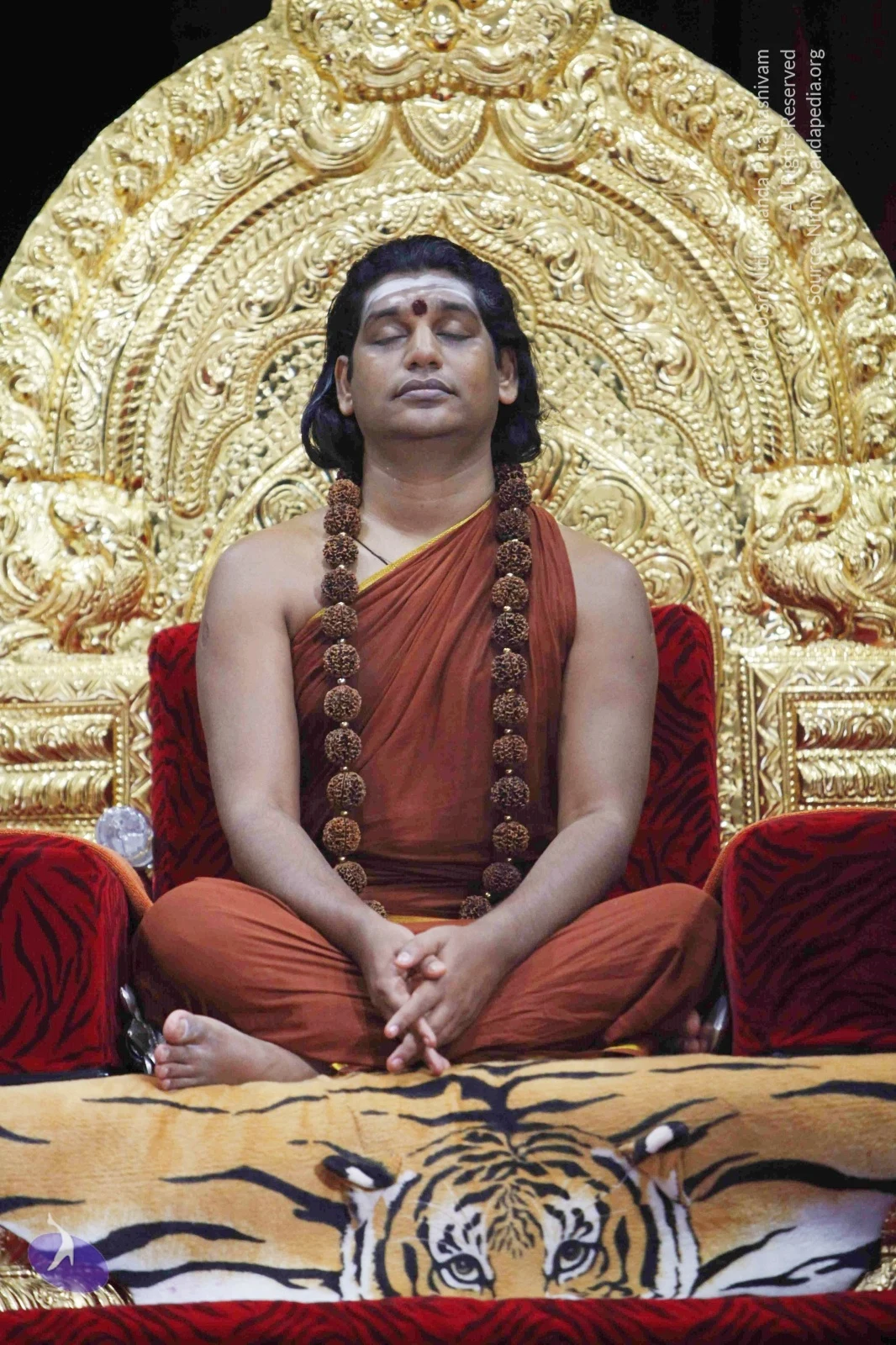
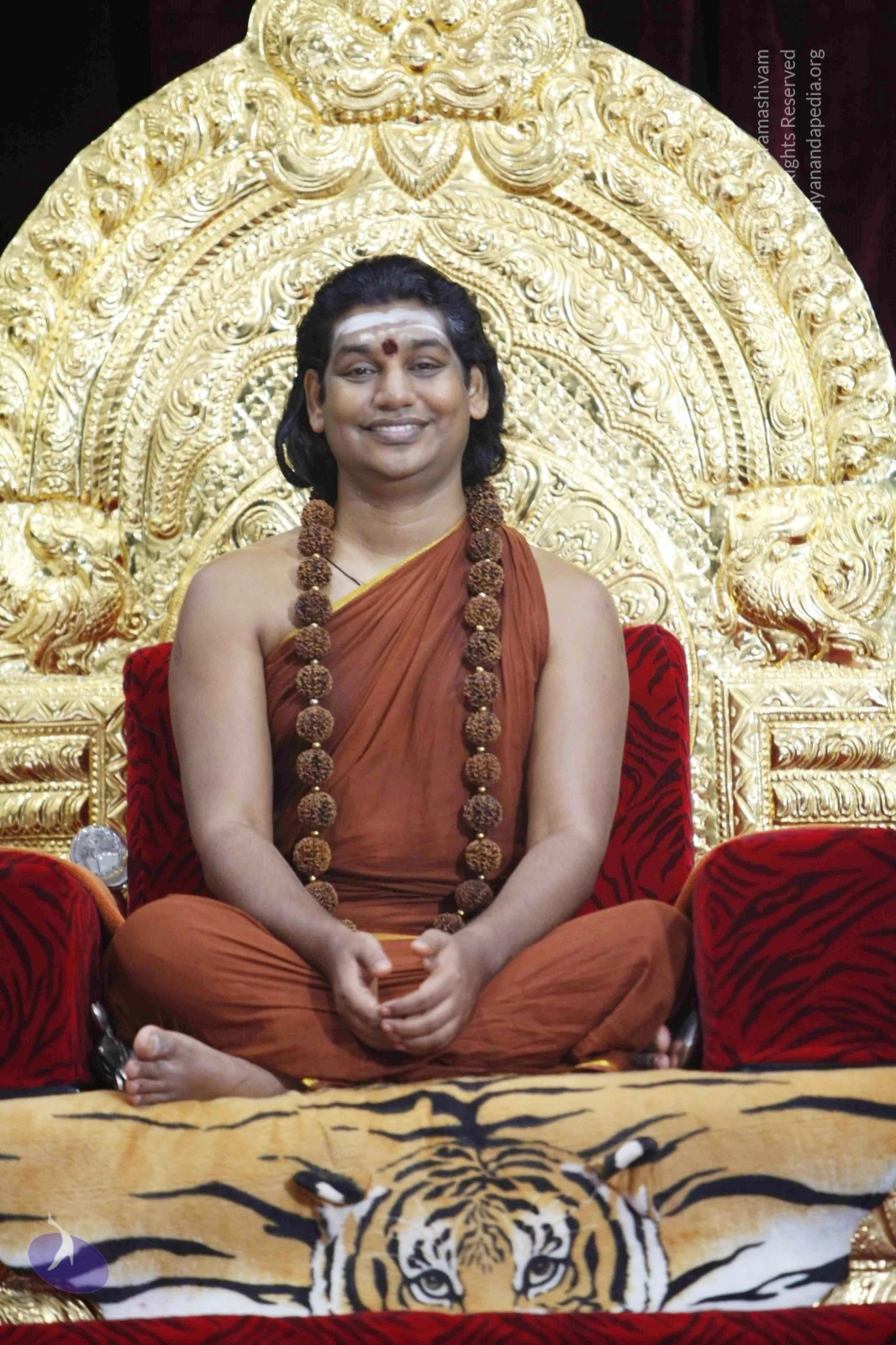
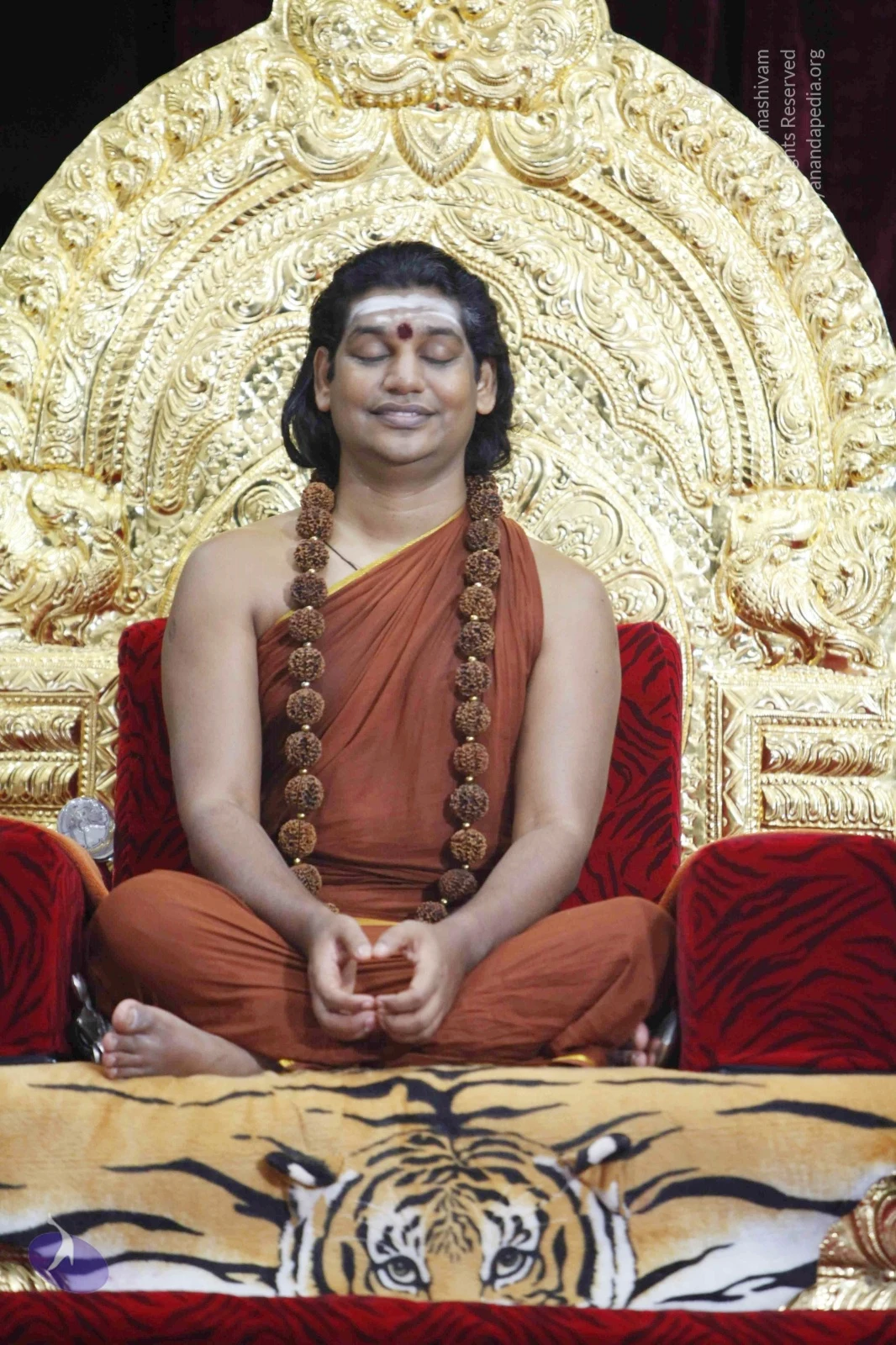
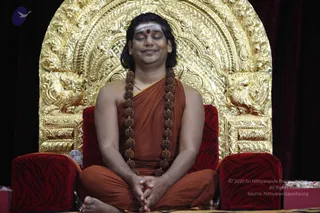
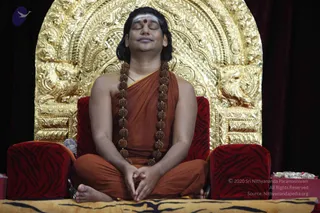
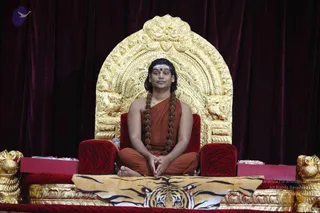
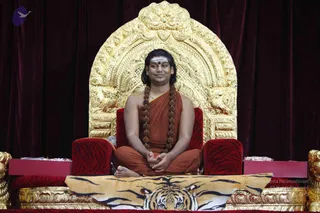
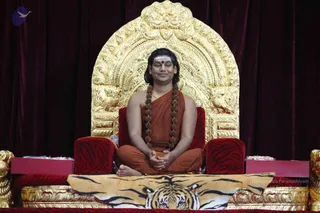
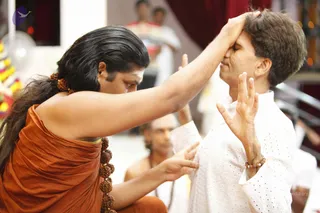
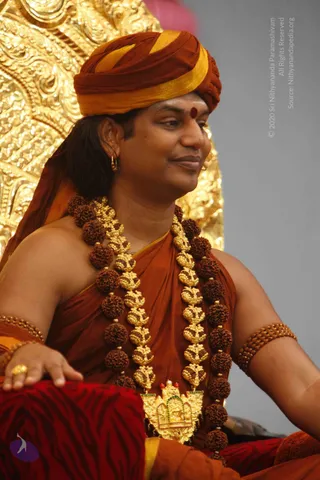
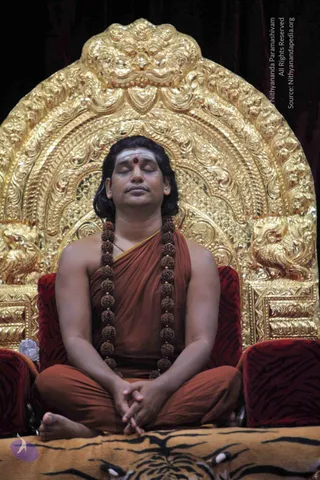
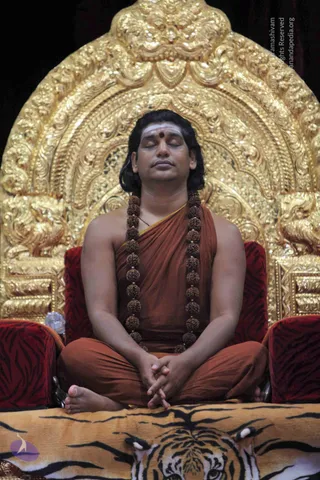
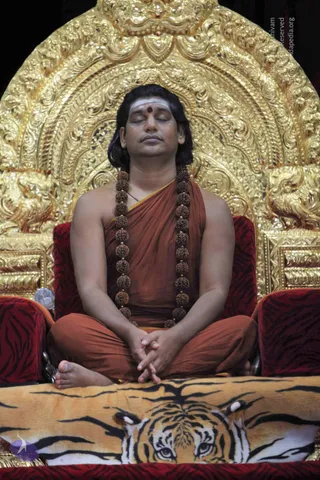
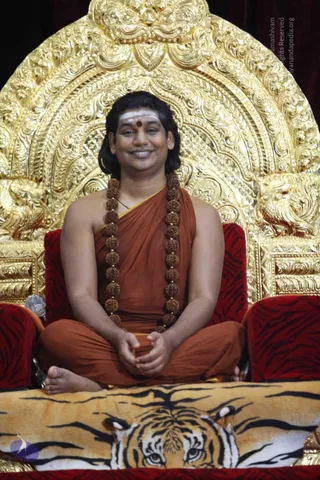
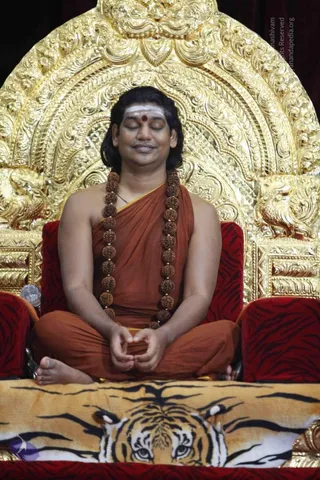
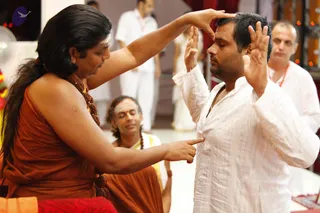
A man sits cross-legged on a red velvet-upholstered seat in front of an ornate gold-leafed arched backdrop carved with lion-like figures. He has long dark hair swept back, a white vertical tilak with a red bindi on his forehead, and wears a rust-orange wrap over his shoulders and an orange lower garment. A long necklace of rudraksha beads hangs to his waist. His eyes are closed, hands folded in his lap, and he is barefoot, appearing to be in meditation. Red velvet armrests flank him, and red flowers sit at the lower right edge of the frame. Probable Swamiji (appearance-based, with long swept-back hair, orange wrap, rudraksha mala and gold-throne setting), seated in meditation.A photo of a seated man with eyes closed in meditation on an ornate gold throne with a carved lion-motif backrest and red tiger-striped cushioned armrests. He wears an orange-saffron cloth draped over one shoulder and a long necklace of rudraksha beads, with a white horizontal tilak and red bindi on his forehead and long dark hair. His hands rest in his lap in a meditative pose, and a tiger-striped throne cloth covers the dais, with a dark red curtain behind. Appearance-based candidate, a person, seated on the peetha in meditation with rudraksha mala and saffron clothing.A seated man in a satsang setting sits cross-legged on an ornate gilded throne with a large arched golden backrest carved with floral and lion motifs. He wears a saffron-orange dhoti and wrap, a long rudraksha mala hangs to his waist, and a red bindi and vertical tilak mark his forehead. His hands rest together in his lap. The throne is set on a tiger-skin rug with a tiger head, flanked by red velvet seats and gold lion-shaped armrests, against deep maroon drapes. Visible presentation cues (long swept-back hair, saffron clothing, rudraksha mala, ceremonial throne) fit the candidate the page identifies, so this is Swamiji (probable), seated in person.A seated man in an ornate golden throne with a carved arched backrest and lion-figure armrests, sitting cross-legged on a tiger-skin rug before dark red velvet drapes. He wears an orange-saffron cloth wrap, a long multi-strand rudraksha mala, and a white forehead mark with a red dot. His hands rest together in his lap and he is smiling. Red-upholstered side seats and small red-draped tables flank the throne.A seated man in a saffron-orange robe and dhoti sits cross-legged, eyes closed, hands folded in his lap, on a red velvet and gold ornate throne with a tiger-striped cloth draped over the platform. He wears long dark hair, a red bindi and vibhuti on the forehead, and a long rudraksha mala with large beads. Behind him is a gilded arched backdrop with lion carvings and deep red curtains. The scene suggests a satsang on a stage, with the figure in a meditative posture. a person: long swept-back hair, saffron clothing and a rudraksha mala on a throne with lion carvings and a tiger-striped cloth.A figure with long dark hair swept back, wearing an orange-saffron shawl draped over the shoulder and a long necklace of rudraksha beads, presses one hand on the forehead of a man in a white embroidered kurta and bracelet. The man stands with eyes closed and the other hand raised, receiving a blessing. Behind them a man in white clothes and a red-and-white backdrop with garlands are visible. Probable Swamiji appearance cues: long swept-back hair, saffron shawl and rudraksha malas, shown in the act of blessing a devotee.

IA-Day7-food-session

8 photosSource gallery
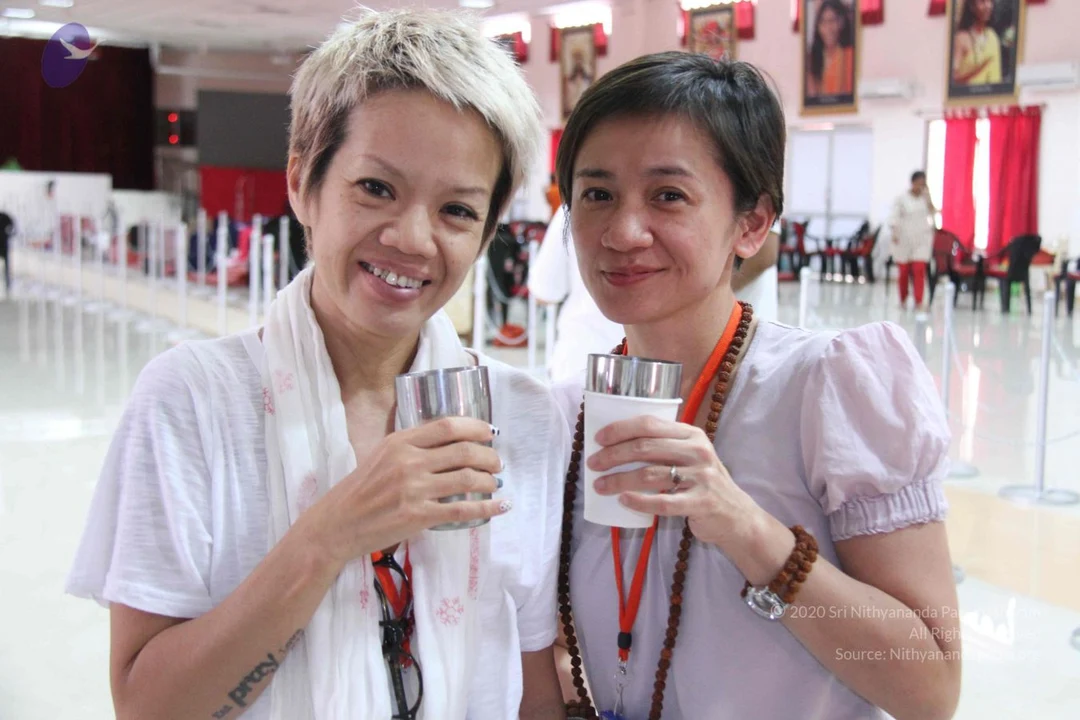
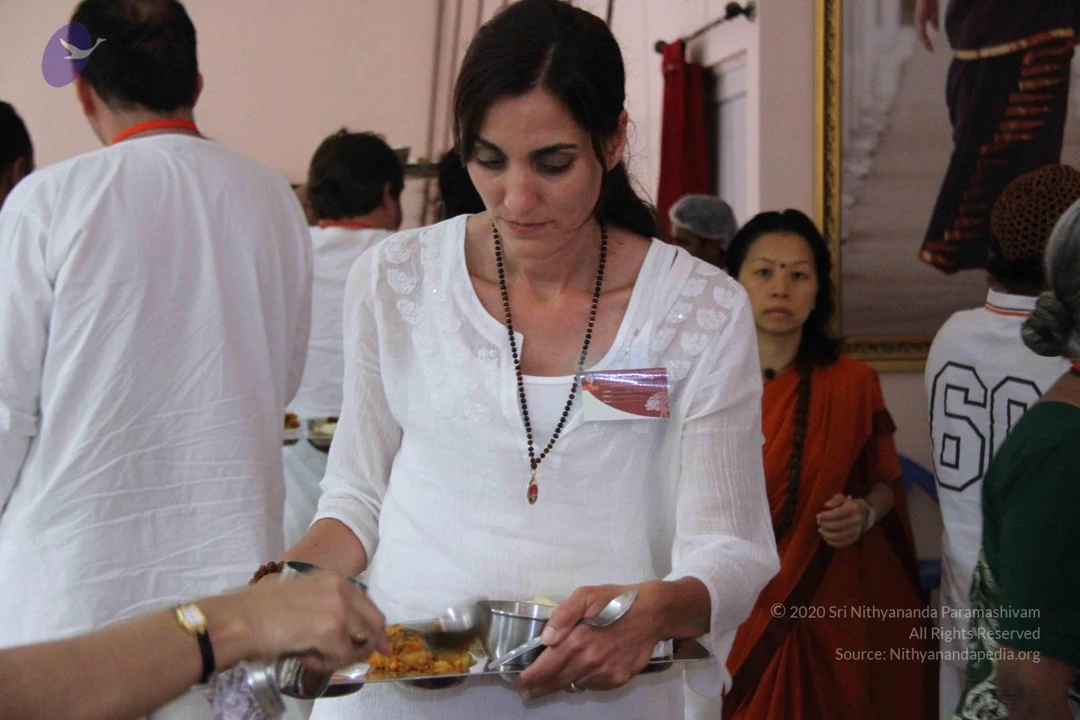
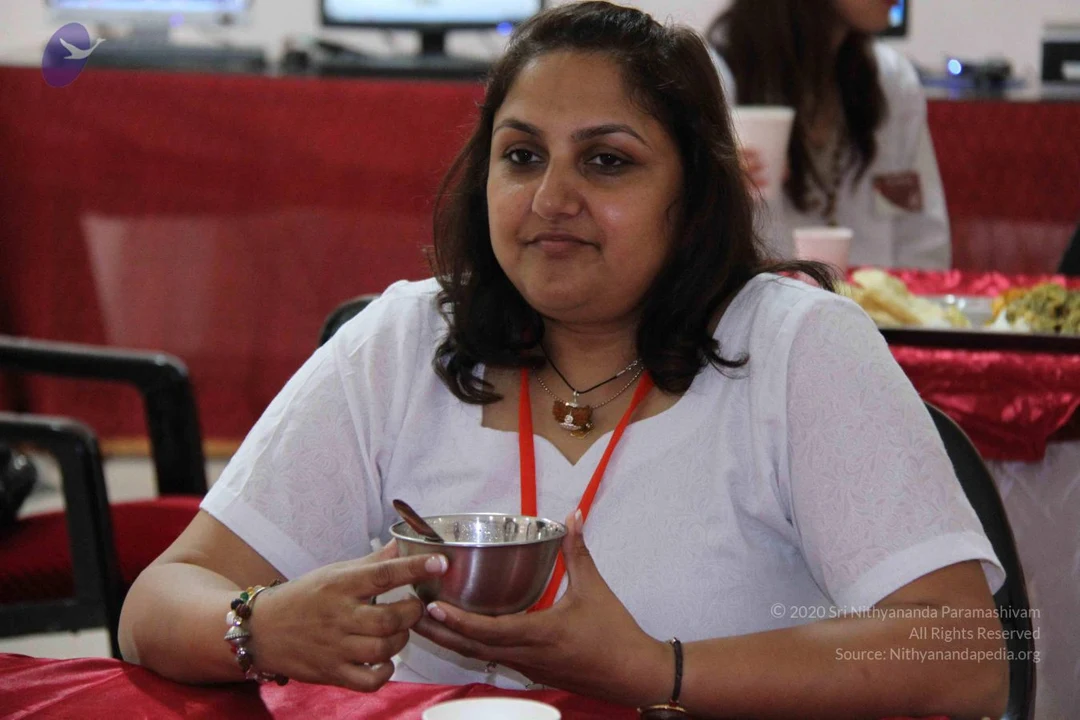
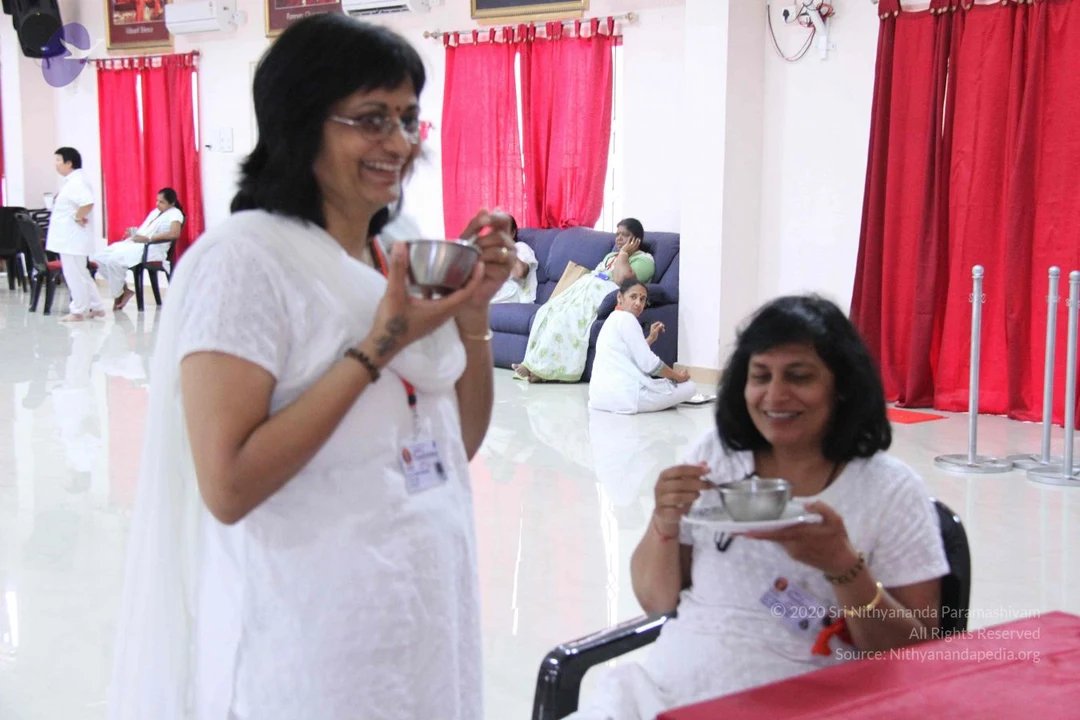
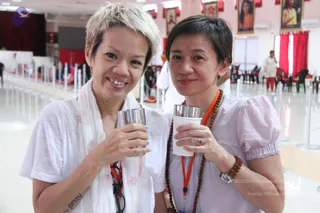
A buffet serving line in a bright white-walled hall. A woman in a white tunic and blue head covering holds a steel bowl while serving food; beside her, a man in a white shirt with an orange lanyard ladles from a steel chafing dish. Other attendees in white shirts and orange lanyards, including a man in a white shirt at the right holding a plate with a bread roll and a rudraksha mala, wait or serve. Trays hold bread rolls, sliced vegetables, lemons, samosa-like pastries and sweets in a wicker basket. A framed picture hangs on the wall at upper right.A buffet serving line in a bright hallway during an ashram meal. Devotees in white clothes serve food from steel chafing dishes on a red draped table; a wicker basket holds bread rolls, and a tray of sweets sits at the front. A man in a white shirt with an orange lanyard and rudraksha mala holds a plate of bread. A woman in white with a blue hairnet serves food into a steel bowl, and a man in a white shirt with an orange lanyard holds a bowl. A large framed portrait hangs on the right wall, but it is not clearly identifiable. Several other people in white stand along the line.A buffet line in a white-walled hall where devotees in white clothing serve food from steel trays. A woman with blonde hair in a white outfit and rudraksha mala stands at left holding a tray, a woman in white with a patterned head covering serves from a chafing dish, and a man in white with an orange lanyard uses serving tongs. At right, a man in a white shirt with a rudraksha mala and blue badge holds a plate beside a red-and-white garlanded man. The table holds bread rolls in a wicker basket, fruit, chutney, sliced vegetables and sweets. A framed picture hangs on the wall behind them.A buffet serving line in a bright hall where volunteers in white shirts and white head caps serve food from steel chafing dishes. A bald man in a white T-shirt with a gold chain holds a plate of flatbread while a volunteer with a red lanyard and a striped apron serves rice and vegetables onto a tray. Steel bowls of white yogurt or milk sit in the foreground, and a framed portrait hangs on the wall behind the line. Several people in white stand along the counter, with a few visible in the background. No one is clearly identifiable as a person in this scene.A buffet-style meal service in a bright hall with pale pink walls. Several volunteers in white clothing and orange lanyards serve food from steel chafing dishes. A man in a grey vest and white shirt wears a white hairnet and serves rice and curry onto a tray. A woman in a red and cream sari stands beside him. Another volunteer in a white hairnet serves from the far side. A woman with long hair and a red head wrap holds a plate of vegetables and tomato. A large steel bowl of white curd sits in the foreground beside stacked trays, and a framed portrait hangs on the wall behind the serving line. No figure is clearly identified as a person.A communal meal service in a bright hall with white walls, red curtains and framed pictures. A woman in a white shawl and floral top with an orange lanyard serves food from a steel chafing dish with a large ladle. Beside her, a man in a white shirt with rudraksha beads and an orange lanyard holds a steel plate of curried food. Behind them, people in white clothes queue along the serving counter, and a man in orange robes with rudraksha beads stands at left. Trays of yellow curry sit on the counter, consistent with an annadan meal.

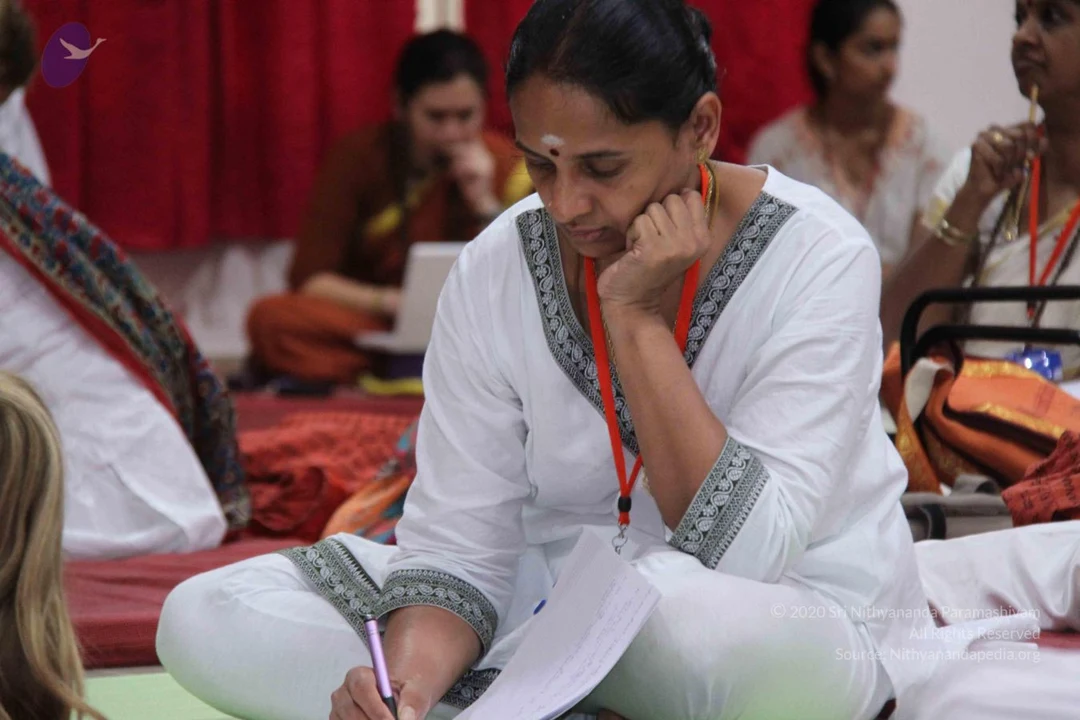
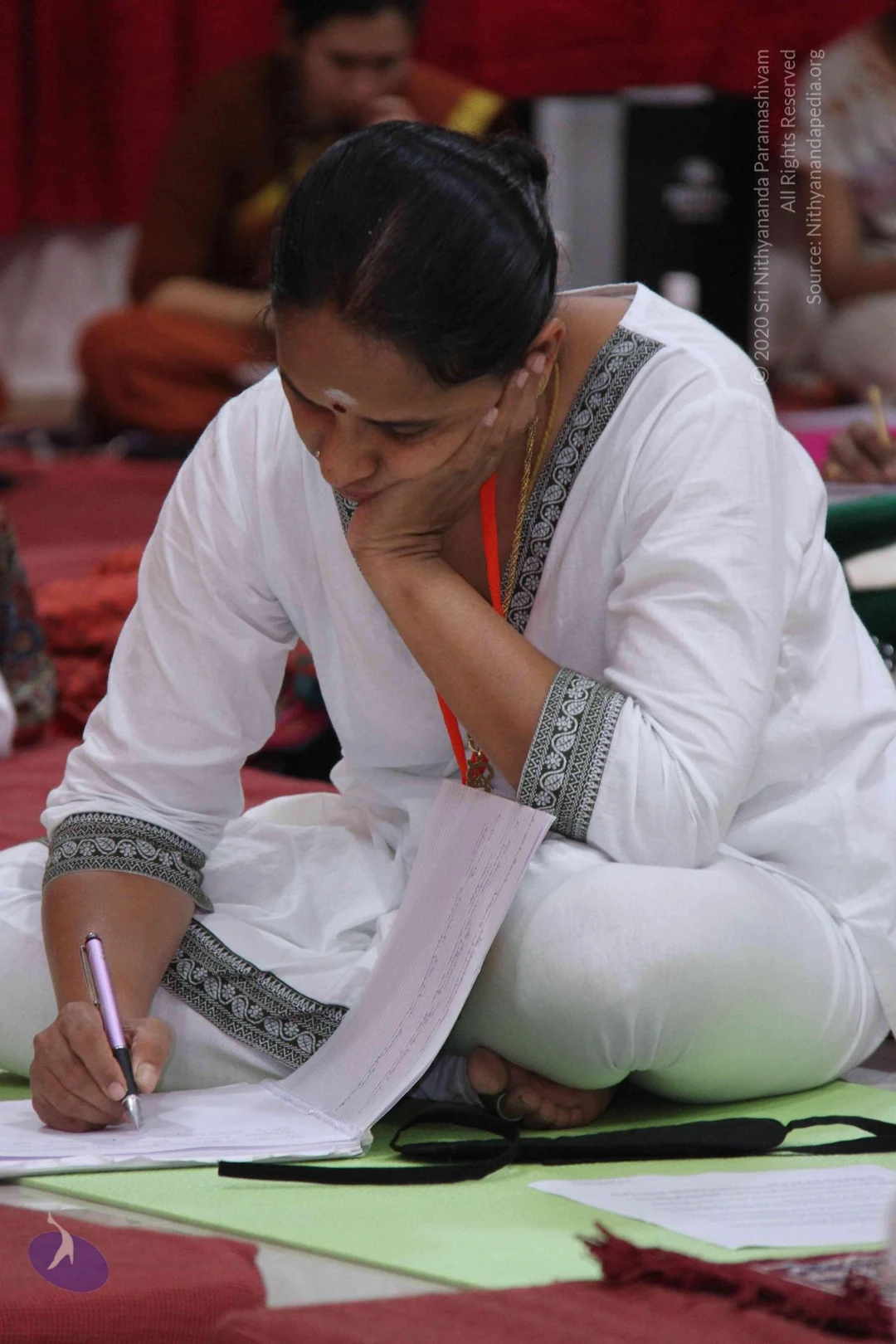
IA-day-7-Participants-Writing

2 photosSource gallery
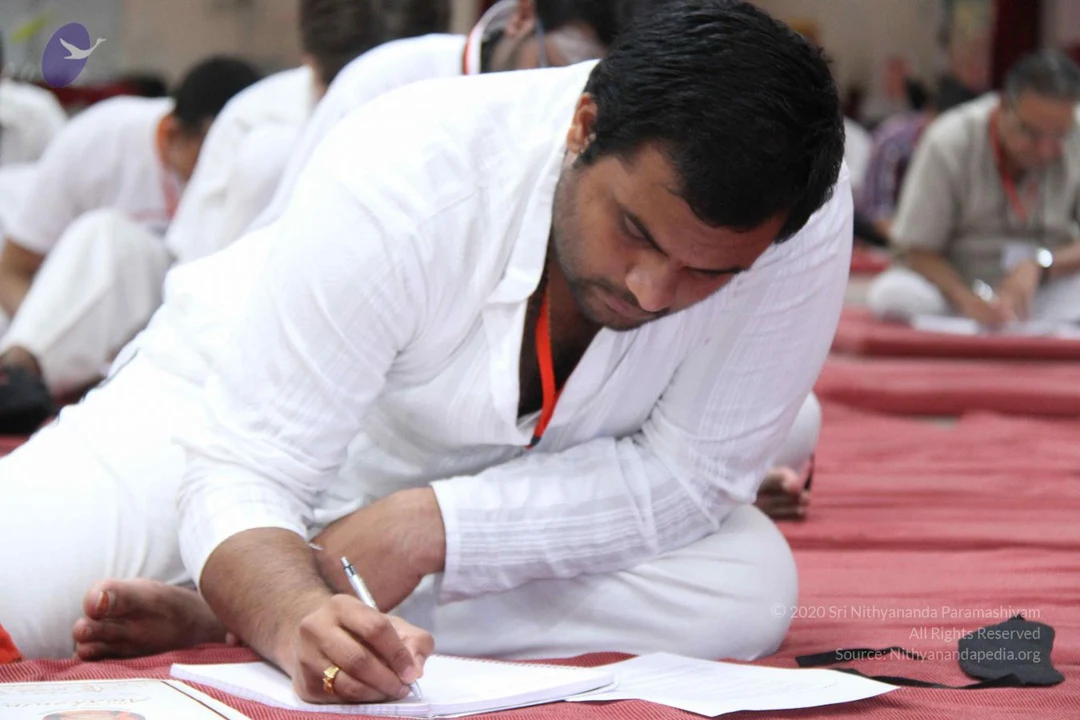
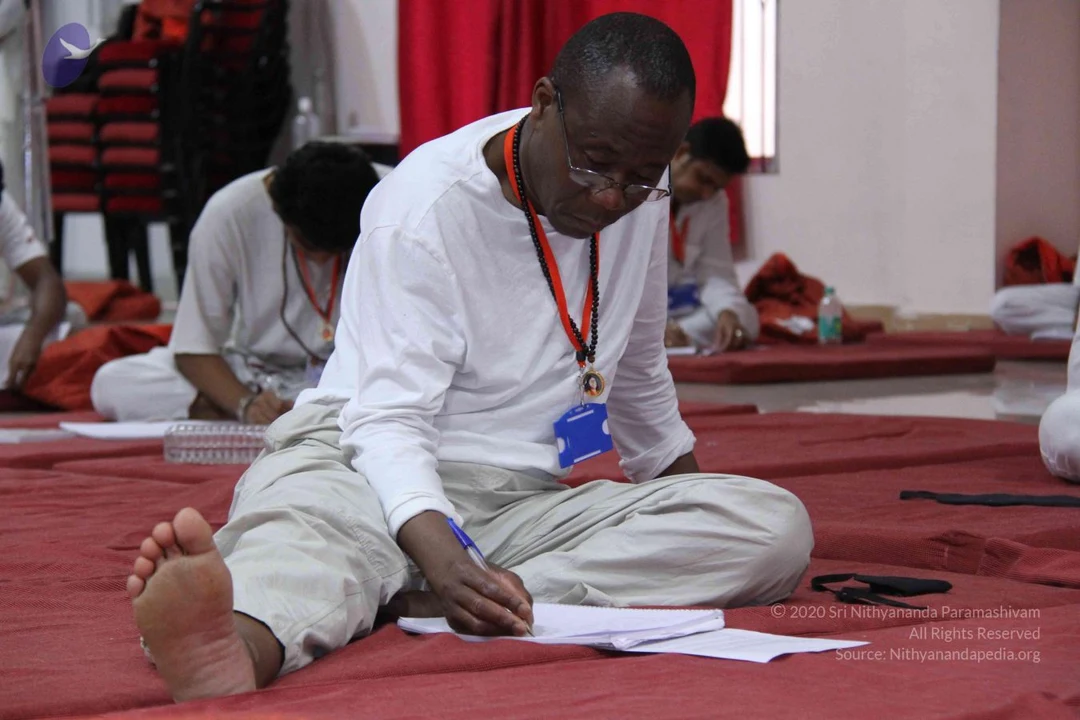
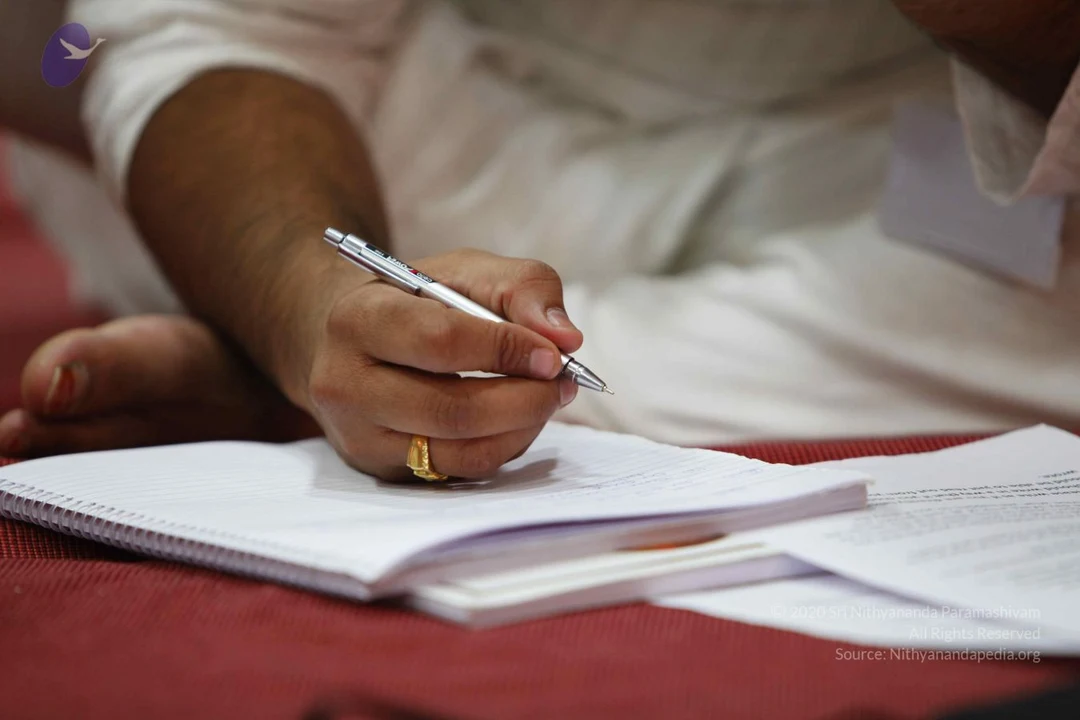
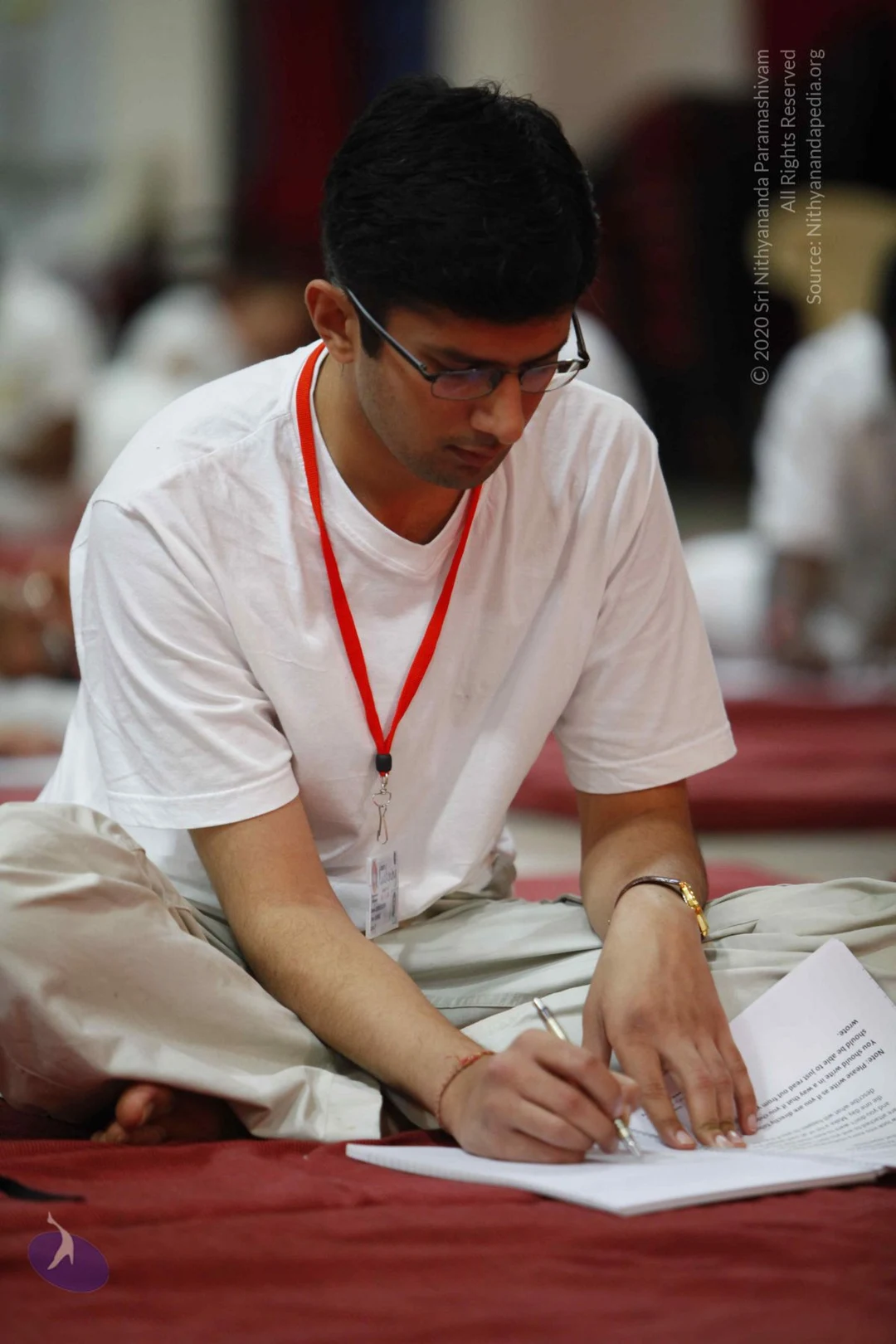
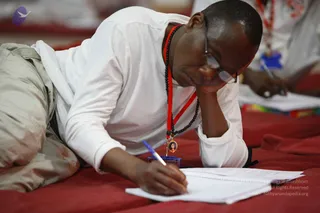
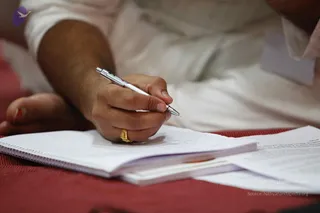
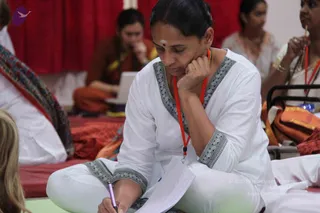
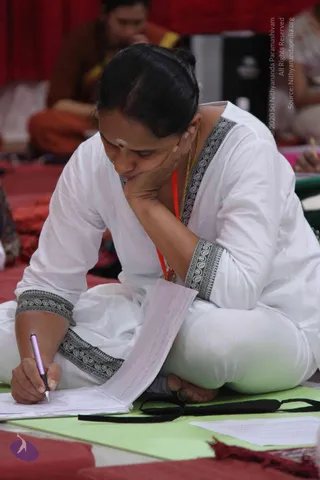
A man in a white long-sleeved shirt and glasses lies prone on a red mat, writing in a spiral notebook with a blue pen while resting his chin on his other hand. He wears a red lanyard with dark wooden beads and a small round pendant, plus a blue ID badge. Behind him, another person writes on paper on a red surface. The setting appears to be a seminar or initiation session.Close-up photograph of a person's hand holding a silver ballpoint pen and writing in a spiral-bound notebook resting on a red mat. The person wears a white garment and a gold ring on the finger, and a white name badge is partly visible at the upper right. Loose printed handout pages lie beside the notebook. No face is shown.

IA-day-7-Session-Swamiji

15 photosSource gallery
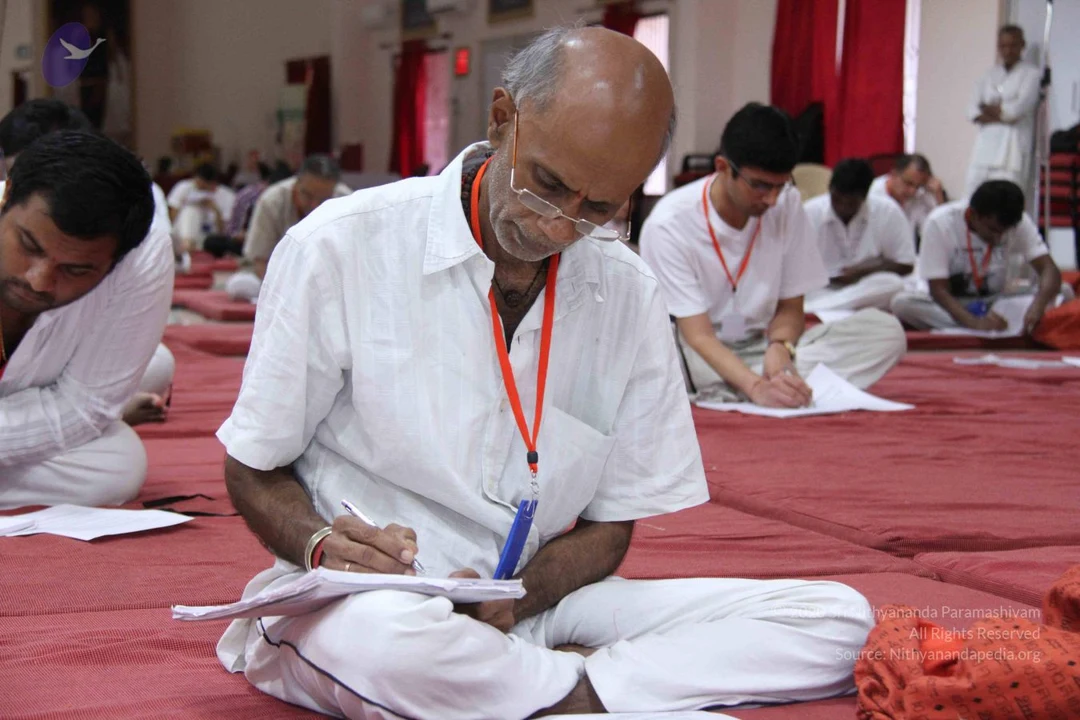
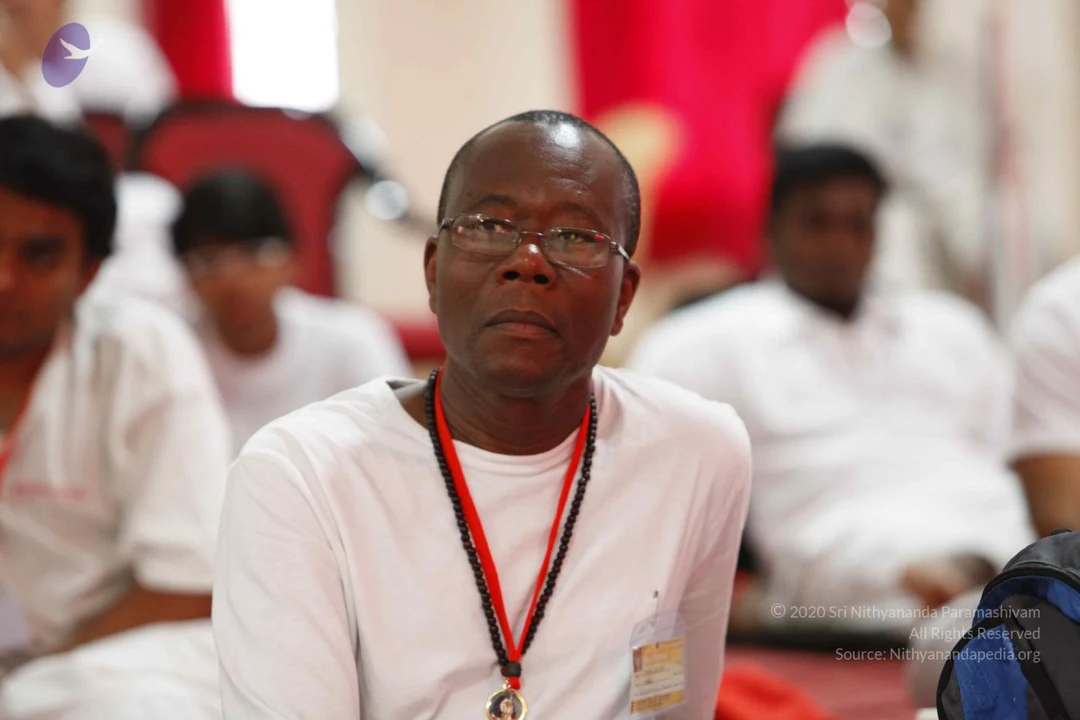
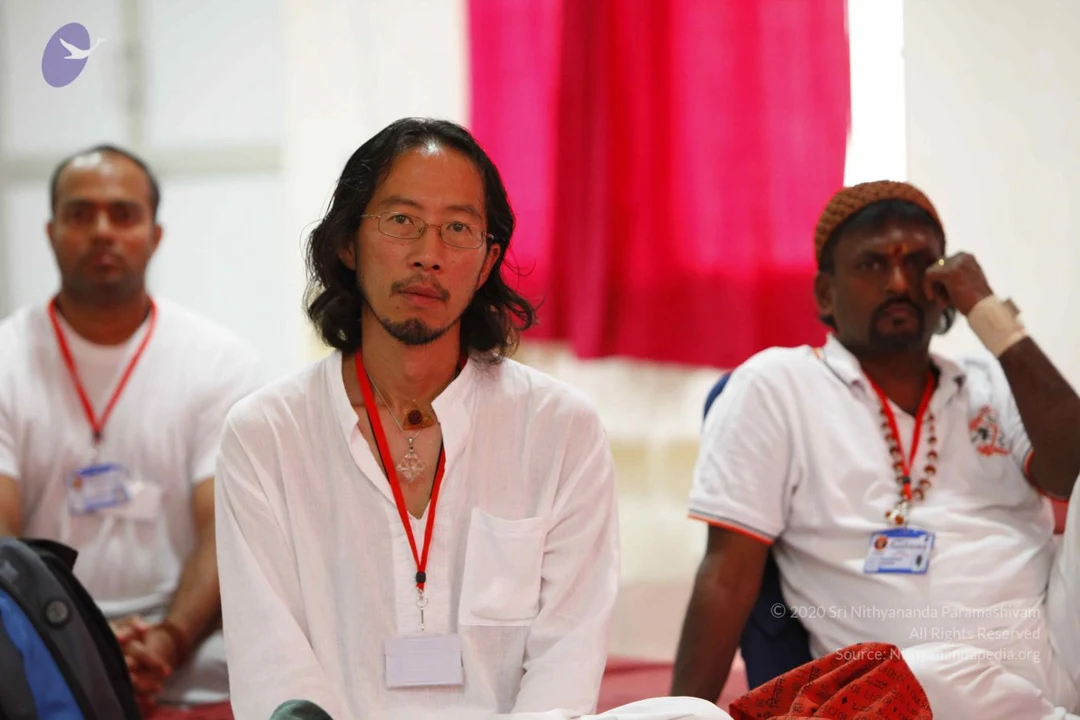
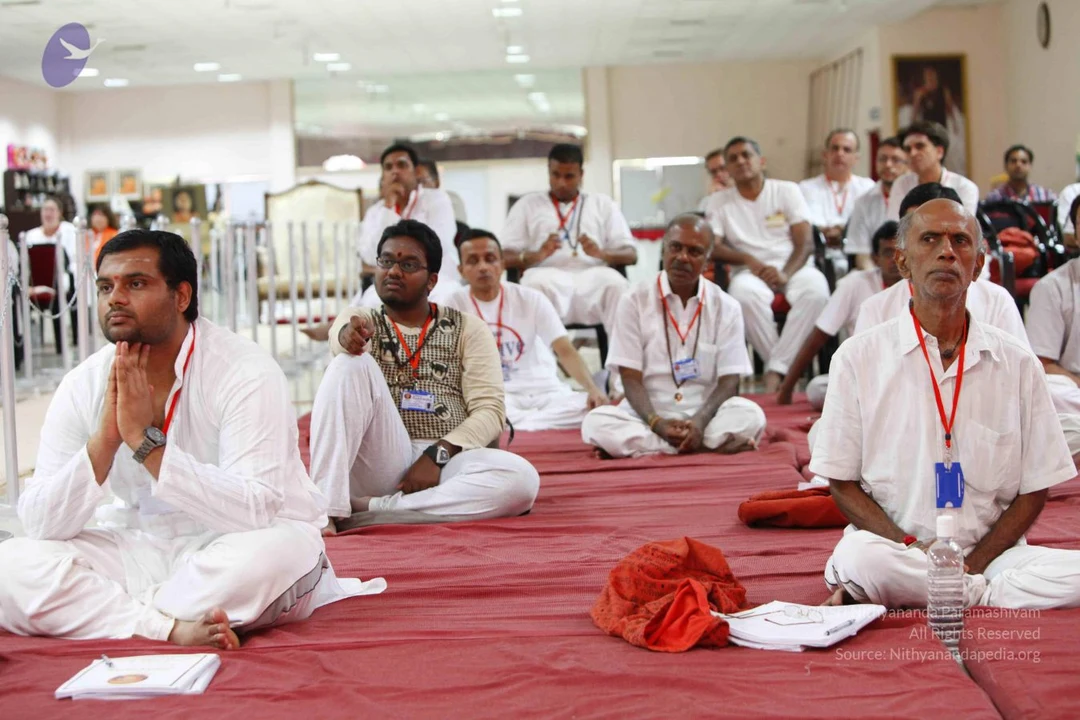
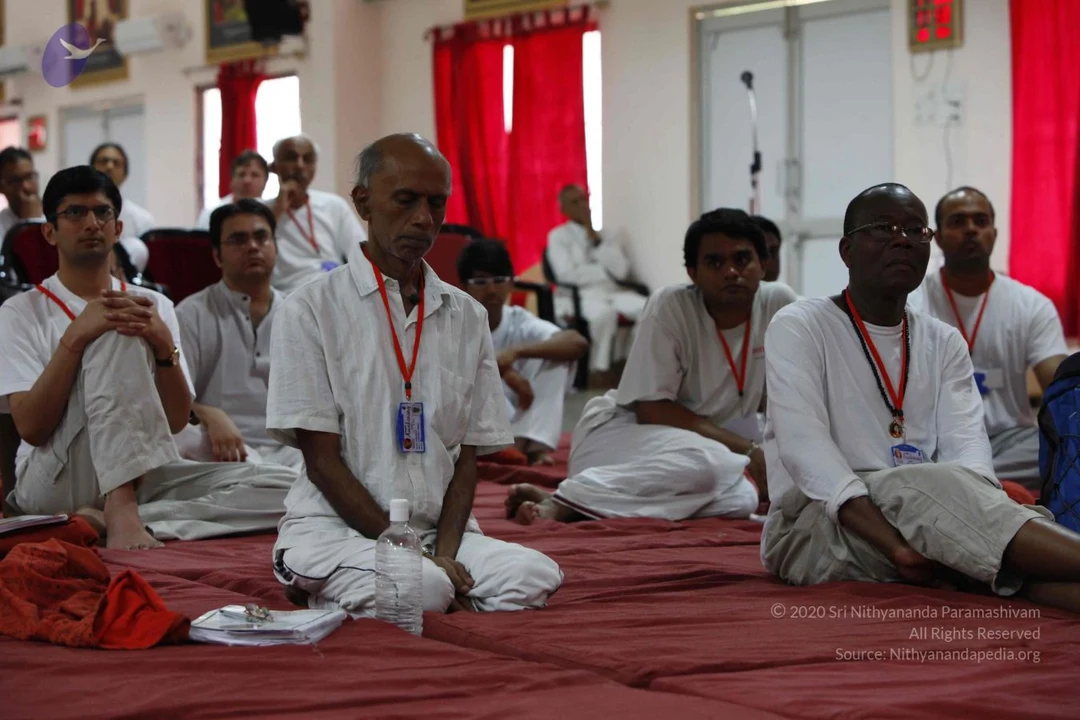
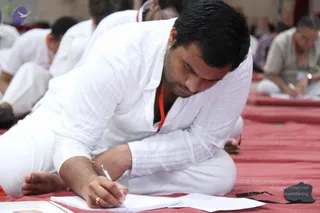
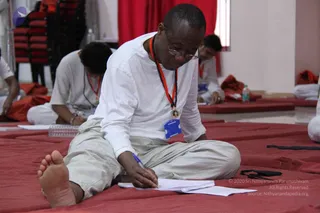
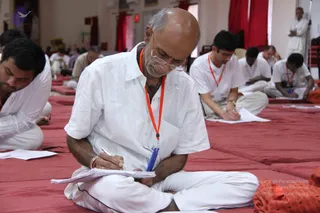
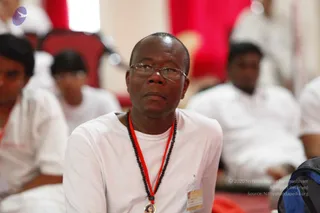
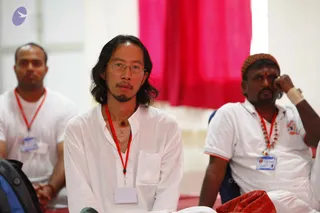
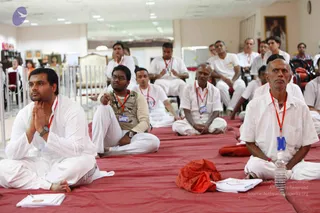
A photograph of a man seated cross-legged on a red mat, leaning forward to write with a silver pen on a sheet of paper in a notebook. He wears a white shirt and white trousers, a red-orange lanyard around his neck, and a gold ring on his finger. Behind him, other seated participants in white and grey clothing also write on red mats in a hall, with paper and notebooks visible in the foreground.A photograph of a seated man writing on loose paper in a hall with red mats and red curtains. He wears a white long-sleeved shirt, light beige trousers, glasses, an orange-and-black beaded mala with a small pendant, and a blue name badge on a lanyard. He sits cross-legged on a red mat with bare feet visible. Behind him, other participants in white clothes and orange lanyards sit writing on red mats near folding chairs and a water bottle. A pen rests in his right hand as he works on the paper in his lap.Devotees sit cross-legged on red mats in a hall with red curtains, writing on papers during an Enriching initiation session. In the foreground, a bald, bespectacled man in a white shirt and white trousers, wearing an orange lanyard, leans forward and writes in a notebook with a blue pen. Beside him, men in white shirts and orange lanyards write on loose sheets. A standing figure in white appears at the upper right.A photograph of a seated man in glasses and a plain white t-shirt, wearing a dark wooden rudraksha-style bead mala and a red lanyard with a small pendant and a name badge. Behind him, other seated people in white clothing sit on a floor with red cushions and a red backdrop, with a blurred interior setting. No ceremonial clothing or ornate cues identify a swami figure, so no a person candidate is visible.Indoor satsang photo with a seated group in white clothing. Centre, a man with shoulder-length dark hair, rimmed glasses and a goatee wears a white kurta, a red lanyard with an ID badge and a rudraksha-style necklace; he sits looking ahead. To his left, a man in a white t-shirt with a red lanyard sits with hands clasped. To his right, a man in a white polo with a red lanyard and a beaded mala rubs his eye, wearing a brown knit cap. A pink curtain hangs behind them, and a red cloth lies in the lower right corner.A photograph of a seated satsang audience in a white-walled hall, with participants sitting on red mats. In the foreground, a man in white kurta with a red lanyard and badge sits with hands pressed in anjali, while beside him a man in a patterned vest and a man in white with a red lanyard are seated. Further right, an older man in white with a red lanyard and an ID badge sits cross-legged, and a folded saffron cloth lies on the mat. Behind them, rows of attendees in white clothing with red lanyards sit facing forward, and a framed portrait hangs on the far wall. Some white-clad people are seated on chairs toward the back.

eNgenius

3 photosSource gallery
A blue directional signpost with a pointed arrow reads "LAUGHING TEMPLE" in white block capitals, mounted on a black post. Green leafy shrubs fill the foreground and a soft-focus red wall and foliage sit behind it. No people are visible in the scene.A small child in a navy t-shirt with a skull-and-lettering print and grey long sleeves stands in profile, one arm stretched out, beside a woman in a cream sari with a light floral border. Behind them is a red cushioned chair and a red-framed picture on a dark patterned surface, with lattice wooden screening overhead. The child is gazing to the side as if watching something across the room.Children gather in a lattice-walled shrine room with red and orange drapes. A boy in white kurta and white trousers gestures toward a deity murti dressed in a green and gold sari on a red-and-gold pedestal marked with a trishul. Behind him, a smaller framed deity print sits on a wooden ledge, and a calendar and portrait hang on the wall. Three children in white or dark T-shirts stand nearby; one wears a red lanyard and a rudraksha-style red mala. A woman in a cream sari stands at the right edge. Wooden floor is strewn with cloth and bags. No candidate for a person is clearly visible in the scene itself.

Temple

41 photosSource gallery
A photograph of a temple shrine with an ornate gold-framed arched niche containing a large deity murti of Shiva and Parvati seated together, decorated with red garlands, gold ornaments and a red curtain behind them. A shaved-headed priest in orange-brown robes sits cross-legged at the lower left before a shivalinga and offerings, touching the ritual items with his hand. Brass oil lamps stand on either side, and a smaller blue-curtained niche at right holds another adorned figure. The scene is a puja or abhishekam setting.A long covered hall with a corrugated metal roof and orange-painted walls leads toward a distant stage. A red carpet runs down the center between metal railings on both sides. Small rooms with doors line the walls, and a notice board hangs on the left wall. At the far end, a few figures stand near a bright decorated altar or dais with garlands and red and gold drapery, while a dark shape stands in the middle distance. A wall-mounted speaker sits near the ceiling.Photograph taken through a gated walkway with a red carpet leading toward a shrine. Centre: a large golden-framed shrine with an orange-red backdrop holds a deity murti pair seated on a white-draped platform, one figure with a trident-like staff and a crown, the other wearing a crown and golden necklaces, garlanded with red flowers. In front, a shaved-headed priest in white dhoti sits at a stone altar with a puja plate and oil lamps. Red and pink cloth hangs on the left pillars and a small arch on the right. No clear a person figure is visible.Photograph of a temple shrine viewed down a narrow corridor lined with black metal railings and a red carpet. At the far end sits a large golden-bodied deity murti with multiple arms, holding a trident and other implements, seated on a white cloth in front of a red draped backdrop framed by a golden arch. Red and white flower garlands hang around the murti and a smaller seated figure before it. A priest in white dhoti and shawl sits cross-legged on the left at a stone altar holding ritual objects, with brass lamps and offerings in front. A few partially visible people stand at the left edge of the frame.A photograph of a temple shrine with a large golden arched niche framing a deity murti of Shiva with a consort, both adorned with red garlands and rudraksha-style necklaces, against a deep red drape. A seated priest in white dhoti and shawl sits at the base performing puja before a small altar with brass lamps, kalasha and offerings. Brass oil lamps stand on either side, and a smaller blue-niched figure appears to the right. Stone pillars with carved reliefs and a red metal railing surround the shrine. The image is a worship scene with a single visible priest.Photograph inside a temple shrine showing a large gold-framed arch enclosing red drapery and two large seated deity murtis, a male figure with a crown holding a trident-like staff and a female figure in a gold and red sari adorned with red garlands. A shaved-headed priest in white dhoti and shawl sits at the lower left, tending offerings and a small silver vessel on a red-and-gold cloth in front of a shivalinga-style form decorated with red flower garlands. Brass oil lamps stand on either side, and a smaller figure in blue drapery with a garland appears at the right. Carved stone pillars frame the scene.

Ashram_Pictures

11 photosSource gallery
A dusky, overcast evening sky with a pale sun glowing behind grey clouds over a dirt ground. A low red-brown compound wall runs across the frame with a small brick building at left and a utility pole with transformer at its top. Two dogs stand on the dirt near a cluster of boulders at lower right, and a rocky hill with trees lies in the background. No people are visible.Photograph of an unfinished three-storey red-painted building with a central recessed entrance and exposed concrete block parapet with rebar stubs on the roof. A small figure in white clothing stands in the doorway at the base of the central steps. Bare sandy ground fronts the building, with green trees on the left and right and a pale overcast sky above.A close-up photograph of a small orange and black lizard. Its head and back are yellow-orange, with a dark black flank and a long reddish-brown tail hanging over the edge of the stone. Blurred rubble of reddish and grey stones fills the background.A large black stone Shivling stands on a black circular yoni-peetha base with a spout, set on a grey stone platform. Three horizontal silver bands with a central silver disc mark the front of the lingam. Behind it, a red-brick terraced wall holds rows of small potted plants, and red and orange marigold garlands drape a metal scaffold on the left. Two people in white dhotis, partly visible on the scaffold, appear to be arranging items at the top. Strings of orange and red flowers and white draped fabric decorate the stage above.A close-up photograph of a slender plant stem with purplish-brown branches and bright green, scalloped-edged young leaves against a soft, blurred green and reddish background. No people are visible, so there is no depiction of a person in the frame.A close-up photograph of a low rosette of spiky, deep purple-maroon leaves growing in a shallow terracotta pot set among blurred green foliage in the foreground. Terracotta pots and a white railing appear softly out of focus in the background. No people are visible.

Pratyaksha-Pada-Puja
33 photosSource gallery
A photograph of a temple interior: a large weathered wooden door with iron studs and a bolt stands behind a painted mural of a multi-armed deity holding a lotus, framed by red and yellow borders. A silver multi-branched aarti lamp with lit oil wicks is held in the foreground by a hand wearing gold bangles and a ring. At right, a dark maroon velvet curtain hangs beside a seated person in an orange garment and white cloth. The scene suggests a ritual lamp offering in a shrine space.A shaved-headed priest in orange-saffron dhoti and shawl with a red-orange rudraksha mala and silver bangles stands with his back to the camera, raising a silver multi-wick aarti lamp with lit flames toward a painted deity murti in a temple shrine. The murti, painted in red and orange with multiple arms, holds ritual objects and stands before a large brown wooden door. Seated on mats to the right, women in white saris and a teal sari, and a few others in white, sit with hands folded in prayer. Brass puja items sit on a low tray near the floor. Dark maroon curtains frame the scene.Interior temple scene before a large gold-studded wooden door flanked by two painted dvarapala guardian figures with multiple arms, crowns and orange-and-green dhotis. A bald priest with a rudraksha-style bead necklace, seen from behind in a rust-orange cloth, raises a silver aarti lamp toward the door. Seated on red mats at right, several women in white and teal saris and an orange-clad person sit with hands folded in prayer. Brass oil lamps stand on the floor and offering trays lie in front, with a laptop visible at lower right.A seated man in a golden ornate throne with a tiger-skin cushion, wearing a rust-brown turban with a red tilak, rust-brown robes with gold border, a pink and white flower garland, a rudraksha mala and gold necklace. A hand holding a lit multi-flame aarti lamp is blurred in the foreground at left, with brass bells and a gold canopy above. a person seated on the peetha throne, appearing as the honoured guest during aarti.A seated figure in a brown and maroon robe with a maroon-and-gold turban sits on an ornate gold throne with carved lion-headed armrests and a tiger-striped cushion. The figure wears a pink and white flower garland, layered rudraksha malas, a gold necklace with a pendant, and gold bangles, and raises one hand in a blessing gesture while smiling. Hanging brass lamps and bells surround the throne, a golden canopy overhead, and a painted deity figure with a trident stands at the right edge. Appearance-based candidate, probable Swamiji (probable): the seated figure has a turban, ceremonial gold necklace, rudraksha malas and saffron-toned ornate robes on a throne, and the page indicates Swamiji attended this event.A seated figure on an ornate gold throne with a tiger-striped cushion, waving one hand in blessing. He wears a maroon turban, maroon robe with gold border, a long pink and white flower garland, a rudraksha mala, and a heavy gold ceremonial necklace with a crown pendant, plus a red bindi. A brass bell hangs beside the throne and flower offerings lie on the platform below. Swamiji (probable): he is seated centrally on a throne with a turban, rudraksha mala and ceremonial gold necklace, matching the page's reference to Swamiji at this satsang.
Satsang-Swamiji

8 photosSource gallery
Two gilded deity murti seated side by side on a red and yellow throne decorated with multicolored flower garlands in red, yellow, purple and white. The male figure wears an orange turban and a gold crown, holds a staff and a flower, and wears heavy gold and bead necklaces with an orange garment. The female figure wears a gold crown, pearl and jewel necklaces and a teal sari. A gold arch frames the throne, and a red patterned rug lies in front. No physical people are visible.A smiling man seated in front of an ornate gold-embossed backdrop wears a rust-orange turban with gold stripes, a red bindi, rust-orange draped robe, long layered rudraksha malas and ornate gold necklaces with a large gold pendant, gold hoop earrings, and a small headset microphone. He sits as a speaker in satsang.A smiling man in a rust-orange and gold turban with a red bindi on his forehead, wearing a rust-orange shawl draped over one shoulder and layered rudraksha and gold-beaded necklaces, a rudraksha bracelet on his upper arm and a small gold hoop earring. A small clip microphone is on his cheek. Behind him is an ornate gold carved backdrop. The appearance matches Swamiji (probable), with long hair swept back and ornate clothing and rudraksha malas, speaking at a satsang.A seated man in a rust-orange turban with a gold band and a red bindi sits before an ornate gold-embossed throne. He wears a rust-orange robe, layered rudraksha mala necklaces interspersed with ornate gold beads, a gold pendant with a deity figure, and beaded rudraksha armbands. He has a small gold earring and a gold ring on his hand, which rests on a red patterned cloth. Probable Swamiji by visible cues: distinctive orange turban and ceremonial gold and rudraksha adornments, shown in a seated, honoured pose on a throne.Photograph of a man seated before an ornate gold throne, smiling and turned to his right. He wears an orange and yellow turban with a red bindi and white tilak on his forehead, a gold earring, and a saffron-orange shawl over bare shoulders. He is adorned with long necklaces of rudraksha beads alternating with gold ornaments, a gold pendant at the chest, and rudraksha armbands. A small microphone is clipped near his face. Background shows gold-embossed throne carving and a grey backdrop.Close-up photograph of a man seated before an ornate gold-embossed backdrop, smiling slightly and wearing an orange-and-gold turban, a red bindi and white forehead markings. He wears a rudraksha mala with gold bead segments, a large gold pendant, gold hoop earrings, a clip-on microphone, an orange-brown shawl draped over bare shoulders, and rudraksha bracelets on both upper arms. A red fabric is visible at the lower left.

Sarvadarshan

4 photosSource gallery
A photograph of a formal ceremony inside a bright hall with pink curtains and framed portraits on the walls. A central figure wears a rust-brown turban, a rust-brown wrap striped with gold, a rudraksha mala and a large gold ceremonial necklace with a gold pendant; the figure is a person in ceremonial dress and cannot be confirmed as a person from appearance alone. A young boy in orange robes and a rudraksha mala stands before them while two older boys in orange robes adjust his orange cloth. To the left an older man in white dhoti with gold borders stands holding a gold-edged cloth, and women in saris stand in the background near a red table with offerings. Four to five people in the scene are visible.Photograph of a ceremonial initiation in an ashram hall with pink and red curtains and framed deity pictures on the walls. A smiling man in a brown-red turban, brown-red dhoti and wrap, a heavy gold ceremonial necklace and a rudraksha mala stands centre, with a brown bindi and gold earrings. He looks down at a young shaved-headed boy in orange robes and a red-striped waistband, who holds a rudraksha mala while an older youth kneels in orange cloth and fastens it at the boy's chest. Behind them a man in white robes with gold borders carries a yellow-cloth-covered tray, and other saffron-robed devotees and women in white and pale green stand around the room.Photograph of a ceremonial scene in a bright hall with red curtains. A man in a rust-brown dhoti with gold stripes and a matching rust-brown turban with gold stripes stands centrally, wearing a large gold necklace, a dense rudraksha mala and gold armbands. A young boy with a shaved head in orange robes and rudraksha beads stands before him, while a seated child in orange garments is visible at lower right. Behind them, women in orange and gold saris stand, one holding a yellow-draped tray, and a man in white with a rudraksha mala and long hair holds a plate. a person cues: the central man wears a turban, rudraksha mala and ornate gold necklace, and his role appears to be receiving or blessing the young boy.Photograph of a ceremonial gathering in a bright hall with red curtains. A tall man in the centre wears a brown-and-gold turban, a gold-and-rudraksha garland, gold armlets and a striped saffron-and-gold wrap, and stands beside a tray held on a gold cloth. Several women in orange and gold saris with rudraksha malas stand behind him, one holding a black folder. Two young boys in orange robes stand in the foreground, one with a rudraksha mala and a round pendant, the other kneeling with his back turned. A woman at left presses her palms together. Other attendees in white and green saris stand at the right edge. a person presence is unclear from appearance alone, so the central man is described by role.

Final-blessing

2 photosSource gallery
A smiling man in an orange-saffron turban and matching saffron robe with gold-striped borders stands on a stage with both hands raised in greeting. He wears a long rudraksha mala with a gold ceremonial pendant and gold bracelets. Behind him is a gold throne with red velvet cushions and a tiger-skin cover, flanked by golden lion figures, beside a painted deity murti with a crown and four arms. Swamiji (probable) appearance cues include the saffron turban, ornate gold ceremonial necklace and rudraksha mala, and the throne setting.A man in a saffron-orange turban and matching orange-brown robe with gold borders stands barefoot on a stage in front of a gilded throne with red cushions and lion-head armrests. He smiles and raises both hands in a gesture, wearing a gold ceremonial necklace and a dark rudraksha mala. Behind him stand two painted deity murti figures with multiple arms, orange-red and gold garments, and crowns, flanking a red velvet curtain and a gold-trimmed shrine doorway. The stage floor is covered with a red patterned rug. Swamiji (probable) is shown in an appearance-based label with saffron turban, orange robe and rudraksha mala cues, standing as the speaker in a satsang setting.

Swamiji-Deities-blessing

1 photoSource gallery
A photograph of a smiling man in an orange-brown saffron robe and matching turban stands at left with palms pressed together in greeting, wearing a rudraksha mala and a gold ceremonial necklace. Beside him is a decorated deity murti of Krishna-like form, seated on a red and gold cushioned throne under a large gold arch, draped in a multicoloured flower garland arch of red, yellow, purple and white blooms. The murti holds a staff and a white fan with a purple centre, and wears gold jewellery. A second decorated murti in a blue garment with pearl and gold ornaments sits to the right.

IA-Day7

6 photosSource gallery
A seated man with eyes closed meditates in lotus-style posture on a red tiger-striped cushion before an ornate gold throne with carved arch and lion figures. He wears a rust-orange saffron cloth draped over one shoulder, a long string of large rudraksha beads across his chest, and a white and red forehead mark. His hands rest clasped in his lap. A tiger-striped cloth covers the platform.A seated man with long dark hair sits cross-legged on a red velvet throne with a tiger-striped cloth draped over the platform, eyes closed, hands clasped in his lap. He wears a rust-orange wrap over bare shoulders, a long rudraksha mala with ornate bead strands hanging to his waist, and a white forehead band with a red dot. Behind him rises an elaborate gold-embossed arch with floral and scroll carving. a person: the long swept hair, orange clothing, rudraksha malas and ornate throne match the candidate cues. Single person visible, in meditation.A photograph of a man seated cross-legged in meditation on a red velvet throne with gold-embossed carved backrest and a tiger-striped cloth draped over the seat. He has closed eyes, shoulder-length dark hair, a white vertical tilak with a red bindi, and wears a rust-orange wrap over the shoulder and orange dhoti. Long rudraksha malas hang across his chest, and his hands rest together in his lap. Probable Swamiji (probable): long swept-back hair, rudraksha malas and saffron-orange robes, seated on a throne in meditation. Single person visible.Swamiji (probable) sits cross-legged on an ornate gilded throne with a carved golden arch behind him, upright and smiling, on red tiger-striped cushions and a tiger-face rug. He wears an orange-ochre sannyasi wrap over one shoulder with a long rudraksha mala across his chest, a white tripundra with a red bindi on his forehead, and has long dark hair. His hands rest together in his lap. The figure is a single person and the scene is a seated darshan setting.A seated man in an ornate golden throne with a gilded arched backrest meditates with eyes closed and hands in a mudra at his lap. He wears a rust-orange wrap over the shoulder and a long rudraksha mala of large beads, and has a white tilak with a red dot on his forehead. He sits on red velvet cushions with a striped tiger-skin cloth draped over the dais in the foreground. Swamiji (probable): long swept-back dark hair, a saffron-orange wrap, a rudraksha mala and a gilded throne mark him as the seated presenter.A photograph of an initiation or blessing moment in an ashram hall. A figure in saffron-orange robes, with long dark hair, a rudraksha mala and a white forehead marking, reaches up to touch the forehead of a man in a white kurta with his eyes closed and hands raised. Behind them a second man in white with a forehead marking sits with eyes lowered, and other people in white clothing stand in the background. A red cloth is visible at the lower left.

IA-Day7-Food-Session

6 photosSource gallery
Two smiling women stand close together in a bright white hall with red curtains and framed portraits of women on the back wall. The woman on the left has short bleached-blonde hair and wears a white top with a white scarf printed with small pink flowers, with a red lanyard around her neck. The woman on the right has short dark hair and wears a lavender puff-sleeved blouse, a red lanyard and a long rudraksha mala with a wristwatch. Both hold steel cups with white paper sleeves. Rows of metal stanchions and red chairs fill the room behind them.A photograph of an indoor ashram dining or annadan setting. In the foreground, a woman with dark hair pulled back, wearing a white embroidered kurta and a dark wooden mala necklace with a red bead, holds a steel tray with a small bowl and spoon while a hand from the left serves food into it. Behind her, a woman with a bindi and dark hair in a braid wears an orange-red sari. Several people in white clothes and a man in a white shirt with a number 60 appear in the background, along with a framed painting on the right wall.Two women in white clothing eat from small metal bowls in a bright hall with polished white floor and red curtains. The woman standing at left, wearing glasses and a white outfit with a lanyard badge, smiles and holds a steel bowl. Seated at right, a woman in white with a spoon and steel bowl on a plate also smiles. Behind them, other people in white sit on the floor and on a blue sofa, and a red table is at lower right. Framed pictures hang on the back wall above red curtains.Indoor meal service in an ashram dining hall. Three women in white and orange lanyards with ID badges serve food from a steel tray counter. A woman in a white t-shirt with a purple graphic uses a ladle to fill a steel bowl, while a woman in white with a red bindi holds steel bowls on a tray. Another woman in white stands at left holding a bowl. Background shows more white-clad attendees, a framed painting and a blue-lettered wall sign reading Beats Toilet. Steel bowls, a metal serving tray and plates of food are in the foreground.A buffet serving line in a bright hall where devotees in white clothes collect food. A woman in a white top with an orange lanyard and a blue badge holds a plate near steel chafing dishes of papadums and cucumber slices. A man in a white t-shirt with an orange lanyard uses a ladle to serve from a steel bowl. A woman in a white top with an orange lanyard eats a cucumber slice from a tray of salad. Behind them a framed portrait shows a standing man in a dark sleeveless top, dark lungi-style wrap and gold necklace. Several other people in white stand waiting in line.A buffet serving line in a bright hall where devotees serve themselves food from steel trays and chafing dishes on a red-draped table. A woman in a purple patterned sari with an orange lanyard and badge holds a steel plate. A woman in a red blouse and white patterned sari reaches for food. A woman in white with an orange lanyard serves from a tray, and a woman in a white kurta with red floral embroidery and a light dupatta serves from the right. A wicker basket holds bread rolls, and trays hold green apples, fried snacks and sweets. A framed portrait of a standing figure hangs on the wall behind, with a blue sign nearby. Several other people in white and orange lanyards are visible in the background.

IA-day-7-Session-Swamiji

8 photosSource gallery
A woman seated in a white outfit with a white shawl draped over her shoulders looks downward, eyes lowered, while holding her hands together near her lap. She wears a rust-orange head wrap, a white forehead marking with a red dot, drop earrings, and several rudraksha malas in black and brown with purple and red cords. Behind her, other seated people in white clothing and a red curtain fill a blurred hall, with a pen visible in a hand at lower left.A woman sits cross-legged on a green mat, wearing a white kurta with grey embroidered trim and white trousers, a red lanyard around her neck and a small white tilak on her forehead. She rests her chin on one hand and holds a pen over a sheet of paper on her lap, appearing to write notes. Behind her, other participants sit on red cushions in front of red drapes; one wears an orange-brown outfit and another holds a small pen. The setting suggests a seated meeting or study session.A woman in a white kurta with dark patterned borders sits cross-legged on a light green mat, writing on loose paper with a purple pen. She rests her other hand against her cheek, with a small red-and-white forehead mark and a gold chain with an orange lanyard visible. Red fabric and seated figures in the blurred background suggest a group programme hall.A seated person in an orange-leather armchair with carved wooden armrests, wearing a rust-brown draped garment with gold border and a long rudraksha mala with multiple beads. Long dark hair falls over the shoulders, a red tilak marks the forehead, and the hands rest clasped in the lap. Behind is a backdrop of colourful floral garlands in red, yellow, green and white. A small microphone is visible near the face. The person appears to be addressing an audience. Appearance cues (long swept hair, rudraksha mala, saffron-brown robes) match the a person candidate on the page, seated in a speaker's position.A seated man in an orange leather armchair wears a rust-orange draped garment with gold border and a long rudraksha mala necklace, with a red bindi on his forehead and a small microphone at his cheek. His hands rest on the armchair arms and a towel. Behind him is a backdrop of colourful flower garlands and a gold ornamental canopy. Swamiji (probable): long swept-back hair, saffron-orange draped clothing and a rudraksha mala are visible cues for the speaker of the satsang.A person with long dark hair and a red bindi sits in an orange leather armchair with wooden armrests, speaking into a headset microphone. They wear a rust-orange shawl draped over one shoulder with a gold border and a long rudraksha mala of brown beads hanging to the lap. A gold bangle is on one wrist and a ring on a finger. Behind them is a stage backdrop decorated with a gold-tinted floral arrangement of yellow, red, white and blue flowers and garlands.

eNgenius

4 photosSource gallery
Outdoor photo of a thatched-roof open-fronted shrine labelled "LAUGHING TEMPLE" on a signpost at right, set among leafy trees and potted plants on a bare dirt ground. A large framed black-and-white portrait of a smiling long-haired figure hangs inside the shrine's dark entrance. A boy in a red garment with gold trim sits on a low wall by the entrance, while another boy in a white shirt and dark trousers runs barefoot across the threshold. Two adults in white sit inside the shrine near the doorway. Sandals are scattered on the paving outside. The portrait is a printed image, so it is not counted as a person.A thatched open hall with a dark interior has a large black-and-white portrait printed on a board hanging above the entrance, labelled with no readable caption. The portrait shows a smiling man with long wavy hair and a bindi, appearing as a depiction. In the foreground a young boy in a white t-shirt, black track pants and a red beaded necklace runs barefoot across a concrete courtyard, holding a small object. On the left a woman in a red and gold outfit sits on the step with one arm raised, and several people in white and grey clothing sit in the shade of the hall. Shoes lie scattered at the step and potted plants line the right edge.Two boys pose playfully on a dark red tiled floor inside a temple hall. The boy in front, in a white t-shirt with a red lanyard and rudraksha-style beads around his neck, leans forward on his hands while the taller boy behind, in a white t-shirt and khaki shorts, sits on his back and smiles at the camera. Behind them, a blurred deity murti in red and gold stands before warm lit lattice panels, with a trident motif visible on a gold pillar. A small white name badge hangs from the front boy's lanyard.A young boy in a white t-shirt and black track pants with red stripe stands in front of a lattice wooden pavilion, wearing a rudraksha mala on a red cord and a small badge with a photo on a lanyard. He appears to be speaking or gesturing with one arm extended. Behind him, another person in white clothing raises a hand. Warm wooden latticework and light filter through the background.

Temple

13 photosSource gallery
A photograph inside a temple sanctum with a long dark red carpeted aisle leading toward a shrine. A priest in white dhoti with gold border sits cross-legged on a grey stone platform at left, facing the altar. Behind him, a large gilded deity murti with four arms, holding a trident and a staff, sits beside a consort figure in white and gold; both are draped in red and garlanded with red and white flower strands. A red-and-gold silver-framed arch surrounds them. Brass lamps and offering vessels sit on the platform. Long black railings line the aisle, and the frame is partly watermarked by the archive.A gilded metal murti of a deity seated before a red silk drape, wearing an ornate red and gold crown-turban with a pearl string and jewelled brooch. It has large jewelled earrings, a layered gem-studded necklace over a dark brown beaded mala, and a blue garment. Red rose garlands and white jasmine strands hang from its shoulders and arms. In the raised hands are a golden trident-like staff with a yantra-marked lotus base and a silver ornament, while a gilded hand holds a lotus-stem staff. Red and white flowers and greenery are arranged at the base, with a green parrot perched near the shoulder. The gilded canopy frame is visible at the top. No physical people are present.A gilded metal murti of a goddess, a deity figure rather than a living person, is adorned in red rose garlands, white jasmine strands, a red coral necklace and layered jewelled collars with red, green and blue stones. A high jewelled crown sits atop an elaborate black hairdo, with long chandelier earrings. The figure raises one hand holding a small object while the other arm extends down. Behind it stand orange-red silk drapes and ornate gold repoussé arches. Lower left, green stone-set pendants and a pink silk cloth with gold border rest in front. A ritual alankaram decoration, typical of temple worship.A bronze deity murti stands within an ornate bronze arch framed by carved lions and foliage, facing forward. The figure wears a tall crown, a red tilak on the forehead, and a blue sari with gold zari border draped over the body. Multiple strands of rudraksha beads and a gold medallion hang from the neck, and a red flower is held in one raised hand. Red and yellow flowers, a brass vessel and bright red floral garlands surround the murti.A small figurine of a seated goddess murti sits in front of an ornate brass arched backrest with leaf-scroll carving. She wears a jewelled crown set with red, green and white stones, a red and gold brocade blouse and skirt, and a long rudraksha mala with gold beads. She holds a red flower in one hand, and a red satin cloth with a yellow flower lies beneath her. A small round pendant with a portrait of a man in a red headdress hangs from the mala.A golden-toned standing statue of a man in a niche with an ornate gilded arch and a blue satin backdrop. The figure wears rudraksha malas, a brown robe with a saffron-striped waist cloth, a red-and-white bracelet, and a long pink and white flower garland reaching to the floor. A yellow silk cloth lies at its base with red flower offerings. The raised right hand is in a blessing gesture.

01-Pratyaksha-pada-puja
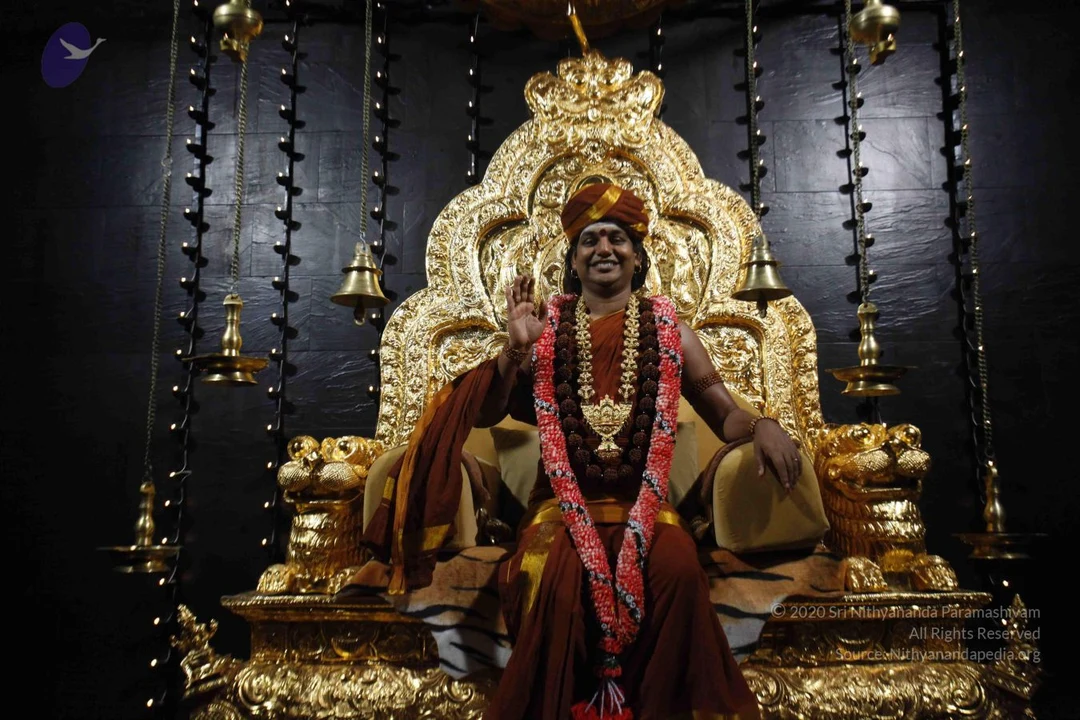
12 photosSource gallery
A seated man in an ornate gilded throne with a carved lion-head armrest and a tiger-striped cloth draped over the seat, under a gold canopy with hanging bells. He wears a rust-orange turban, rust-orange robe with gold border, a pink and white flower garland, and a gold pendant necklace over rudraksha beads, with eyes closed in meditation. The throne sits on a gilded pedestal with flower offerings. To the right, a painted deity figure with a trident holds a green and orange garment. Appearance matches the probable Swamiji by his turban, orange robes, rudraksha mala and ceremonial gold necklace, seated in a darshan setting. A printed caption on the right edge reads 'Source: Sri Nithyananda Paramashivam' and the page is from a Pratyaksha pada puja album.A seated figure in a red-brown robe and red-brown turban sits on an ornate gold throne with a carved lion-like armrest and a tiger-striped cushion. He wears a red and white flower garland, a rudraksha mala and a gold necklace, and raises one hand in greeting. Gold hanging bells and lamps frame the throne against a dark backdrop, with a red carpet at the base.A seated man in a maroon and gold turban and maroon robe with gold border waves his right hand in blessing on an ornate gold throne with a tiger-striped cloth draped over the seat. He wears a pink and white flower garland over multiple rudraksha malas, a large gold pendant necklace, bracelets and a red tilak on his forehead. Flower offerings and a silver tray sit at the base of the throne, and a brass bell hangs on the right. Swamiji (probable): the long-haired, turbaned figure in saffron-maroon and gold ornaments on a gold throne matches the page's identification, though the cues are a turban, rudraksha and ornate clothing.Seated meditation gathering in a hall with pink-white walls and red floor cushions. In the foreground a young man with long dark hair pulled back, a red bindi on his forehead, a white t-shirt and grey drawstring trousers, sits cross-legged with eyes closed and hands folded in his lap. Behind him, rows of men in white shirts and dhotis sit with eyes closed, one wearing a rudraksha mala. A red ornate box with a gold motif and a small brass cup with yellow flowers sit in front of him, with a water bottle at left. The scene shows a devotee meditation session.A young boy with a shaved head, white and red forehead markings, and an orange saffron robe with a rudraksha mala stands at a silver-topped altar, using a small brass spoon to pour from a brass kalasha-style vessel. Before him are a brass plate of flower petals and a white flower offering, with brass bells, a small brass pot and a cup nearby. Other saffron-robed people sit behind him.A shaved-headed man in glasses sits cross-legged in orange-red saffron robes, wearing long multi-strand rudraksha mala necklaces and a rudraksha bracelet on his upper arm, with a red bindi on his forehead. He holds a small metal spoon or implement in his right hand near a cup, eyes closed in a ritual or meditative pose. Behind him, younger boys in red robes and other seated people in white clothing watch the ceremony in an indoor hall with framed pictures on the wall. The scene suggests a puja or ritual observance.
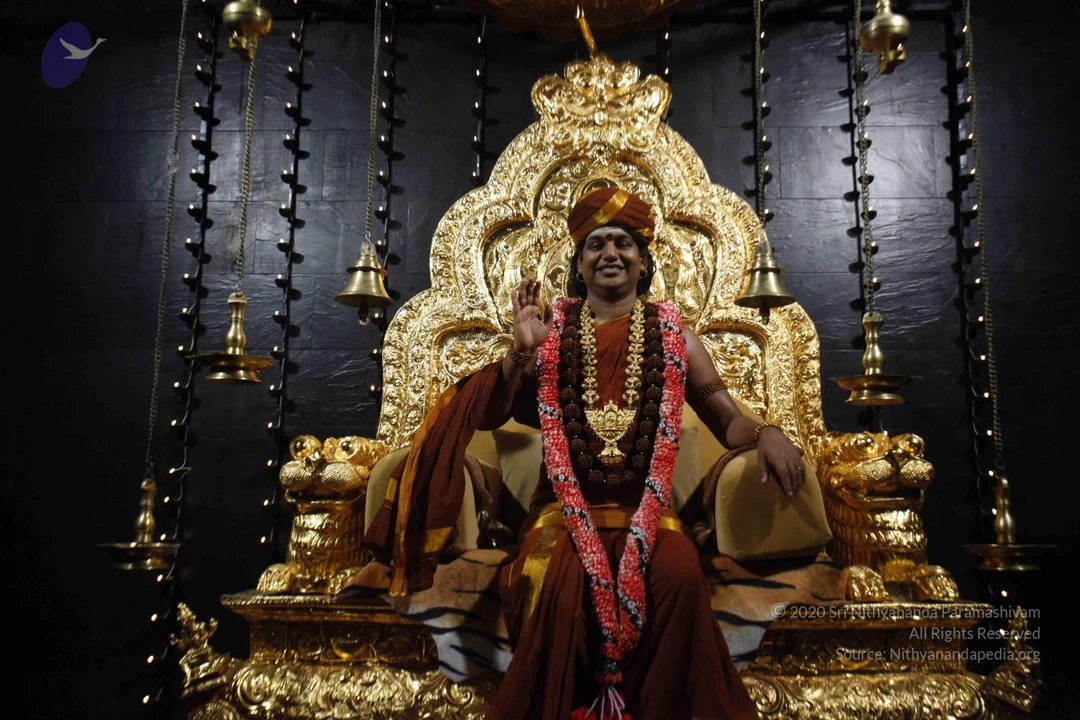
02-Satsang-Swamiji

1 photoSource gallery
Close-up photograph of a smiling man seated against an ornate gold repoussé backdrop. He wears an orange and gold turban with a red bindi, a headset microphone, gold hoop earrings, an orange shawl over the shoulder, layered rudraksha malas and a gold necklace with a large gold pendant depicting a deity shrine. Gold bangles are visible on his arm. Appearance-based candidate: a person, a seated speaker in saffron-orange clothing with rudraksha malas and ceremonial gold necklaces during a satsang setting.

04-enGenius

8 photosSource gallery
Outdoor photograph of a thatched-roof open shrine hall framed by leafy trees and potted plants. A large black-and-white portrait of a smiling man with long dark hair is displayed on the back wall above the entrance. A small sign reads Laughing Temple. A woman in a red and gold outfit sits on the left at the entrance, while a young boy in white shirt and dark trousers runs barefoot across the concrete path. Two seated people are visible inside the hall, and sandals lie outside at the threshold.A young boy wearing purple-framed glasses and a grey graphic t-shirt with blue dinosaur-style print stands in front of a wooden lattice trellis with green foliage behind him. He holds a stainless steel bowl in both hands and looks toward the camera. He wears a long rudraksha mala with a red cord, and a small framed photo pendant hangs from the cord. A white ID badge clipped to the cord hangs at his chest. No other people or a person appearance are visible.A young child with curly blonde hair sits against a wooden lattice fence, eating from a small stainless steel bowl held in the left hand while the right hand lifts food to the mouth. The child wears a white button-up shirt with a red lanyard around the neck. Green foliage and a terracotta-coloured wall are visible in the background. No swami or other adult figure is clearly identifiable in the frame.A photograph of two boys on a red-painted floor in a temple-like hall. A dark-haired boy in a white T-shirt with a red rudraksha mala and a white badge on a red lanyard kneels on hands and knees and smiles at the camera. A taller, light-haired boy in a white grey-striped T-shirt and khaki shorts kneels on his back, one hand on his shoulder, smiling. Behind them, a large painted red and gold deity figure with raised arms sits on a decorated throne, with a trident motif and lit lattice lamps on the sides. A small purple logo appears at the lower left.A photograph of a young boy in glasses standing in a lattice-walled pavilion, with his right arm raised and his left arm extended outward in an exercise or yoga-like pose. He wears a grey graphic t-shirt, dark tracksuit trousers with a star logo, and a red cord with rudraksha beads around his neck. Behind him, several seated people wrapped in orange saffron cloth are partly visible.A young boy with curly light-brown hair stands on a woven mat in a latticed pavilion. He wears a white long-sleeved shirt and white trousers, with a red lanyard around his neck, and raises one arm toward a lattice panel. Behind him are a cream plastic chair, green leafy foliage, and a low wooden bench with gold painted border. Sunlight filters through the diamond-patterned lattice onto the red-tiled floor.

05-Temple
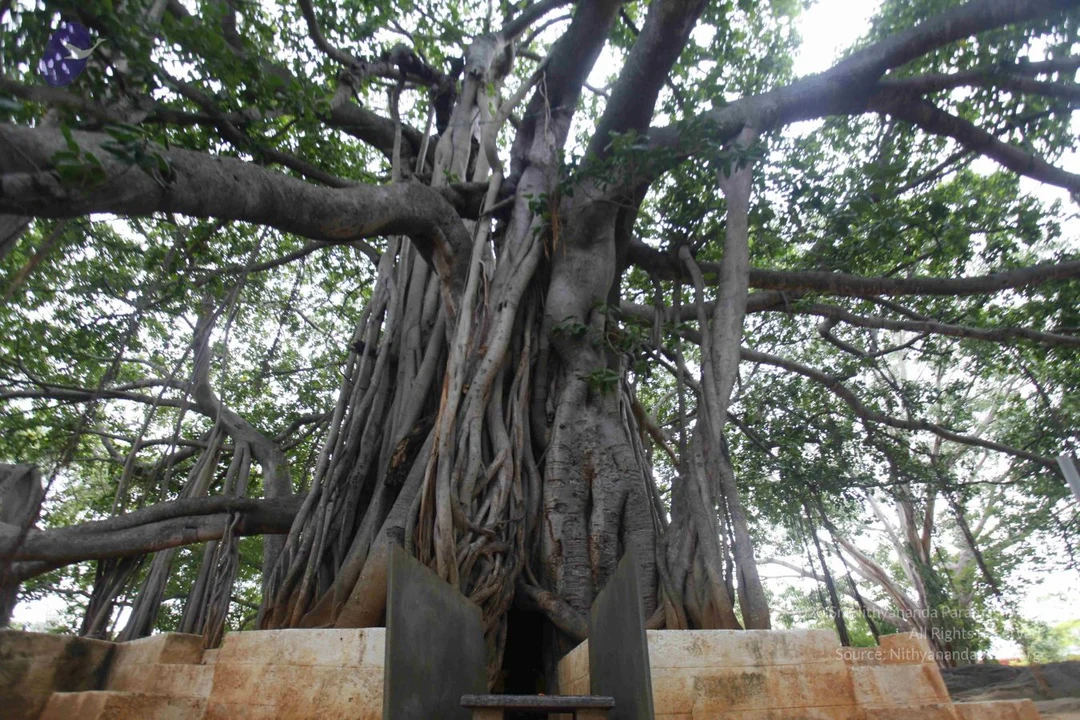
5 photosSource gallery
A narrow red-carpeted aisle lined with dark metal railings leads toward a shrine. In the gold-framed niche, a large gilded deity murti with four arms and a red-draped backdrop is seated, garlanded with red flowers. Below, a second red-garlanded figure sits on a small throne. A lone male priest in white dhoti and shawl with gold border sits cross-legged on a stone platform beside brass oil lamps and offerings, tending the ritual. No people are visible beyond him.A black stone statue of Dakshinamurthi, a form of Shiva as the seated teacher, sits within a silver-framed niche backed by magenta cloth. The murti wears an orange headband, a red dhoti and a red-and-white patterned shawl, with layered rudraksha-style bead necklaces and garlands. Its upper hands hold a drum and a fire-related implement while the lower hands show a teaching gesture. Foliage surrounds the shrine, and a black plaque at the base carries Kannada and English labels reading Dakshinamurthi shrine, with yellow flowers and red powder scattered at the foot.A dark stone statue of a four-armed seated deity against a magenta backdrop. The figure wears an orange turban with a jewelled ornament, a red draped garment with a red and white bandhani-patterned shawl, and layered rudraksha and gold-coloured bead necklaces with a white flower garland across the lap. It holds a snake-topped staff in one upper hand, a drum-like object at the right side, and makes mudra gestures with the lower hands. Carved figures and an animal relief appear on the base. No living people are visible.A black stone murti of Dakshinamurthy, seated in a silver-framed arched niche against a magenta cloth backdrop, outdoors among green foliage. The deity wears an orange head cloth, red draped garment with a red and white patterned wrap, layered rudraksha and bead malas, and a marigold garland at the waist. Its raised hands hold a drum and a flame-like object, and the base has carved relief figures. Yellow flowers rest on the stone plinth. A black plaque below reads Dakshinamoorthi shrine.A black stone murti of Dakshinamurti seated in a shrine niche outdoors among trees. The figure wears an orange head cloth, a red garment, gold-coloured chains and a red and white patterned shawl draped over the shoulder. Its niche is framed by ornate silver-toned arch work and a hot pink silk backdrop. A small black stone sign below reads Dakshinamurthi shrine. The base is coated in red and orange pigment with a few yellow flowers placed on it, and a small stone bench stands nearby.