Skip to content
Sunday

30 June 2013

Align Your Thinking and Being

Dated photos
175
Source pages
1
Media
2
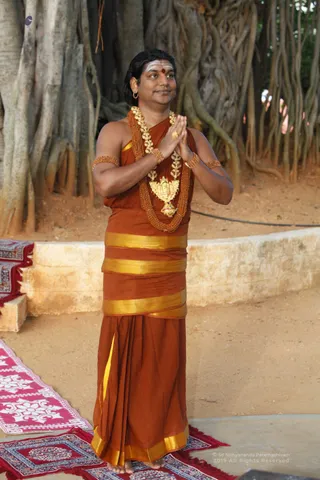
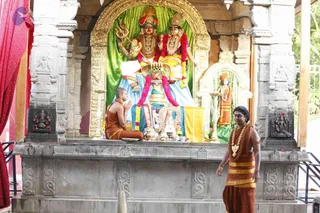
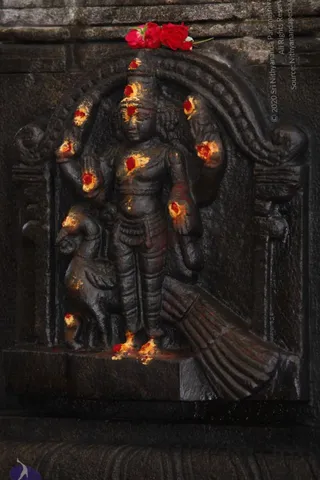
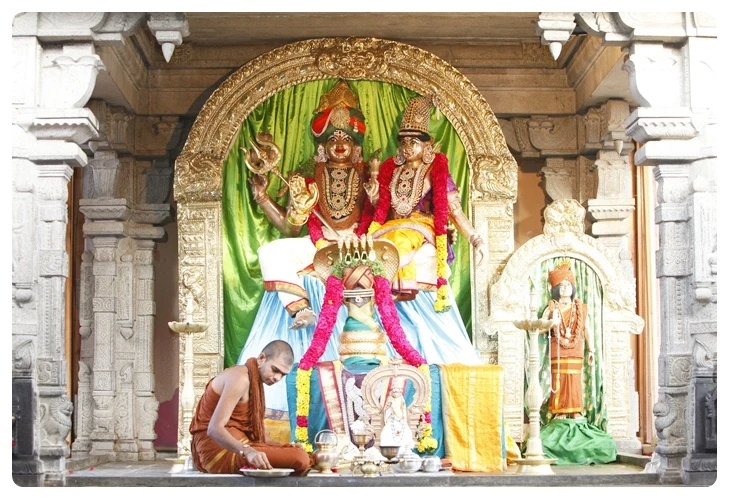
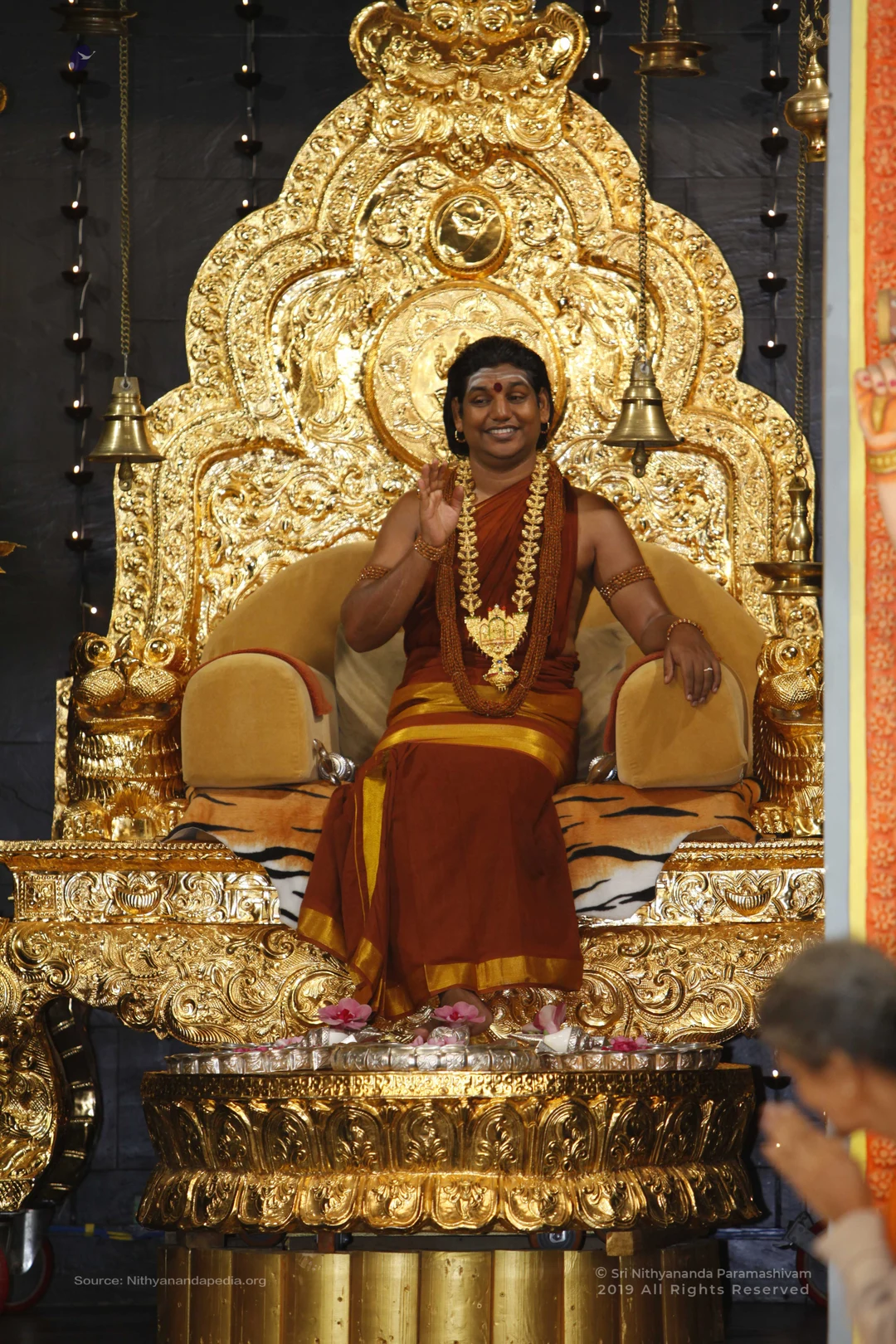
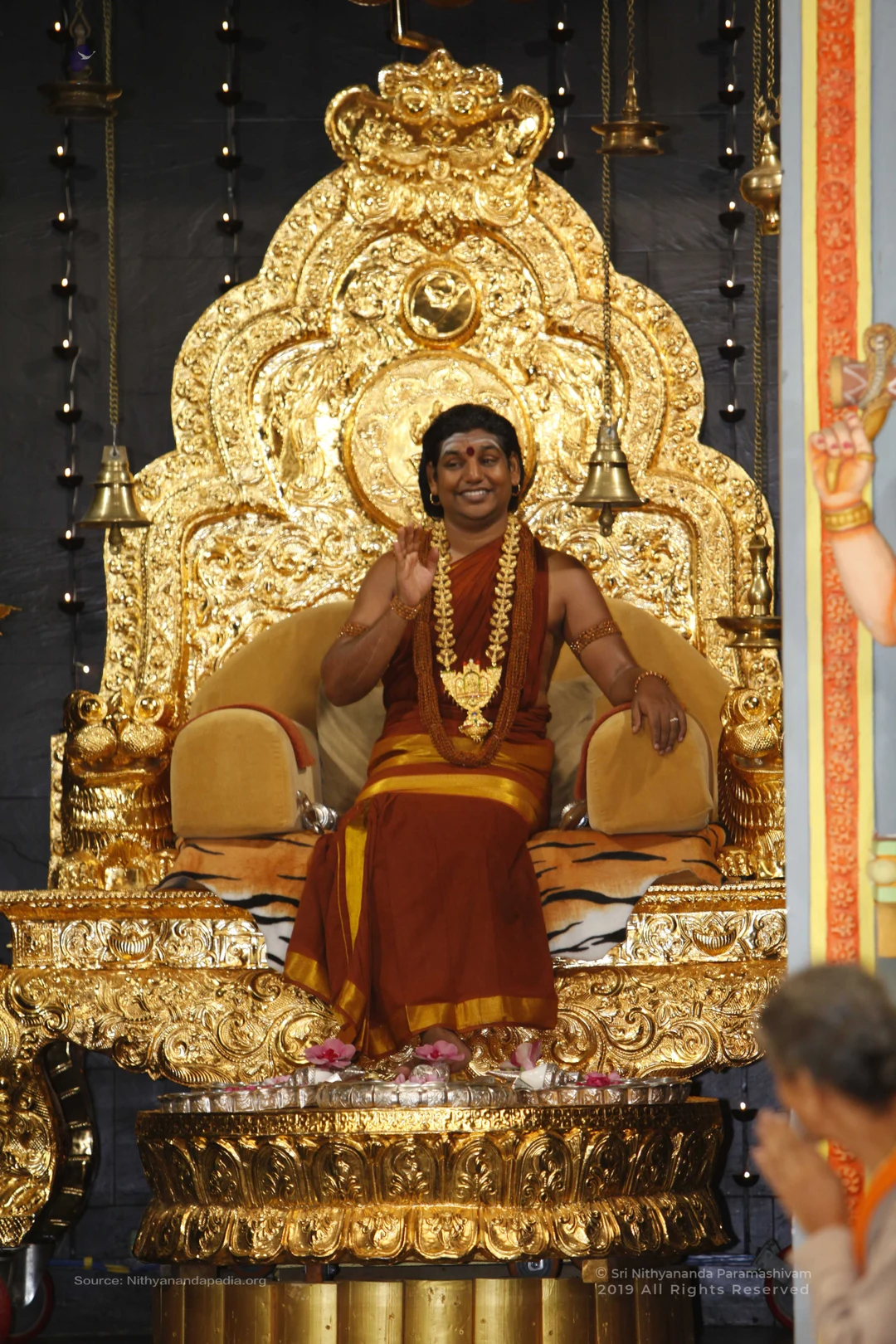
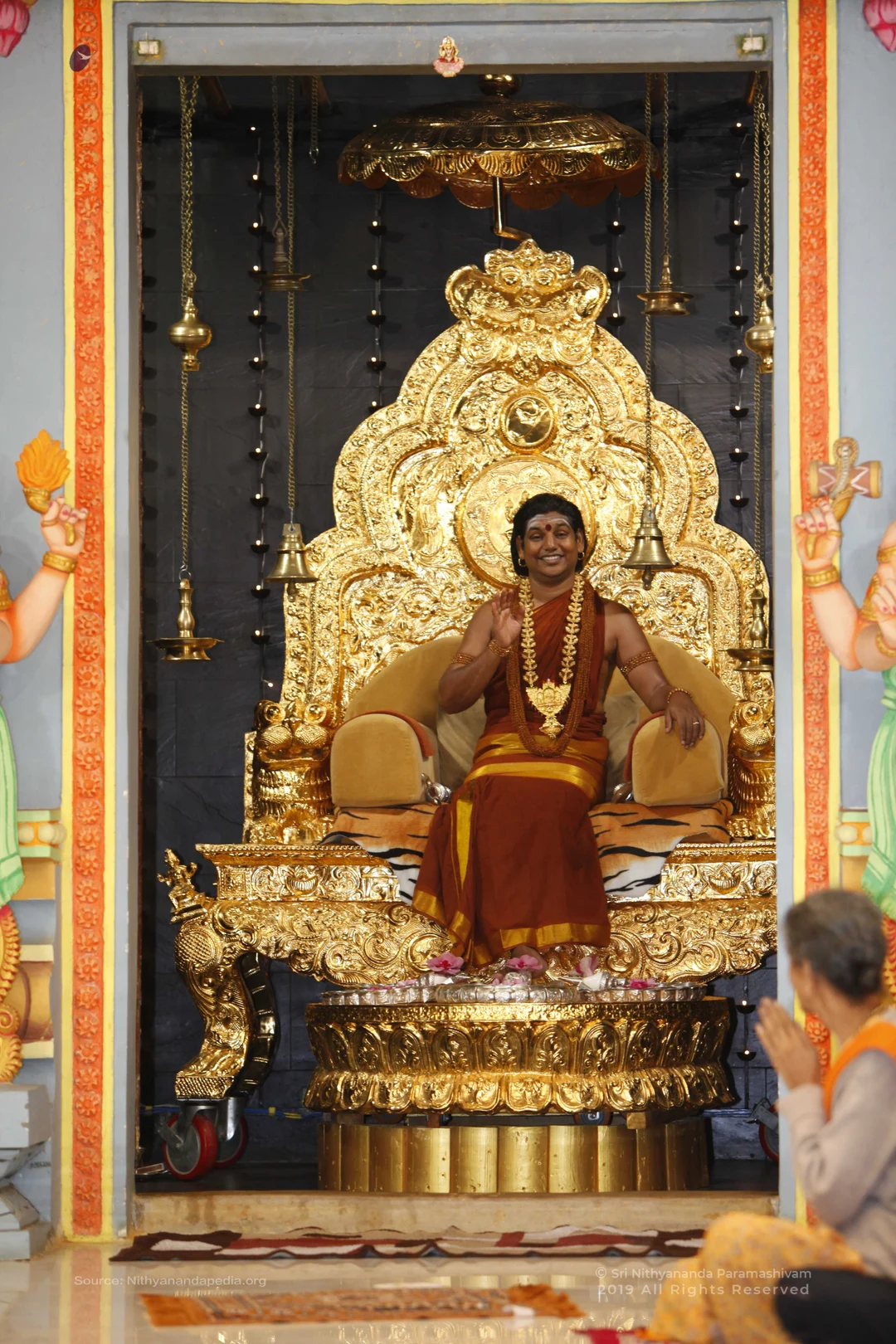
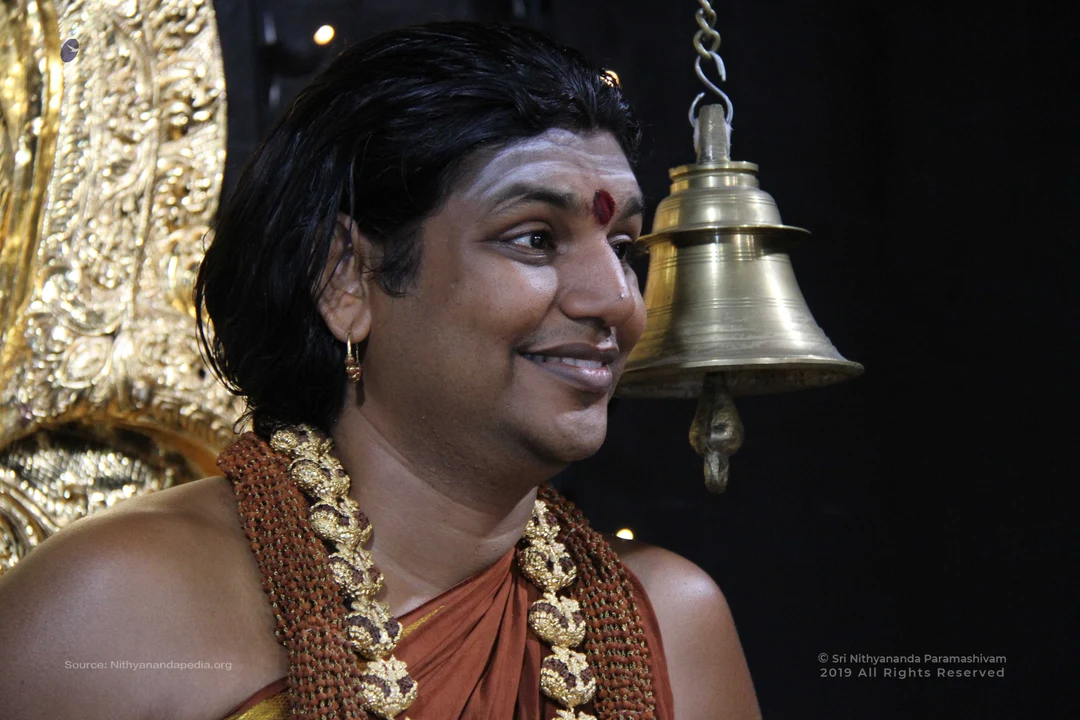
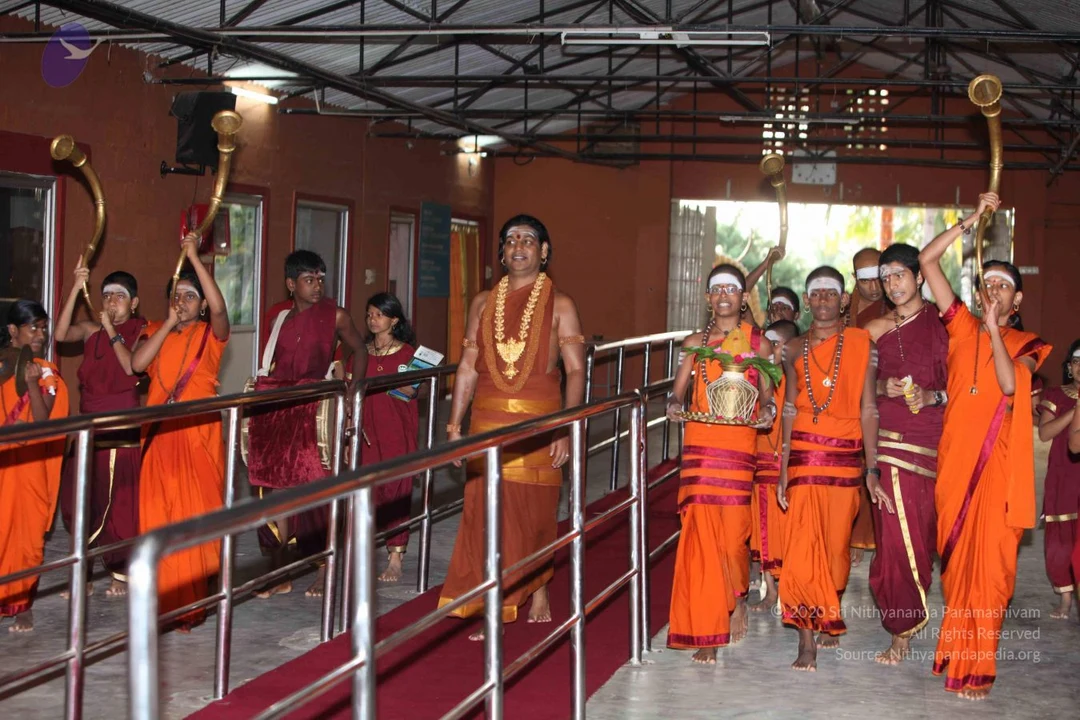
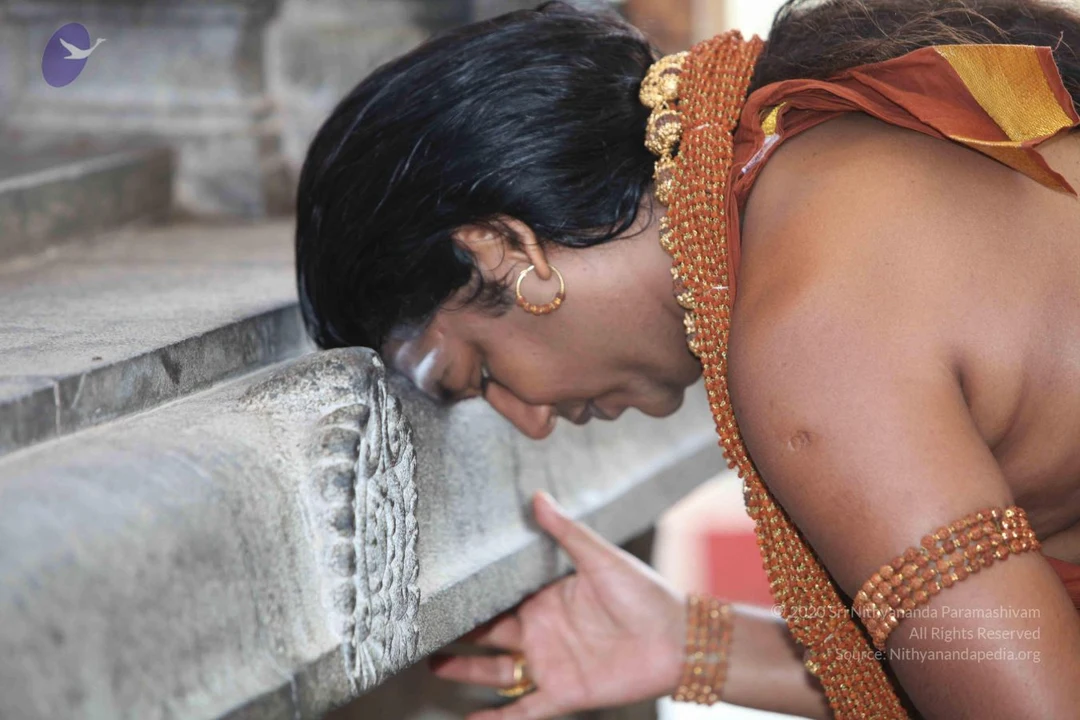
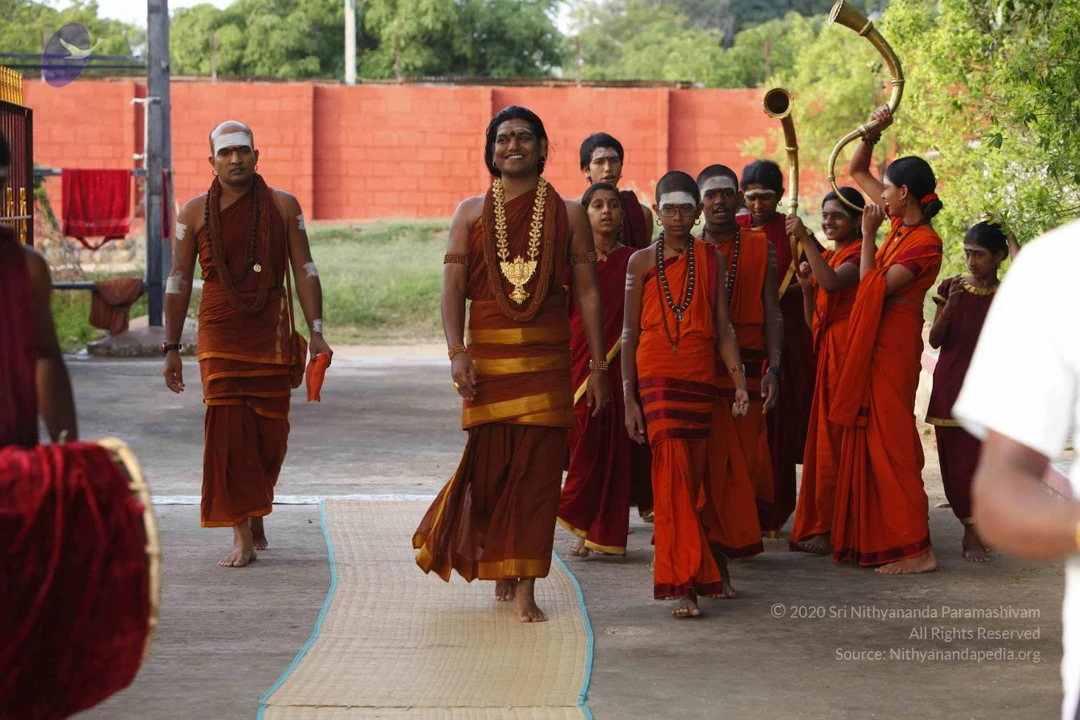
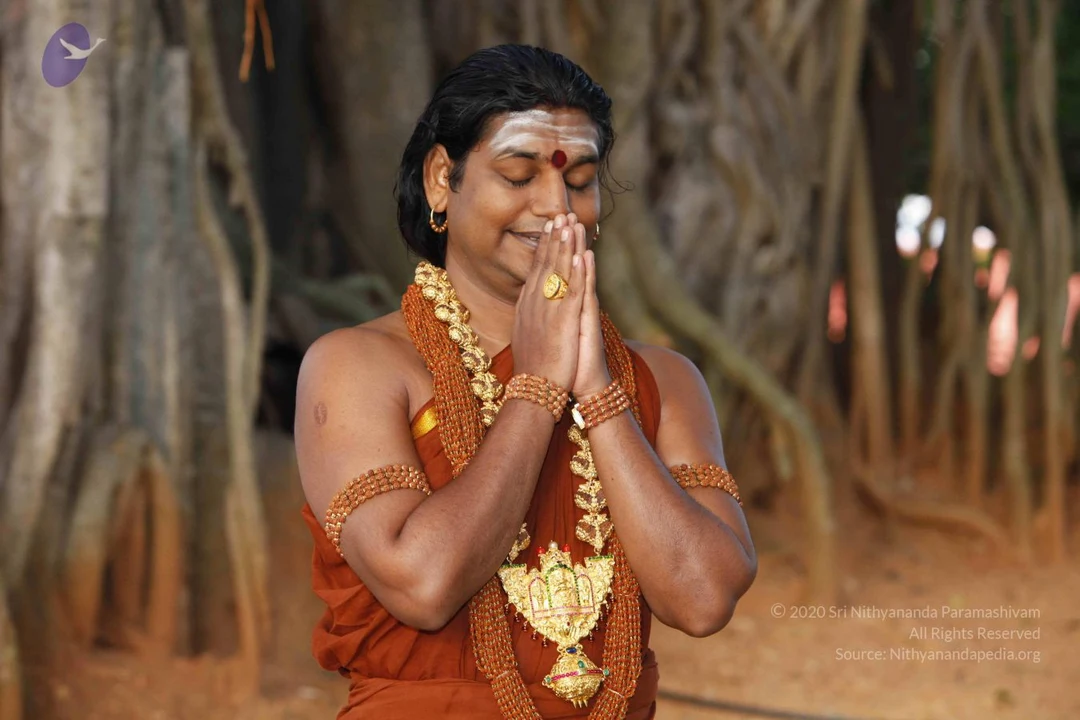
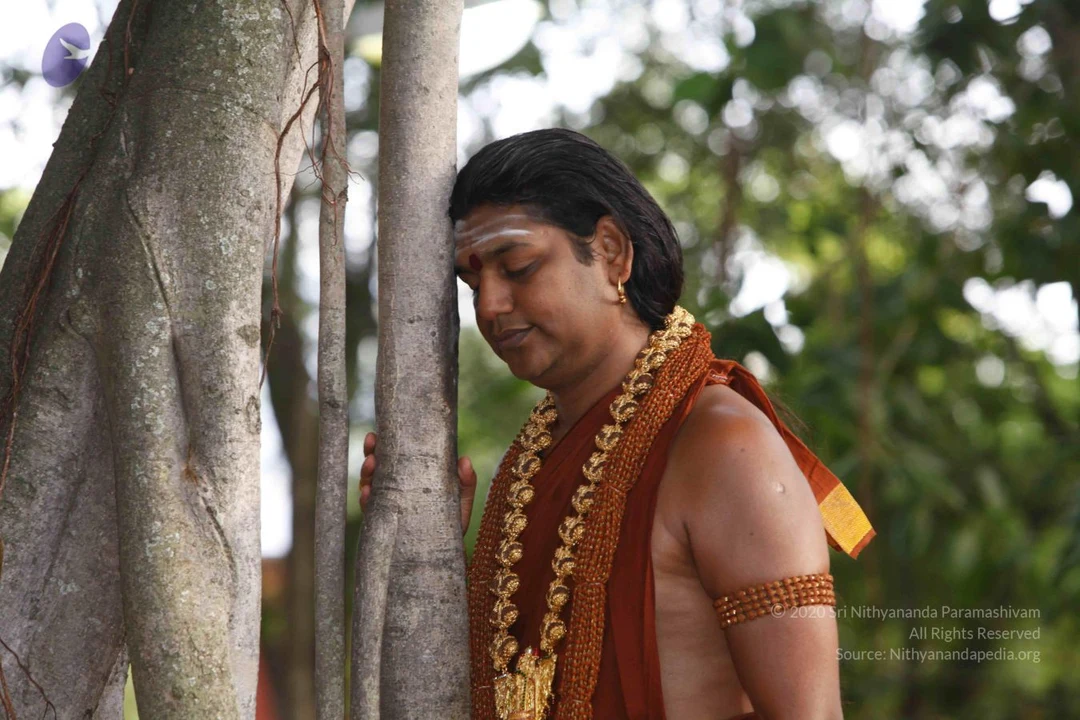
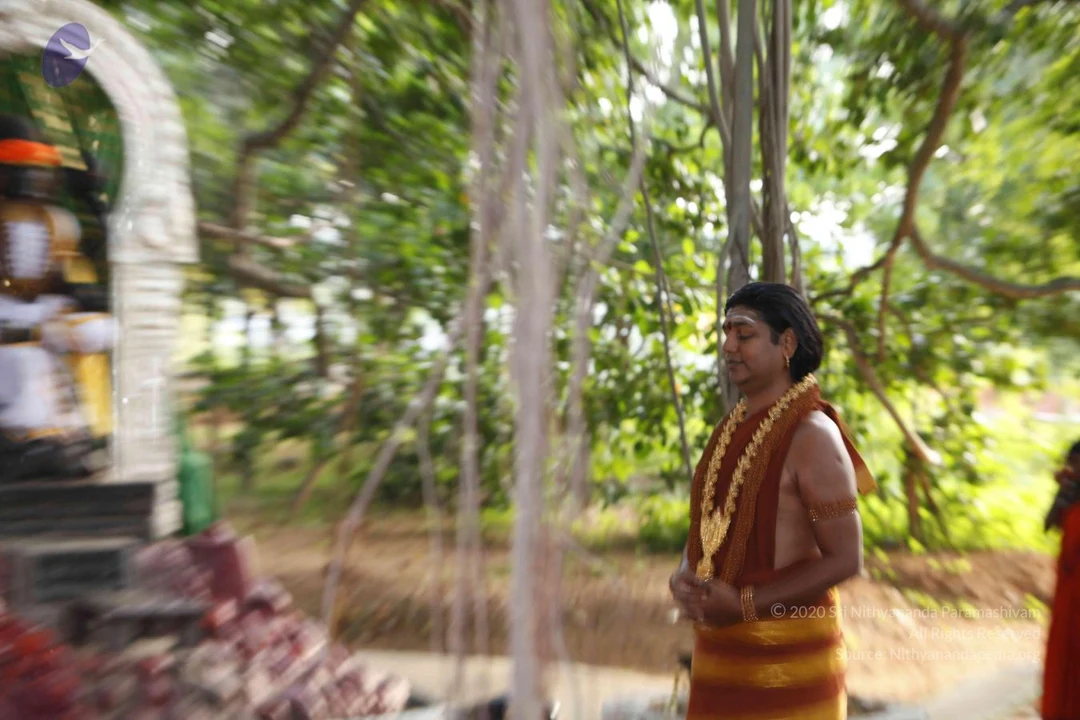
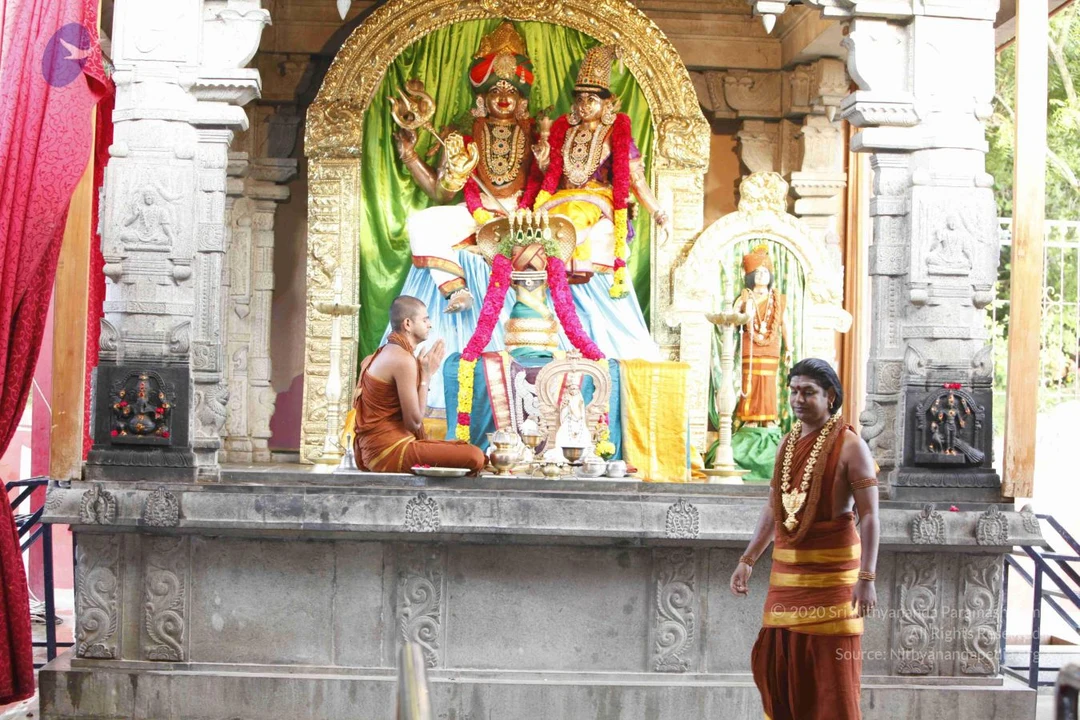
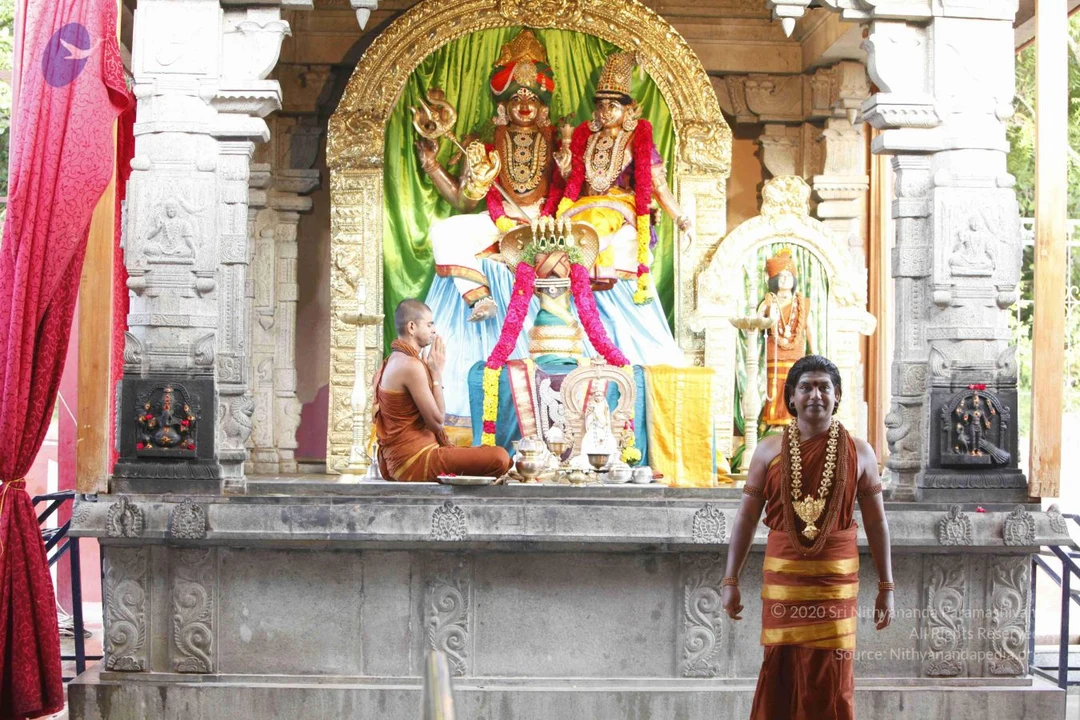
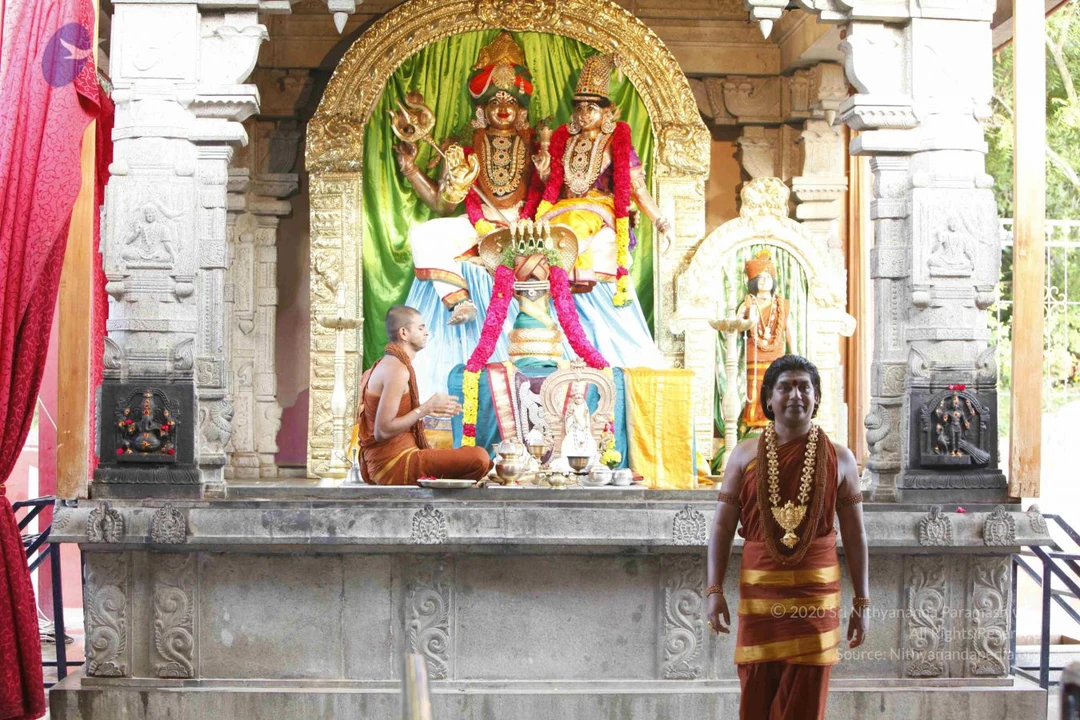
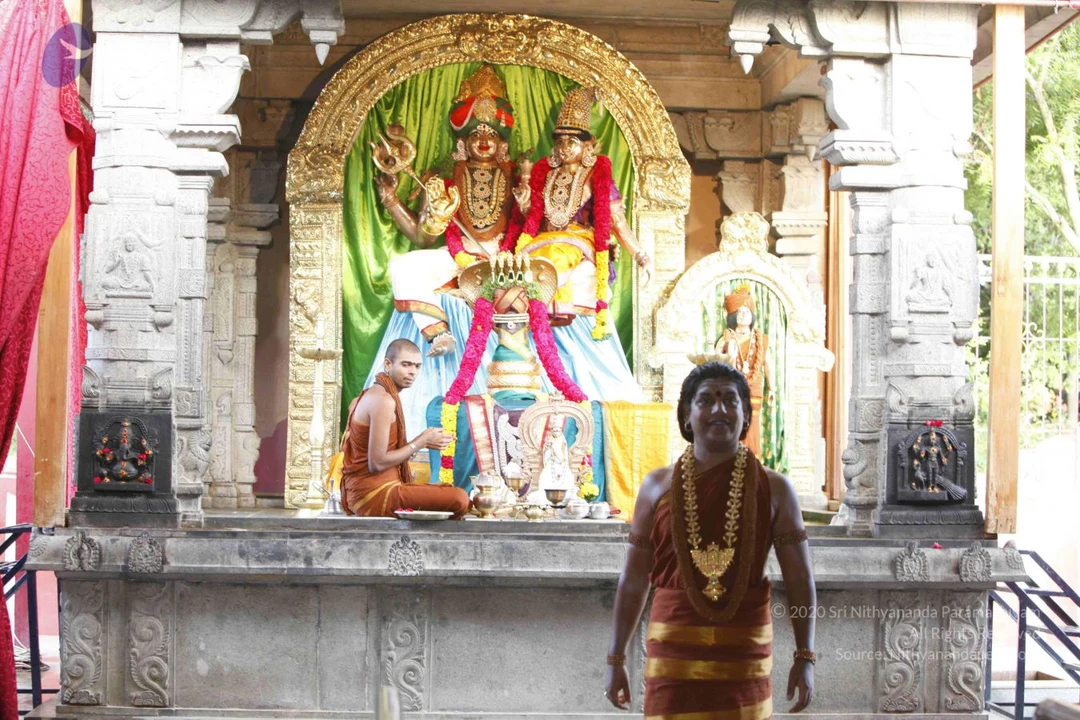
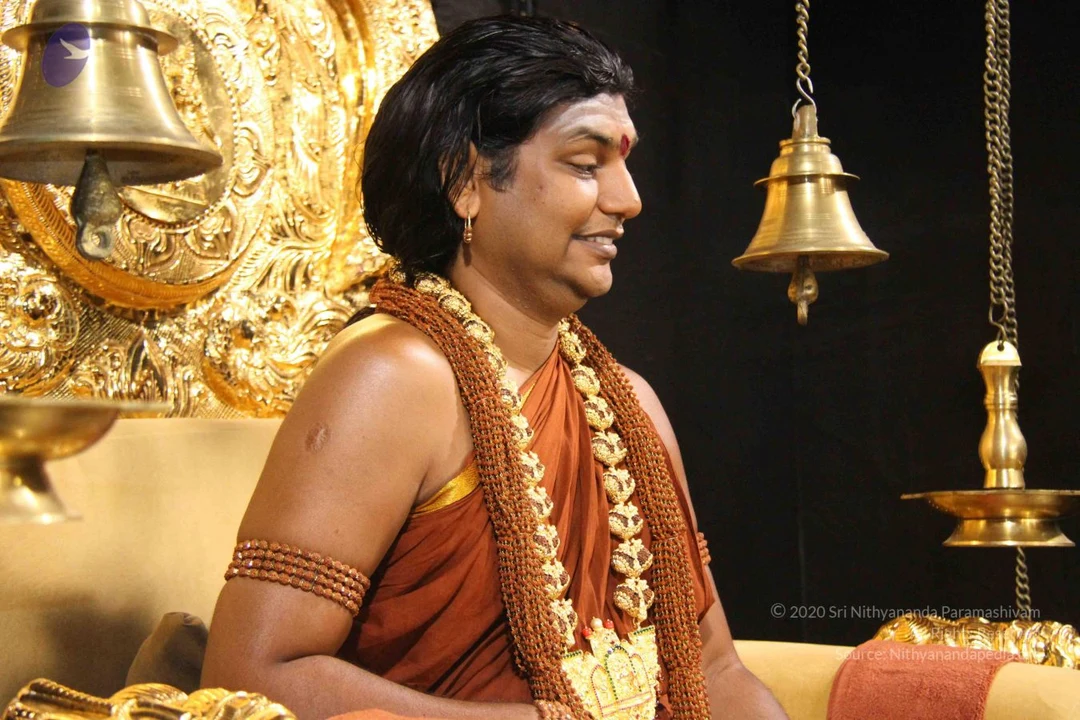
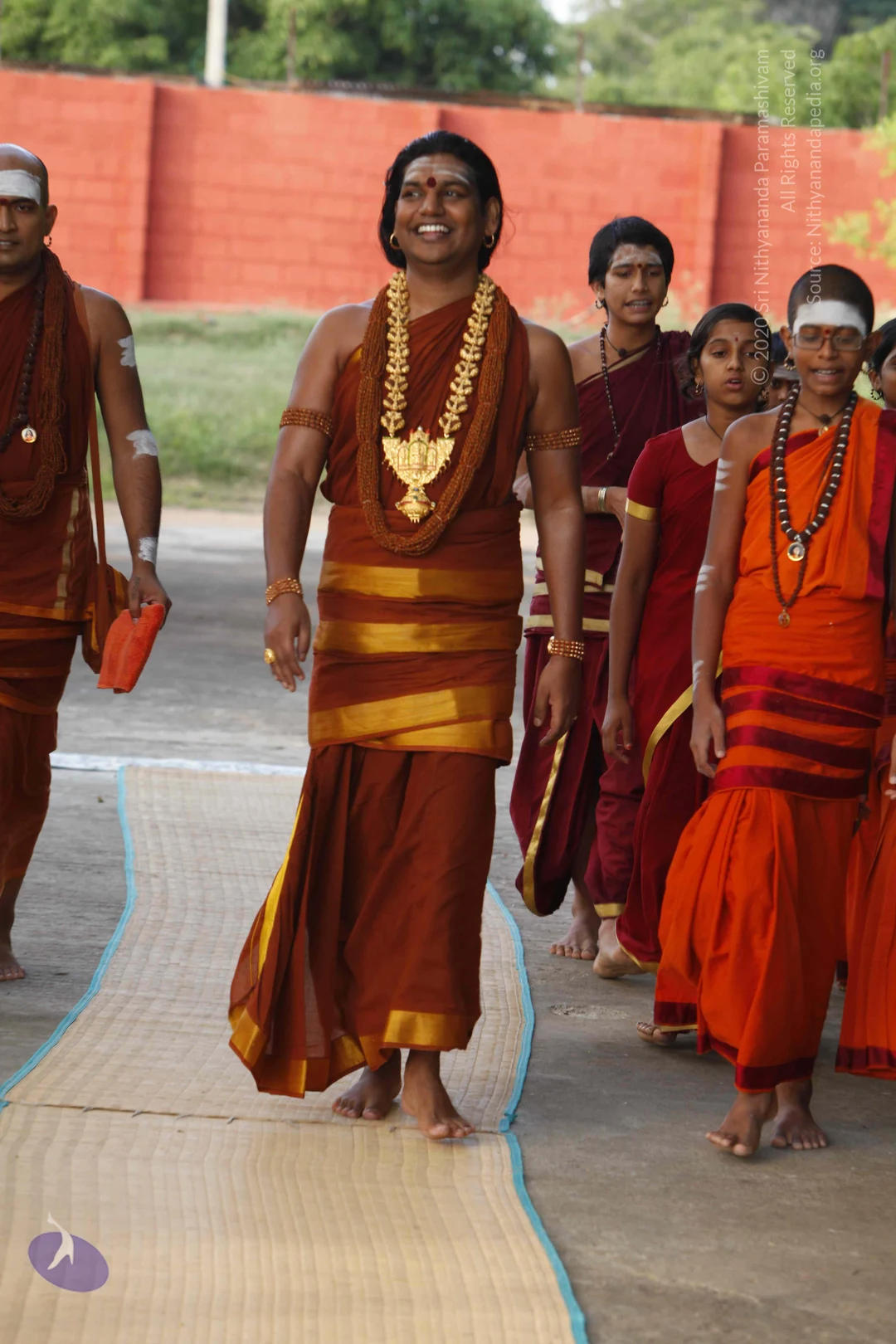
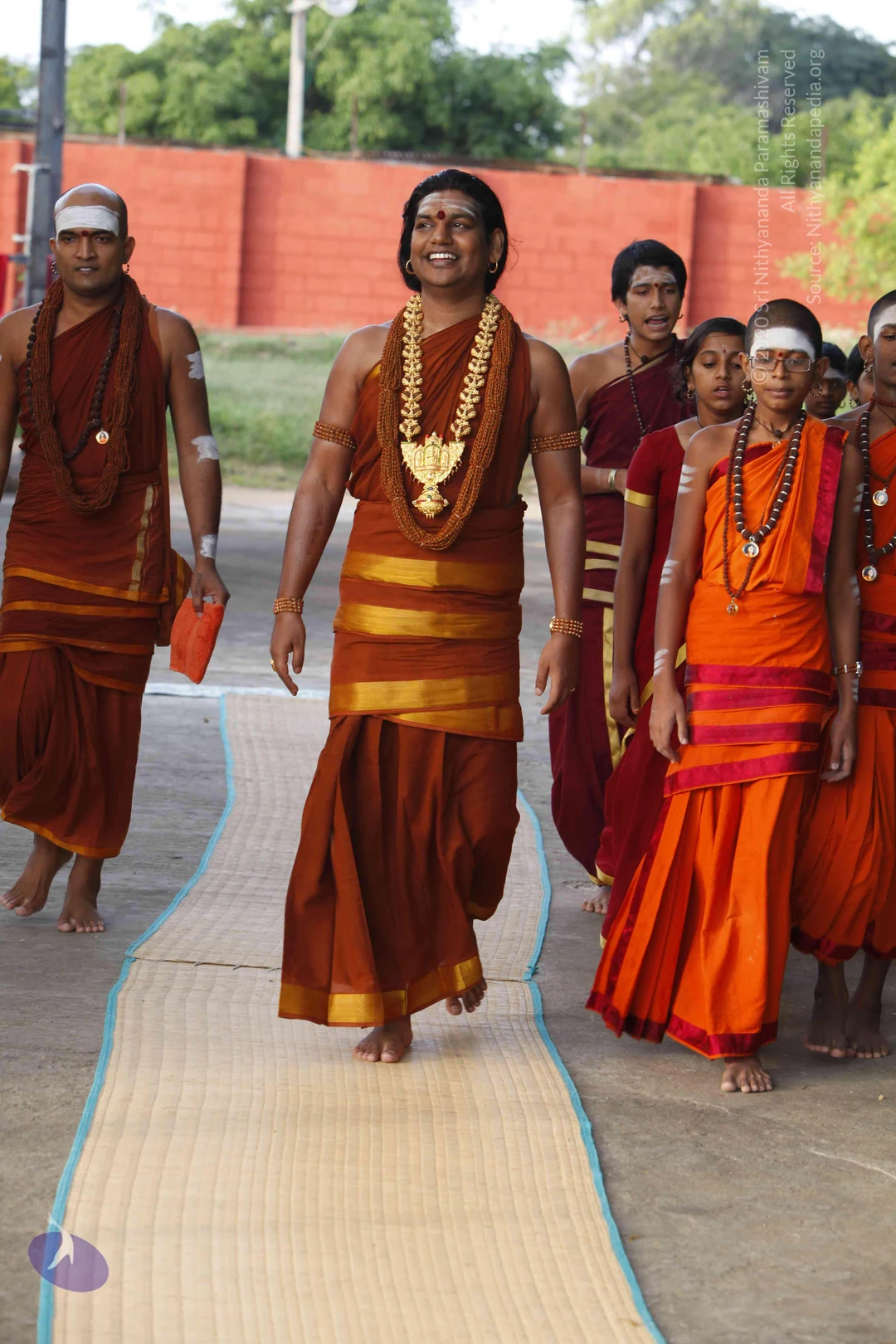
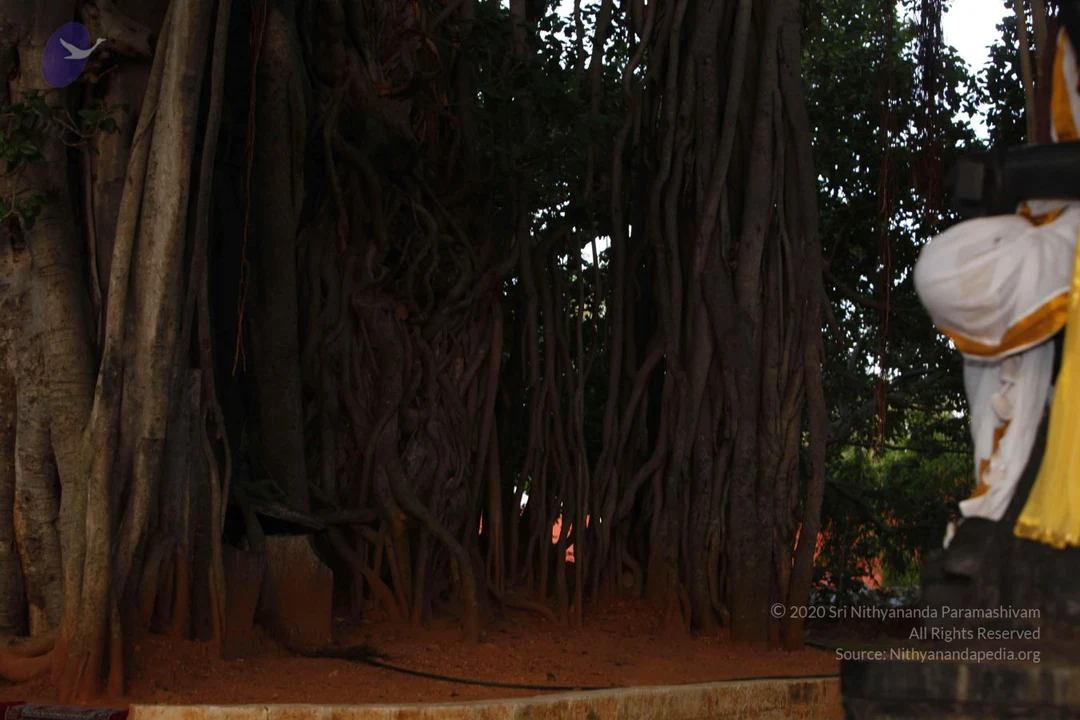
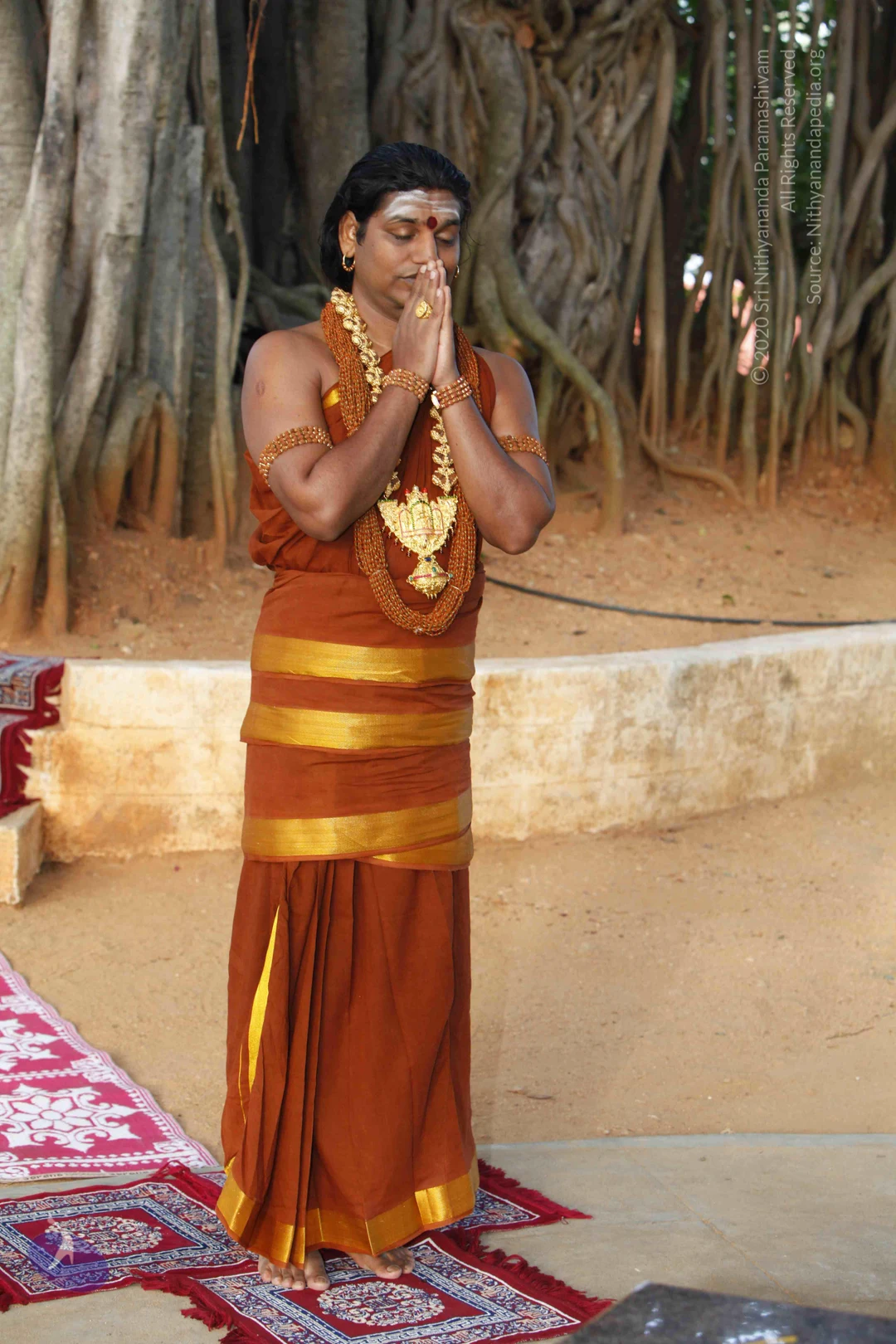
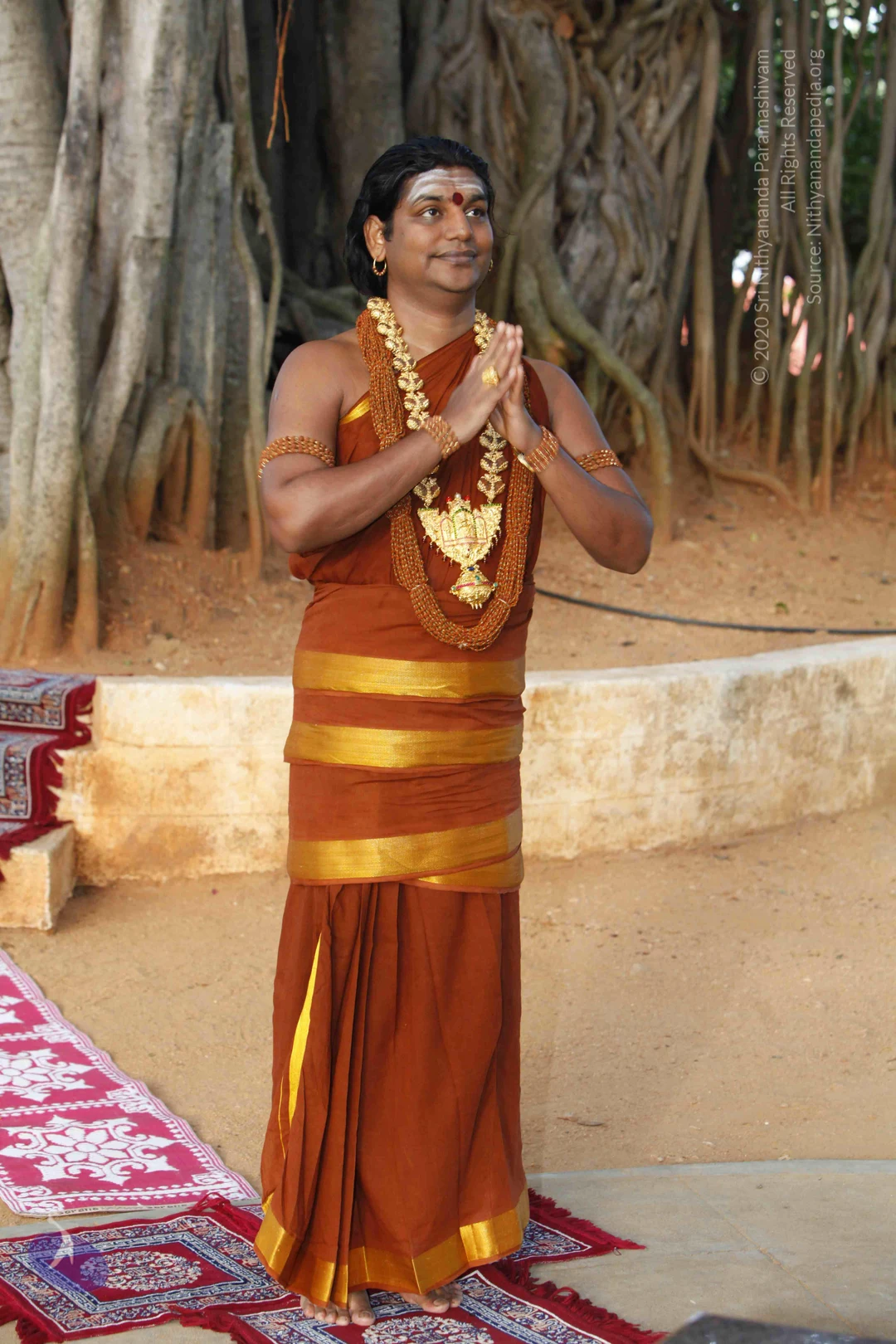
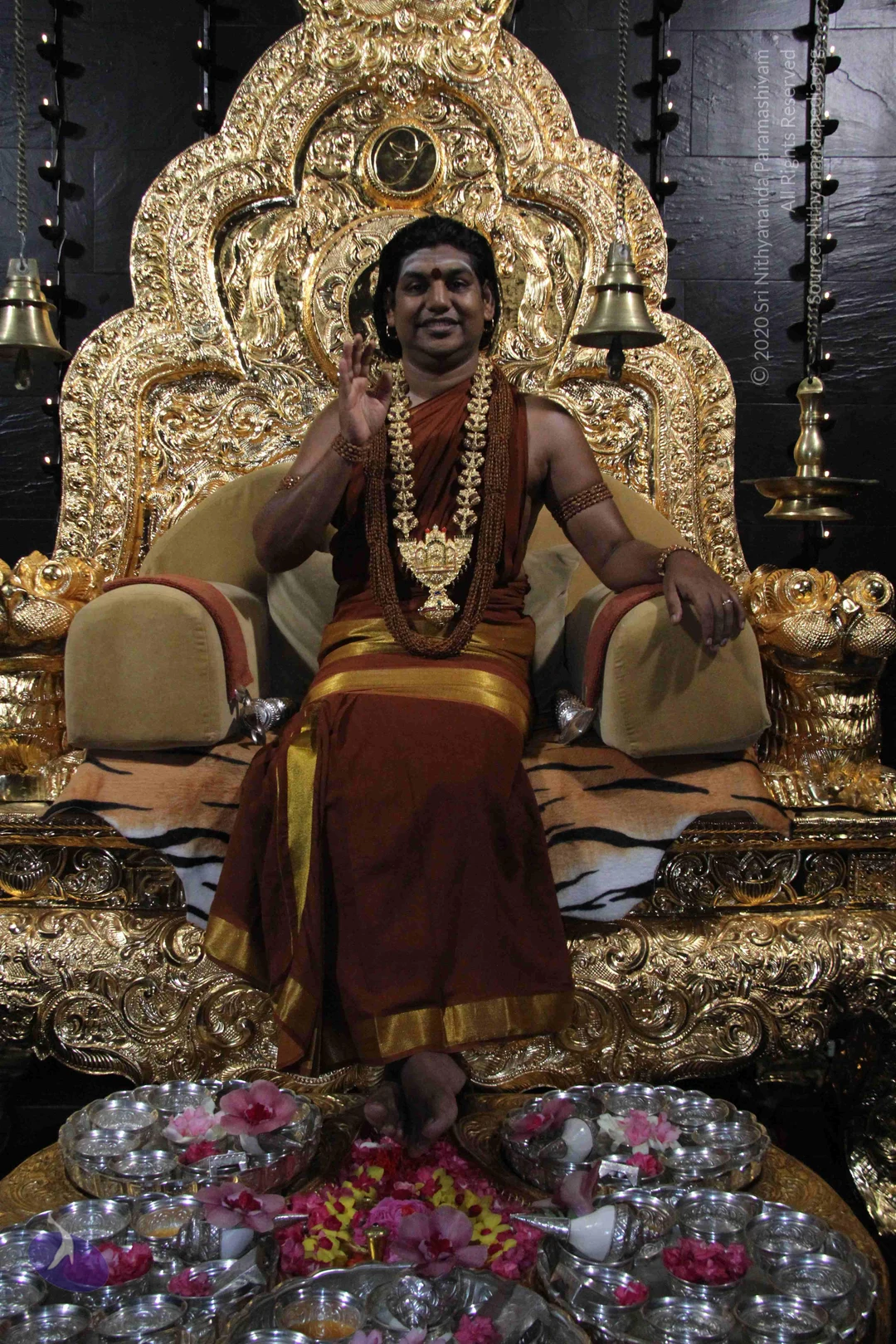
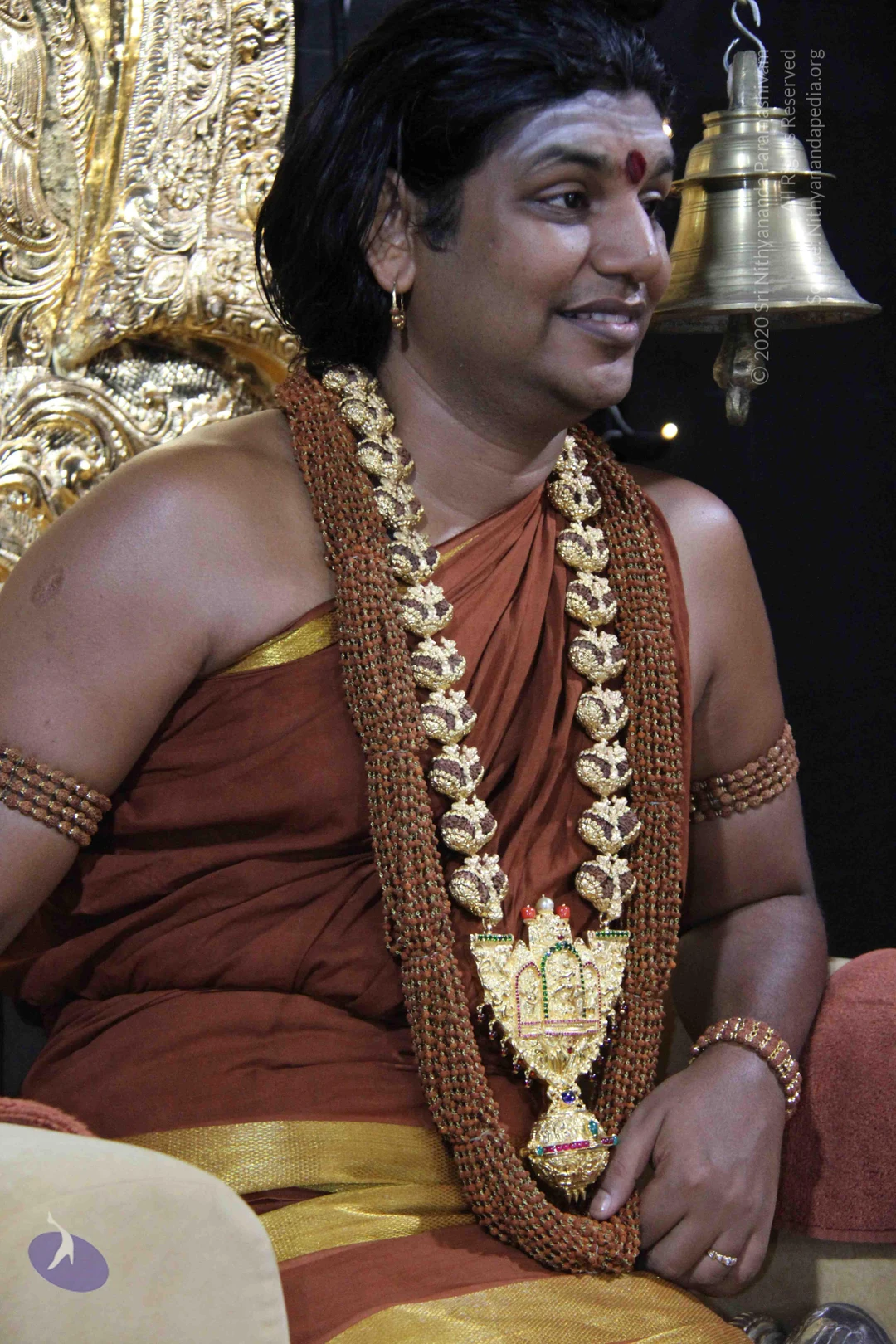
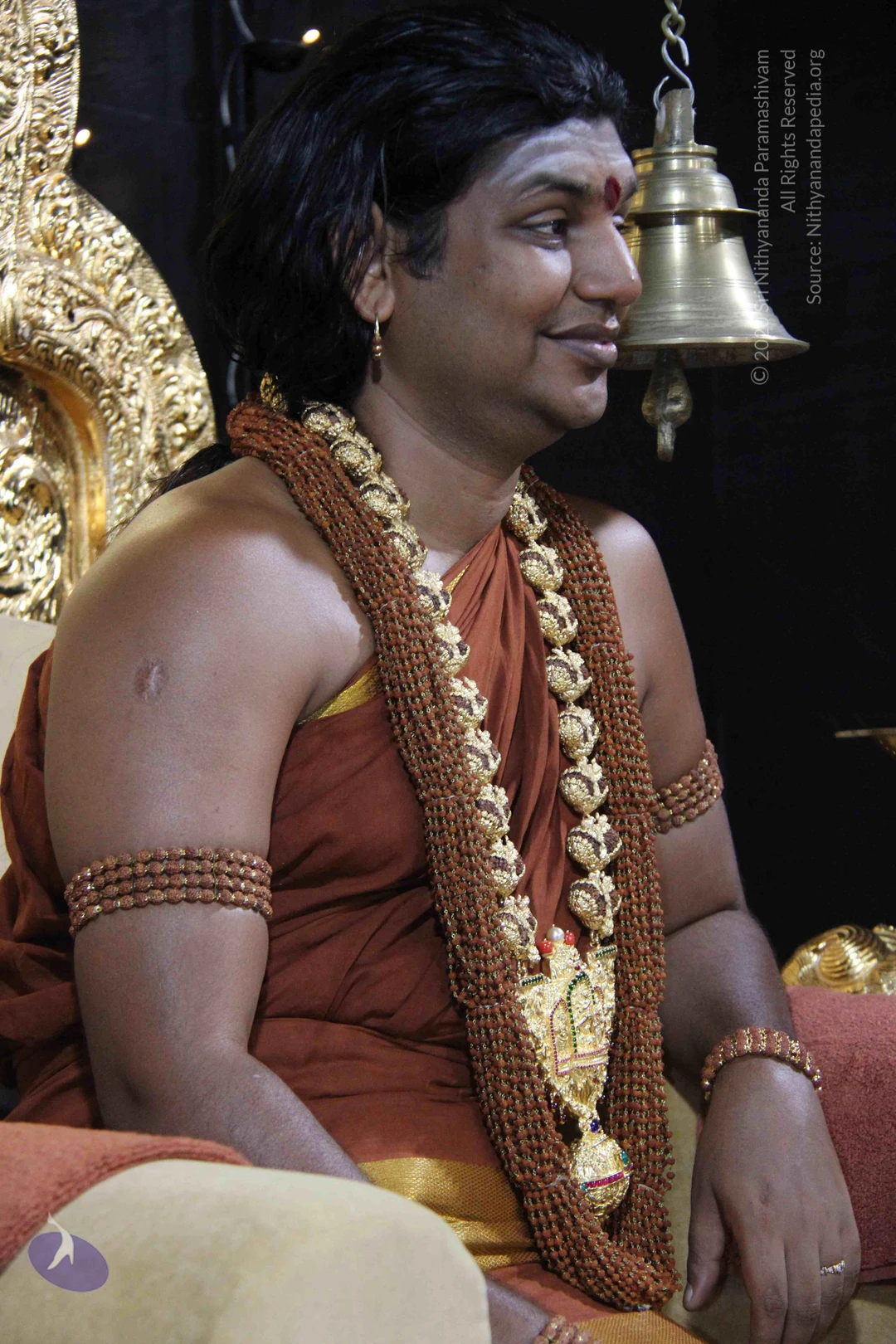
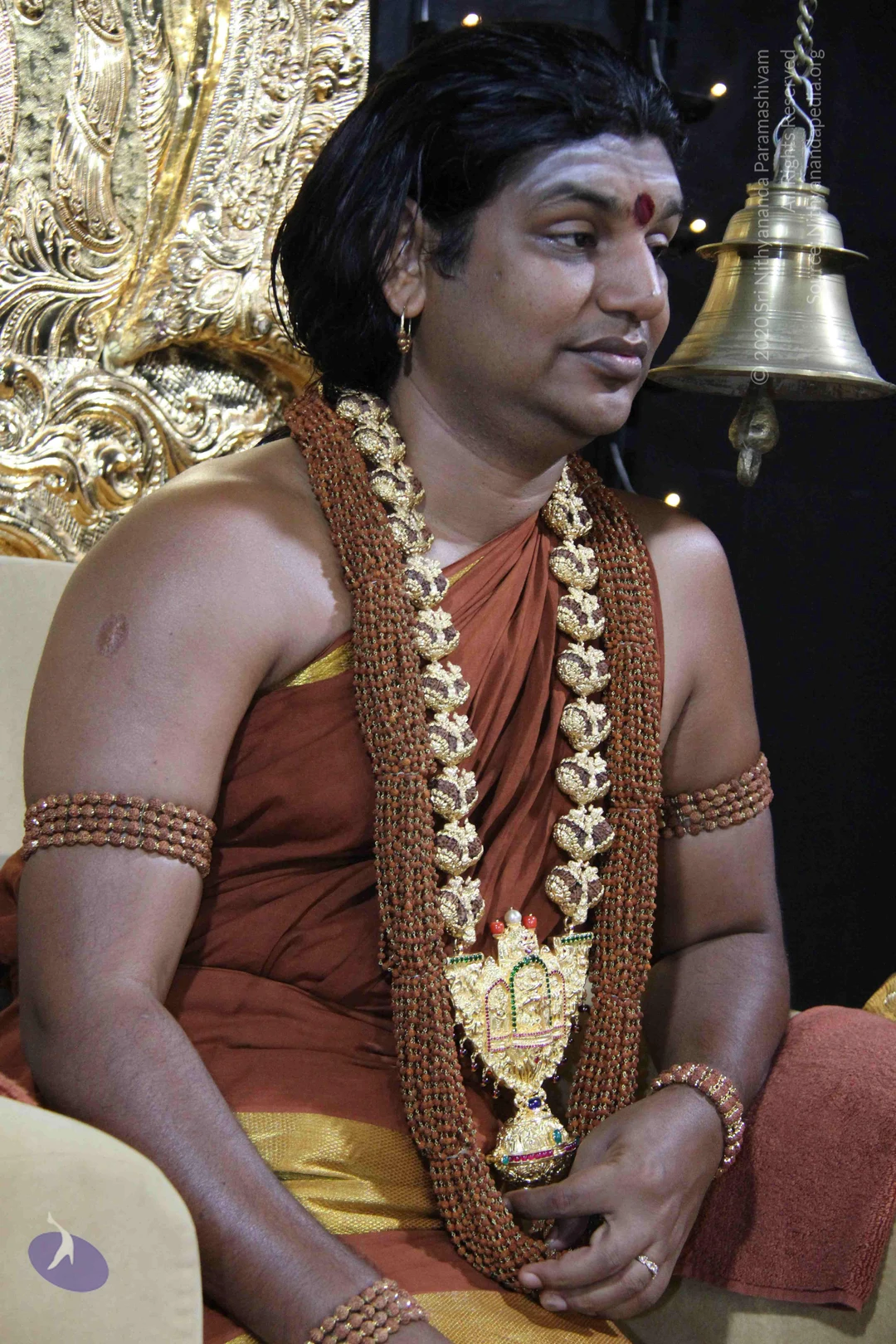
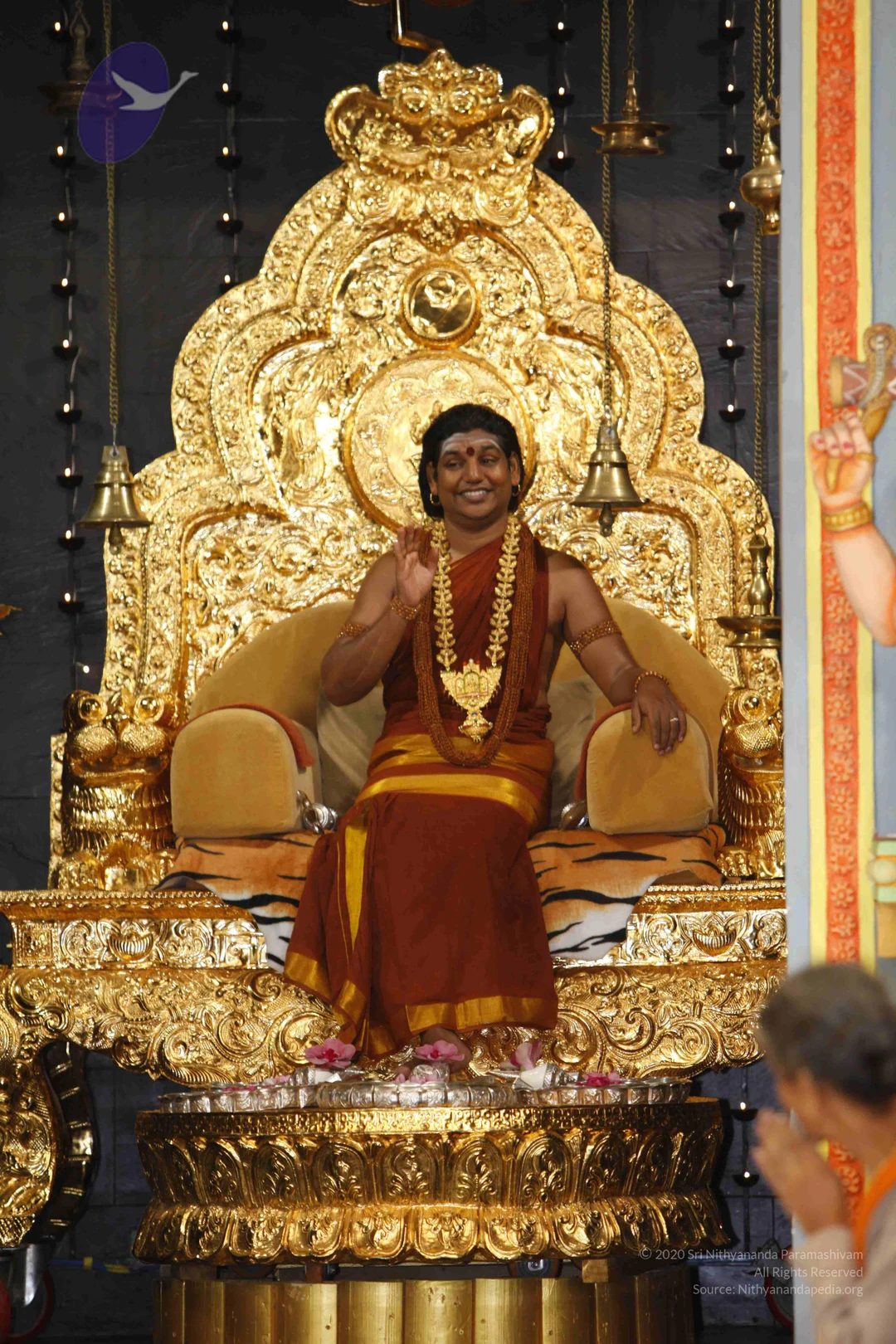
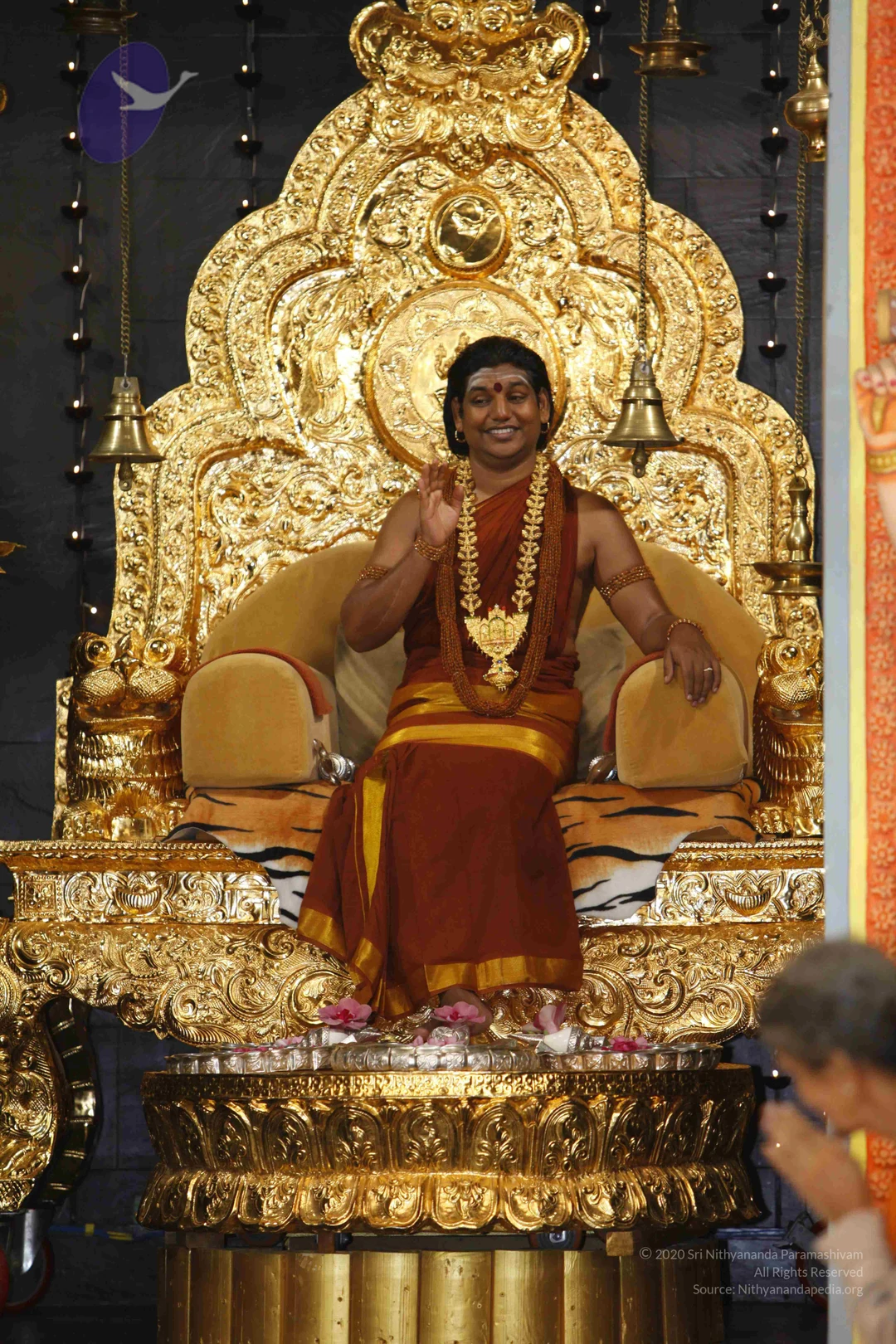
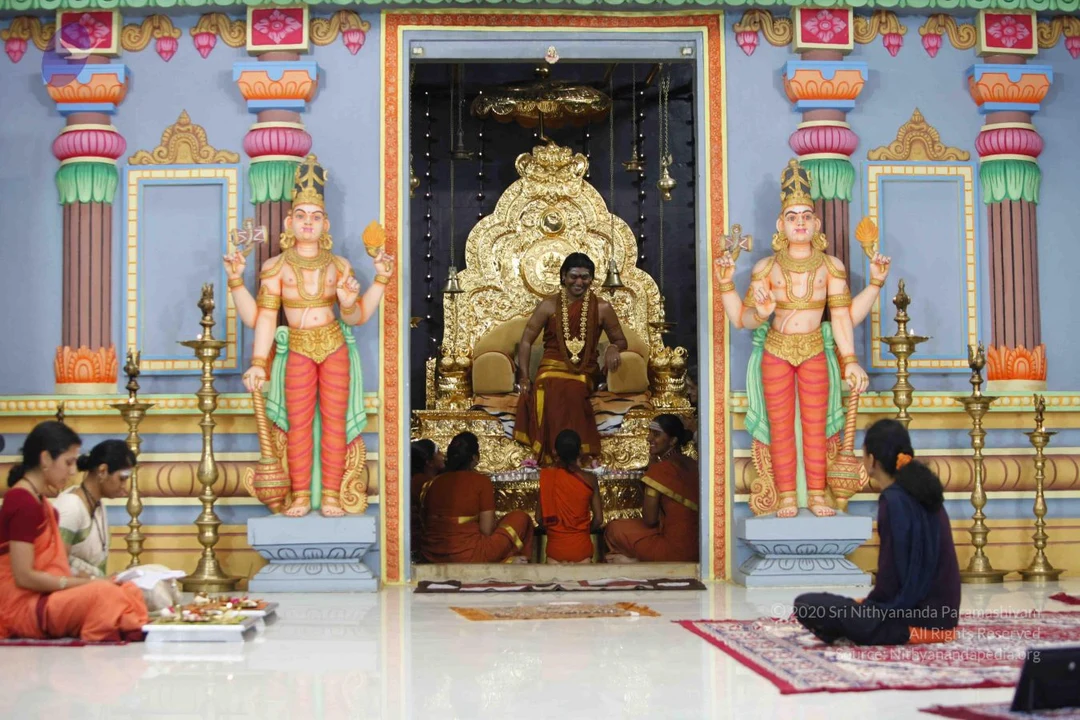
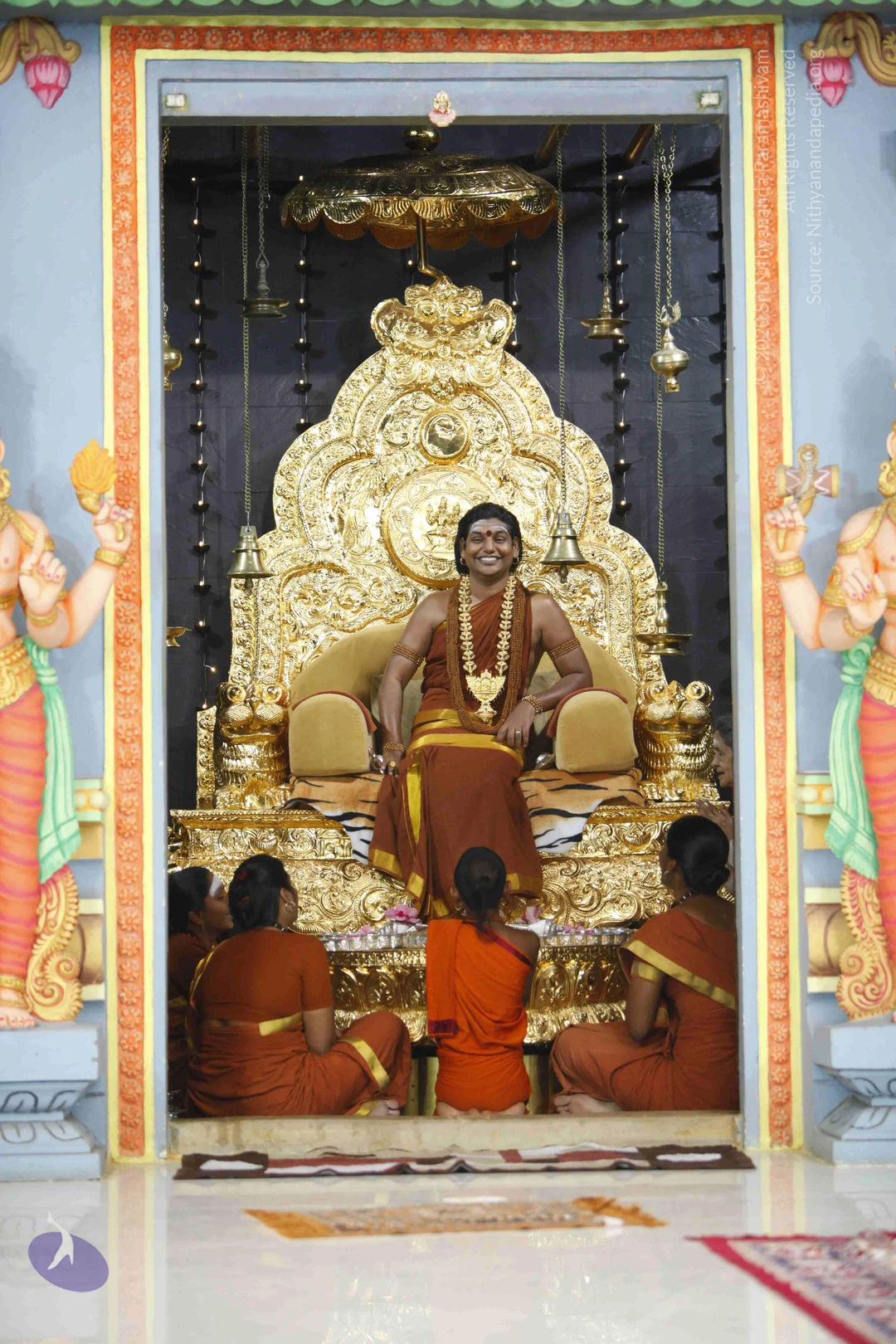
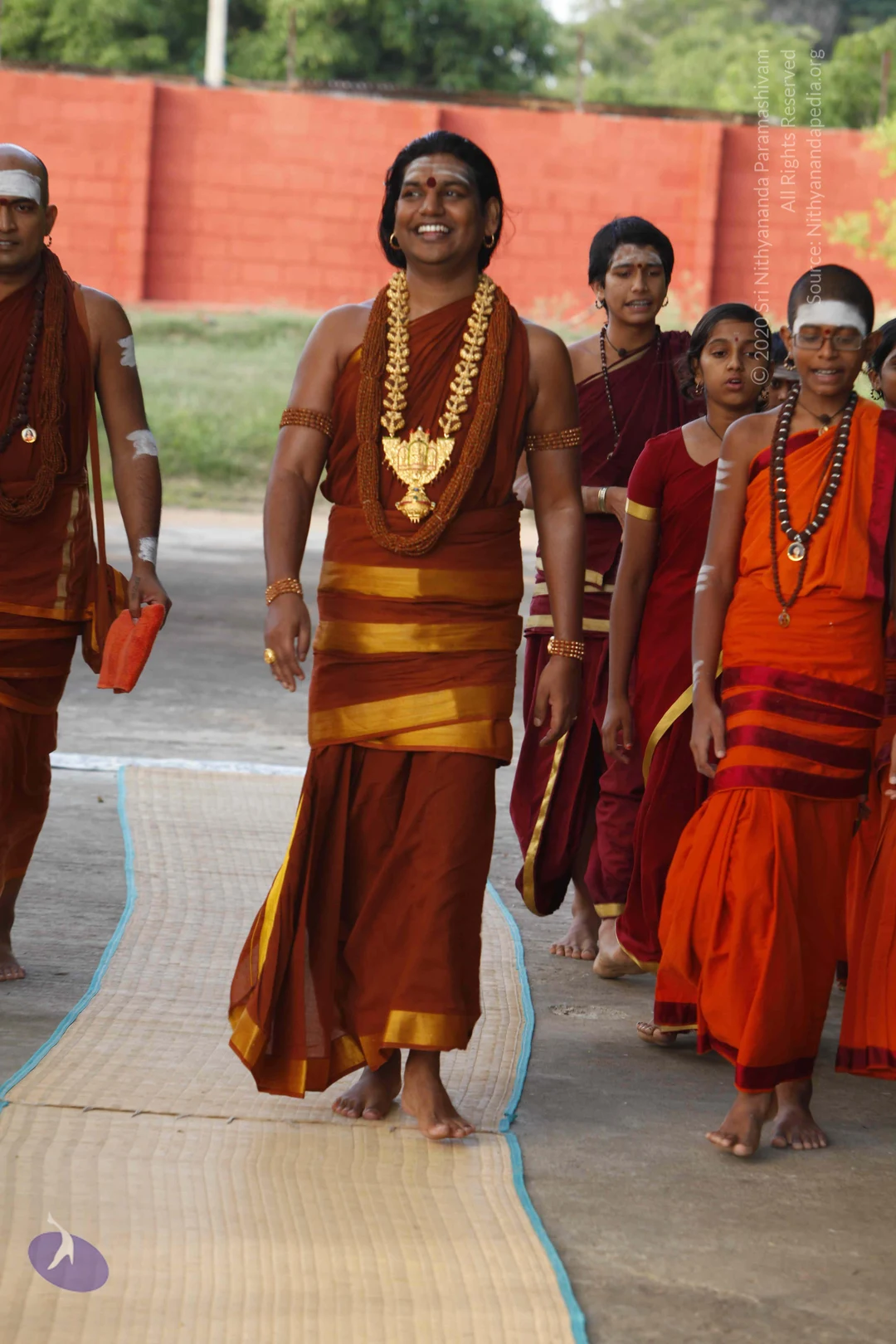
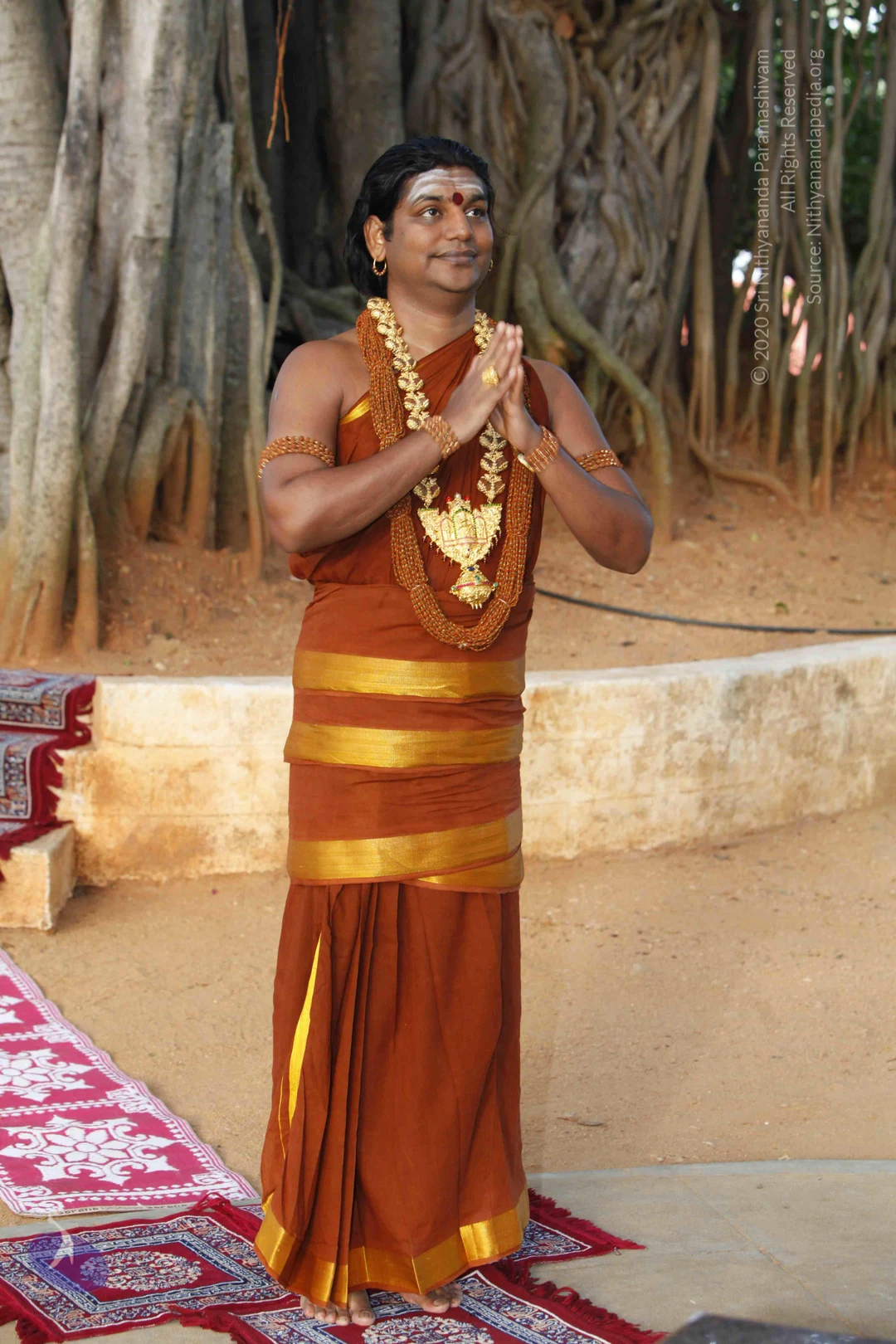
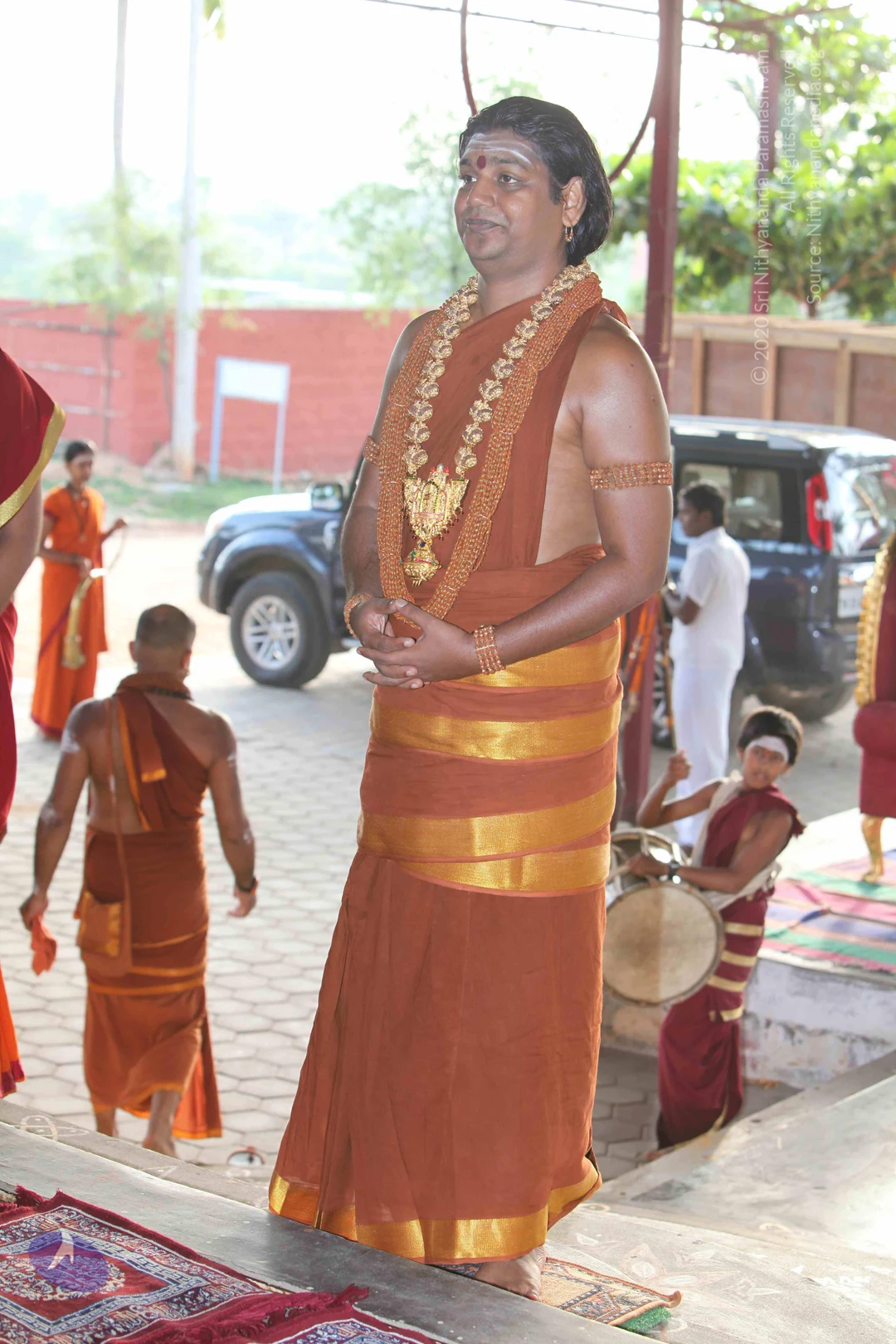
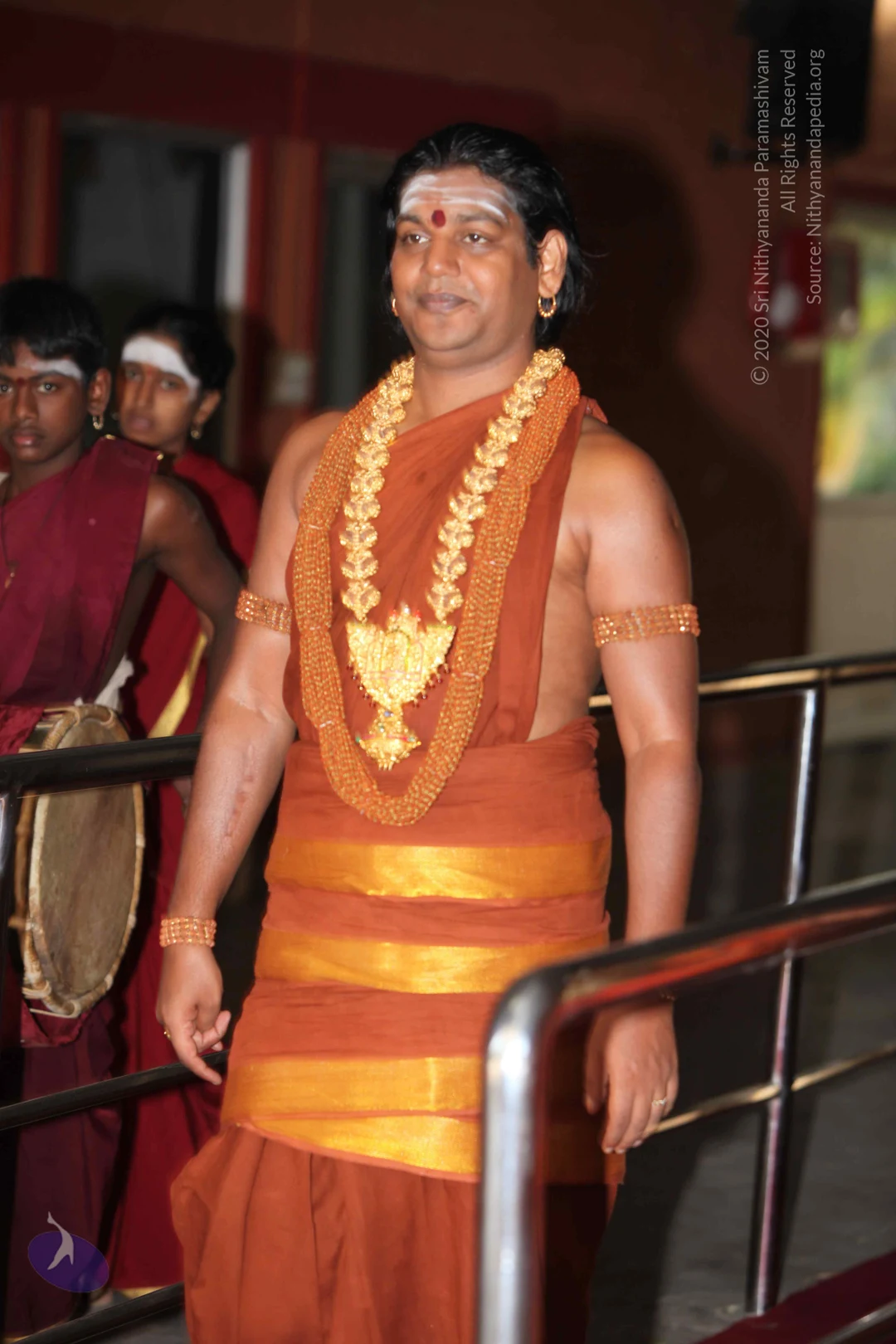
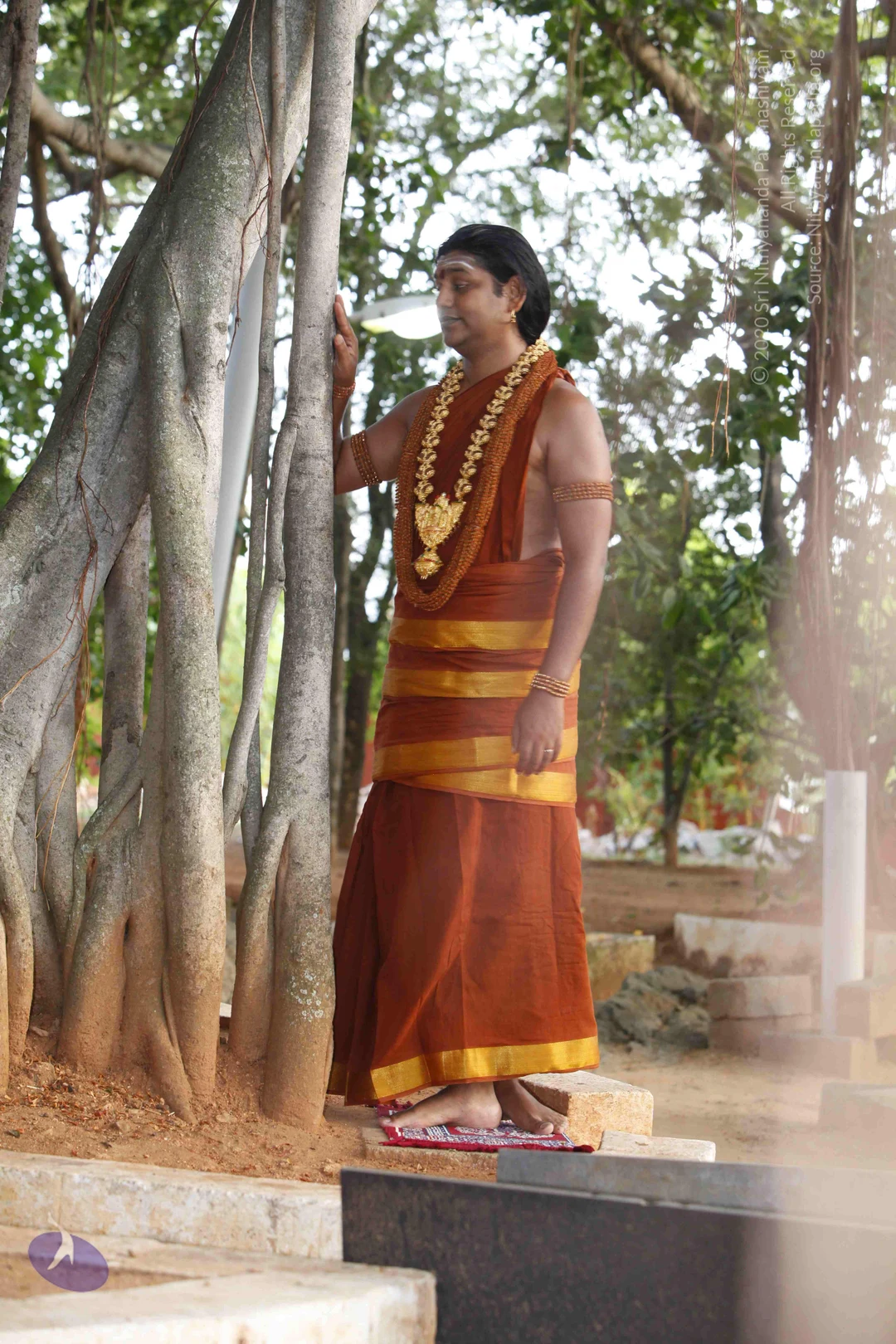
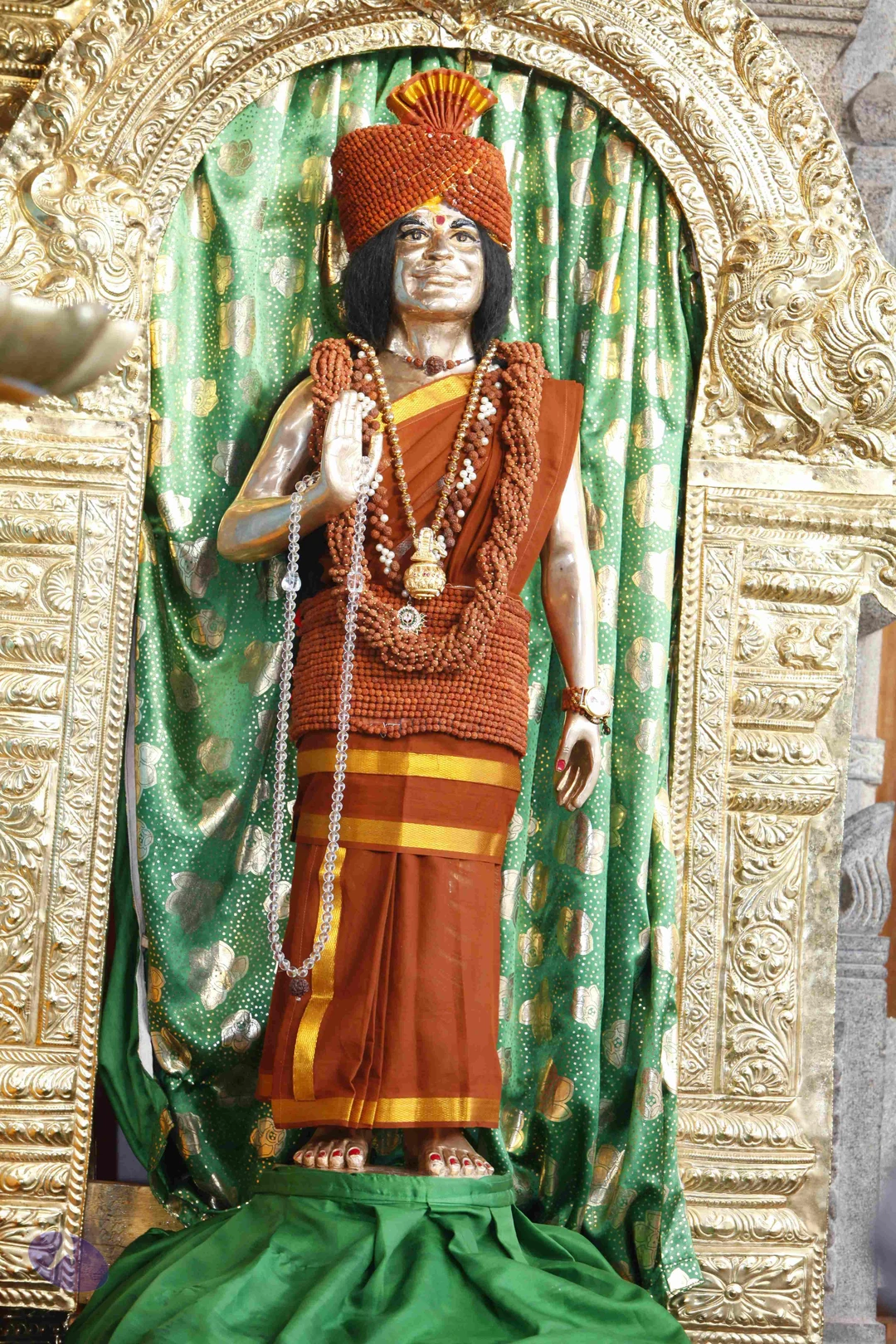
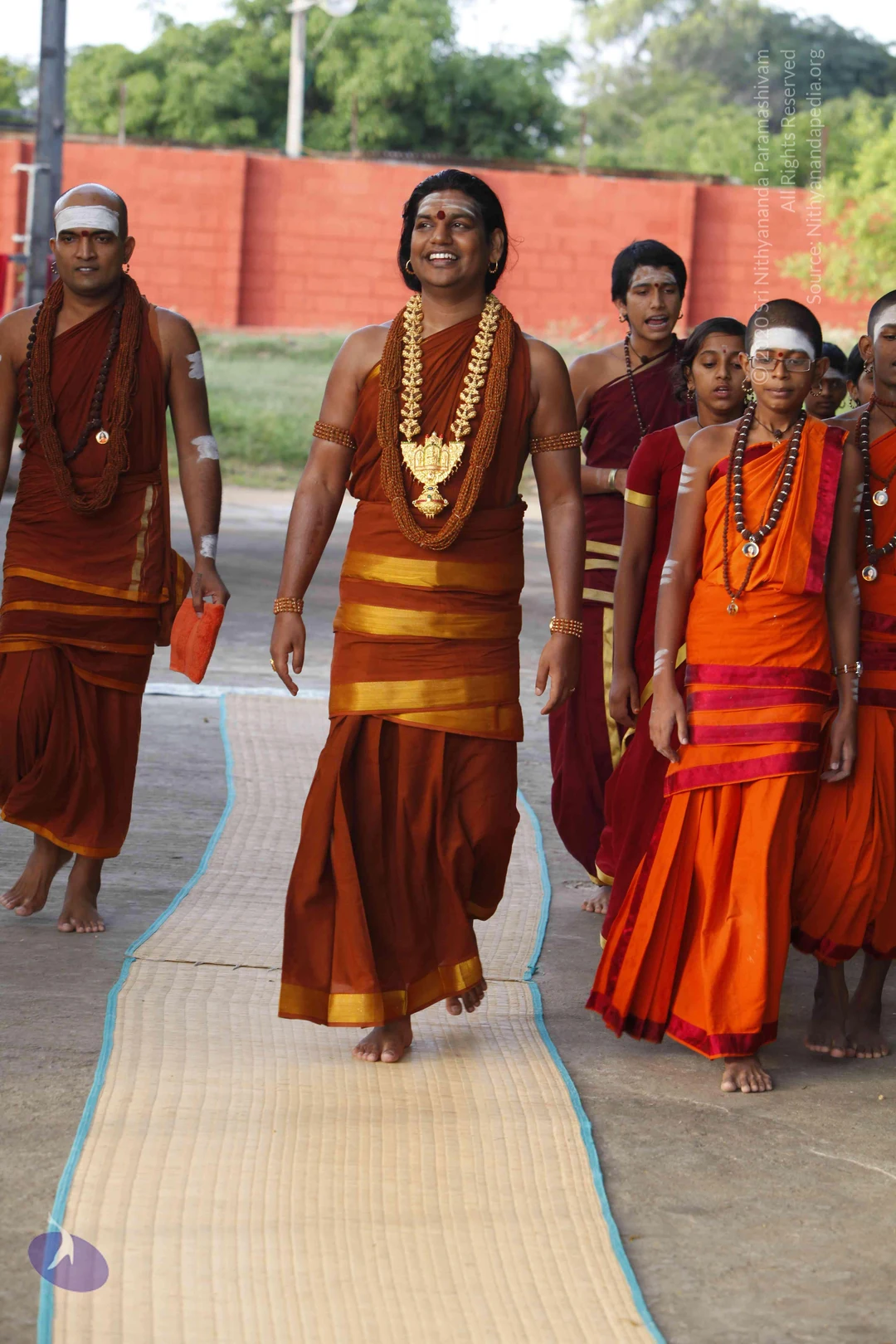
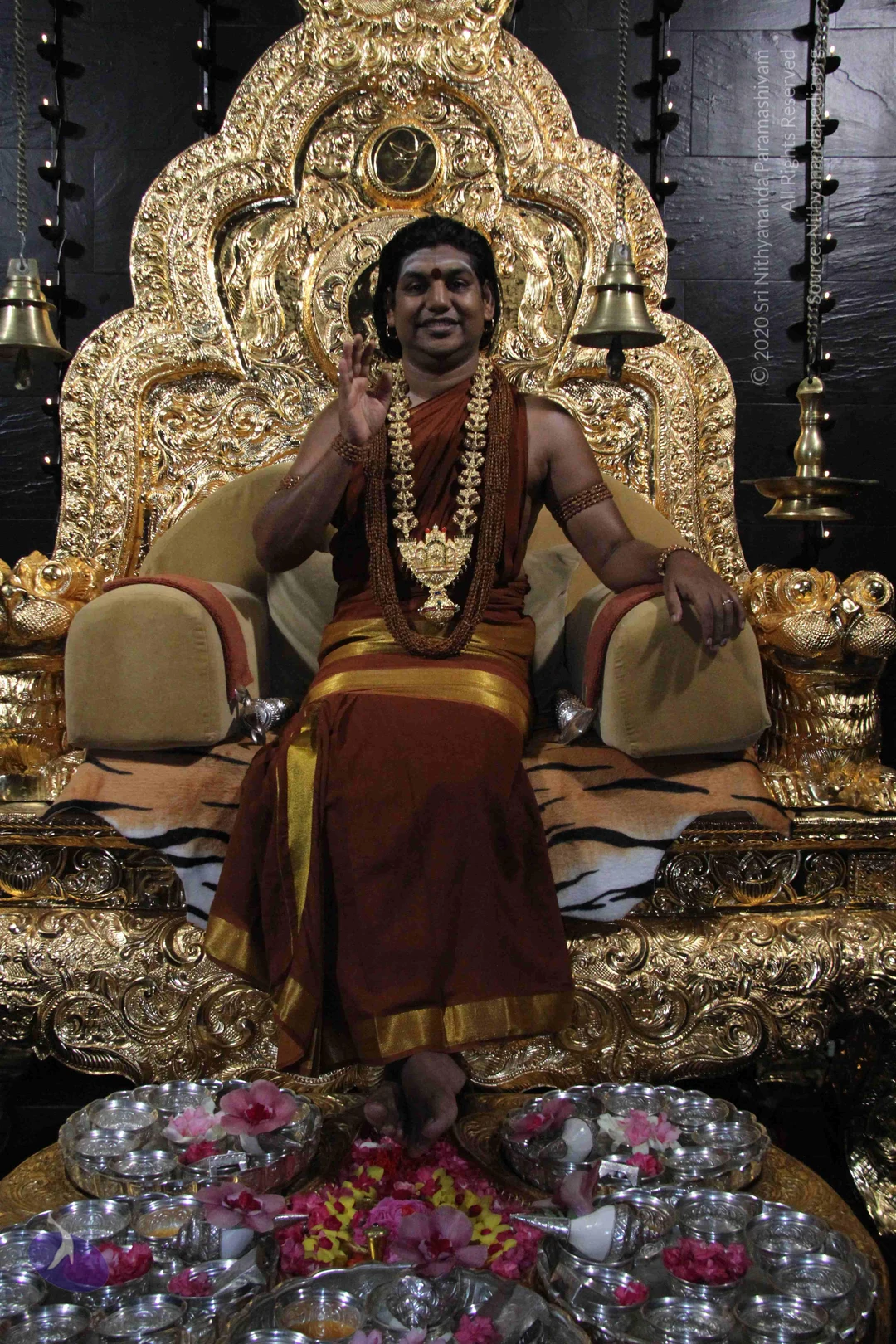
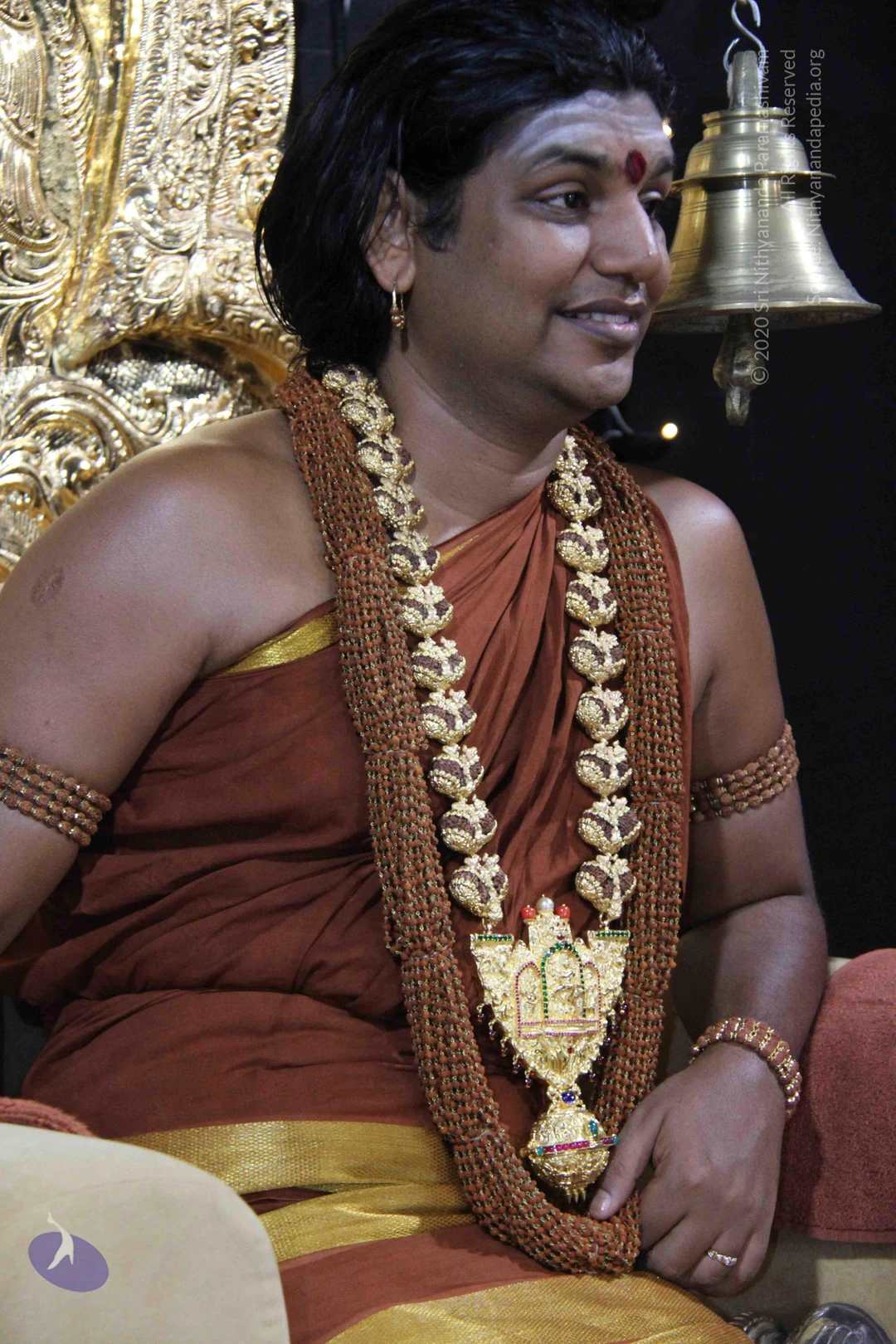
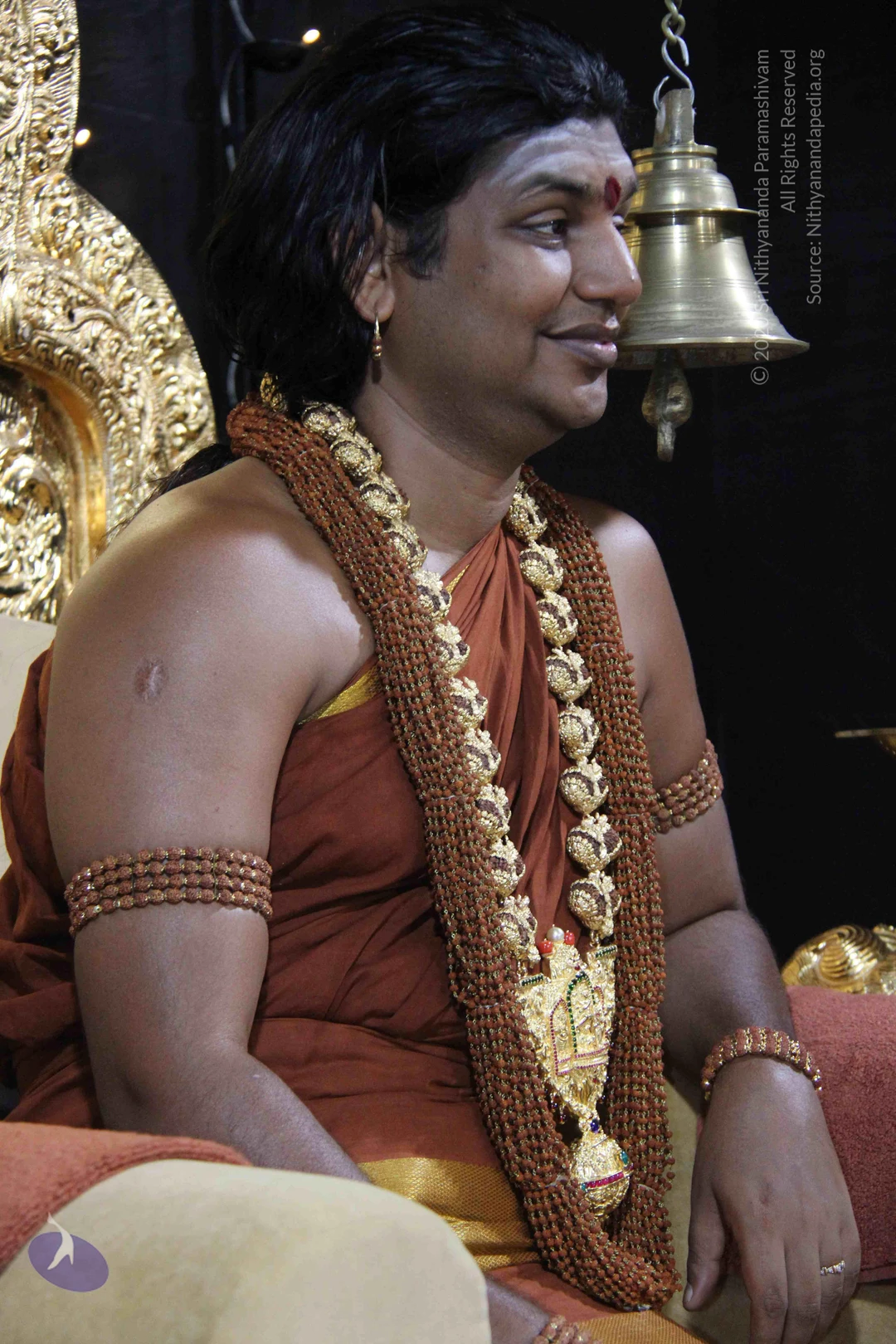
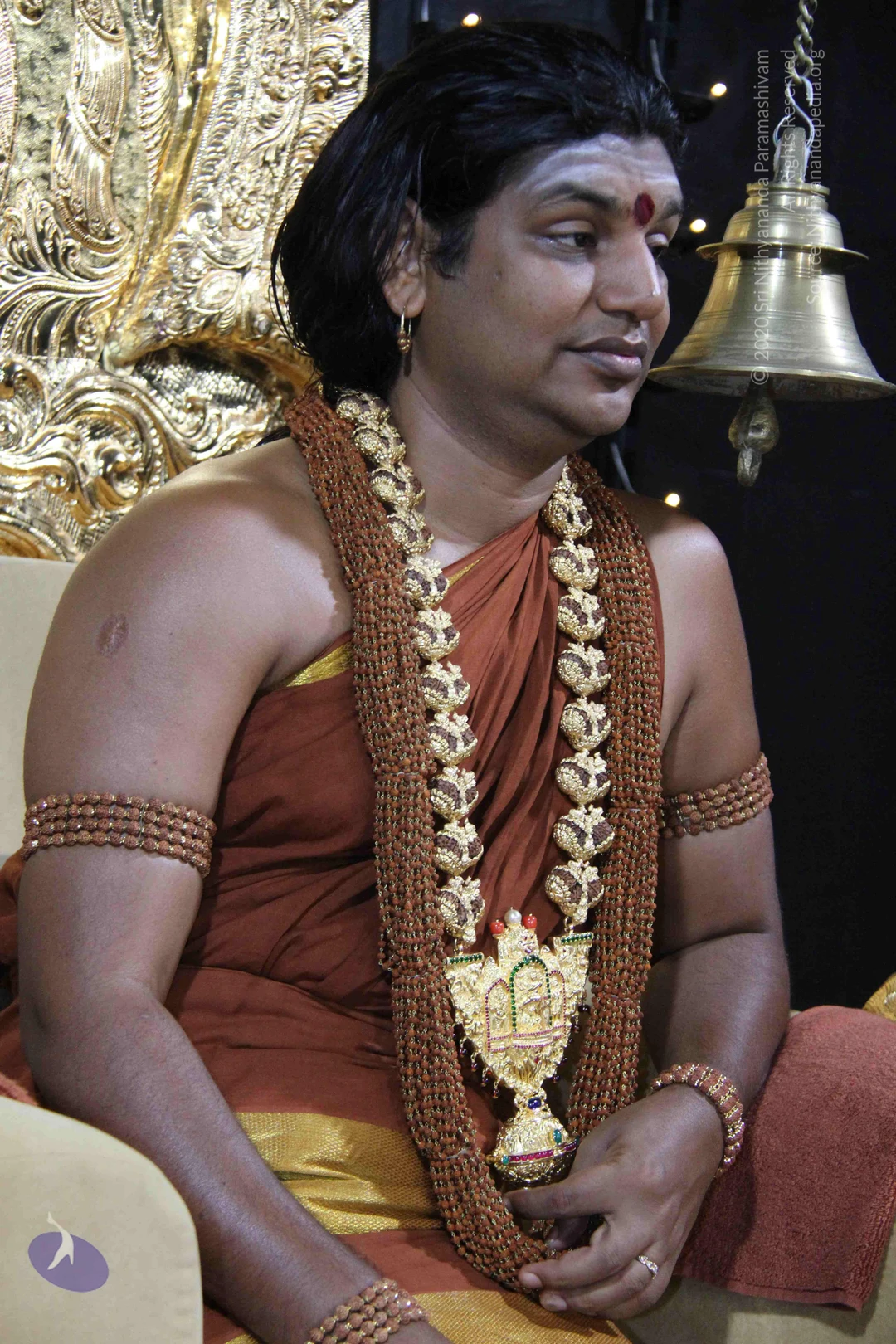
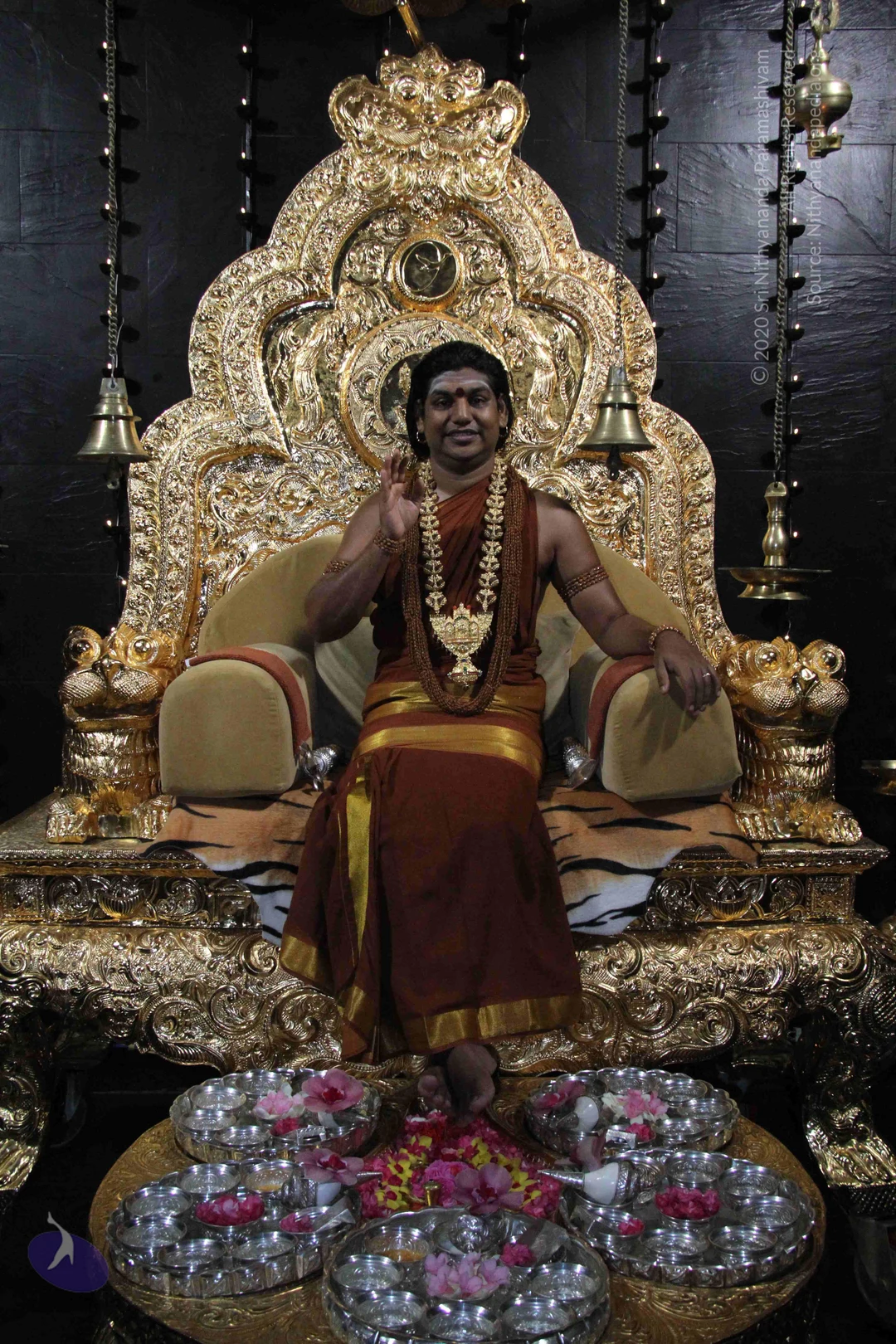
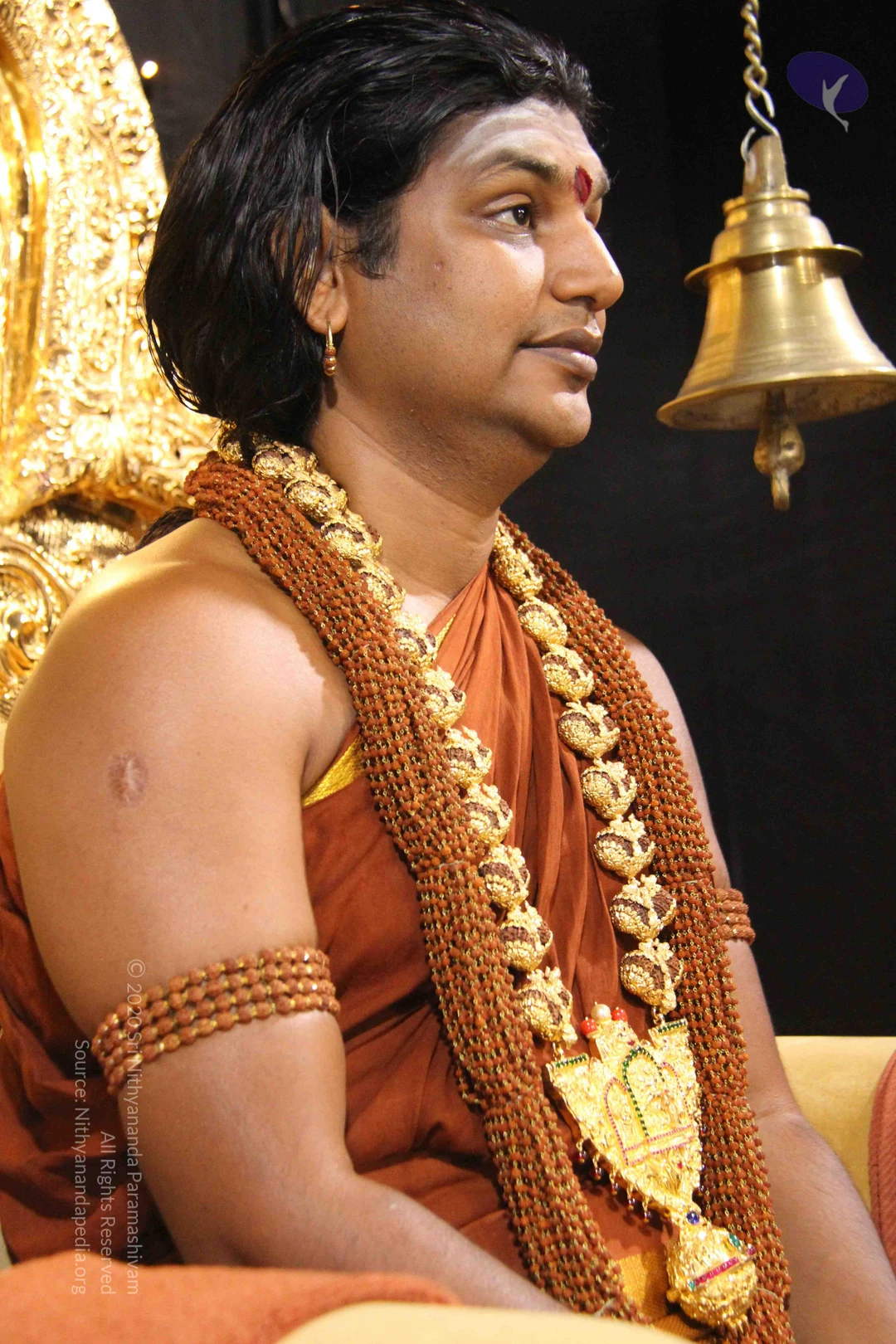
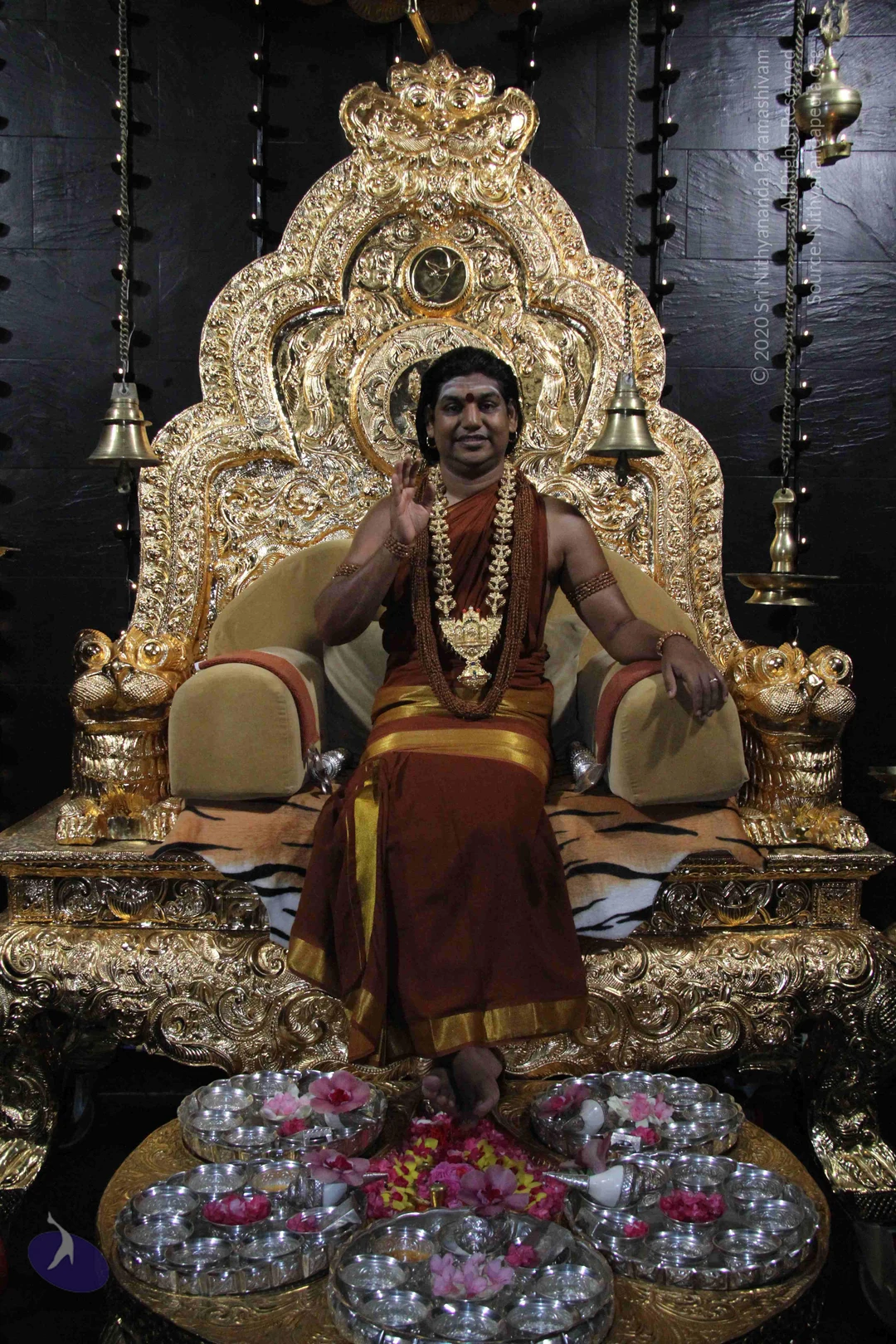
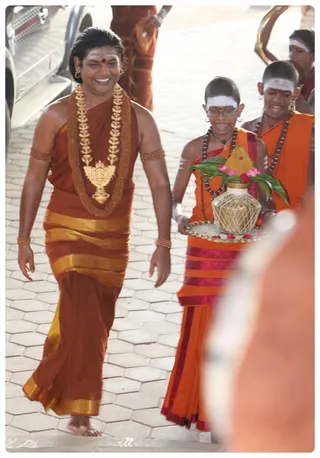
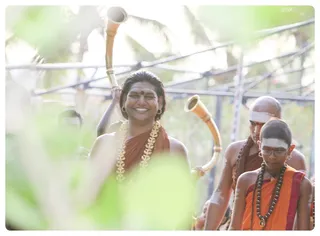
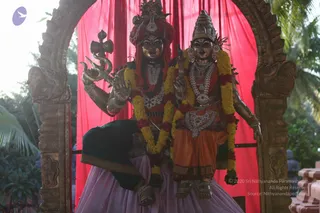
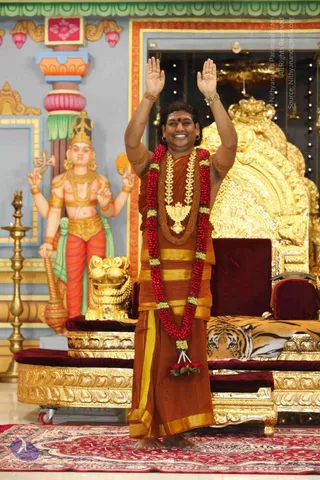
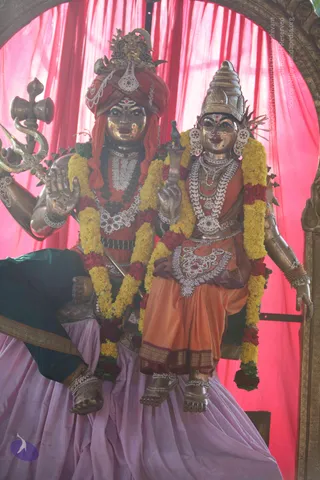
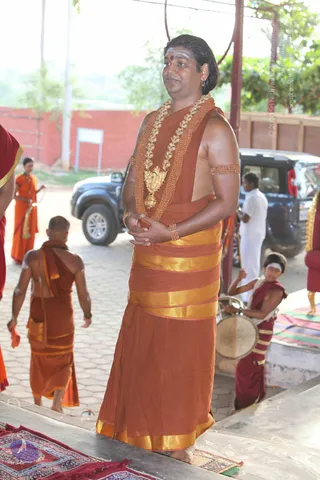
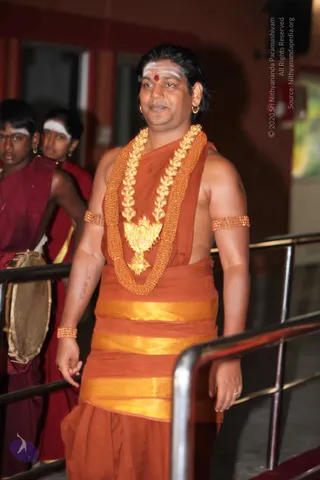
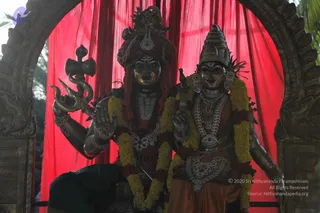
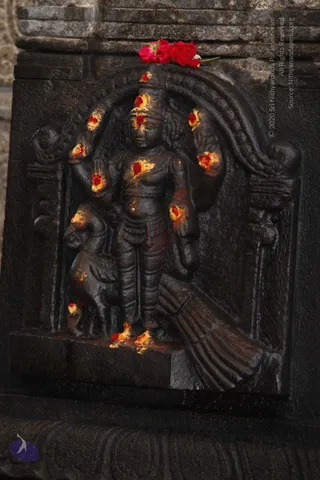
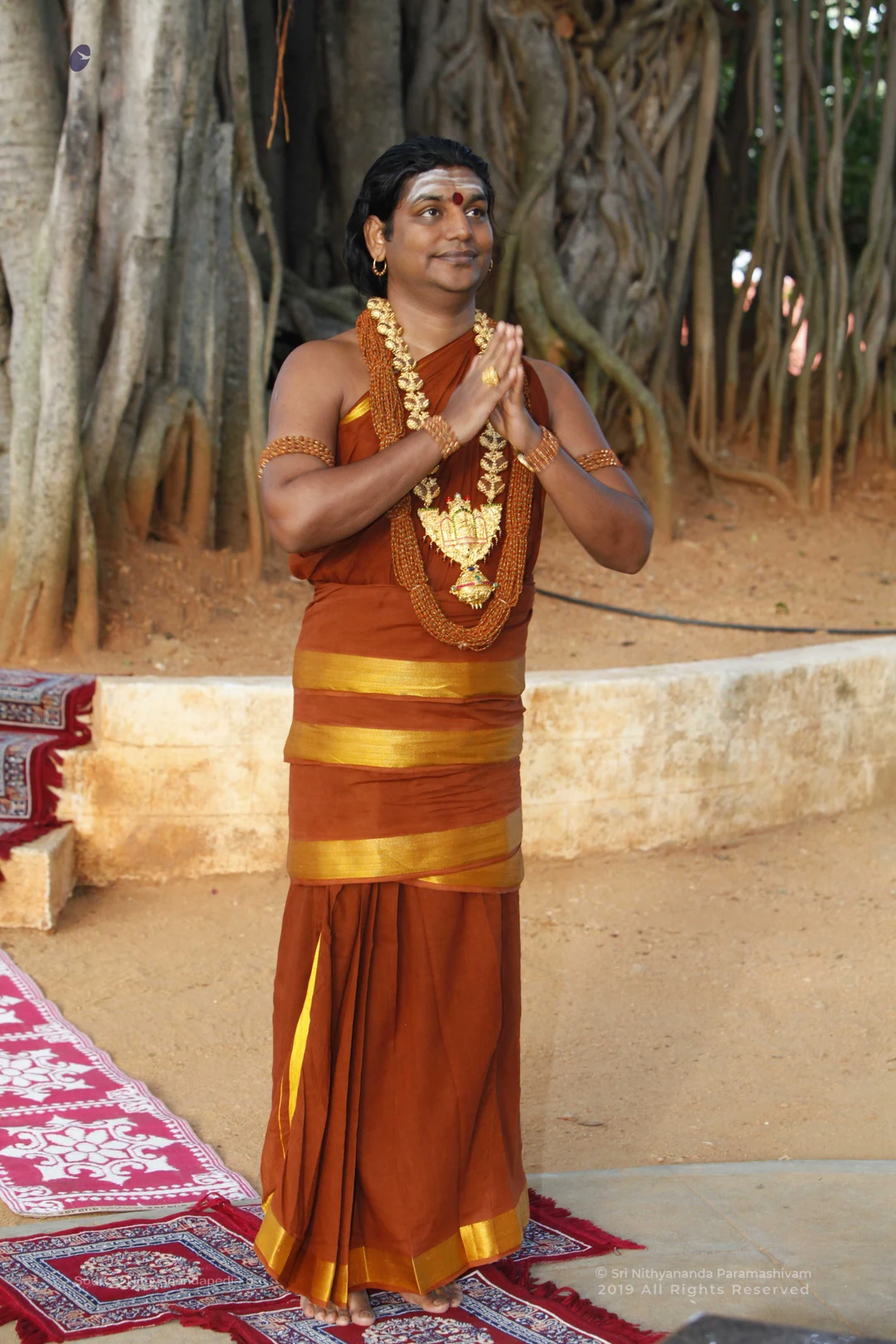
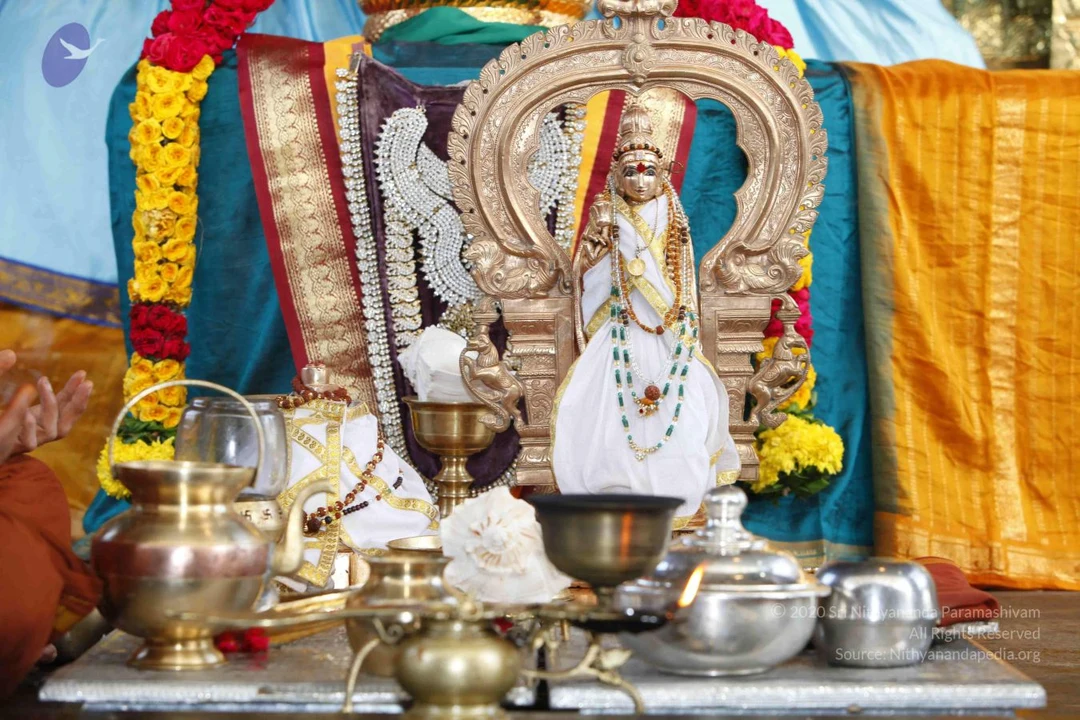
A man stands barefoot on a red and white patterned rug in an outdoor setting with large banyan tree roots and a low sandstone wall behind him. He wears a rust-orange dhoti and matching shawl with wide gold borders, multiple strands of orange rudraksha-style beads, and an ornate gold pendant with a lotus-like design over a gold garland. He has gold bangles on his upper arms and wrists, a white vibhuti marking on his forehead with a red kumkum dot, and holds his palms together in a namaste gesture while gazing upward. Swamiji (probable): long swept-back dark hair, distinctive rudraksha beads and ceremonial gold necklaces, orange ceremonial clothing, consistent with the page's Swamiji reference.A photograph inside a temple shrine with a grey stone altar in front of a golden-framed niche holding deity murti dressed in blue and green cloth, with flower garlands in red and orange and gold necklaces. A seated man in saffron robes sits cross-legged at the left of the altar with his palms pressed together in prayer, and a standing man in an orange-and-gold dhoti, with a gold-and-white garland and a bare chest, walks past on the right. Brass puja vessels and lamps rest on the altar. Red curtains frame the left edge and carved stone pillars surround the shrine.A dark stone relief carving of a four-armed deity standing in an arched niche, with a small animal. The figure is smeared with red kumkum and yellow turmeric paste on the body, arms and base, and red flowers rest on top of the arch. The carving is set in a weathered stone temple wall. No people are visible.

June 30 2013

Original wiki page
Contents

Title:

Align Your Thinking and Being

Description:

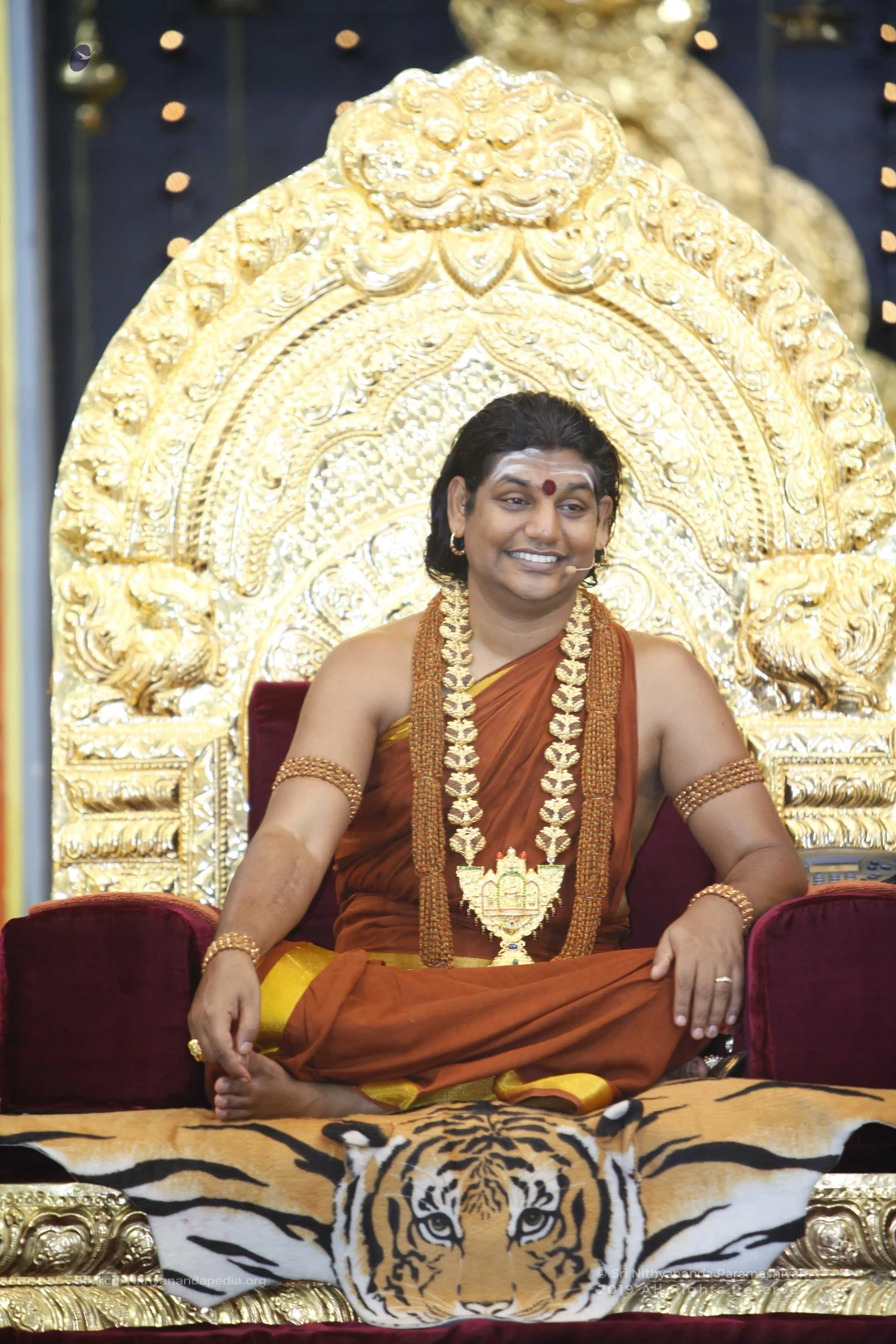
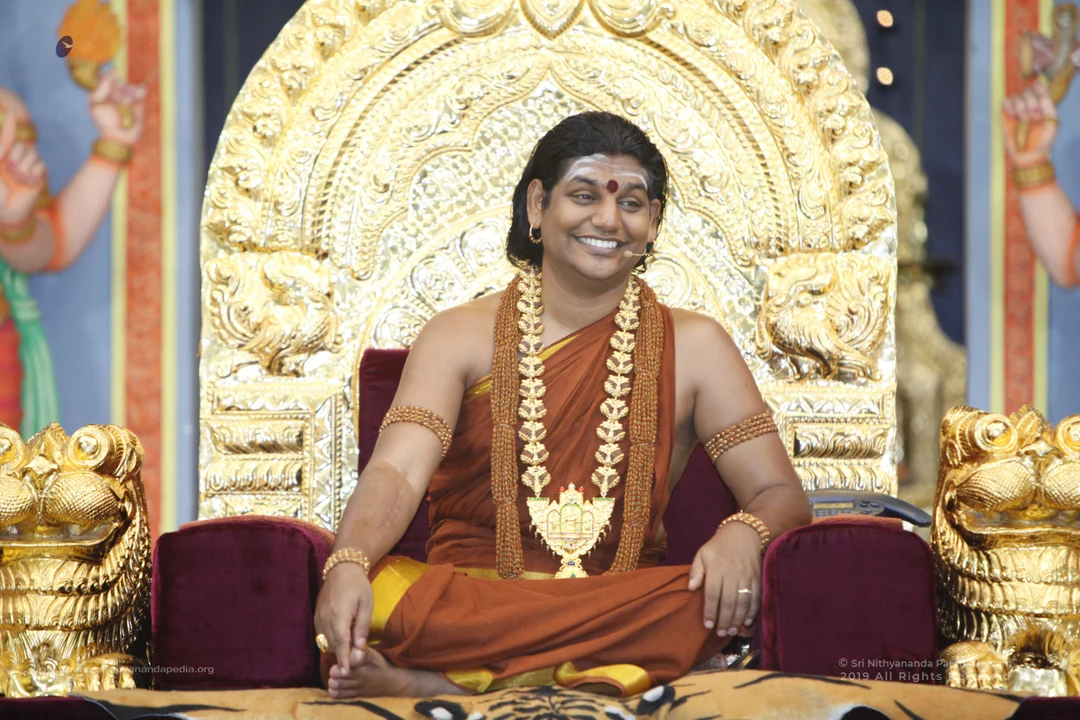
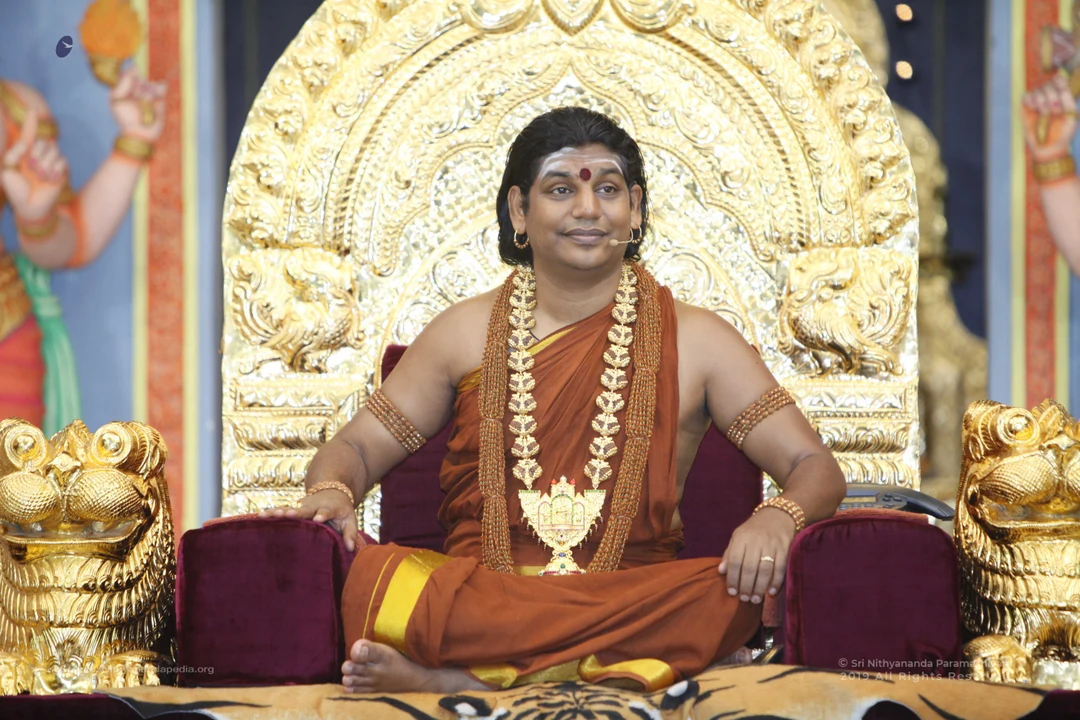
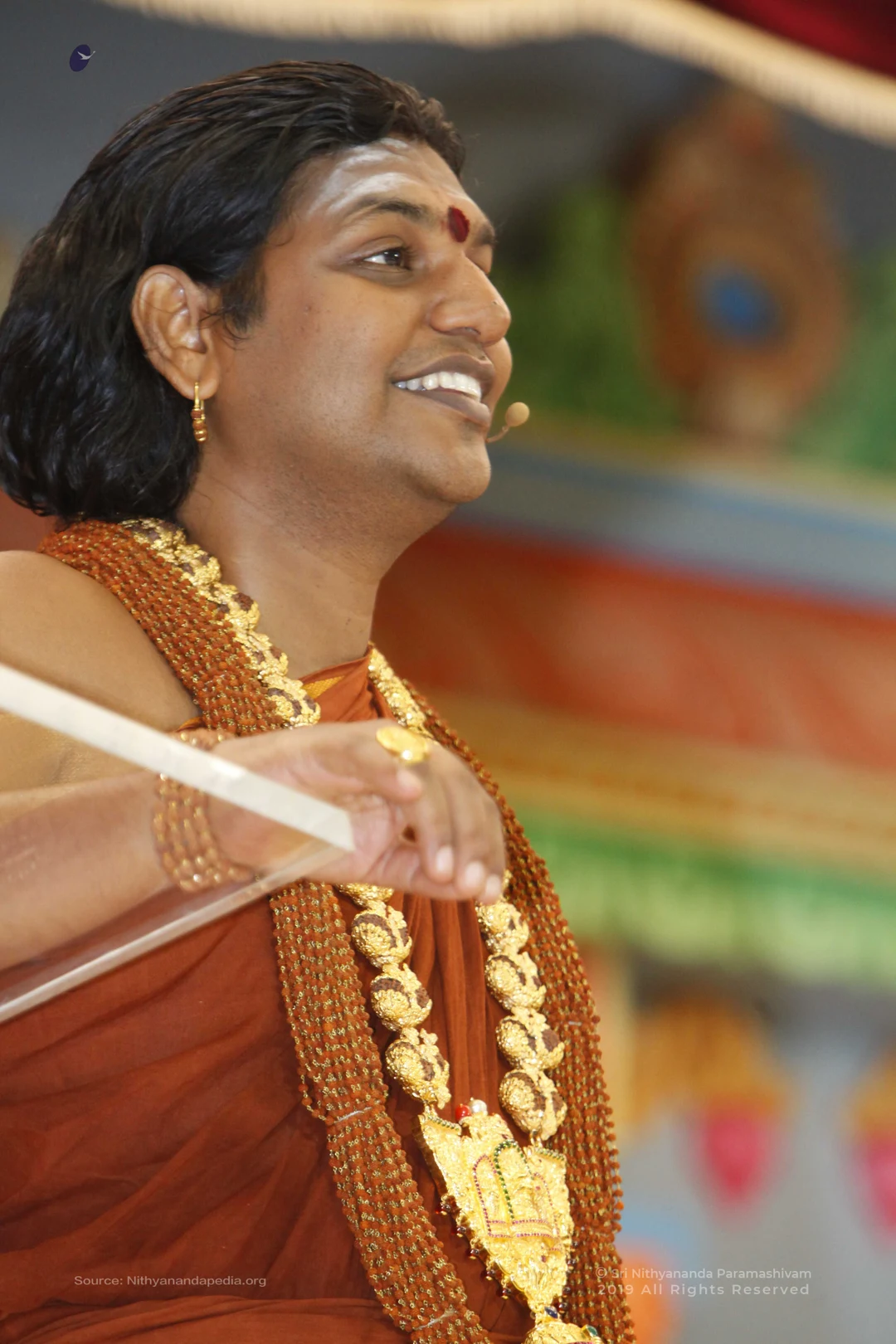
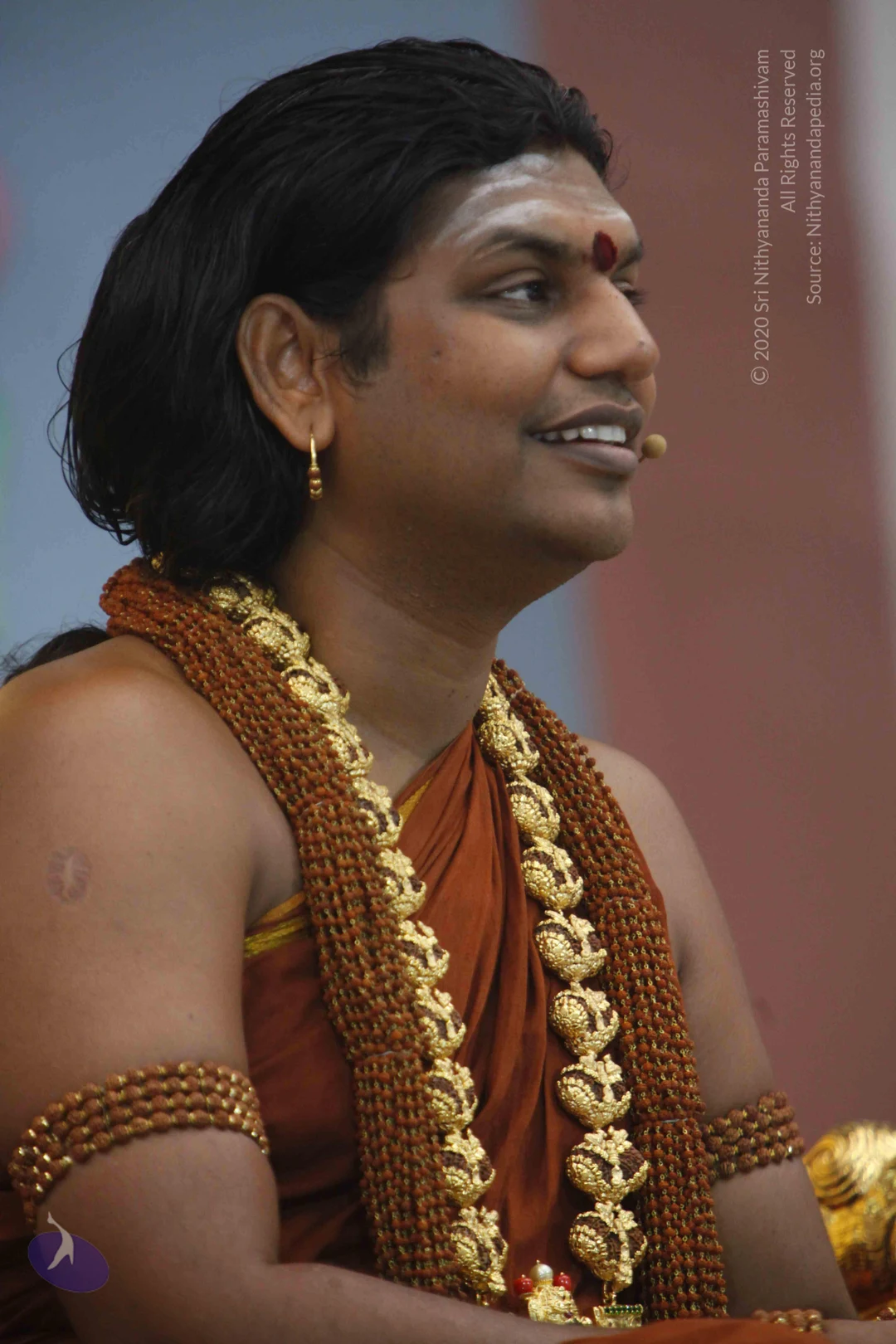
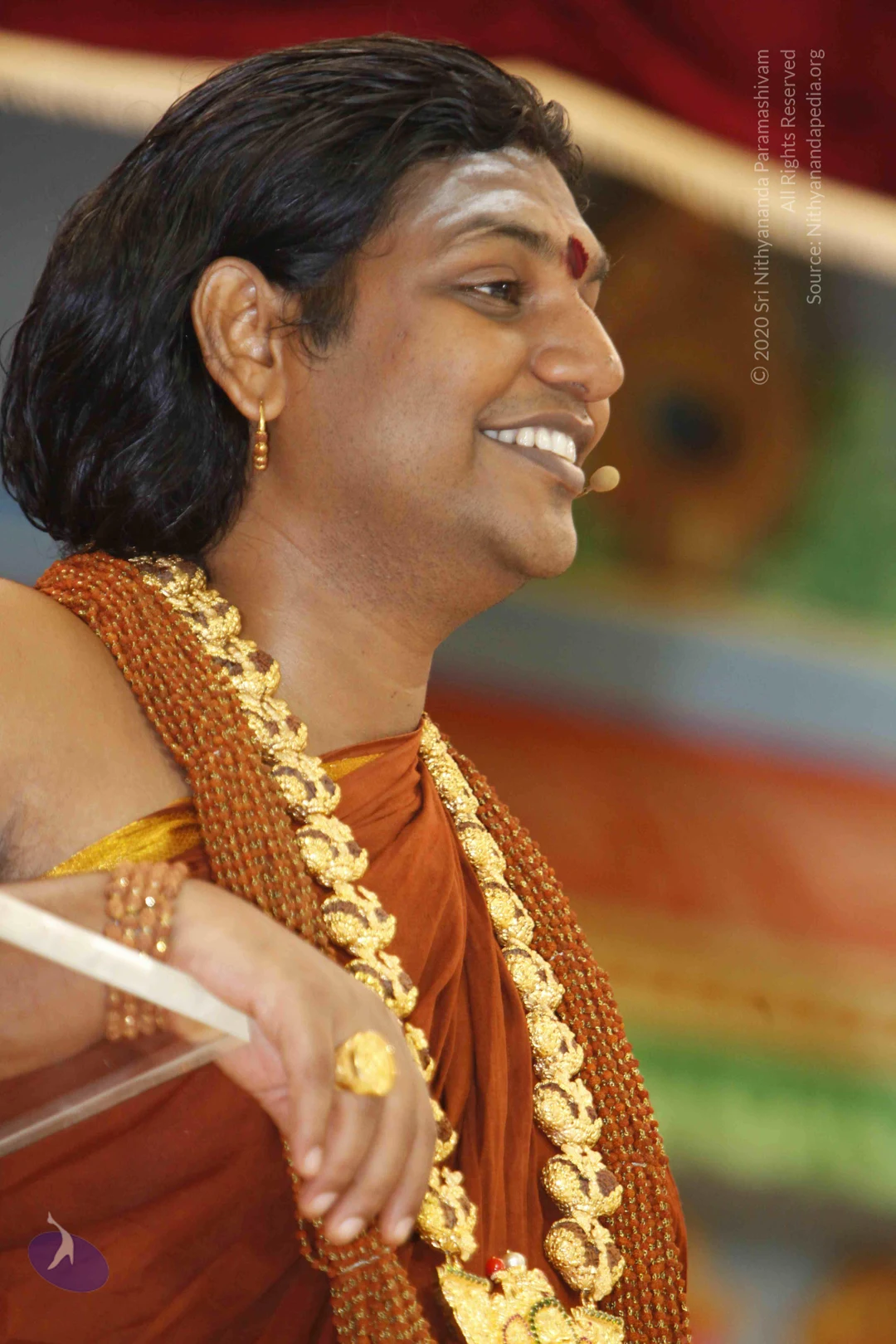
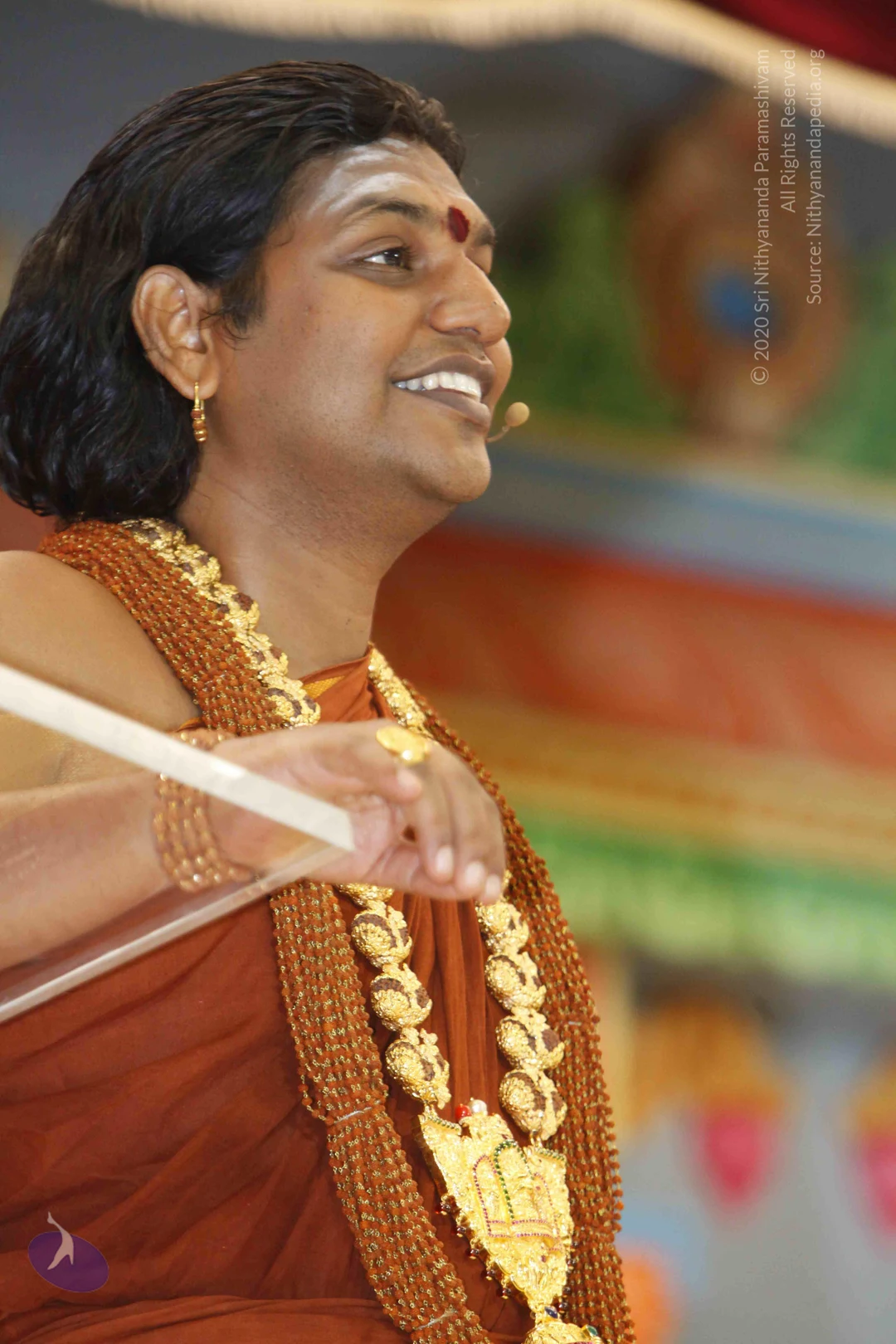
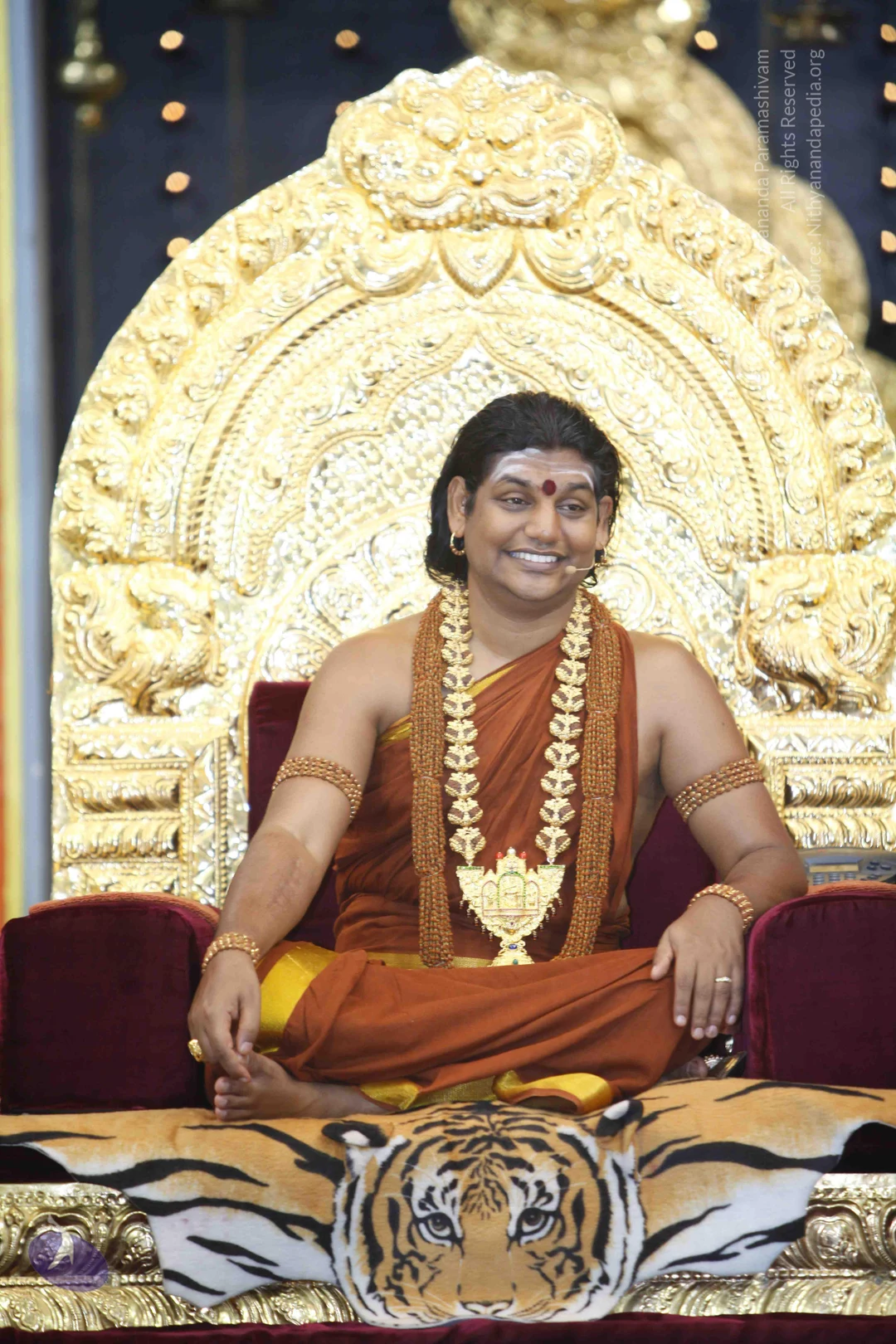
In today’s morning Satsang, Paramahamsa Nithyananda asks us to contemplate a very important question: Why are you doing what you are doing? In our lives, many of us forgot how to sustain and align our beings with our thought current; we are completely unaware of our thoughts. When we stop asking how and why, we continue to function out of our patterns and forget the context in which we are living our lives. Paramahamsa Nithyananda explains that the Nirahara Samyama is a powerful method to teach us how to continually align our beings with our thinking because your body will be constantly reminding you!

Link to Video:

VideoAudio

Transcript:

I welcome all the devotees, disciples, samajis, satsangis sitting with us around the world at this moment in Sadhana TV, Lotus News Channel, and 28 places in two-way video-conferencing in 22 countries around the world.

Blessings to Oklahoma for installing Meeankshi Deity. Oklahoma is the best kept temple among all our temples all over the world.

I welcome you all with my love and blessings.

Today’s subject for Nithya Satsangh is, “NIRAHARA SAMYAMA”. Again, I will expand on Nirahara Samyama.

Whoever wants to start the Nirahara Samyama, from tomorrow we are starting the Level-1. Please understand, the Nirahara Samyama, from tomorrow we are starting.

· Level-1 will be two days. Then one day break.

· Then Level-2 will be seven days. Then one day break.

· Then Level-3 will be eleven days.

So, you will also be learning a Kriya for Nirahara Samyama from tomorrow. Please understand, you will be doing the Kriya directly seeing the satsang in the morning. My only request, you should be doing the Kriya live. Only then the Nirahara Samyama will happen in your system. If you do this Kriya on your own, the same effect will not be there. So, do not try to play. Do not try to take the risk of recording it and doing it later on. You can record it and do later on, but it will not help you have the effect of Nirahara Samyama. It will help you to be more energetic, to be more alive; for that it will help you. But to experience the Nirahara effect, you need to meditate live, you need to do this Kriya live.

Multiple ways you can enroll for this Nirahara Samyama which is free. Of course, you don’t need to pay anything; it is free. But you need to register so that we send you the procedures of dos and don’ts to your mail ID.

First, the multiple ways you can register:

· Visit our website http://www.nithyananda.org and register for Nirahara Samyama in the events section. That is one.

· Second, you can just email us at [email protected] with your name and phone number .

· Third, you can call the number in the screen 080 2727 9999 and register your name for the Nirahara Samyama.

In any one way you can register, but everyone is expected to register. No one without registering will do it on your own. If you do it on your own, you are on your own! You need to know. You are responsible for all the results!

Tomorrow, before coming to the Nirahara Samyama, eat fully, as if this is the last meal you are having. And it may be the last meal! Because, usually after Nirahara Samyama, some people just stay forever without food! So, eat fully and come for Nirahara Samyama Level-1 initiation. If you feel hungry or tired or low level energy, etc., you have to break the fast and eat immediately. You can drink juice, soup, buttermilk, anything liquid and drinkable, but nothing to chew or solid. During the Nirahara Samyama you can drink juice, soup or buttermilk, anything liquid and drinkable. Means, first we remove the job of digesting, means the chewing and digesting job. And when the chewing is stopped, the taste is taken away. So, first I am removing all the pride and taste components from your food, from your eating pattern. So, step by step, you can conquer the pattern.

Understand, this Nirahara Samyama can literally do wonders to you. It can just shake and take you beyond so many sufferings which you go through, so many of the useless patterns with which you are wasting life. Especially if you feel whole day you are doing something, but nothing is happening end of the day. How many of you feel that way? (People raise their hands). All of you should do Nirahara Samyama. It means you are caught in the useless patterns. You are caught in complete negative, useless patterns. You are unaware! I tell you, if you record whatever is going on in you, whole day and hear it again, you will understand. A simple worry, if somebody disrespects you, how you hate them and how you don’t want to be disrespected! Just that pattern, you will see, almost per day, ten hours is swallowed by it! One single pattern, ten hours is swallowed by it!

And the next funny thing, please understand, the next funny thing, sometimes that you should not have anger, you should control anger, that pattern alone will be eating fifteen hours of your day, but twenty-five times you will be getting angry every day. You will see, very funnily, the same pattern which eats your time does not get killed also. You will be whole day be contemplating, ‘I should not be angry! I should not be angry! I should not be angry! I should do something to get out of anger. I should not be angry.’ And the moment some situation comes….come on! over! You will explode! ‘I should not be depressed! I should not be depressed! I should not be agitated’ The moment the some small situation comes, you are out, power is gone, fuse is gone for the next ten days!

Understand, most of the time you waste so much of your energy. Same way, whole day you will be thinking, ‘From tomorrow I will do the akhada everyday, everyday, everyday’ Next day morning, during sleep! Over! Whenever, you are functioning out of pattern…..understand, functioning out of pattern is one more pattern which you won’t be able to break. Functioning out of pattern is one more pattern. Whole day if you are thinking you should get out of sleeping pattern, early morning you will be stuck in the sleeping pattern! Most of your decisions are not conscious decisions. It is routine, mechanical decisions. There are some speakers, I have seen, just as a robot they sit, they are switched off, and they go on talking! They go on talking. Most of the time you are not even aware of what you are talking. What you are thinking inside. It goes on based on the pattern, it goes on based on the pattern.

HINDI

Understand, one of the biggest loss human-beings has, is the thought current and the Being flow, both get separated. It is literally like your life is being stolen away from you. What for you are doing what you are doing, neither you know nor anybody else knows. See, it is like somebody comes to our Welcome Center and that guy who is sitting there beats you left and right! Left and right you are beaten! And you ask, ‘Why I am being beaten?’ He says, ‘No, ask my superior.’ Then you go to the superior, ‘Why I am beaten?’ He says, ‘No, ask the Structuring Department.’ You go to the Structuring Department, He says, ‘ask the Administration.’ You ask the Administration, they say, ‘Ask Swamiji!’ And you come to Swamiji and I say, ‘No, I don’t know!’ Then who is responsible for what is going on? Understand, exactly this is the way your being is functioning.

You don’t take all your actions and thinking to the logical conclusion. Please understand, 99% of the time, after you get the beating, when the Welcome Center says, ‘Ask my superior’, you don’t go to the superior. Even if you go to the superior and the superior says, ‘Ask my Admin team…’, you don’t go to the Admin team. Even if you go to the Admin team and they say go to Structuring……that’s it! Over! That’s it! 100% of the people never cross the Structuring! Understand, in your case also, you do not discover the “Why”, “For What” and “How” you are doing things. Every day you feel certain powerless moments – boring, tired, why is this life like this? You feel, but you never take that to the logical conclusion. You don’t ask yourself till you get the answer. Why? Why? Why? You don’t take your thoughts, words, deeds to the logical conclusion. See, the “Why” in you should be so alive like a fire that should burn all the karmas. I tell you, just if the “Why” is alive, ‘Why I am feeling powerless?’, ‘Why I am feeling tired?’, ‘Why I am feeling sick?’, ‘Why I am feeling depressed?’, just if the “Why” is strong enough to take you to the logical conclusion, your problems will be solved.

As I said, if the Welcome Center says, ‘Ask my boss’, that’s it! After that you forget, you forget and go to the kitchen department. They beat you there, They pour hot water on you and pour little hot tea also! You ask, ‘Why are you doing this to me?’ Kitchen says, ‘Ask my boss, the chief cook!’ Then you go to the temple. That fellow puts camphor on you and puts a little fire also. You ask, ‘Why are you doing this to me?’ He says, ‘Ask the Chief Priest!’ You forget to sustain your being with your thought current. Listen, your being gets….always gets disconnected from your thought current. Your thought goes independently, independent of your being. This is the most unfortunate thing. It is literally like you are robbed of your life. Why you do what you do!

Sometimes I can see people are such crazy ! See, it is not that they are not sincere. They are very sincere to the ideal they have taken up. But they will exactly do the opposite thing. Because the attitude of asking “Why” needs awareness and you forget to ask “Why”. Understand, because the attitude of asking “Why” needs awareness. See, if you ask the Welcome Center, ‘Why are you beating me?’, they will say, ‘Alright, go to my boss!’ Till you go to the boss you don’t remember what you are supposed to ask the boss and you forget. You go to the Kitchen Department and they ask you, ‘Why did you come here?’ And you say, ‘I came here to have a cup of tea.’ And they pour the tea on your face! Hot tea! Then you say, ‘Why did you guys do this?’ They tell, ‘Go and ask our boss!’ Then you go to the temple. By the time you forgot what for you went to the temple. And they ask you, ‘Why did you come to the temple?’ You say, ‘I am feeling burning, burning!

20 min – end

But I don’t know why!’ That fellow thinks you want to get burnt and puts the camphor on you! No! When you listen, you feel like laughing! If you look into your life, exactly this madness only is going on. The “Why” is not kept alive in you consistently.

Why are you doing What you are doing? Understand, just hold on to this one question – “Why are you doing What you are doing?” Understand, you need to know Why are you doing What you are doing. To keep this one question alive, Why are you doing What you are doing, you need completion. If you just keep this one question alive, “Why are you doing What you are doing?” and able to take this one question to the logical conclusion in your life, I tell you, you will be enlightened! You will radiate Enriching! You are so broken, piece, piece! Why are you doing What you are doing? Listen, “Why are you doing What you are doing?”, that is the most powerful process, methodology.

HINDI

Listen, Nirahara Samyama is the powerful way of reminding you to align your being and thinking. When you do the Nirahara Samyama, you cannot forget why you are doing it. Because, constantly your body is going to remind you that you are doing something! This is the best way to take “Why you are doing What you are doing” to the logical conclusion.

Understand, and I tell you one more thing, if you fast, in the dream you will be dreaming as if you are feasting, eating! My Nirahara Samyama participants, not a single one of you will have even a dream of eating! You will not have a dream you are eating! You will not have a dream of your feasting! Because here you are made to understand Why you are doing what you are doing. The “why”, the “why” becomes reality. The “Why” is aligned to your being.

Listen, this one truth you need to understand very sincerely: “thought flow” and “being flow”. If the thought flow is not connected to your being, thought flow will be forgotten, Many a time, you will build so much of anger to go and attack your friend, shout at him, and scream. By the time you reach, you forget all the points, why you should scream at him. What you are supposed to speak. And when you go there, you say, ‘I came for a cup of coffee. I forgot the other things. When I remember, I will come back!’ When you remember, he is not there! If somebody records your whole day and you see it, either you will understand that you are already mad, or you are going to become mad! And if others see it, it will be a comedy show! For you it will be tragedy-comedy; for others it will be comedy!

Understand, it is unfortunate that human-beings do not align their thought flow and being. Thought flow just goes on and on and on. The “Why” is forgotten! The “Why” is disconnected from “How” and “What”. Whatever you are doing, however you are doing, why you are doing, when it is disconnected, you lose the spirit of life! I tell you, when the “Why” is disconnected from you, your life is stolen away from you, because context is life. Understand, context is life.

For me, I am giving you my own example. Coming and standing in front of the podium and talking is not my life. Why I am talking is my life! For you, coming early morning and sitting in the hall and listening is not life. Why you are listening is life! Why you are here, why you are listening, that is going to define your life. Sometimes you may be here because outside it is raining. Understand, it is not the content, it is the context. Sometimes, you may be inside the hall because it is raining outside. Same way, sometimes you may be inside the adheenam because life is very difficult outside. “Why”, “Why” is the life! I tell you, “Why” decides why you get what you get.

There are some people, just in one year or two years inside the adheenam or sangha, our organization, they will spend only one or two years in the organization, but they rise to that level in Enriching themselves and others! There are some who are sitting here for years. But still they are stuck, because “you here” is not your life; “why you are here” is the life! “Why”?

Understand! It is not the content but the context which encompasses the content, the context inside of which the content is delivered, which is decisive and which produces the result in your life. If you are here in this hall with the context that life is difficult outside, then due to the context of difficulty you will experience only difficulty, even if you sit literally at God’s feet! Because, context is decisive! The right context even to take sannyas is necessary. For anything, right context is necessary. First thing, I wanted all our Gurukul kids to learn is, “learn the right context!’

HINDI

Understand, listen, if you are in any confusion and suffering, do Nirahara Samyama, because if you have taken the decision of marriage due to wrong context, divorce is not the solution. Complete with the wrong context and create the right context. If you have taken sannyas due to wrong context, dropping sannyas is not the solution; complete the wrong context and develop the right context. Listen, developing the right context! I tell you, with the wrong context whatever you do will become wrong, because when you don’t know “Why”, when you don’t know “Why”, if the “Why” is not associated with the flow of your being, listen, if your thinking flow is not directly connected with your being flow, you just live without a purpose. Please understand! Even if there is no purpose, it is okay; but you will live life without a meaning! Sometimes, life will not have purpose, but it has a meaning. Right context, right context is required for life.

Whatever may be your problem, you are in depression, you are unhappy with your life, you are unhappy with your decisions, you are even not aware of why you decided what you decided, if you feel you are in a mess, you are caught in a soup, you are suffering, listen, whatever may be the space with which you are suffering, feeling powerless, do Nirahara Samyama. Because, with Nirahara Samyama, constantly the “Why” will be aligned to you. The “Why” will be aligned to you! Why you do what you do will be aligned to you! If “Why” is aligned to your being, I tell you, the whole problem will be solved.

If there are wrong reasons for your decisions, complete with those reasons; complete with those patterns. You don’t need to drop your marriage or drop your sannyas or drop your job, or drop your business, or drop your career. Understand, sometimes you would have become a lawyer for the wrong reasons. Now you don’t need to drop your lawyer profession. Now you don’t need to drop your lawyer profession. What is the wrong context? What is the wrong reason? Complete with that context. Complete with that reason. That wrong reason also may be the because of some powerlessness. May be you have become a doctor for some wrong reasons, but you don’t need to drop that doctor profession. Just complete that wrong context. The wrong context also originates from some incompletion. Complete that incompletion, complete that powerless pattern, drop that wrong context and build the right context.

I tell you, once I was asking one speaker, ‘Why are you speaking? If you open your mouth I don’t see anything logical in your speaking. I don’t think anything useful.’

He said, ‘Yes, Swamiji, I also discovered I don’t have anything to speak. But by the time I realized that, I had already become a popular speaker. And I have to speak because I am a speaker.’

There are fools who write just because they are writers, not that they have something to write! I tell you, sometimes people become doctors, not that they want to treat people; but with the wrong context they become doctors. Understand, whatever may be the wrong context, now you don’t need to drop the profession. See, you may be a speaker now because you already became a popular speaker. Now you don’t need to drop that speaking profession. Just complete the past incompletions and drop the wrong context. Now develop the right context. Now decide, ‘I will develop the right context. I will enrich myself and enrich others through this talking.’ You don’t need to develop anything new other than the right context to regain your life. Develop the right context, you will regain your life!

Whatever field you may be in, if you feel life is useless, you are feeling powerless in life, you feel life is week, you are suffering in life, you want to find a solution for life, I tell you, just find the right context, complete with all the past and the wrong context, develop the right context. Understand, the whole Sangha should learn this. When somebody comes to complete with the Sangha, the whole Sangha should remember this. Help each person who comes to complete, to find the right context. They may be doing mistakes. They may be foolish. They may be inauthentic. They may be lack of Integrity. Because they may have taken sannyas with the wrong context! I wanted all our sannyasis, Naishtika Brahmacharis, even Spiritual Activists to sit and contemplate today. Have you taken sannyas with the right context? Right context for sannyasis is, ‘I will live Integrity, Authenticity, Responsibility and Enriching and make people live Integrity, Authenticity, Responsibility and Enriching.’ This is the right context. Other than this, if you have any context for sannyas, out of any other context you have taken sannyas, it is wrong! It is wrong! It is wrong! Understand, if you have taken sannyas with any other context, all of you should complete, complete the past incompletion and drop the wrong context and build the right context. Whether you are a sannyasi, Brahmachari, Krama Brahmachari, or a Rishi, or a Spiritual Activist, or a lawyer, engineer, home-maker, doctor, religious leader, politician, whatever you may be, if you have taken politics because you are frightened about life, thinking politics will give you the protection, I guarantee you have taken politics for wrong context. For your whole life you will be frightened, you will be suffering with fear. You will never feel settled or secure. Because the context with which you have taken is wrong. Ultimately you have to complete even with the context of why you took the body! If you take the body thinking with the body you will have more pleasure, more joy, you are wrong! You are not going to have that forever!

Complete the incompletion of the past and drop it. Drop that wrong context and create the right context. Creating the right context means, new birth, you will have new birth! Today I want everyone of you to sit and find the right context of “why you are doing what you are doing”. If you feel there are wrong contexts in you, start Nirahara Samyama from tomorrow. Start the Nirahara Samyama from tomorrow. And in this Nirahara Samyama, your only purpose is to find why you are doing what you are doing.

Complete, complete, complete, complete, complete all the past incompletions, wrong context with which you made the decision. I tell you, in wrong context because you married, if you drop the marriage that will become one more pattern, and wherever you go you are going to suffer. In wrong context you took sannyas; so if you drop it, that will become one more pattern, and wherever you go you are going to suffer. Till you complete the past and drop the wrong context, life is going to be suffering. Dropping the actual happening is a bigger wrong. Don’t drop the actual happening. Complete with your past and drop the wrong context.

So the essence of today’s satsangh:

Dig out “Why you are doing What you are doing”. Drop all the past incompletions by completing it and the wrong context, and develop right context.

If you want to know practically how you can do this, tune in to today’s webinar which will exclusively lead you into this, at 8 pm Indian Standard Time on Nithyananda TV (http://nithyananda.tv/), or come to the closest 2 Way Center.

I have one more announcement. Tomorrow morning, Monday, as usual I will be performing the Rudrabhishekham to the 21 foot Ananda Linga at 6 am Indian Standard Time. It will be live on Nithyananda TV, Lotus News and Sadhana TV. In all these channels it will be live.

Rudrabhishekham is the worship done to Lord Shiva. It burns the karmic baggage, clears away negativity, fulfills our prayers, acts like a Kalpataru. Anybody wants to sponsor the program, you can call the number on this screen if you would like to sponsor Rudrabhishekham.

Let you all Achieve, Experience, live, Express, Radiate, Share and explode in Eternal Bliss, Nithyanandam.

Photos
Tags:

Paramahamsa Nithyananda, lives, sustain, beings, unaware, thoughts, patterns, Nirahara Samyama, method.

Photos Of The Day:
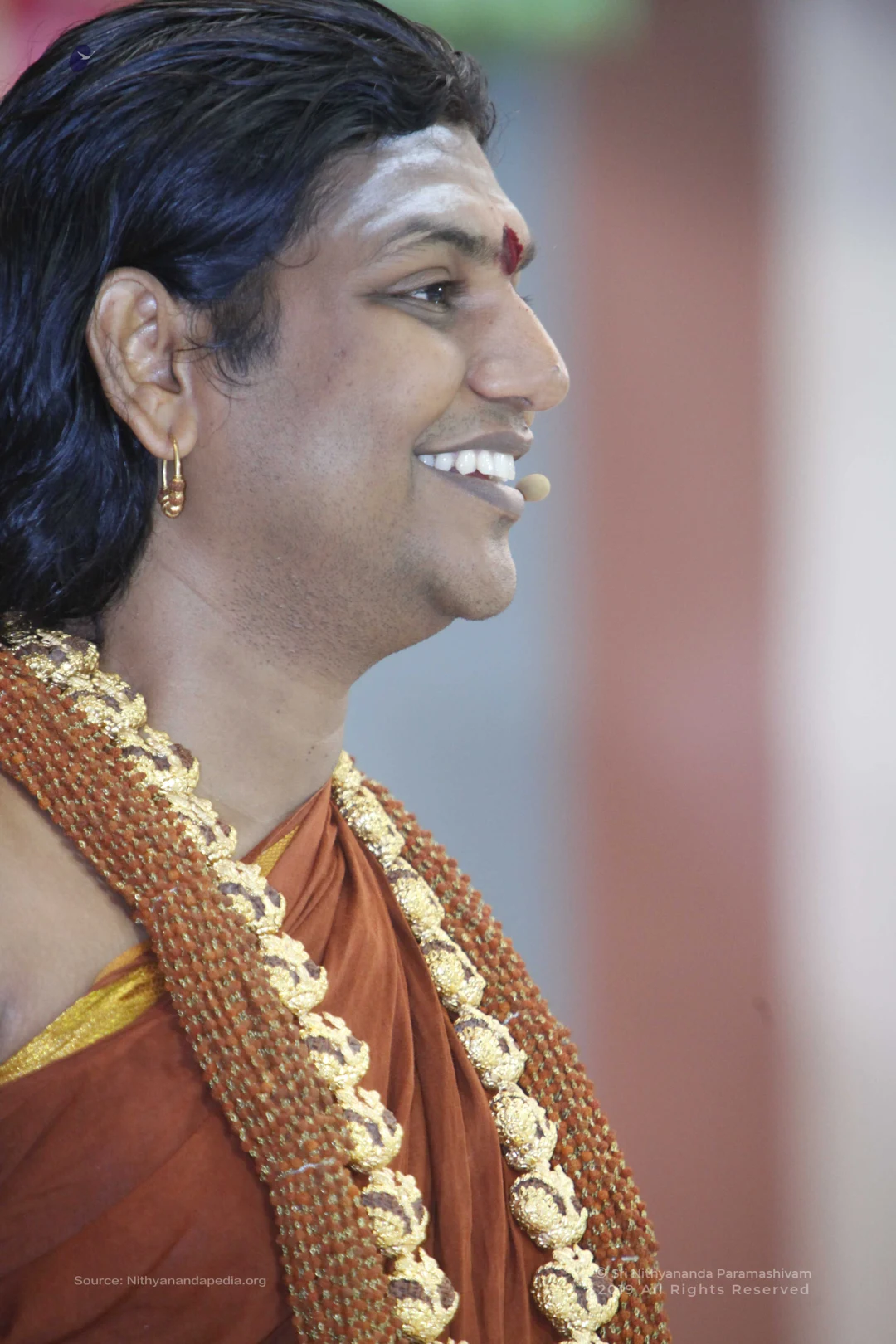
Temple

Garbha-Mandir-Pada-Puja

Pratyaksha-Pada-Puja

Nithya-Satsang

Sarva-Darshan

Sacred-Arts-Construction

Photos Of The Day:
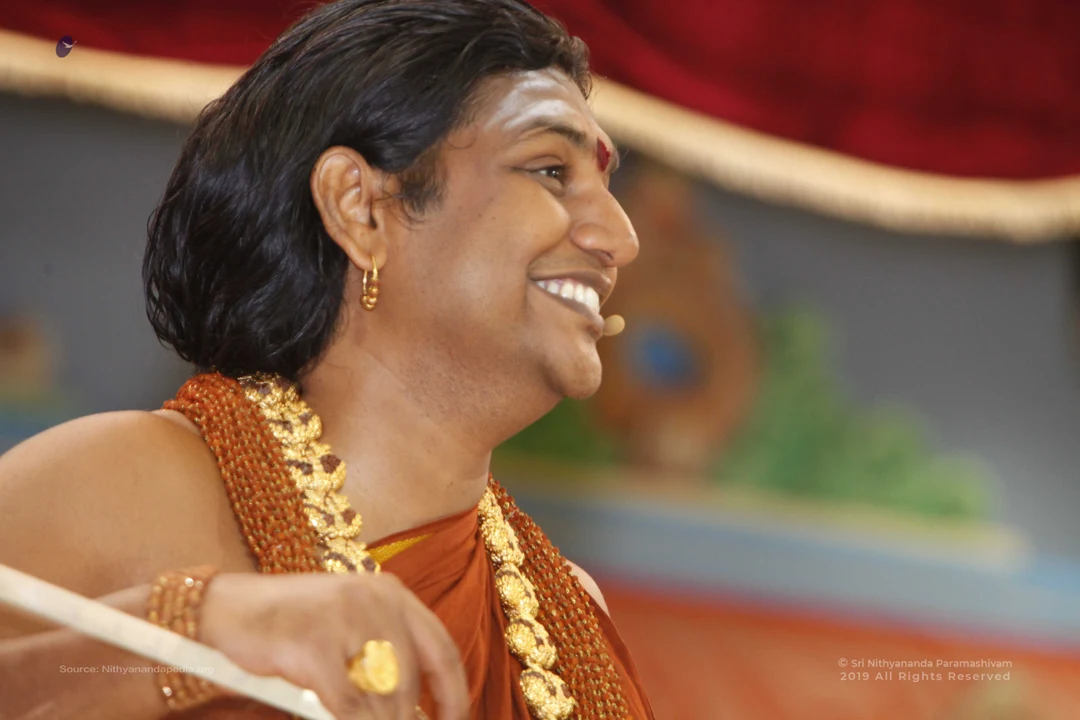
Temple-Swamiji

Garbha-Mandir-Pada-Puja

Pratyaksha-Pada-Puja

Gurukul-Instruments

Nithya-Satsang

Sarva-Darshan

Final-Blessings

Sacred-Arts-Construction

01--Temple

02--Garbha-Mandir-Pada-Puja

04--Gurukul-Instruments

05--Nithya-Satsang

06--Sarva-Darshan

07--Final-Blessings

Photos from this day
View all 175 photos
Photos
17 photosSource gallery
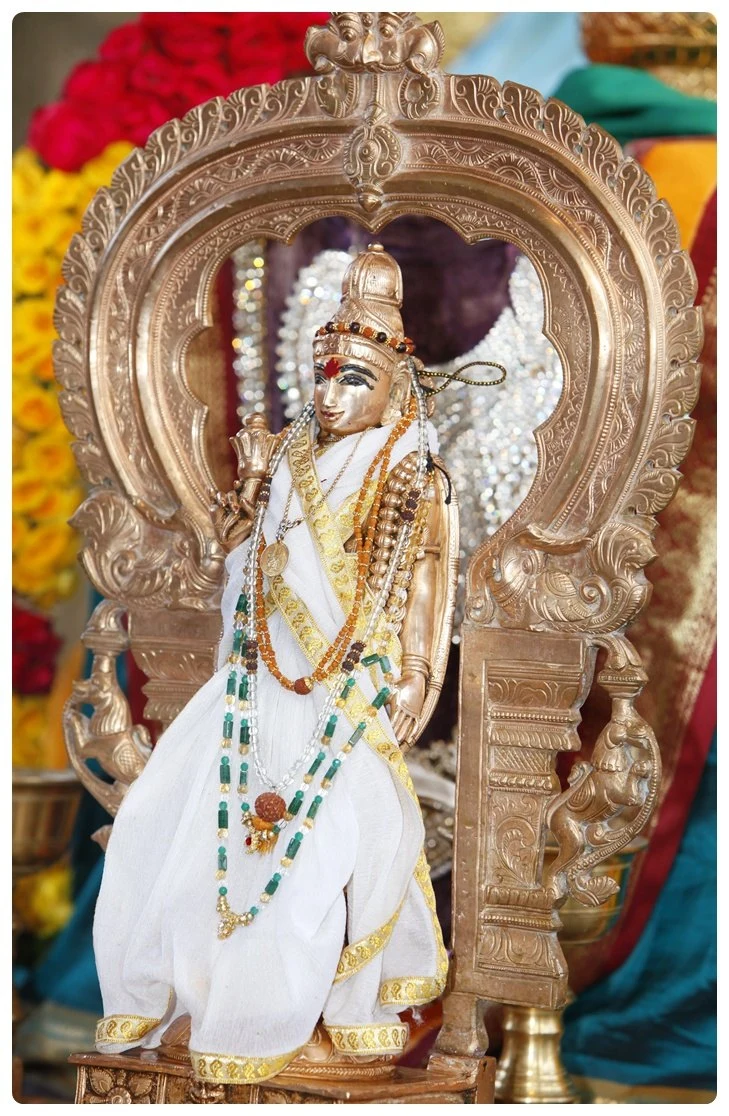
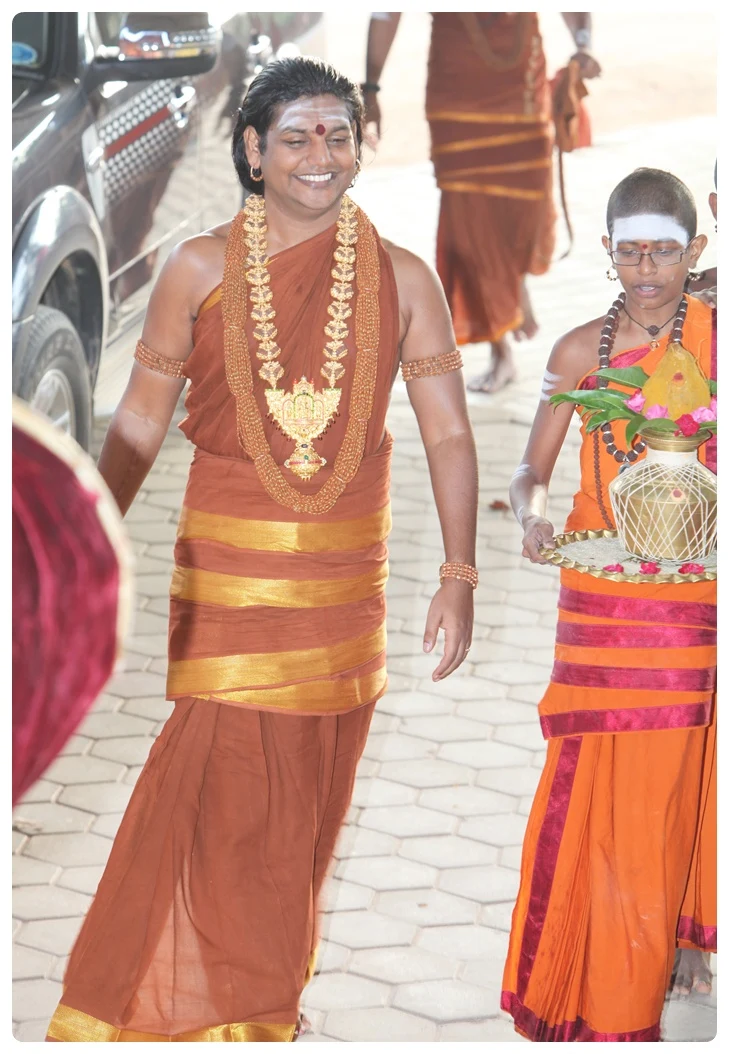
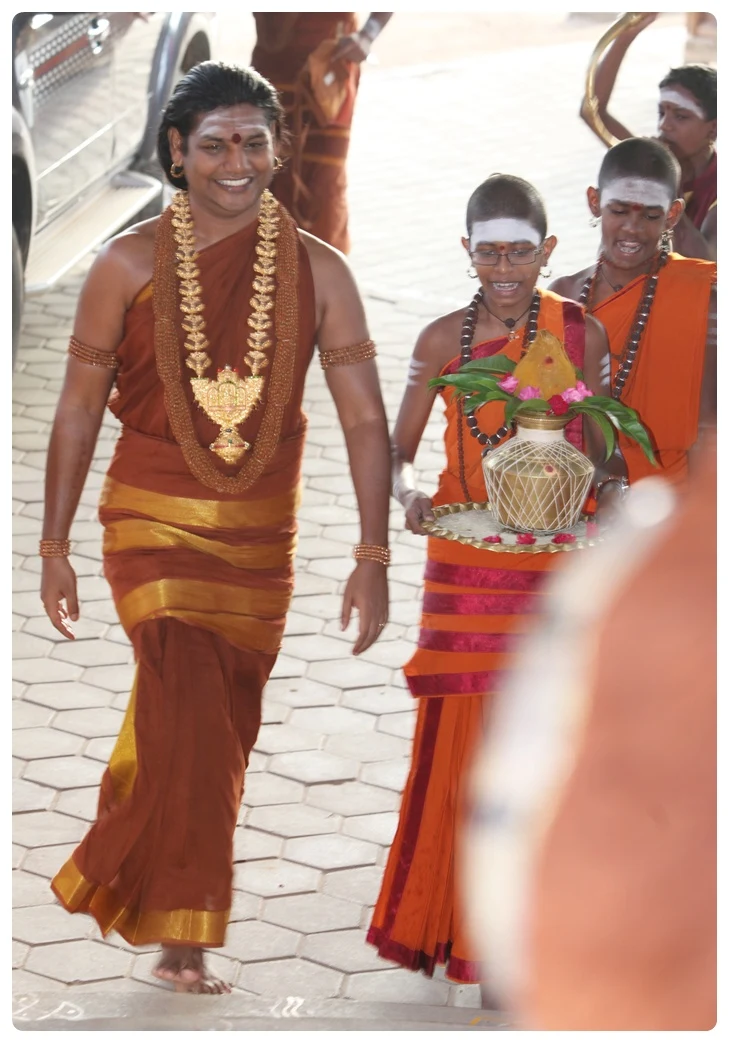
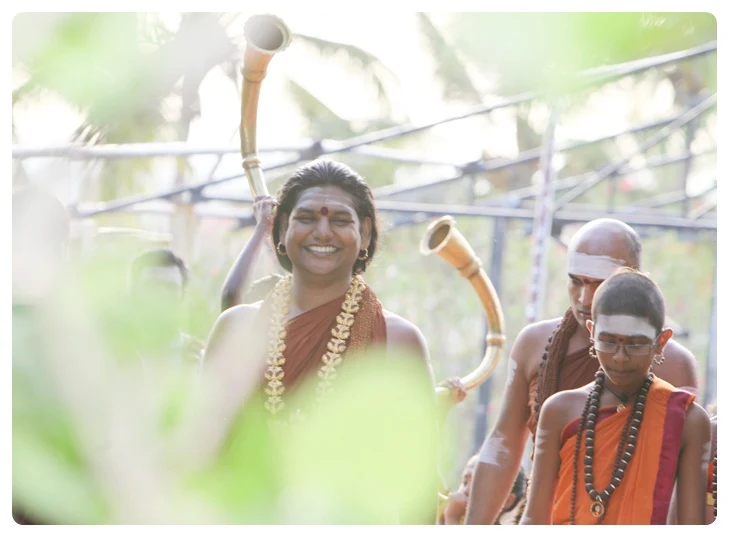
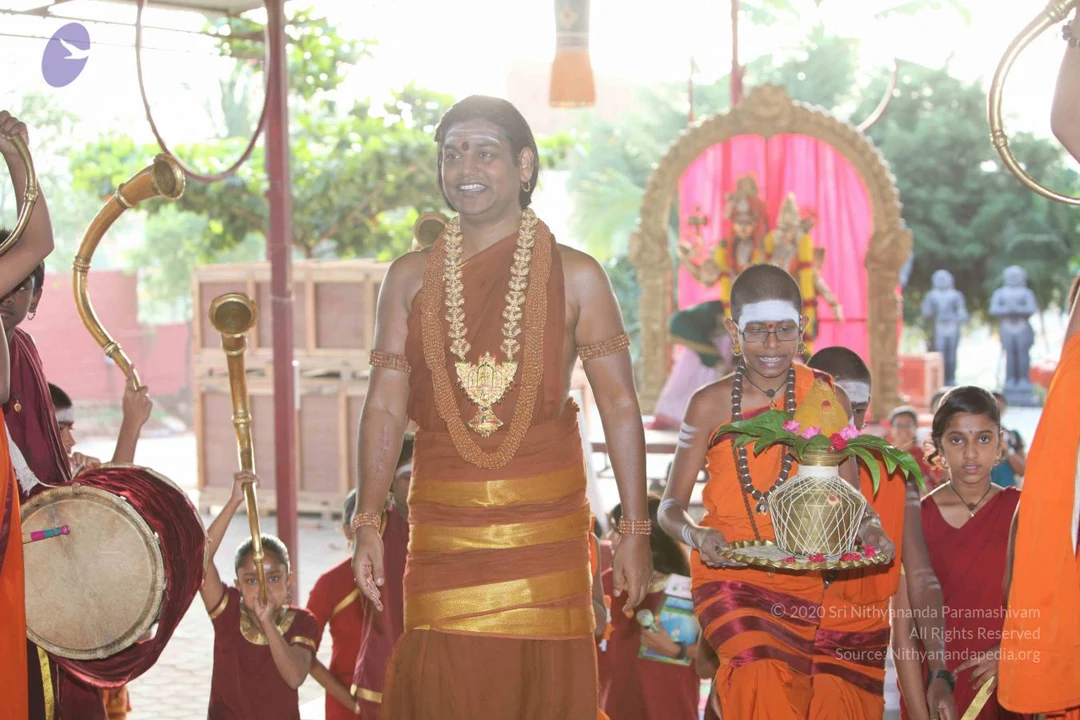
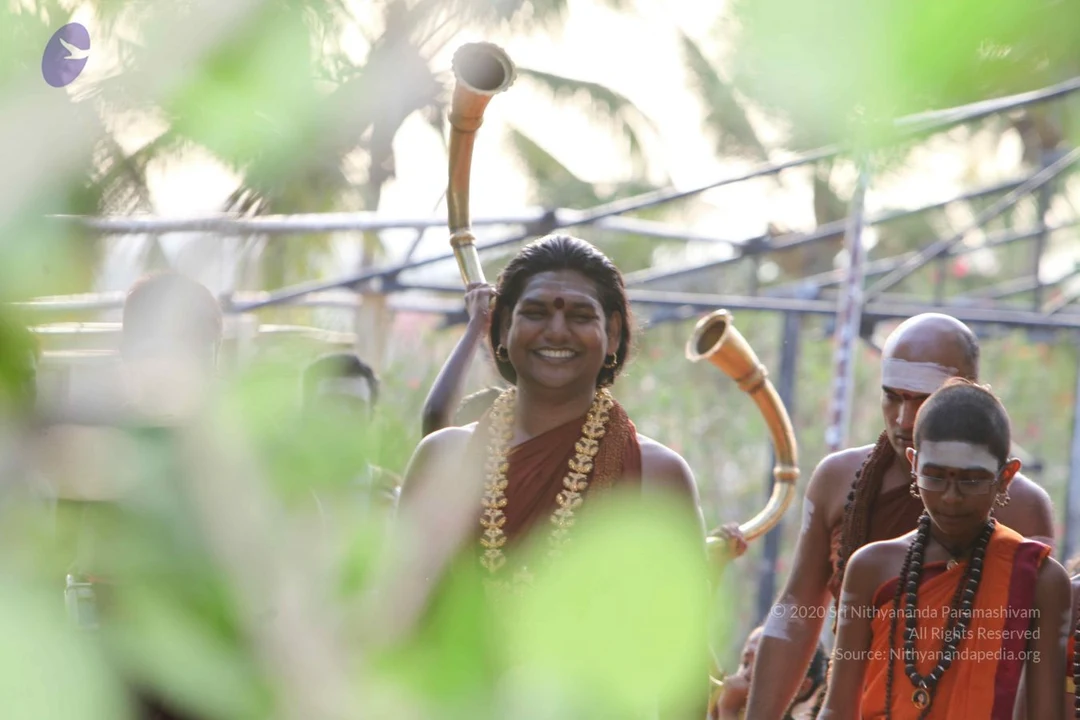
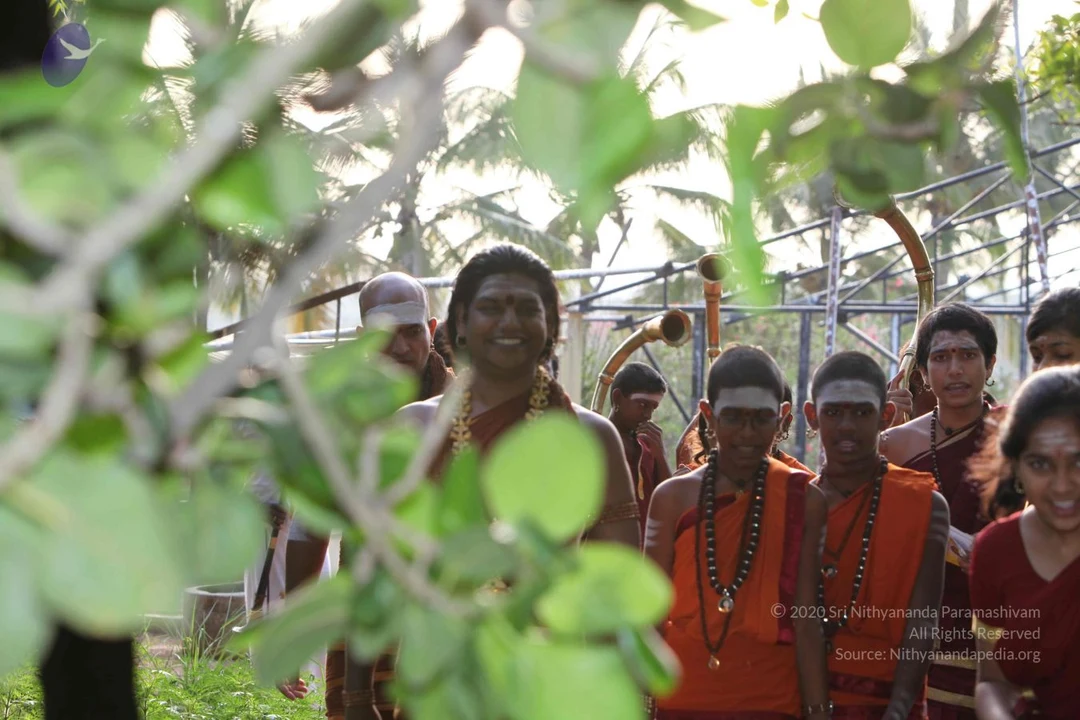
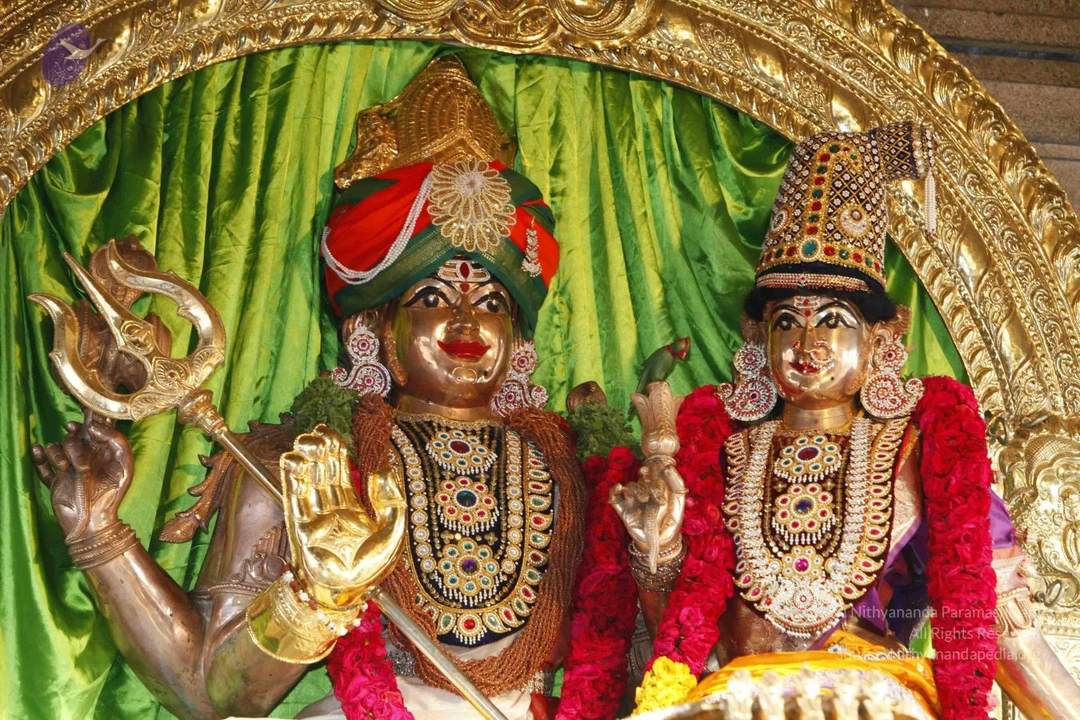
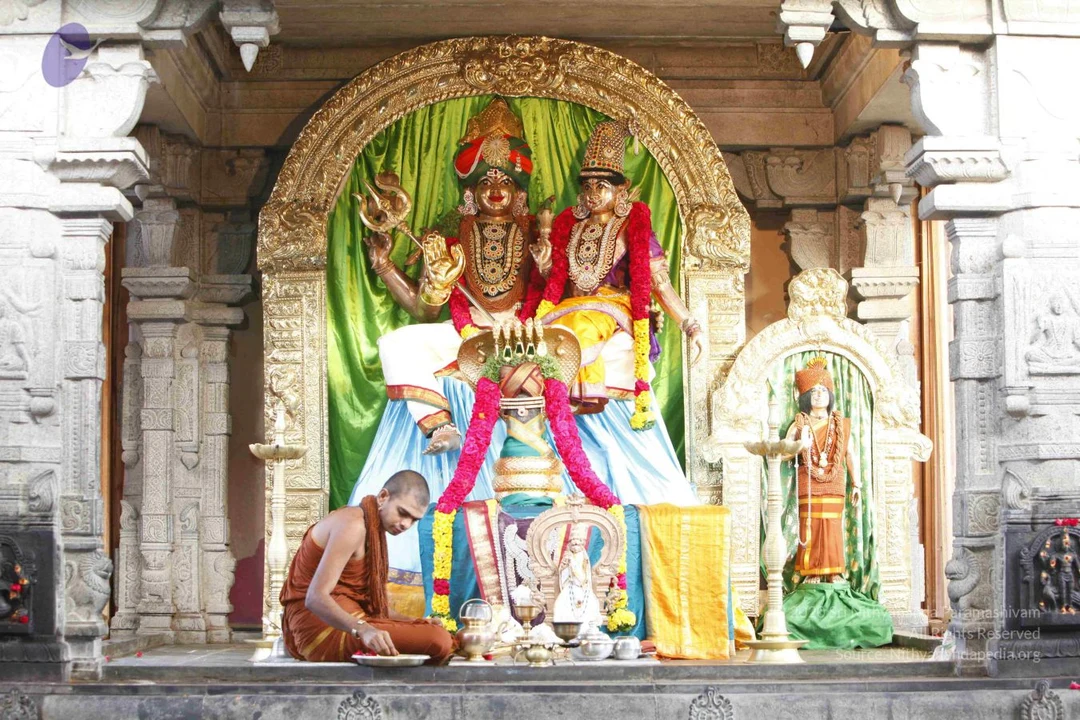
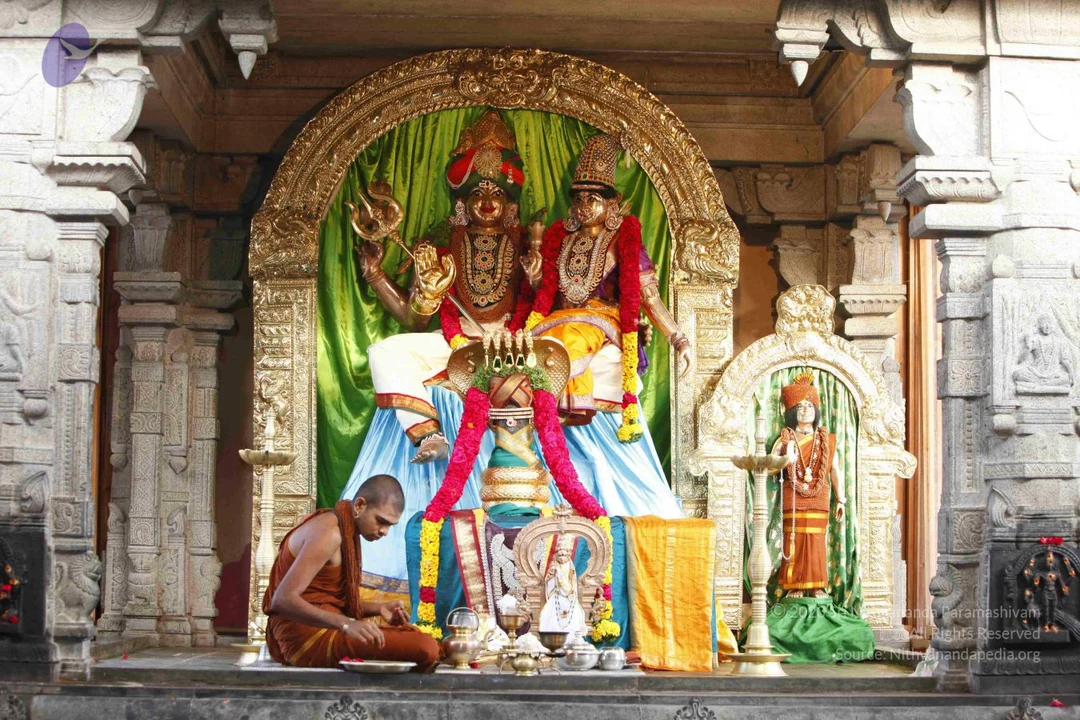
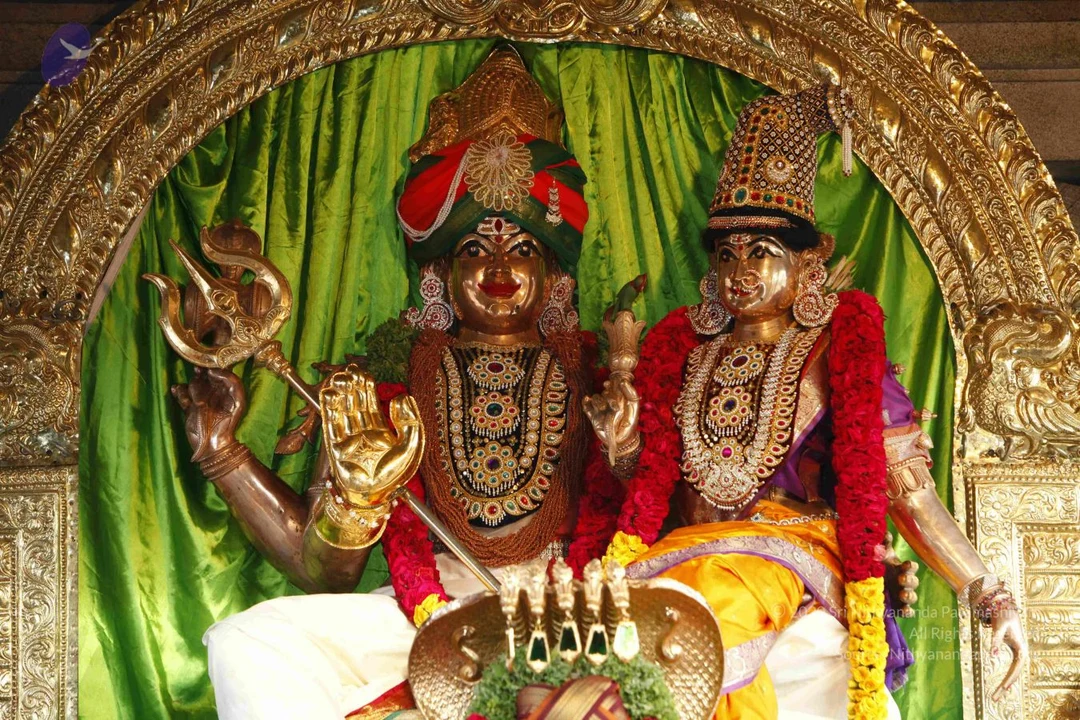
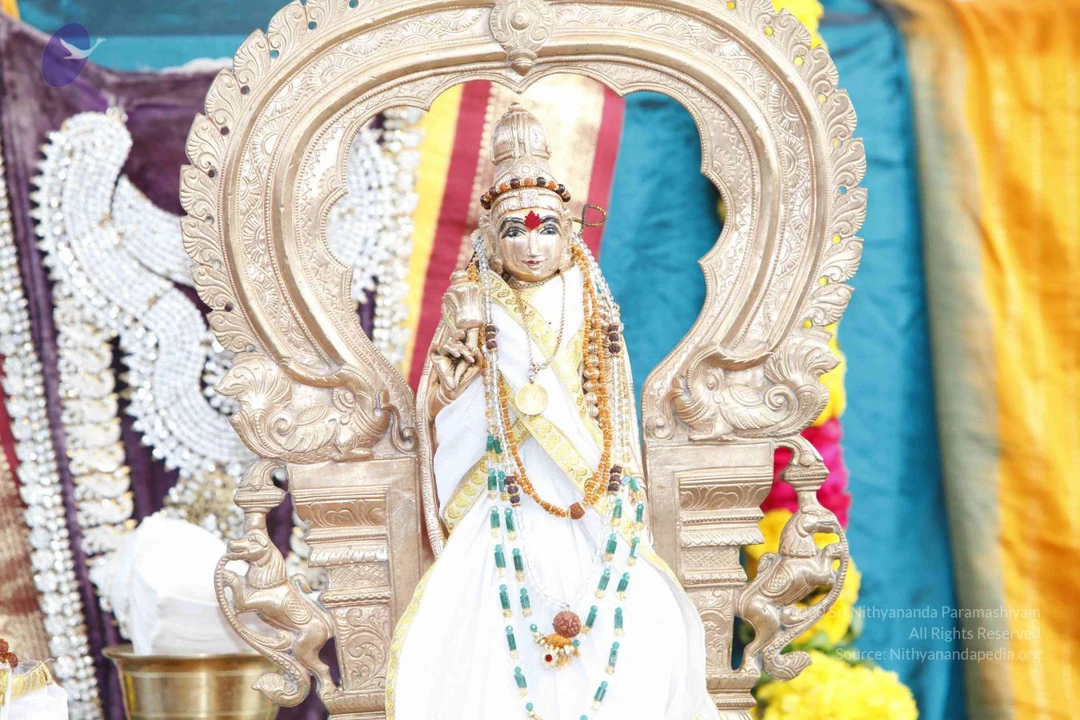
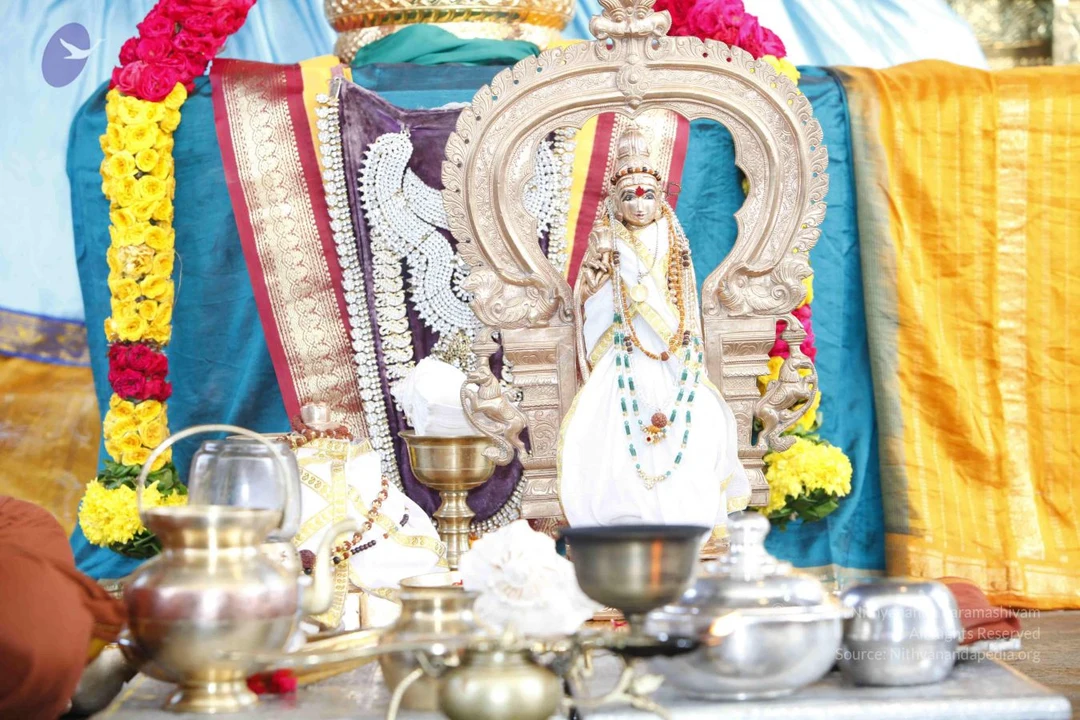
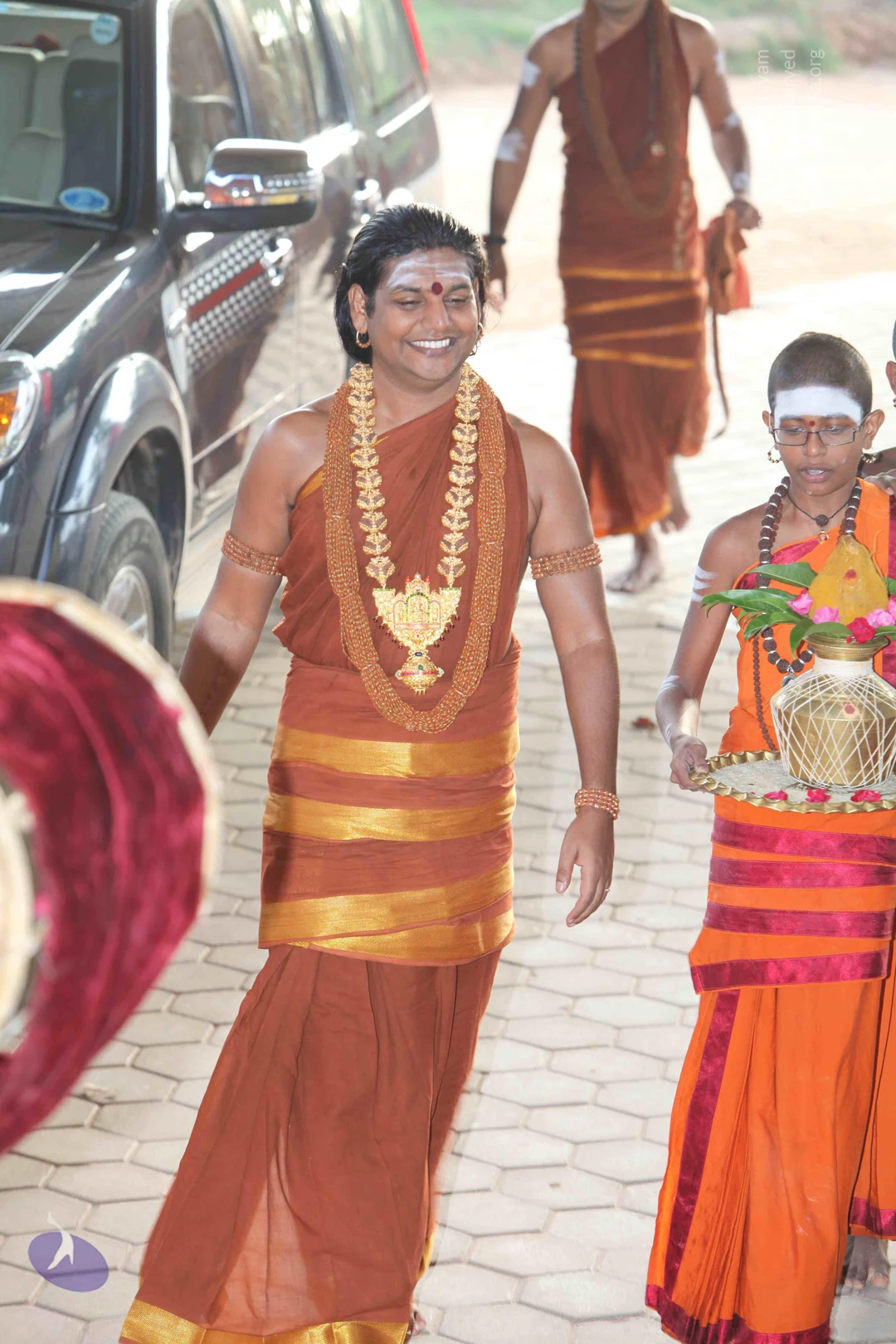
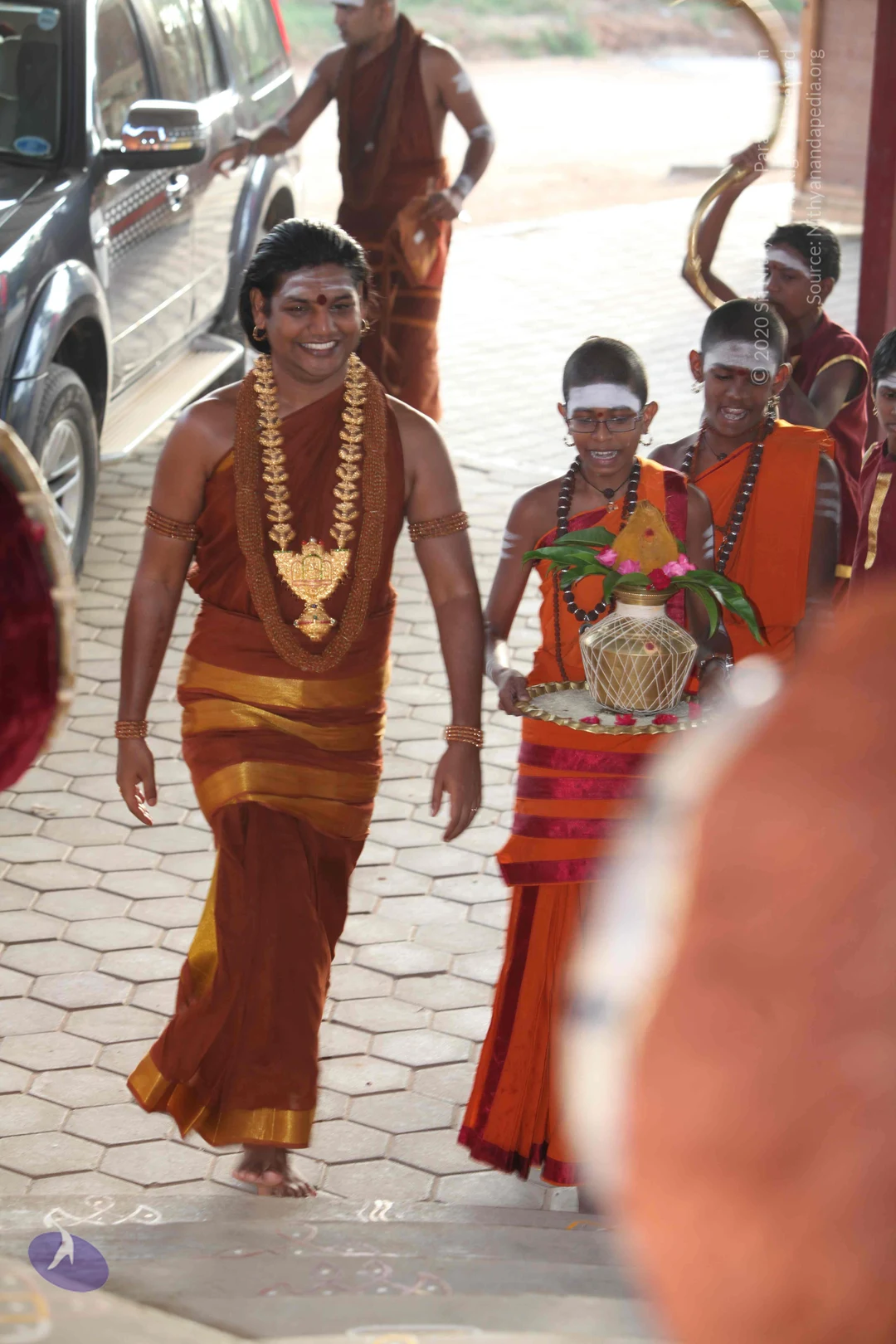
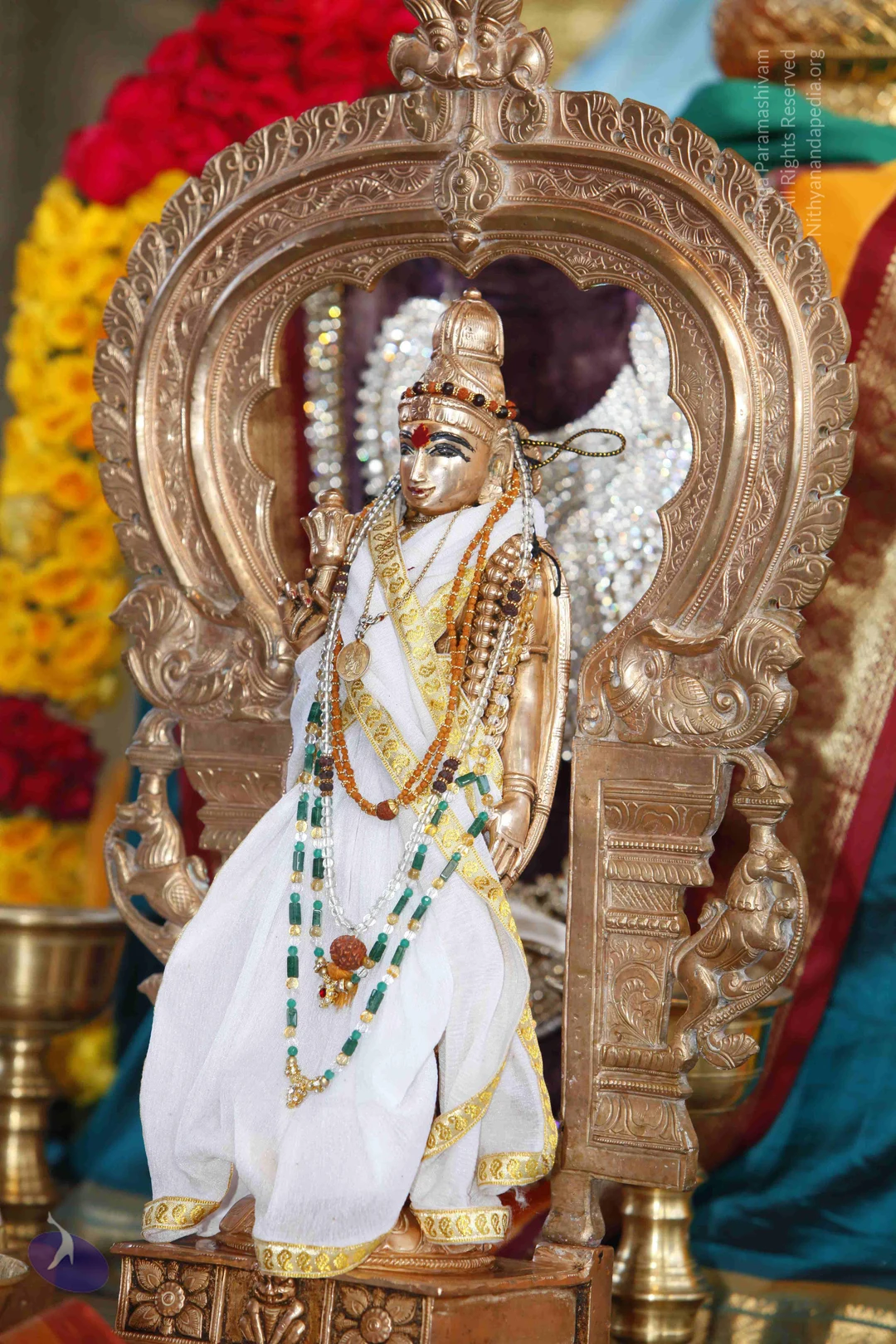
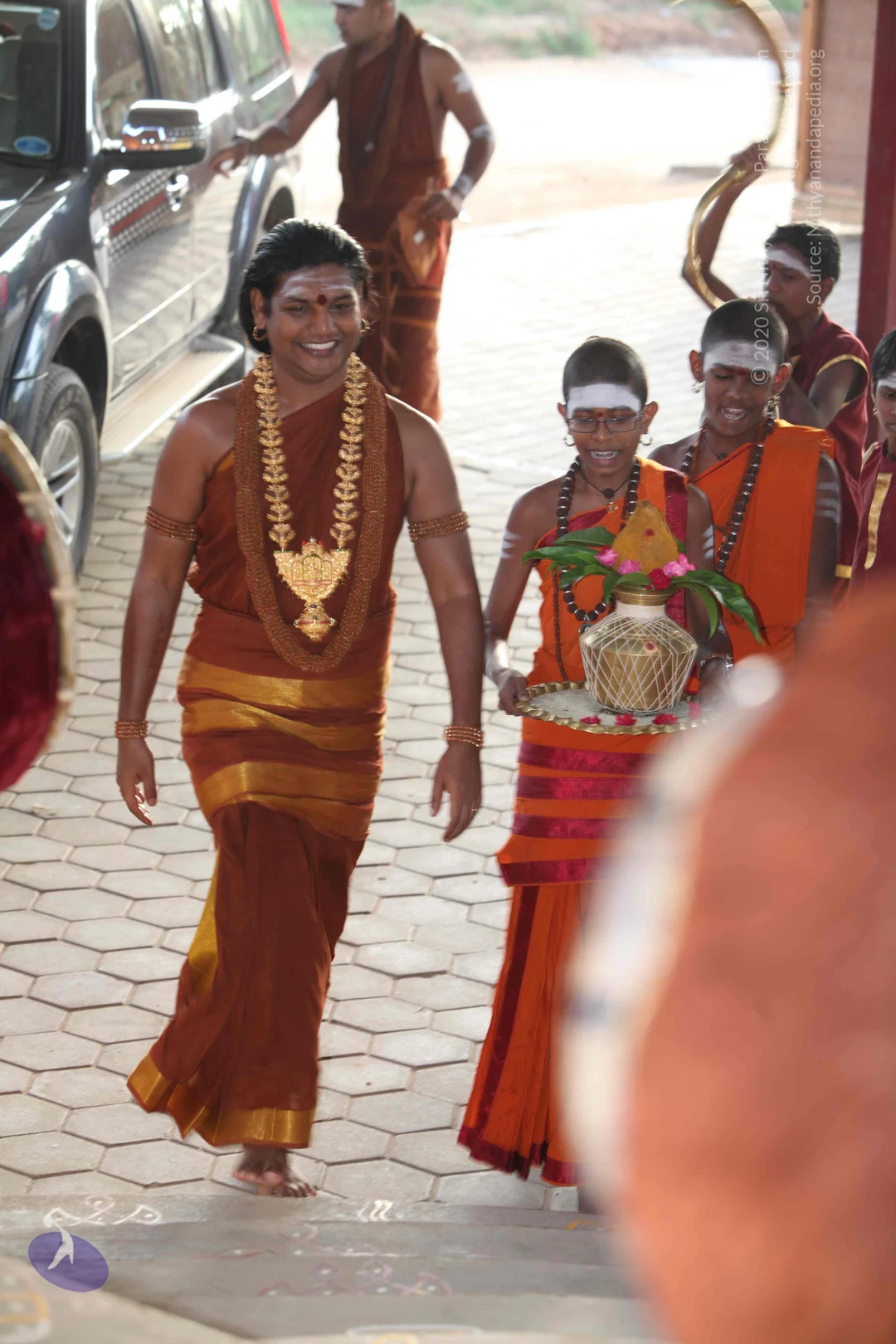
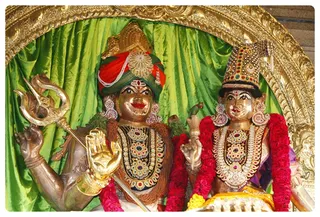
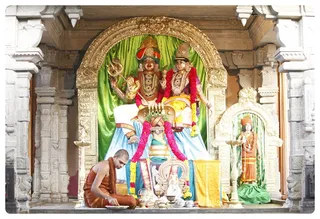
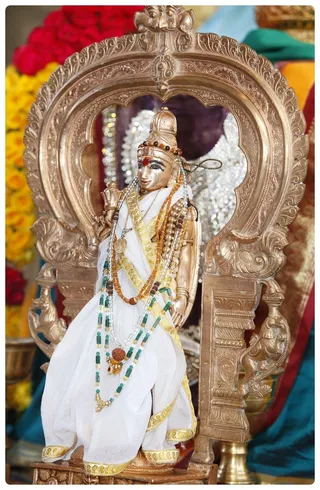
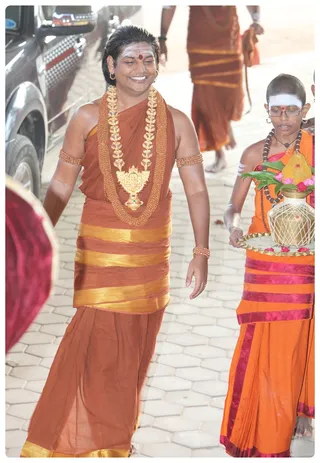
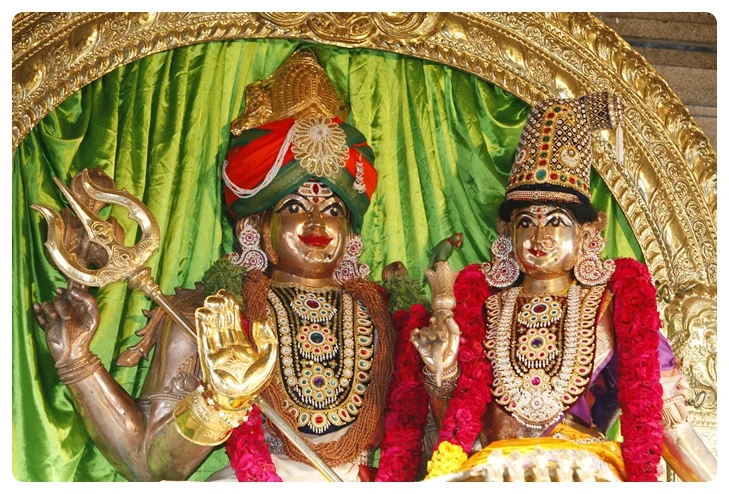
Two metal deity murtis stand side by side against a green silk drape within a gilded arch. The figure on the left holds a silver trident in one hand and a golden hand gesture raised, wears a red and green turban, a red tilak, and layered jeweled necklaces. The figure on the right wears a jeweled crown, ornate gold-and-gem necklaces, and a long red and pink flower garland, and holds a small lotus-like object. A small green parrot perches near the right figure's shoulder. These are statues, not living people.A photograph inside a stone temple shrine showing a large deity murti pair of Shiva and Parvati-form figures with gold crowns, rudraksha-style garlands of marigold and red flowers, and green silk backdrop with a gold arch. A shaved-headed priest in saffron-orange robes kneels at the lower left before a brass tray of offerings, bowls and oil lamps. A standing figure in saffron robes and a turban-like headwear stands at right beside a stone lamp stand, shown as a smaller statue or figure. Yellow cloth and marigold garlands decorate the altar.A seated bronze-coloured statue of a deity murti sits within an ornate golden-brown arched frame with scrolled and foliate carving. The figure wears a white dhoti with a gold-bordered sash, a tall crown, a red tilak on the forehead, and multiple beaded necklaces including orange, white and green strands and a rudraksha mala. Behind it, yellow and red flowers and a glittering curtain frame the scene, with brass lamps at the lower edges.A smiling man in a rust-orange dhoti and shawl with gold-yellow borders walks along a paved path past a parked dark car. Beside him, a bare-headed younger boy in orange with a white forehead band, glasses and a rudraksha mala carries a brass kalasha with pink flowers and green leaves on a tray. Other figures in orange walk behind.Outdoor photo of a barefoot man in a rust-orange dhoti-style wrap with gold borders, walking up a hexagonal paved path beside a parked car. He wears a long gold necklace with a large ornate gold pendant, gold bangles on the upper arms and wrists, a red bindi, and smiles. Two young boys in saffron-orange garments with white forehead bands walk beside him; the boy in the middle, wearing glasses and a beaded rudraksha mala, carries a brass tray holding a kalasha-style pot decorated with pink flowers and green leaves. A blurred orange-clad figure occupies the right foreground. a person: the man in the rust-orange wrap wears a long gold necklace with ornate pendant, bangles and a bindi, consistent with the page's reference to a ceremonial procession.Outdoor procession under a leafy canopy with blurred green foreground foliage. A smiling person with long swept-back dark hair, a red bindi, white facial markings and a wrapped reddish-brown shawl, wearing a gold-link necklace, raises a long curved brass horn. Behind them a shaved-headed man in a white headband and reddish-brown wrap also carries a horn, and a young boy in orange robes, glasses and a dark rudraksha mala walks beside them with white forehead markings. a person appears as the smiling figure with long hair, crown-less, adorned with gold necklace and shawl, carrying a horn in the procession.

Temple
32 photosSource gallery
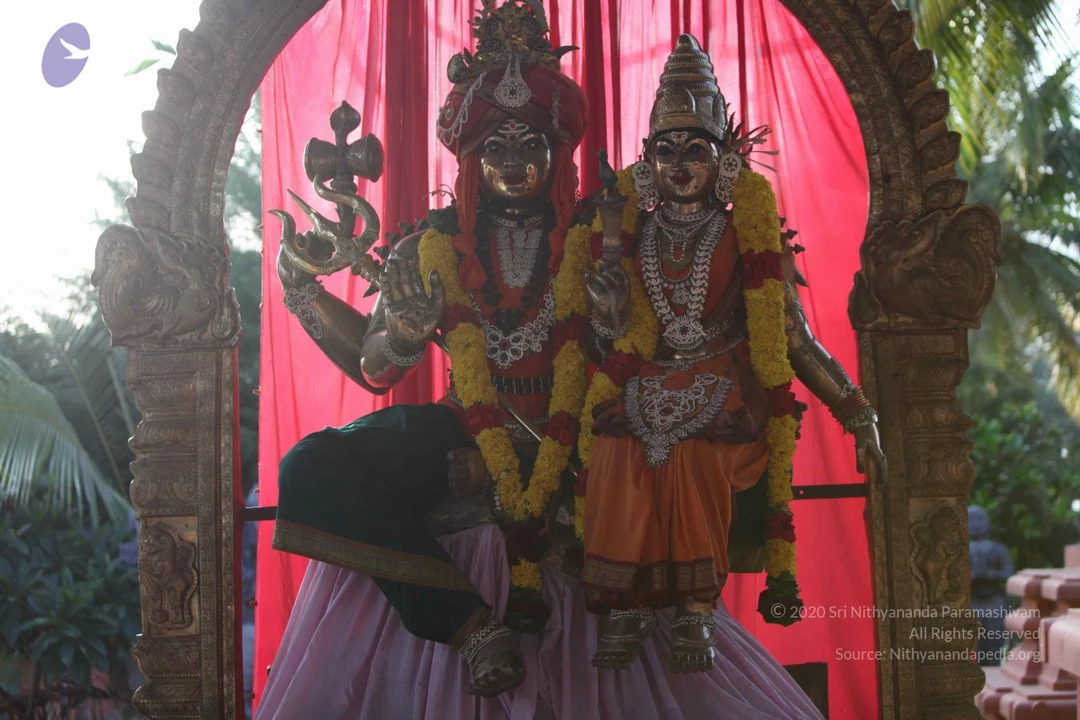
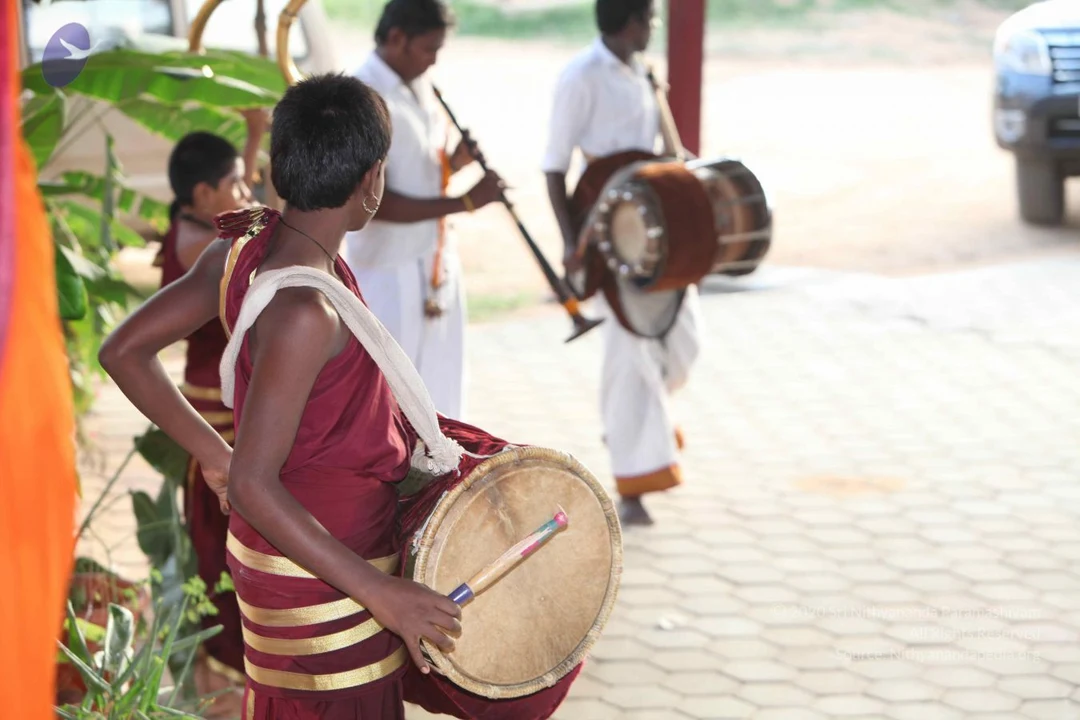
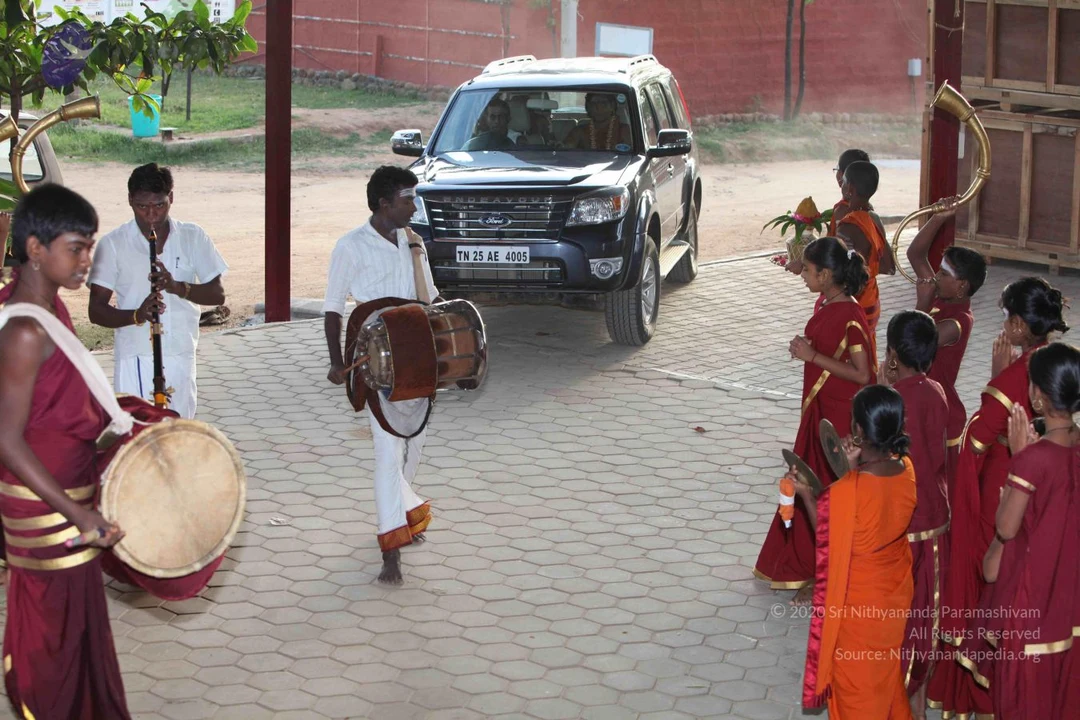
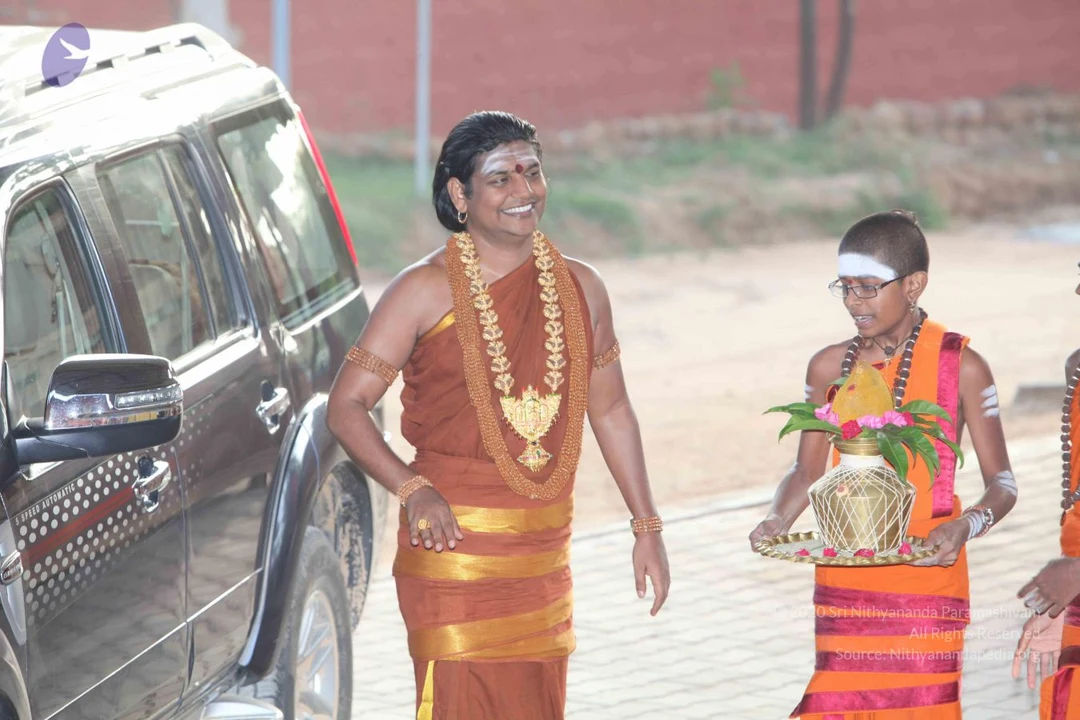
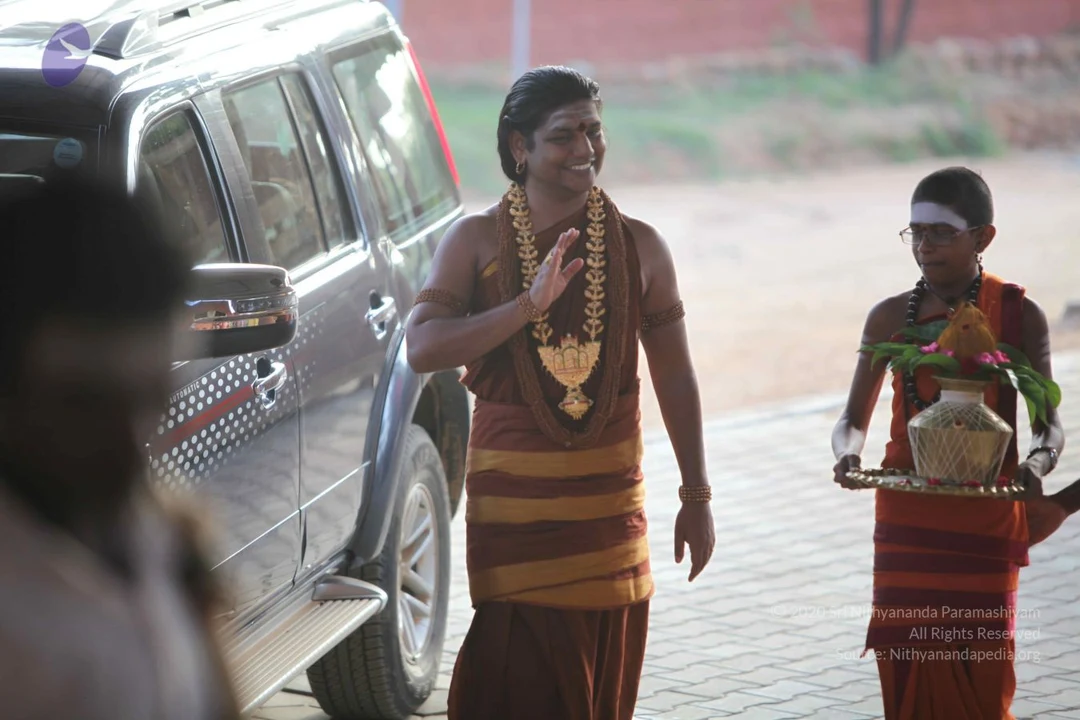
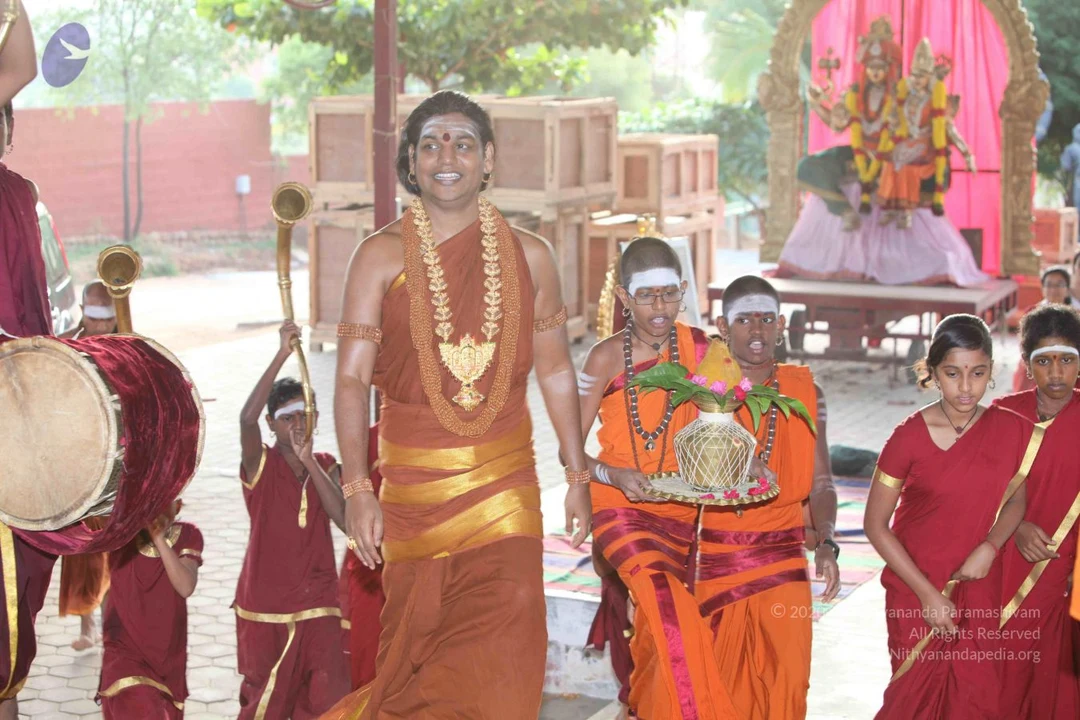
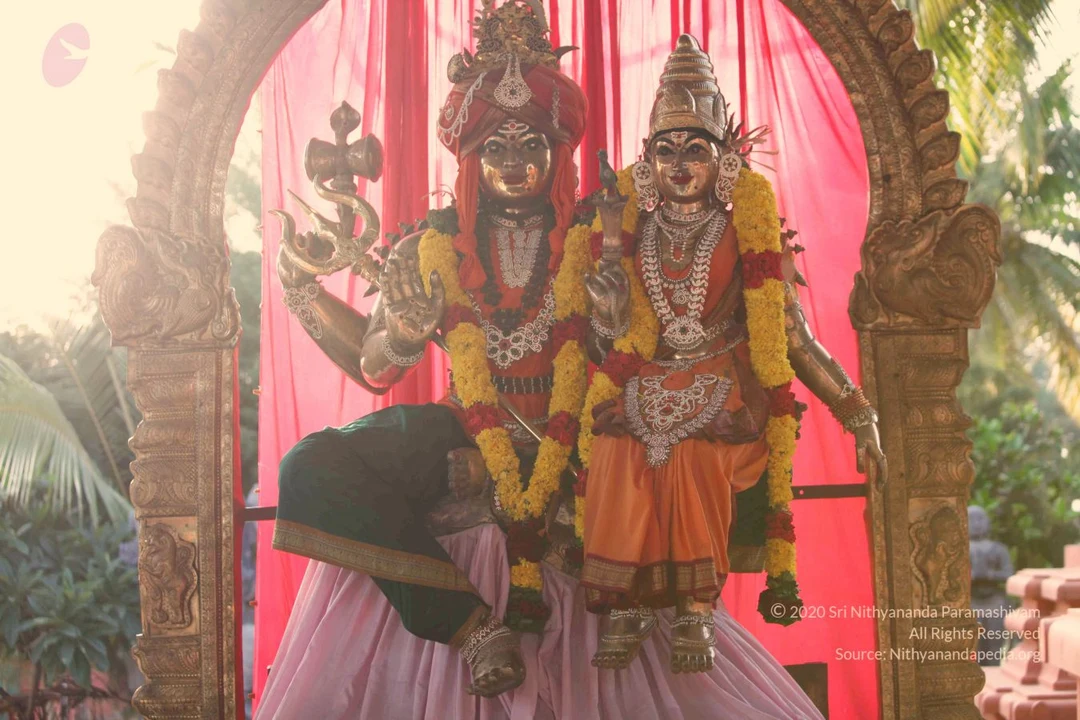
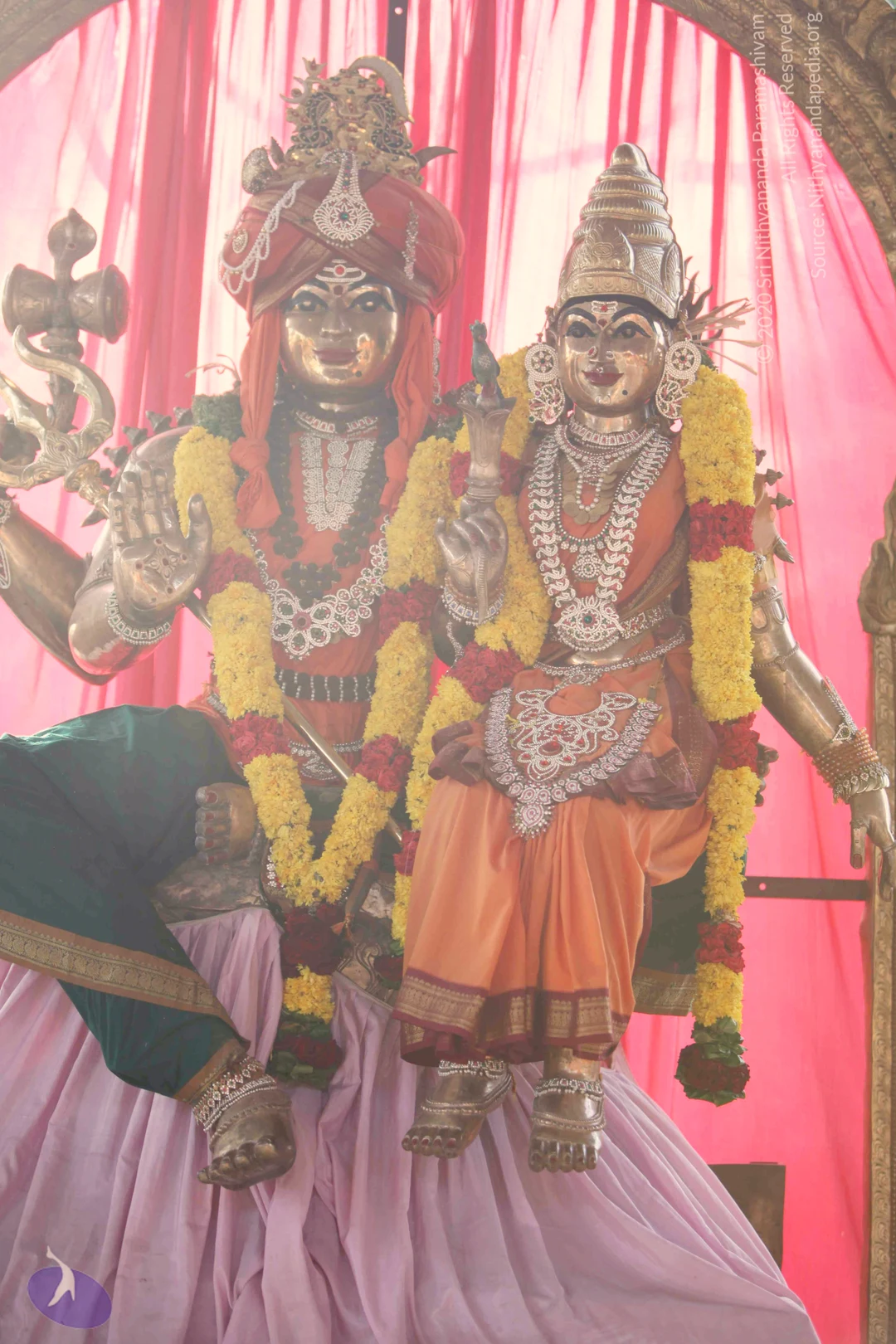
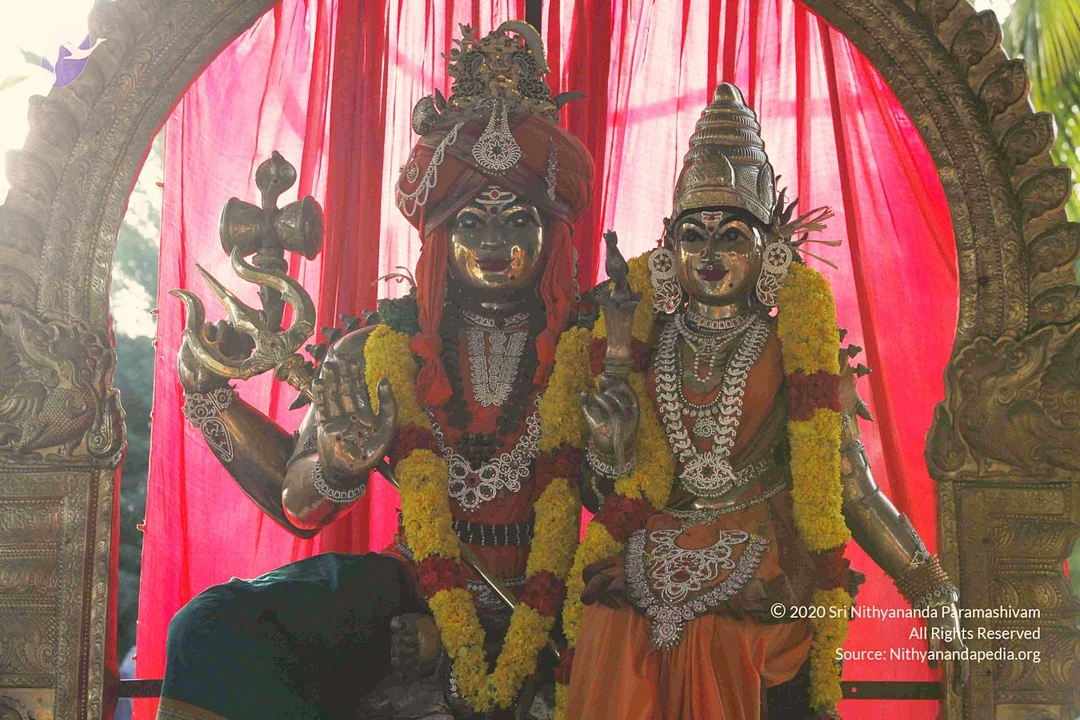
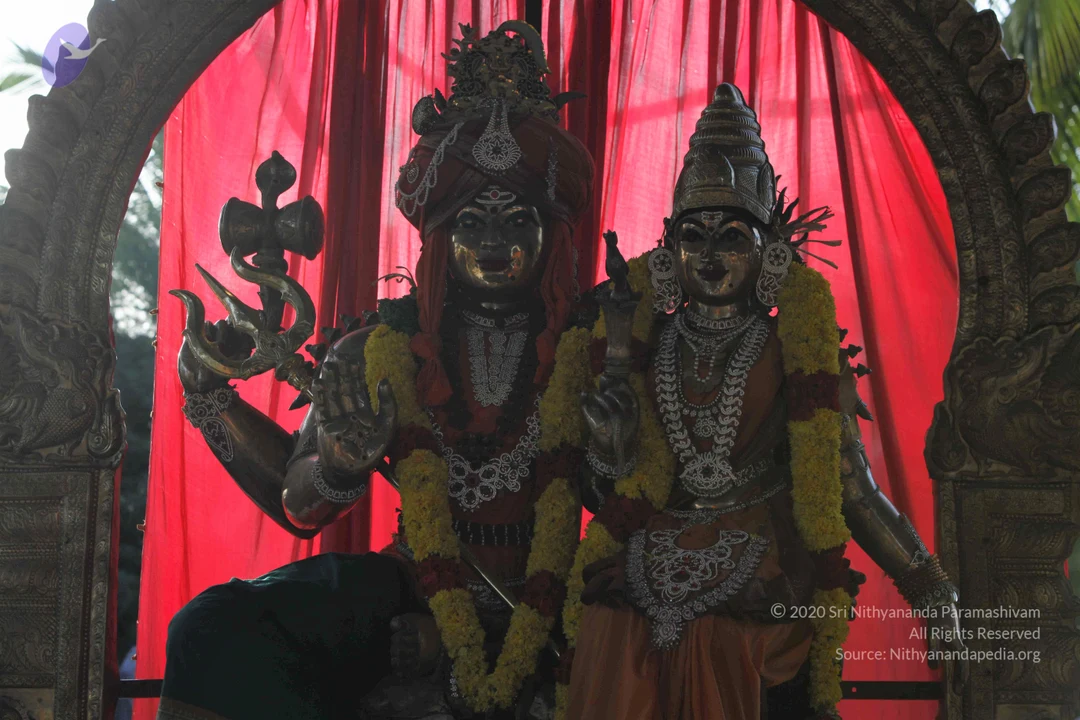
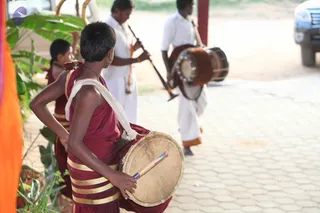
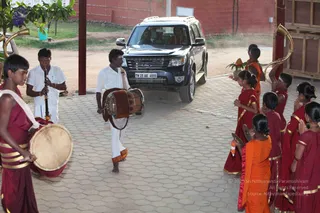
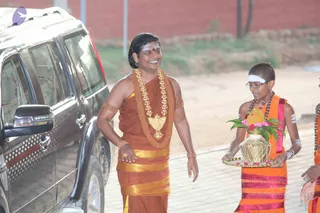
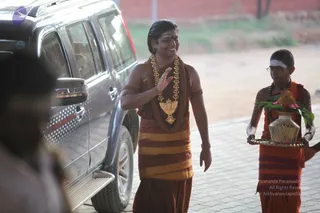
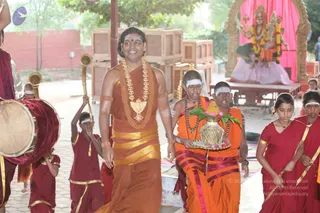
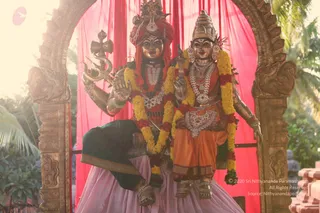
Two deity murti stand together under a golden arch against a red draped backdrop, with palm trees behind. The figure on the left is a bronze-toned deity with a trident and a crown, wearing a red turban, a red sash, a white and silver necklace and a flowing lavender skirt with a green cloth. The figure on the right wears a tall crown and an orange and red dhoti with silver ornaments, and both figures are adorned with yellow marigold garlands and red flower garlands. No physical people are visible. The image is a photograph taken outdoors in soft morning light.Outdoor photo of a drum and wind musician procession on a paved hexagonal-tiled walkway. In the foreground a young boy in a maroon robe with gold banding and a white cloth over one shoulder holds a hand drum with a wooden stick. Behind him a man in white dhoti and shirt plays a long curved horn, and another man in white dhoti and shirt carries a large barrel drum with a maroon-and-orange cover. A second boy in maroon stands at the left edge beside green banana leaves and an orange cloth.Outdoor photo of a welcome procession at an ashram courtyard with a paved hexagonal floor. A black Ford SUV with a Tamil Nadu plate reading TN 25 AE 4005 pulls in, and a person in the back seat wears a garland. On the left, a young musician in white clothes plays a long wind instrument, and beside him a drummer in white dhoti and shirt beats a drum with a stick. Several young girls in maroon saris stand in the foreground, and on the right a group of girls and boys in maroon and orange robes stand with palms pressed together in greeting, some holding a flower bundle and a kalasha-like vessel. Brass long horns are visible at the edges. Red brick walls and a shaded pavilion frame the scene.A man in an orange-saffron dhoti and shawl, with a gold-bordered waist cloth, walks beside a dark grey SUV on a paved courtyard. He wears a long gold necklace with a large pendant, gold armbands and bangles, and a red tilak on his forehead; his hair is swept back. Beside him a shaved-headed boy in an orange garment with a pink border and white forehead band carries a brass kalasha on a tray decorated with pink flowers and green leaves. A red brick wall and grass are in the background.Outdoor photo of a smiling man in orange-brown ochre dhoti and shawl, wearing a long gold-toned garland, a gold pendant and bangles, waving his right hand beside a dark grey SUV on a paved path. Beside him a young boy in saffron-orange robes and round glasses, with a white band on his forehead and a dark beaded necklace, carries a silver tray holding a glass vessel with green leaves, pink flowers and a small brass item. A dark blurred figure stands at the left edge. Red brick wall and dirt ground in the background. Probable Swamiji (probable) is the central figure, identified by long swept-back hair, gold garland and ornate ochre clothing.A procession in an outdoor courtyard with a pink-draped shrine behind, where a deity murti adorned with yellow marigold garlands is visible. A man in the centre wears an orange-saffron dhoti and shawl, a long gold-and-beige floral garland, a gold pendant, gold armbands and a red-brown tilak on his forehead. A smiling man with long swept-back hair and a crown-like headpiece stands at the front. Beside him, two boys in orange robes with white headbands and rudraksha malas carry a brass plate with a kalasha and pink flowers. On the left, drummers play a large red-velvet-covered drum and men blow long brass horns. Girls and young women in red saris with gold borders and white headbands follow in the procession.

Garbha-Mandir-Pada-Puja
13 photosSource gallery
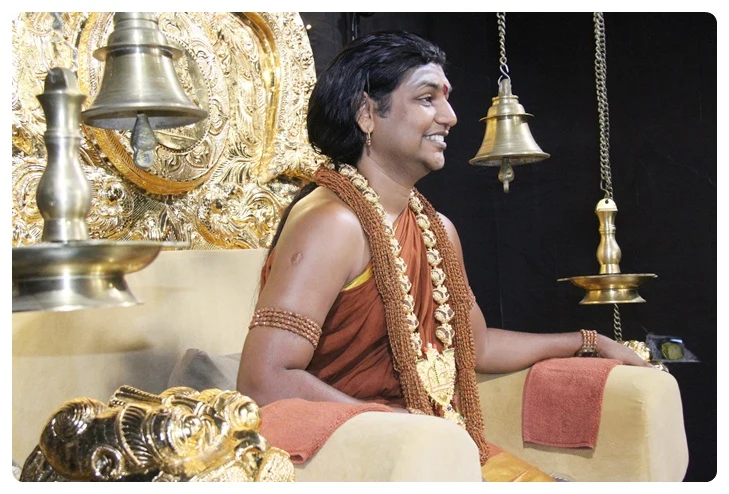
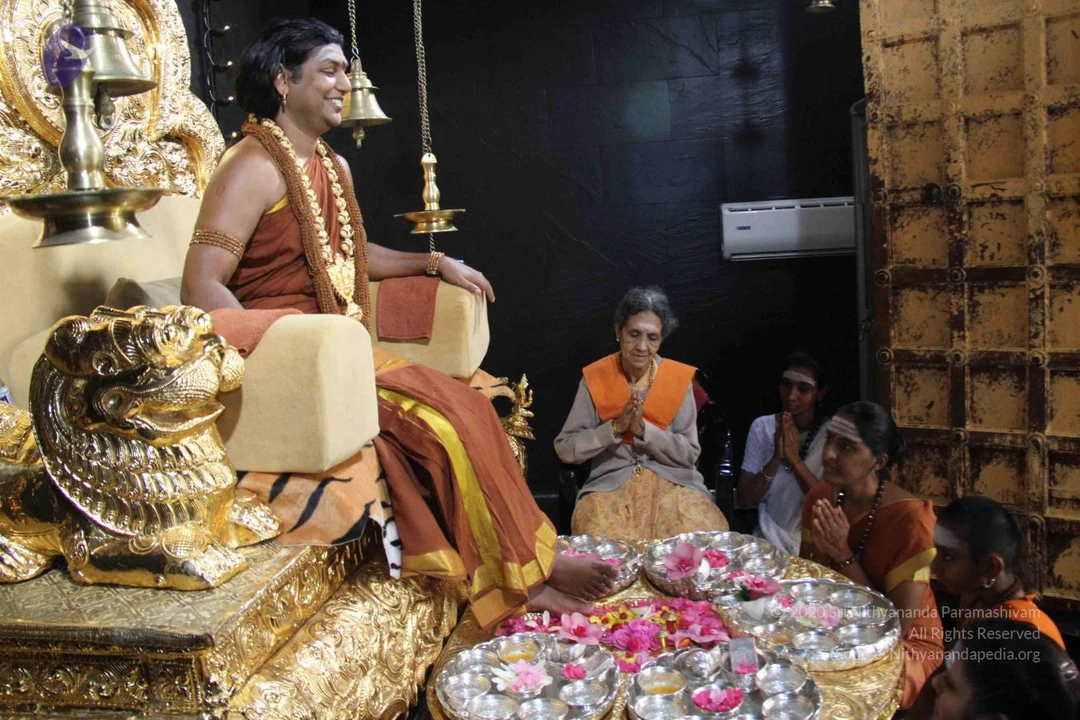
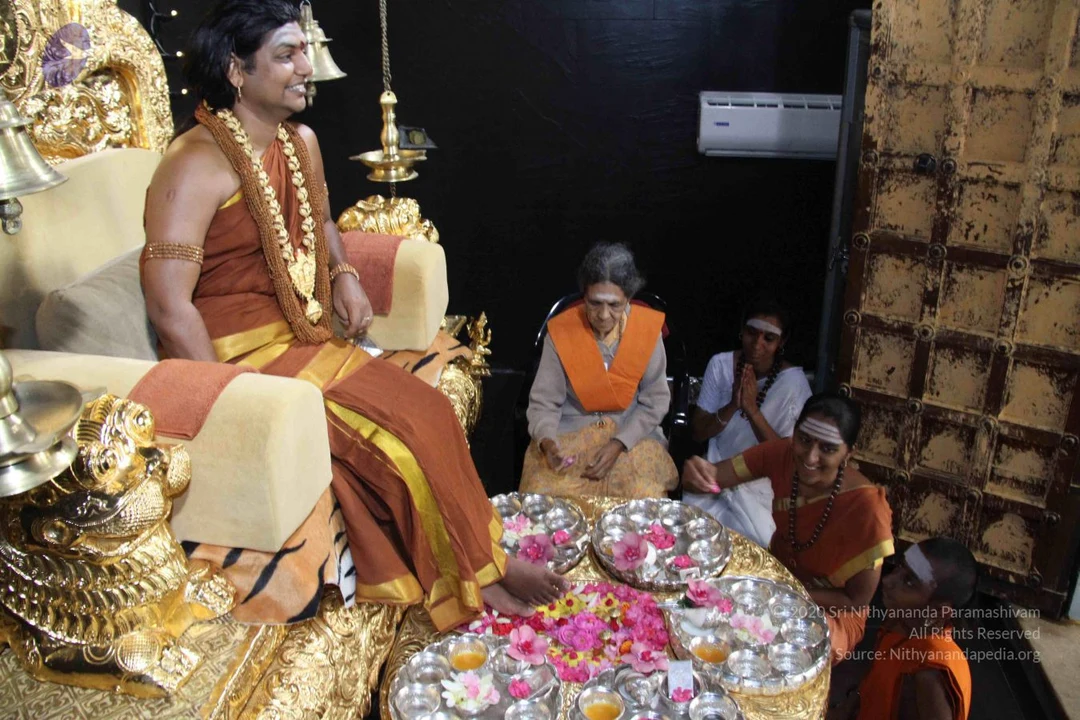
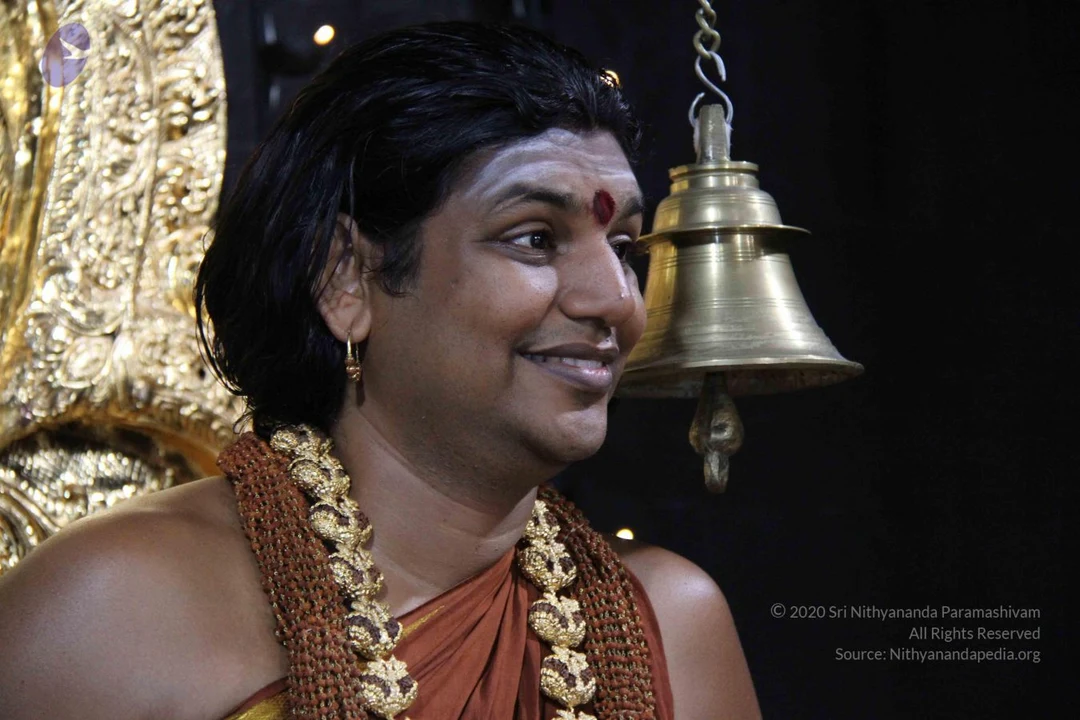
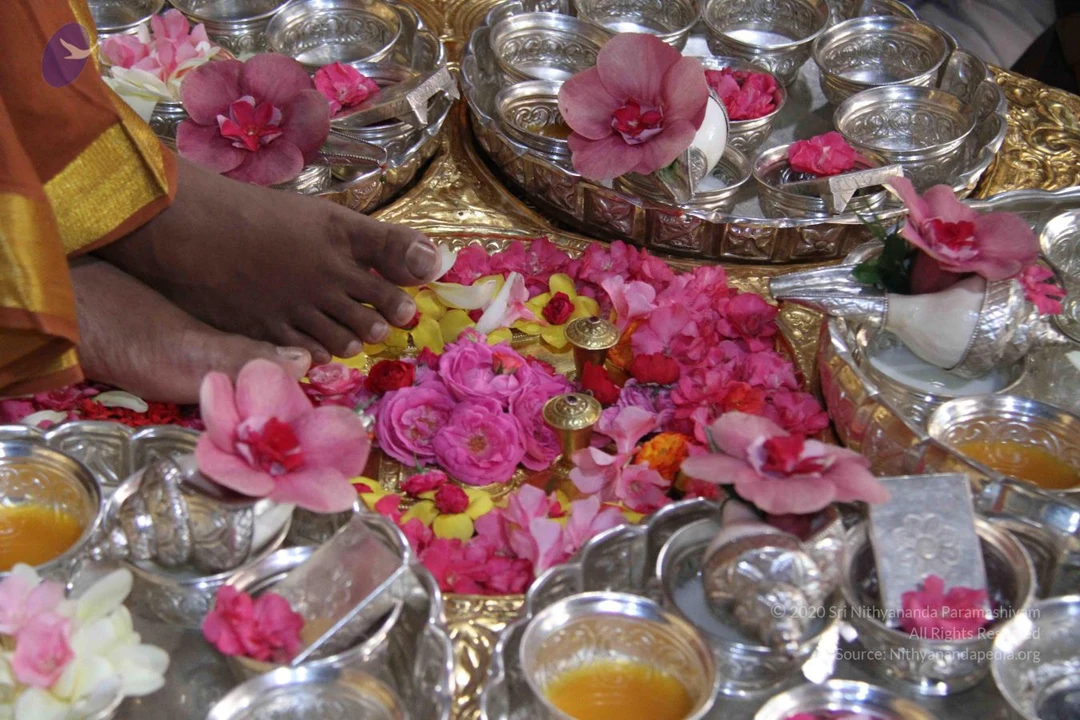
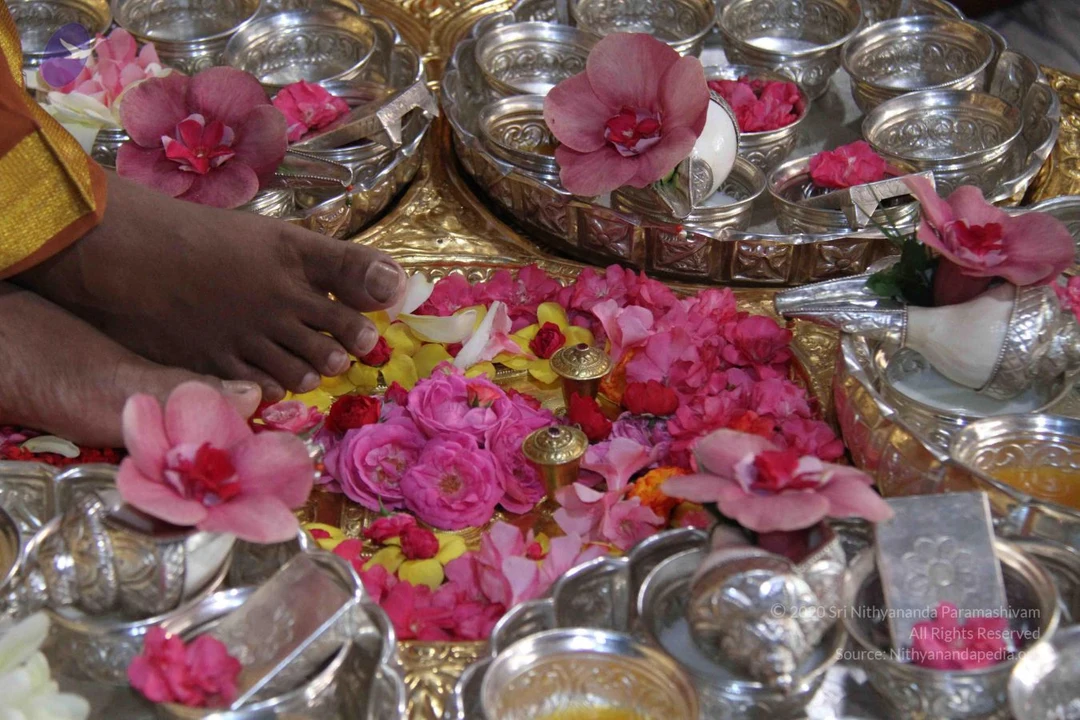
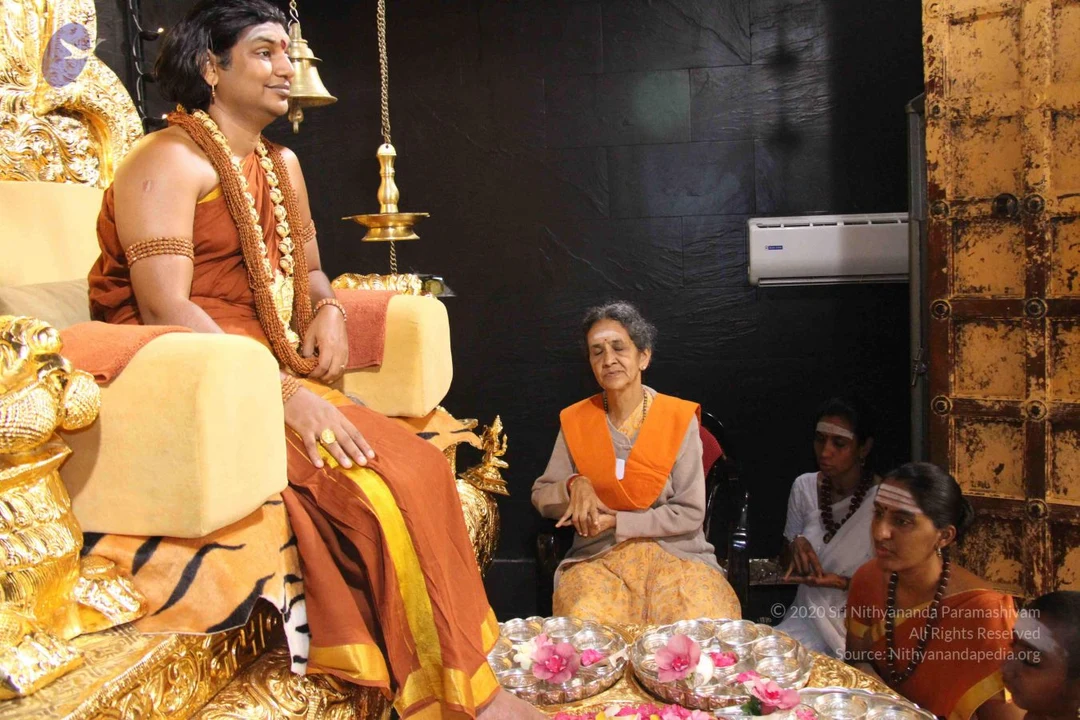
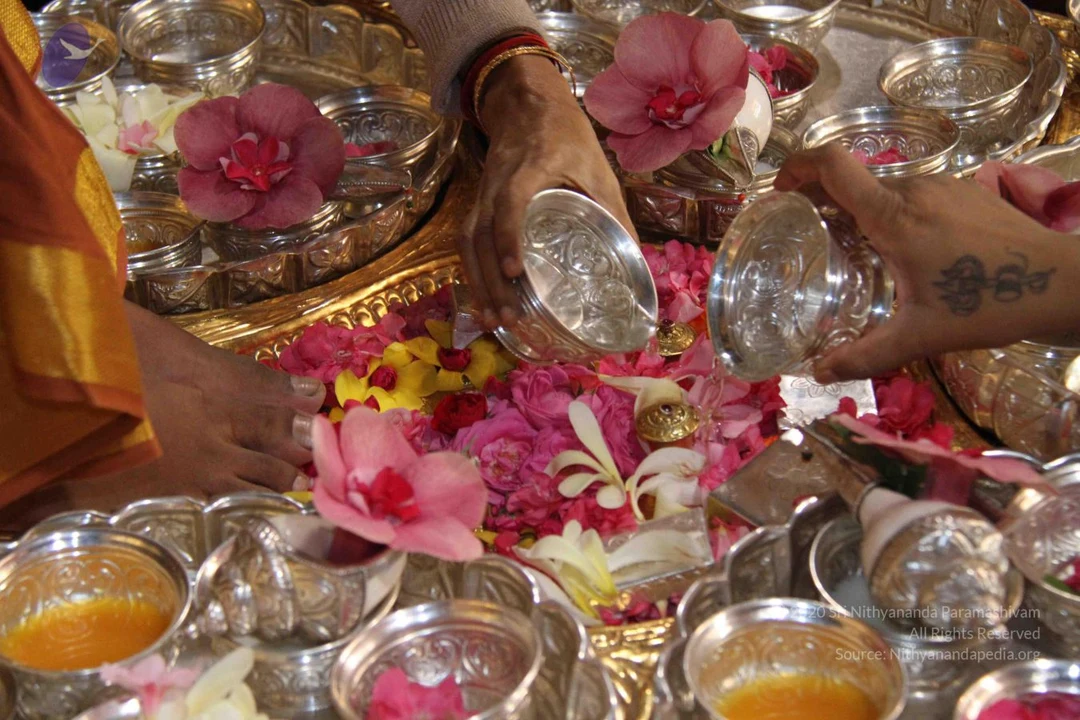
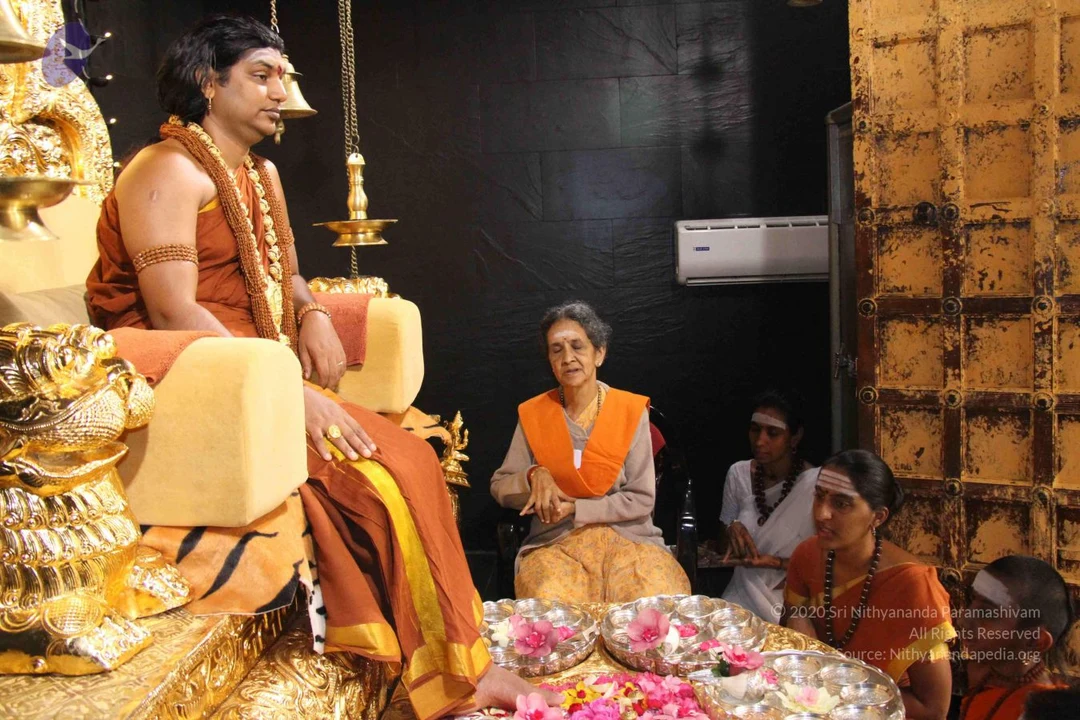
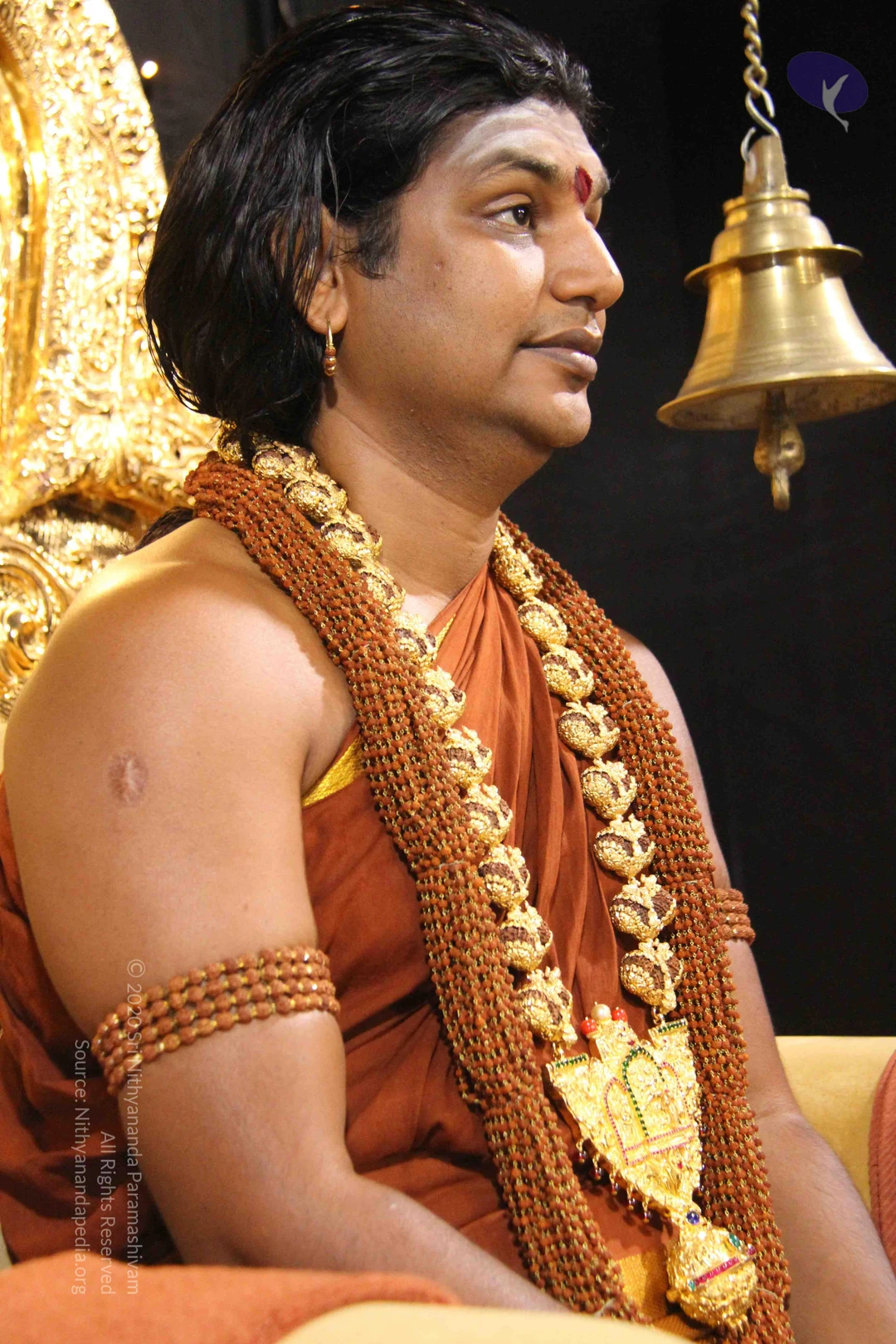
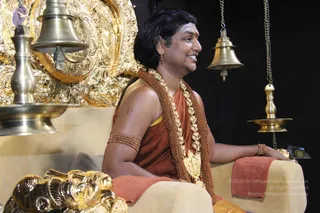
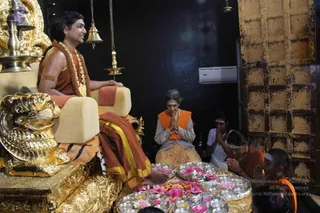
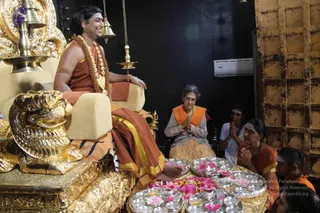
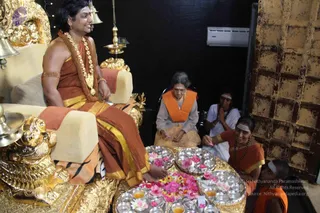
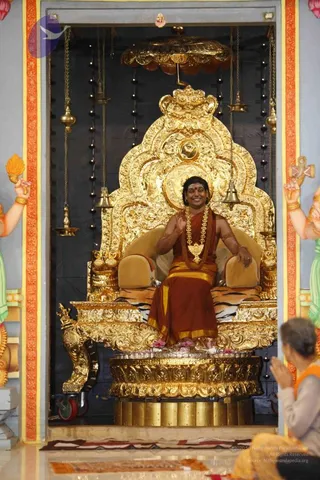
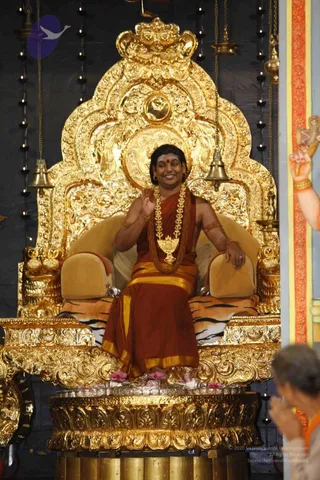
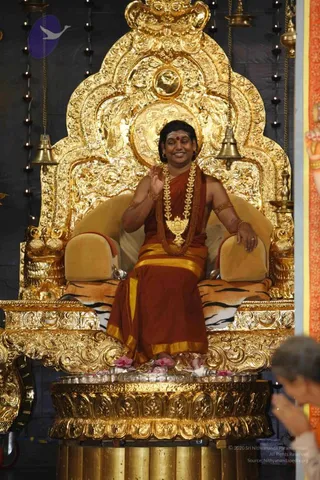
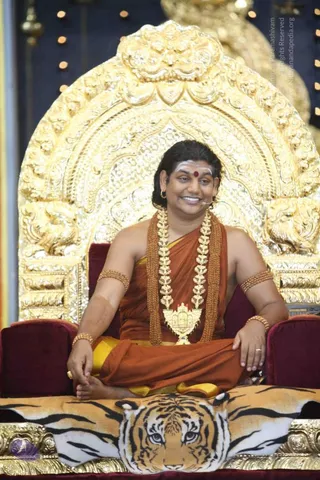
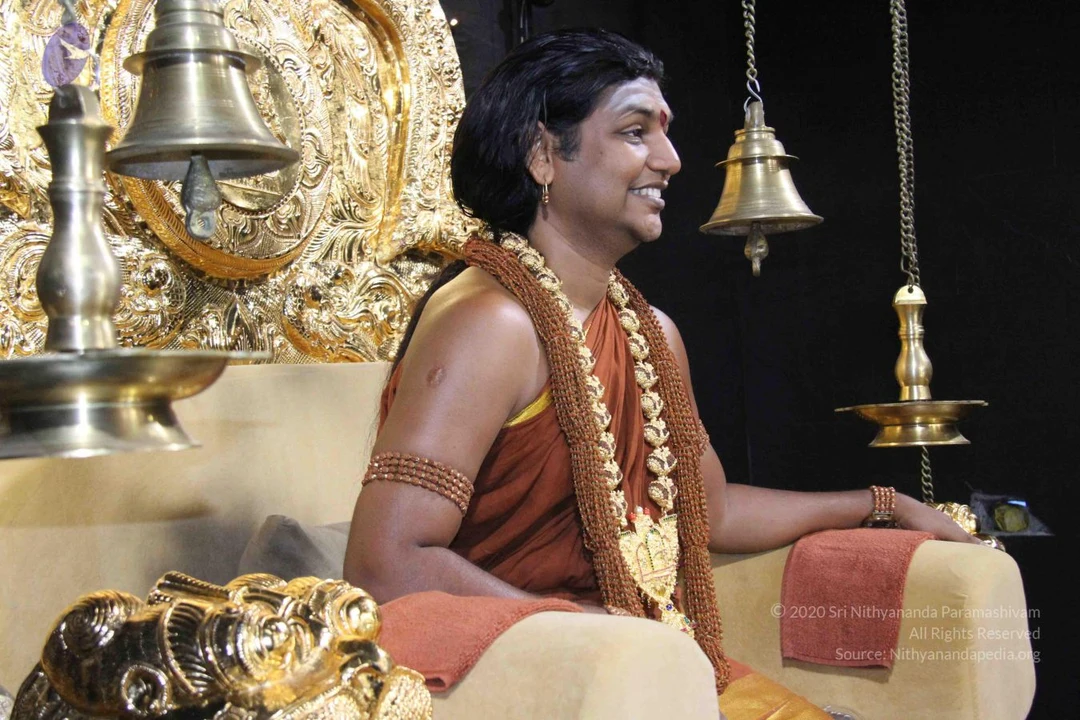
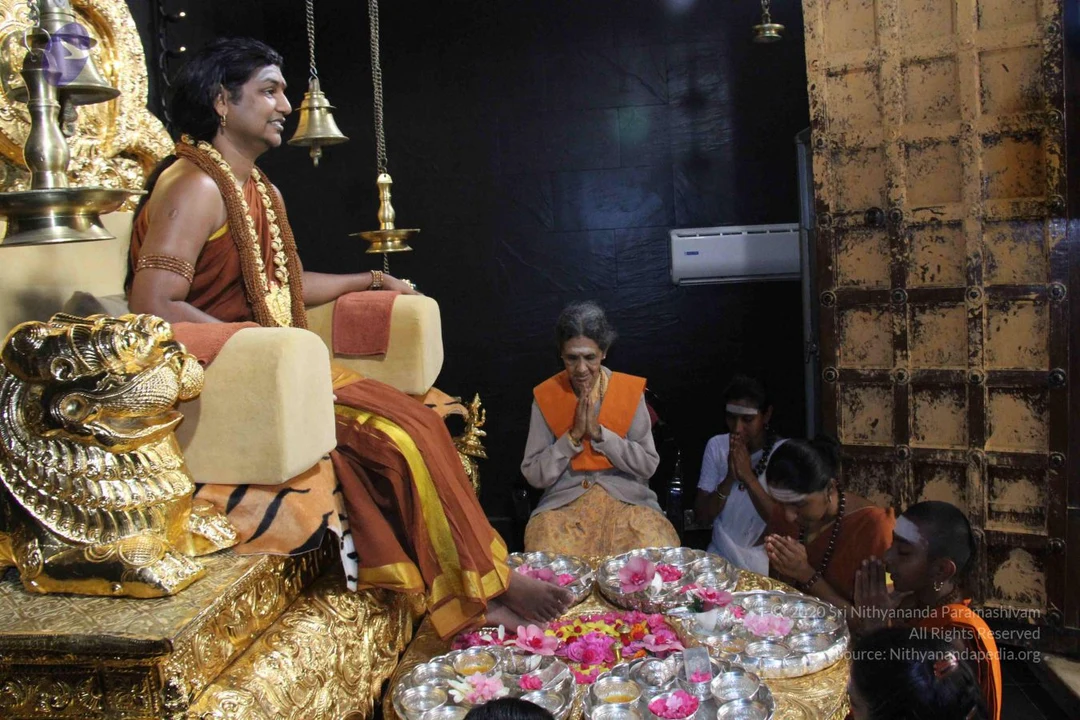
A smiling man with swept-back black hair sits on an ornate golden throne, wearing a rust-orange robe draped over one shoulder, a long rudraksha mala with a large gold ceremonial necklace, and a rudraksha armlet. A small red bindi is on his forehead. He rests his hands on a cream-coloured armrest with an orange cloth draped over it. Brass bells hang from chains on the right, and a brass oil lamp stands at the left edge beside gold ornate carving. Swamiji (probable), seated on his throne, with the cues being the long hair, saffron robe and rudraksha malas. The background is dark.A seated man with long dark hair wears an orange-brown robe with a gold-bordered cloth and a multi-strand beaded garland, with a gold bangle on his arm, on an ornate gold throne with a carved lion-like base. Swamiji (probable) is shown in this role on the throne, with cues of long swept-back hair, saffron-toned clothing and a ceremonial gold necklace. Before him, a tray of silver bowls holds pink lotus petals, marigolds and oil lamps. Behind the tray, an elderly woman in grey with an orange shawl presses her palms together in namaskar. Two devotees in white with vertical sandalwood-style forehead marks kneel in folded-hands prayer at right, beside a large dark wooden door with brass studs and a wall air conditioner above. Hanging brass bells and a brass lamp frame the upper left.A seated man in a gold-and-cream throne with a gilded lion-head armrest, wearing saffron-orange robes with a gold border, a long gold-beaded garland, and a rudraksha-style necklace, smiles while resting his hands on the armrests. Probable Swamiji (appearance cues: long swept-back hair, saffron robes, ornate gold garland, and throne) is seated in the front. Before him on a gold tray are silver plates with pink flowers, lamps and offerings. A woman in grey top with orange shawl presses her palms together; behind her, two devotees in white and orange and a woman with tripundra-marked forehead join hands in namaskar. Hanging brass oil lamps and a gold-patterned door complete the setting, with an air conditioner on the dark wall.A photograph of a man seated on an ornate gold throne with carved lion-like arms, wearing an orange-saffron dhoti with gold borders, an orange shawl, a rudraksha-style garland with gold ornaments, gold bangles and a gold armband, and a striped tiger-print cloth on the seat. The man has long dark hair and a red bindi and sits with bare feet resting on a gold footstool above a tray of silver plates holding pink flowers, oil lamps and offerings. Beside him a woman in an orange shawl and grey sari sits with hands folded in a wheelchair, a man in white with a white forehead tilak and folded hands kneels, and a woman in orange with a rudraksha mala and tilak sits and smiles at the tray. A brass oil lamp hangs from a chain, and a dark wooden door with brass studs stands at right. The appearance-based label a person applies to the seated man in saffron and gold ornaments, with his throne and ritual offerings.A photograph of a man in close framing, smiling and looking to the side beside a hanging brass bell with a chain. He wears a reddish-orange draped cloth over bare shoulders, a thick rudraksha mala with gold ornaments, a gold earring and a red bindi on his forehead. Long dark hair falls past his ears. Behind him is an ornate gold-coloured carved surface against a black background. Swamiji (probable): the long swept-back hair, saffron-orange wrap, rudraksha mala and gold ceremonial adornments match the appearance cues, so this is a single in-person candidate seated near the bell.Close view of a padapuja ritual: a pair of bare feet in an orange garment with gold border rests on a golden tray covered with pink, magenta and yellow flowers, rose petals and orchids. Around the feet are silver bowls and vessels filled with yellow liquid, silver spoons and a small silver pot with a spout. The scene is a foot-worship offering of flowers and ritual vessels.

Pratyaksha-Pada-Puja

16 photosSource gallery
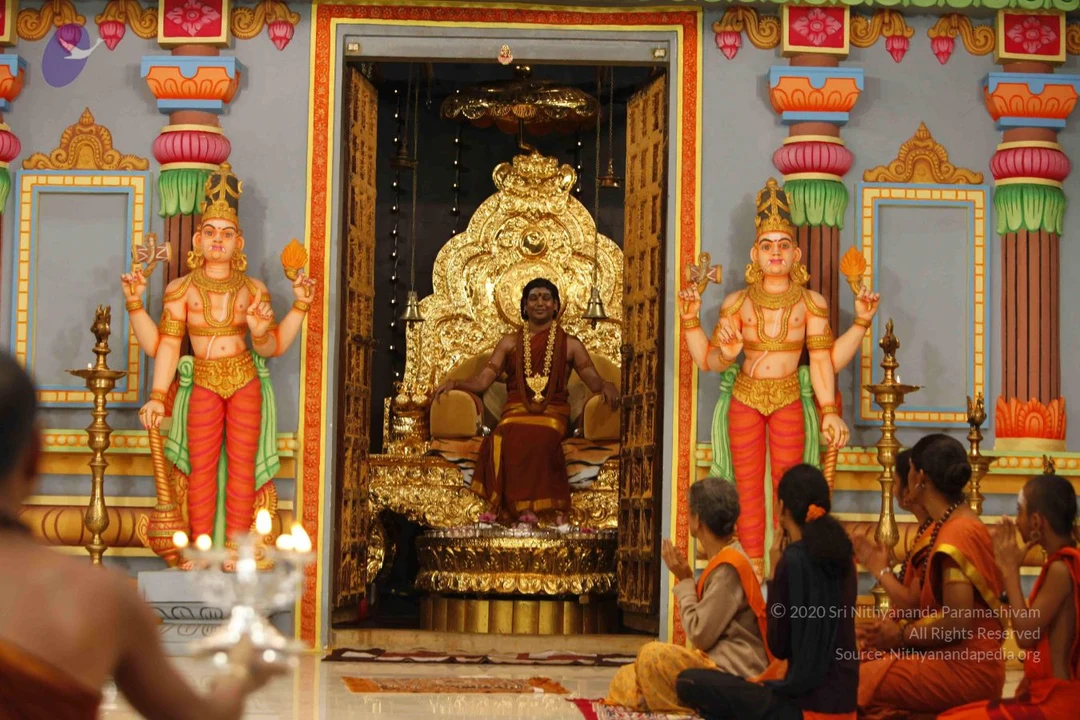
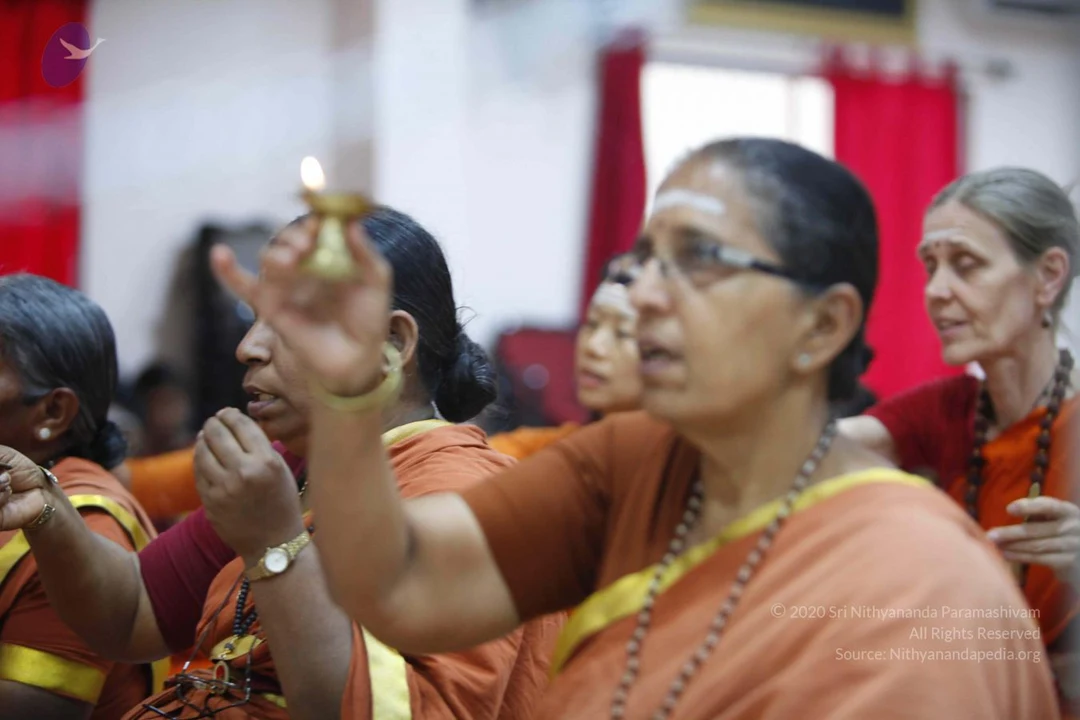
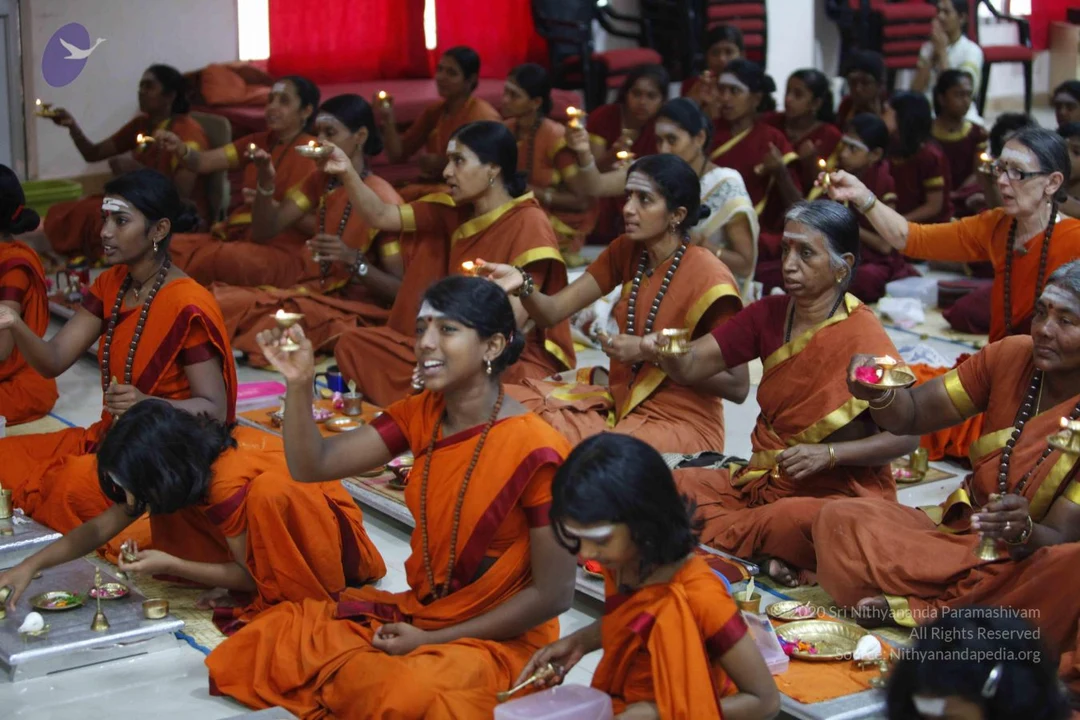
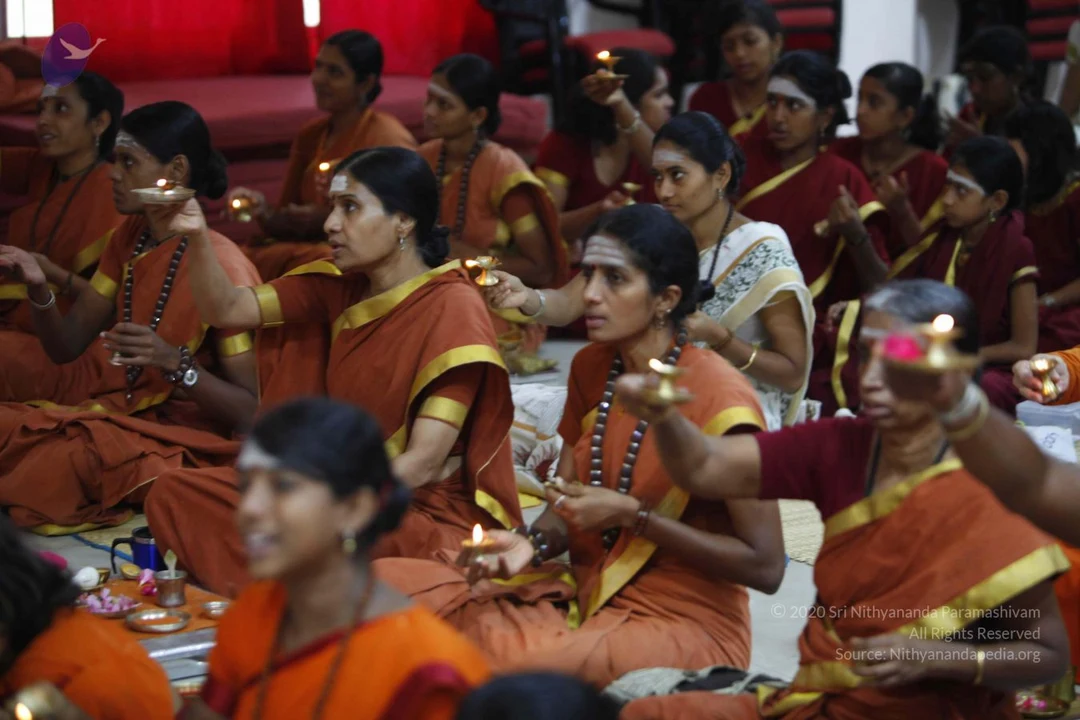
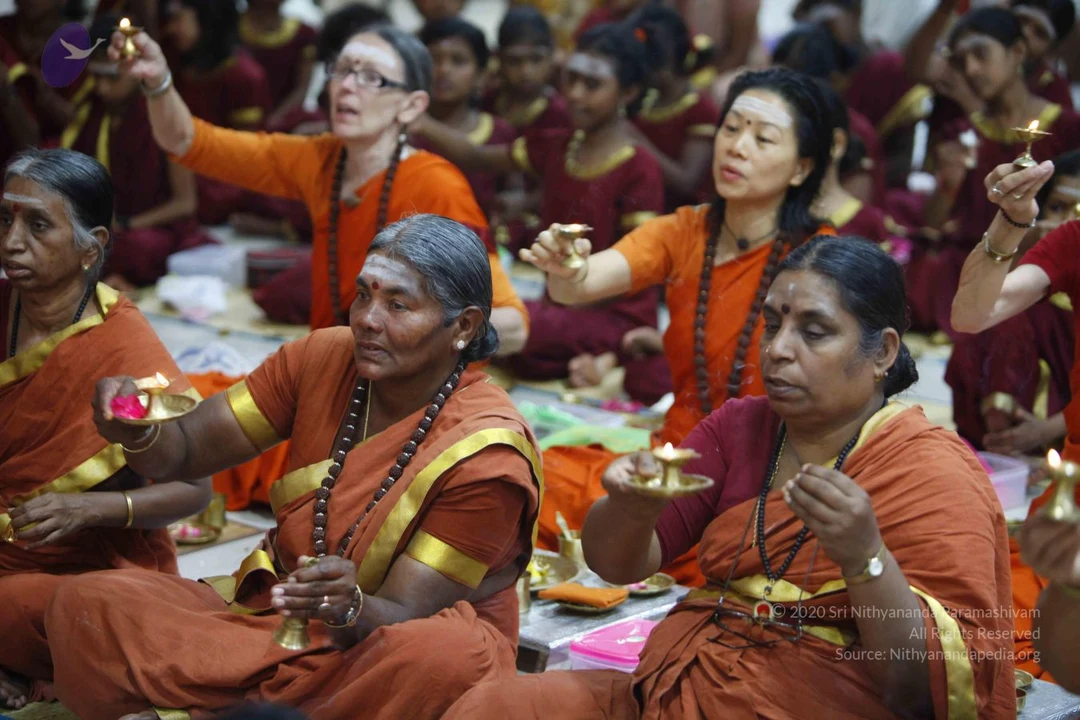
Close-up photo of a silver five-branched aarti lamp held in a hand at the bottom of the frame, with flames burning in its cups. The lamp is ornately decorated with silver scrollwork. The blurred background shows a temple interior with pink, green and orange painted panels and a golden surface on the right. No person's face is visible, and no a person candidate is clearly present.Close-up photograph of a polished silver multi-branch oil lamp (aarti lamp) with five lit wicks, the flames burning on ornate scrolled arms and a tall central stem. The background is blurred, showing a temple interior with painted orange, red and green pillar bands and a deity murti silhouette. Only a dark edge of a head is visible at the lower left, partially in frame.A photograph inside a richly decorated temple hall with painted pink, green and gold pillars and a golden doorway framing a seated figure on an ornate gold throne. The seated figure wears a deep red-brown robe, a long white flower garland and a gold necklace, with hands resting on the throne arms. Two painted attendant figures with multiple arms, orange-red dhotis and green sashes stand on either side, holding lamps and ritual items. In the foreground, a priest in orange at left tends to brass oil lamps, while several women in orange and saffron sit with palms pressed together, facing the throne. Brass lamps with lit flames sit on the floor and along the walls. The scene suggests a satsang or darshan setting.Several women in orange saris with gold borders sit in a row holding small lit oil lamps, their arms extended forward in an offering gesture. Many wear rudraksha malas and bangles, and some have vibhuti marks on their foreheads. A red curtain hangs in the background, and brass vessels sit on a table at the lower left. The photograph is blurred in the foreground.A row of women seated on the floor in matching saffron-orange sarees with yellow borders, holding small oil lamps (diyas) lit with flames in their raised hands during a ritual. Several women wear rudraksha malas and bangles; one on the right holds a lamp near the frame edge. In the foreground a brass tray with small vessels and flowers sits on the floor, and a red curtain and white wall form the background. No a person candidate is visibly present in this image.A photograph of a row of women seated in a line, each holding a small brass oil lamp (deepam) with a lit flame. The foreground woman on the right, with grey hair pulled back and a red bindi and vertical white forehead marks, wears an orange sari with a gold border and a maroon blouse, with rudraksha beads and gold bangles on her wrists. Beside her a younger woman with a white tilak holds a lamp. Other women in orange saris with gold borders sit blurred in the background, and a red curtain is visible at the top right. The scene suggests a devotional lamp offering or aarti.

Nithya-Satsang

8 photosSource gallery
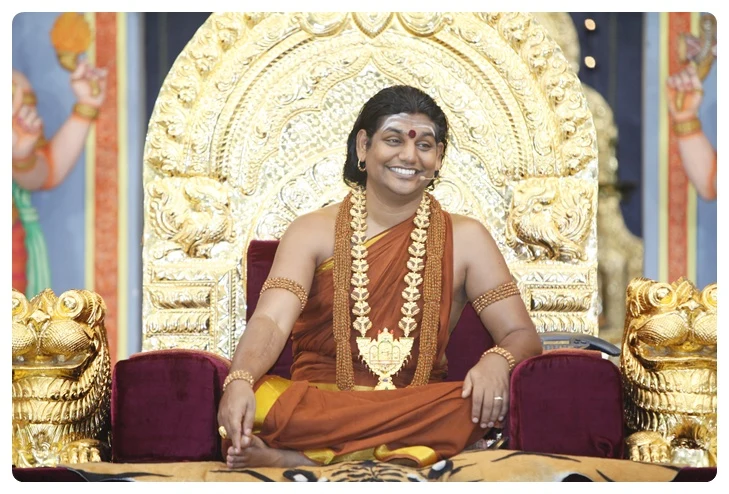
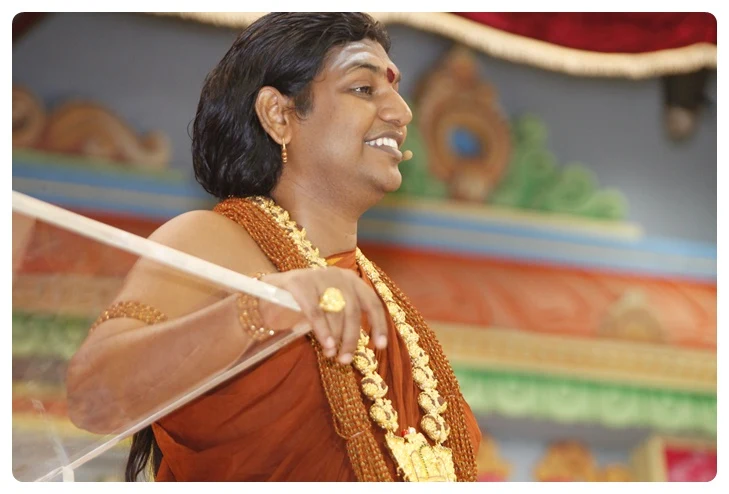
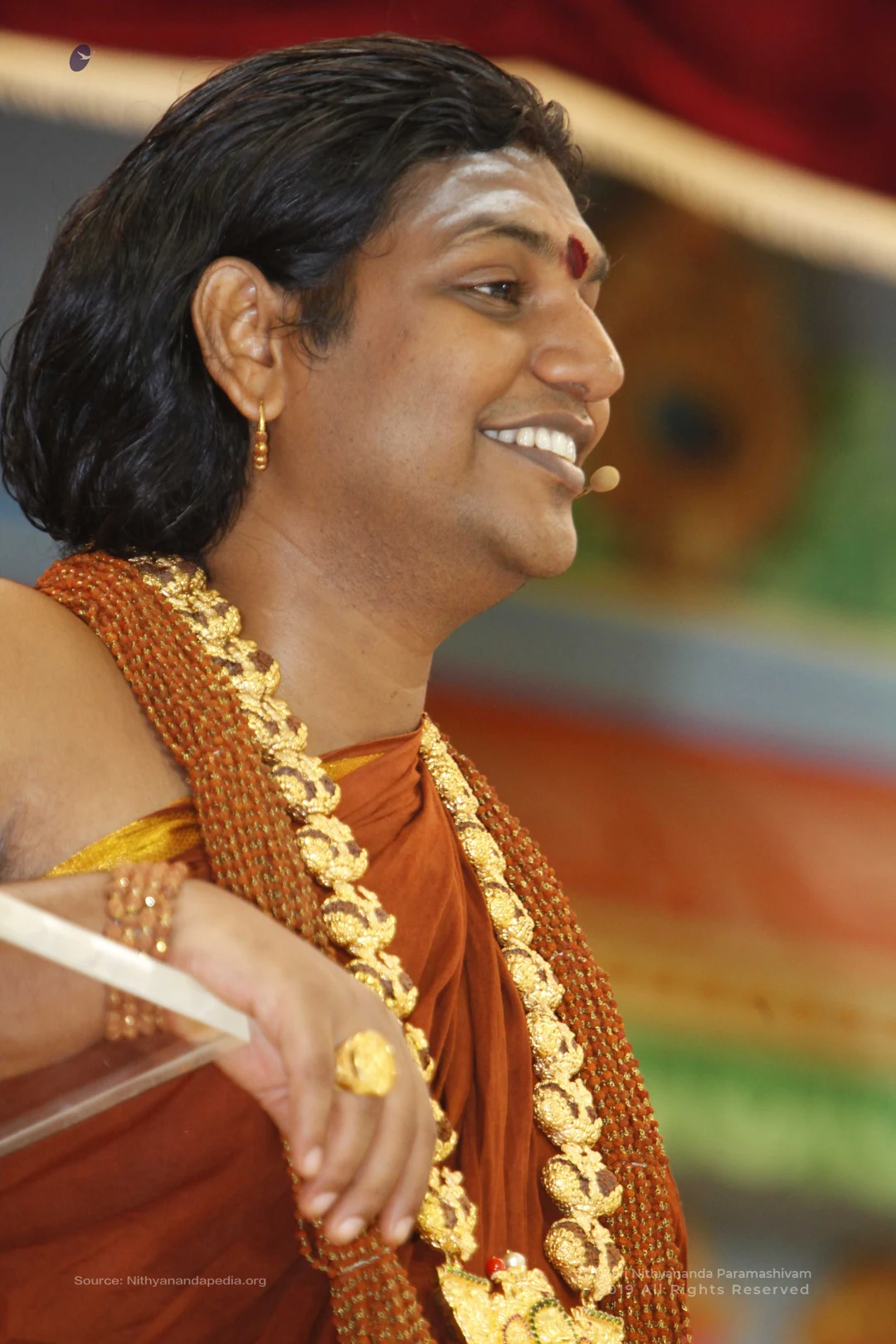
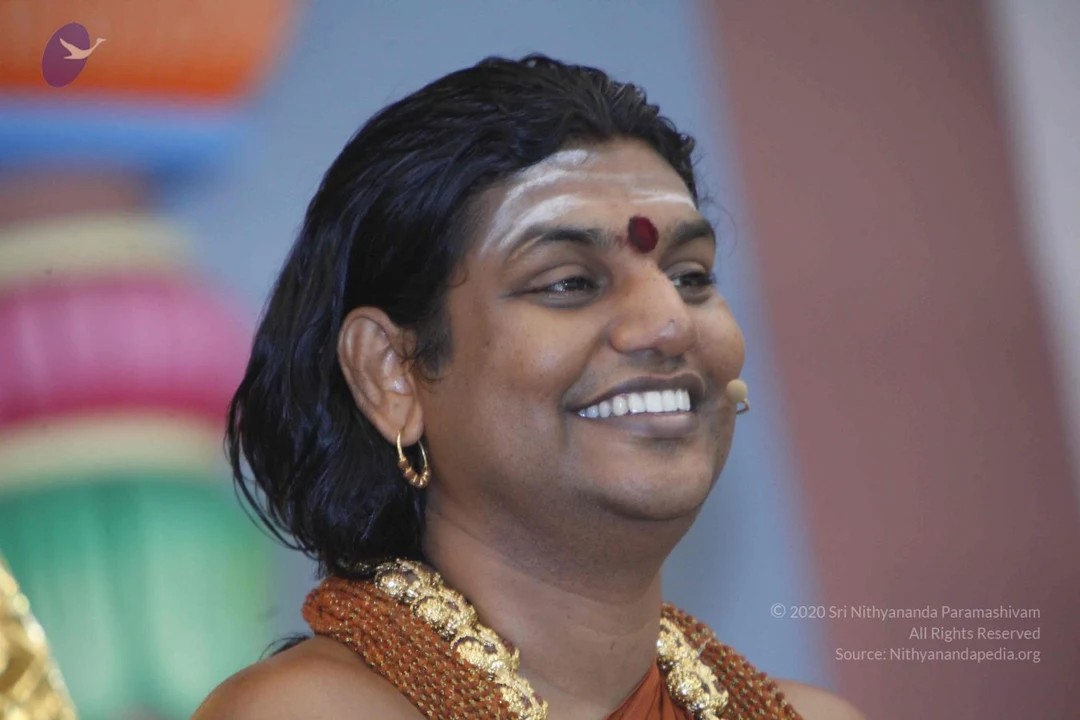
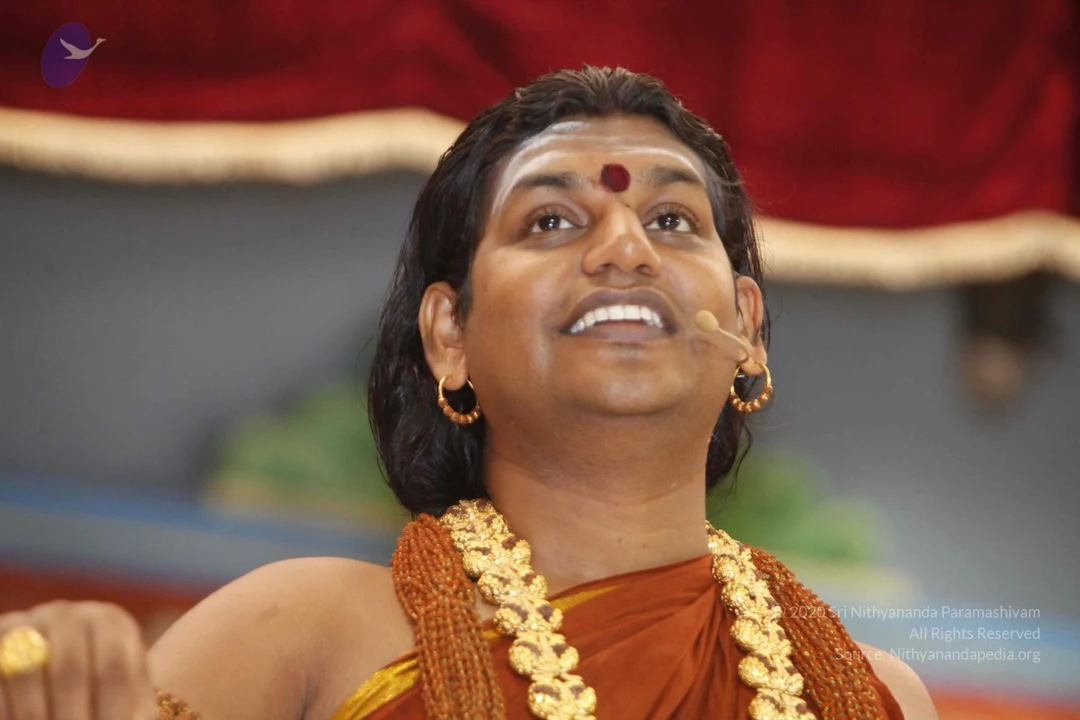
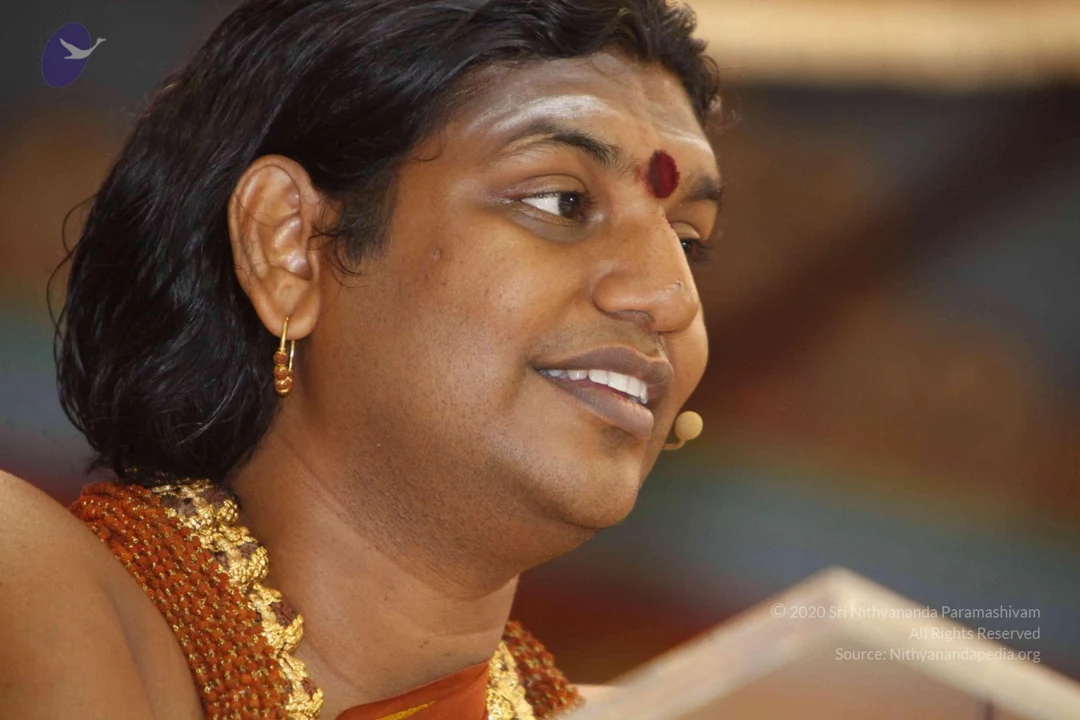
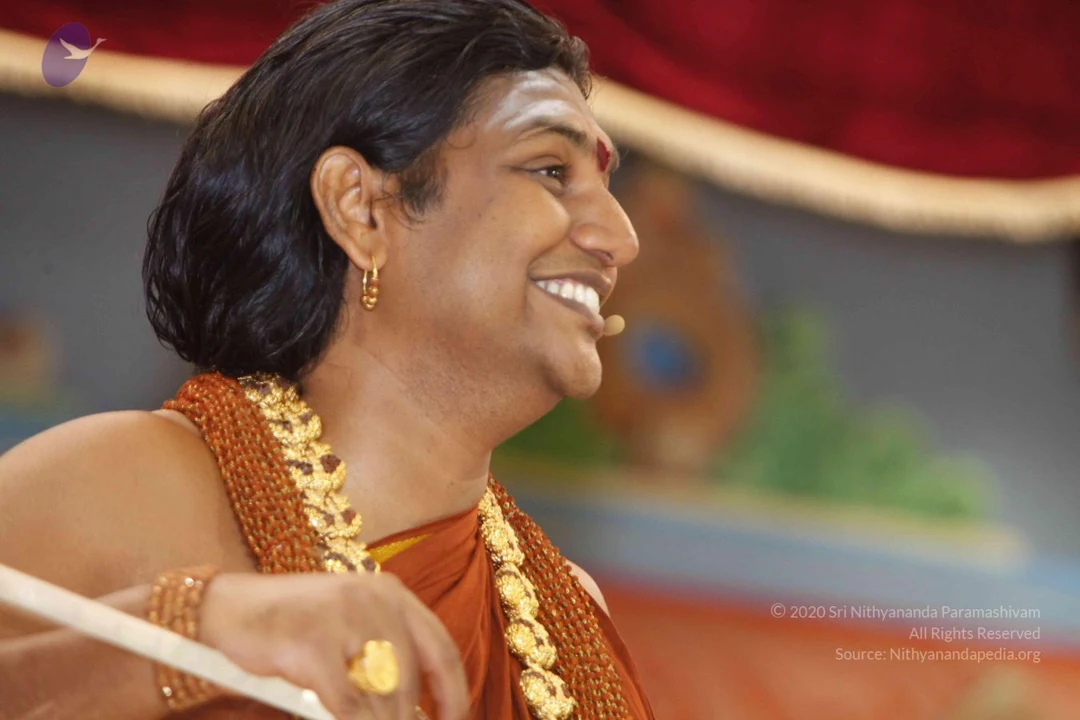
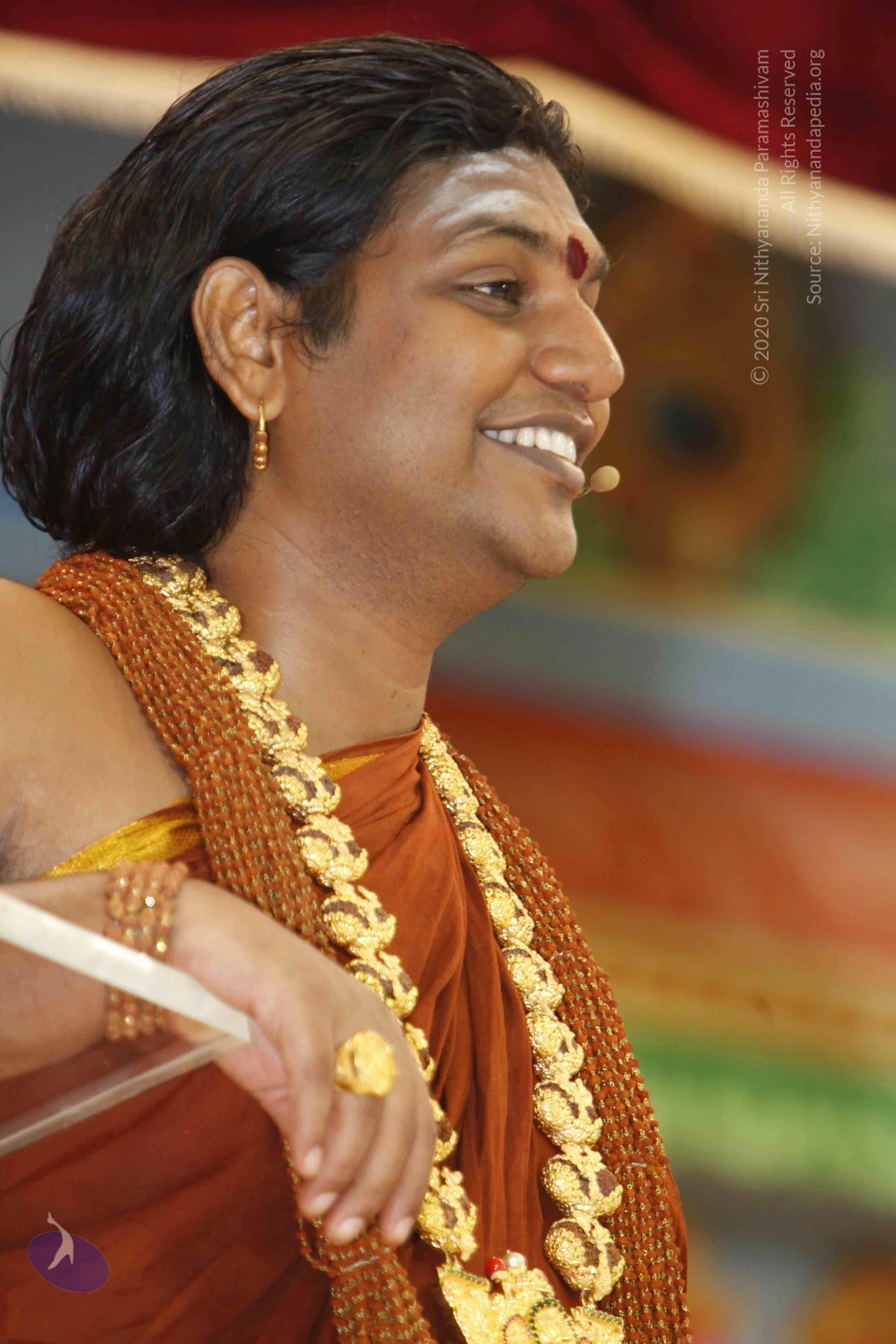
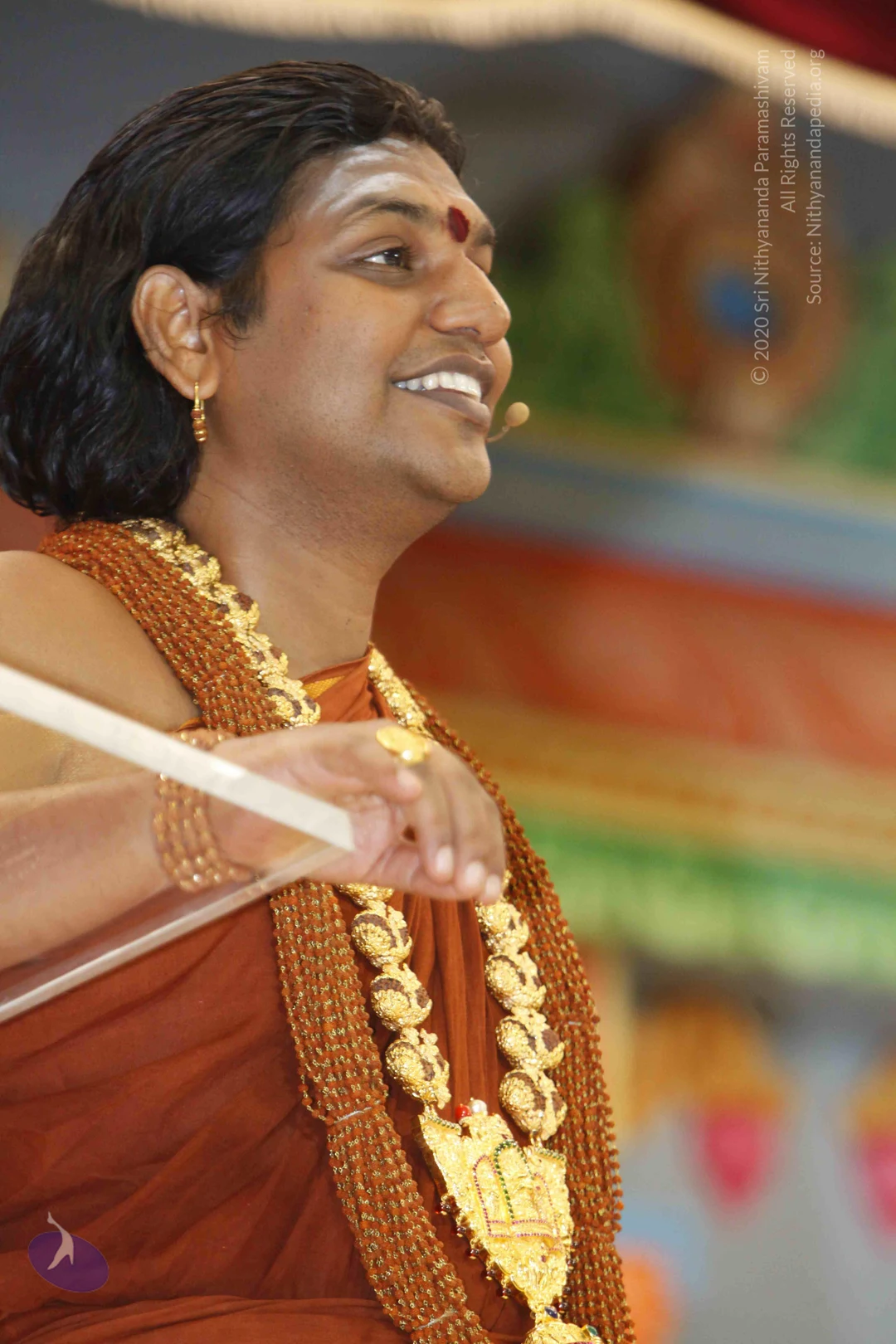
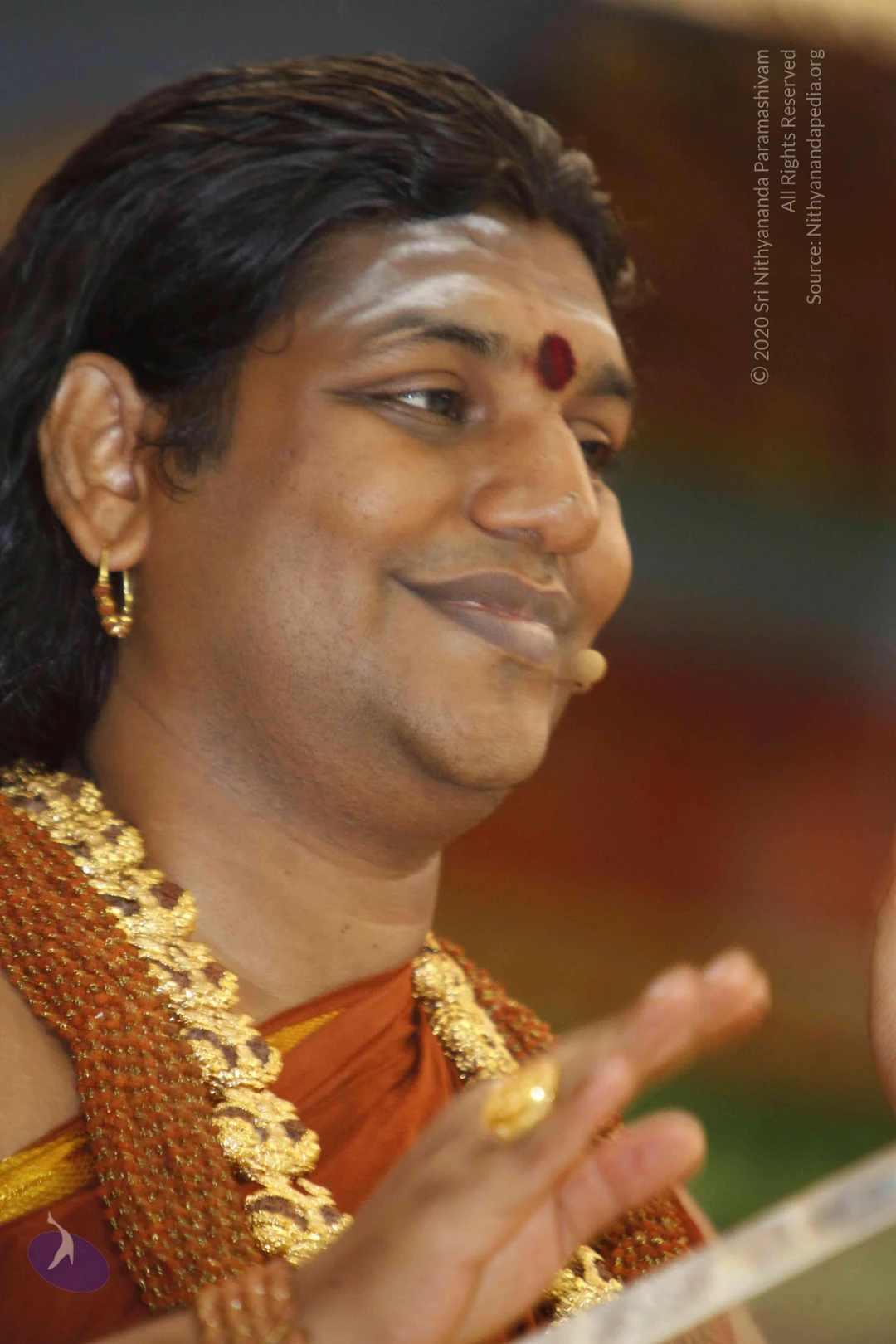
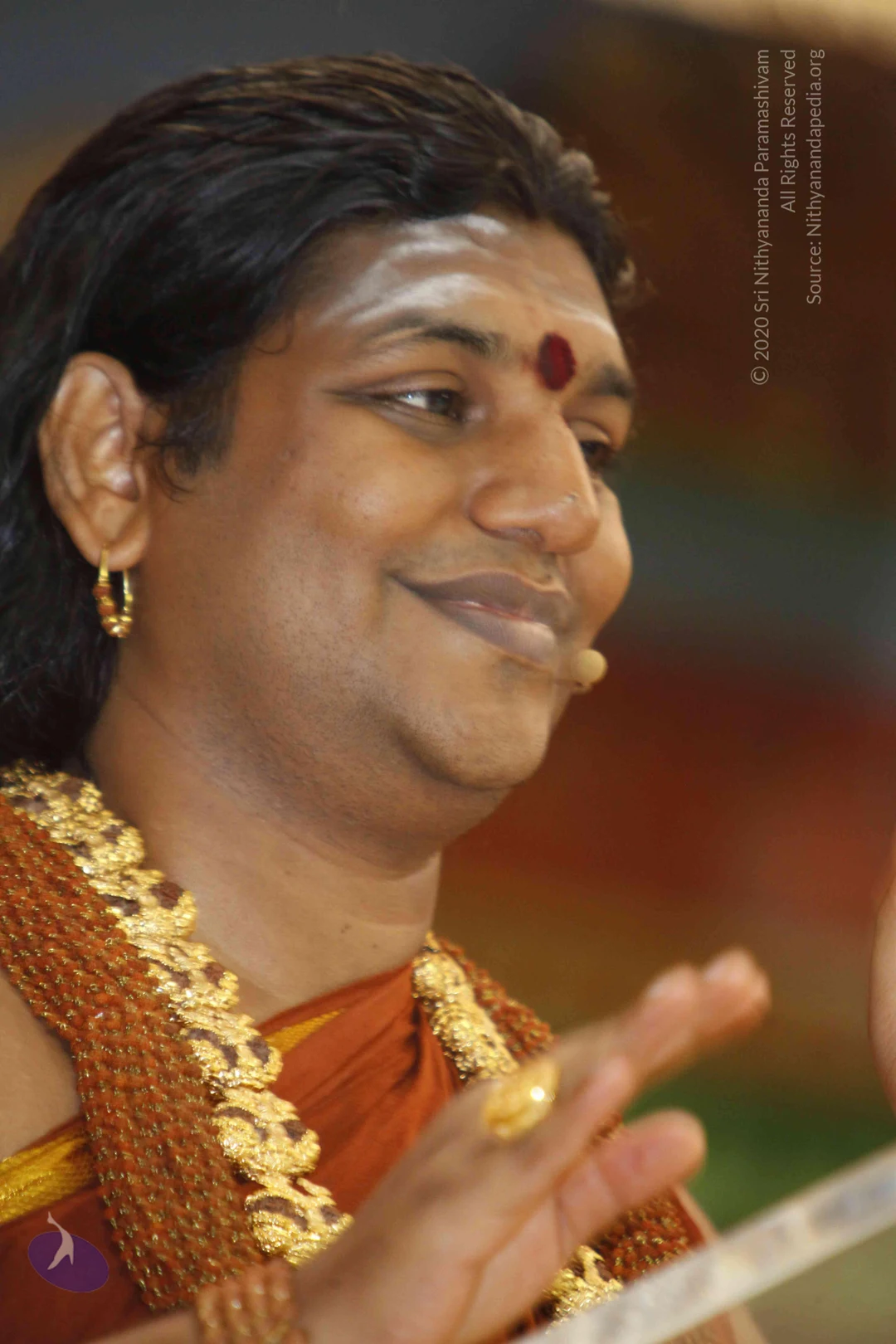
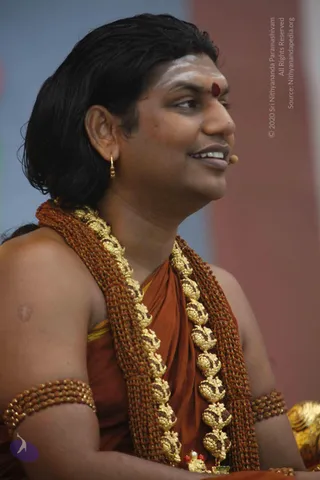
A seated man in saffron-orange robes with a gold-bordered dhoti sits cross-legged on a tiger-skin-covered platform before an ornate golden throne with lion-head armrests. He wears a long rudraksha-style mala of beads, a tall ceremonial gold necklace with a pendant, gold armlets and bangles, a tilak and a red bindi, and his long dark hair is swept back. He sits calmly with his hands resting on the armrests, facing the camera. Behind him, painted deity figures with raised arms appear on a blue and red background. The setting suggests a satsang discourse hall. Swamiji (probable) appears in_person, as the seated figure with distinctive long swept-back hair, saffron robes, ornate gold necklaces and a rudraksha mala on the throne.A photograph of a smiling man seated cross-legged on an ornate gilded throne with lion-head armrests and a golden arched backrest, a striped tiger-skin cloth draped over the platform. He wears a saffron-orange dhoti and shawl with a yellow border, a long gold-and-rudraksha style necklace with a gold pendant, gold armbands and bangles, and a white vibhuti tripundra with a red kumkum dot on his forehead. Painted deity figures with raised arms flank the throne in the background. a person is shown seated in a satsang setting, with a small headset microphone visible near his ear.A man seated cross-legged on a gold-carved throne with lion-head armrests and an ornate arched backrest, smiling. He wears a saffron-orange dhoti with a yellow border, a bare chest, a red bindi and white vertical tilak on his forehead, multi-strand gold necklaces with a large gold pendant, and beaded gold armbands. a person is shown in the center of the frame, appearing as a seated teacher addressing a gathering. Behind the throne on the left, a painted deity figure with multiple raised arms is partly visible, and gold lion statues flank the seat in the foreground.Close-up photo of a smiling man with long dark swept-back hair, white vertical forehead markings and a red bindi, wearing a small gold hoop earring, a small headset microphone near his mouth, and a saffron-orange garment with a thick beaded gold-and-orange necklace. Background is blurred with pink, green and red stage colours. Appearance-based label: a person, seated or standing as a speaker at a satsang.Close photo of a man seated on a stage before a red draped backdrop with gold fringe, smiling and looking upward while gesturing with his right hand. He has long dark hair swept back, a red bindi and white forehead markings, gold hoop earrings, and a small headset microphone at his cheek. He wears an orange-brown shawl draped over bare shoulders, with layered rudraksha-style beaded malas and a heavy gold ceremonial necklace.Close-up photograph of a smiling man with long, swept-back black hair, a red sandalwood-paste mark on the forehead, and gold earrings. He wears a thick orange-red beaded necklace with gold ornaments over bare shoulders, and a small microphone clipped near his mouth. He looks to the side toward an unseen audience, with a blurred warm background and a wooden lectern edge at lower right. a person: the long swept-back hair, orange ornate necklace and gold adornments fit the presentation of the page's named teacher during a satsang discourse.

Sarva-Darshan

16 photosSource gallery
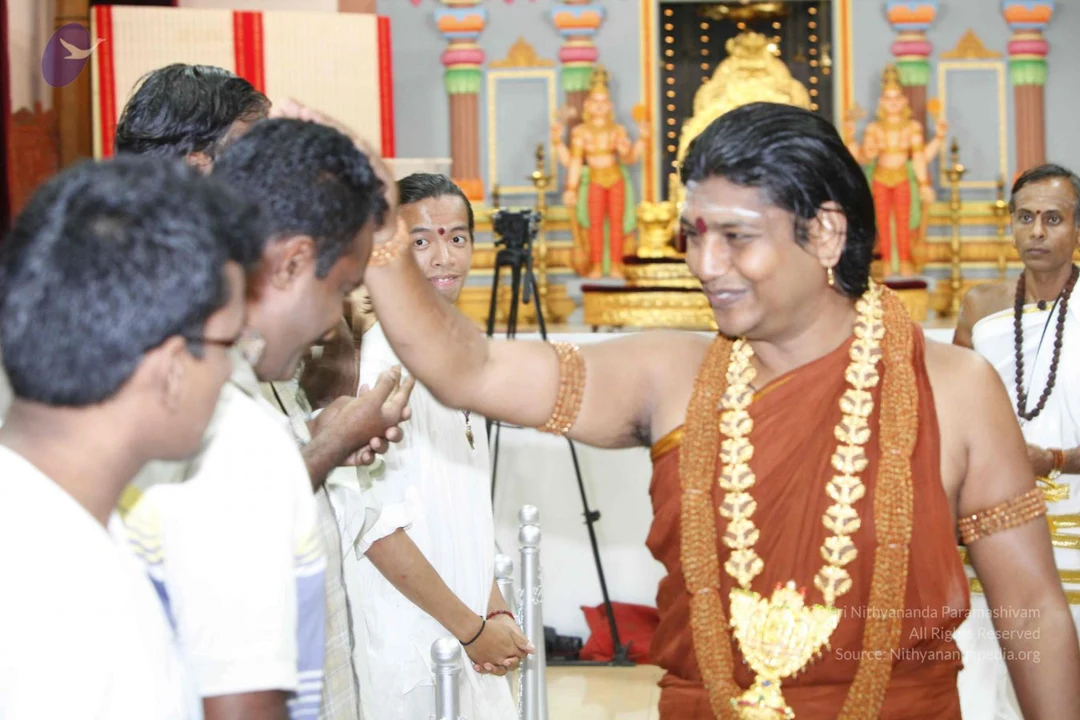
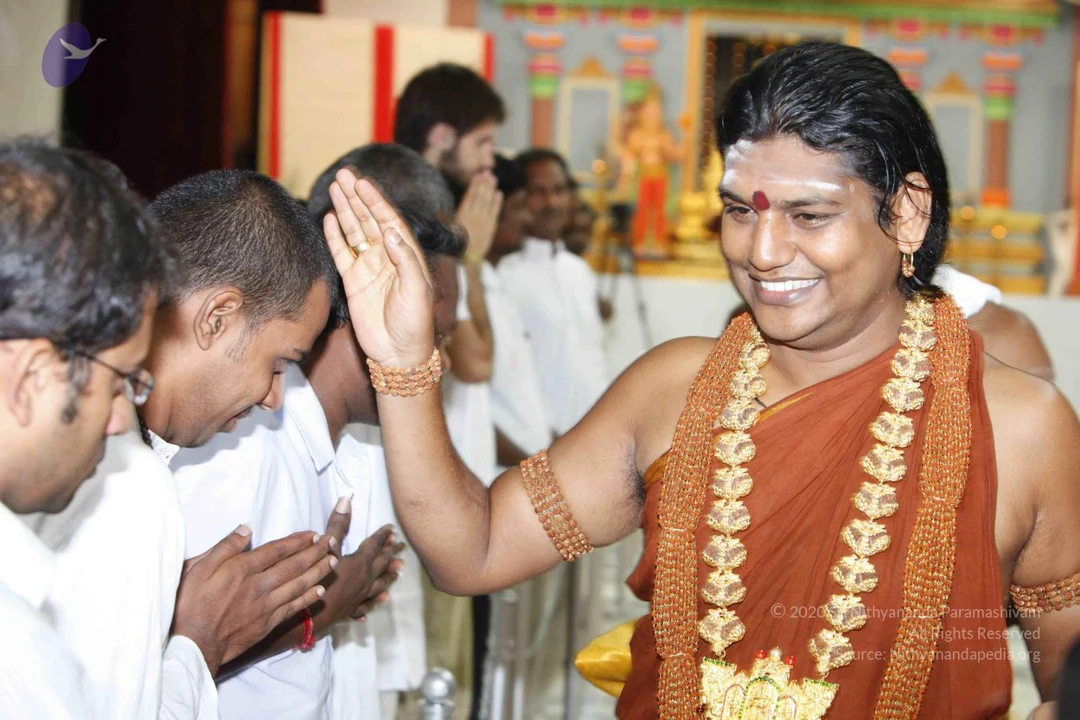
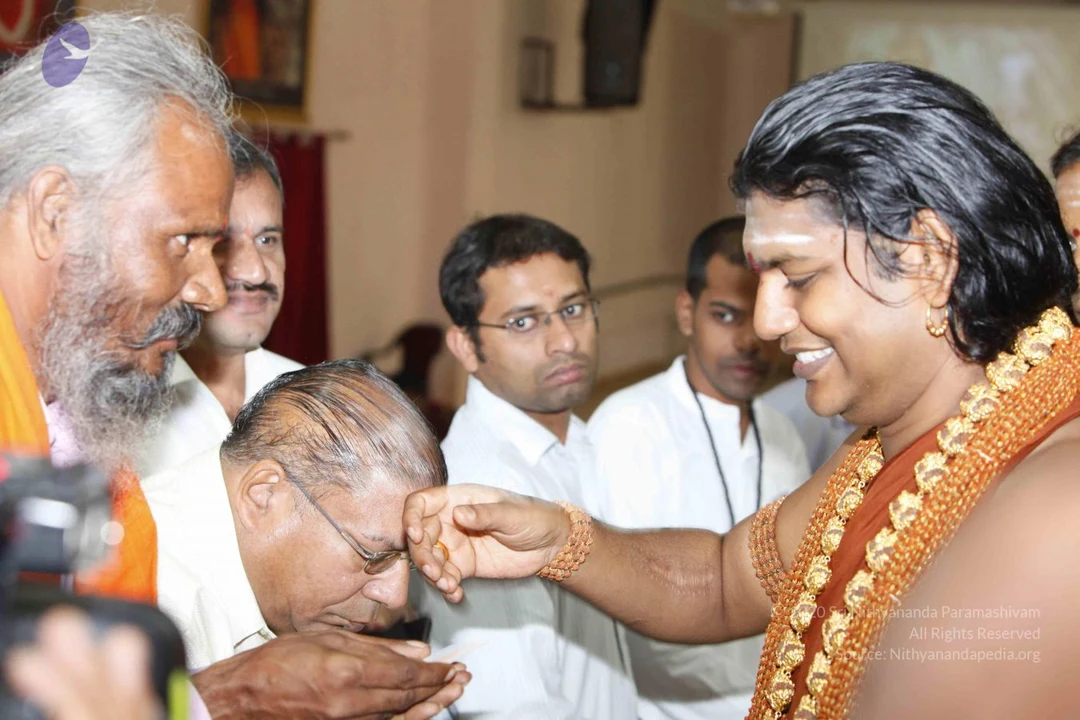
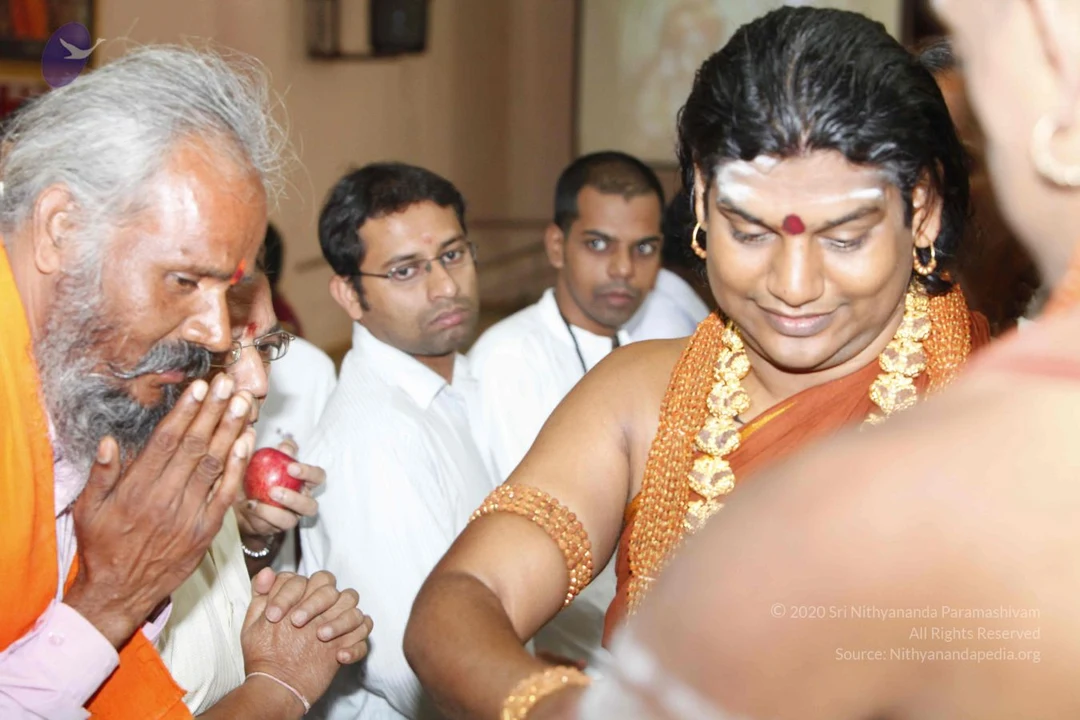
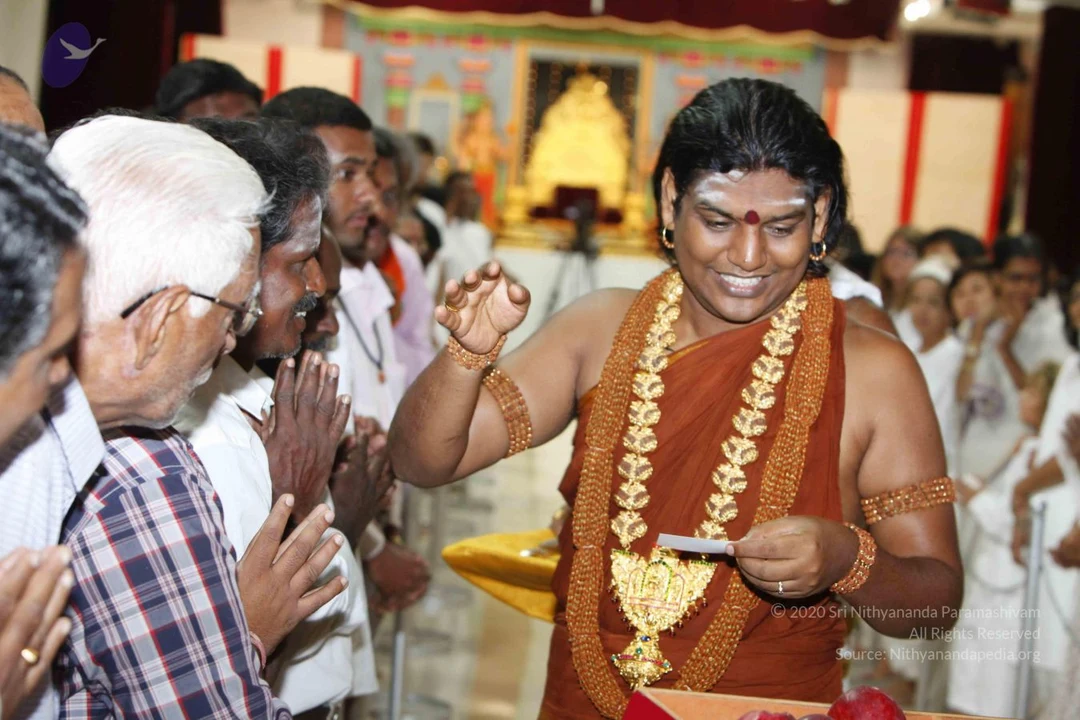
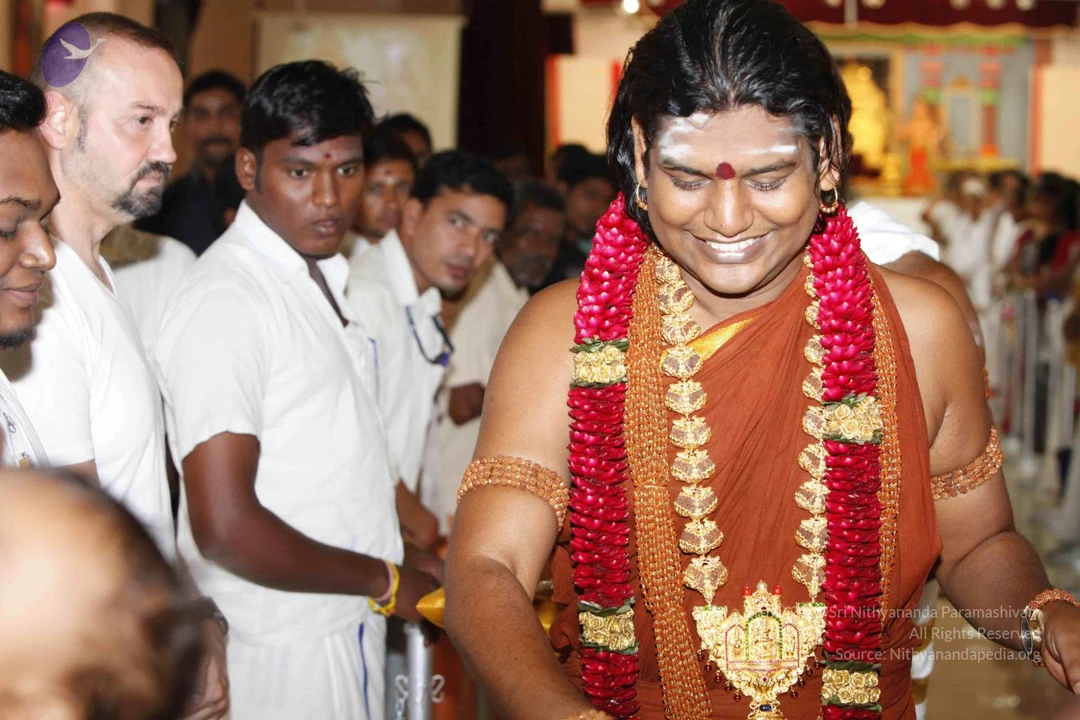
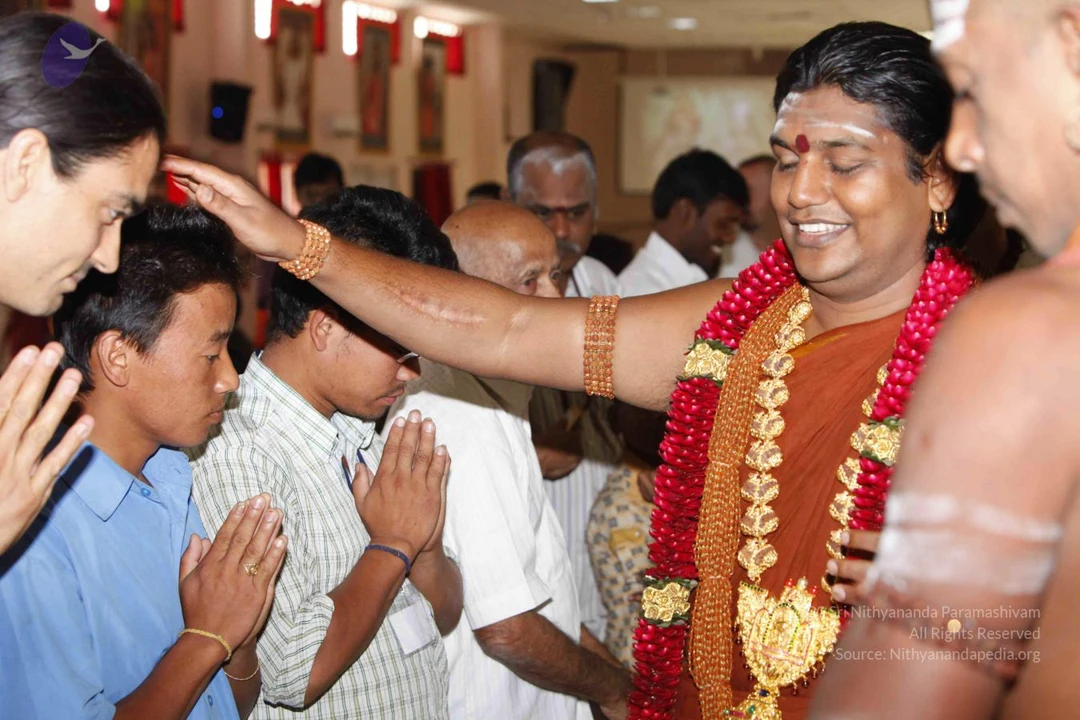
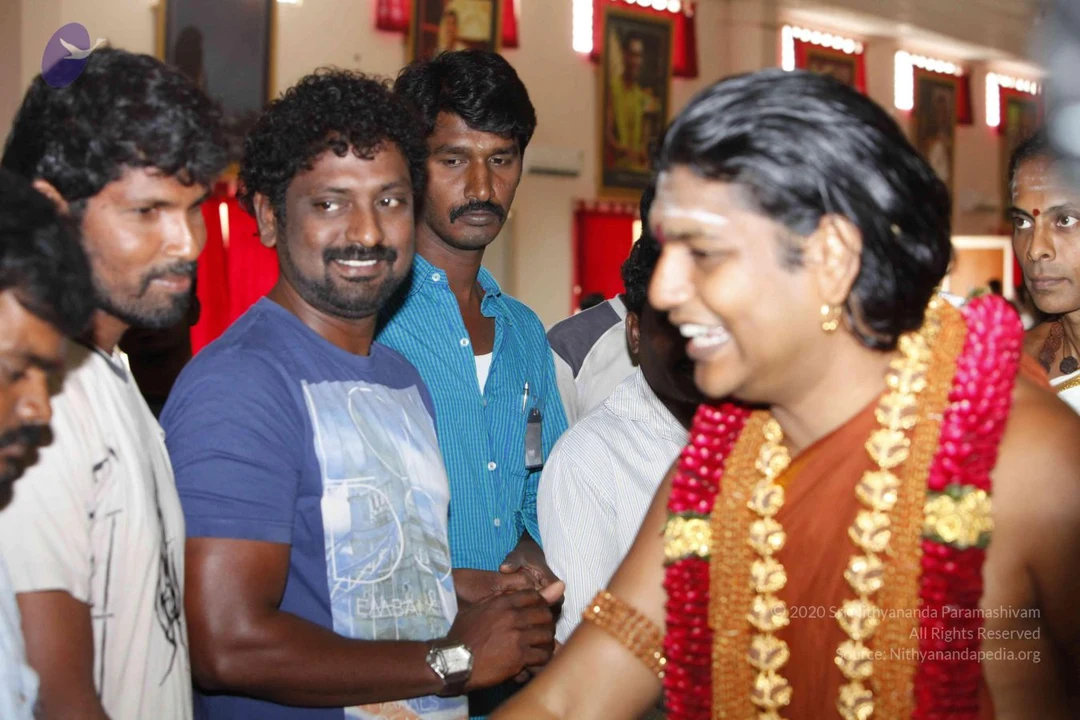
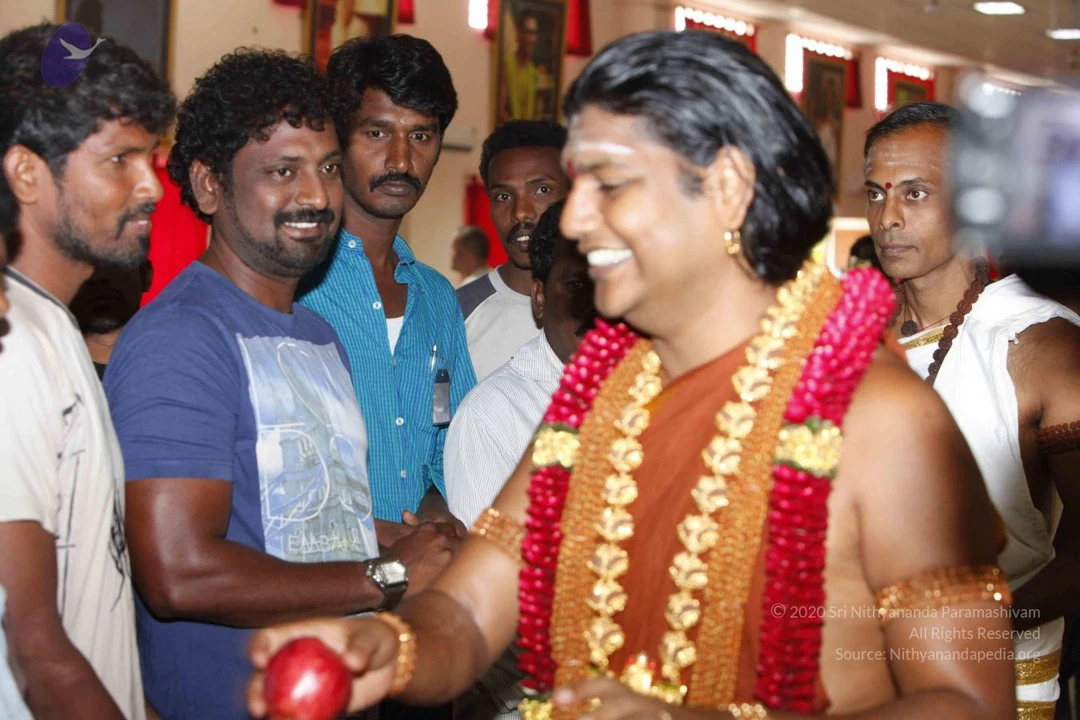
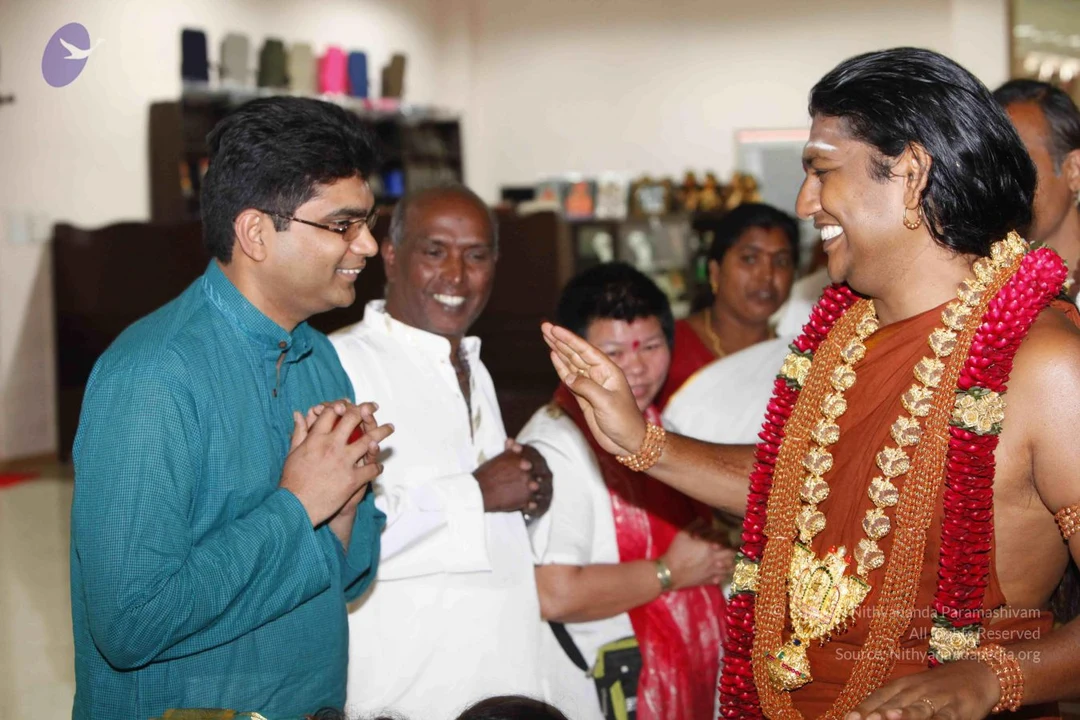
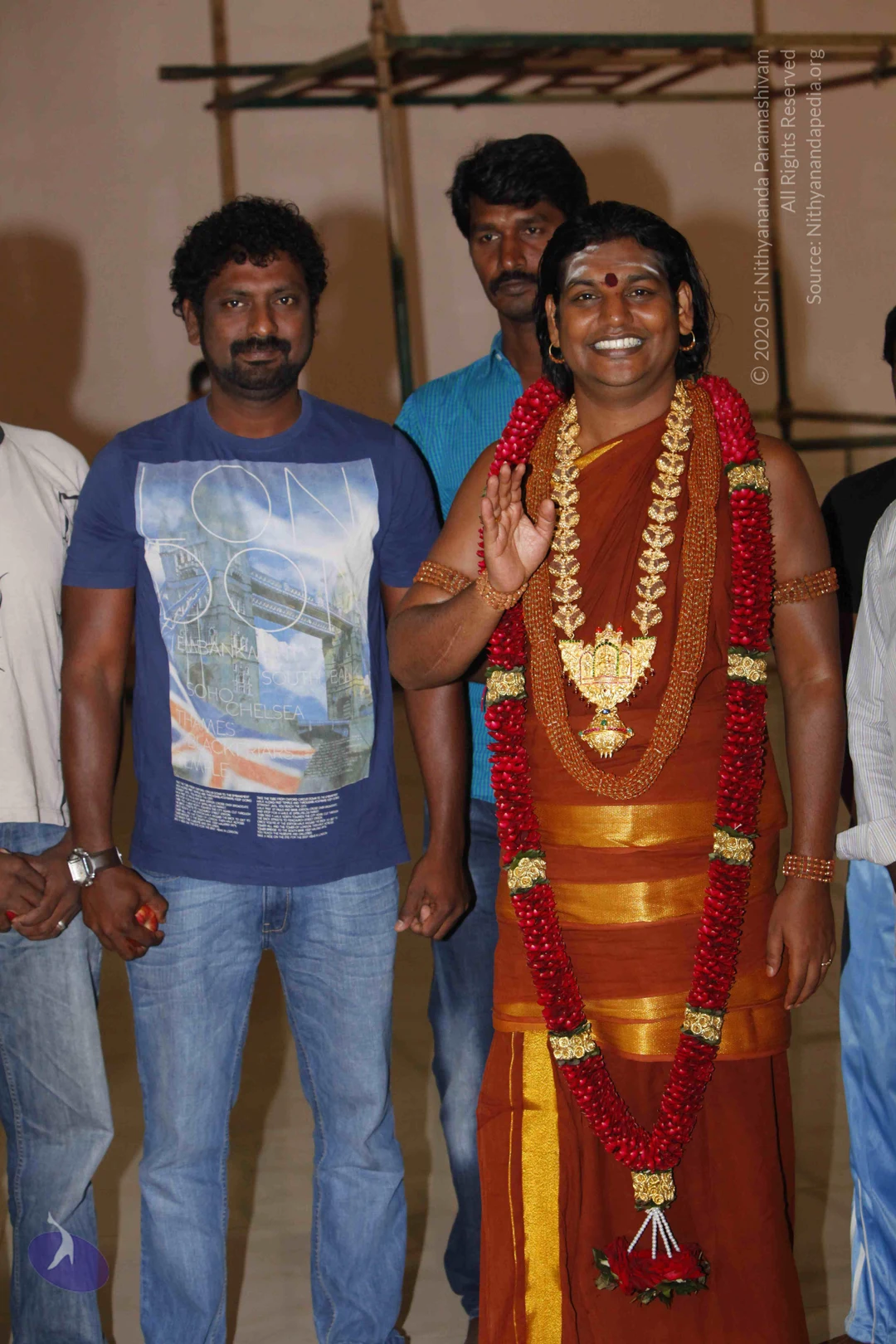
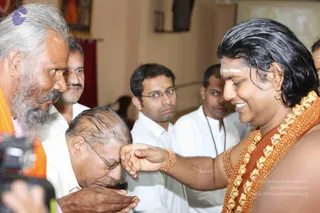
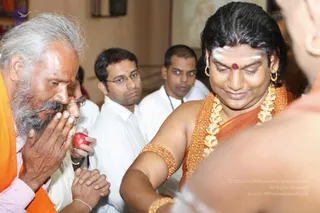
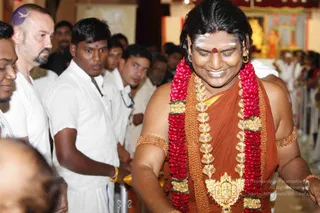
A photograph in a temple hall with gold-coloured pillars and a golden deity shrine behind. A man with swept-back long dark hair, a red tilak on his forehead, a bare upper torso, an orange-saffron shawl, a heavy gold ceremonial necklace with floral pendants and gold armlets stands at right, extending his arm to a devotee who reaches up to him. a person is the central figure, visibly receiving devotees. Several devotees in white dhotis and shirts stand at left, one holding his hands together. Two gold deity figures with raised arms stand in the background, and a man in a white dhoti with a rudraksha mala stands at far right. A camera on a tripod is visible behind the devotees.A smiling man with long swept-back black hair, white vibhuti lines and a red bindi stands at right in an orange-saffron dhoti-style wrap with heavy gold necklaces and rudraksha-style beaded malas, bangles on his wrist and armlet on his upper arm, raising his palm in blessing toward a line of devotees in white shirts and dhotis who stand with hands folded in anjali. Behind them stands a shrine area with a golden deity murti and red-and-gold decorative panels. The overall scene suggests an ashram darshan or blessing moment.A photograph of a man with long swept-back dark hair, wearing an orange-red shawl, a gold-bead necklace and a rudraksha-style ceremonial garland, applying a mark to the forehead of an older man in white bending forward with glasses. On the left an elderly bearded man in an orange shawl watches. Several men in white shirts stand behind, one with a dark mala, in a room with cream walls and a red curtain. The distinctive long hair, orange clothing and gold necklace of the man applying the mark are cues consistent with the Swamiji (probable) label.A photograph of an indoor gathering where a man with long dark hair, white forehead markings, a red bindi, gold earrings, a saffron cloth and layered gold necklaces stands at the centre, his arm extended toward a devotee in the foreground. To the left, an older man with grey hair and beard in an orange garment presses his palms together in reverence and holds a red fruit or apple in one hand. Behind them, several men in white shirts look on, one wearing glasses. The setting appears to be a devotional room with a wall and a framed picture above. a person is the central figure in orange and gold ornaments, shown receiving reverence.A photograph of a smiling figure in a saffron-orange dhoti-style wrap, wearing a heavy gold necklace with a large ornate pendant, gold armbands and bangles, with a red kumkum dot and white vibhuti marks on the forehead, long swept-back dark hair, and gold hoop earrings. The figure holds a small white card or paper in one hand and raises the other hand in a gesture while facing a row of devotees on the left who stand with palms pressed together in namaskar. A gold-coloured throne or altar with a golden deity murti is visible in the background, with white-clad devotees and red and white draped hangings around the hall. Several people are visible in the scene, including elderly men in checked shirts and white kurtas.A smiling man with long dark swept-back hair, white vibhuti marks on his forehead and a red bindi, stands in the centre wearing a saffron-orange dhoti-style wrap, red flower garlands with gold beads, a gold ornate pendant necklace, gold armbands and bangles. Behind and beside him, several men in white shirts and white dhotis stand in a crowd, one bald man with a beard in a white t-shirt at left. Behind them are other devotees and a blurred temple interior with a golden deity image and a red-and-gold canopy.

Sacred-Arts-Construction

8 photosSource gallery
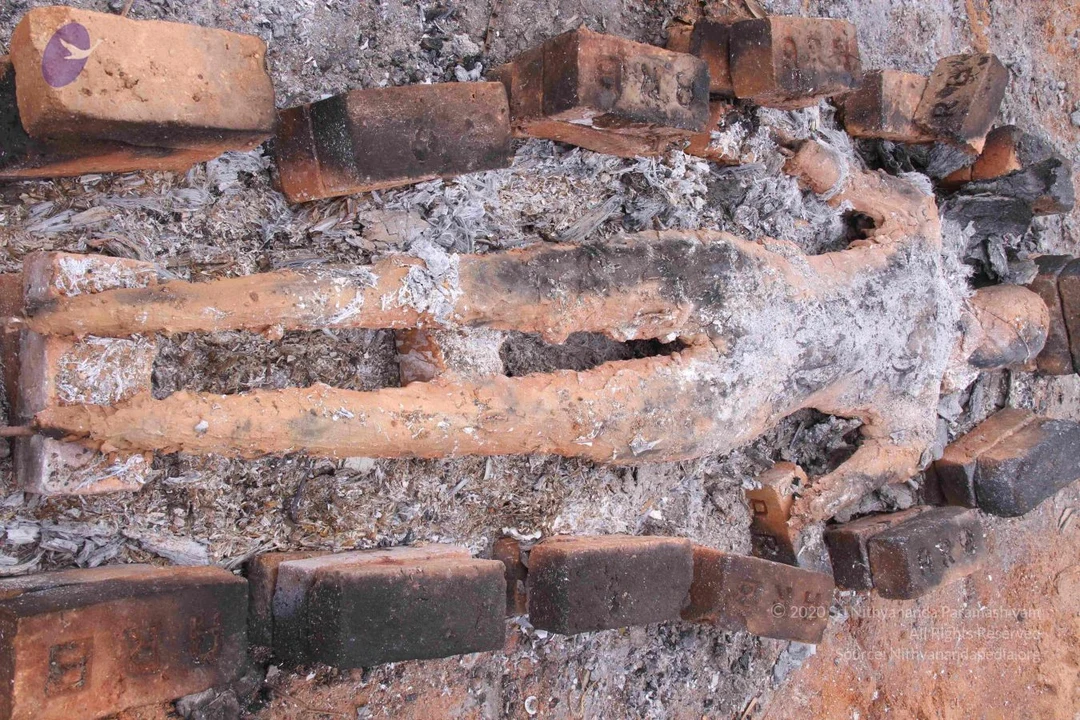
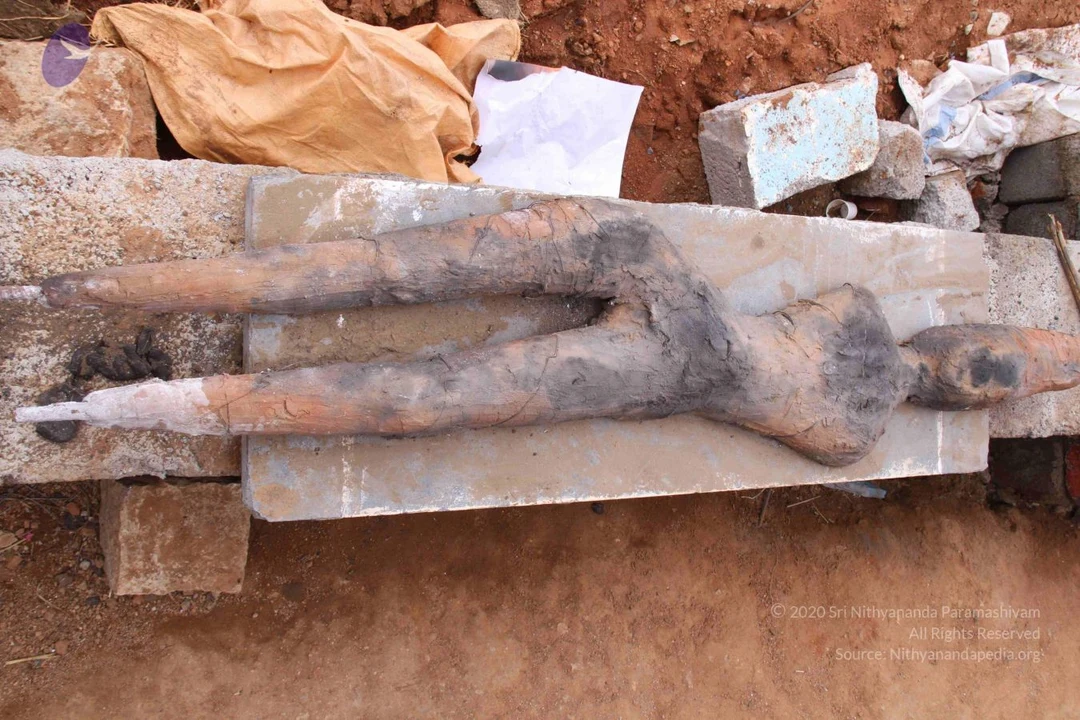
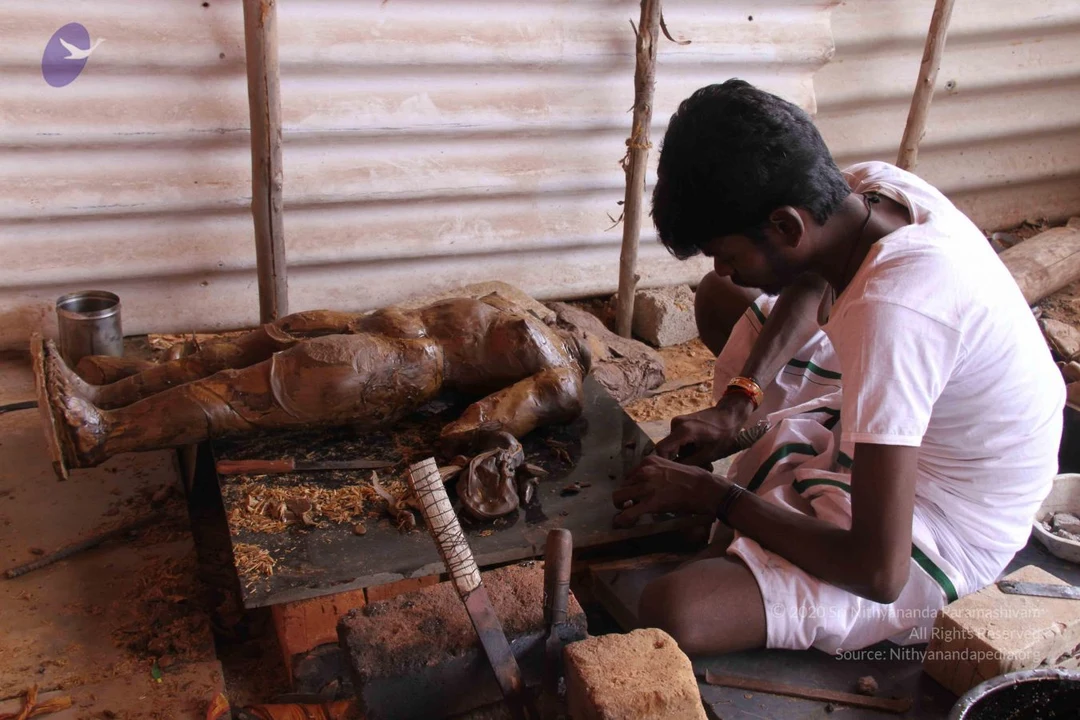
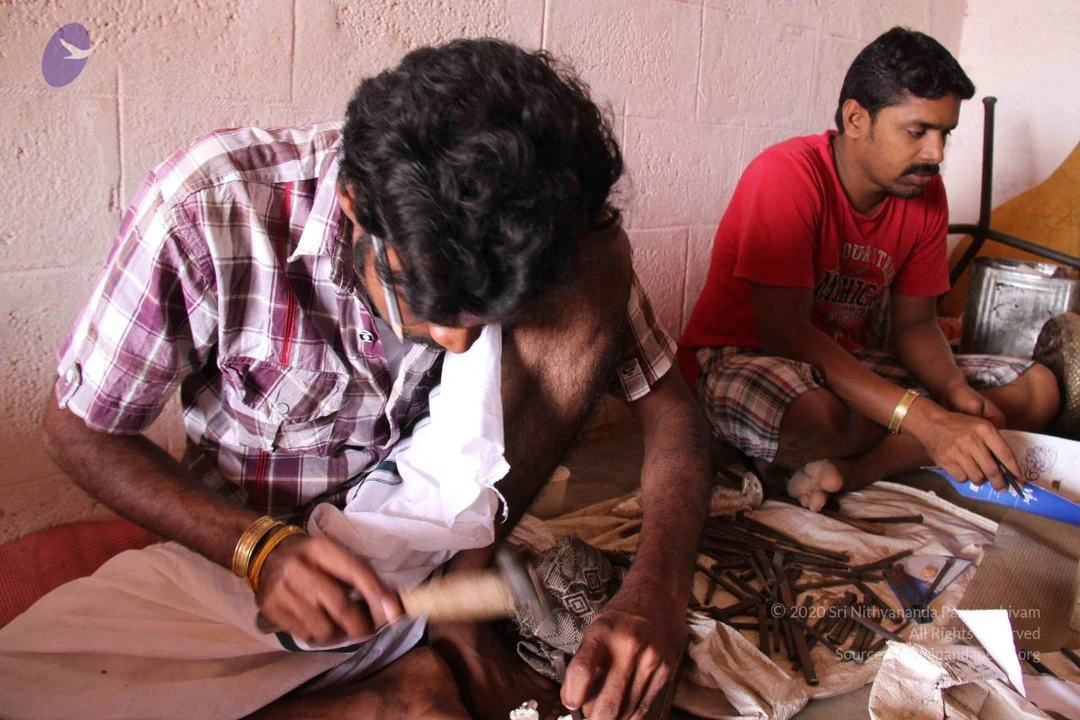
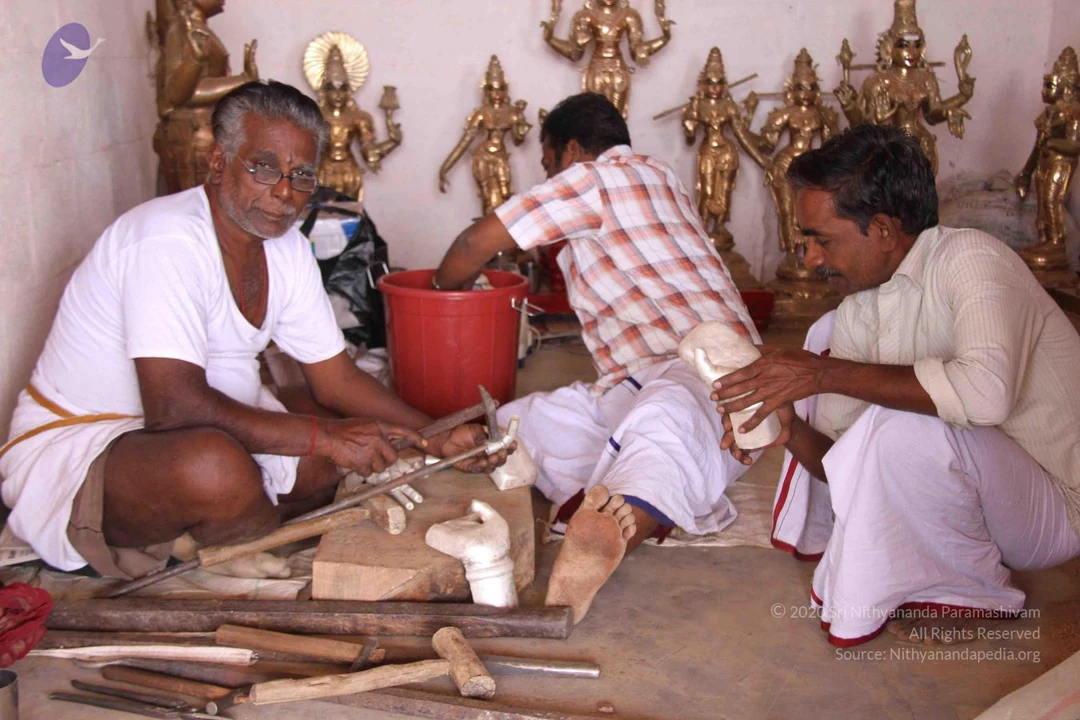
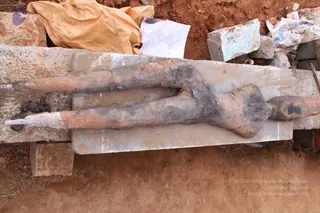
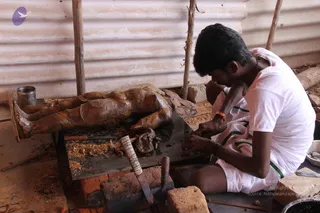
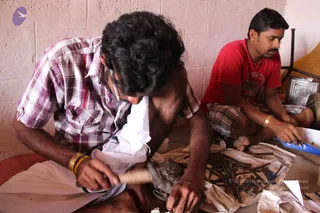
Elevated photograph of an ashram complex surrounded by dense green trees and palm trees. A long low building with a green corrugated metal roof and rows of terracotta-red shutters dominates the centre, beside a multi-storey orange-red block with water tanks on its roof. A large grey boulder sits in the foreground among shrubs, and distant buildings and palms fill the horizon. No people are visible.A photograph of a large, weathered clay or mud figure of a seated or reclining humanoid form lying on a pale concrete slab outdoors. The figure has cracked surfaces, dark soot-like staining, and a blackened torso and head, with limbs extended toward the frame. Nearby are scattered dark lumps, broken bricks, a torn orange cloth and a sheet of white paper on red earth. No people are visible in the scene, and the figure appears to be a sculptural object rather than a person.A young man in a white short-sleeved t-shirt and white dhoti with green borders sits on the ground in a open shed with corrugated metal walls, carving a large brown clay or wood figure of a reclining body lying on a wooden board. He wears an orange thread on his wrist and works with a small chisel-like tool, surrounded by wood shavings, a tin bucket, bricks and scattered tools. The scene shows a sculptor at work on a deity murti in progress.Two men sit on the floor in a plain room with a pale textured wall, working on craft material. The man in front wears a plaid collared shirt in purple and white, a white dhoti, and gold bangles, and is bent over a wooden tool, shaping or pressing something held on a white cloth. Beside him, a man in a red t-shirt and plaid shorts, also wearing a gold bangle, bends over a blue tray with small tools. A pile of dark metal nails or rods lies on the cloth between them, with scraps of paper nearby. A metal bucket and a chair are visible at the upper right. The scene shows ordinary hands-on work rather than a ritual or satsang setting.Three men sit on a floor in a workshop carving white stone or plaster sculpture parts, with golden deity statues on shelves behind them. On the left, an older man with grey hair and glasses, wearing a white shirt and white dhoti with an orange border, holds a chisel and mallet over a wooden block. In the centre, a man in a red-and-white checked shirt and white dhoti works beside a red bucket. On the right, a man in a cream shirt and white dhoti holds a pale carved foot. Tools and wooden sticks lie on the ground in front, and the golden figures on the wall are unfinished-looking sculpture work.

Temple-Swamiji

44 photosSource gallery
Two large golden deity murtis are seated side by side within an ornate golden arch against a bright red drape, with palm fronds and greenery behind. The figure on the left has multiple arms, a red and gold crown-like headdress, and holds a trident-like weapon and a hand gesture; it wears a long white and yellow-flower garland, red floral strands and a pale lilac skirt under a green sash. The figure on the right wears a tall ornate crown, a yellow and red garland, and an orange-red garment with silver embroidery, and holds a small object in one hand. Statues are seated on a raised platform; no living people are visible.Two metal murti statues of a deity couple are seated side by side against a pink draped backdrop. The figure on the left has a red turban topped with an ornate golden crown, orange-red clothing, a black and silver beaded necklace, and holds a trident. The figure on the right wears a golden conical crown, silver jewellery, an orange sari with embroidered border, and holds a small staff with a bird. Both are adorned with yellow and red marigold garlands and silver ornaments. The statues are deity murti, not living people.Outdoor photo of a drum and wind musician procession on a paved hexagonal-tiled walkway. In the foreground a young boy in a maroon robe with gold banding and a white cloth over one shoulder holds a hand drum with a wooden stick. Behind him a man in white dhoti and shirt plays a long curved horn, and another man in white dhoti and shirt carries a large barrel drum with a maroon-and-orange cover. A second boy in maroon stands at the left edge beside green banana leaves and an orange cloth.Outdoor photo of a welcome procession at an ashram courtyard with a paved hexagonal floor. A black Ford SUV with a Tamil Nadu plate reading TN 25 AE 4005 pulls in, and a person in the back seat wears a garland. On the left, a young musician in white clothes plays a long wind instrument, and beside him a drummer in white dhoti and shirt beats a drum with a stick. Several young girls in maroon saris stand in the foreground, and on the right a group of girls and boys in maroon and orange robes stand with palms pressed together in greeting, some holding a flower bundle and a kalasha-like vessel. Brass long horns are visible at the edges. Red brick walls and a shaded pavilion frame the scene.A man in an orange-saffron dhoti and shawl, with a gold-bordered waist cloth, walks beside a dark grey SUV on a paved courtyard. He wears a long gold necklace with a large pendant, gold armbands and bangles, and a red tilak on his forehead; his hair is swept back. Beside him a shaved-headed boy in an orange garment with a pink border and white forehead band carries a brass kalasha on a tray decorated with pink flowers and green leaves. A red brick wall and grass are in the background.Outdoor photo of a smiling man in orange-brown ochre dhoti and shawl, wearing a long gold-toned garland, a gold pendant and bangles, waving his right hand beside a dark grey SUV on a paved path. Beside him a young boy in saffron-orange robes and round glasses, with a white band on his forehead and a dark beaded necklace, carries a silver tray holding a glass vessel with green leaves, pink flowers and a small brass item. A dark blurred figure stands at the left edge. Red brick wall and dirt ground in the background. Probable Swamiji (probable) is the central figure, identified by long swept-back hair, gold garland and ornate ochre clothing.

Garbha-Mandir-Pada-Puja
25 photosSource gallery
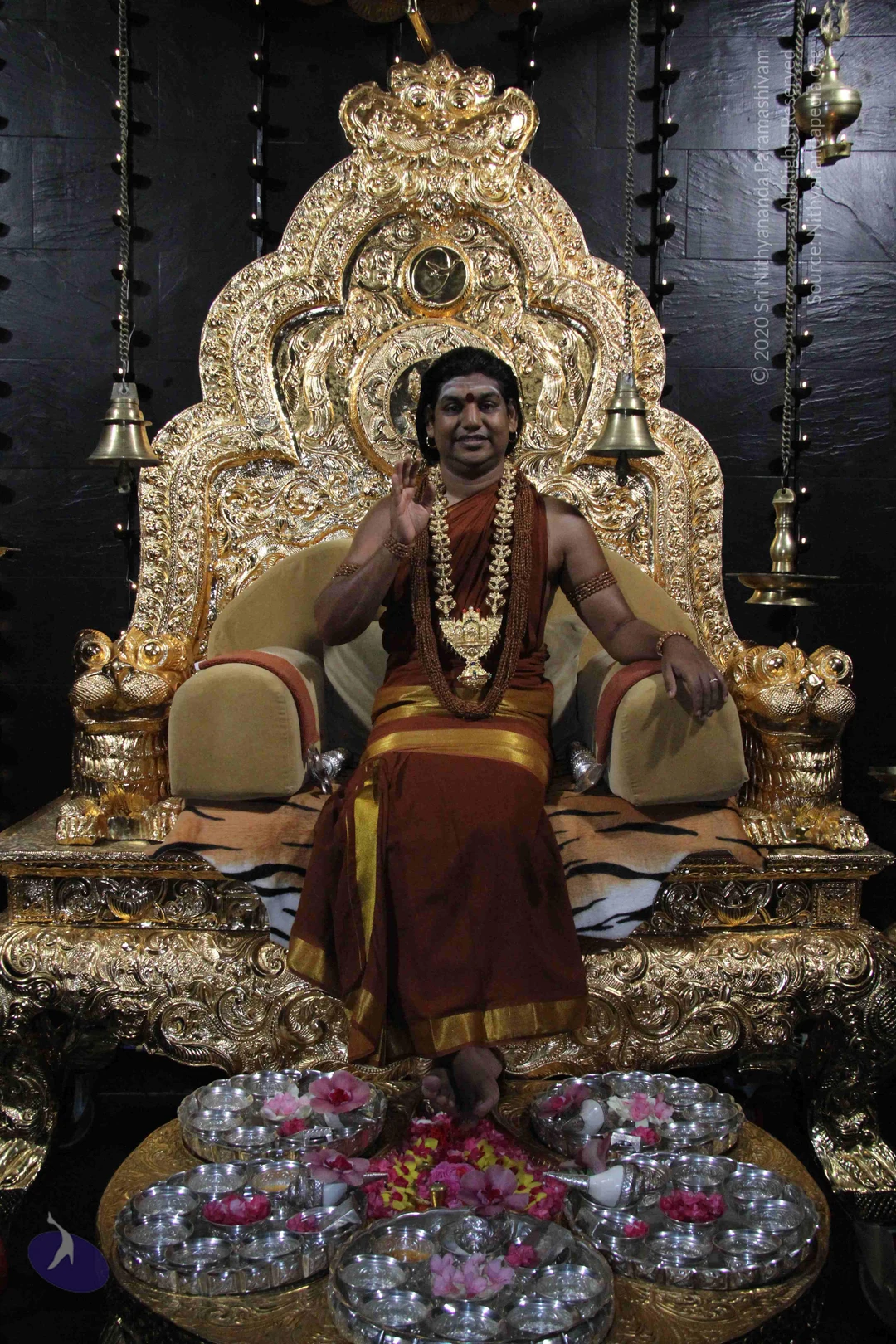
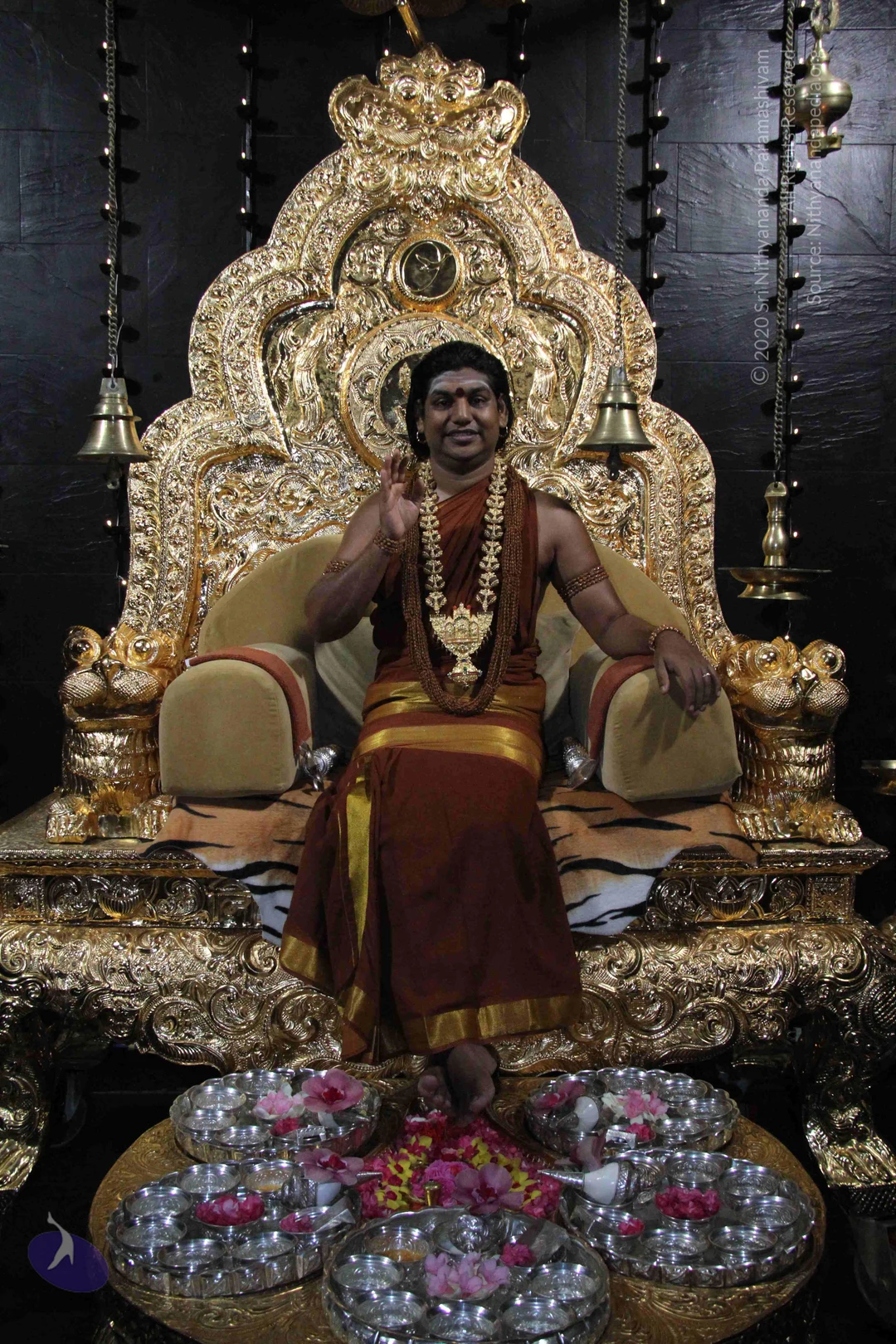
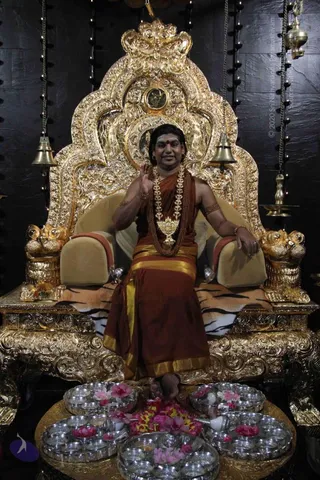
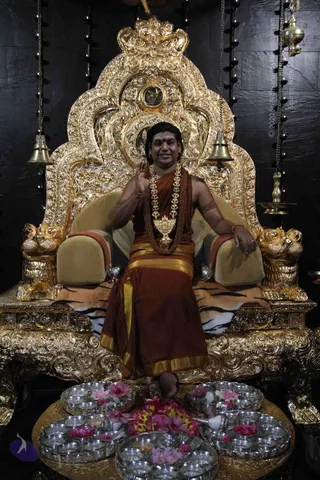
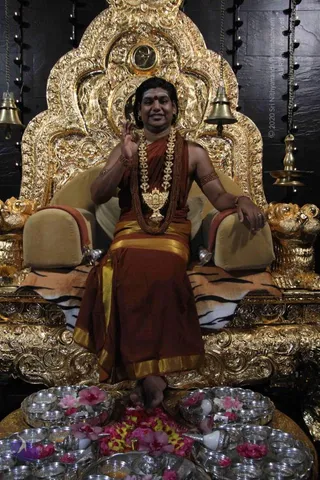
A man seated on an ornate gold throne with carved lion-head armrests and a tiger-striped cushion, raising his right hand in a blessing gesture. He wears a rust-red and gold-bordered robe, a multi-strand rudraksha mala, a heavy gold ceremonial necklace and gold armbands, with a red tilak on his forehead. Before the throne, his bare feet rest on a bed of pink flowers beside silver trays of small bowls holding flower petals and oil lamps. Dark stone walls, hanging brass bells and a brass lamp frame the scene. The man's appearance, with long swept-back hair, ornate gold jewellery and a rudraksha mala, is consistent with the page's reference to Swamiji, so this is a probable match.A seated man on an ornate gold throne with carved lion-head armrests and a gold canopy, draped in a tiger-striped cloth. He wears a rust-red robe with a gold border, a gold necklace pendant on rudraksha malas and flower garlands, gold armlets and bangles, and a red tilak on his forehead, raising one hand in a blessing gesture. Before the throne are silver trays filled with pink flowers and offerings, with rose petals and marigold garlands at his bare feet. Hanging brass bells and a brass lamp frame the dark background. The appearance is consistent with the a person cues of ornate saffron-red clothing, mala and gold necklace, and a throne setting, though this is a seated devotional display rather than a confirmed event scene.A seated man on an ornate gilded throne with carved floral and scrollwork backrest, draped over a tiger-striped cloth. He wears a rust-red and gold-bordered dhoti and shawl, a long gold ceremonial necklace with a pendant, rudraksha mala layers, and gold bangles, and raises one hand in blessing. A small red bindi is on his forehead and his feet rest on flower petals. In front are silver bowls holding pink and white flowers, and brass hanging bells and a lamp frame the throne. a person, seated in a sanctioned ceremonial pose with rudraksha mala and ceremonial gold necklace and saffron-red clothing.A smiling man with swept-back black hair sits on an ornate golden throne, wearing a rust-orange robe draped over one shoulder, a long rudraksha mala with a large gold ceremonial necklace, and a rudraksha armlet. A small red bindi is on his forehead. He rests his hands on a cream-coloured armrest with an orange cloth draped over it. Brass bells hang from chains on the right, and a brass oil lamp stands at the left edge beside gold ornate carving. Swamiji (probable), seated on his throne, with the cues being the long hair, saffron robe and rudraksha malas. The background is dark.A seated man with long dark hair wears an orange-brown robe with a gold-bordered cloth and a multi-strand beaded garland, with a gold bangle on his arm, on an ornate gold throne with a carved lion-like base. Swamiji (probable) is shown in this role on the throne, with cues of long swept-back hair, saffron-toned clothing and a ceremonial gold necklace. Before him, a tray of silver bowls holds pink lotus petals, marigolds and oil lamps. Behind the tray, an elderly woman in grey with an orange shawl presses her palms together in namaskar. Two devotees in white with vertical sandalwood-style forehead marks kneel in folded-hands prayer at right, beside a large dark wooden door with brass studs and a wall air conditioner above. Hanging brass bells and a brass lamp frame the upper left.A seated man in a gold-and-cream throne with a gilded lion-head armrest, wearing saffron-orange robes with a gold border, a long gold-beaded garland, and a rudraksha-style necklace, smiles while resting his hands on the armrests. Probable Swamiji (appearance cues: long swept-back hair, saffron robes, ornate gold garland, and throne) is seated in the front. Before him on a gold tray are silver plates with pink flowers, lamps and offerings. A woman in grey top with orange shawl presses her palms together; behind her, two devotees in white and orange and a woman with tripundra-marked forehead join hands in namaskar. Hanging brass oil lamps and a gold-patterned door complete the setting, with an air conditioner on the dark wall.

Pratyaksha-Pada-Puja
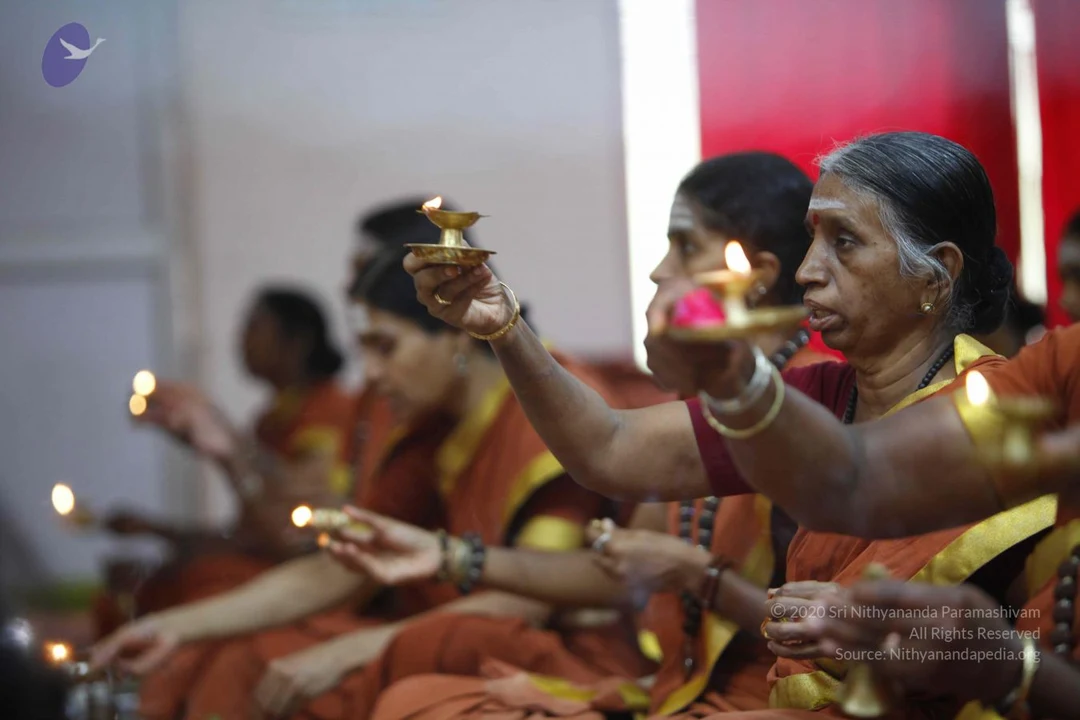
16 photosSource gallery
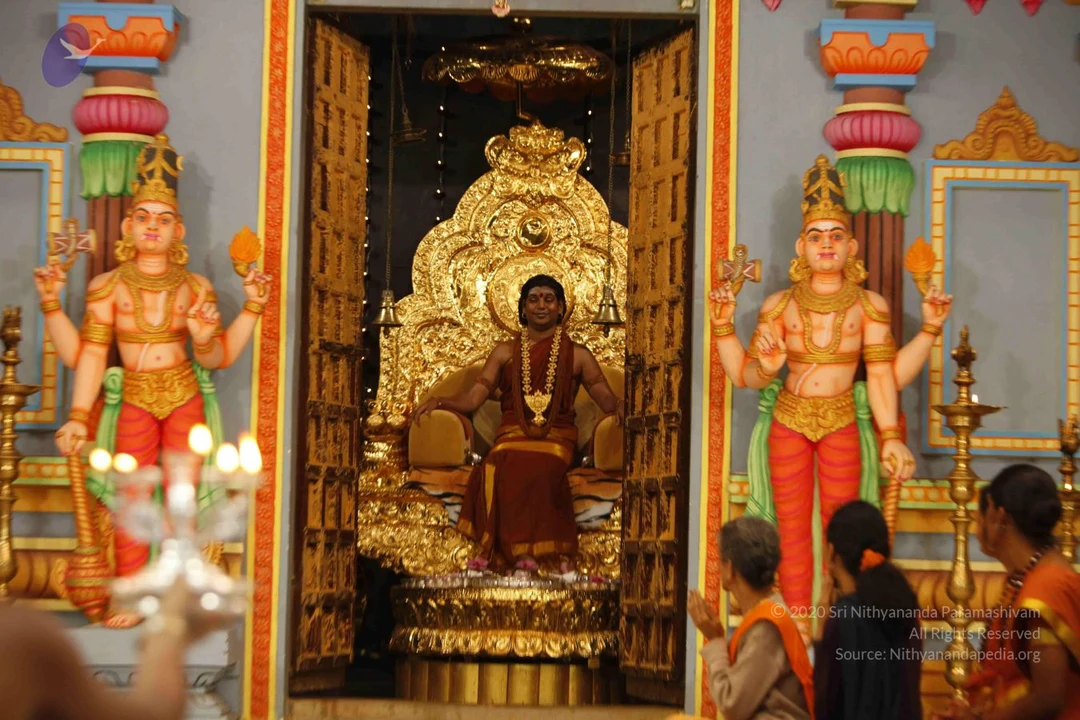
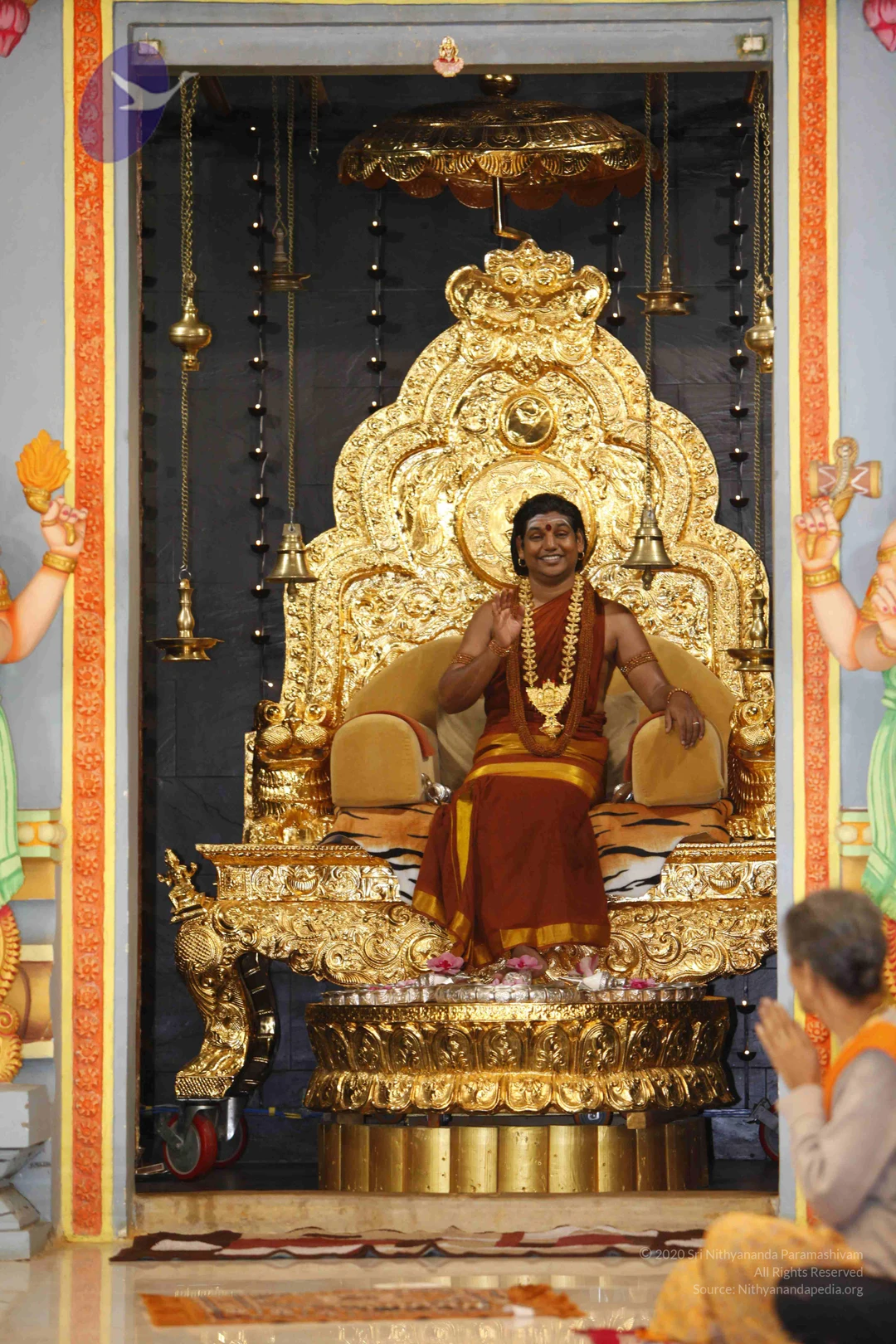
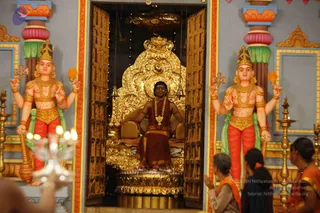
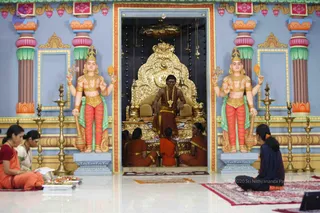
A photograph inside a temple shrine showing a seated figure on an ornate gold throne (peetha) between two tall painted dvarapala guardian statues with raised arms and gold crowns. The seated figure wears a rust-red robe, a gold necklace and a rudraksha-style mala, and sits within open carved wooden doors framed by gold-painted pillars. Brass oil lamps stand at the sides, and in the lower right two women in orange saris stand with hands folded in prayer. The image is a photo of a shrine scene, not a graphic.A photograph inside a richly decorated temple hall with painted pink, green and gold pillars and a golden doorway framing a seated figure on an ornate gold throne. The seated figure wears a deep red-brown robe, a long white flower garland and a gold necklace, with hands resting on the throne arms. Two painted attendant figures with multiple arms, orange-red dhotis and green sashes stand on either side, holding lamps and ritual items. In the foreground, a priest in orange at left tends to brass oil lamps, while several women in orange and saffron sit with palms pressed together, facing the throne. Brass lamps with lit flames sit on the floor and along the walls. The scene suggests a satsang or darshan setting.A seated man in a rust-red and gold-bordered dhoti and shawl sits on an ornate gilded throne with a tiger-striped cushion, raising one hand in blessing and smiling. He wears a red tilak on his forehead, a long gold-and-bead necklace with a pendant, gold armbands and bangles. The throne has a gold canopy overhead, hanging bells and lamps, and a lotus-shaped pedestal with pink flowers at his feet. Painted deity figures with multiple arms flank the doorway. In the lower right corner, a devotee with grey hair in an orange-trimmed garment sits with palms pressed together.A smiling man with short hair and a red vermilion bindi sits on an ornate gold throne with a large carved gold backrest, raising one hand in greeting. He wears a rust-red and gold-bordered robe, a heavy gold and beaded garland, and gold armlets and bangles. The throne is draped with a striped tiger-skin cloth and rests on a gold lotus pedestal decorated with pink flowers. Hanging brass bells and oil lamps are visible above, and a partially visible figure with folded hands appears in the lower right corner. The seated man matches the a person appearance cues (saffron-red robe, ornate gold adornments, throne), so this is a person in the scene.A seated man in an ornate gold throne (peetha) with carved lion-head armrests and a tiger-striped cushion, raising his right hand in blessing while smiling. He wears a rust-red robe with gold borders, a long gold-and-bead necklace with a pendant, gold armbands and bangles, and a red bindi with a vertical white-and-red forehead mark. Pink flower offerings lie before him on a gold pedestal, and brass bells hang from above. A partially visible person in the lower right corner has hands folded in prayer. Swamiji (probable): the seated figure's long swept-back hair, ornate gold throne, saffron-red robe and ceremonial gold necklace are the distinguishing cues.Interior of a temple hall with painted blue walls and pink-and-green pillars. Two large painted dvarapala-style guardian statues with crowns, gold jewellery and red-and-green dhotis stand on either side of a central doorway. Inside the golden-framed shrine, a seated man in a saffron-orange robe and a white-and-gold garland sits on an ornate gold throne. Several women in orange and red saris sit on the floor before him, with a small offering tray in front. Brass oil lamps line the walls, and a young woman in a dark top sits on a red carpet at right. The scene suggests a satsang or darshan.

Gurukul-Instruments

4 photosSource gallery
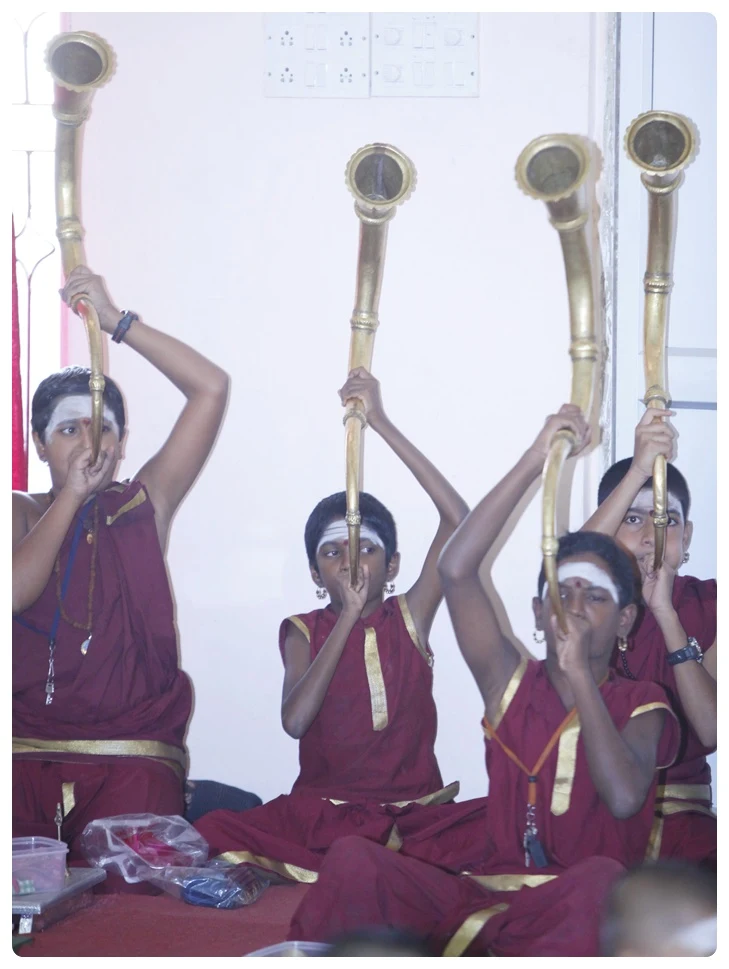
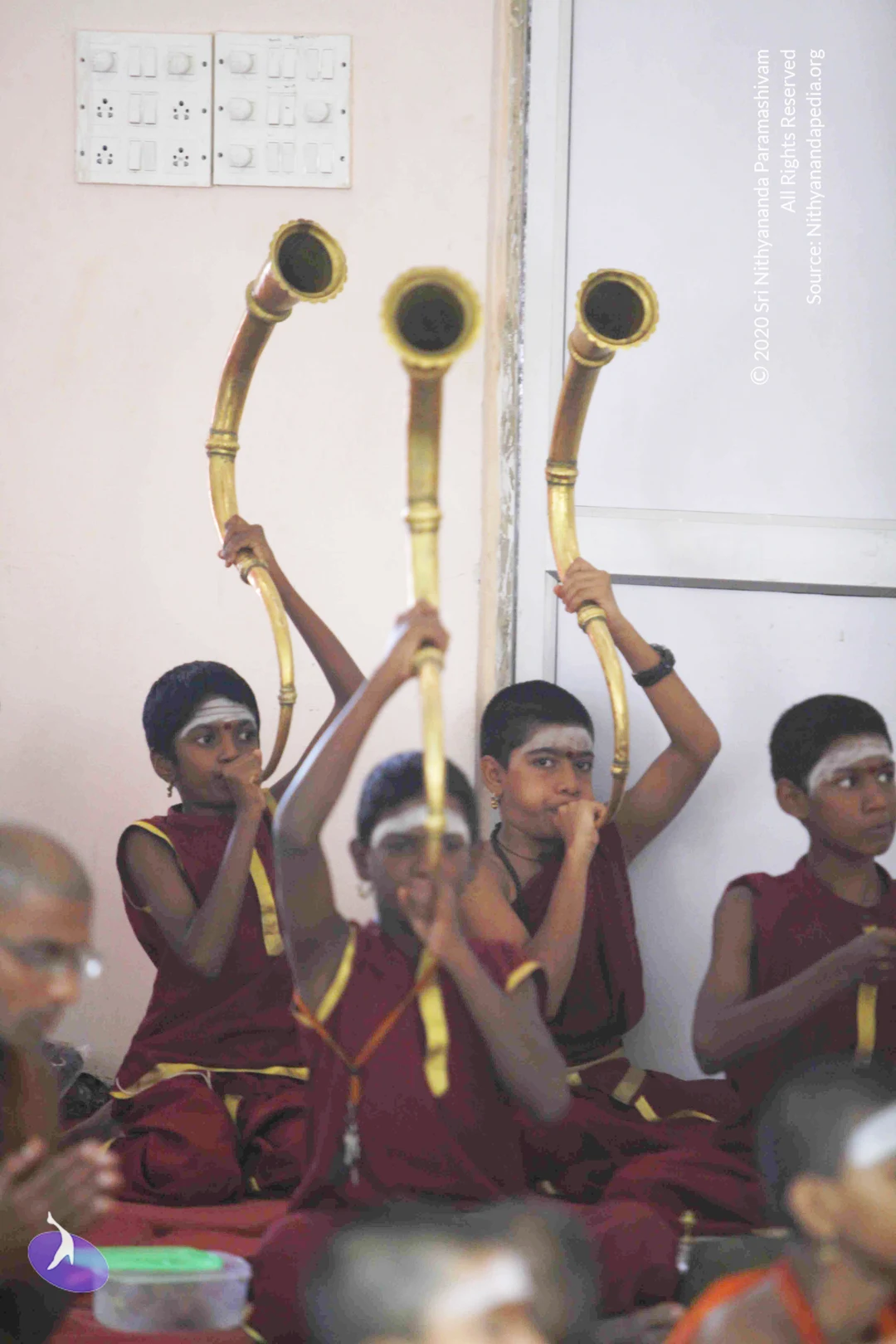
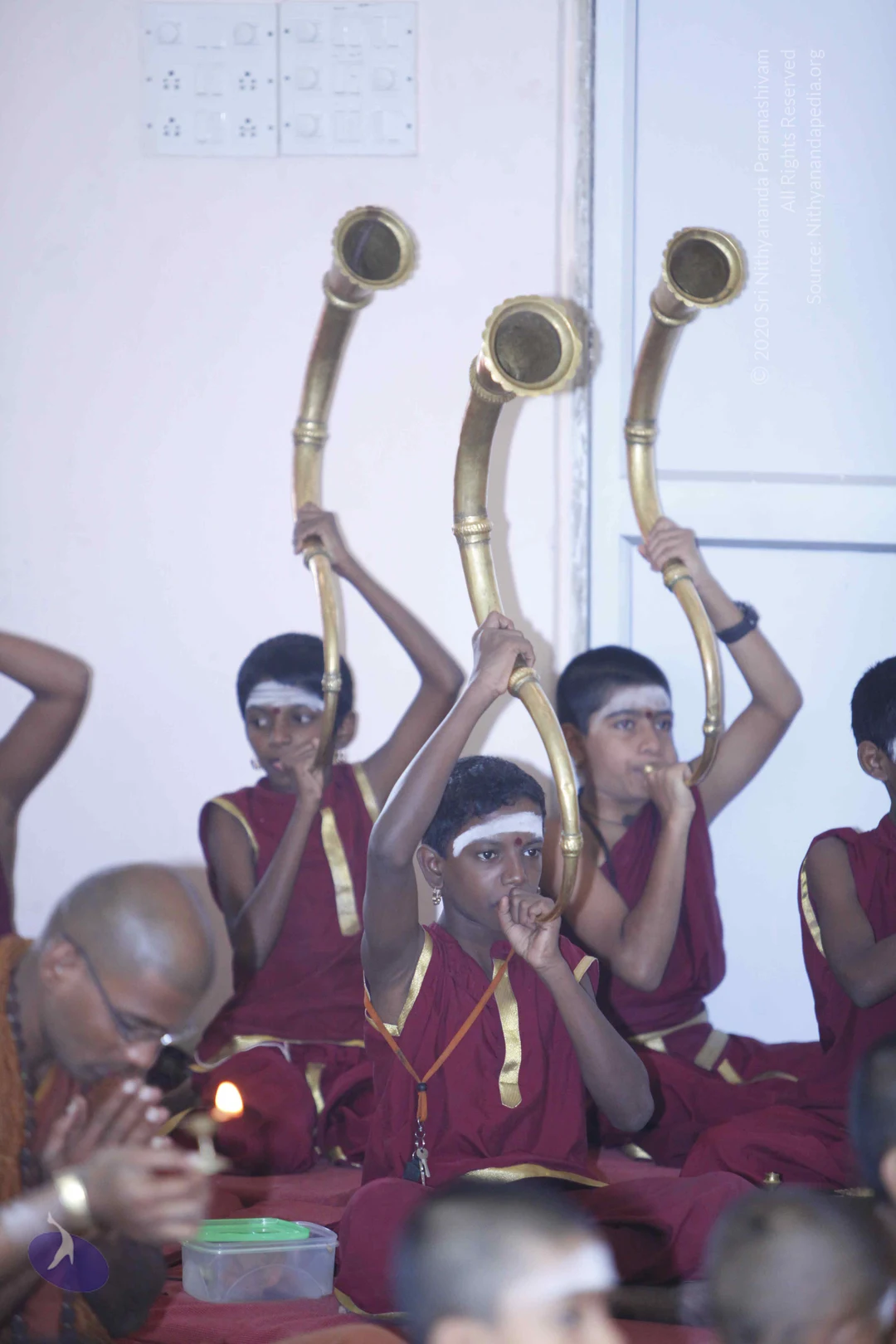
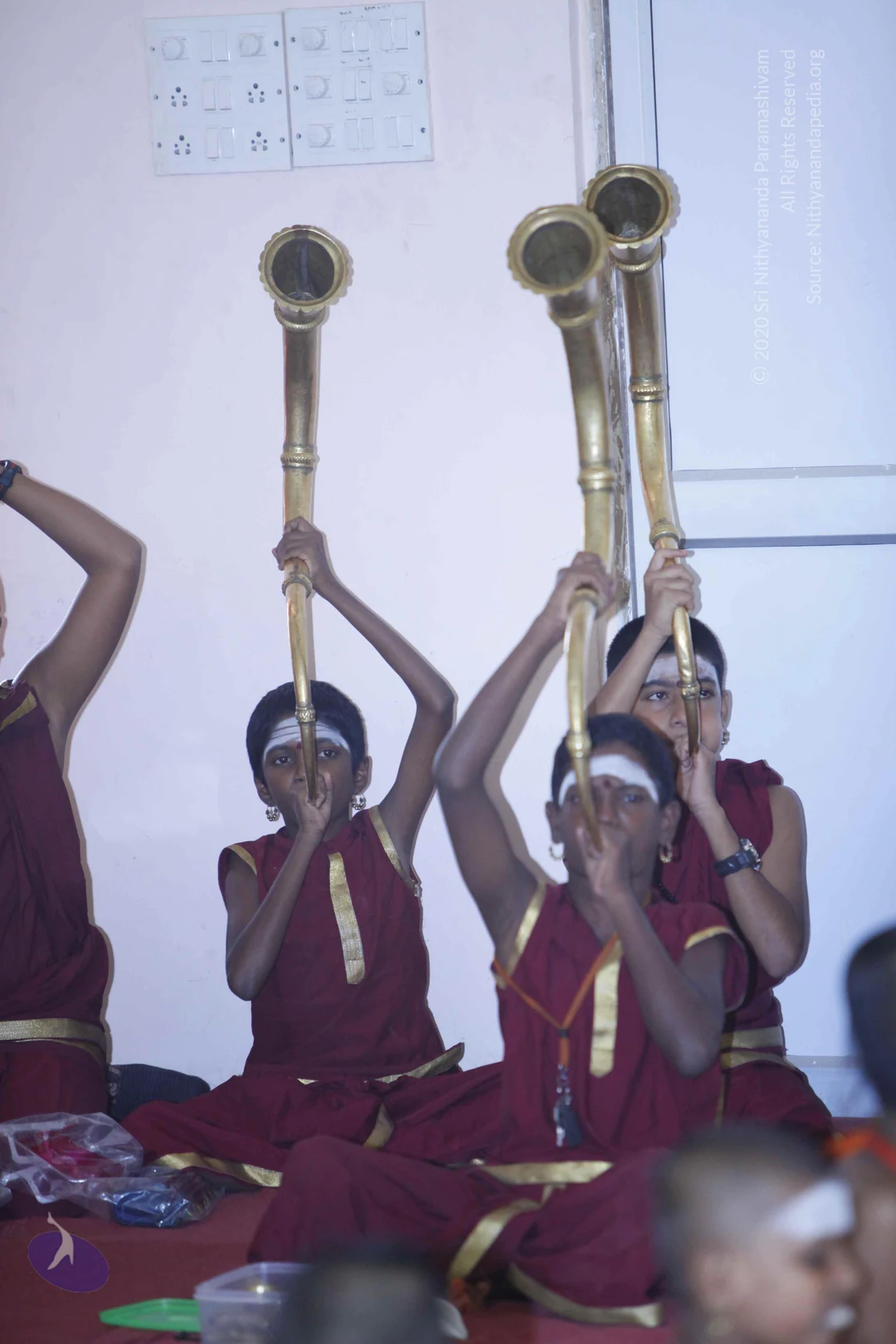
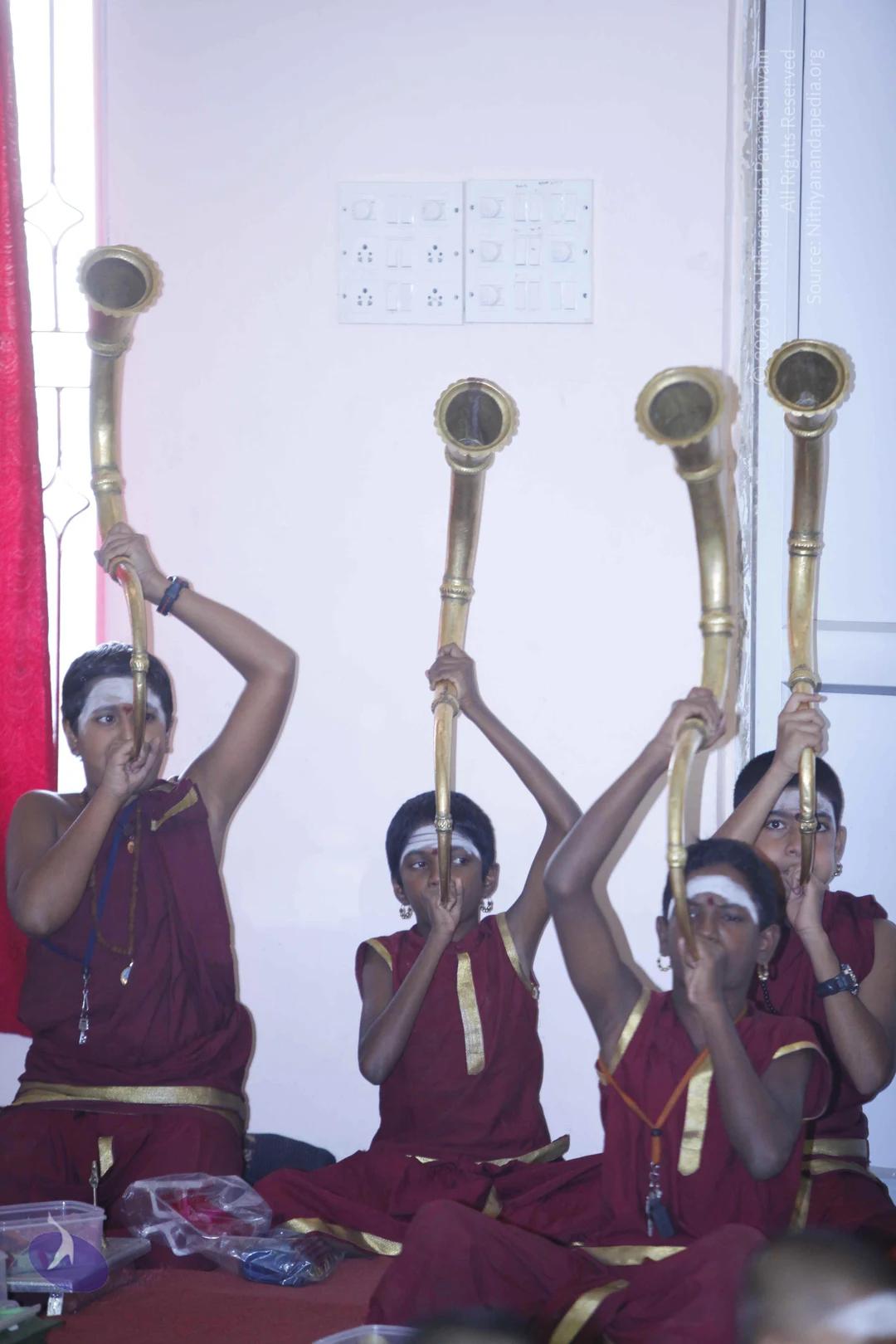
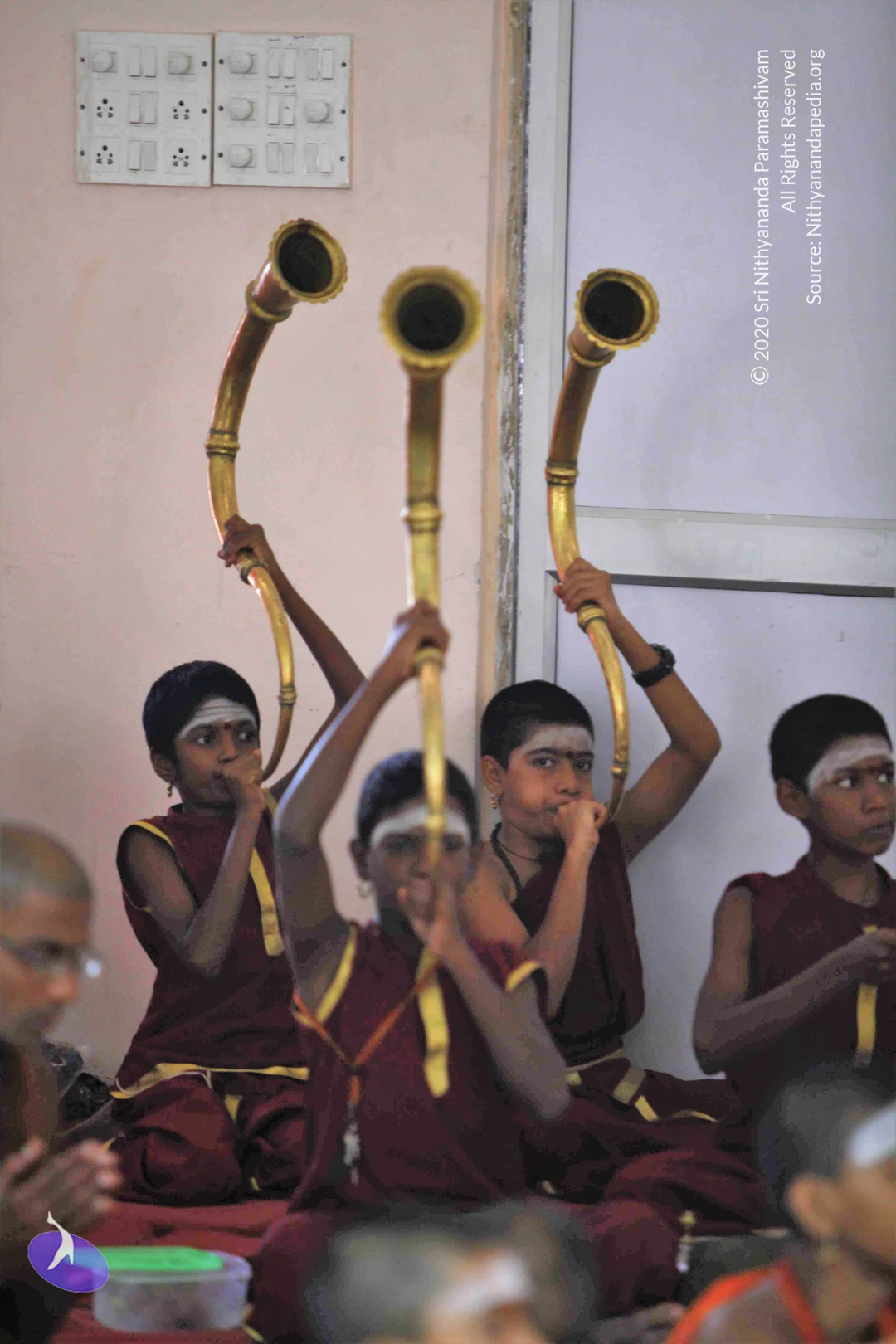
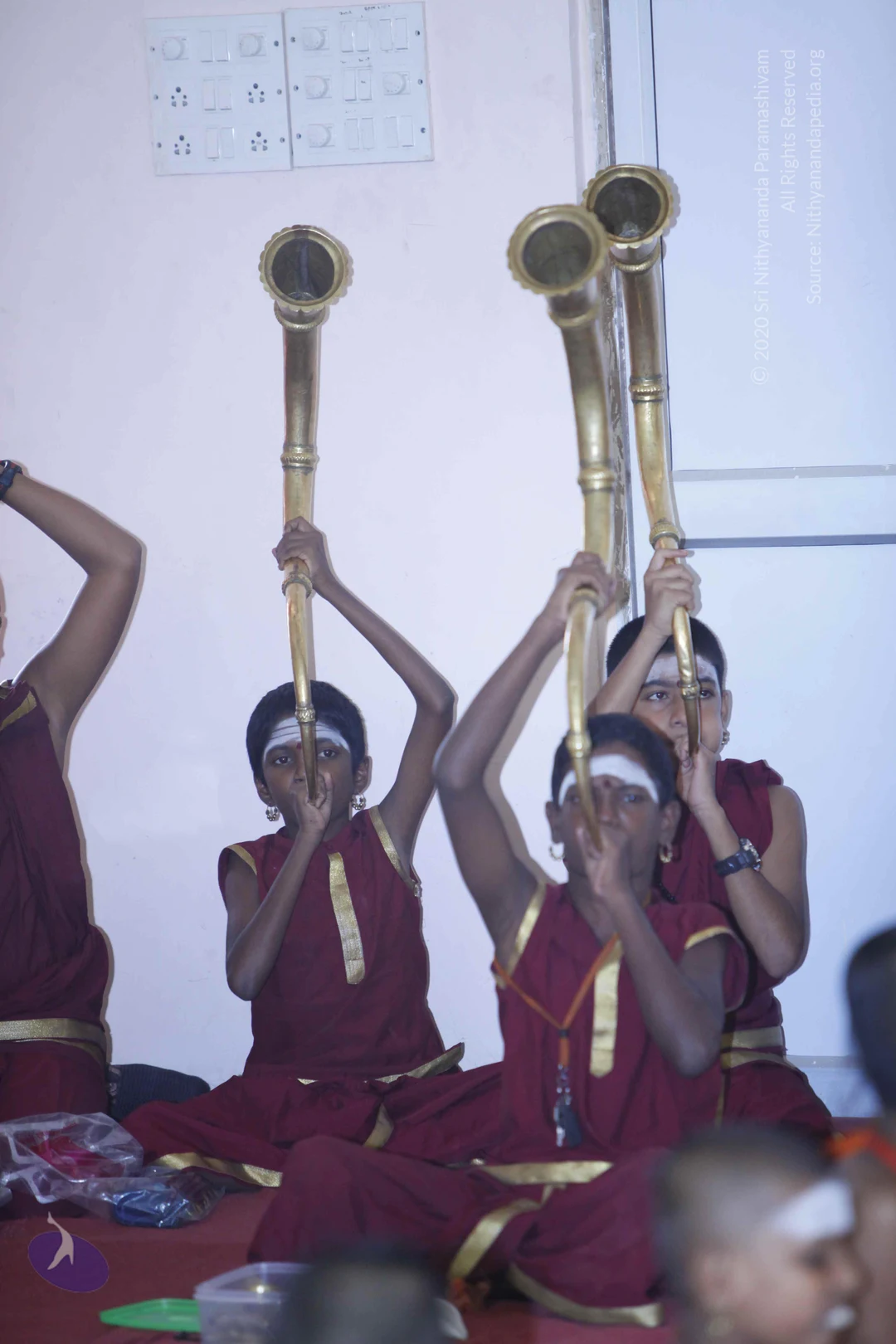
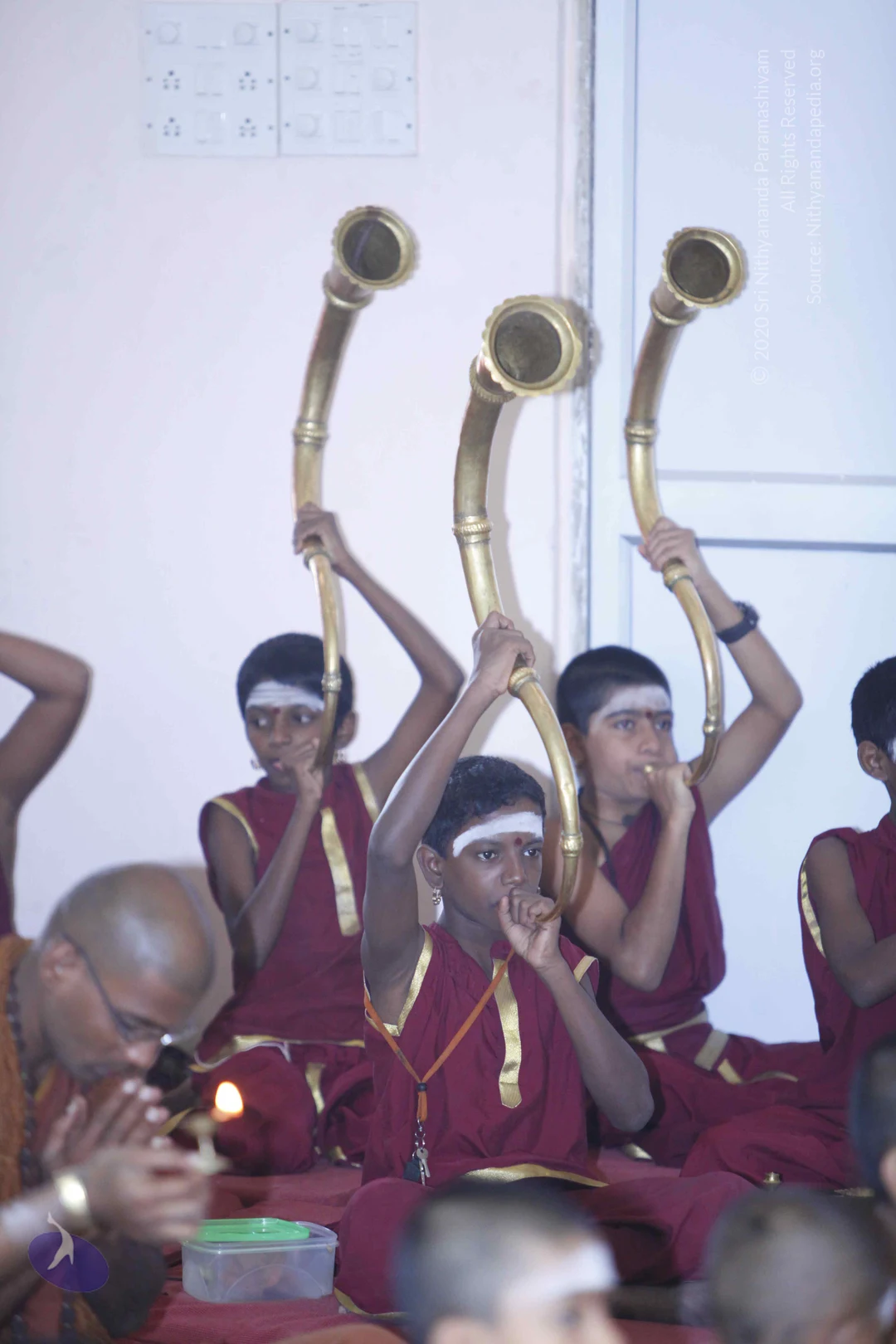
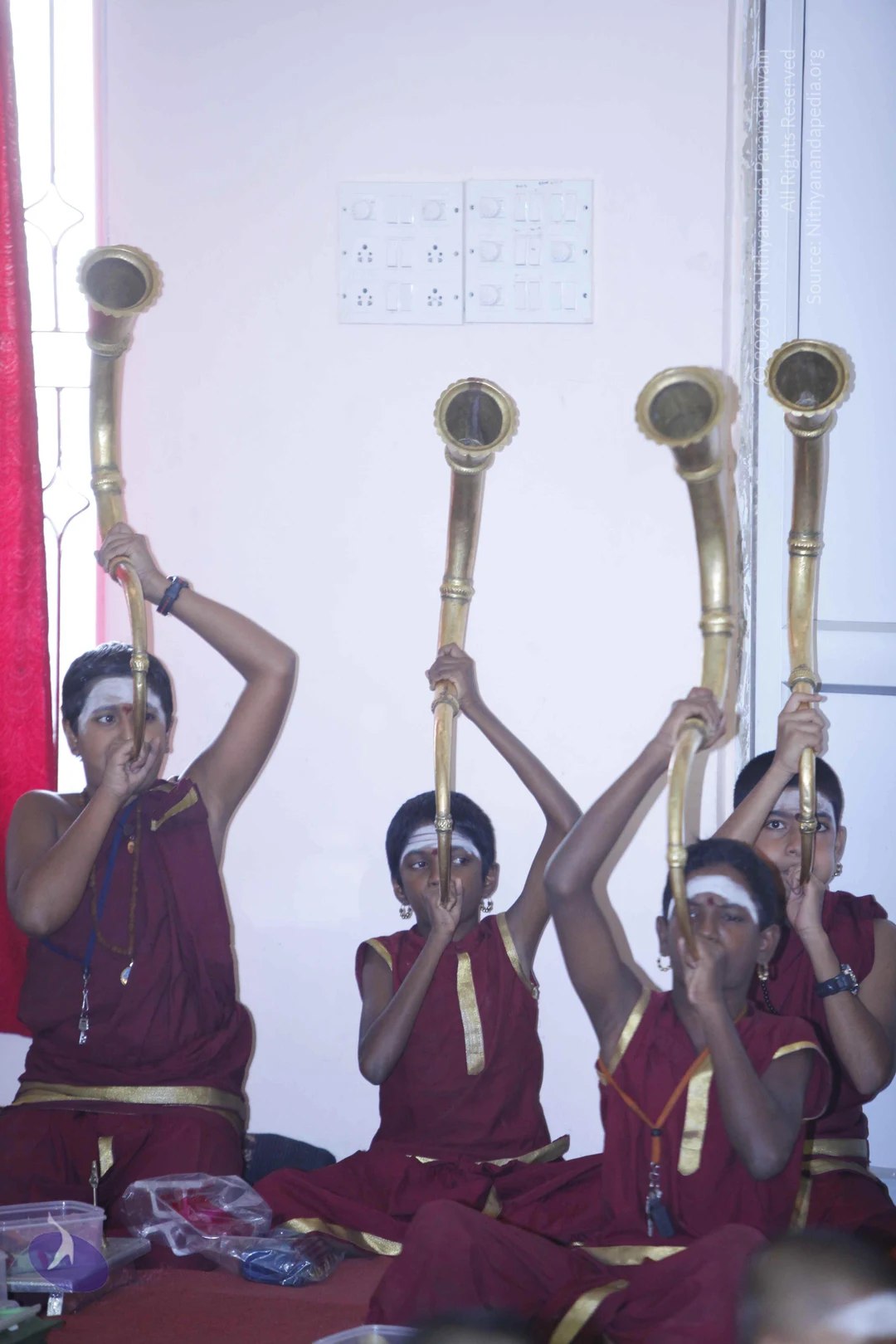
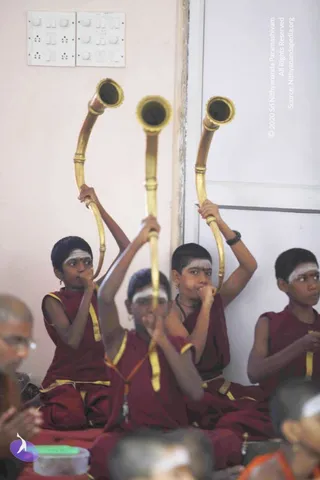
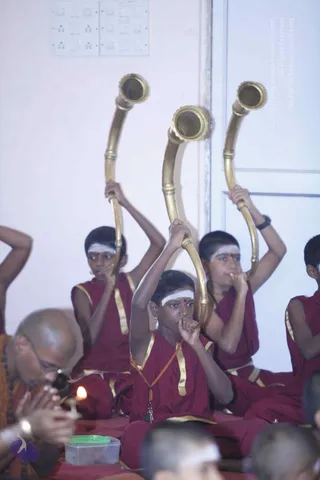
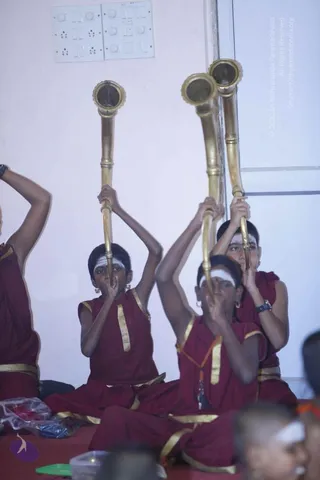
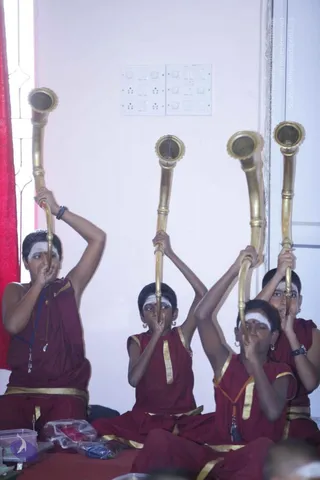
Four young boys in maroon robes with gold-coloured edging sit on a red mat in a plain room with pale walls and a wall switchboard. Three of them raise long curved gold horns, each with a flared bell, and play them with their mouths. Each boy wears white sandalwood or ash marks on the forehead and a red bindi. Partly visible in the foreground are other seated people, including a bald person in glasses at the left edge. No a person candidate is visibly identifiable, and the ceremony is not otherwise shown.A photograph of young boys in maroon robes with gold borders playing long curved gold brass horns raised overhead, a traditional temple wind instrument, during a ritual gathering. Several boys have white sacred ash bands and red bindis on their foreheads. In the lower left, a bald older man in glasses and orange cloth sits with palms pressed together beside a small oil lamp with a lit flame. A clear plastic container sits on the floor in front, and a white wall with a light switch panel and a white door are behind them. The boys are seated and blowing the horns in unison.Photograph of several young boys in maroon robes with gold trim and white forehead bands playing long gold-colored brass horns raised overhead. Two or three boys are seated on a red floor cloth in a plain room with white walls and a wall switch panel above them. One boy wears a rudraksha-style mala and a small red bindi. A blurred figure with white forehead band appears at the lower right. The boys are blowing the horns, which may be temple wind instruments.Four young boys in maroon robes with gold borders sit on a red mat and play long curved gold horns (kombu-style wind instruments) raised overhead, cheeks puffed in play. Each has white tilak marks on the forehead with red bindi, and one wears a red tilak and dark bead necklace. A red curtain hangs at left, a white wall with an electrical switchboard behind them. Plate of offerings and small containers lie at bottom left.

Nithya-Satsang

14 photosSource gallery
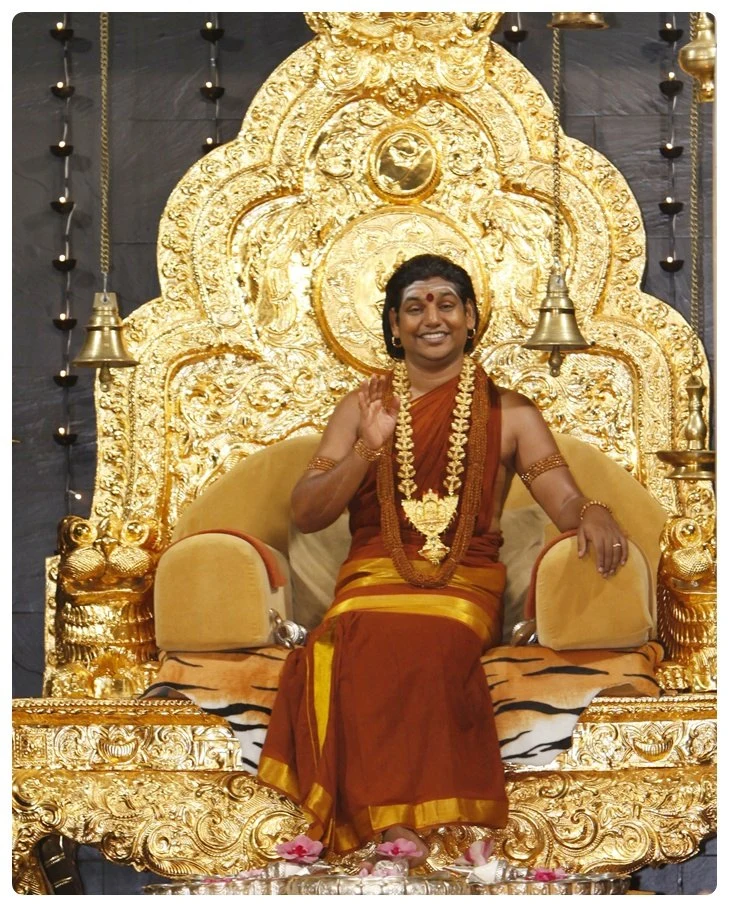
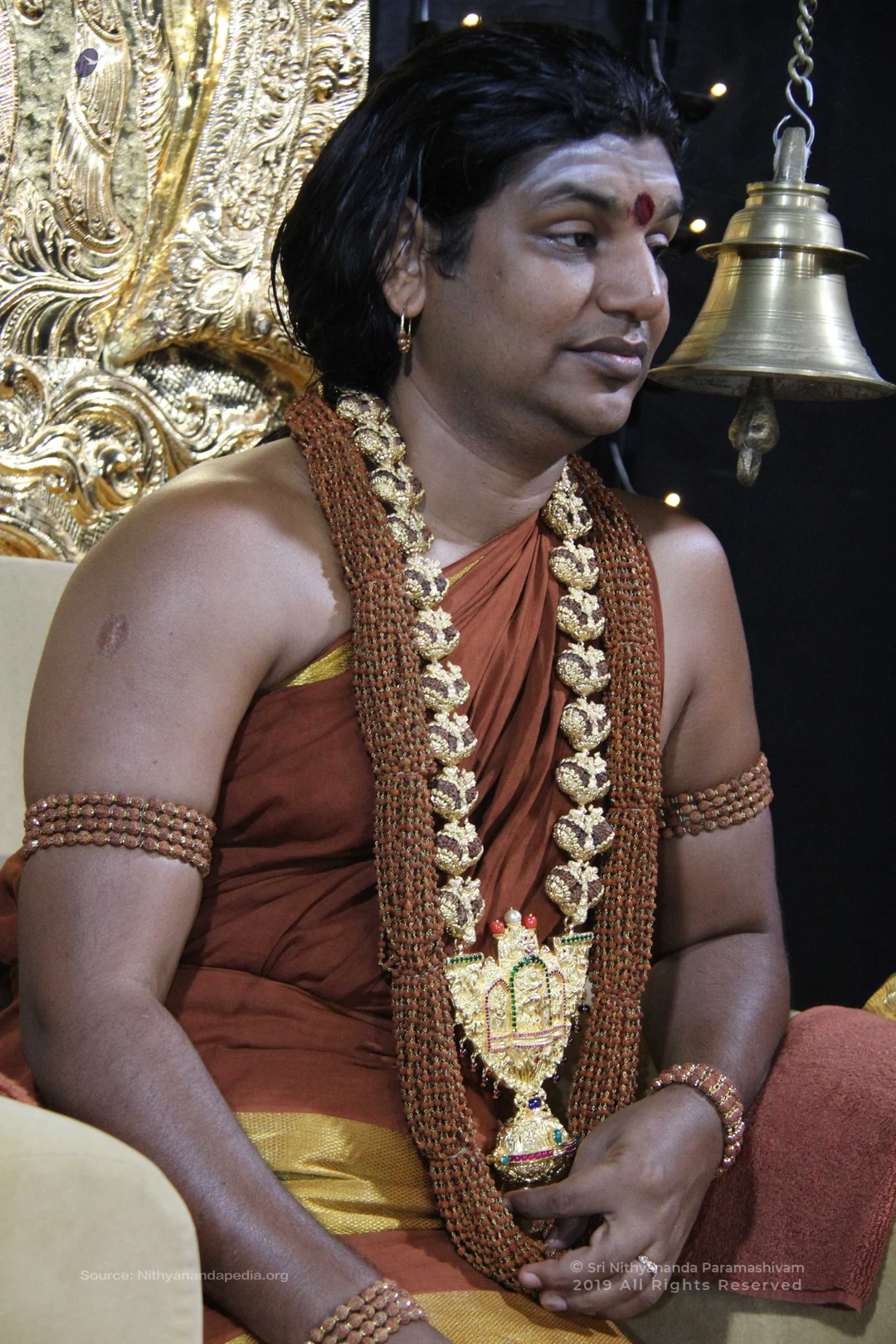
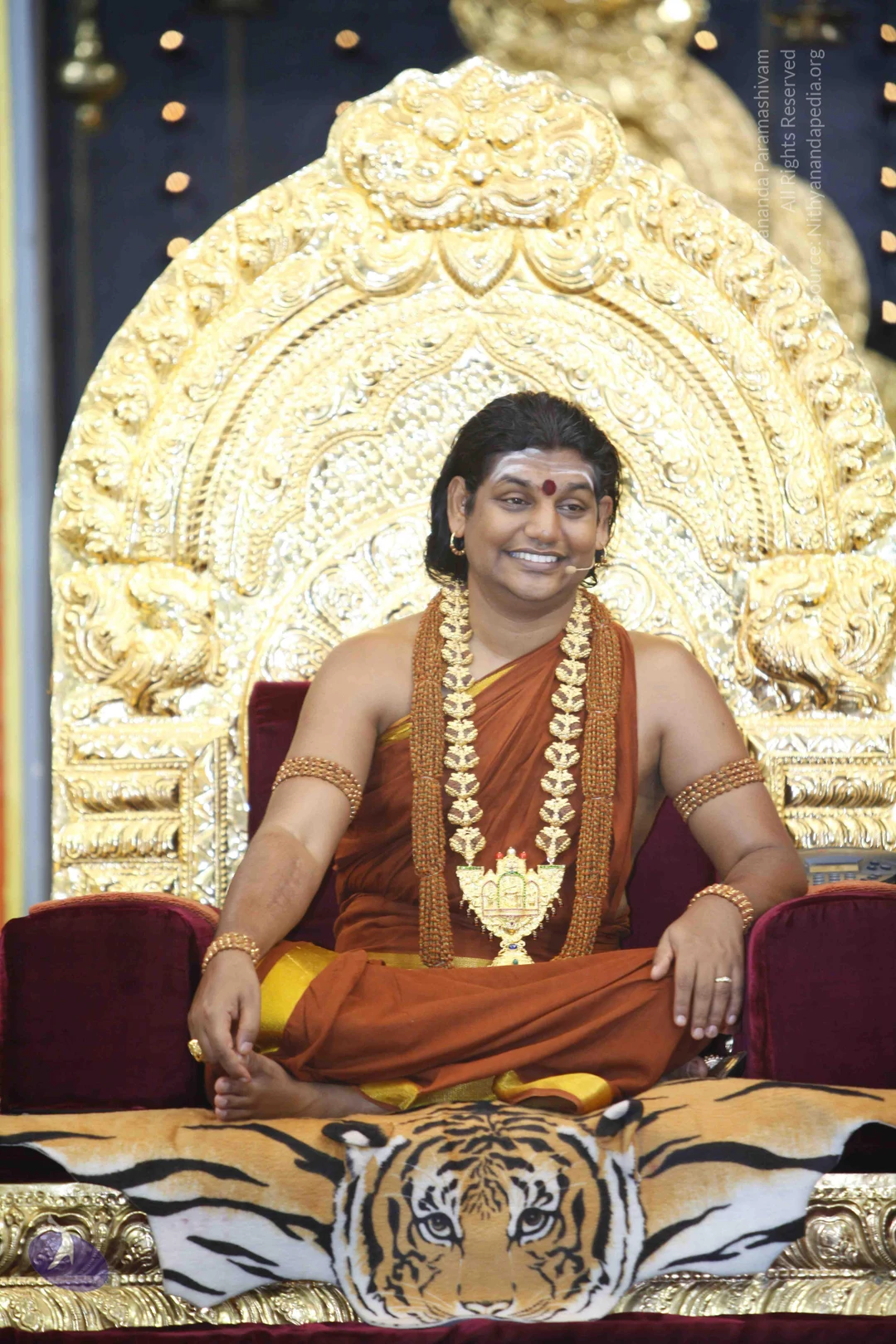
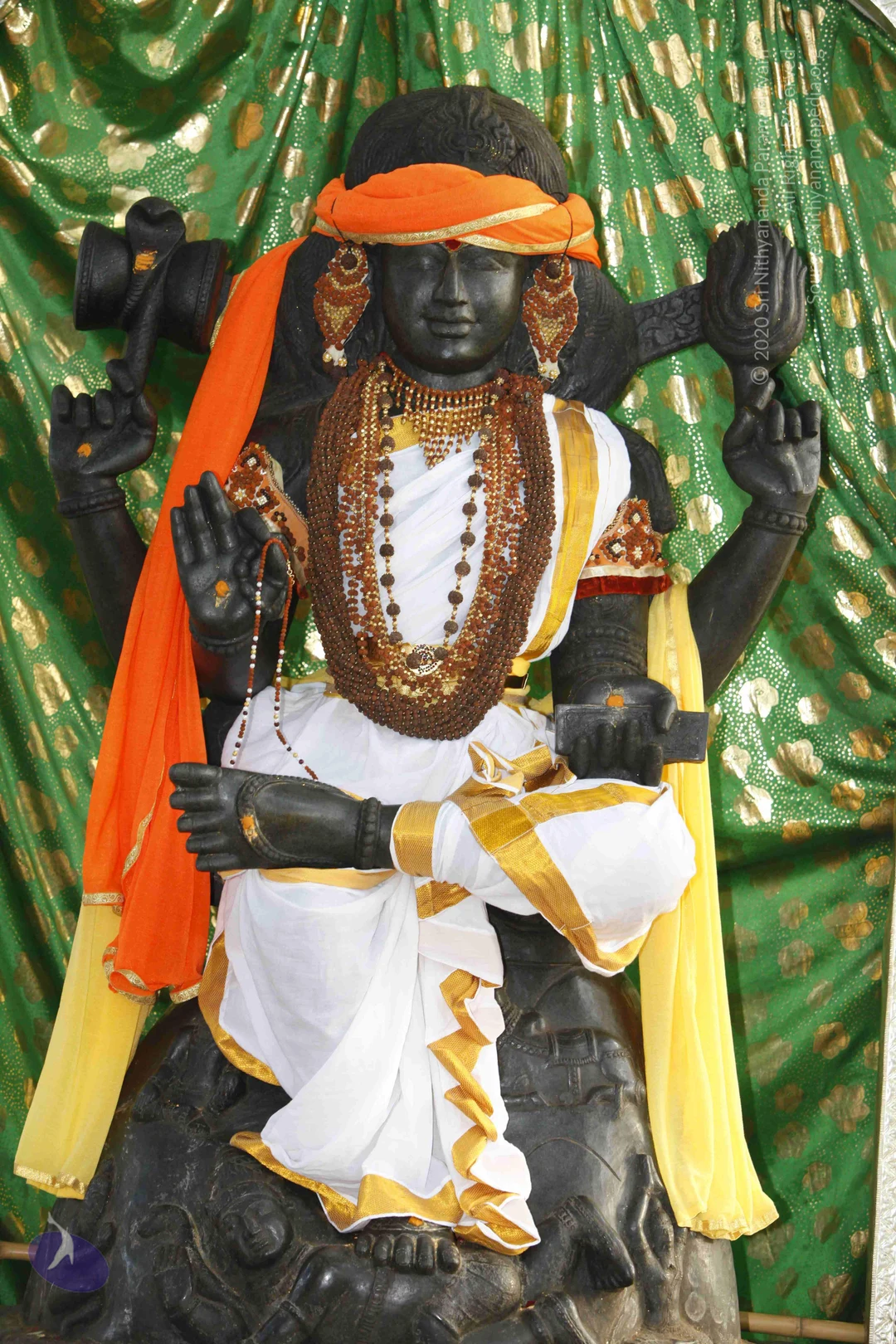
A seated man in saffron-orange robes with a gold-bordered dhoti sits cross-legged on a tiger-skin-covered platform before an ornate golden throne with lion-head armrests. He wears a long rudraksha-style mala of beads, a tall ceremonial gold necklace with a pendant, gold armlets and bangles, a tilak and a red bindi, and his long dark hair is swept back. He sits calmly with his hands resting on the armrests, facing the camera. Behind him, painted deity figures with raised arms appear on a blue and red background. The setting suggests a satsang discourse hall. Swamiji (probable) appears in_person, as the seated figure with distinctive long swept-back hair, saffron robes, ornate gold necklaces and a rudraksha mala on the throne.A photograph of a smiling man seated cross-legged on an ornate gilded throne with lion-head armrests and a golden arched backrest, a striped tiger-skin cloth draped over the platform. He wears a saffron-orange dhoti and shawl with a yellow border, a long gold-and-rudraksha style necklace with a gold pendant, gold armbands and bangles, and a white vibhuti tripundra with a red kumkum dot on his forehead. Painted deity figures with raised arms flank the throne in the background. a person is shown seated in a satsang setting, with a small headset microphone visible near his ear.A man seated cross-legged on an ornate gold throne with a repoussé floral and lion-carved backrest, smiling broadly. He wears a rust-orange dhoti and shawl with gold borders, a red bindi and white forehead markings, and multiple rudraksha bead necklaces and armlets. A large gold ceremonial pendant hangs on a gold chain, with a small headset microphone visible near his ear. A tiger-skin rug covers the platform in front of him. Swamiji (probable) is seated centrally as the speaker; the cues are the long swept-back hair, rudraksha malas, saffron-orange robes and ceremonial gold necklace, with the throne and adornments in the setting.A man seated cross-legged on a gold-carved throne with lion-head armrests and an ornate arched backrest, smiling. He wears a saffron-orange dhoti with a yellow border, a bare chest, a red bindi and white vertical tilak on his forehead, multi-strand gold necklaces with a large gold pendant, and beaded gold armbands. a person is shown in the center of the frame, appearing as a seated teacher addressing a gathering. Behind the throne on the left, a painted deity figure with multiple raised arms is partly visible, and gold lion statues flank the seat in the foreground.Close-up photo of a smiling man with long dark swept-back hair, white vertical forehead markings and a red bindi, wearing a small gold hoop earring, a small headset microphone near his mouth, and a saffron-orange garment with a thick beaded gold-and-orange necklace. Background is blurred with pink, green and red stage colours. Appearance-based label: a person, seated or standing as a speaker at a satsang.Photograph of a man seated and smiling toward the right, wearing a small wired microphone near his mouth. He has long dark hair swept back, a red kumkum dot and white vibhuti marks on his forehead, a gold stud earring, and a rust-orange cloth draped over his bare shoulders. He wears multiple strands of rudraksha beads interlaced with gold ornamental beads around his neck and a rudraksha bracelet on his upper arm. Swamiji (probable): long swept-back hair, rudraksha malas with gold beads, saffron-orange drape and ornate ceremonial jewellery, appearing as a speaker at a satsang.

Sarva-Darshan

12 photosSource gallery
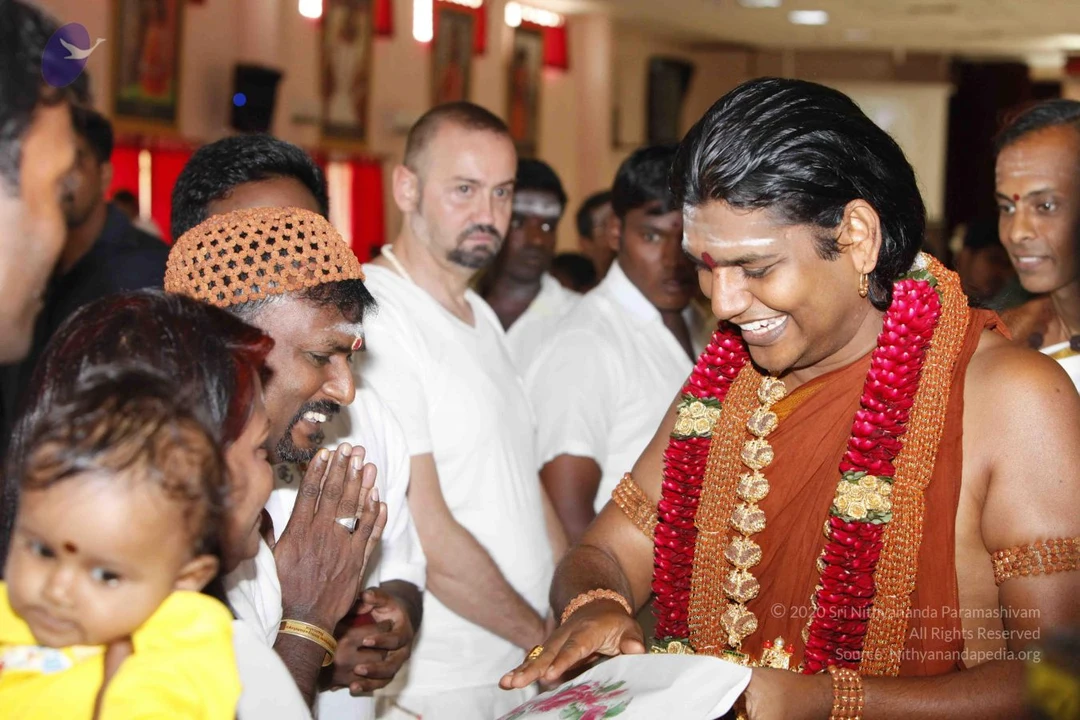
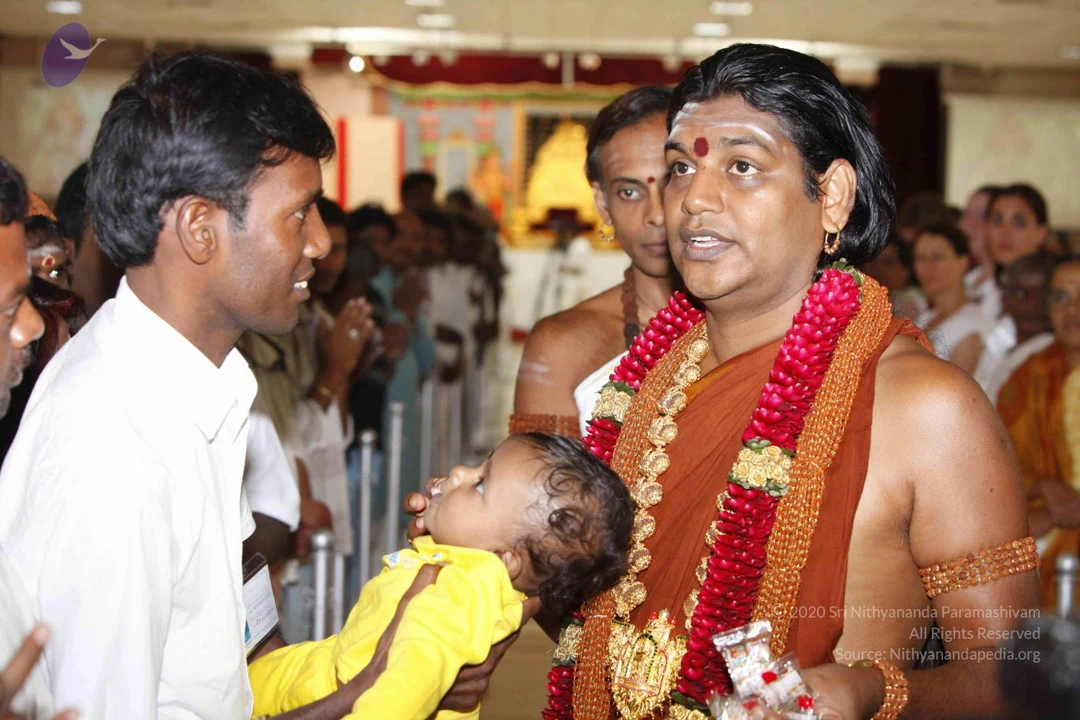
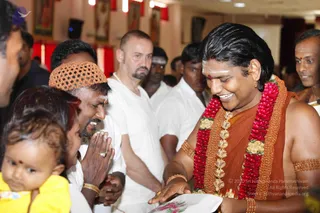
A smiling man with long swept-back black hair, white vibhuti lines and a red bindi stands at right in an orange-saffron dhoti-style wrap with heavy gold necklaces and rudraksha-style beaded malas, bangles on his wrist and armlet on his upper arm, raising his palm in blessing toward a line of devotees in white shirts and dhotis who stand with hands folded in anjali. Behind them stands a shrine area with a golden deity murti and red-and-gold decorative panels. The overall scene suggests an ashram darshan or blessing moment.A photograph of a man with long swept-back dark hair, wearing an orange-red shawl, a gold-bead necklace and a rudraksha-style ceremonial garland, applying a mark to the forehead of an older man in white bending forward with glasses. On the left an elderly bearded man in an orange shawl watches. Several men in white shirts stand behind, one with a dark mala, in a room with cream walls and a red curtain. The distinctive long hair, orange clothing and gold necklace of the man applying the mark are cues consistent with the Swamiji (probable) label.A photograph of an indoor gathering where a man with long dark hair, white forehead markings, a red bindi, gold earrings, a saffron cloth and layered gold necklaces stands at the centre, his arm extended toward a devotee in the foreground. To the left, an older man with grey hair and beard in an orange garment presses his palms together in reverence and holds a red fruit or apple in one hand. Behind them, several men in white shirts look on, one wearing glasses. The setting appears to be a devotional room with a wall and a framed picture above. a person is the central figure in orange and gold ornaments, shown receiving reverence.A photograph of a smiling figure in a saffron-orange dhoti-style wrap, wearing a heavy gold necklace with a large ornate pendant, gold armbands and bangles, with a red kumkum dot and white vibhuti marks on the forehead, long swept-back dark hair, and gold hoop earrings. The figure holds a small white card or paper in one hand and raises the other hand in a gesture while facing a row of devotees on the left who stand with palms pressed together in namaskar. A gold-coloured throne or altar with a golden deity murti is visible in the background, with white-clad devotees and red and white draped hangings around the hall. Several people are visible in the scene, including elderly men in checked shirts and white kurtas.A smiling man with long dark swept-back hair, white vibhuti marks on his forehead and a red bindi, stands in the centre wearing a saffron-orange dhoti-style wrap, red flower garlands with gold beads, a gold ornate pendant necklace, gold armbands and bangles. Behind and beside him, several men in white shirts and white dhotis stand in a crowd, one bald man with a beard in a white t-shirt at left. Behind them are other devotees and a blurred temple interior with a golden deity image and a red-and-gold canopy.A smiling man in an orange-saffron robe and a long red-and-white flower garland stands at the centre-right, with gold-toned necklaces, bangles and an armband, a white cloth in his hands. Around him, devotees in white clothes press close; a man with a woven orange-brown cap and folded hands stands at left, a bearded man in white stands behind, and a toddler in yellow is held at far left. Red curtains and framed pictures appear on a cream wall behind them.

Final-Blessings

3 photosSource gallery
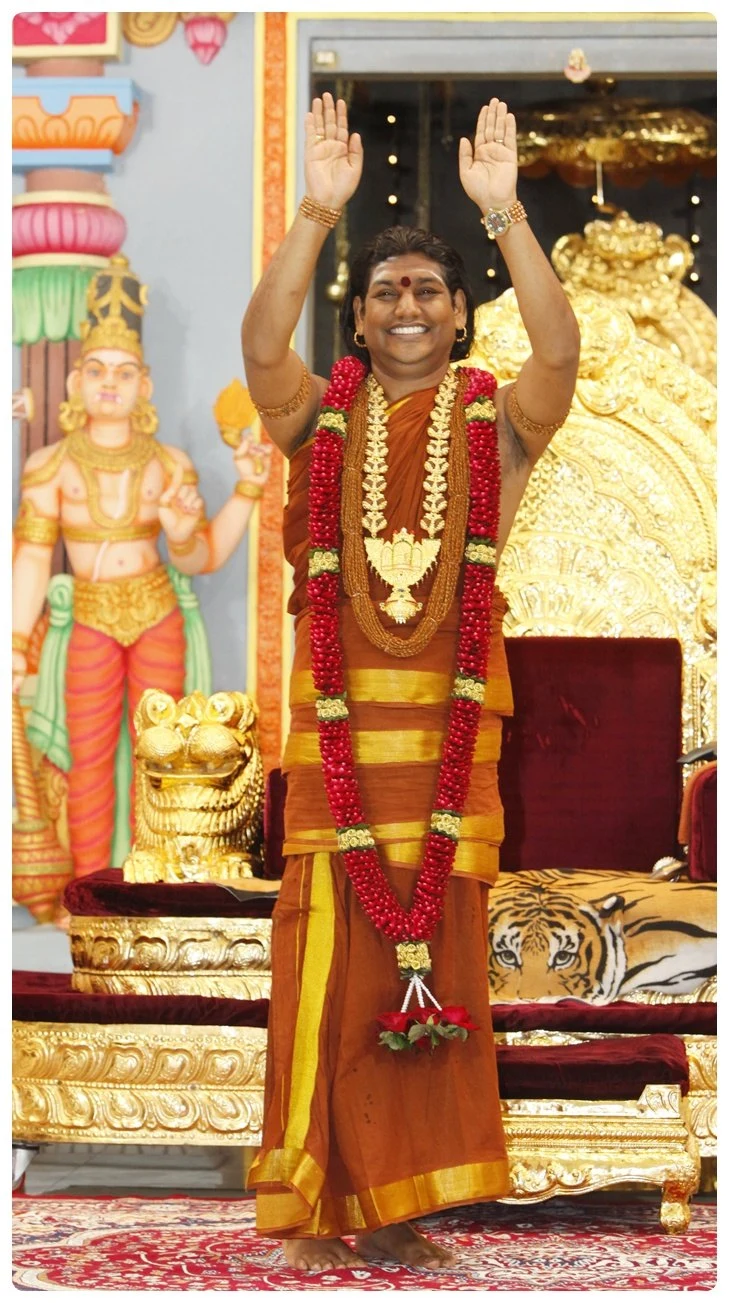
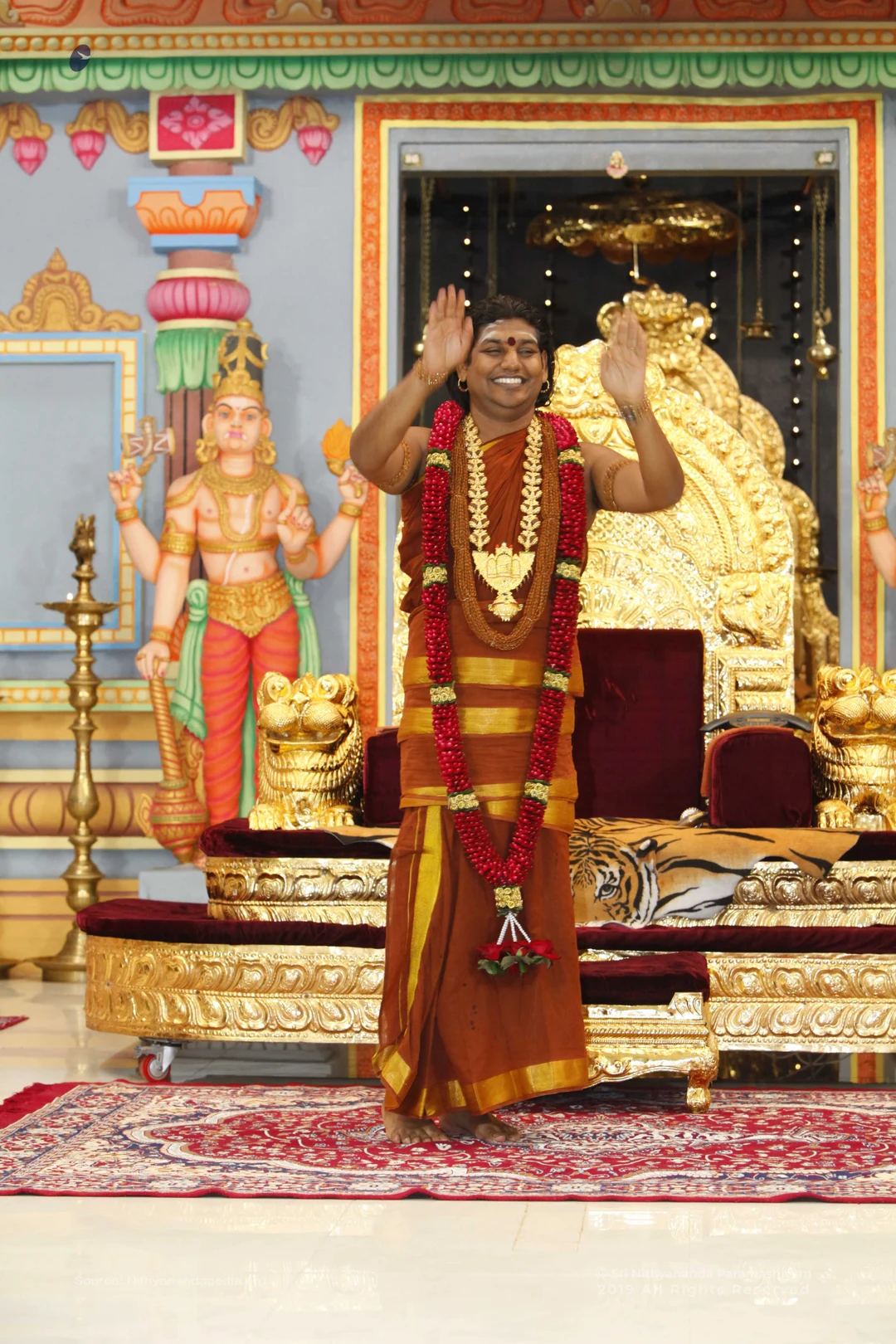
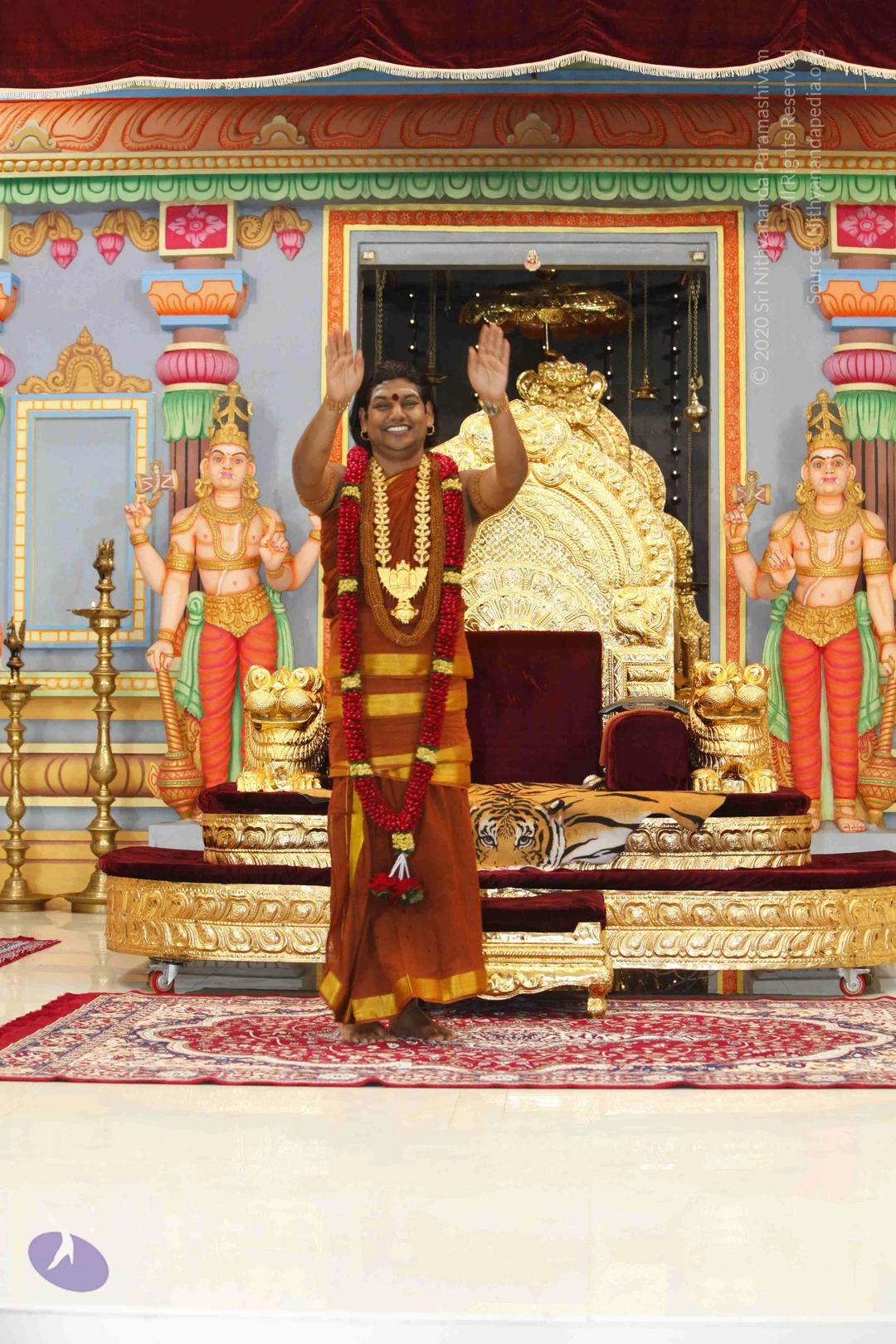
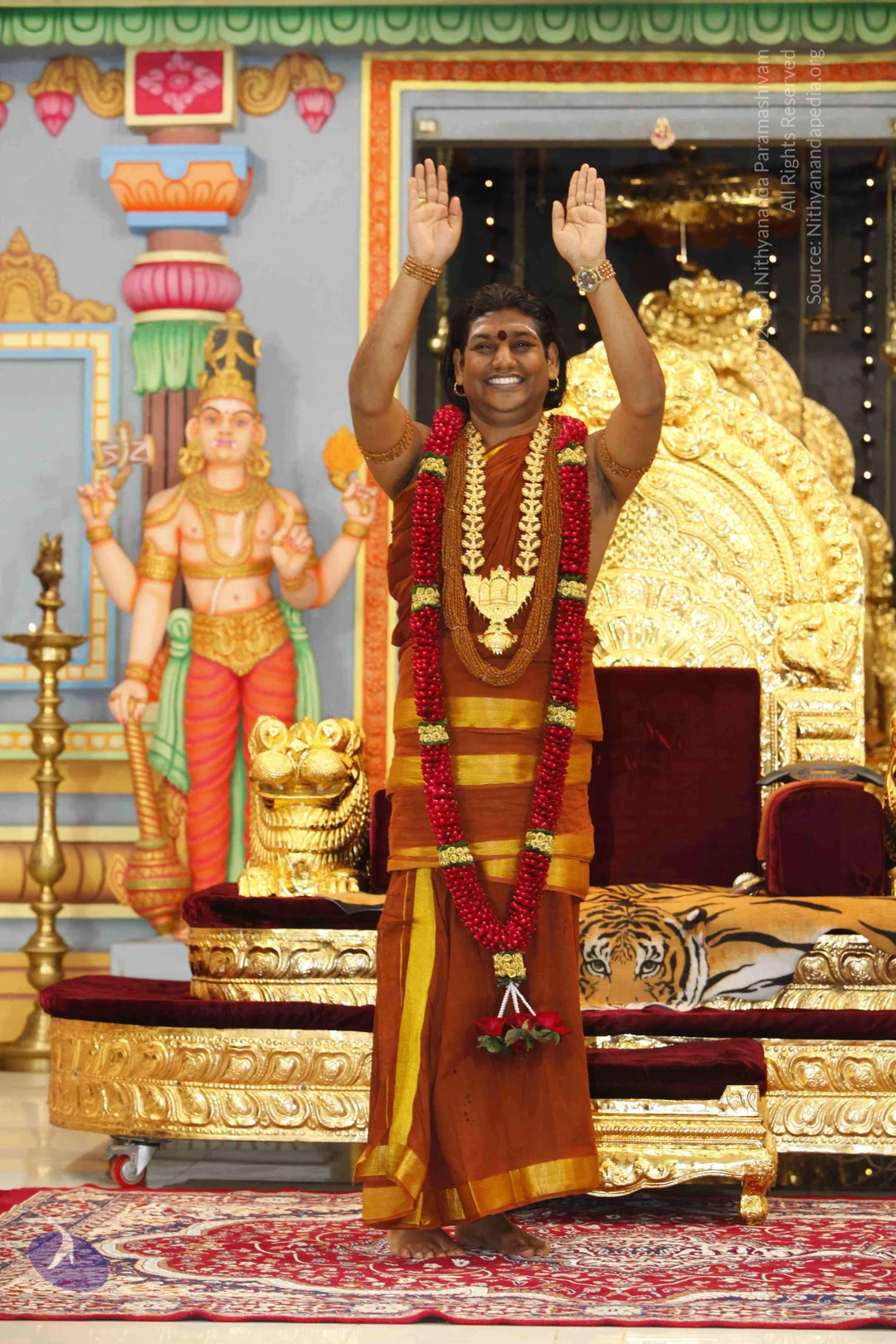
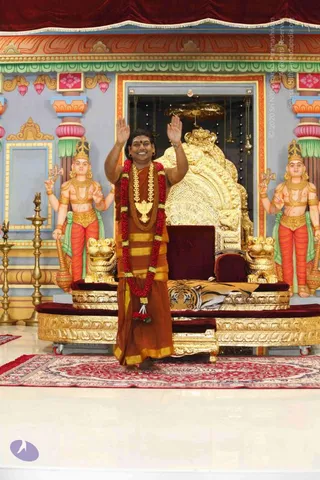
A photograph of a smiling man in saffron-orange robes standing barefoot on a red patterned rug in front of an ornate golden throne. He wears a red and white flower garland, a rudraksha mala, and a large gold pendant necklace, with raised palms in greeting. Behind him, two painted deity murti with four arms stand flanking the throne, which is draped with a tiger skin. Golden lion heads decorate the throne base, and brass oil lamps stand at the left. The figure has long swept-back hair and ceremonial gold and rudraksha adornments, a person appearance, but identity is uncertain from appearance alone.A smiling man stands barefoot on a red patterned carpet in front of a golden throne draped with a tiger-skin cloth, raising both palms overhead in greeting. He wears an orange-brown dhoti and shawl with gold borders, a long red and green flower garland, layered gold necklaces and rudraksha beads, gold bangles and a red bindi, and his long dark hair is swept back. Behind him stands a multi-armed painted deity figure in orange and green dhoti holding a kalasha-like object and staff, beside a gold lion-shaped seat and a tall brass oil lamp. The setting is a temple-style hall with ornate pink and orange pillars.A smiling man in a rust-orange dhoti and shawl with gold borders stands barefoot on a red patterned carpet, raising both hands in greeting. He wears a long red and green flower garland, a gold ceremonial necklace, a red tilak on his forehead and gold-rimmed earrings. Behind him stands a multi-armed painted deity statue holding a trident and a flame, beside a brass oil lamp. A golden throne with lion-head arms and a tiger-skin cushion stands at the back. The compound and the printed name line suggest a satsang setting. a person: the standing man in orange with garland, tilak and raised hands fits the presentation cues, though the appearance is only moderately distinctive.

Sacred-Arts-Construction
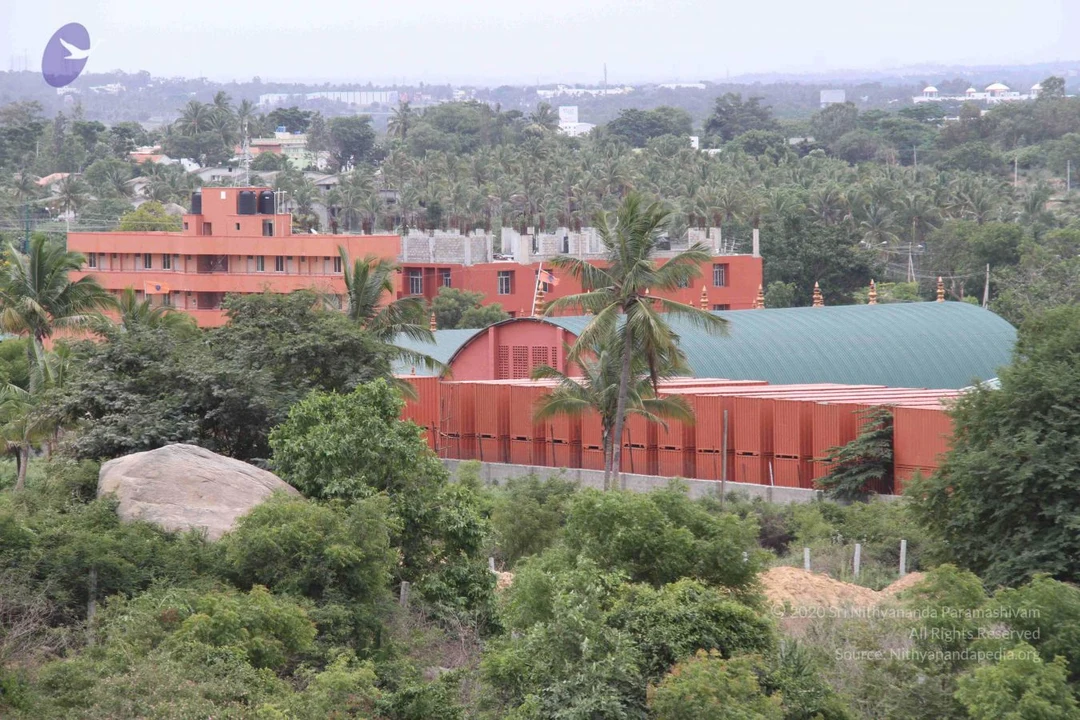
8 photosSource gallery
Elevated photograph of an ashram complex surrounded by dense green trees and palm trees. A long low building with a green corrugated metal roof and rows of terracotta-red shutters dominates the centre, beside a multi-storey orange-red block with water tanks on its roof. A large grey boulder sits in the foreground among shrubs, and distant buildings and palms fill the horizon. No people are visible.A photograph of a large, weathered clay or mud figure of a seated or reclining humanoid form lying on a pale concrete slab outdoors. The figure has cracked surfaces, dark soot-like staining, and a blackened torso and head, with limbs extended toward the frame. Nearby are scattered dark lumps, broken bricks, a torn orange cloth and a sheet of white paper on red earth. No people are visible in the scene, and the figure appears to be a sculptural object rather than a person.A young man in a white short-sleeved t-shirt and white dhoti with green borders sits on the ground in a open shed with corrugated metal walls, carving a large brown clay or wood figure of a reclining body lying on a wooden board. He wears an orange thread on his wrist and works with a small chisel-like tool, surrounded by wood shavings, a tin bucket, bricks and scattered tools. The scene shows a sculptor at work on a deity murti in progress.Two men sit on the floor in a plain room with a pale textured wall, working on craft material. The man in front wears a plaid collared shirt in purple and white, a white dhoti, and gold bangles, and is bent over a wooden tool, shaping or pressing something held on a white cloth. Beside him, a man in a red t-shirt and plaid shorts, also wearing a gold bangle, bends over a blue tray with small tools. A pile of dark metal nails or rods lies on the cloth between them, with scraps of paper nearby. A metal bucket and a chair are visible at the upper right. The scene shows ordinary hands-on work rather than a ritual or satsang setting.Three men sit on a floor in a workshop carving white stone or plaster sculpture parts, with golden deity statues on shelves behind them. On the left, an older man with grey hair and glasses, wearing a white shirt and white dhoti with an orange border, holds a chisel and mallet over a wooden block. In the centre, a man in a red-and-white checked shirt and white dhoti works beside a red bucket. On the right, a man in a cream shirt and white dhoti holds a pale carved foot. Tools and wooden sticks lie on the ground in front, and the golden figures on the wall are unfinished-looking sculpture work.

01--Temple

6 photosSource gallery
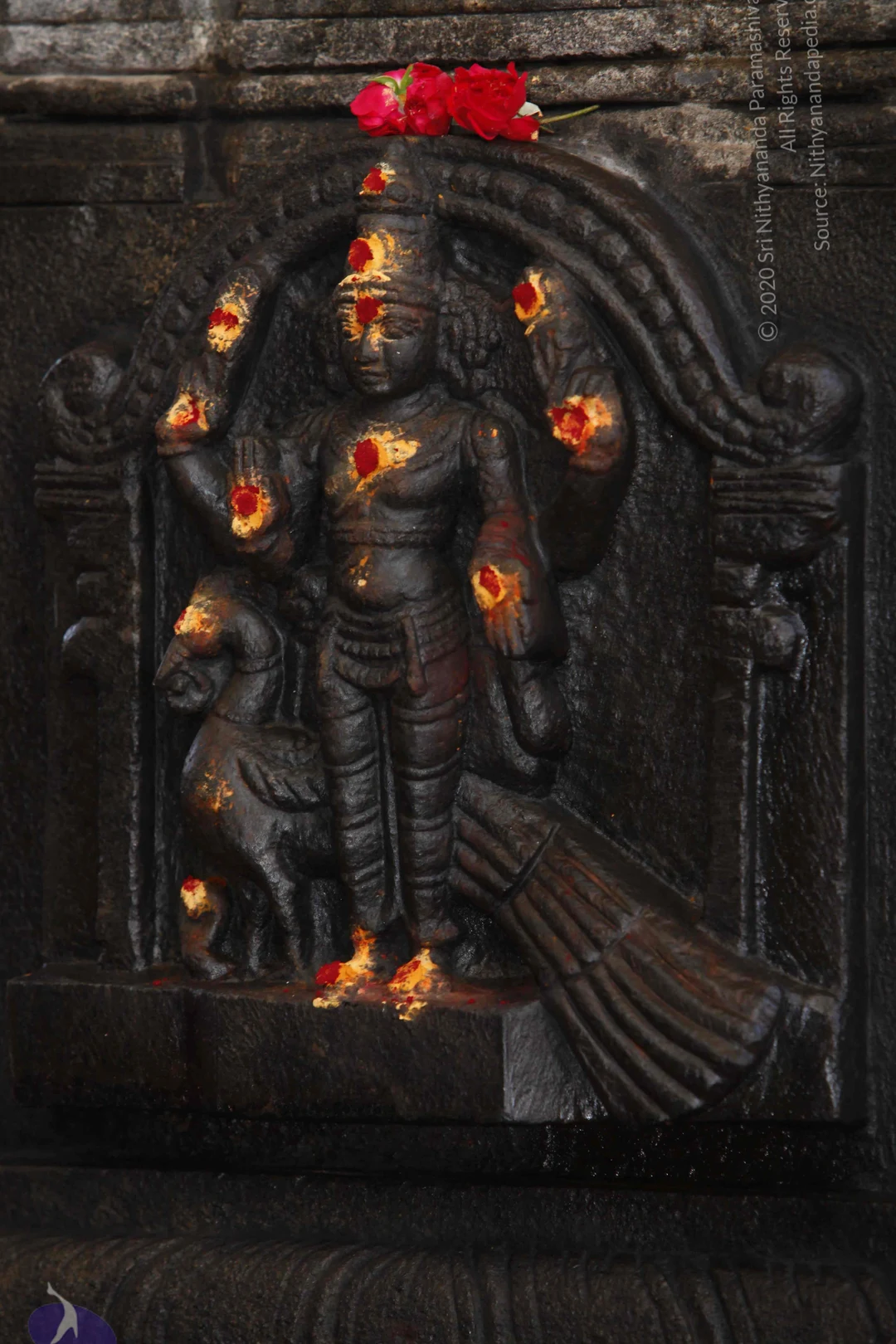
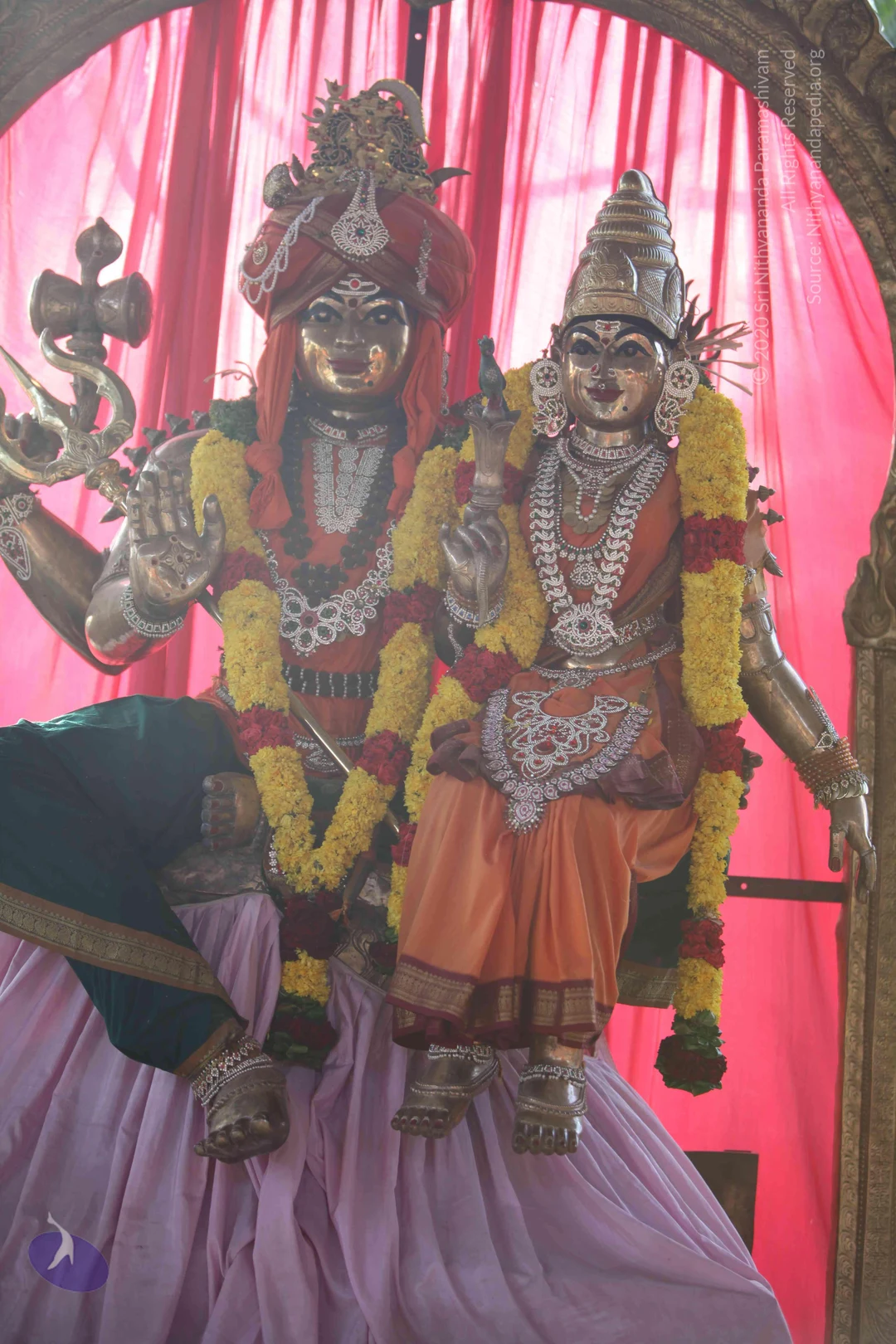
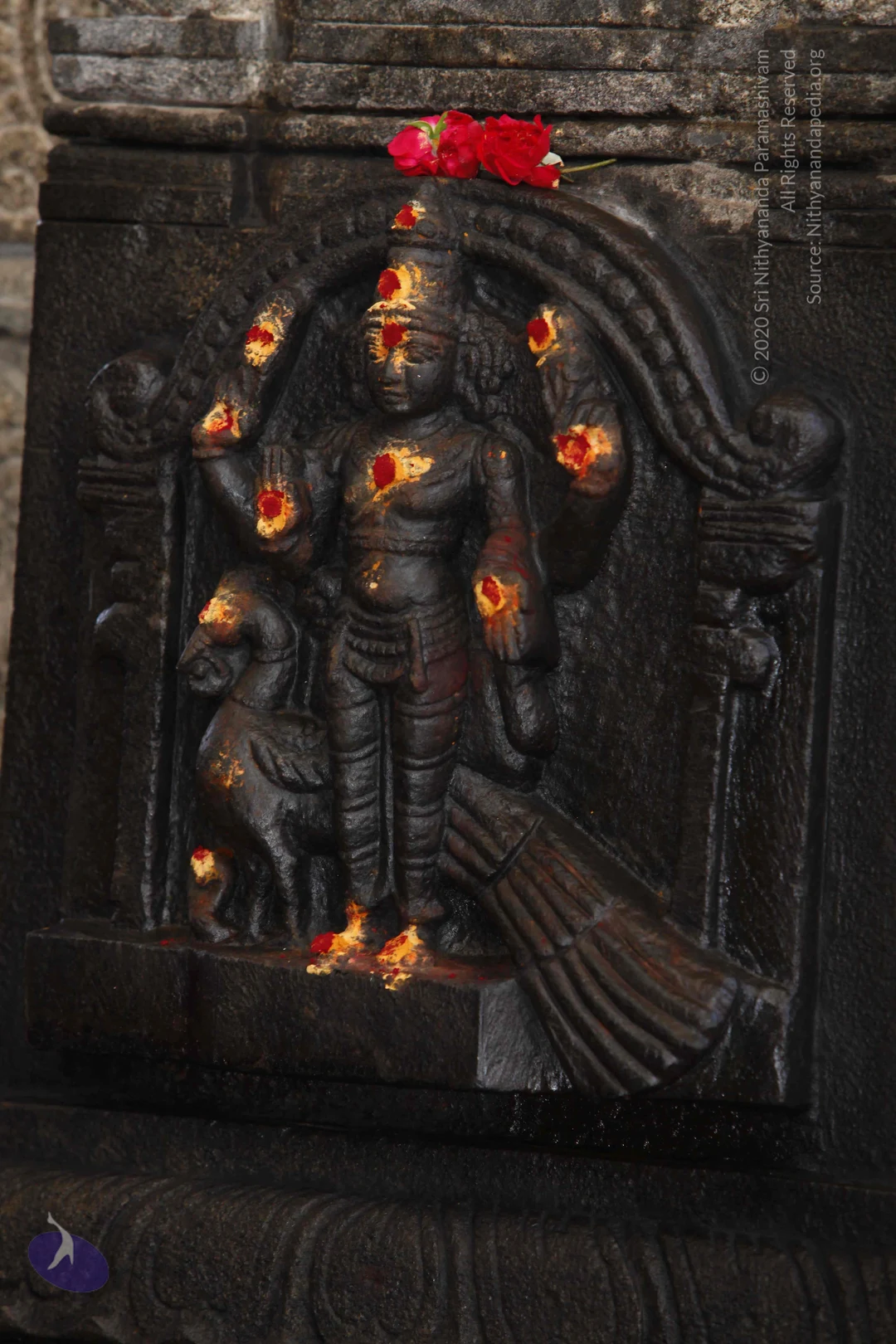
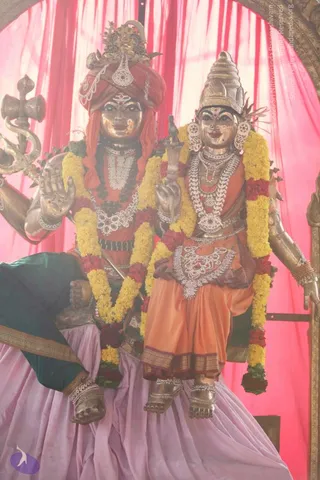
A photograph of a large ancient banyan tree at its base, with many thick aerial roots and hanging prop roots forming a dense curtain of dark brown trunks on a reddish-brown earthen platform. To the right, a stone shrine or deity structure is partly visible draped in white cloth with orange-yellow borders. No people are visible; the scene is a sacred tree setting, possibly a temple grove.A photograph of two silver-finished deity murtis seated side by side on a pale lavender cloth before a bright pink drape, framed by an ornate arch. The figure on the left wears a red turban, a rudraksha-style dark bead mala, layered ceremonial jewellery and holds a trident-like staff. The figure on the right wears an orange-red sari with gold border, a tall silver crown, drop earrings and a long garland of yellow and red flowers, and holds a small bird on a ceremonial stand. Both are adorned with yellow and red marigold garlands and fine silver necklaces. No physical people are visible; these are statues.A man with long swept-back dark hair stands barefoot on a stone step under an open pavilion, hands clasped at his waist. He wears a rust-orange unstitched wrap with wide gold borders, a long gold-and-coral beaded garland, a large gold pendant, gold armlets and bangles, and a red kumkum mark on his forehead. Behind him, saffron-robed attendants move about, a drummer in maroon sits beside a drum, and a red vehicle and a white-clad man stand in the courtyard. Red and patterned rugs lie on the steps. Cues: long swept-back hair, ornate gold jewellery and saffron-orange ceremonial dress are visible on the standing man, consistent with the page's Swamiji reference; appearance-based label: Swamiji (probable), standing in person.A man stands at the front of a steel railing wearing an orange-saffron dhoti and shawl with broad gold borders, bare-shouldered on one side. He wears a heavy gold-and-beaded garland with a large gold pendant, gold beaded armbands and bracelet, small gold hoop earrings, a white tilak with a red dot on the forehead, and long swept-back dark hair. Behind him to the left, two young boys in maroon garments and white forehead marks stand near a barrel drum. The appearance and adornments match the a person profile, a figure in saffron with rudraksha-style gold regalia and long swept-back hair, though his position in the procession is not clear from the image alone.Two large bronze-toned deity murtis stand side by side before a red draped curtain framed by an ornate carved arch. The figure on the left, a Shiva-form murti, holds a trident and has a tall crown or turban, a third-eye mark, silver necklaces and a rudraksha-style chain, with a yellow and maroon garland. The figure on the right wears a silver crown, large earrings, silver necklaces and an orange dhoti, holding a small staff topped with a bird figure and a yellow and red garland. These are statues, not living people, and no person is present.A dark stone relief carving of a four-armed deity standing in a niche on a temple wall, with a small animal, possibly a deer or goat, beside its left leg and a fan-like shape at its feet. Red and yellow kumkum and turmeric marks dot the figure's forehead, chest, arms and base, and a cluster of red flowers rests on top of the niche arch. No people are visible.

04--Gurukul-Instruments

3 photosSource gallery
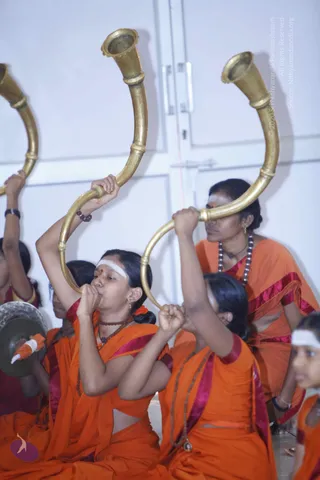
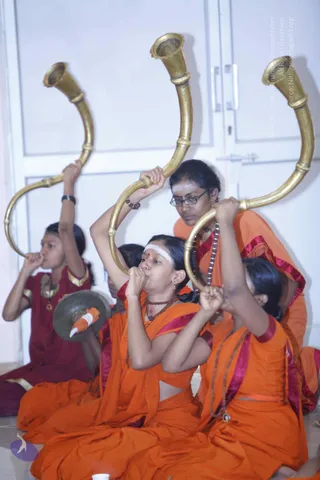
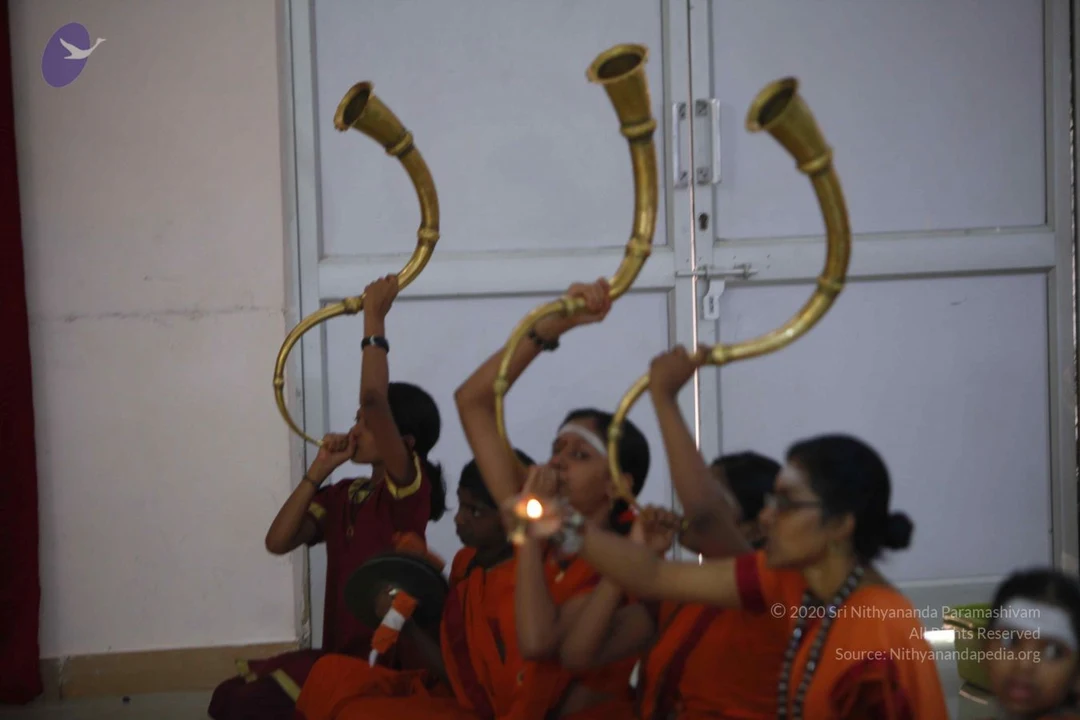
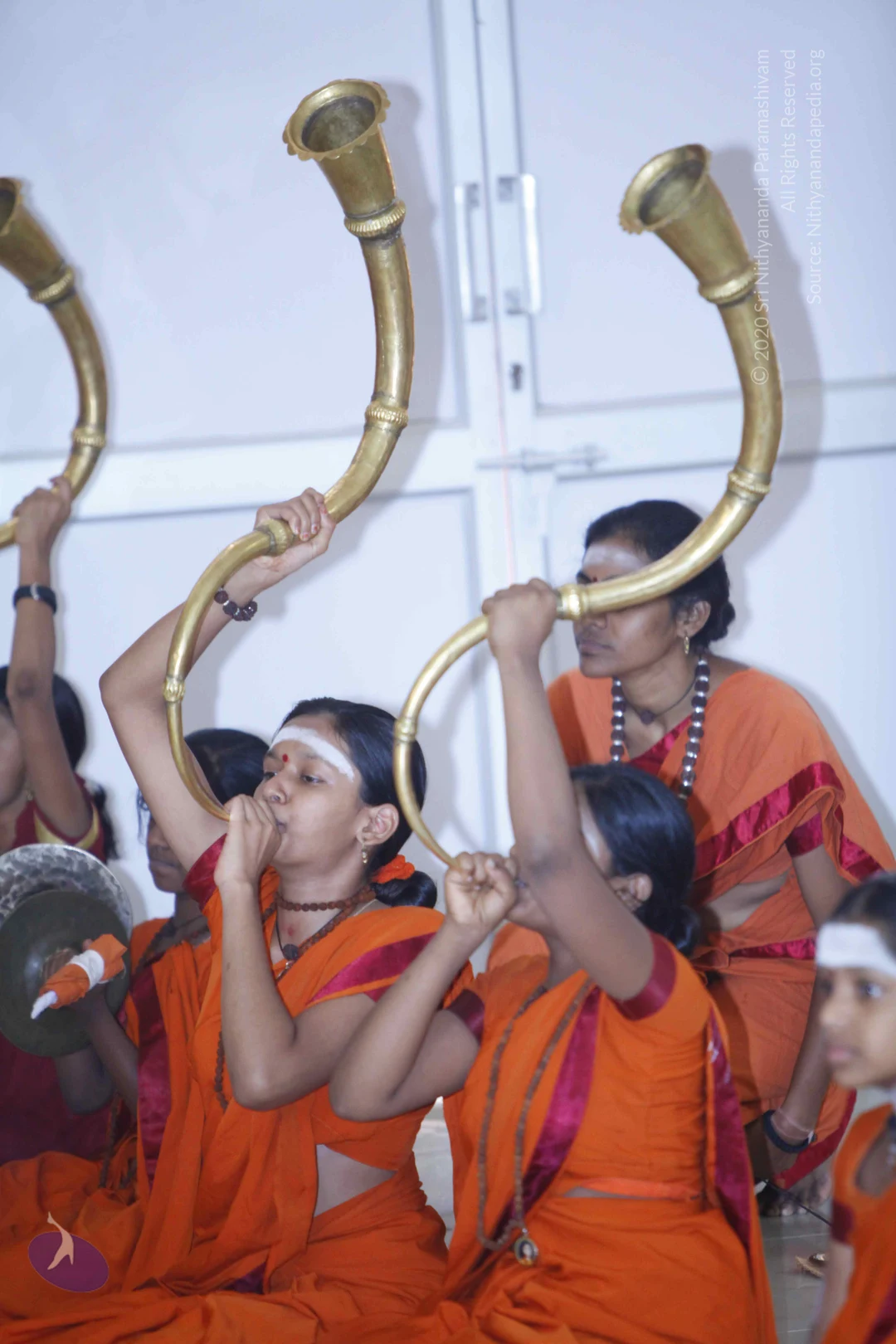
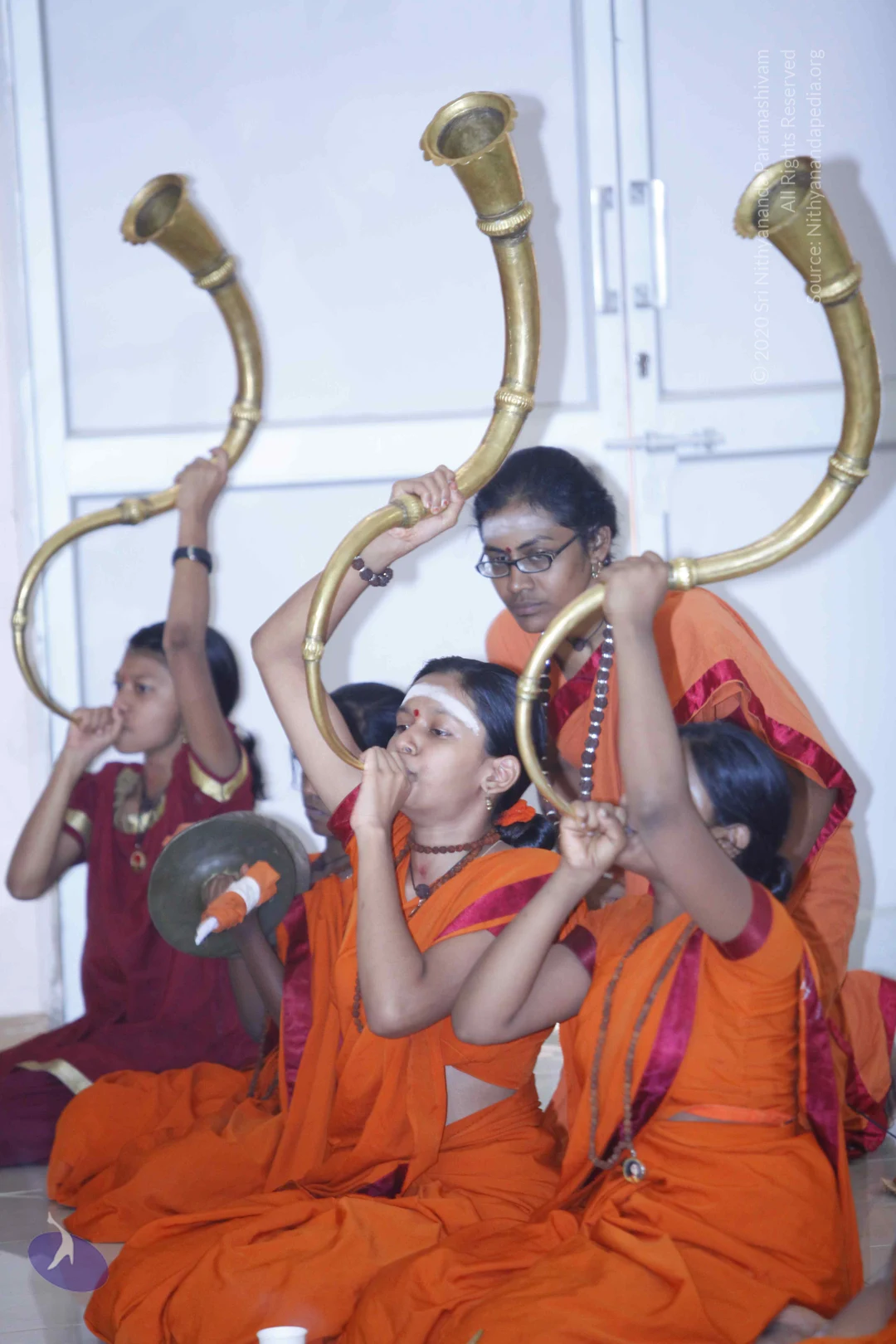
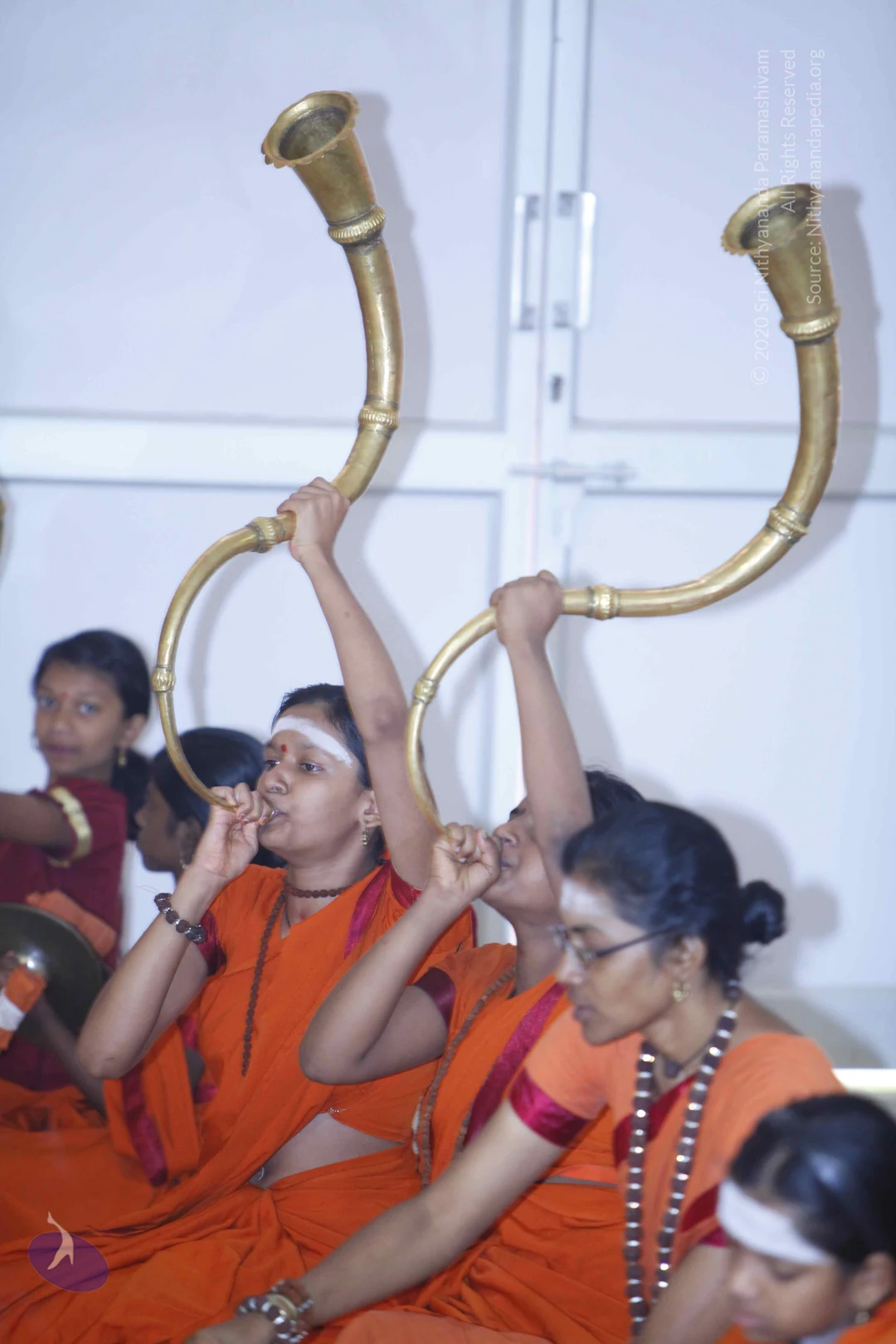
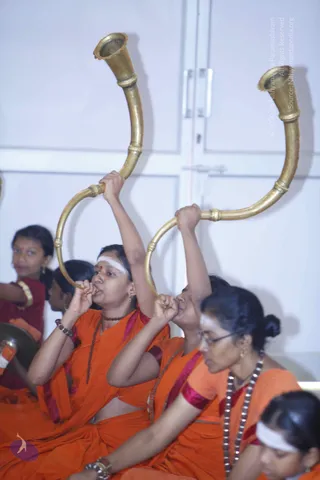
Several women and girls in orange saris with magenta borders play long curved gold brass horns raised overhead, a traditional wind instrument ensemble. The foreground player, a young girl with white forehead paste and a red bindi, blows into the horn while wearing a rudraksha mala. Another player beside her holds a horn with both hands, and a woman in the background wears a pearl-like necklace. Partly visible cymbal players sit at left. A white wall with a door frames the scene. No a person figure is visible in the scene.Photo of several young women and girls seated on the floor in orange and maroon-trimmed saffron robes, playing long curved gold brass horns raised overhead. The girl in front wears a white vertical tilak, red bindi, a rudraksha necklace and a sindoor-style red mark, and blows into the horn with both hands. Behind her an adult woman in orange with red border and glasses holds another horn. A girl in a maroon dress with gold trim plays a horn at left, and a hand holds a small brass cymbal with an orange cloth. White wall and cabinet doors form the background.Several women in orange saffron robes play long curved brass horns raised overhead against a plain white wall with doors. The foremost player wears a white forehead band, a red bindi and a rudraksha mala, and blows into a horn held high with one arm. Beside her, another player in orange with a dark red border blows a second brass horn, while others in the background, including a player with a cymbal in red, sit and perform. A woman at lower right wears a long silver-bead necklace and rimless glasses. The scene looks like a group musical performance during satsang-style gathering in an ashram setting.

06--Sarva-Darshan

1 photoSource gallery
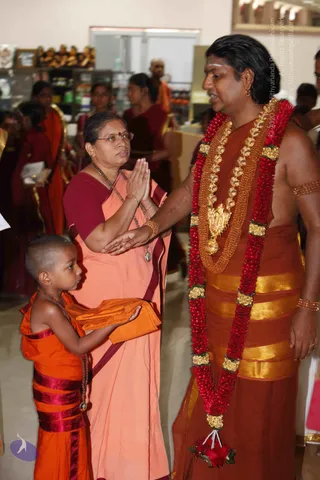
A man with long swept-back black hair, bare-chested under a rust-brown dhoti and shawl, stands wearing thick red flower garlands with gold beads and a gold ornamented necklace, a gold armlet and bangles; he gestures with his hand toward a woman in a peach sari with maroon border, hands joined in namaste, glasses and a red bindi, rudraksha-style beads at her neck. A young shaven-headed boy in orange robes holds an orange cloth and stands beside her. Several people in orange and maroon robes are in the background near a shop display. a person appears as the central man, identified by long swept-back hair, gold ornaments and garlands; he is presented as a devotee-greeting or welcome moment.

07--Final-Blessings

1 photoSource gallery
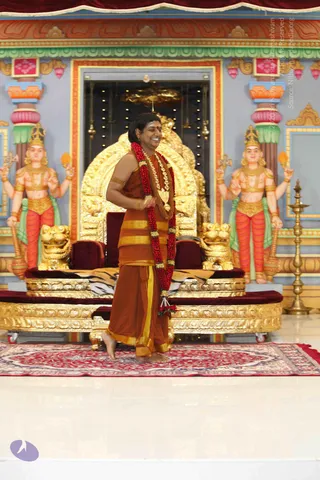
A smiling man with long swept-back dark hair and a red bindi stands barefoot on a red patterned rug before a golden throne draped with a striped tiger-skin cloth and velvet cushions. He wears a saffron-orange sannyasi-style garment with gold borders, a heavy gold ceremonial necklace and a thick garland of red flowers. Flanking the throne are painted multi-armed deity murti figures in gold crowns, and a brass oil lamp stands at right. The setting is a richly decorated temple-style stage.

June 30 2013

2 photosView all
A man in an outdoor temple grove stands on a dark stone platform before a black stone deity murti seated on a pedestal within a white carved arch, draped in green cloth with an orange headband and yellow cloth. A heap of red-painted stones or offerings sits in front of the shrine. The standing man wears a saffron-orange dhoti with gold-bordered yellow cloth wrapped at the waist, a bare upper body, a long gold necklace and bangle, and a gold-bordered wrap over one shoulder. a person candidate is visible, identified only by appearance cues: swept-back long hair, ornate gold necklace and saffron ceremonial clothing, yet his identity remains uncertain. Trees and a small lamp stand beside the shrine.A man with hands folded in namaskar stands barefoot on a red-patterned mat before a black stone deity murti with an orange headband and white-and-gold cloth, seated on a mound of red-stained stones with a small wooden stool in front. He wears a rust-brown dhoti and shawl with gold-yellow bands, a gold necklace and armlet, and a vertical tilak on his forehead. The shrine sits under a white arched frame amid leafy trees and a green backdrop.