Skip to content
Sunday

2 June 2013

Dated photos
143
Source pages
1
Media
2
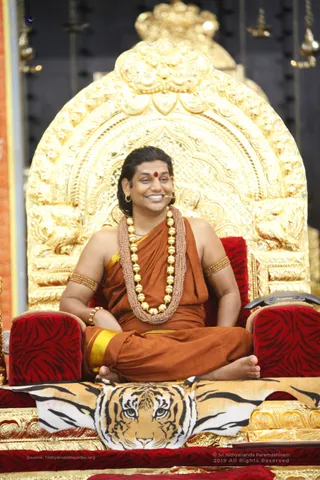
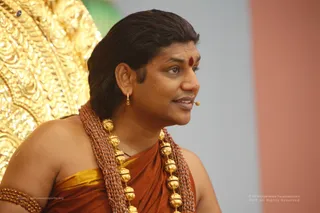
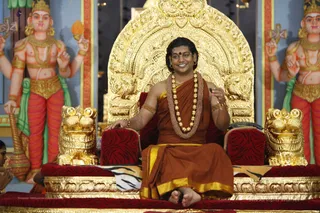
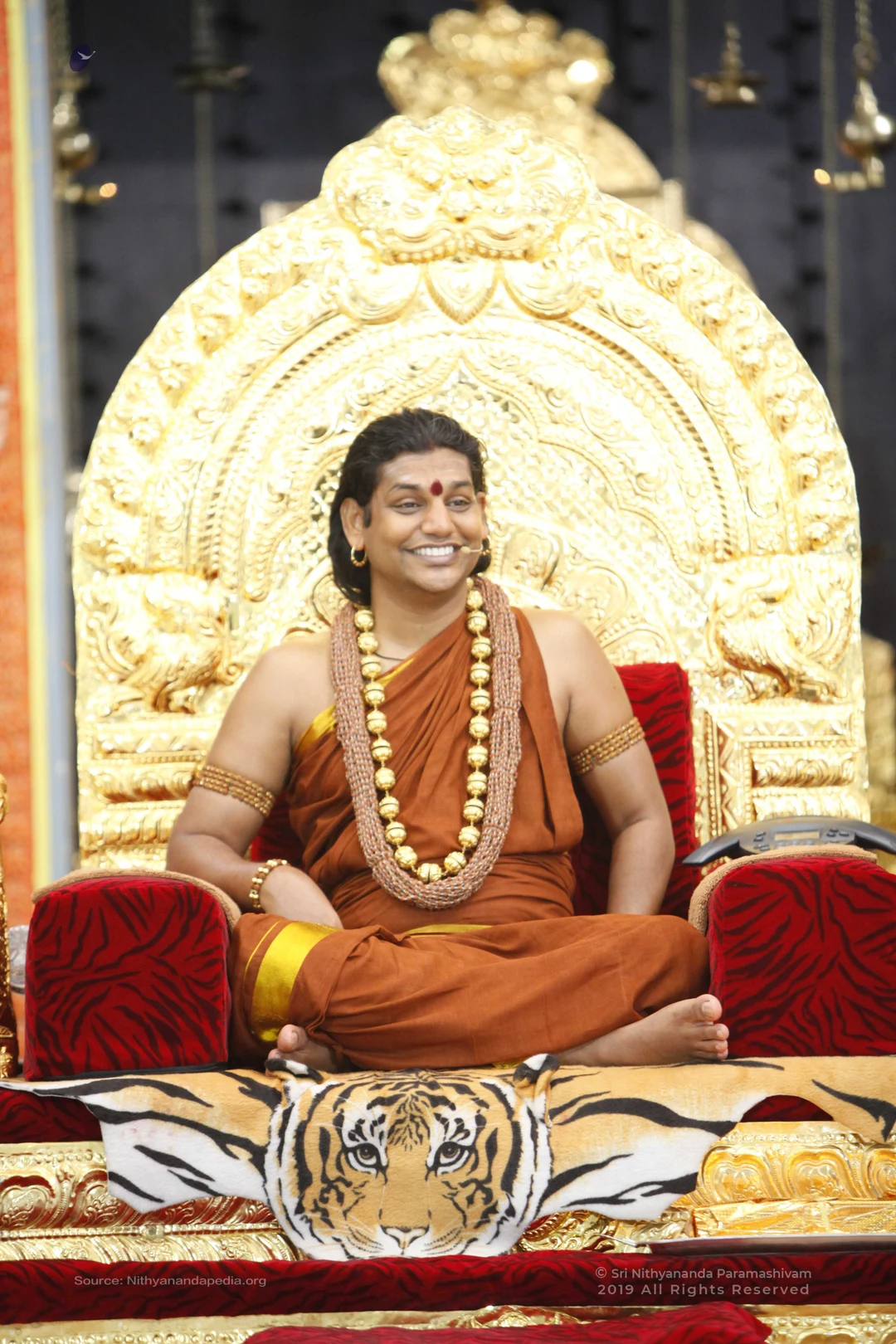
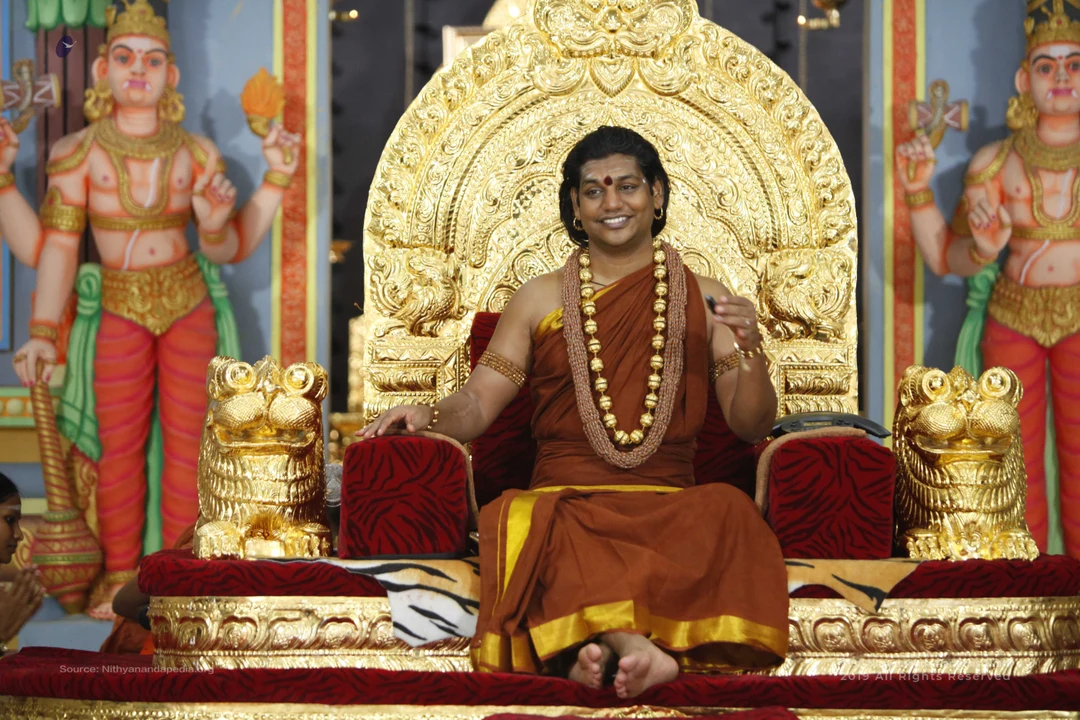
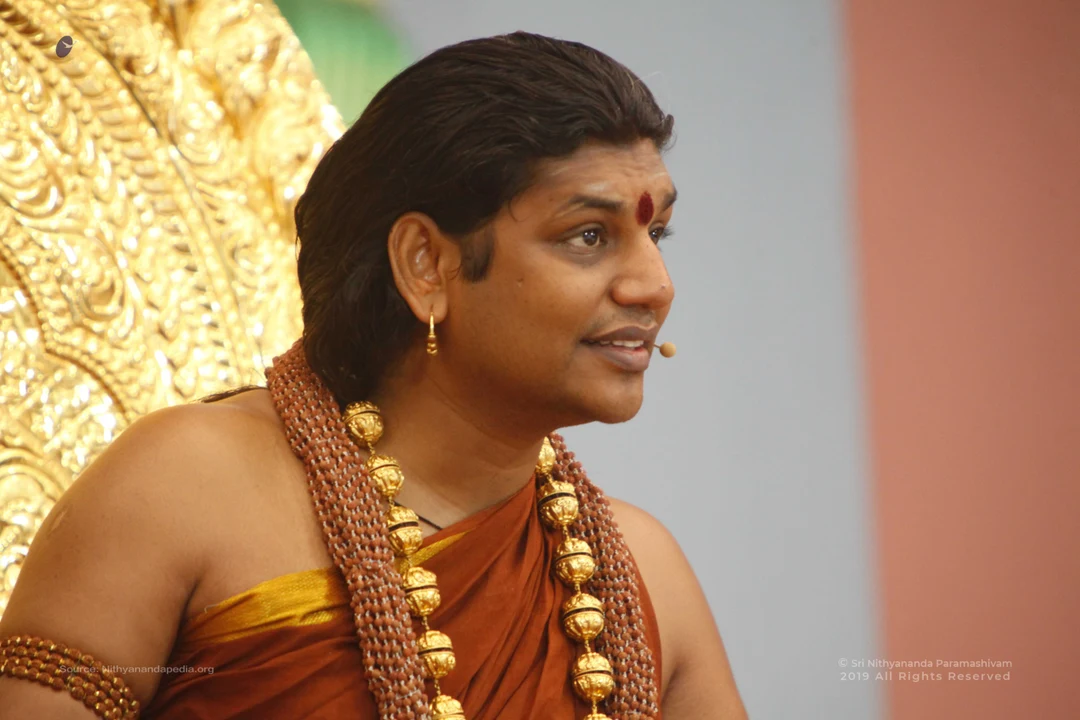
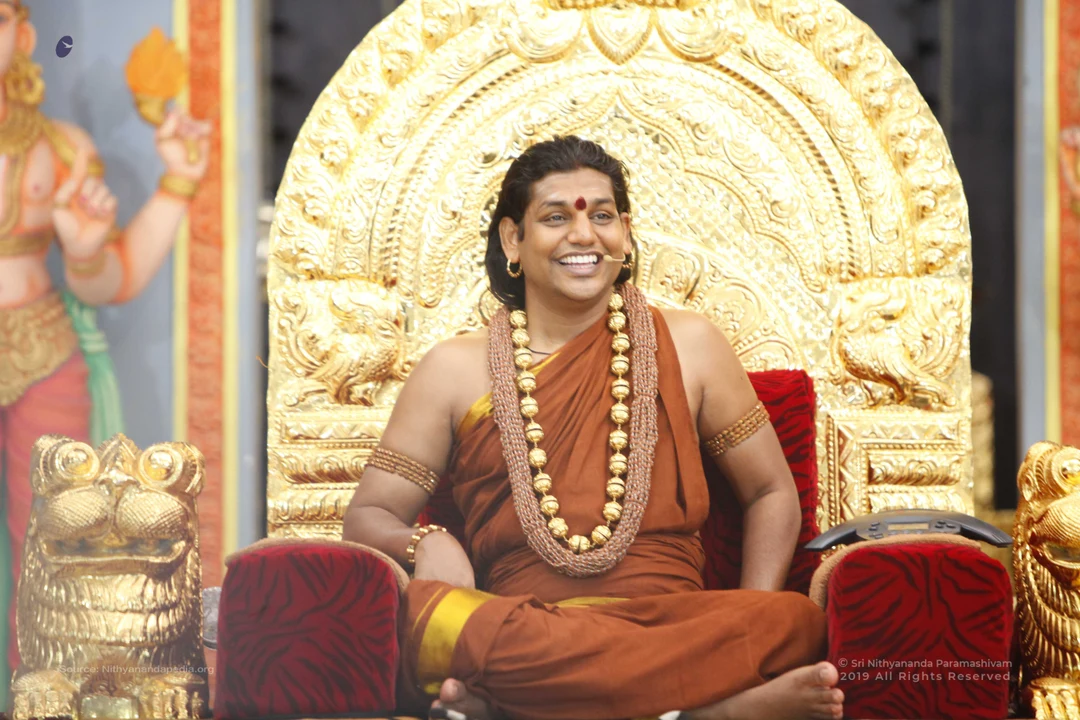
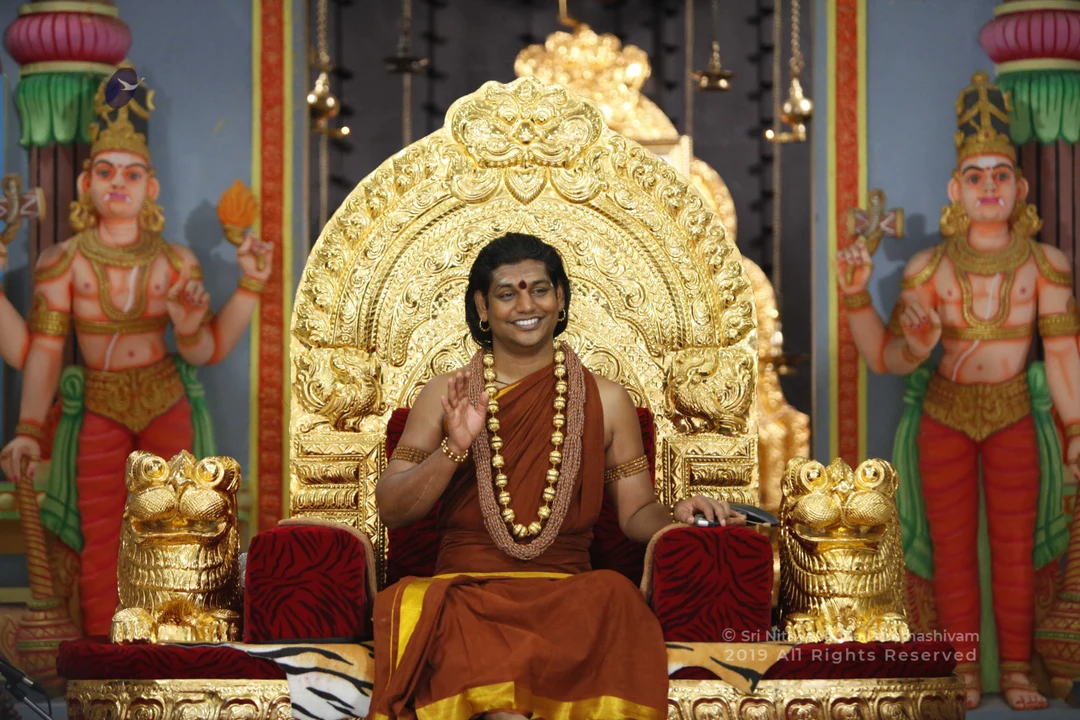
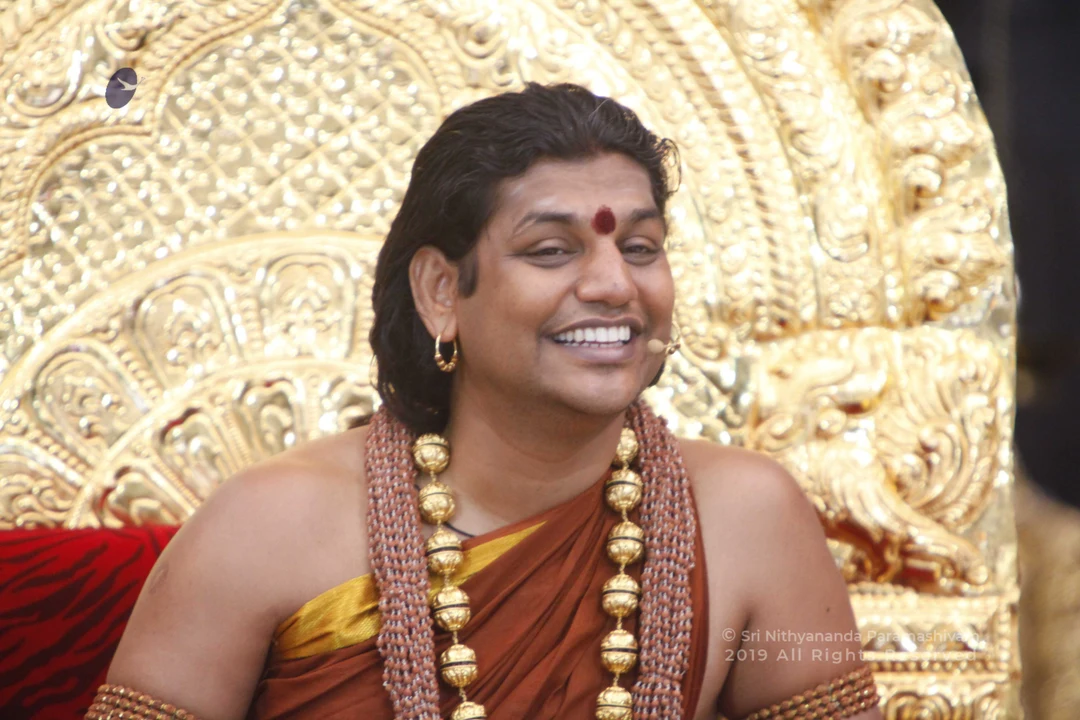
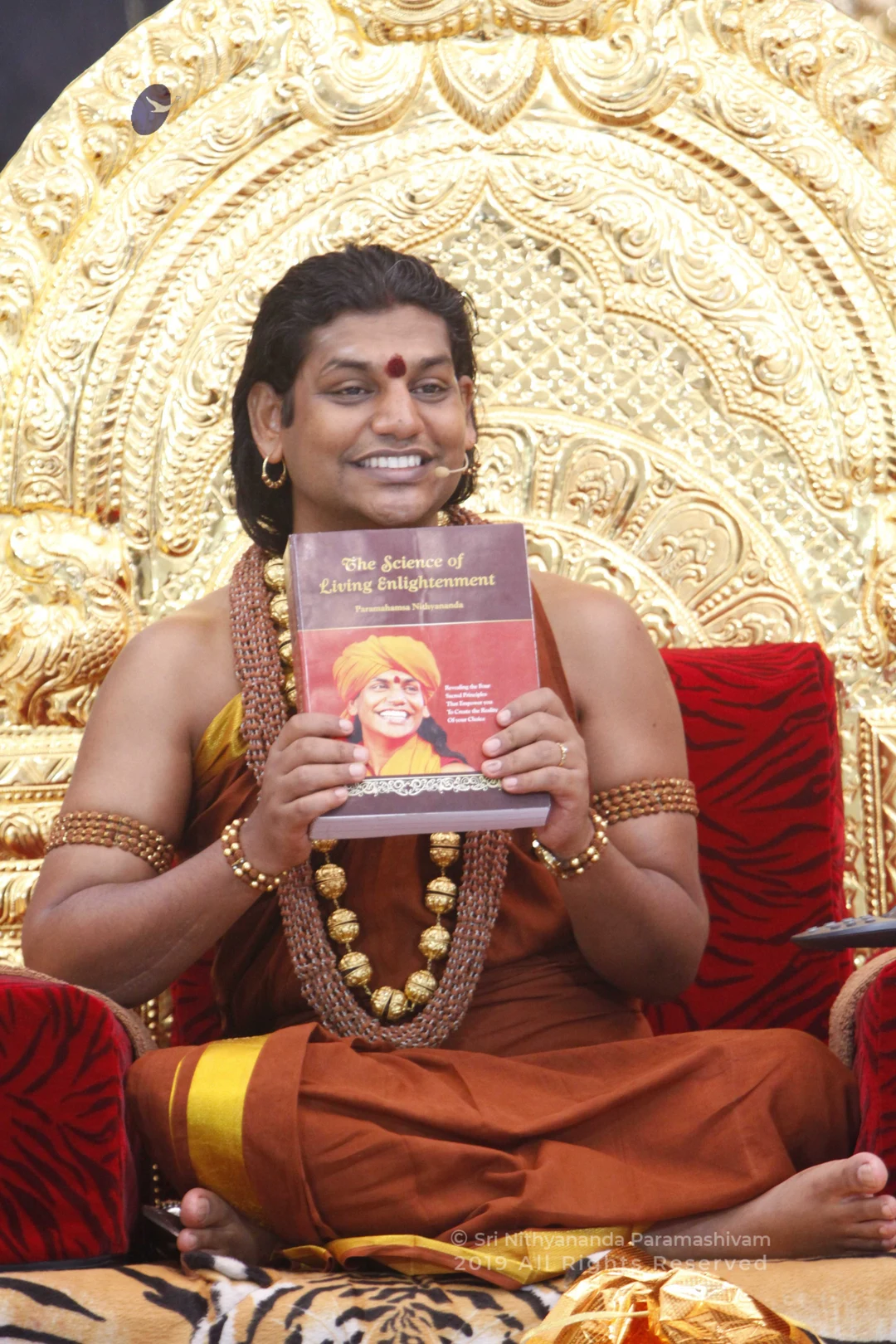
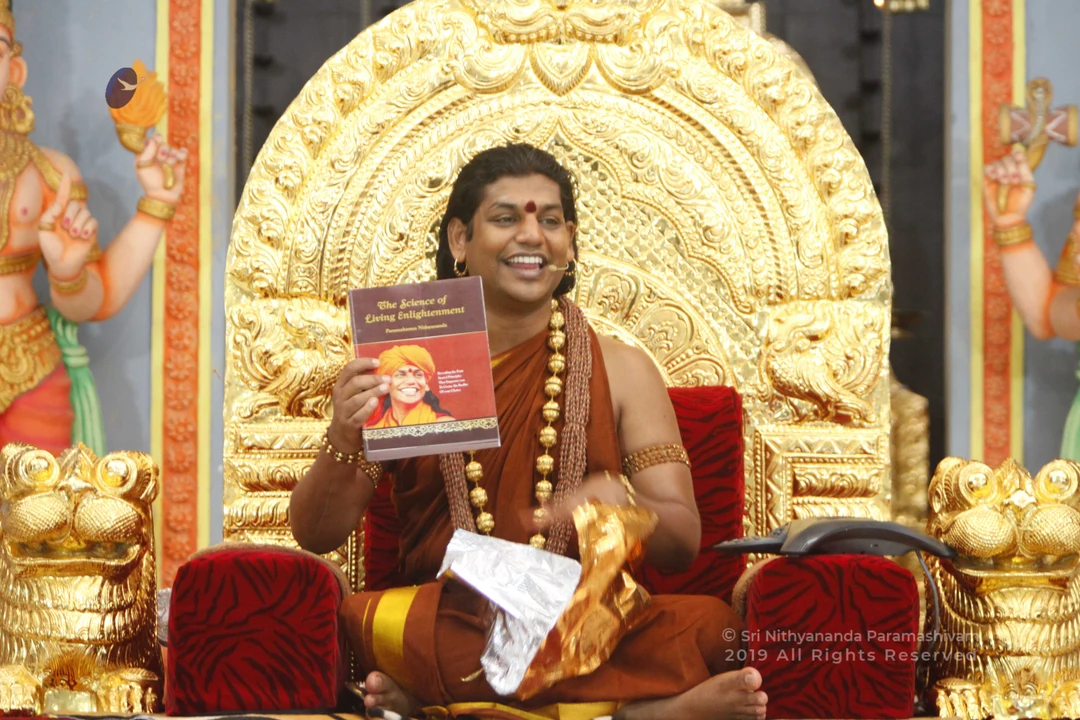
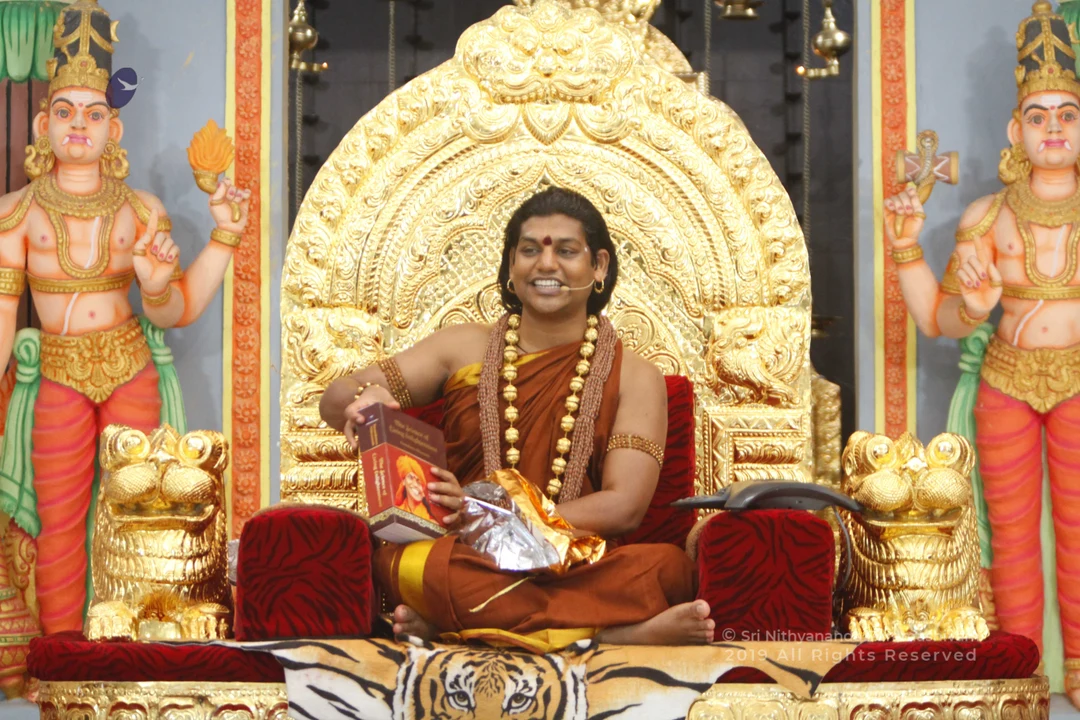
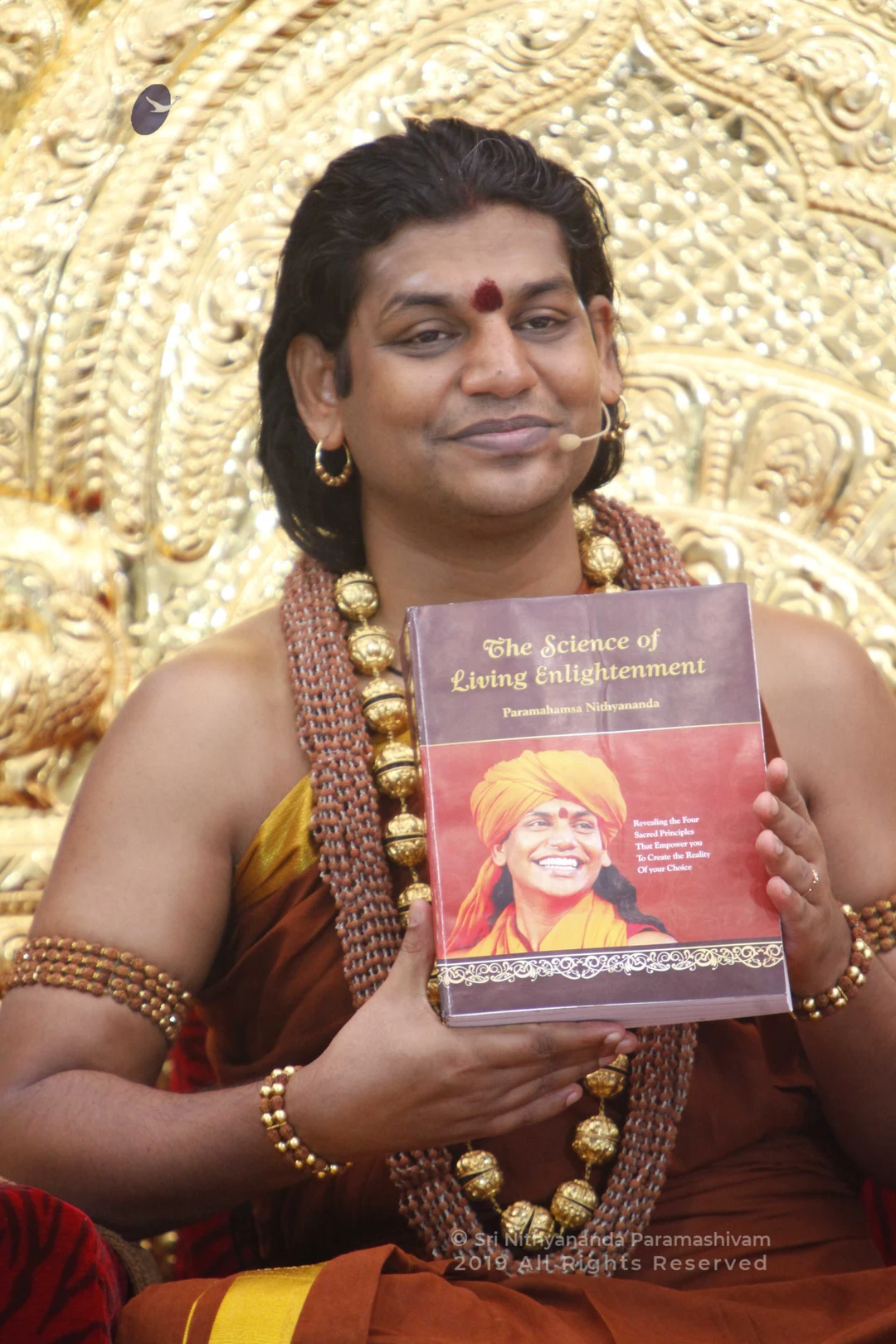
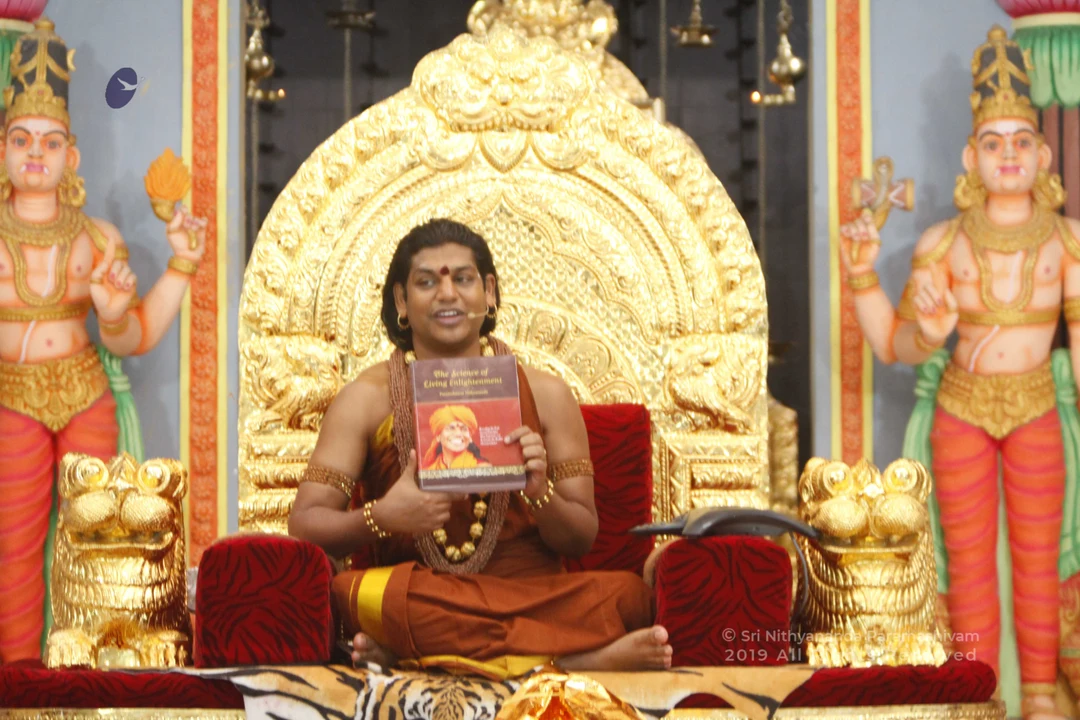
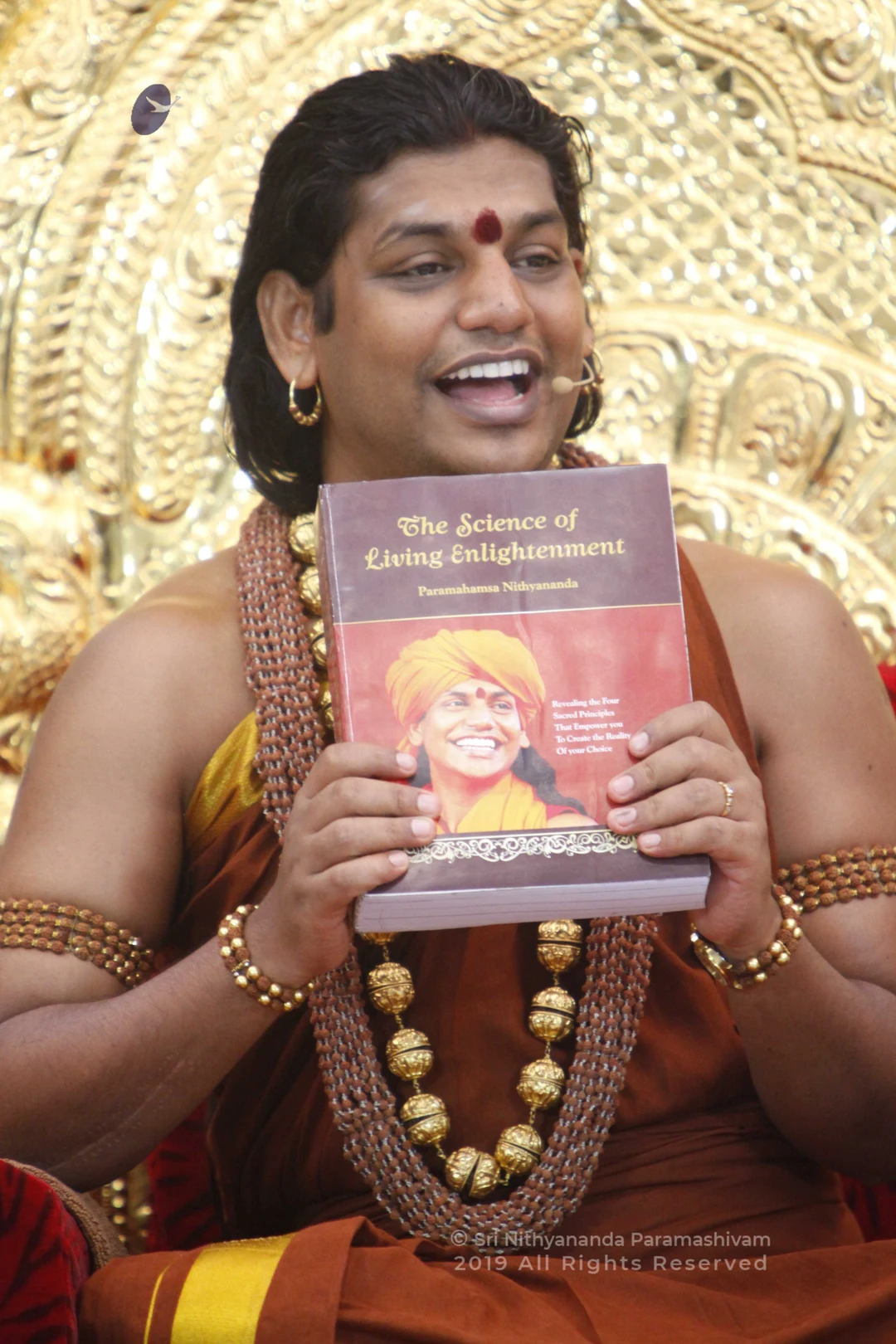
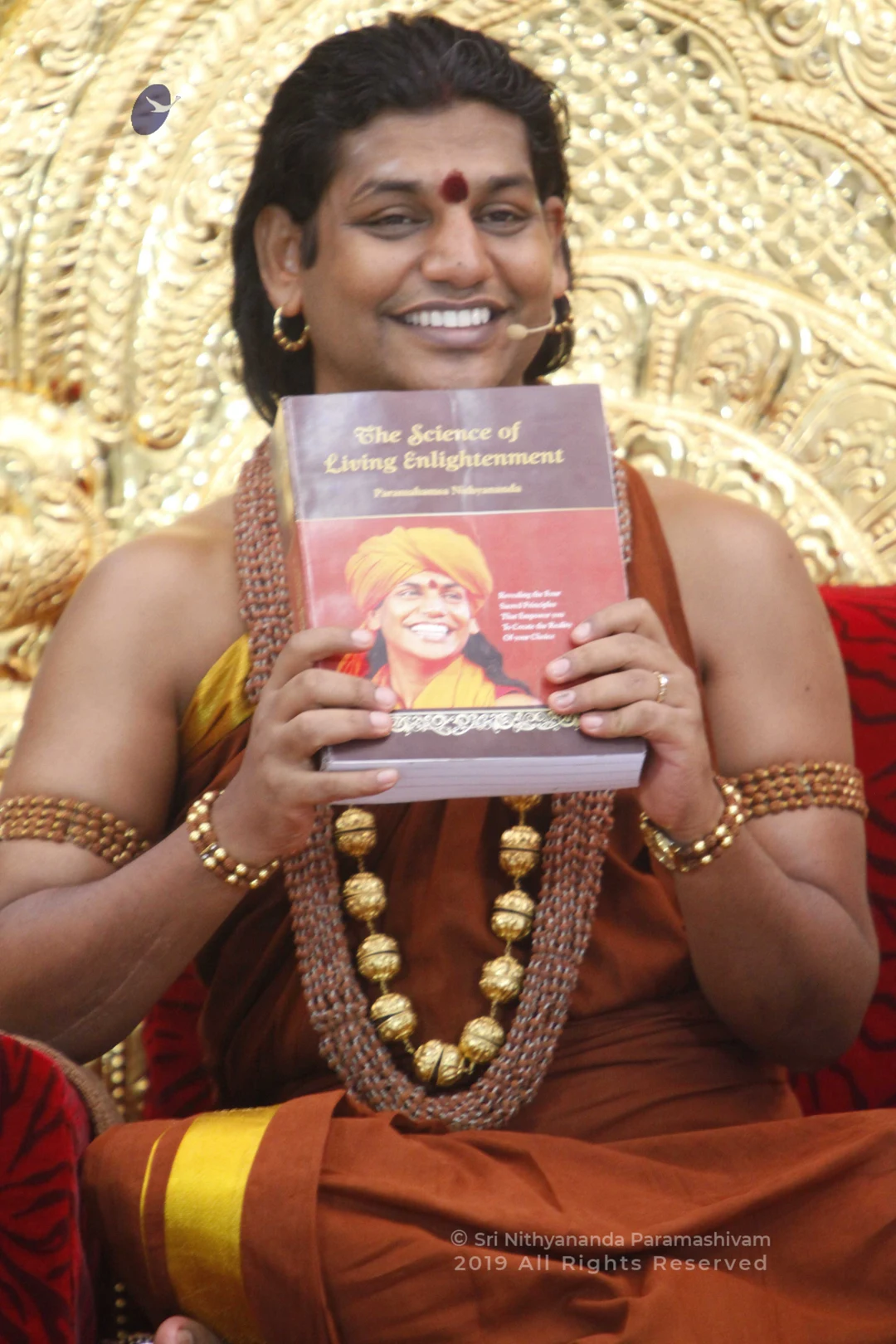
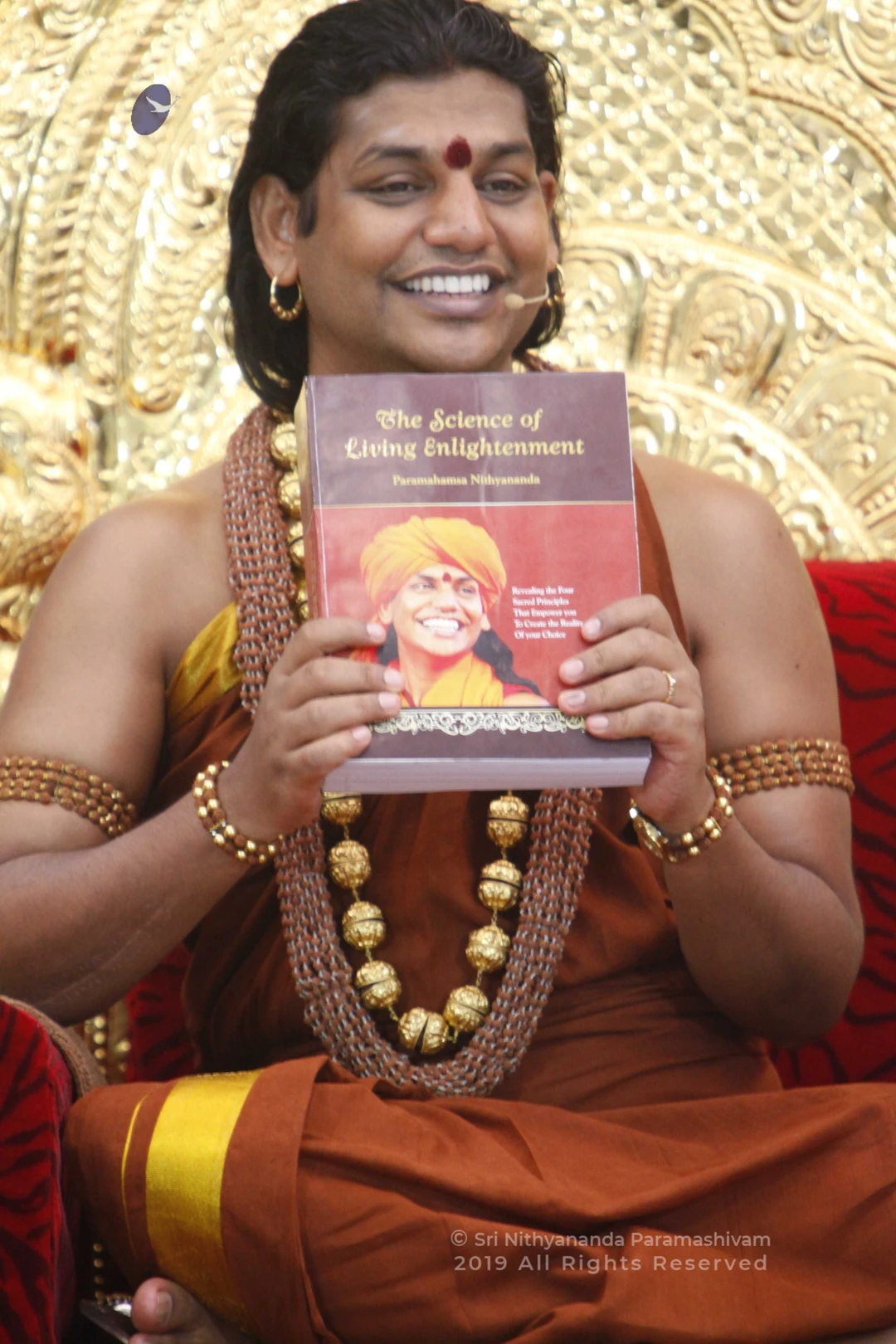
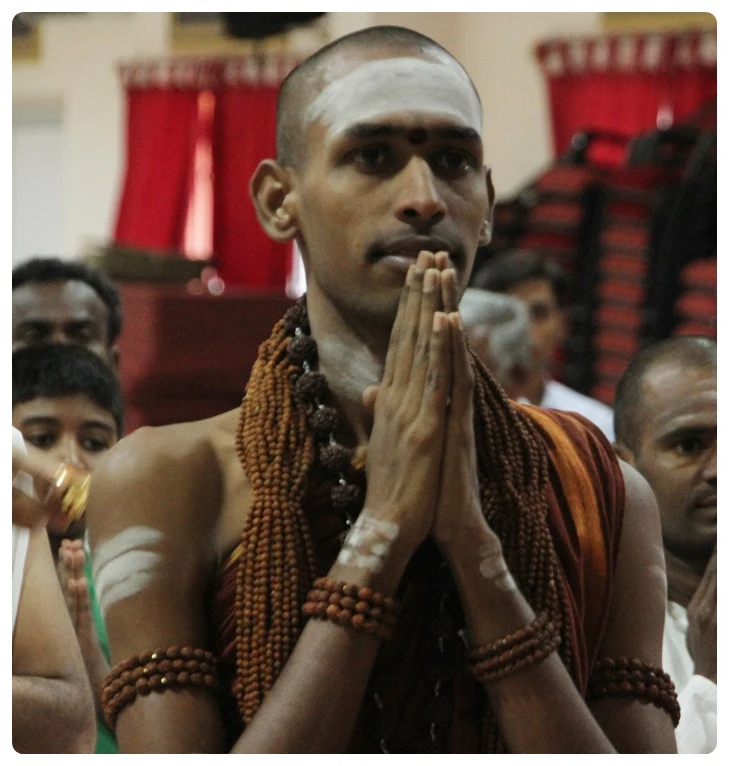
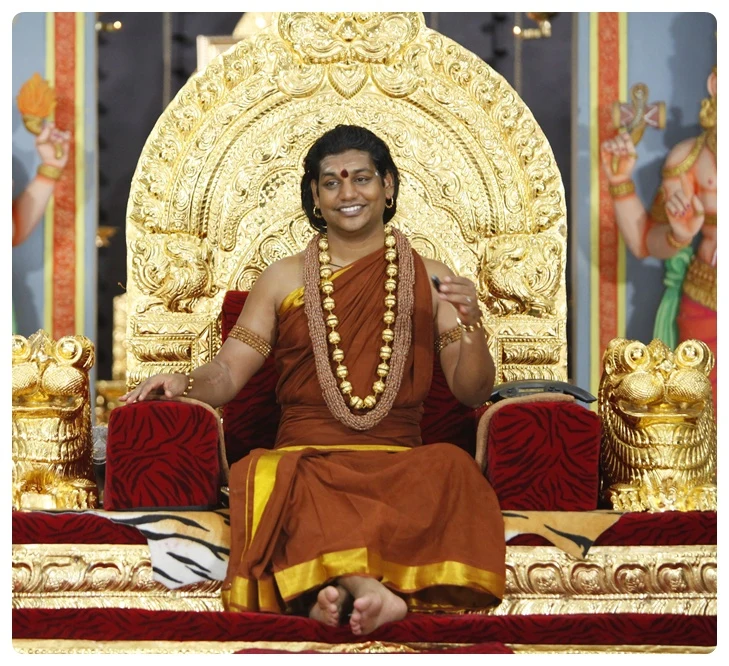
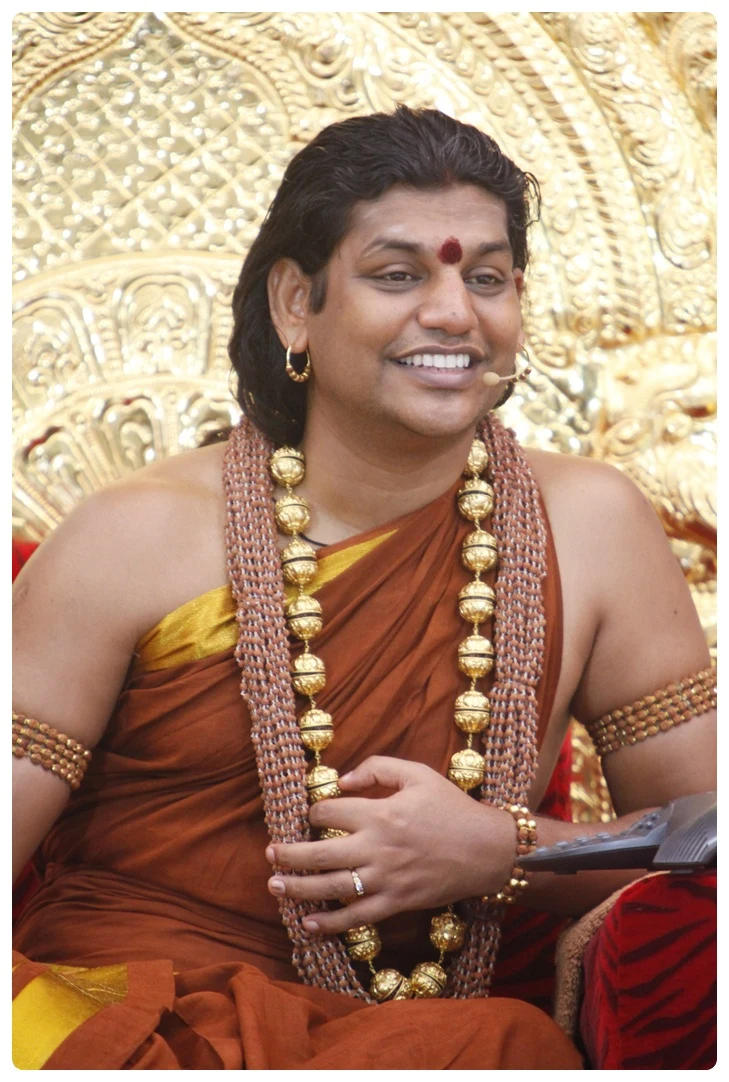
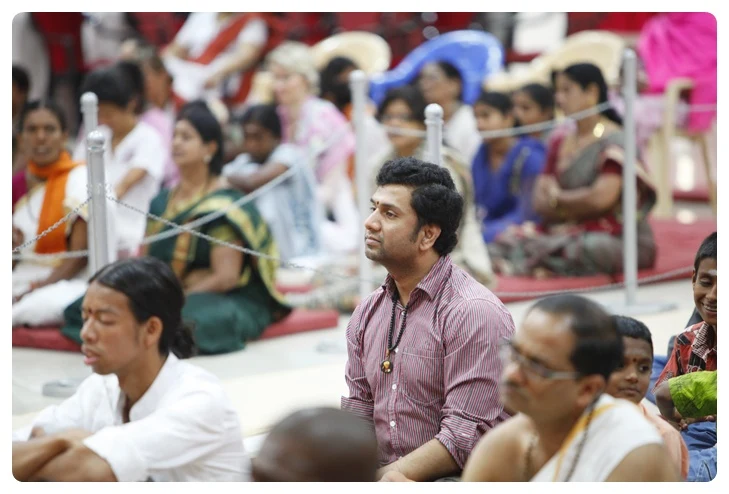
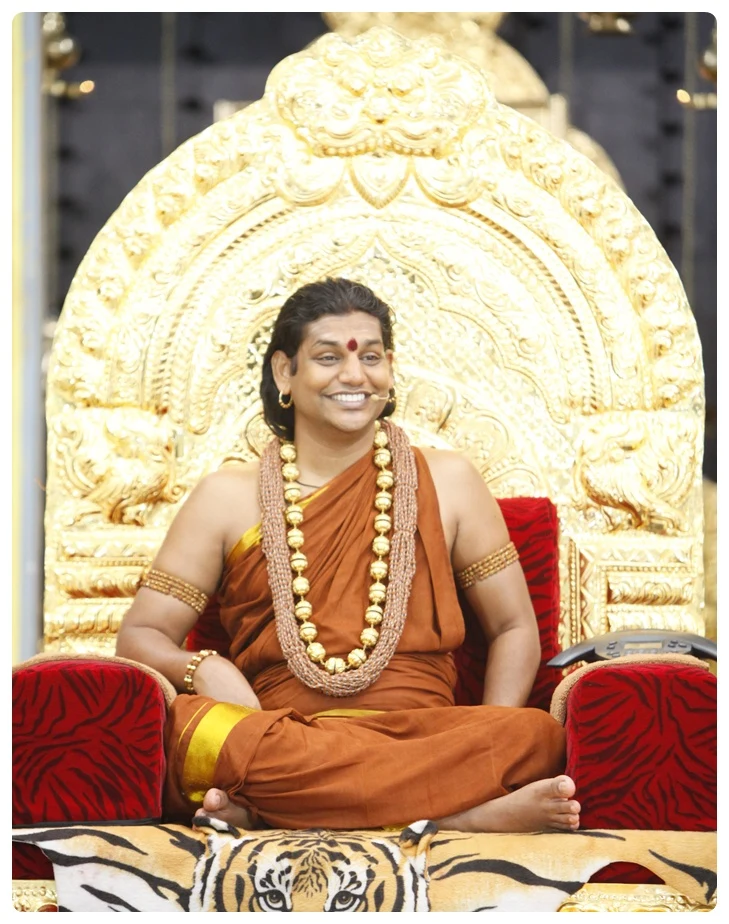
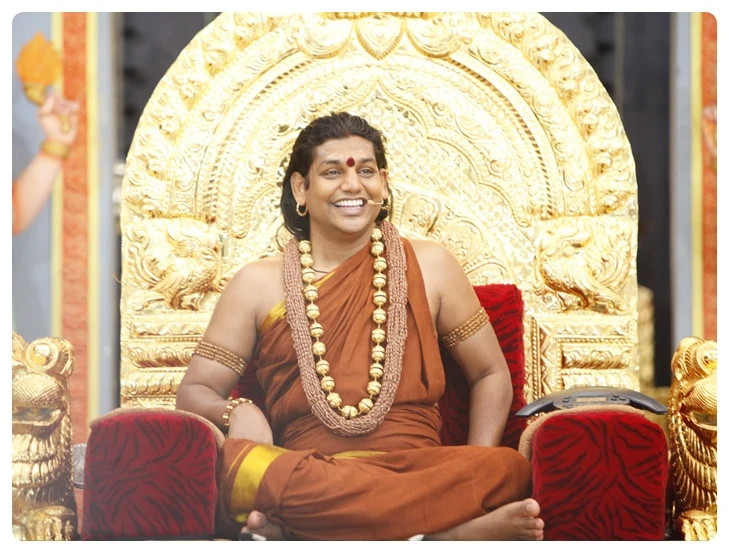
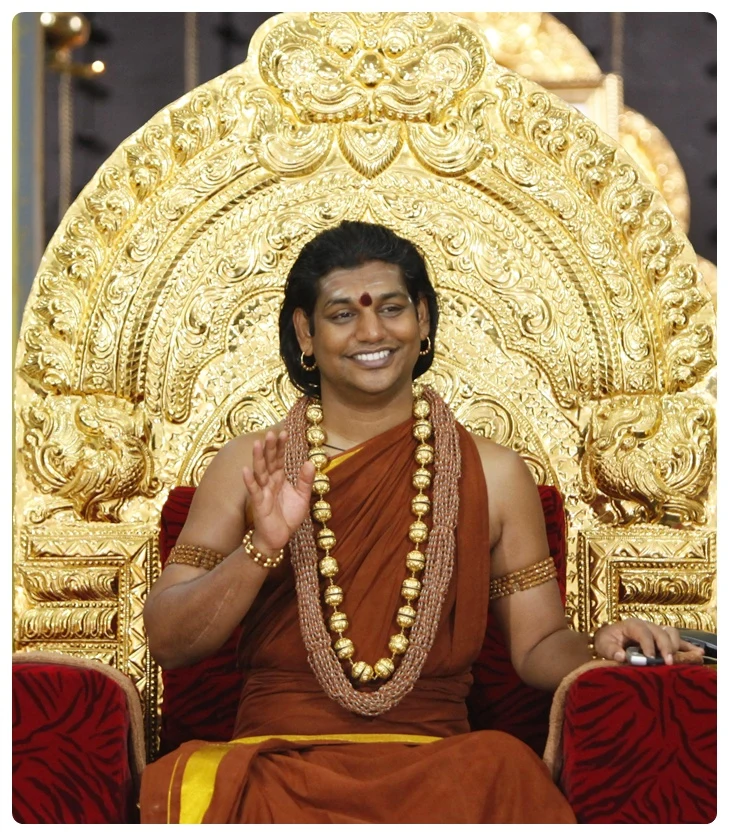
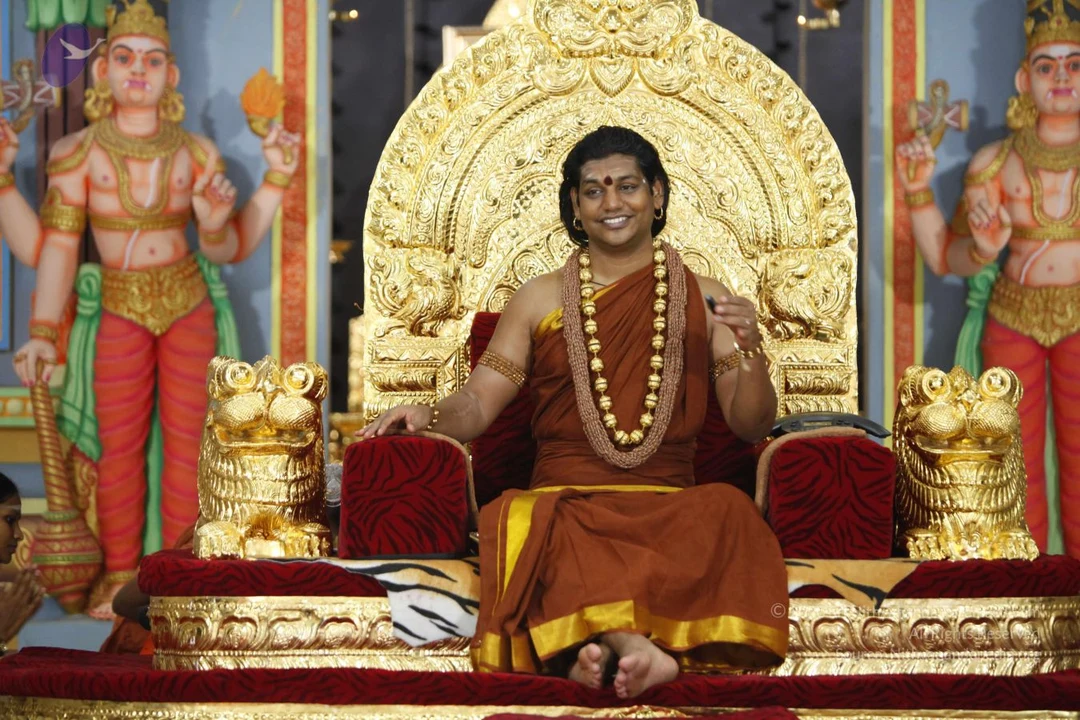
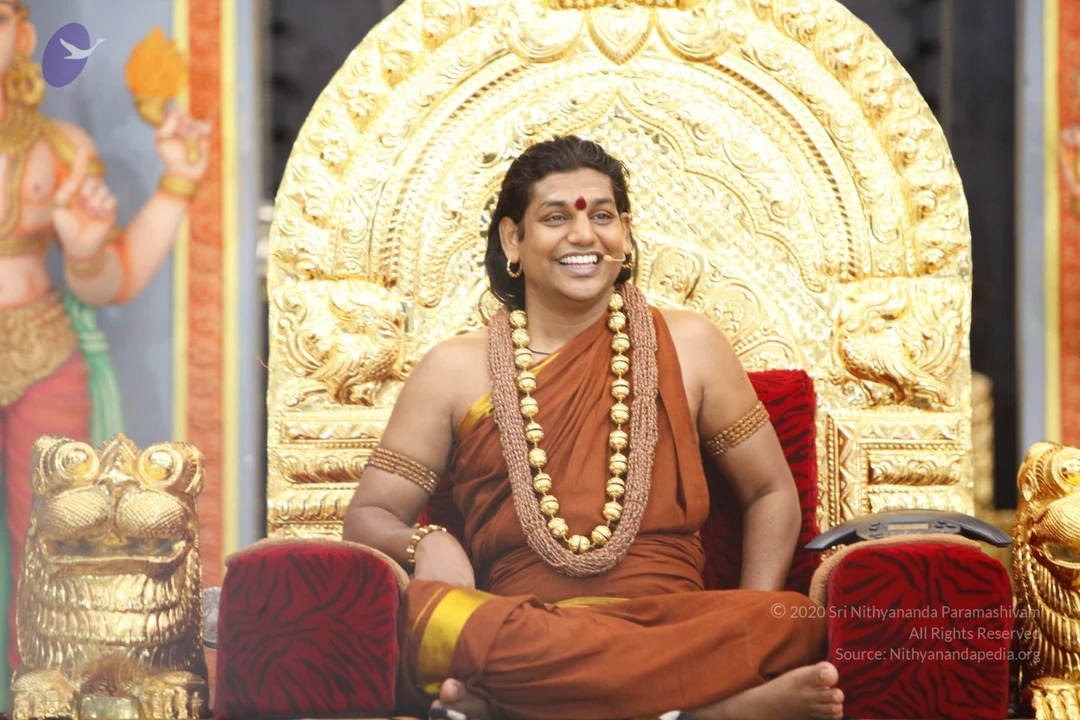
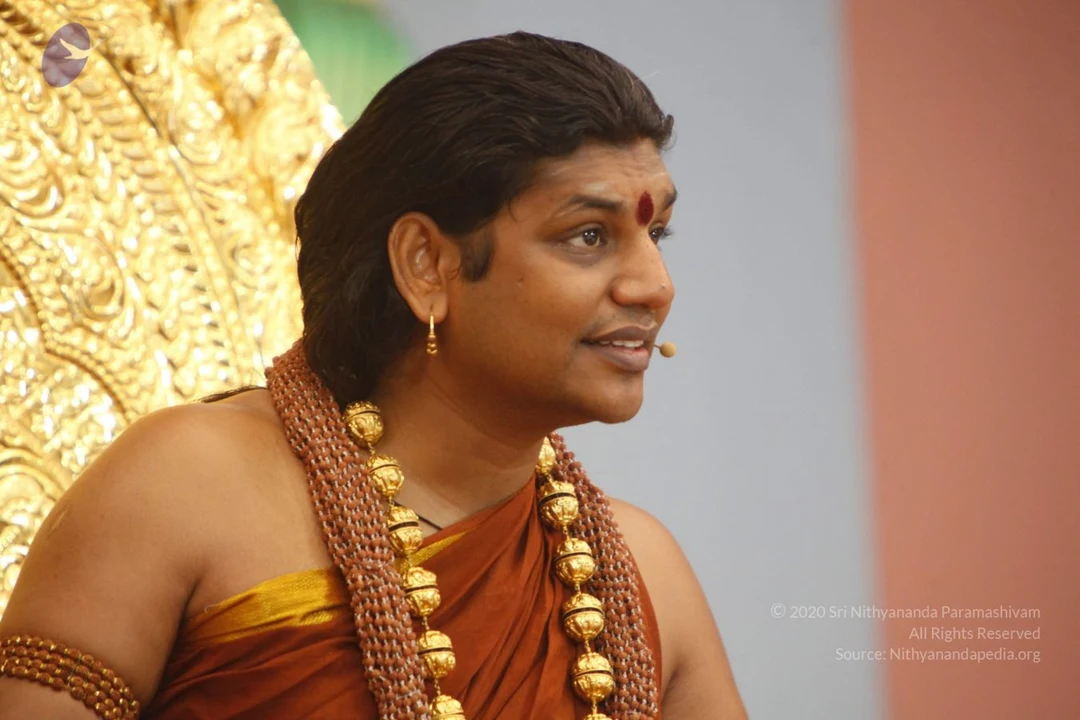
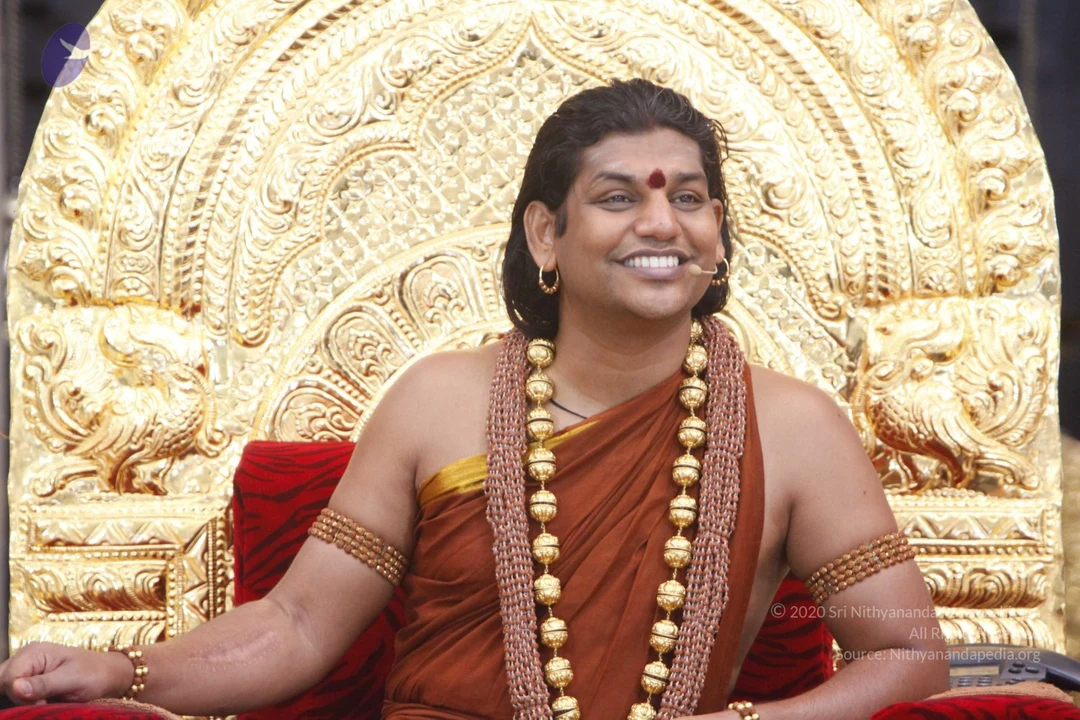
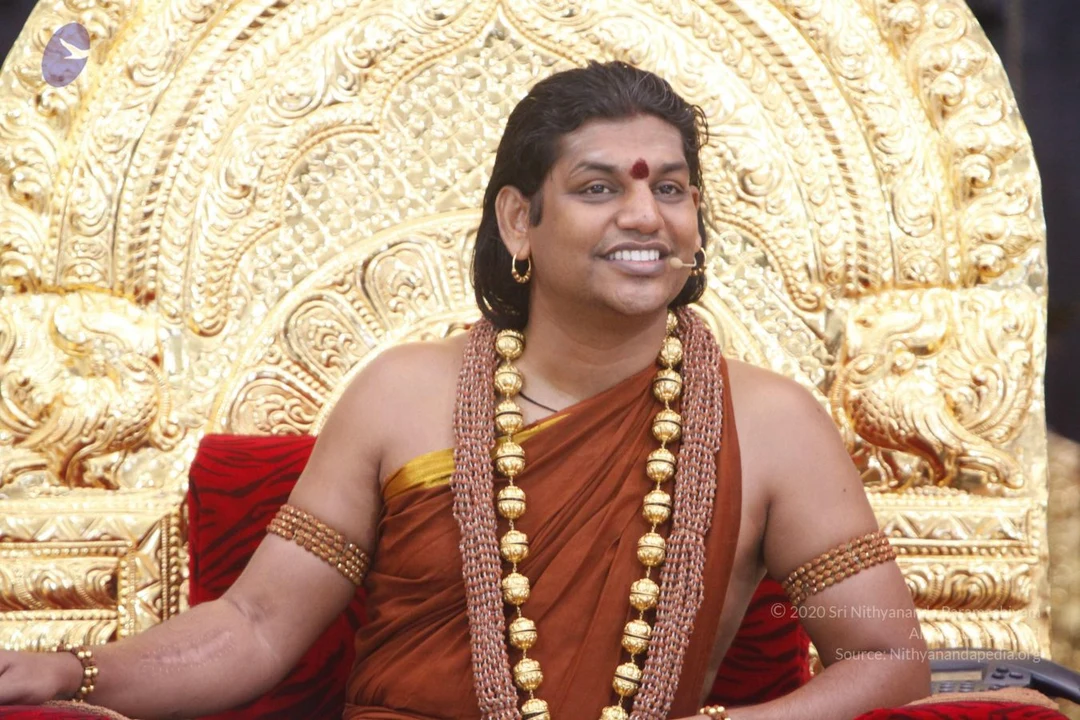
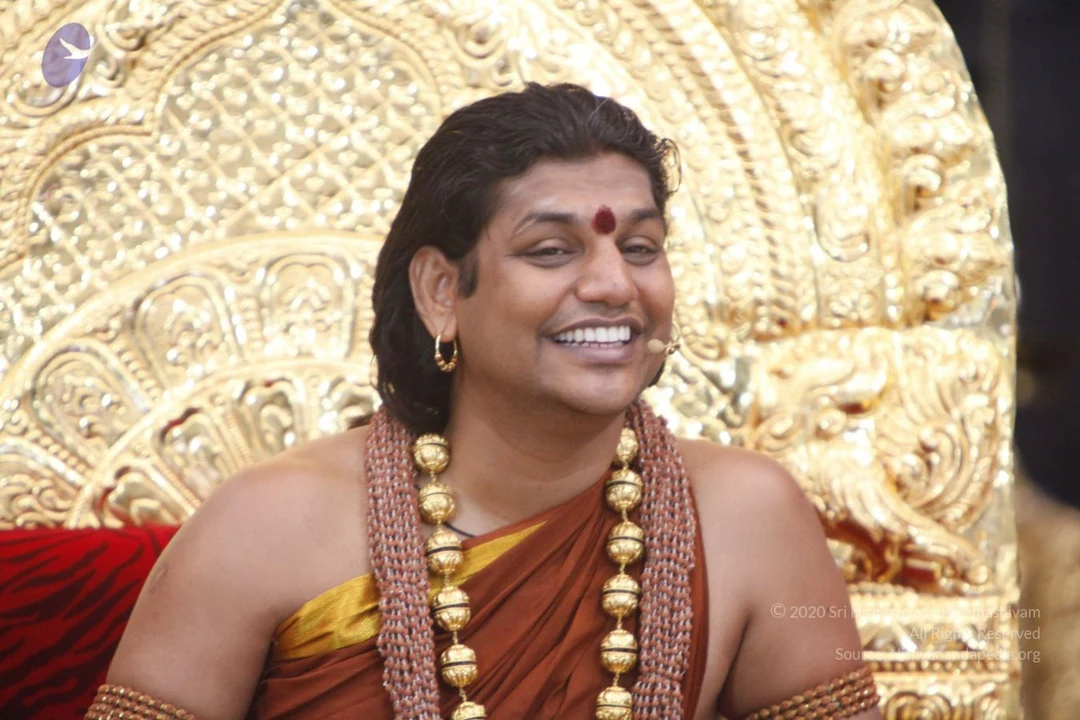
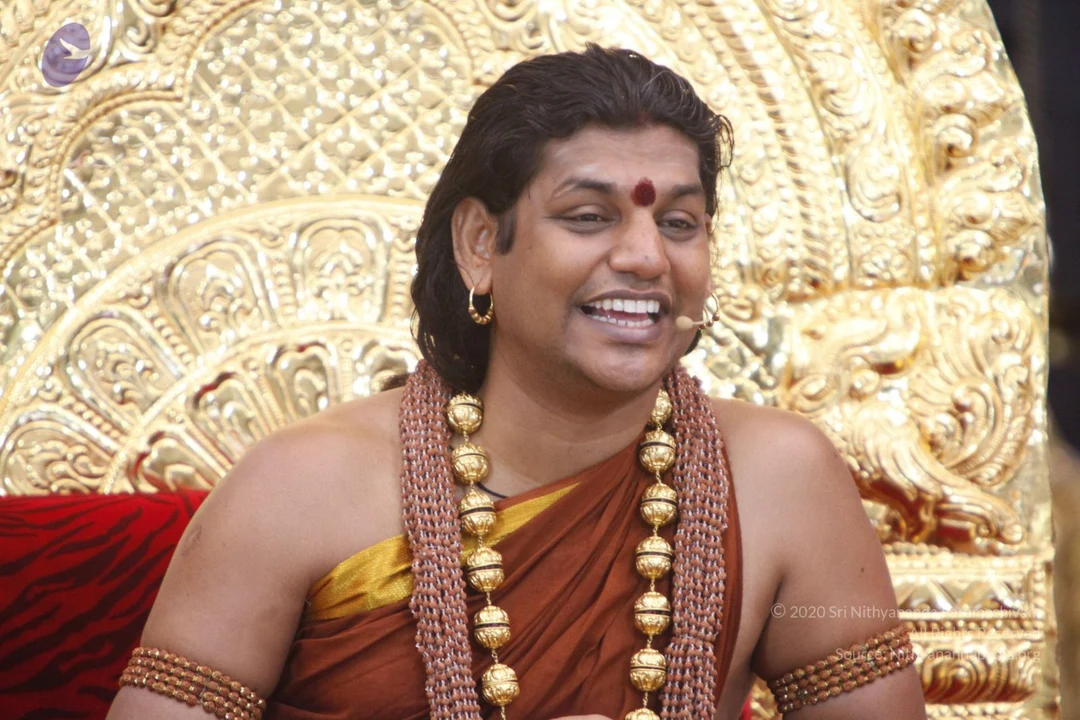
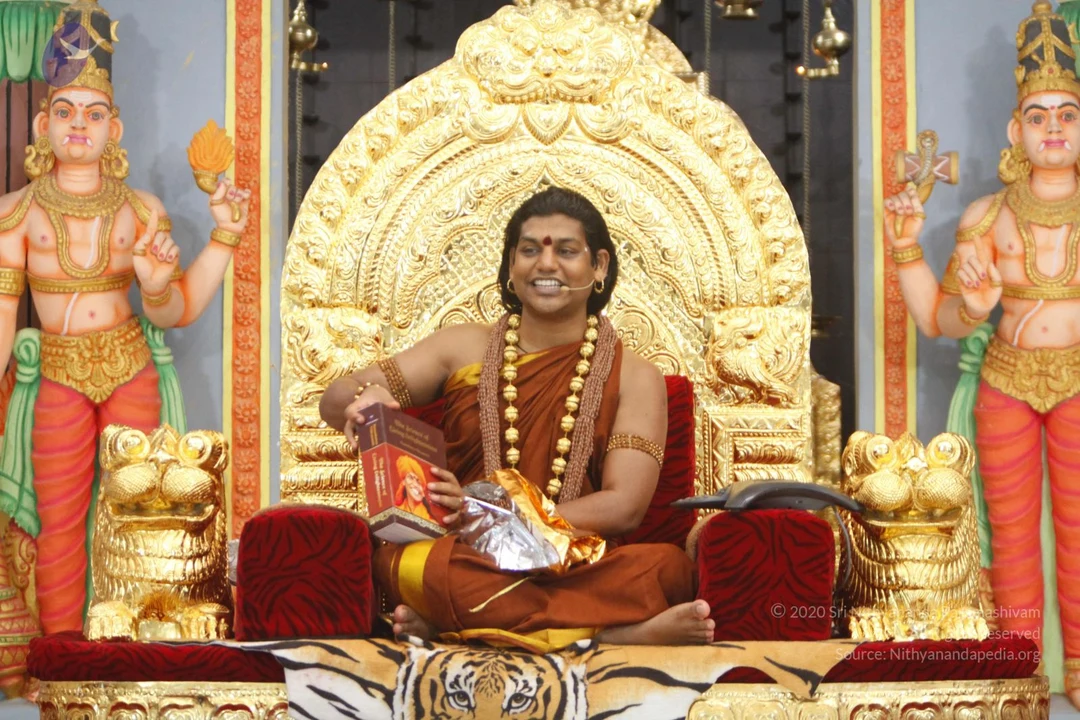
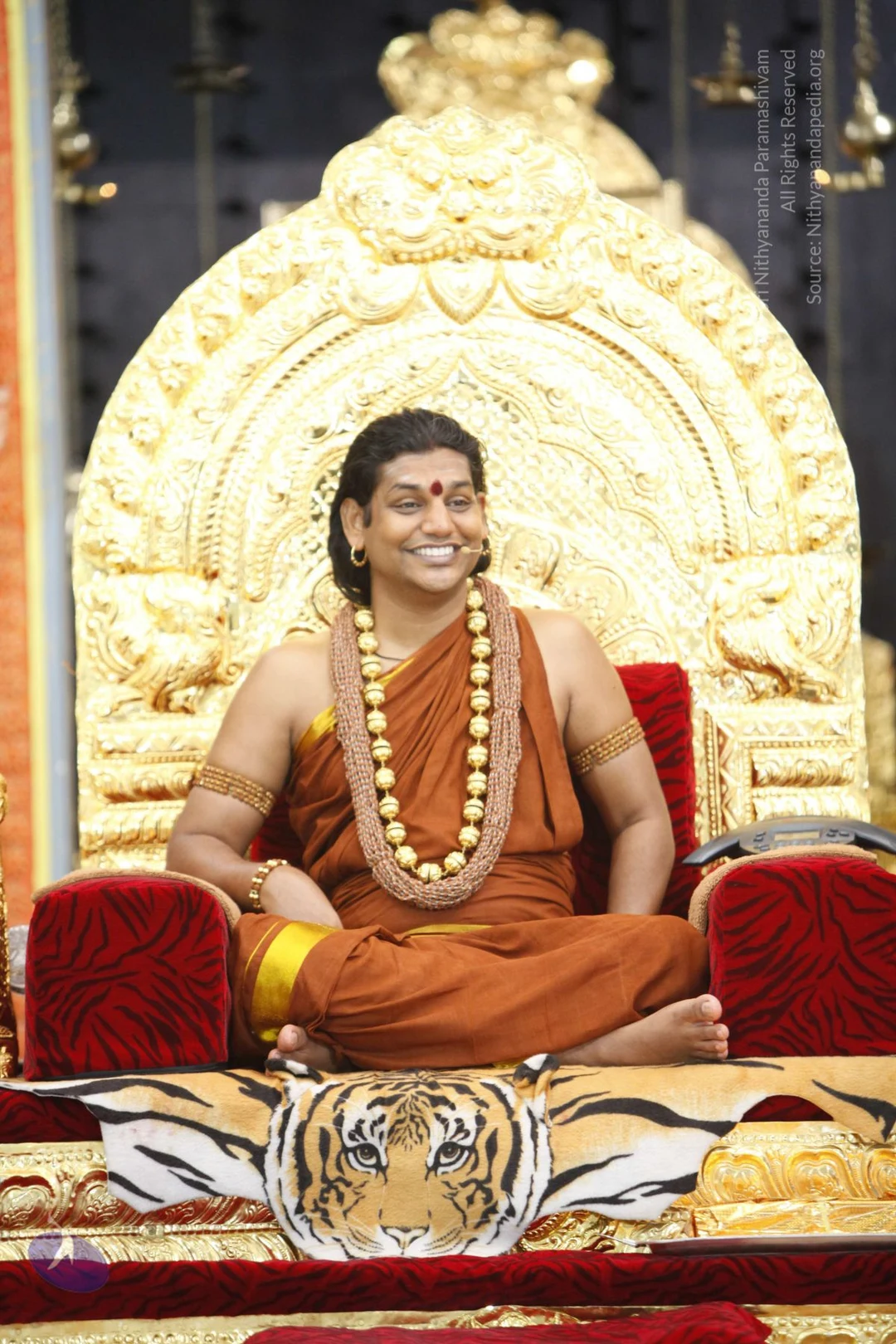
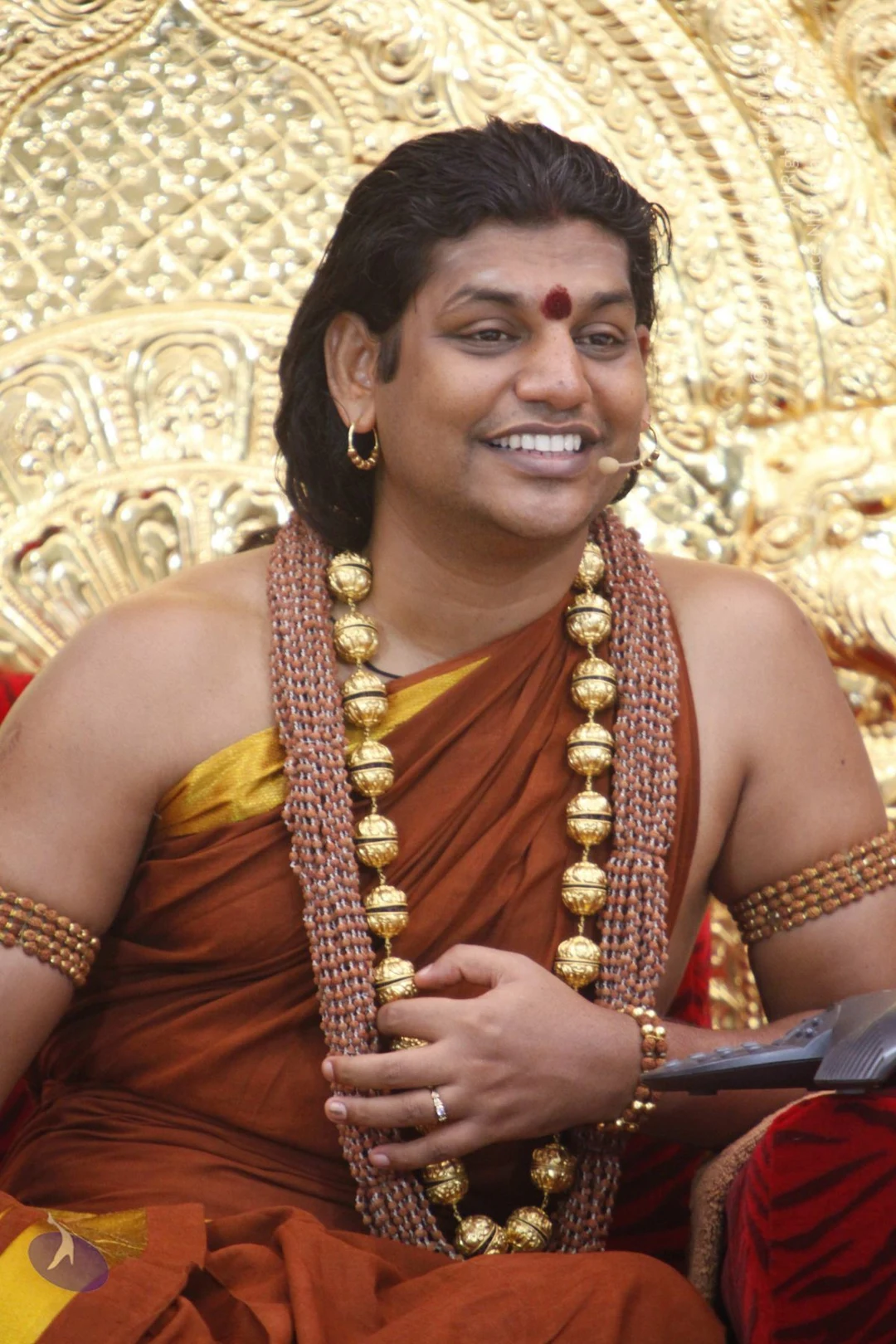
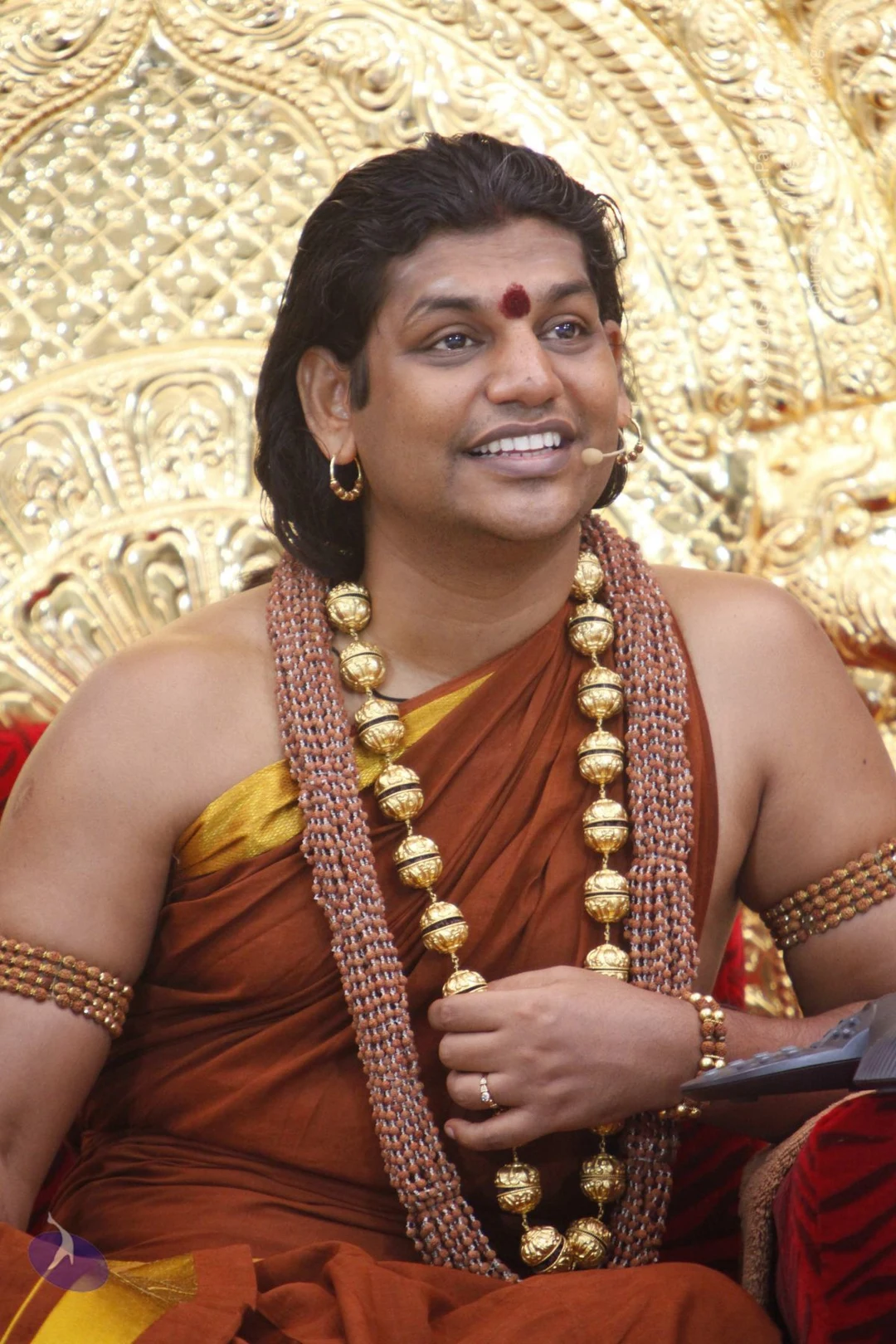
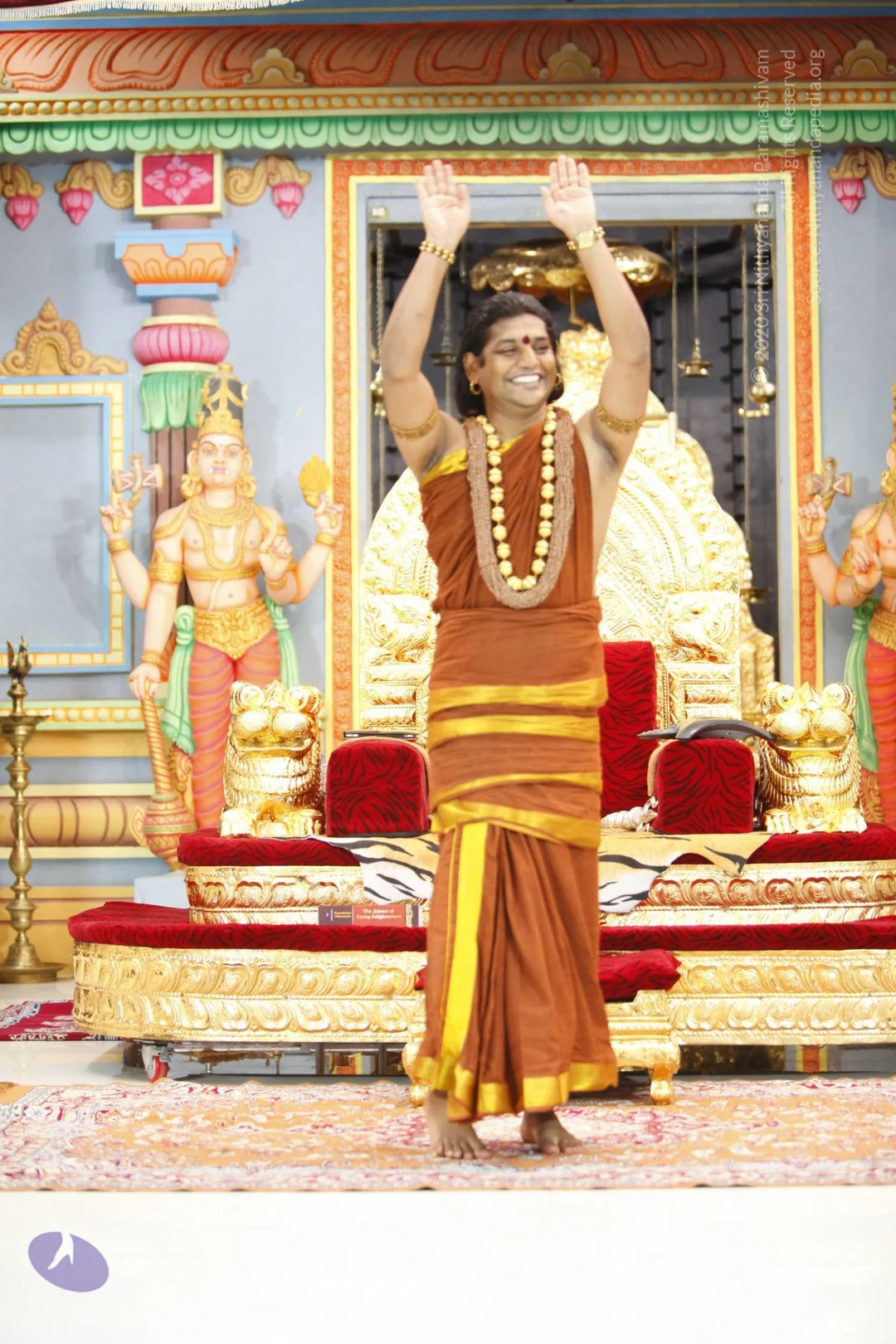
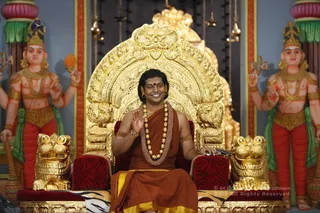
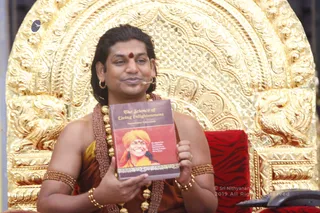
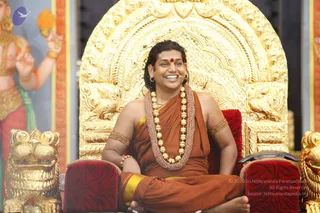
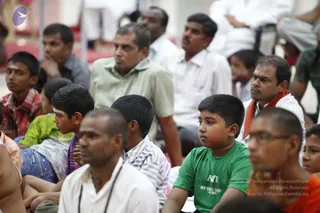
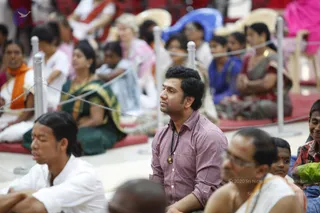
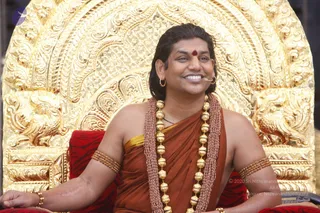
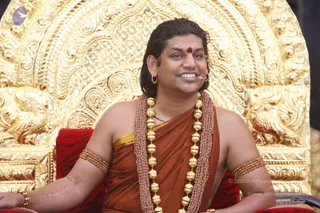
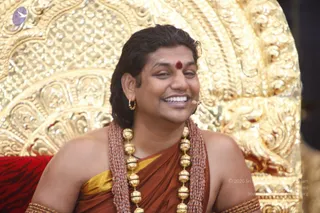
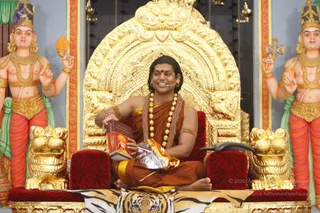
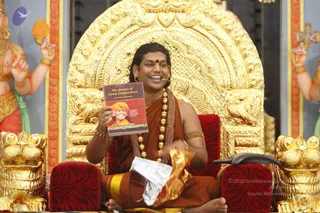
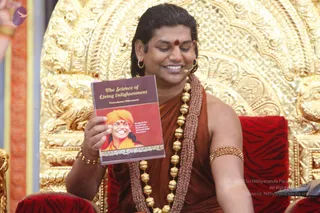
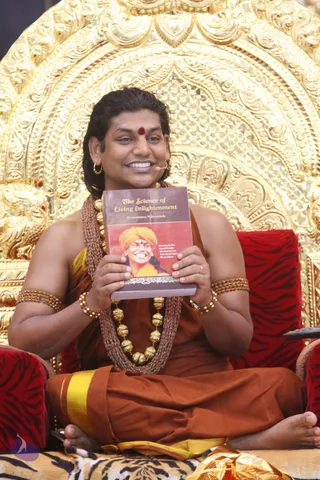
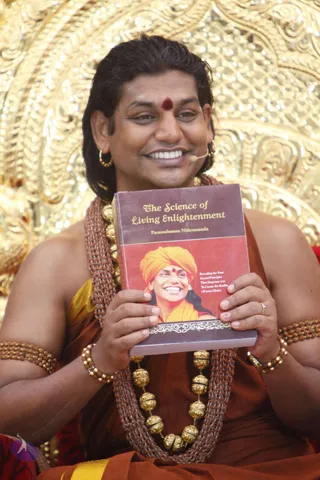
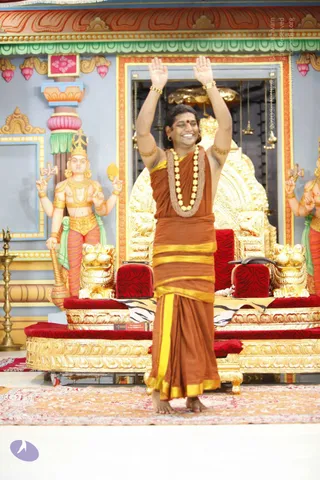
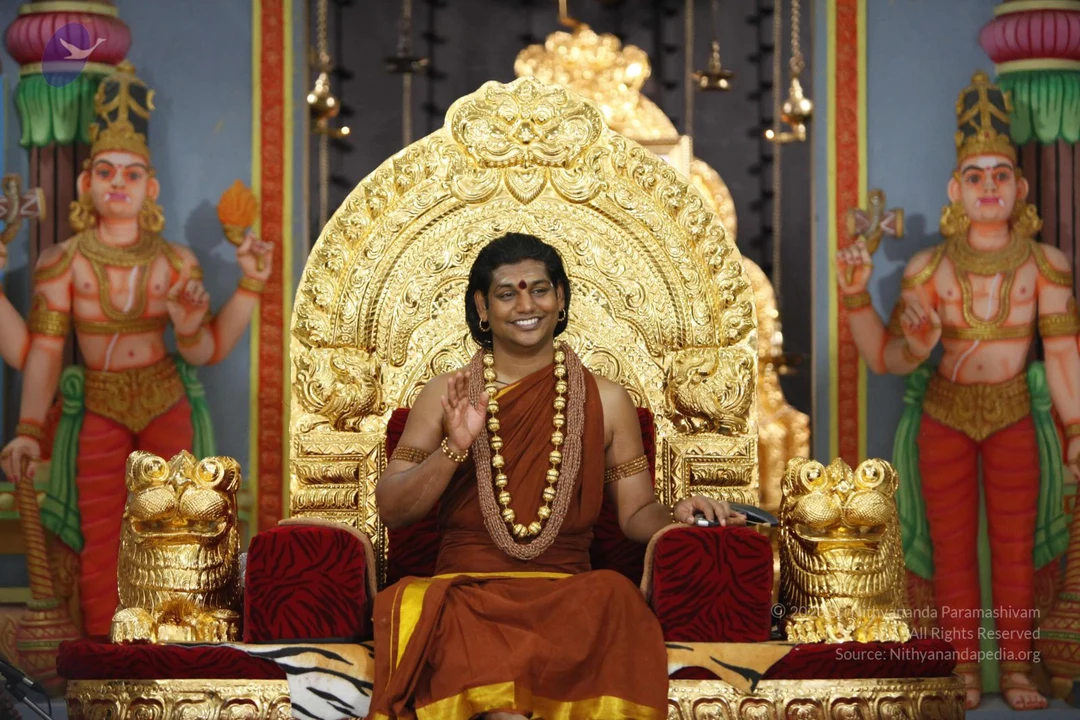
A photograph of a seated man in an ornate golden throne with an elaborately carved arched back and lion motifs. He wears a saffron-orange draped robe with gold borders, a thick gold bead necklace over a rudraksha-style mala, gold armlets and a red bindi, and sits cross-legged on a red velvet seat draped with a tiger-face rug. Golden lamps hang in the background. Another mark on the image reads a copyright line in the lower right corner; it is not reproduced here. The man smiles and looks to the side.A photograph of a man seated at a stage event, turned to his right and speaking into a small headset microphone. He wears a red bindi on his forehead, gold drop earrings, and an orange-rust saffron wrap over his bare shoulder with a gold-coloured blouse edge. Around his neck hang long strands of gold and rudraksha-style beads with ornate gold bead clusters, and a beaded bracelet is on his upper arm. Behind him a gold ornately carved throne or peetha is visible, with a pink wall and grey backdrop. Swamiji (probable): long swept-back hair, saffron wrap, ceremonial gold necklaces and a throne setting, all visible cues consistent with the page's identification.A seated man in an orange-brown robe with gold border sits on an ornate golden throne with a carved arched backrest and gilded lion-shaped armrests over red velvet with tiger-striped cushions. He wears a long gold bead necklace and a rudraksha mala, gold bangles and a red bindi, and smiles while gesturing with his hands during a satsang. Flanking him are large painted deity murtis with multiple arms, red-orange dhotis and gold jewellery, and a figure in the lower left is partially visible with folded hands. The setting is a temple-like hall with blue and red painted pillars.

June 02 2013

Original wiki page
Contents

Description:

In today’s morning satsang, Paramahamsa Nithyananda encourages devotees to complete their root patterns without delay to experience immediate miracles in life. Every problem transforms once the root patterns are resolved; all obstacles to our possibility melt down. We learn to integrate our inner self-image with the way others perceive us, and once integrated find a new way of thinking, feeling and living, expressing ourselves through the Four Principles.

Link to Video:

VideoAudio

Transcript:

0:18

Nithyanandeshwara Samaarambhaam Nithyanandeshwari Madhyamaam | Asmath Aachaarya Paryanthaam Vandhey Guru Paramparaam ||

I welcome you all who are sitting with us. Today’s subject for Nithya Satsang: EXCITEMENT IN EXECUTING THE PRINCIPLES.

Listen! Even to practice the four tattwas, you have to practice four tattwas. Even to practice four tattwas, you have to practice four tattwas! Understand this word.

Even to practice Authenticity, you have to become authentic. To practice Integrity, you have to become integrated. To practice Responsibility, you have to become responsible. To practice Enriching, you have to enrich.

(HINDI)

Authenticity has to be practiced authentically. Bring constantly Authenticity in your actions authentically. Means, the deeper and deeper layers of your being should imbibe these four principles. That is when the success or creating the reality you want is possible. I tell you, all your goals are nothing but creating the reality you want. It can be wealth, it can be health, it can be good relationships, it can even be enlightenment. Anything it can be. It is nothing but creating the reality you want. It is possible when your deeper and deeper layers of being starts practicing four tattvas.

When you are living Authenticity itself, inauthenticity will interfere in it. ‘I will be Authentic as much as I can.’ No. As much as others think you can, you should be. Not as much as you can. ‘As much as I can’ is the greatest cheating word. It is like I will give you Rs.1 crore, I will just take away 99,99,999 rupees away from you. Then what is the use of your 1 crore? This is exactly we go on doing ‘I will practice Authenticity, I commit with you, Swamiji, as much as I can.’ No. No.

(HINDI)

5:20

Listen. (Hindi). Every moment you are creating your life whether you want it or not, whether you like it or not, whether you are getting it or not. Nothing, nothing can be done by the word ‘as much as I can’. This word is like a thief having the key of the treasury. If the thief gets the key of the treasury, he becomes politician! Idea, concept ‘as much as I can’ is the most cunning, inauthentic.

I tell you, whenever I speak on these four principles, I am so excited. I do even feel sometime I become fanatic of these four principles. Even if I am called as fanatic of these four principles, I am okay with it. I am happy about it; because when you start living the layer by layer, layer by layer, when Integrity, Authenticity penetrates you, the life you experience, the joy you experience, the strength you command, the strength your presence radiates is unimaginable.

(HINDI)

Go on stretching your body and mind, actions and life with four principles. That is Daana, Tapa, practice, meditation, process, Kriya, enlightenment, everything. Anything auspicious in this life is just this four principles.

(HINDI)

Living Integrity in your thinking is Ajapa Japa. Living Authenticity in your actions is the greatest Kriyas, greatest kriya. Living Responsibility in your being is ultimate Samadhi. Enriching in your life is greatest Daana.

Daana, Tapa, Kriya, everything is just these great principles. These four principles is everything. So understand bring integrity, authenticity, responsibility and enriching in your every moment breathing, thinking, feeling and living. Let your cognition be aligned with four principles of integrity, authenticity, responsibility and enriching.

11:34

I tell you, sometime it feels like people are there out suffering in famine and drought and here you have dam full of good water, Ganga, pure Ganga and billions of tons of food. Even when you take it to their place and cater it people are not ready to use it. What to do? You can postpone anything in your life, not raising you to the spiritual strength, not aligning you to these four principles. First, this is a most important thing you need to do in your life on war footing basis, emergency basis – discovering your root pattern and completing with it.

What you feel about you - the actual root pattern, what you feel about the world and others, what others feel about you and how you project yourself to others; listen, how you exactly feel about you, the actual root pattern and how you feel about others and the world and how you project you to others, how others expect you.

(HINDI)

15:26

I am not talking some remote other worldly ideas. Please understand, I am completely grounded, down to earth. I am talking what you need in your life if you are a CEO, if you are a politician, if you are a decision maker, if you are a head of a team that is bound by goals and deadlines, if you are a head of a family. I am talking to you if you are active in the life, not retired.

(HINDI)

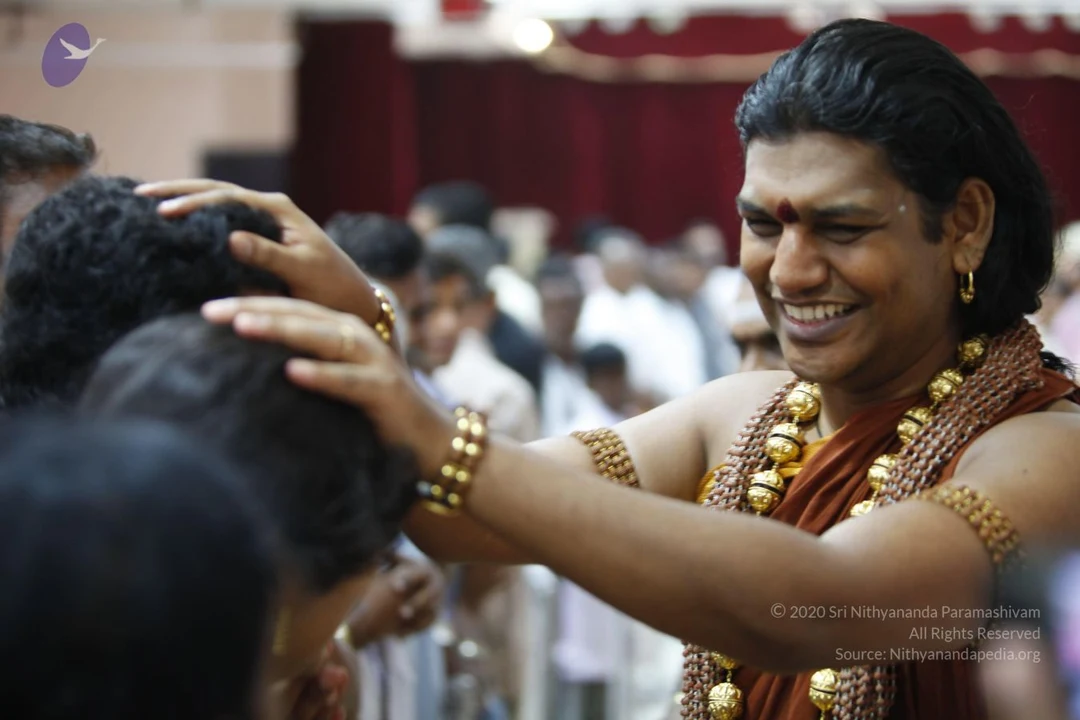
Whatever you want as reality in your life – power, money, love, blissful relationships, fulfillment, completion, whatever it may be, you can just build it with four principles. And, I also wanted you to know, many time you think, ‘If I start practicing these four principles now authentically, then slowly, slowly, slowly, after ten years, I may achieve the reality I want.’ No. Start practicing. You will see the miracles being showered from all corners on you. You will know the miracles happening from all the corners on you.

Do completion with others; all the incompletions you have, complete with others. Your health will become alright miraculously.

Do completion with yourself; suddenly you will start attracting wealth.

(HINDI)

Life is so alive! Even one decision you take for life, life takes one thousand decisions for you! In our traditional literature, it says, ‘When you take one step towards God, God takes thousand steps towards you’ is not a lie! It is a truth! When you take one step towards life, life takes thousand steps towards you.

20:32

If you remove 2 cubic feet mud from the path of the water from the canal, you are not going to be getting water to 2 feet land or 20 feet land. No. The water is now going to go to 200 acres, may be even 2,000 acres! Same way, when you practice these four tattvas – Integrity, Authenticity, Responsibility and Enriching – even if you make one decision based on Integrity, Authenticity, Responsibility and Enriching, suddenly you will see life will be making one-thousand decisions towards you, for you, fulfilling you, completing you.

When you complete with your mother, suddenly life wants to complete with you. When you complete with your brother, suddenly Cosmos wants to complete with you.

(HINDI)

Sometime I wonder, why even being in the drought, famine, people don’t want to have the great Ganga and billions of tons of food lying waste; because they do not trust this Ganga and food can solve their problem. They think, ‘No, the whole country is suffering with famine and drought, how can I be helped by this just little water and food?’ You don’t understand, that is exactly the problem. Food and water, it is there; take it. Ignorance, ignorance of human-beings, again and again and again, destroys the possibility of experience.

(HINDI)

Understand, the root-pattern of how you feel about you, when you discover and complete, the whole humanity around you behaves with you completely differently. The root-pattern of how you look at the world and others, see it and complete with it; you will see, you will see, the world around you behaves with you totally different.

24:58

Pain is inability, non-decisiveness to live the four principles. Non-decisiveness and inability to live the four principles is Pain. Catch it, Catch it. When you find out why the way you project yourself to the world, the way you project yourself to the world, and complete with it, tons and tons of your expectations about the world just collapses, melts down. The mountains melt down. The obstacles of experiencing you, obstacles of experiencing your possibility, melts down.

(HINDI)

Human mind is such a powerful mechanism, even if you feel lazy to practice these four principles, if you feel resisting towards these four principles, do this simple thing: Go on talking about these four principles to others. Whoever you get it, catch them and start talking. I tell you it is the most easiest way. Catch your maid and start talking. She can’t say no, anyhow. You are paying her! Catch your subordinates. Catch your students. Catch the people who can’t say no to you. Start talking to them about these four principles. I tell you, these four principles are such, when you talk, talk, talk, talk, talk, talk about them, your heart will grab it. It will grasp it.

After I made these four principles as my meditation program syllabus, now everyone want to become Acharya , because these four principles are like phosphorus; anyway you come in contact, you will be burnt. Whether you practice or preach or think or contemplate, you will be burnt. You will be purified.

Again and again, I wanted all our Spiritual Embassies to have a gathering, meeting, to discover your root-pattern. Even the television viewers, Sadhna TV and Lotus TV viewers, you can call the number (+91 80 2727 9999) appearing in the screen. My sannyasis and sannyasinis will help you, support you to find your root-pattern with which you are suffering.

Understand, whether it is a coffee addiction or tea addiction or cigarette addiction or alcohol addiction or anger addiction or agitation addiction or irritation addiction or poverty addiction or laziness addiction or powerlessness addiction, for any addiction, it is your root-pattern which is responsible; which is your root-thought-pattern - that is responsible.

29:42

All the Spiritual Embassies, till Guru Purnima, means, July, this is the, my word for all of you, Guru Vaak for all of you - you have to find your root pattern and complete. If you are interested in finding your root thought pattern which is a cause for all your sufferings and powerlessness and you don’t know how to, call the number in the screen; my sannyasis and sannyasinis will help you to find your root thought pattern and help you to come out of the long suffering.

Sharada Devi beautifully describes her life. She says, ‘If I have to tell my whole life in one line, it is a long prayer!’ I tell you, she is right. Her whole life was such beautiful, long prayer. Not the begging prayer - overflowing gratitude prayer. She was a kid till she left the body. She was a joyful kid till she left the body.

(HINDI)

I request all the television viewers and devotees who are watching this program: to find your root-thought-pattern, the root cause for your suffering and complete it - should be your first priority.

(HINDI)

They will help you to find your root pattern and complete with it. Finding your root pattern and completing with it is the real Yoga. Not just stretching your body little this side and that side and blowing your nose and churning your stomach; that is these babus and babas Yogas! The real Yoga is finding your root pattern and completing it, completing it; that is the real Yoga.

(HINDI)

35:11

Find your root thought pattern, the root-pattern of suffering, root cause of suffering; what idea you created about you first in your life and what idea you created about the world and others and how you started projecting yourself – all these three are the root cause of your suffering. Find all these three root patterns, complete with it; you will be liberated. You will experience liberation. Till then, anything you do, life will only be failure. When you do this completion, anything you do, life will be success. Anything you do, life will be a success.

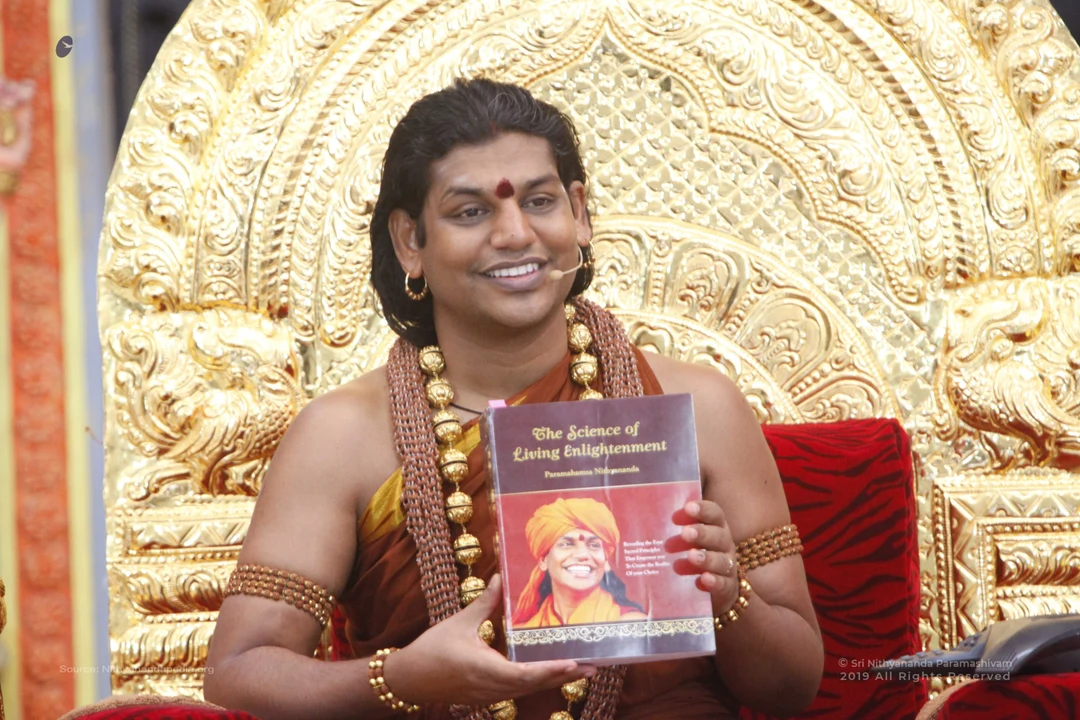
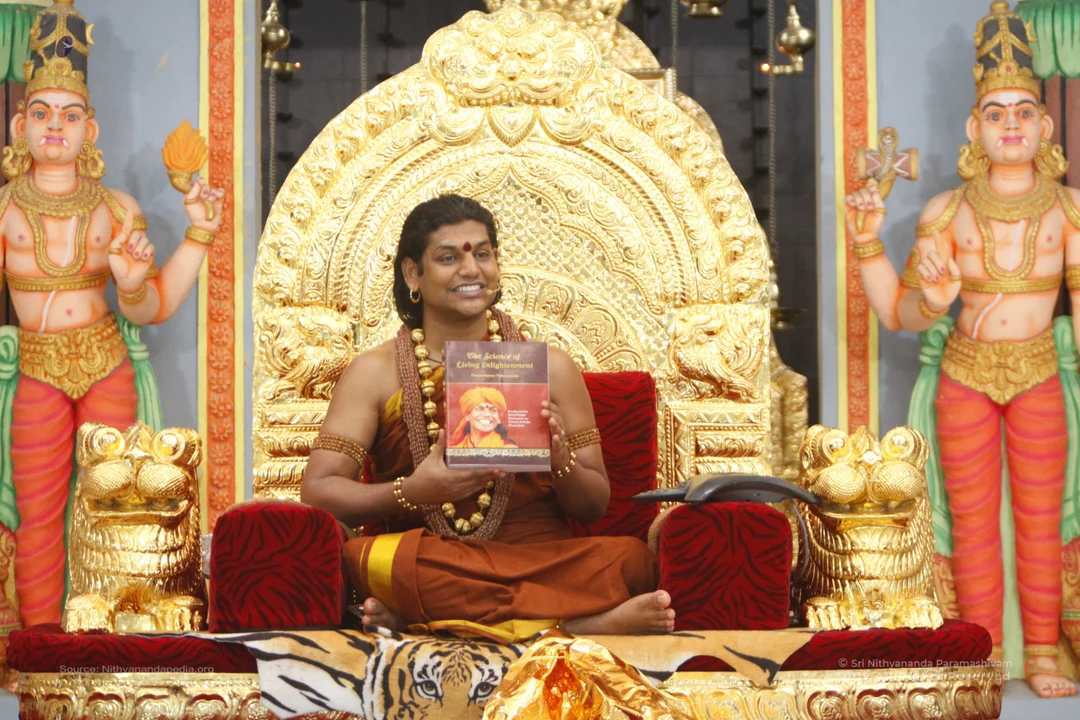
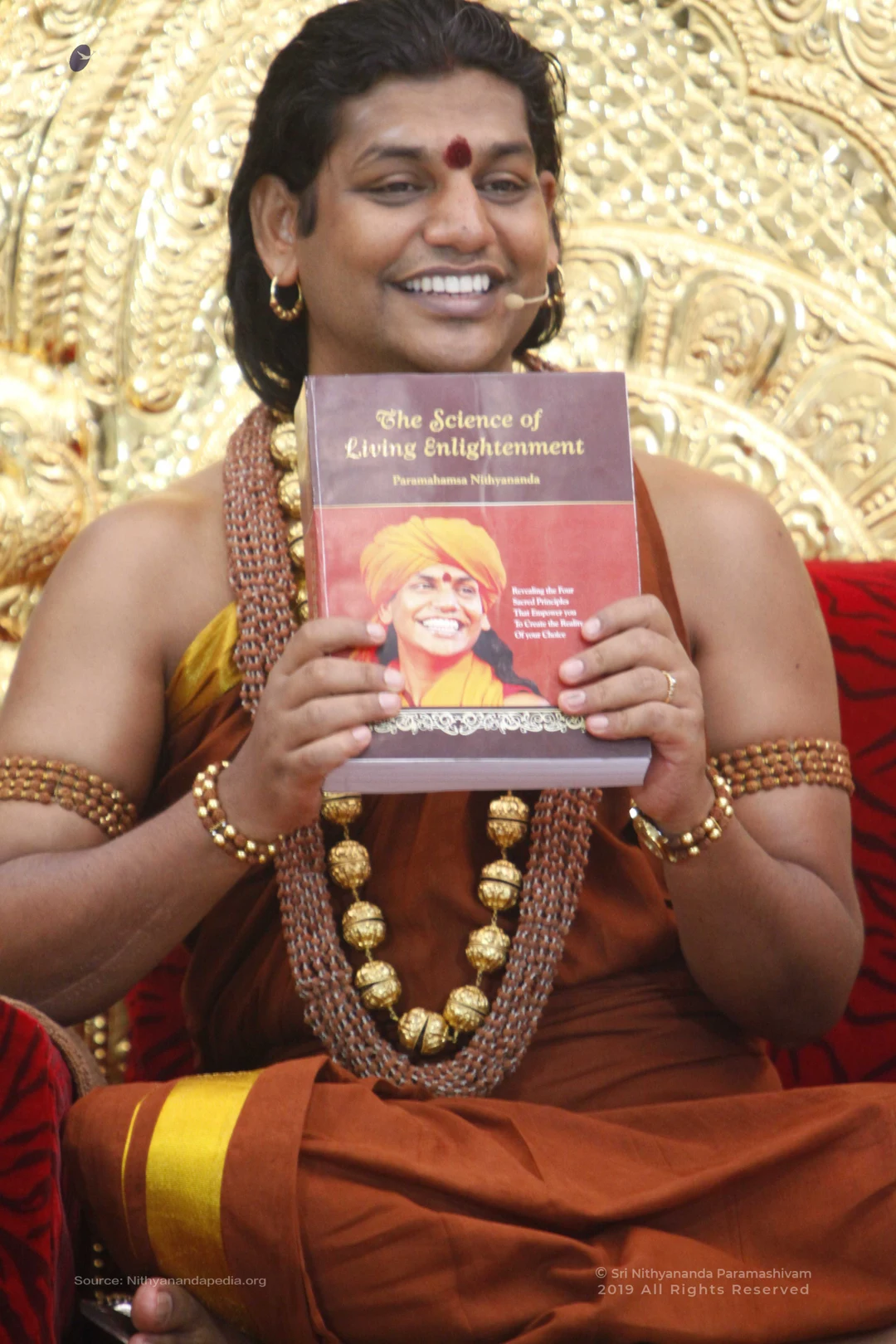
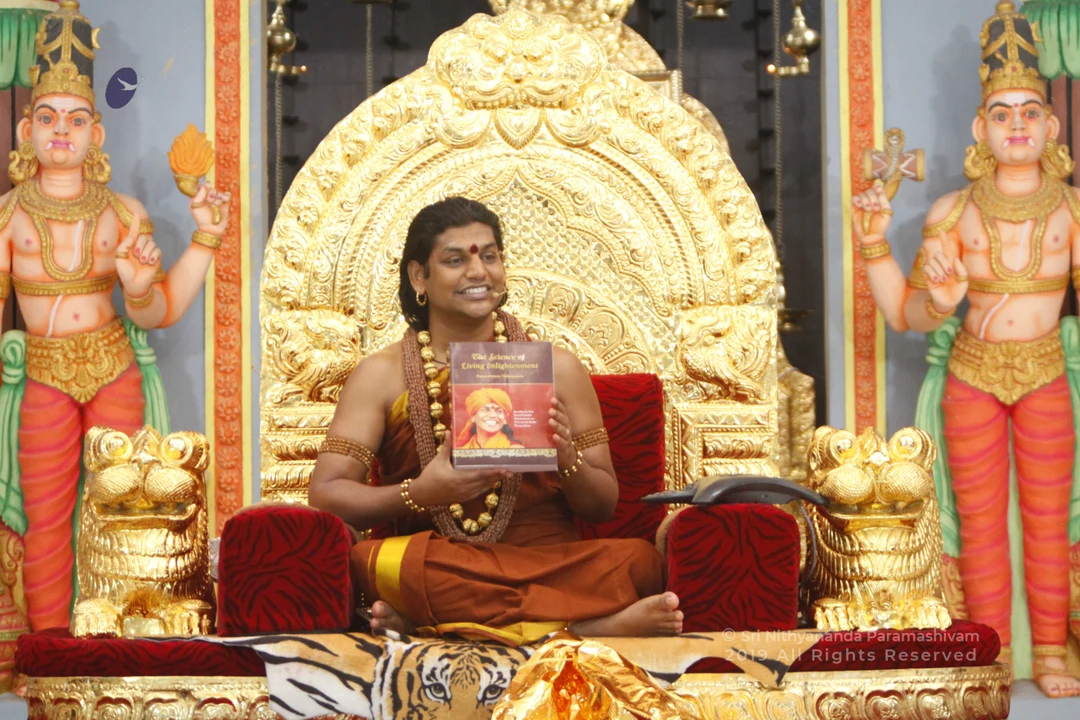
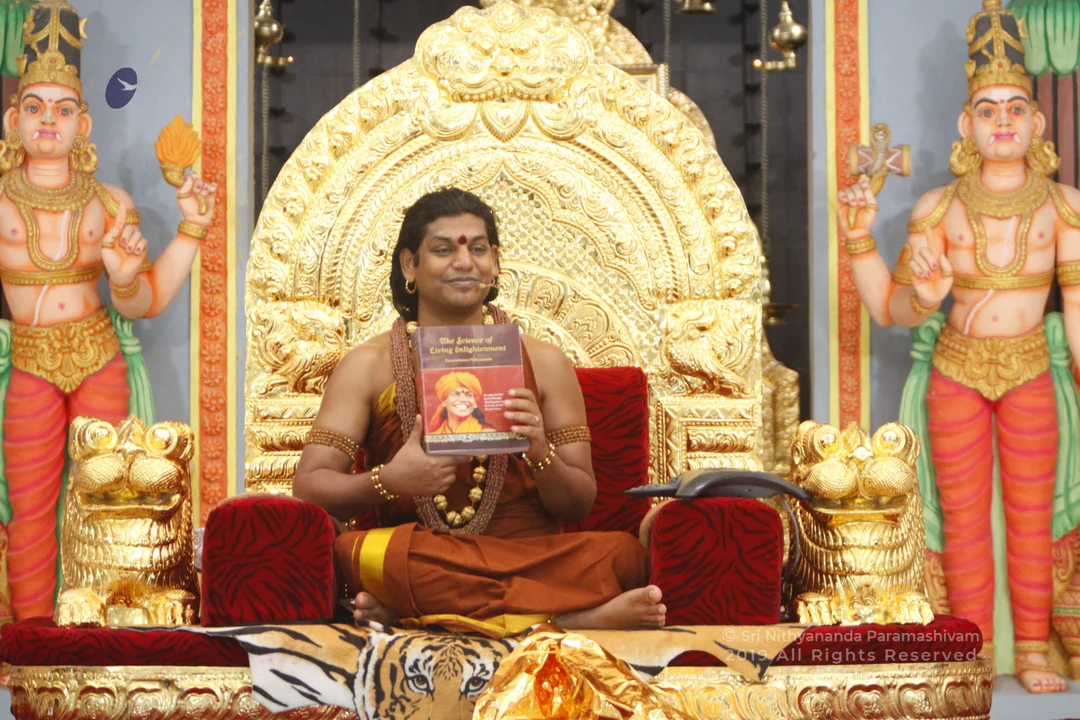
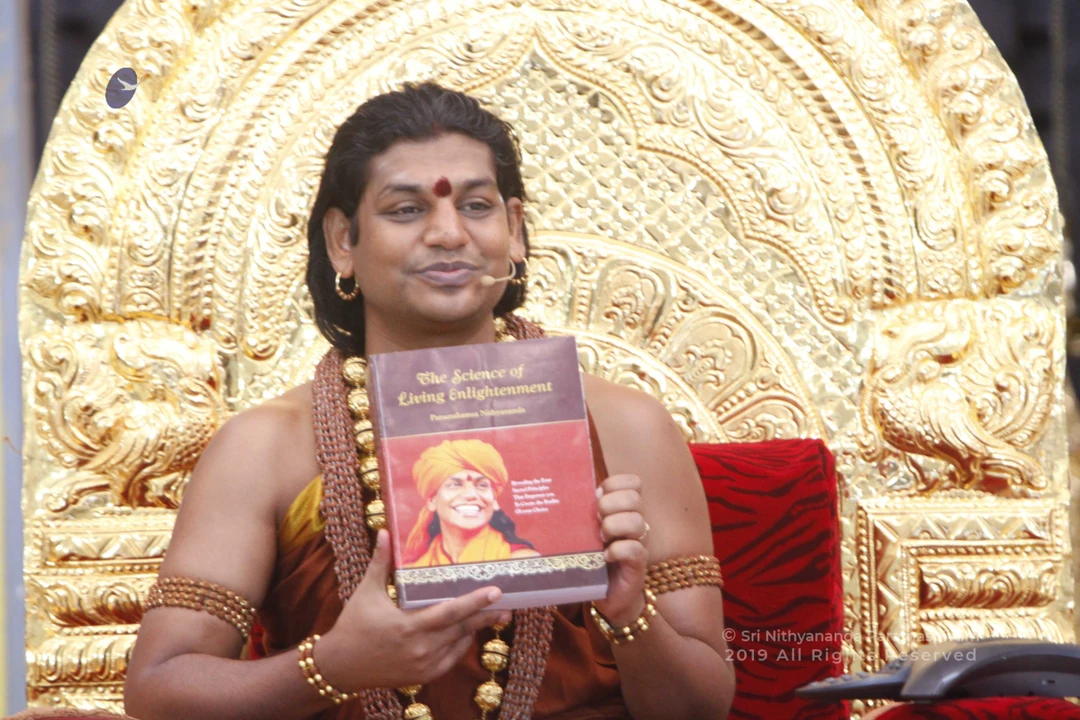
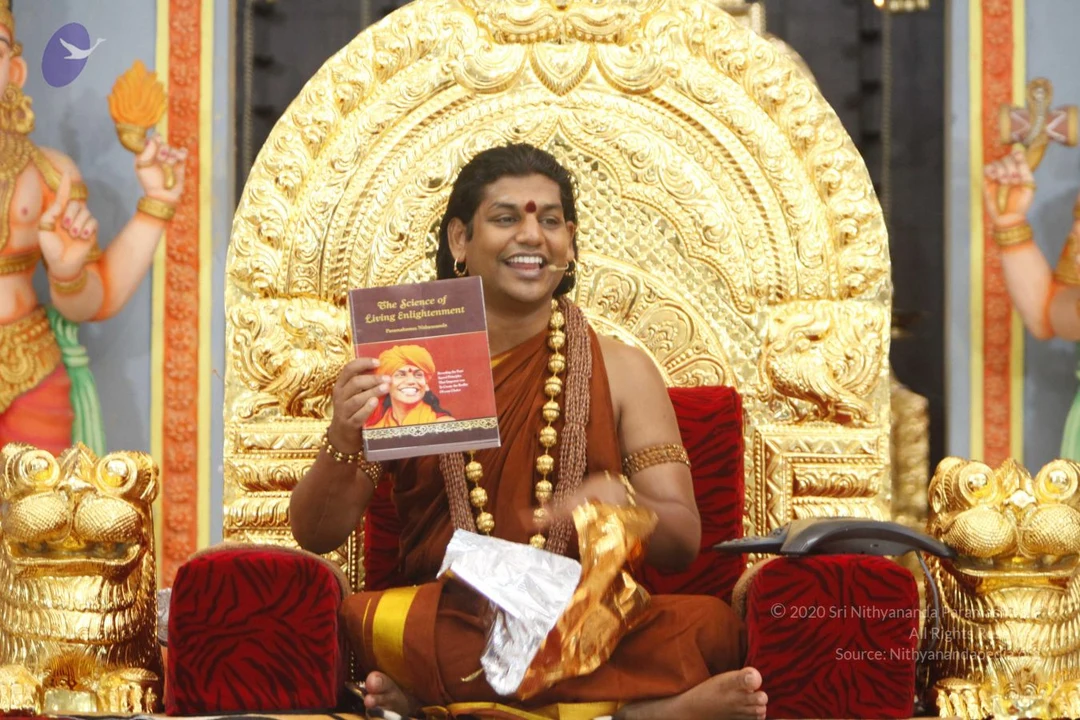
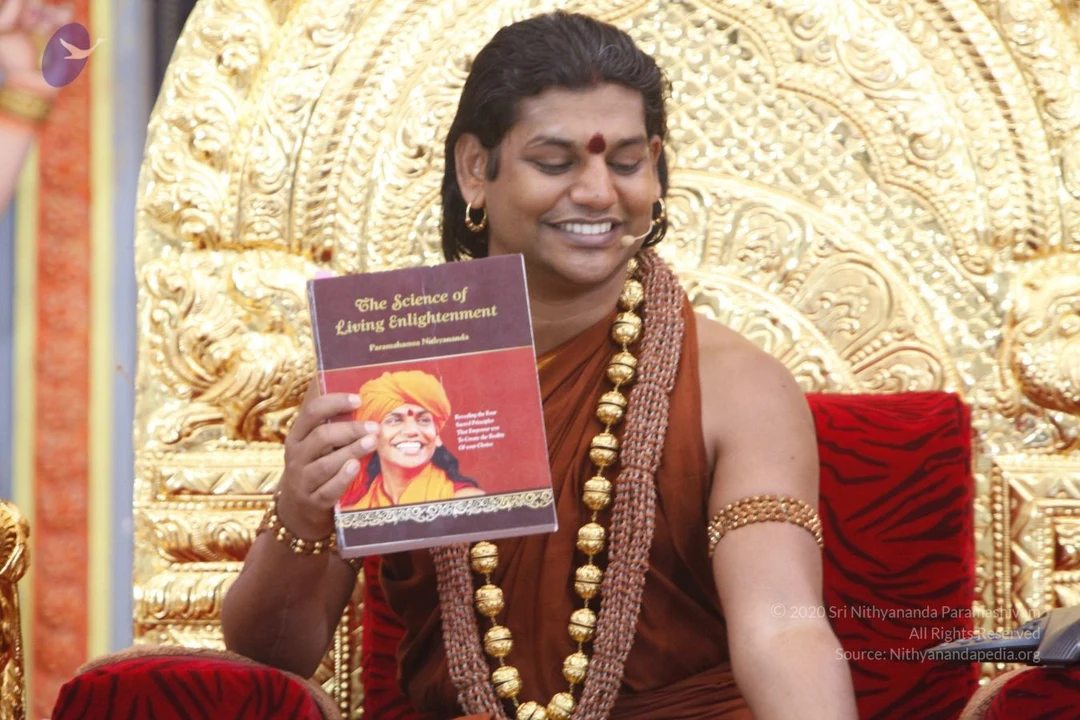
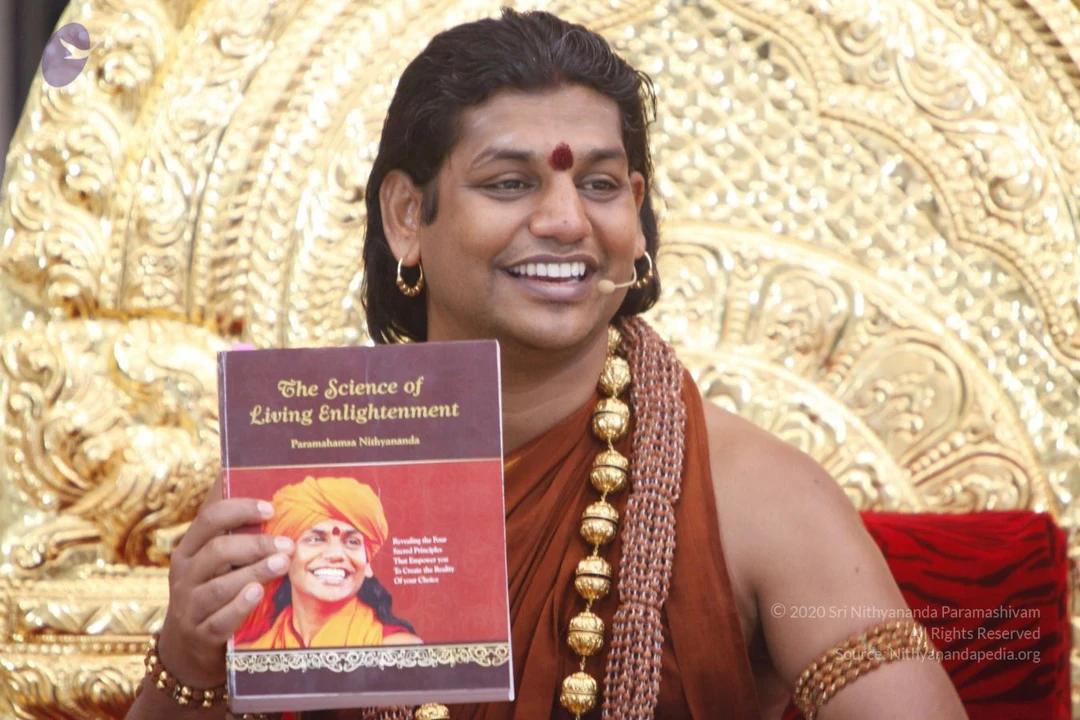
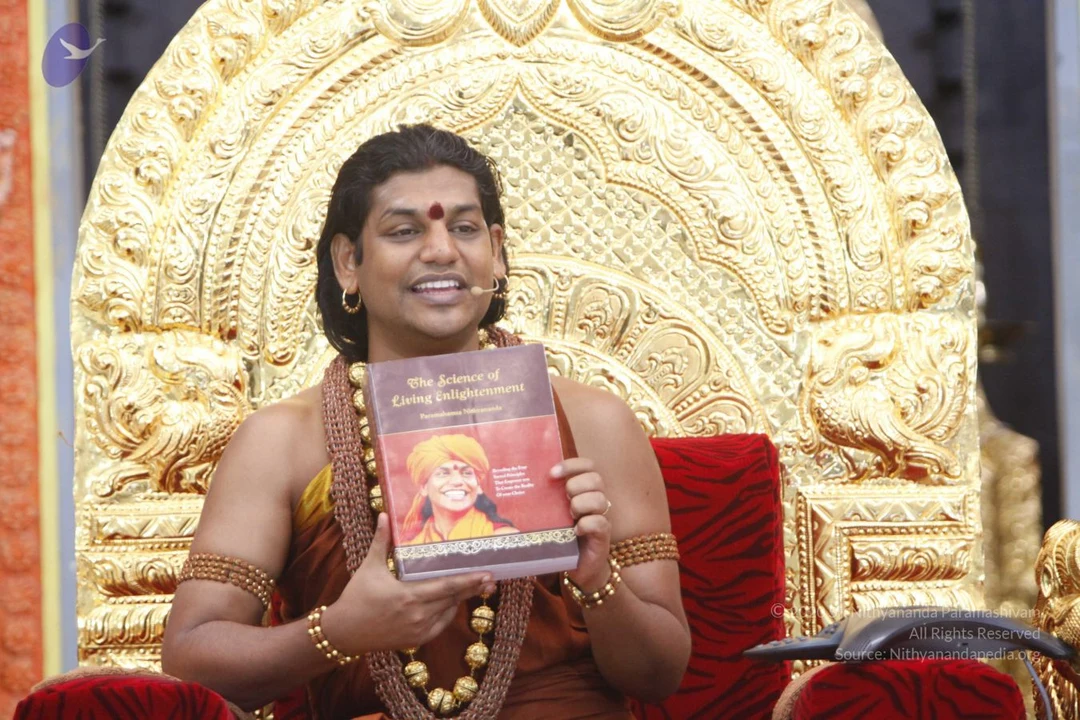
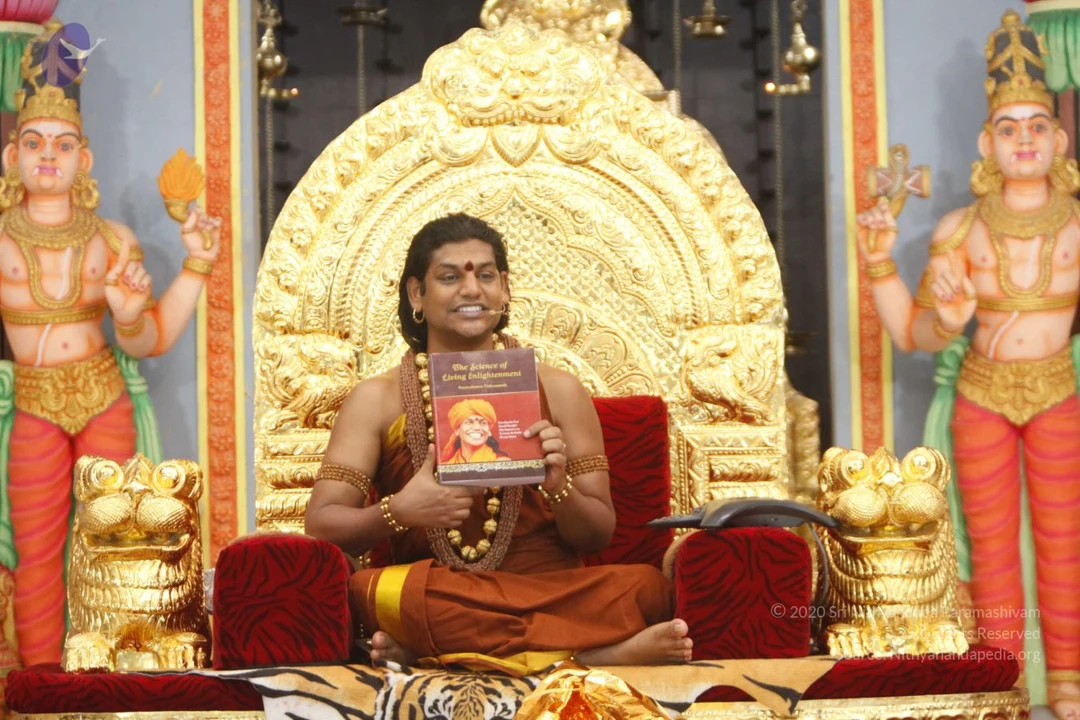
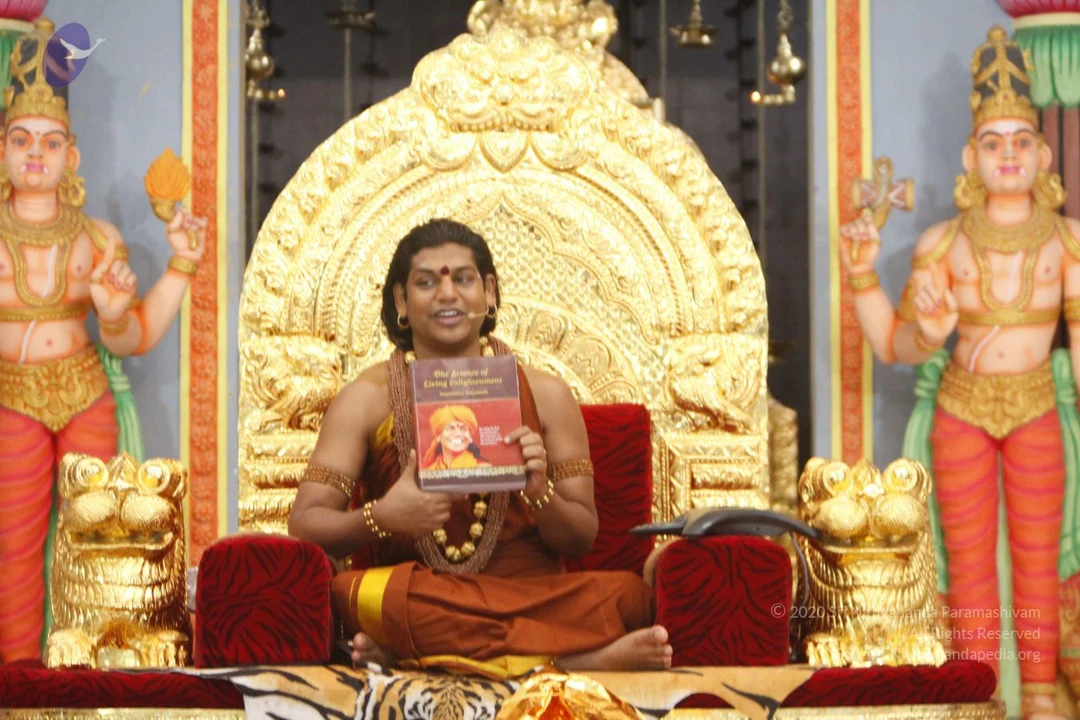
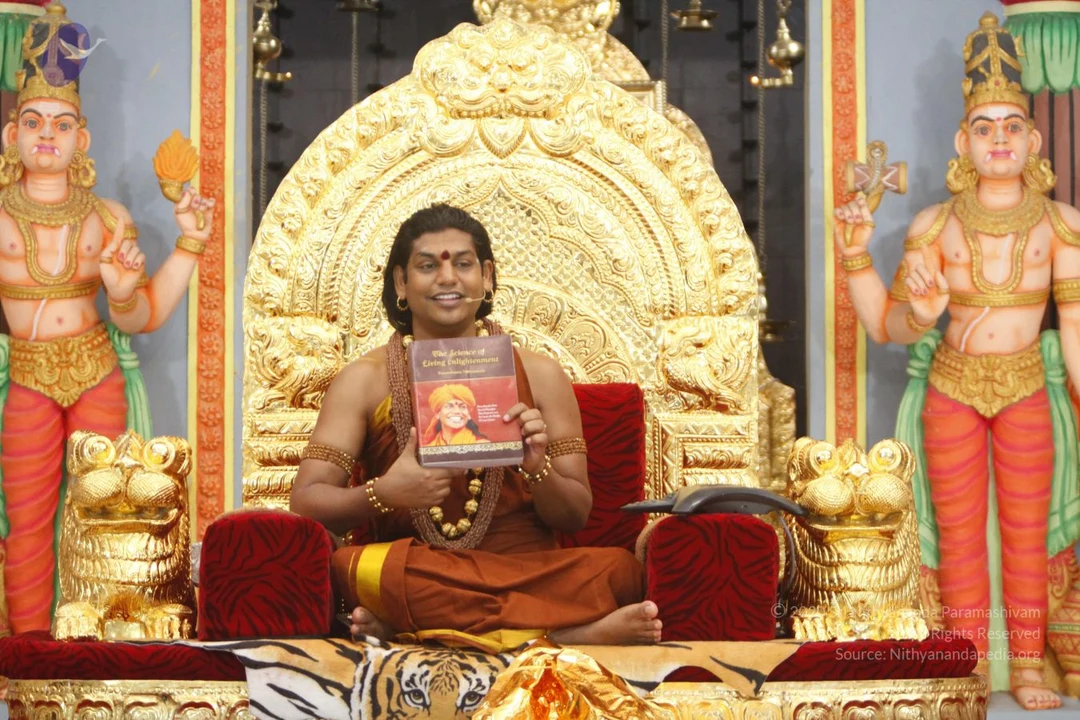
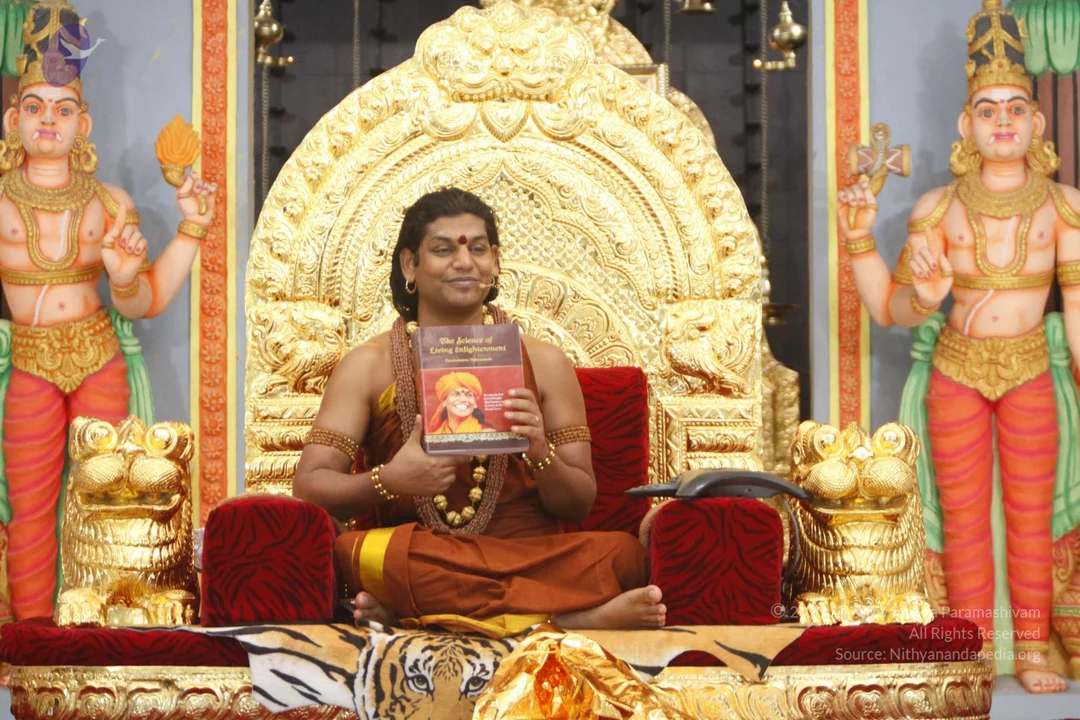
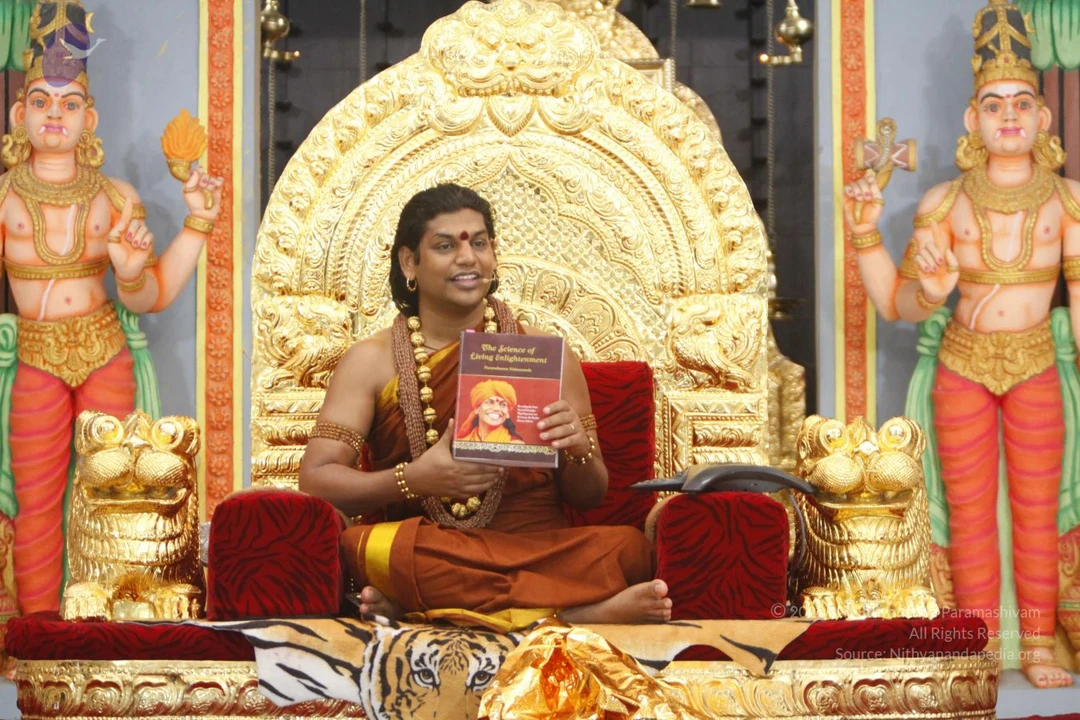
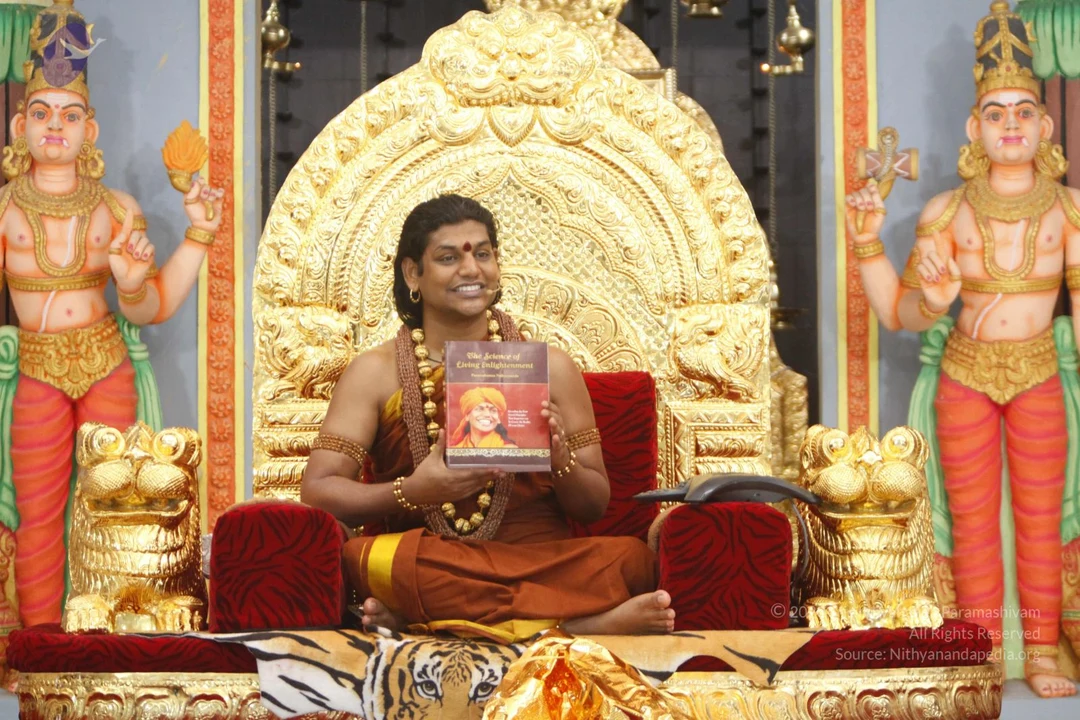
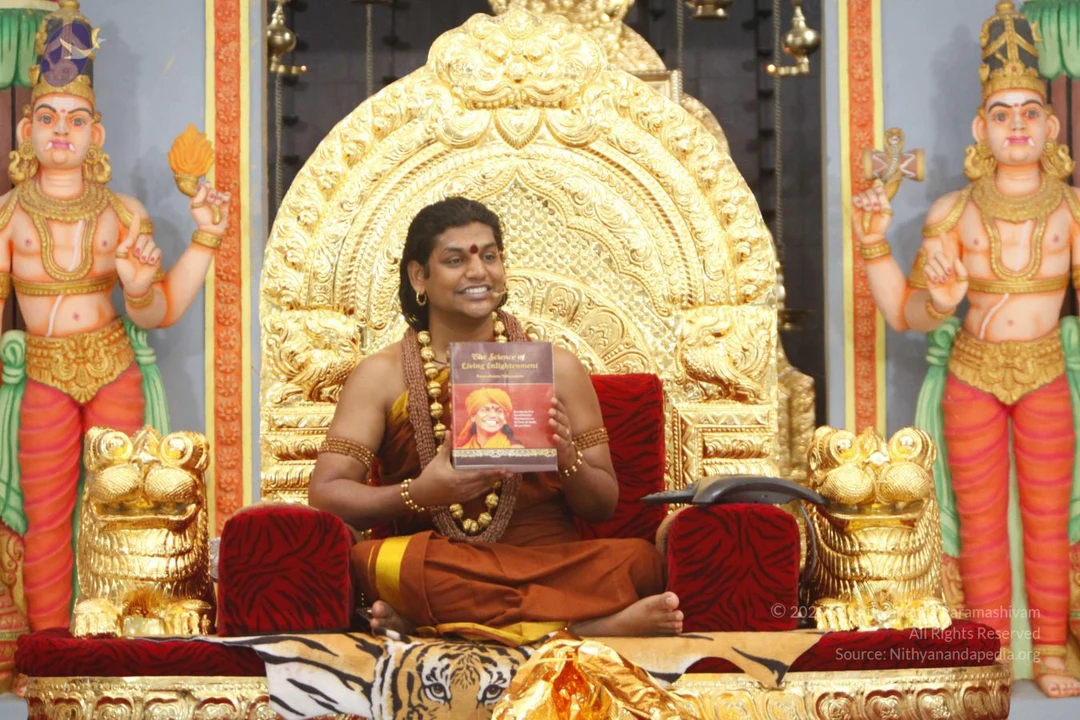
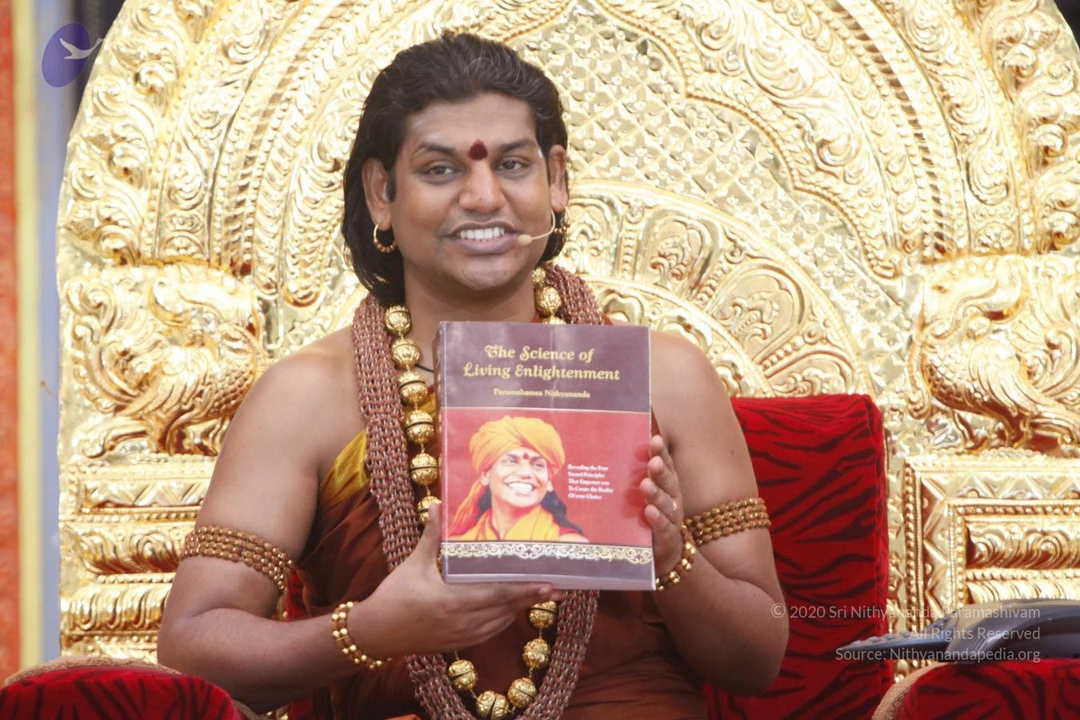
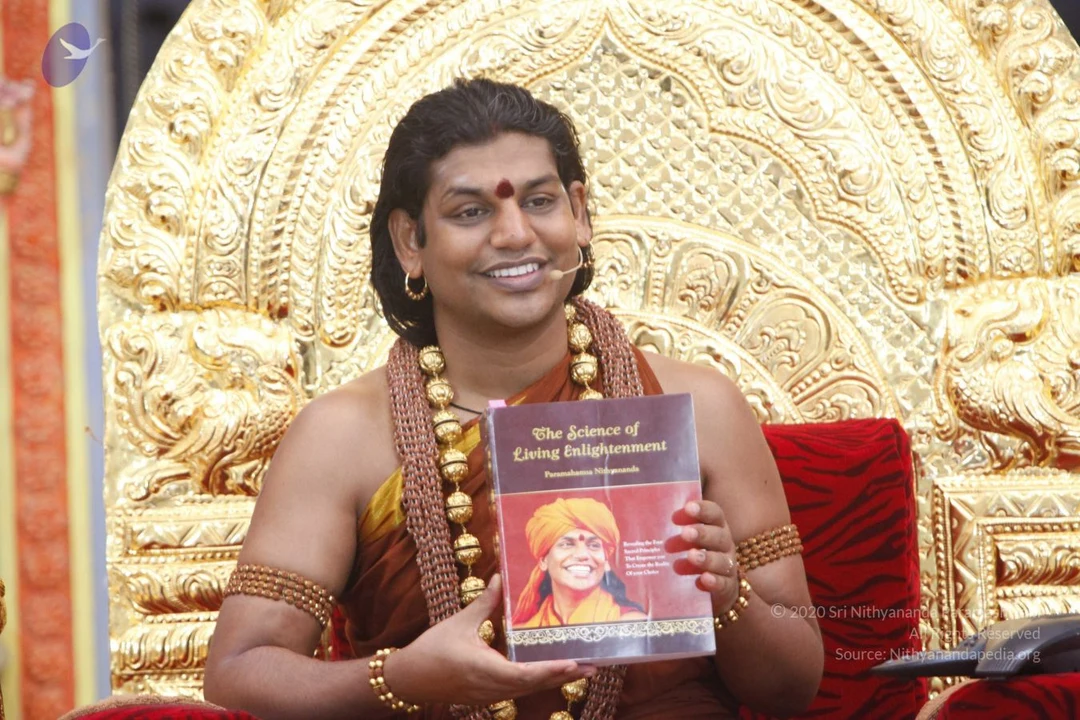
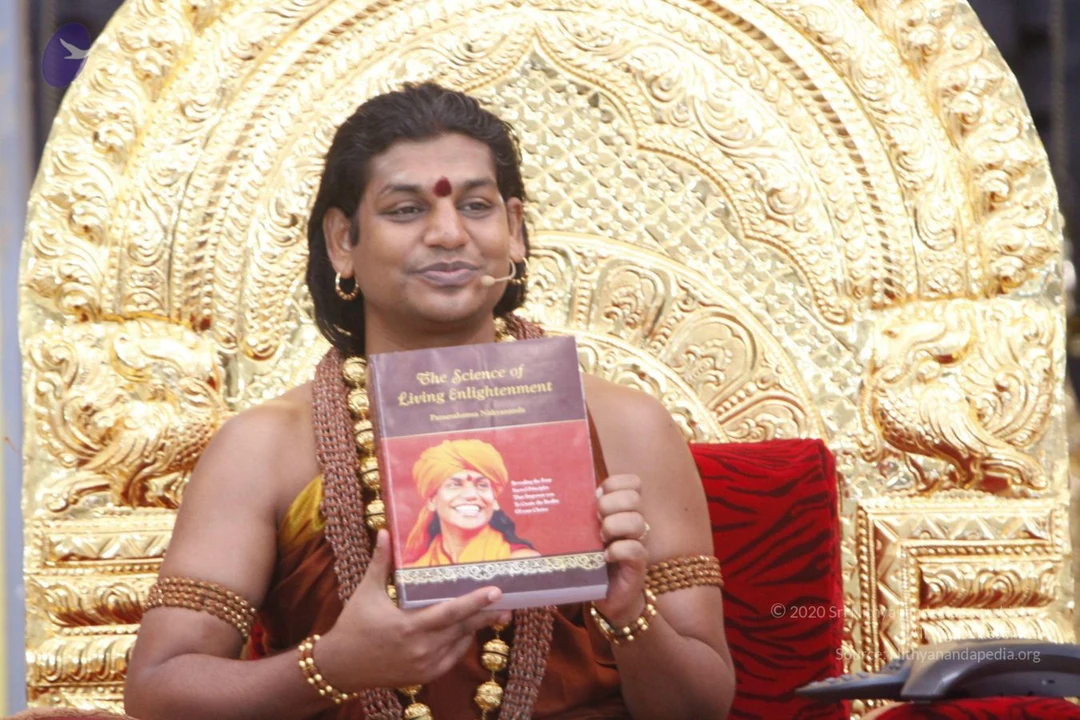
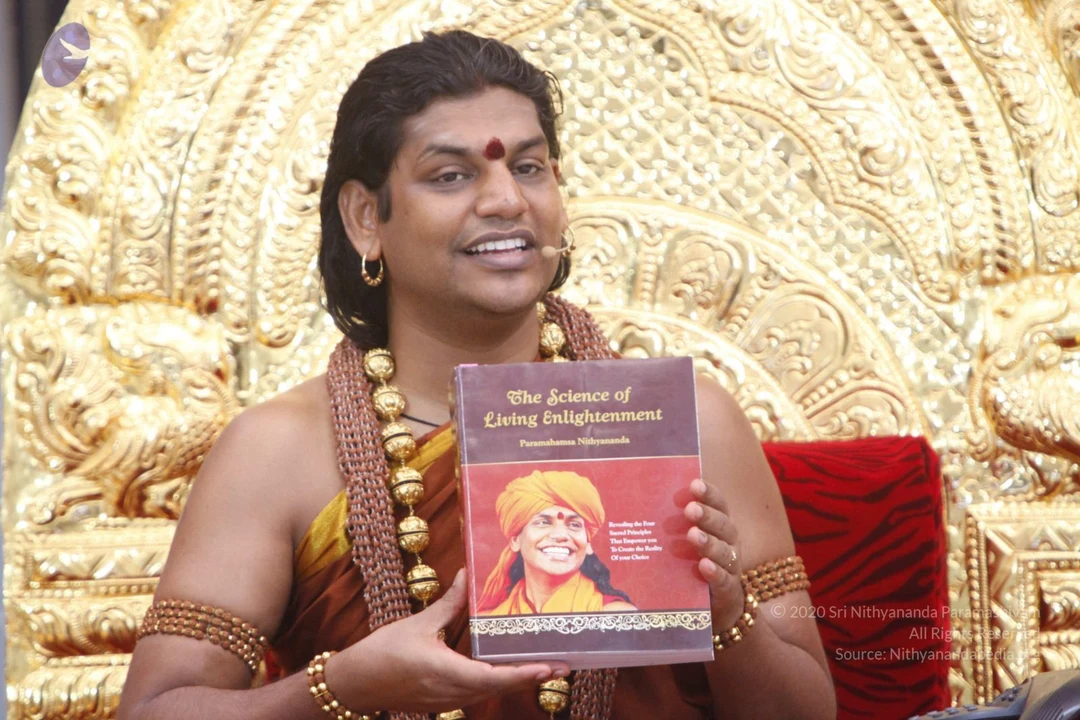
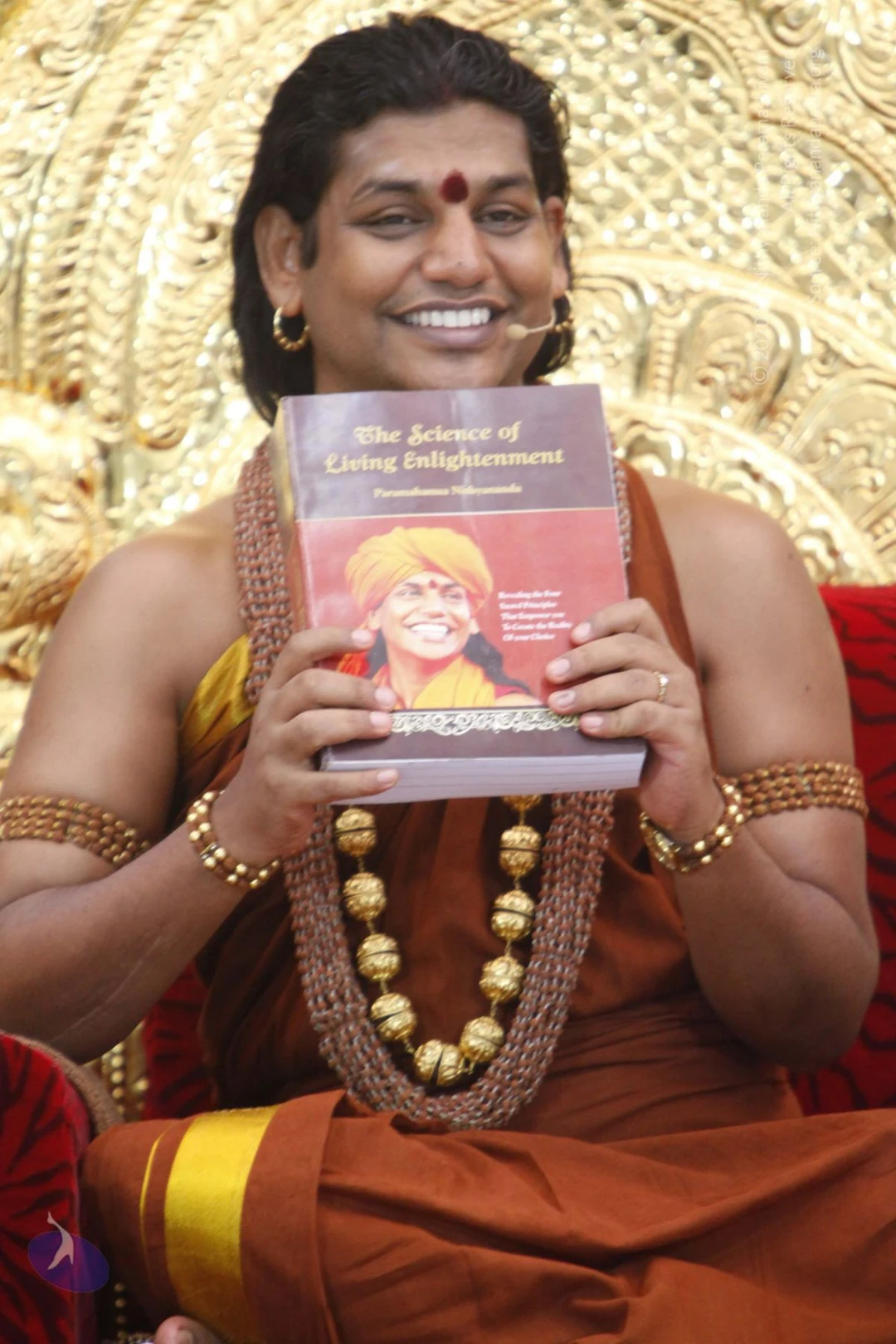
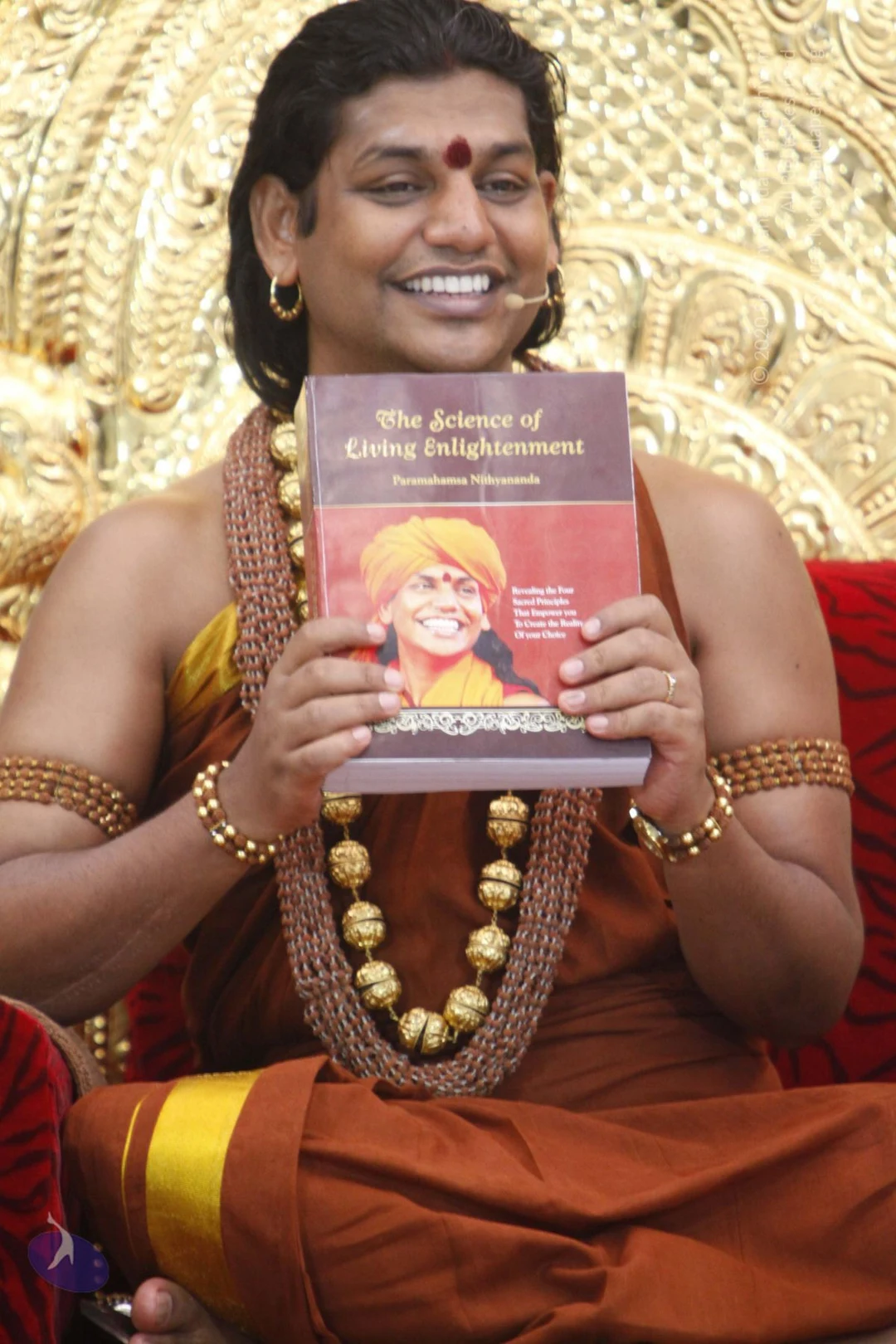
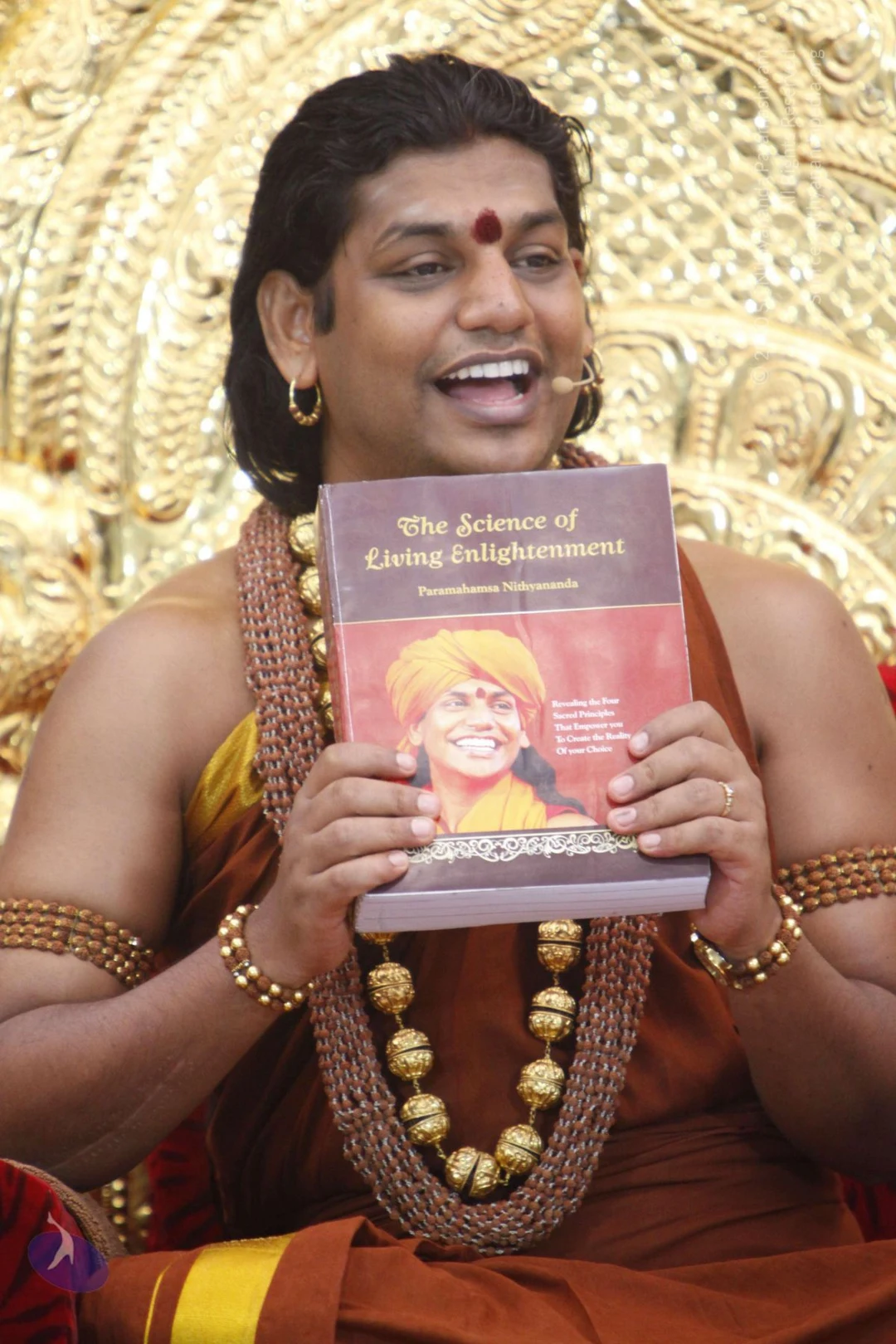
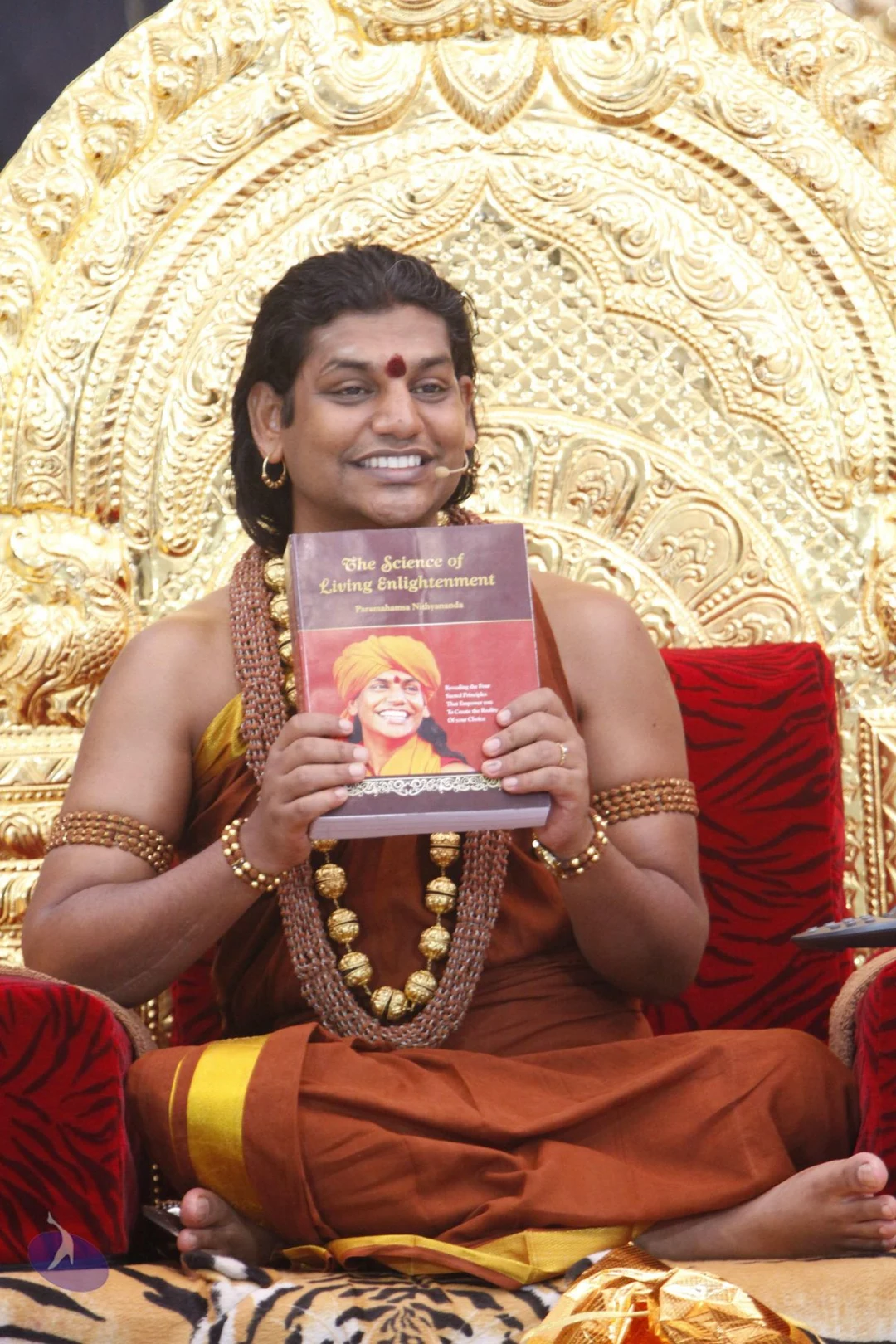
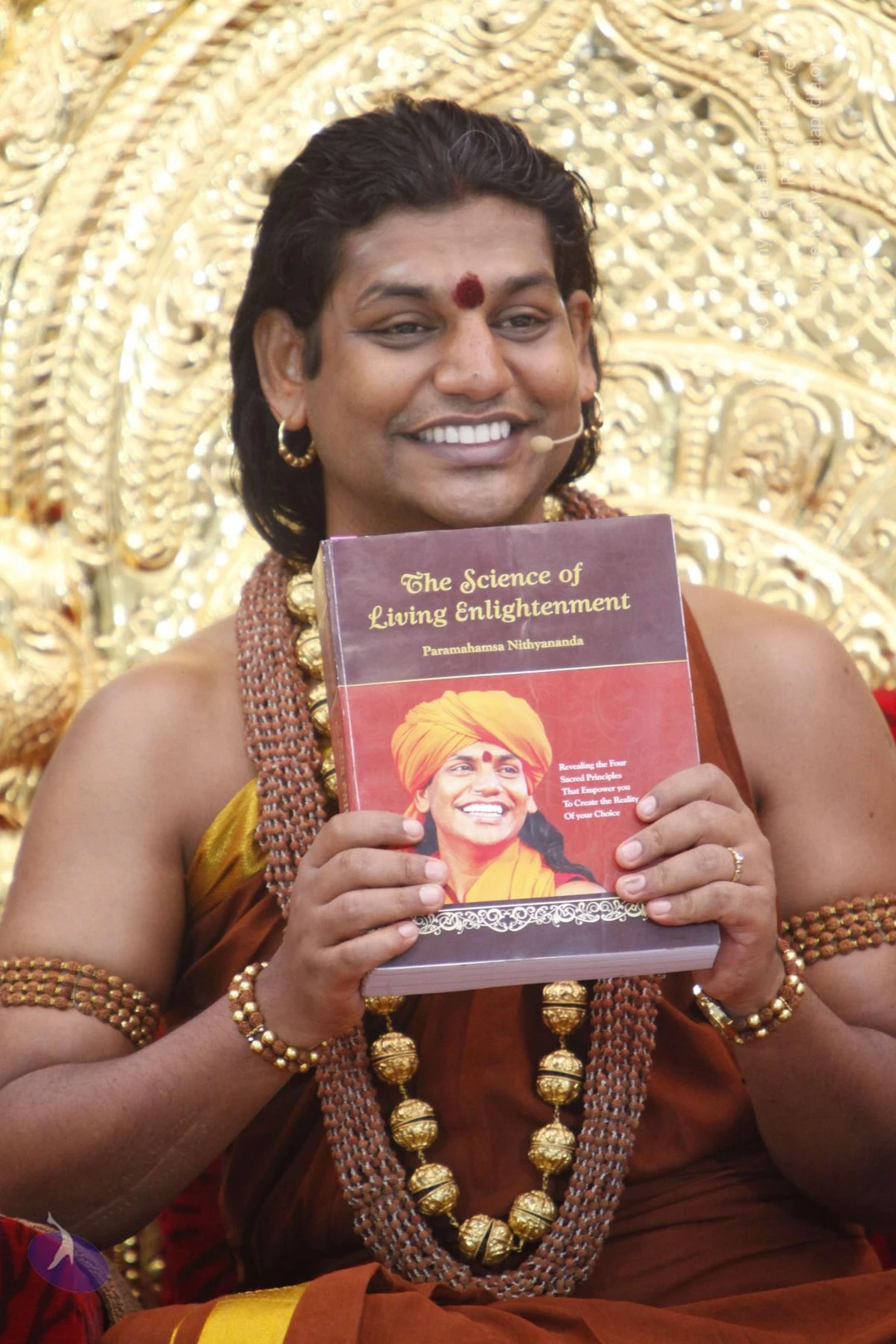
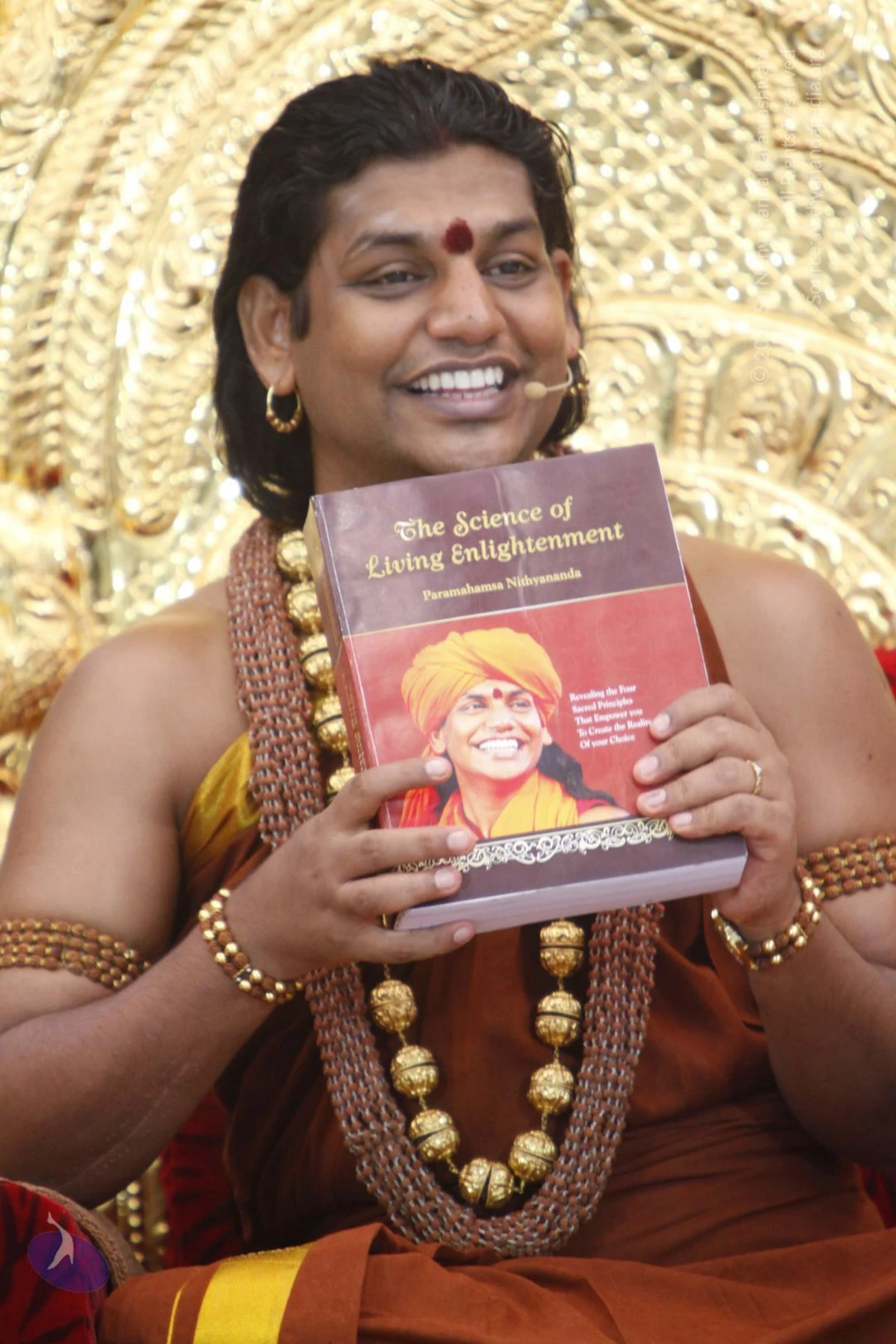
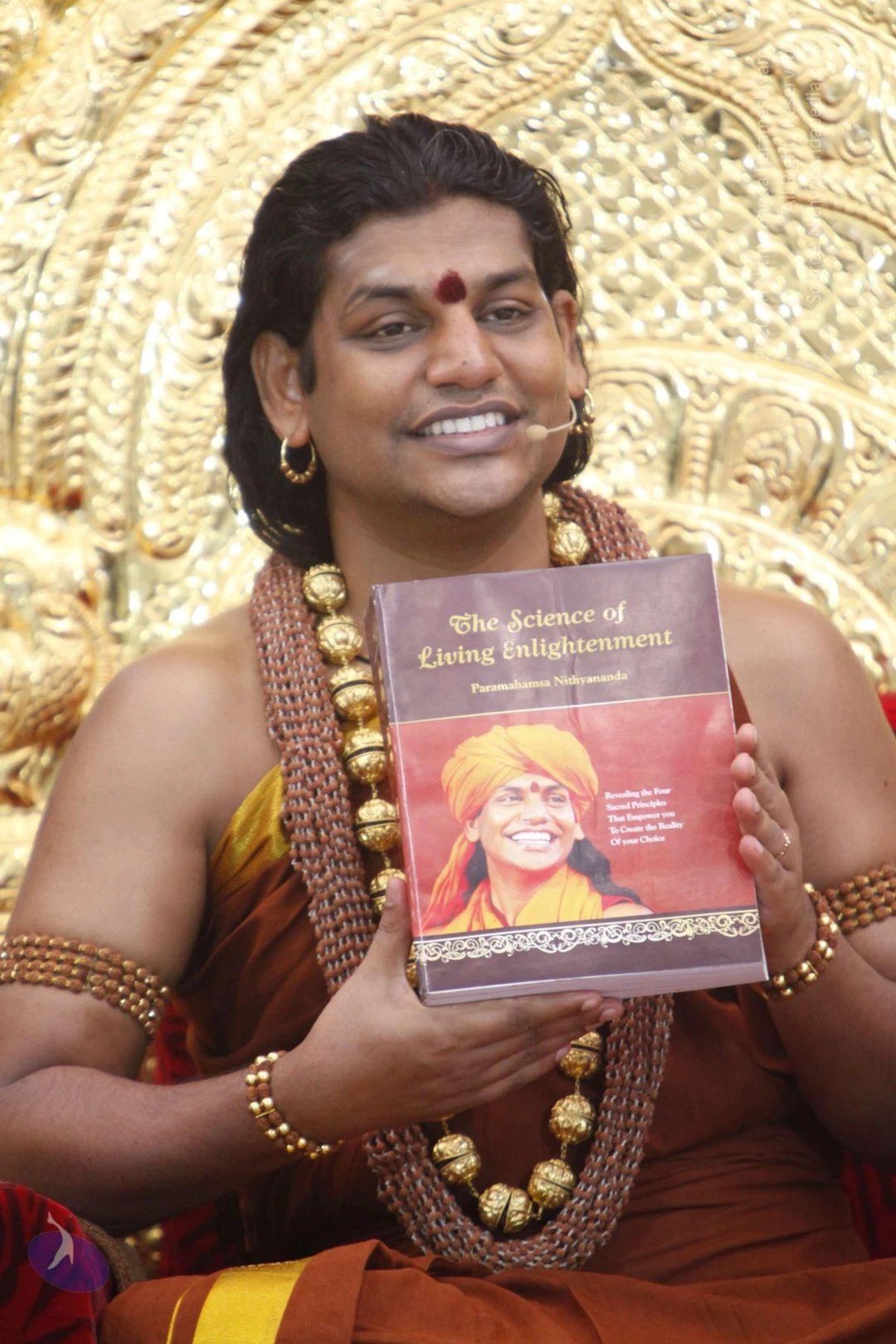
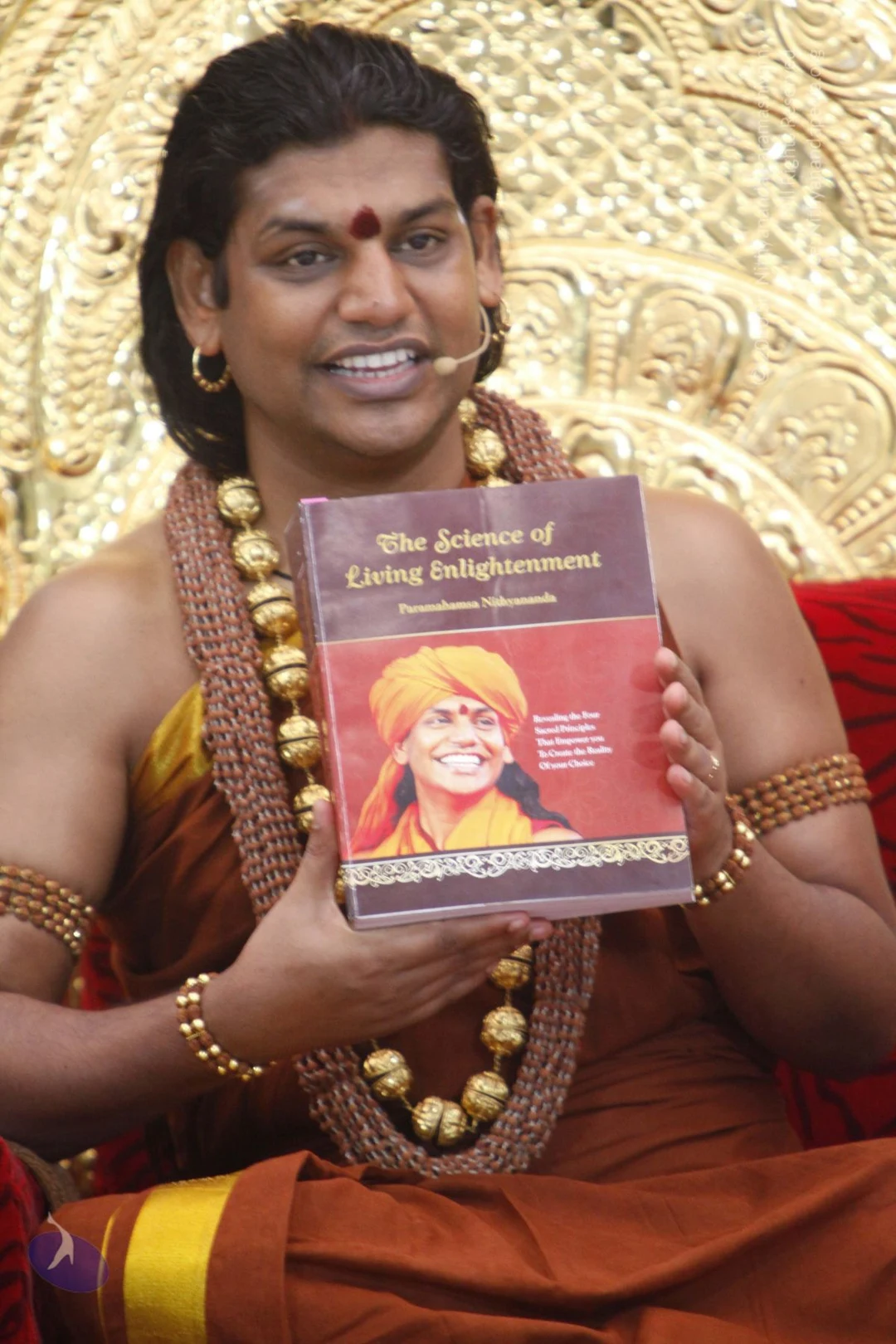
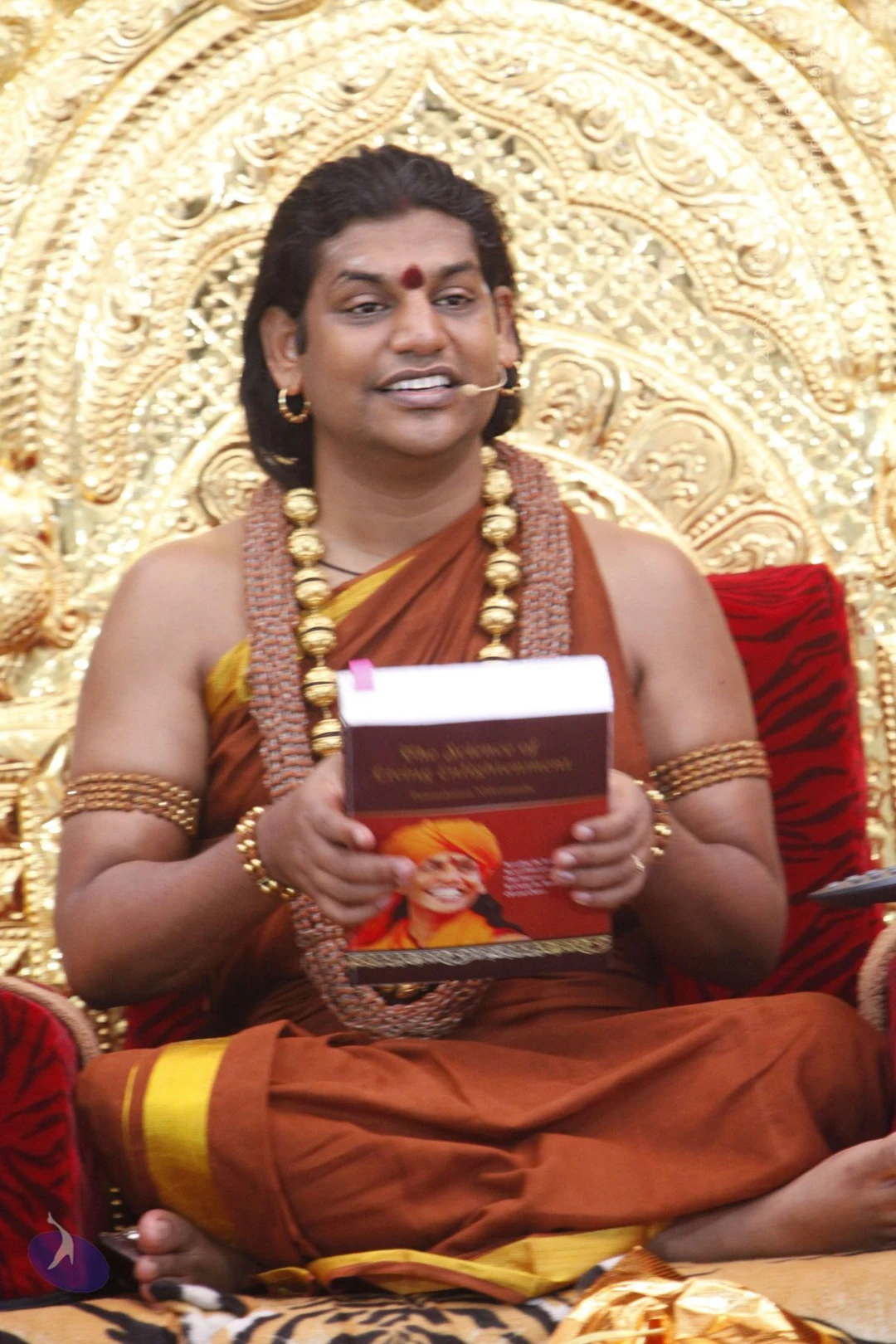
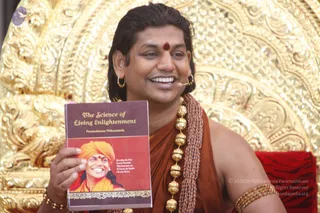
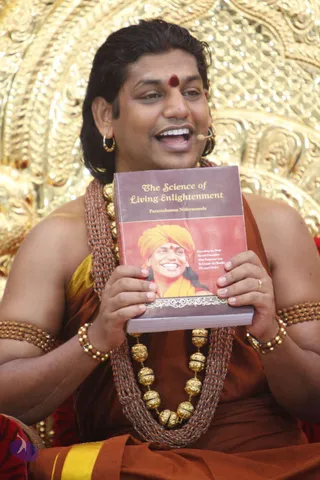
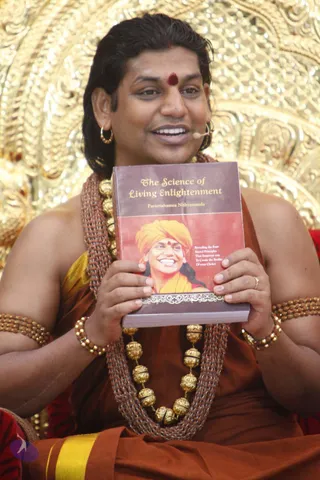
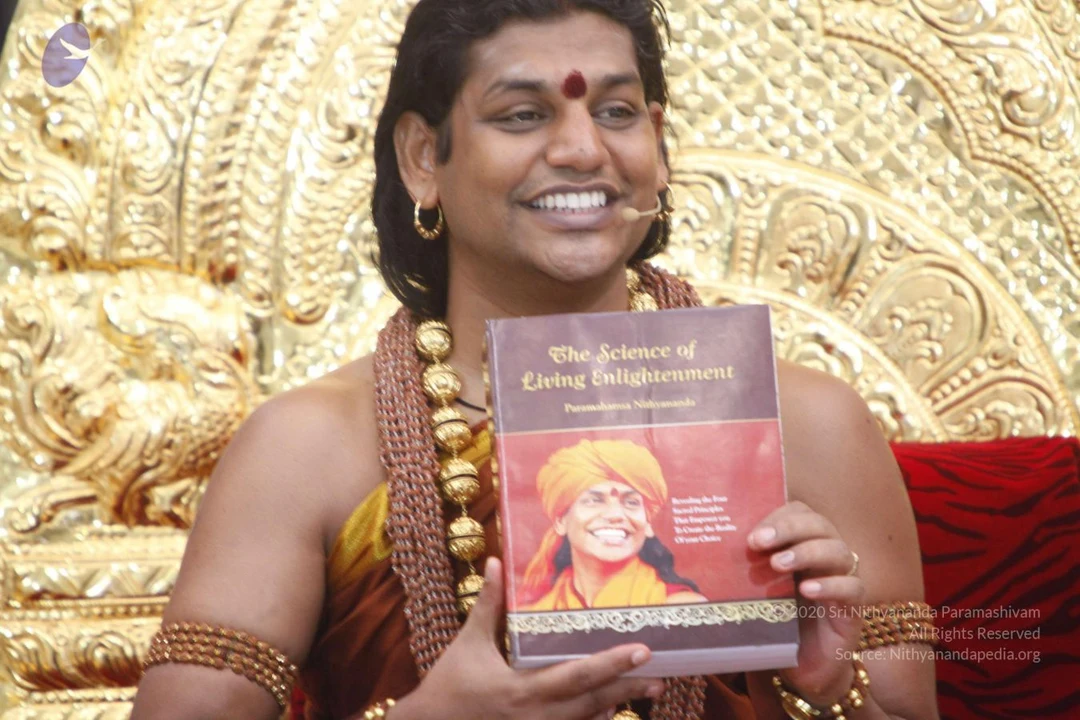
So next few minutes, I will release this book. Today, we have this new book, very important, my first book on four principles, ‘Science of Living Enlightenment’. Almost after two years, I am coming up with the first book. This is the first book on the four tattvas, introducing the four tattvas.

So all the TV viewers, devotees, you can order for your copy. Call the number on the screen for your copy. I can say, the complete introduction about the four principles, the initial introduction about the four principles is available in this one book. Anyone can read and immediately start living it, start following it. It can move your body, move your mind, move your energy, move your intelligence and move you towards success, fulfillment, completion. The book is ‘Science of Living Enlightenment’.

(HINDI)

Whatever I am speaking, sharing in the morning Nithya Satsangs, the essence is available in this book. Thank you!

With this with my integrity authenticity responsibility and enriching I bless you all let you all…..

Photos
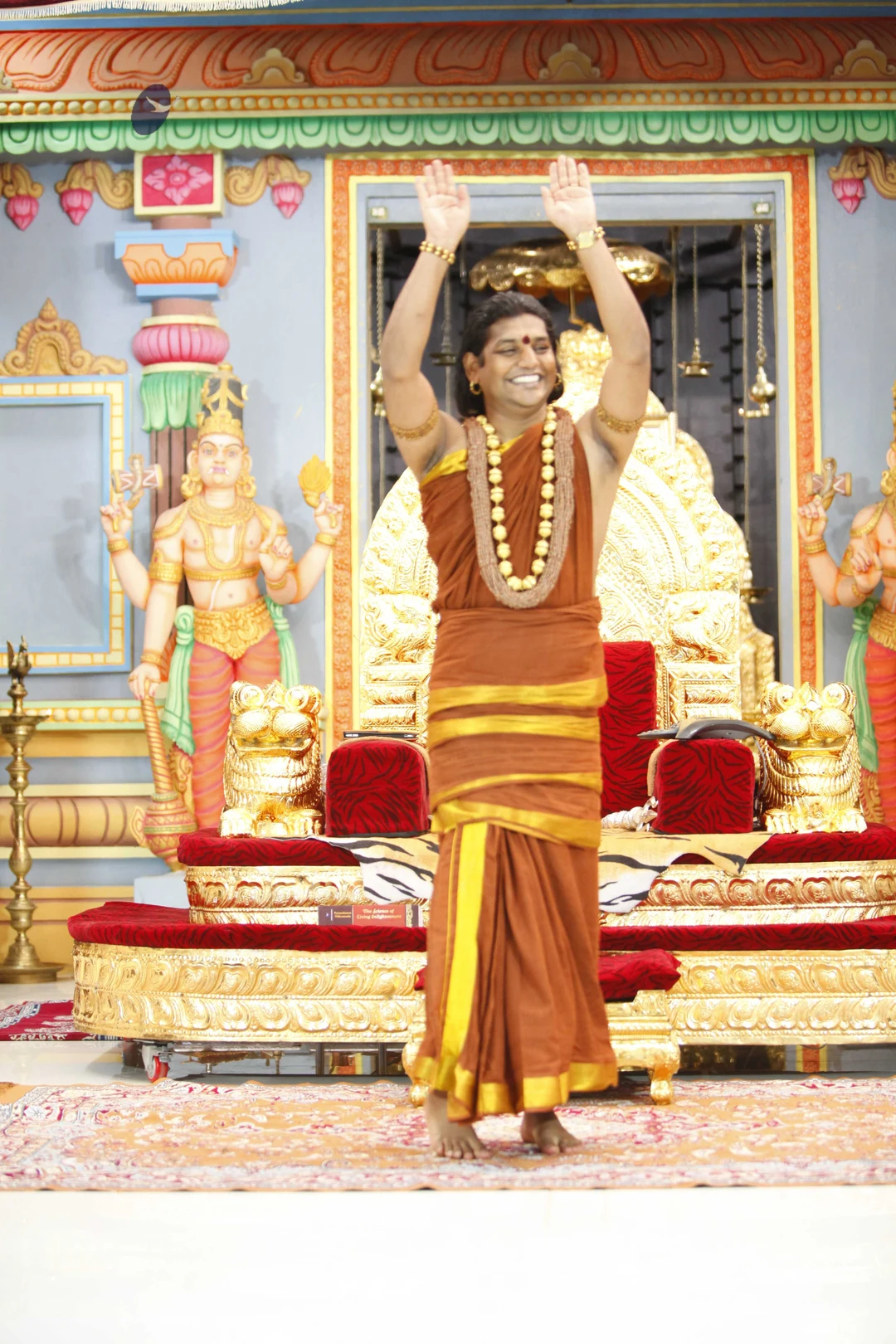
New Book Released The Science of Living Enlightment | Padukapuja |2nd june 2013 Photos
Tags:

Paramahamsa Nithyananda, experience, miracles, life, transform, possibility, self-image, new, thinking, feeling, living, expressing.

Photos Of The Day:

Temple

Paduka_Puja_Crowds_Individual

Satsang_Swamiji

Swamiji_SLE_Book_release

Sarva-Darshan

Photos Of The Day:

Temple

Paduka-Puja

Swamiji-SLE-Book-release

Satsang-Swamiji

SarvaDarshan

Photos Of The Day:

Temple

Paduka-Puja

Swamiji-SLE-Book-release

Satsang-Swamiji

FinalBlessings

Photos from this day

View all 143 photos

Photos

9 photosSource gallery
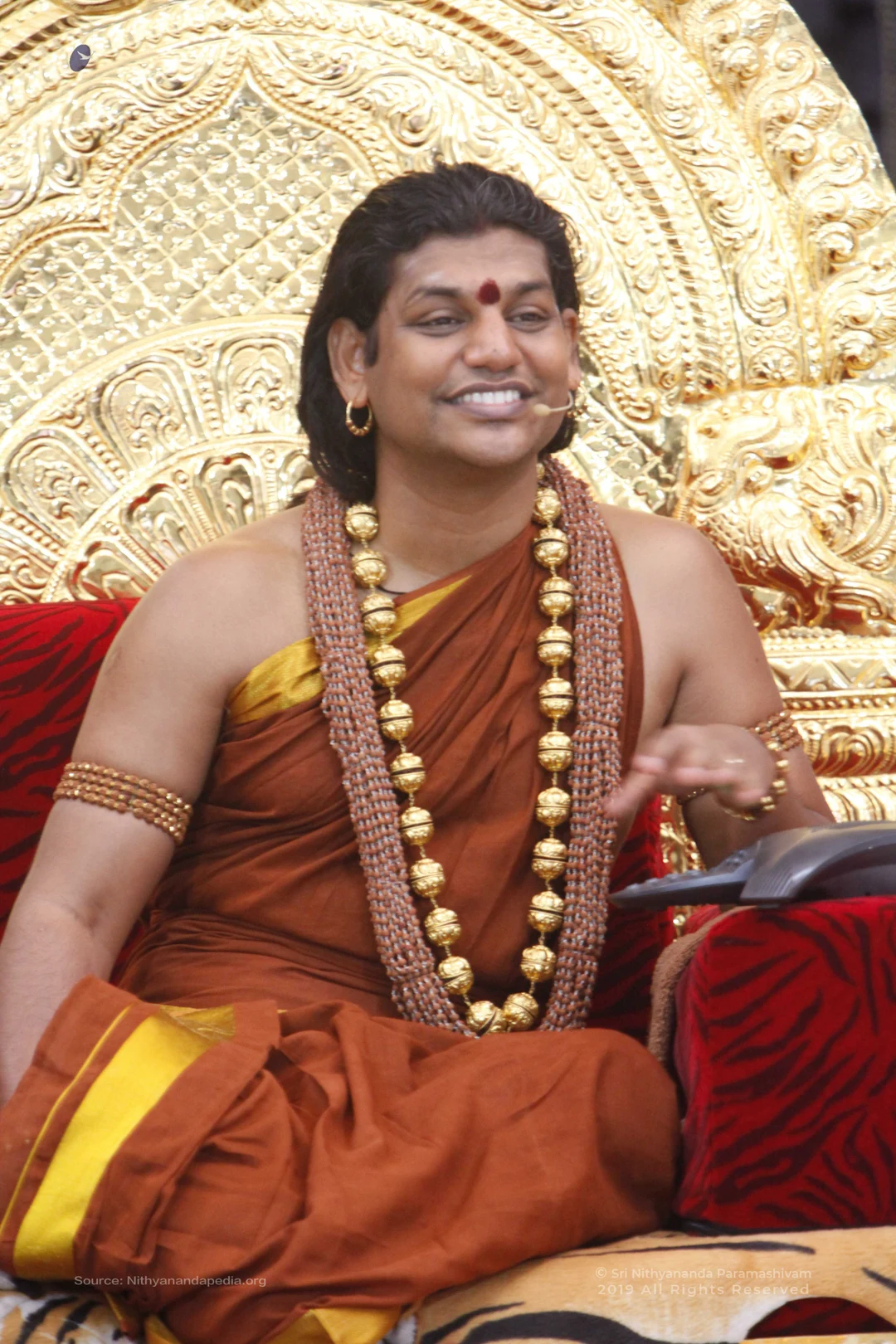
A smiling man with swept-back dark hair and a red bindi sits on an ornate gold throne with carved lion details, backed by red-and-black tiger-print cushions. He wears a rust-orange robe with a yellow border, a rudraksha mala and a heavy ceremonial gold bead necklace, gold bangles and hoop earrings, and a headset microphone. His right hand is raised mid-gesture as he speaks, with a microphone or phone on the cushion beside him. Appearance-based a person in a satsang setting; the person is shown from the waist up, and no other people are visible.A photograph of a seated man in an ornate golden throne with an elaborately carved arched back and lion motifs. He wears a saffron-orange draped robe with gold borders, a thick gold bead necklace over a rudraksha-style mala, gold armlets and a red bindi, and sits cross-legged on a red velvet seat draped with a tiger-face rug. Golden lamps hang in the background. Another mark on the image reads a copyright line in the lower right corner; it is not reproduced here. The man smiles and looks to the side.A seated man in an orange-brown robe with gold border sits on an ornate golden throne with a carved arched backrest and gilded lion-shaped armrests over red velvet with tiger-striped cushions. He wears a long gold bead necklace and a rudraksha mala, gold bangles and a red bindi, and smiles while gesturing with his hands during a satsang. Flanking him are large painted deity murtis with multiple arms, red-orange dhotis and gold jewellery, and a figure in the lower left is partially visible with folded hands. The setting is a temple-like hall with blue and red painted pillars.A photograph of a man seated at a stage event, turned to his right and speaking into a small headset microphone. He wears a red bindi on his forehead, gold drop earrings, and an orange-rust saffron wrap over his bare shoulder with a gold-coloured blouse edge. Around his neck hang long strands of gold and rudraksha-style beads with ornate gold bead clusters, and a beaded bracelet is on his upper arm. Behind him a gold ornately carved throne or peetha is visible, with a pink wall and grey backdrop. Swamiji (probable): long swept-back hair, saffron wrap, ceremonial gold necklaces and a throne setting, all visible cues consistent with the page's identification.A seated man in an orange-brown saffron robe with a gold-trimmed yellow border sits on an ornate gold throne with carved lion-head armrests and red velvet cushions. He wears a long gold bead necklace, a rudraksha mala, gold armbands and bangles, and wears a light smile while raising his right hand in blessing. Two large painted guardian figures with crowns and gold ornaments stand on either side, and gold kalasha-style finials and hanging lamps appear behind the throne.A man seated on an ornate golden throne with heavily carved floral and scrollwork panels holds up a book titled "The Science of Living Enlightenment" by Paramahamsa Nithyananda, showing its red cover with a portrait of a smiling figure in an orange turban. He wears a red bindi, gold hoop earrings, a small microphone clipped near his mouth, a rudraksha mala with gold beads, gold bangles, and a brown-orange shawl over bare shoulders. A red tiger-striped cushion sits beside him. Appearance-based label: a person, seated in person on the throne.

New Book Released The Science of Living Enlightment | Padukapuja |2nd june 2013 Photos
21 photosSource gallery
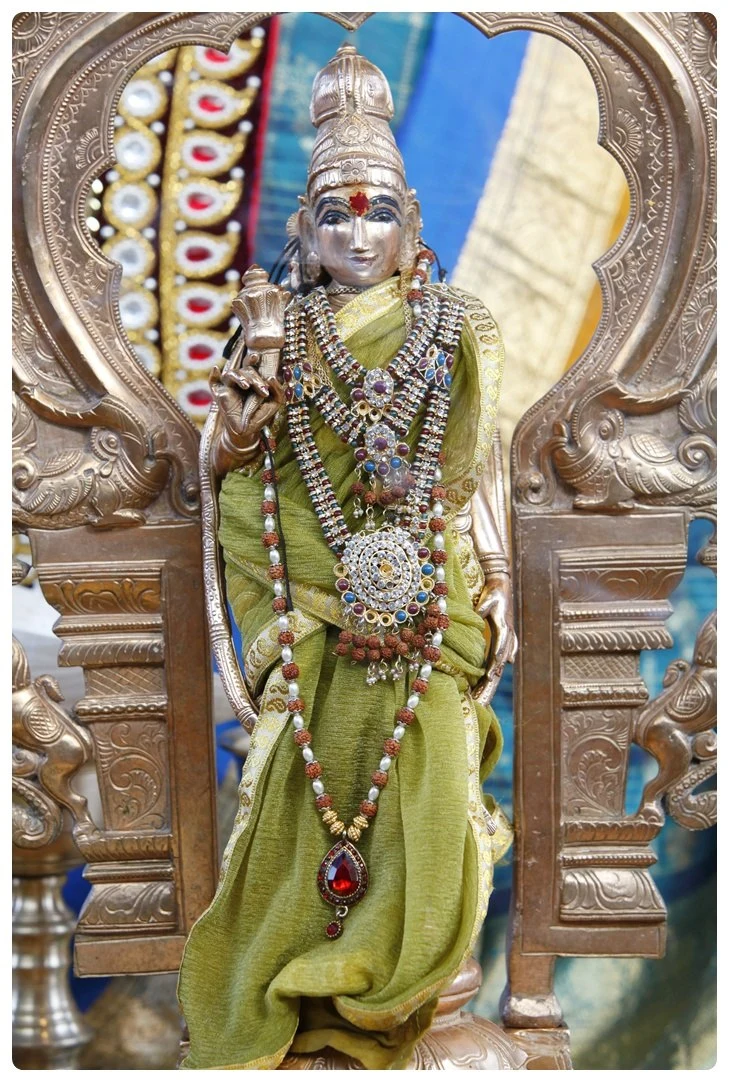
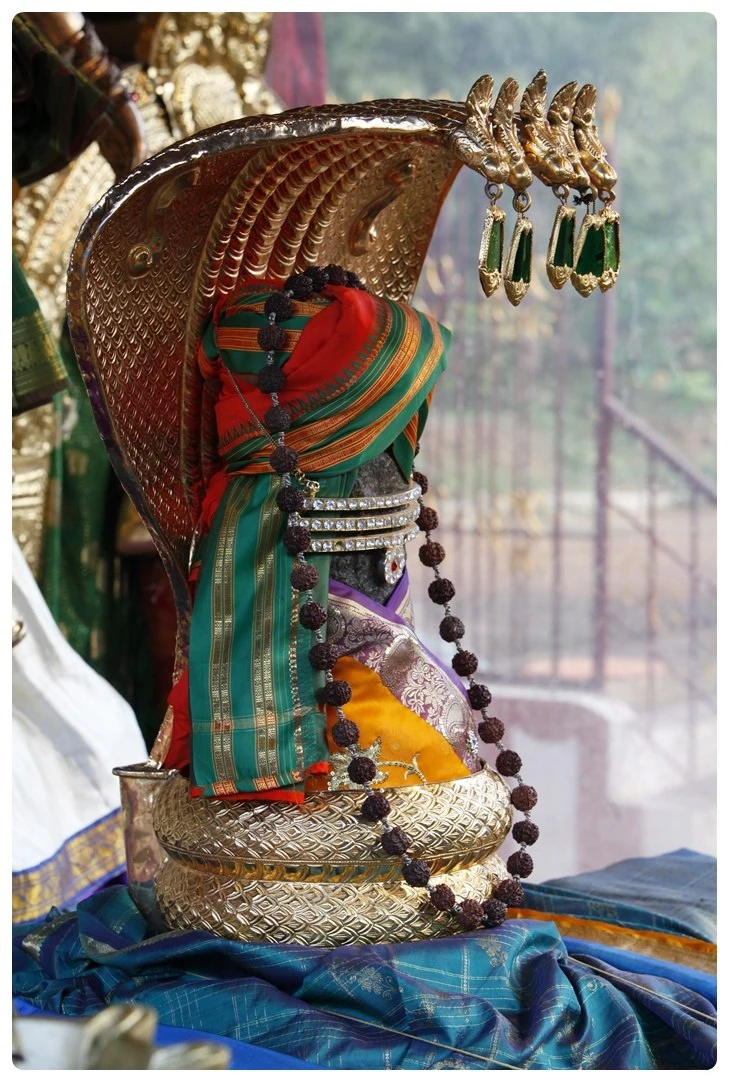
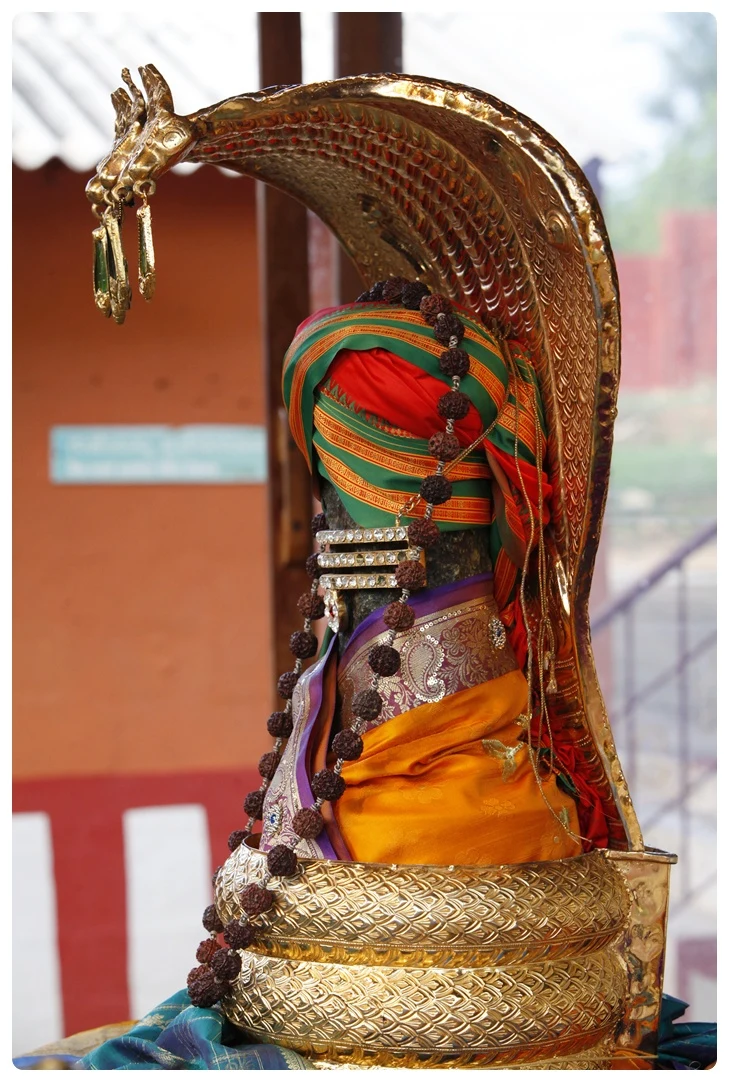
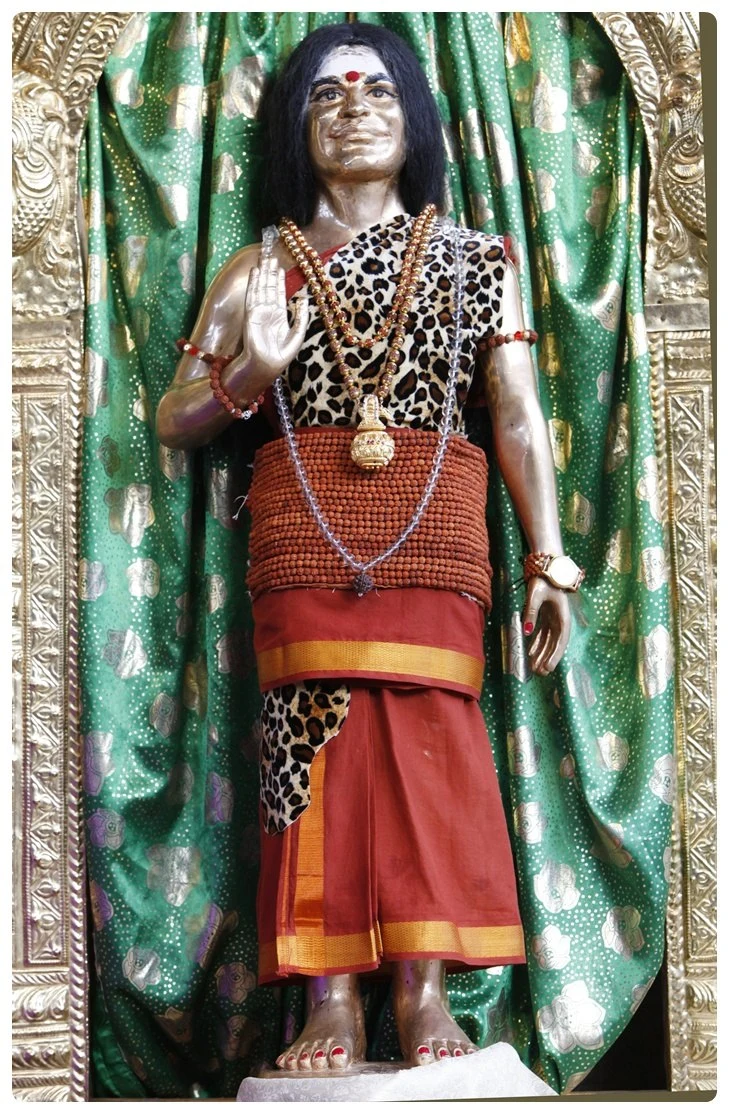
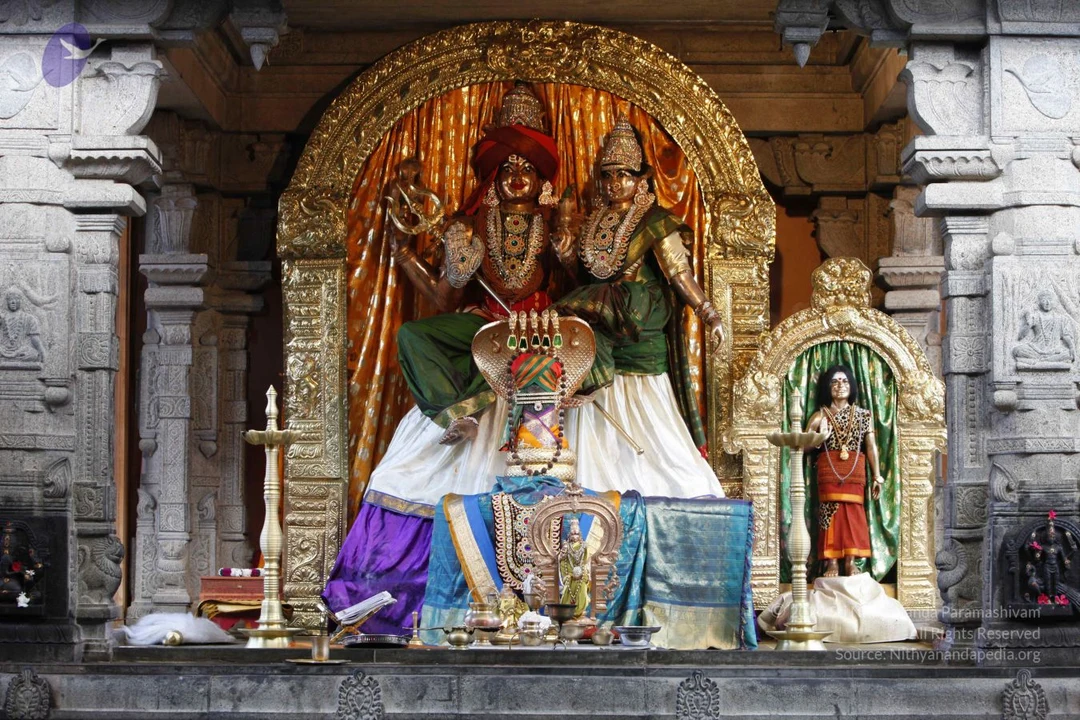
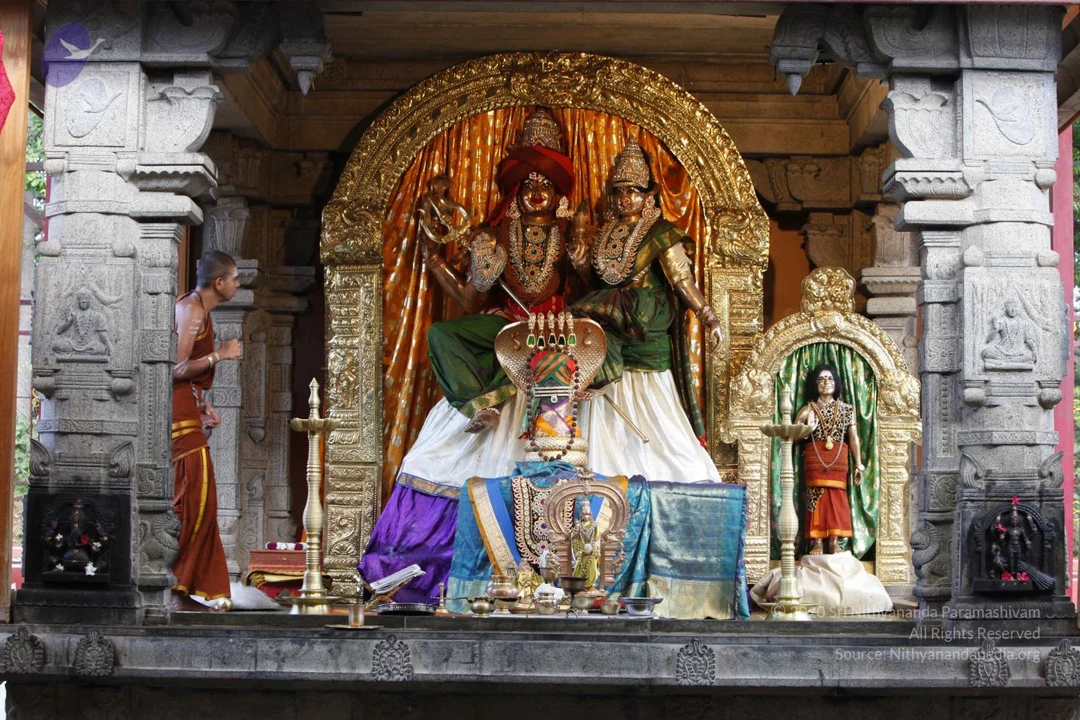
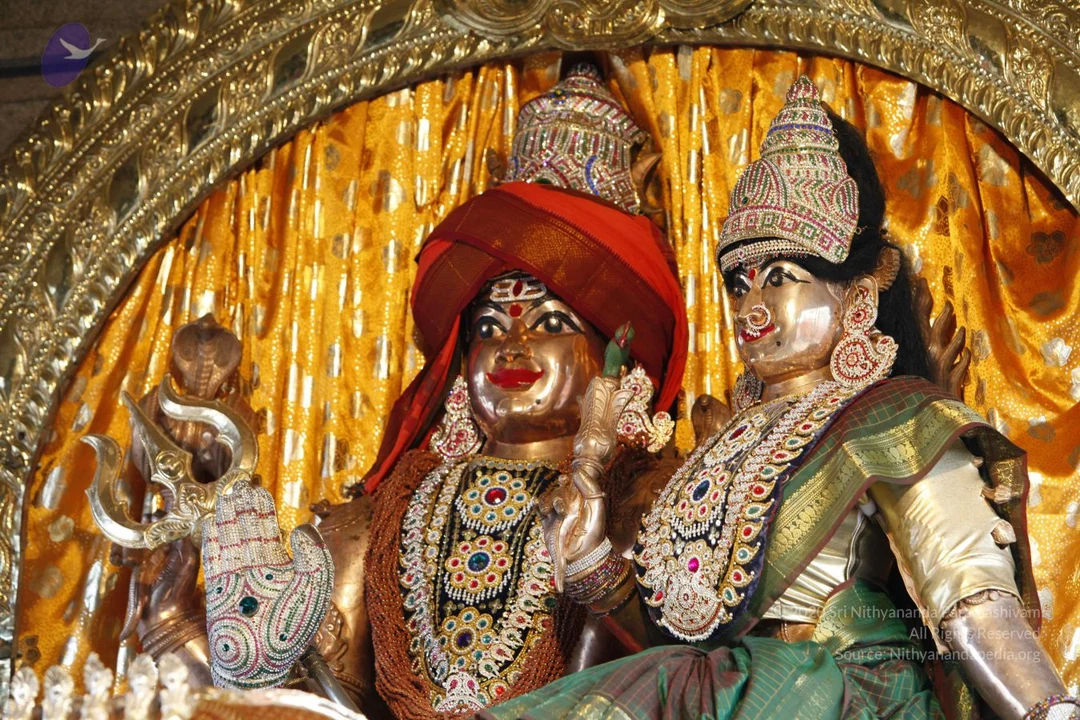
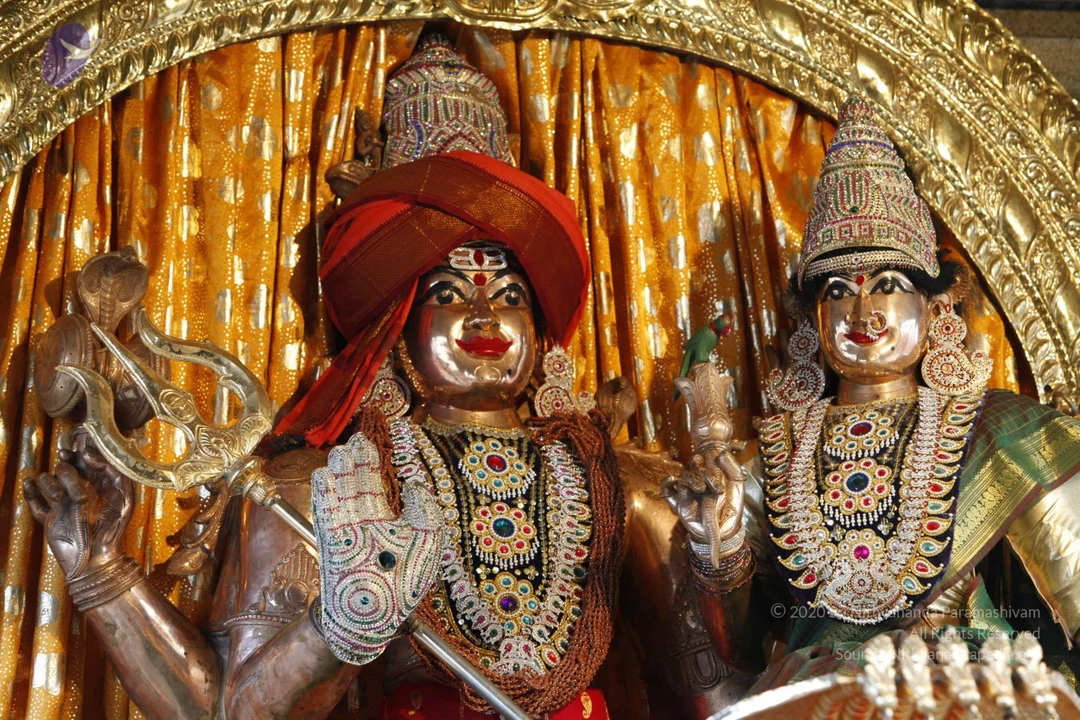
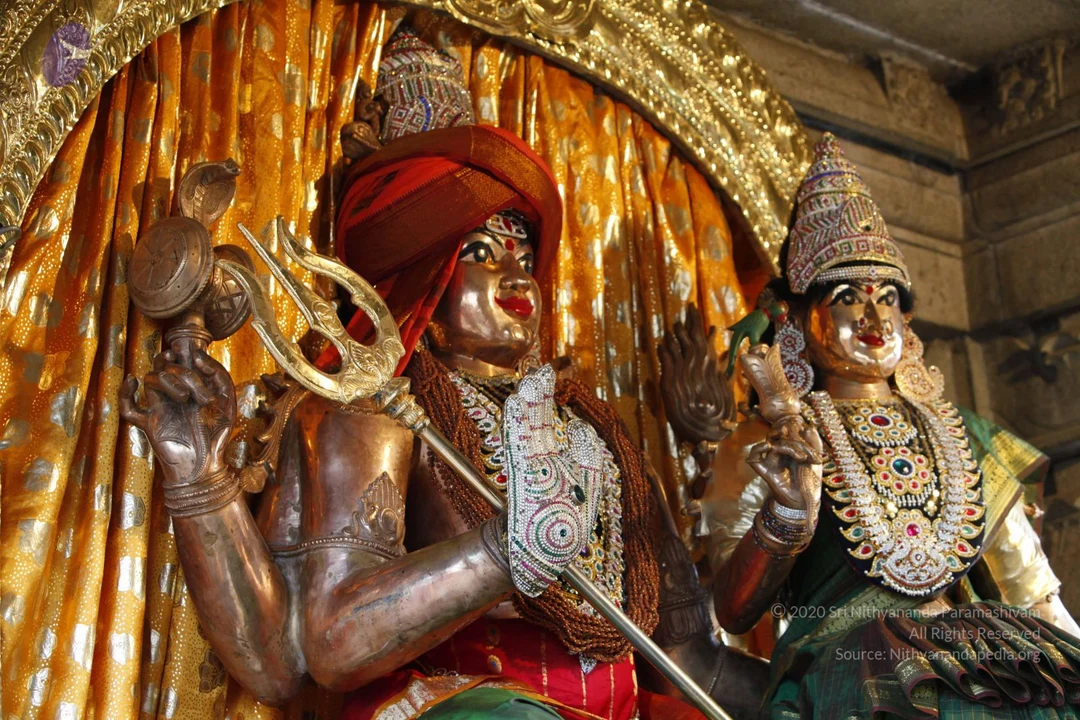
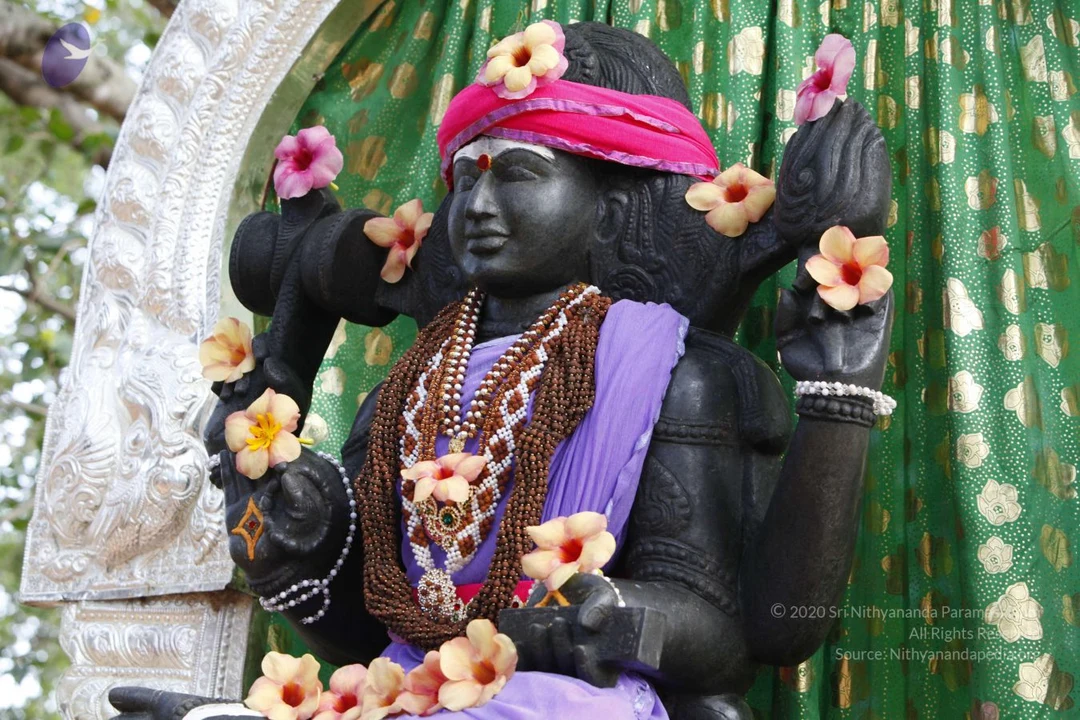
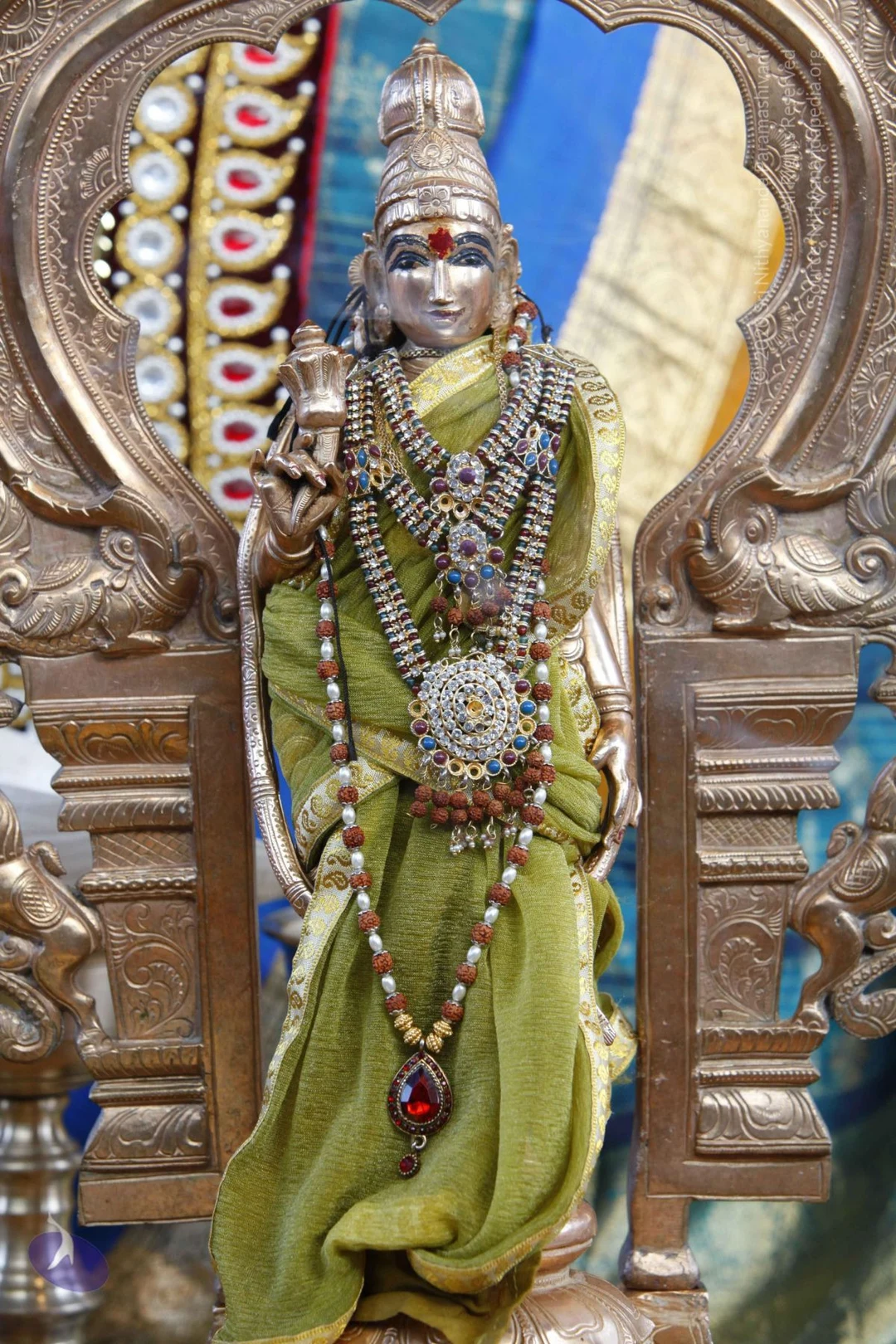
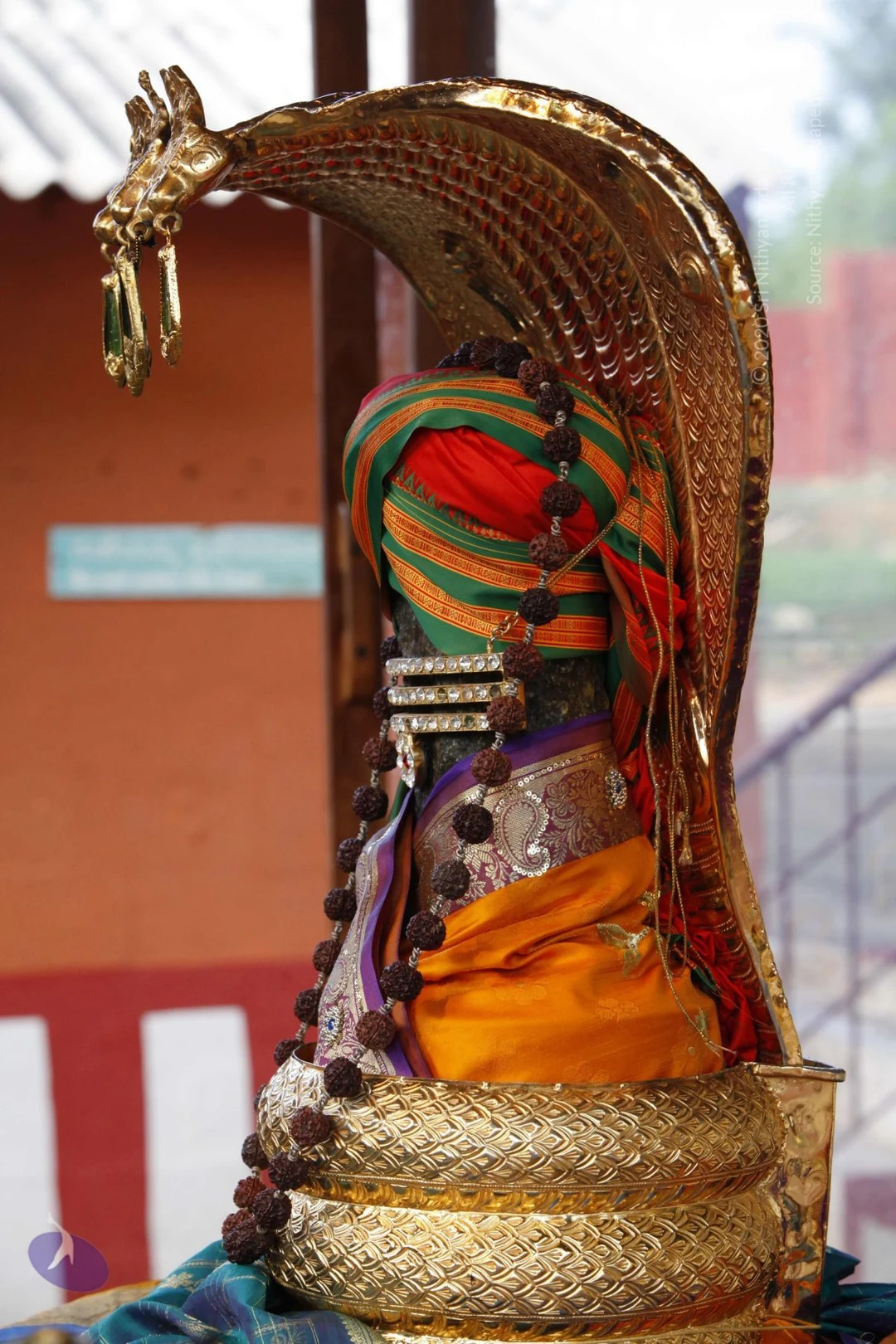
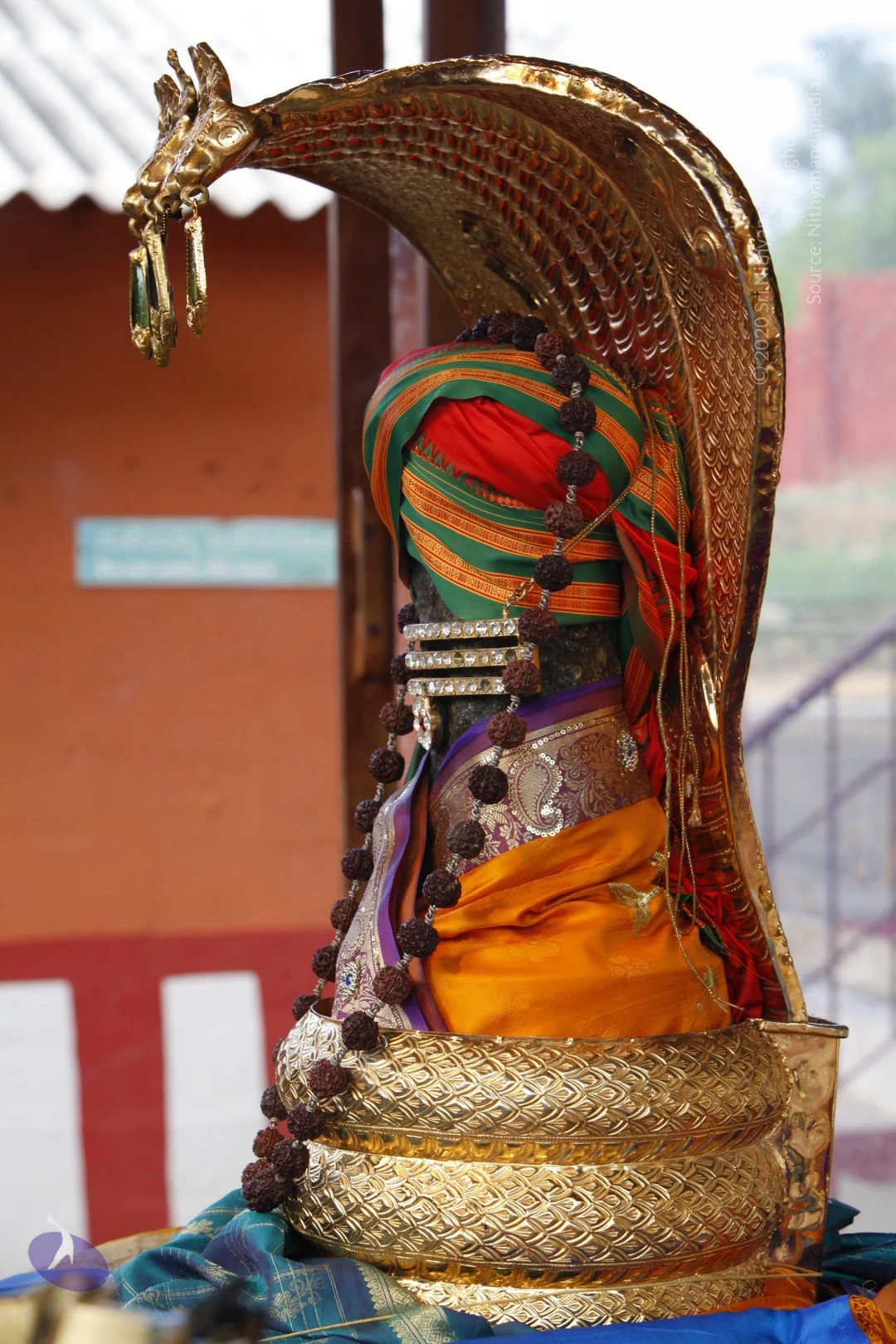
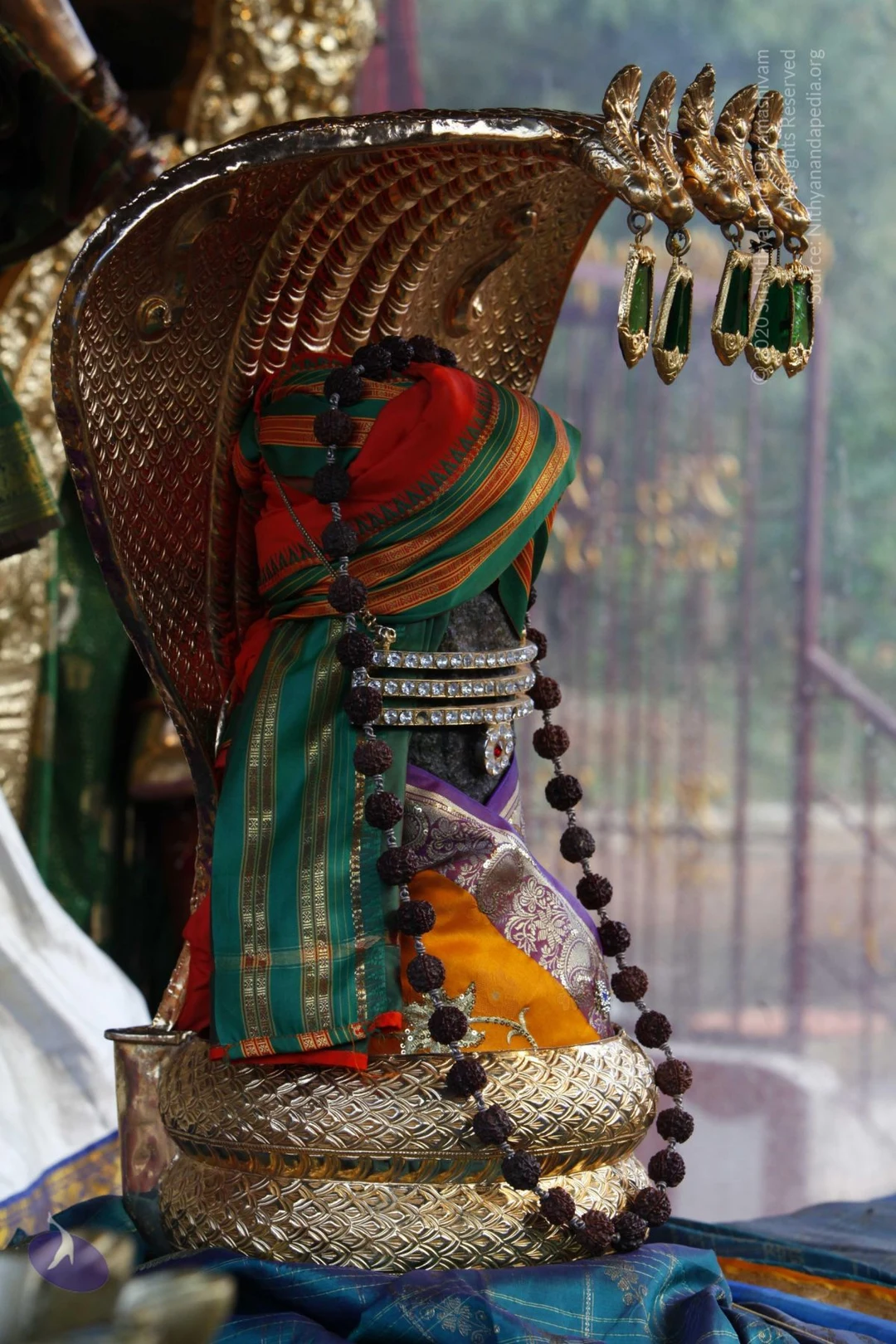
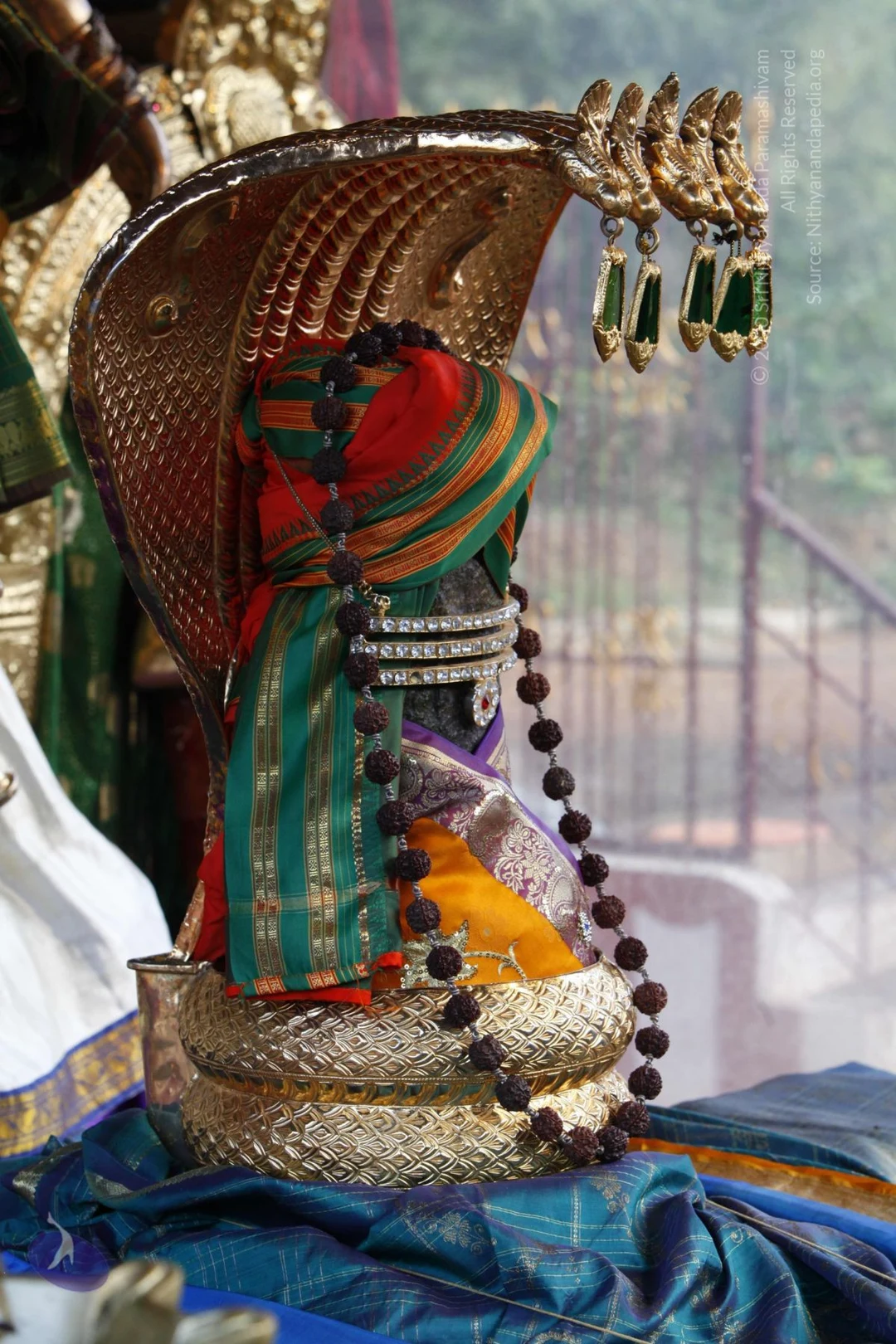
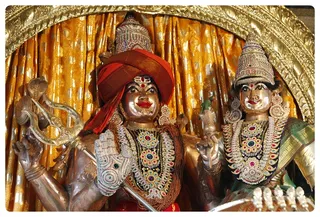
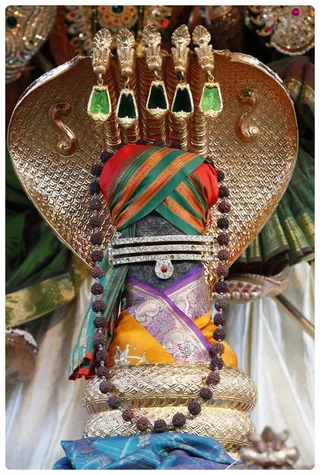
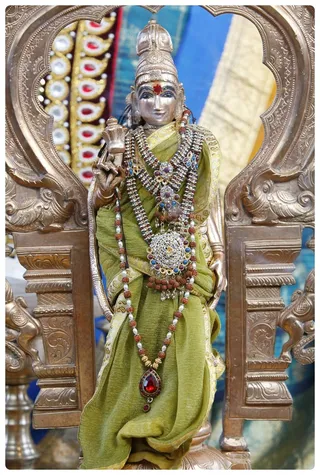
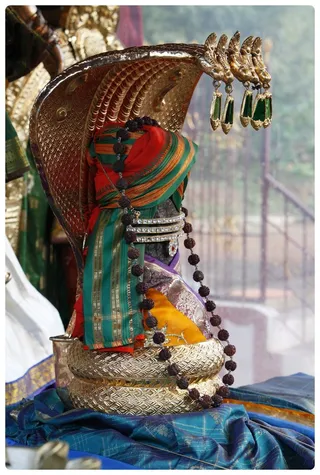
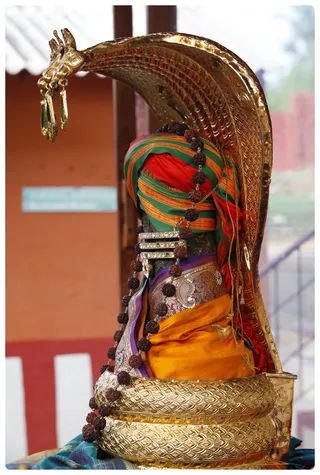
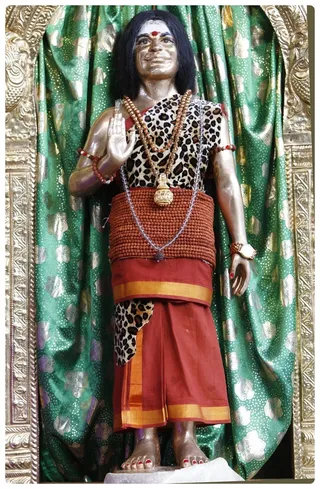
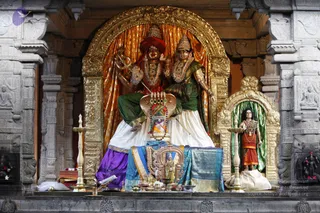
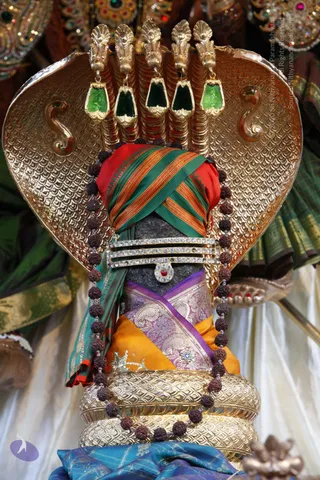
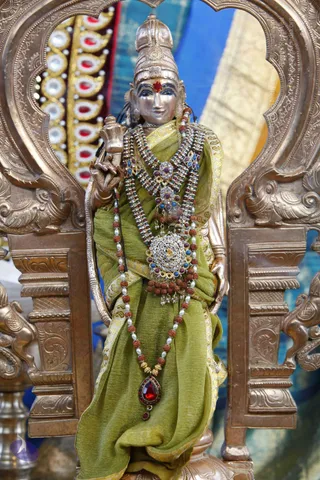
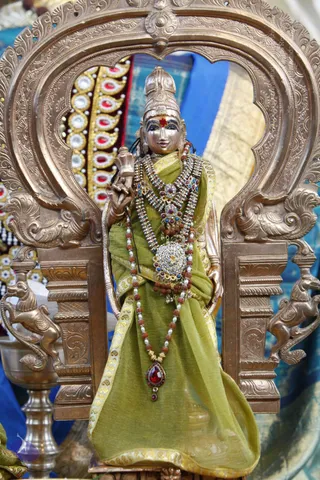
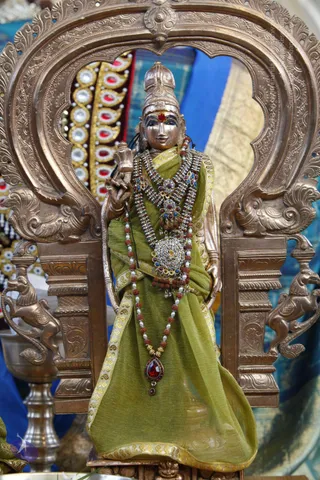
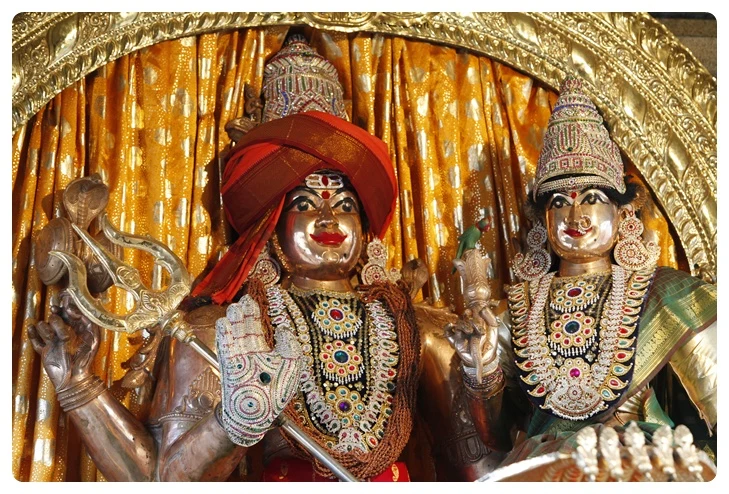
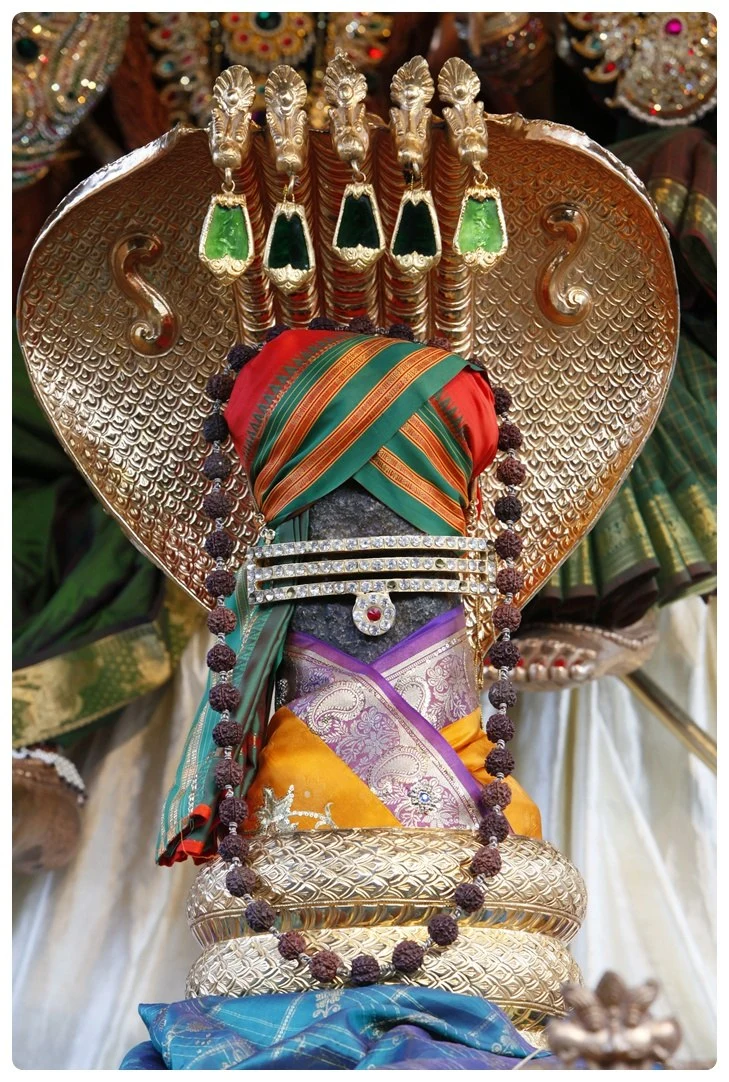
A photograph of two large metallic murti statues, a male and a female deity, placed in front of a shimmering gold curtain within an ornate gold arched frame. The male figure wears a red turban with a tilak mark on the forehead, holds a trident and an upraised hand, and is adorned with a jewelled multicolour necklace and a rudraksha-style mala. The female figure wears a tall jewelled crown, large earrings, layered gem-studded necklaces and a green silk garment. The statues are deity murti, not living people, so no physical people are present.A Shiva lingam wrapped in a red and green striped turban and draped in orange, purple and gold brocade, adorned with a rudraksha mala and a jeweled tripundra. Behind it rises a golden five-headed serpent hood with green gemstone drops, and a gold ornate base sits below. This is a deity murti dressed for worship, with no people visible.A silver deity murti stands within an ornate copper-toned temple arch framed by carved pillars and small lion-like figures. The murti wears a tall crown with a red tilak on the forehead, and a green sari with gold border. It is adorned with layered necklaces of colourful beaded strands, a large jewelled pendant, rudraksha beads, pearls, and a red gemstone drop. One hand holds a small object upright. Behind it hang a red and white mirrored embroidered fabric and blue cloth. Brass oil lamps stand at the lower left. No physical people are visible.A close view of a golden cobra-hooded deity murti or ceremonial image seated on a blue and gold silk cloth. The figure wears a green and red striped silk shawl draped over its shoulders, a rudraksha mala with dark seeds hanging across its chest, a jeweled bangle, and green-and-gold earrings. The large golden hood is engraved with scale patterns and rises behind the figure, with a gold-and-purple brocade waist cloth below. Behind it are a metal railing and blurred greenery.A photograph of a statue of a seated figure with no visible face, adorned for worship. The figure wears a green and red striped turban, rudraksha malas hanging across the chest, a gold and purple garment with an orange cloth draped over the lap, and a jewelled waist ornament. A gilded cobra hood with raised fangs and a coiled golden base rise behind and beneath it. The background shows an orange wall and a partially visible railing. No living people are visible.A life-sized golden statue stands in front of a green curtain patterned with gold flowers and an ornate gold frame. The figure has long dark hair, a red bindi, and a raised right palm in a blessing gesture. It wears a leopard-print shawl over the shoulder, multiple rudraksha malas, a large gold pendant, a red-brown rudraksha waist belt, and a red dhoti with gold border, with red bangles on the wrists. The statue is a depiction, not a physical person, so no living person is present.

Temple

15 photosSource gallery
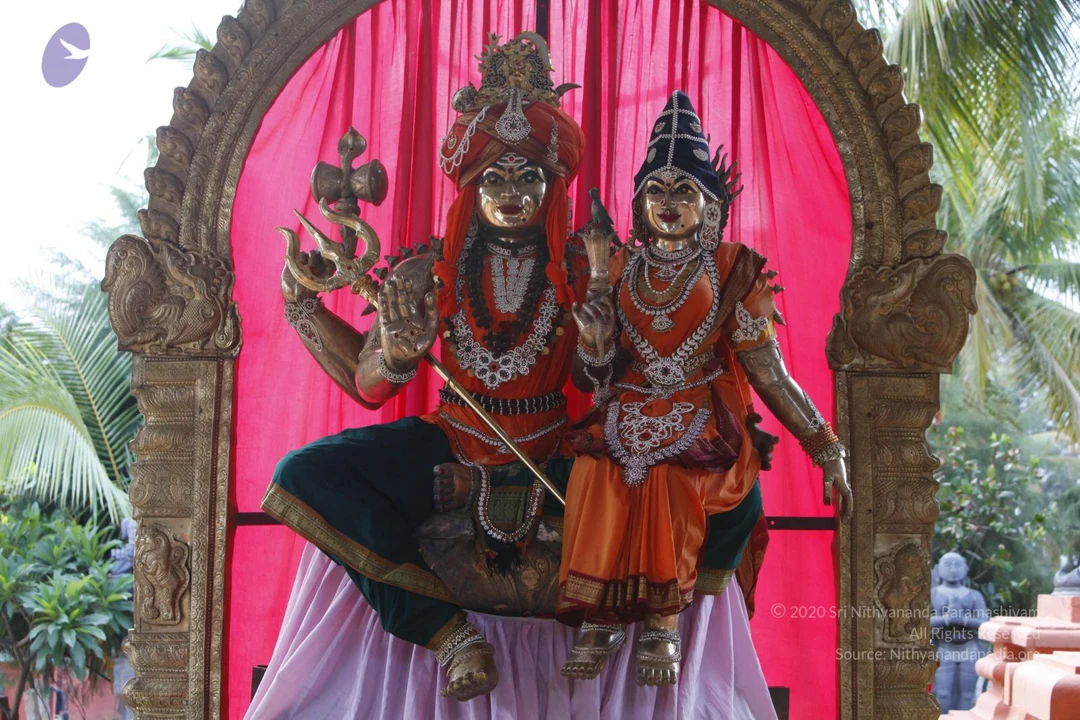
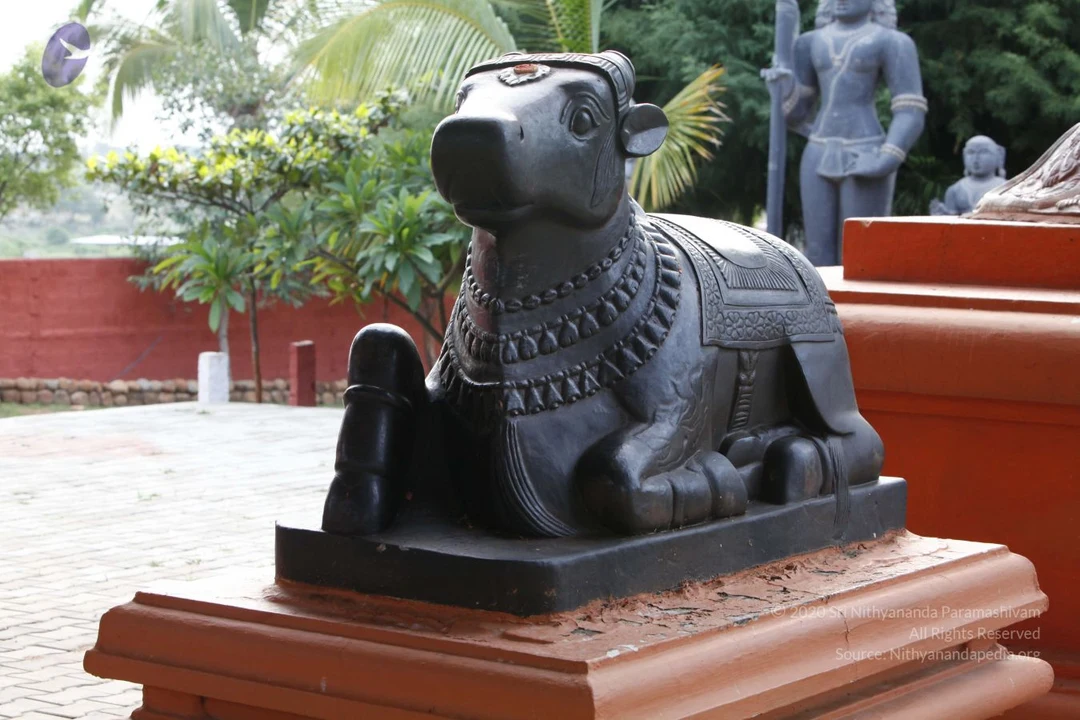
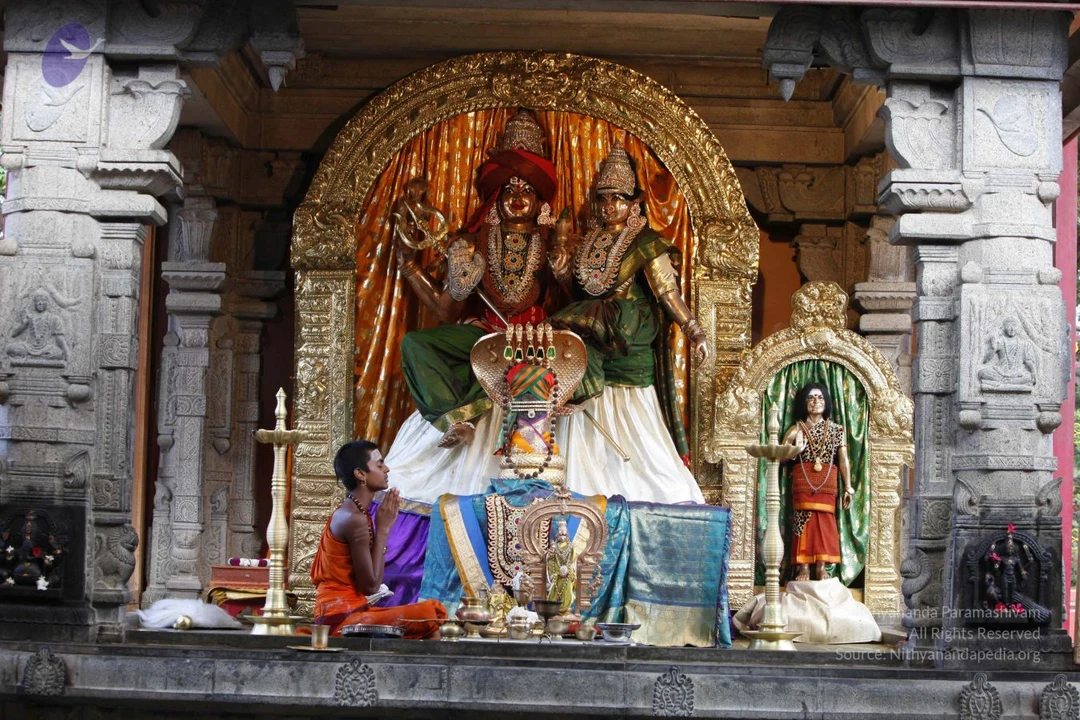
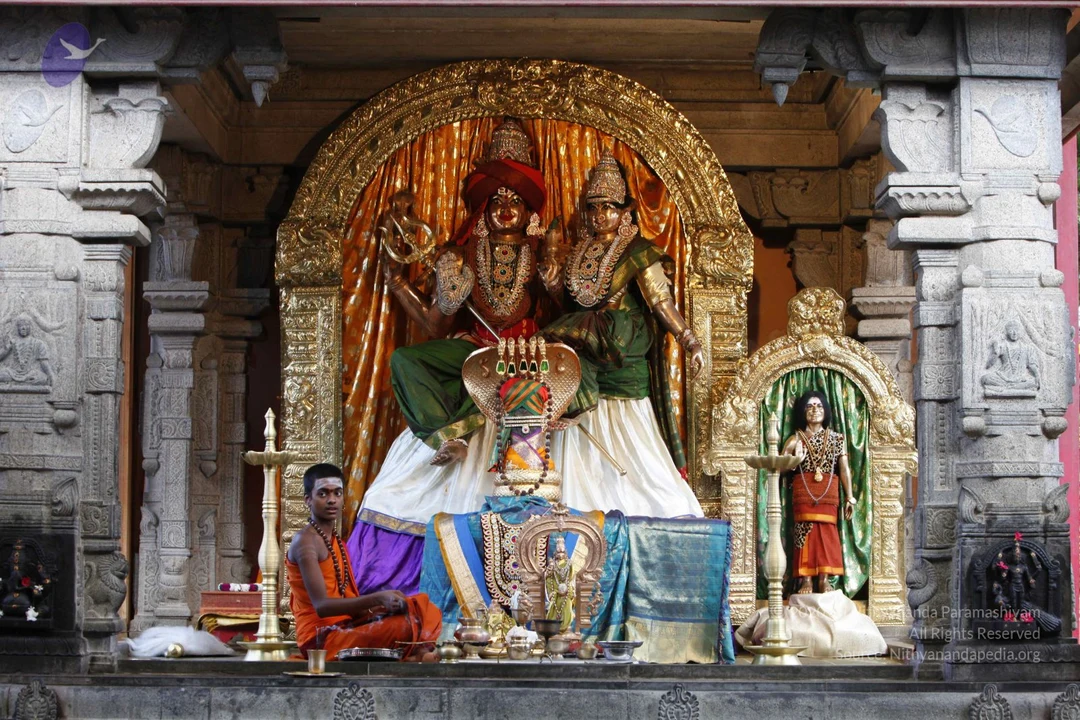
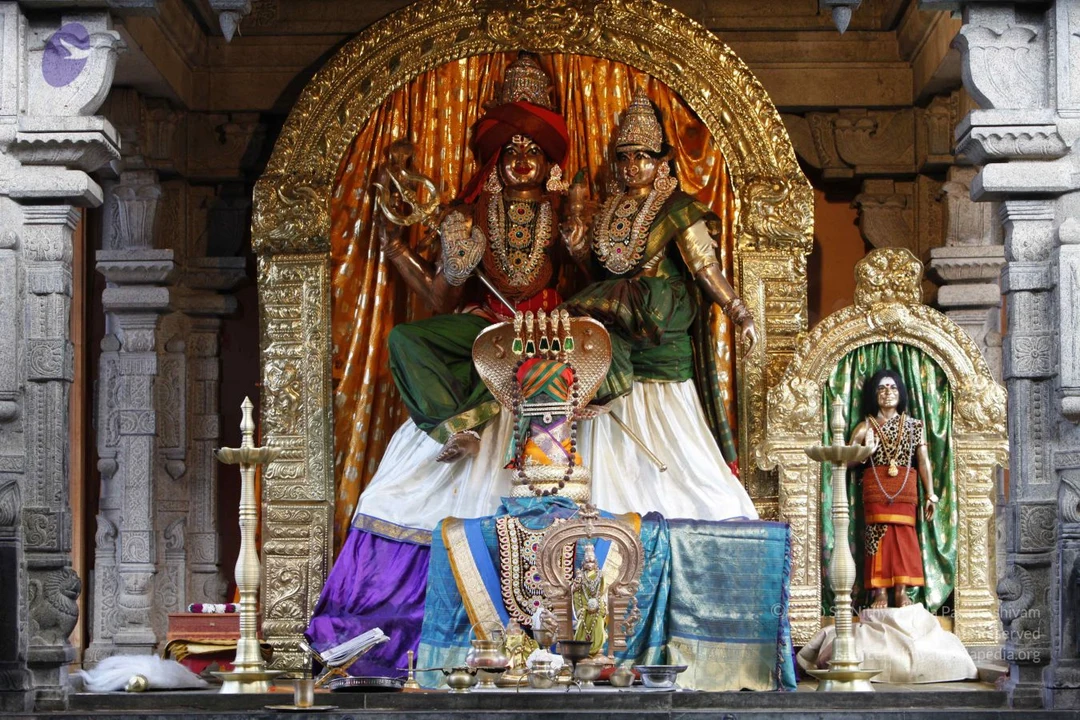
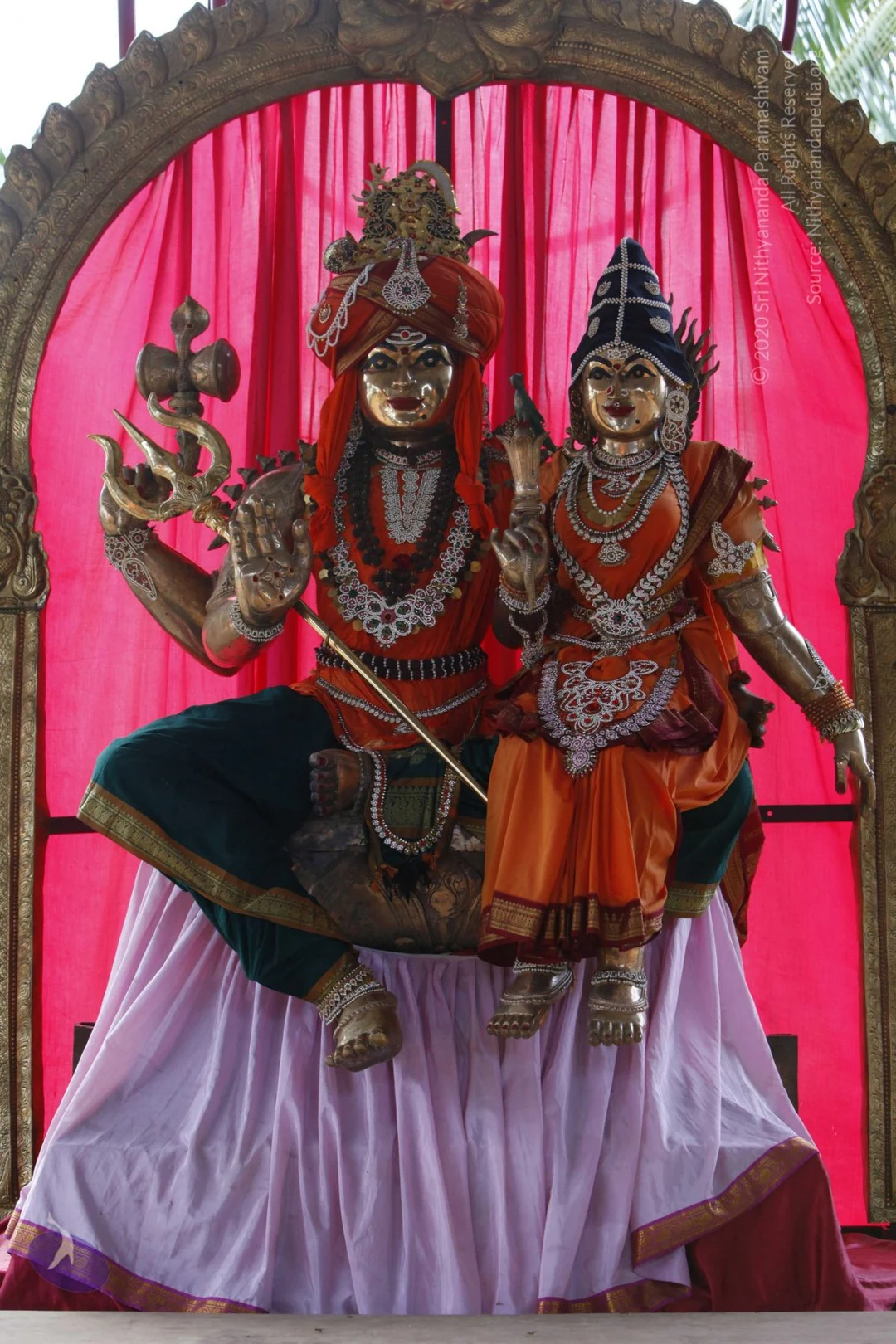
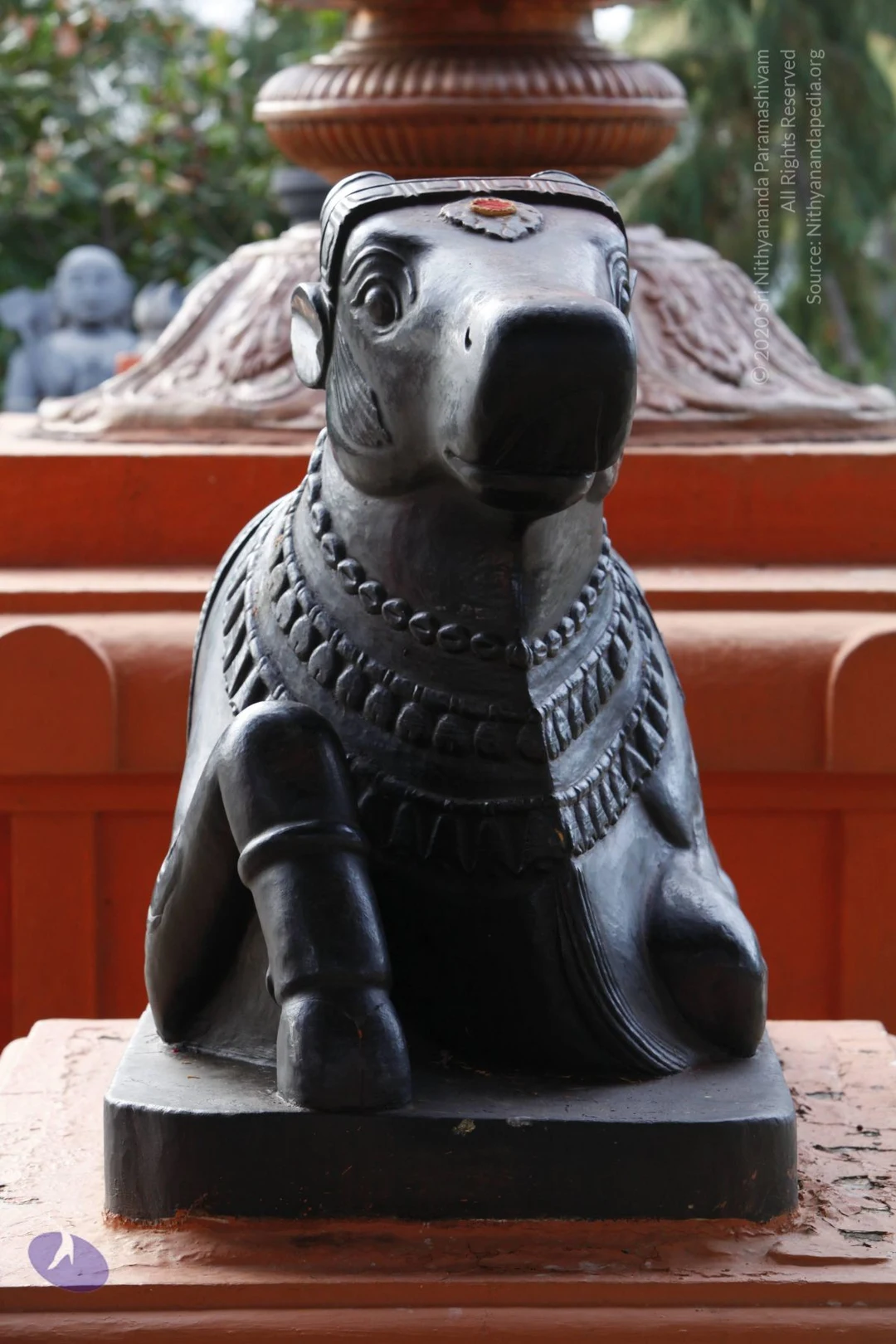
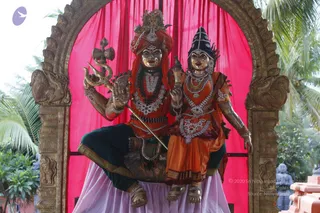
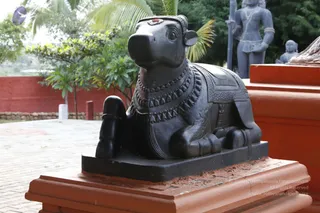
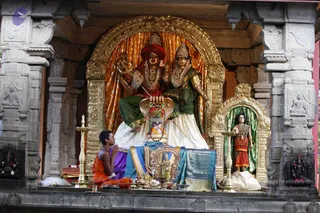
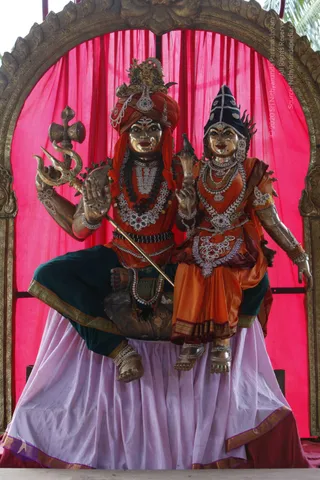
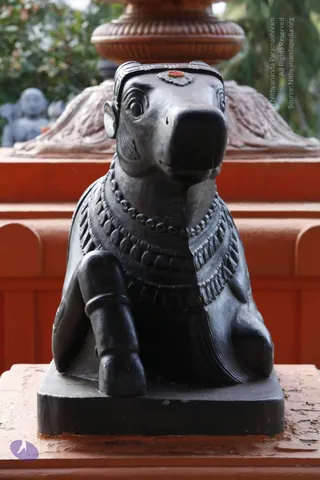
A photograph of two life-size golden statues of a deity pair seated together on a pale lavender draped pedestal in front of a deep pink curtain set within an ornate gold arched frame. The male figure wears a red-orange turban with a gold crown, rudraksha beads, white and gold necklaces and dark green trousers, and holds a trident. The female figure wears an orange sari, layered gold and white necklaces, a dark crown and armlets. Palm trees and greenery surround the display outdoors. Shiva-Parvati style deity murti form.A black stone Nandi bull statue sits on a red-painted pedestal in an outdoor temple courtyard. The bull wears a carved necklace of beads and pendants, a decorated cloth saddle with a patterned border, and a small ornament on its forehead. Behind it stands a grey statue of a deity holding a trident, with palm trees and shrubs beside a red boundary wall. No people are visible.A kneeling devotee in an orange cloth and rudraksha mala sits with palms pressed together before a large shrine of a seated deity pair decorated with gold-framed arch. The central seated figures wear red and green garments, crowns and ornate necklaces, one holding a trident-like staff. Brass oil lamps stand on either side, a silver kalasha and offerings rest on a draped blue and purple cloth, and a smaller standing figure in red and gold appears at right. Carved stone pillars frame the scene and a small shrine bell is visible at left. The devotee is performing puja.A temple shrine with a gilded arched niche framing a large deity murti of a seated pair of divine figures, one wearing a red crown and red garment with a green lower cloth and the other wearing a green garment and a tall crown, both adorned with beaded necklaces and holding ritual objects. In front stands an ornate throne-like seat with a blue and gold cloth. Oil lamps stand on either side. At the lower left a young priest in orange robes and a rudraksha mala sits beside the offerings, and at right a smaller figure stands in a green-curtained niche. The grey stone pillars are carved with reliefs. No living figure is clearly identifiable as a person; the statues and standing figure are sculpted images.A photograph of a temple shrine featuring a large seated deity murti of Shiva and Parvati on a throne-like platform, with a golden arched frame and orange drapery behind. The seated figures wear green and white garments, red and gold headdresses, and ornate jeweled necklaces; the male figure holds a trident. In front stands a carved silver-toned altar with a small figure and brass oil lamps, a kalasha and offering bowls on a blue and gold cloth. To the right, a smaller murti in a green-curtained niche wears orange and white clothing and a rudraksha-style mala, with a visible third-eye marking, and holds a staff.A temple shrine with a pair of large painted deity murti seated side by side under a gilded arch hung with orange and gold drapery. The figure on the left wears a red turban, a tall crown, a red-and-gold garland and a green-and-white dhoti; it holds a trident-like staff. The figure on the right wears a gold crown, a layered jewelled necklace and a green blouse with a white skirt. A small standing figure in an arched niche to the right wears an orange dhoti, a white shawl and a bead necklace, beside a brass oil lamp. Brass lamps, a metal kalasha and offerings sit on a stone platform draped with blue and gold cloth, and carved stone pillars frame the scene.

Paduka_Puja_Crowds_Individual
28 photosSource gallery
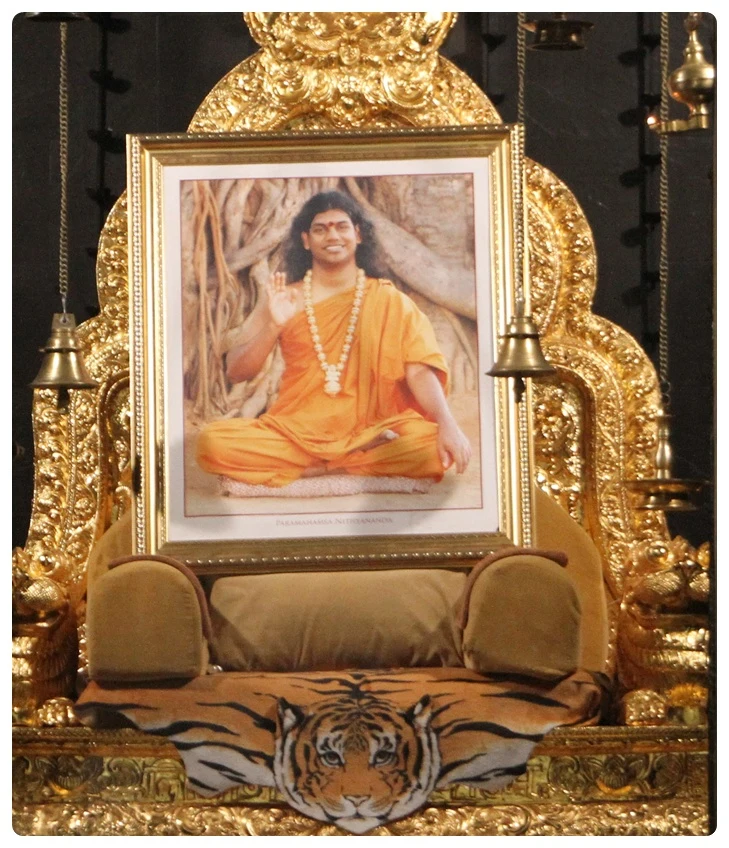
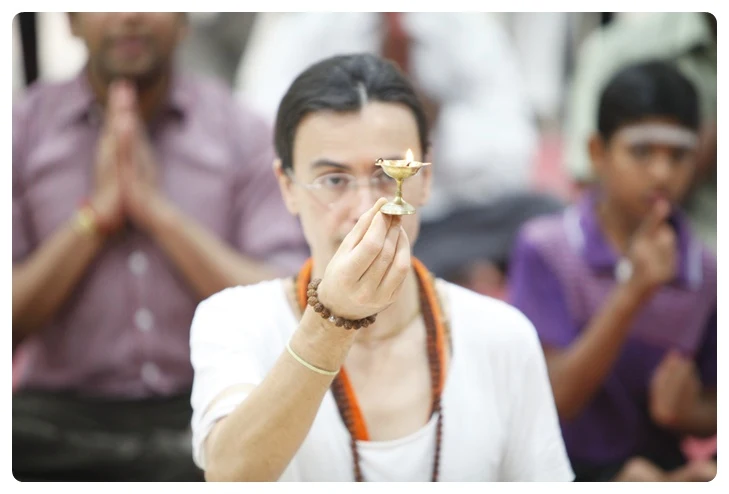
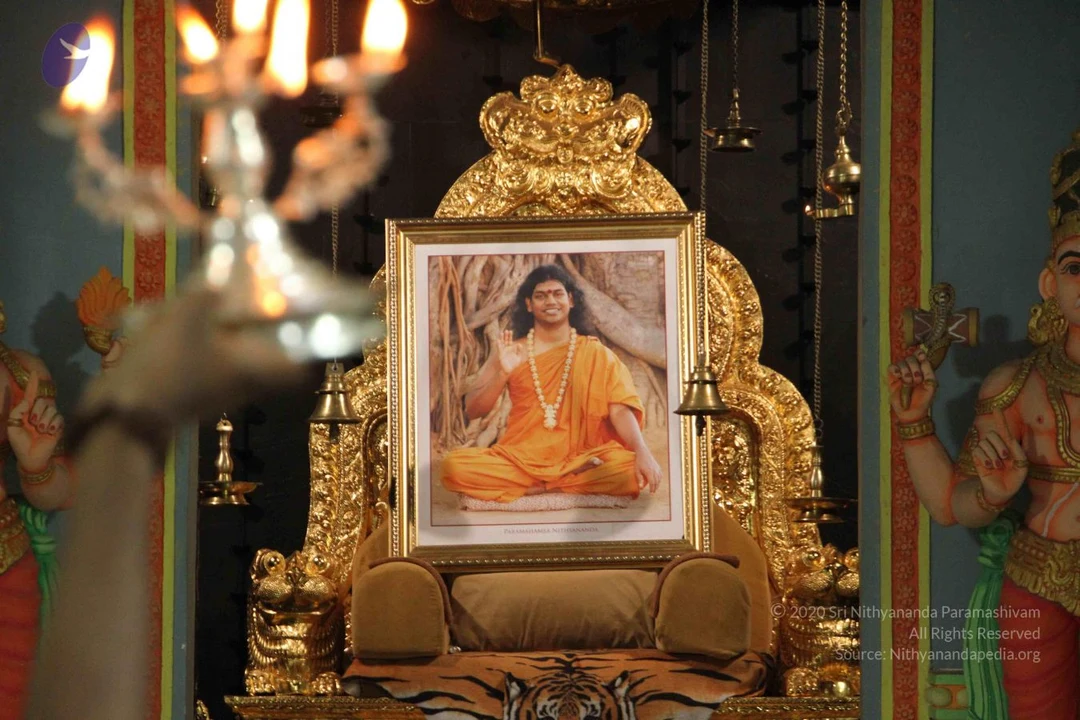
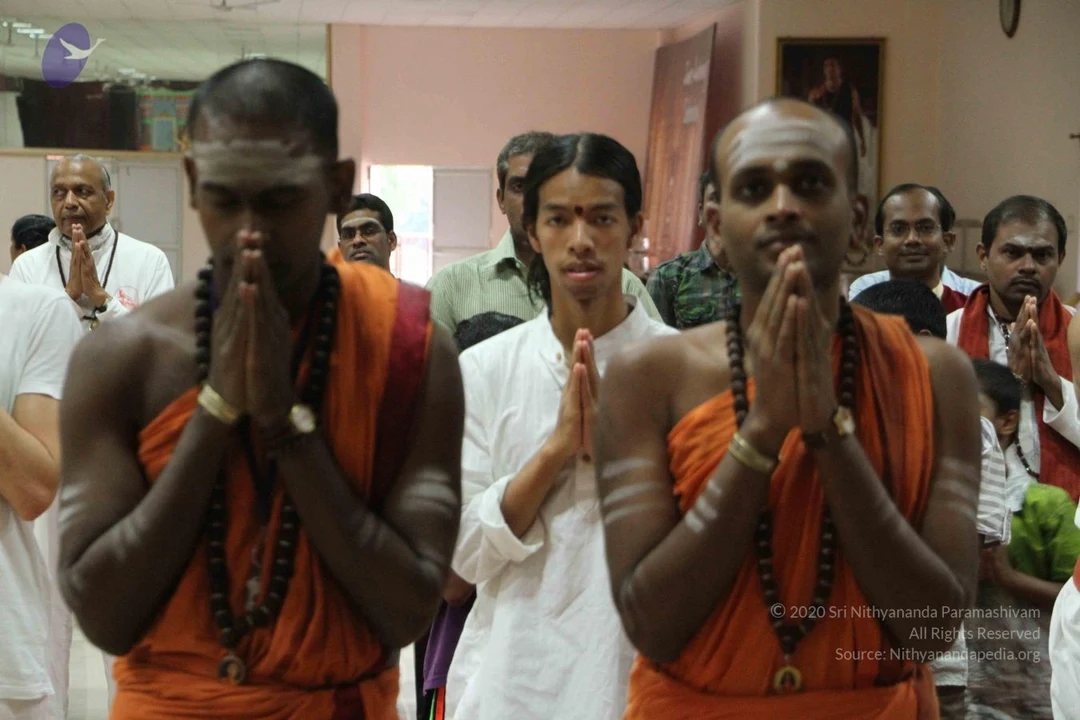
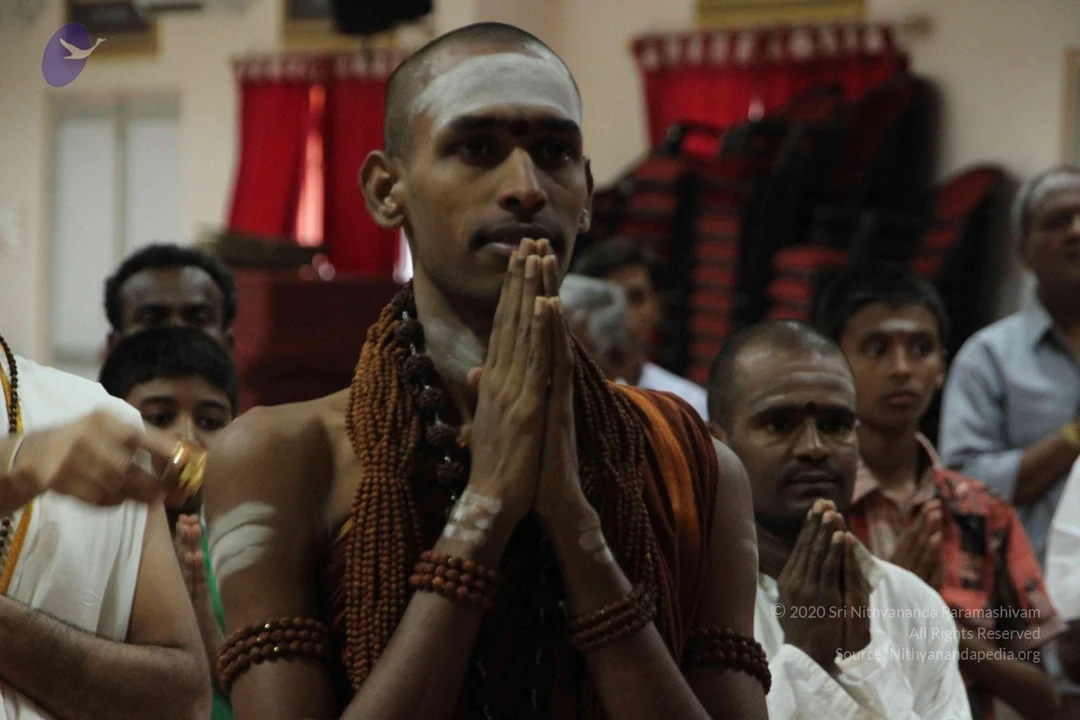
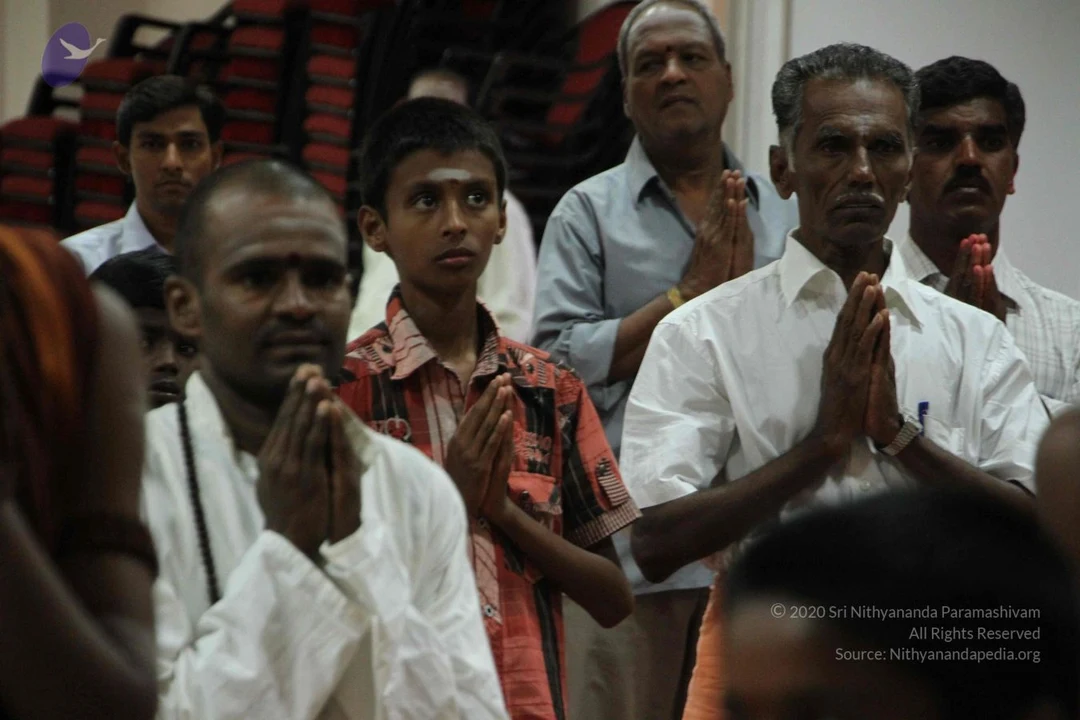
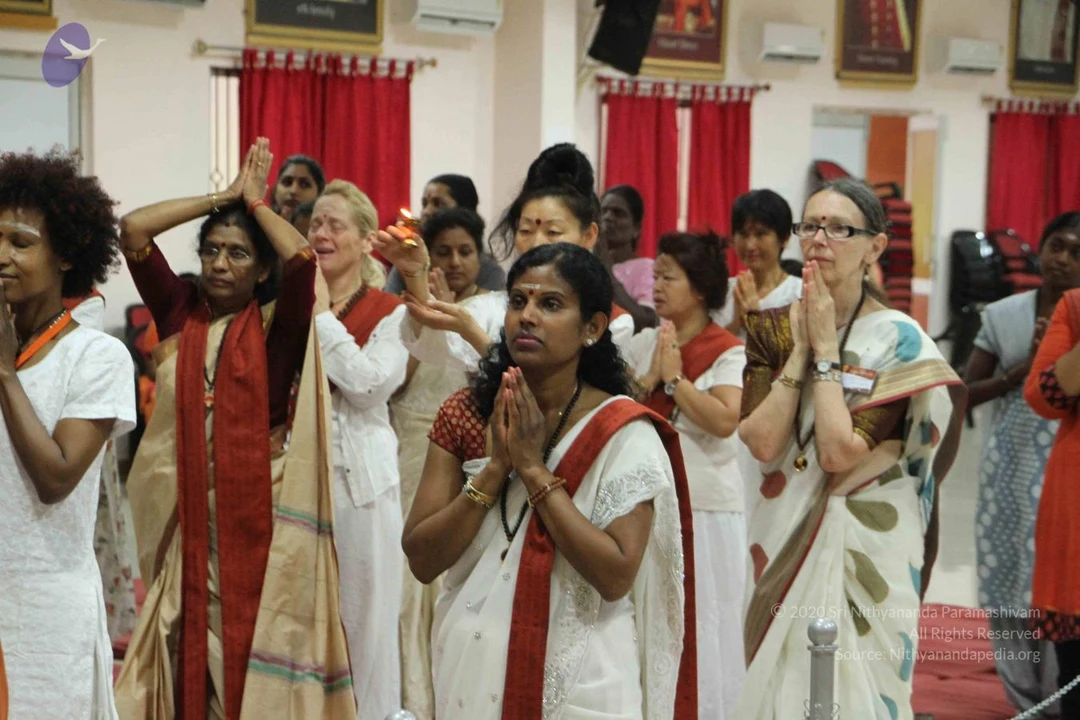
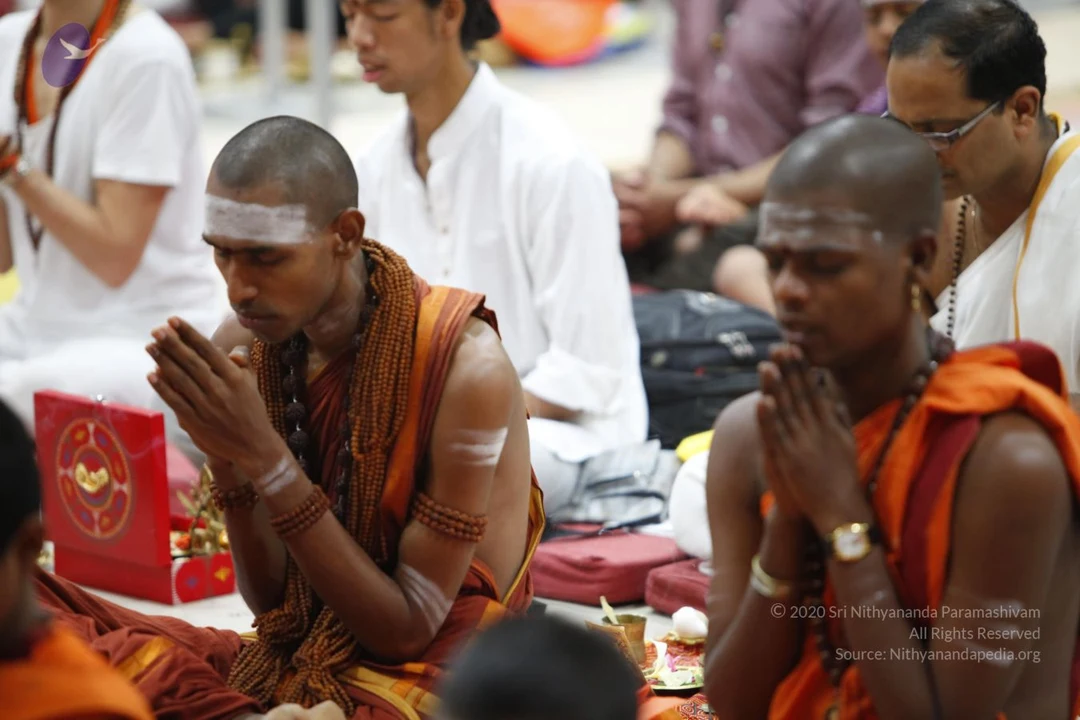
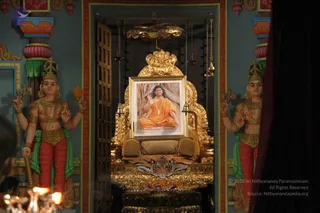
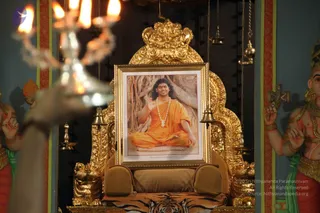
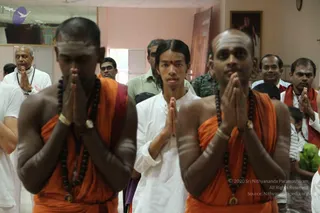
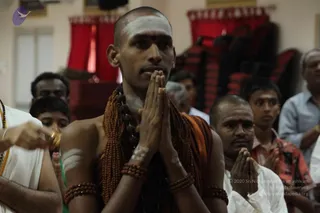
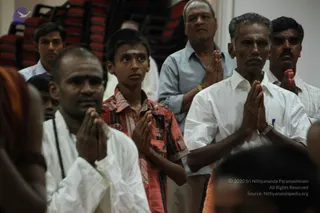
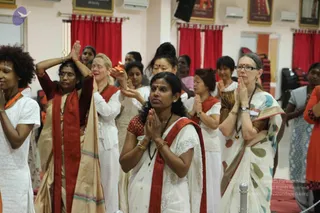
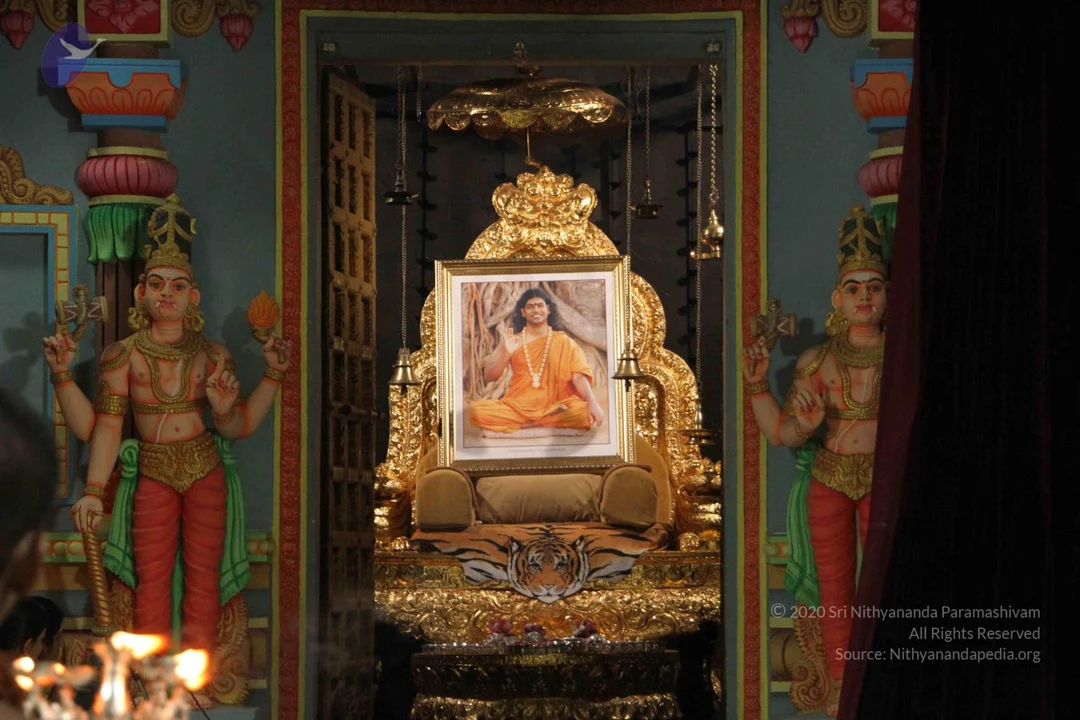
A framed photograph on an ornate gilded golden throne (peetha) inside a temple shrine, with a golden umbrella canopy and hanging bells above. The framed portrait shows a long-haired man in saffron-orange robes wearing a white bead mala, seated before a tree trunk with one hand raised in blessing. The throne is draped with a tiger-striped cloth. Flanking the shrine are painted guardian figures with multiple arms, gold crowns, gold jewellery and orange-red dhotis holding ritual objects. Oil lamps burn in the lower left foreground and a few devotees' silhouettes are at the edge. The portrait is a depiction, and the scene contains no visible living person at the throne.A photograph of an ornate golden throne (peetha) in a temple-style shrine, set against blue-grey walls with red and green borders. The throne holds a framed portrait of a seated man in saffron-orange robes with a white flower garland, right hand raised in blessing, seated before a large banyan tree trunk. The throne is draped with a brown velvet cushion and a tiger-striped cloth. Lit oil lamps (deepa) burn in the foreground, and hanging brass bells dangle from the chains above. Carved stone or painted dvarapala-style guardian figures with crowns and jewelry flank the throne on both sides. No physical people are present in the frame. The portrait is printed, labelled 'Paramahamsa Nithyananda' on its lower edge, and the depicted man is therefore a printed portrait rather than a physical person in the scene.Photograph of an indoor satsang hall with devotees in prayer. In the foreground, two shaved-headed sannyasis in saffron-orange robes with rudraksha malas stand with palms pressed together in anjali mudra, their foreheads marked with white lines. Between them stands a young man in a white kurta with a red tilak and long hair. Behind them, a man in white with a shawl and mala also holds anjali, and several devotees in white, green and red-bordered shawls stand in the background. A framed portrait hangs on the wall at upper right, and a tall red-and-cream banner hangs nearby.A photograph of a satsang gathering in a hall with red curtains and rows of red-cushioned chairs in the background. In the centre, a shaved-headed man with white paste marks on his forehead and arms wears a saffron-orange cloth draped over his shoulders, many strands of rudraksha beads around his neck and rudraksha bracelets on his wrists. He stands with palms pressed together in anjali, a devotional gesture. Around him, devotees in white dhotis and collared shirts also stand with hands folded, including a man in white on the right and a boy in a red-patterned shirt behind him. Some attendees on the left wear white dhotis and sacred threads.A photograph of devotees in a seated hall with folding chairs in the background, several standing with palms pressed together in anjali mudra. In the foreground, a man with a shaved head wears a white garment and a dark beaded mala. Beside him, a boy in a red-and-white checked shirt has a tilak on his forehead. An older man in a white shirt and a man in a light blue shirt with a yellow wristband stand nearby, also with hands folded. A partial view of an orange-clad figure appears at the left edge. a person is not clearly visible in the frame.A photograph of devotees standing with palms pressed together in prayer during a satsang-style gathering in a bright hall with red curtains and framed pictures on the walls. A woman in front wears a white sari with a red border and red shawl, with a bindi and beaded necklace, eyes closed. Beside her, a woman in a cream sari with dark patterned border holds her hands together, and others in white outfits with red shawls and rudraksha-style beads stand around them. A woman at the left has hands raised above her head in namaskar, and a devotee at the right holds a lit oil lamp. No prominent figure in saffron is visible.

Satsang_Swamiji
7 photosSource gallery
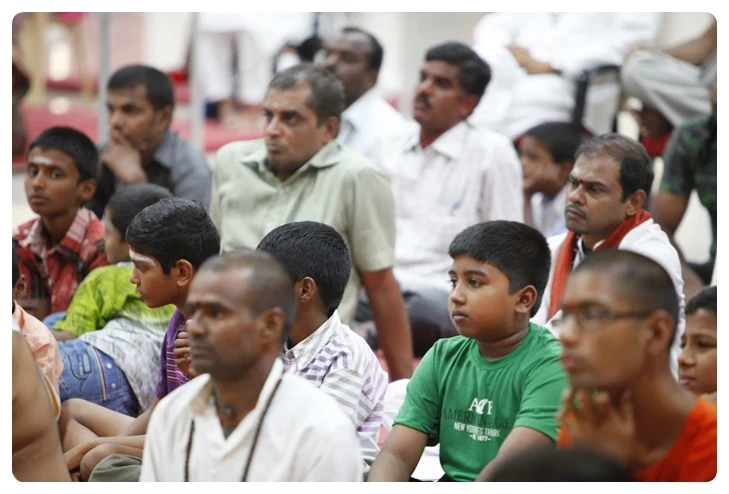
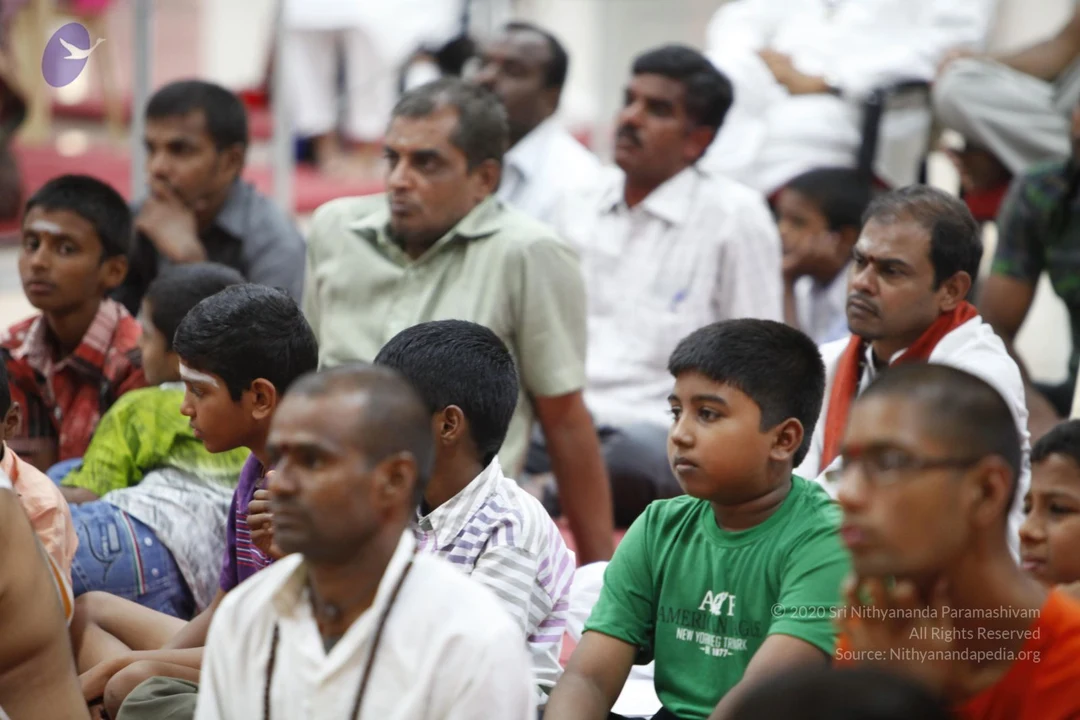
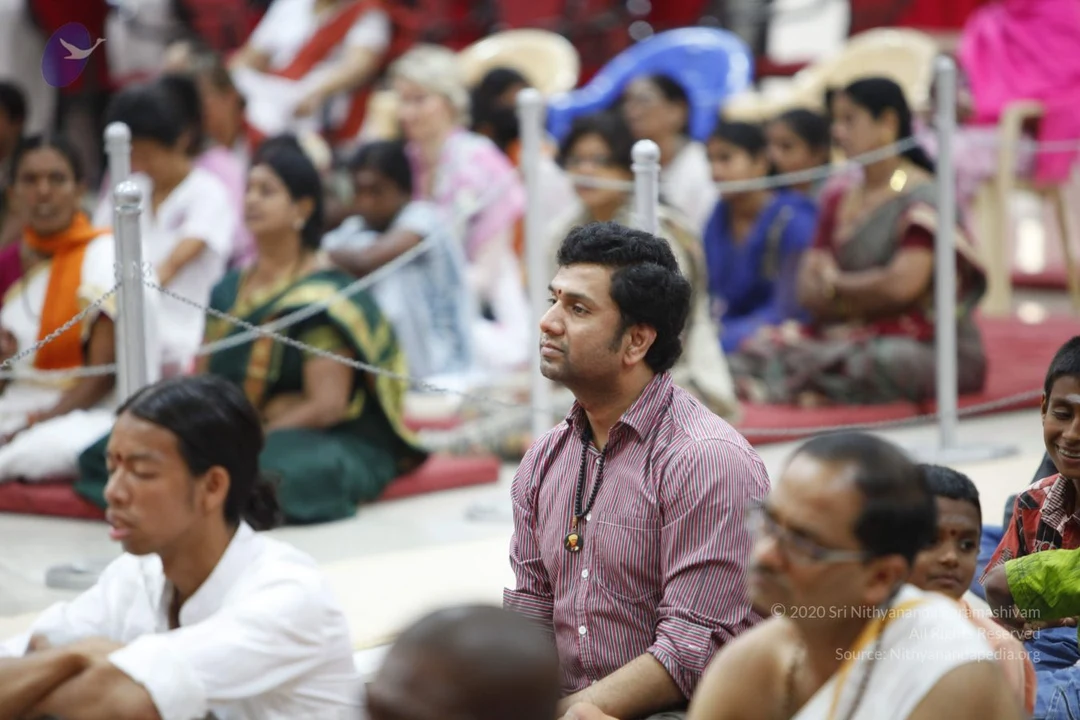
A smiling man in saffron-orange robes sits cross-legged on an ornate gold throne carved with lion motifs and red velvet cushions. He wears a long golden bead necklace over a rudraksha-style mala, gold bangles on his upper arms and wrists, gold hoop earrings, and a red bindi. A small lapel microphone is clipped near his face. Gold lion statues flank the throne, and a painted deity figure with raised hands stands at the left edge.A seated audience at a satsang gathering, viewed from the front rows. In the foreground a shaved-headed man in a white shirt sits with a cord around his neck, and an orange-robed person with glasses is at the right edge. Behind them a boy in a green AMERICAN GIRL-style t-shirt watches attentively, with other boys and men in pale shirts, one man wearing an orange shawl, and a man in a green collared shirt. Several attendees are visible, including a boy with a white forehead mark, and a red carpeted floor with white walls behind them.Seated devotees fill a hall during a satsang. In the centre, a man with short dark wavy hair wears a red and white striped button-up shirt and a dark bead mala around his neck, sitting upright with eyes lowered. To his left, a young man in white clothes sits with eyes closed. Behind them, women in saris, including one in green and gold and another in maroon, sit on red mats beside metal stanchions and a chain barrier. A man with glasses in a white shirt sits in the foreground and a child smiles at right.A smiling man sits on a red velvet seat in front of an ornate gold-leaf throne backdrop with carved scrollwork and mythical lion figures. He has shoulder-length dark hair, a red bindi on his forehead, and wears an orange-brown saffron-toned drape over bare shoulders with a gold-trimmed edge. A thick necklace of gold beads and rudraksha-style beads hangs on his chest, with gold bangles on his upper arms. A small headset microphone is visible near his face. a person, seated in a ceremonial role on a throne-like seat during a satsang-style event.A smiling man with long swept-back dark hair and a red bindi sits on an ornate golden throne carved with lion and floral motifs. He wears an orange-saffron cloth draped over one shoulder, a thick rudraksha-style mala necklace in mixed beads, large gold ceremonial beads, gold armlets on both upper arms, and a small gold hoop earring, with a headset microphone near his face. He holds one hand resting on a red cushioned armrest.A smiling man with long dark hair sits in front of an ornate gold throne with repoussé carving. He wears a red bindi on his forehead, gold hoop earrings, a wired microphone at his ear, a rust-orange shawl over bare shoulders, a gold-trimmed saffron cloth, and multiple strands of gold beads and rudraksha-style mala necklaces, plus gold armbands. Swamiji (probable): long swept-back hair, saffron clothing, ceremonial gold necklaces and a throne seat, matching the page's claim of his presence at a satsang.

Swamiji_SLE_Book_release
15 photosSource gallery
A seated man in a golden-brown saffron-orange robe speaks during a satsang on a large gilded throne with carved lion heads and red velvet cushions. He wears a long gold bead necklace, layered rudraksha mala, gold armbands and a red bindi, and holds a small red-and-gold book and a foil-wrapped item on his lap, with a tiger-striped cloth beneath him. Flanking the throne are two painted deity murti figures with multiple arms, crowns, gold jewellery and red-and-green dhoti, one holding a flame and the other a trident. a person cues: long swept hair, rudraksha mala, ceremonial gold necklace and saffron robe, seated on the throne as the speaker.A seated man in saffron-orange robes sits on an ornate golden throne with a large gilded arched backrest and red velvet cushions, flanked by golden lion-shaped armrests. He smiles broadly, holding up a red-and-gold book with the printed title and a portrait of a smiling figure in orange turban. He wears a rudraksha mala with gold beads, a gold armband, bangles, a red bindi and a small earpiece microphone. Behind him stand painted deity figures holding a flame and a ritual implement. A foil packet and gold wrapping lie on his lap. Swamiji (probable): long swept-back hair, saffron robes, rudraksha mala and gold ornaments on the seated presenter, shown in satsang on the throne.A smiling man with swept-back long dark hair and a red bindi sits on an ornate gold throne with red tiger-striped upholstered armrests. He wears a rust-orange robe, a thick ceremonial gold bead necklace over a brown woven rudraksha-style mala, gold bangles and an armlet, and a small microphone clipped near his face. He holds up a book titled The Science of Living Enlightenment, whose cover shows a smiling person in an orange turban.A smiling man with long dark hair, a red bindi and gold hoop earrings sits on an ornate gilded throne with a red cushion. He wears an orange-brown robe, a long gold bead necklace and a rudraksha-style mala, and a gold armlet, and holds up a book titled The Science of Living Enlightenment by Paramahamsa Nithyananda, whose cover shows a smiling figure in an orange turban. A small microphone is clipped near his face. a person appears in person, seated in the satsang setting.A smiling man with long dark hair and a red bindi on his forehead sits before a gold, ornately carved backdrop. He wears a rust-brown and ochre garment, a long chunky beaded necklace of gold-toned and brown beads, gold hoop earrings, a headset microphone and gold bangles on his upper arm and wrist. He holds up a book titled "The Science of Living Enlightenment" by Paramahamsa Nithyananda, whose cover shows a smiling figure in an orange turban. A red tiger-striped cushion is visible at the right edge. The man appears to be a probable Swamiji based on his long swept-back hair, ornate gold jewellery, saffron-toned clothing and rudraksha-style beads, and is shown in person presenting the book.A man seated on an ornate gold throne with red cushioned armrests holds up a book titled "The Science of Living Enlightenment" toward the viewer while smiling. He wears a rust-brown saffron-toned robe, a multi-strand rudraksha mala with gold-toned beads, bead armlets and bangles, hoop earrings and a small red bindi, with a headset microphone at his ear. The book cover shows a portrait of a smiling figure in an orange turban. The background is a gilded carved arch.

Sarva-Darshan
10 photosSource gallery
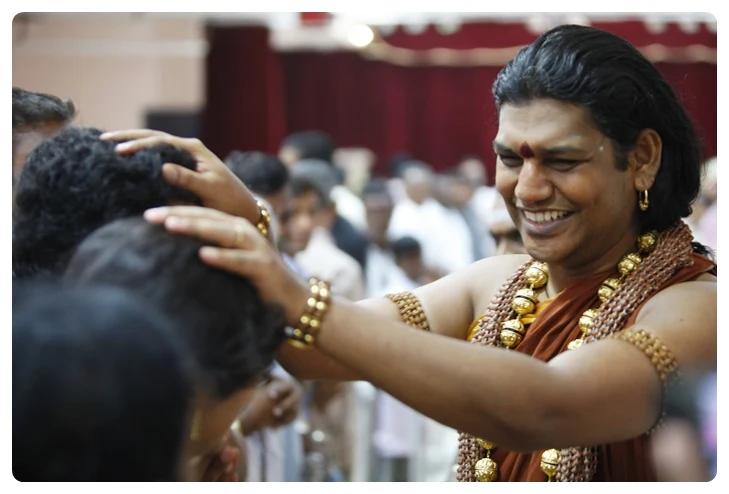
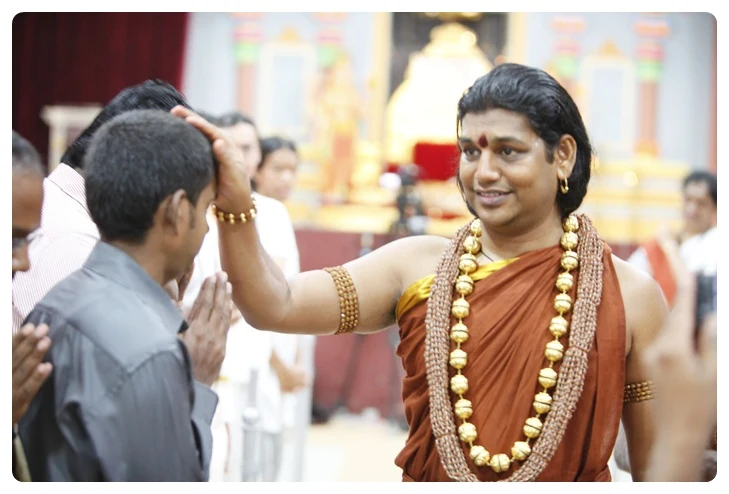
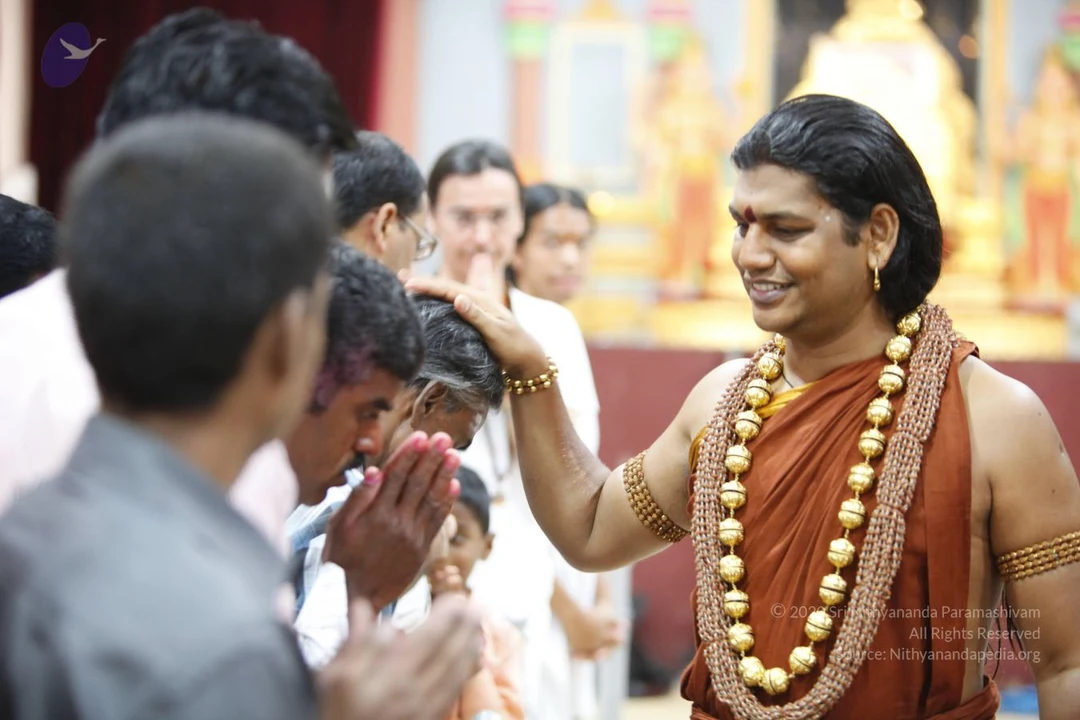
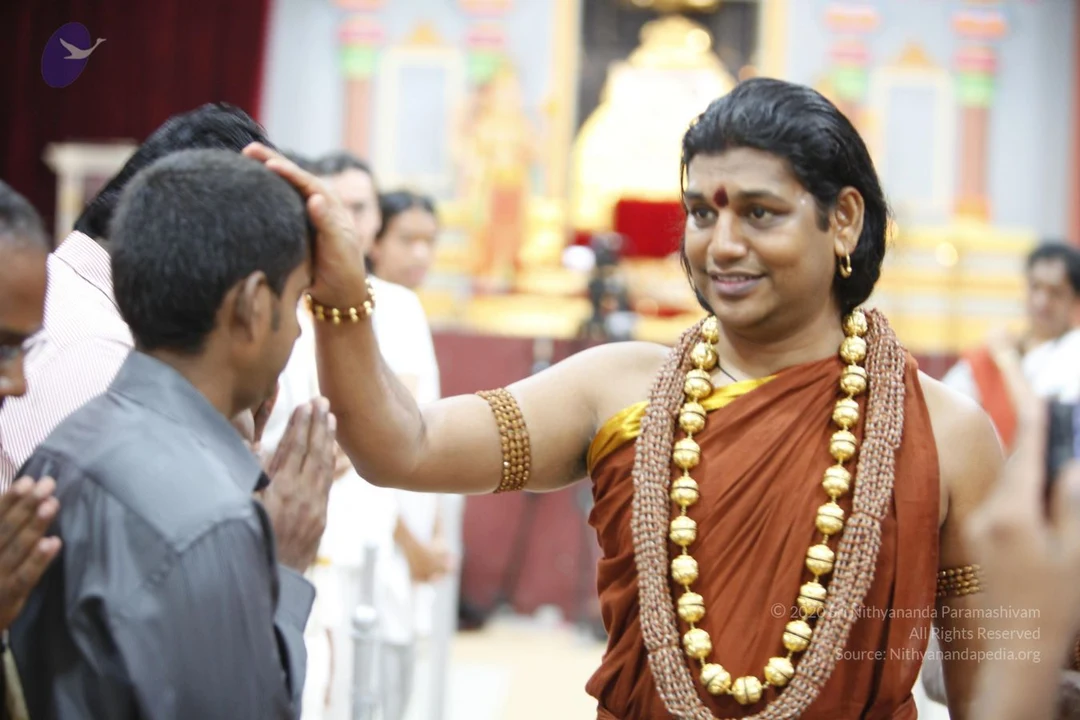
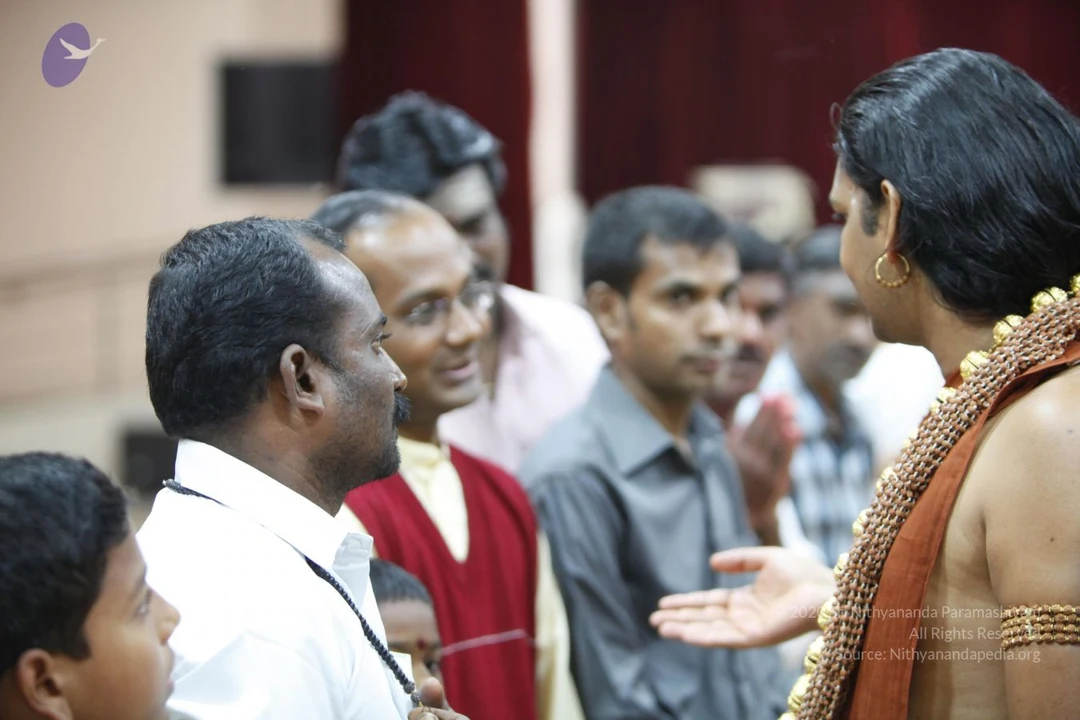
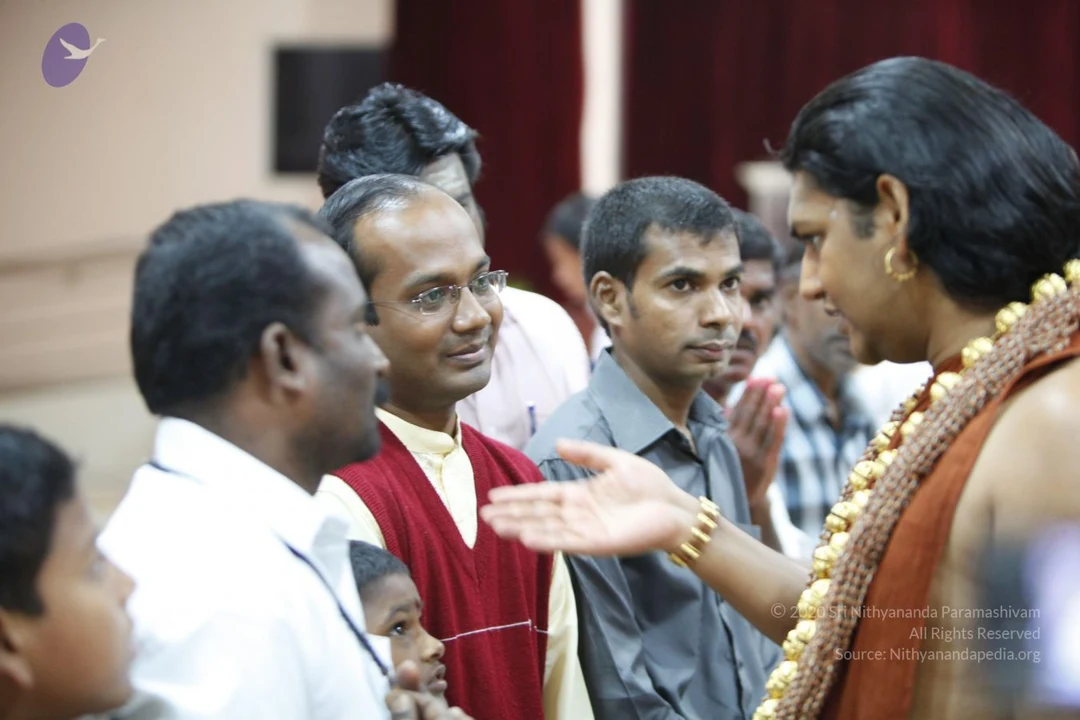
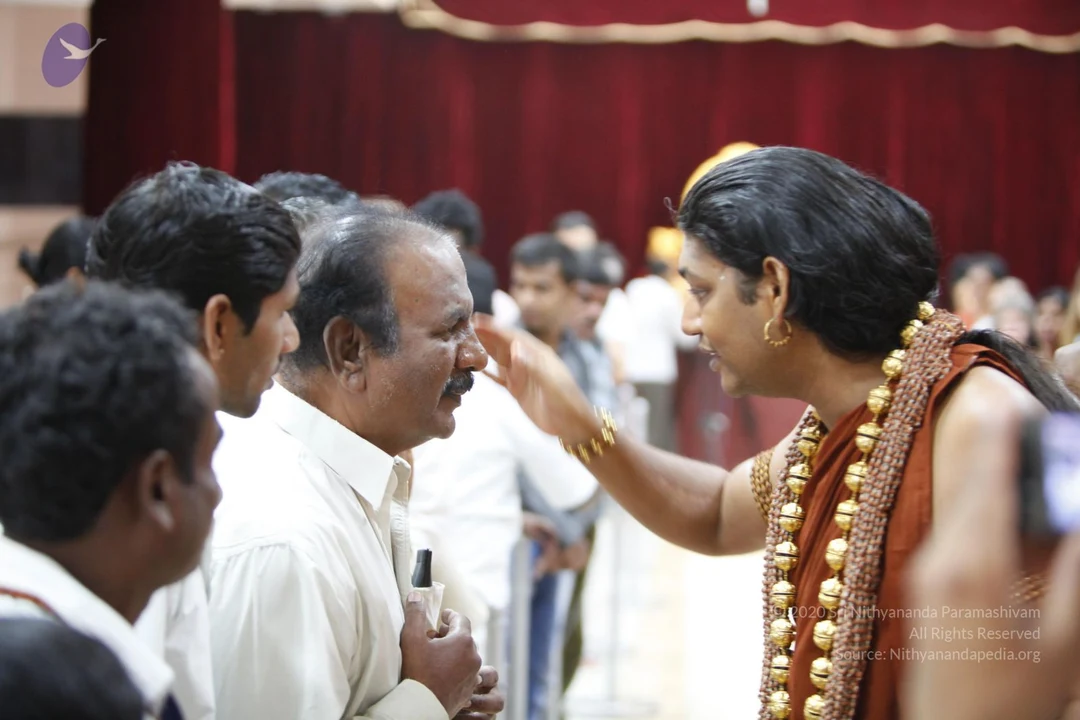
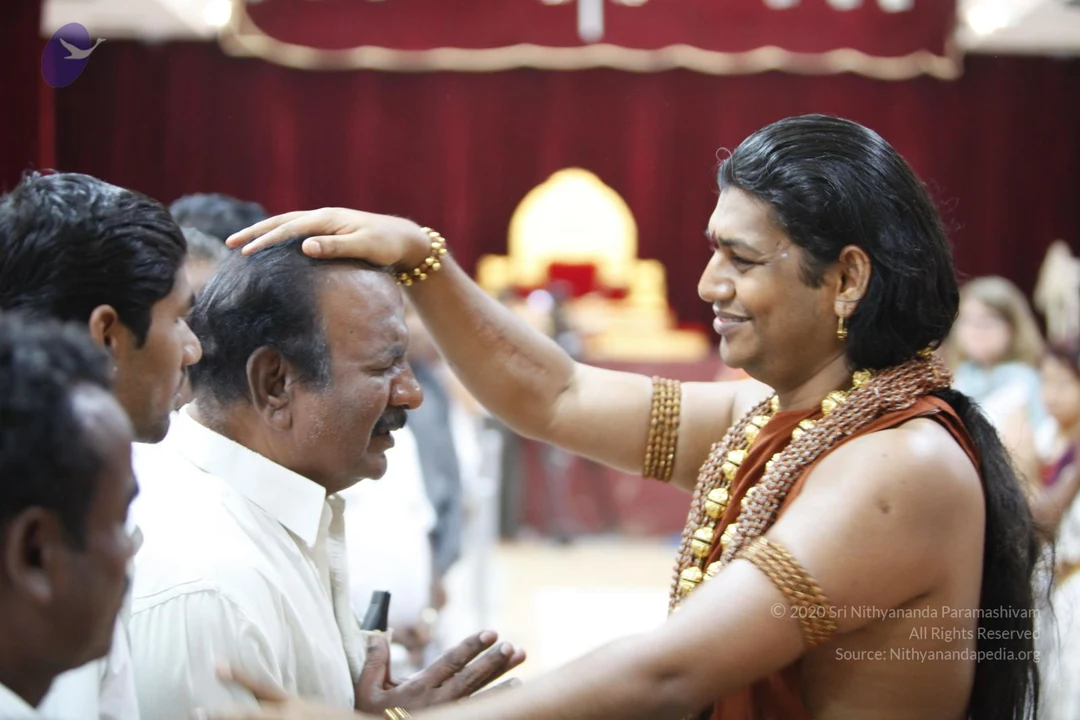
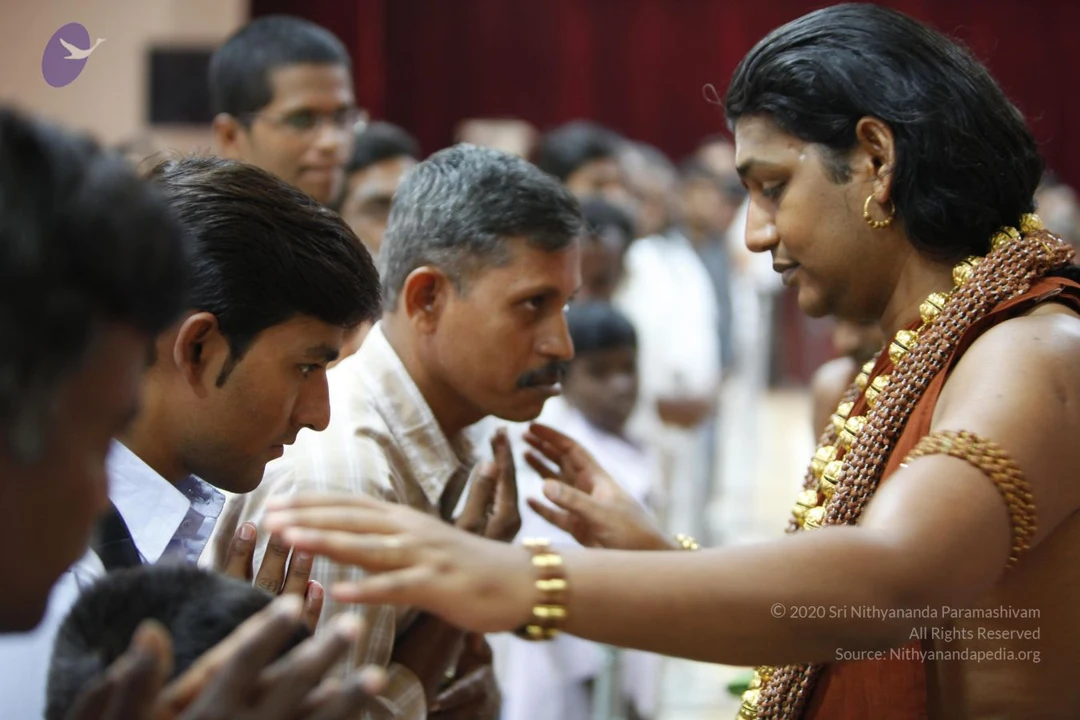
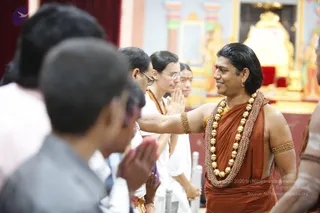
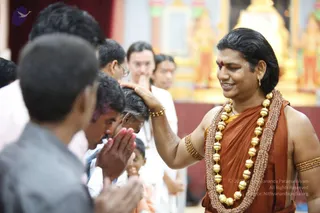
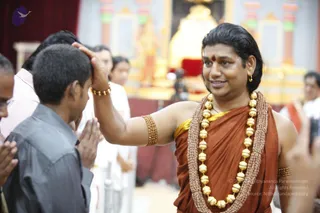
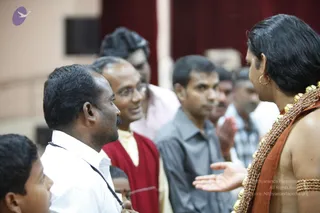
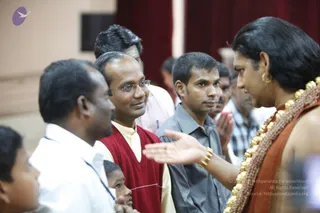
A photograph of a devotional darshan line in a temple hall. A man with long swept-back dark hair, wearing a rust-orange shawl and orange dhoti with gold borders, a large gold-beaded necklace and a rudraksha-style mala, extends his hand in blessing toward devotees. Several people in front, including a woman in a white sari and a man in glasses, press palms together in anjali. Behind him stand a man bare-chested with an orange cloth and a man holding a garland. In the background are golden deity murti and decorated gold-and-red temple shrine panels. a person appears to be the blessing figure in orange robes with distinctive long hair and ornate gold necklace, giving darshan.A photograph of a satsang hall where a man with long swept-back dark hair, wearing a saffron-orange dhoti and wrap, a heavy gold-beaded rudraksha-style necklace and gold armlets, stands at the right with his right hand extended toward devotees. Swamiji (probable) is shown with long swept-back hair, orange clothing and ornate gold adornments. Devotees in front and beside him, several in white and some with folded hands in anjali, sit or stand before a golden throne and red-draped stage with a deity murti in the background. Several people are partially visible in the foreground, including one in a grey shirt and another in a pink shirt.A man with long, swept-back dark hair and a red bindi stands at right in a rust-orange shawl and dhoti, wearing a thick ceremonial gold bead necklace over a brown rudraksha-style mala, gold armlets and a bangle. He smiles while placing his right hand on the head of a devotee who bows with hands in anjali. Several other devotees in white and grey stand in a row in front of a temple hall with gold and red decorations behind them. a person is the person offering blessing at right, with the required cues of long swept hair, saffron-orange clothing and a ceremonial gold necklace; the devotees are shown receiving blessing. Around eight people are visible.A photograph of a man in an orange-brown saffron robe and a yellow-edged cloth, wearing a thick golden bead necklace over a rudraksha mala, golden bangles on his wrists and a gold earring, blessing a devotee. He has long swept-back black hair and a red bindi, and his right hand rests on the head of a short-haired man in a grey shirt who has his palms joined in prayer. Behind them, white-clad devotees stand in a temple hall with golden and red decorations. Probable Swamiji with distinctive long hair, saffron robe, rudraksha mala and golden ornaments, shown in the act of blessing a devotee.A photograph of a satsang gathering indoors, with red stage curtains behind. In the foreground on the right, a figure with long swept-back dark hair, gold hoop earring, a ceremonial gold and rudraksha necklace, gold armbands and an orange-saffron cloth draped over bare shoulders faces left and gestures with an open hand toward devotees. Opposite, a man in a white collared shirt wears a dark rudraksha-style mala and listens attentively. Behind him, a bald man with glasses wears a red vest over cream clothing, and a man in a grey shirt looks toward the speaker. Several other men stand in the crowd behind them in pale and striped shirts.A photograph of a satsang hall with red curtains behind. On the right, a figure in an orange-saffron garment with a thick gold-beaded necklace and gold earrings extends a hand toward a group of devotees. Several men stand close: a man in a white shirt on the left, a smiling man in glasses wearing a red sweater vest over cream clothes, and a man in a grey shirt beside him. A child is partly visible at lower left and another person's hands are pressed together in greeting in the background. The figure's appearance with gold-beaded ornamentation and saffron clothing is consistent with the a person candidate, so the identity is probable from appearance rather than confirmed.

Temple

15 photosSource gallery
A photograph of two life-size golden statues of a deity pair seated together on a pale lavender draped pedestal in front of a deep pink curtain set within an ornate gold arched frame. The male figure wears a red-orange turban with a gold crown, rudraksha beads, white and gold necklaces and dark green trousers, and holds a trident. The female figure wears an orange sari, layered gold and white necklaces, a dark crown and armlets. Palm trees and greenery surround the display outdoors. Shiva-Parvati style deity murti form.A black stone Nandi bull statue sits on a red-painted pedestal in an outdoor temple courtyard. The bull wears a carved necklace of beads and pendants, a decorated cloth saddle with a patterned border, and a small ornament on its forehead. Behind it stands a grey statue of a deity holding a trident, with palm trees and shrubs beside a red boundary wall. No people are visible.A kneeling devotee in an orange cloth and rudraksha mala sits with palms pressed together before a large shrine of a seated deity pair decorated with gold-framed arch. The central seated figures wear red and green garments, crowns and ornate necklaces, one holding a trident-like staff. Brass oil lamps stand on either side, a silver kalasha and offerings rest on a draped blue and purple cloth, and a smaller standing figure in red and gold appears at right. Carved stone pillars frame the scene and a small shrine bell is visible at left. The devotee is performing puja.A temple shrine with a gilded arched niche framing a large deity murti of a seated pair of divine figures, one wearing a red crown and red garment with a green lower cloth and the other wearing a green garment and a tall crown, both adorned with beaded necklaces and holding ritual objects. In front stands an ornate throne-like seat with a blue and gold cloth. Oil lamps stand on either side. At the lower left a young priest in orange robes and a rudraksha mala sits beside the offerings, and at right a smaller figure stands in a green-curtained niche. The grey stone pillars are carved with reliefs. No living figure is clearly identifiable as a person; the statues and standing figure are sculpted images.A photograph of a temple shrine featuring a large seated deity murti of Shiva and Parvati on a throne-like platform, with a golden arched frame and orange drapery behind. The seated figures wear green and white garments, red and gold headdresses, and ornate jeweled necklaces; the male figure holds a trident. In front stands a carved silver-toned altar with a small figure and brass oil lamps, a kalasha and offering bowls on a blue and gold cloth. To the right, a smaller murti in a green-curtained niche wears orange and white clothing and a rudraksha-style mala, with a visible third-eye marking, and holds a staff.A temple shrine with a pair of large painted deity murti seated side by side under a gilded arch hung with orange and gold drapery. The figure on the left wears a red turban, a tall crown, a red-and-gold garland and a green-and-white dhoti; it holds a trident-like staff. The figure on the right wears a gold crown, a layered jewelled necklace and a green blouse with a white skirt. A small standing figure in an arched niche to the right wears an orange dhoti, a white shawl and a bead necklace, beside a brass oil lamp. Brass lamps, a metal kalasha and offerings sit on a stone platform draped with blue and gold cloth, and carved stone pillars frame the scene.

Paduka-Puja

26 photosSource gallery
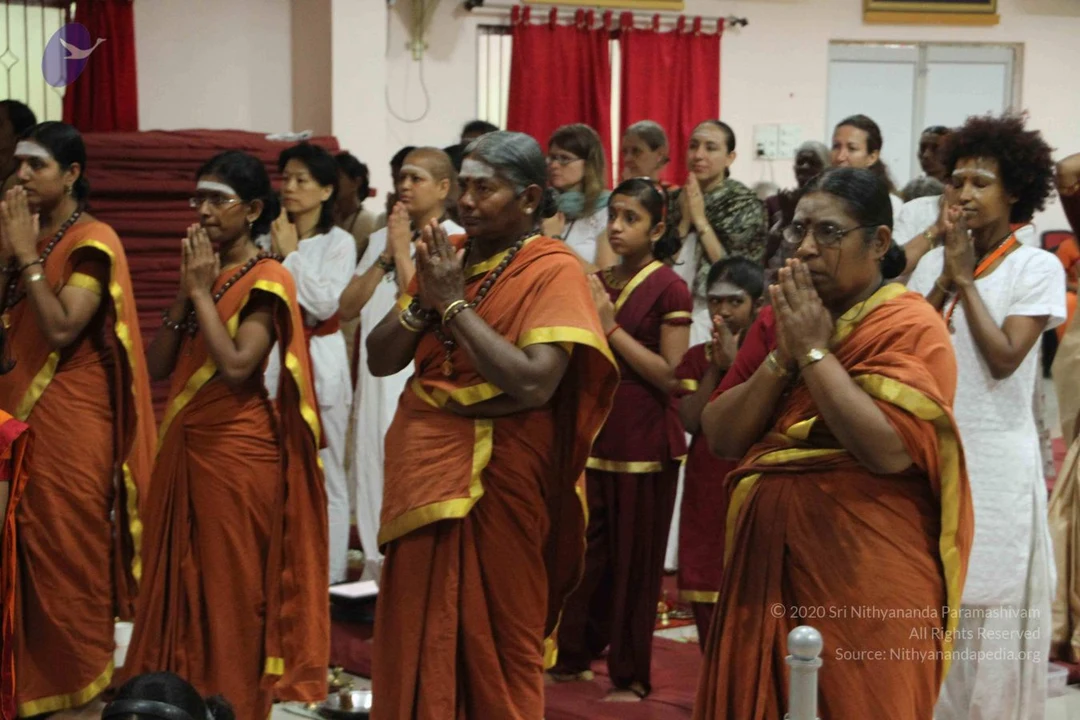
A framed photograph on an ornate gilded golden throne (peetha) inside a temple shrine, with a golden umbrella canopy and hanging bells above. The framed portrait shows a long-haired man in saffron-orange robes wearing a white bead mala, seated before a tree trunk with one hand raised in blessing. The throne is draped with a tiger-striped cloth. Flanking the shrine are painted guardian figures with multiple arms, gold crowns, gold jewellery and orange-red dhotis holding ritual objects. Oil lamps burn in the lower left foreground and a few devotees' silhouettes are at the edge. The portrait is a depiction, and the scene contains no visible living person at the throne.A photograph of an ornate golden throne (peetha) in a temple-style shrine, set against blue-grey walls with red and green borders. The throne holds a framed portrait of a seated man in saffron-orange robes with a white flower garland, right hand raised in blessing, seated before a large banyan tree trunk. The throne is draped with a brown velvet cushion and a tiger-striped cloth. Lit oil lamps (deepa) burn in the foreground, and hanging brass bells dangle from the chains above. Carved stone or painted dvarapala-style guardian figures with crowns and jewelry flank the throne on both sides. No physical people are present in the frame. The portrait is printed, labelled 'Paramahamsa Nithyananda' on its lower edge, and the depicted man is therefore a printed portrait rather than a physical person in the scene.Photograph of an indoor satsang hall with devotees in prayer. In the foreground, two shaved-headed sannyasis in saffron-orange robes with rudraksha malas stand with palms pressed together in anjali mudra, their foreheads marked with white lines. Between them stands a young man in a white kurta with a red tilak and long hair. Behind them, a man in white with a shawl and mala also holds anjali, and several devotees in white, green and red-bordered shawls stand in the background. A framed portrait hangs on the wall at upper right, and a tall red-and-cream banner hangs nearby.A photograph of a satsang gathering in a hall with red curtains and rows of red-cushioned chairs in the background. In the centre, a shaved-headed man with white paste marks on his forehead and arms wears a saffron-orange cloth draped over his shoulders, many strands of rudraksha beads around his neck and rudraksha bracelets on his wrists. He stands with palms pressed together in anjali, a devotional gesture. Around him, devotees in white dhotis and collared shirts also stand with hands folded, including a man in white on the right and a boy in a red-patterned shirt behind him. Some attendees on the left wear white dhotis and sacred threads.A photograph of devotees in a seated hall with folding chairs in the background, several standing with palms pressed together in anjali mudra. In the foreground, a man with a shaved head wears a white garment and a dark beaded mala. Beside him, a boy in a red-and-white checked shirt has a tilak on his forehead. An older man in a white shirt and a man in a light blue shirt with a yellow wristband stand nearby, also with hands folded. A partial view of an orange-clad figure appears at the left edge. a person is not clearly visible in the frame.A photograph of devotees standing with palms pressed together in prayer during a satsang-style gathering in a bright hall with red curtains and framed pictures on the walls. A woman in front wears a white sari with a red border and red shawl, with a bindi and beaded necklace, eyes closed. Beside her, a woman in a cream sari with dark patterned border holds her hands together, and others in white outfits with red shawls and rudraksha-style beads stand around them. A woman at the left has hands raised above her head in namaskar, and a devotee at the right holds a lit oil lamp. No prominent figure in saffron is visible.

Swamiji-SLE-Book-release

17 photosSource gallery
A seated man in a golden-brown saffron-orange robe speaks during a satsang on a large gilded throne with carved lion heads and red velvet cushions. He wears a long gold bead necklace, layered rudraksha mala, gold armbands and a red bindi, and holds a small red-and-gold book and a foil-wrapped item on his lap, with a tiger-striped cloth beneath him. Flanking the throne are two painted deity murti figures with multiple arms, crowns, gold jewellery and red-and-green dhoti, one holding a flame and the other a trident. a person cues: long swept hair, rudraksha mala, ceremonial gold necklace and saffron robe, seated on the throne as the speaker.A seated man in saffron-orange robes sits on an ornate golden throne with a large gilded arched backrest and red velvet cushions, flanked by golden lion-shaped armrests. He smiles broadly, holding up a red-and-gold book with the printed title and a portrait of a smiling figure in orange turban. He wears a rudraksha mala with gold beads, a gold armband, bangles, a red bindi and a small earpiece microphone. Behind him stand painted deity figures holding a flame and a ritual implement. A foil packet and gold wrapping lie on his lap. Swamiji (probable): long swept-back hair, saffron robes, rudraksha mala and gold ornaments on the seated presenter, shown in satsang on the throne.A smiling man with swept-back long dark hair and a red bindi sits on an ornate gold throne with red tiger-striped upholstered armrests. He wears a rust-orange robe, a thick ceremonial gold bead necklace over a brown woven rudraksha-style mala, gold bangles and an armlet, and a small microphone clipped near his face. He holds up a book titled The Science of Living Enlightenment, whose cover shows a smiling person in an orange turban.A smiling man with long dark hair, a red bindi and gold hoop earrings sits on an ornate gilded throne with a red cushion. He wears an orange-brown robe, a long gold bead necklace and a rudraksha-style mala, and a gold armlet, and holds up a book titled The Science of Living Enlightenment by Paramahamsa Nithyananda, whose cover shows a smiling figure in an orange turban. A small microphone is clipped near his face. a person appears in person, seated in the satsang setting.A smiling man with long dark hair and a red bindi on his forehead sits before a gold, ornately carved backdrop. He wears a rust-brown and ochre garment, a long chunky beaded necklace of gold-toned and brown beads, gold hoop earrings, a headset microphone and gold bangles on his upper arm and wrist. He holds up a book titled "The Science of Living Enlightenment" by Paramahamsa Nithyananda, whose cover shows a smiling figure in an orange turban. A red tiger-striped cushion is visible at the right edge. The man appears to be a probable Swamiji based on his long swept-back hair, ornate gold jewellery, saffron-toned clothing and rudraksha-style beads, and is shown in person presenting the book.A man seated on an ornate gold throne with red cushioning, holding up a book titled "The Science of Living Enlightenment" by Paramahamsa Nithyananda toward the camera. He wears an orange-brown robe, a thick rudraksha mala with gold beads, gold armlets, and gold bangles, with a red tilak on his forehead and a small lapel microphone clipped on. The book cover shows a smiling figure in an orange turban. Swamiji (probable): long dark swept-back hair, ceremonial gold necklaces and rudraksha mala, and orange clothing; he is seated in the central presenter role during a discourse setting.

Satsang-Swamiji

7 photosSource gallery
A smiling man in saffron-orange robes sits cross-legged on an ornate gold throne carved with lion motifs and red velvet cushions. He wears a long golden bead necklace over a rudraksha-style mala, gold bangles on his upper arms and wrists, gold hoop earrings, and a red bindi. A small lapel microphone is clipped near his face. Gold lion statues flank the throne, and a painted deity figure with raised hands stands at the left edge.A seated audience at a satsang gathering, viewed from the front rows. In the foreground a shaved-headed man in a white shirt sits with a cord around his neck, and an orange-robed person with glasses is at the right edge. Behind them a boy in a green AMERICAN GIRL-style t-shirt watches attentively, with other boys and men in pale shirts, one man wearing an orange shawl, and a man in a green collared shirt. Several attendees are visible, including a boy with a white forehead mark, and a red carpeted floor with white walls behind them.Seated devotees fill a hall during a satsang. In the centre, a man with short dark wavy hair wears a red and white striped button-up shirt and a dark bead mala around his neck, sitting upright with eyes lowered. To his left, a young man in white clothes sits with eyes closed. Behind them, women in saris, including one in green and gold and another in maroon, sit on red mats beside metal stanchions and a chain barrier. A man with glasses in a white shirt sits in the foreground and a child smiles at right.A smiling man sits on a red velvet seat in front of an ornate gold-leaf throne backdrop with carved scrollwork and mythical lion figures. He has shoulder-length dark hair, a red bindi on his forehead, and wears an orange-brown saffron-toned drape over bare shoulders with a gold-trimmed edge. A thick necklace of gold beads and rudraksha-style beads hangs on his chest, with gold bangles on his upper arms. A small headset microphone is visible near his face. a person, seated in a ceremonial role on a throne-like seat during a satsang-style event.A smiling man with long swept-back dark hair and a red bindi sits on an ornate golden throne carved with lion and floral motifs. He wears an orange-saffron cloth draped over one shoulder, a thick rudraksha-style mala necklace in mixed beads, large gold ceremonial beads, gold armlets on both upper arms, and a small gold hoop earring, with a headset microphone near his face. He holds one hand resting on a red cushioned armrest.A smiling man with long dark hair sits in front of an ornate gold throne with repoussé carving. He wears a red bindi on his forehead, gold hoop earrings, a wired microphone at his ear, a rust-orange shawl over bare shoulders, a gold-trimmed saffron cloth, and multiple strands of gold beads and rudraksha-style mala necklaces, plus gold armbands. Swamiji (probable): long swept-back hair, saffron clothing, ceremonial gold necklaces and a throne seat, matching the page's claim of his presence at a satsang.

SarvaDarshan

9 photosSource gallery
A photograph of a devotional darshan line in a temple hall. A man with long swept-back dark hair, wearing a rust-orange shawl and orange dhoti with gold borders, a large gold-beaded necklace and a rudraksha-style mala, extends his hand in blessing toward devotees. Several people in front, including a woman in a white sari and a man in glasses, press palms together in anjali. Behind him stand a man bare-chested with an orange cloth and a man holding a garland. In the background are golden deity murti and decorated gold-and-red temple shrine panels. a person appears to be the blessing figure in orange robes with distinctive long hair and ornate gold necklace, giving darshan.A photograph of a satsang hall where a man with long swept-back dark hair, wearing a saffron-orange dhoti and wrap, a heavy gold-beaded rudraksha-style necklace and gold armlets, stands at the right with his right hand extended toward devotees. Swamiji (probable) is shown with long swept-back hair, orange clothing and ornate gold adornments. Devotees in front and beside him, several in white and some with folded hands in anjali, sit or stand before a golden throne and red-draped stage with a deity murti in the background. Several people are partially visible in the foreground, including one in a grey shirt and another in a pink shirt.A man with long, swept-back dark hair and a red bindi stands at right in a rust-orange shawl and dhoti, wearing a thick ceremonial gold bead necklace over a brown rudraksha-style mala, gold armlets and a bangle. He smiles while placing his right hand on the head of a devotee who bows with hands in anjali. Several other devotees in white and grey stand in a row in front of a temple hall with gold and red decorations behind them. a person is the person offering blessing at right, with the required cues of long swept hair, saffron-orange clothing and a ceremonial gold necklace; the devotees are shown receiving blessing. Around eight people are visible.A photograph of a man in an orange-brown saffron robe and a yellow-edged cloth, wearing a thick golden bead necklace over a rudraksha mala, golden bangles on his wrists and a gold earring, blessing a devotee. He has long swept-back black hair and a red bindi, and his right hand rests on the head of a short-haired man in a grey shirt who has his palms joined in prayer. Behind them, white-clad devotees stand in a temple hall with golden and red decorations. Probable Swamiji with distinctive long hair, saffron robe, rudraksha mala and golden ornaments, shown in the act of blessing a devotee.A photograph of a satsang gathering indoors, with red stage curtains behind. In the foreground on the right, a figure with long swept-back dark hair, gold hoop earring, a ceremonial gold and rudraksha necklace, gold armbands and an orange-saffron cloth draped over bare shoulders faces left and gestures with an open hand toward devotees. Opposite, a man in a white collared shirt wears a dark rudraksha-style mala and listens attentively. Behind him, a bald man with glasses wears a red vest over cream clothing, and a man in a grey shirt looks toward the speaker. Several other men stand in the crowd behind them in pale and striped shirts.A photograph of a satsang hall with red curtains behind. On the right, a figure in an orange-saffron garment with a thick gold-beaded necklace and gold earrings extends a hand toward a group of devotees. Several men stand close: a man in a white shirt on the left, a smiling man in glasses wearing a red sweater vest over cream clothes, and a man in a grey shirt beside him. A child is partly visible at lower left and another person's hands are pressed together in greeting in the background. The figure's appearance with gold-beaded ornamentation and saffron clothing is consistent with the a person candidate, so the identity is probable from appearance rather than confirmed.

Temple

20 photosSource gallery
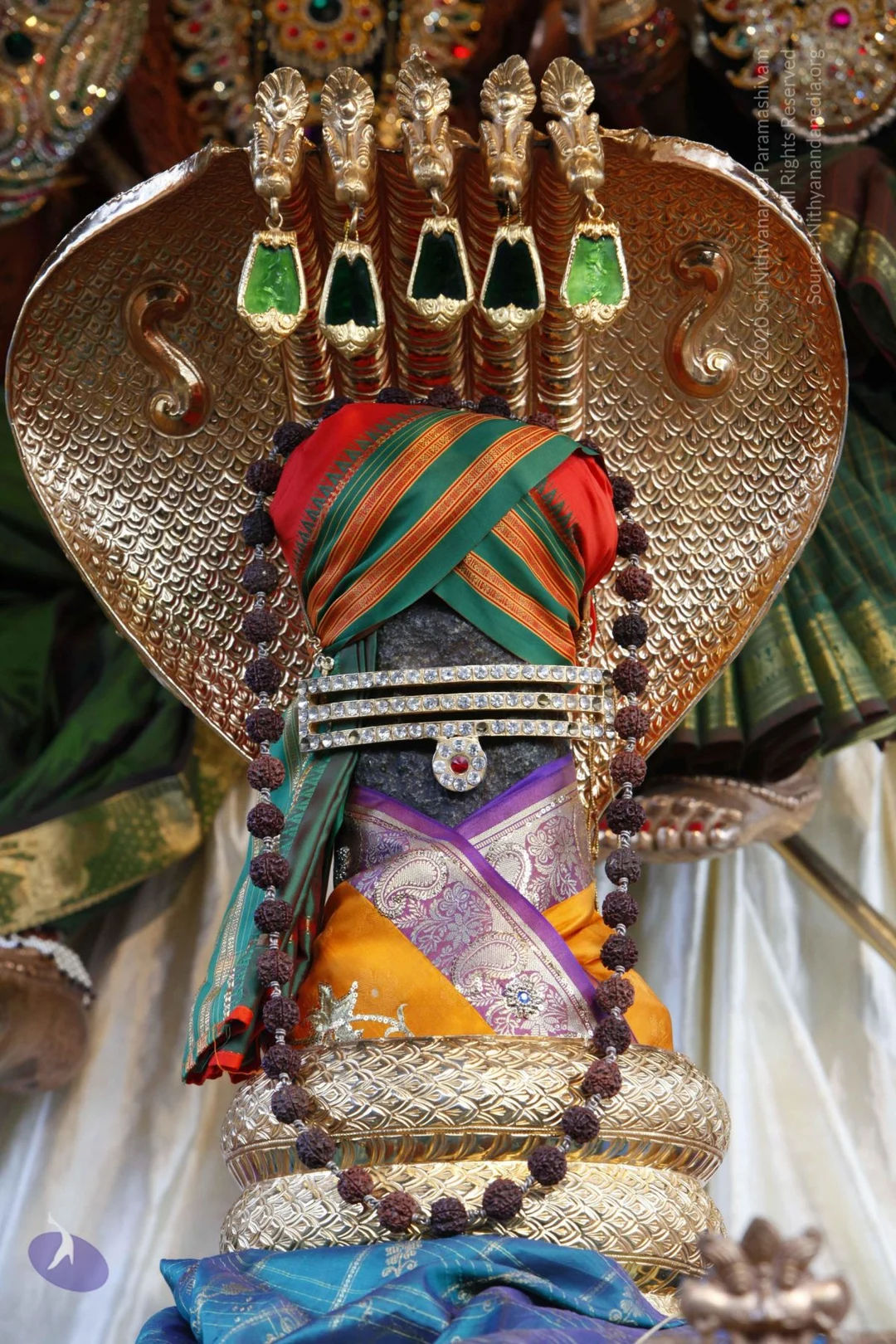
Two large gilded statues of a male and female deity seated together on a raised pale lavender draped platform before a red curtain framed by an ornate gold arch. The male figure wears an orange-red turban with a crown ornament, a dark rudraksha mala and silver jewelled necklaces, and a dark green dhoti, holding a trident in one hand. The female figure wears an orange sari with gold border, layered silver necklaces, a dark cap-like headdress and bangles, with a raised hand. The statues are deity murti; no living people are visible.A dark black stone statue of Nandi, the bull of Lord Shiva, sits on a square plinth in front of an orange-red temple structure. The bull wears a layered beaded necklace and a red-and-white tilak mark on its forehead, with its head facing forward. Behind it, a carved red stone finial and green foliage appear in soft focus.A dark stone Shivalinga is dressed for worship beneath a large gilded five-hooded naga (serpent) canopy with green glass ornaments hanging from the hoods. The linga is wrapped in a red, green and orange striped cloth and a purple and gold brocade sash, with a rhinestone band and a red stone at the front. A long string of brown rudraksha beads drapes over it, with gold bangle-like rings at its base on a white cloth. Ornate jeweled decorations appear at the top edge. No people are visible; this is a deity murti adorned for worship.A silver-toned metal deity murti stands within an ornate bronze arch-shaped frame with carved peacock-like and floral motifs. The figure wears a tall crown, a red tilak on the forehead, and a green draped garment with gold border. Layered necklaces of beads, rudraksha, and multicolored stones hang across the chest, with a large round gem-studded pendant and a red teardrop pendant below. One hand holds a ceremonial staff and the other is raised in a gesture. Blue and gold cloth decorates the background.A metal deity murti, gold-toned with a tall crown and red tilak, stands in a carved bronze arch-shaped throne flanked by rearing lion-like figures. It wears a green sari with gold border, layered jeweled necklaces, a large round pendant and a long rudraksha and pearl mala ending in a red stone pendant. One hand holds a ritual object. Blue and red embroidered fabric and a silver lamp stand appear behind.A metal murti of a goddess stands within an ornate copper-coloured arched throne frame carved with scrolls, rearing animals and lion-like figures. The figure wears a tall crown, a red kumkum mark on the forehead, and a green sheer sari edged with gold zari border. Layered jewelled necklaces, pearl and rudraksha malas, and a large circular pendant with coloured stones adorn the chest, and the right hand holds a lotus-like object. Blue fabric and a brass lamp stand appear in the background. No people are visible.

Paduka-Puja

5 photosSource gallery
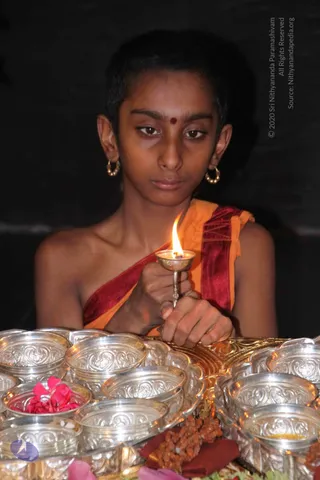
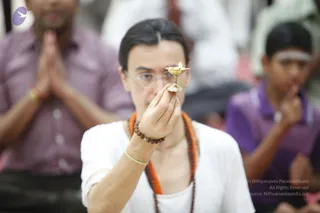
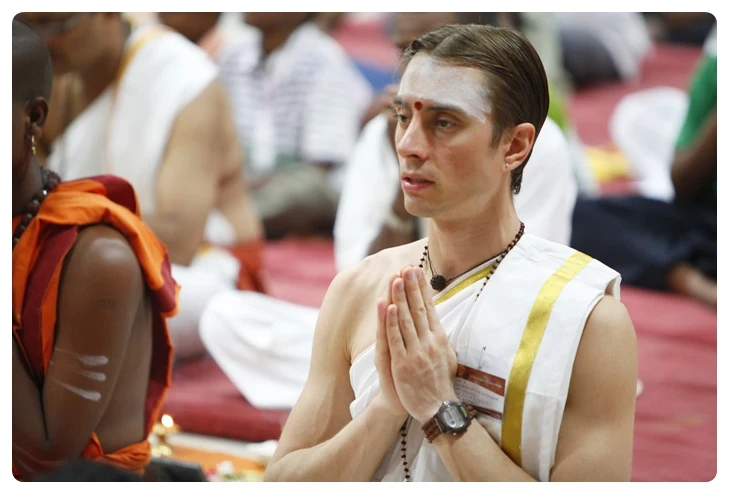
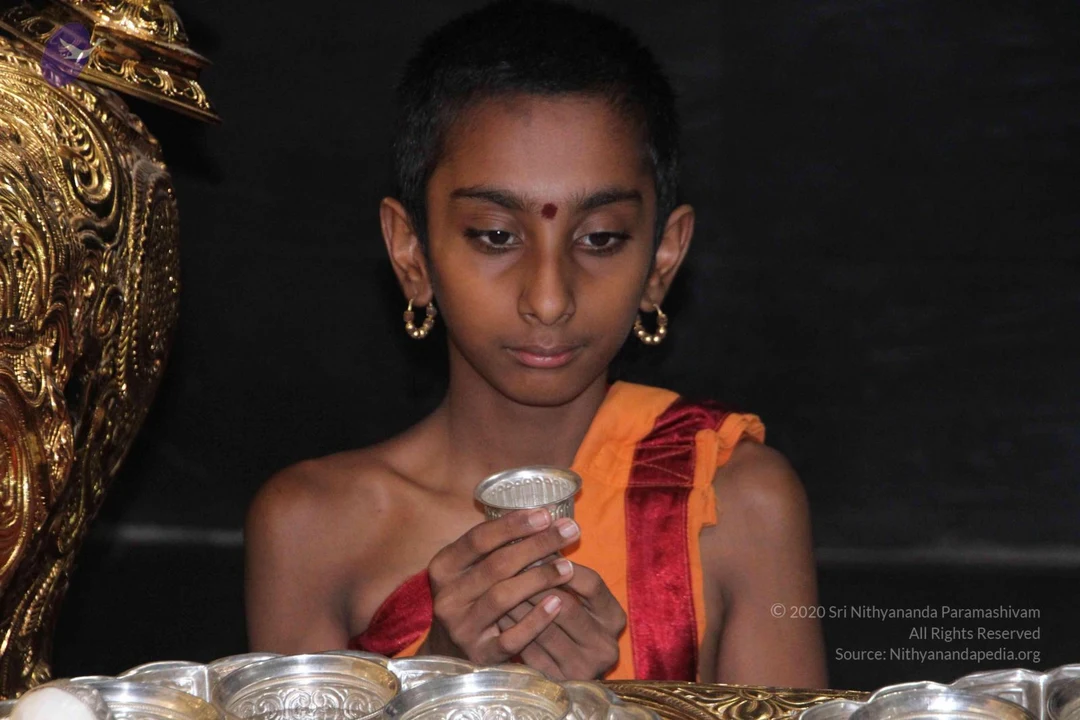
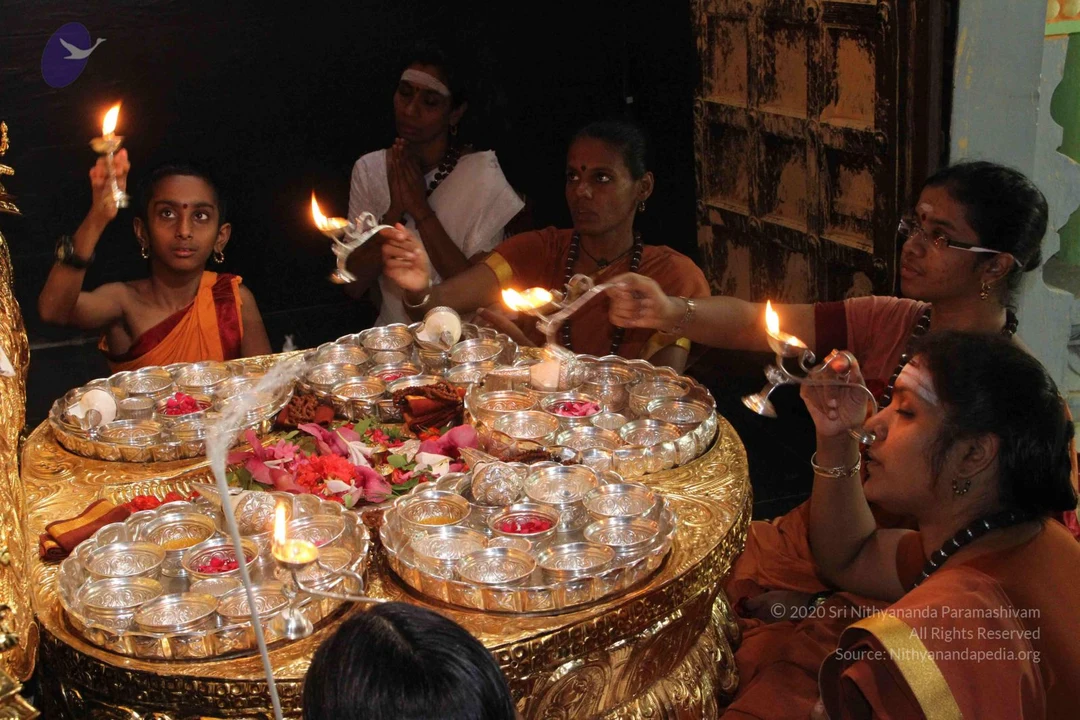
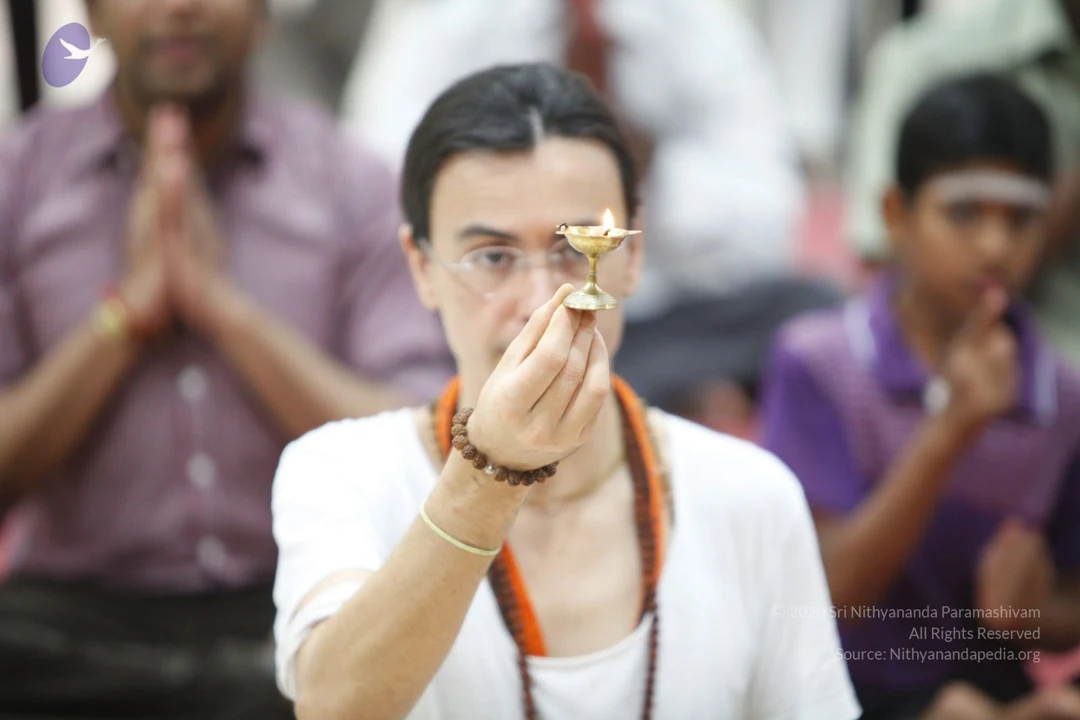
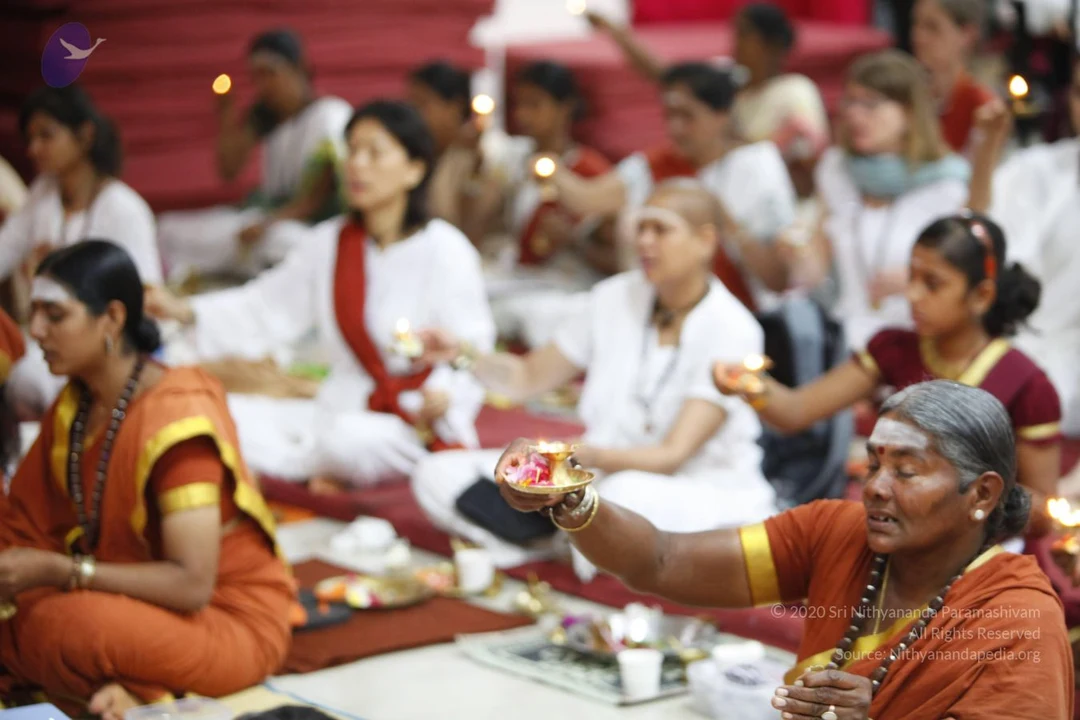
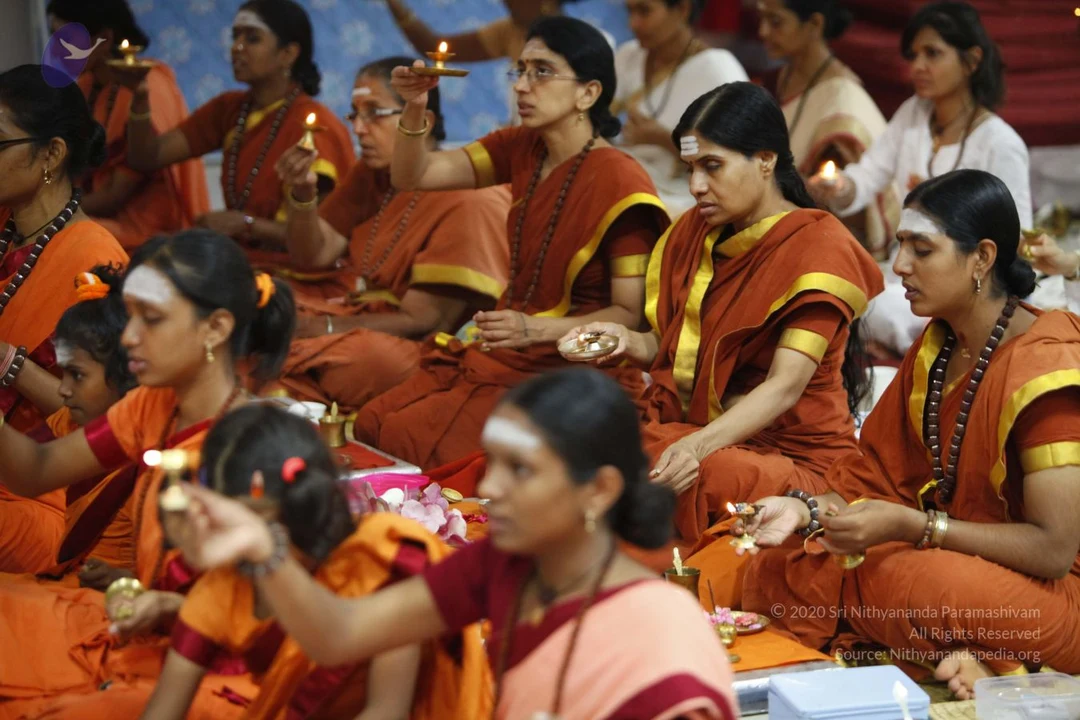
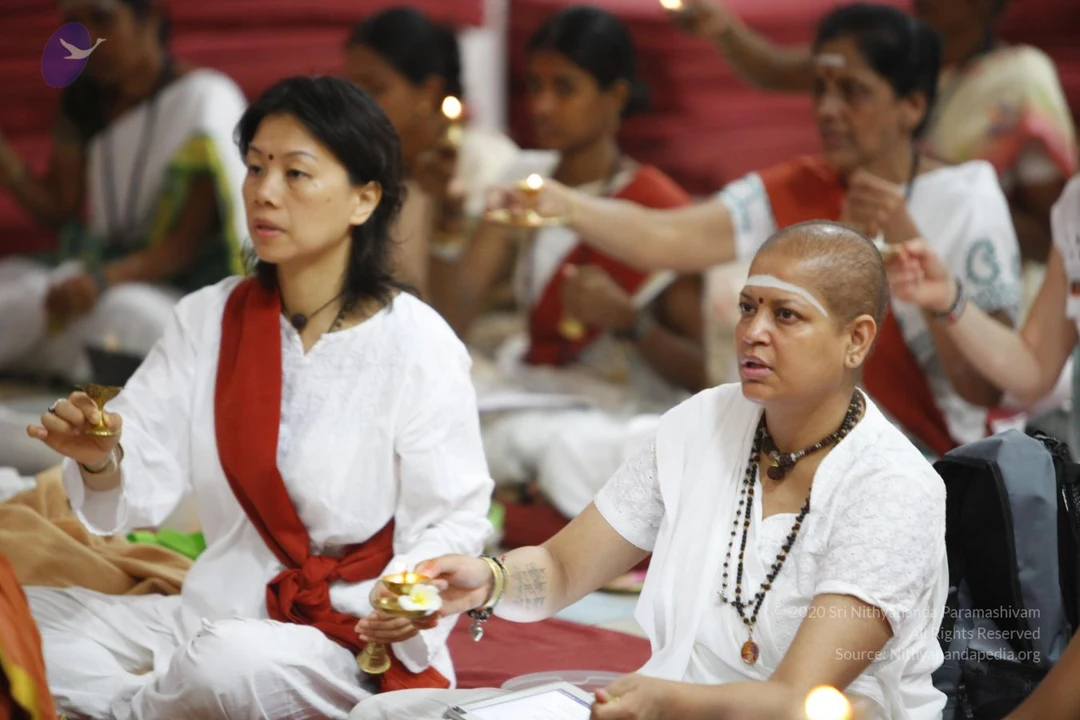
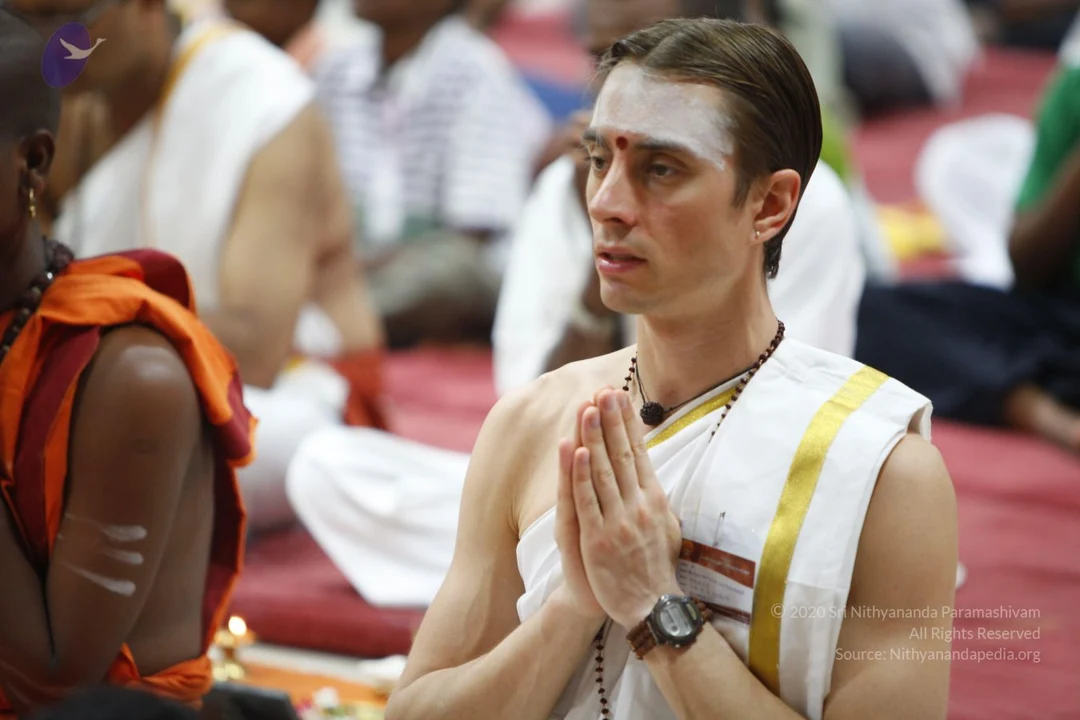
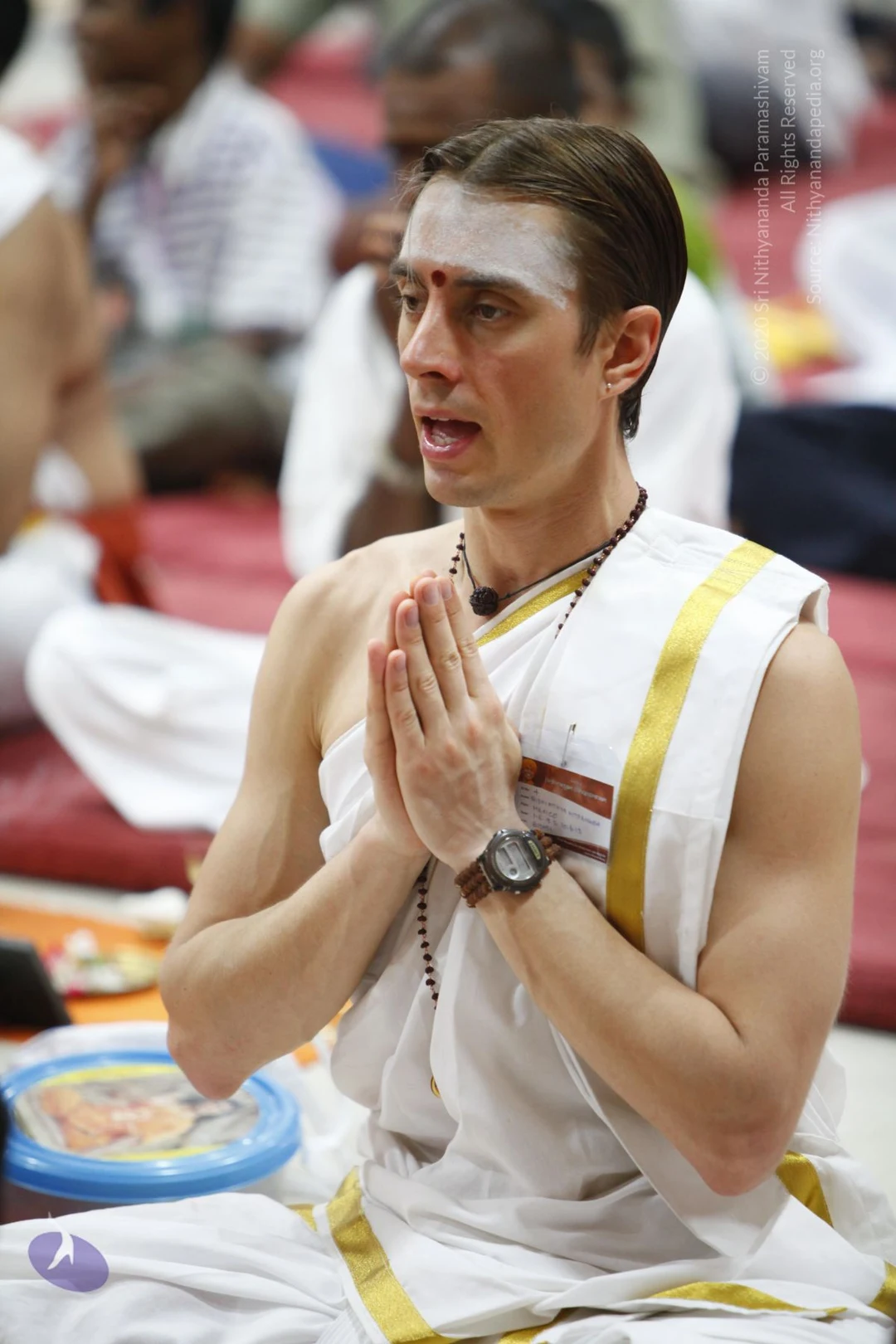
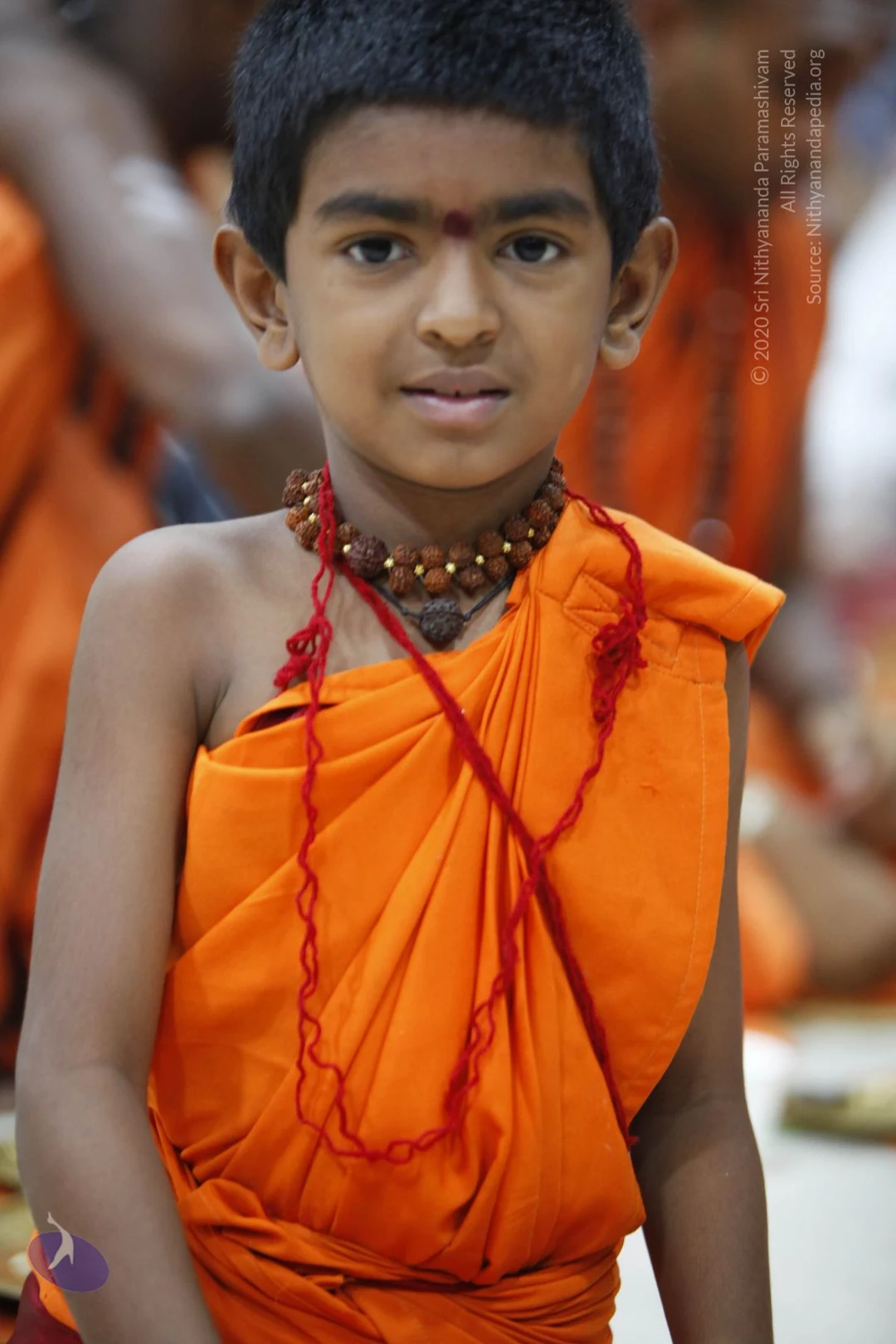
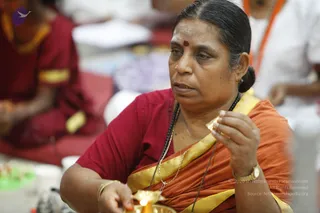
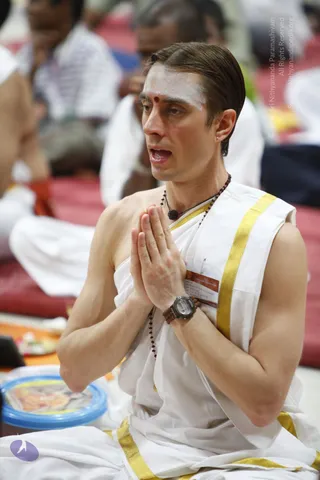
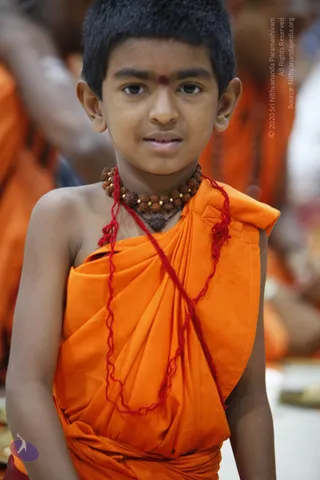
A young person with short dark hair, a red bindi and small gold hoop earrings holds a silver oil lamp with a lit flame in one hand. They wear an orange garment with a red velvet shawl draped over one shoulder. In front is a tray of ornately engraved silver bowls, one holding red flower petals, and a red cloth with rudraksha beads. The background is dark, and the lamp is part of a puja offering. No a person candidate is visibly present.A photograph of a man in a white shirt and orange-and-brown rudraksha mala holding a small brass oil lamp with a lit flame toward the camera, wearing clear-framed glasses and a rudraksha bracelet. Behind him, a man in a purple-pink shirt presses his palms together in anjali, and a boy in a purple shirt with a light forehead mark sits with hands folded near his face among seated devotees. The setting suggests a satsang or aarti moment with an oil lamp offering.A woman in an orange sari with a gold border and a red blouse sits at a puja, holding a small gold item near a brass lamp with a flame. She wears a red bindi, black beaded rudraksha-style mala, gold chain, earrings and a gold bangle. Behind her, other devotees in red and white sit on a red mat.A seated man in white ritual dhoti and shawl with gold borders presses his palms together in anjali mudra at a devotional gathering. He has a red bindi and white forehead markings, slicked-back hair, and wears a rudraksha mala and a dark pendant on his neck. A beaded wristwatch is visible on his wrist. Behind him, other seated devotees in white and striped clothing sit on red mats.Close portrait of a young boy with short dark hair and a red vertical tilak on his forehead, wearing an orange saffron shawl draped over one shoulder and tied at the waist, with a red thread sash crossing his chest. He wears a multi-strand rudraksha mala with gold beads and a rudraksha pendant around his neck. Behind him, blurred figures in orange robes stand among other participants. The boy looks directly at the camera with a calm expression.

Swamiji-SLE-Book-release

10 photosSource gallery
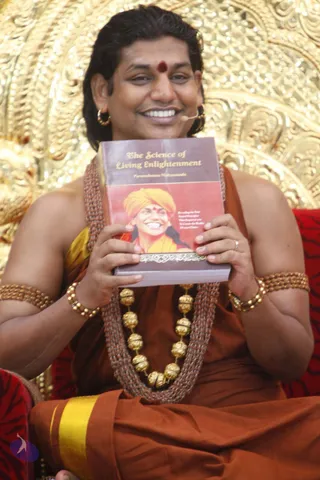
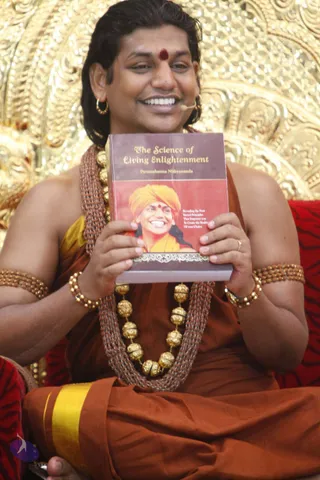
A smiling man with long dark swept-back hair, a red bindi and a small headset microphone sits before an ornate gold-embossed backdrop, holding up a book. He wears a rust-orange robe with a golden border, a thick rudraksha mala with gold bead ornaments, and rudraksha armlets and gold bracelets. The book cover reads The Science of Living Enlightenment and shows a smiling figure in an orange turban and saffron clothing. A red cushioned seat is visible at the right edge.A smiling man with long swept-back dark hair and a red vertical tilak on his forehead sits on a red cushioned seat before a gold repoussé backdrop. He wears an orange-brown saffron-toned robe, a gold-bordered shawl, a double strand of rudraksha malas with gold beads, rudraksha armbands and gold bracelets, and a small microphone clipped near his ear. He holds up a book titled The Science of Living Enlightenment, showing a cover photo of a smiling man in an orange turban. Probable Swamiji is shown in person; the cues are the long swept-back hair, ornate gold beads, rudraksha malas and saffron clothing, and he holds a book, not a throne-only setting.A man seated on a gold ornate throne backdrop with a red tilak on his forehead, long swept-back dark hair, gold hoop earrings and a headset microphone, smiling as he holds up a book titled "The Science of Living Enlightenment" by Paramahamsa Nithyananda. He wears an orange-brown robe with a gold-trimmed yellow shawl, layered rudraksha and gold bead malas, rudraksha armlets and beaded bracelets. The book cover shows a portrait of a smiling man in an orange turban. Appearance-based candidate: a person, seated and speaking at a satsang.A seated man in a rust-orange garment with a gold-bordered yellow shawl holds up a book titled "The Science of Living Enlightenment" to the audience, showing its cover photo of a smiling man in an orange turban. He wears a red bindi, gold hoop earrings, a headset microphone, a multi-strand rudraksha mala, gold bead necklaces and rudraksha armbands, and speaks while smiling. Behind him is an ornate gold-embossed backdrop. Probable Swamiji by appearance cues including swept-back hair, ornate gold necklaces and rudraksha malas, seated in front of a gold throne-style backdrop, with a discourse setting.A seated man in orange-brown robes and a saffron-gold draped cloth holds up a book titled "The Science of Living Enlightenment" by Paramahamsa Nithyananda, showing its cover portrait of a smiling man in orange turban. He wears a red bindi, golden earrings, a lapel microphone, a thick beaded rudraksha-style mala, gold armlets and bangles. He sits cross-legged on an ornate gold throne with red tiger-striped cushions and a tiger-skin rug. A wireless microphone and a gold cloth sit nearby. Appearance-based label: a person, seated on the throne in orange robes with rudraksha mala and gold ornaments, holding the book.A smiling man with long swept-back dark hair and a red tilak on his forehead sits in front of an ornate gold-embossed backdrop. He wears a saffron-brown robe, a bare-shouldered wrap with a gold-toned trim, layered rudraksha and gold bead necklaces, rudraksha armlets and bracelets, and a small clip microphone. He holds up a book titled The Science of Living Enlightenment by Paramahamsa Nithyananda, with a cover portrait of a smiling man in an orange turban and red tilak. Cues consistent with the page are present, so this is a person in person in a satsang setting.

Satsang-Swamiji

2 photosSource gallery
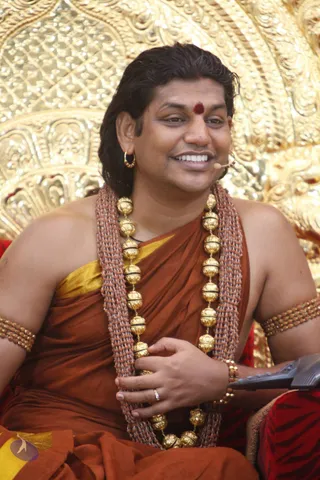
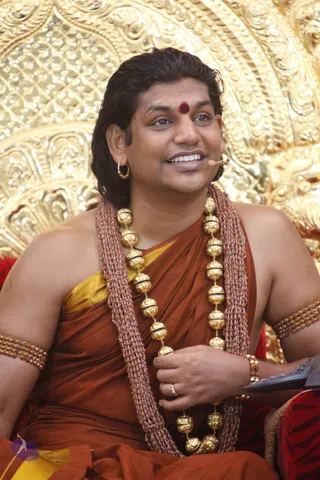
A smiling man with long dark swept-back hair and a red bindi sits in front of an ornate gold repoussé backdrop, wearing an orange-brown saffron robe with a gold-edged shawl, multiple strands of rudraksha beads and heavy gold bead necklaces, gold bangles on his upper arms, and small gold hoop earrings. A headset microphone is at his cheek, and he holds a hand near his chest while a red patterned cushion and a small black device rest beside him. Appearance-based a person seated as speaker at the satsang; no readable printed name visible.A smiling man with swept-back dark hair and a red kumkum bindi sits in front of an ornate gold repoussé backdrop, wearing an orange-brown saffron-toned garment with a gold border draped over one shoulder. He wears multi-strand rudraksha malas, heavy gold bead necklaces, rudraksha armlets, a gold hoop earring and a headset microphone, and holds a small device in one hand while speaking. A red patterned cushion is visible at the lower right. a person is in the seated position, with the ceremonial cues of rudraksha malas, gold necklaces and saffron clothing, in the satsang setting.

FinalBlessings

1 photoSource gallery
A standing man in a rust-brown robe with gold border bands and a gold bead necklace raises both palms overhead, smiling, on a stage. Behind him is an ornate gold throne with red velvet cushions and gold lion-shaped armrests, flanked by painted deity murti figures with multiple arms holding weapons. A brass lamp stands at left, a red-carpeted stage floor below, and hanging bells appear in the background. The page names Swamiji at this satsang, so the central figure is labelled Swamiji (probable) on appearance cues: a long swept-back hair style, a red bindi, rudraksha-style beaded necklace and saffron-orange clothing, with the throne as setting.