Skip to content
Friday

10 May 2013

Dated photos
403
Source pages
1
Media
3
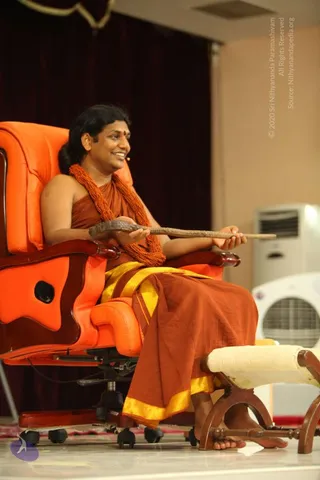
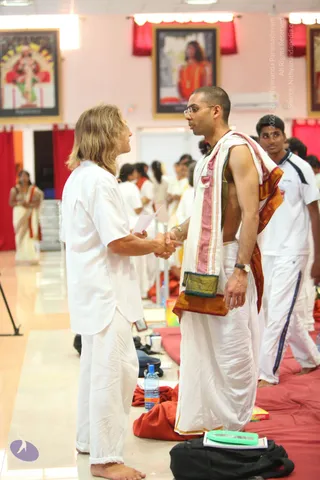
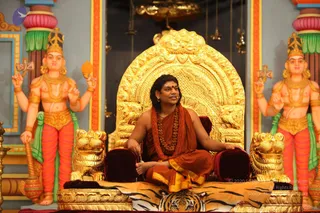
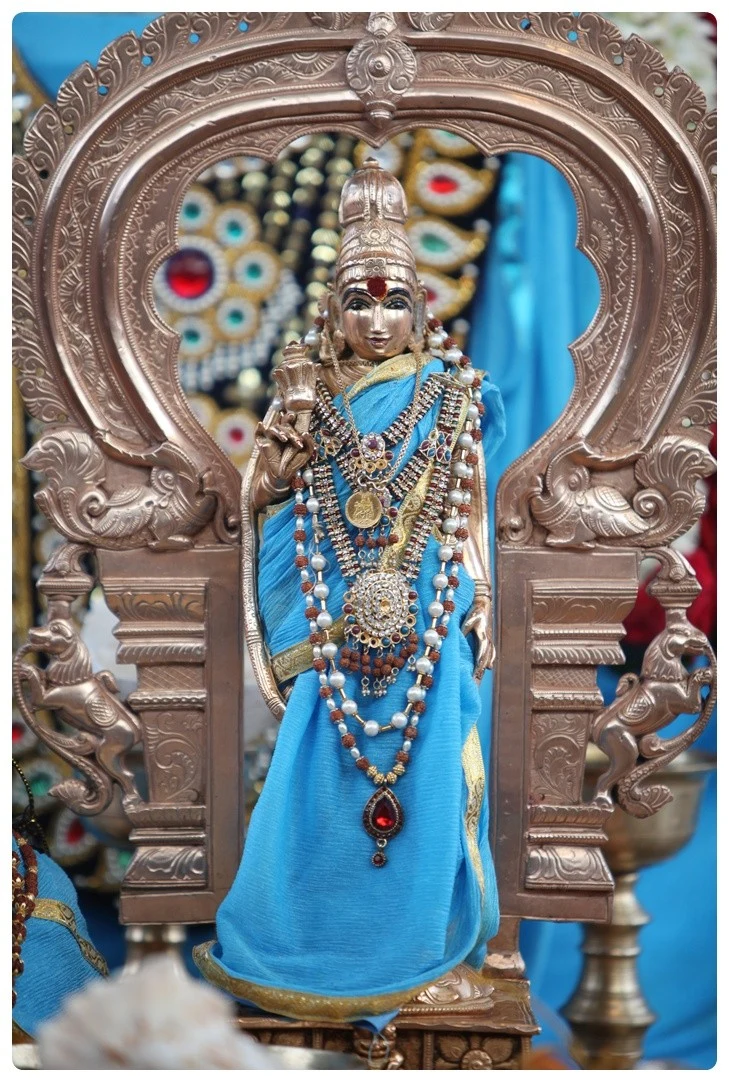
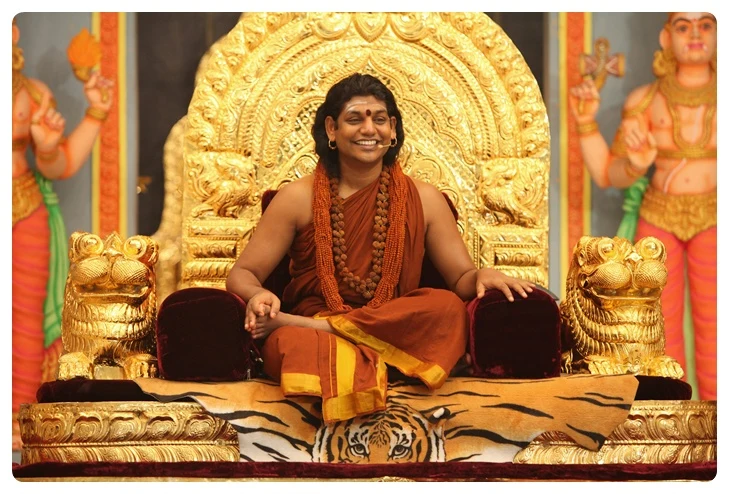
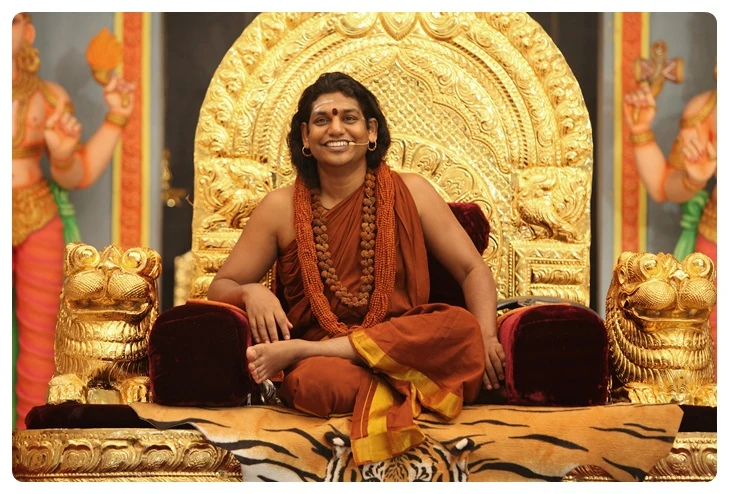
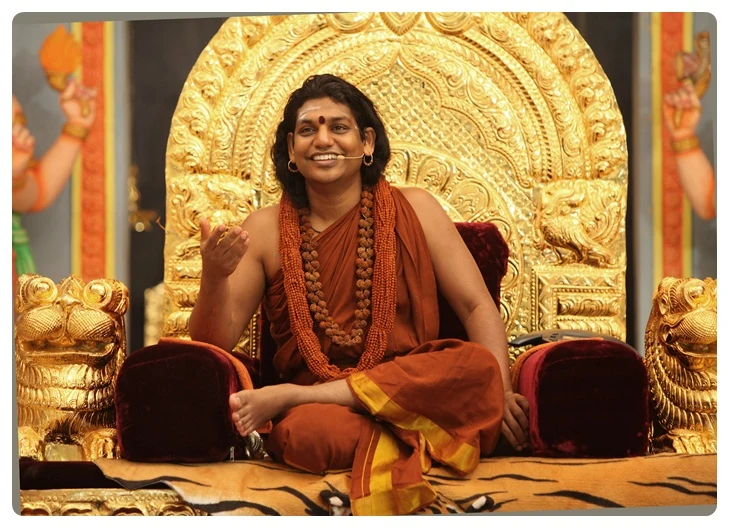
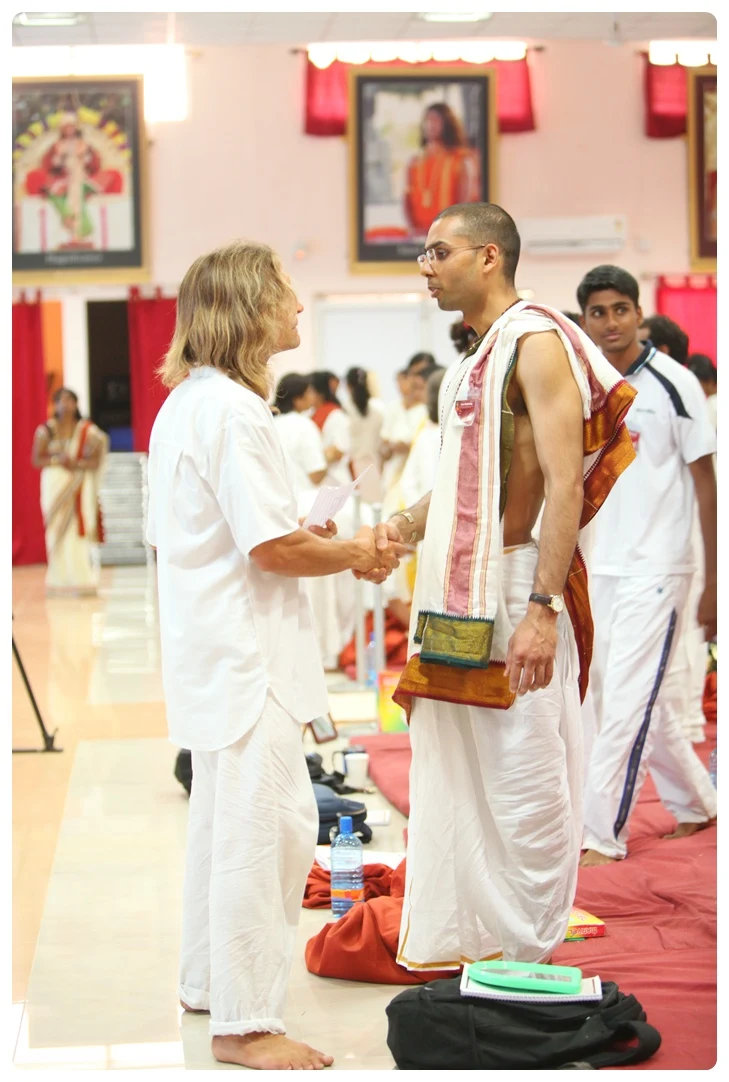
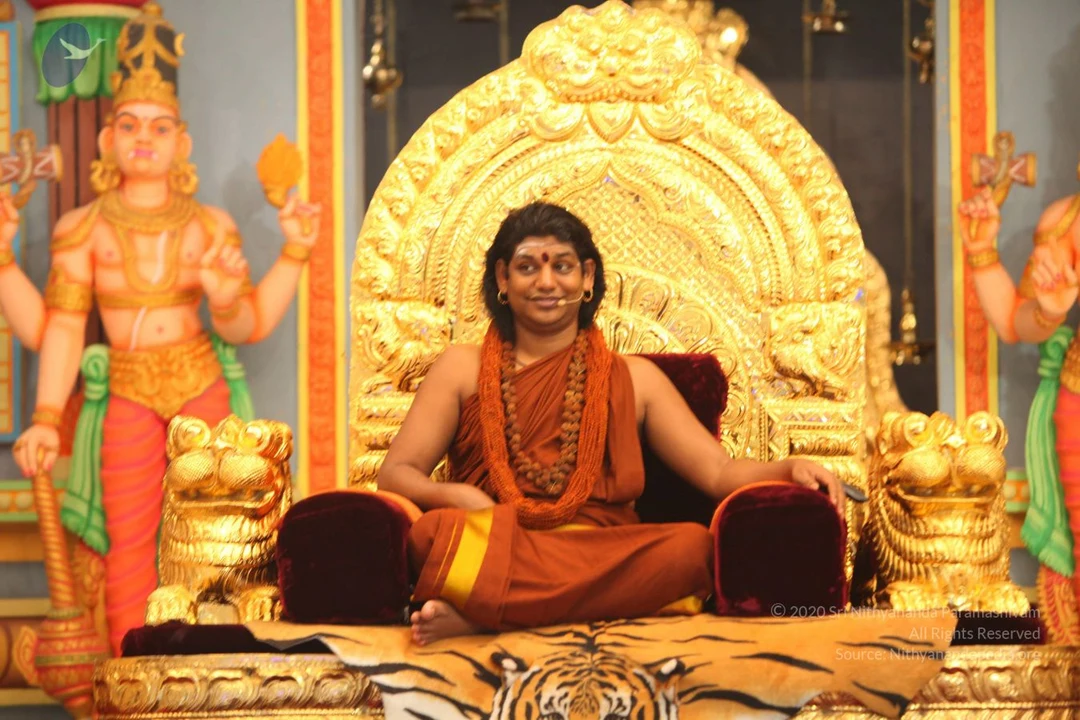
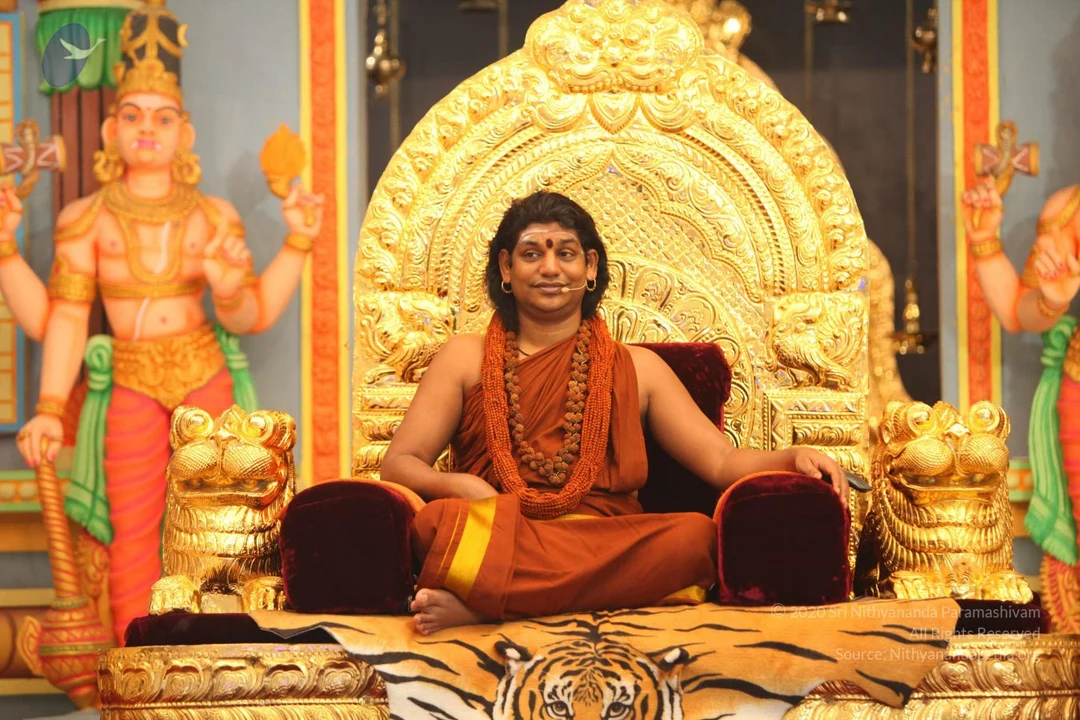
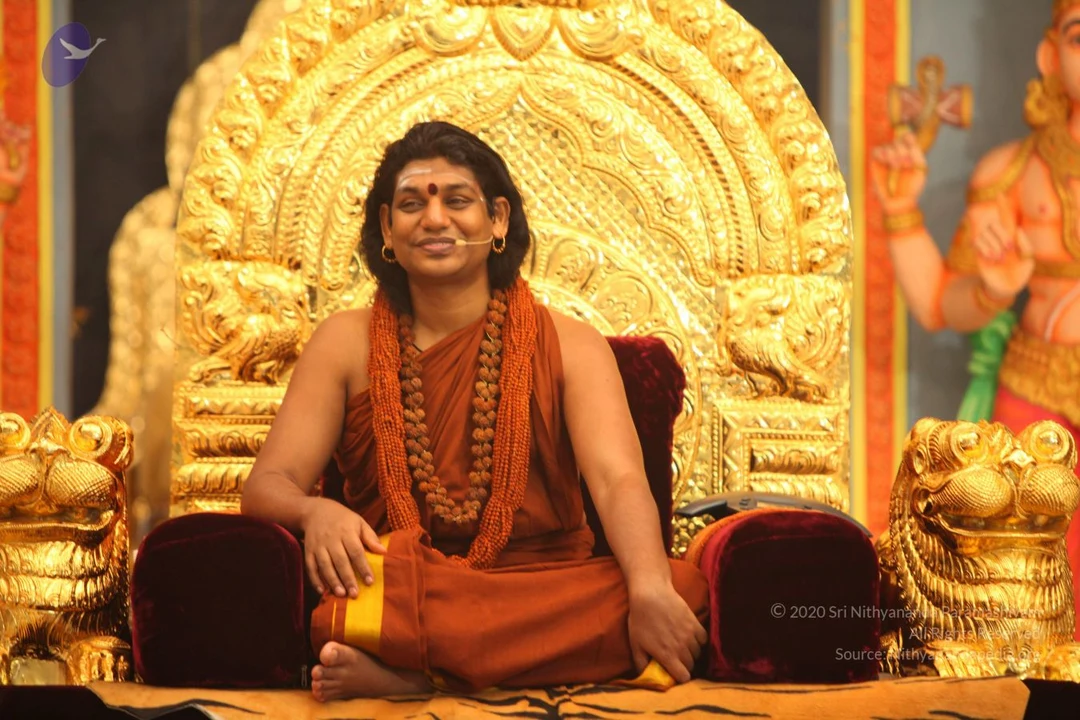
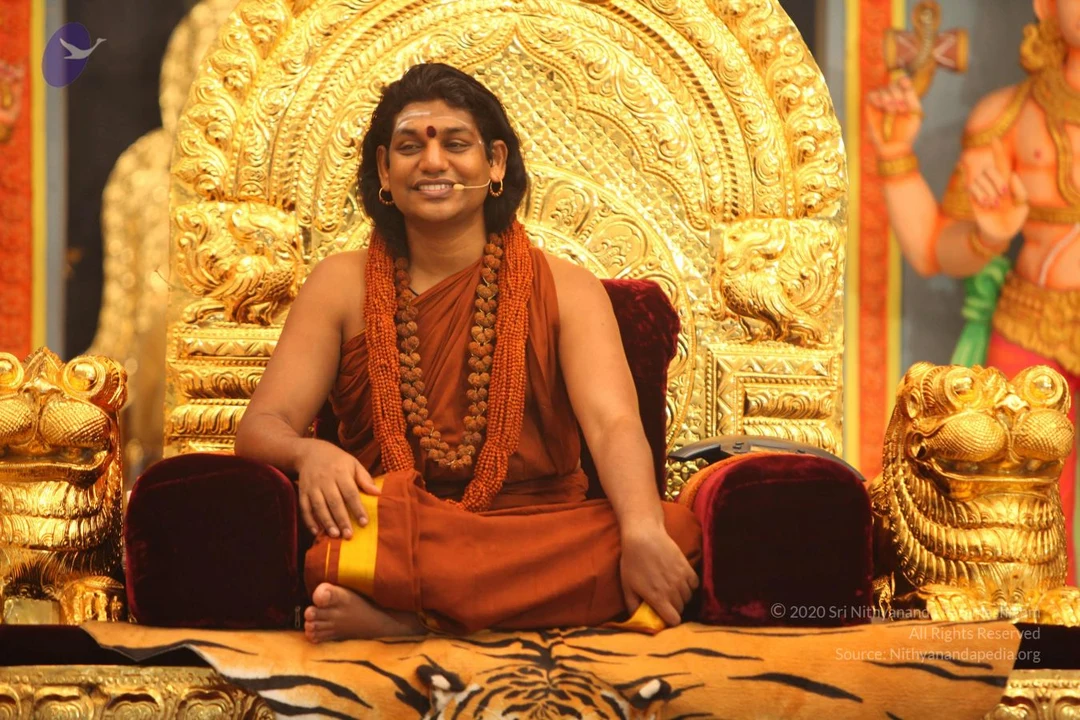
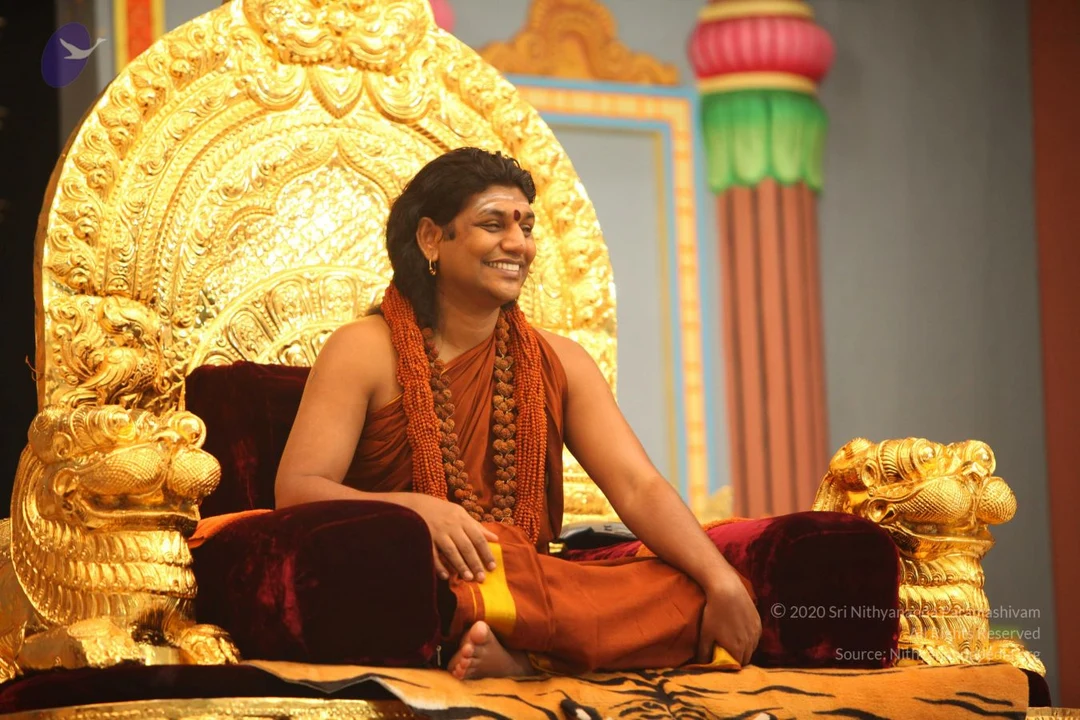
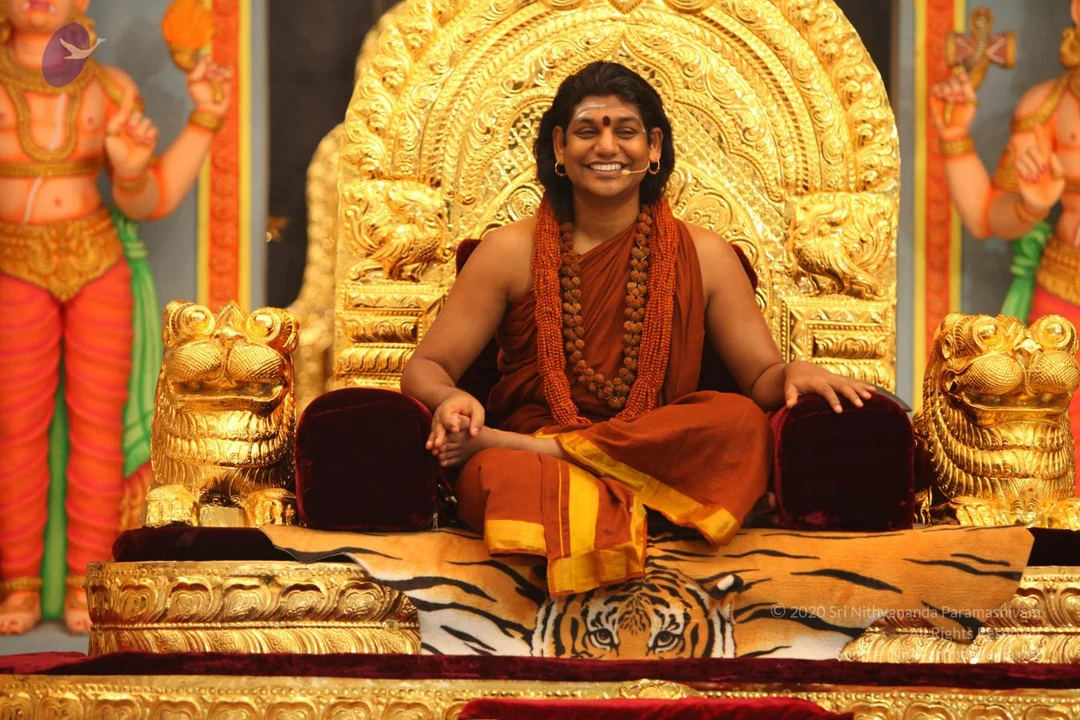
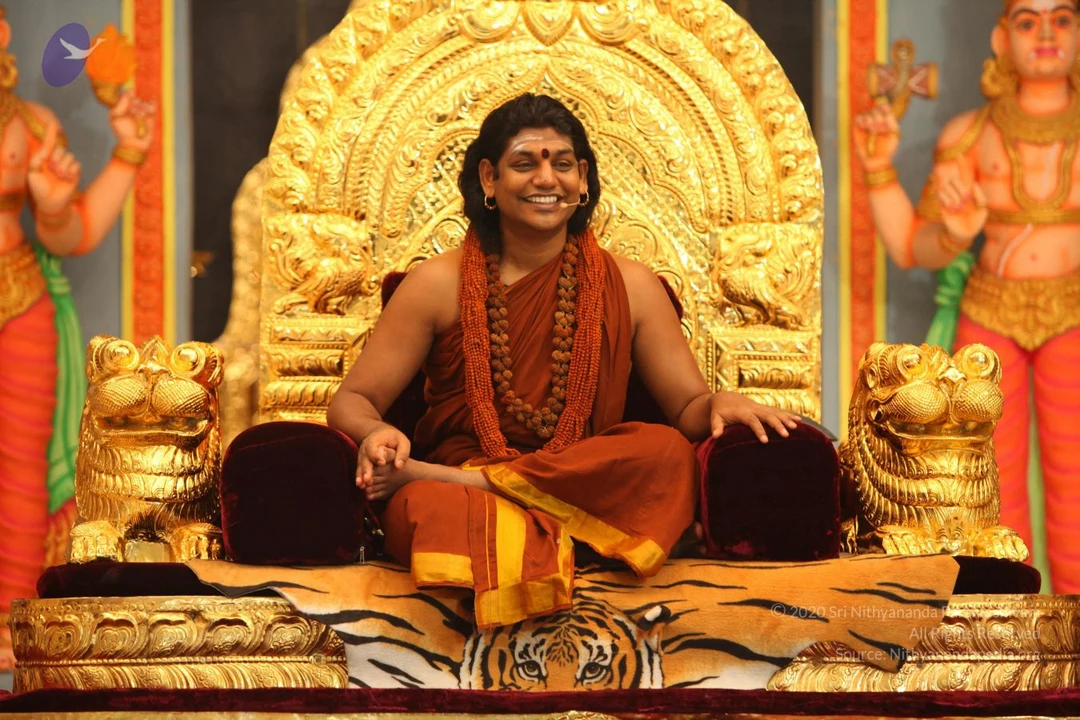
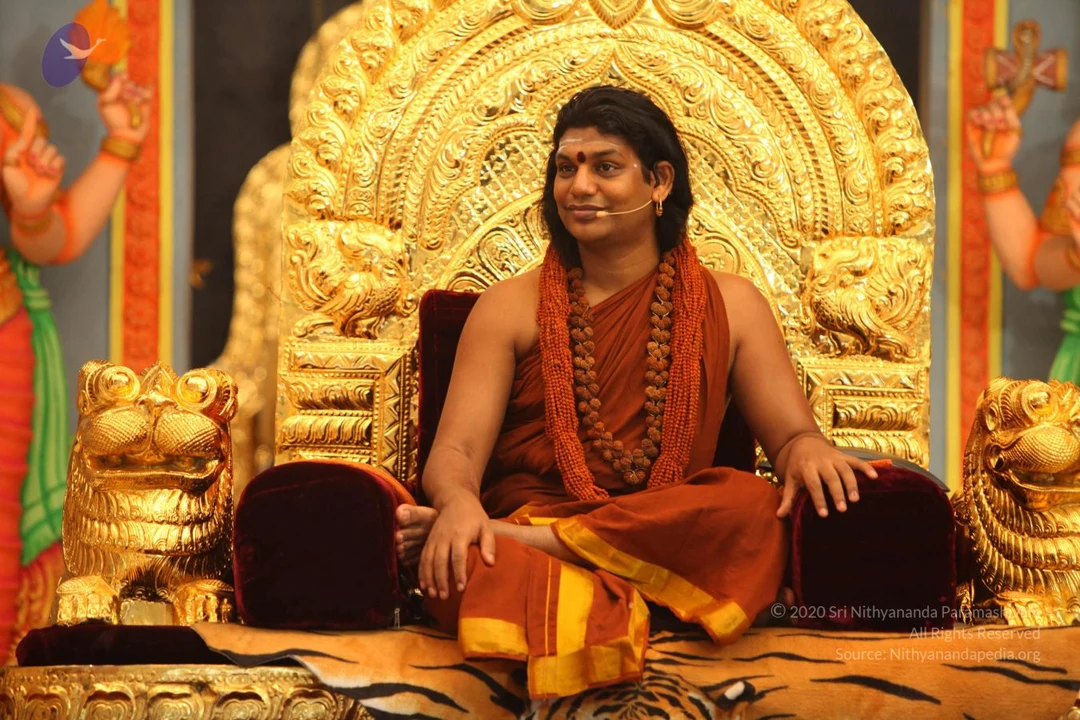
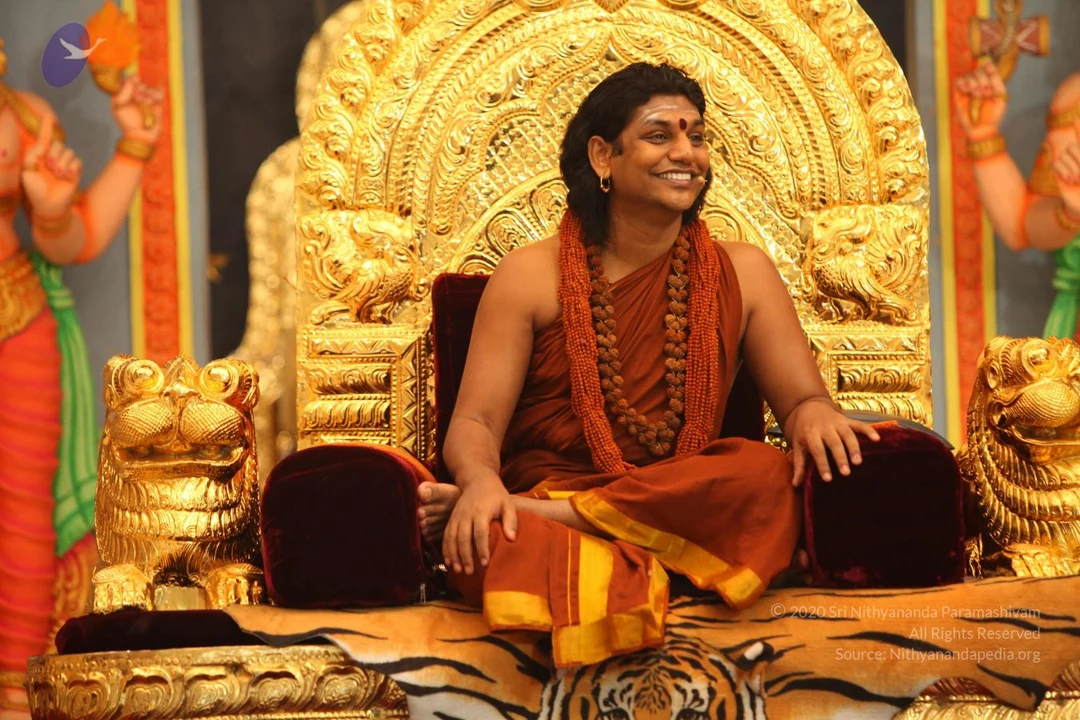
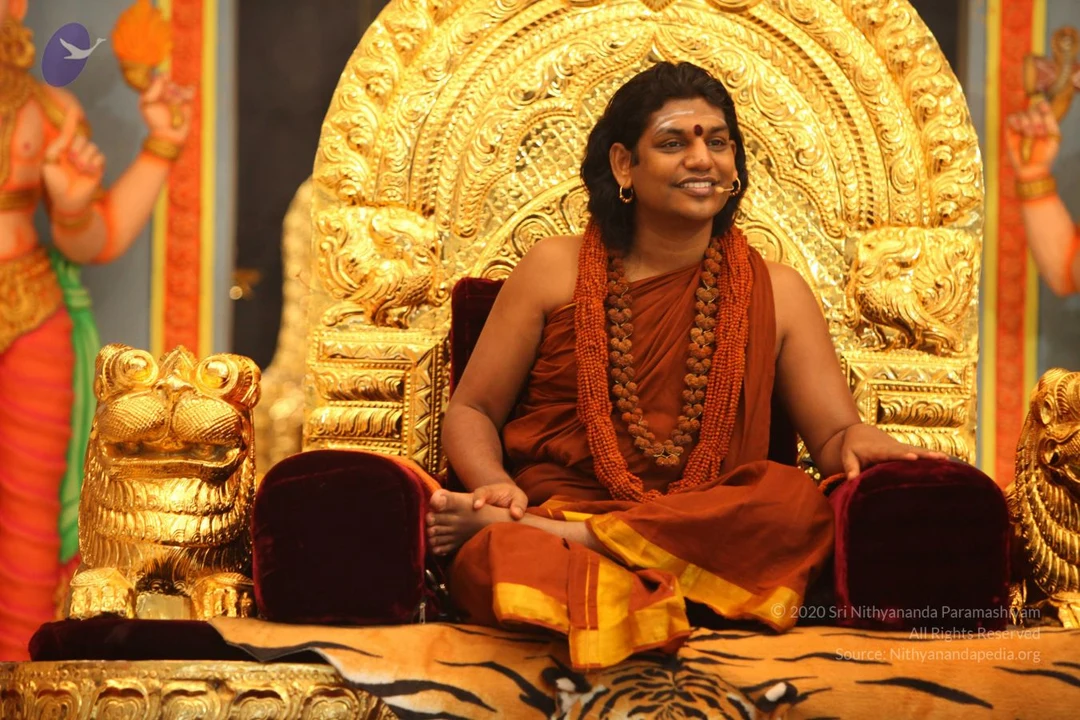
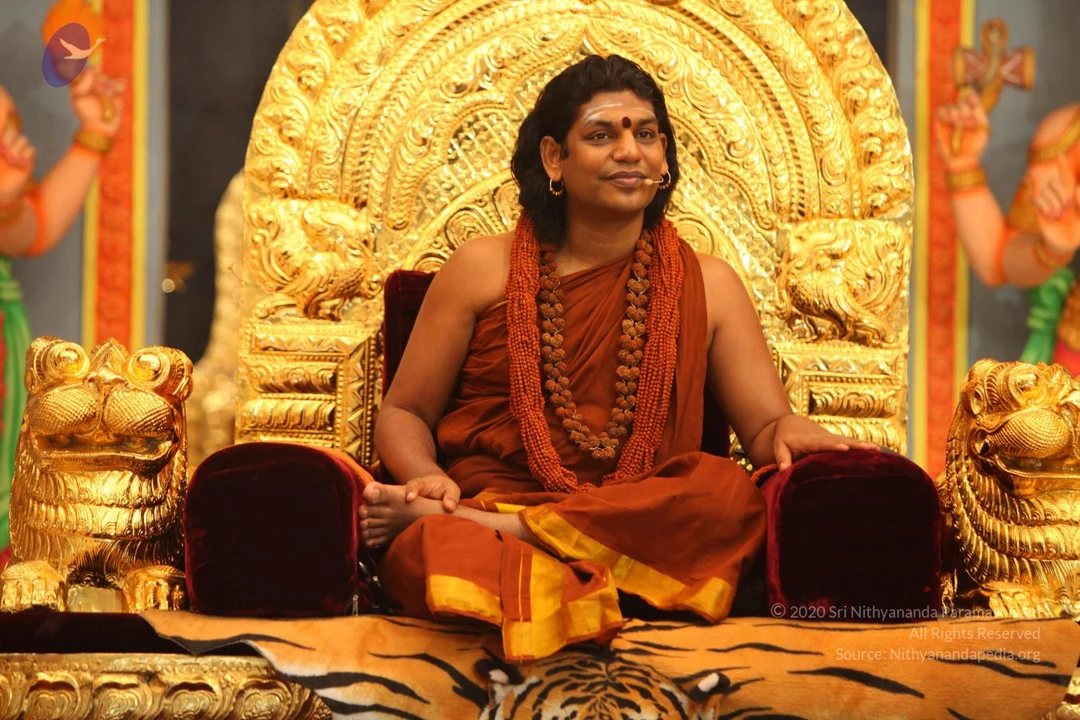
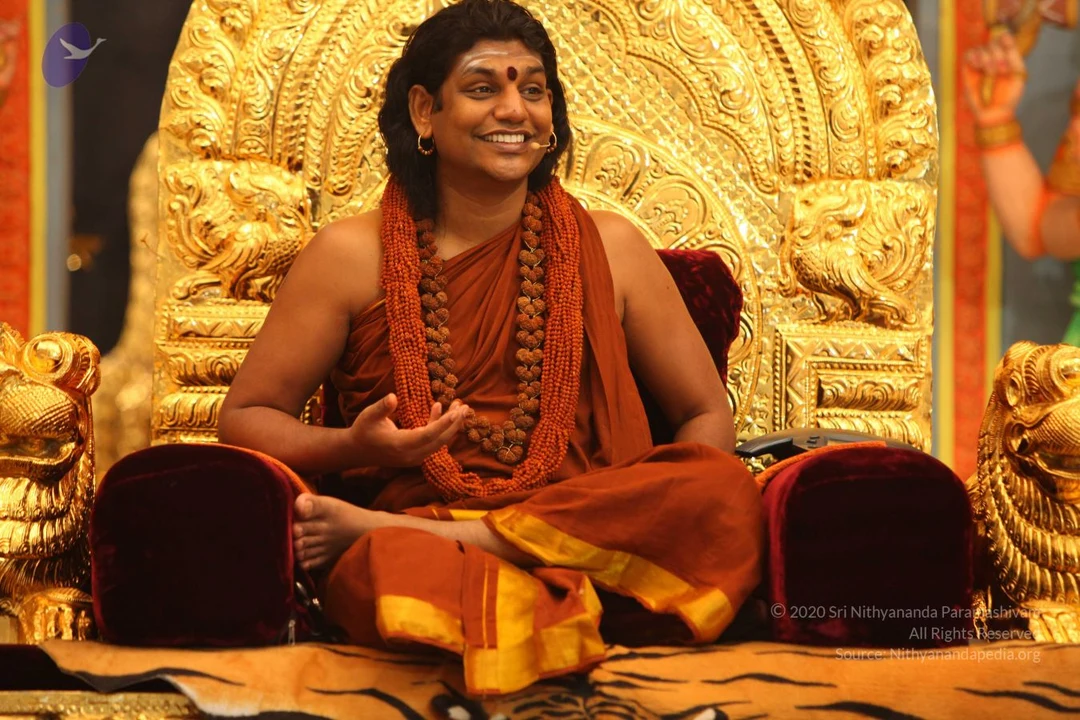
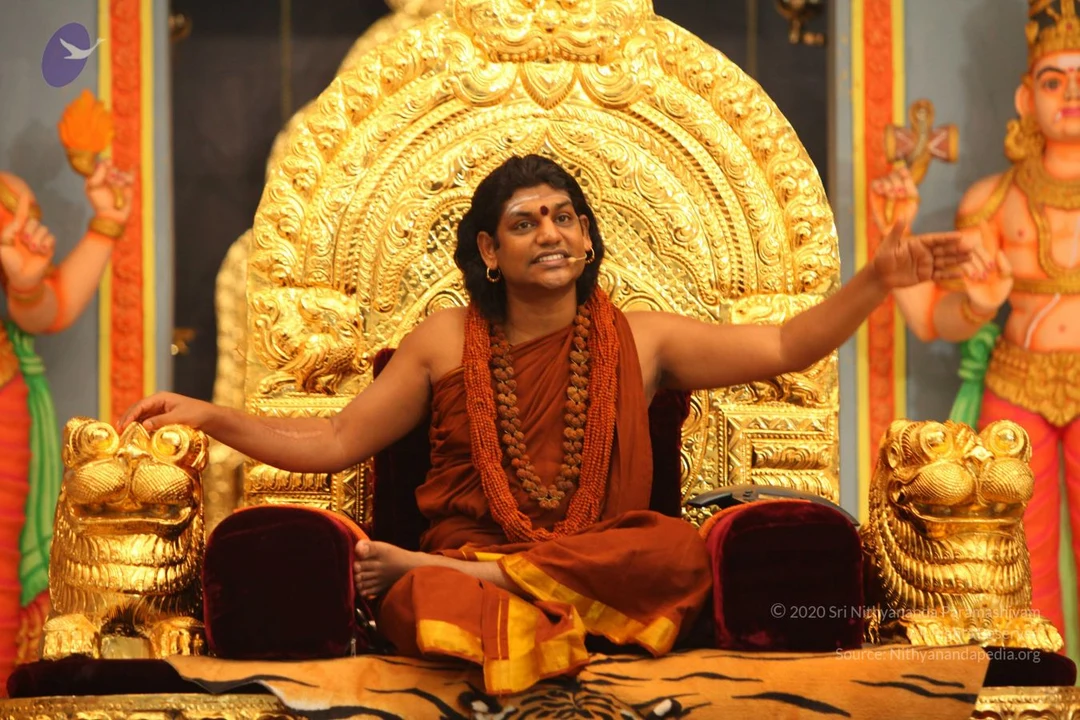
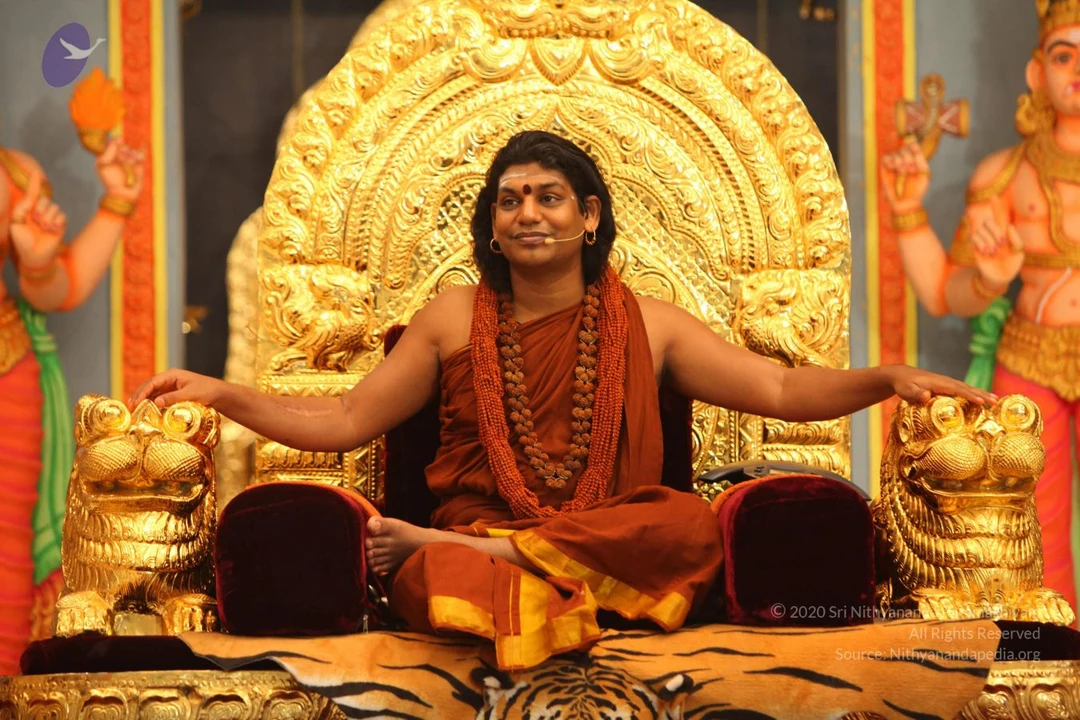
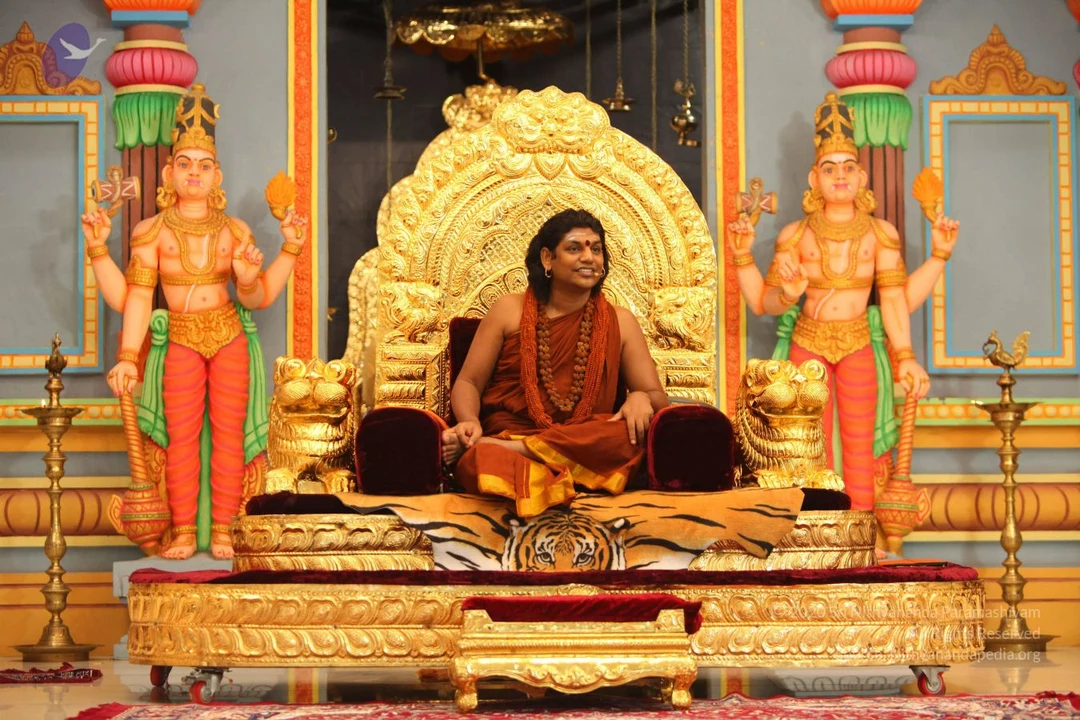
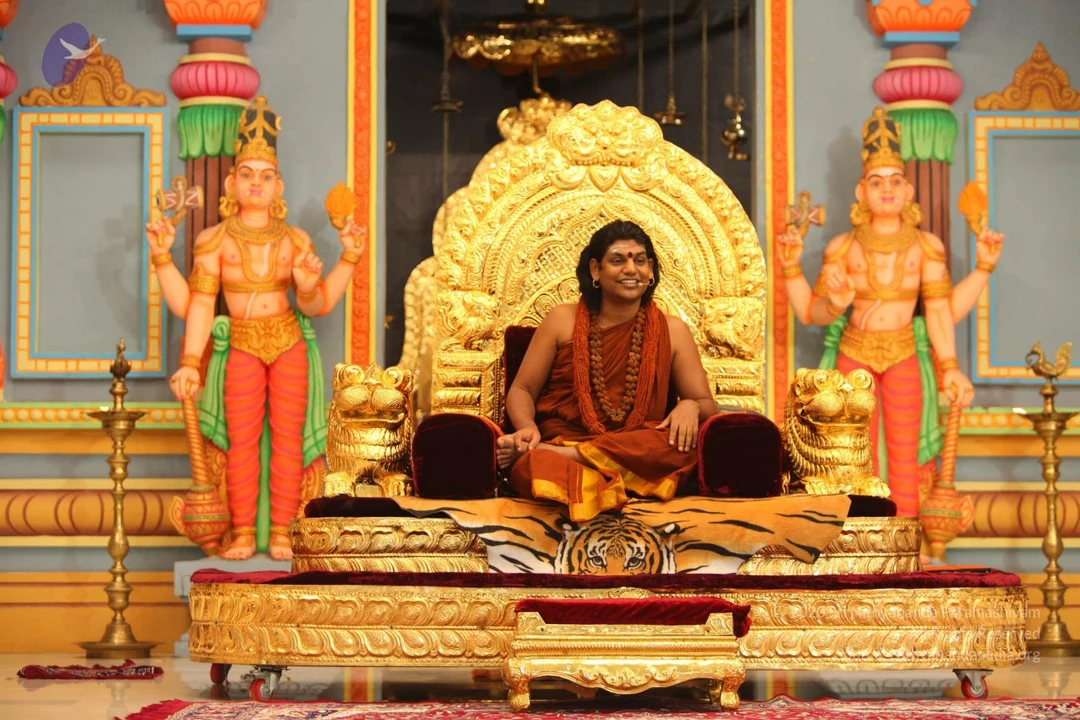
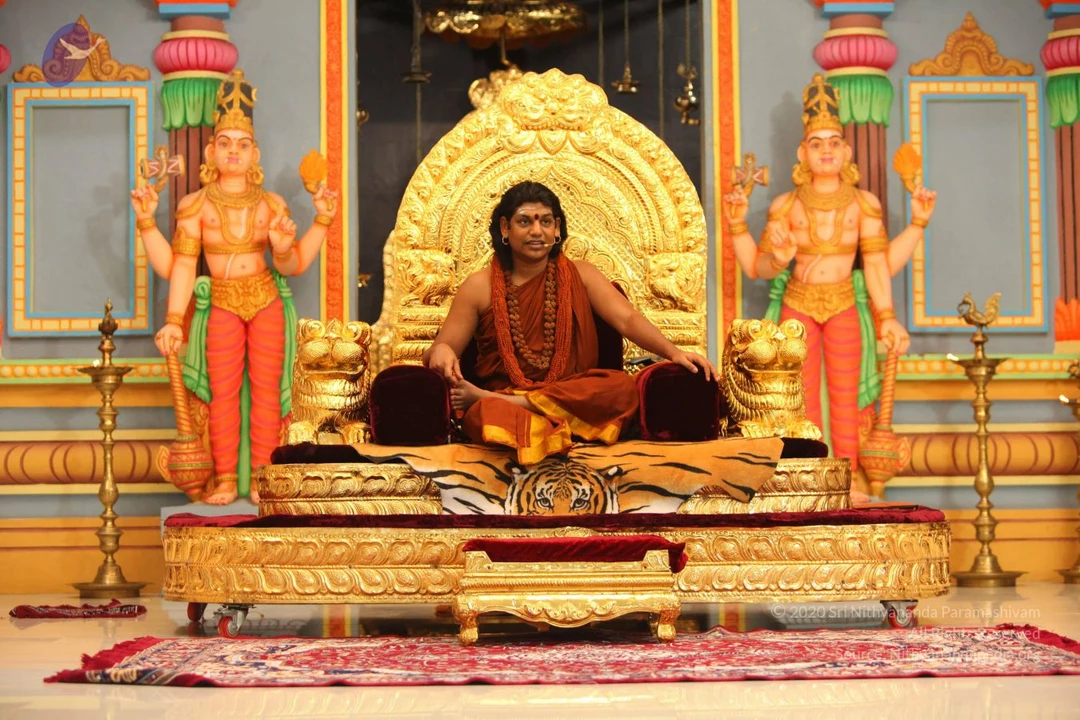
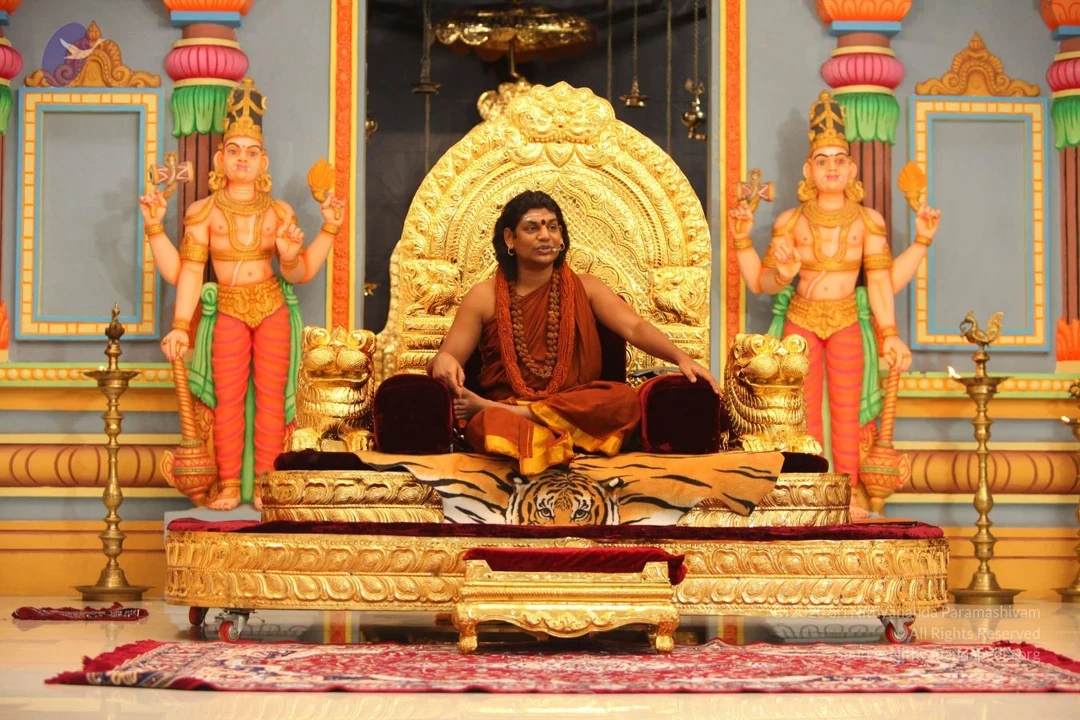
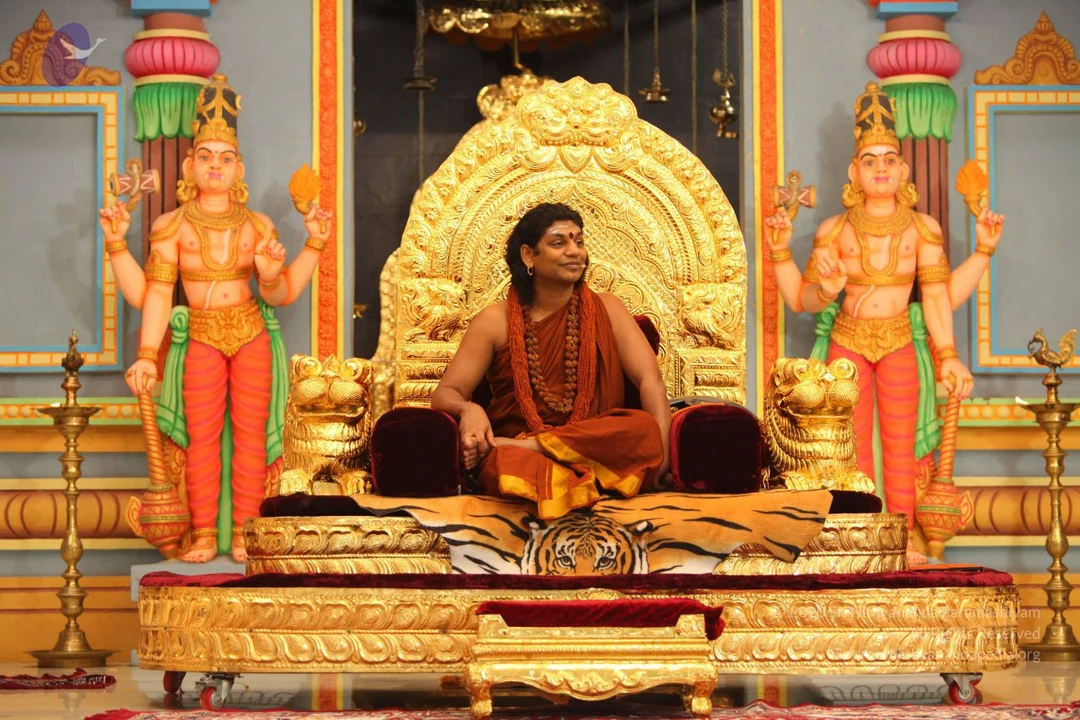
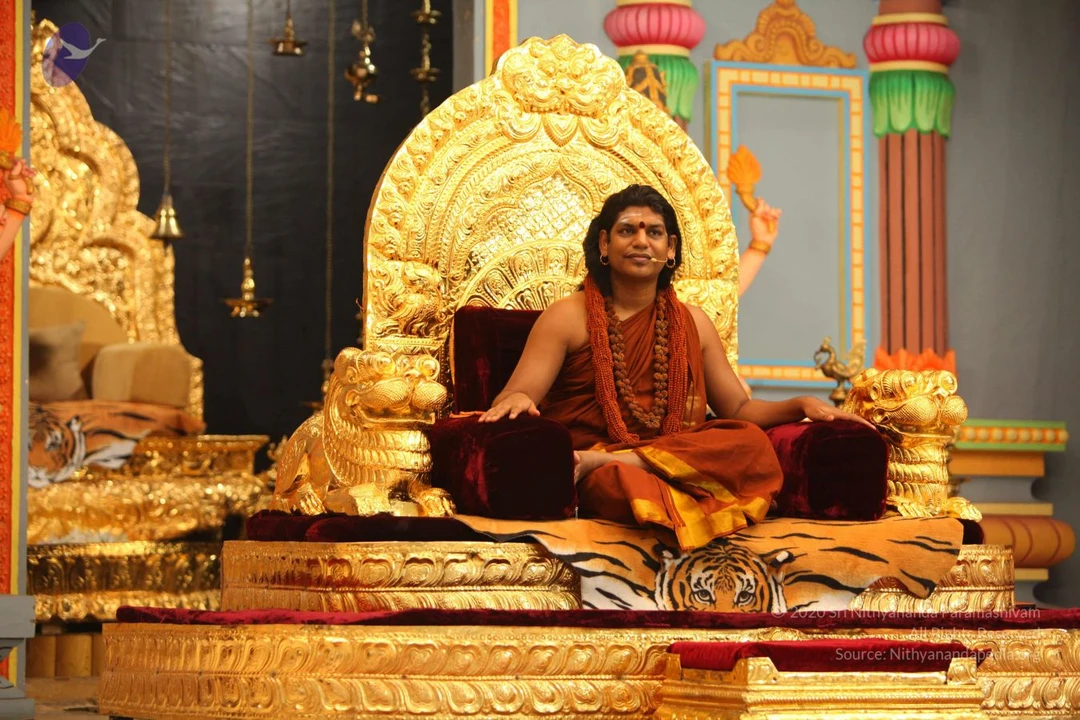
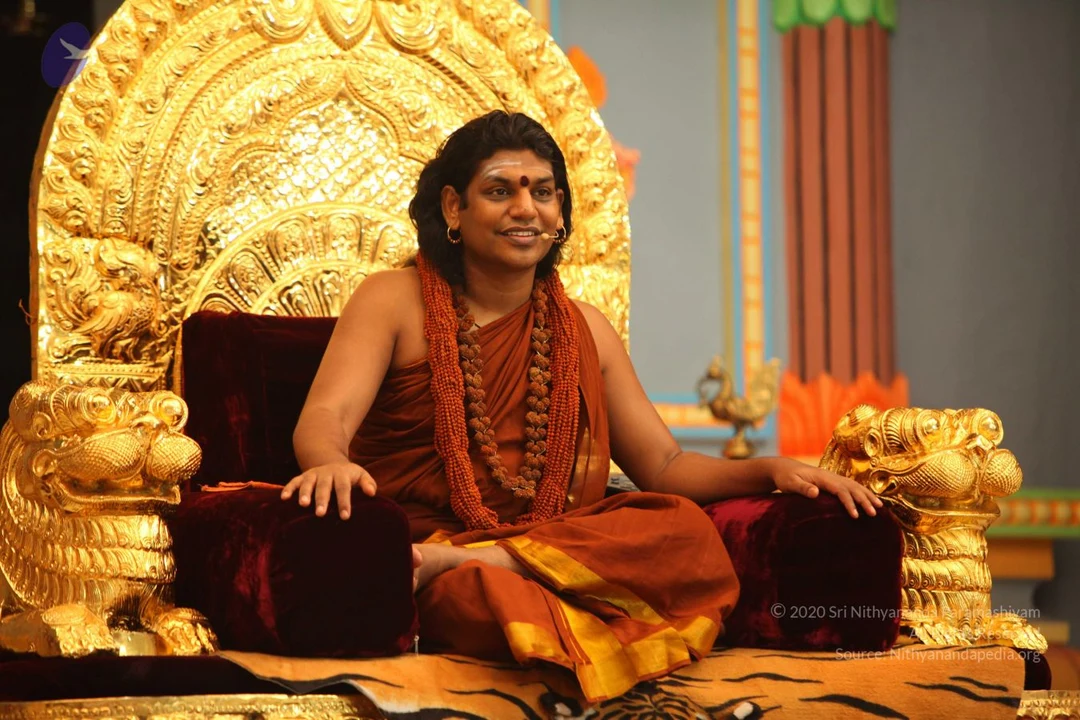
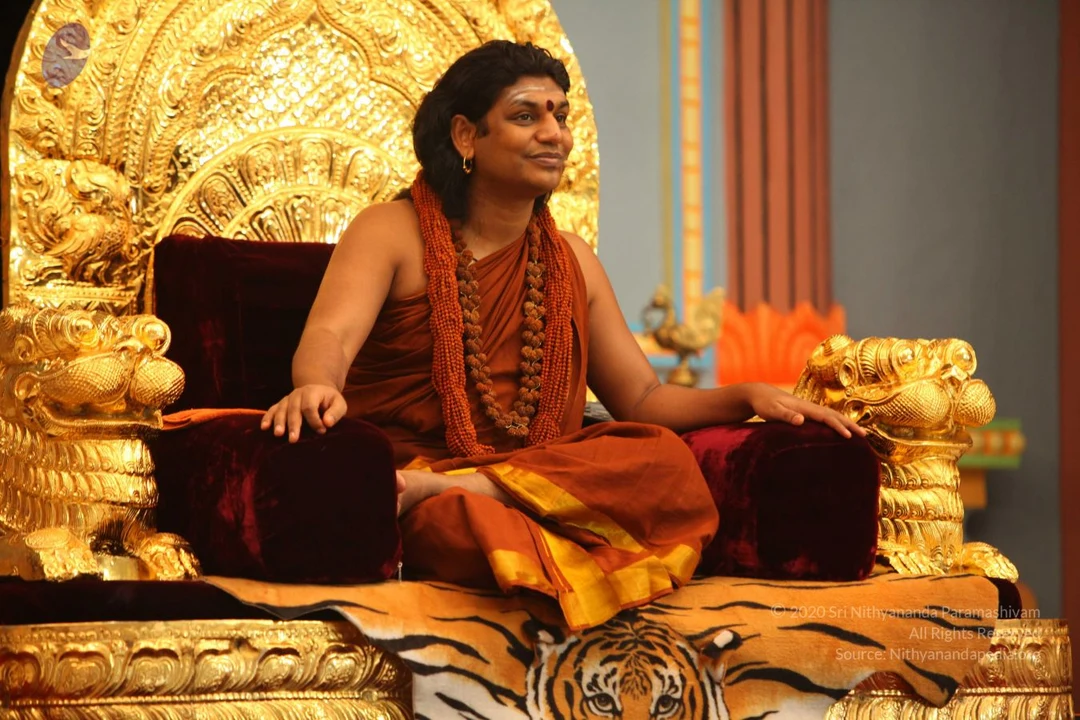
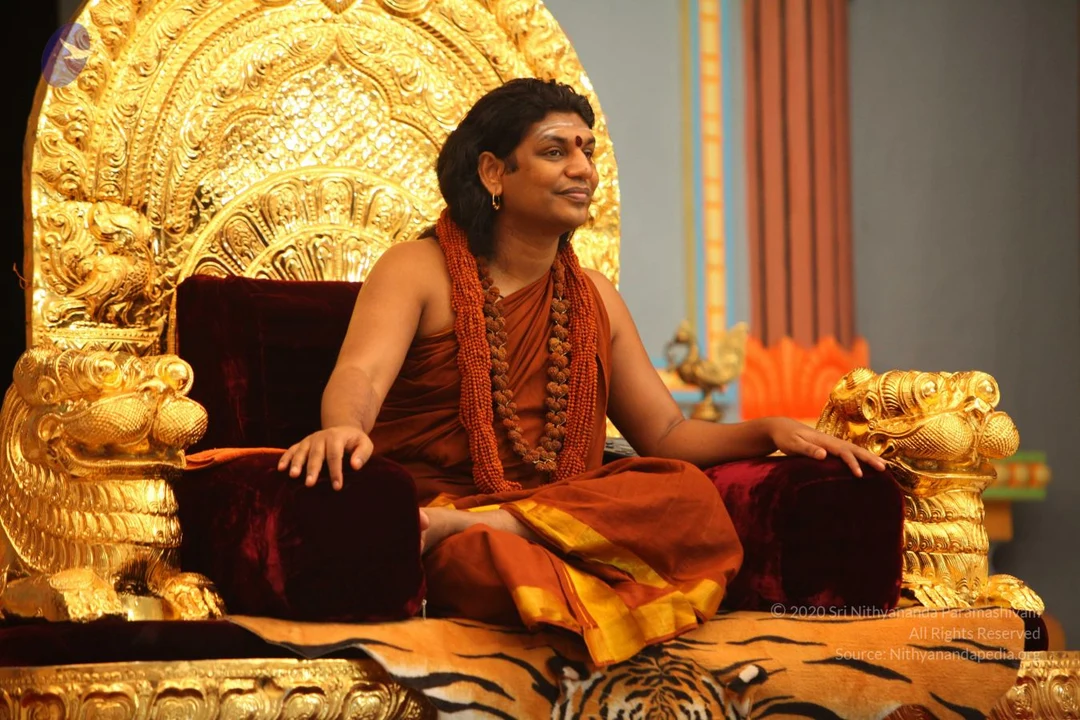
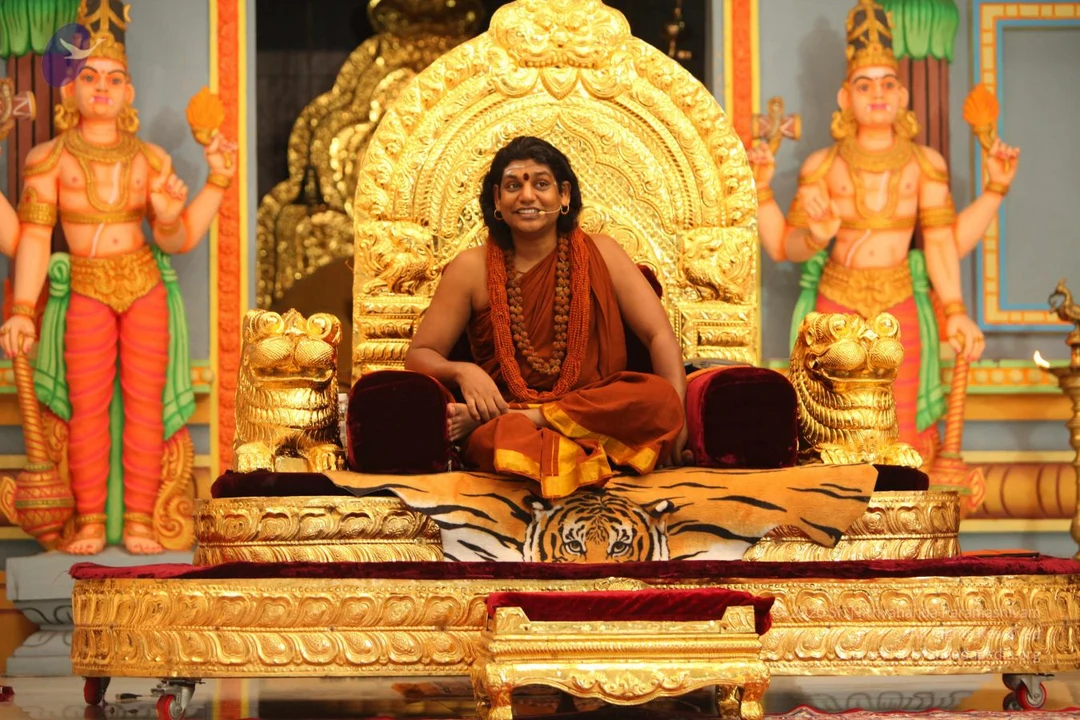
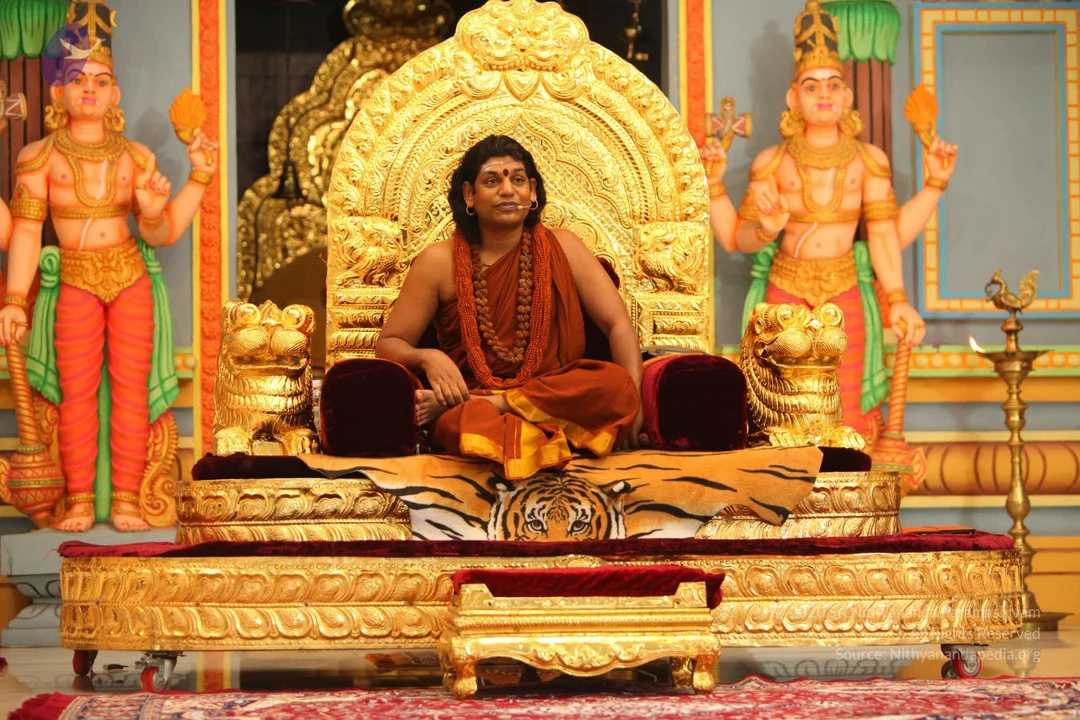
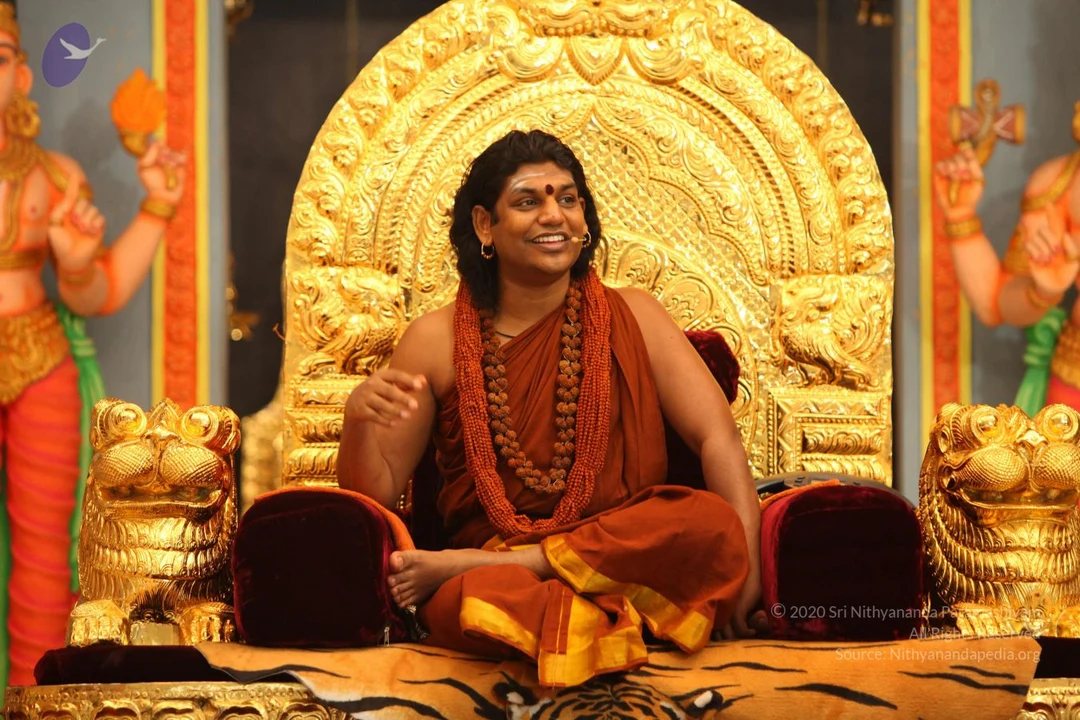
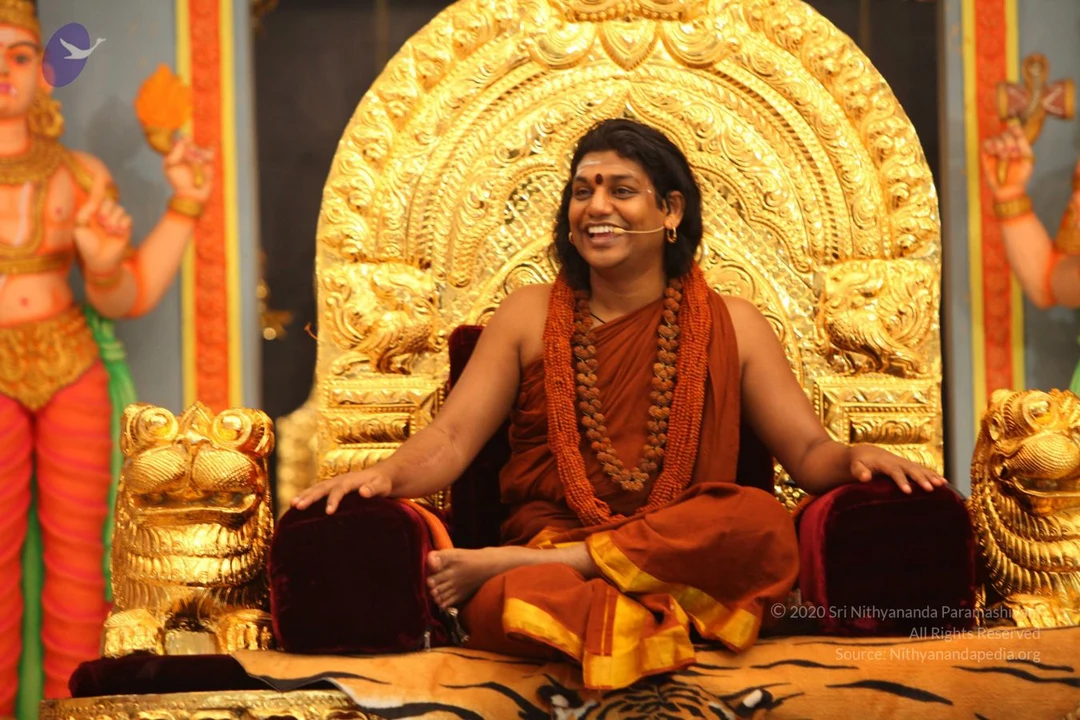
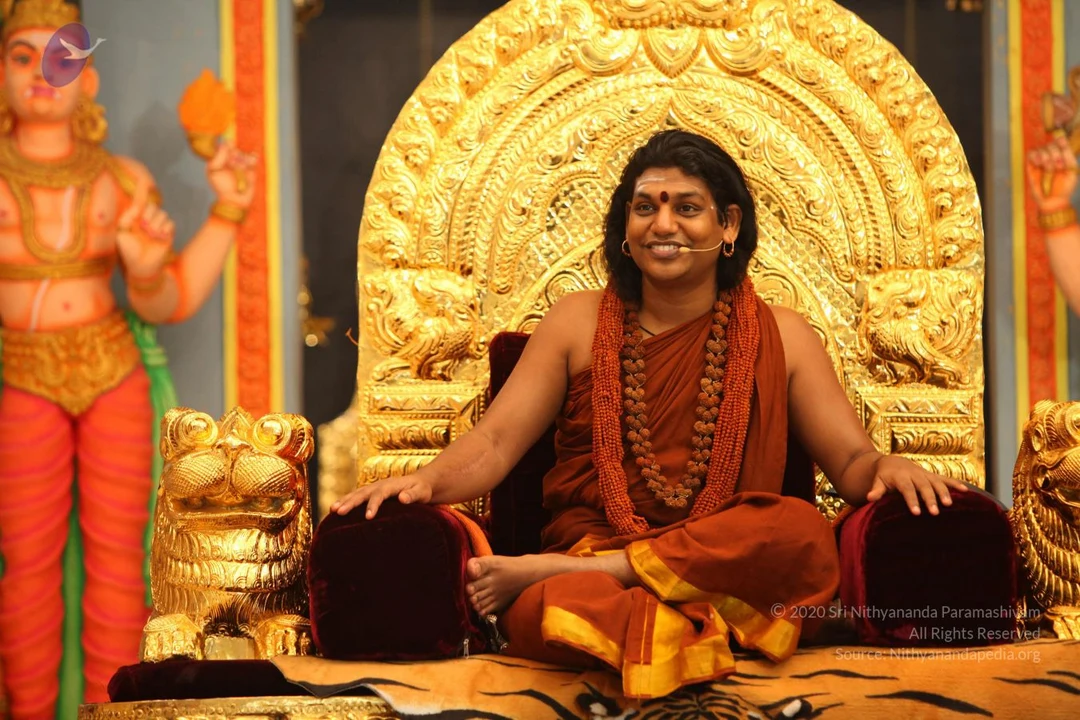
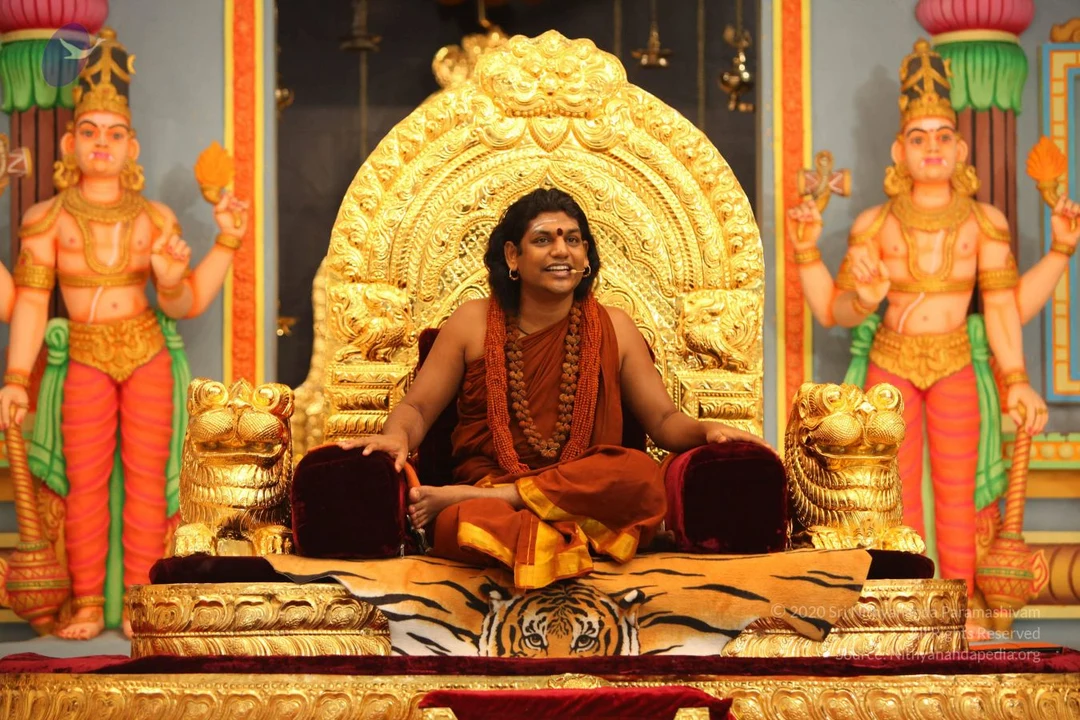
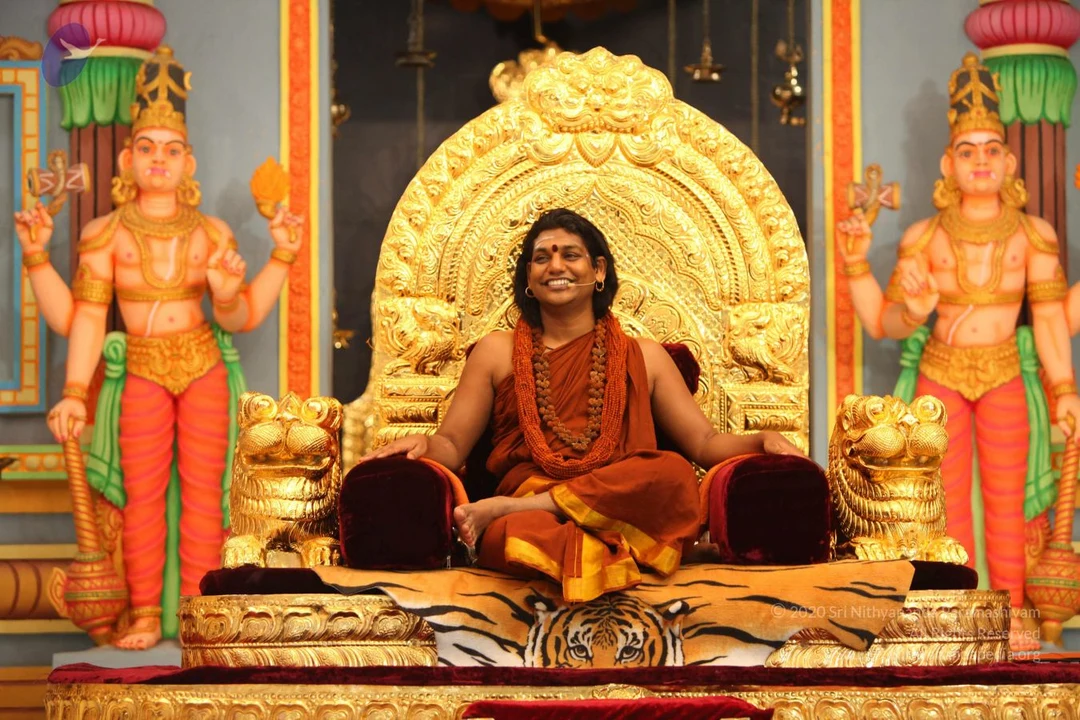
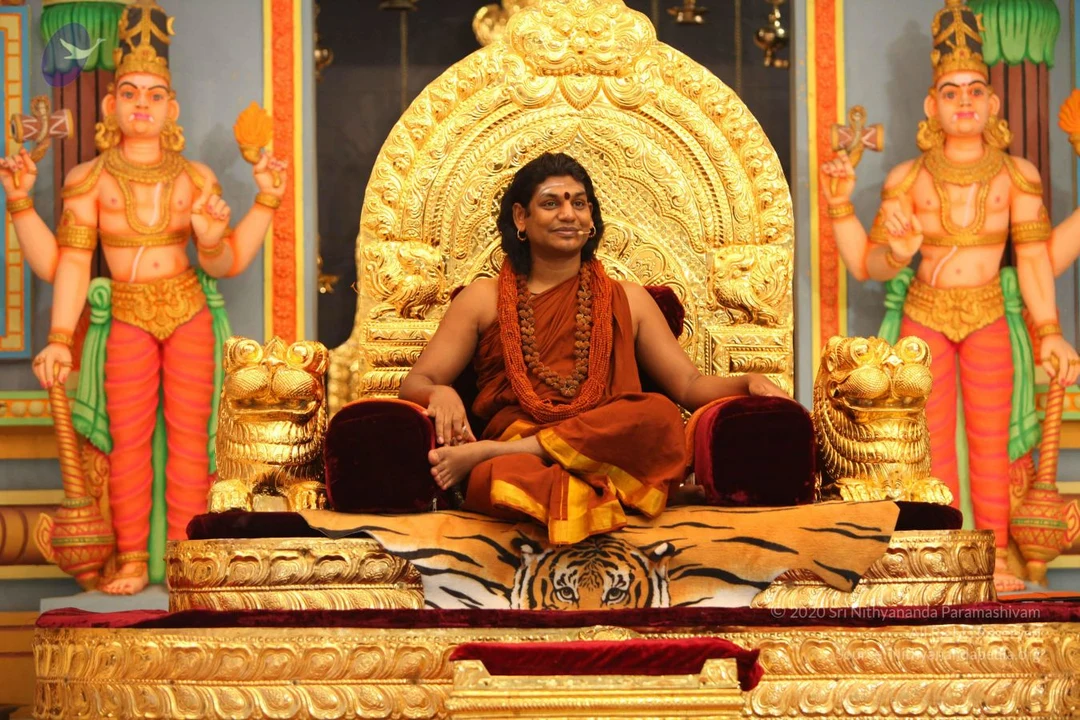
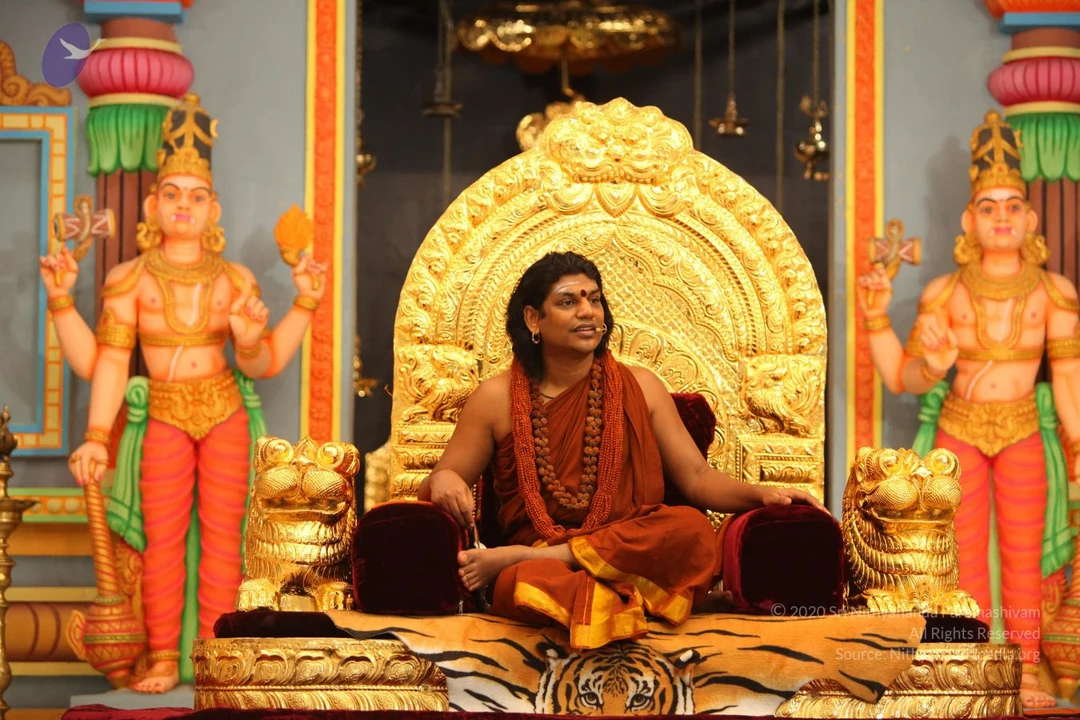
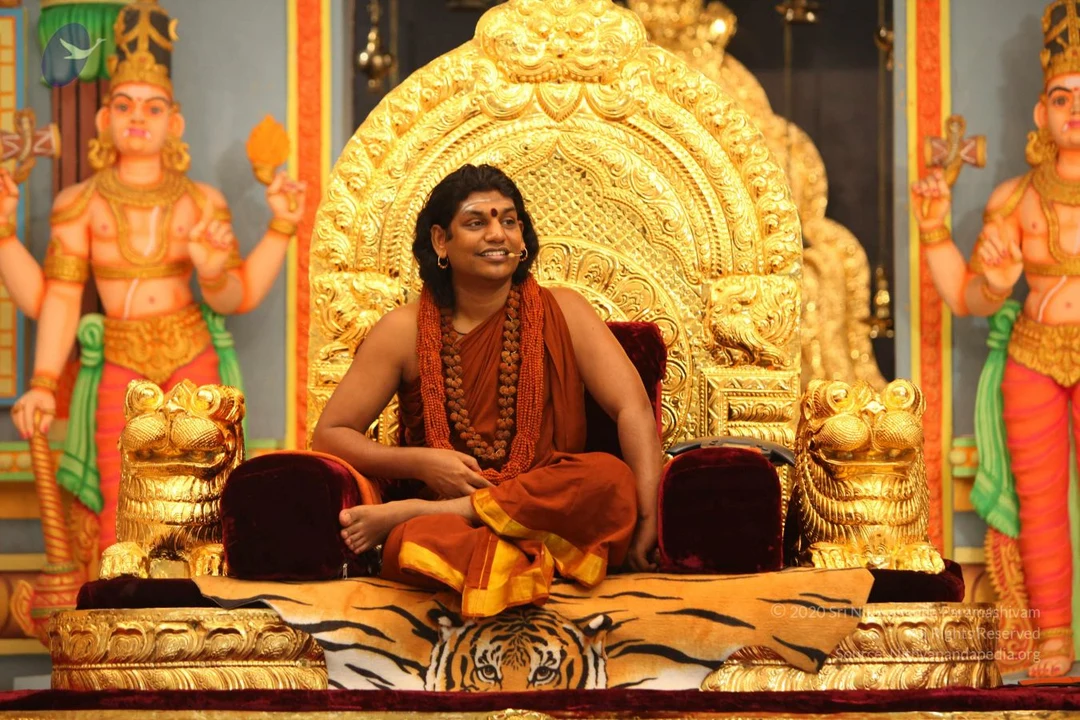
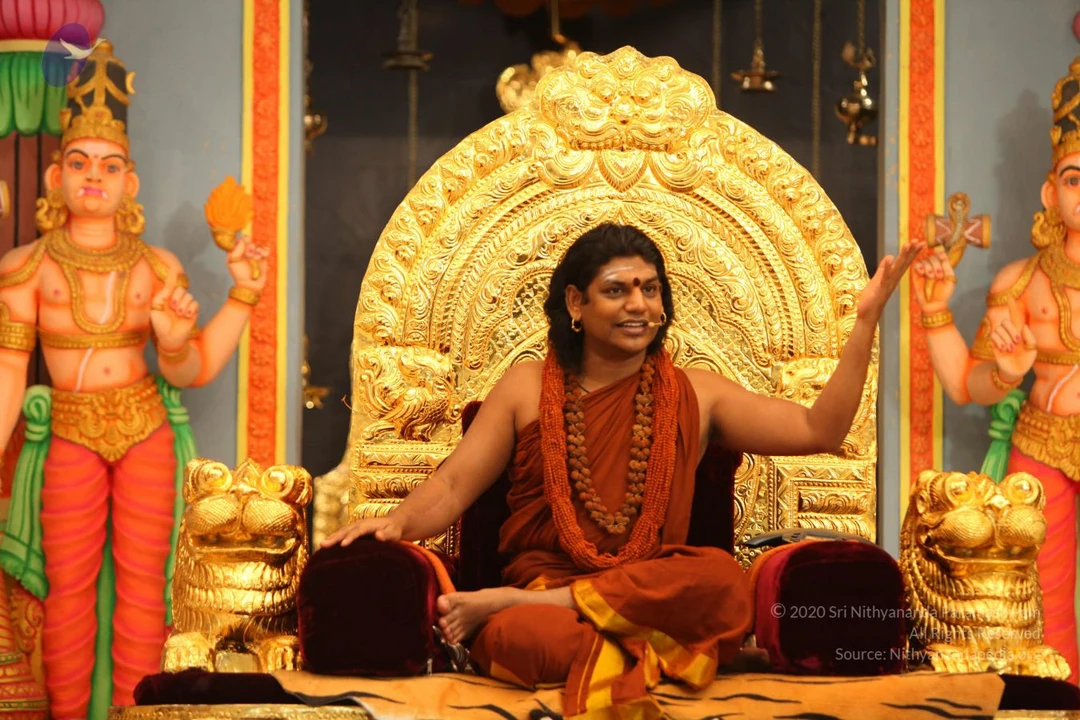
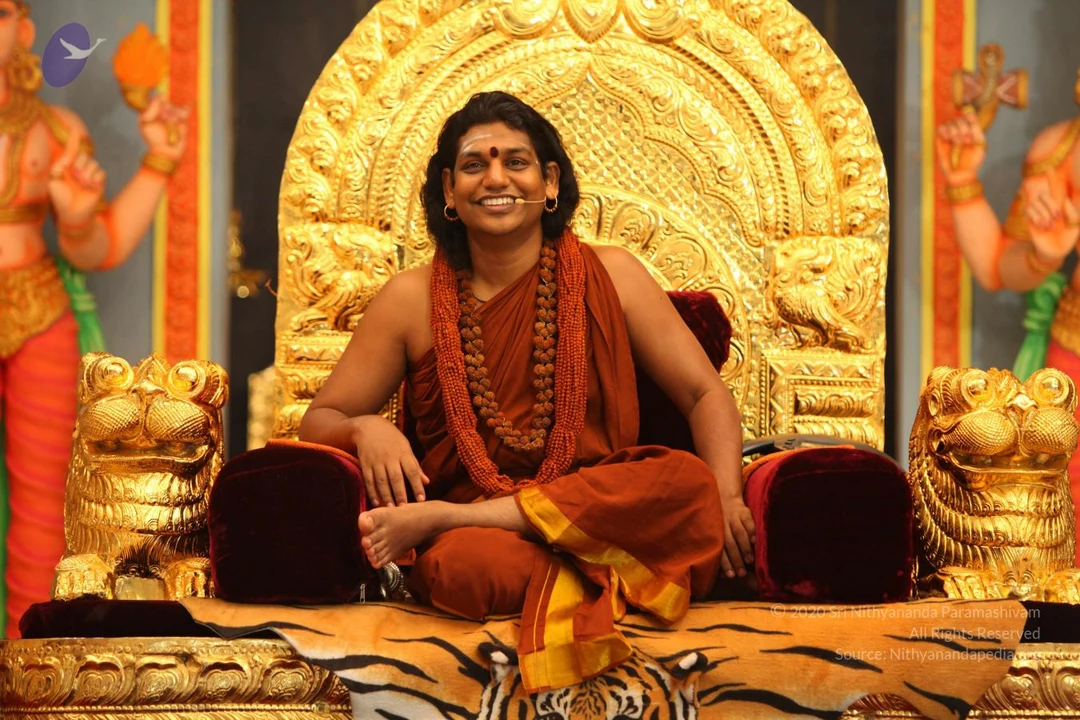
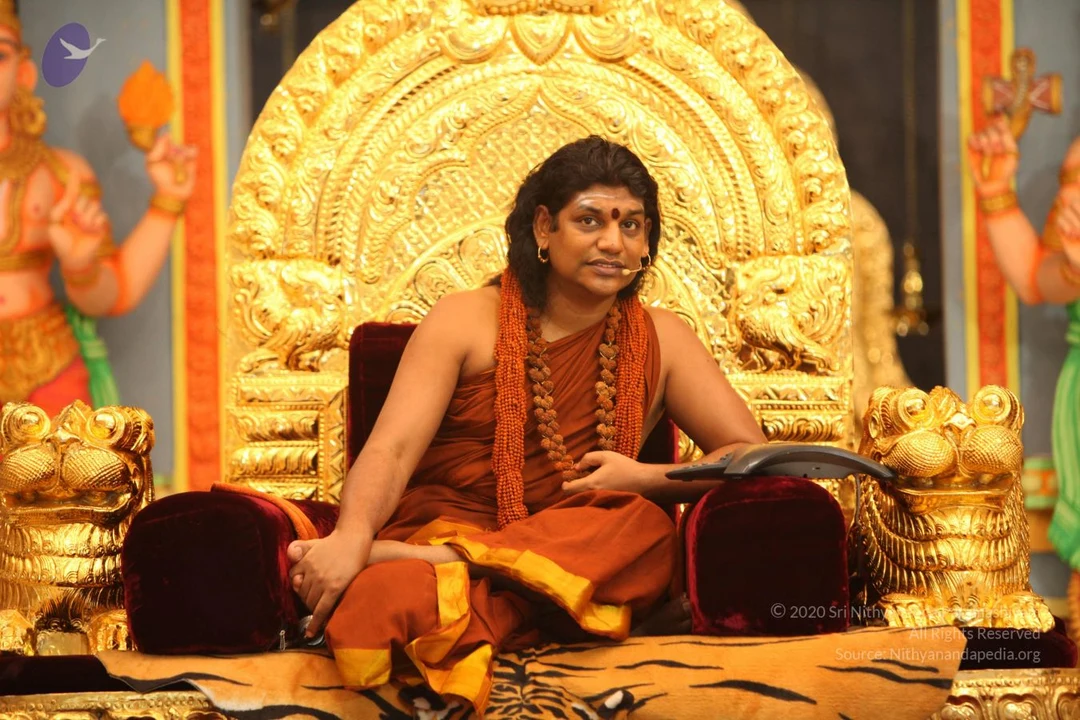
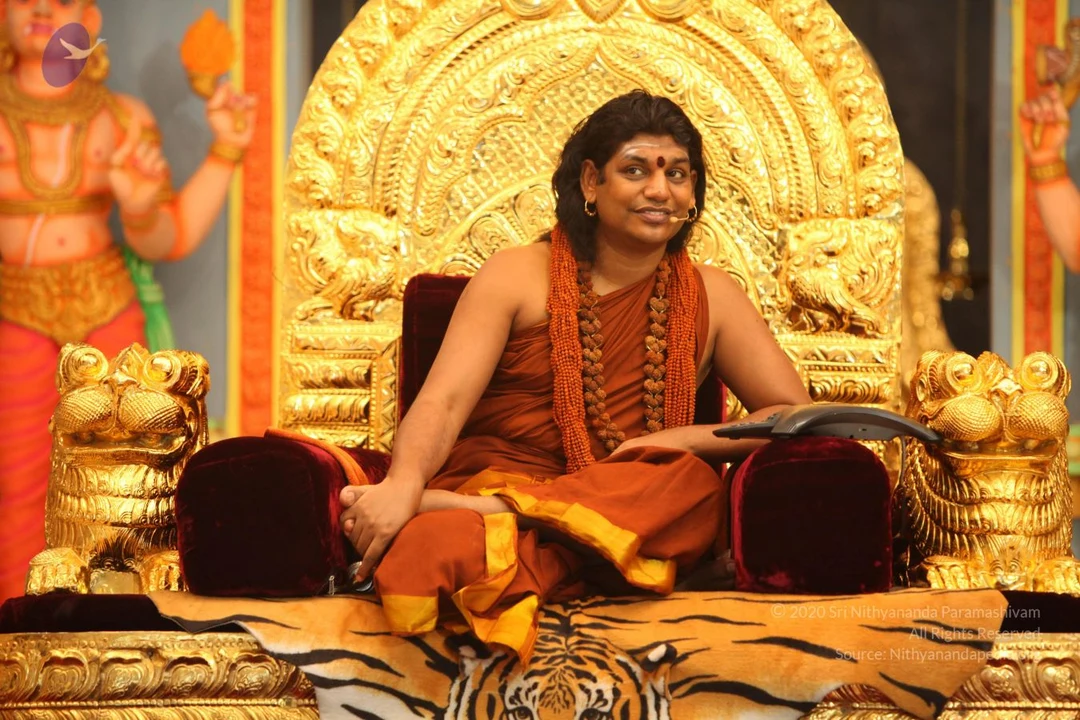
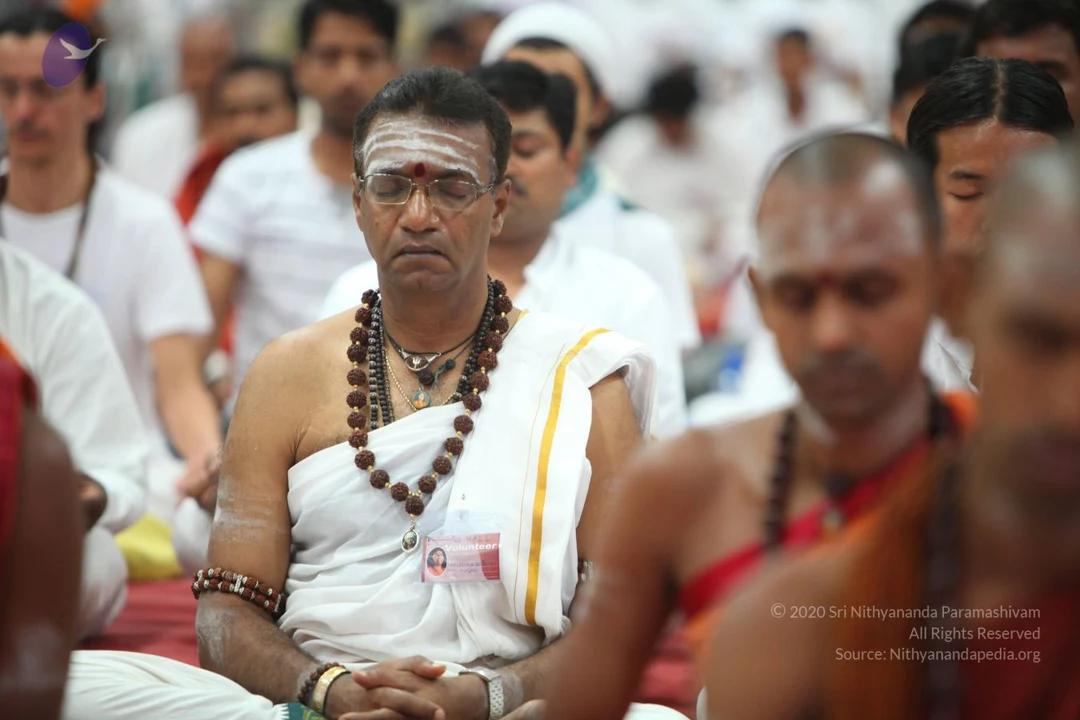
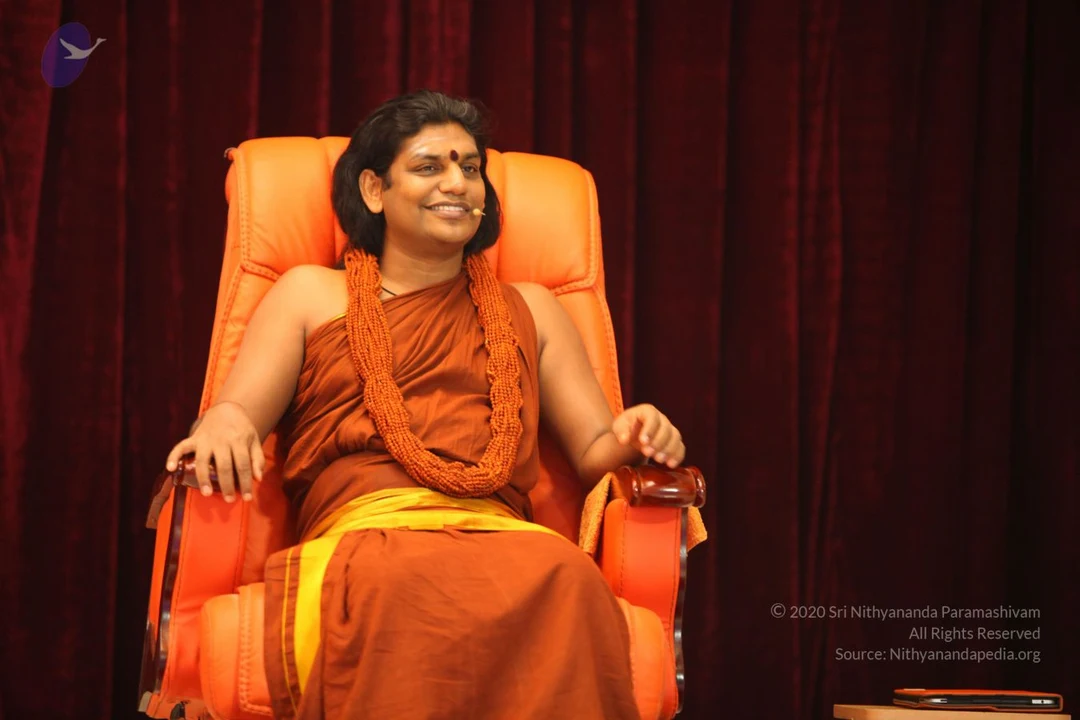
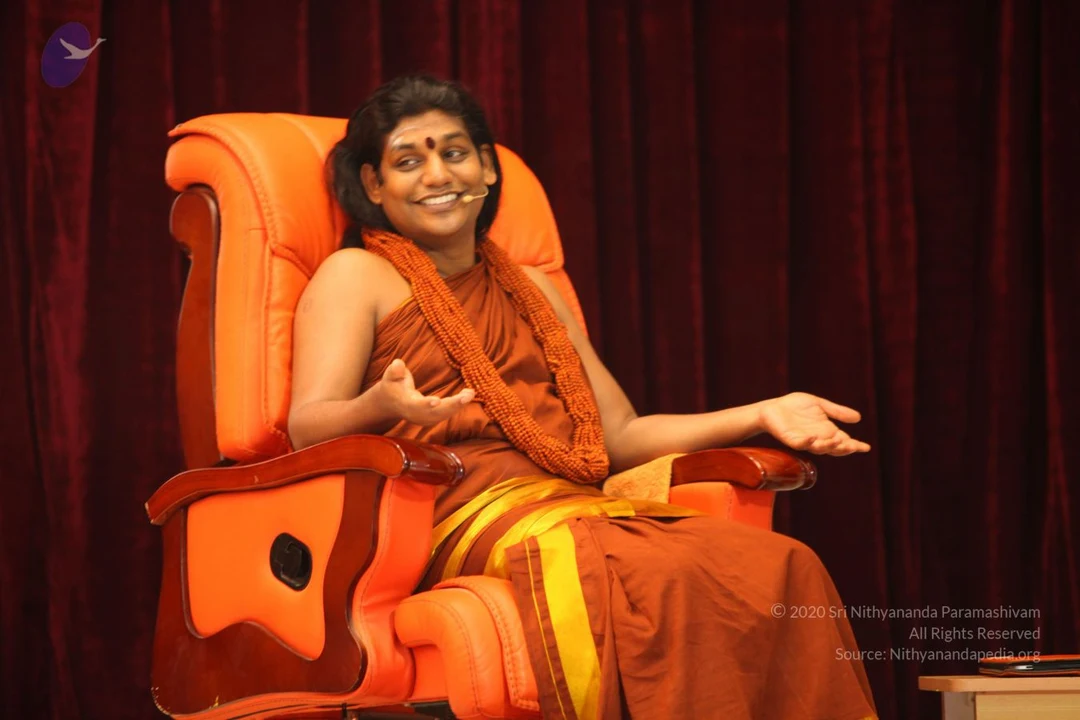
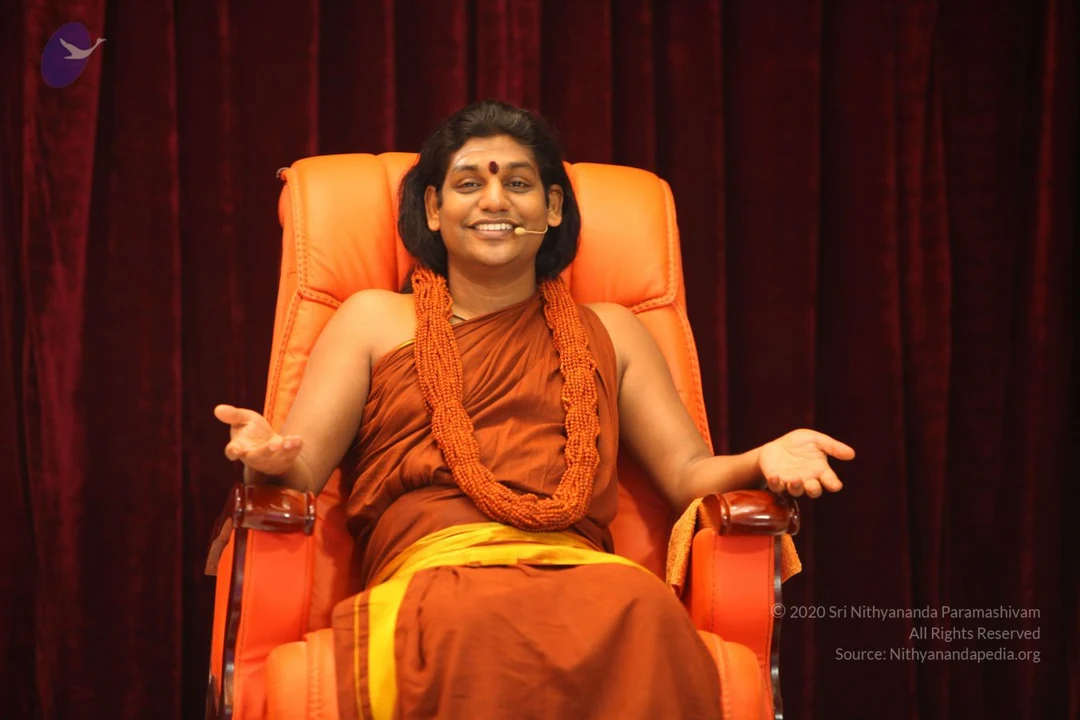
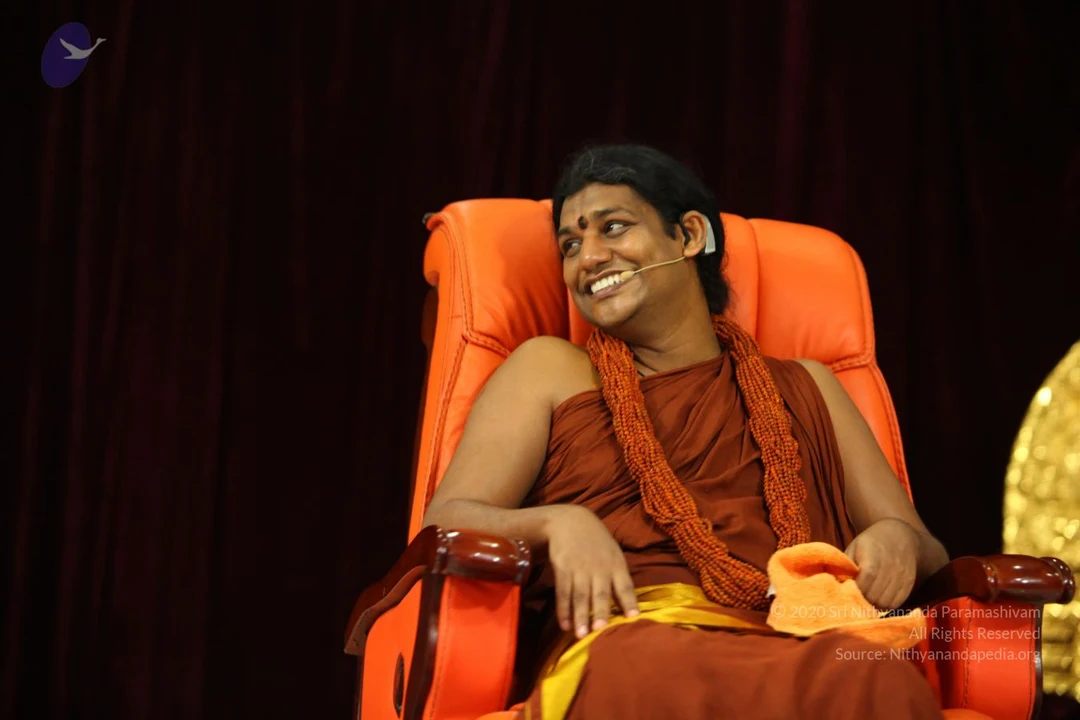
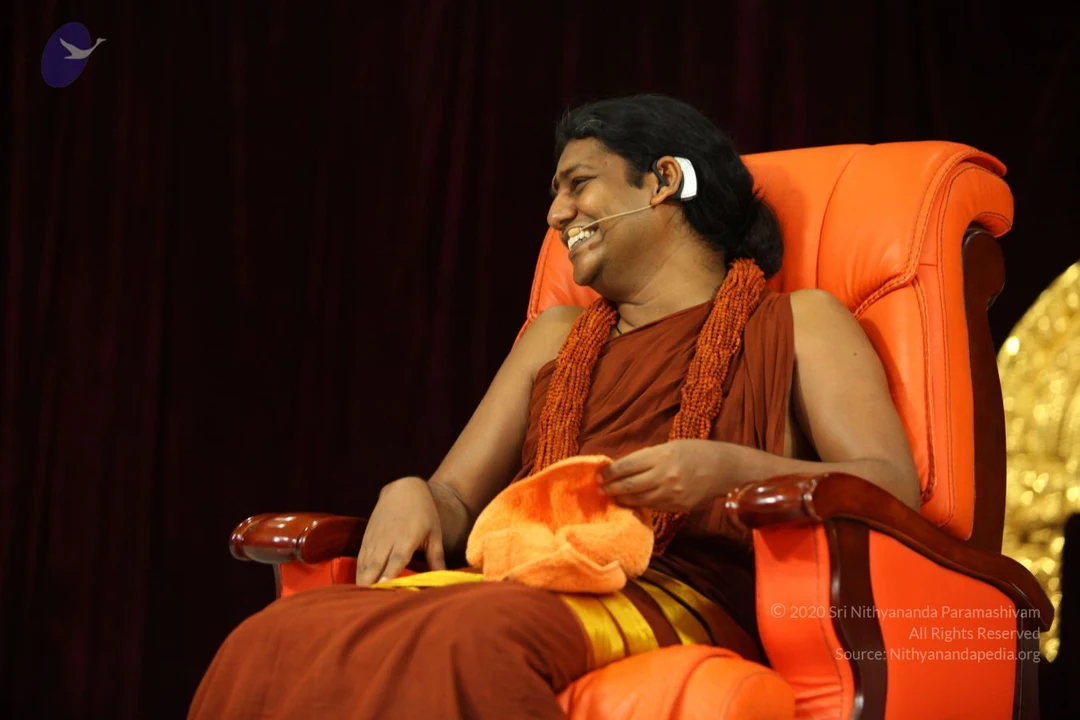
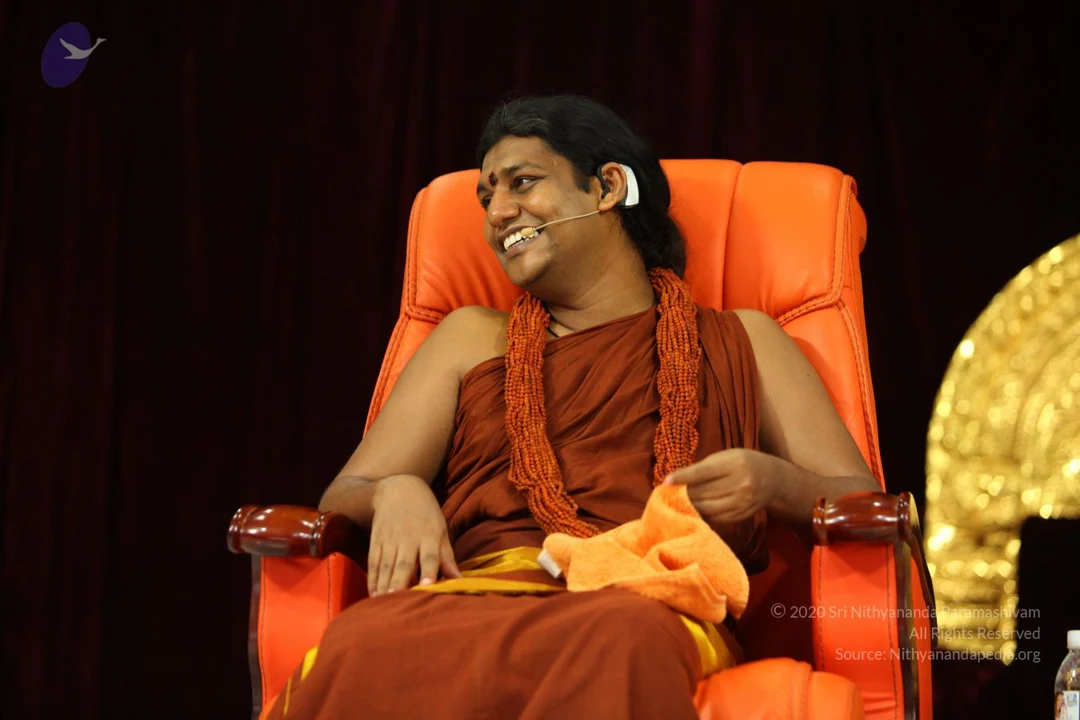
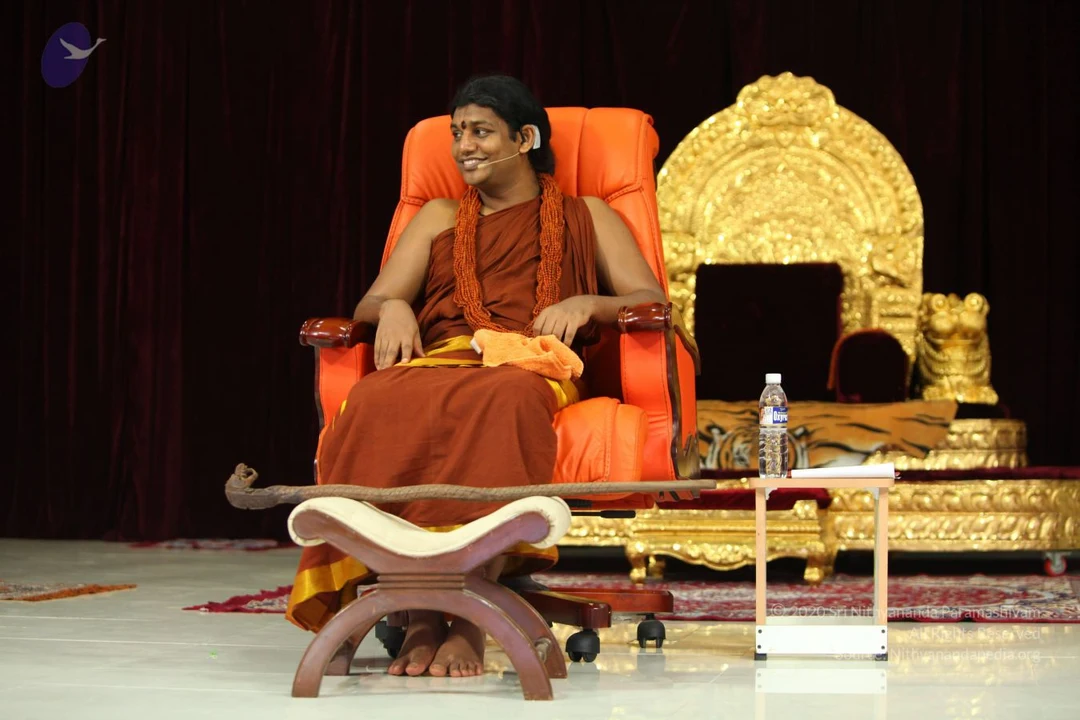
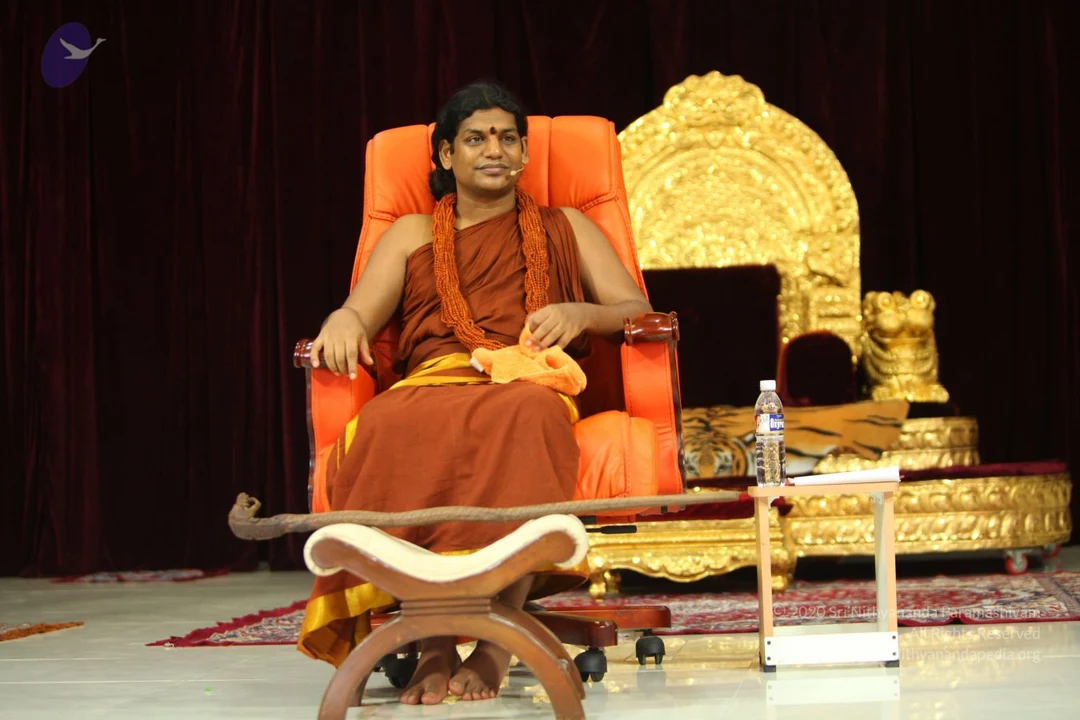
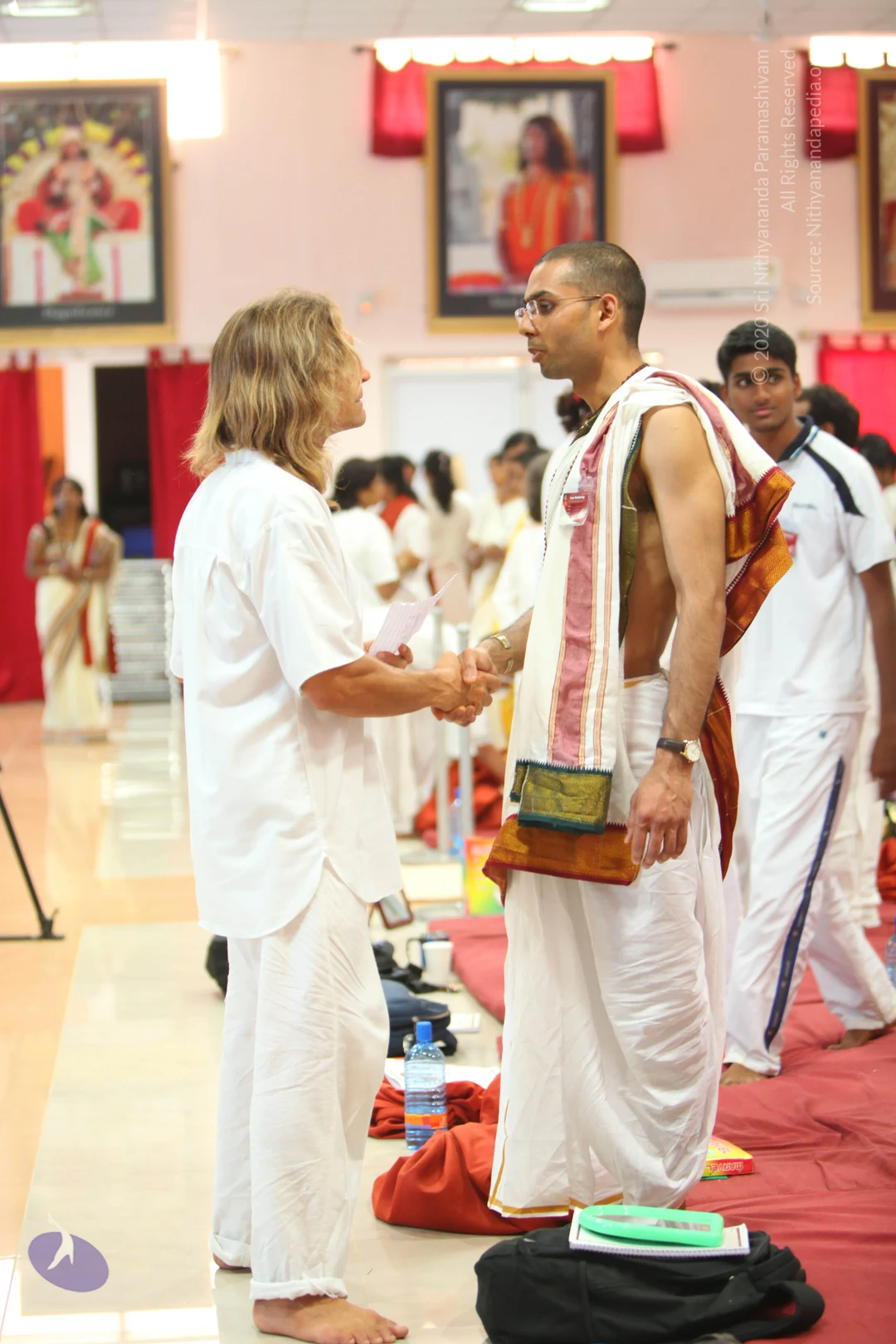
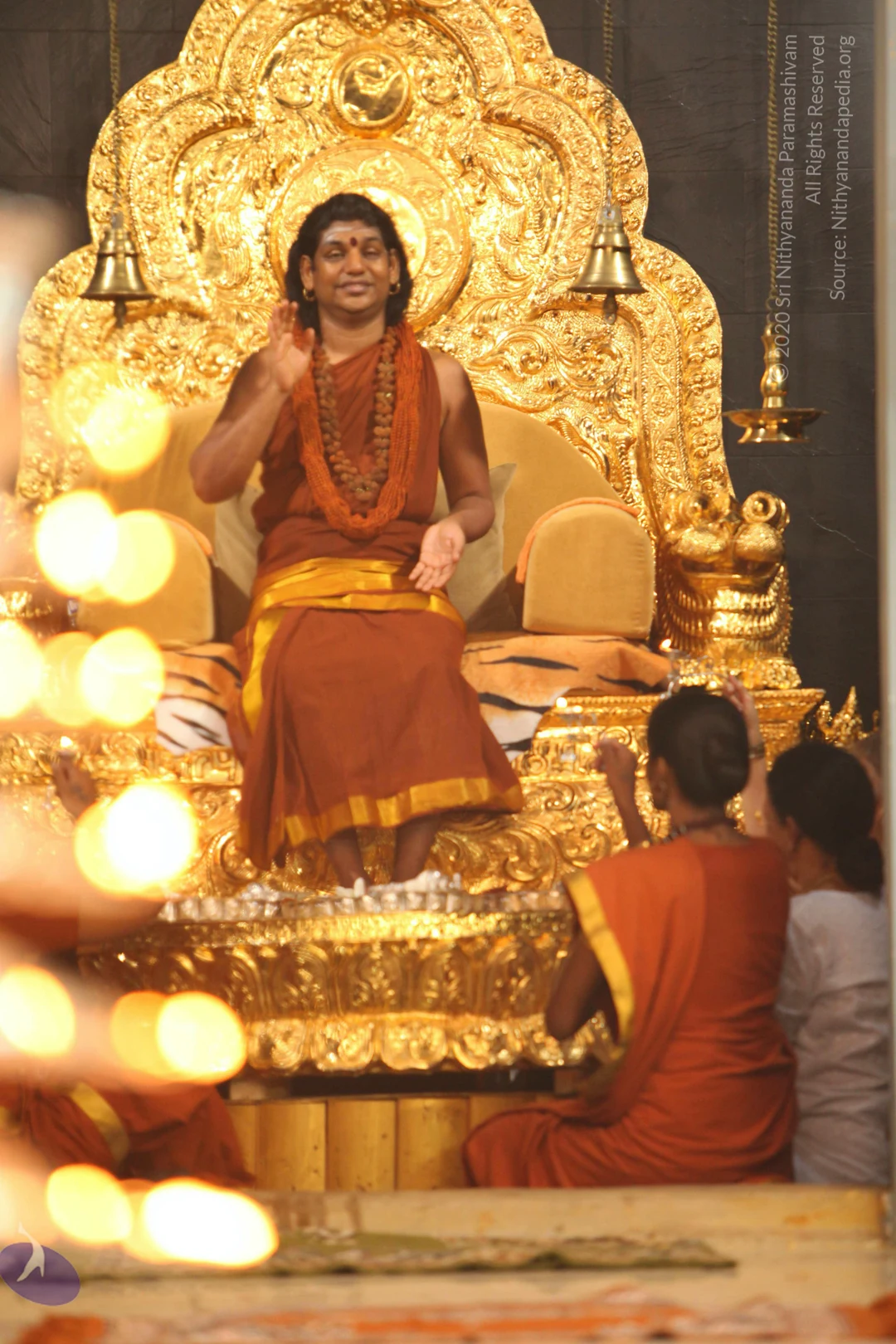
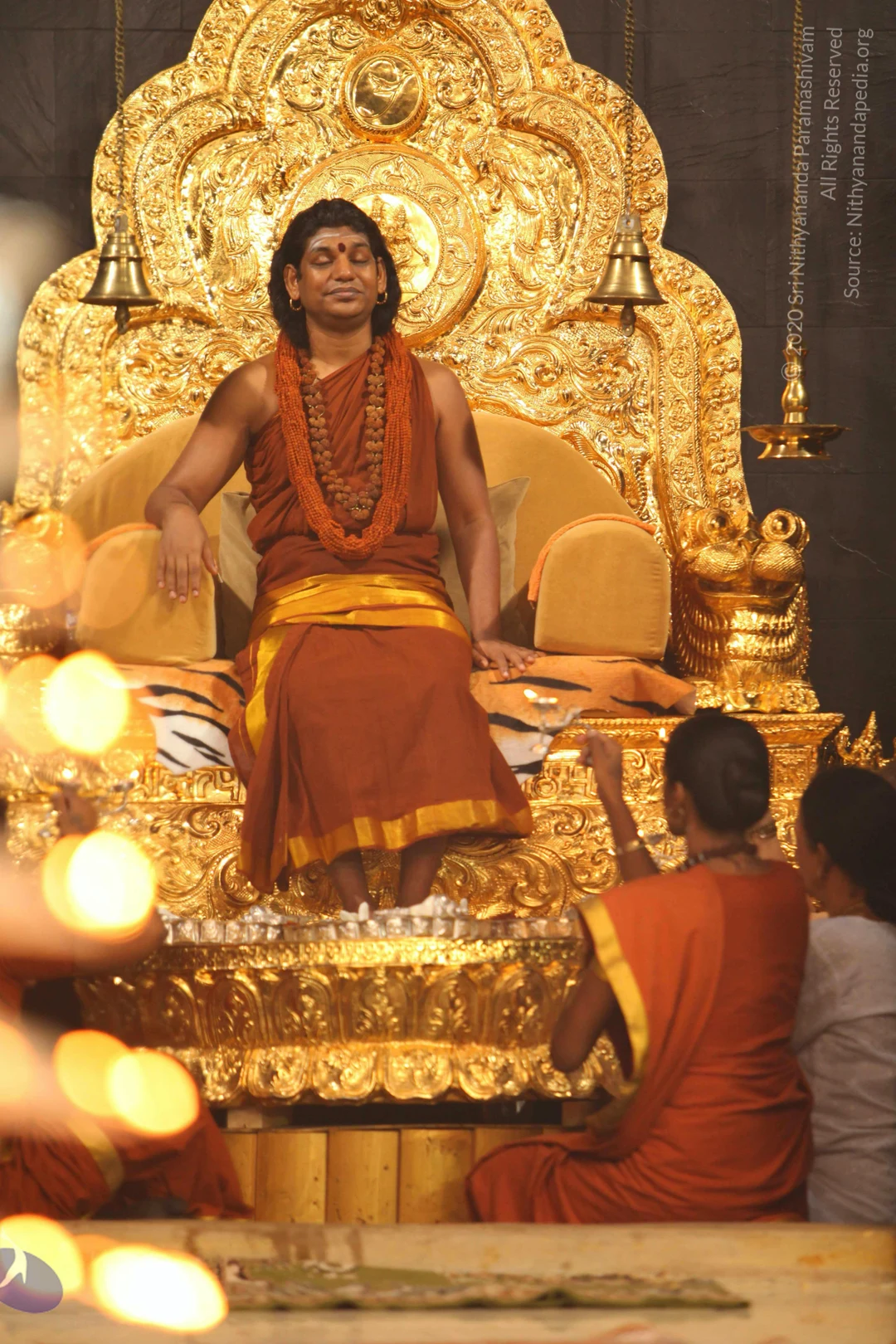
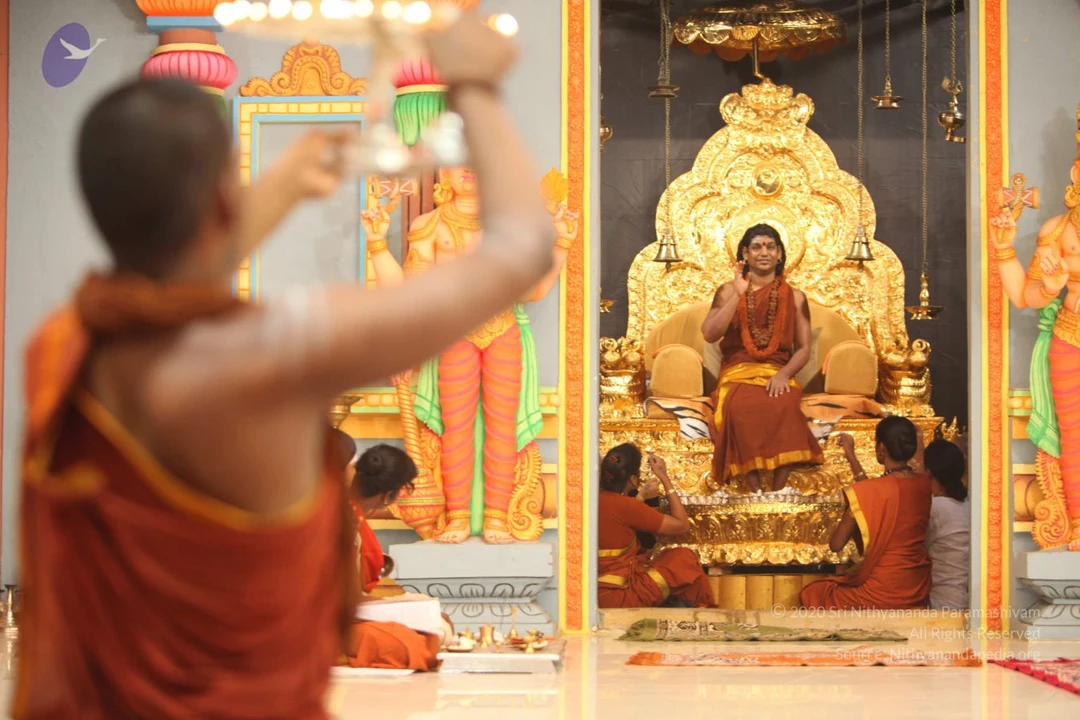
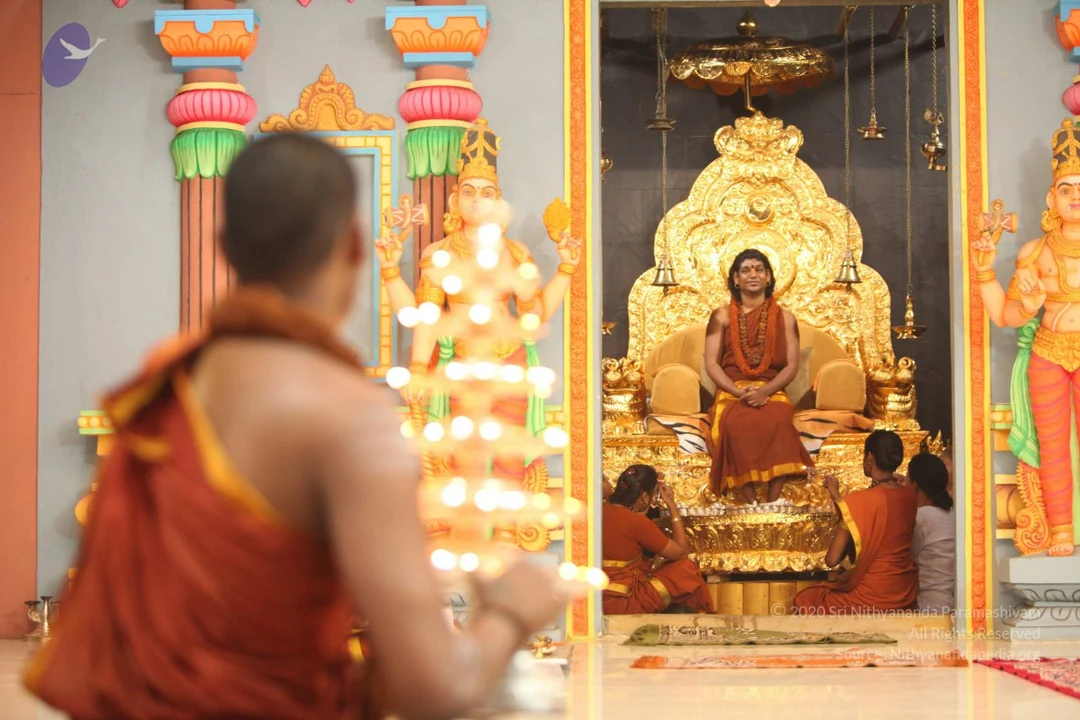
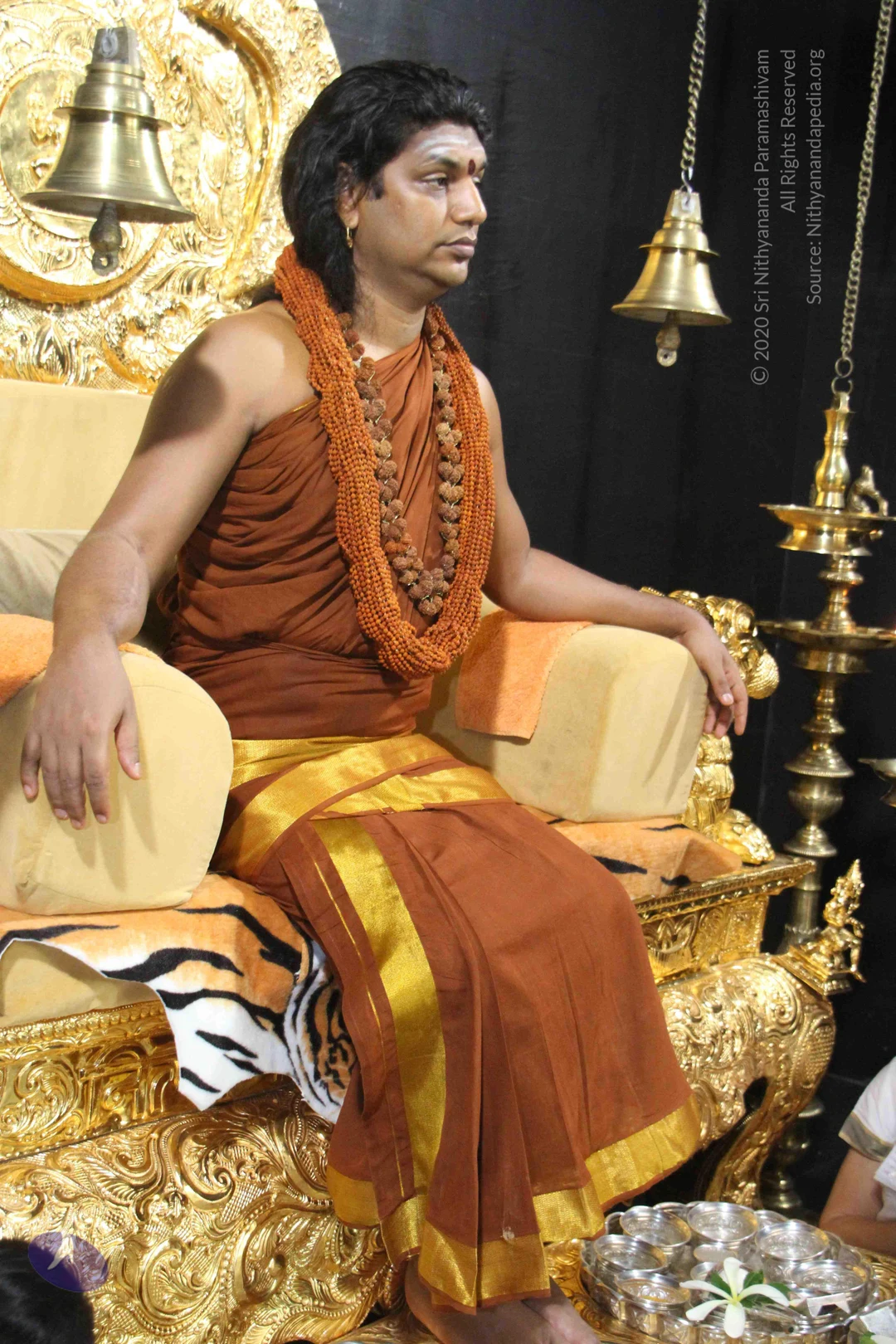
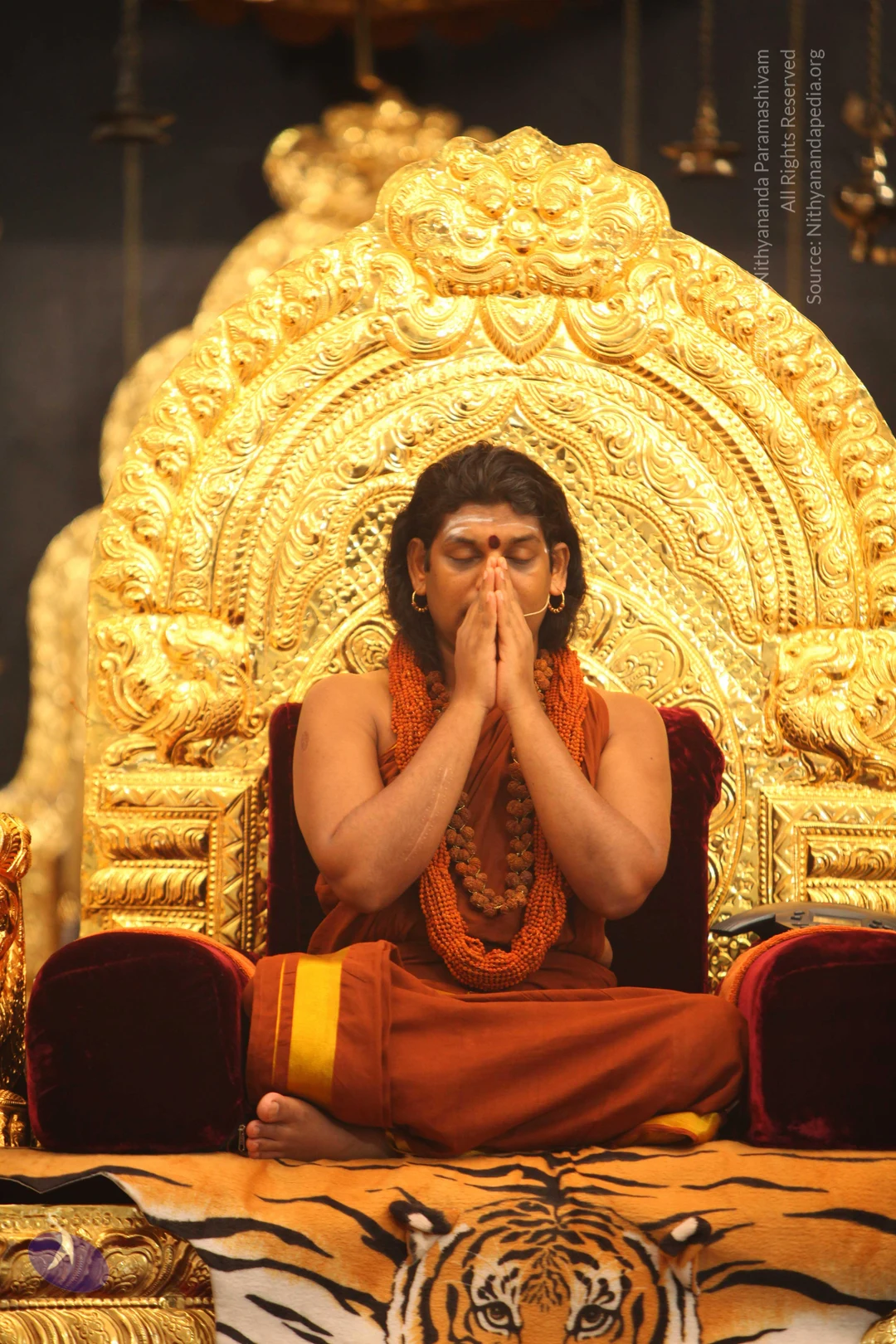
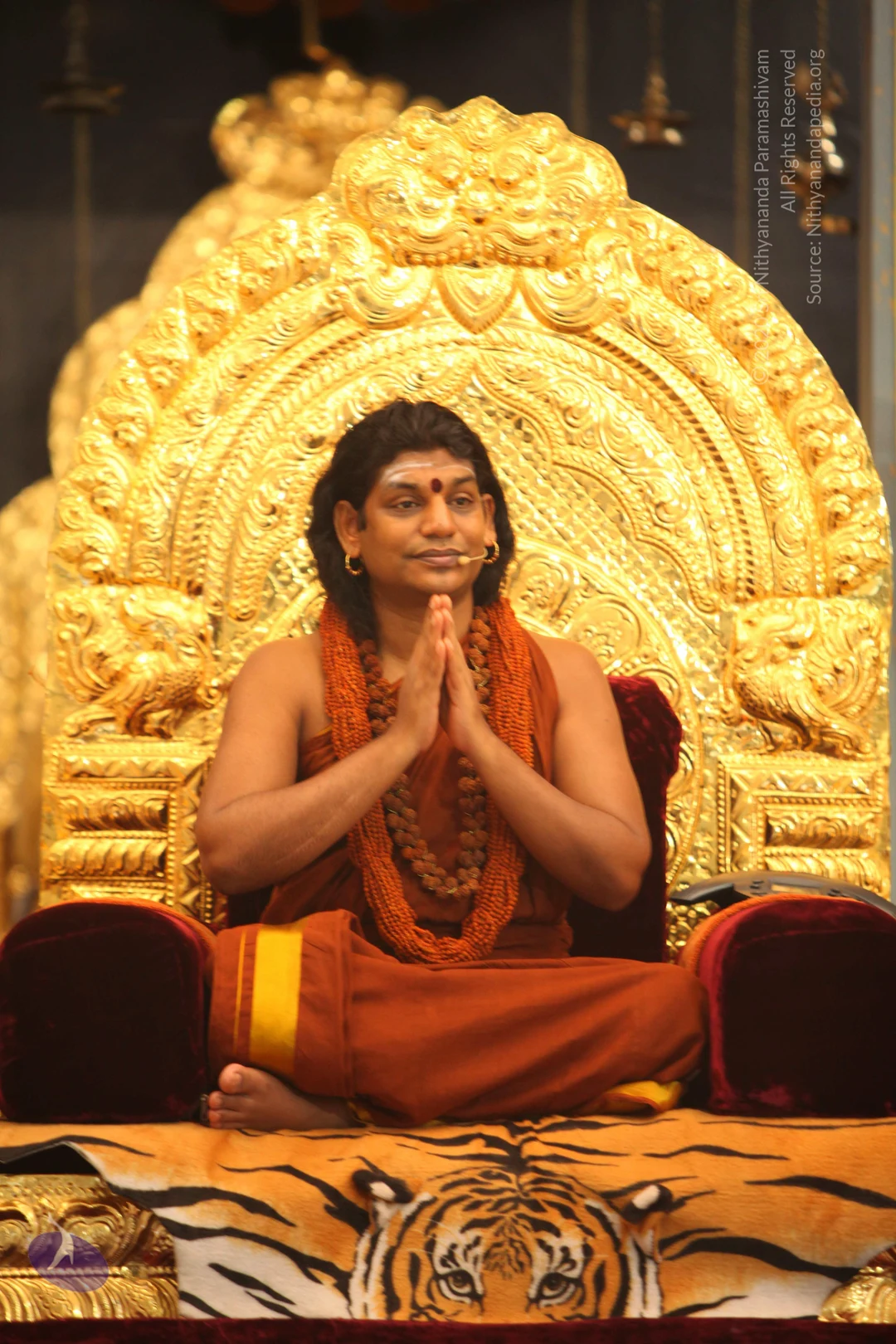
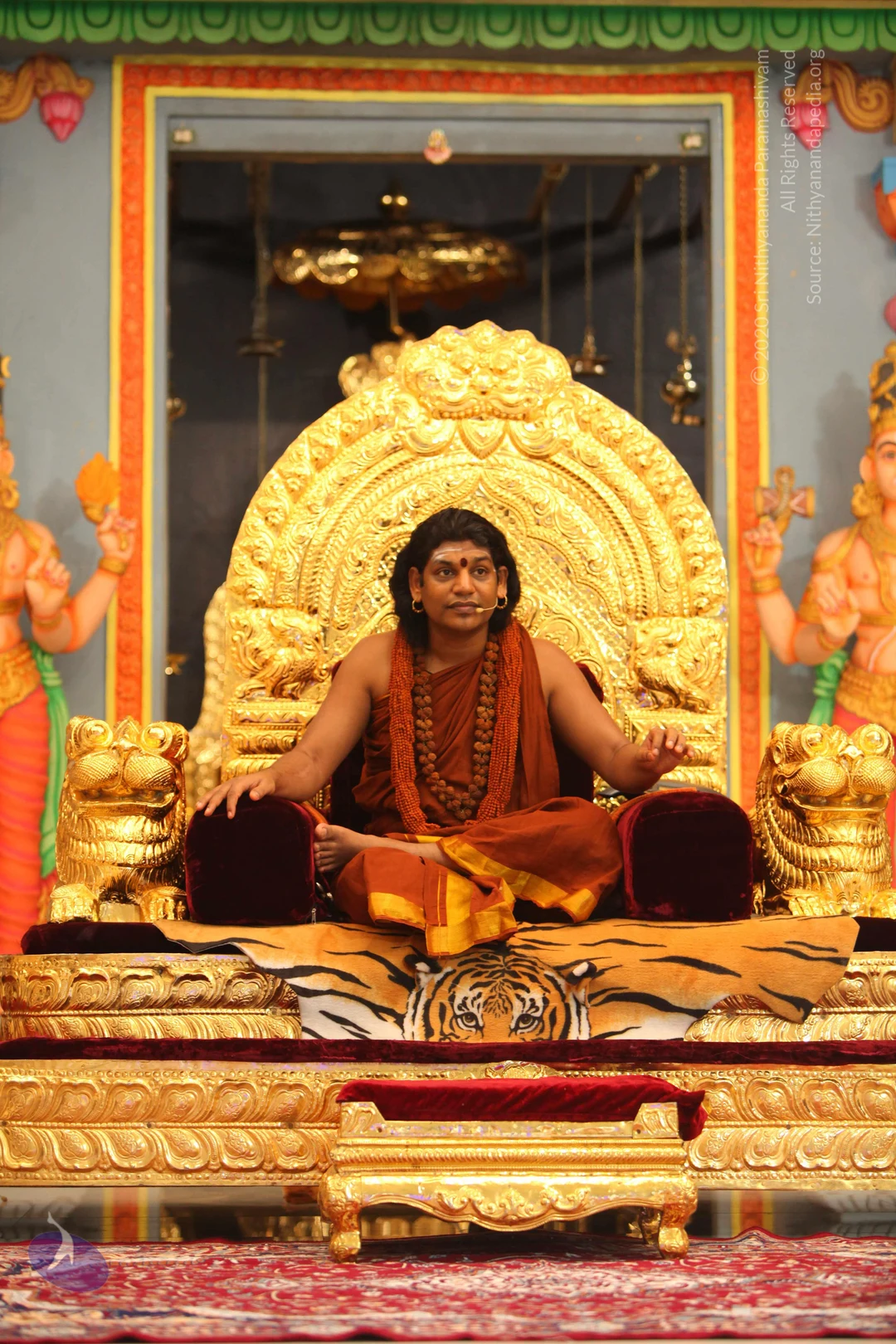
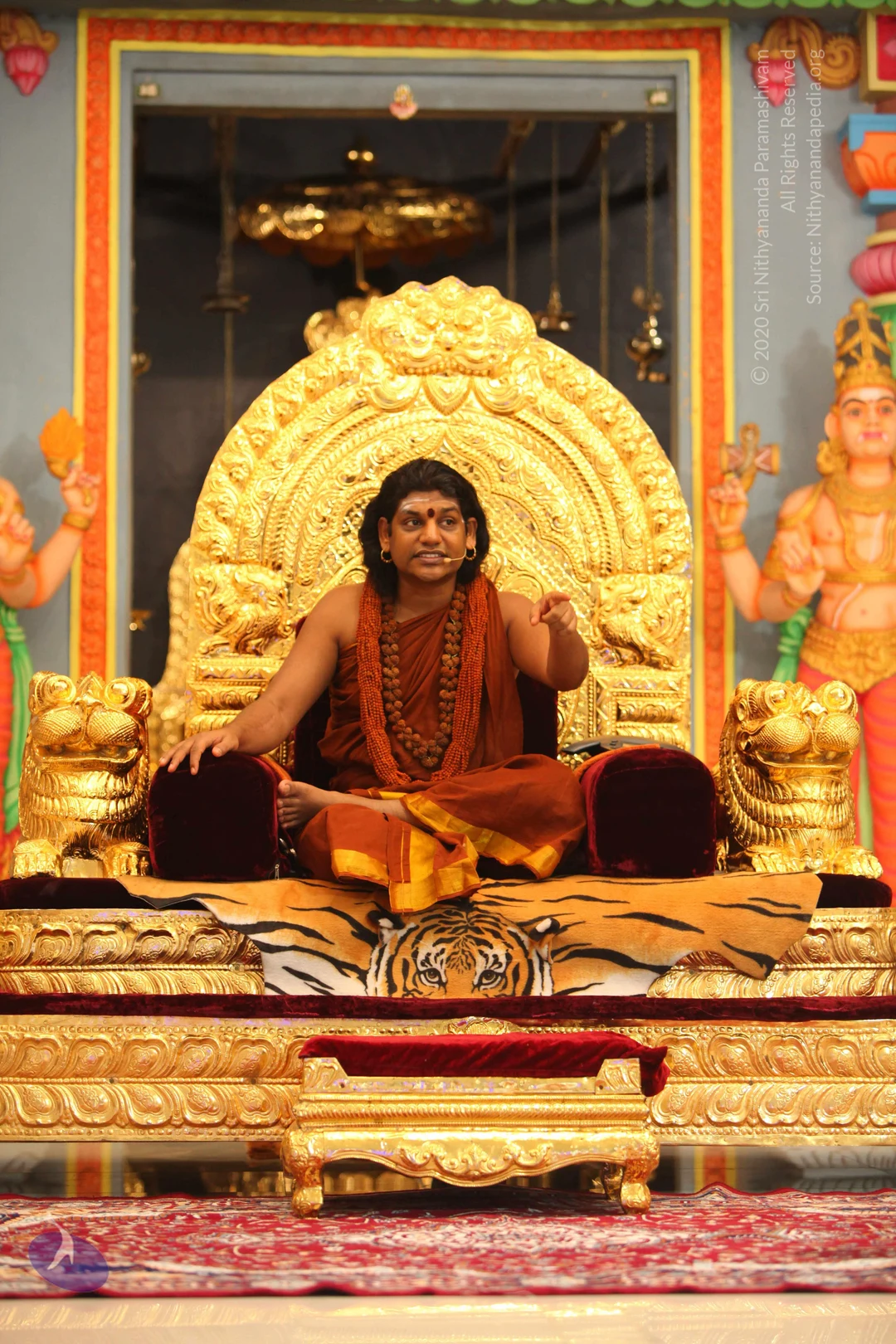
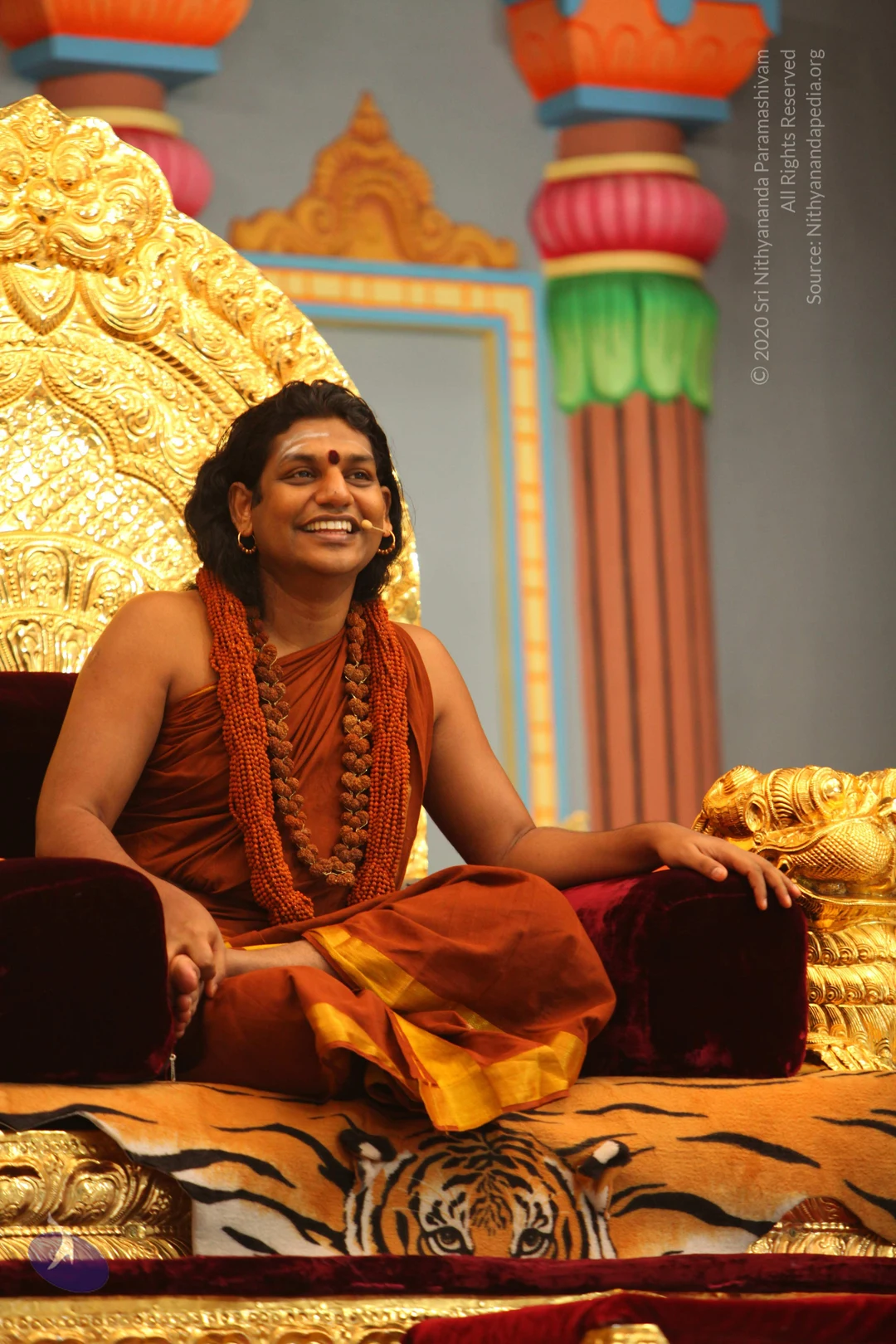
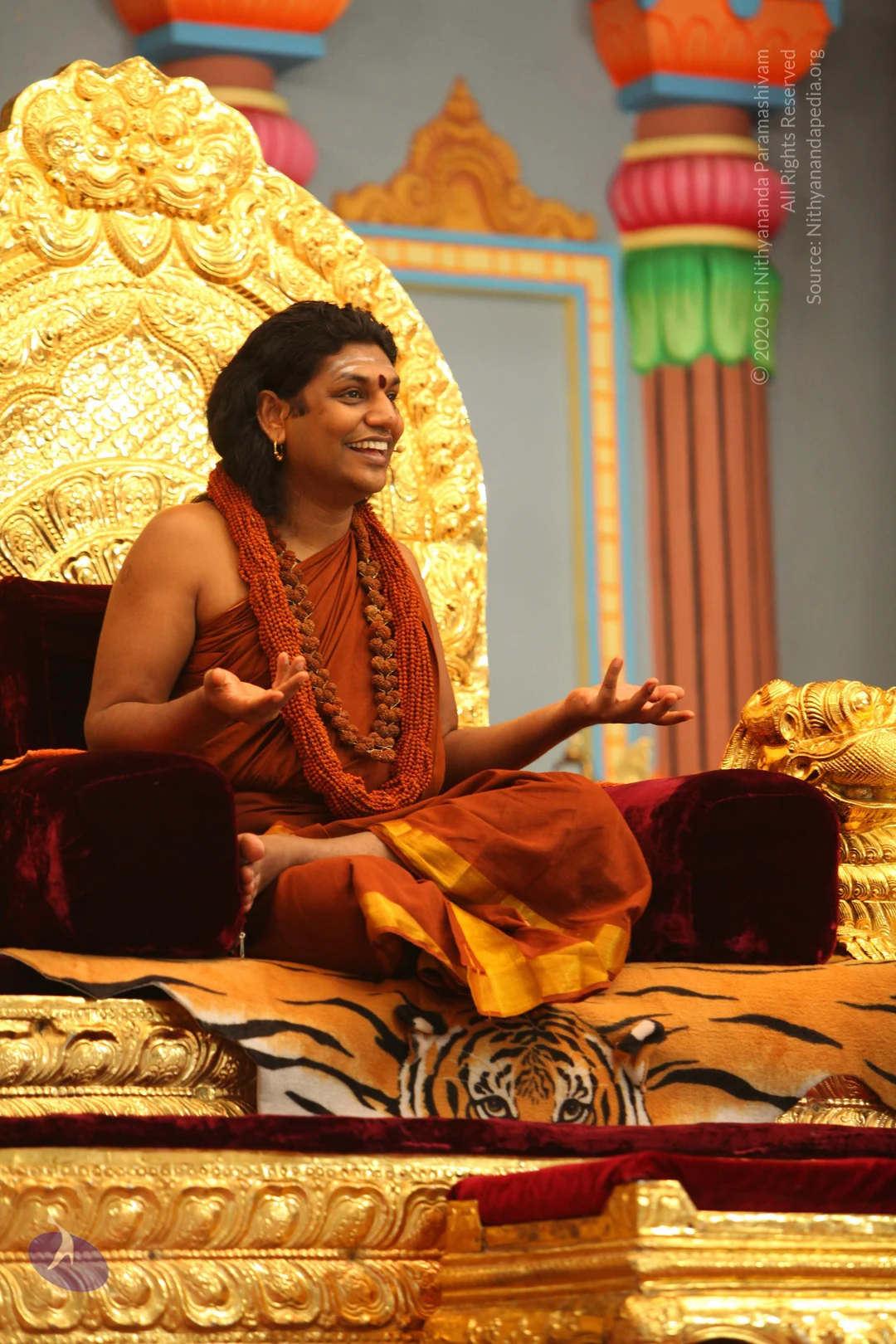
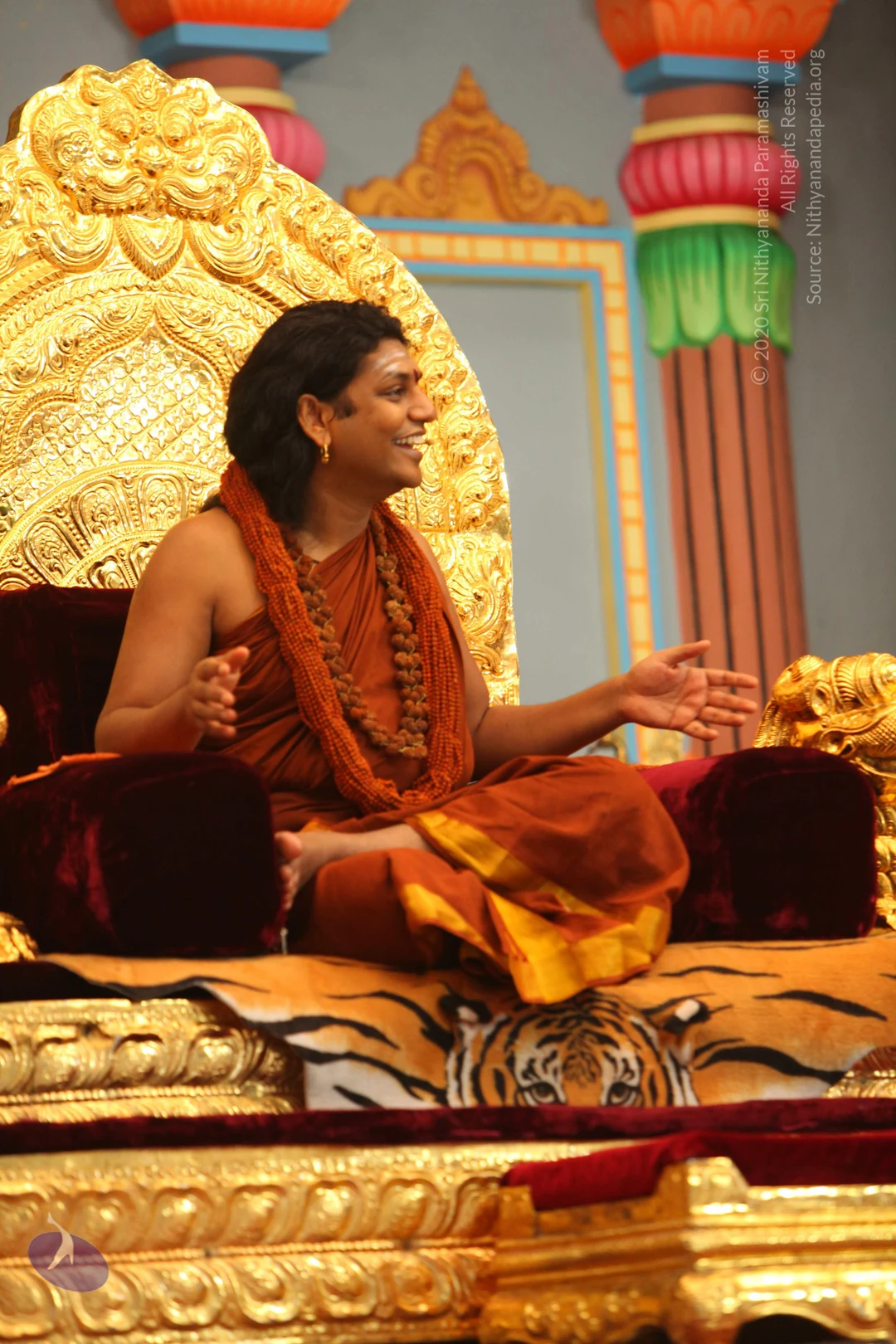
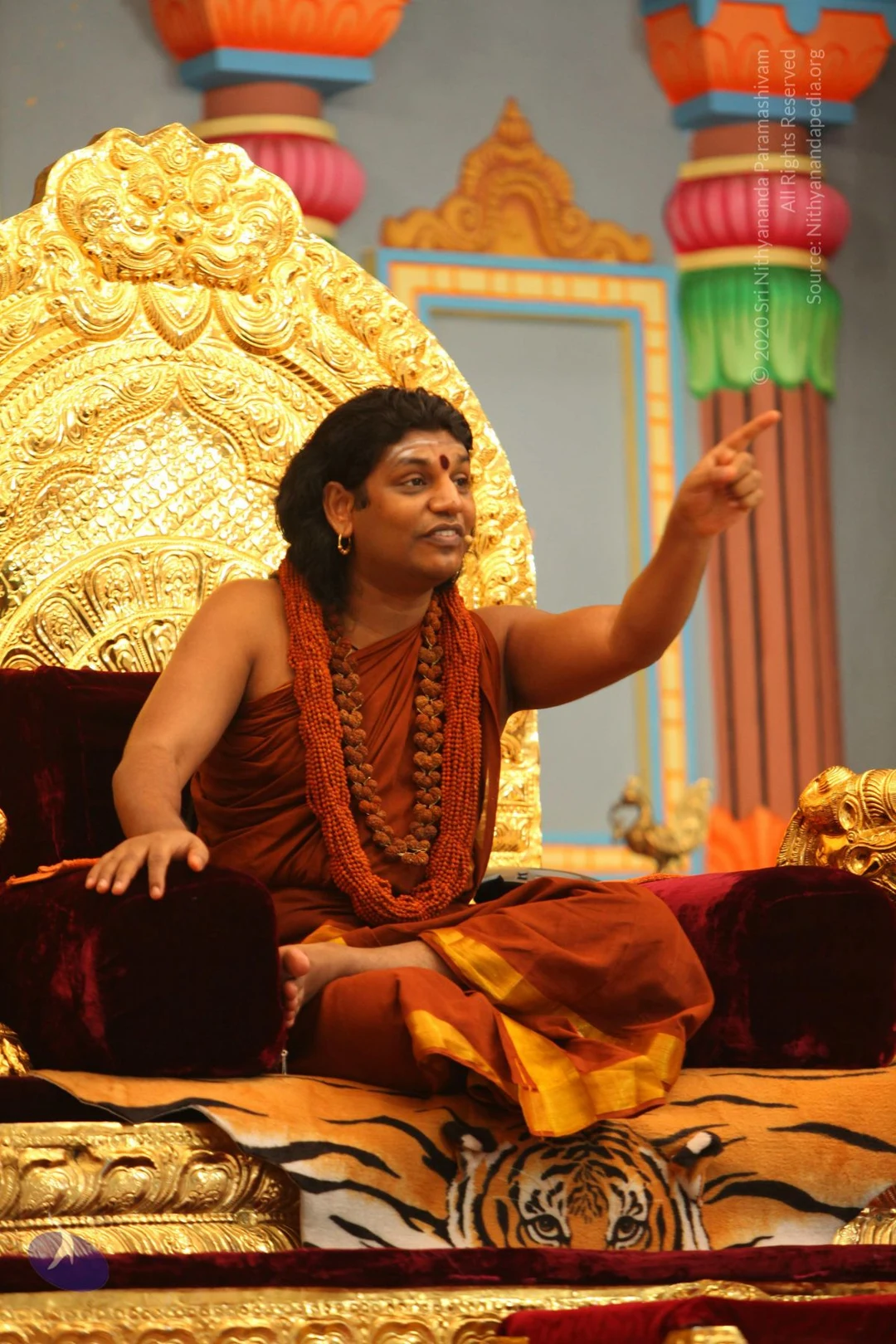
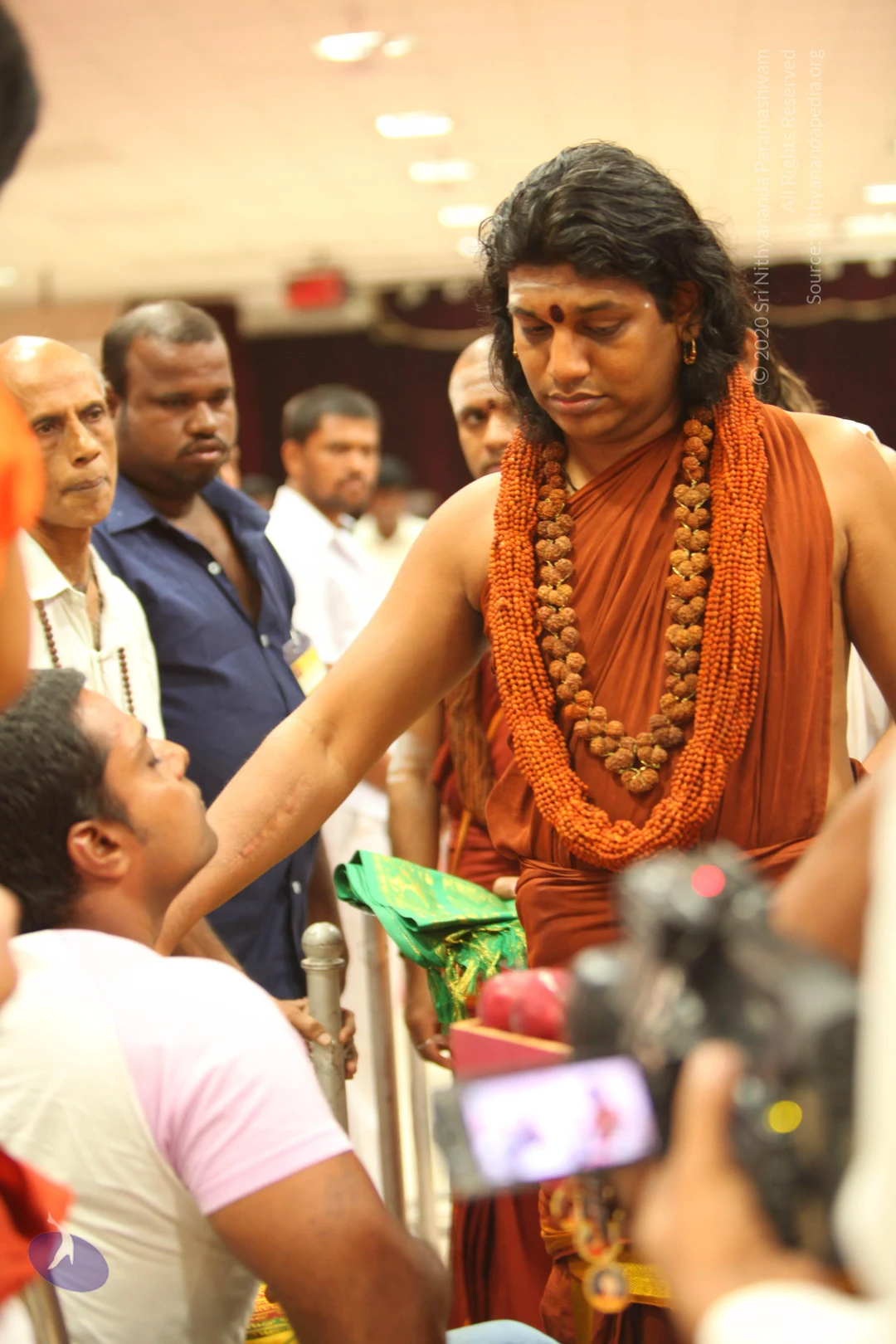
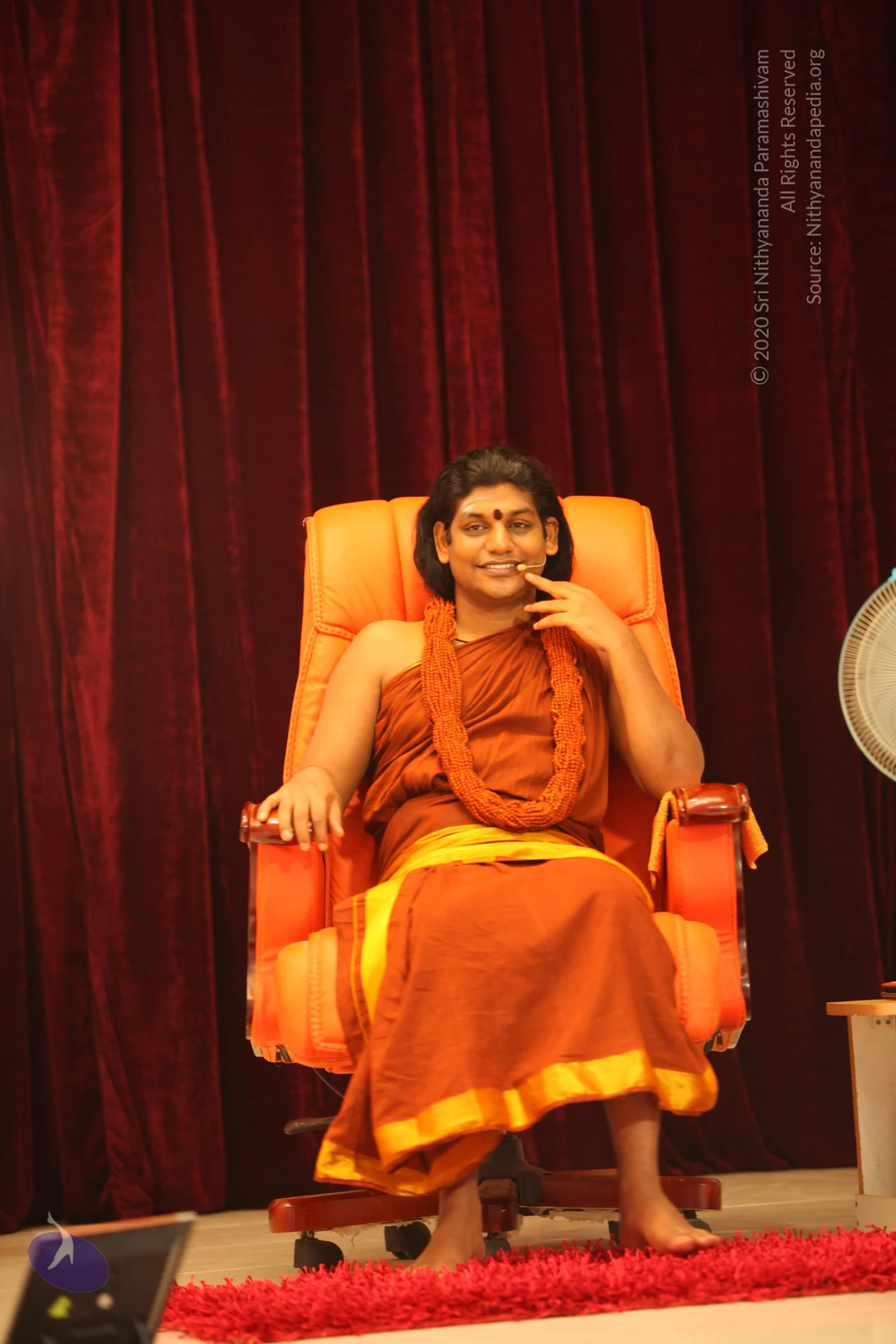
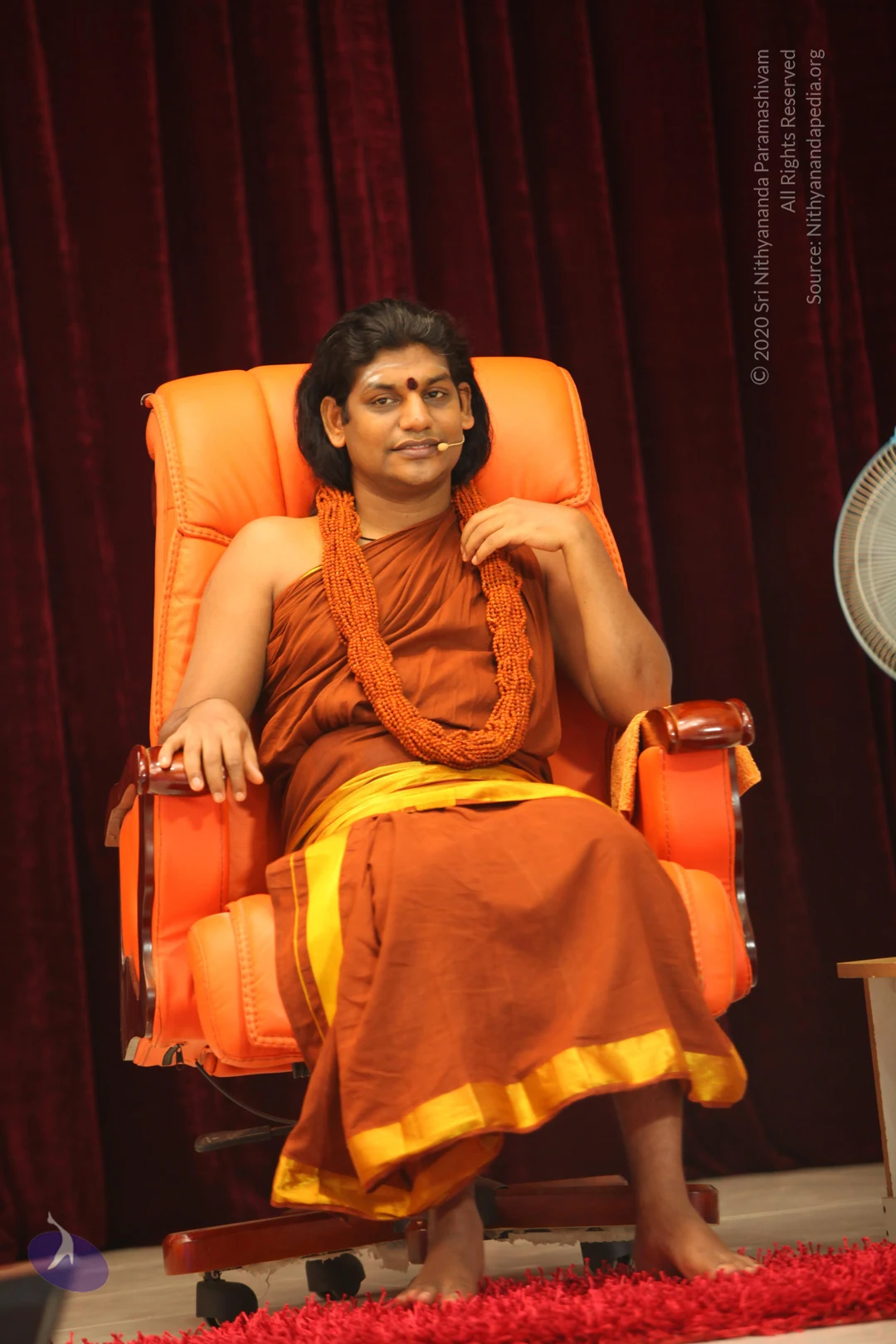
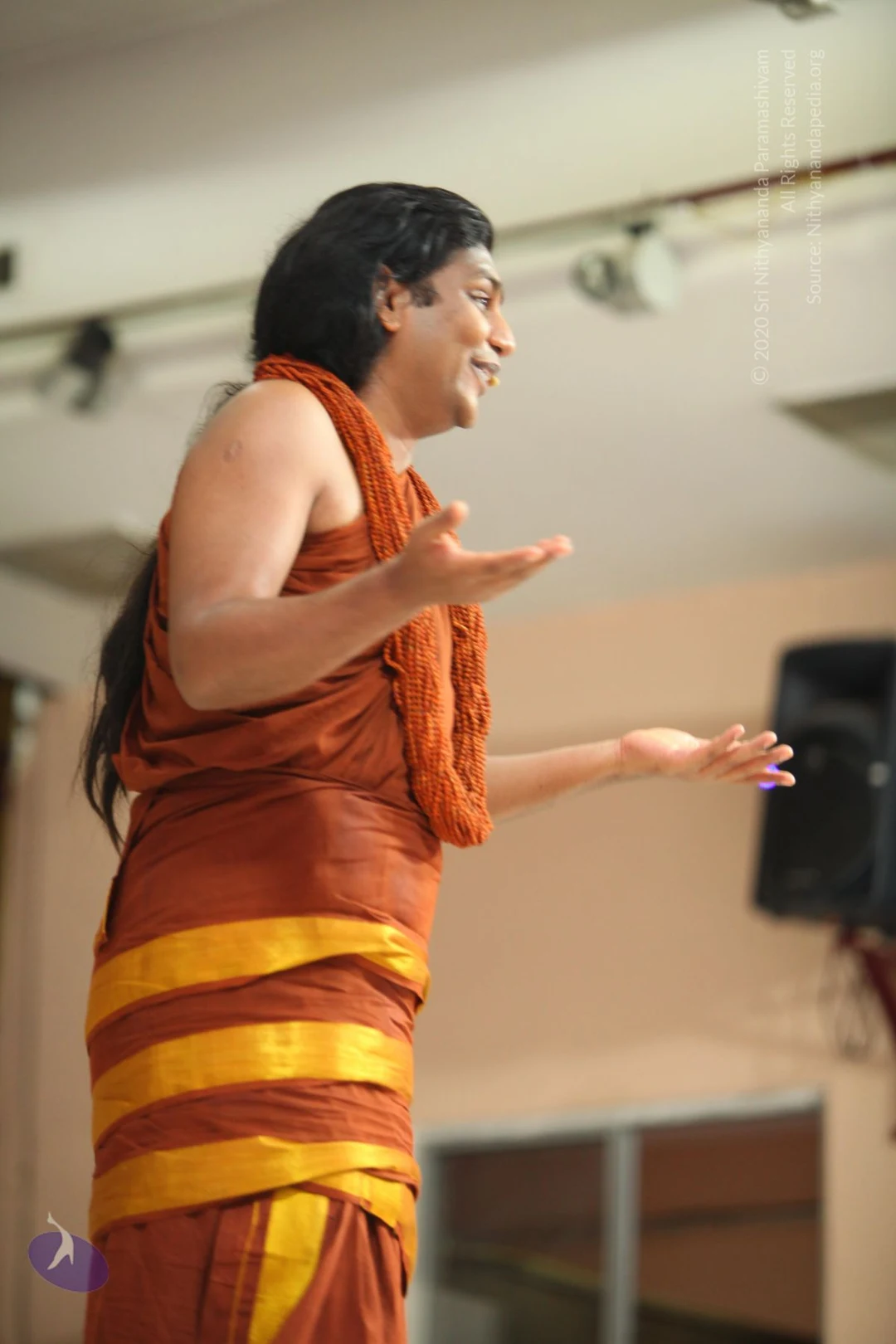
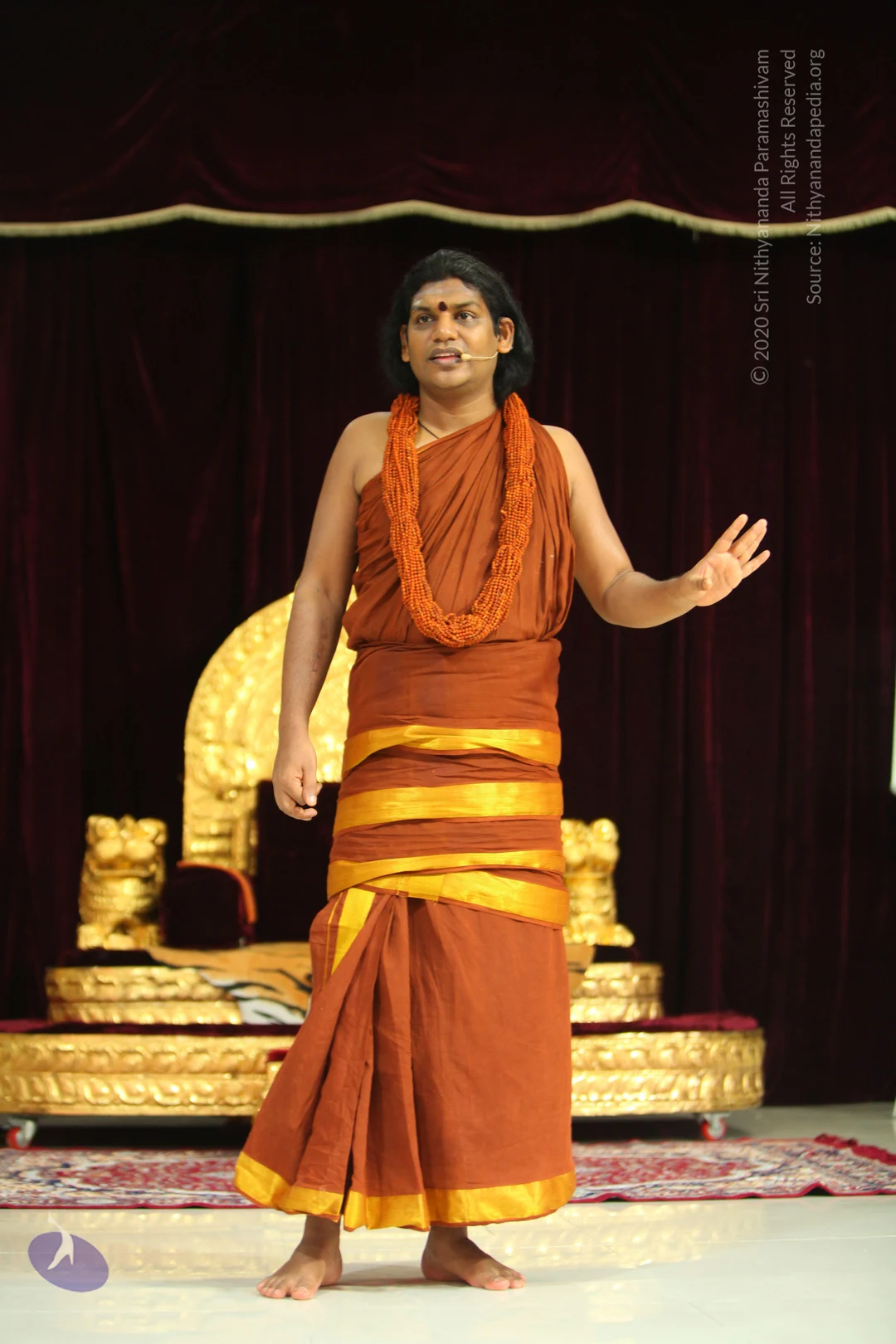
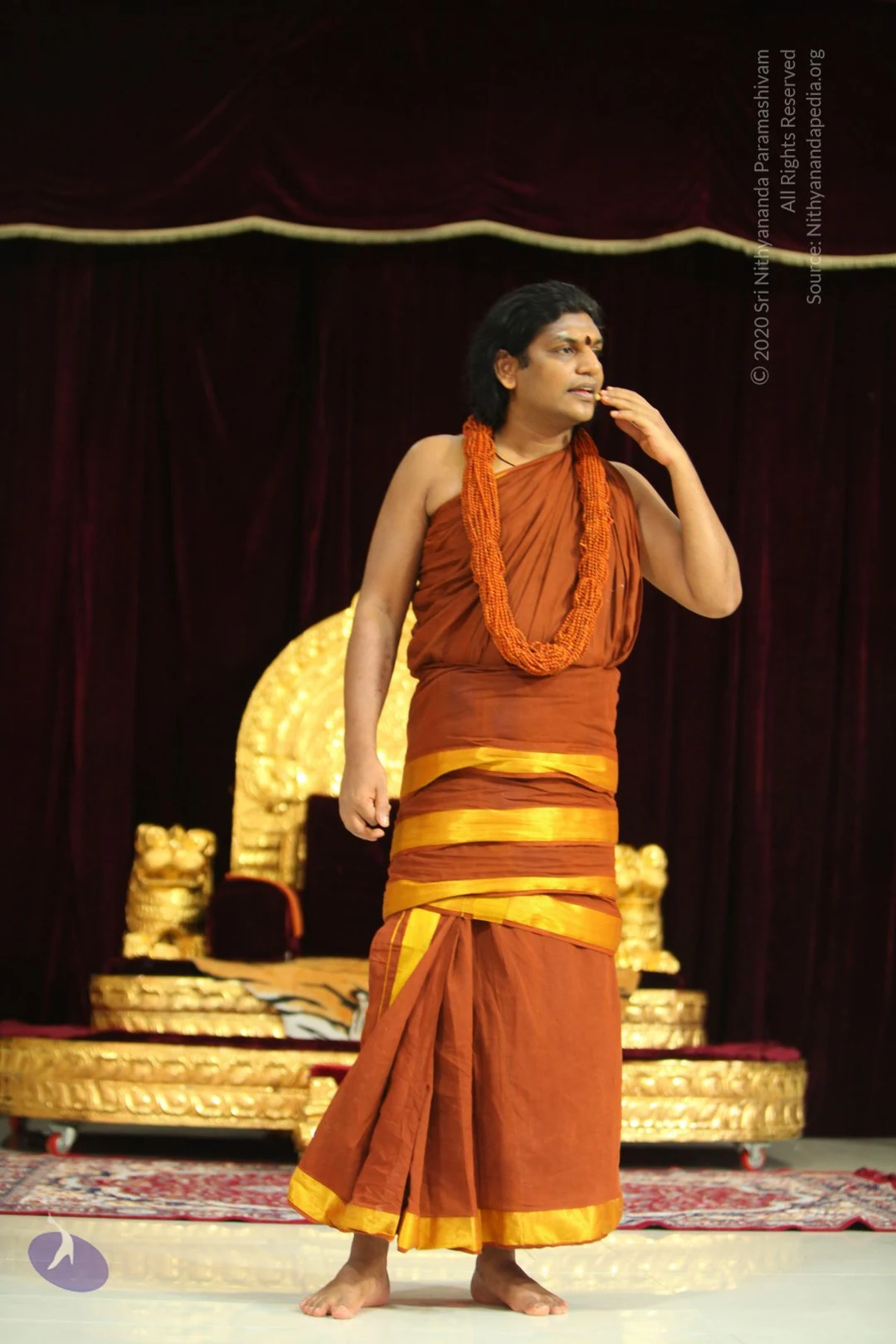
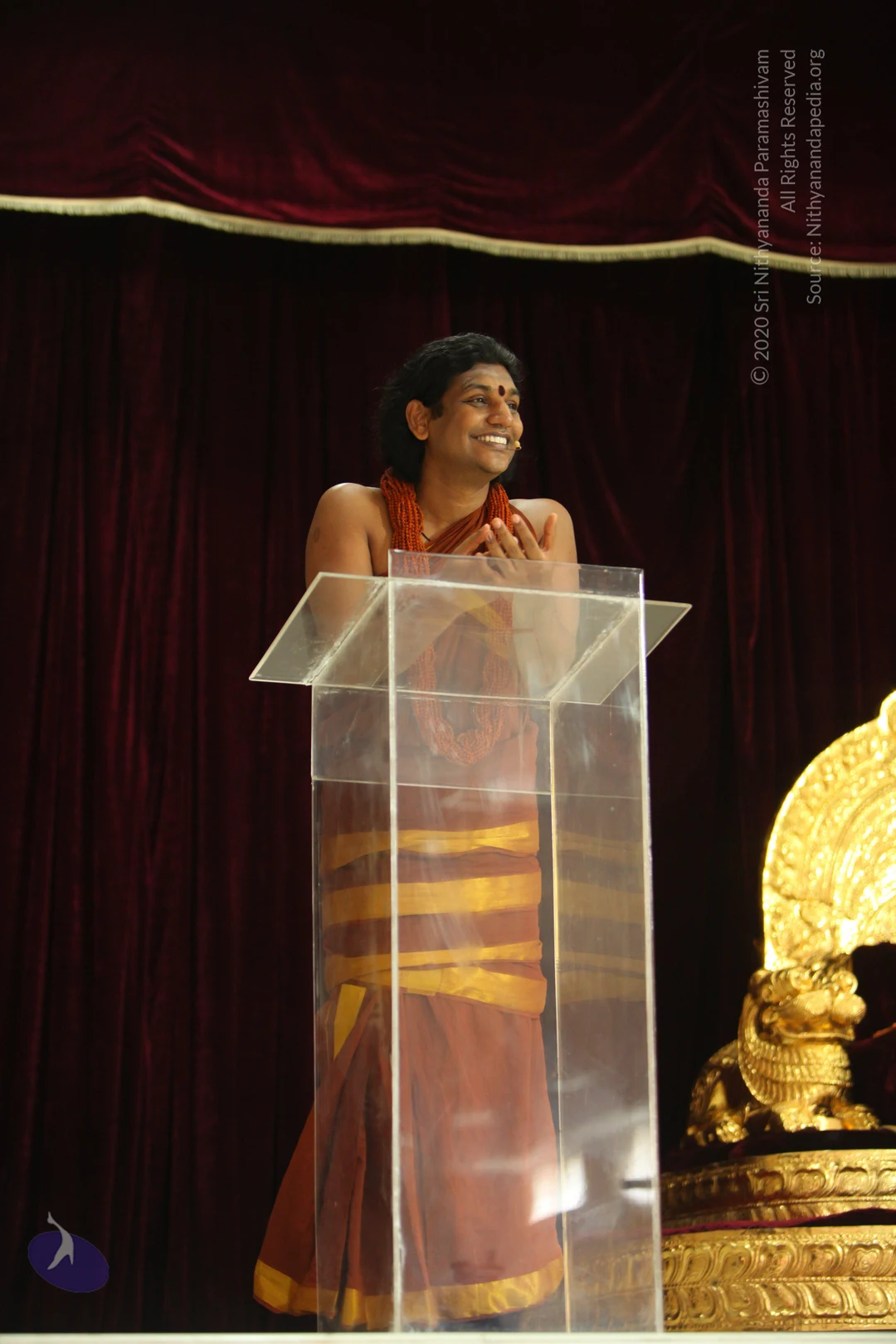
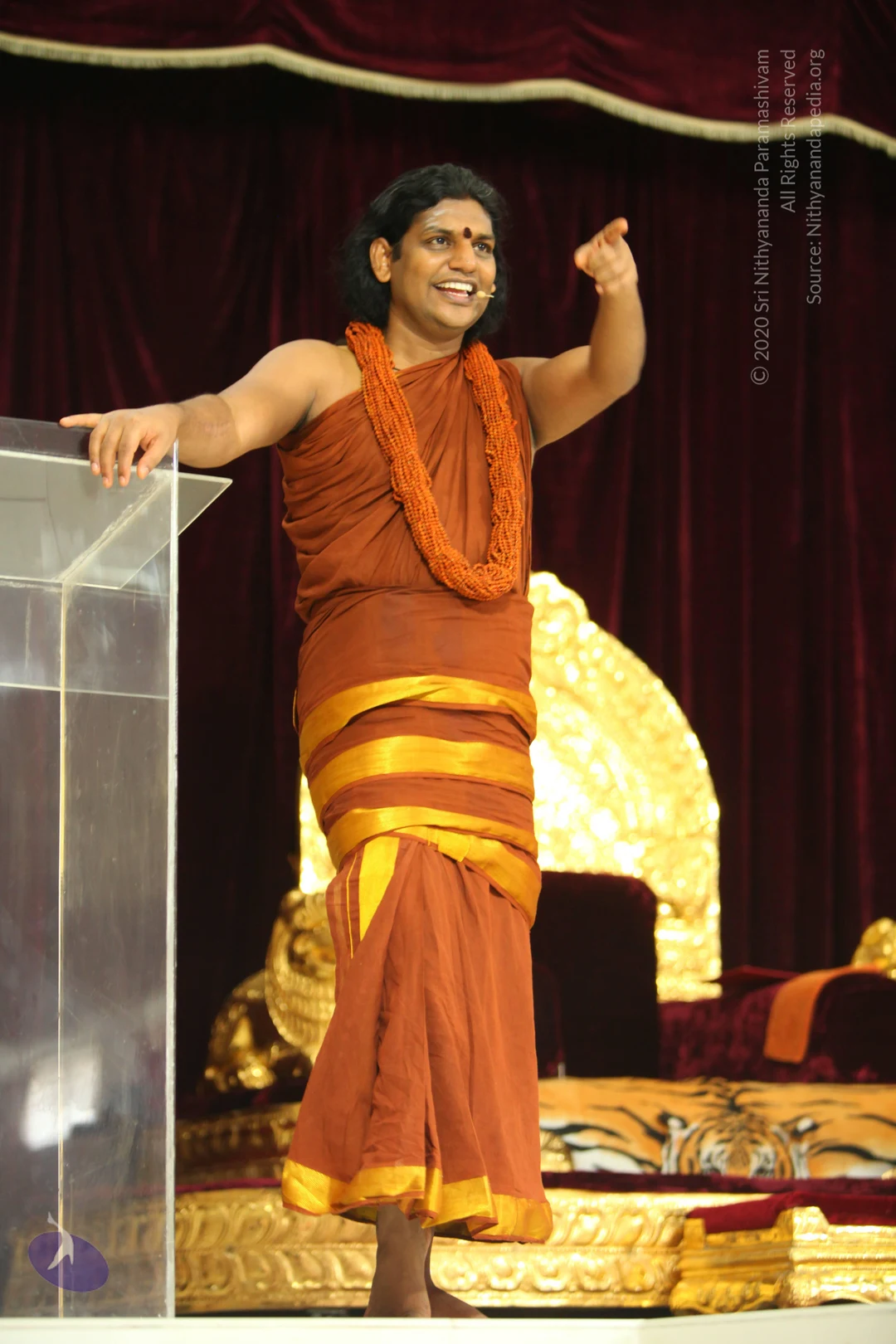
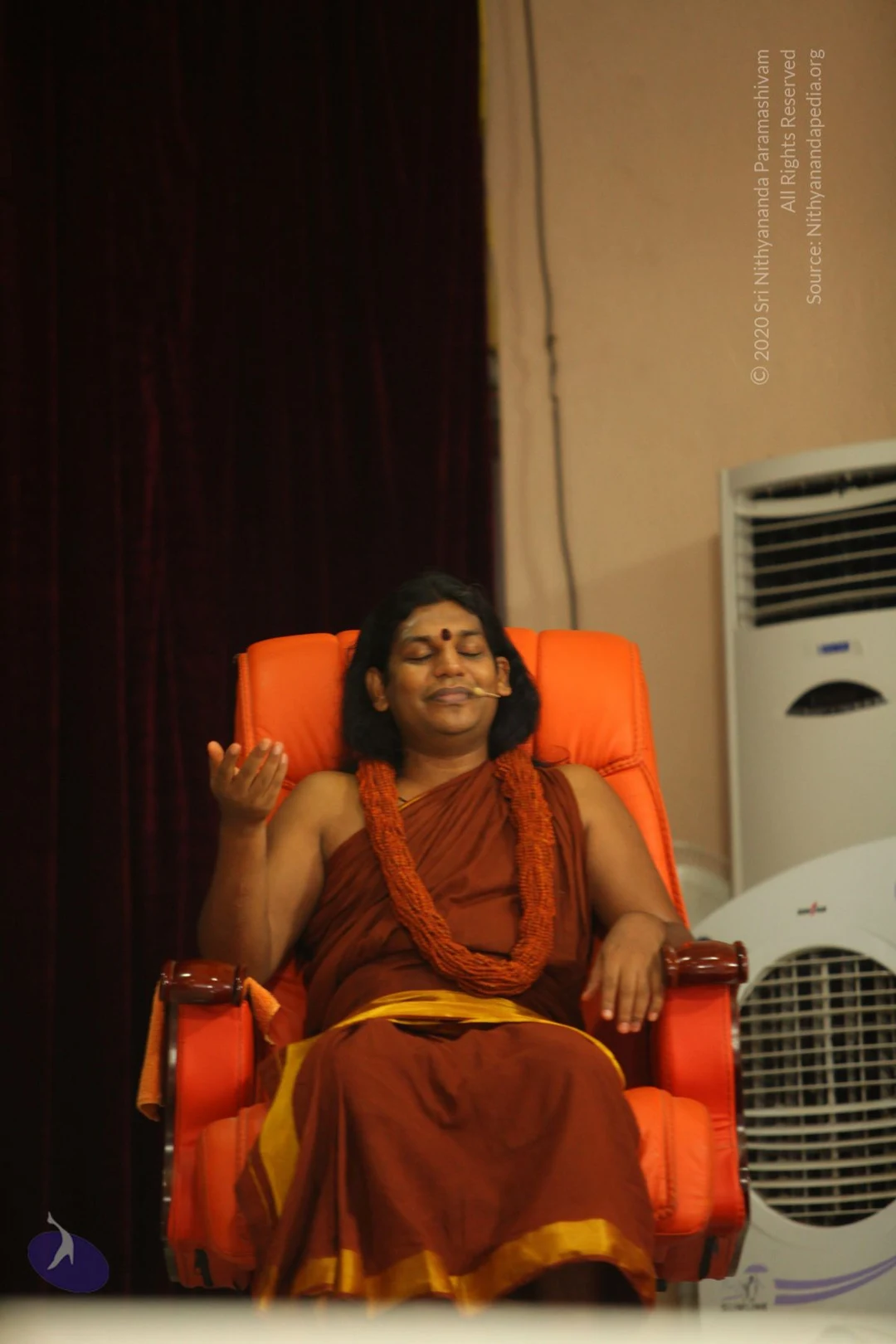
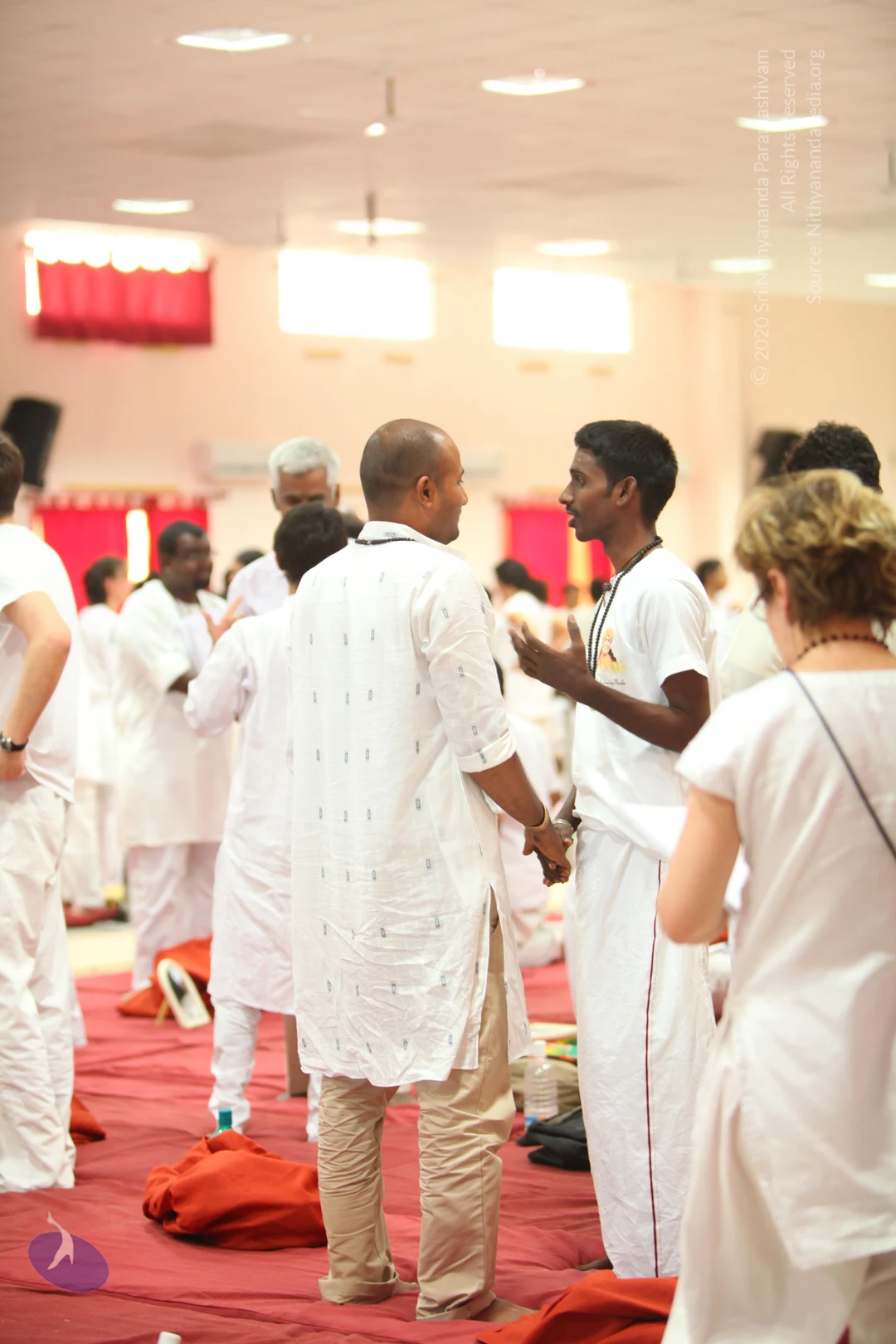
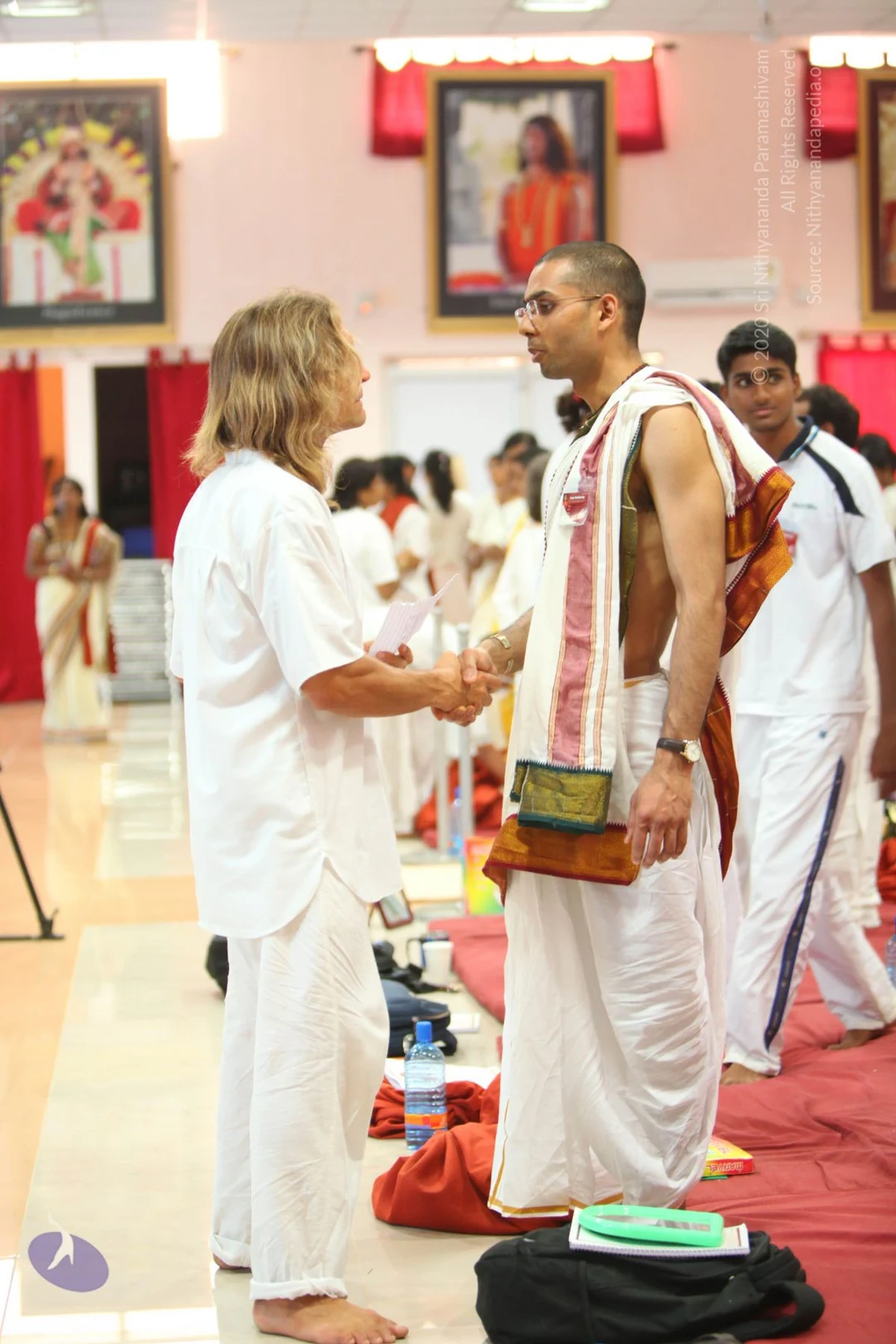
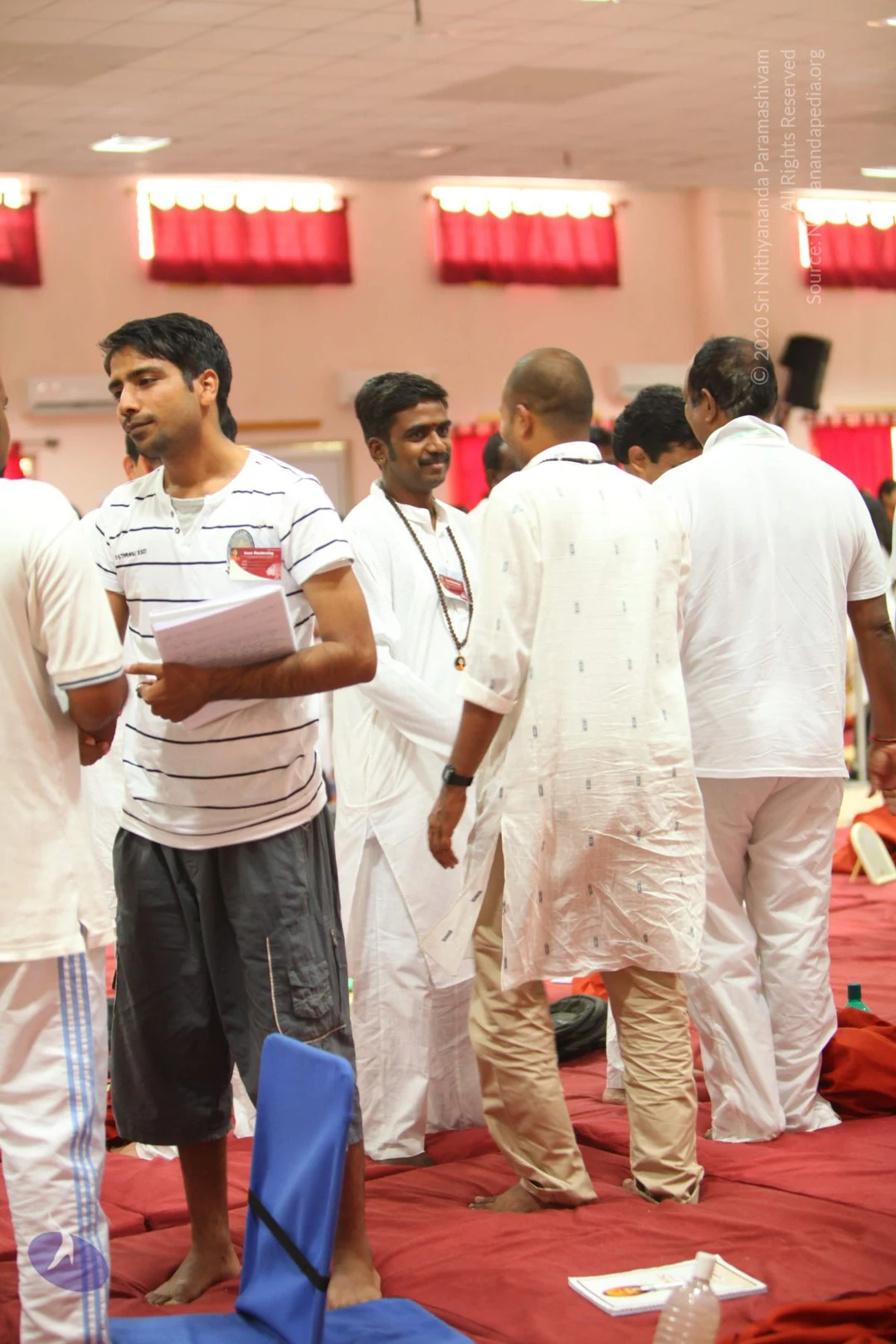
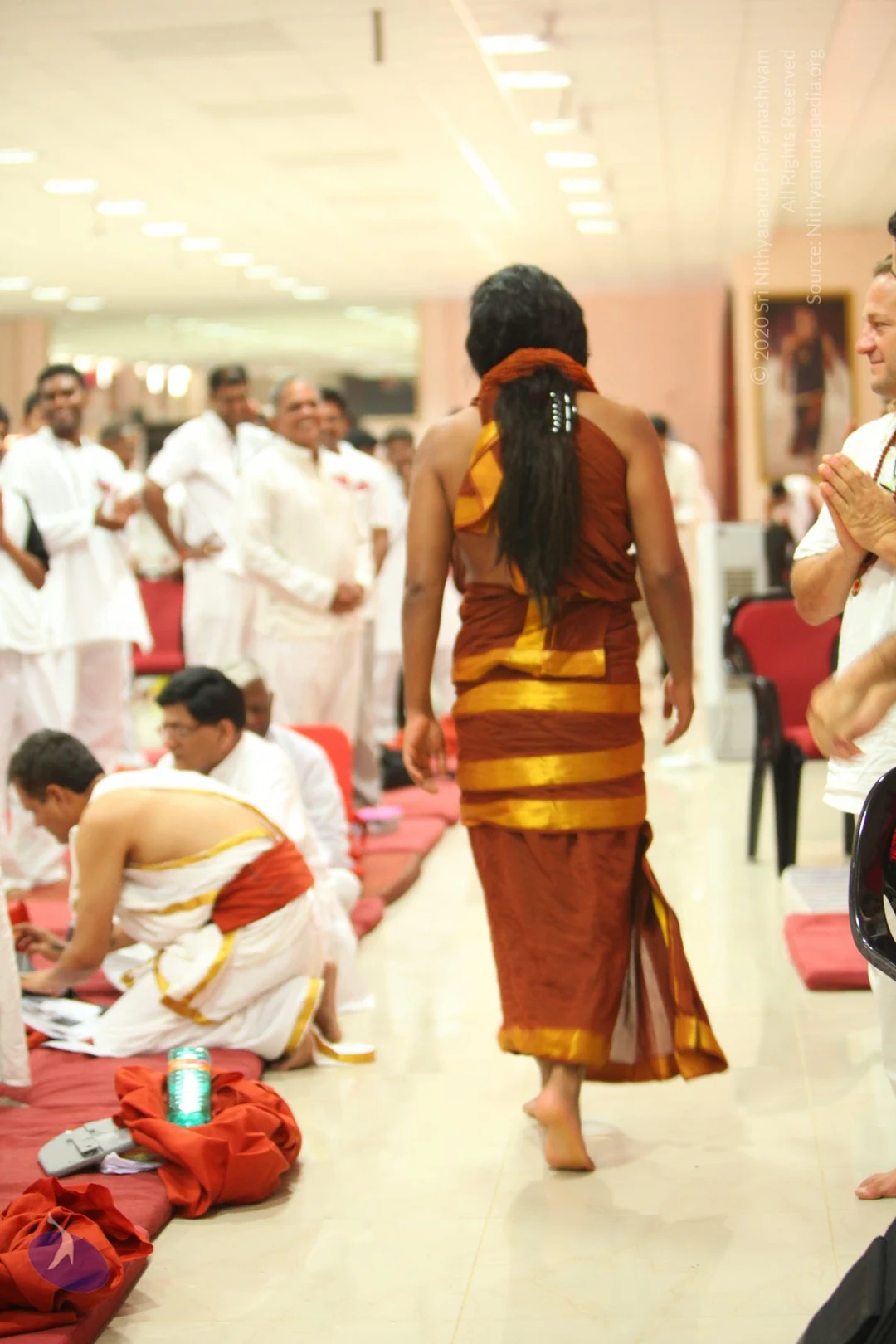
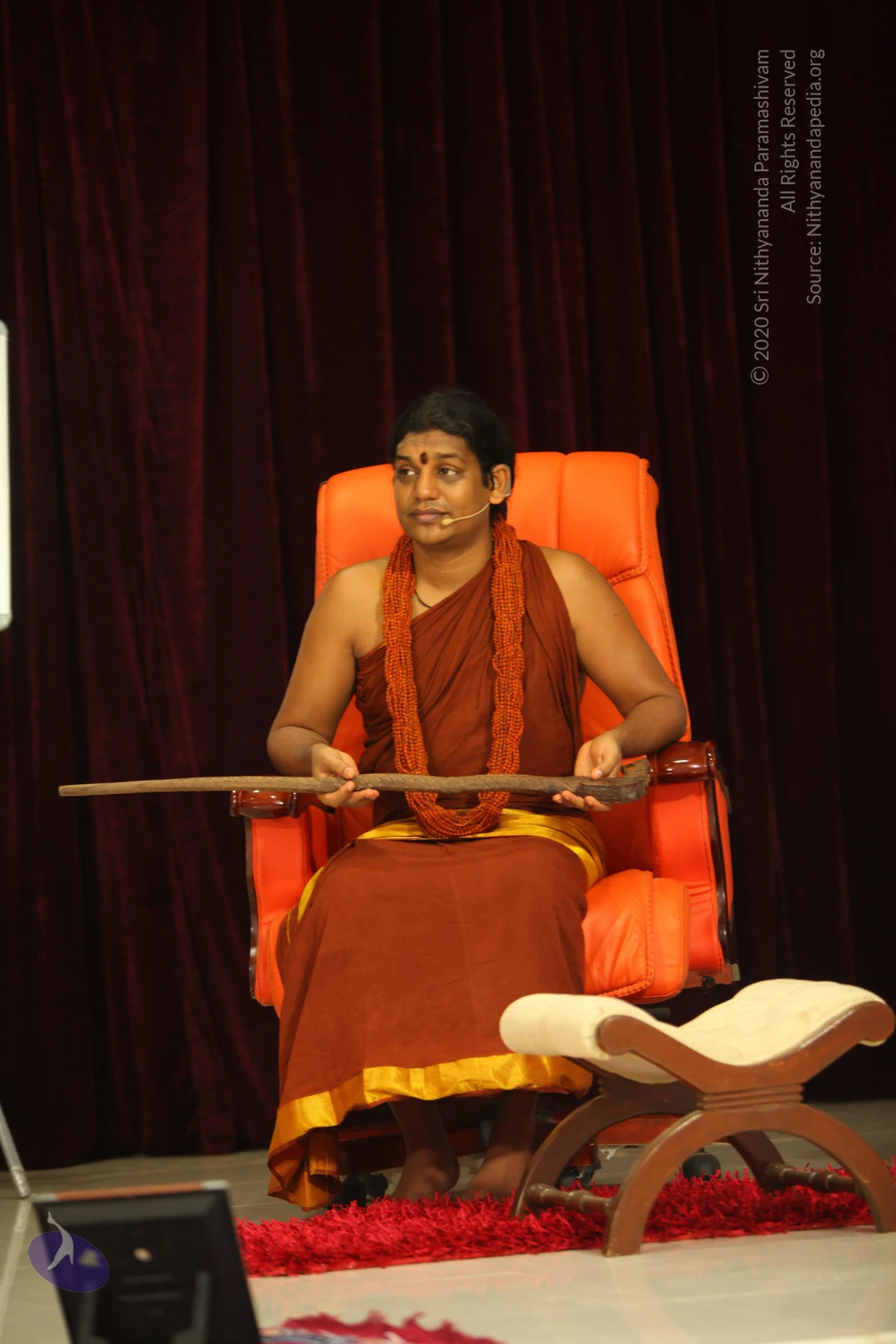
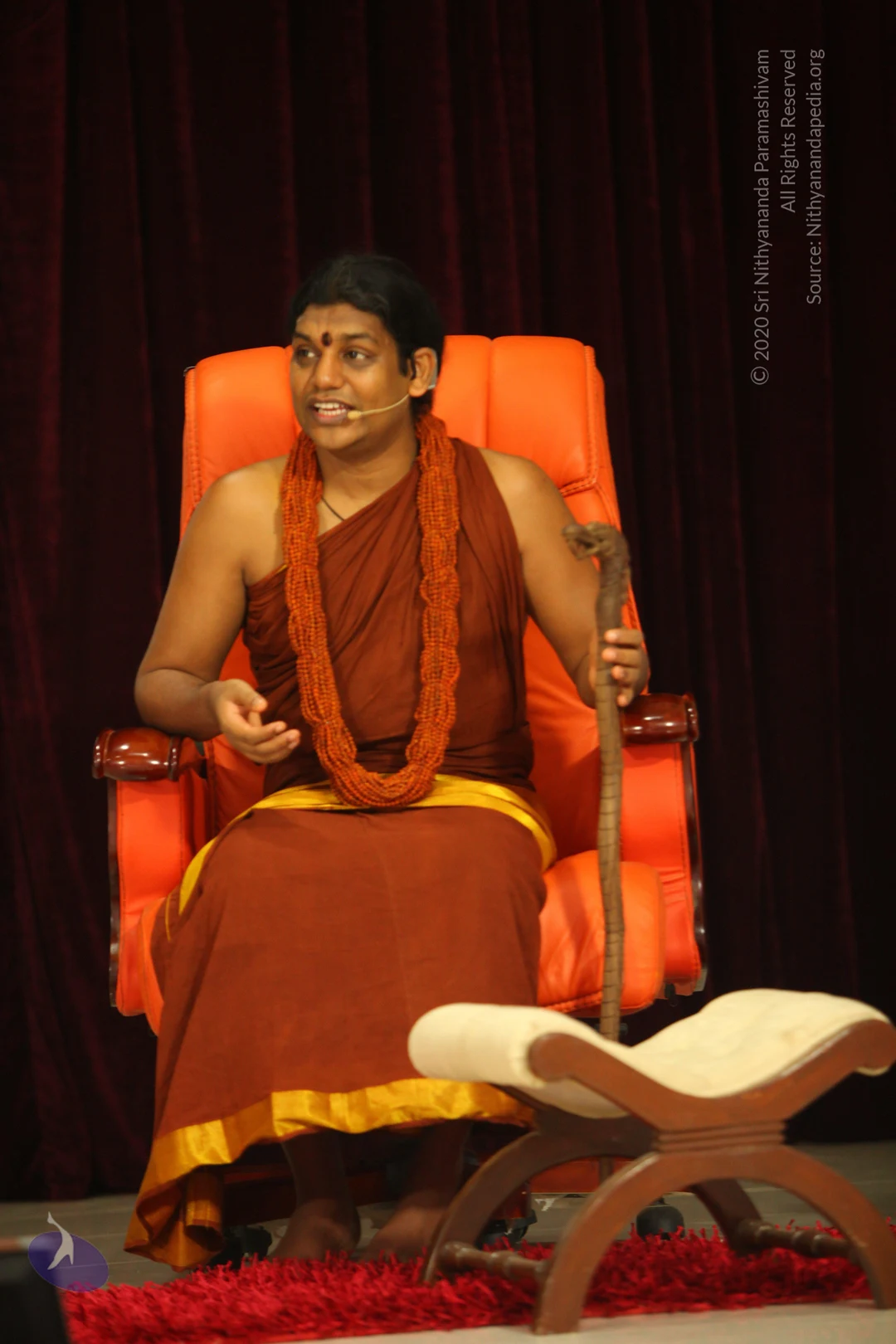
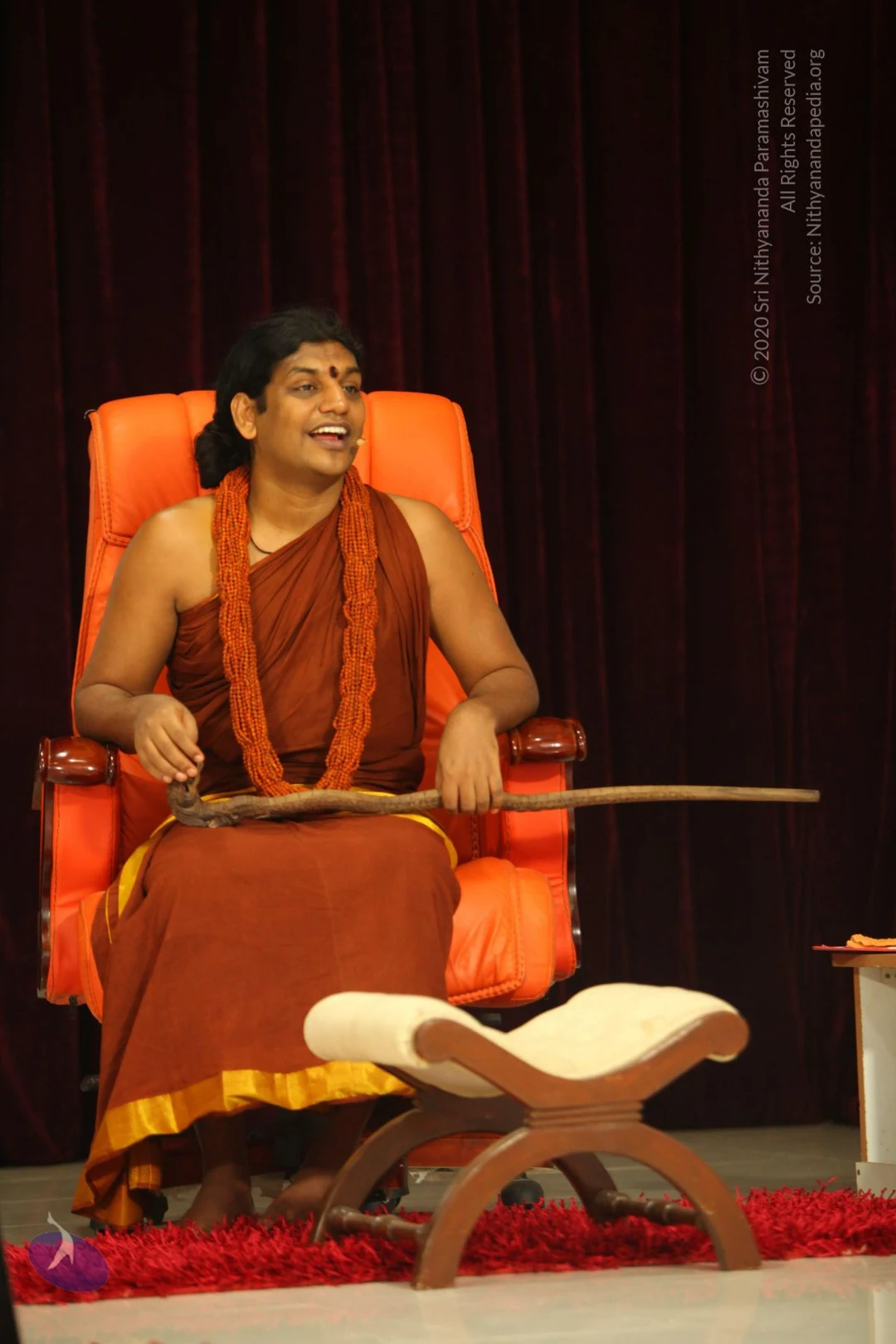
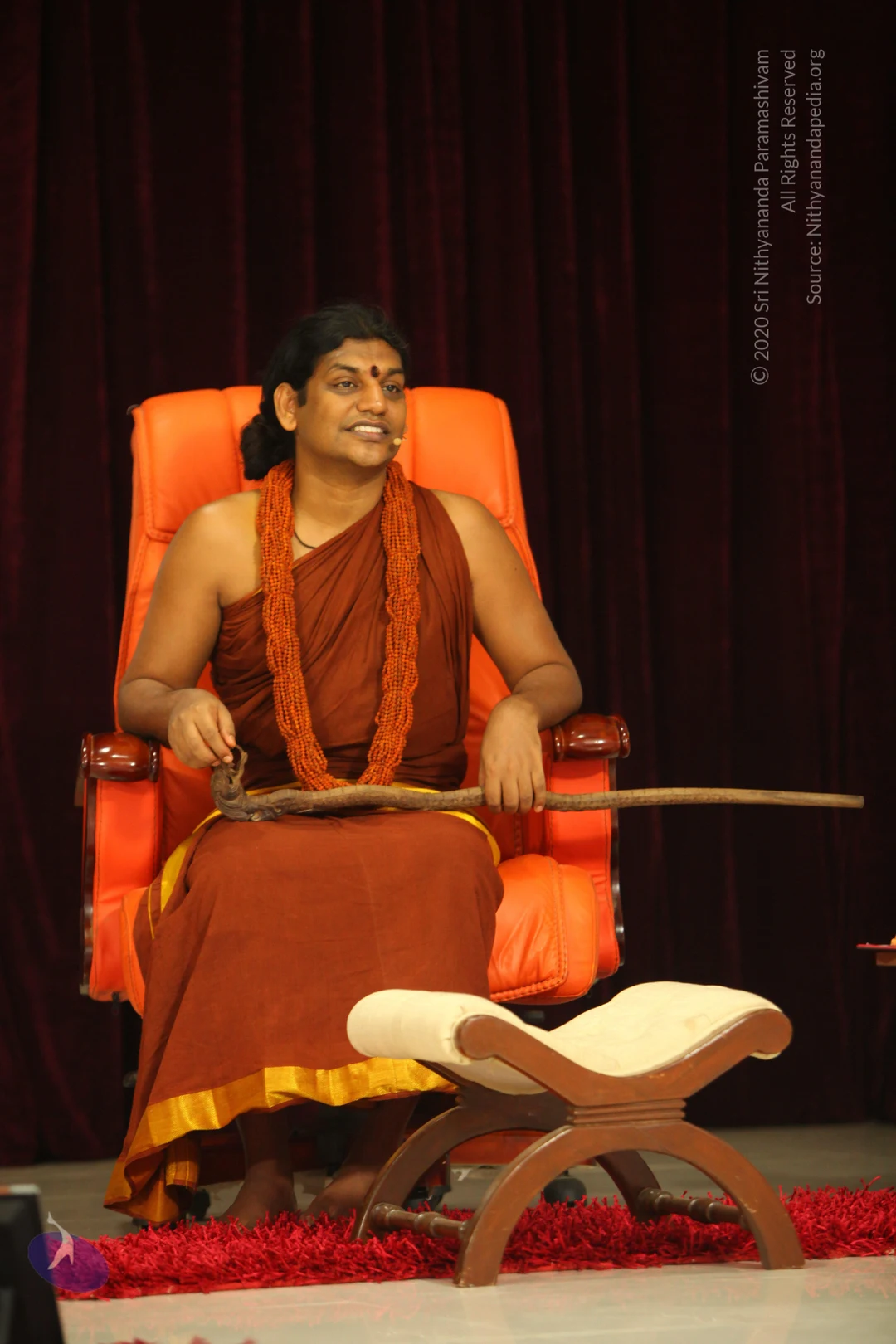
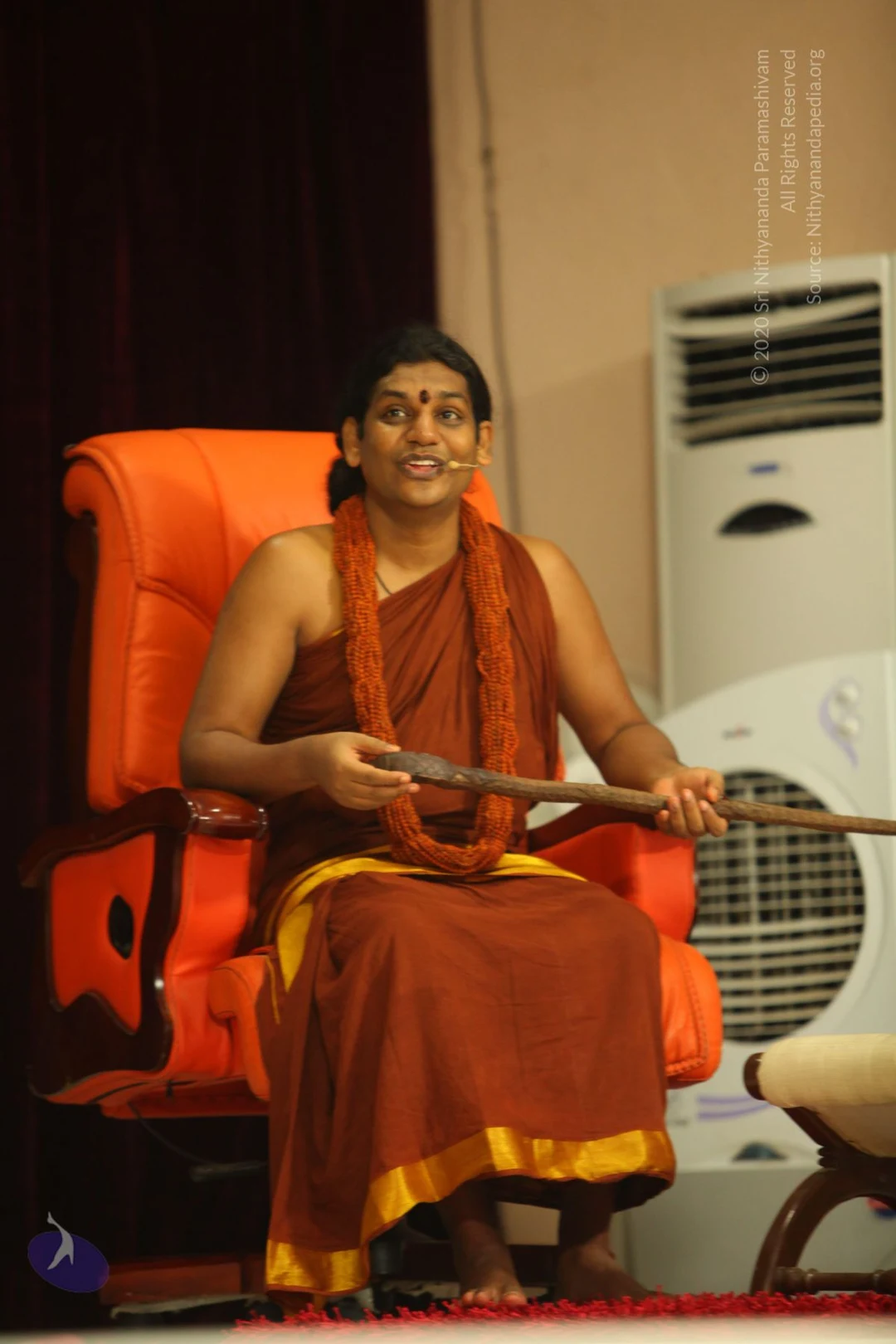
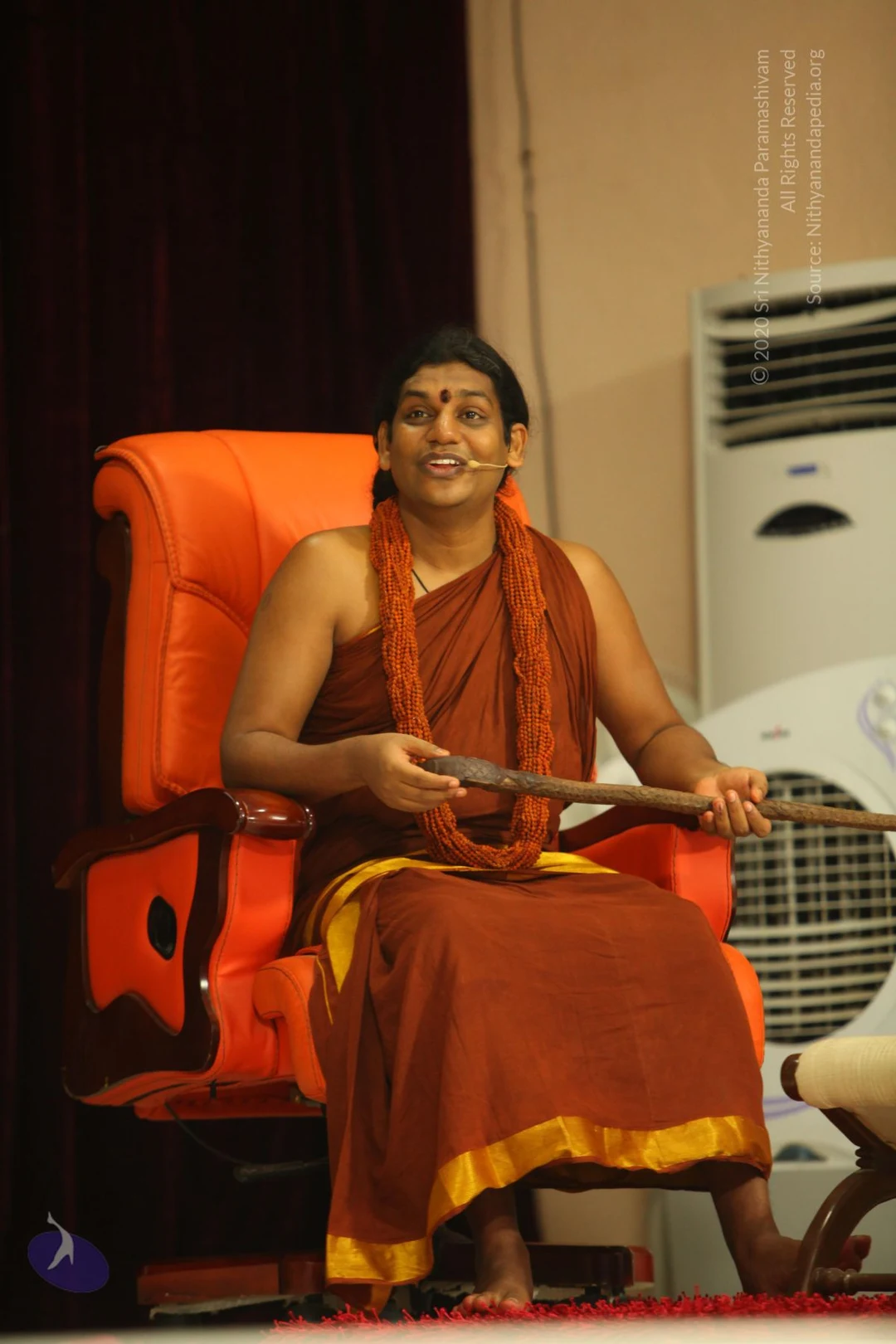
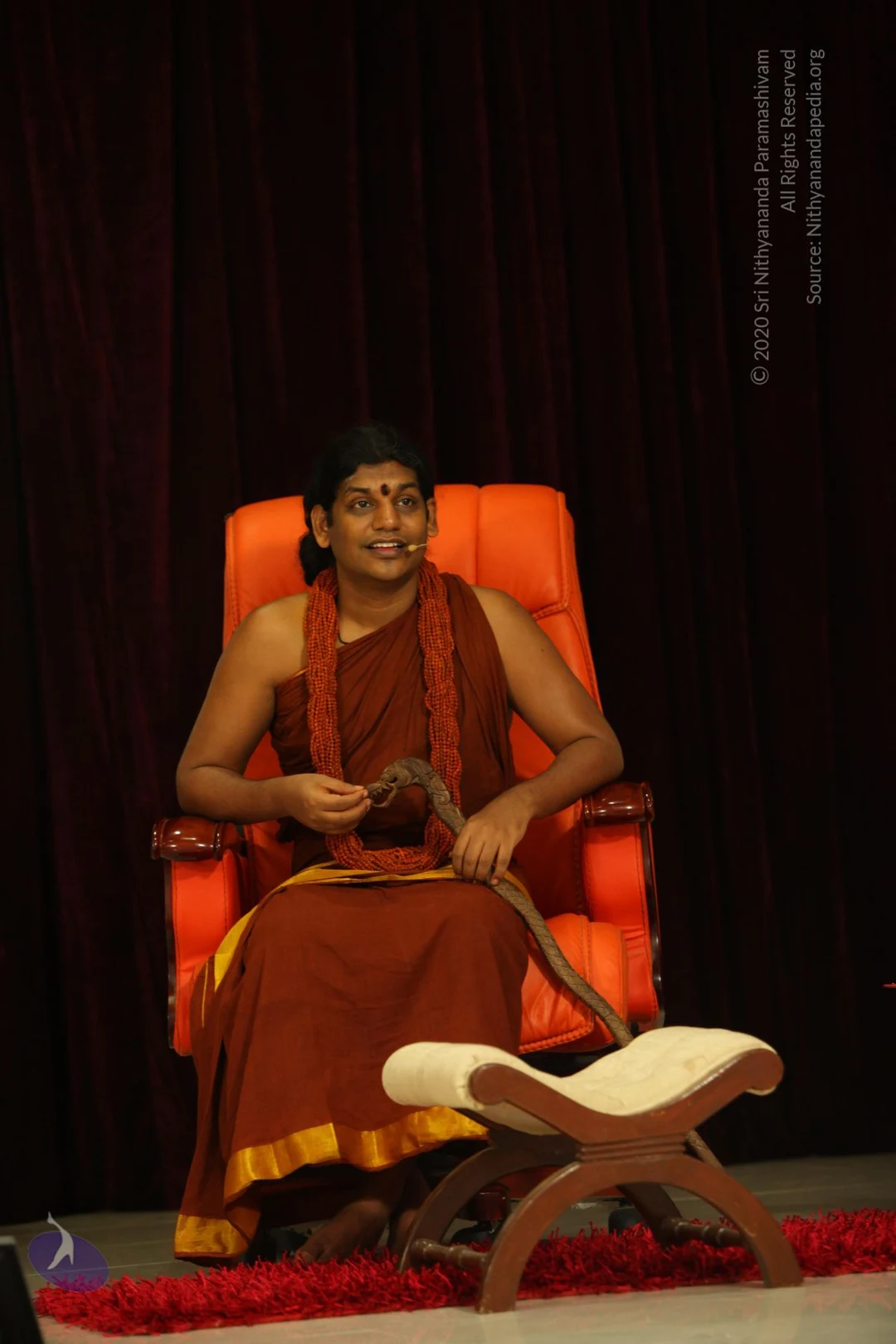
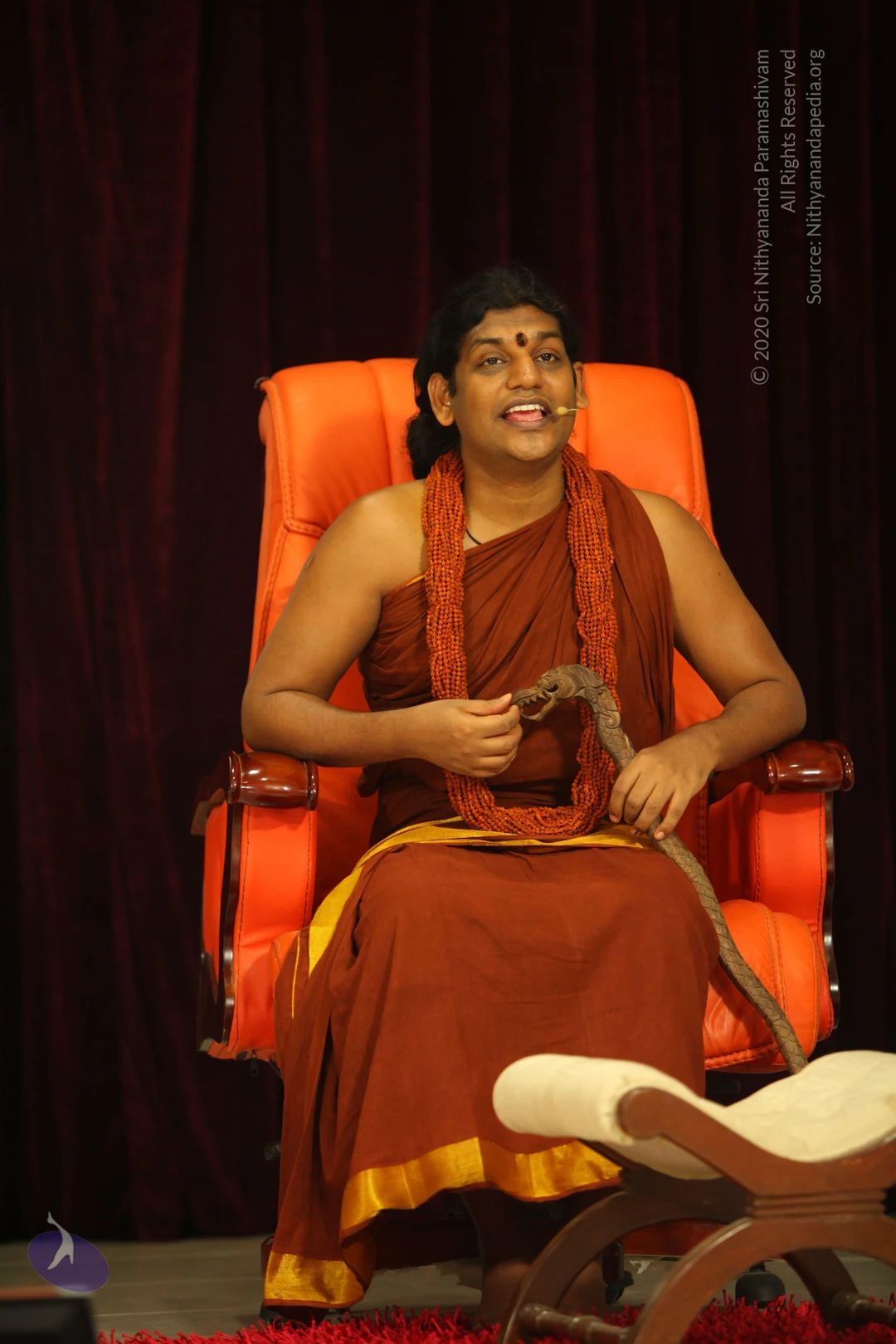
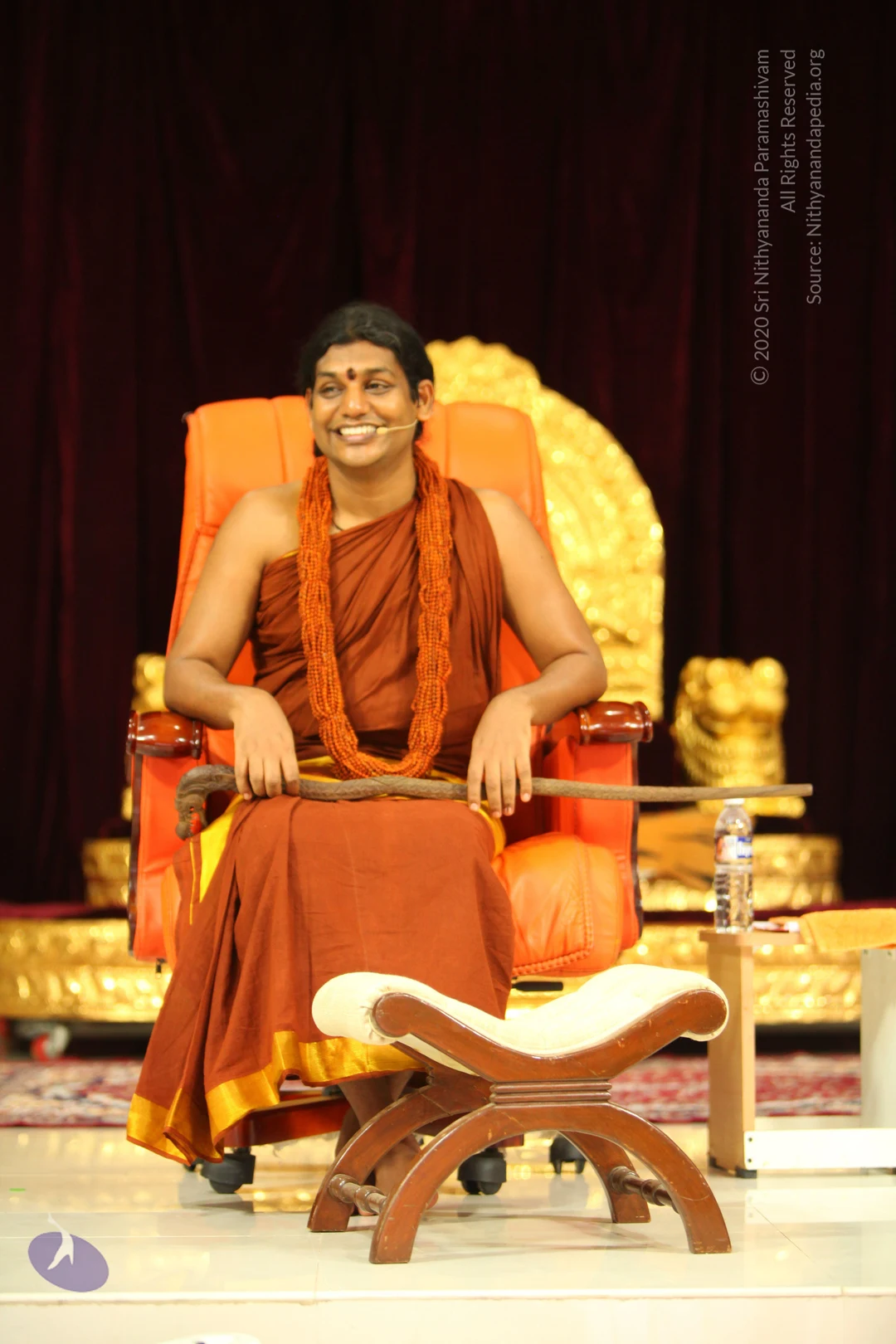
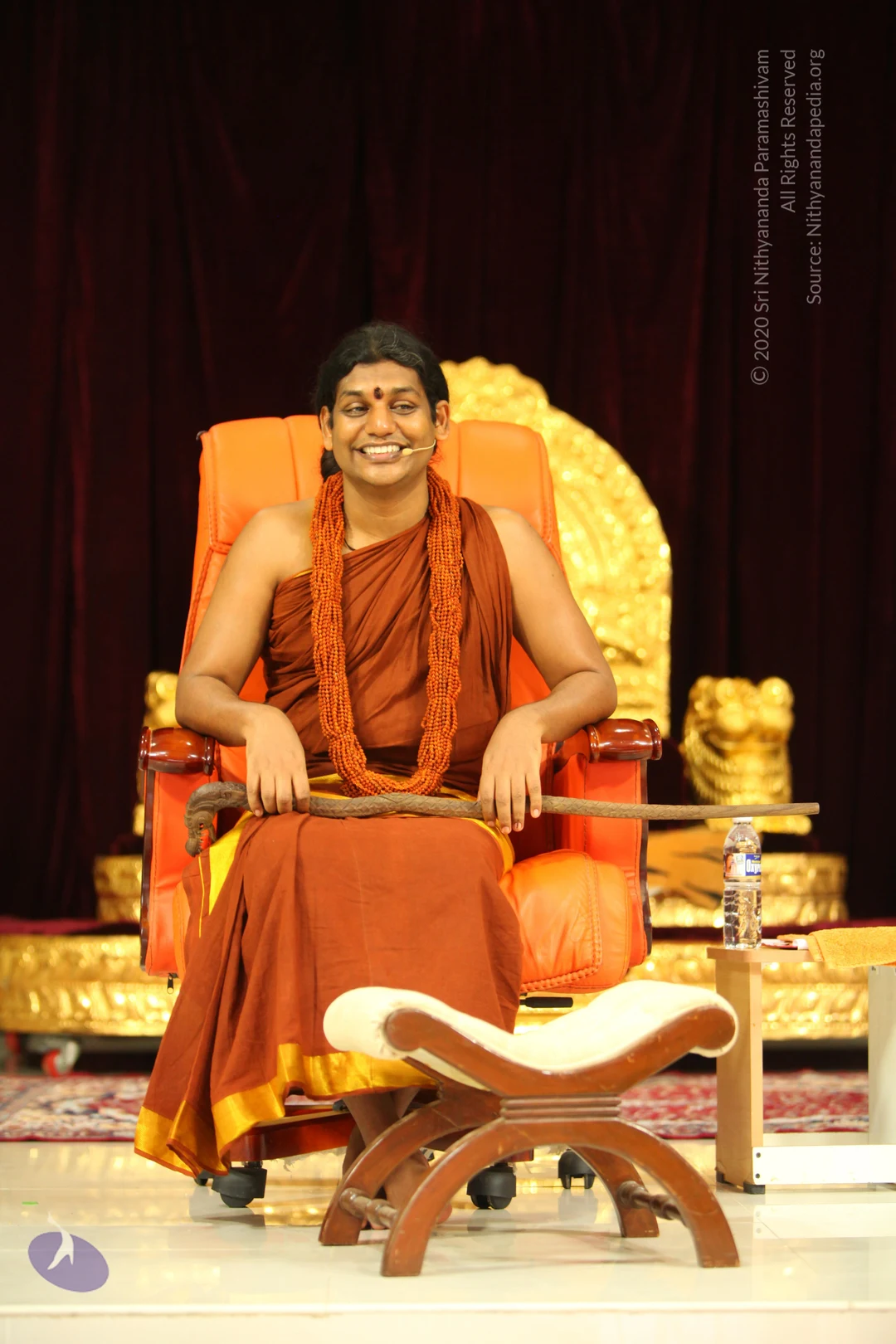
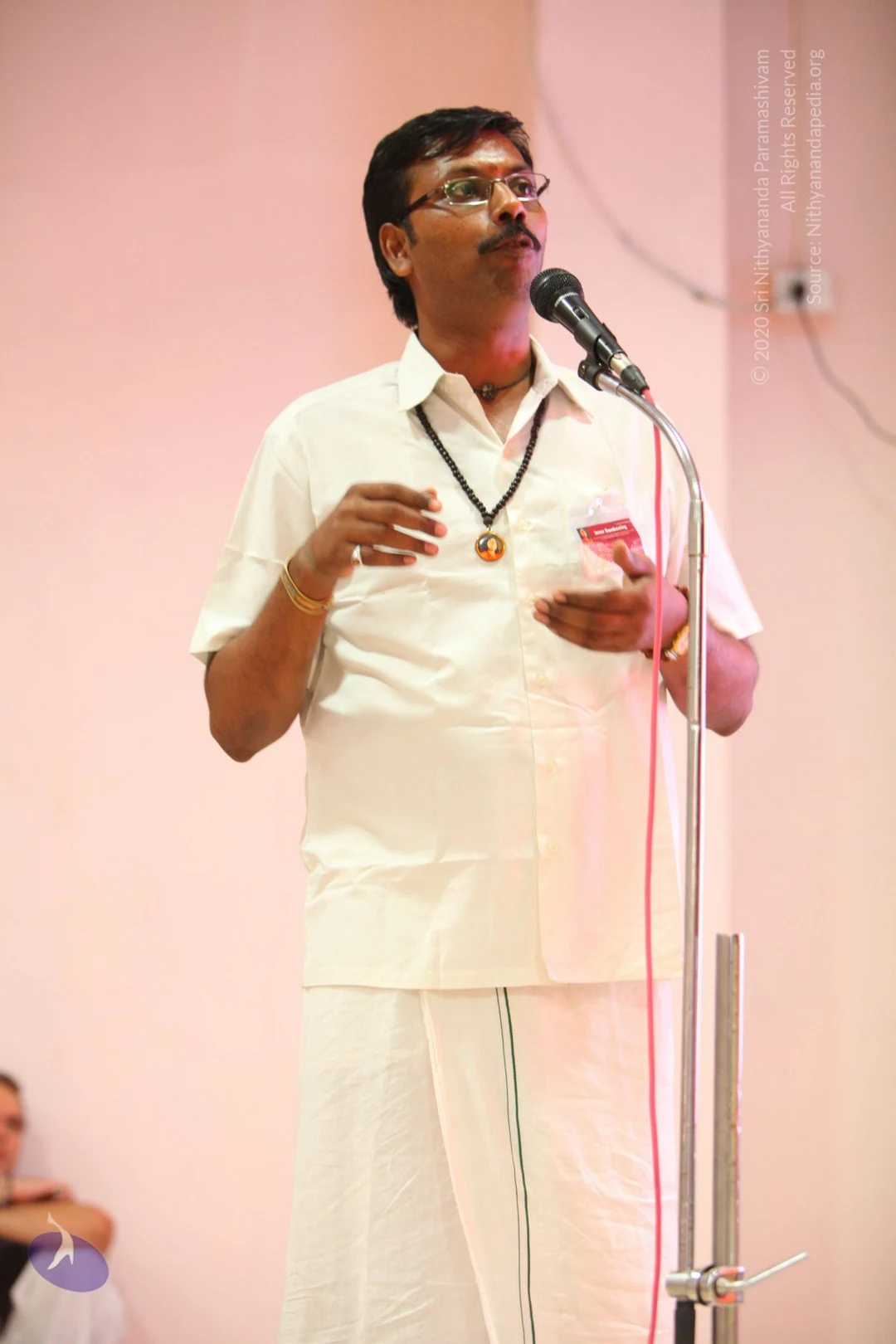
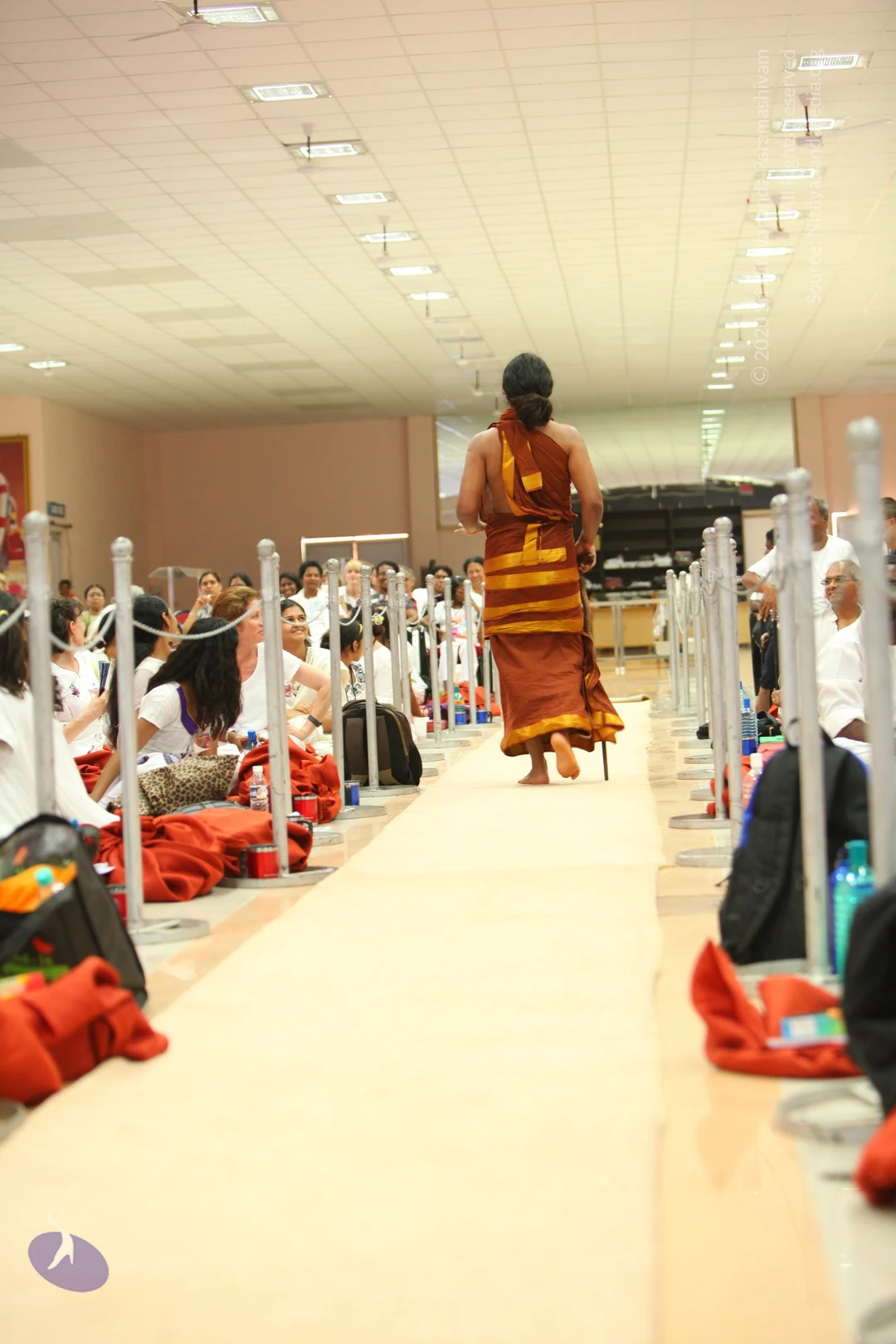
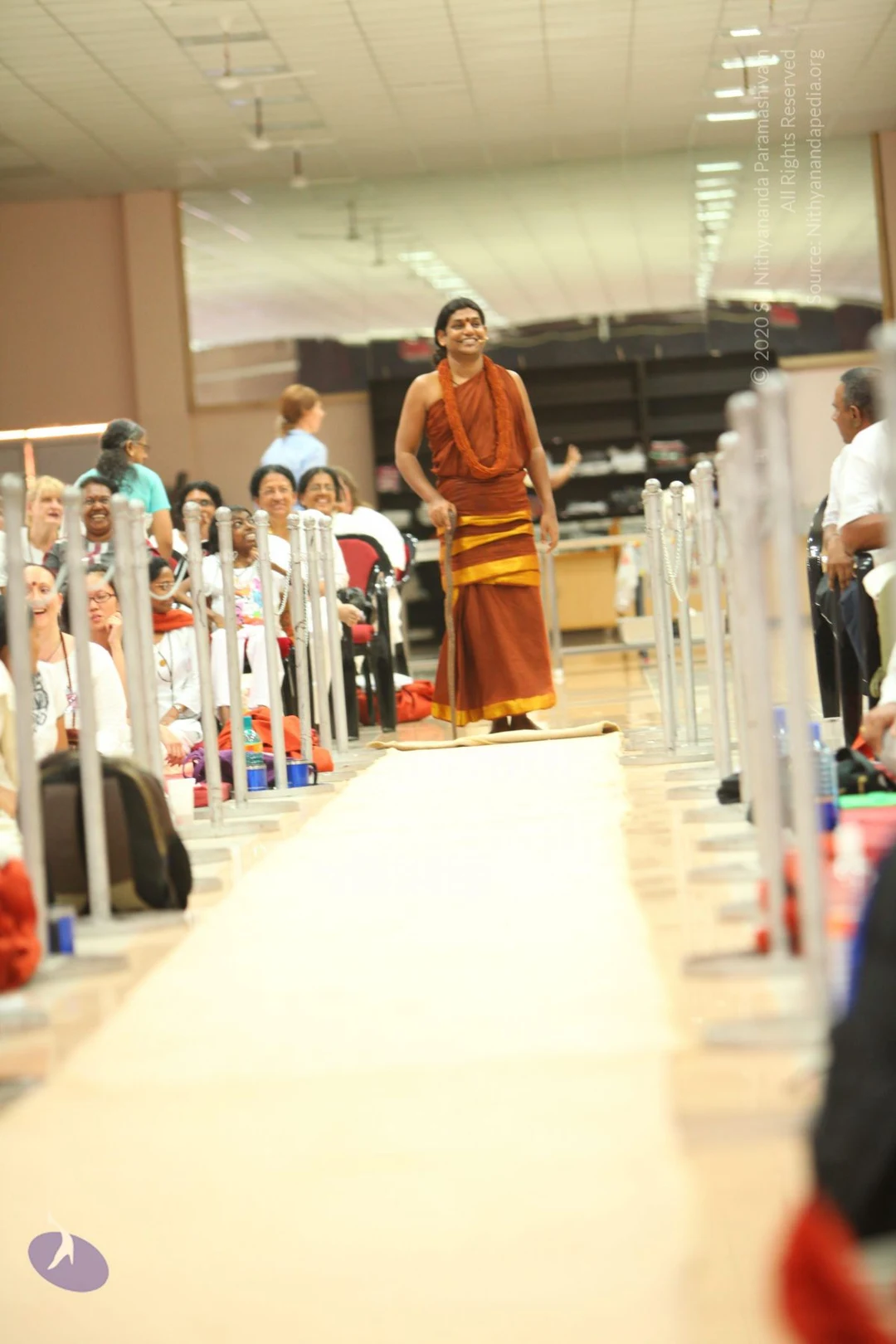
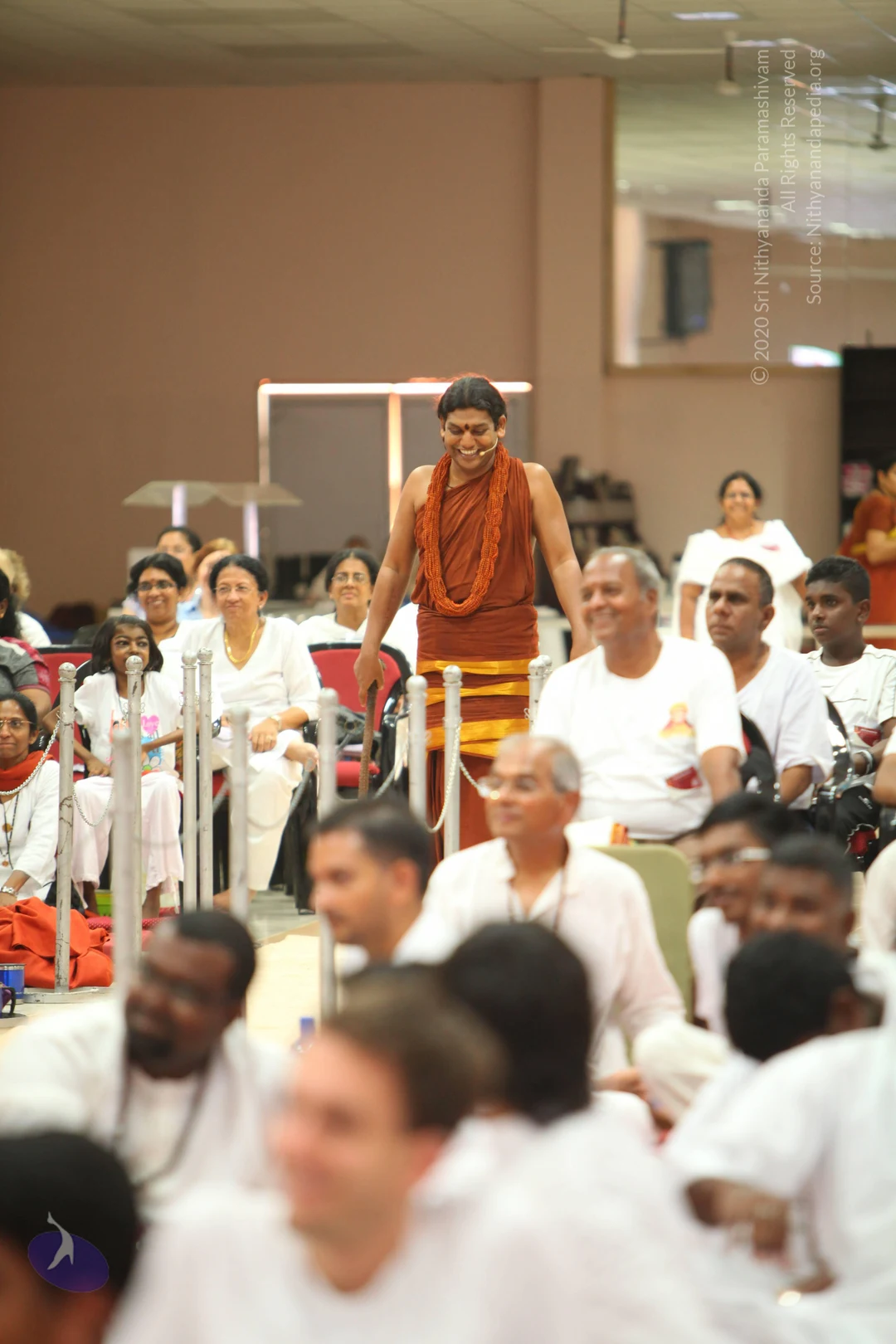
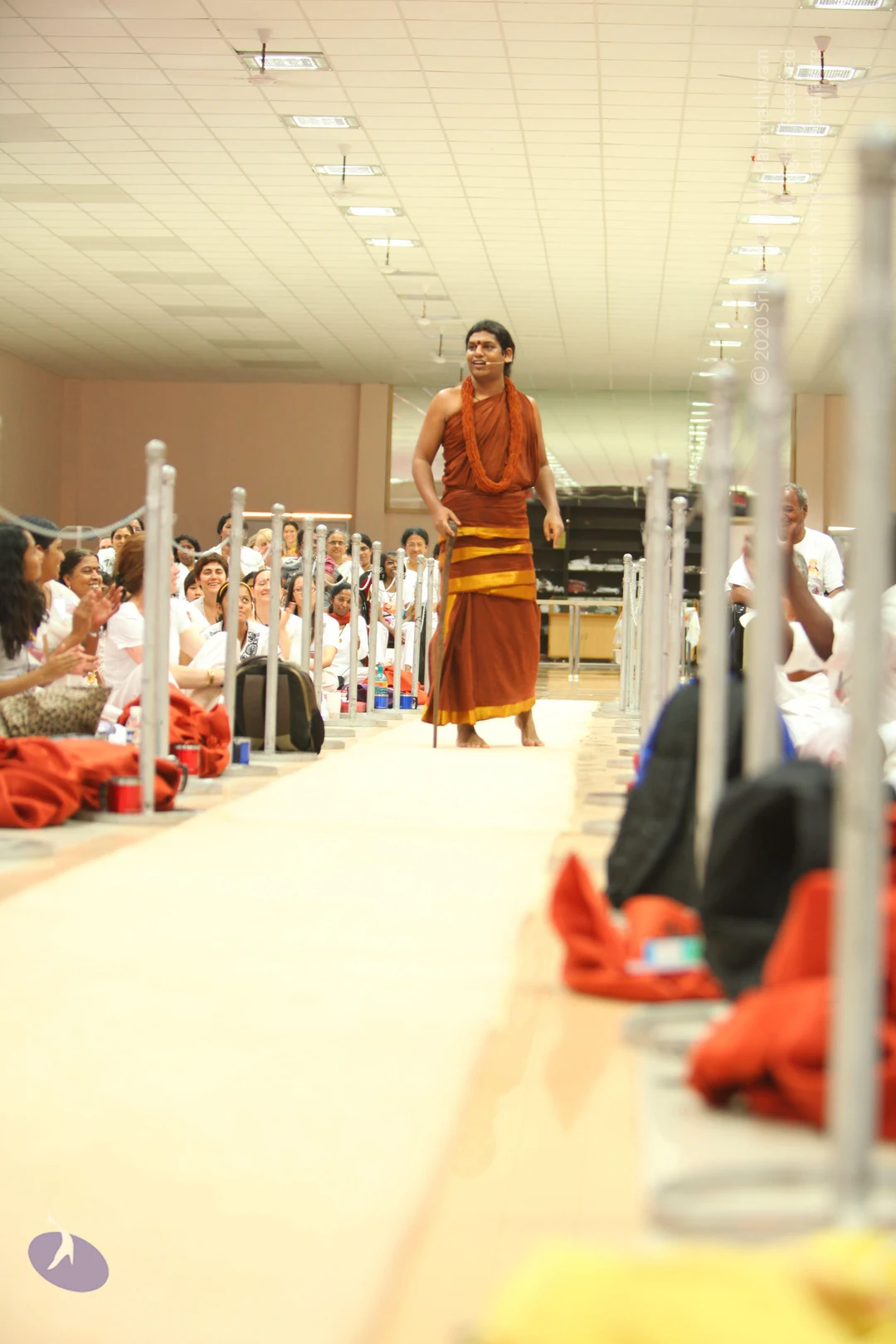
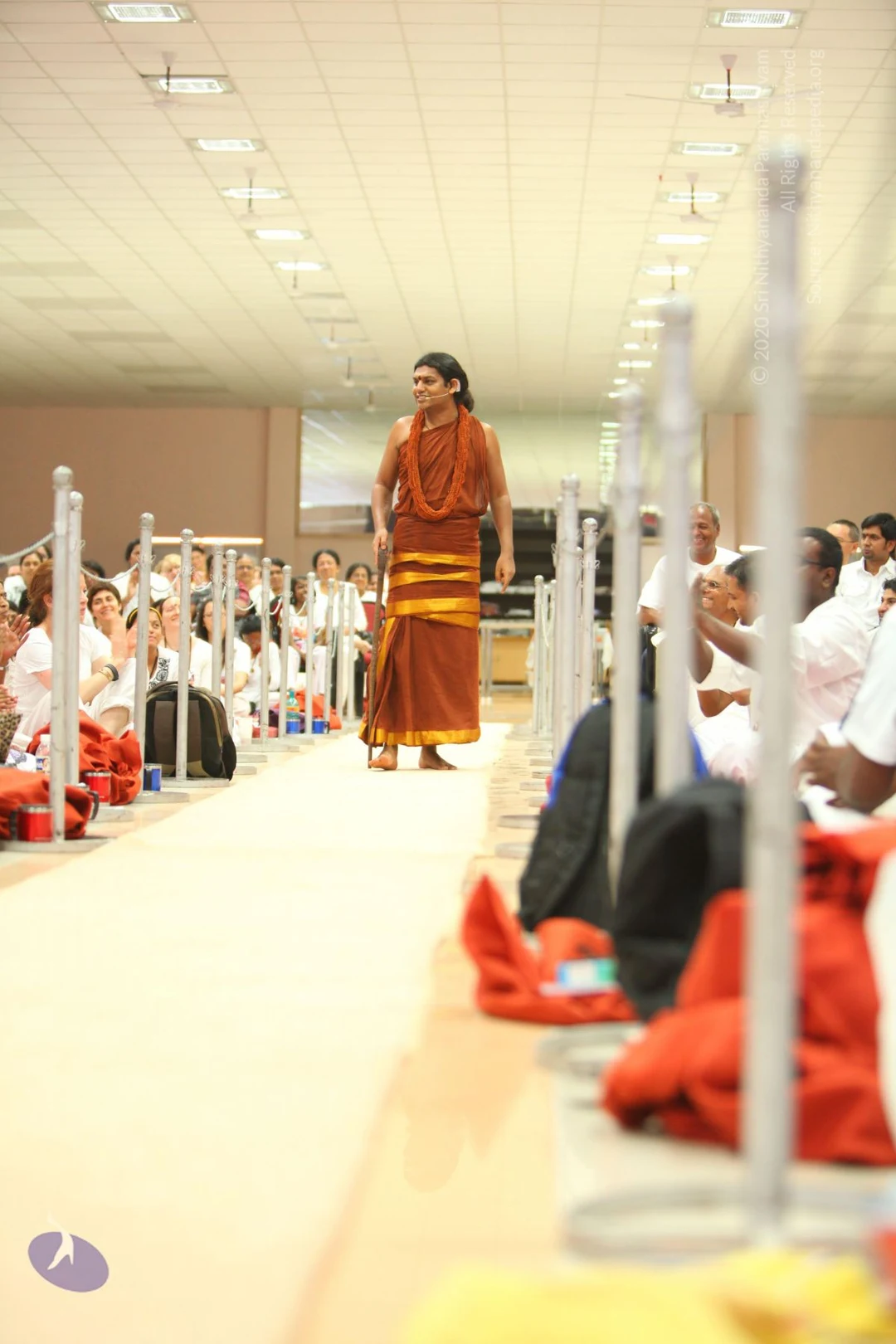
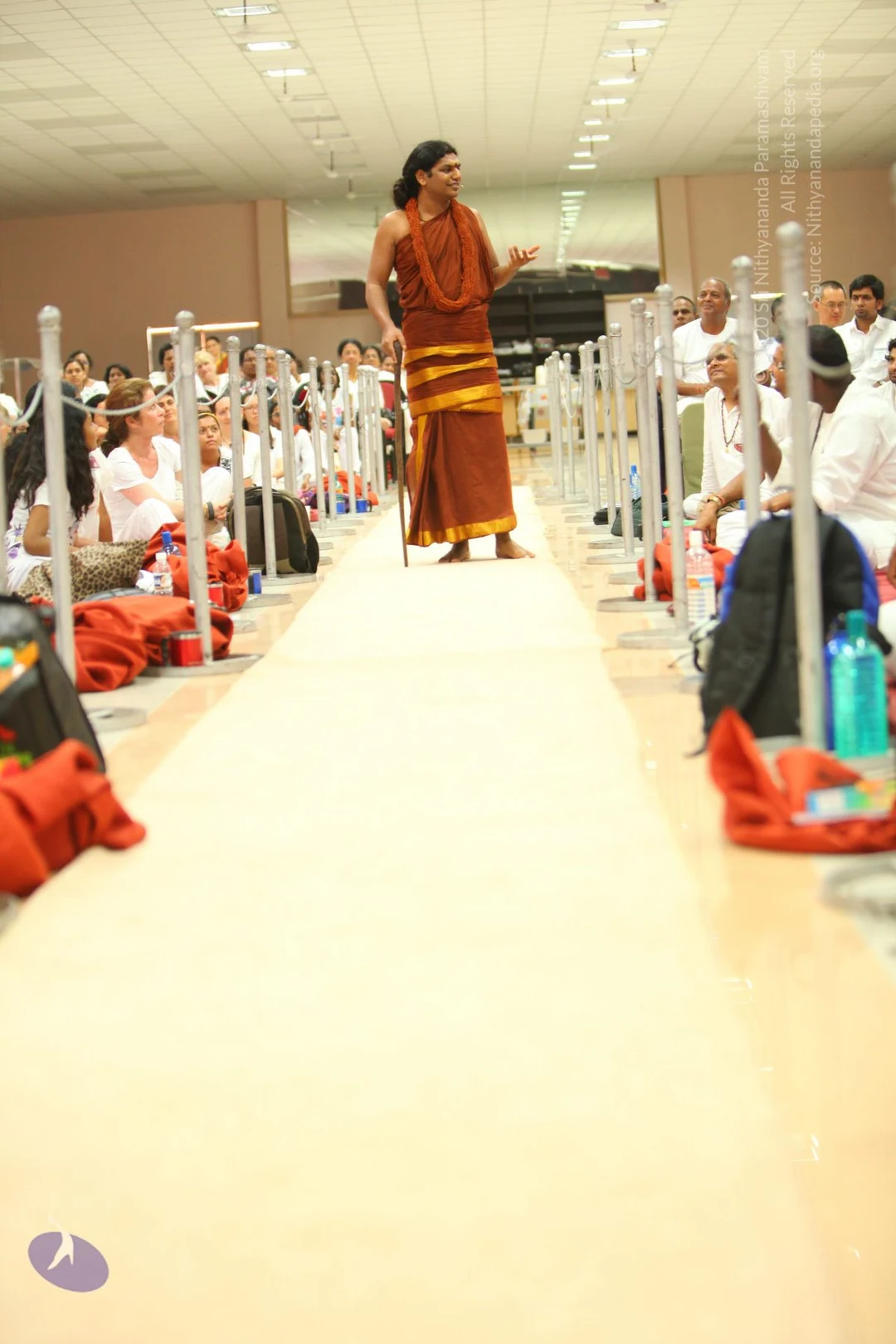
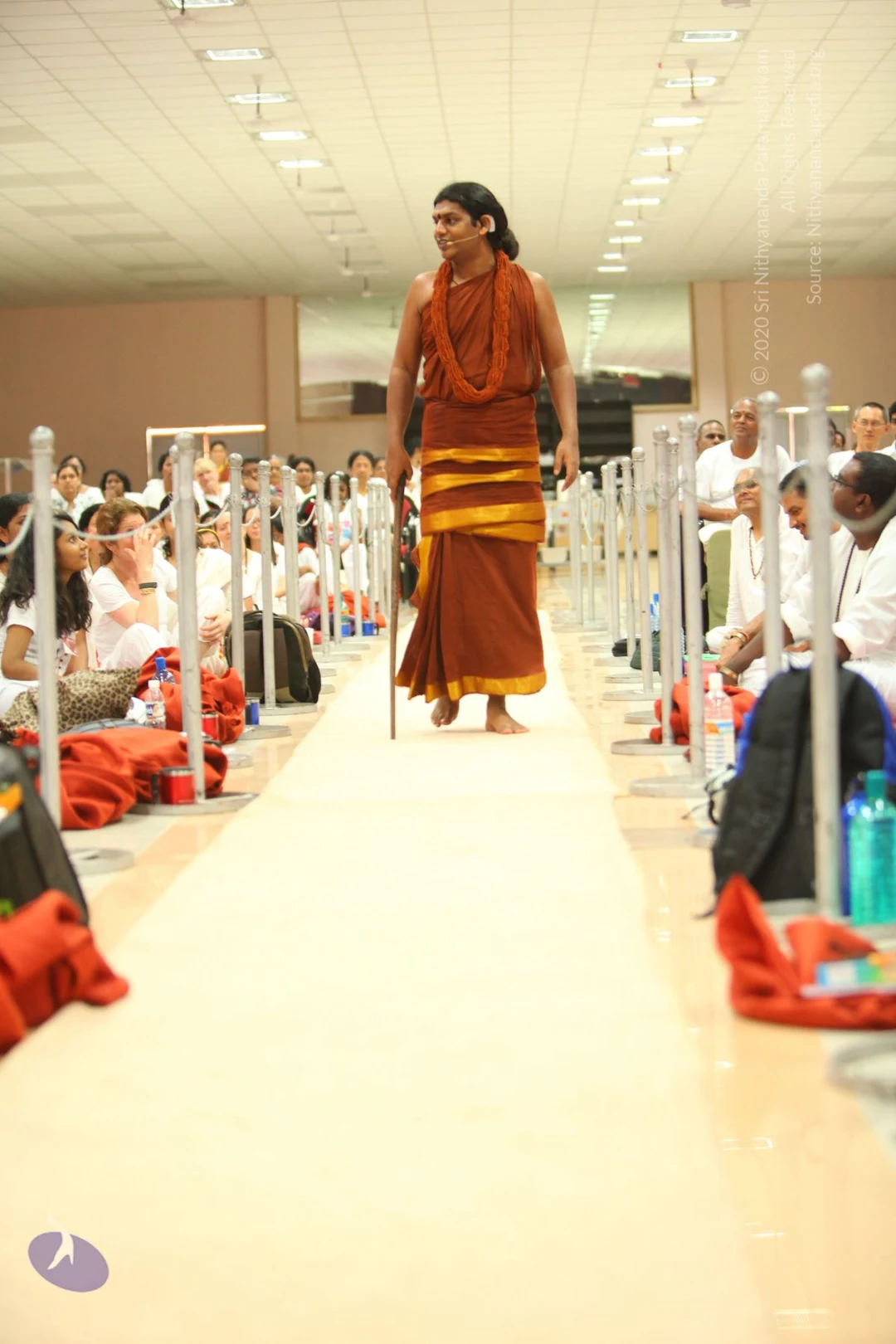
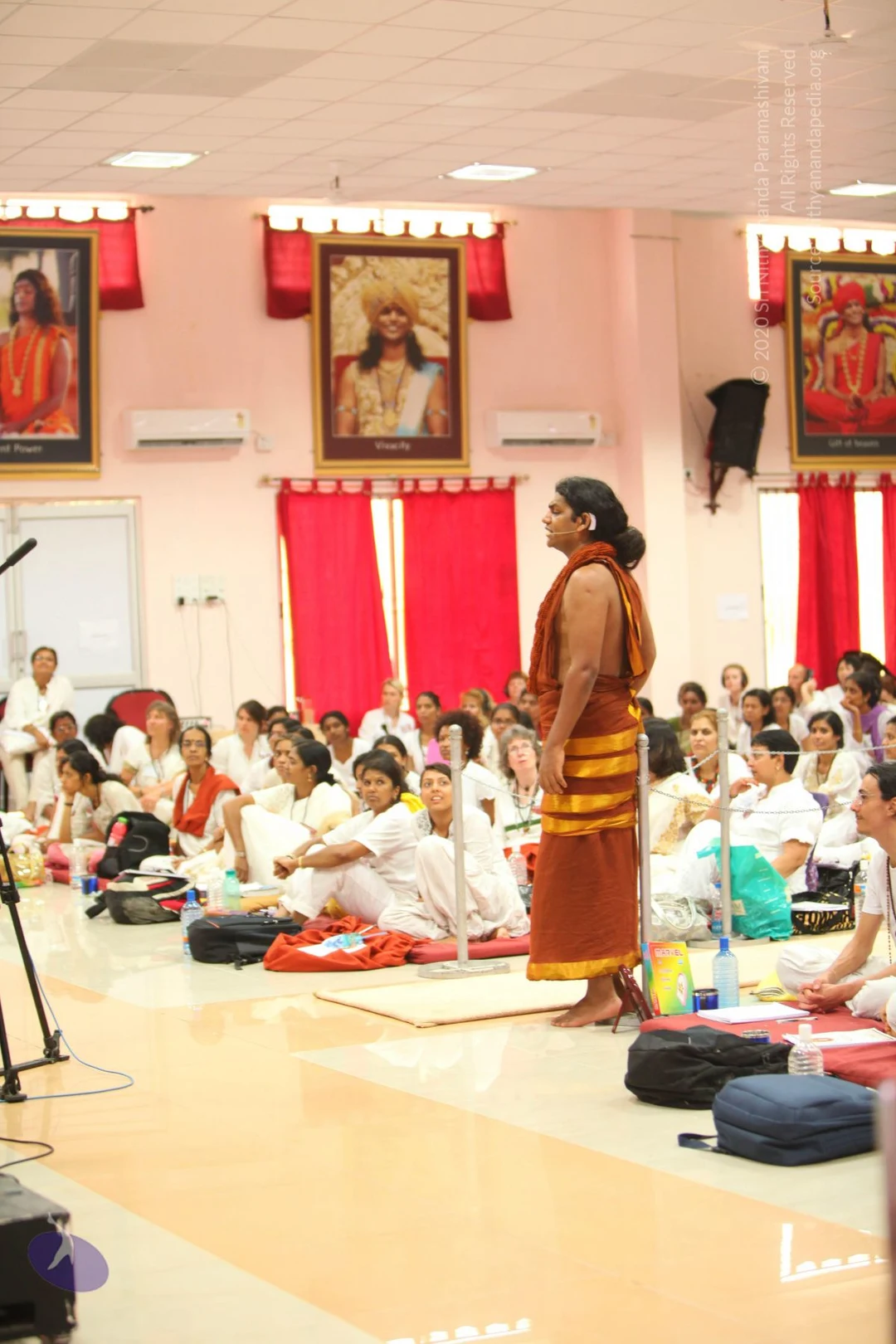
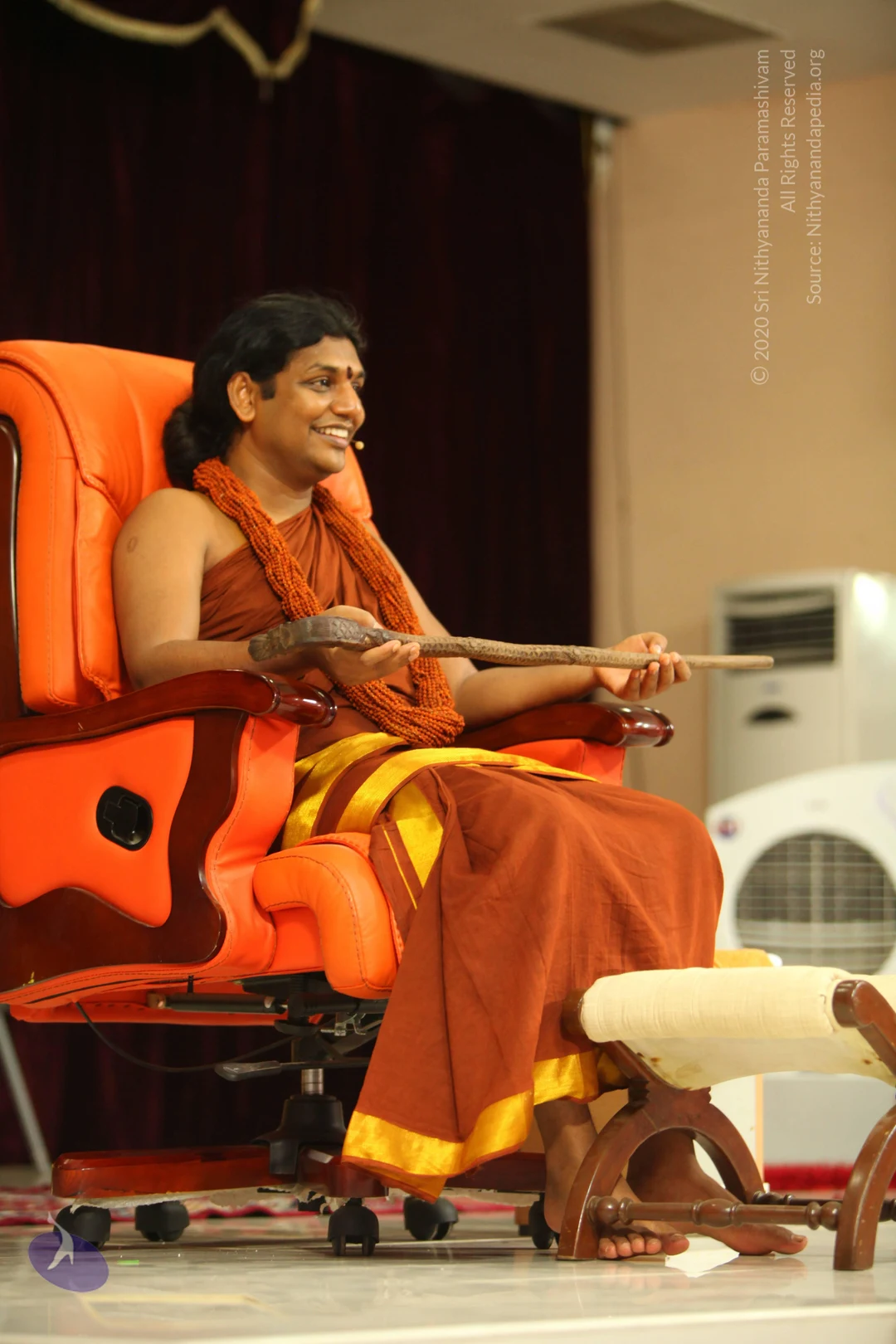
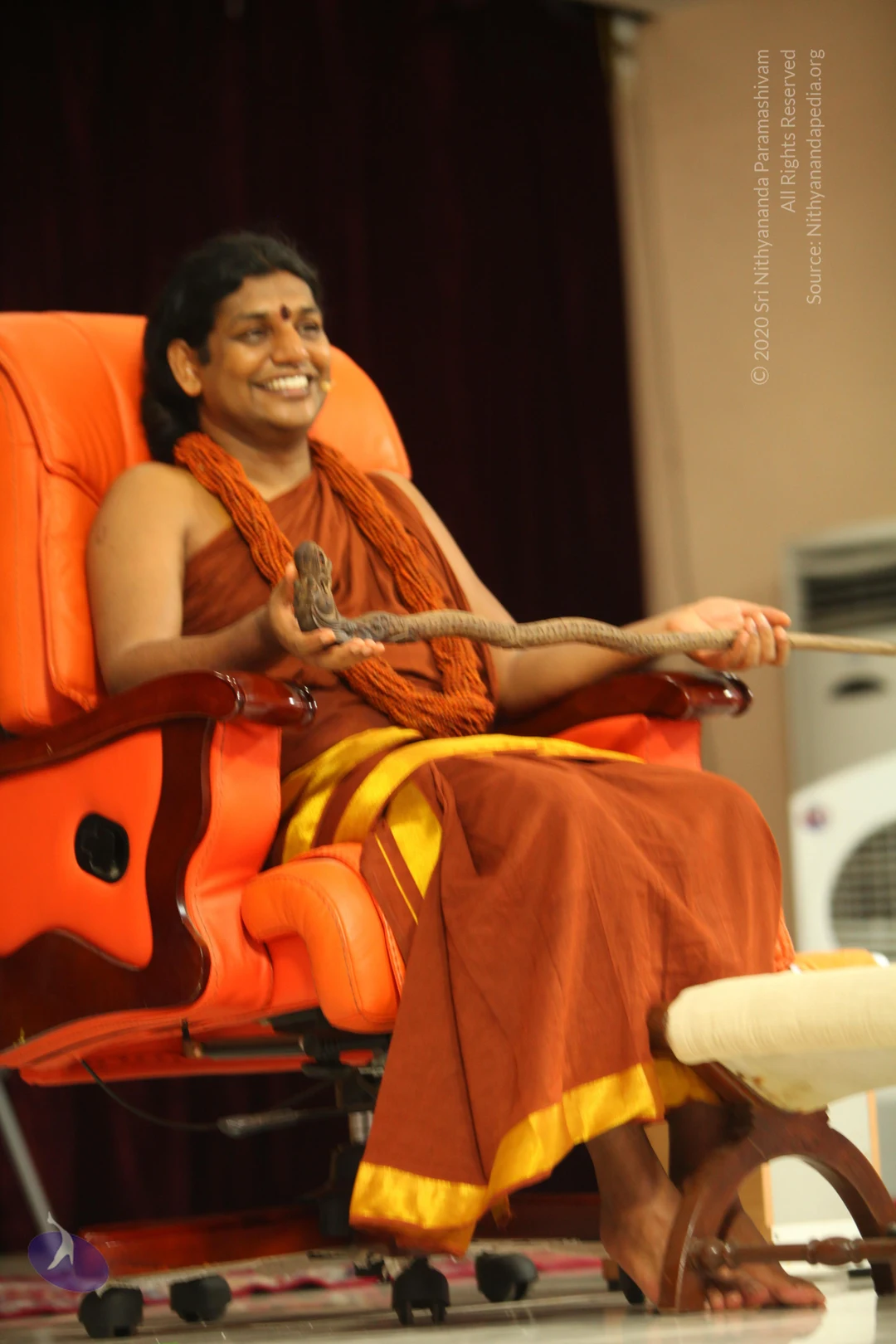
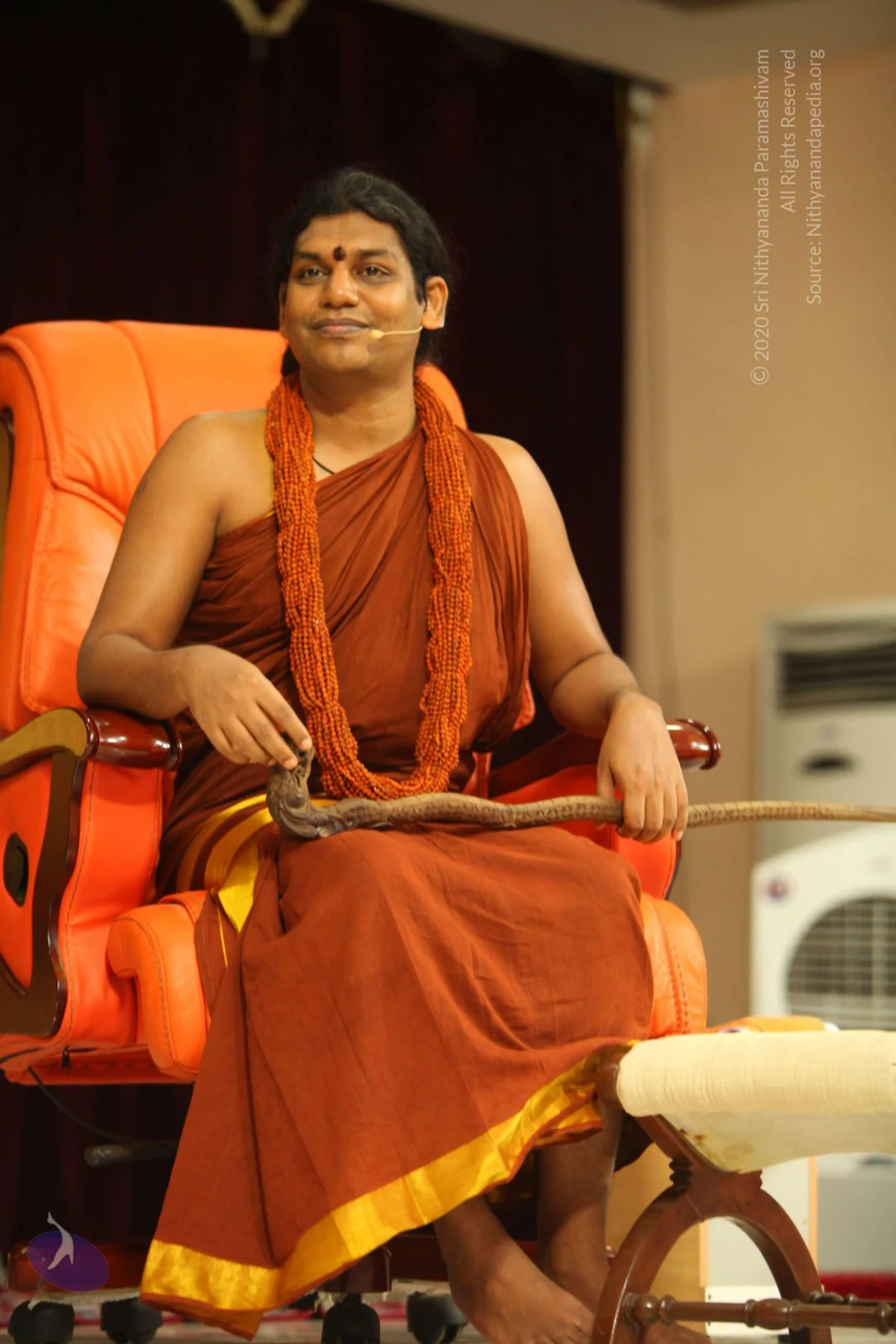
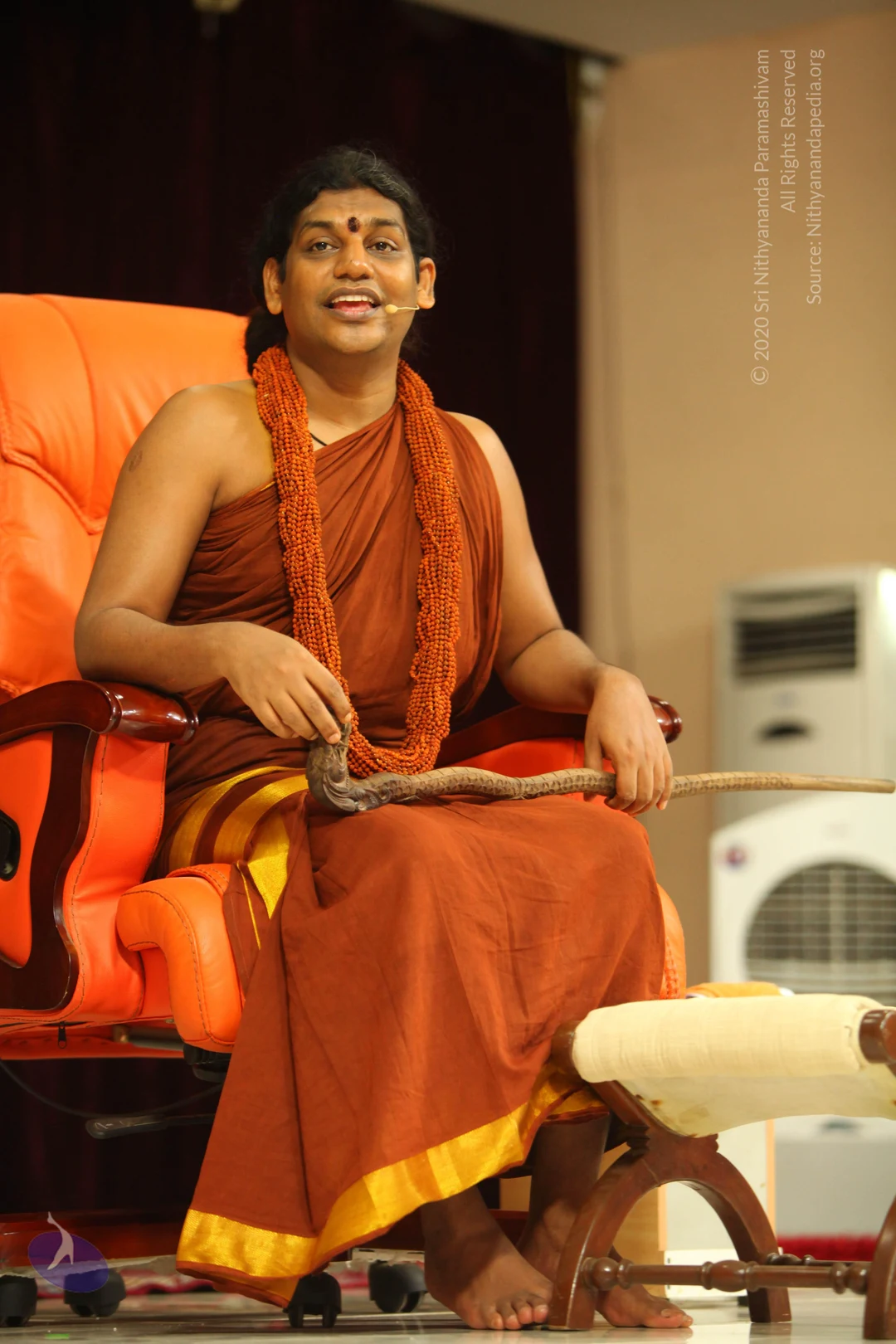
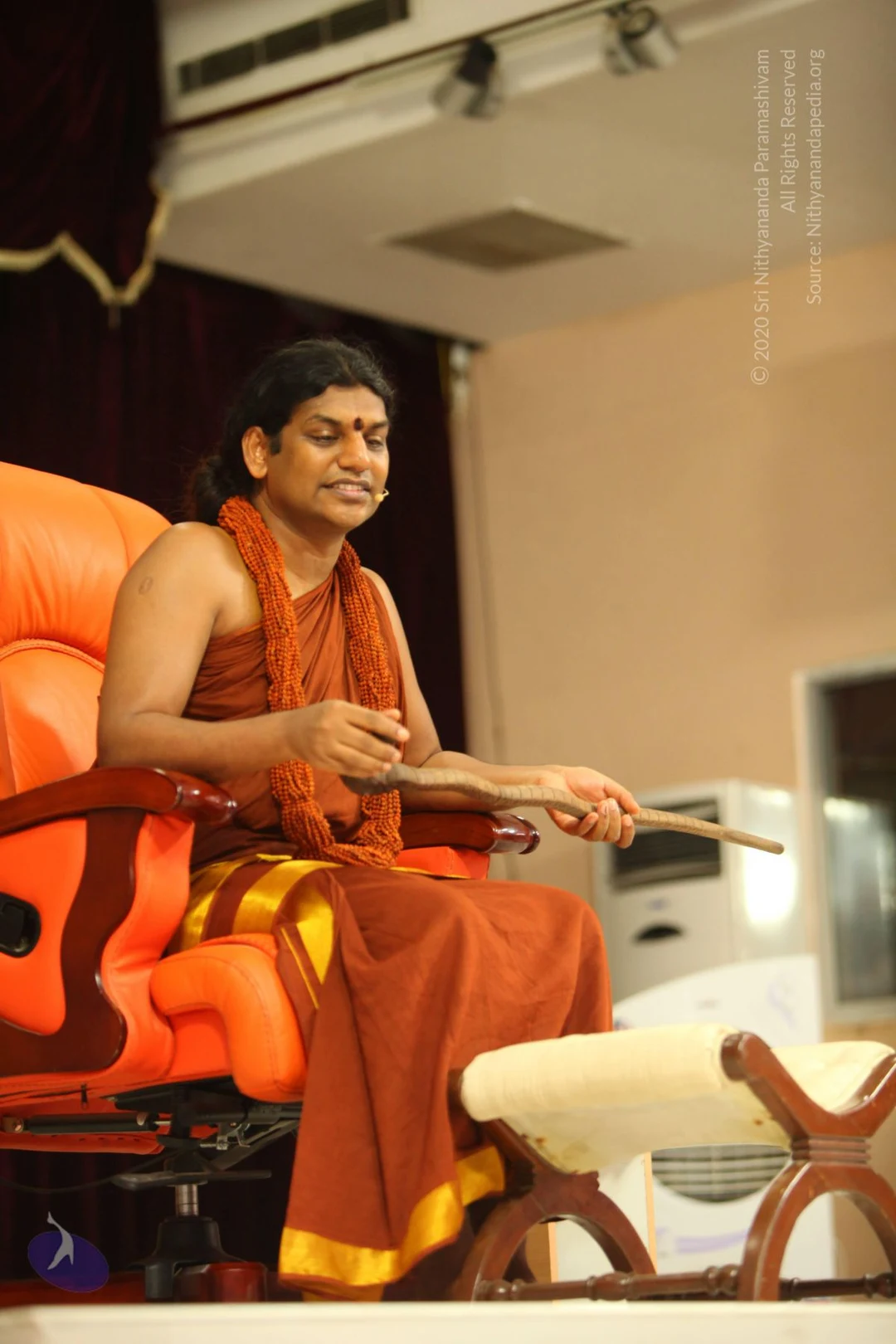
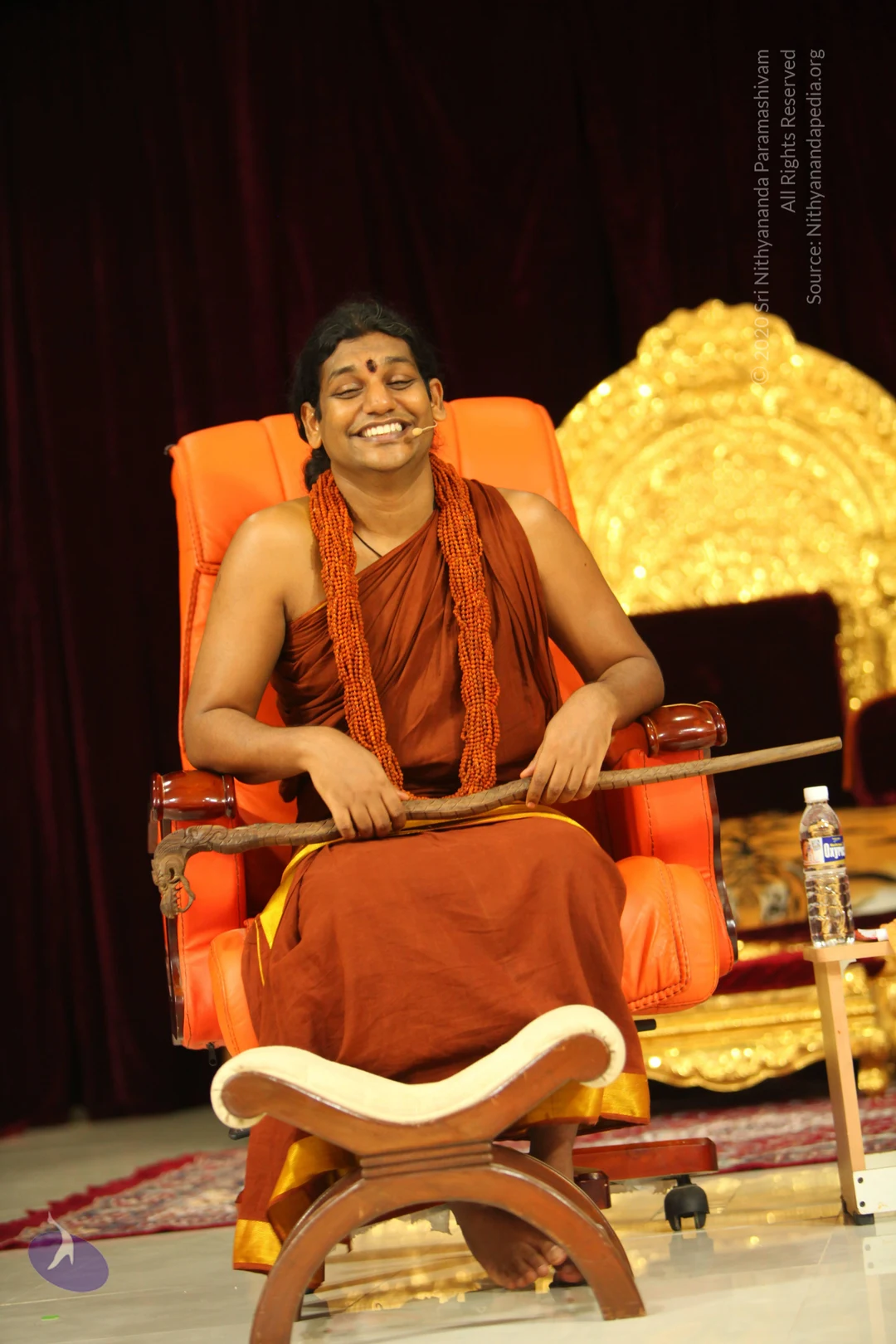
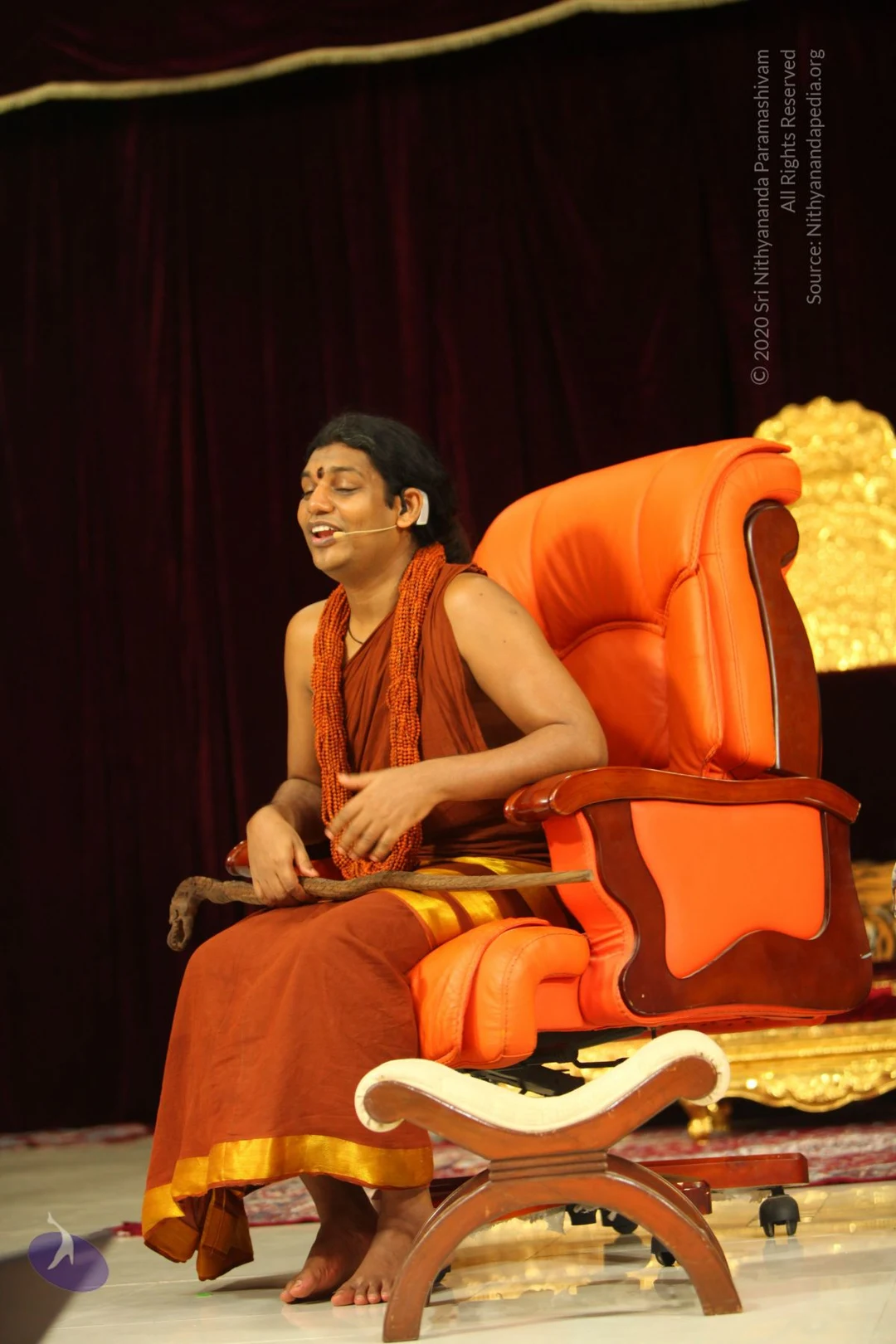
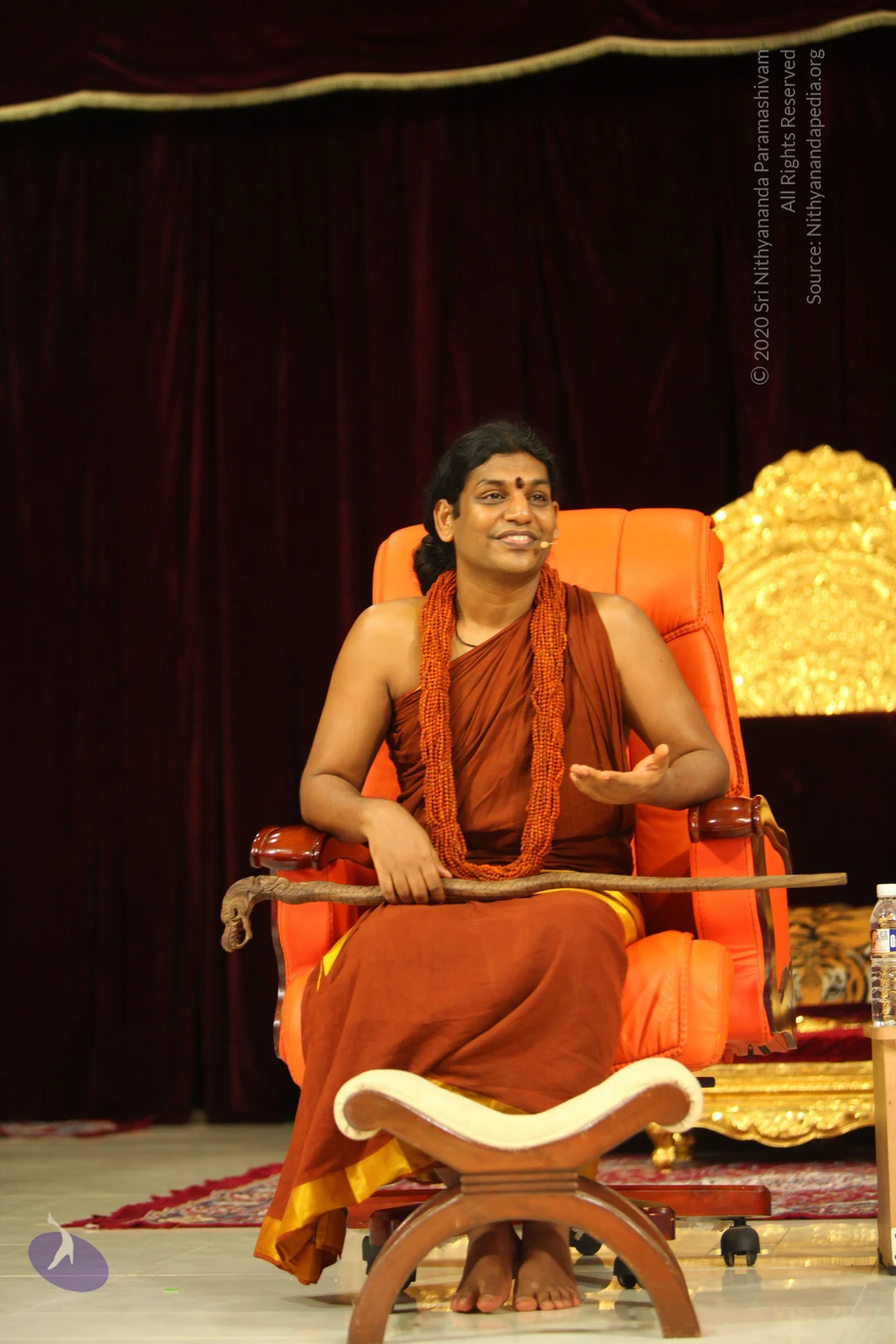
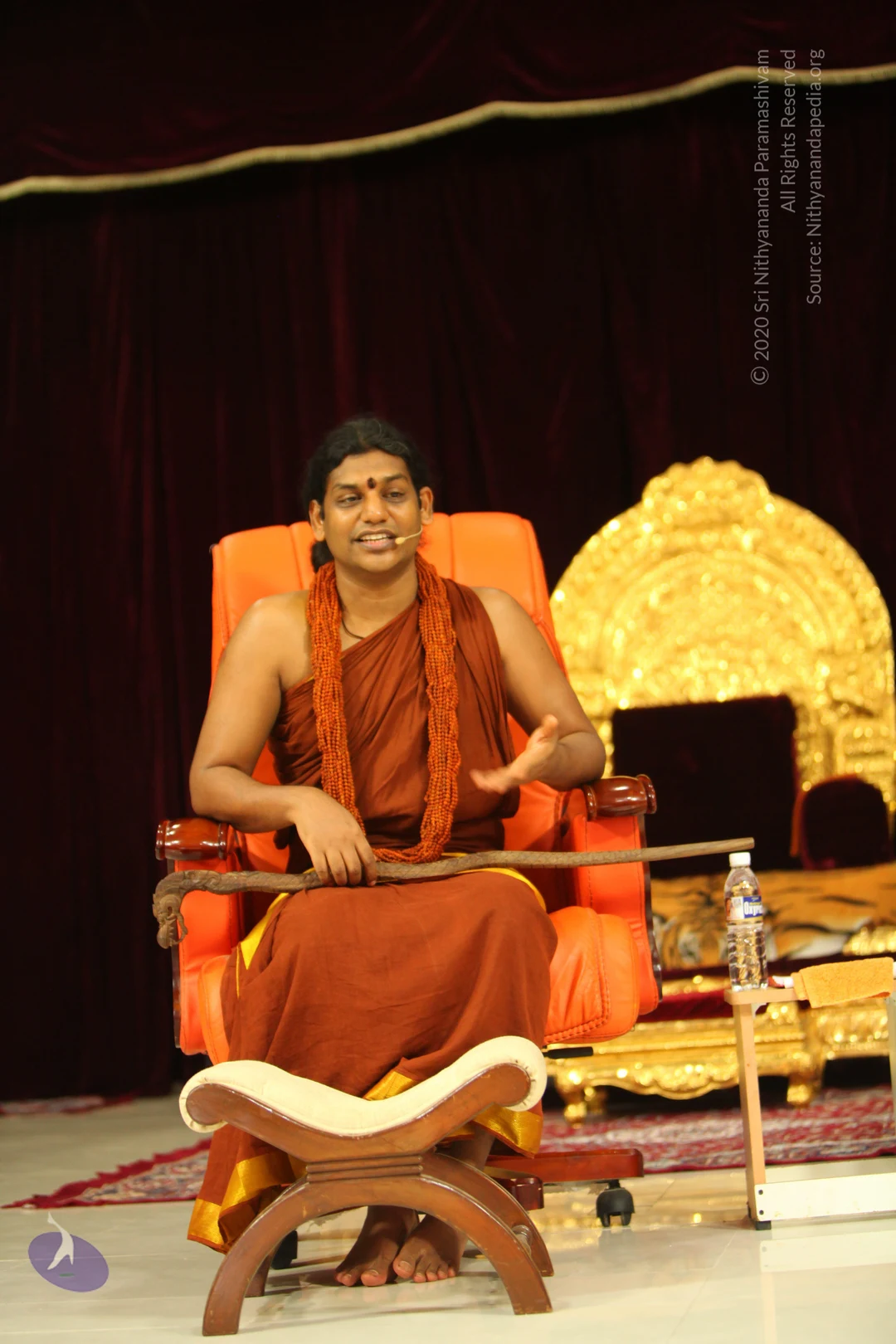
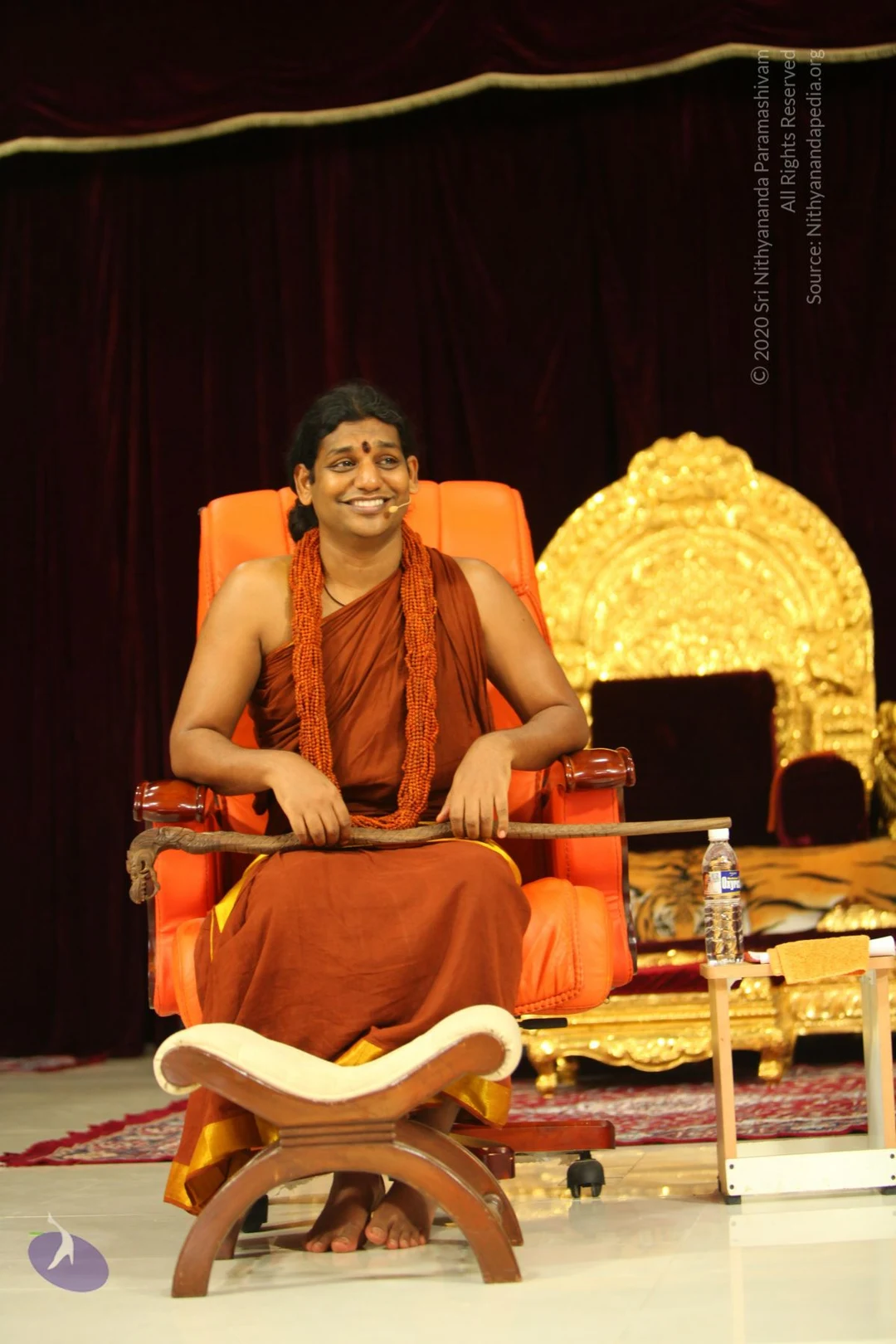
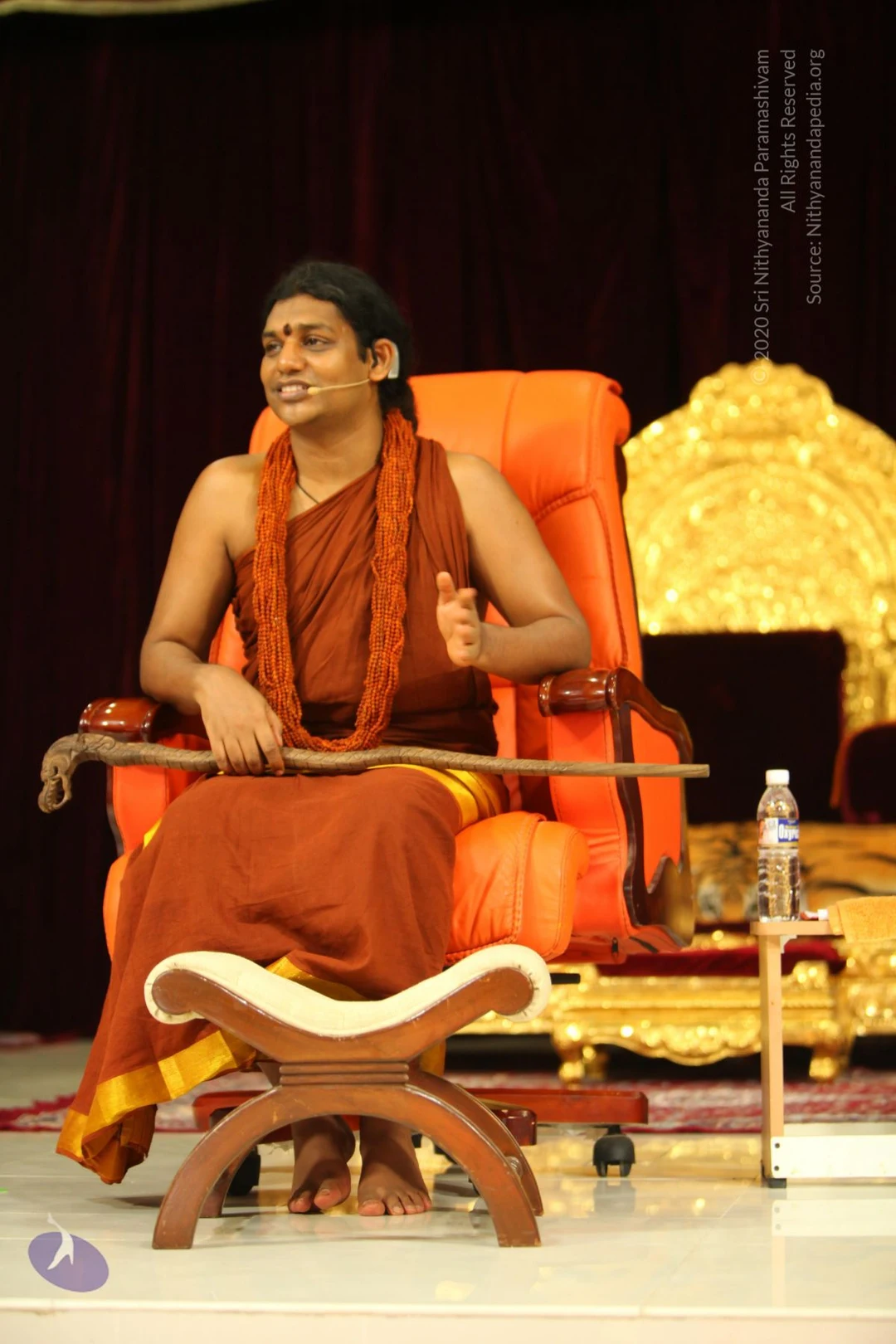
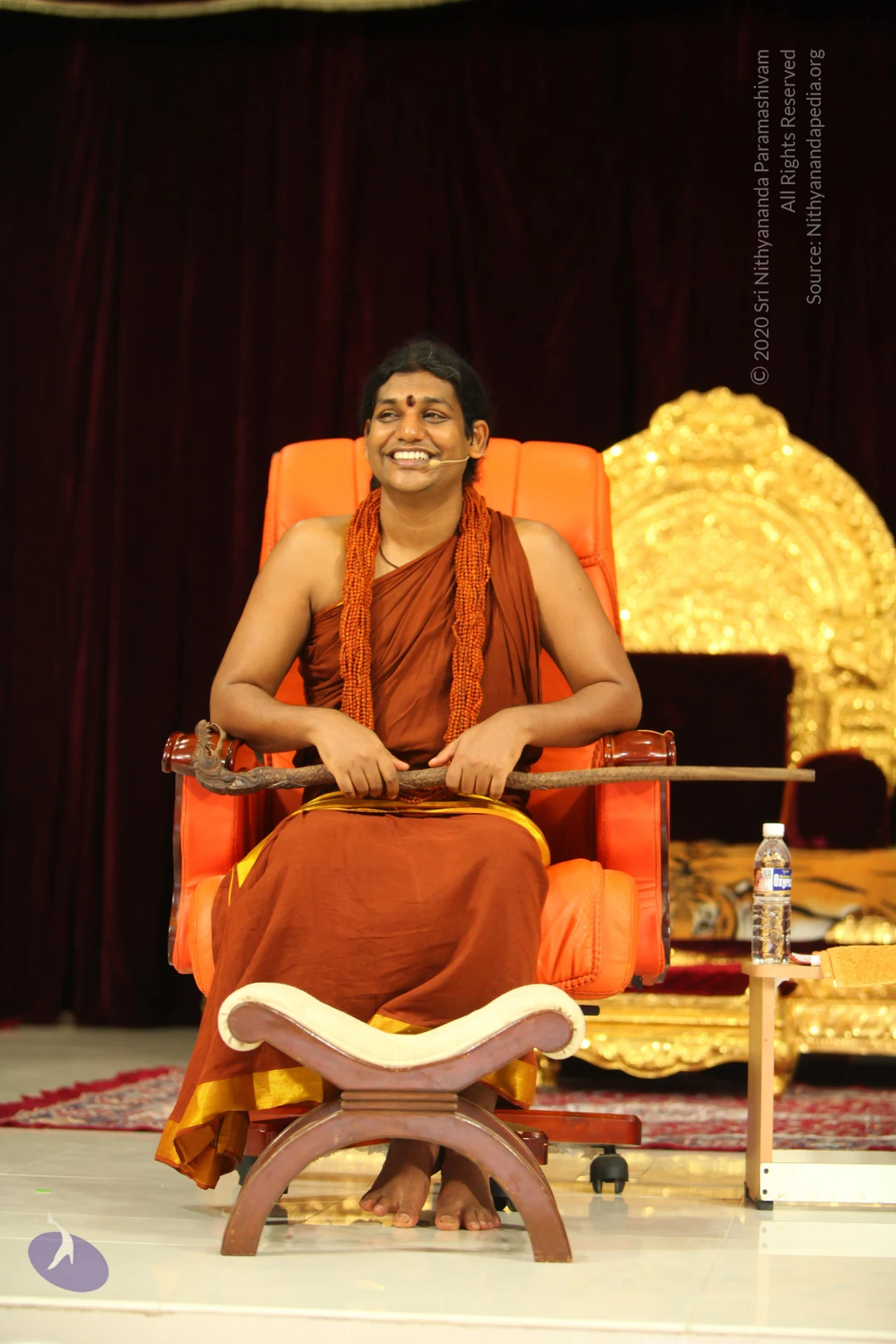
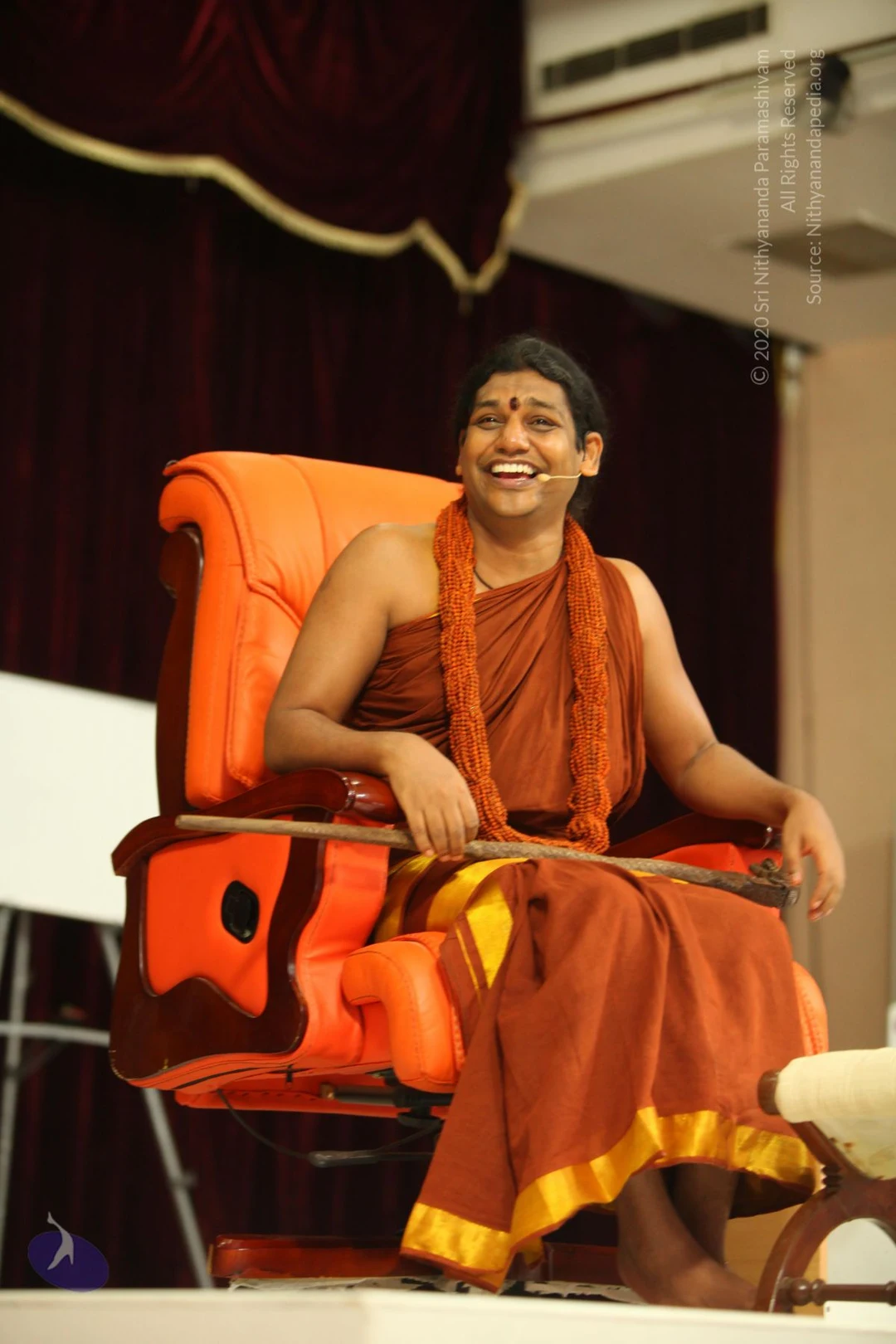
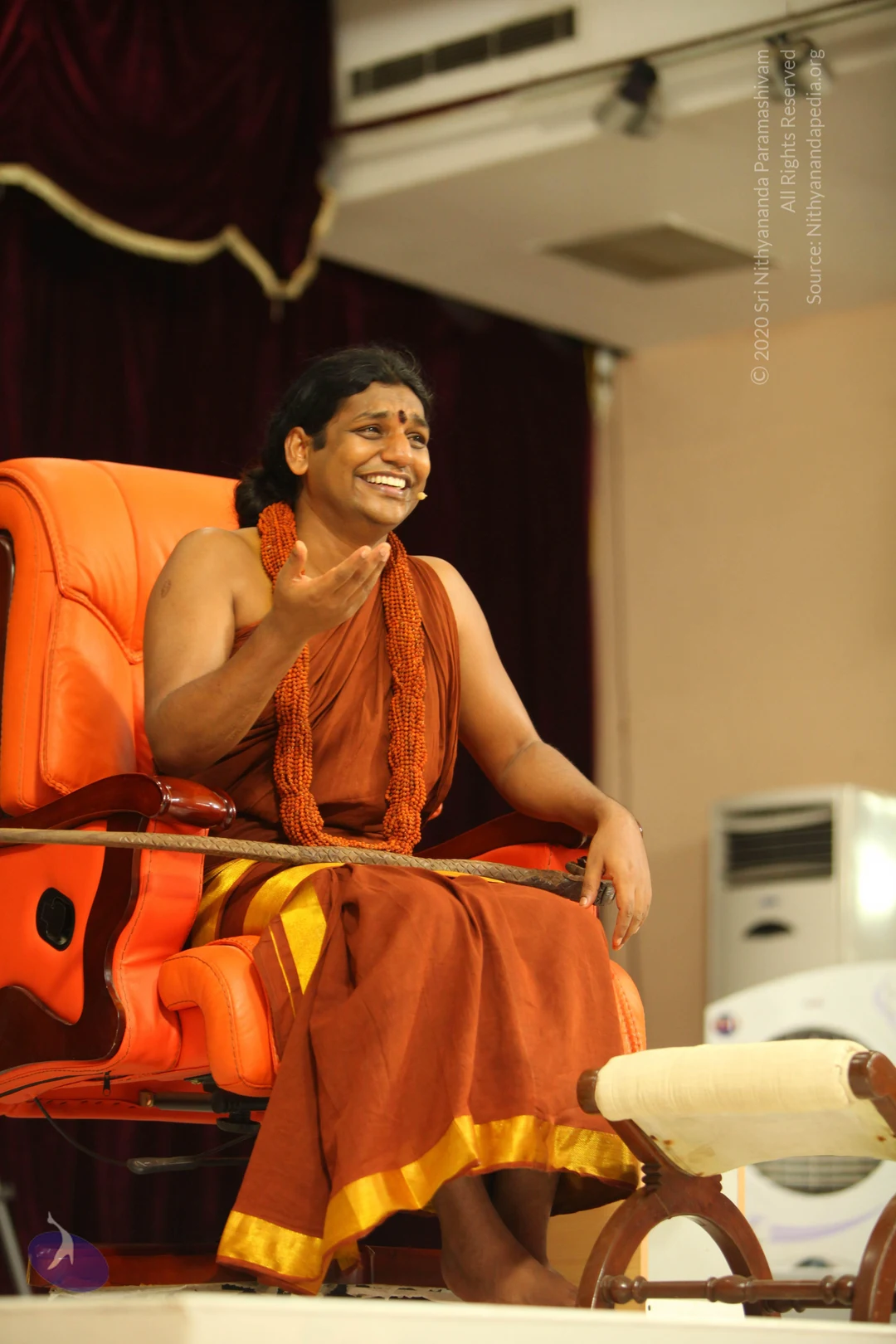
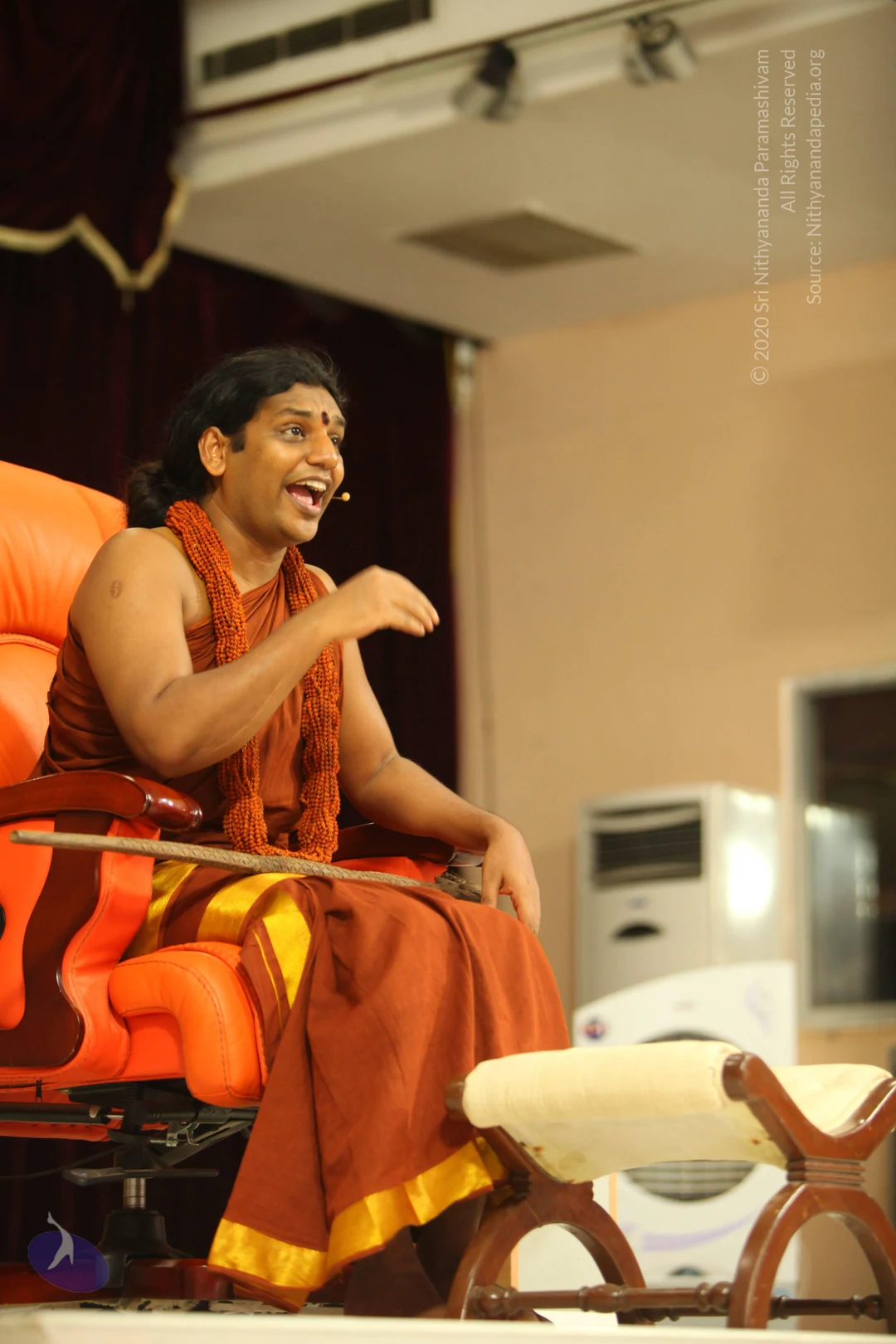
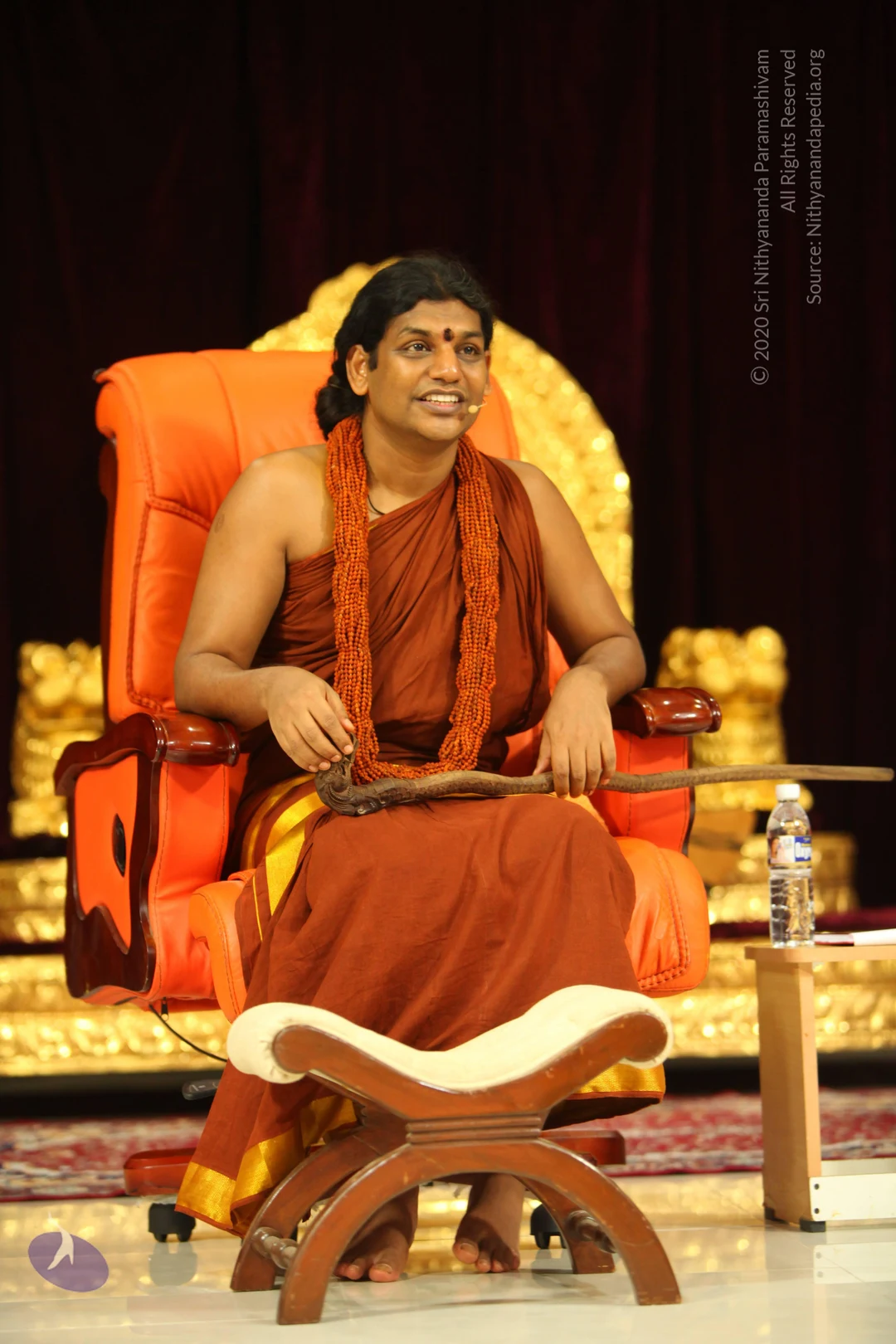
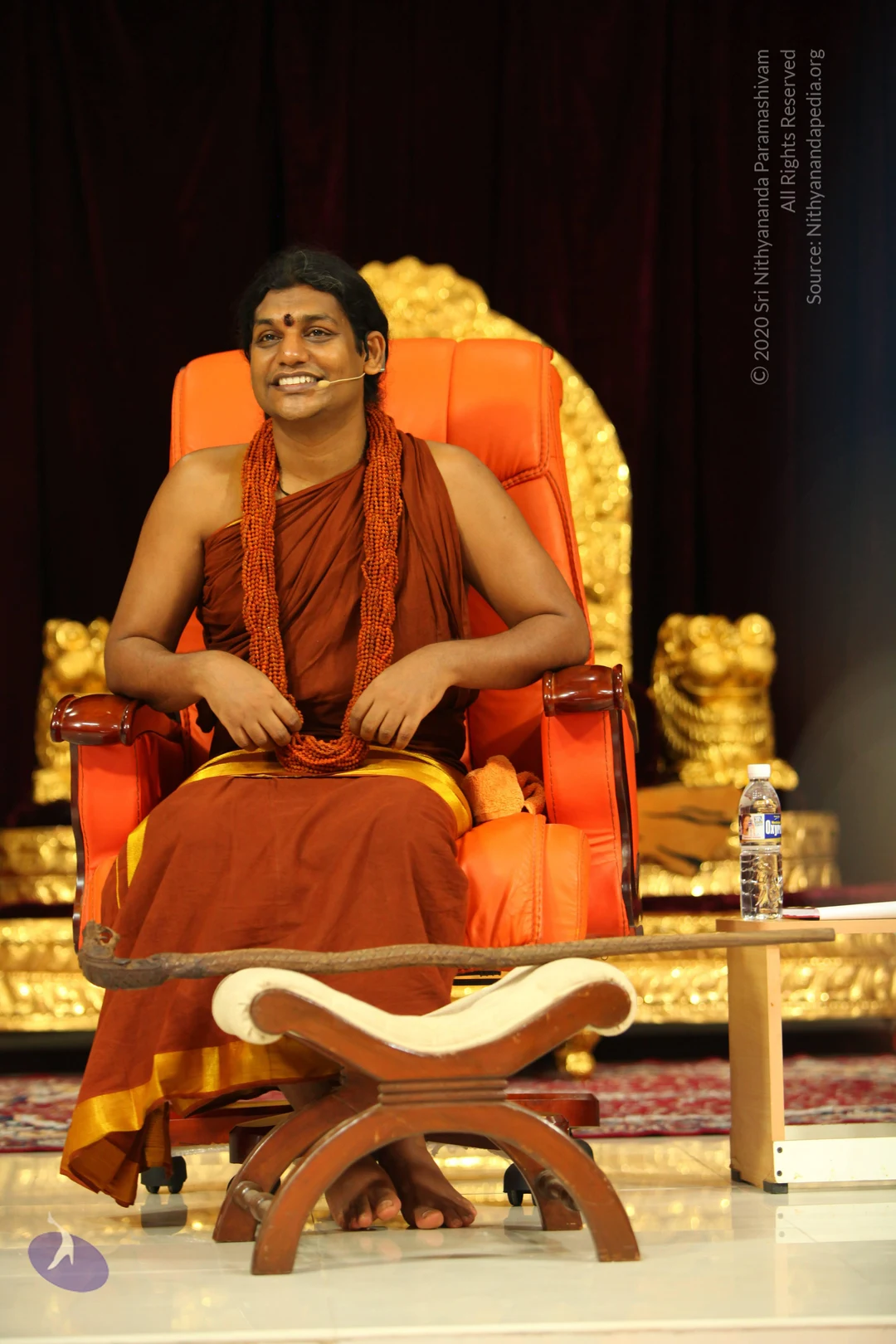
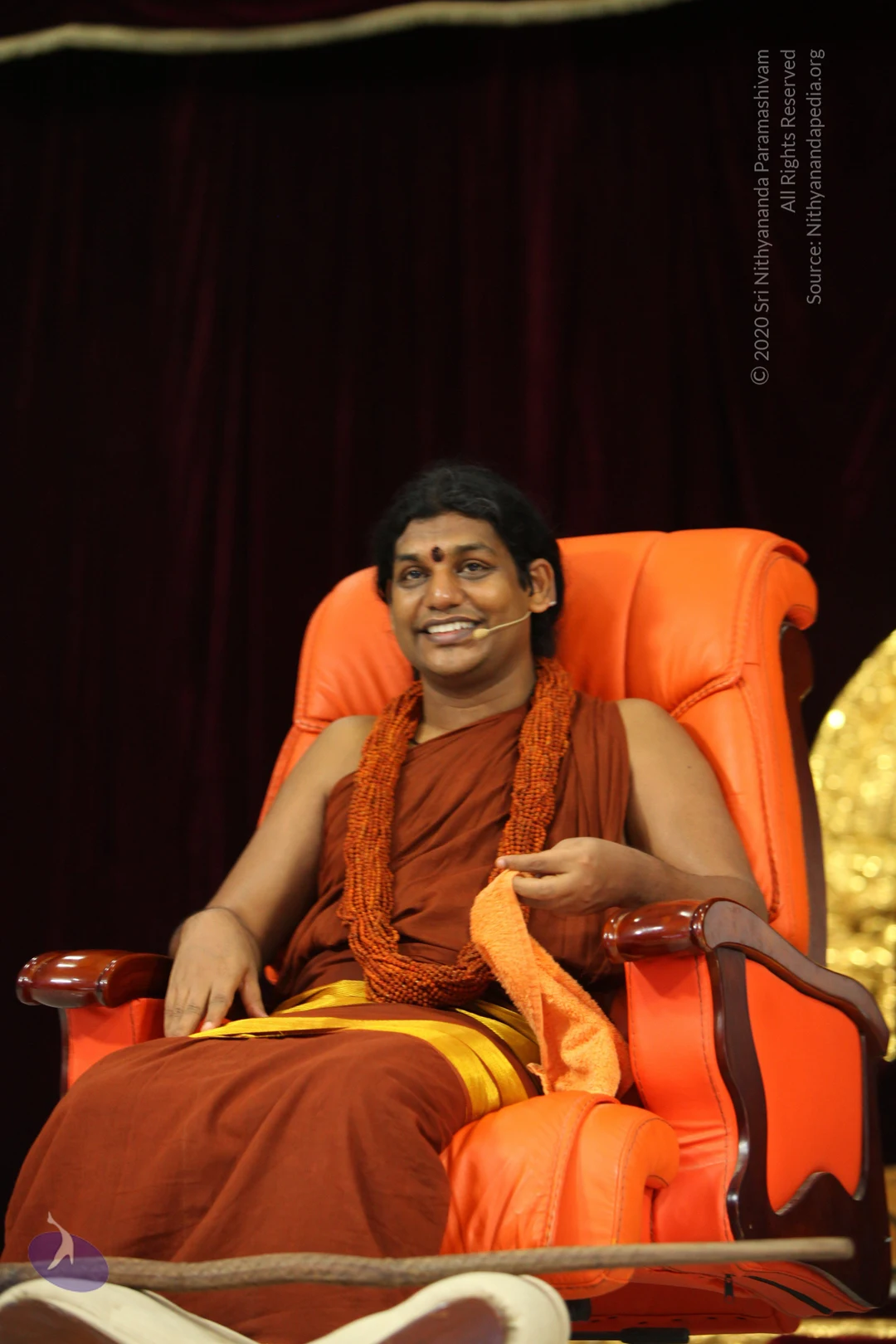
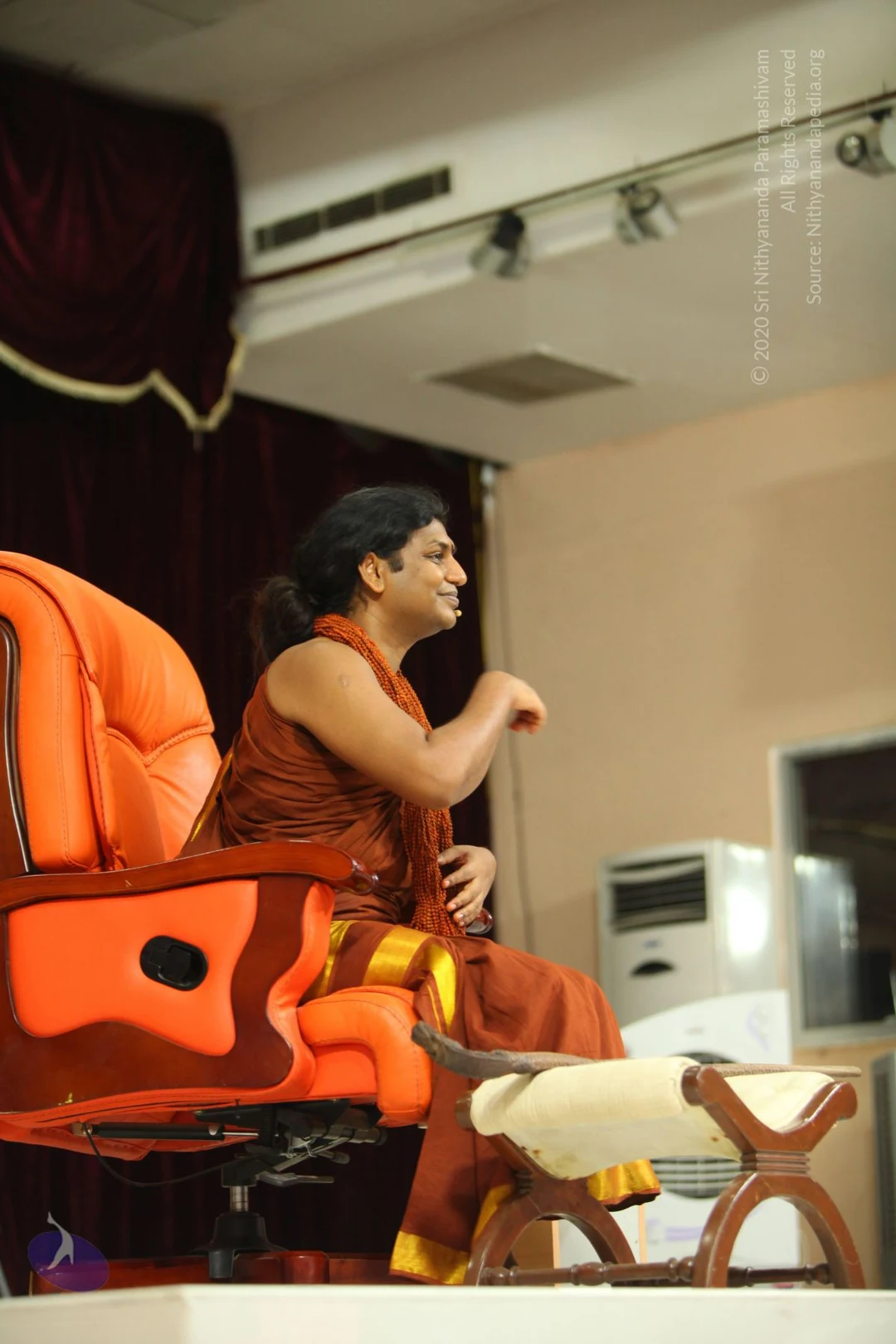
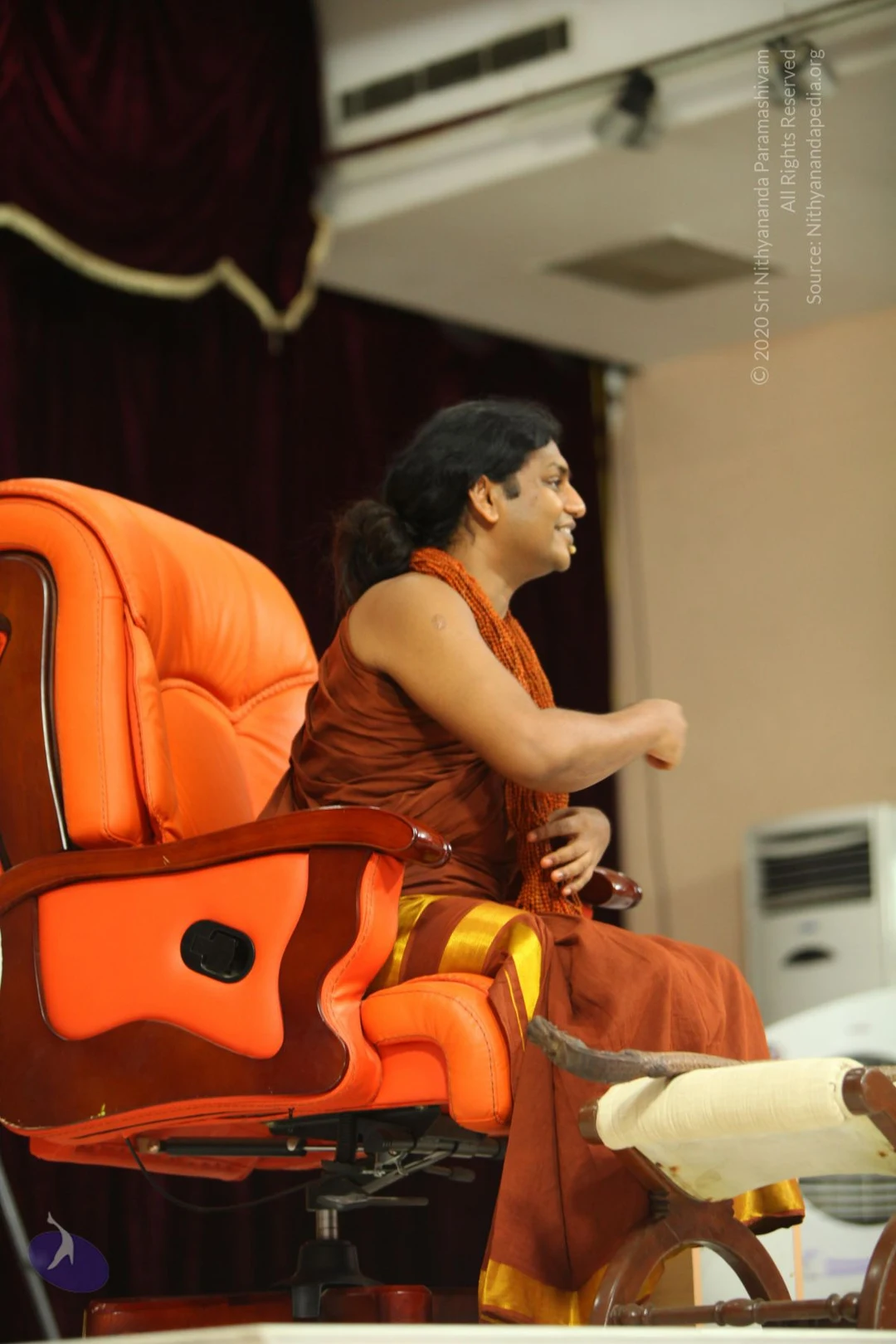
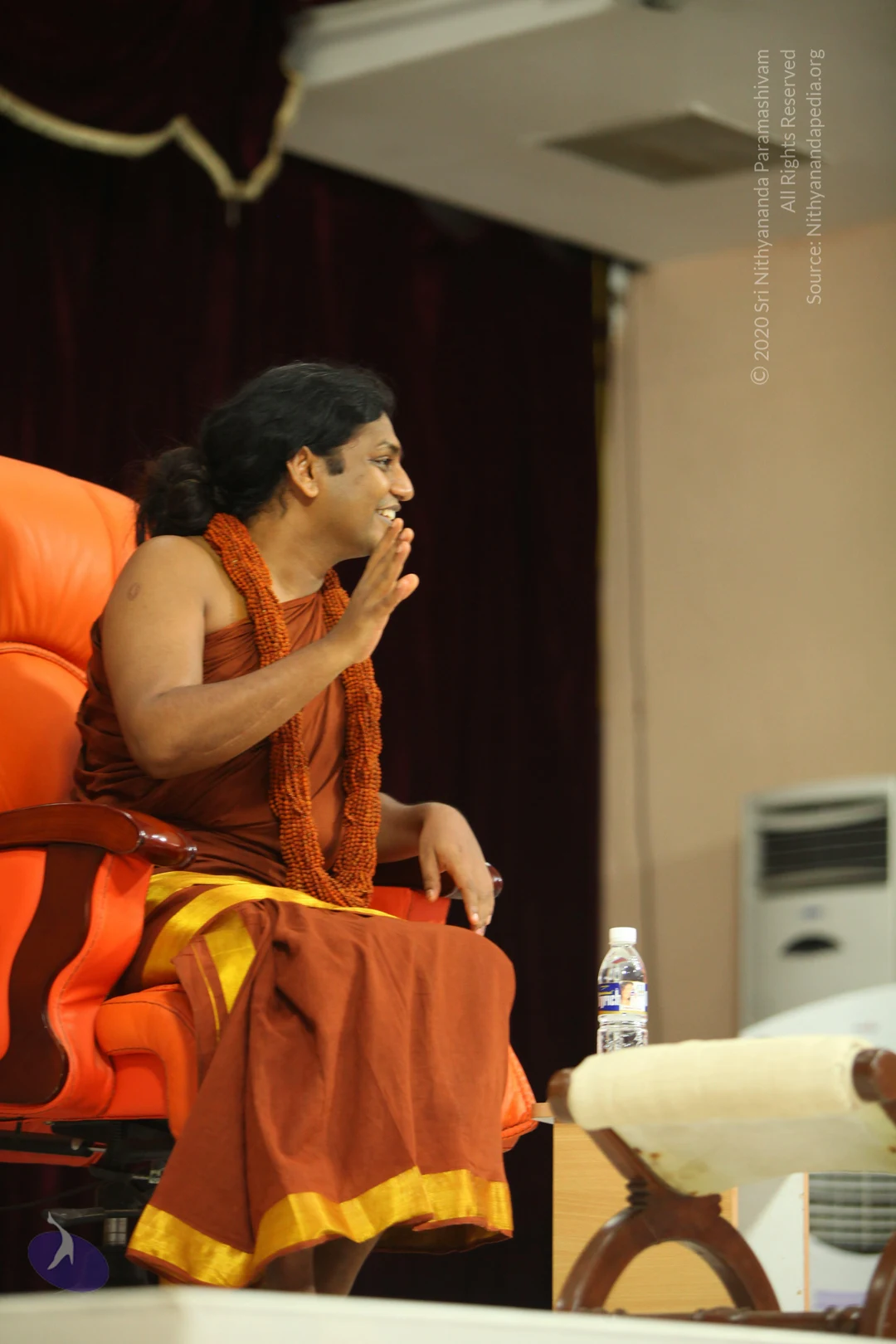
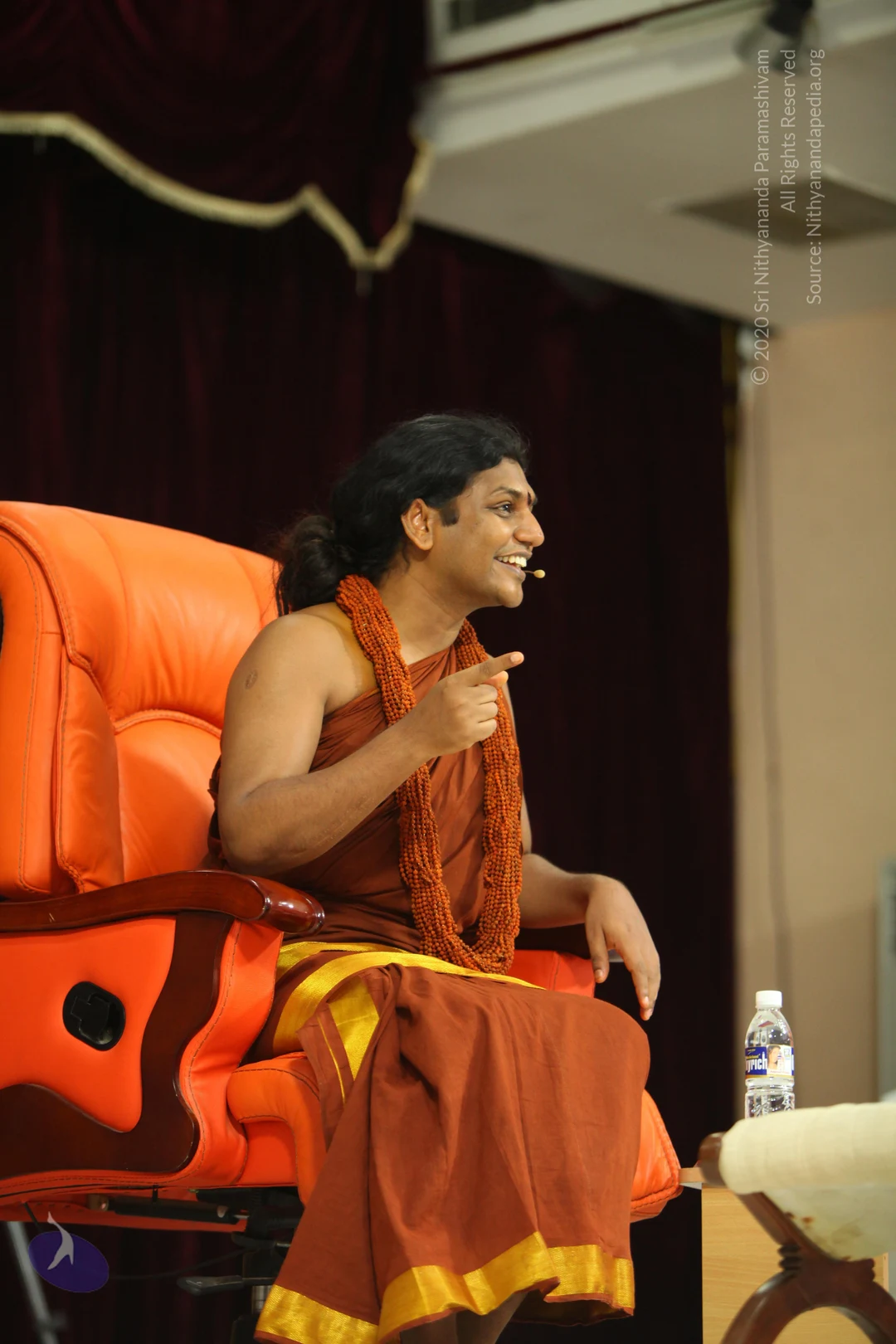
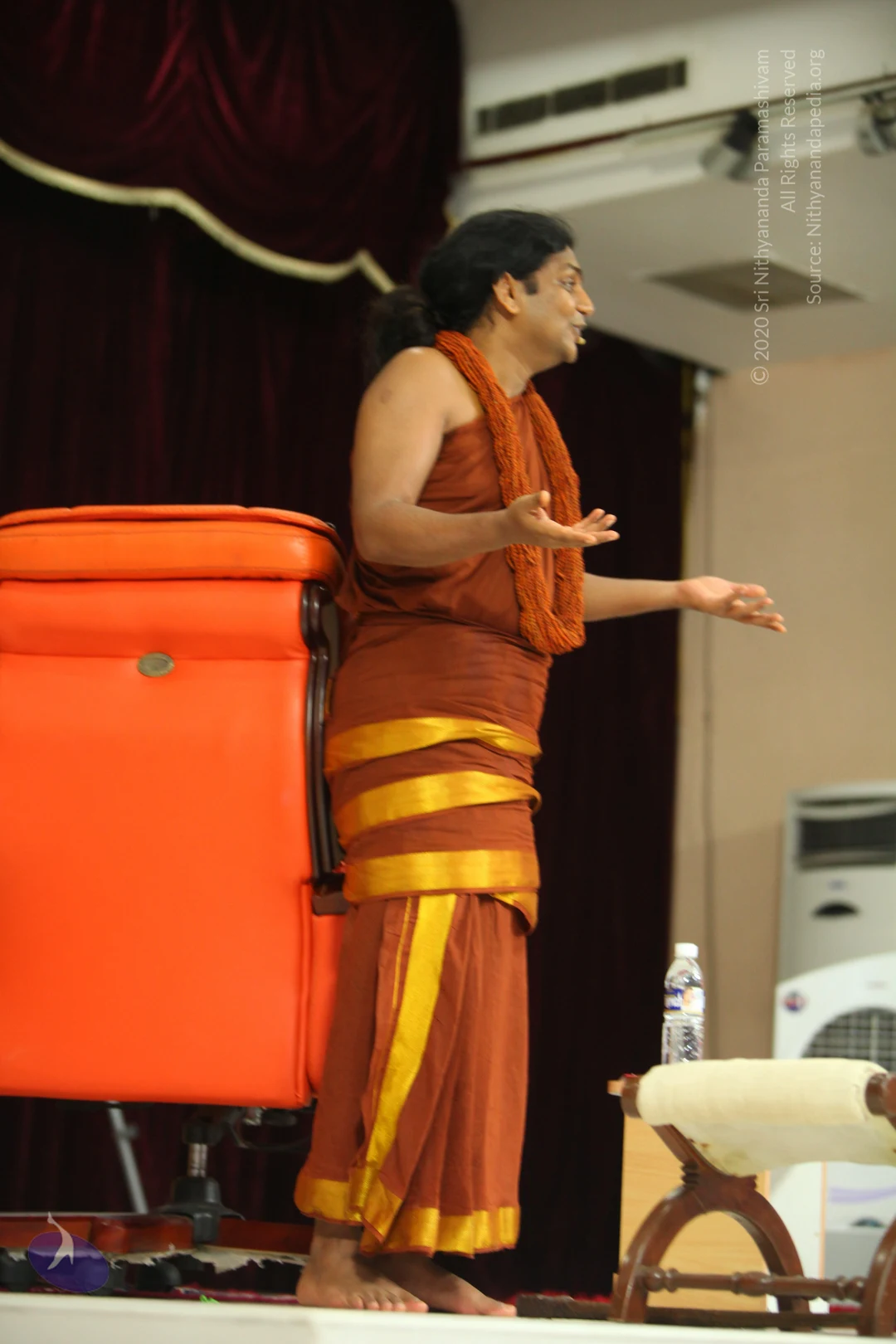
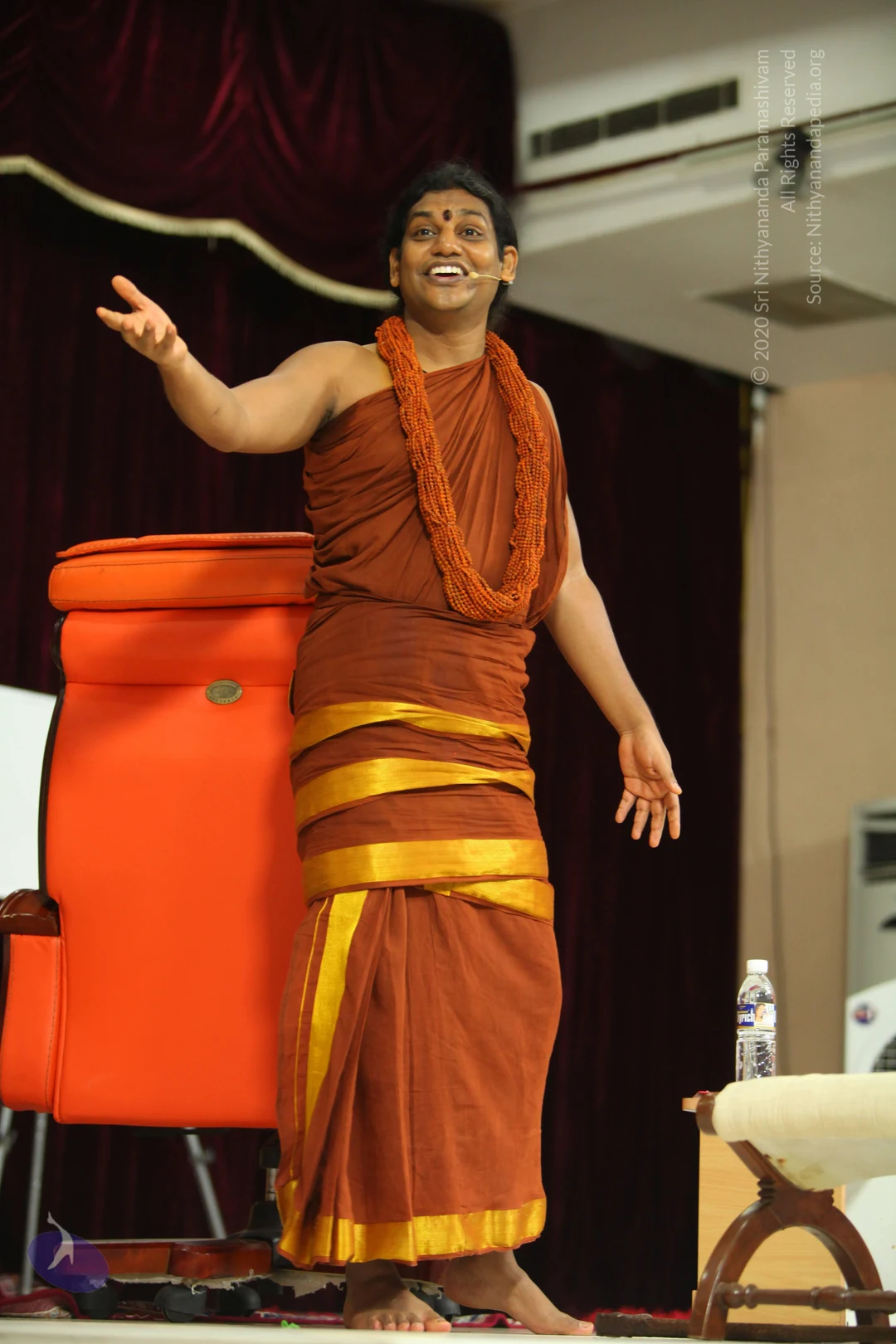
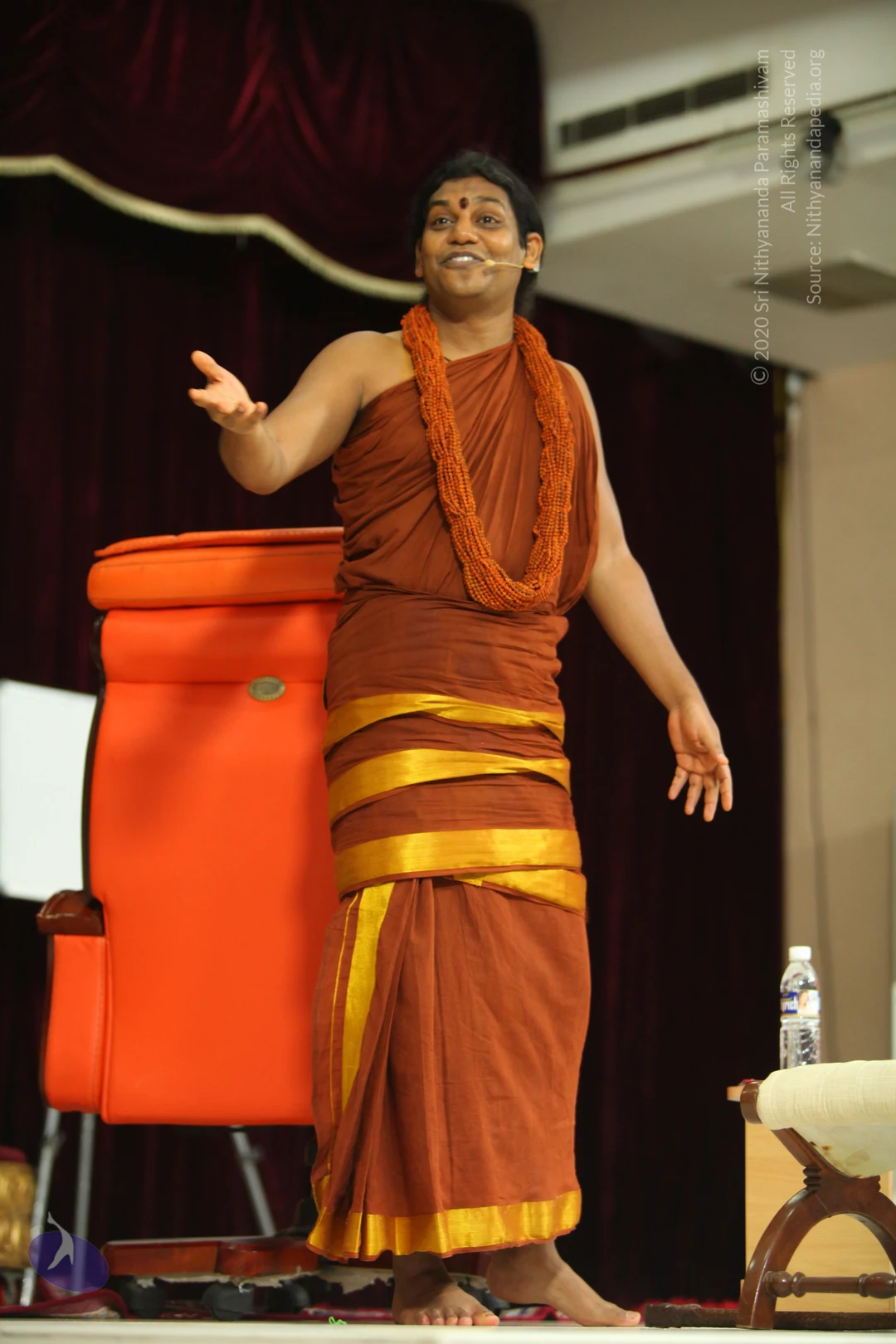
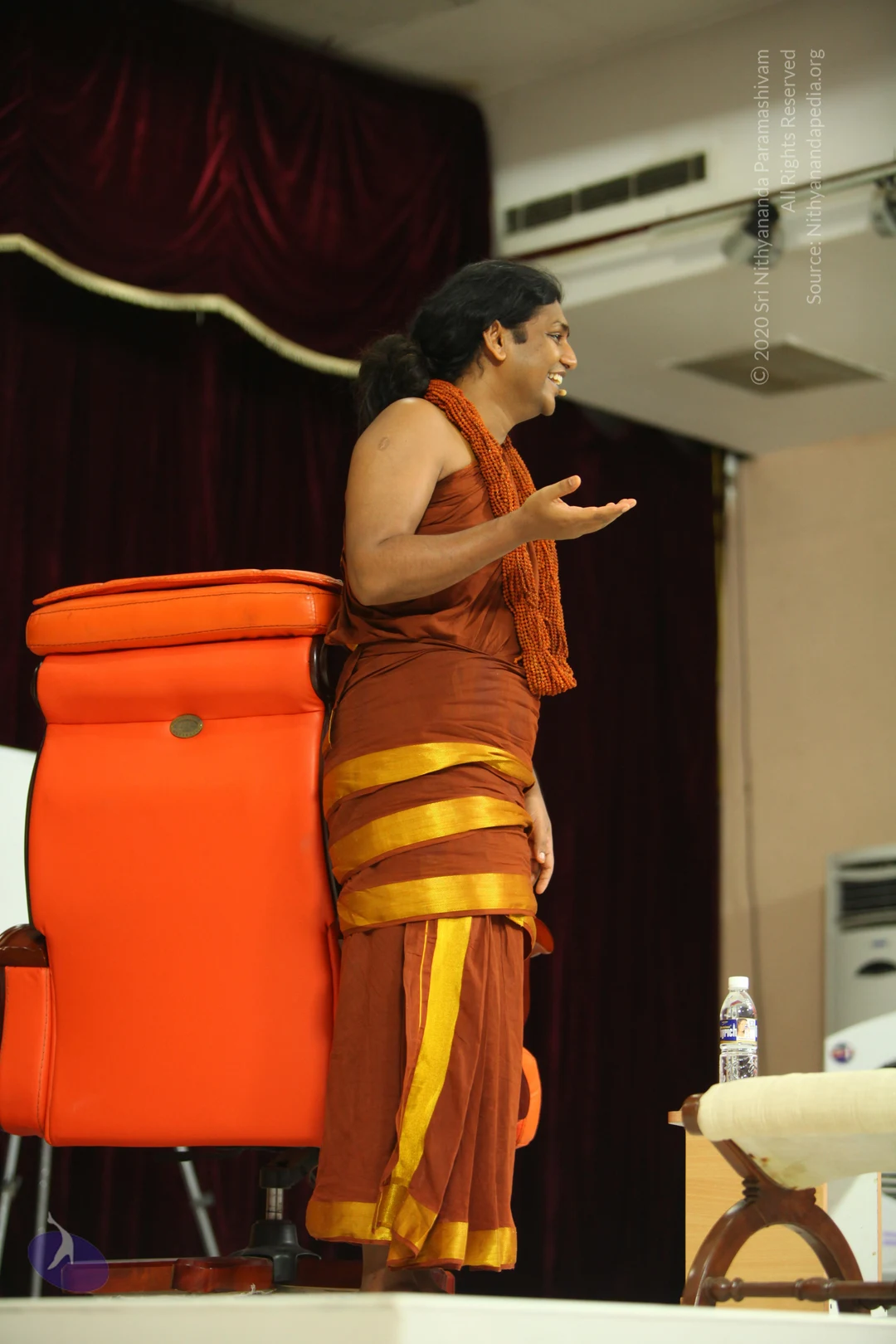
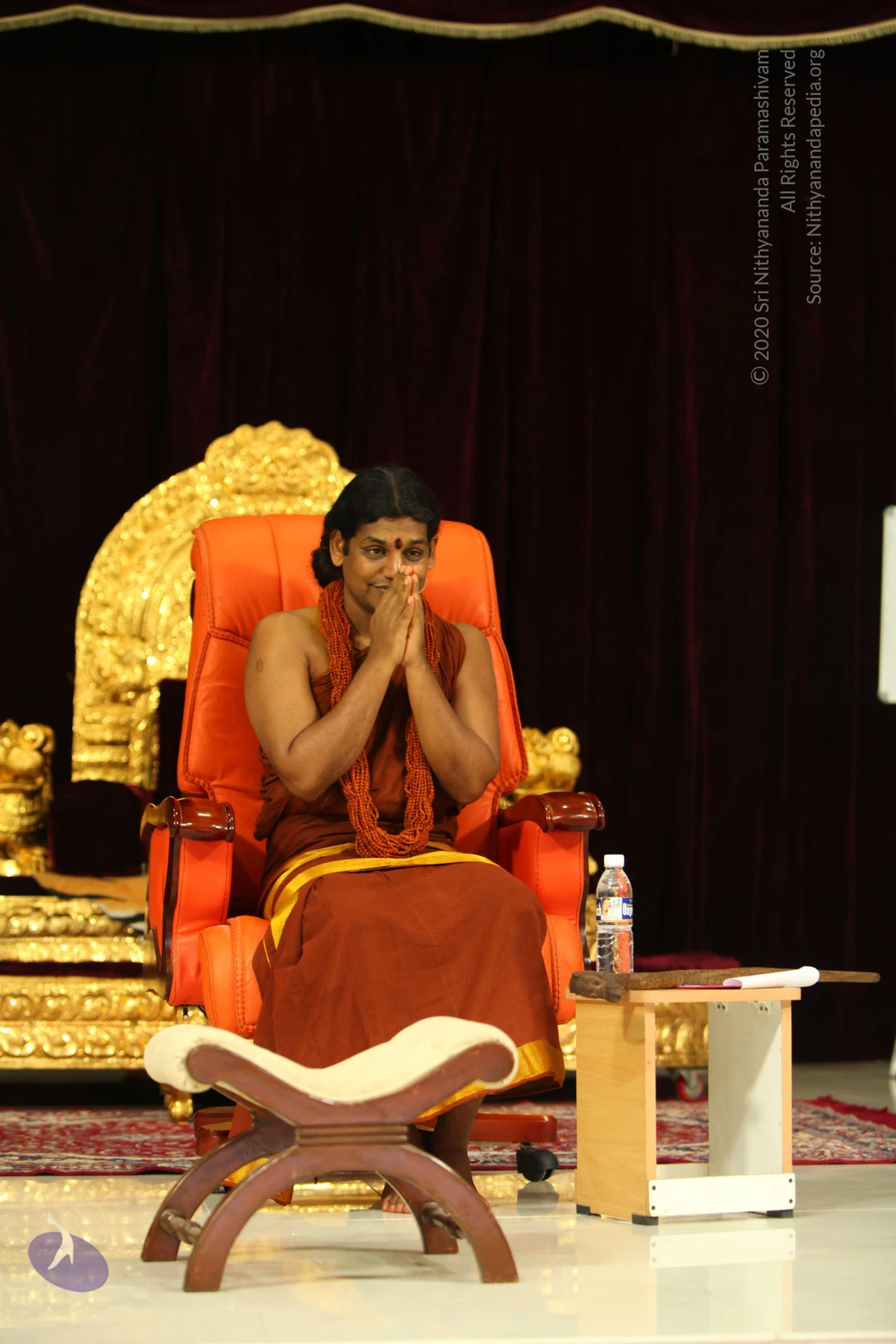
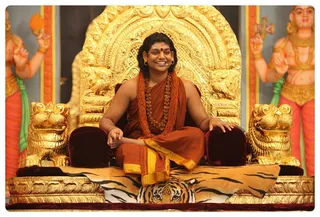
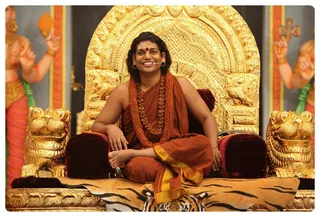
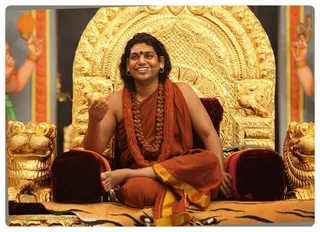
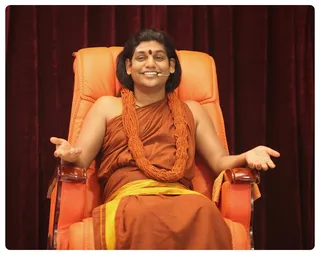
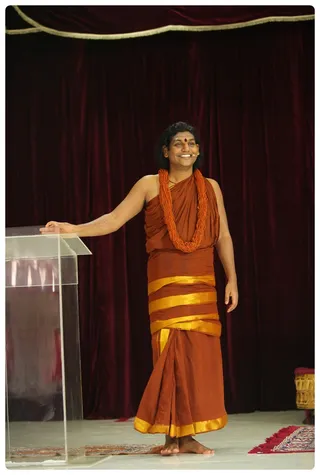
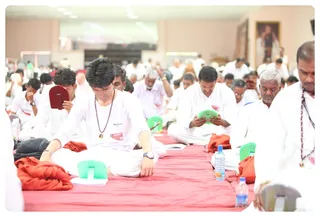
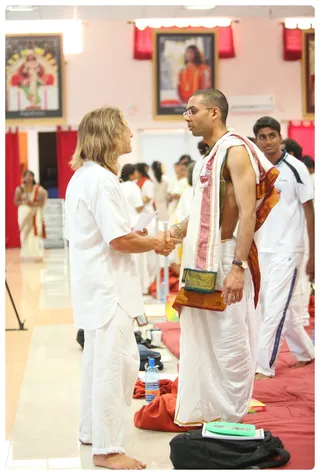
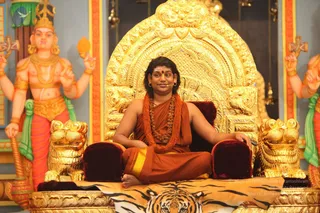
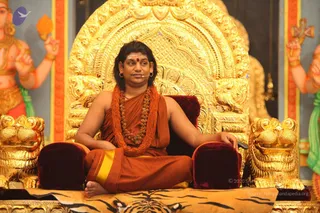
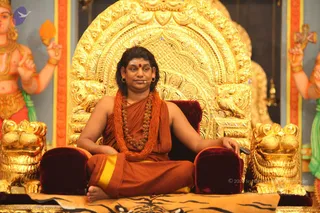
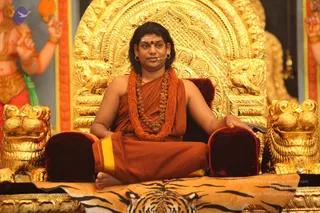
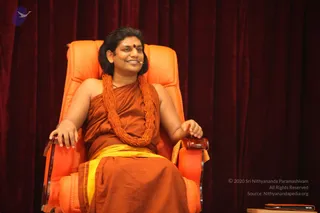
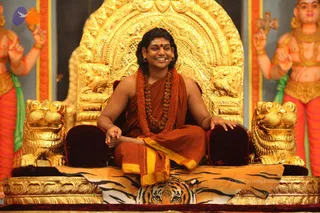
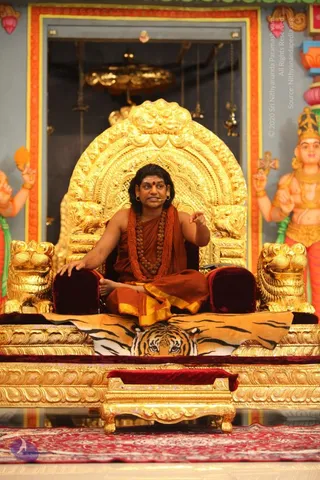
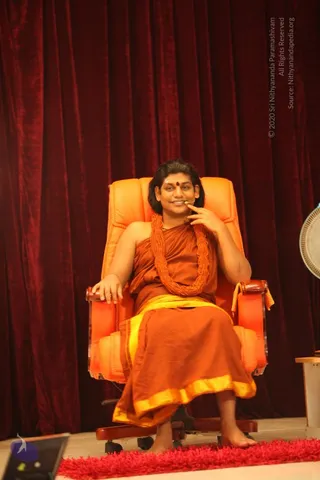
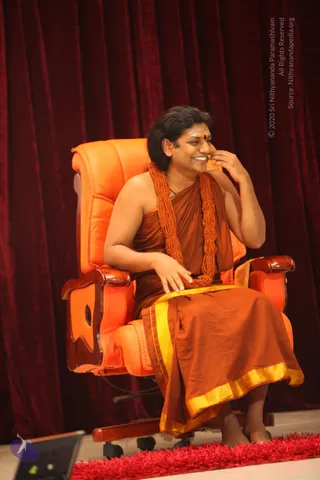
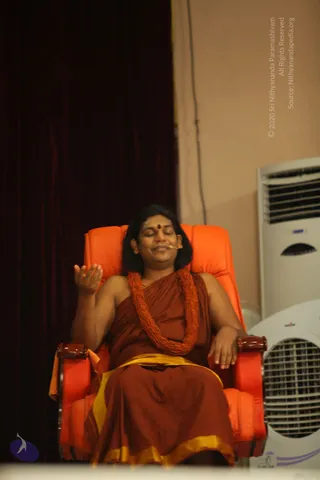
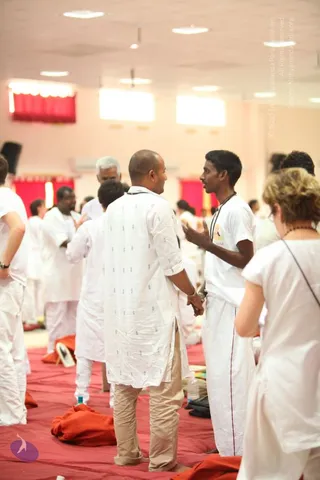
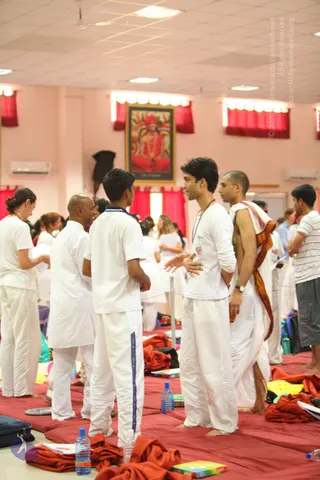
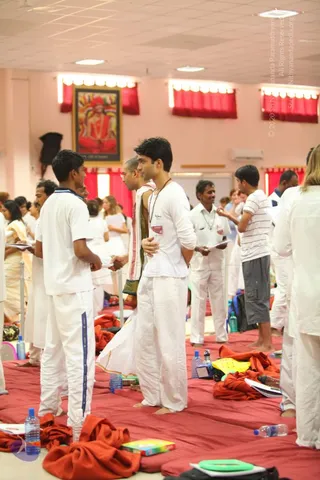
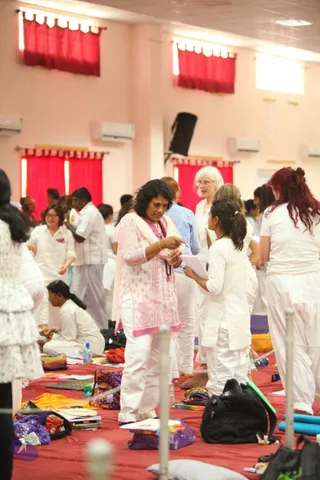
A man seated in an orange leather office-style armchair on a stage, smiling and holding a long wooden staff or stick horizontally across his lap. He wears a rust-brown robe draped over one shoulder with a gold-bordered cloth around his waist and a dense orange-red beaded mala around his neck, with a small red bindi on his forehead. A small microphone is clipped near his face. Behind him hang dark maroon curtains, and to the right stand white air coolers. A white upholstered footrest and a wooden stool sit in front, and he is barefoot. Appearance-based candidate for Swamiji (probable): long swept-back dark hair, rudraksha-style mala and saffron-orange robes during a seated discourse.A photo inside a bright hall with pink walls and red curtains. In the foreground a long-haired man in a white shirt and white trousers shakes hands with a shaved-headed man wearing glasses, a white dhoti with a pink and gold-bordered shawl draped over one shoulder, and a wristwatch. Behind them, framed portraits hang on the wall, one showing a deity-like figure in red and gold and another showing a figure in orange robes. Other people in white clothes stand and sit on red mats in the background, a water bottle and a notebook lie on the floor, and a woman in a cream sari with red border stands at the left edge.A seated man in saffron-orange robes sits cross-legged on an ornate gold throne with a carved arched back and lion-head armrests, draped with a tiger-skin rug. He wears a long rudraksha mala and a dark bindi, with long swept-back hair, and rests his hands on the armrests. Two large painted deity murti figures with gold crowns and jewellery flank the throne, holding ceremonial objects. Hanging brass lamps and bells are visible above. The setting appears to be a satsang hall.

May 10 2013

Original wiki page
Contents

Title

The Answer to thegreat Why?

Description:

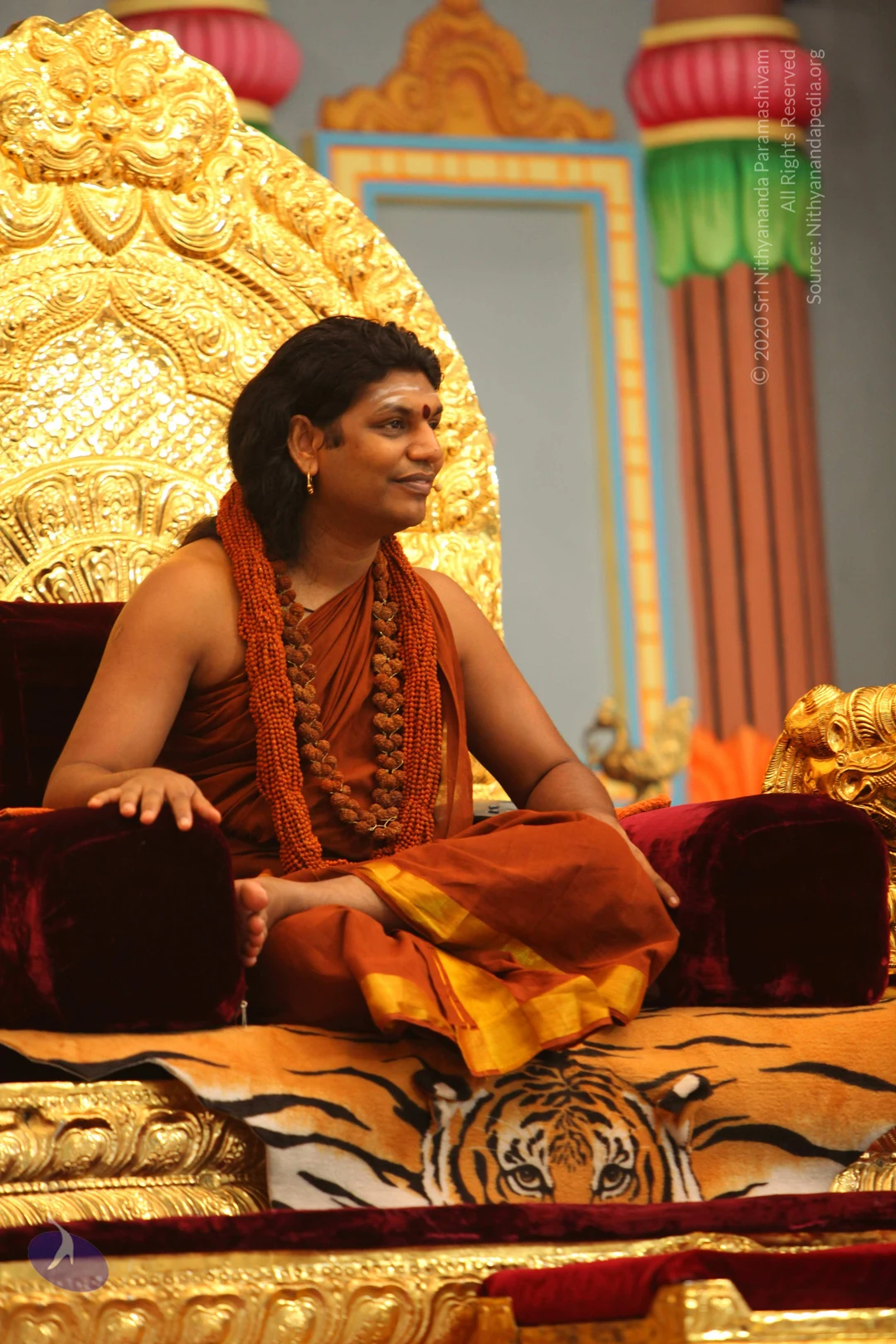
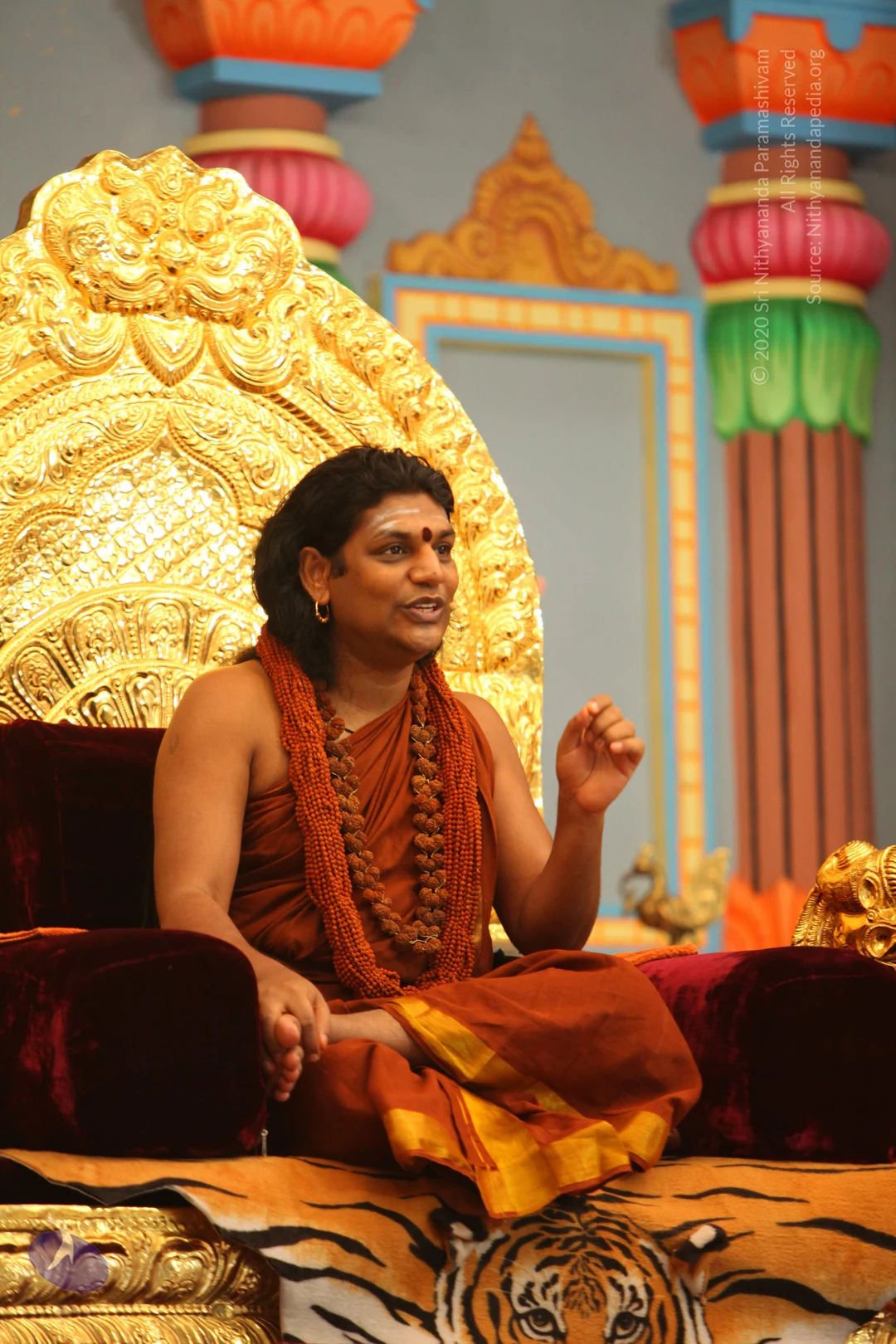
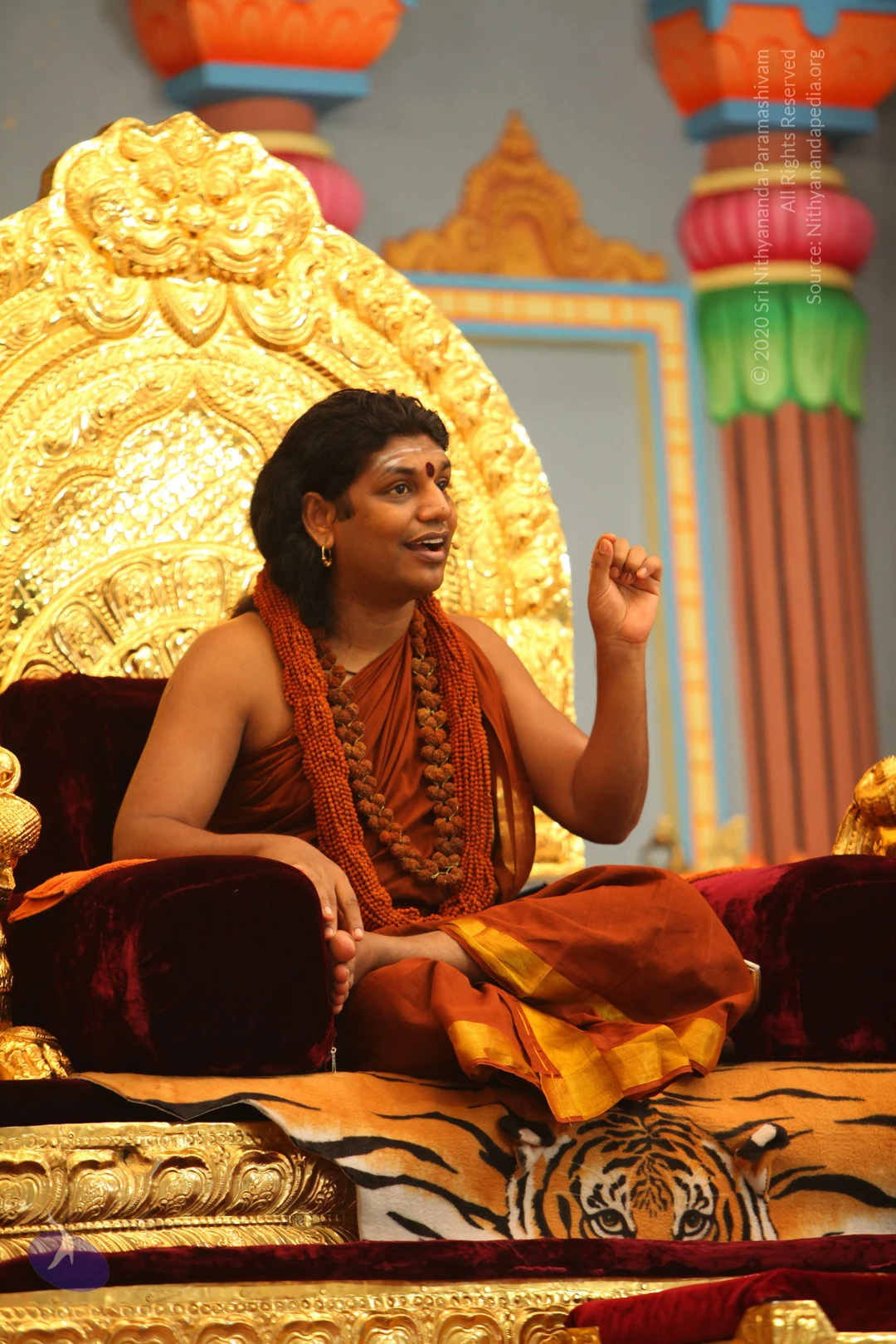
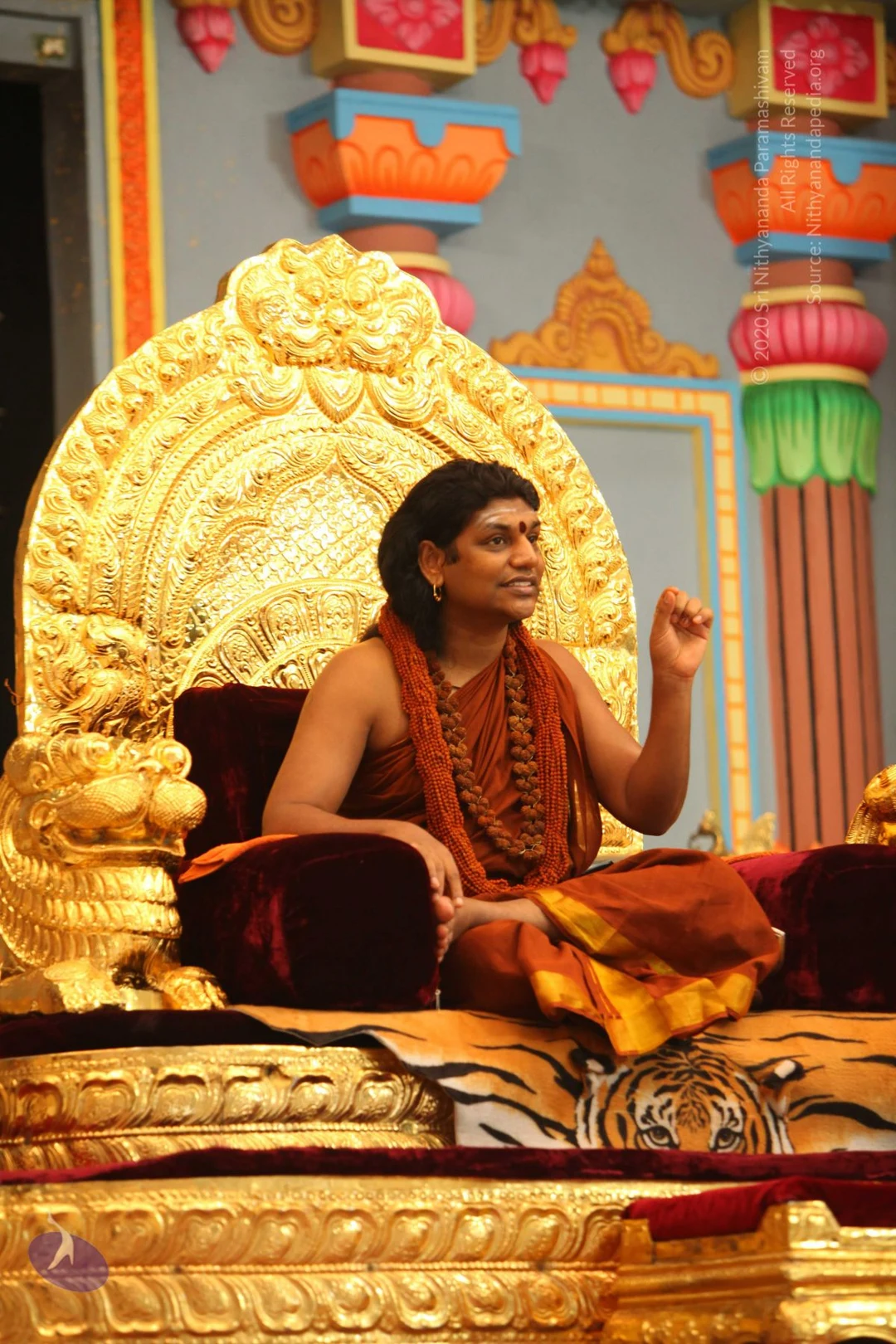
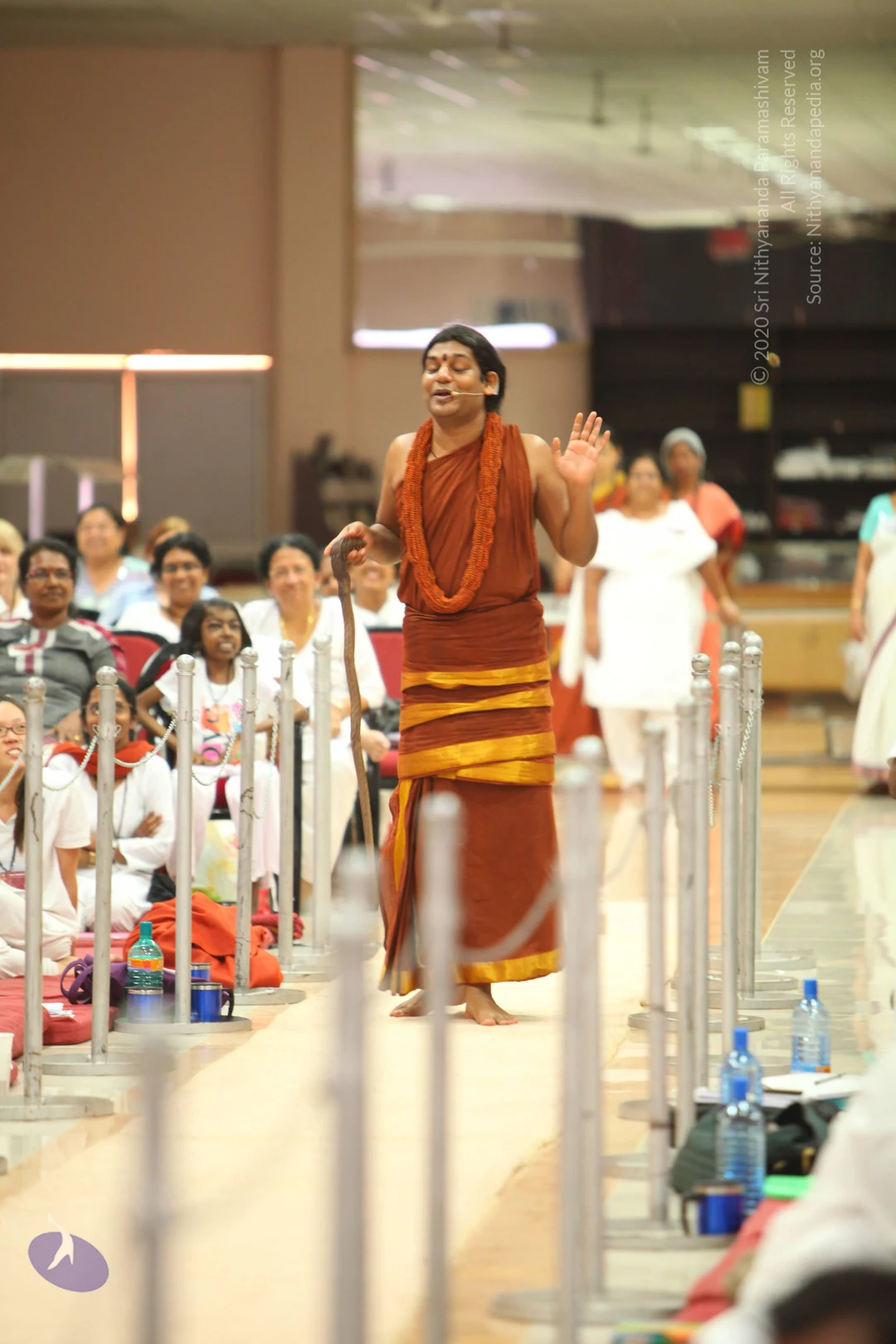
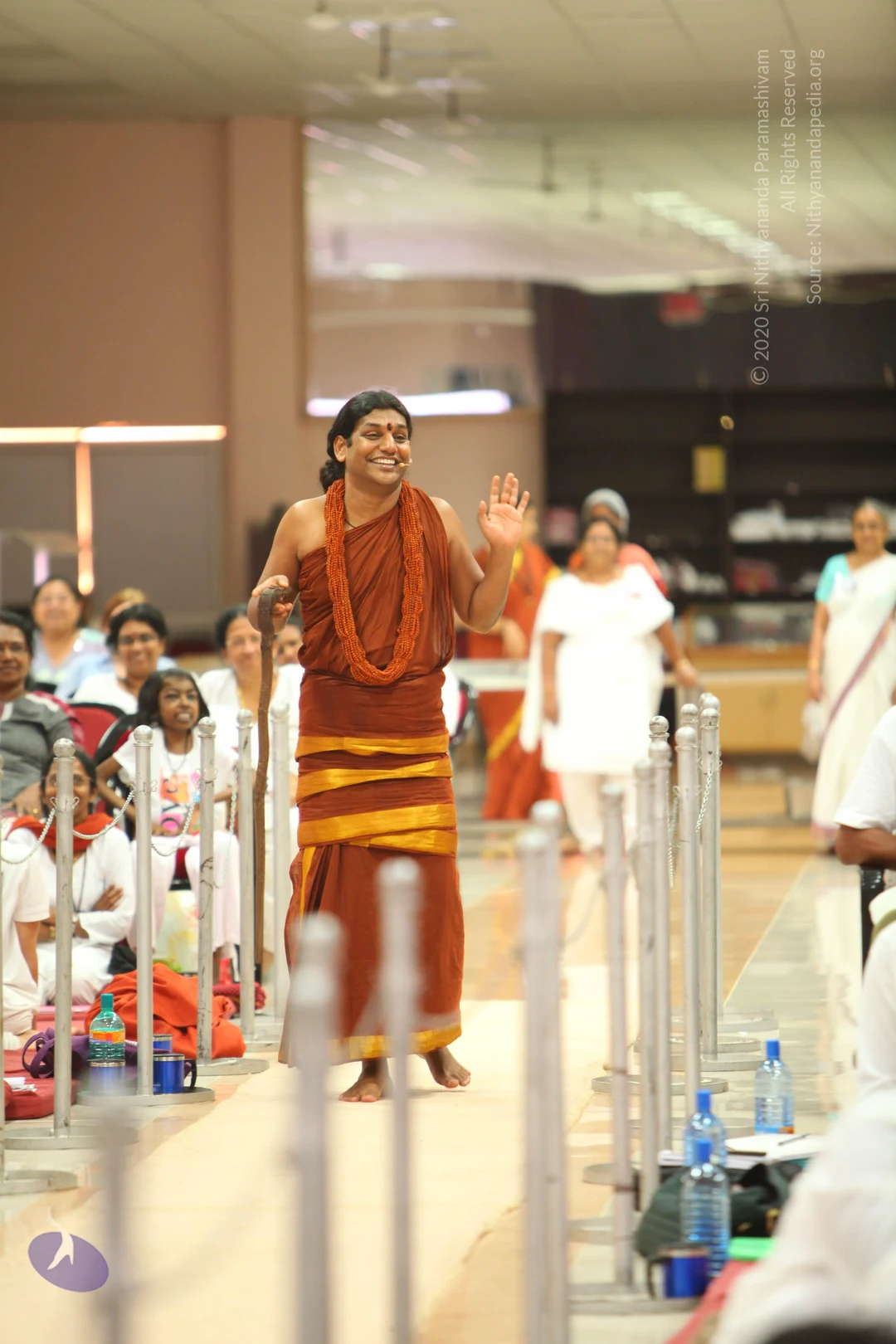
In today’s morning satsang, Paramahamsa Nithyananda presents the great question of Why. Why do we need to meditate? Why is kriya necessary? Why do our sangha acharyas teach the four principles? Nithyananda tells us that there is no definitive answer to the Why of the universe. Any why must be answered by the questioners themselves. As we understand deeper spiritual mysteries the answer becomes self-evident: we grasp it without explanation. This answer is different for each individual; and as we increase in our level of maturity and awareness, even the same answer evolves and changes.

VideoAudio

Transcript:

0:26

I welcome you all with my love and respects.

(HINDI)

Today’s subject for Nithya Satsangh: THE ANSWER FOR THE GREAT “WHY?”! This big WHY? WHY? WHY?! This is the first stone you face in the life. You can take this stone as obstruction and never move beyond it. Or you can use this stone as a stepping stone and start going up. Or you can use this stone even to take off!

This great ‘WHY?’! Please understand whatever is said and done, human-beings can move only with this ability to handle the great ‘WHY?’ If you are not able to answer to this great ‘WHY?’, if you are not able to convince yourself for this ‘WHY?’ you will continuously suffer lack of inspiration, energy, laziness, boredom.

I tell you, the worst things can happen to human-beings is laziness attack, boredom attack. People talk about panic attack. No! I tell you, boredom attack and laziness attack is more costly than panic attack.

Panic attack happens to you if you have too many answers for ‘WHY?’

Boredom attack happens to you if you don’t have answer for ‘WHY?’

Laziness attack happens to you if you don’t even want to know the answer for ‘WHY?’!

3:23

The great ‘WHY?’ which created philosophies, gave birth to principles, gave birth even to gods, goddesses, gave birth to religions, gave birth to spiritual groups, cults, sects, cultures, we will today indulge on this great ‘WHY?’

I have a news. You can take it as a good news or a bad news. For this great ‘WHY?’ you have to discover answer. It can be a good news if you are interested in finding the answer. It can be bad news if you think, ‘Oh, I have to find out! Nobody else will give me the answer!’

I tell you, with Integrity and Authenticity I tell you, please do not accept anybody’s answer for the ‘WHY?’ If you accept my answer for ‘WHY?’ you may be living for my answer. At the most, my answer can be an inspiration for you to find out the answer for ‘WHY?’

(HINDI)

This ‘WHY?’ created religions, made many people reach their peak and killed many people brutally in religious terrorism. For the religious terrorism to spiritual enlightenment, for the whole – see, one end of the spectrum is religious terrorism, one end of the spectrum is spiritual enlightenment – for both, “WHY?” is a reason. If you don’t find the answer for “WHY?” and eat somebody else’s answer, you can even be made as a religious terrorist! If you find your own answer for the “WHY?” you will become spiritually enlightened!

6:43

This great “WHY?” this was the yesterday’s discussion with me and my, I can say that top organizers of Dhyanapeetam who run my sangha literally. I was having discussion.

All of them asked, ‘We need to answer this one question, Swamiji, “WHY?”!

So, I contemplated, contemplated, contemplated on it. I told them straightaway, ‘Now I don’t have answer. I will get back to you.’

Thanks to the disciples who give me the space to say, “I don’t know”, understand, it is a; it is not greatness of me; it is the greatness of my disciples! They are ready for an answer of this sort from me that ‘I don’t know! I will get back to you guys!’ Of course, I have started contemplating, meditating, and I can see the answer is evolving.

They were asking me, ‘Why these four tattvas? Why meditation? Why kriya? Why all this?’

We go on teach people ‘HOW’: how to live the four tattwas; how to do the kriya. But still we have yet to answer this great question of “WHY?”

If you say health, for health reason do the kriyas,

‘Why health? Why not die with disease? Why health?’

No, the wealth! ‘Why wealth?’

No, relationship! ‘Why relationship?’

This “WHY?” has to be answered!

Some of the ashramites were trying to give pseudo answers: ‘No, no no! No, this, that!’

I said, ‘No! Let us be very clear. I am very clear I don’t know the answer. I will get back.’

I literally sat on it! From yesterday, after the discussion, one great thing with my mind or no mind is, any problem, till it blossoms into solution, it sits on it! It will not get diverted by anything. Nothing can divert it, even the sleep, including sleep. Listen! Including sleep if you can’t be diverted from the problem till you find solution, you are called “Genius”! I am defining “Genius”.

10:06

Great mathematician, Ramanujan, if you have heard of this Ramanujan, just few days before, some of the mathematics professors have proved his theories, theorems, his solutions which he found hundred years before, as true. And still he is a mystery! Still he is a mystery! In maths, he has gone into the zone of Bhava Samadhi! Understand!

Let me explain Bhava Samadhi. See now, any product Apple Company launches, people buy. If they produce TV, they will buy. If they product music player, they will buy. Anything Apple produces, Apple Company launches, people buy. Why? They bought the idea of Apple first already. Already the principle is bought. So now, anything they launch, simply it gets sold! I heard sixty million customers they have! Six crore! Literally one full State of Tamil Nadu! Anything is launched, people buy. And even this number I think is a very low number. Anything they launch, people buy; because the concept is already bought. Now Apple can make any junk product; they can sell, people will buy! They reached a level people will buy.

Please understand, I am giving you one of the important business secret which I don’t do, but I wanted to tell you. Once I convince you with certain spiritual principles and you buy into it, after that anything I blabber you don’t care! Of course, I am going to maintain my integrity and authenticity, and I am not going to blabber anything. But suddenly tomorrow morning I decide, ‘Keep a tall….build the world’s tallest broomstick statue here on the stone. Let us all worship.’ You will see, I will have millions to worship that! And say, ‘Worship this, this is the symbol of cleaning your inner space.’ I can give meaning to it and people will worship! ‘So, each time you go around, one pattern breaks.’

See, I have reached Bhava Samadhi in my field and understand really the broomstick will bring the effect on you because of my words and initiation. Because I have reached Bhava Samadhi in my field, so any bhava I create is producing the result on the Cosmic Mind! All of you understand?

14:00

I gave an example of Apple for a very common way of understanding; business example, so that you will immediately catch it. But don’t take the…..don’t compare the Apple example and the broomstick example! This is the next level. Next level! Because I reached the Bhava Samadhi in that line, my words become reality. How many of you cognize what I am saying? Same way, in mathematics, Srinivasa Ramanujan has reached Bhava Samadhi through mathematics. He achieved Bhava Samadhi. So now, any theorems he created, anything he just scribbled or anything he wrote in his paper in some mood can be a theorem and it will be proved as right! It will be proved as right!

Please understand, I wanted you to understand a very important thing now. Any answer I give for ‘WHY?’ can only be inspiration for you to find your own answer for ‘WHY?’ If you just swallow my answer, you will never reach the space where I reached. You should take the answer to achieve the Bhava Samadhi. After that you have to travel for Nirvikalpa Samadhi.

Please understand, people who go on proving Srinivasan Ramanujan’s mathematics theorems and theories are right will never achieve the space of Srinivasan itself! It can be an inspiration for them to work on mathematics. Finally, one day, they have to even drop Srinivasan Ramanujan! With that inspiration they have to start travelling. Only then they experience the space from which Srinivasan Ramanujan is operating.

I am analyzing this great WHY? from all angle. I sat, sat, sat, sat, sat on it. Now I hatched it!

When a hen sits on the egg, it hatches; the chicken comes out. When a Master sits on a question, he hatches it, and solution comes out! Now solution is walking out!

17:44

To put it in plain words, the ‘WHY?’ can be answered in a very simple way: For manifesting your potentiality! Manifesting your possibility! This can be the simple, plain, straightforward answer for ‘WHY?’

‘WHY?’ That can be answered in a simple way: For manifesting your potentiality, possibility, reality!

But now, this answer need to be expanded, explained.

When a child asks at the age of four, ‘Mom, how did I take birth? How did my younger brother came? How did my elder brother came?’ you can’t explain the whole process of sex, and then pregnancy, and then delivery to him! He won’t understand. Even if you explain, he will have thousand why?

Even to have the answer for the WHY, first thing the questioner needs certain maturity and person who answers need to spend little time with the questioner.

So, many time, please understand, even to get the answers about sex, body need to be sexually matured, physically matured. Even to have the answer for the WHY? you need to be mentally matured! Otherwise, it is like trying to make a three-year-old kid understand how the sex happens, why the sex happens, why one person gets pregnant, why the child is born, how the child is born. It is impossible! The child will ask one-thousand questions. Why? Why? Why?

Same way, even for the answer, even for you to have the answer for ‘WHY’, listen, even for the answer for the ‘WHY’, you need to physically, mentally be matured. You need to be mentally matured!

Millions of people die without even reaching the mental maturity to ask ‘WHY?’ Billions die, they reach the ability to ask ‘WHY?’ but do not know, do not have the ability to receive the answer! If you are matured enough to ask the ‘WHY?’ and able to receive the answer, I tell you, all sufferings in your life is destroyed, because basically you are a logical animal. If your logic is convinced, done! You are in enlightened space!

22:00

When you have found your own answer for ‘WHY?’ you are a Jeevan Muktha! If your mind is not even matured to ask ‘WHY?’ your individual consciousness is not even awakened! So you are not even a Being! Killing you is not considered as a crime in the Cosmos! Of course, it will be a crime in the country, based on the country’s Constitution. Person who does not even ask ‘WHY?’ whose prathyagaatma chaithanya, individual consciousness, is not awakened, killing him is not crime in the Cosmic Constitution! I am not saying you go round and kill him. No! All I am saying is, you are not even a Being worthy of being!

Person who is matured enough to ask ‘WHY?’ but unable to grasp the answer, he enters into the realm of human-beings. He can be considered as “animal-human”: little human, little animal.

Person who is able to ask ‘WHY?’ and able to grasp the answer for that ‘WHY?’ becomes human-being. He is free from suffering. He will be filled in joy forever!

The Being who is able to ask ‘WHY?’, grasp the answer for the ‘WHY?’, and discovers the answer for his own ‘WHY?’ discovers his own answer for his own ‘WHY’ is a Jeevan Muktha.

So, why this great ‘WHY’ Till you understand ‘why this great WHY’ ‘why this great WHY’ will be in your consciousness as ‘Why this great WHY! Understand, till you are able to grasp ‘why this great WHY’, your inner space will continue to have this one question: ‘Why this great WHY’ And ‘Why this great WHY?’ will not disappear till you find out ‘why this great WHY’!

25:13

‘Why this great WHY’ is the seed of the God put inside you, and sent so that you won’t rest till you become tree! Understand, each seed has an energy called veerya that does not rest till it produces more seeds. Till then, it cannot rest. Even if you destroy the seed or eat the seed, that veerya goes into your body and does its job in some other way!

Listen! Listen! Listen! Same way, the question WHY?, the great WHY? is the veerya which is in your DNA structure. You will not be able to rest till you realize the answer for this WHY? When you realize, you will be an enlightened Being! You will be an enlightened soul!

If you want to market a product, you need to make people understand why.

If you want to make people to meditate, you need to make them understand why.

If you want people to do what you want, to even join in your company, or work, or to become a lawyer, doctor, engineer, politician, for anything, you need to make them understand why.

The great ‘WHY’ is the veerya of your very DNA. Just like the veerya cannot rest till it becomes more seeds, seed becomes more seeds, same way the ‘WHY?’ cannot rest in you till you become God, till you become more enlightened Beings!

The great ‘WHY’ Contemplate! Contemplate! Do not try to avoid that ‘WHY’ inside you! If you avoid, you will fall into depression! Sometime you suppress, that WHY?, and go on carrying on with your life. At the age of sixty, you ask, ‘Why did I become doctor?’ After practicing fifty years!

29:00

One guy, great writer, came to me. He was, I think, sixty-four at that time when he came to me.

He asked me, ‘I don’t know why I became writer, author, speaker. Please guide me, Swami!’

I said, ‘You don’t know? You would have written so much! You have spoken so much! Have you never contemplated about it?’

‘No, by the time I started contemplating why I became a writer and author, I already became too popular. So, I continued with it!’

Many time, before you find out why you are a doctor, you become too popular as a doctor! You continue with it! Fortunately, I found out why I became a Swami before I became too popular; so that I had a choice to change; I had a choice for transformation. If you go through the choice for transformation, choice for change, and then choose, you will be most stable person. That is why nobody is able to move me out of my decision! Nobody, nothing, nothing, nobody can move me out of my decision, out of my choice.

Sometimes, some of my disciples will tell, close disciples, ‘Nobody can change you, Swamiji! Nobody can do anything! You will live only your life! You will live only as you want! People only have to adjust with you! Nobody can do anything!’ I have grown out of my millions of choices. So I will be stable in my choice.

Man who grows out of freedom will be the most stable person. Understand! People who grow out of bondage will be the most instable people.

Sometime, my Swamis and Swaminis or Brahmacharis, they ask me, ‘Why these people run away Swamiji? They say they want freedom!’

I tell them, ‘No! He is grown up in bondage. He is suffering with the bondage pattern. That is why he is instable!’

Anybody who is instable is suffering with bondage pattern. If you have grown out of freedom pattern, you will be so stable in all your decision!

One of my ex-brahmachari, he ran away. Still I remember him, because of his; he was with me in the past life. He was a sadhu. And again came back. Fool! This time also missed! Last time he missed, that is why he has to come back!

32:23

See, there are two category of people came back to be around me. One, people who missed me last birth. In the last birth they were around me, but never became enlightened; they missed me. So, they have come back for completion and fulfillment, to achieve enlightenment. There are some who were with me and became enlightened, completed, came back just to be part of my Sangha, to enjoy the leela, to play the leela, to see the leela with me.

When a magician comes to perform shows in a city, he brings his own people, because only with his own people only he can do magic. He can demonstrate and do all the shows. May be once in a while he takes some visitors to prove his authenticity, but he does not perform all the tricks with the visitors. Sometimes he calls the visitors. ‘Come, stand here!’ Where he knows thoroughly they cannot smell the intrinsic details of the game and the magic. Otherwise, the people who conduct the show are completely his own people.

Understand, same here! Only one difference, magic is ‘Entertainment’. What I am doing is ‘Enlightenment’! Magic is entertainment. What I am doing is enlightenment!

So, there are some who came down to play the game, to be an insider. Some missed and came back. This guy is in that category of missed and came back. I asked him, ‘Why do you want to leave?’

He said, ‘I want to have freedom! Freedom! Freedom!’

I saw, poor fellow, with the same pattern he is dying for the last two-three janmas (births). Fool! Again got caught in the same pattern!

I tell you, if you are suffering with the bondage root-patterns, if bondage, feeling bondage is your root-pattern, you will be so instable! People who grew up with freedom will be most stable. I tell you, even when you are going to marry! When I say ‘when you are going to marry’, I mean so many things, not just regular marriage. Even the job you are taking up with the company is a marriage! And your lawyer is a marriage! Your auditor is a marriage! These are all different marriages you go through in your life about which you don’t concentrate much and later on it comes back to bite you. In every marriage, be conscious, be aware! Choose a person who has grown out of freedom pattern, not who has grown out of bondage pattern. Person grown out of bondage pattern will always be instable. Person grown out of freedom pattern will always be stable with his words, deeds. He will have extraordinary integrity and authenticity. I have grown out of freedom; that is why stability! Grow out of freedom; you will have stability! You will have stability!

36:49

Sometimes people ask me, ‘What is this Swamiji? You say this person was with you in the past life, that person was with you in the past life! But if you see them, their whole life is such a……no integrity, no authenticity, no responsibility! Their mind and their way of living is much worse than others!’

Understand, just because they were in the past around me does not mean they have become achieved, siddha purushas, yogis, jnaanis. No! They missed that time and they came back again now. If they miss this time, they will come back again! Blessed are those who catch first time itself and achieve enlightenment! Even if they come back, they come back just to play, be part of the leela - the show of the Master!

Be established in stability. Stability comes from patterns of freedom. Instability comes from bondage root-patterns.

Yesterday, I could see, again and again, this drama happens. Every Inner Awakening, first day and second day, this drama will happen. Nobody will dare to look into my eyes! When I look…… (People look away). When I was giving energy darshan, I was not even in the Kalabhairava bhava. See, the moment I sat down, Kalabhairava settled. You can see with your own visible eyes, the body dimension changes! How many of you have observed the body dimension changes? With visible, open eyes, you can see! When I sat down, I was not even in the Kalabhairava bhava; Just a simple, my own Being. The moment I look, ‘Don’t look at me! Don’t look at me!’ Because, you know when I am looking, I will see your inauthenticities also. You are afraid of your inauthenticities. You are afraid of the wrong words you give it to you.

Very powerful process! First you have to pen down all the dirty words you give it to you, all the inauthenticity you carry in your mamakaara, in your inner image. When you collapse, what all the words you give it to you, that is the inauthenticity of the inner image. What is not there you give it to you: ‘I am a failure’, ‘I am an idiot!’, ‘I am a fool!’, ‘I am a headache!’ You give all these words to you, and you go on hiding it, not bothered about it.

And introduce yourself to all that ‘I am a failure, idiot talking to you!’, ‘I am a dirty, failure, fool interacting with you now!’ Then what will happen? You will understand your inauthenticity. It will be too much, because it is going to hit at you. Why, when you tell yourself you don’t bother? When I ask you to tell others, ‘No, no, no, no, no! How can I be?’ Then don’t tell yourself also!

41:13

Whatever worst words you use towards you, you are going to tell those words to everyone and introduce. Come on! Why then there is so much of inauthenticity? You constantly repeat this to you, but you can’t repeat this to others? If you cannot repeat this to others, why are you repeating it to you? How many of you are getting it? The remaining people will get it when you do! The remaining people will get it when you do!

Now you will never ever build wrong inner image for you, because from today you have to take the oath whatever words you utter towards you, whoever comes in front of you at that moment, you have to tell only those words and introduce yourself to others! You can’t say, ‘I am General Manager of this Company, that Group, this Funds, that Bank!’ No! I can’t say that ‘I am a senior lawyer, I am a senior doctor, I am the most popular Kidney Specialist, Chutney Specialist’, whatever! No! You have to use the exact words you use towards you! ‘I am a dirty, failure, idiot talking to you! Come on! Please handshake with me!’

Your whole mamakaara will be exposed! Your whole inner image will be exposed to you now! It is nothing but I am getting the pus out of your system and showing you, ‘See, with this only you are living!’ Then now, naturally you will know how to build the inner image consciously. Consciously!

When I look into your eyes, why are you afraid? Because, I will expose your inner image to you! I will expose your inauthenticity to you! Your actual inner image that which is hidden even from you, I will expose that to you!

44:52

LISTEN! LISTEN! LISTEN! The great ’WHY’ can be answered; the great ’WHY’ can be answered only if the listener is matured enough. Only based on the maturity of the listener the ‘why’ can be answered. The answer for the ‘why’ will change based on the listener. If a 3 year old child is asking ‘how I am born, how my elder brother is born, why my younger brother is born, why I am born’, what you will say. What I heard when I was 3 is my mother told me ‘crow brought you and dropped you here’. But my grandmother told me

‘We bought you for the husk from the market’.

Then I asked ‘how much you paid?’

She said ‘two basket’.

‘Then how much you paid for the elder brother, because he is little big?’

She said ‘three basket’.

‘What about the younger brother, he is so small?’

‘No, he was given free’.

That was the answer I was given by my grandmother and that much only she can also answer because I am only matured to understand that at that time. So it is depending on the maturity of the listener only the answer for the why can be given.

(HINDI)

So evolve. The same question if a 14 year old child is asking or 15 year old child is asking he can be made to understand. He can be given the straight answer, answer authentically and he can understand; because now he or she knows what is happening in their own body, what is happening in their own mind. With that they can easily make it, make out. They can understand the answer for why.

I tell you; till you get the glimpse of kundalini awakening you can’t understand what is going on in my body. Sometime people ask me ‘Swamiji, what happens to you, during Kalabhairava darshan your body moves so much?’ Arey when I am drinking the honey, which comes very, one or two drops to the lower hand, you only take that small. For that itself you jump so much. Then what about the person who is drinking the whole honey?

48:47

The bhava, actually what happens you know, when Kalabhairava enters I don’t feel like somebody else is entering. I just feel like a 10000 Nithyananda entering. The frequency just goes up. See when your kundalini is awakened, when you jump, you don’t feel like somebody else is entering into you. Your own, but frequency has gone up. How many of you cognize what I am saying? That’s all, same thing. How many of you experience that energy moves your body beyond your logic? Raise the hand. So all of you can understand; but understand unless you grow, it is not possible even to give you the authentic answer for the ‘why’.

So the ‘why’ has to be answered based on the maturity of the person when it comes to answering others. When it comes to your own, you have to find your independent ‘why’ and your independent answer. Understand even your why will grow when you grow. Your why will grow when you grow.

So the great answer for ‘WHY’ is no answer. All my answers can be inspiration for you to find out your own why and your own answer; your own why and your own answer.

I tell you all, if you contemplate on this great why, why, why, you will have higher and higher and higher answer. Finally the answer you get will be the ultimate solution itself.

52:12

(HINDI)

photos
Nithyananda Times

==Photos Of The Day:==

Temple-and-Deities
Pada-Puja
Satsang

IA-Session

IA-Session-Sharings

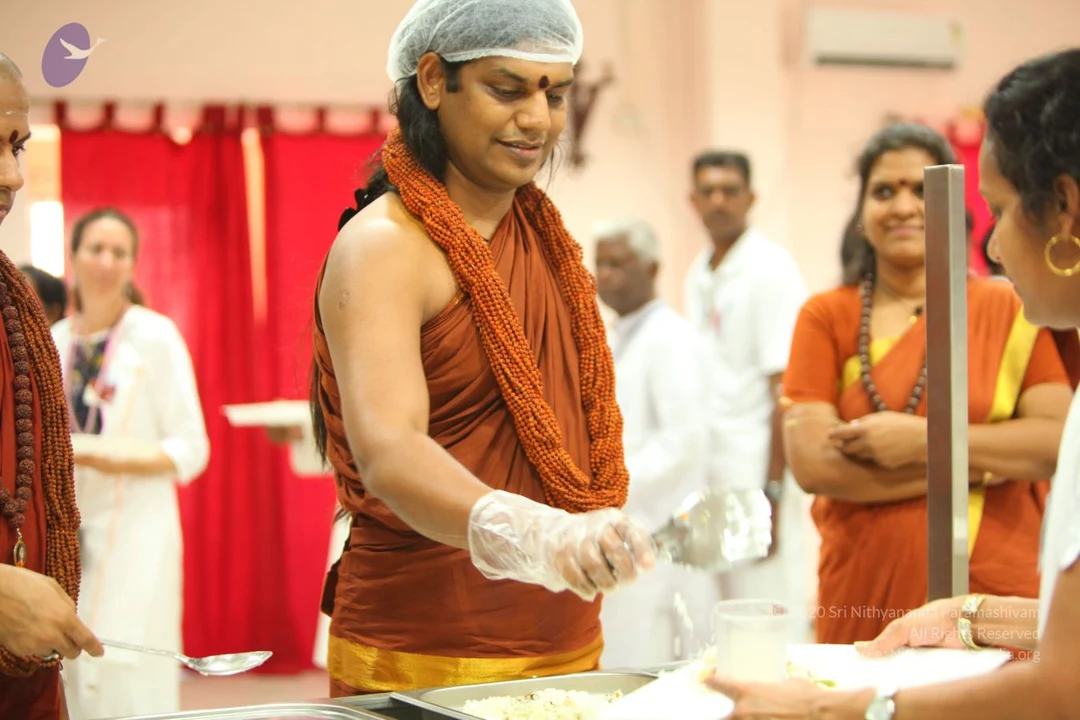
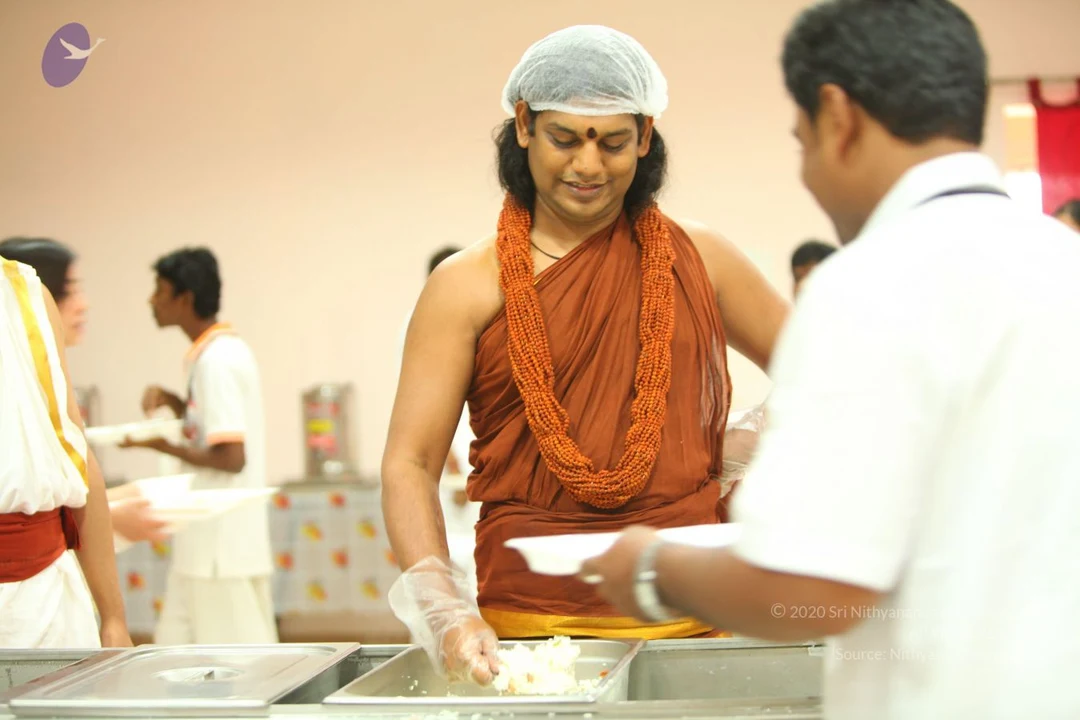
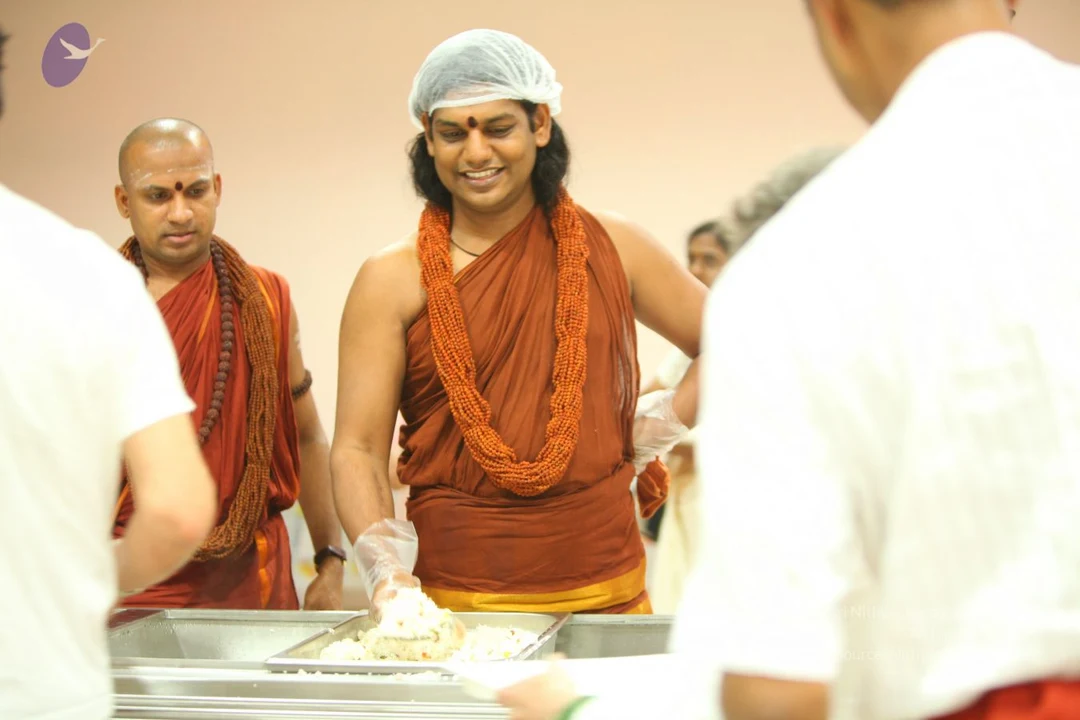
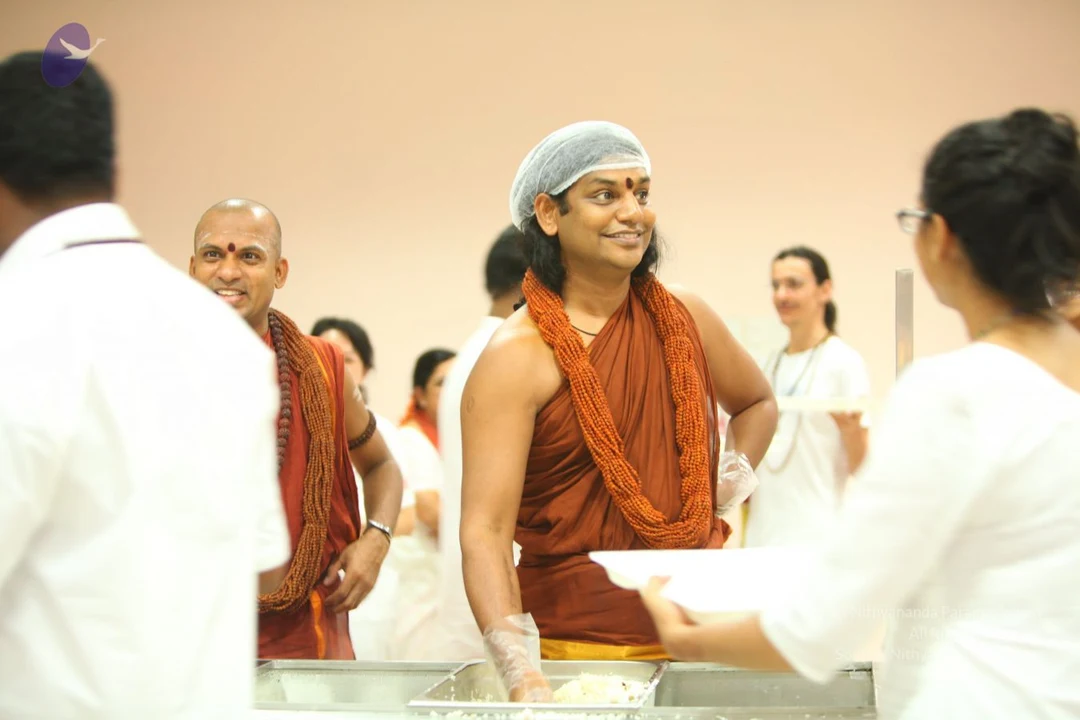
IA-Lunch-By-Swamiji

Photos Of The Day:

Photos-of-the-Day

Photos Of The Day:

Temple-and-Deities

Pada-Puja
Satsang
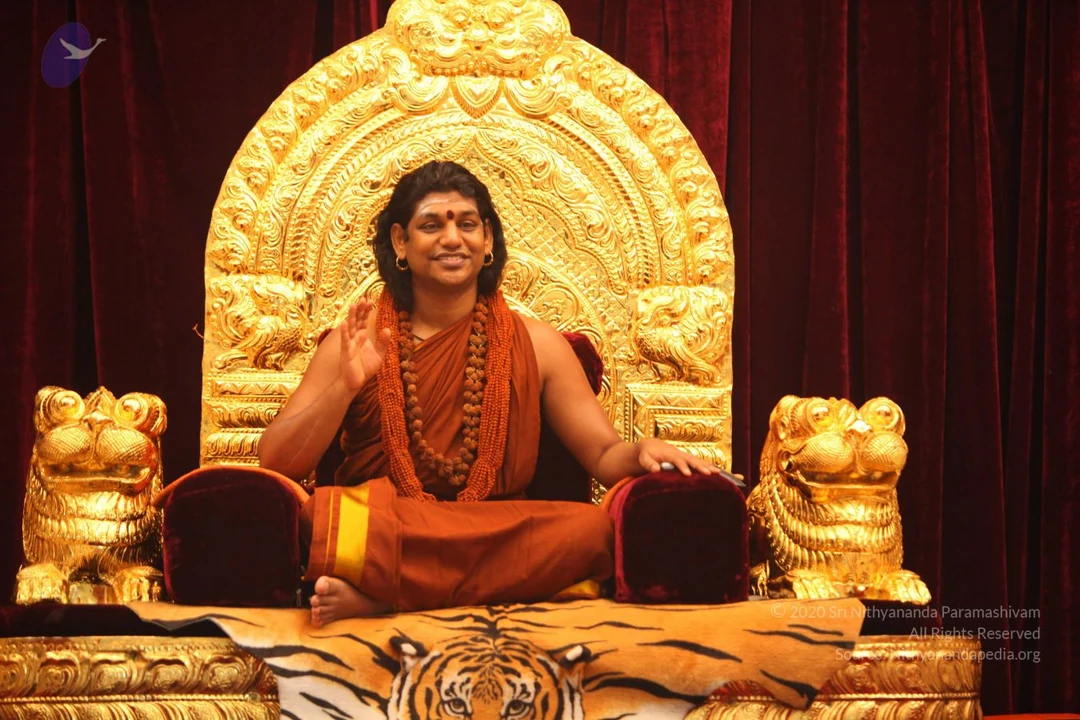
IA-Session

IA-Participant-Sharing

IA-Lunch-with-Swamiji

Photos from this day

View all 403 photos

photos

5 photosSource gallery
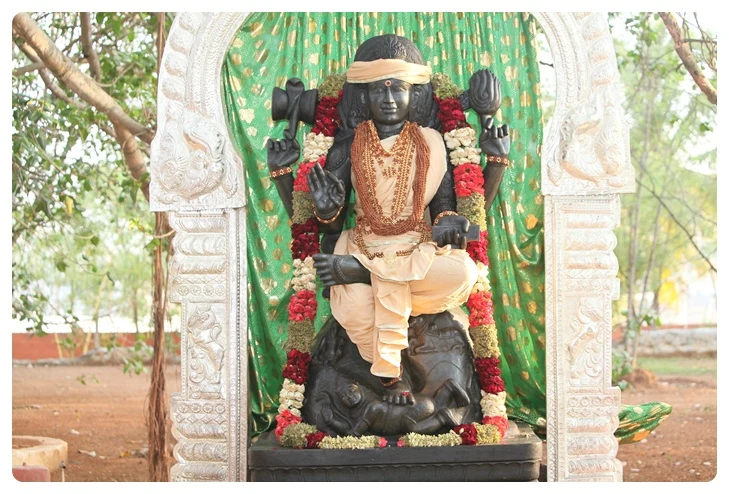
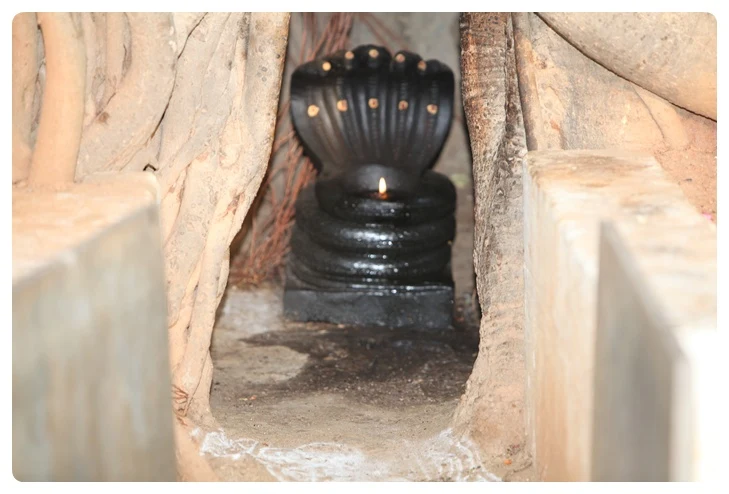
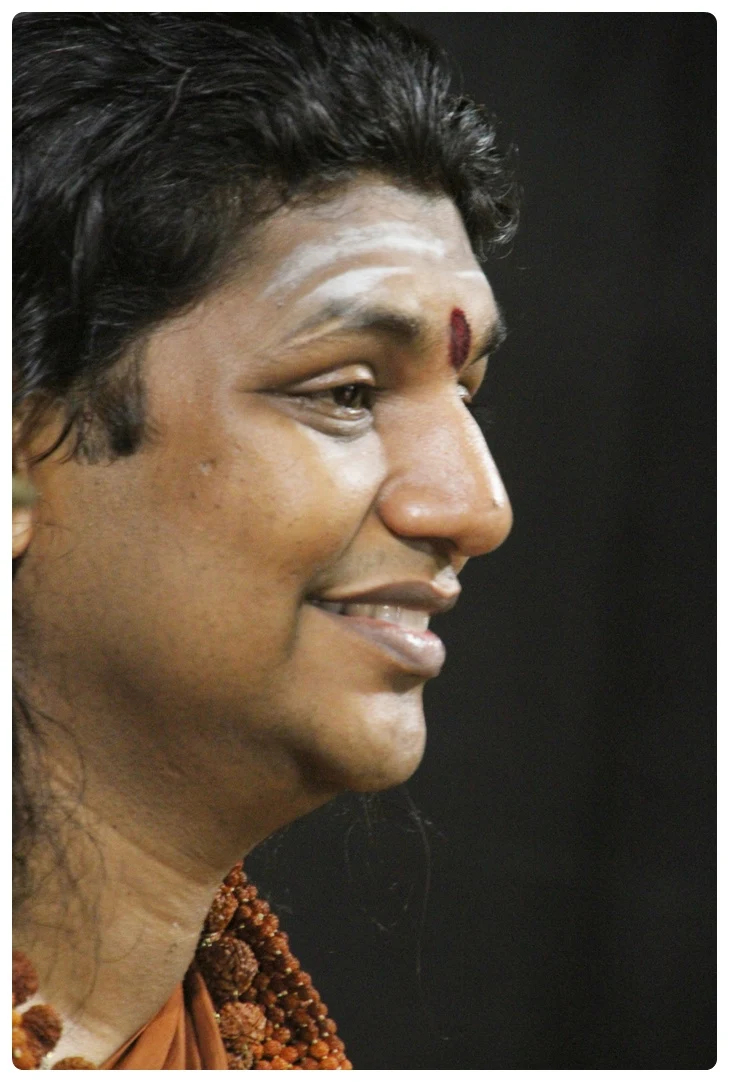
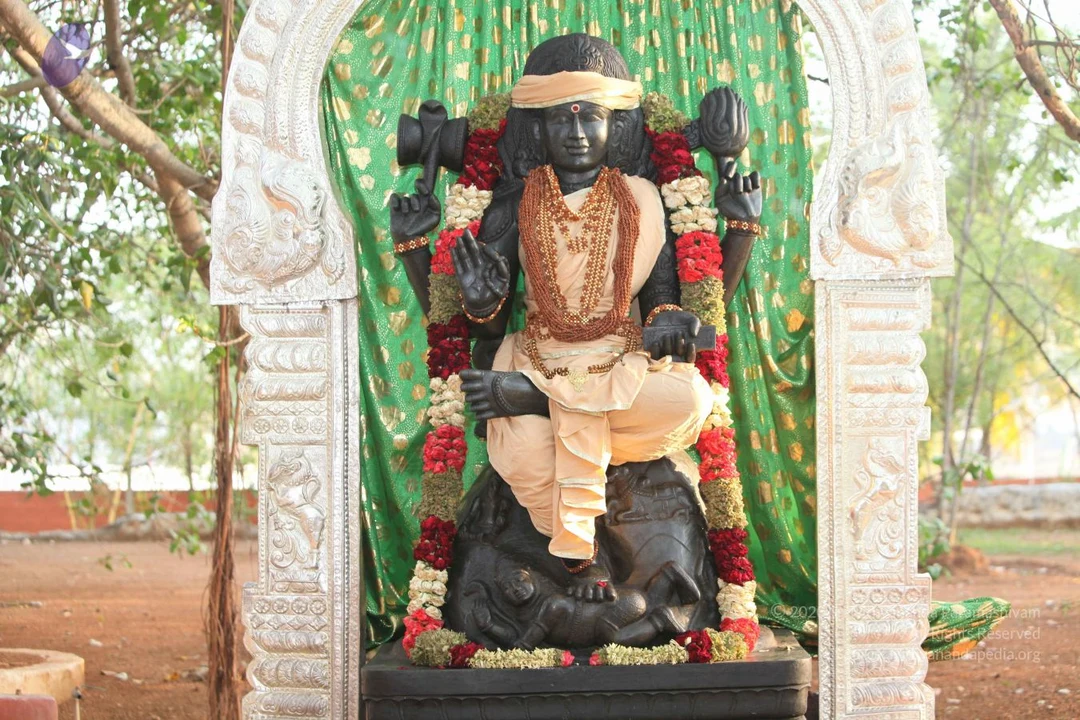
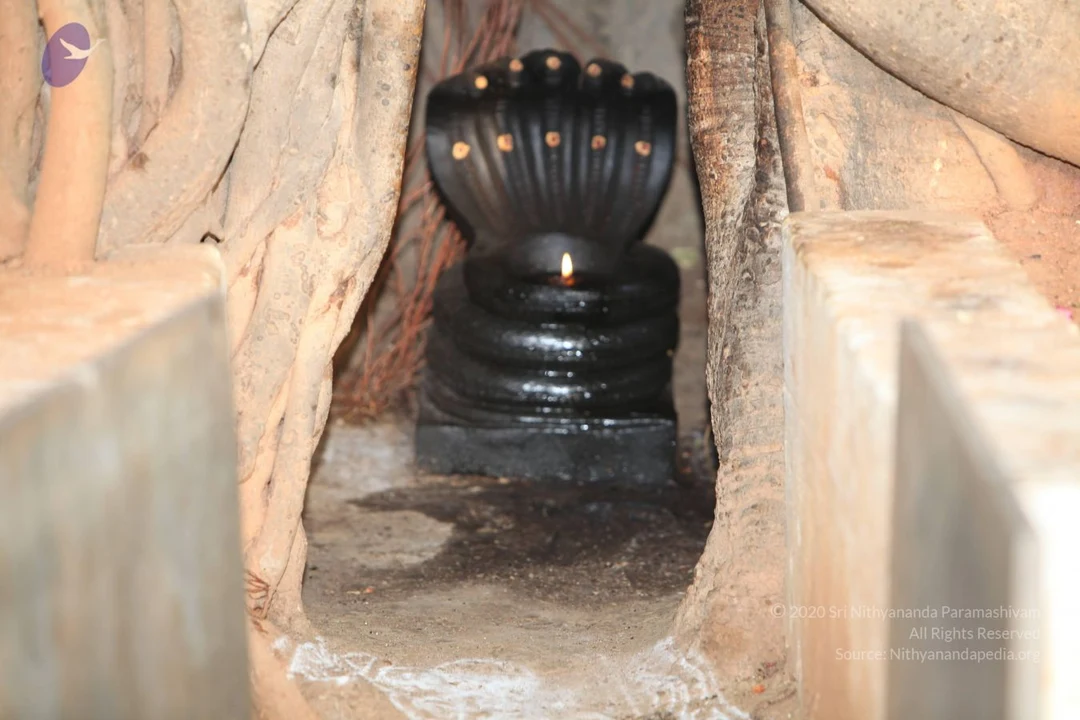
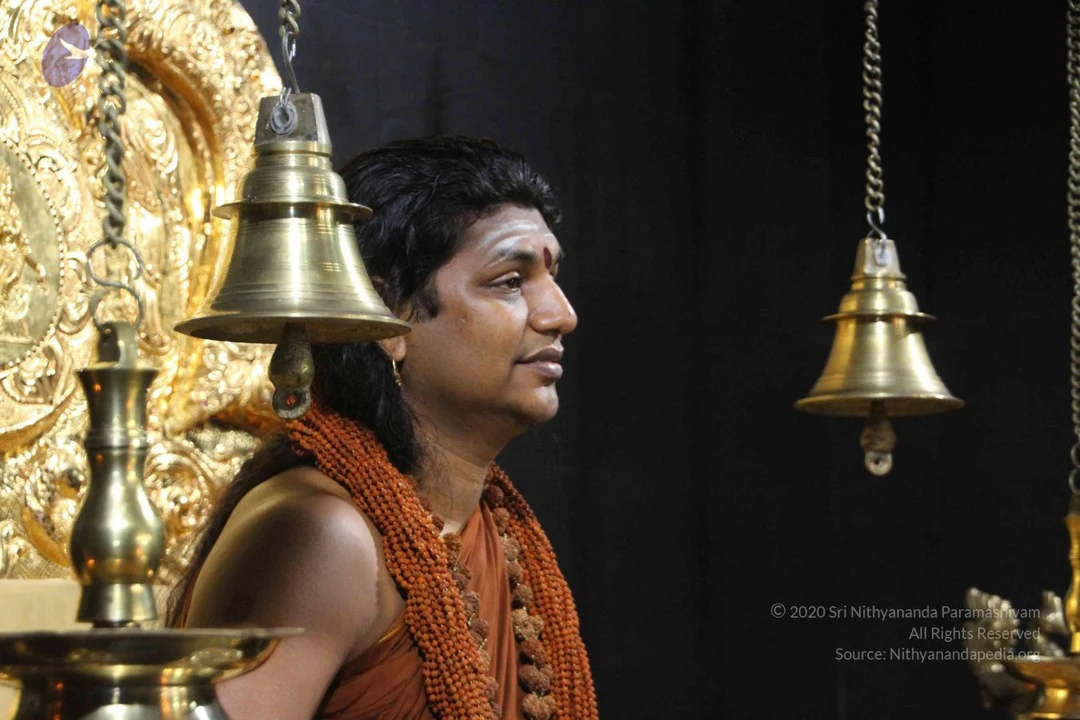
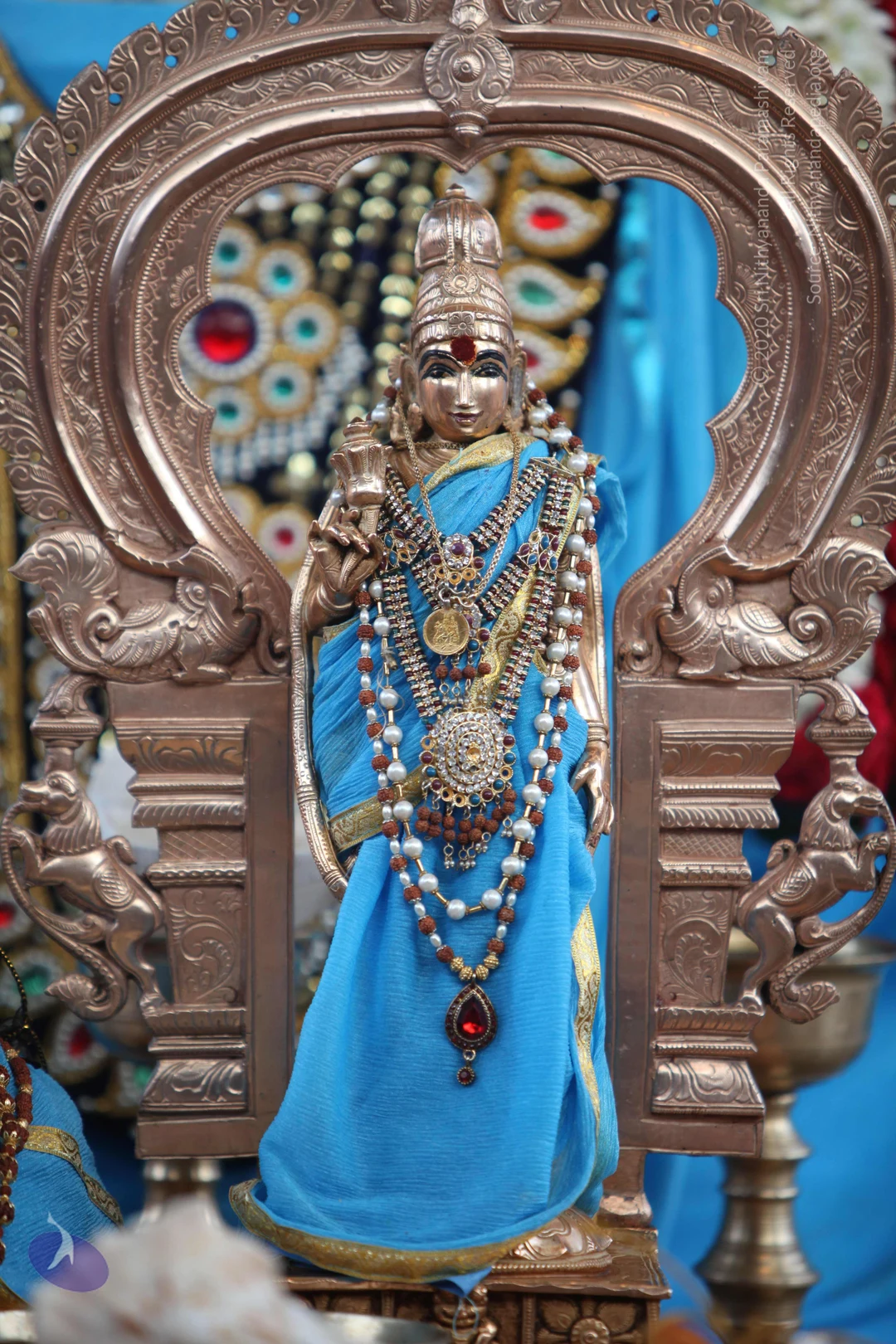
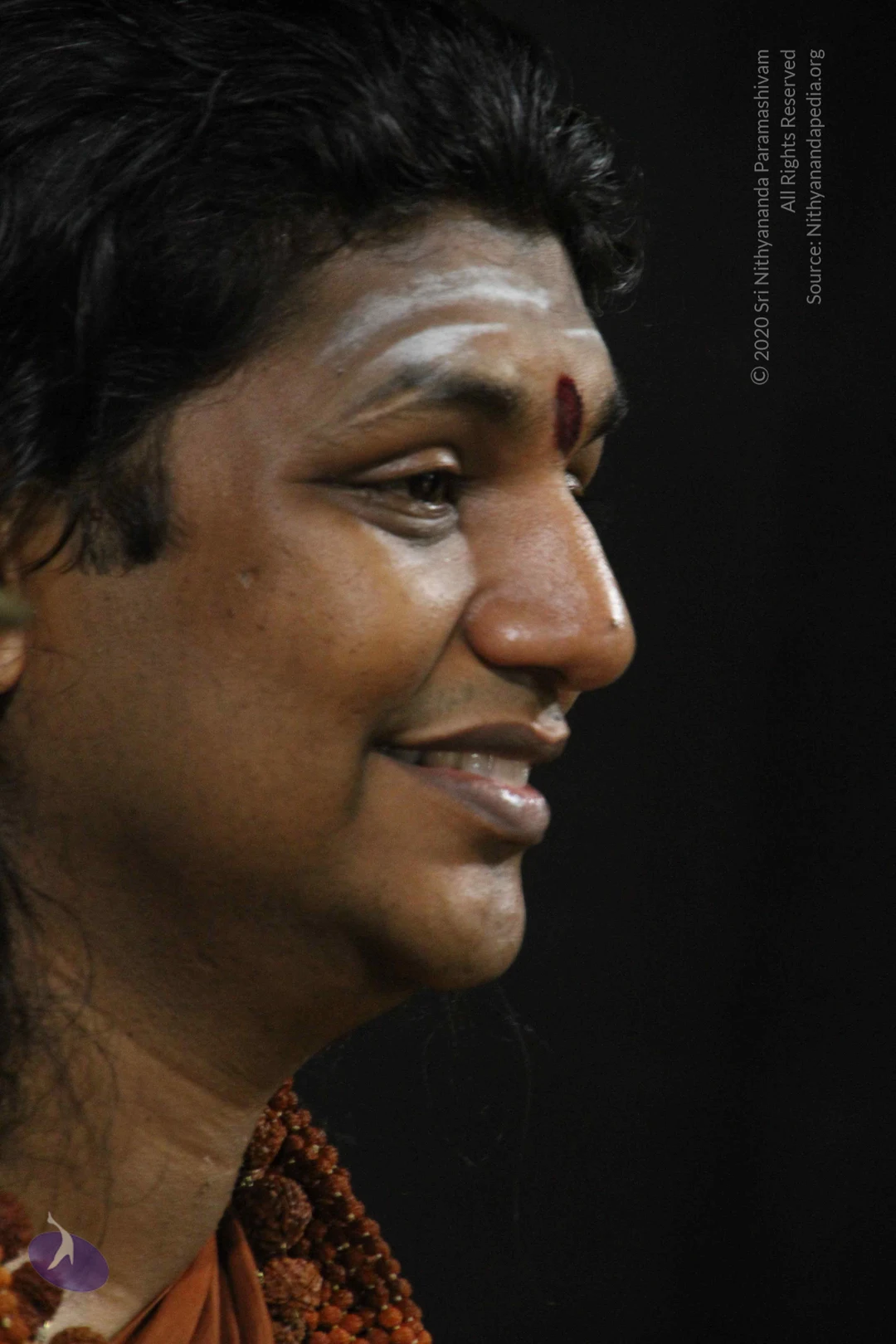
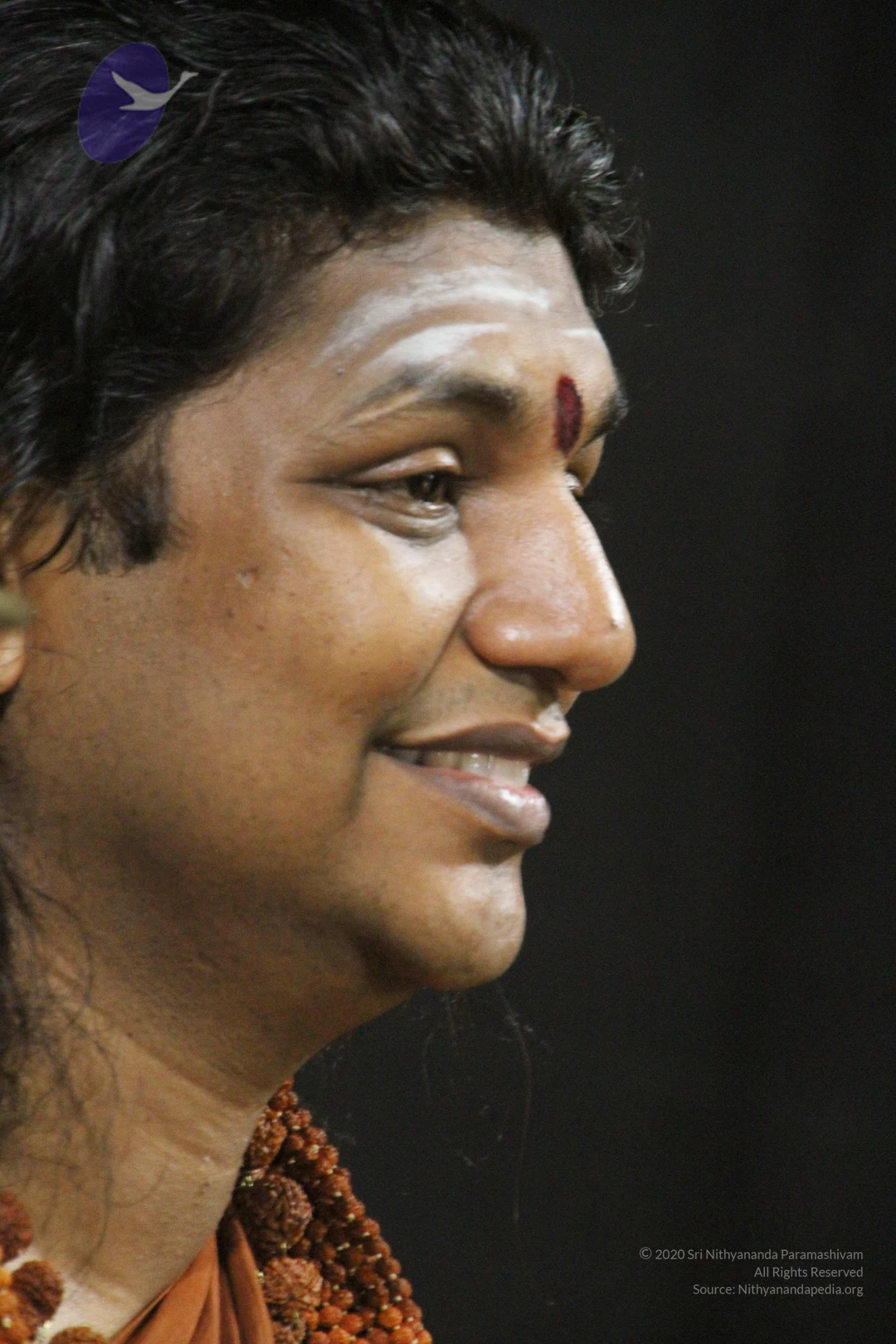
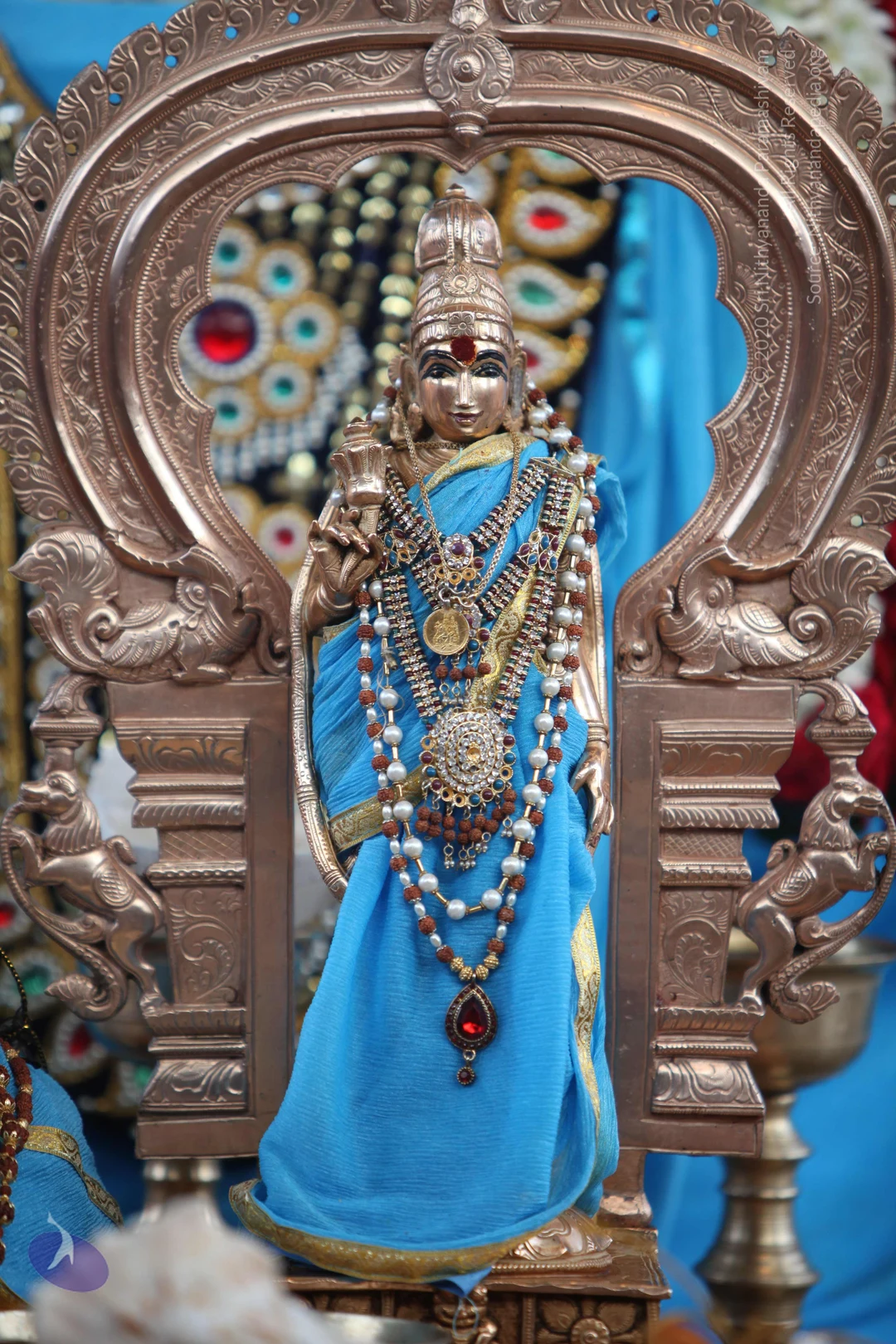
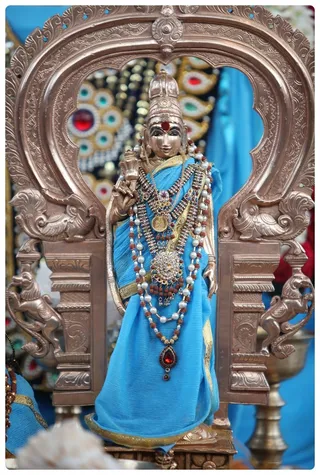
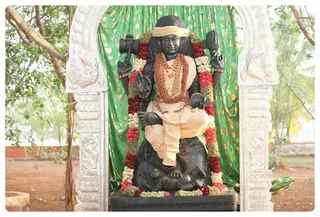
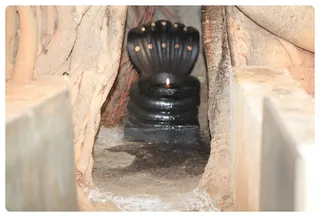
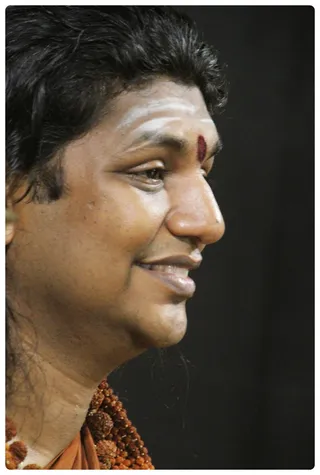
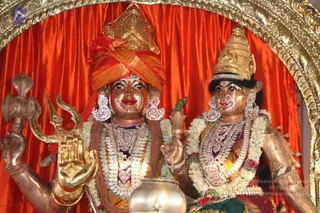
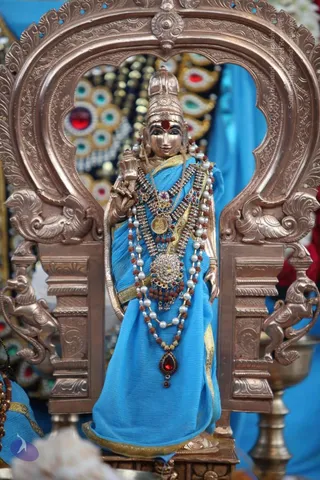
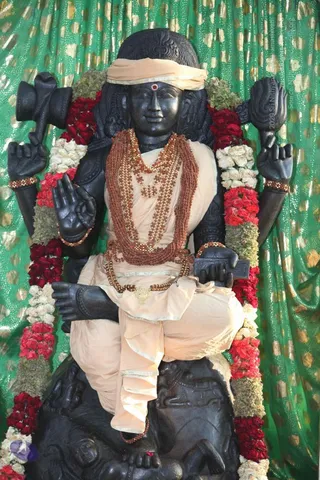
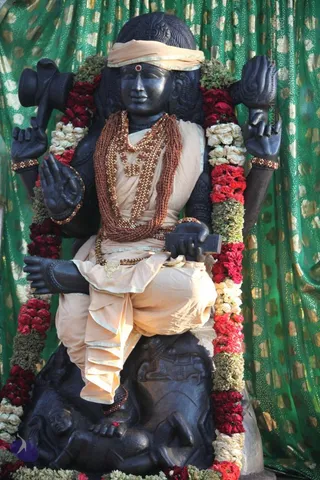
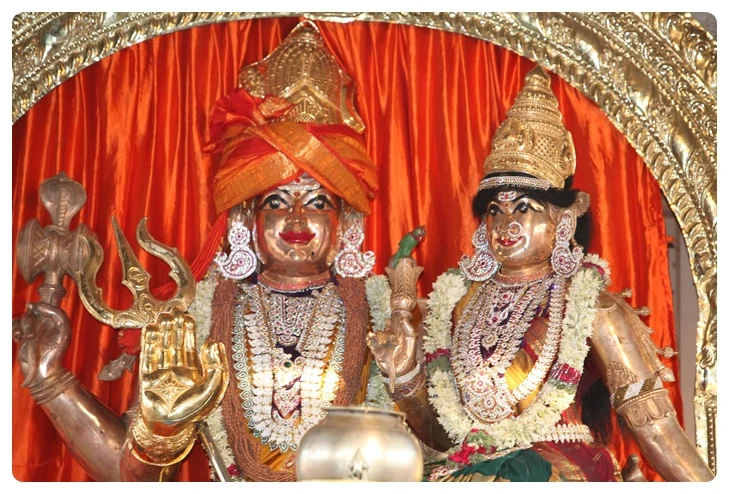
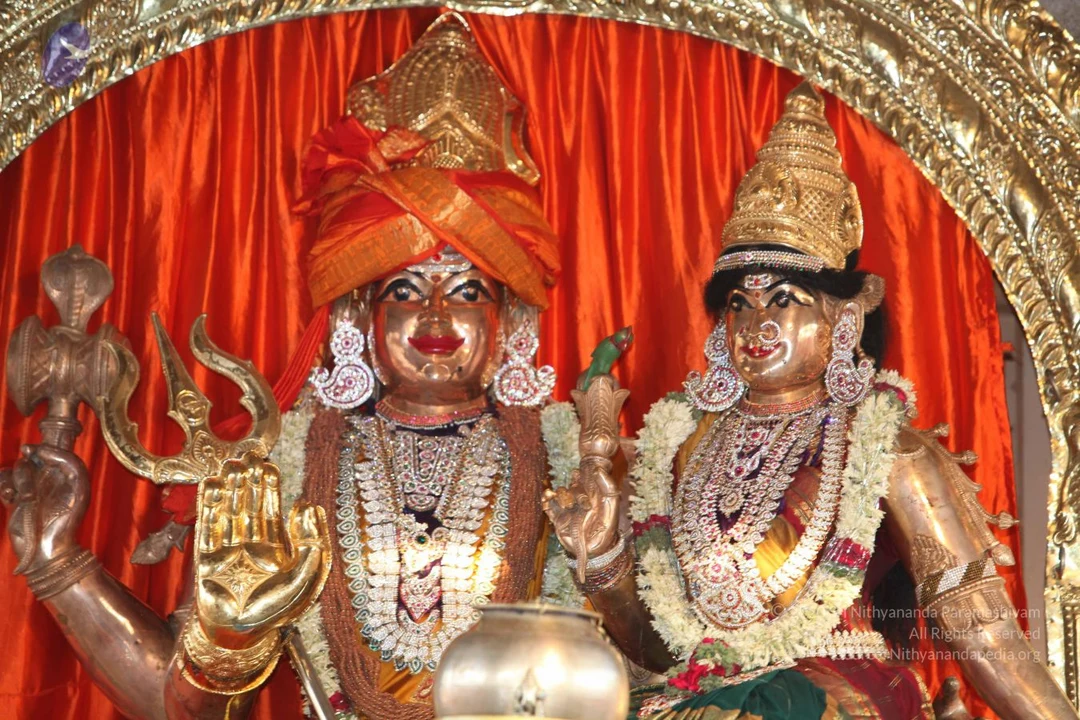
Photograph of a pair of ornate metal deity murtis standing before a bright orange-red silk drape framed by a gilded arch. The figure on the left wears an orange and red turban-style crown, a red-painted mouth, large jewelled earrings, layered white flower garlands and a rudraksha-like bead necklace; he holds a trident and a damaru-like hand object while his other hand is raised in abhaya mudra. The figure on the right wears a tall gold crown, jewelled earrings, multi-strand gold necklaces and white and pink garlands, and holds a green parrot-like object. A silver kalasha sits in the foreground. No physical people are visible.A bronze metal deity murti stands within an ornate copper arched frame with lion and bird carvings. The figure wears a turquoise blue silk sari with a gold border, a red bindi, and layered jewellery including pearl and rudraksha strands, a large gold pendant and a red stone drop. It holds a small object in one raised hand. Behind it are gold and jewel-studded decorations, and a brass lamp stands at the right edge. No physical people are visible.A dark stone statue of a four-armed deity murti stands seated on a black pedestal, flanked by a carved white arch. The figure wears a cream dhoti, a saffron-toned wrap and a rudraksha-style bead necklace, with a yellow headband on the head. Red and white flower garlands drape across the statue's shoulders and lap. A green cloth with gold motifs forms the backdrop, and a small offering stands at the right edge. Trees and bare earth surround the shrine outdoors.A photograph of a black stone naga (serpent) murti with a multi-hooded cobra hood, its coils stacked on a square base, lit by a single small oil lamp flame placed before it. The sculpture sits in a narrow passage framed by large smooth tree roots and pale concrete walls, with wet ground in the foreground. No people are visible.Close side-profile photograph of a smiling man with swept-back black hair, white vertical tilak lines on his forehead and a red bindi-style mark between his brows. He wears a saffron/orange garment and a multi-strand necklace of brown rudraksha beads. The background is plain dark. a person: long swept-back hair, saffron clothing and rudraksha mala are visible cues, so the in-person value is used with uncertainty noted by the unsure field.

photos

5 photosSource gallery
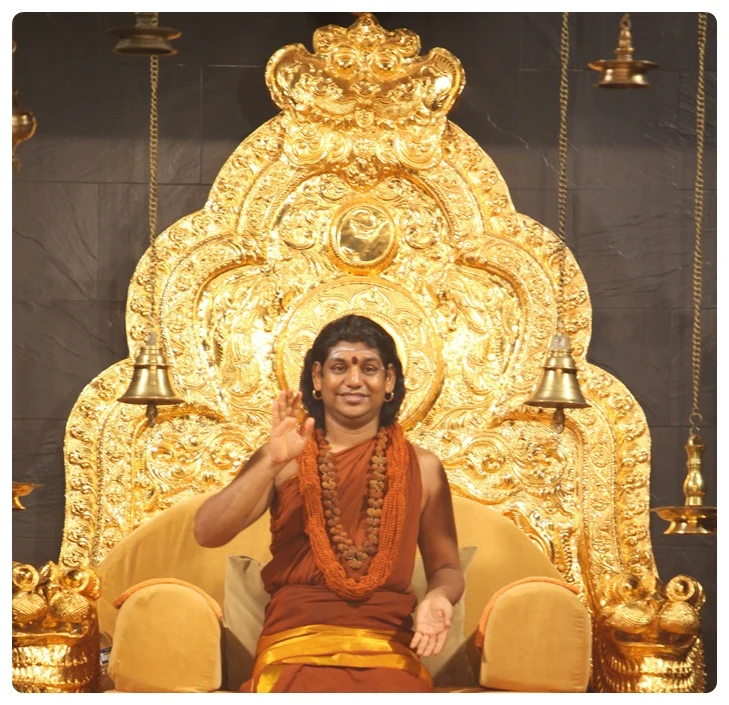
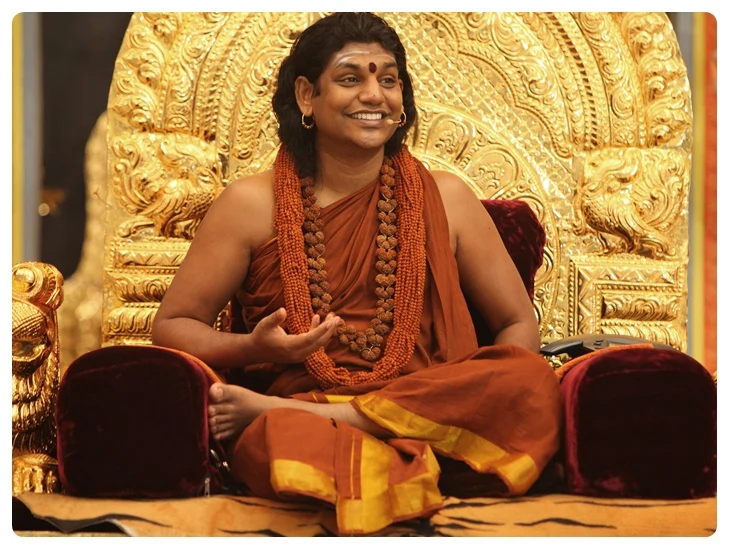
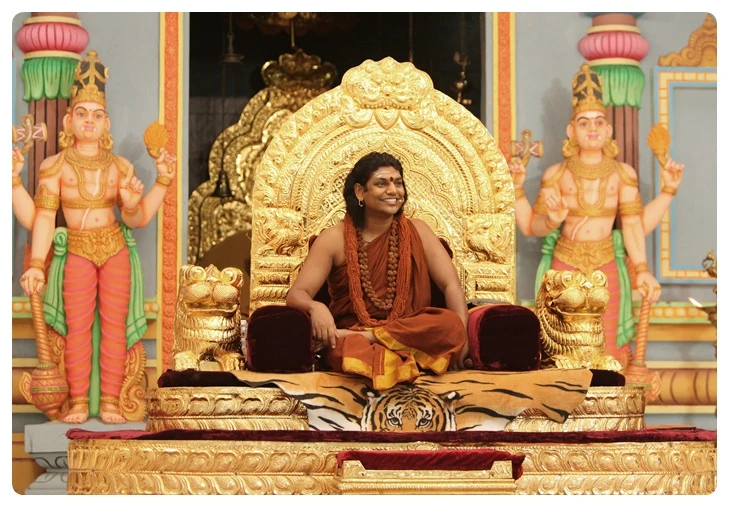
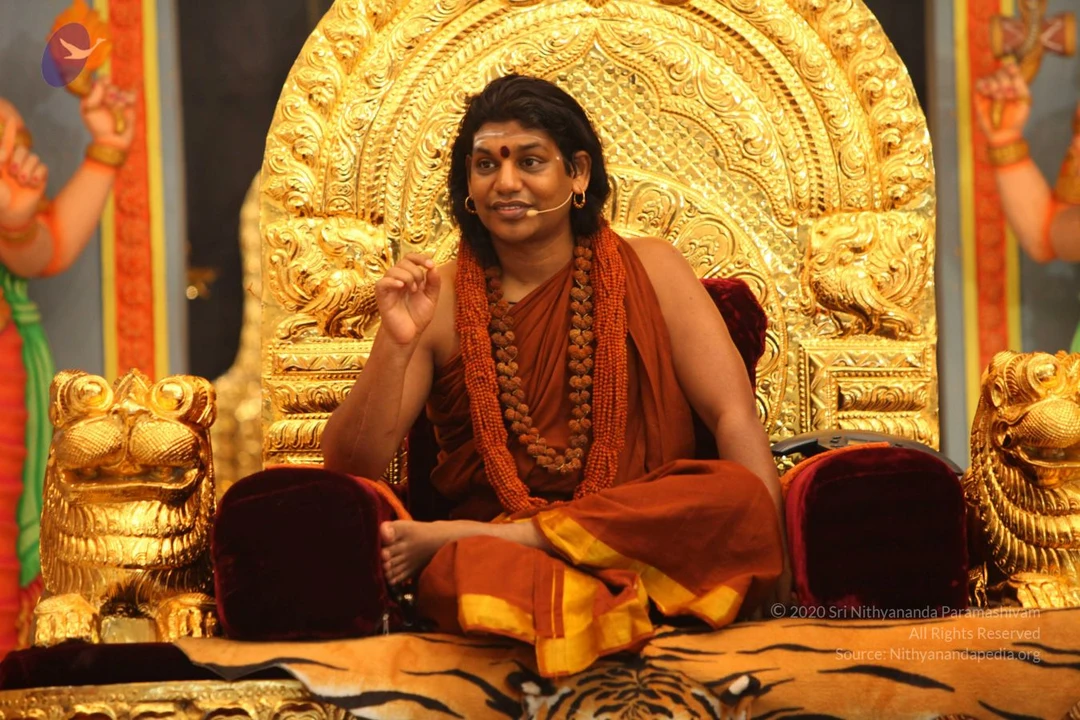
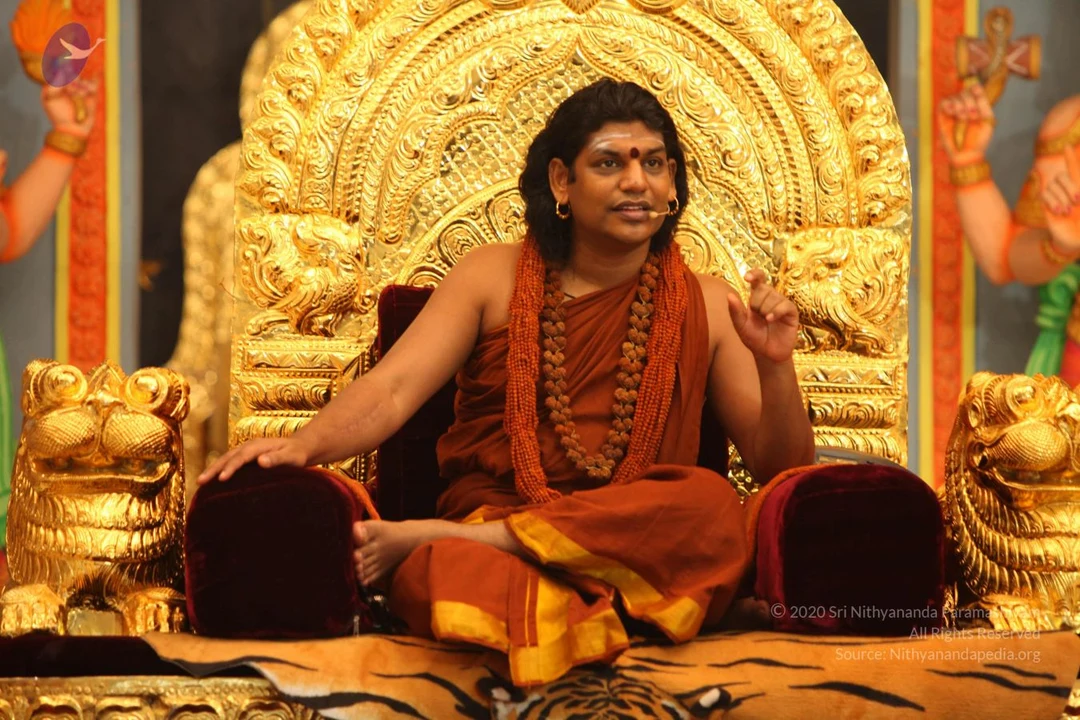
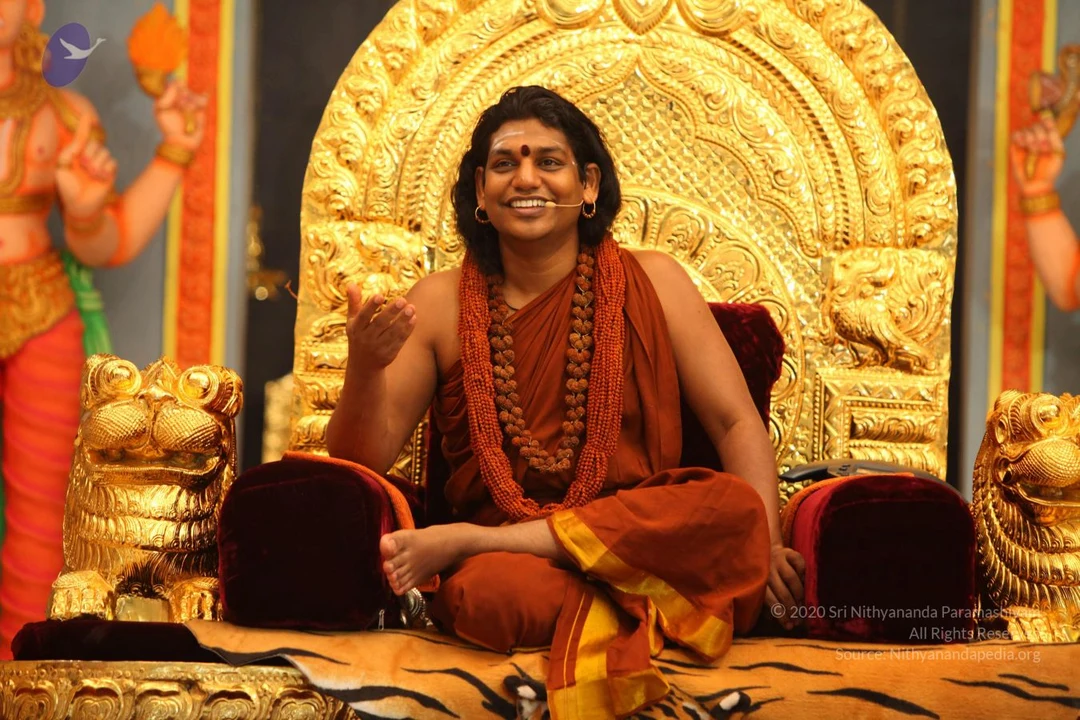
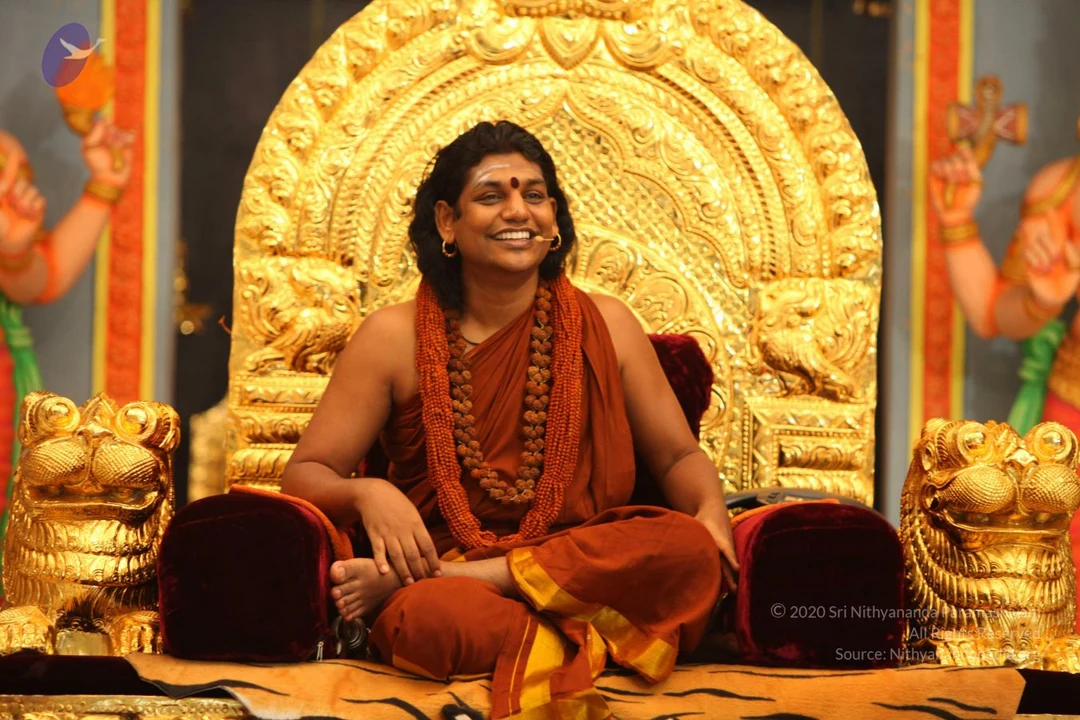
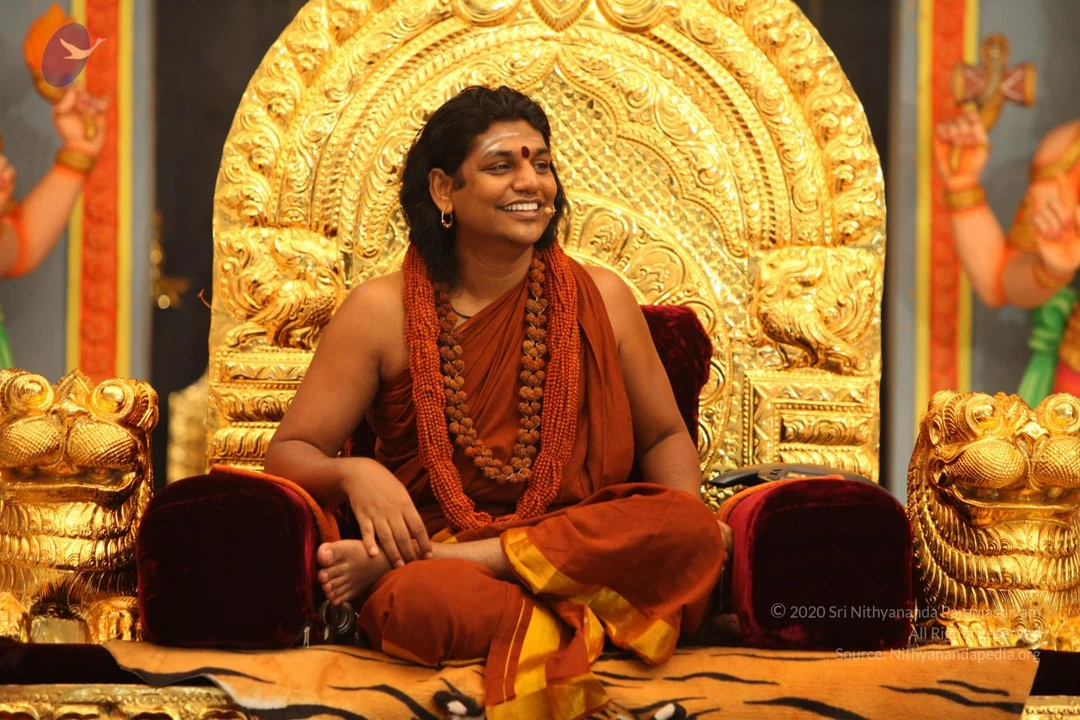
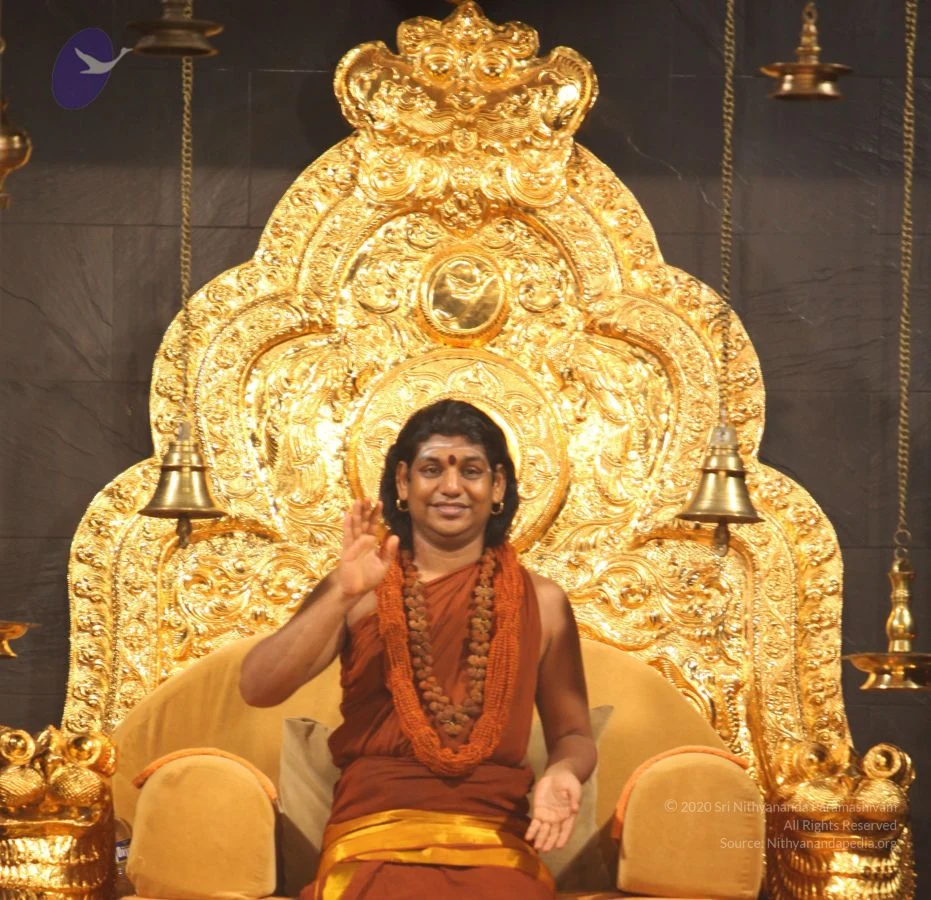
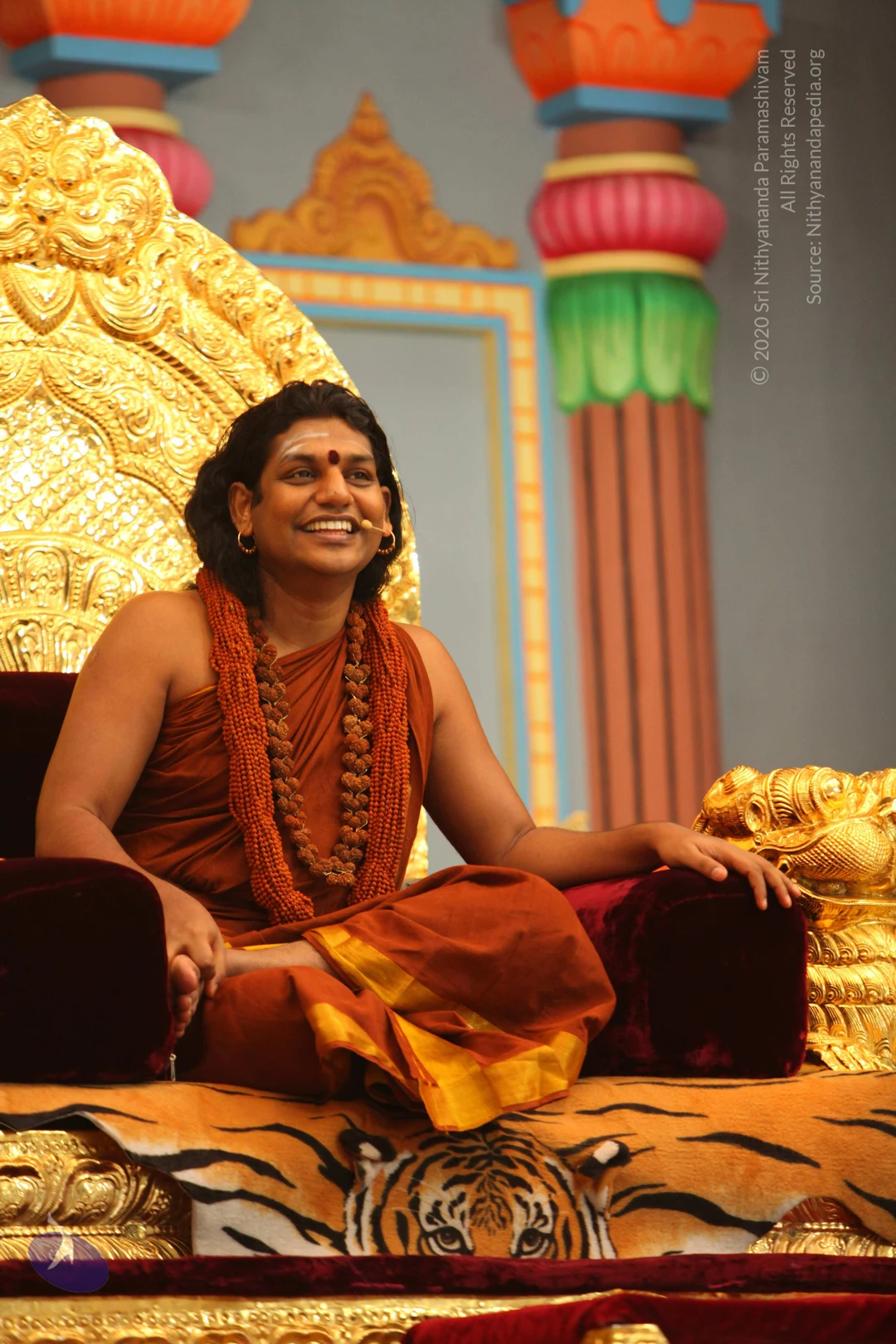
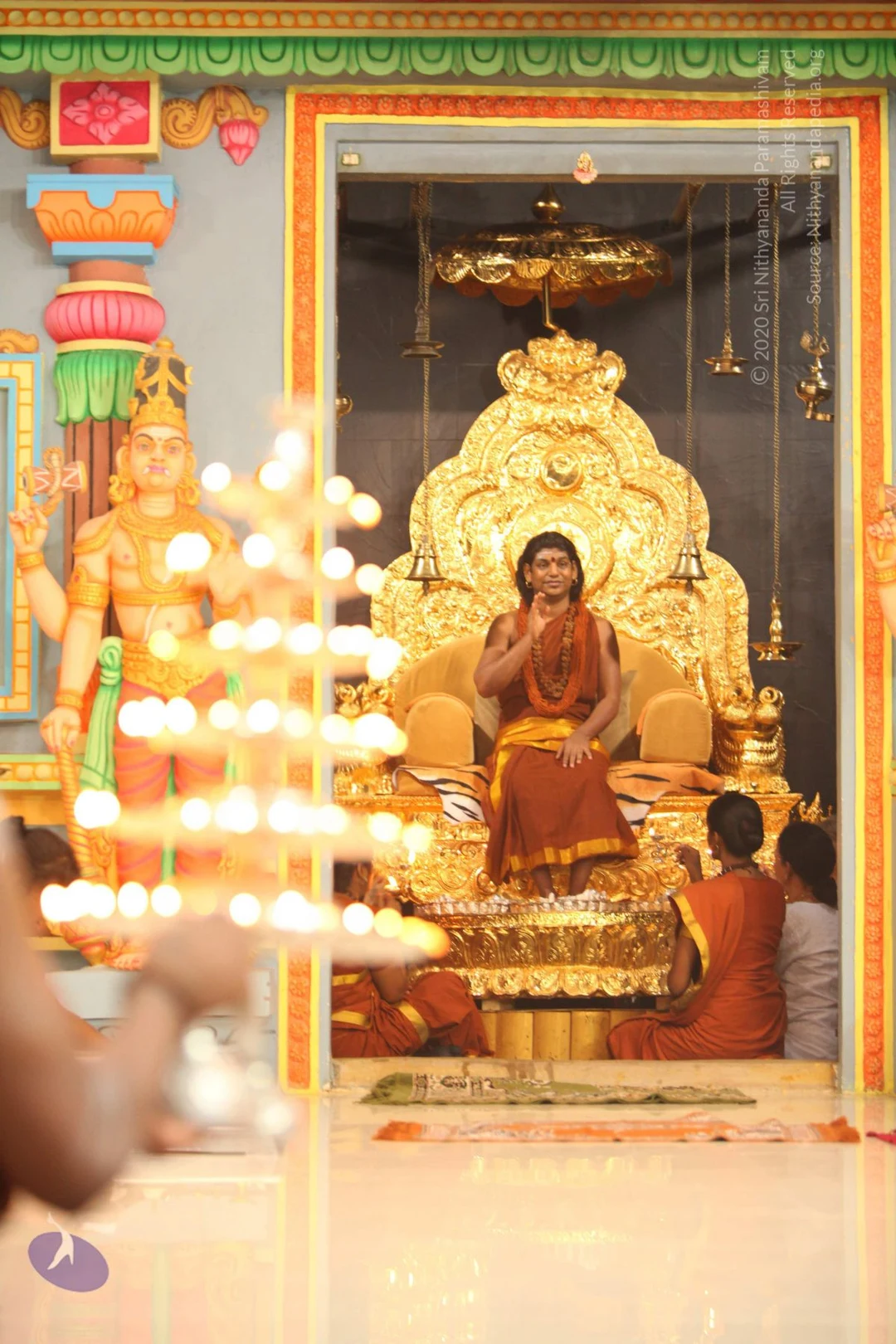
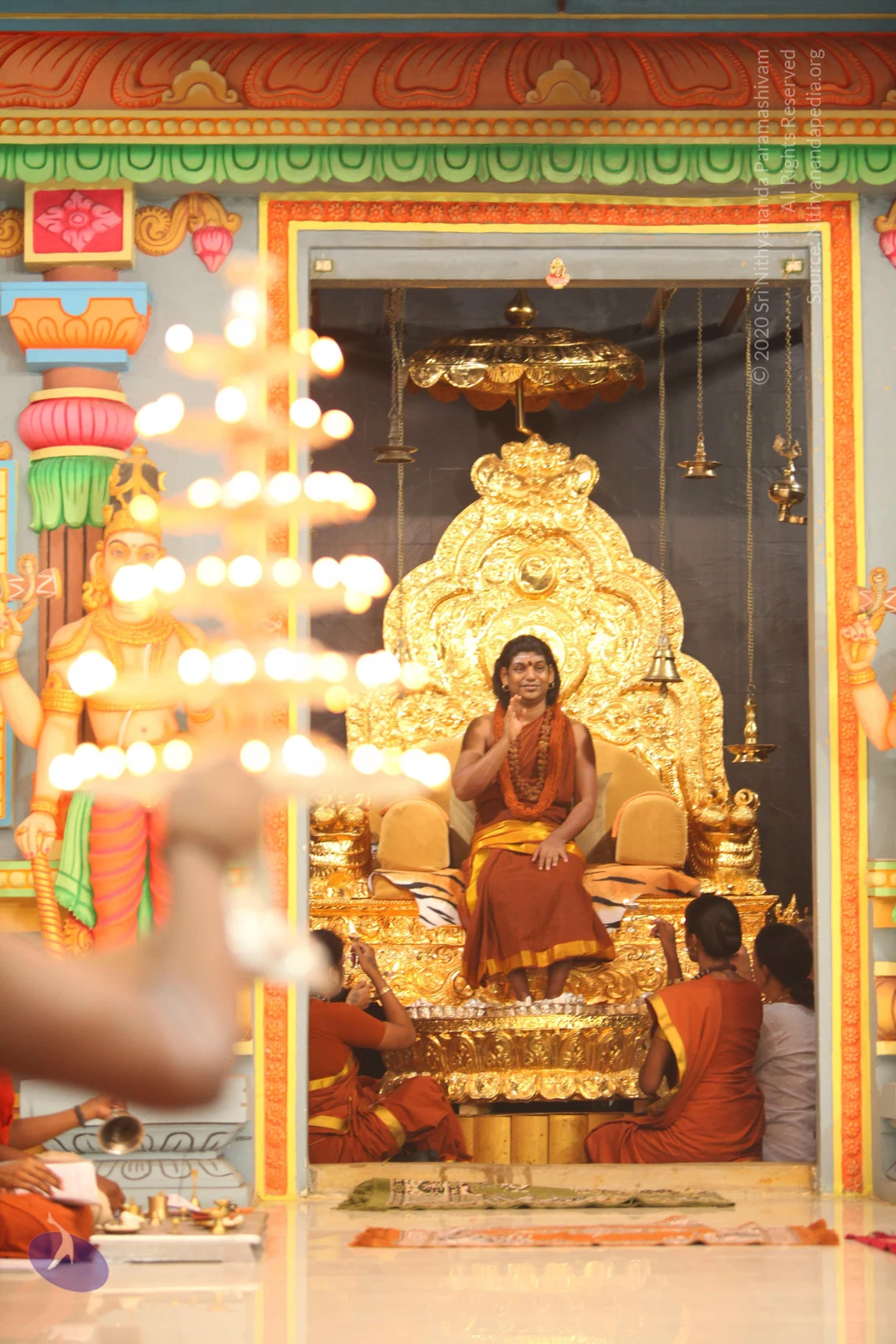
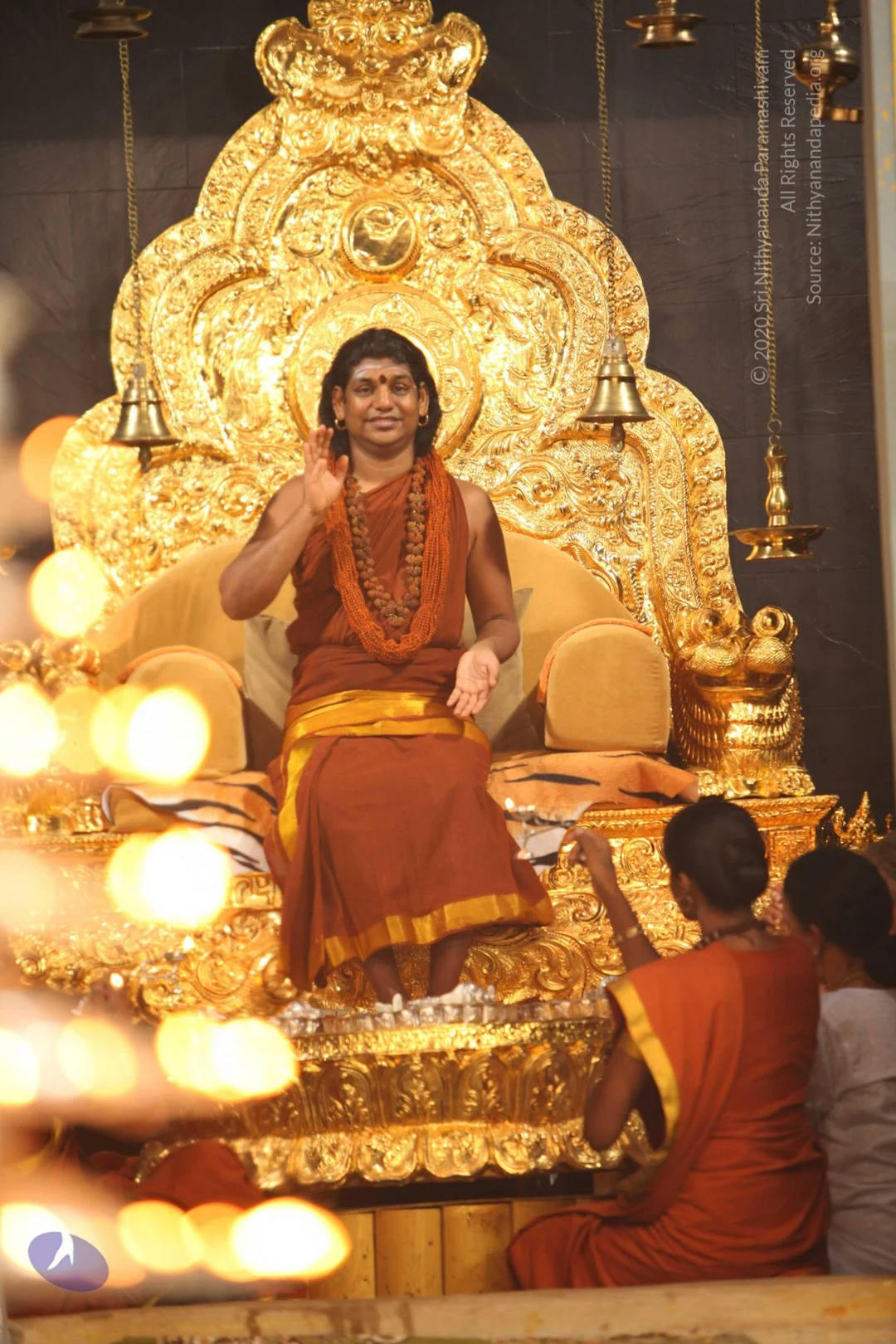
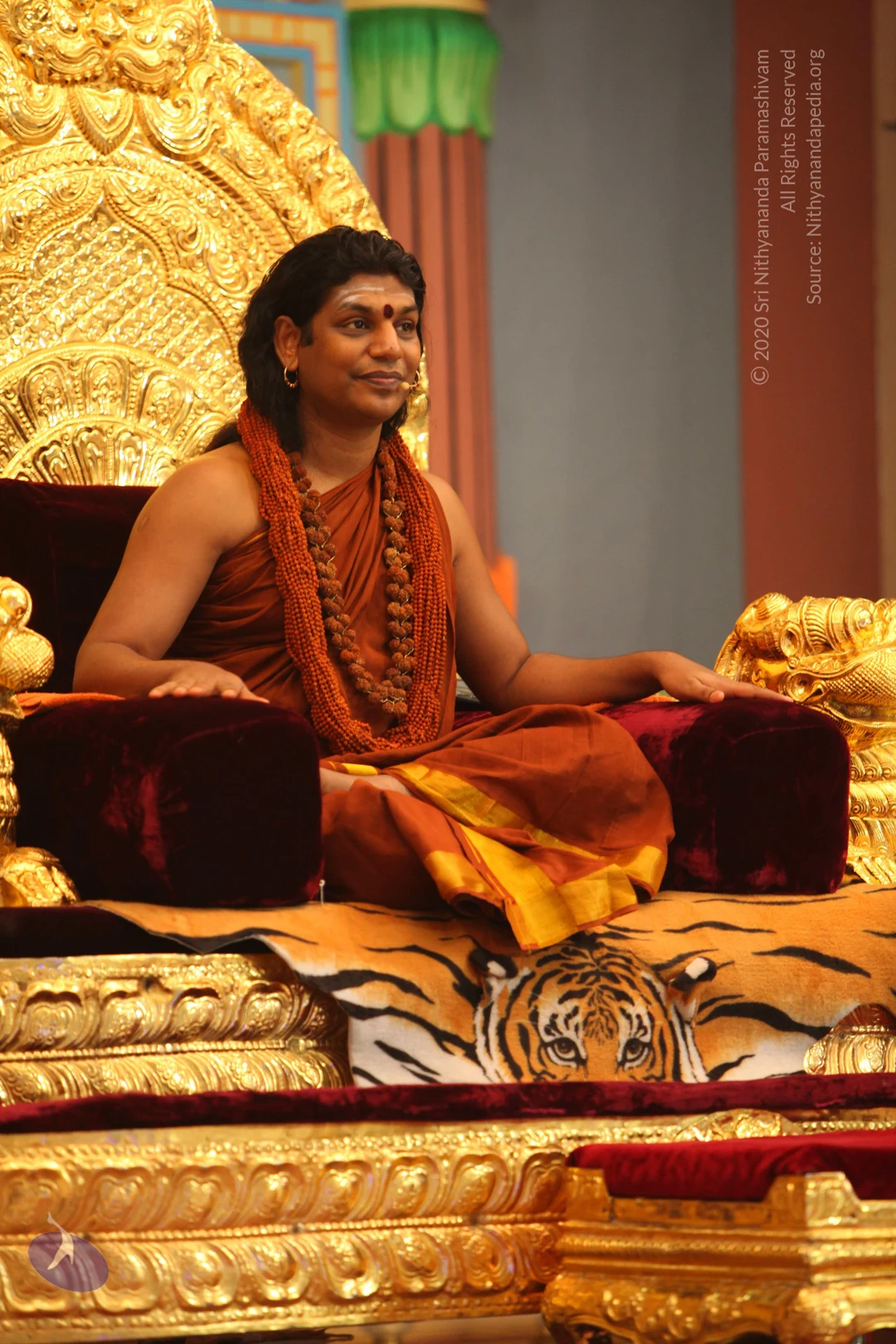
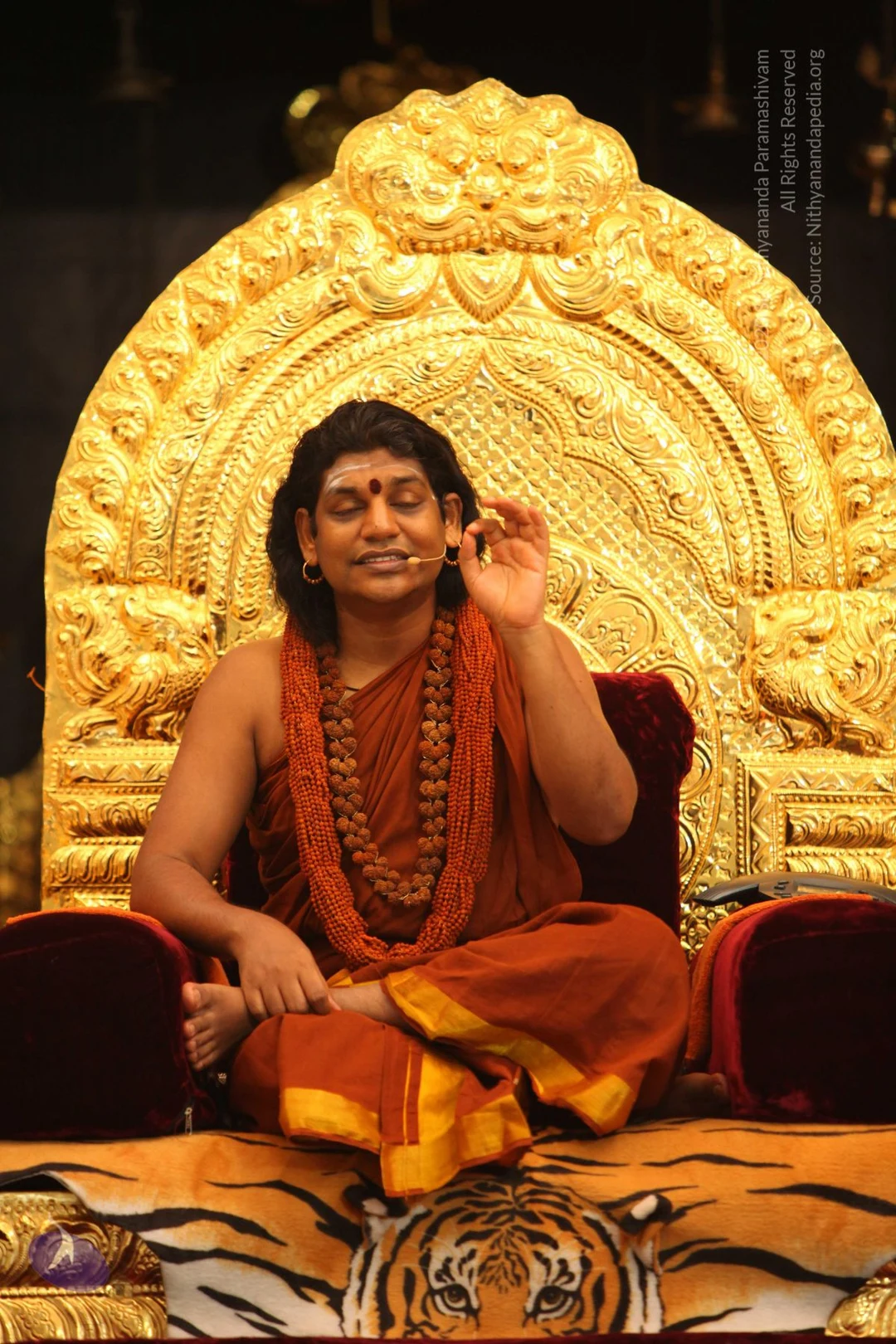
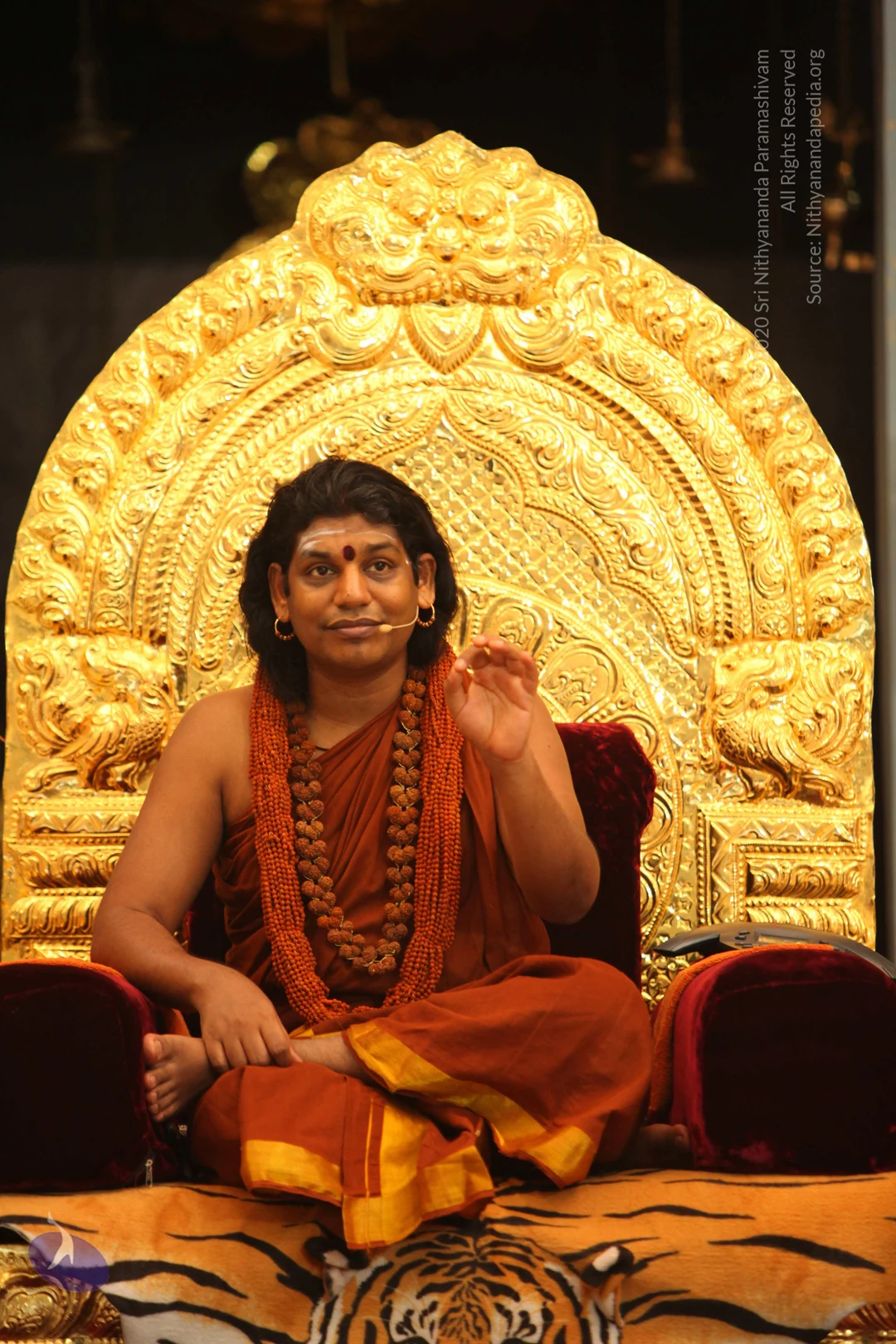
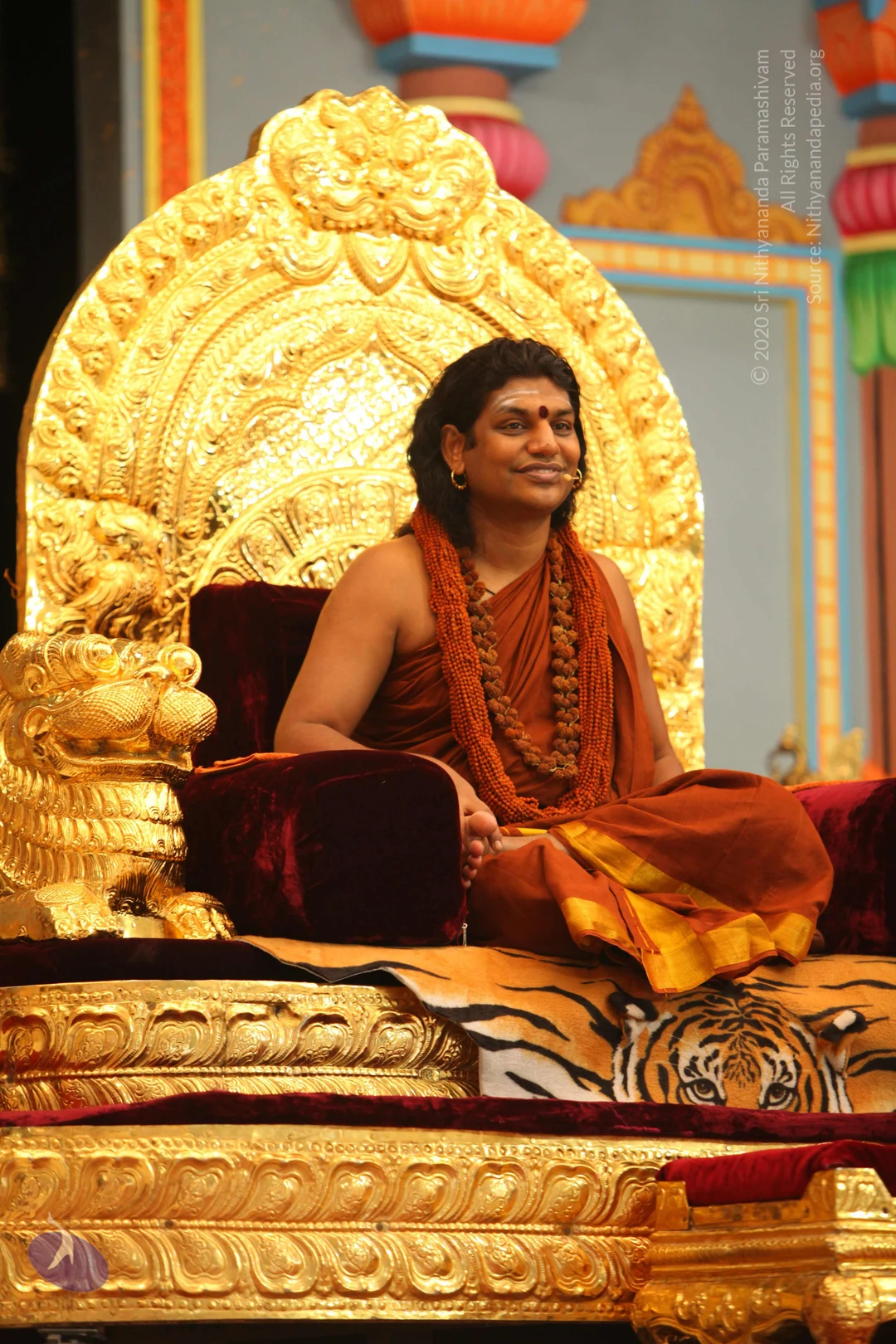
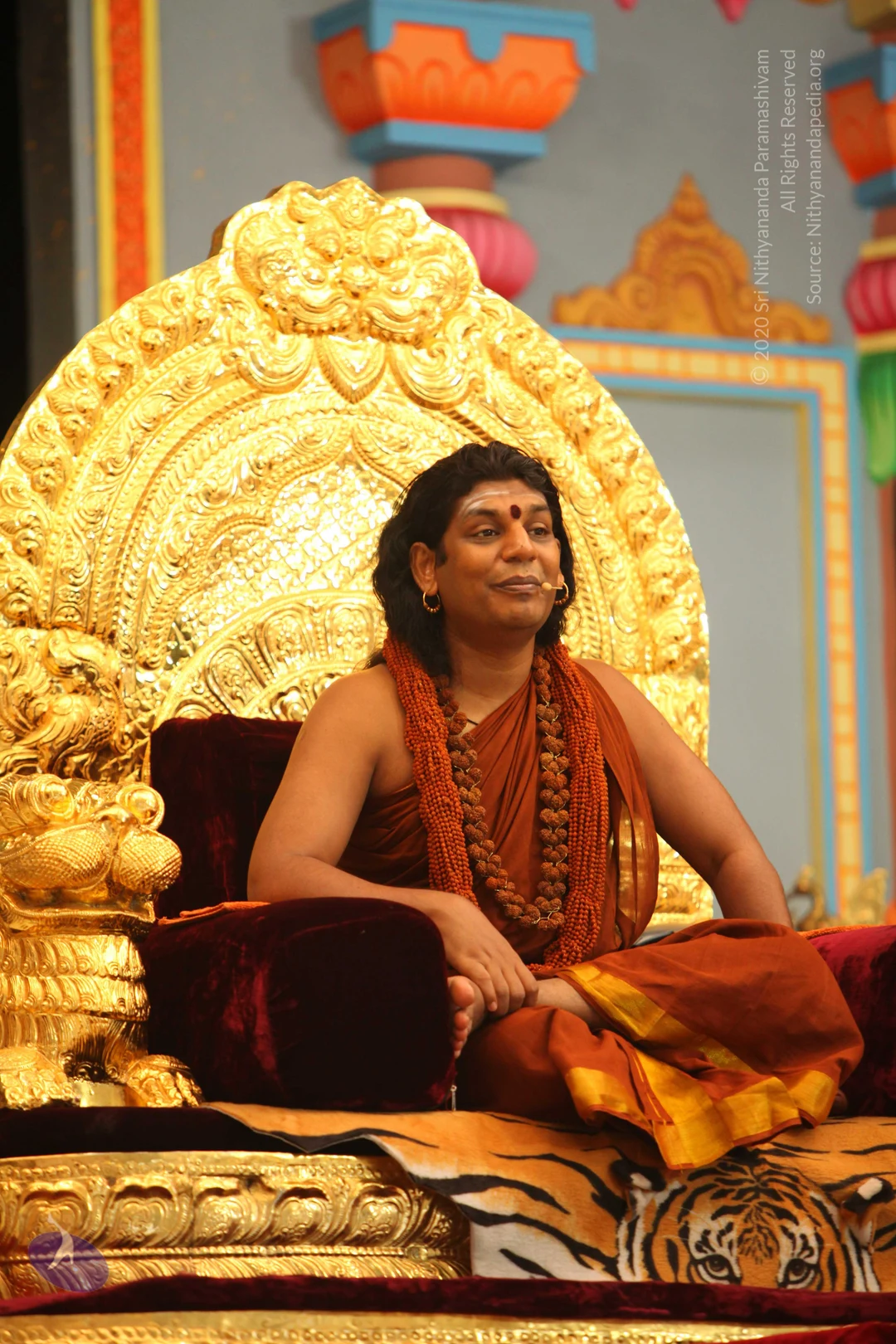
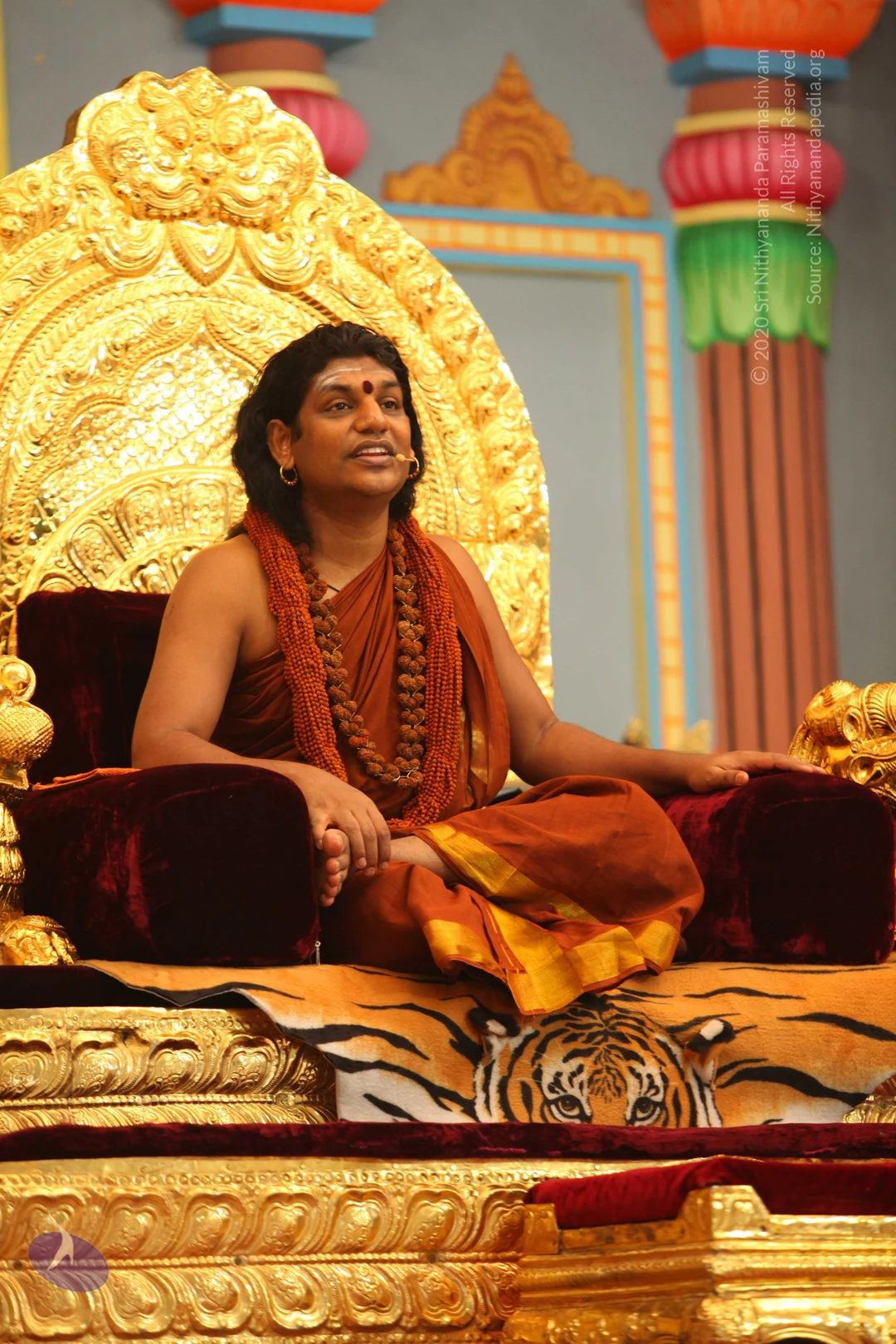
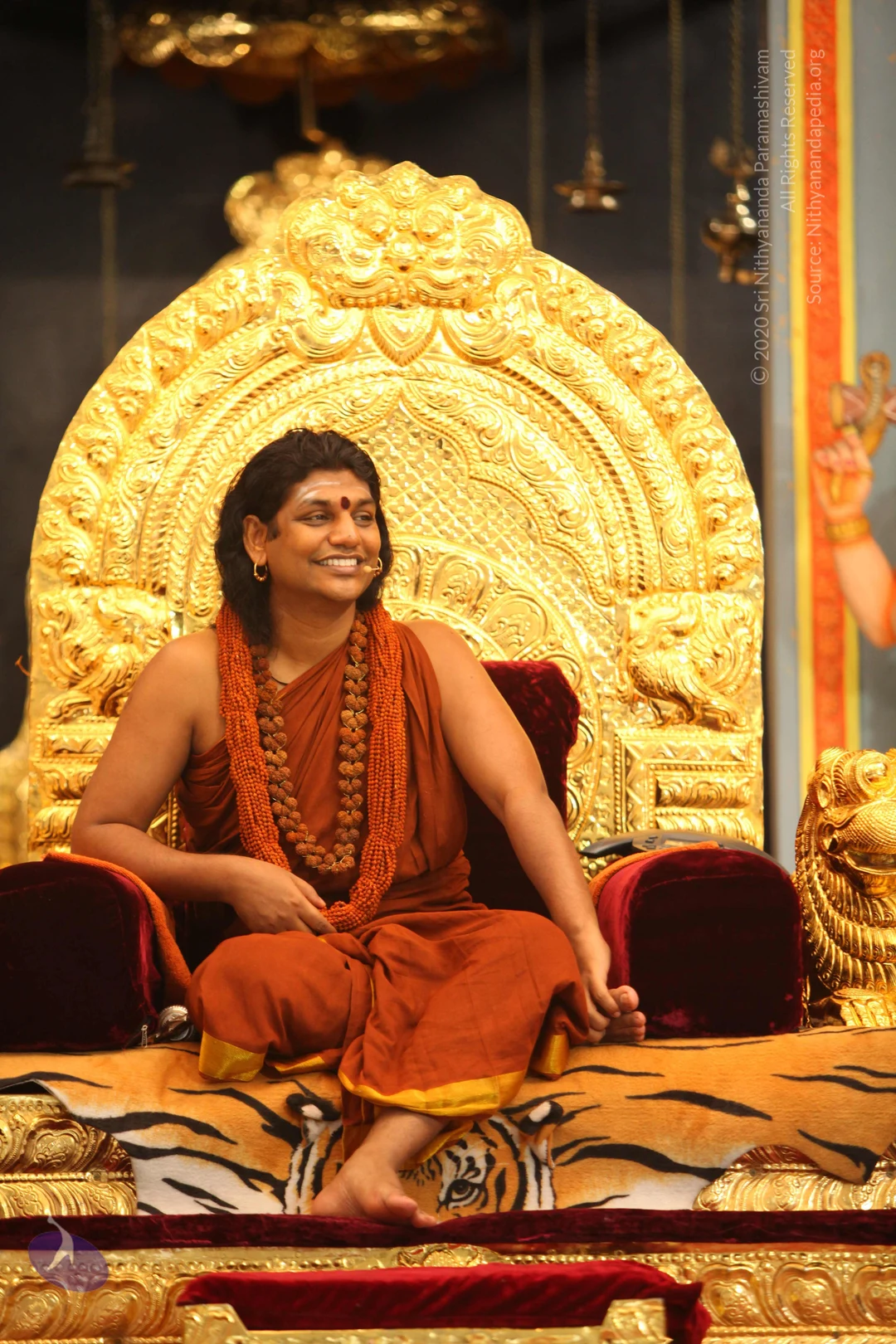
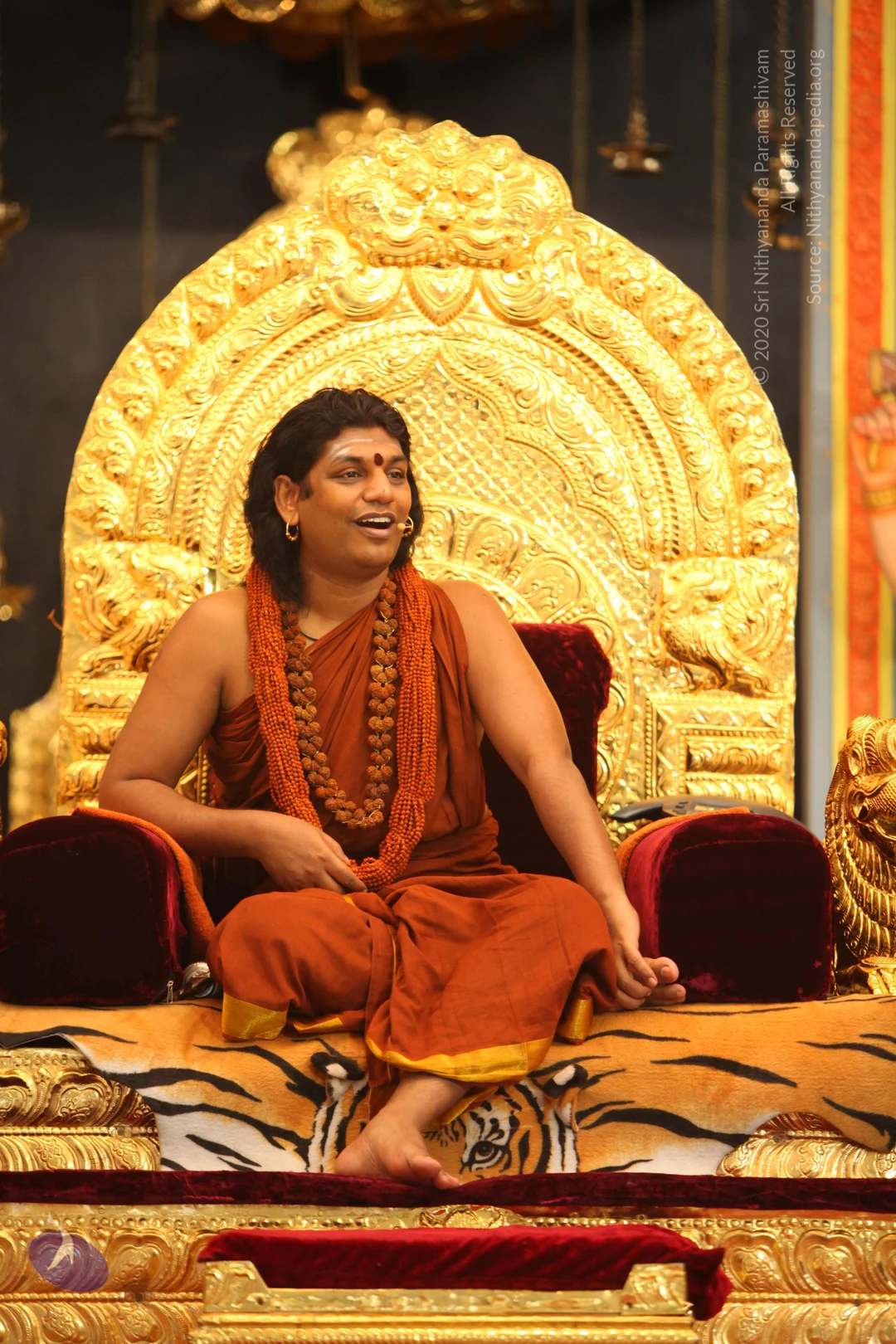
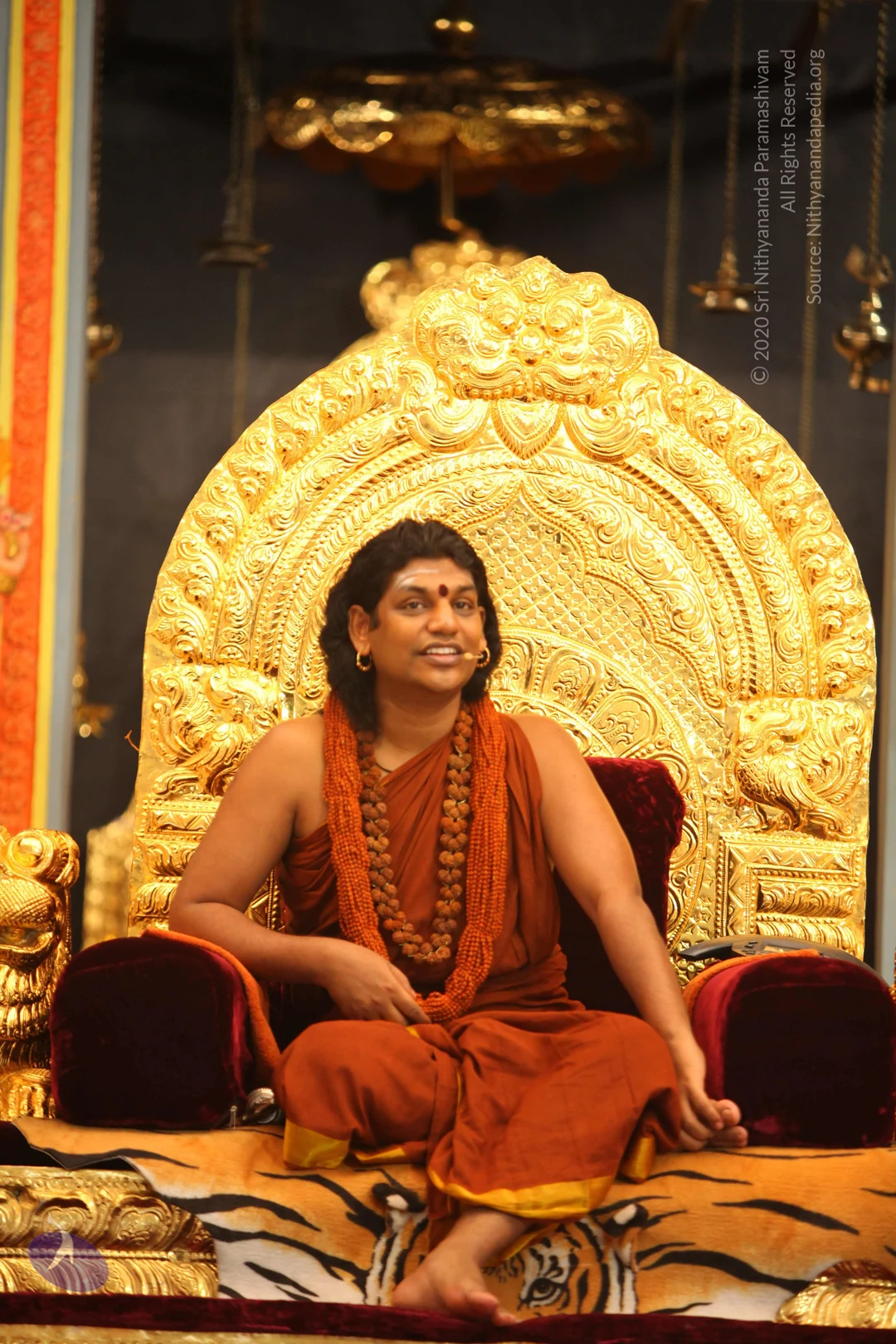
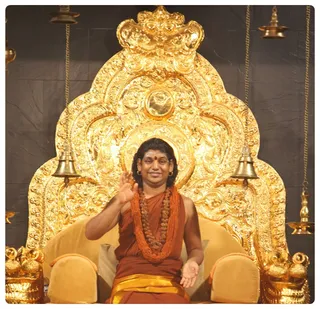
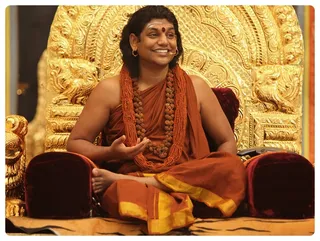
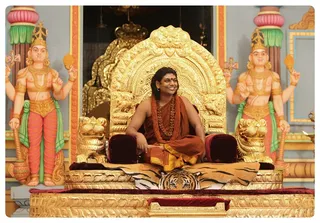
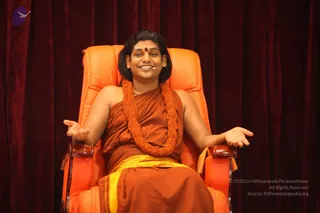
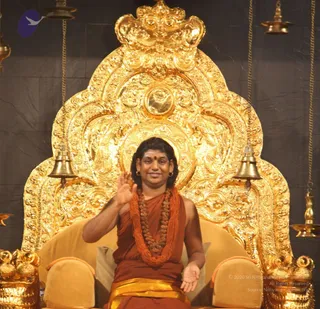
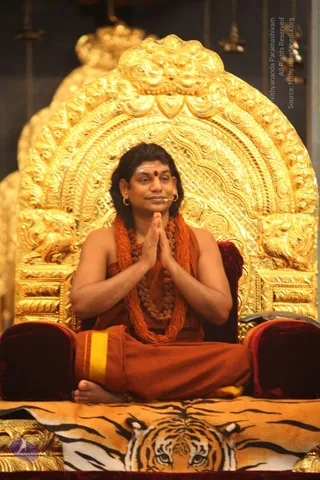
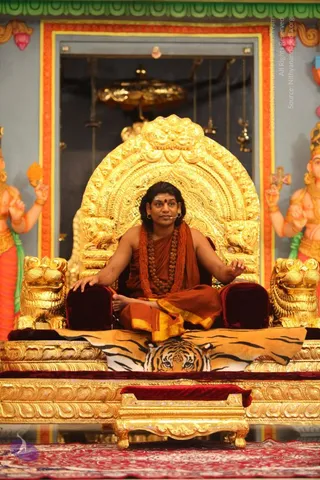
A man with long swept-back dark hair and a red bindi sits on an ornate golden throne with a gilded arched backrest, raising one hand in a blessing gesture while smiling. He wears a saffron-orange robe, a thick rudraksha mala with a red-orange tone, and a gold-edged cloth sash. Brass oil lamps and bells hang from chains beside the throne against a dark grey wall. The appearance-based cues of long hair, saffron clothing and rudraksha malas fit the Swamiji candidate, so this is a probable Swamiji seated in person on a throne during a satsang setting.Close side-profile photograph of a smiling man with swept-back black hair, white vertical tilak lines on his forehead and a red bindi-style mark between his brows. He wears a saffron/orange garment and a multi-strand necklace of brown rudraksha beads. The background is plain dark. a person: long swept-back hair, saffron clothing and rudraksha mala are visible cues, so the in-person value is used with uncertainty noted by the unsure field.A man seated cross-legged on an ornate golden throne with lion-head armrests, draped over a striped tiger-skin cushion, smiling broadly. He wears saffron-orange robes with a gold-bordered yellow cloth, a long rudraksha mala around his neck, a red tilak on his forehead, and a small headset microphone. Flanking the throne on both sides are painted deity murti figures in multicoloured garments, one holding a flame-like object in an upraised hand and the other with a raised hand and gold ornaments. Swamiji (probable) is seated on the throne, identified by his long swept-back hair, saffron robes and rudraksha malas.A seated man in saffron-orange robes with a gold-bordered dhoti sits cross-legged on a red velvet seat in front of an ornate gold throne carved with lion figures. He wears long dark hair, a red bindi, gold earrings, and multiple strands of orange beads and rudraksha malas around his neck. His right hand is raised in a speaking gesture while he smiles. The setting suggests a satsang discourse.A man with long dark hair sits smiling on an ornate gold throne with lion-head armrests, draped over a tiger-skin cushion on a red-draped dais. He wears an orange-saffron robe, a rudraksha mala and a thick ceremonial gold necklace. Two tall gold-painted deity statues with multiple arms flank the throne, holding fans and implements, and gold and pink decorative pillars frame the scene.

photos

5 photosSource gallery
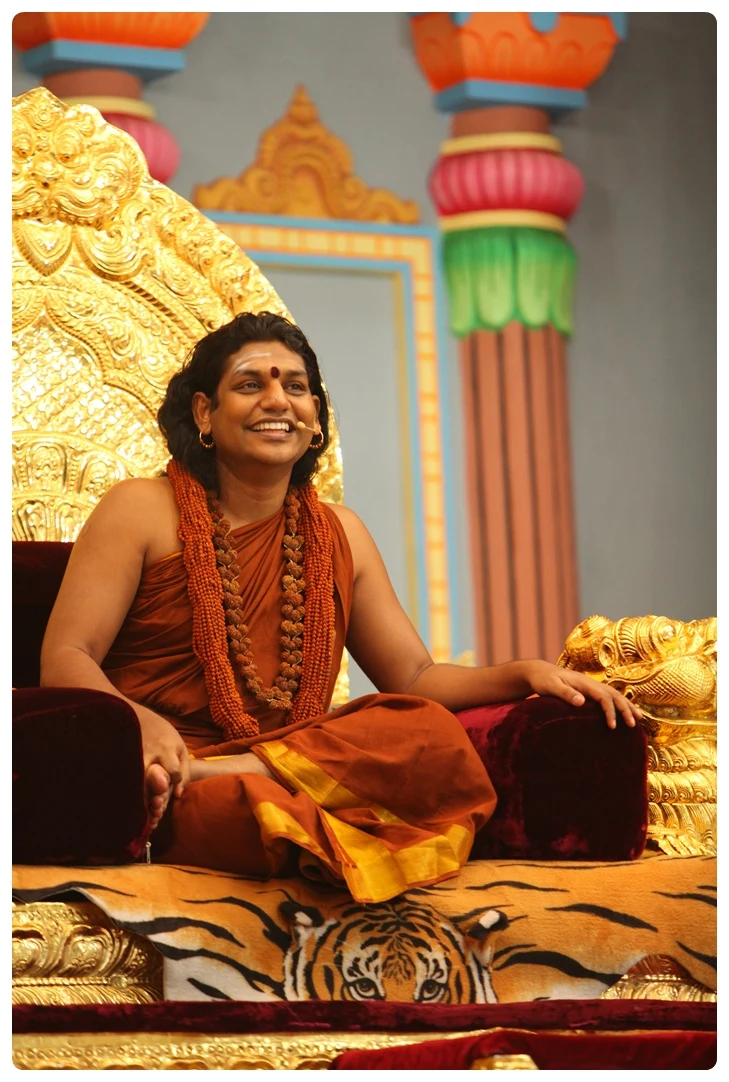
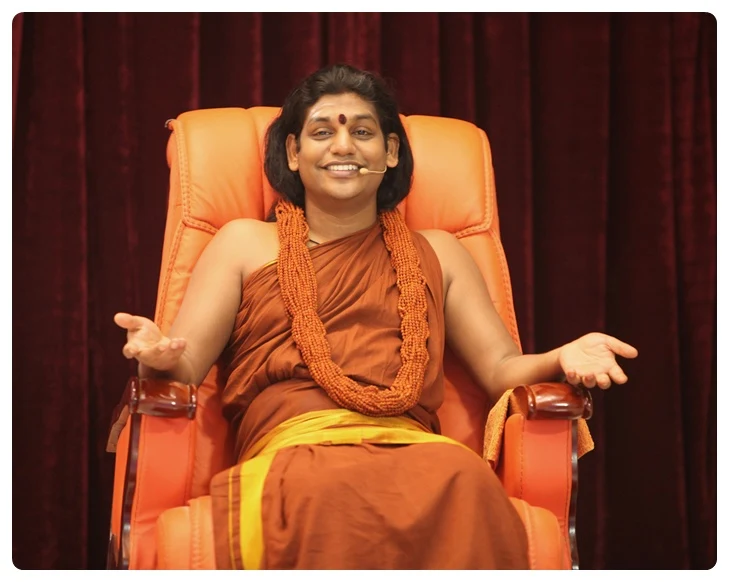
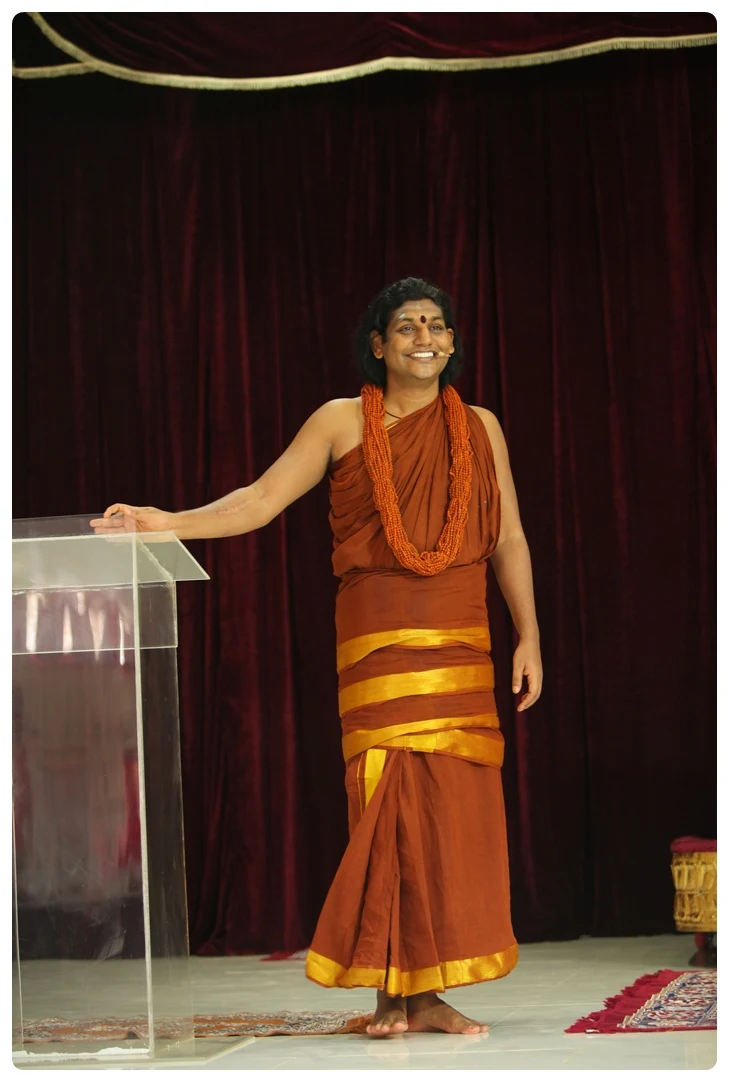
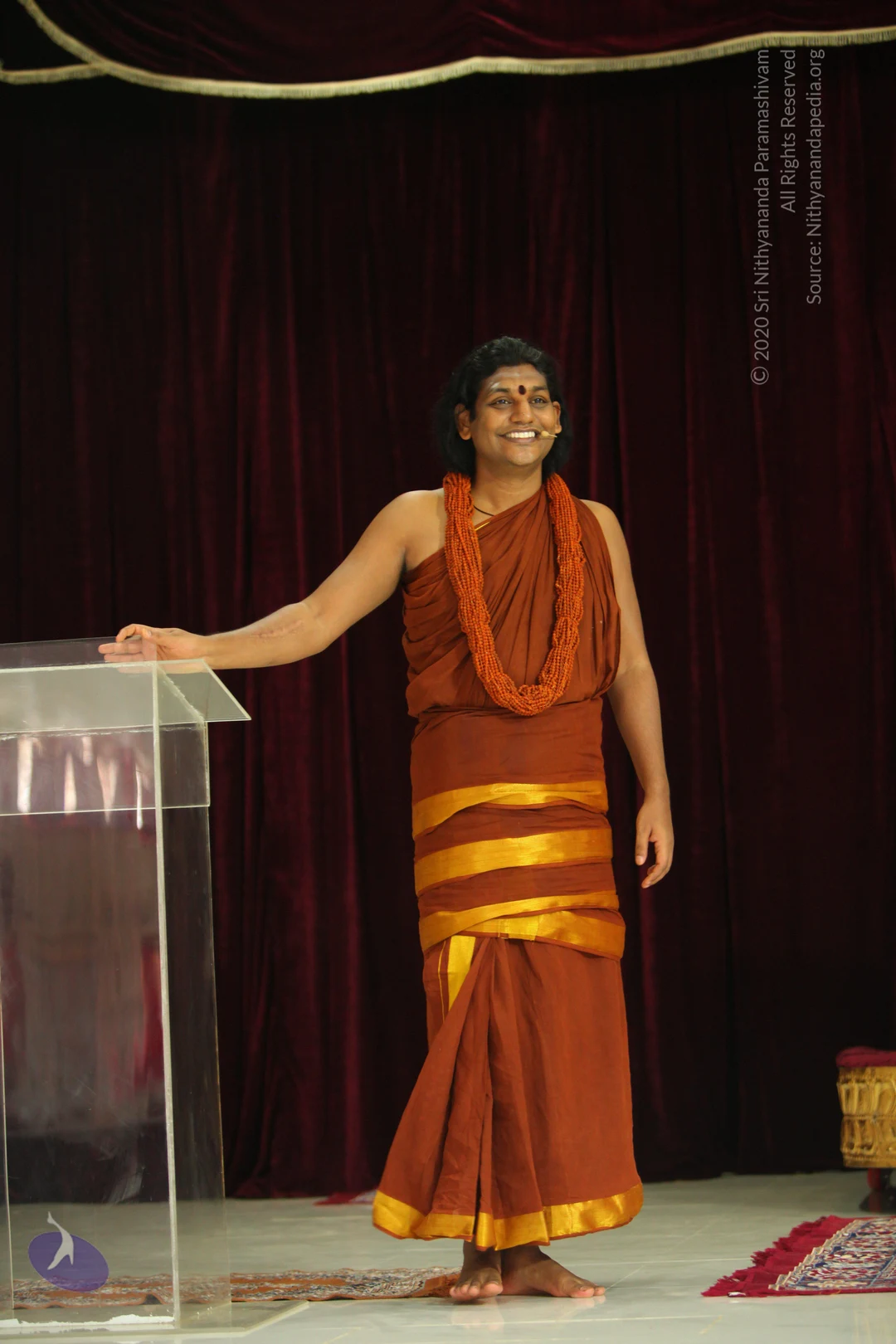
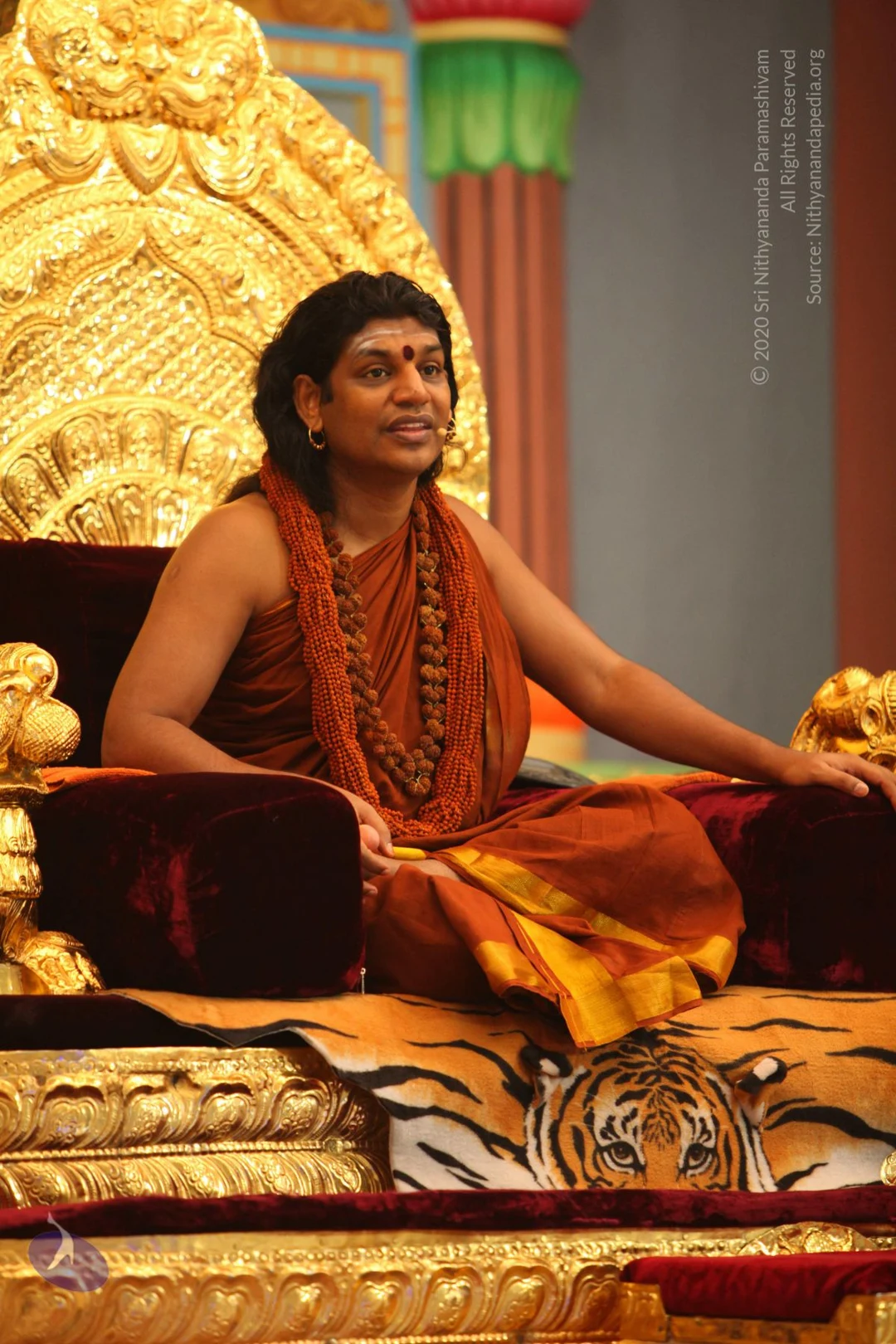
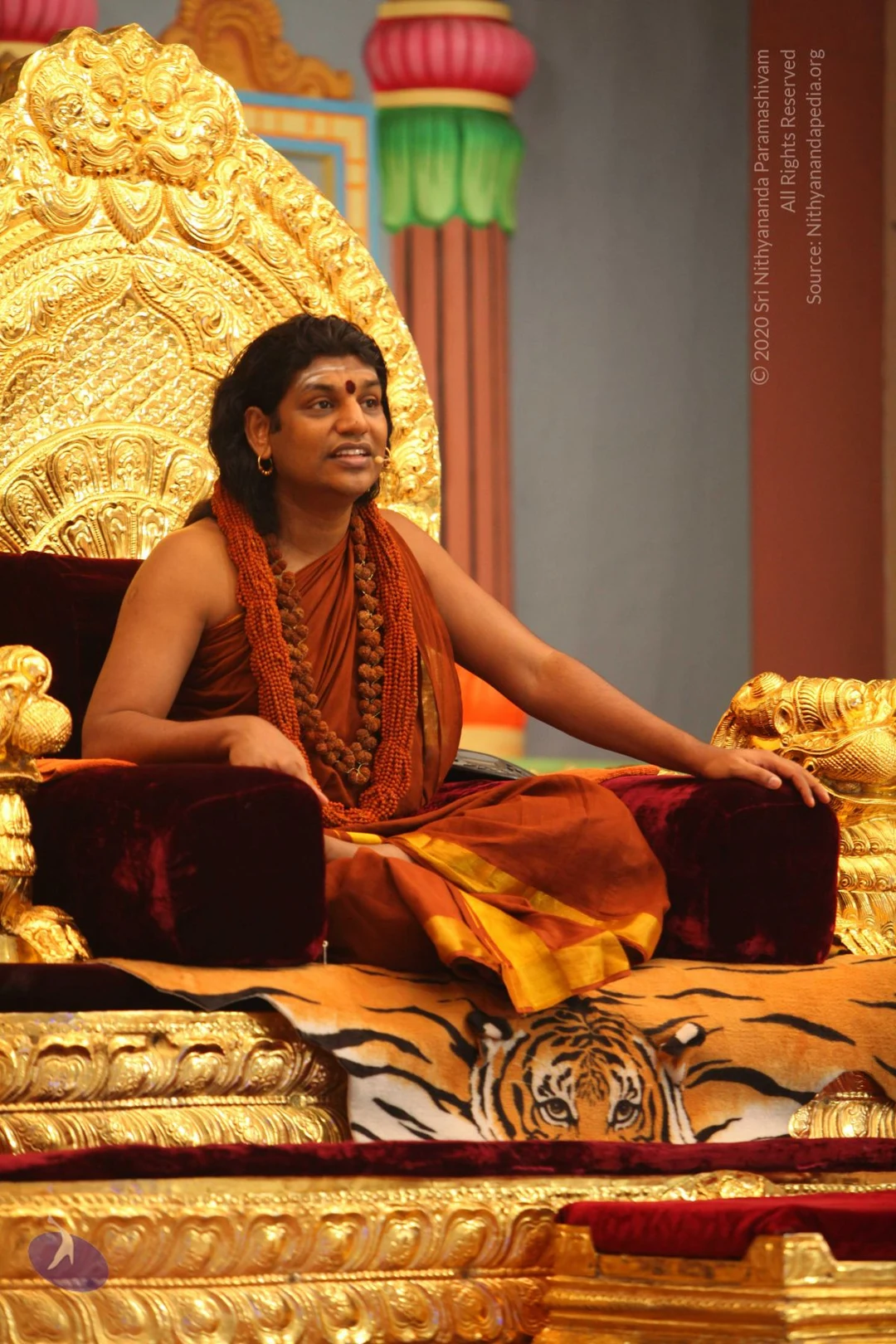
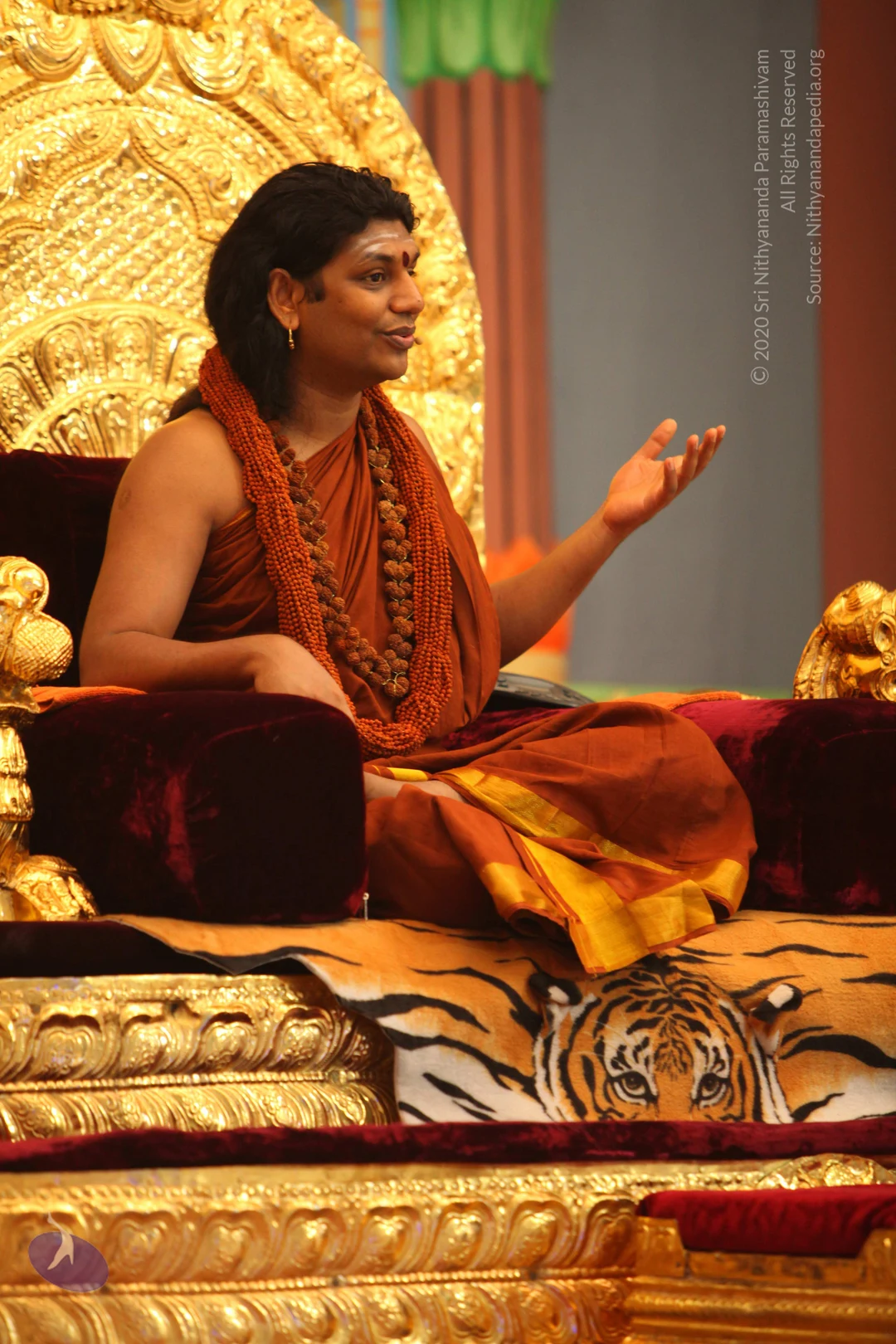
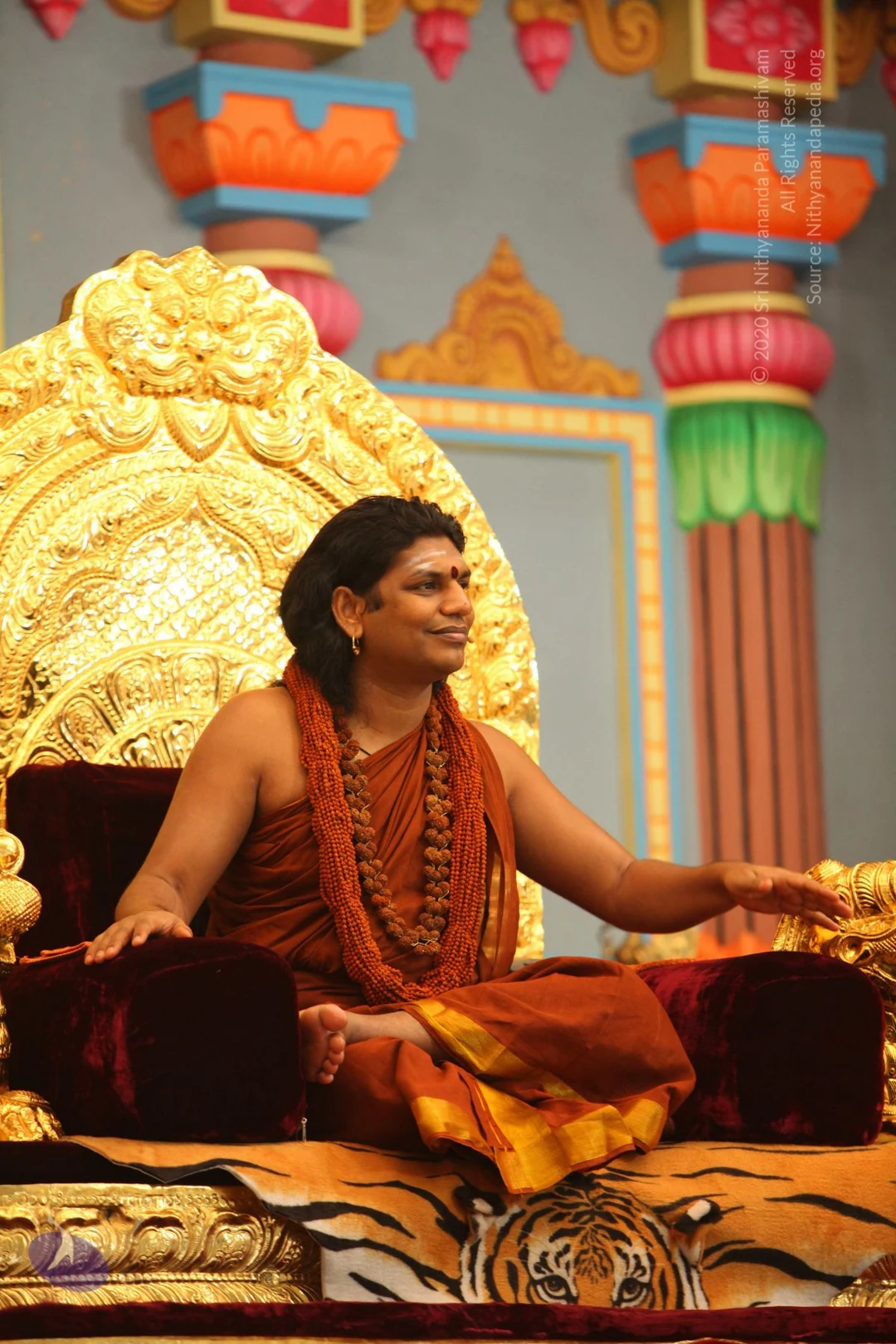
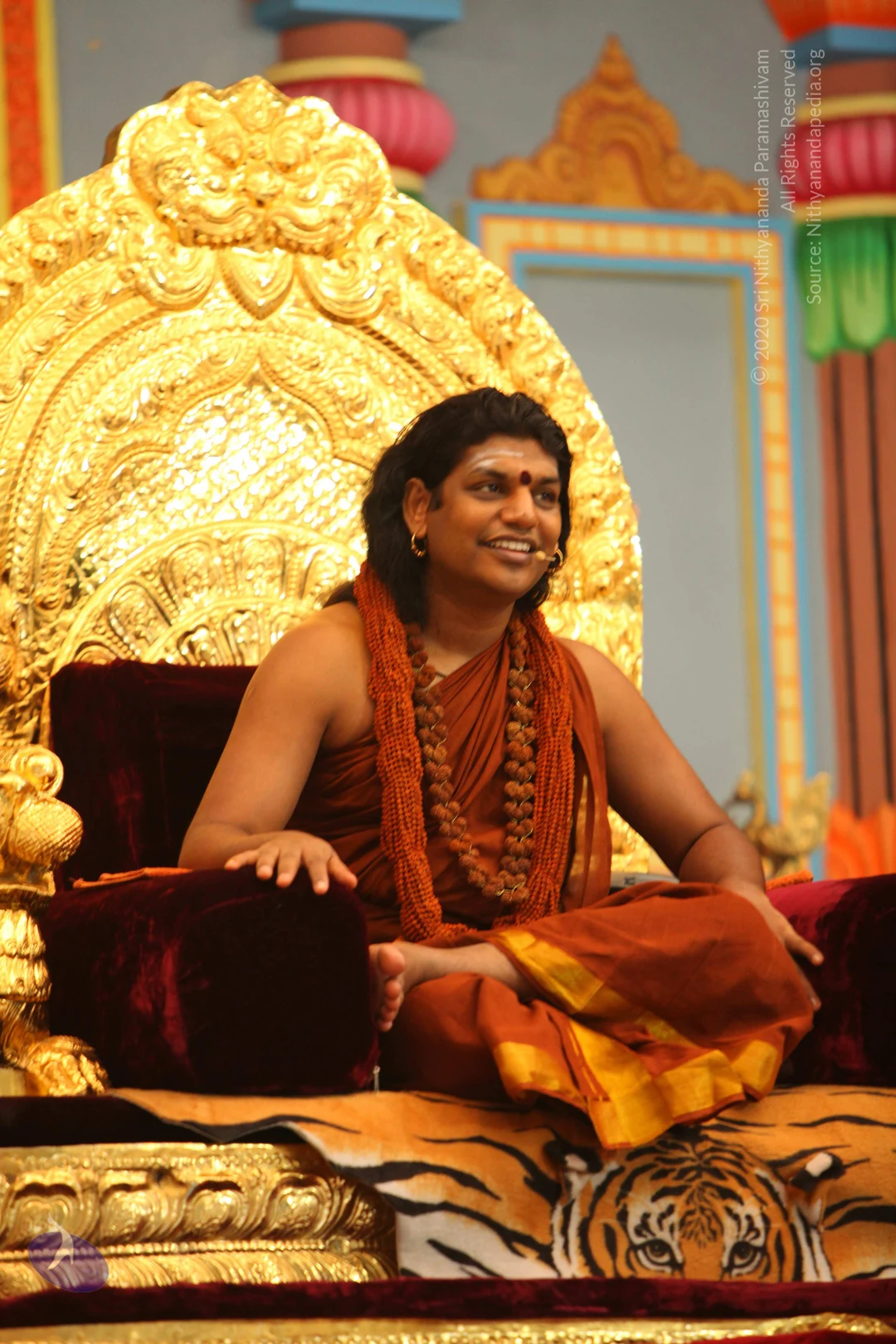
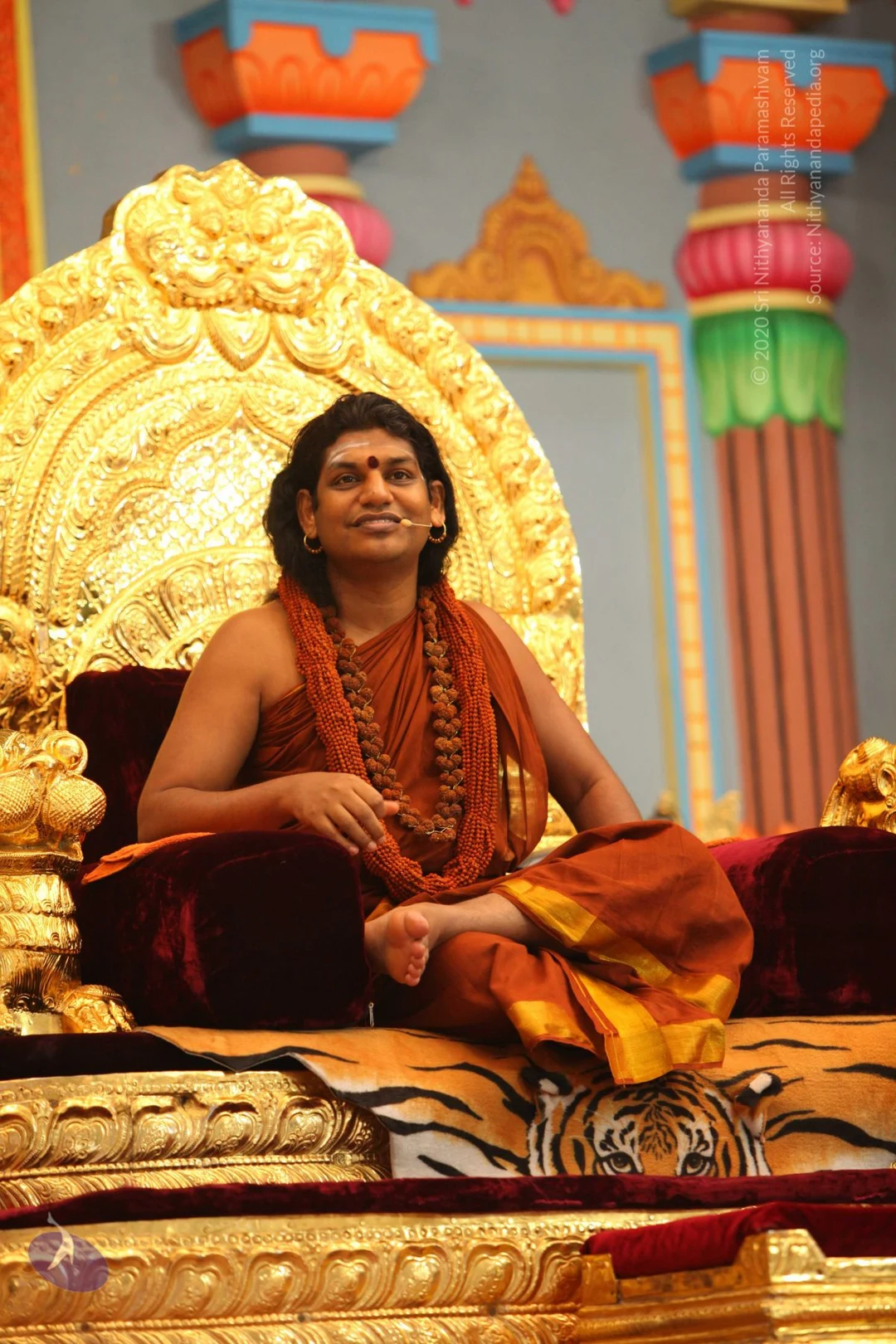
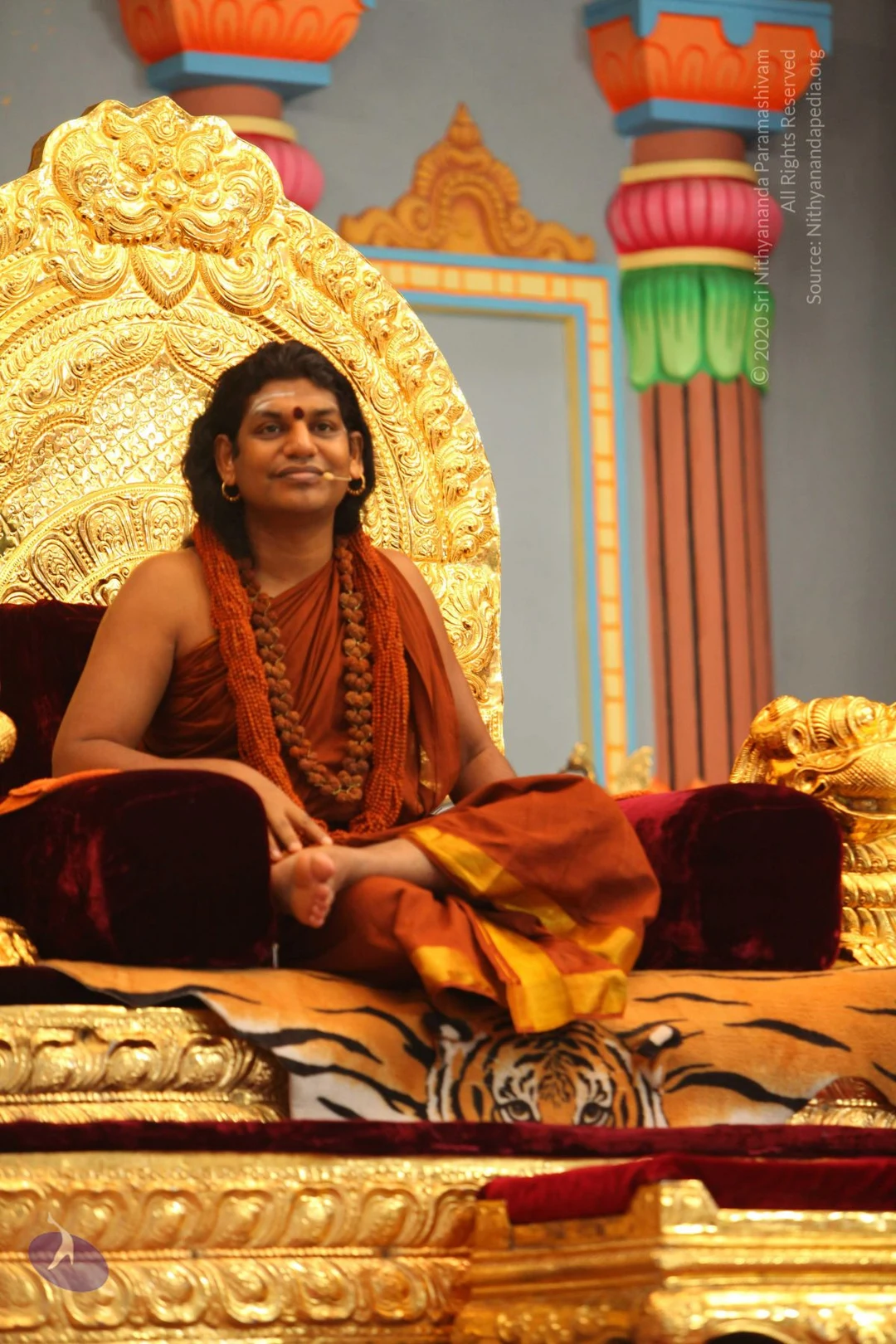
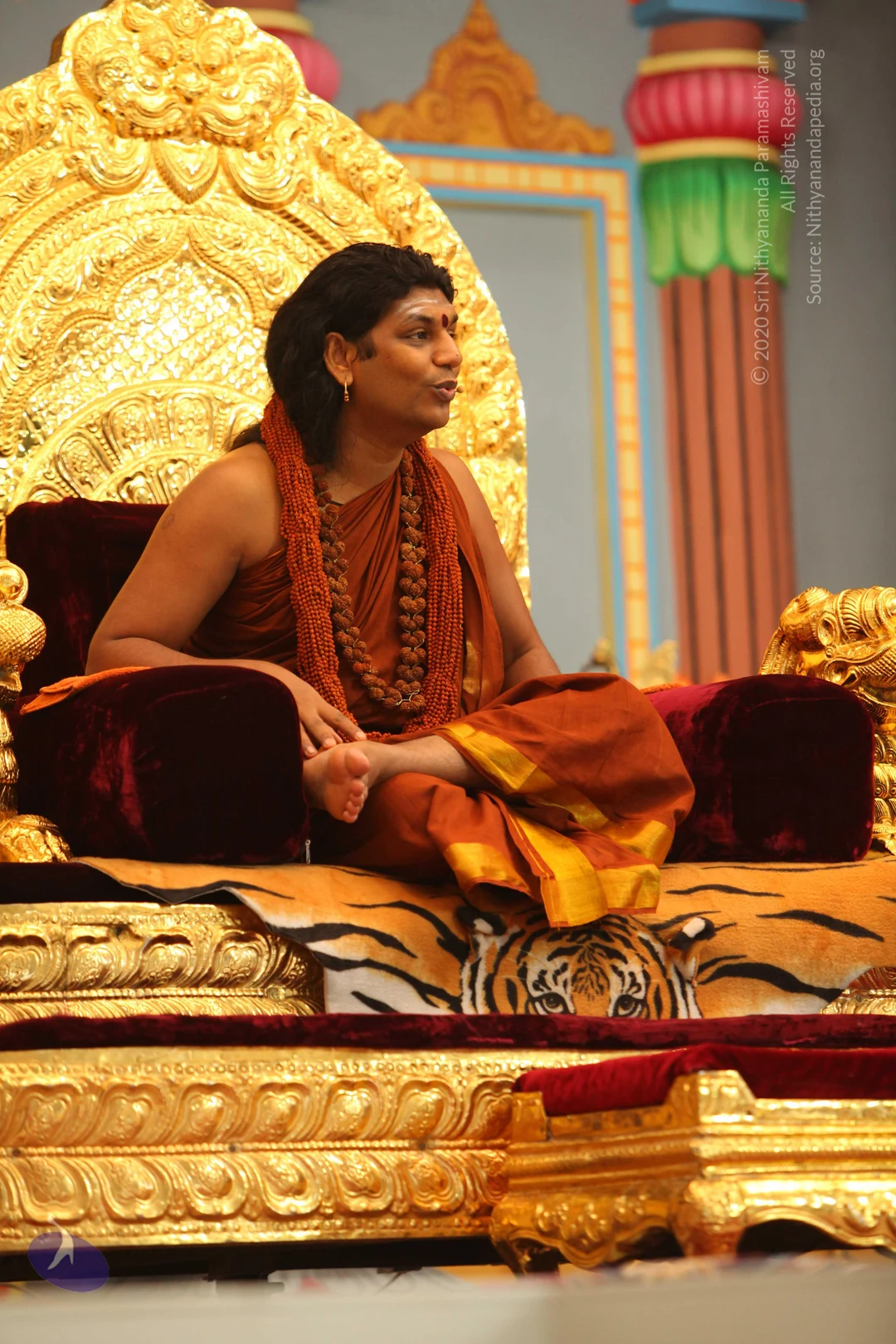
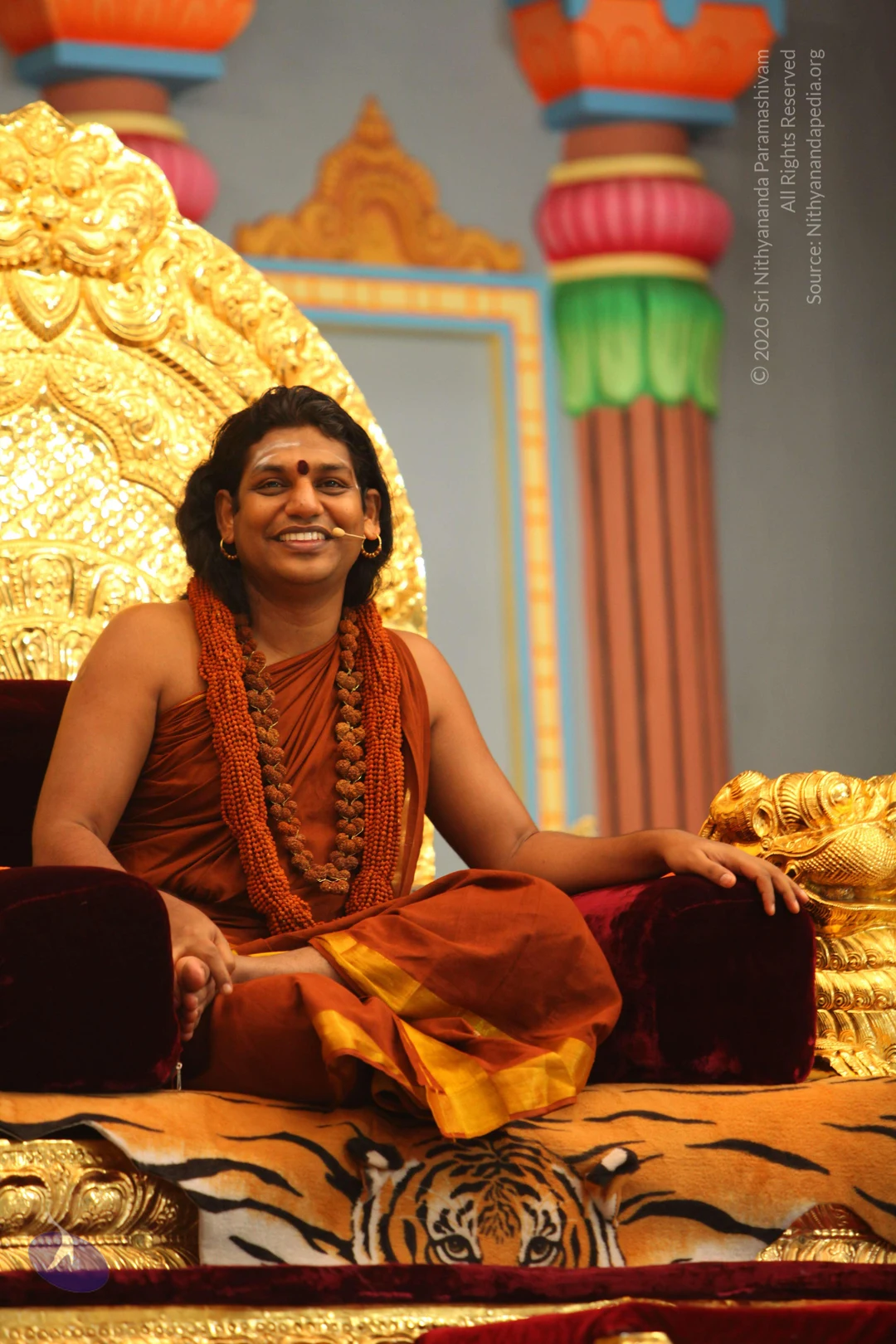
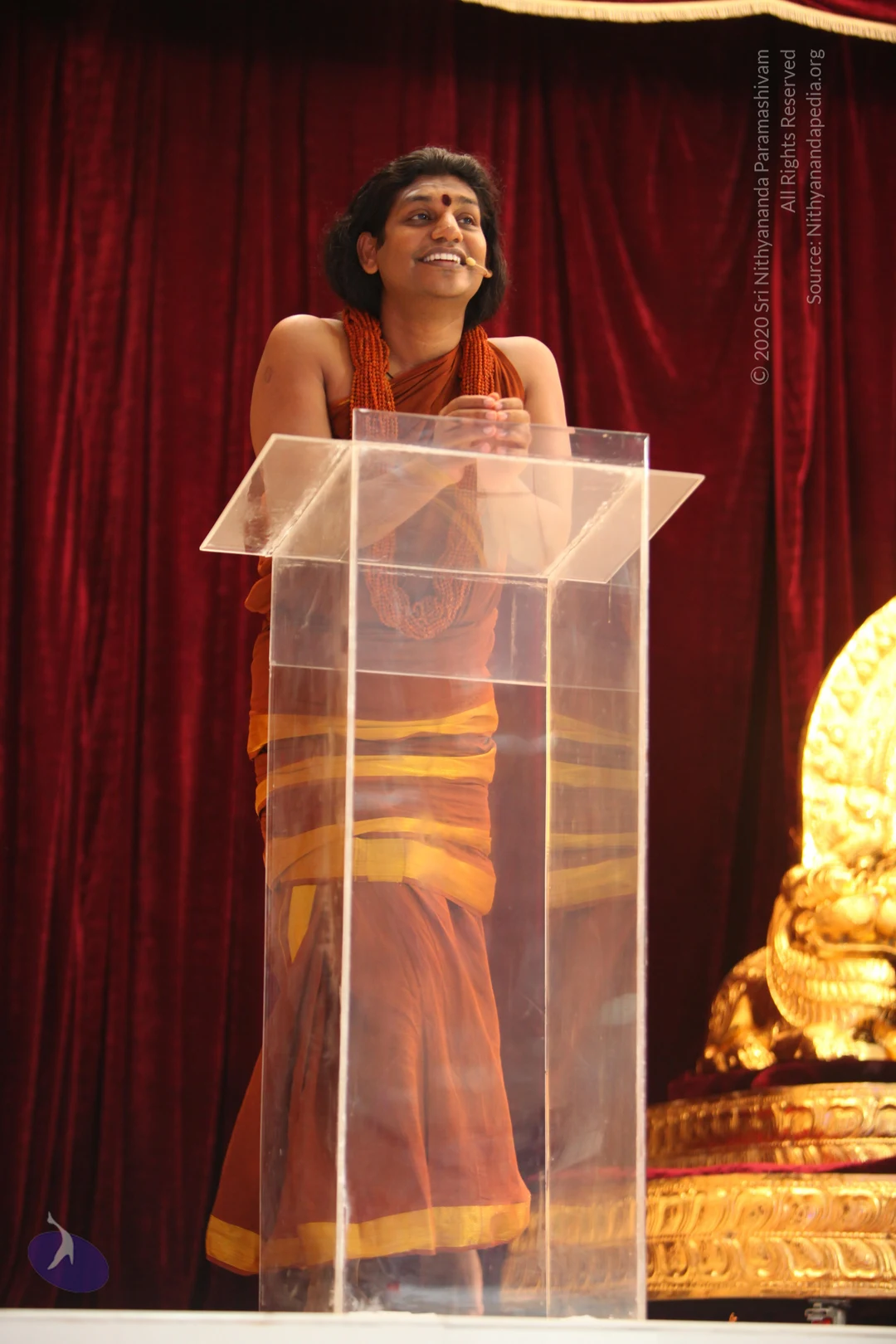
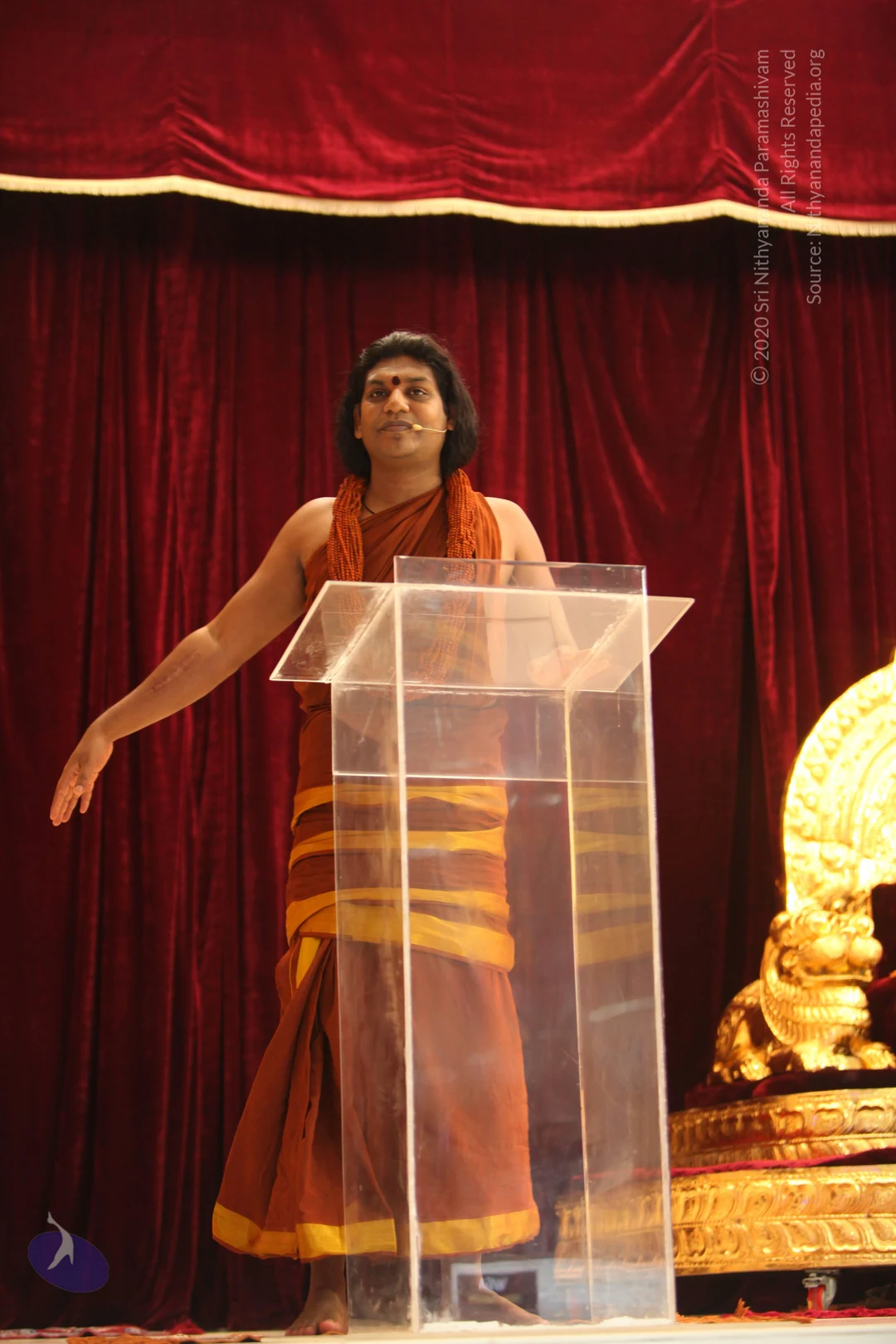
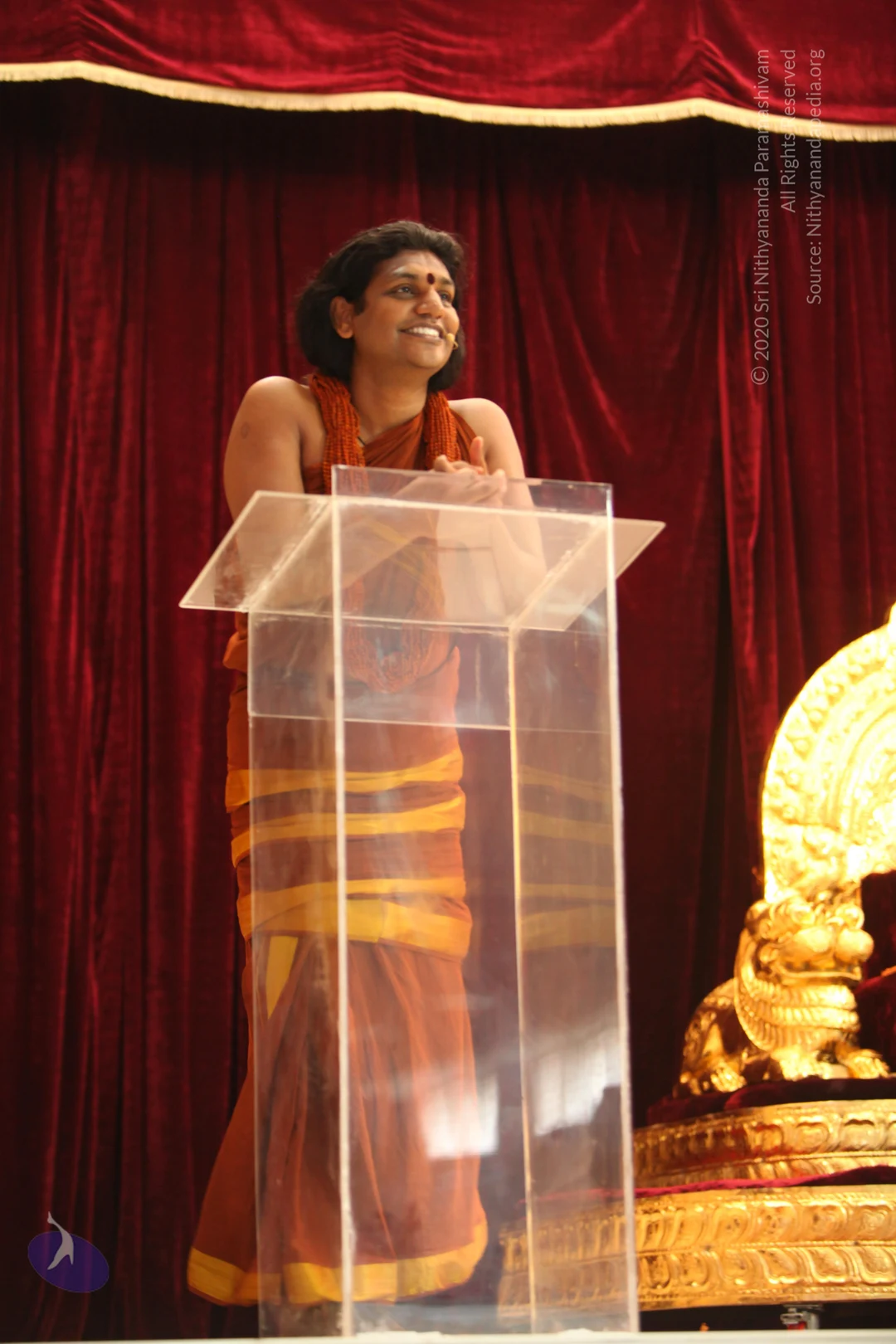
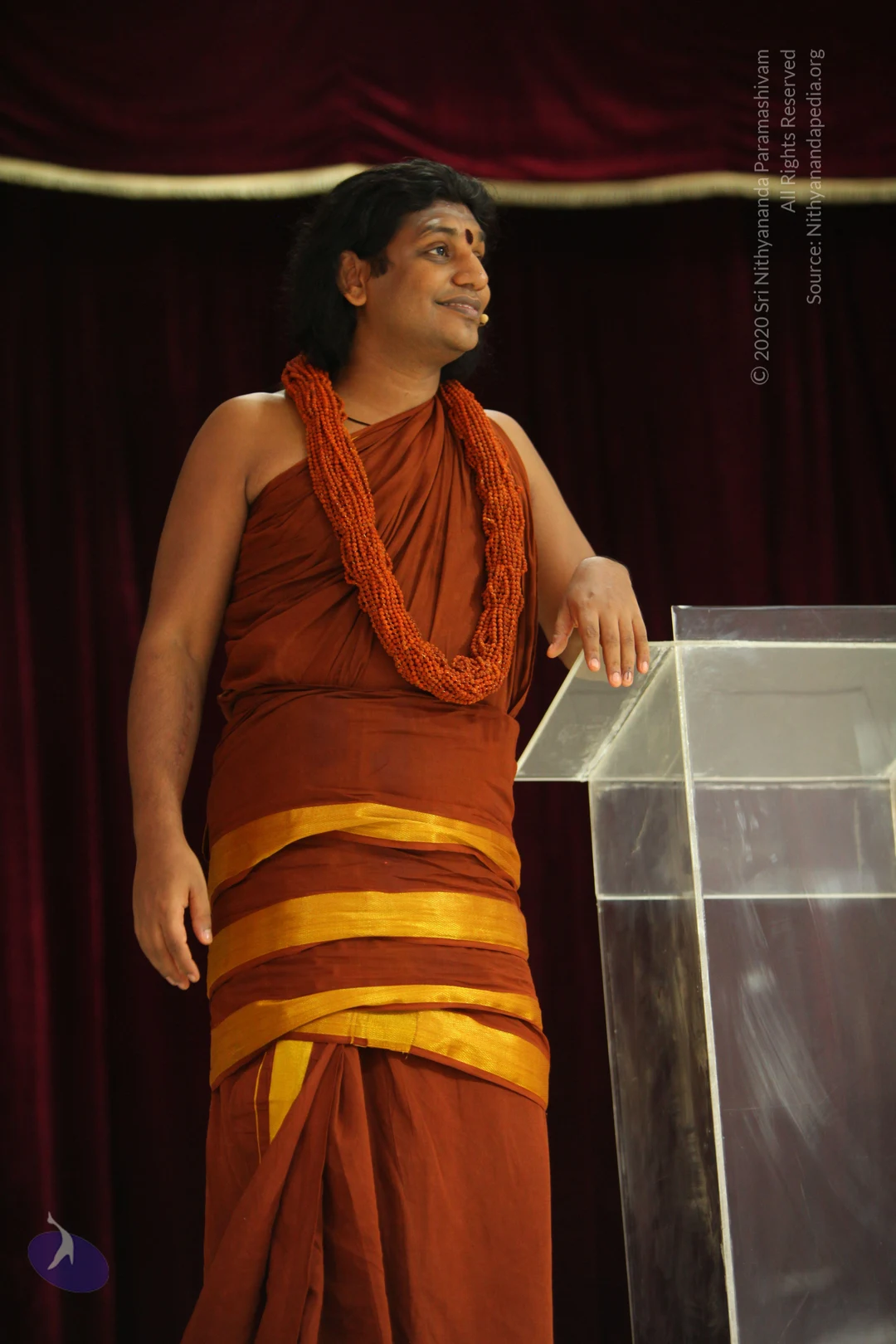
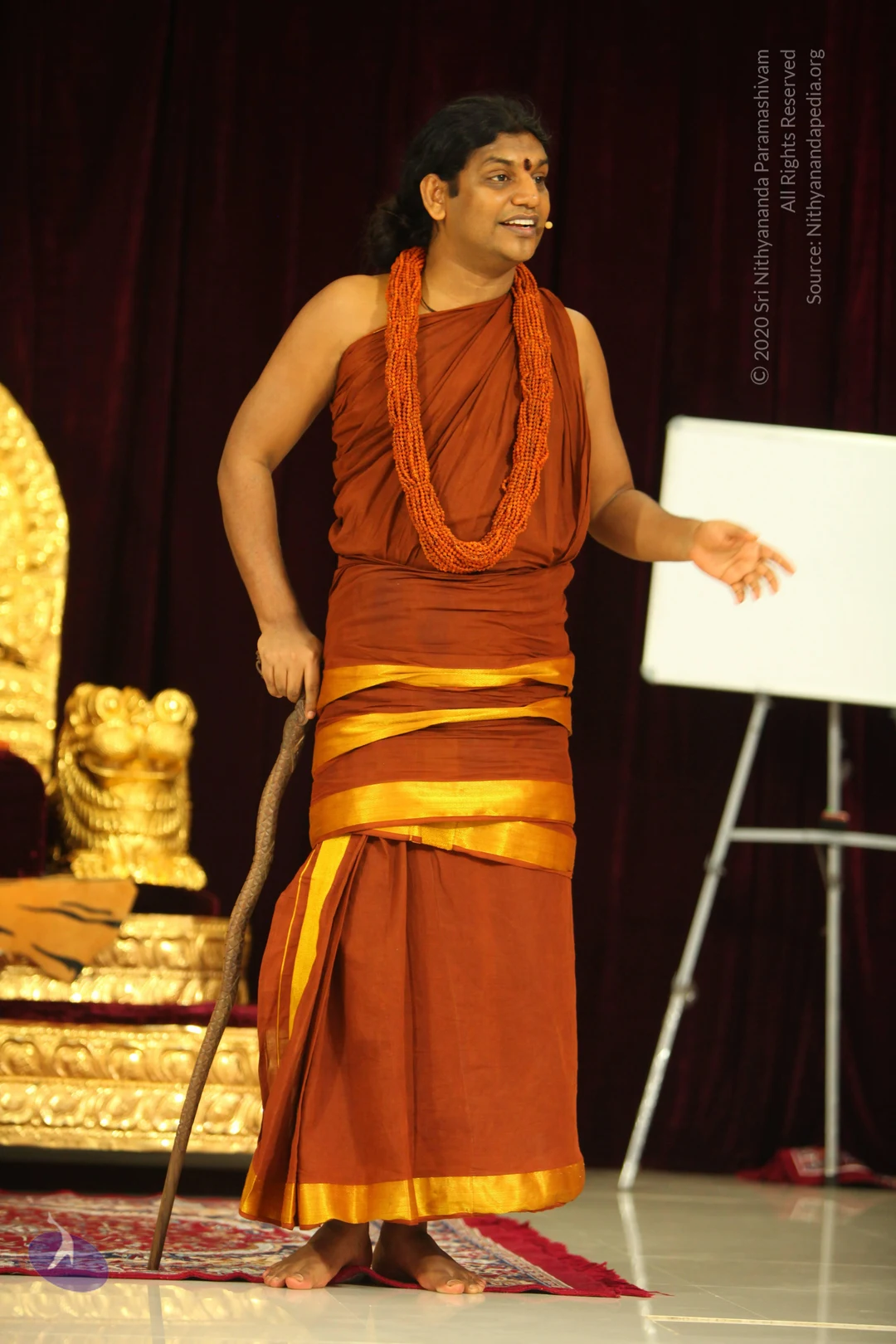
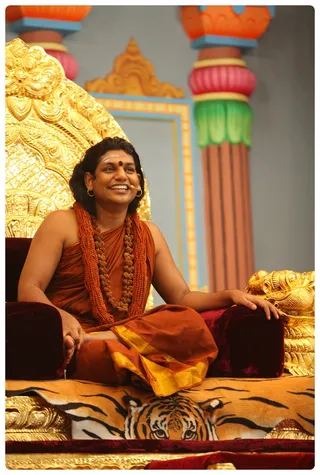
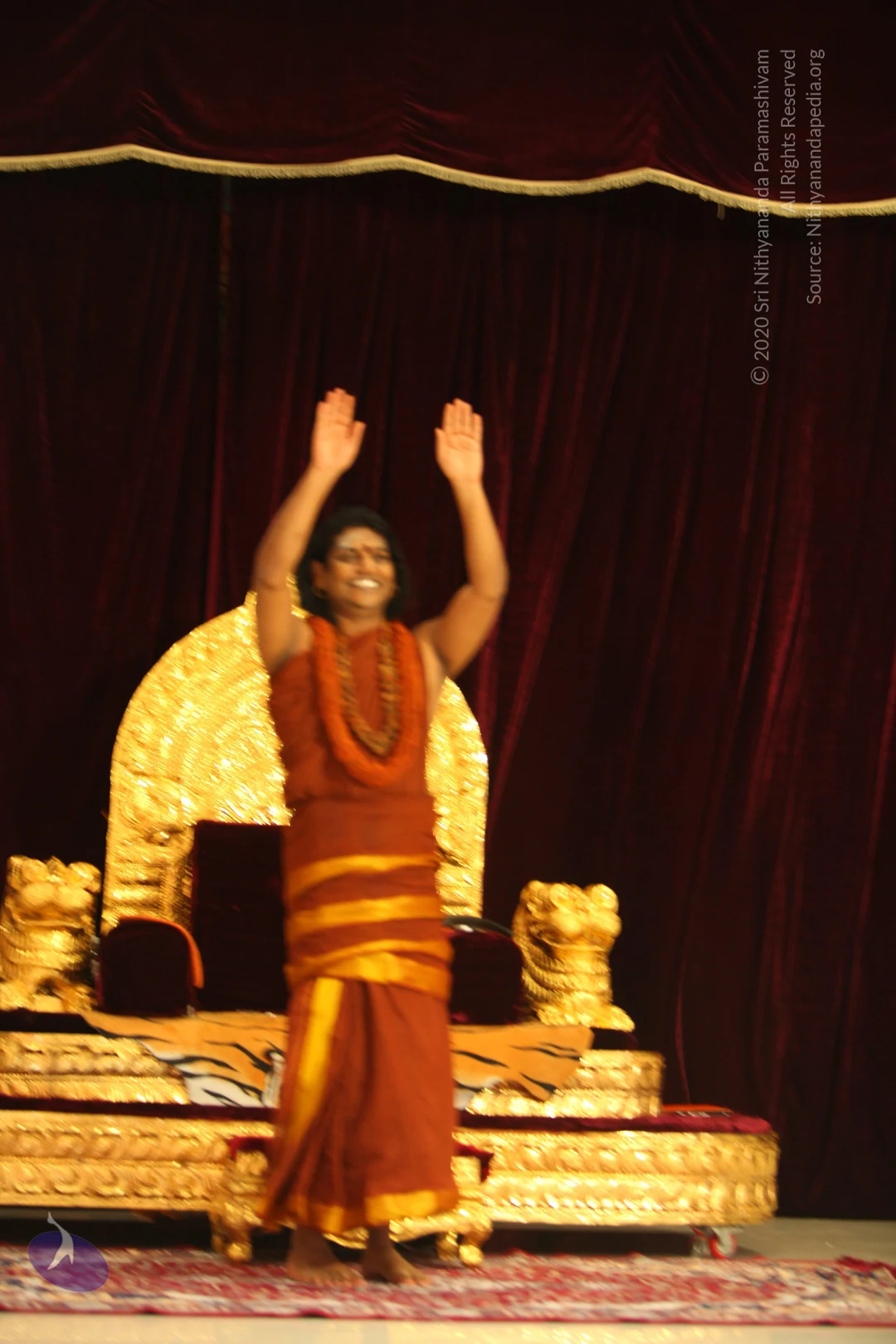
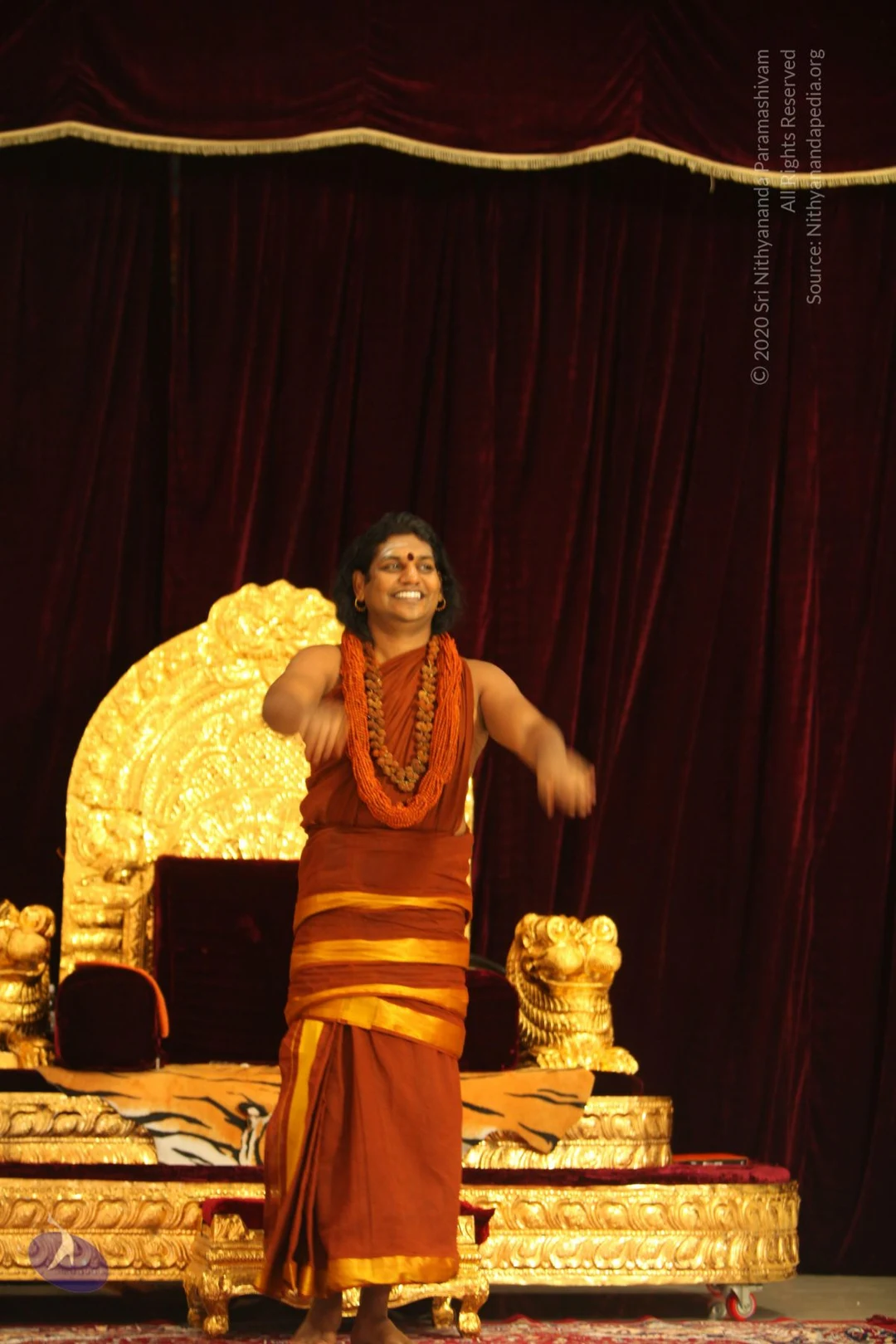
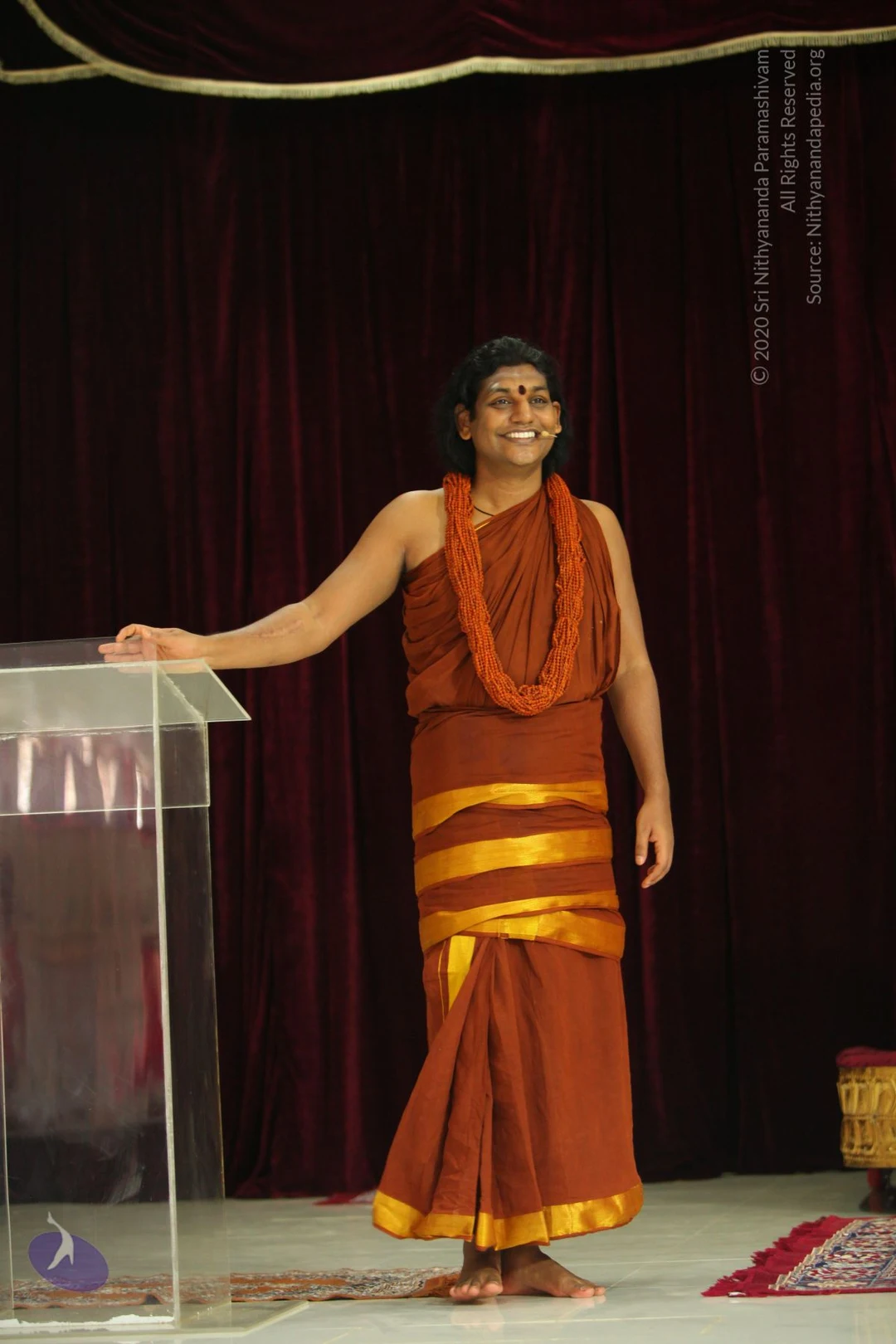
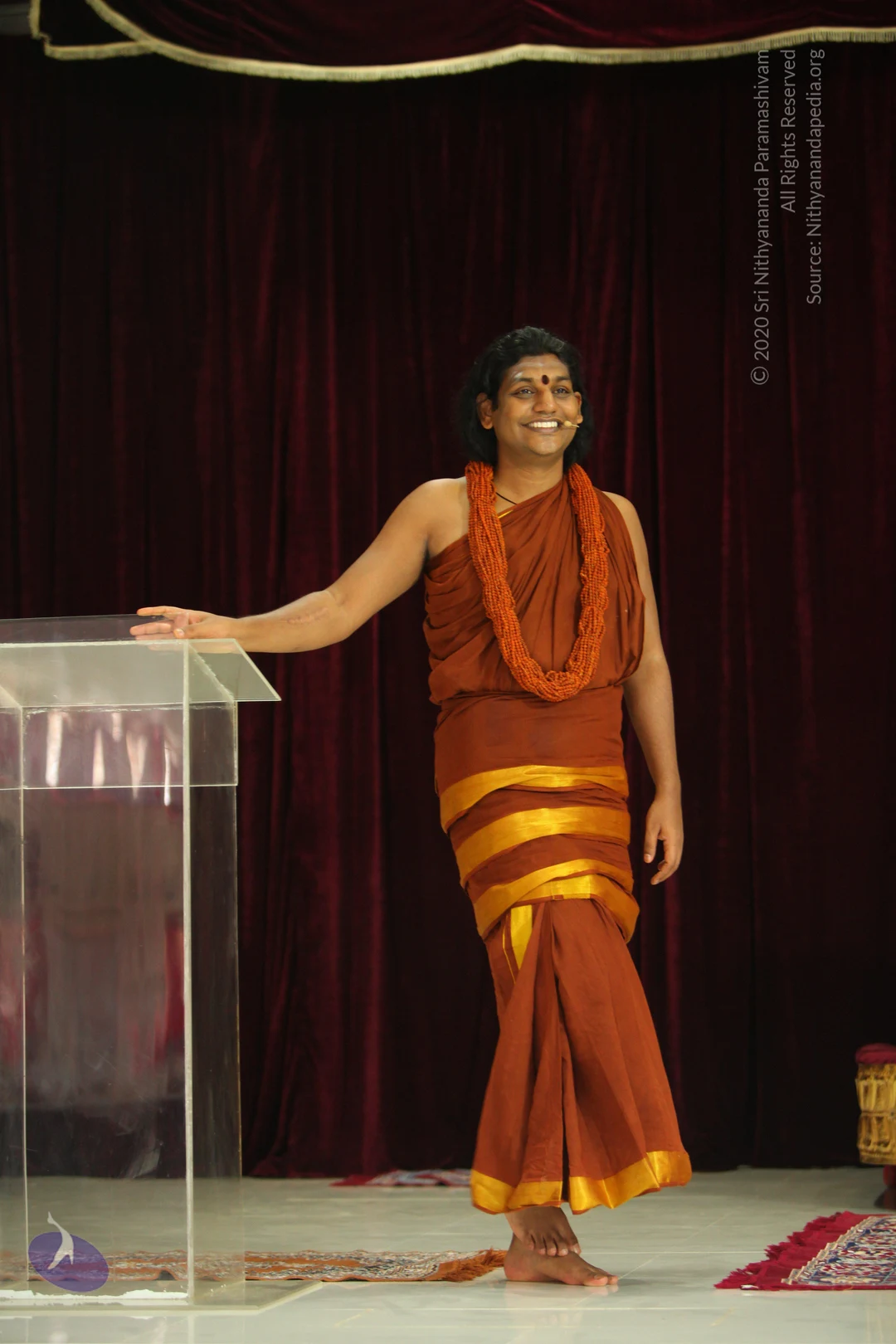
A smiling man with shoulder-length swept-back dark hair sits cross-legged on an ornate gold throne upholstered in deep red velvet, draped over a tiger-skin rug. He wears a saffron-orange unstitched robe with a gold border, a long multi-strand rudraksha mala, a small red bindi-style mark on his forehead and a small microphone at his cheek. He rests one hand on the gold lion-head armrest. Behind him stand orange and green lotus-capped pillars and a golden arch. Probable Swamiji (probable), seated on a throne in a satsang setting, with his long hair, saffron robe and rudraksha mala as the identifying cues.A smiling man in saffron-orange robes and a saffron shawl sits cross-legged on an ornate golden throne with lion-head armrests and a tiger-skin rug draped over the platform. He wears a rudraksha mala and layered beaded necklaces, a red bindi on his forehead, and hoop earrings. Behind him, painted deity figures with multiple arms stand on either side of a gold-carved arched backdrop. The Swamiji (probable) cues are the long swept-back hair, saffron clothing, rudraksha malas and ornate setting, but the figure is seated on a throne in a satsang-style setting, so this is an in-person candidate with moderate appearance certainty.A smiling man with long dark hair sits cross-legged on an ornate golden throne with lion-headed armrests, on a tiger-striped cloth. He wears an orange-saffron cloth draped over his shoulders and bare chest, a red-orange rudraksha mala with a gold-toned pendant, a red bindi, and a headset microphone. His right hand is raised mid-gesture as he speaks. Gilded carvings fill the background, and painted figures with raised arms appear at the edges. Only one physical person is visible.A photograph of a smiling man seated in an orange leather reclining armchair against a deep red velvet curtain. He wears a brown-orange saffron robe with a yellow-and-gold border, a long orange rudraksha mala draped across his chest, and a red bindi on his forehead, with a small headset microphone at his mouth. His arms are spread open on the chair's wooden armrests in a welcoming gesture. a person: the candidate is shown with long swept-back hair, saffron robe and rudraksha mala, seated as a speaker during a satsang discourse.A standing man in a rust-orange saffron wrap with gold-bordered drapes speaks on a stage before deep burgundy velvet curtains with gold trim. He wears a long orange rudraksha-style mala around his neck and a small red bindi, and has a headset microphone. His left hand rests on a clear acrylic lectern, and a low woven drum stands at the right edge beside a red patterned rug. a person's appearance: the orange clothing and ornate mala with a microphone at a discourse podium fit a satsang setting, though the shaved-or-short-hair presentation here is uncertain.

photos

5 photosSource gallery
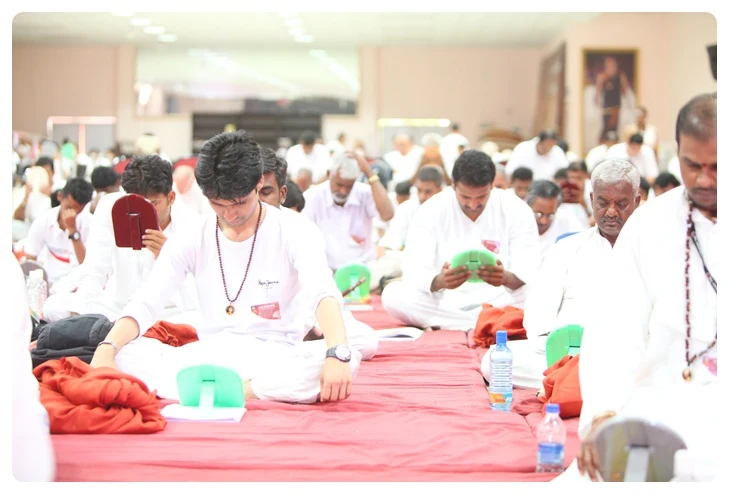
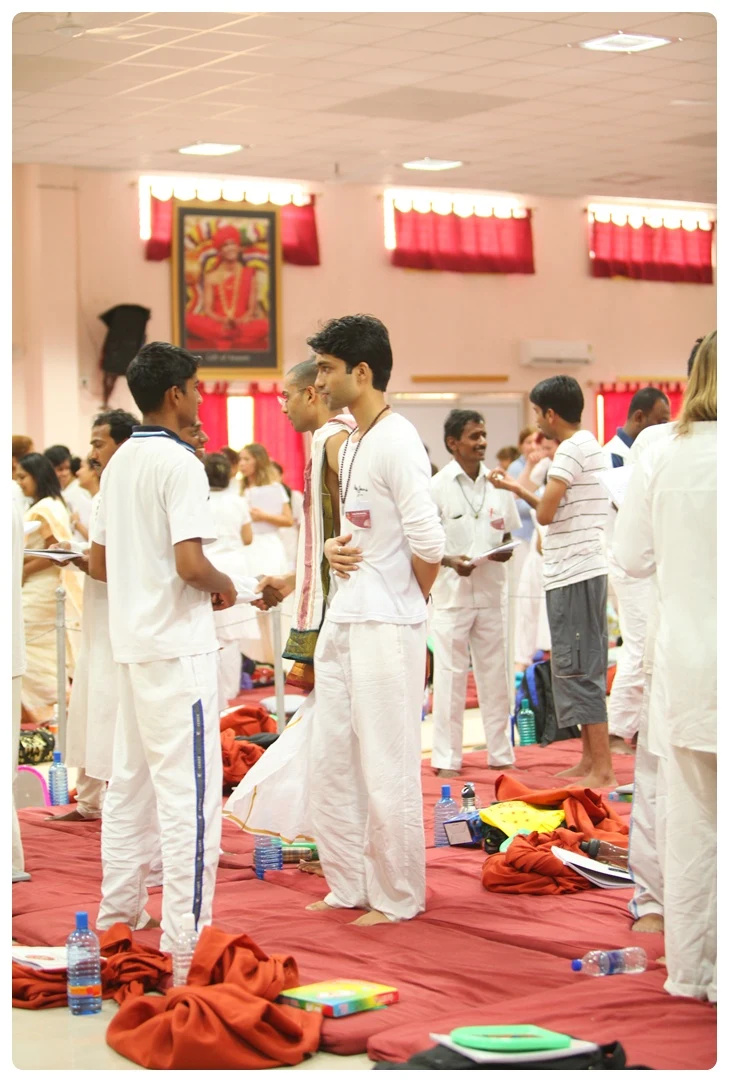
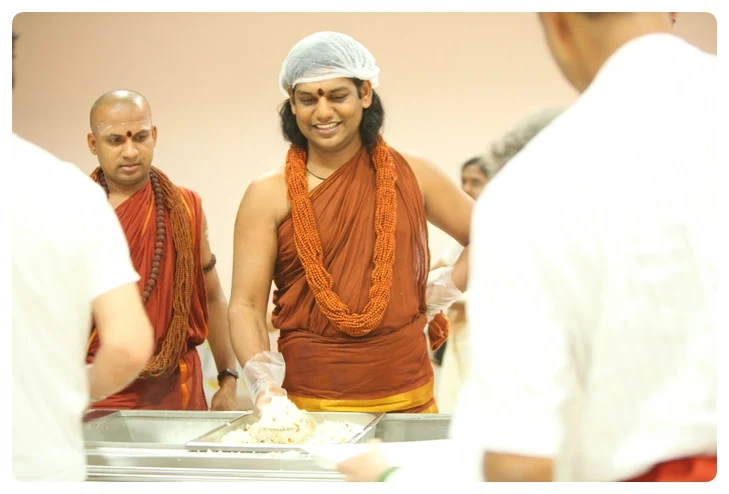
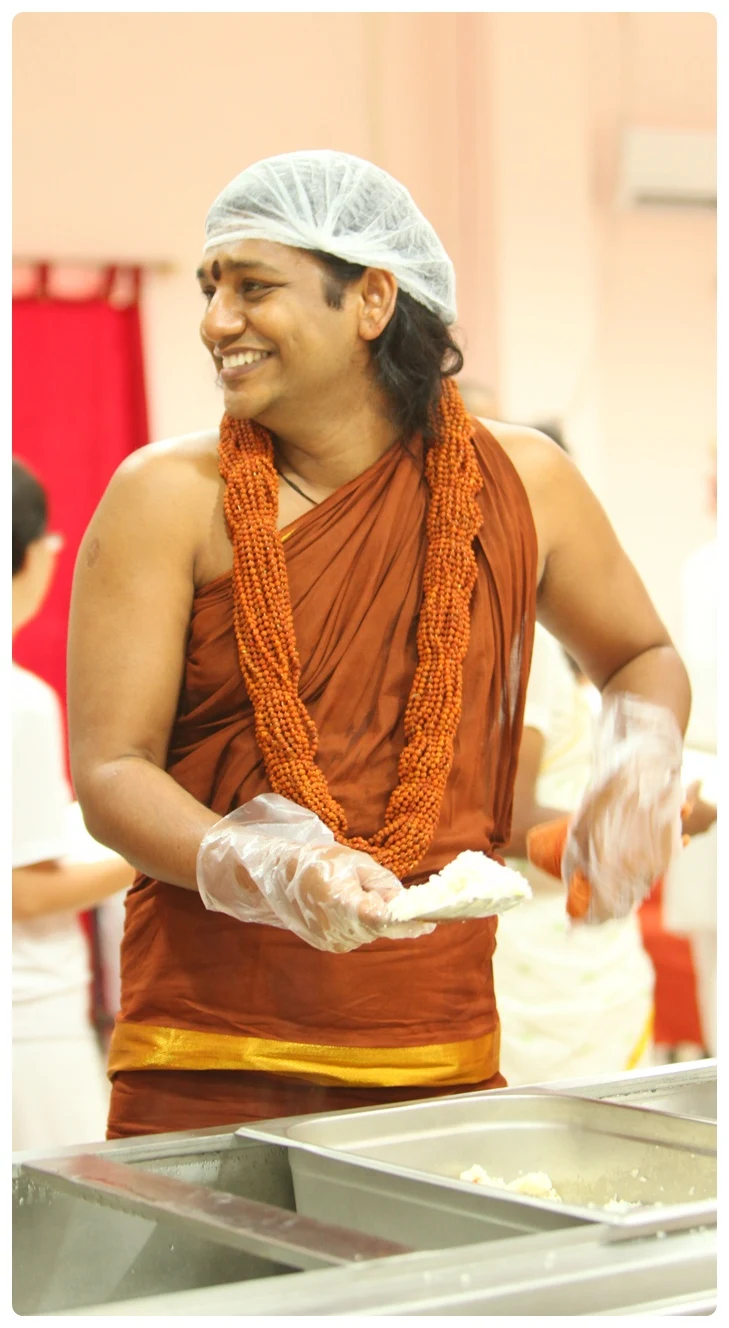
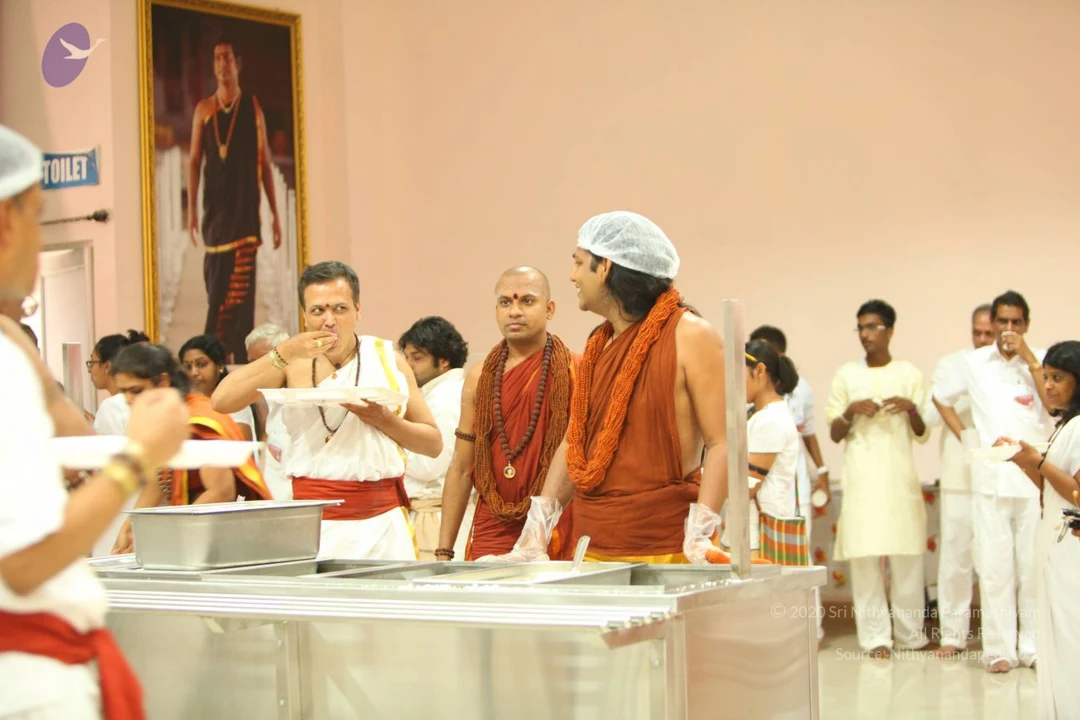
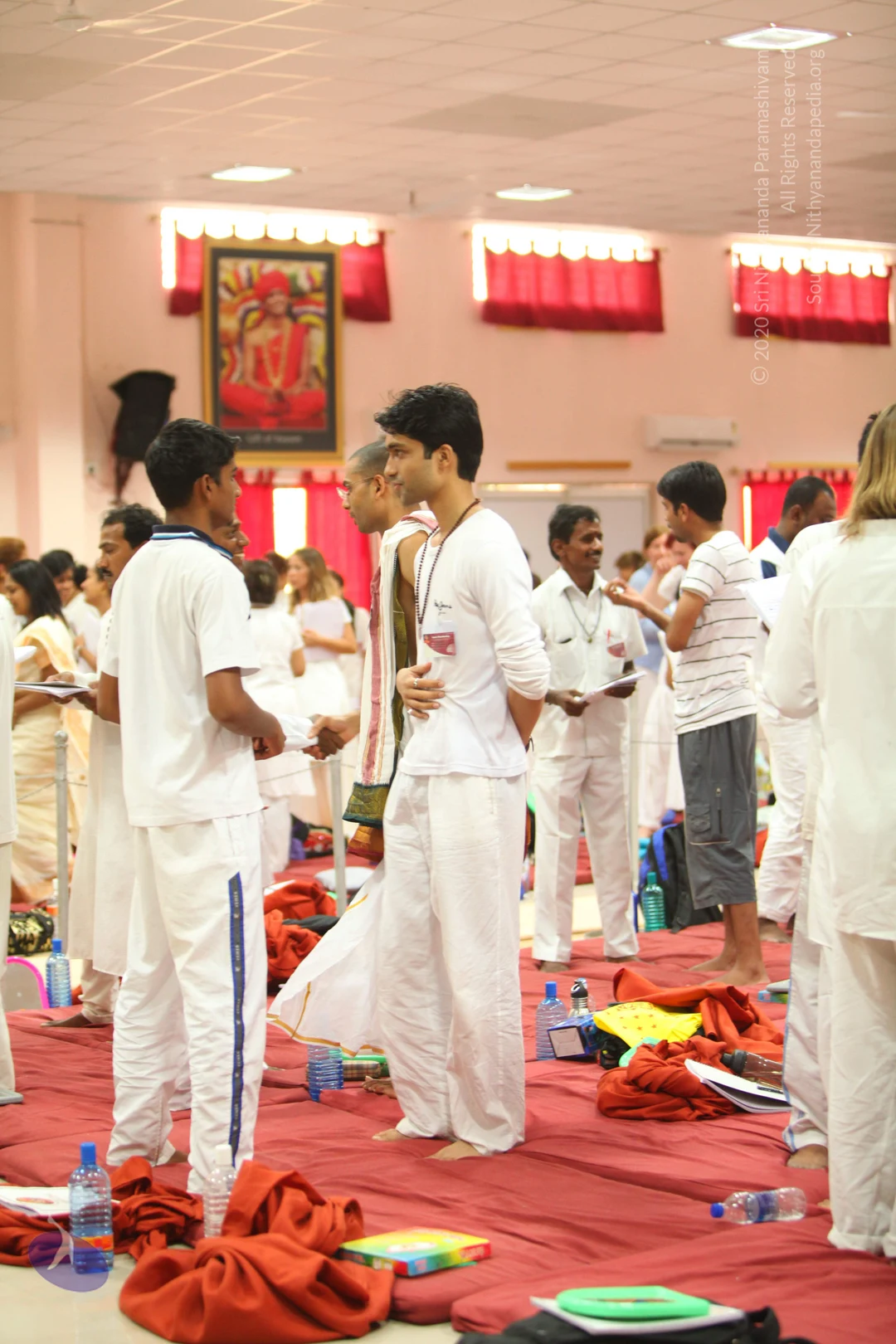
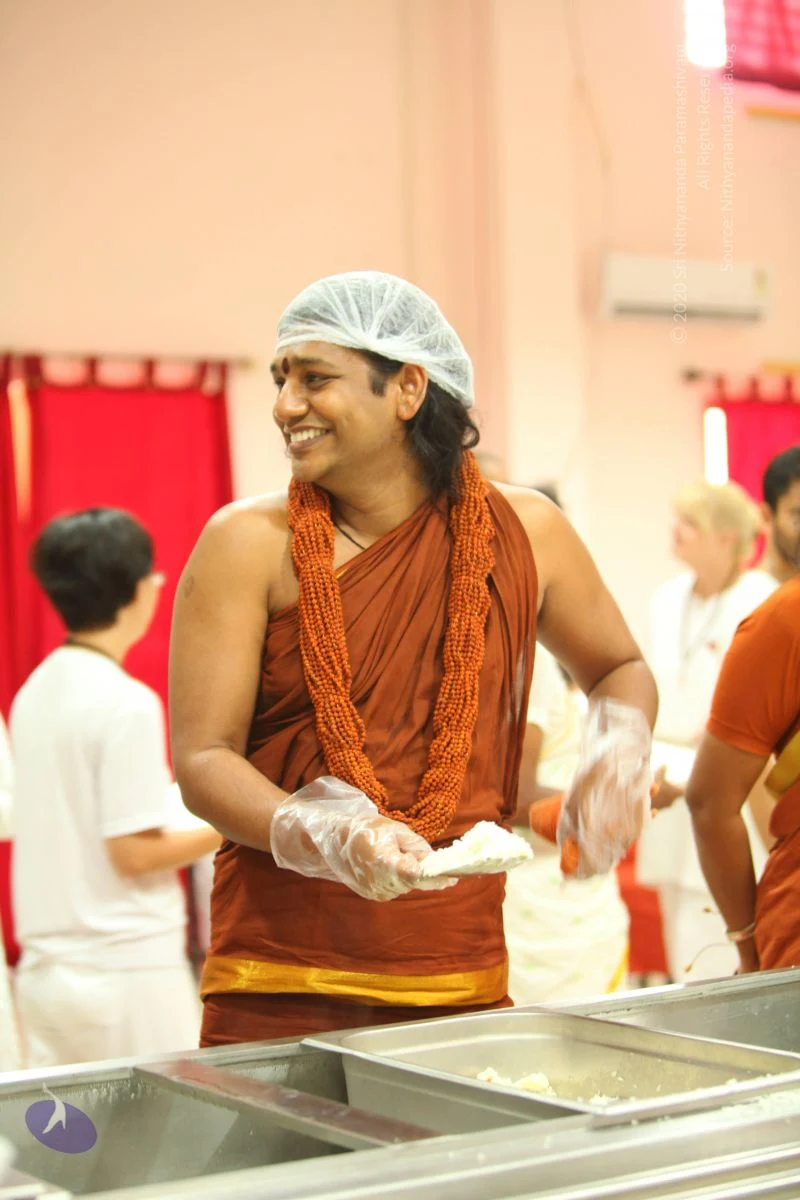
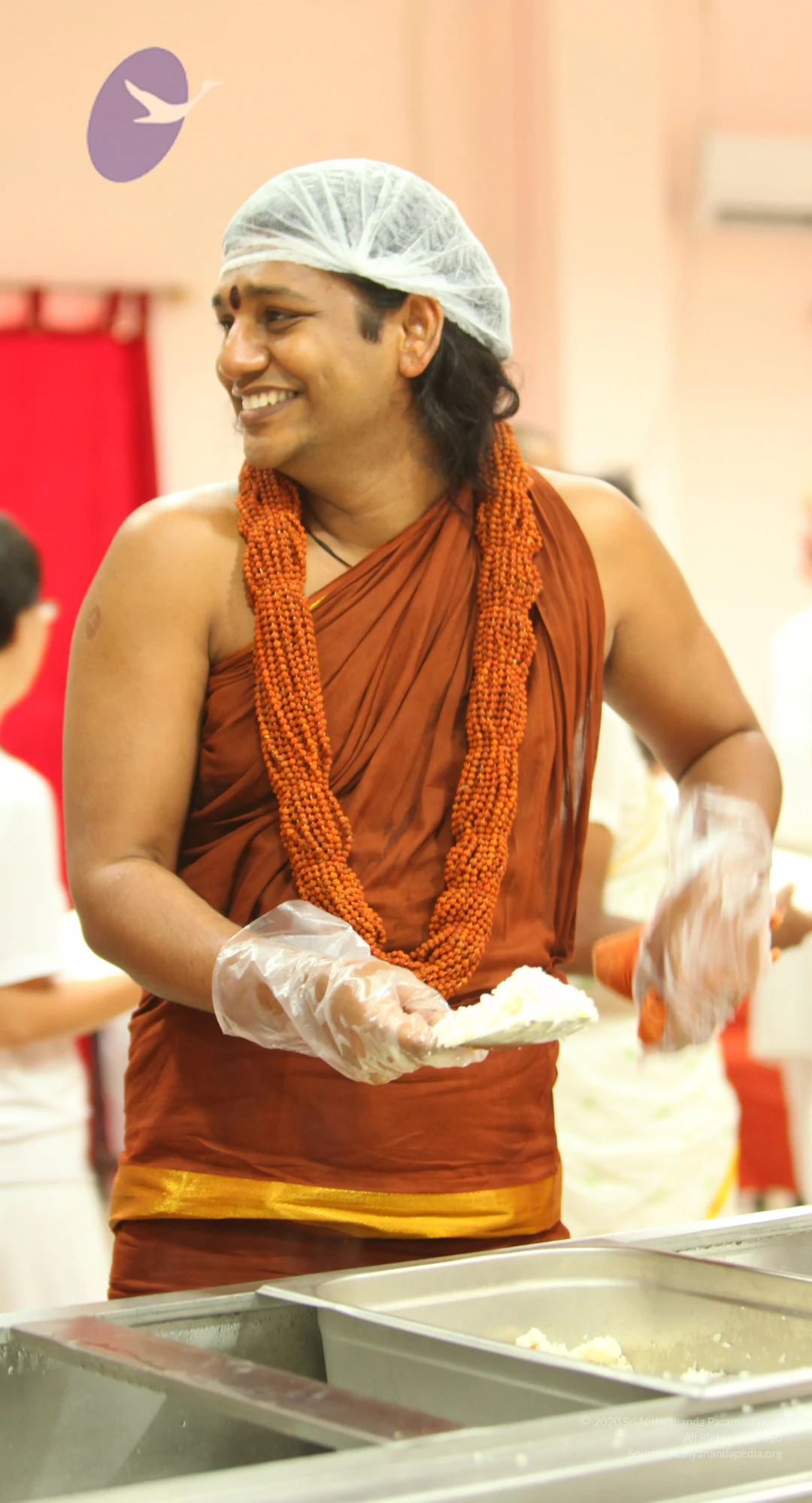
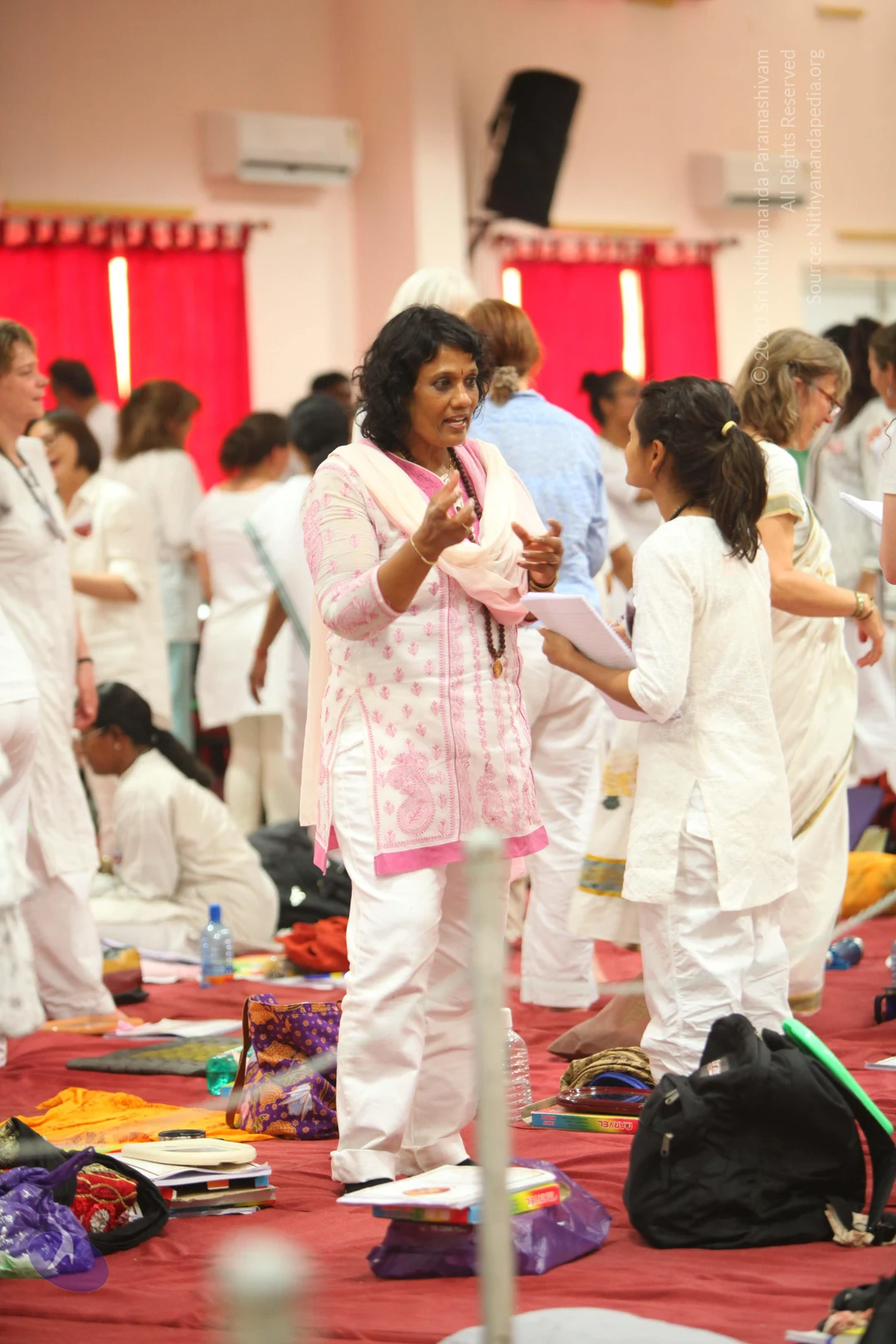
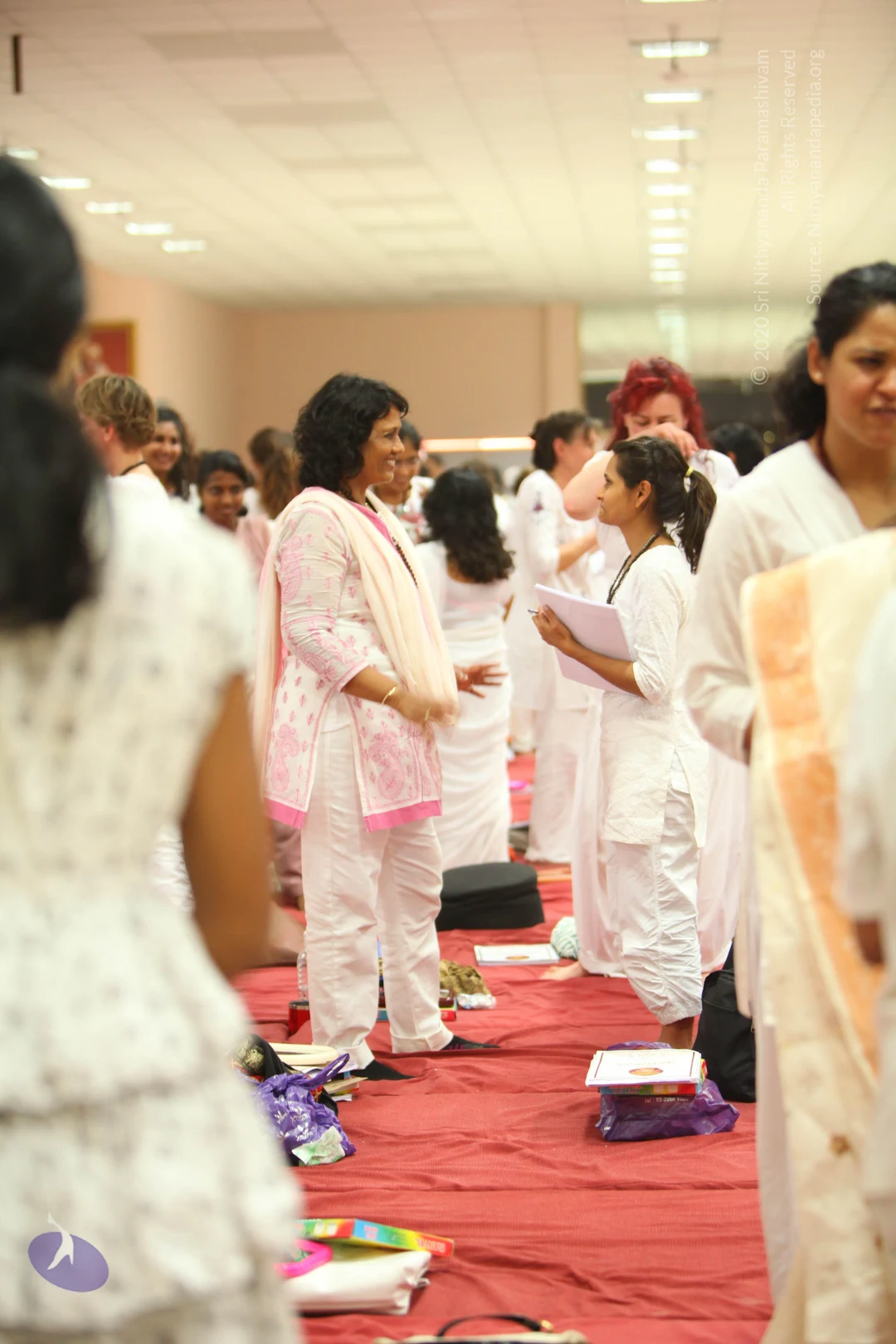
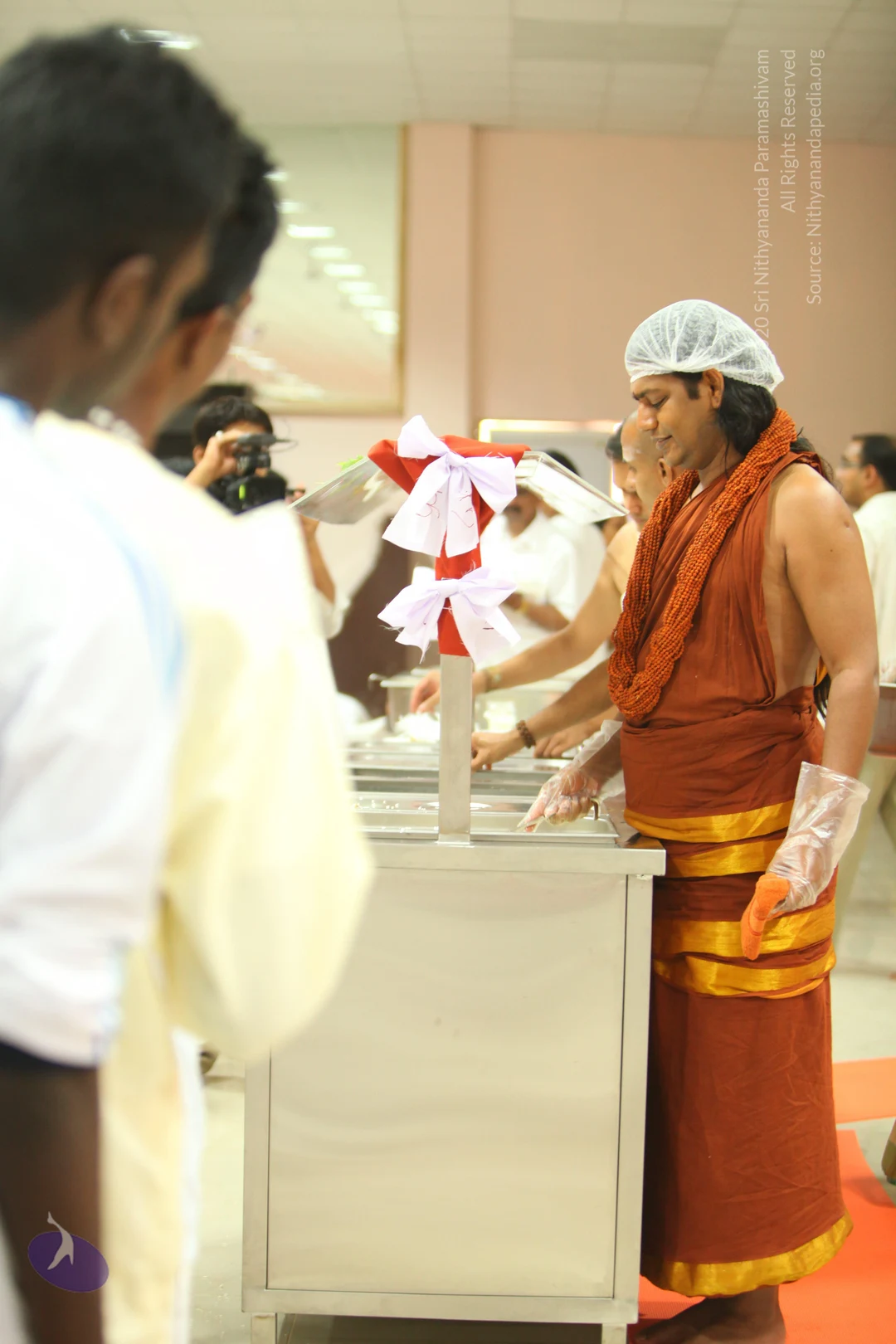
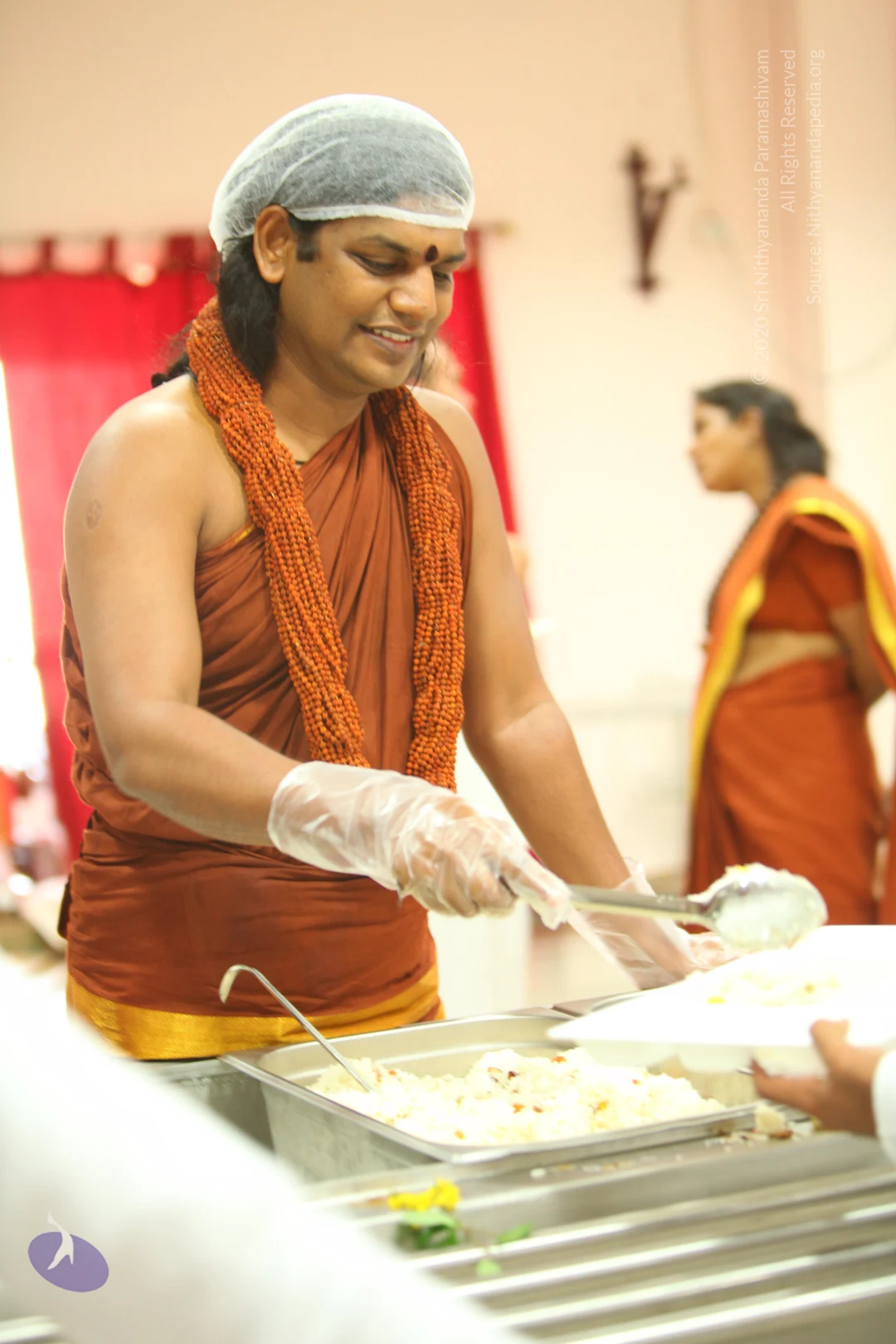
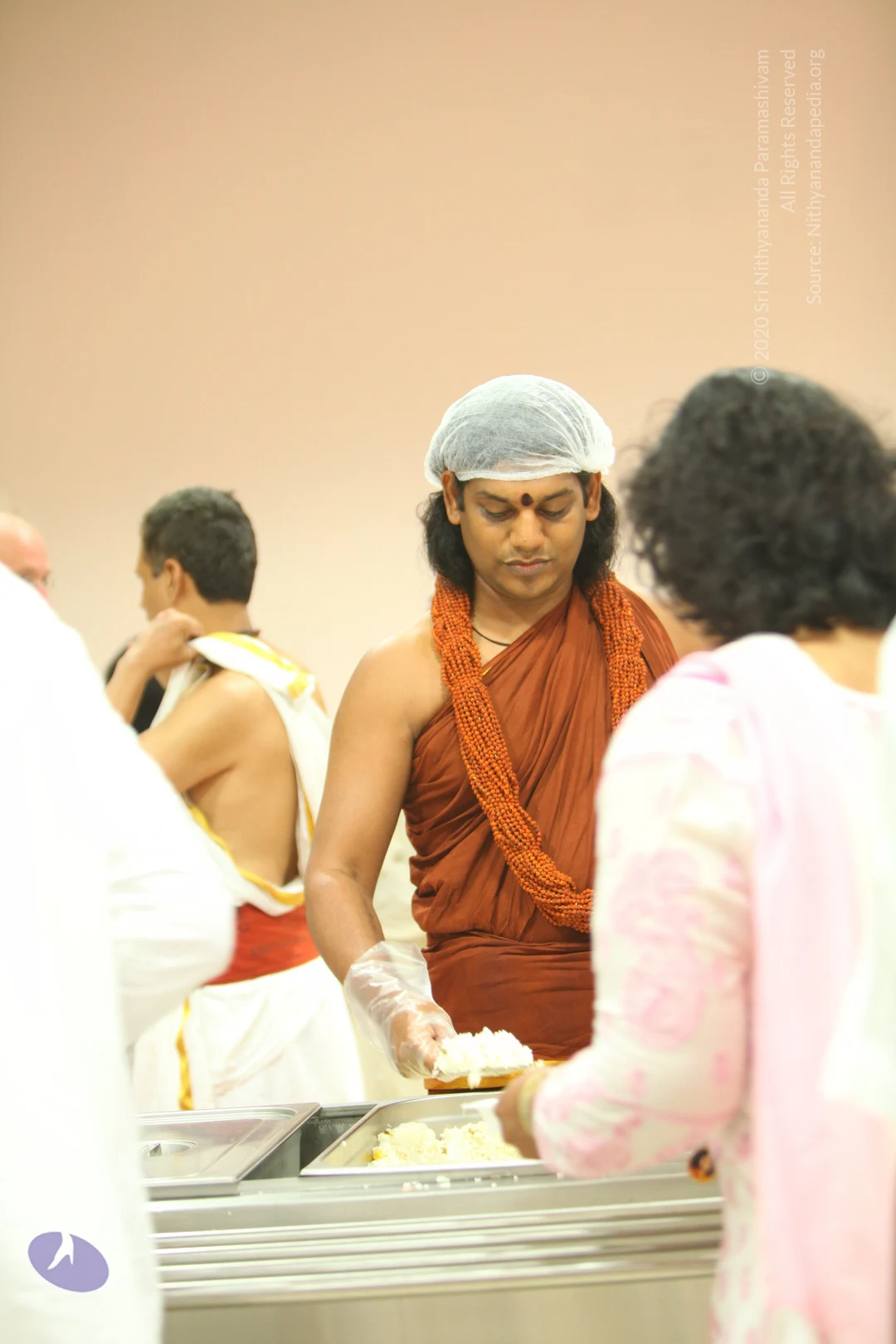
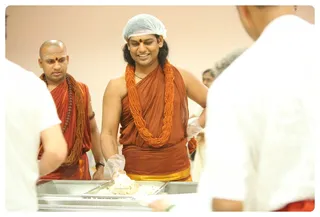
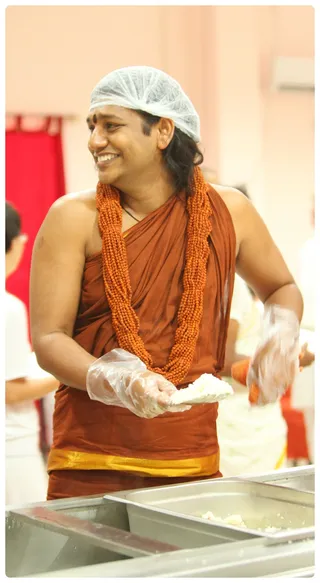
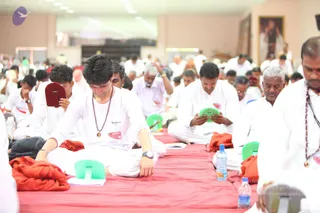
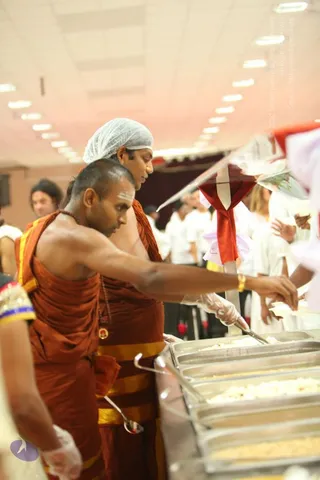
A large hall of seated devotees in white clothes and rudraksha malas, sitting on red cloth mats with orange shawls and green cushions. In the foreground a young man in a white shirt with a red name tag and rudraksha mala looks down at a red booklet, and a man in white beside him holds a green item and reads. Water bottles sit on the mats. Behind them many more devotees are seated in rows, some with heads bowed in meditation, and a framed portrait hangs on the far wall. No a person candidate is clearly visible in the scene.Indoor photo in a hall with pink walls, red drapes and framed deity portraits. Two men shake hands in the foreground. The man on the left has long, light-brown hair and wears a white short-sleeved shirt and white trousers, barefoot. The man on the right has short hair and glasses and wears a white dhoti with a red-and-gold bordered shawl draped over one shoulder, a wristwatch on his left wrist, and a paper in his hand. Behind them, several people in white ritual clothing stand and sit on a red mat; a woman in a white sari with red border stands at left. A water bottle, a black bag and a notebook sit on the floor.Indoor photo of a hall with pink walls and red curtains under fluorescent ceiling lights. A framed poster of a seated figure in red and gold robes hangs on the wall. Several people in white clothing stand and talk on red mats strewn with saffron cloths, water bottles and notebooks. A young man in white kurta and trousers with a lanyard and a mala stands center-left, facing another man in white. A man in white with a lanyard holds papers at center-right, and a boy in a striped shirt and grey shorts stands nearby. Scattered devotees in white garments fill the background.A smiling man in a rust-orange sleeveless wrap with a gold border stands at a steel serving counter, wearing a white disposable hairnet and clear plastic gloves. He wears a long orange rudraksha mala around his neck and holds a handful of cooked white rice over a steel tray. Behind him, a figure in white clothing and a red curtain are visible. a person is shown serving food in a kitchen or annadan setting.

Temple-and-Deities

7 photosSource gallery
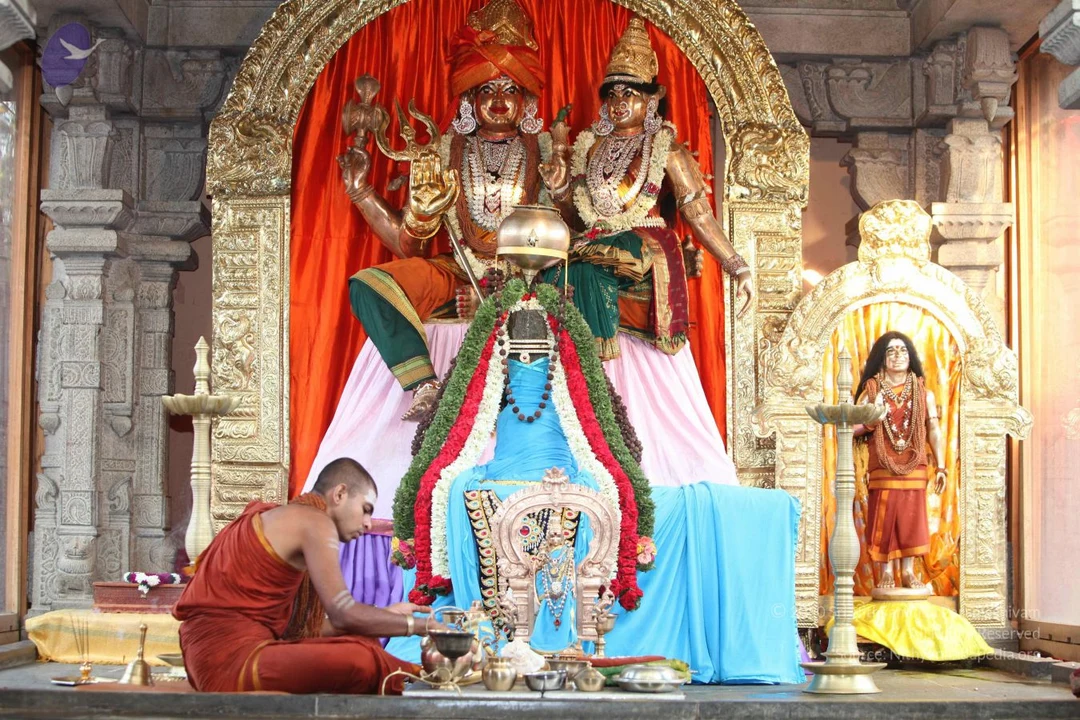
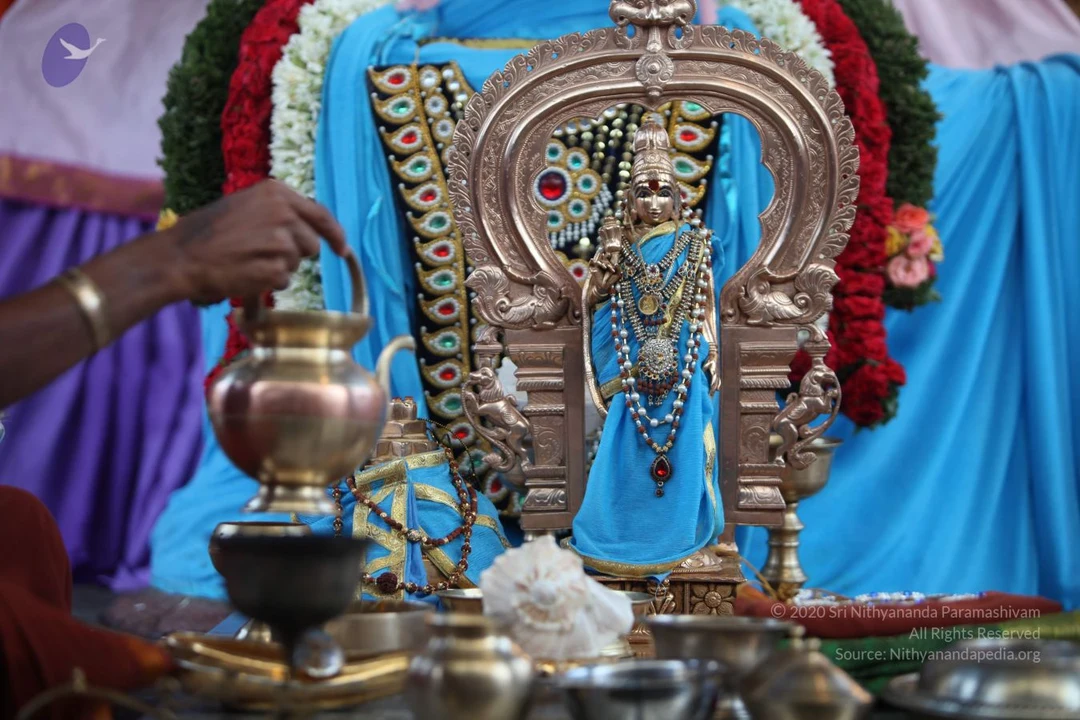
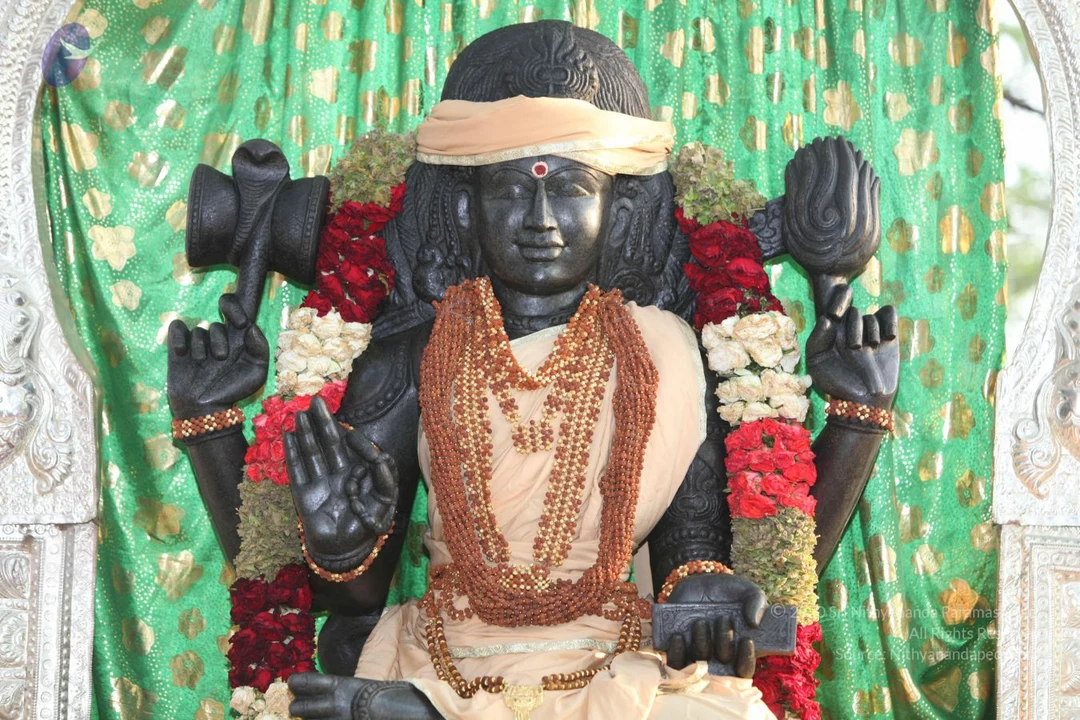
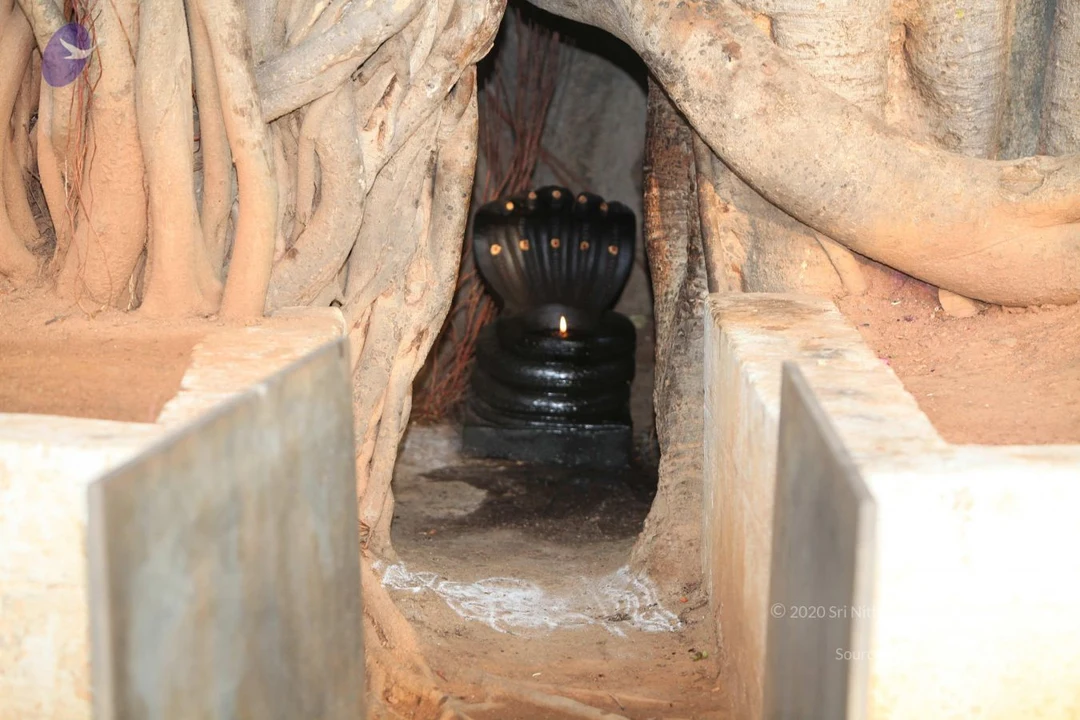
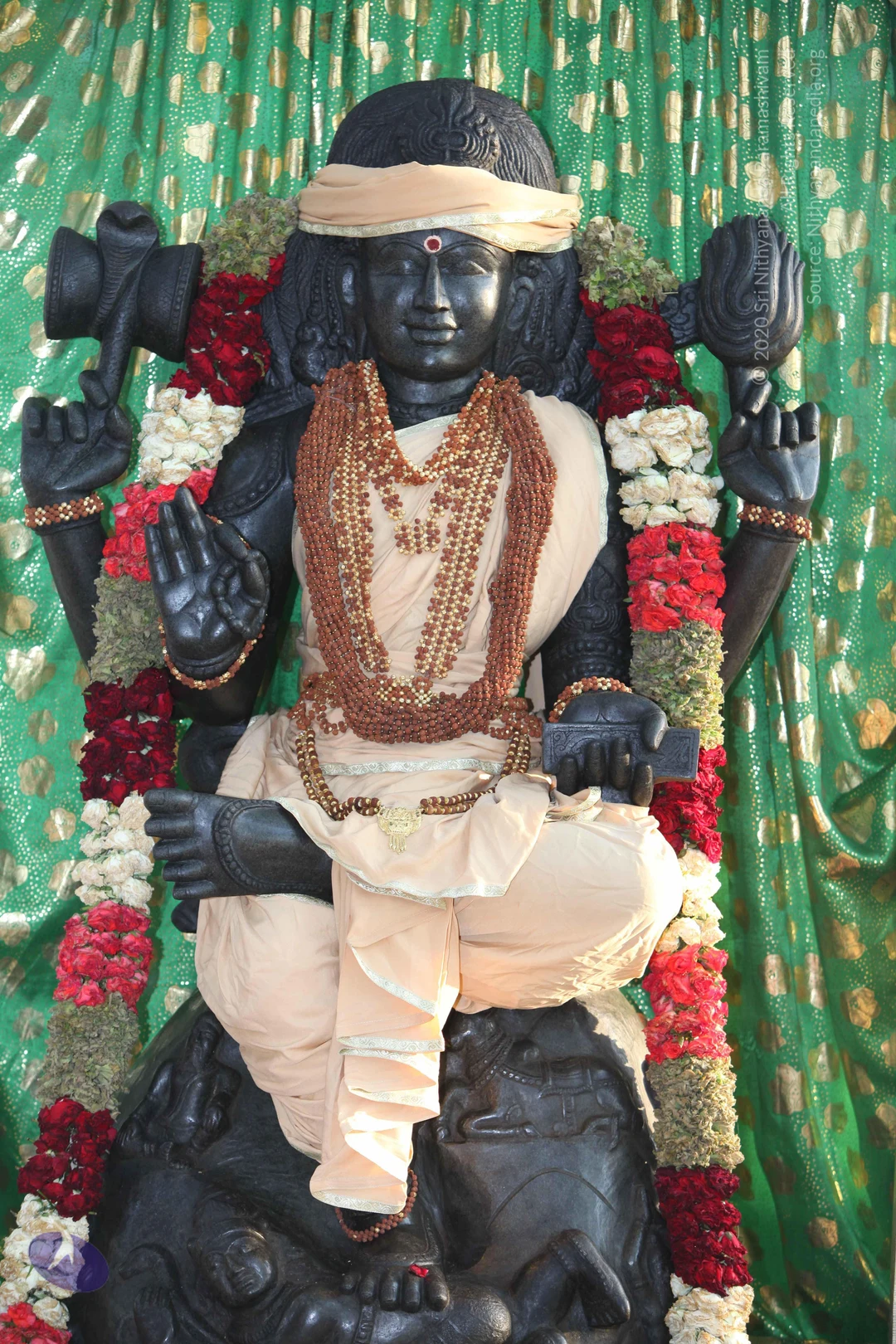
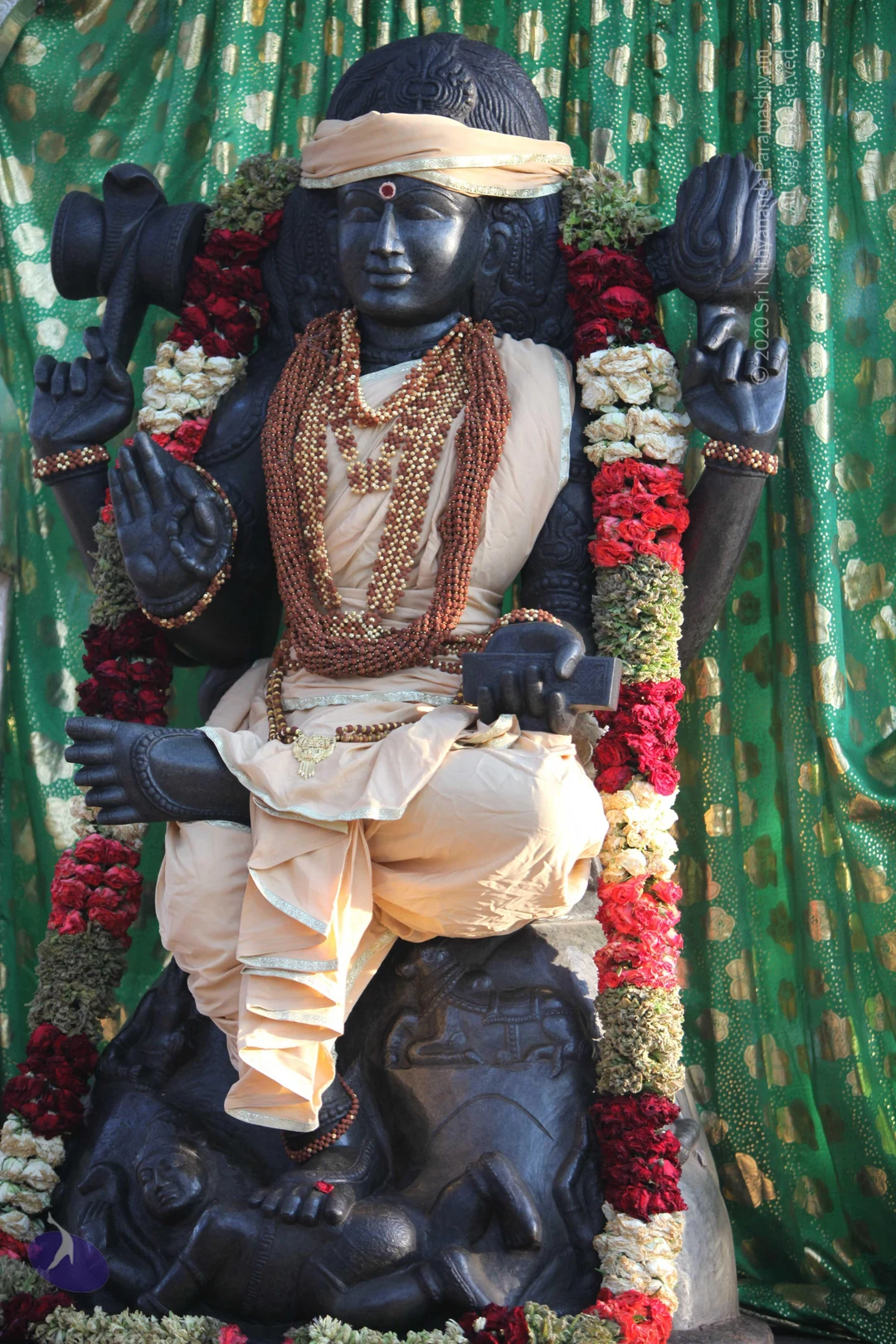
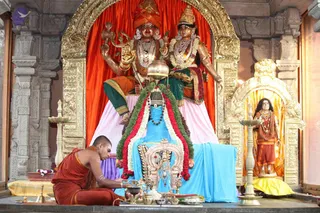
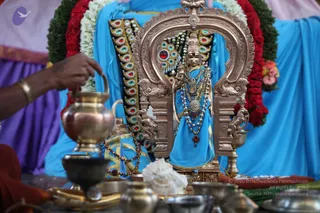
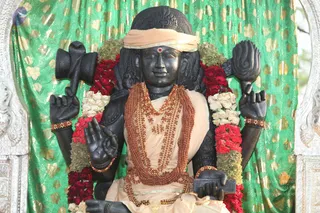
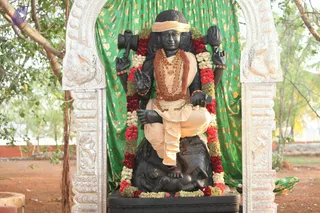
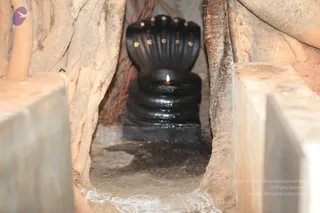
Two gilded metal deity murtis stand side by side against a red draped backdrop framed by ornate gold. The figure on the left wears an orange turban and holds a trident and a damaru-like staff, with a raised palm gesture; it is adorned with layered white and gold necklaces and a rudraksha-style mala. The figure on the right wears a tall gold crown, large earrings and a garland of white flowers, and holds a green parrot on a stand. A silver vessel sits in the foreground. The setting resembles a temple shrine or altar with alankaram decoration.A shaved-headed priest in orange-red dhoti kneels at lower left, preparing offerings before a shrine. Behind him, large gilded-faced murtis of a seated male and female deity stand on a pink cloth, the male holding a trident, the female in green and red garments with garlands. In front, a blue-draped Shivalinga-style form is decorated with red and white flower garlands and rudraksha beads, with a brass kalasha and oil lamps arranged around it. At right, a smaller standing statue in orange with a beaded necklace is set in a golden arch. The scene is a temple sanctum with ornate gold-painted arches and brass lamps.A photograph of a ritual puja set up before a small metal deity murti standing in a copper-coloured arched niche. The murti is draped in blue cloth and wears layered beaded necklaces, a red gem pendant and a tall crown. Behind it hang garlands of red and white flowers and a blue cloth backdrop decorated with gem-studded panels. In the foreground a hand in a gold bangle pours from a brass pot, while brass bowls, a small brass vessel and a white flower offering sit on the table.A large dark stone deity murti seated against a green fabric backdrop with gold dot patterns and an ornate silver-toned arch. The four-armed figure holds a trident in one raised hand and a drum-like or shaped implement in another, with a lotus-like object at the upper right. The murti wears a peach-coloured cloth draped over the body, a cream headband, a red bindi, layered rudraksha-style bead necklaces and garlands of red roses and white flowers.A black stone statue of a four-armed deity is seated on a dark base set within an ornate silver-coloured arch on dirt ground beneath trees. The figure wears a peach-coloured dhoti and a matching sash, with a peach headband with a red bindi on the forehead. Layers of rudraksha-style beads and a gold chain hang on the chest. Garlands of red and white flowers with green leaves wrap around the body and arms. A green cloth with gold spots forms the backdrop. Hand gestures and held objects are visible at the sides. A small figure appears at the base beneath the seat. No people are visible.A dark black stone linga with a carved hooded serpent hood above it stands in a narrow stone-walled passage between large tree roots. A single small oil lamp flame burns on the linga's top, and white lime-like markings lie on the ground in front. Gold dots decorate the serpent hood. No people are visible.

Pada-Puja

18 photosSource gallery
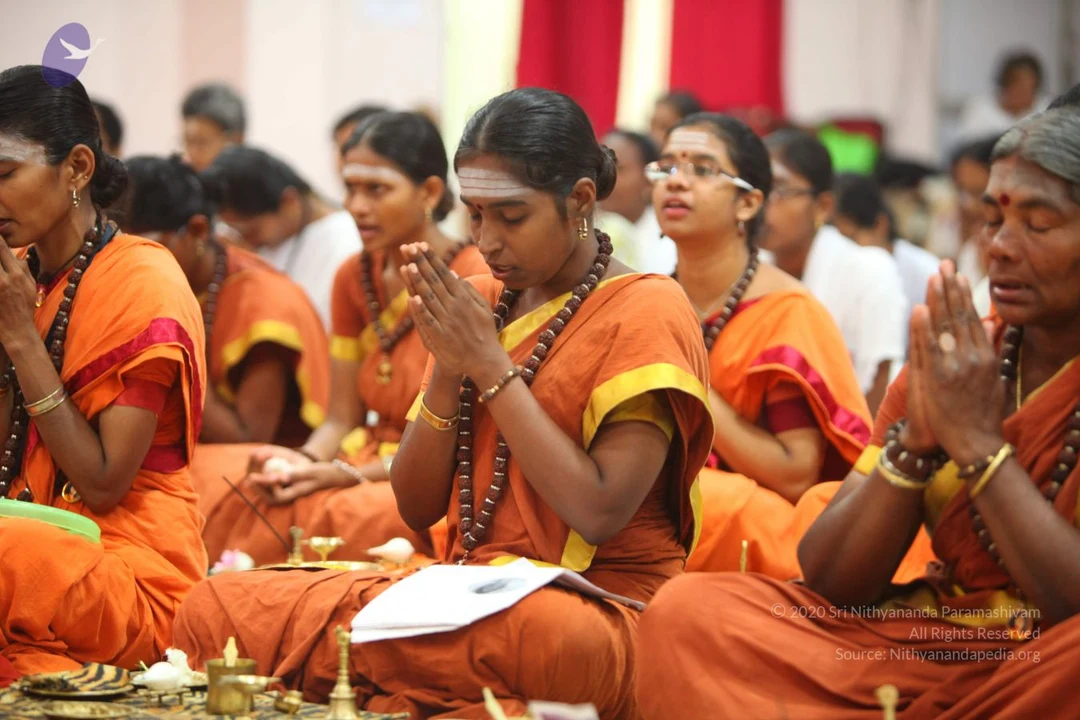
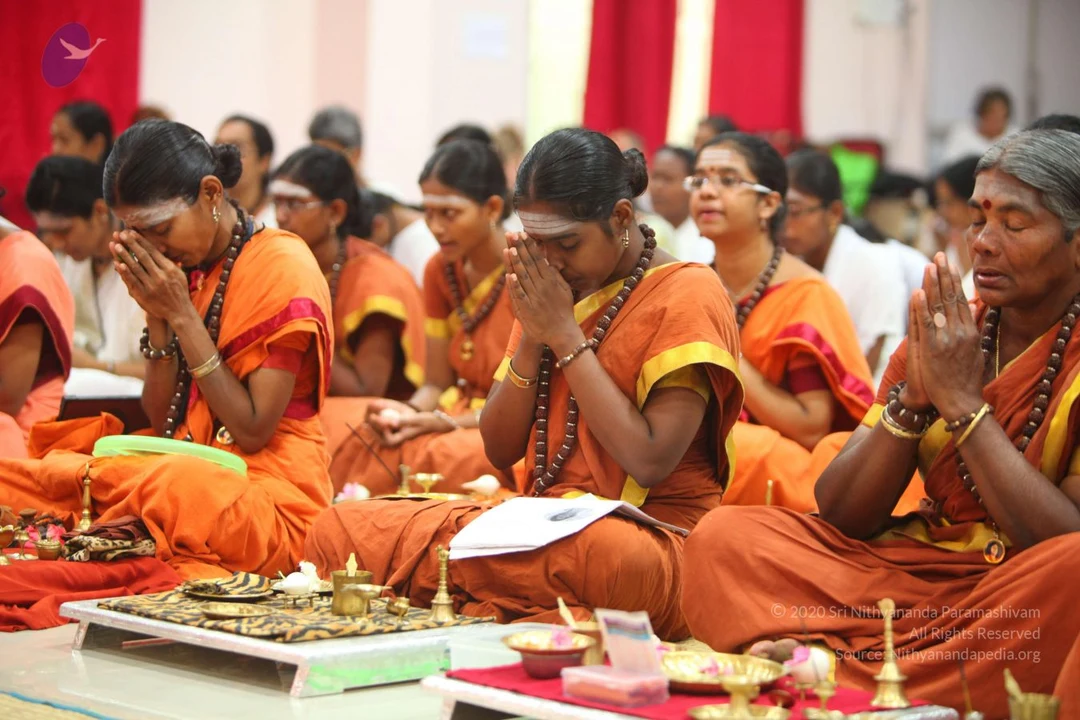
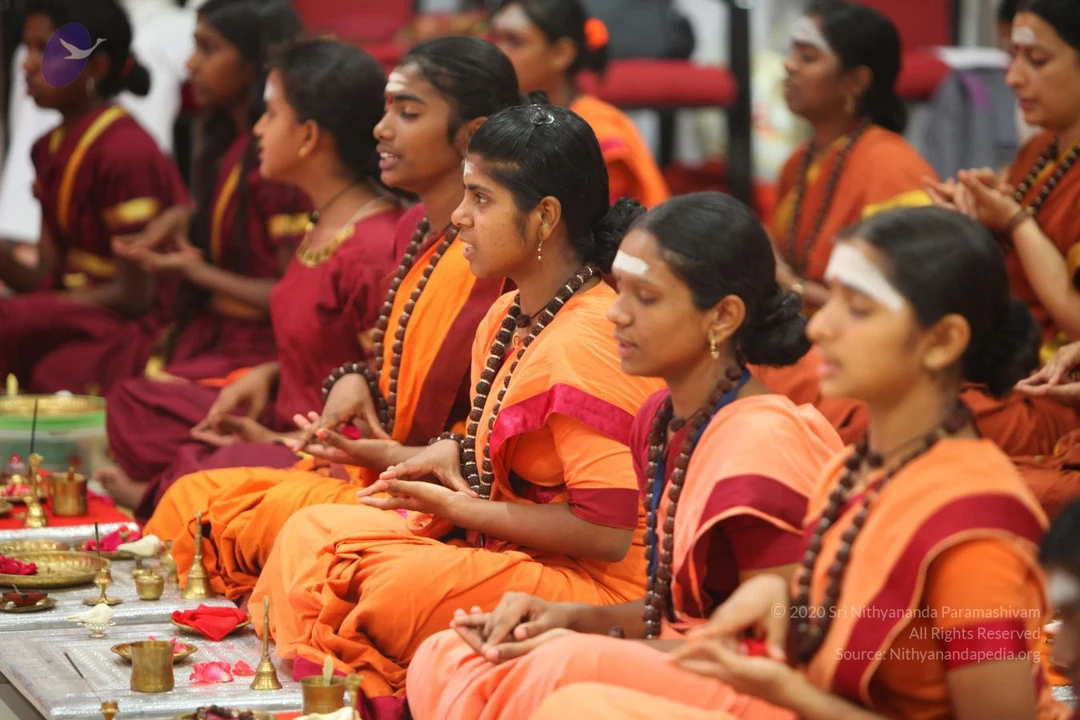
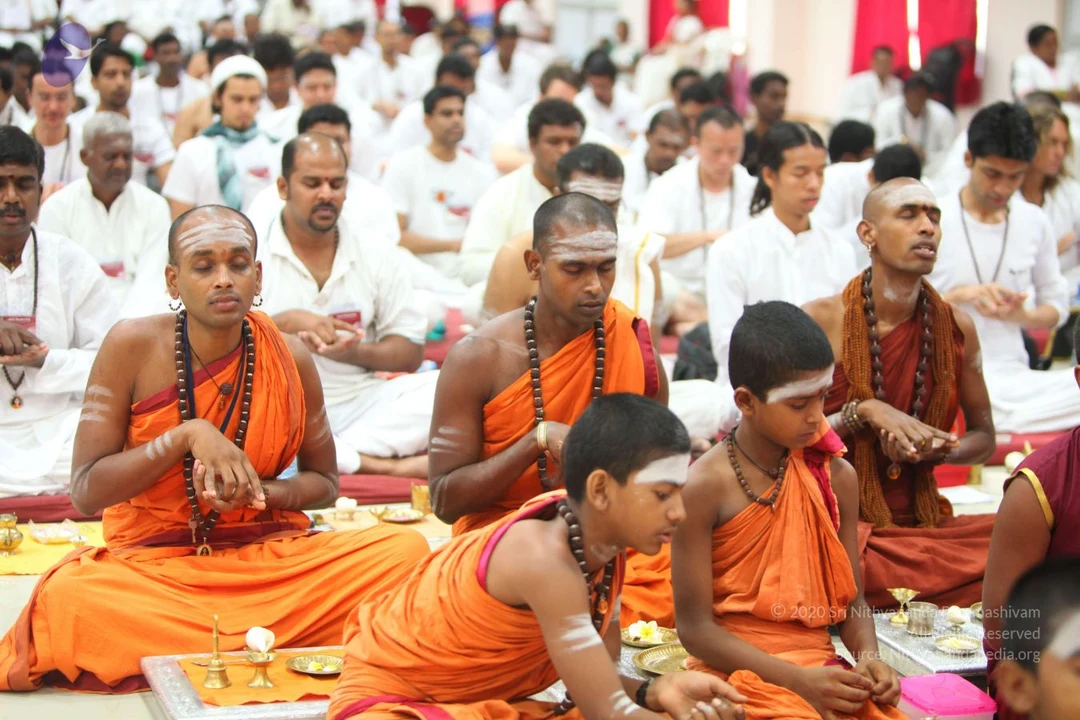
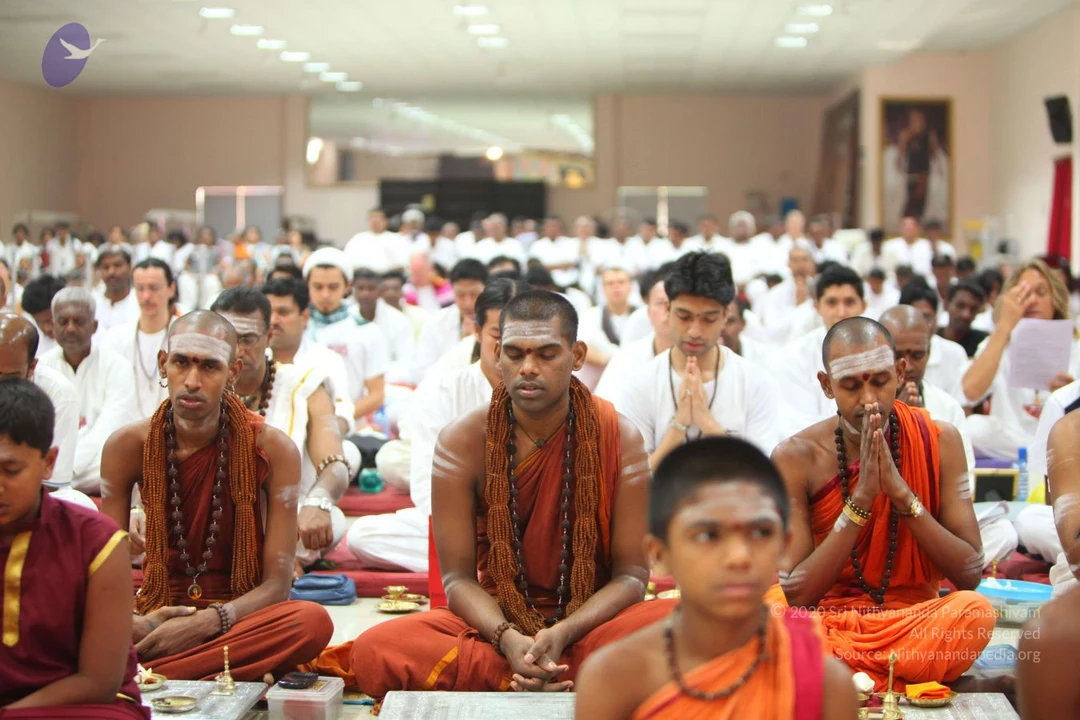
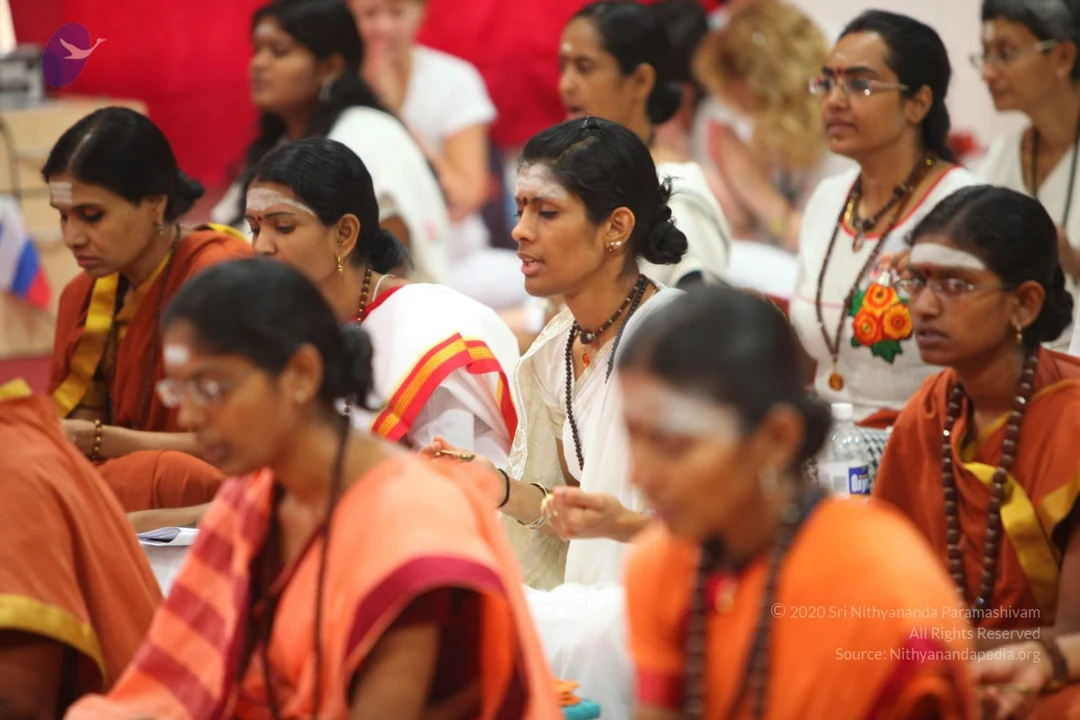
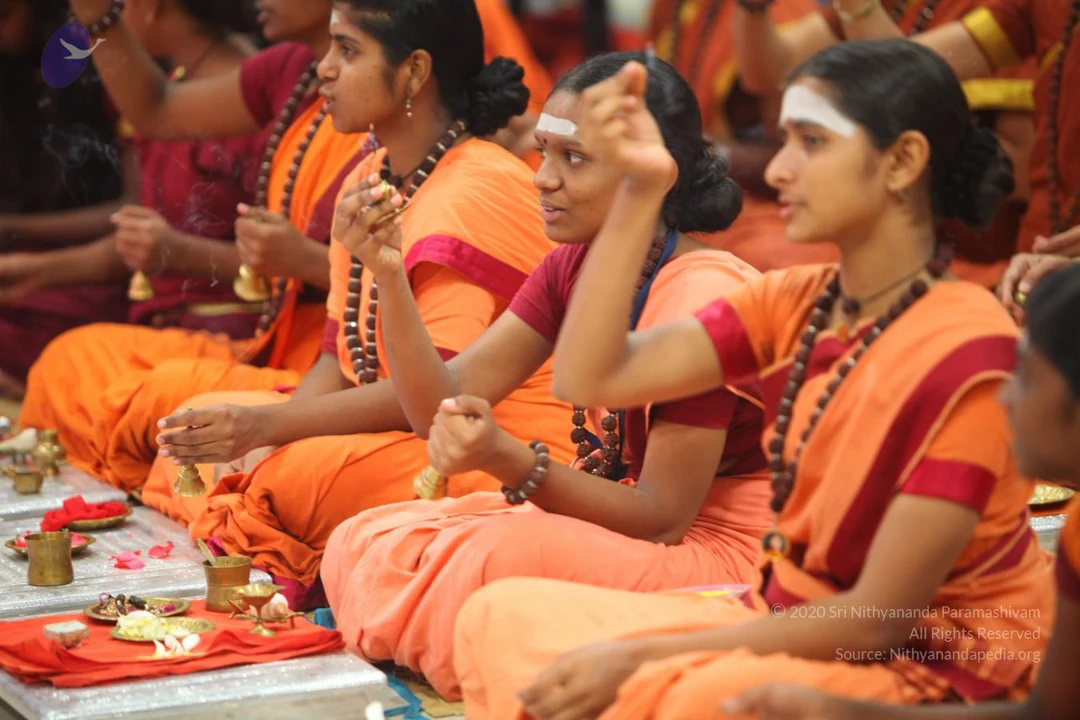
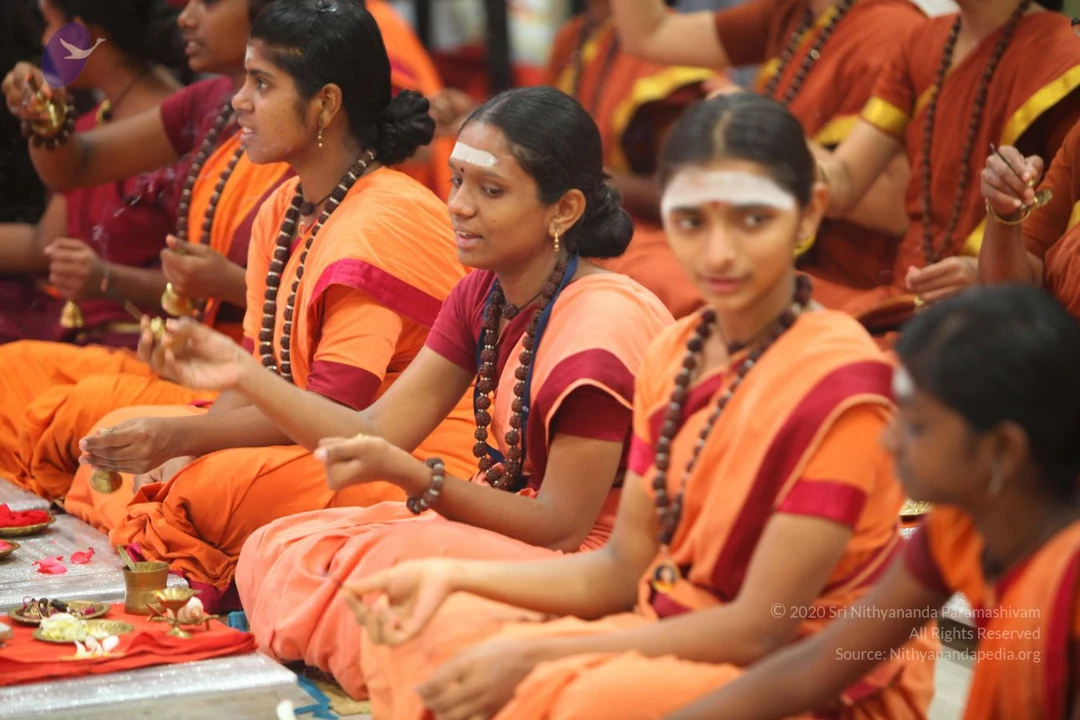
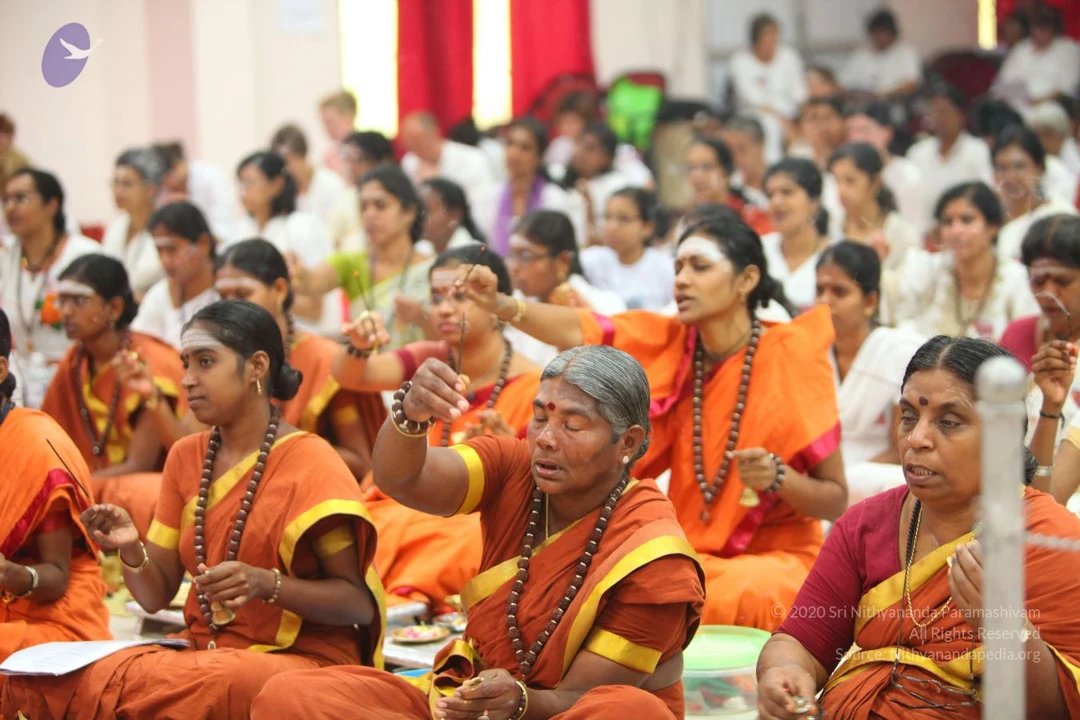
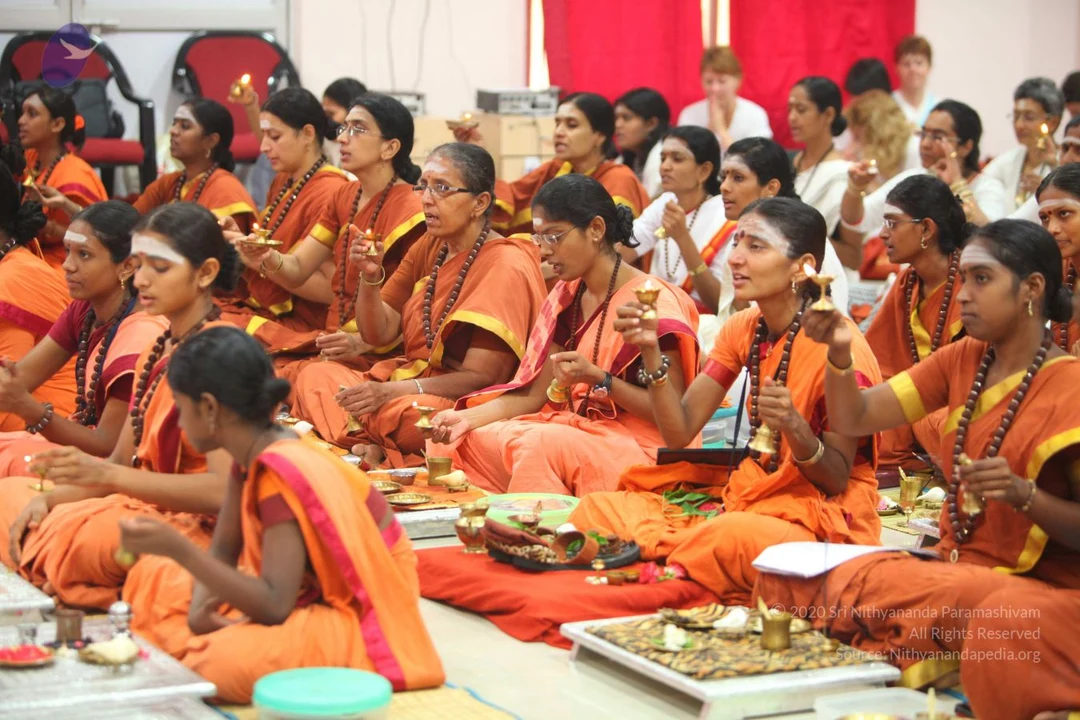
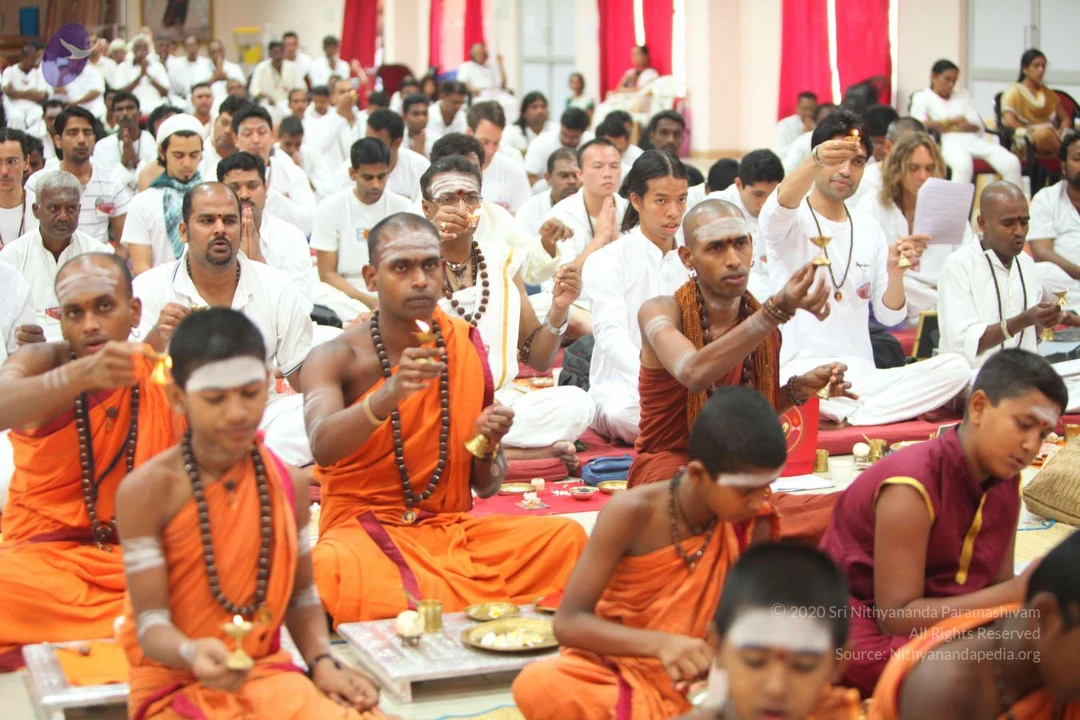
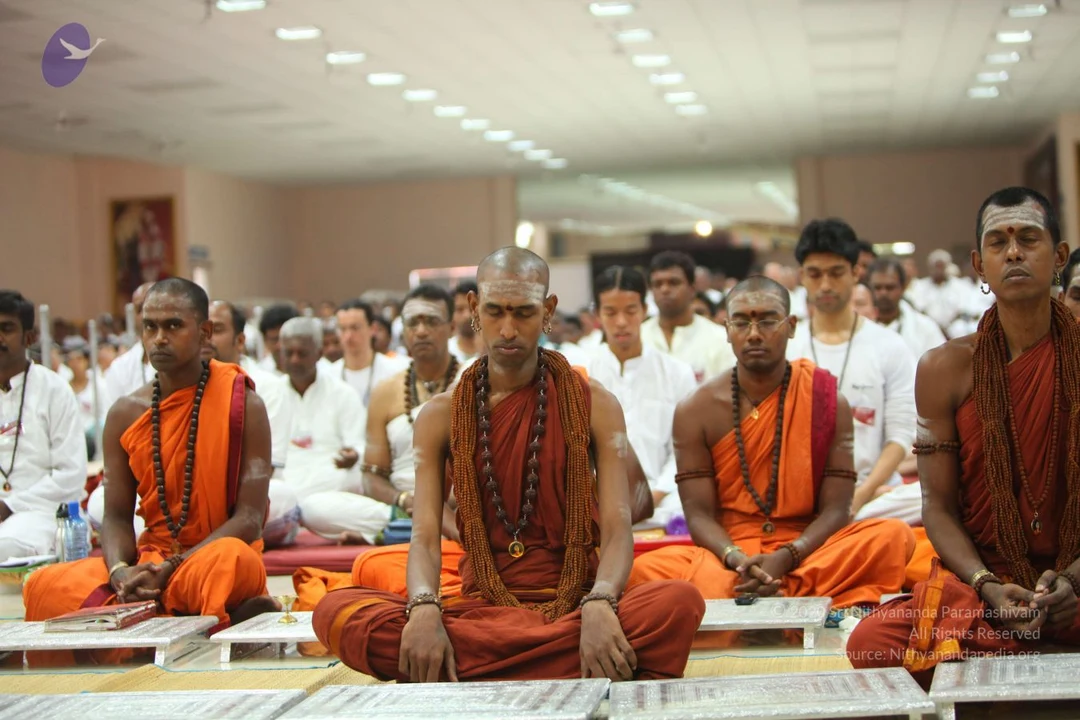
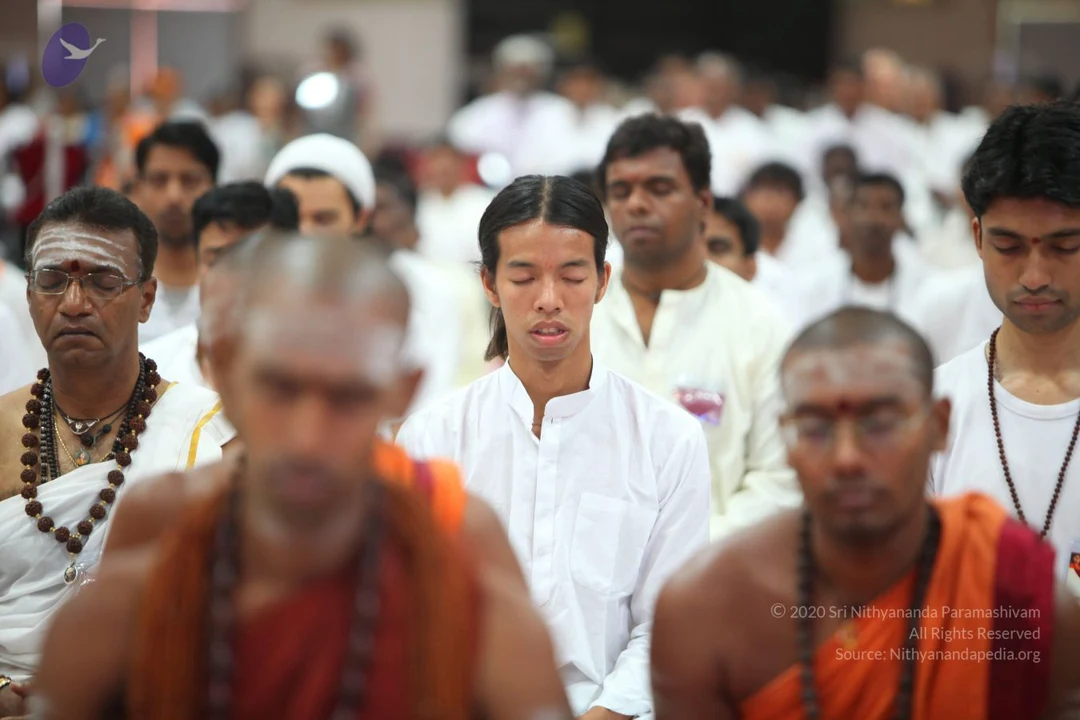
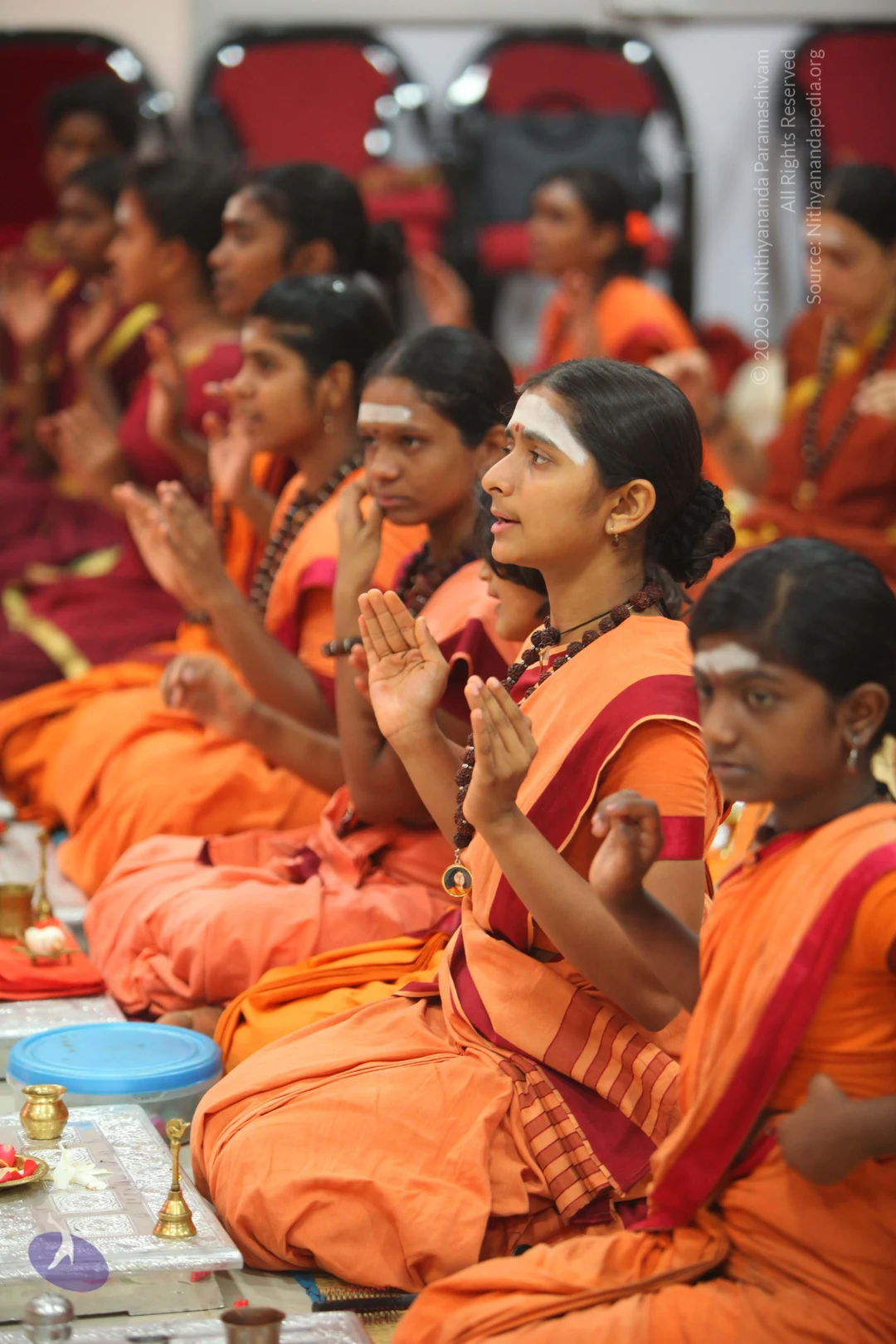
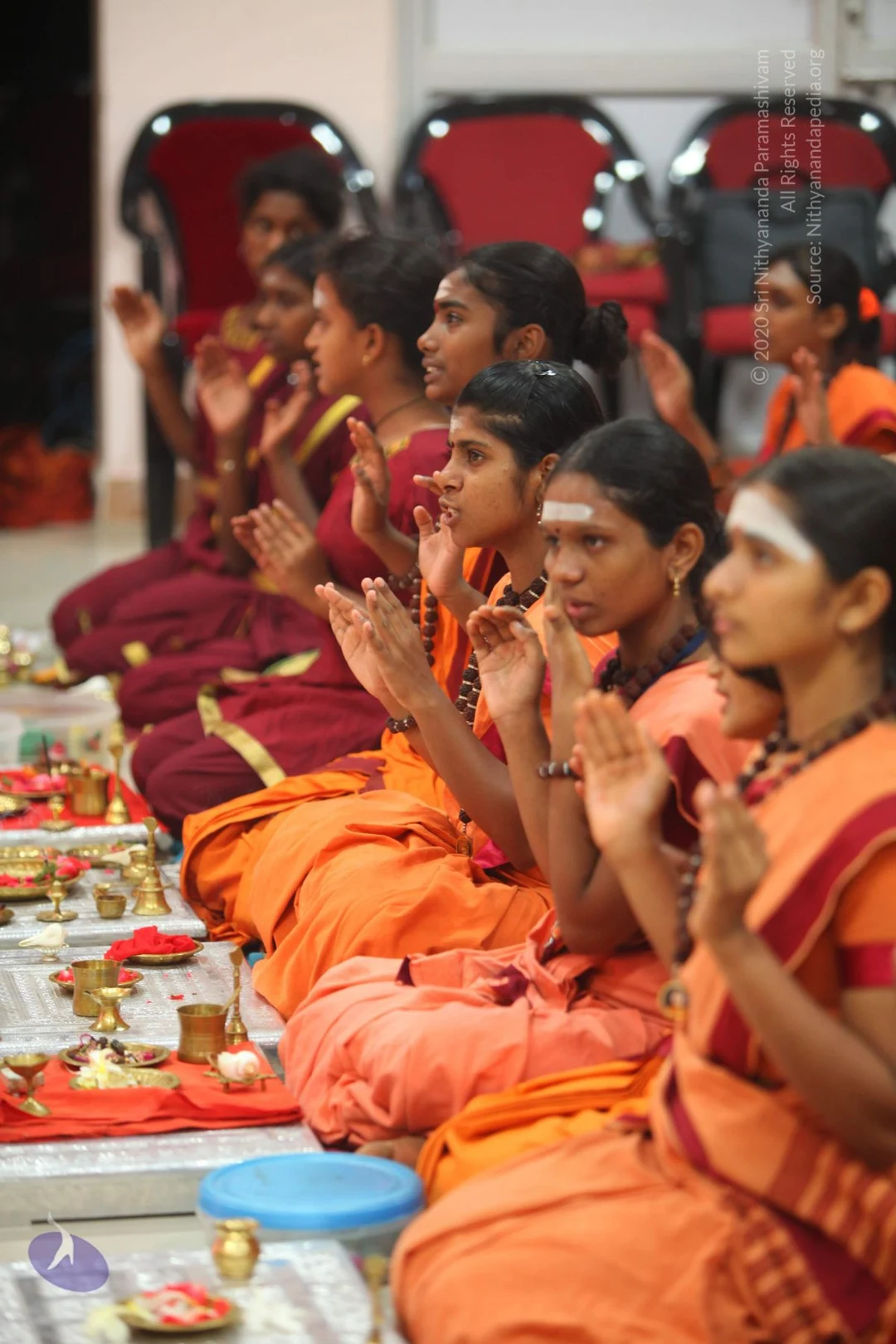
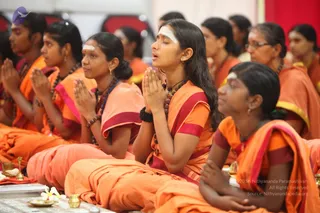
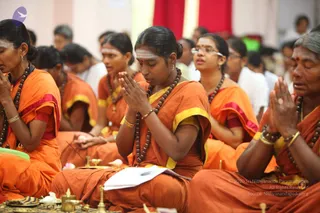
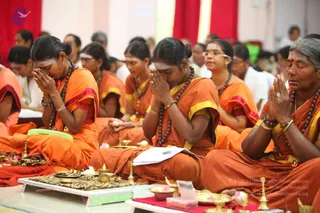
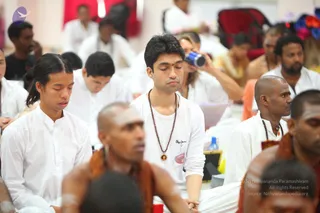
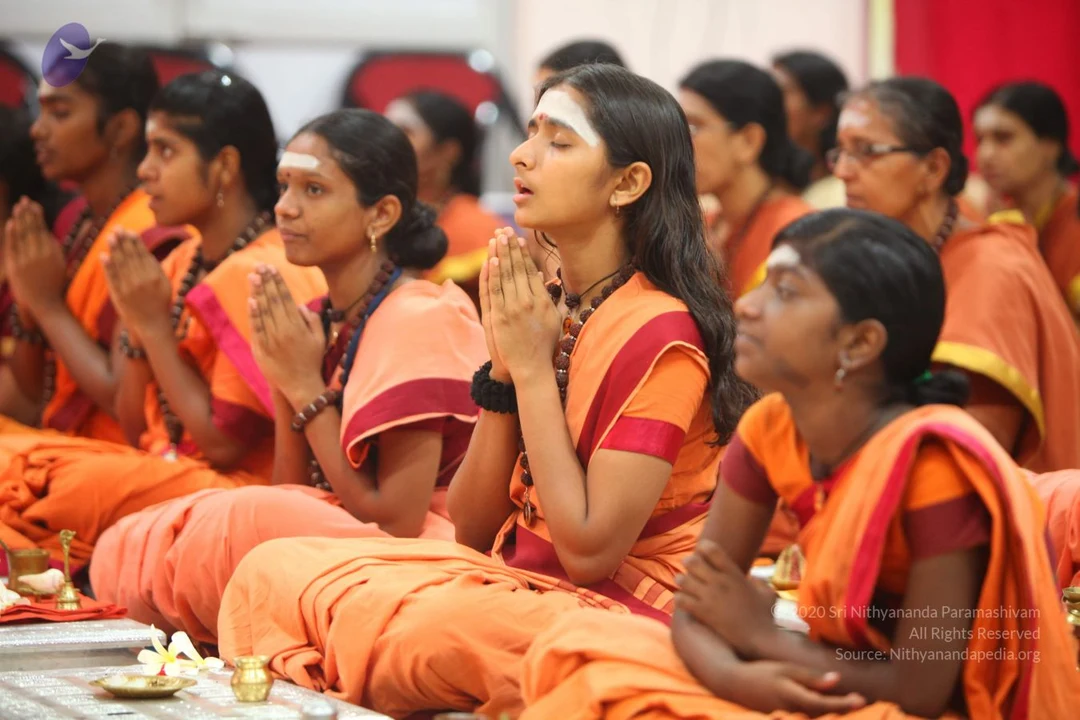
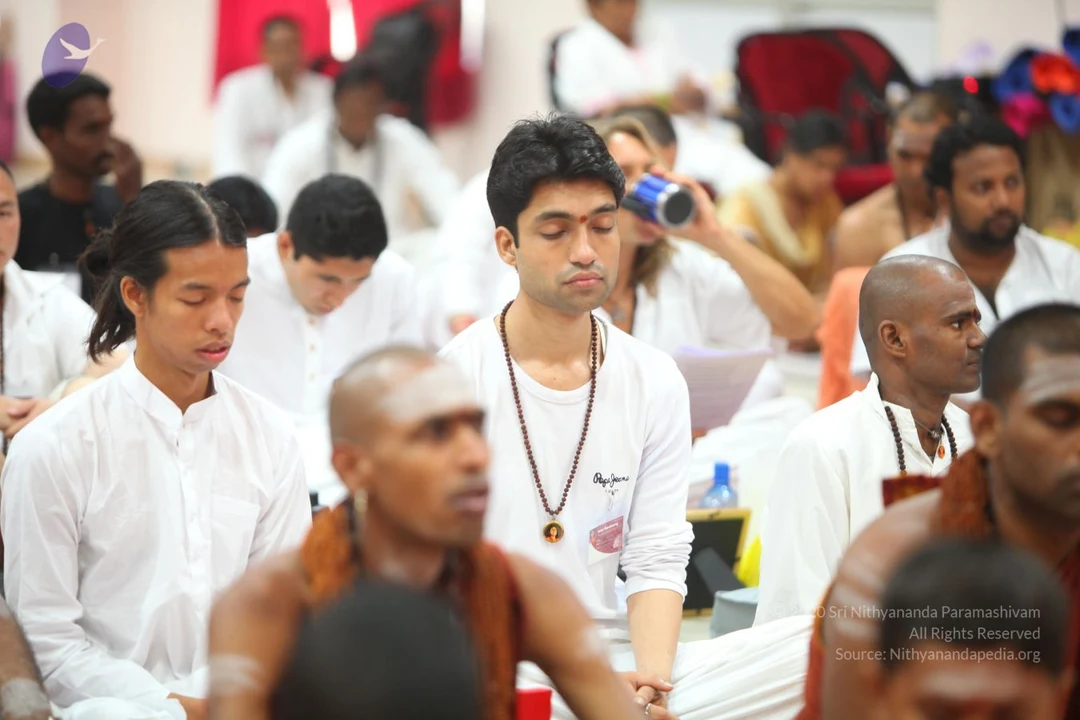
Photograph of a seated group of young women and girls in saffron-orange clothes with red borders, many with white vertical tilak marks on their foreheads and rudraksha malas around their necks. Several sit with palms pressed together in anjali mudra, eyes closed in prayer, with brass oil lamps and white flowers on a low table in the foreground. A red backdrop and additional seated devotees are visible behind them. No individual is identifiable as a person; all visible people are devotees in saffron attire.A seated group of women in orange saris with yellow and maroon borders, wearing rudraksha malas and white vibhuti lines on their foreheads, sit with palms pressed together in prayer. In the foreground a woman with a bun and gold earrings holds her hands in anjali before a low table with brass oil lamps, a small kalasha-like vessel and flowers. Other devotees in white clothing sit behind them in a bright hall with red drapery. The scene suggests a satsang or puja gathering.A photograph of women devotees seated on the floor in prayer with palms pressed together at chest level. Several women in foreground wear saffron-orange saris with yellow borders and red trim, rudraksha malas, and white sacred ash lines on their foreheads. The woman at right has grey hair and a red bindi. Brass puja vessels, a small brass lamp, flowers and a tray with offerings rest on a white low platform in the foreground, with red draped cloth beneath. Red curtains and a seated audience in the background suggest a satsang or puja gathering.A seated group of devotees in a meditation hall, many dressed in white kurta-style clothing with white forehead markings and some in saffron-orange robes. In the centre, a young man in a white t-shirt with a dark rudraksha mala and a small pendant sits with eyes closed, hands resting in his lap. A man with long hair tied back in white clothes sits eyes closed on the left, a bald man in orange robes sits on the right, and a blue water bottle and a red cushion appear in the background. Other participants sit in rows, some blurred in the foreground, during satsang.A row of young women seated on the floor in an ashram hall, chanting or meditating with hands held in front of them. Most wear orange or saffron sarees with maroon borders and red-and-gold trim, and rudraksha malas around their necks. Several have white vibhuti or tilak marks on their foreheads. Brass puja vessels, small lamps, a red cloth and scattered pink flower petals sit on a silver-coloured platform in the foreground, indicating a ritual setting. No a person candidate is visible in this frame.A large seated gathering of devotees in a hall with red drapes, where most participants wear white clothing. In the foreground, several young men and boys in saffron-orange robes sit with eyes closed and hands in mudra, with white sacred ash markings on their foreheads and arms and rudraksha malas around their necks. A boy in front wears orange with a pink-trimmed cloth, and a small brass lamp, bowls and flowers rest on a tray in front of them. Behind, rows of white-clad devotees sit in meditation, some with hands folded. No candidate can be confidently identified from appearance, so the saffron-robed figures are described by role only.

Satsang
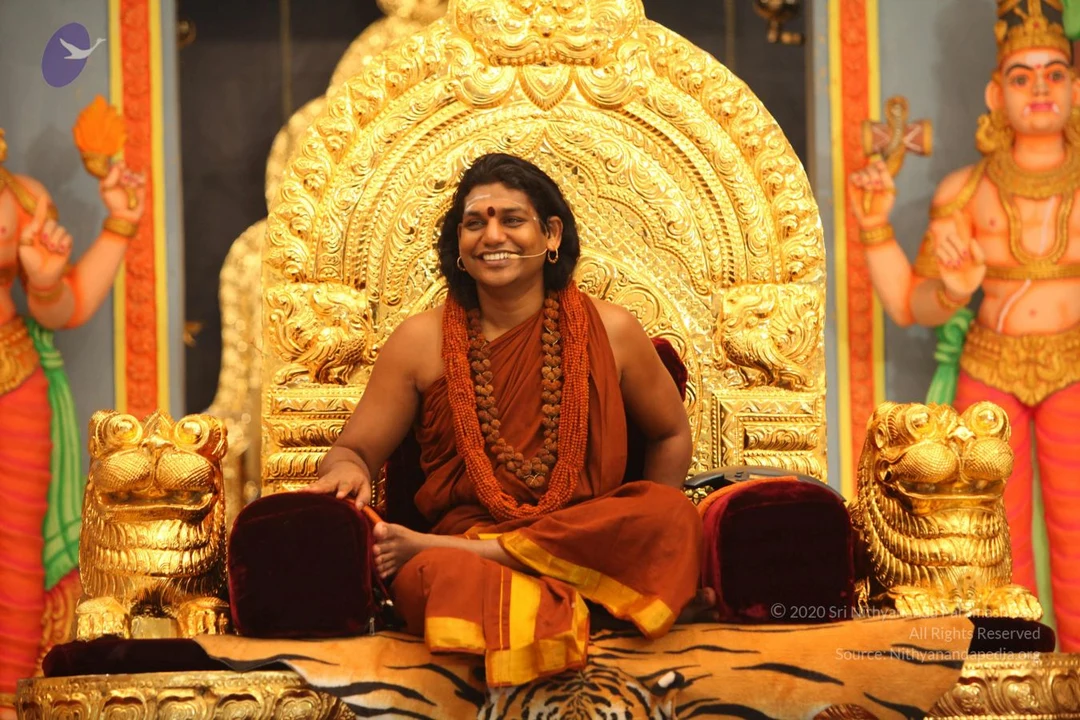
59 photosSource gallery
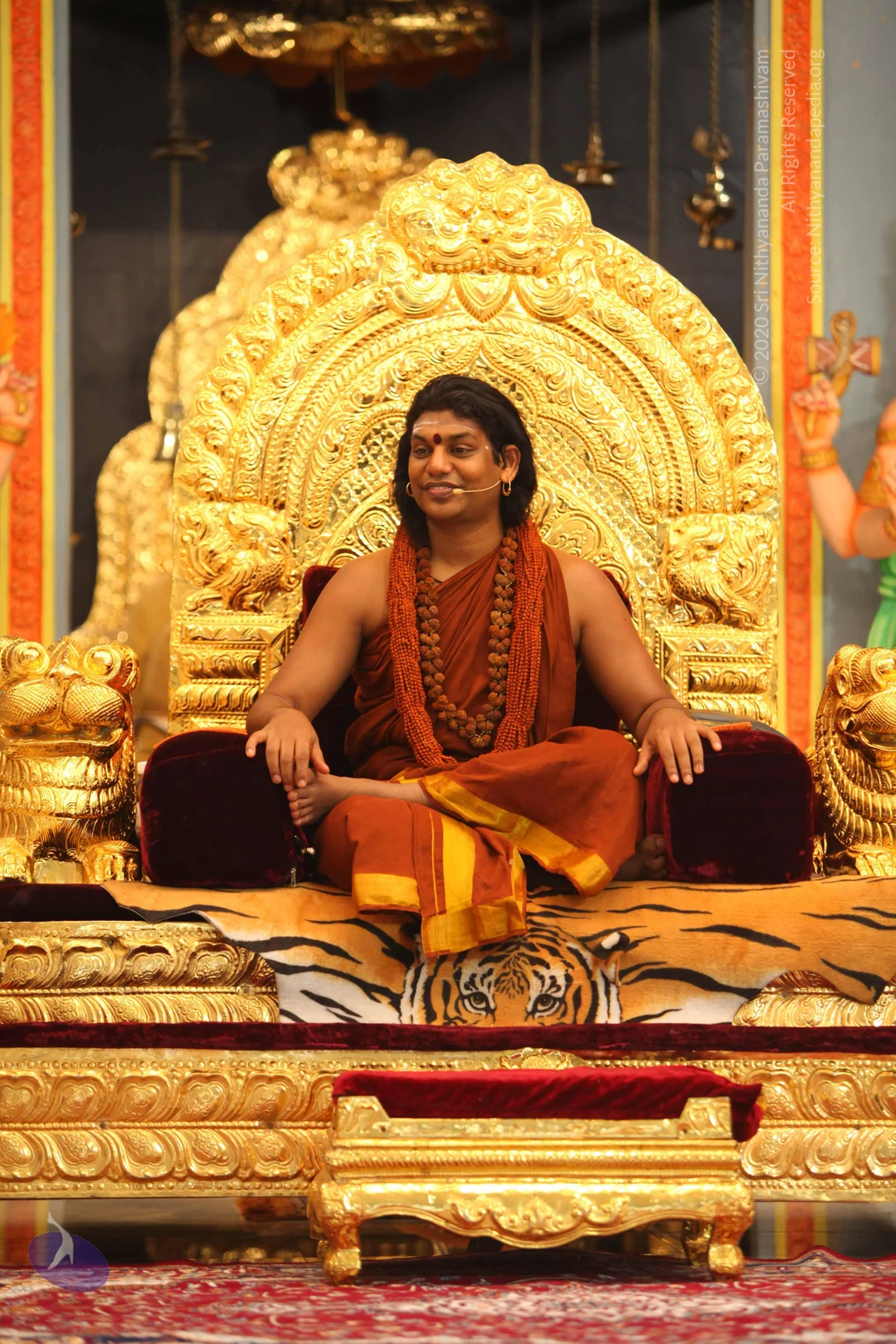
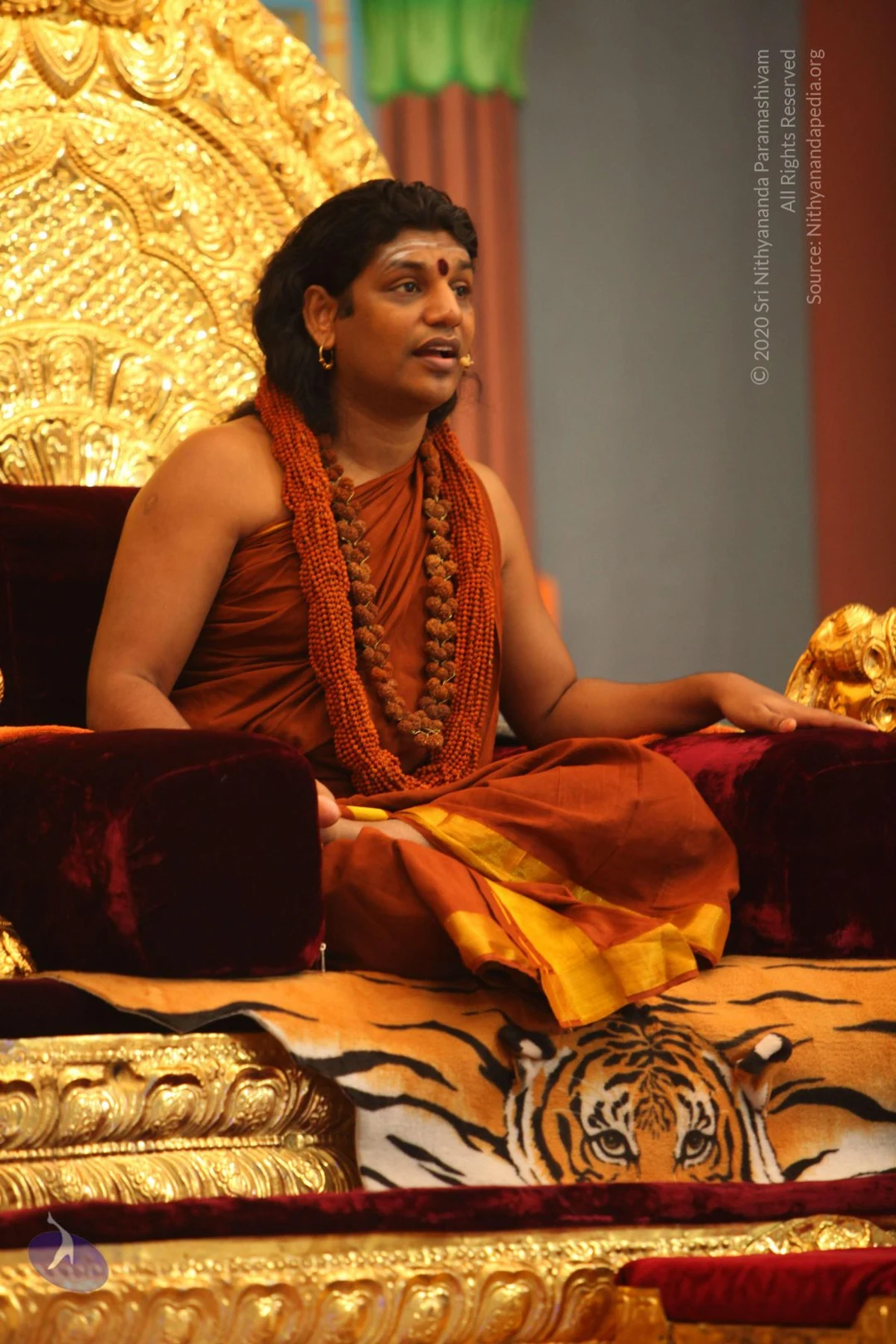
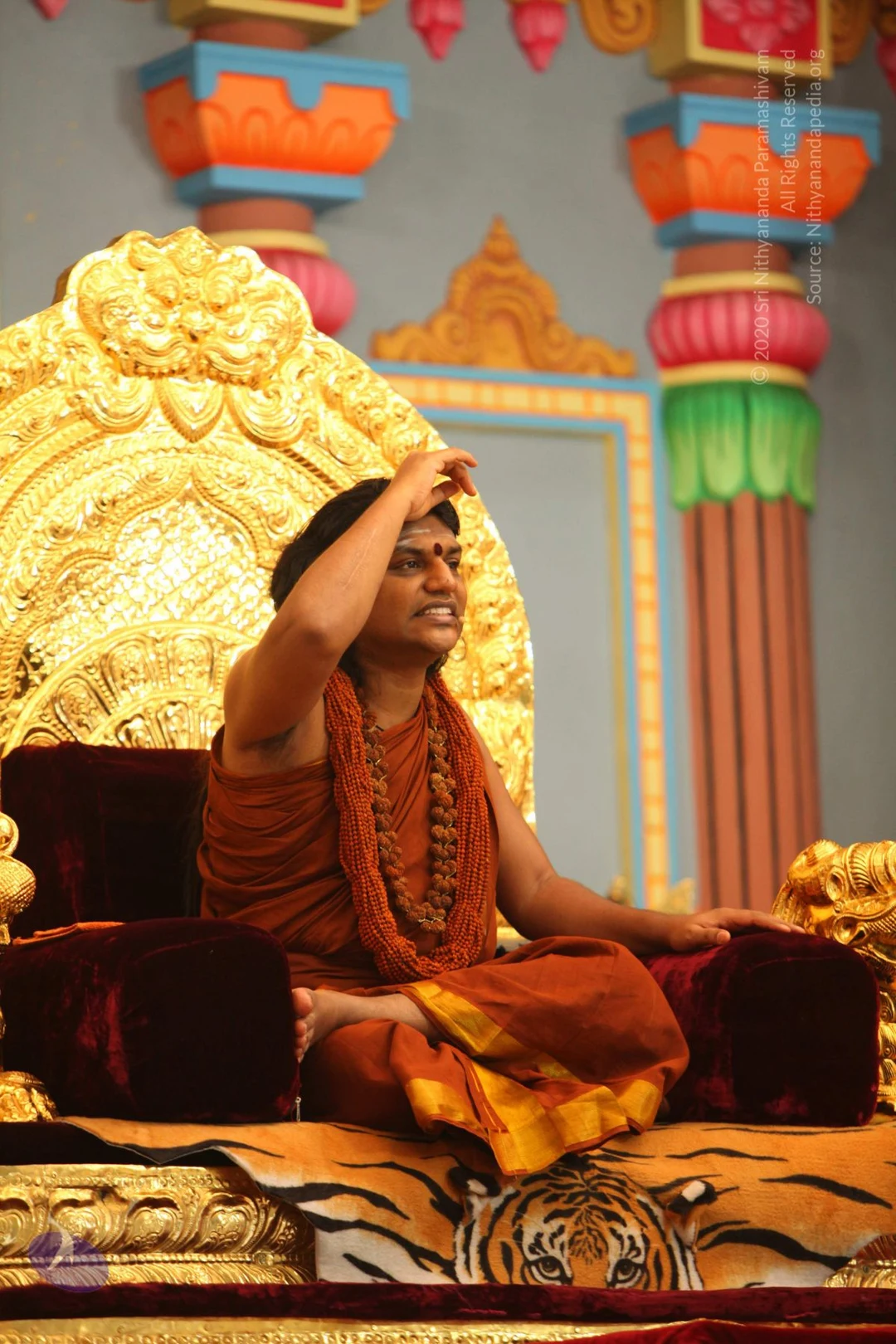
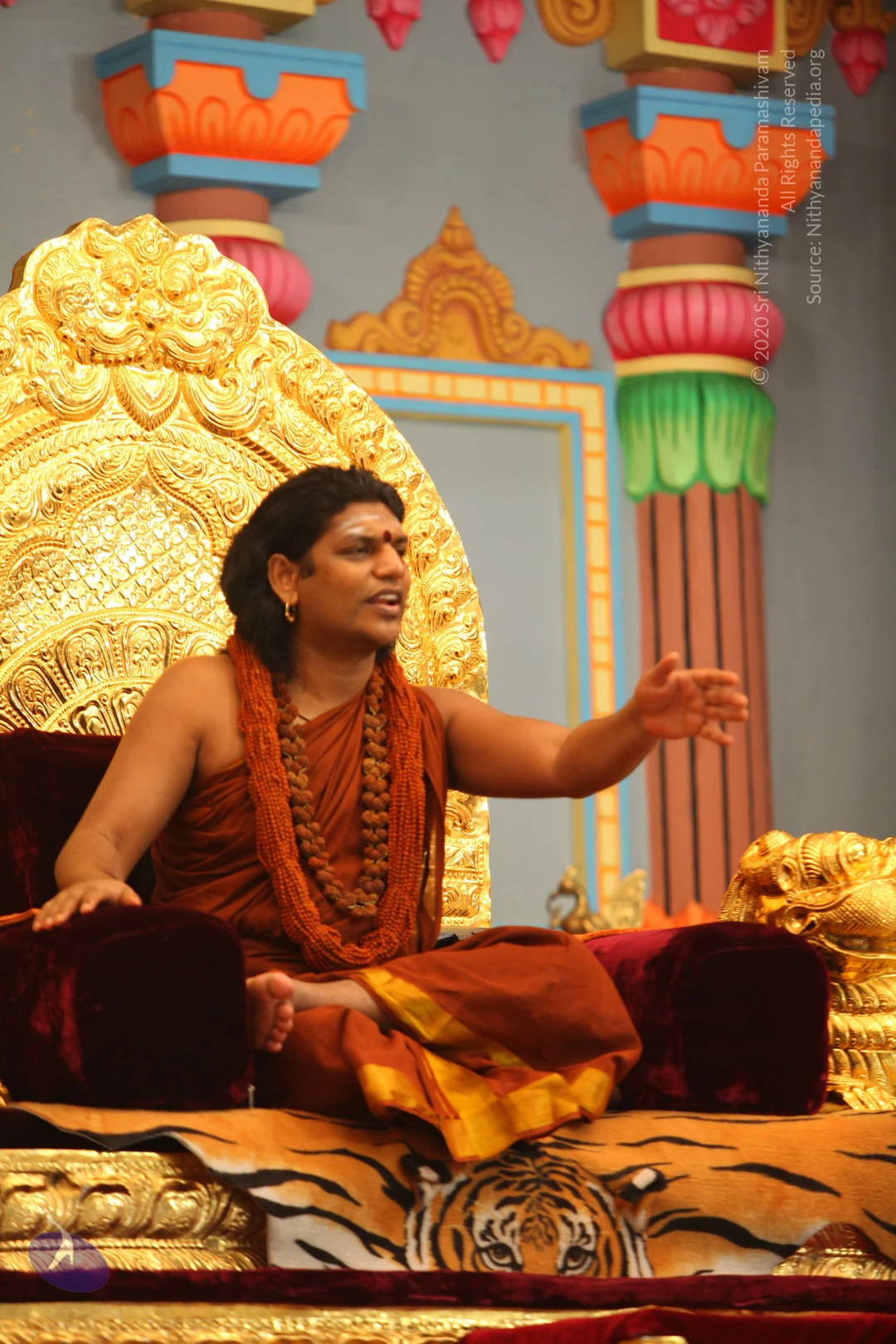
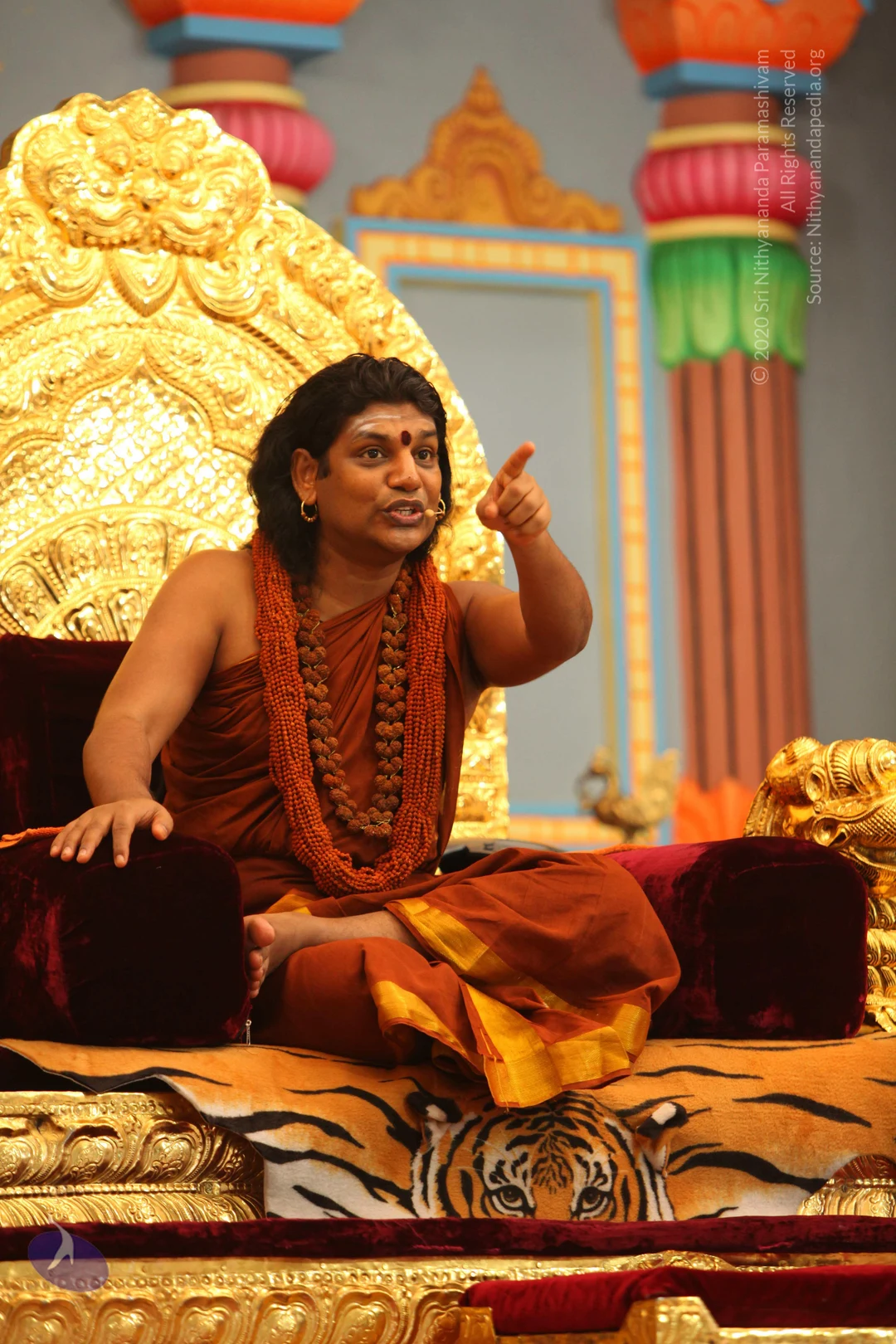
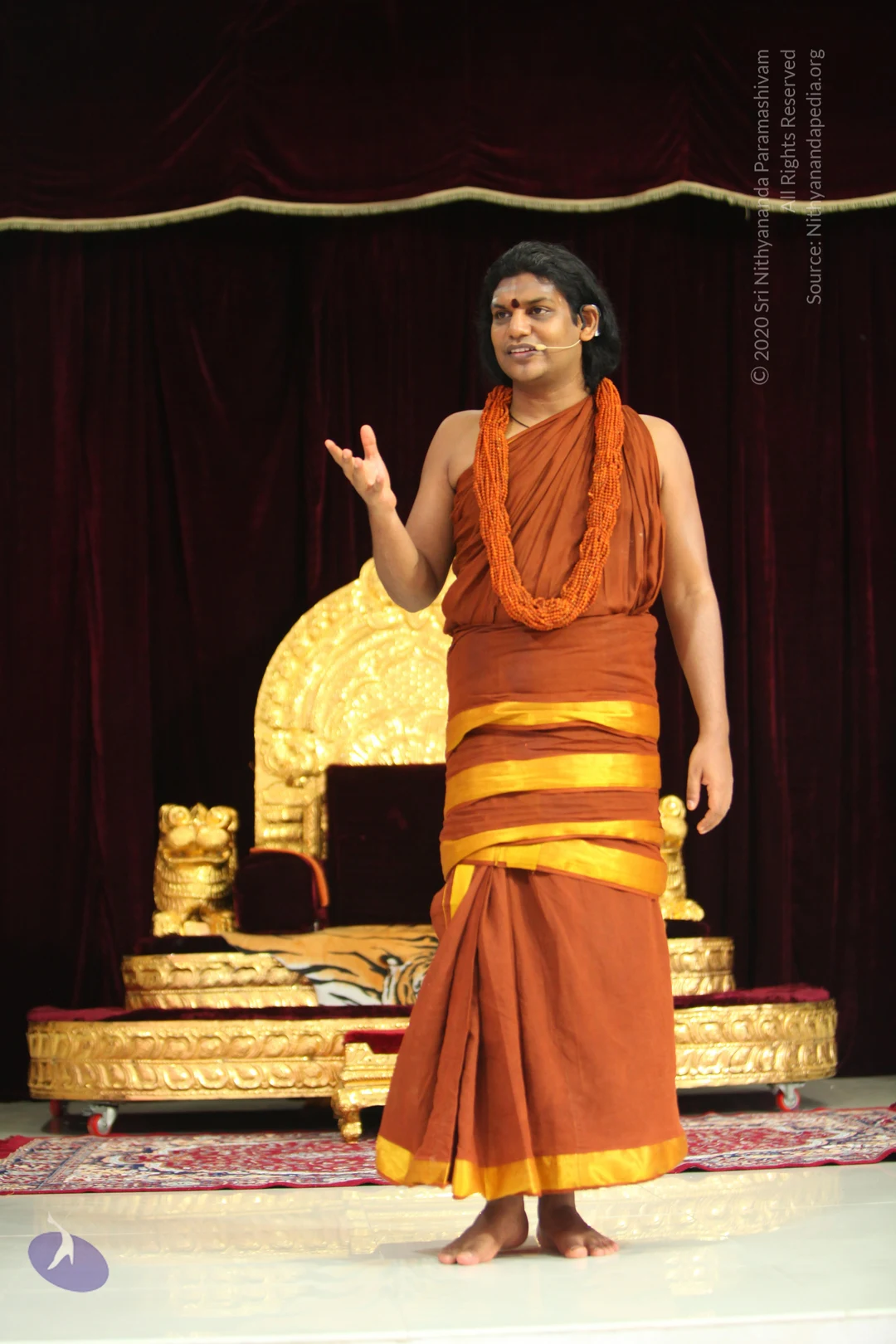
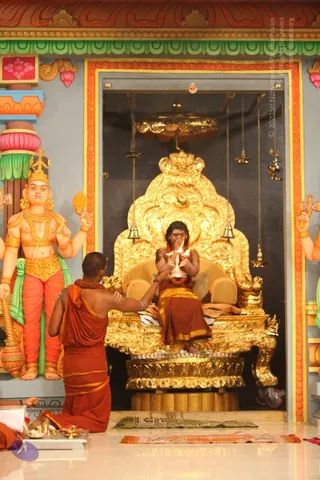
A seated man in an orange-saffron robe and a long rudraksha mala sits on an ornate gold throne with carved lion-head arms and a gold arched back against deep red velvet drapes. A tiger-striped cloth covers the platform. He raises one hand in a gesture while smiling, and wears a red forehead mark and gold earrings. Seated on a throne in a teaching posture, consistent with a satsang setting.A man in saffron-orange robes sits cross-legged on an ornate golden throne with red velvet armrests and a tiger-striped cloth on the dais. He wears a rudraksha mala and an orange shawl, with a red tilak on his forehead and gold earrings, and rests his hands on the armrests. Behind him, a large gilded arch frames the throne. On either side stand painted deity murti figures with multiple arms, one holding a lotus-like object and the other a trident-like staff. The scene is a satsang setting with a microphone visible at his ear. Appearance-based candidate, a person, seated on the throne with orange robes, rudraksha mala and tilak.A seated man in saffron-orange robes and a long orange rudraksha mala sits cross-legged on an ornate gold throne with lion-head armrests and red velvet cushions, a tiger-striped cloth draped at the base. He wears a red tilak on his forehead, a small headset microphone, and has long swept-back hair. Behind him, large painted deity murti figures with multiple arms and gold ornaments flank the throne against a pastel wall. The setting appears to be a satsang stage.A seated man in an ornate golden throne with carved backrest and lion-head armrests sits cross-legged on a tiger-striped cloth. He wears an orange-saffron robe with a yellow-gold border, a long orange-red rudraksha mala, gold earrings, and a small red bindi with white tilak marks on his forehead, and a small microphone is clipped near his face. Behind him stand painted deity murti figures in bright colours, one holding a flaming lamp. The setting is a satsang hall. a person: the appearance cues are a long swept-back hairstyle, saffron robes, rudraksha mala and ornate gold setting, consistent with the page's reference to a person presenting a satsang.A man with shoulder-length dark hair and a red tilak on his forehead sits cross-legged on an ornate gold throne with a deep red velvet seat and lion-head armrests, placed on a tiger-striped rug. He wears saffron-orange robes with a yellow border and a long orange-brown rudraksha mala, and holds a microphone near his face. Behind him, golden repoussé panels frame the throne, and to the sides are painted deity figures with raised hands and gold jewellery, one holding a flame-like object. Only one physical person is visible in the scene.A man with long swept-back dark hair sits cross-legged on an ornate gold throne with lion-head armrests draped in maroon velvet, resting on a tiger-skin rug. He wears an orange-saffron robe with a yellow-gold border, a long orange-beaded mala with rudraksha beads and a gold pendant, a red bindi and a small headset microphone. His hands rest on the armrests. Behind him, a gilded backdrop shows a multi-armed deity figure in red and gold.

IA-Session

7 photosSource gallery
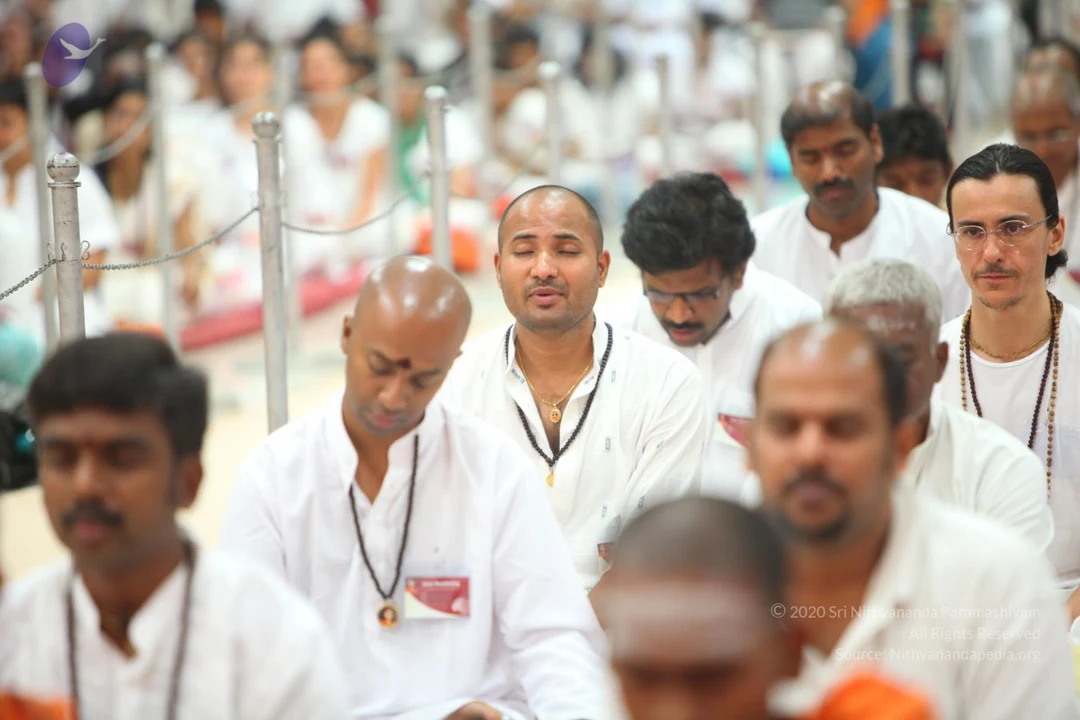
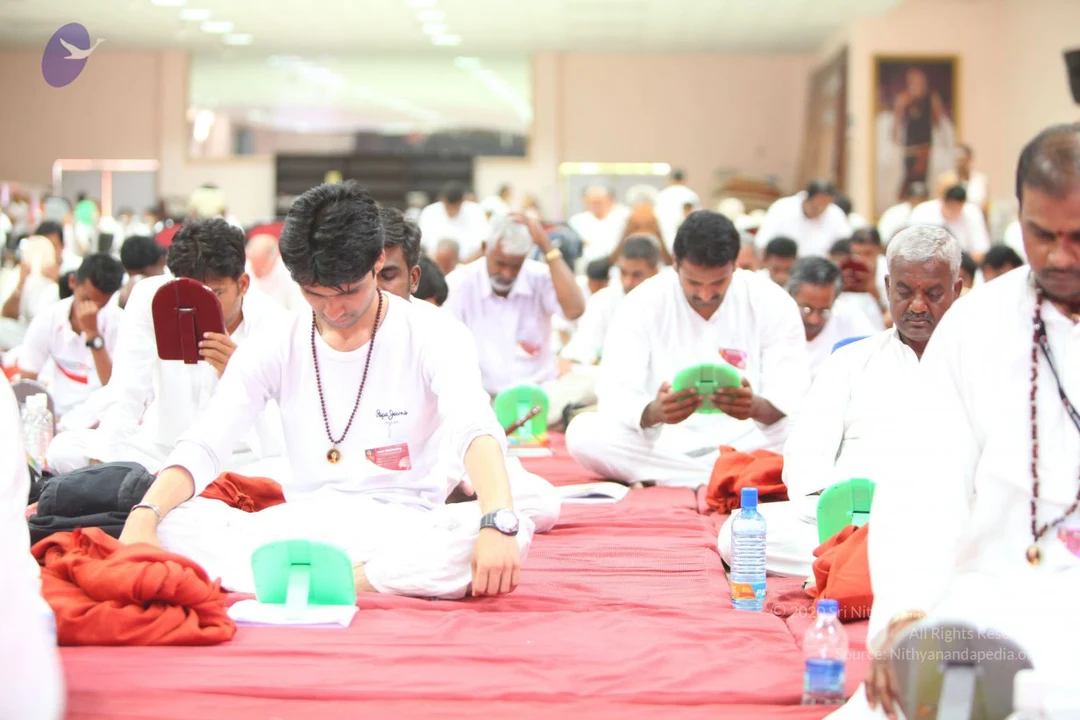
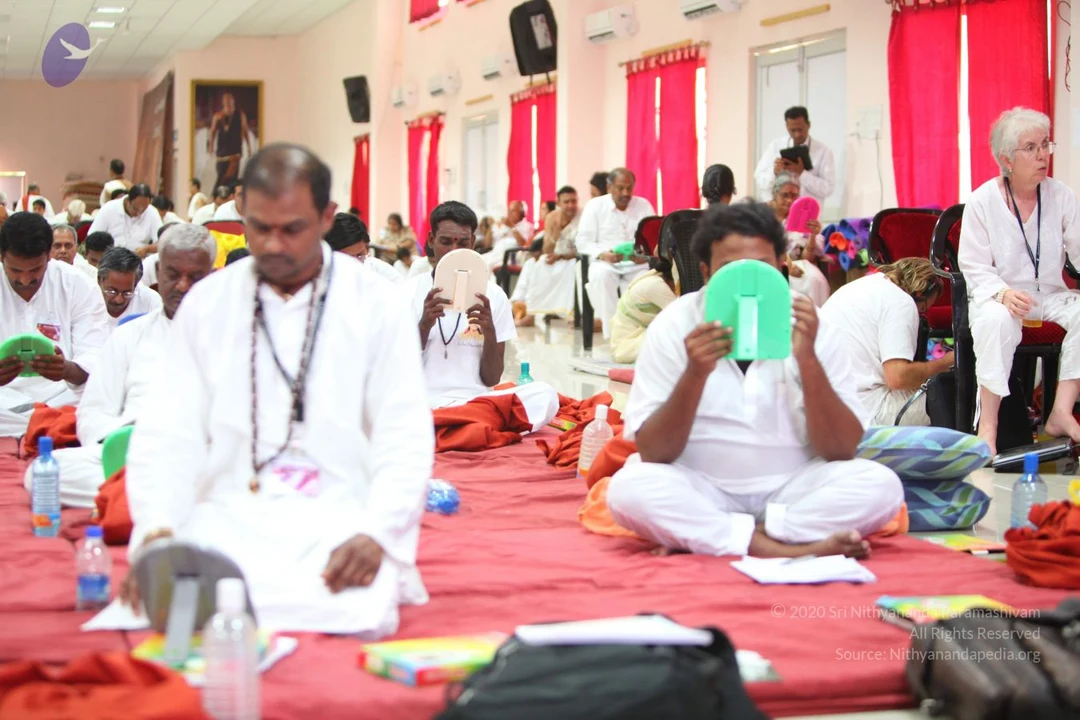
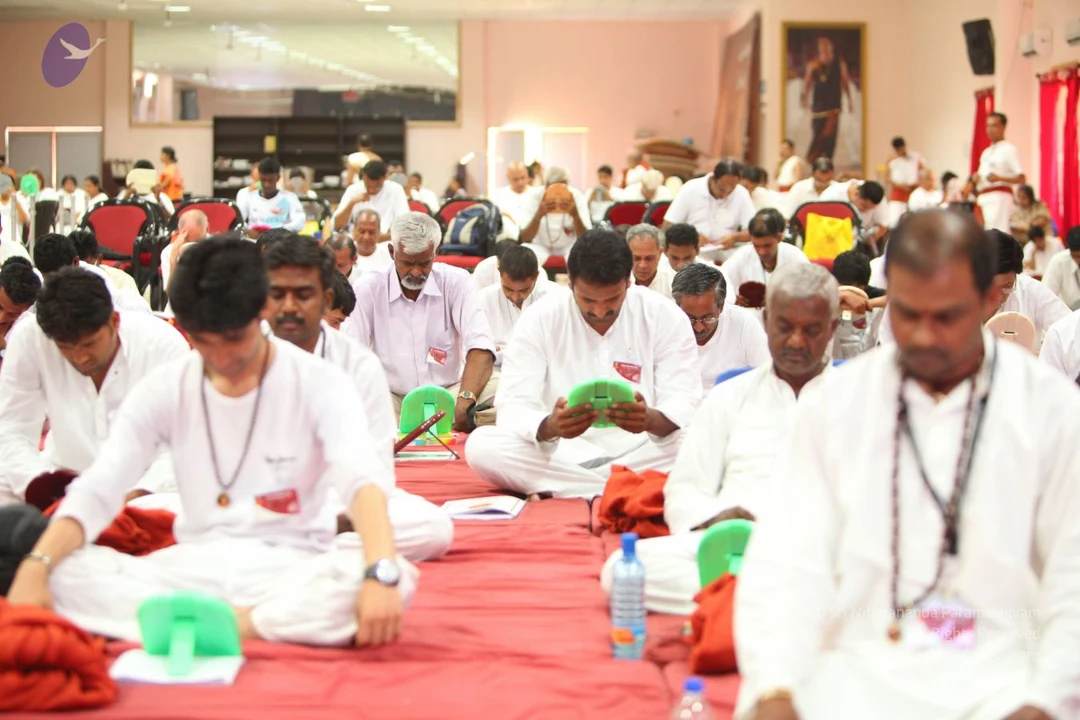
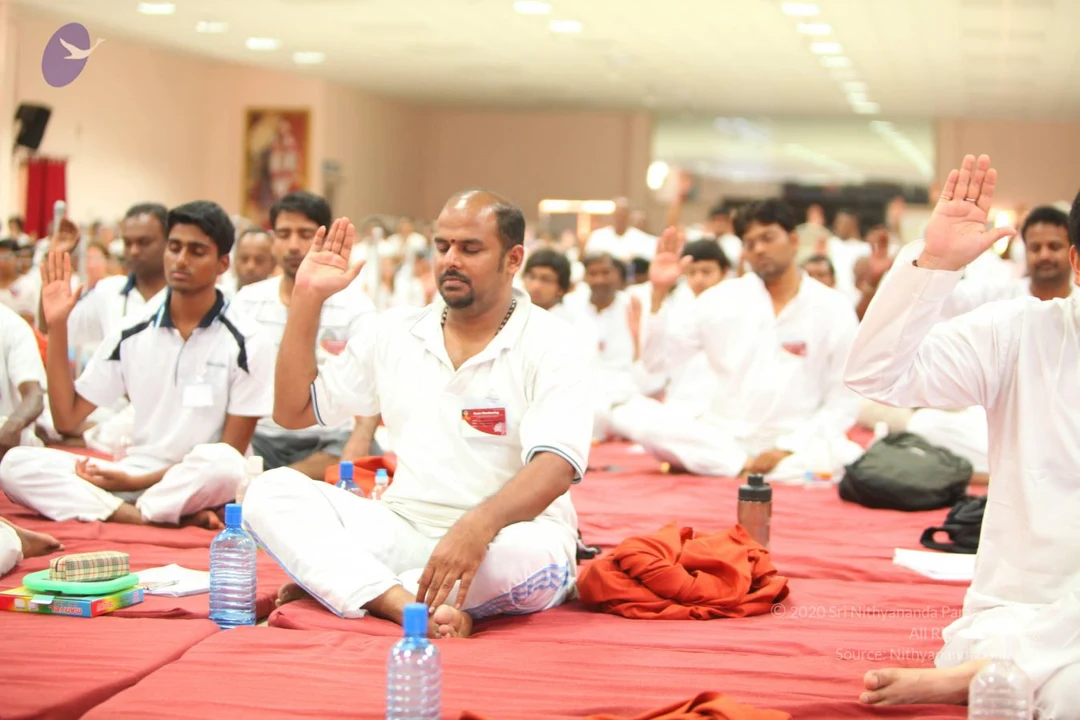
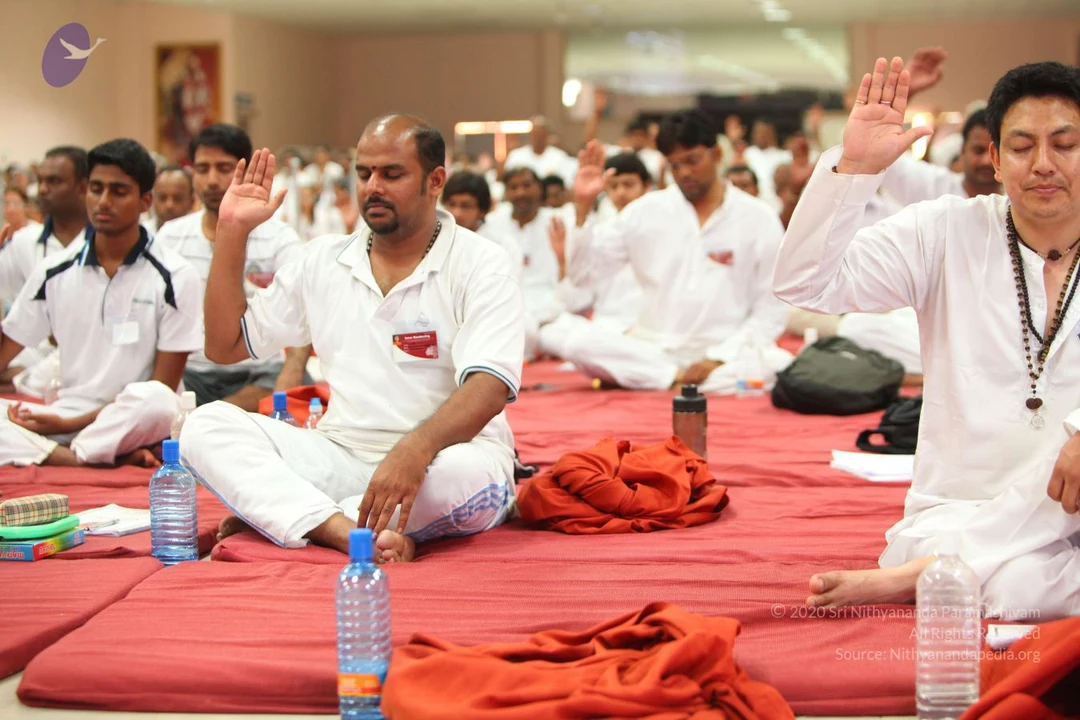
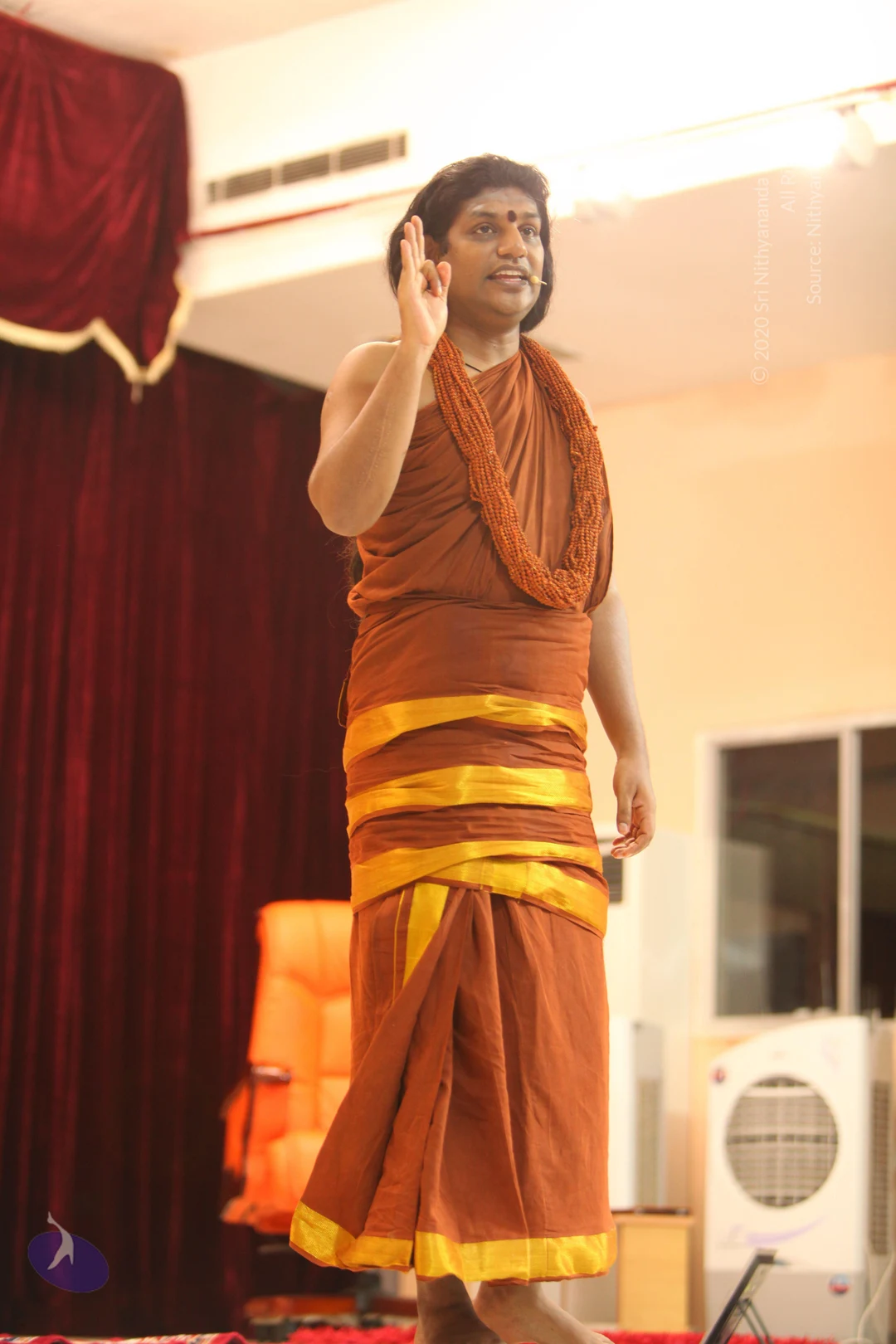
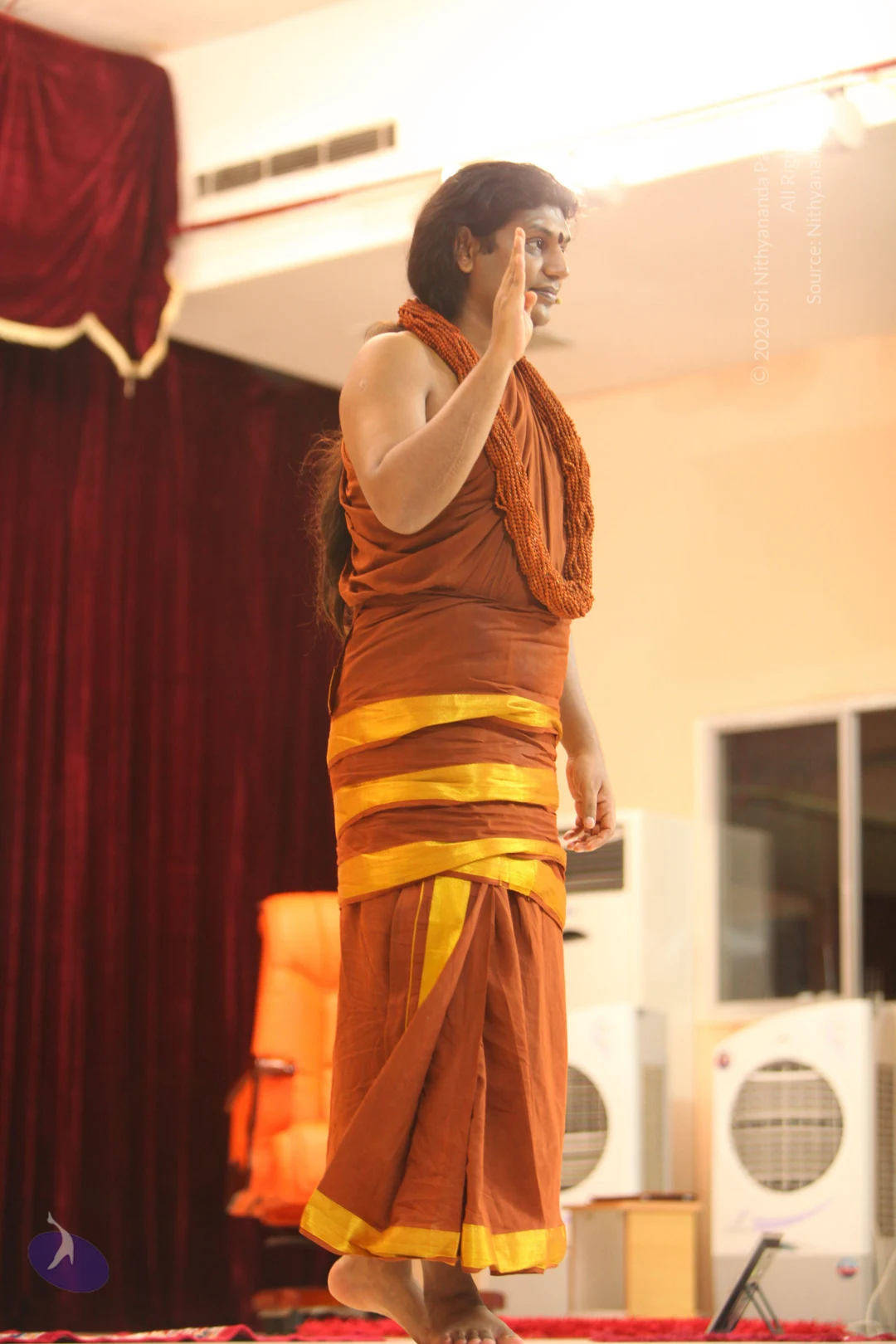
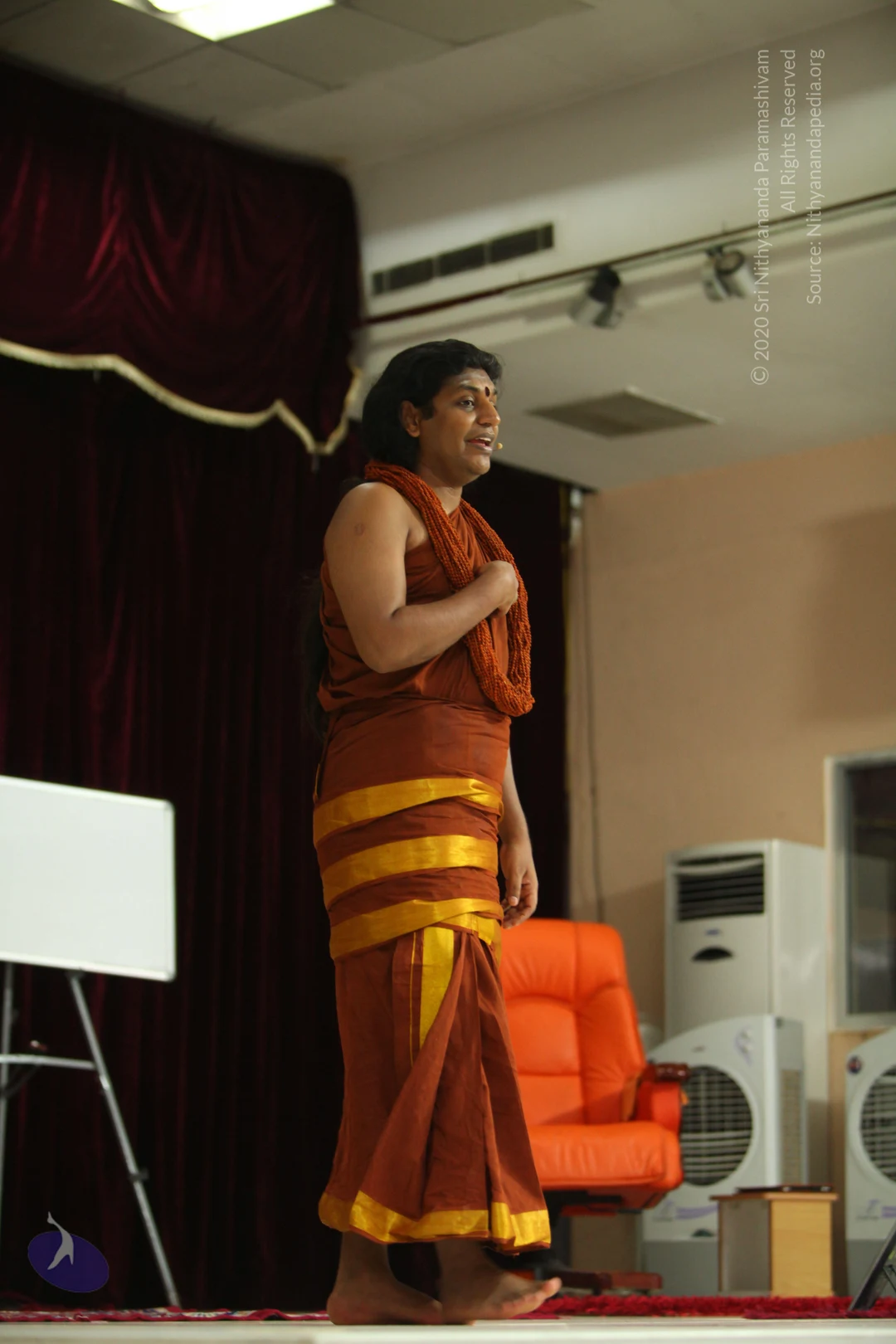
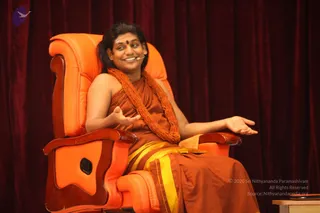
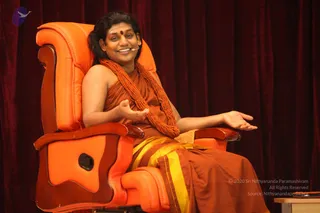
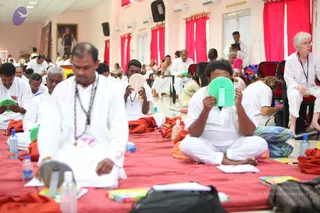
A smiling man with short dark hair and a red bindi sits in a large orange leather armchair against a deep maroon velvet drape. He wears an orange-brown robe with a yellow-gold border and a thick orange rudraksha-style bead mala around his neck, and a small headset microphone is clipped near his face. His hands rest on the chair arms. A dark wooden side table with a black object sits at the lower right. Appearance-based label: a person, seated in a satsang setting; the image shows one person with an orange mala and saffron robe.A photograph of a smiling person seated in an orange leather armchair with carved wooden arms against a deep red velvet curtain backdrop. The person wears a rust-orange ochre robe draped over one shoulder with a yellow-gold border, a long orange-brown rudraksha mala around the neck, and a small red bindi on the forehead. A small clip-on microphone is attached near the face, and the hands are open in an expressive gesture while speaking. A small wooden side table sits at the lower right edge. Appearance-based identity is uncertain, so the candidate cannot be confirmed from the image alone.A smiling man sits in an orange leather armchair with wooden armrests against a deep red velvet curtain. He wears an orange-brown robe with a yellow-gold border draped over one shoulder, a long orange-brown rudraksha mala around his neck, and a small red dot on his forehead. A small microphone is attached near his face, and his hands are open in a gesturing pose. A small wooden side table is visible at the lower right edge. Swamiji (probable): the appearance cues of long swept-back dark hair, saffron-orange robes and rudraksha mala match the page's claim that Swamiji is present at this event, though the appearance is only partially distinctive.A man seated in an orange leather armchair against deep red velvet drapes, smiling with open arms and palms turned outward as if speaking. He wears a saffron-orange robe draped over his shoulder, a yellow-bordered cloth at the waist, a dark red bindi on his forehead, a long orange-red rudraksha mala around his neck, and a small headset microphone. The setting suggests a discourse or satsang stage.A large indoor hall where many devotees sit in rows on red floor mats, dressed mostly in white with orange shawls set aside beside them. Several men in the foreground hold small green and red prop-like sheets while reading or looking down. A seated young man in white with a dark rudraksha-style mala and a badge around his neck is at the center. Water bottles sit on the mats. A framed portrait hangs on the far right wall, and the background shows more seated attendees.A photograph of a satsang hall with pink curtains and a red floor covering. In the foreground a man in white clothes and a rudraksha mala sits cross-legged, while seated devotees in white hold up green and beige fan-shaped boards to their faces during a practice. Orange cloths, water bottles and a printed booklet lie on the floor. A woman in white with glasses sits on a chair at right, and more people in white are seated across the hall; a standing man in white stands near the back. A framed photo hangs on the wall at upper left. The image is credited to the archive at its lower right.

IA-Session-Sharings

13 photosSource gallery
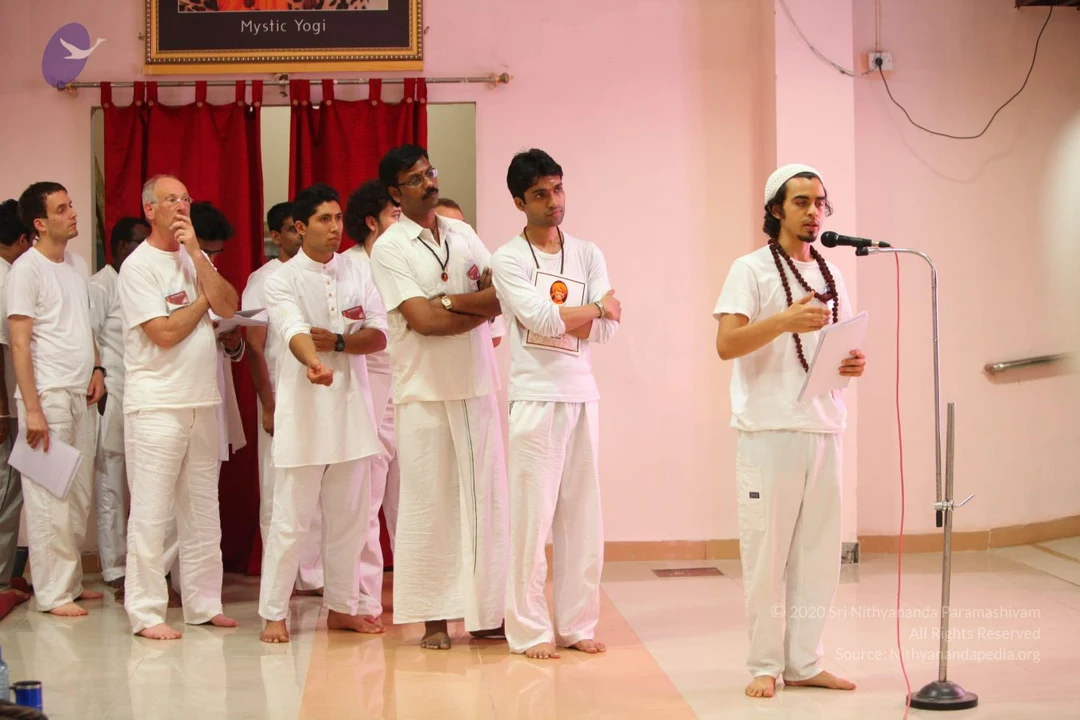
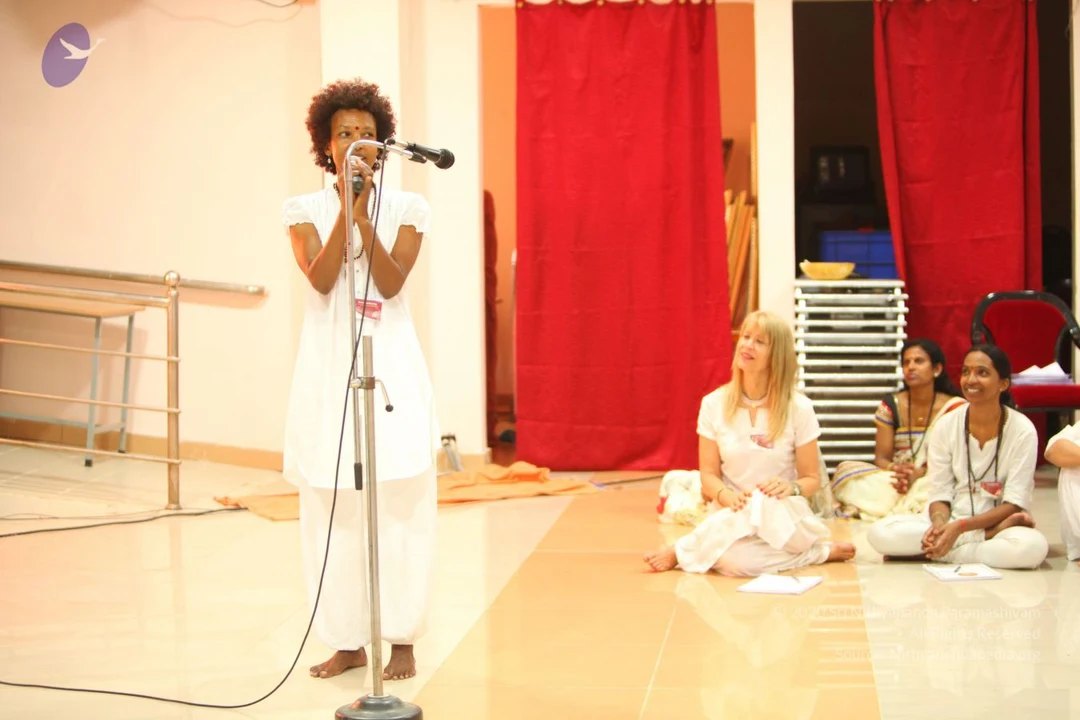
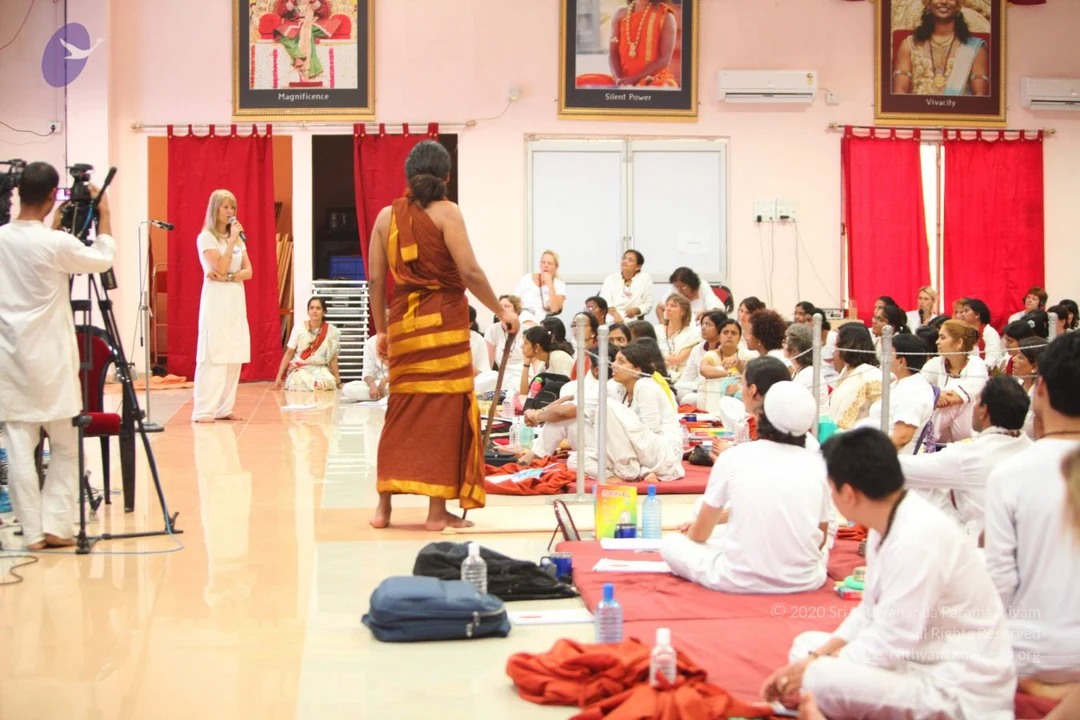
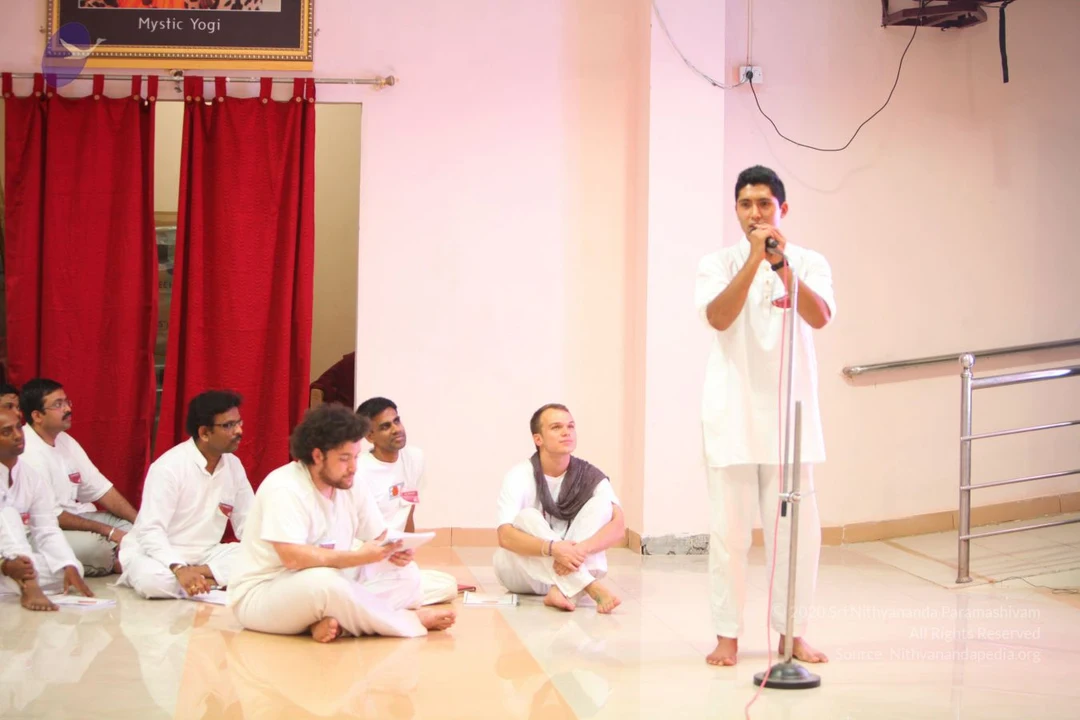
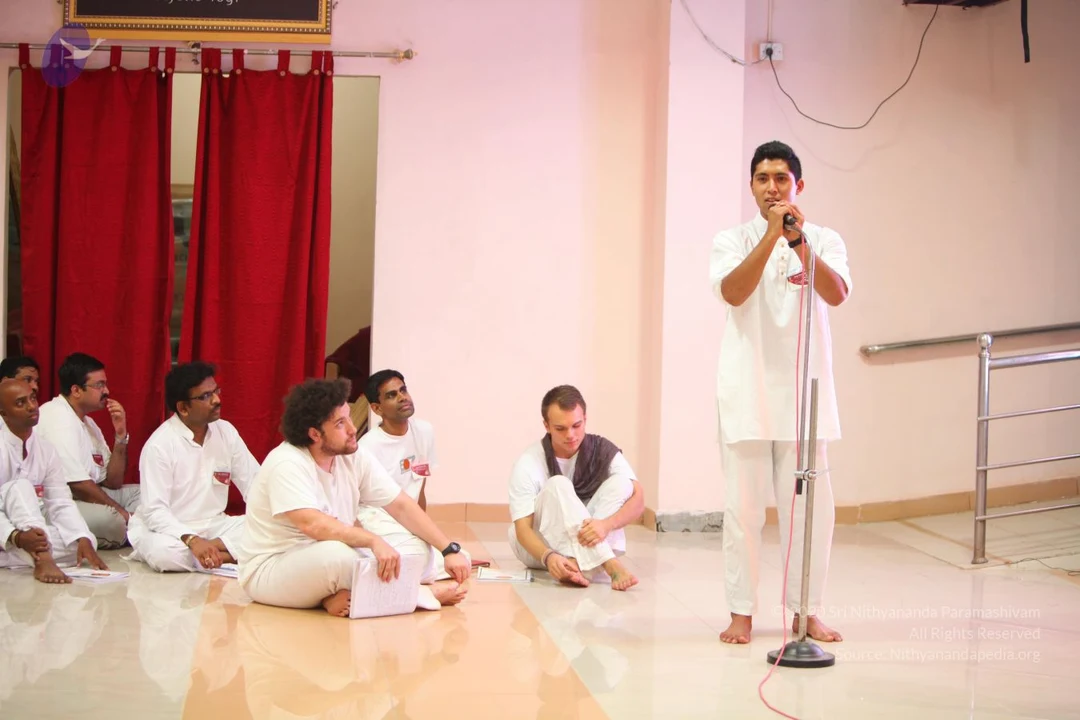
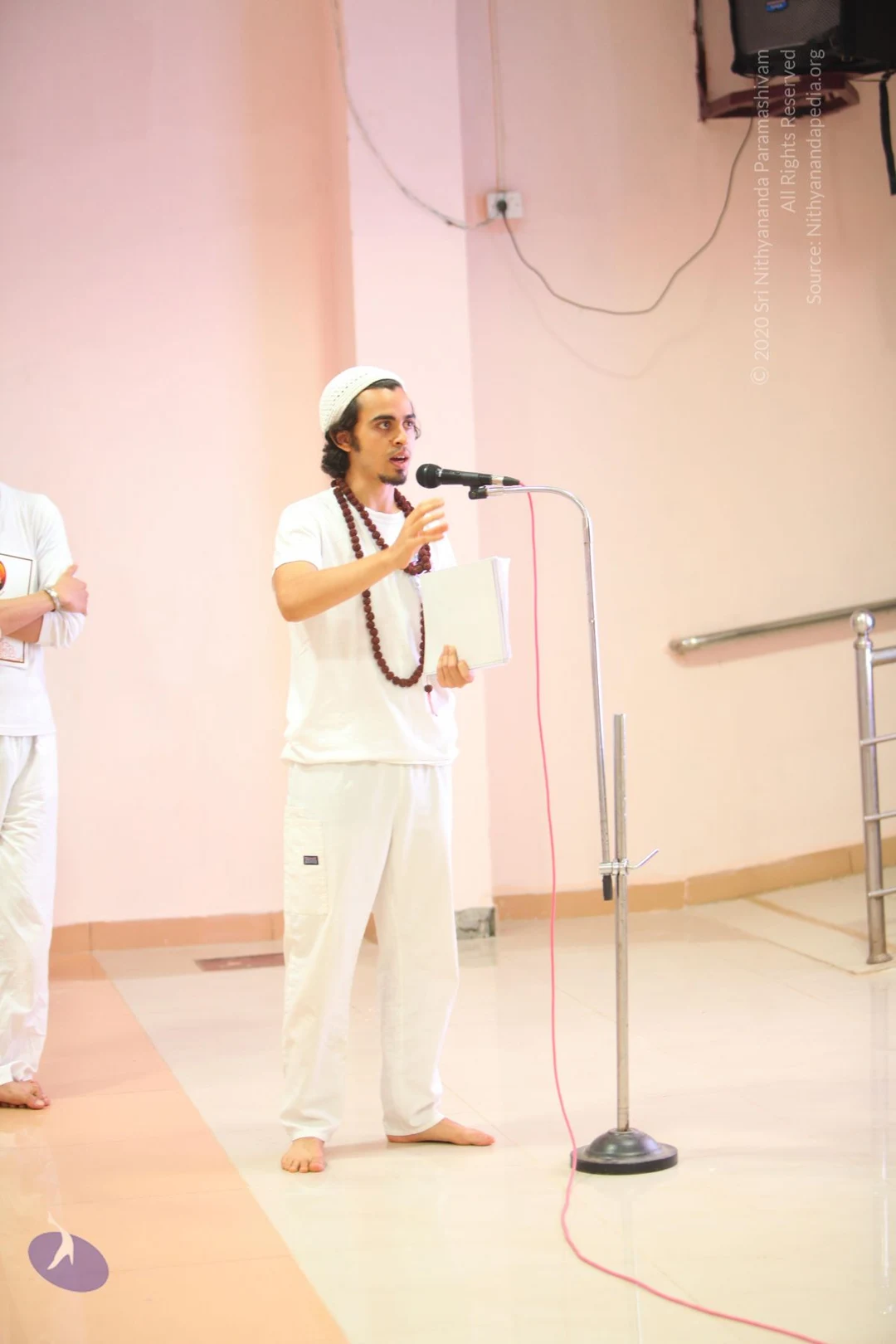
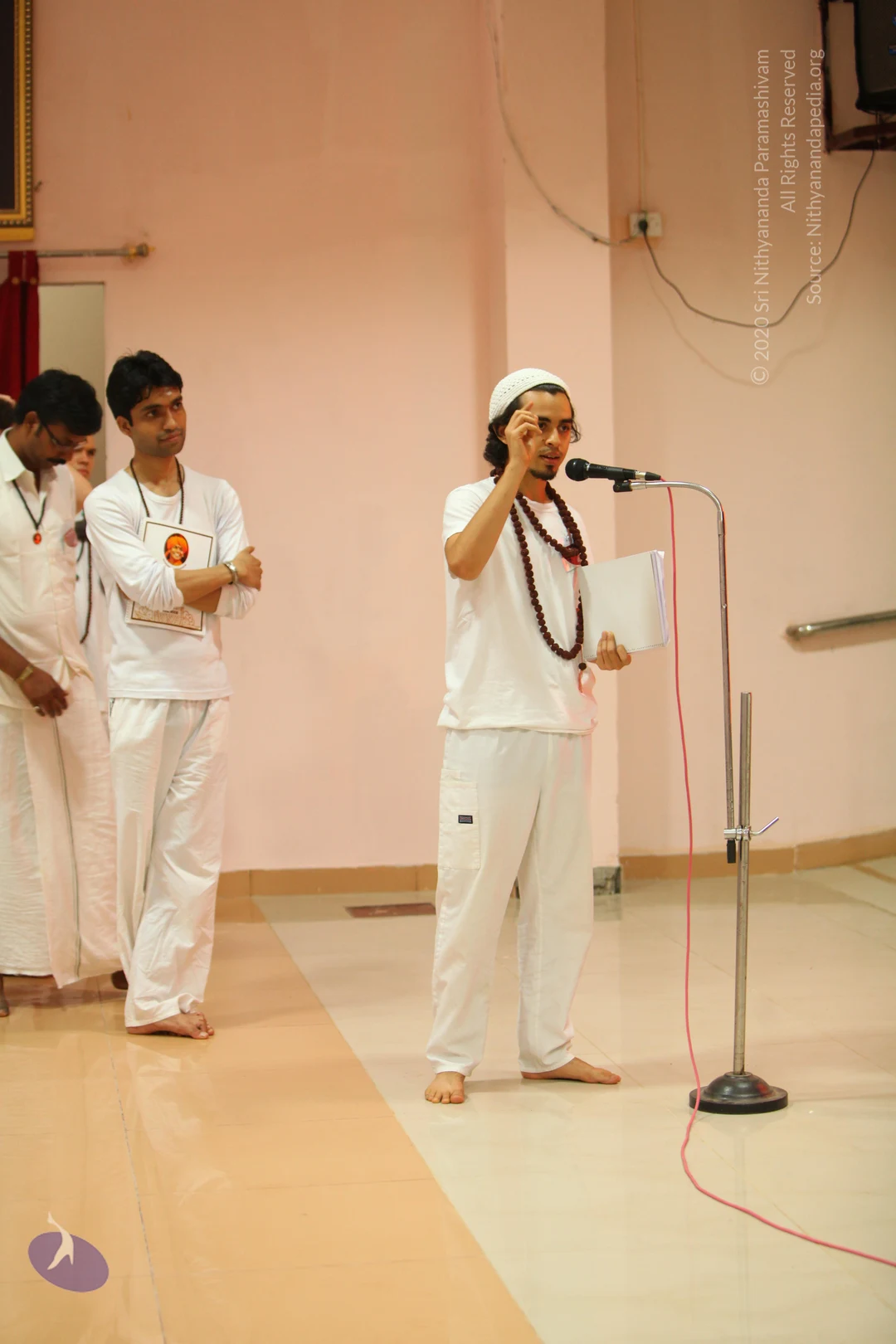
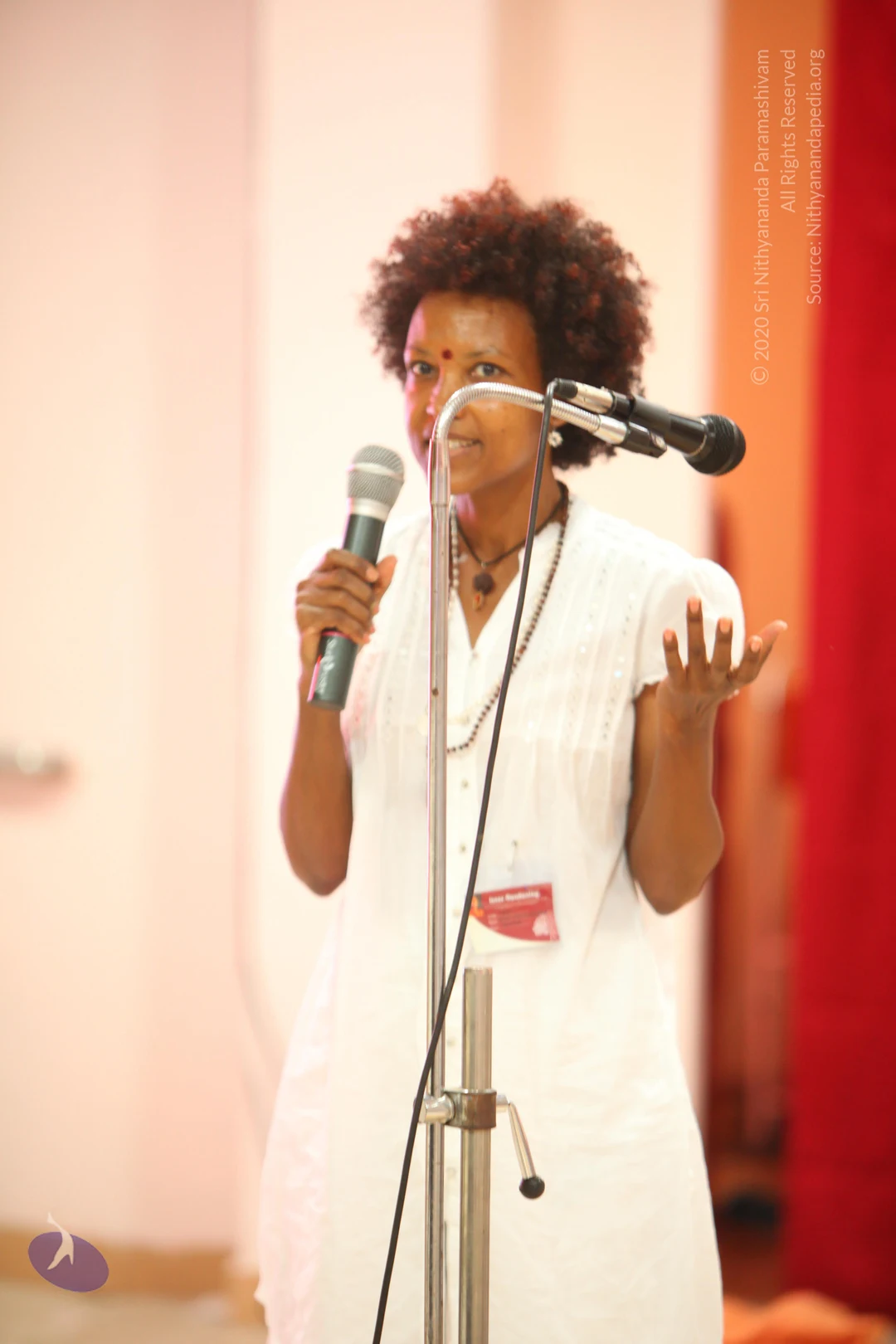
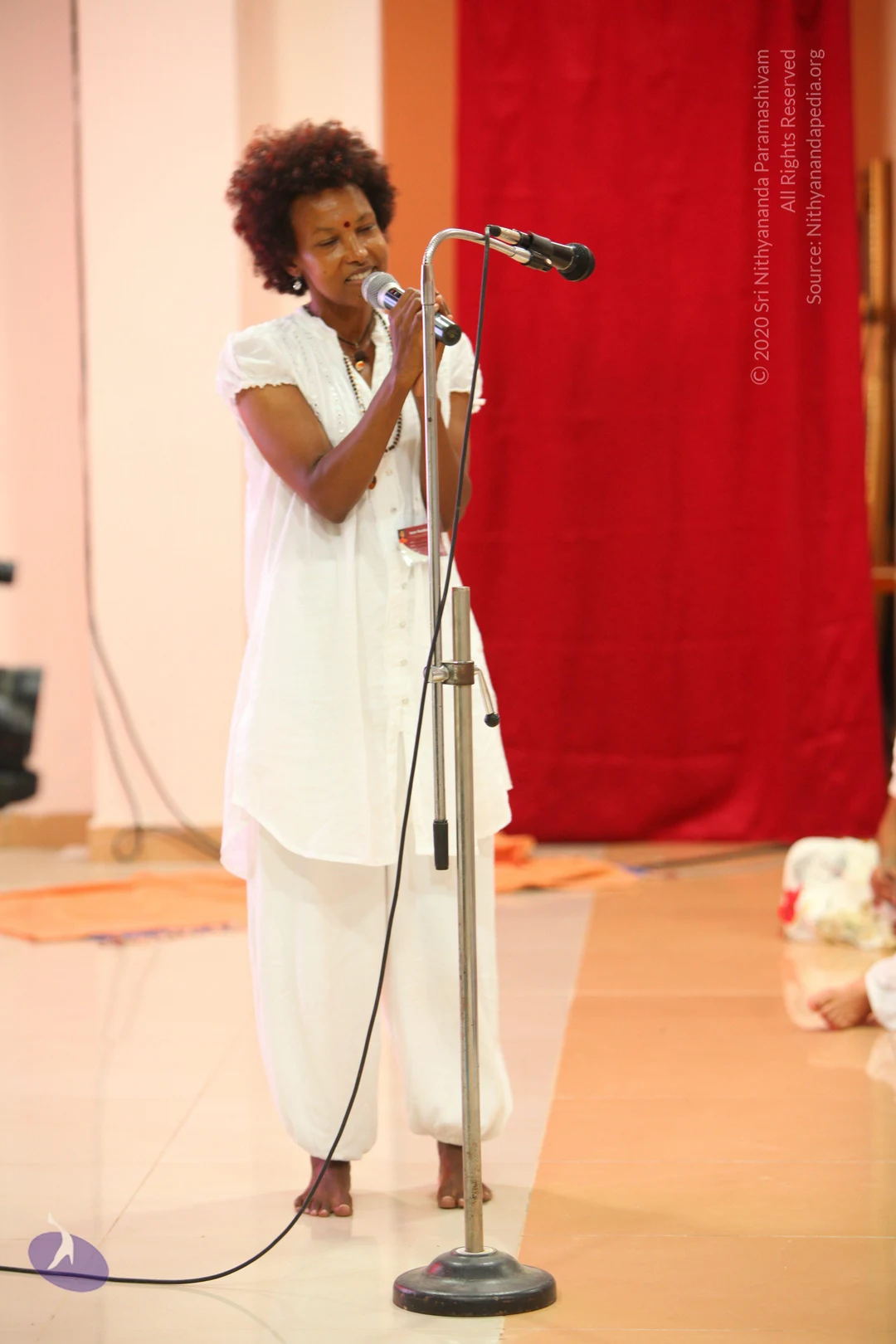
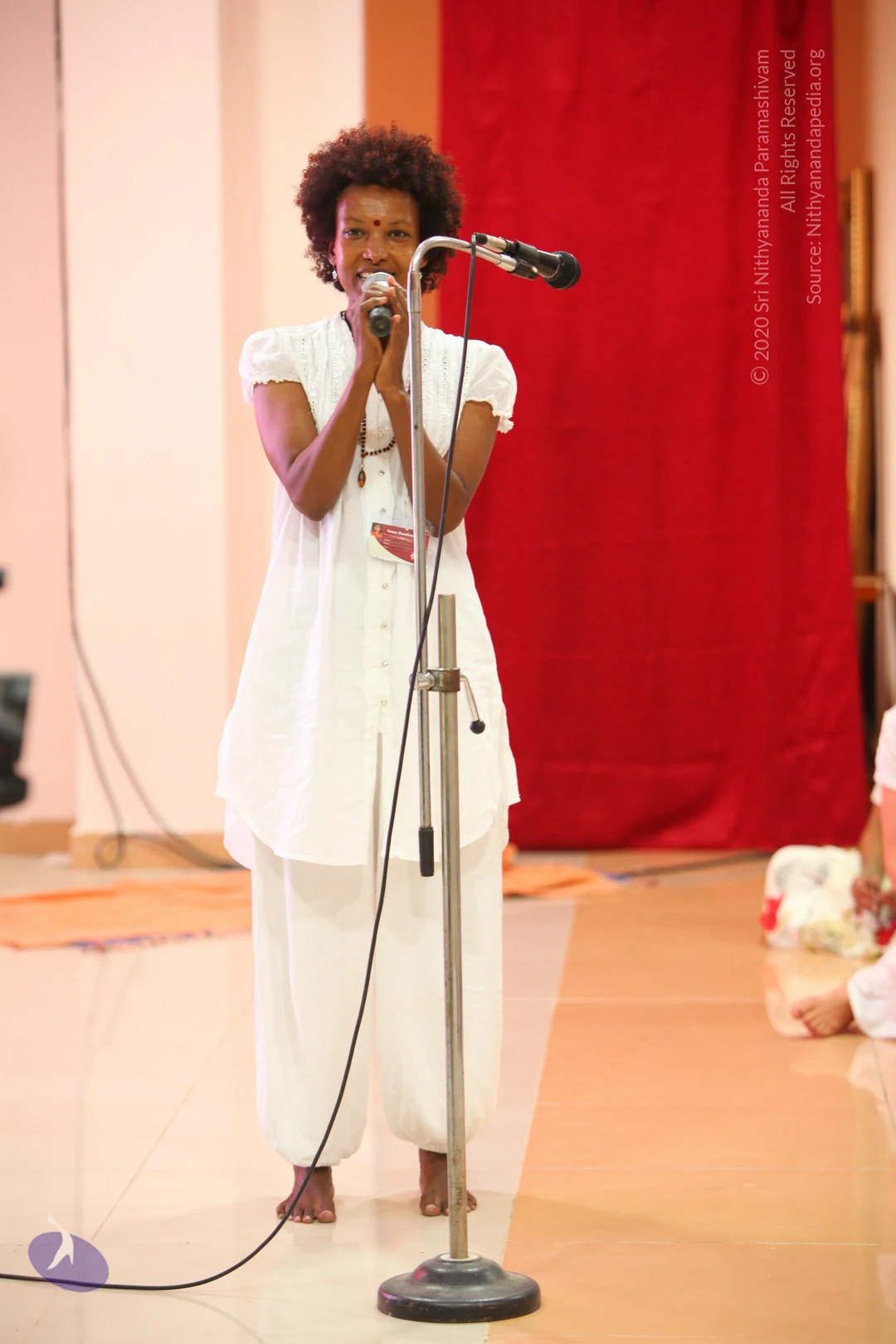
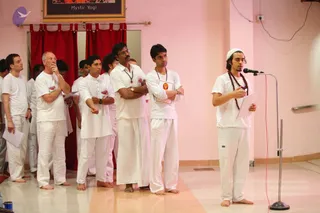
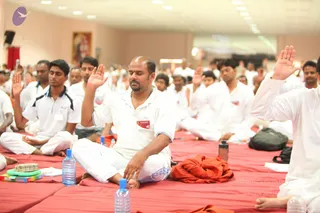
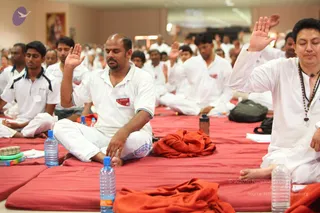
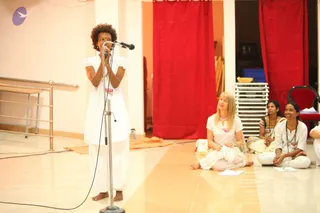
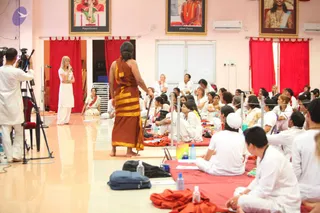
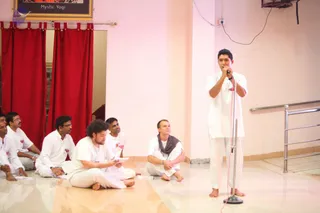
A group of people in all-white clothing stands in a pink-walled hall with red curtains. At the right, a young man in a white kurta-style top and white trousers, wearing a white cap and a red rudraksha mala, speaks into a microphone on a stand while holding a sheet of paper. Beside him, a man in white dhoti and shirt with glasses and a red pendant stands with arms crossed. Others in white stand behind, one older man with grey hair and white clothes holds his chin. A framed picture reading Mystic Yogi hangs on the wall above. The scene suggests a satsang or group programme.A photograph of a large indoor hall where many men in white clothes sit cross-legged on red mats during a group session. In the foreground a bald man with a goatee wears a white shirt and white dhoti, with a red name badge and a dark beaded necklace, his hands raised palm-forward in front of him. Beside him a younger man in a white collared shirt sits with his eyes closed and a hand raised. Water bottles, a folded saffron cloth, and a notebook lie on the mats. A large portrait hangs on the far wall, and a stage area with lights is visible in the background. Several people on the right also raise their hands.A large satsang hall with participants seated on red floor mats, many wearing white clothes. In the foreground a bald man in a white shirt and white pants sits cross-legged with eyes closed and one hand raised in an open palm gesture. On the right a man in white kurta with a rudraksha mala raises his palm with eyes closed. Water bottles, a folded saffron cloth and a backpack lie on the mats. Behind them more seated devotees raise hands, and a framed picture hangs on the wall at left.A woman with short curly dark hair and a red bindi stands barefoot on a polished tile floor, speaking into a microphone on a tall stand. She wears a white tunic and white pants with a small badge on her chest. Behind her, three women sit cross-legged on the floor in white and cream clothing, one with blonde hair, another in a patterned sari and one in white with a lanyard, looking toward the speaker. Red curtains hang in the background beside a pale orange wall and a folding chair. The scene suggests a satsang gathering with listeners seated on the floor.A photograph of a satsang hall with pink walls, red curtains and framed portraits labelled "Magnificence", "Silent Power" and "Vivacity". A figure with hair tied back, wearing an orange and gold draped garment, stands barefoot on a polished floor facing the seated audience. A woman in white holds a microphone and stands at left beside a cameraman on a tripod. Many devotees in white clothing sit on red mats and red cushions, with water bottles and bags nearby. The scene is a teaching session with a presenter addressing the gathering.A standing man in white kurta and white trousers speaks into a microphone on a stand in a bare pink-walled hall with a polished light floor. Behind him, a framed picture labelled Mystic Yogi hangs above red curtains. Six people in white sit cross-legged on the floor to the left, some holding papers. A younger man in a white kurta with a grey shawl sits barefoot among them. Metal handrails and a wall-mounted fan are visible at the right.

IA-Lunch-By-Swamiji

17 photosSource gallery
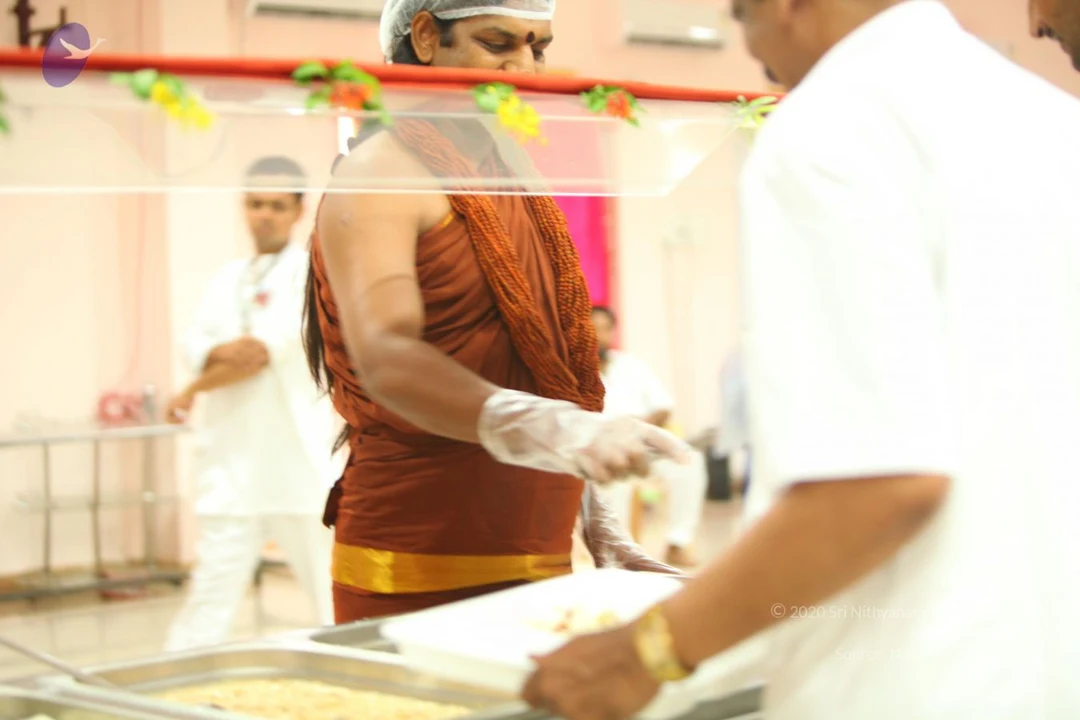
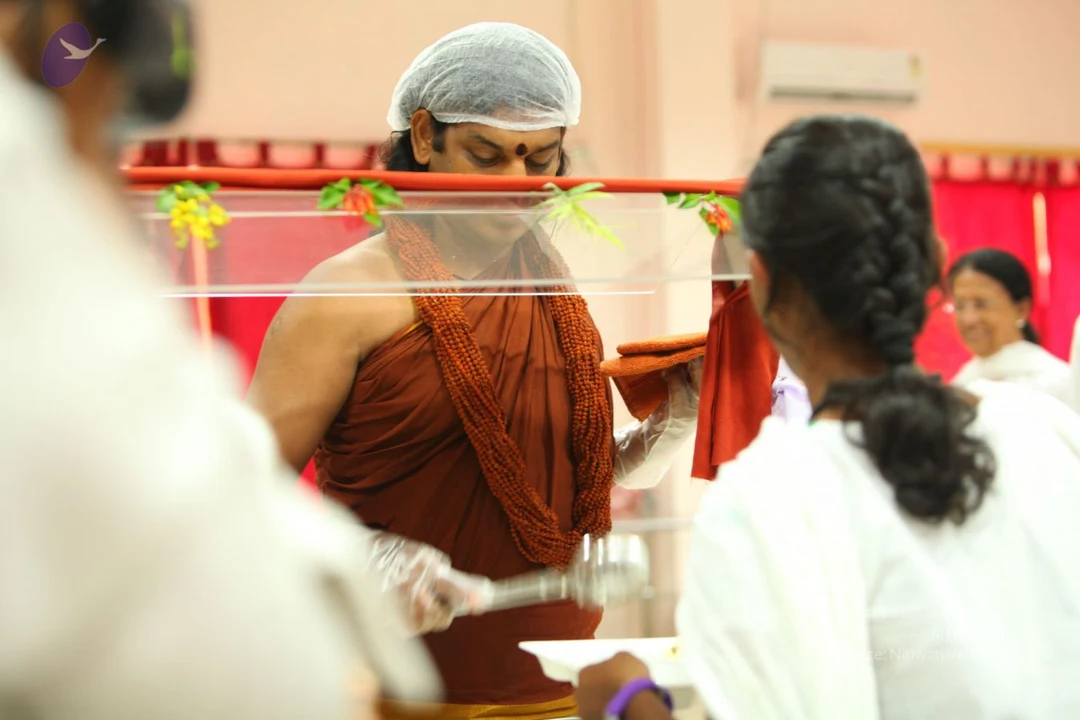
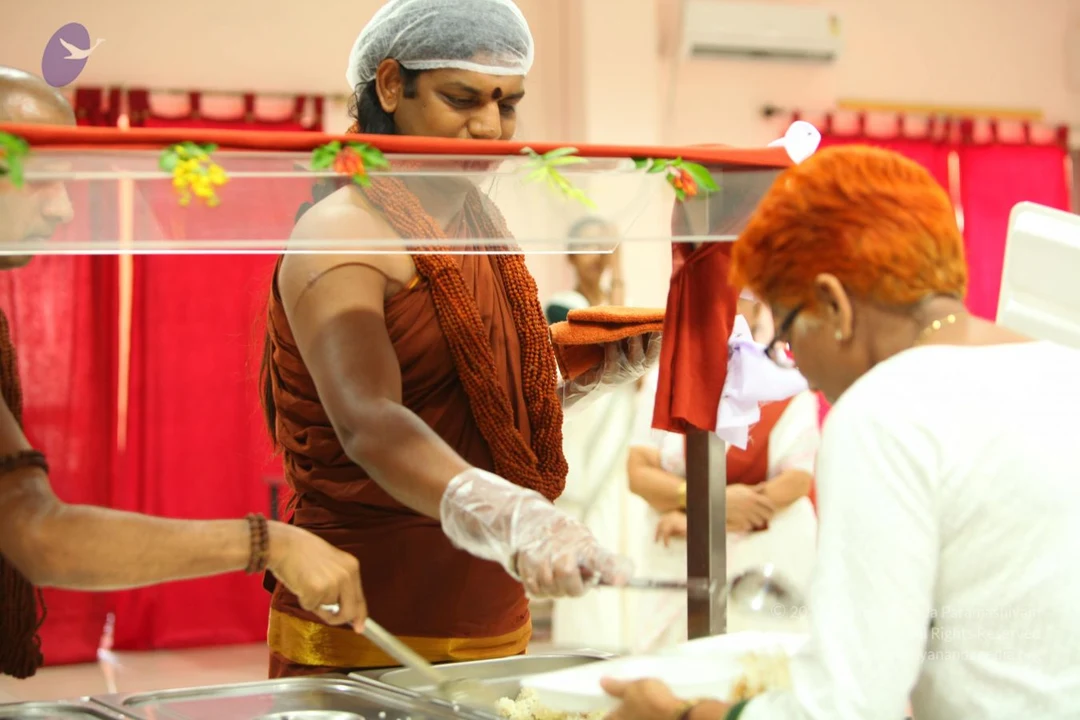
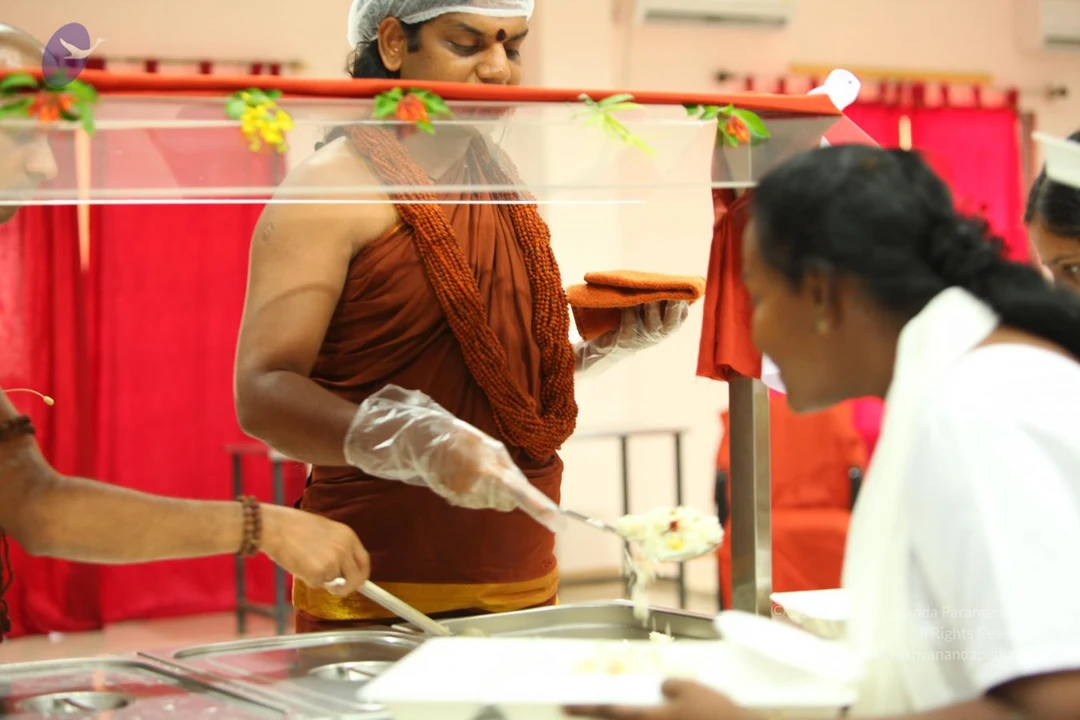
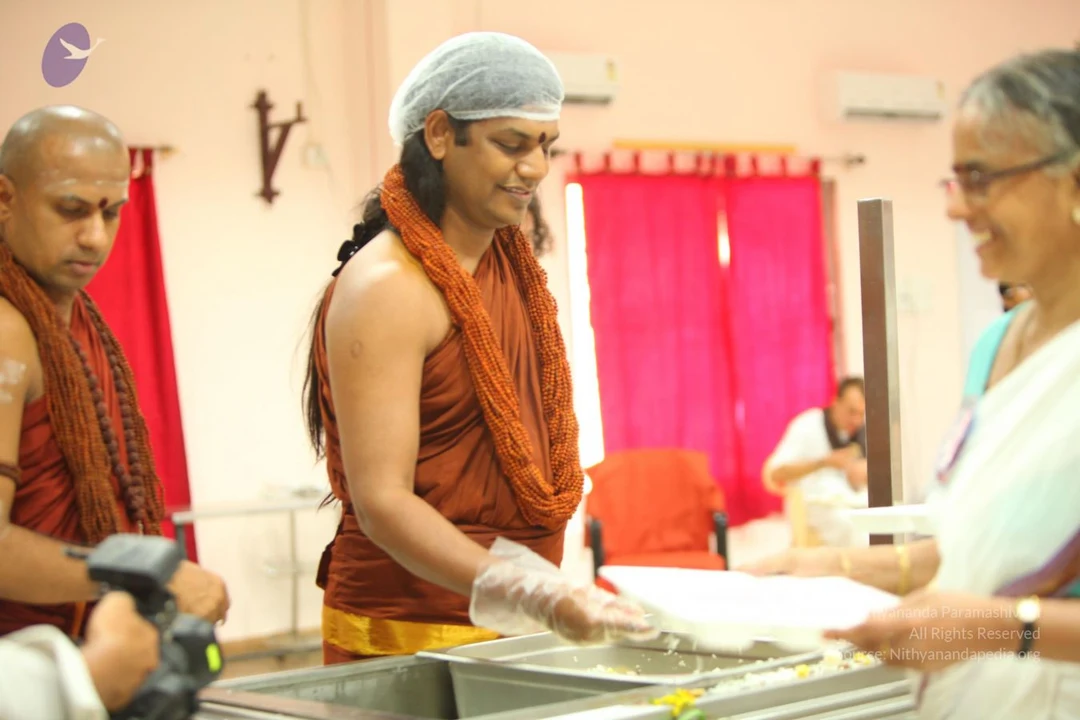
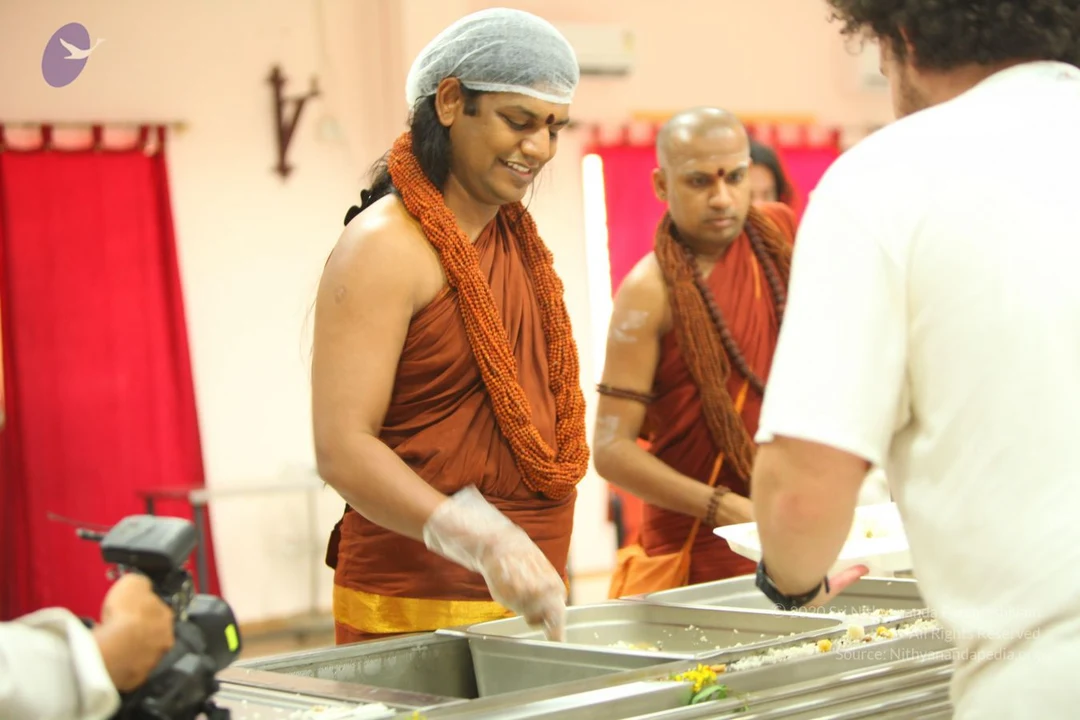
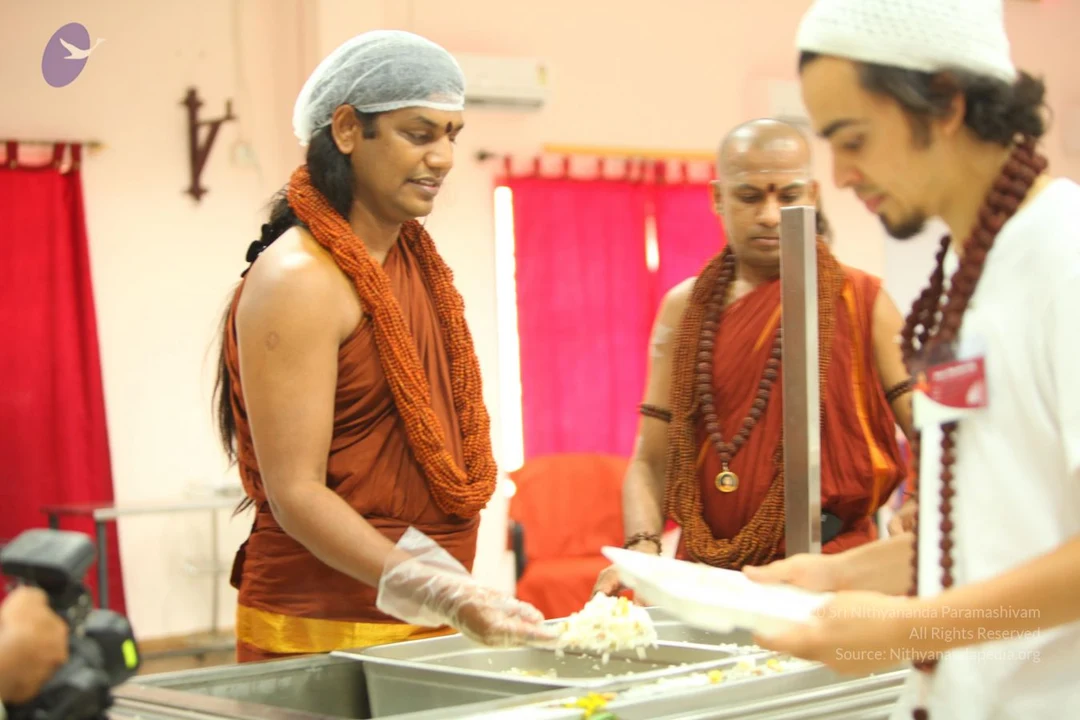
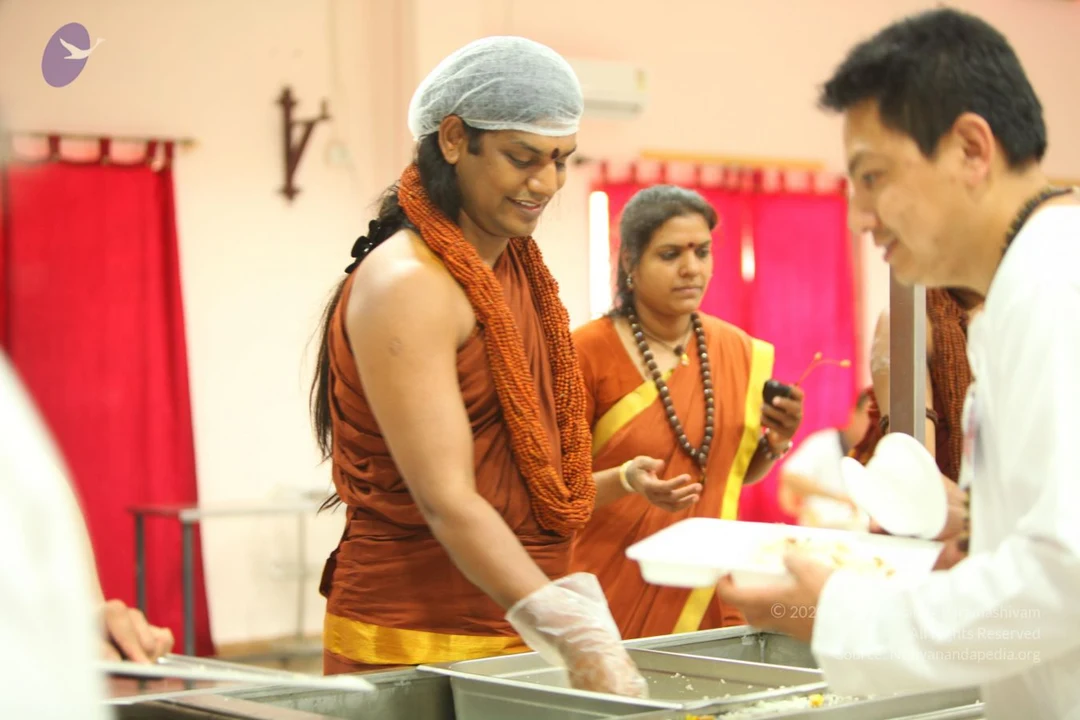
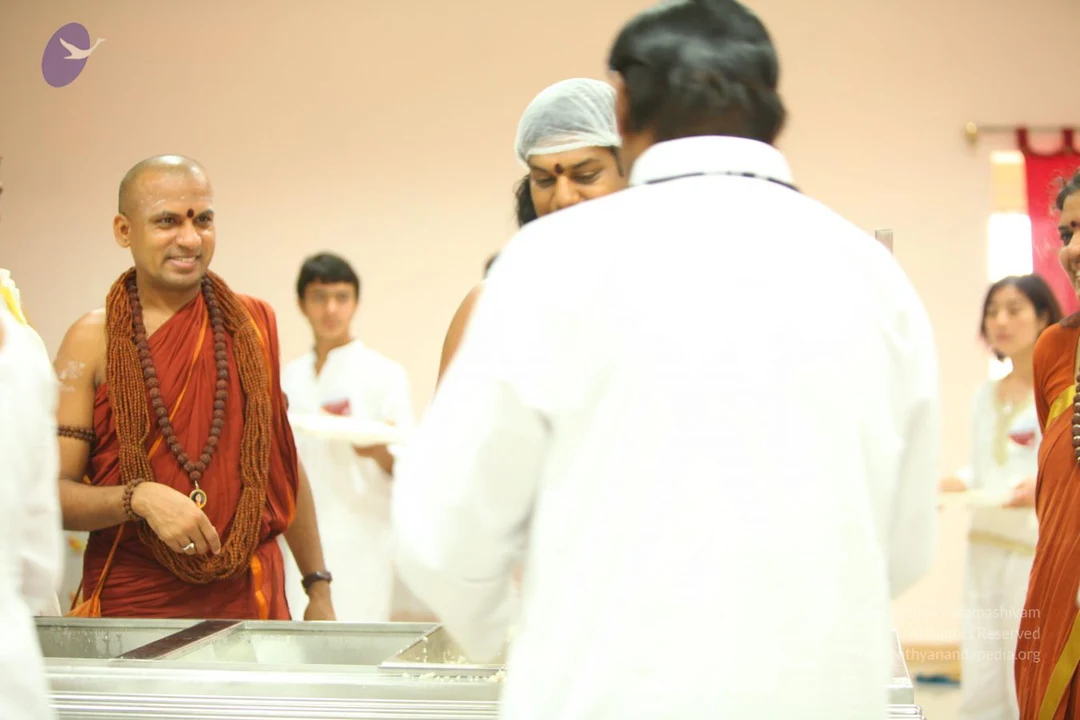
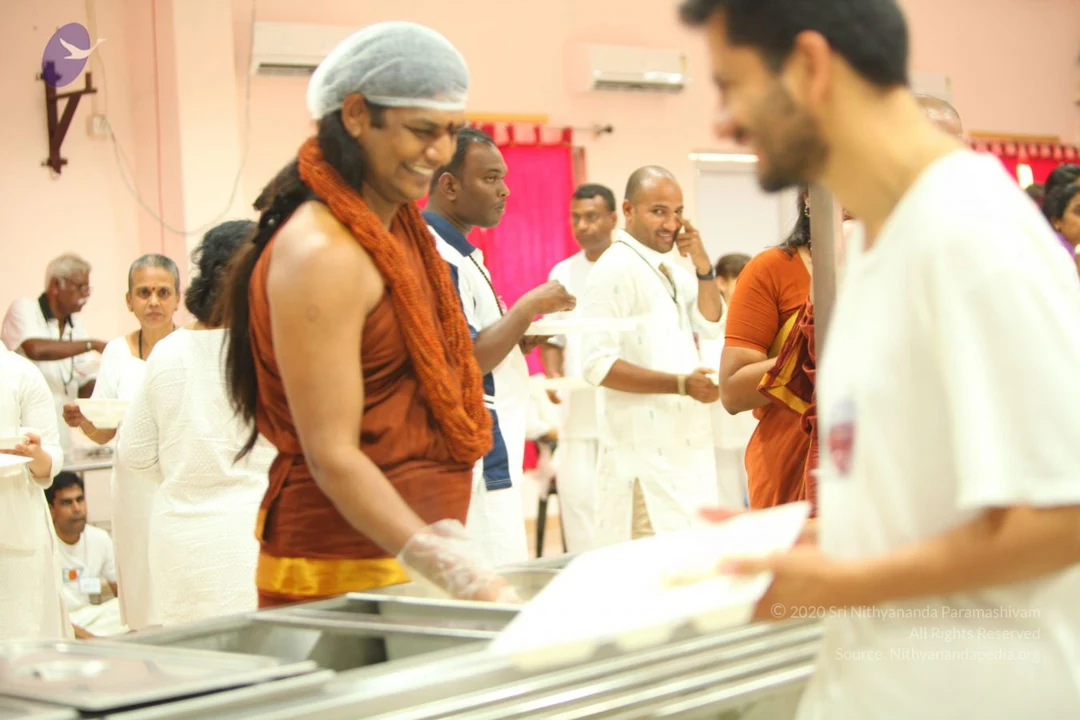
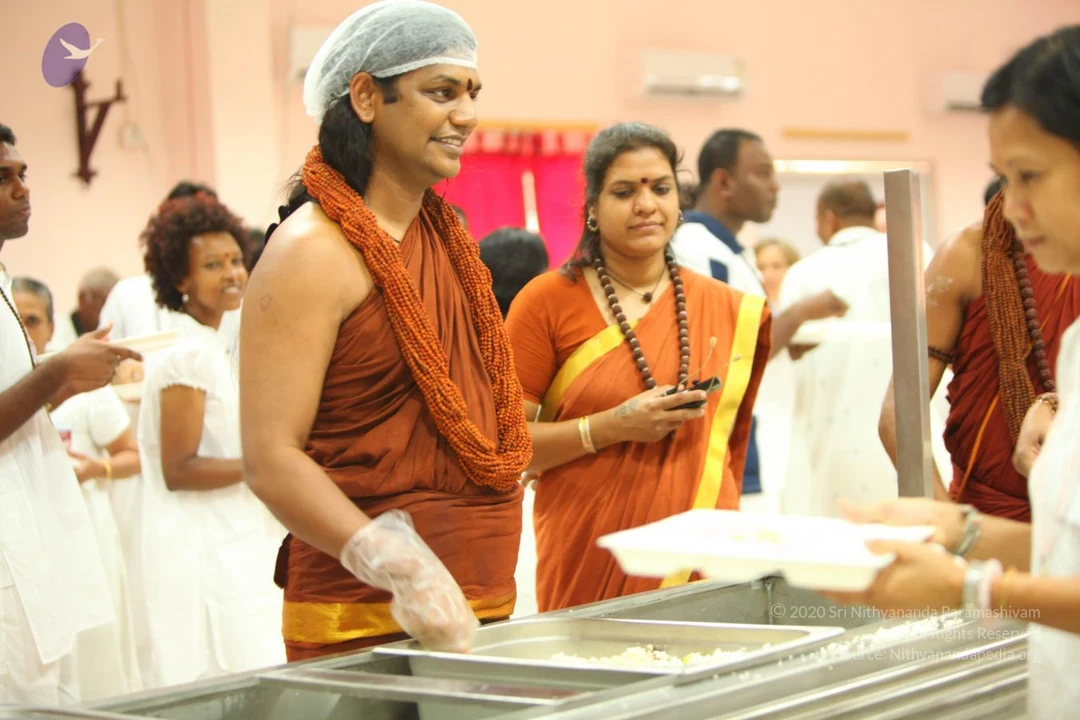
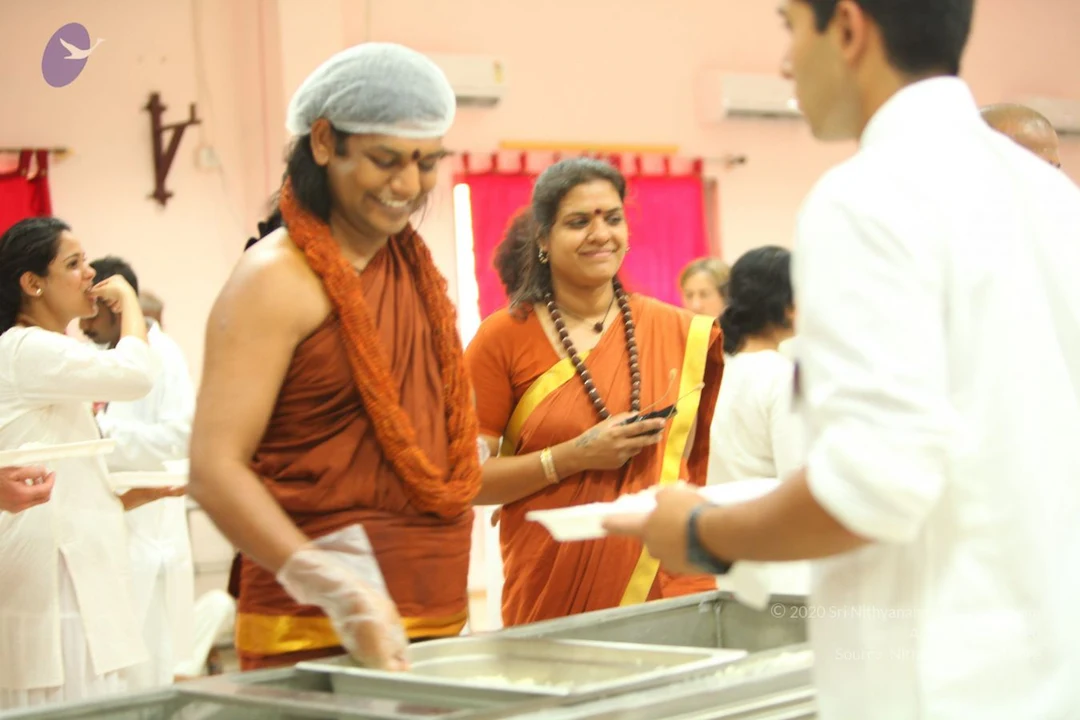
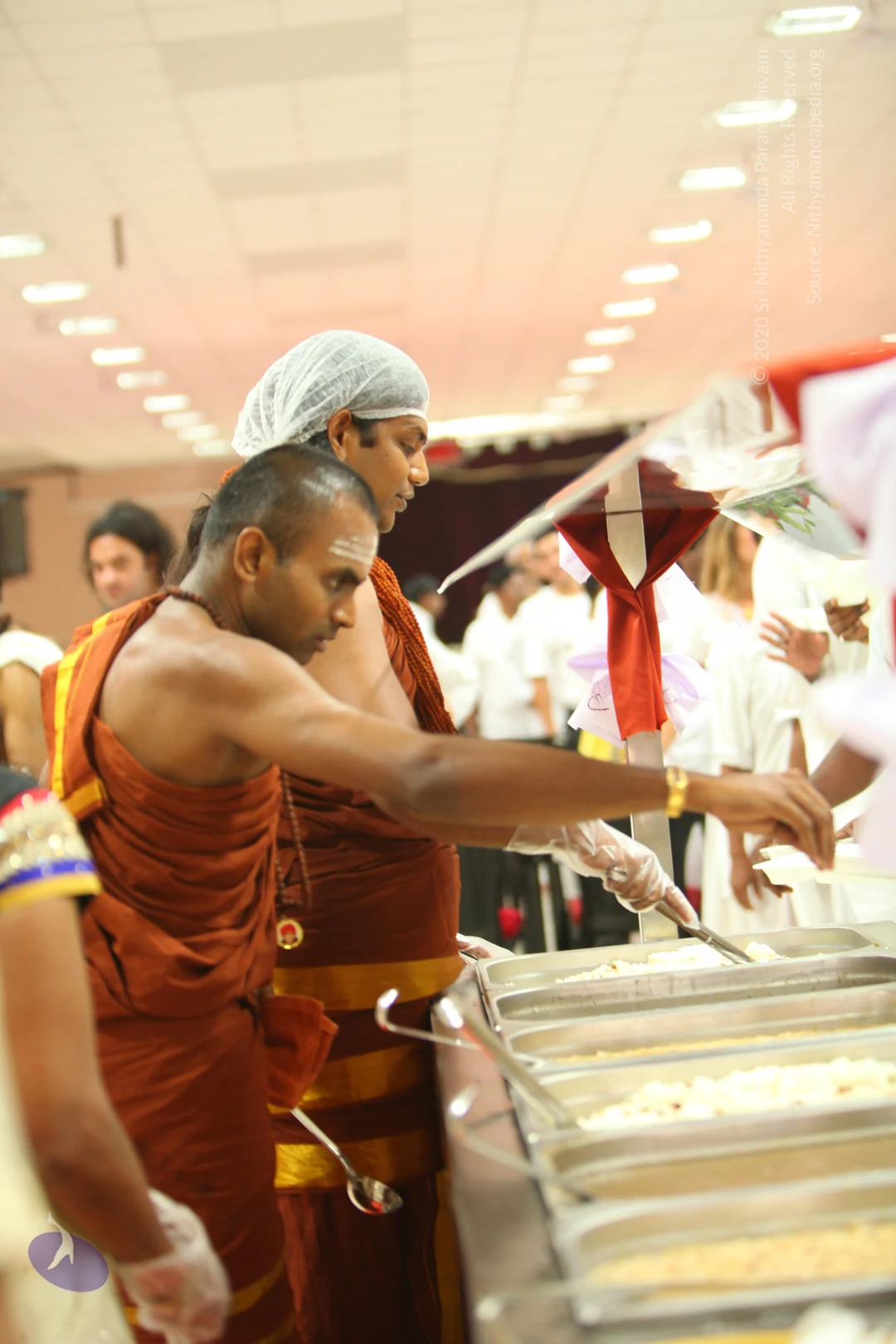
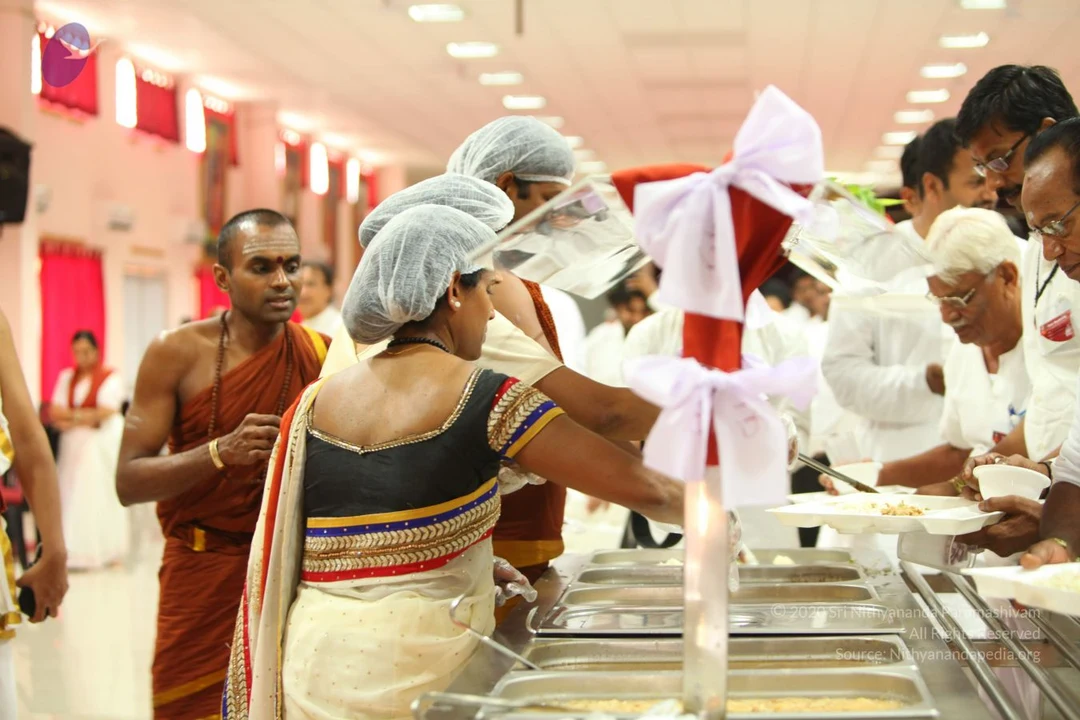
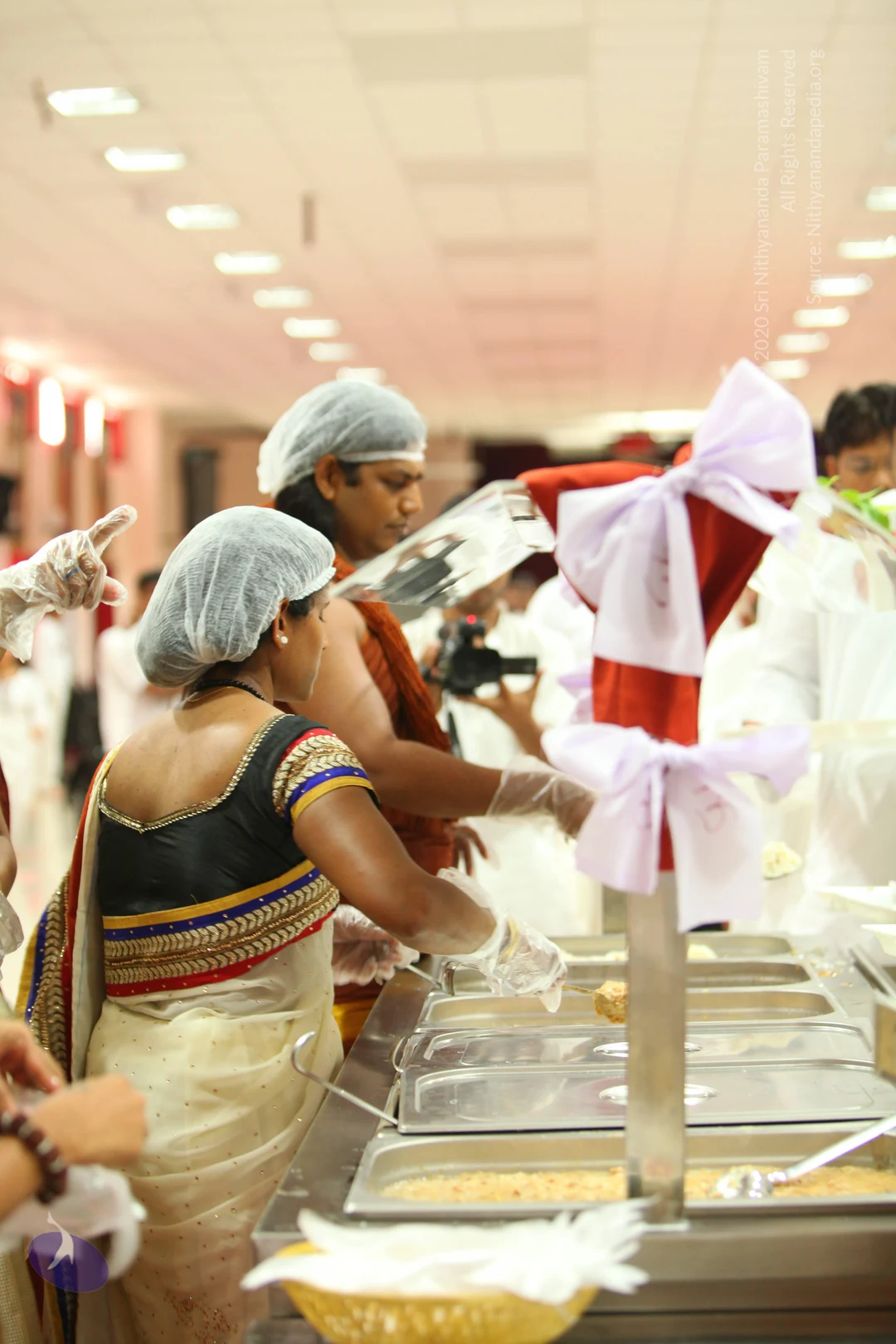
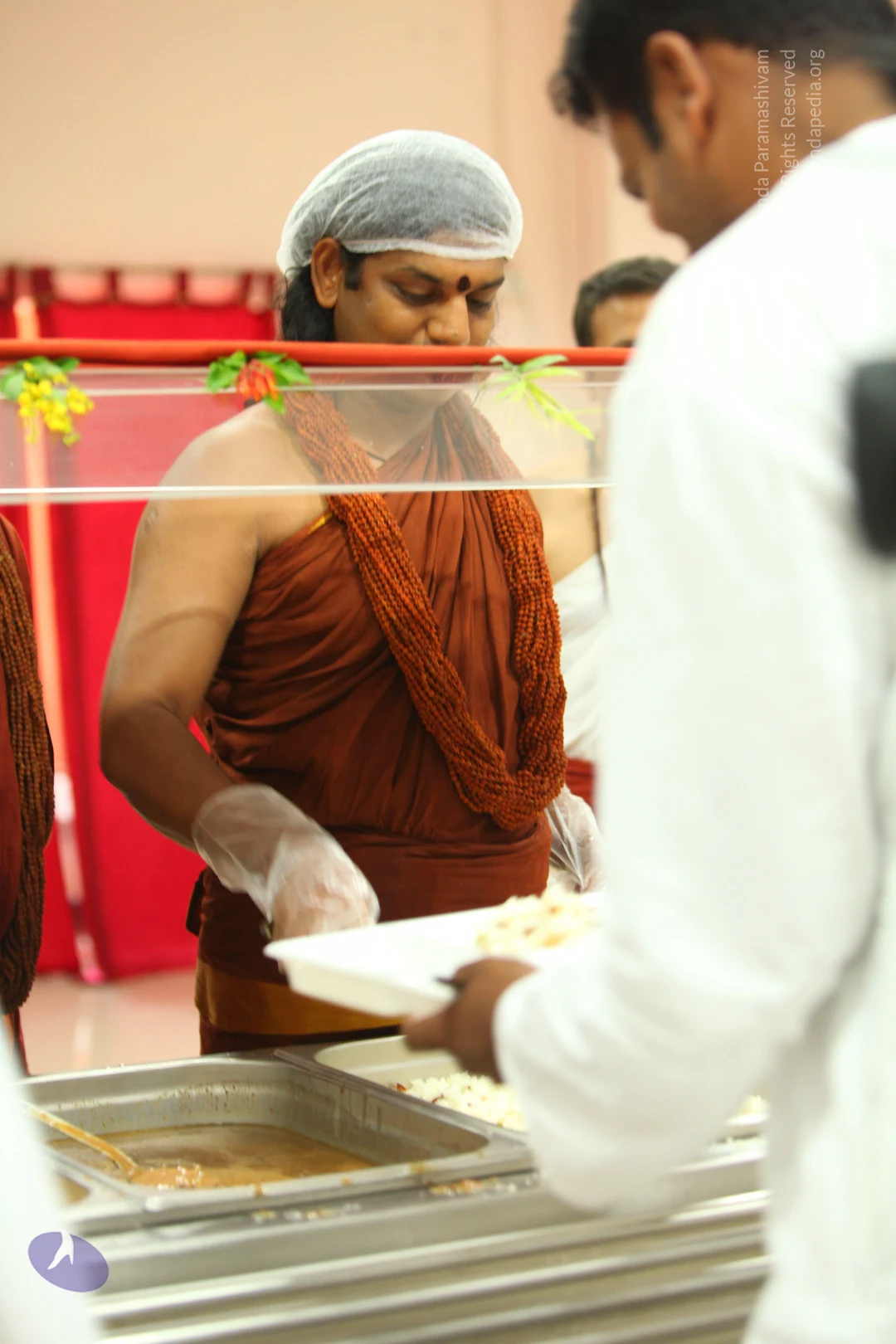
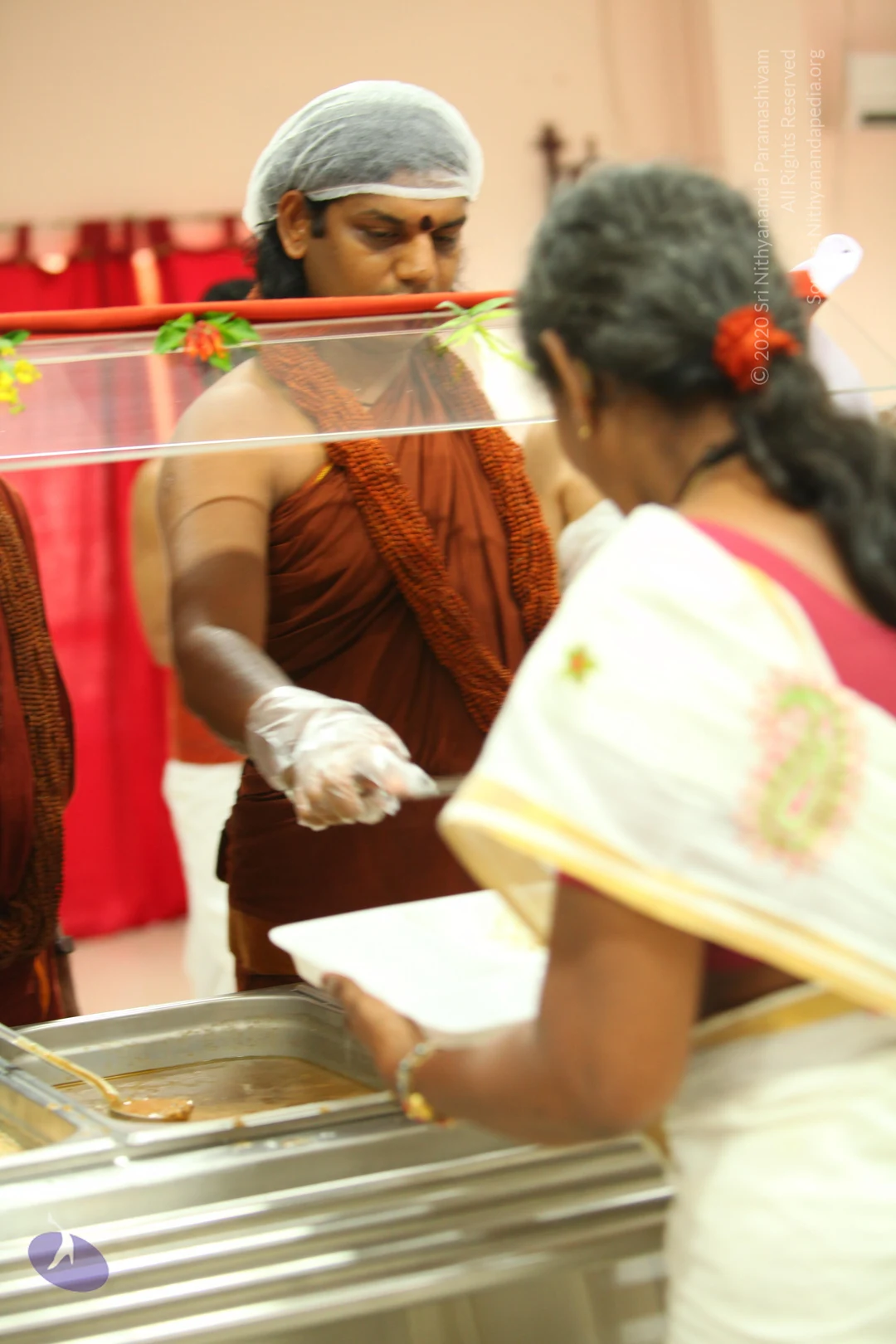
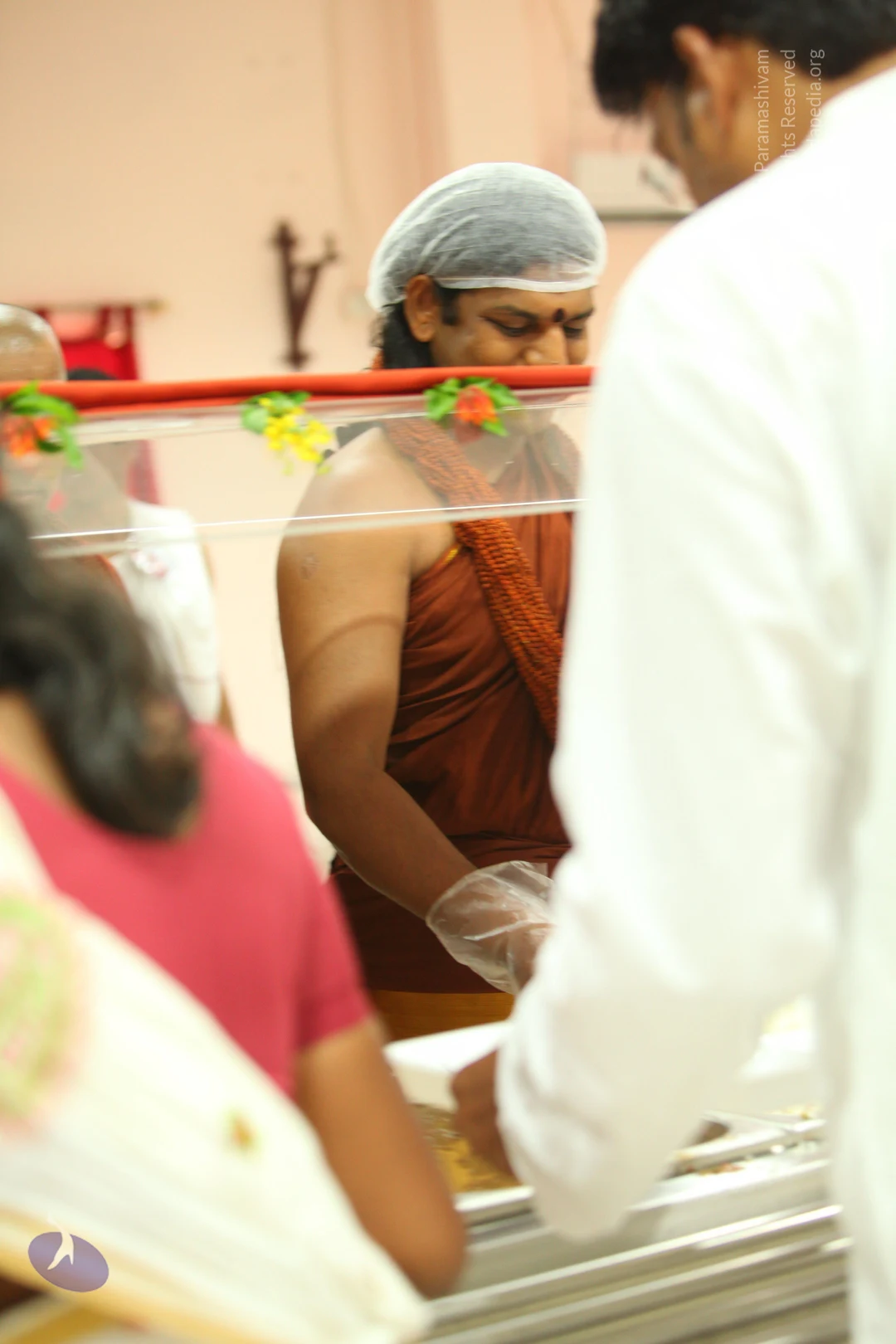
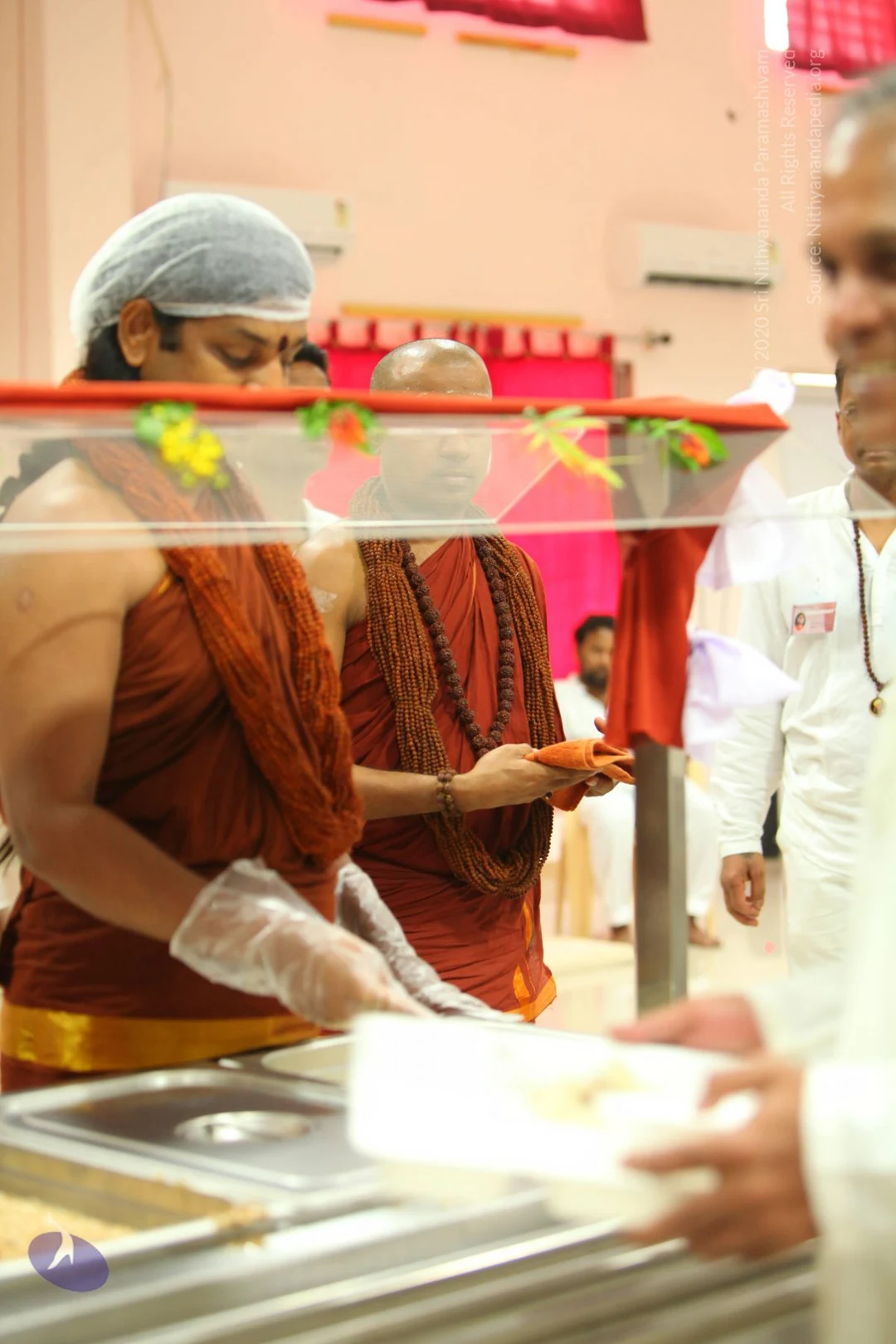
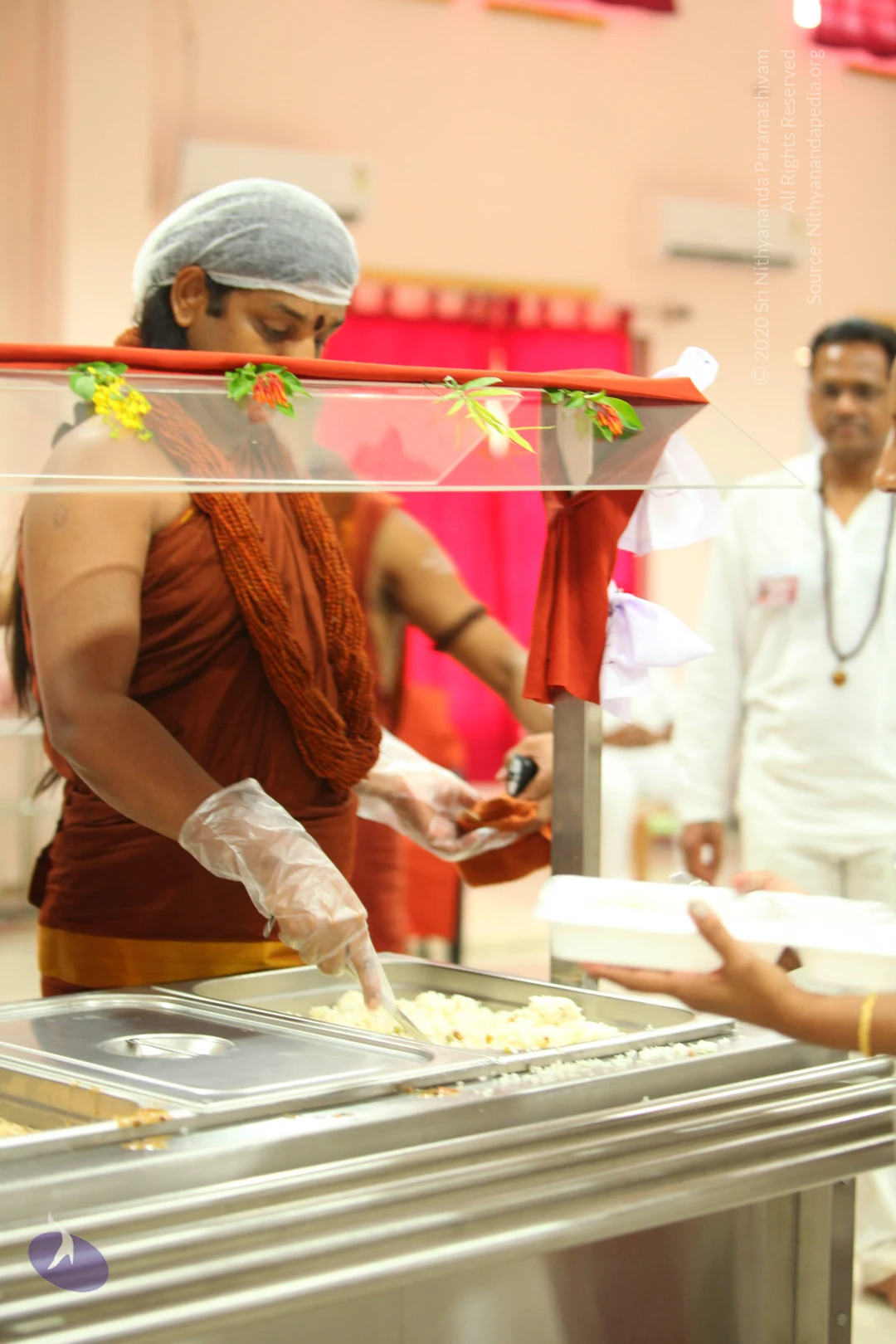
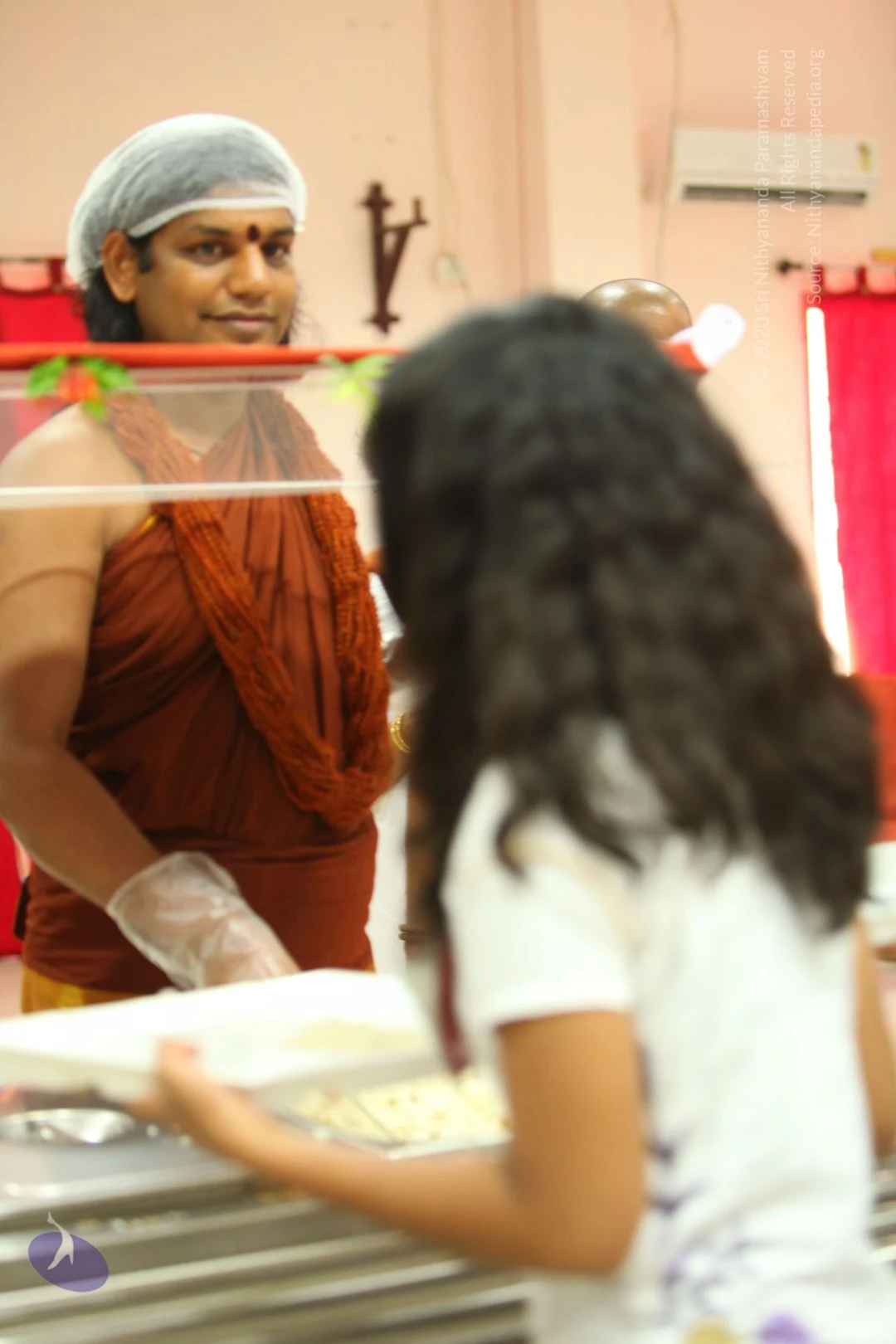
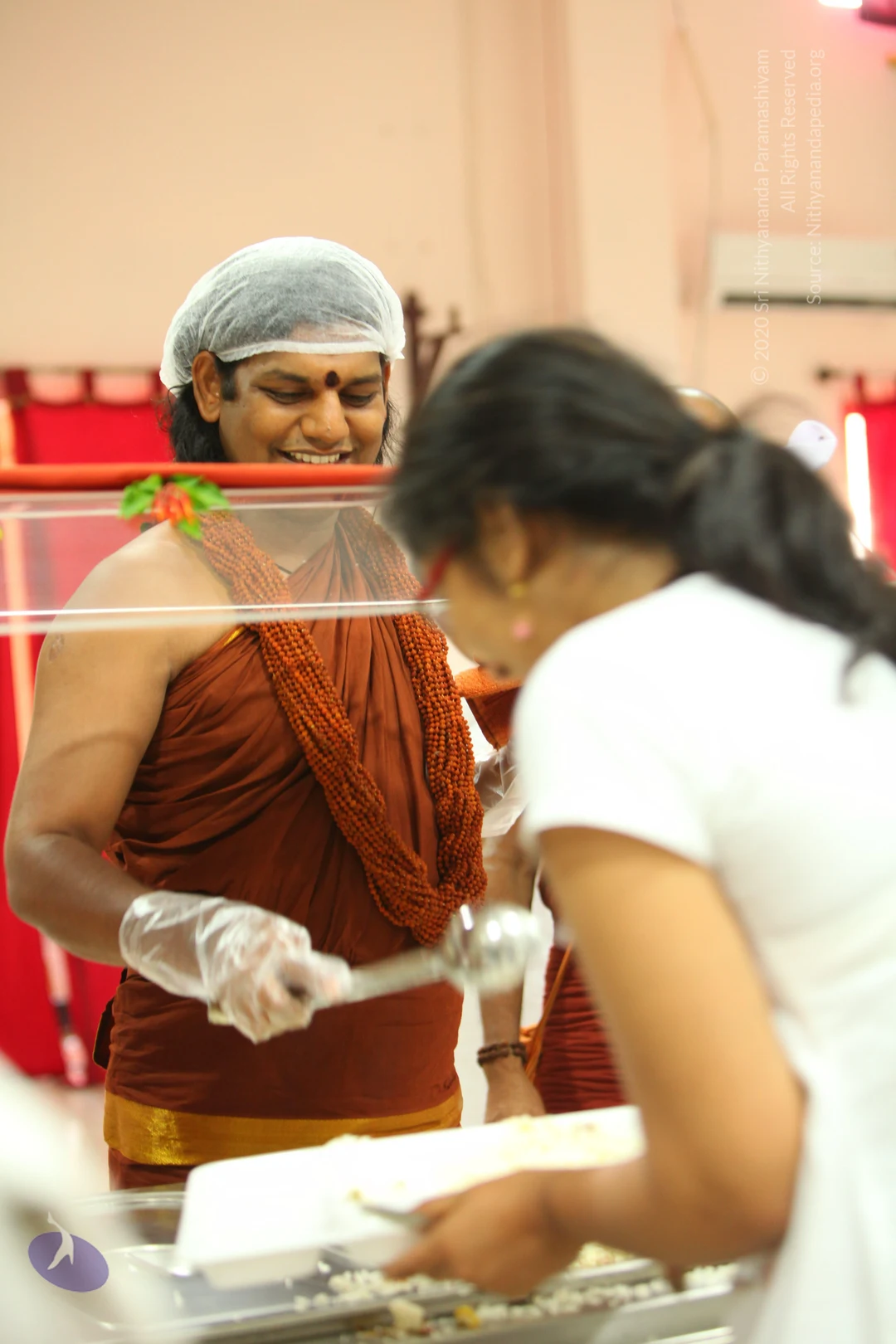
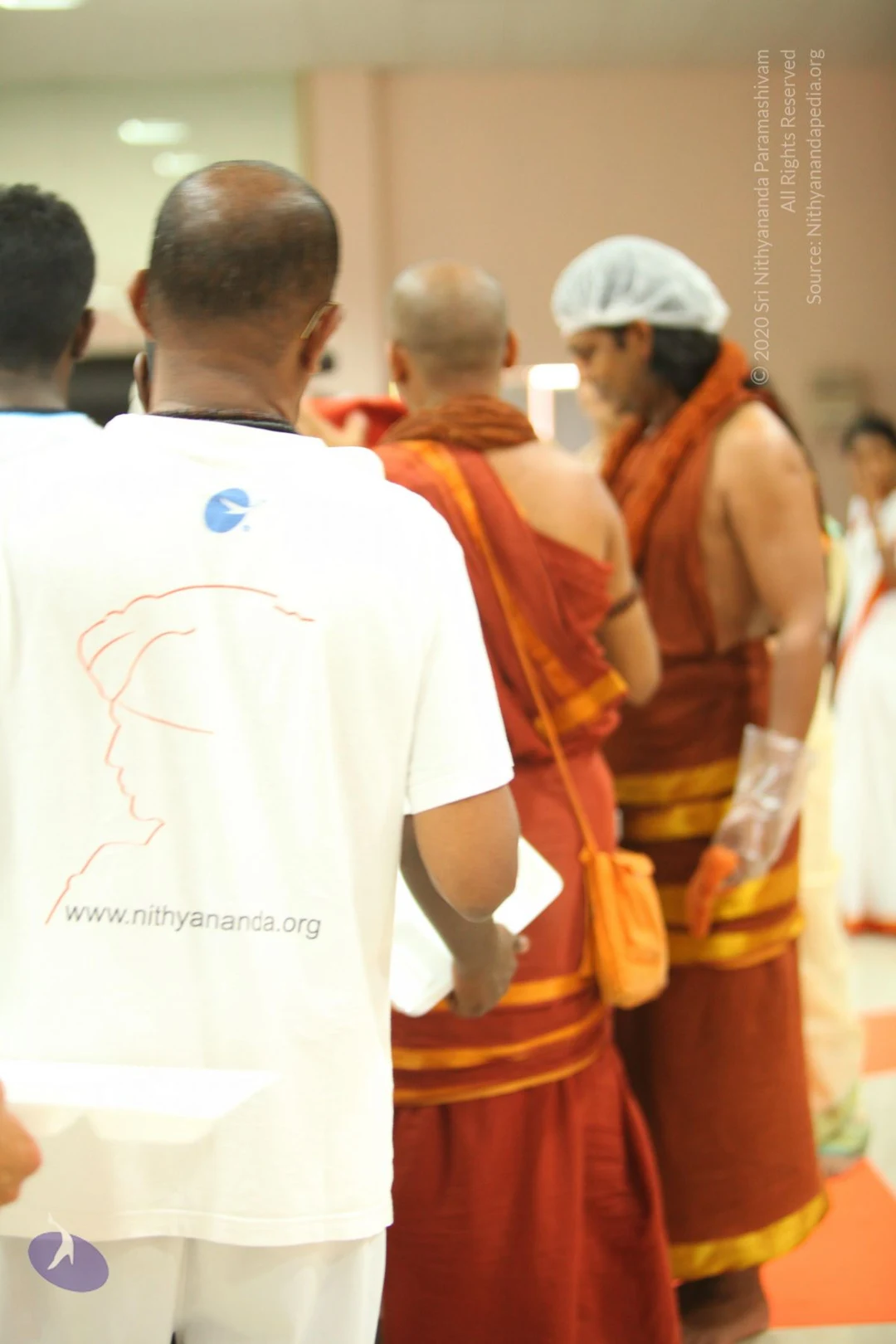
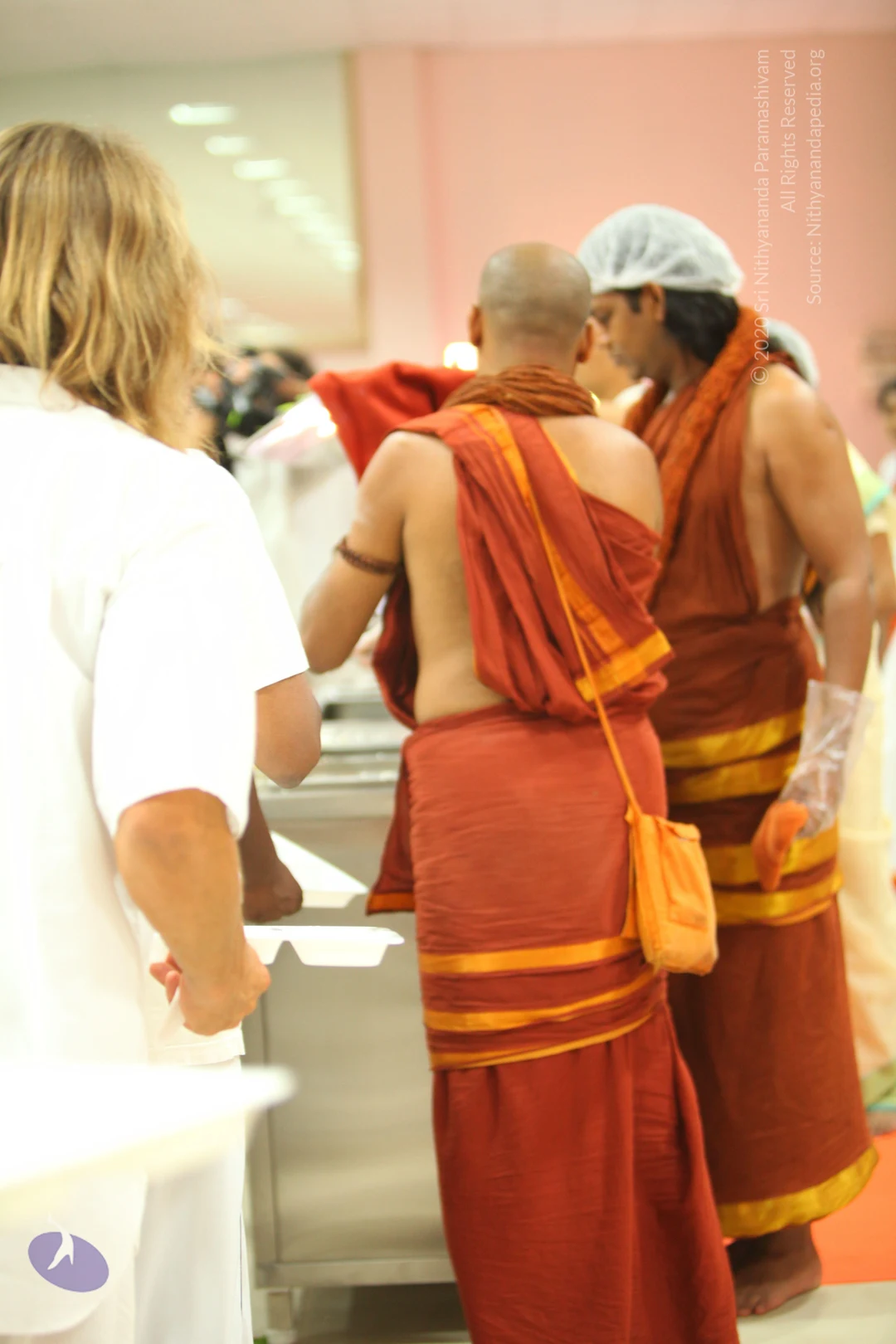
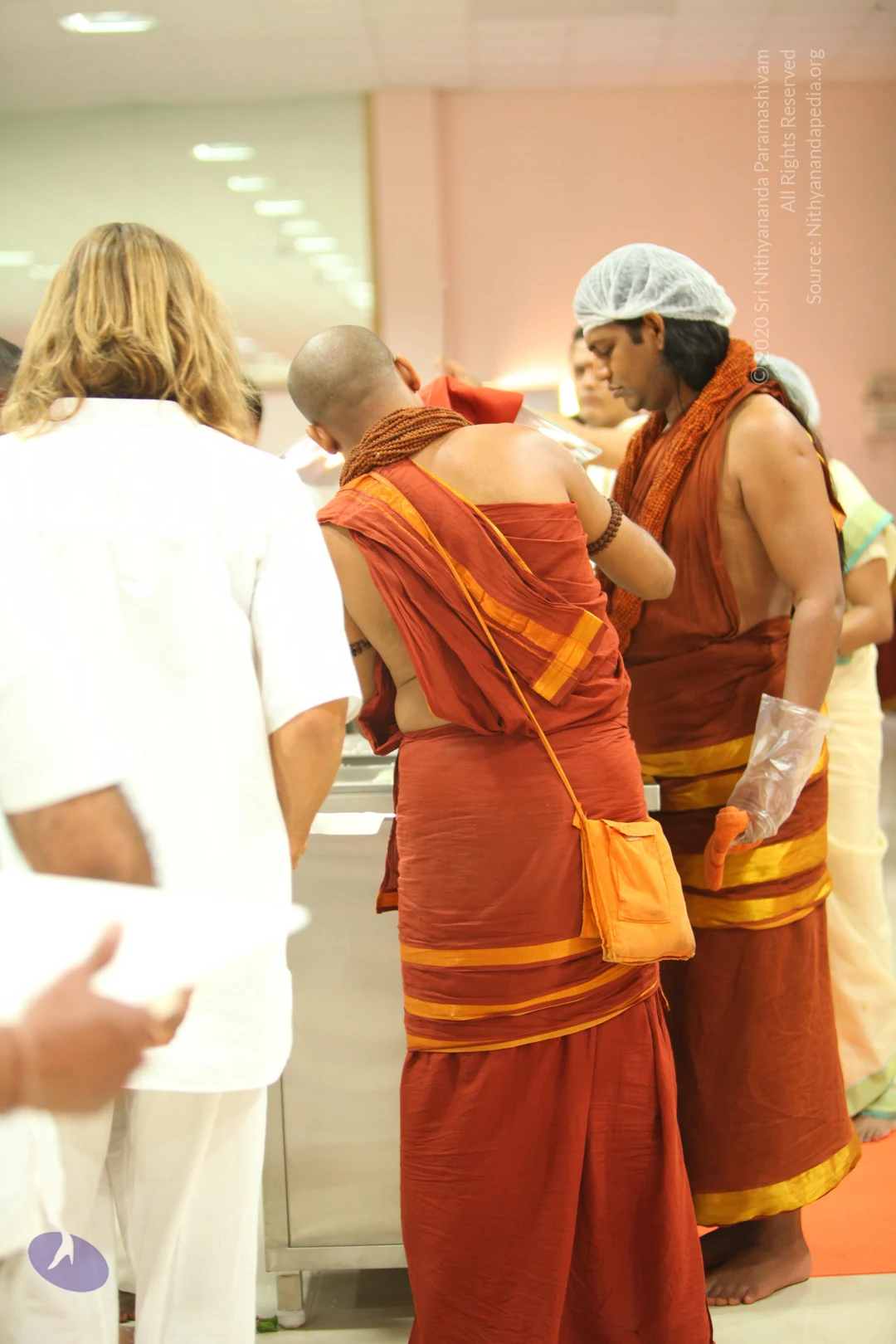
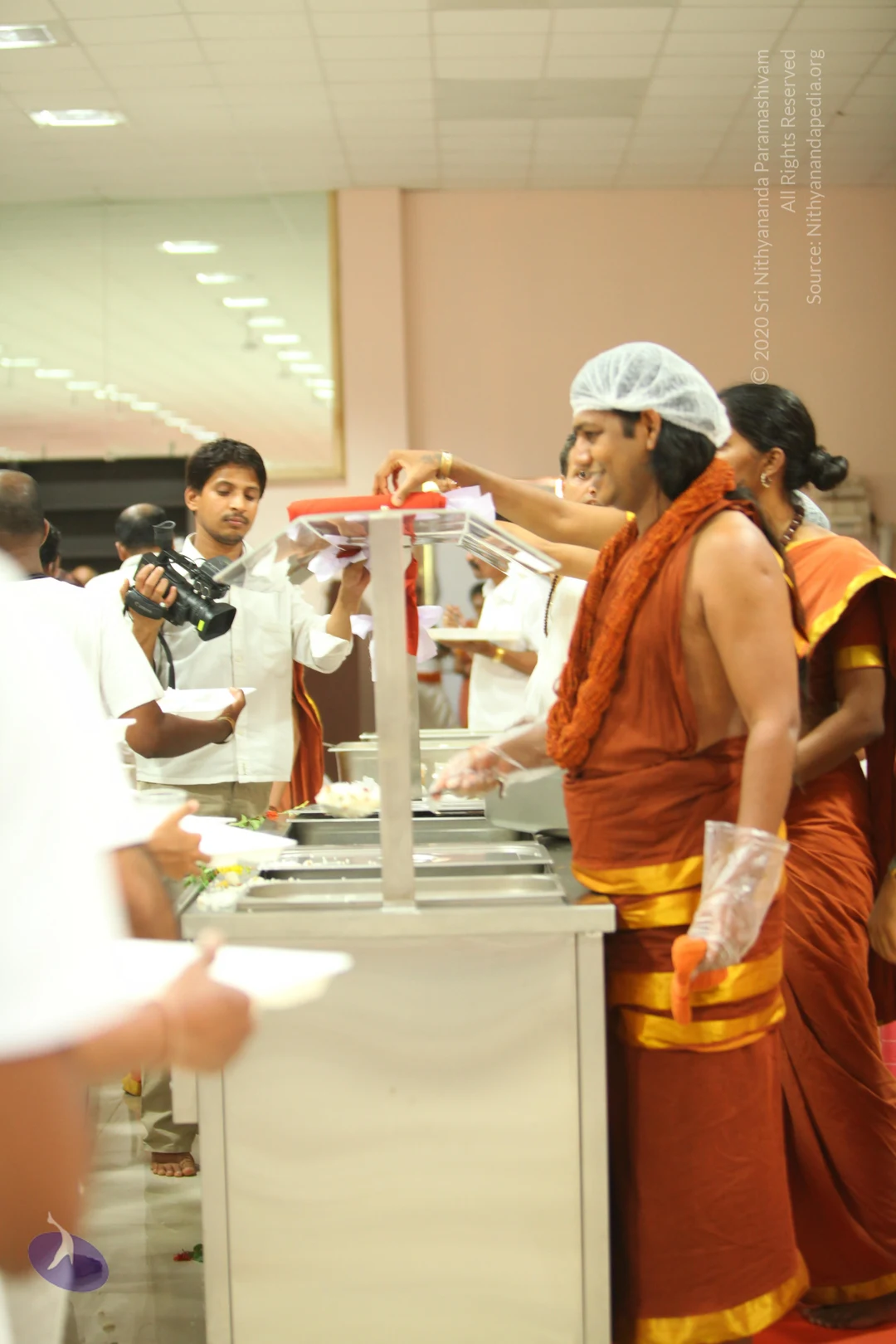
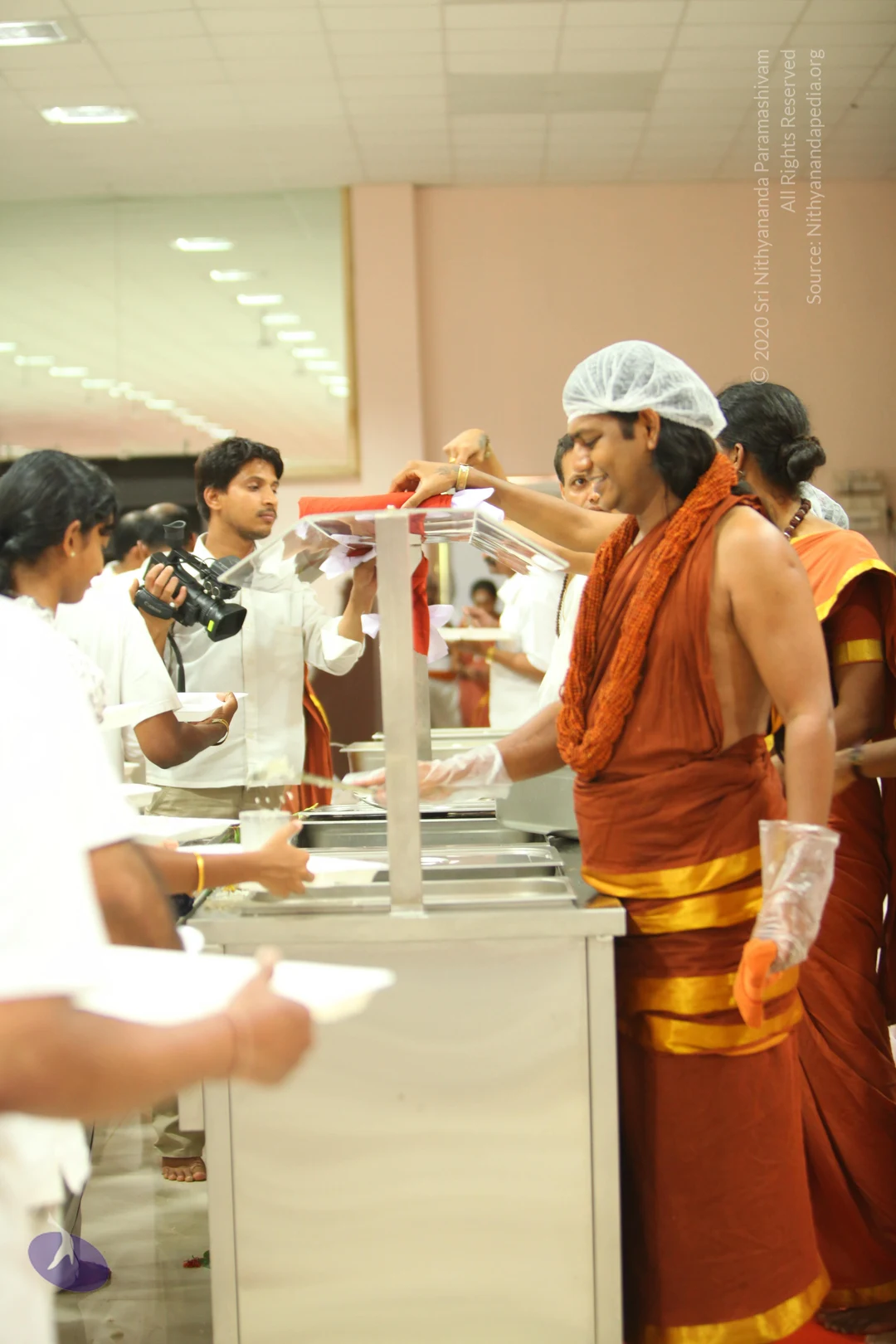
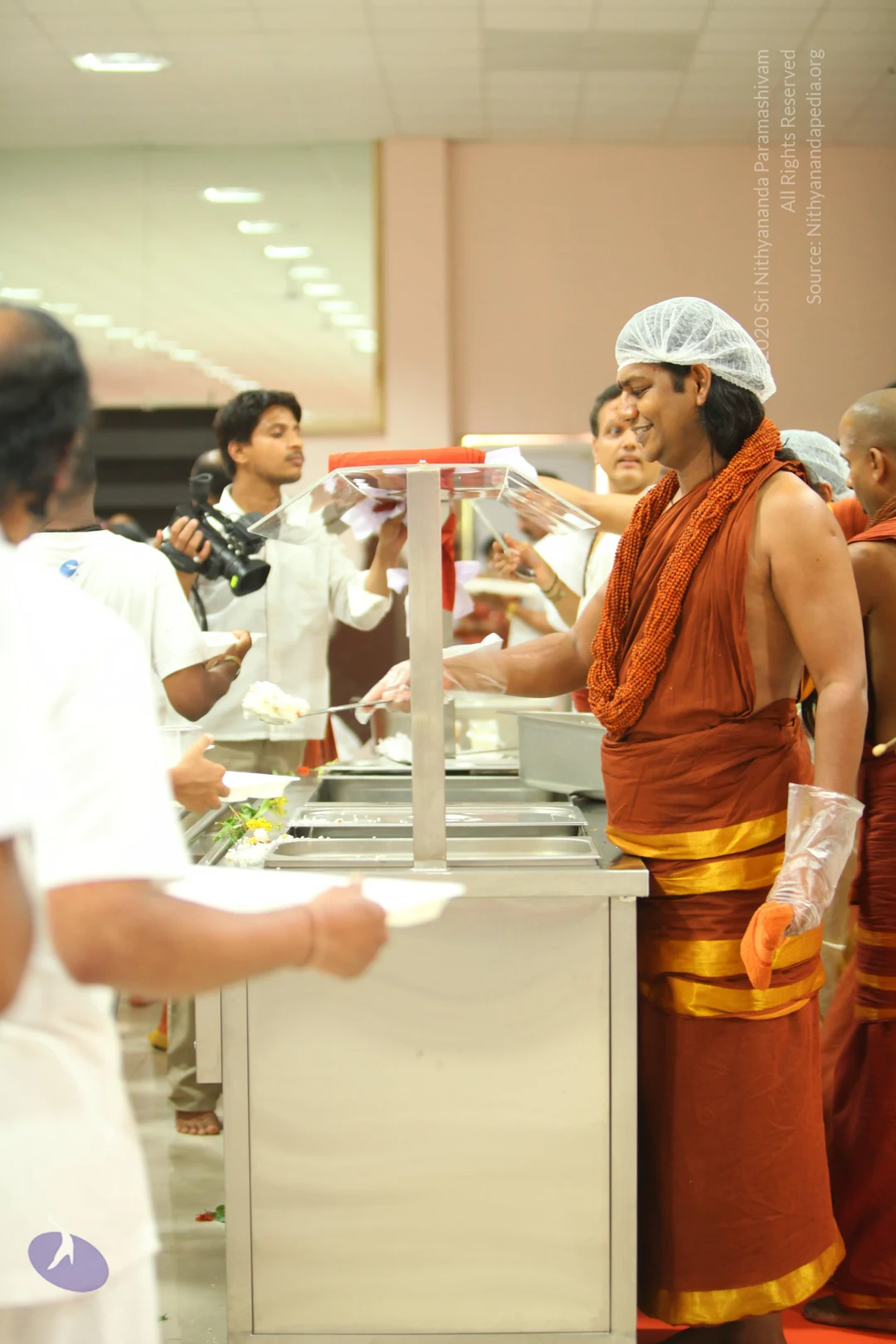
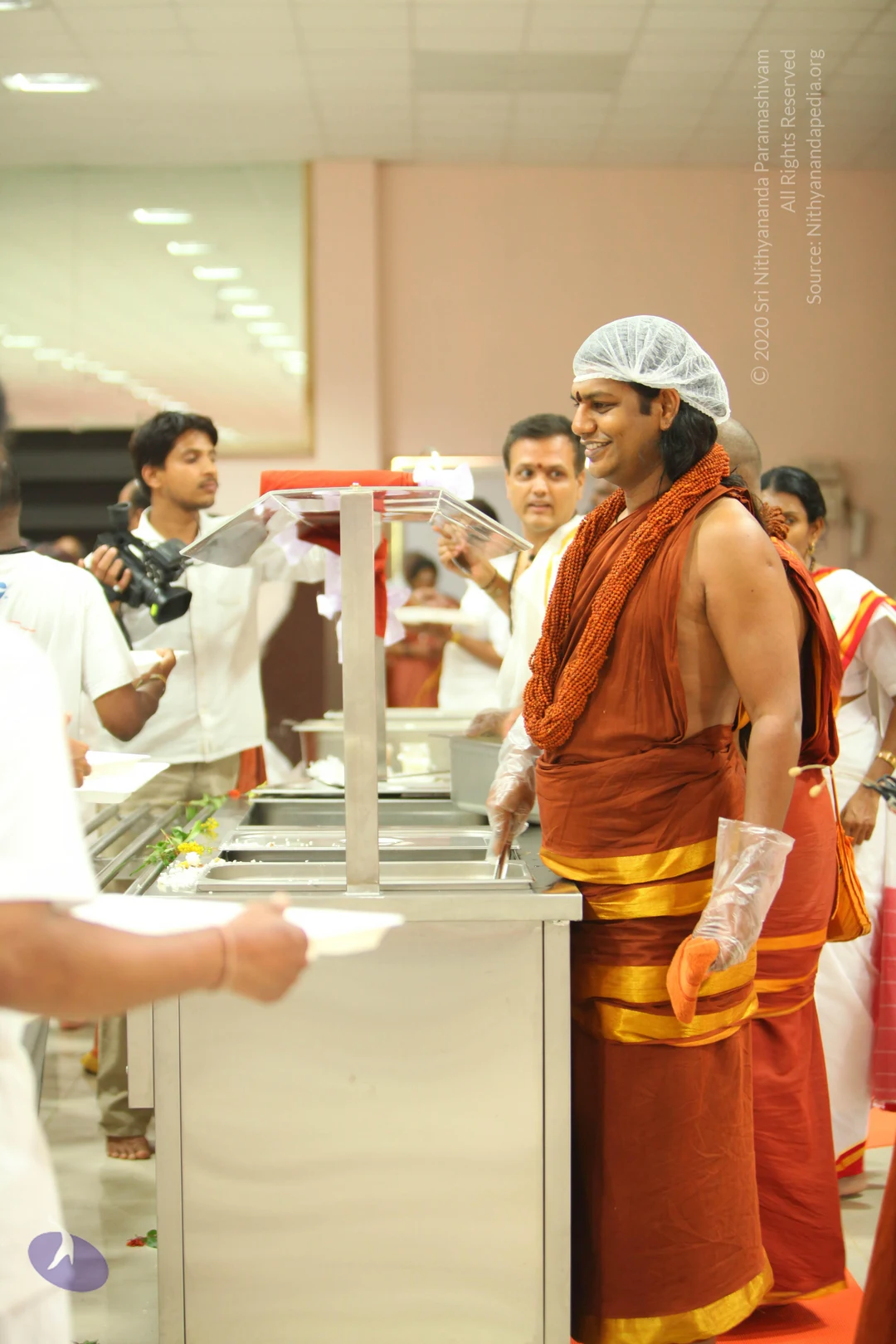
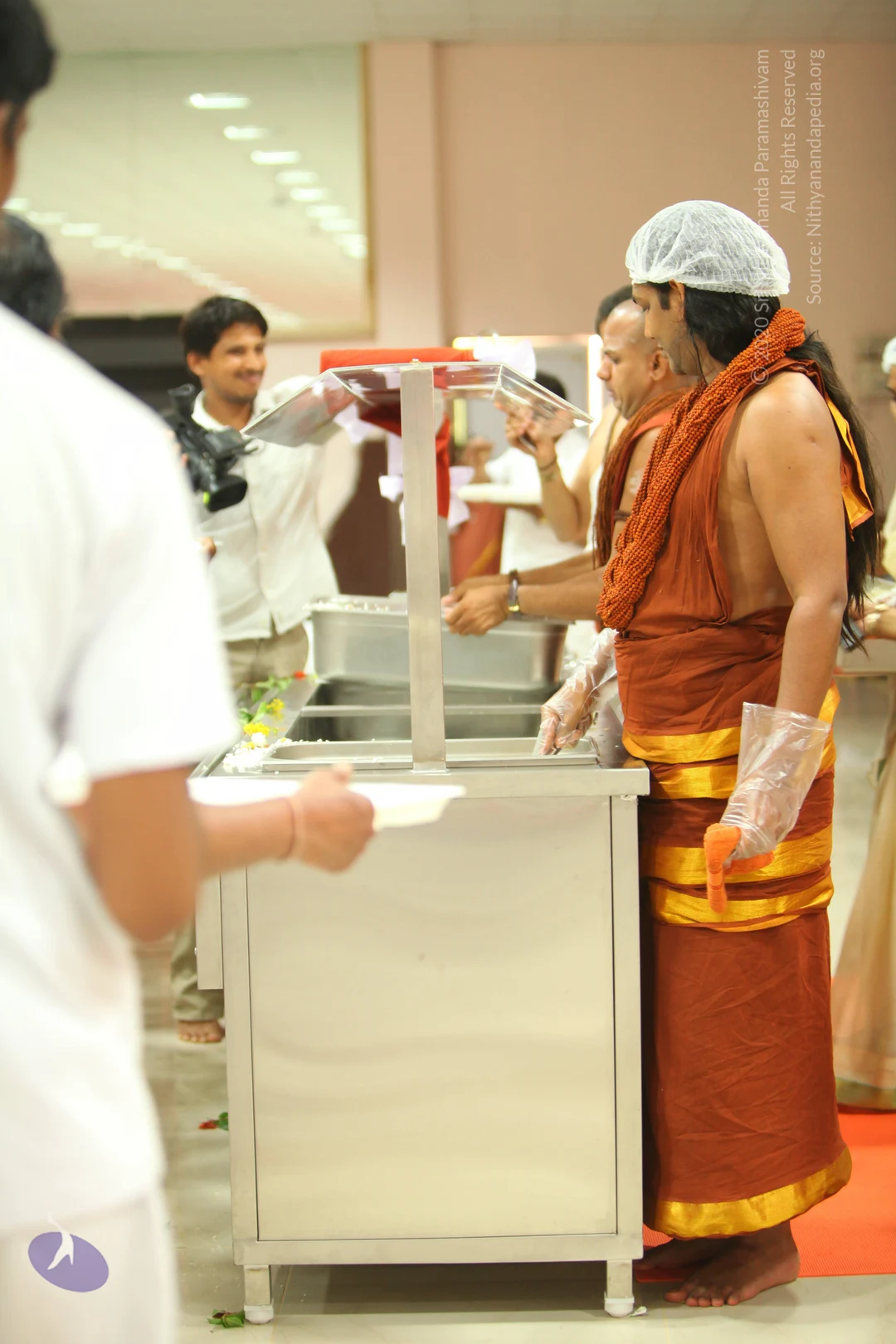
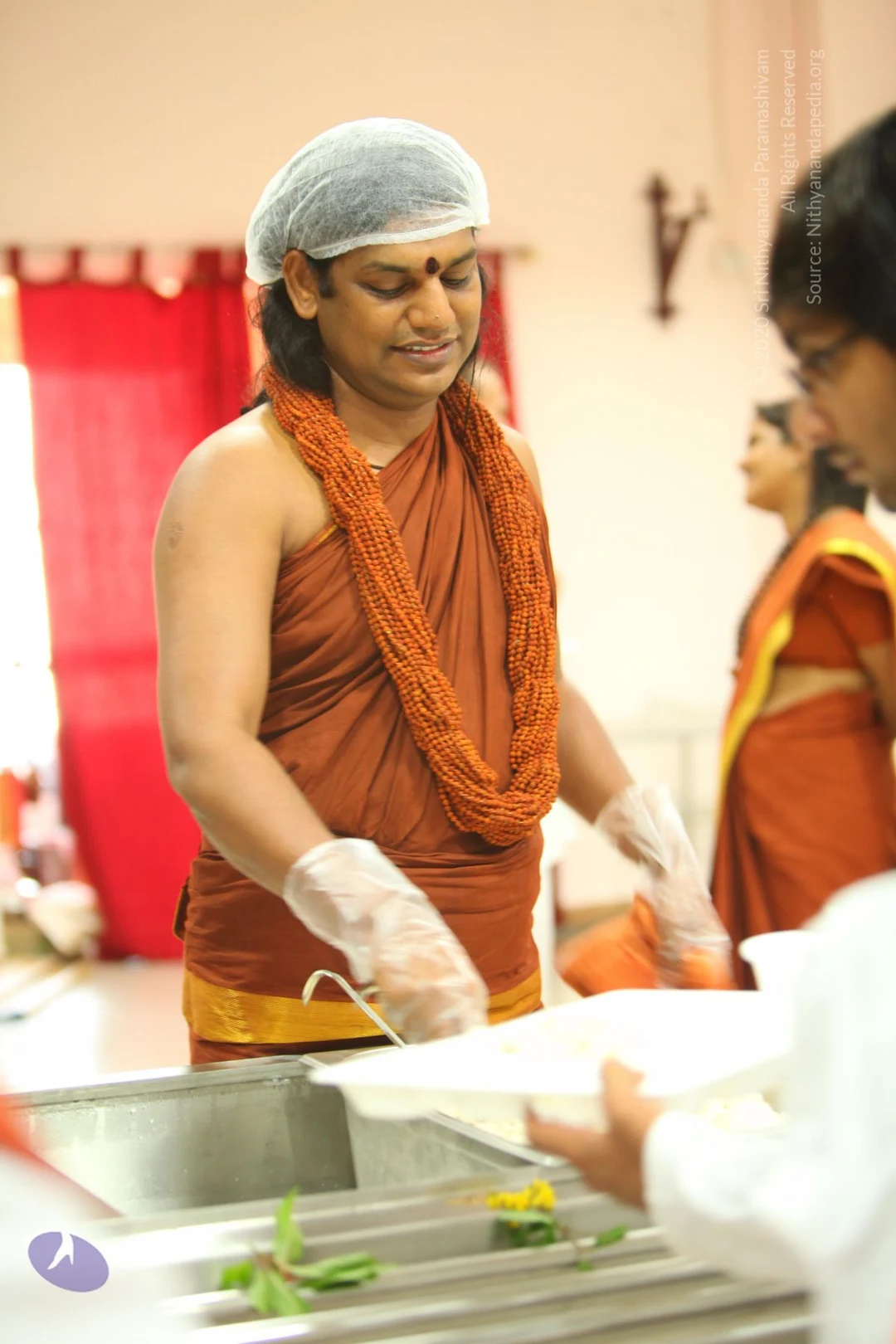
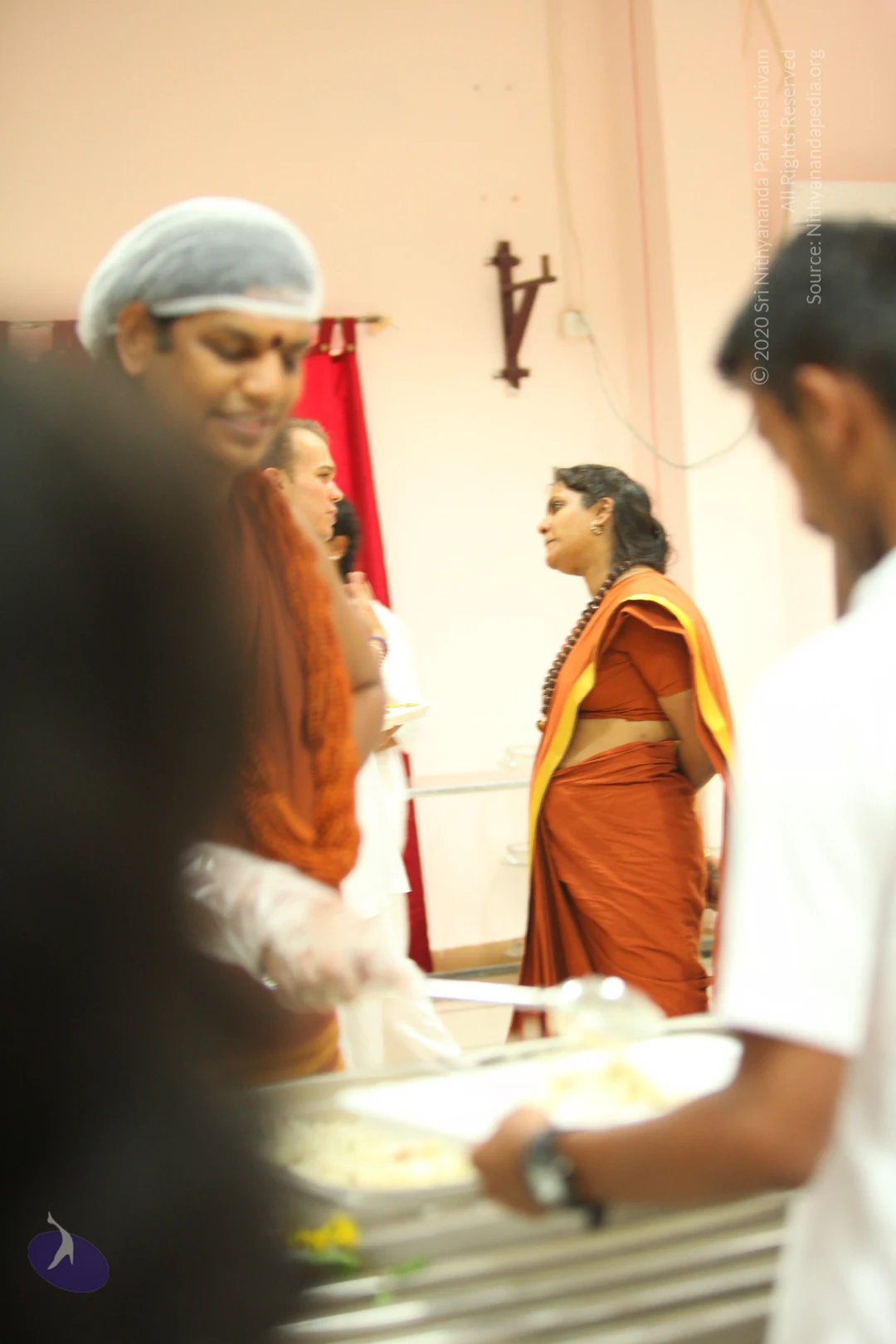
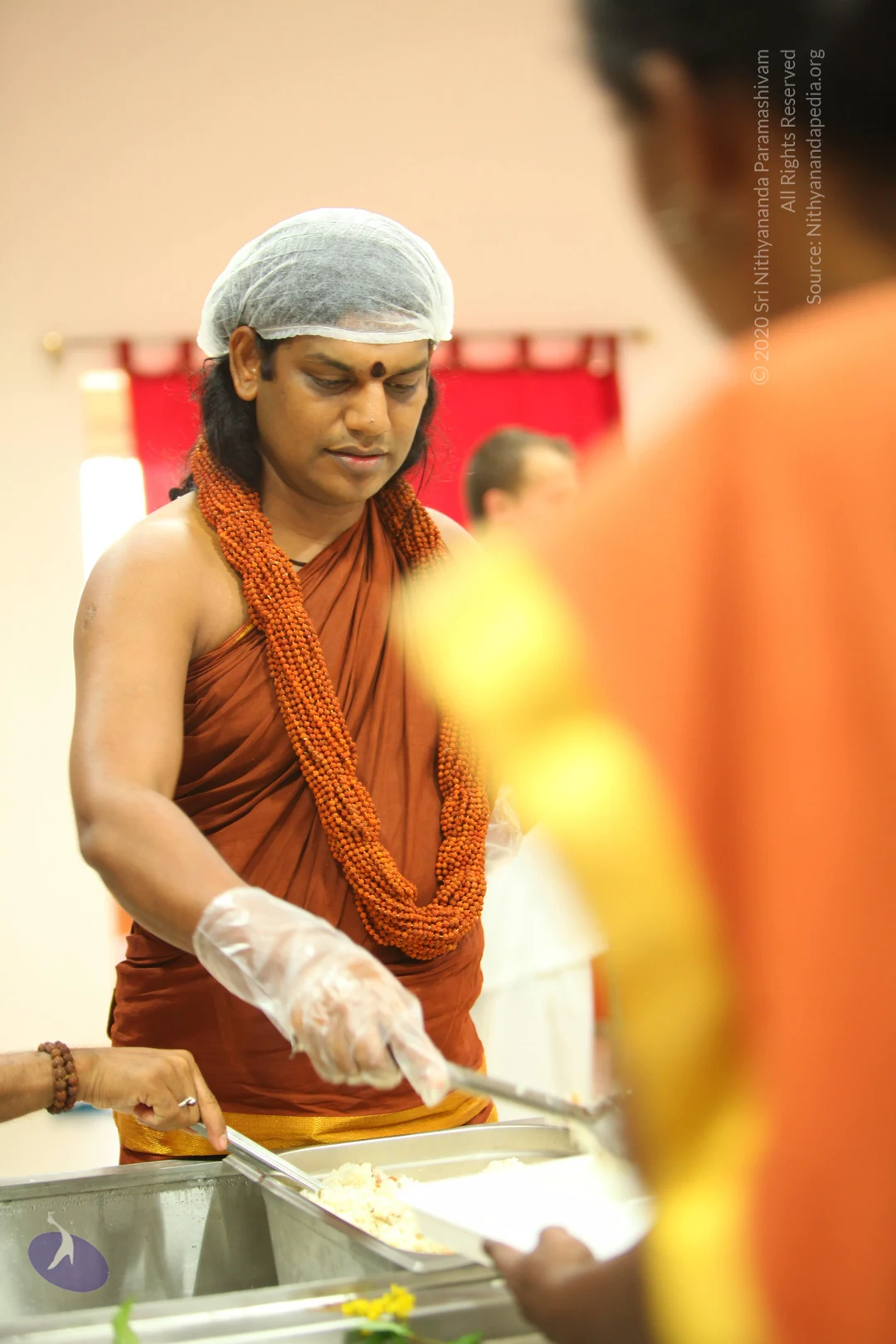
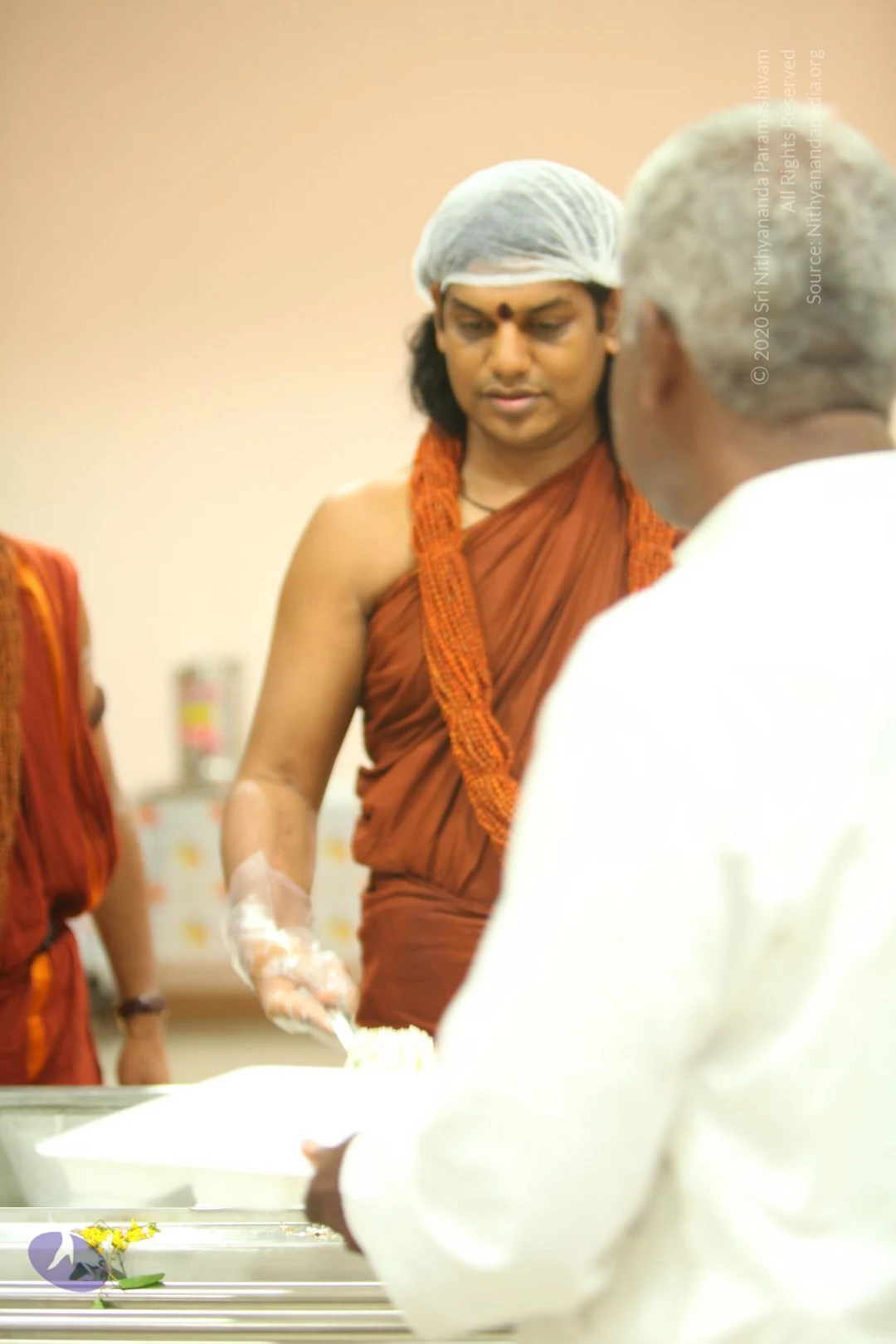
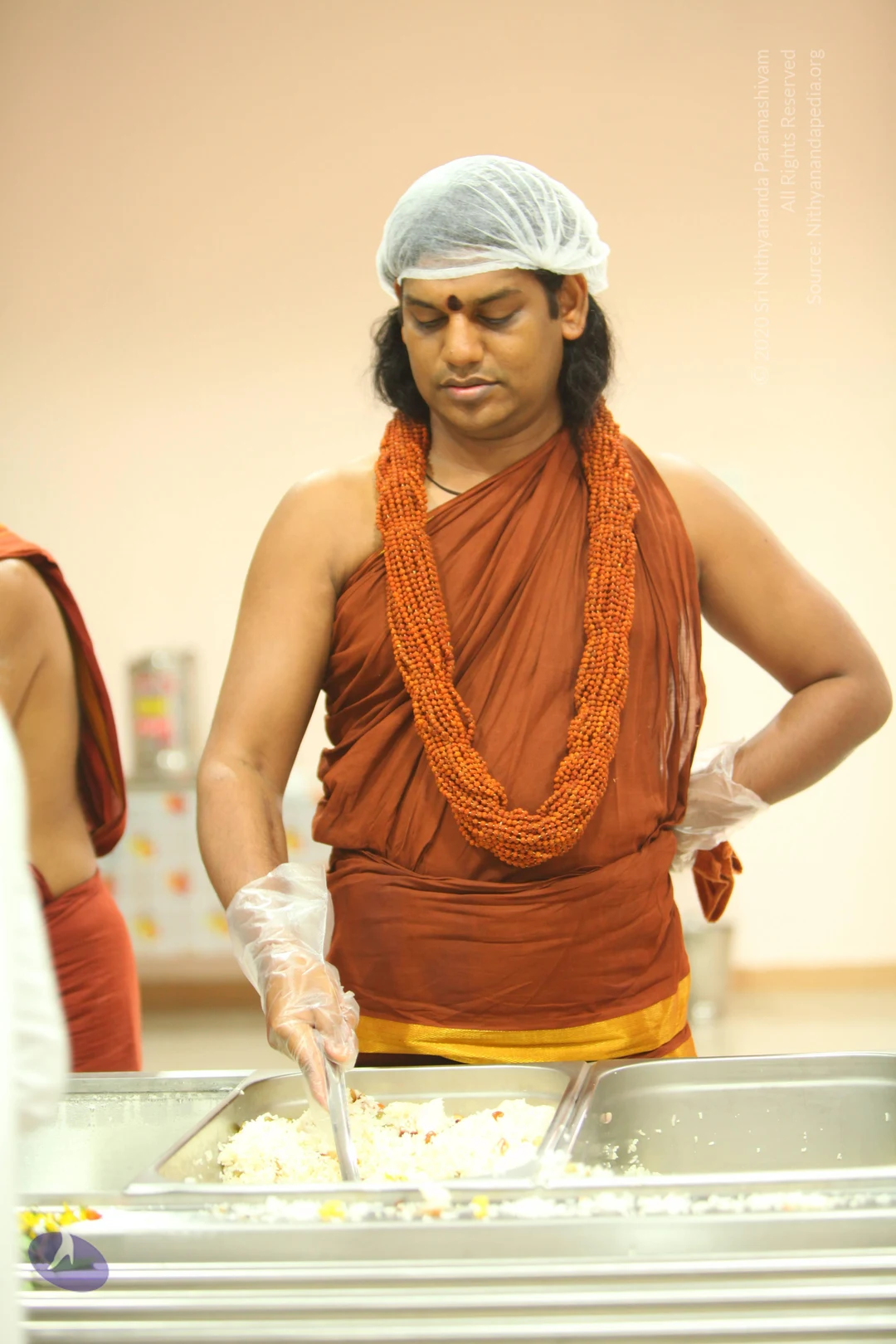
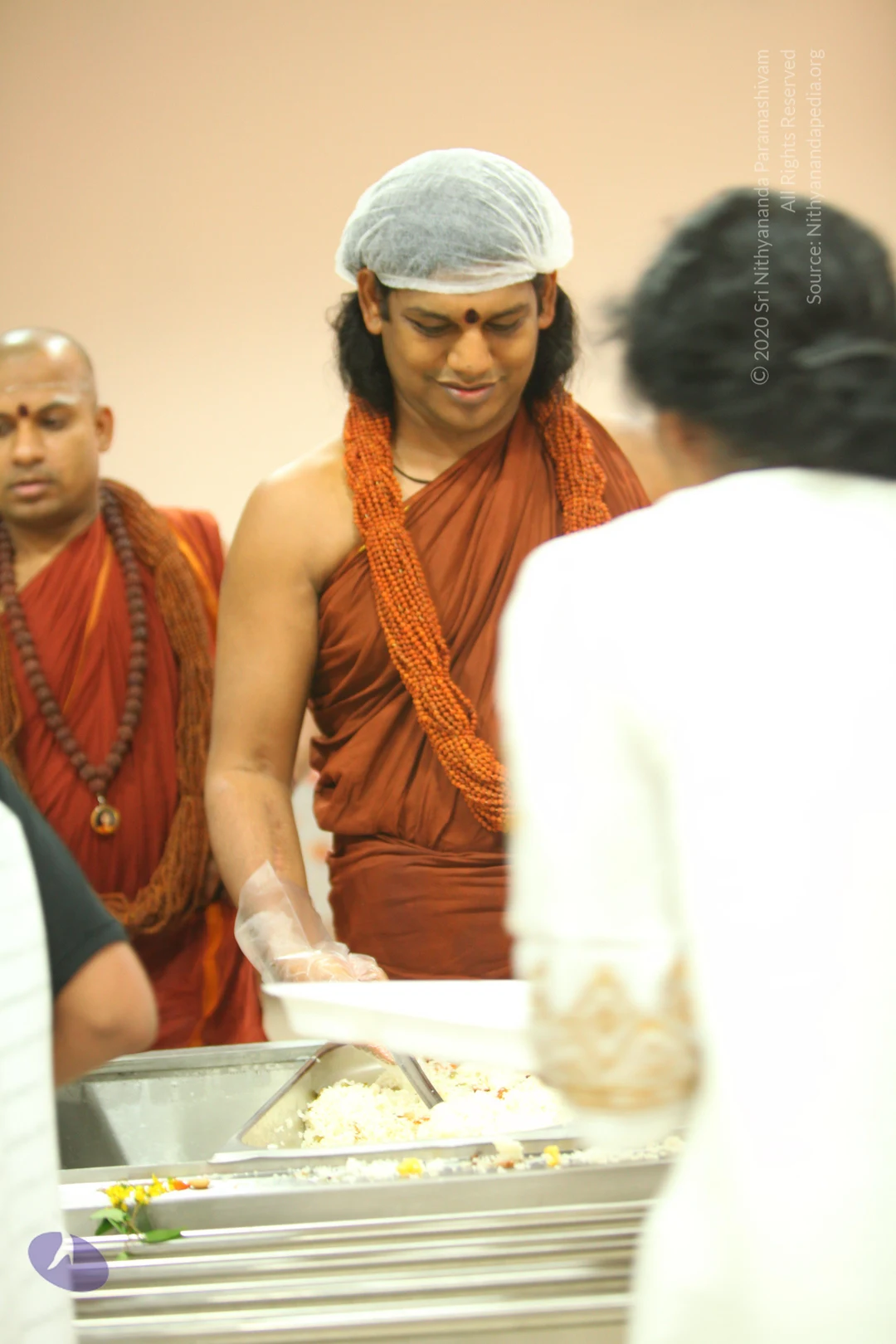
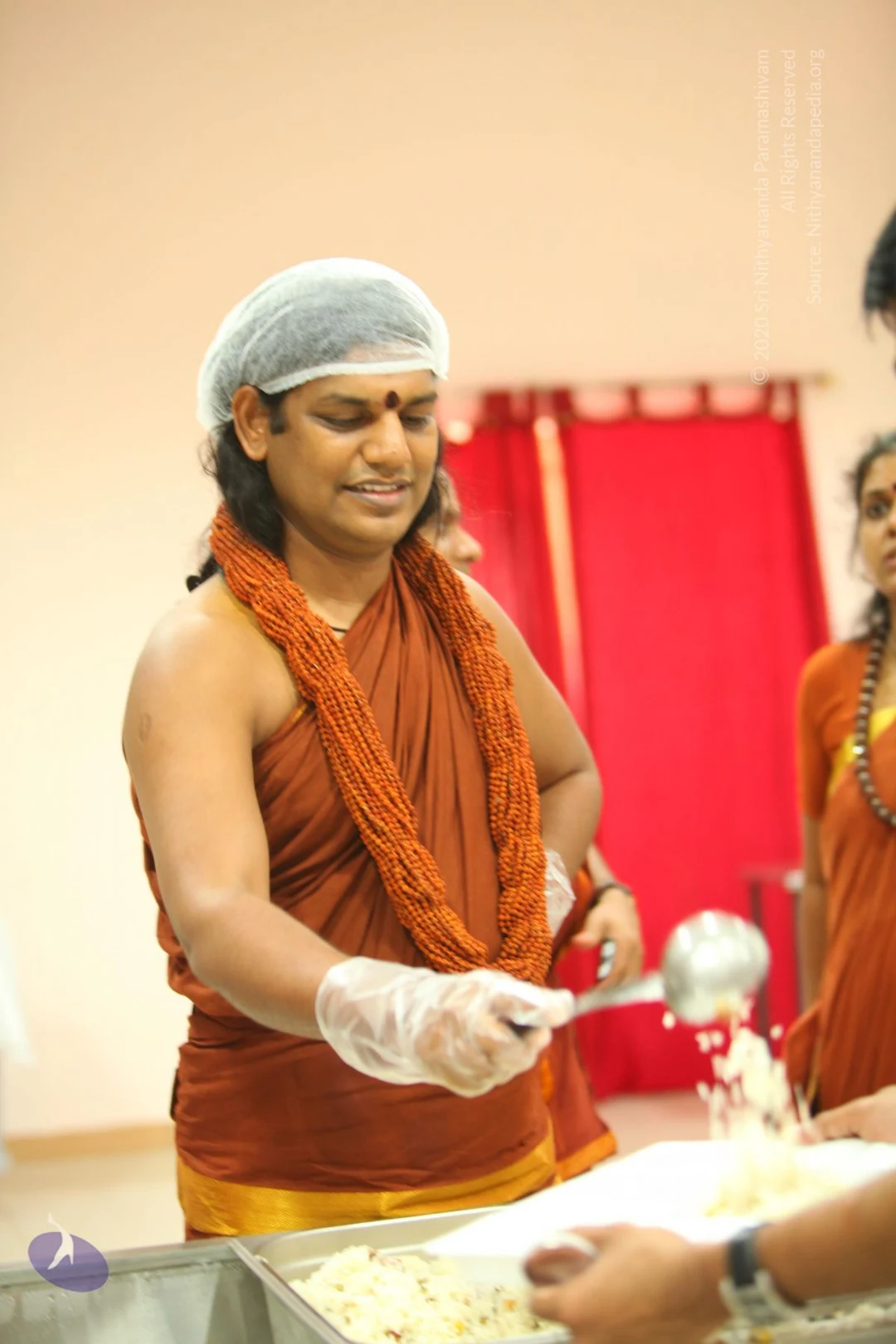
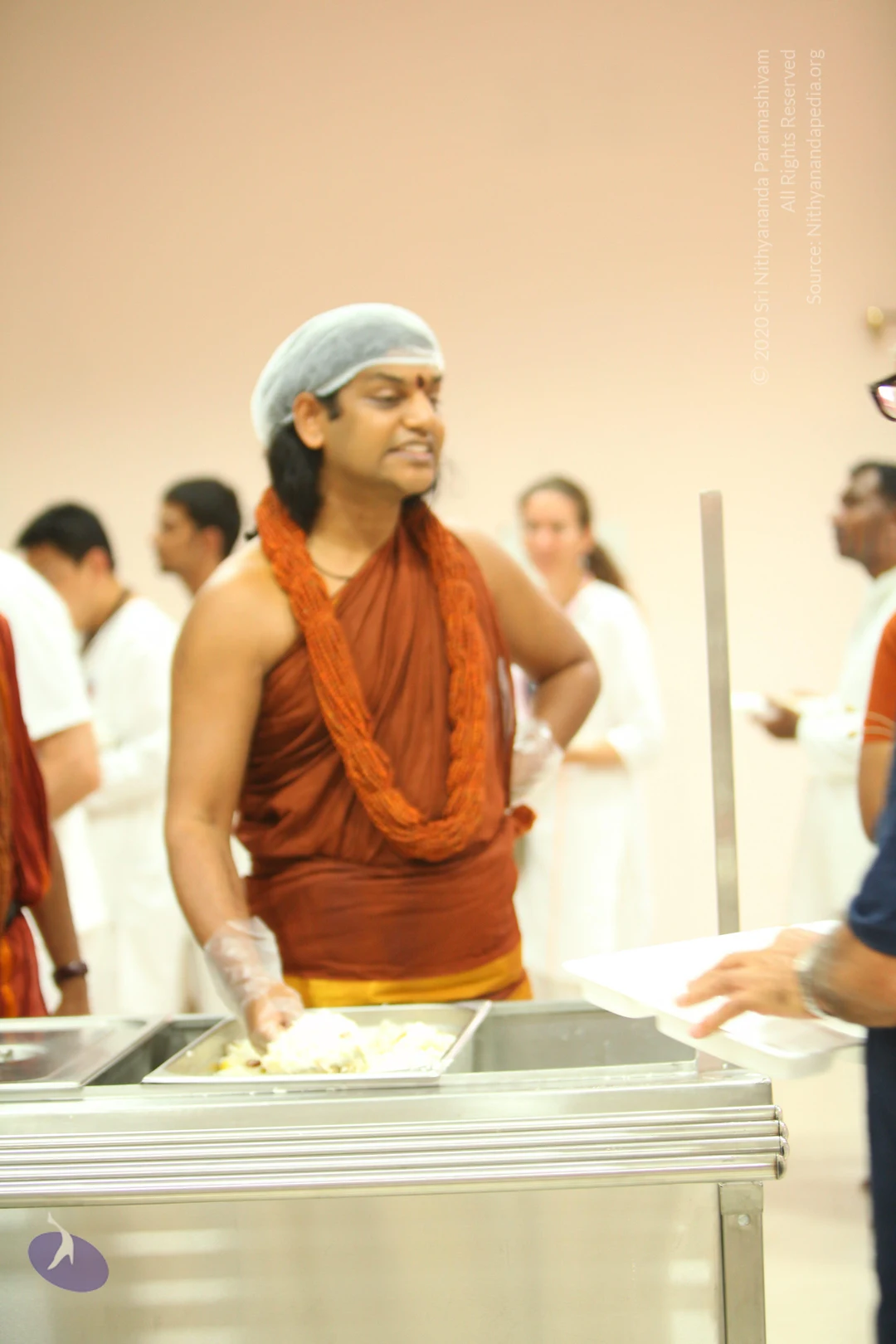
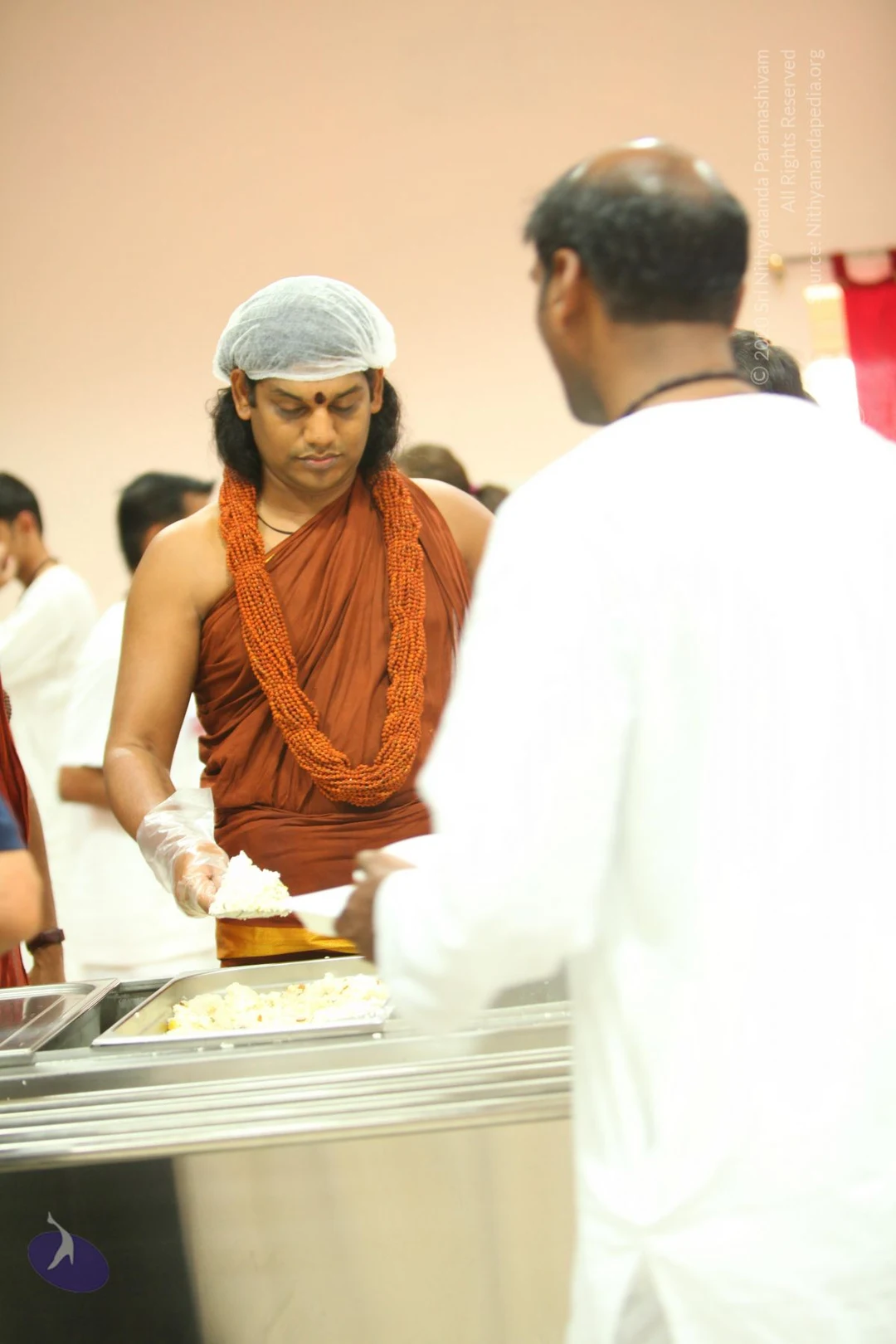
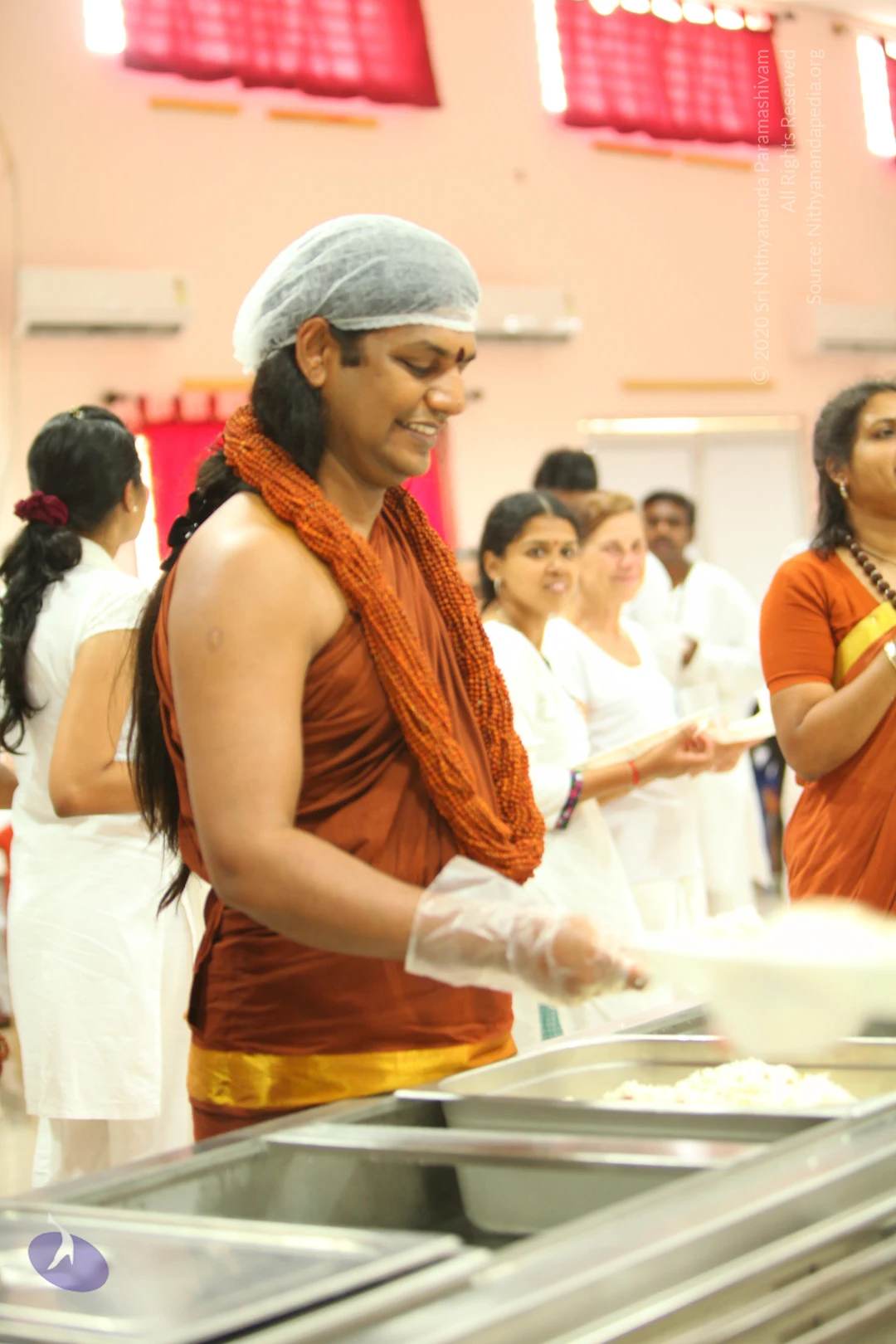
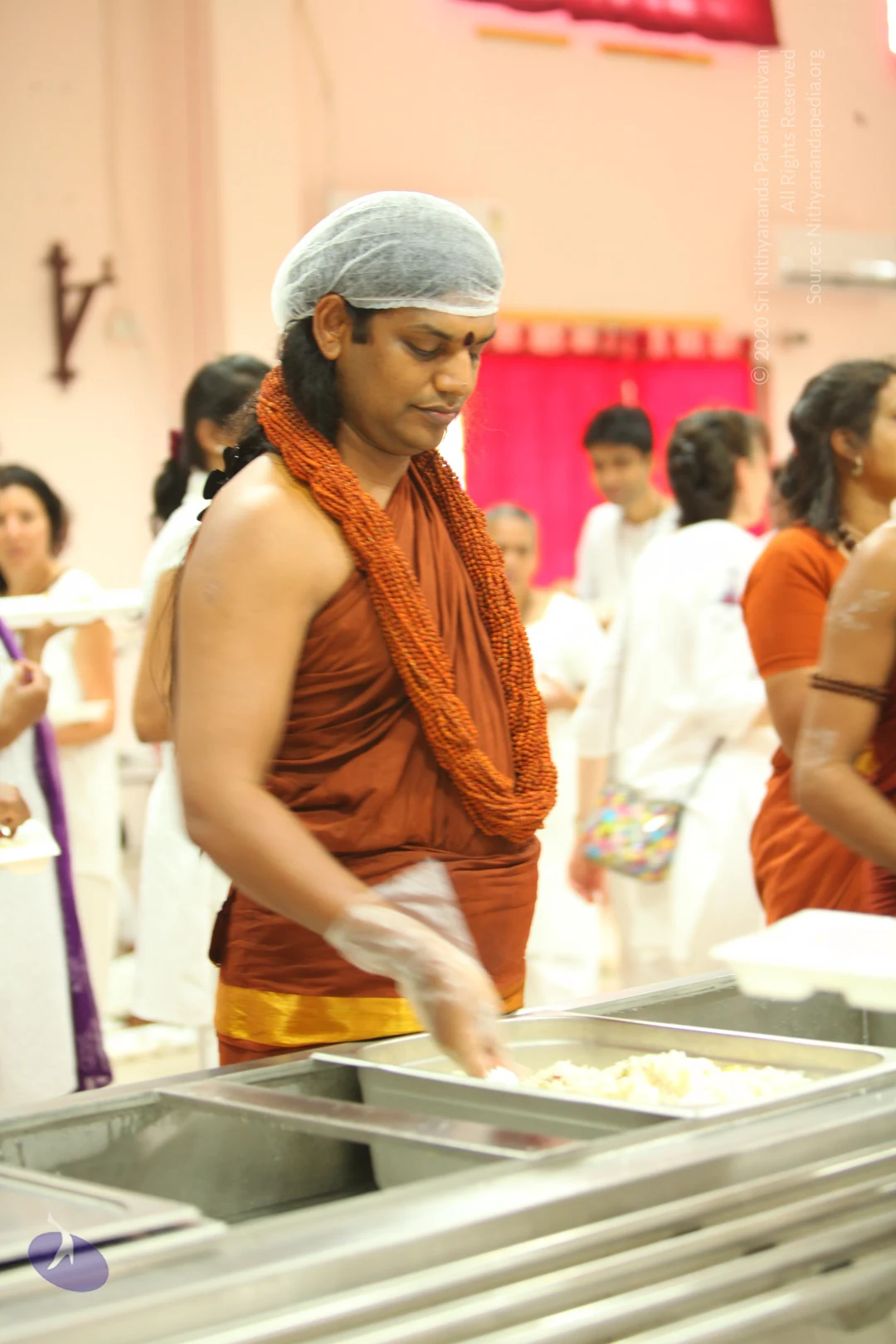
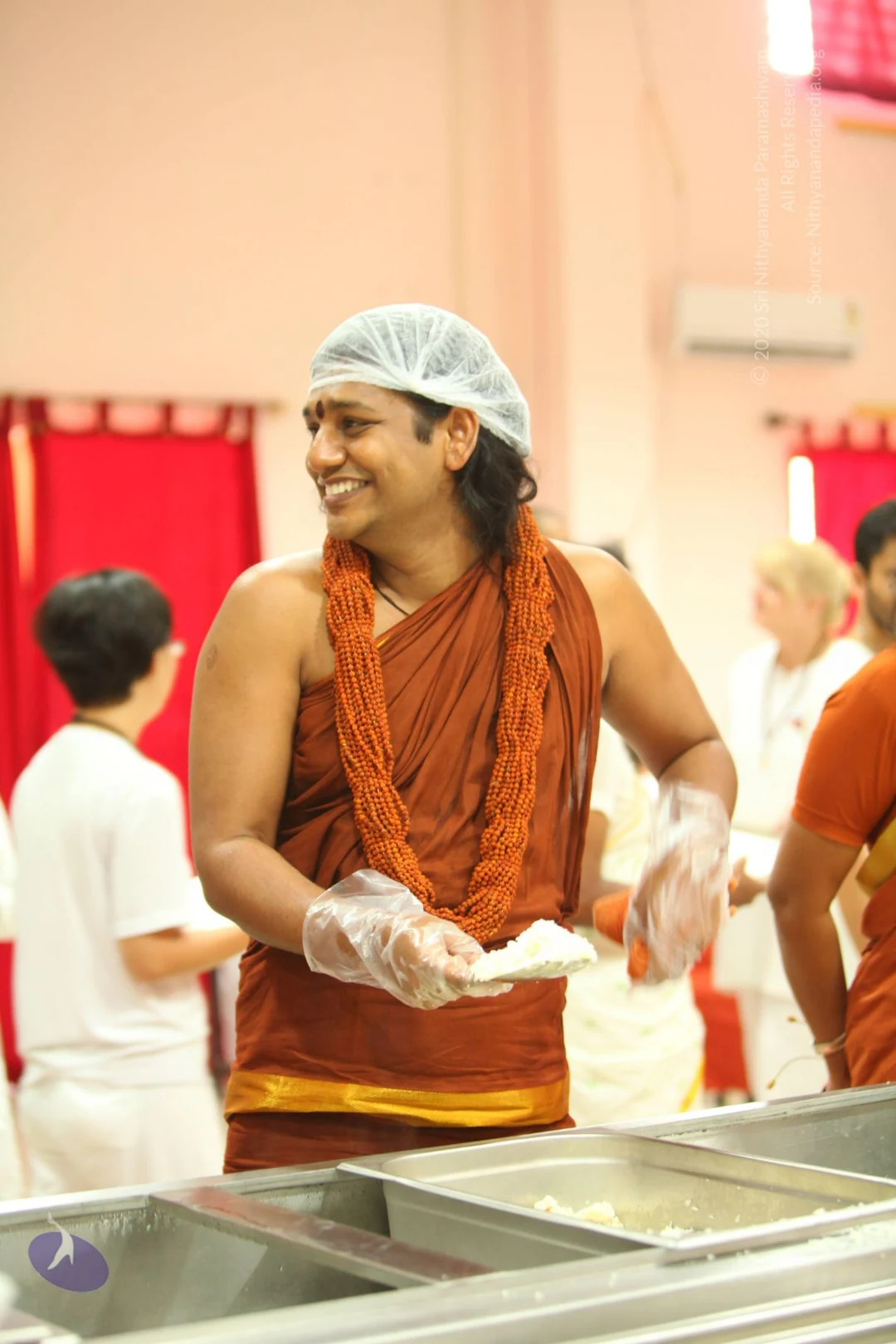
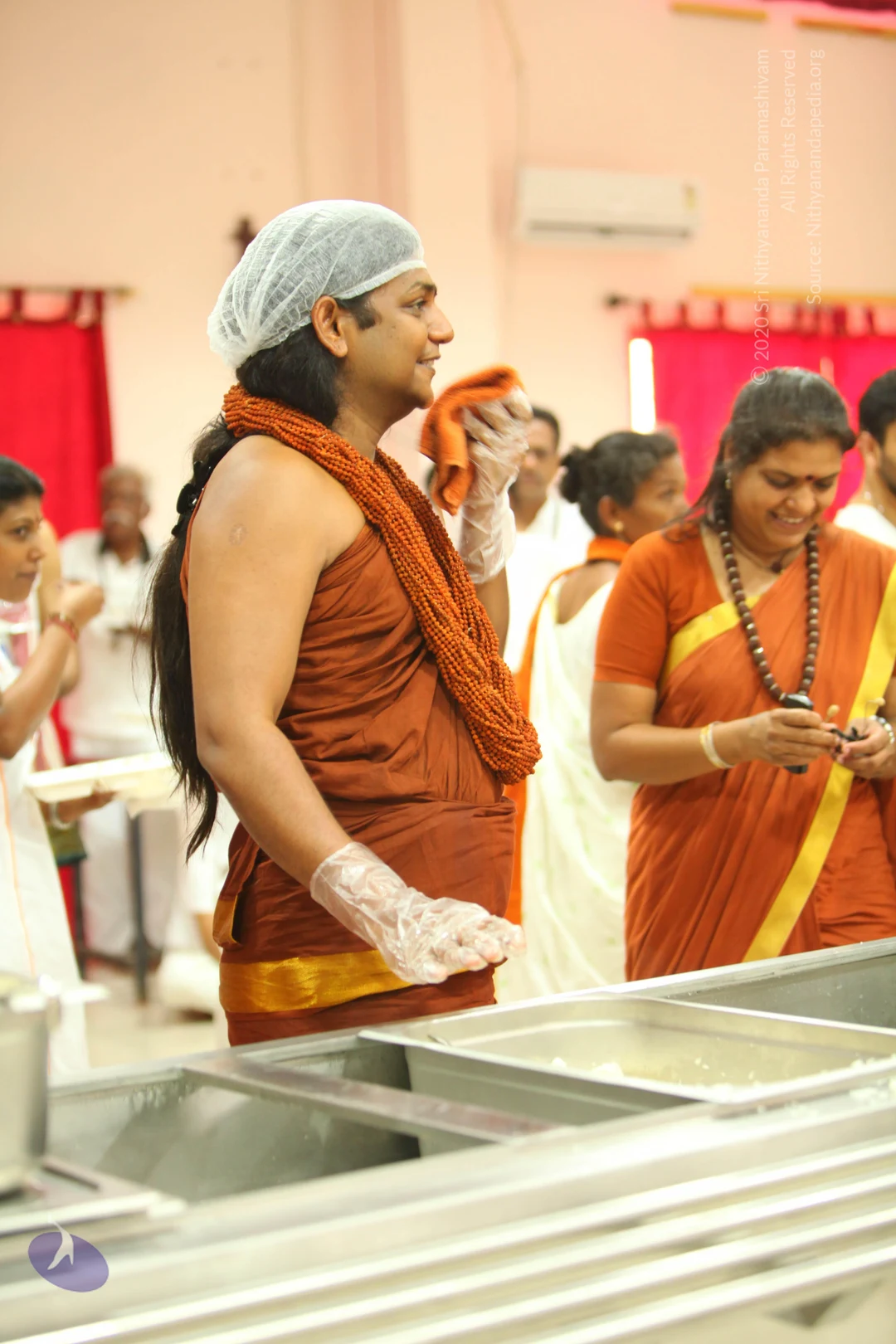
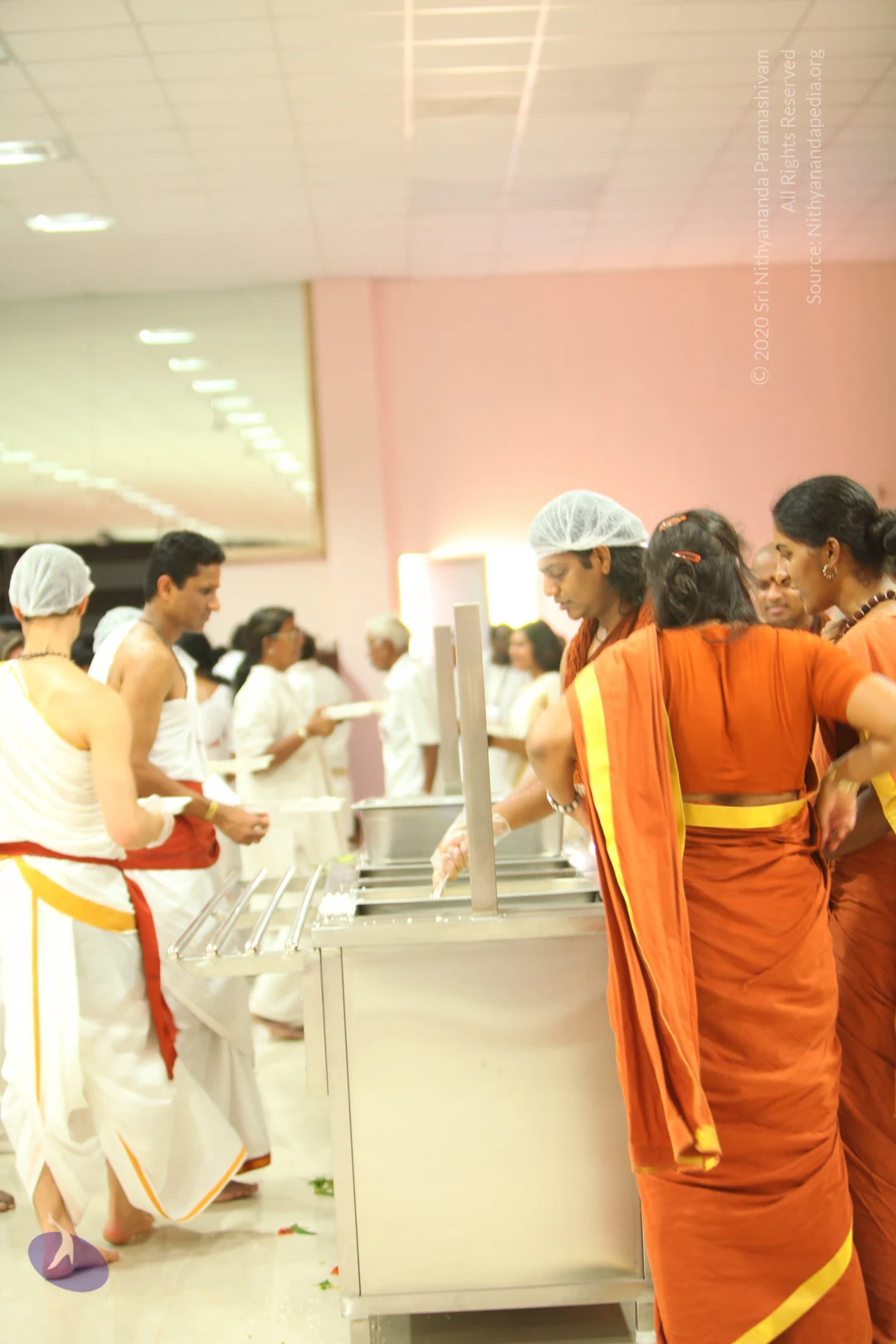
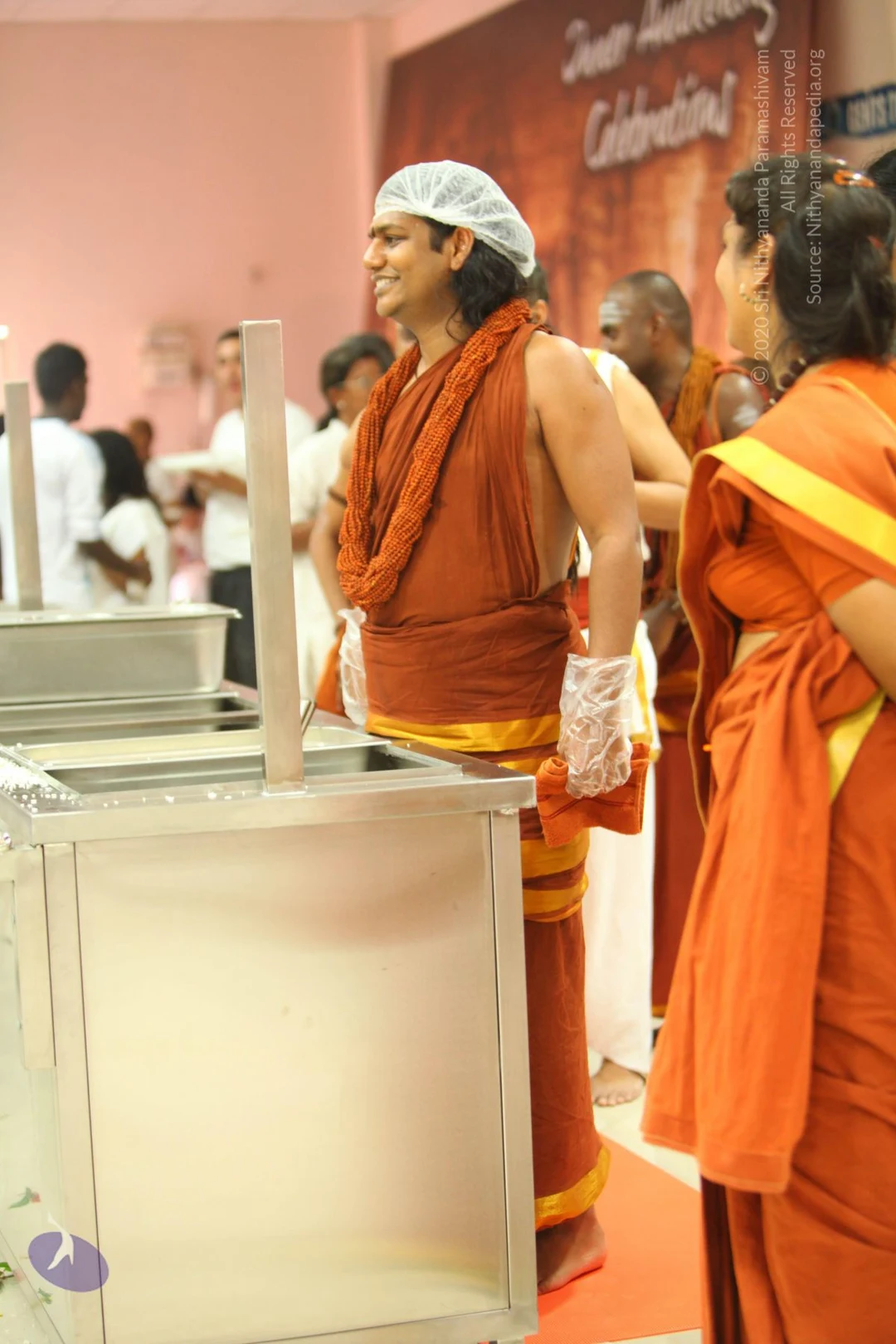
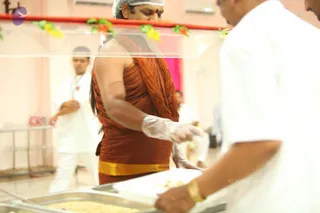
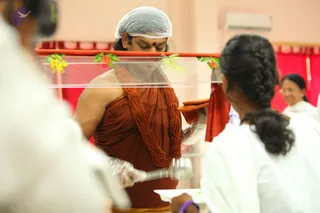
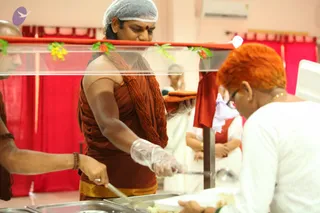
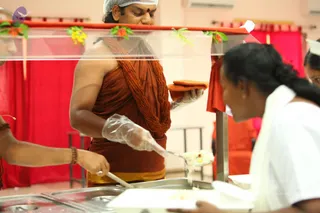
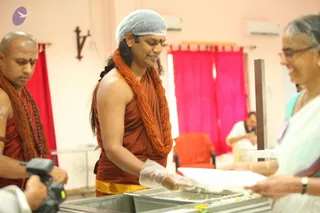
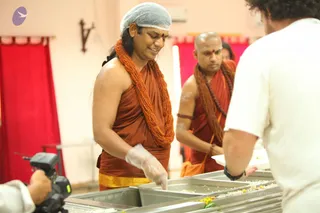
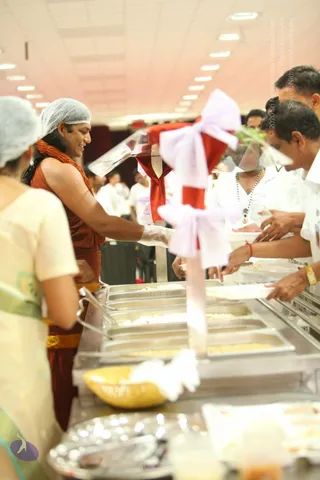
A photograph of a food service line in a bright pink hall. A man in a saffron-orange robe with a gold-yellow waist sash and a red-brown shawl over one shoulder, wearing a white cap and disposable gloves, serves food from a steel tray. A person in a white shirt stands in the foreground at the right, and another person in white is partly visible at left. Trays of cooked food sit on the counter beneath a clear plastic sneeze guard decorated with yellow and orange flowers and green leaves. a person (saffron robe, rudraksha-style beaded shawl, red-brown tilak on forehead) is serving food. Serving food at a community kitchen during the event.A man in a rust-orange monastic robe with a long rudraksha mala draped over his shoulders stands behind a clear plastic screen decorated with red and yellow flowers and green leaves. He wears a white hair cap, a red bindi, and disposable gloves, and holds a folded orange cloth. A woman with a long braid in white clothes stands in the foreground, and another smiling woman in white appears at right beside red curtains. A hand in a glove holds a steel vessel. The setting suggests a clean, hygienic ritual or distribution service inside an ashram hall.A food-service scene at a buffet counter behind a clear plastic sneeze guard decorated with yellow and orange flowers and green leaves. A man in a rust-brown saffron-toned robe, with a wrapped rudraksha mala around his neck and a hairnet on his head, wears clear gloves and holds a serving ladle over steel trays of rice. Another person's arm in a brown-beaded bracelet reaches in from the left with a ladle. On the right, a woman with bright orange-red short hair in a white top takes food onto a white plate. Red curtains and white-clad people stand in the background.A photograph of a food-service line in a clean indoor kitchen area. A man in a saffron-orange robe with a long rudraksha mala draped over his shoulder stands behind a clear plastic sneeze guard, wearing a white hairnet and disposable gloves. He holds a serving spoon over a steel tray of food and a folded orange cloth in his other hand. A woman in a white garment with her hair in a long braid receives food on the right, and a hand from the left reaches toward the tray. Red curtains and flower garlands decorate the counter behind the guard.A photo of a kitchen or food-service scene in a room with pink-red curtains and a white wall air conditioner. A man with long hair and a white hairnet, wearing an orange-brown robe, a long orange-brown beaded mala and clear gloves, serves food from a stainless steel tray into a container; a 'Swamiji (probable)' candidate by appearance (long hair, orange robe, rudraksha-style mala). To the left a shaved-headed man in orange robes and a mala films with a camera, and a woman in a white sari with glasses smiles at the right and holds a white tray. Yellow flower petals and rice-like food are visible in the tray.Photo of a food service line at an ashram-style hall with red curtains. Two monastics in saffron-orange robes and rudraksha malas serve food from steel chafing trays. The left monastic wears a white hairnet and disposable gloves and smiles while spooning rice. A second monastic stands behind with a shaved head and a red tilak on his forehead. A man in a white t-shirt faces them holding a plate. A cameraman filming at lower left. Rice and yellow flowers are visible on the trays.

Photos-of-the-Day

17 photosSource gallery
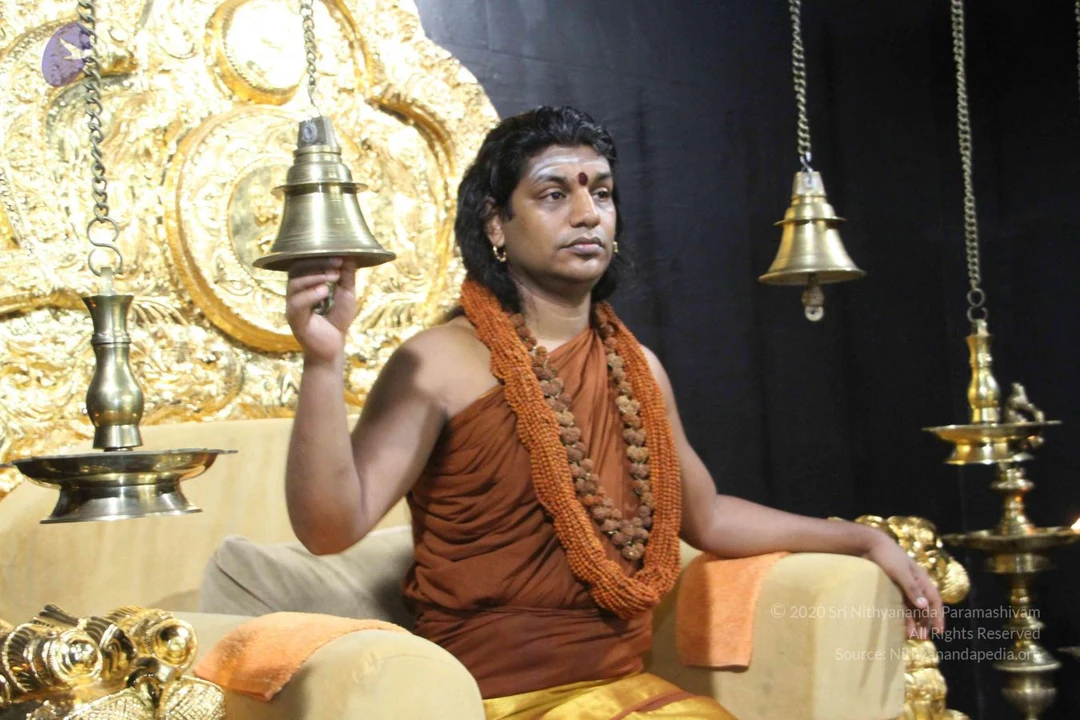
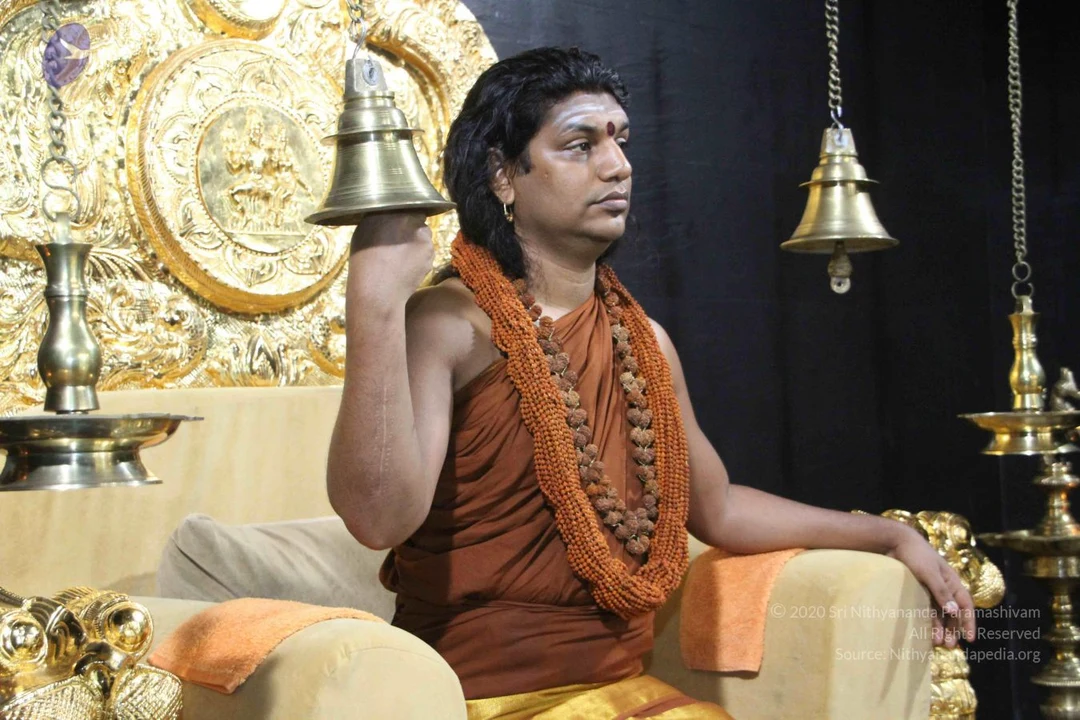
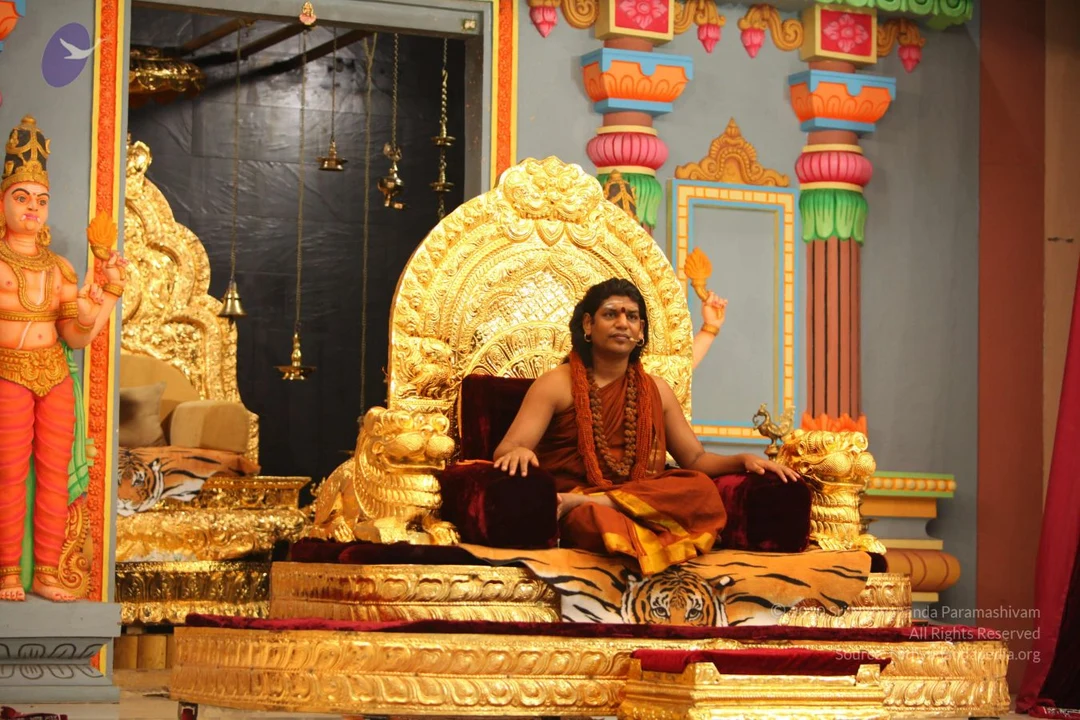
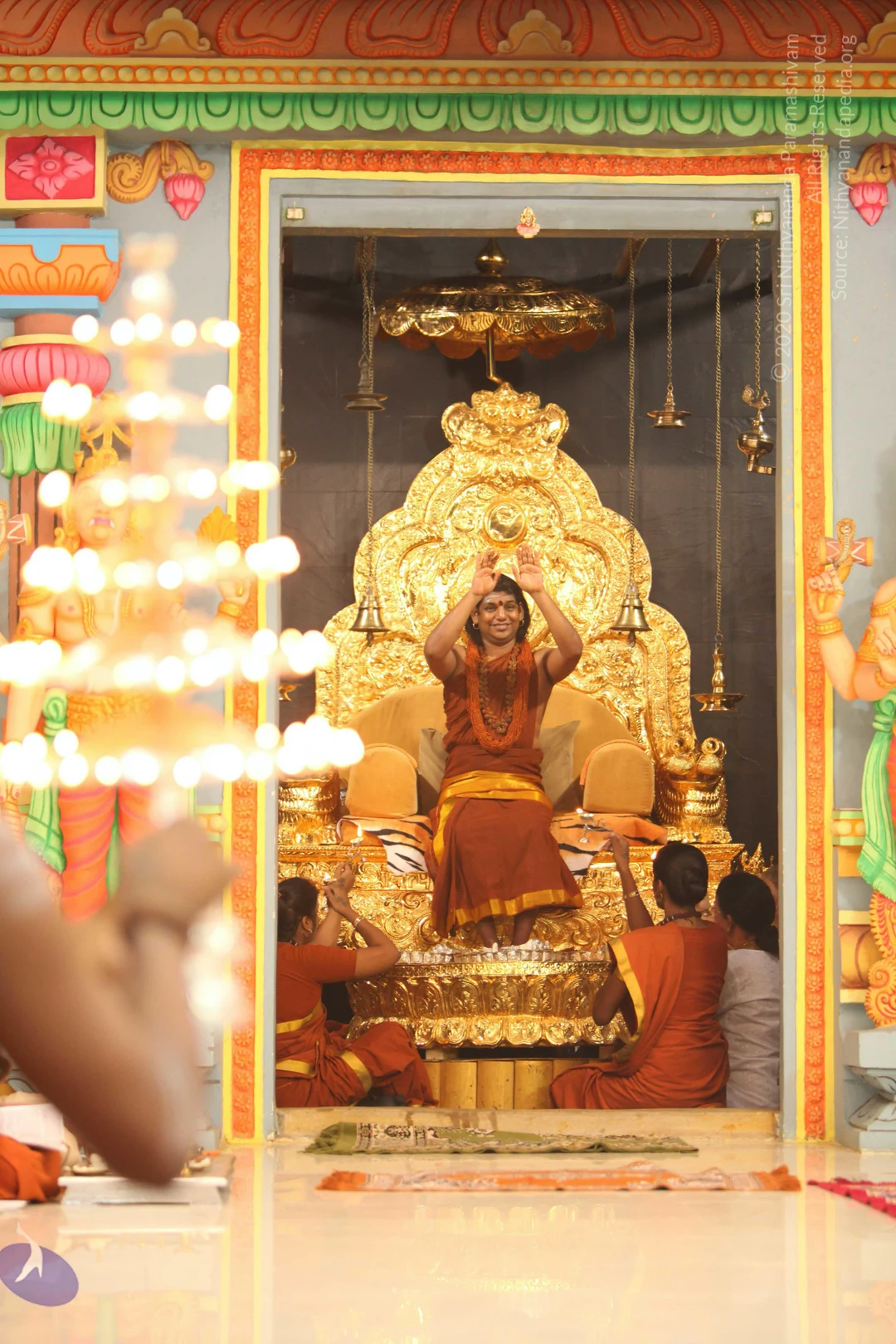
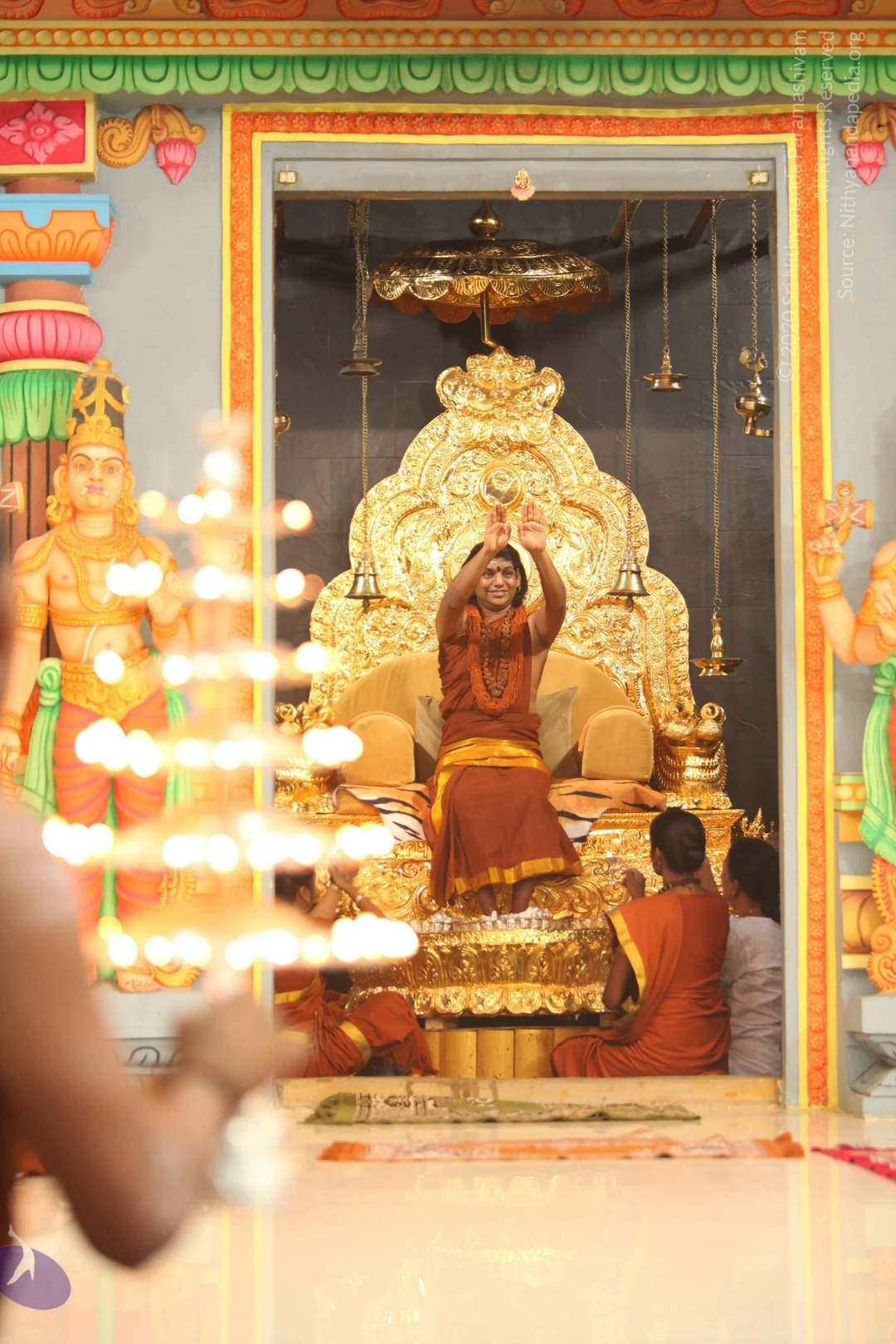
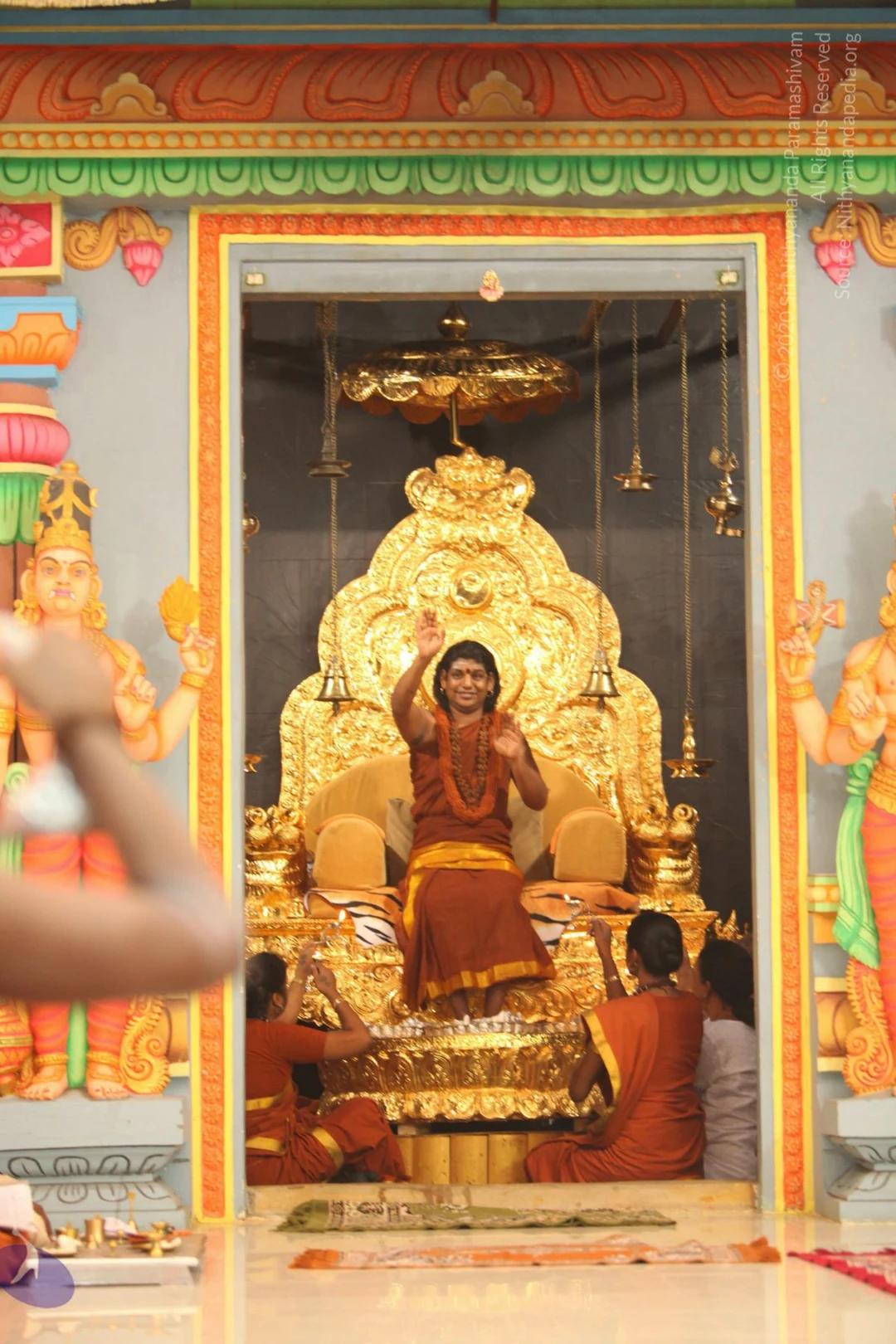
Two gilded metal deity murtis stand side by side against a red draped backdrop framed by ornate gold. The figure on the left wears an orange turban and holds a trident and a damaru-like staff, with a raised palm gesture; it is adorned with layered white and gold necklaces and a rudraksha-style mala. The figure on the right wears a tall gold crown, large earrings and a garland of white flowers, and holds a green parrot on a stand. A silver vessel sits in the foreground. The setting resembles a temple shrine or altar with alankaram decoration.A bronze deity murti stands inside an ornate copper arch with peacock and horse-like carvings. The figure wears a tall crown, a red tilak on the forehead, and a blue draped sari with a gold border. Layered necklaces of pearls, rudraksha beads, red stone pendants and a large jewelled pendant hang on the chest. One hand holds a small vessel while the other hangs at the side. Blue fabric and a gold-embroidered backdrop with red and green gems fill the background, with a brass lamp at the right edge.A black stone statue of a four-armed deity is seated on a dark base set within an ornate silver-coloured arch on dirt ground beneath trees. The figure wears a peach-coloured dhoti and a matching sash, with a peach headband with a red bindi on the forehead. Layers of rudraksha-style beads and a gold chain hang on the chest. Garlands of red and white flowers with green leaves wrap around the body and arms. A green cloth with gold spots forms the backdrop. Hand gestures and held objects are visible at the sides. A small figure appears at the base beneath the seat. No people are visible.A dark black stone linga with a carved hooded serpent hood above it stands in a narrow stone-walled passage between large tree roots. A single small oil lamp flame burns on the linga's top, and white lime-like markings lie on the ground in front. Gold dots decorate the serpent hood. No people are visible.A photograph of a man seated on an ornate golden throne with a tall, intricately carved gold backrest and a gold crown-like finial, with hanging brass bells and oil lamps on chains behind and beside him. He wears a rust-orange robe with a matching orange shawl draped over one shoulder, a long rudraksha mala of dark beads, a gold-coloured sash, and a red bindi on his forehead. He sits with one hand raised in a blessing gesture and the other open, palm up, resting on his knee, smiling toward the audience. Dark slate-like wall behind the throne.A photograph of a smiling man seated cross-legged on an ornate gold throne with carved lion-head armrests, draped over a tiger-skin rug. He wears an orange-red robe with yellow border, a long rudraksha mala around his neck, a red bindi and small earrings, and holds a hand near a wireless microphone. Behind him, two large painted deity statues with multiple arms and orange-red dhoti-style garments flank a gilded arched backdrop. The scene reads as a satsang or discourse setting. Swamiji (probable): the seated man shows long swept-back hair, saffron-orange robes, rudraksha malas and ornate gold-and-throne styling consistent with the page's account of a morning satsang.

Temple-and-Deities

3 photosSource gallery
A black stone statue of a four-armed deity murti seated on a carved dark rock base, wearing a peach-coloured cloth with a gold border and a matching headband with a red bindi. Layered rudraksha and gold-bead malas hang across the chest, and garlands of red roses, white flowers and green leaves drape over both shoulders. Behind it is a green backdrop with gold dot pattern. Two upper hands hold a trident and a drum-like object, while the front hands are raised in blessing and resting on the lap. The statue is a depiction, not a physical person.A large dark stone statue of a seated four-armed deity murti, draped in a peach-coloured cloth with a cream border and a matching peach headband. Multiple strands of rudraksha and bead malas hang across its chest, and garlands of red roses and white flowers wrap its shoulders and arms. One hand holds a small drum-like object, another rests in a mudra, and a trident-like staff rises behind. The figure sits on a rock base carved with a small reclining figure and a bull. Behind it hangs a green curtain with gold dotted patterns. No living people are visible.

Pada-Puja

32 photosSource gallery
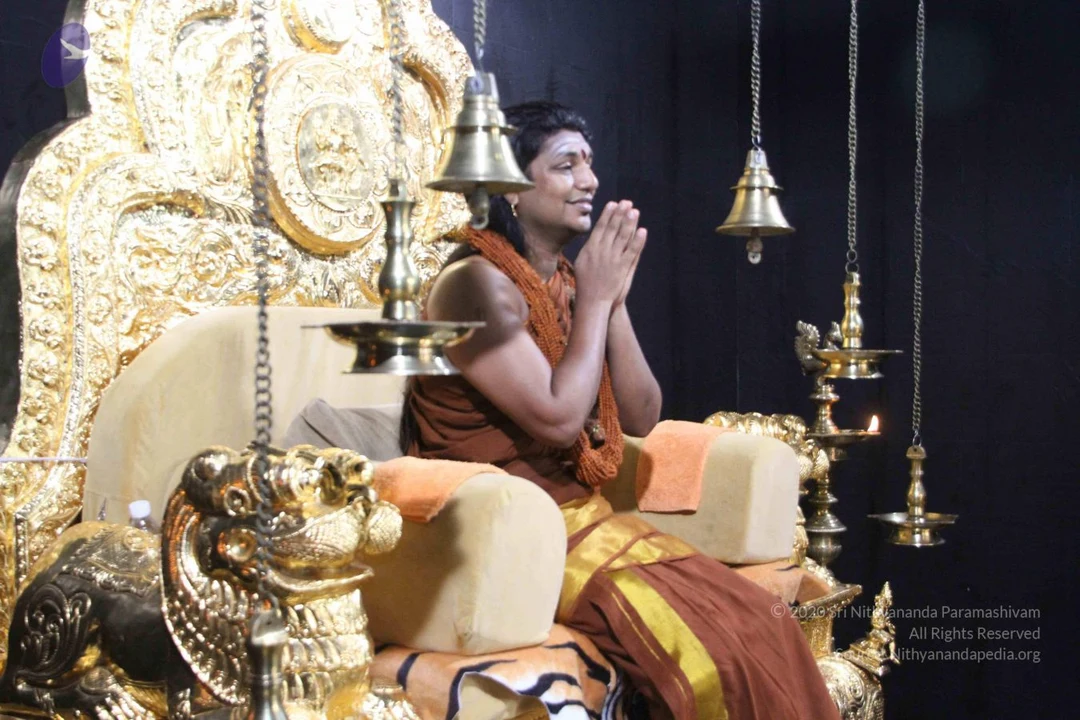
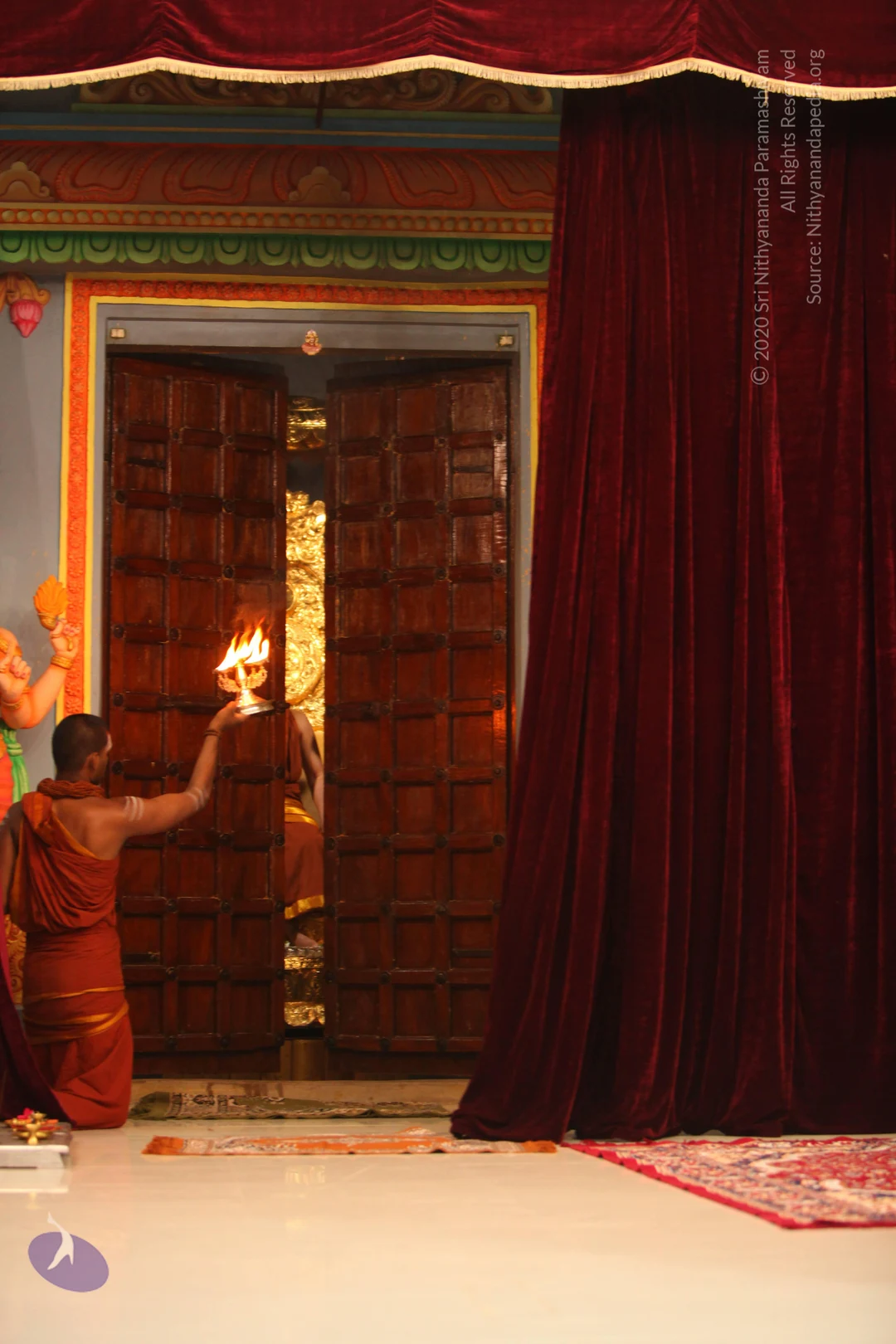
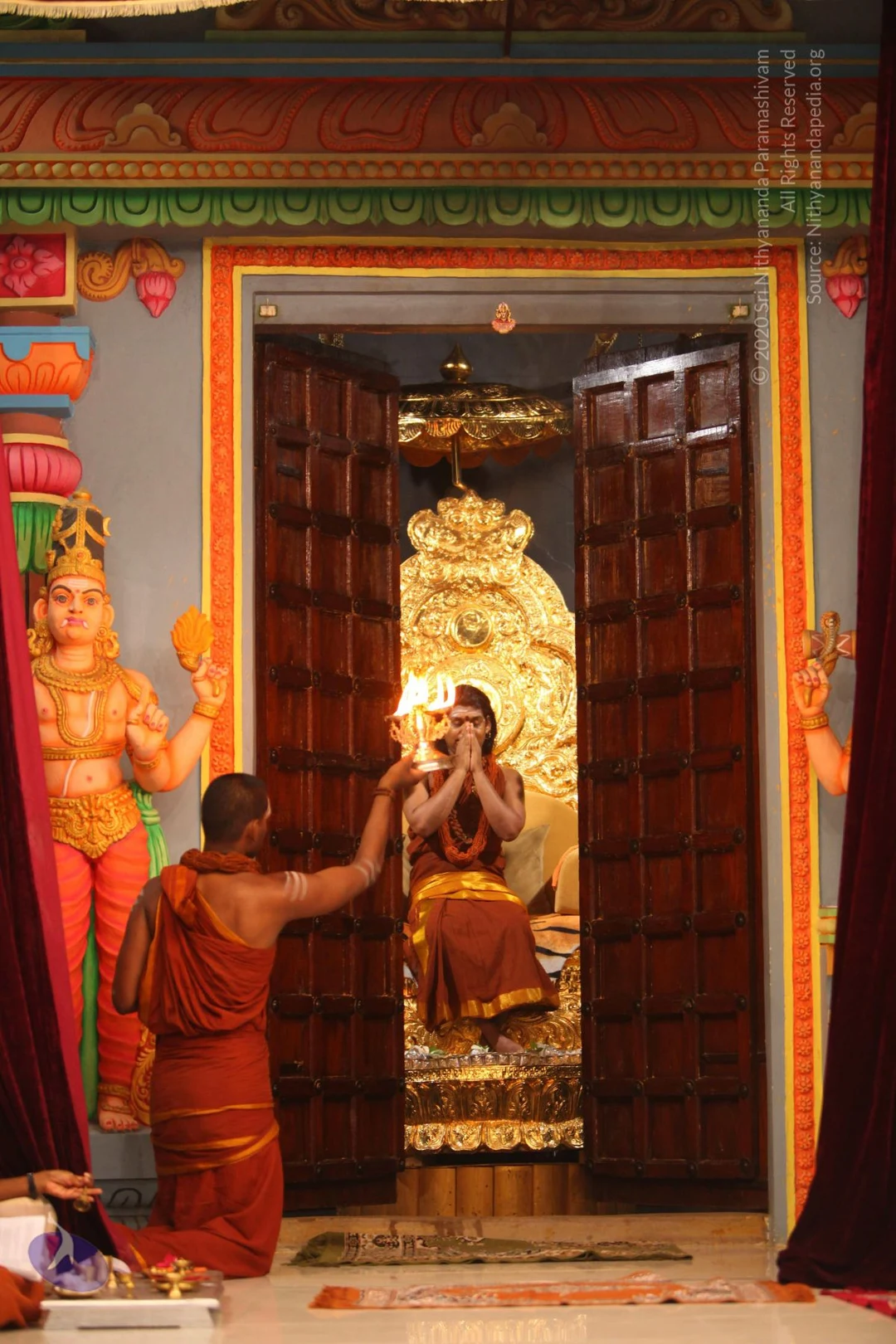
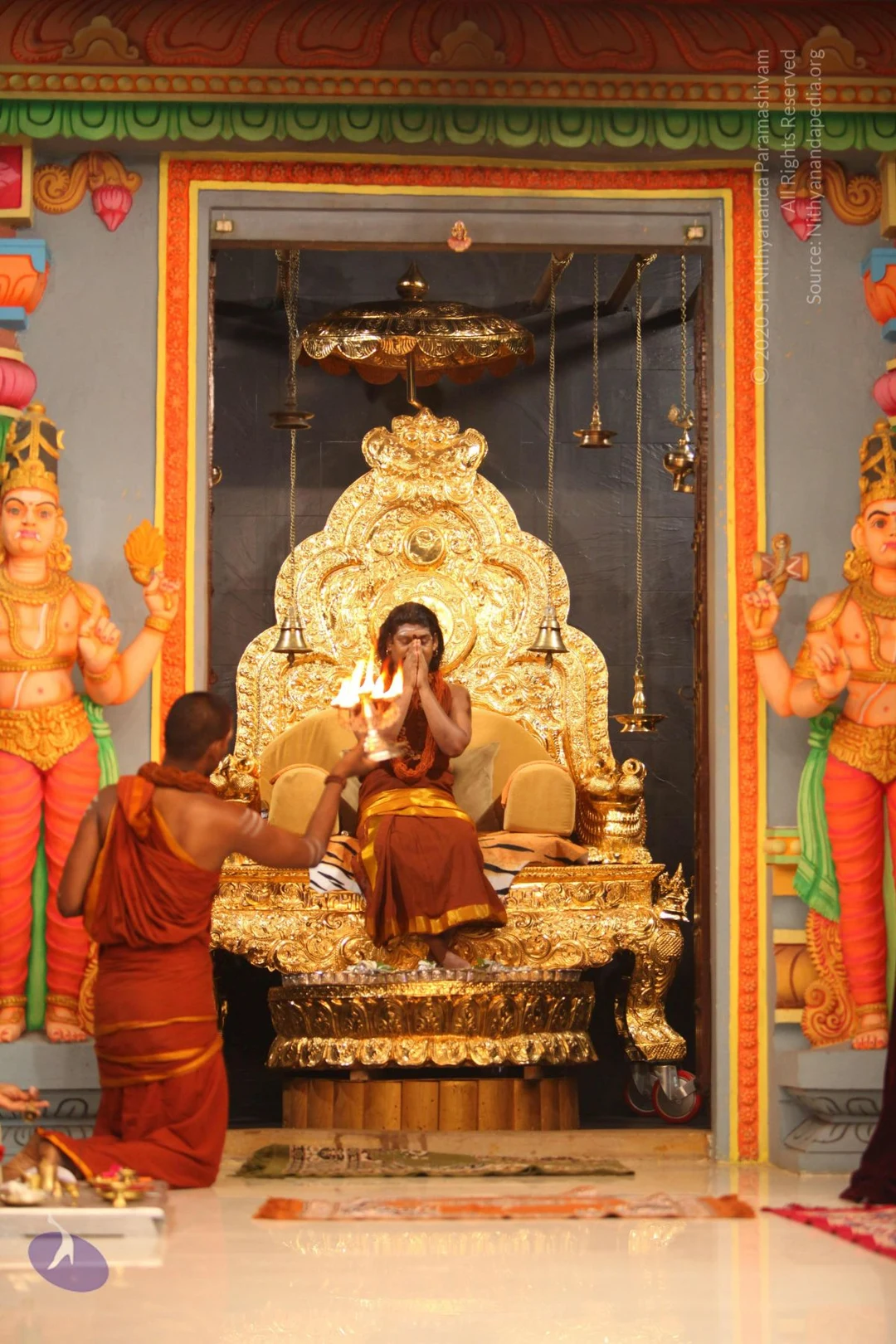
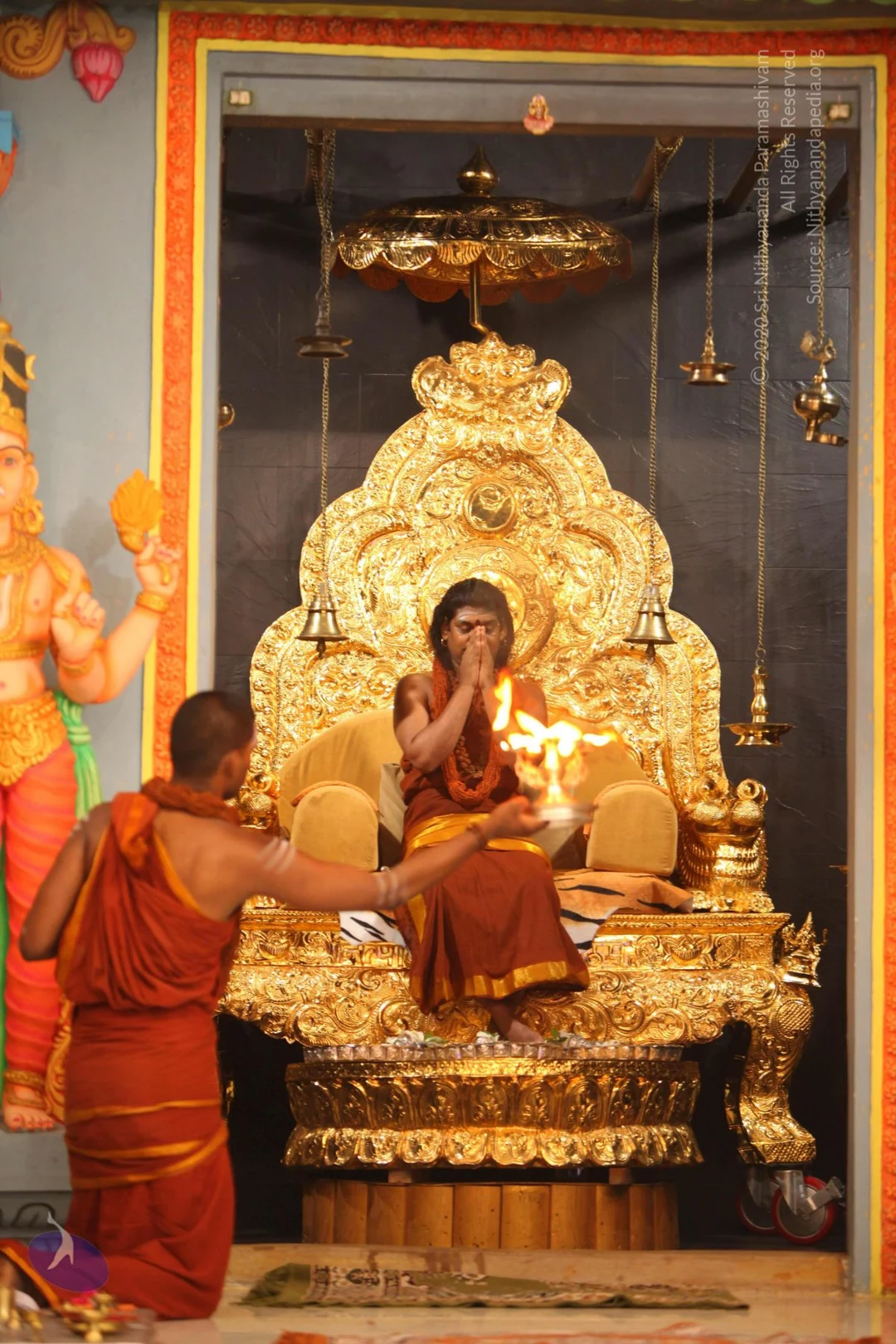
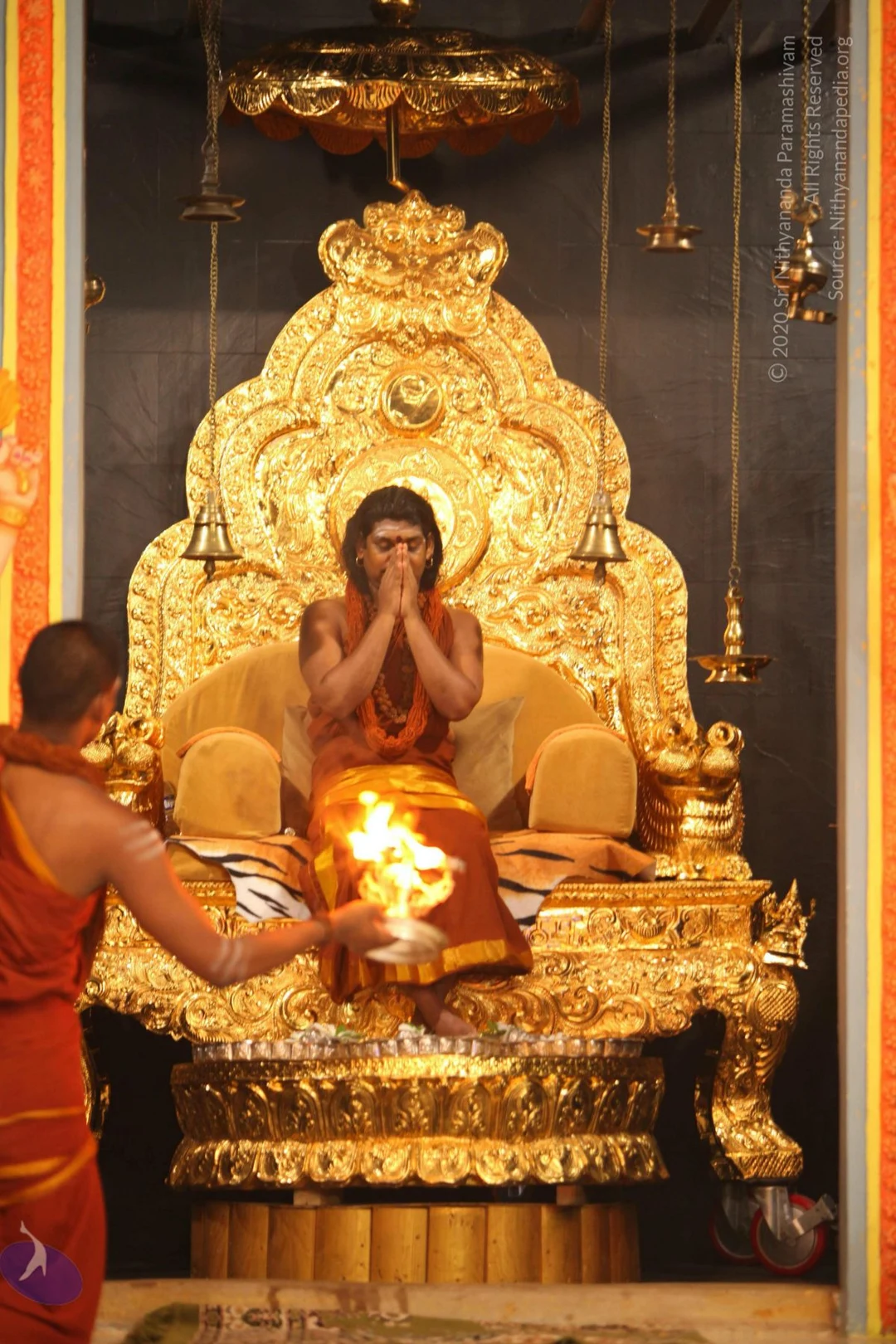
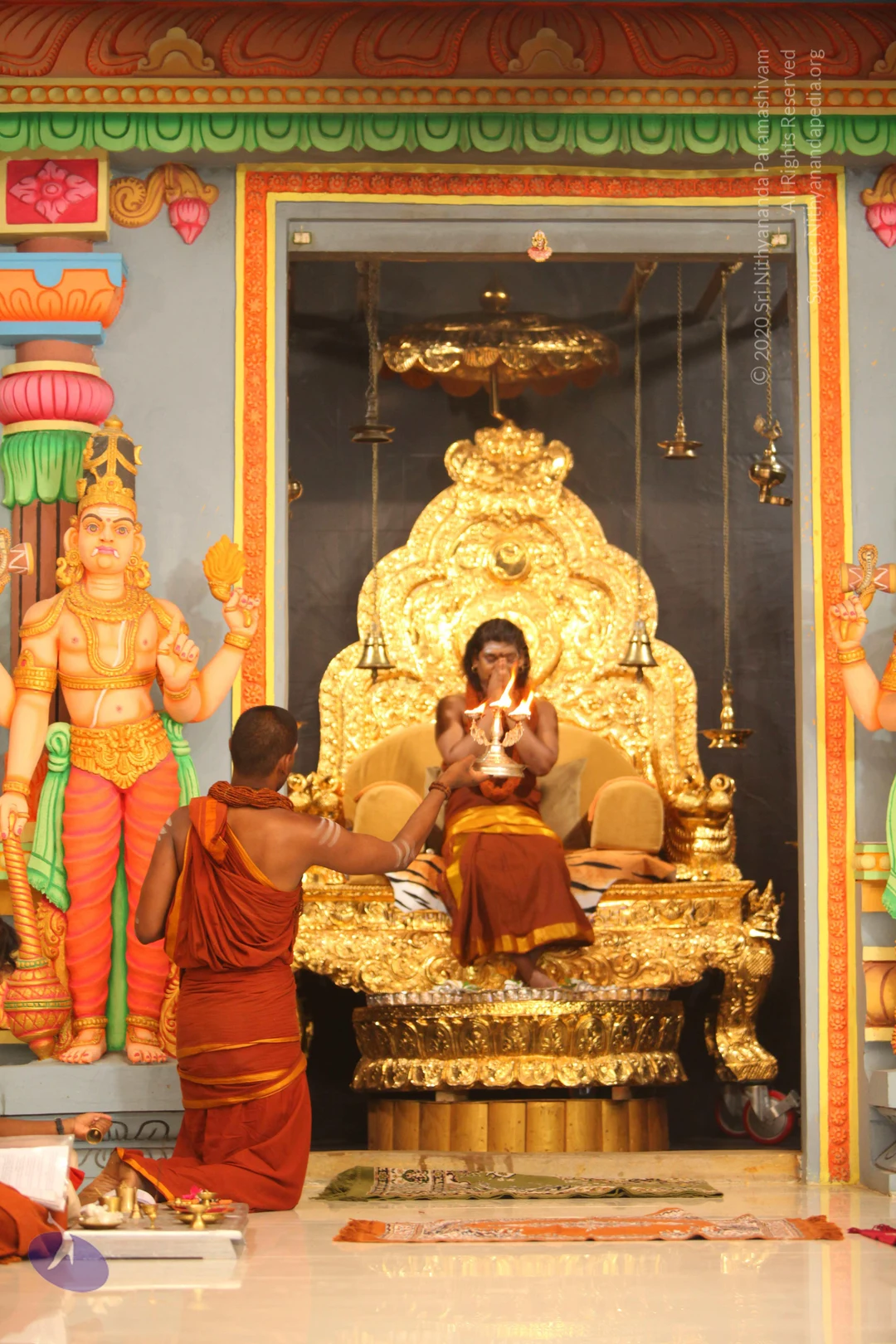
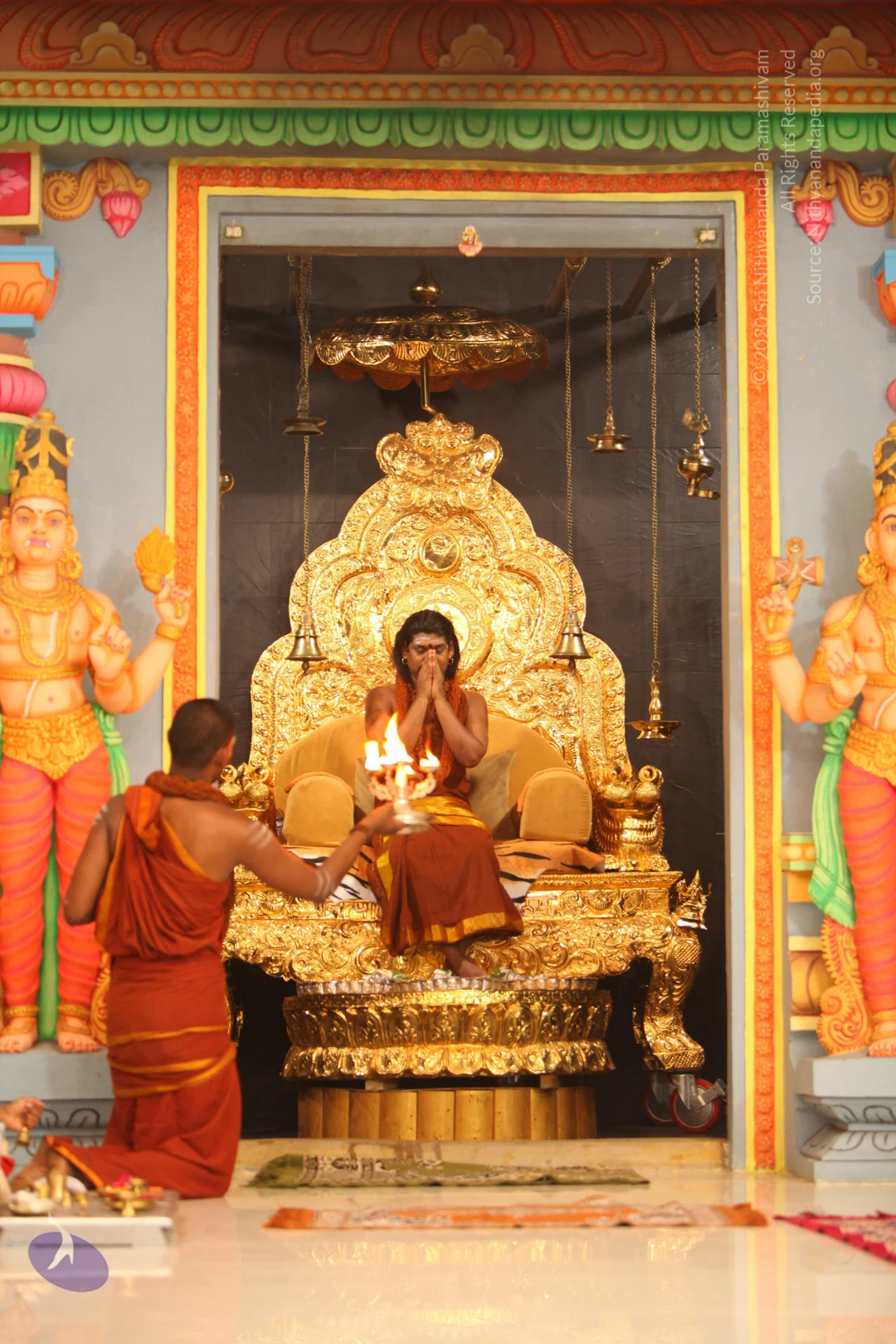
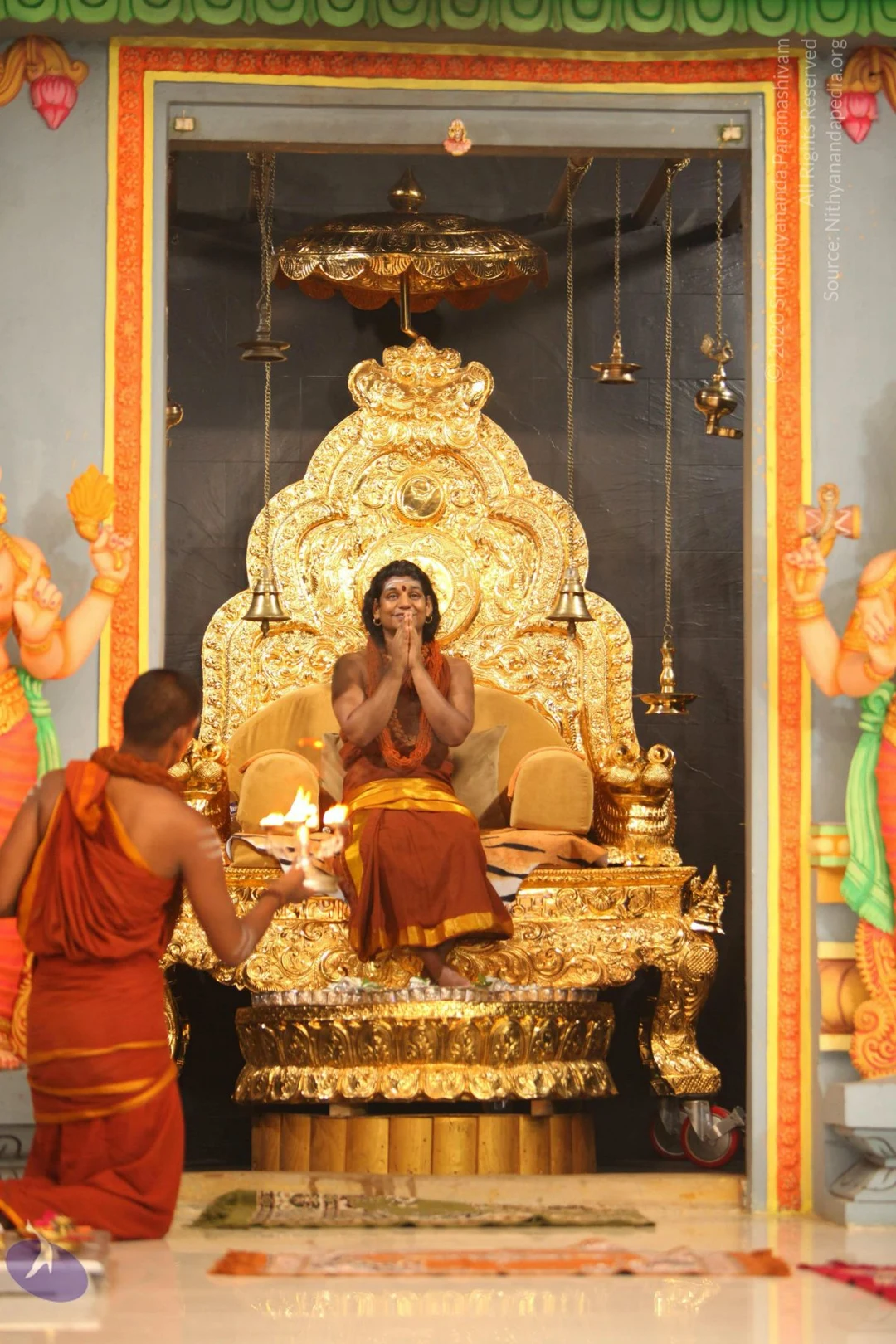
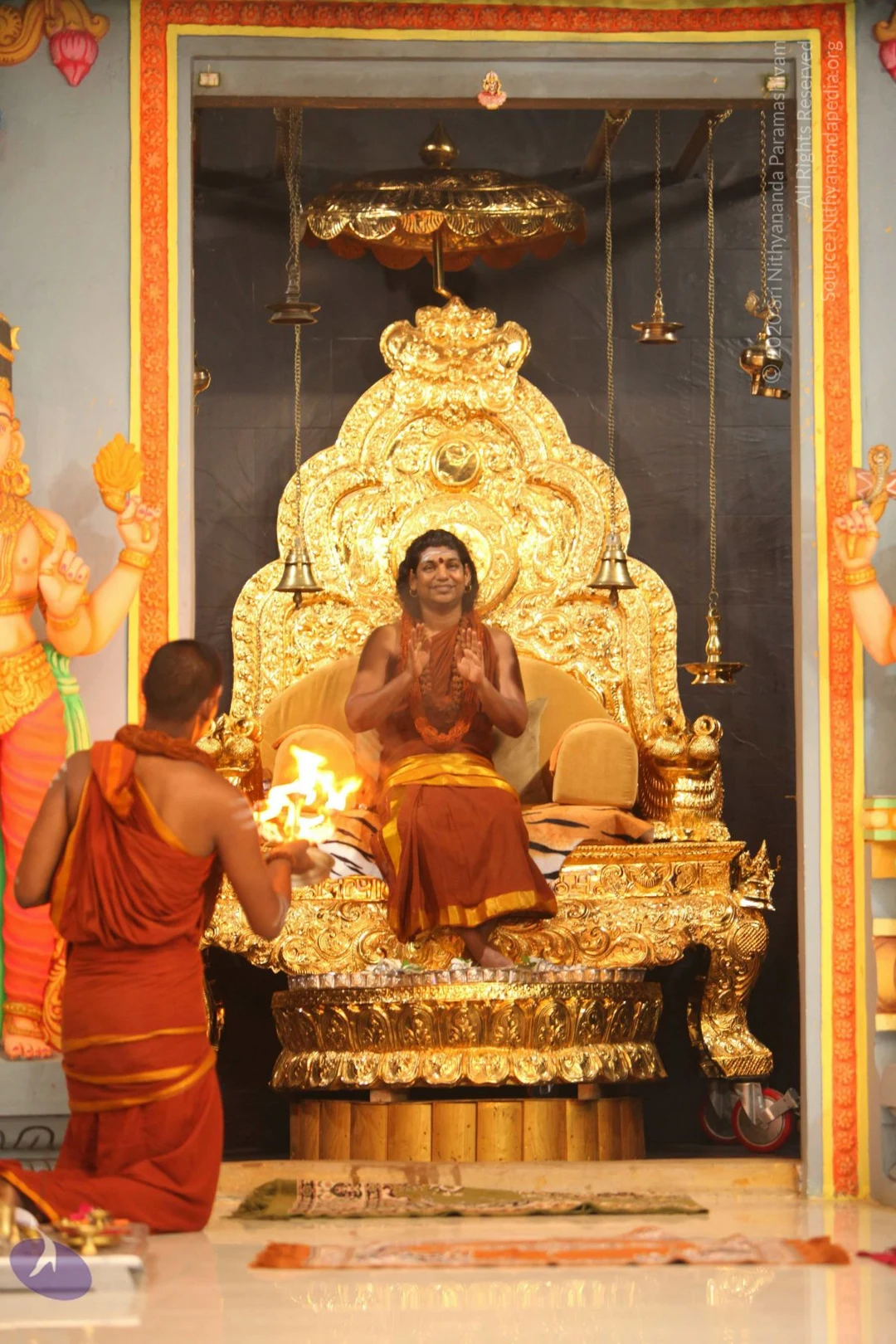
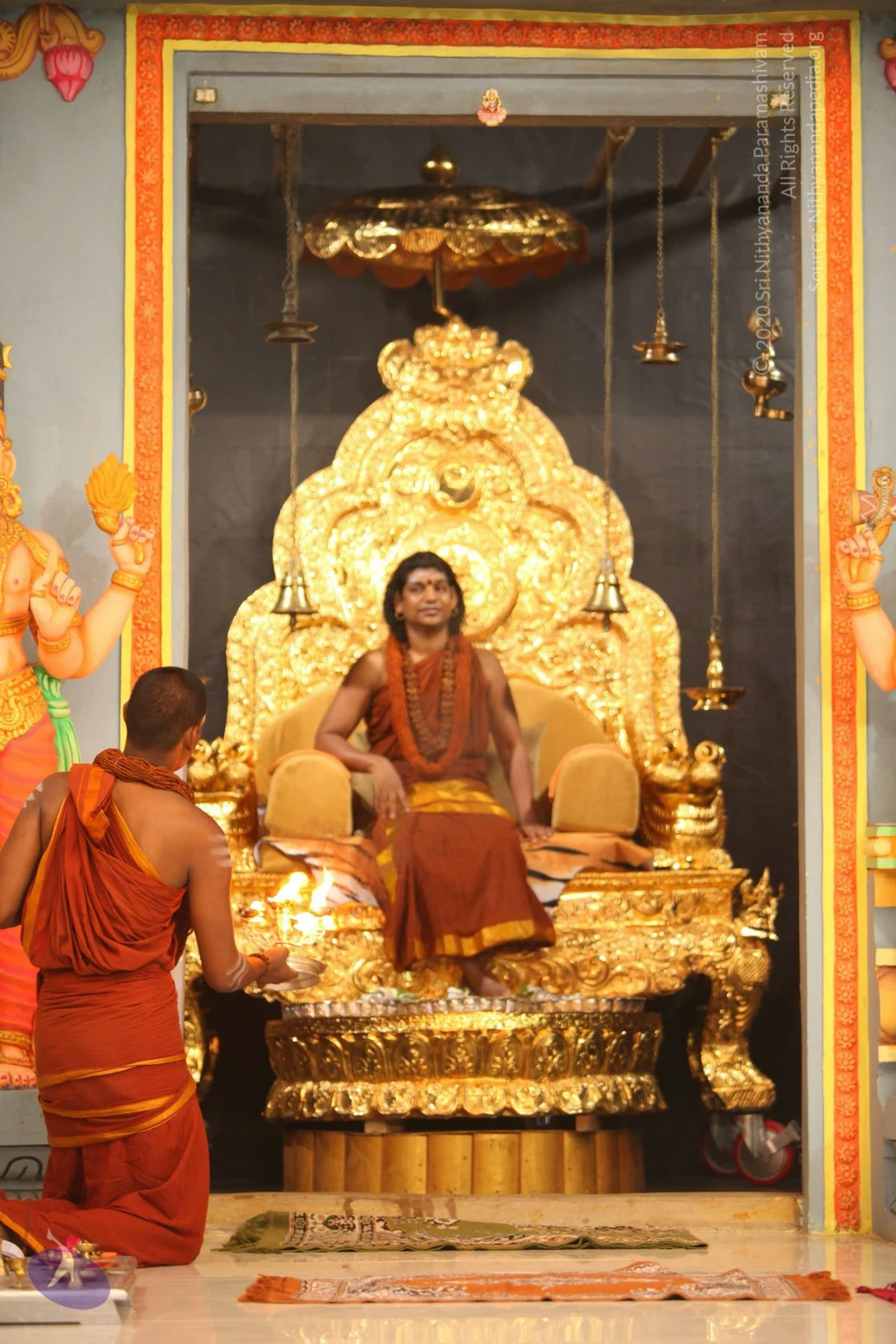
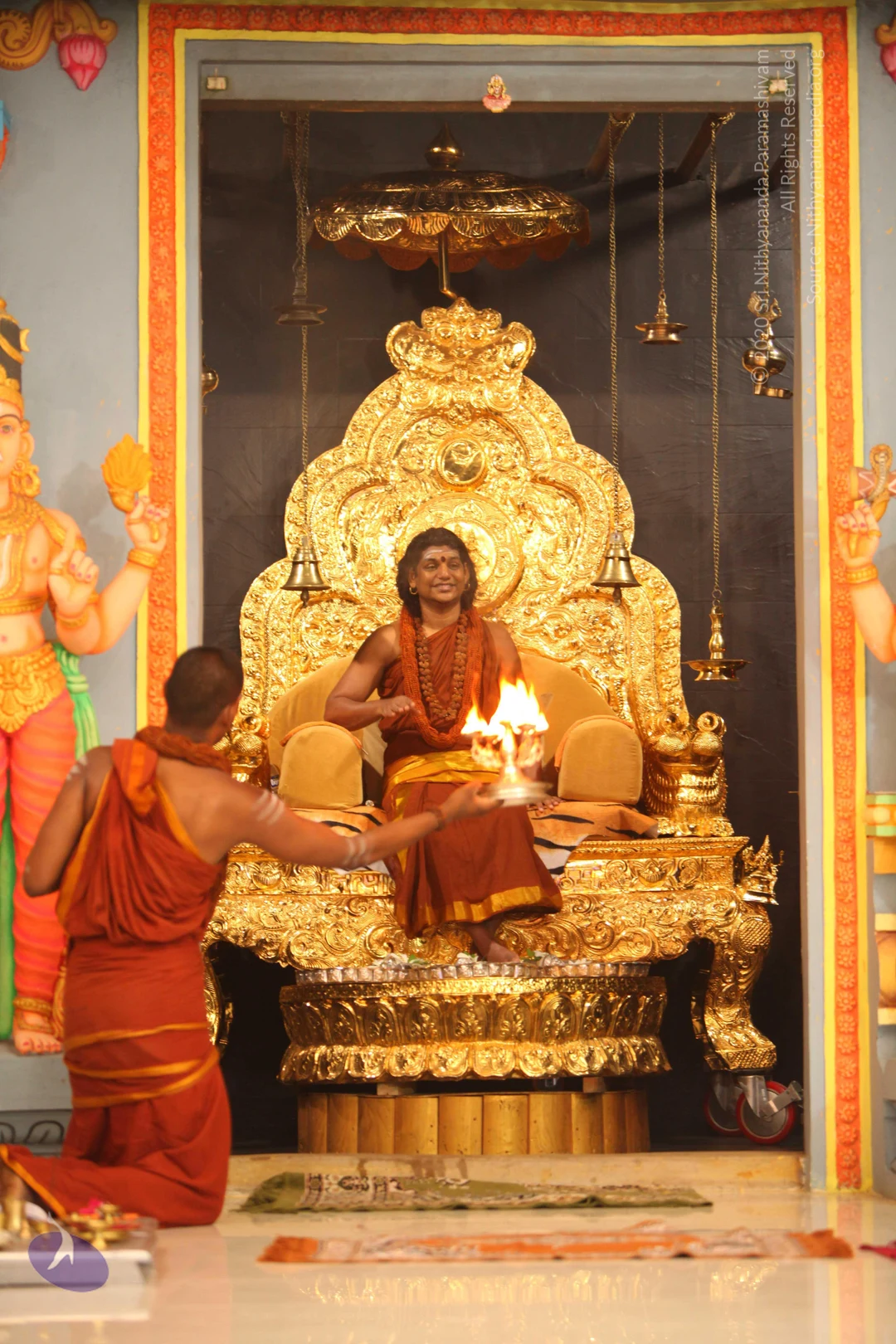
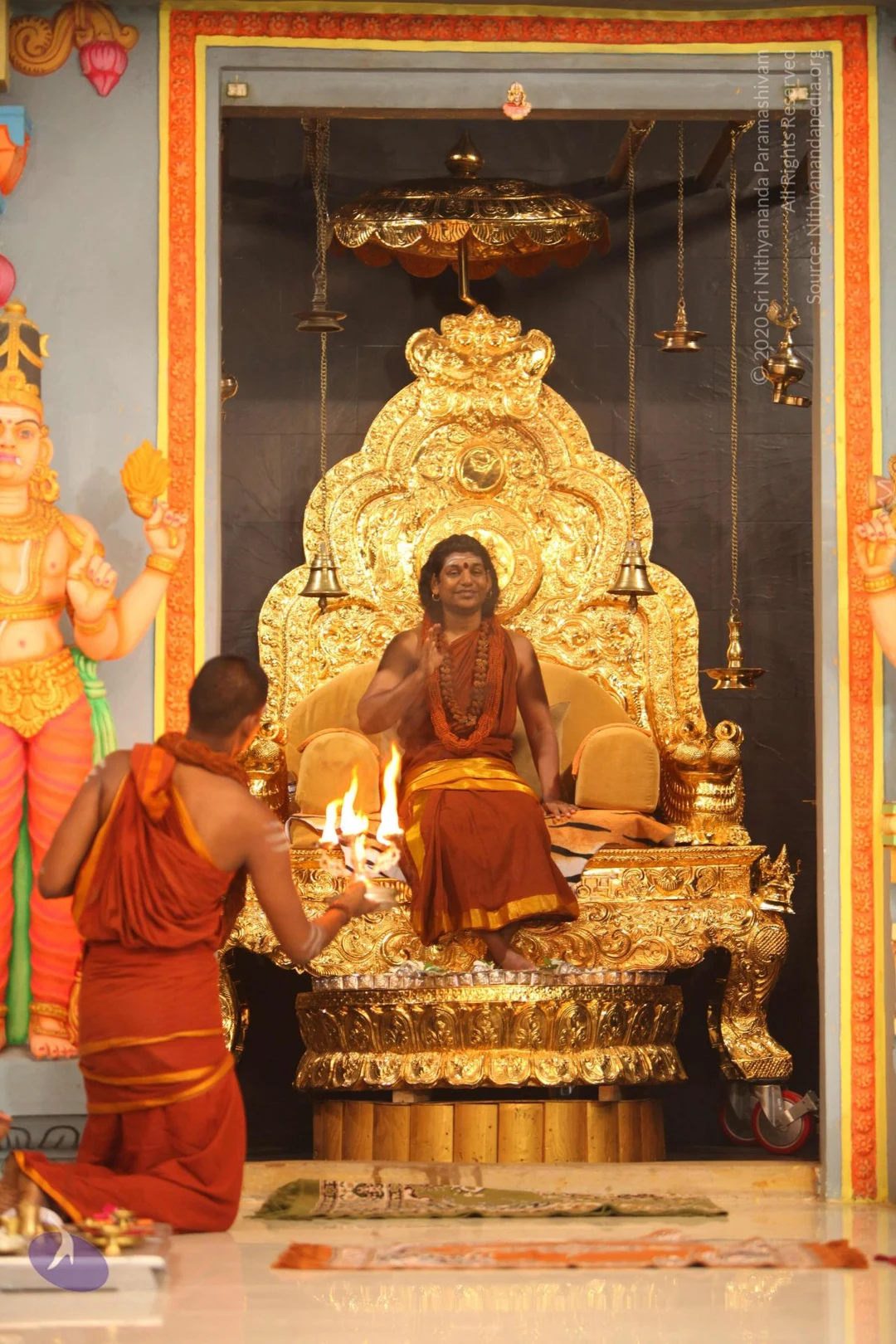
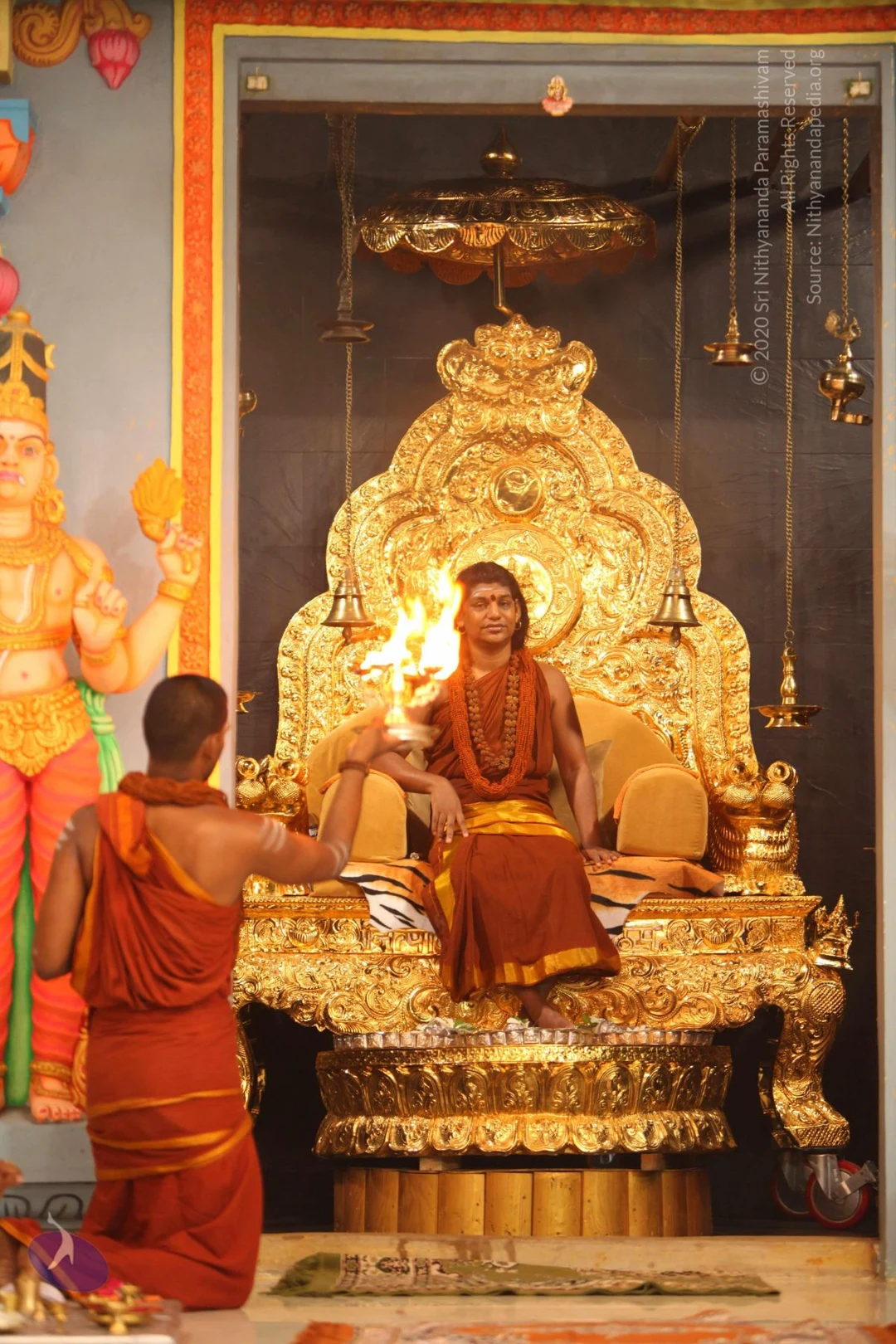
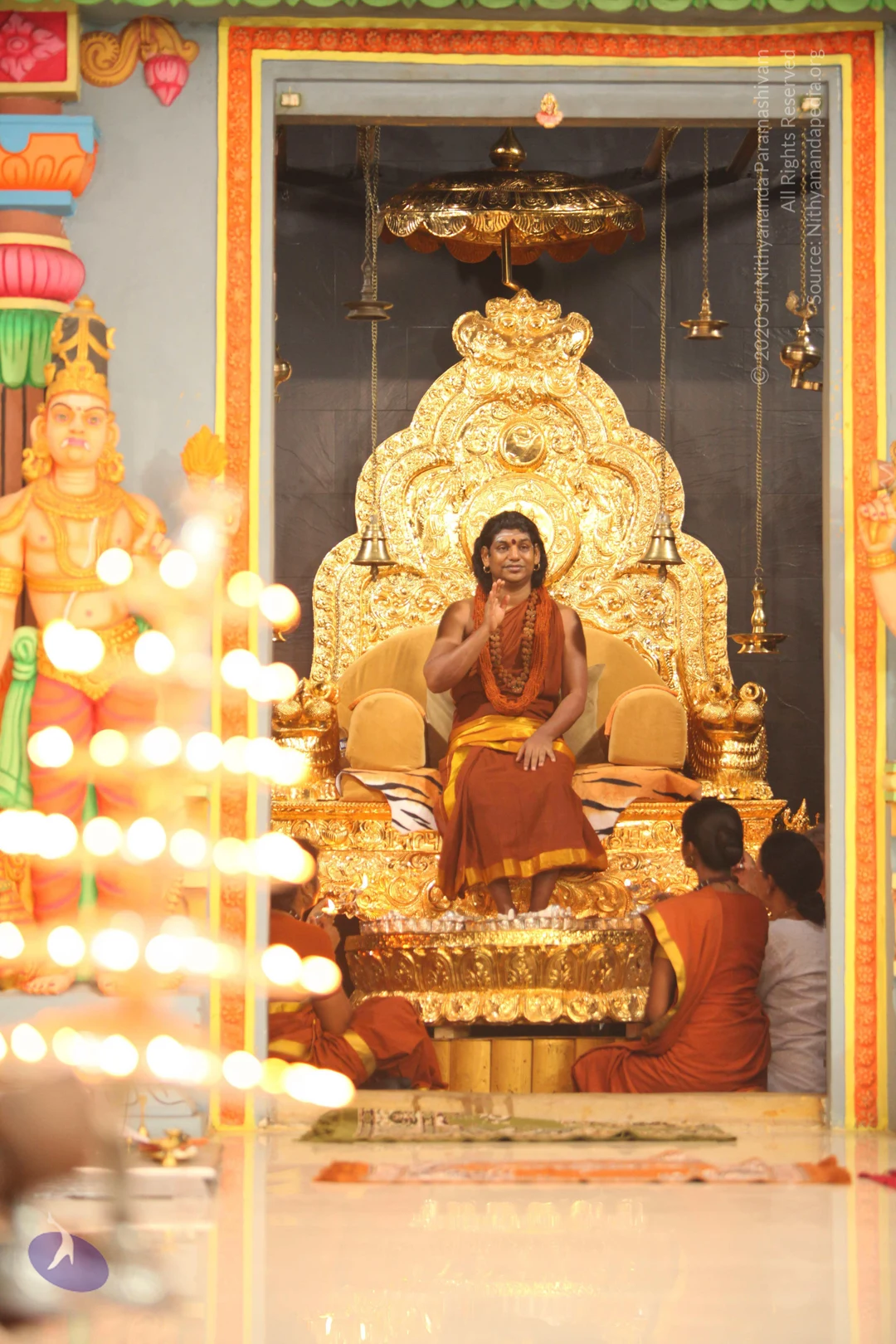
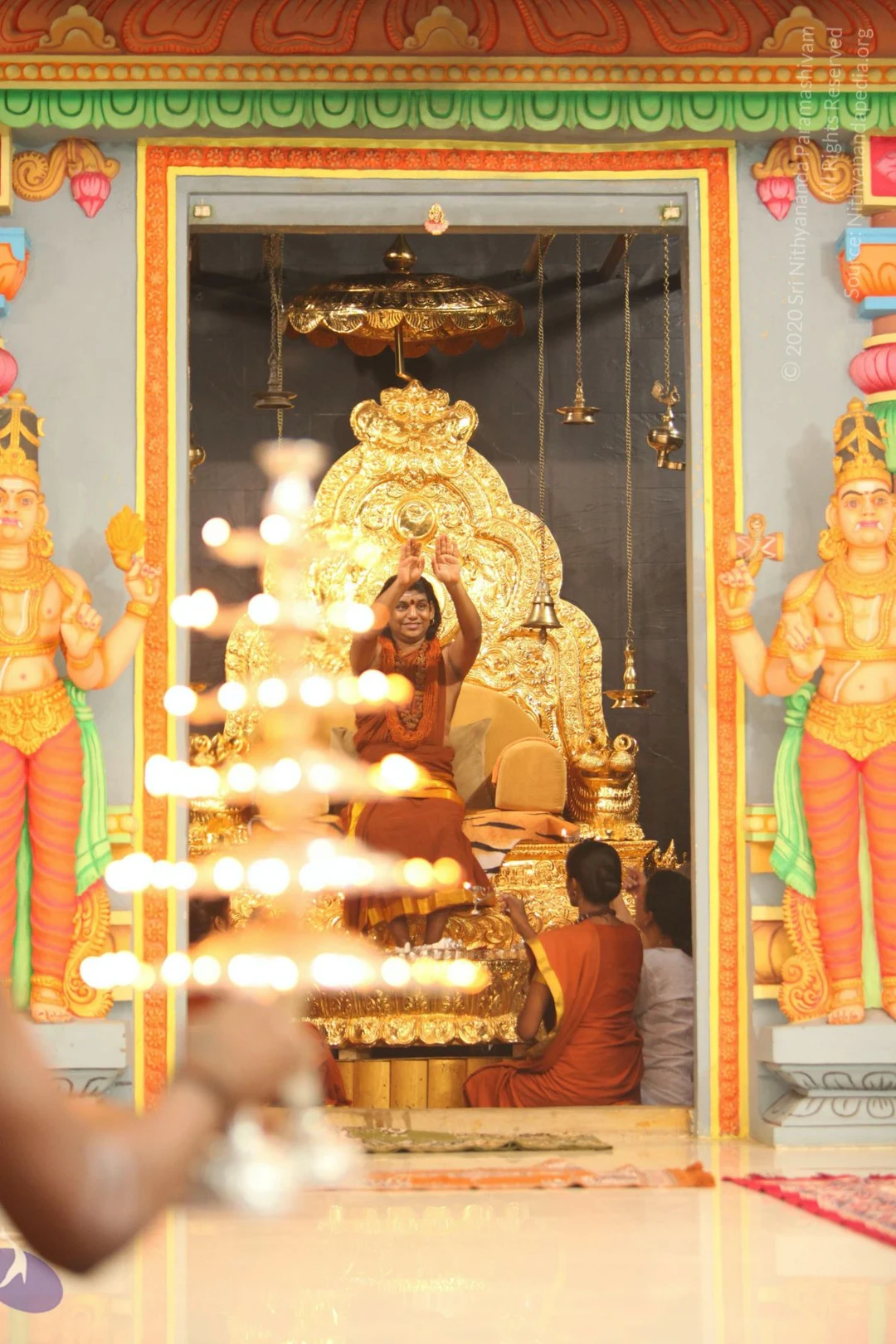
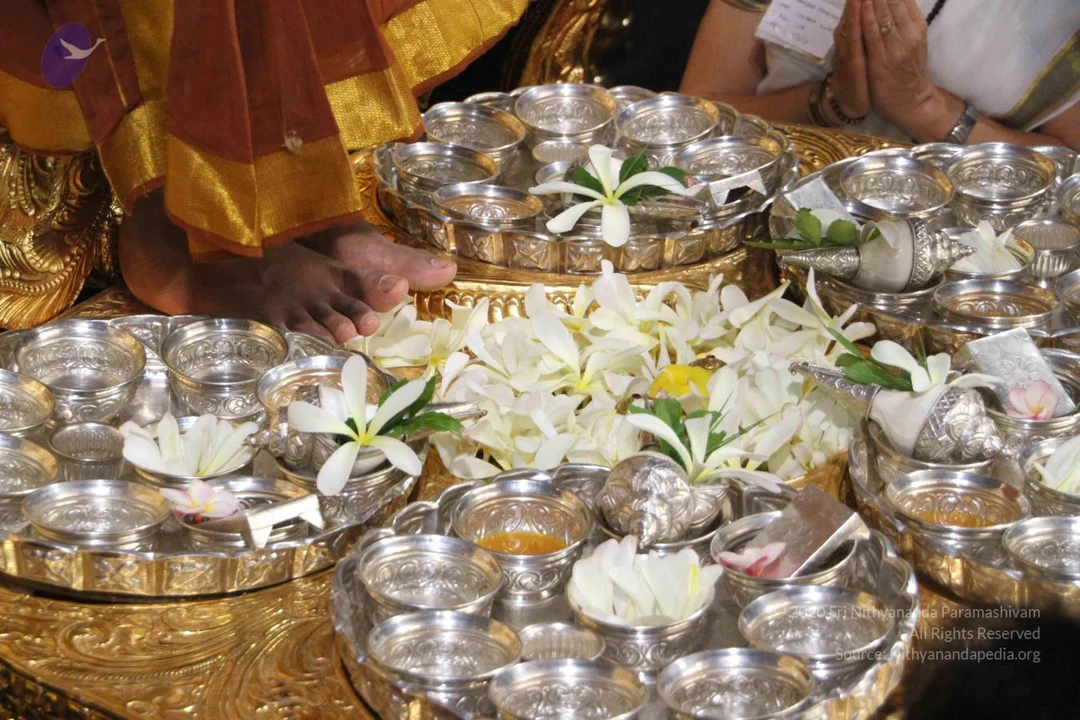
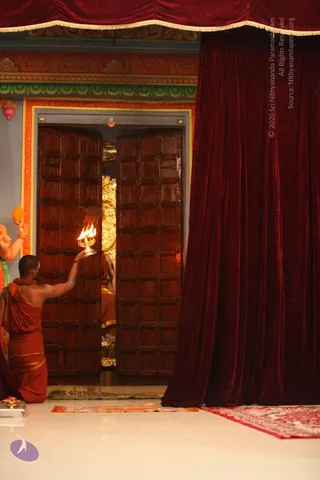
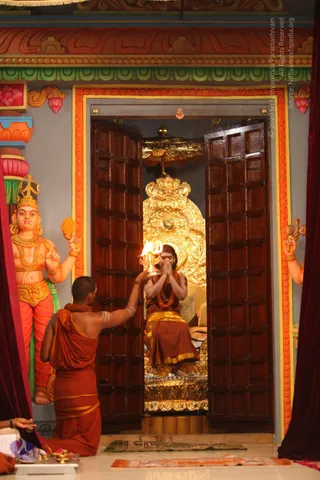
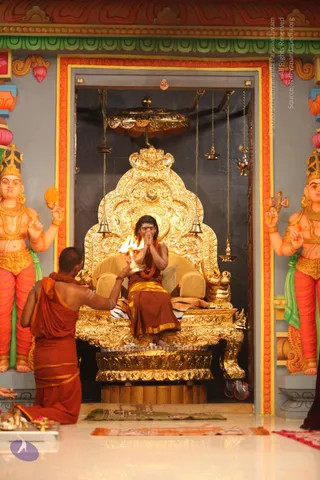
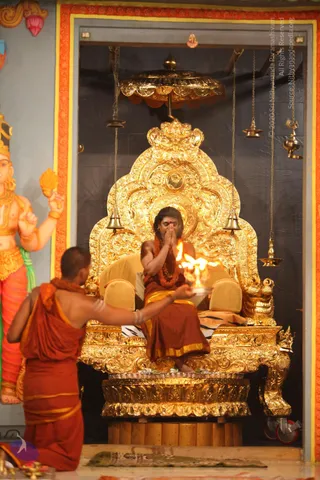
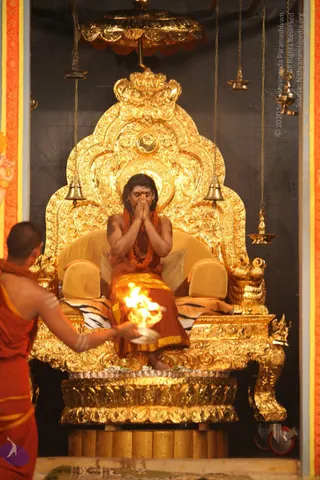
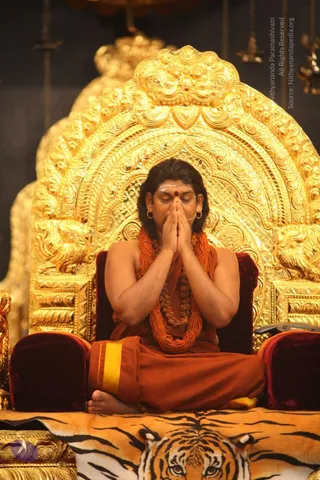
A priest in saffron-orange dhoti and shawl, with a shaved head and white tripundra markings, holds a lit oil lamp aarti toward a pair of large dark wooden temple doors. Through the open doorway a golden deity murti and a seated figure in orange are partly visible. Deep red velvet drapes hang on the right, a painted ornamental frieze runs above, and a painted image of Ganesha stands at the left edge. A small brass lamp sits on a ledge at lower left and red carpets cover the white floor. The scene is a temple aarti at the sanctum doorway.A photograph inside a richly decorated temple-style hall. A seated figure with long dark hair and a rudraksha mala sits on an ornate gold throne with a gold canopy, hands folded in prayer with eyes closed, wearing a rust-orange cloth. A kneeling priest in orange robes holds a lit oil lamp flame toward him. Large painted deity statues with multiple arms and gold crowns flank the doorway, and hanging oil lamps and bells are suspended above. Only the kneeling priest and the seated figure are physically present, plus a partially visible person at the right edge.A photograph of an ornate golden throne (peetha) in a temple-like hall, backed by a gold canopy and hanging brass oil lamps. A seated man with long dark hair, wearing an orange-red robe with gold border and a red-orange rudraksha-style mala, sits with palms pressed together in namaste. A younger priest in orange-red robes stands at left, holding a lit oil lamp (aarti) toward him. To the left, a painted deity figure with gold ornaments and a lotus is visible. A tiger-skin cloth covers part of the seat. a person cues: long hair and orange-red clothing with a mala on the seated figure, who is shown on a throne being honoured with aarti.A seated man in orange-red robes with a red-orange beaded rudraksha-style mala and a vertical tilak on his forehead sits with hands pressed together in namaste on an ornate gold throne with carved lion-like armrests, tiger-striped cloth draped over the seat, and a gold canopy above. A standing priest in red-orange robes at left holds a flaming aarti lamp toward him. Hanging brass bells and lamps surround the throne in a temple-like hall. The seated man is visibly appearance-consistent with the page's reference to a person, with orange robes and mala cues, so a person is noted as an appearance-based candidate.A photograph inside a richly painted temple hall with a golden ornate throne. A seated figure in an orange-red robe with a gold border sits on the throne with hands folded in front of the face, while an oil lamp flame burns before him. A kneeling attendant in orange-red robes and a rudraksha mala holds a brass aarti lamp toward the seated figure. Behind them stands a painted, multi-armed deity murti in orange-red and green colours with a crown and gold jewellery. Hanging bells and lamps are suspended above the throne, and small brass lamps and a tray sit on the floor in the foreground, consistent with an aarti or puja. The seated figure's face is partly obscured and his appearance is uncertain.

Satsang
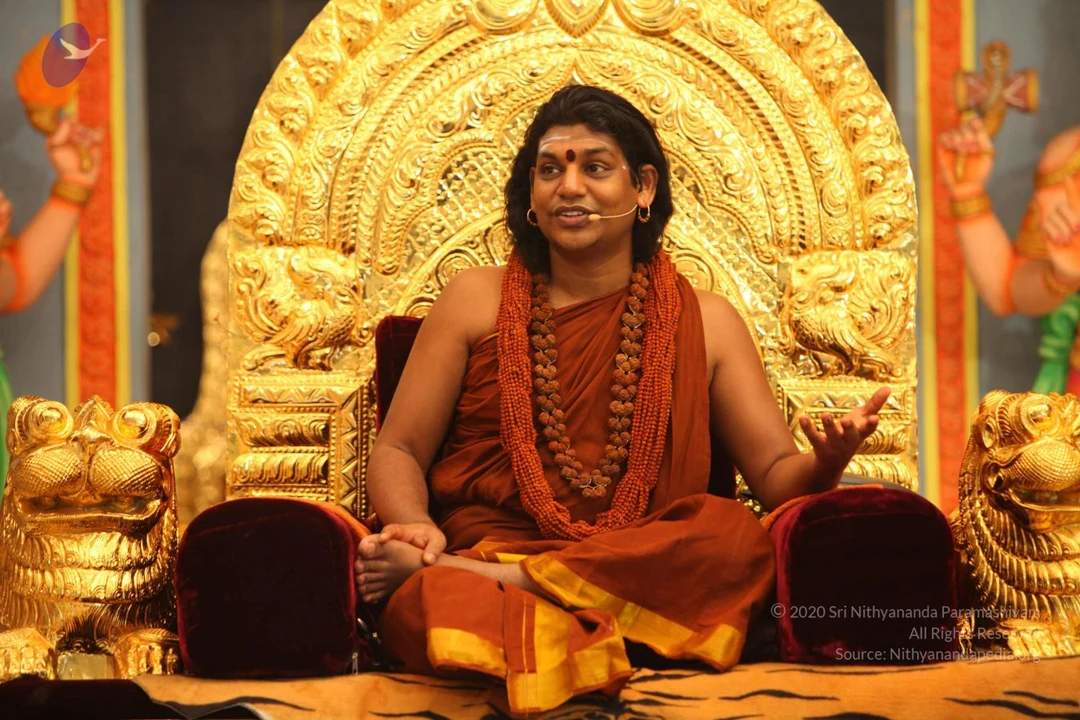
39 photosSource gallery
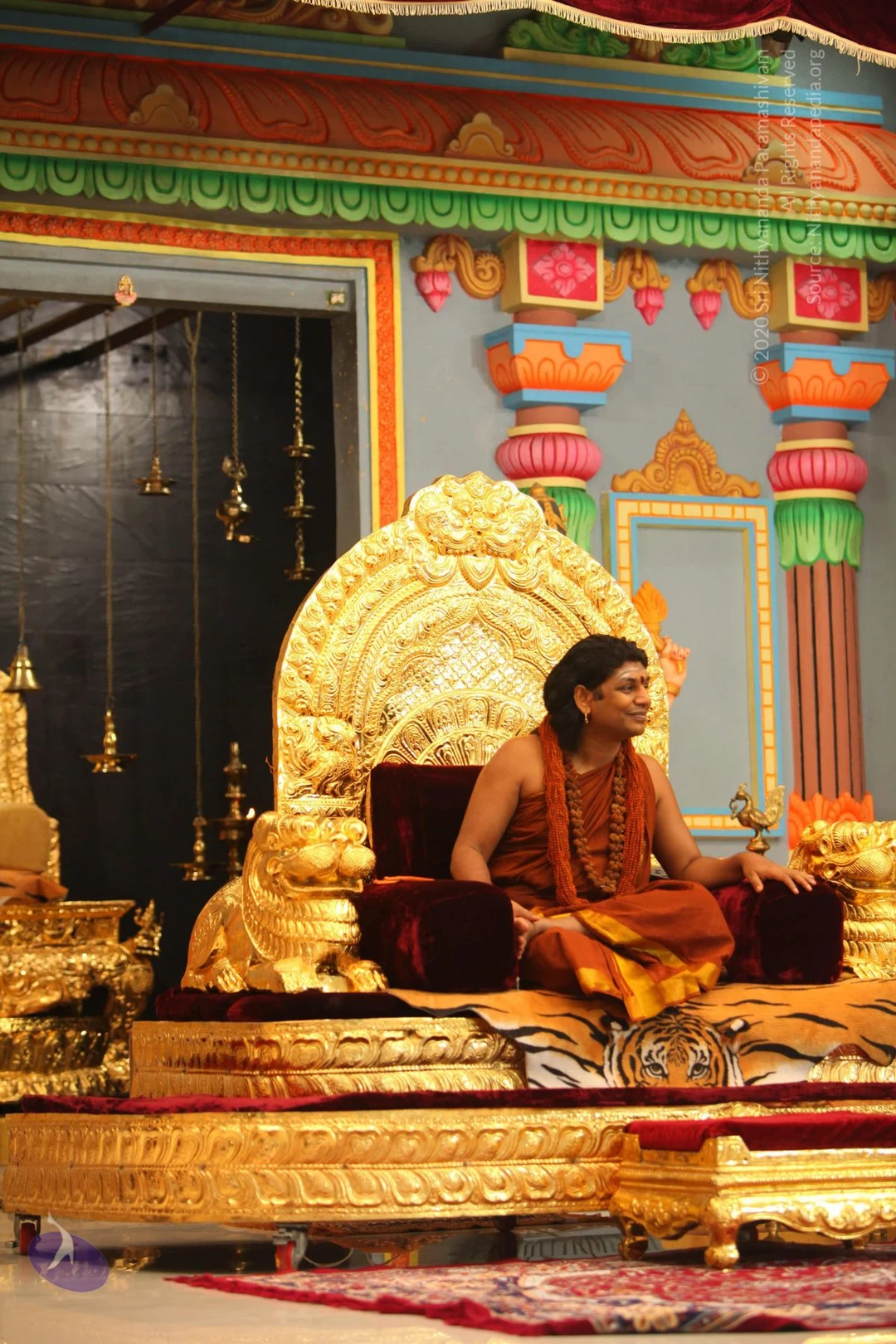
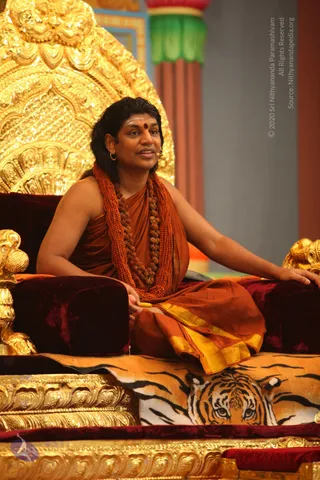
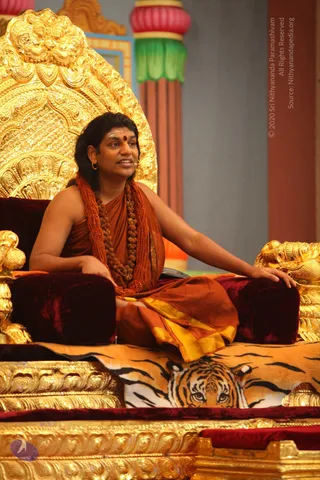
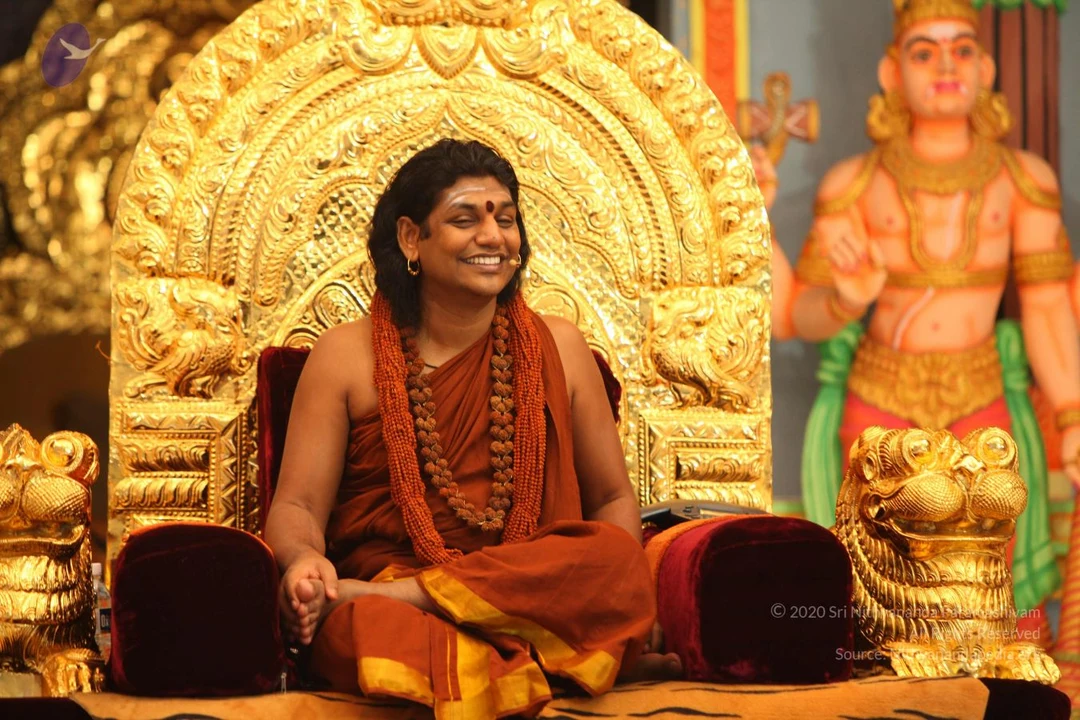
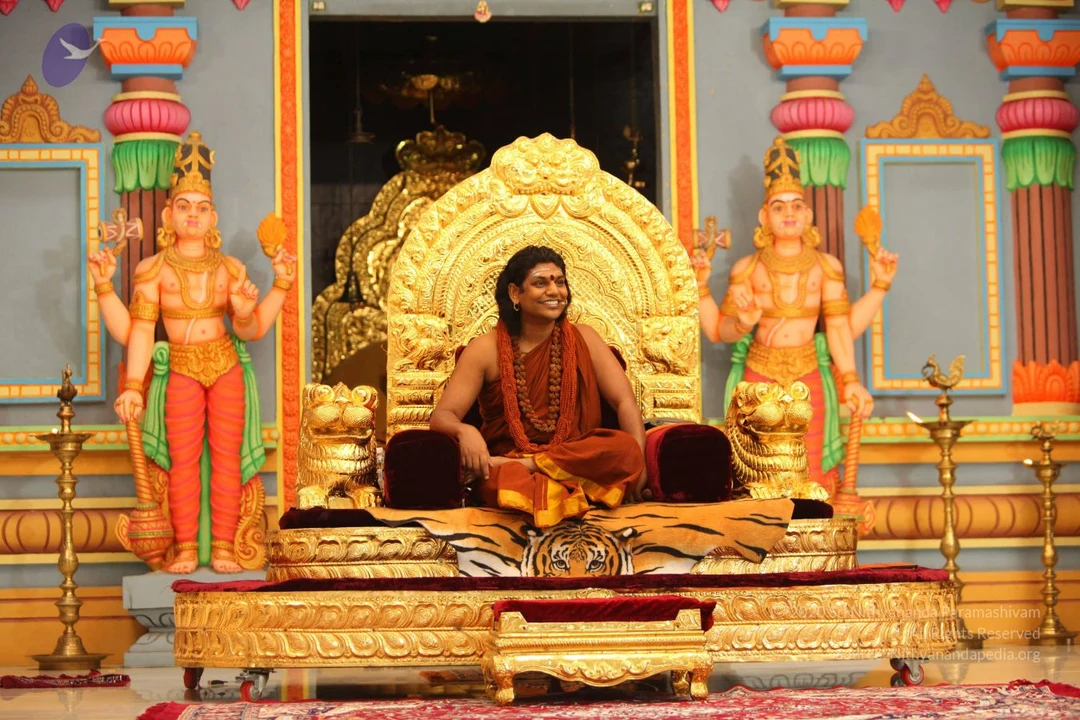
A photograph of a man seated cross-legged on an ornate gold throne with a carved gold arch backrest and two gold lion-head armrests, draped with a tiger-skin cloth. He wears an orange-saffron robe with a gold-bordered hem, a long rudraksha mala, gold hoop earrings, and a red bindi, and has a small headset microphone; his hands rest on the armrest and his right hand is raised with fingers loosely curled. Painted deity murtis with multiple arms flank the throne, and a red-and-gold framed doorway with hanging lamps stands behind. A red patterned carpet covers the floor and a gold footstool sits in front. This appears to be a satsang discourse. Probable Swamiji: long swept-back hair, saffron robes and rudraksha mala are visible, and the page places him at this event.A man in saffron-orange robes and a rudraksha mala sits cross-legged on an ornate gold throne with carved lion-head arms and a tiger-skin cover, pointing with one hand while speaking into a headset microphone. He wears a red bindi and long swept-back dark hair, and a gold-and-red deity figure with a crown stands on the right beside a gilded arch. Behind him hang brass lamps and a gold canopy in a temple-like hall, and a red patterned rug covers the floor. Appearance-based label: a person, giving a satsang discourse from the throne.A man with long dark hair sits on an ornate velvet-cushioned throne with an elaborately gilded backrest, speaking with an open hand resting on the armrest. He wears an orange-saffron cloth draped over one shoulder with a gold border, and a long orange-red rudraksha mala with a dark bead pendant around his neck, plus gold hoop earrings and a red bindi with white tilak on his forehead. A tiger-skin rug covers the platform in front of the throne. Background shows a green and orange temple-style column.A seated man sits on an ornate gold throne with carved gilded backrest and armrests shaped like lions, draped over a tiger-striped rug. He wears a saffron-orange shawl and a long coral and rudraksha mala, with a red bindi on his forehead and small gold earrings, speaking while gesturing with one hand on the armrest. Behind him a red and green pillar and grey wall. Appearance matches the page's a person claim on several cues: long swept hair, saffron clothing, rudraksha mala, and a ceremonial throne, so this is a person in a satsang setting. One physical person is visible.
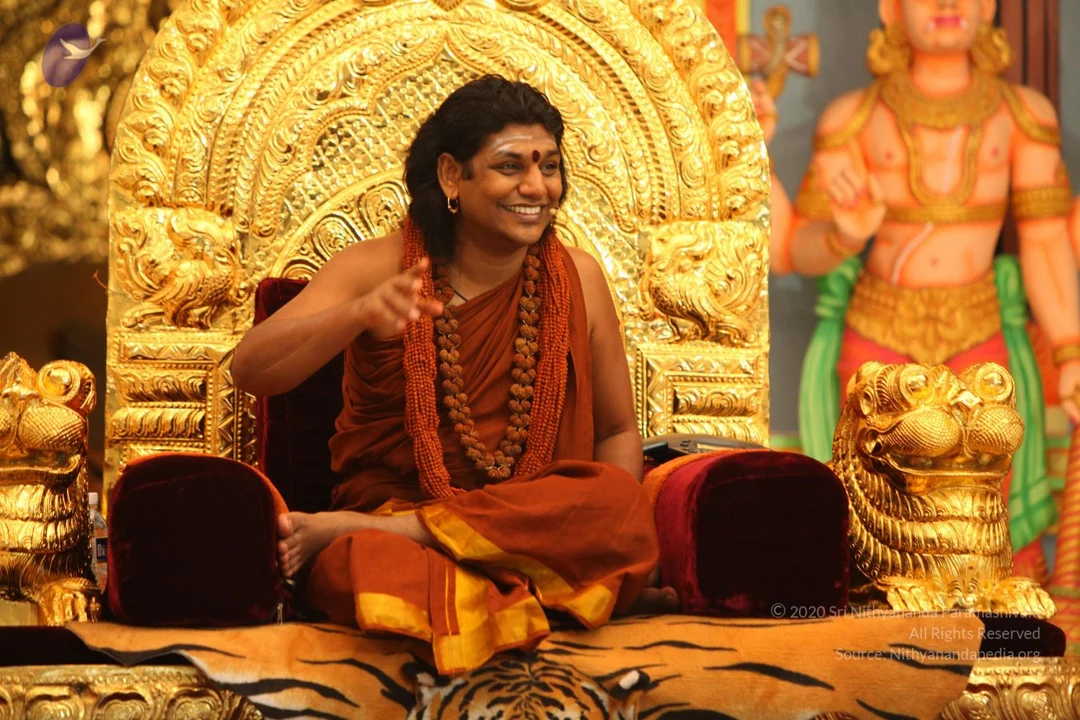
IA-Session

47 photosSource gallery
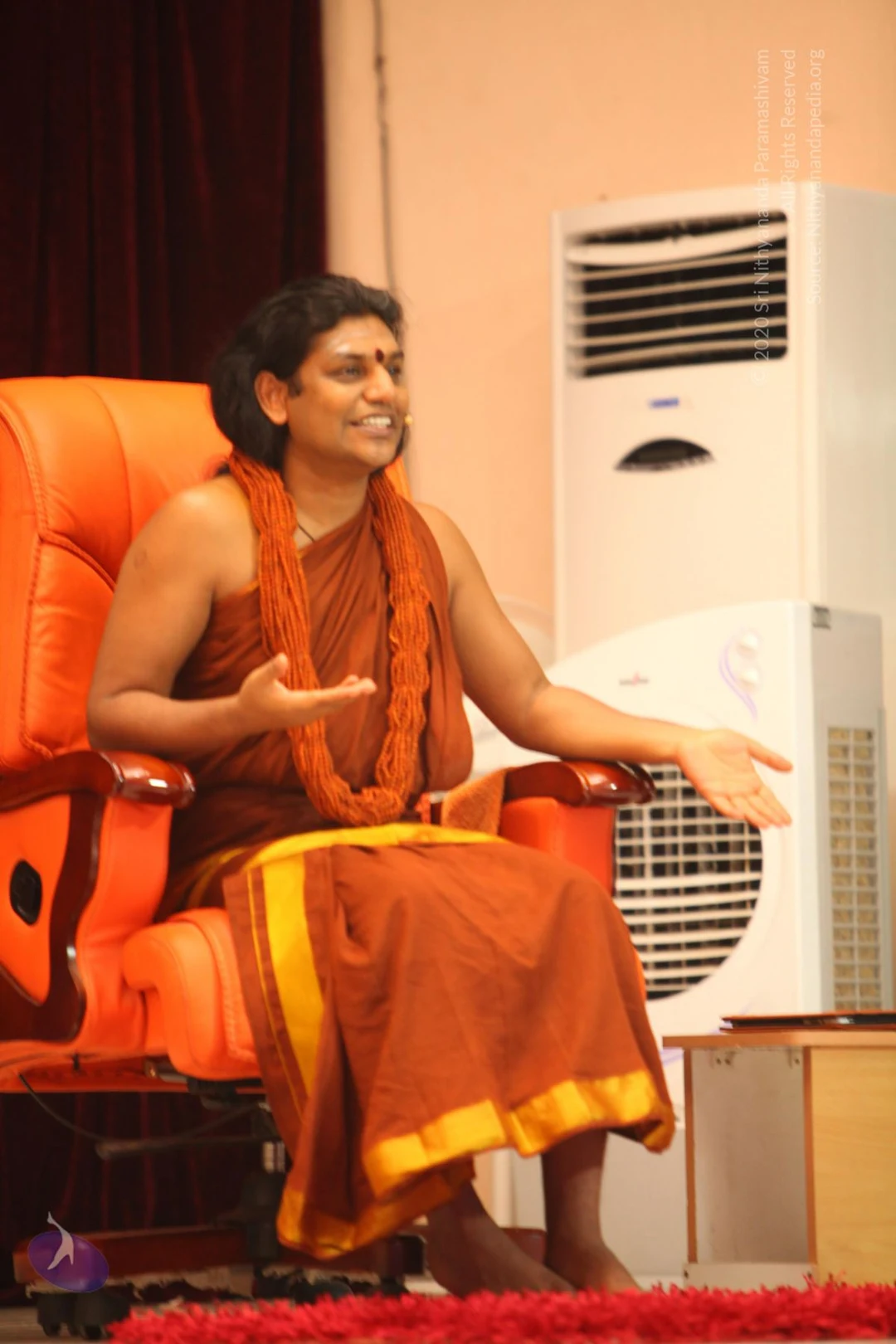
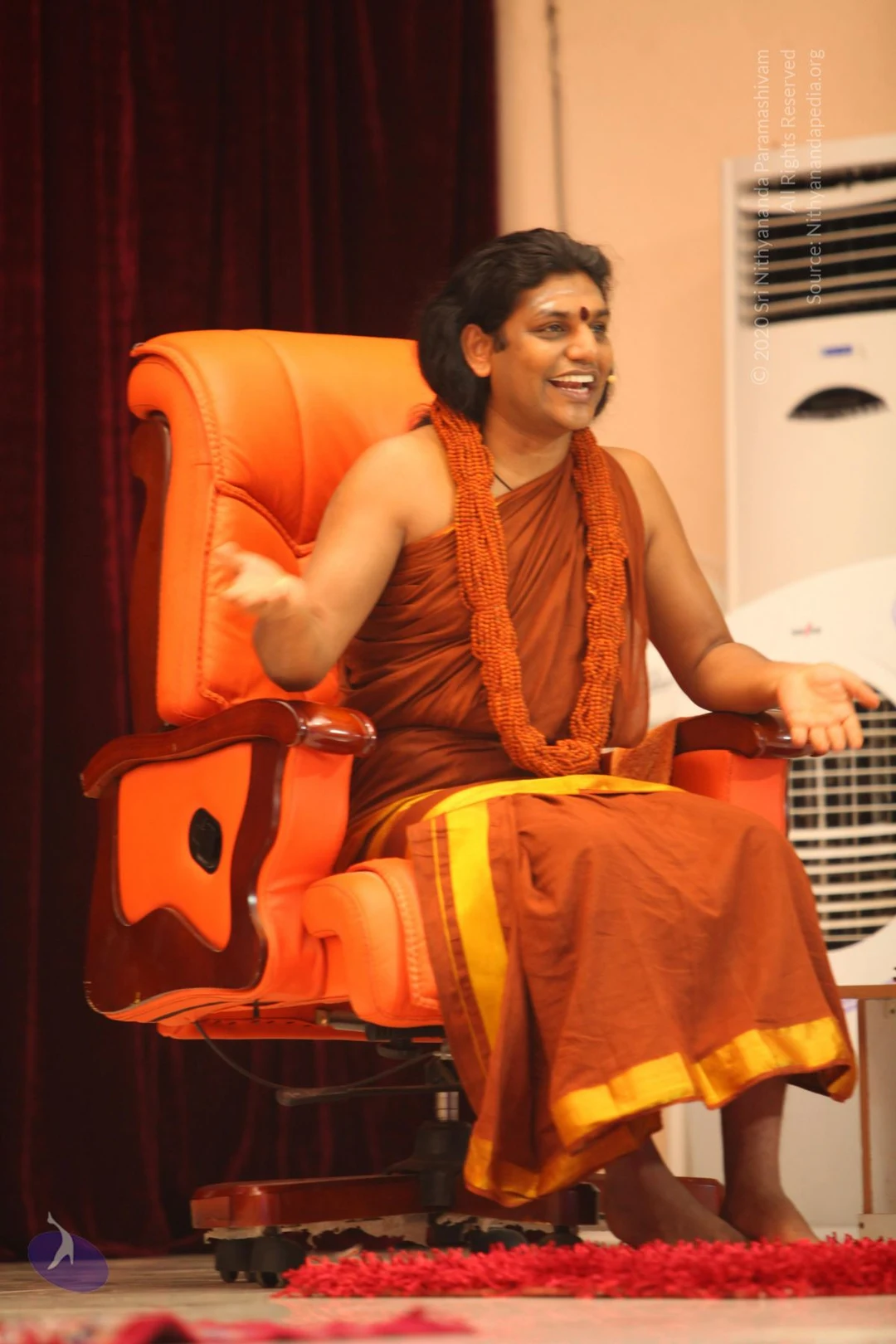
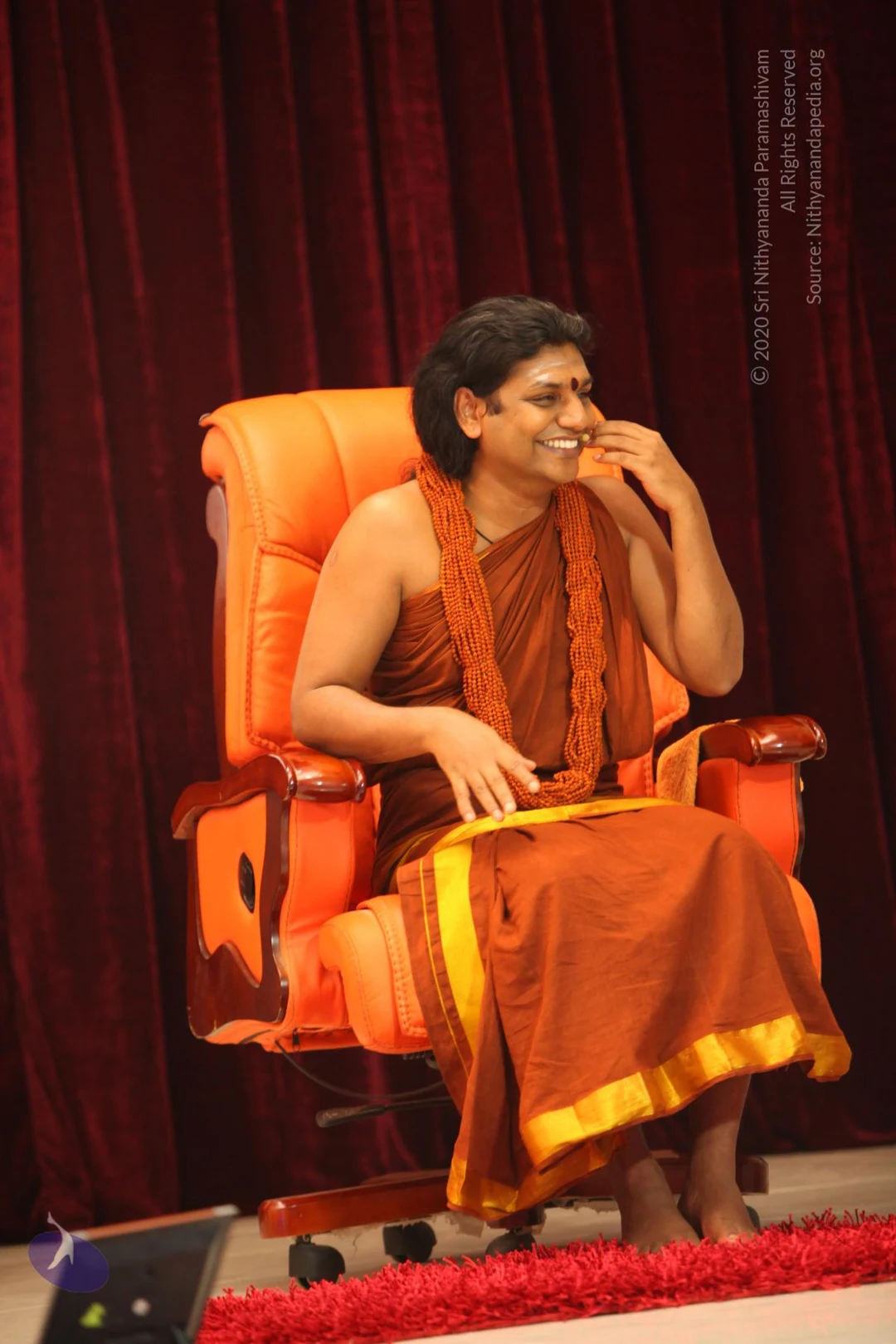
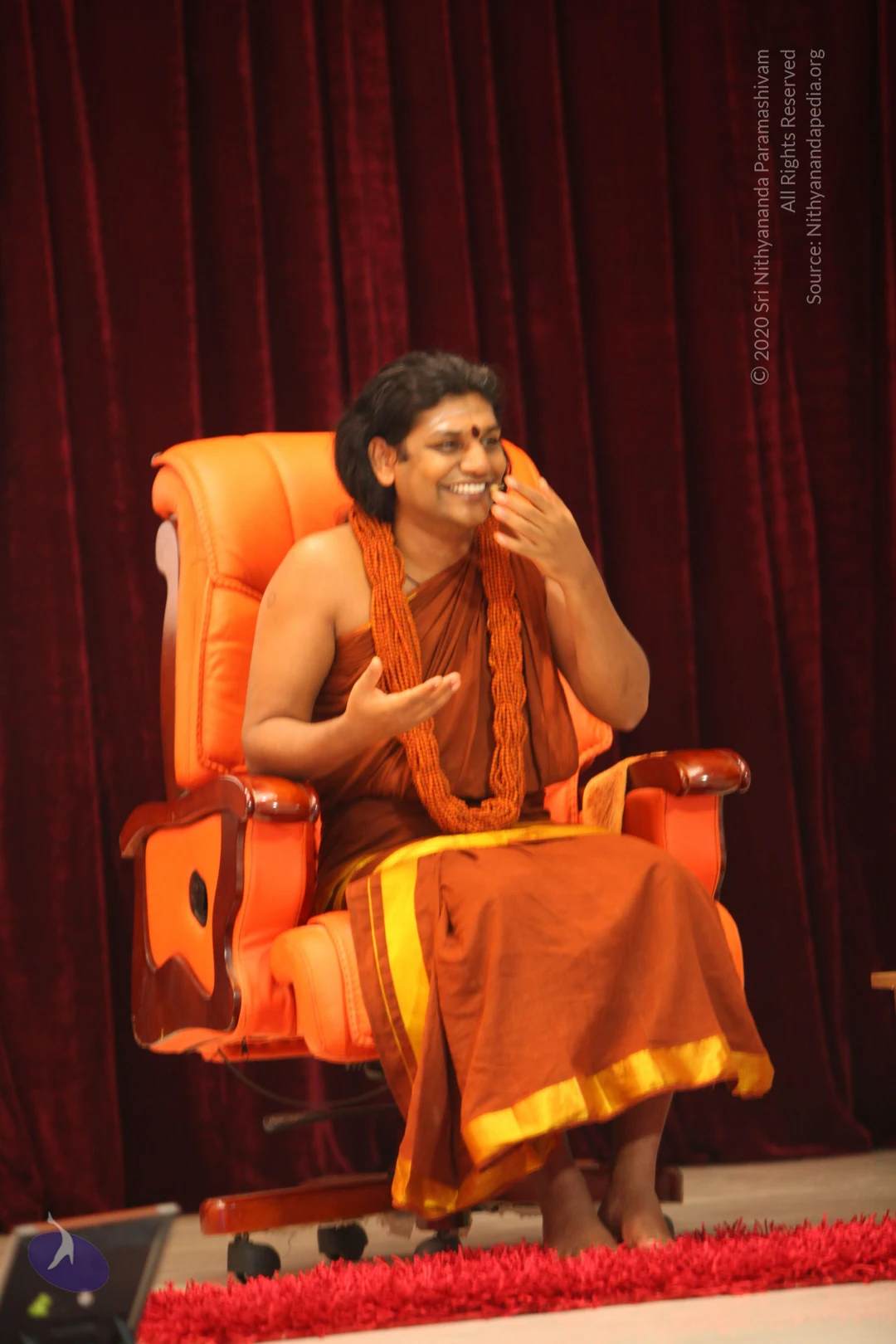
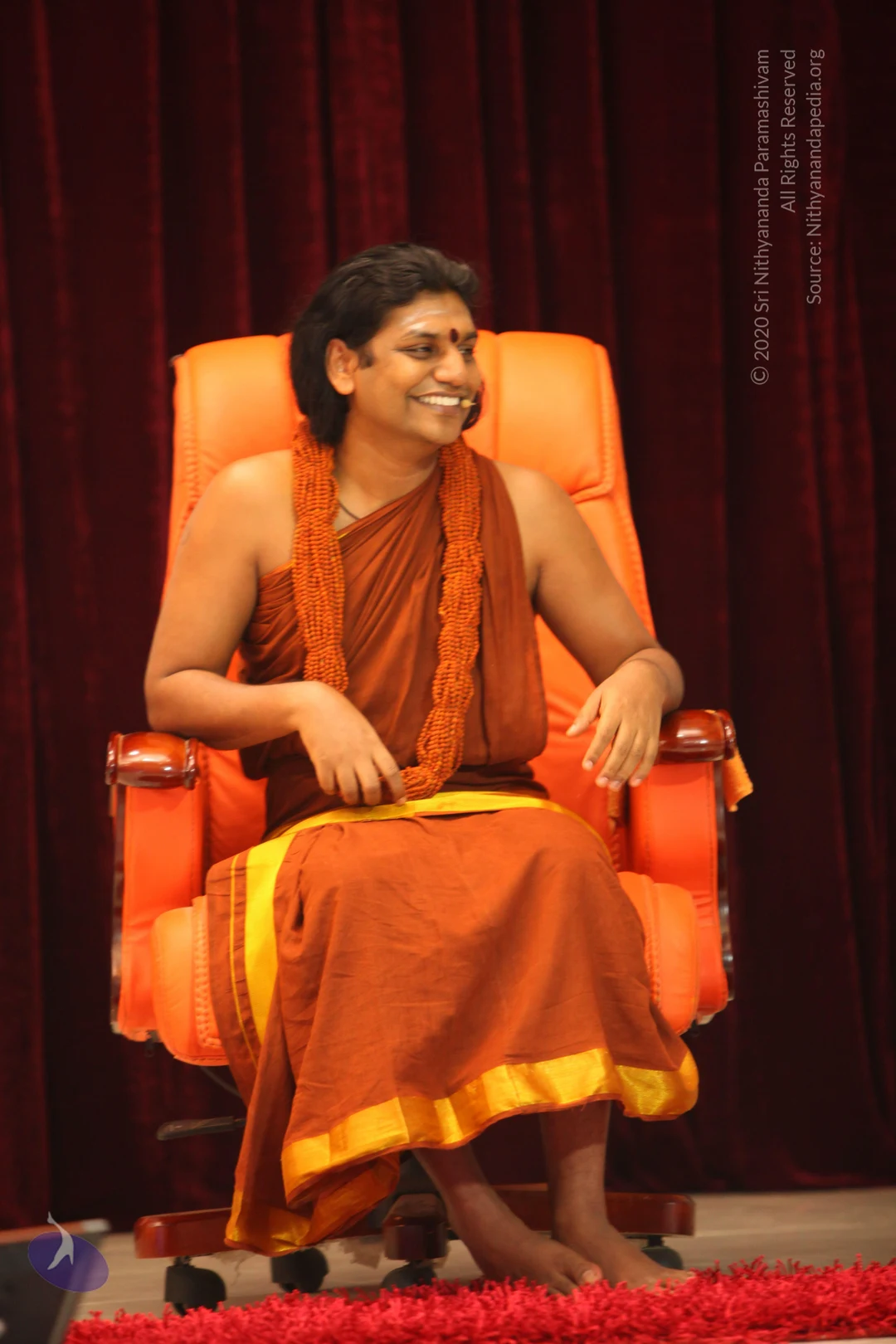
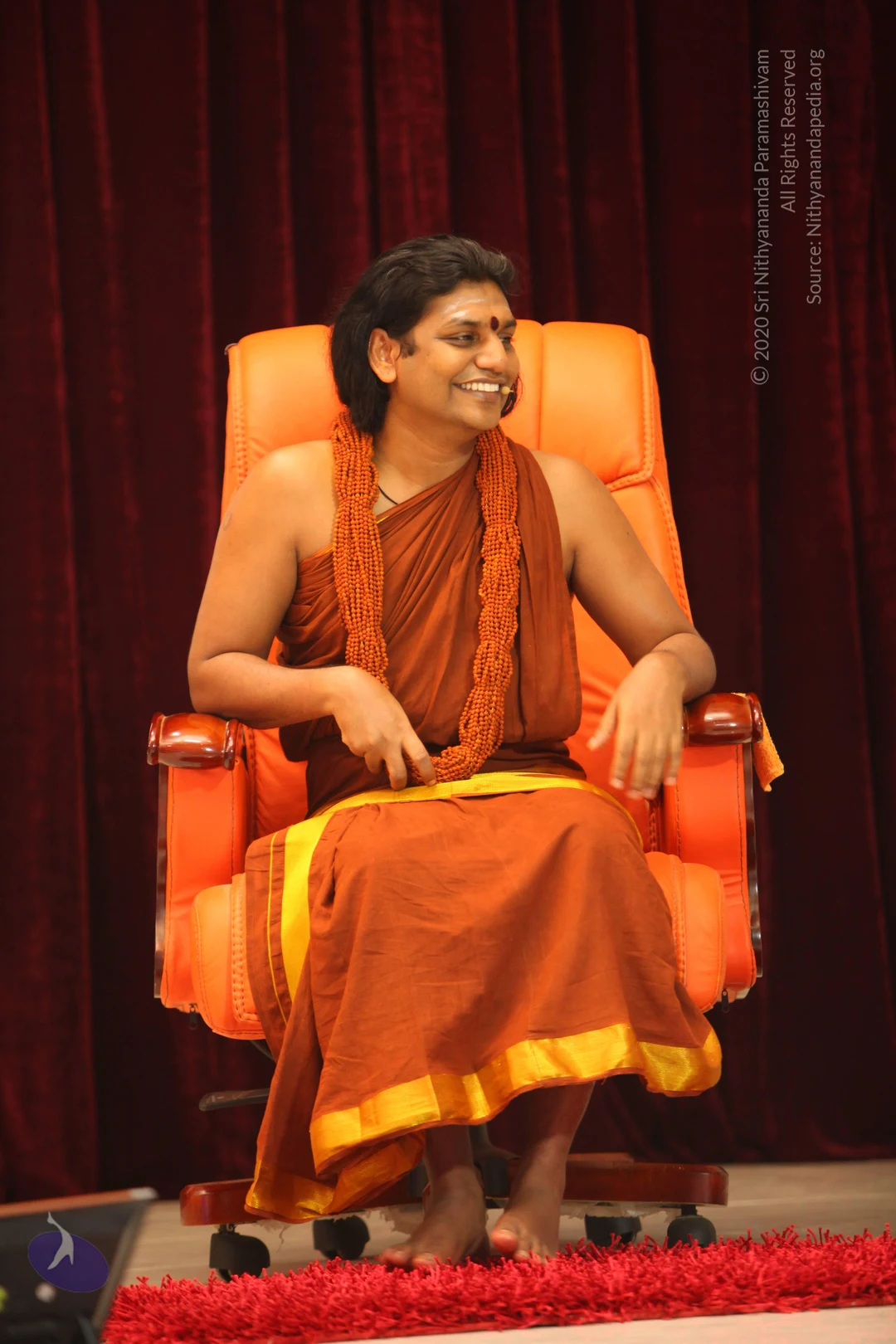
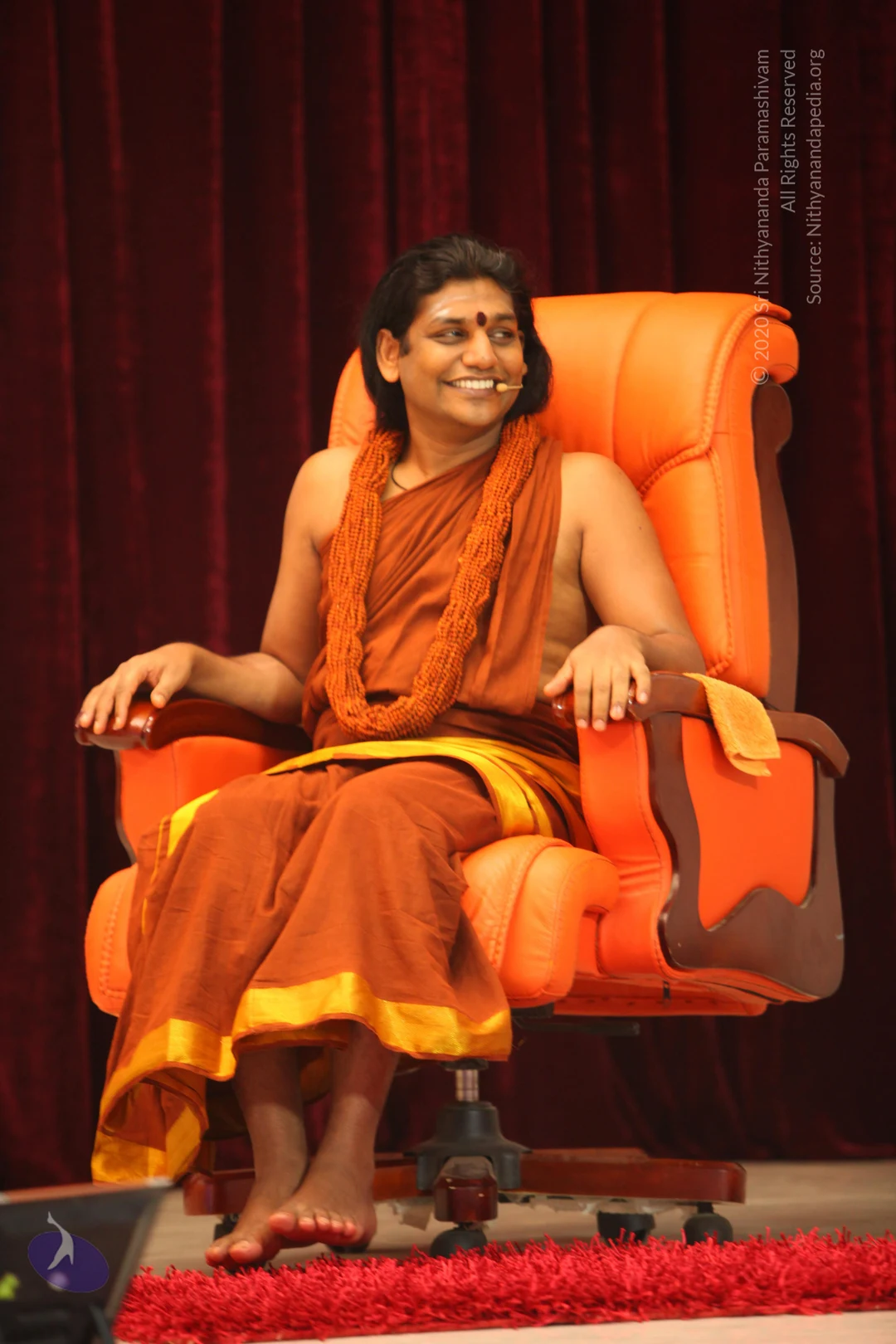
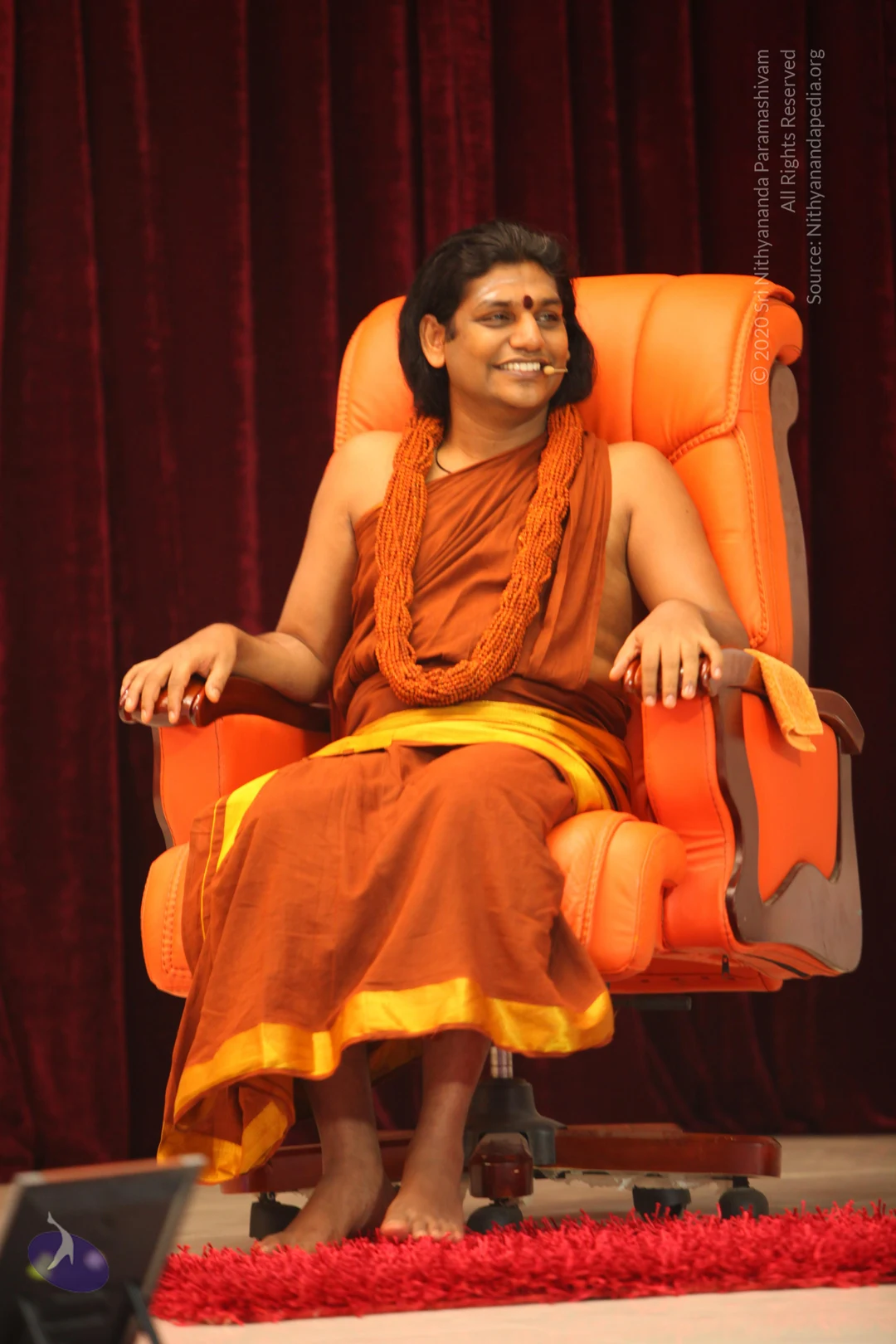
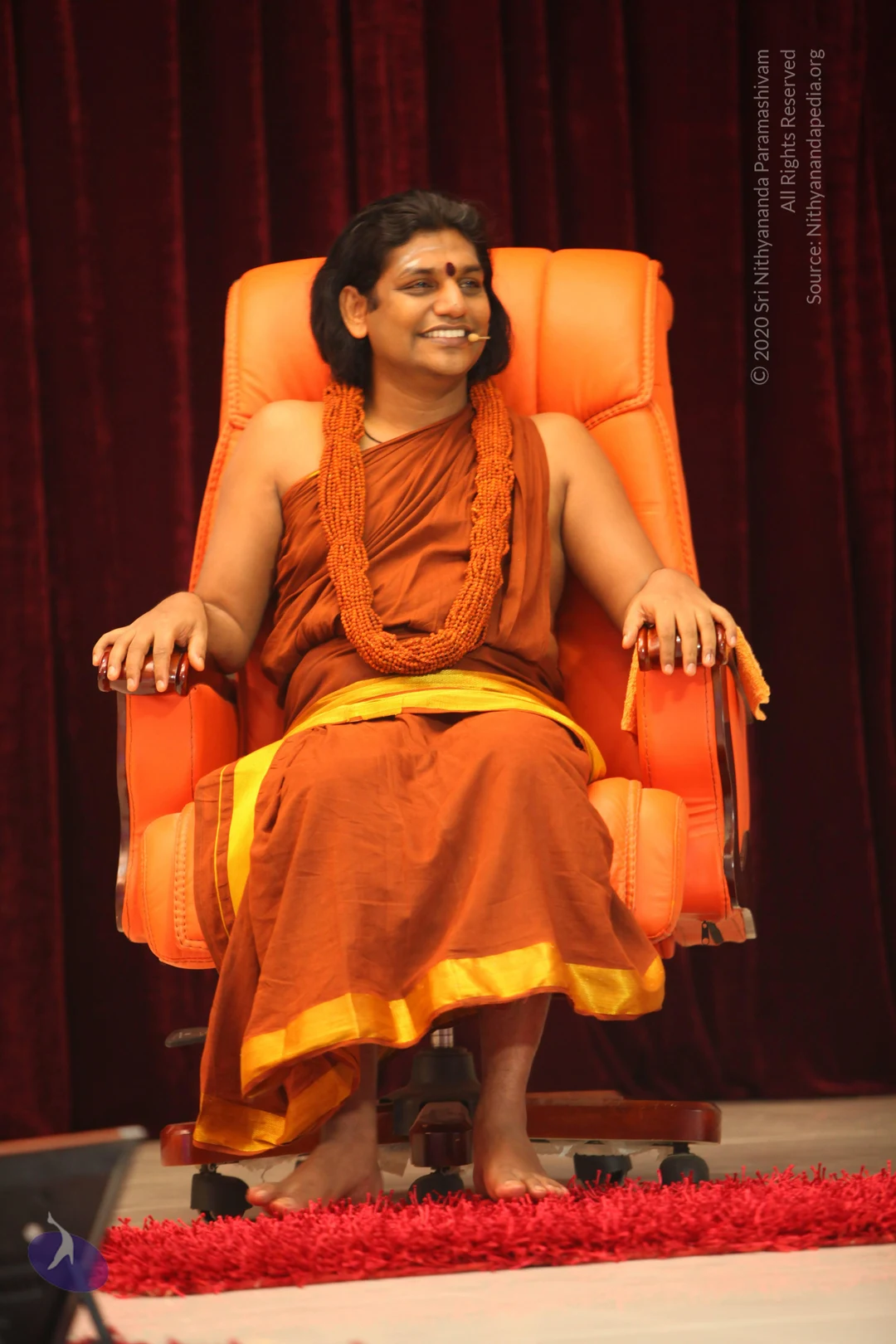
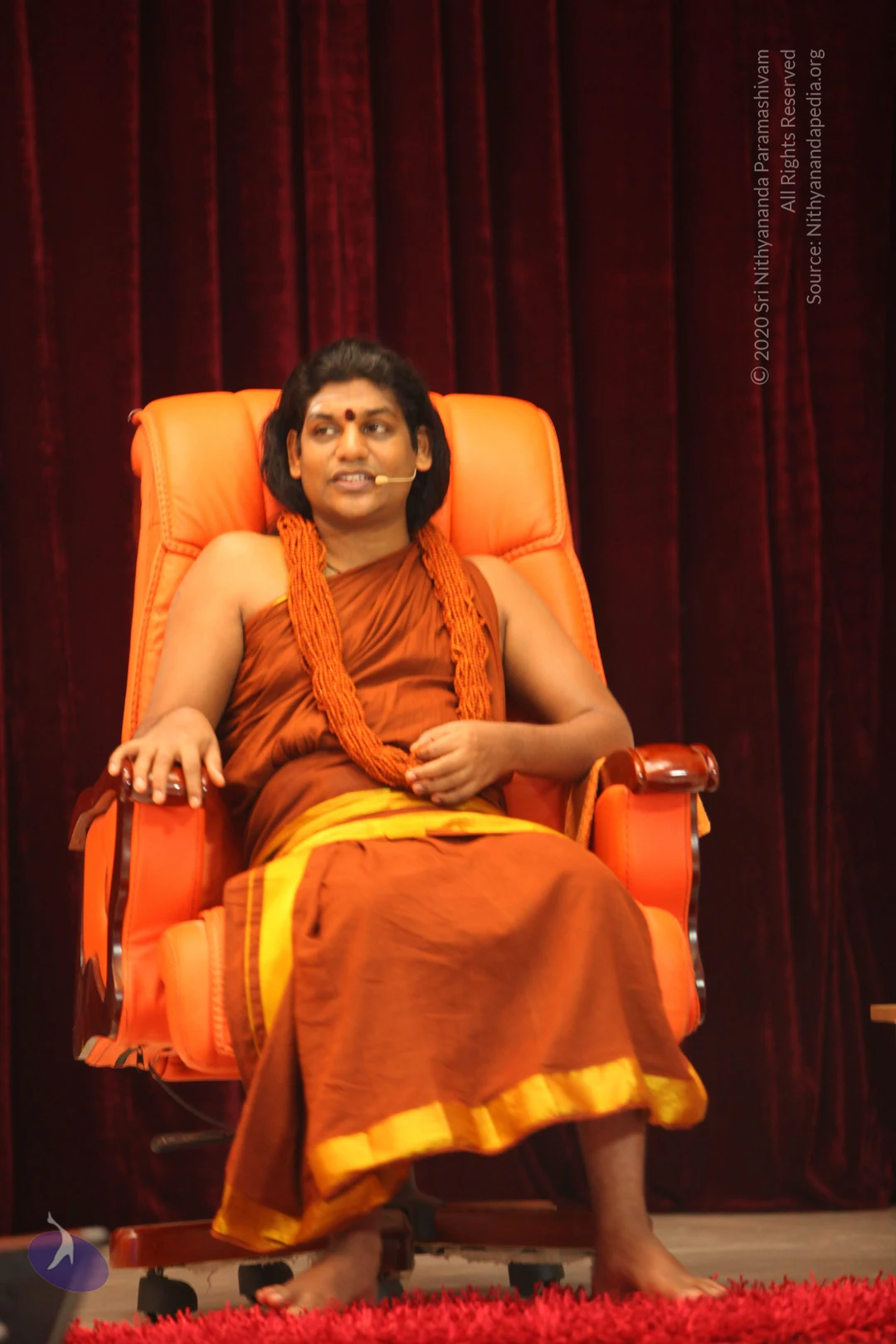
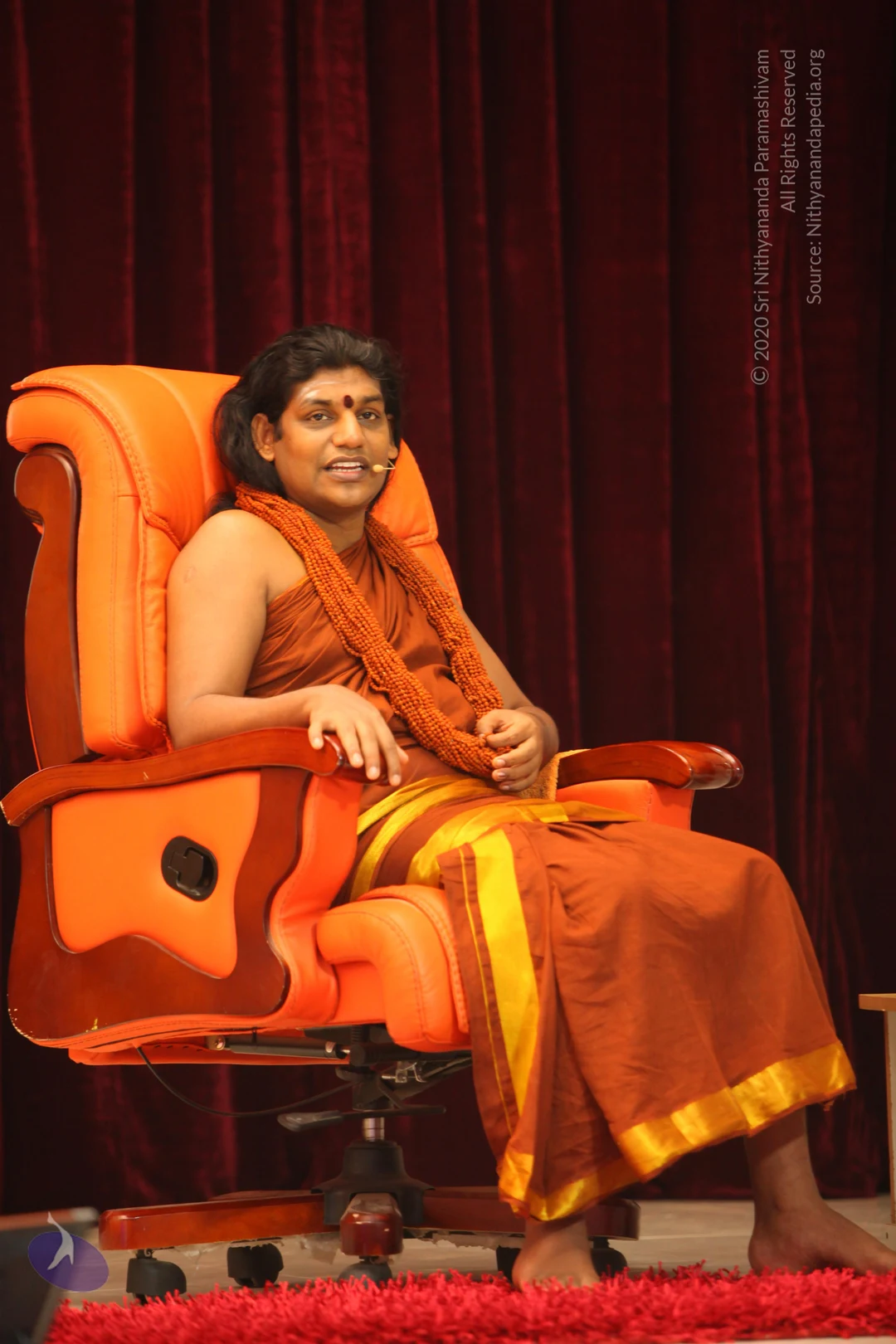
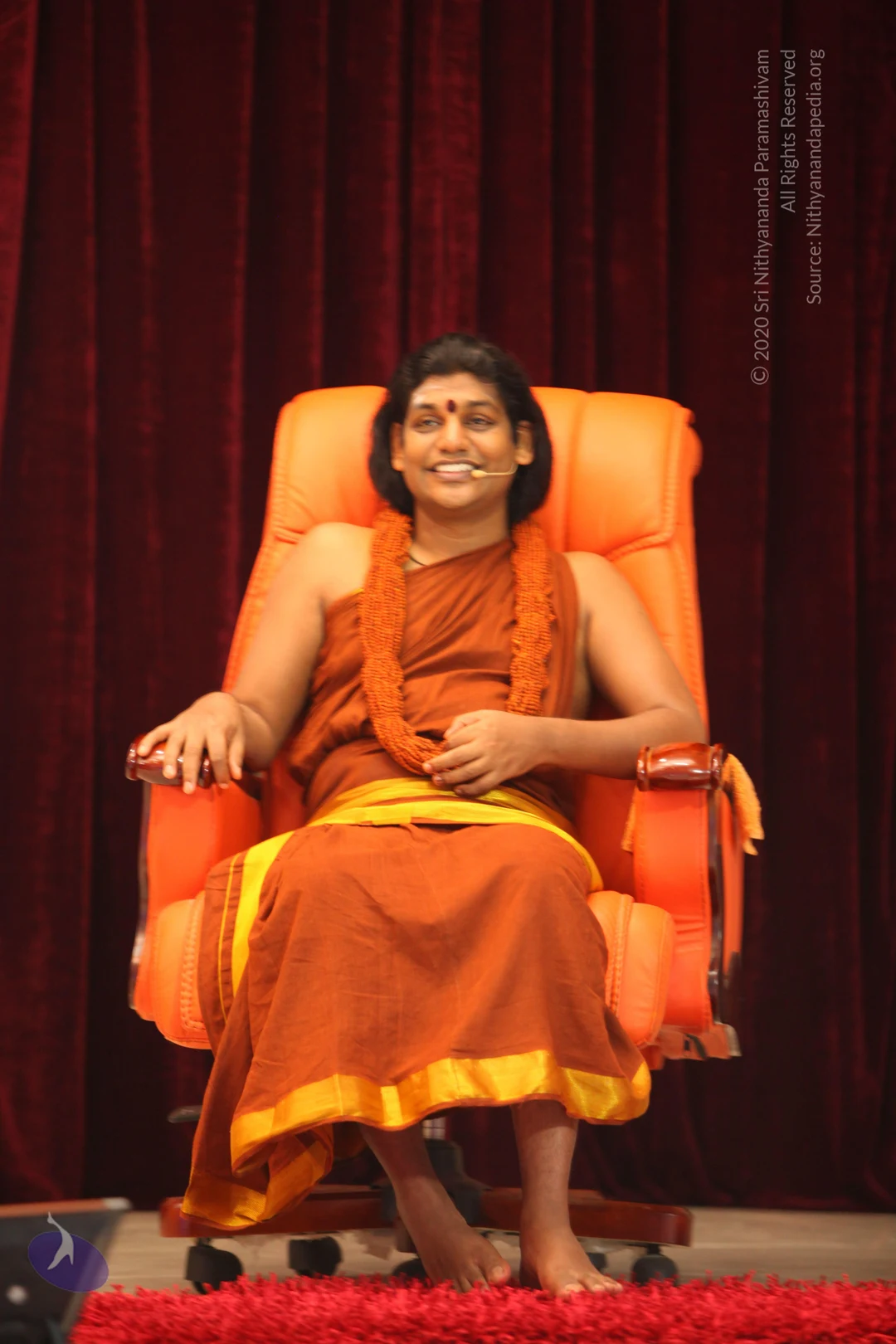
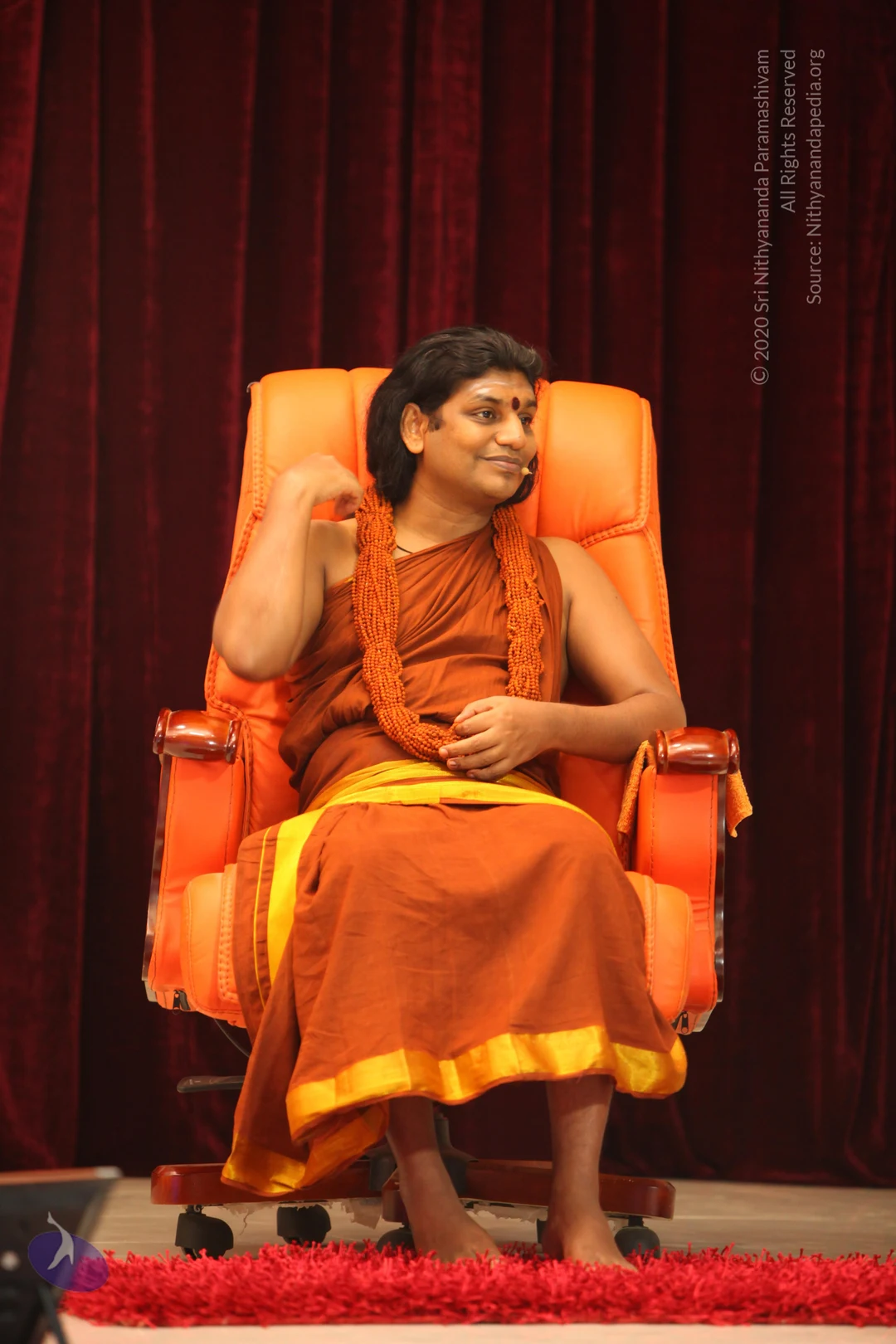
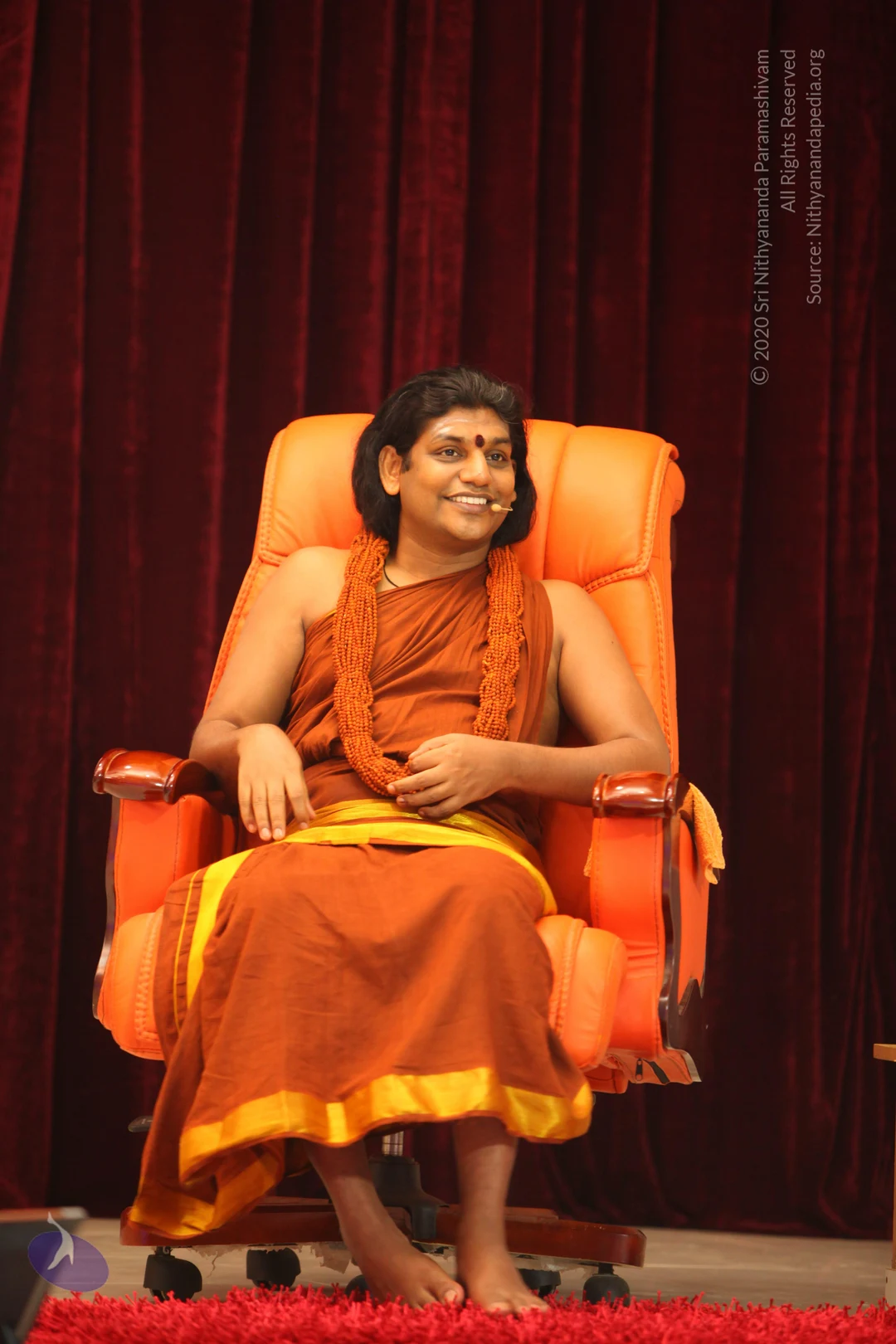
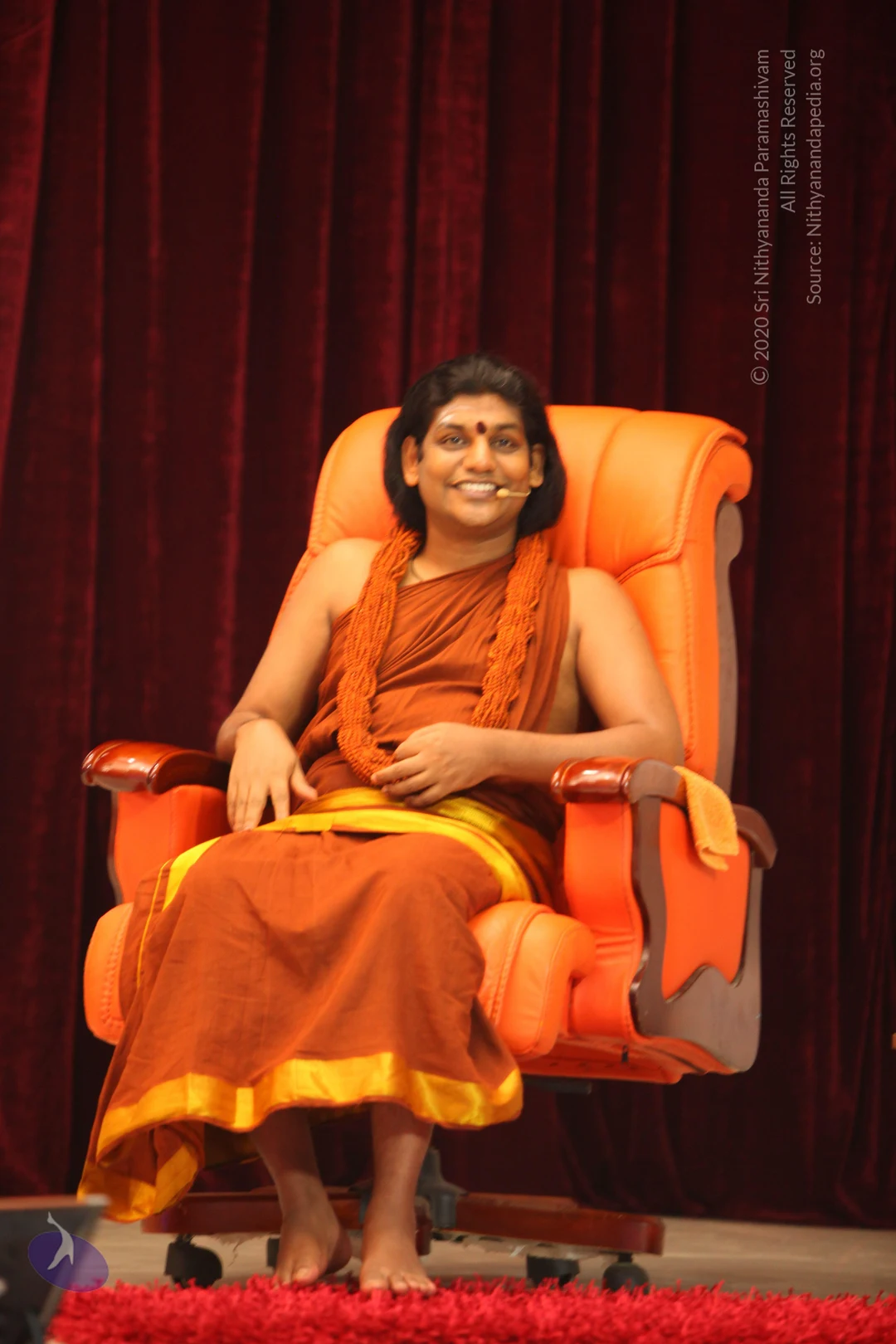
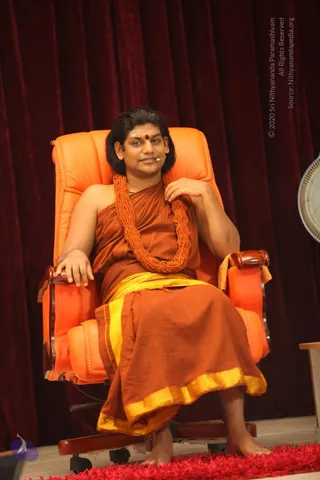
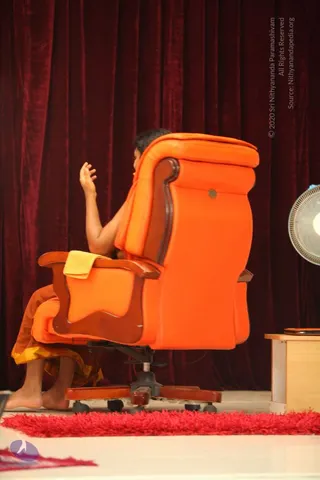
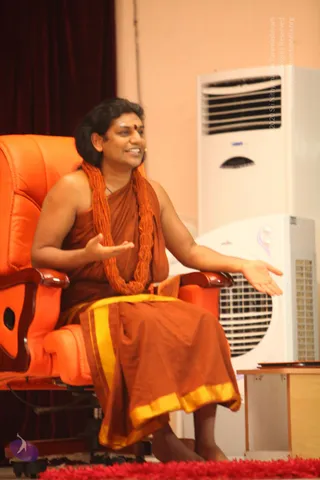
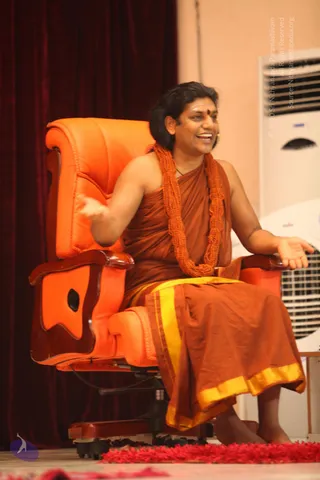
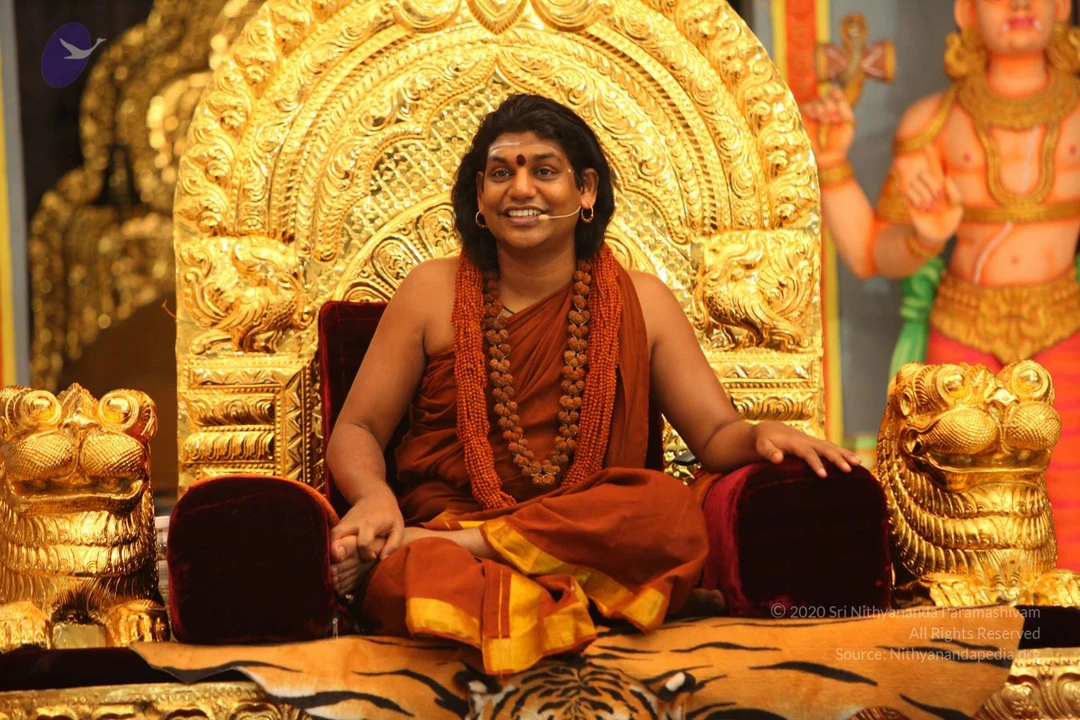
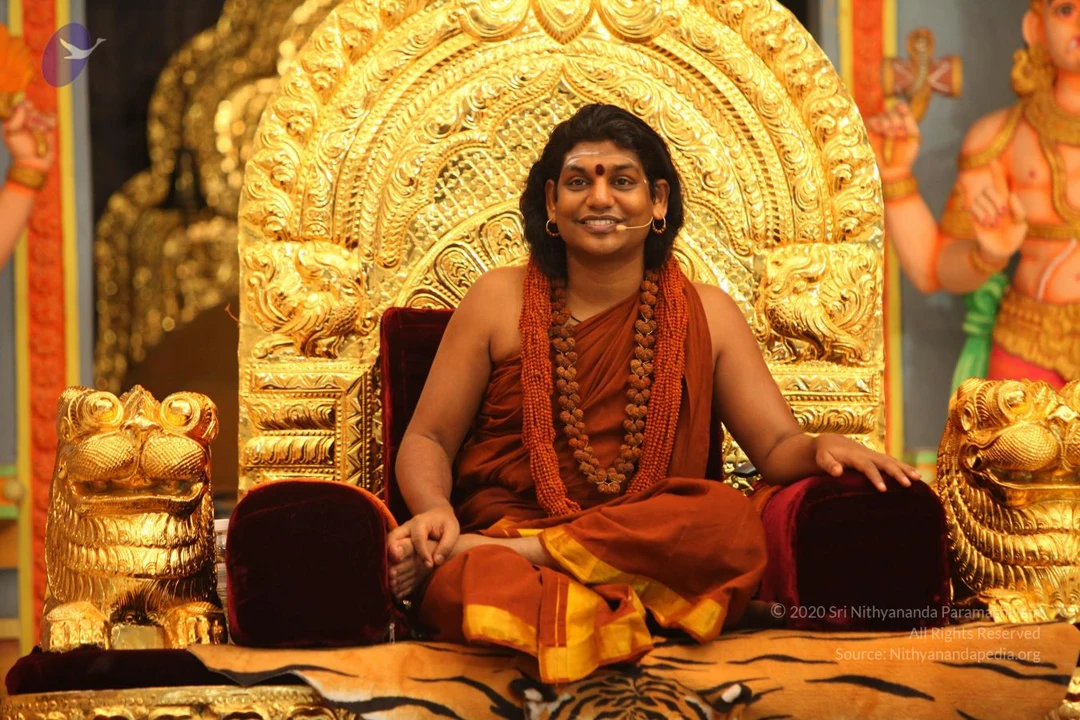
A man seated in a large orange leather armchair on a stage before deep red velvet drapes, smiling and resting one hand on his chin while the other rests on the armrest. He wears a rust-orange wrap with a gold-yellow border, an orange rudraksha-style bead garland, and a red bindi, and has a small headset microphone at his mouth. He is barefoot on a red shaggy rug, with a white fan at the right edge and a laptop at the lower left.A man seated on an orange leather executive-style chair on a stage before a deep red velvet curtain, with a red shag rug at his bare feet. He wears a rust-orange draped robe with a gold-bordered yellow cloth wrap and a long orange beaded mala around his neck, plus a small red dot on his forehead and a small headset microphone. His hair falls to his shoulders and one hand rests on his chest while the other rests on the armrest. A fan is visible at the right edge. Appearance-based candidate for a person, with long swept-back hair, saffron-orange robes and a rudraksha-style mala, seated as a speaker during a satsang discourse.Side view of a seated person in an orange leather executive-style chair with wooden arms and a rolling base, one arm raised mid-gesture while speaking. The person wears an orange-brown robe with a yellow edge and bare feet. Behind is a deep red velvet curtain, a red shaggy rug lies on the floor, a small wooden side table sits at right and a white electric fan is at the far right edge. A yellow cloth is draped over the chair arm.A man seated on an orange leather armchair speaks during a satsang, gesturing with both open hands. He wears a rust-brown robe with a yellow-bordered cloth draped over his lap, a long orange-red rudraksha-style mala around his neck and a red bindi on his forehead. His dark hair is swept back and he is barefoot on a red shaggy rug. Beside him stand white tower coolers and a wooden side table. A red curtain hangs behind him. a person is seated centre, addressing the audience in an indoor hall.A smiling man with swept-back dark hair sits in an orange leather executive-style chair on a stage before deep red velvet drapes. He wears a rust-brown draped robe with a gold-bordered cloth and a long rudraksha mala around his neck, with a red bindi on his forehead. His right hand touches his face while he looks to the side, and his bare feet rest on a red shaggy rug.
IA-Participant-Sharing

90 photosSource gallery
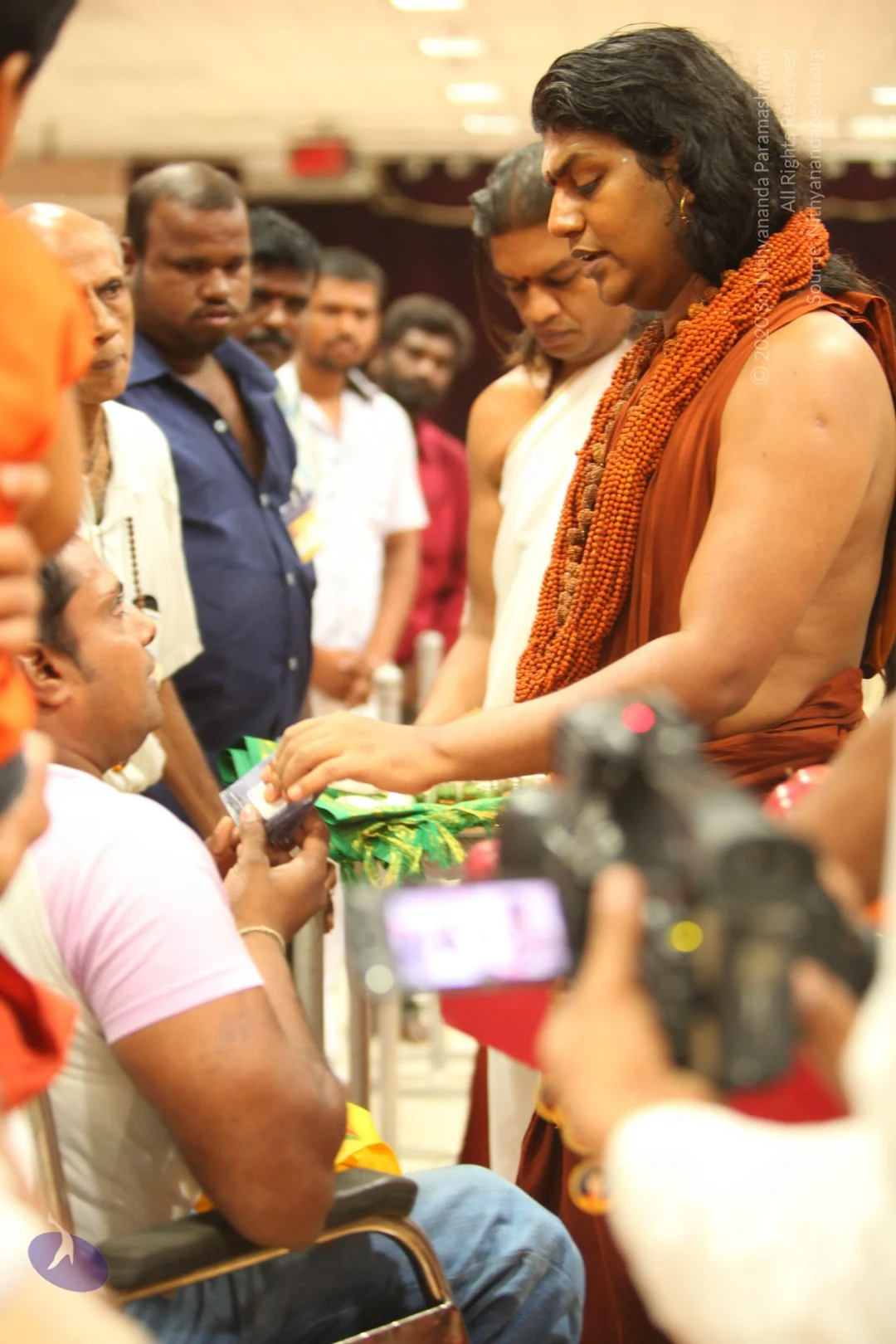
A seated man with shoulder-length dark hair, eyes closed, a small red bindi on his forehead, and a small microphone clipped near his mouth, sits in a large orange leather recliner on a stage. He wears a rust-red saffron-toned robe with a gold-yellow border and a long orange-red rudraksha mala draped over his shoulders. His right hand is raised, palm open, in an explanatory gesture. Dark maroon curtains hang behind him, with a white floor fan and a wall-mounted air cooler to the right. This is a photograph of a satsang-style talk, and the figure's appearance matches the page's a person reference through his hair, saffron robe, and rudraksha mala, though his face is not used for identification.A photo inside a bright hall with pink walls and red curtains. In the foreground a long-haired man in a white shirt and white trousers shakes hands with a shaved-headed man wearing glasses, a white dhoti with a pink and gold-bordered shawl draped over one shoulder, and a wristwatch. Behind them, framed portraits hang on the wall, one showing a deity-like figure in red and gold and another showing a figure in orange robes. Other people in white clothes stand and sit on red mats in the background, a water bottle and a notebook lie on the floor, and a woman in a cream sari with red border stands at the left edge.Indoor gathering in a pink-walled hall with red curtains and a framed portrait of a seated saint in red robes, labelled with printed text. Many people in white clothes mill about on red floor mats scattered with orange cloths, water bottles and papers. In the foreground, a young man in a white kurta with a dark beaded mala stands with hands clasped behind his back, while another man in white shakes hands with a man in white shirt and striped top near him. Pilgrims in white and orange move through the crowded satsang-like hall.
IA-Lunch-with-Swamiji

47 photosSource gallery
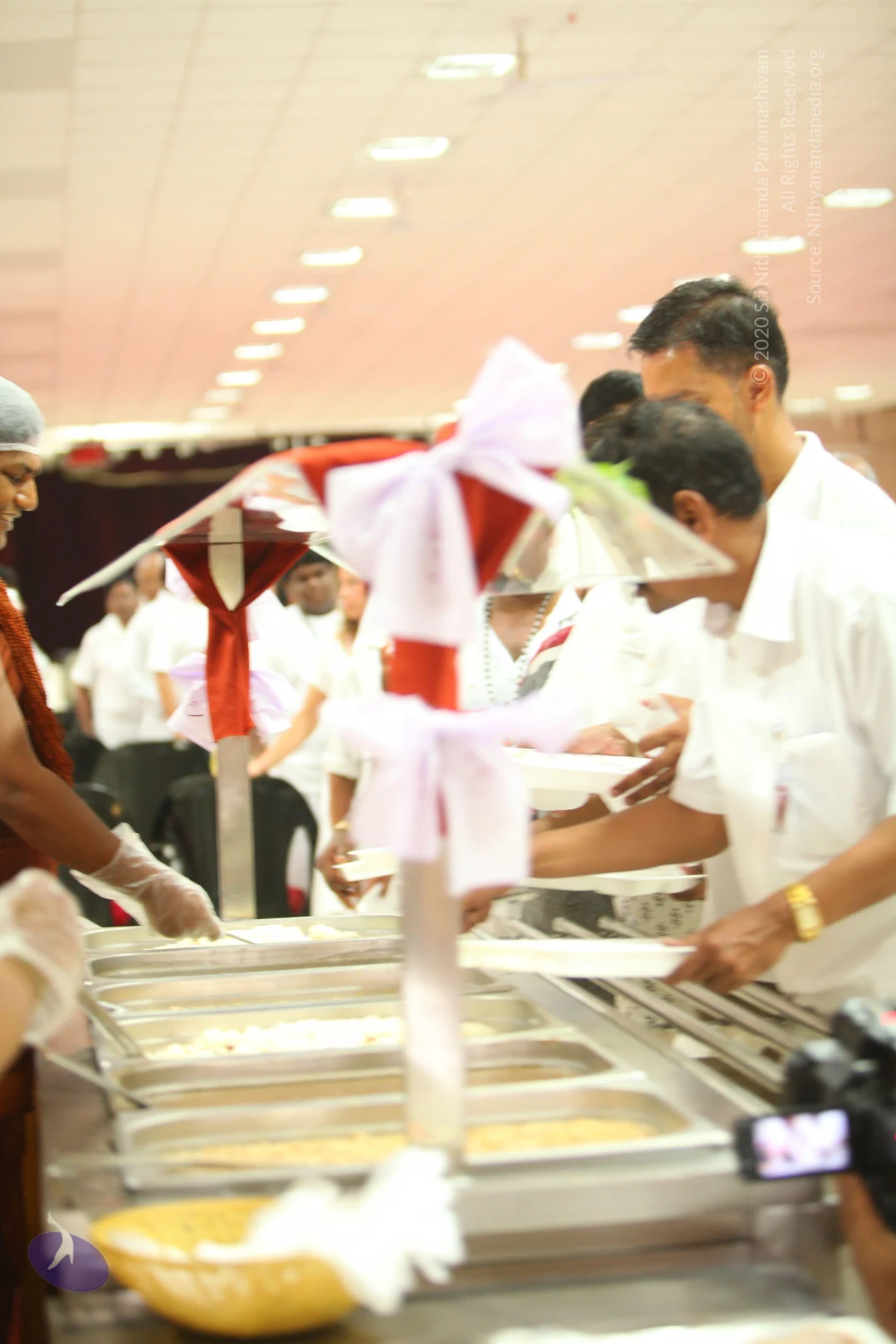
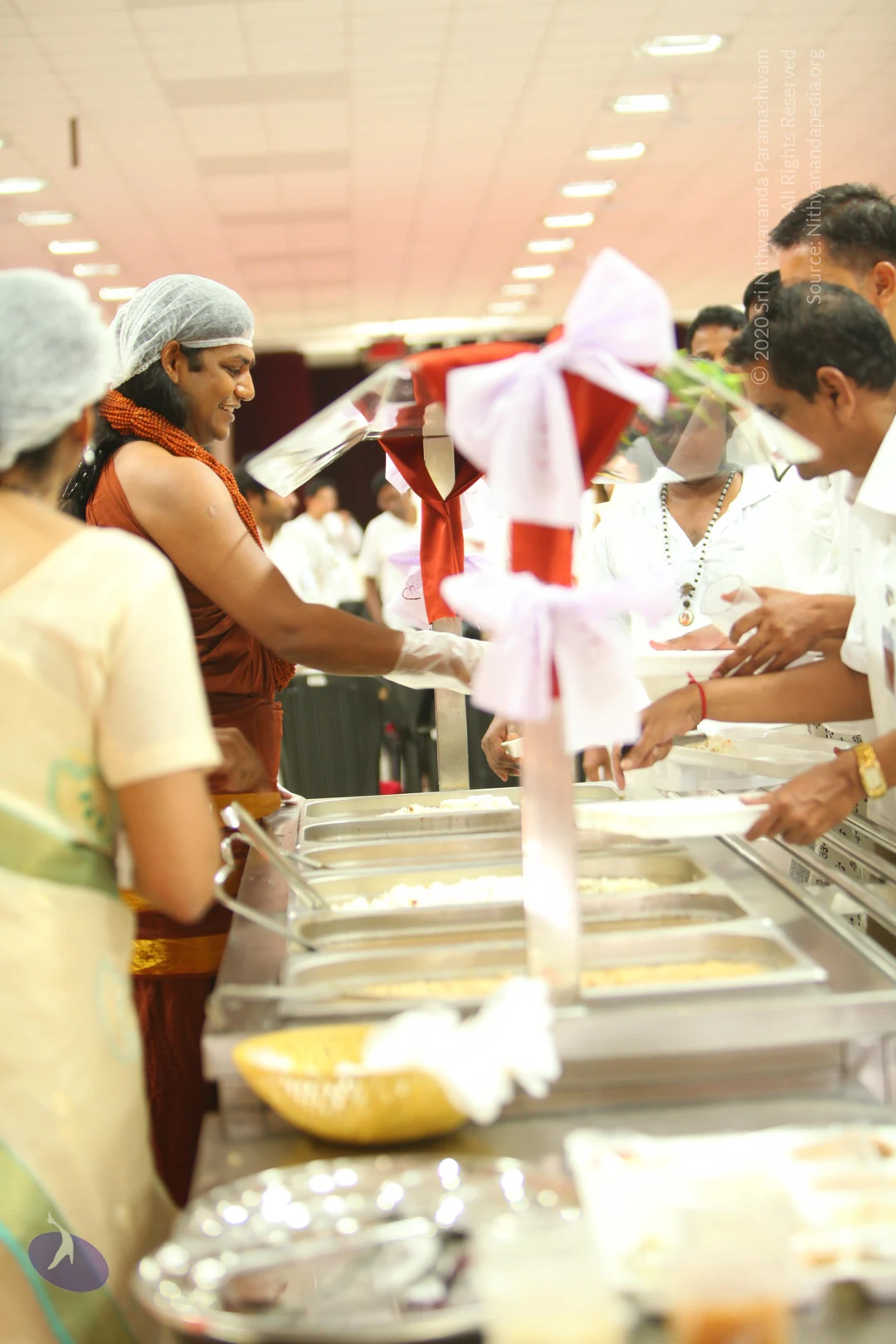
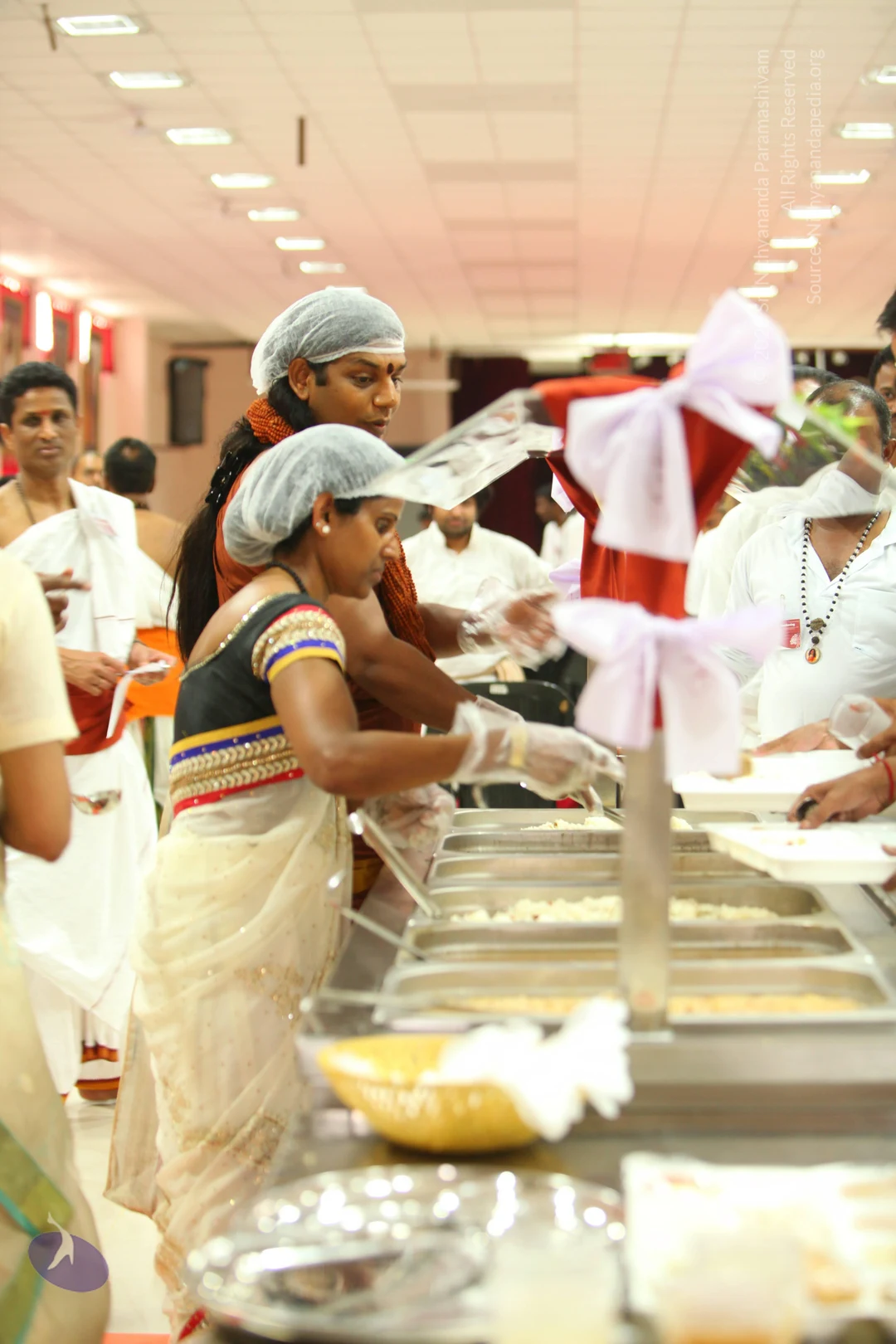
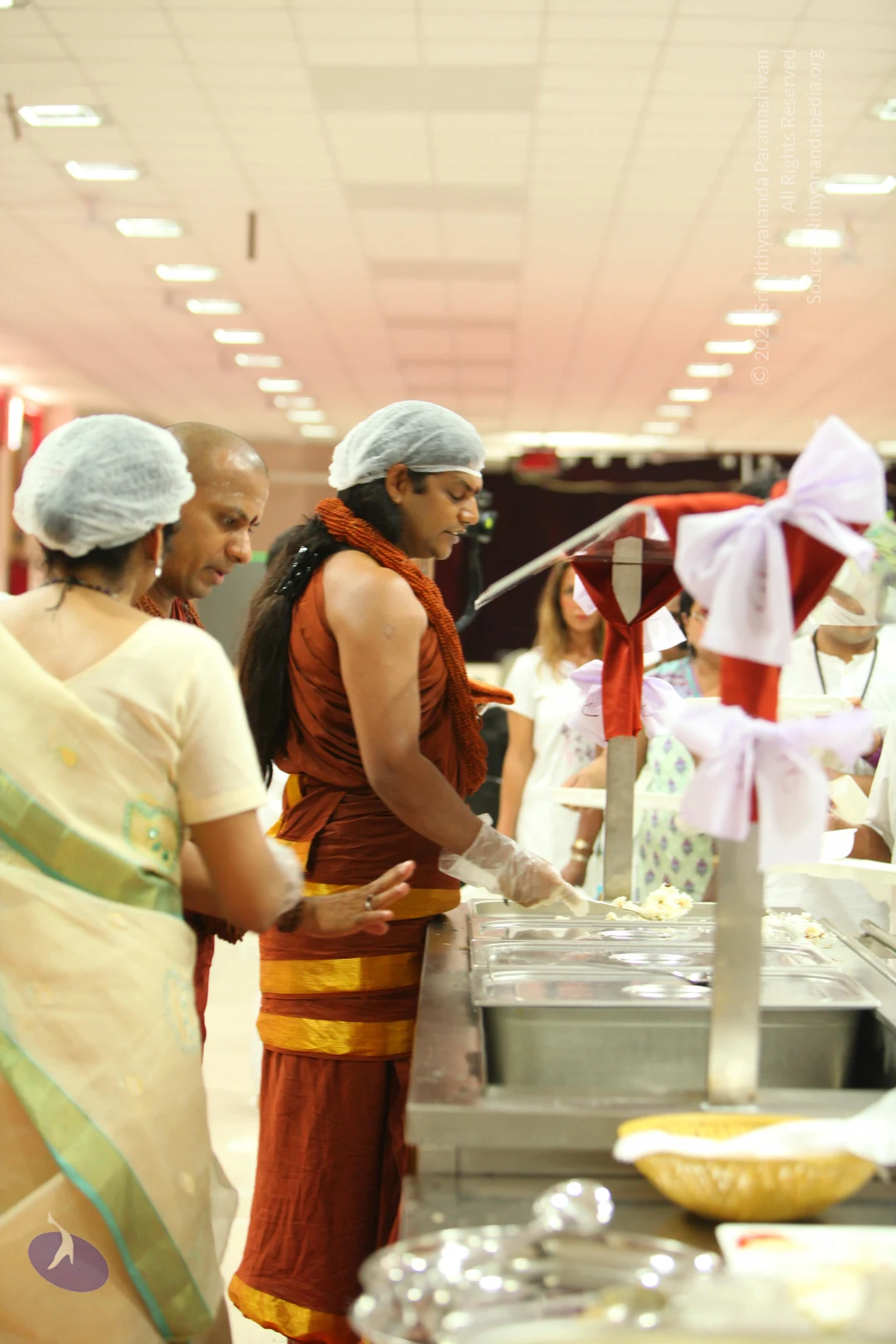
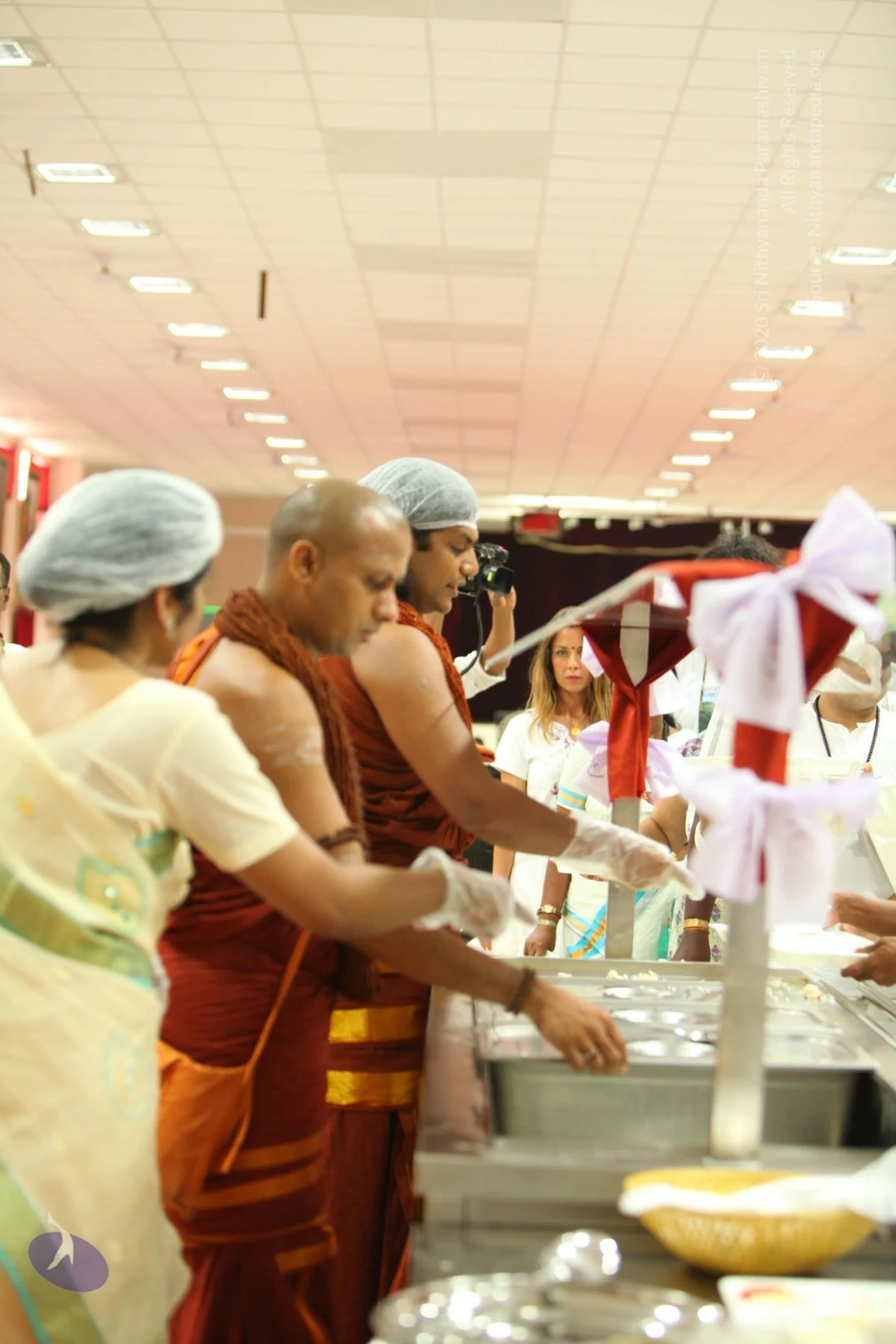
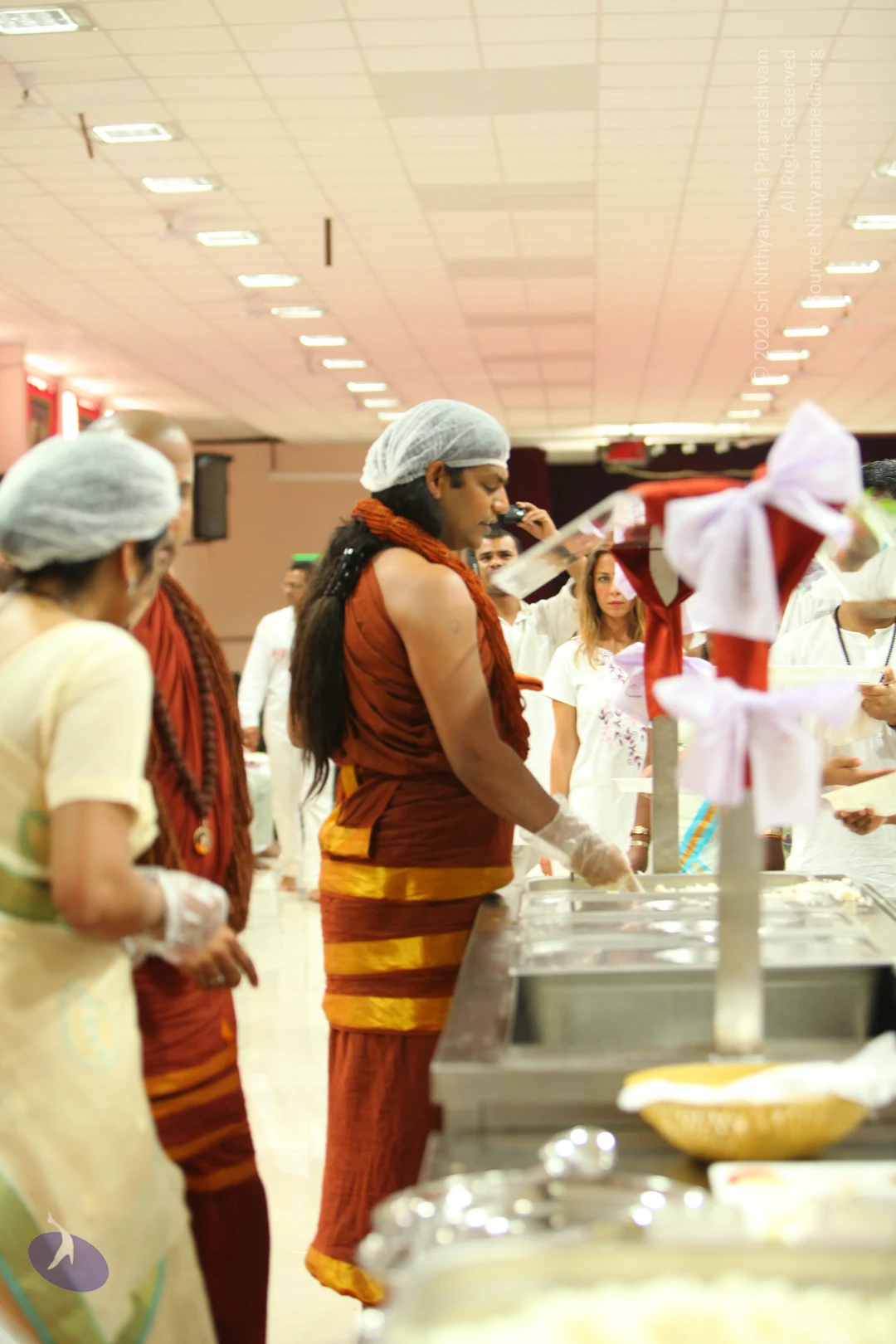
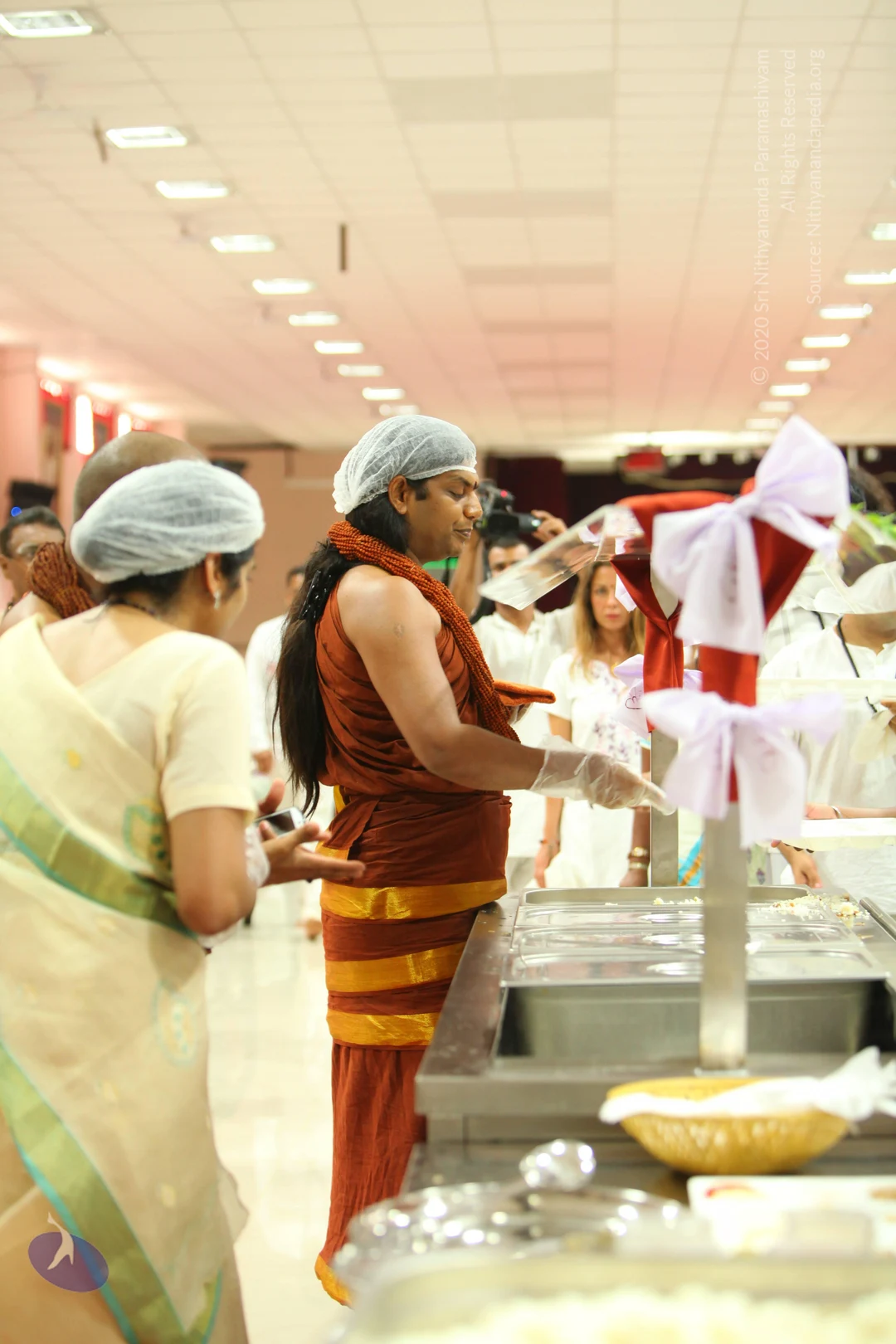
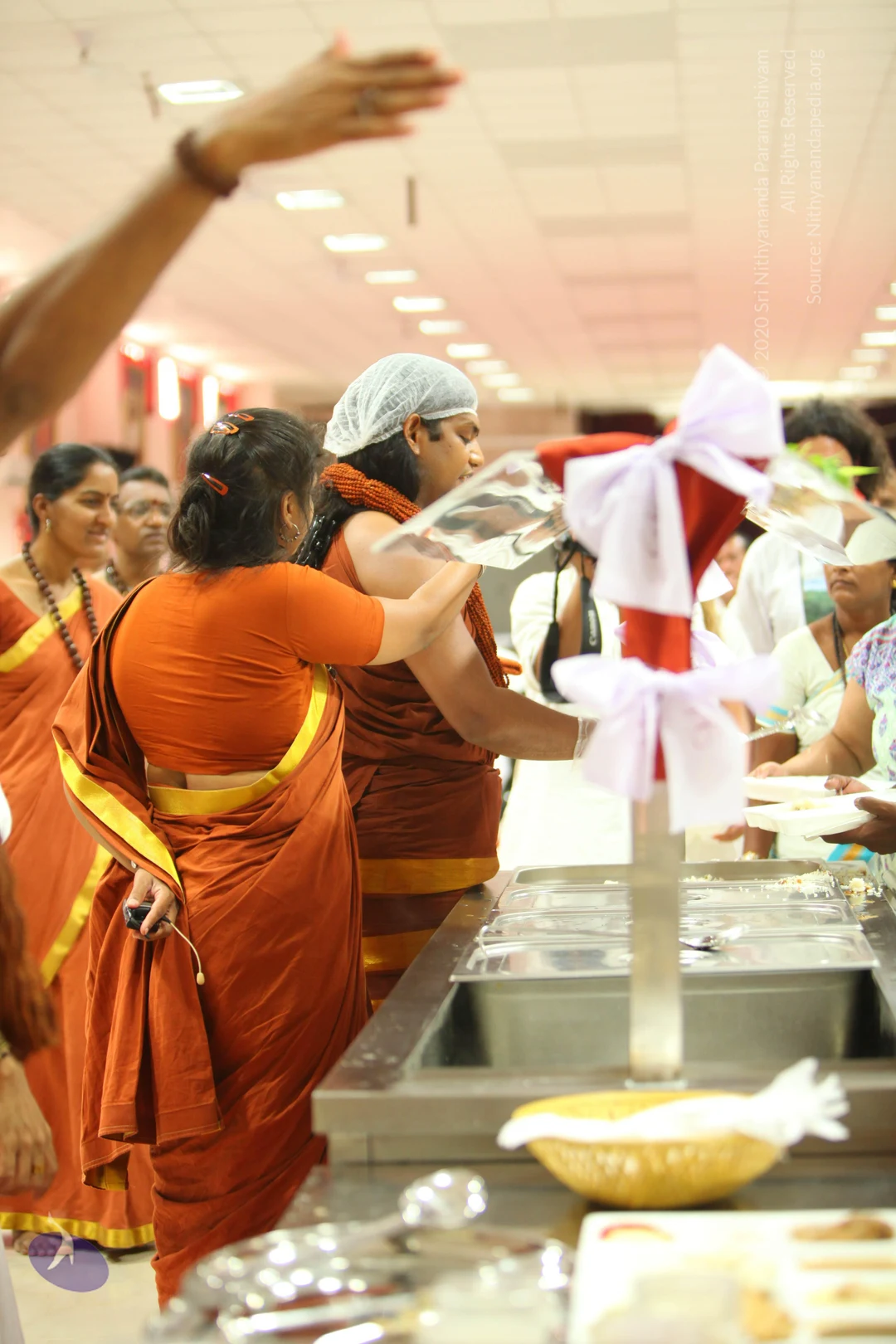
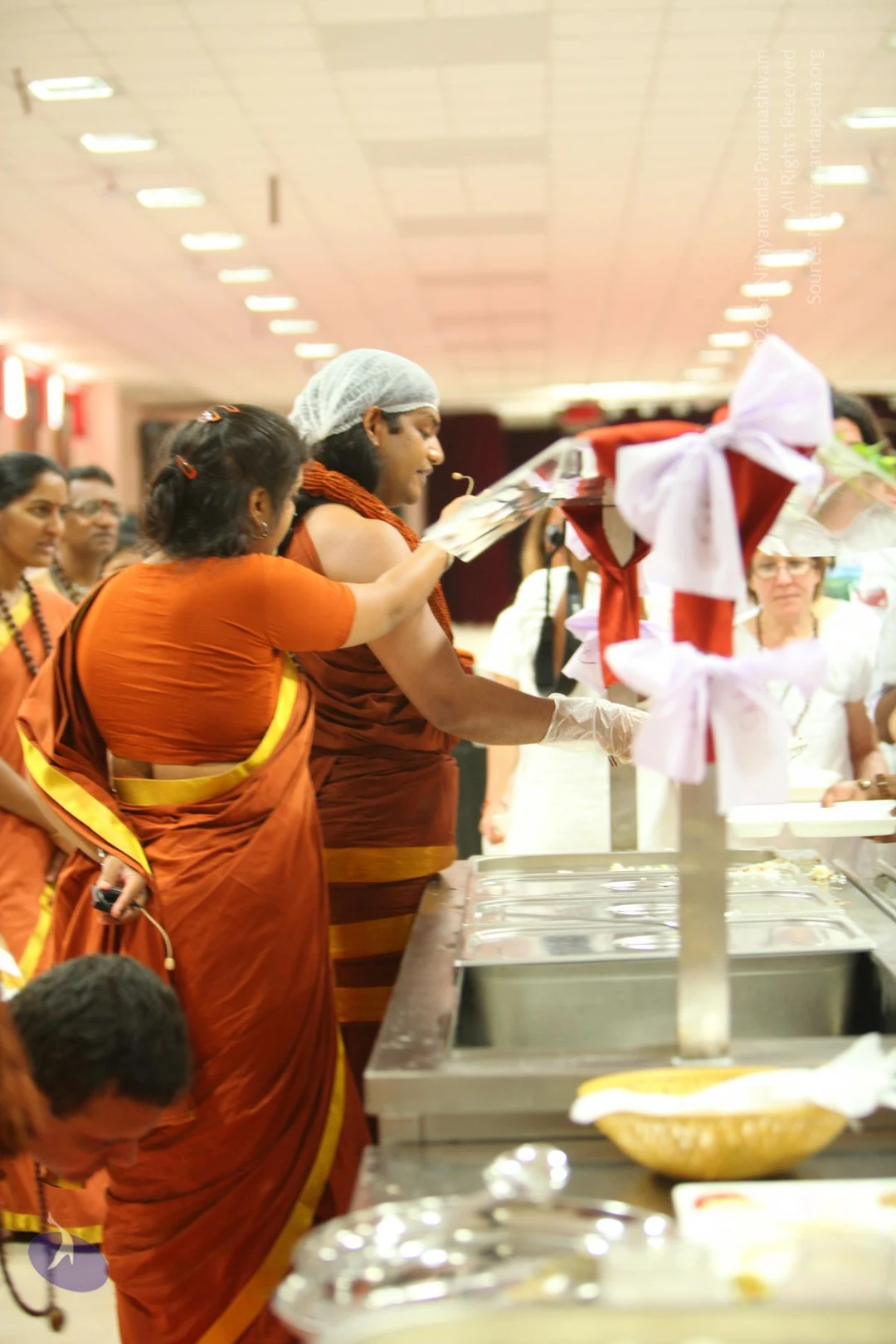
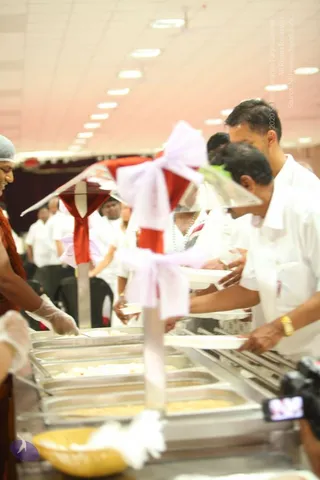
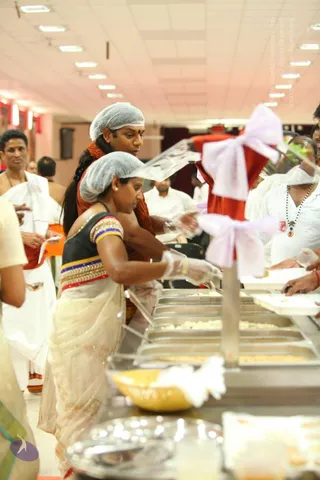
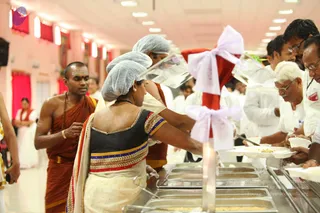
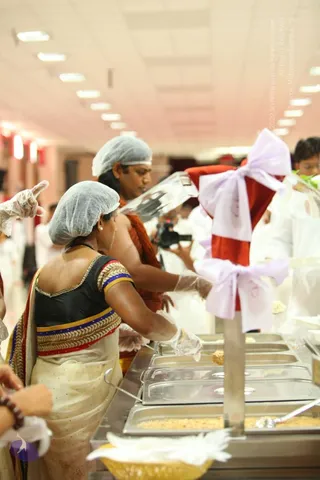
A food service line at an indoor event. In the foreground a man with a shaved head, a white tilak on his forehead, a rudraksha mala and an orange-brown robe with gold trim serves from steel chafing trays of white food with a spoon. Behind him a second man in an orange robe with gold border and a white hairnet stands at the trays. A red cloth is draped over a metal stand on the right, and people in white clothes wait in the background under ceiling lights.A photograph of a food serving line at an ashram or event hall. A monastic figure at left in orange-saffron robes and clear plastic gloves serves from steel chafing trays of food. Several men in white shirts stand at the counter, one holding a white plate and another in a white shirt with a gold wristwatch reaching toward the trays. A tall stand draped in red and white cloth with pale lavender bows rises above the counter. Background attendees in white shirts stand in a bright hall under ceiling lights. A camera operator is visible at right.A photograph of a buffet-style meal service in an indoor hall with a pink-tinted ceiling and recessed lights. A man in a rust-orange robe with a matching orange-beaded mala around his neck, wearing a white hairnet and clear gloves, smiles as he serves food from steel chafing trays. A woman in a cream sari with a green border, also wearing a hairnet, stands at left. On the right, men in white shirts hold plates and reach toward the food line. A clear plastic sneeze guard and a red-and-pink ribbon-tied decorative post stand in front of the trays, which hold rice and yellow dishes. Other people in white clothes are visible in the background.A photo of a serving line in a bright indoor hall. Two women in white hairnets and plastic gloves serve food from steel trays with rice and other dishes at a buffet counter. The woman in front wears a cream sari with a dark blouse trimmed in gold and blue; the woman behind wears an orange top with a beaded orange necklace. To the left, a man in a white dhoti with a white shirt and a thin sacred thread stands near the line, and a man on the right in white clothes wears a long rudraksha-style mala and holds a plate. Pink satin bows decorate a pole at the counter. Ceiling lights and a red-trimmed wall are visible behind.A buffet serving line in a bright hall with pink walls and ceiling lights. In the foreground, a woman in a cream sari with a dark blouse trimmed in gold and blue borders, wearing a white hairnet, serves food from a steel tray. Beside her, a man in saffron-orange robes with a rudraksha mala and gold bangle stands watching. Behind the counter, a worker in a white head covering and orange cloth holds a plate, while devotees in white clothes receive food on paper plates. Red banners with white and purple ribbon bows hang along the counter, and a man in a white shirt and glasses stands at right.