Skip to content
Tuesday

30 May 2017

Authenticity is the Key to Power Manifestation

Dated photos
152
Source pages
1
Media
3
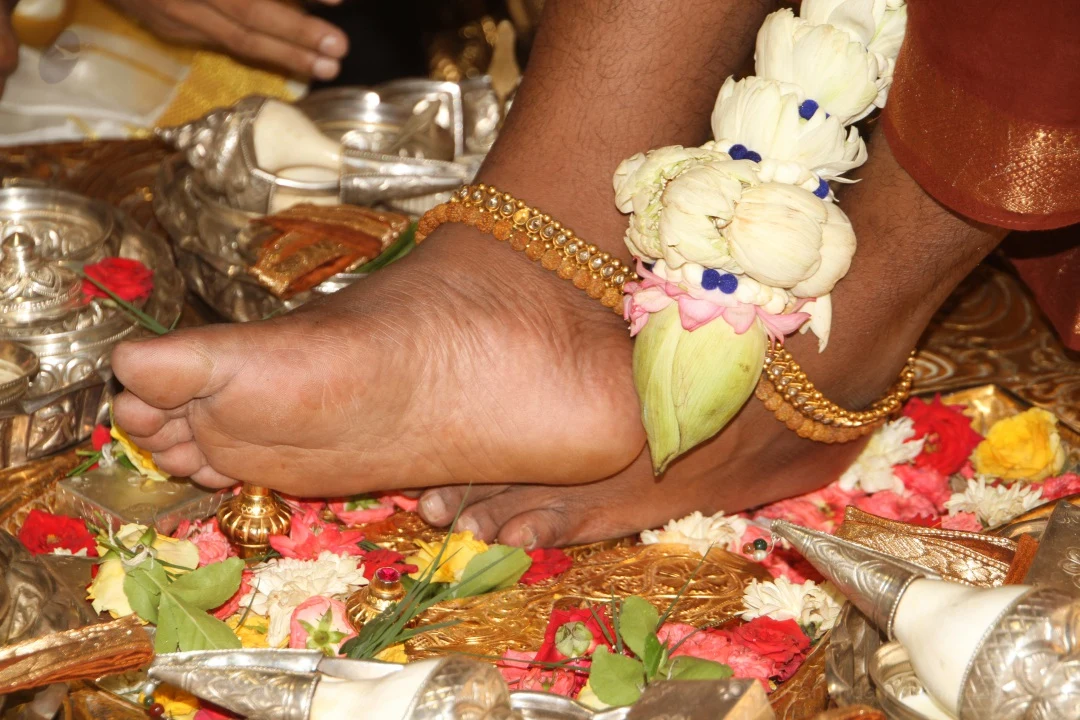
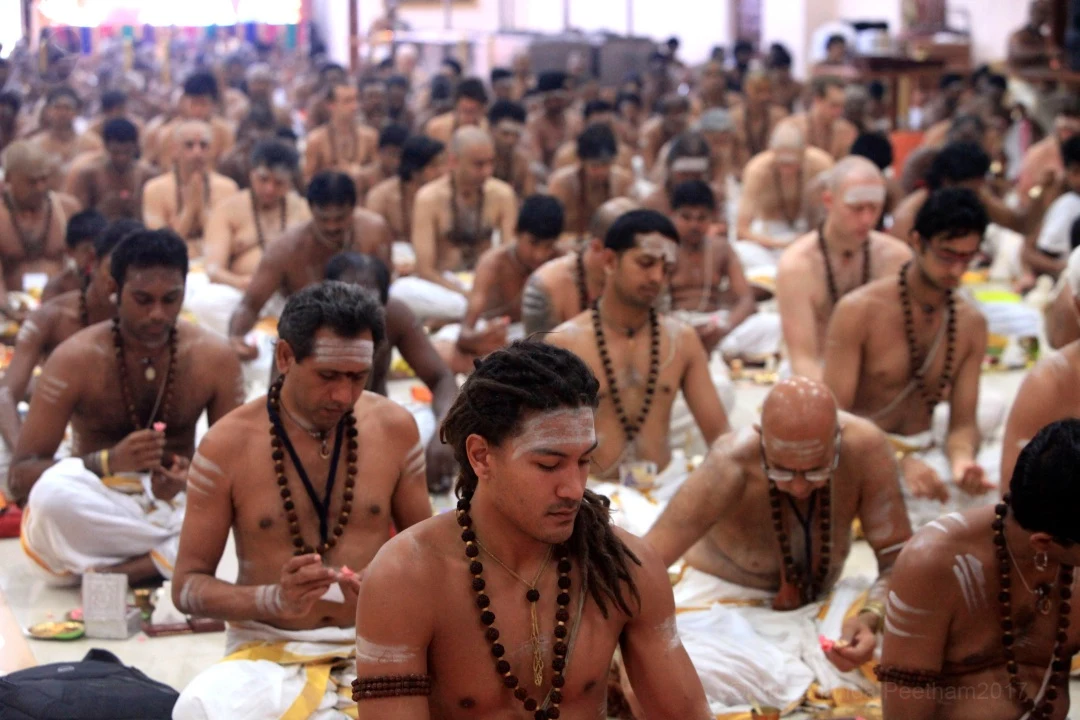
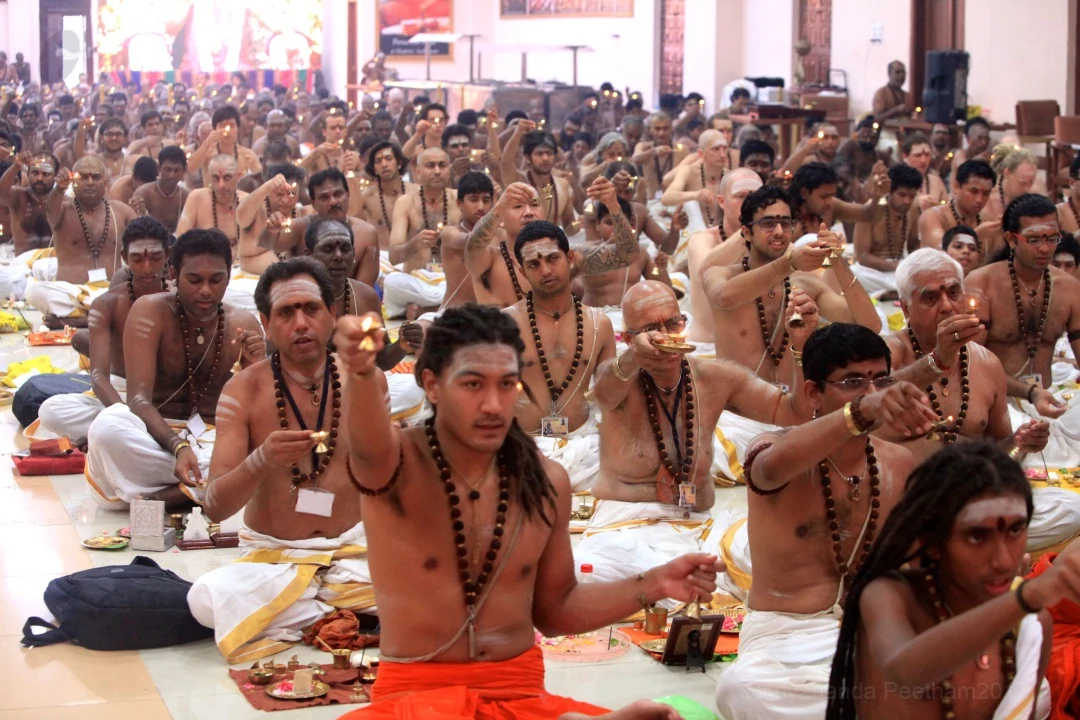
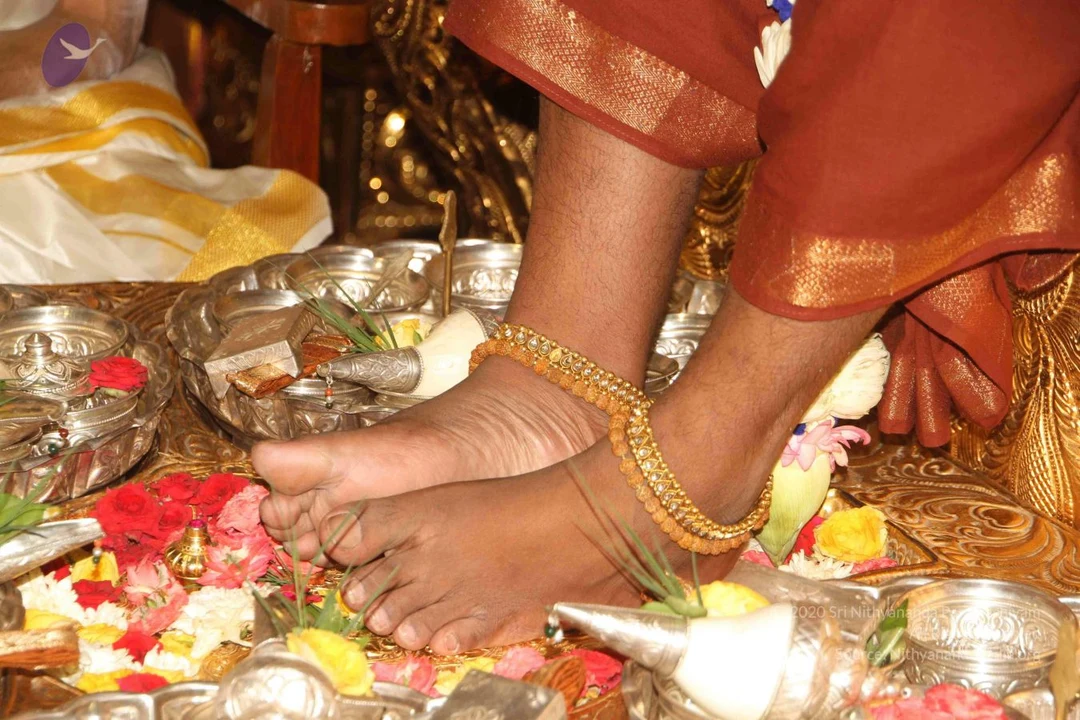
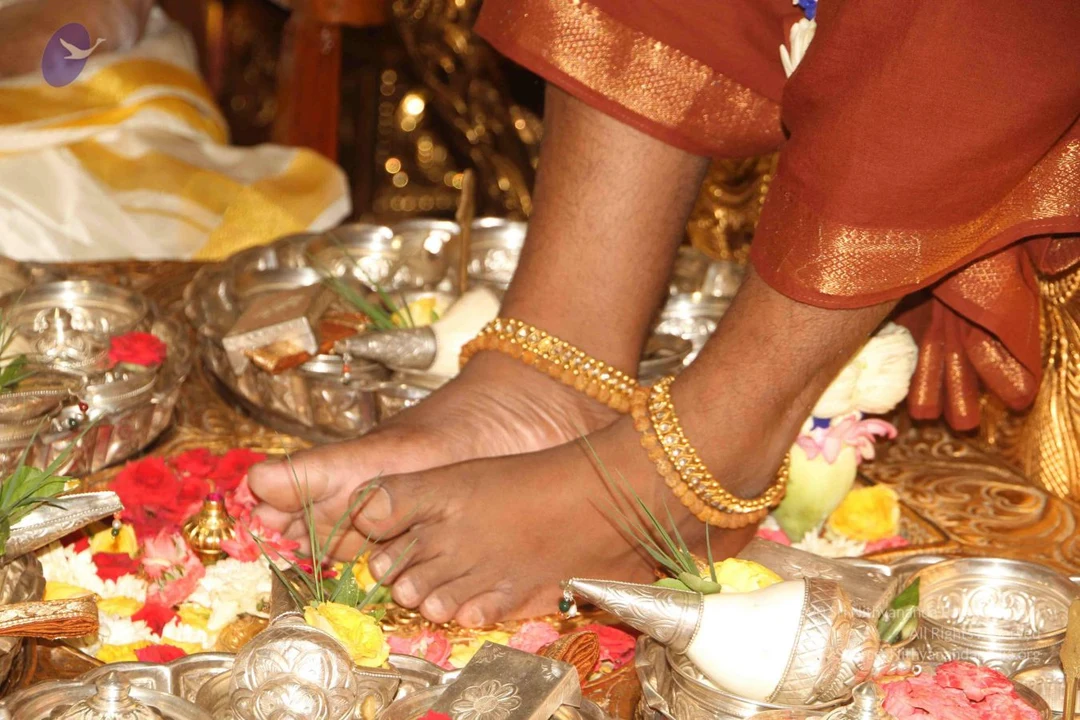
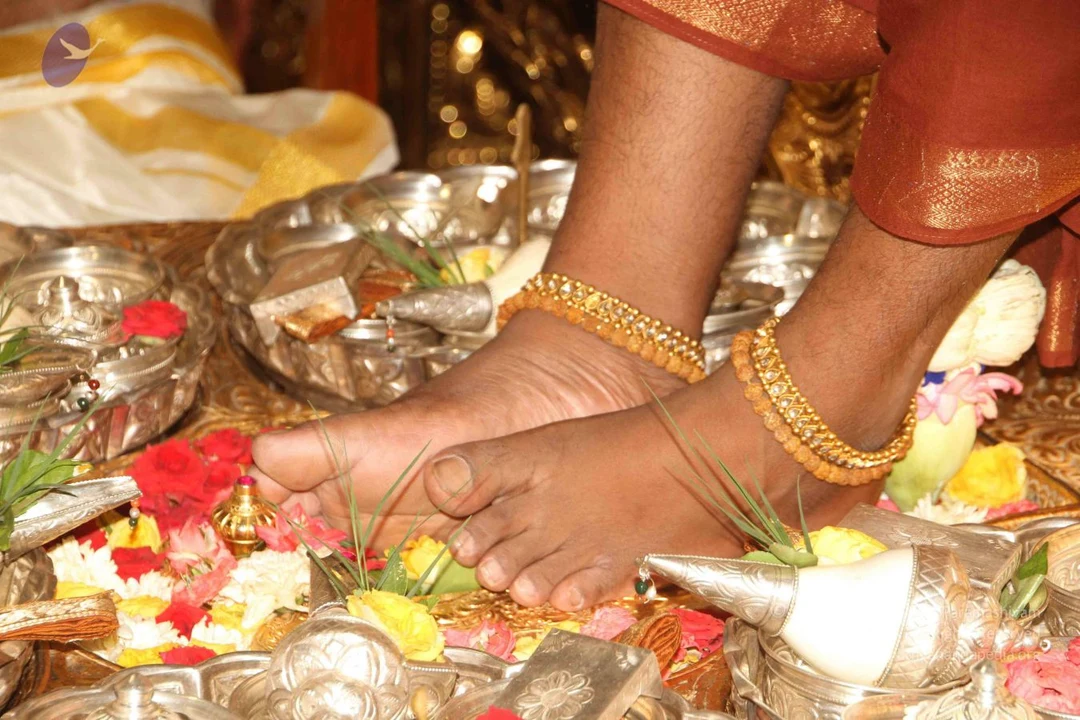
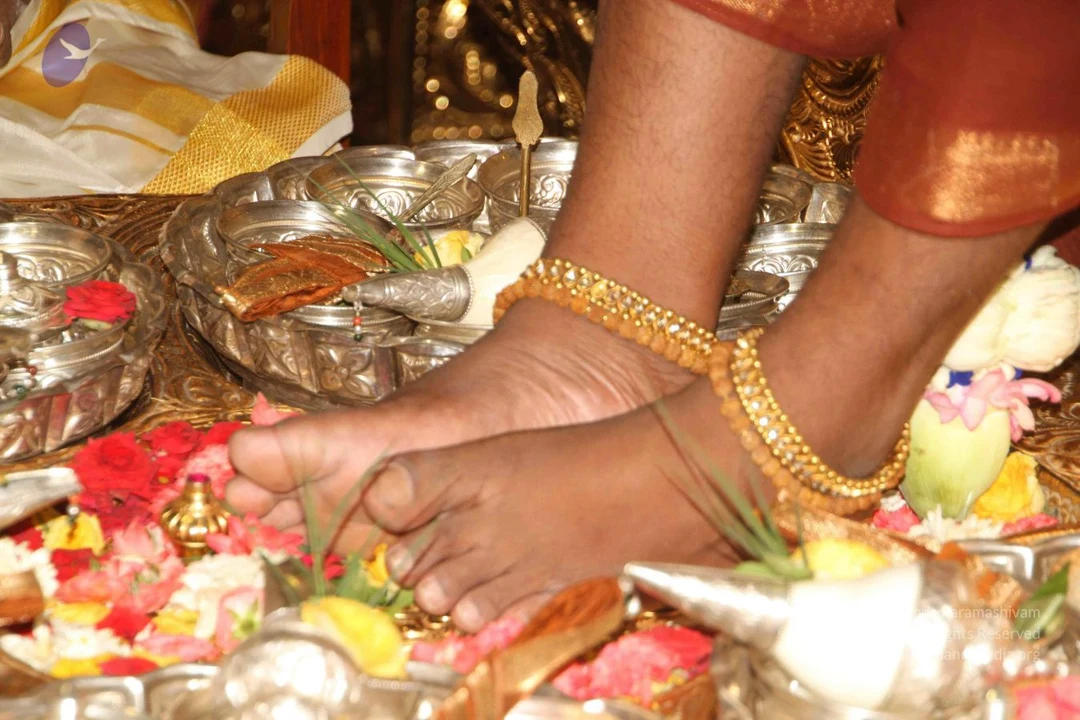
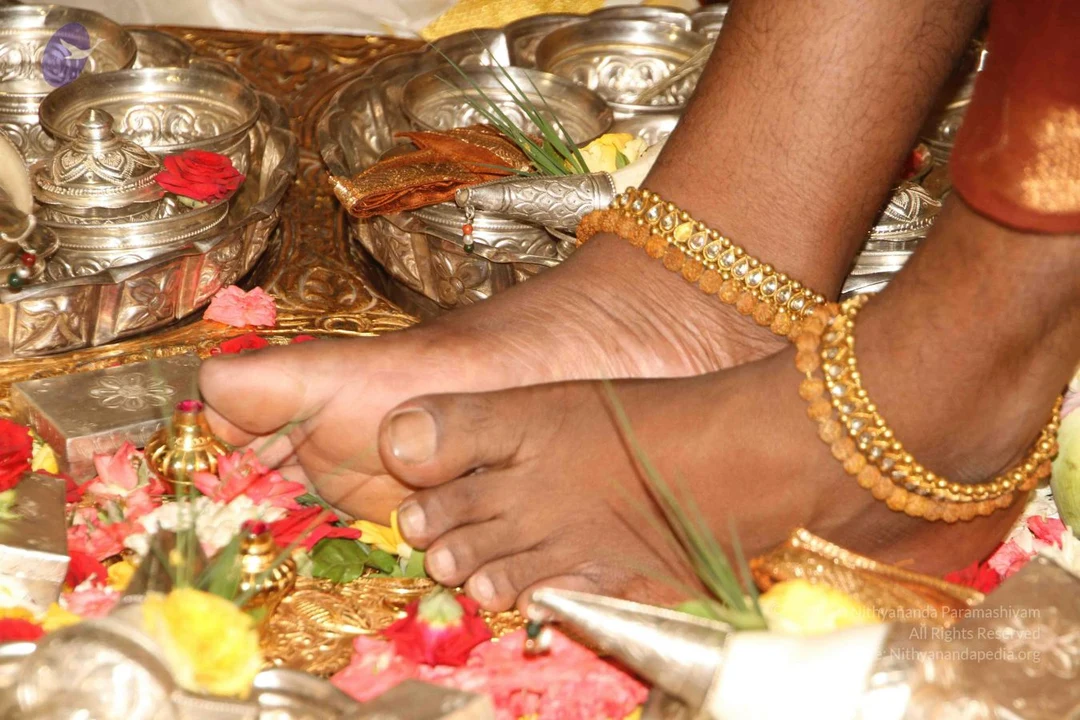
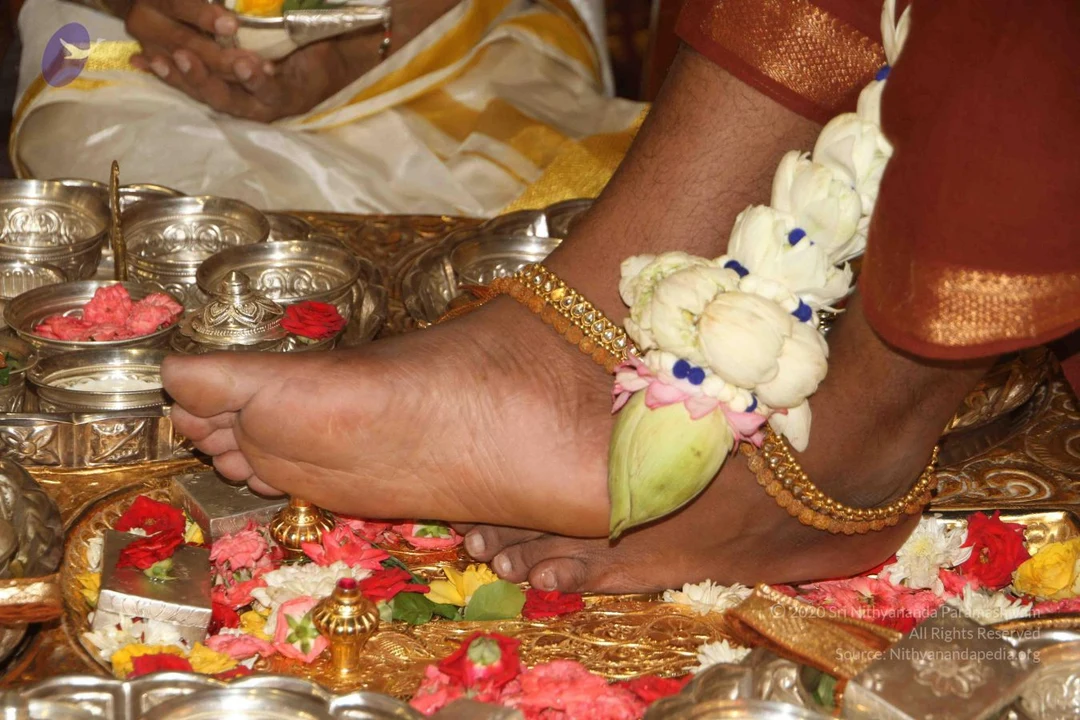
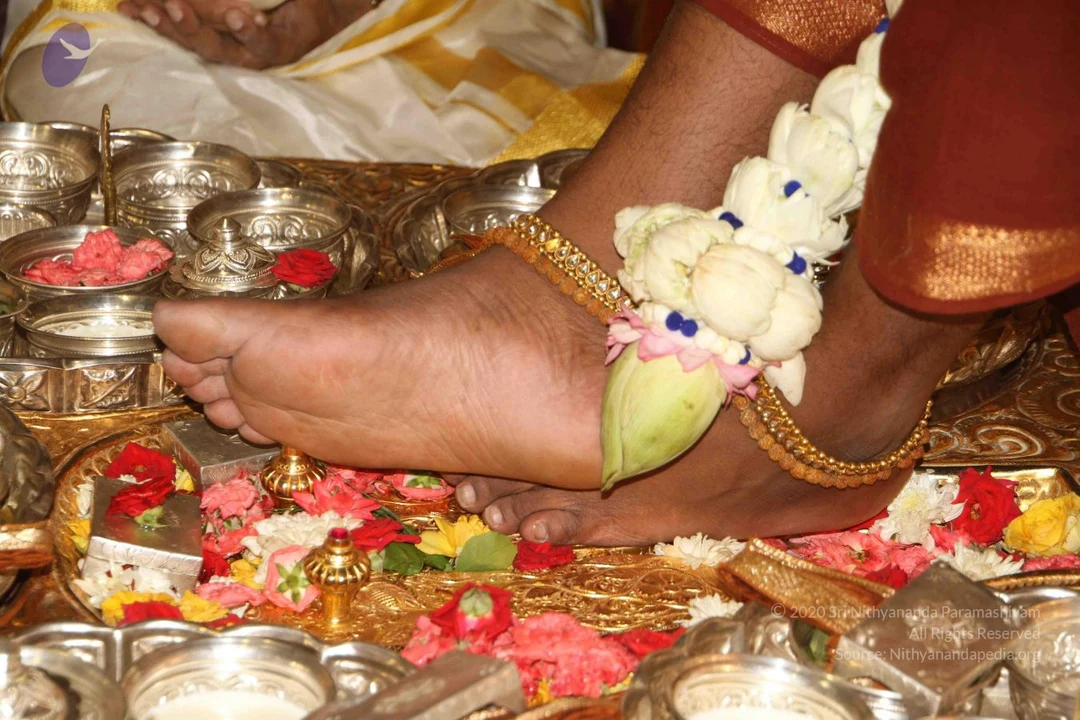
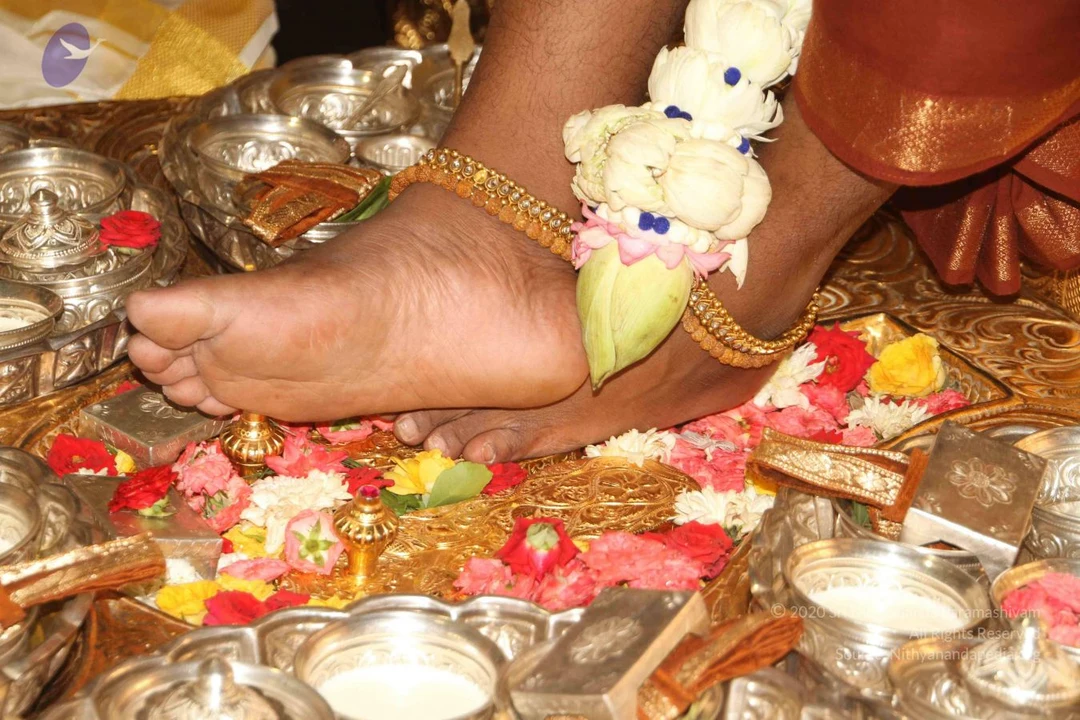
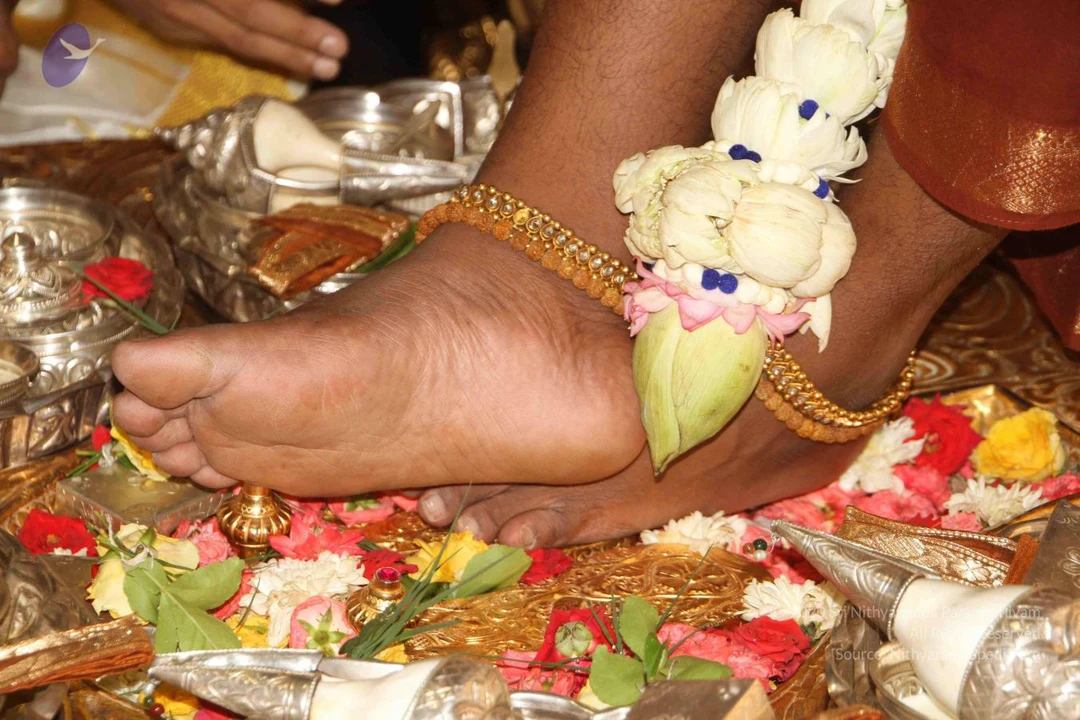
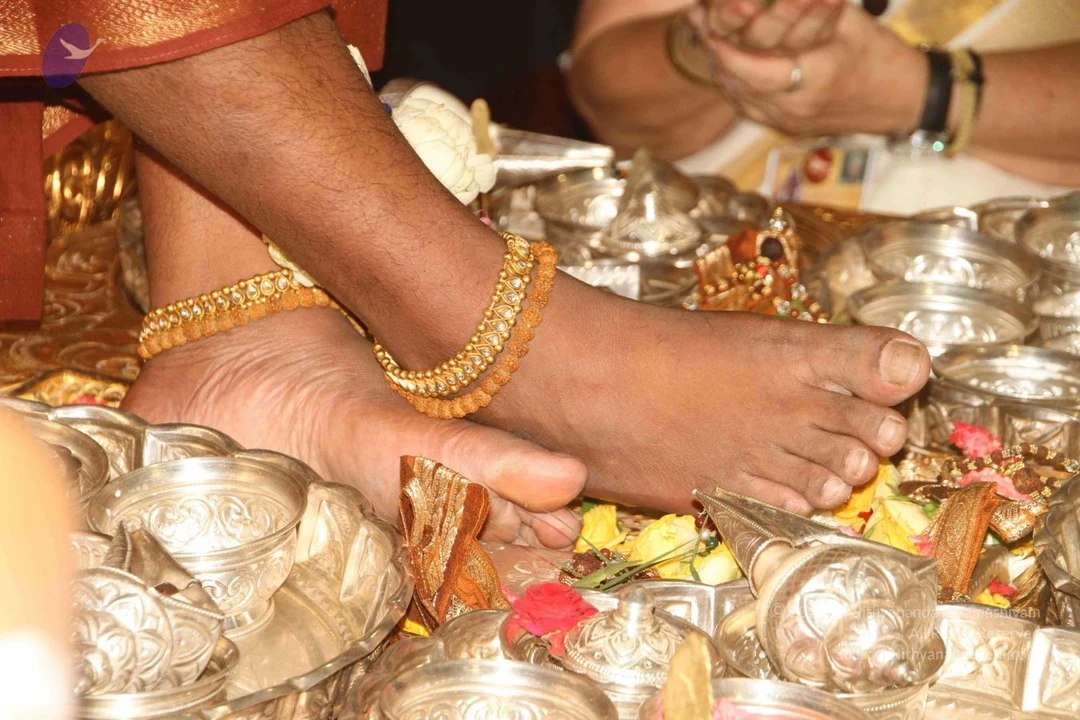
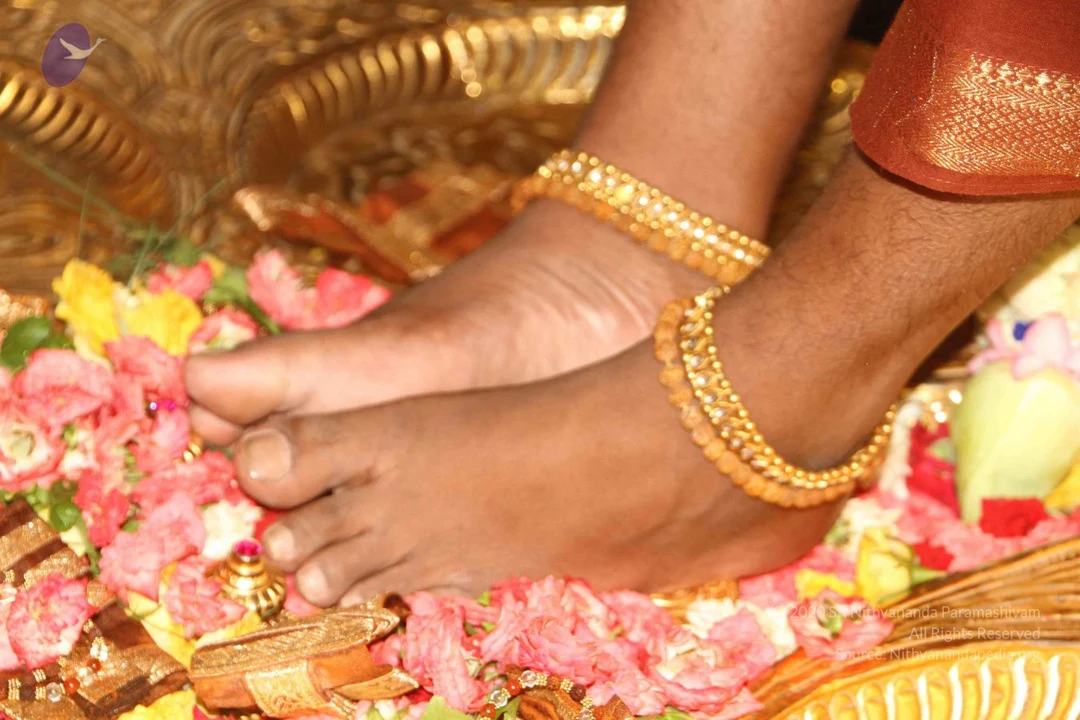
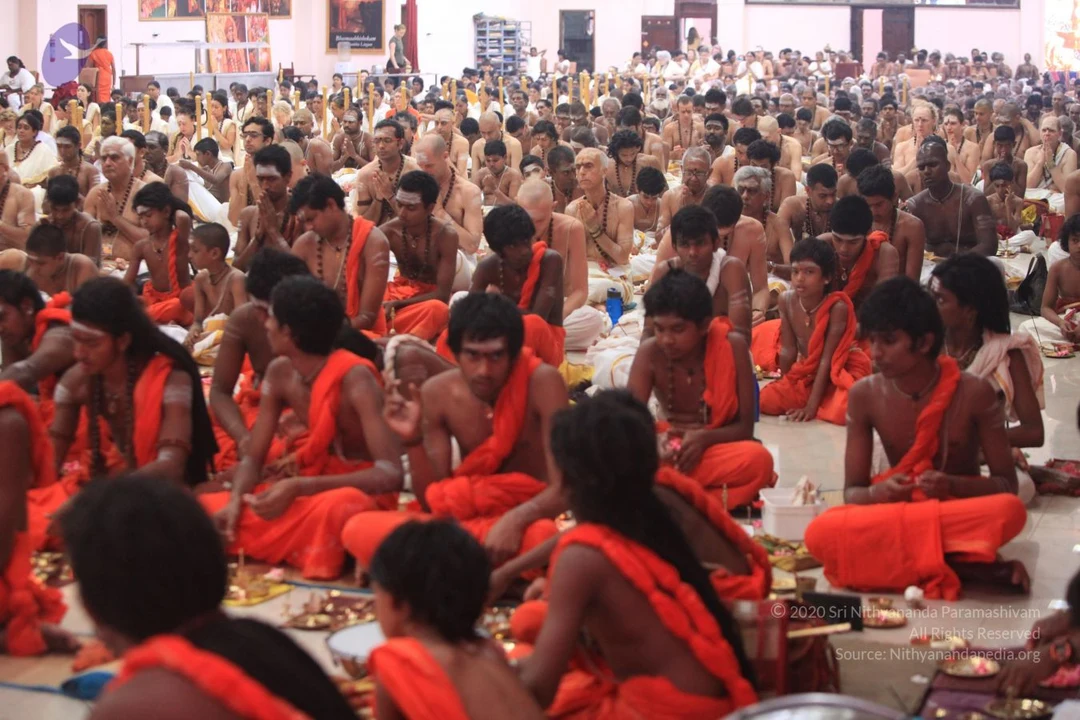
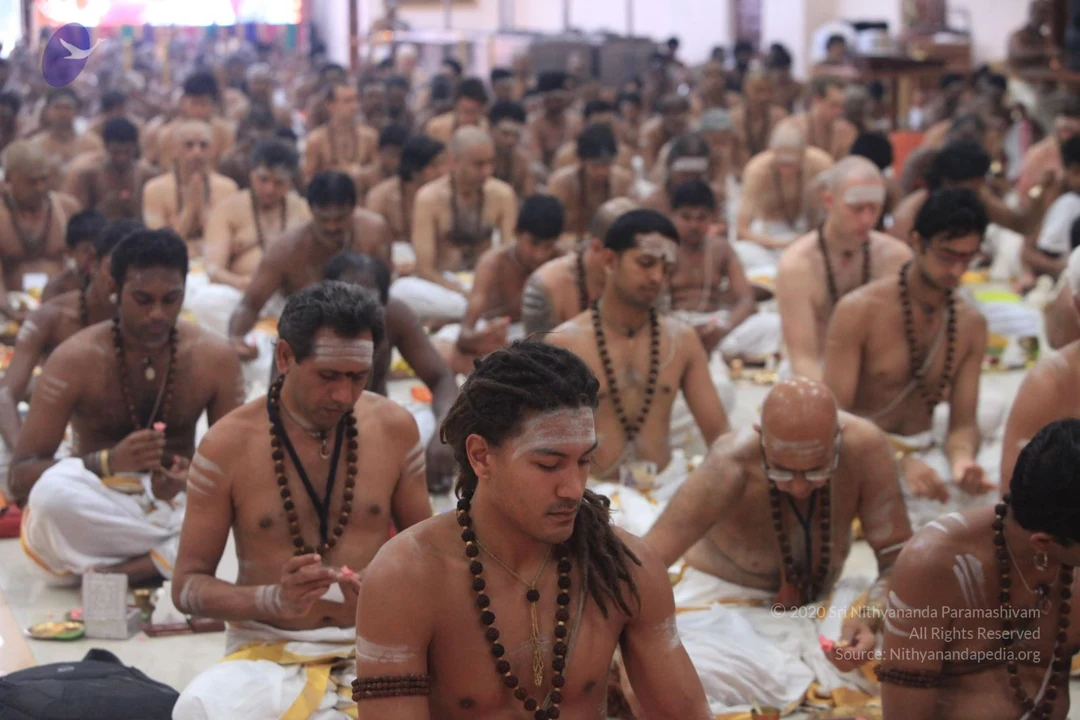
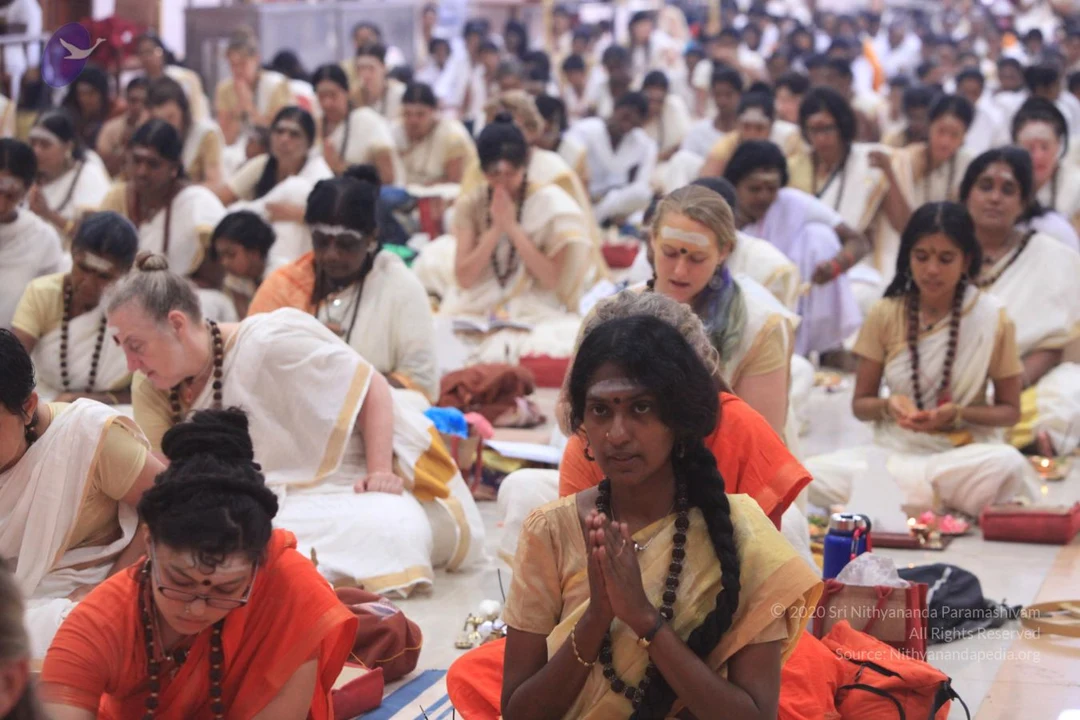
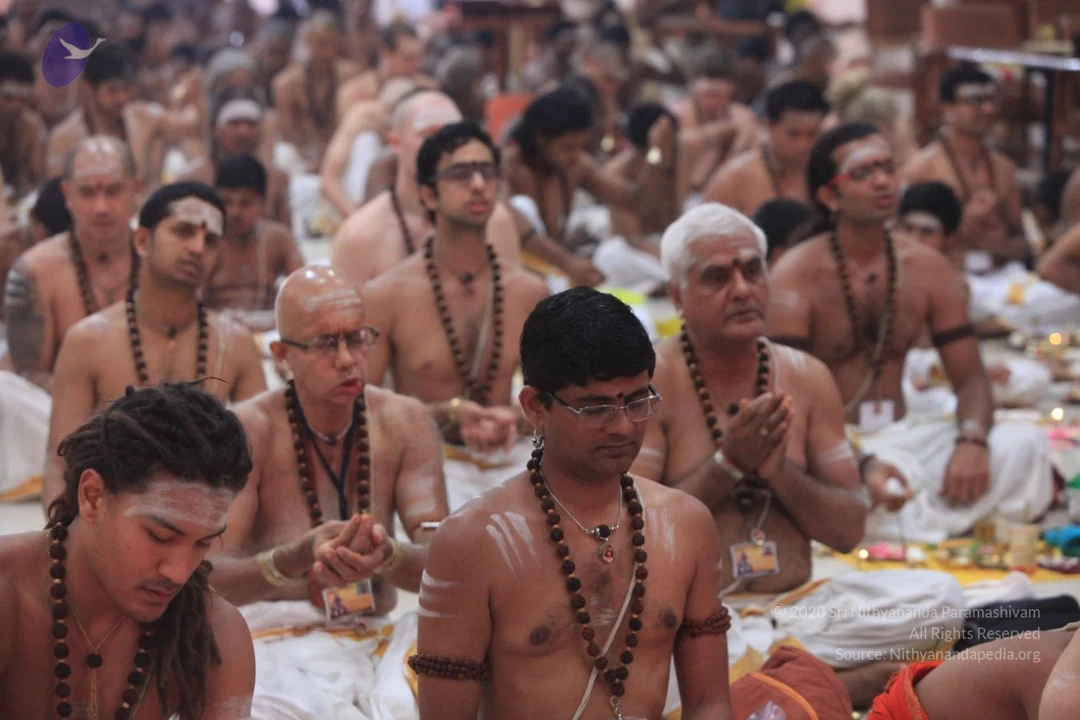
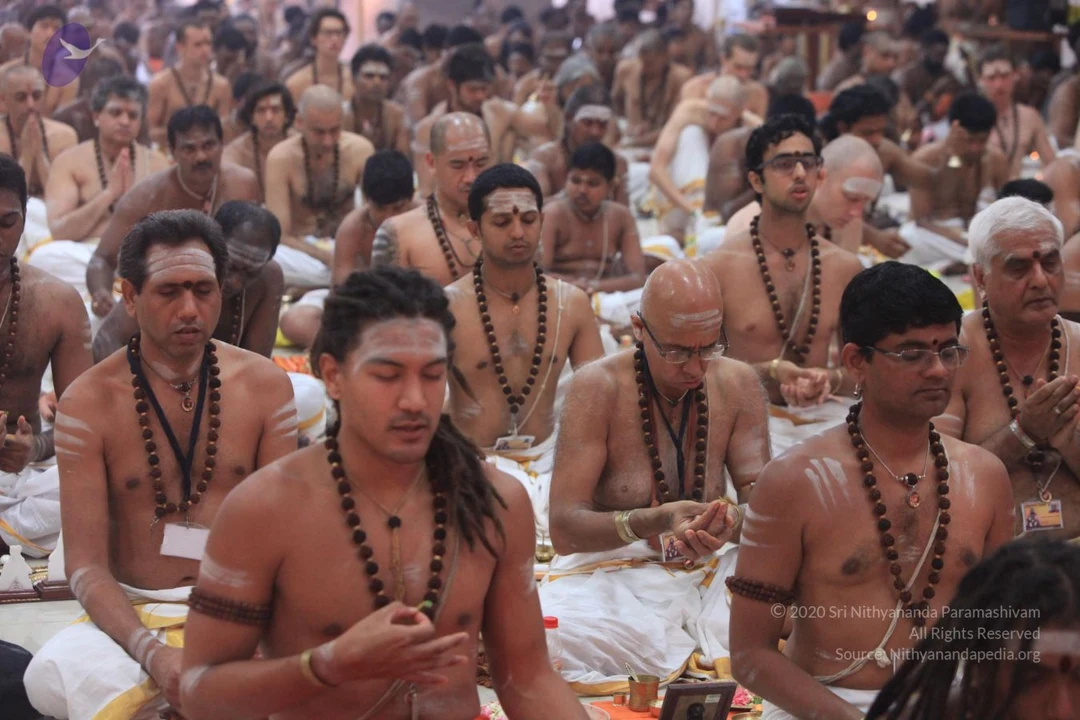
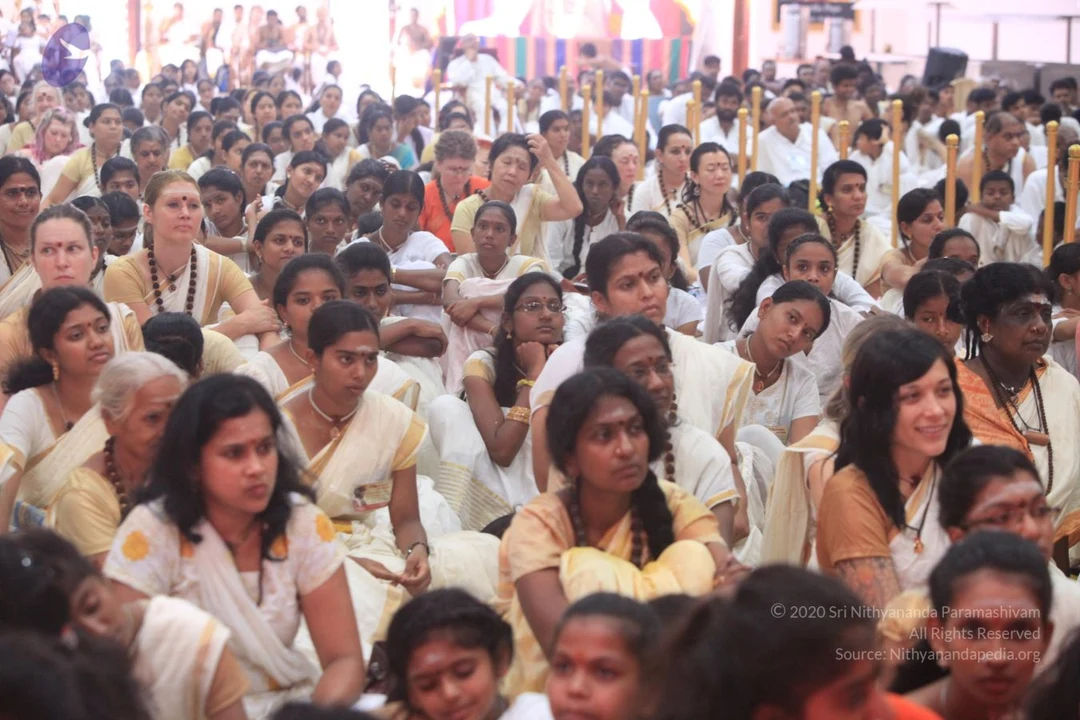
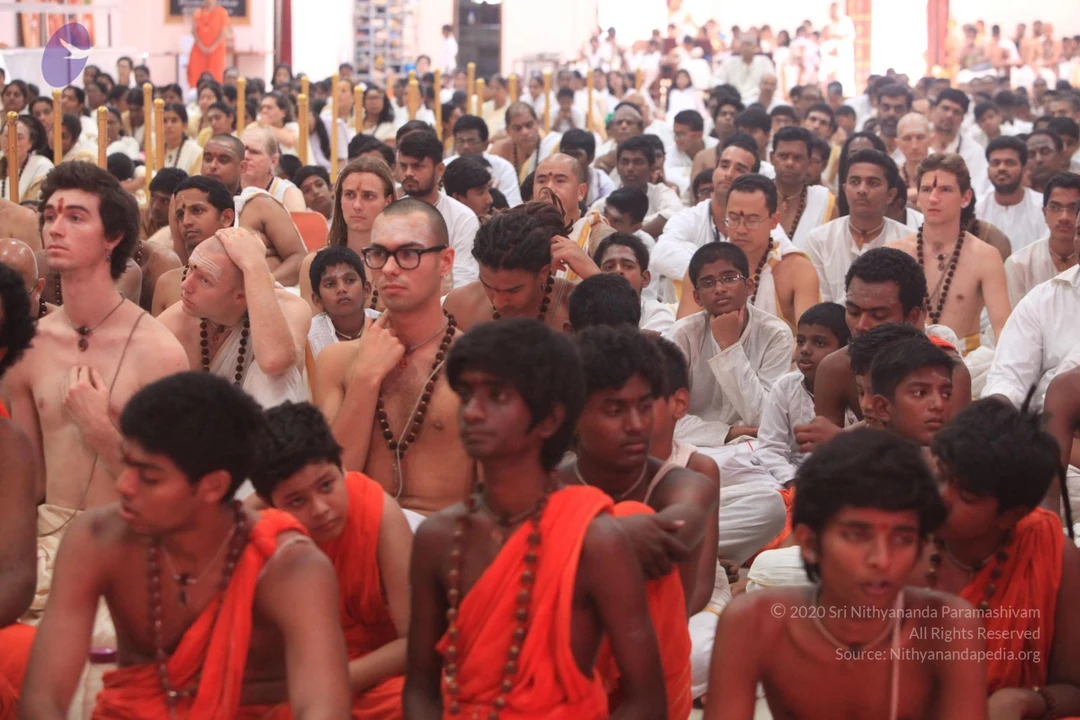
A large indoor hall filled with seated devotees in orange and saffron cloth worn over bare upper bodies, many with rudraksha malas and white tilak marks on their foreheads and arms. Rows of people sit on white cloth mats, some with hands folded in prayer, others with eyes closed or heads bowed. Tall wooden pillars or poles with brass tops stand between the rows. Behind them, religious paintings hang on pink walls, and a few people in white move near a side area. The crowd is dense and fills the frame, with no visible central figure identifiable as a person.A photograph of a ritual initiation in a temple hall. A shaved-headed young man in an orange cloth, wearing a rudraksha mala and a red wrist thread, smiles broadly while a long-haired figure with dreadlocks, wearing a pink and white flower garland and white-marked skin, presses a hand to his forehead. Behind them, saffron-robed devotees and children stand, one person in white holds a paper sheet, and a large ornate golden peetha or throne with carved gold filigree is in the foreground. The setting is a devotional initiation or blessing.Close-up photograph of a pair of bare feet being ceremonially worshipped during a padapuja. The feet are adorned with a white flower garland with blue-centred blossoms and a pink-tinged bud, and rudraksha-style beaded anklets with gold accents. Around the feet lie scattered red, yellow, white and pink flower petals on a golden tray, along with silver and brass puja vessels, a small brass lamp, and silver cups. The person's legs wear a rust-orange garment. The scene conveys a foot-worship ritual with floral offerings.

May 30 2017

Original wiki page
Contents

Title

Authenticity is the Key to Power Manifestation

Description:

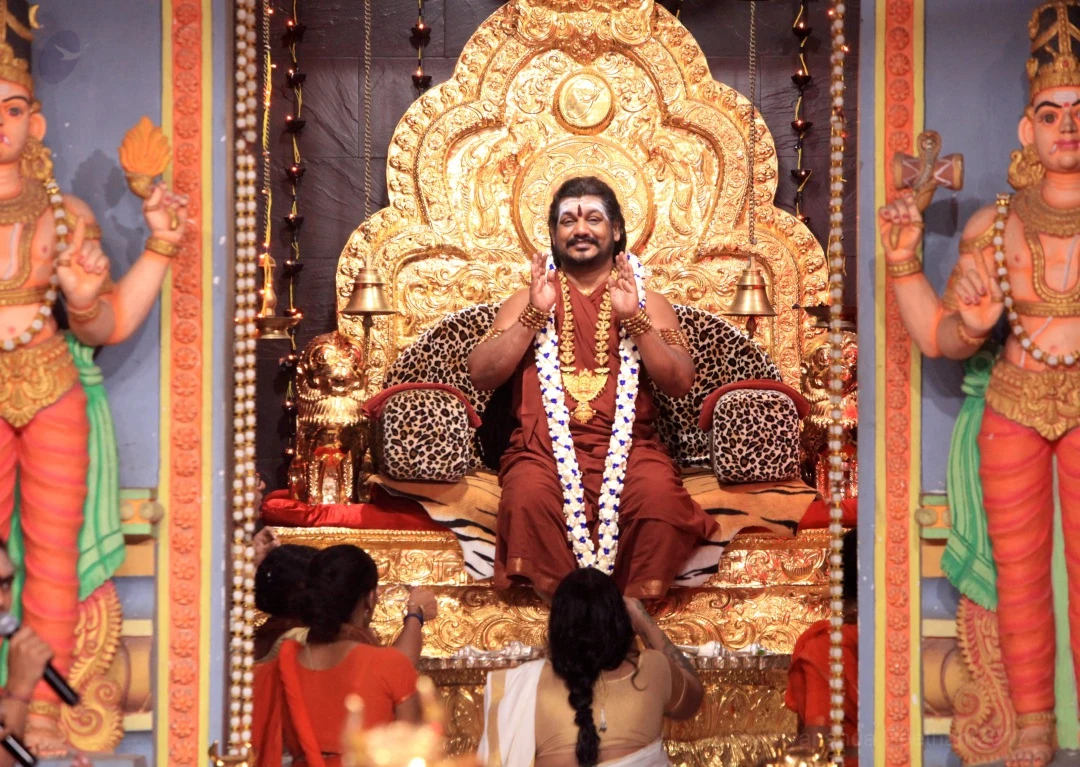
In this beautiful discourse from 30 May, 2017, His Holiness Bhagwan Paramahamsa Bhagavan Sri Nithyananda Paramashivamji shares that the Shaktis, powers, into which He initiates us are manifested when we live Authenticity.

Link to Video:

VideoAudio

Transcript:

(0:23)

nithyānandeśvara Sadāshiva samārambhām nithyānandeśvari Adi Shakti madhyamām | asmat āchārya paryantām vande guru paramparām ||

(1:00)

I welcome all of you with My love and respects. I welcome all the devotees, disciples, Sarvajna Peeta Yajamans, Nithya Satsangis, Sri Mahants, Mahants, Kotharis, Thanedars, devotees, disciples, visitors, YouTube subscribers and viewers, who are sitting with us all over the world at this moment, through Nithyananda TV, Facebook Live through 100s of Aadheenavasi Channels, YouTube Live, and 2-way Video Conferencing having Nayana Deeksha all over the world. I welcome all of you with My love and respects.

(1:47)

I’ll continue to expand on Manifesting Powers. Listen. Manifesting powers is nothing but extension of practicing Authenticity. Listen. Practicing Authenticity when it gets matured, it becomes manifesting powers. What is practicing Authenticity? Manifesting powerful cognitions constantly. If I have the body which get tired, then I know the science to get out of tiredness. Understand. What do you mean by saying, your body gets tired? Then you know there is a space, where you are not tired. When you know there is a space where you are not tired, you know now there is a space where you are not tired and where you are tired. Now, it’s only a simple science we need to manifest, where we are not tired.

(3:08)

You may just have to find out the basic secrets. What keeps me not tired? Physically, simple things - Pitta. I tell you, almost 99% of your tiredness, boredom, depression, all are physical problems, not mental. Actually if you are depressed, the best way to get out of depression is… tell 2-3 people to torture you. No, really! When you have a real problem, you will not create this soft suffering. You just need a strong 2-3 people to torture you. Then the whole problem will be solved. Because there is no suffering from outside, you just go on torture yourself. Soft suffering is luxurious suffering. It is like a...the fellows who don’t do hard work, the fellows who don’t walk to go and buy vegetables in their real life, try to run on the cycle which does not move from one place. Soft suffering is the luxurious replacement of the soft….real suffering. When you do not have the real one and you want to have that ‘pawam, pawam’, feeling. Enjoying ‘pawam’feeling is Paapi. Who is Paapi? - Who enjoys the pawam feeling, who cherishes the victimhood is sinner. Listen. Manifesting powerful cognitions about everything…. whether tiredness or boredom or depression or anything, manifesting powerful cognitions is Authenticity. Taking it to the next level is Power Manifestation.

(5:50)

Listen intensely. I was telling yesterday, use Haritaki powder to brush your teeth, 90% of your problems will be solved. You will become rich actually! Anybody wants wealth, I give you guarantee - use Haritaki powder and brush everyday morning. So much of Pitta will go out. The time you are concentrated, centered, on your goal everyday, will increase 3 times more. Understand. Number of times you remember your goal and align yourself to your goal and the time you feel Oneness with your goal and centered on your goal, will increase 3 times more, if the Pitta in your body is balanced. It’s a simple technique. Having Haritaki powder in your restroom and brushing every morning with Haritaki powder, will make you rich. Understand, it will also make you beautiful because when the Pitta leaves the system, the skin will start shining which can never come by ‘Fair & Lovely’. Understand, listen carefully, the color attracts only the superficial eyes. The shining attracts very Being. You will develop that shining, we call it Tejas. A normal eye does not recognize Tejas, but Third Eye recognizes it. Balancing Pitta increases the level of Tejas in your system.

(8:16)

Simple! You may think, “God! Just this brushing teeth with Haritaki powder?!” But you do not know, because your problems are not mental as you think. See, you want to open the door and you are going and hitting on the wall, when will you open? You don’t even have to hit on the door, because the door is already open. Many of your problems, right diagnosis…… No, all this problems are not psychological or mental, it is just simply physically not doing what I am saying. If you just correct the fundamentals - brush the teeth with Haritaki powder means - do it, you will see within 2-3 days the whole….the whole tiredness leaving your system.

Tiredness is not deprival of sleep, it is deprival of psychological Pitta Mayakkam. Listen. You always keep yourself in certain kind of a delusory, unconnected, random, unattended thinking. Listen. That space of enjoying that random unattended thinking, is enjoying delusion. You all think that is very cute and cool L….. But that is the source of lot of tiredness and if you don’t spend time with that, you feel something is deprived, taken away from you.

Many time you imagine tiredness, when you are deprived of your stupido thinking, means where…..if you are not given a time and chance for diving in your delusion, you imagine you are tired. Understand. Actually, diving in the delusion only makes you tired. Entertaining the delusion makes you tired. Brushing the teeth with Haritaki powder and vomiting all the Pitta, taking out all the Pitta, cleaning up all the Pitta, makes your whole day alive, bright, fresh! Not only the quality of the sleep increases, the quantity of the hour you roll on the bed decreases and the idea of tiredness disappears, idea of boredom disappears.

(11:54)

Manifesting powerful cognitions about everything is Authenticity, taking it to the next level is Power Manifestation. Yesterday I was showing, how I created the Puja Manual when I wanted to learn. I did everything I can, then I saw the power of downloading has opened up. You doing everything you can, opens up the power of downloading in you; opens up the power of downloading - next level power. Taking the Authenticity to the next level is Power Manifestation. You can see... we have the scanned version of that Puja Manual I created when I started learning Puja; the red color is the mantra, blue color is the meaning…..sorry blue color is the procedure, black color is the meaning of the mantra. And if there is a side line, I have to give a gap, means there should be a break. It’s My own handwriting and those Mudras I cut it, xeroxed and cut it from another book. I xeroxed and cut it and pasted it.

(13:39)

No, when I decided to learn the meticulousness, authenticity, then automatically I saw the whole downloading power opened up. After that I never learnt systematically Chandi Homa, Sri Vidya Homa and all that. All that started getting downloaded. Sometimes, I’ll personally sit and do Pujas for 16 hours - Pujas and Homas. Sixteen hours! Listen. It is too important, it is too important for you to know. When you start manifesting powerful cognition, it is called Authenticity, when Cosmos supports it, it is called Power Manifestation. When you start manifesting powerful cognitions, it is called Authenticity, when Cosmos supports it, it is called Power Manifestation. Without you manifesting powerful cognition, even if Cosmos supports, you’ll abuse it, misuse it. I have seen some of My Balasants trying to do that. Because they have a guts I will protect them anyway, they think they can do anything they want. Yes, you can, then you damage your body and mind. Who is going to suffer?

When you know the solution, if you don’t adopt it and think that I’ll protect you, you are trying to use My love; actually you are trying to abuse My love, not use My love. Using My love in wrong direction is abusal. When you know the solution and not going for a solution, instead trying to console yourself, “Oh, I have so much of Swamiji’s love and I can manage anything.” Yes, if you break 5-6 bones and come, of course I won’t let you die. I will protect you. I will heal you; but till the time of healing, who is going to suffer the fracture and fractures’ pain. Who is going to suffer the fracture pain? You only!! If you get into a problem, which you don’t know the solution by mistake, then I will not let you suffer even for a inch. I’ll immediately lift you. But if you know the solution and out of sheer arrogance, which you developed because I love you and empower you and go and make a mess. Then I’ll say, “Alright, do what you want.”

(17:17)

When you don’t manifest powerful cognition, even if Cosmos supports, you will abuse it. When you manifest powerful cognitions, it is Authenticity, when Cosmos supports it, it is Power Manifestation. So yesterday almost it took one full day for us to go through the Unclutching initiation, understanding and thinking in the language of Integrity, Authenticity, Responsibility, Enriching; thinking in the language of Tattvas.

So today, 720 sacred syllable installation initiation. The Nigama of Vamadeva Tantra, which gives Bhuvaneshwari Vidya, which I received from Arunagiri Yogeshwara. I think, first time I am going to do it elaborately with manual. So we will have….we will have 3 initiations; same initiation 3 times repeating. It may…..each initiation may be taking 3 hours. So, today one three hours, tomorrow one three hours, day after tomorrow one three hours. Or maybe we will have today one three hours and one day break and then one three hours and anyhow we will have at least three. So you guys can get out of all the blind spots and think in the language of Tattvas.

(20:24)

You see, one more important thing you need to know, whenever you feel you are not able to handle yourself, a self-denial or self-hatred, that pattern gushes from the navel to the throat, through that whole area, so it damages all the windpipe, food pipe, everything; it creates subtle ulcers. Understand, not just psychological, physical. So the brushing the teeth with Haritaki powder, heals even that ulcers. So this gushing of the self-hatred, does not create a strong impact on you because of the reversal of the ulcers. Even for that reason, brush your teeth with Haritaki powder every morning. It helps in too many ways.

(21:50)

Essence of today’s Satsang - When you manifest powerful cognitions about life, it is Authenticity. When Cosmos supports it, it is Power Manifestation.

When I decided to write this Puja Manual meticulously and learn, put powerful cognitions on it, it is Authenticity. When Cosmos opened the floodgates and started downloading all the Puja methods, manuals and the science, it is Power Manifestation. Without Authenticity, even the Cosmos gives the blessings, you will start abusing it. So better become authentic, so when Cosmos showers, you will use it - you will not abuse it.

Understand, when you abuse, it will become very costly. Being an Incarnation, I could not get the second Beedi, understand. Being an Incarnation, I could not get the second Beedi. One beedi, I did not even say No. I just delayed My Yes. I lost it. Did not even say No. Delayed the Yes and never I got it again. He said very clearly, “Some other door will open for you but not this door.” When we are inauthentic...maybe if we complete with our inauthenticity, some other doors will open, but that door which opened, will never open again. Understand. Being an Incarnation, could not get the second beedi. He is about to leave the body and He has declared to the whole city, I am the successor. Visari Swamigal, just 2 days before He left the body, I was pressing His feet. By that time I realised My incarnation-hood and started the public life, I went there to see Him and He called all his….the local VIPs and declared in front of all of them, “Swamiji is My successor and He is the living Sadāshiva.” All that has been done and the temple is….. temple has been asked to get My concurrence before they raise the flag and all that traditional ritualistic handing over. Everything is done and He may leave the body any day. I was just pressing His feet and I asked Him, “Swamiji, I am so happy, you have done everything… but that beedi…..” He said, “No.” No! World need to know, whoever it may be, the door once opens and you abuse it or miss it, second….some other doors will open. It’s not that all doors will be closed. Some other doors will open. That same door will not open again. So sometime, unless you become authentic, even Cosmos giving ‘tathastu’ you may misuse it or abuse it. Become authentic as quickly as possible. So when Cosmos blesses, it will just become power manifestation. You will not abuse it or misuse it.

(26:26)

So with this, I’ll move to the next segment. Today, the long initiation and you guys also have a Healer’s initiation today and the process you are going to through today is called Vageshwari Prana Prathista, the sacred sounds being invoked in your Deha, in your Shareera. It will be stitched literally in your body, in your inner space, so you can radiate Integrity powerfully, without struggling. You can think and evolve in the language of Tattvas.

Tattva means the basic unit with which Cosmos functions. There are 36 Tattvas. All the 36 carries a basic quality - why they do what they do. That ‘why they do what they do’, is this 4 Tattva - Integrity, Authenticity, Responsibility, Enriching, Causing. Why fire burns? Why breeze blows? This 36 Tattvas, out of which Cosmos is made, why they behave the way they behave. That unit principle is only these 4 Tattvas - Integrity, Authenticity, Responsibility, Enriching. So, making your Deha into Tattva Deha, Tattva Shuddhi, and doing the Vageshwari Prana Prathista on your body, is the process you’ll be going through today. Let’s get ready, for this. As per the Vamadeva Tantra, the whole process will be happening. Let’s get ready.

(28:50)

I bless you all, let’s all radiate with Integrity, Authenticity, Responsibility, Enriching, Causing, Living Shuddhadvaita Saivam, Sadāshivoham, the Eternal Bliss - Nithyananda.

Thank you.

Be Blissful.

(29:08)

Sakshi Pramana:

'Nithyananda Times, 30 May 2017' Satsang

Pratyaksha Pada Puja
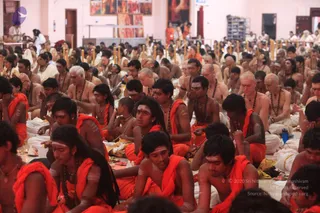
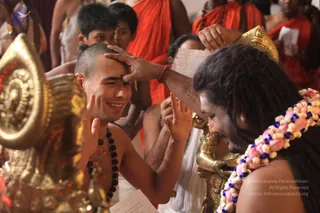
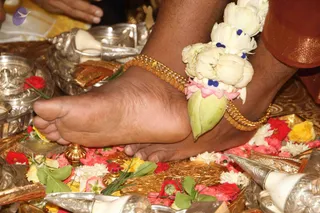
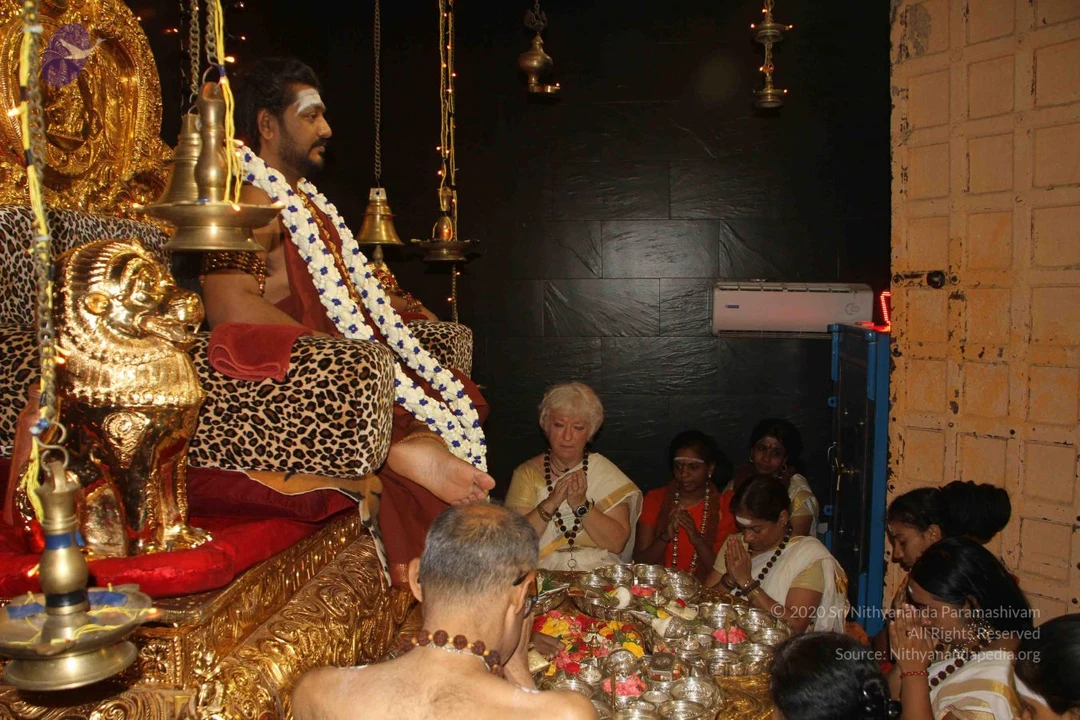
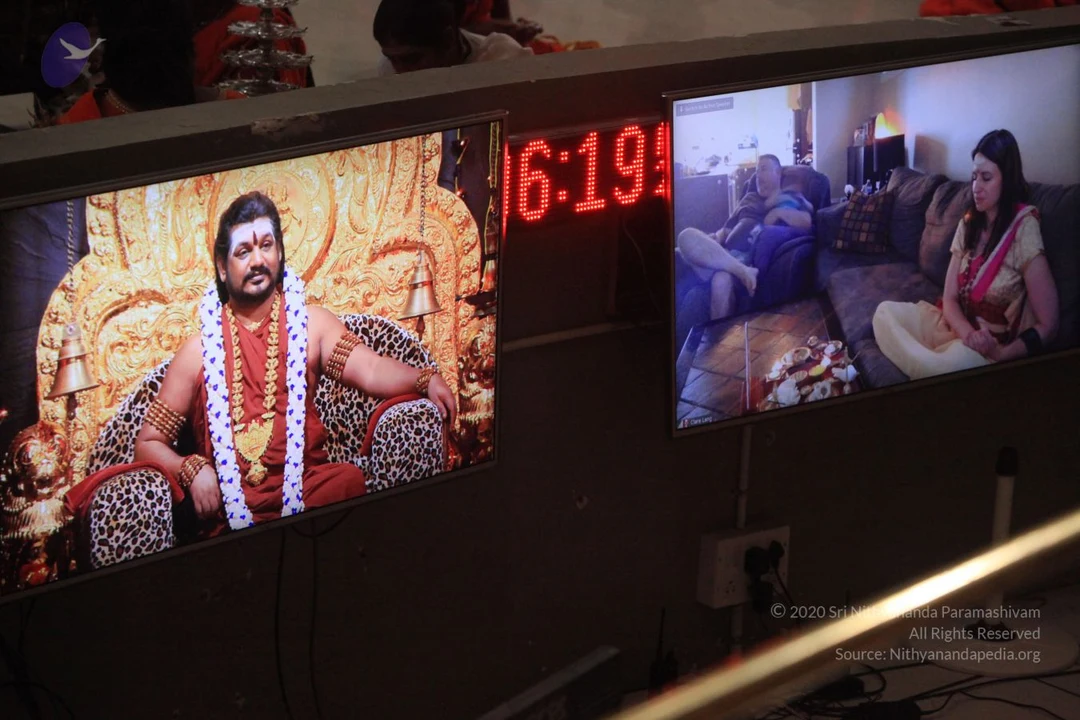
For the seventh day in a row H.H. Paramahamsa Nithyananda himself was present during the morning puja to accept the Pratakshya Pada Puja. This time, since it was monday, it happened in the Vaidya Sarovar, the healing resevoir with in the middle a 21feet tall Shiva Lingam! Pada Puja is a unique celebration of the overflowing gratitude to the Avatar.

Sri Vidhya Puja LA
Last Sunday the Nithyanandeshwara Sadashiva Hindu Temple of Los Angeles performed Sri Vidya Puja to the Grand Maha Meru, the three dimensional form of the Sri Chakra.

The Puja occurred before the Tallest deity of Rajarajeshwari in North America, who had received Prana Pratishtha by Paramahamsa Nithyananda in 2009.

Devi Rajarajeshwari radiated such a powerful energy during the Puja that the participants felt Her Universal Presence and were filled by her compassion and power.

Somavara Abishekam
Every Monday is a special day when all the deities in the Garbha Mandir of the Nithyanandeshwara Sadashiva Devastham are offered the abishekam.

Manifesting Rain in 108 places at World Environment Day

Nithyananda Sangha present at the NGO Expo in Mumbai

Photo of The Day

Puja
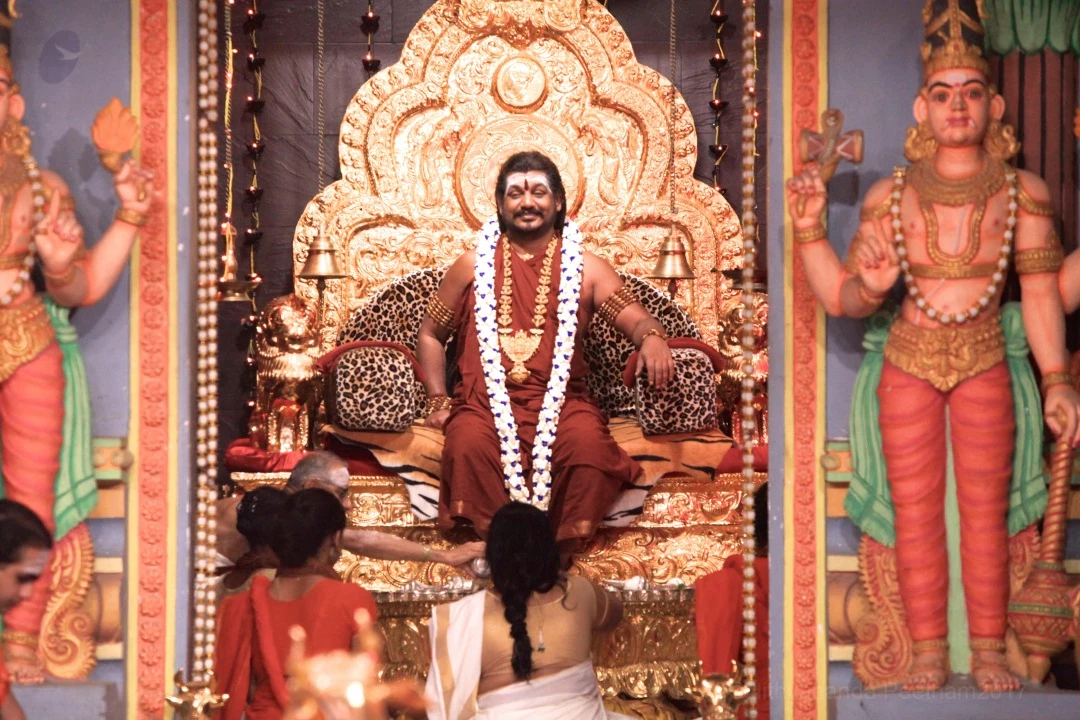
Darshan
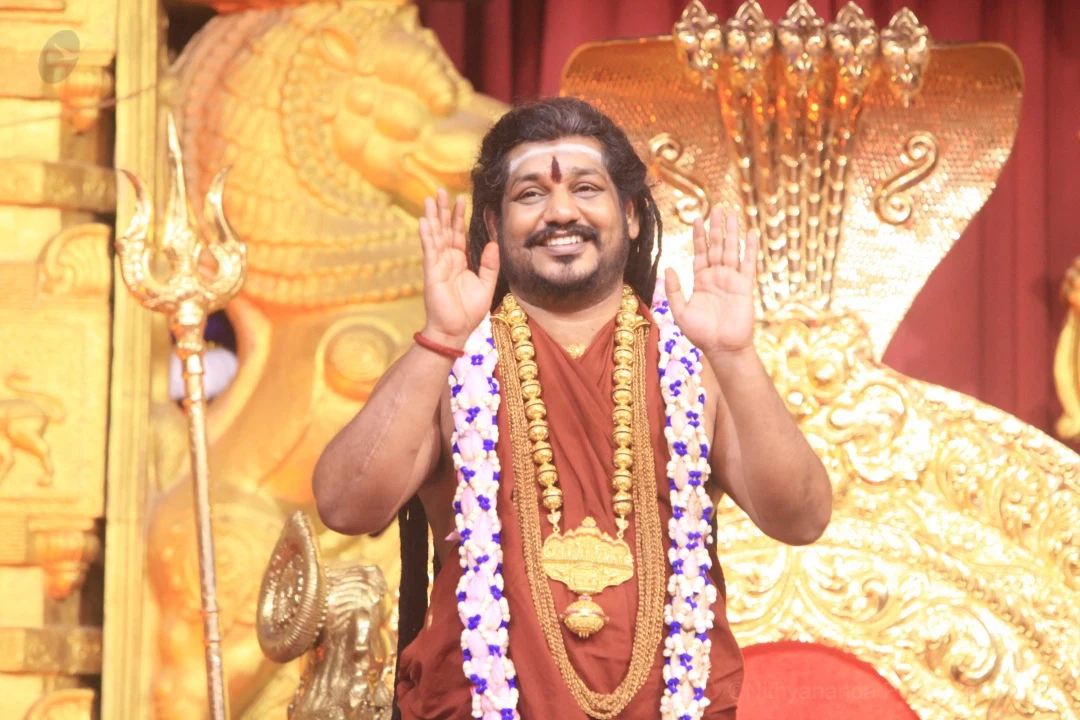
Tags:

Bhagavan Sri Nithyananda Paramashivam Paramahamsa Nithyananda, Nithyananda, Swamiji, successor, visari swamigal, sadashiva, traditional, ritualistic, concurrence, tathastu, blesses, healer’s initiation, vageshwari prana prathista, invoke, deha, radiate, shareera, inner space, struggling, evolve, tattva deha, tattva shuddhi, manifesting powers, extension, practice, authenticity, mature, powerful cognitions, cherish, intense, goal, technique, tejas, fundamentals, delusory, puja, mudras, cosmos, solution, empower, initiation, syllable, vamadeva tantra, arunagiri yogeshwara, self-hatred, beedi, body, tiredness, space, manifest, pitta, boredom, sinner, haritaki, align, rich, third eye, deprival, delusion, downloading, chandi homa, abuse, love, healing, integrity, responsibility, enriching, installation, blind spot, pattern, incarnation, depression, mental, torture, soft suffering, luxurious suffering, paapi, power manifestation, wealth, oneness, Being, psychological, pitta mayakkam, alive, power, sri vidhya homa, mind, arrogance, unclutching, tattvas, nigama, self-denial, subtle, inauthenticity

Photos Of The Day:

Pada-puja
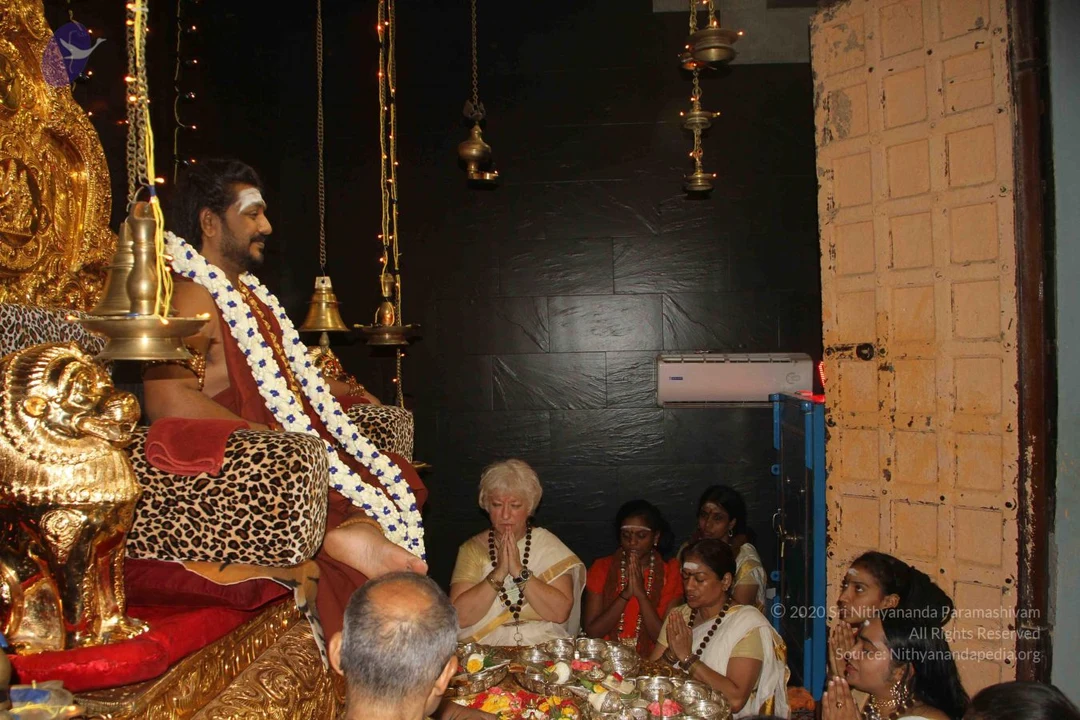
Padha-puja

Satsang

satsang

Darsan

Darsan

Photos Of The Day:

FB-photo-of-the-day

01-PADA-PUJA

02-NITHYA-SATSANG

Photos from this day

View all 152 photos

Puja

2 photosSource gallery
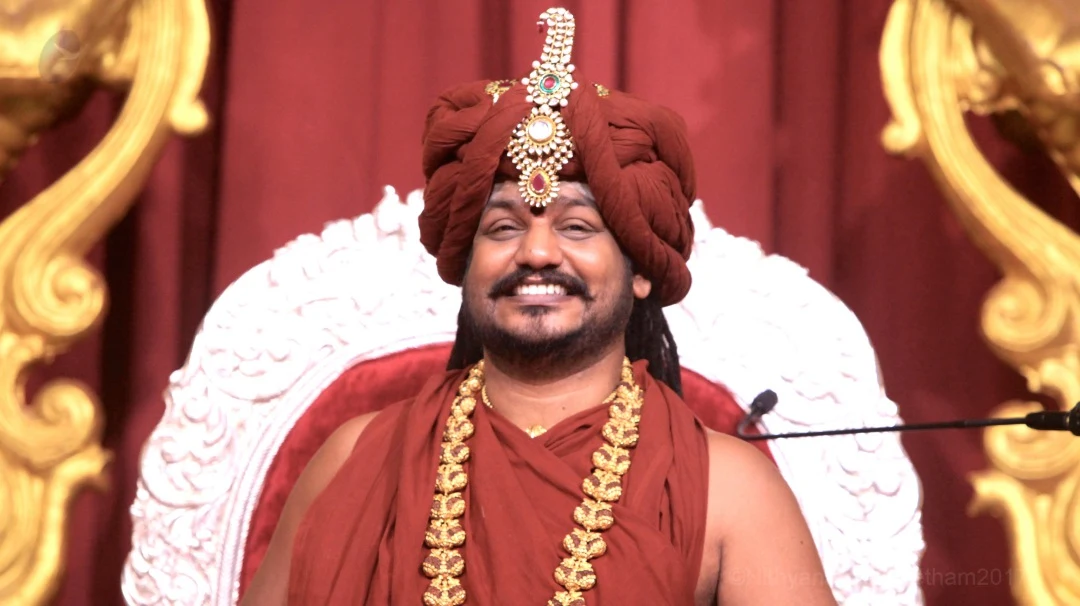
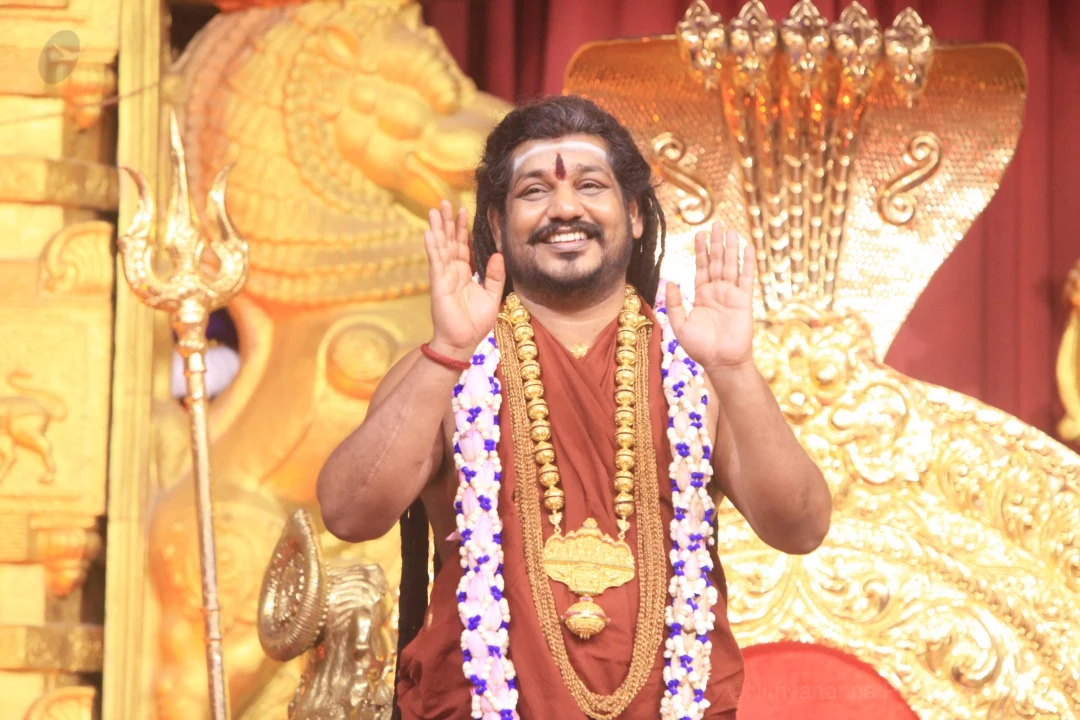
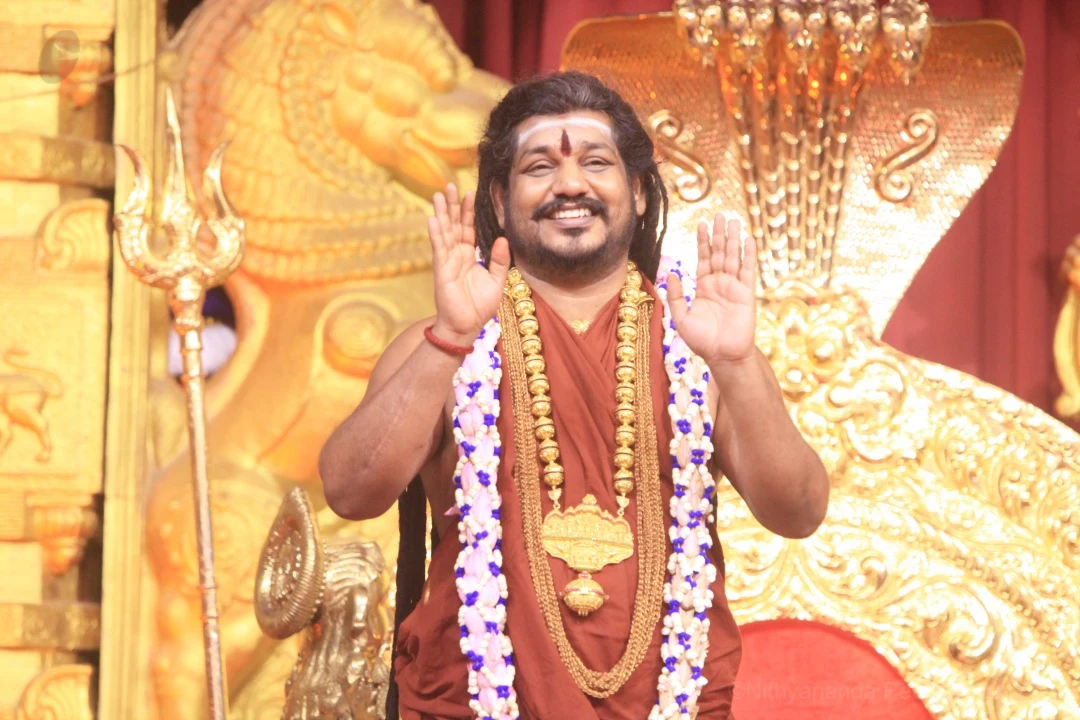
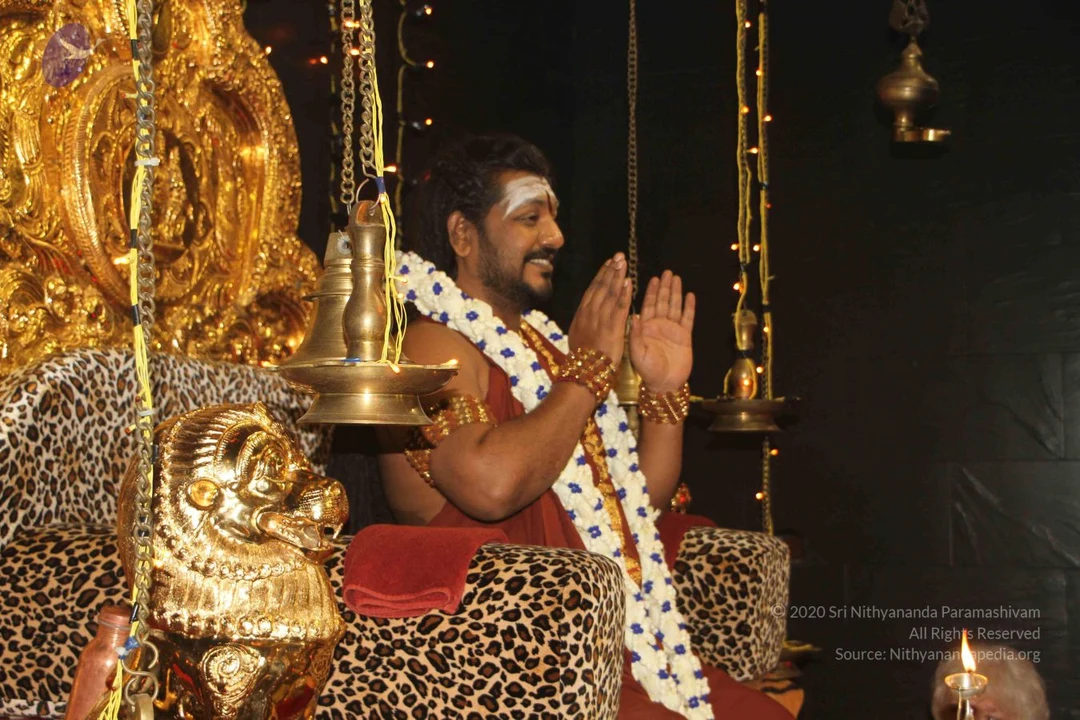
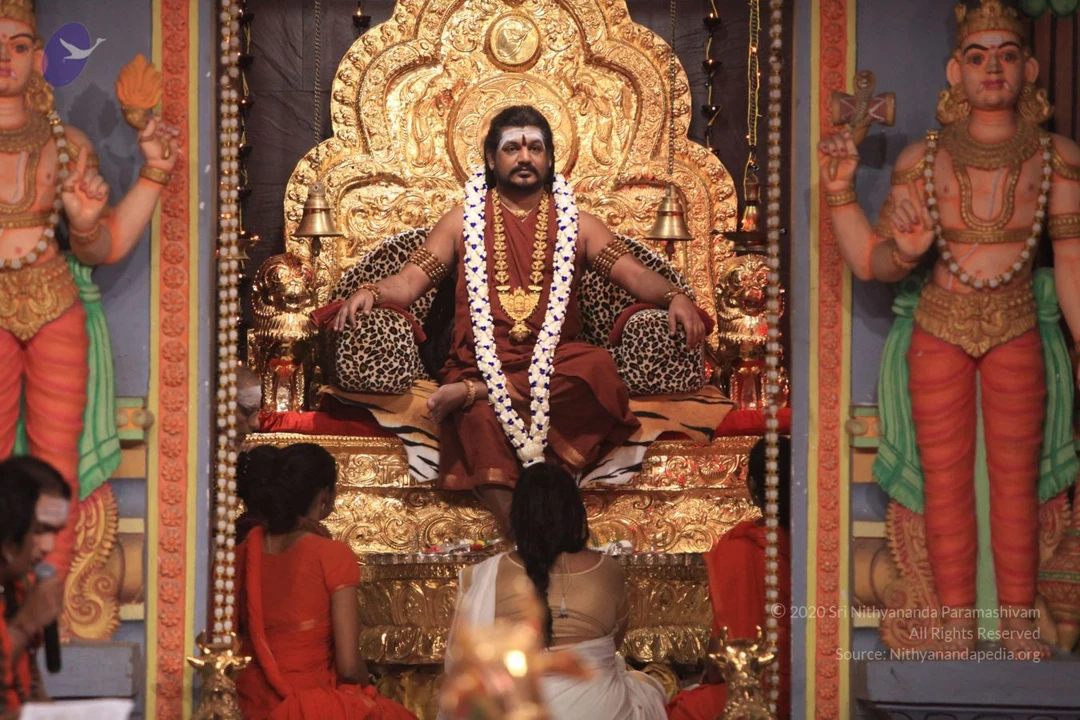
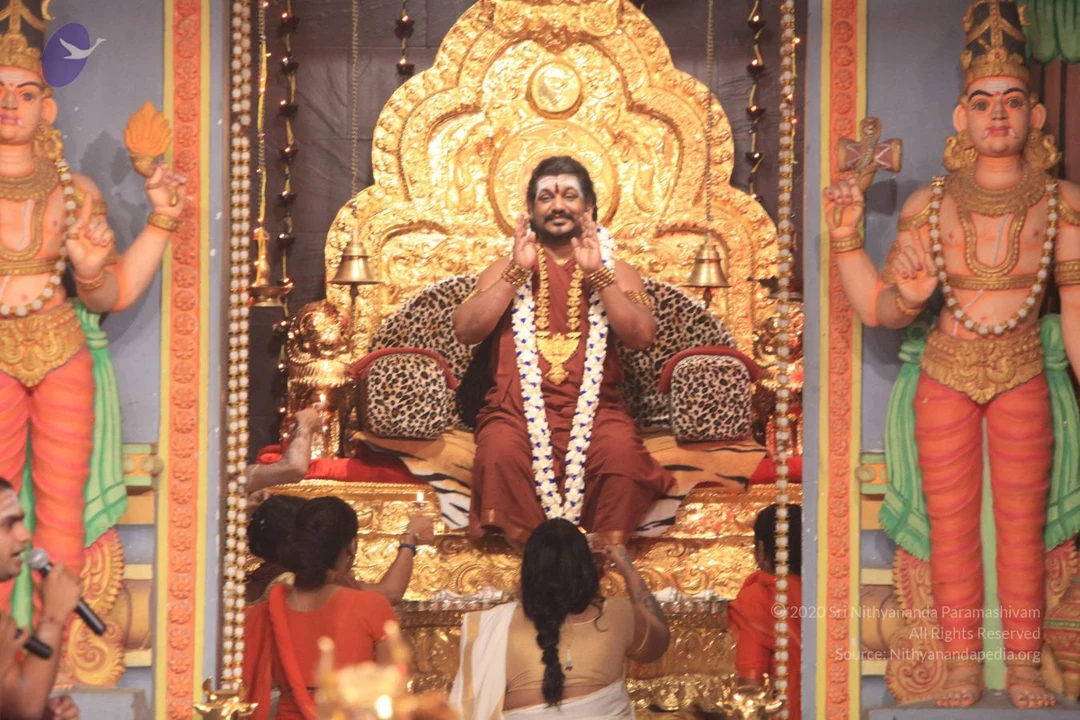
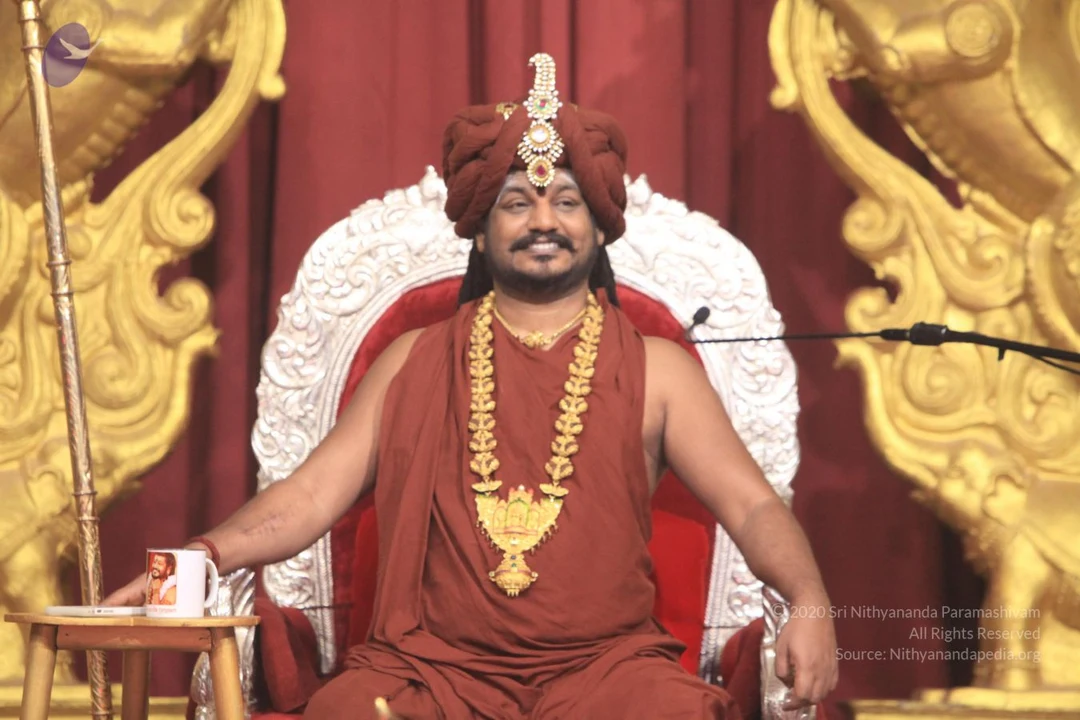
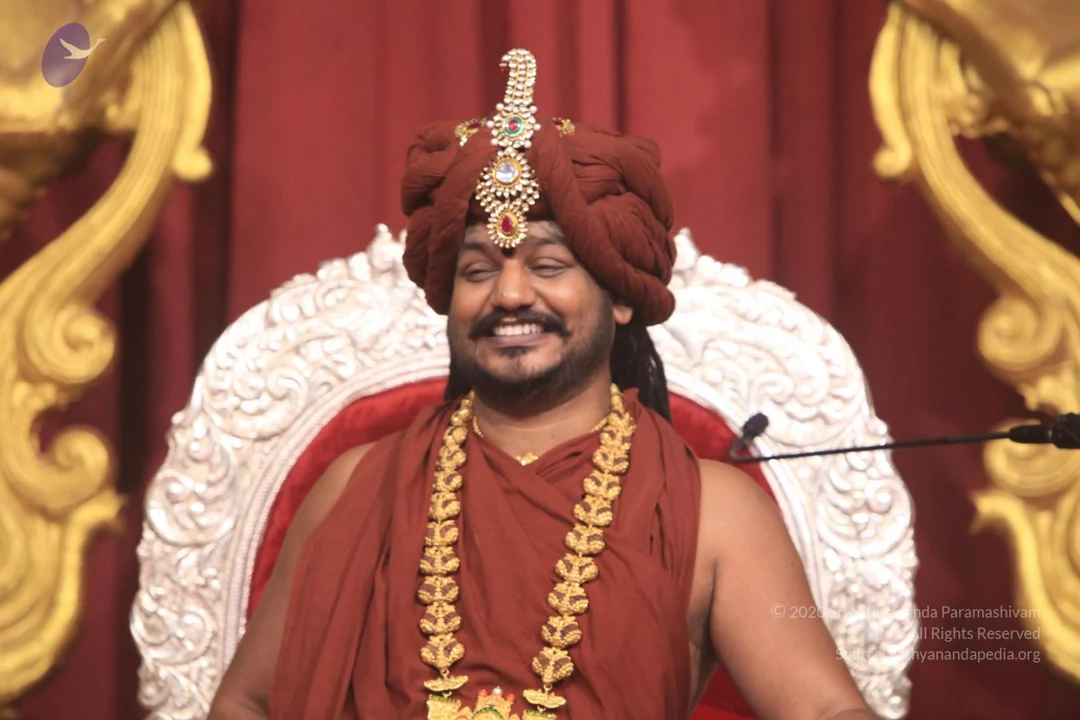
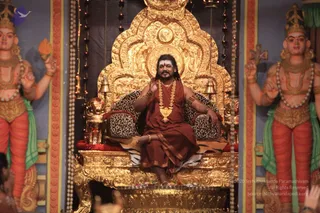
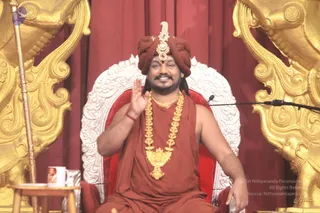
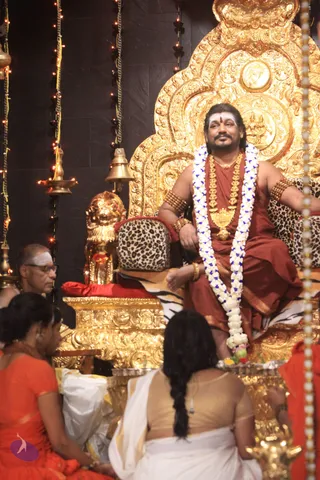
A man seated on an ornate gold throne with a leopard-print cushion and tiger-skin covering, wearing a rust-red robe, gold necklaces, a white and blue flower garland, and a tilak on his forehead, raising his palms in blessing. Two large painted guardian statues with crowns and orange-red dhotis flank the throne. Two women in orange and white saris kneel and sit at the base of the throne, one holding a microphone stand nearby, and an oil lamp and brass offerings sit in front. a person (appearance cues: rust-red robe, gold necklaces, garland, tilak, seated on throne).A smiling man sits on an ornate white and gold throne against a deep red drape, with gold scrollwork on both sides of the frame. He wears a rust-red turban decorated with a gold and jewelled ornament at the front, a rust-red shawl over a bare torso, and heavy gold multi-strand necklaces. A microphone stand is visible at right.

Pada-puja
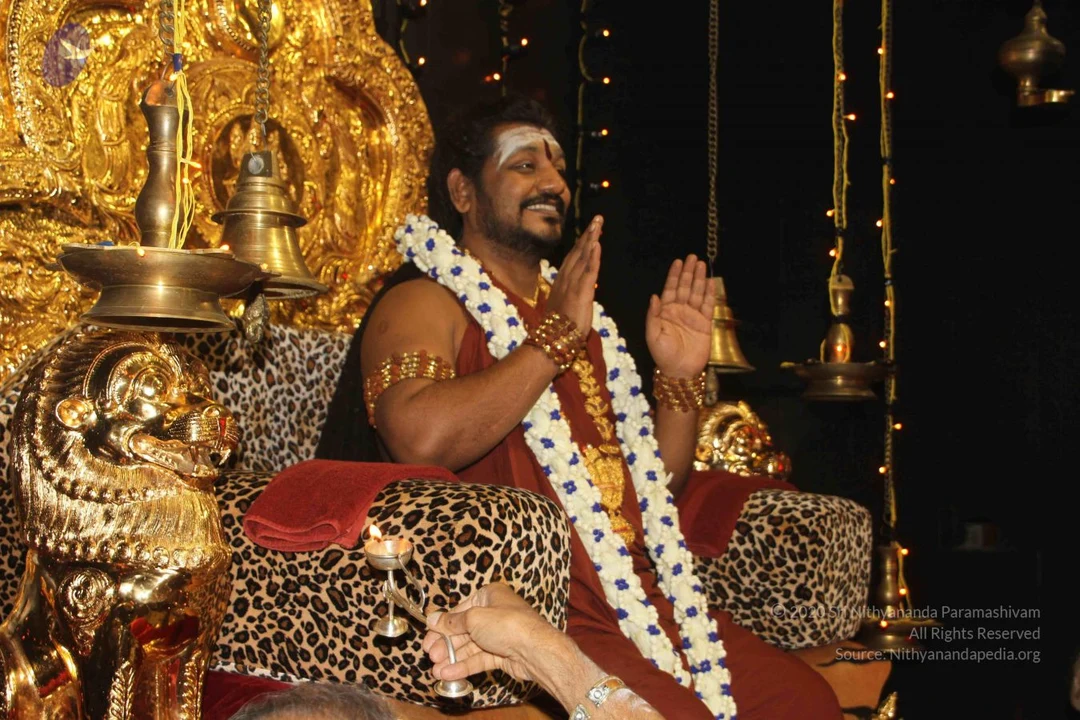
33 photosSource gallery
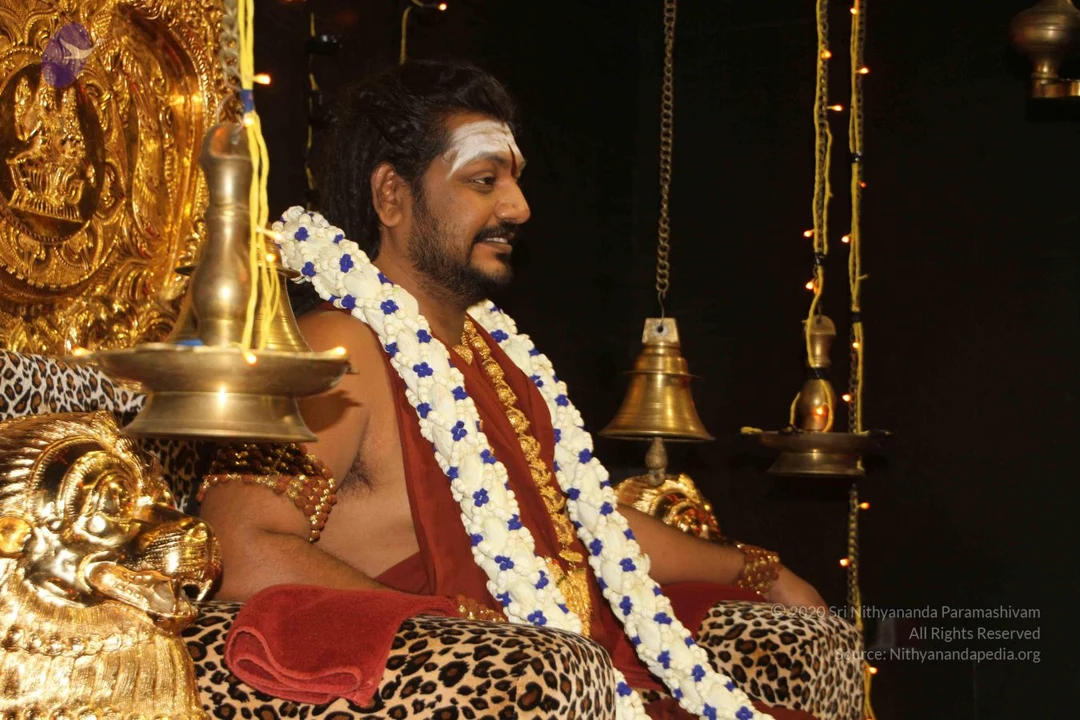
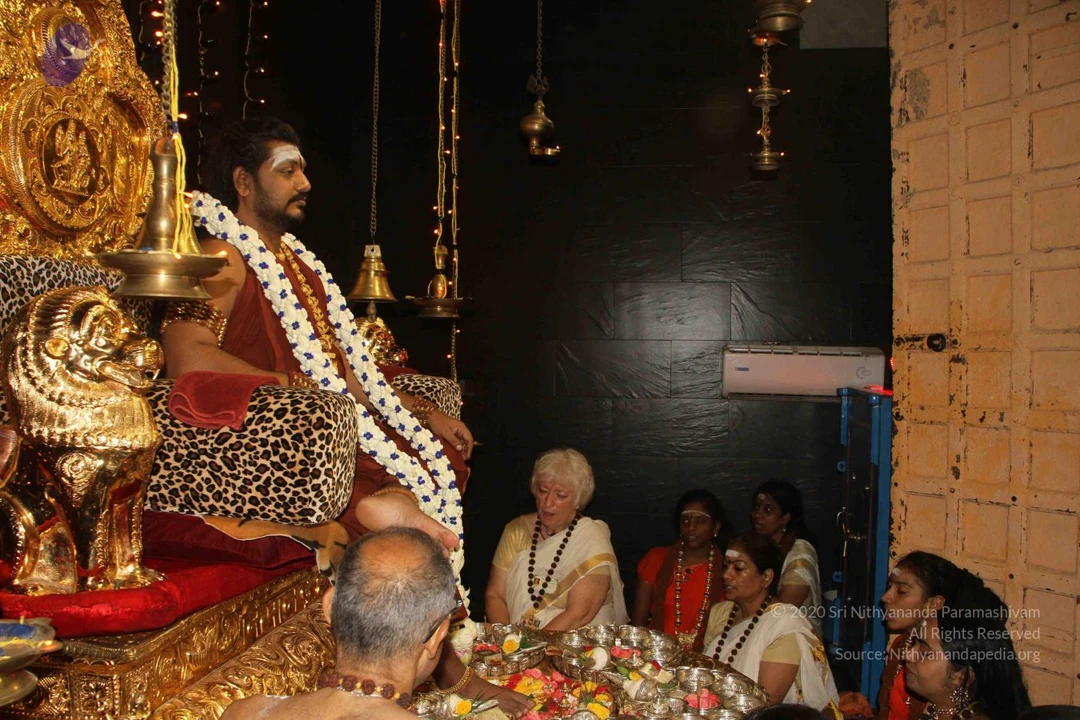
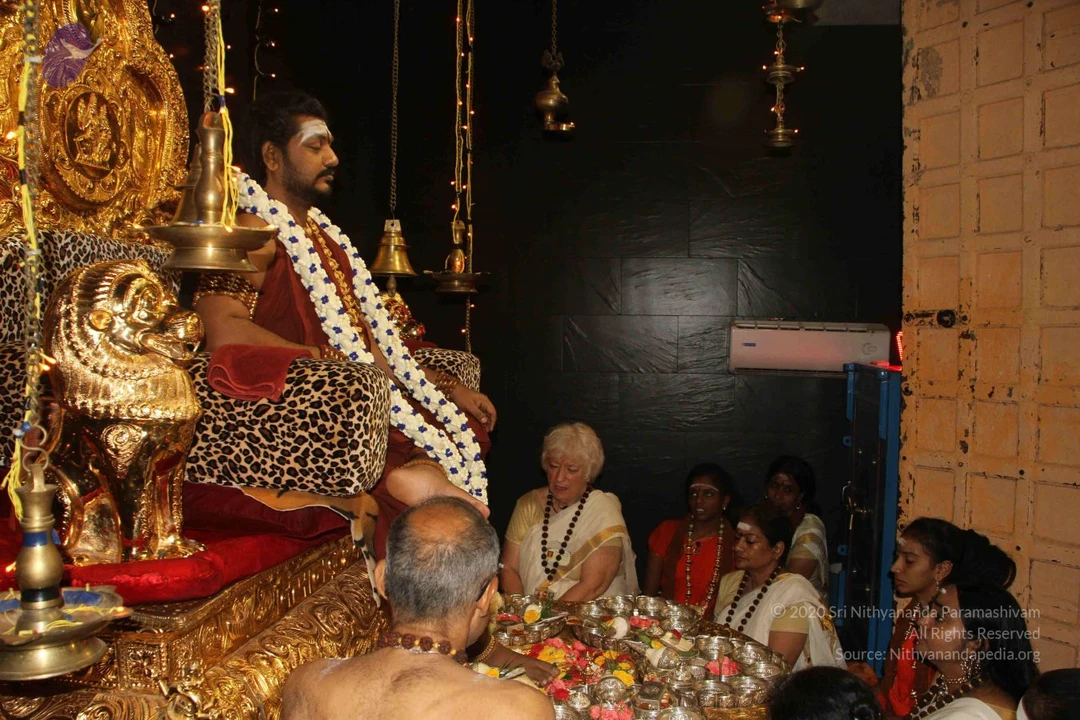
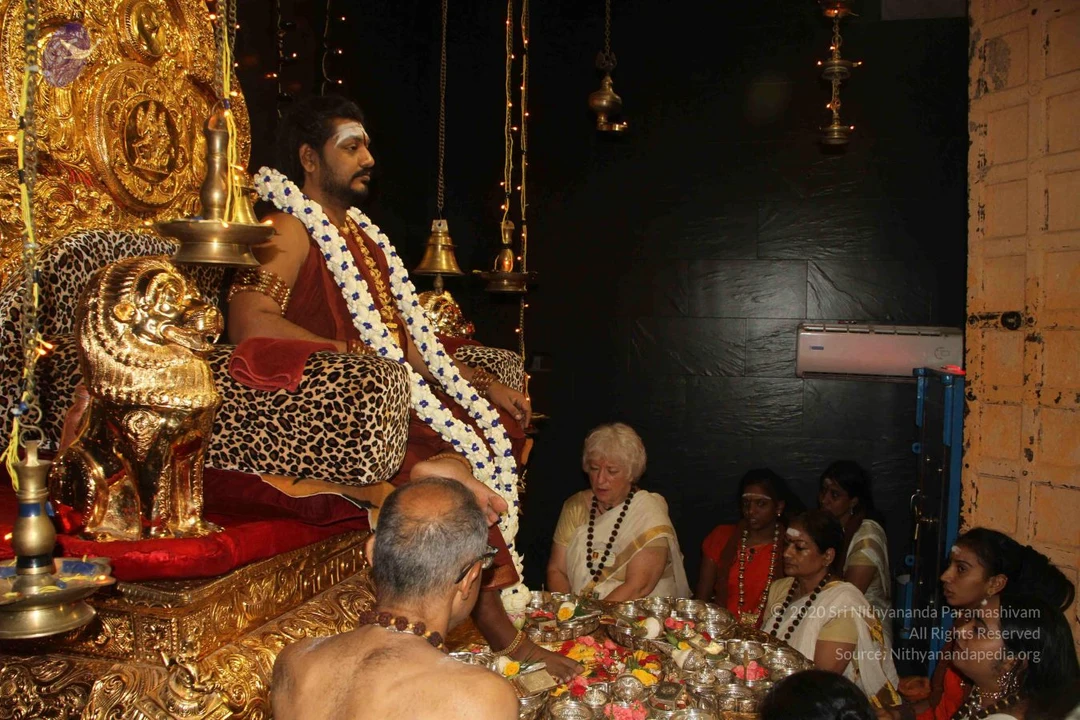
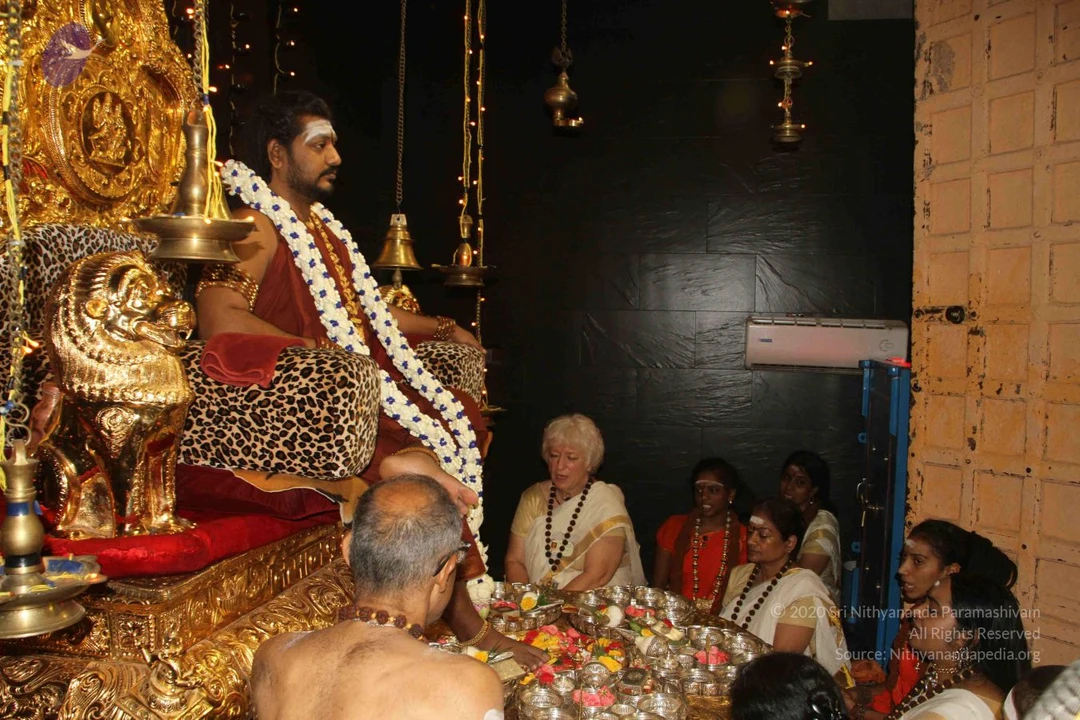
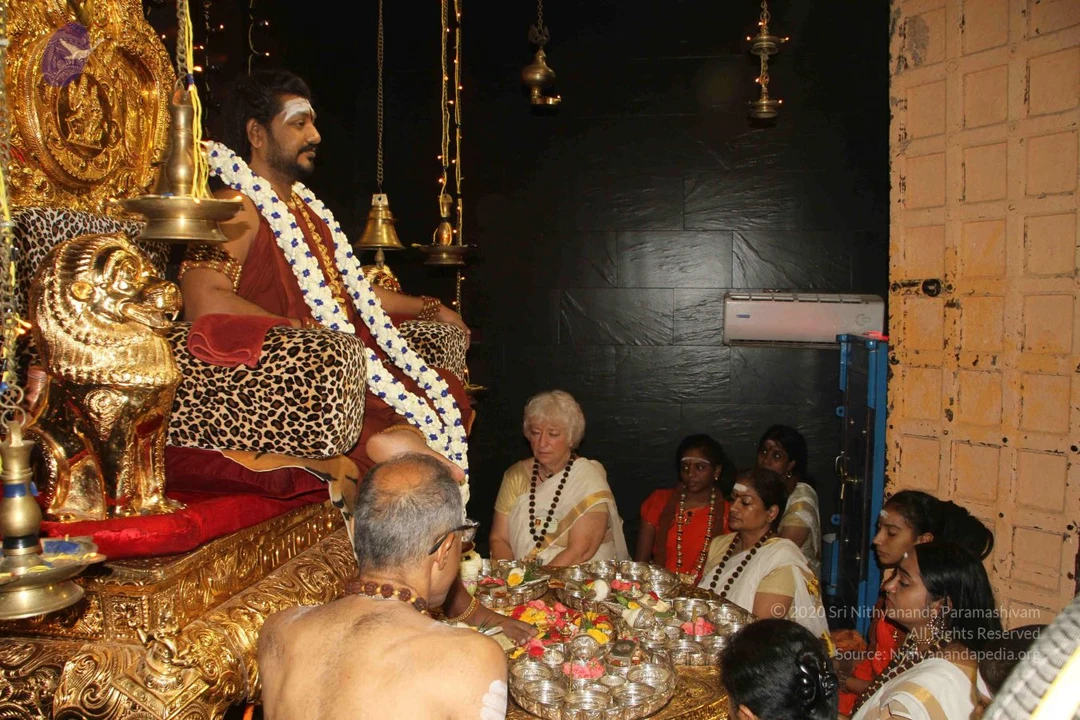
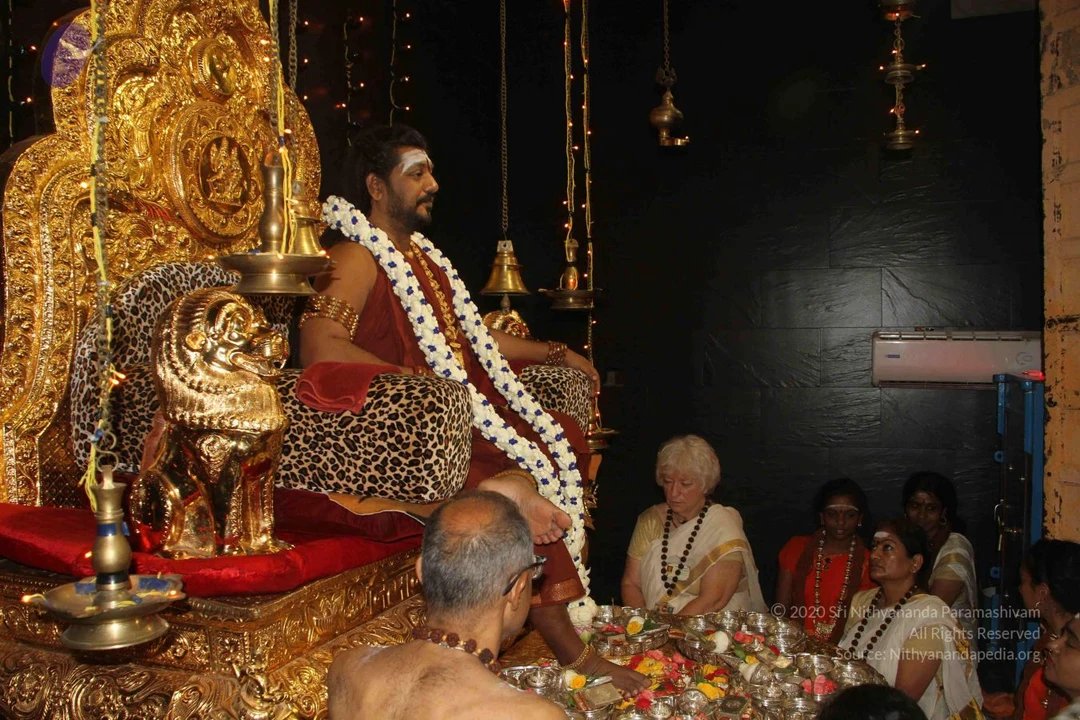
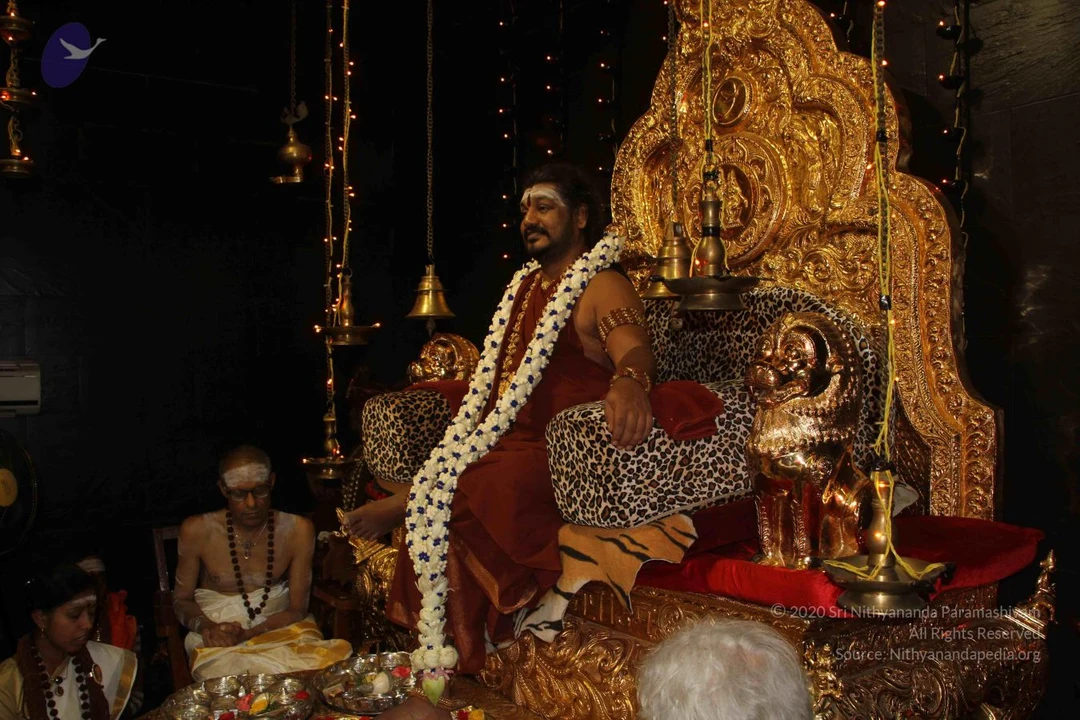
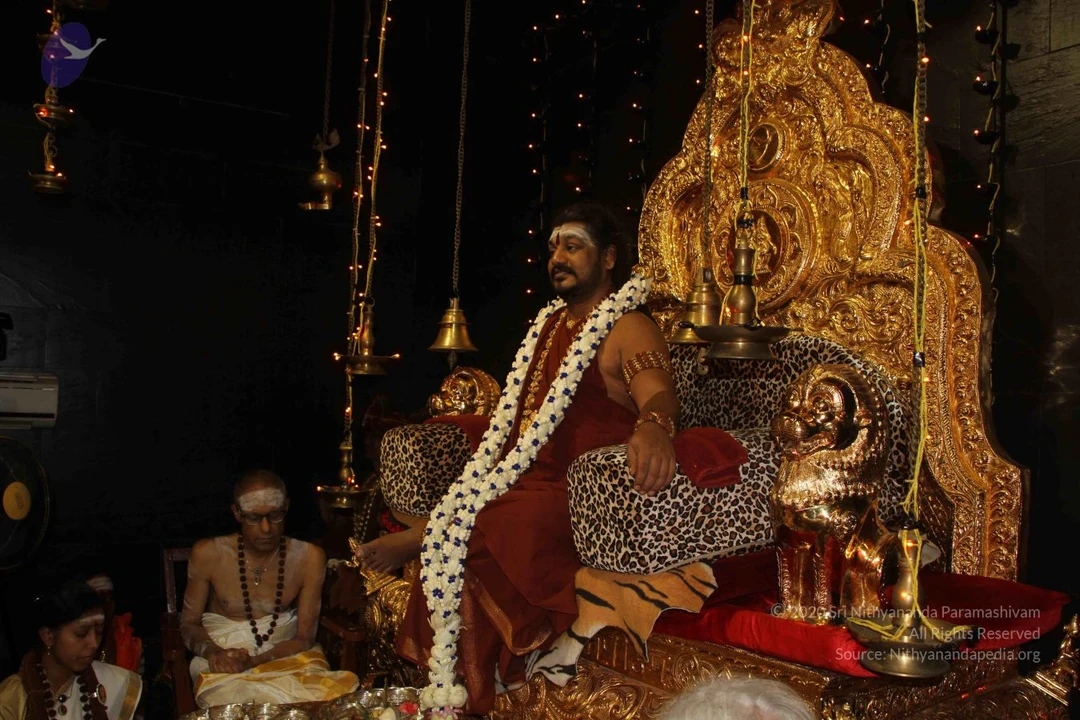
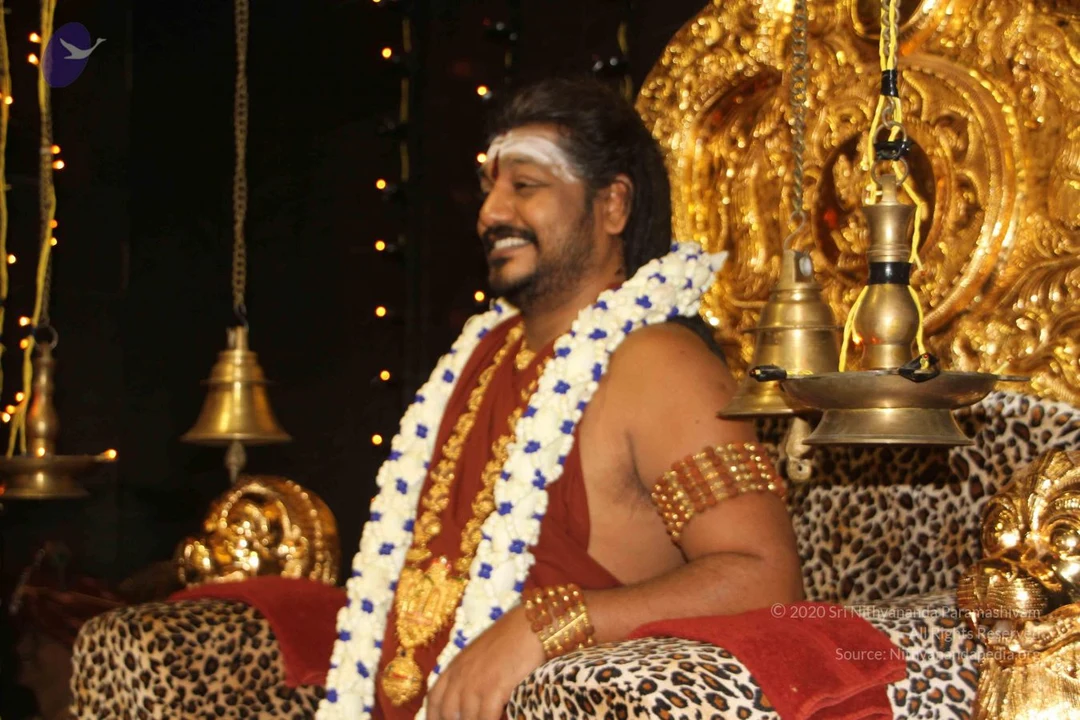
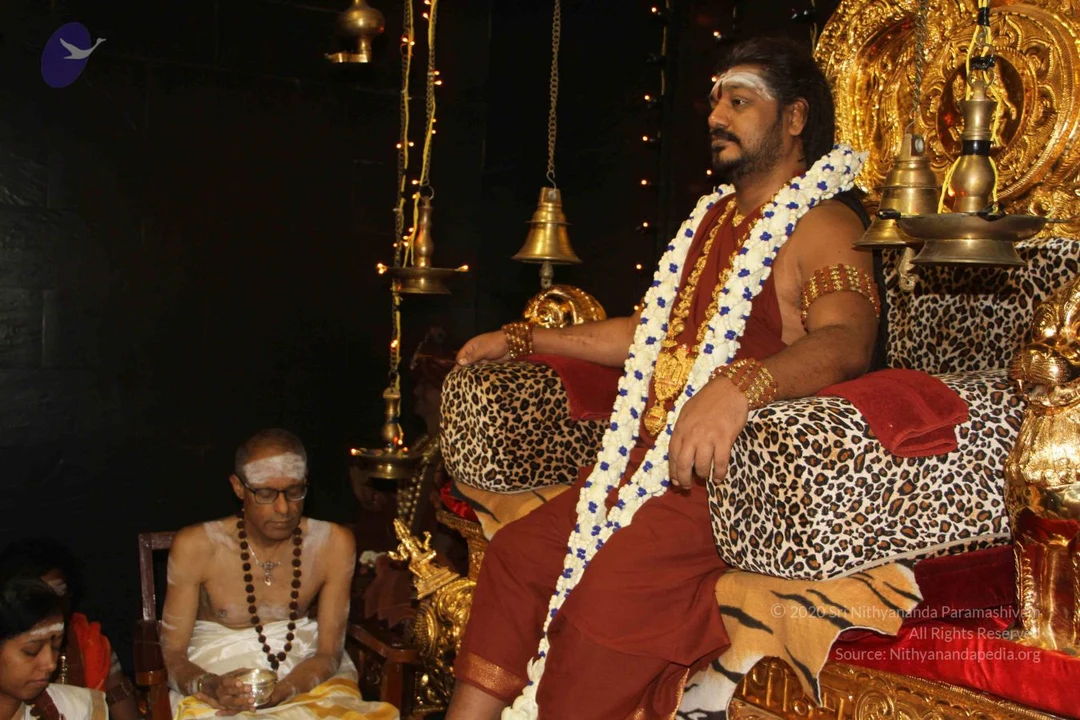
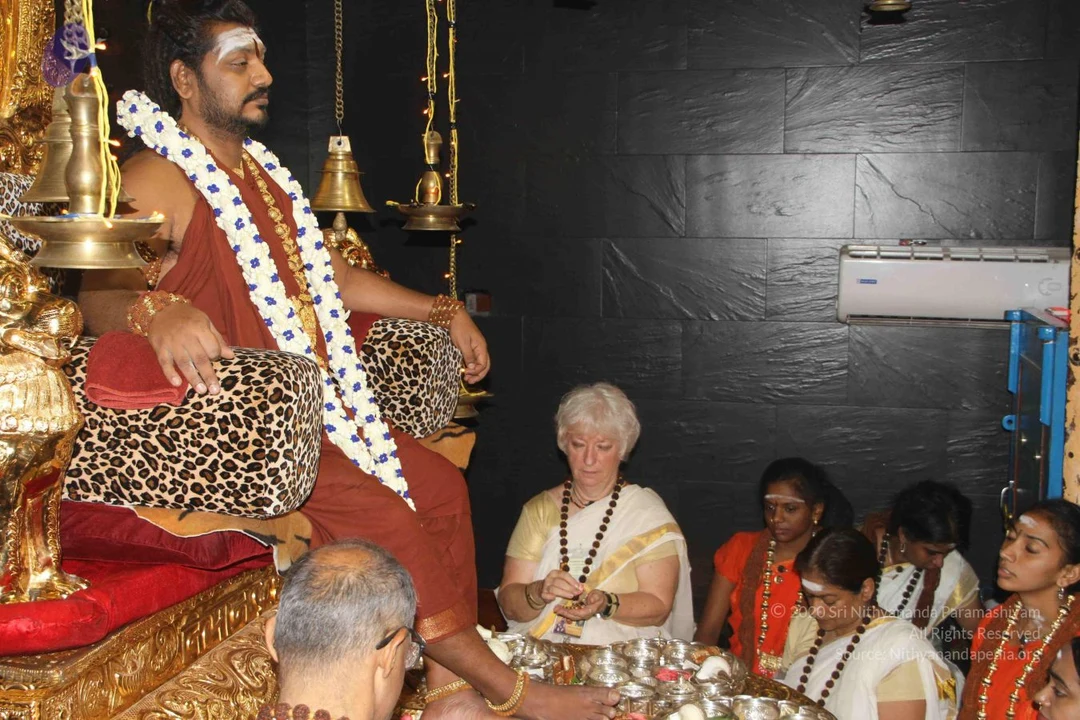
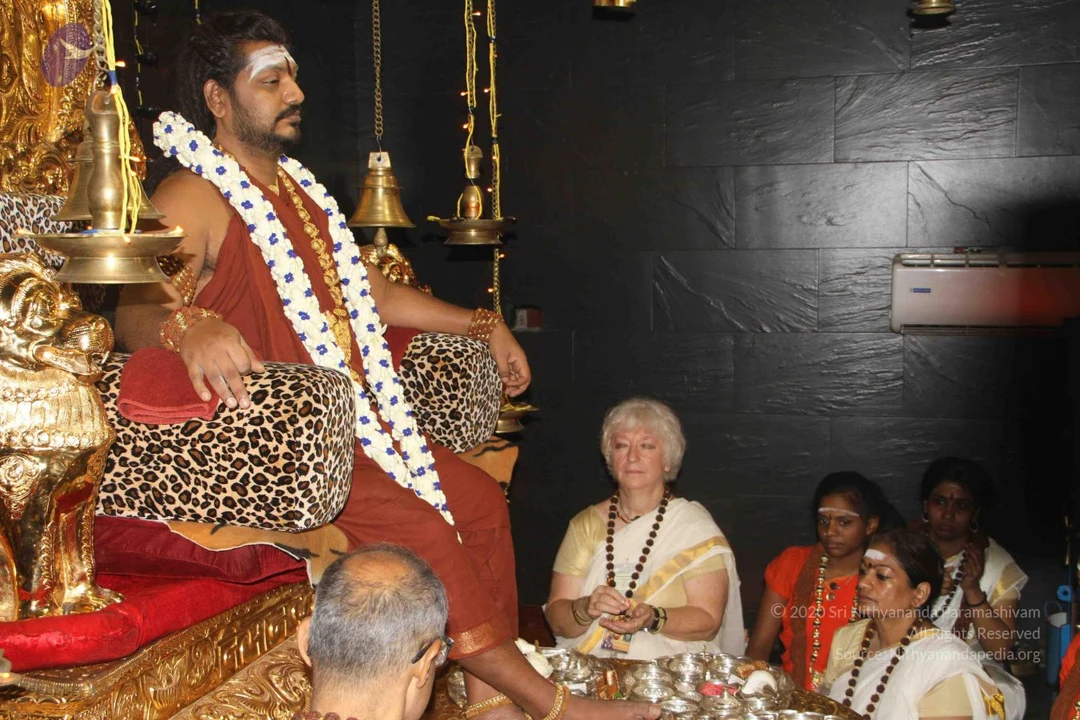
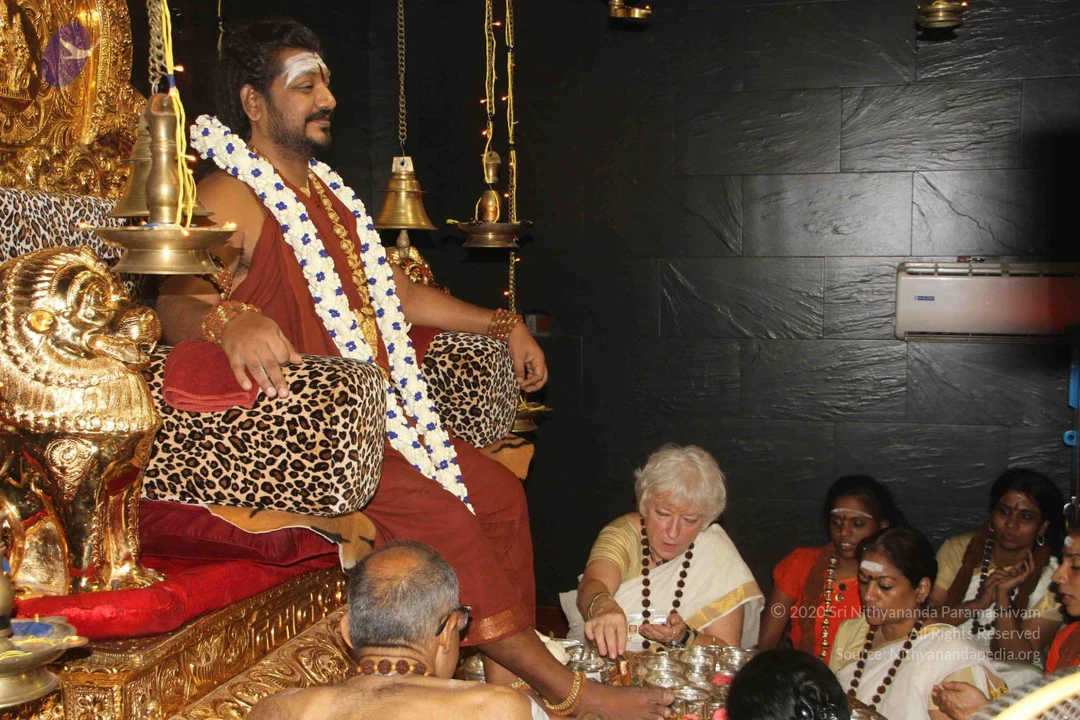
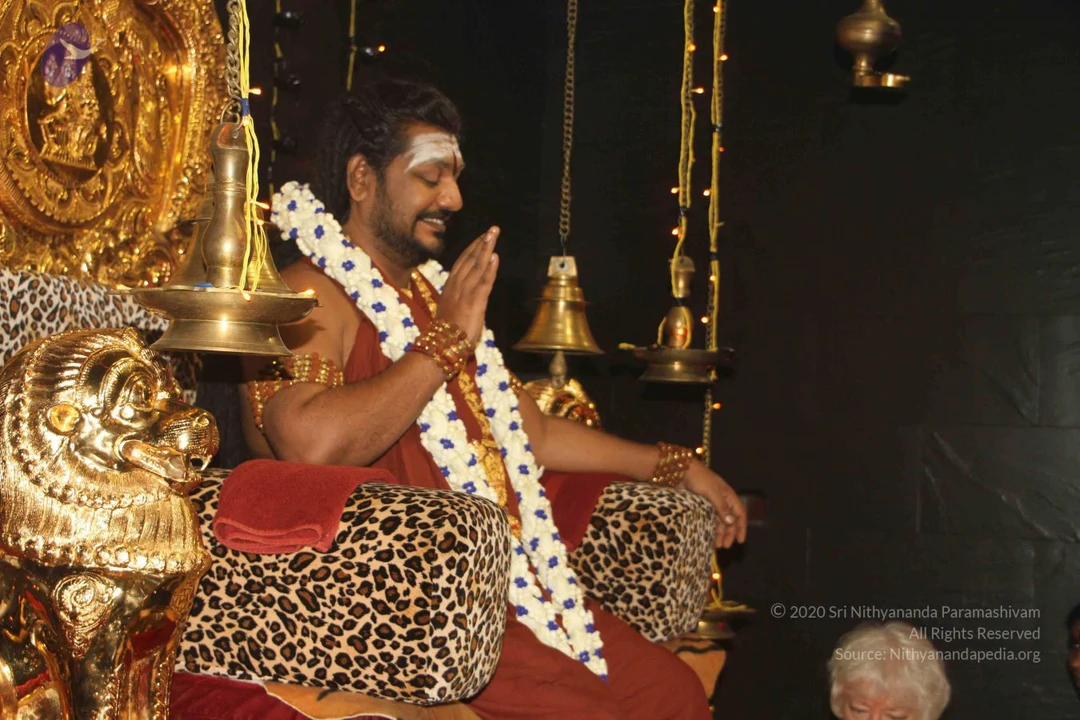
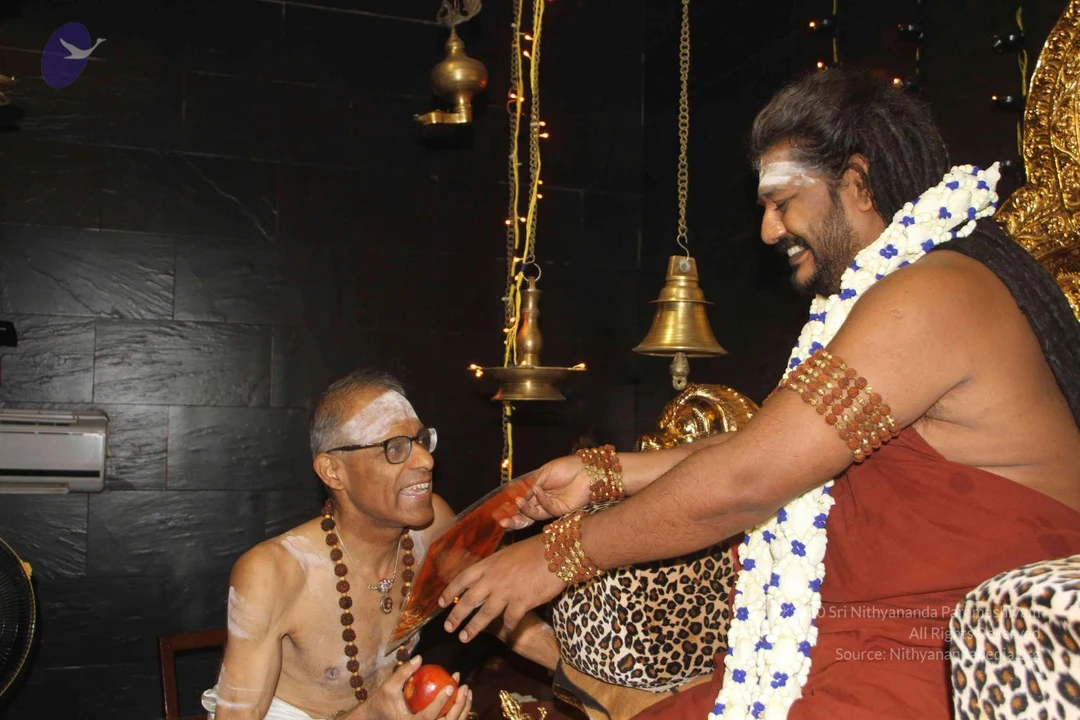
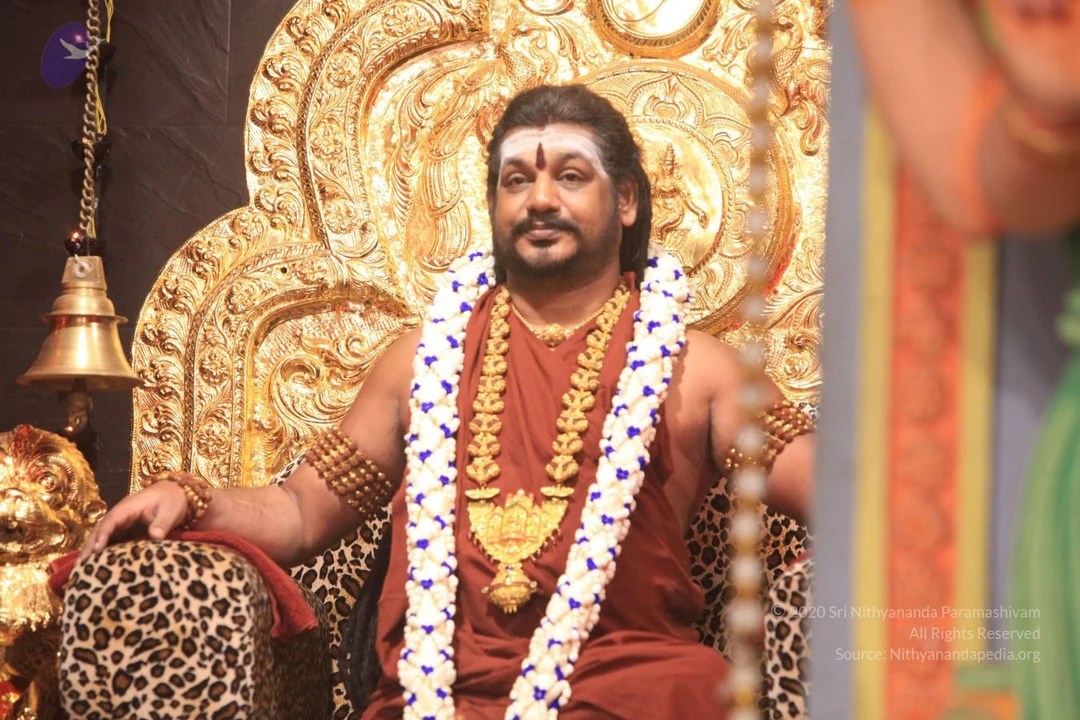
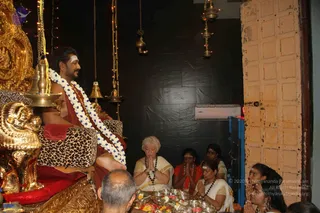
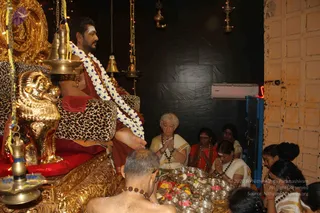
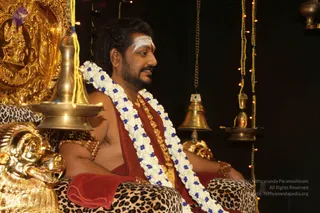
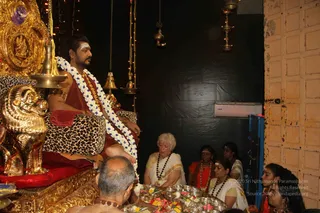
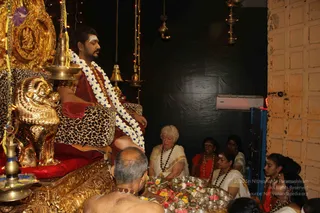
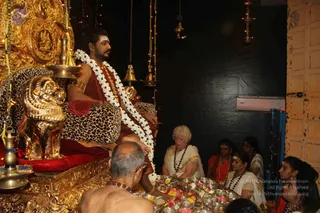
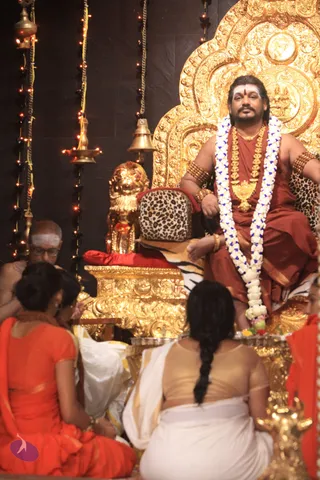
A photograph inside a temple-style room with black stone wall panels, hanging brass oil lamps and bells. A man with short dark hair and a white tilak on his forehead sits on a gilded throne with a leopard-print cushion, wearing a maroon-red robe and a long garland of white and blue flowers. Women in white and cream saris with red and orange blouses sit before him with palms pressed together in namaste, one holding a silver tray of flowers and offerings. A gold deity figure is partly visible at left. A devotee's head is in the lower foreground.Indoor ritual scene in a gold-trimmed shrine room. A man with a white tilak and a white-and-blue flower garland sits on a golden throne draped in leopard-print cushions and red cloth, with a gold lion figure beside him, and his left hand raised in blessing. Hanging brass oil lamps, bells and chains are above. Facing him, a shaved-headed priest in a bare-chested pose with rudraksha beads works at a large golden tray of brass vessels, flowers and offerings. Behind the tray, a white-haired woman in a cream sari and beaded necklace sits with palms pressed together, next to a woman in a red sari and a woman in cream. Several other women in saris kneel at the right edge. Walls are dark tiled, with an air conditioner on the right.A man seated on an ornate golden throne with leopard-print cushions and a golden lion-head armrest, smiling to the side. He wears a white vibhuti line on his forehead, a red-maroon shawl draped over his shoulders and a long white-and-blue flower garland, with a gold necklace and gold armlets. Behind him hangs a brass bell on a chain and brass oil lamps stand beside the throne, with a strand of small lights and a golden relief panel in the background. The setting suggests a darshan or discourse setting.A seated figure on a golden throne with a leopard-print cushion and gold lion armrest, wearing a deep red-brown robe, a long white and blue flower garland, a gold necklace and a white forehead mark. Beside him on the throne is a brass oil lamp. In front, a man with a shaved head in white ritual dress and rudraksha beads offers puja, with a tray of brass bowls holding flowers and offerings. Three women sit on the floor in white saris and rudraksha malas, two with red and white forehead marks, with a woman in orange at right. Brass bells and lamps hang on chains against a black wall with a white wall-mounted air conditioner.Indoor puja scene before a gilded throne with a carved lion-form armrest and leopard-print cushions. A seated man in a maroon robe with white flower garland and saffron-toned shawl, with white tilak on forehead, sits with eyes closed. Before him, a priest with bare upper body kneels at a tray of brass bowls holding flowers and offerings. A woman in white sari with rudraksha mala watches, with other women in orange and red blouses seated nearby. Hanging brass lamps and bells surround the throne. Watermarked archive photo.A seated man in a golden ornate throne with leopard-print cushions wears a maroon-red robe, white and blue-white flower garland, gold necklace and gold bangles, with a white horizontal forehead mark. A gold lion-form arm rest is at his left. Before him a bald, bare-backed priest in a white dhoti bends over a row of silver bowls and brass plates heaped with flowers, fruit and offerings. A woman with white hair in a white sari and rudraksha mala kneels with hands near the offerings; beside her women in red and white saris with rudraksha malas sit watching. Hanging brass oil lamps and bells hang from the ceiling, a golden deity relief appears on the throne back, and a dark slate wall with a wall air conditioner behind. Ritual puja setting with a seated figure in a dedicated ceremonial space.

Padha-puja
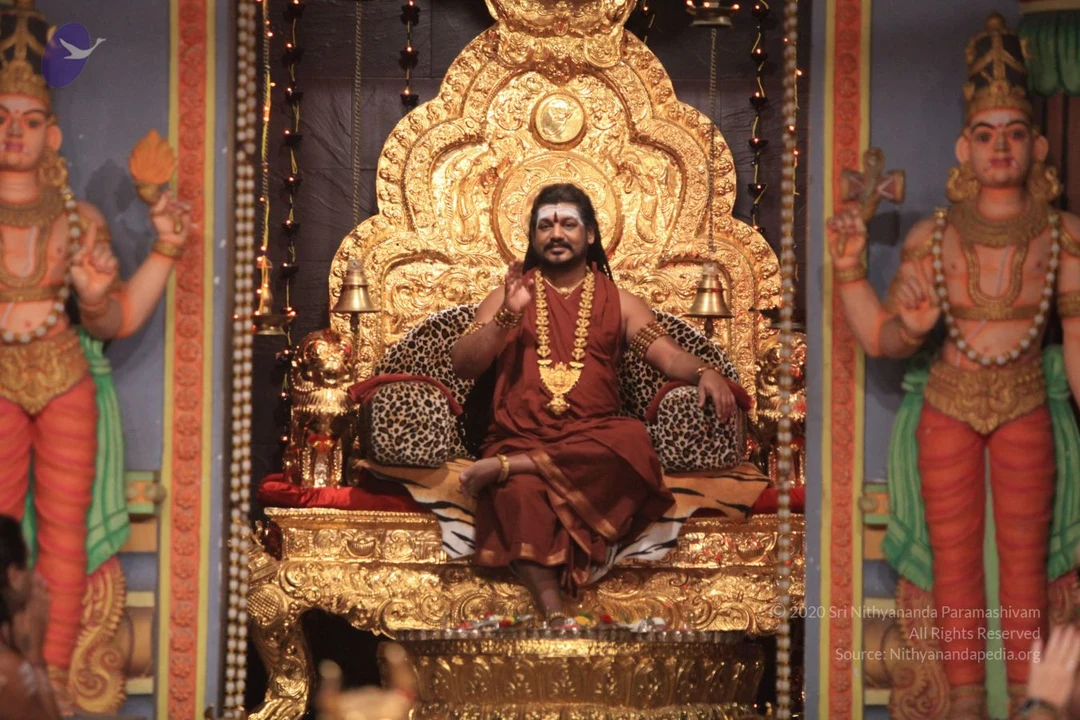
24 photosSource gallery
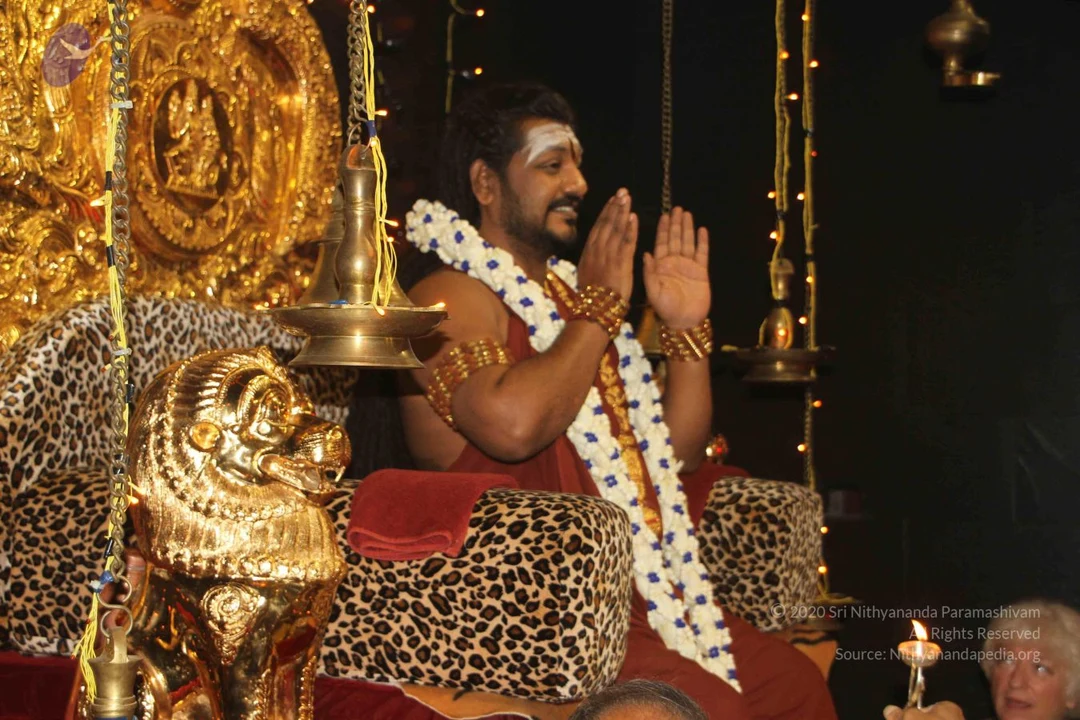
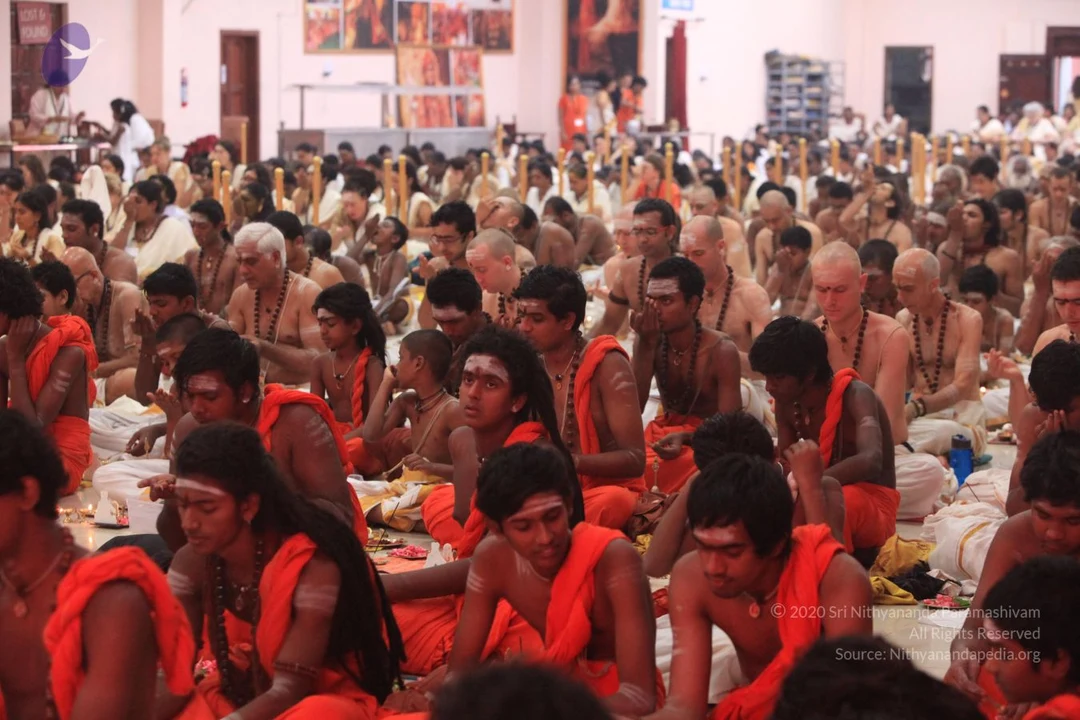
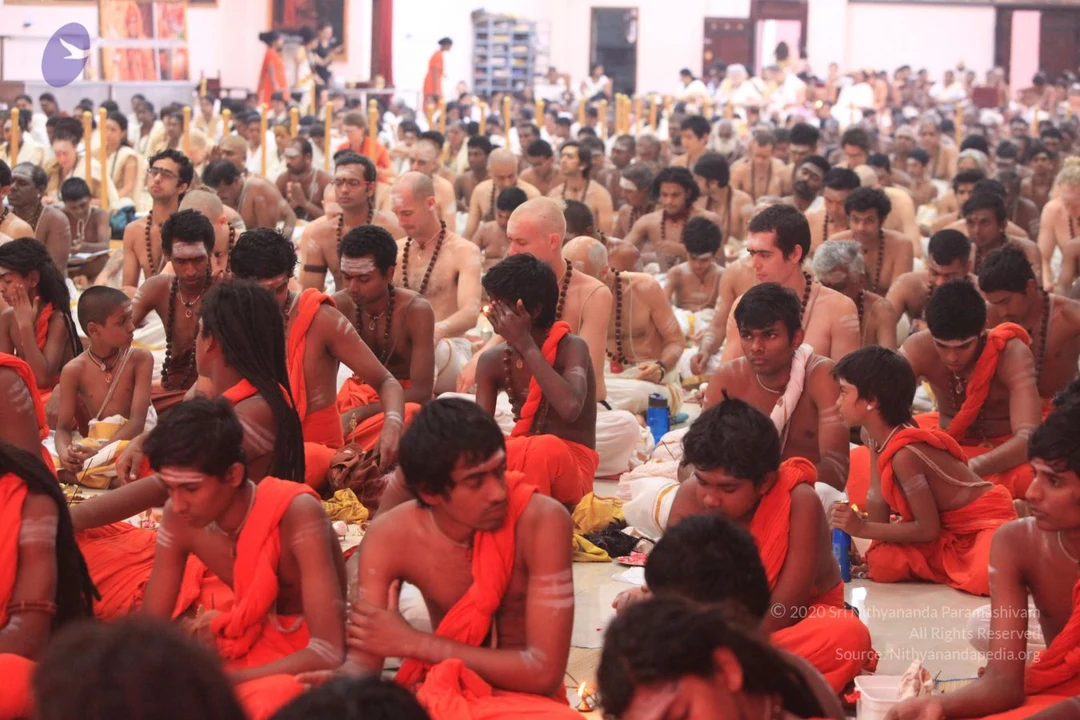
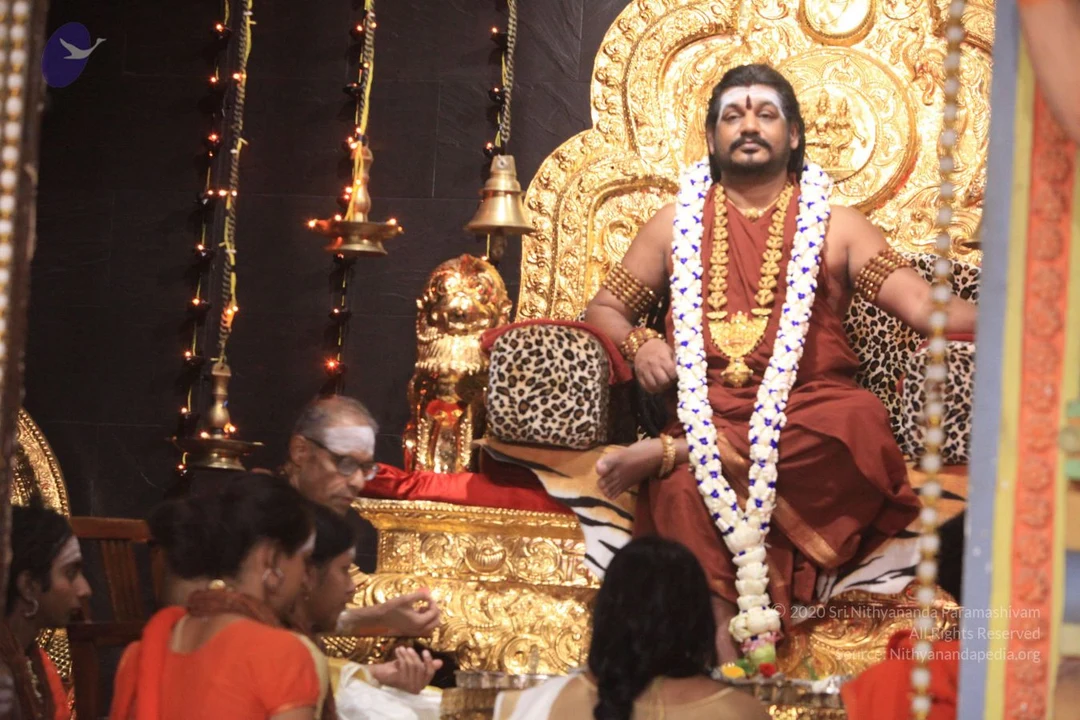
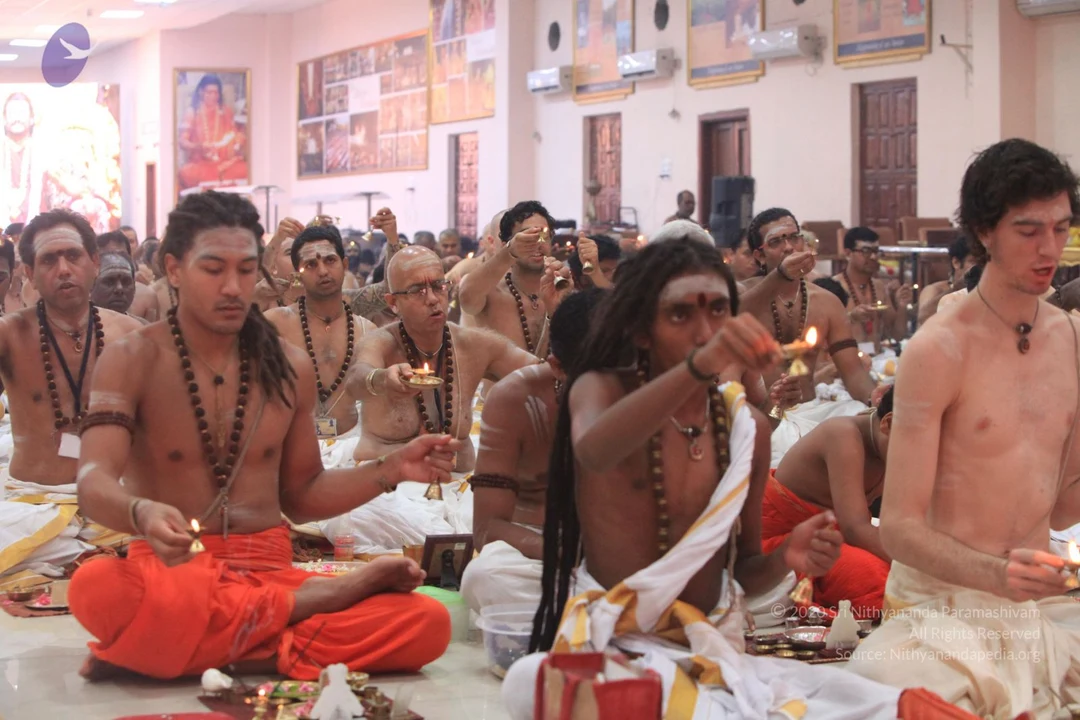
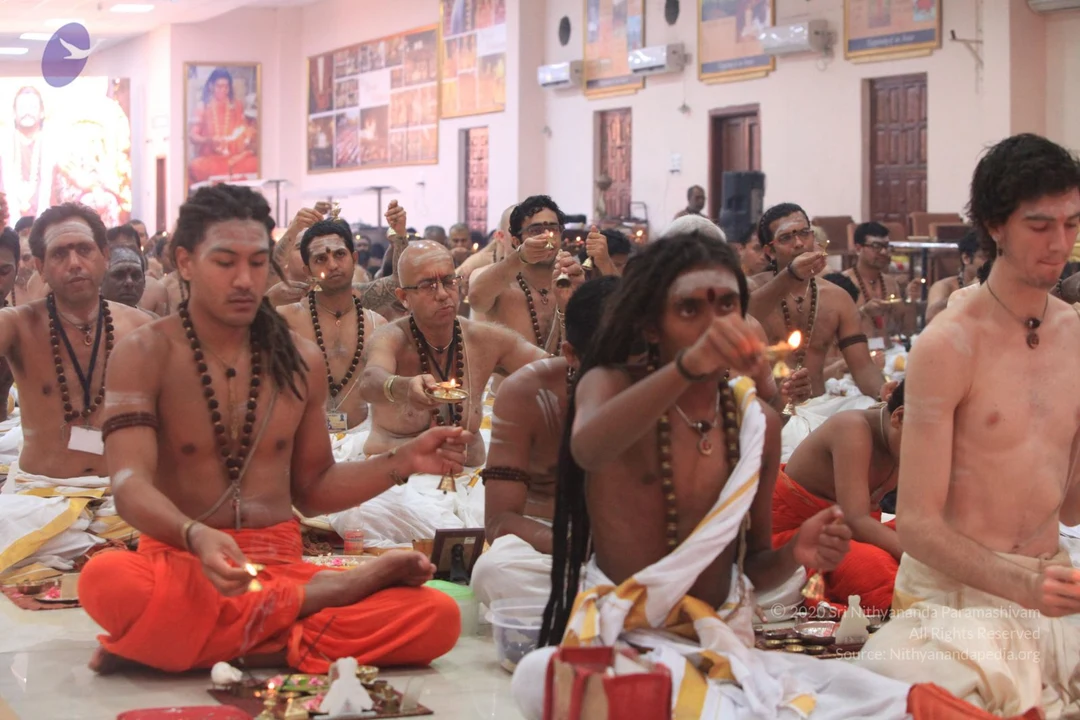
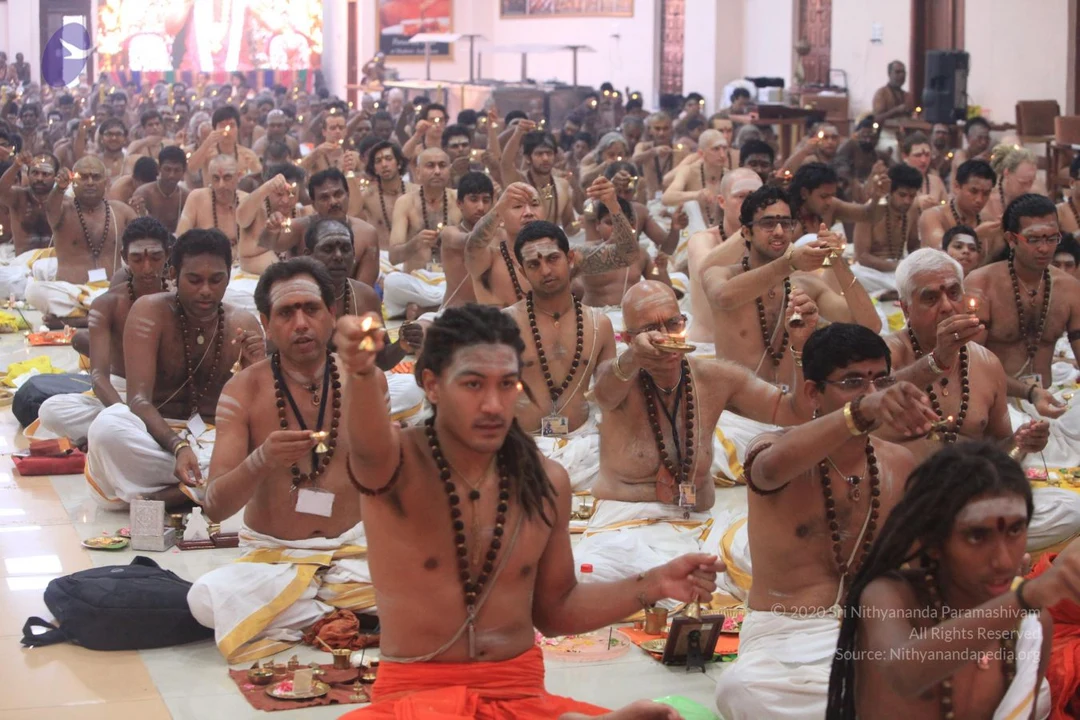
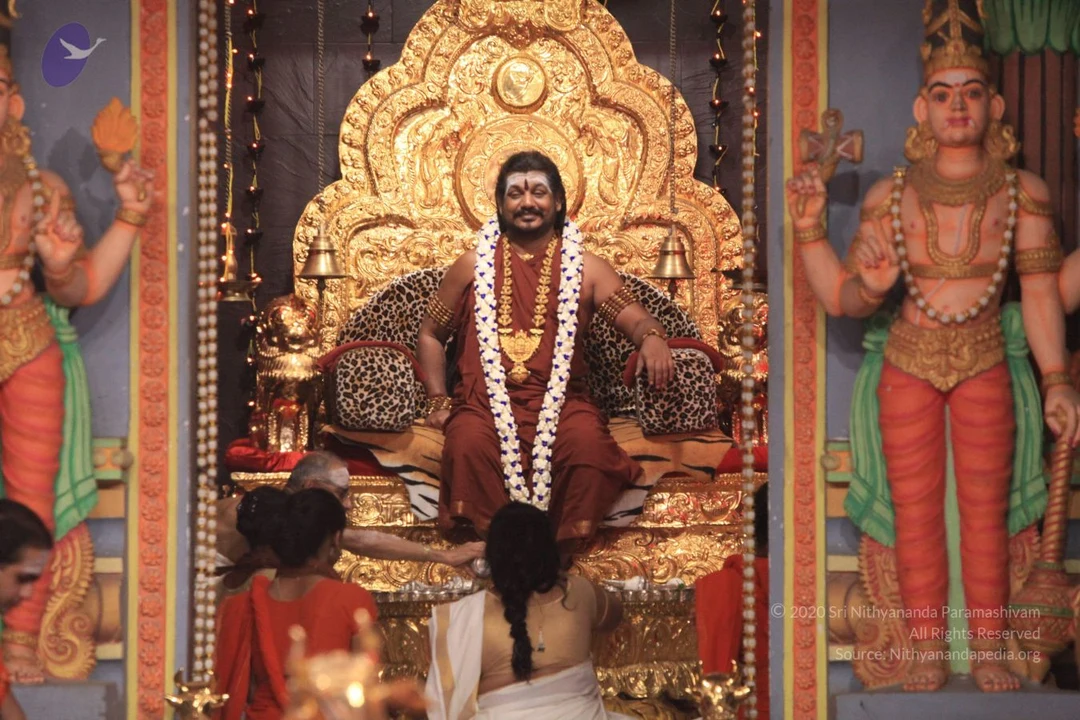
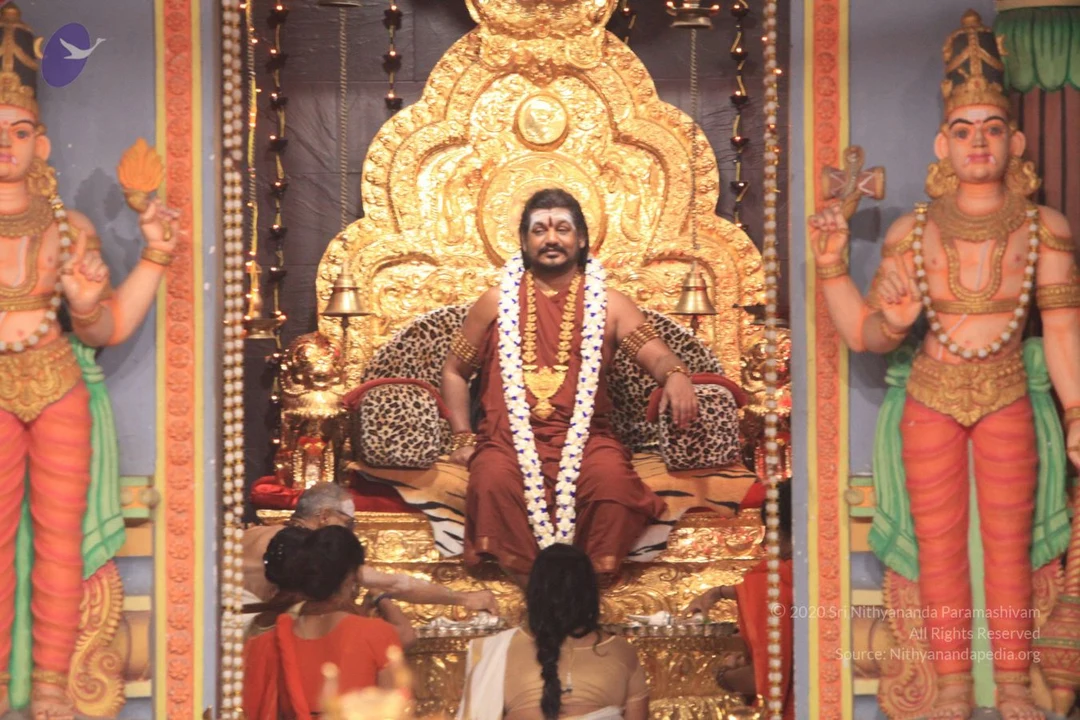
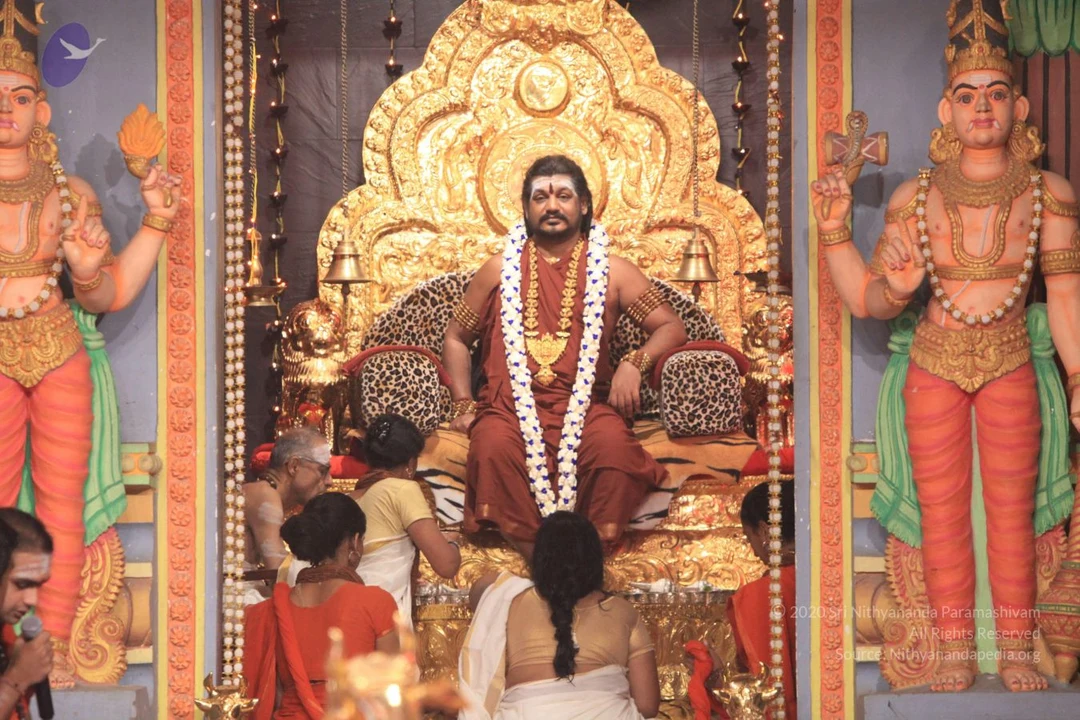
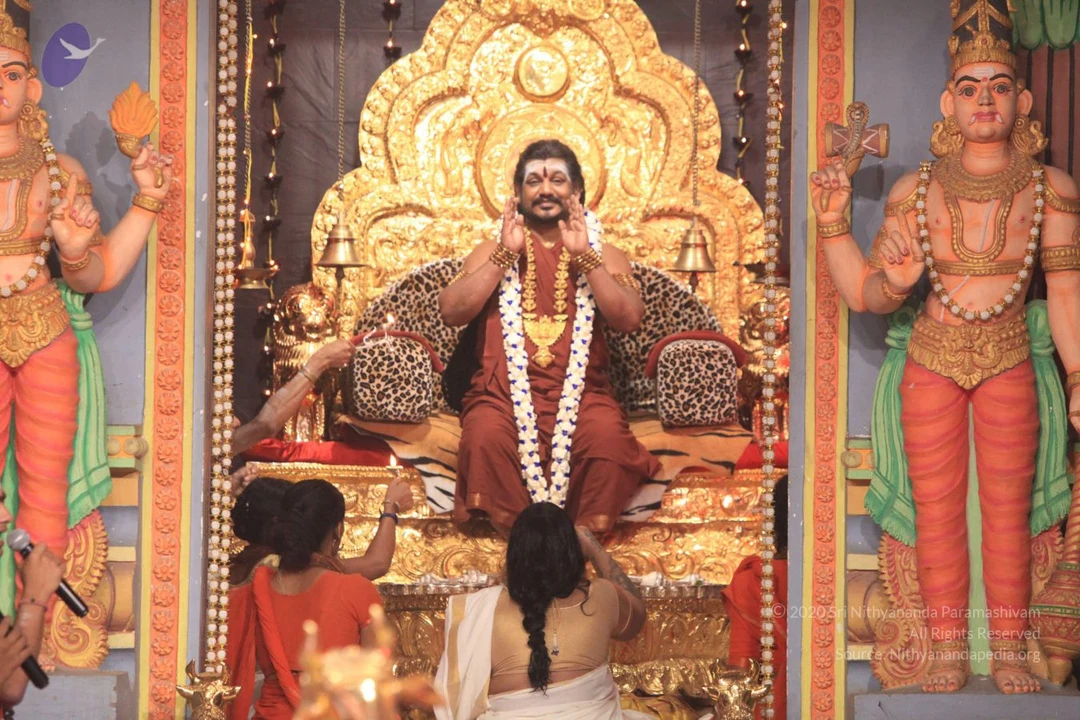
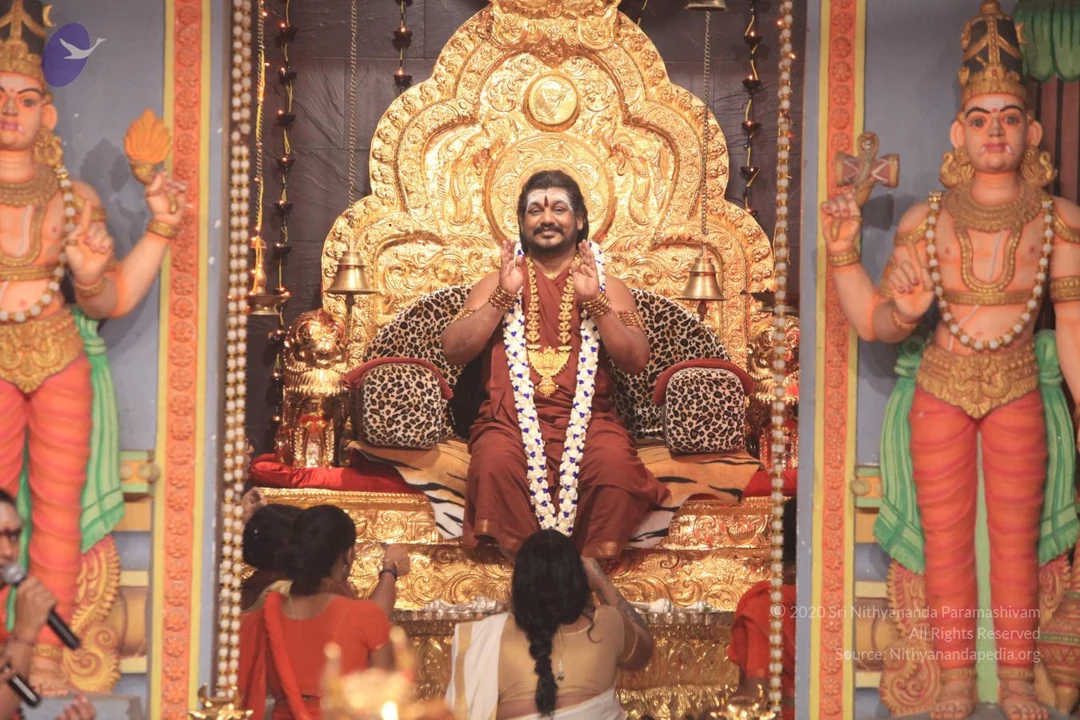
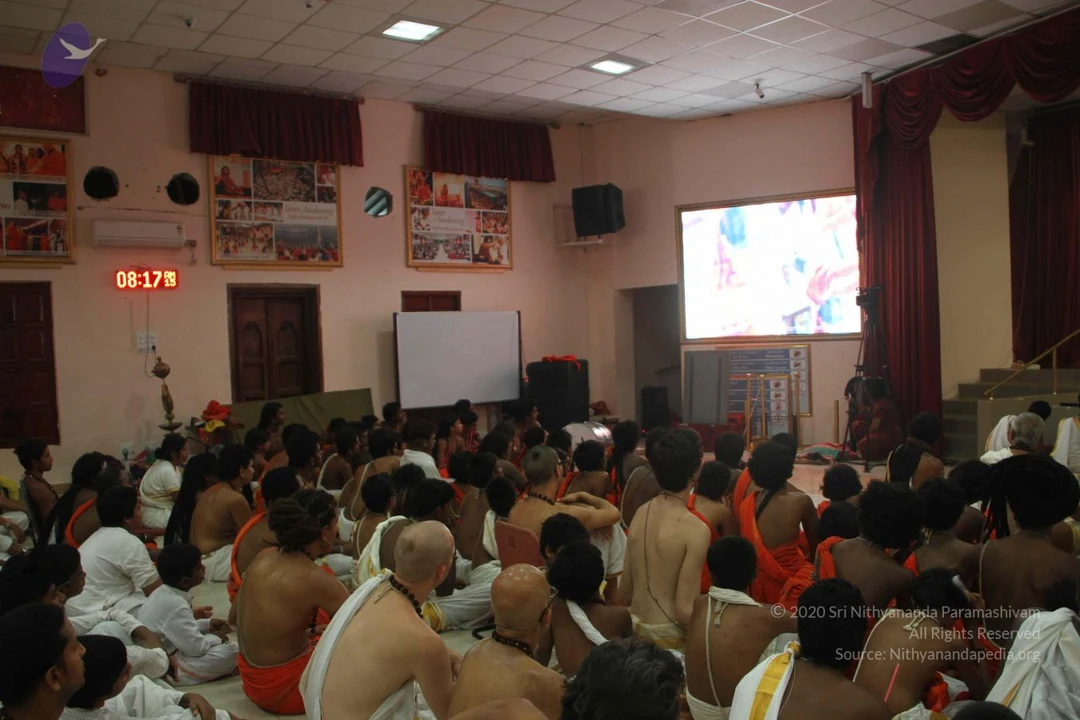
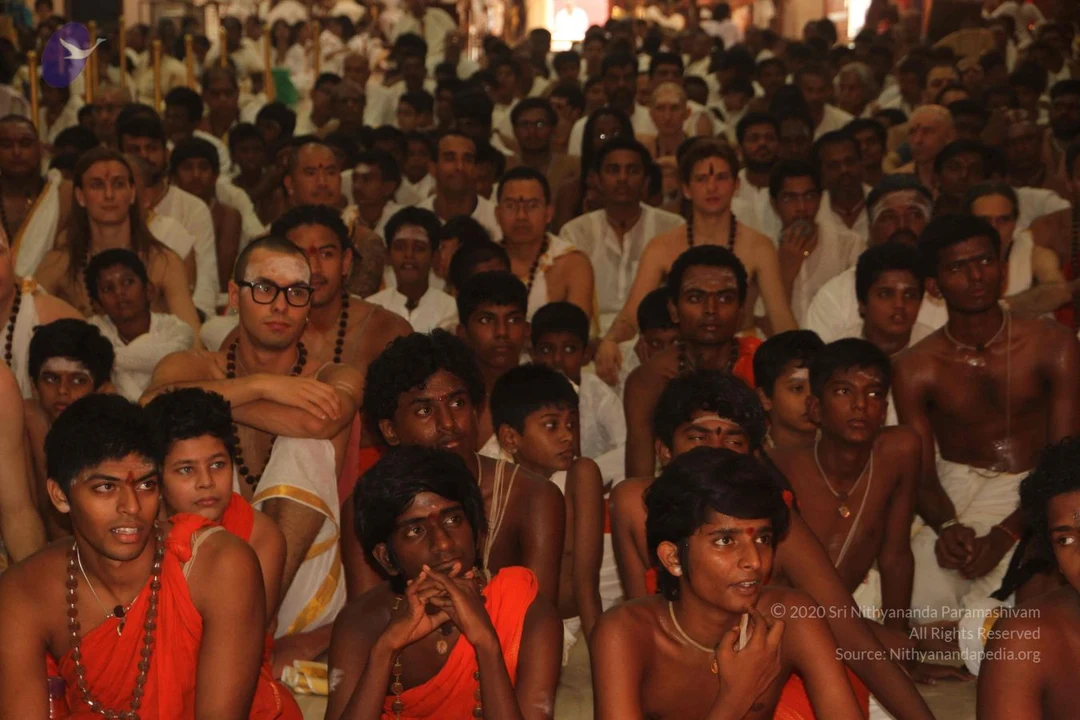
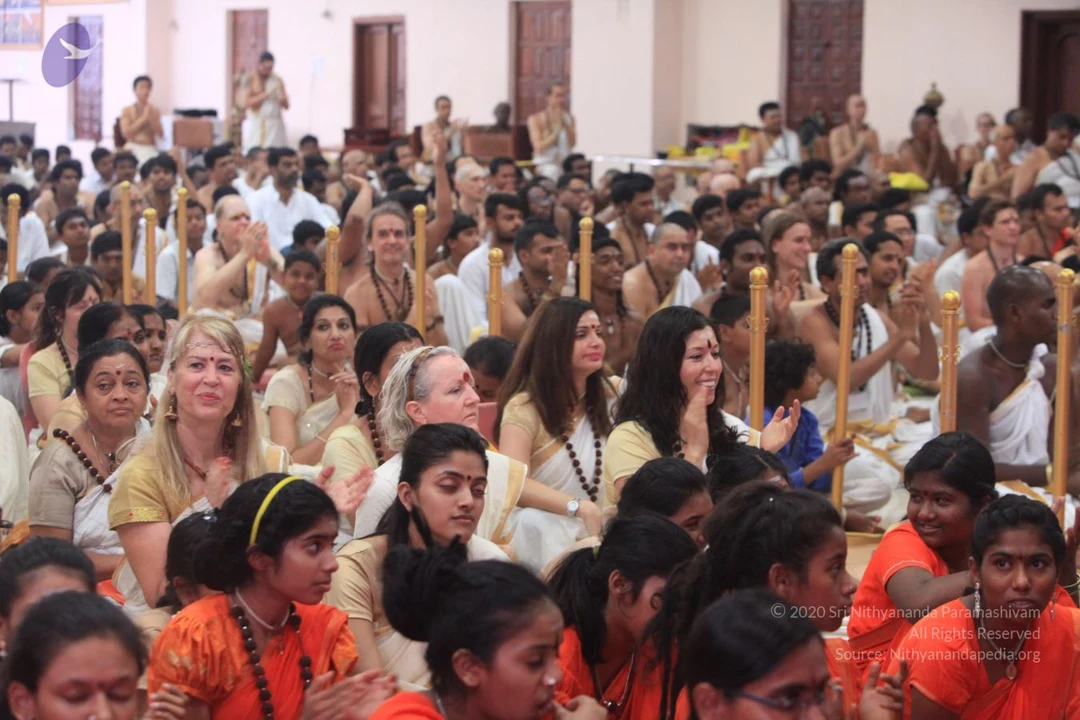
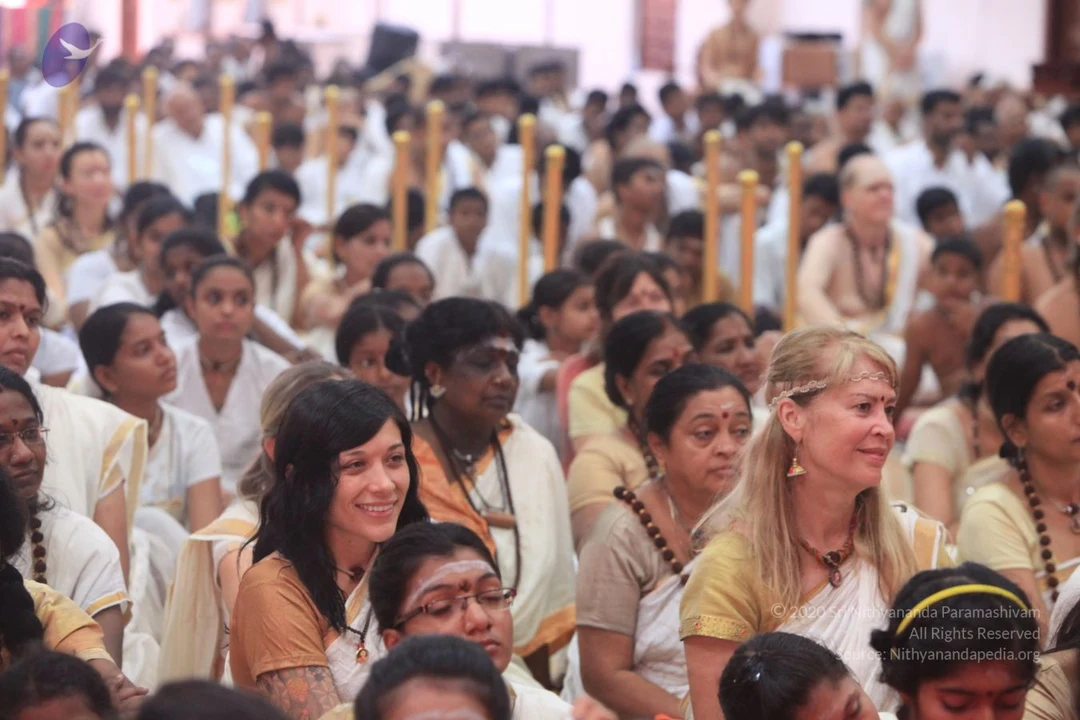
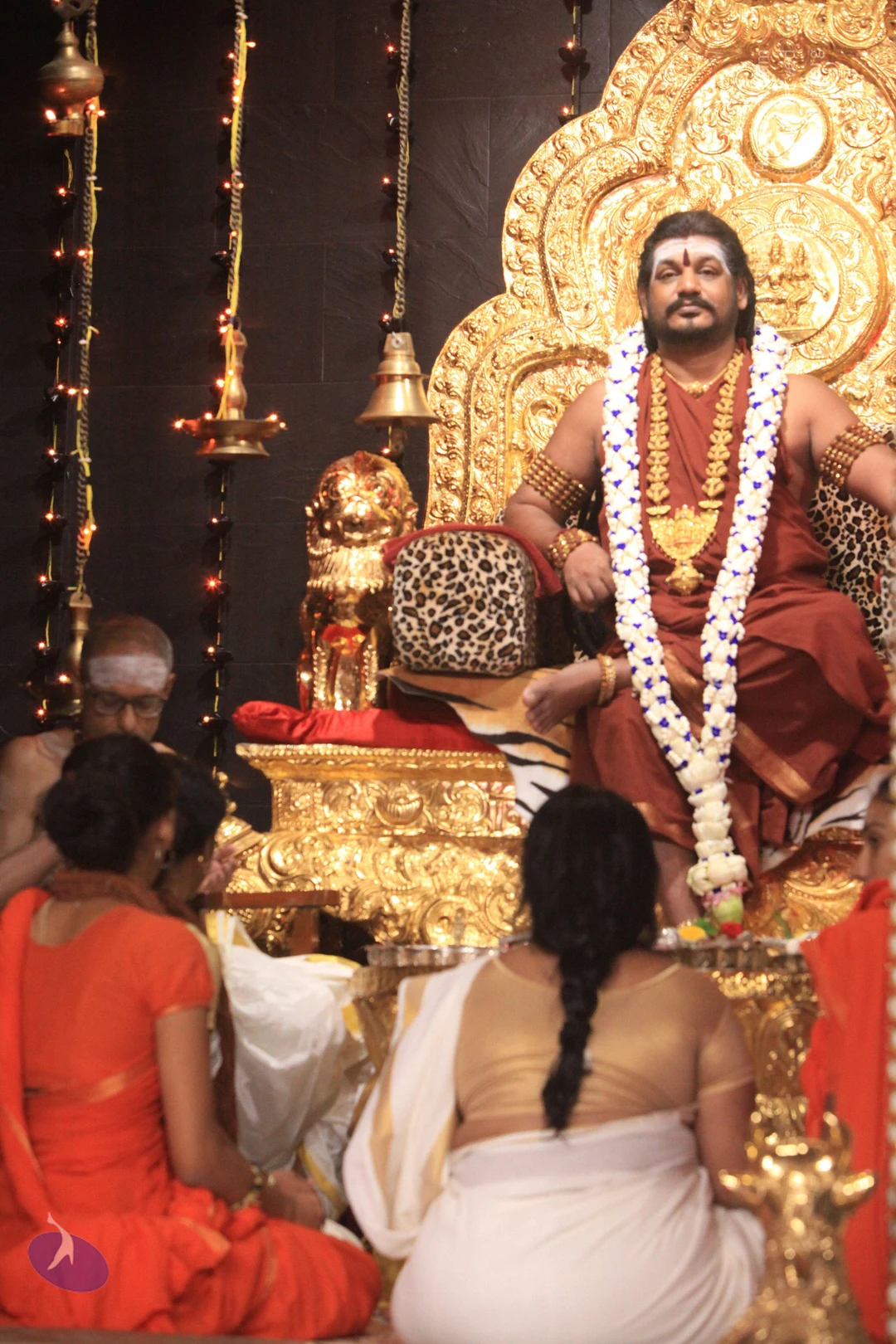
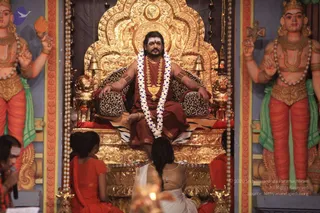
A photograph of a man seated on an ornate gold throne with a leopard-print cushion and tiger-striped throne cloth, raising one hand in blessing. He wears a rust-red saffron robe, a long ceremonial gold necklace, gold bangles and armlets, and a red tilak with long swept-back hair. Flanking him are two large painted deity statues in orange and gold with crowns and garlands, one holding a lit flame. Brass bells hang at the sides and a golden altar base sits below. Swamiji (probable): the seated man has long swept-back hair, a saffron robe, a gold necklace and an ornate gold throne setting. The page notes a discourse, but no visible text names the event.A man in a rust-red robe and matching red-orange dhoti sits on an ornate gilded throne backed by a golden carved arch, with a leopard-print cushion and tiger-stripe cloth on the seat. He wears a white-and-blue flower garland, a gold necklace, gold armlets, and a vibhuti mark on his forehead. Two painted deity statues in orange dhotis and green shawls with raised arms flank the throne. In front, a woman in a white sari kneels with her back to the camera, and a woman in a red dress sits to the left; a man at the far left holds a microphone. Small brass offerings and a lamp sit before the throne. a person seated in a discourse setting with a satsang gathering.A large indoor gathering of many seated men and boys in saffron-orange dhoti-style cloths, many bare-chested with rudraksha malas and ash markings on their bodies, sitting cross-legged on a floor. Several hold their palms together in anjali, and brass plates with flowers, lamps and offerings sit in front of them. A few women in white are visible at the back. Upper wall shows framed pictures and a banner, and the room is crowded with more seated participants. The scene suggests a puja or satsang with devotees seated in rows.A large indoor hall filled with seated devotees in orange and saffron cloth worn over bare upper bodies, many with rudraksha malas and white tilak marks on their foreheads and arms. Rows of people sit on white cloth mats, some with hands folded in prayer, others with eyes closed or heads bowed. Tall wooden pillars or poles with brass tops stand between the rows. Behind them, religious paintings hang on pink walls, and a few people in white move near a side area. The crowd is dense and fills the frame, with no visible central figure identifiable as a person.A large seated gathering of devotees in orange-saffron shawls and white dhotis fills a bright hall, many with white vertical forehead markings and rudraksha malas. Several young men and boys sit cross-legged on the floor in rows, some holding small cups or water bottles, while others look toward the front. Tall brass lamps with lit wicks stand along the back. A small lit oil lamp sits near the lower centre. The scene is dense with people, many partly obscured by those in front. No single figure is clearly identifiable as a person from appearance cues, so the a person field is unsure.A man seated on an ornate gold throne with a leopard-print cushion and tiger-striped cloth, wearing a rust-orange robe, gold chain necklaces, gold armbands and a long white and blue flower garland. He has white forehead markings, a red bindi and a beard. Beside him stands a golden lion figure and hanging brass oil lamps with lights. In the foreground, women in orange and saffron saris sit, and an older man in white with spectacles sits near the throne. A pedestal holds flowers and offerings. The scene appears to be a gathering in a temple-like hall.

Satsang
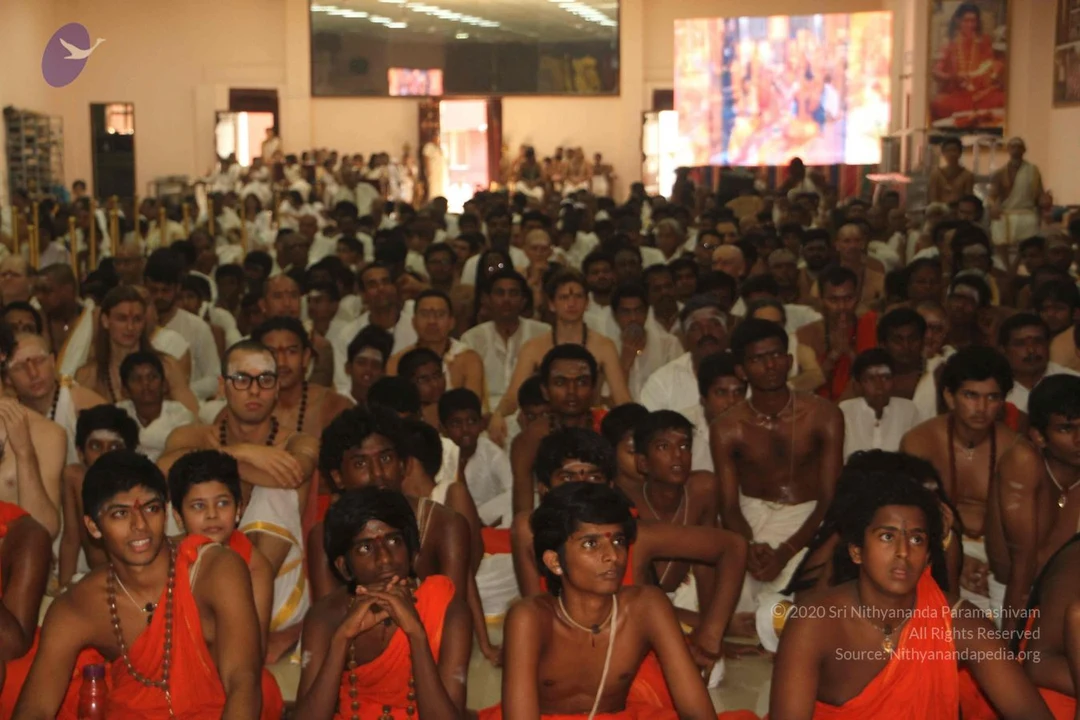
9 photosSource gallery
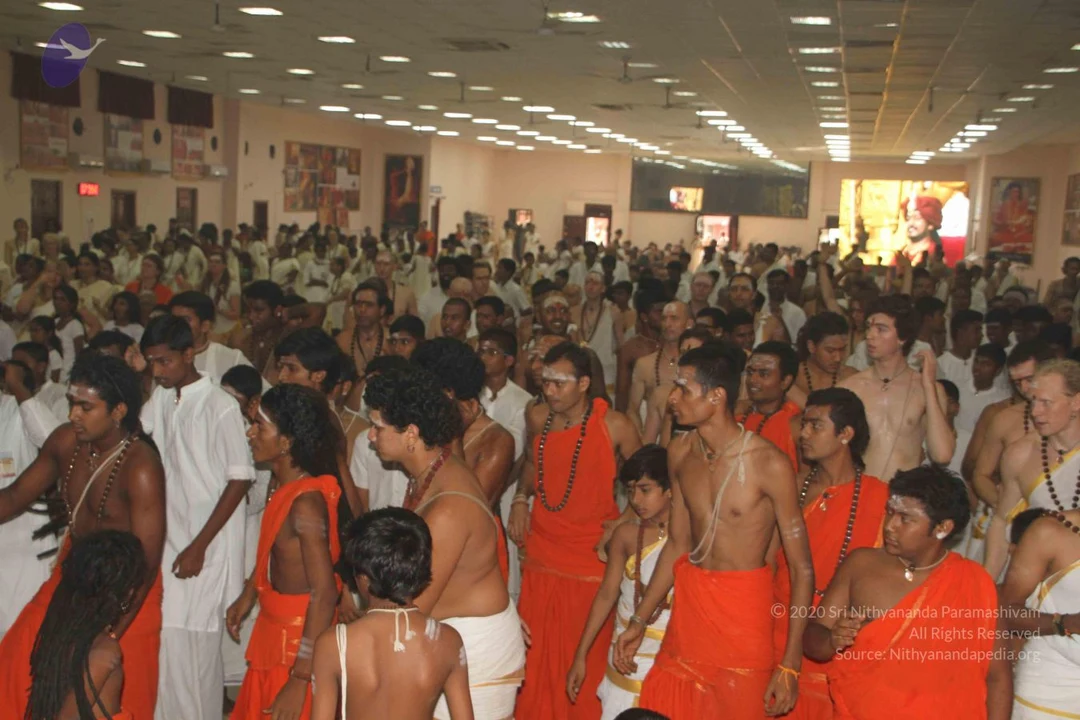
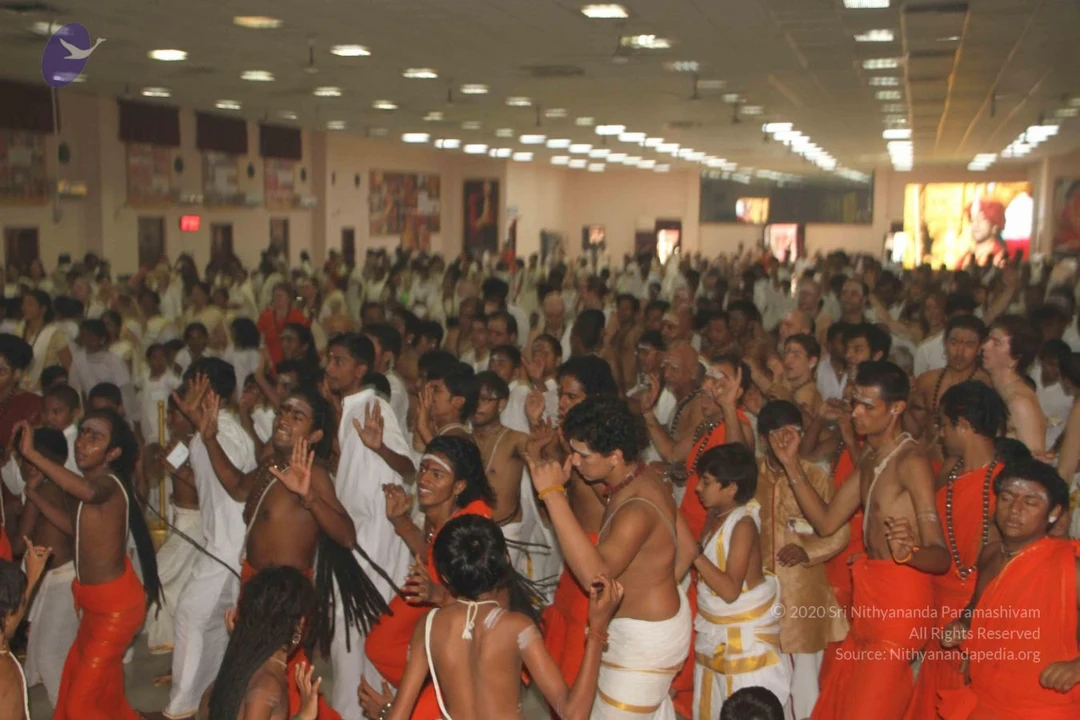
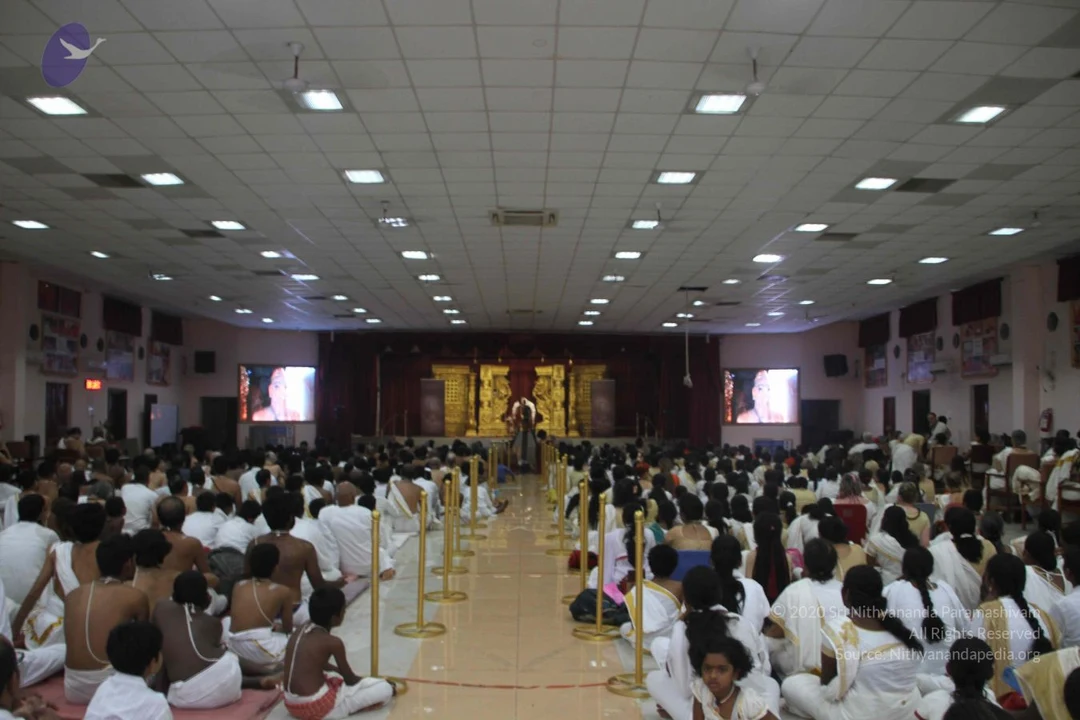
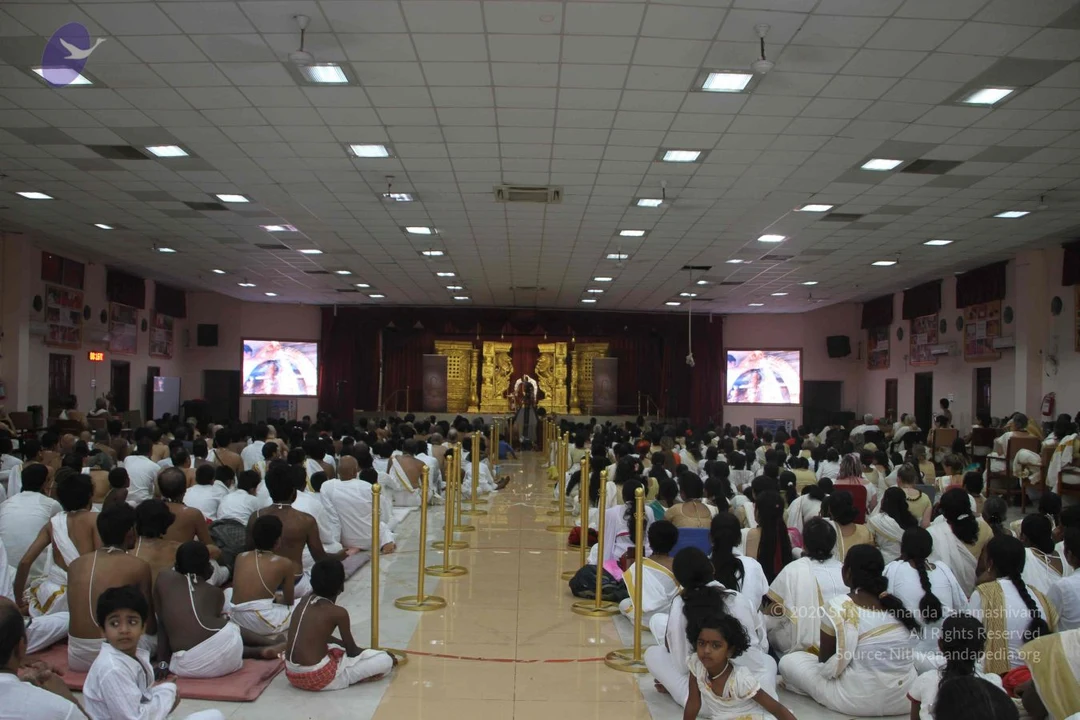
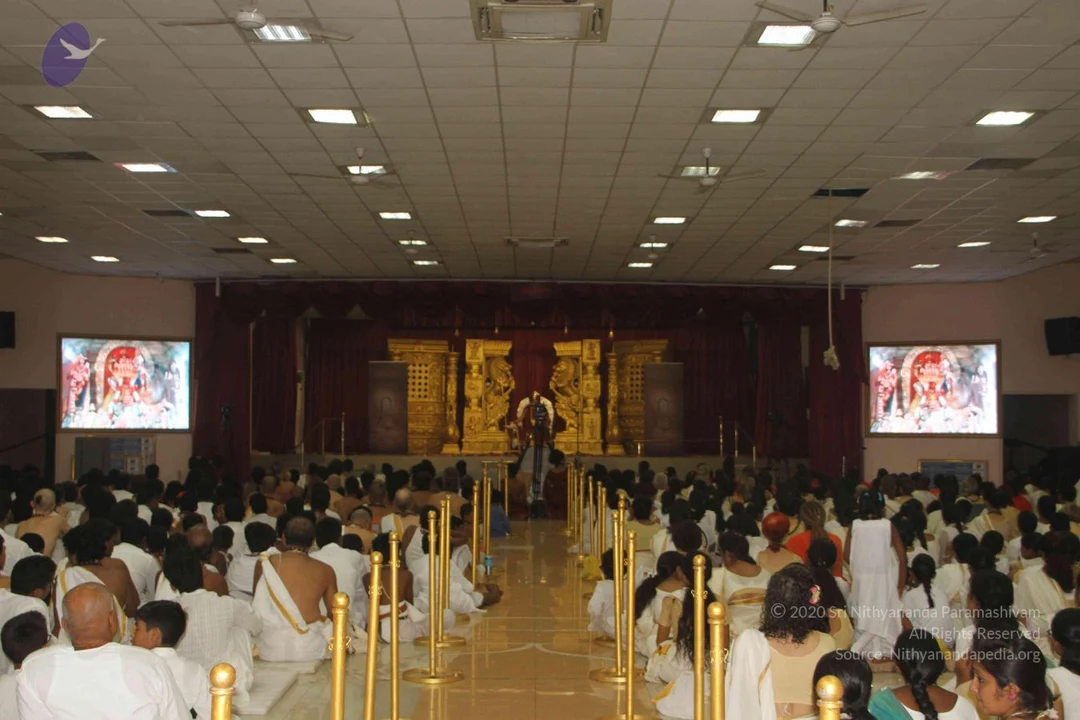
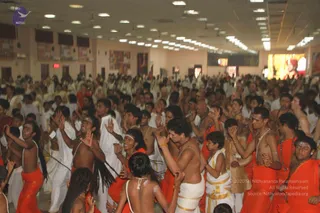
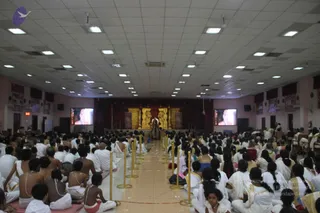
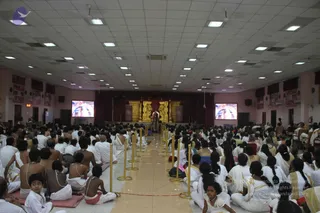
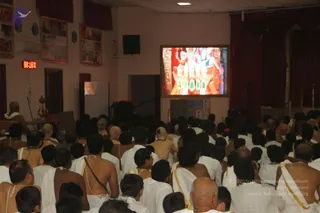
A large indoor hall crowded with many people in saffron and white clothing. In the foreground, several shirtless young men wear orange-saffron dhotis with rudraksha malas and white body markings, some with sacred threads across their chests. Behind them, devotees in white dhotis and white kurtas fill the room. Ceiling lights, beige walls, and framed religious pictures line the space.A large indoor hall crowded with hundreds of devotees with raised hands, many in white and saffron-orange clothing. Several men in saffron dhotis with rudraksha malas stand near the front, while others wear white dhotis and bare-chested sections of crowd. Many people have arms lifted and palms open in an ecstatic group gesture. Overhead fluorescent lights line a beige ceiling, and framed portraits and banners hang on the walls. On the far right, a large screen shows a figure in an orange turban and robe. A photograph of a dense ritual gathering with no clearly identifiable individual in the foreground.Wide view of a large hall filled with seated devotees in white dhotis and white saris, many sitting cross-legged on the floor in rows. Some boys sit bare-chested in dhotis. A golden ornate altar or throne structure stands at the far end with a red curtain behind it, with a figure seated near the centre. Two large screens on either side of the stage display a close-up of a speaker. Gold stanchions line a central aisle. Ceiling lights and framed banners decorate the walls.Wide view of a large hall filled with seated devotees in white dhotis and white saris, sitting on the floor in rows facing a gold ornate stage. A figure stands at the centre of the stage in front of gold carved panels and dark red curtains. Two large screens on either side show a projected image. Gold stanchions line a central aisle. Many attendees wear white ritual clothing and several children sit near the front. Ceiling fluorescent lights and pink walls are visible.A large seated audience of devotees fills a hall, facing a wall-mounted screen showing a brightly coloured scene with deity figures in red and blue. Most men wear white dhotis and shawls, many bare-chested with rudraksha malas, and some have shaved heads. Oil lamps and a brass kalasha sit near a low platform at the left. A second screen and a digital clock showing 08:16 are also visible, along with framed photographs on the back wall. The people are seen from behind, so no individual can be identified.Wide view of a large hall with an audience of many devotees seated on the floor in white clothes, facing a raised golden stage with ornate golden carved panels and a dark red curtain. Two screens on either side show a deity image with red and gold tones. A figure in white stands at the centre of the stage near a small table. Gold stanchions line the central aisle, and ceiling fans and lights hang above the crowd.

satsang
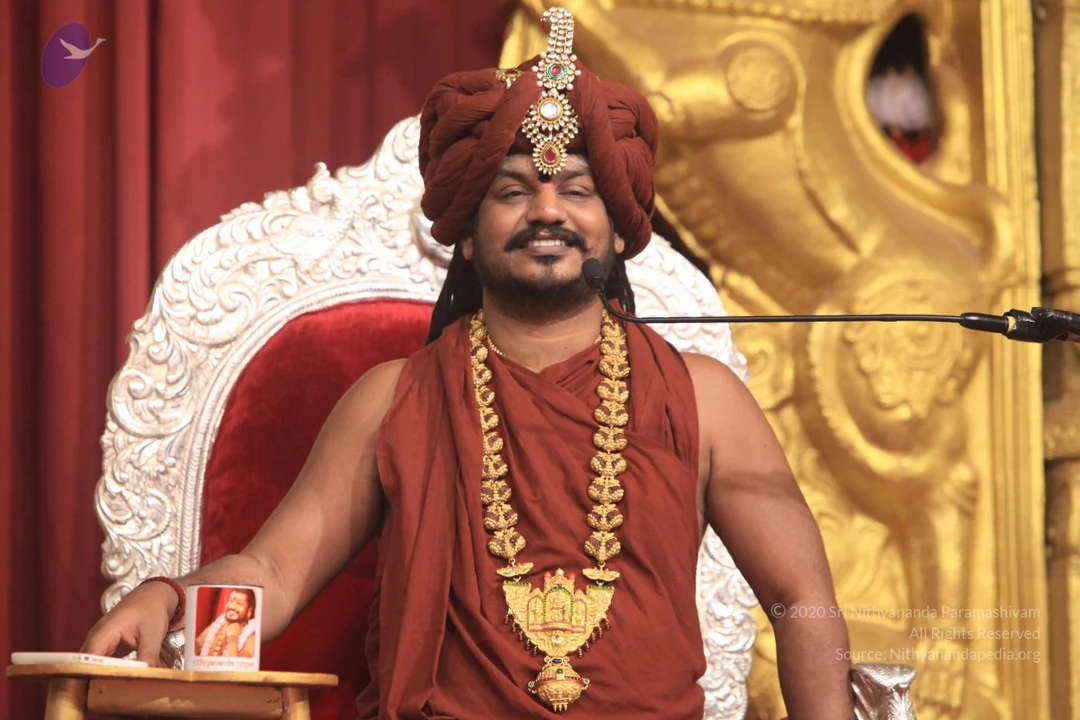
42 photosSource gallery
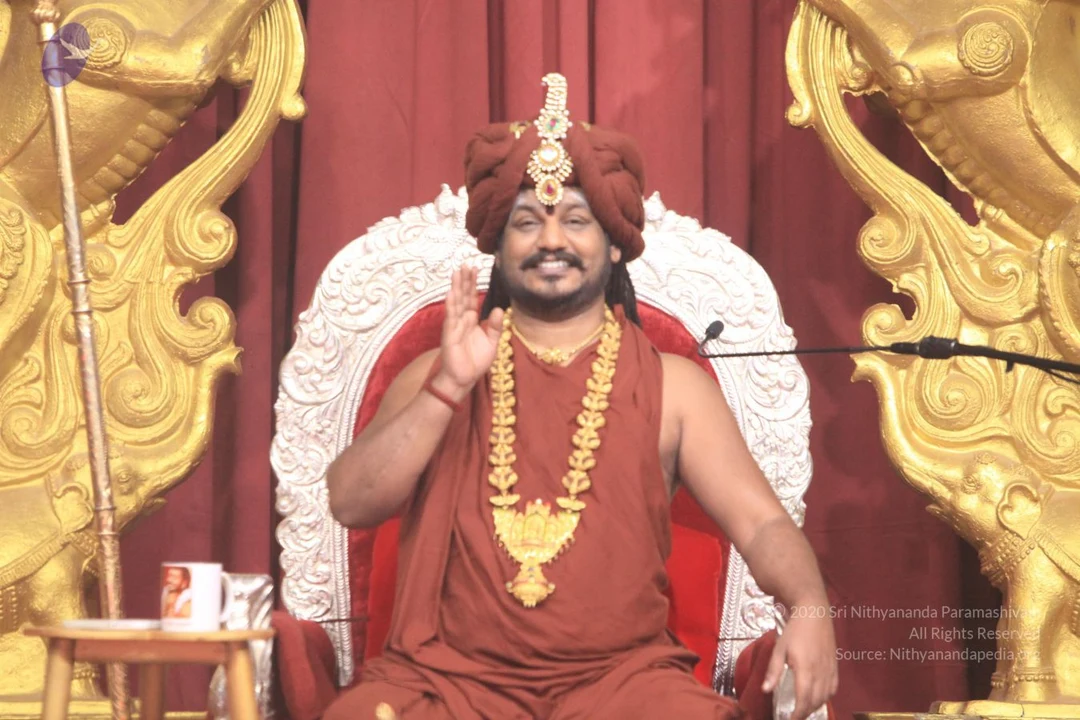
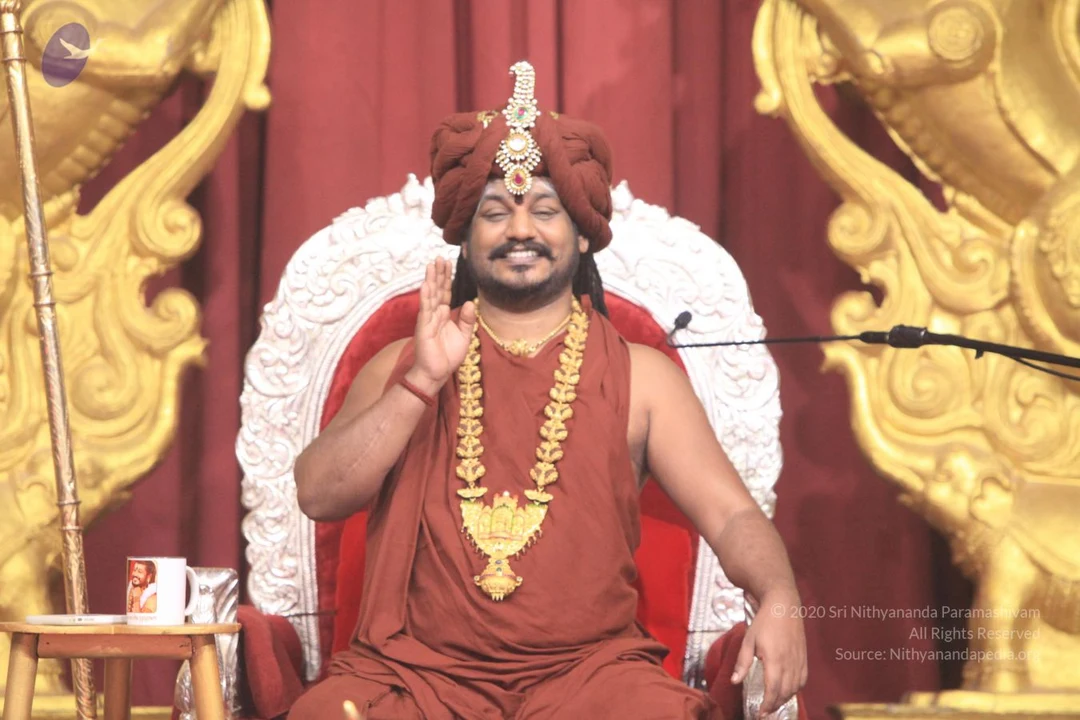
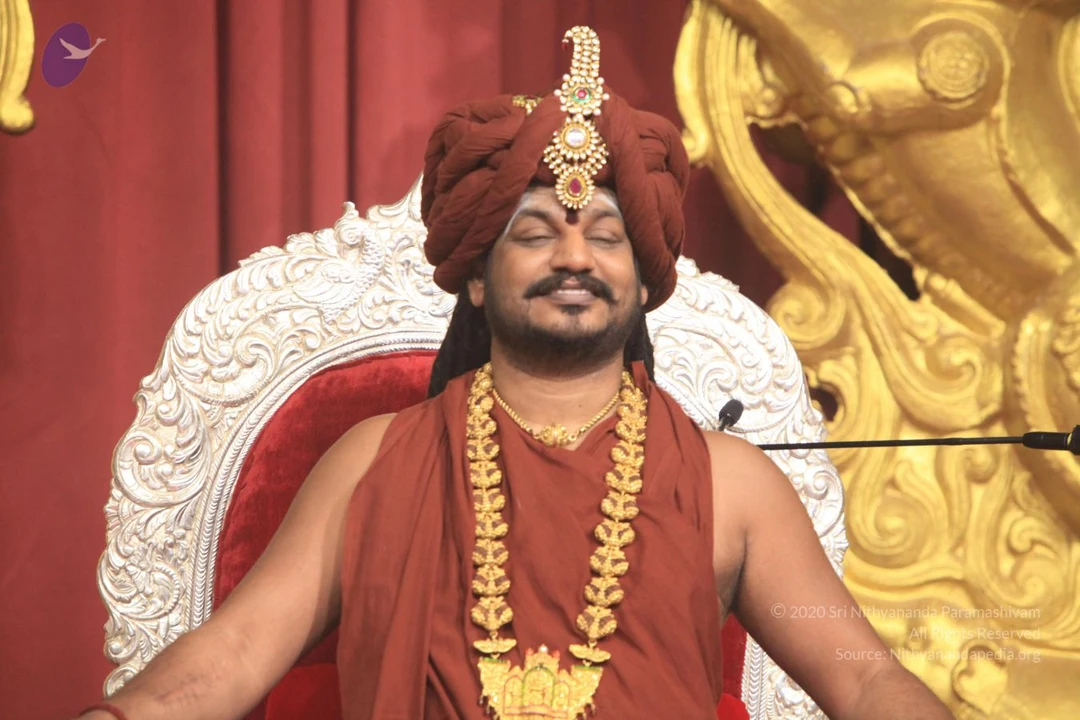
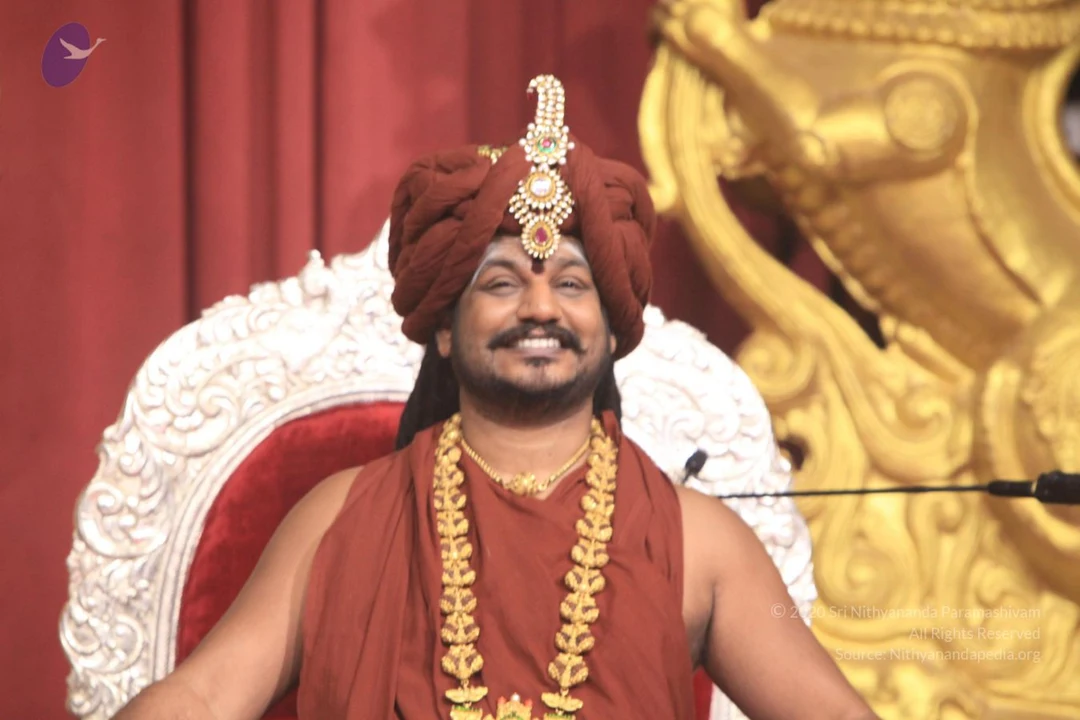
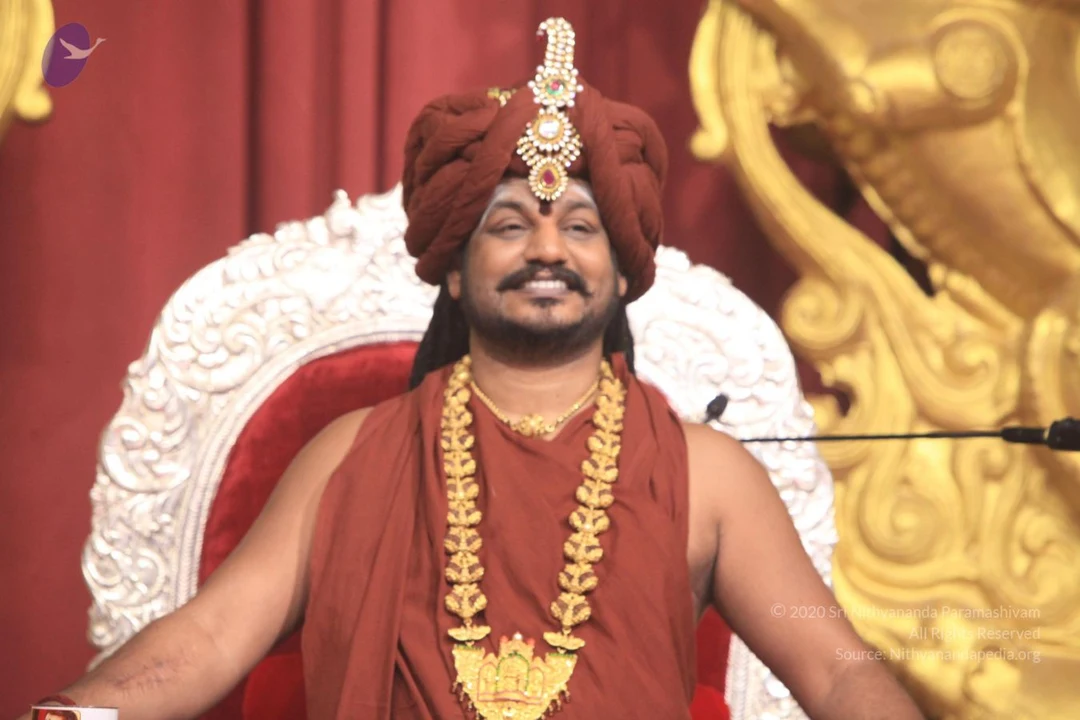
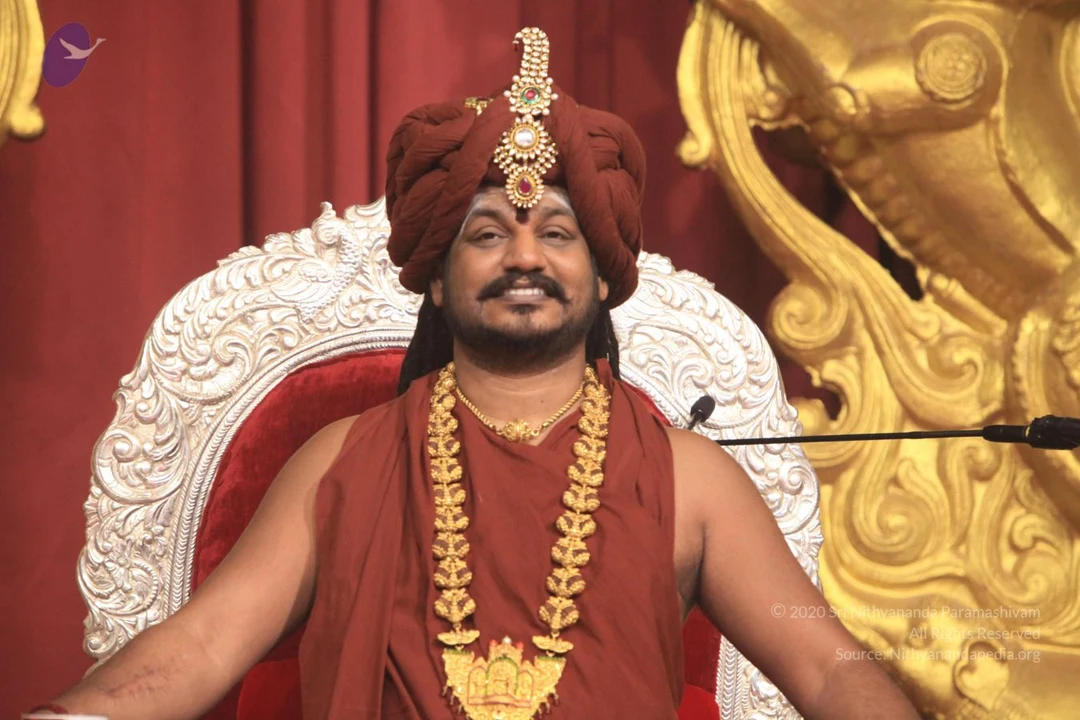
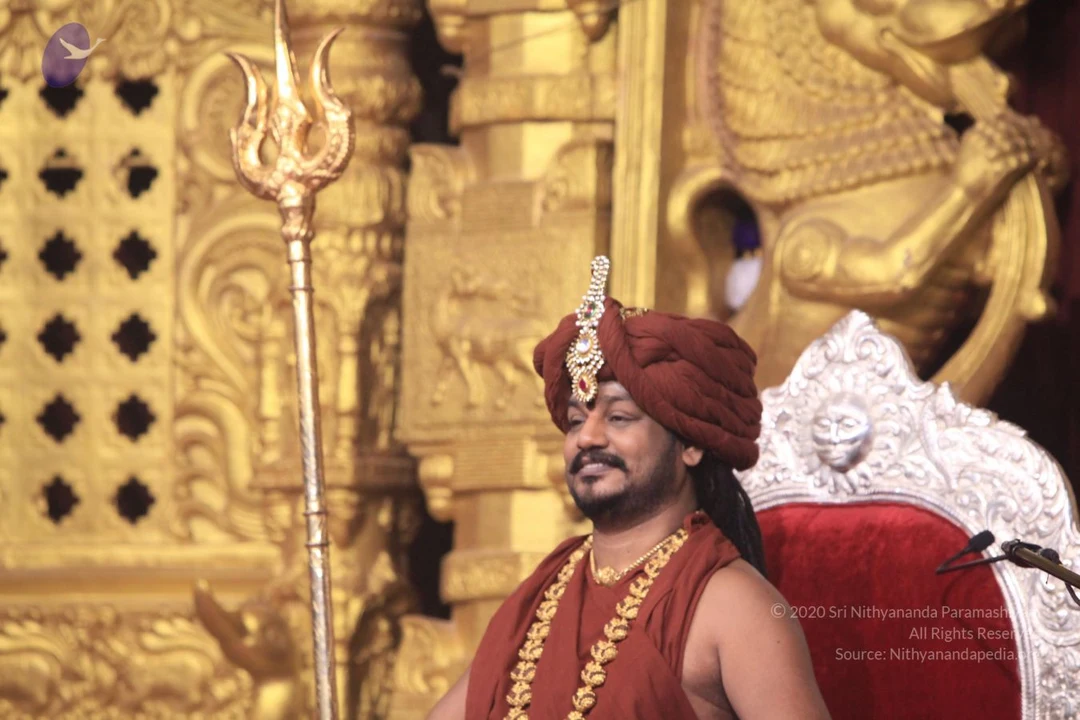
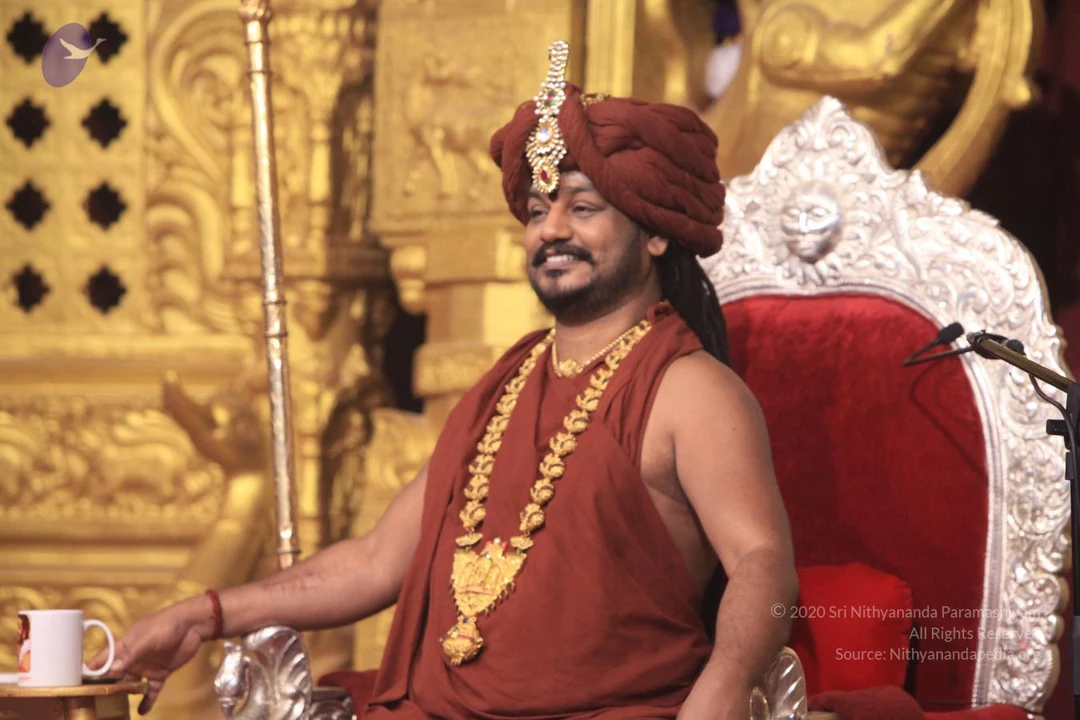
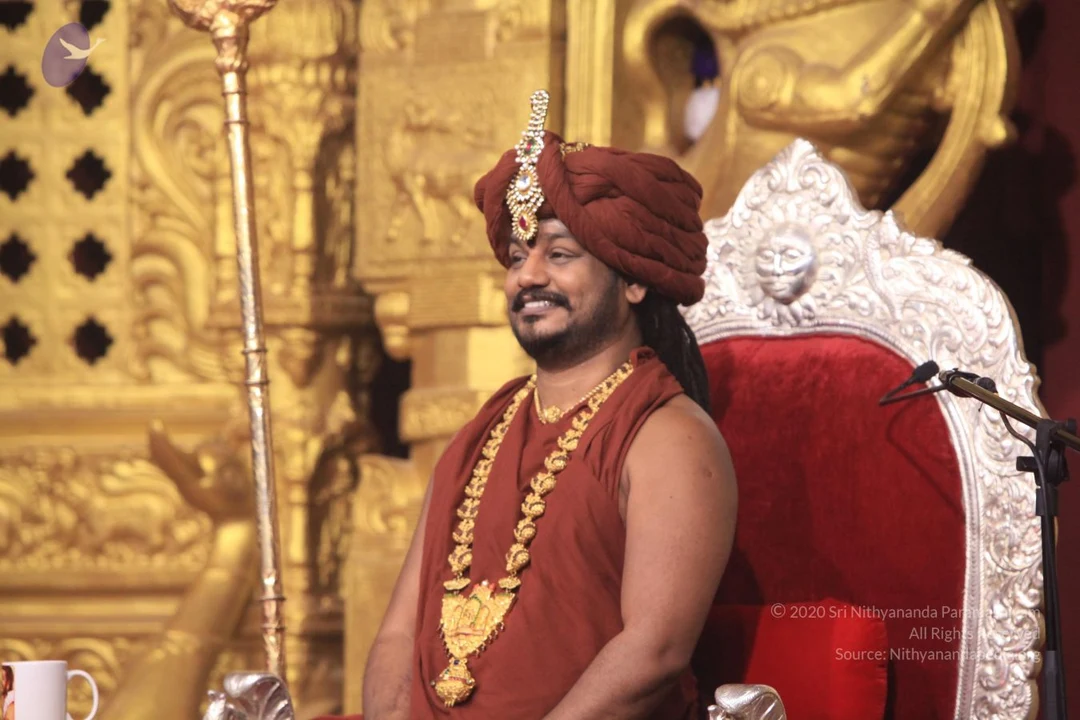
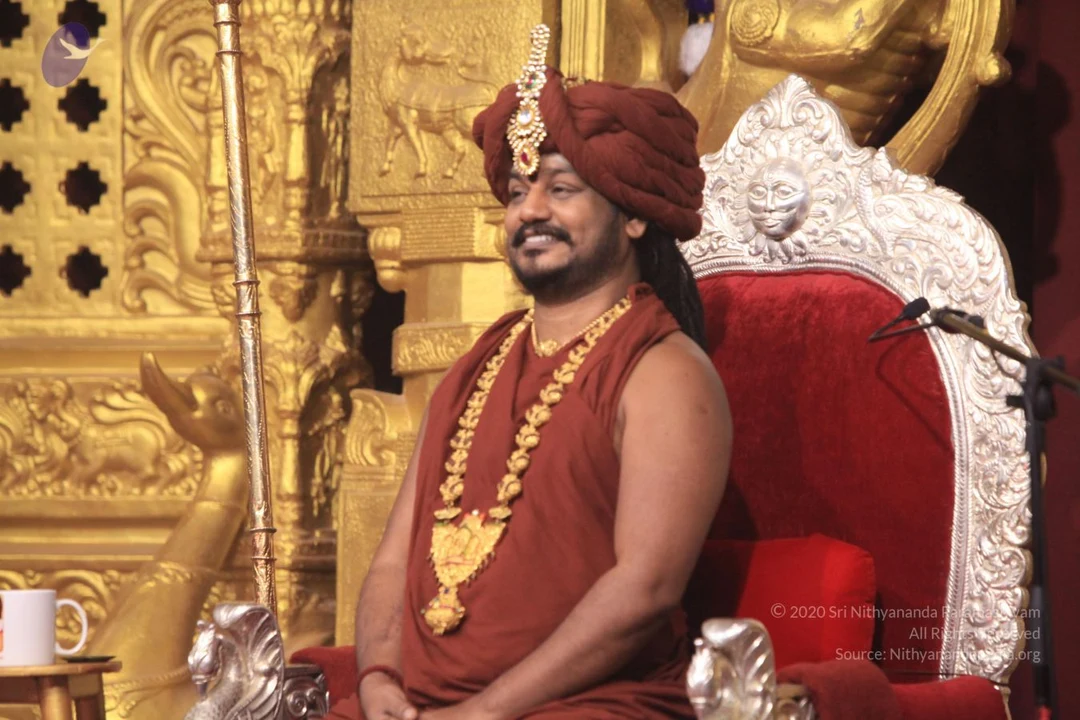
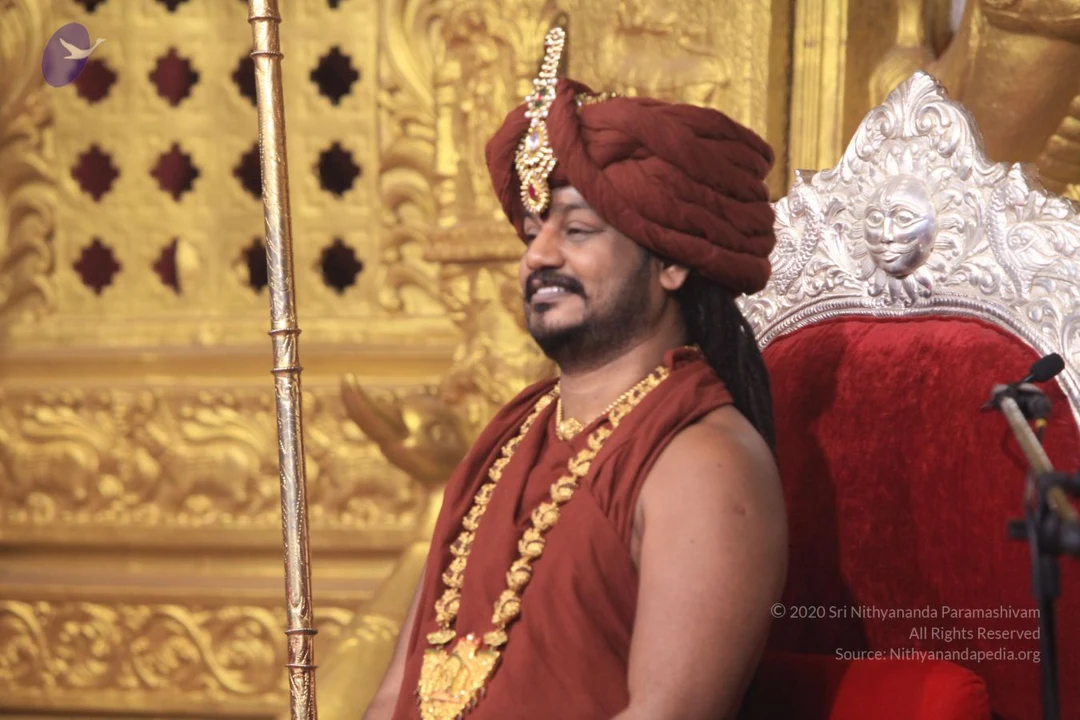
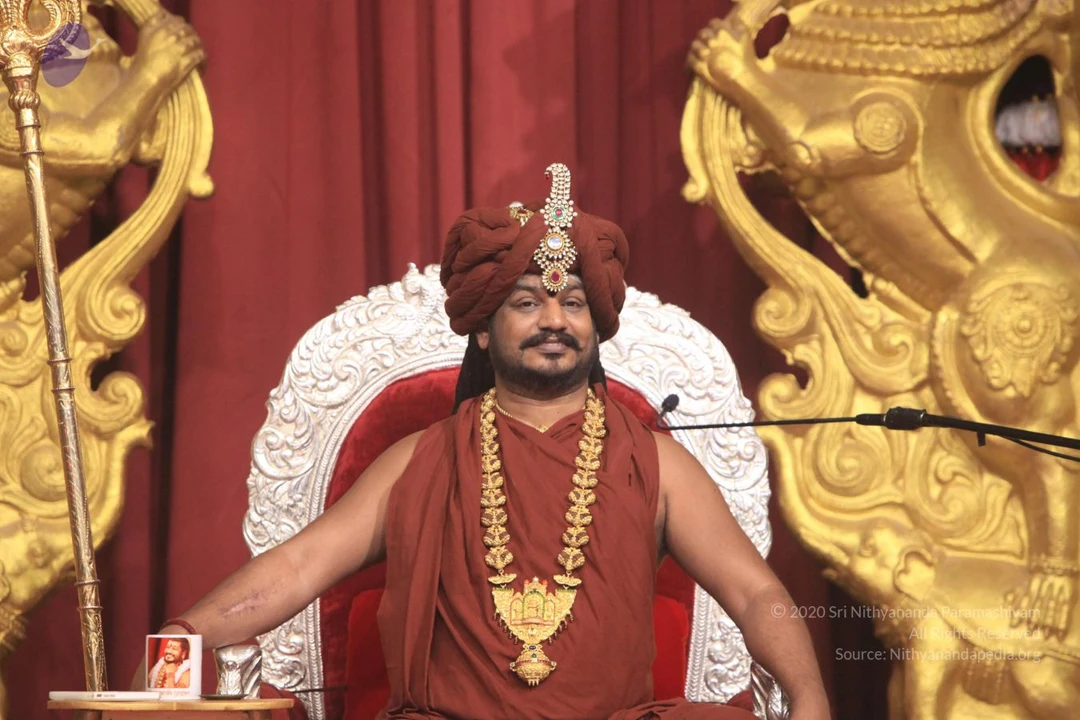
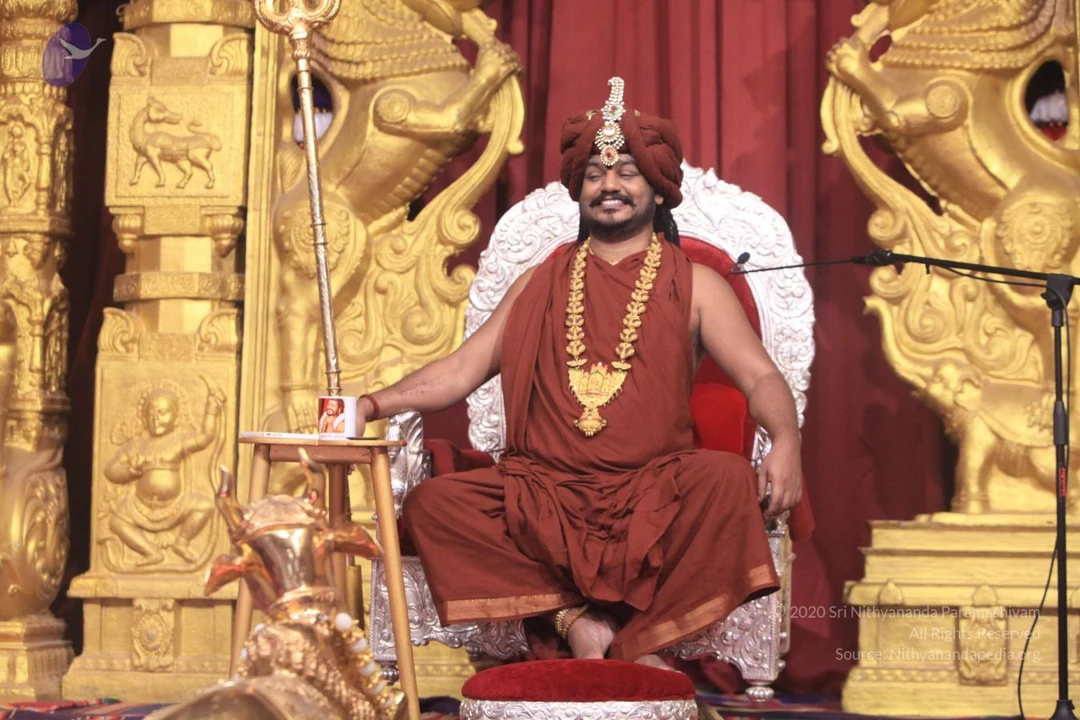
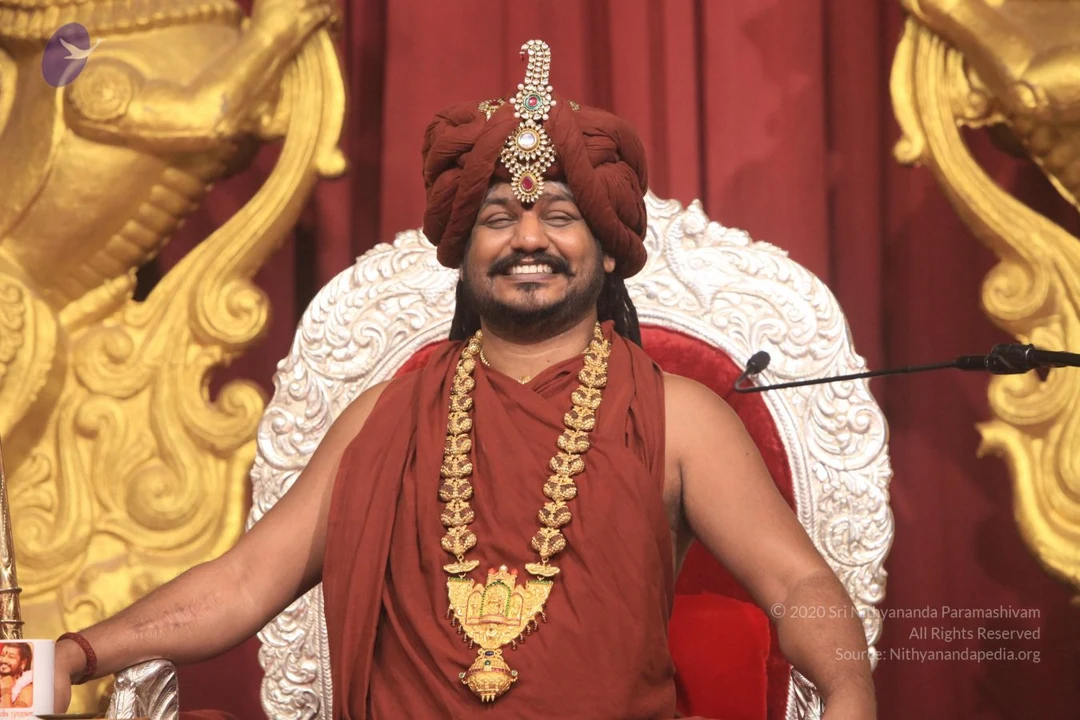
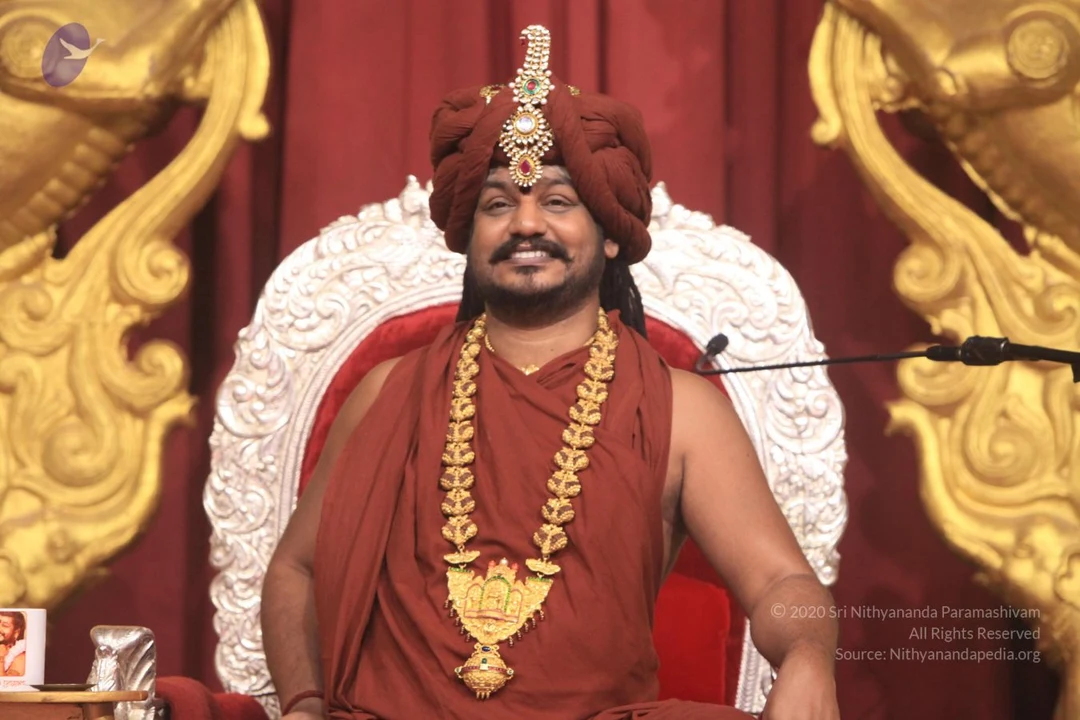
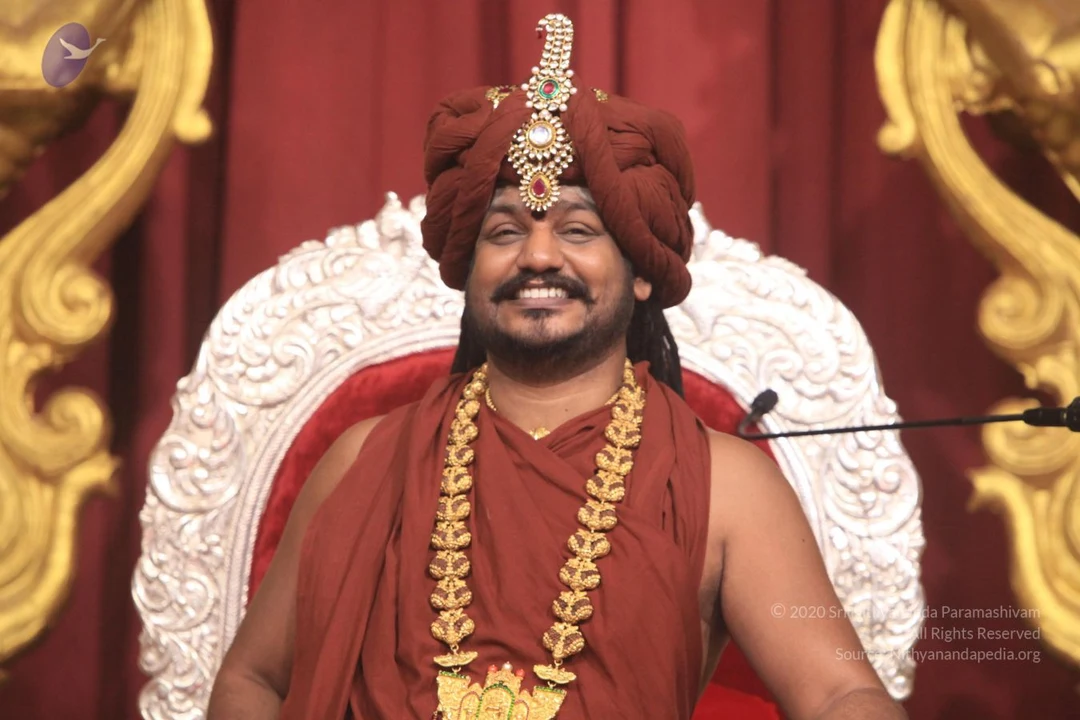
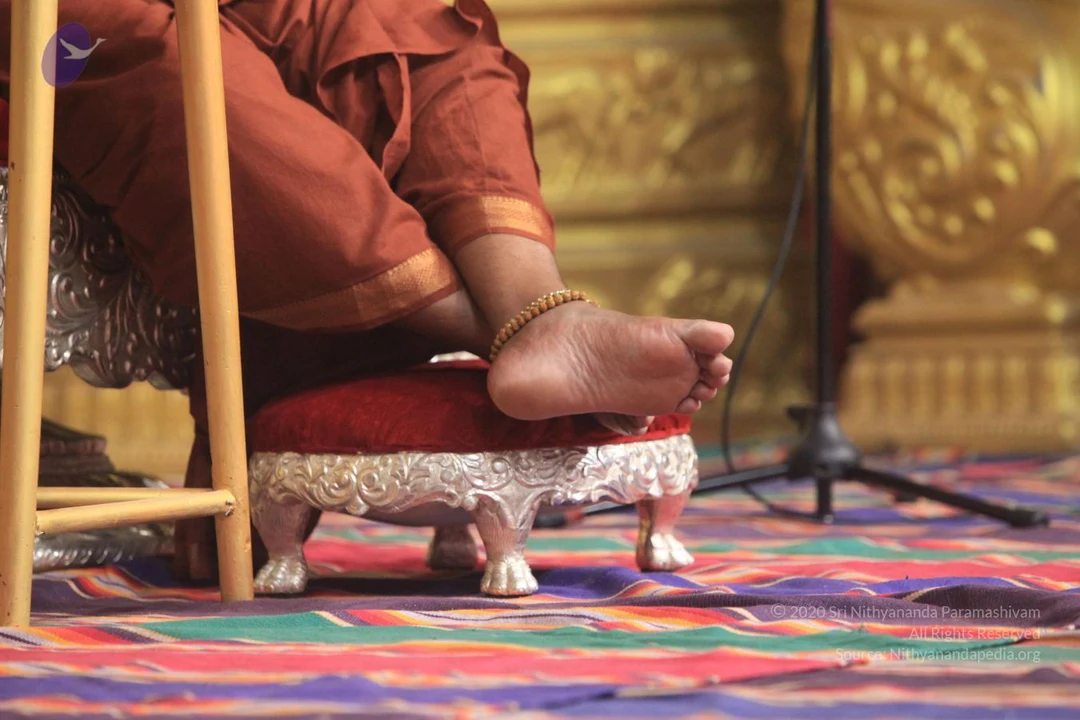
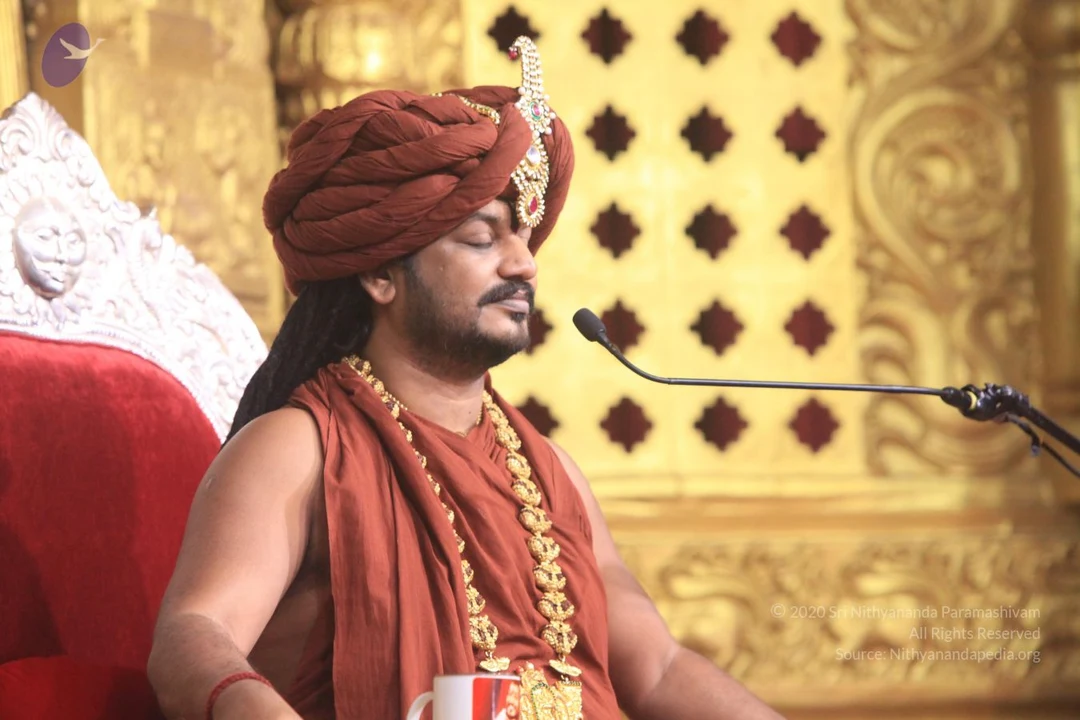
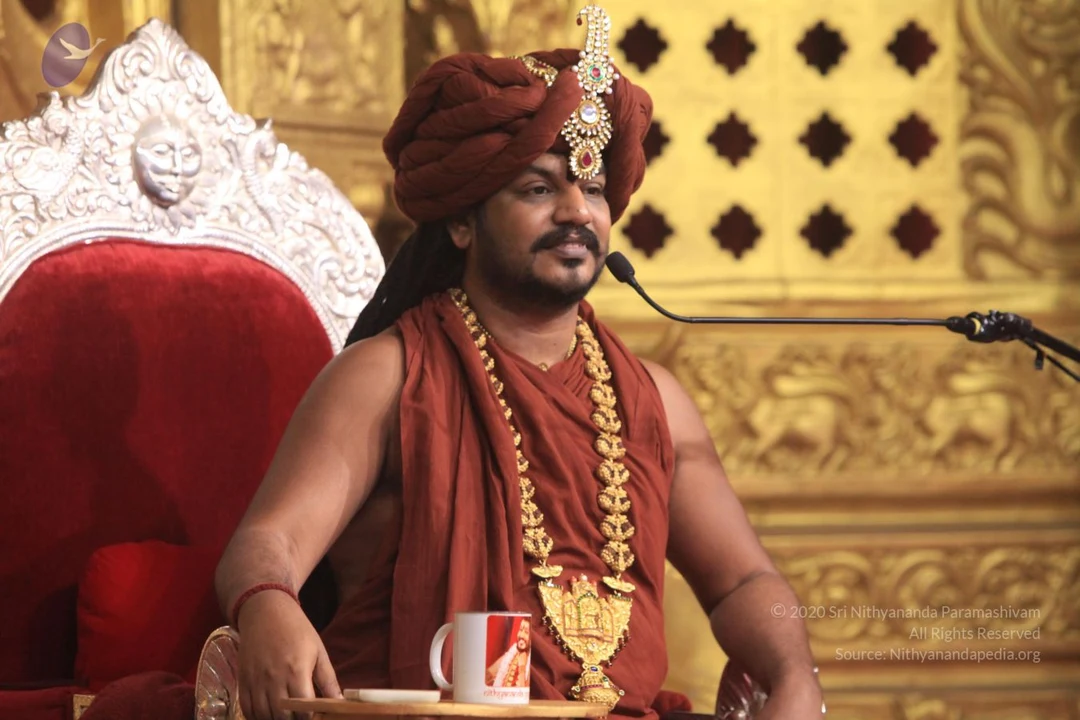
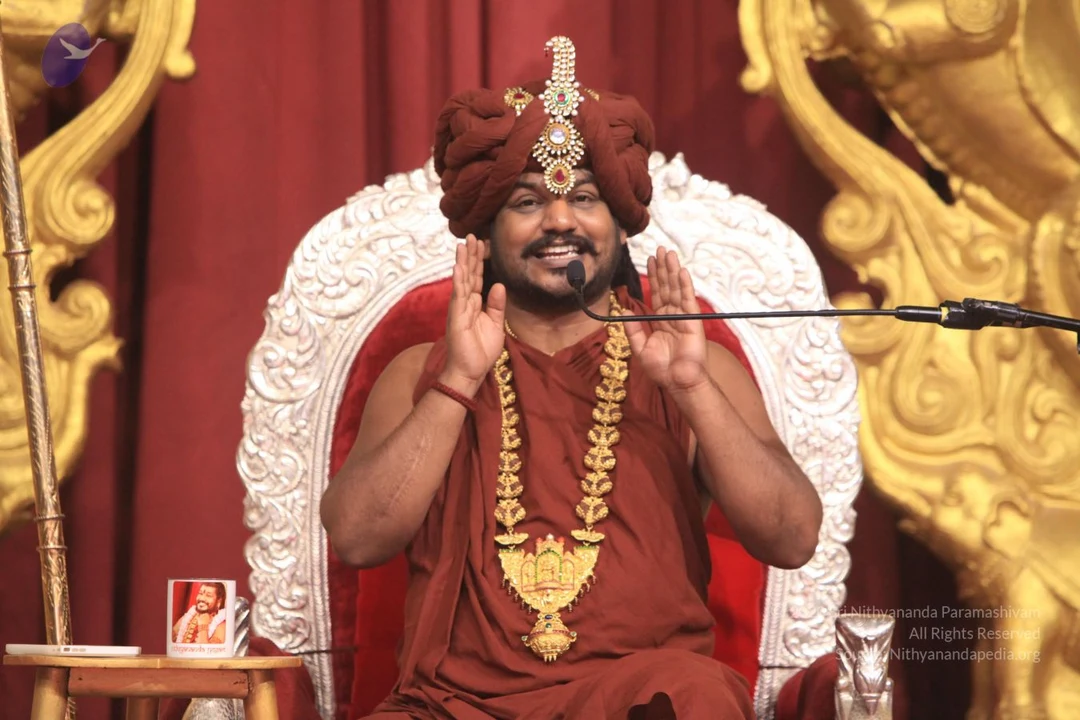
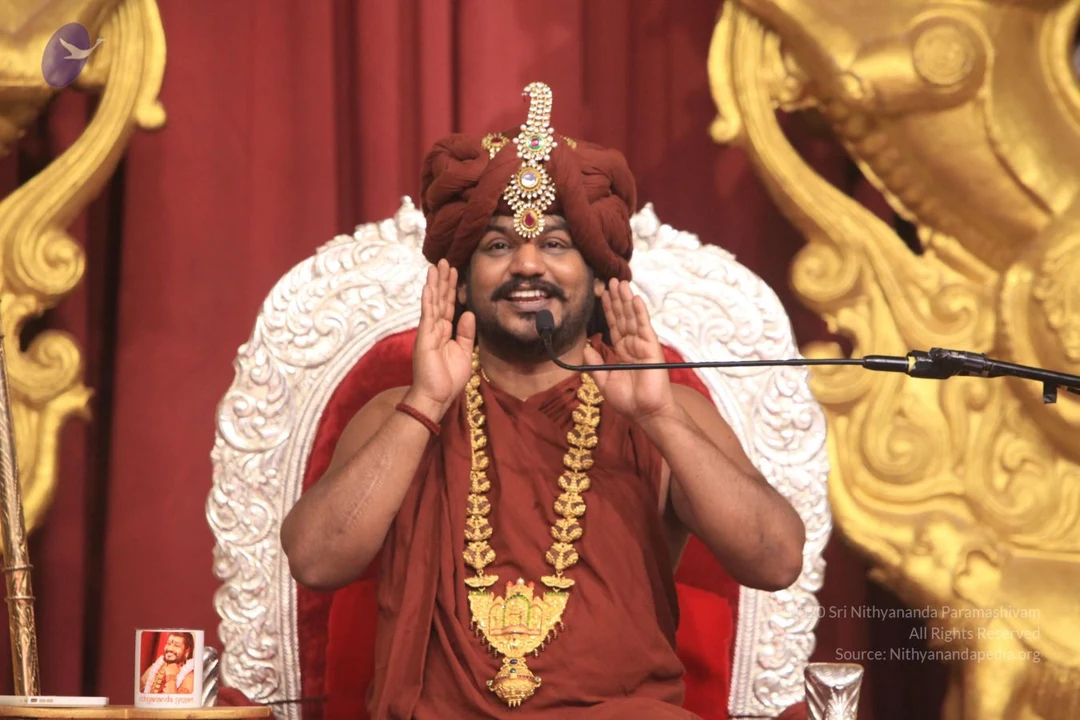
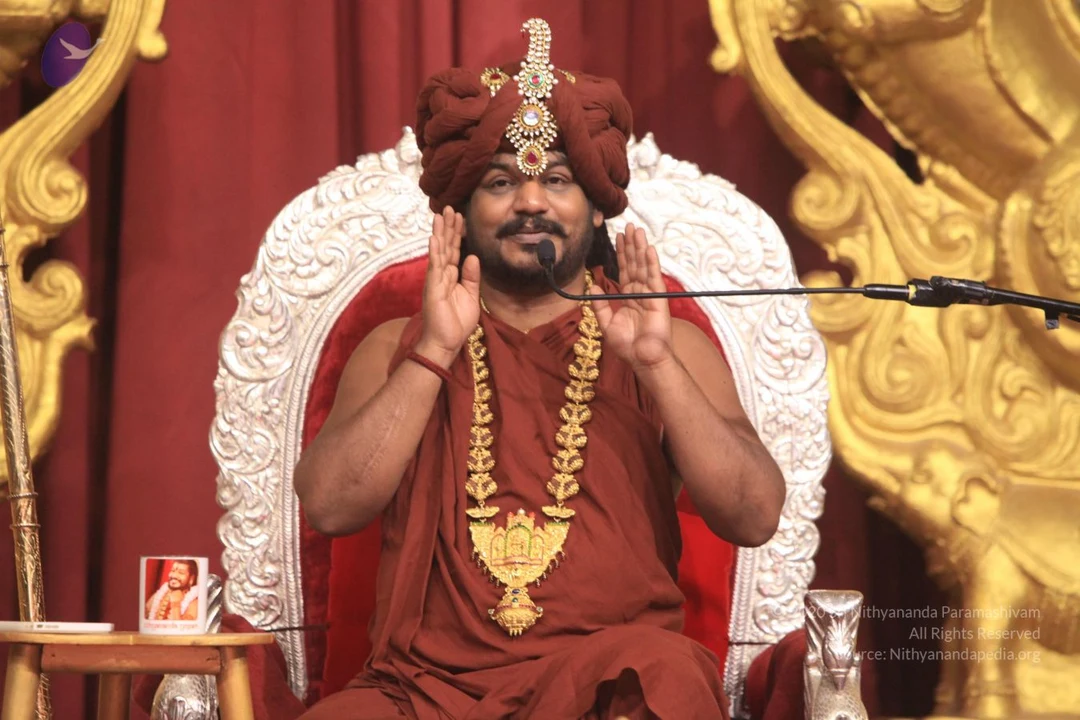
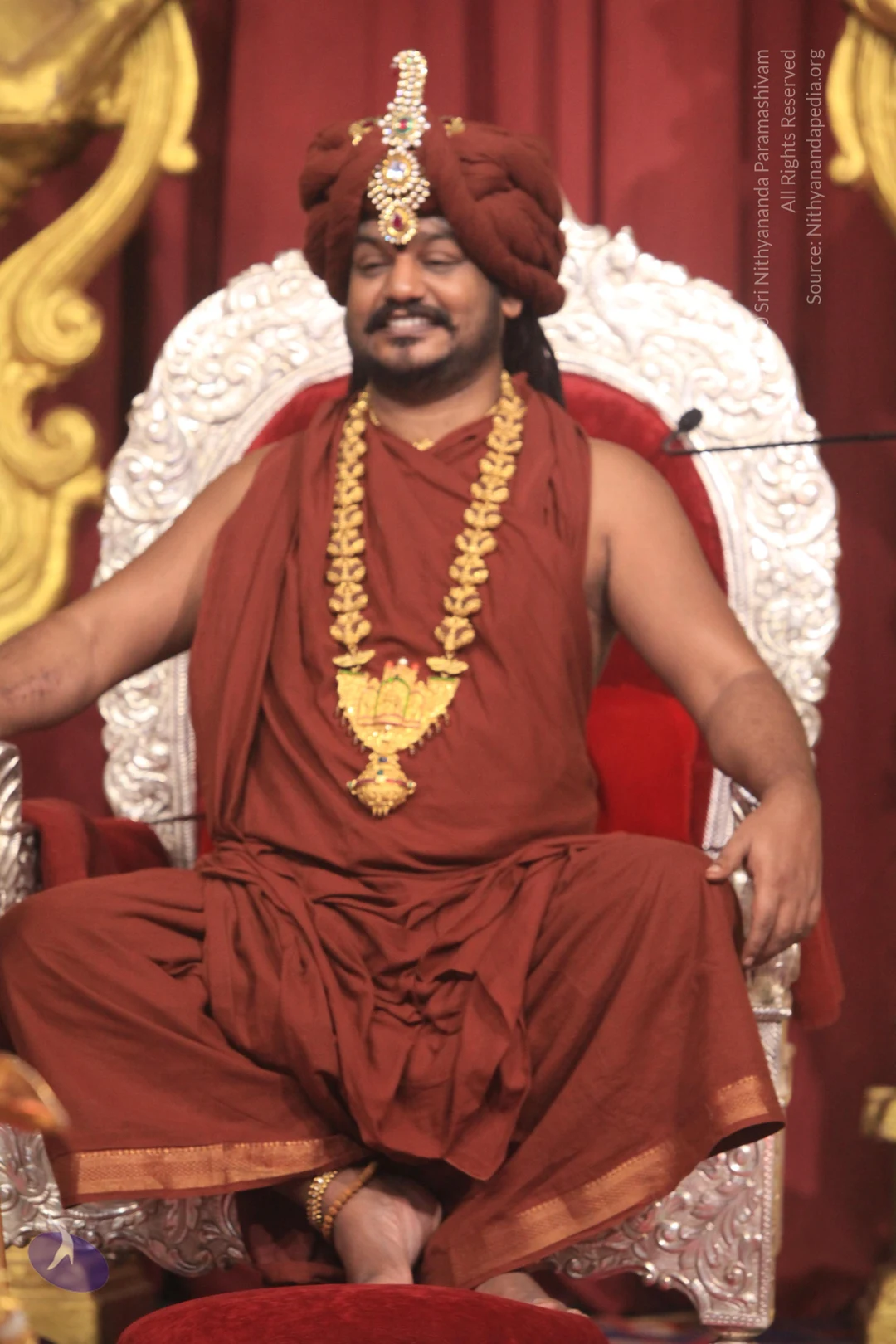
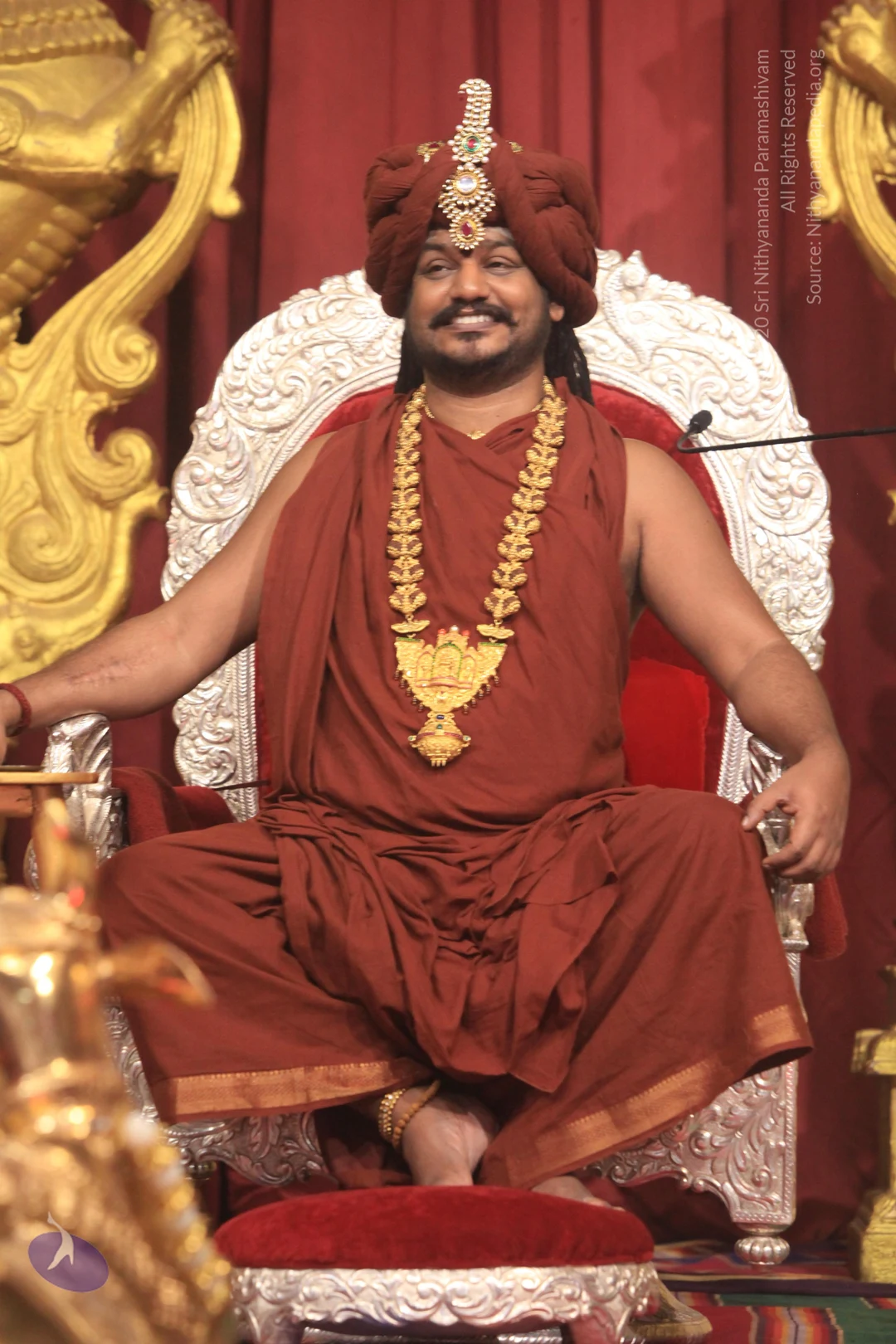
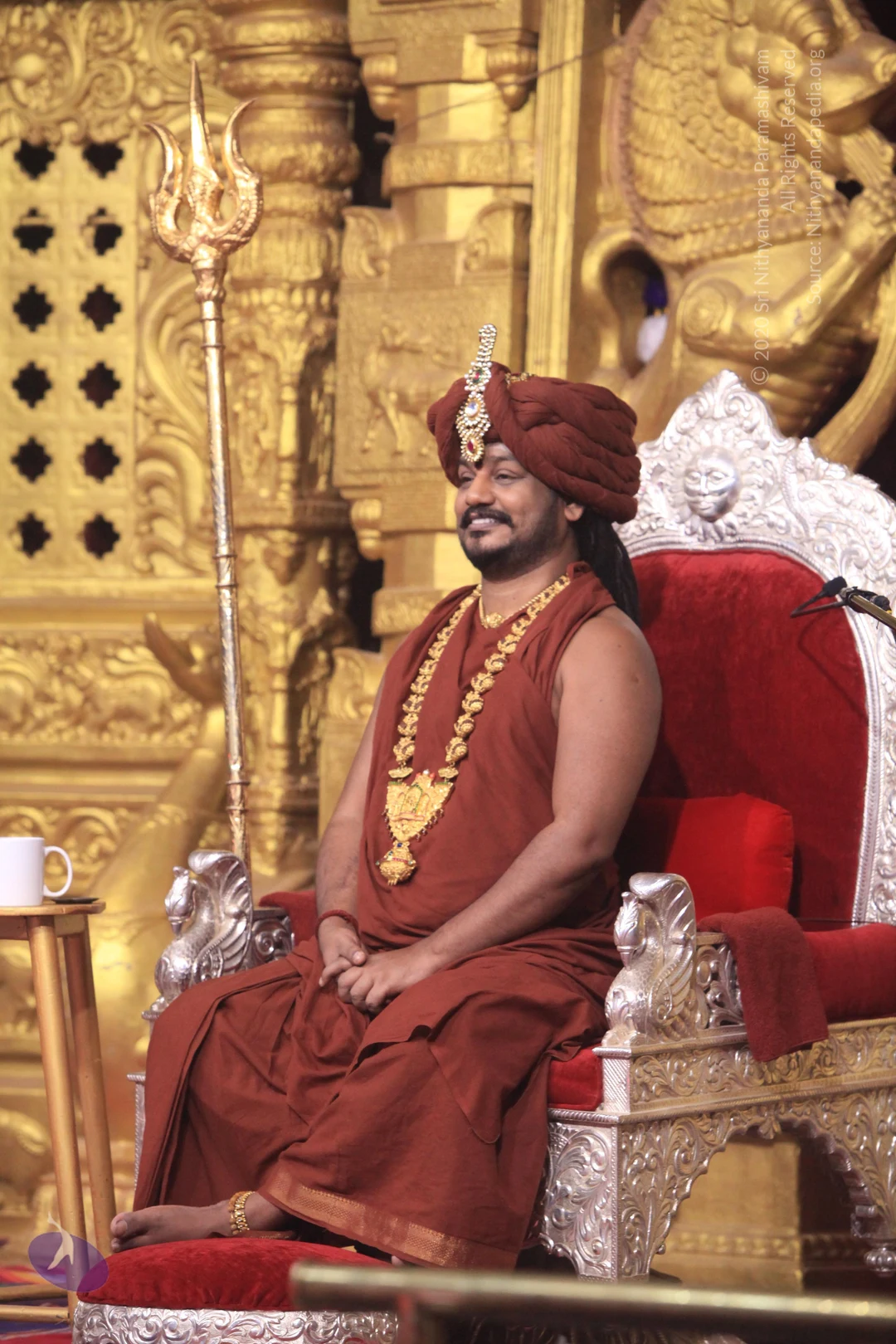
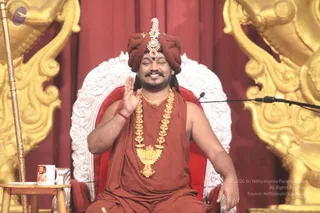
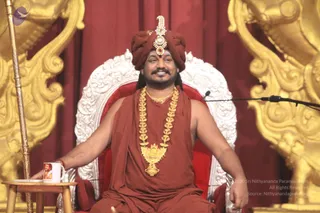
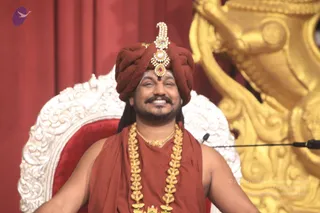
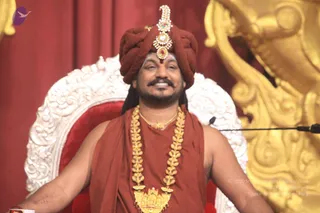
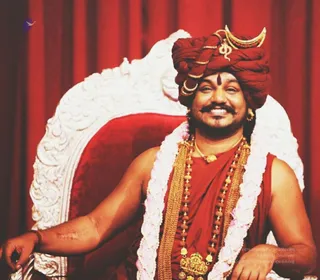
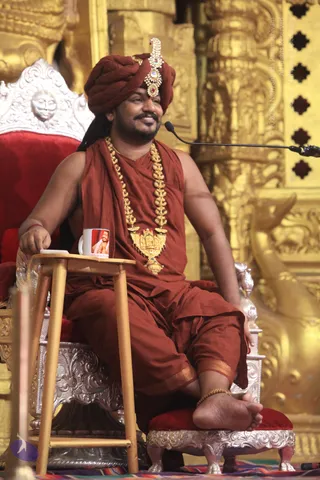
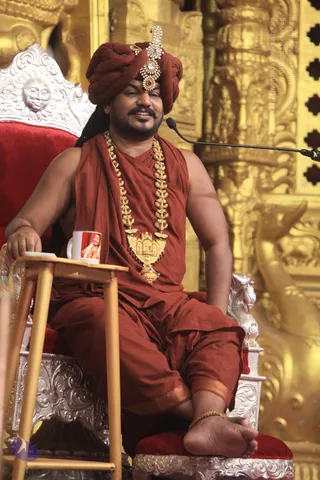
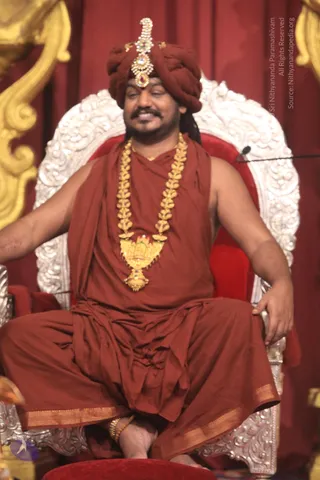
A man in a rust-red turban with a jewelled ornament and rust-red robes sits on an ornate white-and-red throne between large gold carved lion-like armrests, smiling and raising his right hand in a blessing gesture. He wears a heavy gold necklace and a red thread on his wrist. A microphone stands beside him, and a gold staff leans at left against red drapery, with a small table holding a framed photo. The scene is a stage setting for a discourse. Swamiji (probable): the seated figure wears a turban with a jewelled crest, saffron-red robes, a gold ceremonial necklace and rudraksha-style adornment, consistent with the page's discourse context.A man seated on an ornate white and red throne in front of gold-carved panels and red drapery, giving a blessing gesture with his right hand with eyes closed and a smile. He wears a maroon-red turban with a jewelled ornament, a rust-red robe, a heavy gold necklace and a gold-and-red mala. A microphone stands at right, and a small wooden stool at left holds a mug printed with a portrait. A tall ceremonial staff with a silver top stands at the left edge. The figure appears to be Swamiji (probable), identified by the red turban with jewelled crown ornament, long hair, ornate gold necklaces and seated throne discourse setting.A man seated on an ornate white and silver throne with carved floral detailing, in front of a deep red curtain and gilded carved side panels. He wears a rust-red turban with a jeweled gold ornament at the front, a rust-red sleeveless robe, and a heavy gold multi-strand garland with a gold pendant. He holds his arms outstretched along the armrests and smiles toward the audience. A microphone on a stand is at right, and a small wooden side table at left holds a white mug printed with a portrait. Appearance-based candidate: a person, seated in a discourse setting, with the turban, gold garland and jeweled headpiece as the qualifying cues.A man seated on an ornate silver-and-red throne with a red velvet cushion, eyes closed and smiling, arms spread wide. He wears a rust-red turban with a gold and jewelled ornament at the front, a rust-red shawl, and multiple long gold necklaces with floral and temple-style pendants. A microphone stand is visible at right, and a gold carved dragon-like panel fills the right edge against red drapery. Appearance-based a person in an in-person discourse setting, identified only by his visible turban, gold ornaments and throne rather than by face.A smiling man in a rust-red turban with a jewelled ornament at the forehead sits on a white, carved throne with red upholstery before a red curtain and a gold carved ornamental piece. He wears a rust-red garment draped over the shoulders, a gold necklace and a long garland of gold-coloured flowers, with a red mark on his forehead. His arms are outstretched in a welcoming gesture, and a microphone stand is visible at right. Swamiji (probable) is identified by a red turban with a jewelled ornament, rust-red saffron-toned clothing and gold garlands while seated on a throne in a discourse setting.A smiling man sits on an ornate white-and-red throne in front of a deep red curtain, with gilded carved panels at the right edge and a microphone stand nearby. He wears a rust-red turban with a jewelled gold ornament at the front, a rust-orange shawl over his shoulders and chest, a long gold necklace of leaf-shaped links, and a gold pendant at the chest. His arms are spread open in a welcoming gesture. Appearance-based label: Swamiji (probable), seated and speaking as a discourse presenter, given the long dark hair visible at the sides, the ornate turban and jewelled head ornament, and the gold necklaces, though the image is not conclusive.

Darsan

5 photosSource gallery
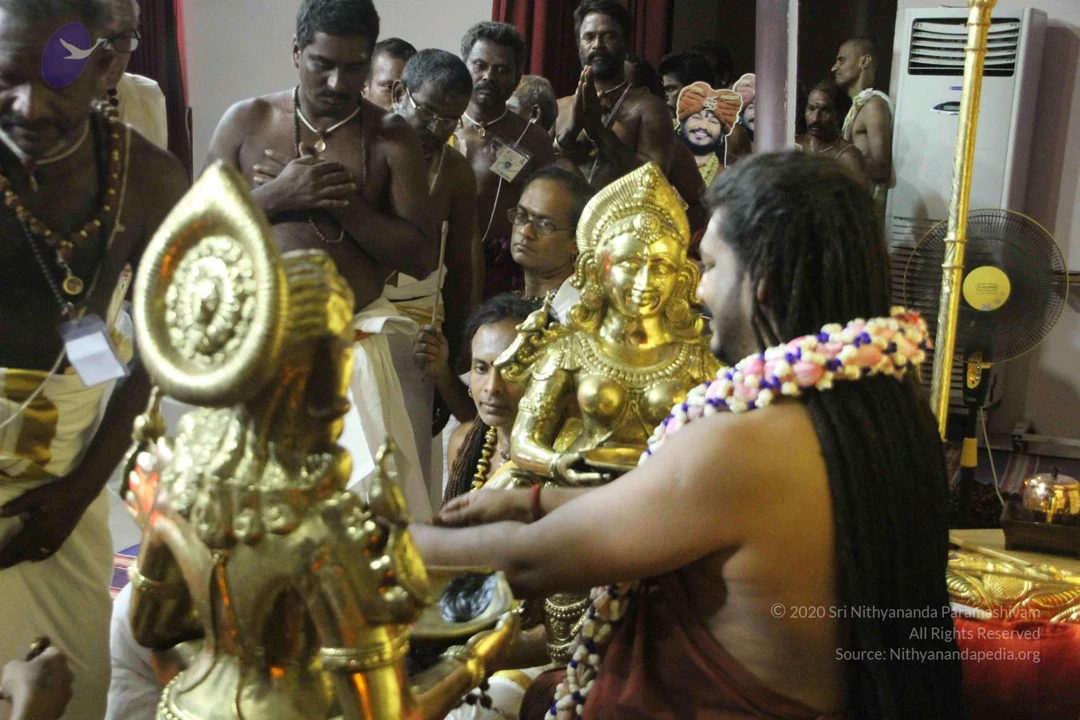
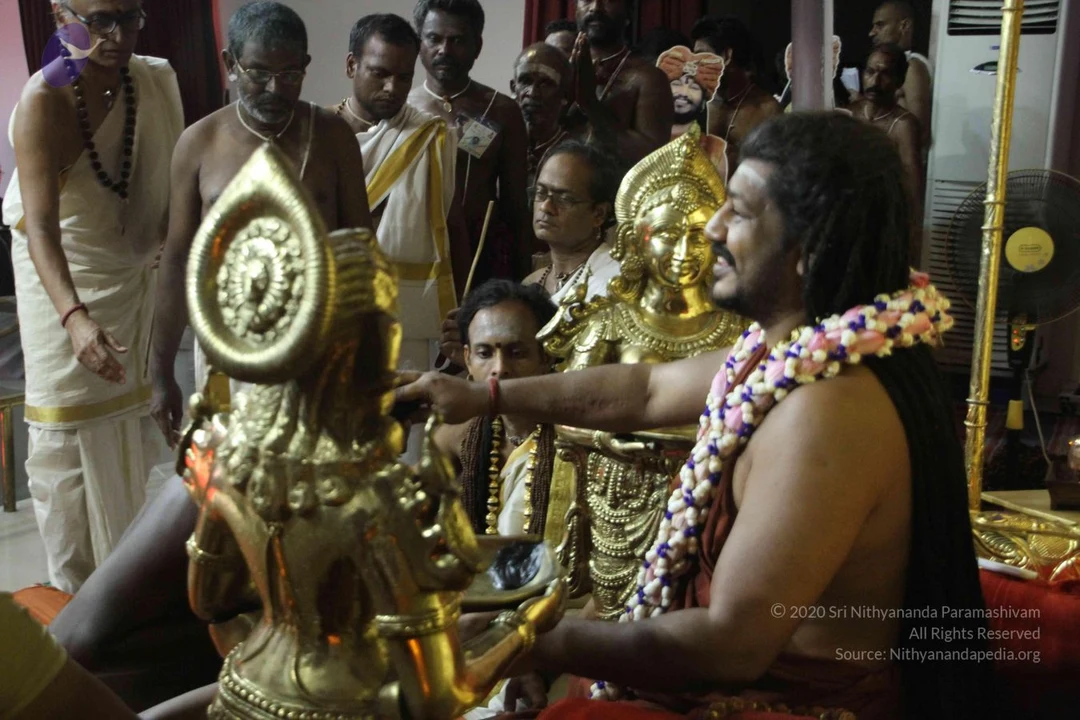
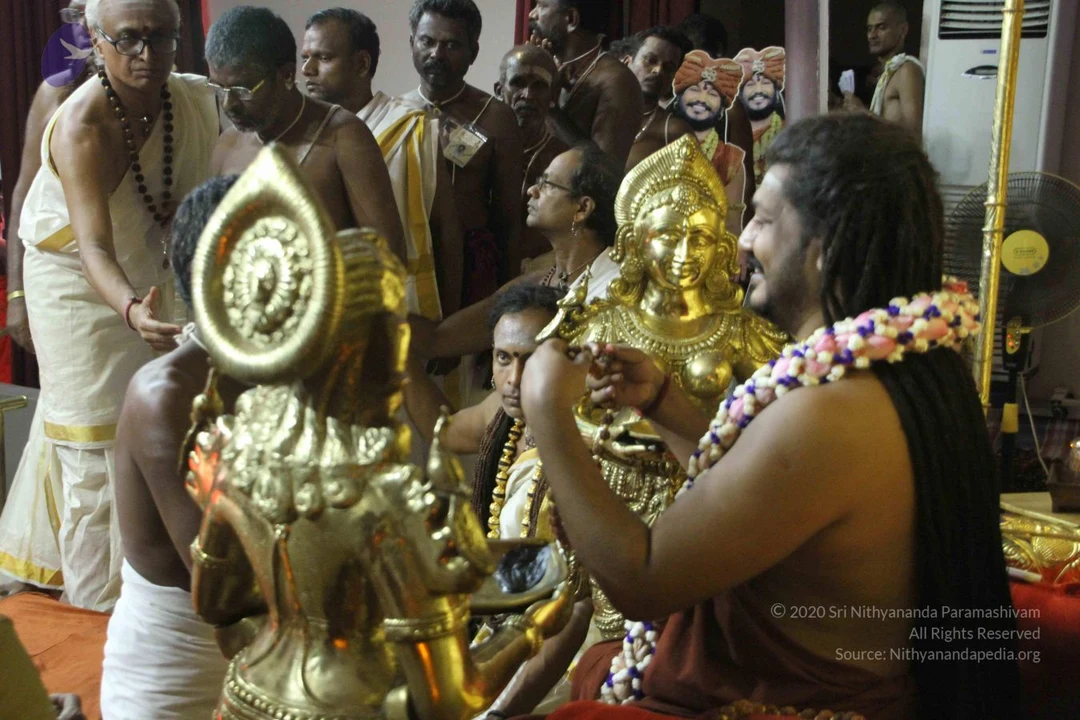
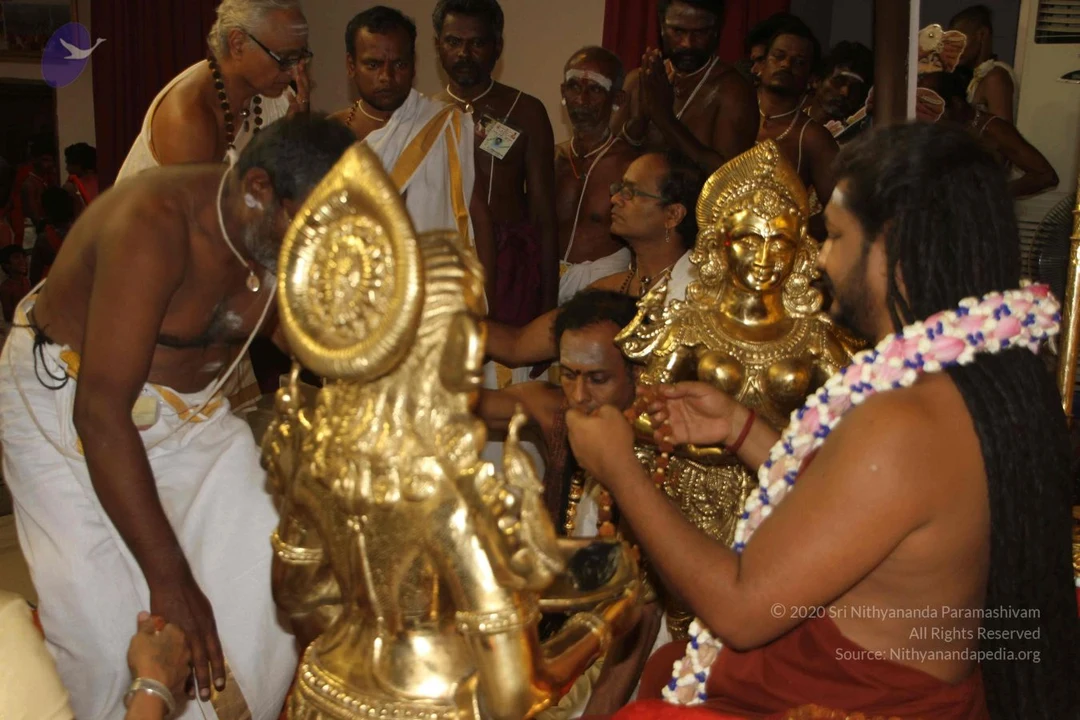
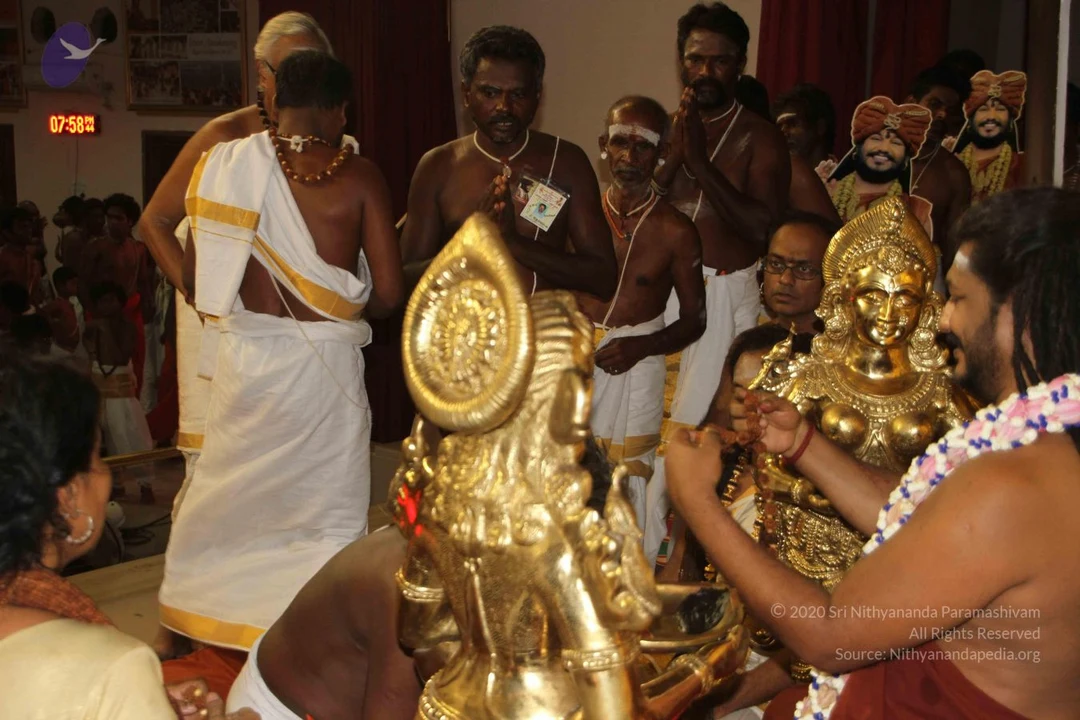
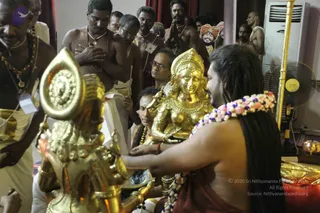
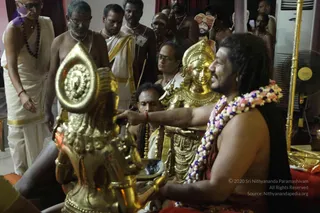
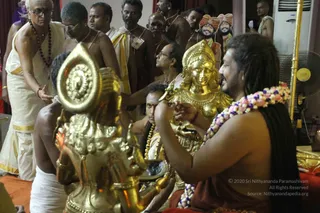
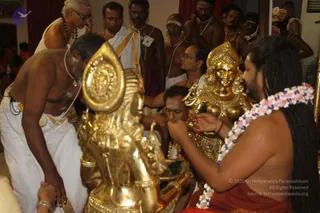
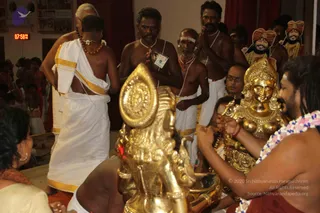
A photograph inside a temple hall during a ritual. In the foreground a long-haired man with dreadlocks, wearing a maroon cloth, a multi-coloured flower garland and a red wrist thread, reaches toward a gold-coloured deity murti seated on a dais. Beside it stands a gold-coloured ornate figure with a tall crown, and in the left foreground a second gold metal image with a halo-like backdrop. Around them, bare-chested men in white dhotis and rudraksha malas stand with hands folded in prayer or holding ritual objects. A white pedestal fan and an oil lamp are visible at the right edge.A photograph of a ritual scene indoors. In the foreground, a man with long dark dreadlocks, bare-chested and wearing a saffron-brown cloth, sits on a red cushion with a garland of pink and white flowers around his neck, one hand extended to touch a large polished gold ritual object. Behind him, a golden deity murti with a tall crown stands beside a gold vessel. Several men in white dhotis with gold borders and rudraksha malas stand or sit around, some with hands folded, and a man in a white shirt wears an ID badge. A floor fan and a gold pole are visible at right.A photograph of a temple ritual indoors. In the foreground, a bearded man with long dreadlocked hair, bare-chested and wearing a red-brown cloth, sits draped in a pink and white flower garland while touching a gold deity murti. Beside him, gold metal statues including a crowned deity figure with a large halo are arranged on a table. Behind them, several men stand in white dhotis, some with rudraksha malas and gold-bordered cloth, and a man with glasses and a white shirt-and-dhoti stands at left. Two painted cutouts of turbaned men in orange appear at upper right. A white ceiling fan and gold-edged red fabric hang in the background.A ceremonial scene inside a room with red curtains. In the foreground, a bare-chested man with long dreadlocks wears a red cloth and a garland of pink and white flowers, seated and touching a large gilded figure. Beside him, a gilded deity murti with a crowned headdress and ornate ornaments is attended by devotees. A gilded peetha-like object and a gilded bird-form figure stand in front. To the left, an elderly man in a white dhoti with a rudraksha mala bows forward. Behind them, several bare-chested men with white dhotis, white tilak marks and garlands stand with folded hands, one wearing an identity badge. The gathering appears devotional and includes abhishekam-style worship with a gilded deity figure.A temple ritual scene with golden deity murtis in the foreground: a gilded figure with a crown and a gold bull or animal-shaped vahana beside it. Several men in white dhotis with gold borders stand with hands folded in namaskar; some are bare-chested, one wears a rudraksha-style necklace and a white tilak on the forehead, and one has an ID badge on his chest. A man at right wearing a pink and white flower garland and red thread on his wrist holds offerings near the deity. A small digital clock reading 07:58 is visible at upper left, and a few onlookers are behind. Background shows a red curtain and framed photographs on the wall.

Darsan

23 photosSource gallery
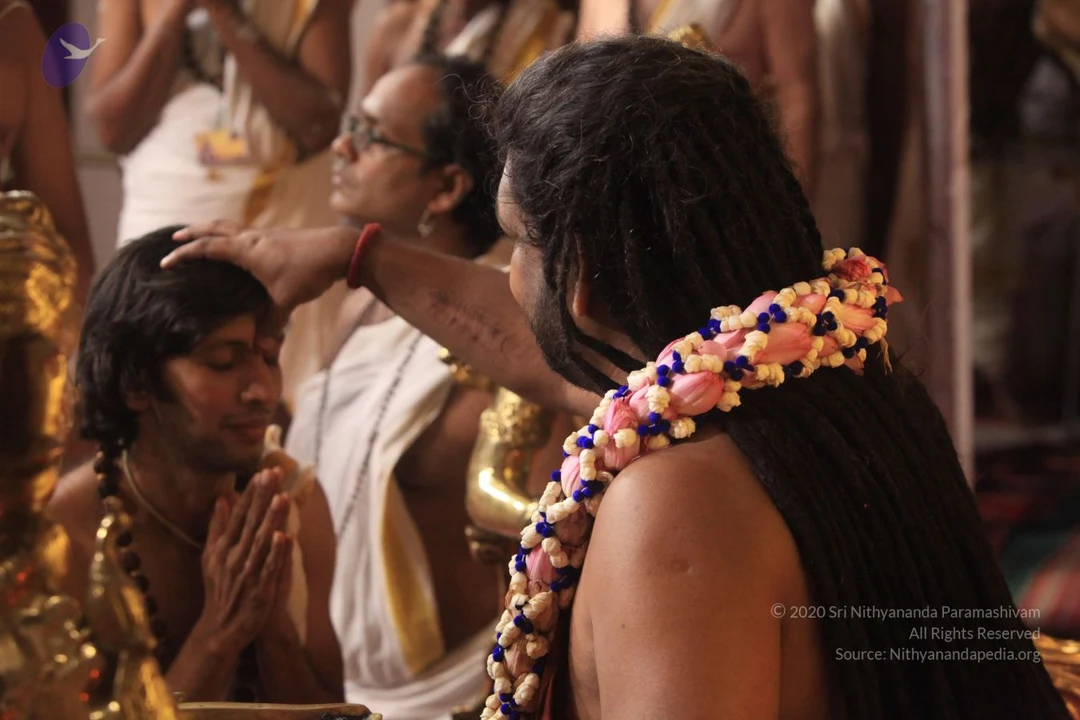
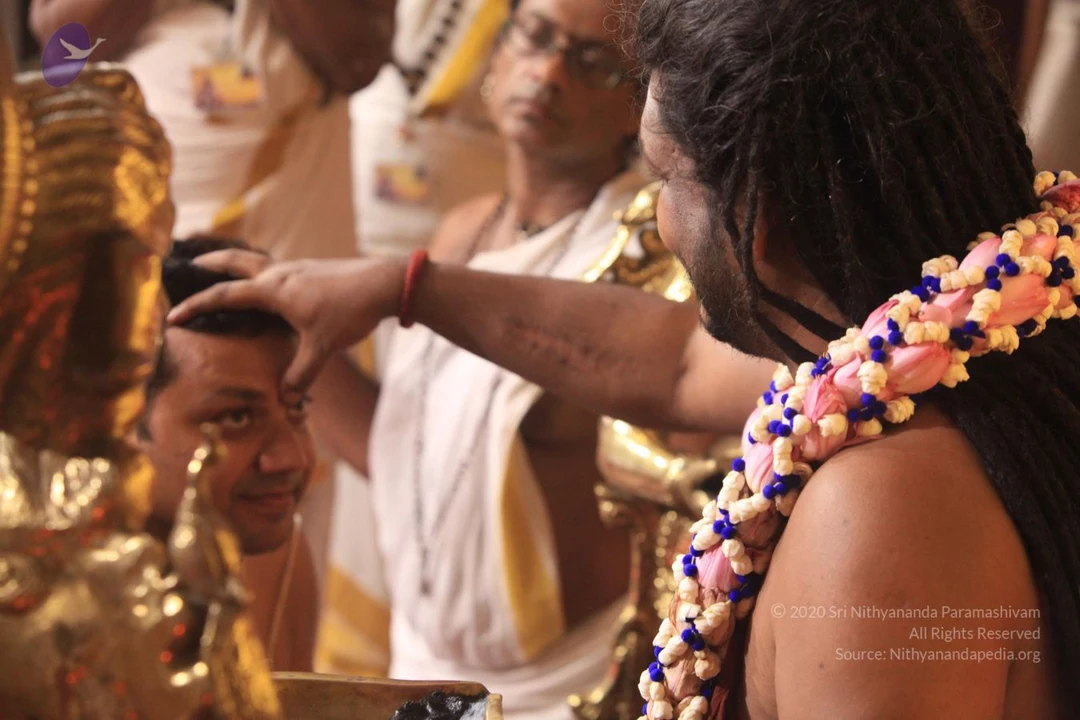
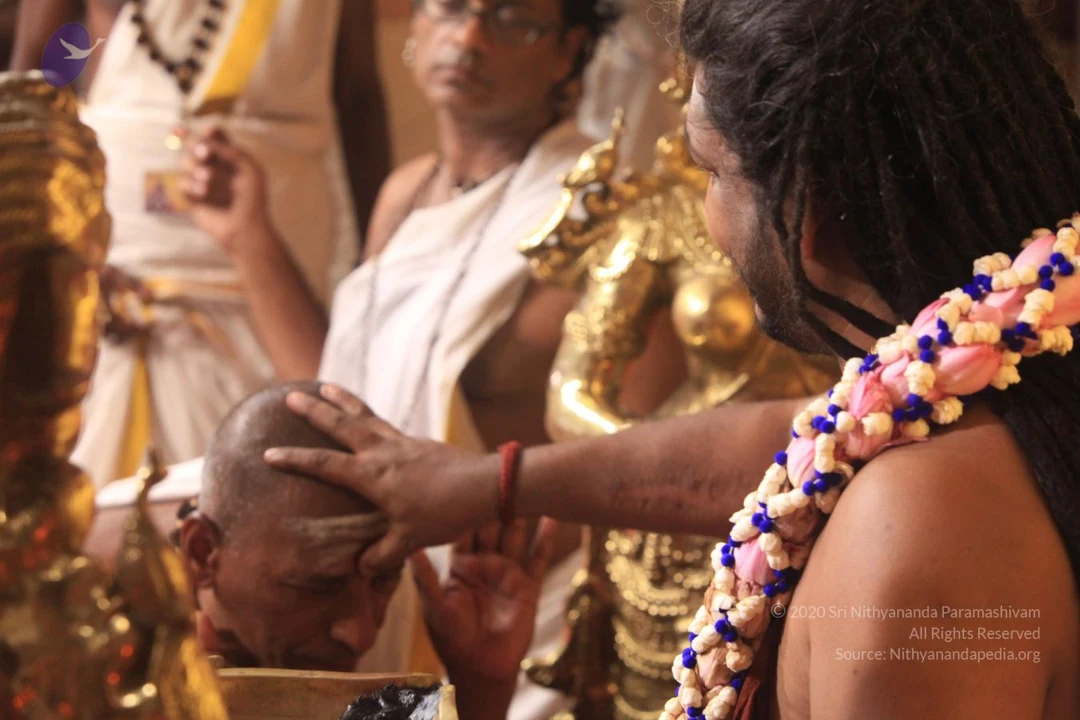
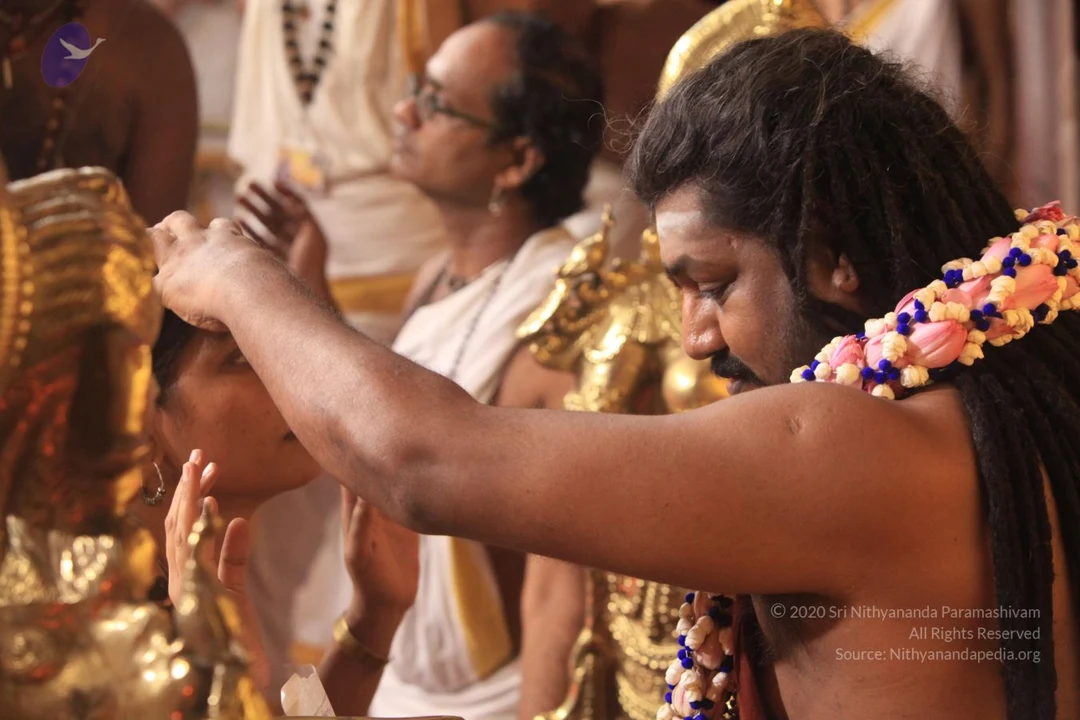
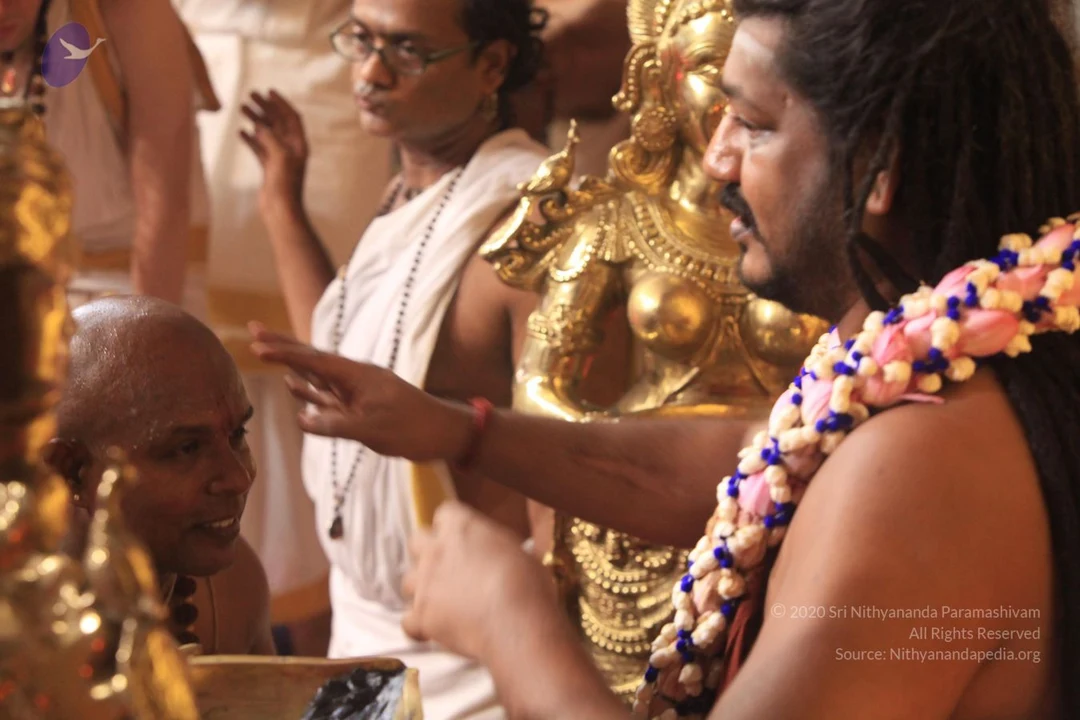
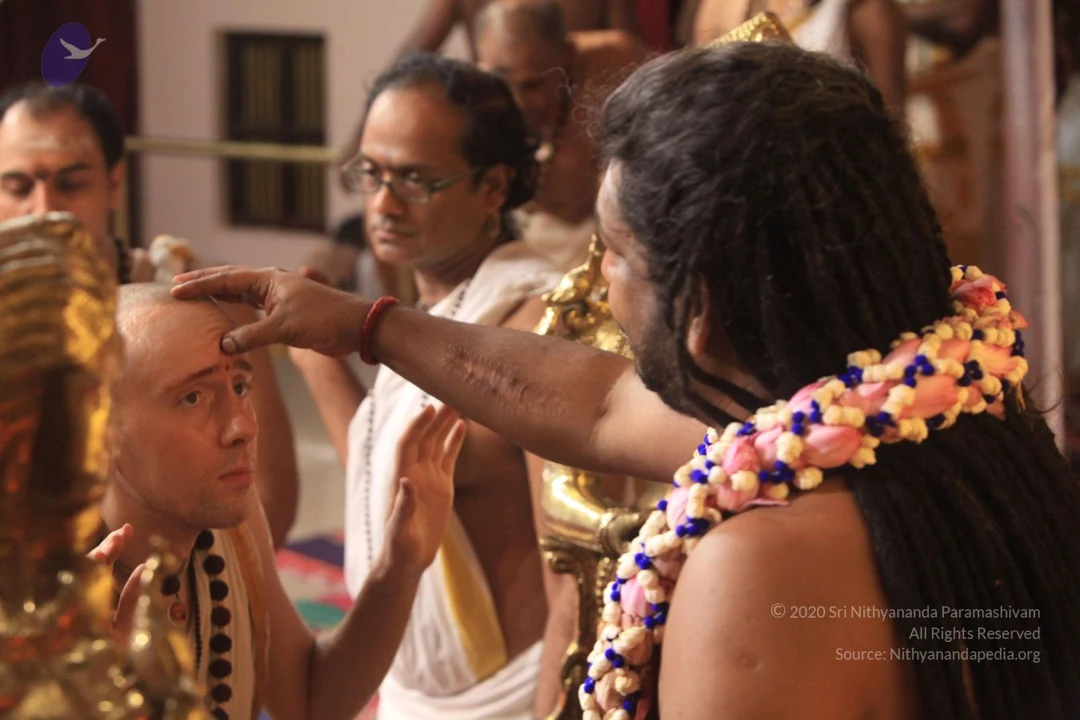
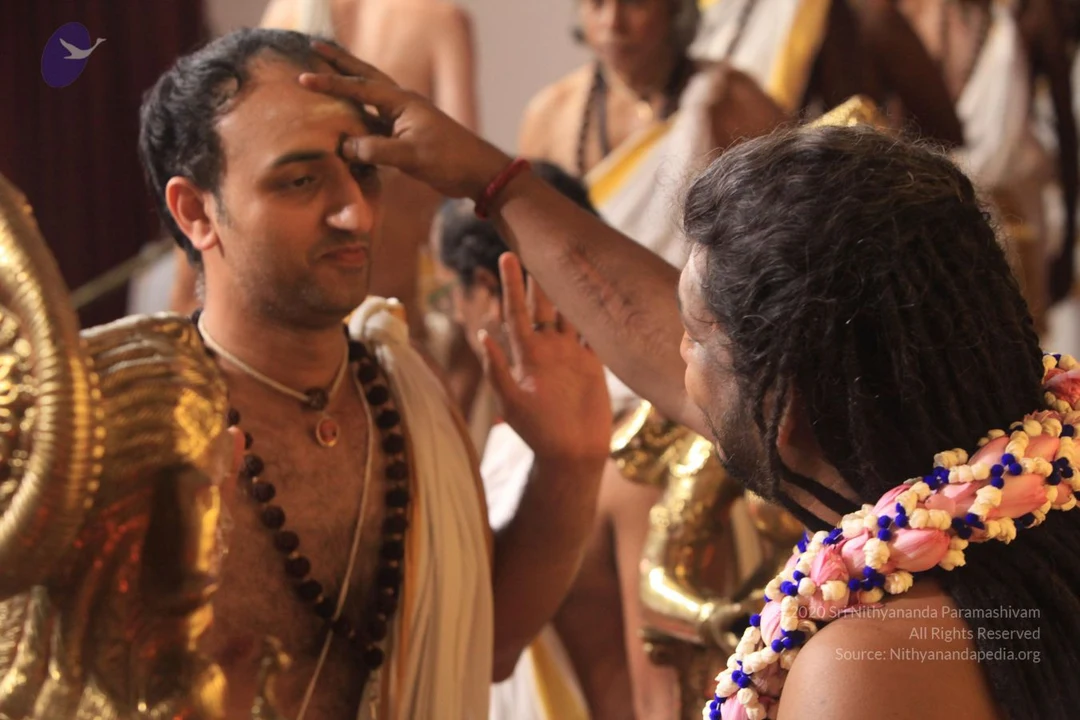
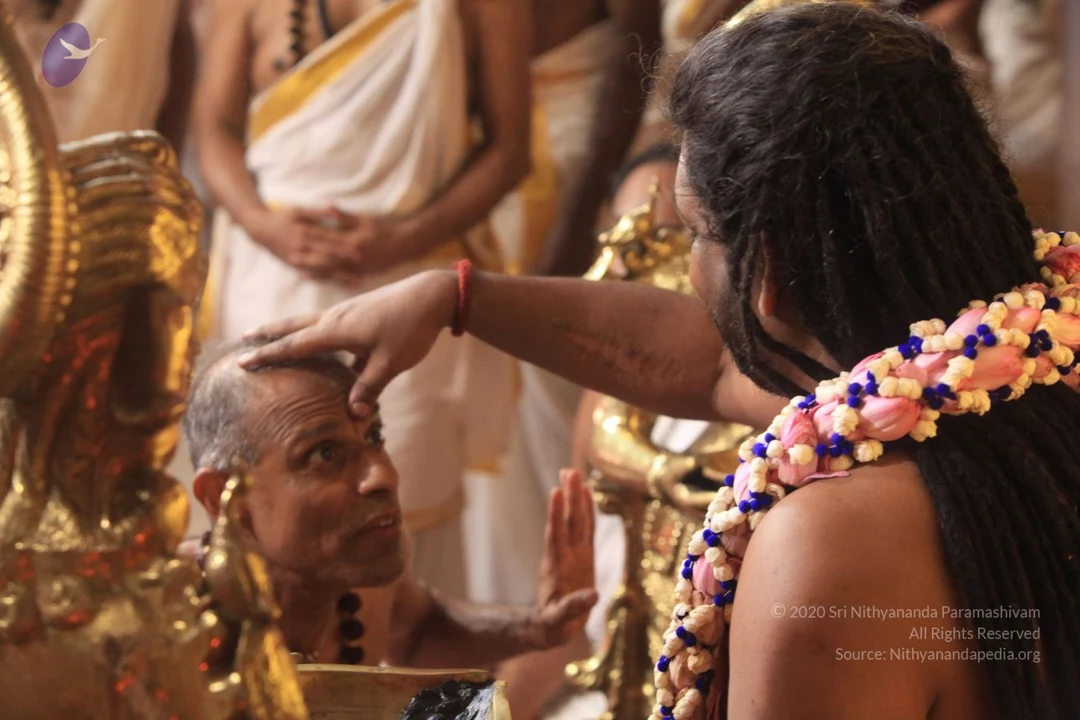
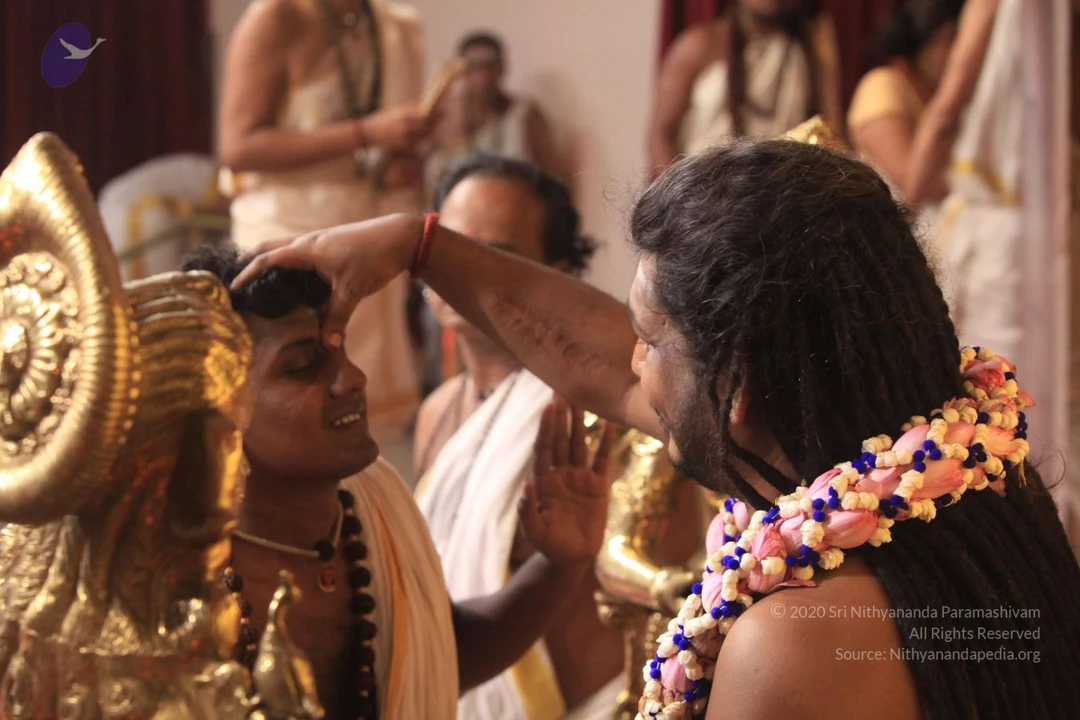
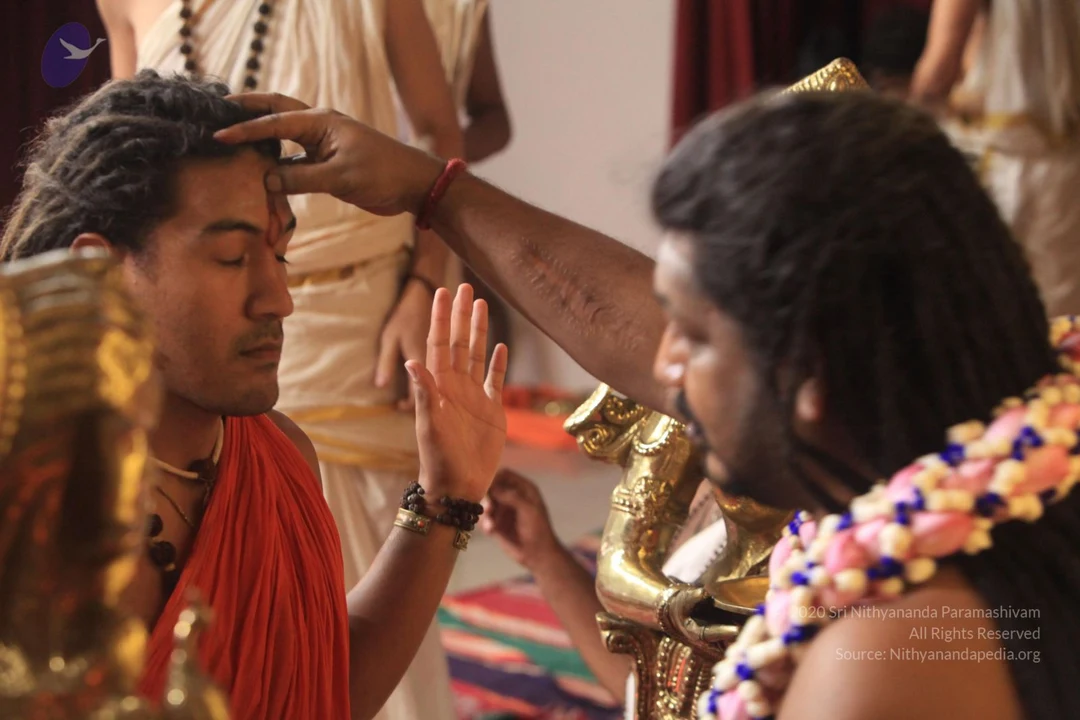
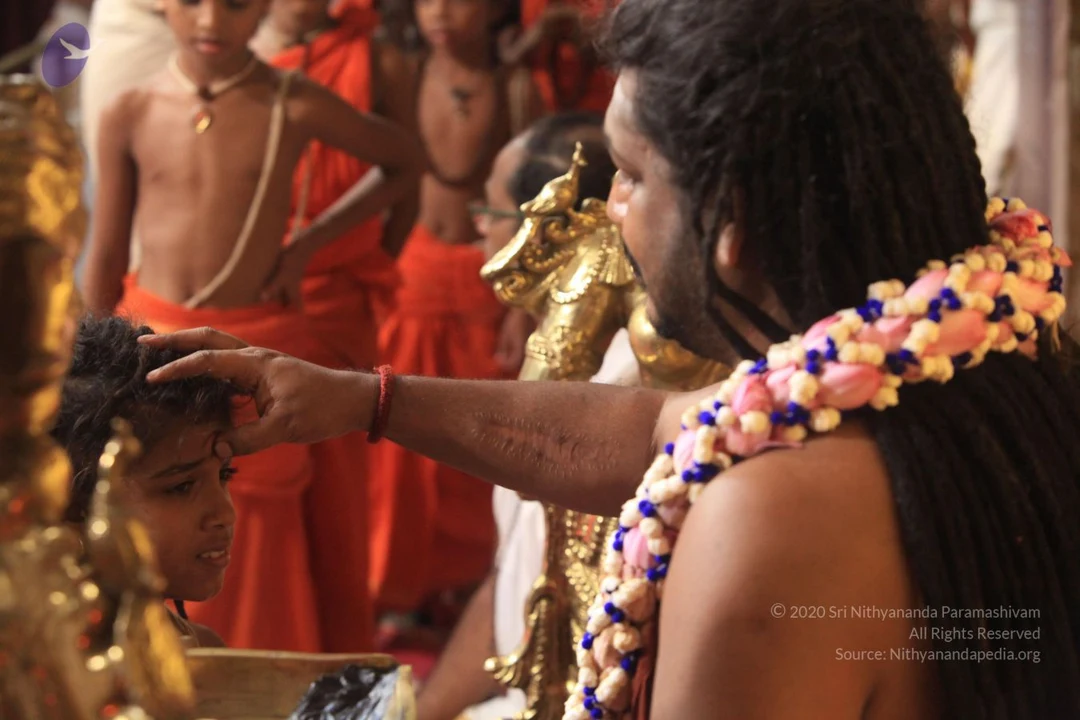
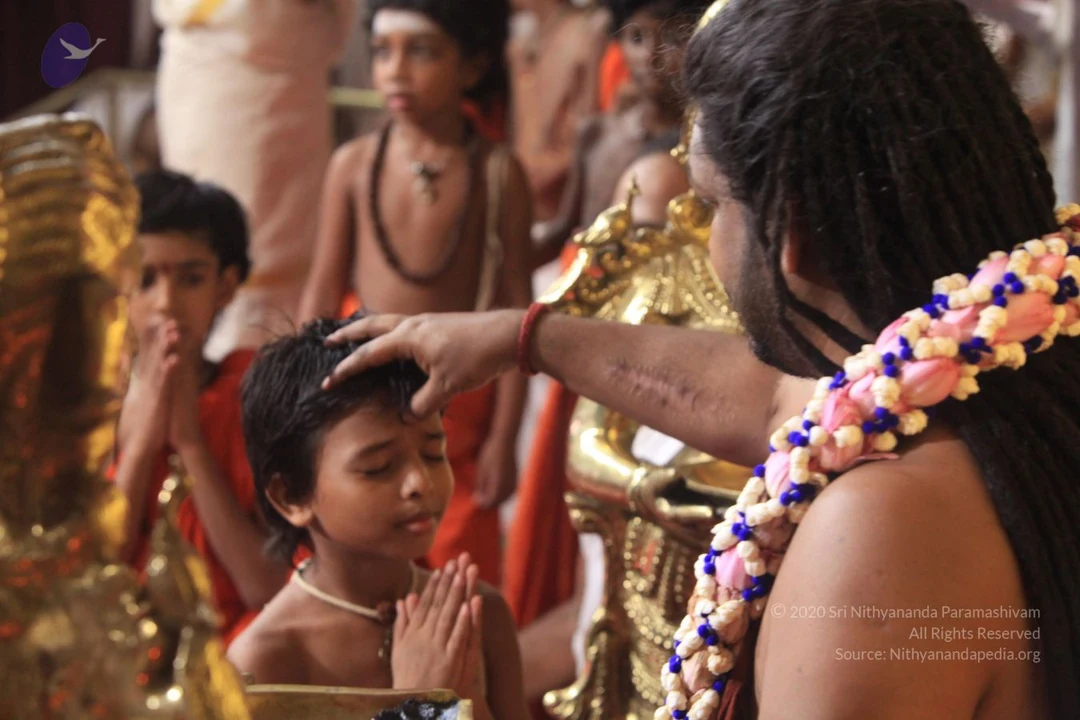
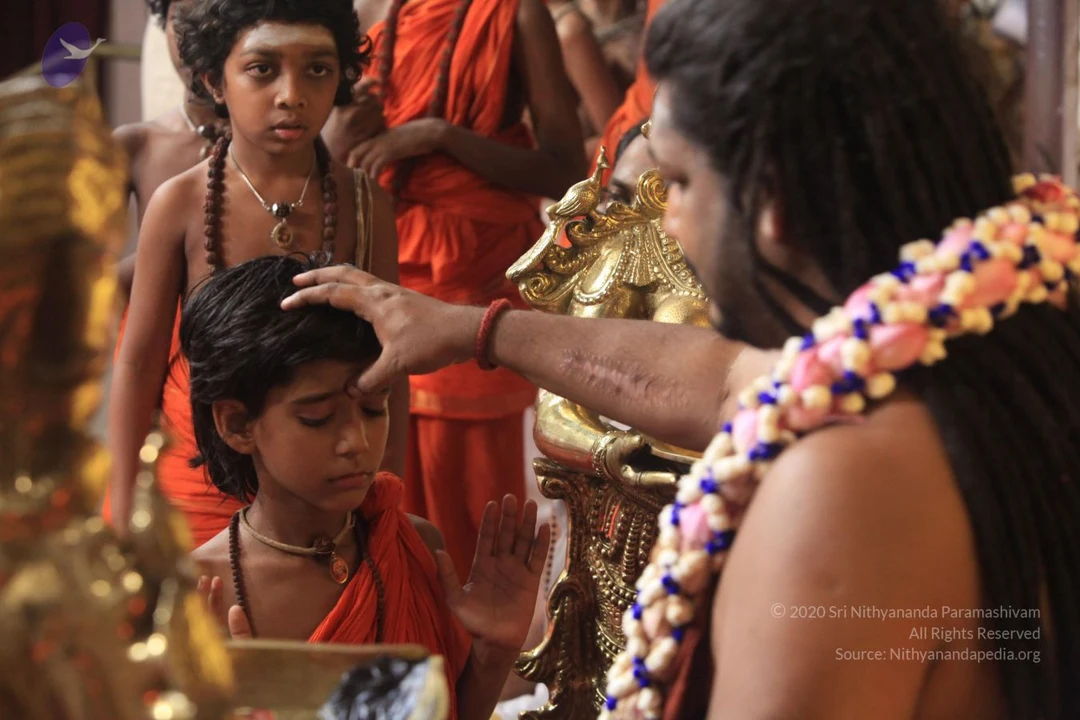
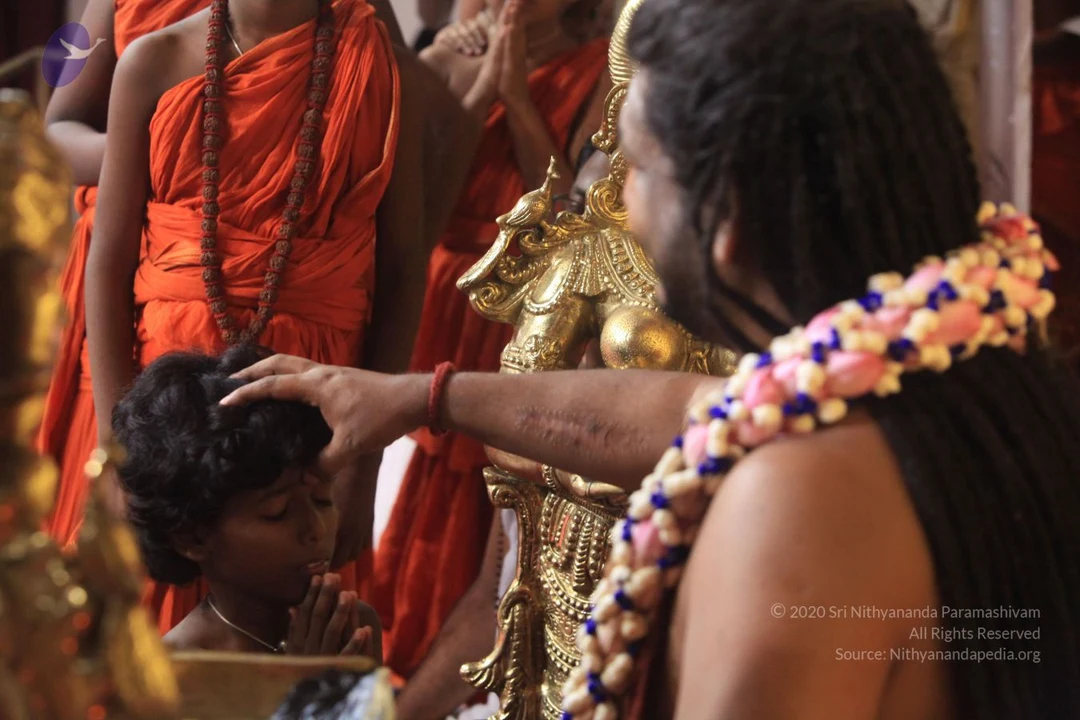
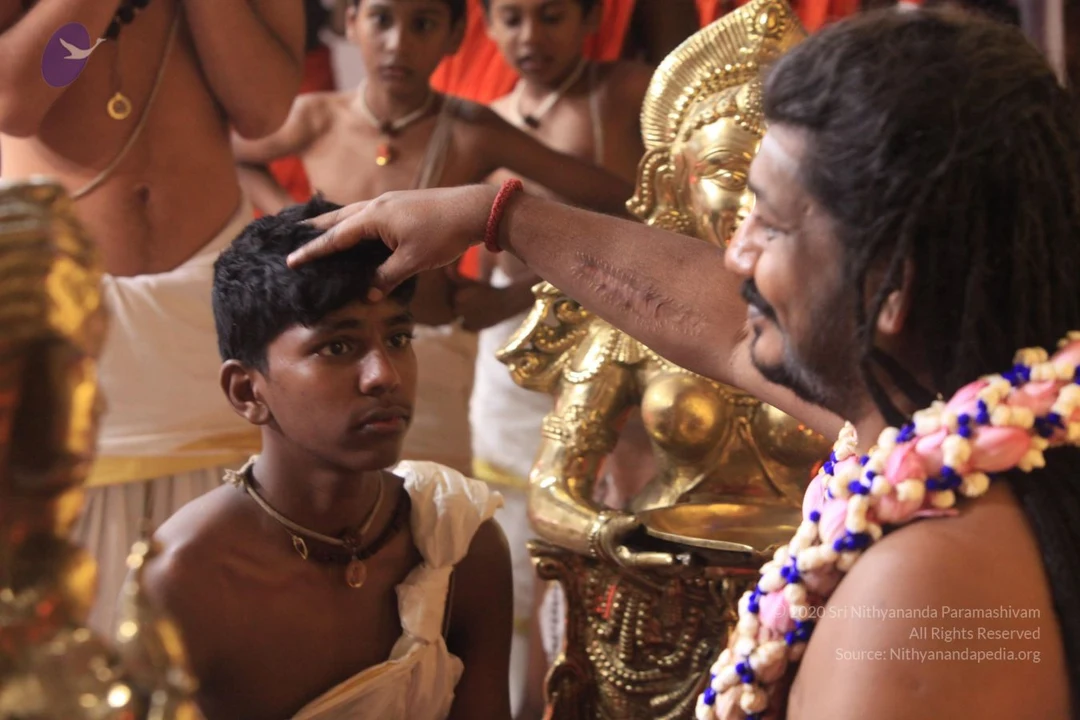
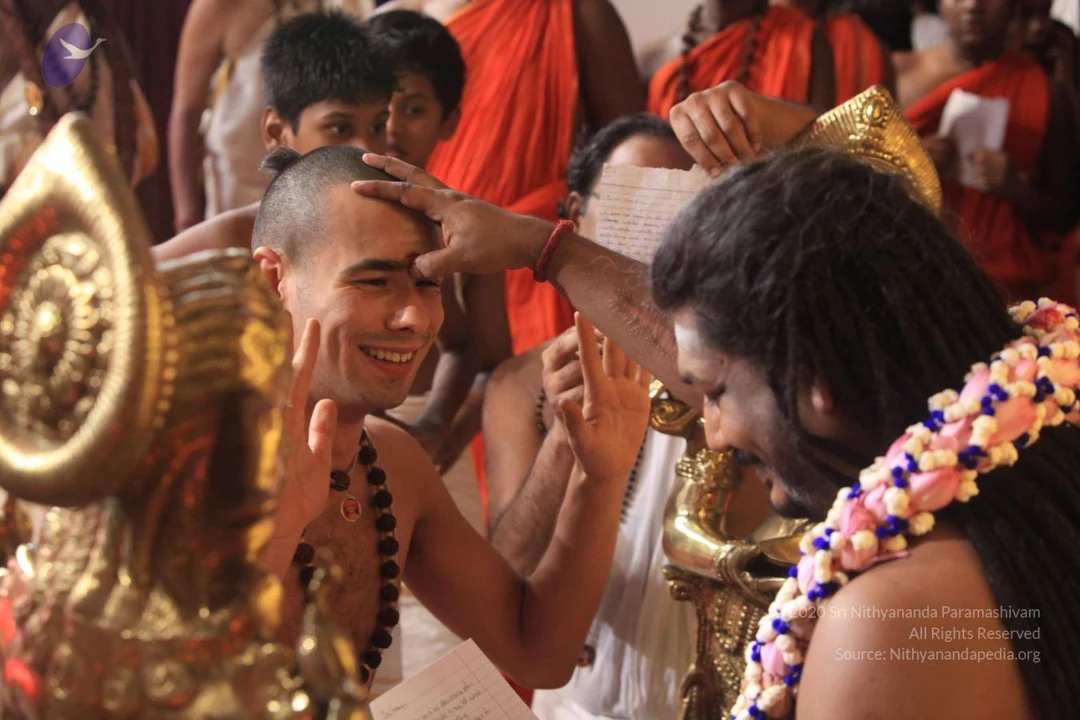
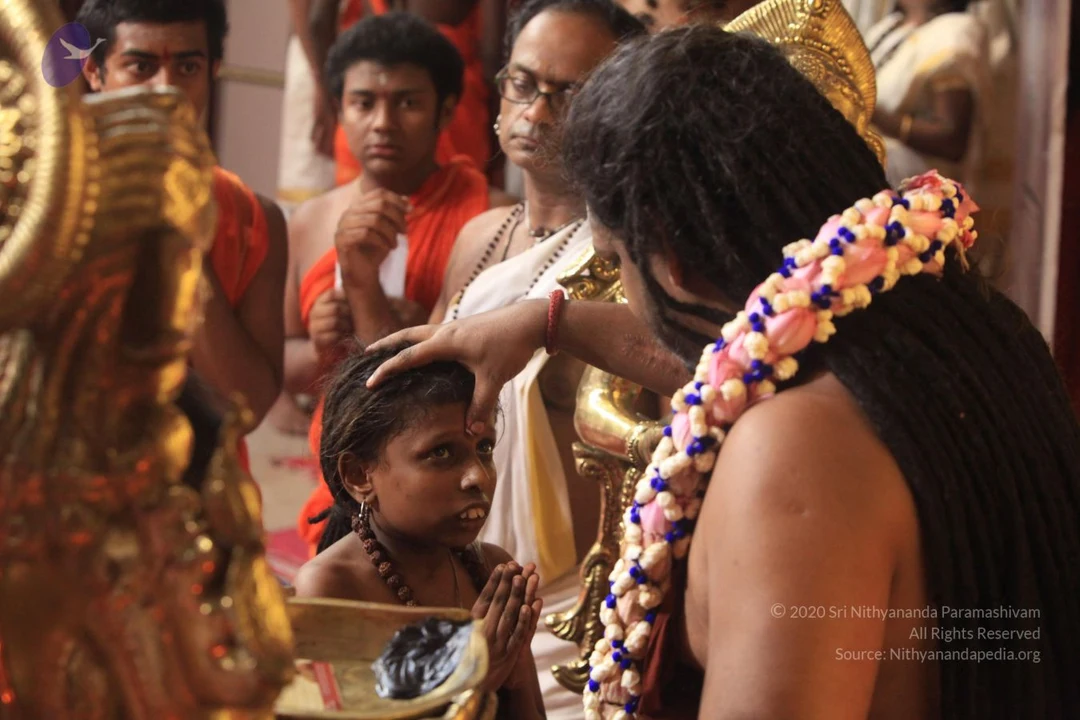
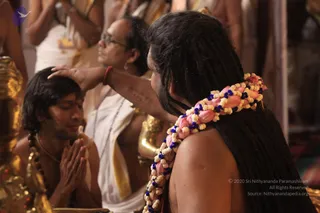
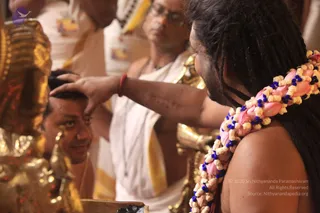
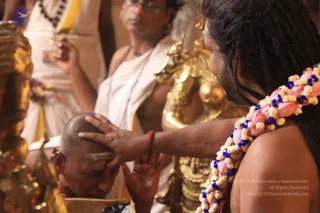
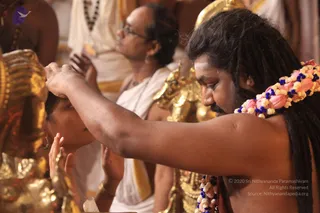
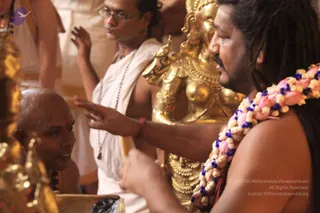
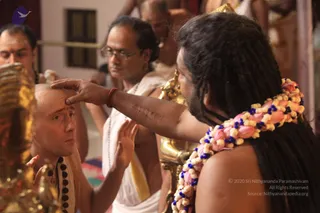
A photograph of a ritual blessing. In the foreground, a long-haired figure with dreadlocks, bare-shouldered, wearing a pink and white flower garland with blue beads, places one hand on the head of a kneeling young man with short dark hair and a rudraksha-style bead mala. The young man sits with palms pressed together in prayer and eyes closed. Behind them, a man in white dhoti and shawl with gold border stands near a gold-coloured object, and other people in white ritual clothes are visible in the background. The blessing appears to be a darshan or initiation-style gesture.A photograph of a ritual blessing in a temple setting. In the right foreground, a man with long dreadlocks, seen from behind and partly in profile, wears a pink and white flower garland with blue beads over bare shoulders and places his right hand on the head of a seated man in front. The seated man has short dark hair and looks to the side. Behind them stands a man in white dhoti with a gold-bordered yellow cloth draped over his shoulder and a beaded mala, and a bespectacled man. At left, a gilded deity murti or ornate golden figure is partly visible, and a brass vessel sits at the bottom edge. The ritual appears to be a head blessing, with the blessing giver's garland and bare shoulders prominent.Photograph of a diksha-style blessing in a temple setting. In the right foreground, a bare-chested man with long dreadlocked hair and a beard wears a necklace of pink lotus blossoms, white flowers and blue beads. He places his right hand on the shaved head of a bowed devotee in the lower left, who wears a white dhoti. Behind them, a priest in white with a yellow-bordered cloth and a white sacred thread stands beside golden deity murti and a gilded figure. A small wristband is visible on the devotee's arm. Gold and white tones dominate.A bare-chested man with long dreadlocked hair and a pink-and-blue flower garland presses his right hand to the forehead of a woman who bows her head before him. Behind them, gold-coloured deity murti and a standing man in white dhoti and white shirt with a gold-bordered cloth and rudraksha mala watch the blessing. Gold ornaments and a small crystal are visible in the foreground. The bare-chested man has distinctive long hair and a flower garland, so he is shown as a person (a person) giving a blessing, though his face is not clearly visible and the identification is uncertain.A photograph of a ritual setting with a large golden deity murti glinting in the background. In the foreground, a man with long dreadlocks, a moustache and a pink-and-blue flower garland around his neck, wearing an orange cloth, extends his hand toward a bald man in a white cloth who smiles and leans forward beside a gold kalasha-like vessel. Behind them, a man in white dhoti and a black beaded mala stands near the golden figure. Two or three people are visible, with a sense of puja or abhishekam in progress.A photograph of a ritual initiation. A long-haired man bare-chested with a pink and white flower garland edged in blue beads presses his right palm on the forehead of a shaved-headed man in white with a black-beaded shawl, who holds his hands up in a gesture of receiving. A bearded man in white dhoti and shawl with rudraksha beads and a man in glasses stand behind, and a gilded deity murti or ornamented object is partially visible at left. The setting appears to be a temple hall with a red-and-white cloth backdrop.

FB-photo-of-the-day

1 photoSource gallery
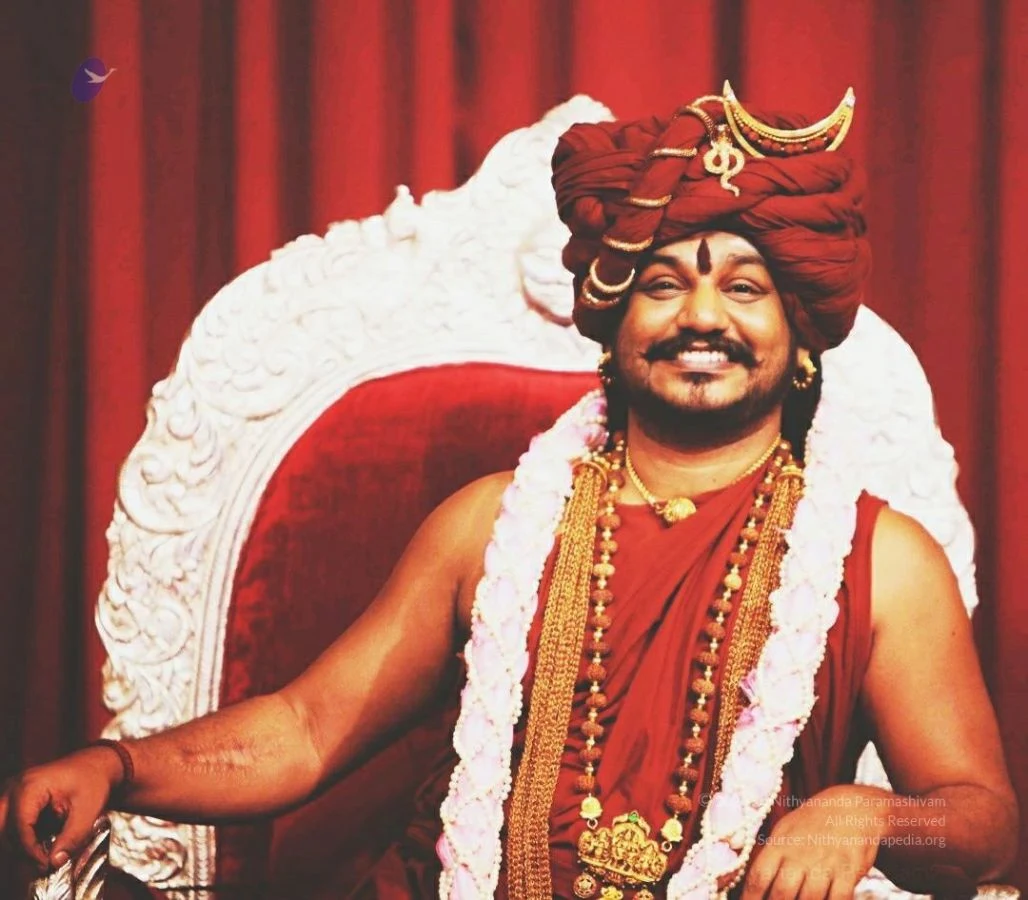
A smiling man sits on an ornate white-and-red throne against a red draped curtain. He wears a deep red turban with a gold crescent and trident ornament, gold earrings, a red vestment, layered rudraksha malas, a gold chain with a pendant, and a white flower garland. A dark tilak marks his forehead. Swamiji (probable): a man in a red turban, ornate gold necklaces and rudraksha malas, seated on a throne in a seated pose. A watermarked print label reads Nithyananda Paramashivam.

01-PADA-PUJA

4 photosSource gallery
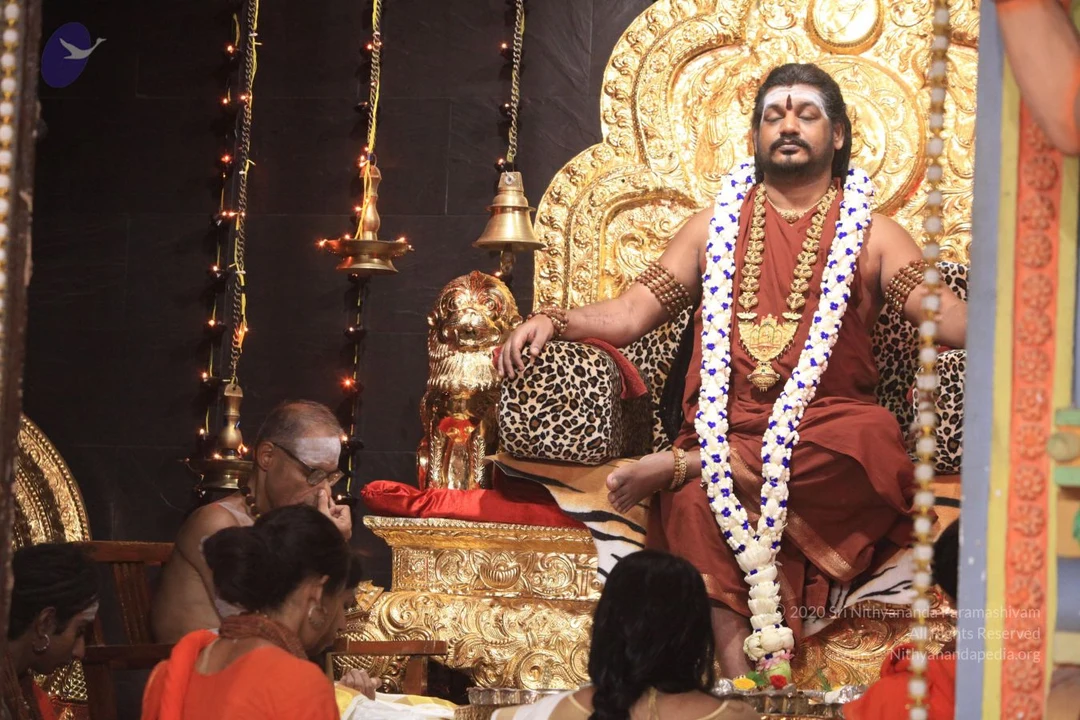
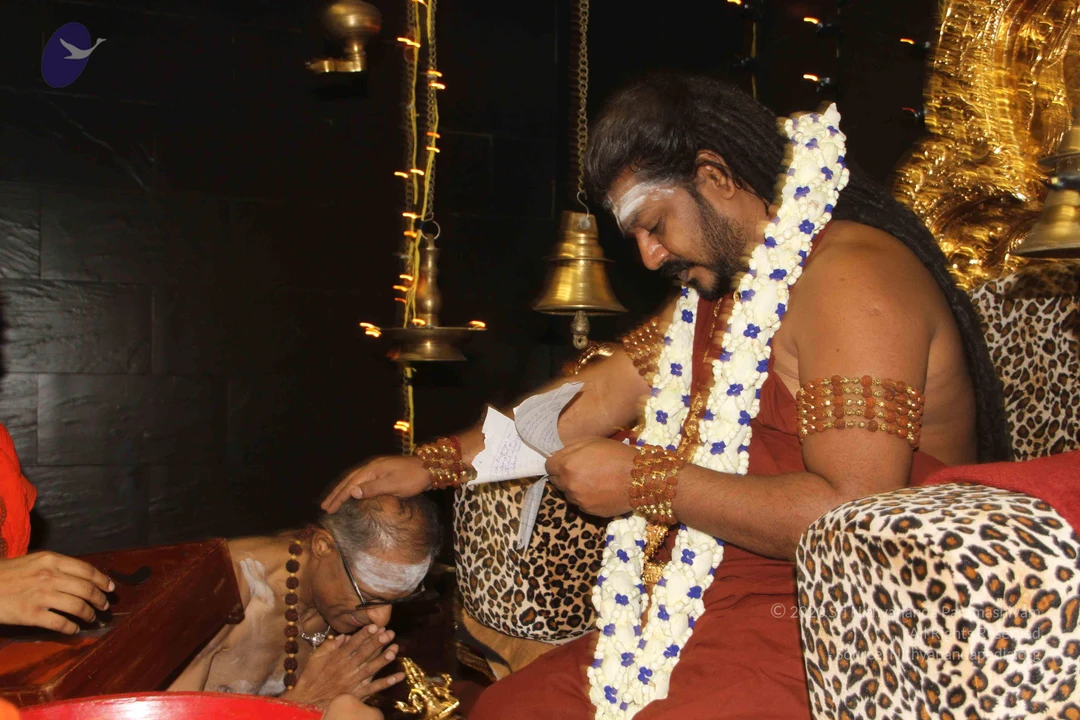
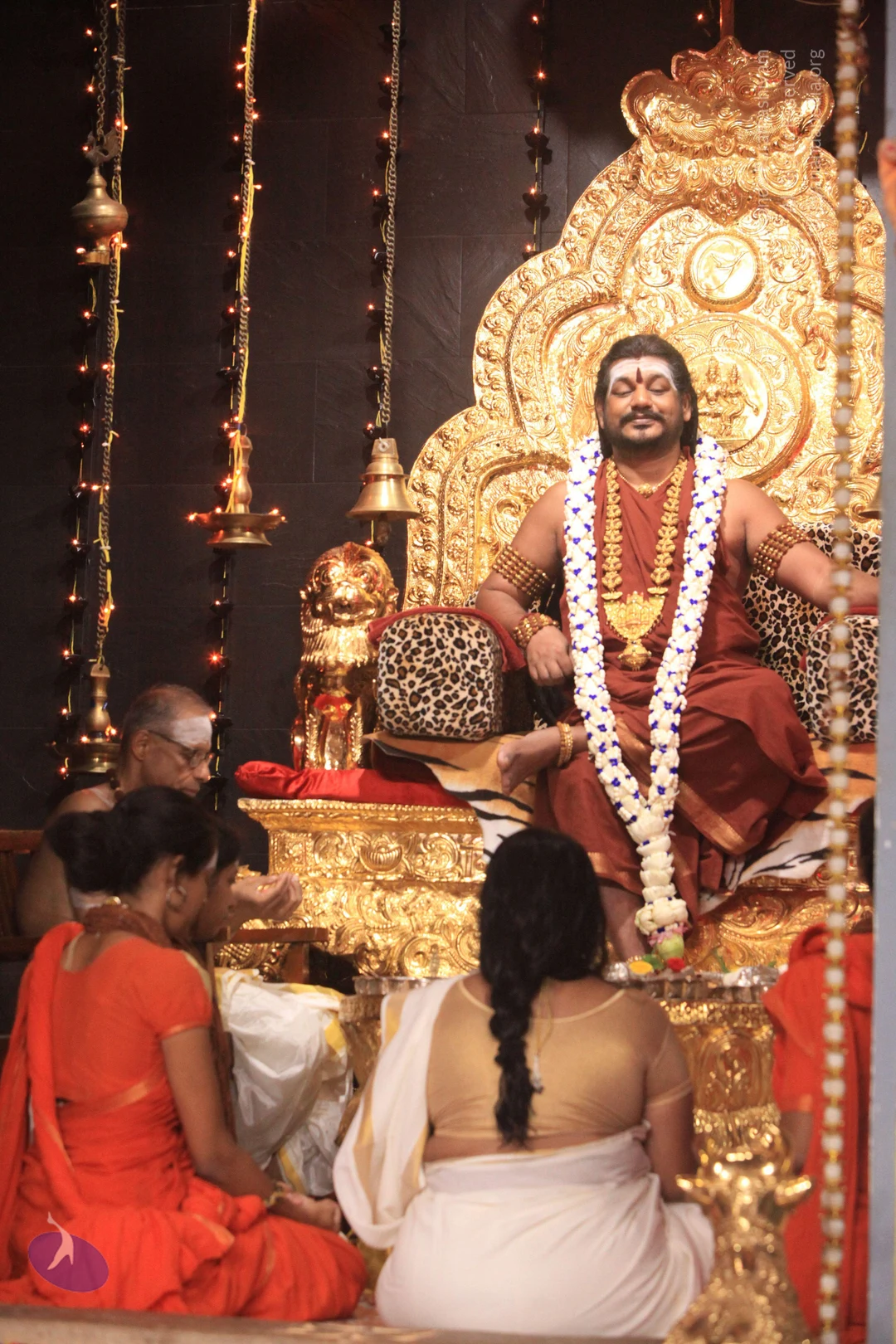
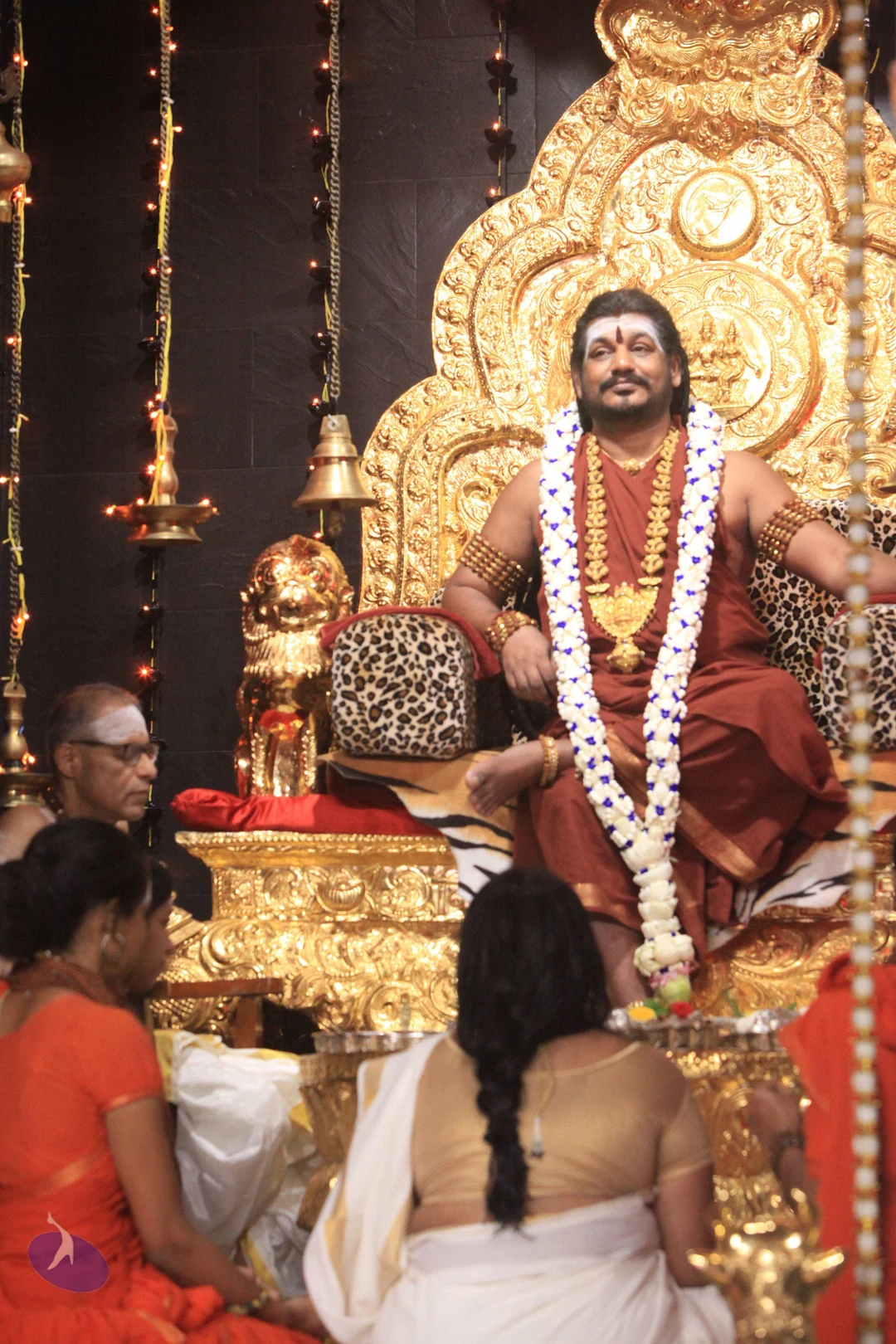
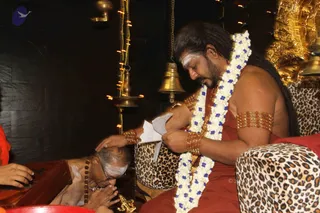
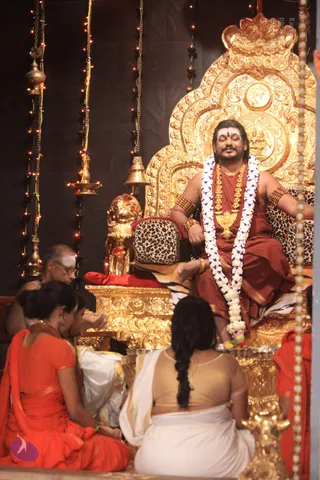
A photograph inside a dark-walled shrine room with brass bells and a hanging brass lamp, gold-toned ornamentation at the upper right. A man in a red-brown robe with a long dark hair, white sacred ash on his forehead, a white-and-blue flower garland, and many beaded bracelets sits on a leopard-print cushioned seat, one hand resting on the head of a bald devotee who bows low with his forehead near the ground. The devotee wears white sacred ash, a rudraksha mala, and white clothing, and holds his hands together in prayer. A red offering bowl and a wooden stand sit in the foreground, with another person's hand visible at the left edge. a person is probable in the seated figure, identified by long swept-back hair, a flower garland, a red-brown robe, and ornate bracelets, with the figure receiving the bowing devotee.A seated man with closed eyes sits on an ornate gold throne with a leopard-print cushion and tiger-skin drape, wearing a rust-red robe, gold chest ornaments, gold armbands and a long white-and-blue flower garland. He has a white tilak on his forehead. In front of him, women in orange and white garments sit on the floor offering a plate, and an older man with white forehead markings sits at left. Gold lion figurines, hanging brass bells and oil lamps with string lights decorate the dark wall. The scene suggests a pada puja offering at the feet of the throne-seated figure.Photo of a pada puja scene in a temple-style hall. A man seated on an ornate gold throne with a leopard-print cushion and tiger-skin covering wears a rust-red robe, layered gold necklaces, gold armlets and a long white flower garland, with white and red forehead markings. A gold lion figure and a brass hanging bell stand nearby, and an oil lamp and string lights hang on the left. In front, a woman in an orange saree and a woman in a white saree with a golden blouse and long braid sit facing him. A bald man in white ritual dress with glasses sits at the left edge. Identity cannot be confirmed from appearance; the seated figure is presented in the ceremonial role of a guru on a throne.A man seated on an ornate gold throne with a leopard-print cushion and tiger skin draped over the seat, wearing a rust-red robe, gold necklaces, gold armbands and a white-and-blue flower garland, with white sacred ash and a red bindi on his forehead. Beside the throne stands a gold lion figure and hanging brass oil lamps and bells on strings of small lights. Several women sit before him in saffron-orange and white saris, one in a white sari with a long braid seen from behind, while a shaved-headed man in white with a white forehead mark sits at the left edge. The seated man has long swept-back hair and fits the ceremonial presentation of a person candidate, but the appearance is not conclusive, so the identity is uncertain.

02-NITHYA-SATSANG

9 photosSource gallery
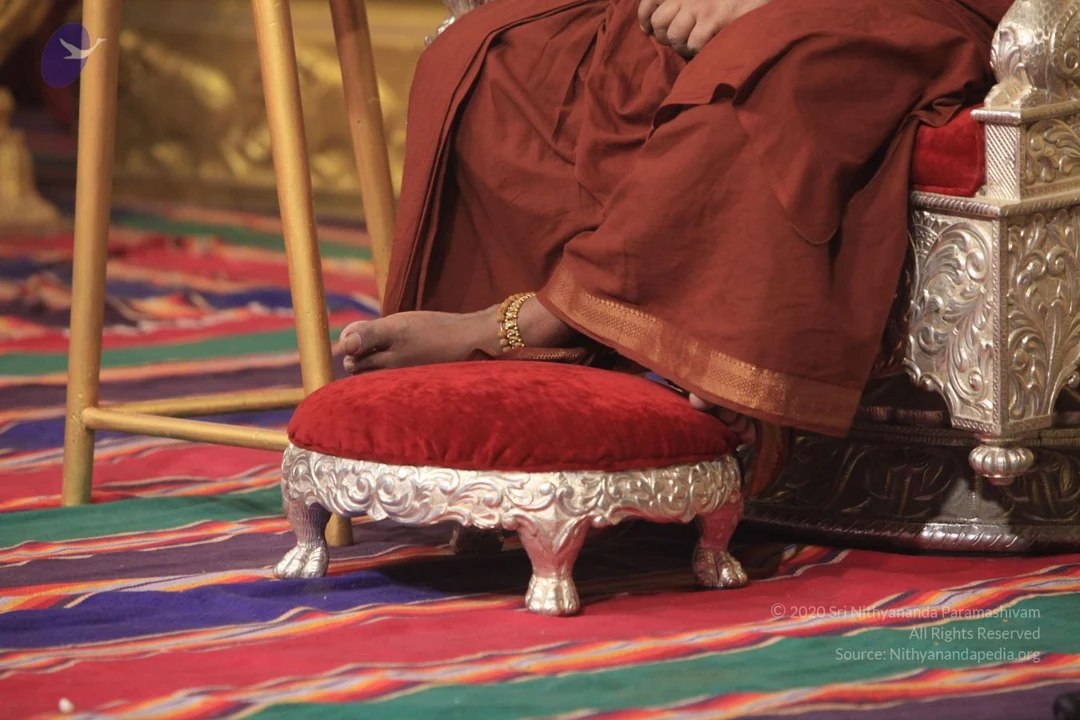
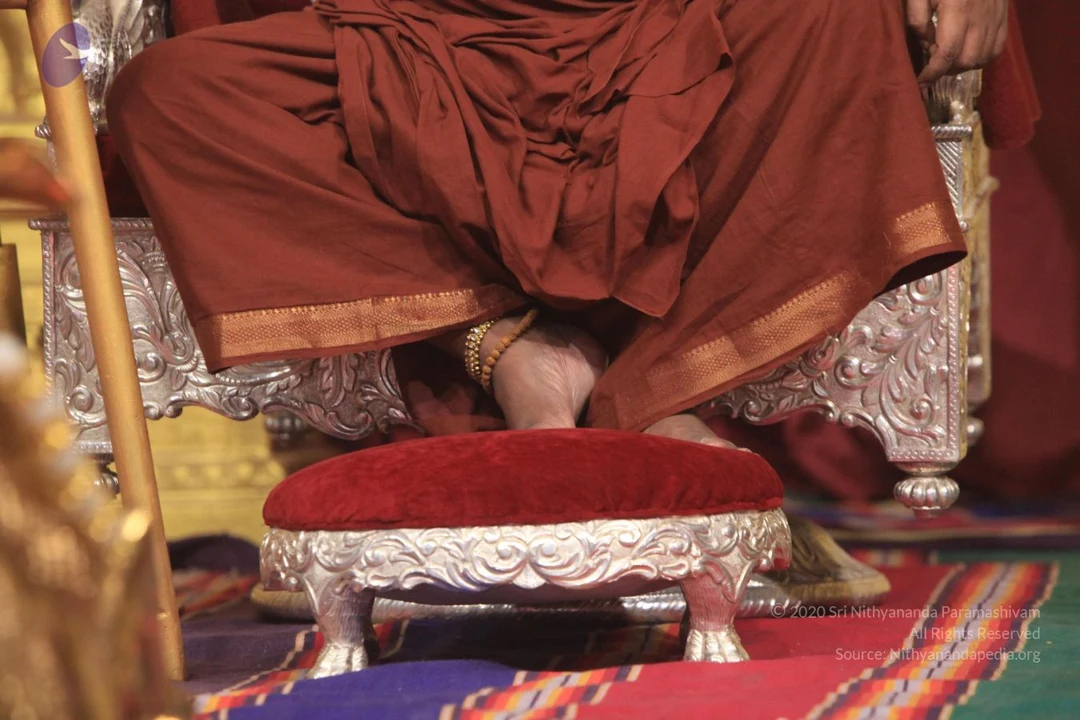
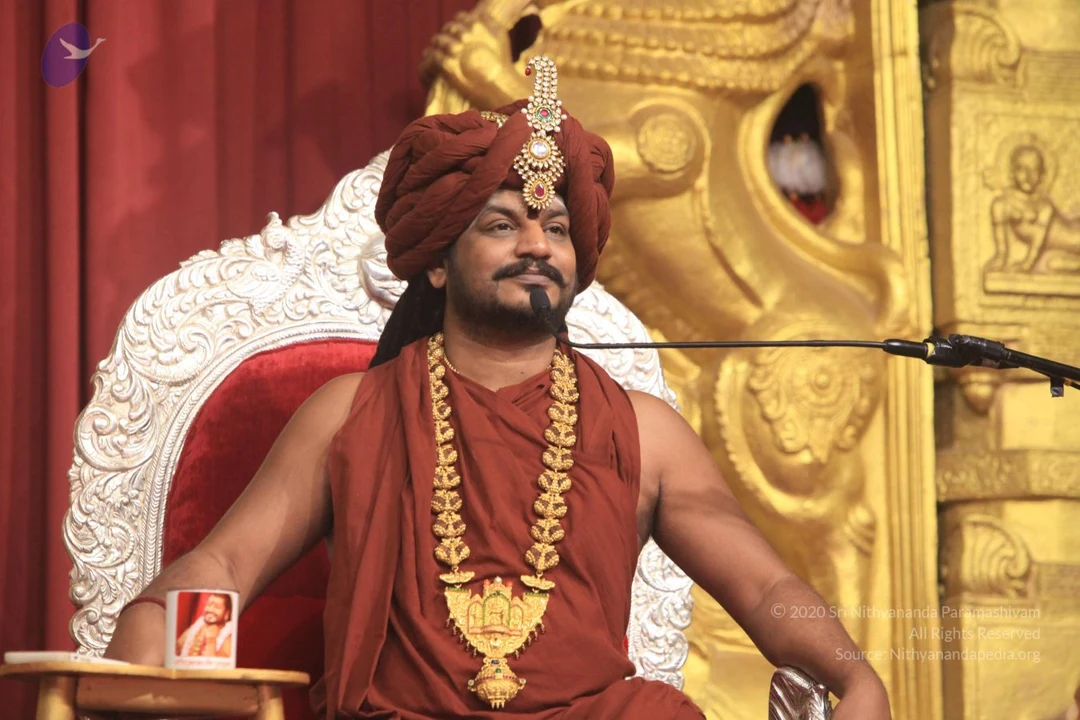
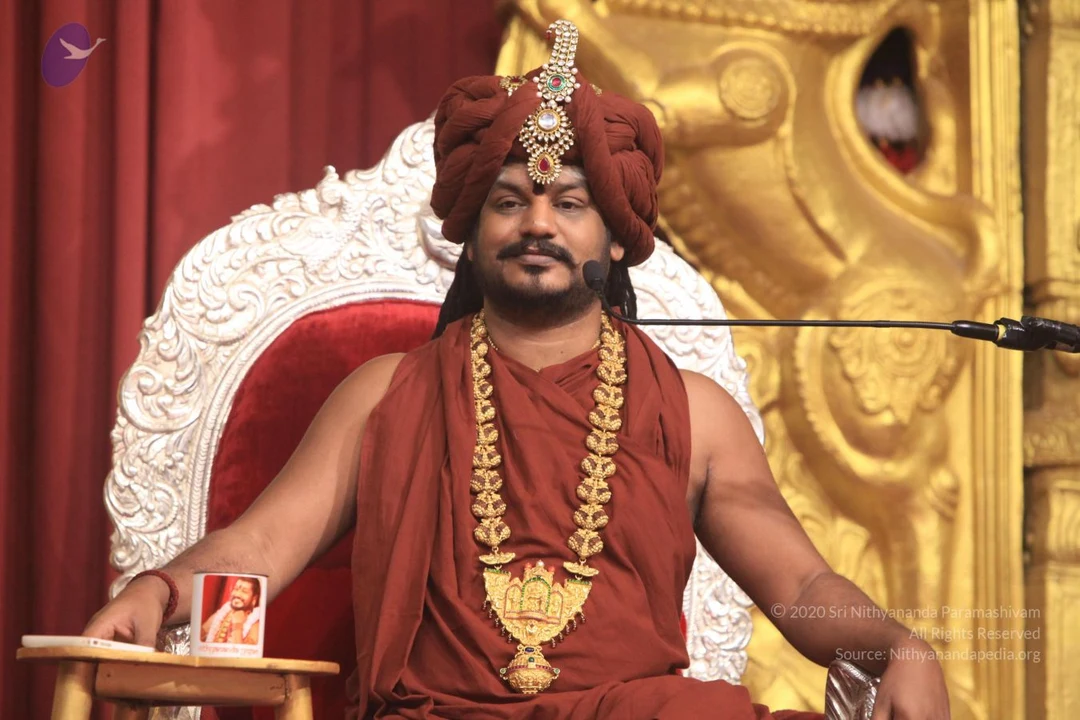
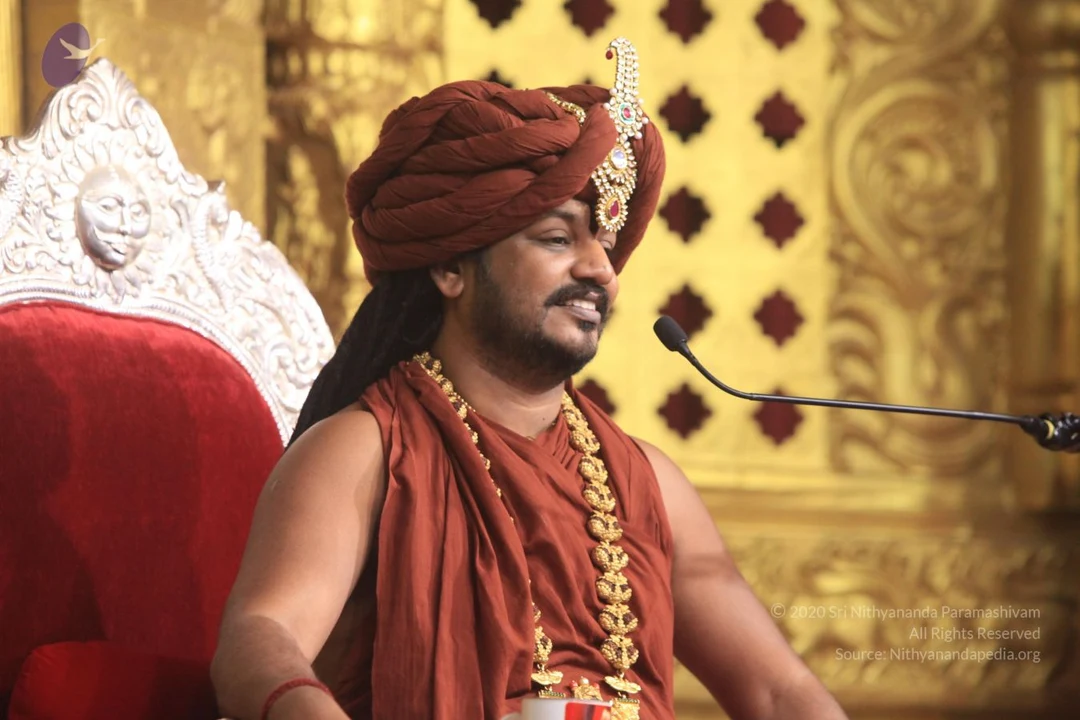
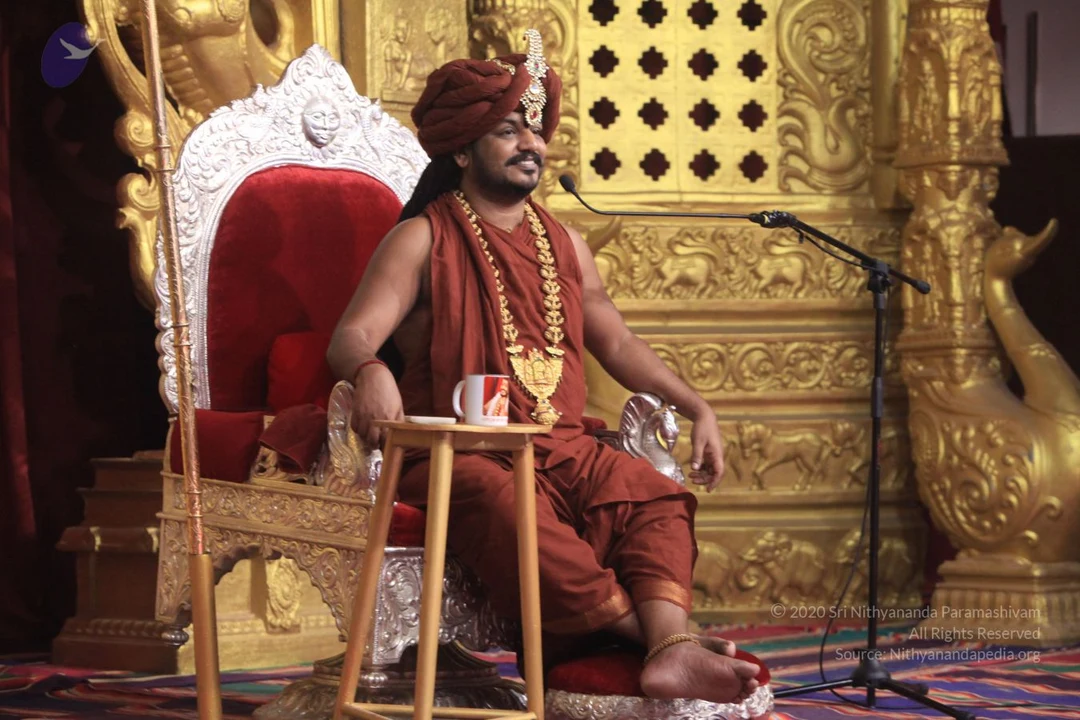
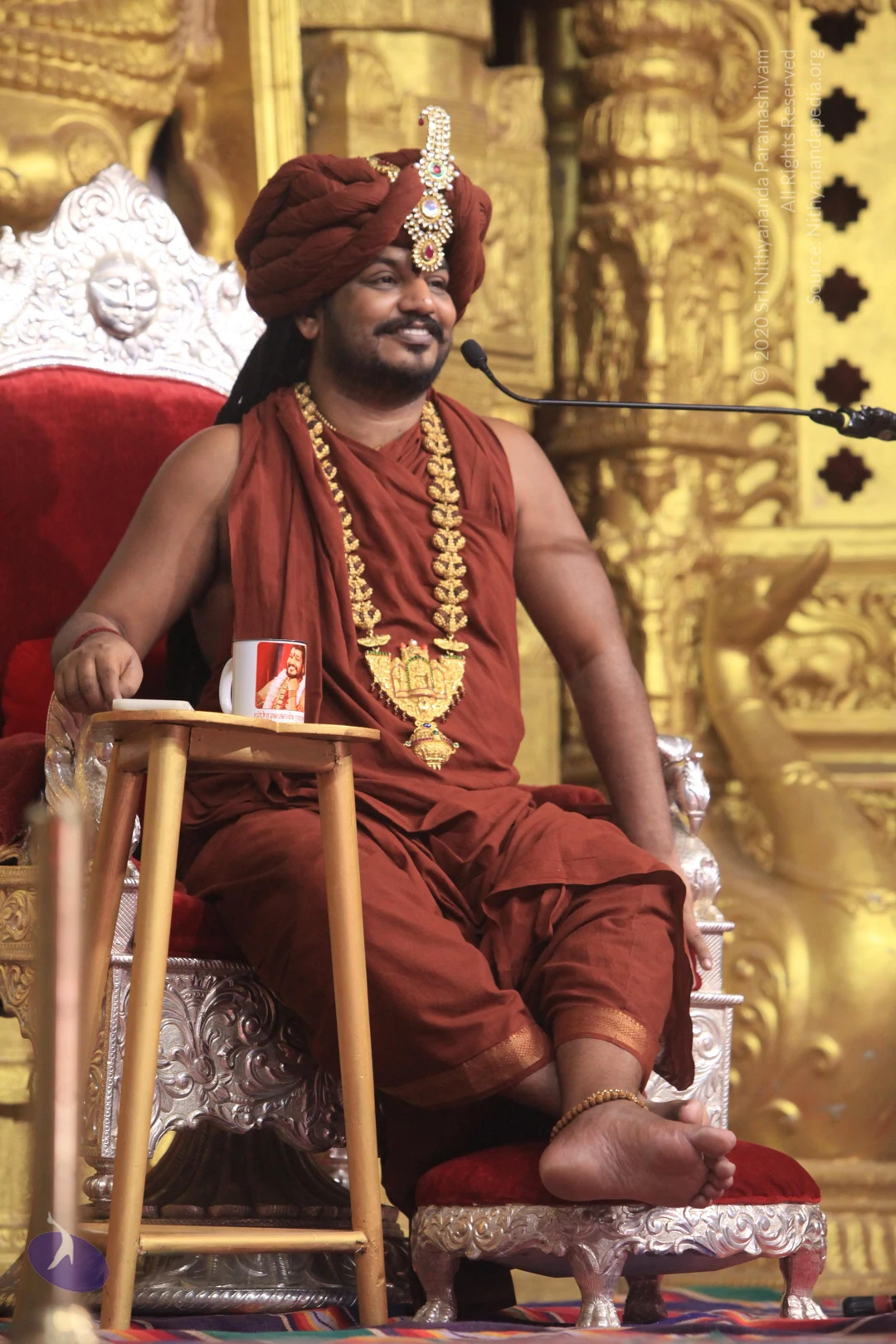
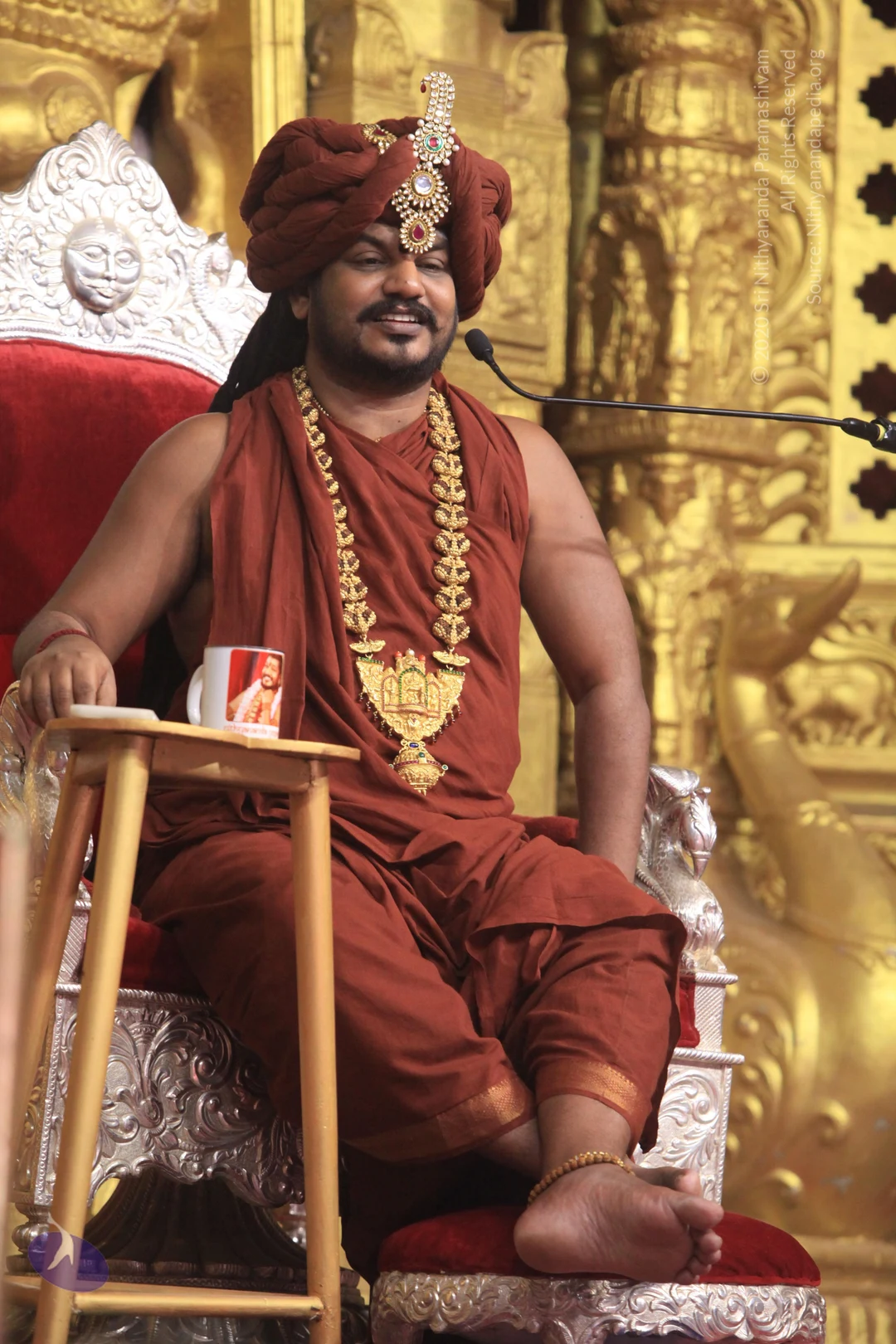
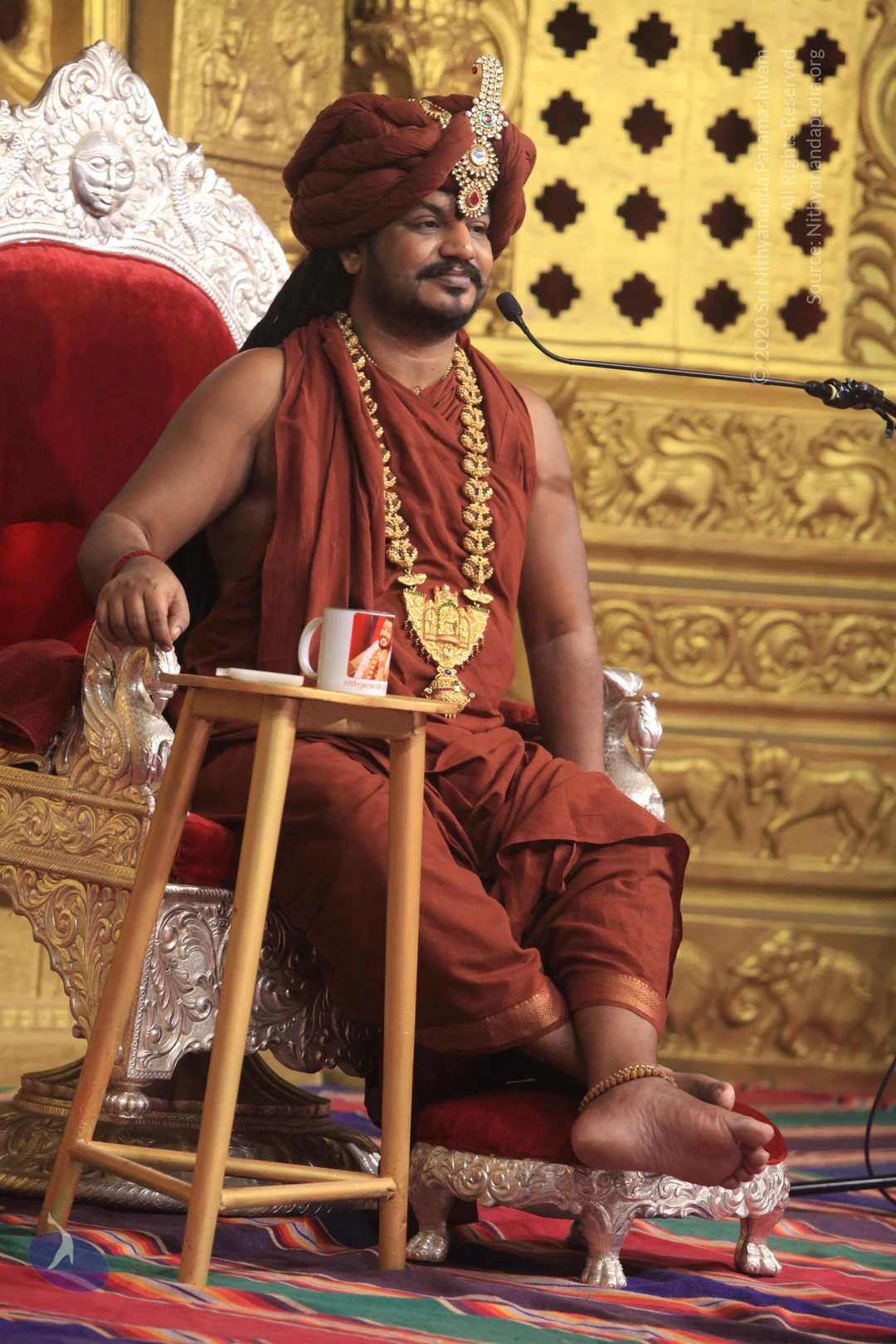
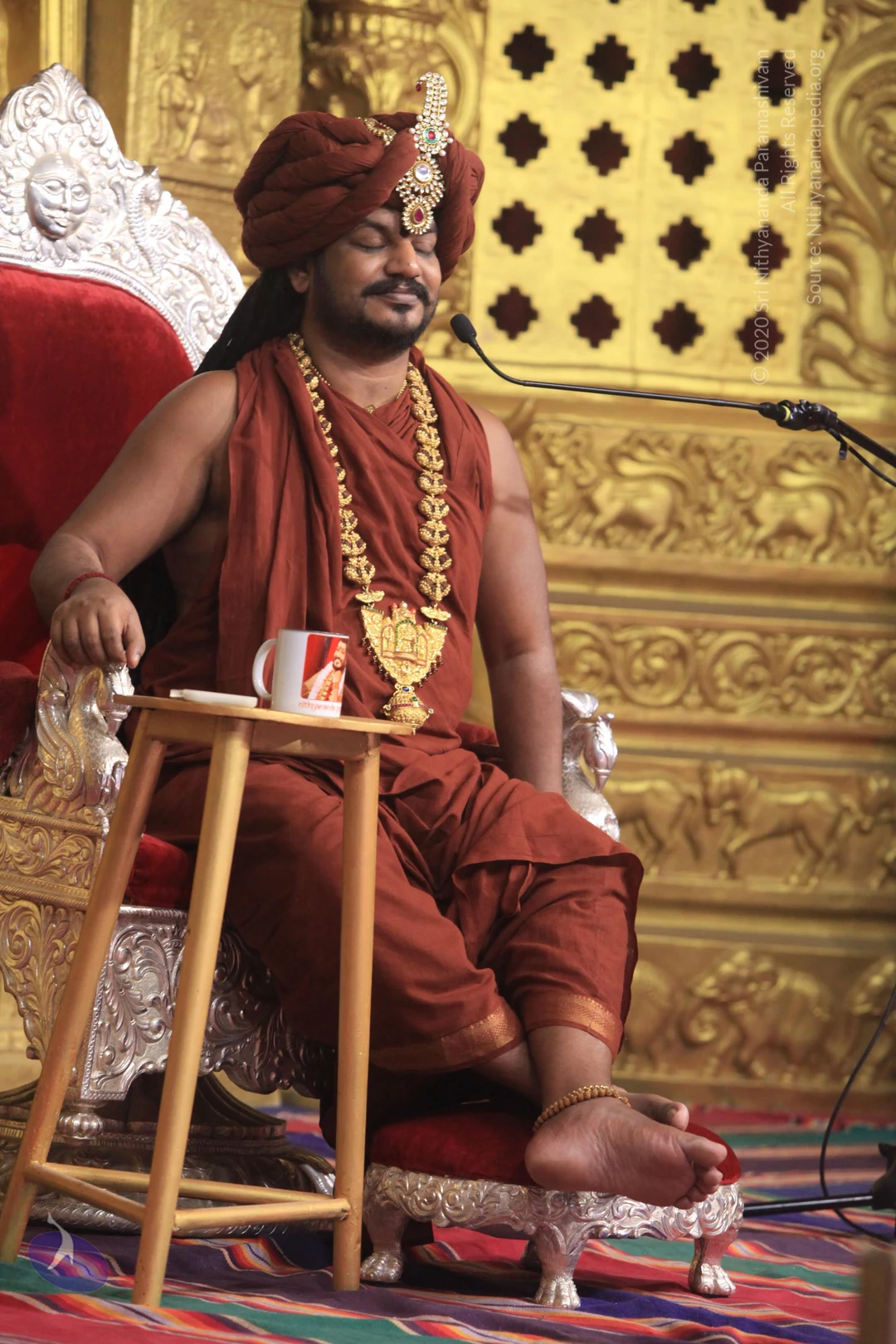
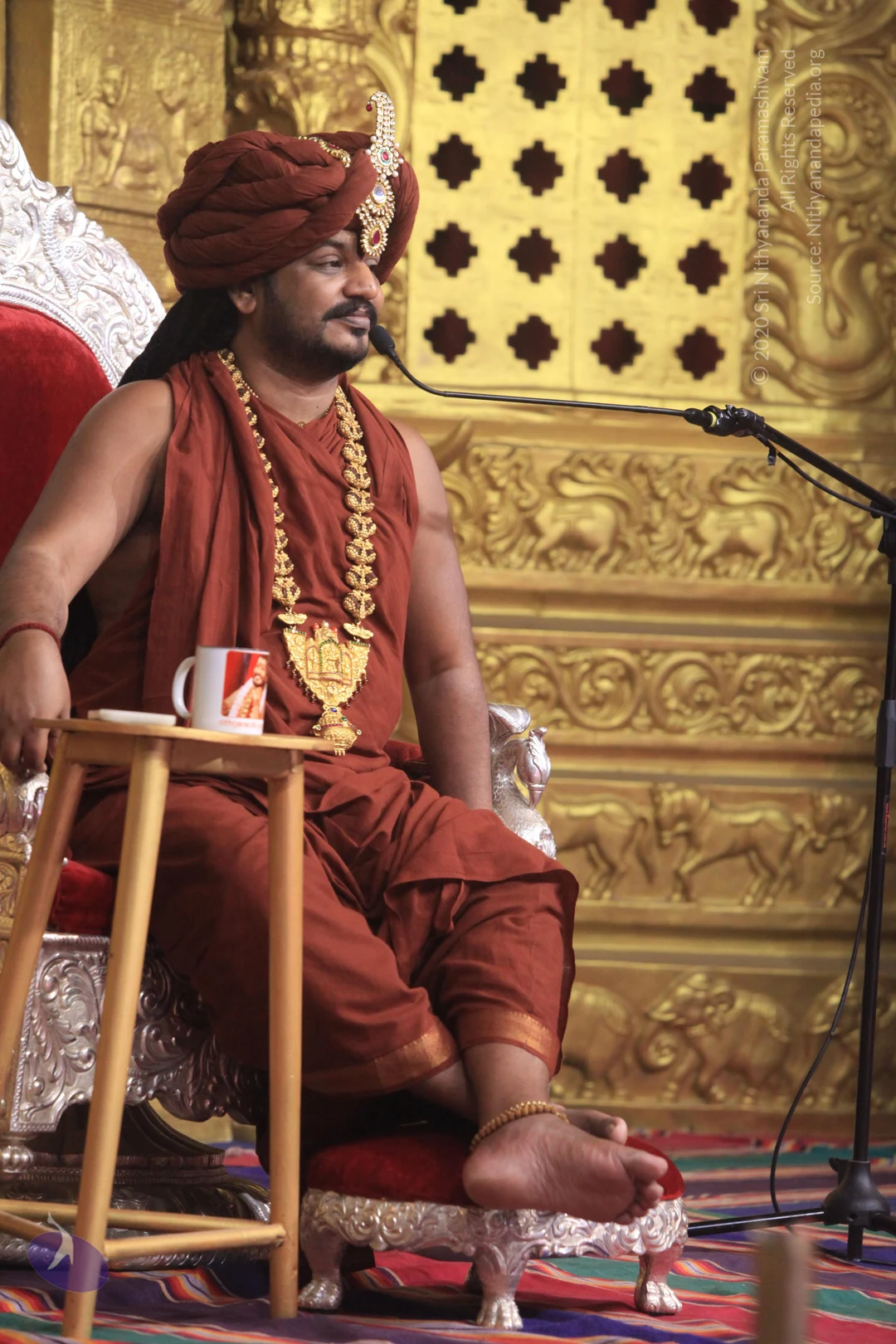
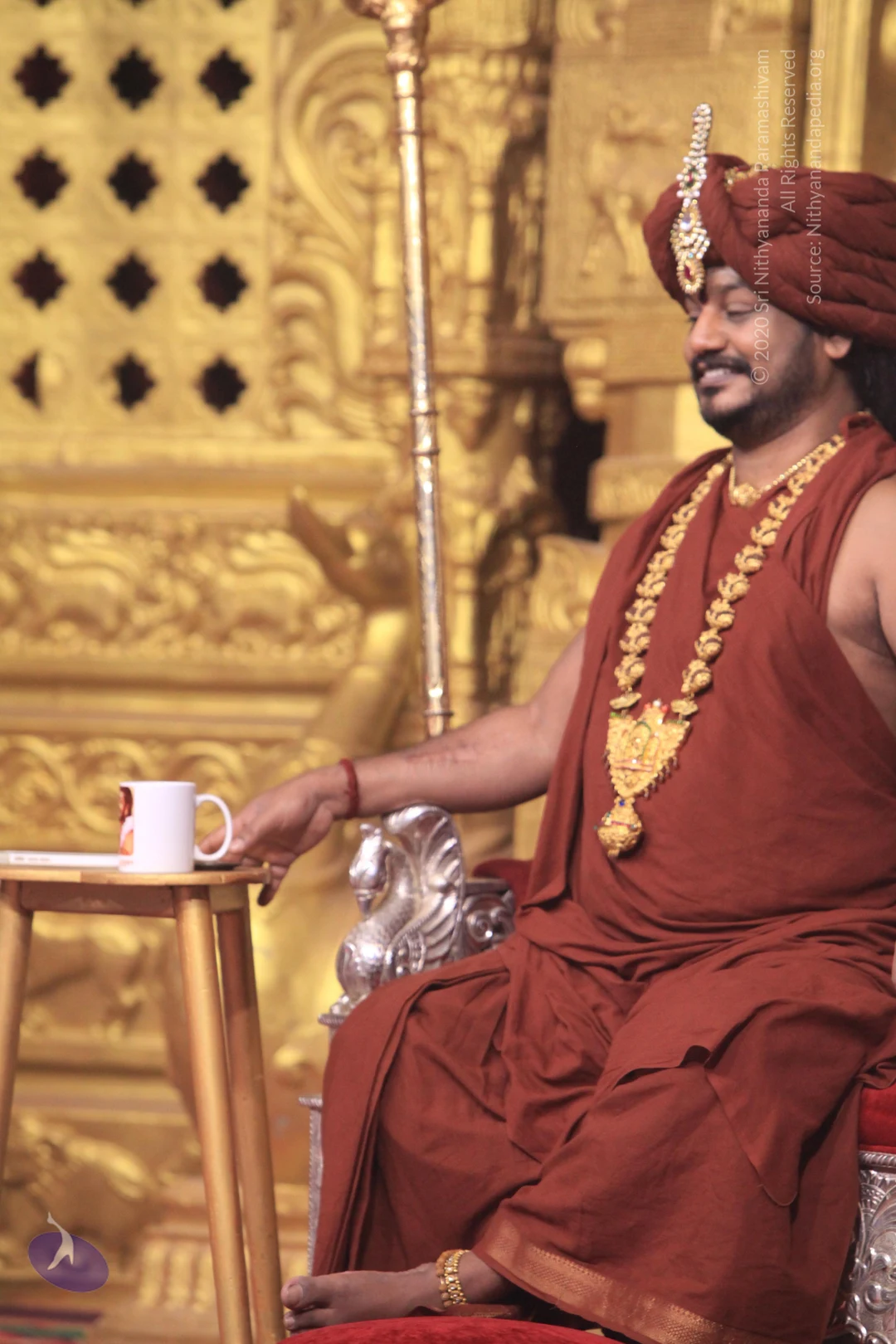
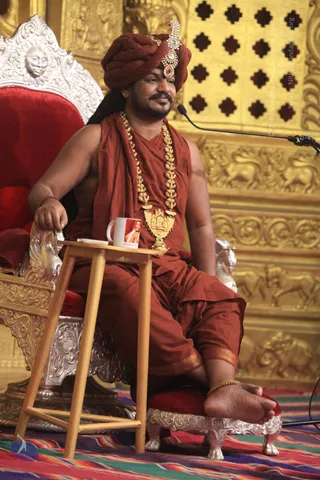
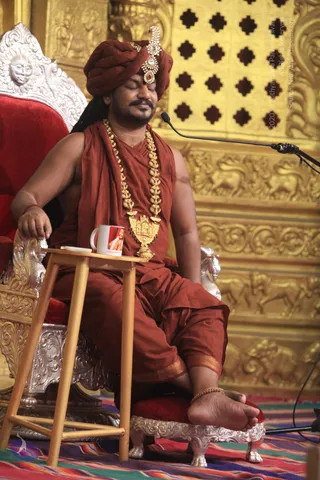
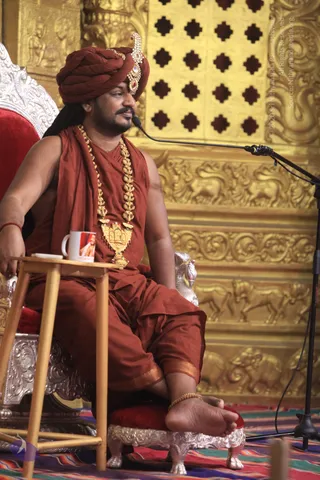
A smiling man in a rust-red turban with a jewelled ornament and a rust-red sleeveless wrap over matching clothing sits on an ornate red-and-silver throne on a gold-decorated stage. He wears a heavy gold necklace with jewelled pendant and a rudraksha-style bracelet on his ankle, and his bare feet rest on a red-cushioned silver footstool. A microphone is on a stand beside him, and a small wooden side table holds a white mug printed with a portrait of a bearded man in saffron. Swamiji (probable): the man has long swept-back hair, a jewelled turban ornament and saffron-red ceremonial clothing with a heavy gold necklace, consistent with the page's discourse event. Gold carved pillars and a sculpted elephant-style armrest surround the throne.A smiling man seated on an ornate silver throne with red velvet cushions, in front of a gilded temple-style backdrop with carved golden pillars and a silver lion-like armrest. He wears a rust-red turban with a jeweled ornament, a rust-red sleeveless wrap and matching dhoti-style garment with gold border, a heavy gold necklace with a gold pendant, and a wooden rudraksha-style bead anklet. His bare foot rests on a red-cushioned footstool. A microphone stands beside him, and a white mug with a red-framed photo sits on a small wooden side table. Swamiji (probable): the seated man's distinctive ceremonial gold necklaces, jeweled turban and saffron-red sannyasi attire mark him as the discourse speaker on the throne.A seated man in a rust-red turban with a jewelled ornament and a long gold ceremonial necklace with temple-style pendant sits on an ornate silver-and-red throne in front of a gold-carved wall. He wears a rust-red sleeveless wrap and matching draped cloth, with a red thread on his wrist and a beaded anklet. A microphone stands nearby, and a small wooden side table holds a white mug printed with a red image. The floor has a colourful striped mat.A seated man in a rust-red turban with a jewelled ornament at the forehead, wearing a rust-red sleeveless garment with a gold-bordered dhoti and a heavy gold necklace with a temple-like pendant. He sits with eyes closed on an ornately carved silver-and-red throne, one foot resting on a silver footstool, while a microphone stands nearby. A white mug with a red-and-orange image sits on a wooden side table. Behind him are gold-coloured carved panels with lattice screens and reliefs of animals. Probable Swamiji seated on a throne during a satsang discourse, with appearance cues of a jewelled turban, ornate gold necklace and saffron-toned robes.Photograph of a man seated on an ornate silver-and-red throne in a gold-carved hall, speaking into a boom microphone. He wears a rust-red turban with a jewelled gold ornament, a rust-red sleeveless robe and dhoti with gold border, a heavy gold temple-style necklace, and a rudraksha bracelet on his wrist. His left arm rests on the armrest beside a small wooden side table holding a white mug with a printed portrait. His bare feet rest on a silver footstool. Behind him are gold relief panels with horses and elephants and a patterned gold screen. A colourful striped rug covers the floor. Appearance-based label: a person, seated as speaker on the dais.A man seated cross-legged on an ornate silver throne with red velvet cushioning, in front of red draped curtains and gold carved panels. He wears a rust-red turban with a jewelled gold ornament at the front, a rust-red sleeveless robe with gold-bordered dhoti, and a heavy gold floral necklace with a gold pendant. He smiles with eyes half-closed, one arm resting on the armrest, bare feet on a red stool. A small microphone is visible at the right. Swamiji (probable): long hair visible behind, turban, rust-red robe and ornate gold necklace consistent with a discourse setting.