Skip to content
Wednesday

27 August 2014

Just stop being desperate

Dated photos
236
Source pages
1
Media
9
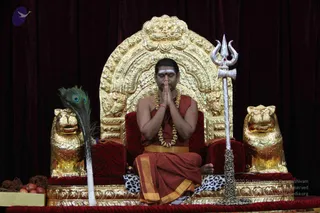
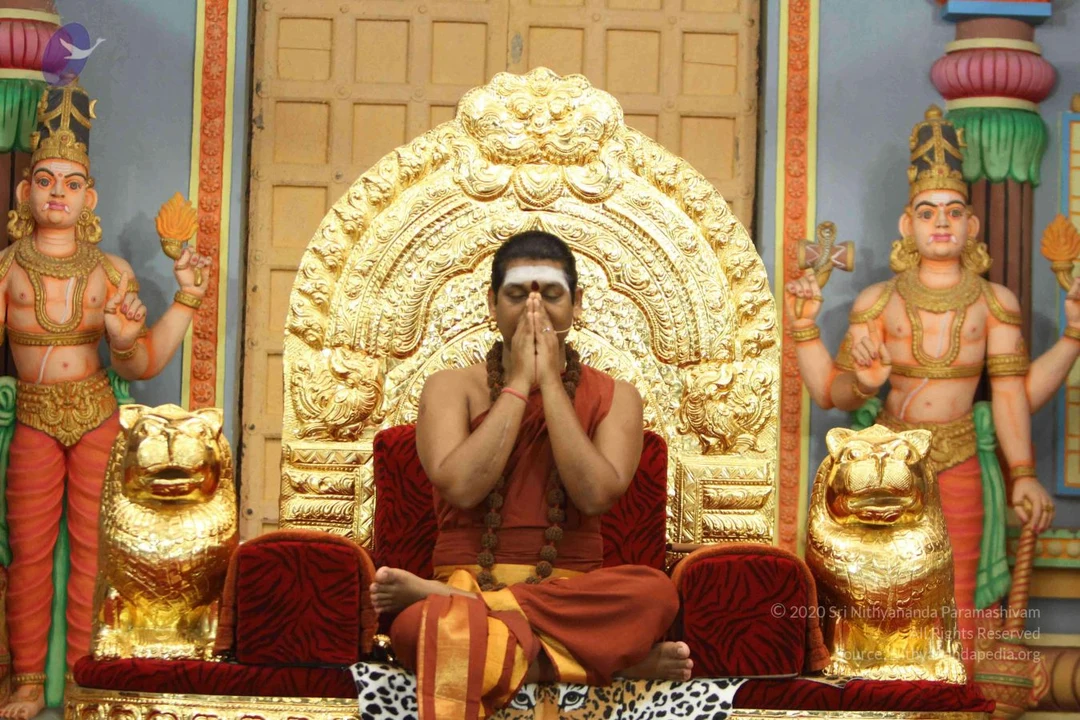
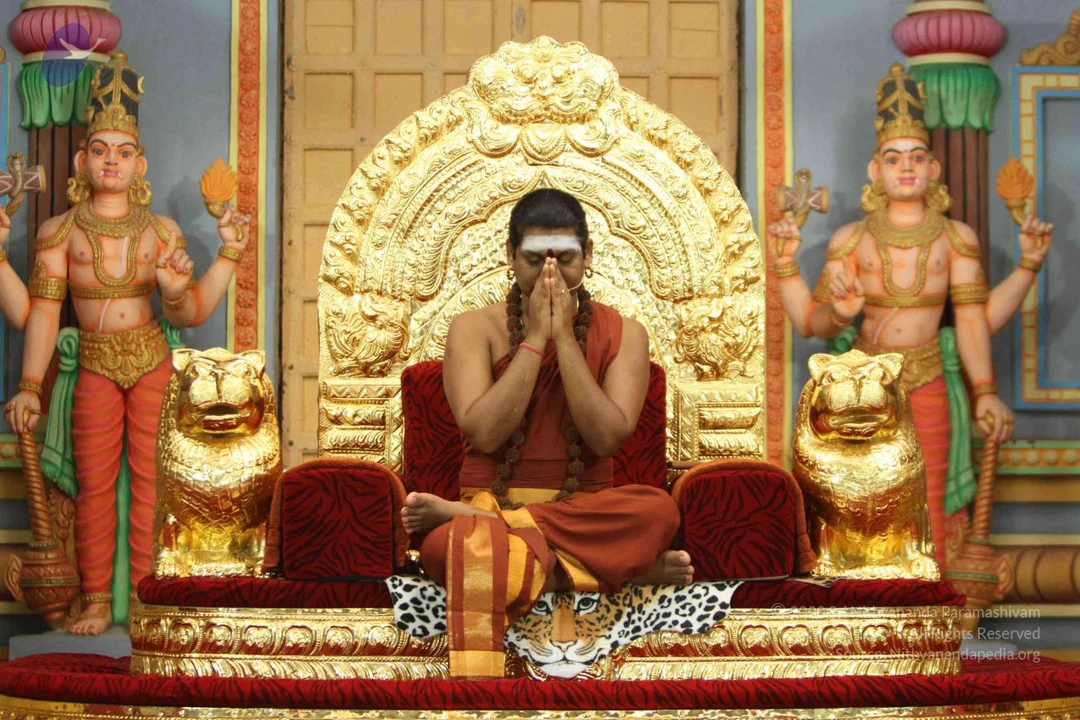
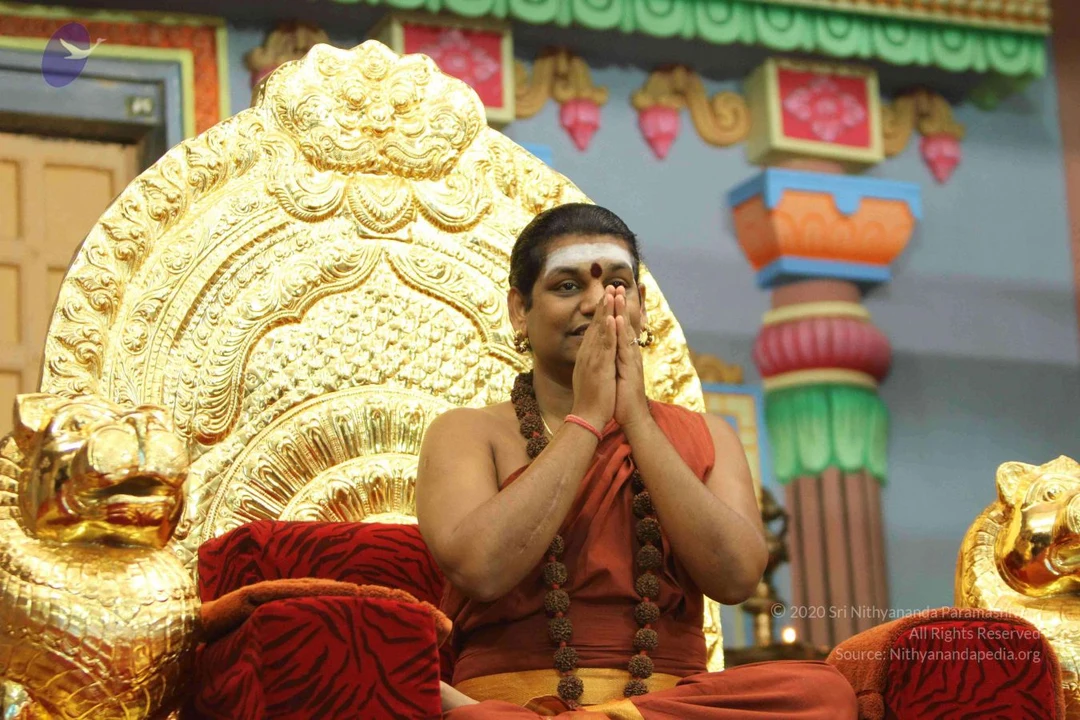
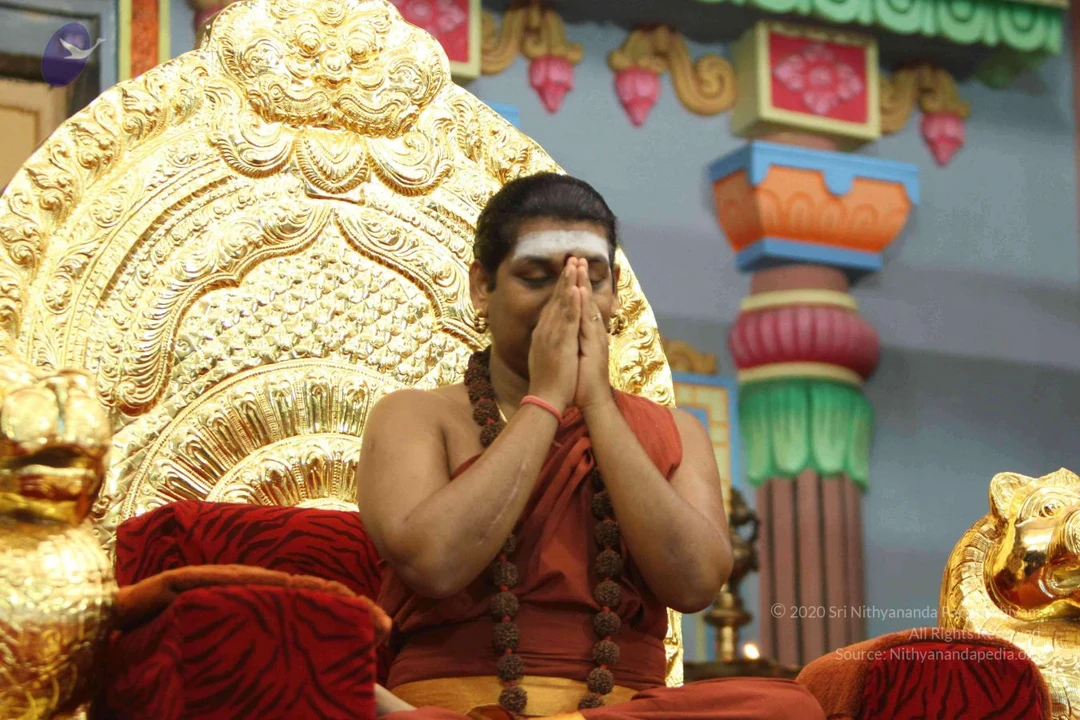
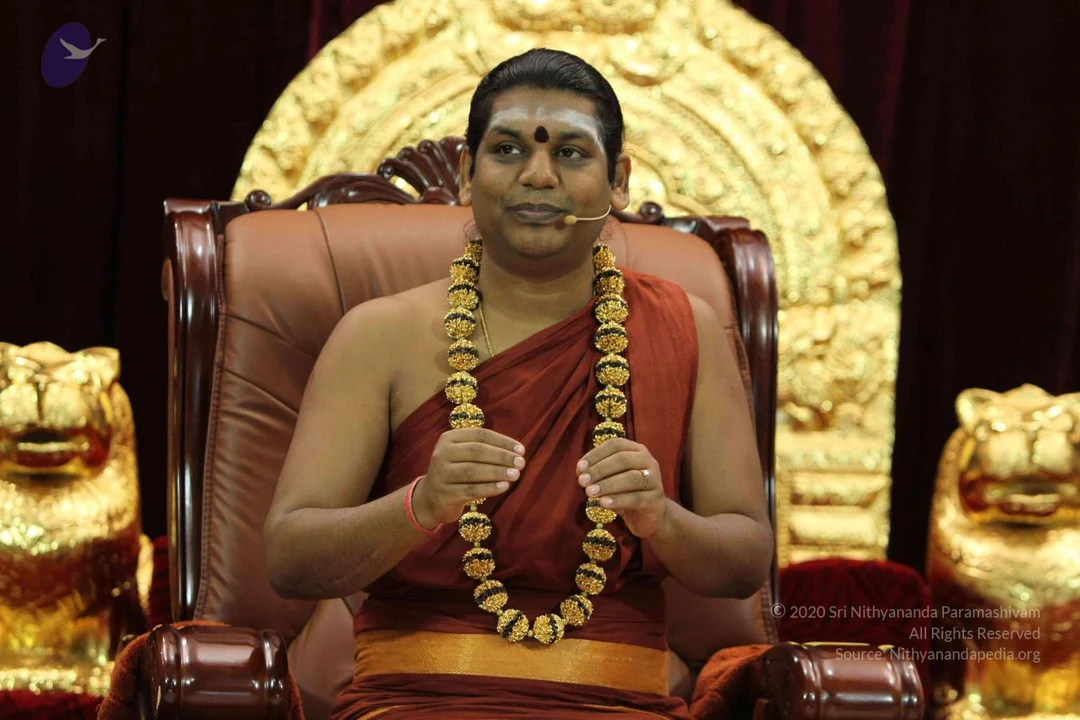
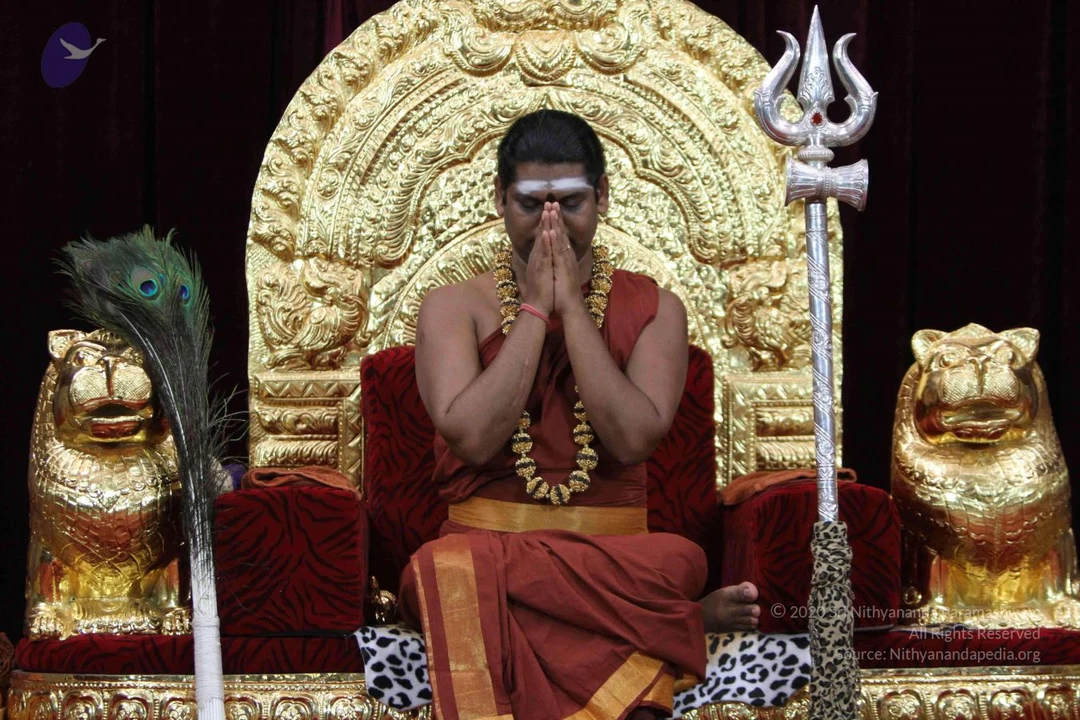
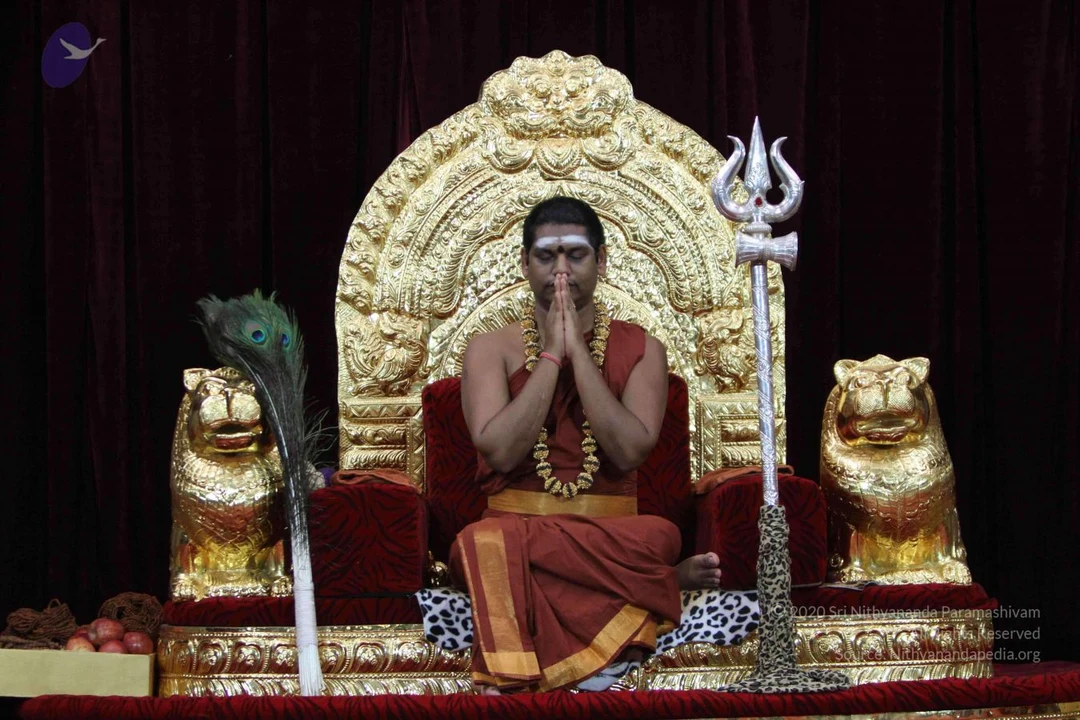
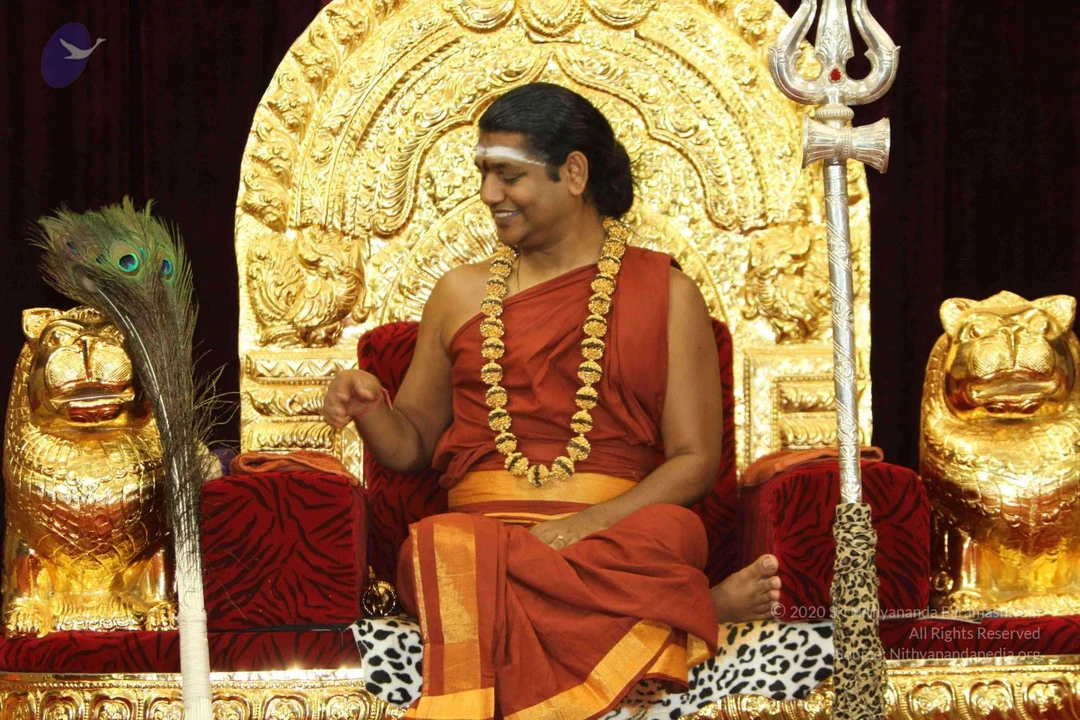
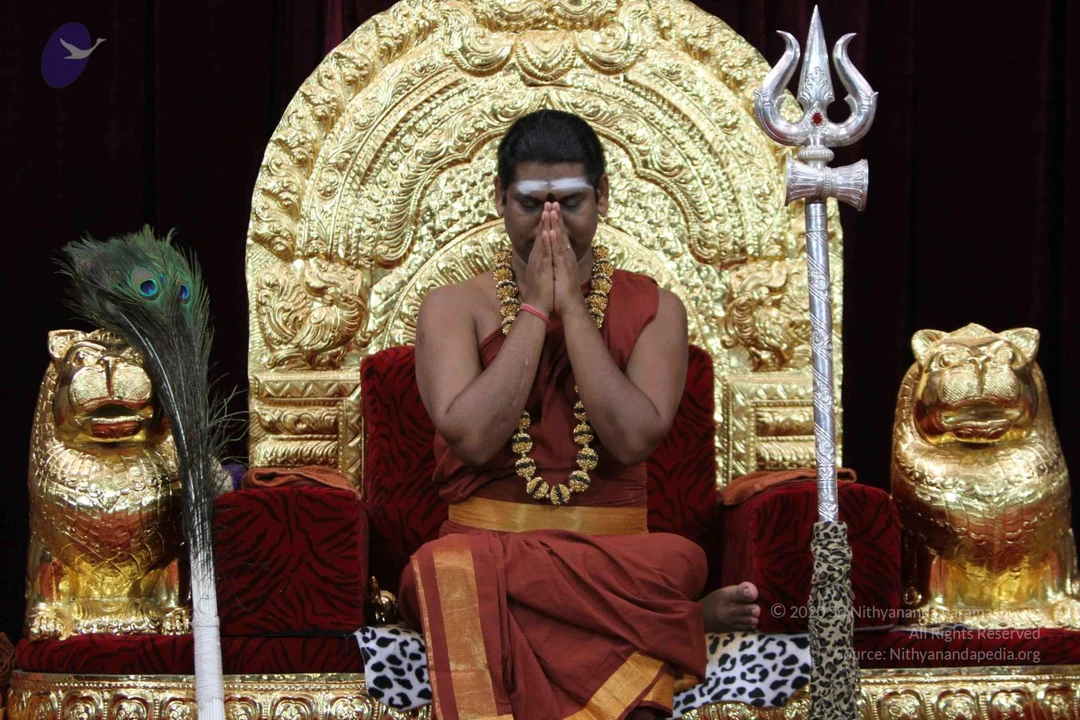
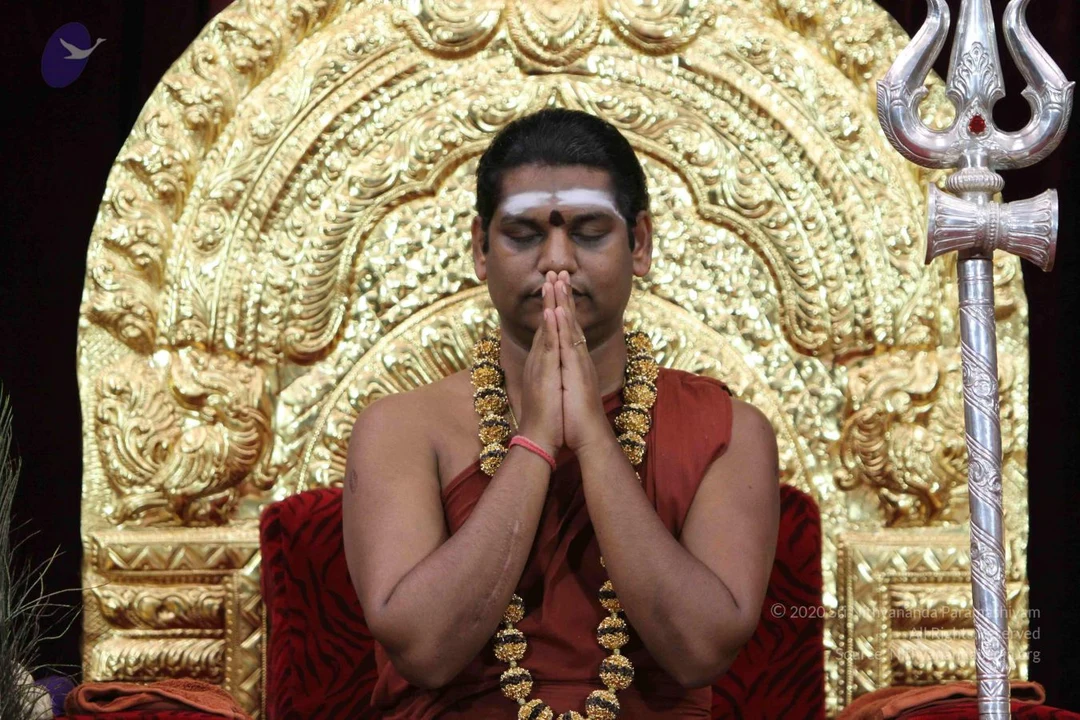
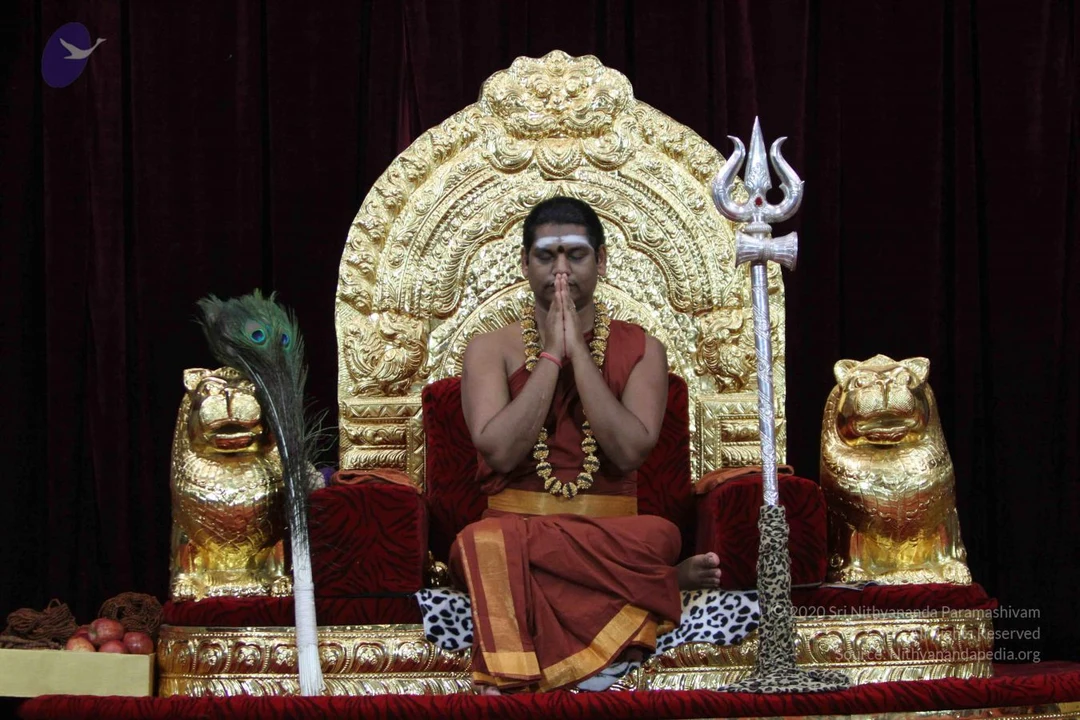
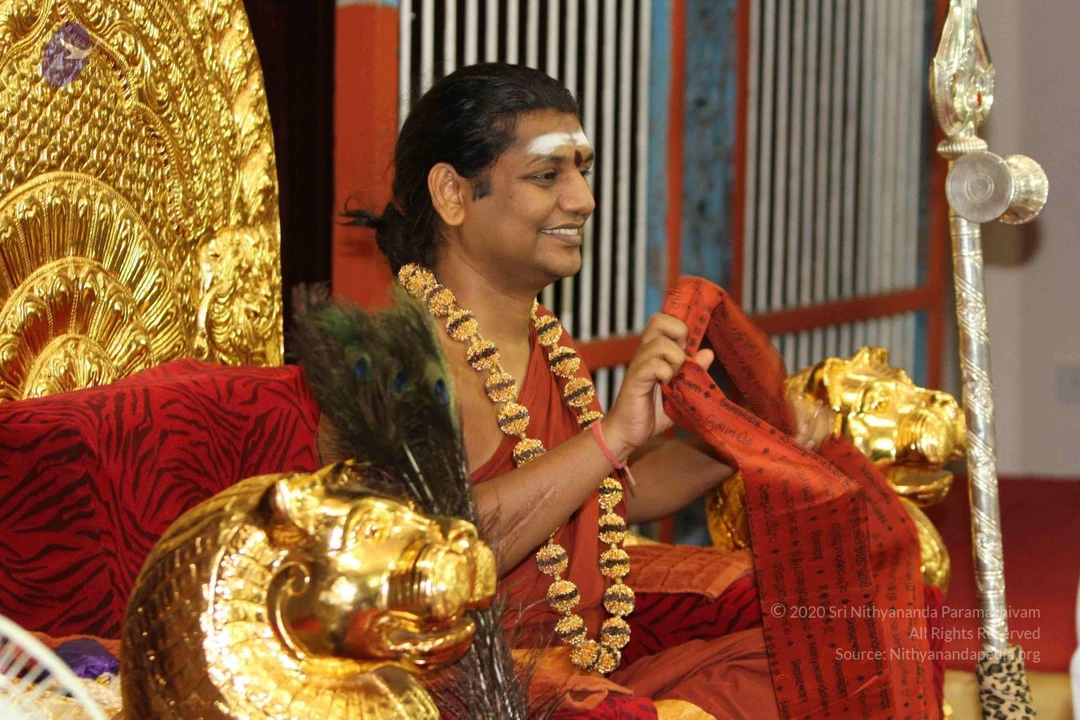
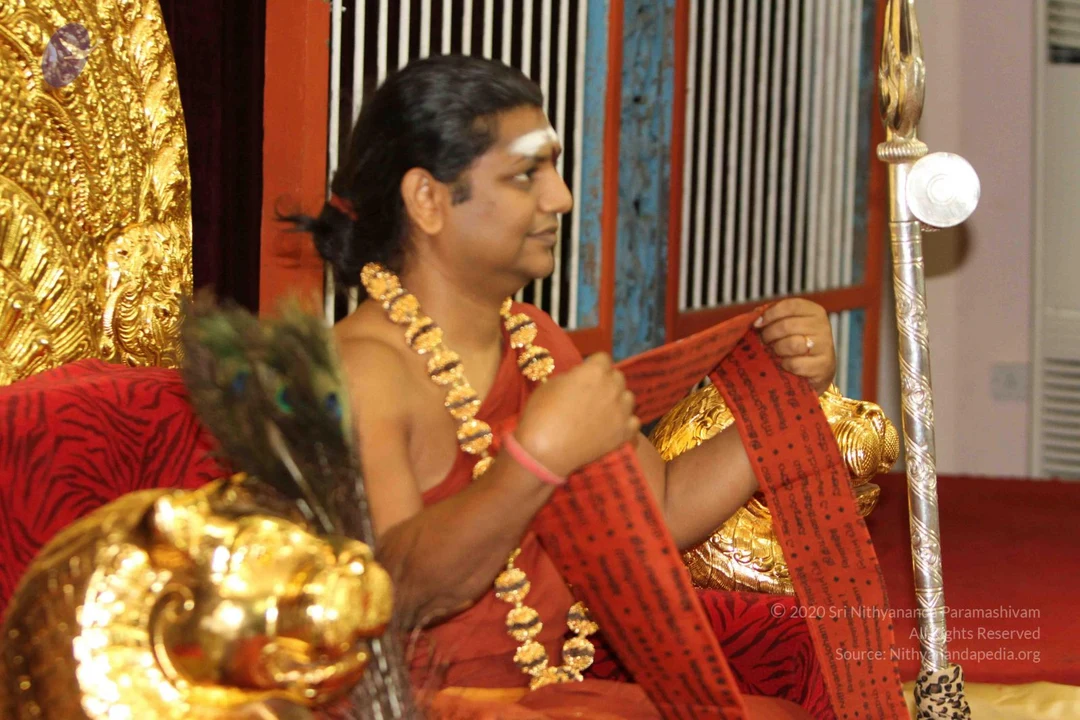
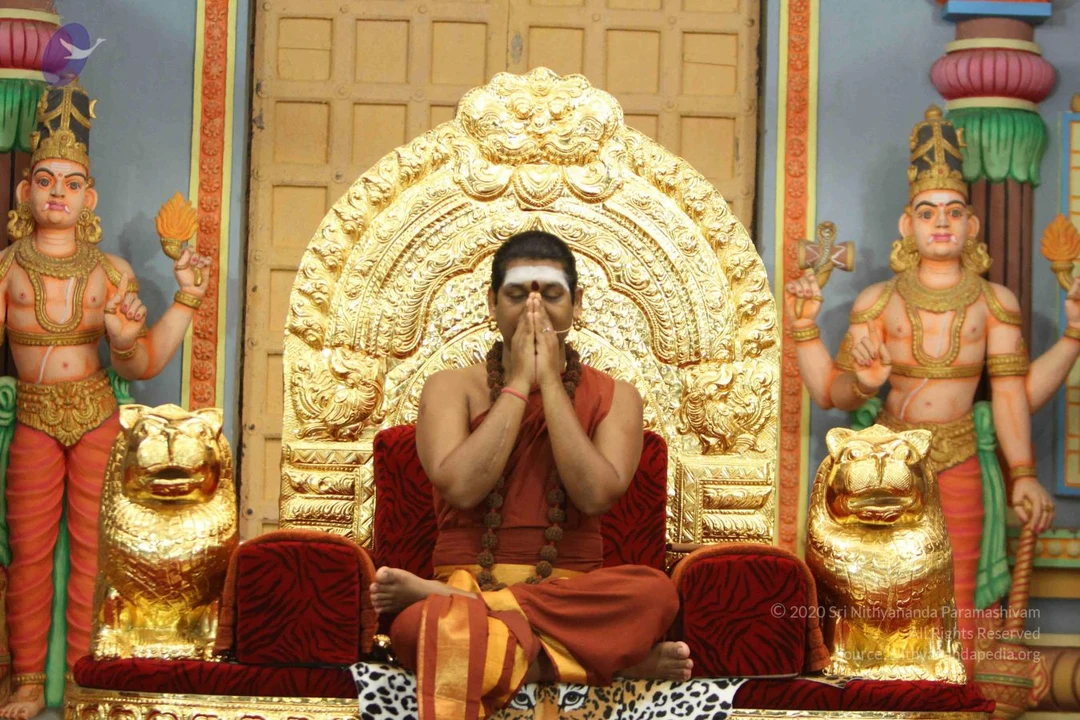
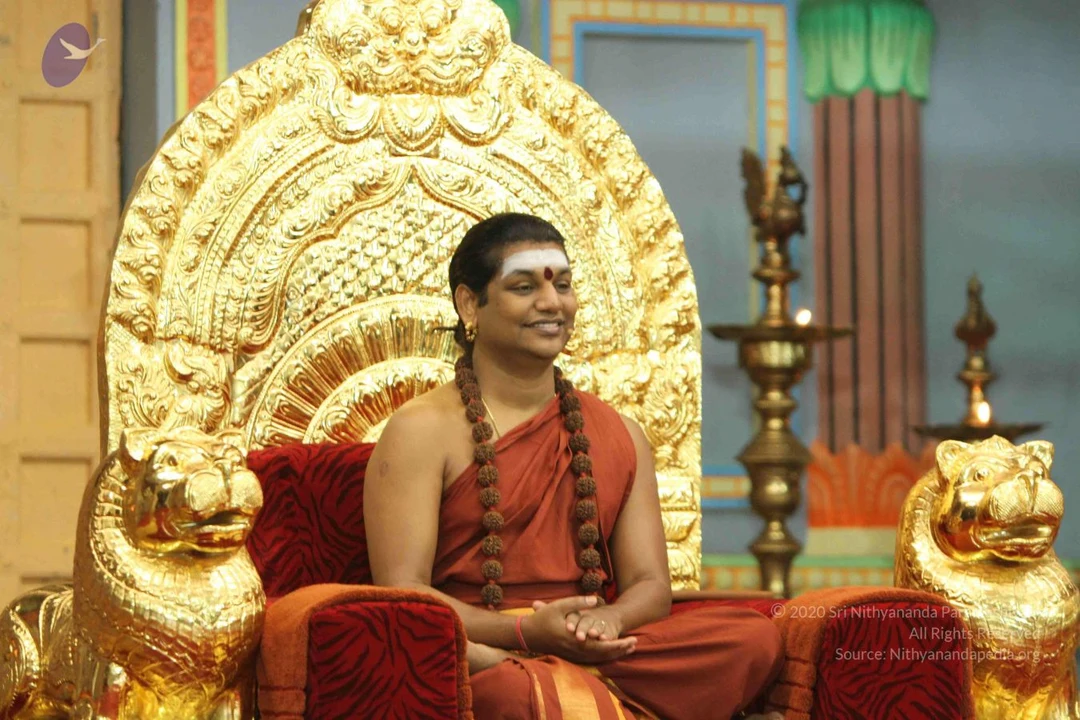
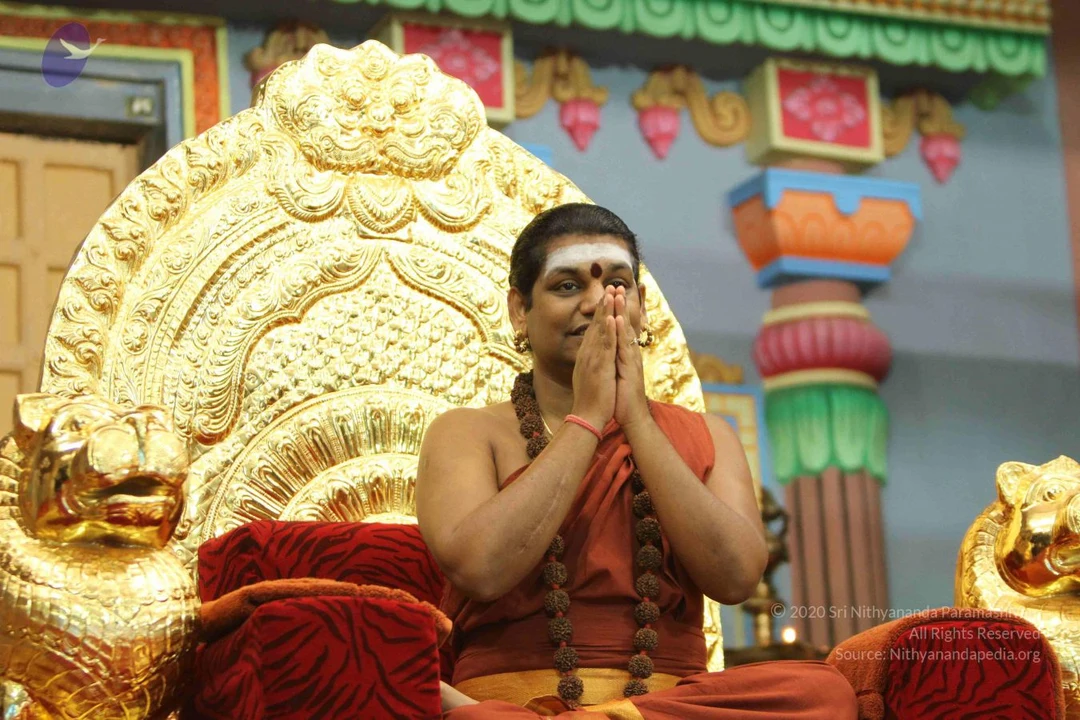
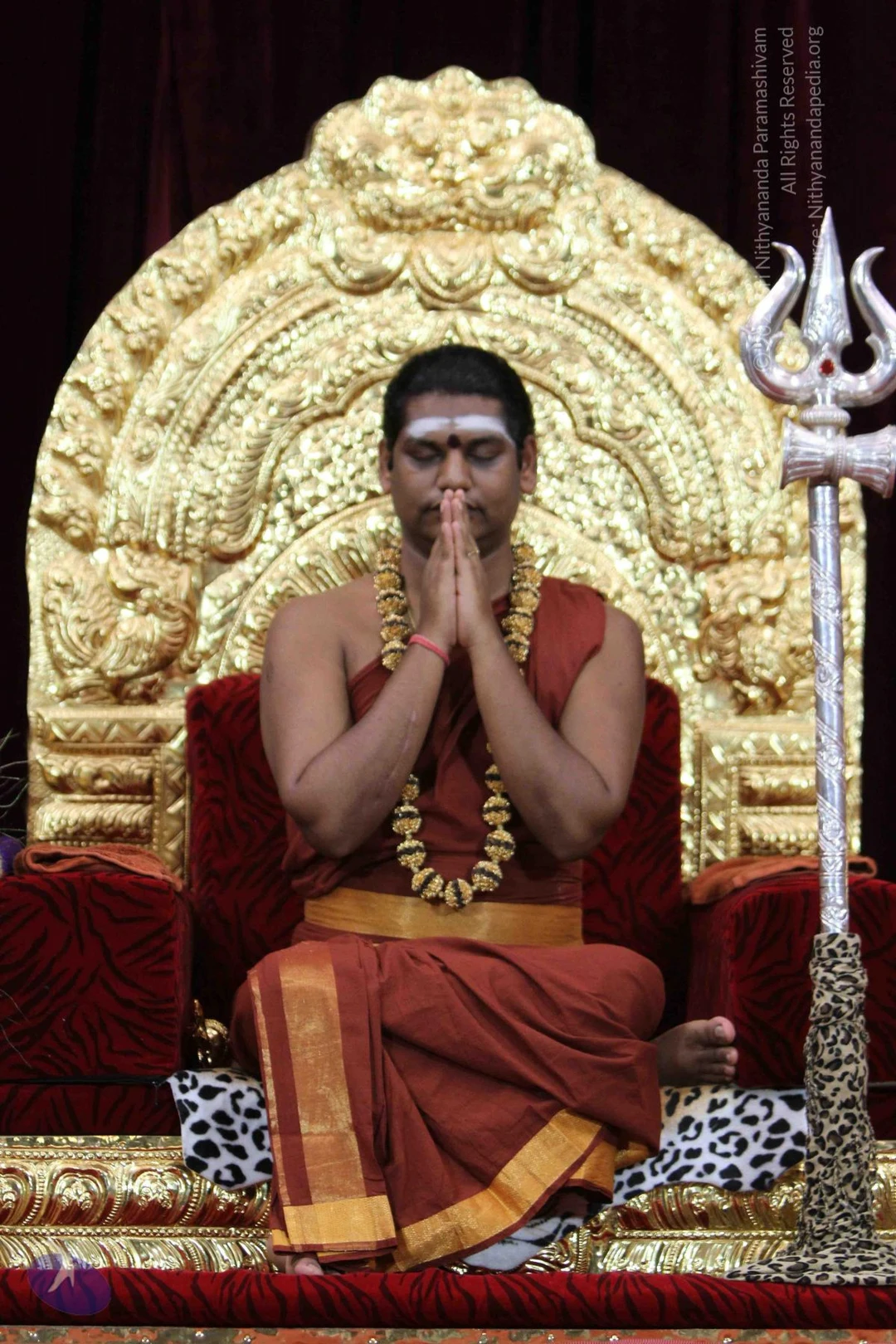
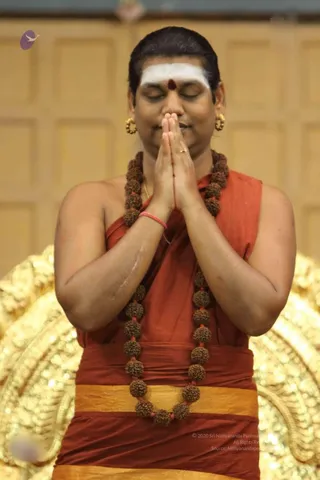
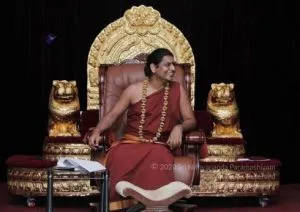
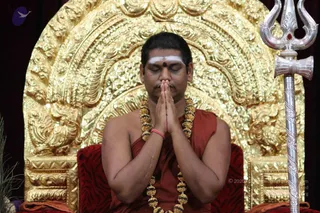
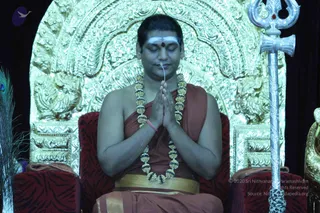
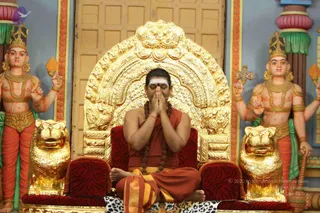
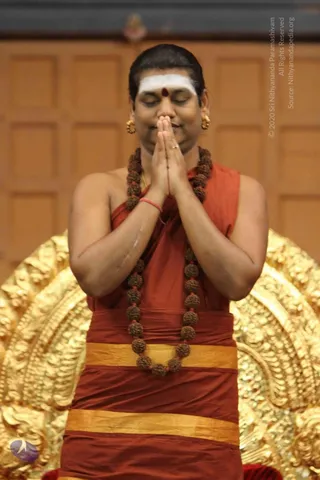
A seated man in orange-red robes sits in prayer pose with palms pressed together at his chest, eyes closed, on an ornate gold throne with carved arch back and two gold lion figures at its sides. He wears a long string of beads around his neck, a white tilak on his forehead, and a red bracelet on his wrist. A silver trident stands upright to his right and a peacock-feather fan lies to his left against a dark red velvet backdrop.

August 27 2014

Original wiki page
Contents

Title:

Just stop being desperate

Description:

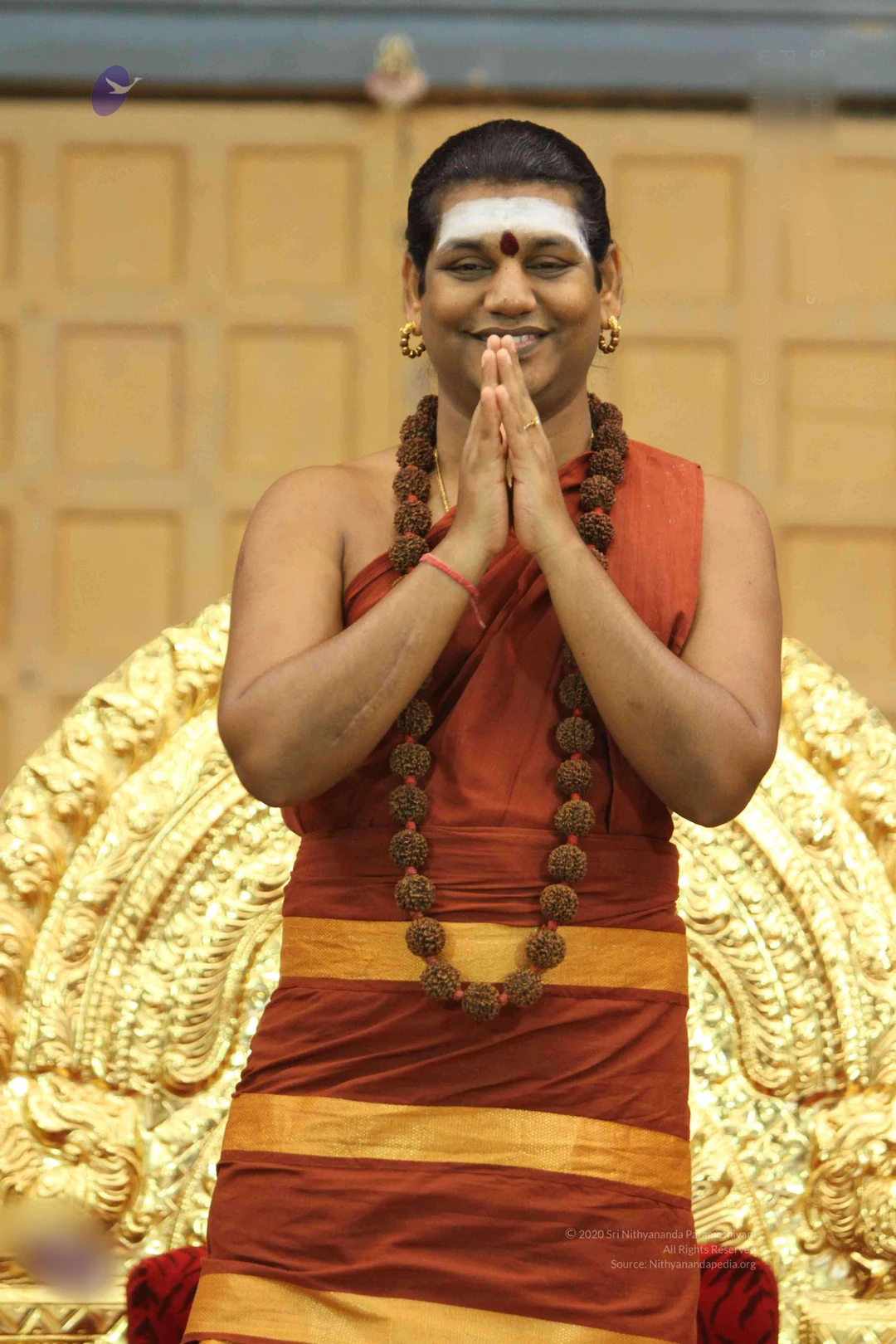
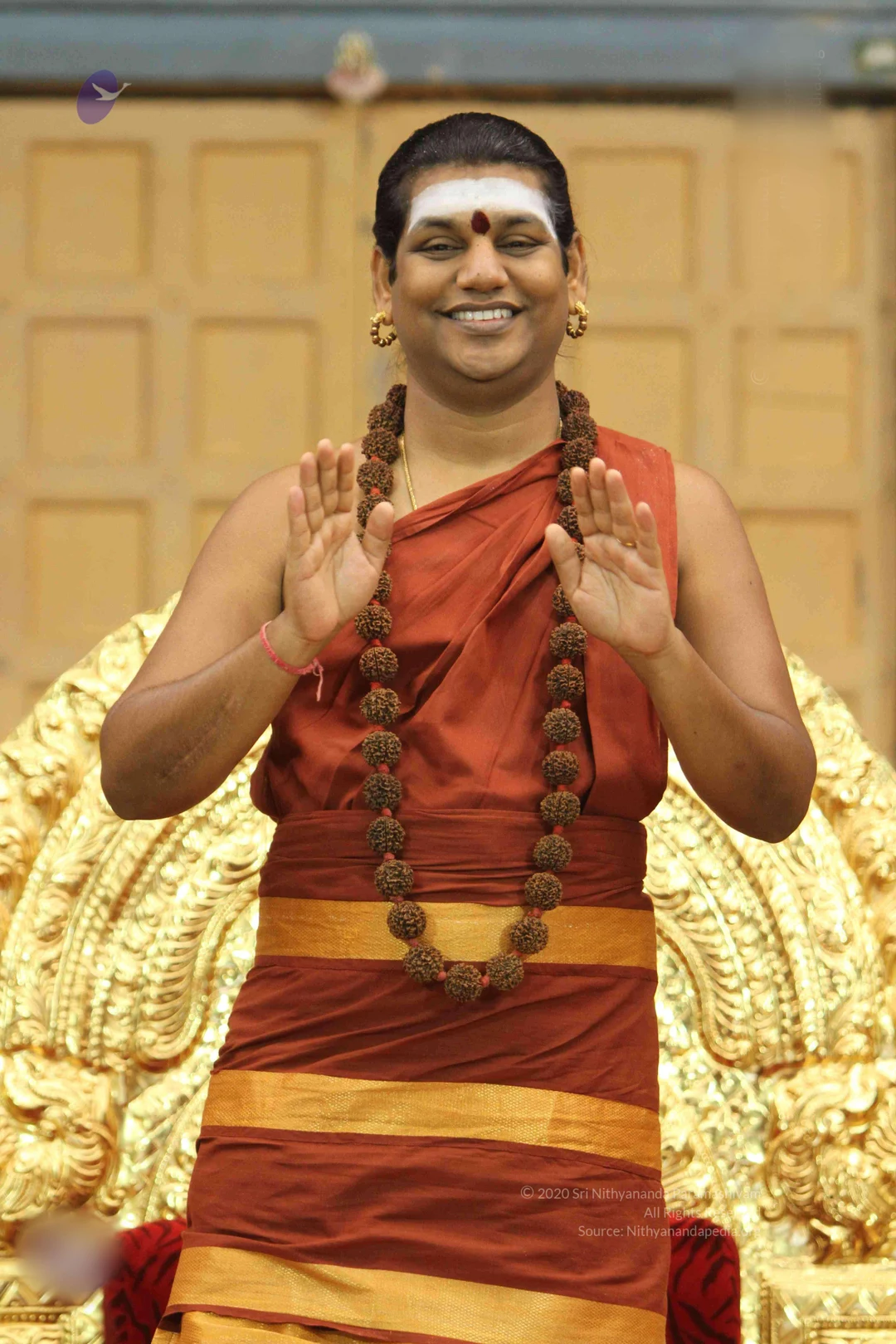
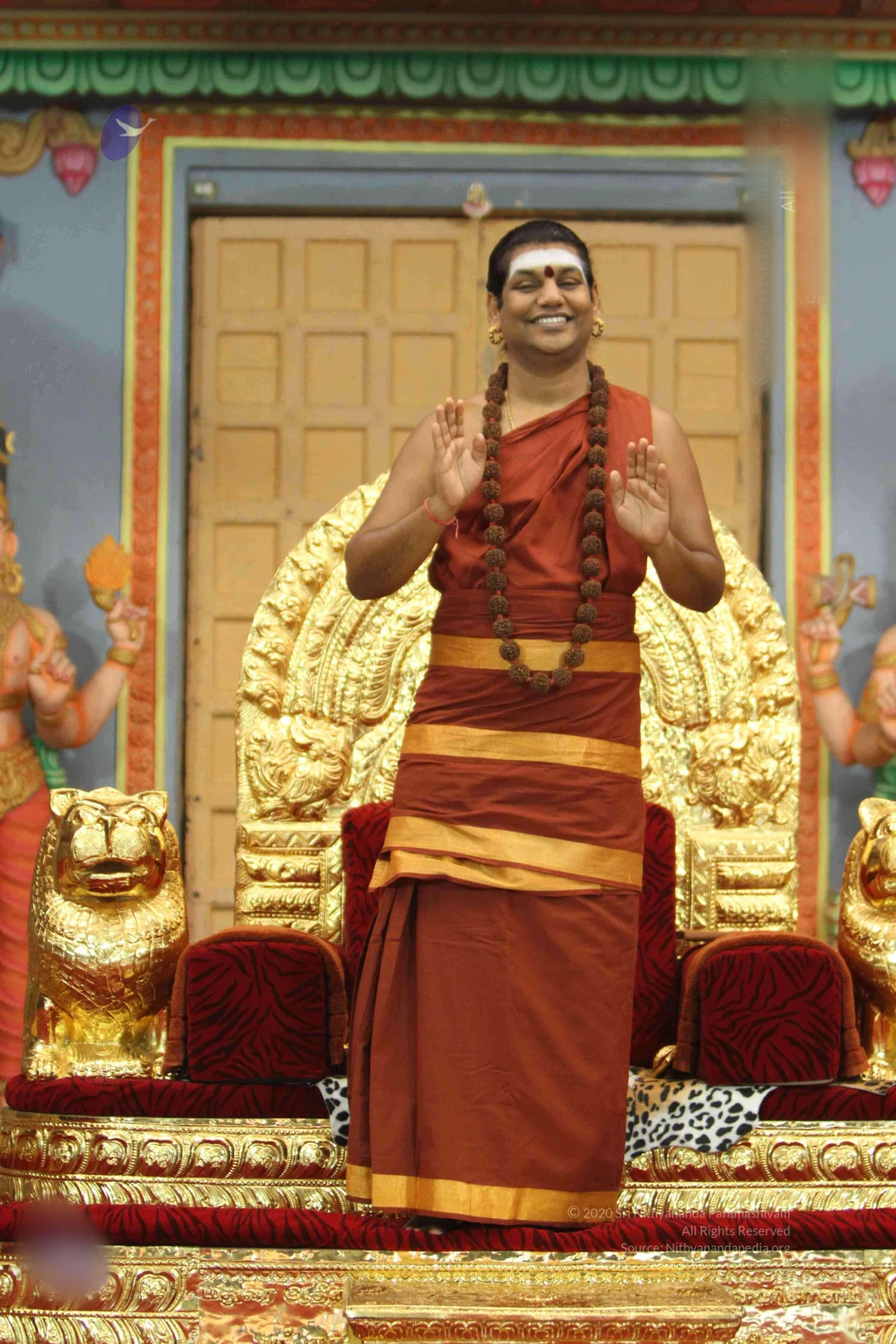
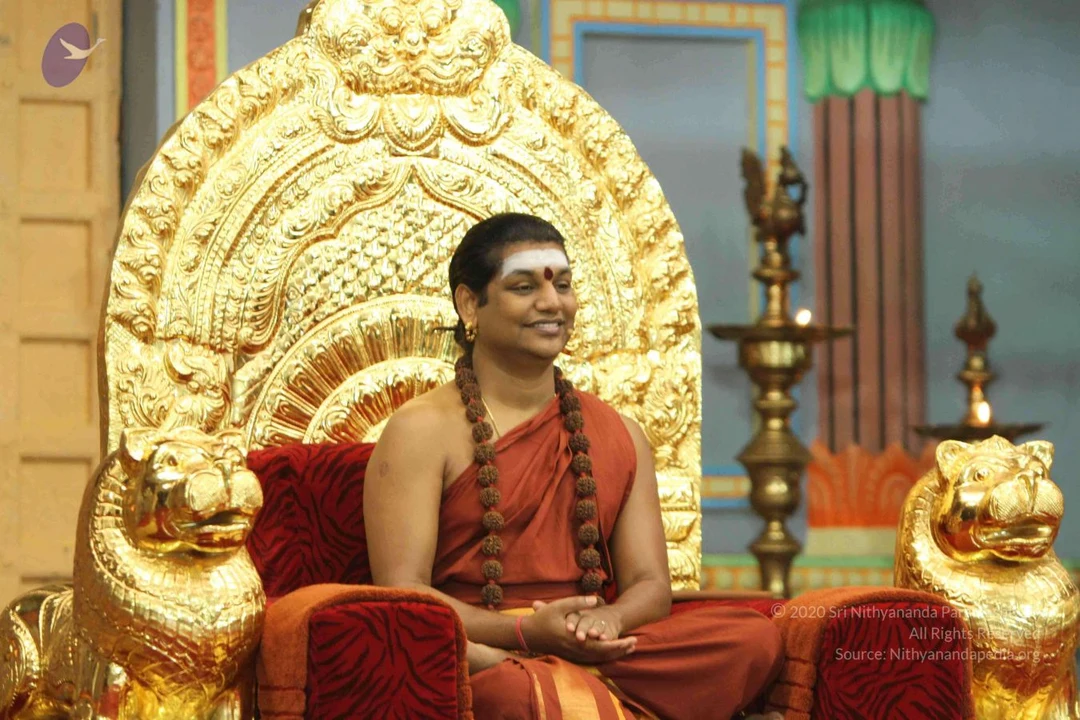
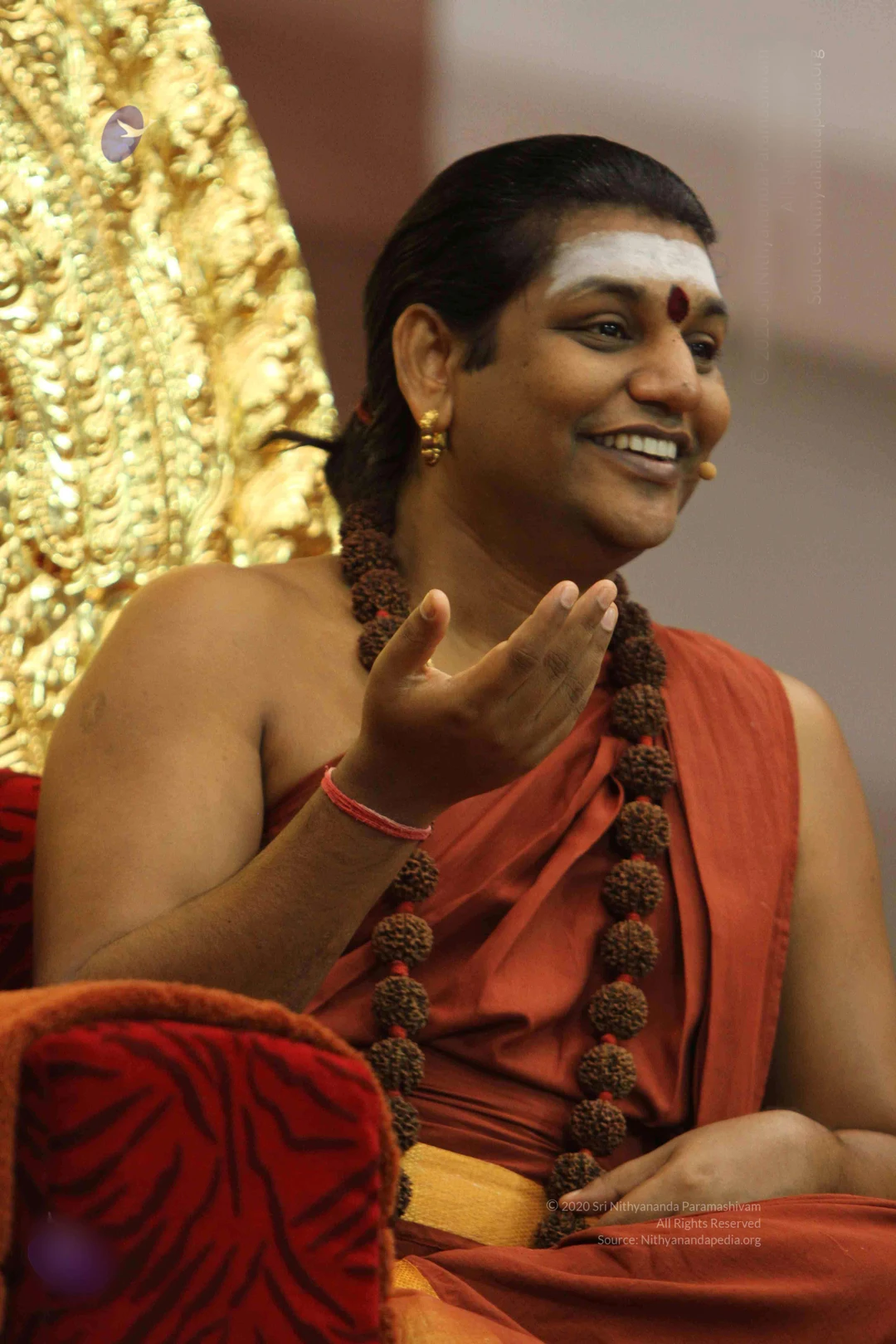
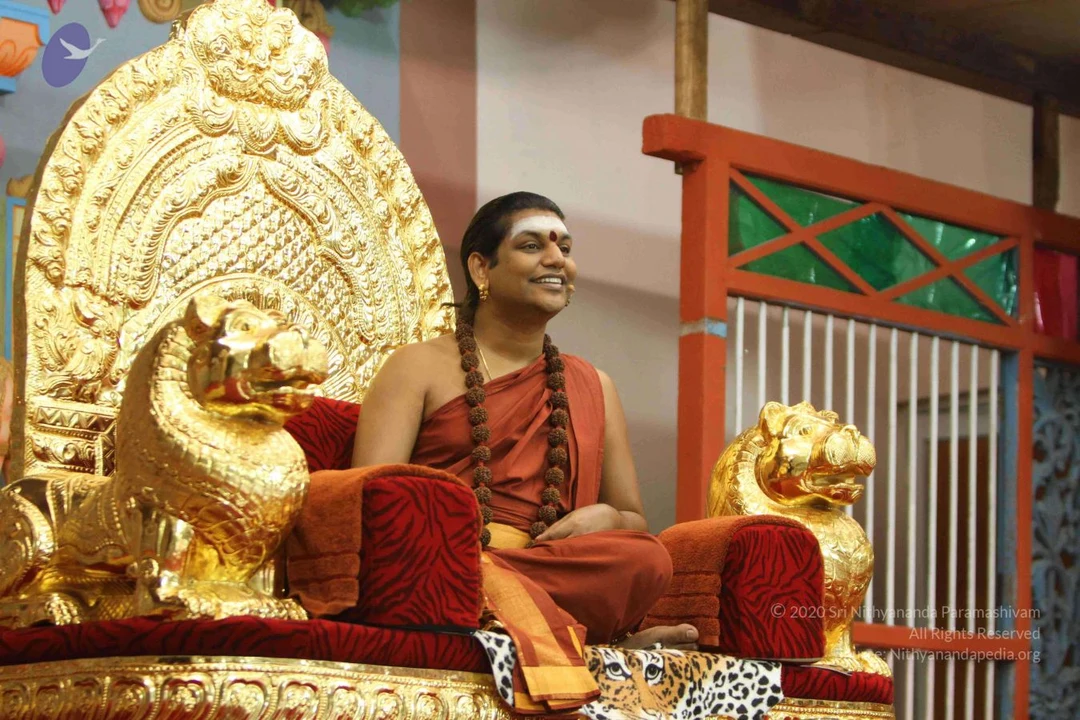
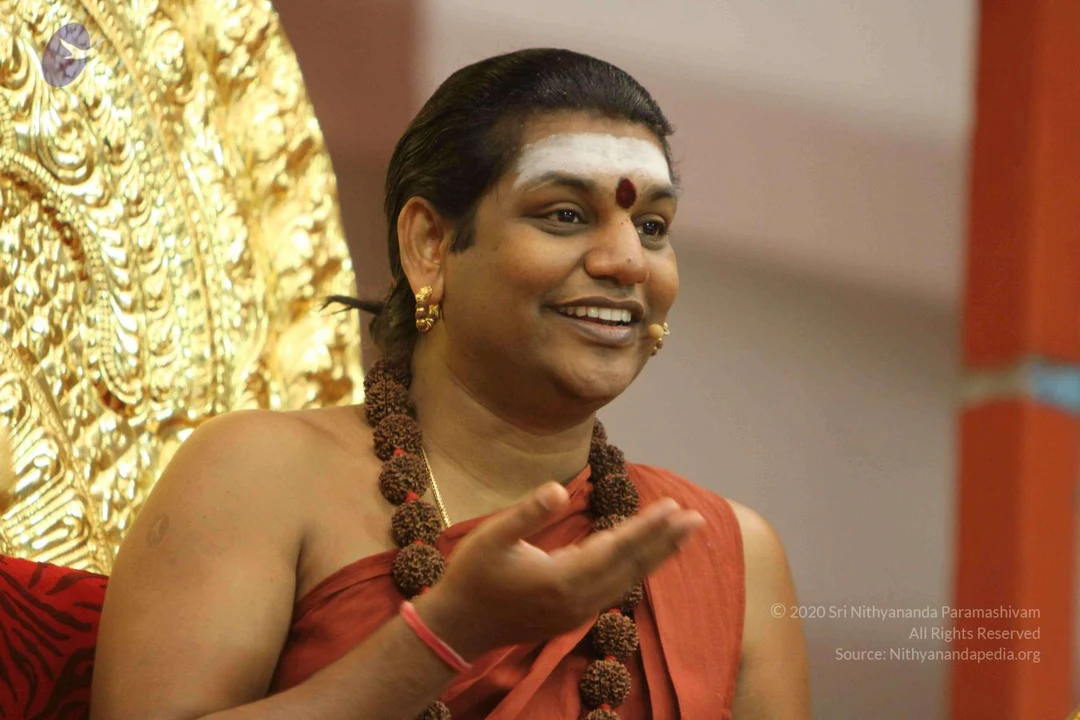
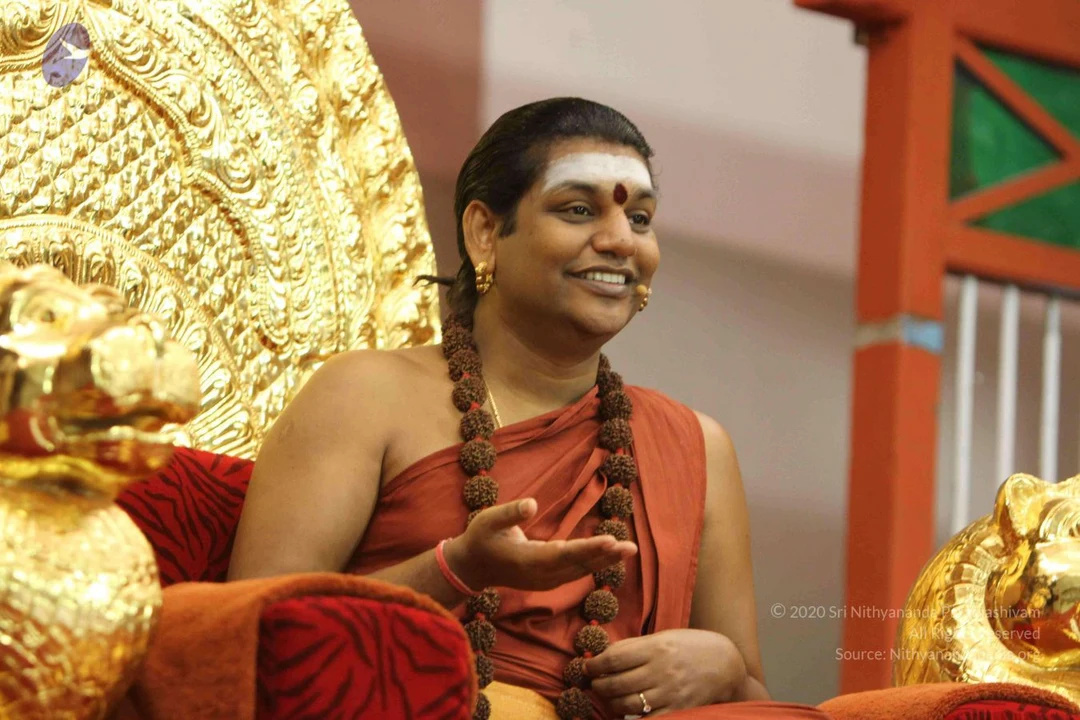
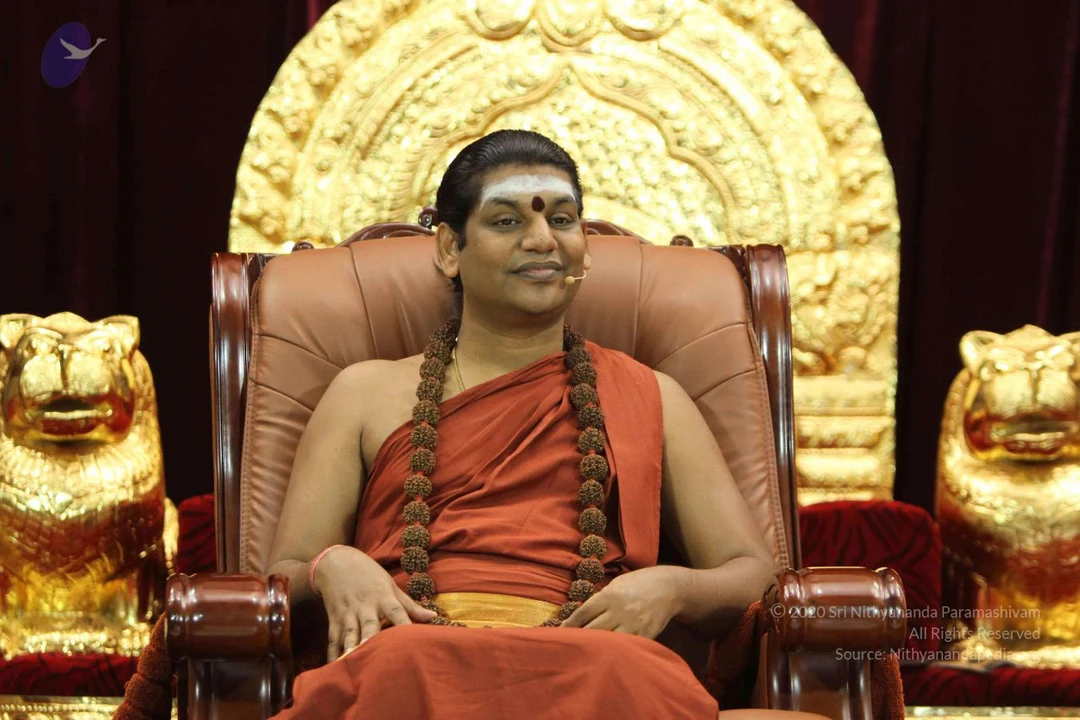
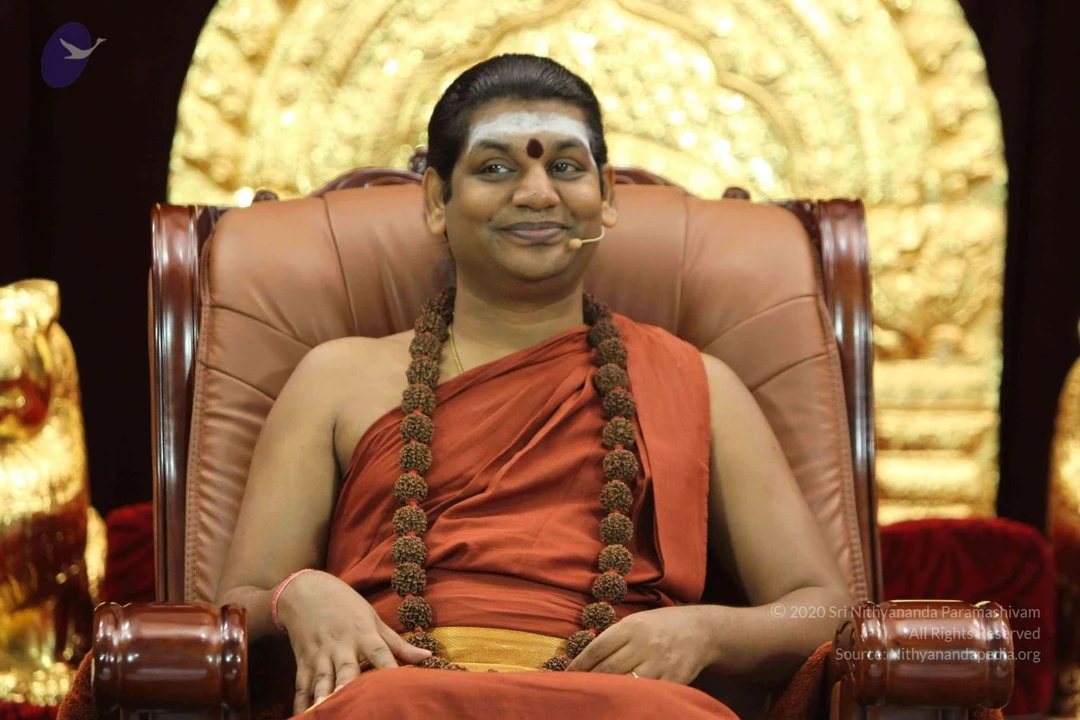
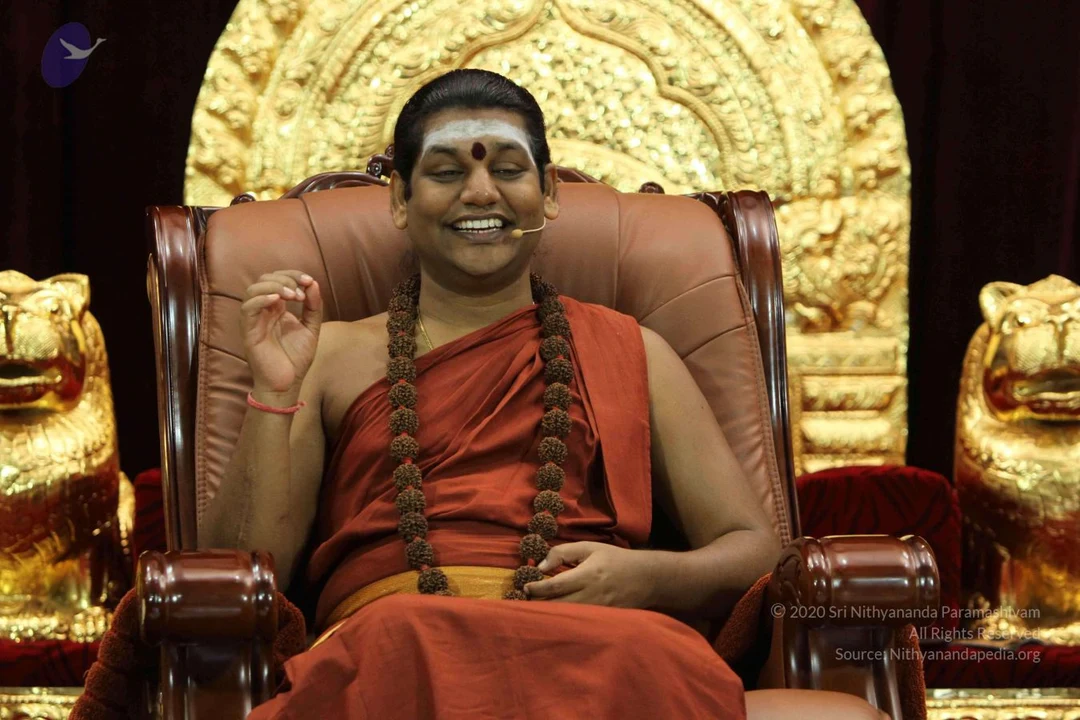
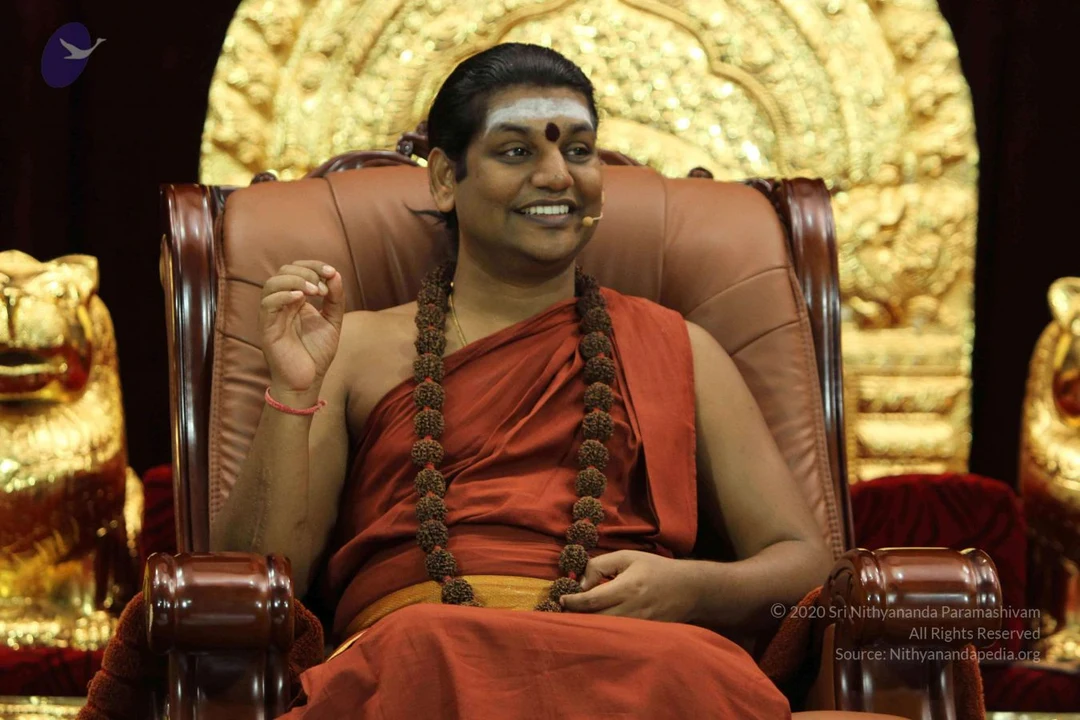
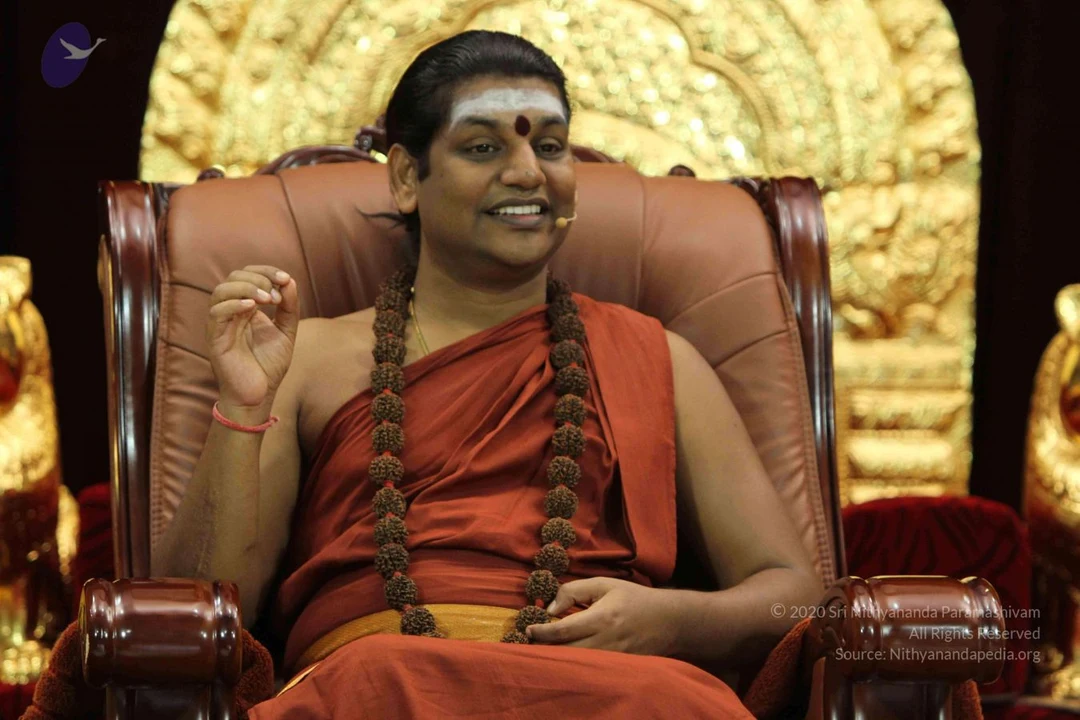
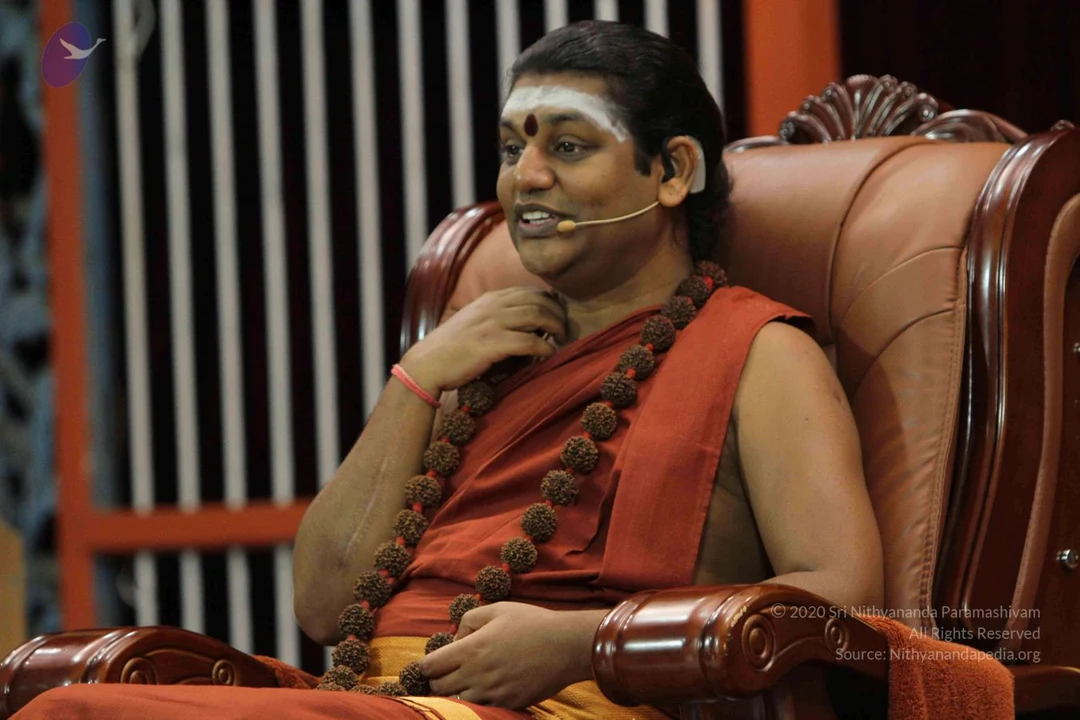
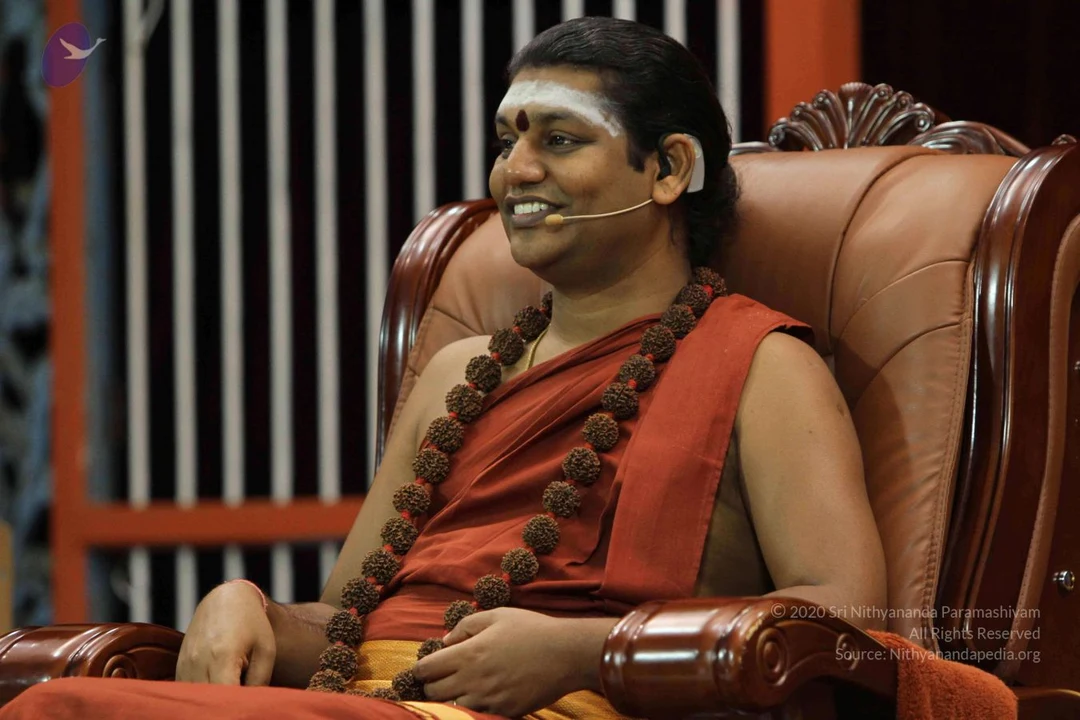
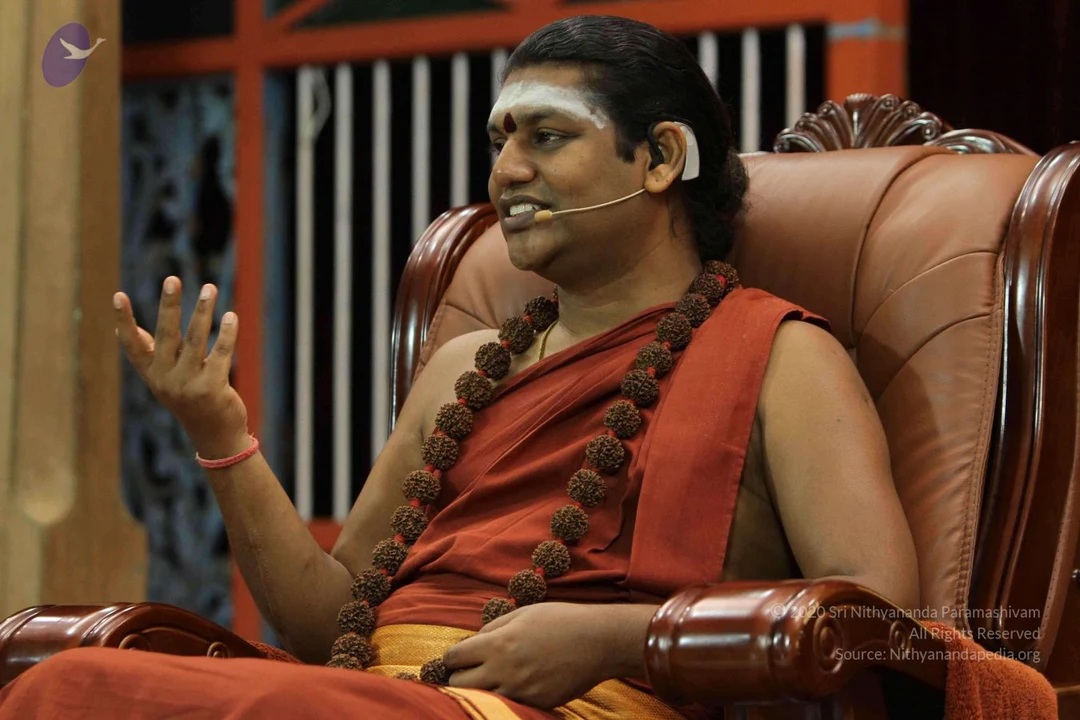
In today’s (27th August, 2014) morning Satsang, Paramahamsa Nithyananda spoke about how Completion makes you sure about you and how when you have that certainty you know who your enemy is. Desperation and anxiety are caused by casual thoughts not by the root pattern and can be eliminated just by the will to complete. Completion makes you win the game of life by clearing whatever is blinding you to who is attacking.

Link to Video:

Transcript:

Nithyanandeshwara Samaarambhaam Nithyanandeshwari Madhyamaam | Asmath Aachaarya Paryanthaam Vandhey Guru Paramparaam ||

I welcome all of you with my love and respects.

I welcome all the devotees, disciples, visitors, viewers, Shrimahants, Mahants, Kotharis, Thanedars, sitting with us all over the world through Nithyananda TV, Sadhna TV, two-way video-conferencing having Nayana Deeksha.

Cities sitting with us in two-way video-conferencing having Nayana Deeksha: Scottsdale-Arizona, Stratford-Connecticut, Houston-Kalahasti, Indrani-New Jersey, Singapore-Singapuram, London-Kashi, Phoenix-Kanchipuram, Atmadayaki-London-Kashi, Seattle-Chidambaram, Nithyananda University-Los Angeles, Enriching Temple-Bidadi, Ohio-Ma Shivananda, Austin Texas, Guadeloupe-Rameshwaram, St. Louis-Tirumala, San Jose-Madurai, Grasse-France, Kulim-Tiruttani, Ravensburg-Germany, High Point-North Carolina, Newfoundland-Canada, Los Angeles-Hollywood, Hong Kong-Sirkazhi, Nithyananda Nagar-Tiruvannamalai, Toronto-Kailasam, Hyderabad-Gupta Kashi, Oklahoma-Somnanatham, Ohio-Prayag, Jorpati-Nepal, Amersfort-Netherlands, Kuala Lumpur-Palani, Kathmandu-Nepal, Oman-Sivagangai, Philadelphia...........

I welcome all of you with my love and respects. Rajivji (Rajiv Malhotra), thank you for visiting Toronto Temple and giving an awesome lecture. Thank you.

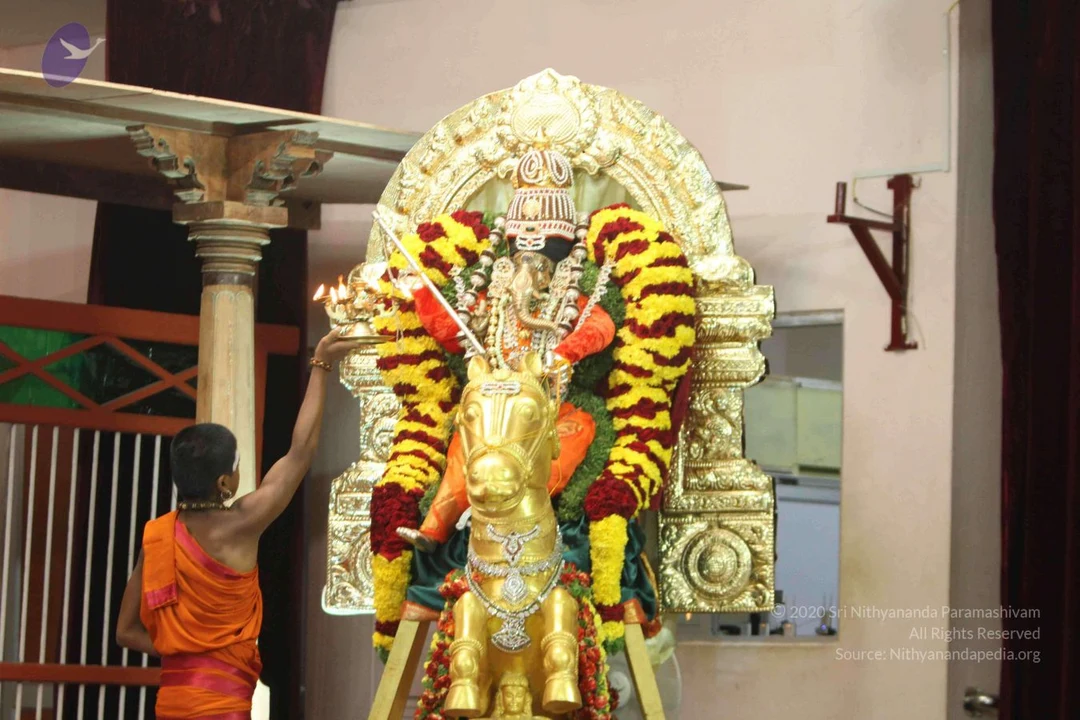
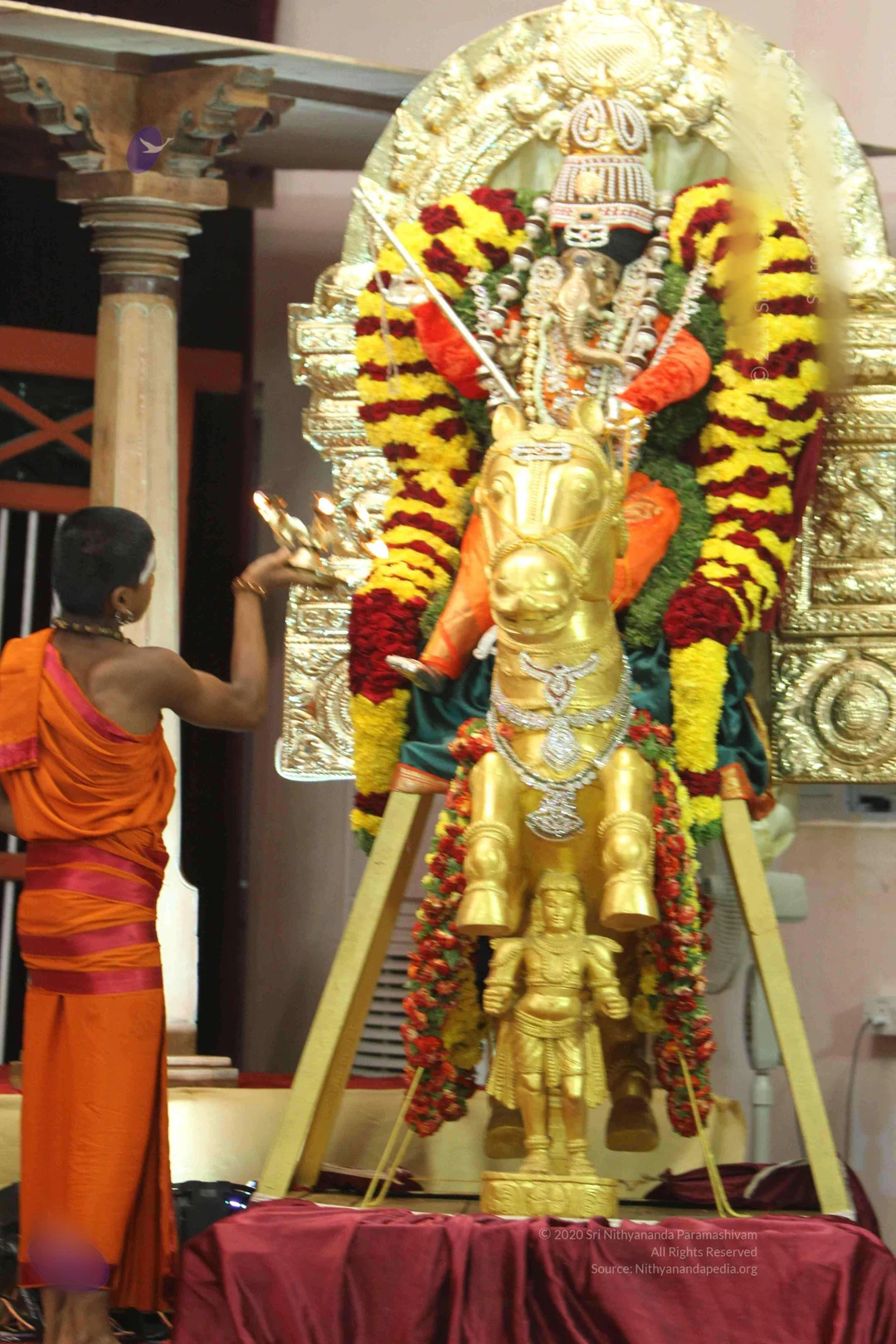
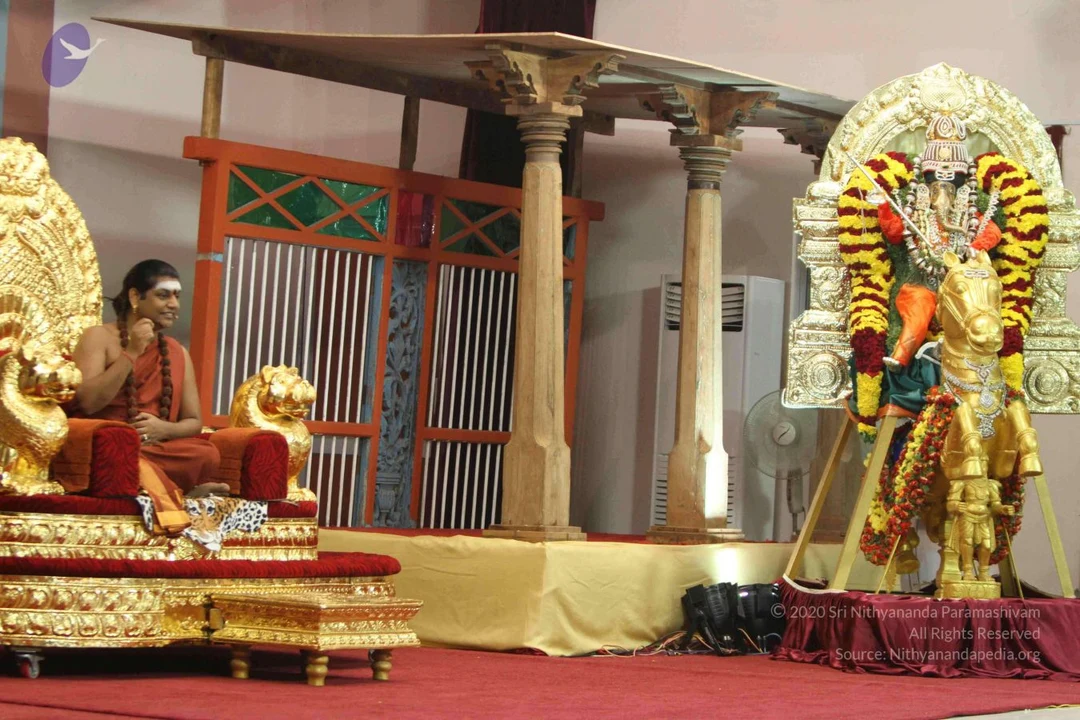
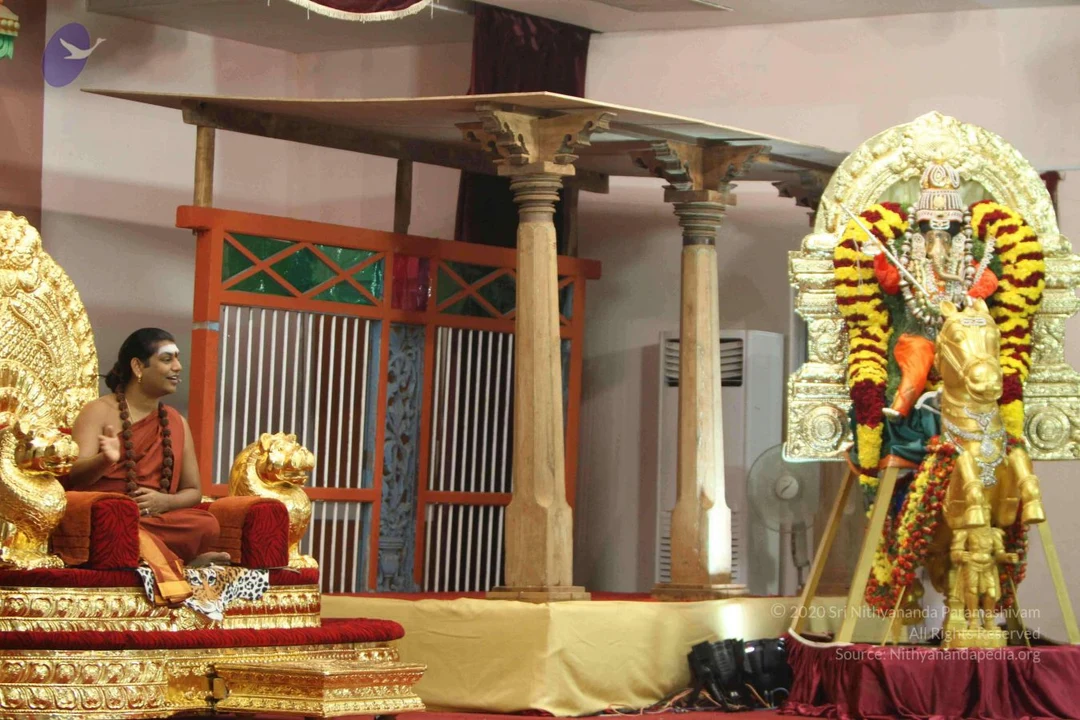
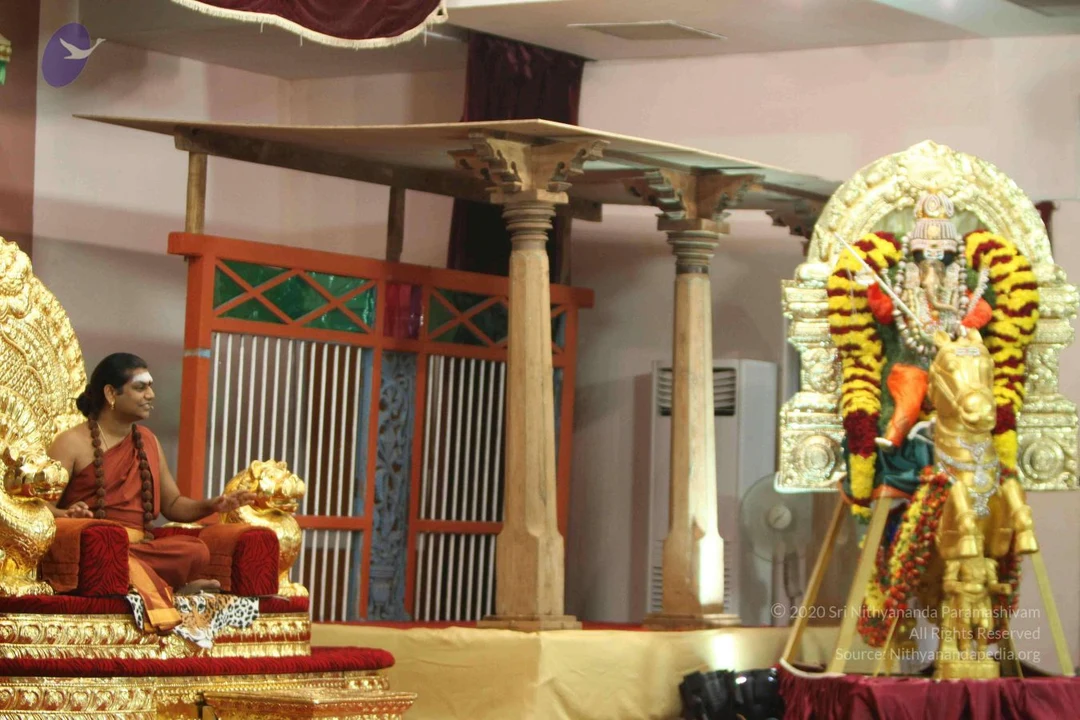
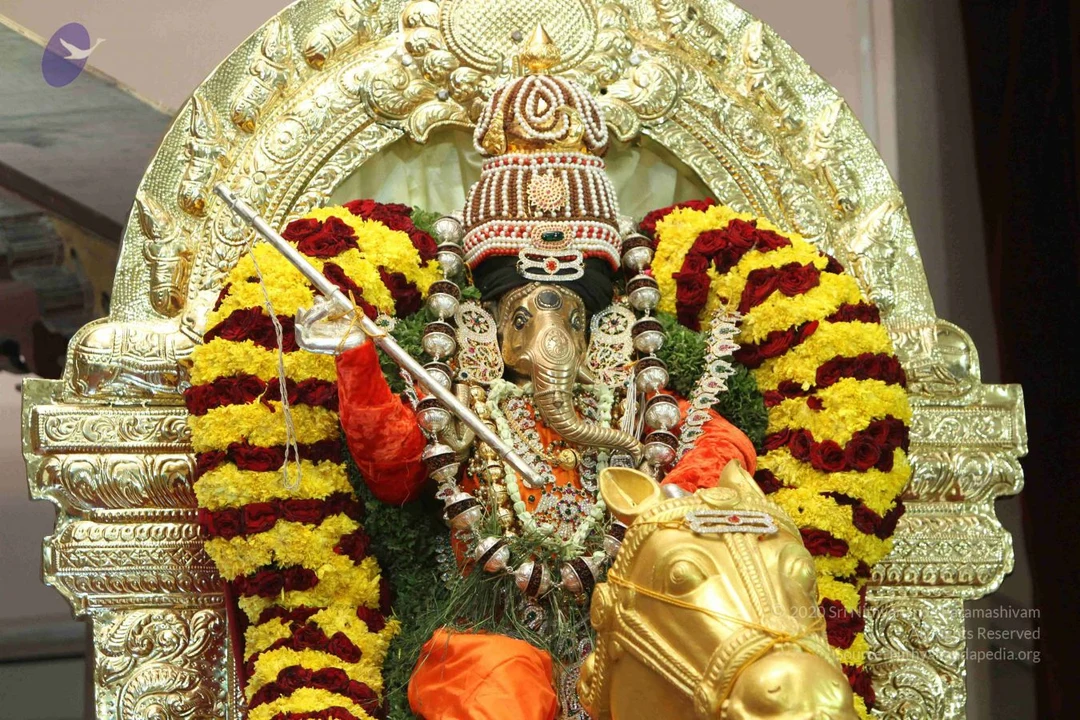
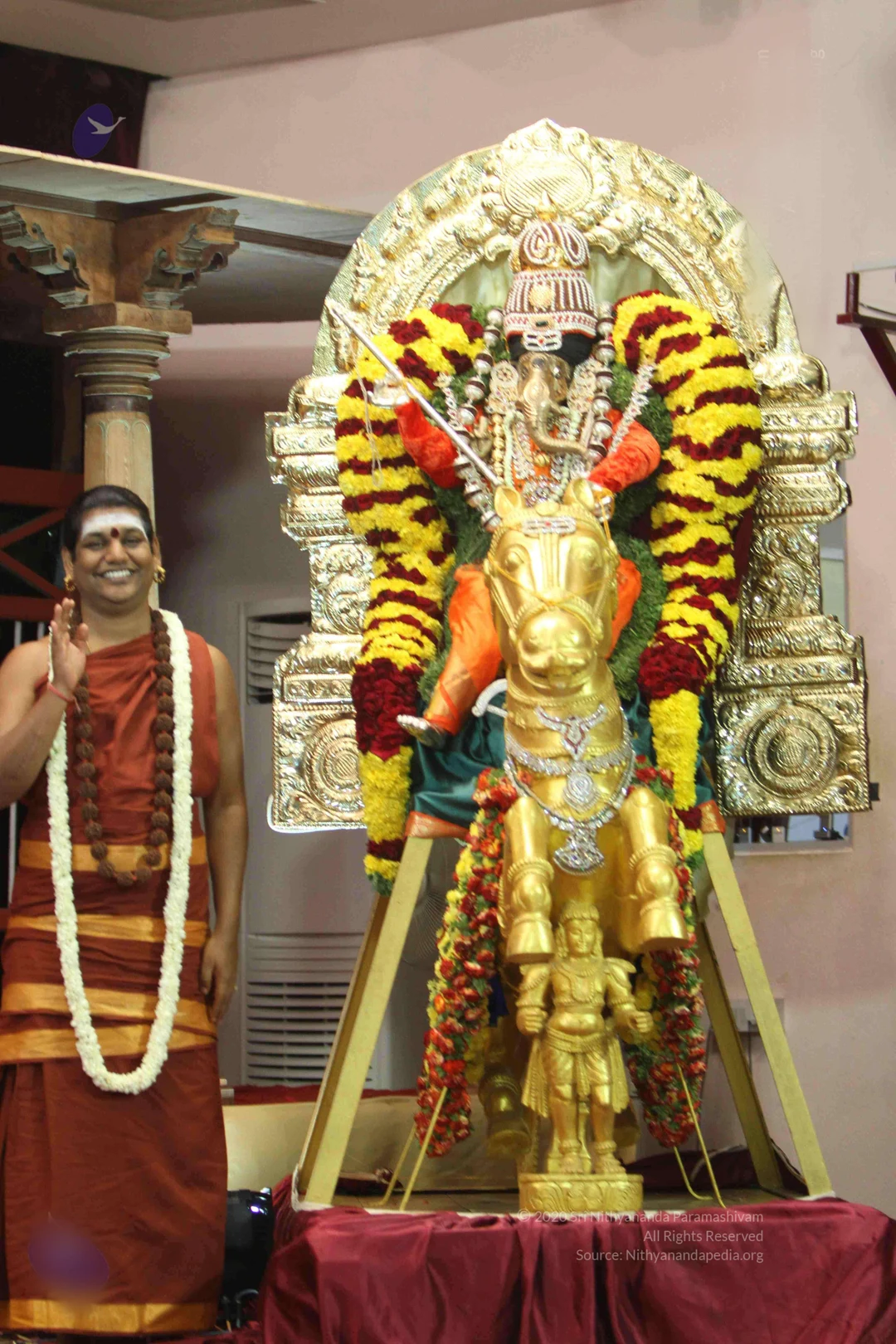
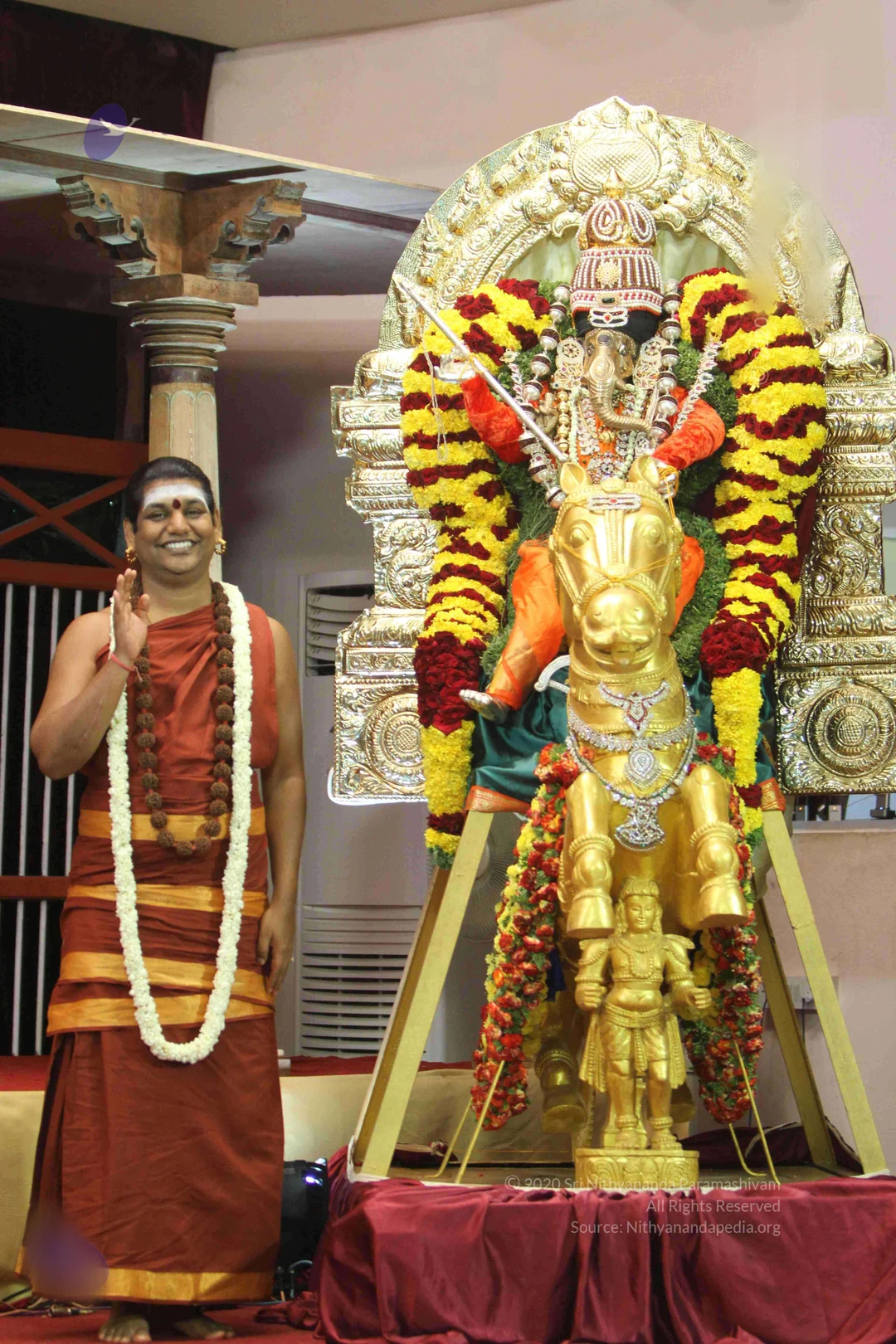
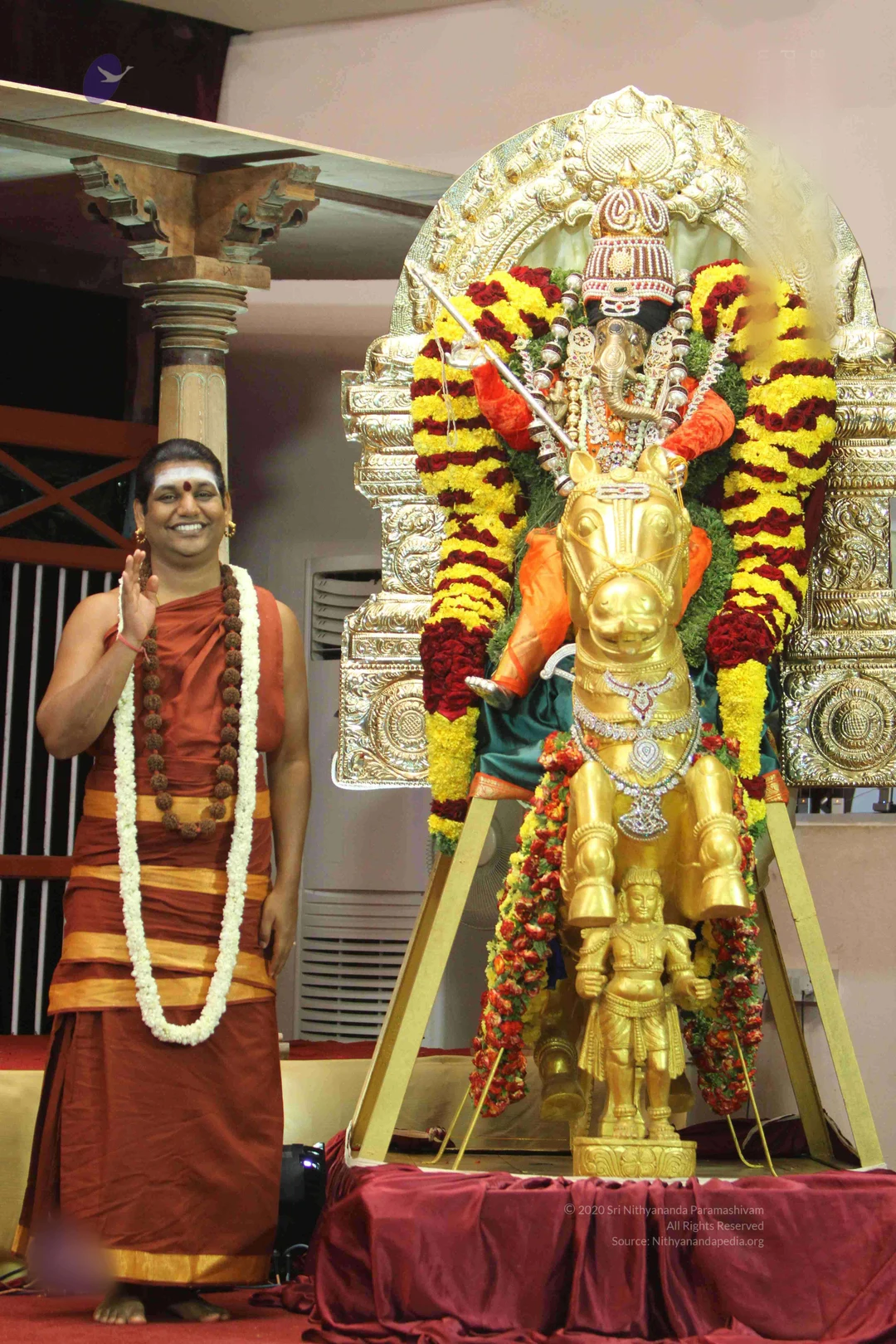
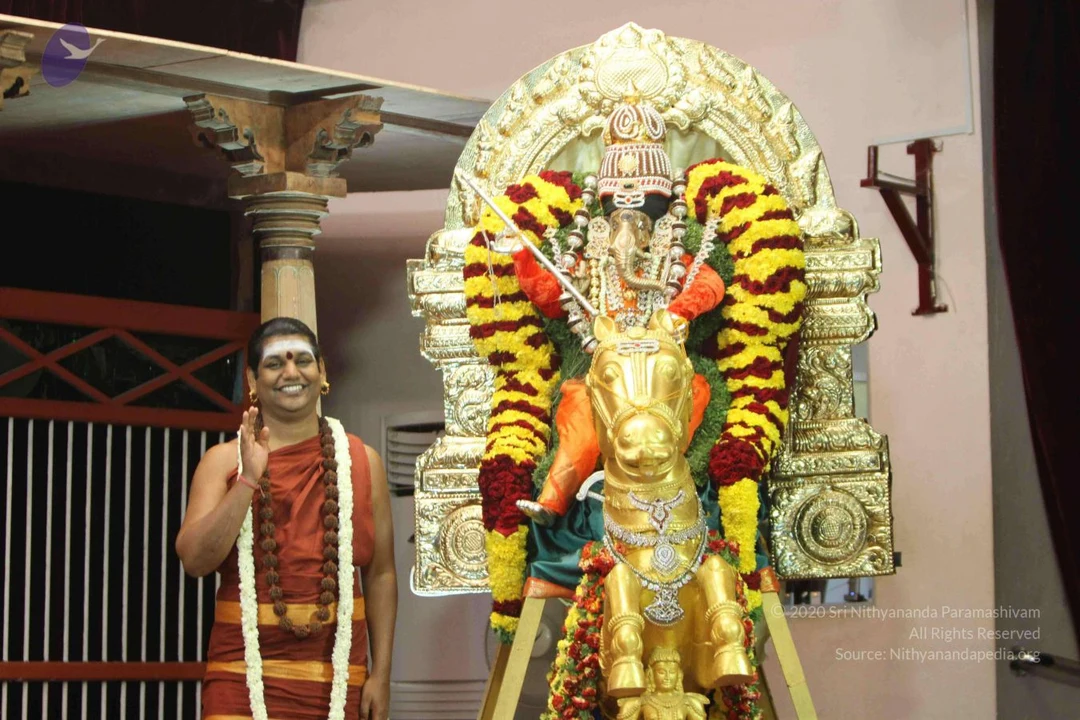
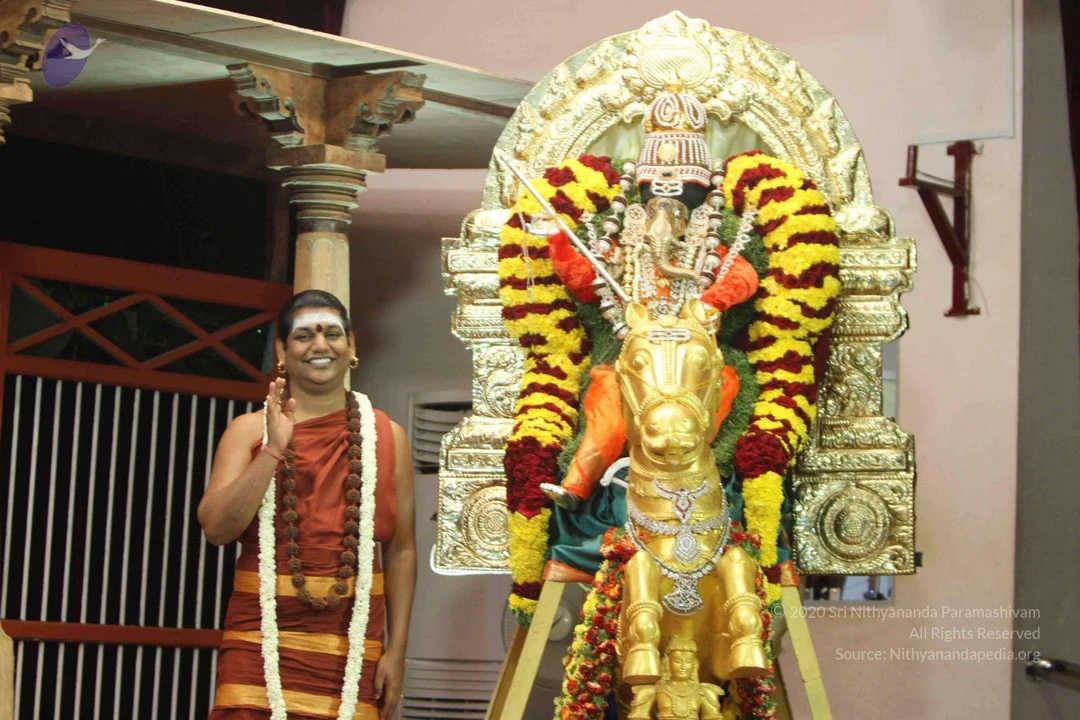
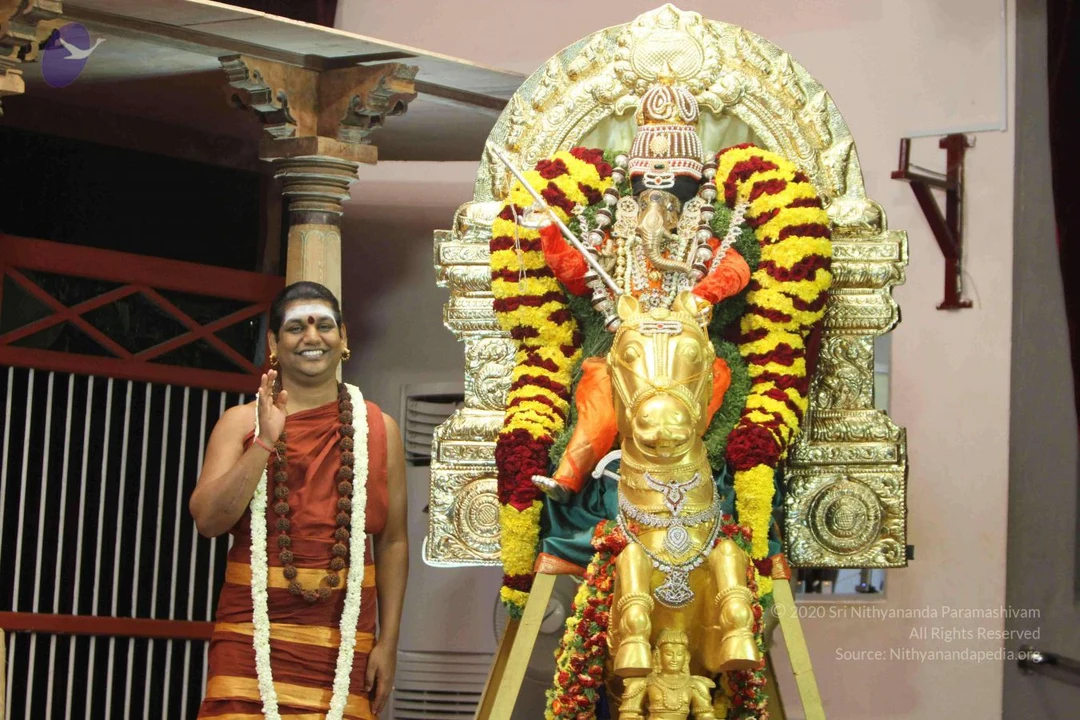
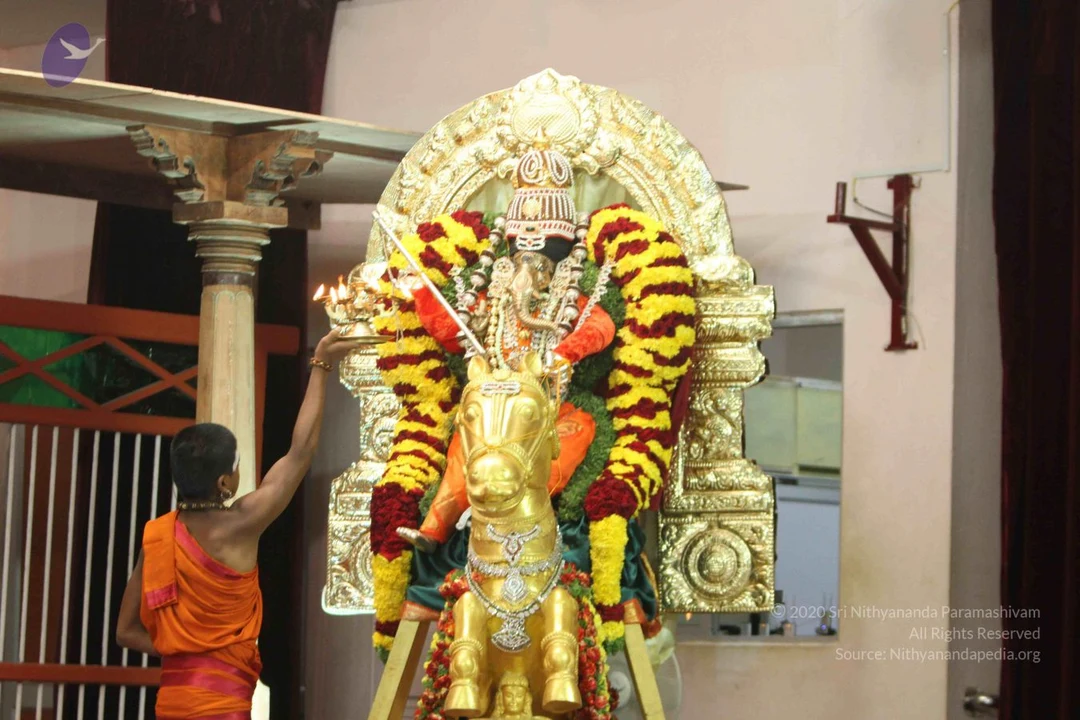
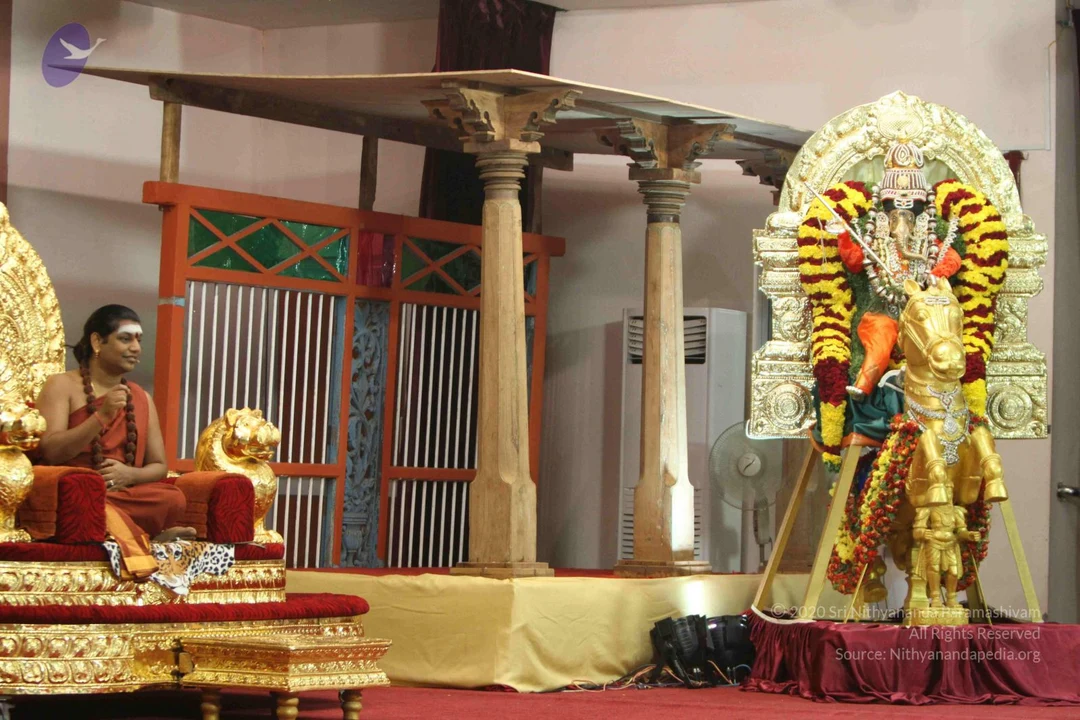
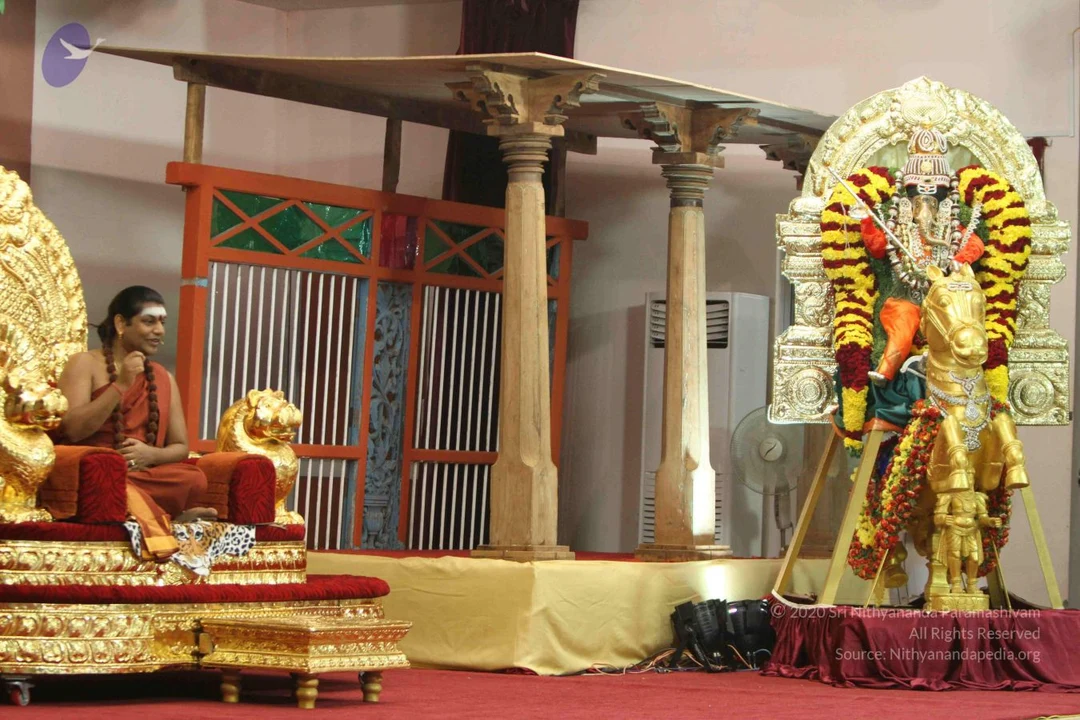
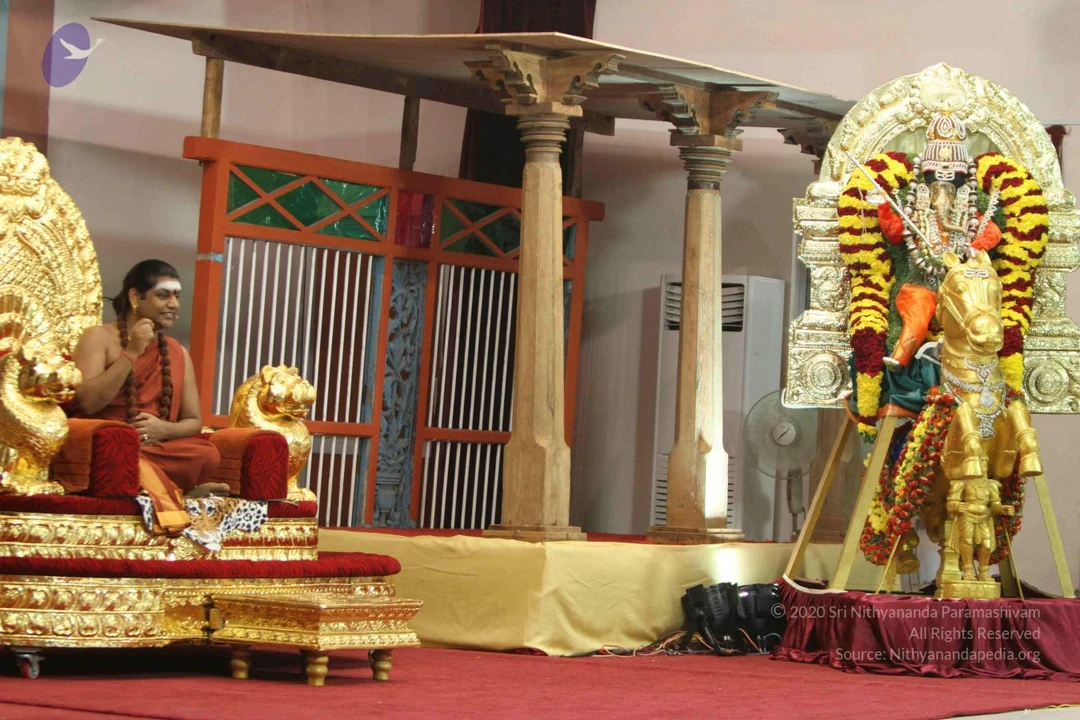
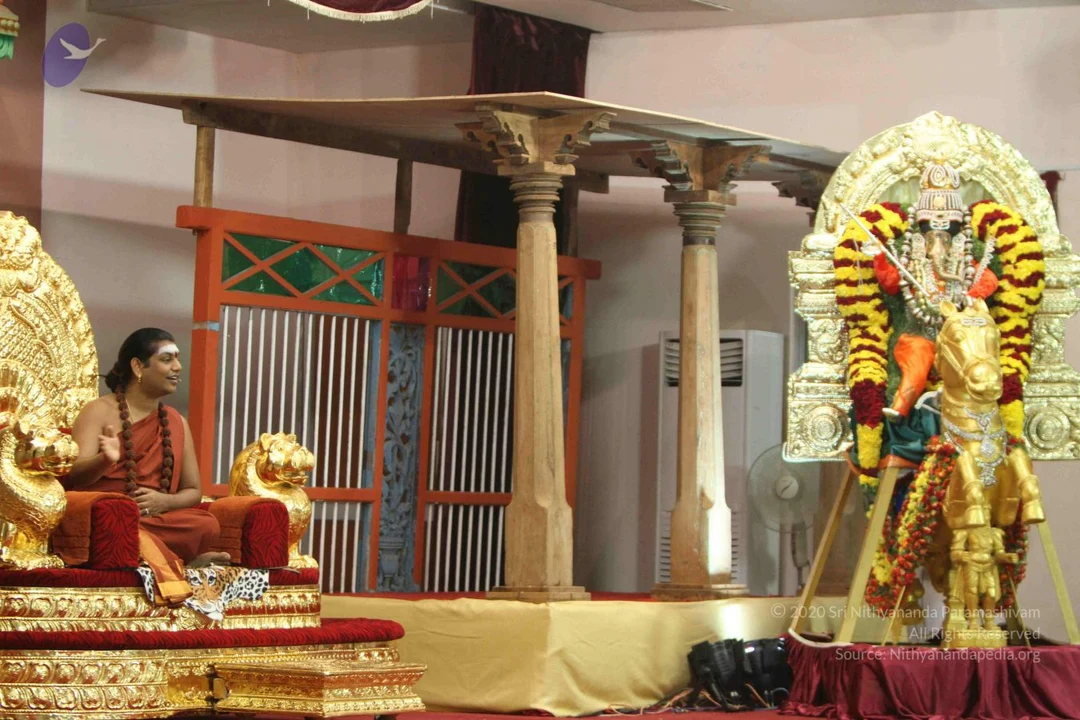
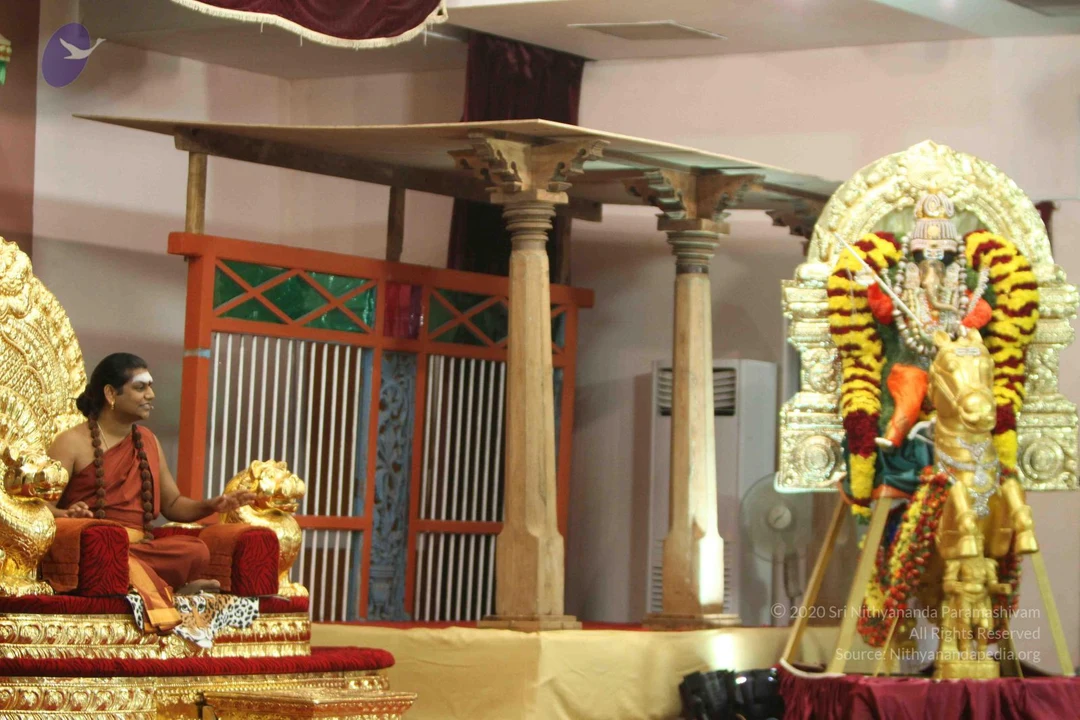
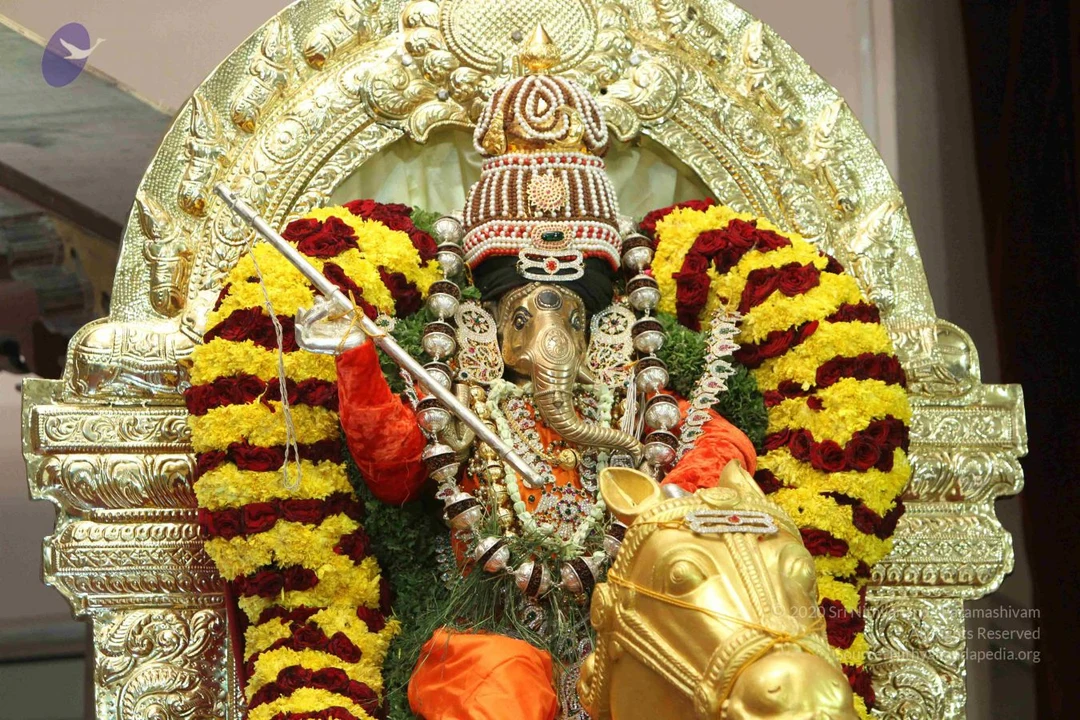
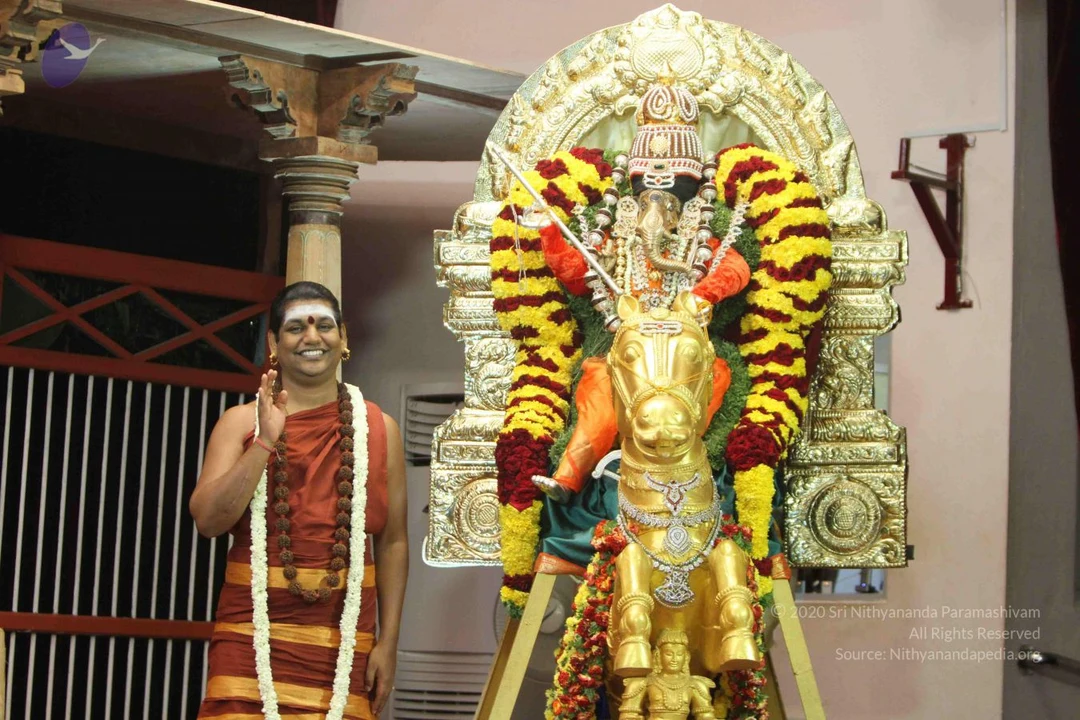
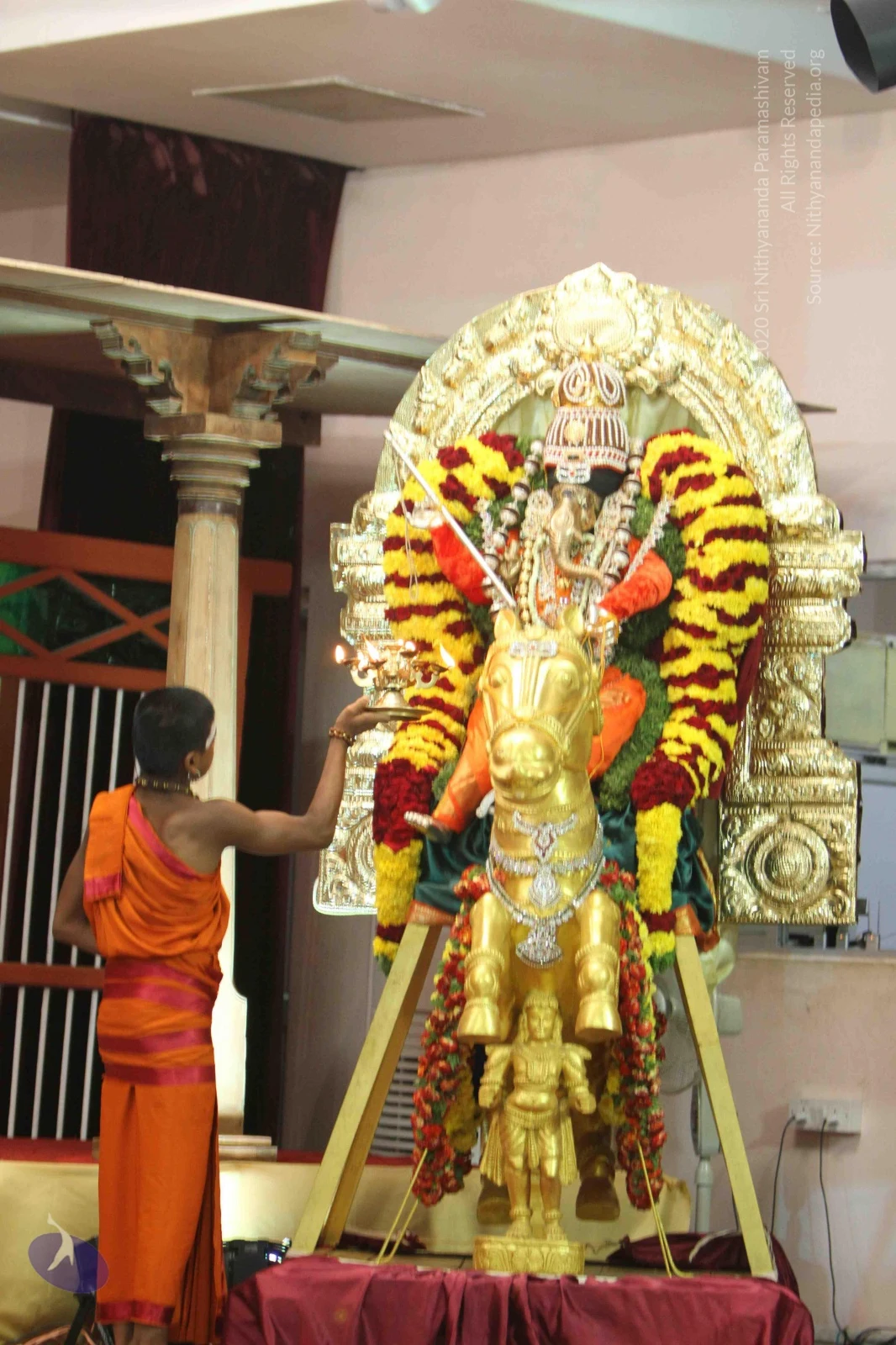
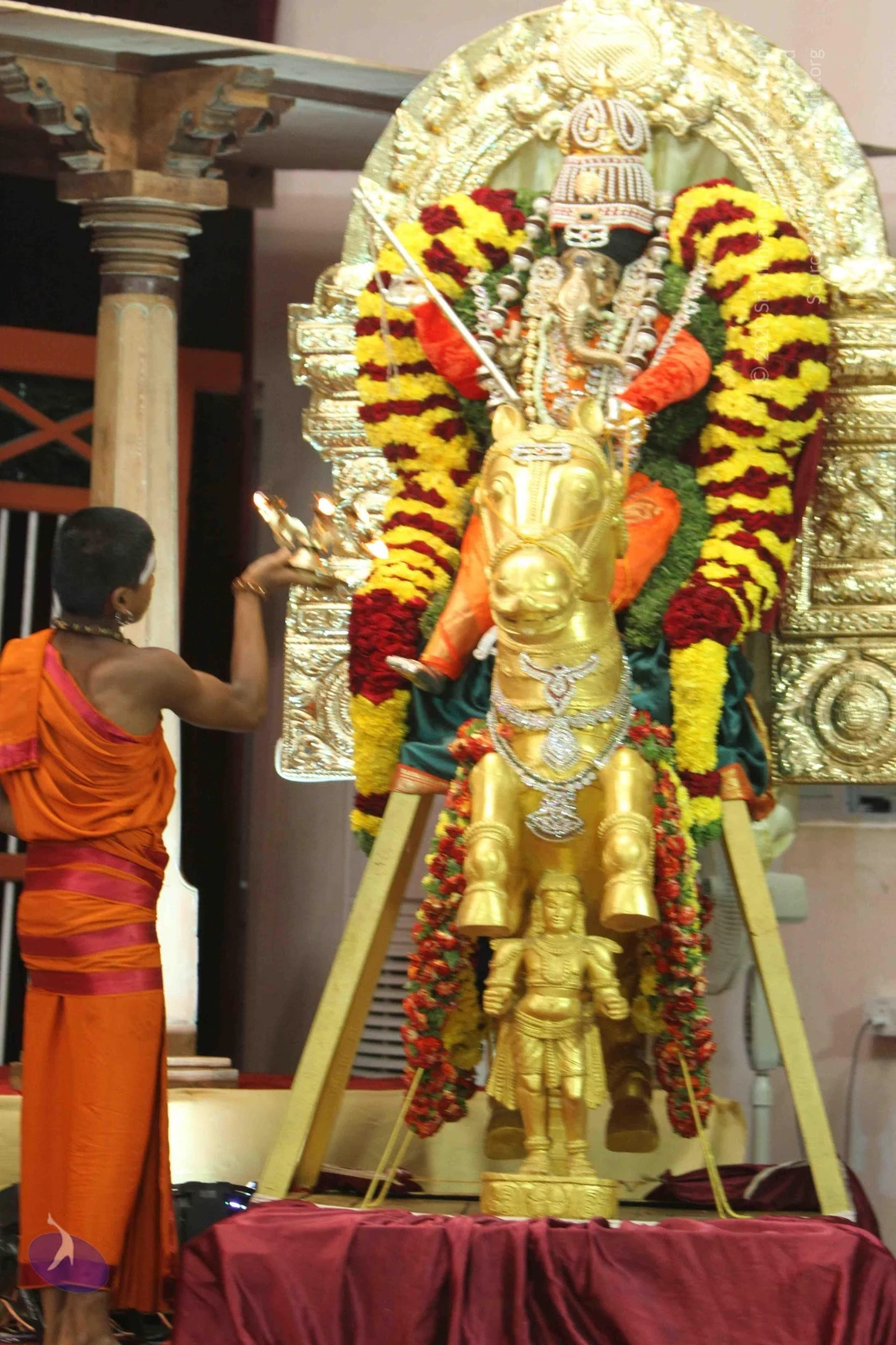
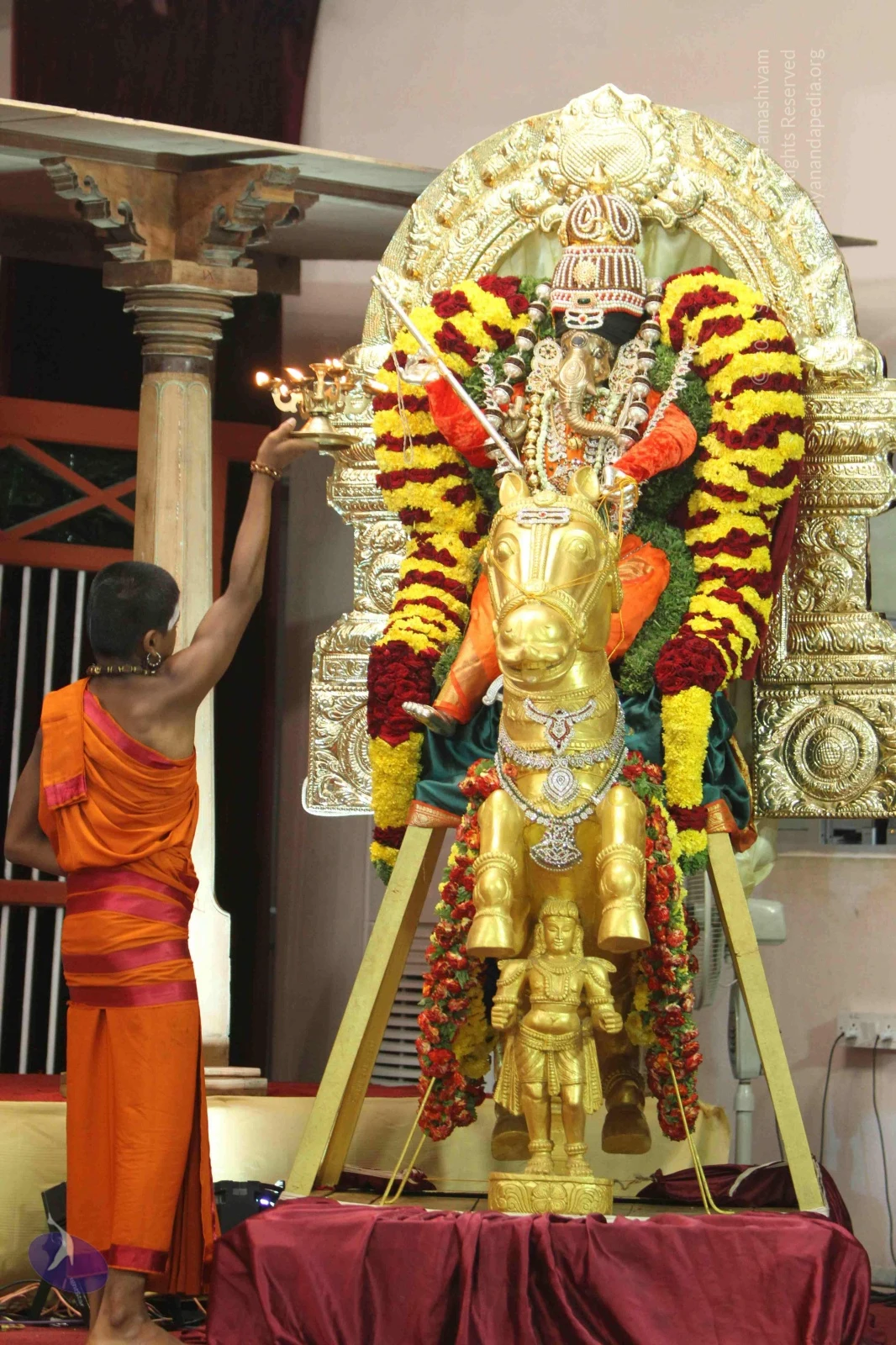
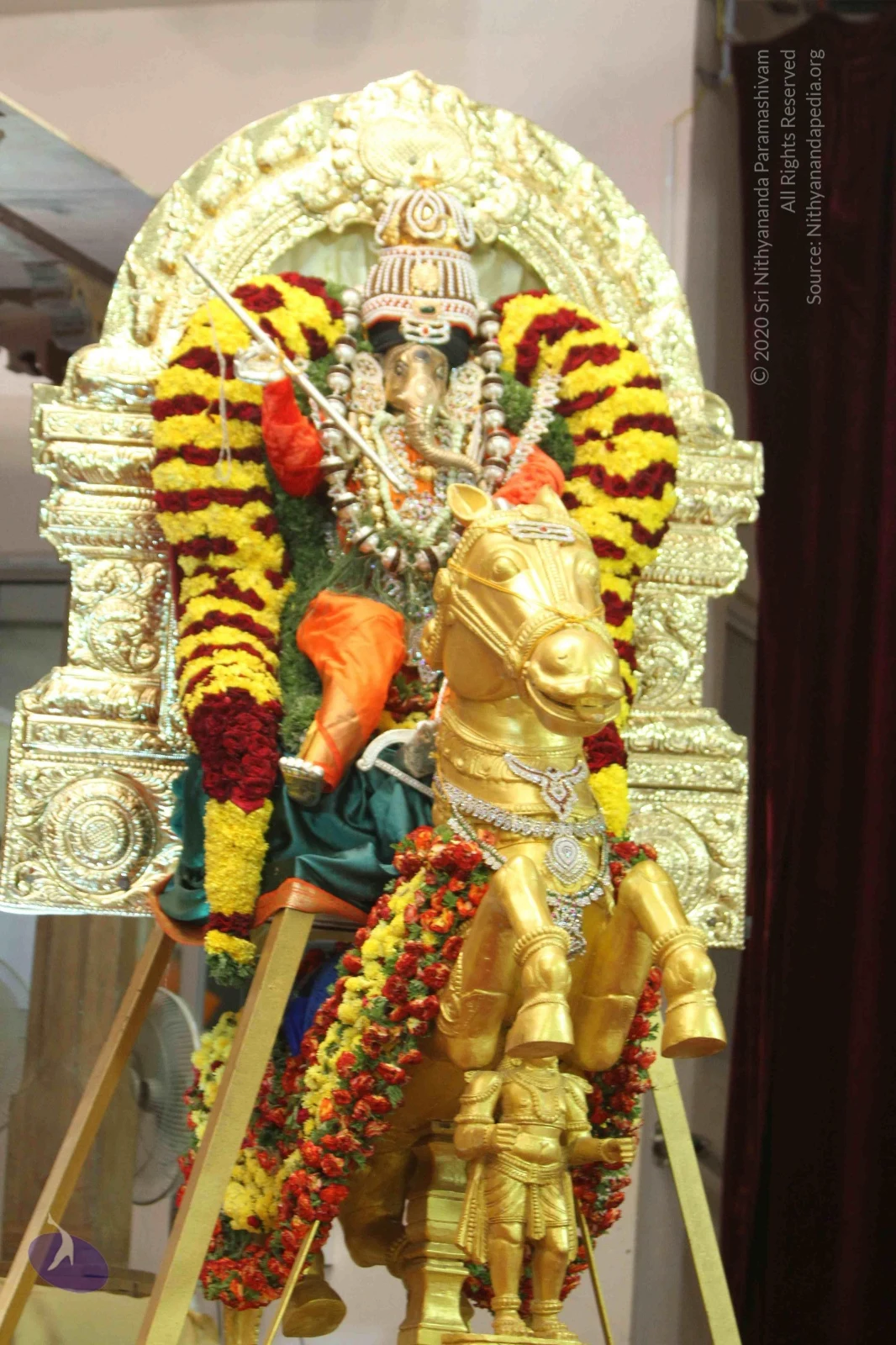
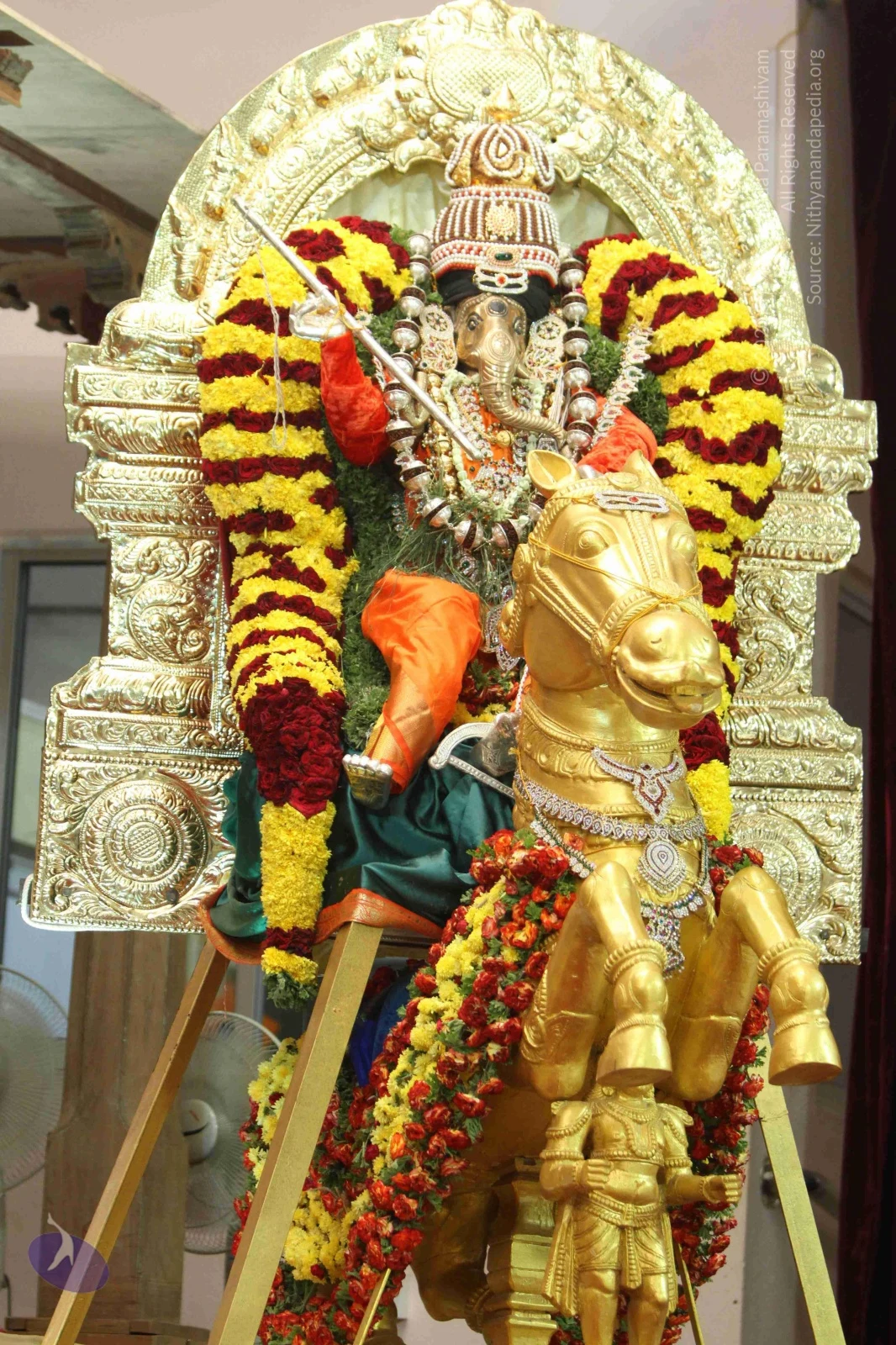
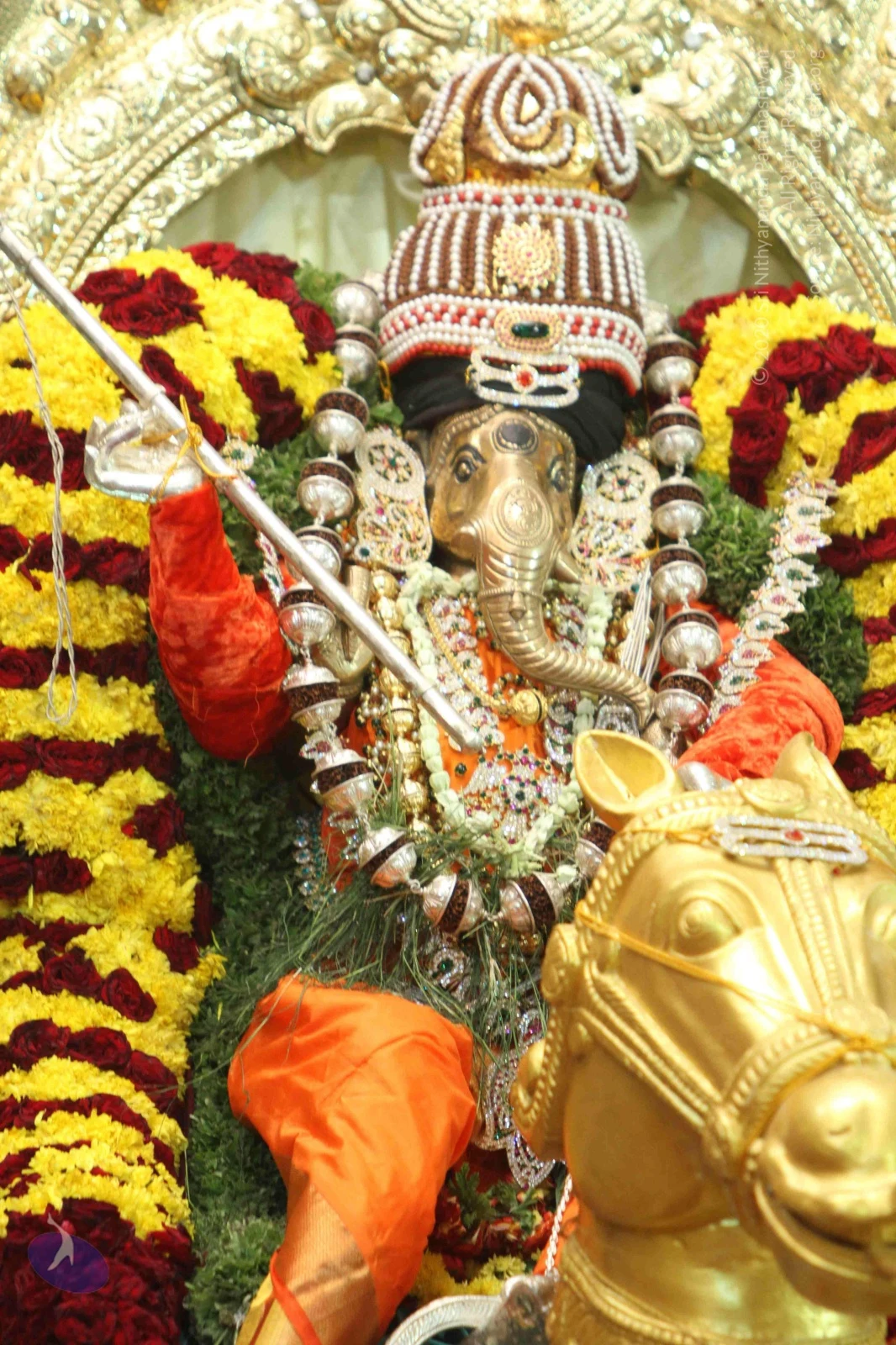
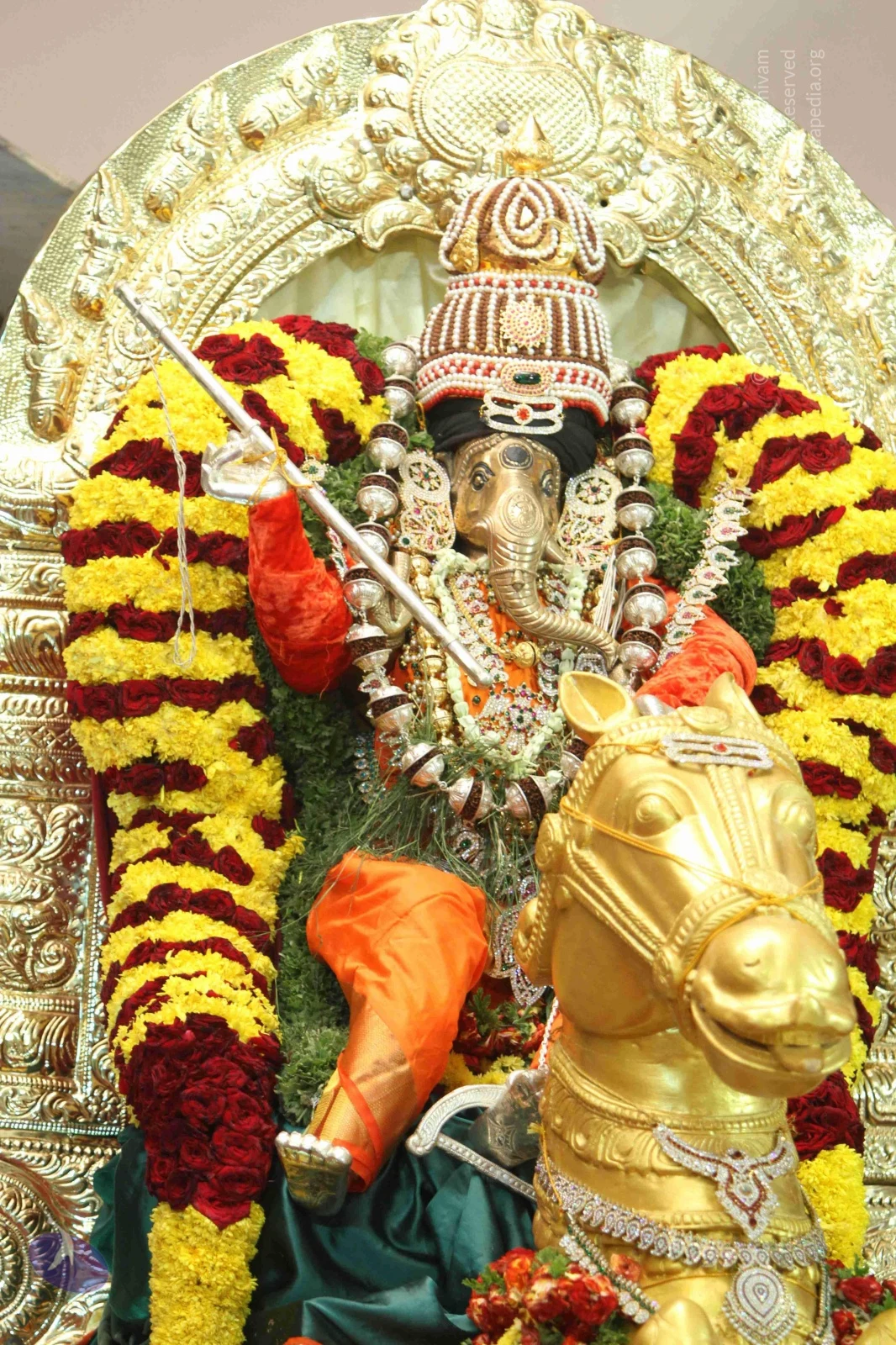
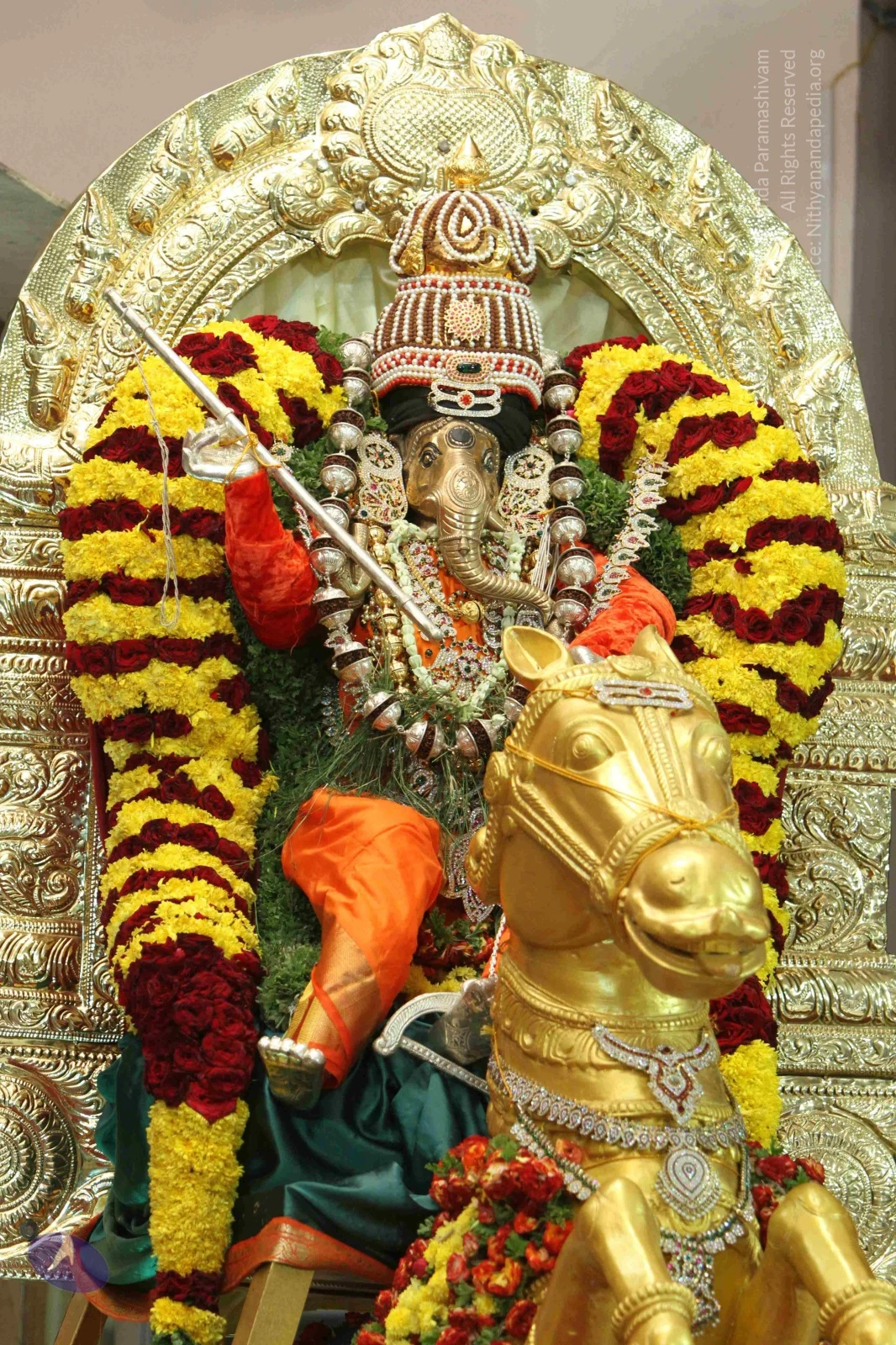
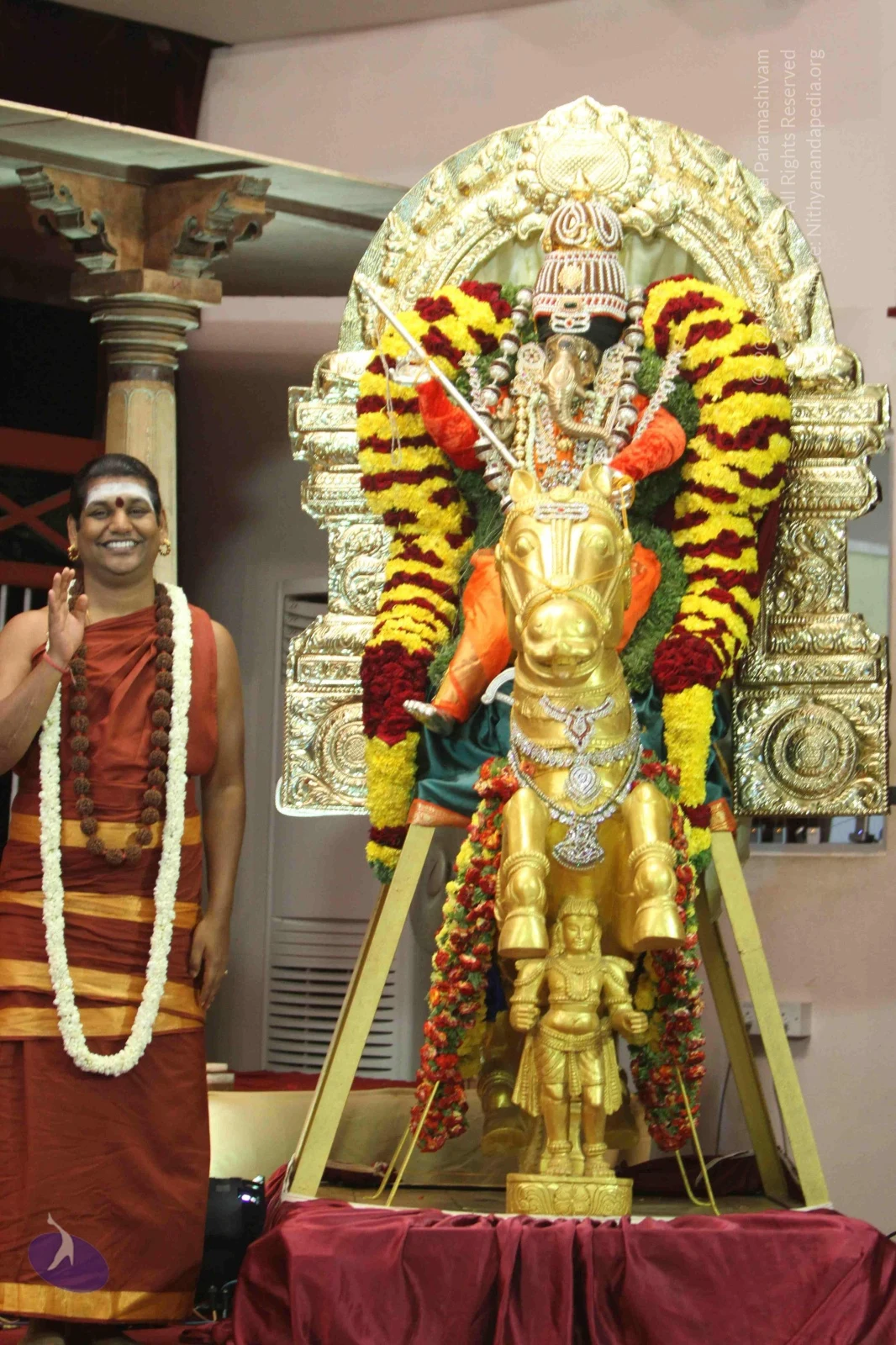
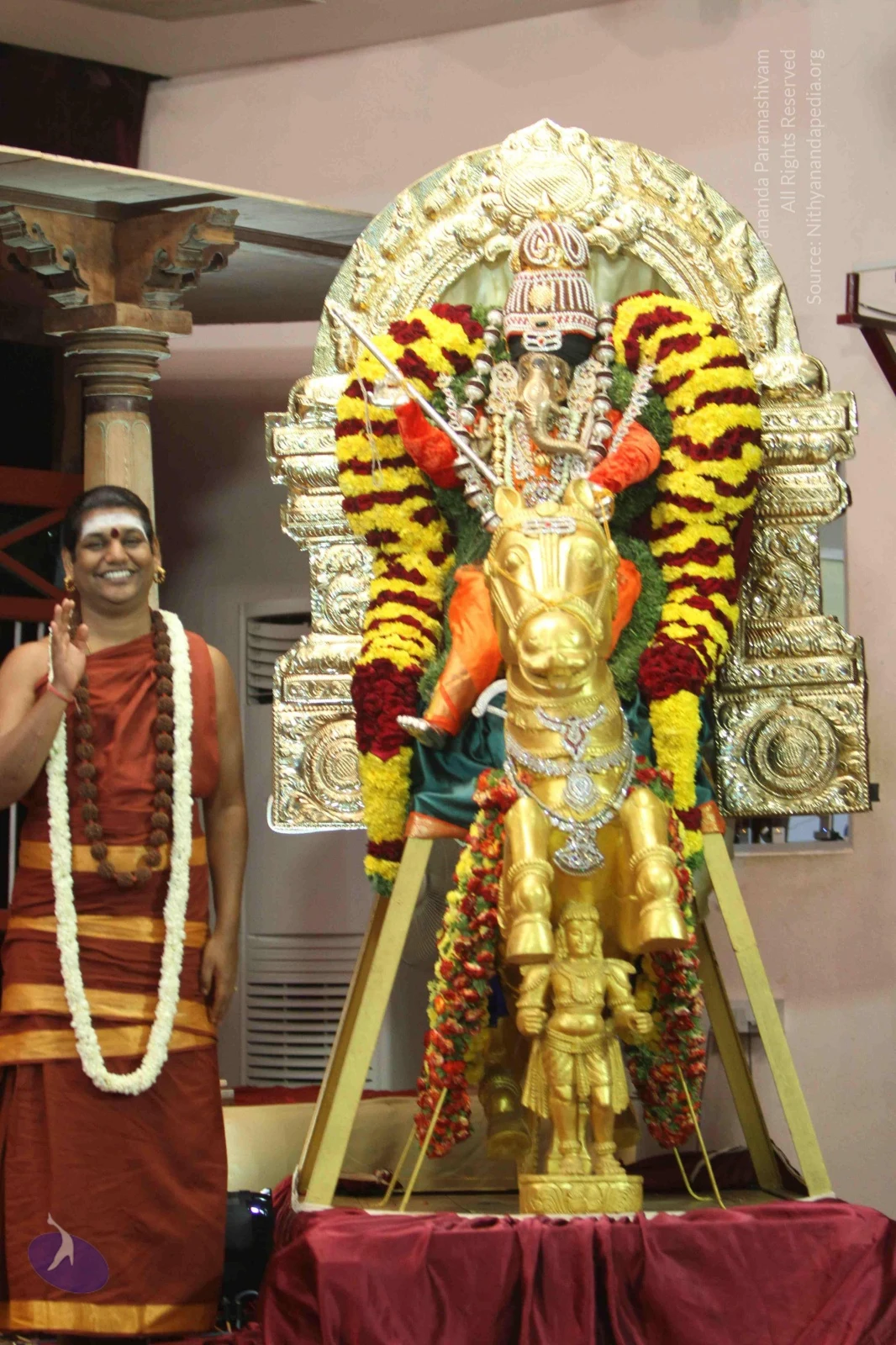
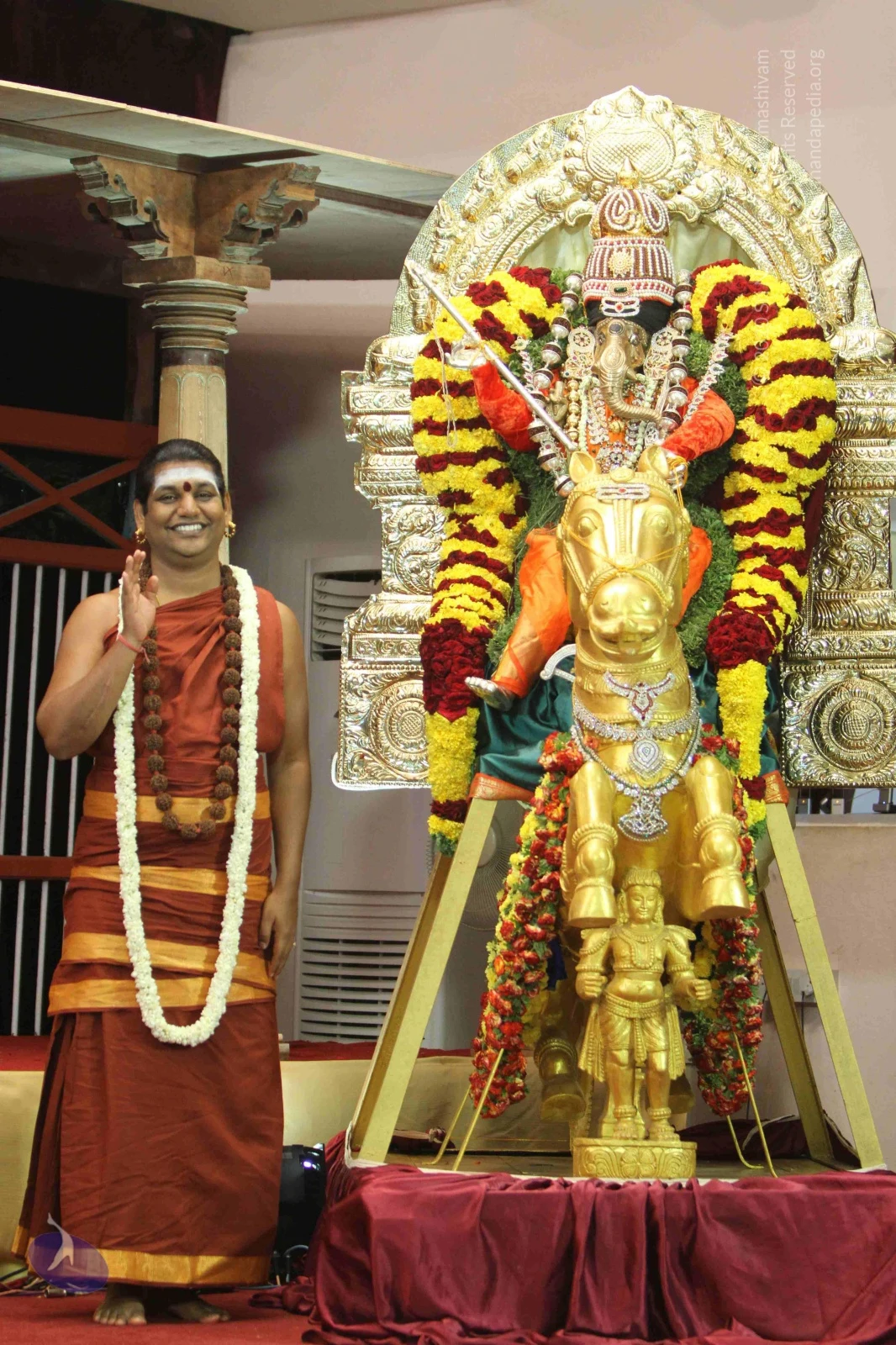
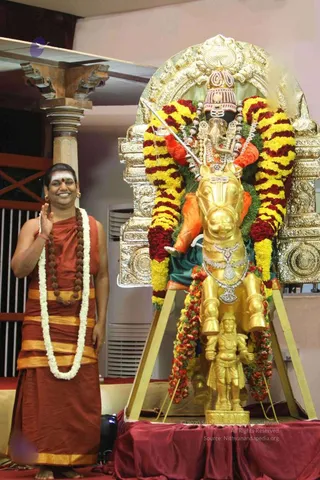
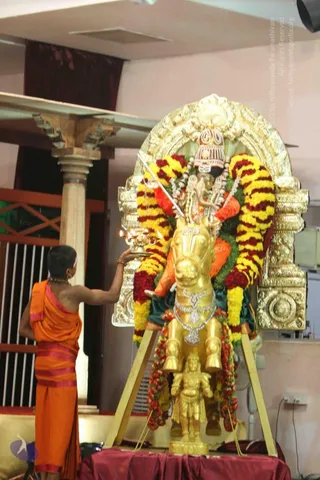
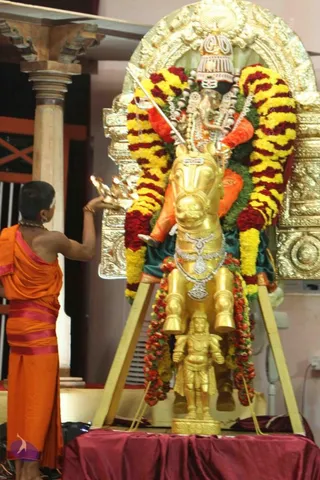
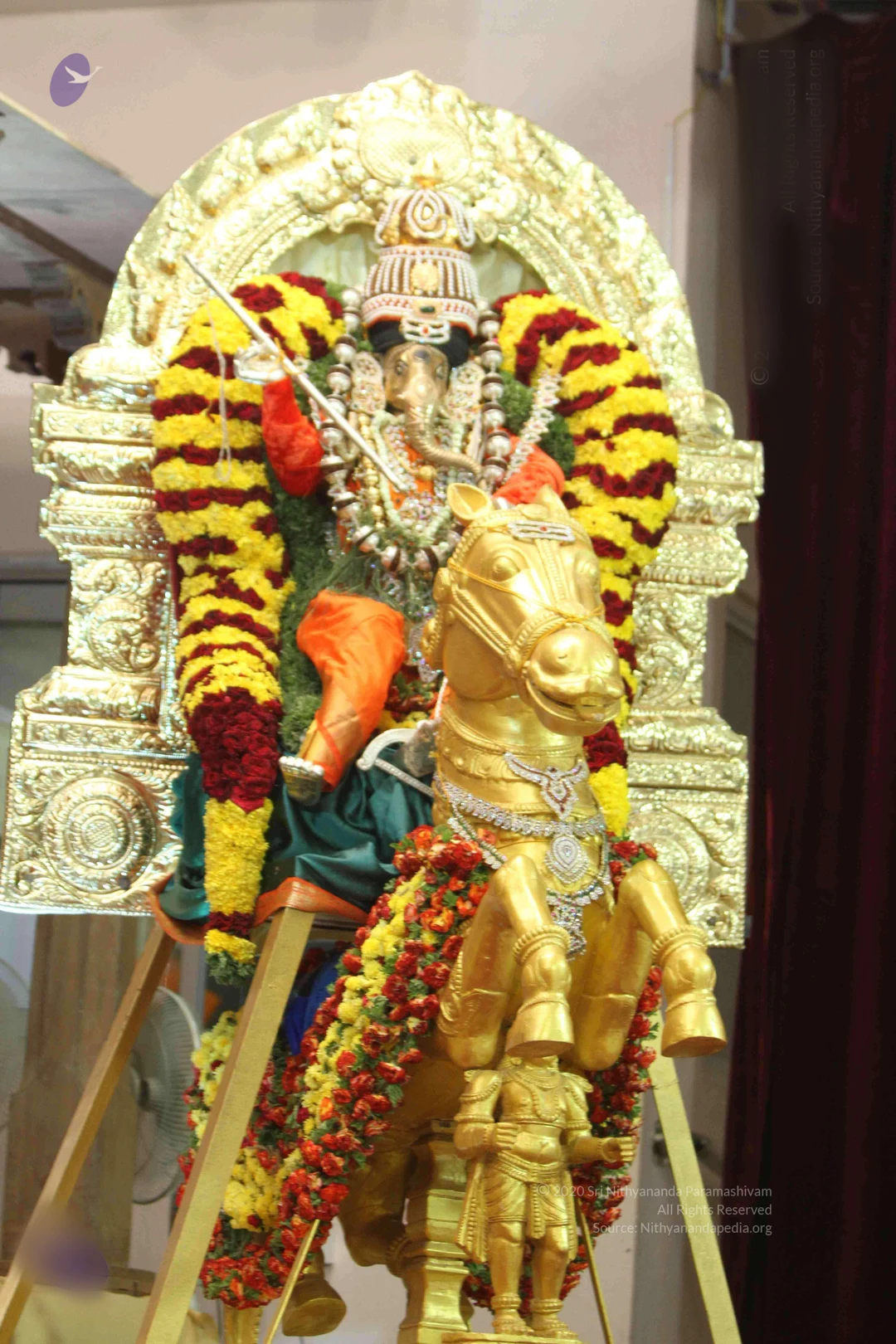
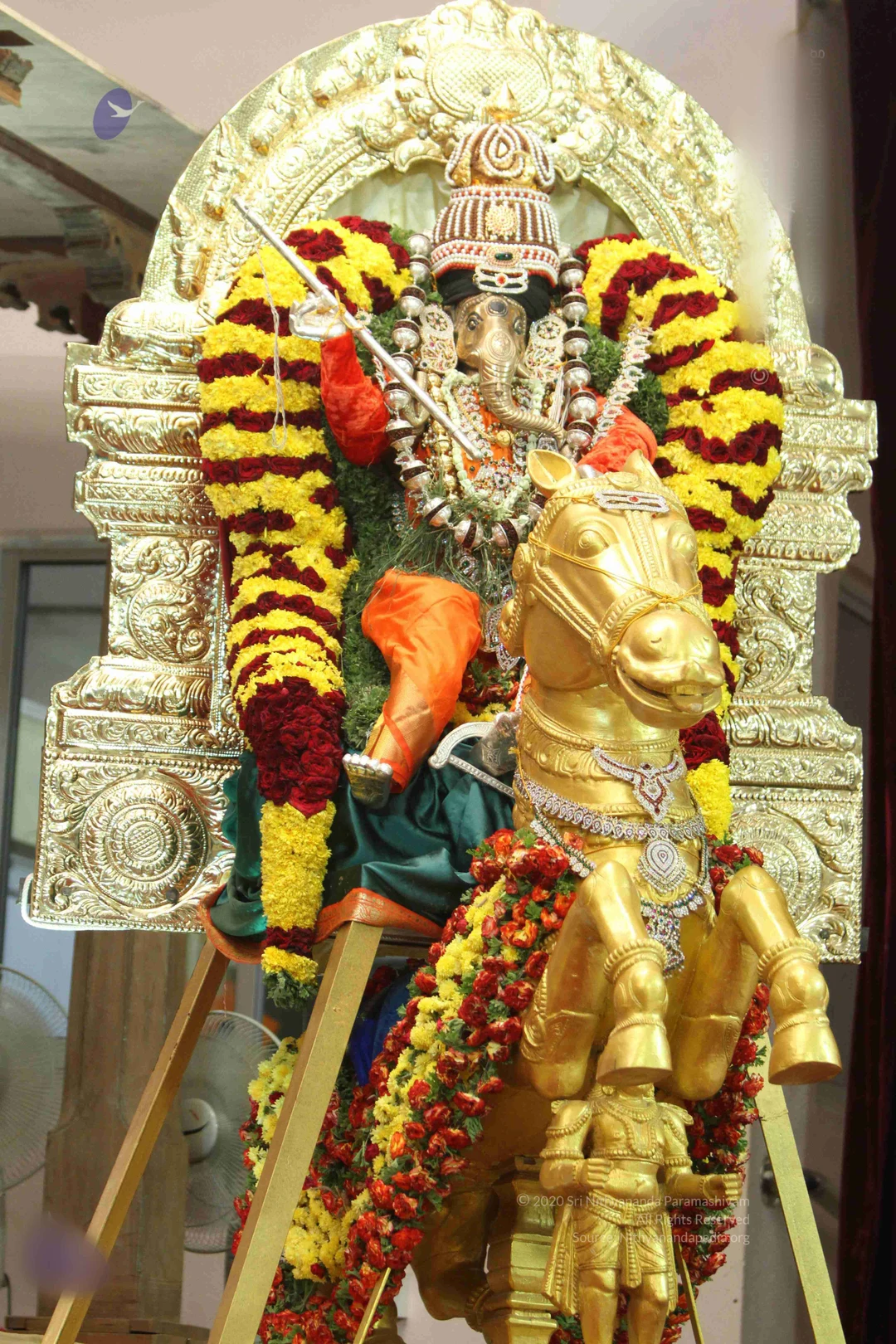
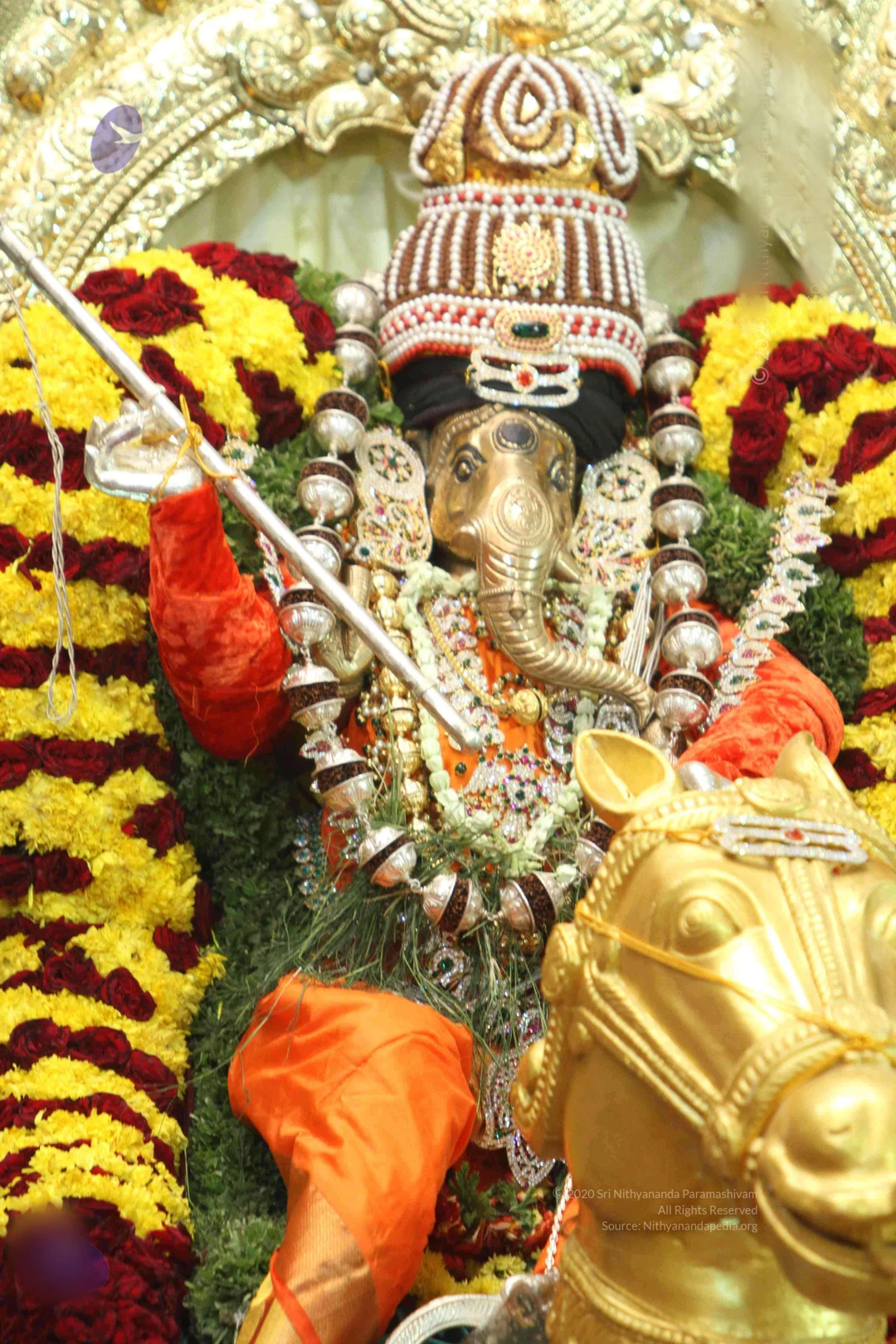
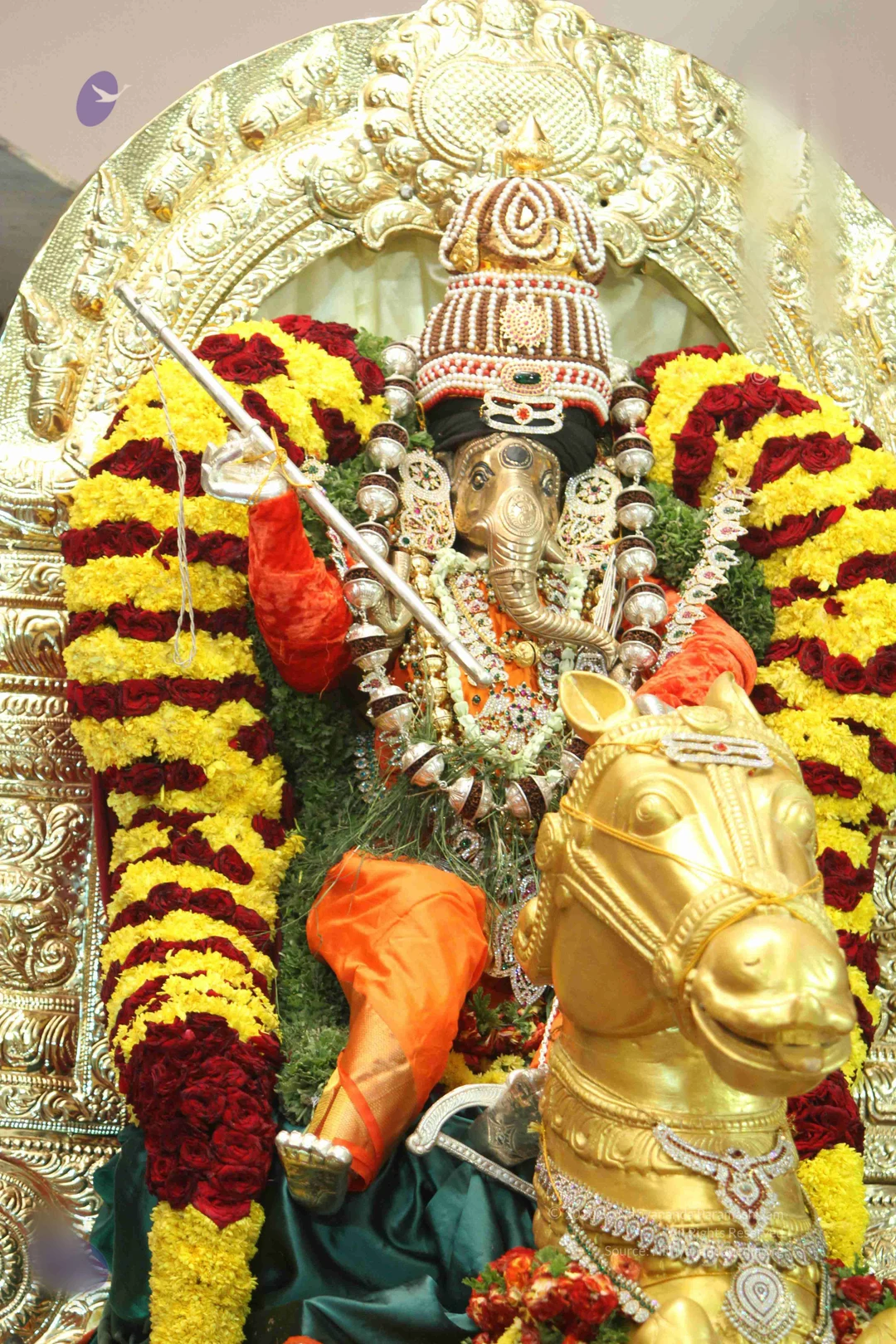
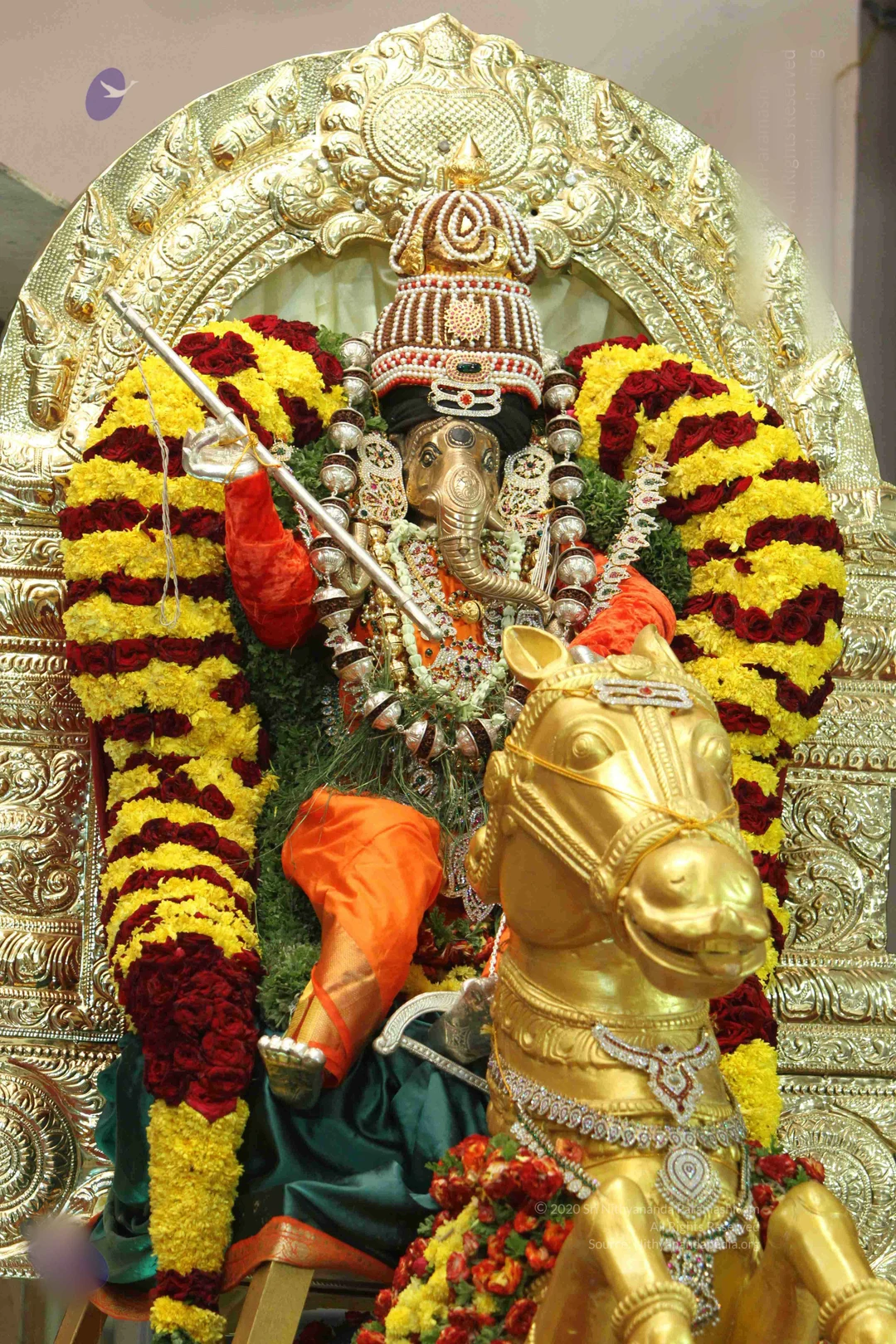
Today, Vinayaka Chaturthi Brahmotsava, eighth day! Ganesha is gracing all of us on the Ashwa Vaahana, the Horse Vehicle. Today is the Day of Completion. In the Inner Awakening, second day, the Day of Completion. So, I will expand on some of the important principles of Completion.

Please understand, the Science of Completion literally, the Science of Poornathva literally brings you the Poornathva (Completion). The Science of Completion literally brings Completion, whatever may be the conflicts, inside or outside. Most of the time, even you are not convinced you are the hero worthy of success. Even you have a doubt, May be a part of me is villain. That is why failures are happening. Listen! The Self-Doubt, internal conflicts and contradictions, internal confusions what to do, what not to do, whether to do this or not..... Completion, the first thing Completion does is, it brings you to the understanding of Dharma and goes on guiding you.

Please understand, in Western society, it is always like who wins the war writes the history. But, in the Eastern side, it is always like before the war we know who is going to win, because, whoever is thoroughly convinced about themselves wins the war. See, thoroughly getting convinced about you, being sure about you, please understand, thoroughly getting convinced about you, being sure about you happens only when you bring the Science of Completion into your thinking, the Science of Poornathva into your thinking.

Please listen! Listen to this! Deity worship alone by its own right can give you enlightenment. Same way, what J. Krishnamurthy is teaching, the choiceless awareness, that alone by its own strength can give you enlightenment. Deity worship is an independent path; from A to Z it can lead you to enlightenment. Choiceless awareness is an independent path; just by its strength, it can lead you to enlightenment from A to Z. Deity worship or choiceless awareness, both will lead you to complete enlightenment, But you have to be sure about you, what do you want, please understand. The most unfortunate thing is not being sure about yourself.

The Science of Completion, the first thing it does to your being is, bringing clarity to you, being sure about yourself. See, when you do Completion, Poornathwa, some things you will complete, some things you will not be able to complete; you will be struggling with it. With what you are struggling now, based on that, at least you will be sure about you. Please understand, whatever is completed and leaves your system, the oscillation, distractions, dilemmas created by those vague thoughts will disappear. Now you will be sure not only about you, but also about your enemy. Being sure about you makes you understand how to be sure about who is your enemy. Life itself is a great war. When you are sure about you and your enemy, I guarantee, you will win the war! Not only you will win the war, you will win the war without having desperation and anxiety. Because, all desperation, all anxiety is caused just by the casual thoughts. Please understand, all big dilemmas are caused by casual thoughts. It is just casual thoughts which are not scanned with the power of Completion, which are responsible for your desperation and dilemmas. Don't ever think desperation and dilemmas are created by your strong root pattern. No! Desperation and dilemmas are always caused by the passer-by thoughts.

Please understand, this is one of the important revelations, especially for all our followers, disciples who are following the Science of Completion. You need to know, desperation and anxiety is never caused by root pattern. Desperation and anxiety will be caused only by the passer-by thoughts, the casual thoughts. Root pattern causes only delusion. Root pattern does bigger damages. Desperation and anxiety are caused just by the passer-by thoughts. Just by simple Completion you don't need to spend hours just by the remembrance that you are supposed to complete, just by the will to complete, without the help of the technique, the passer-by thoughts can be completed. Please understand, thoughts which can be completed just by will without using the technique of Completion, only those thoughts cause desperation and anxiety. The thoughts which cause desperation and anxiety will not have roots in your system.

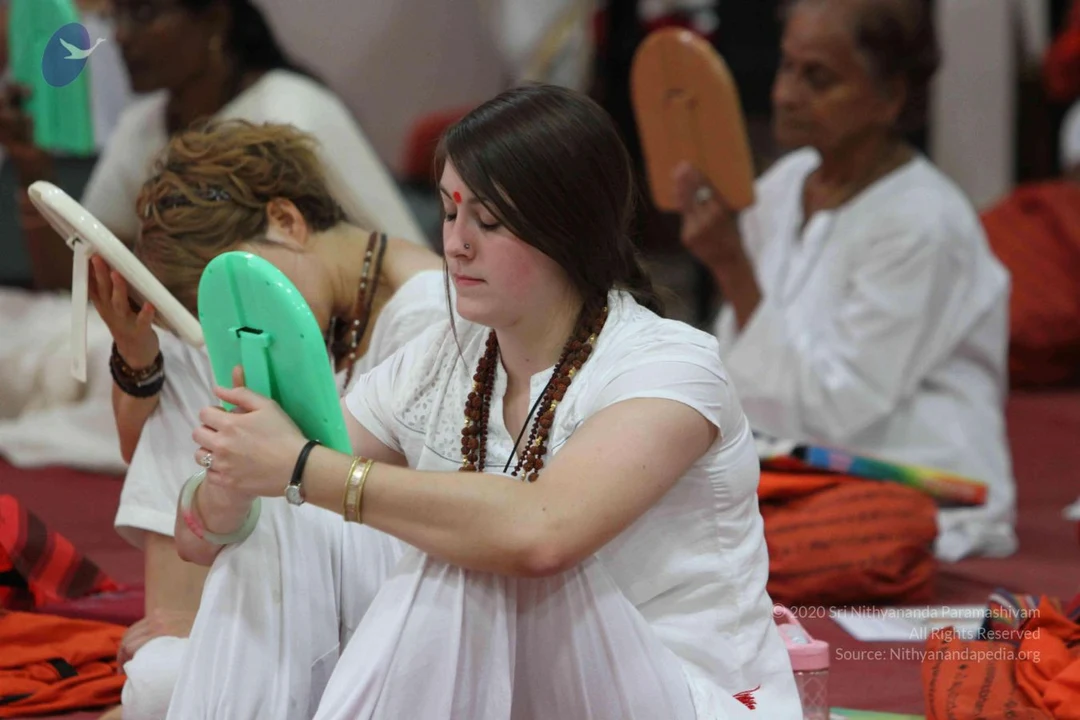
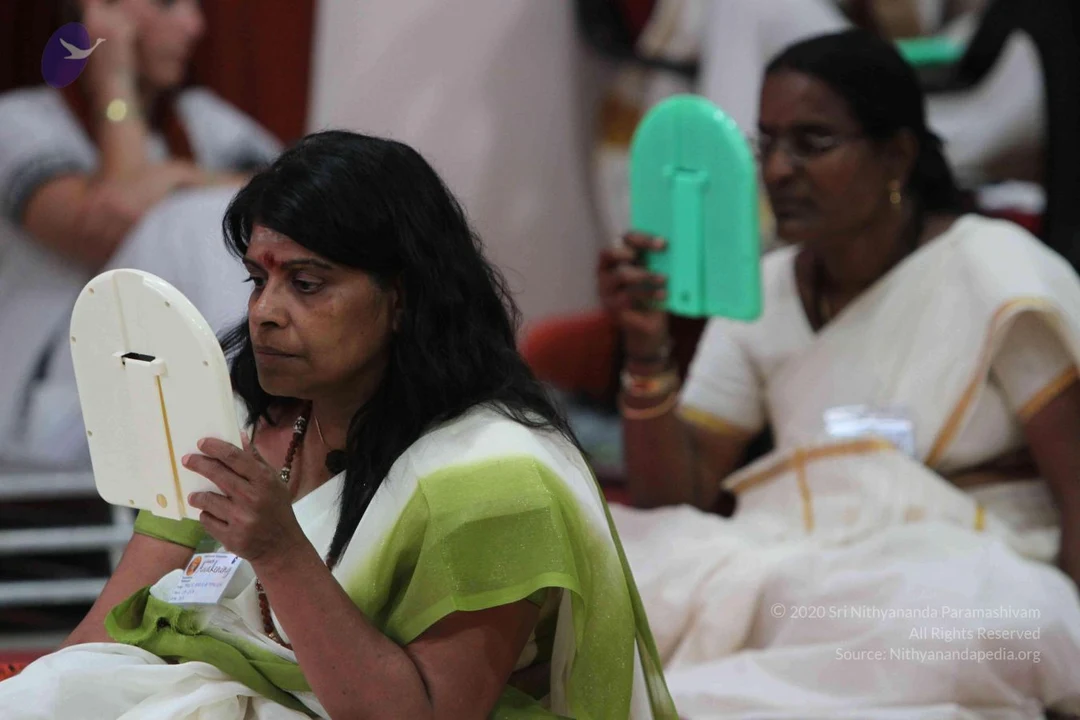
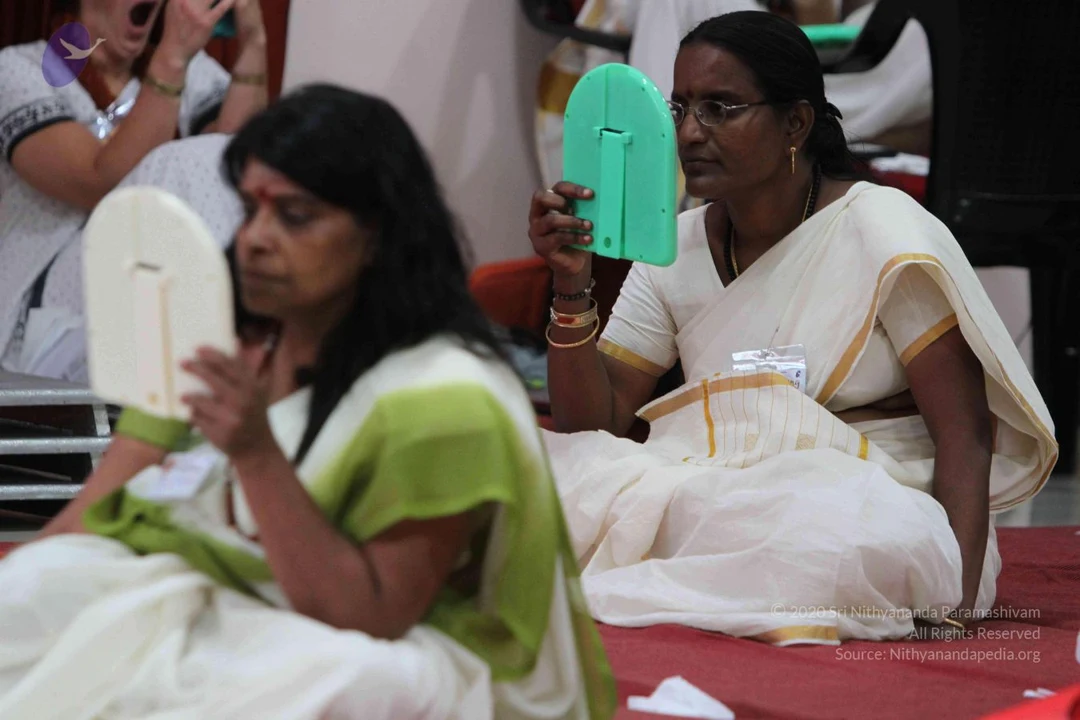
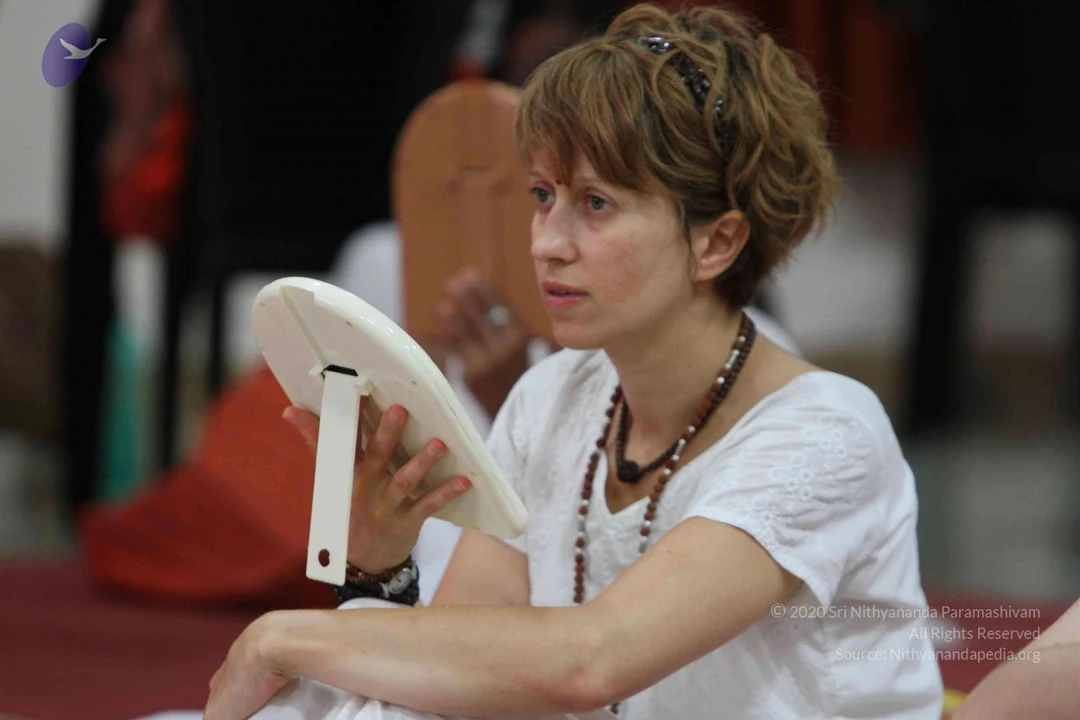
All the Inner Awakening participants, please listen! I am repeating. All the satsanghis, please listen! One of the major obstacles you face in your life, the day-to-day life, the constant nagging you do to yourself, is desperation and anxiety. This desperation and anxiety is never caused by root pattern or a strong pattern in your system. No! Desperation and anxiety are always caused by the passer-by thoughts, the casual thoughts. The casual thoughts, the passer-by thoughts... Please understand, when you practice Completion, you will understand. There will be some thoughts, just by the decision to complete I have to complete! the thought will disappear. It will lose its power. That incompletion, that thought will not even come back to you again. Just by the will! You don't even have to sit and find the root, the root incident, and re-live, use the mirror, and relieve. You don't even need to get into the technique. Just by the will and decision, some of the thoughts will fall flat, will get completed. And those thoughts only create anxiety and desperation. That is why I am telling you, it is the anxiety and desperation which you need to conquer first.

Root pattern is the enemy who casts spell on you, delusion on you. If I have to give the example of the Mahabharata War, all these ordinary soldiers are like passer-by thoughts. You are the hero. You cannot be killed by ordinary soldiers. They don't need more than you just blowing or just rotating your sword. The speed of your sword is enough for them to disappear. You don't need to individually fight with them, attack them with your special asthra, shasthra, the divine weapons. No! Reserve the divine weapons for your root patterns. The actual Completion process you need to do to complete your root pattern. Root pattern causes Self-Denial in you. Self-Denial means, even you cherishing your own failure for some perverted reasons. Perverted reasons means, the sympathy which you get when you fail, you start enjoying that, you start tasting that. These are all some of the serious sicknesses.

You need to melt it down by Completion. Do you want to be remembered as a winner or as a man who sacrificed his life for a cause and who is a martyr? Martyrdom is stupidity! It is the word you use for your Self-Denial. Victory is the only thing! Victory is the only possibility of Living Advaitha, Complete Completion. Don't ever visualize martyrdom is cute. No! Don't ever think sacrificing your life for some ideology, some concept, and dying for it is cute. No! Victory is the only cute thing. Victory is the only thing worthy of celebration, understand?

If you start cherishing the idea, Let me be remembered as a person who sacrificed you already started enjoying the sympathy you get after you get failure. Please don't allow that in any venture. Don't prepare the logic to support why you failed. The more you think and prepare the logical reasons to tell everyone why you failed, you are preparing yourself for failure. Only those deeper perversions of Self-Denial is caused by root patterns. The first thing you need to do in your life is, bring tremendous, intense interest towards Completion. Please understand, the power of Bhima is such, Ghatothkacha is such, they don't fight with sepoys, soldiers. When they attack the opposite side enemy, with the force the sepoys just die, the soldiers just die! So, if you have intense interest towards Completion, the day you attack your root pattern, all these casual thoughts which create desperation and anxiety will die just by your force.

Today, I will be guiding you into the Completion of both the levels destroying the passer-by thoughts, the casual thoughts which create anxiety and desperation in you, and, please listen, and the stronger, powerful techniques towards Completion, stronger, powerful techniques towards Completion. If you are constantly engaged by ordinary soldiers the thoughts which create desperation and anxiety in you when are you going to attack the main enemy? The thoughts creating desperation and anxiety should be handled just by will...mere will. And, I tell you, it can be handled! When your desperation and anxiety disappears, only then you will be sure about you and your enemy. I tell you, whoever is sure about who is his enemy wins the war! It is actually the desperation and anxiety of Shakuni and Duryodhana which made them lose the war. Because of their desperation and anxiety, they were making their own side's heroes powerless. How can Bhishma win the war if he is constantly abused of not being faithful? How can Drona win the war if he is constantly kept under the threat, blackmailing, by Ashwatthama? Desperation and anxiety!

I tell you, if Duryodhana was really interested in having the kingdom, but he did not have the desperation for the war, Karna would have surely revealed to Duryodhana that he (Karna) is the senior Pandava, and the Pandavas would have known Karna is the senior Pandava, the son of Kunti, simply the Pandavas would have handed over the kingdom to Karna! And, Karna, such a loyal friend, he would have simply coronated Duryodhana! And that whole thing would have happened in three seconds! One second to reveal that Karna is the senior Pandava, senior to Dhritarashtra; second second, Yudhishtira to surrender to Karna; third second, Karna to surrender to Duryodhana. Over!

But Karna knows Duryodhana is desperate, anxious to kill the Pandavas. He is more interested in killing them, eliminating them, than having the kingdom. buffering at this point In Mahabharata, you can again and again see, they use the weapons to cast a spell on them or to create a huge dust-storm, so that the other team will not be able to know or see who is the enemy. In your inner-space, anxiety and desperation is the huge dust-storm due to which you will not know who is the real enemy; you will not be sure about who you are, where you are, and who is the real enemy. Understand, Completion Science is the weapon to remove the dust-storm, sandstorm. Completion is like a rain; it will just make the sandstorm settle down, dust-storm settle down. You will simply be able to see! You will be sure about you and you will become sure about your opponent. I tell you, Completion, again and again and again is applied, not to become enemyless, but to know who is the enemy, understand? Don't be afraid that by Completion you will become enemyless. No!

You will become sure about your enemy! The anxiety and desperation will always show wrong person as enemy to you. And the person who is anxious, desperate, he can be easily cheated by small-small favours. I have seen how these guys who are interested in just one garland, one shawl, just for that one garland, one shawl on the stage, they will enter into politics! They will not know the mess they are getting into. Just because somebody will put a shawl and garland on them on the stage! It is like you want to get married just because one day you will get a feast, marriage feast! If you want a marriage feast, go to somebody else's marriage, and eat and come back! Just for marriage feast don't plan for marriage; you will not know what a big mess you are getting into, understand!

See, if you WANT to get married, and you are getting married, then it is great. Then you know you are responsible. Desperation and anxiety will make you do major decisions for small reasons. It will make you do big damages to yourself because you are temporarily upset. I have seen people doing that. Just because they are temporarily upset, they do permanent damages. Completion is needed, Completion needs to be again and again practised to help you to be out of desperation and anxiety, to remove desperation and anxiety from your decision-making process. Please understand, if your decision-making process is filled, the space where you make decisions, if it is filled with desperation and anxiety, you will make stupid decisions. Because you cannot accept you made stupid decisions, you go on claiming you sacrificed your life for one reason.

Only if victory is achieved you have a right to use the word "sacrifice". If not, you "wasted"; it is not "sacrifice". Wasting is not sacrifice, understand? Wasting is not sacrifice. If somebody says you have sacrificed even after you lose, it is like you are given Consolation Prize. Consolation Prize is not Prize; it is consolation, understand! Actually, if you just remove desperation and anxiety, simply you will know what is Dharma! Simply you will know what is Dharma! Nothing else is required! The inner-space without desperation and anxiety is established in Dharma. The dharmic inner-space will not cherish anxiety and desperation, will not be comfortable with anxiety and desperation. And, the inner-space established in Dharma, Completion, will also know the technique how to put the opponent into the space of anxiety and desperation. It will be like a simple play. To finish off Bhishma, to finish off Drona, to finish off Karna, all it took for Krishna is just a few minutes. The moment he brought them clarity.... done!

The work is done! Understand, bring Completion into your life more and more and more; you will become more and more sharper in the war you are waging. Please understand, withdrawal never, never, never, can never be the solution. Wherever withdrawal is given as a solution, be sure, there Advaitha is not taught, but cowardness is preached with a beautiful covering! Advaitha is always established on activism. Activism is always established on Advaitha. Only the activism which is established in Advaitha becomes successful, please understand. The activism established in Advaithic understanding, Advaithic context, always becomes successful.

In the space of Completion you are sure about who you are and who your enemy is, and you will not raise, you will not be caught in anxiety and desperation. You may raise it for others, but you yourself will never be caught in it. You may raise a sandstorm, but you will not be caught in it. You may raise it so that the others will be caught in it. You yourself will never be caught in it. Understand, I wanted all of you to understand, all your life, whether you are an ordinary teacher, or an engineer, or a lawyer, or a doctor, or politician, or a housewife, be very clear, you are waging a war, you are waging a war! And, the first thing you need to do is, stop this sandstorm, dust-storm, anxiety and desperation, by Completion. The Science of Completion is so powerful, the anxiety and desperation will settle down just the moment you remember that you have to complete! Smaranaath Mukthi!

Just by remembrance, liberation! Just by the remembrance you have to complete, the anxiety and desperation will melt down. Melting down the anxiety and desperation is the first action you have to do before starting any war, because, only then you will know, you will be sure about what you are, and you will be sure about who is your enemy, you will be sure about who is casually joining them. See, all your enemies are not completely your enemies out and out. They might have taken an opposite stand to you for various reasons. When you wage the war without anxiety and desperation, you will know why somebody is your friend, why somebody is your enemy, and what is the reason for his enmity, and you will simply know what to do to make him lose his enmity towards you.

Please understand, most of the time you will win the war just by making the opponent to lose his enmity towards you. You don't even need to fight with him. Most of the time his enmity is stupidity. And stupidity will never stand, stupidity will not give strength to somebody to constantly handle their anxiety and desperation. So, a little bit of anxiety and desperation is antidote for their stupidity.

If somebody is not backing out even with a little anxiety and desperation, then he is your enemy. Plan only to fight with him. Don't waste your energy here and there, here and there, here and there. Whether you are waging the war in your inner-space or the outer world, that is the law of war, law of life. Even in your inner-space, smoking itself may not be a big pattern you have to conquer. Please understand, the anxiety and desperation you feel in the tongue, constantly forces you to smoke. But the root of the anxiety and desperation you feel in the tongue is lovelessness.

If you look back, somewhere you would have been denied love. That is the root pattern. If you are wasting your time in fighting with quitting smoking, you will never be successful. This smoking is just a solution for the desperation and anxiety you are feeling in your tongue. Complete with it and go back to the root. In the young age, for some reason if you are denied love, very subtly the powerful anxiety and desperation gets developed in the centre of the tongue, please understand. These are some of the energy-circle based truths, the energy-circuit diagnostic methods. The heaviness you feel in the centre of the chest is always your desperation that you will not get what you really, really want in your life. If you complete with that, this desperation will disappear, this heaviness in the chest will disappear.

The anxiety and desperation you feel in the centre of the tongue is because the experience of love was denied in you, denied for you, experience of lovelessness in your life. People who smoke in the anxiety and desperation can very easily be cheated. You don't need to make big-big plans to cheat them and divert them, to win them in their life. You just drop a two rupee note on the ground. They will bend to pick up that two rupee even at the cost of losing their own wallet! The people who have anxiety and desperation in the centre of their tongue, only for them this proverb will match: Penny wise, Pound foolish. Desperation and anxiety should be completed first. Life should be handled without desperation and anxiety in your inner-space. Completion does that to you. Completion does that to you.

Completion is the science makes you win the game of life everywhere, understand? Wherever you are playing the game, whether you are playing in IT company or a legal battle or you are a doctor or you are an engineer or you are a scientist or you are an activist whatever may be the war you are waging Completion really really really makes you win the game. And all the self doubt self hatred, self denial patterns which are responsible for you not winning the war and go on justifying it. Justifying your failure is the worst thing that can happen to a human-being. At least know it very clearly even you are a failure so that you can take the body again and come back and win the game again, win the game in the next birth. If you are a Hindu you have the luxury of many births.

Understand, the biggest luxury a man can get is any number of lives. That is only available for Sanatana Hindus. That is only available for Hindus. Others, even if the option is given, because they live with such a strong faith that one more birth is not possible, they live like stones when they are given the second birth option, because they are not prepared for it. That is why, I am telling you, when you are living, you should have the clarity that more births are available, many more births are possible, so that you are constantly mentally prepared for it.

When you are given that option, you will simply be able to play! Denial of the truth of many births possible is one of the biggest, biggest wrong ideas taught to human-beings. See, it is like you tell somebody that after seven kilometres there is no road; and this fellow goes there and he sees multiple roads, but he does not know how to drive there because he was not prepared! Keeping human-beings in the dark and not letting them prepare for their future is the biggest mistake. That is why, I am telling you, if you are from the tradition of Sanatana Hindu Dharma, you are rightly informed and prepared for your complete life. See, a person, during his whole life, when he has the cognition that he has more births and whatever he has not completed now he is going to come back and complete, life is a continuity, if he lives with this cognition, believes this cognition, when he dies and options of many births are given, he is prepared to choose, he is prepared for further journey. Knowing that journey is not going to end after death, itself is the greatest preparation you have done for further journey!

That itself is the greatest blessing! That is why, sometimes, when I stand in front of Kapila, Mahadeva, I tell them, Oh, God, you are so great! You made me take birth in Sanatana Hindu Dharma and gave me all these truths at a very young age, where, based on these truths, my life, my thinking, my decisions, my cognition, everything is built. So nice! But, I am built on solid foundation!

If you are from the Sanatana Hindu Dharma, you should celebrate just because all these questions are answered in a right, factual manner to you. Please understand, in a factual manner. That is the most beautiful thing! Completion releases you from anxiety and desperation. It releases you from anxiety and desperation. Complete! Complete! Complete! Wherever you are, whatever you are, whoever you are, this is the solution! Completion is the Complete Solution!

With this, I bless you all! Let you all radiate with Integrity, Authenticity, Responsibility, Enriching and Causing eternal bliss, Nithyananda! Thank you!

Title

What Is Your True Identity? || Part 1 || Inner Awakening || 27 August 2014

Link to Video:

Title

What Is Your True Identity? || Part 2 || Inner Awakening || 27 August 2014

Link to Video:

Title

What Is Your True Identity? || Part 3 || Inner Awakening || 27 August 2014

Link to Video:

Title

Wishes Fulfilled || Kalpataru Darshan || 27 Aug 2014

Link to Video:

Title

Create your Authentic Identity || Part 1 || Inner Awakening || 27 August 2014

Link to Video:

Title

Create your Authentic Identity || Part 2 || Inner Awakening || 27 August 2014

Link to Video:

Title

Create your Authentic Identity || Part 3 || Inner Awakening || 27 August 2014

Link to Video:

Title

Create your Authentic Identity || Part 4 || Inner Awakening || 27 August 2014

Link to Video:

Photos From The Day

Paduka Puja
Nithya Satsang
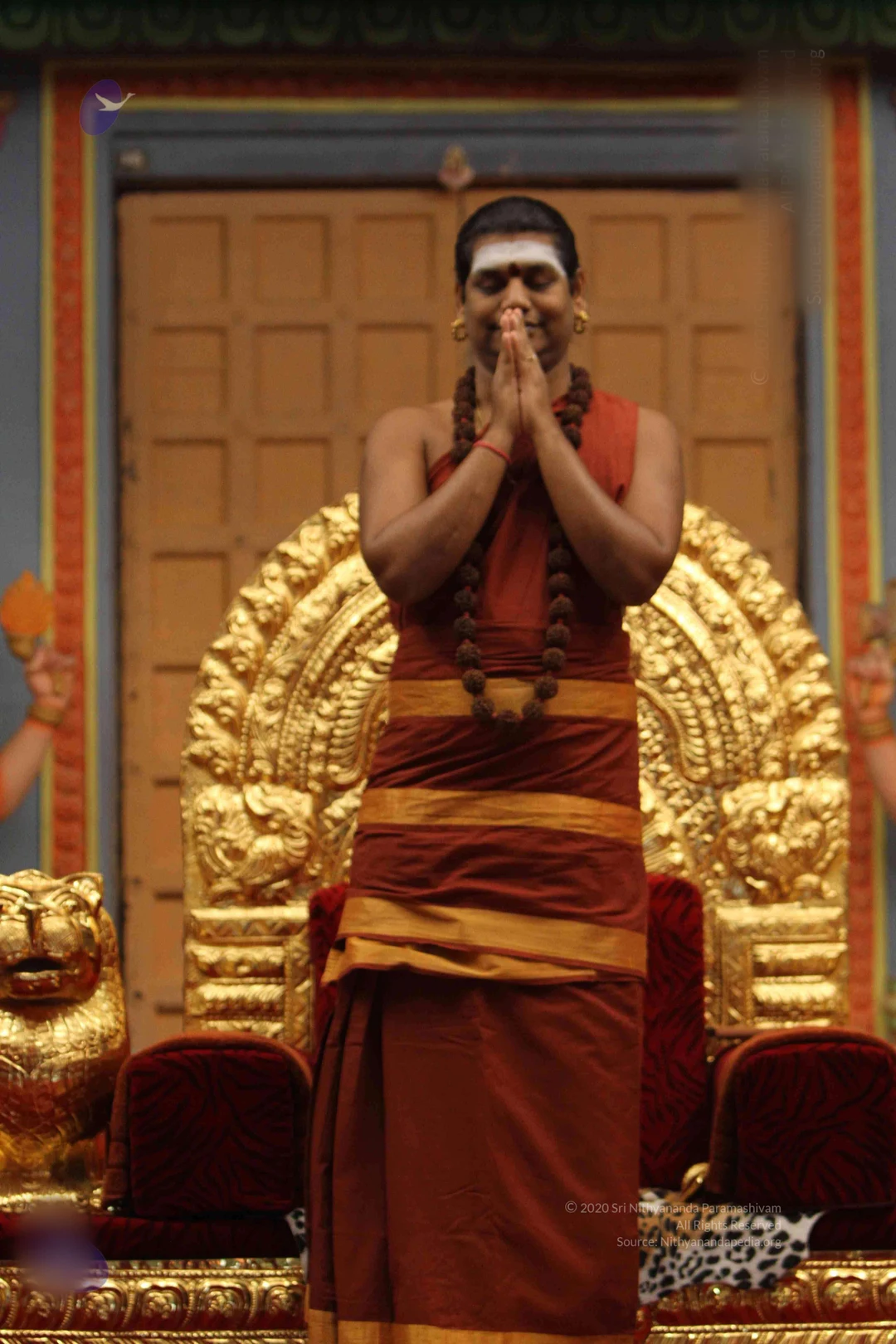
Final Blessing

Blessing with Ganesha

Darshan/IA Session

Kalpatharu Darshan

Photos Of The Day:

FB-photo-of-the-day

Photos Of The Day:

Completion-Technique-With-Mirror

Initiation

Photos Of The Day:

Nithya-Puja

Nithya-Kirtan

Satsang

Sarva-Darshan

IA-Session

Photos Of The Day:

Nithya-Puja

Satsang

IA-Session

Photos Of The Day:

IA_Session1

Darshan

Photos from this day

View all 236 photos

Paduka Puja

12 photosSource gallery
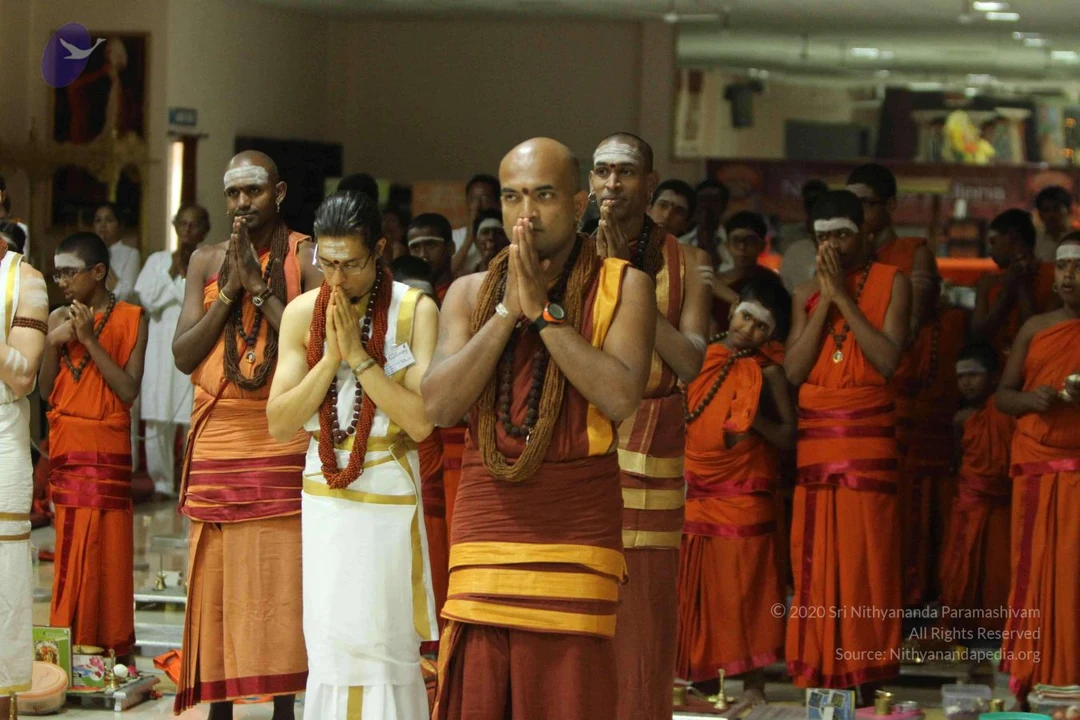
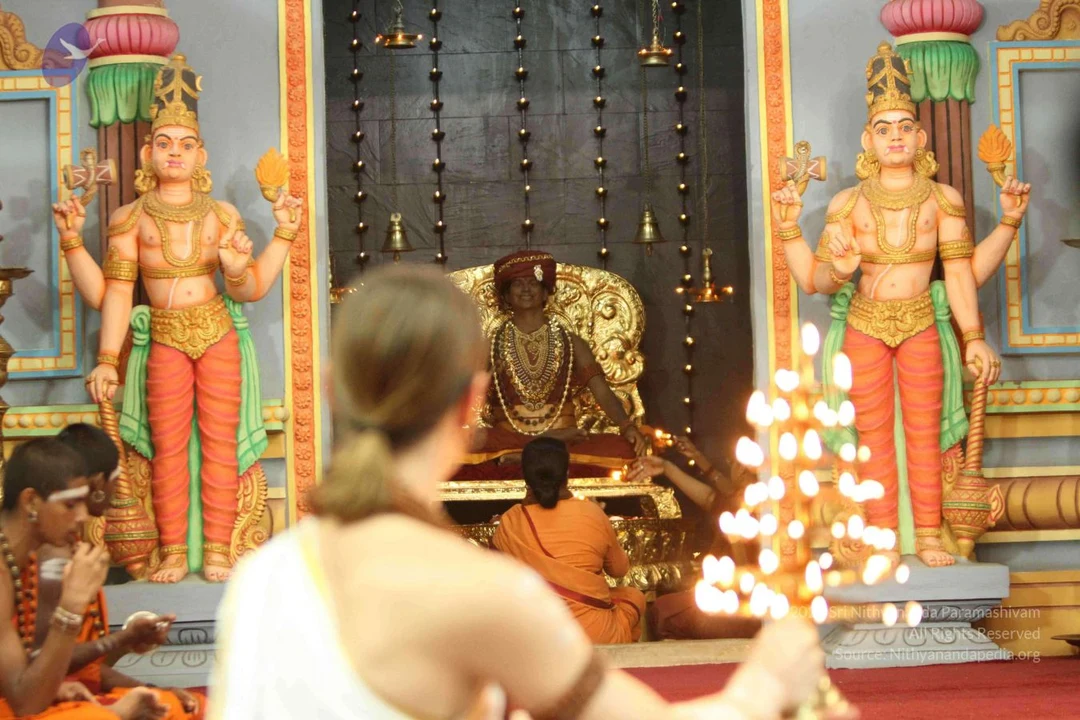
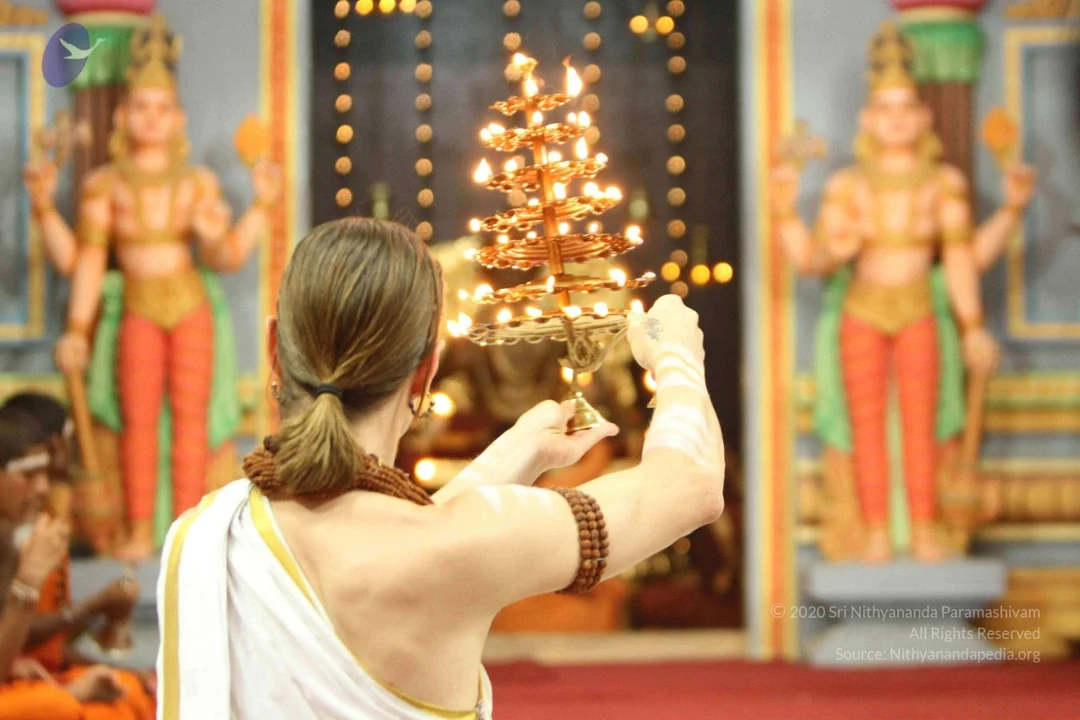
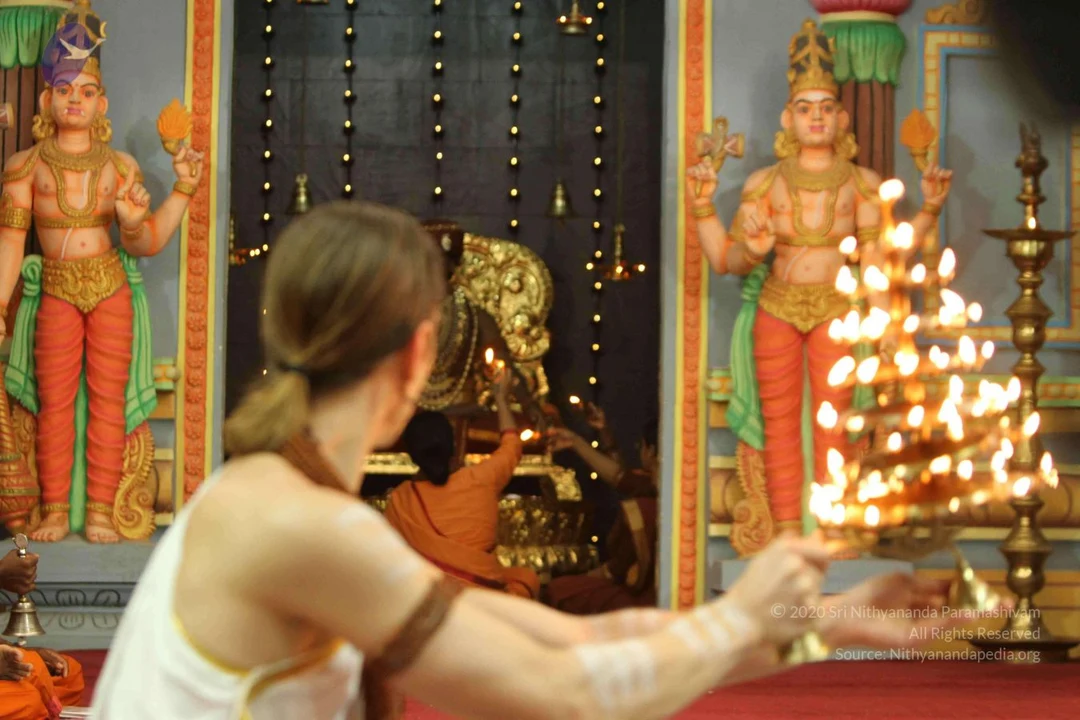
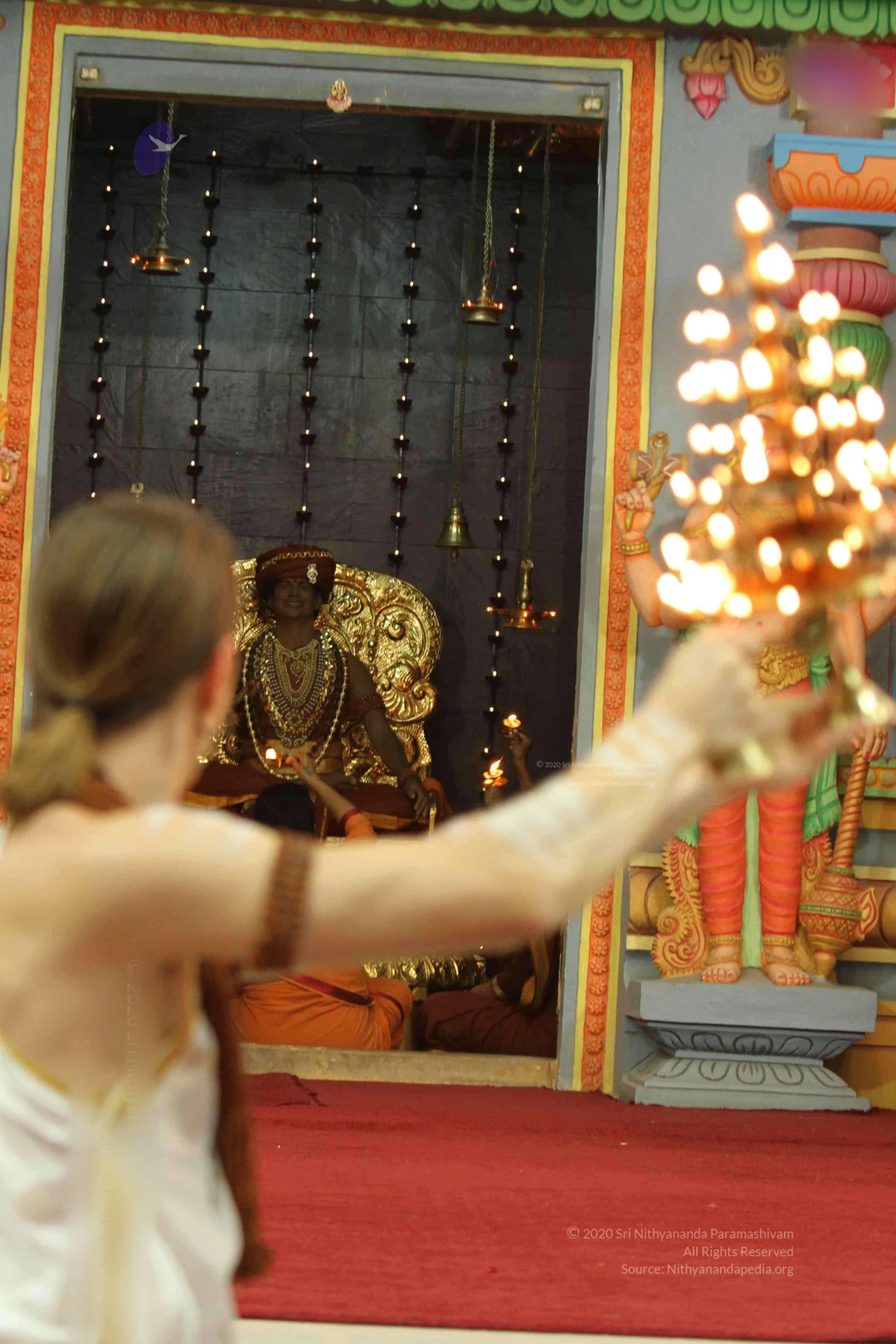
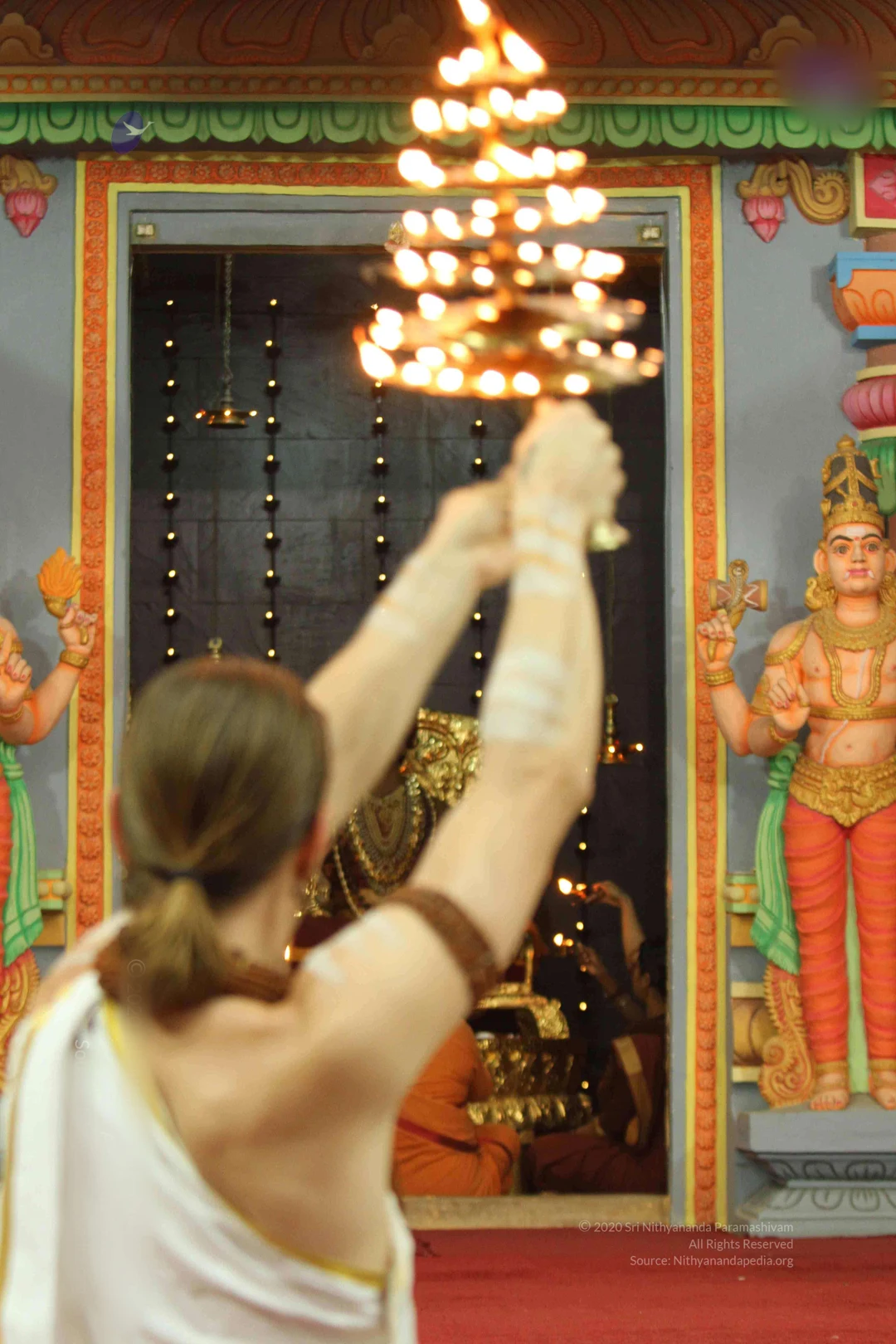
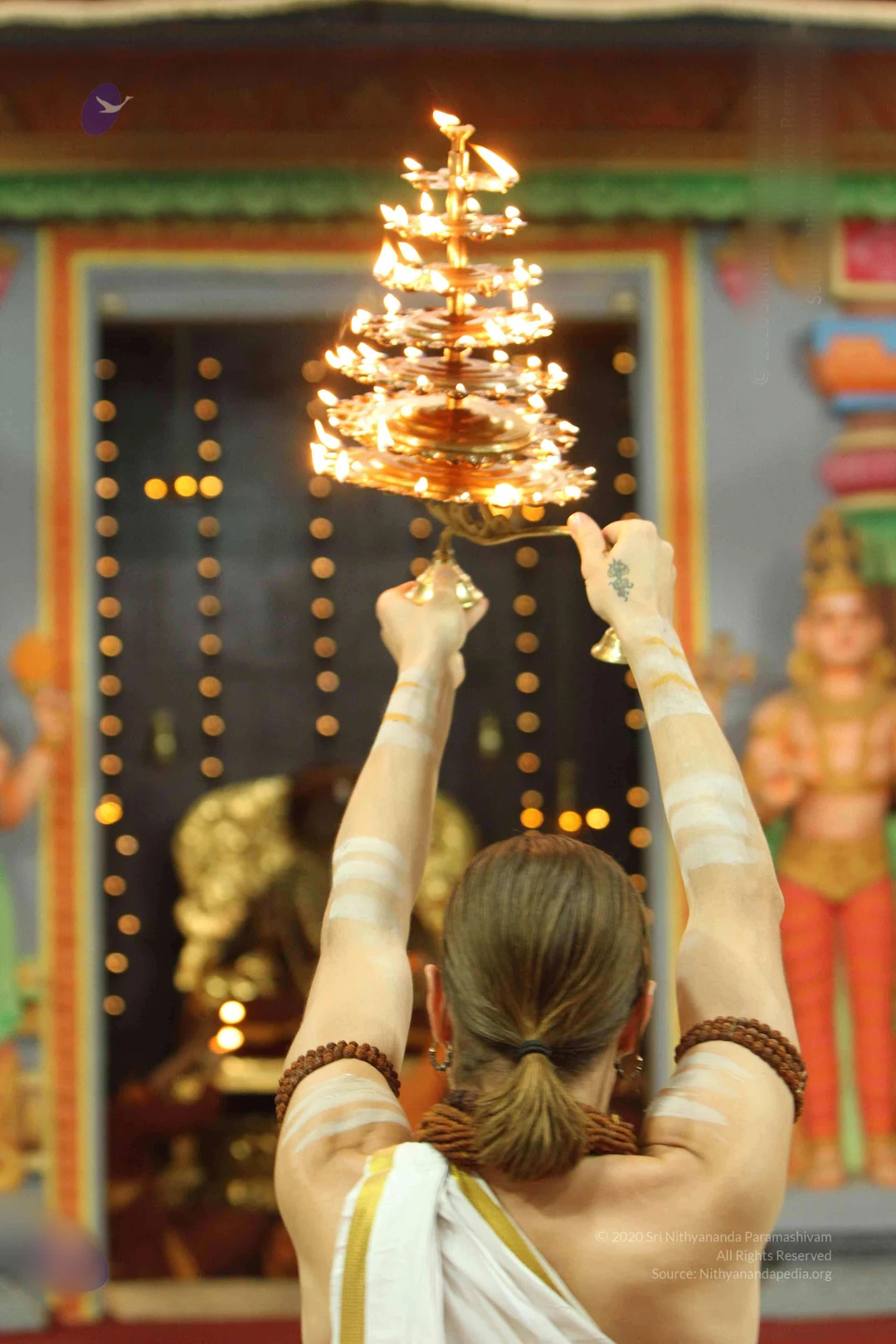
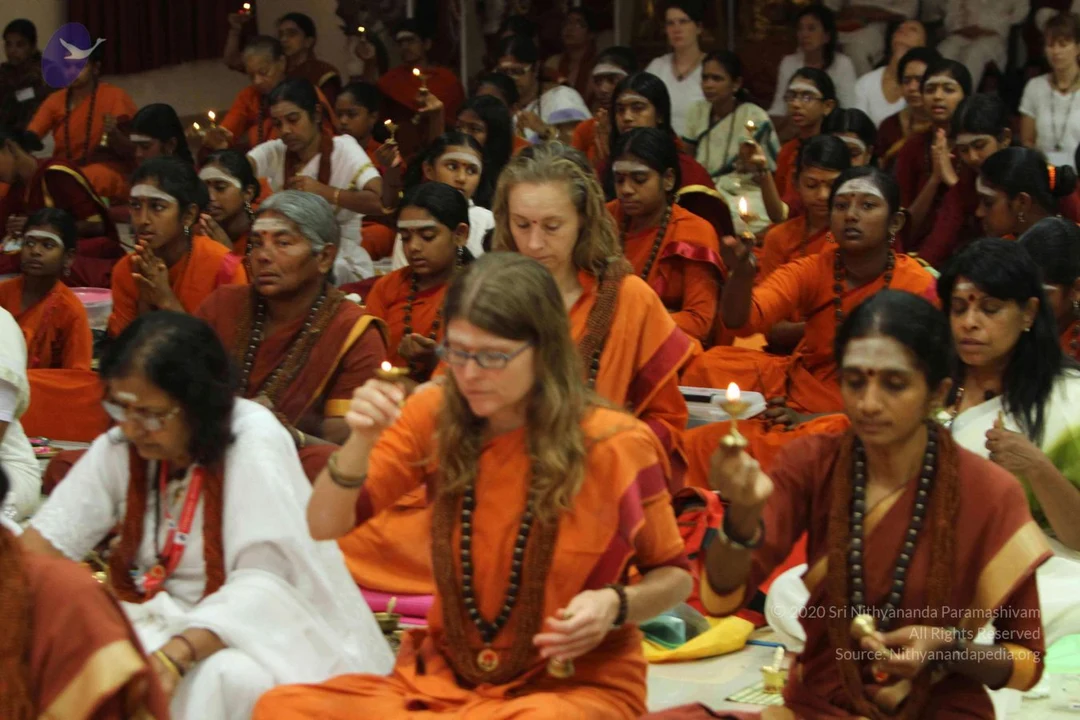
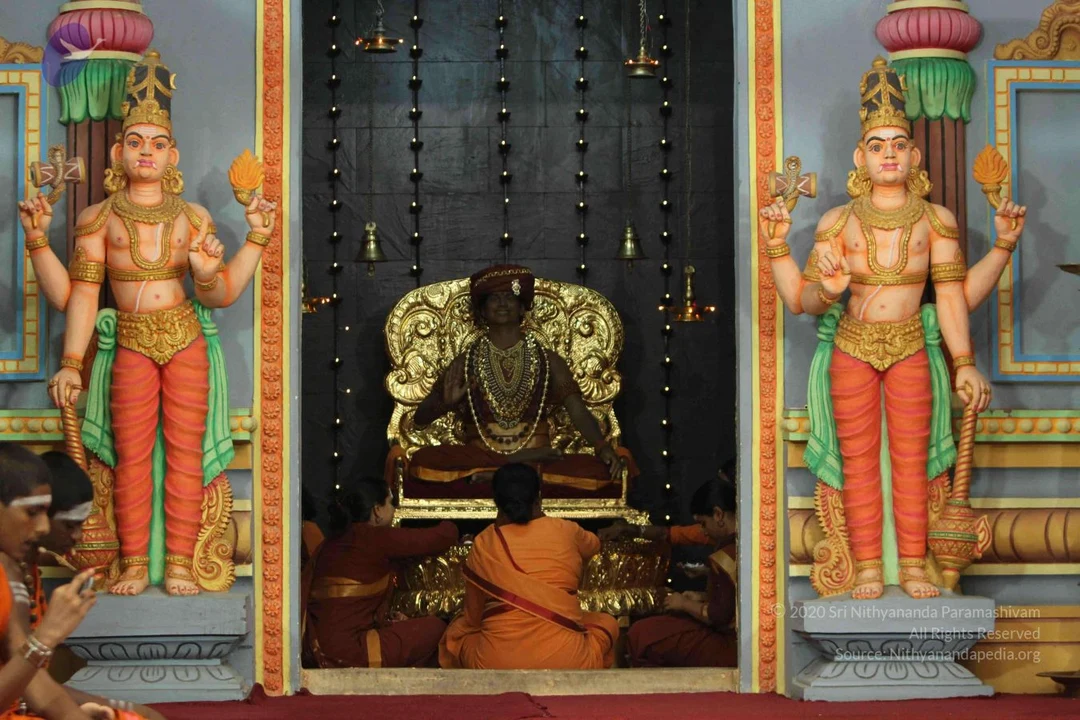
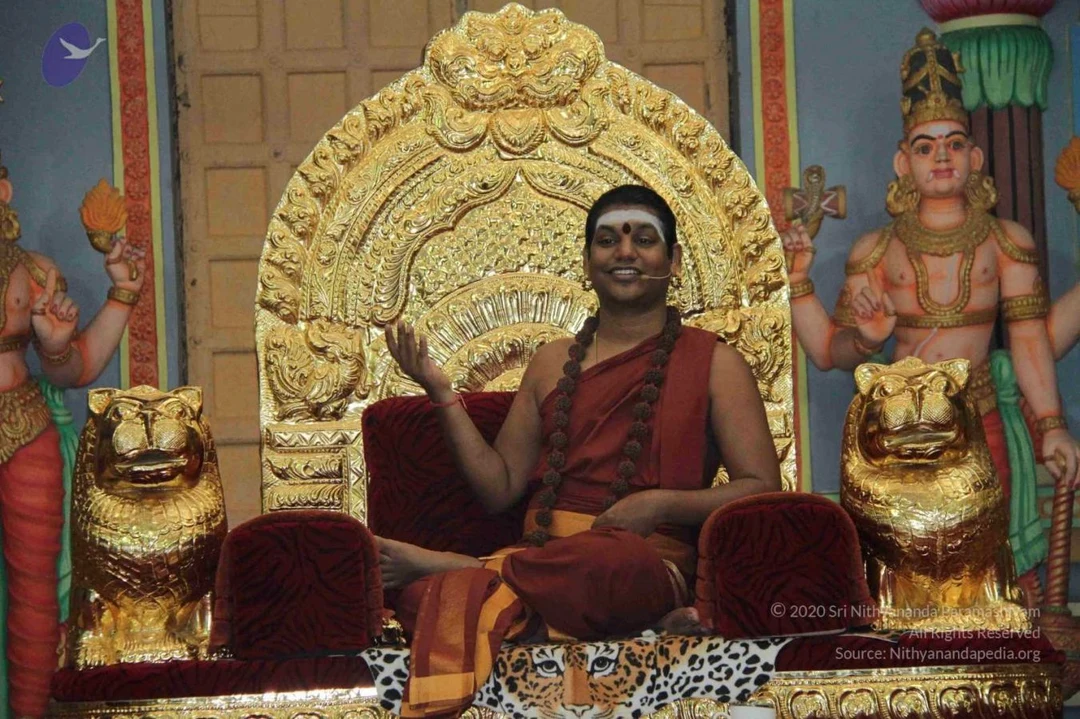
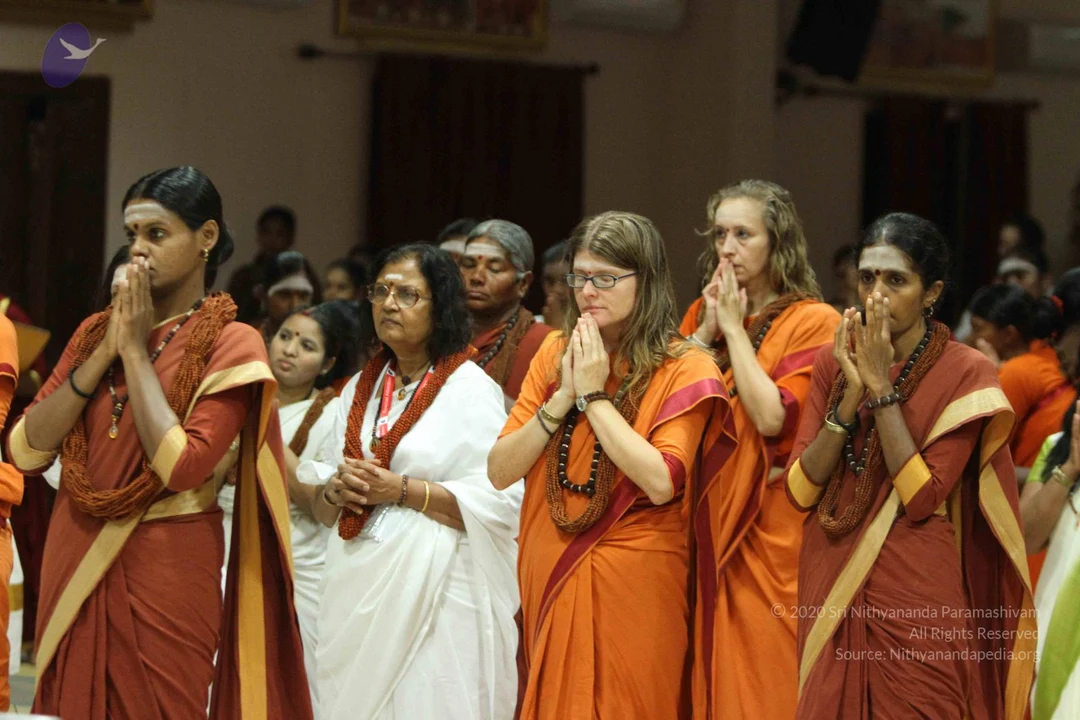
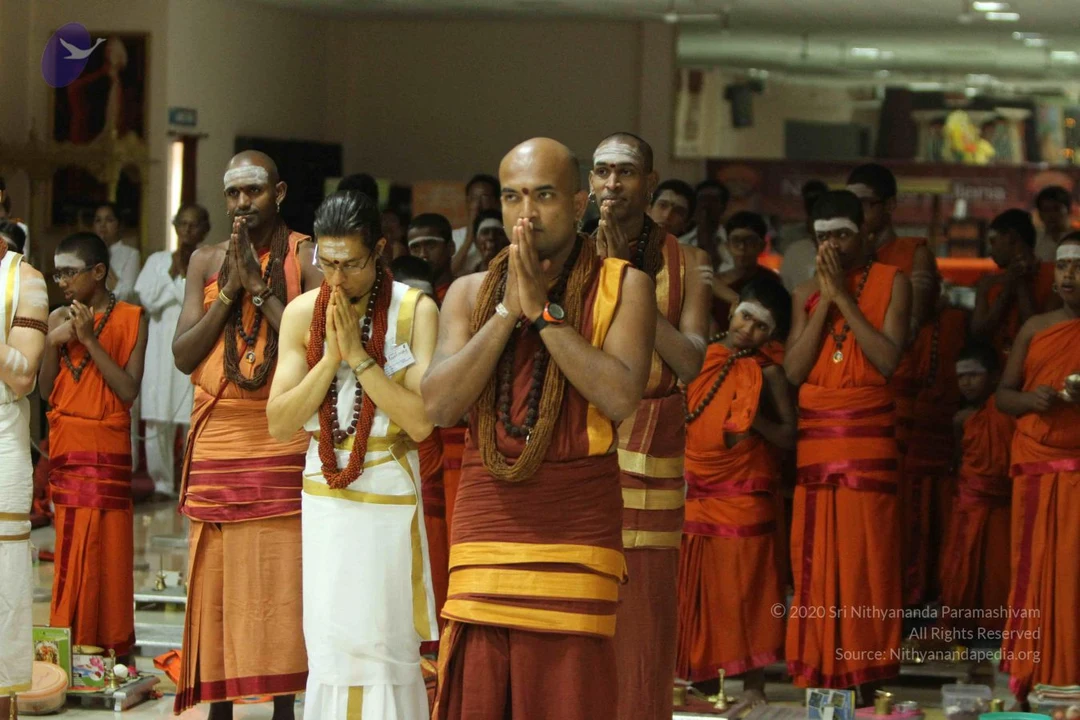
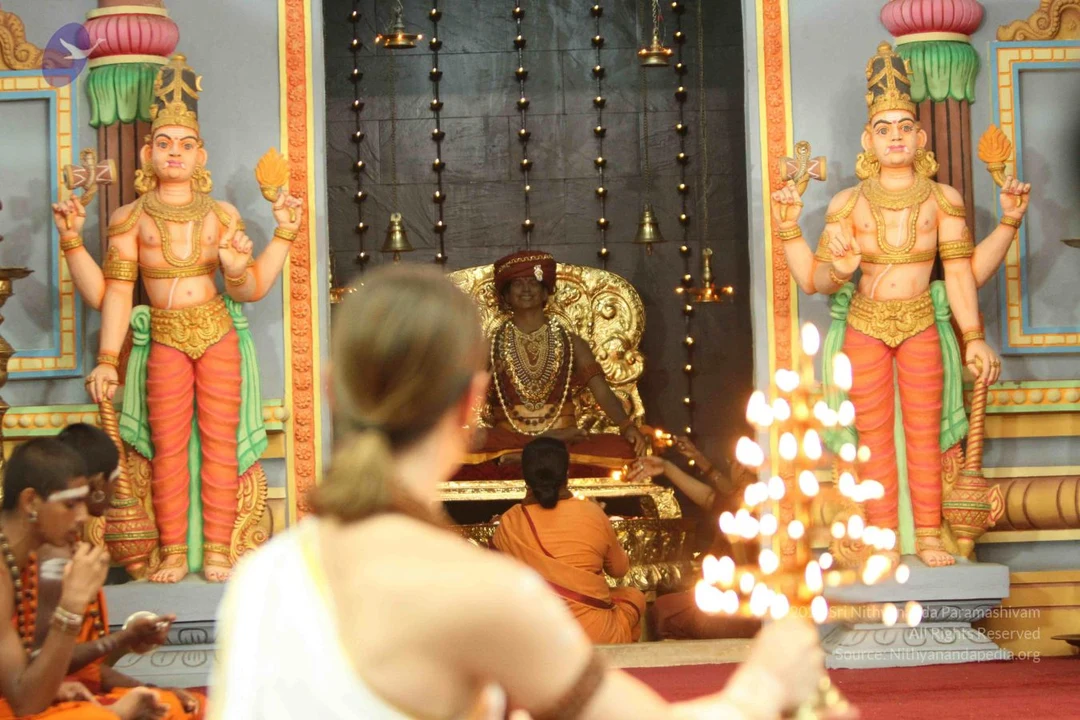
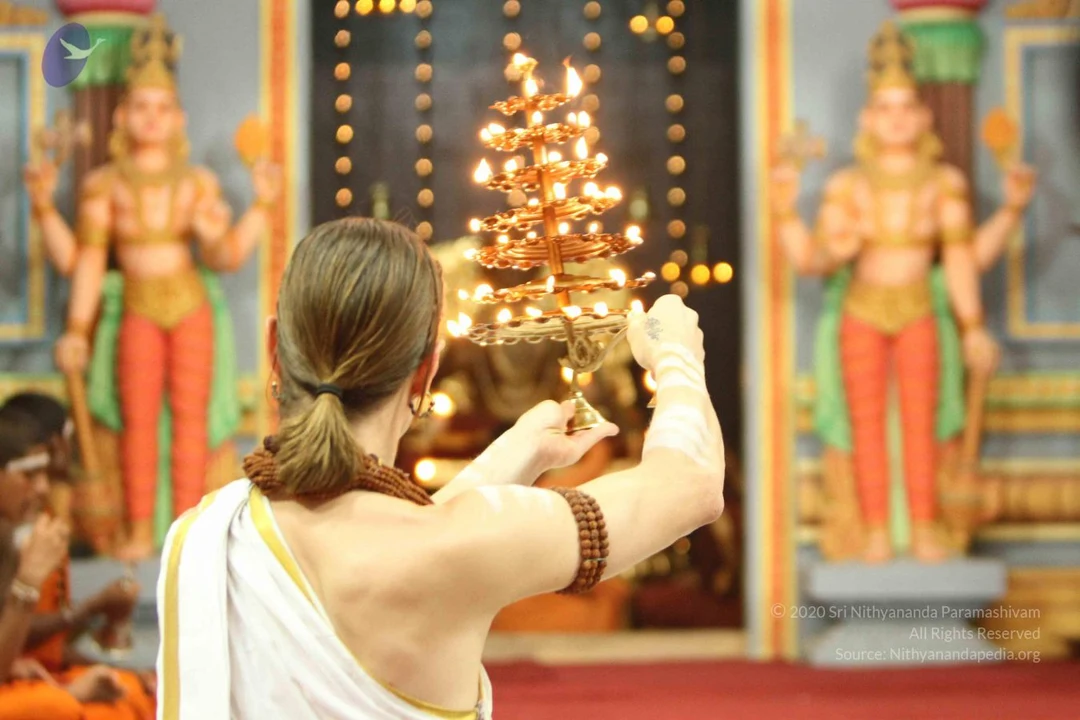
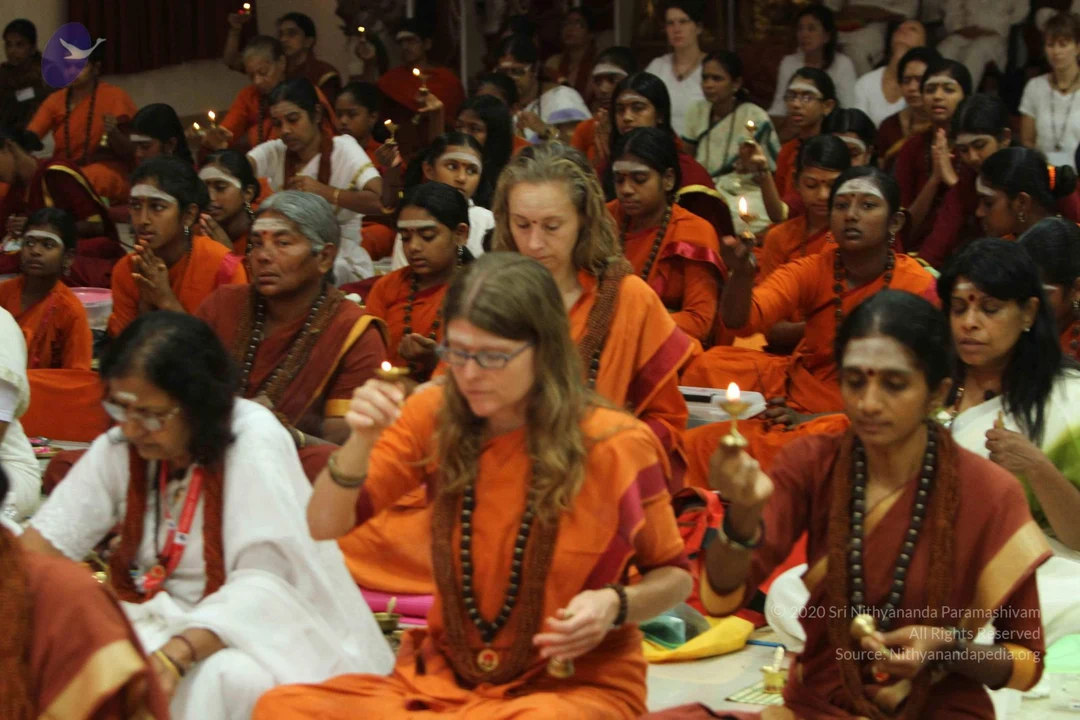
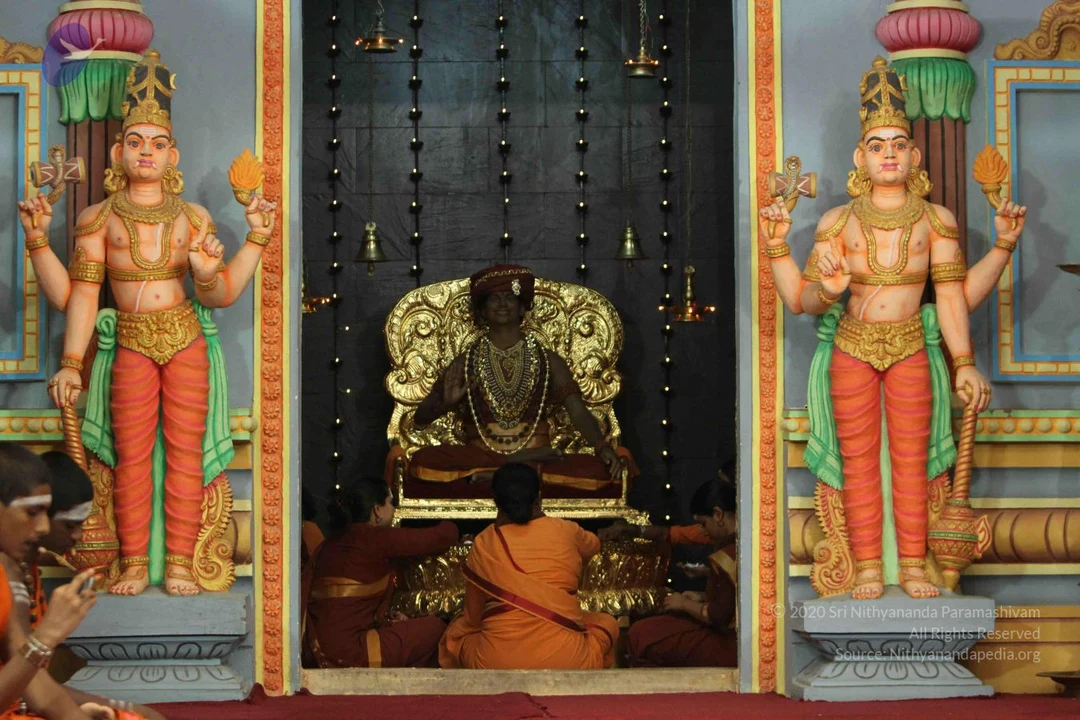
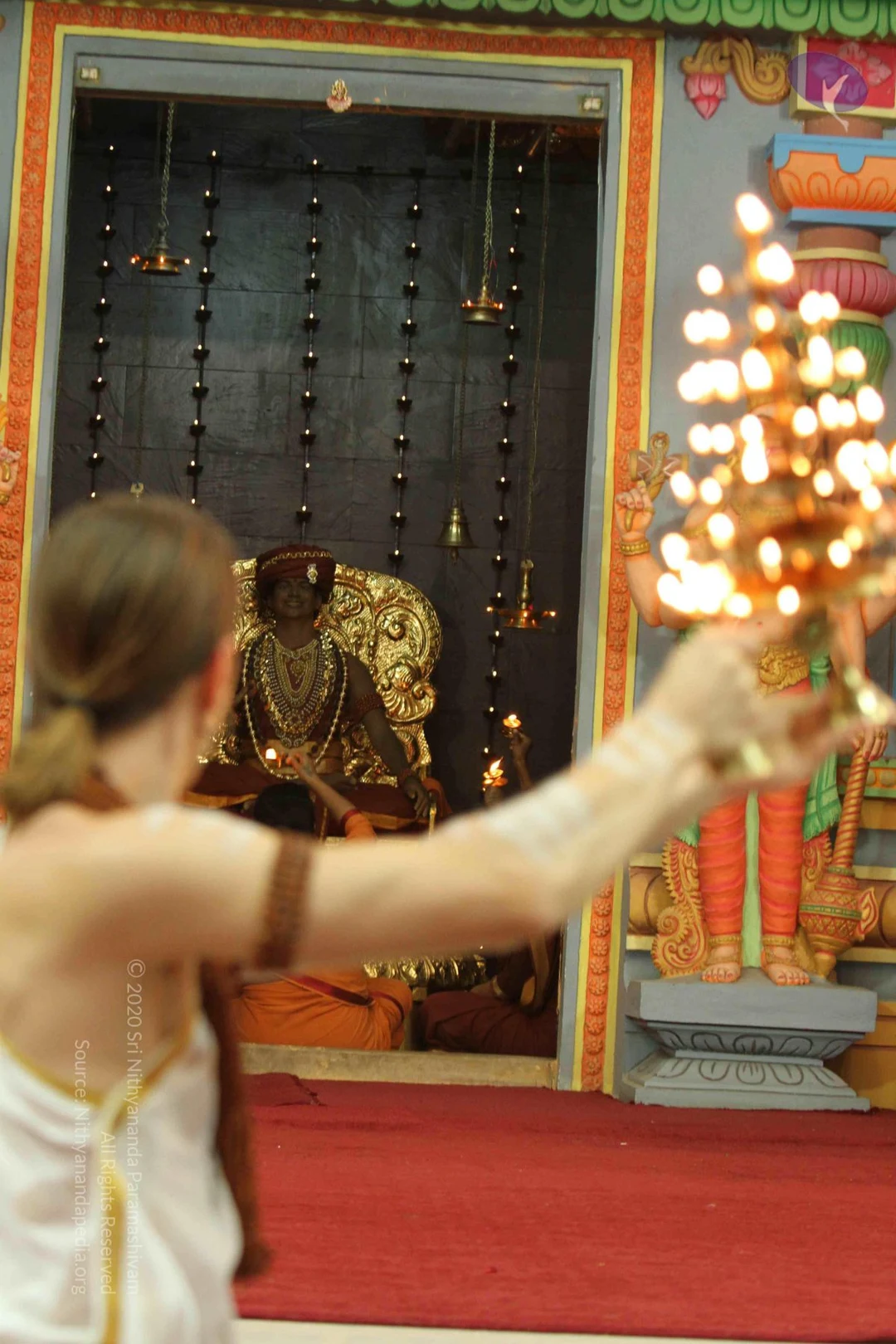
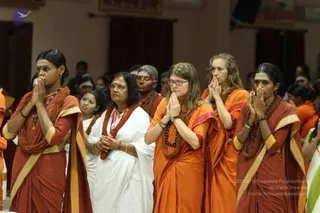
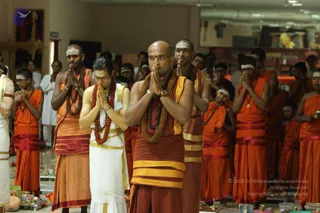
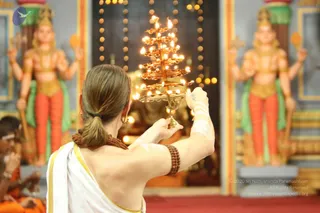
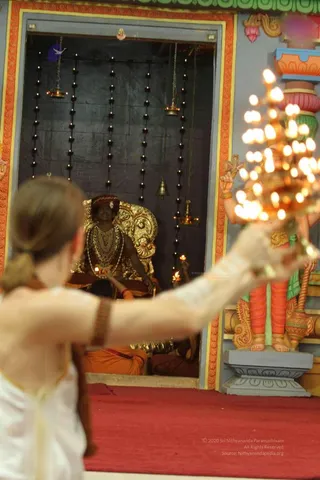
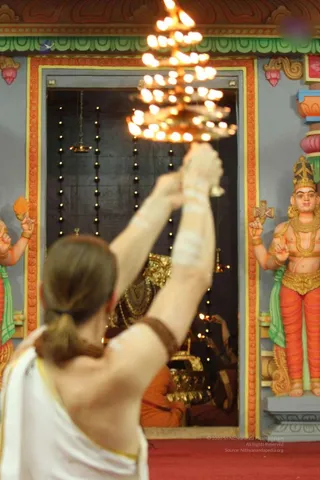
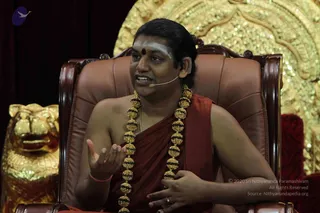
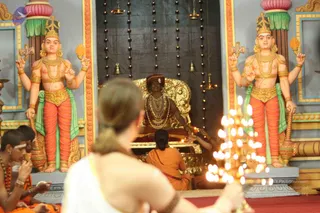
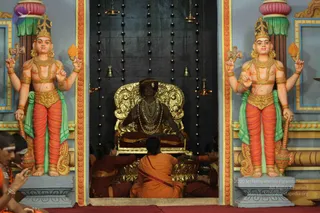
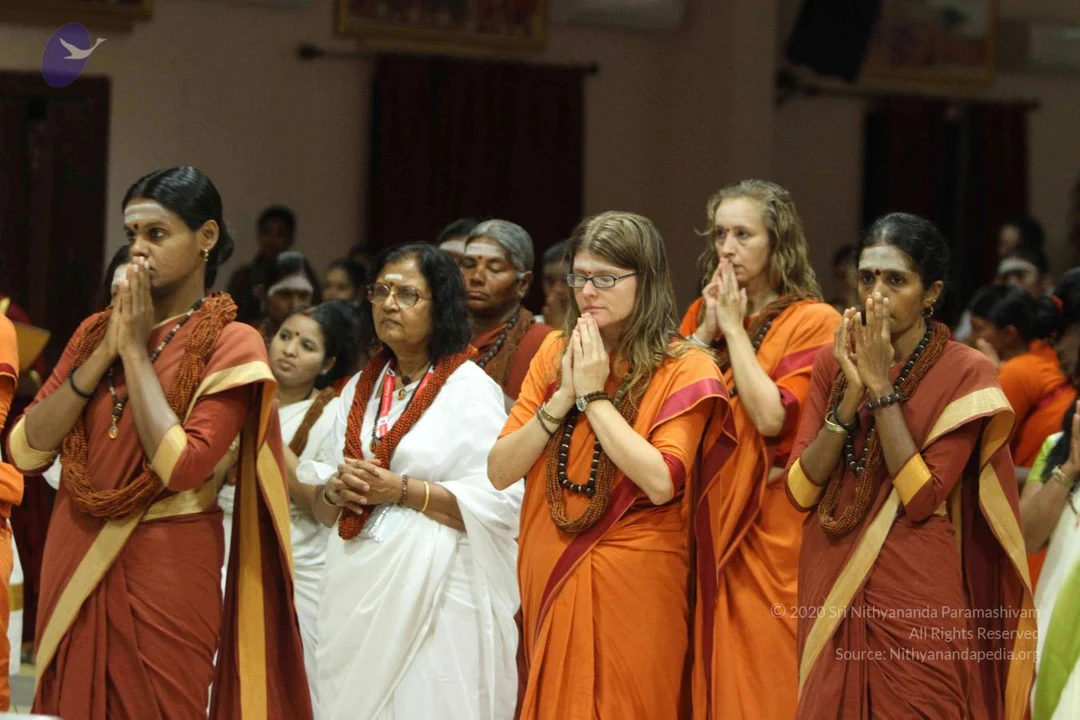
A group of devotees stands with palms pressed together in namaste at a satsang in a hall with maroon curtains and framed pictures on the wall. In the foreground, several women wear saffron and orange sarees with gold borders and rudraksha malas; some have white vibhuti and tilak marks on their foreheads. One woman in the centre wears a white sari with a red rudraksha mala and glasses. Other devotees in white and orange stand behind them. A faint purple logo appears in the upper left corner.A photograph of a group of devotees standing with palms pressed together in anjali mudra during a ritual gathering indoors. Most wear orange and maroon dhoti-style garments with gold-bordered cloth, and several have white vertical tilak marks on their foreheads. Rudraksha malas hang around many necks. A man in white dhoti and shirt with a red-bead mala and a gold-bordered cloth stands in the front left, and a man in maroon and gold cloth with a rudraksha mala stands centre front, both with hands folded. Brass lamps and offering items are visible on a table at the lower edge, and a wall with framed pictures and a colourful display stands behind.A photograph of a priest seen from behind performing aarti with a tiered brass oil lamp with many lit flames. He wears a white dhoti with a yellow border and a rudraksha mala around his neck and wrist. Two large painted deity murti flank the entrance, each with multiple arms, golden ornaments and green sashes. Several seated devotees in orange and saffron clothing appear at the lower left, and a red carpet runs across the foreground.A woman in a white garment with a light shawl lights a multi-wick brass lamp in a temple shrine, offering flames to a golden deity murti. Two painted standing dvarapala-style guardian figures with raised hands and gold crowns flank the shrine, one holding a flame. Several people in orange robes stand within the shrine area, some reaching toward the golden murti with lamps. Bells hang from the dark curtain behind, and smaller brass lamps sit at the edges. The scene suggests an aarti offering in a temple setting.A woman in a white sleeveless garment with a dark ponytail holds up a tall multi-tiered brass aarti lamp lit with many flames, facing a golden throne. Seated on the gold ornate throne in the background is a figure in a maroon turban, layered gold and beaded necklaces and a rich red-brown garment, with lamps and brass bells hanging beside a dark wall with rudraksha-style strands. A standing green-and-orange painted deity murti with a sword stands to the right on a red carpet. Swamiji (probable): the seated figure wears a maroon turban, ornate gold necklaces and rudraksha-style strands, consistent with the page's reference to Swamiji at this satsang setting.A photo of a temple aarti: a devotee in a white garment with hair in a low ponytail raises a large multi-tiered brass lamp with many lit oil lamps toward a dark shrine doorway. Painted deity dvarapala statues with gold ornaments flank the doorway, and a red-clad floor is visible below. Seated figures in orange and saffron clothing are visible behind the lamp at the shrine, and a bell hangs near the doorway. Visible people are the lamp-bearer and several seated people in orange, with no clearly identifiable a person in the scene.

Nithya Satsang
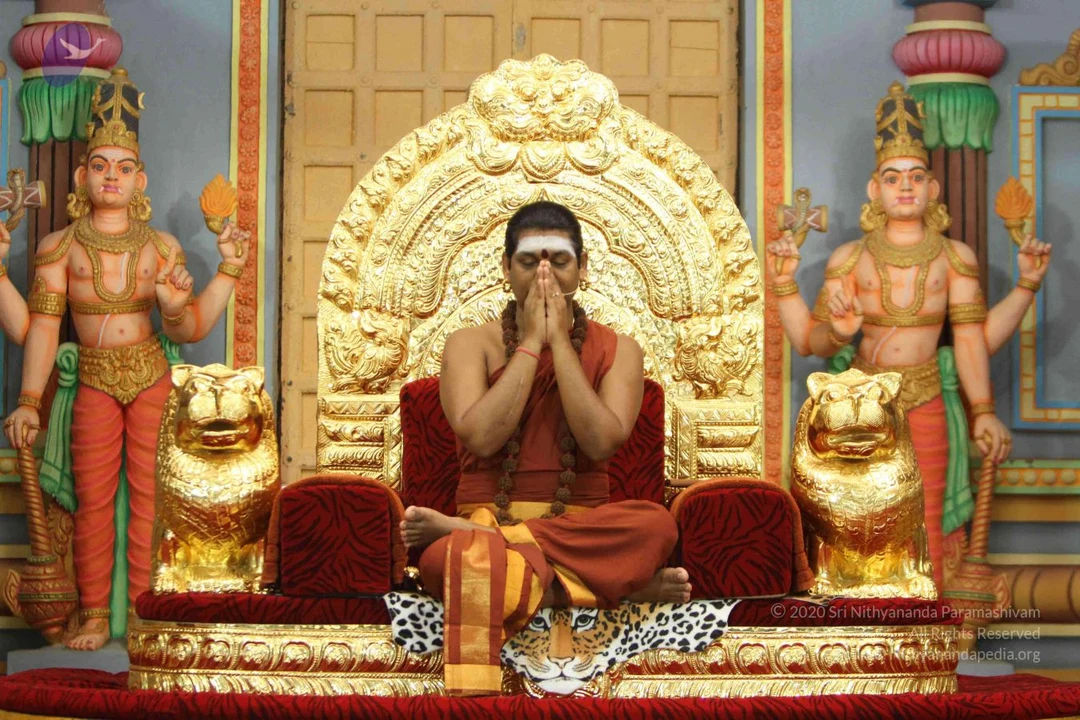
28 photosSource gallery
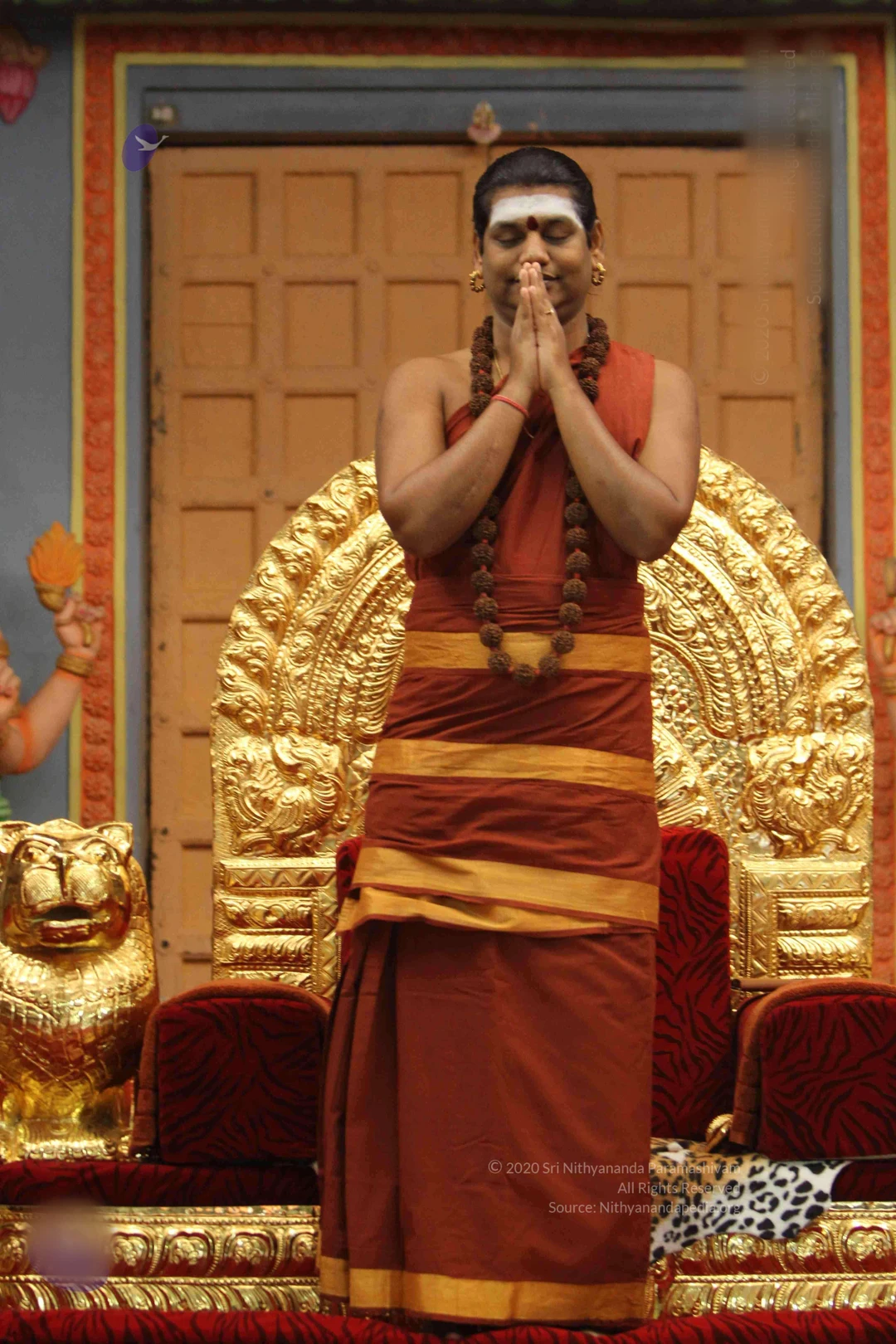
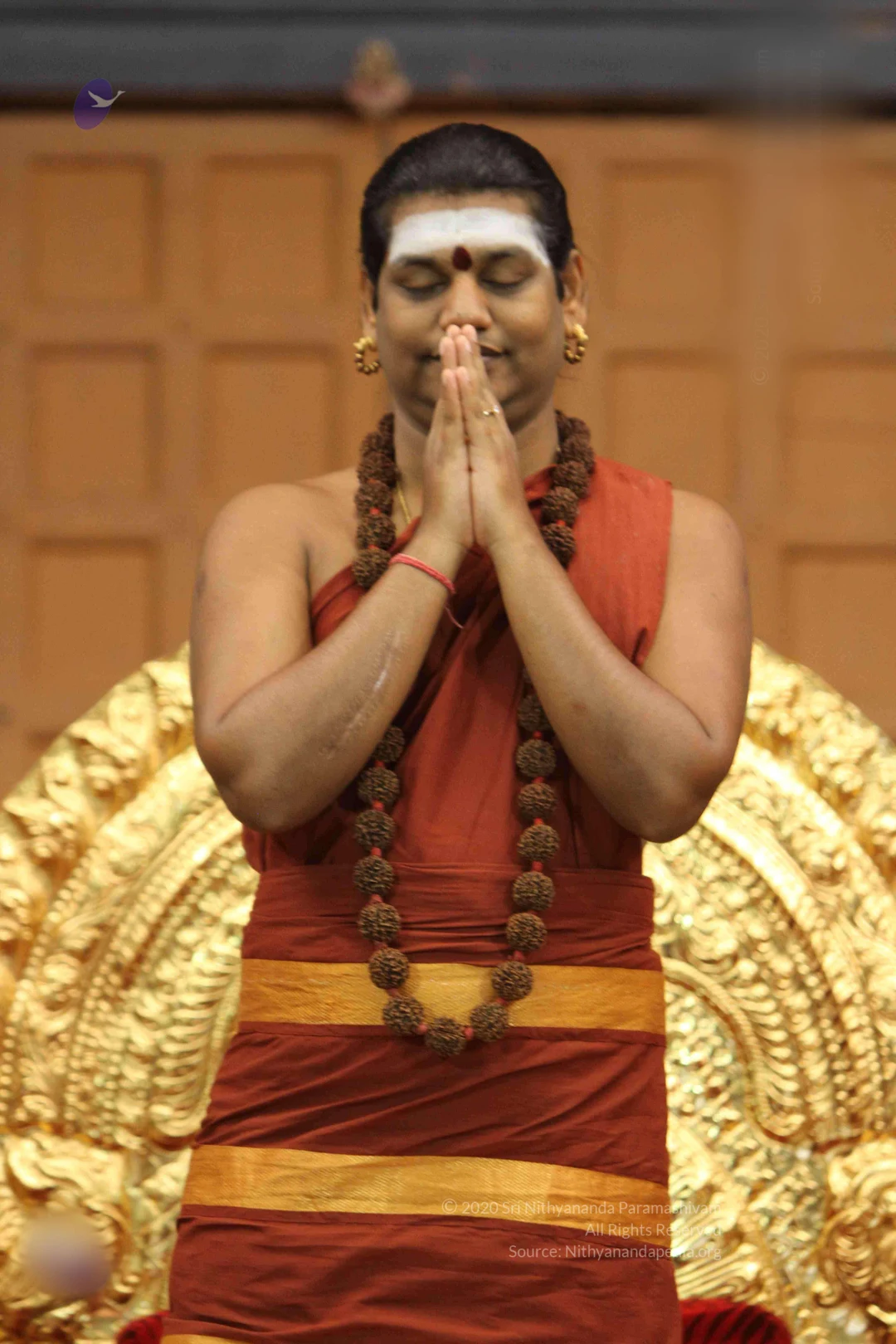
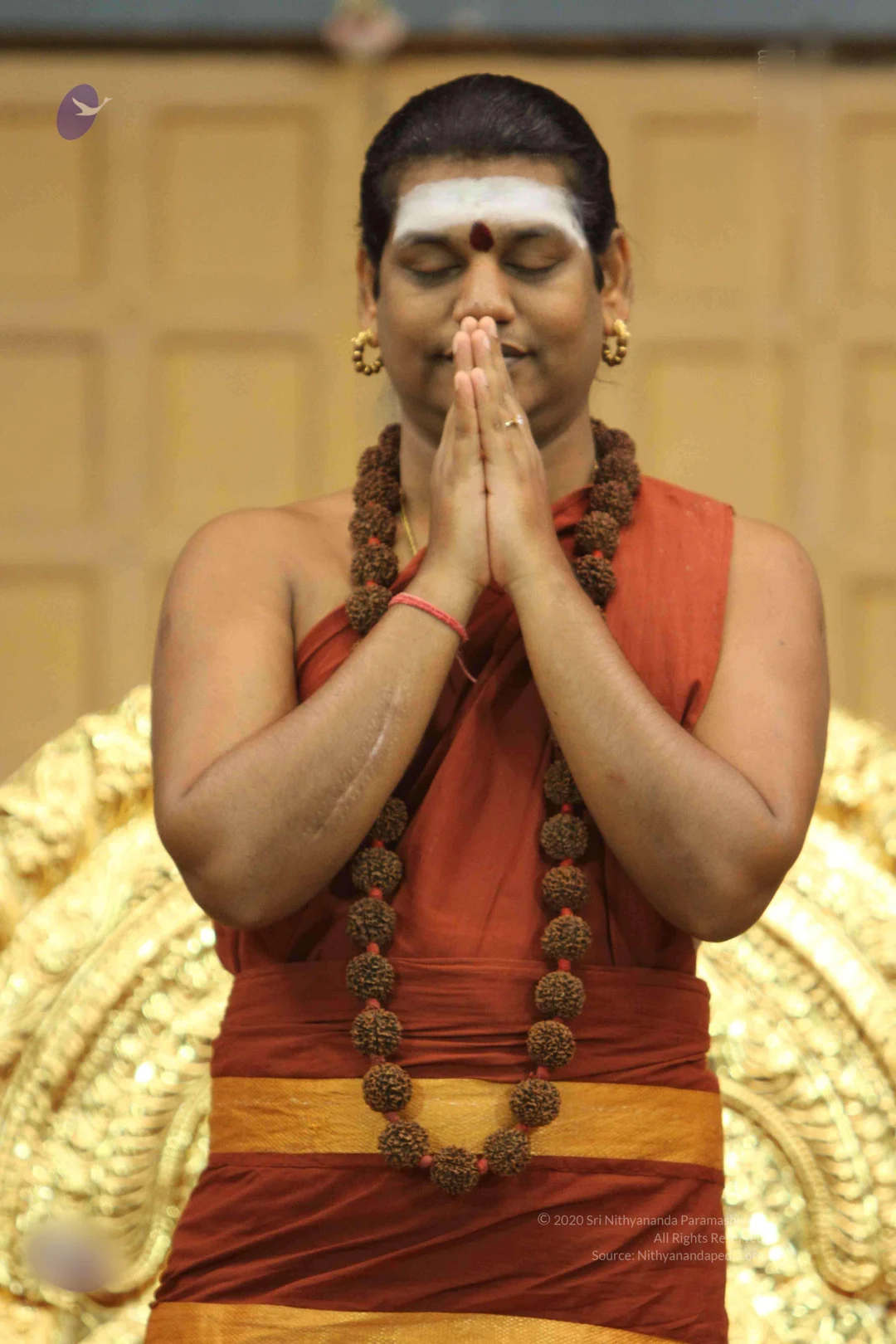
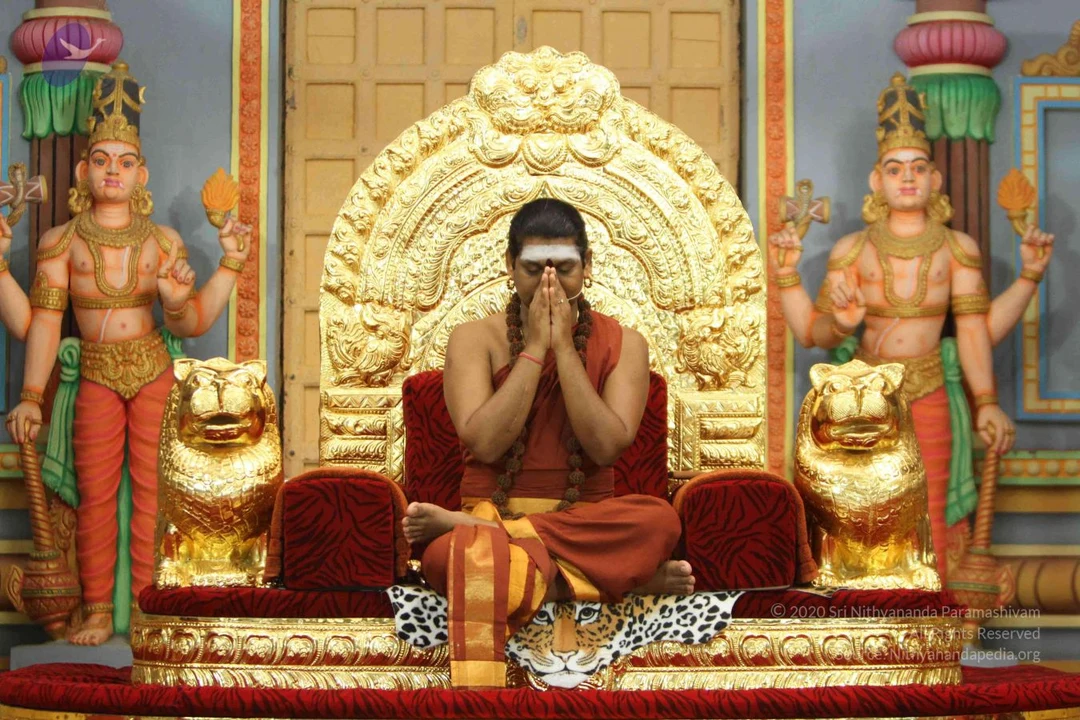
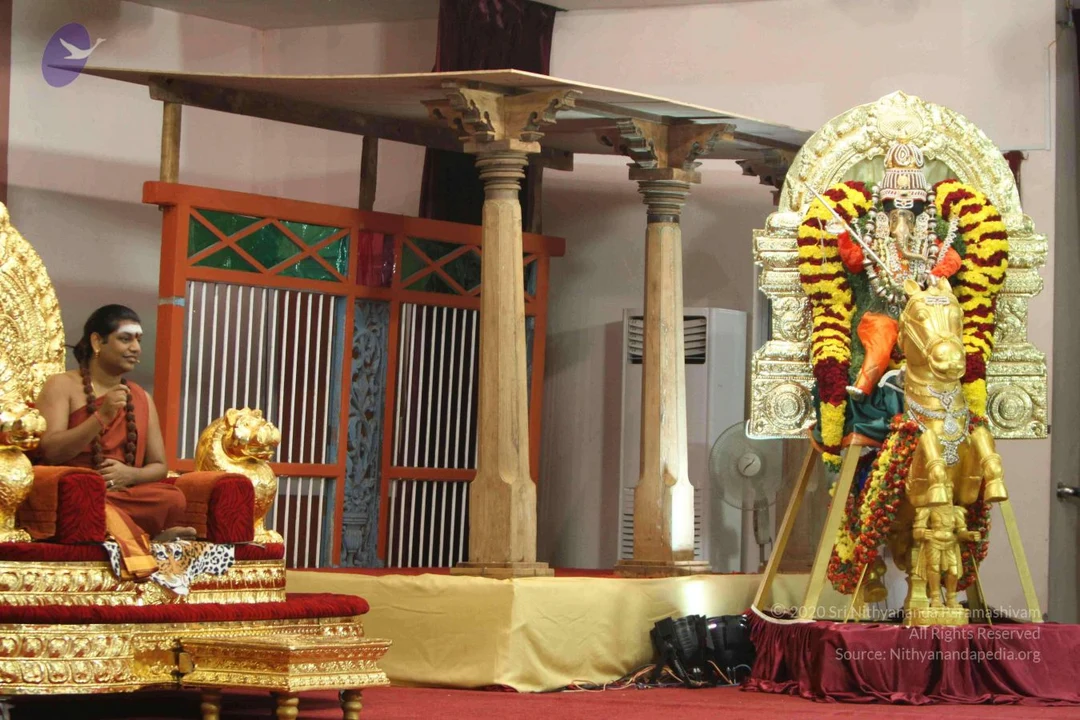
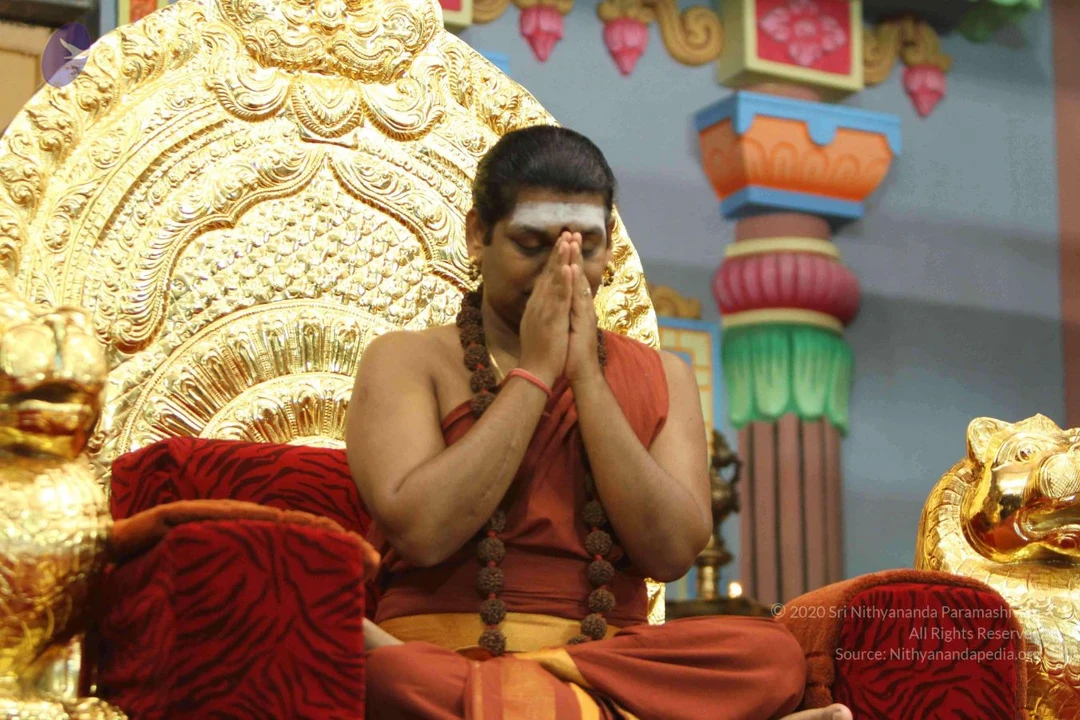
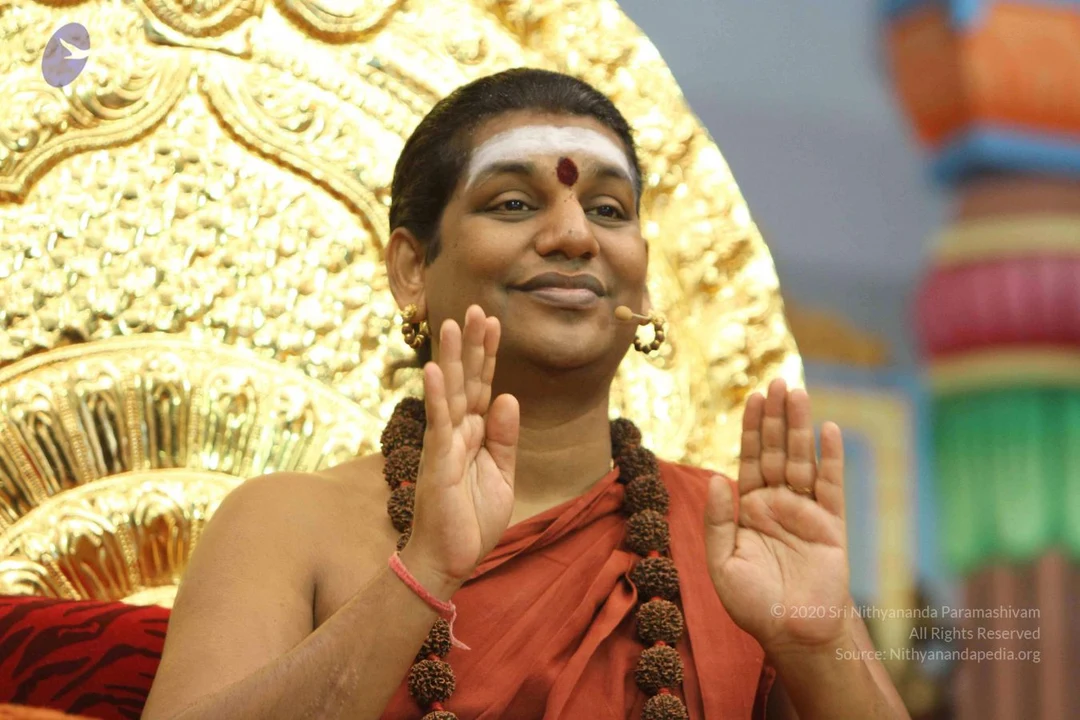
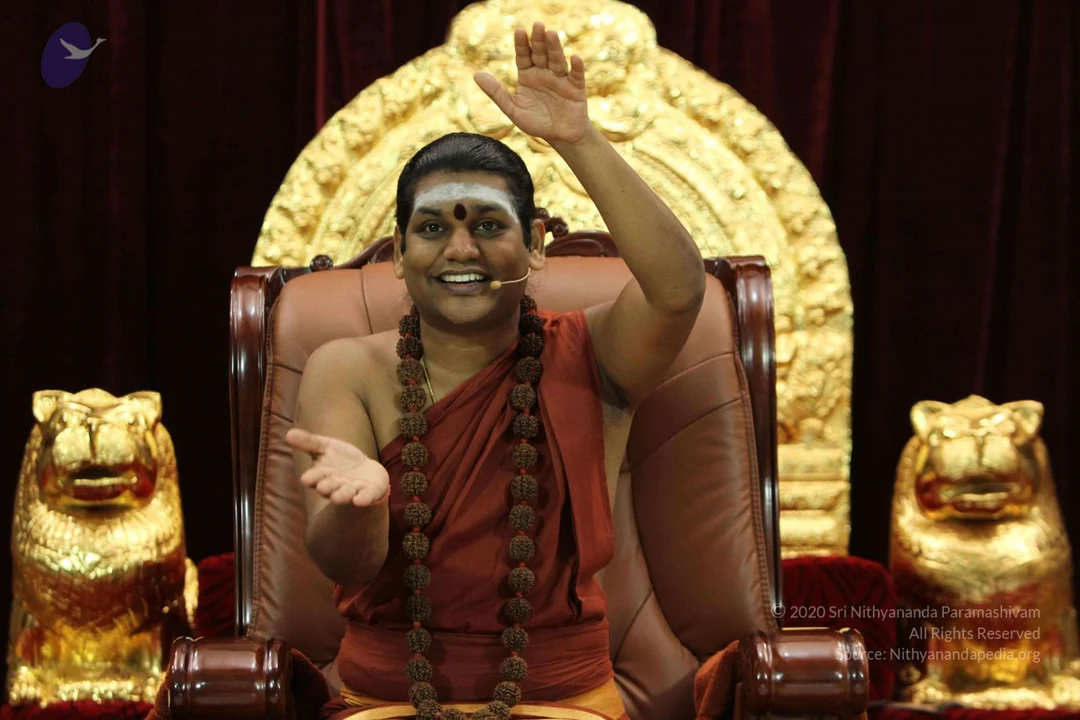
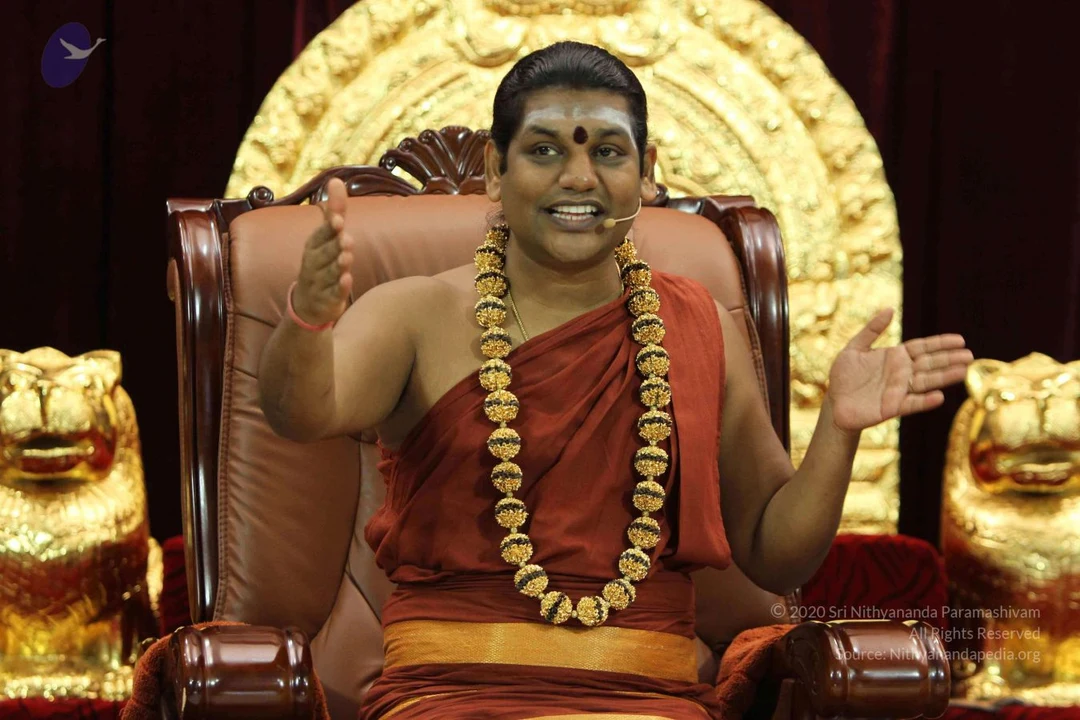
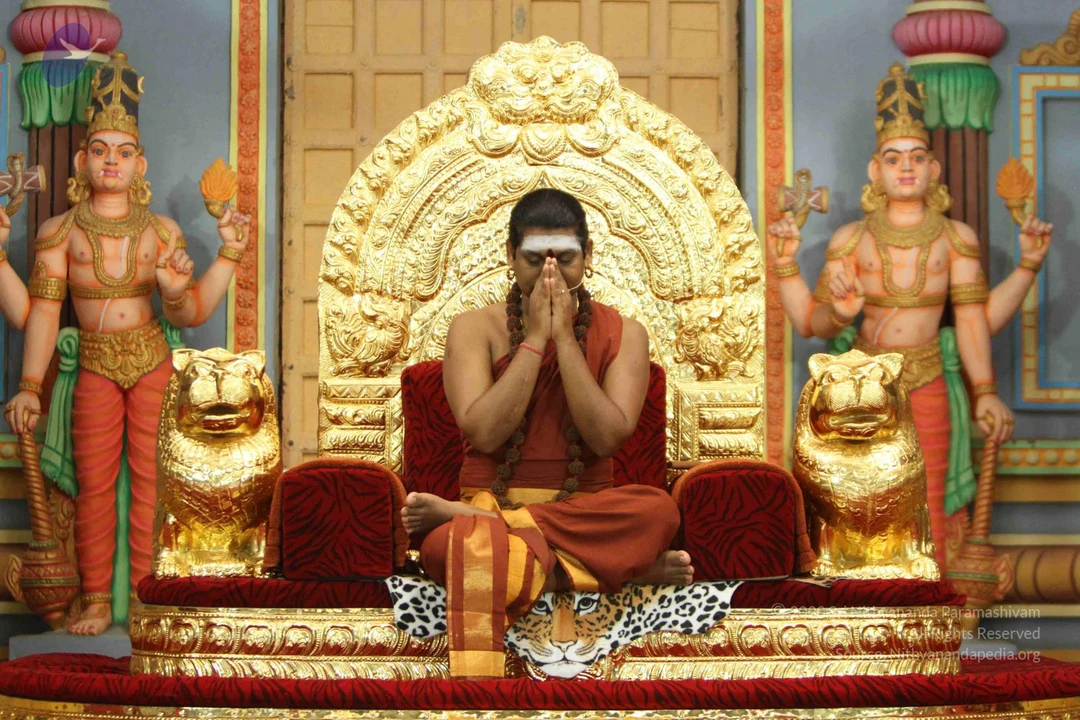
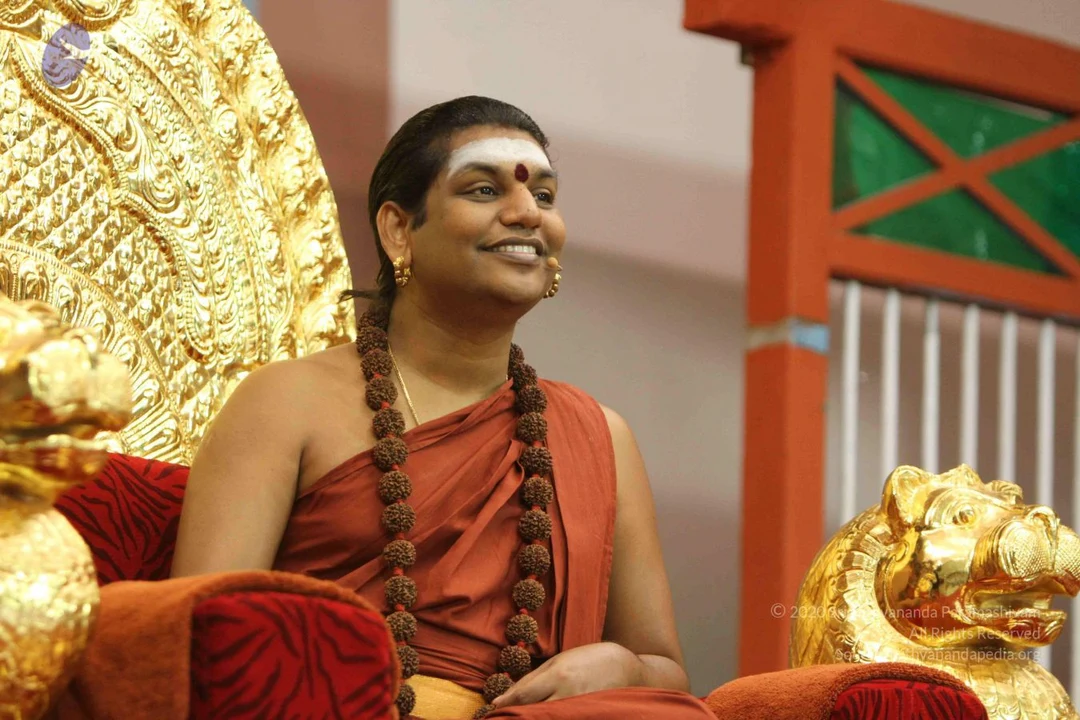
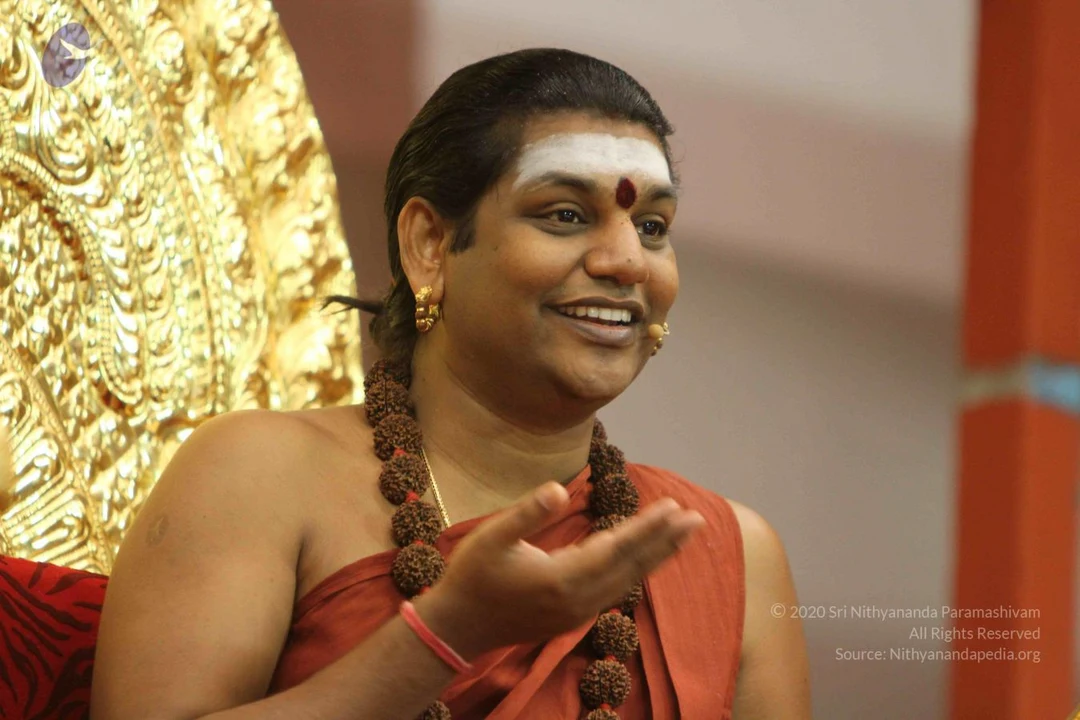
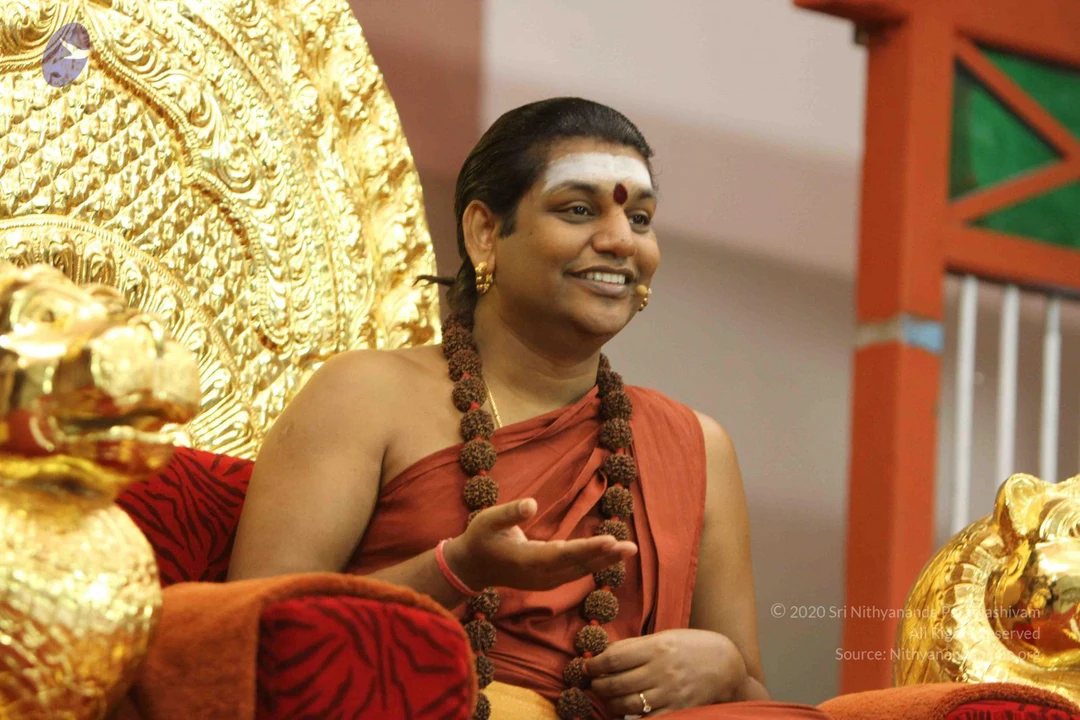
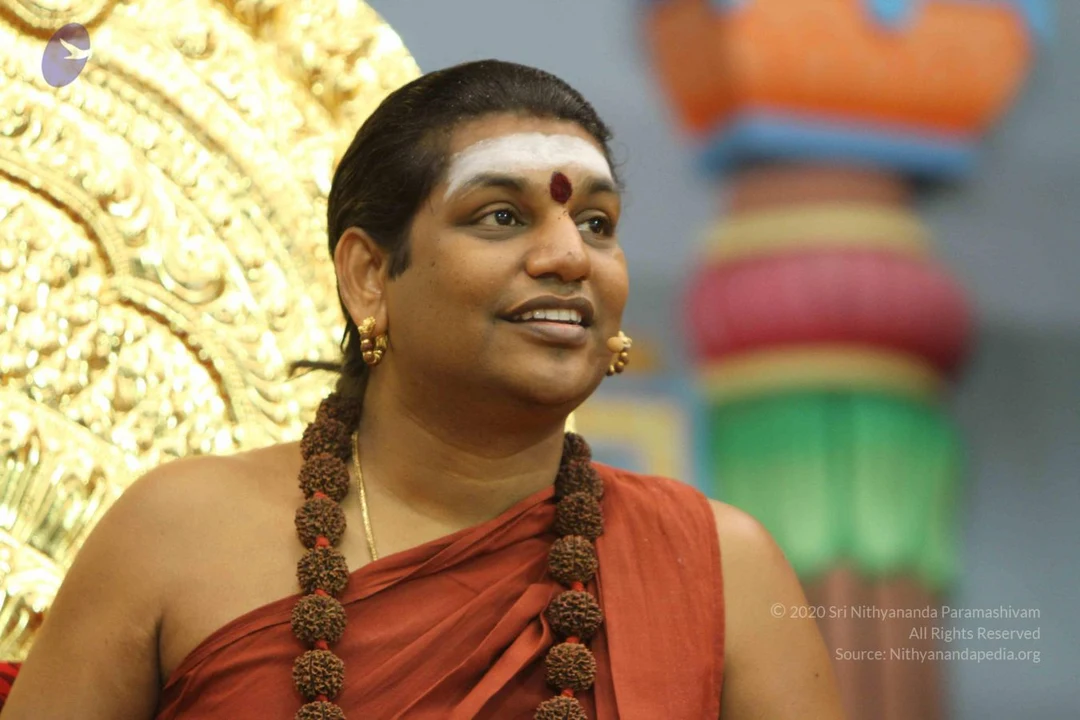
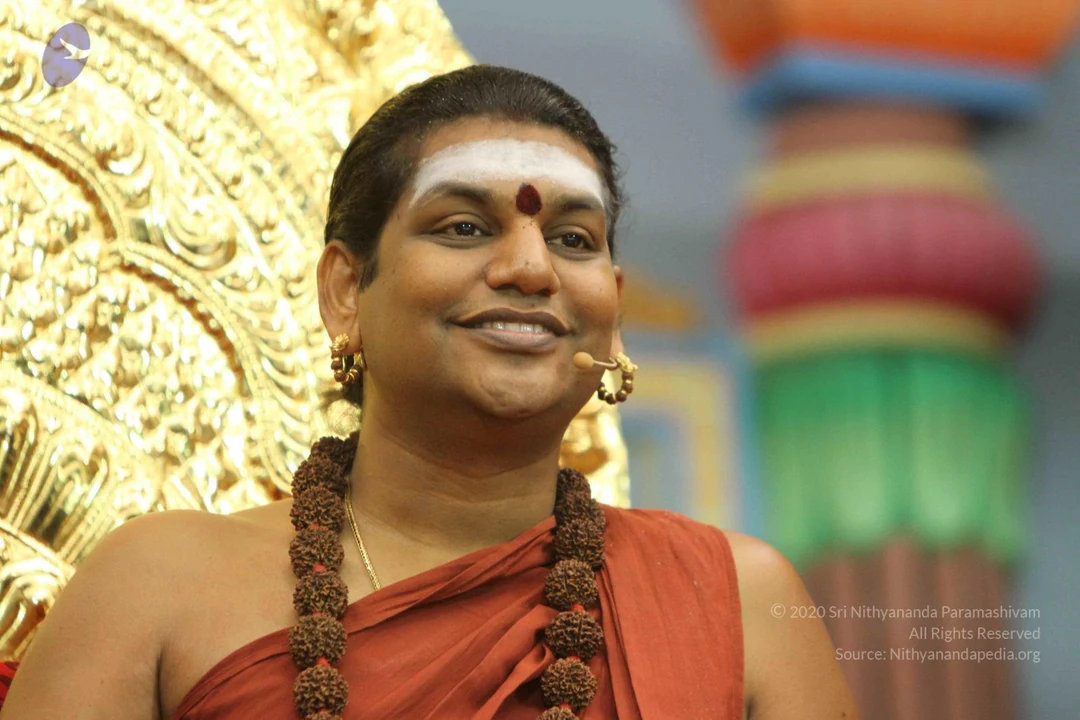
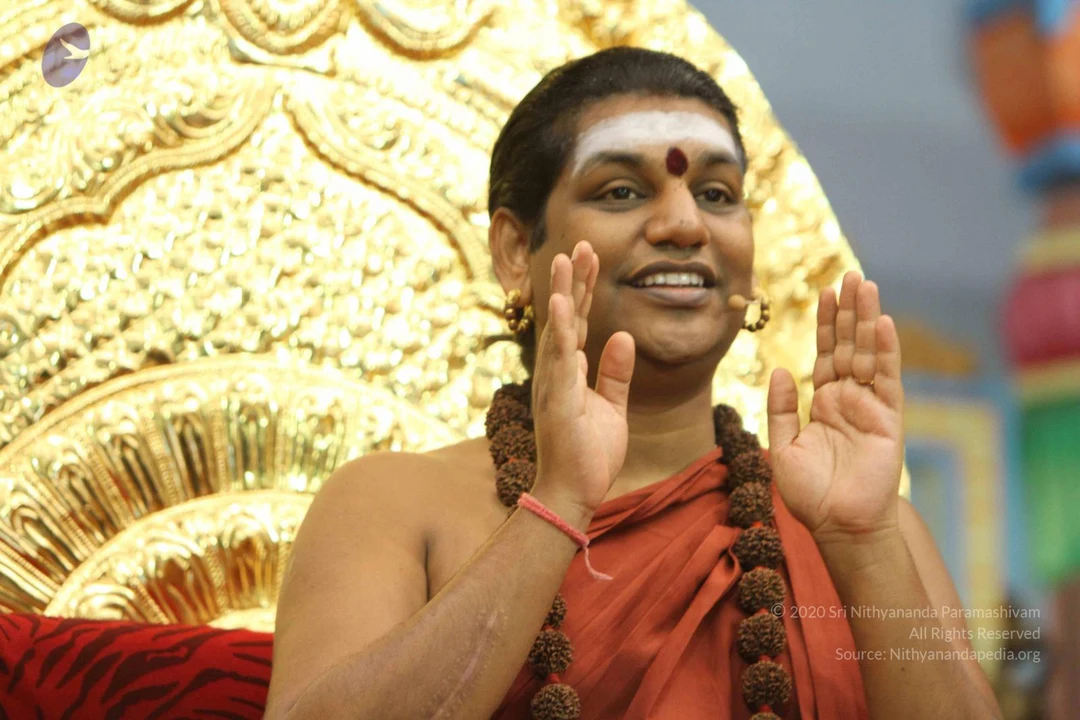
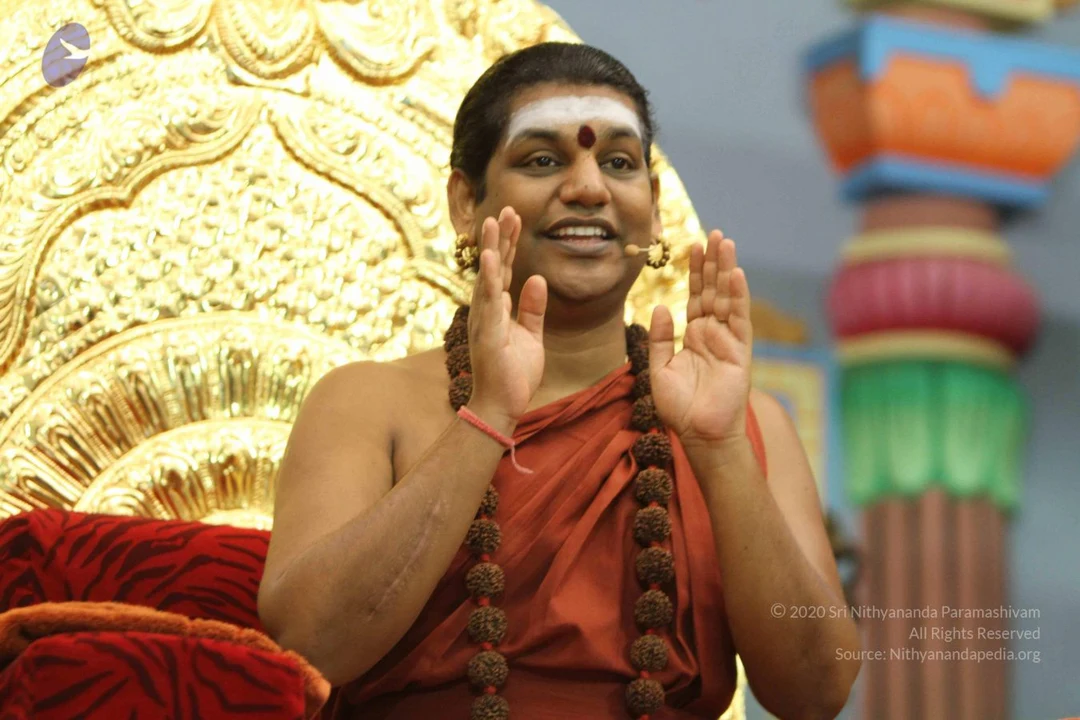
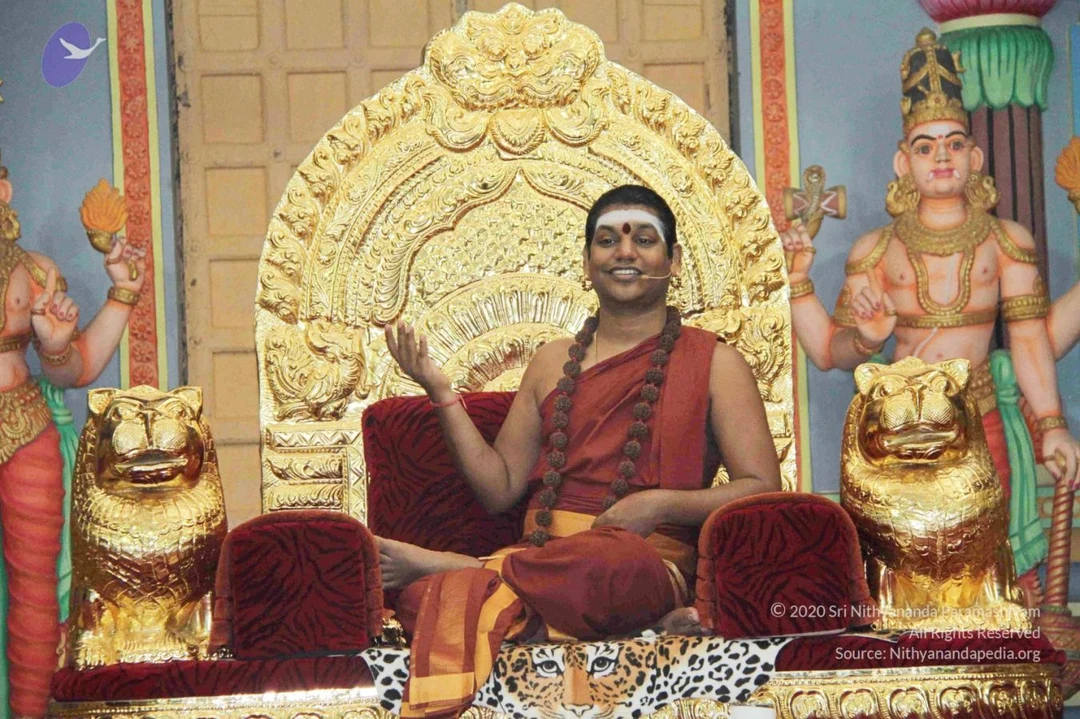
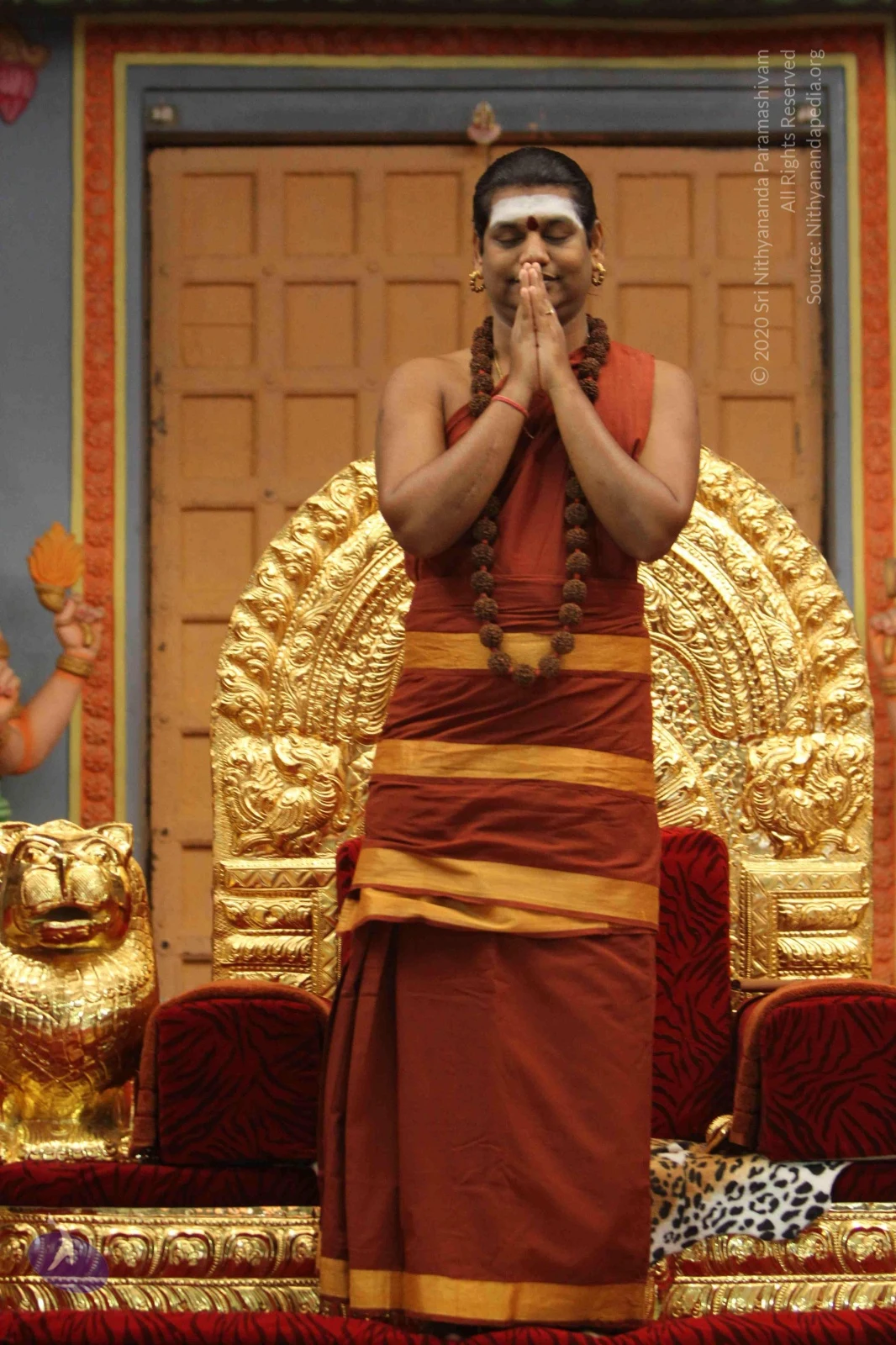
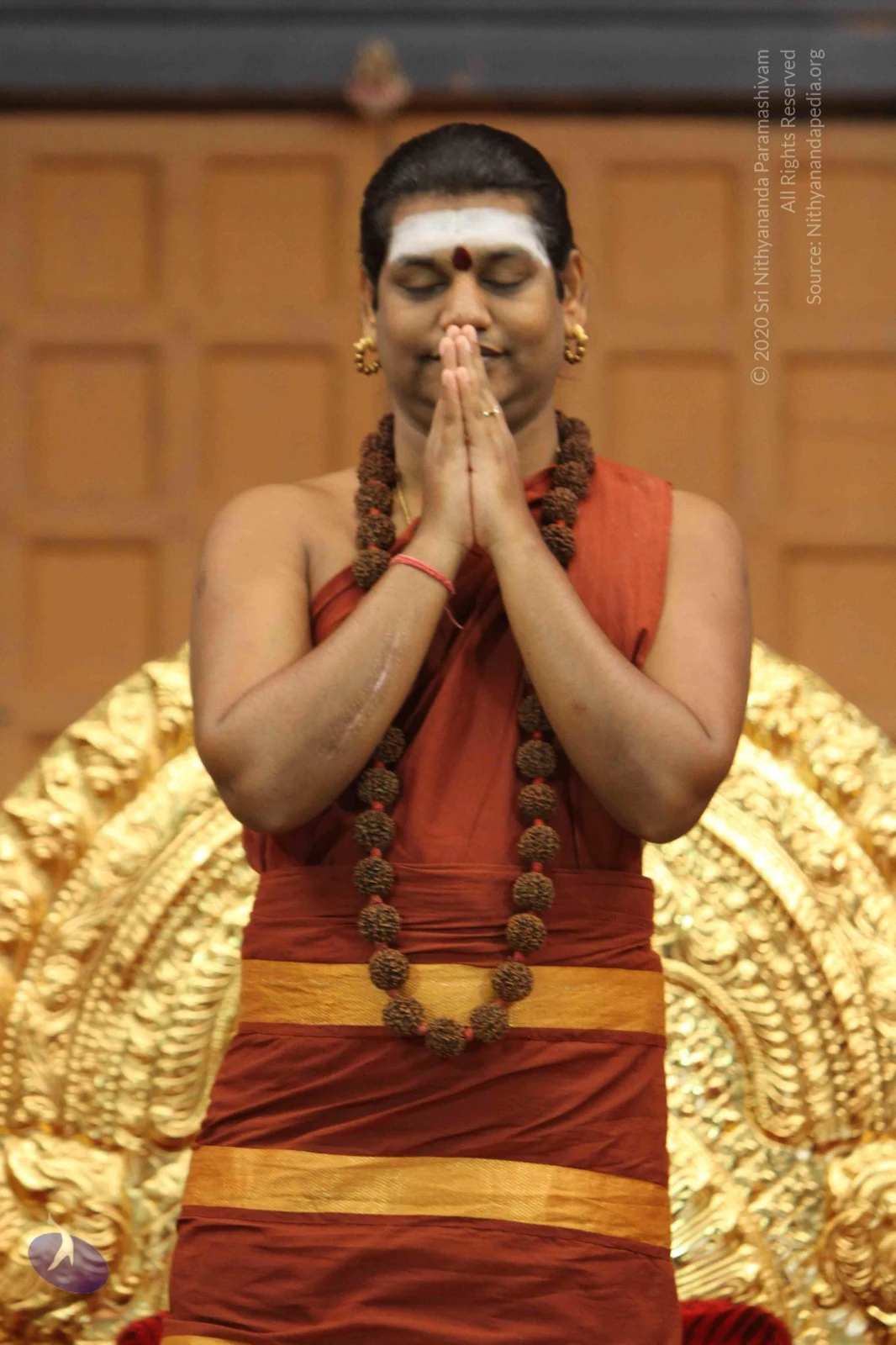
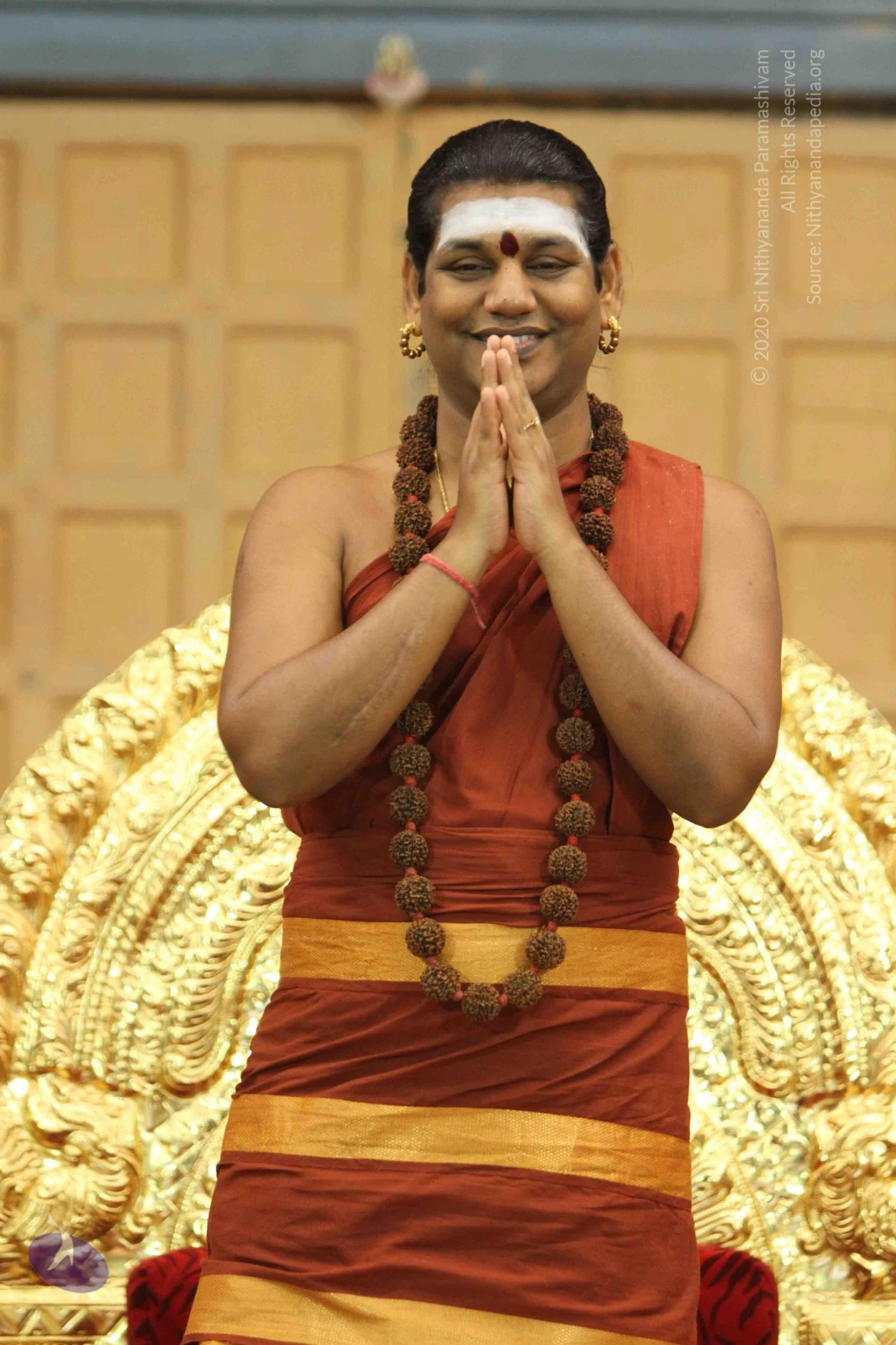
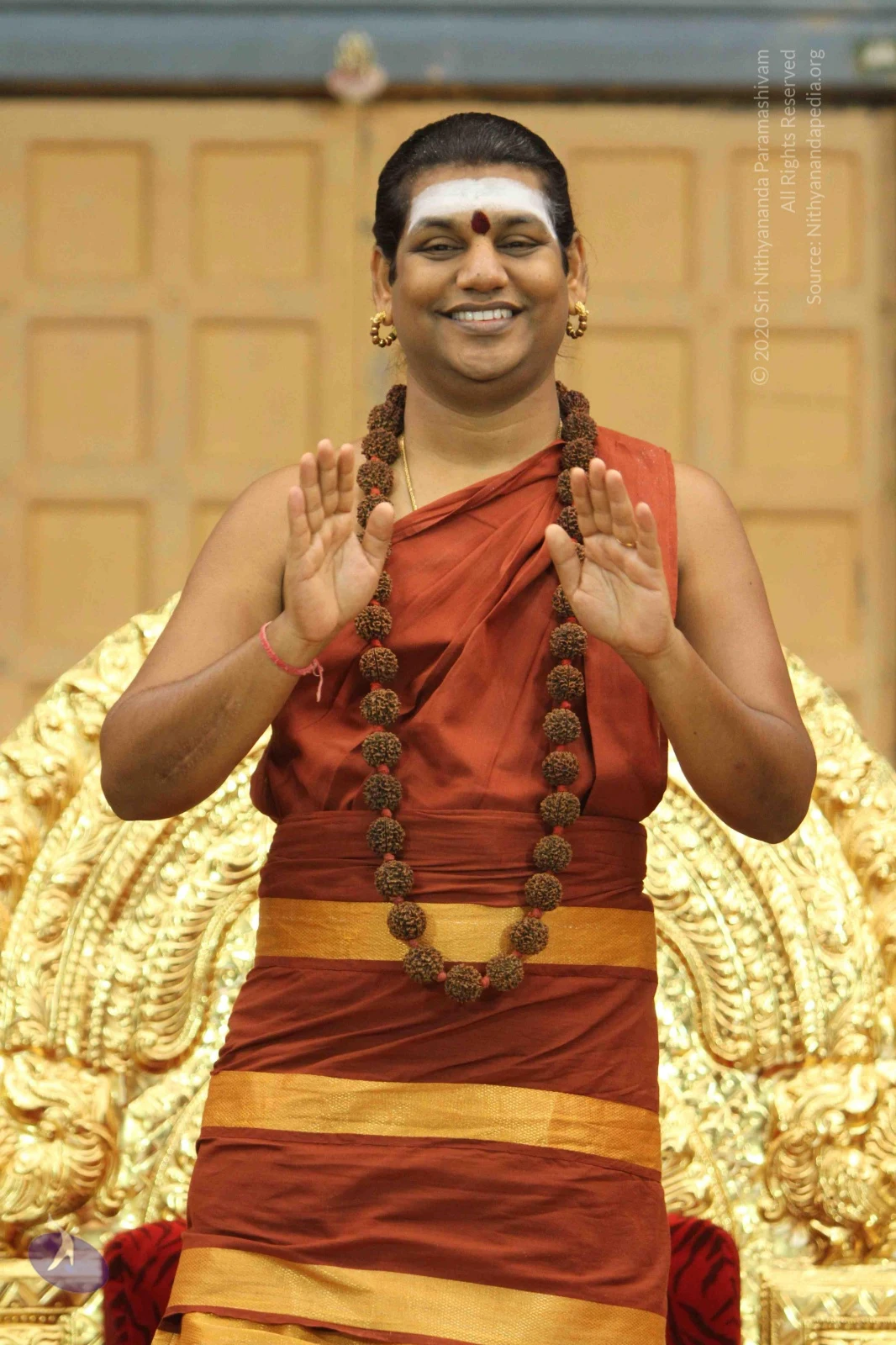
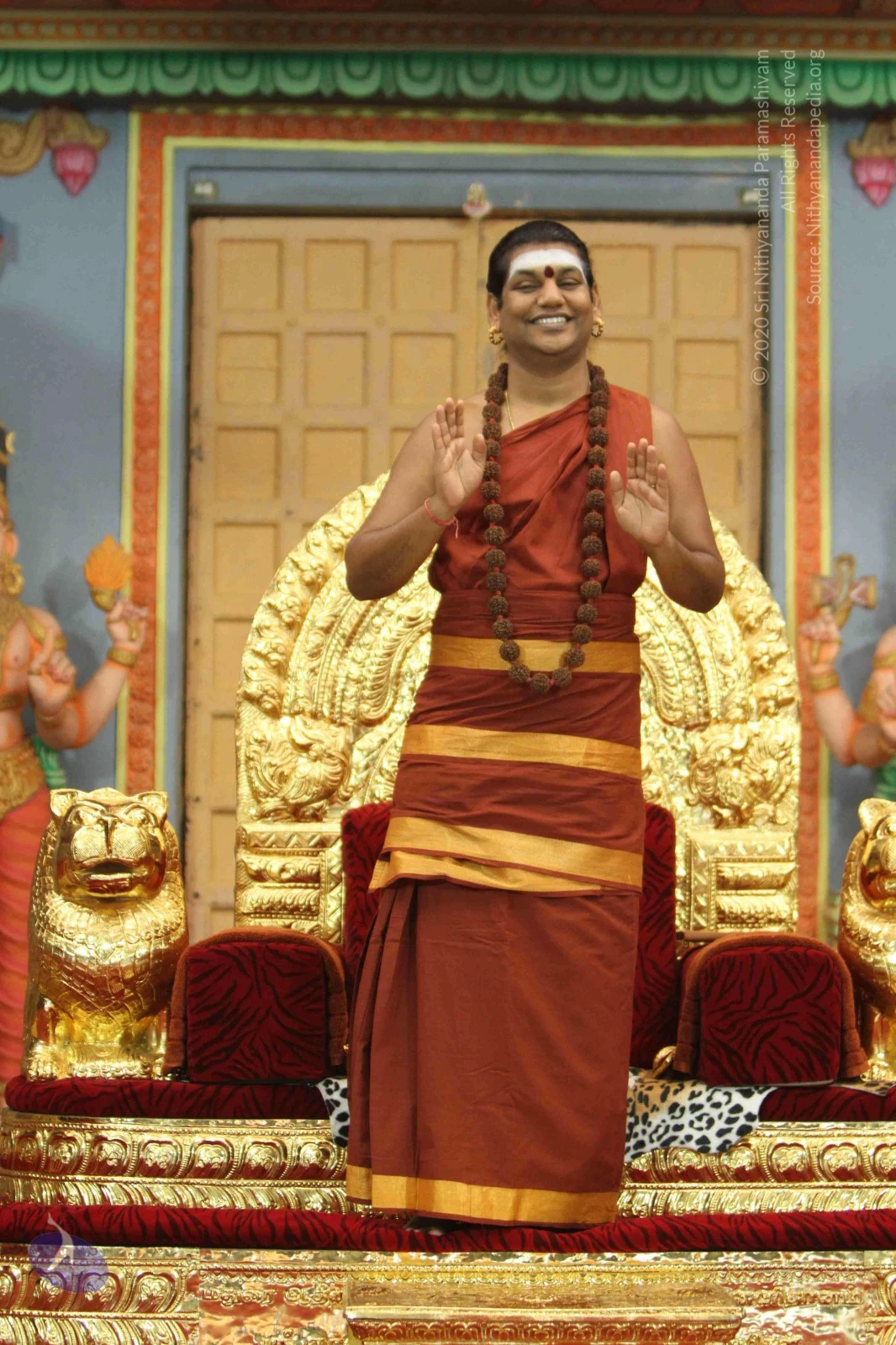
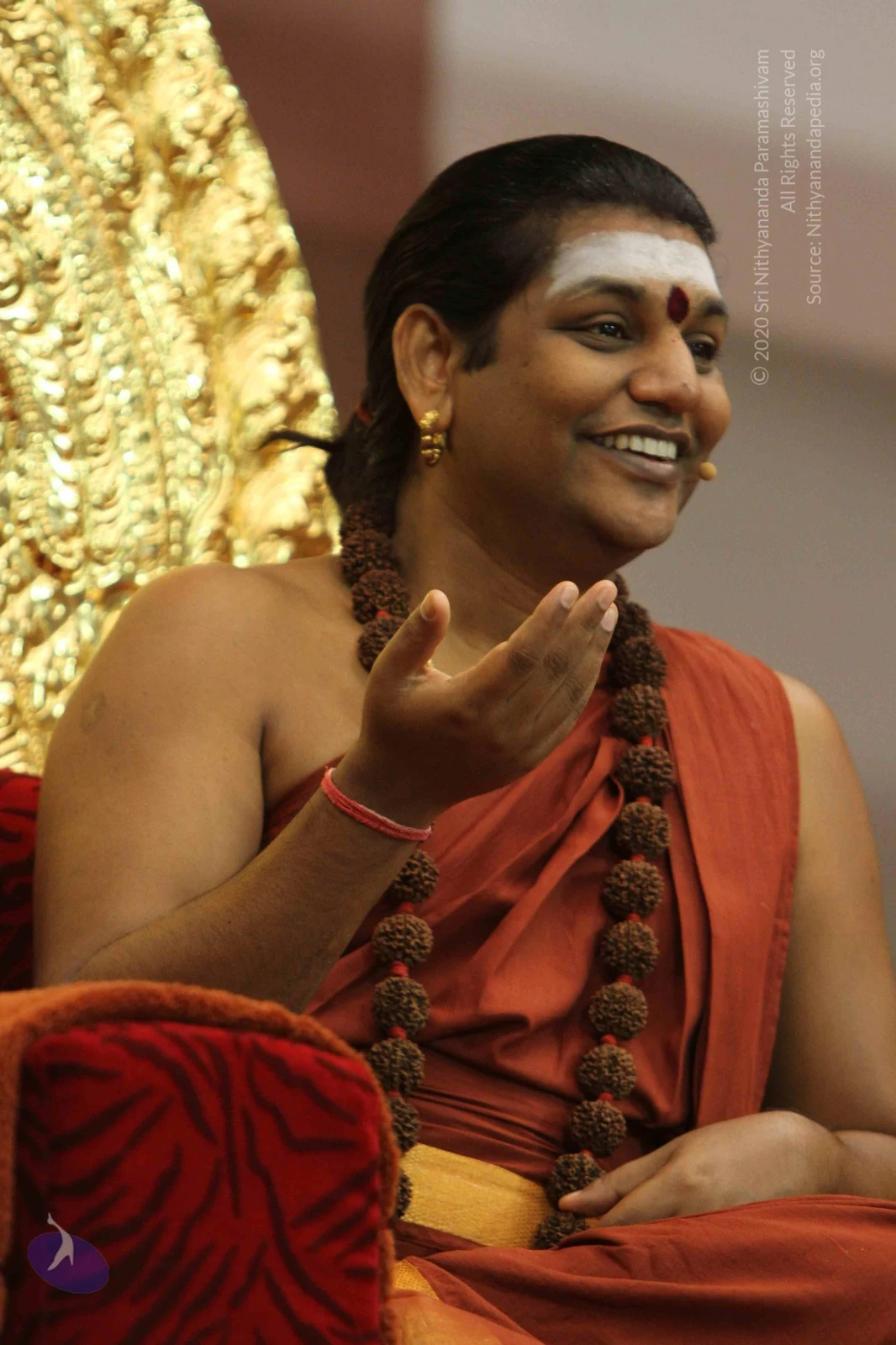
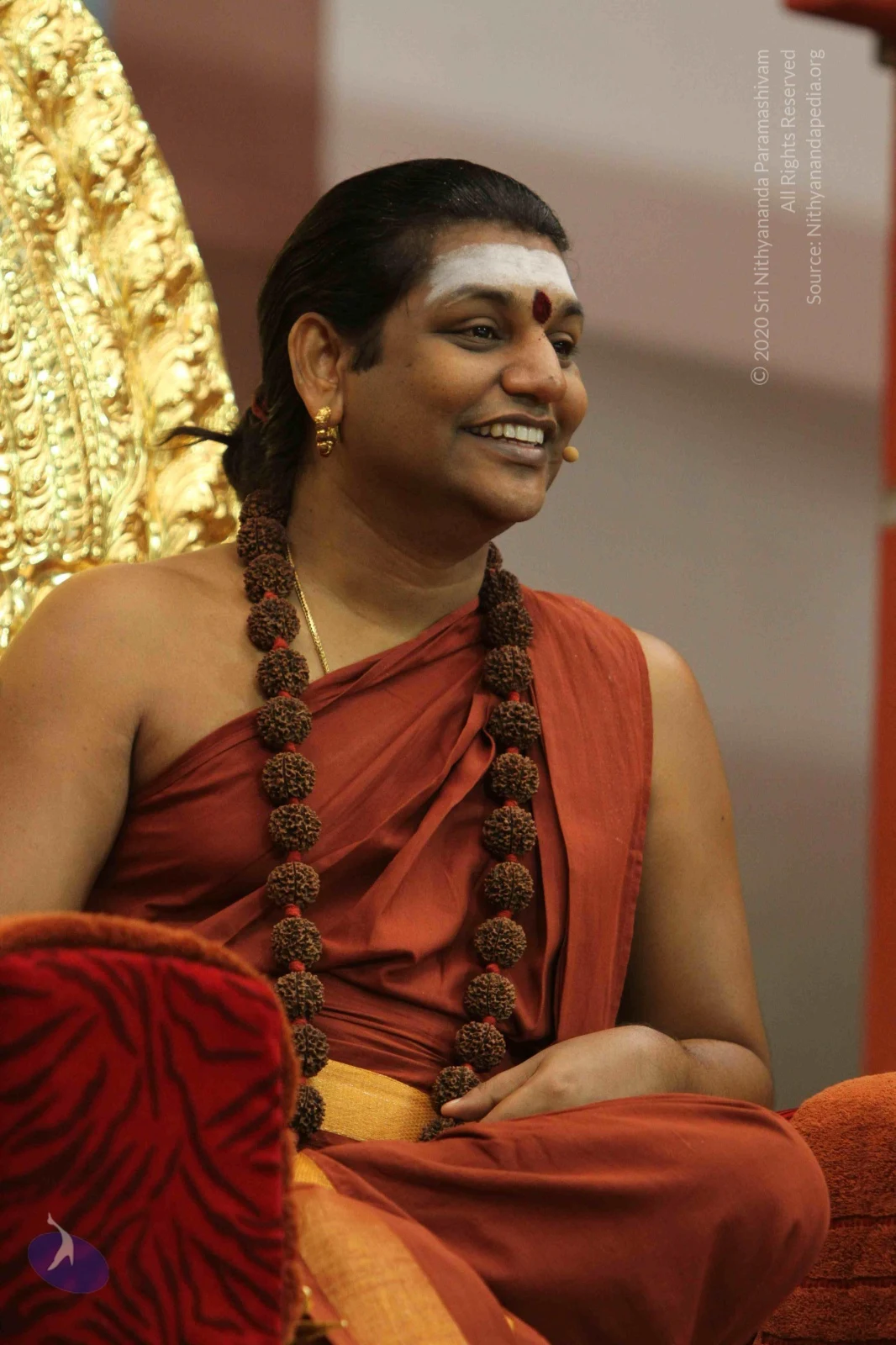
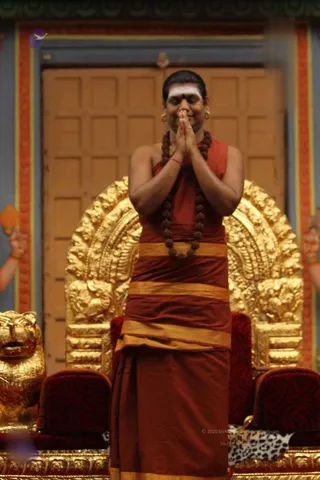
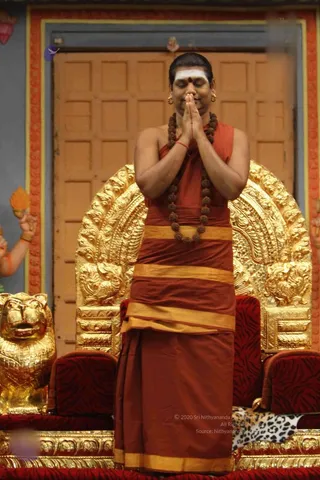
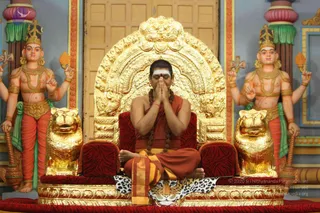
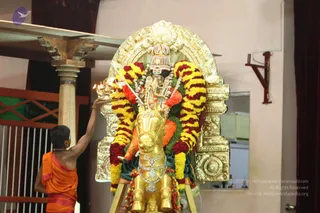
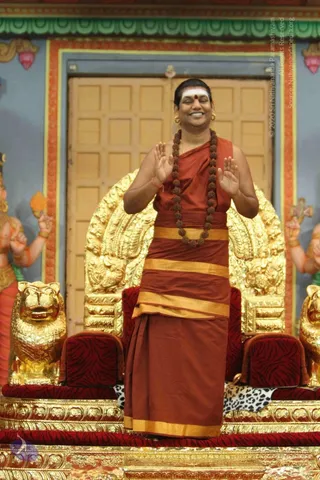
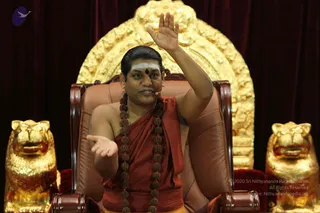
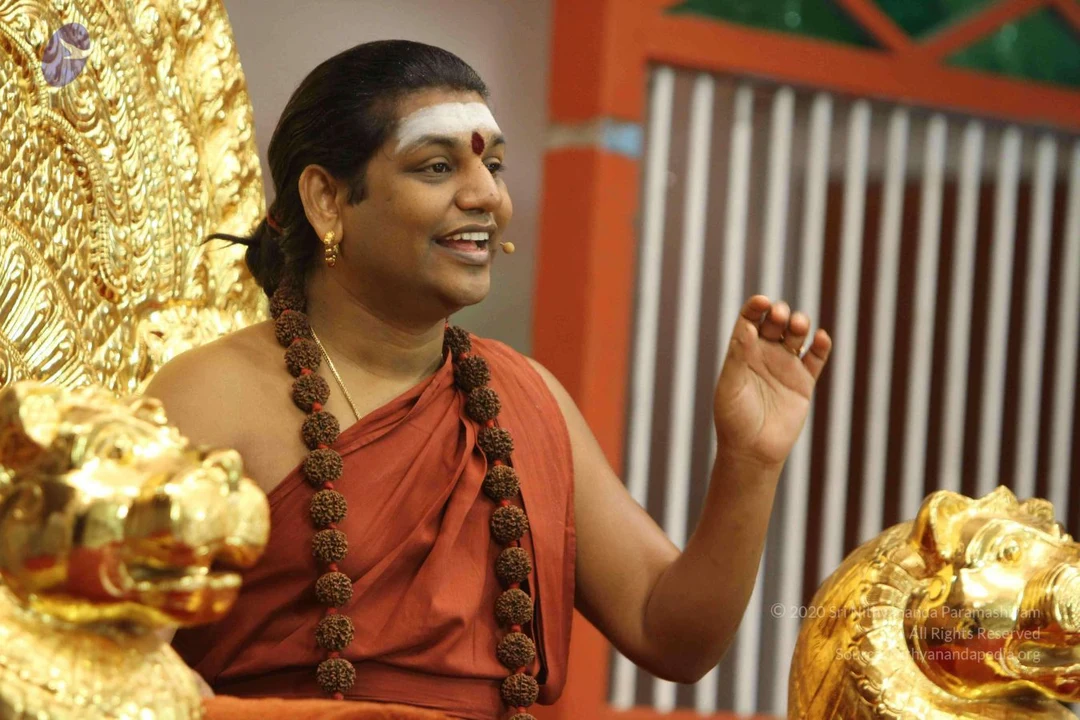
A man stands in front of an ornate golden throne with a carved gold lion armrest and red upholstered chairs, palms pressed together in anjali mudra with eyes closed. He wears a rust-red dhoti and upper cloth with gold borders, a dark rudraksha mala draped over his chest, gold earrings, and a white vibhuti band with a red bindi on his forehead. A red thread is tied on his wrist. Behind him are wooden panelled doors and a red and gold temple-style frame. The scene suggests a satsang setting. a person cues are limited to the ceremonial attire and rudraksha mala, so the identity is uncertain.A man stands with palms pressed together at chest level and eyes closed in a namaste greeting on a stage before an ornate gilded throne with a golden lion-face armrest. He wears a rust-red sleeveless garment with gold-bordered cloth wrapped at the waist, a long rudraksha mala of dark beads, gold earrings and a white vibhuti line with a red kumkum dot on the forehead. Behind him is a wooden panelled door framed in orange and gold, and a partial deity murti is visible at the left edge. The figure's appearance is consistent with a person from the rudraksha mala, ornate gold seating and saffron-red attire, a presentation that is recognisable but not fully distinctive enough to confirm.A photograph of a shaved-headed... no, a man with swept-back dark hair stands with eyes closed and palms pressed together in anjali mudra at the chest. He wears a rust-red sleeveless garment draped over one shoulder, a golden-yellow waistband, and a long rudraksha mala of brown beads hanging to his waist. A white vertical tilak with a red kumkum dot marks his forehead, and he wears small gold hoop earrings and a red thread on his wrist. Behind him is an ornate gold throne with a carved golden backrest. a person: the presentation matches a person, with rudraksha malas, saffron-red robes and a gold throne, though the face is not used to confirm identity.A smiling man in a rust-red and gold-bordered dhoti and shawl stands before an ornate gold throne, hands raised with palms open in a blessing or teaching gesture. He wears a long multi-strand rudraksha mala, gold earrings, a fine gold chain, a white vertical tilak with a red bindu, and a red thread on his wrist. The background shows wooden panelled doors and gilded carved throne backrest. The page describes a morning satsang discourse on completion and desperation. a person appearance cues include the ornate gold throne setting, rudraksha mala and ceremonial gold ornaments, though the figure is otherwise an ordinary-dressed presenter.A seated man in saffron-orange robes with a rudraksha mala and a white tilak on his forehead sits in namaste with eyes closed on an ornate golden throne (peetha) framed by a gilded arch. Two golden lion figures flank the seat, and a leopard-skin cloth is spread beneath. Two painted deity statues with multiple arms, crowns and gold necklaces stand on either side holding ritual objects. The red-and-gold backdrop suggests a temple hall. a person is the seated figure, identified by the saffron robes, rudraksha mala and seated on the throne.A photograph of a golden deity murti of Ganesha seated on a golden horse-like vahana, with an arched gold prabhavali behind it. The murti is draped in bright garlands of yellow and red-maroon flowers and wears an orange cloth and a jeweled crown. A priest in an orange dhoti and orange shawl, seen from behind with a shaved head, raises a lit oil lamp or aarti flame toward the murti at the left edge. Oil lamps and red floral offerings sit at the base. Pale walls, a wooden pillar and a dark red curtain form the background. One physical person is visible.

Final Blessing

4 photosSource gallery
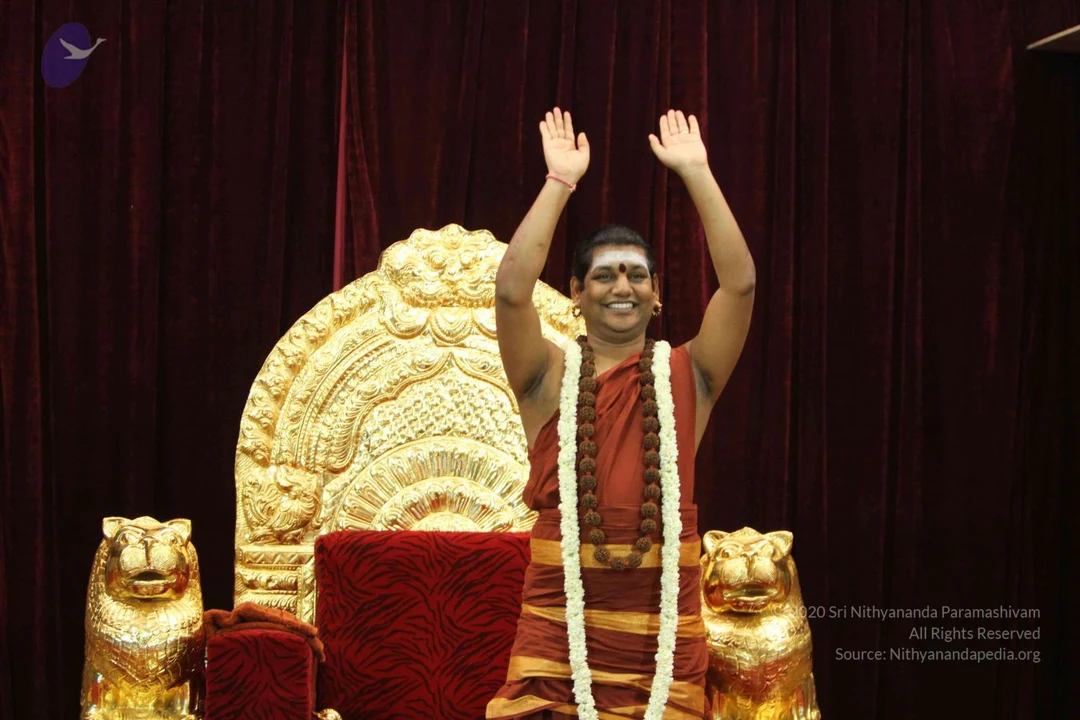
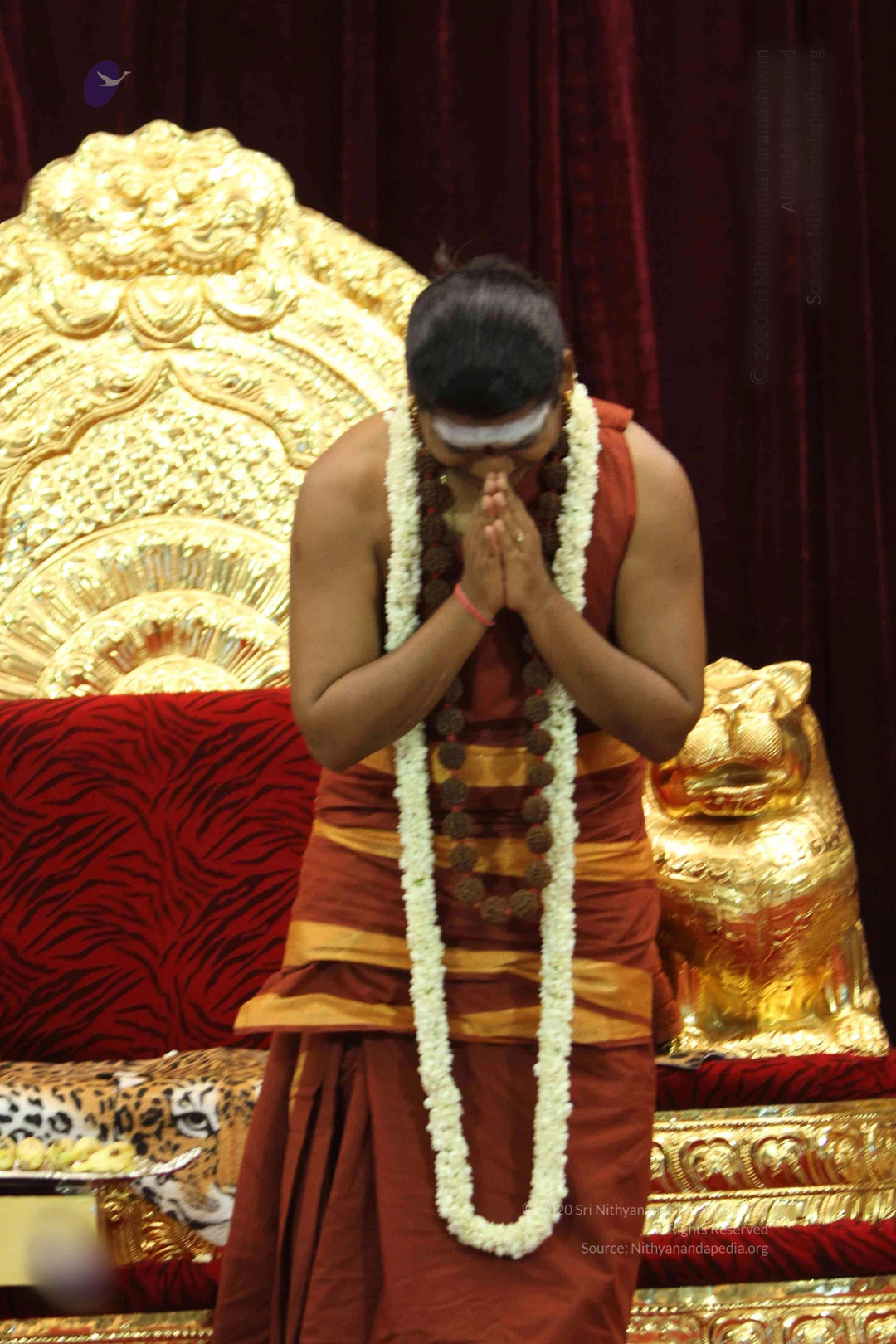
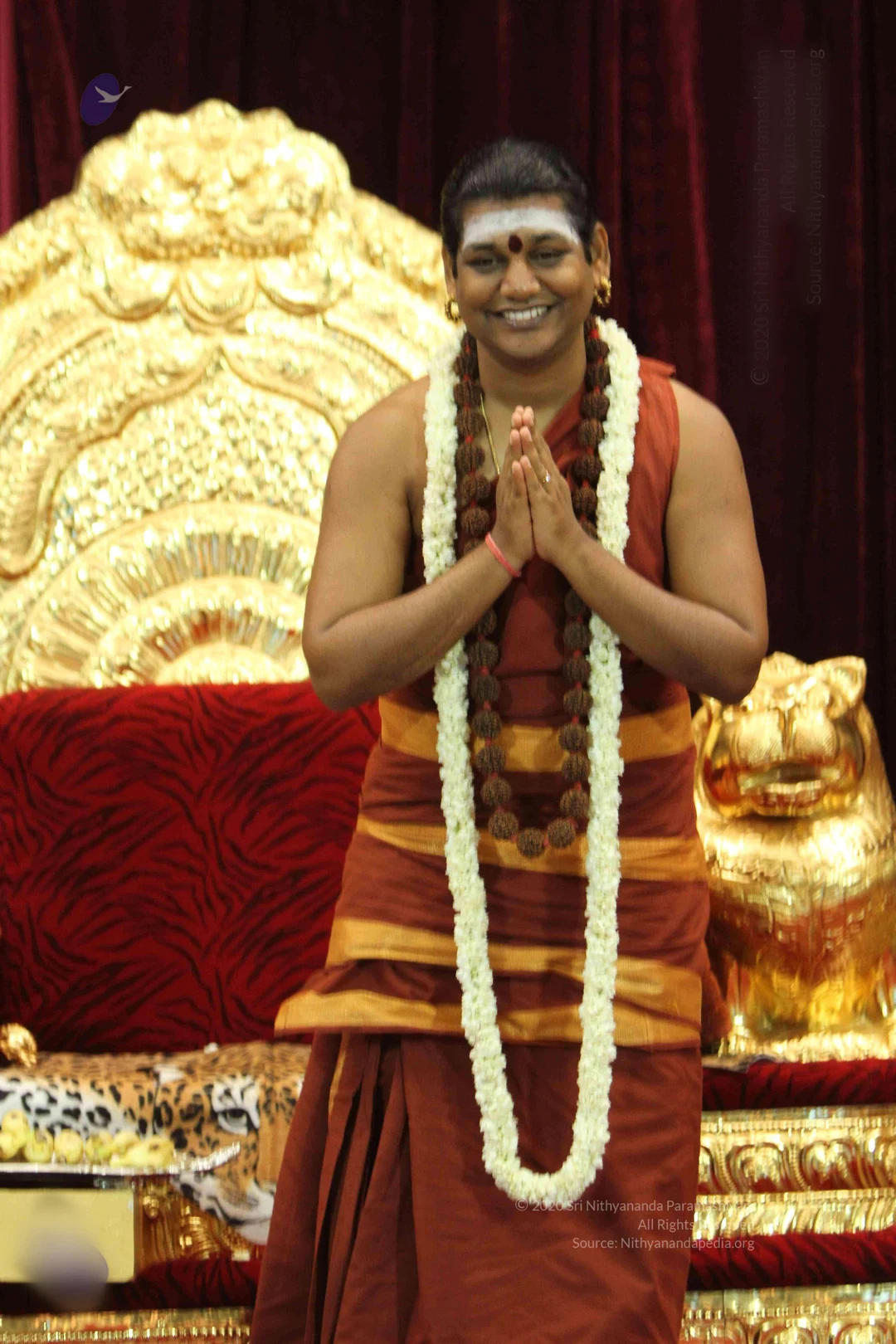
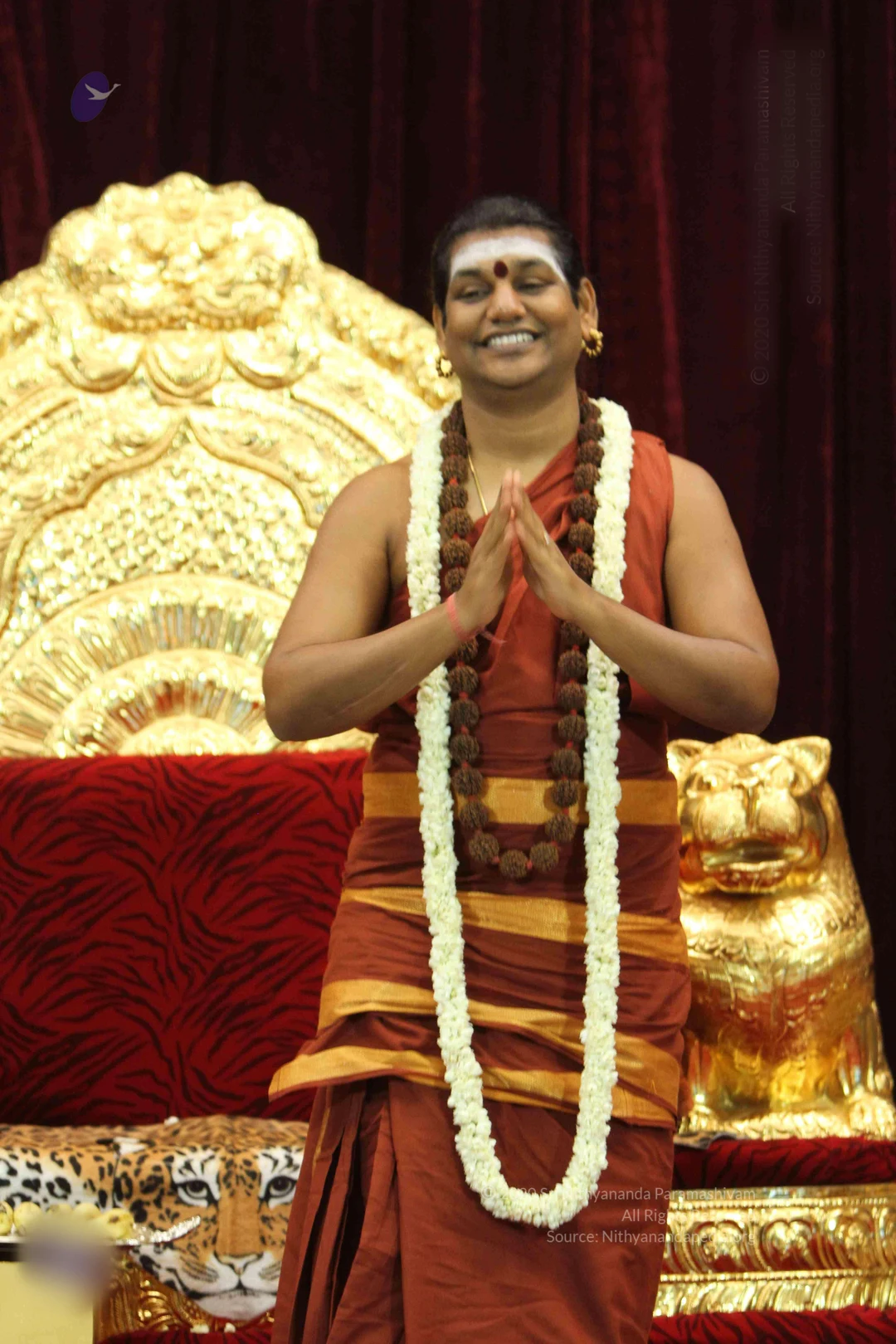
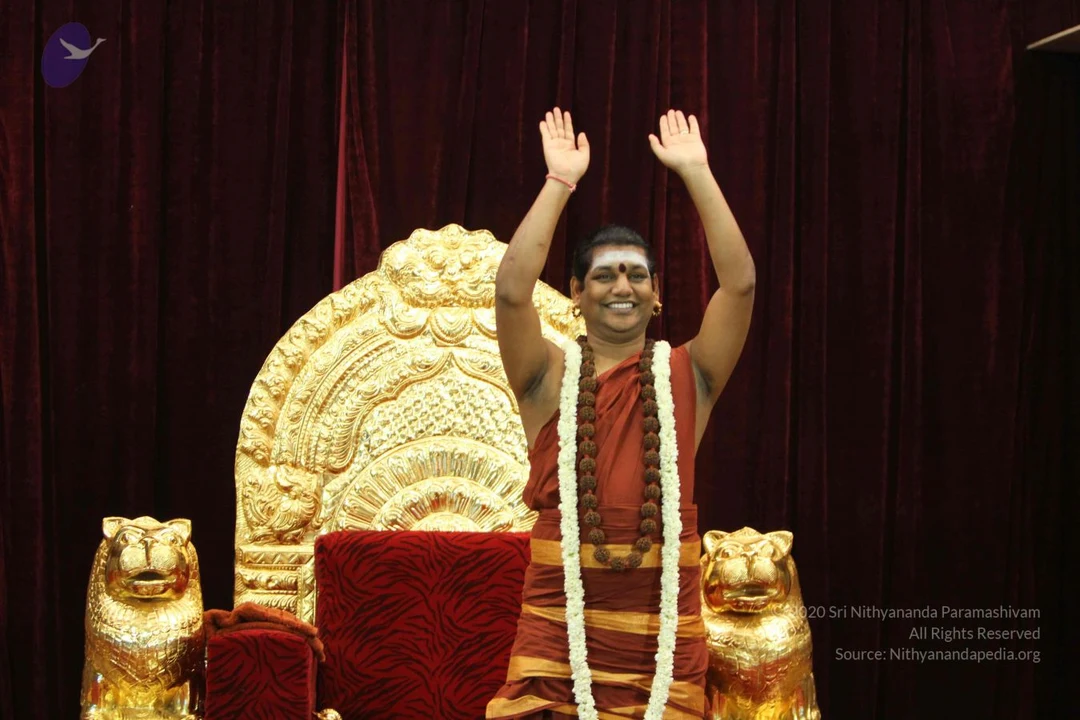
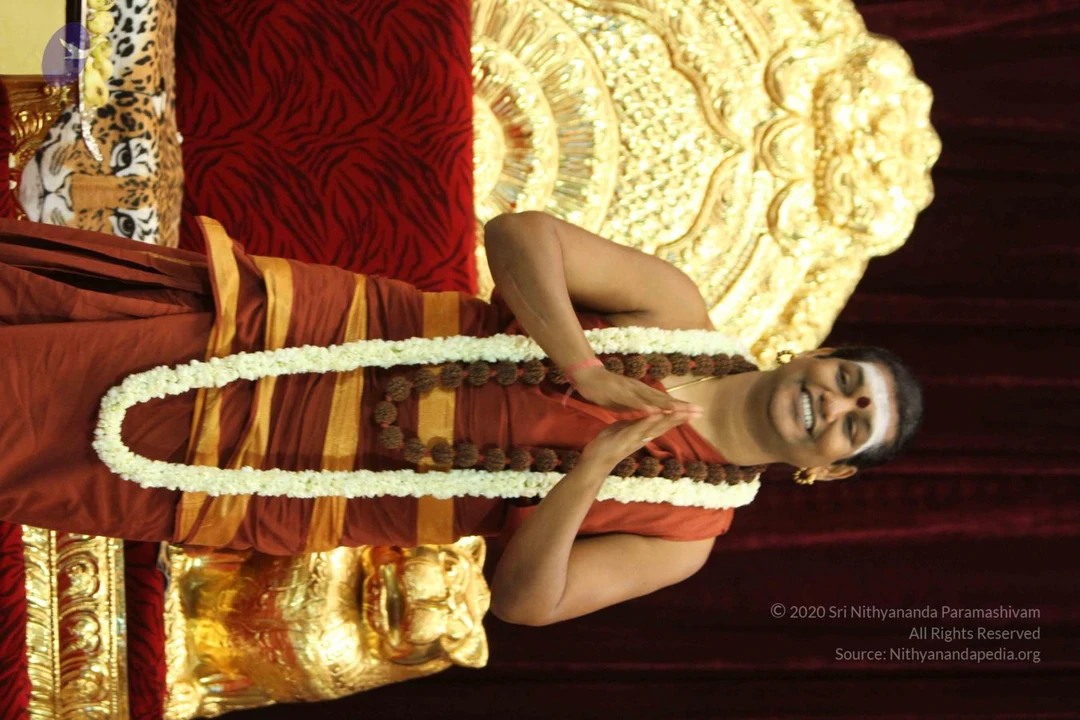
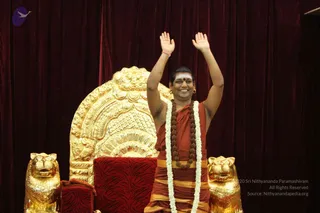
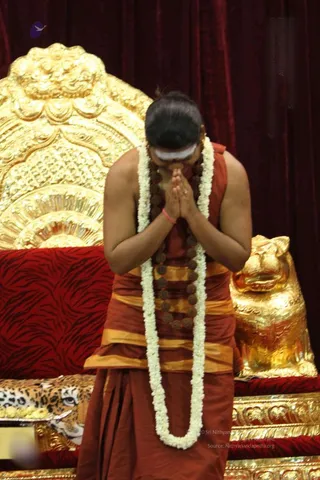
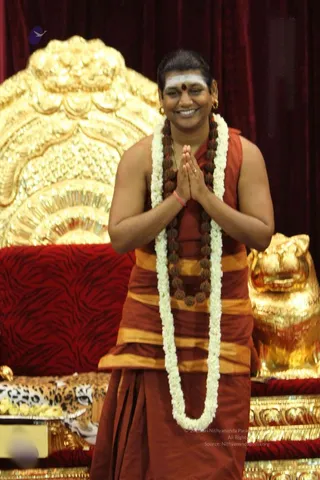
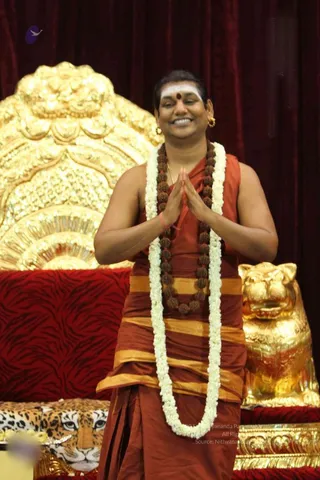
A photograph of a smiling man standing on a stage in front of a deep red velvet curtain, both arms raised in greeting. He wears a rust-orange and gold-striped robe with a white garland and a long rudraksha mala, a white and red forehead mark, and small gold earrings. Behind him is a large ornate gold throne with a red tiger-print seat, flanked by golden lion heads. a person is the candidate, based on the swept-back hair, ceremonial gold ornaments, rudraksha mala and saffron robe; the page indicates he is present at the satsang. Only one physical person is visible.A man stands with palms pressed together in anjali mudra, head bowed, in front of an ornate gold throne with a red velvet backrest and a gold lion-form armrest. He wears a rust-orange sleeveless top with gold bands, a rust-orange dhoti, a white jasmine garland and a long rudraksha mala, with a white vertical tilak on his forehead. A red-and-black tiger-striped cushion and a leopard-print cloth lie on the throne seat. The background is deep red velvet drapery. The image is a photograph of one person in a satsang-style setting.A standing man in rust-red and gold-bordered ochre drapery, with a white jasmine garland and a long rudraksha mala, presses his palms together in a namaste greeting and smiles. He has a white vibhuti line and red kumkum bindi on his forehead, and gold earrings. Behind him is an ornate gold throne with a red zebra-striped cushion and a golden lion sculpture to the right, set against red velvet drapes. A leopard-print cloth with fruit sits at the left edge. The man is an appearance-based probable Swamiji candidate, shown with long swept-back hair, rudraksha malas and a garland in front of the throne, so the image is a photograph of an in-person presence.A smiling man in a rust-red sleeveless garment with a gold-bordered dhoti stands with palms pressed together in namaste before an ornate gold throne backed by red velvet curtains. He wears a white jasmine garland and multiple rudraksha malas, has white vibhuti and a red tilak on his forehead, and wears gold earrings. Behind him a gold lion sculpture and a red tiger-striped cushion are visible. The main subject is one person.

Blessing with Ganesha

4 photosSource gallery
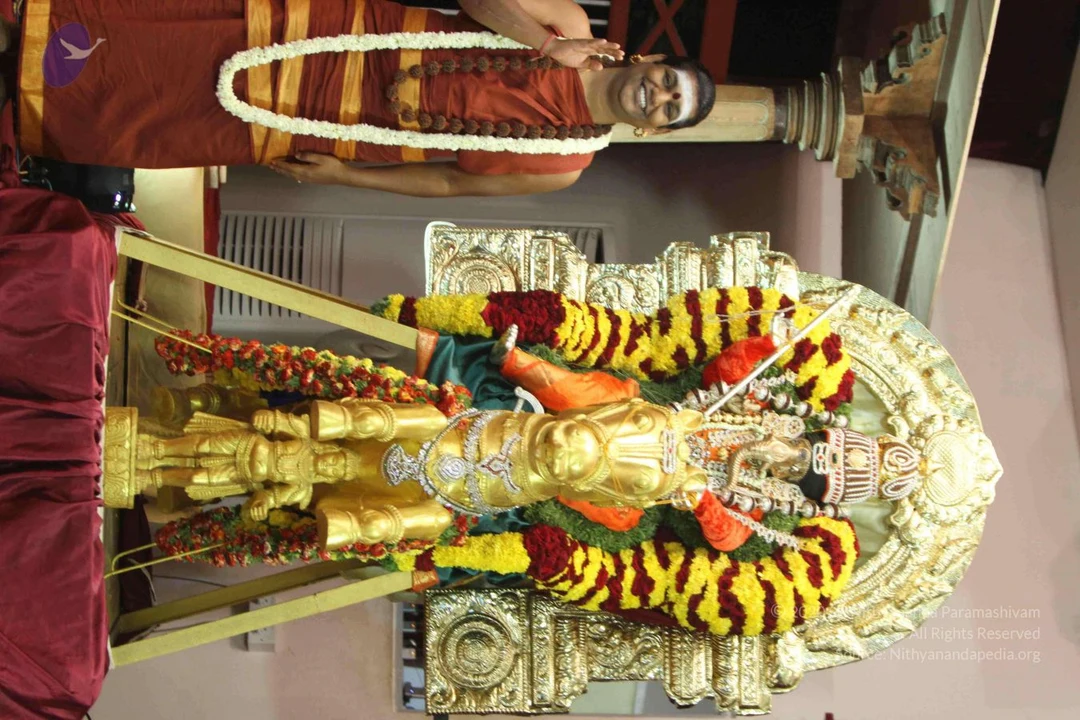
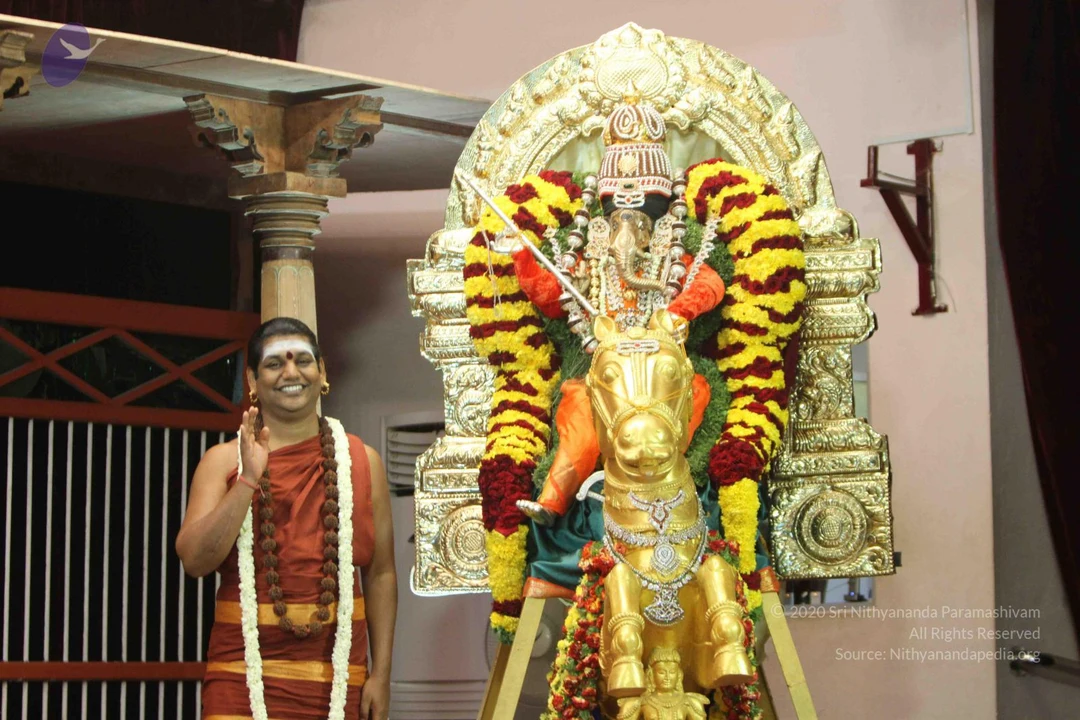
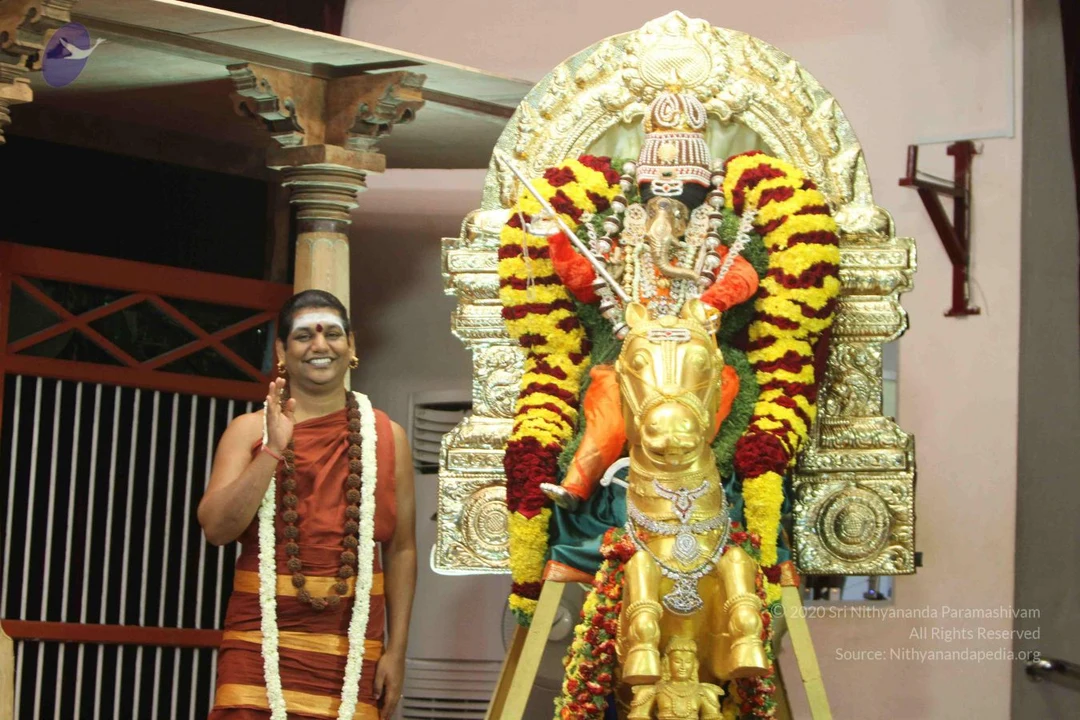
A photograph of a golden deity murti, a standing figure with a tall ornate crown and a silver-trimmed garment, draped with garlands of yellow, red and green flowers and an orange cloth across its body. A gilded arched halo frames the statue on a golden pedestal. Behind and above, a man in a rust-orange dhoti with gold borders and a white flower garland, wearing a rudraksha mala, stands with hands raised near the murti. A maroon cloth covers a table at left and a wooden pillar appears at right.A man in rust-red and gold-bordered dhoti and shawl stands beside a large gold-coloured deity murti on a horse with a sword raised, adorned with yellow and red marigold garlands and a silver arch behind. He wears a white flower garland, a rudraksha mala, a white forehead mark with red bindi, and smiles while raising his right hand in greeting. Setting is an indoor stage with red draped cloth and a wooden pillar.A smiling man in a rust-orange sannyasi cloth with a gold-striped border stands at left, waving with his right hand. He wears a rudraksha mala, a white flower garland, vibhuti marks on his forehead and gold earrings. Beside him is a large golden statue of a horse-mounted deity with a trident, ornate silver necklaces and a dark green cloth, decorated with yellow and red marigold garlands. The deity figure has a tall decorated crown and a golden arched shrine backdrop, with a small figure at the horse's base. a person: the man has a shaved head, rudraksha mala and orange-saffron robe, but the appearance is not certain enough to confirm.A smiling man with a shaved head and white tripundra marks stands at left, raising one hand in greeting. He wears a rust-red and saffron-striped dhoti with a matching shawl and a long white flower garland, plus rudraksha beads. Beside him is a golden deity murti seated on a golden horse-like mount, adorned with silver ornaments, a crown, a raised sword, and elaborate garlands of red and yellow marigolds. The background is a golden arched shrine frame and a pillar. Two people are visible total: the standing man and a small figure at the statue's base, the latter partially visible.

Darshan/IA Session

68 photosSource gallery
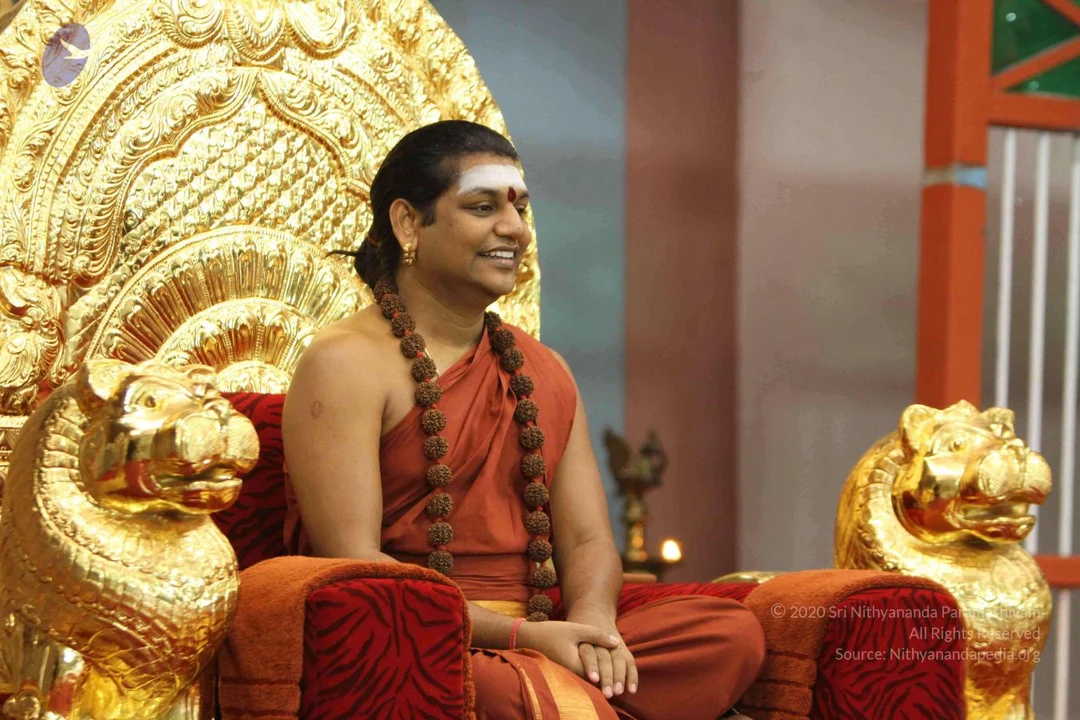
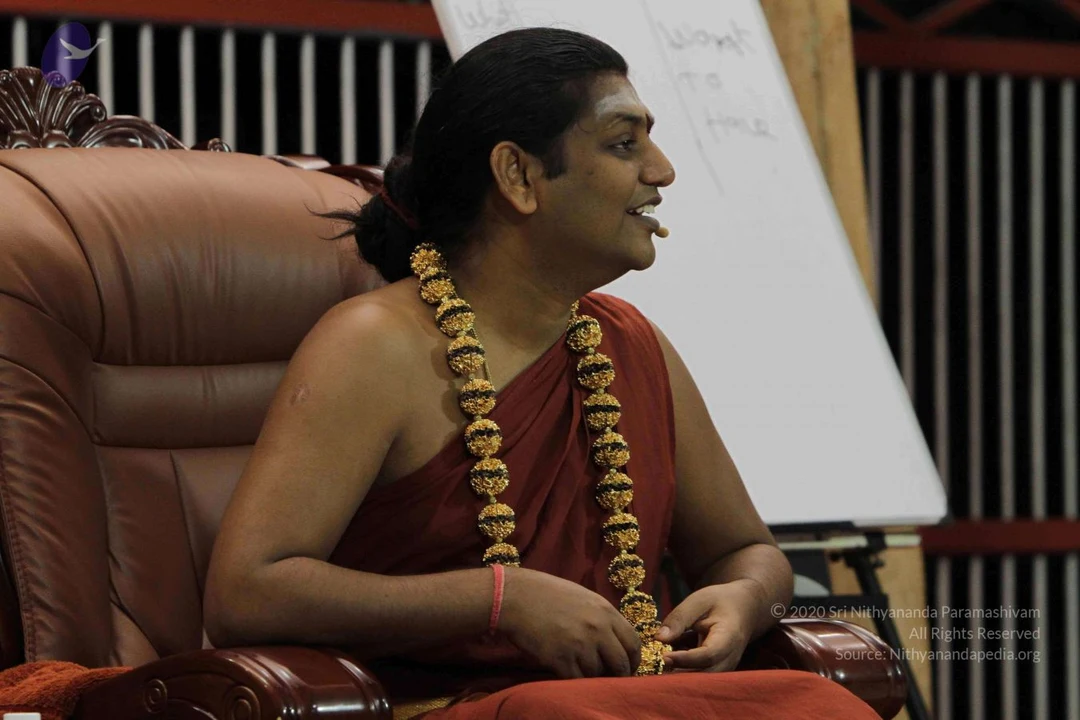
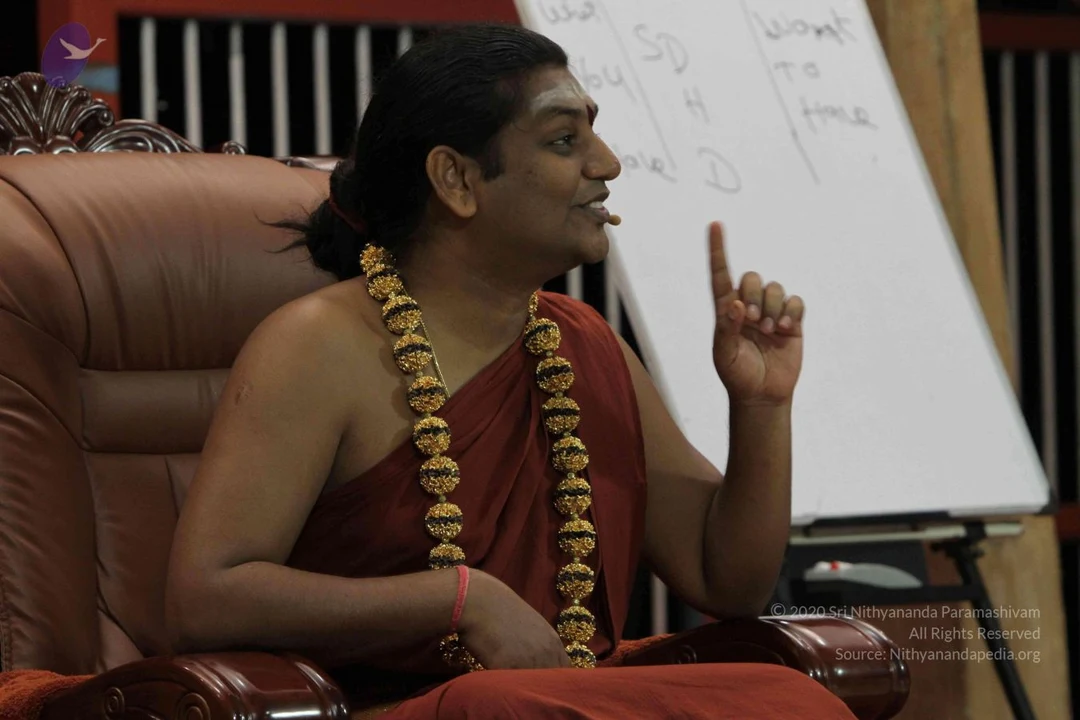
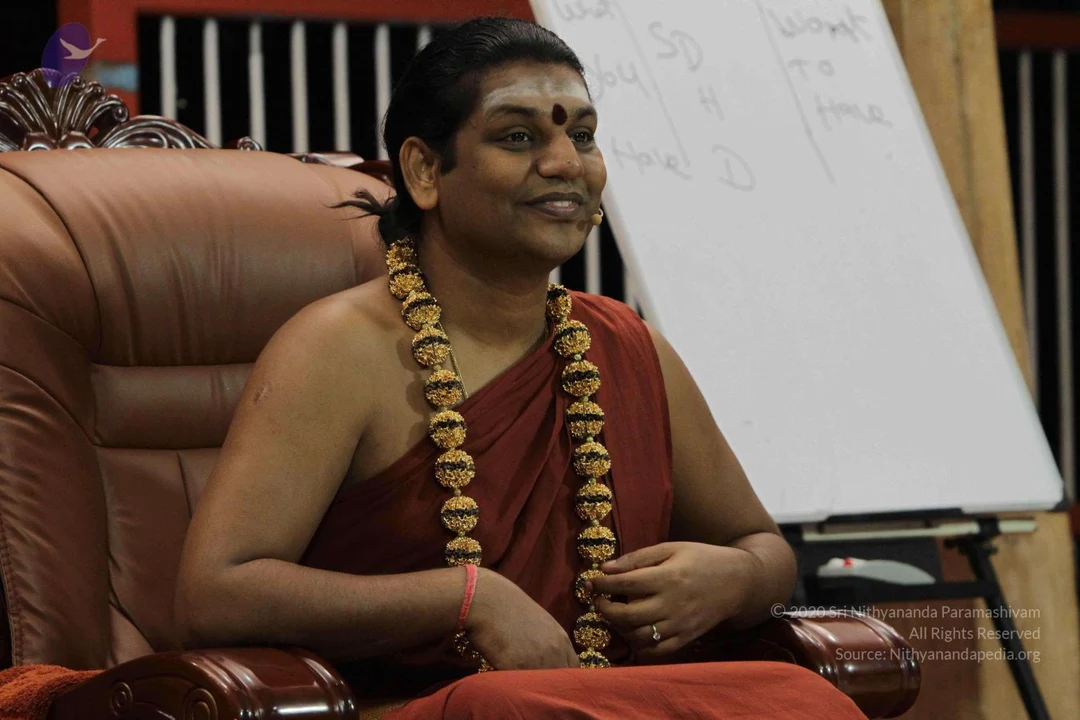
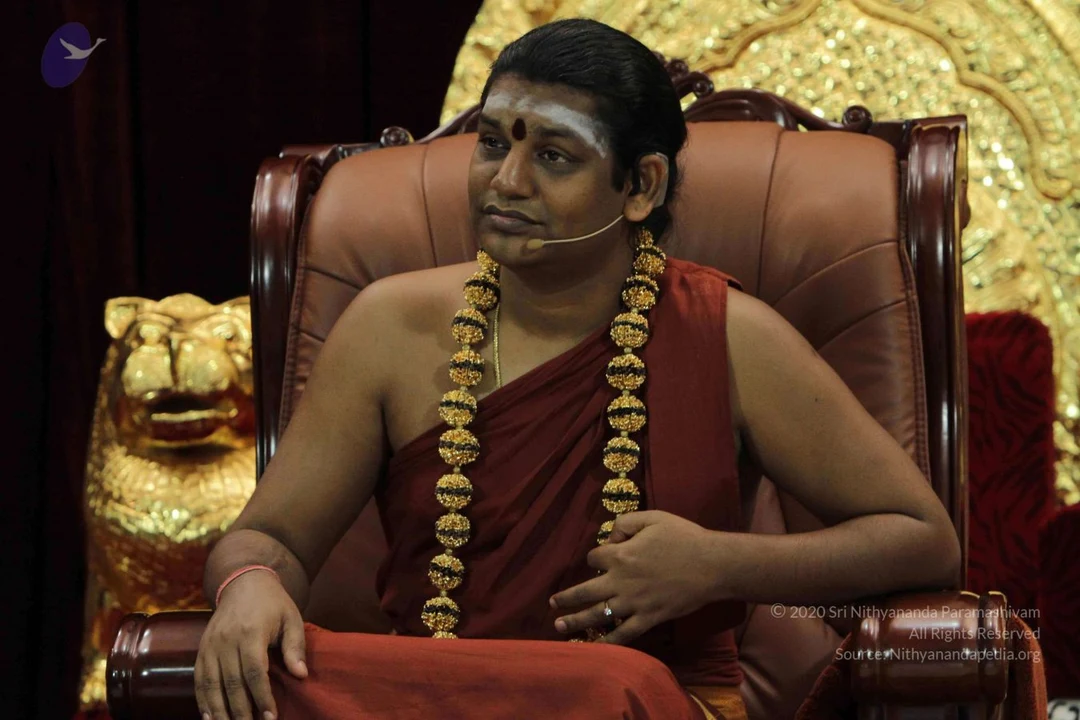
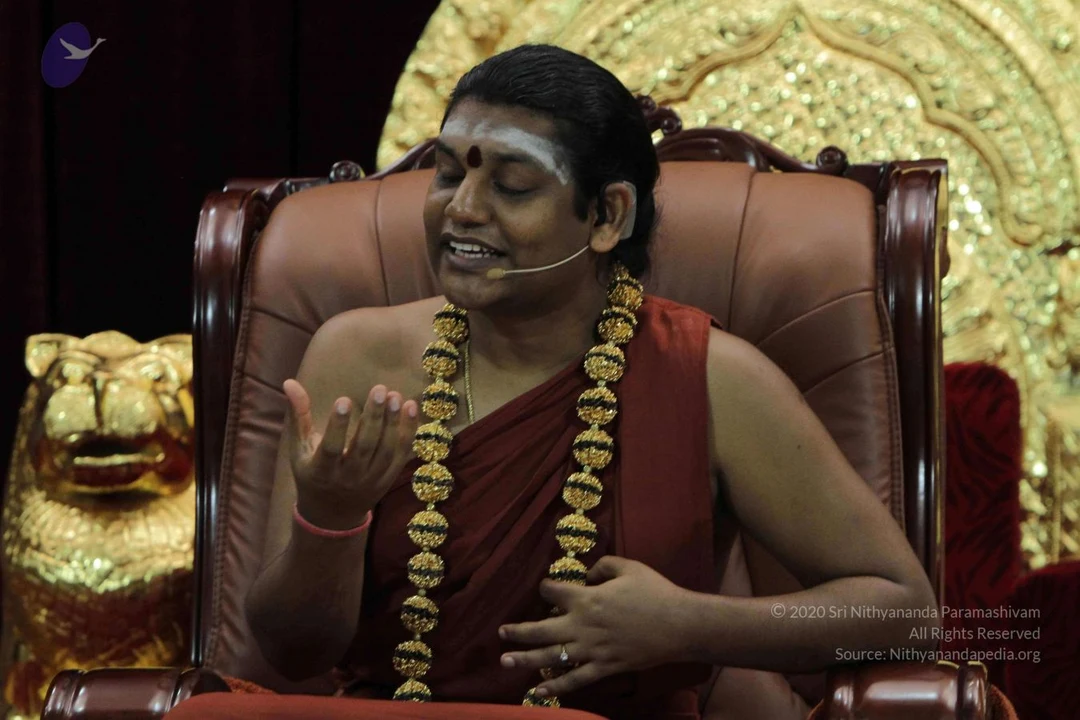
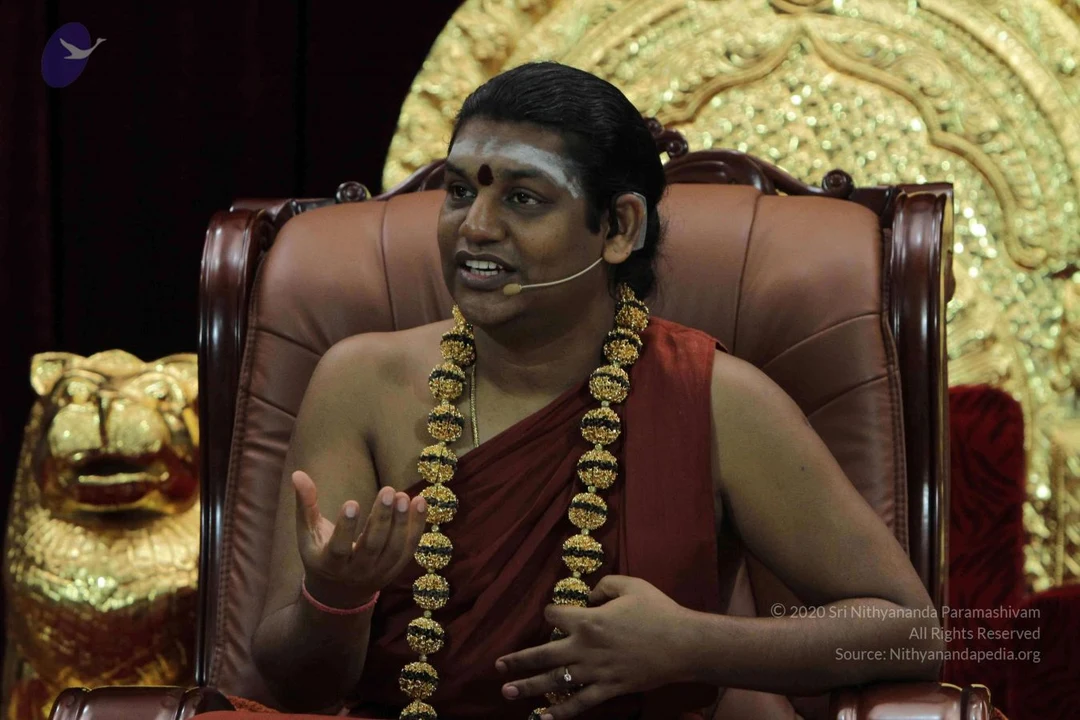
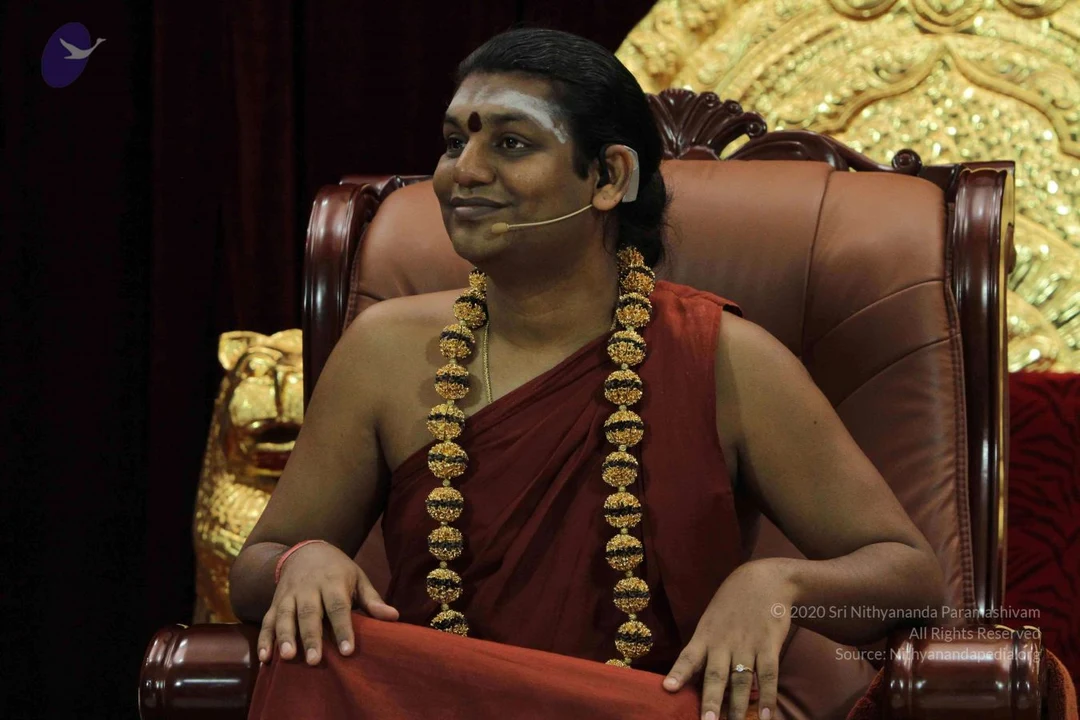
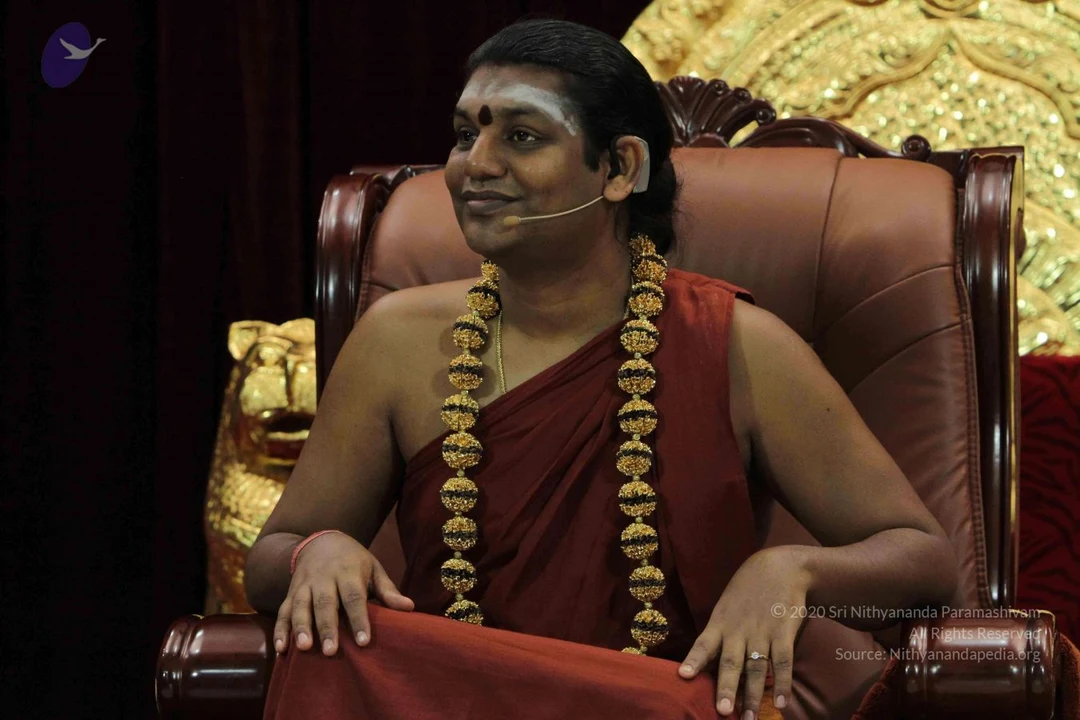
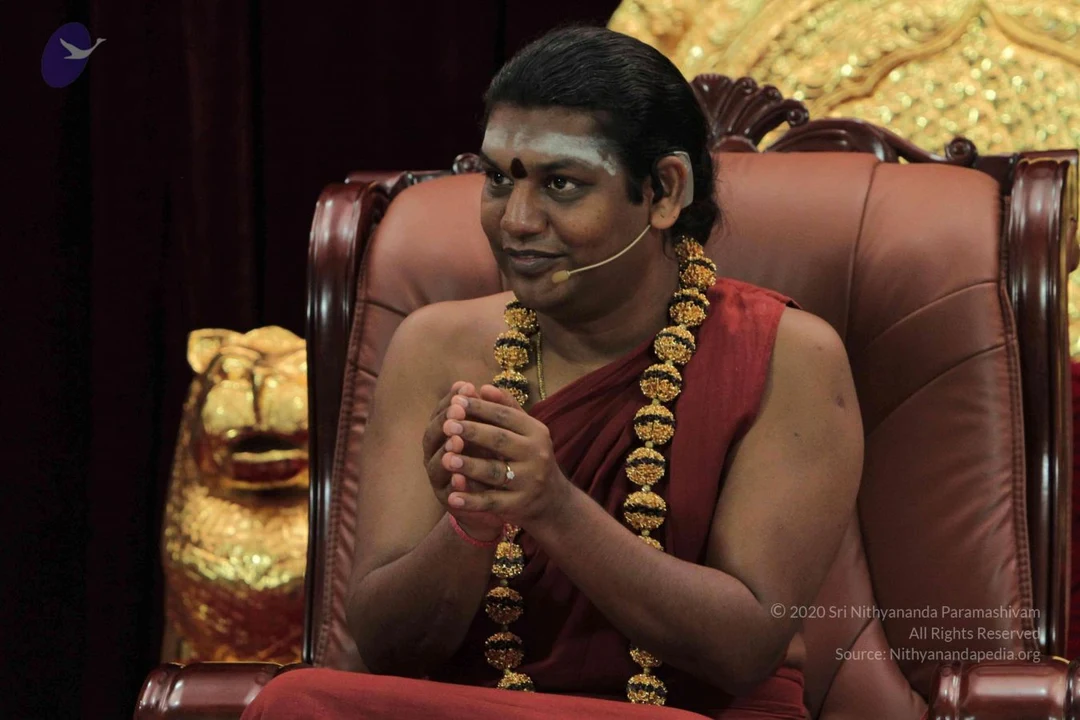
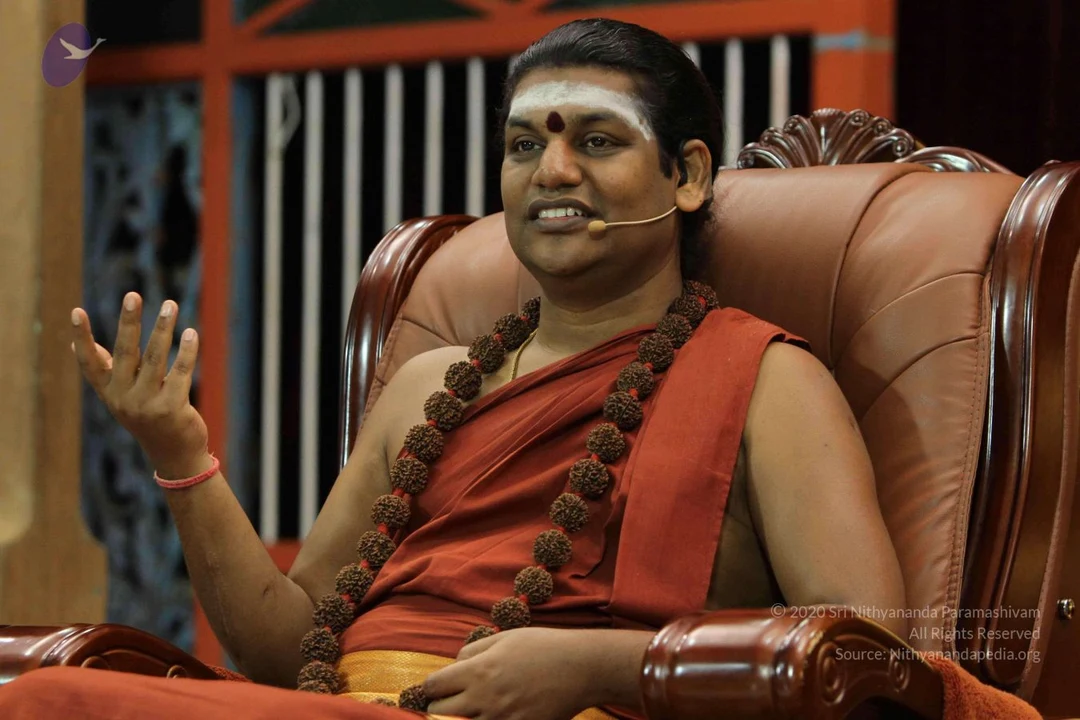
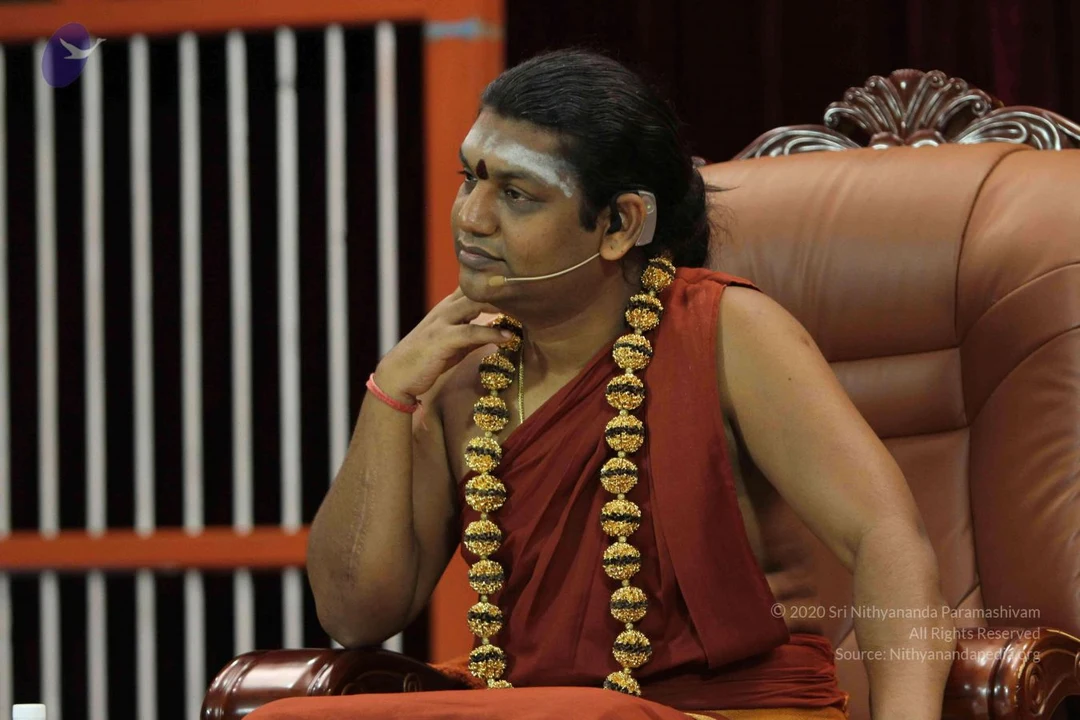
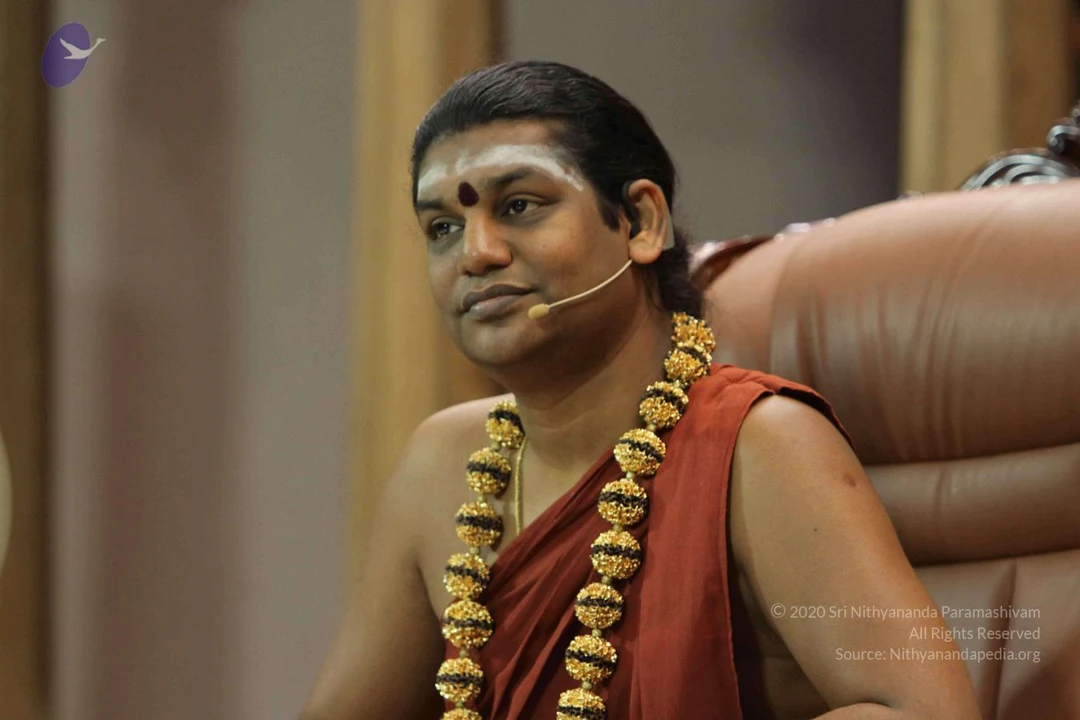
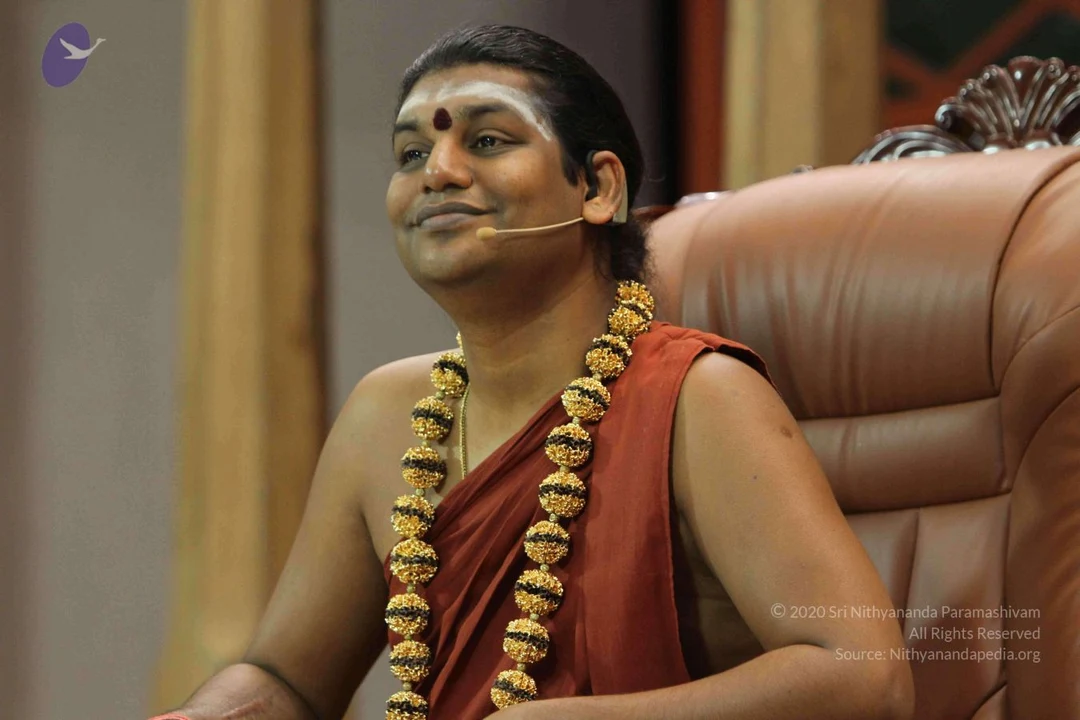
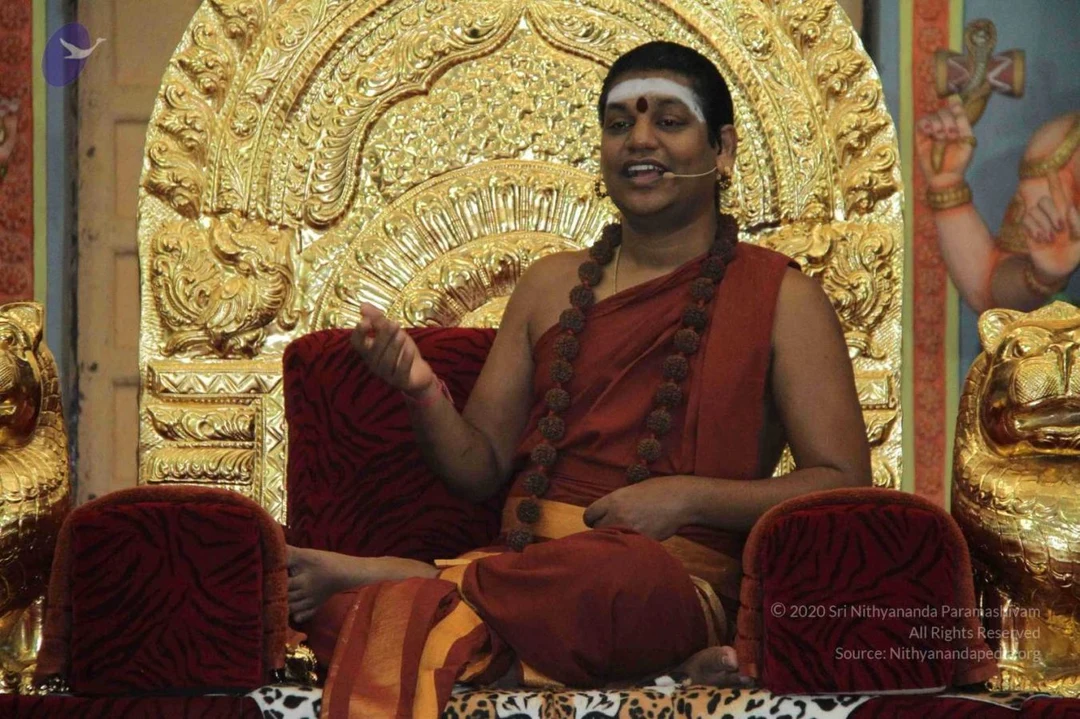
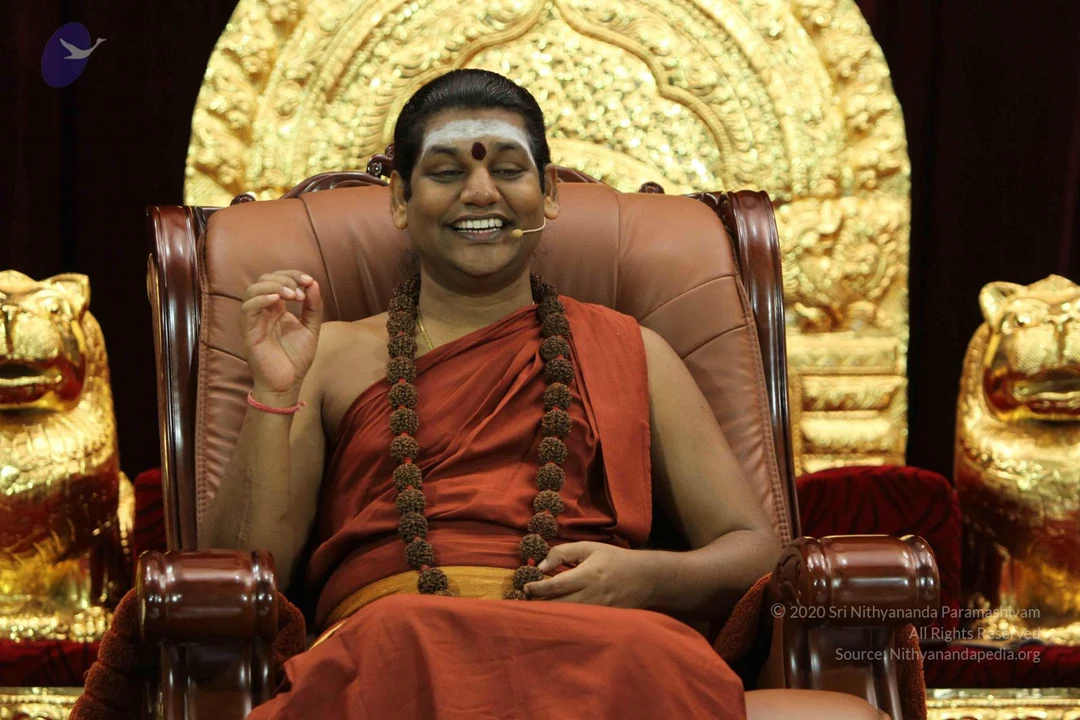
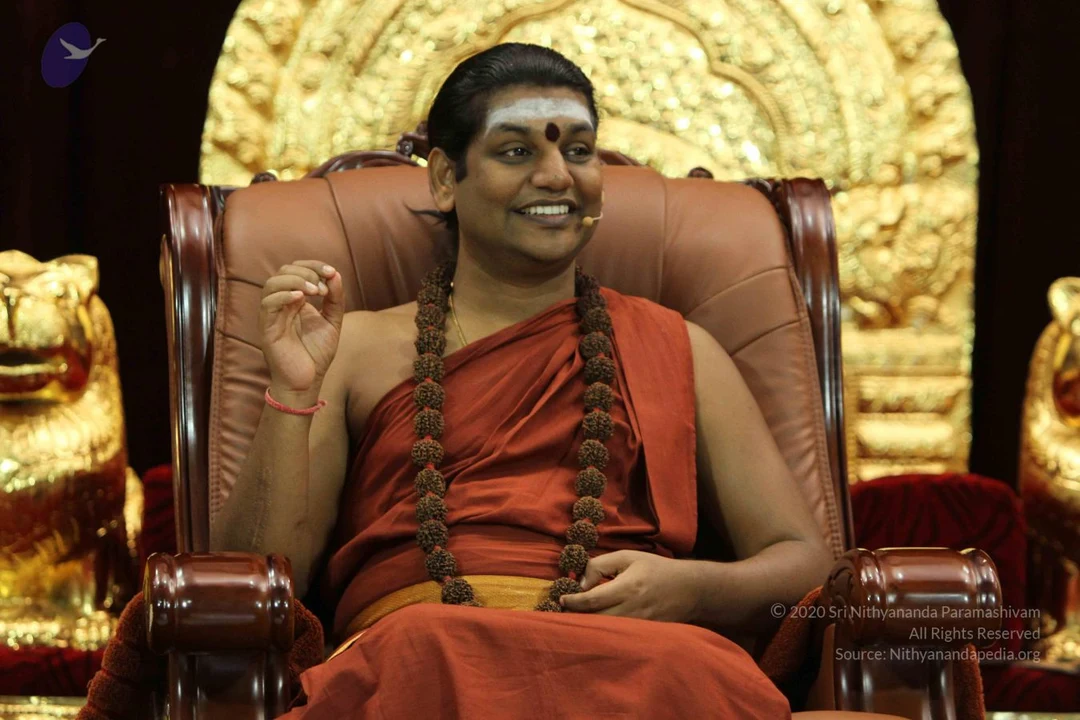
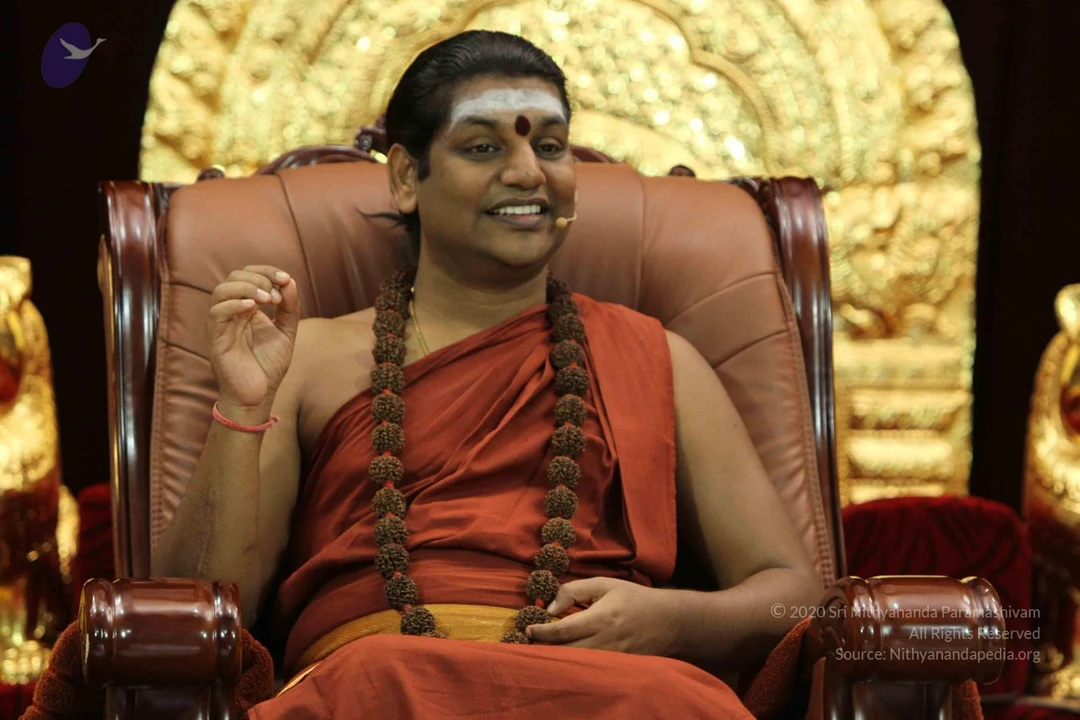
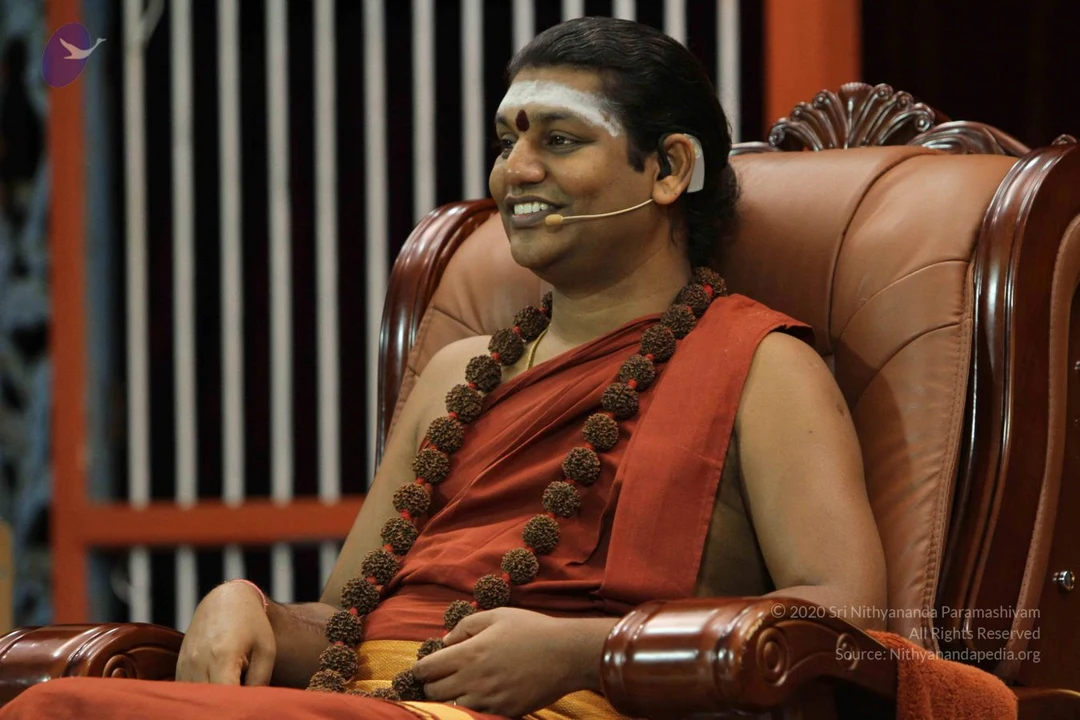
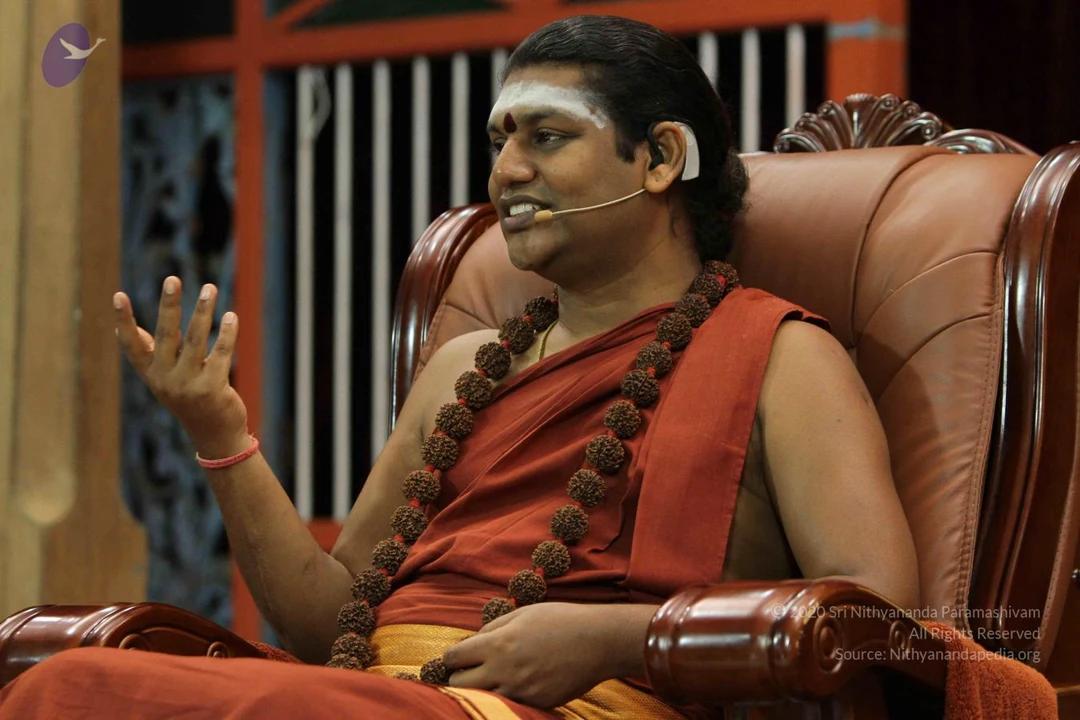
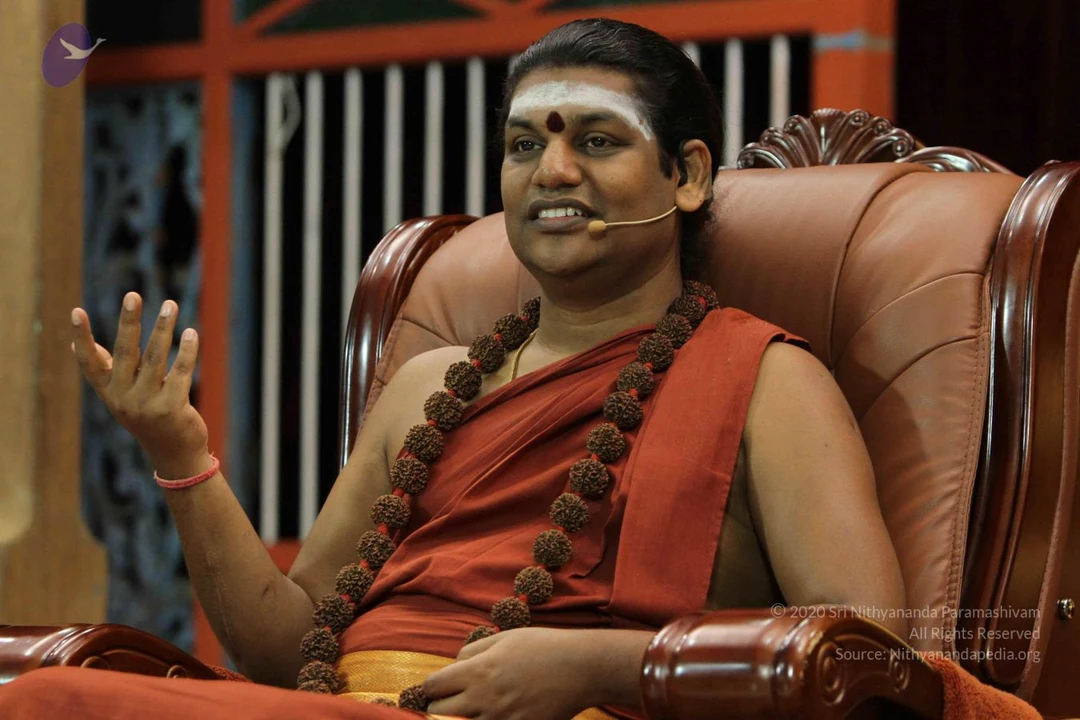
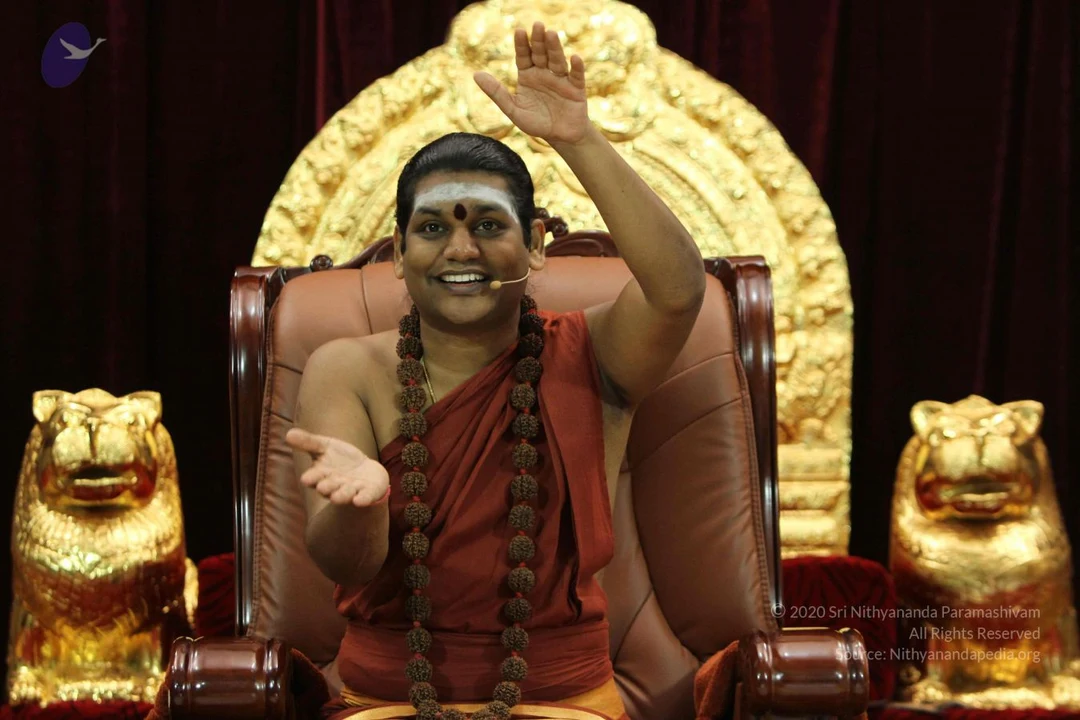
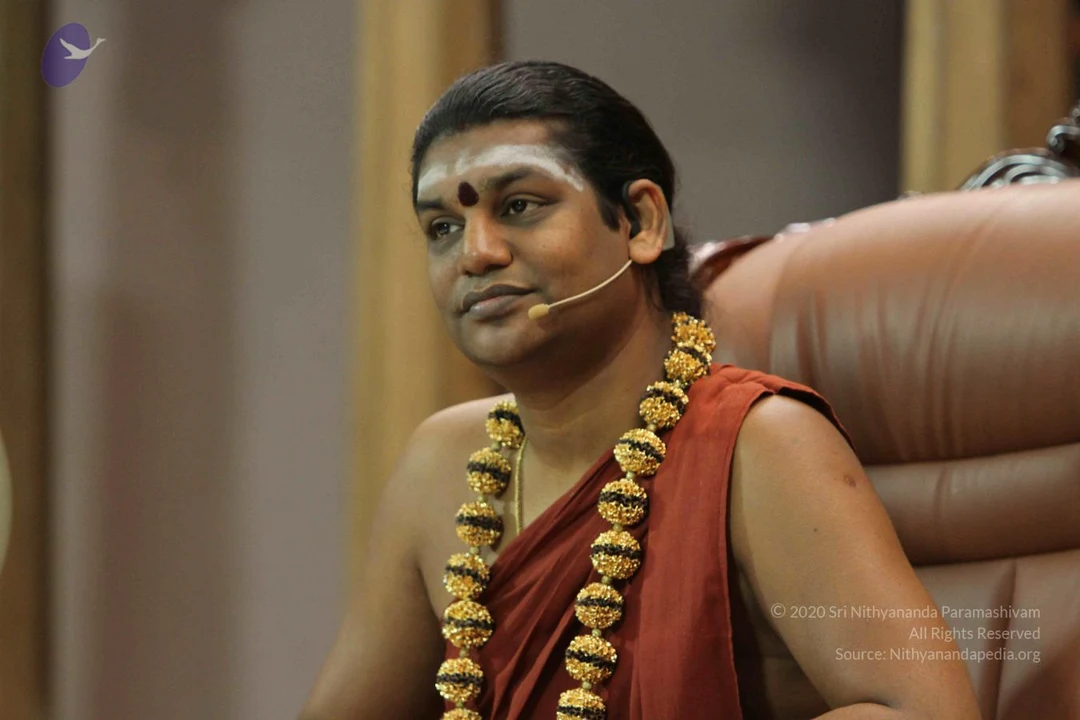
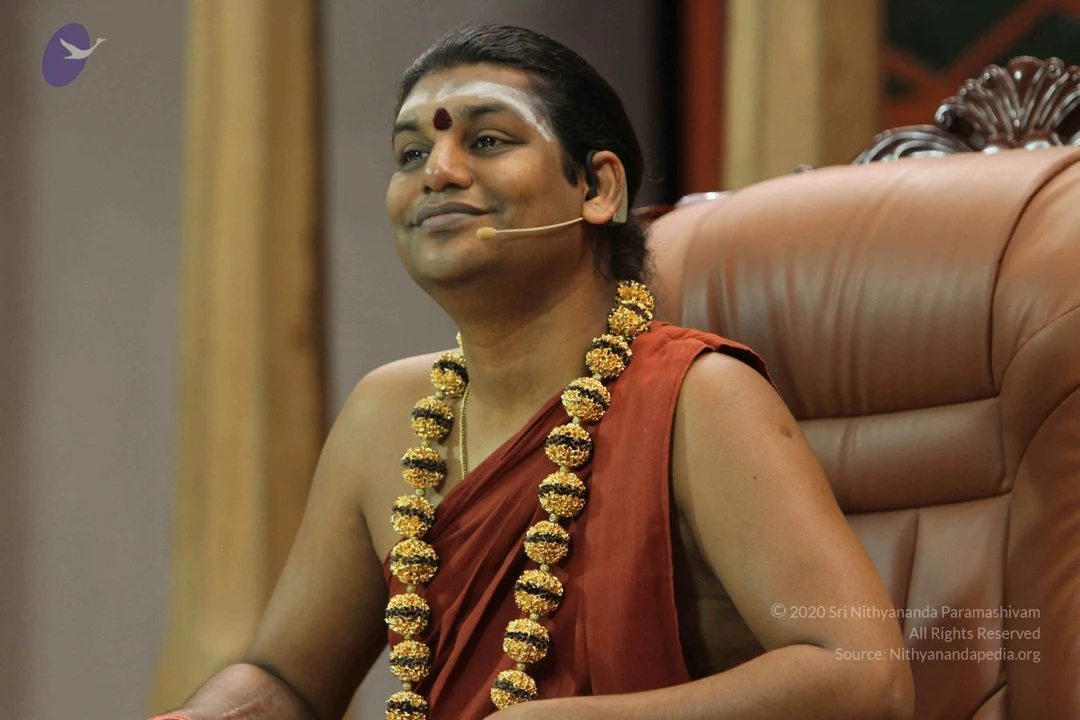
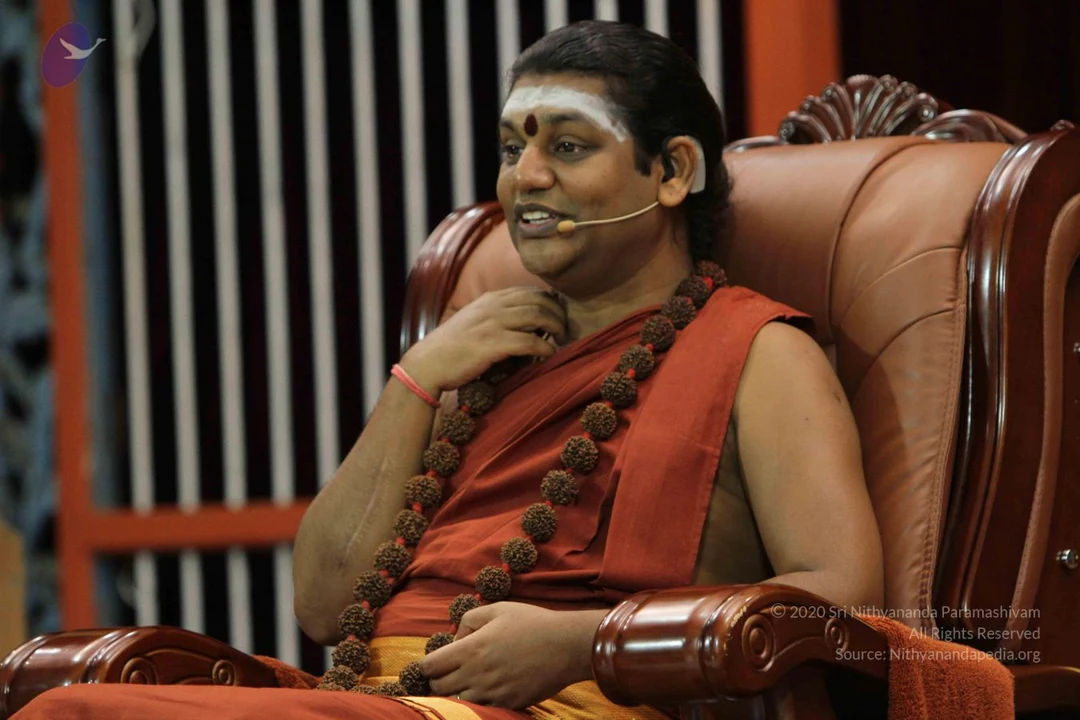
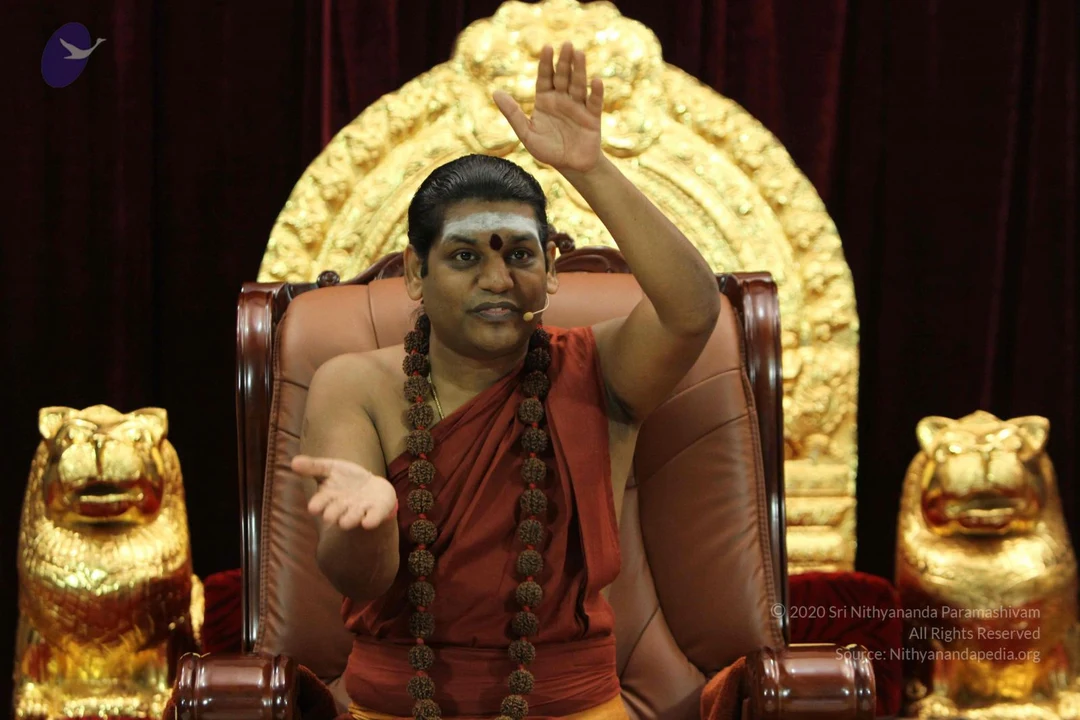
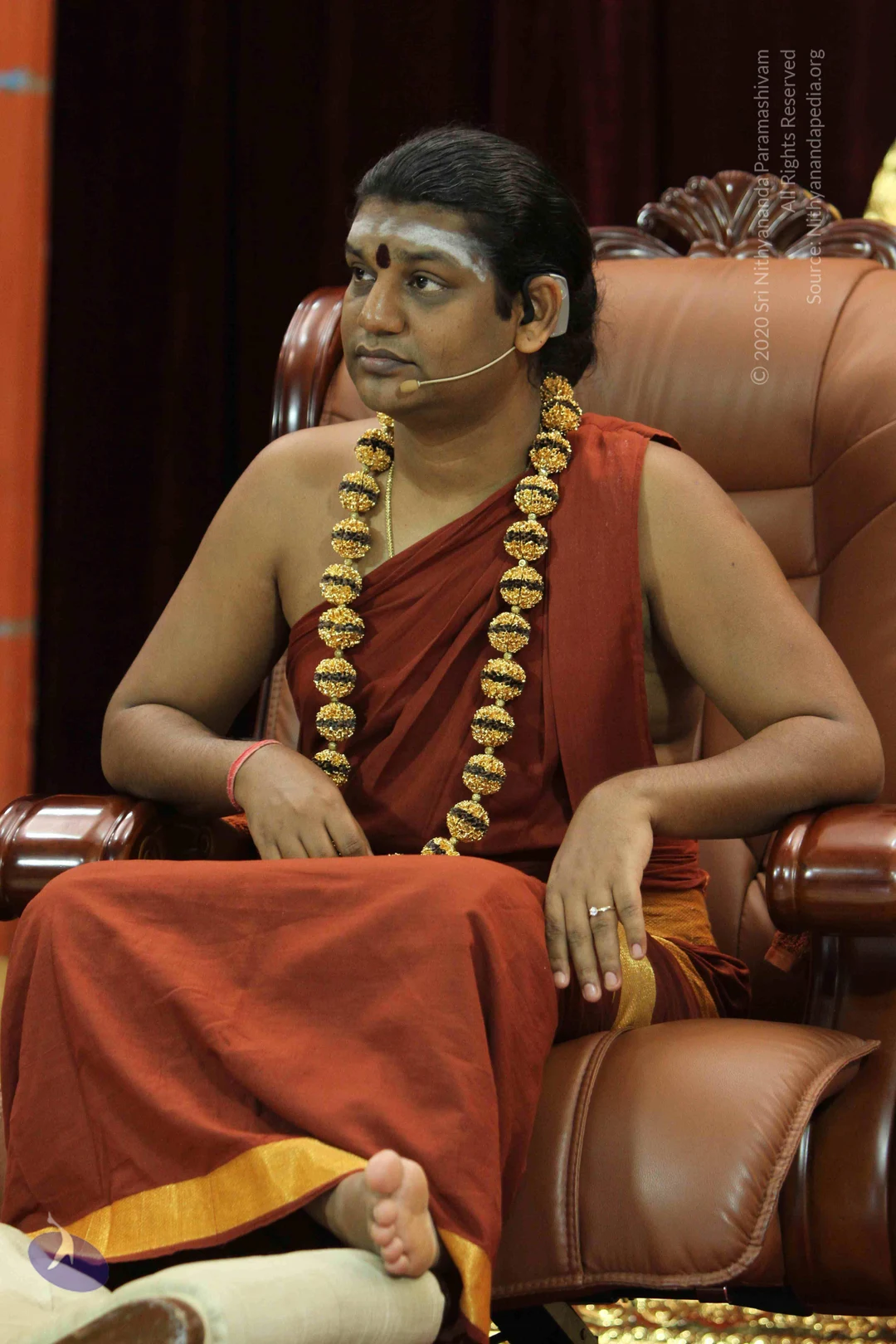
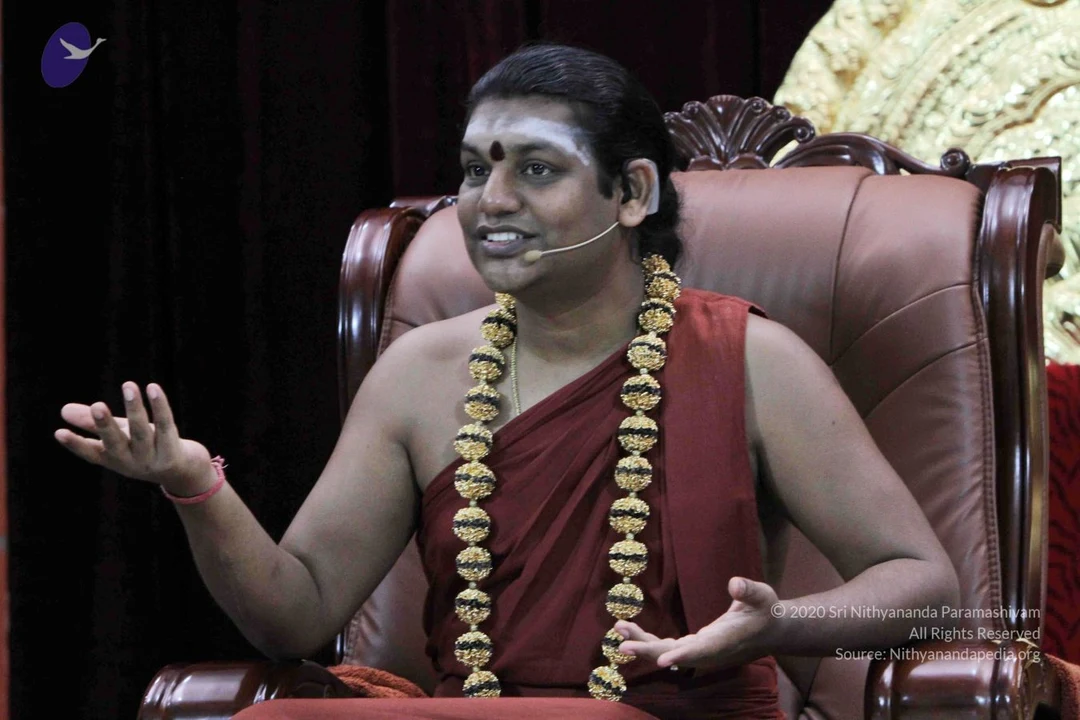
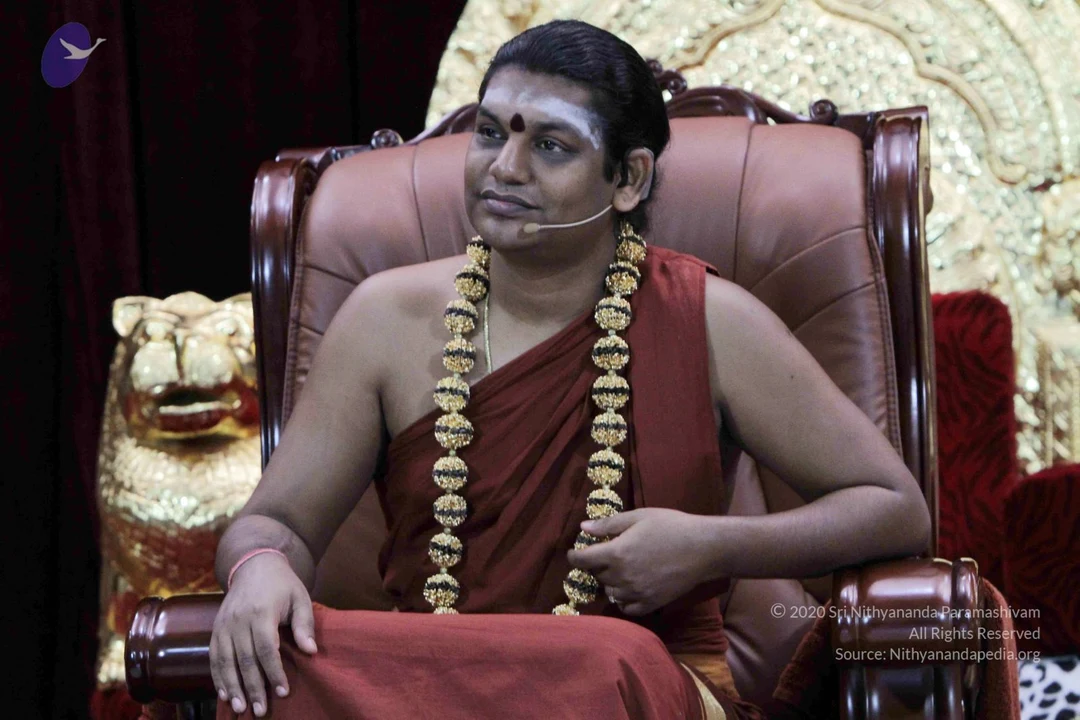
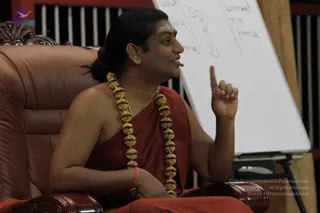
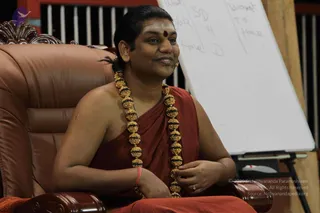
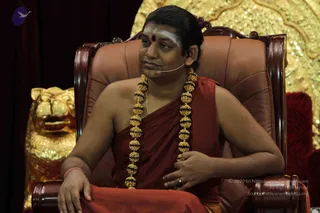
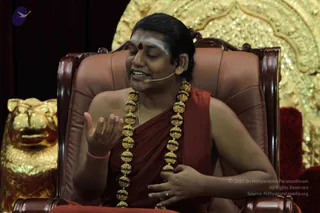
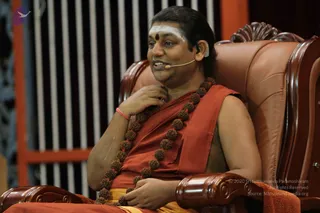
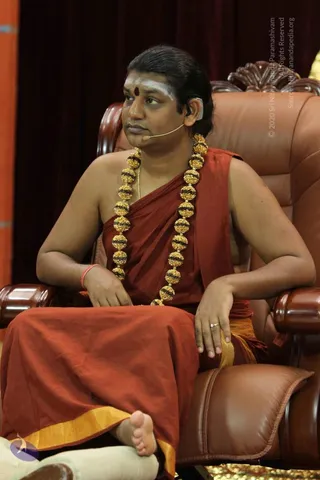
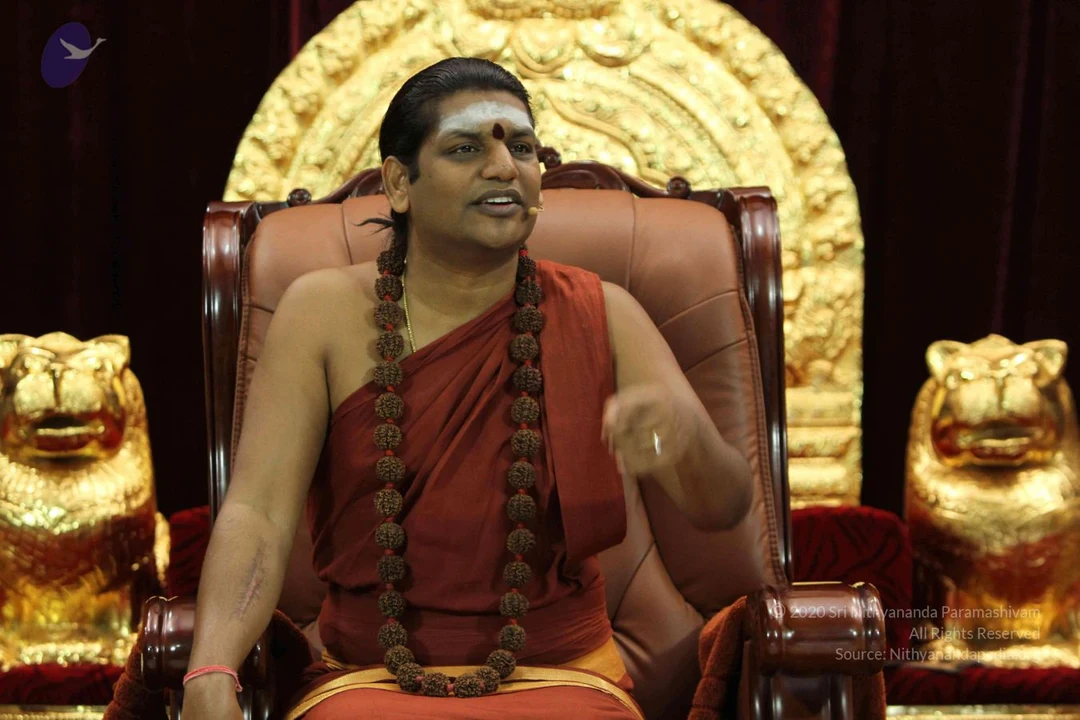
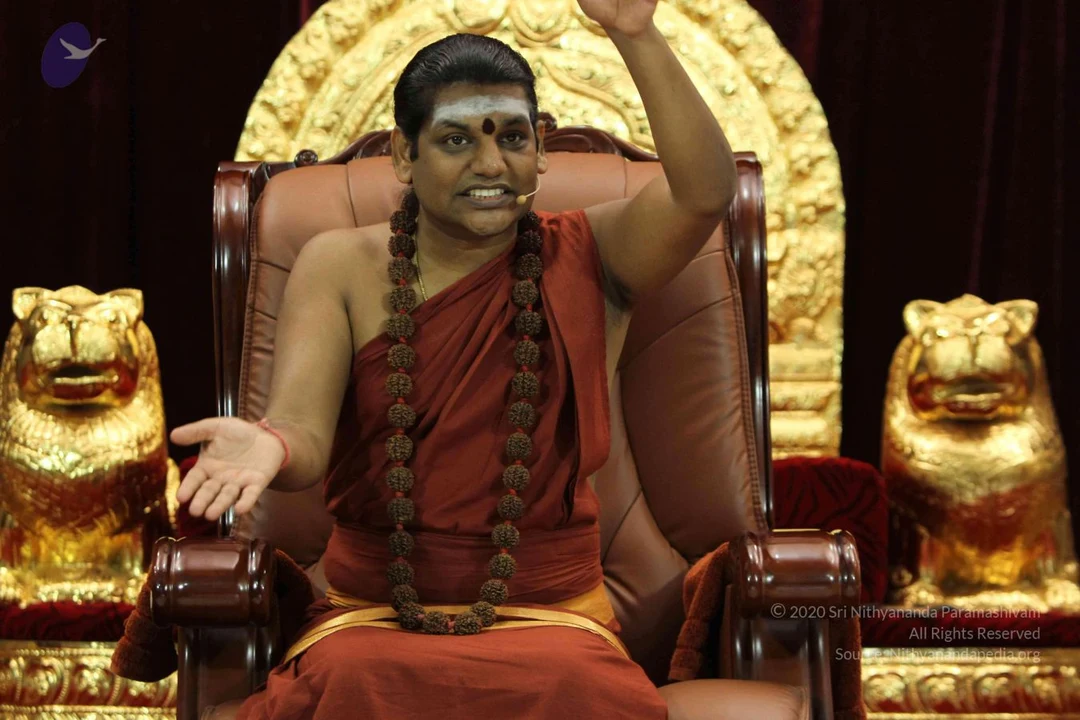
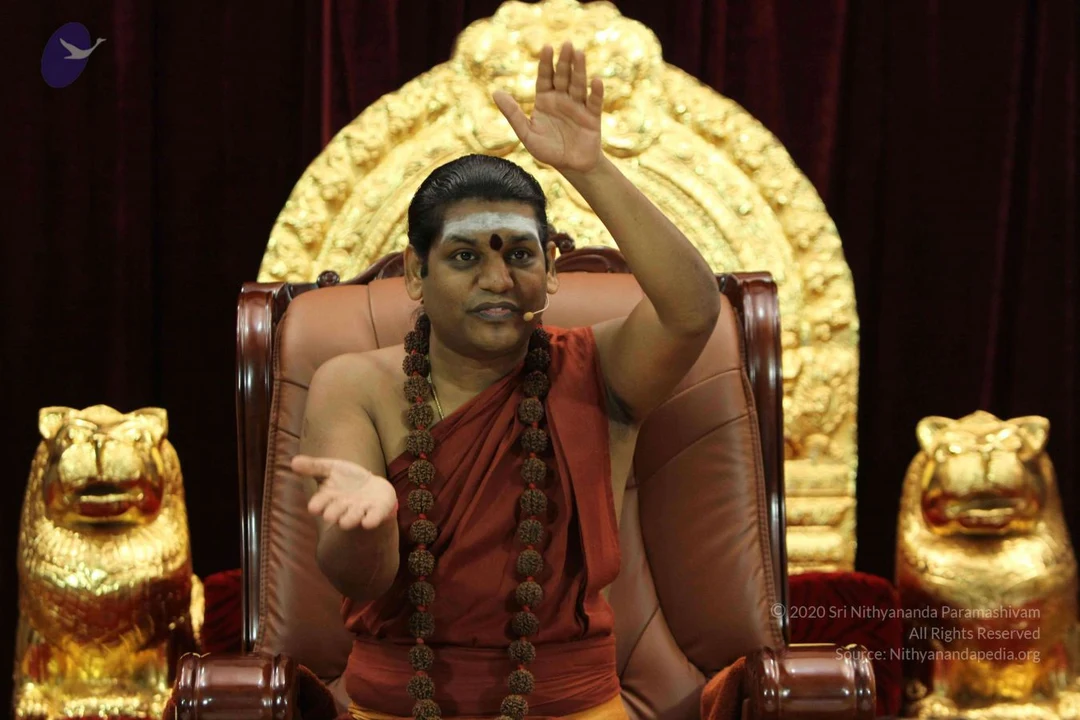
A photograph of a man seated in a brown leather armchair with carved wooden trim, speaking into a small headset microphone. He wears a rust-red draped cloth over his shoulder and a long necklace of gold-toned beaded spheres with dark bands, and a pink wristband. His hair is pulled back in a bun, and a white board with handwritten text sits behind him. Appearance-based label: Swamiji (probable) — seated in the chair giving a satsang talk, identified by the saffron-red robe, gold beaded mala, and swept-back hair.A man seated in a brown leather armchair gestures upward with his right index finger while speaking into a headset microphone. He wears a rust-red saffron-toned shawl draped over bare shoulders and a long garland of gold and black beaded ornaments across his chest. His hair is pulled back in a low bun, and he has a horizontal vertical marking on his forehead. Behind him stands a white flip chart with handwritten notes in black marker, and a red bracelet is visible on his left wrist. A satsang discourse setting is implied by the chart and microphone. a person: a teacher seated for discourse, identified by the saffron shawl, gold-bead garland and bun.A person seated in a brown leather armchair during a satsang session, wearing a rust-red draped robe bare over one shoulder and a long necklace of gold-toned beaded spheres with dark bands. A red bindi marks the forehead and a small microphone clips near the ear. Hands rest in the lap, and the person smiles while looking off to one side. A whiteboard with handwritten notes stands behind, on a metal easel. a person: long dark hair swept back, rudraksha-style gold beaded mala and rust-orange robe match the presentation, though the face is not shown clearly enough to confirm identity.A photograph of a seated man in a leather-upholstered wooden armchair with a carved frame, in front of an ornate gold-painted backdrop and a golden lion sculpture. He wears a rust-red sleeveless robe, a long necklace of gold-and-black beaded rudraksha-style malas, a thin gold chain, a small red bindi and white vertical tilak markings, and a small clip-on microphone. His right hand rests on his thigh and his left arm rests on the chair arm, and he gazes off to the side. The setting resembles a satsang hall. Several cues (gold-beaded malas, red robe, swept-back hair, ceremonial throne setting) are consistent with the page's Swamiji reference, so this is probable Swamiji (probable) seated in a throne-like chair.A man seated on an ornate brown leather throne with dark carved wooden arms speaks during a satsang. He wears a rust-red sleeveless robe with a bare right shoulder, a long necklace of gold-toned beads with black accents, a small red bindi and white forehead markings, and a pink bracelet on his wrist. A small clip-on microphone is attached near his face. His right hand is raised in a gesture while his left rests on his chest. Behind him stands a large gold-toned ornamental backdrop and a gilded lion-faced armrest figure on the left. Swamiji (probable): the seated speaker has long swept-back hair, ornate gold beaded adornment and saffron-toned robes, consistent with the page's description of a discourse.A man seated on a brown leather throne-style chair speaks while gesturing with his right hand, a small lapel microphone clipped near his mouth. He wears a rust-red robe over bare shoulders and a long necklace of gold-capped dark beads, and has white horizontal tilak marks with a red dot on his forehead. Behind him a large ornate golden relief panel and a golden lion sculpture flank the chair, with dark red drapery at the sides. The setting suggests a seated satsang discourse.

Kalpatharu Darshan

27 photosSource gallery
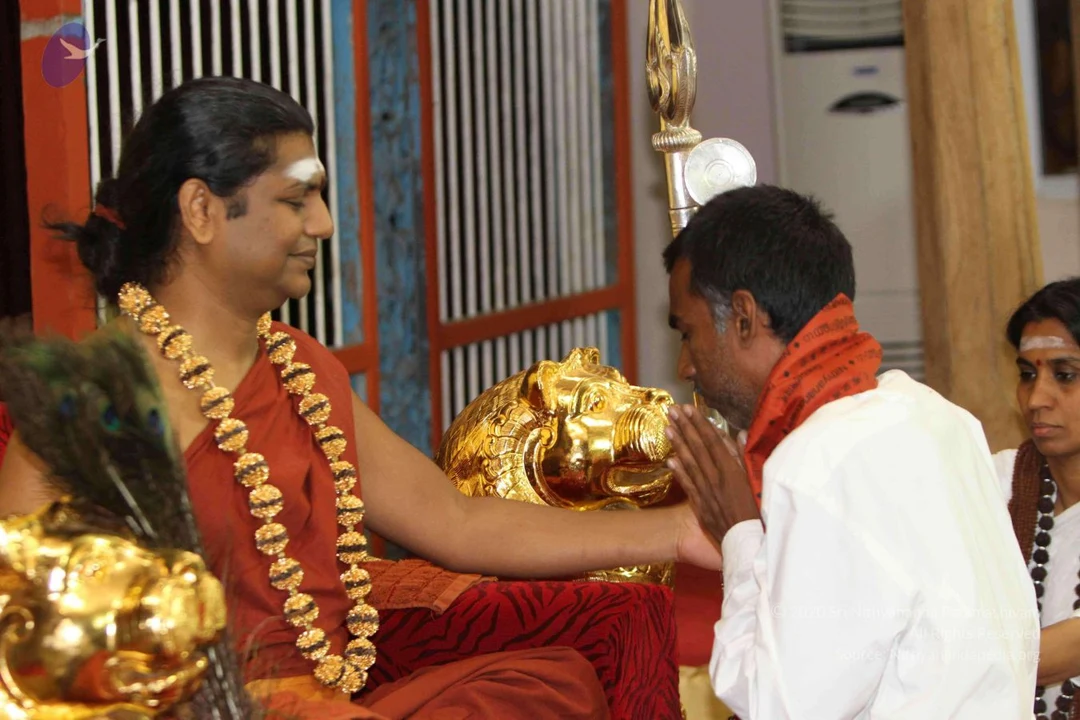
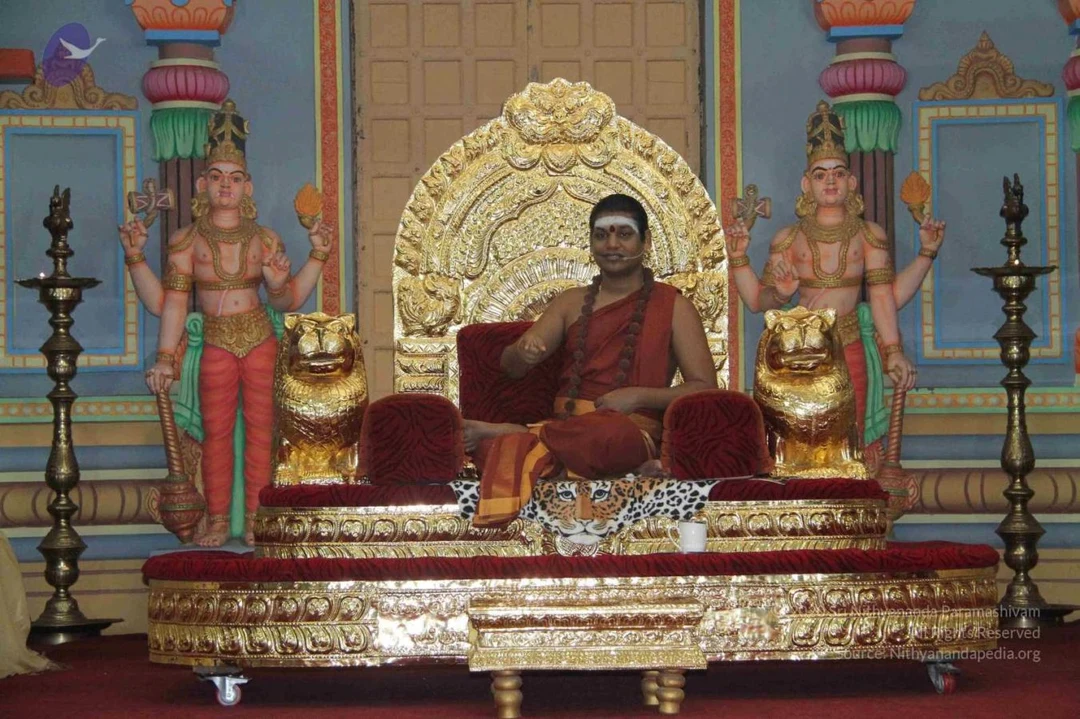
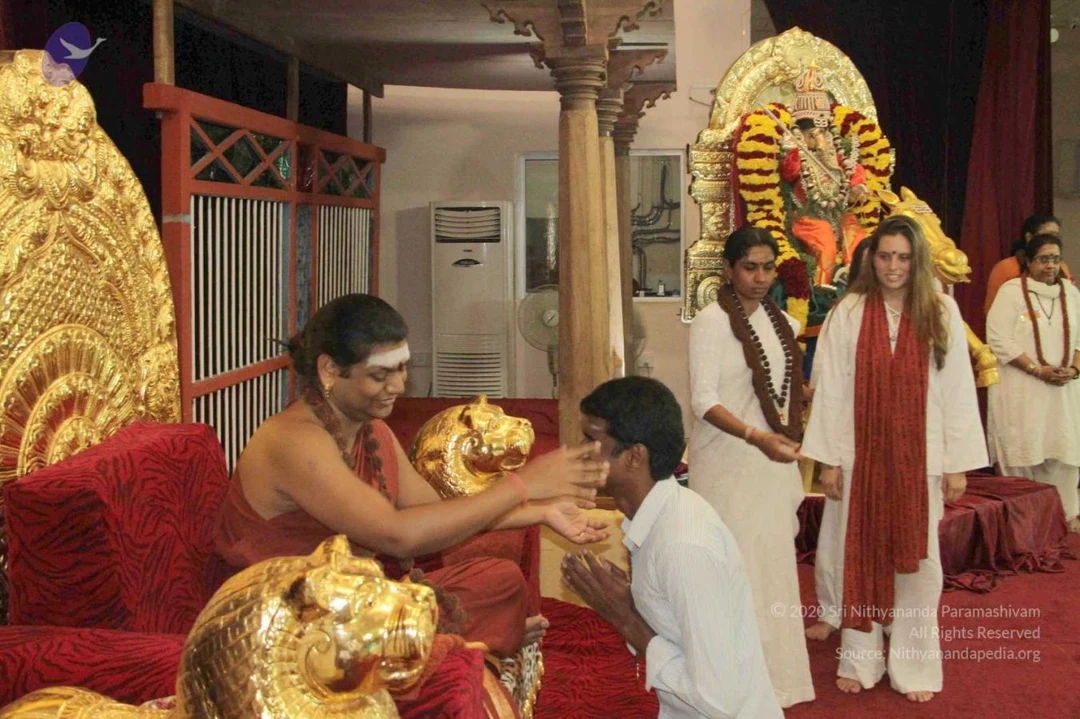
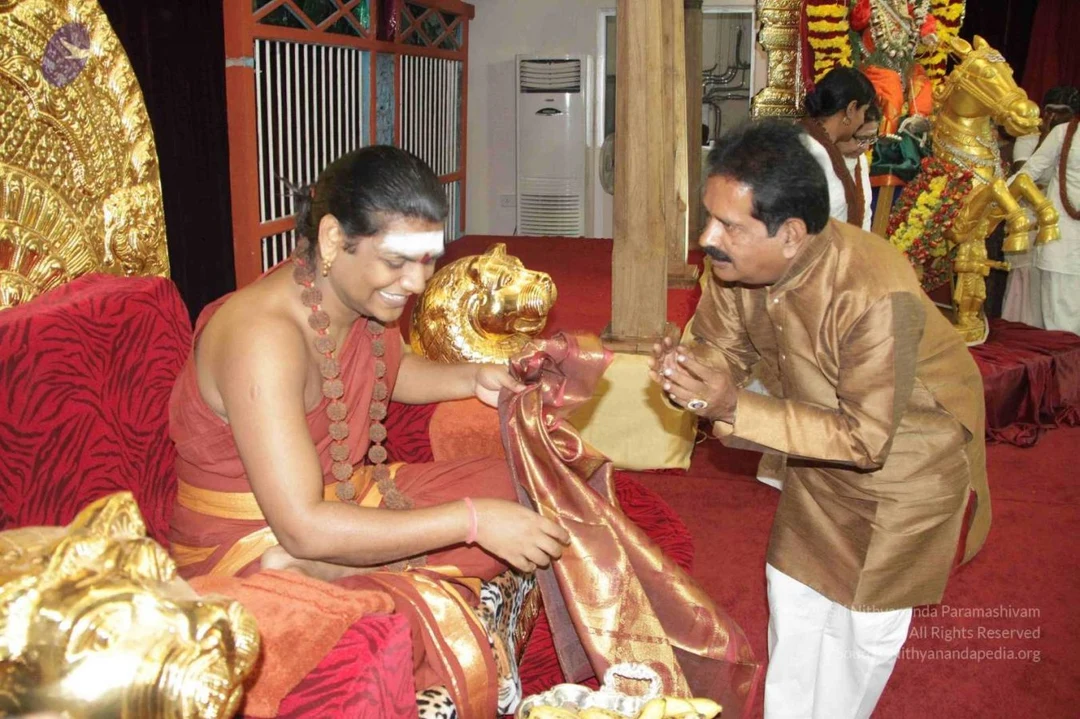
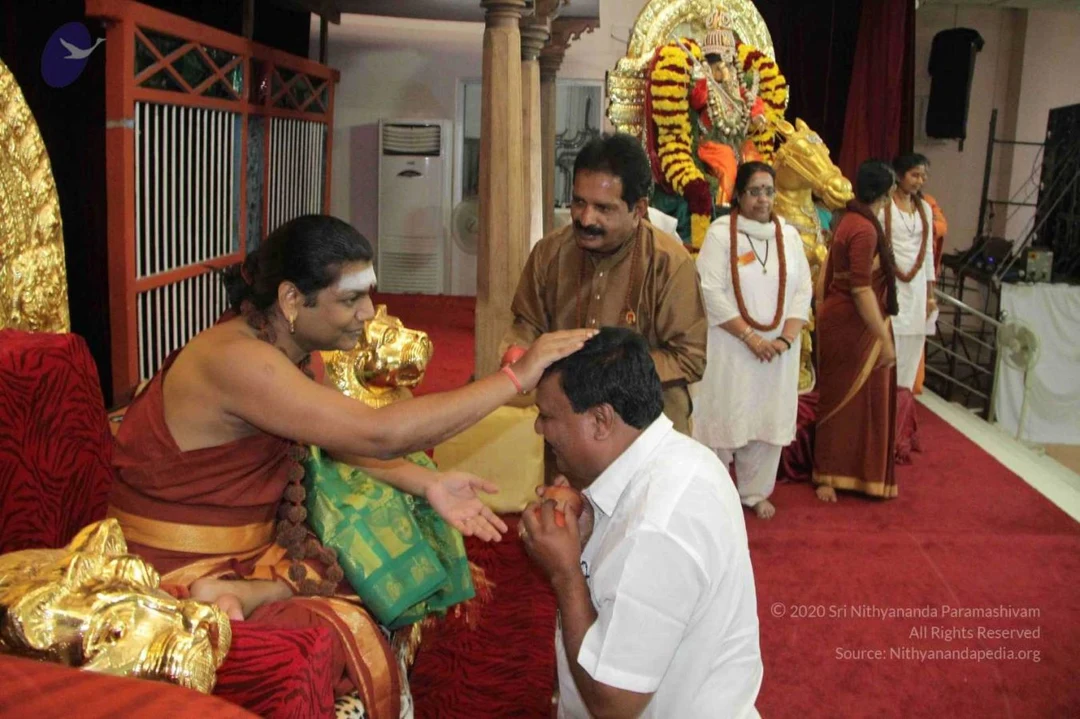
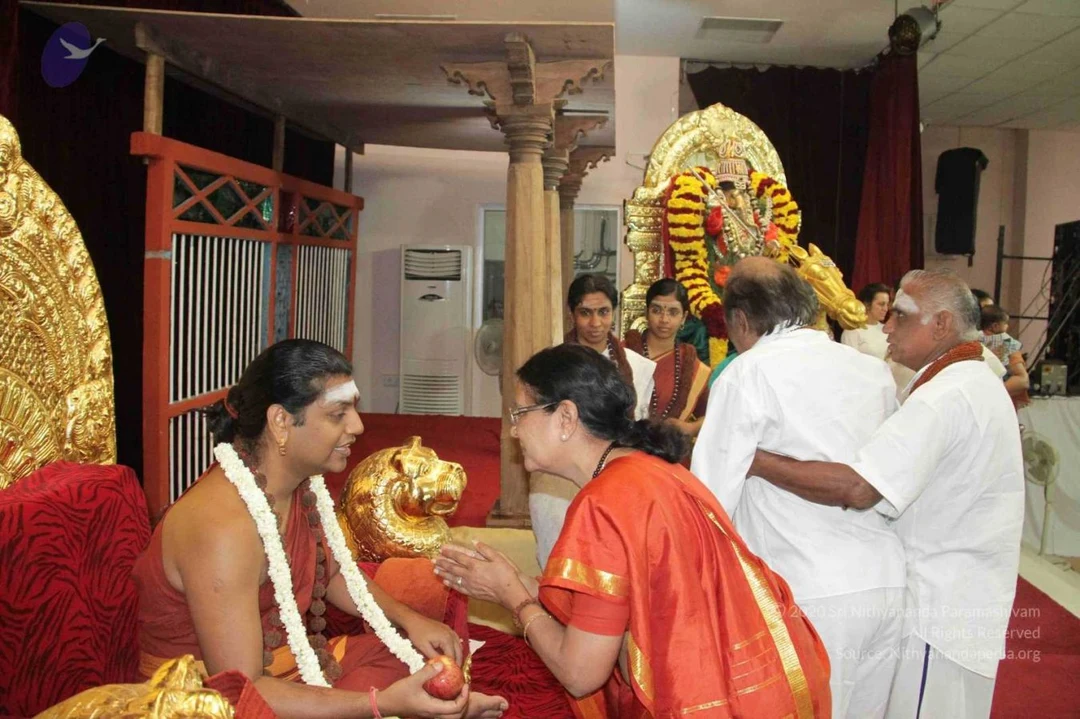
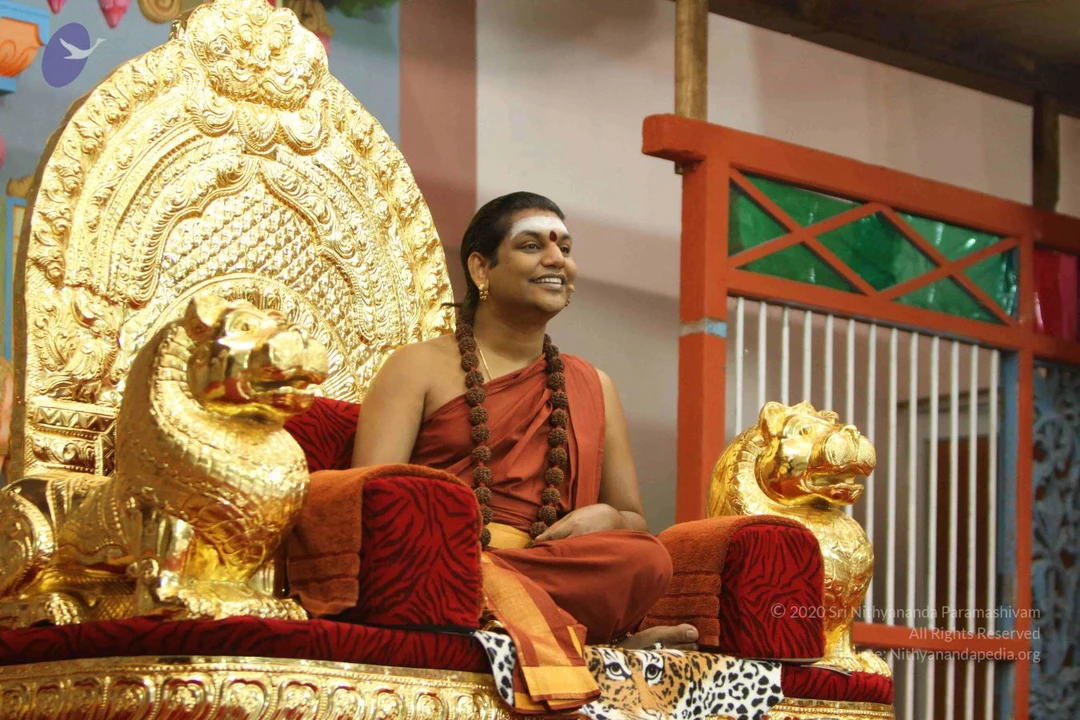
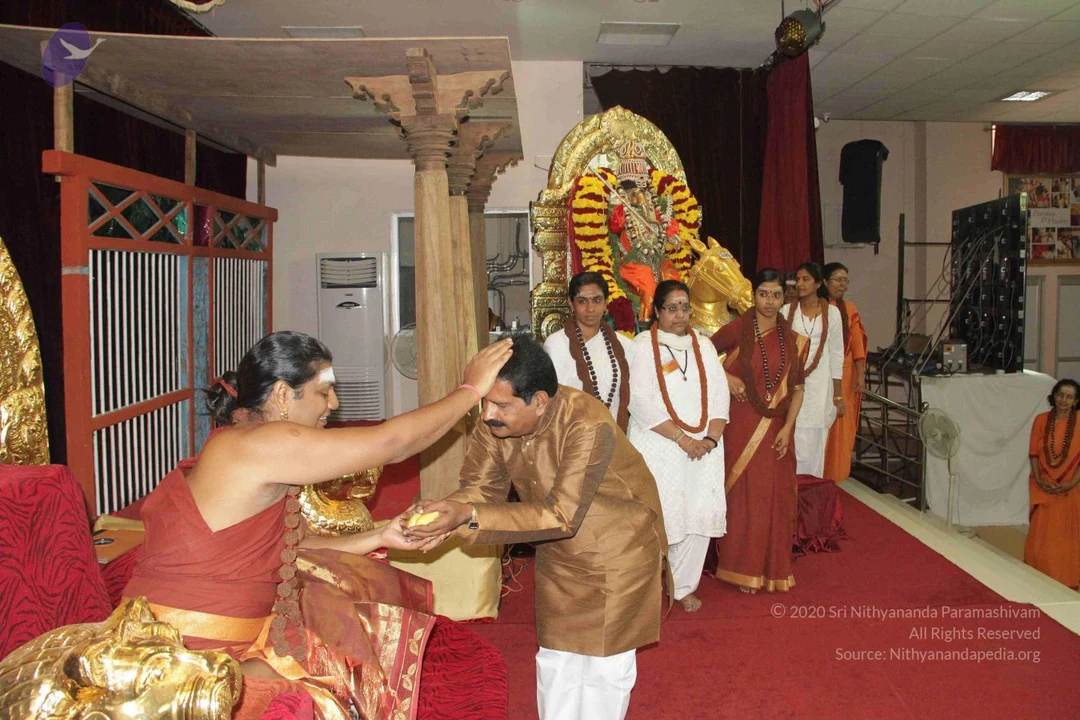
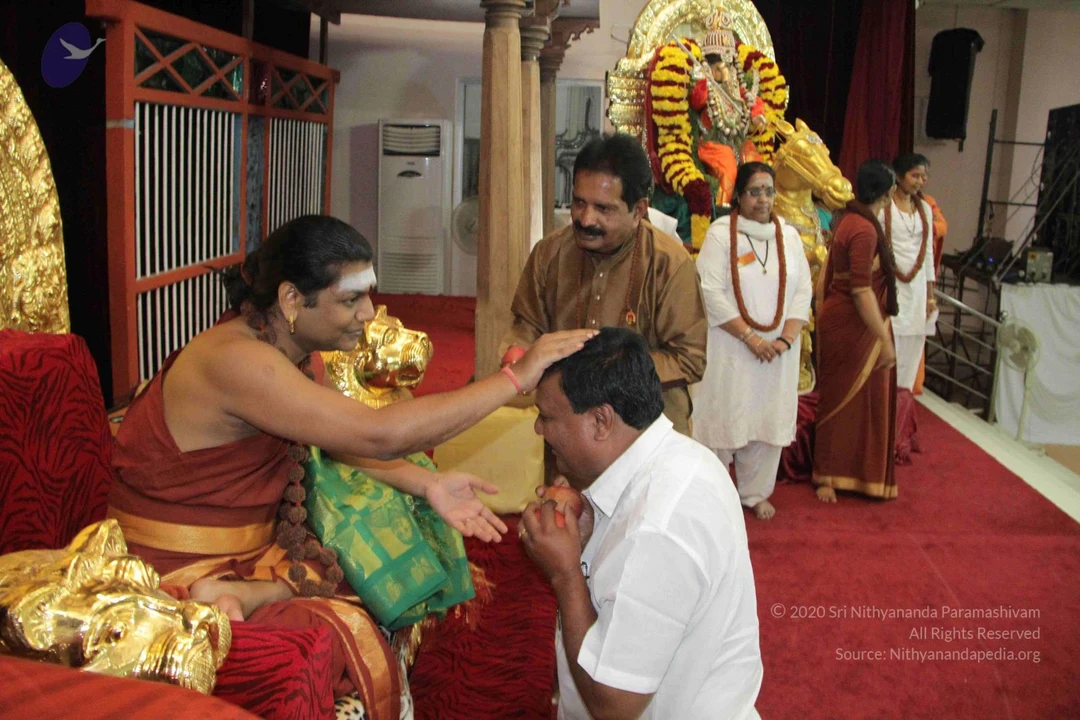
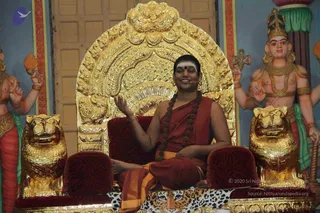
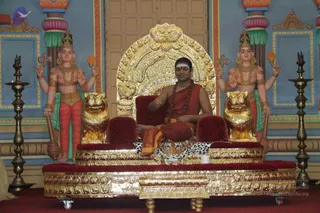
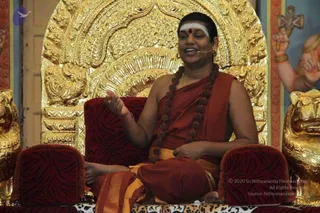
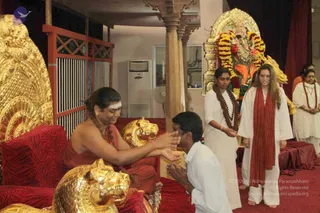
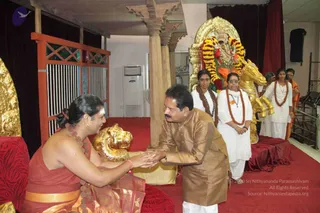
A seated man in orange-red robes and an orange dhoti sits cross-legged on a red velvet cushioned throne with ornate gilded carvings, flanked by two golden lion-head armrests. He wears a rudraksha mala, a white forehead tilak with a red dot, and a small microphone, and gestures with one raised hand while speaking. Behind him stand painted deity murti figures with multiple arms, gold jewellery and crowns. A leopard-print cloth covers the dais. Swamiji (probable): long hair, saffron robes and a rudraksha mala serve as the cues for a seated teacher delivering a satsang discourse on a throne.A photograph of a man seated cross-legged on an ornate gold-and-red throne with a golden back, flanked by two golden lion heads and a tiger-skin draped over the seat. He wears a saffron-orange robe with a tilak on his forehead and a long rudraksha mala. Two painted deity murti figures with multiple arms stand on either side holding ritual objects, and brass oil lamps stand at the edges of a red-carpeted stage with blue and red painted walls. a person is seated in the centre, identifiable by the rudraksha mala and saffron robe on the throne.A seated man speaks in a satsang hall, facing forward with his right hand raised in a gesture of explanation. He wears a white vibhuti stripe and a red kumkum dot on his forehead, a head microphone, and a long rudraksha mala over a rust-orange shawl and orange-red dhoti. He sits on an ornate gilded throne with red tiger-striped cushions, flanked by gold lion carvings, with a painted deity mural showing an arm with bangles at the right edge. a person: the long rudraksha mala, orange-red robes and ceremonial throne setting match the page's claim of an in-person satsang.Indoor satsang hall with a red-upholstered seat flanked by gold lion-head armrests. A bare-chested man with long swept-back hair and a white tilak on his forehead sits on the red seat, extending both hands toward a young man in a white shirt kneeling before him with hands folded. Behind them, a gold-framed deity murti is garlanded with marigolds and red flowers. Two women in white garments stand to the right: one wears a brown shawl and rudraksha mala, the other a red shawl. An older woman in white with a red mala stands at the far right edge. a person (long swept-back hair, bare-chested with ceremonial adornment, seated in the central position) is performing a blessing gesture for the kneeling devotee.A photograph in a temple hall with red carpet and a gold deity murti garlanded with orange and yellow flowers behind a gold lion-headed seat. A woman in a red and gold sari with a bindi and rudraksha-style beads sits on the left, reaching out to clasp the hands of a man in a brown silk kurta and white dhoti who bows toward her. Behind them stand women in white saris with red garlands and a woman in orange robes, plus a golden horse figure. A white air conditioner and red-and-white latticed screen frame the scene.

FB-photo-of-the-day

5 photosSource gallery

Completion-Technique-With-Mirror

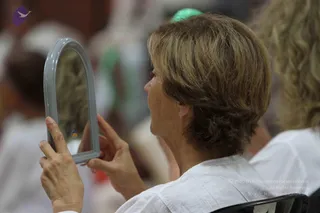
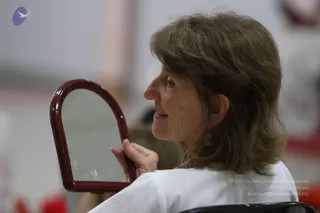
4 photosSource gallery
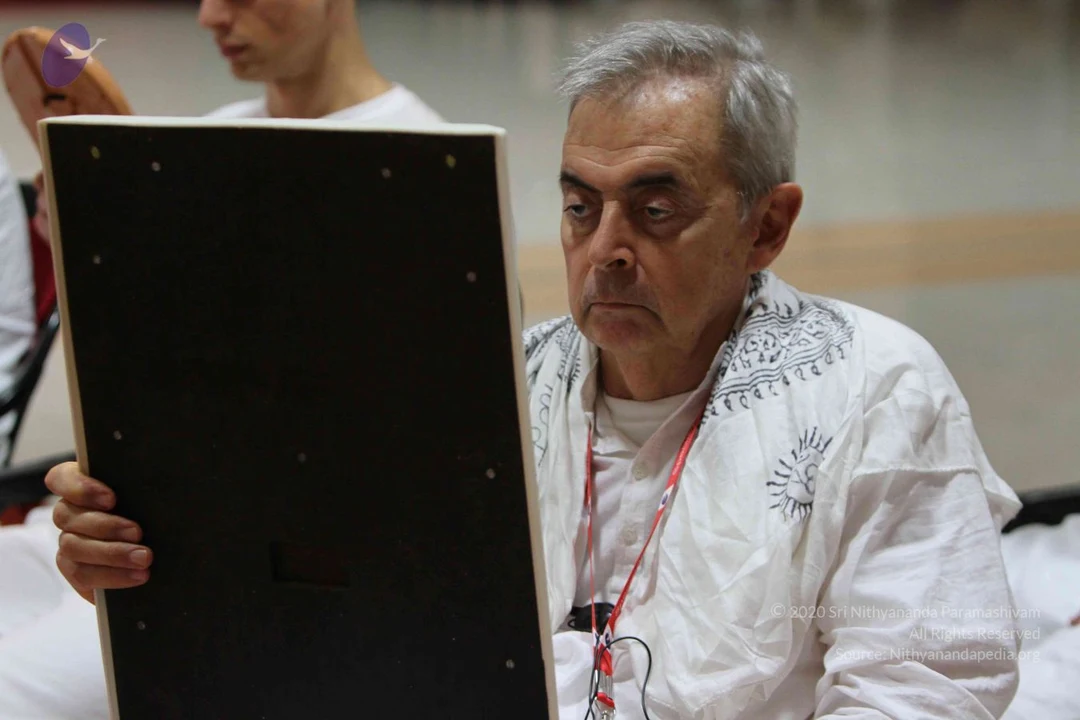
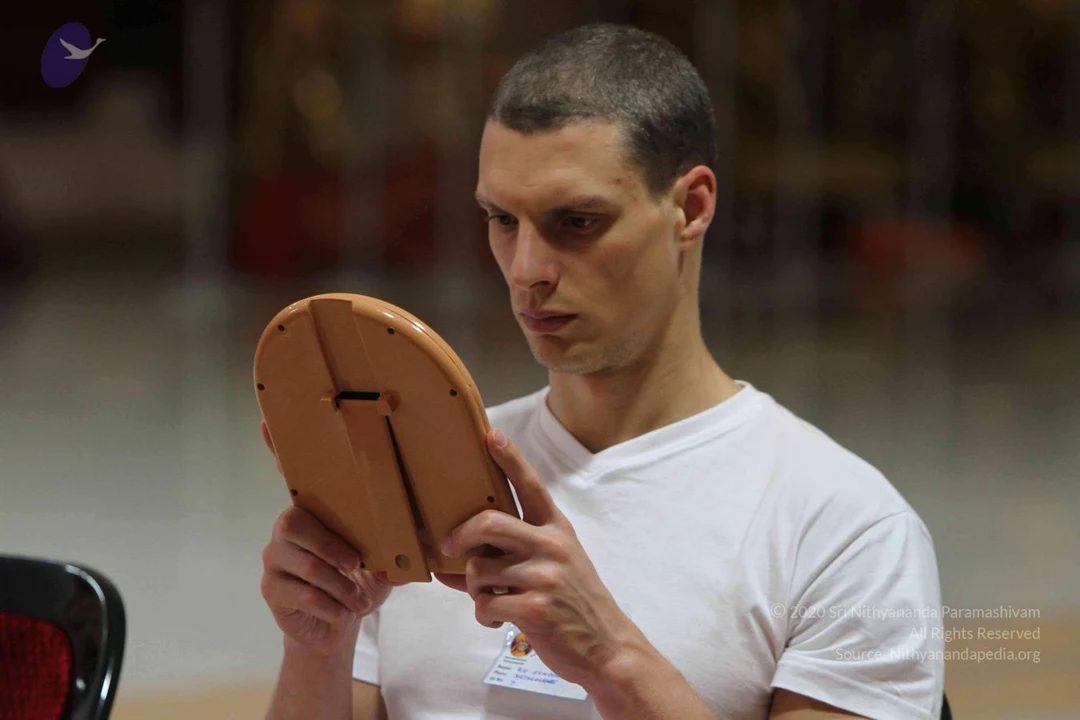
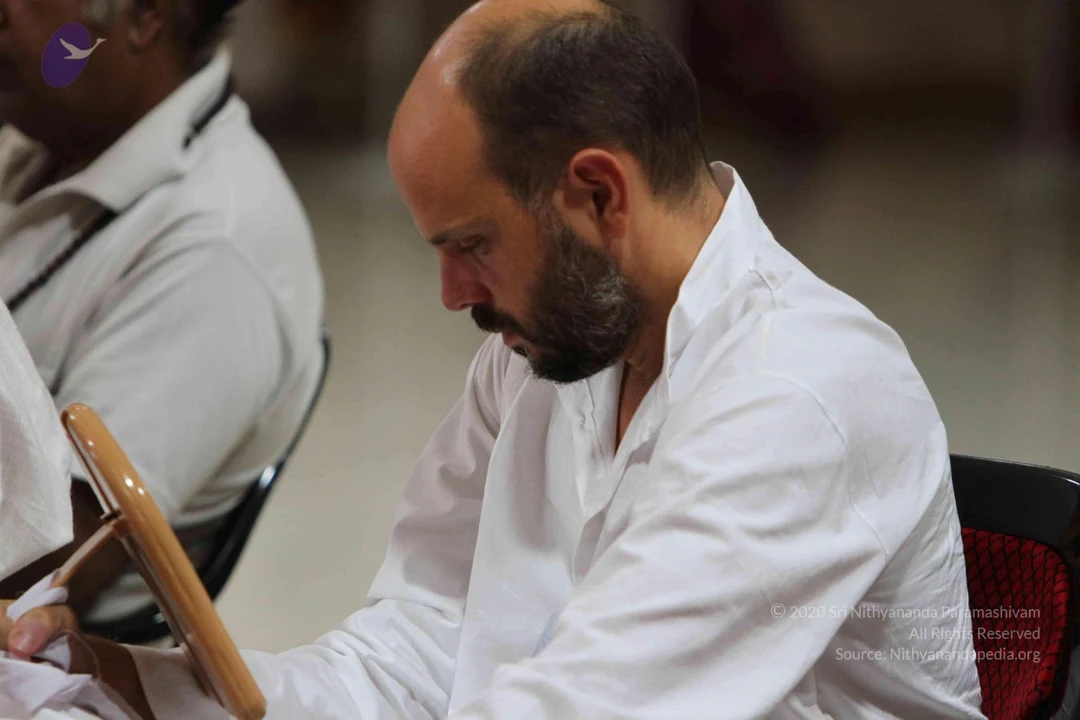
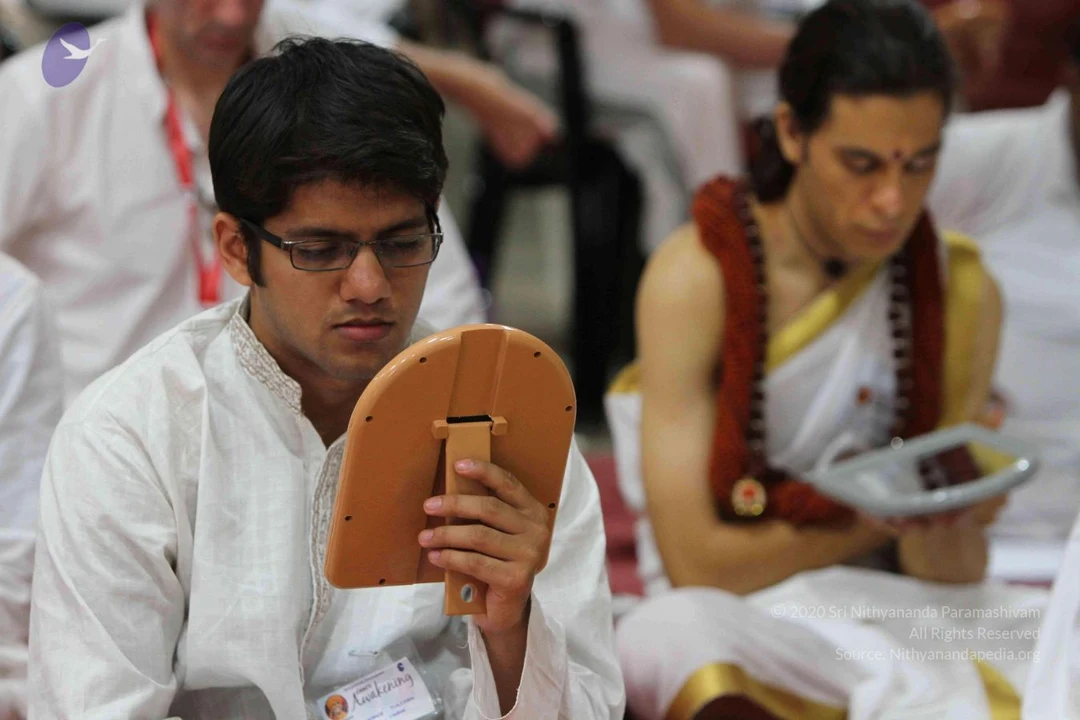
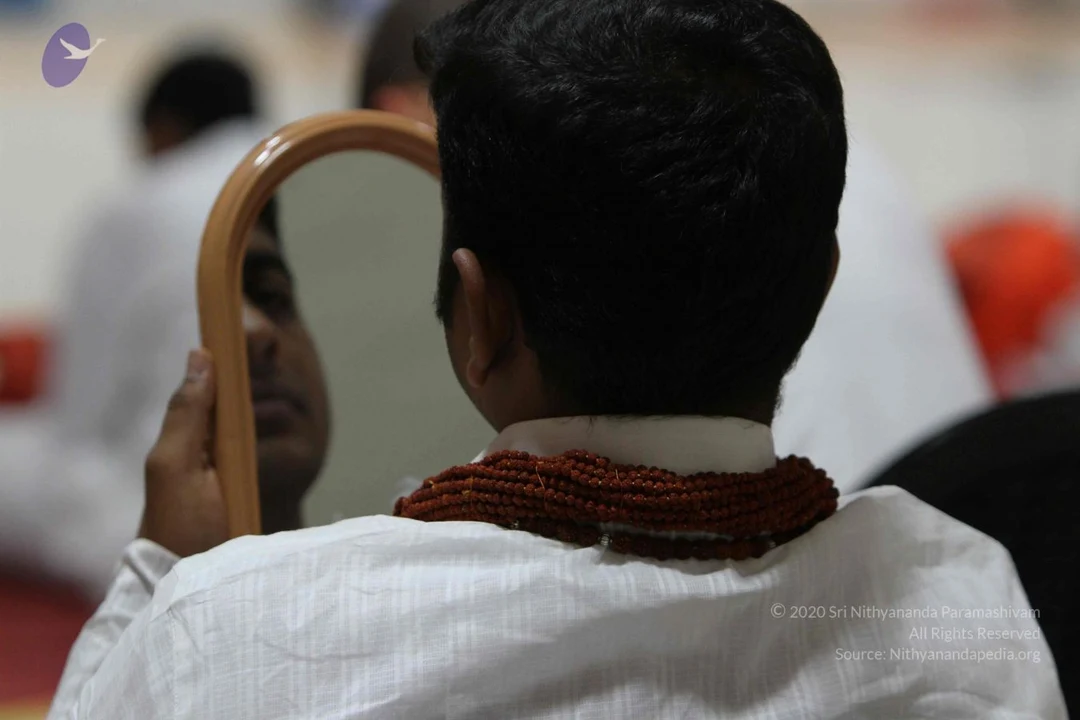
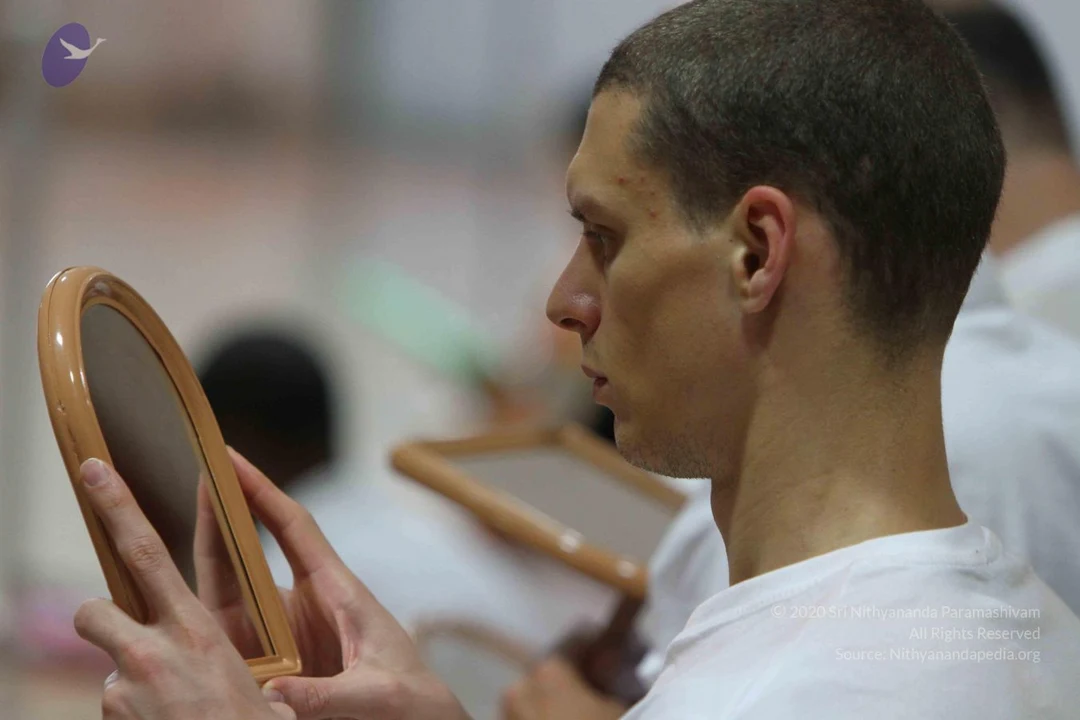
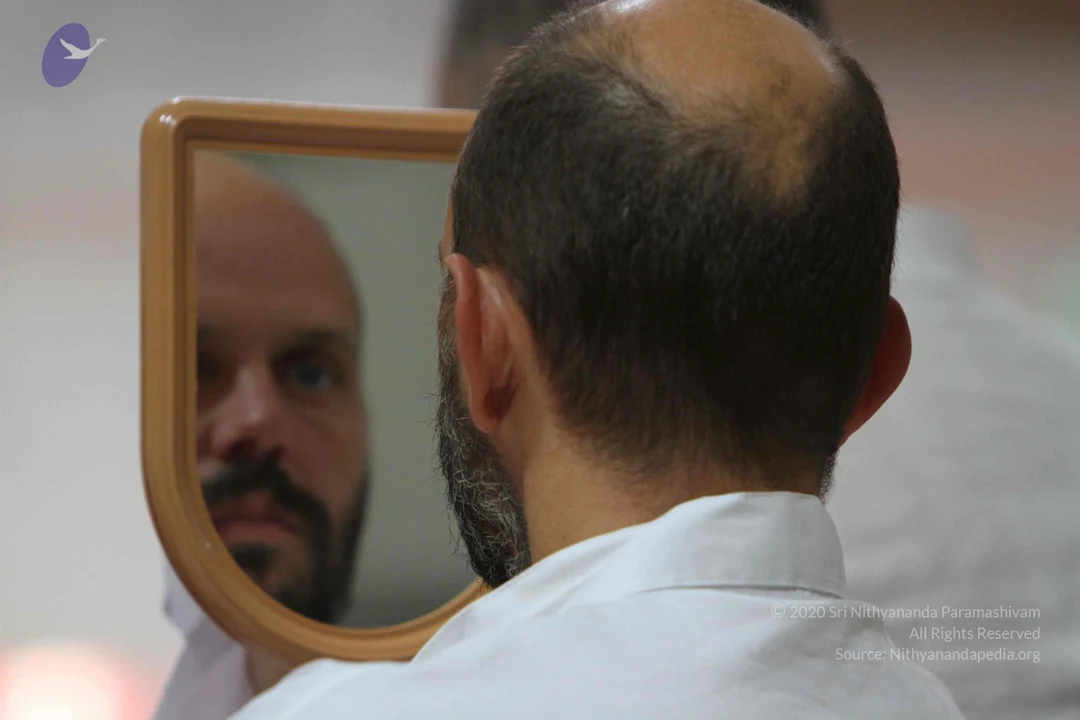
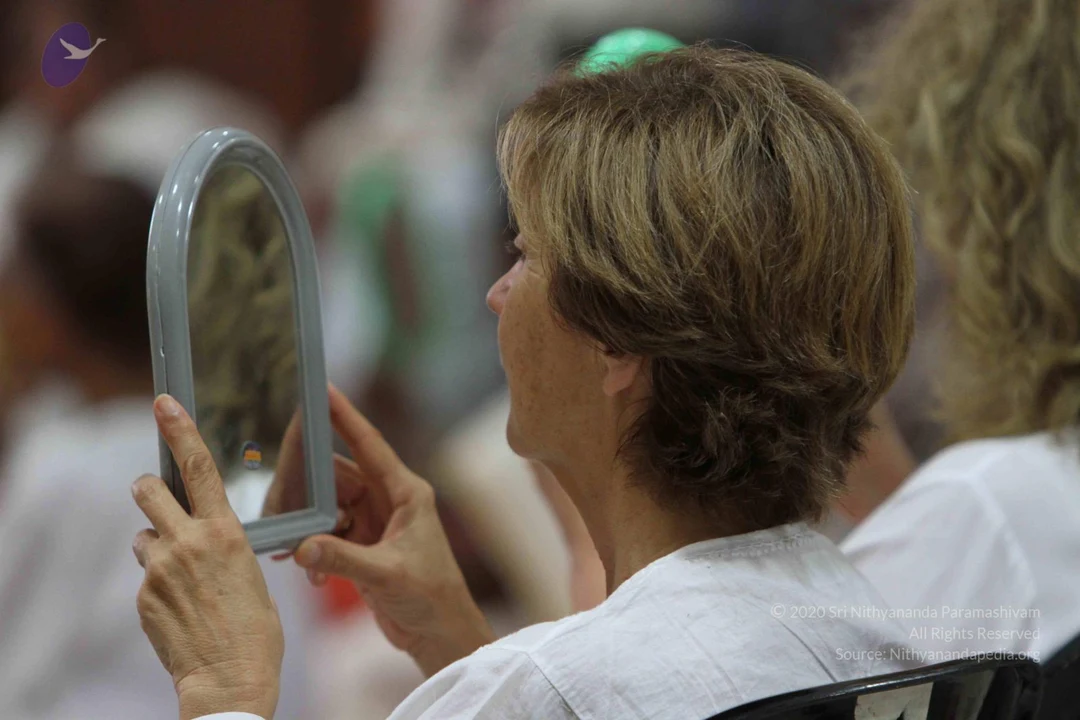
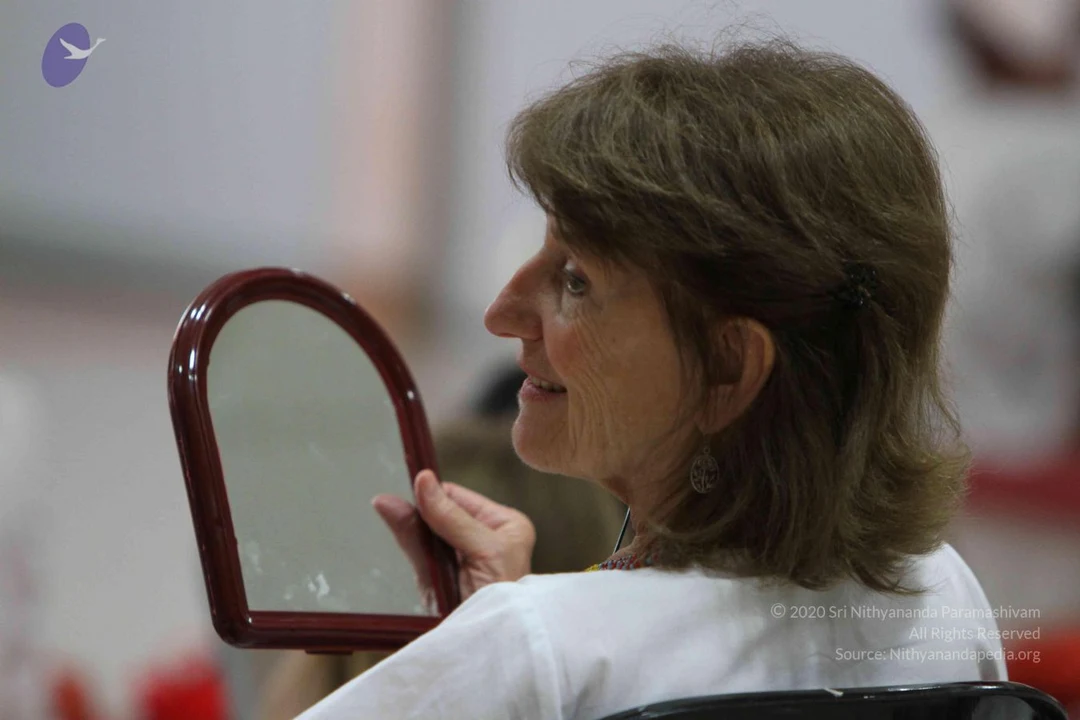
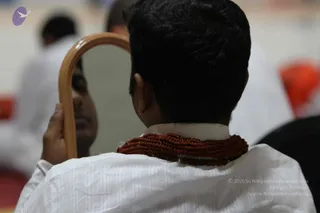
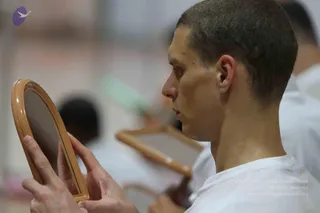
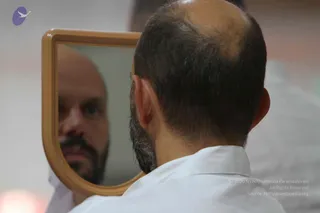
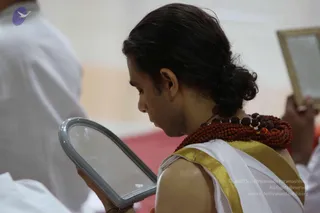
A photograph of a man seen from behind, his short dark hair visible, wearing a white kurta and a thick dark-red rudraksha mala around his neck. He holds a curved wooden hand mirror up to his face, so his reflection is partly visible in it. Blurred figures in white and orange clothing sit in the background of an indoor hall. Only one physical person is clearly visible, though others are partially seen behind him.A close side profile of a shaved-headed man in a plain white top holding a small oval wooden-framed hand mirror up to his face while looking into it. Other people in white clothing and more mirrors are blurred in the background. No identifiable ceremonial clothing, saffron or crown is visible on the foreground man, so a person's presence cannot be confirmed from appearance.Photograph of a bald, bearded man in a white shirt seen from behind, looking into a small handheld mirror with a wooden frame. His reflection shows his face with a short dark beard. The background is pale and softly blurred with another person in white clothing at the right edge. The man is shown from the back, so no face-based identification is possible; no visible cues establish the a person presentation.A photograph of a person seated in profile, facing left and looking down at a small hand mirror held in their left hand. The person has dark hair gathered in a low bun, wears layered rudraksha beads with a red-orange tone, and a white garment with a gold-yellow border across the shoulder. Another person in white clothing is partly visible at the left edge, and a second hand holds a framed mirror at the upper right. The background is a light wall with a red floor area.

Initiation

9 photosSource gallery
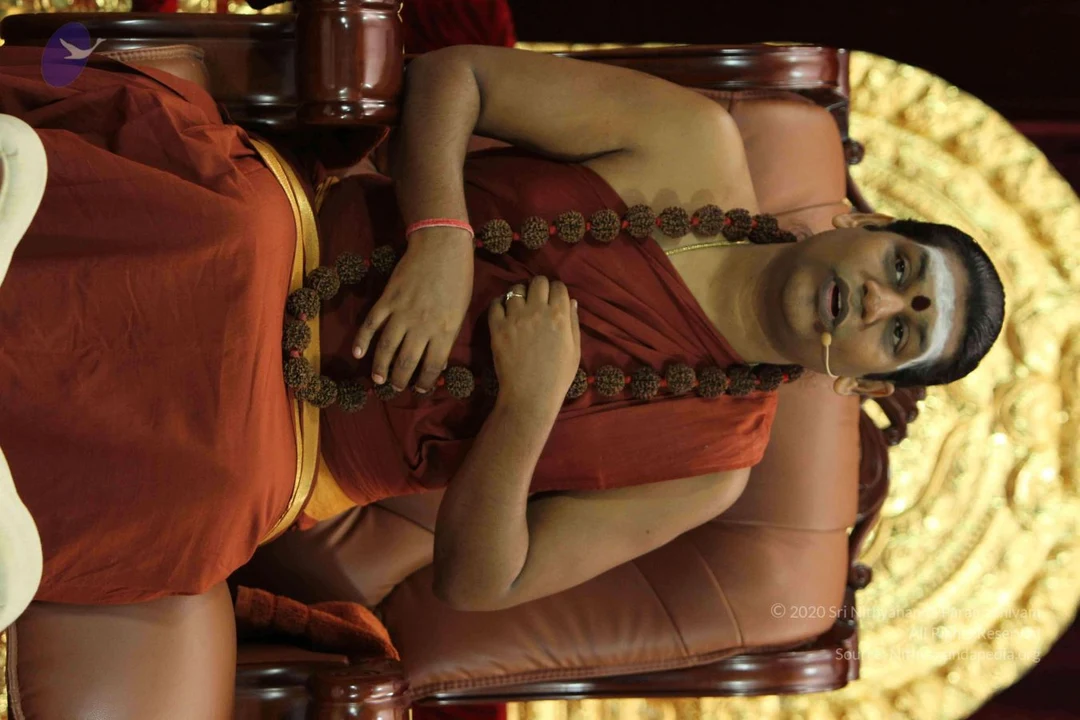
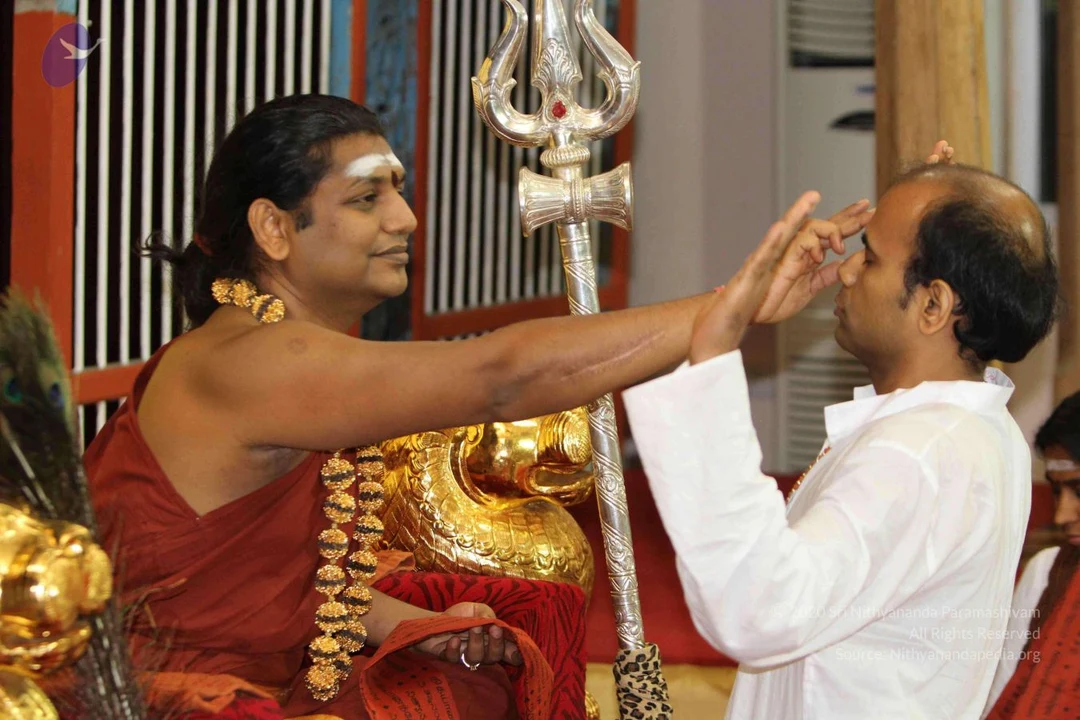
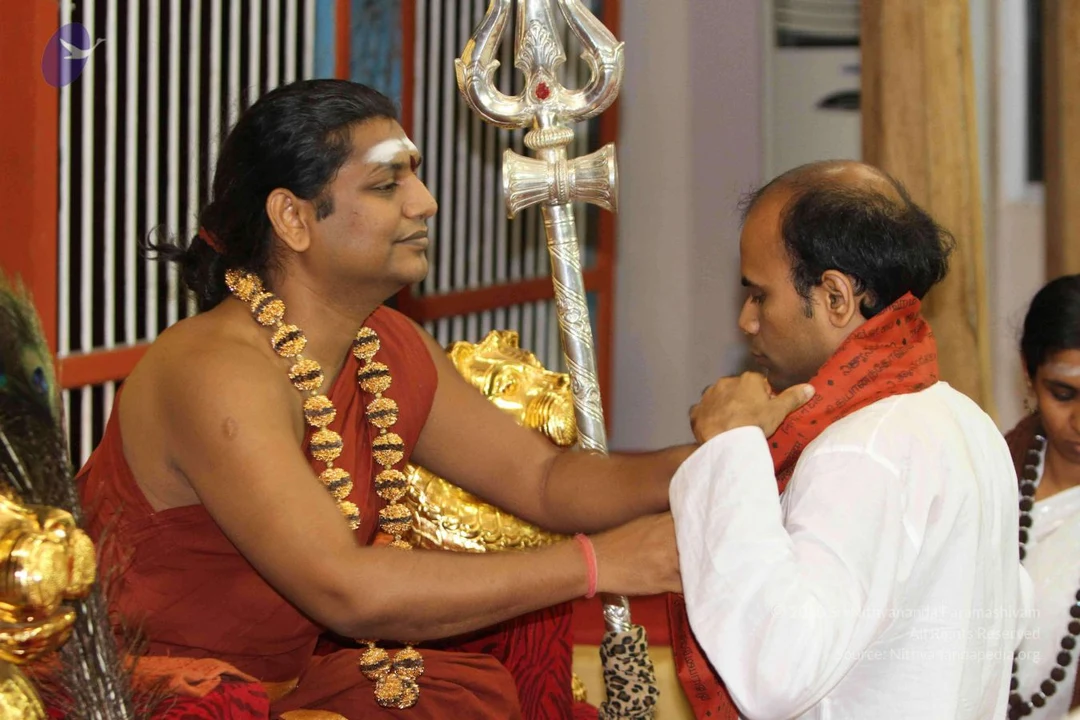
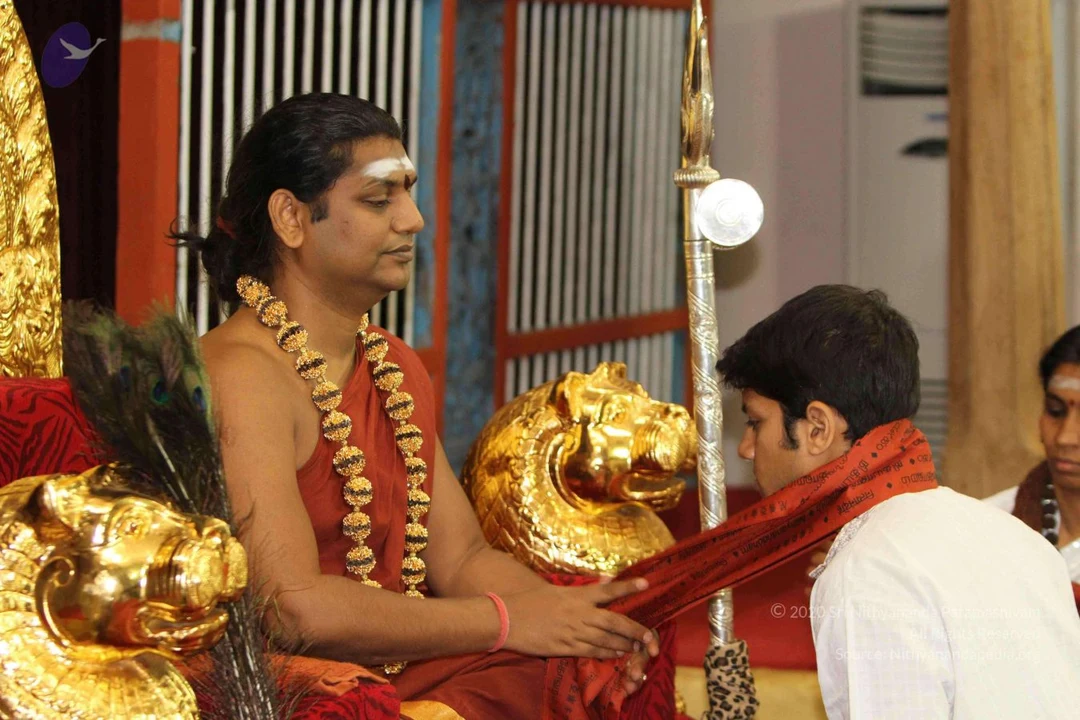
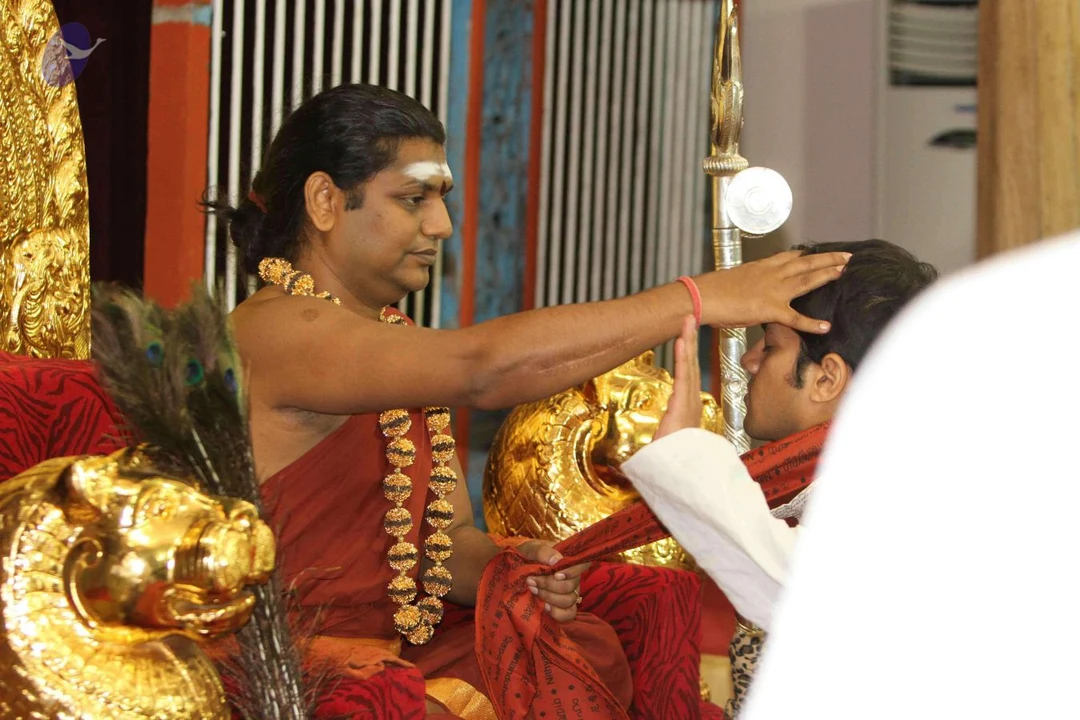
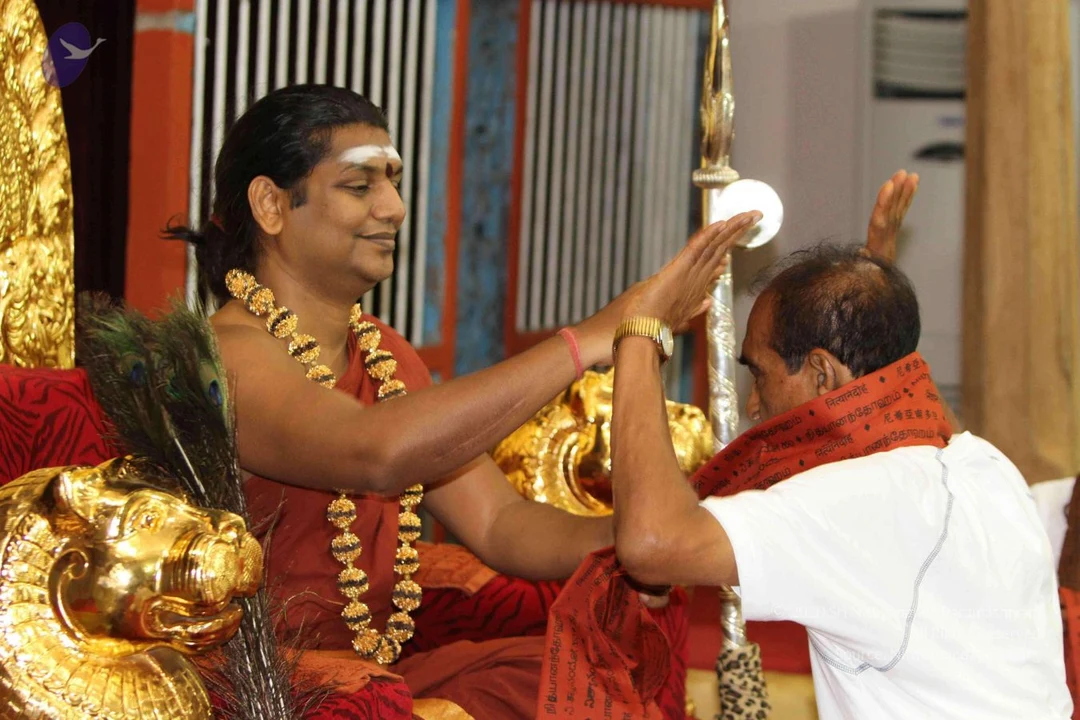
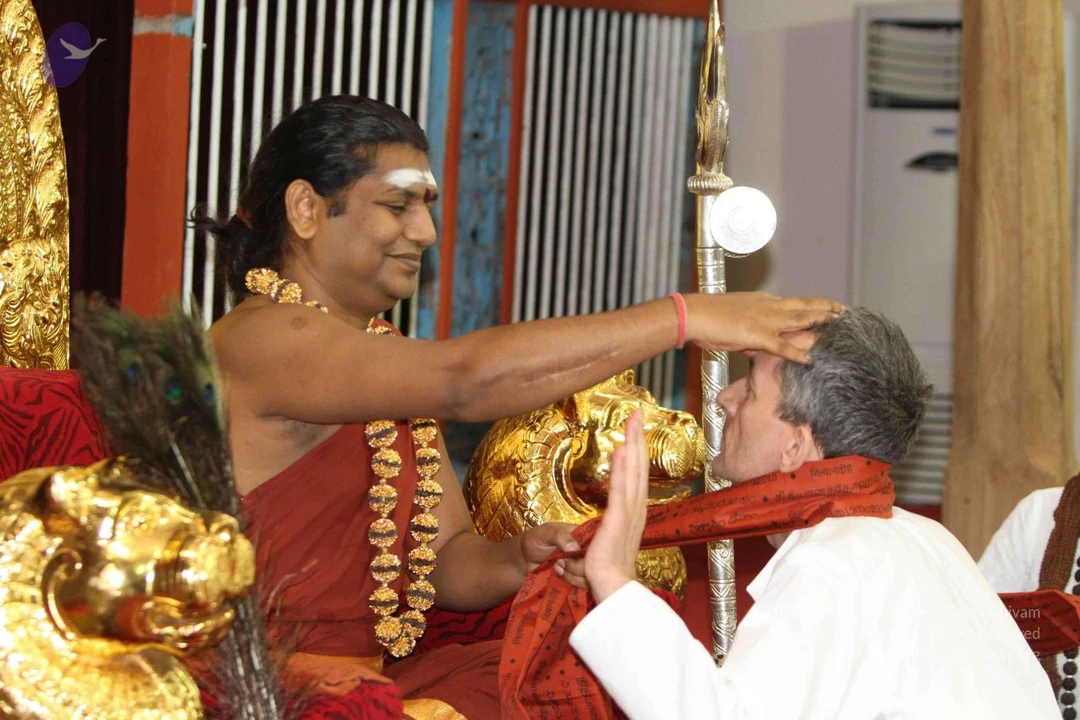
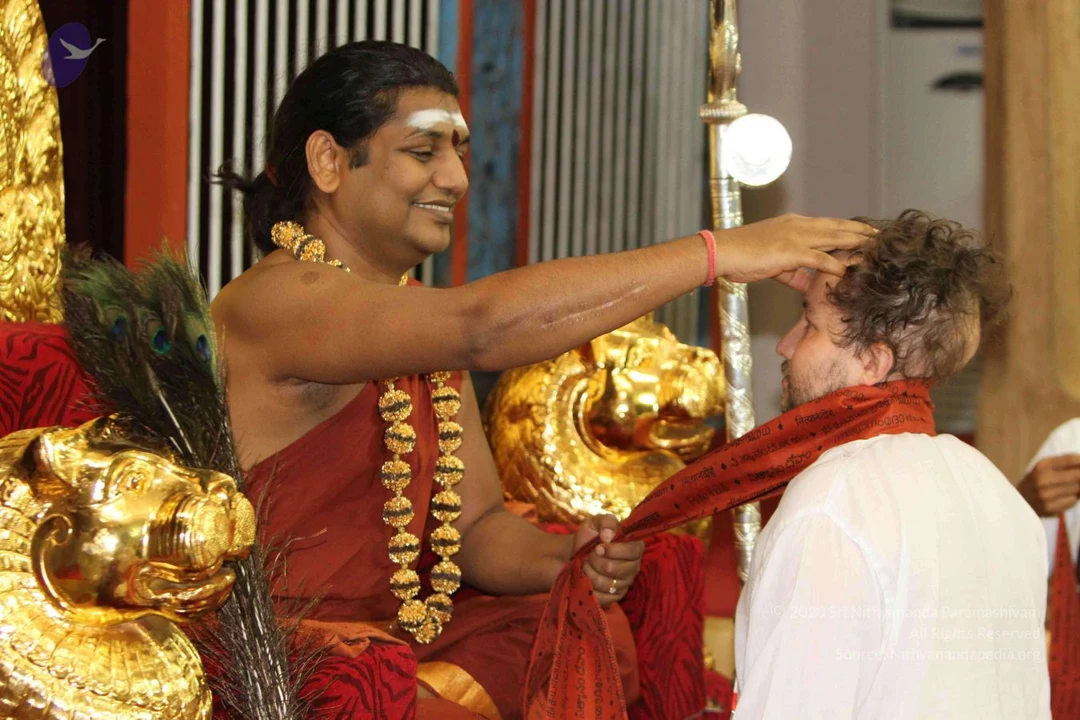
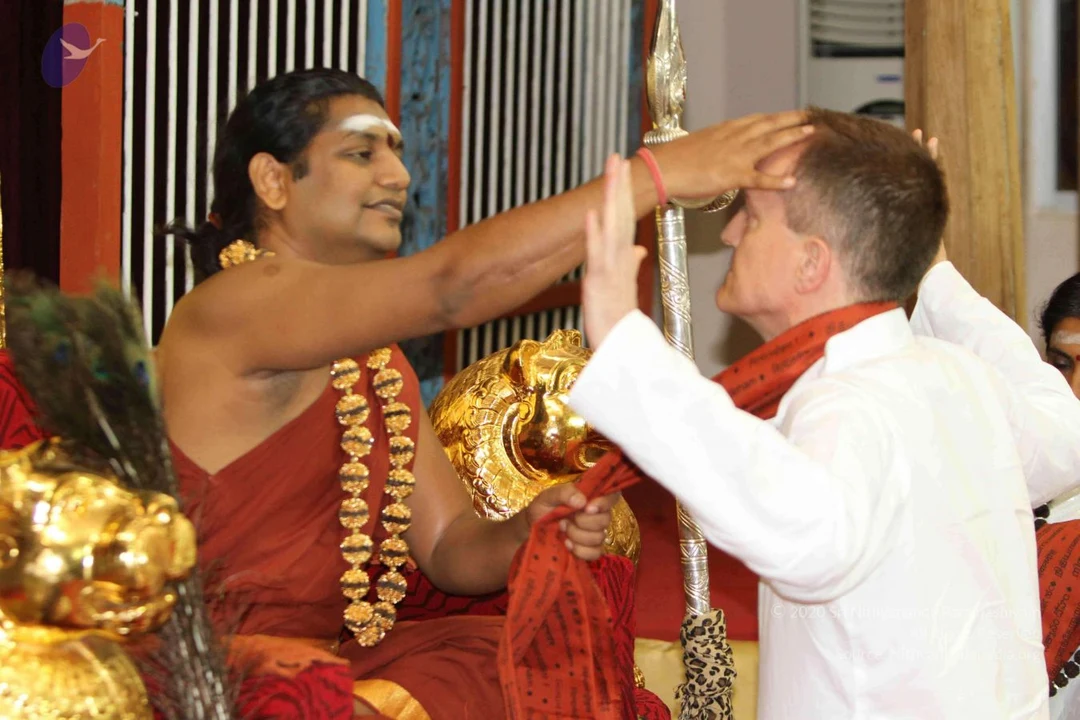
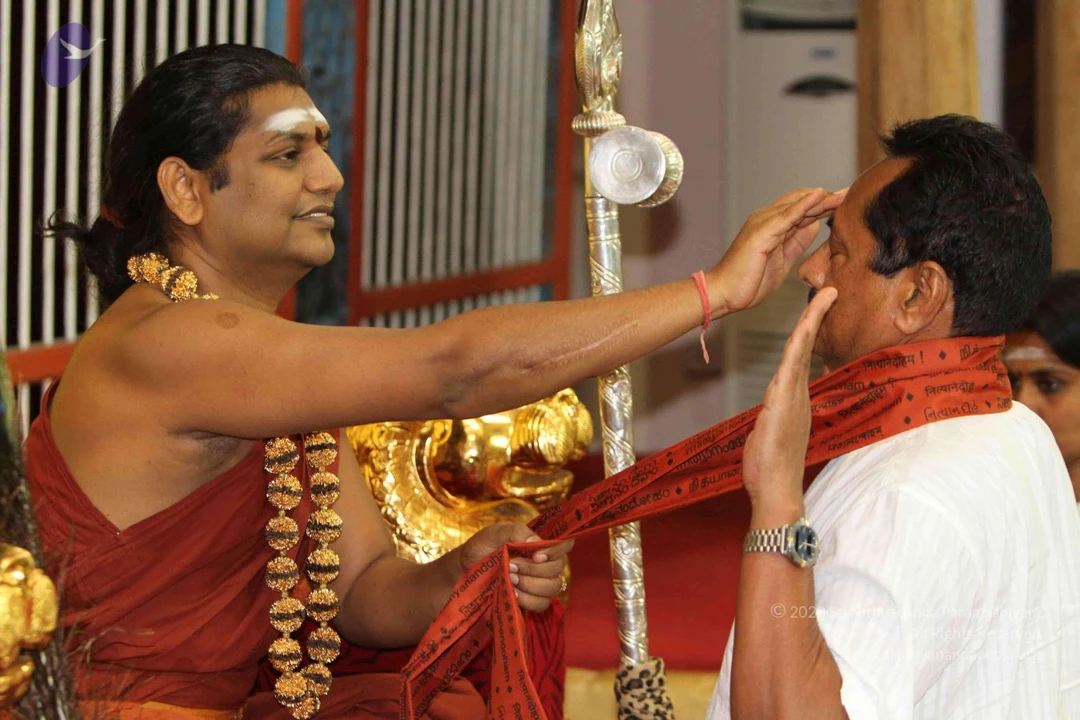
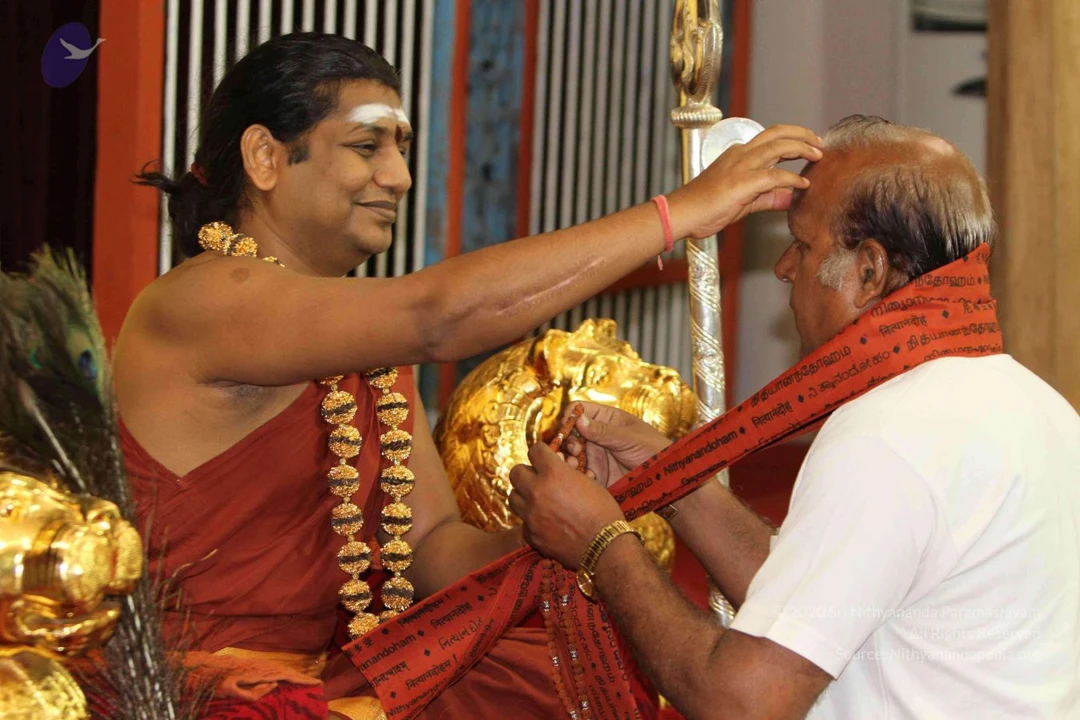
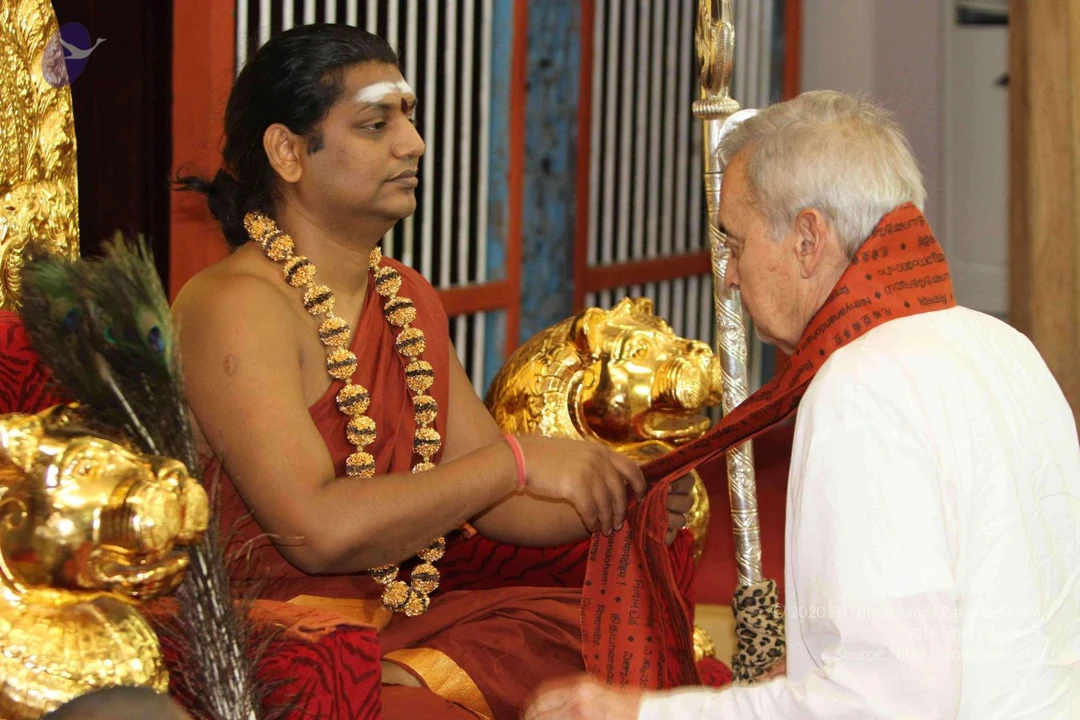
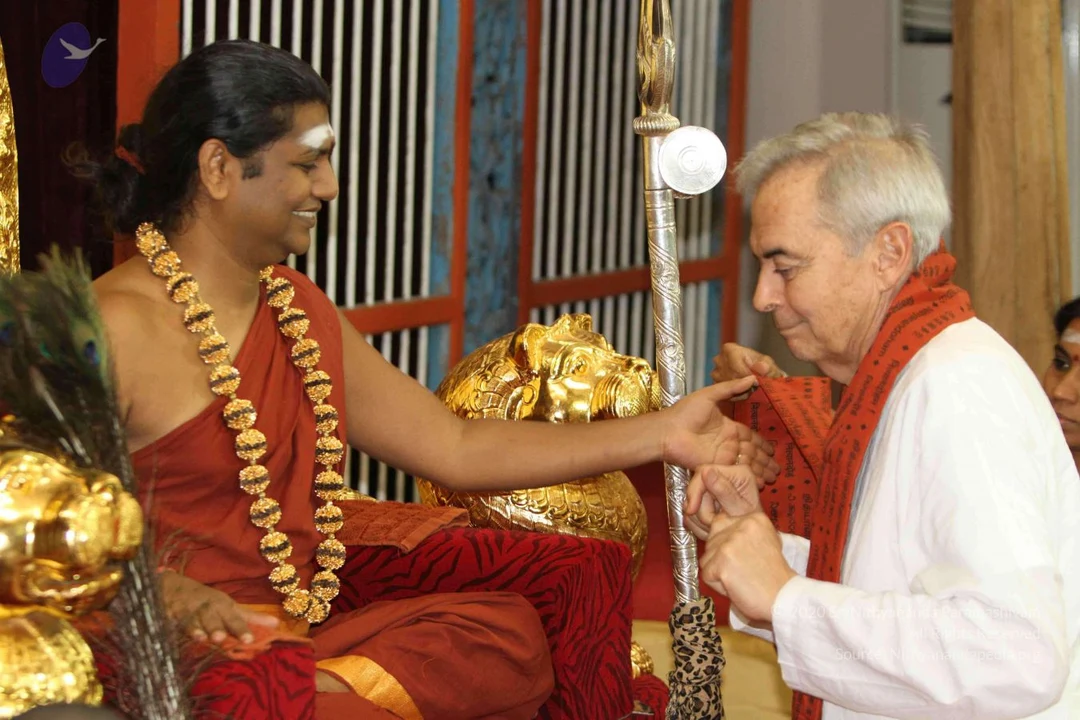
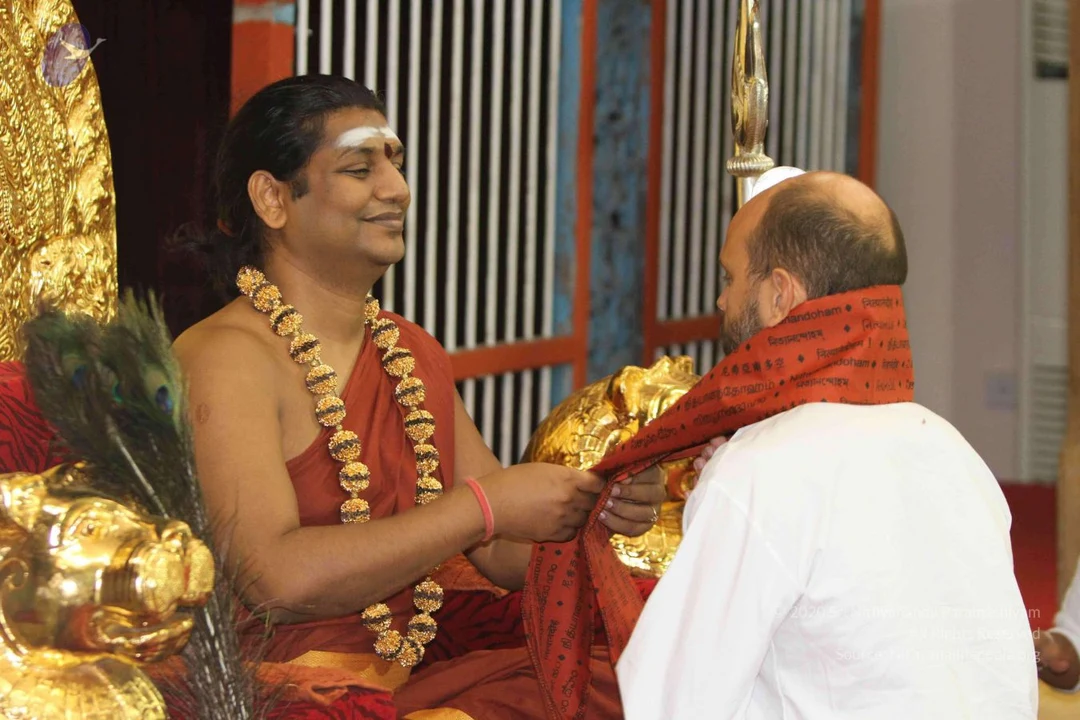
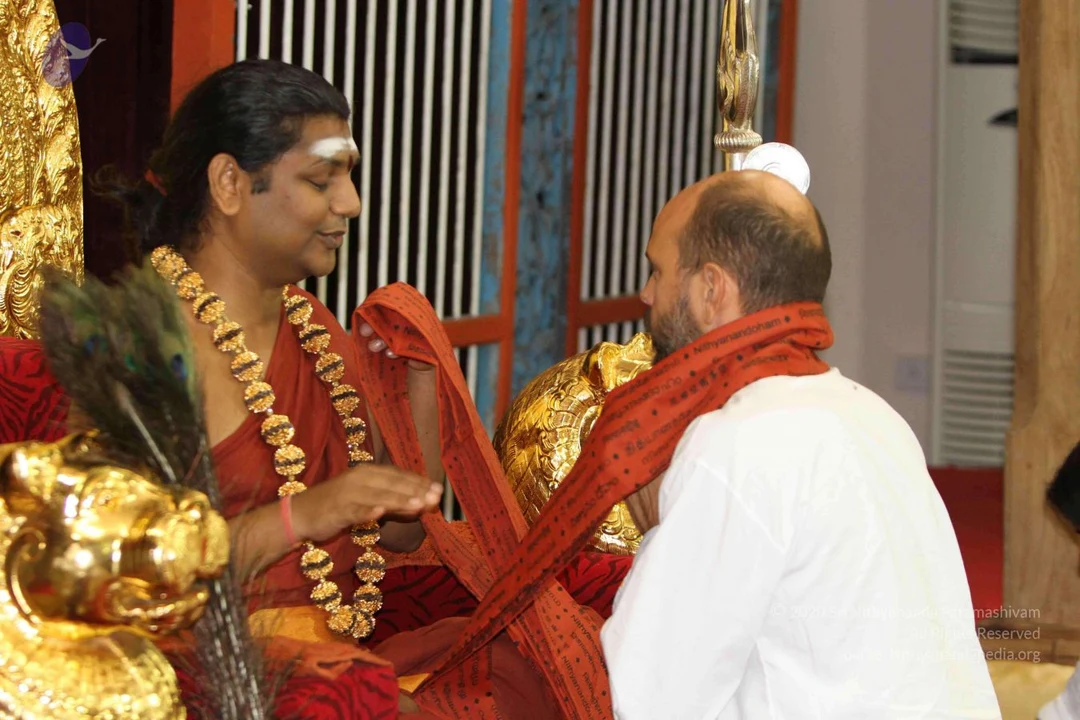
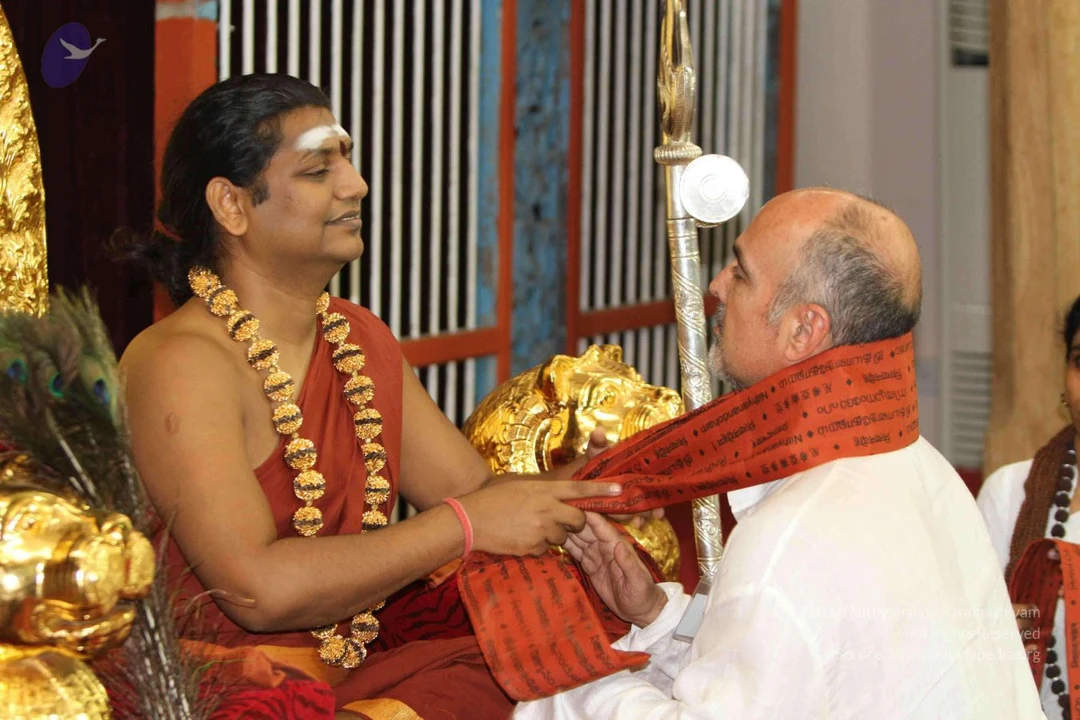
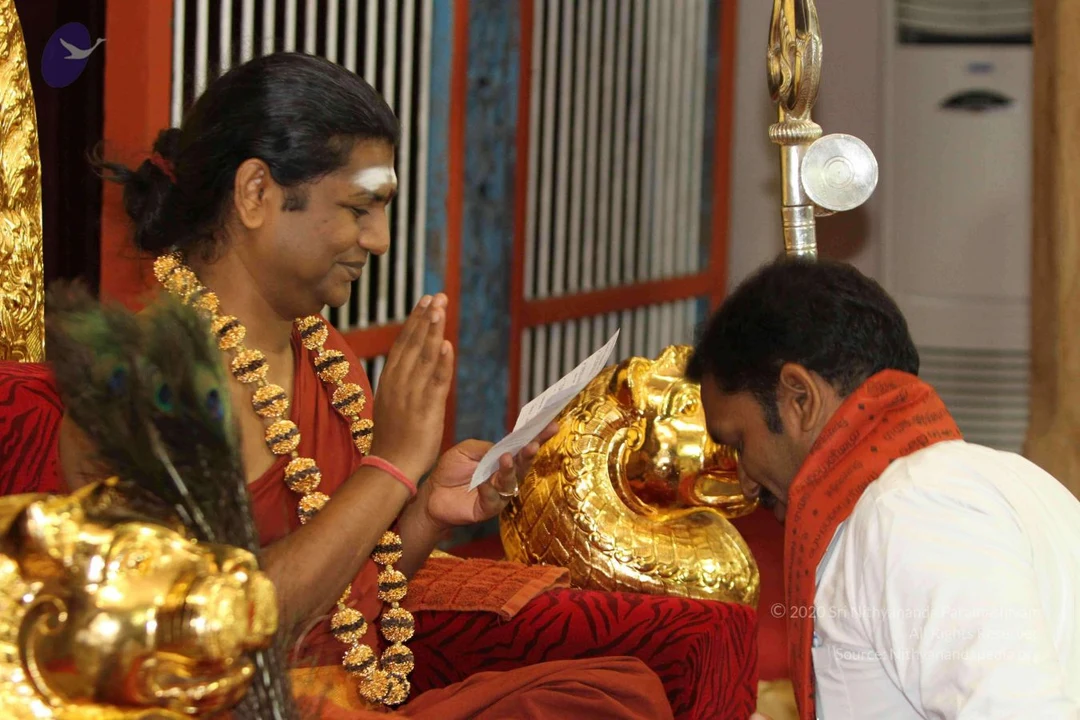
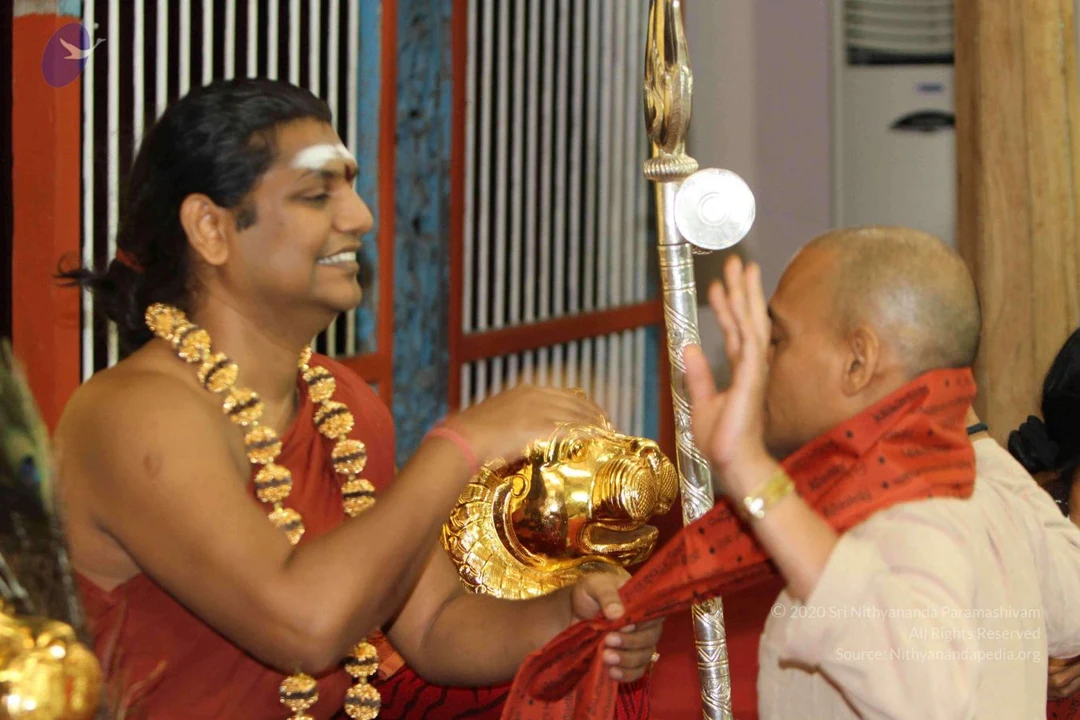
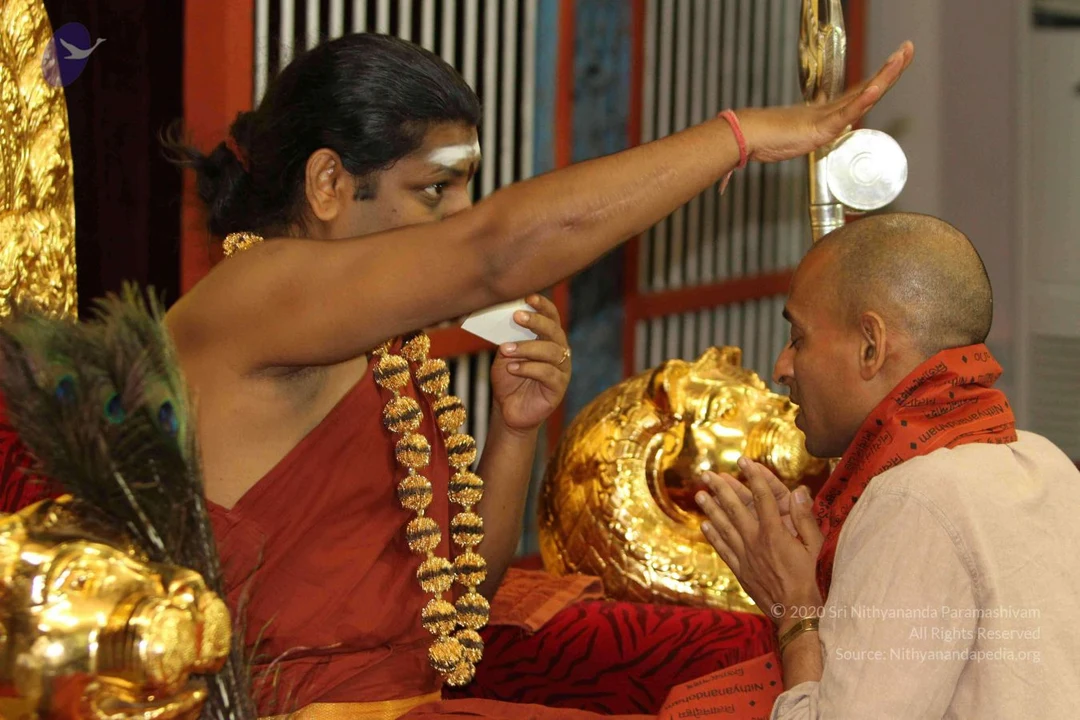
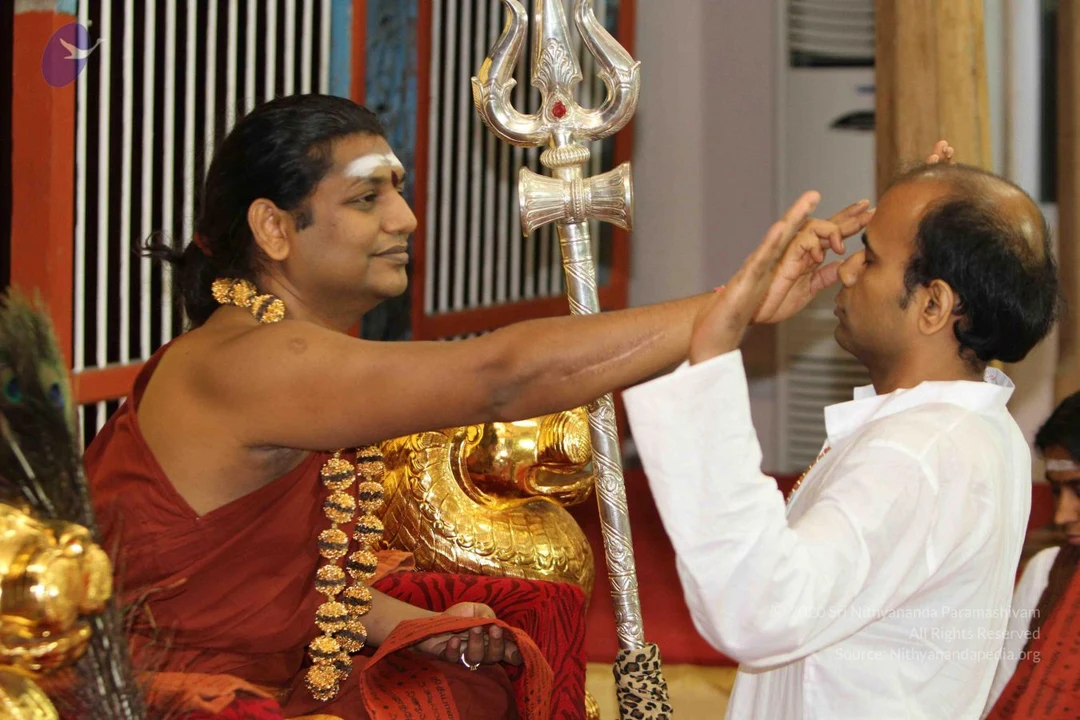
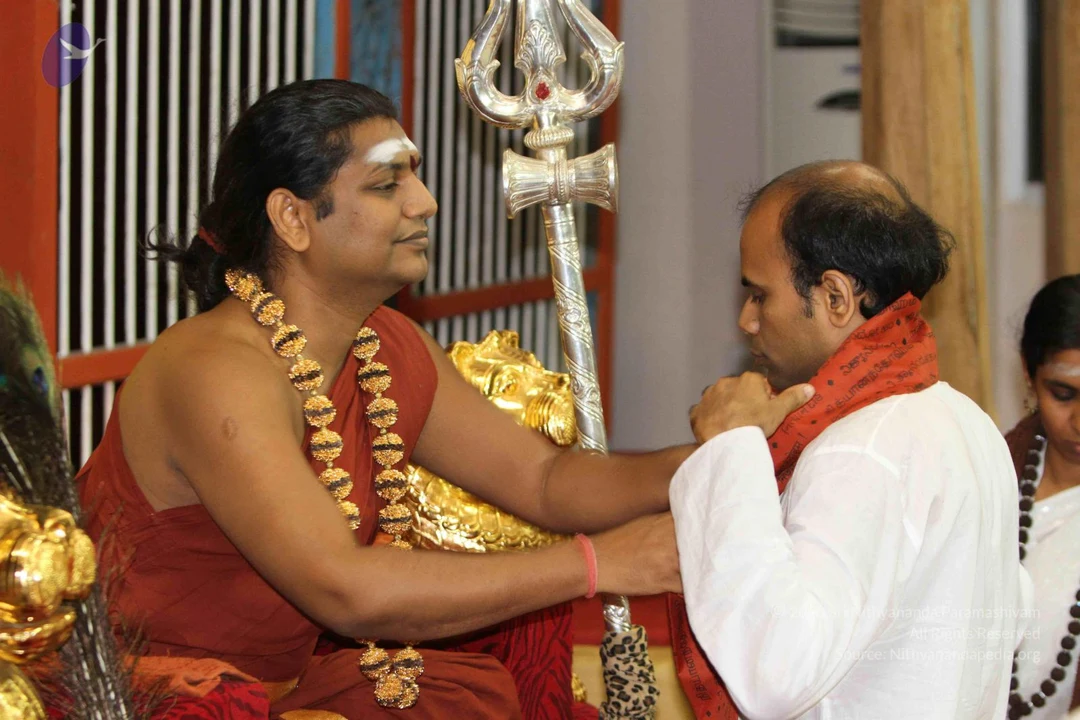
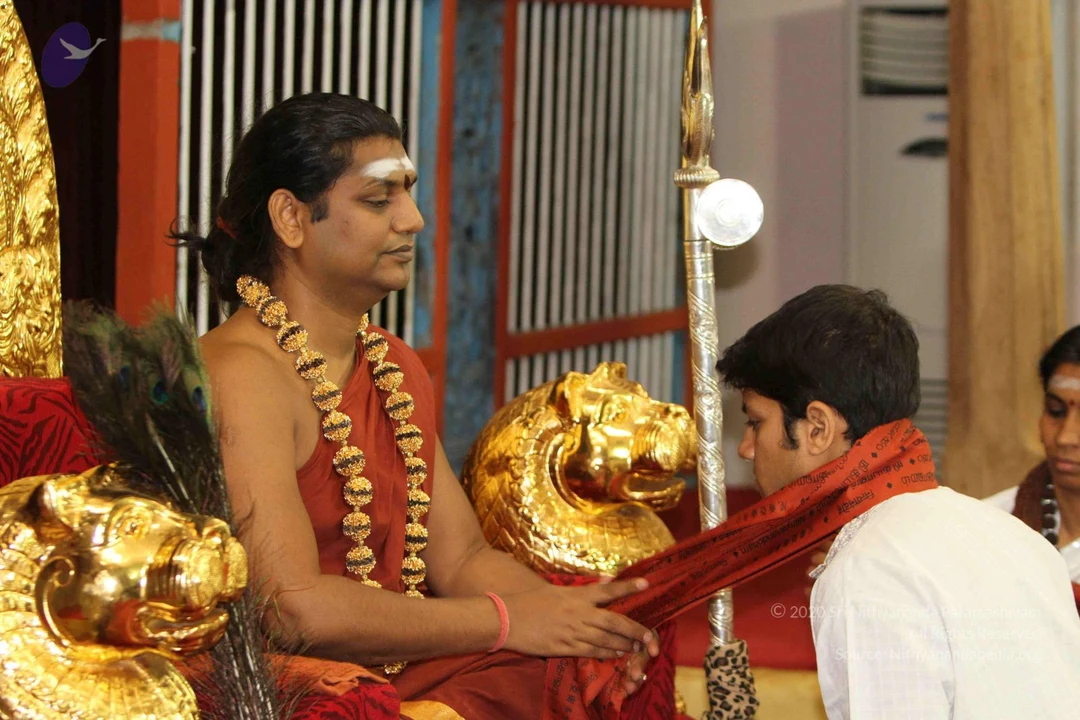
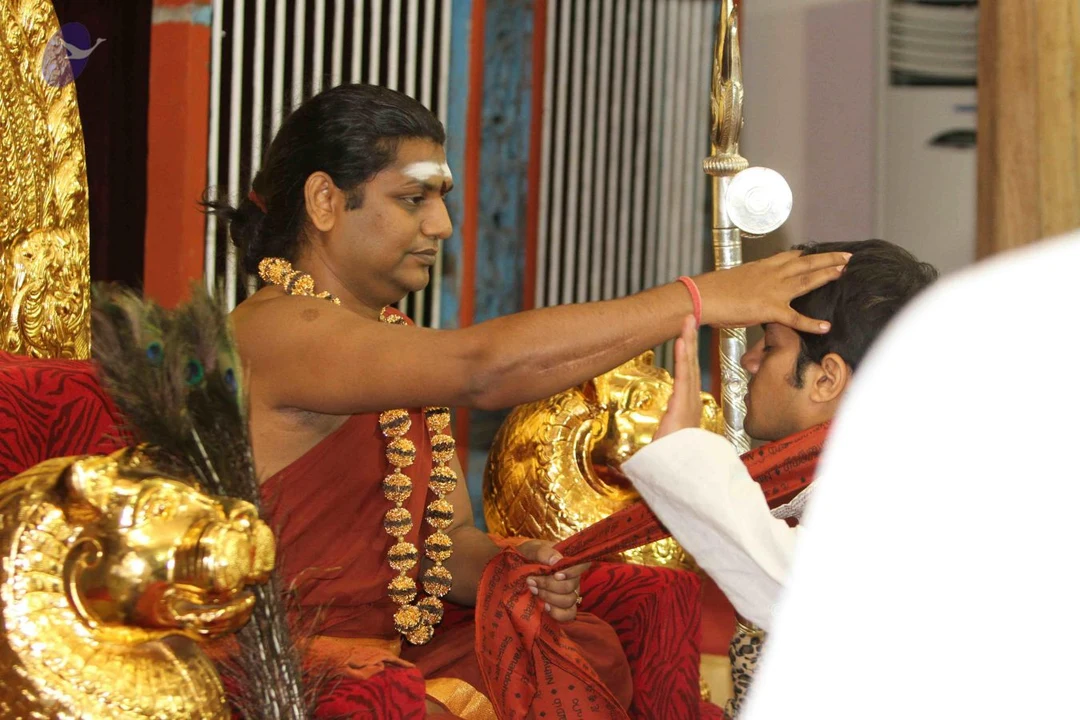
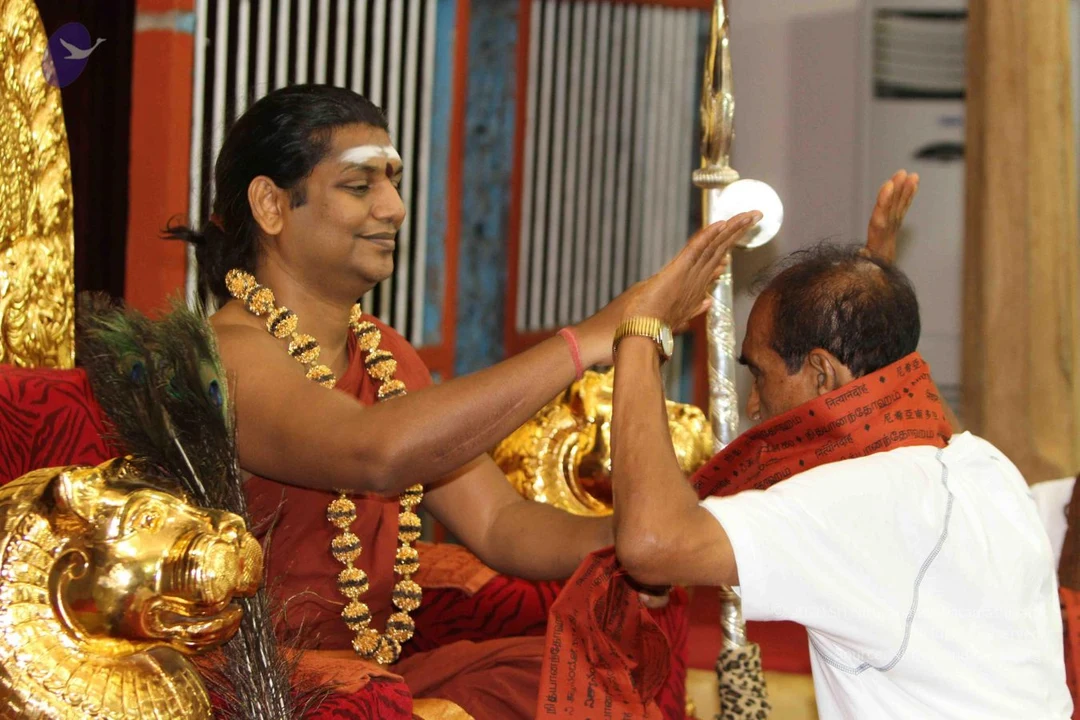
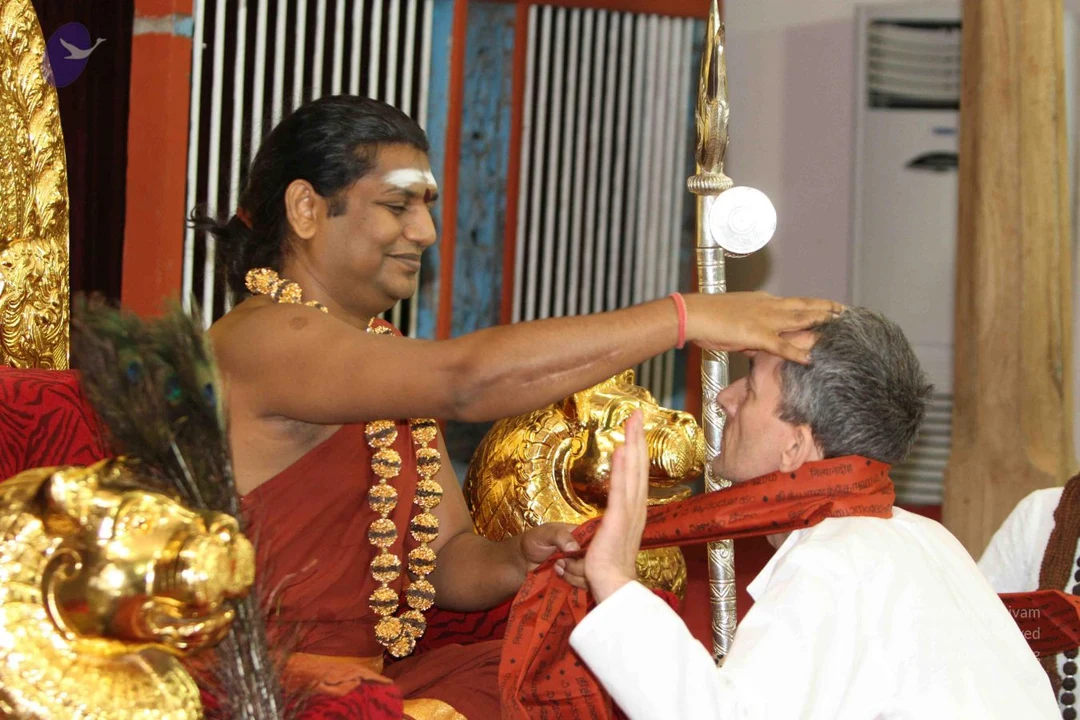
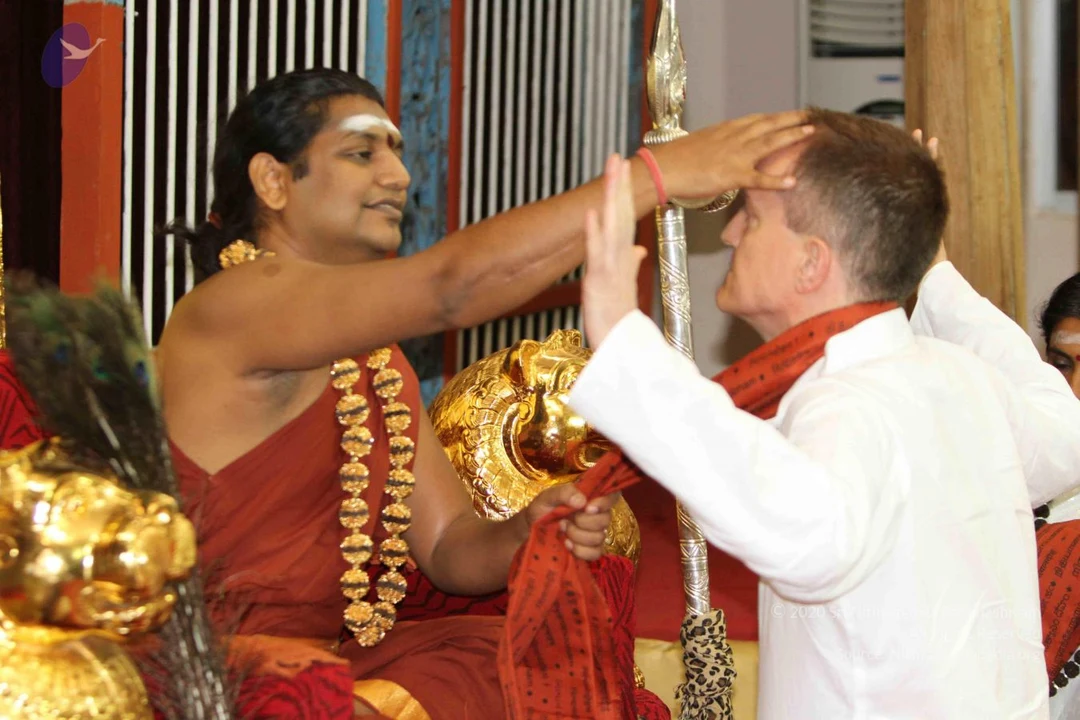
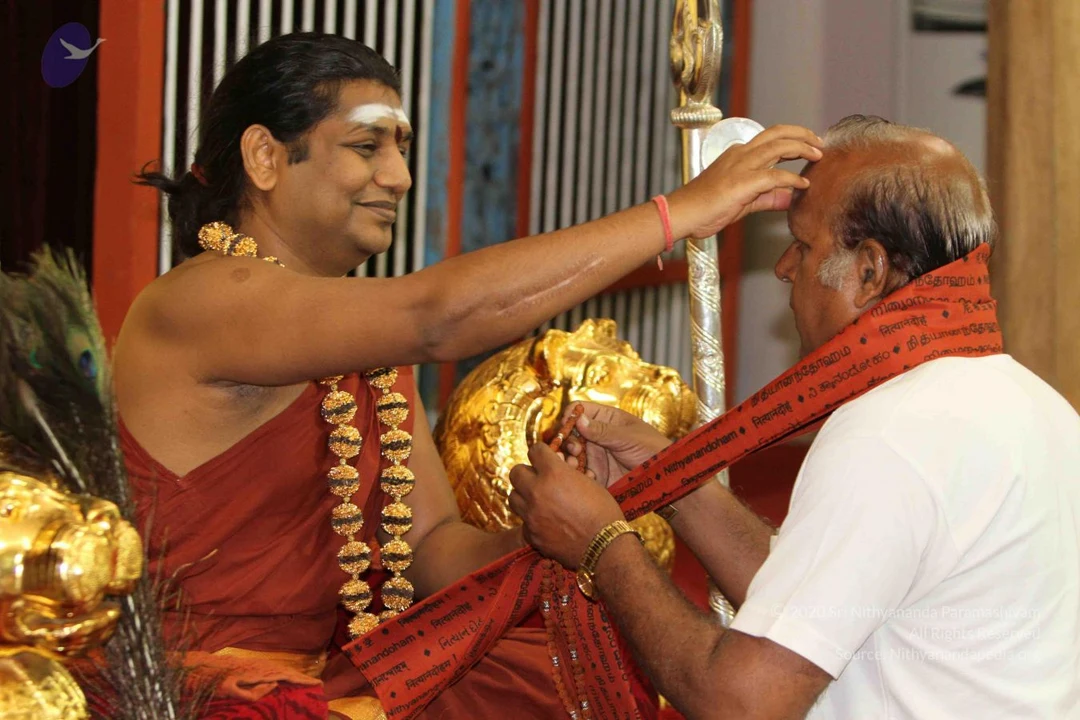
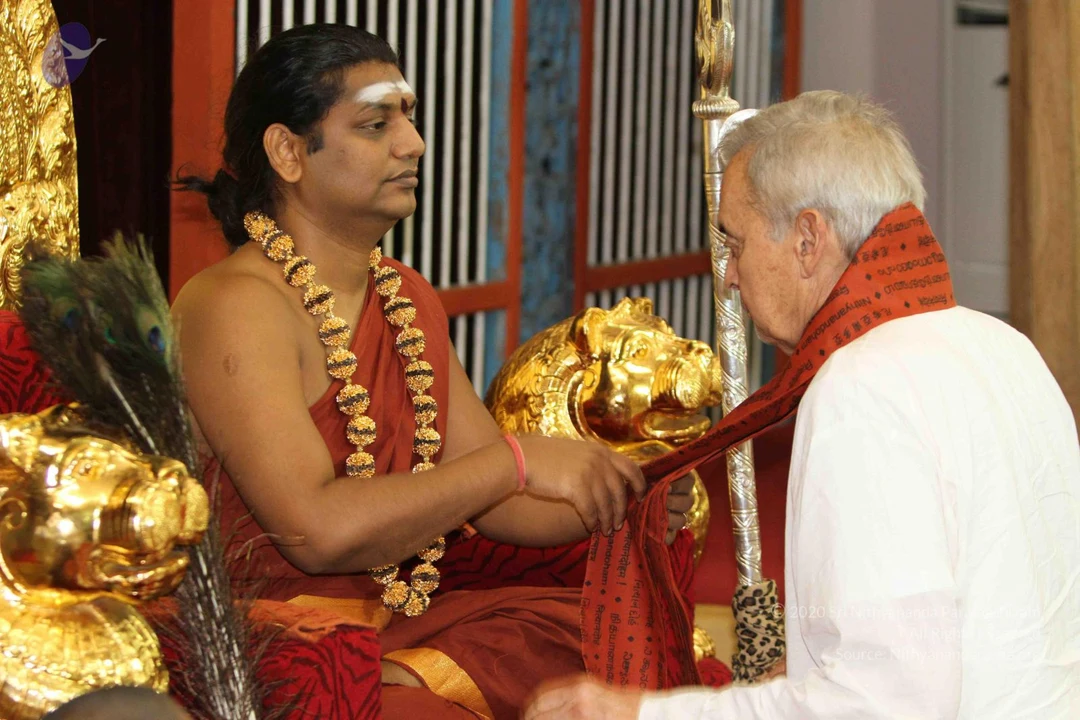
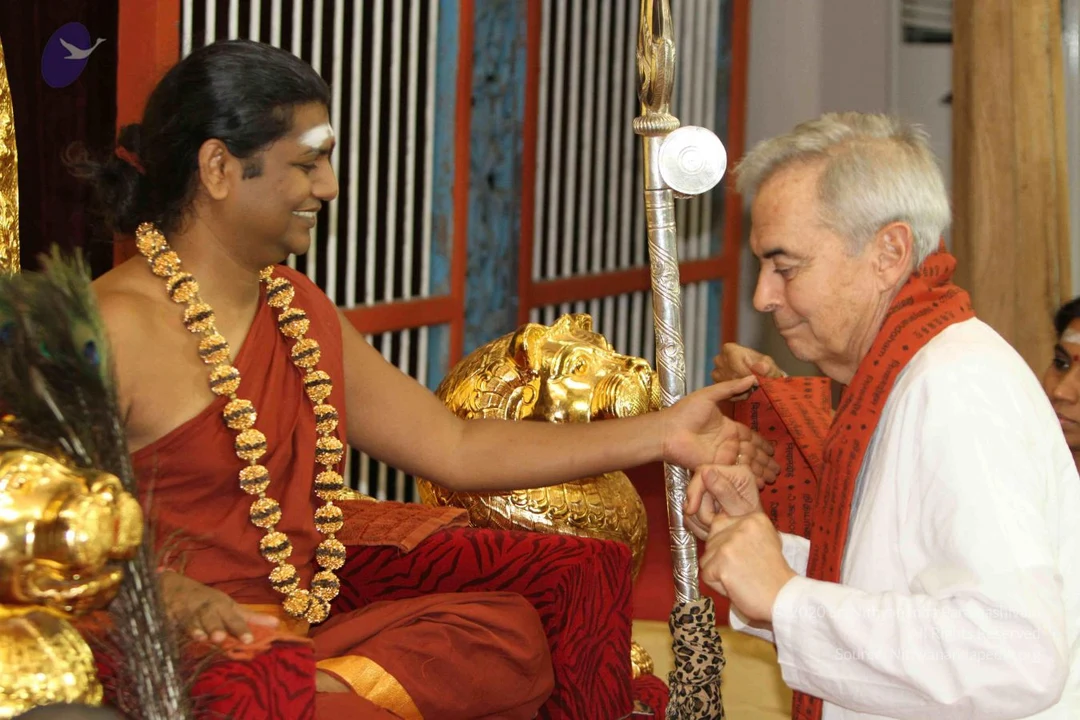
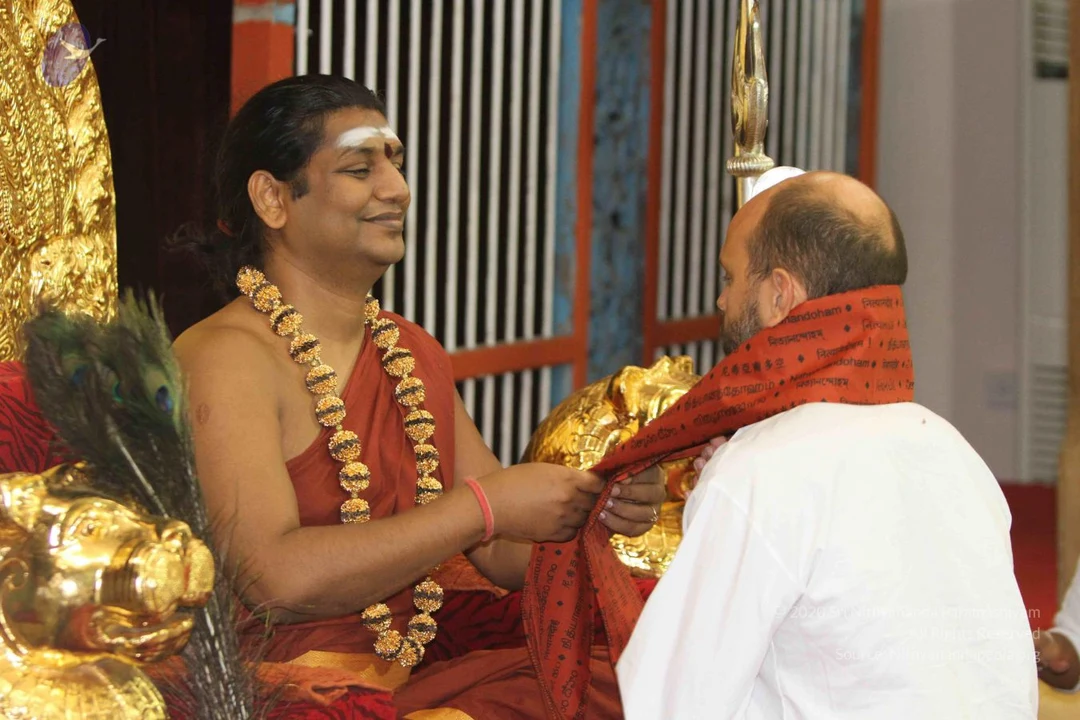
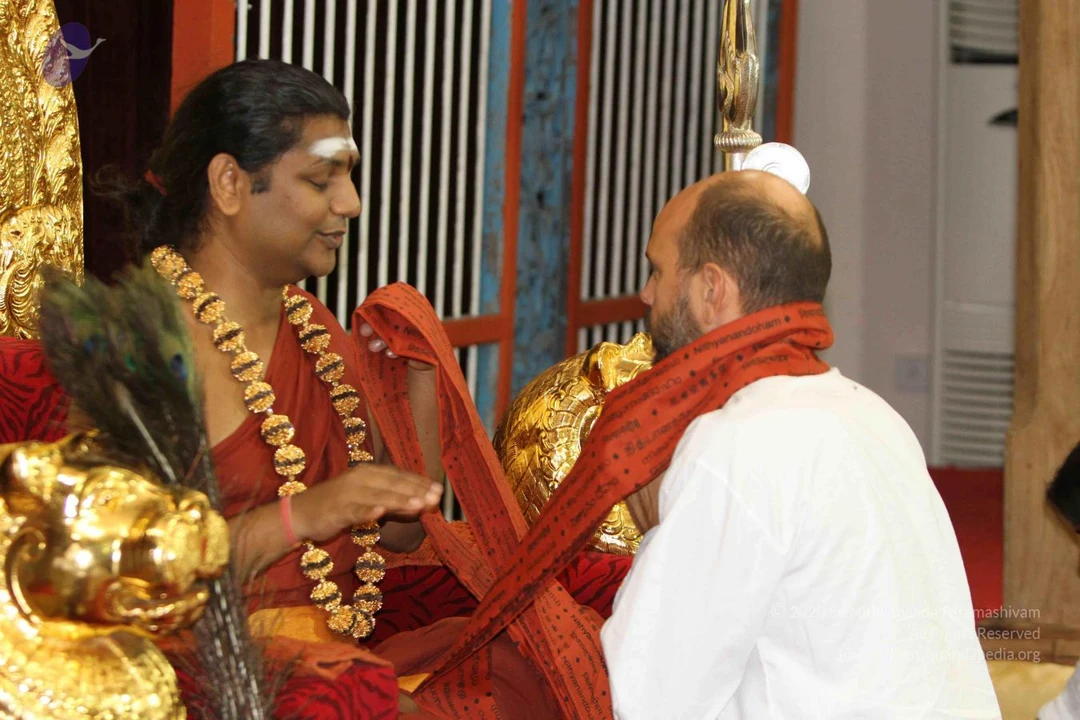
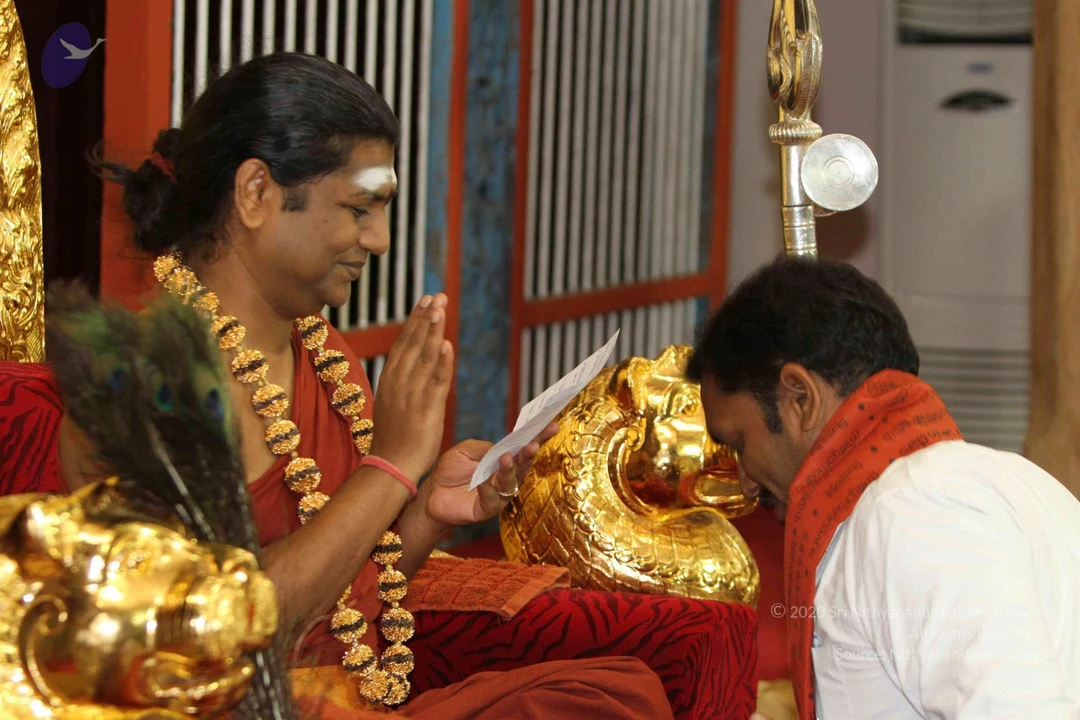
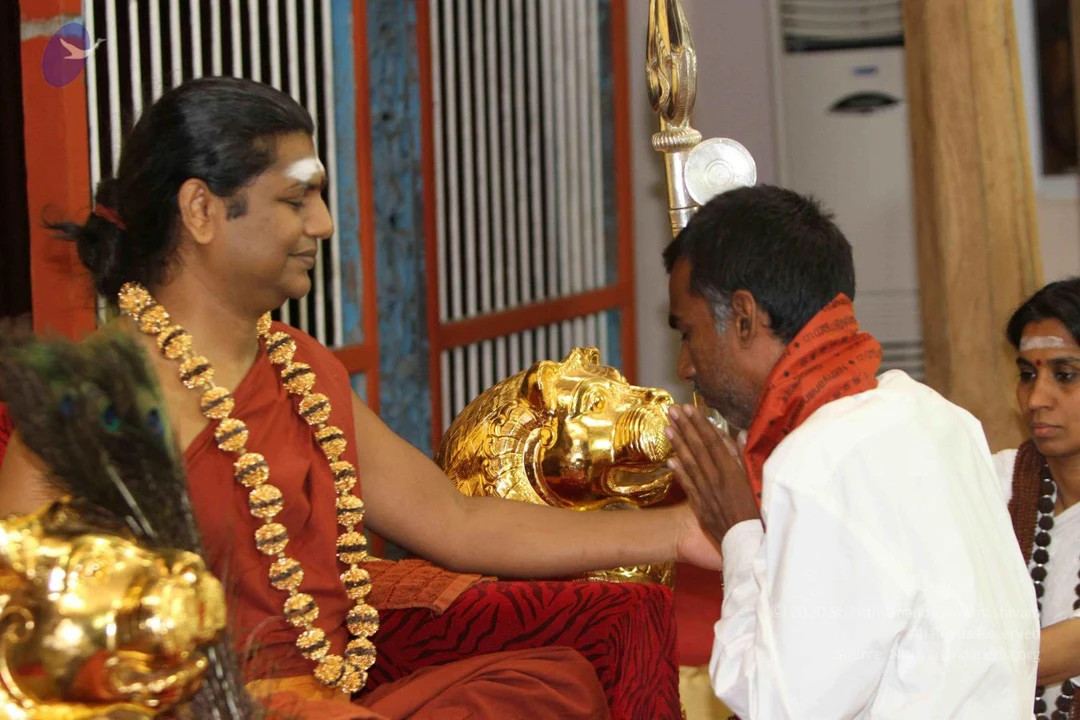
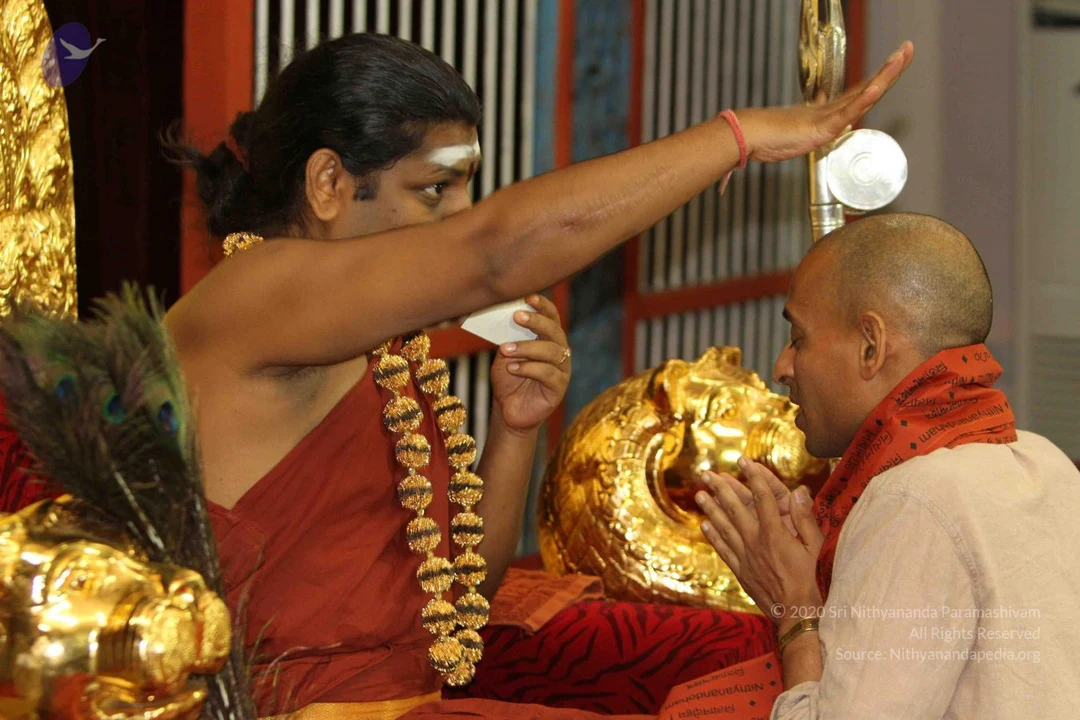
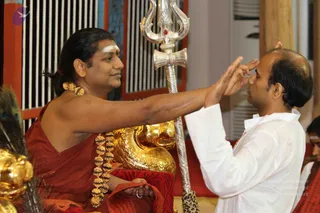
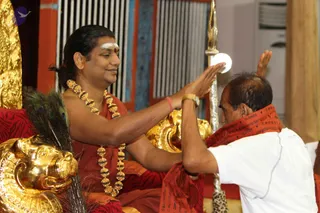
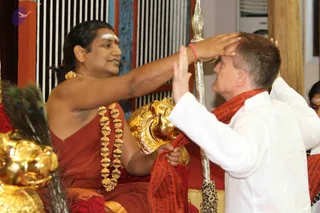
A photograph of a man seated in front of an ornate gold throne with carved scrollwork, hands pressed together in namaste with eyes closed. He wears a rust-red sleeveless robe, a long multi-strand necklace of gold and black beads, a red thread on his wrist, and a white vertical tilak with a red dot on his forehead. He sits on a red tiger-striped cushion. To the right stands a silver trident with a red gem. a person: the seated man has short dark hair, a rust-red robe, bead necklaces and a tilak, and is seated on a throne in a devotional setting.A seated man in orange-red robes sits in prayer pose with palms pressed together at his chest, eyes closed, on an ornate gold throne with carved arch back and two gold lion figures at its sides. He wears a long string of beads around his neck, a white tilak on his forehead, and a red bracelet on his wrist. A silver trident stands upright to his right and a peacock-feather fan lies to his left against a dark red velvet backdrop.A seated man with a shaved head, white forehead markings and a red bindi sits in a red-and-black upholstered chair with eyes closed and palms pressed together in namaste, a lit incense stick held between his fingers. He wears a rust-brown dhoti and wrap over bare shoulders, with a long gold-and-black beaded mala draped across his chest. Behind him rises an ornate gold repoussé backdrop. A silver trident stands at right and a peacock feather fan appears at left.A seated man in a rust-red robe with a white tilak on his forehead and a gold rudraksha mala with gold beads around his neck raises his hand toward the forehead of a bald man in a white kurta, who has his palms joined in devotion. Behind them stands a large silver trident with a red stone, beside a golden seated figure and a peacock-feather fan at the left edge. The setting is a temple-style hall with red and white wooden latticework. The seated man has distinctive long swept-back hair, a gold rudraksha mala and ceremonial gold ornaments, so this is a probable Swamiji (probable) in_person appearance. The scene appears to be a blessing exchange during a satsang setting.A seated figure on a gilded throne with golden lion-head armrests extends both hands toward a kneeling devotee. The seated figure wears a rust-orange garment, a long gold-and-black bead necklace, and a white forehead mark; the hair is swept back. Swamiji (probable): the seated person has long swept-back hair, orange ceremonial clothing and ornate golden beads, consistent with the page's reference to Swamiji at this satsang. A devotee in a white shirt bows with hands raised, wearing an orange shawl printed with script, and wears a gold wristwatch. A peacock-feather fan and silver staff stand beside the throne, with a red-and-gold cushion and a wall-mounted air conditioner behind.A seated man with long dark hair, a white forehead mark and a rudraksha bead necklace, wearing an orange-red garment, places his right hand on the head of a short-haired, fair-skinned man in a white shirt with a red-orange shawl. The recipient holds up his left hand palm-out. Behind them are a silver-tipped staff, a gold ornamental vessel, and a peacock-feather fan, with vertical white and red striped wall panels in the background. Appearance-based label: a person, giving a blessing to the devotee, consistent with a satsang or darshan setting.

Nithya-Puja

2 photosSource gallery
A photograph of a temple sanctum during ritual worship. Two large colourful dvarapala-style guardian statues flank the scene, each with four arms, gold crowns, gold jewellery and orange-red and green dhotis. At centre, a seated figure on an ornate gold throne wears a red-and-gold headwrap, layered gold and bead necklaces, and an orange garment, with attendants in orange around him. In the foreground a woman in white with a ponytail faces away from the camera, holding a tall brass lamp with many lit flames. Hanging bells and brass lamps decorate the dark backdrop, and a red carpet covers the floor. Two young attendants in orange at lower left hold offerings near a sacred thread-like marking on the forehead.A photograph of a temple sanctum with two large painted guardian statues flanking a doorway. Each statue is a multi-armed figure with a tall crown, gold necklaces, green sashes and red-orange dhotis, holding ritual objects. In the centre, a seated figure in a golden throne wears a red headdress, a layered gold necklace and beaded malas, flanked by hanging bells and oil lamps. Before the throne, a man in orange robes with his back to the camera sits with folded hands, and several men in maroon garments sit near the throne, while a man with white forehead markings is at the left edge holding a bell or small instrument. The scene suggests a puja or darshan at the throne, with the seated figure on the throne appearing to be a depiction rather than a clearly identifiable living person.

Nithya-Kirtan

2 photosSource gallery
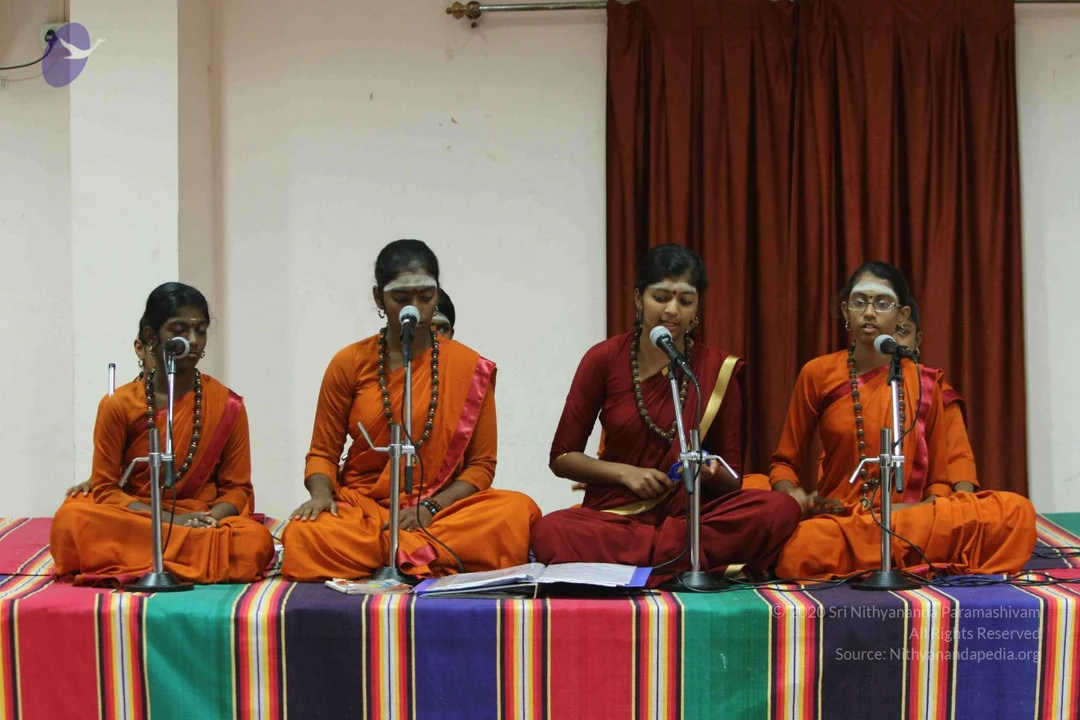
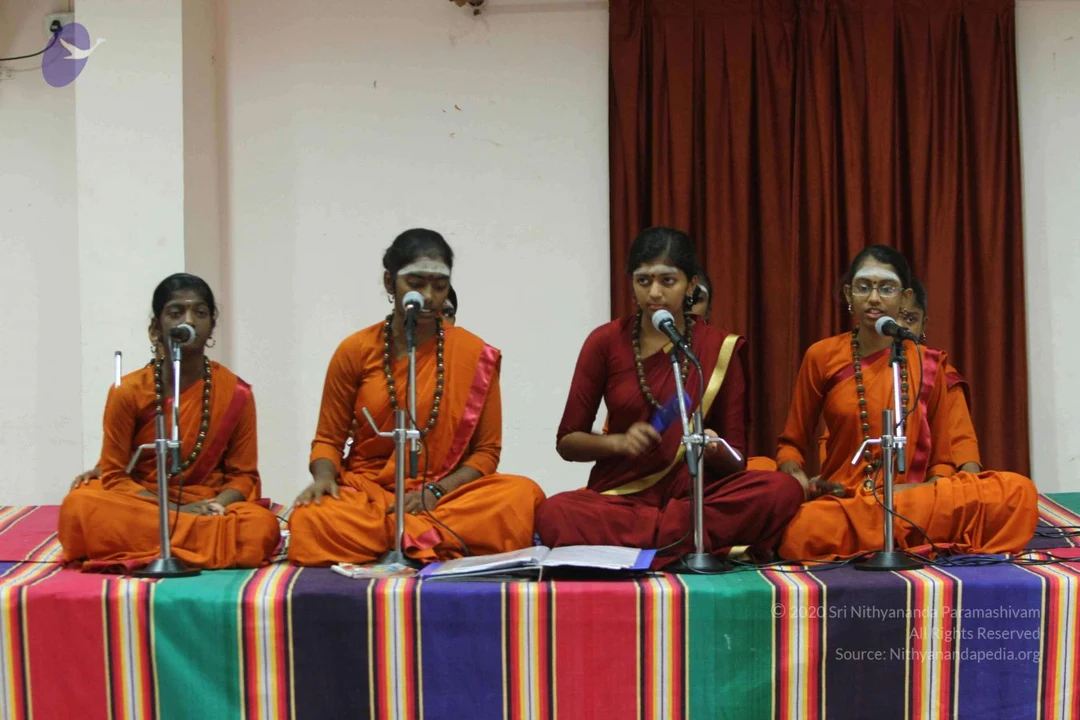
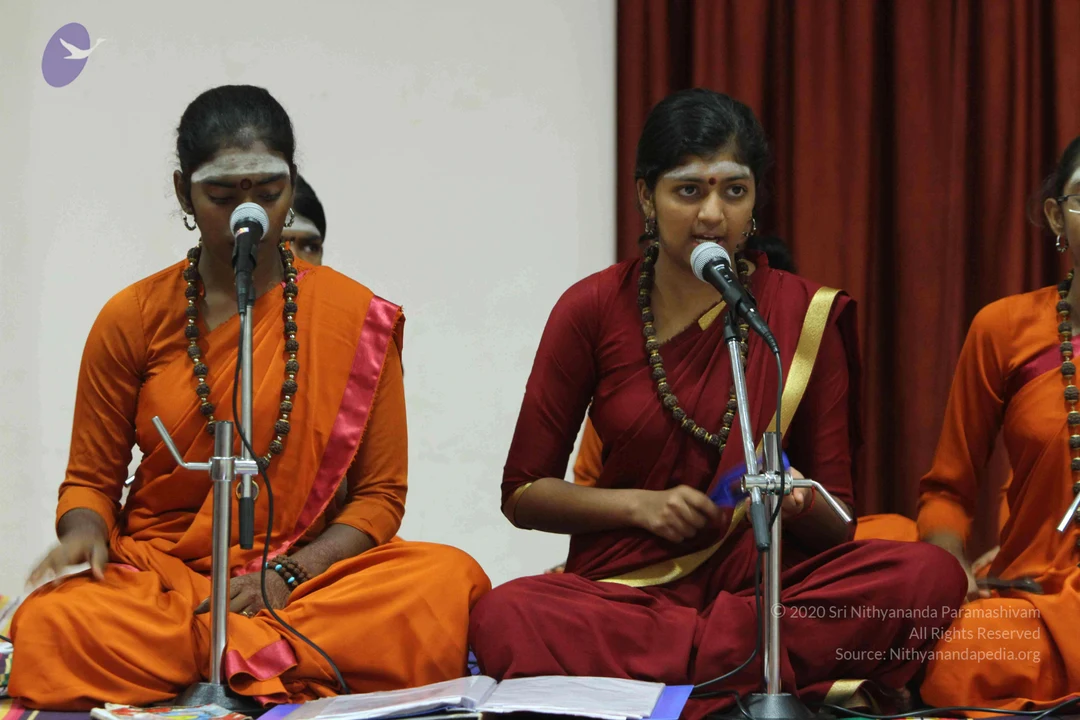
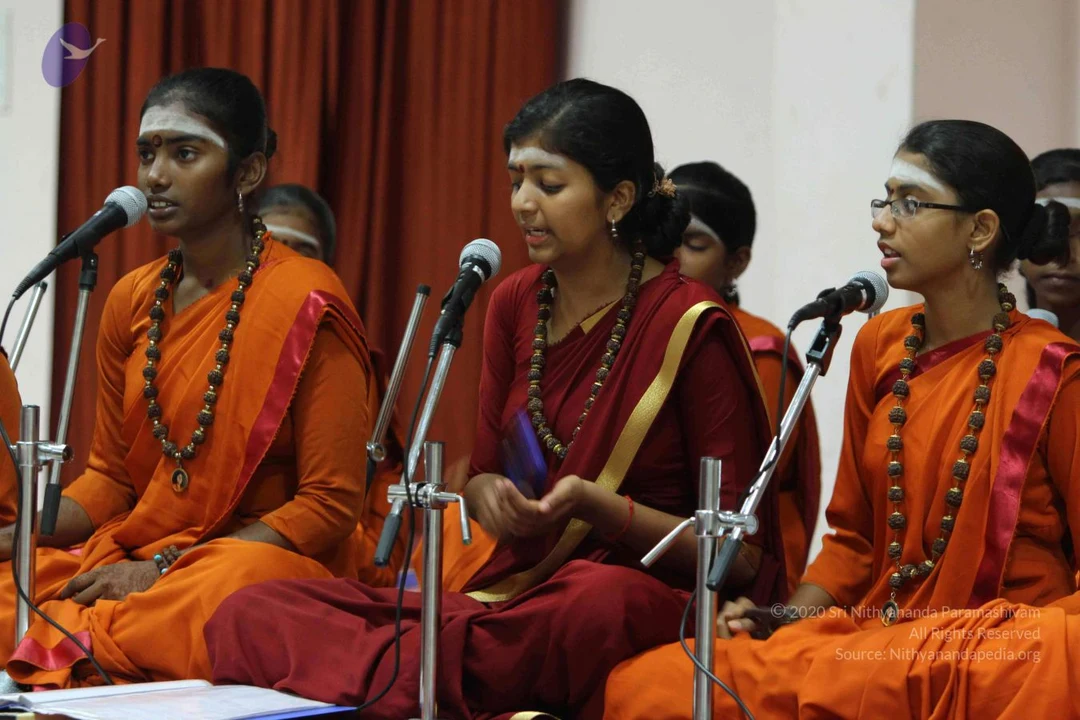
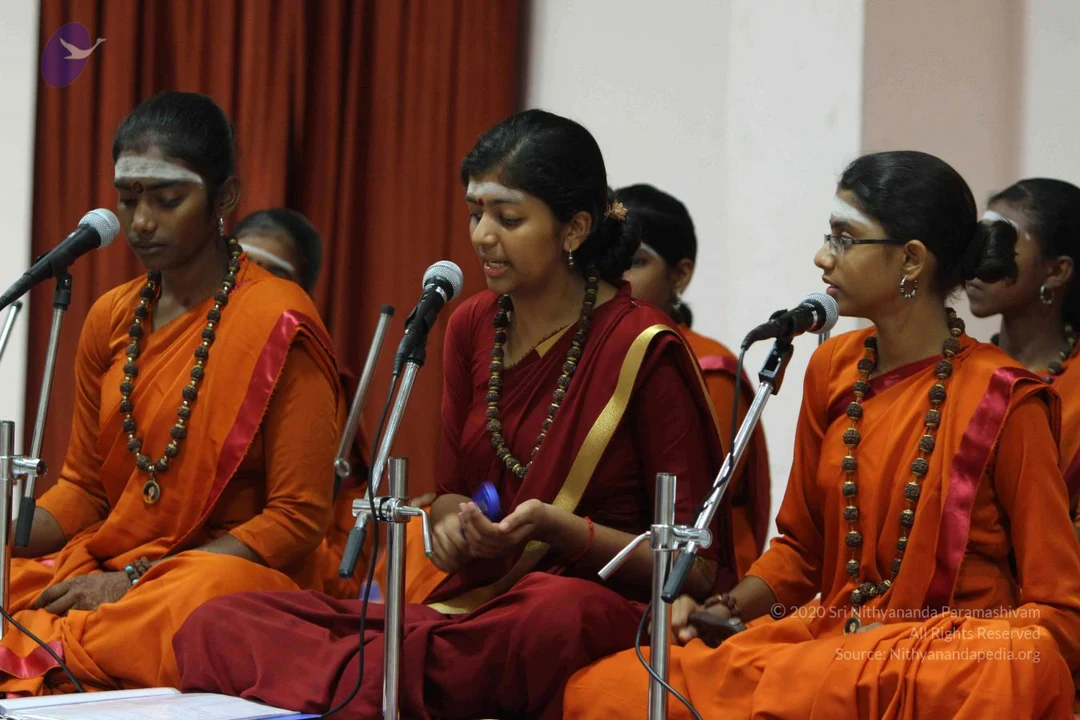
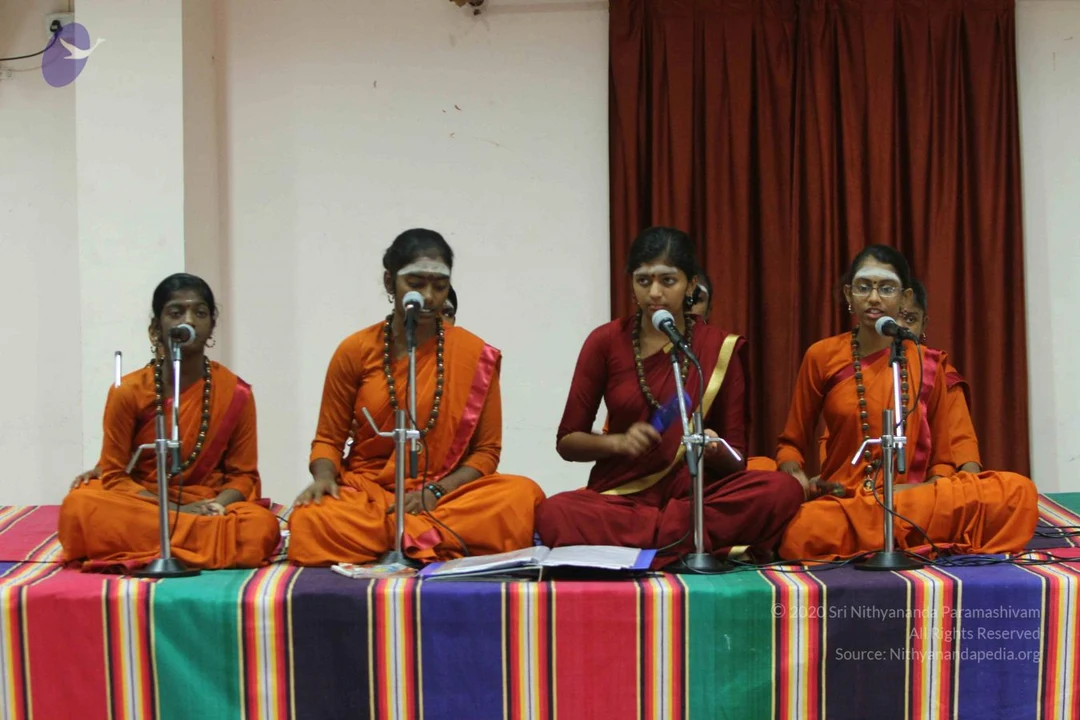
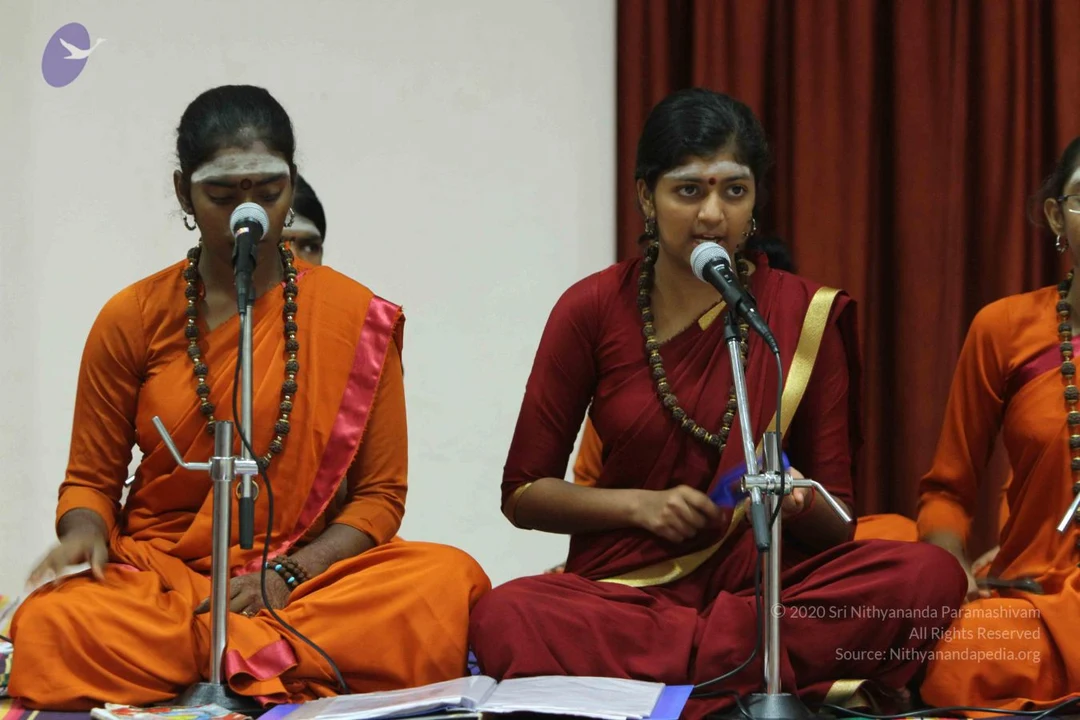
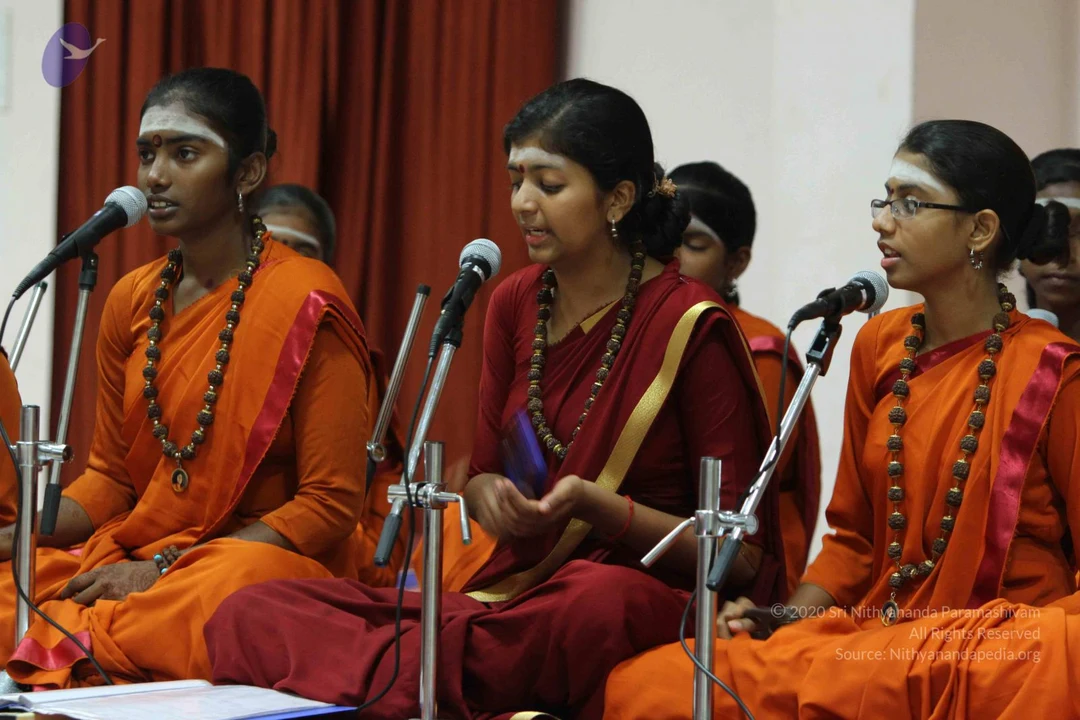
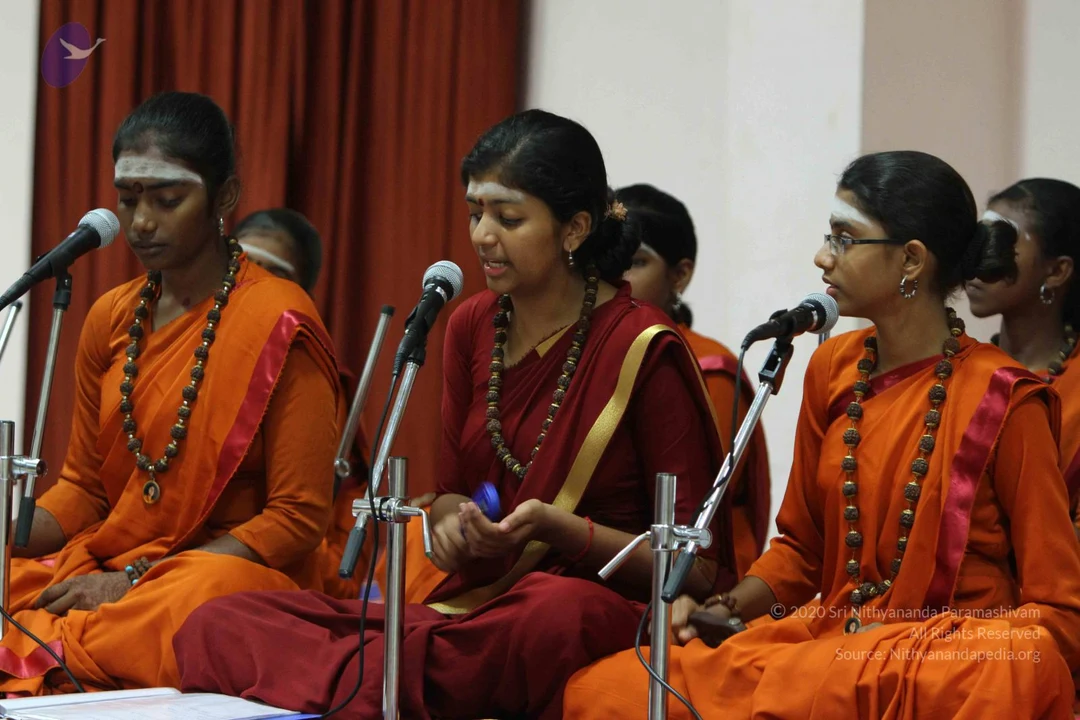
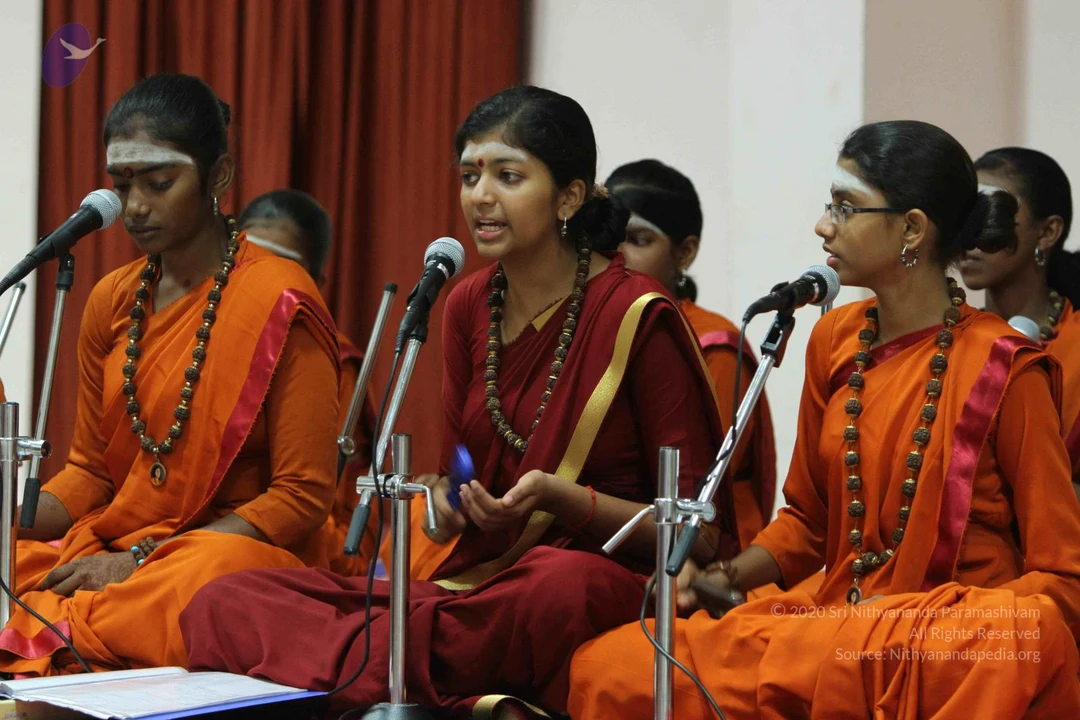
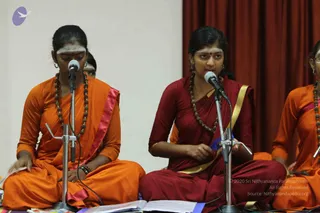
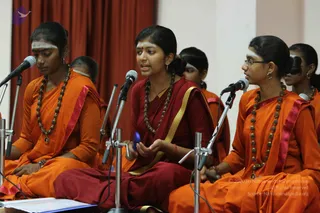
Two young women in saffron and maroon attire sit cross-legged behind microphone stands, singing or chanting from open books on the floor. The woman on the left wears an orange sari with a pink border, a rudraksha mala, and vertical white tilak marks; her eyes are lowered. The woman at centre wears a maroon sari with a gold border, rudraksha beads, a red bindi and white forehead marks, and speaks into the microphone while holding sheets. Other women in orange sit at the right edge in front of a deep red curtain. The scene suggests a satsang recitation.A group of young women in orange and maroon robes sit cross-legged behind several microphone stands, chanting from a printed sheet at lower left. The woman at center wears a deep red sari with a gold border, a rudraksha mala, a red bindi and small earrings, and gestures with her hands while speaking into the mic. The women on either side wear orange saris with pink borders and rudraksha malas, one with white forehead markings and one wearing glasses. A red curtain hangs behind them.

Satsang
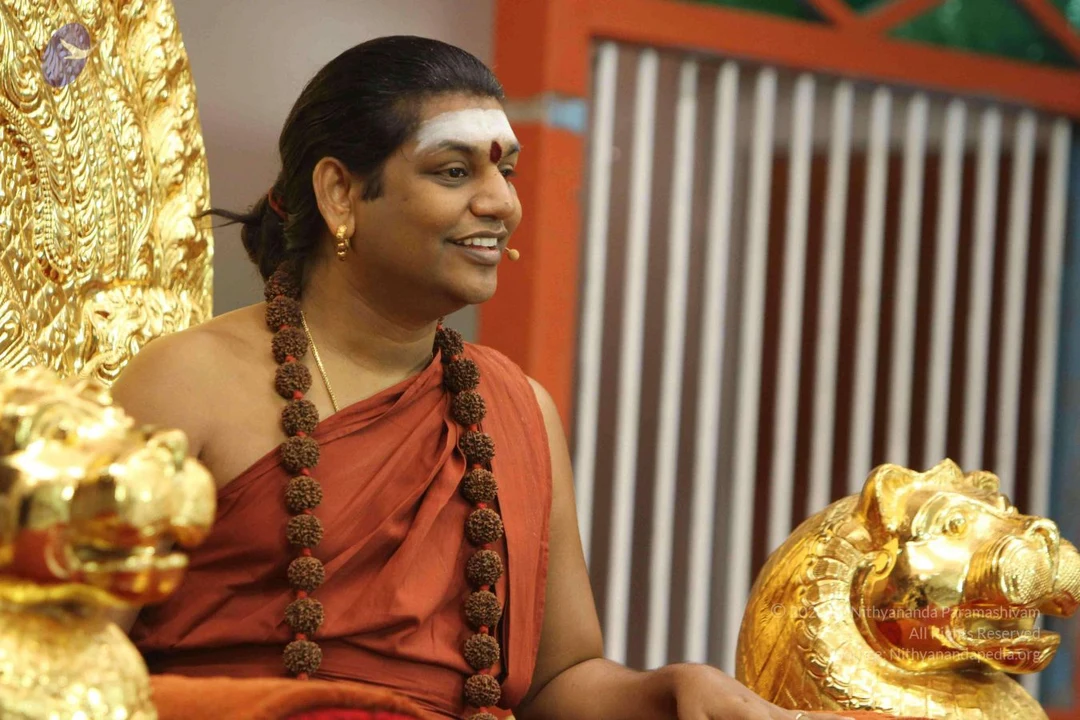
23 photosSource gallery
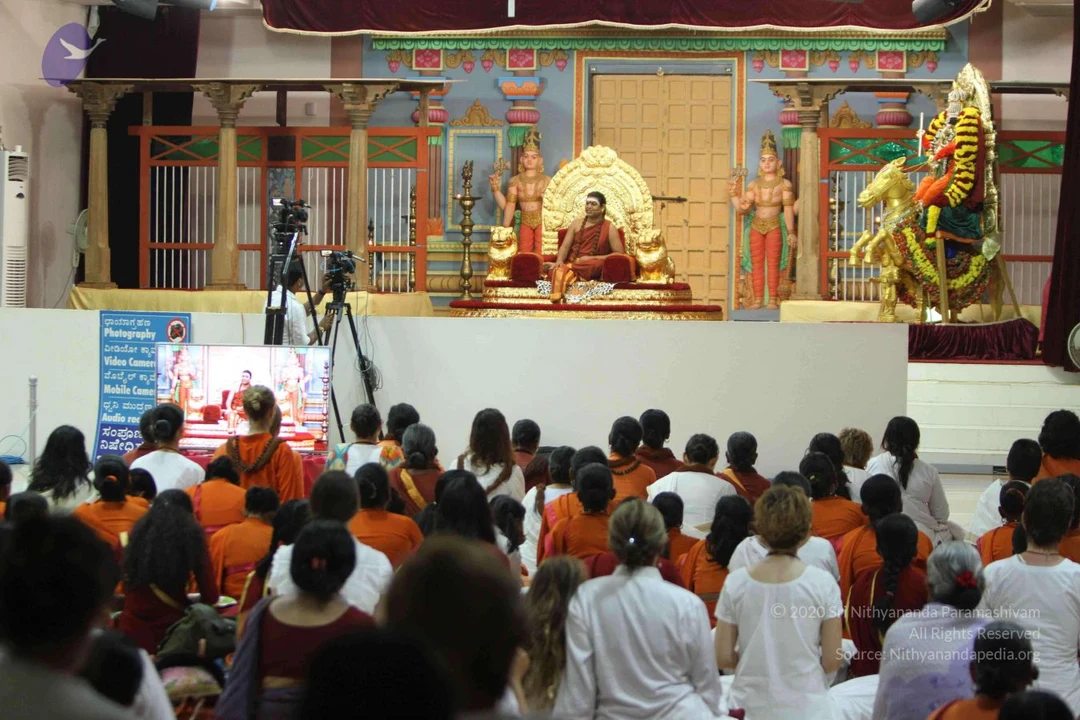
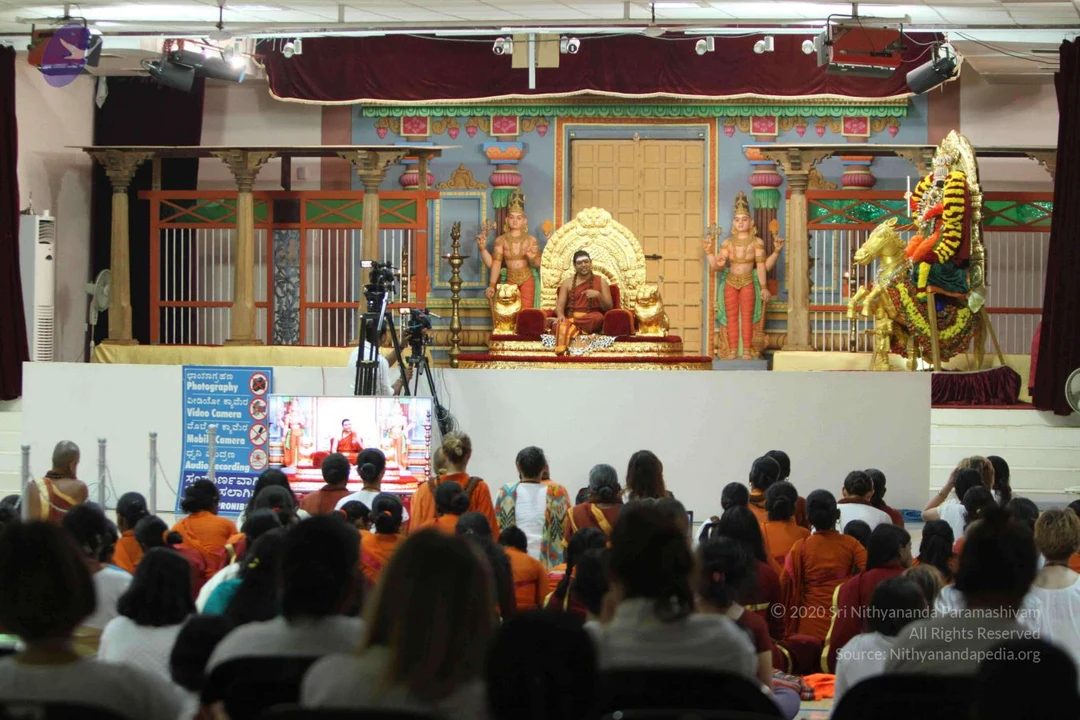
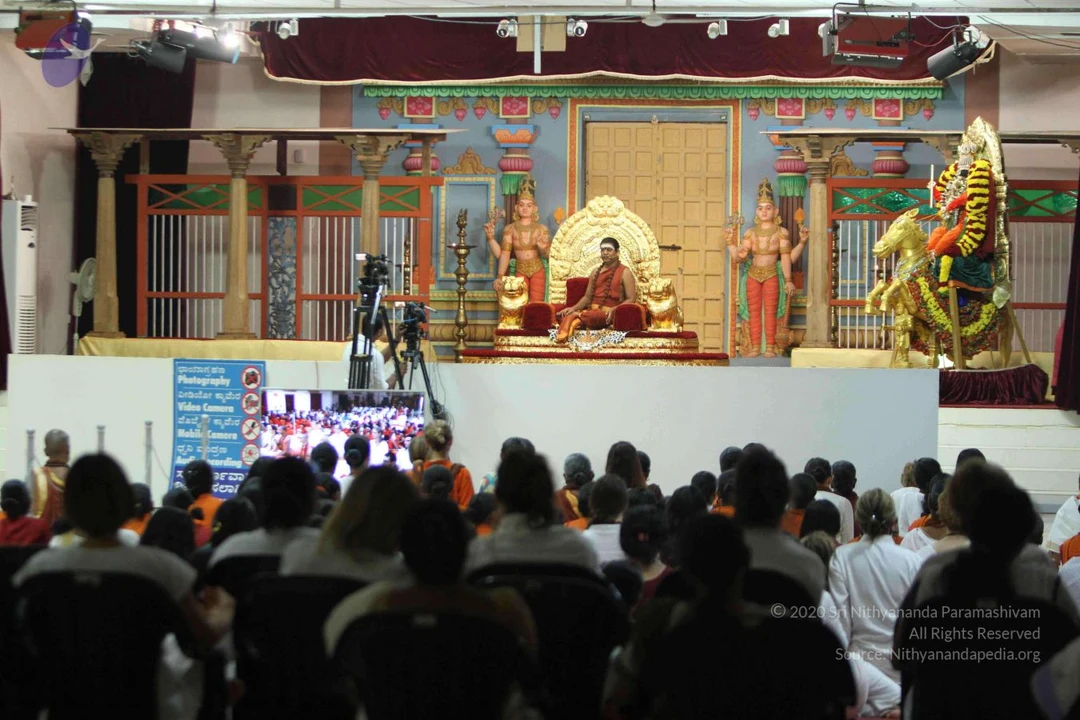
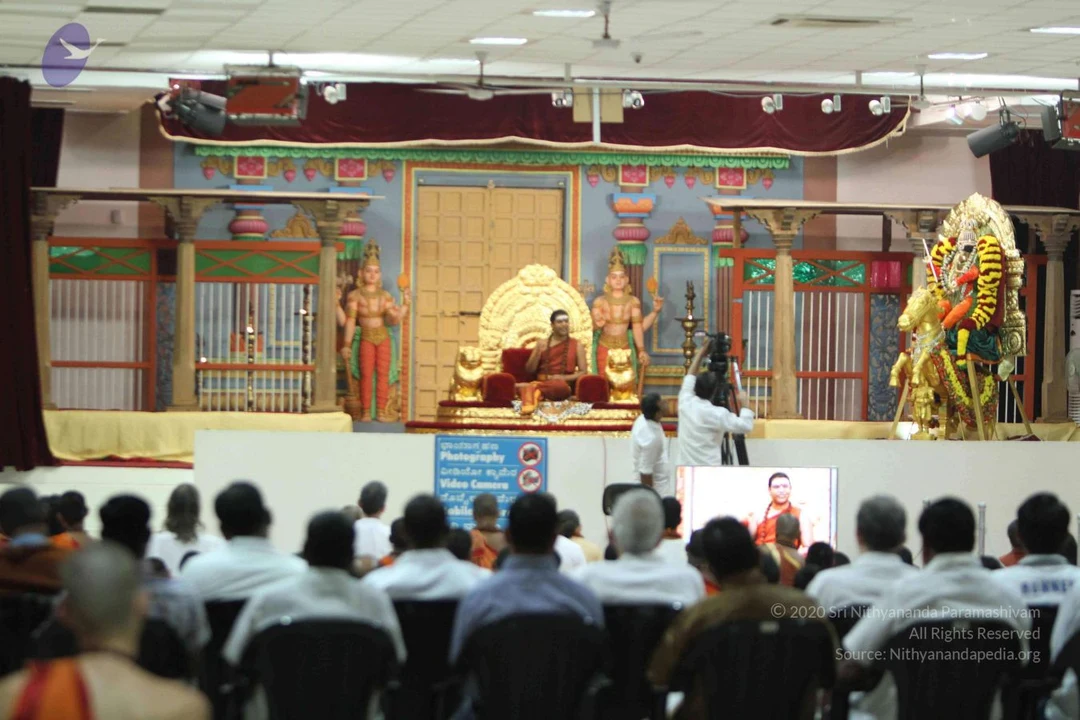
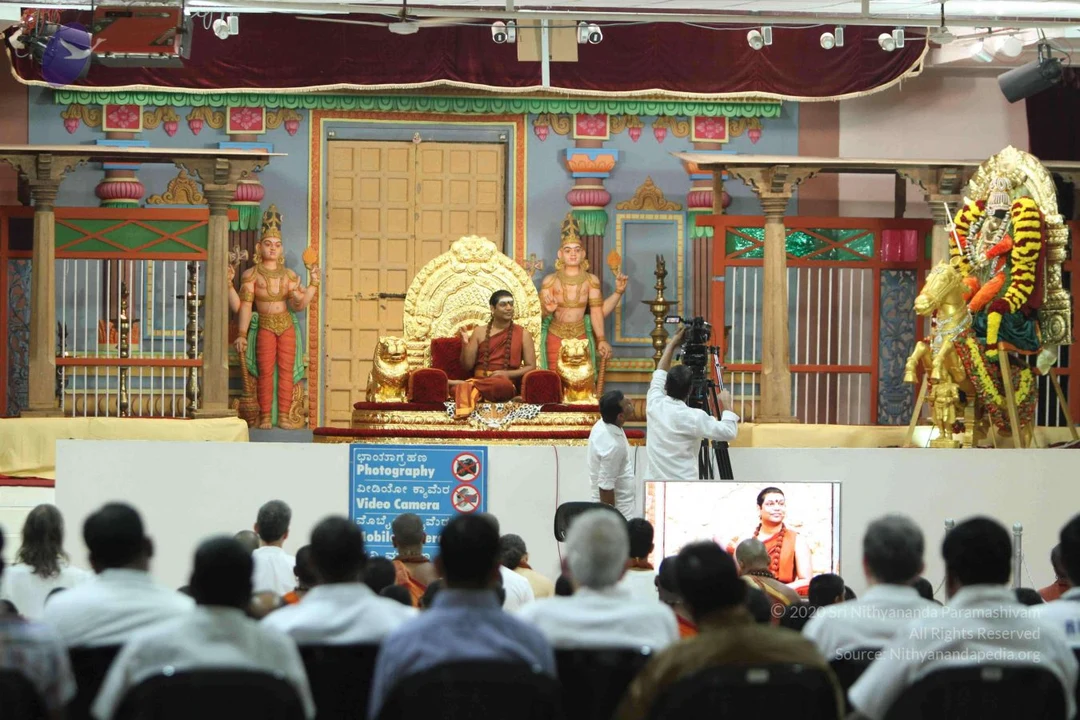
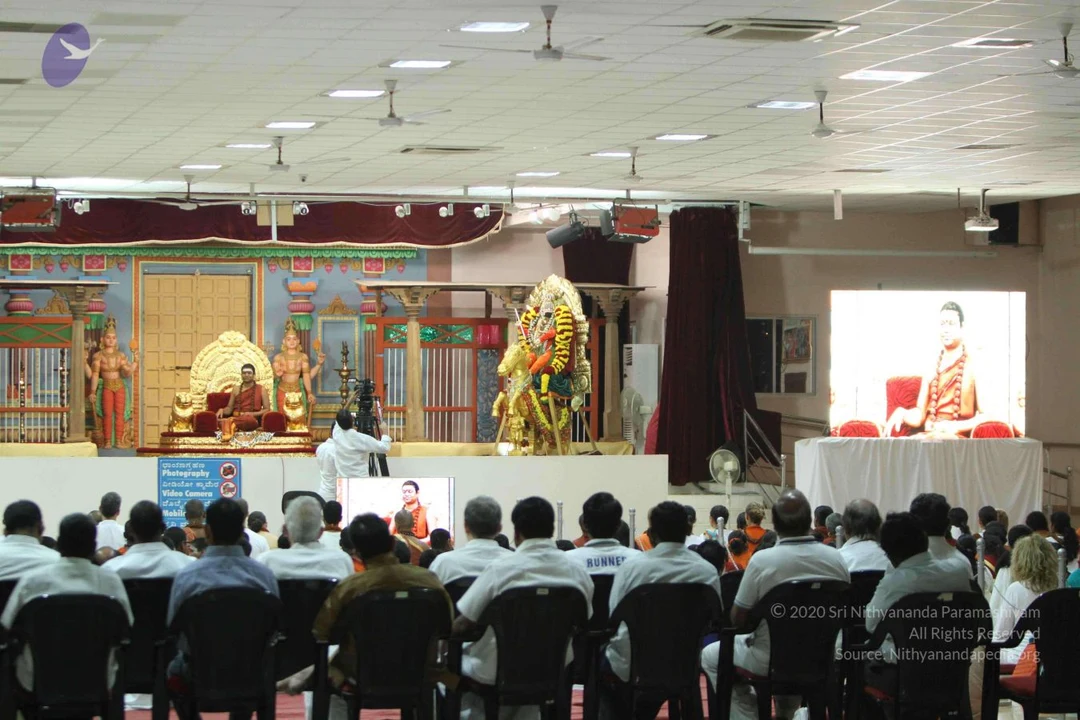
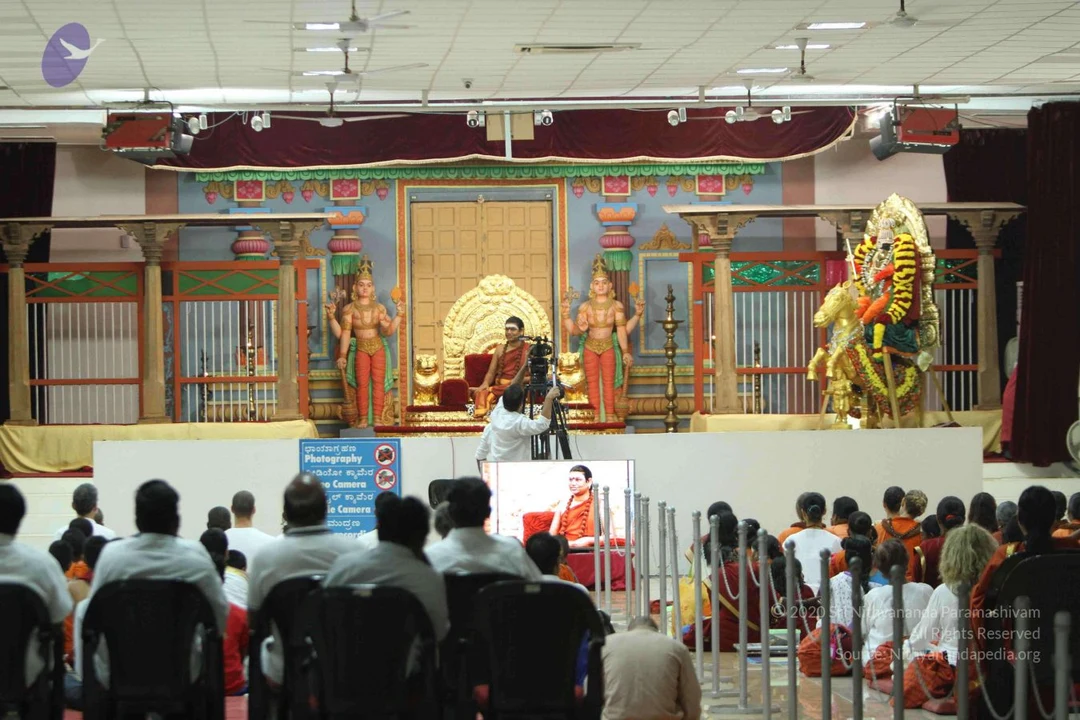
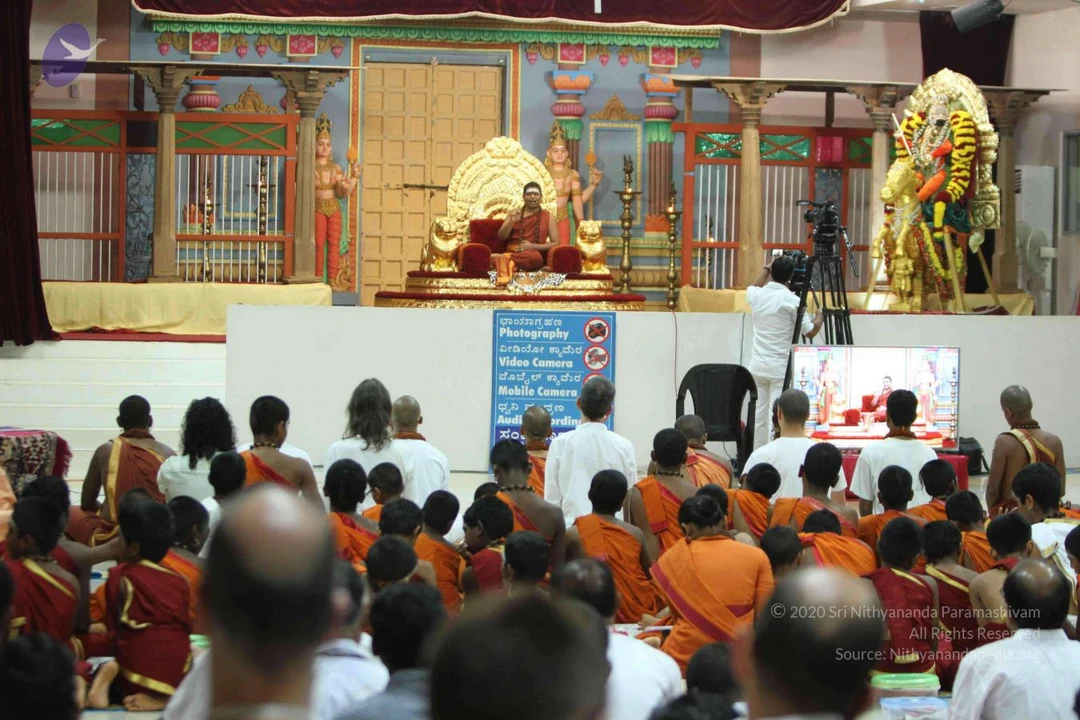
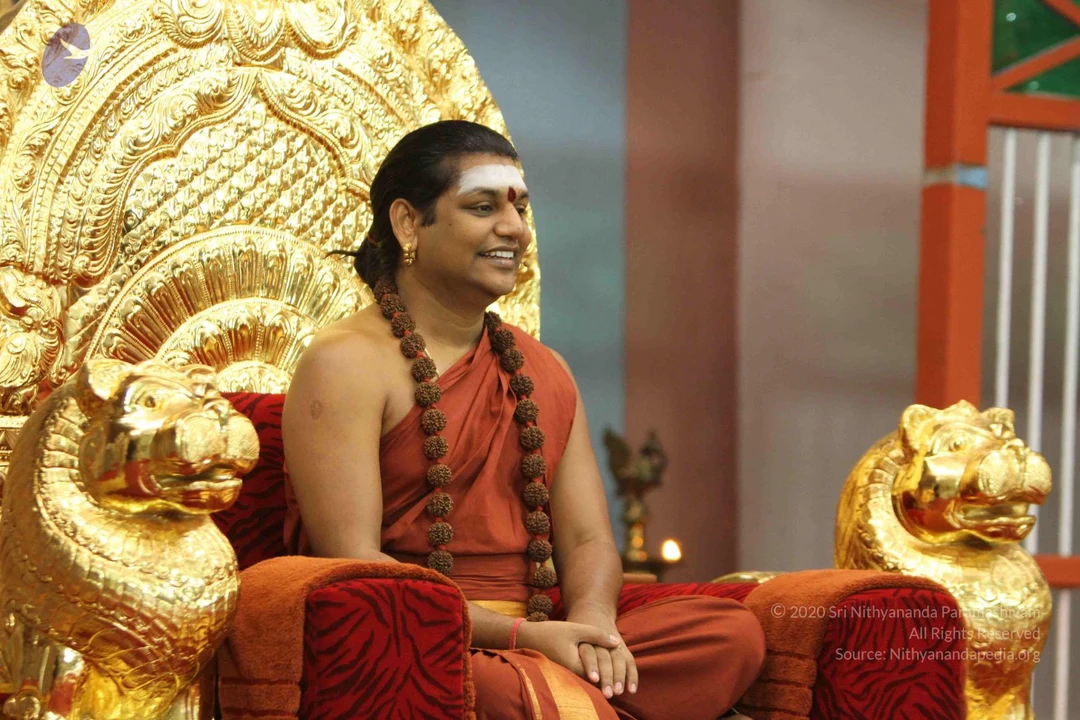
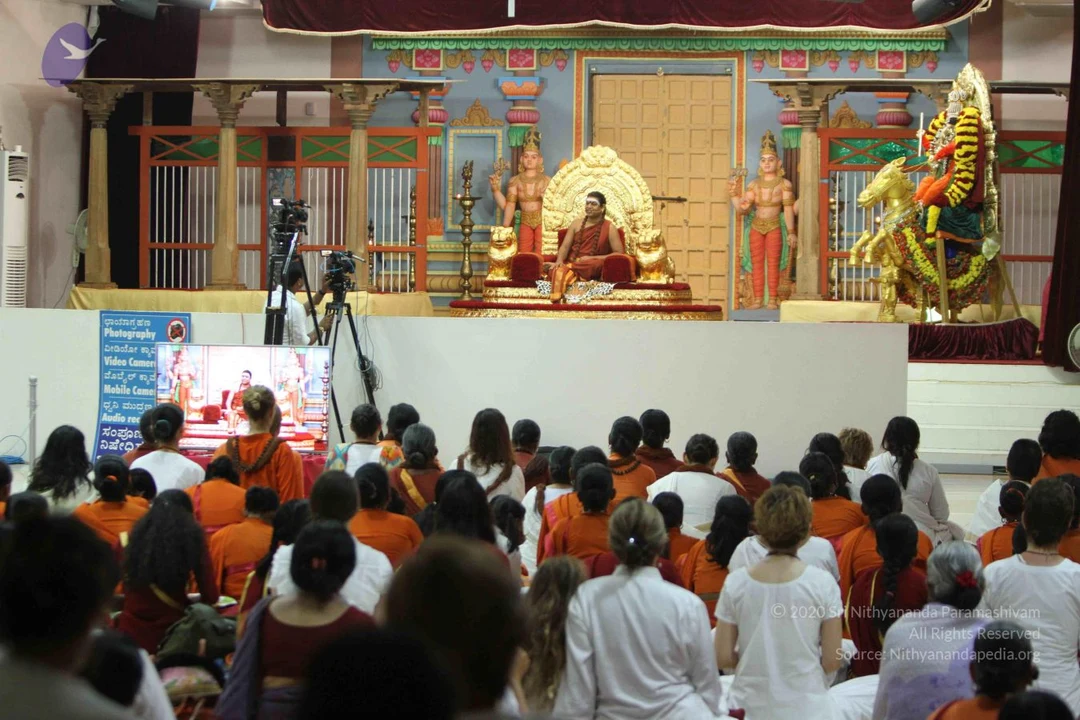
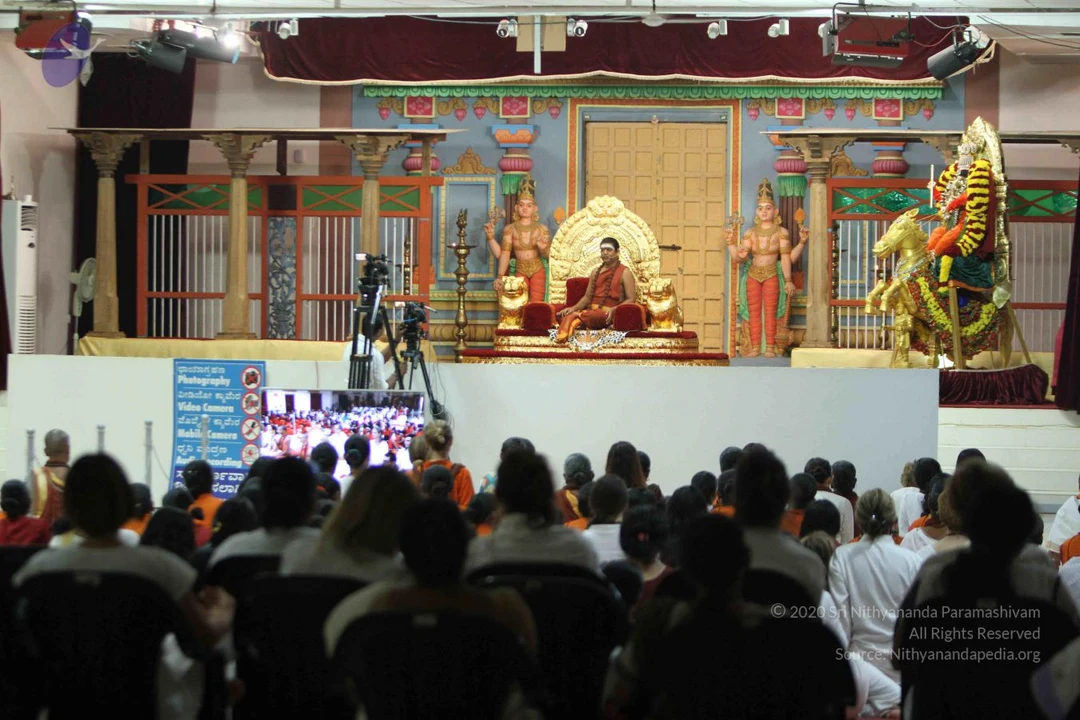
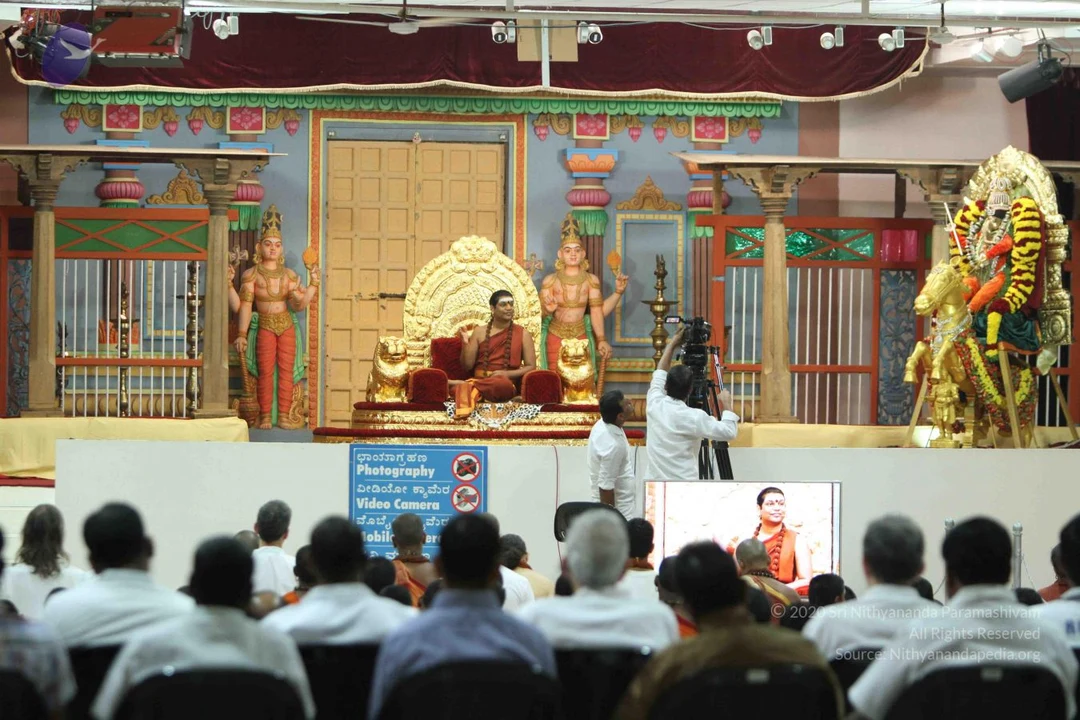
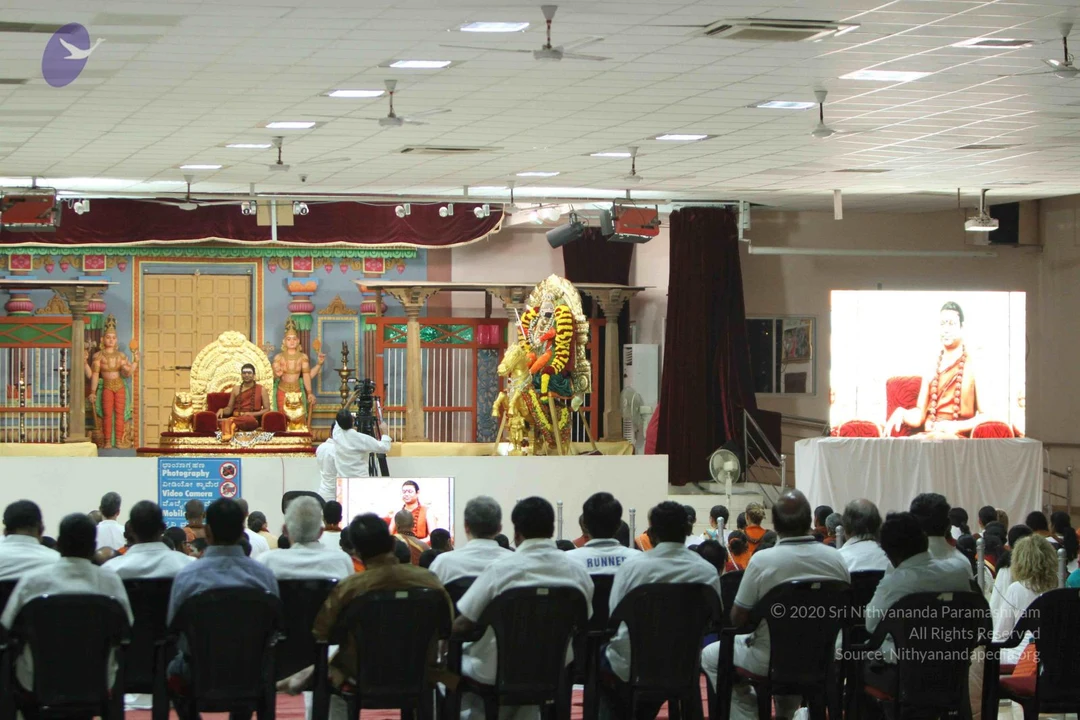
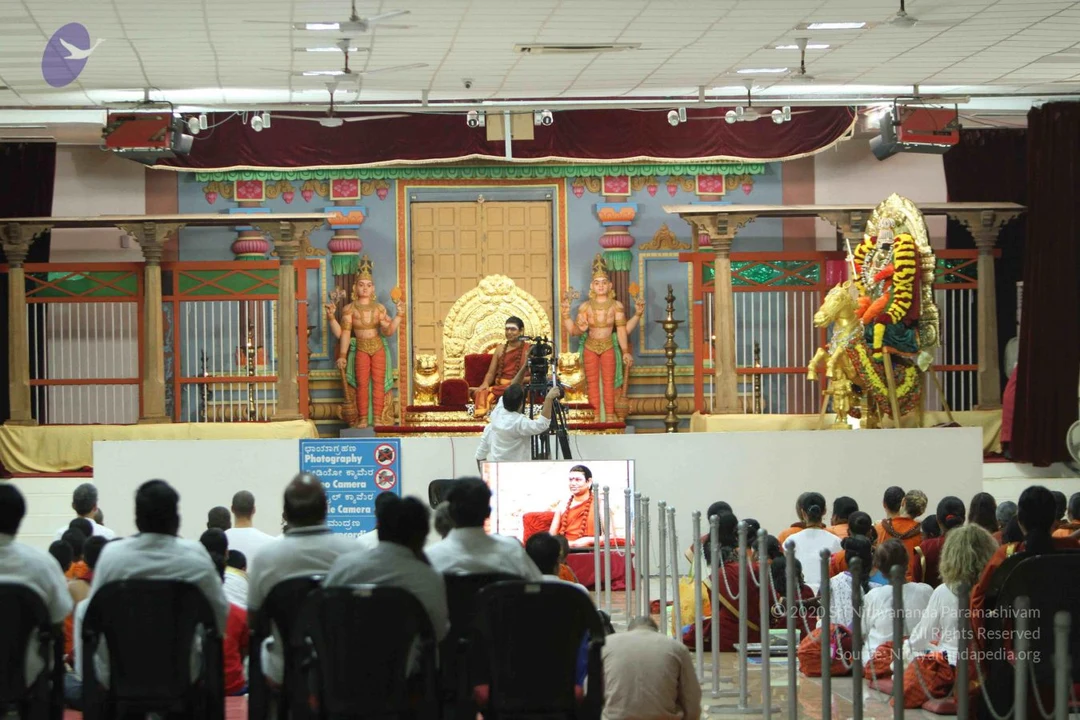
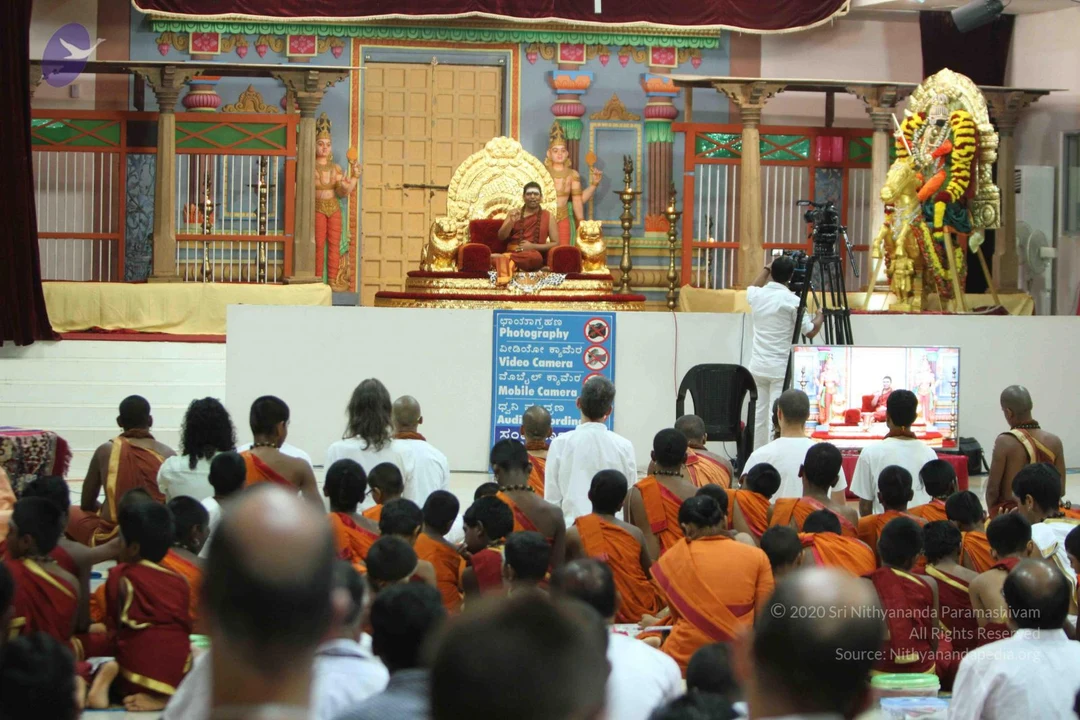
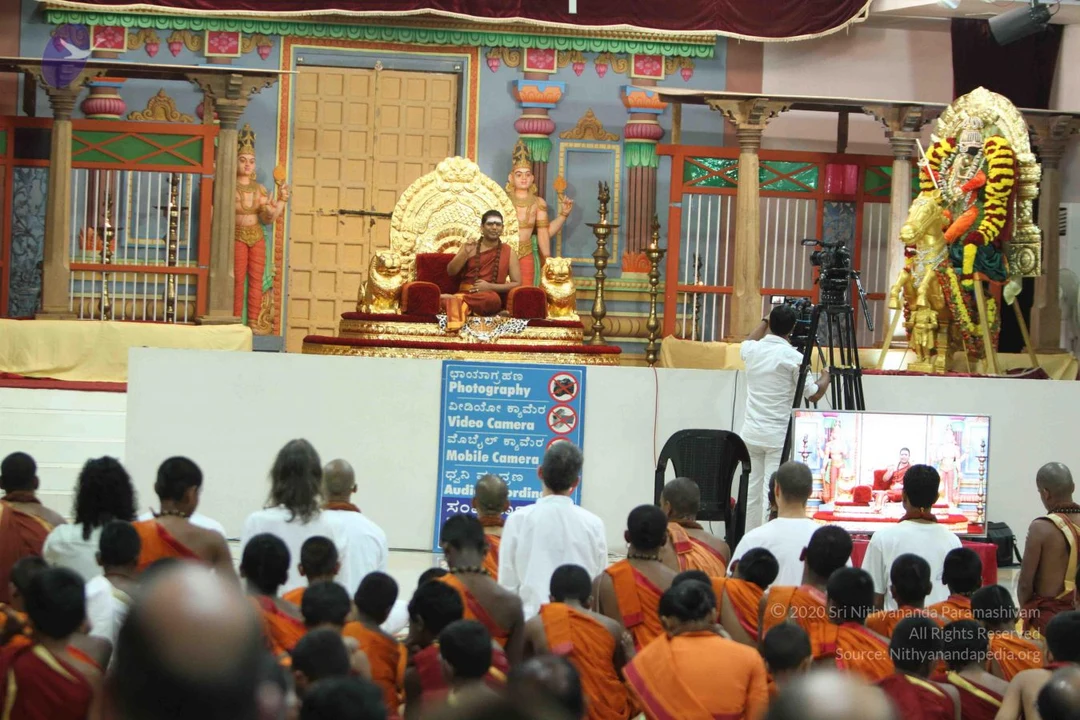
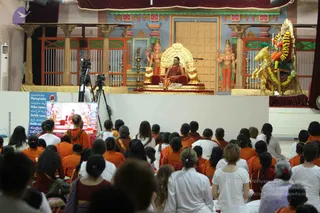
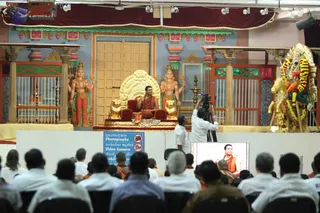
A seated man with a shaved head and white tilak on his forehead sits cross-legged with palms pressed together in namaste on an ornate gilded throne. He wears an orange-red shawl over his bare upper body, an orange-and-gold dhoti, and a long rudraksha mala. Flanking the throne are two gilded lion figures on red cushions, and two painted dvarapala-style guardian statues with raised arms stand on either side. A tiger-striped cloth covers the seat. The setting is a temple-like hall with a wooden door behind.A man seated cross-legged on an ornate gold-and-red throne with his palms pressed together in namaste. He wears an orange-red garment with gold border, a white vibhuti line on his forehead, and rudraksha malas around his neck. Gold lion-shaped armrests flank the seat, and a leopard-skin-patterned cloth lies beneath him. Two painted standing guardian figures with multiple arms, gold crowns and gold jewellery stand on either side against a golden arched backdrop. The scene reads as a satsang or darshan setting. Appearance cues for the seated man are a shaved head, orange garment and rudraksha malas, which are insufficient for an identity claim, so the seated man is described by role only.A seated figure in rust-red and saffron-orange robes with a gold-bordered dhoti sits cross-legged on an ornate gold throne with red velvet cushions, hands pressed together in namaskar with eyes closed. Long braided hair falls down the back and a white tilak marks the forehead. Two gold lion-faced armrests flank the seat, and a leopard-spotted skin covers the platform. Two painted multi-armed guardian figures in gold jewellery stand on either side, one holding a flaming lamp. The setting looks like a temple hall with a wooden door behind. a person in the central seat, seen with long braided hair, saffron-orange clothing and a ceremonial golden throne.A man sits on an ornate golden throne with lion-head armrests and red tiger-striped cushions, smiling with hands folded in his lap. He wears an orange-saffron shawl draped over one shoulder, a long multi-strand rudraksha mala with large beads down his chest, gold earrings, and a white tilak with a red dot on his forehead. Behind him stands a small lit oil lamp and a golden ritual object. The setting is a satsang hall with red and green panels. This appears to be a person, a seated teacher with rudraksha mala, saffron clothing and ornate golden throne cues.A large audience of seated devotees fills a hall facing a raised stage decorated with painted pillars and a gold throne. A seated figure in orange-red robes sits on the golden throne flanked by two carved guardian statues in red and orange. Foreground devotees wear orange, maroon and white clothing, some with hair in braids and buns. Cameras on tripods film the stage, and a screen at the front shows the same stage feed. To the right, a golden horse statue is draped with orange and yellow garlands. A blue sign lists photography, video camera, mobile camera and audio recording services.A satsang hall with a seated teacher on a gilded throne flanked by two standing deity statues in orange and gold dress holding ceremonial fans. A cameraman in white with a tripod films the stage. In front, a large audience of devotees, many with their backs to the camera, sits in rows of chairs. A blue sign reads Photography, Video Camera and Mobile Camera restrictions in English and Kannada. To the right, a garlanded deity murti with marigold and orange flower garlands stands on a golden vahana. A screen shows the seated teacher in orange robes.

Sarva-Darshan

5 photosSource gallery
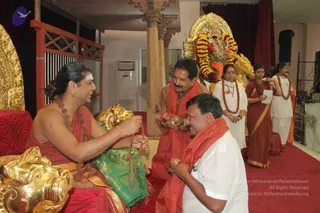
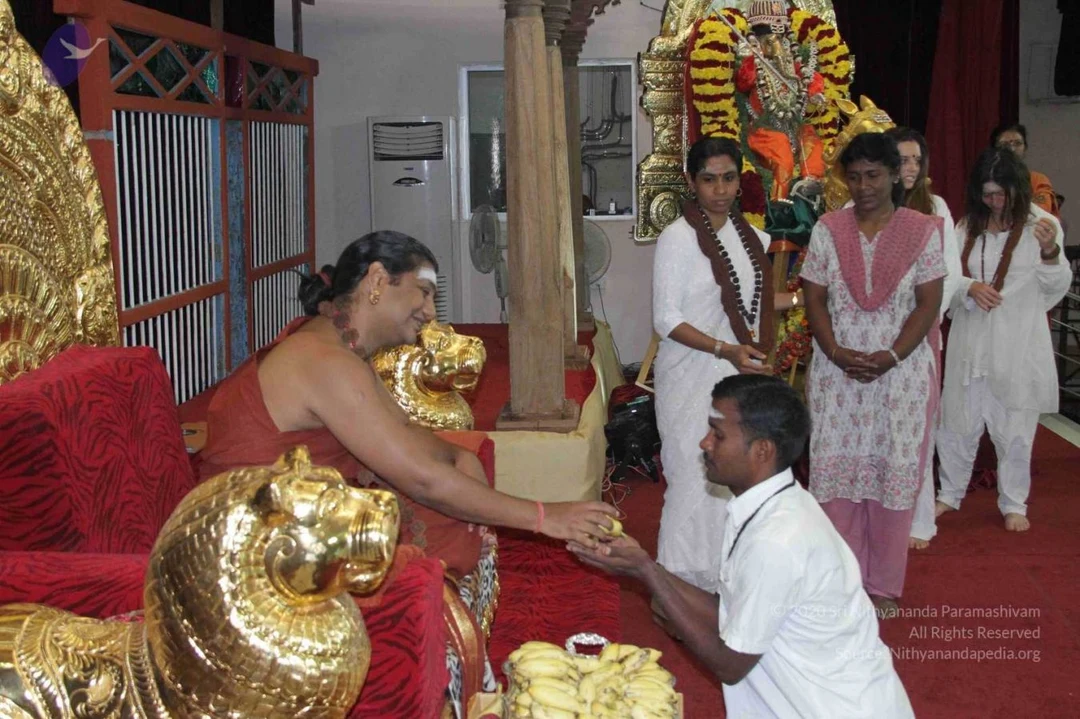
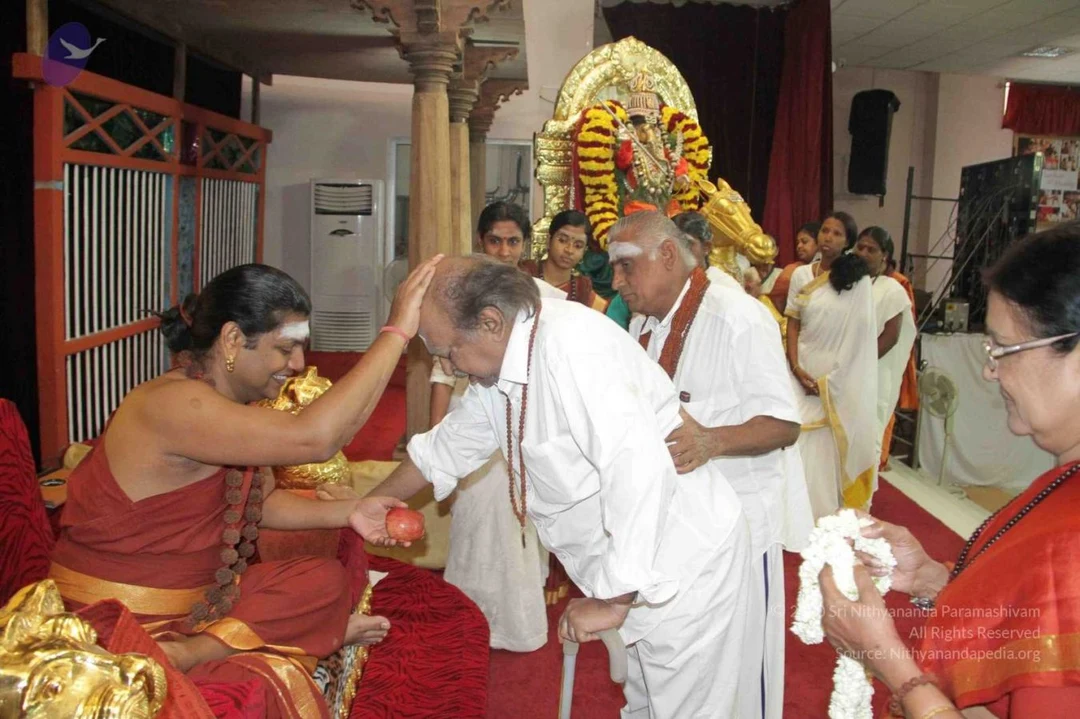
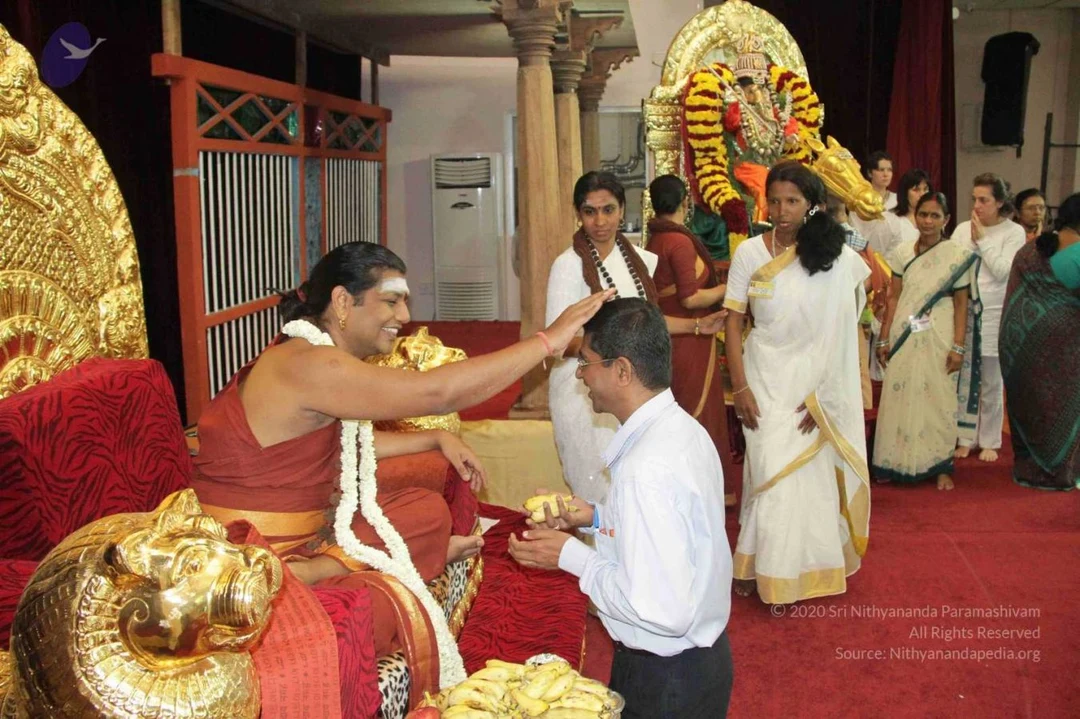
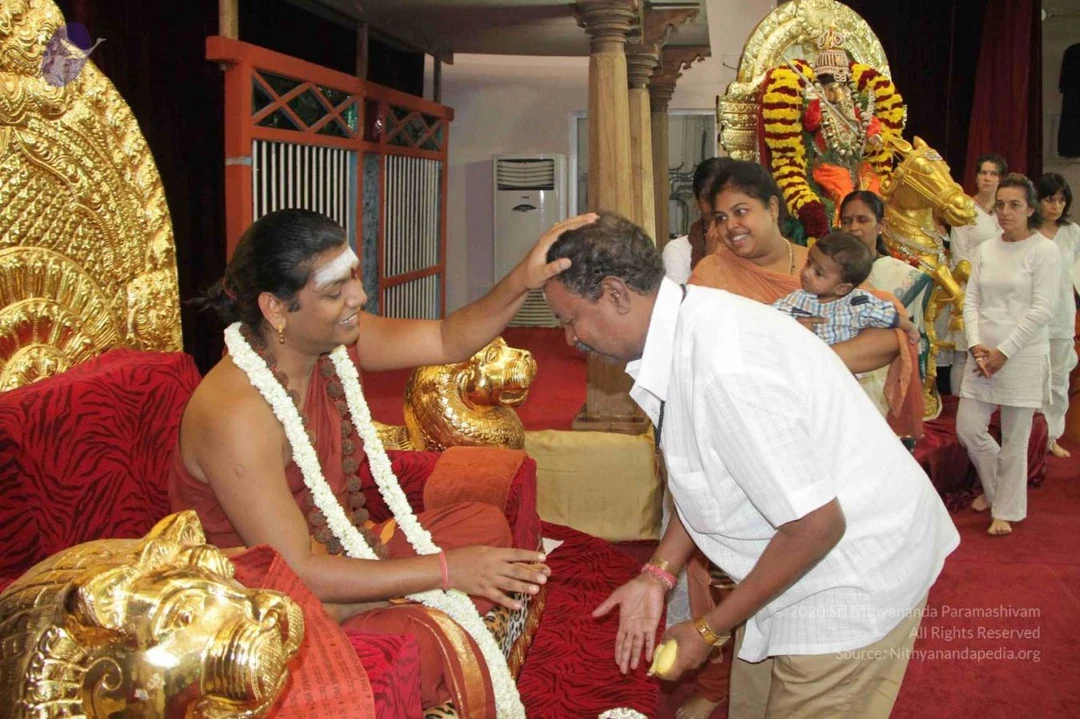
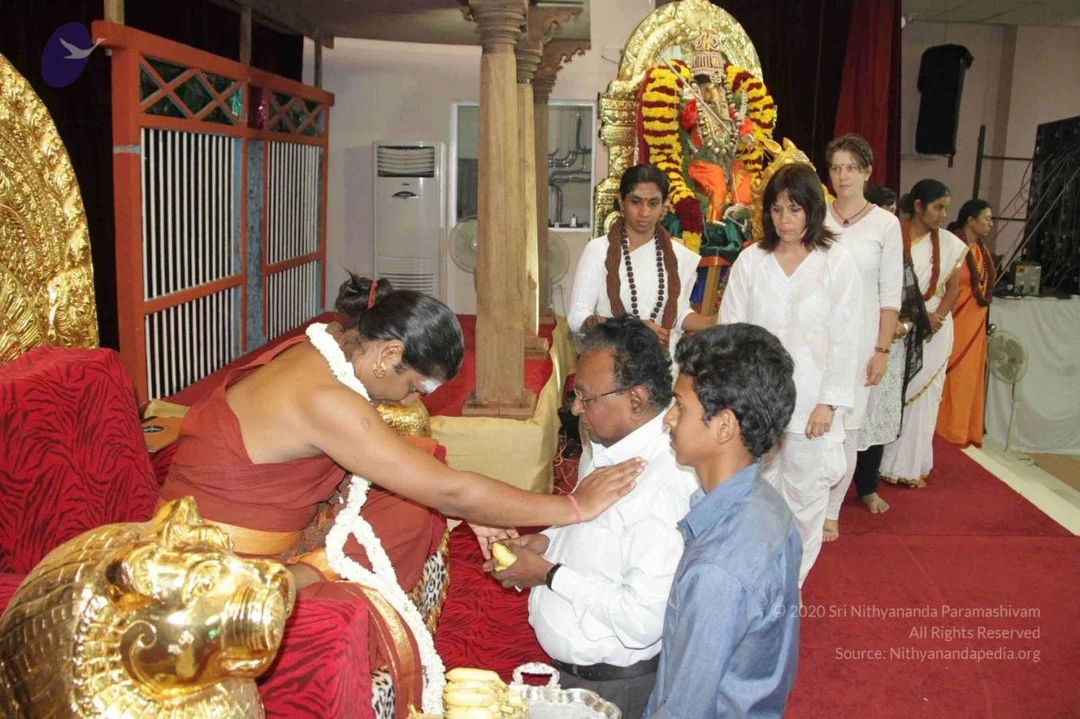
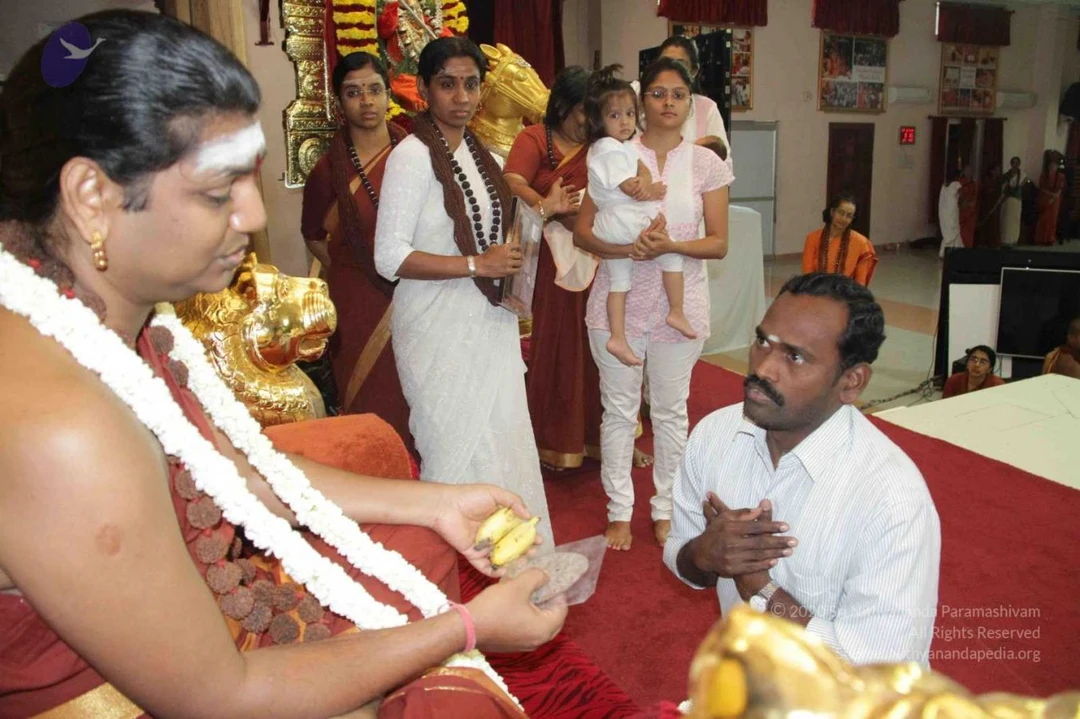
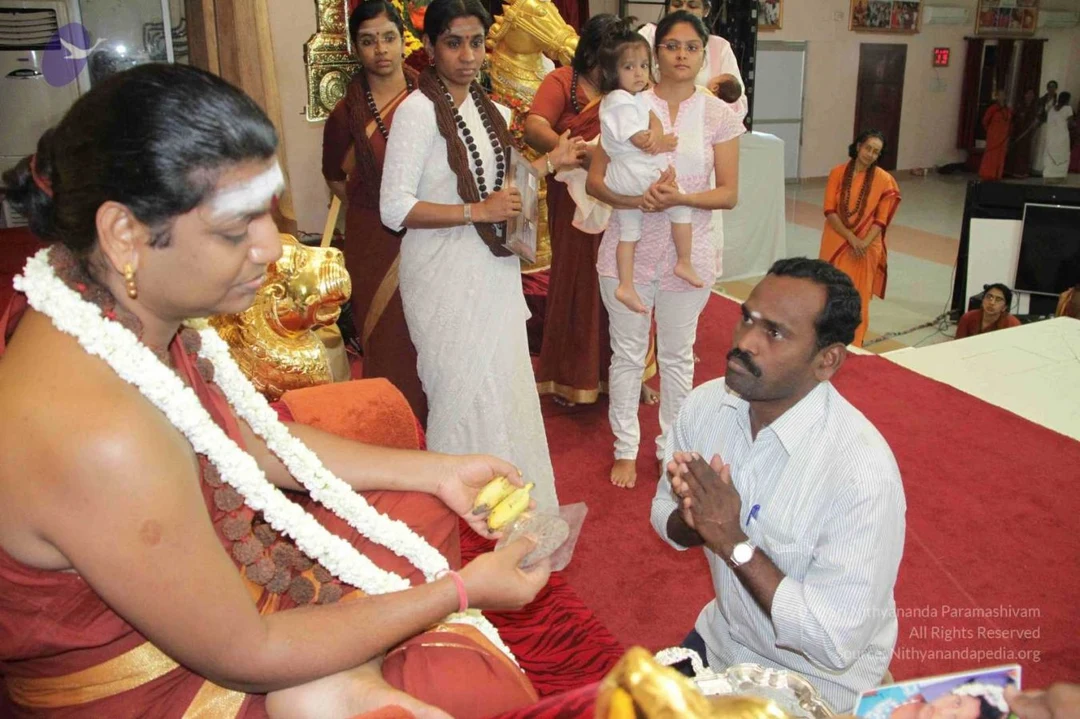
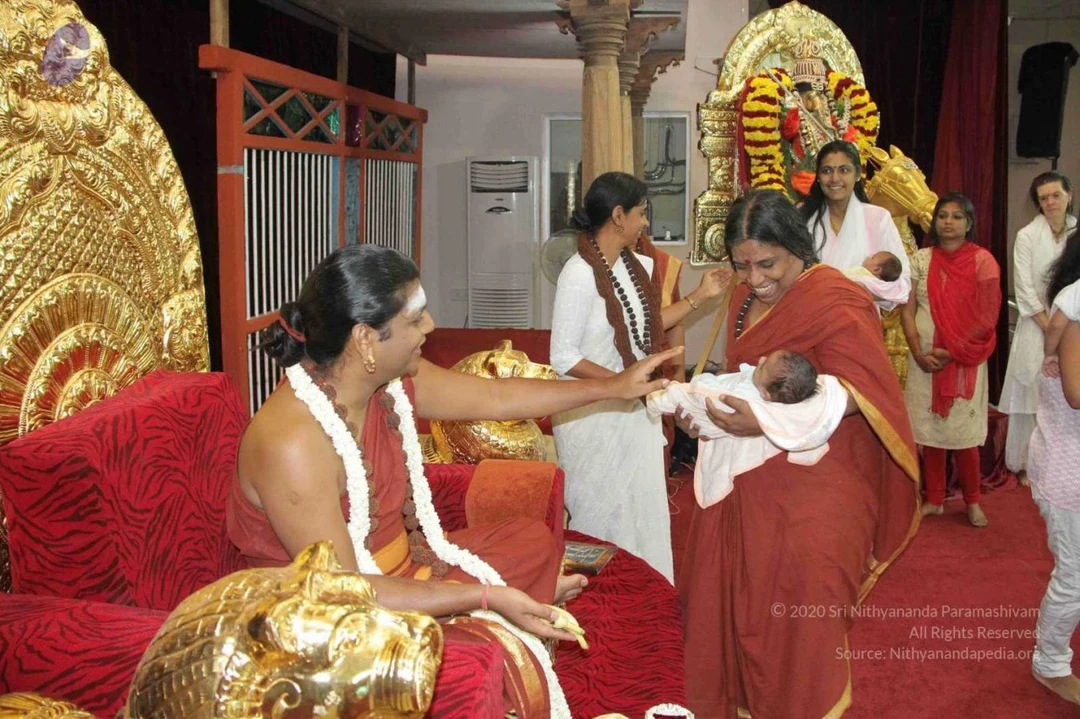
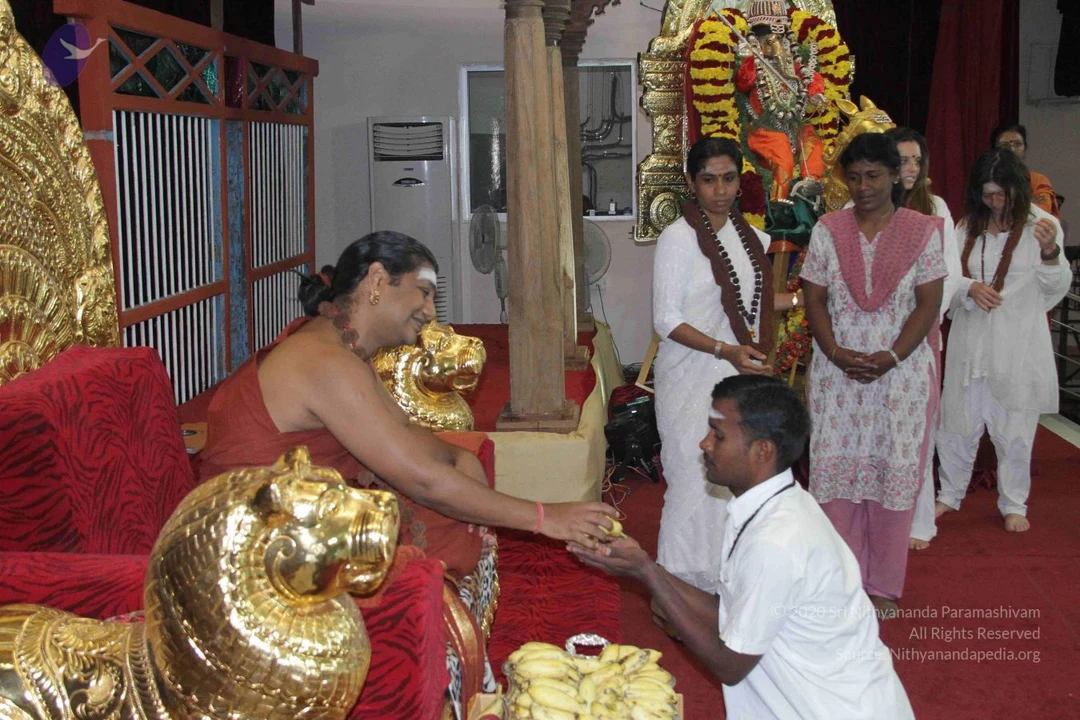
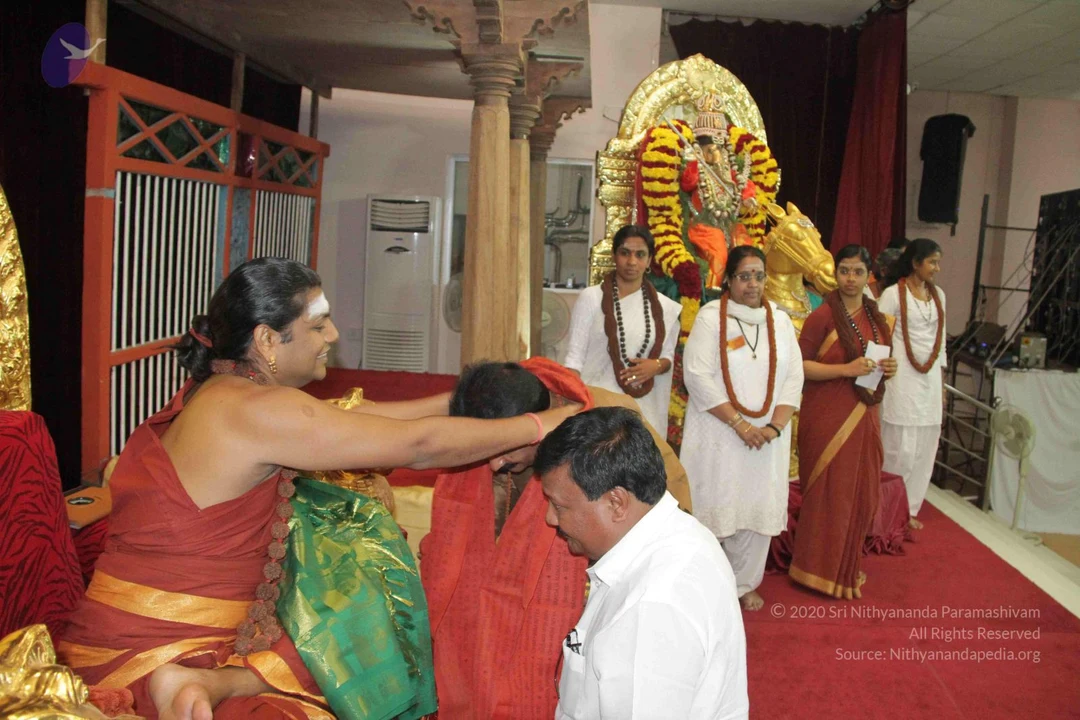
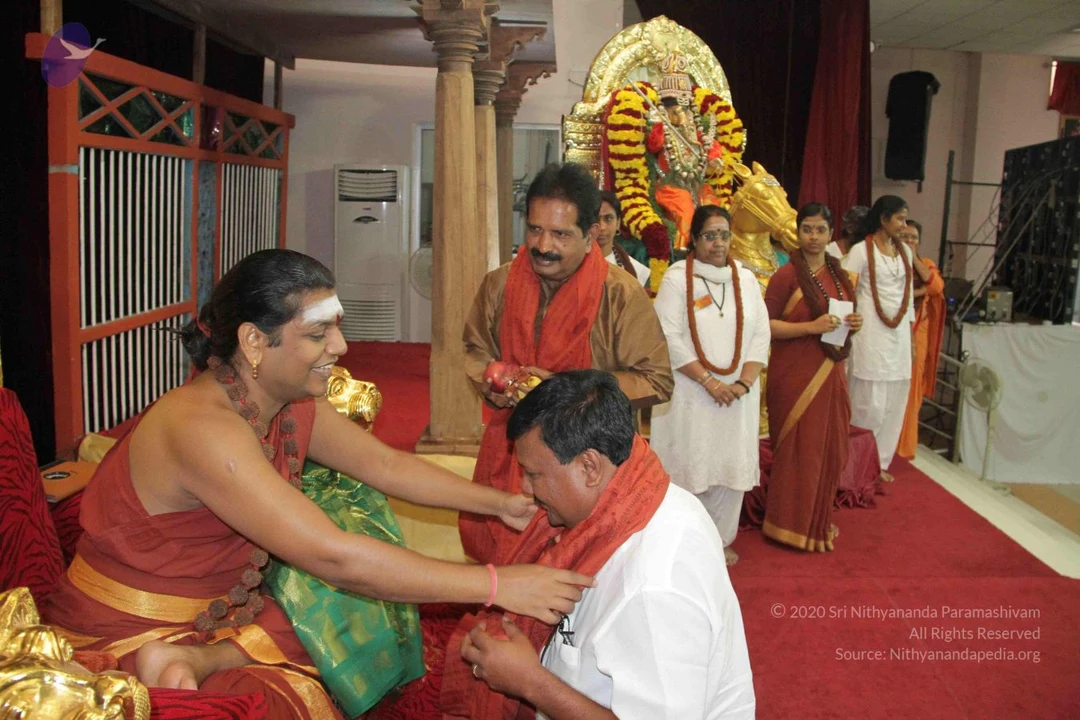
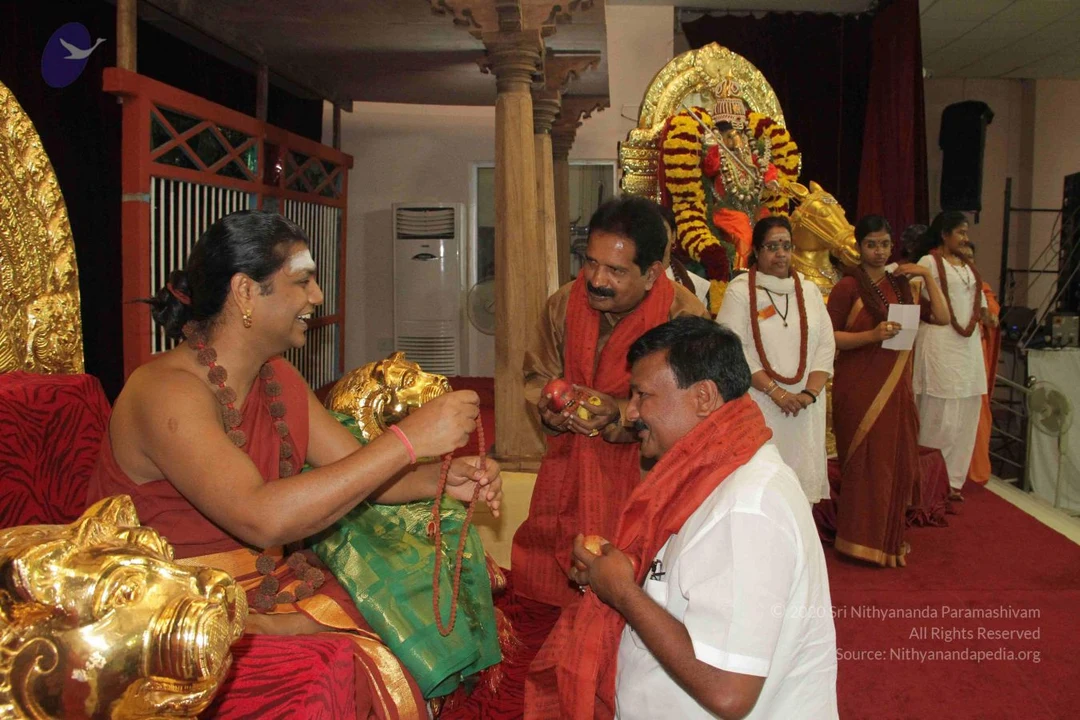
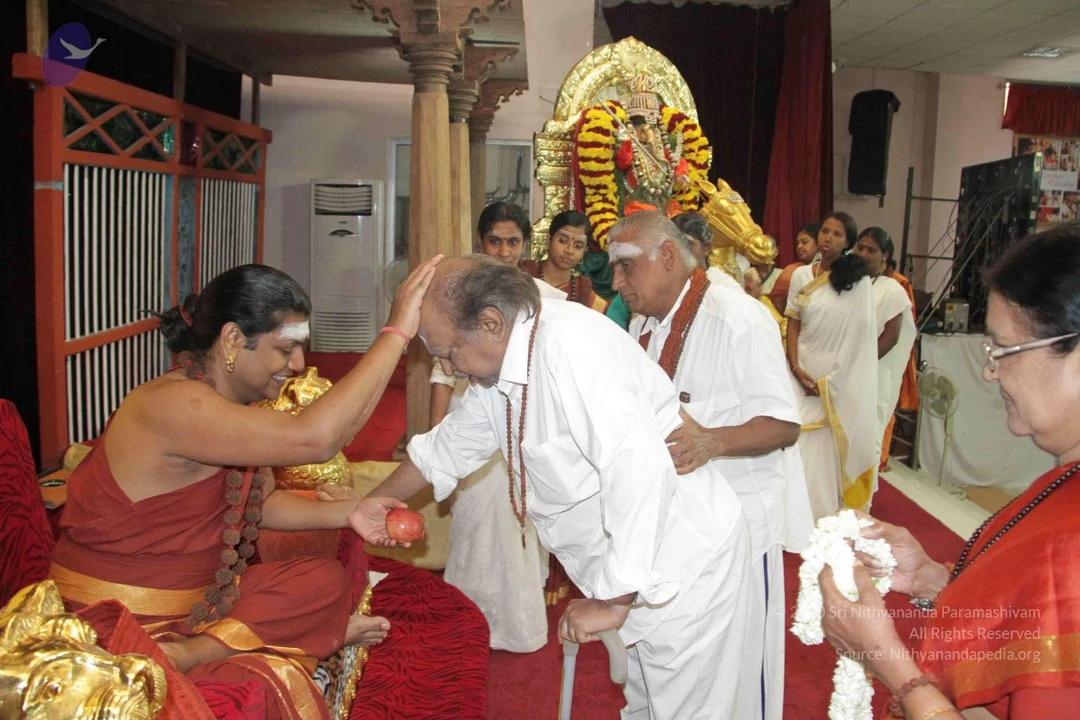
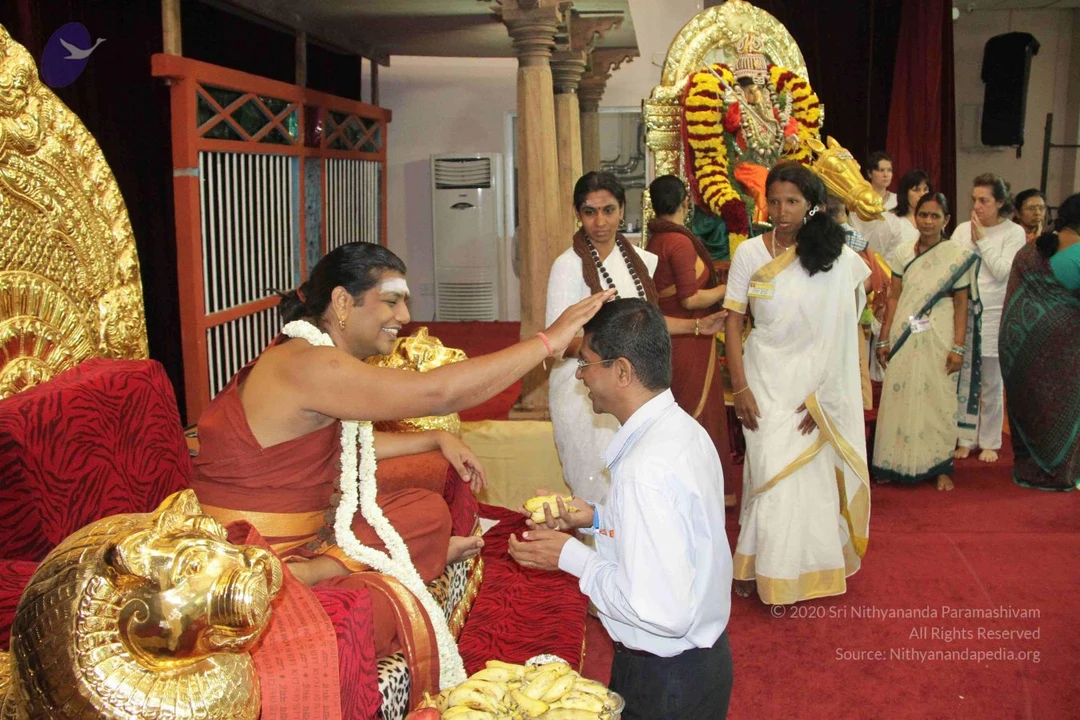
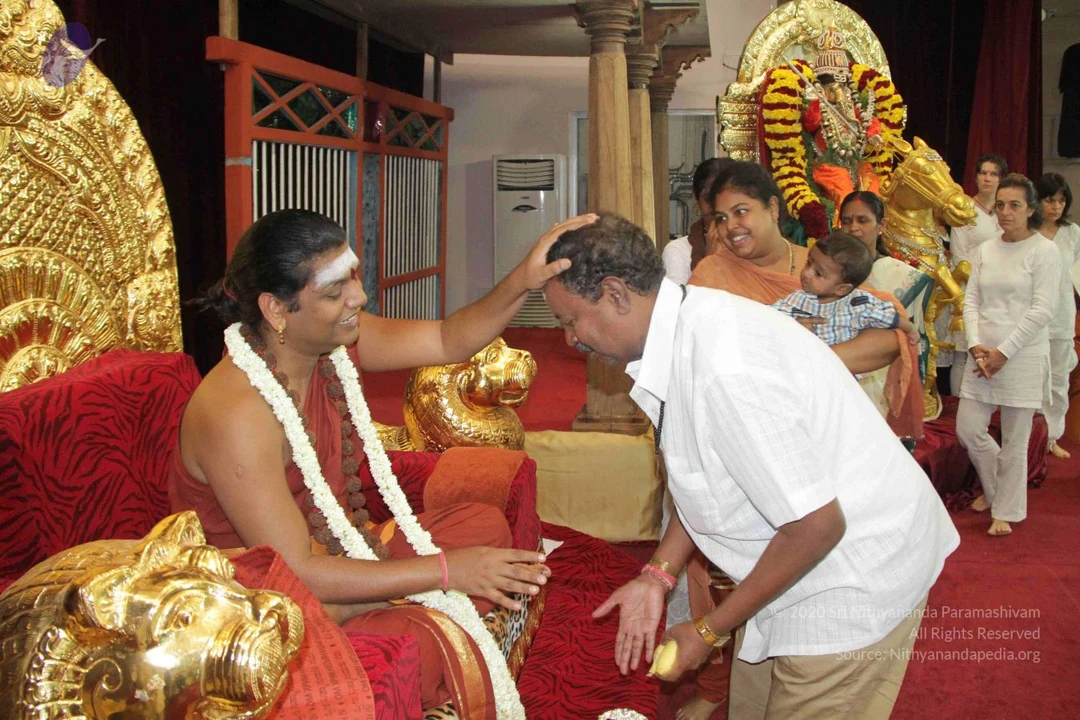
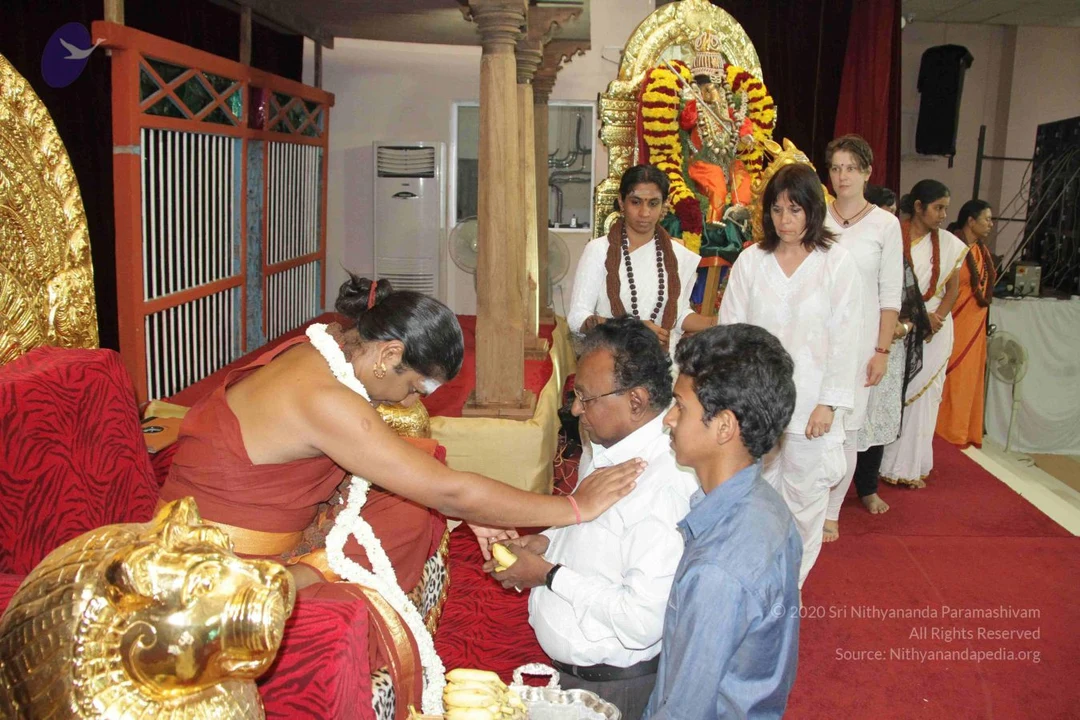
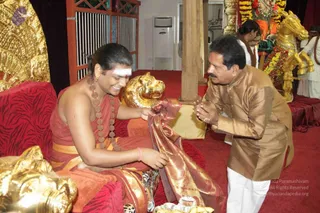
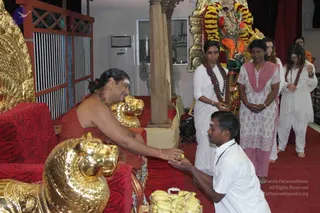
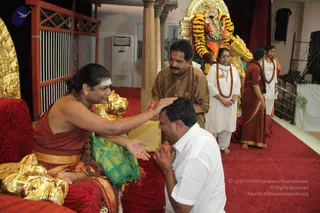
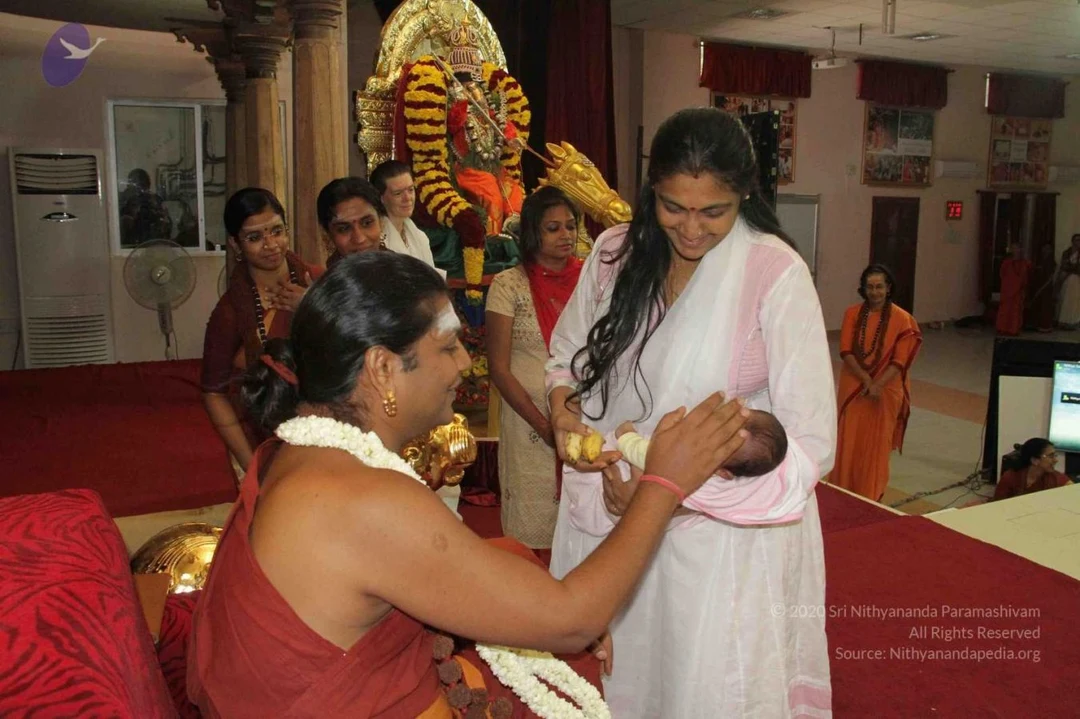
A photograph inside a temple hall with red carpeting. A seated figure in a red-orange garment and a red bangle sits on a red cushioned throne with ornate gold lion-head armrests, smiling as a kneeling man in a white shirt with a tilak presents a banana-like offering. Standing behind them, a woman in white with a brown garland and two women in pink and white churidar-style outfits watch with hands folded. A banana pile sits on the floor at lower right, and a flower-garlanded deity murti in orange and gold stands in an alcove behind. a person (seated figure on throne with red-orange garment and red bangle; no crown or rudraksha visible, so appearance is uncertain).A seated figure in ochre-red robes with a green-and-gold silk shawl, rudraksha malas across the chest and a white forehead mark, extends a hand in blessing over the head of a kneeling man in a white shirt. Behind them stands a man in brown kurta with rudraksha beads and a white-clad woman with a marigold garland, while a woman in maroon sari and another in white stand nearby. A golden deity murti decorated with marigold and red flower garlands and a golden lion-headed throne arm frame the scene on a red carpeted hall. a person: the seated figure's long swept-back hair, ochre robes, rudraksha malas and green-gold shawl are visible cues of a ceremonial blessing. The image shows a blessing ritual in a temple hall.A photograph in a hall with red carpet and wooden pillars. A long-haired figure seated on a red cushioned throne wears a red-orange garment with a green silk wrap, rudraksha malas and white tripundra on the forehead, and blesses a kneeling man in a white shirt and orange shawl by touching his head. A standing man in a brown kurta and orange shawl holds a red fruit and a small plate. Behind them women in white and orange-red saris wear orange garlands, and a golden deity murti decorated with marigold garlands sits in an arch. A ceiling-mounted air conditioner and a sound system are visible at right.A seated figure on an ornate gold-and-red throne with a golden lion-head armrest raises a hand in blessing over the head of a kneeling man in a white shirt and dark trousers, who holds a small offering. The seated figure wears a red-orange dhoti and a white garland, with a white vibhuti mark on the forehead; the appearance is consistent with the a person cues of long swept-back hair and ceremonial adornment, though a white garland and throne alone are not decisive. Behind them, women in white and cream sarees and red-brown shawls stand near a large gold deity murti decorated with marigold garlands and a kalasha-style crown. A bunch of bananas lies on a tray in the foreground, and a red carpet runs through a hall with pillars and an air conditioner.A seated figure in saffron-orange robes with a rudraksha mala and a white flower garland sits on a red tiger-print throne with golden lion carvings. He has a white vibhuti line on his forehead and places his right hand on the head of a man in a white short-sleeved shirt who bends forward with folded hands. Behind them a woman in an orange sari holds a baby in blue checked clothing, and several women in white stand near a golden horse-shaped carving and a deity murti decorated with red and orange flowers. The red carpet and gold-trimmed hall suggest a satsang blessing scene. The seated figure's appearance (saffron robes, rudraksha mala, garland, ornate throne) matches the page's claim, so he is identified as a person, giving blessing to a devotee.

IA-Session

10 photosSource gallery
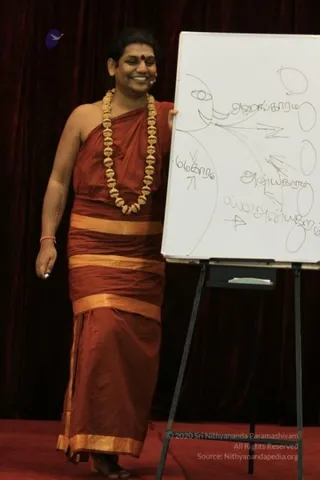
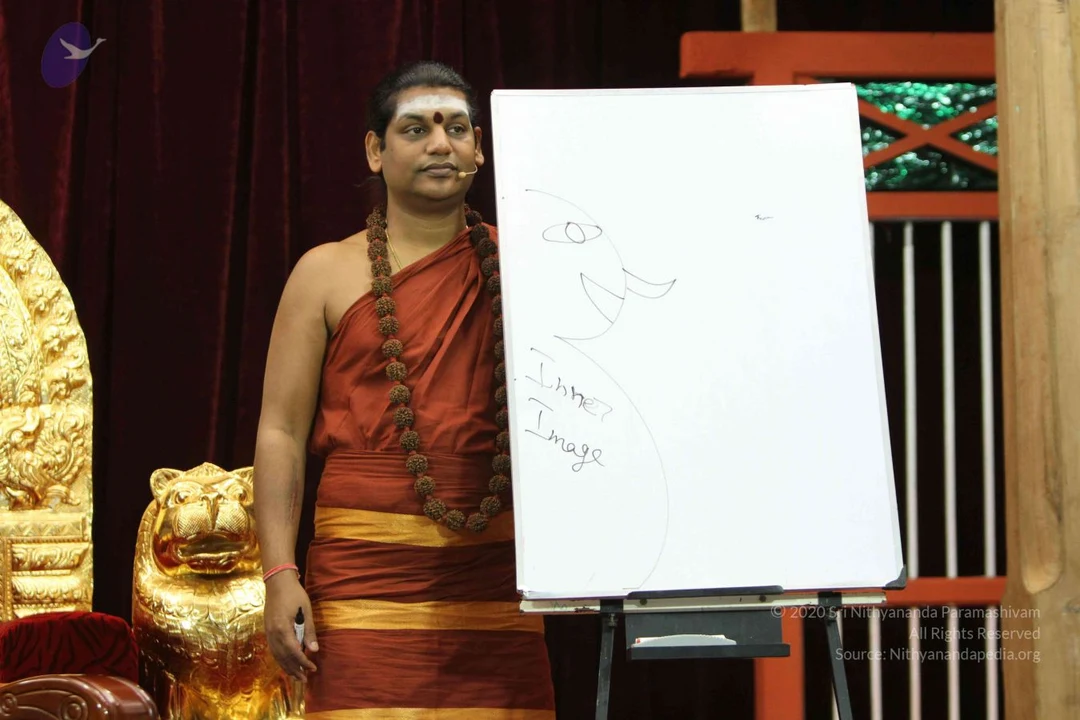
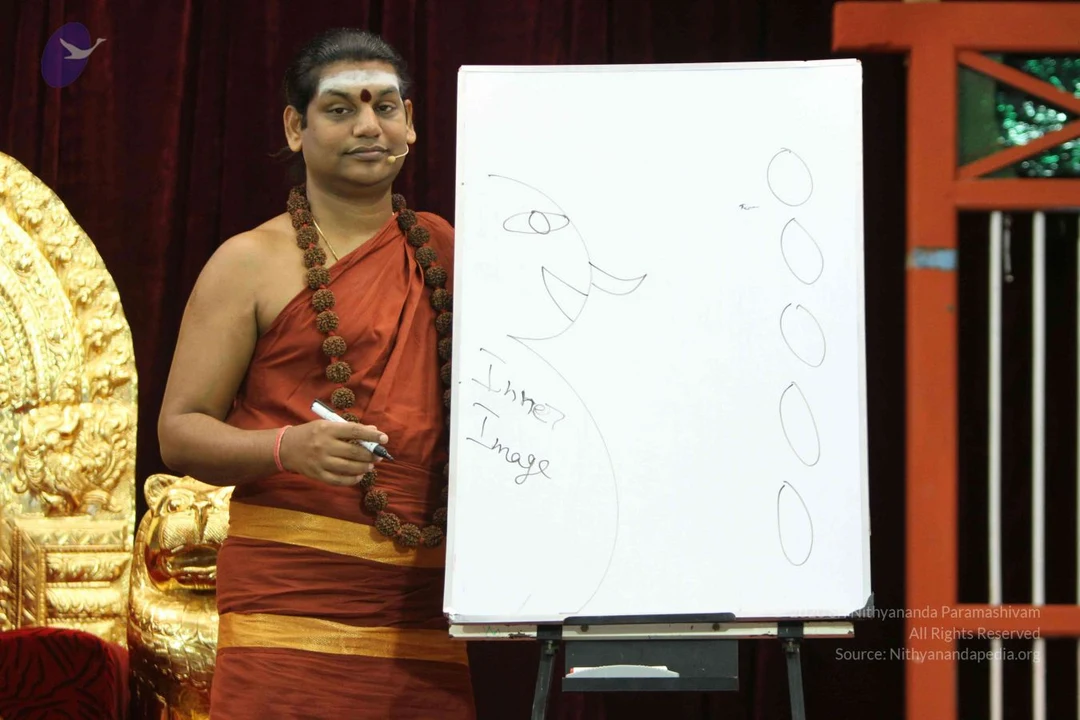
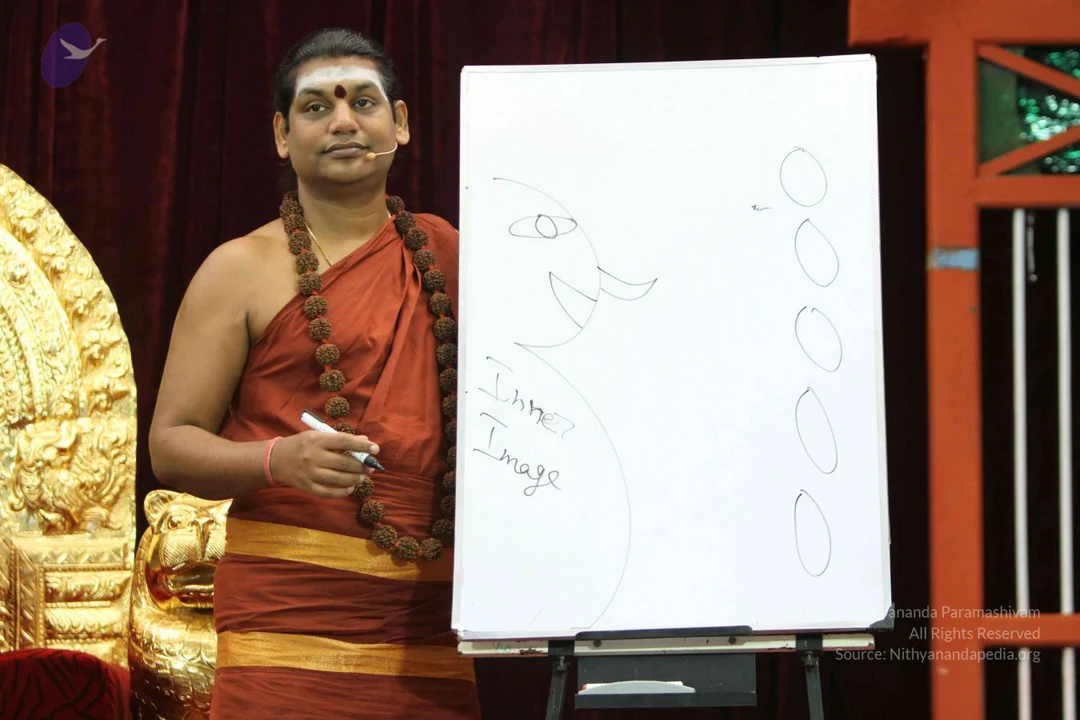
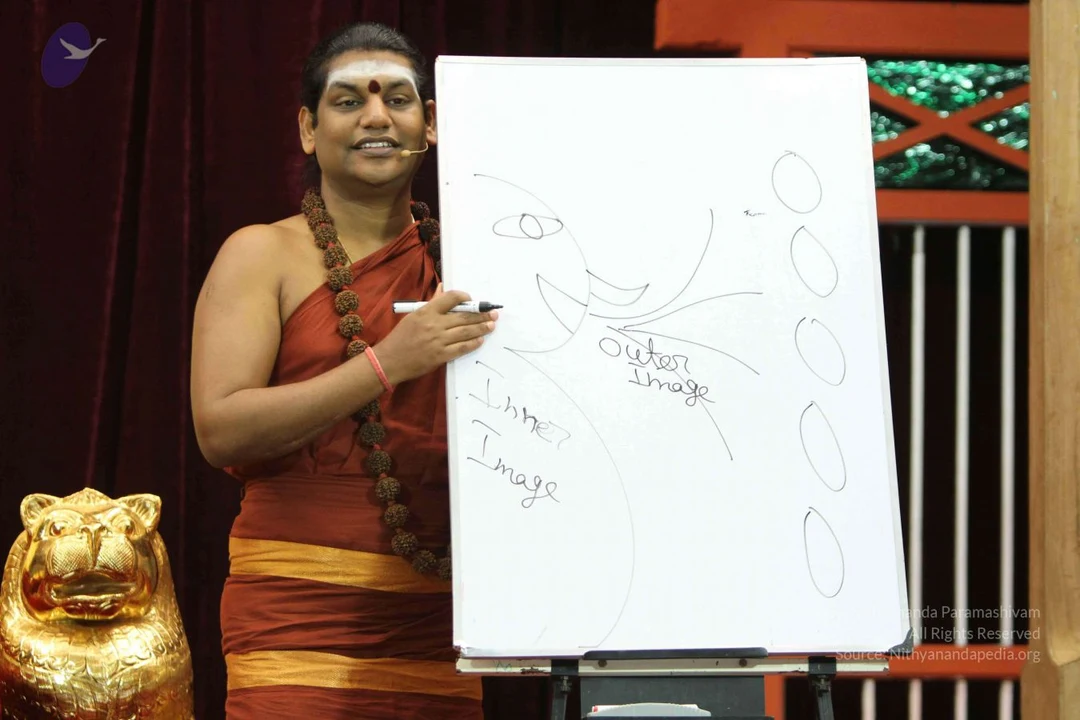
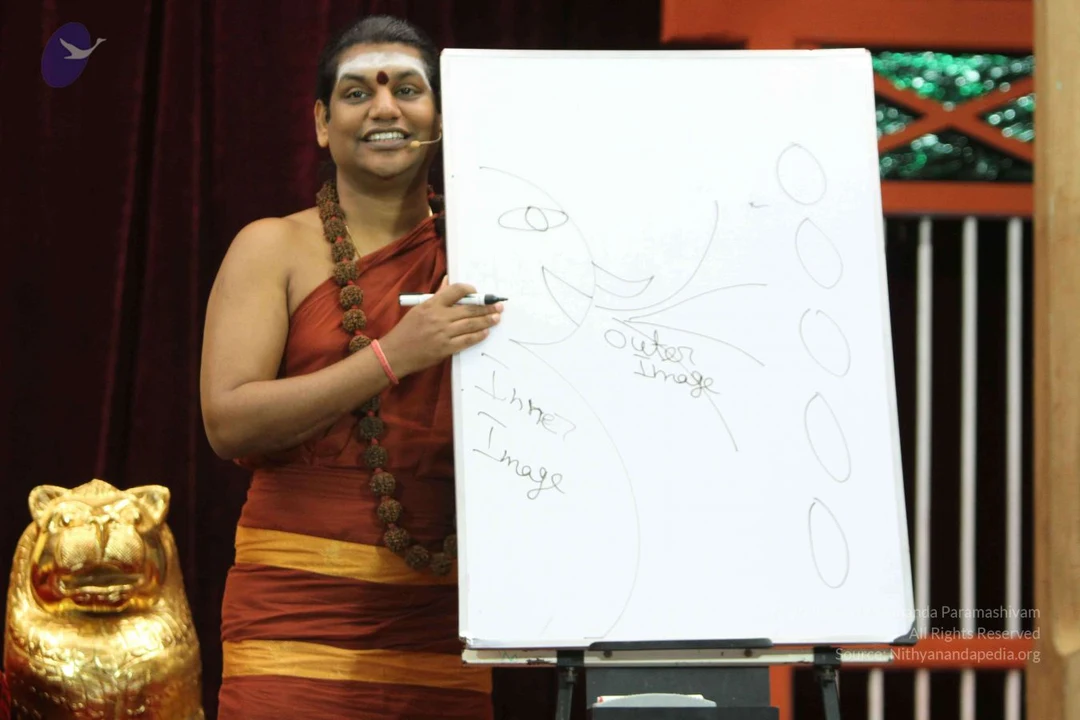
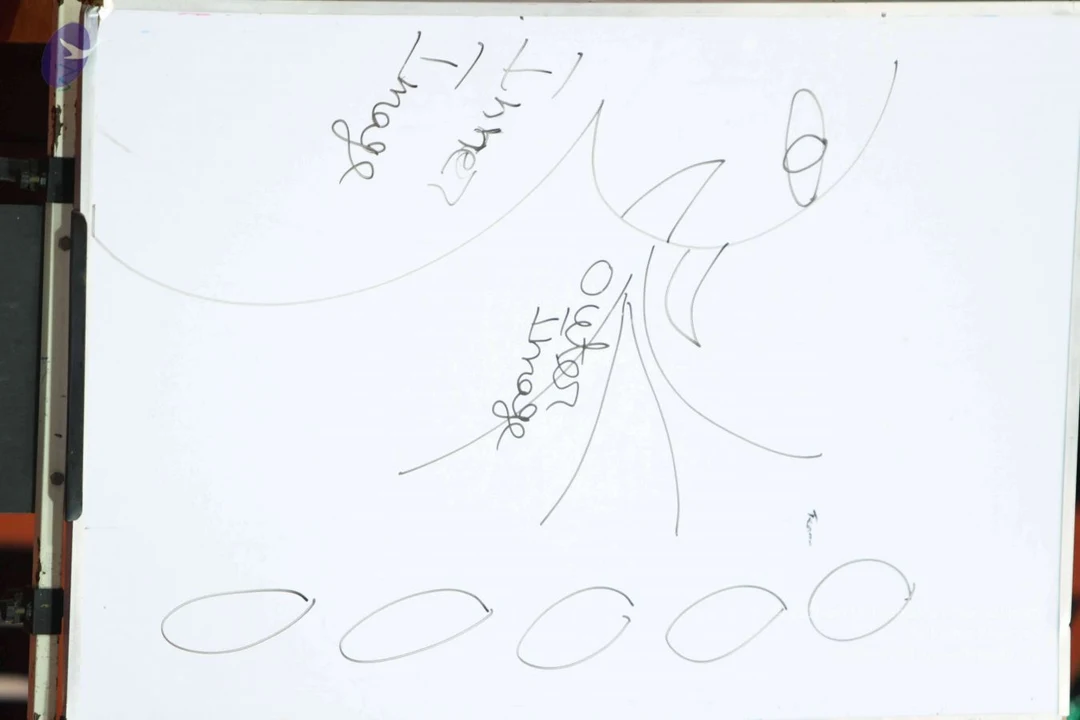
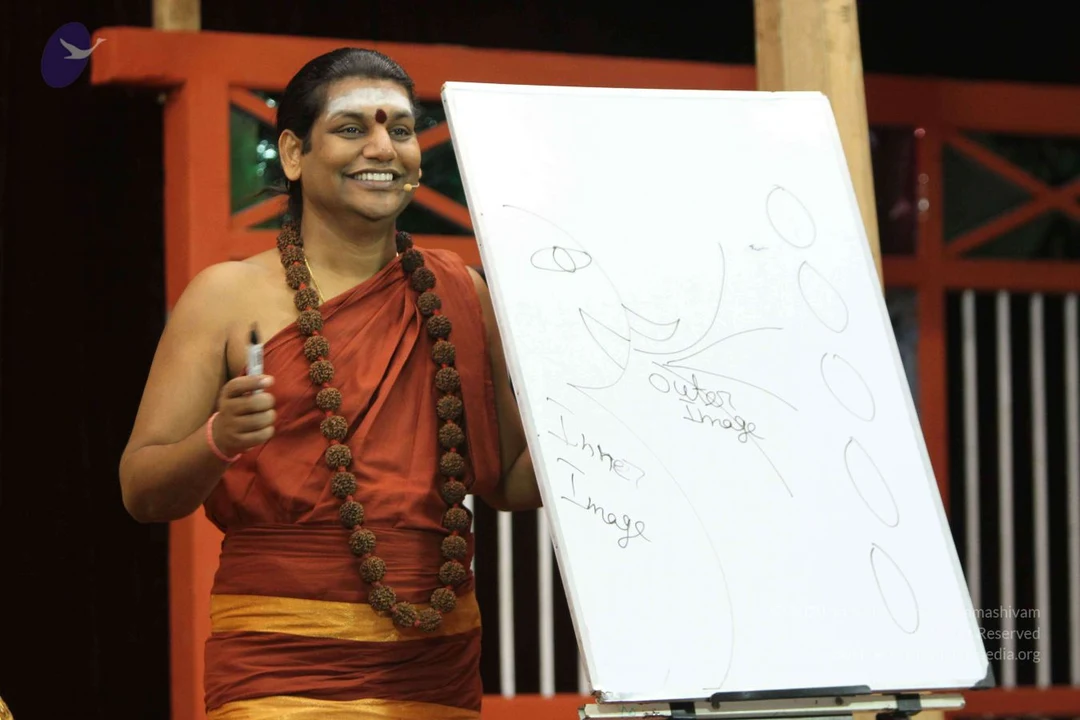
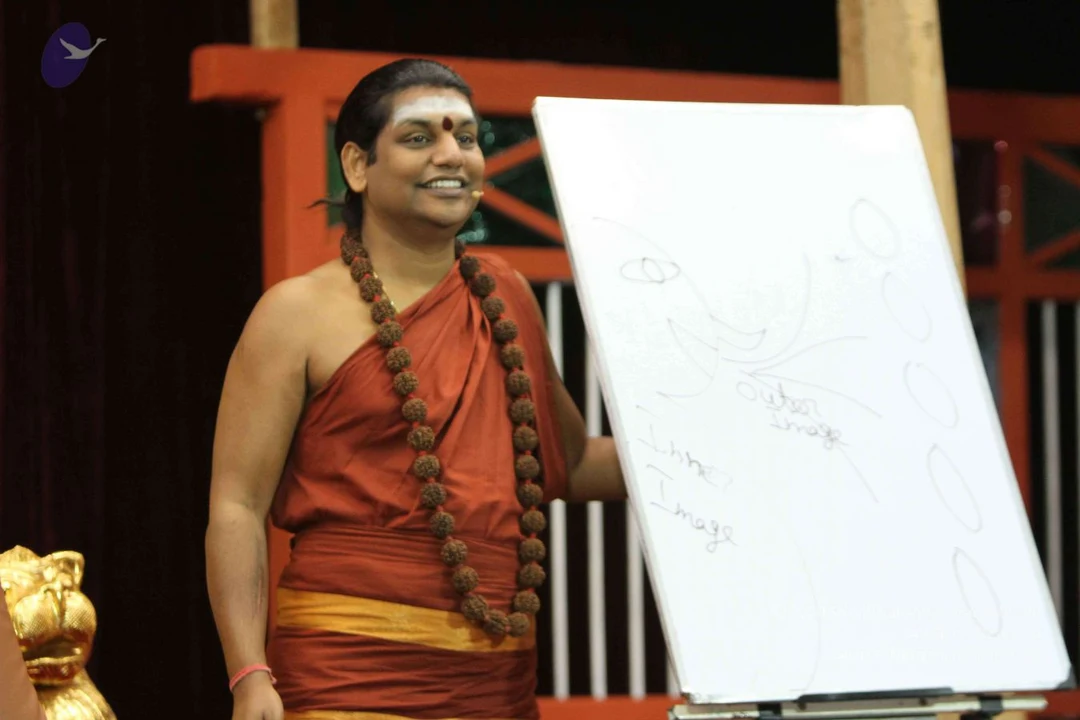
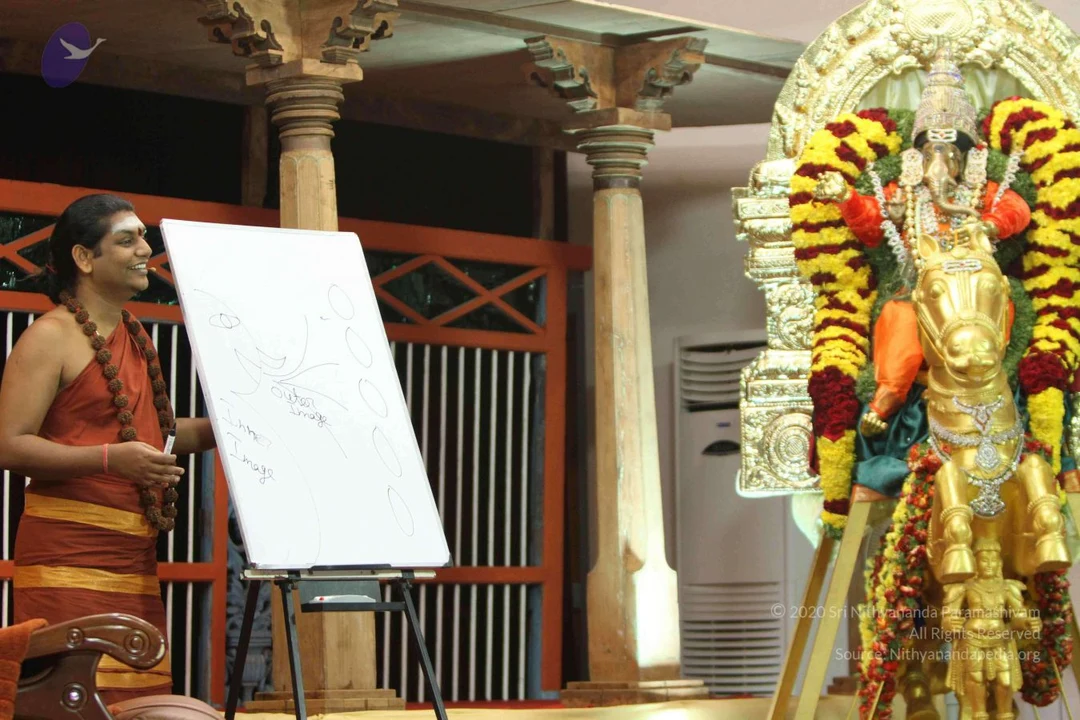
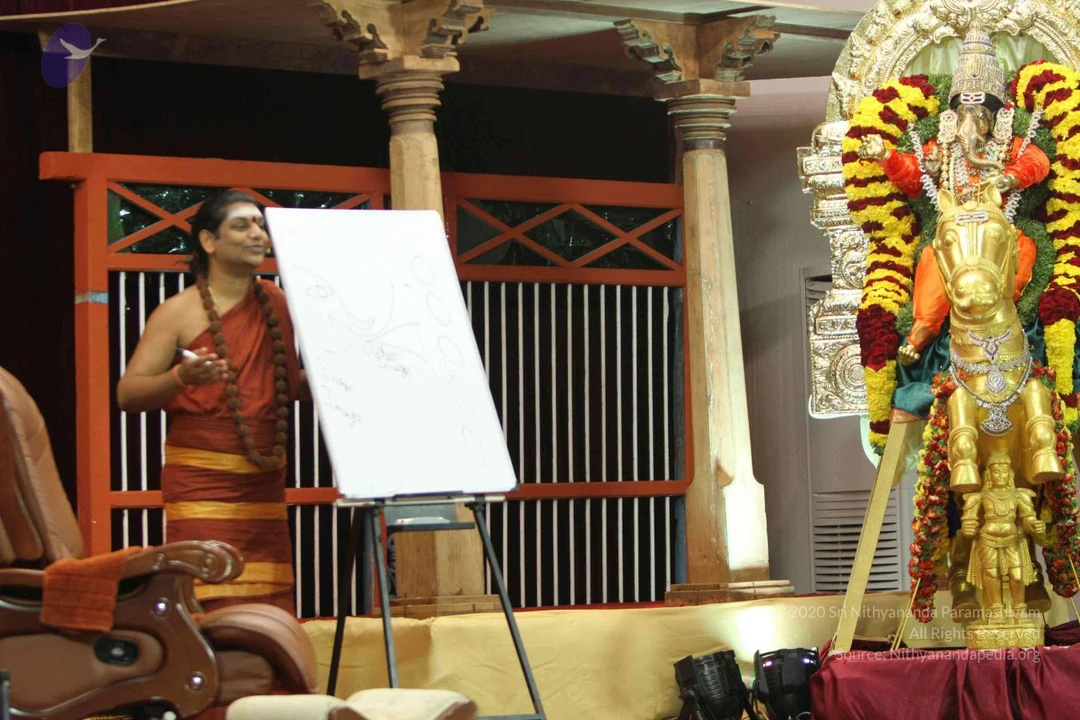
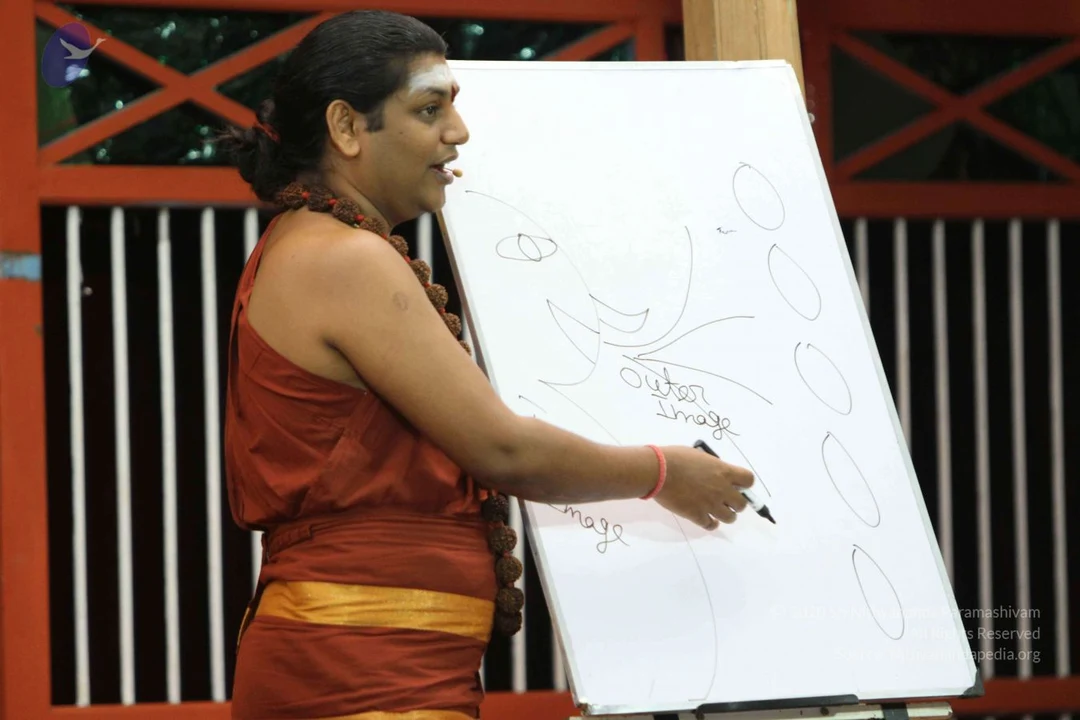
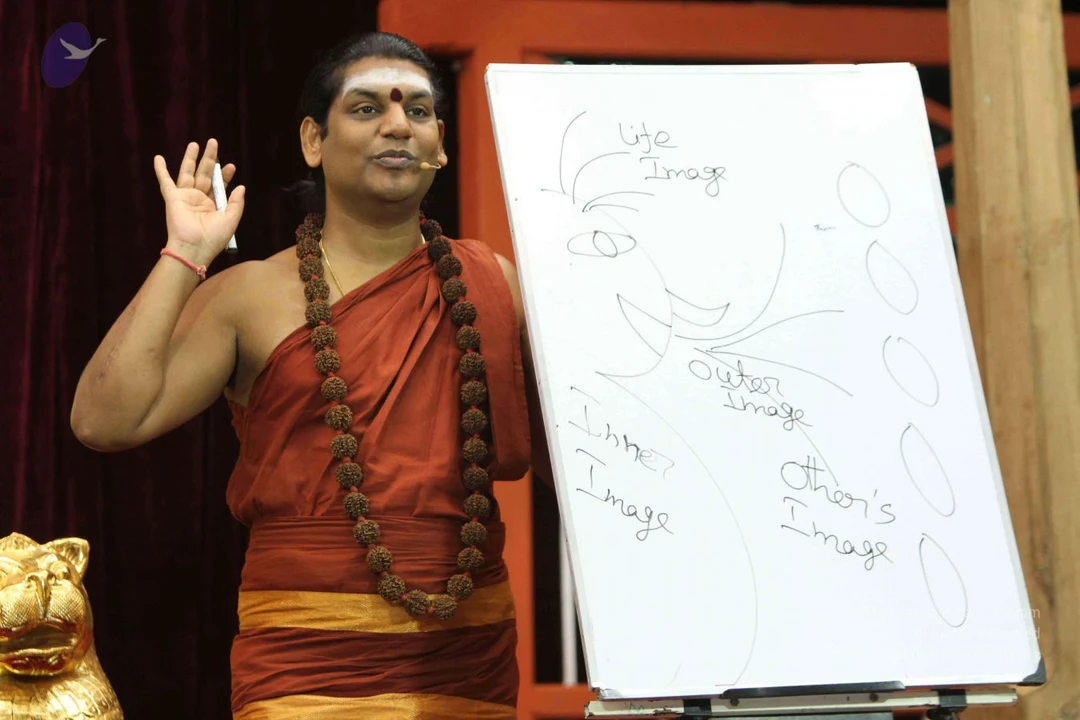
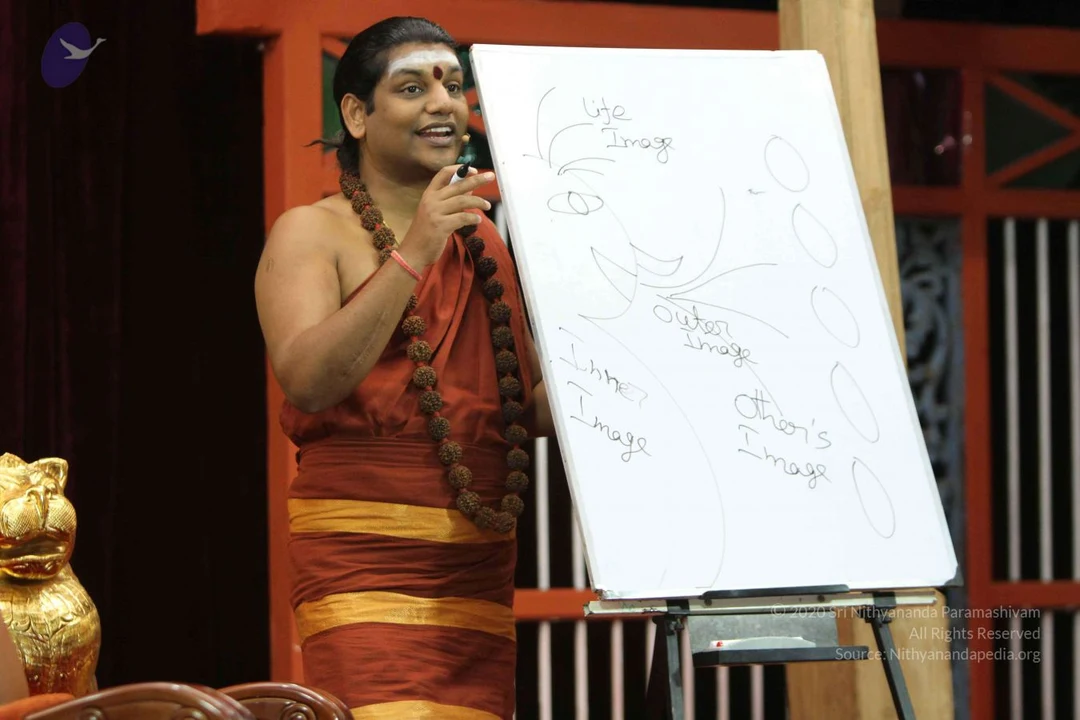
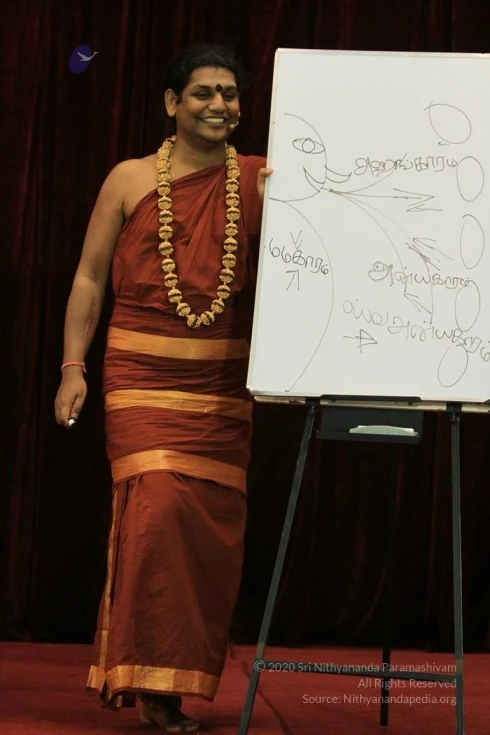
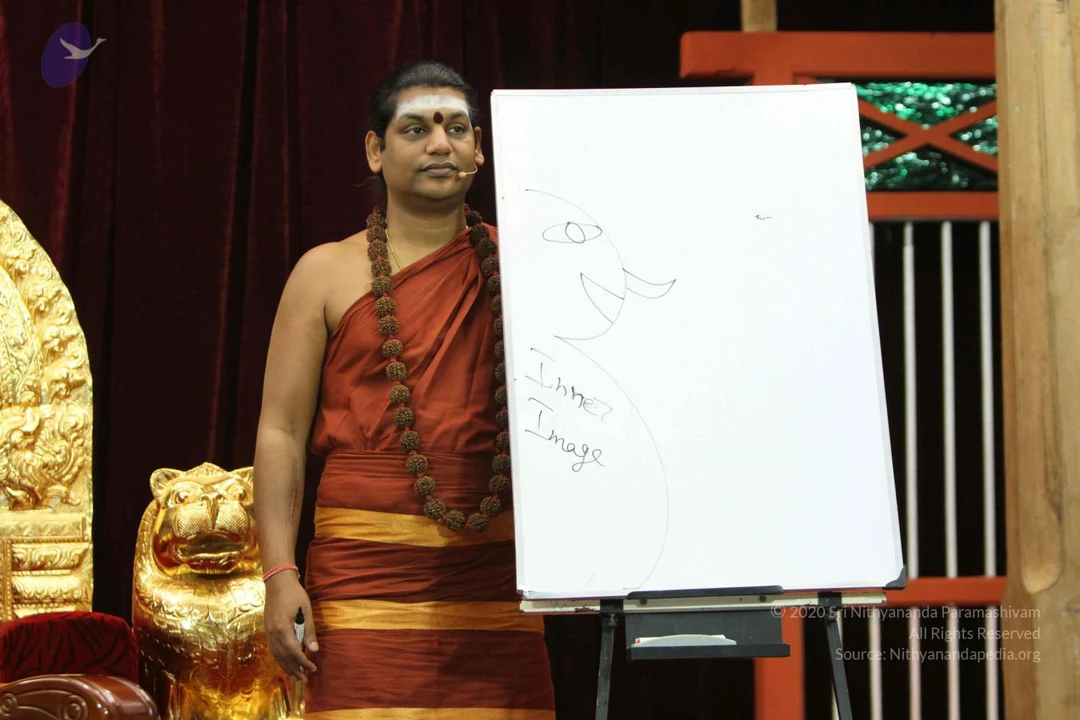
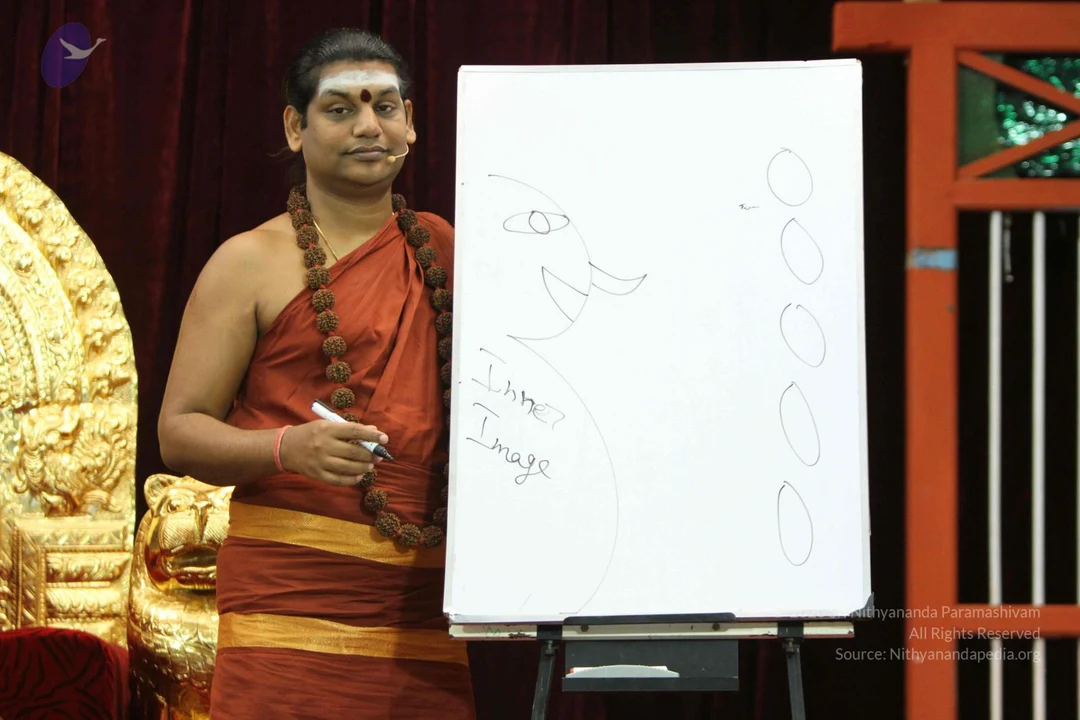
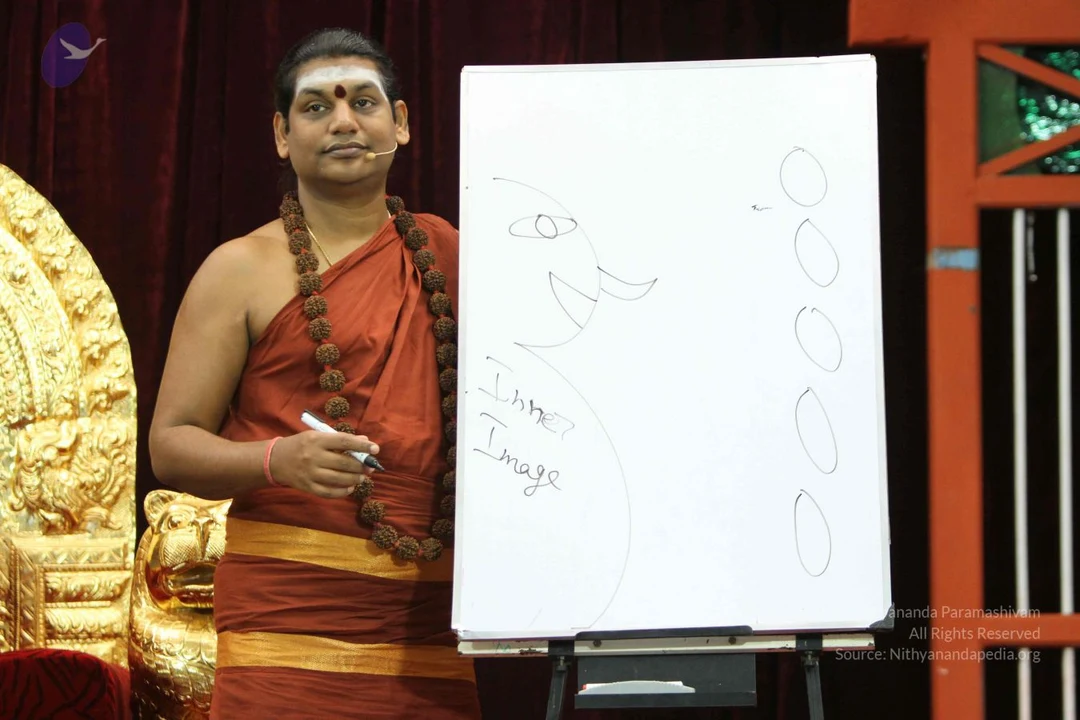
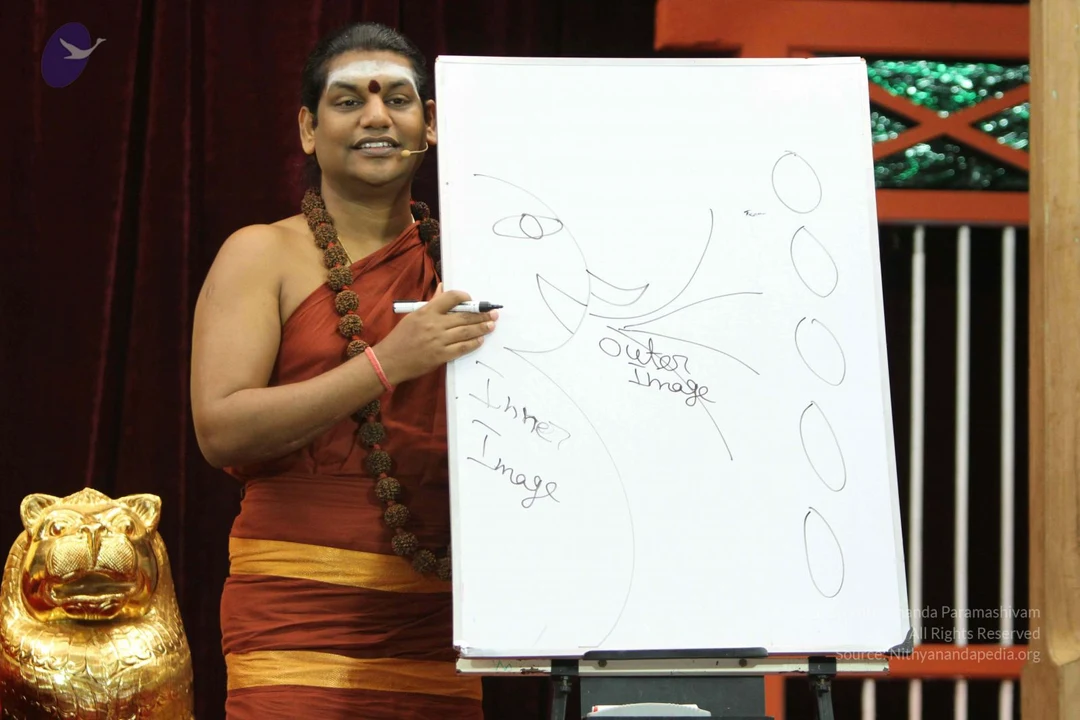
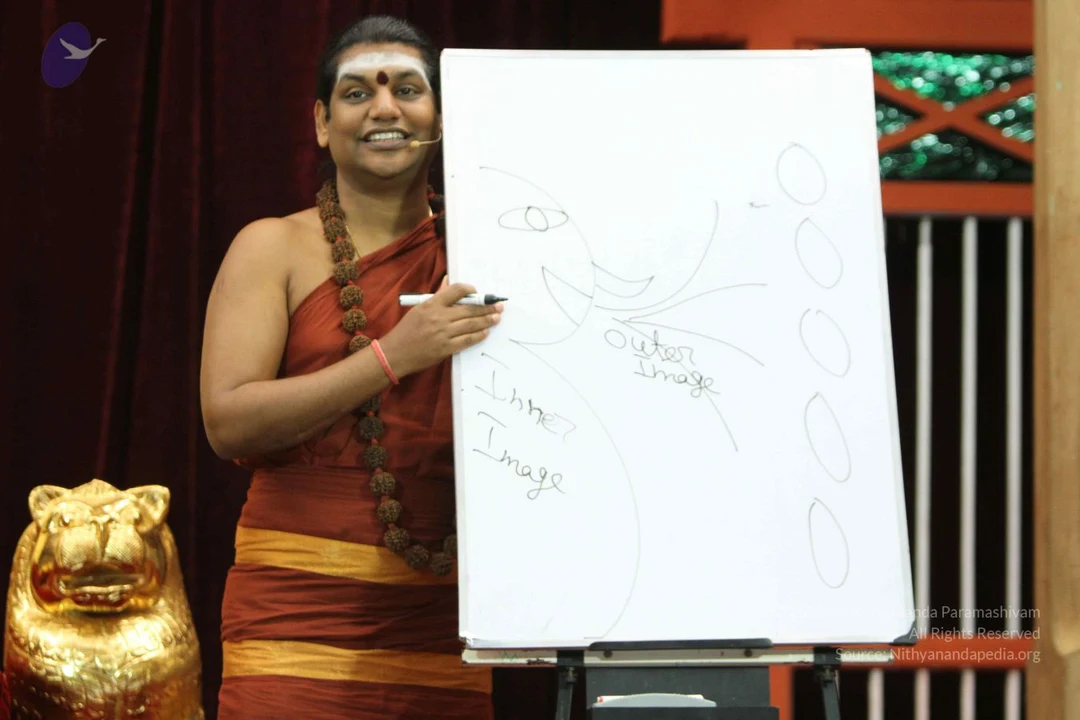
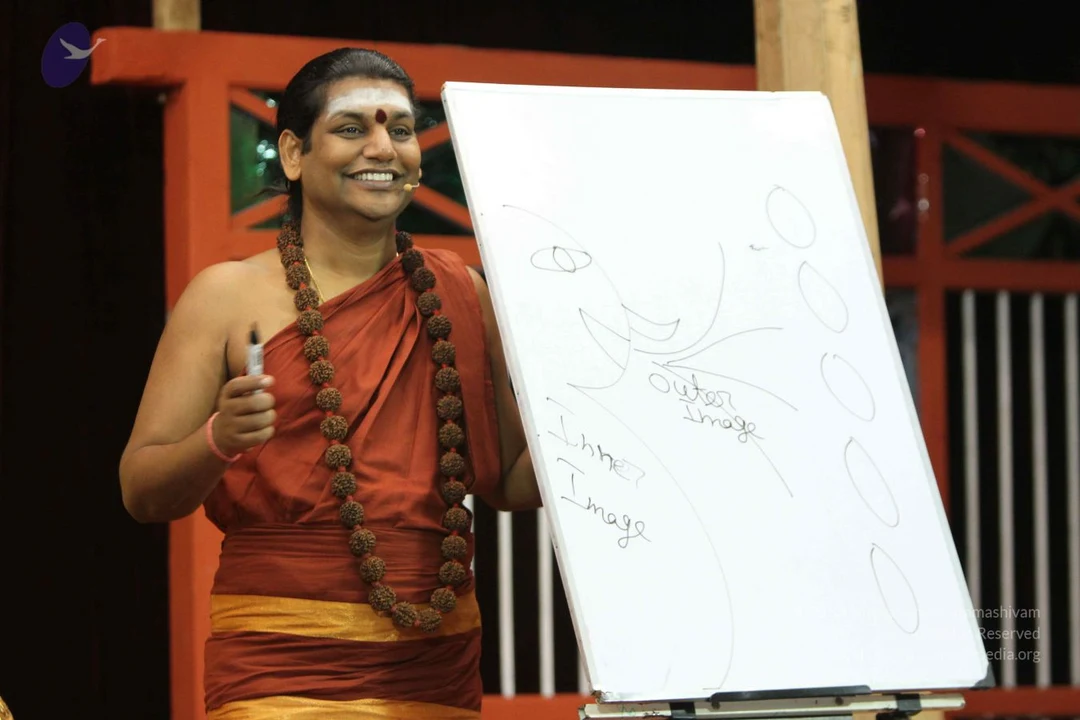
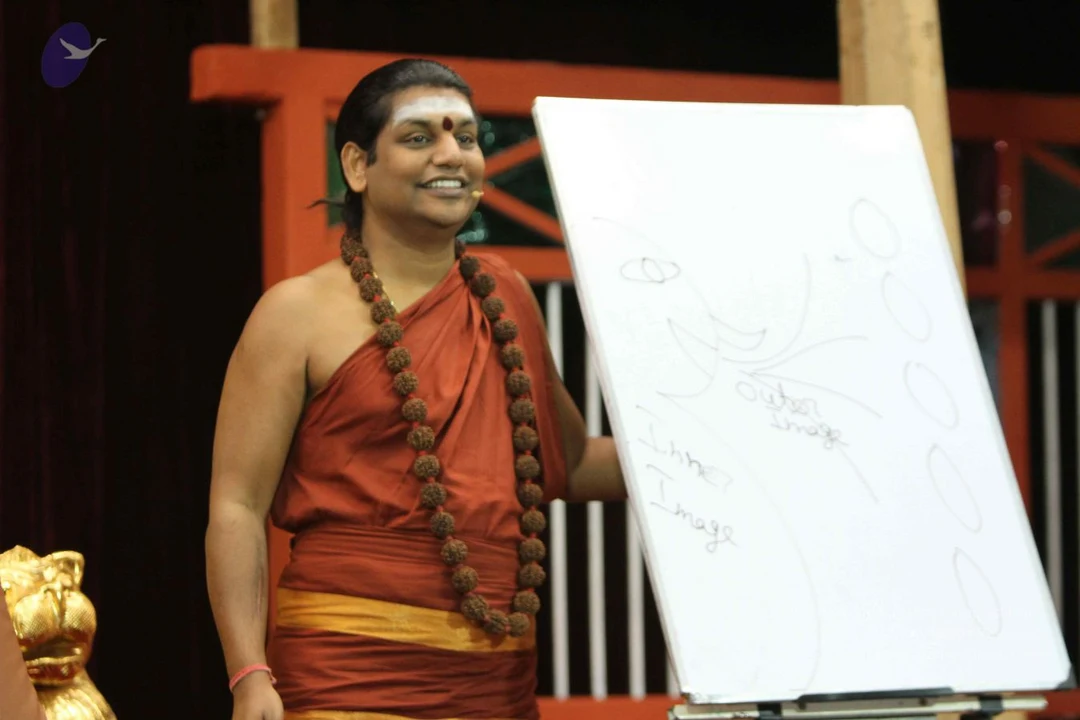
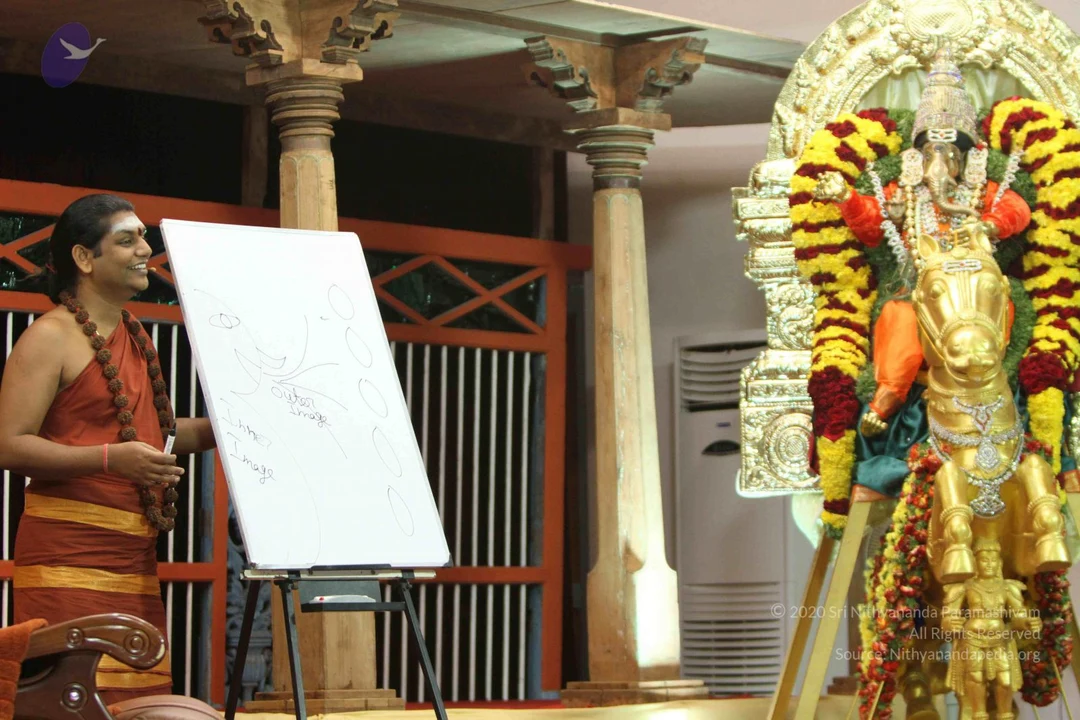
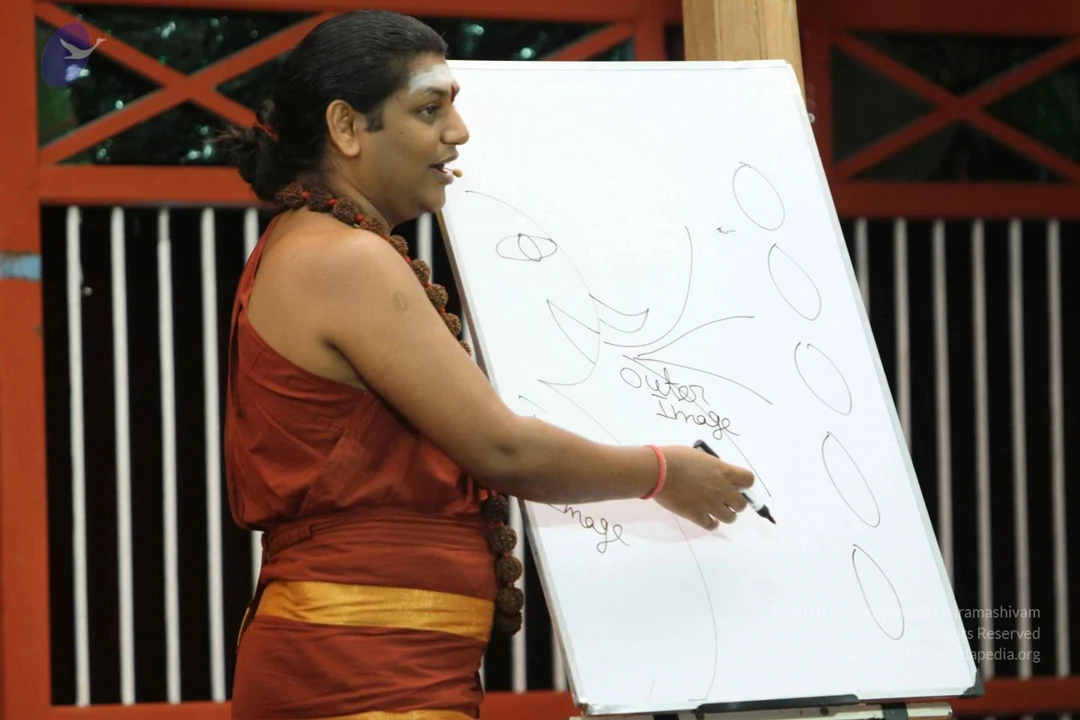
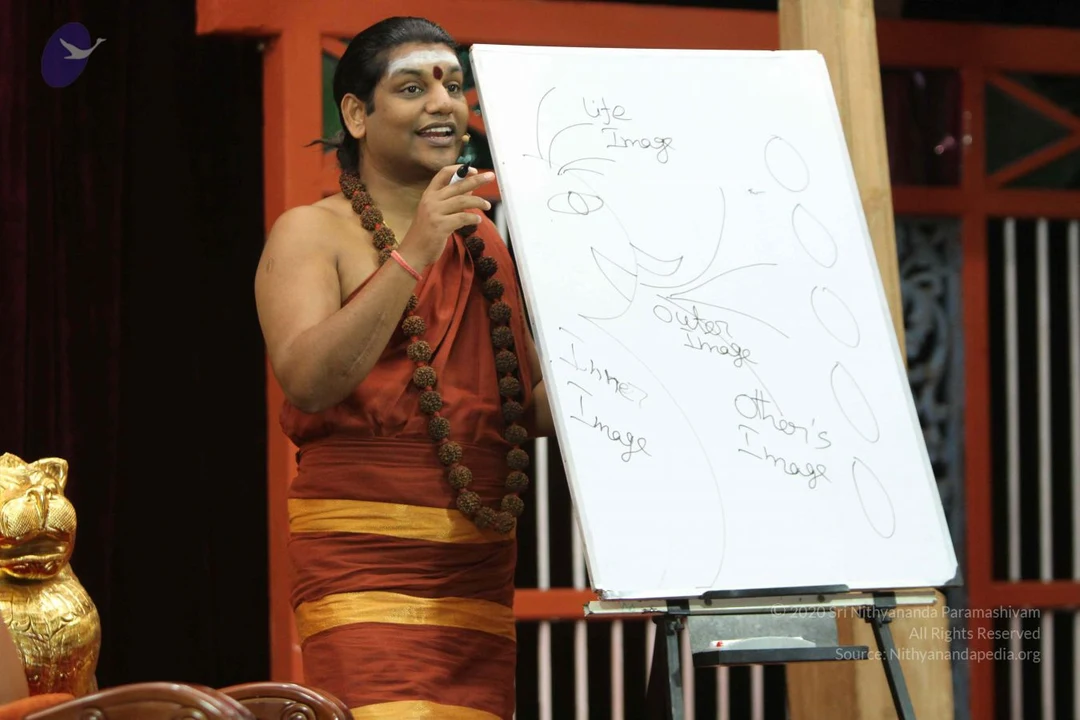
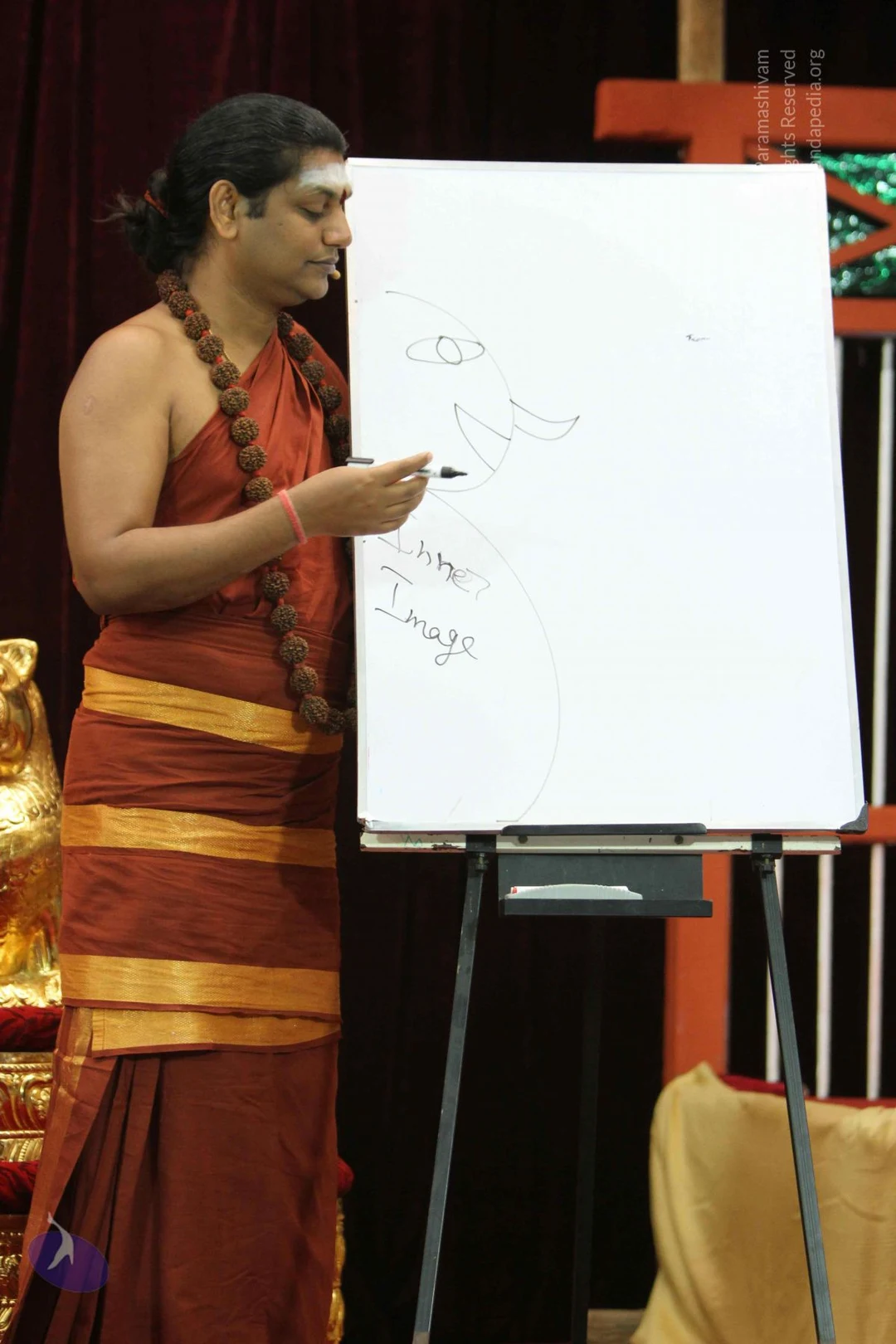
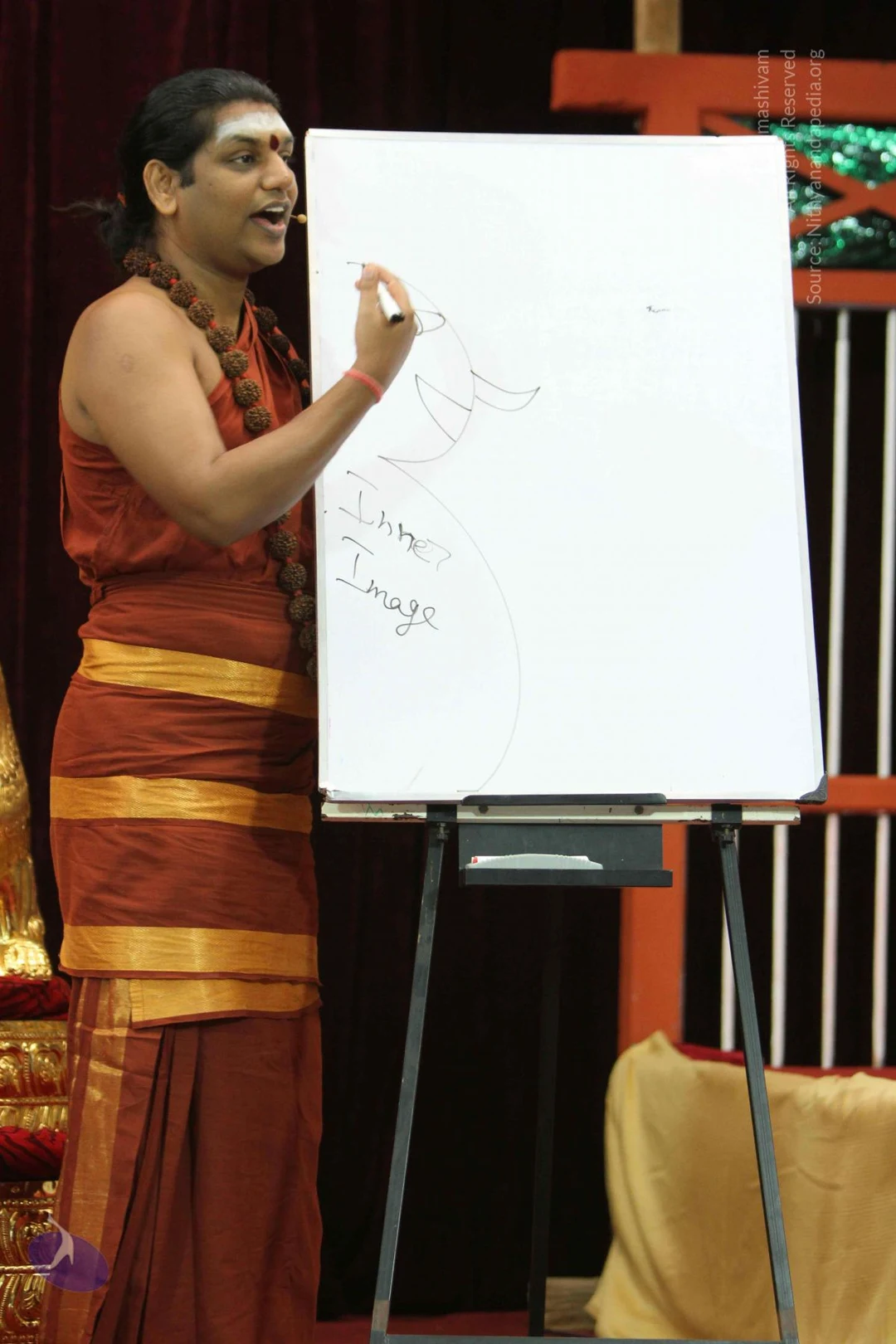
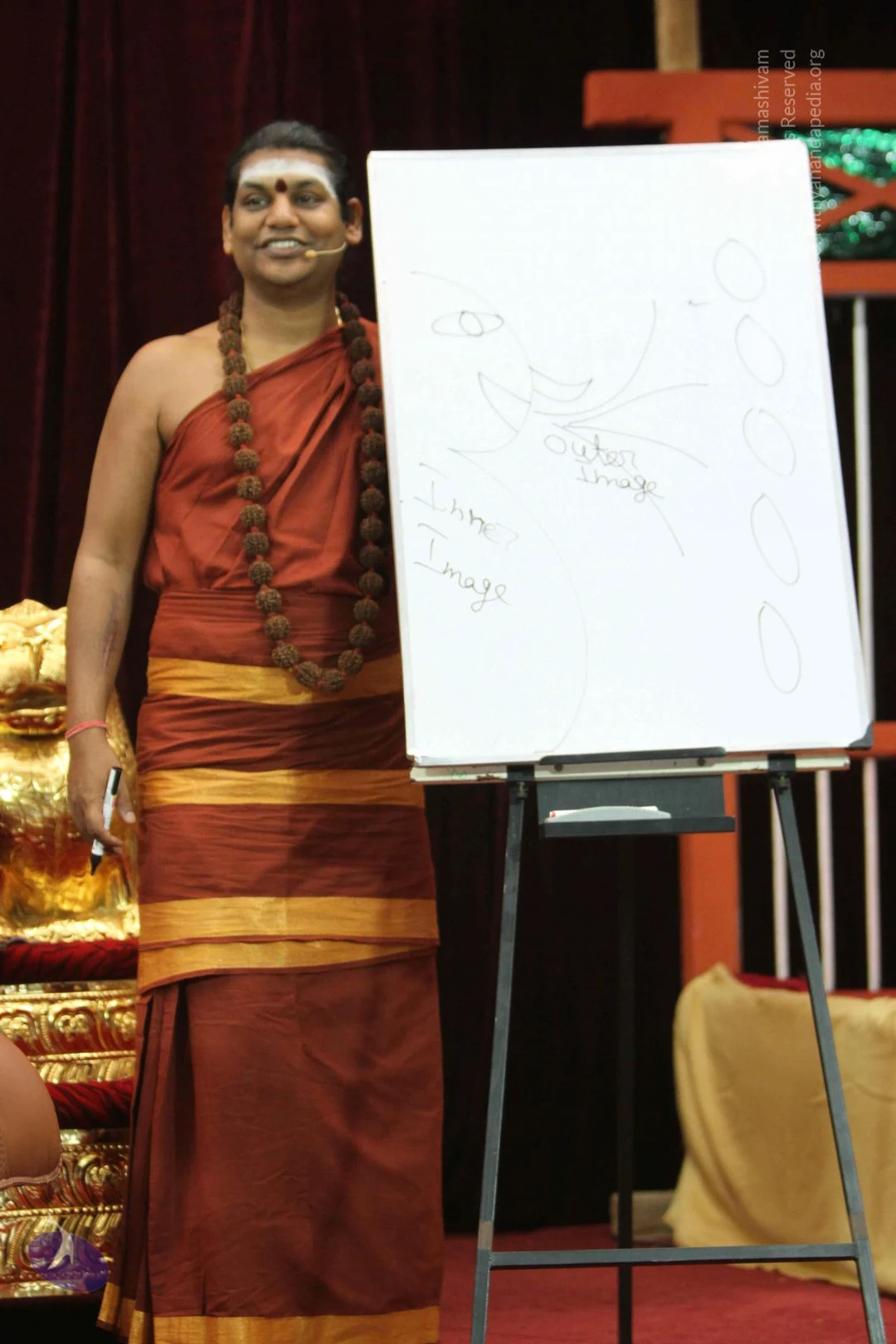
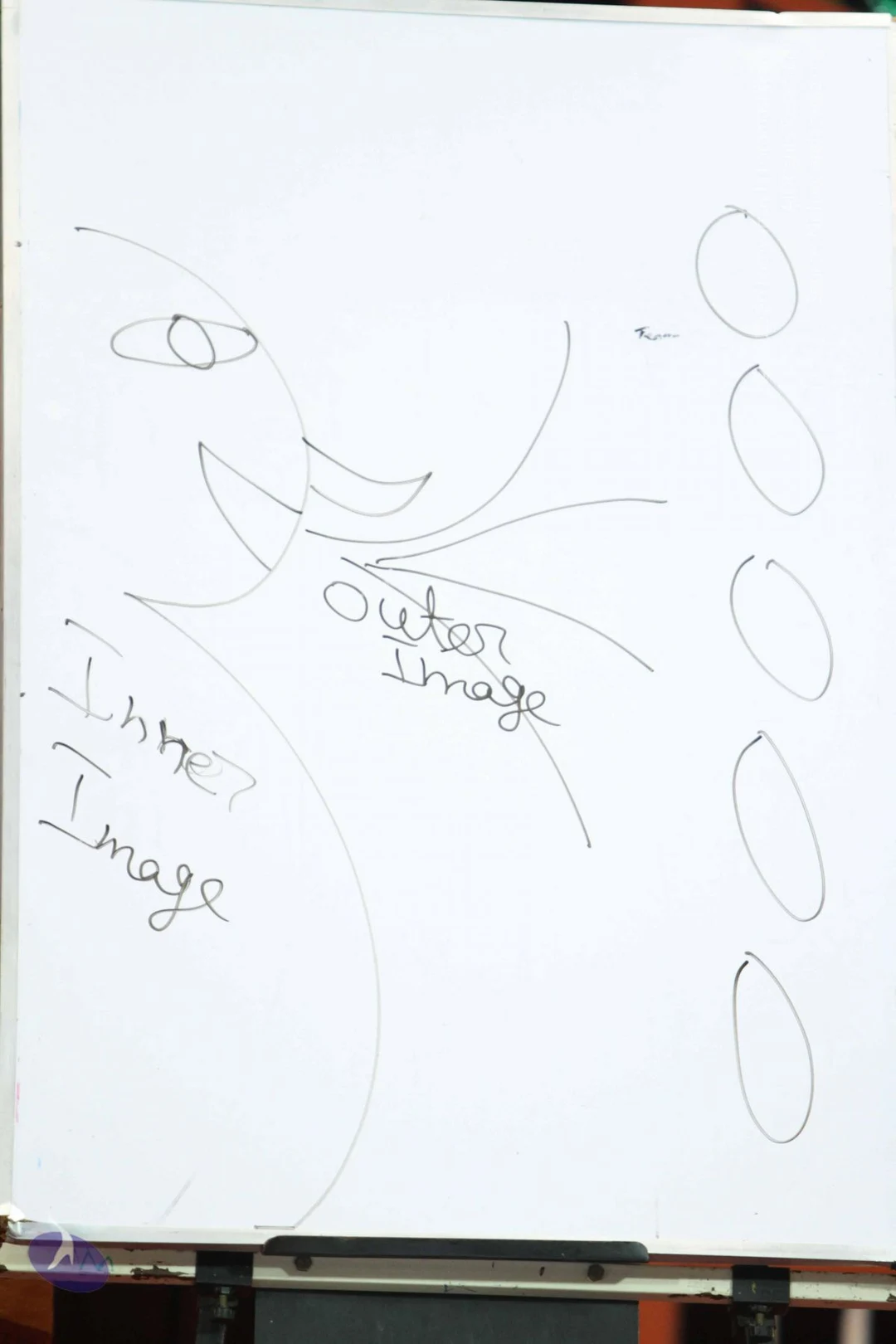
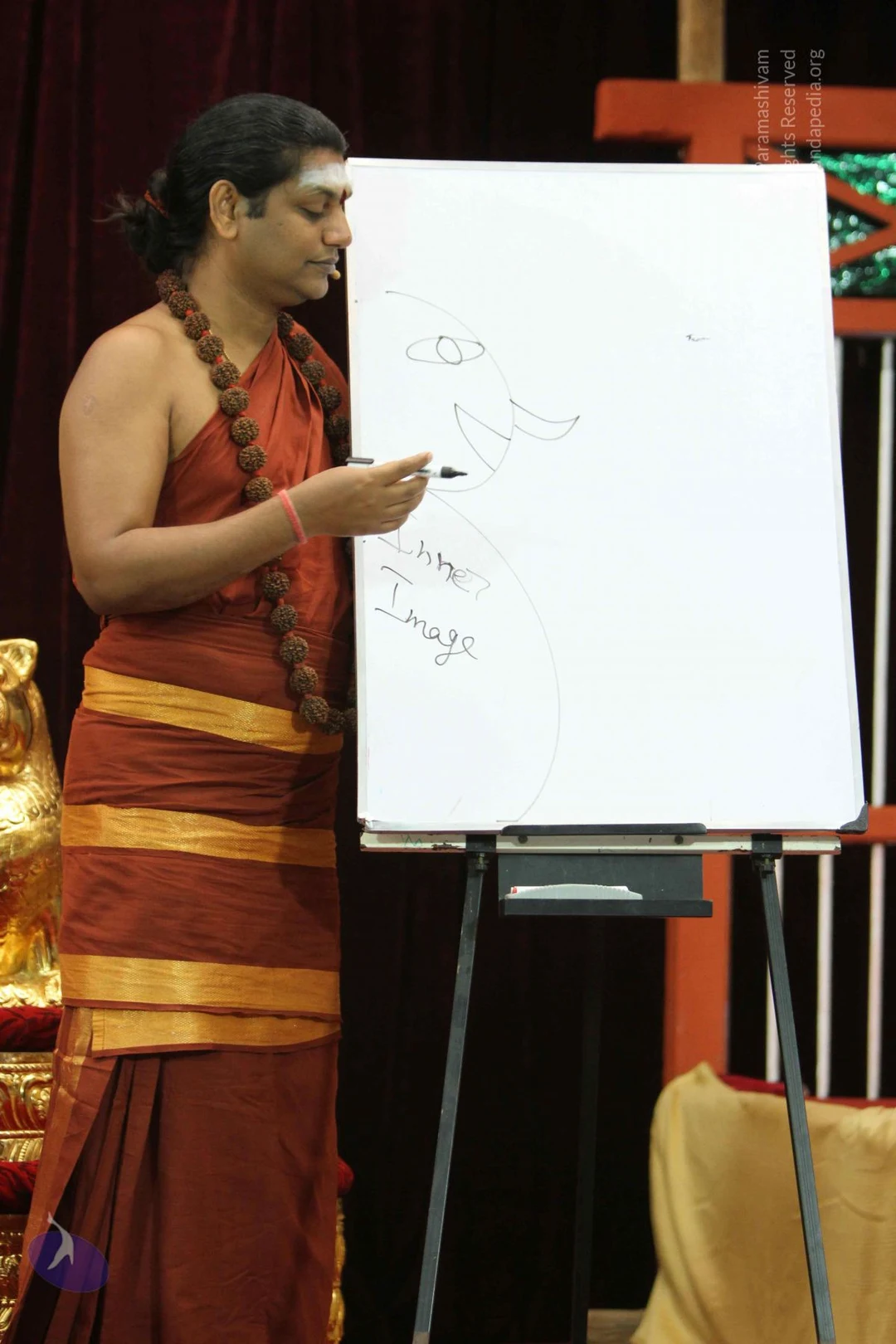
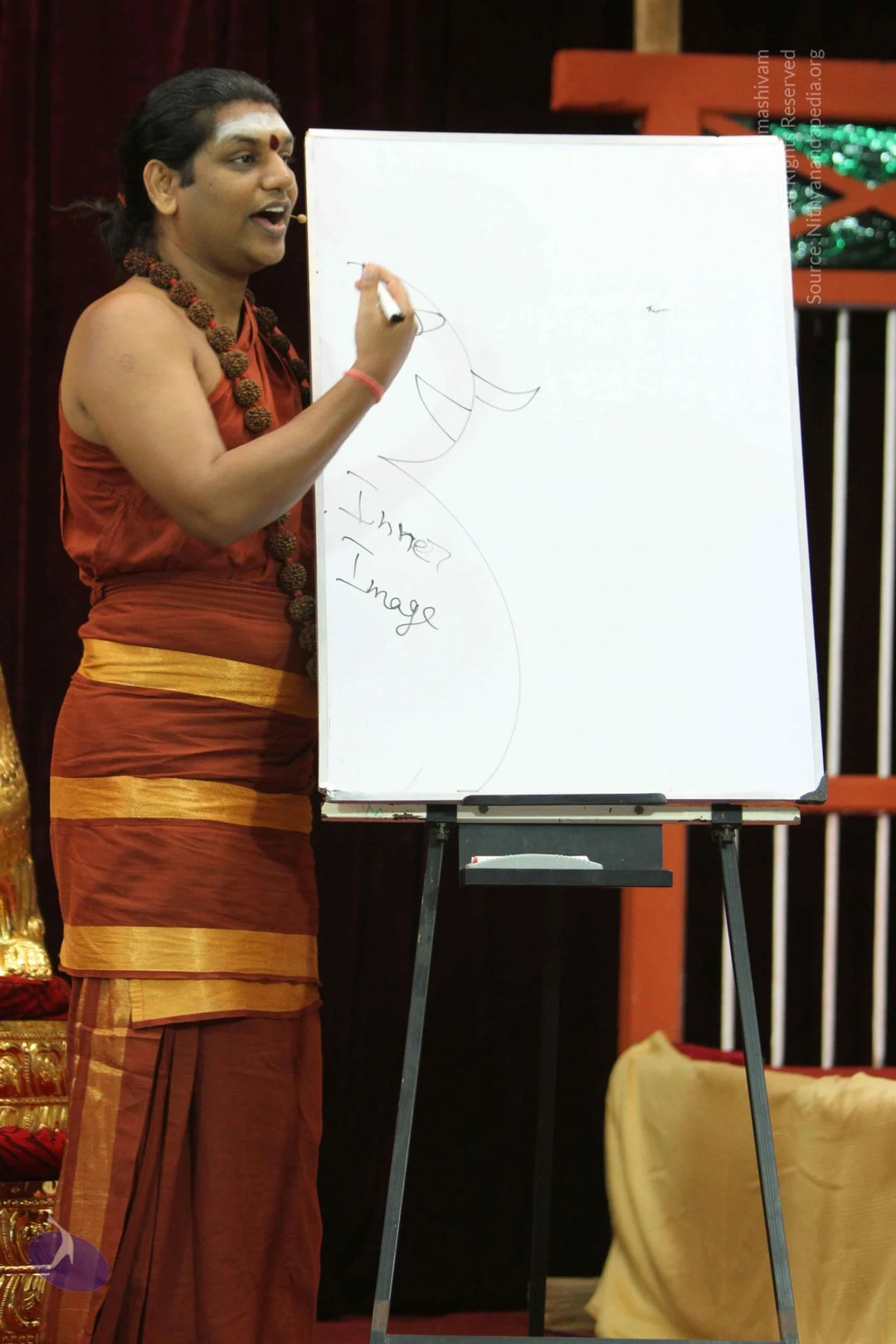
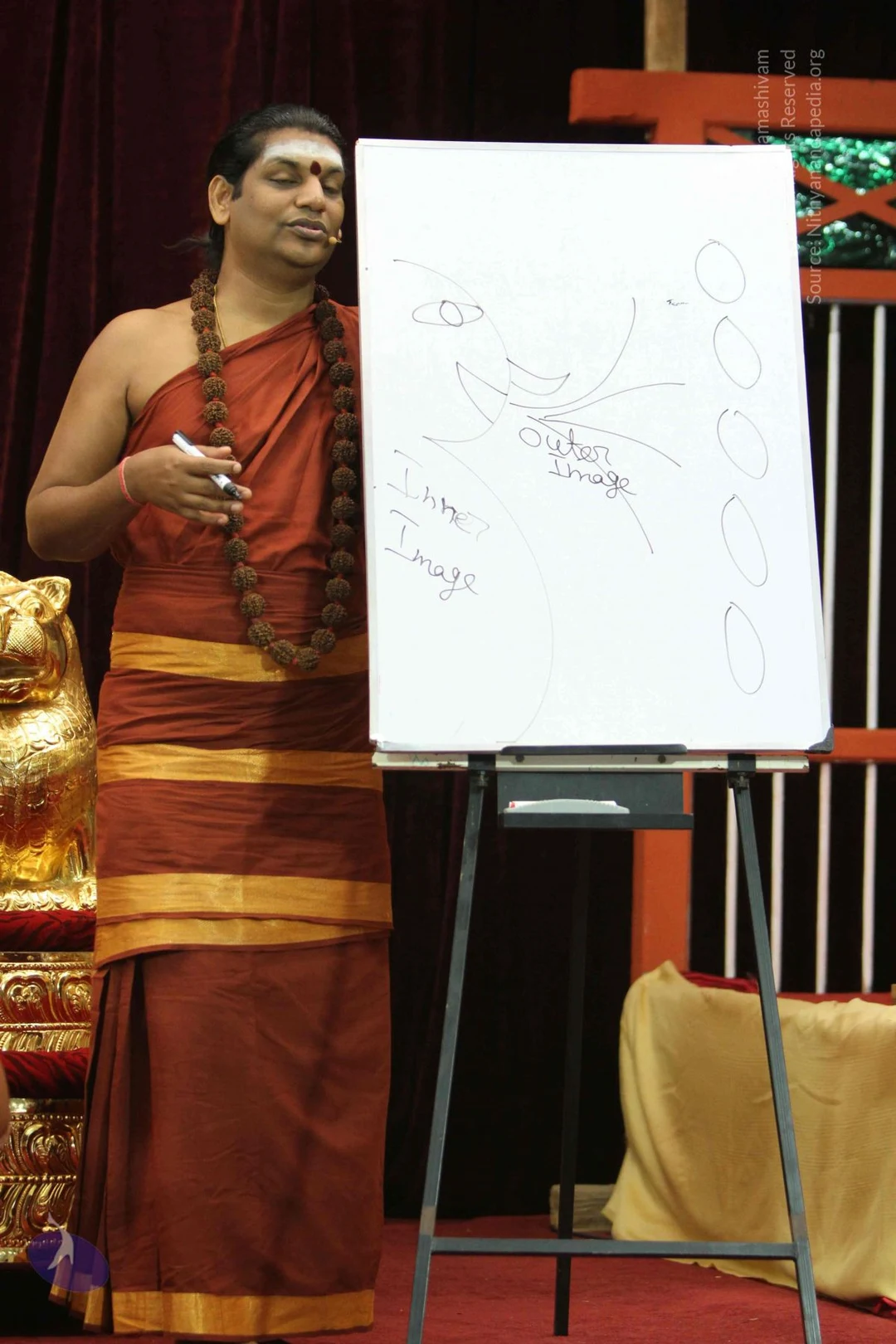
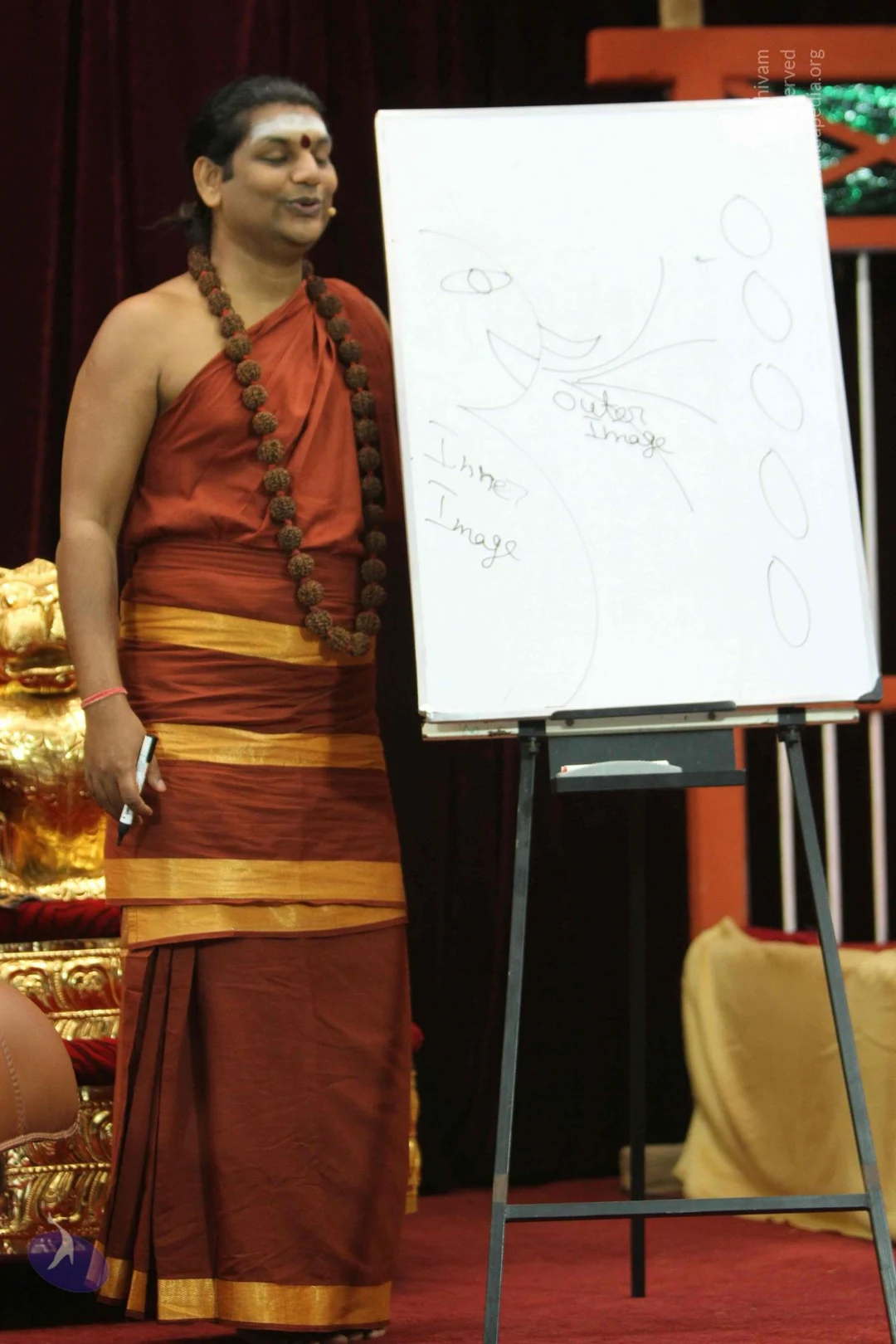
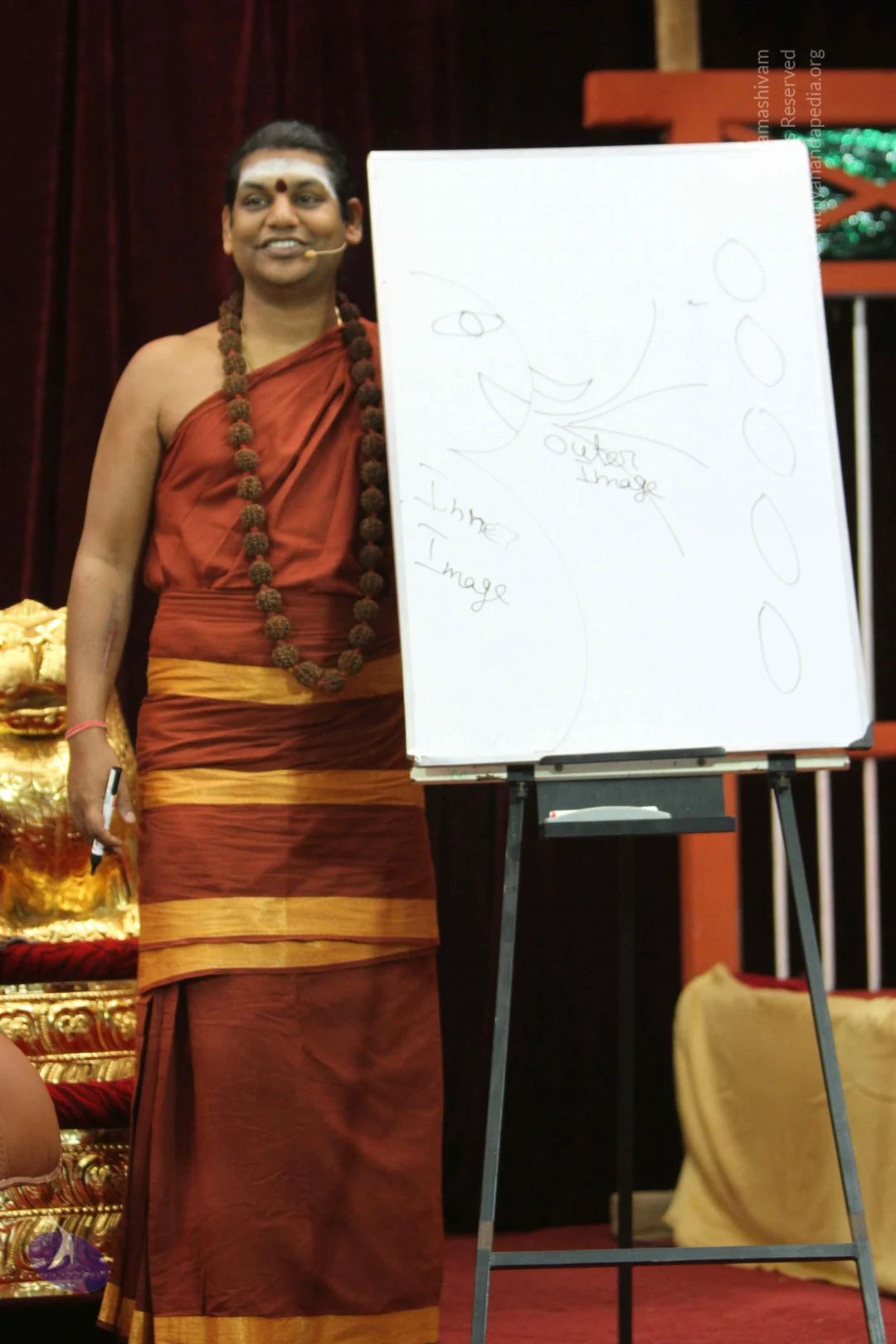
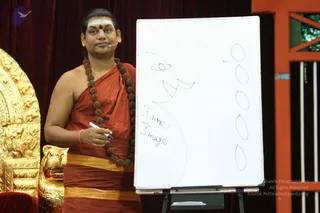
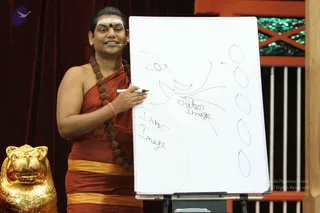
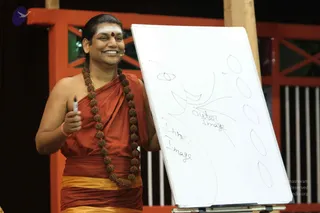
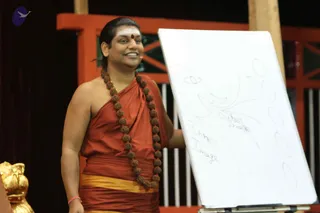
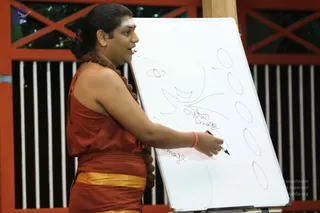
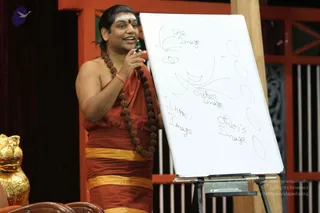
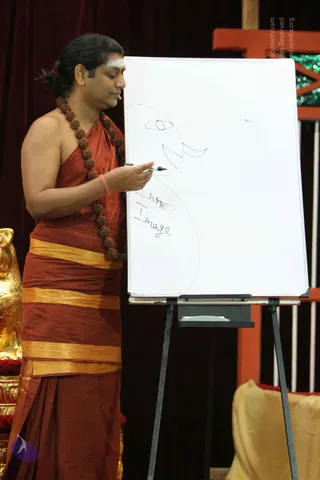
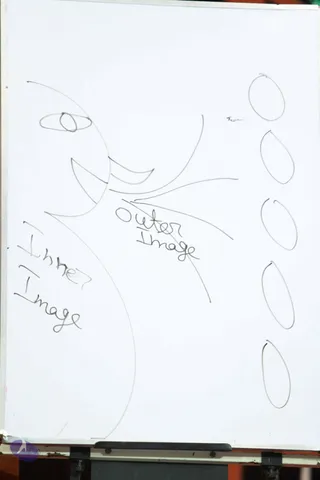
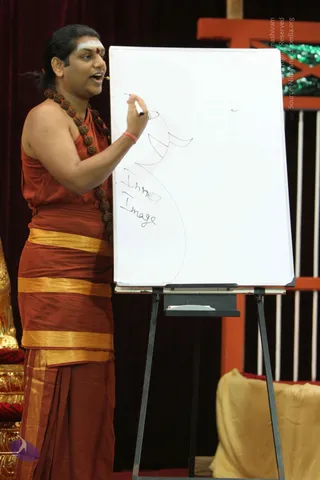
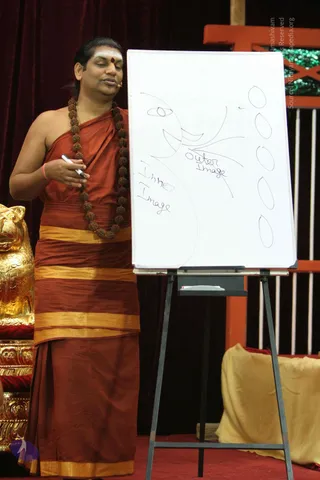
A man in a rust-orange robe with a gold-striped border stands before an easel whiteboard, holding a black marker in his right hand. He wears a long string of rudraksha beads over one shoulder, a thin gold chain, a white forehead mark with a red bindi, and a wireless headset microphone. Beside him is an ornate gold throne with carved lion-head arms against a deep red velvet curtain. The whiteboard shows a sketched face outline labelled "Inner Image" and a column of five oval shapes on the right.A man in a rust-red saffron-toned garment with a gold-bordered waist cloth stands beside a gold lion sculpture, holding a black marker at a white flipchart on an easel. He wears a rudraksha mala with a red bindi and white forehead markings, and a small lavalier microphone; his bare shoulder is visible. On the chart he has drawn a face profile with labels reading Inner Image and Outer Image, with several oval shapes running down the right side. Dark red velvet drapes and a red wooden lattice with green panels form the backdrop.A smiling man in an orange-red shawl draped over his shoulder and a gold-trimmed orange-red waist wrap stands beside a white easel whiteboard. He wears a long rudraksha mala with large beads and holds a black marker in his right hand. A white horizontal mark is on his forehead with a red dot at the centre. A small microphone is clipped near his face. On the whiteboard, hand-drawn ovals and curved arrows are labelled "Outer Image" and "Inner Image". Behind him are red wooden railings and a dark backdrop. a person: the orange-red shawl, long rudraksha mala and whiteboard teaching setting match the page's Satsang discourse.A smiling man in a rust-orange saffron robe stands beside a white easel whiteboard covered in hand-drawn diagrams with the words "Outer Image" and "Inner Image" and a row of circles. He wears a rudraksha mala with a white tilak and red bindi and a gold-yellow waist cloth, and a small microphone is attached near his face. A golden lion-shaped carved object is at the left edge and an orange wooden railing frames the stage. The man appears to be a person, teaching a satsang discourse while explaining the diagram.A man in a red-orange robe with a gold-bordered waist cloth and a rudraksha mala around his neck stands beside a whiteboard on an easel, writing with a black marker. He has a white forehead mark and his hair is tied back. Hand-drawn outlines of ovals and curved lines fill the board, with the handwritten words "Outer Image" and "Inner Image" visible. Behind him are red wooden railings and a dark mesh screen, indicating a teaching or satsang setting. a person: the rudraksha mala, red-orange robe and white forehead mark are the qualifying cues, and he is shown teaching at the board.A man in a rust-red dhoti with gold-bordered yellow waist band stands at a whiteboard on an easel, holding a marker and gesturing while speaking. He wears a long rudraksha mala with a central bead, a bare chest, a white tripundra and red kumkum on the forehead. The whiteboard shows hand-drawn labels 'Life Image', 'Outer Image', 'Inner Image' and 'Other's Image' beside sketched ovals. Behind him are red wooden lattice panels and a golden lion figure at left.
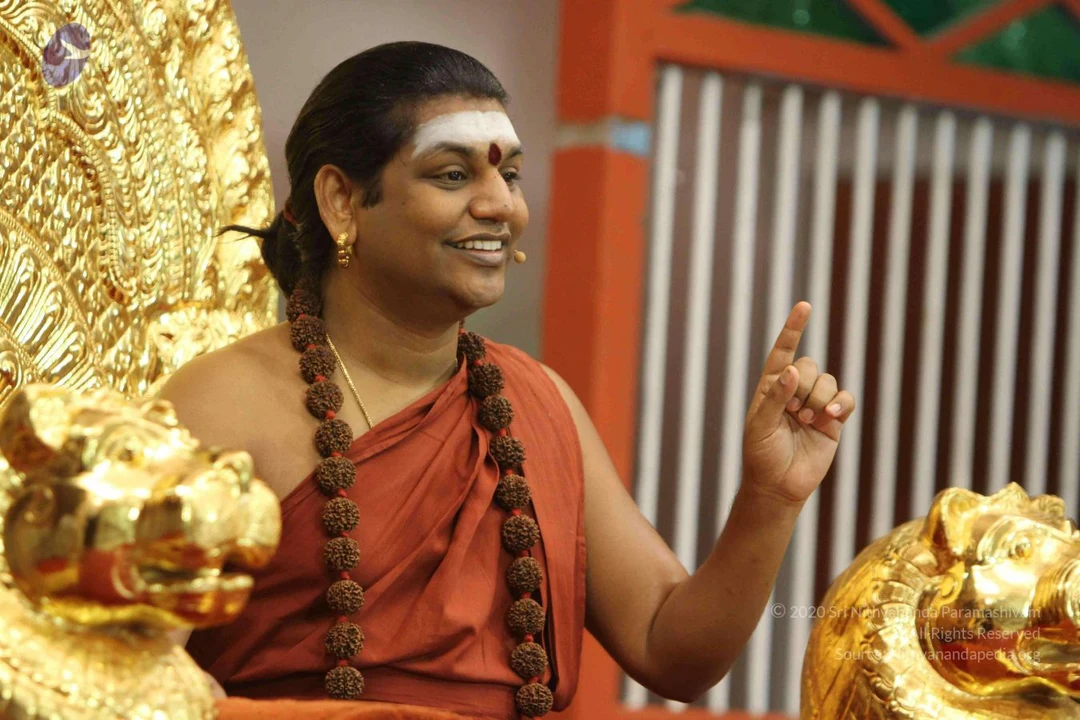
Satsang
14 photosSource gallery
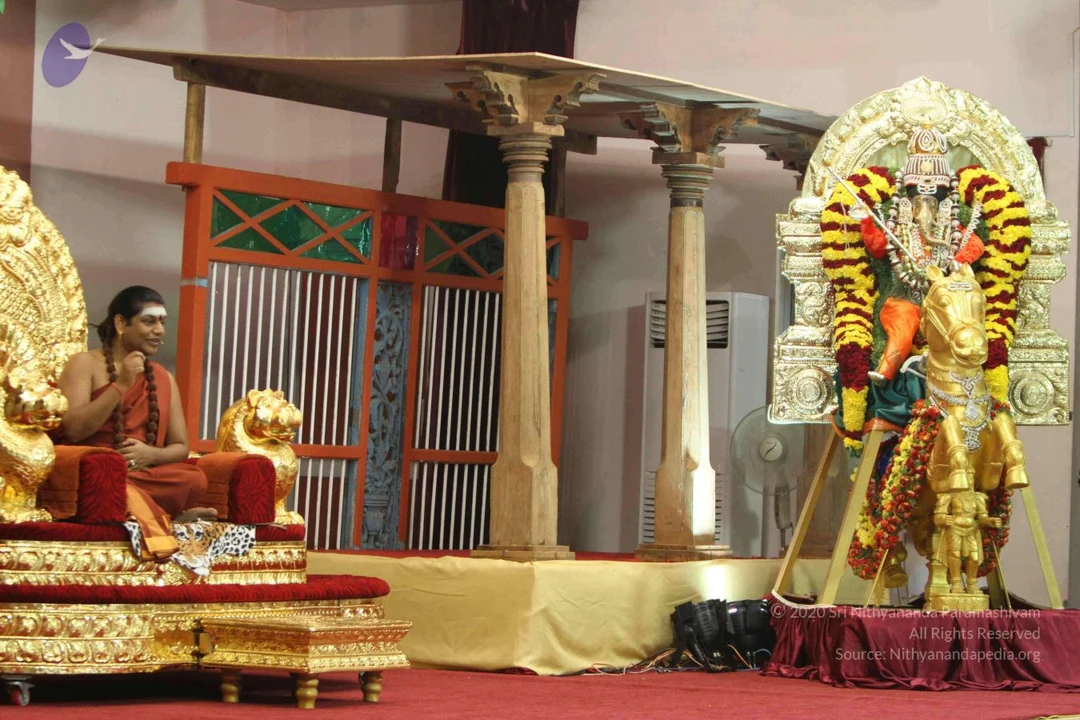
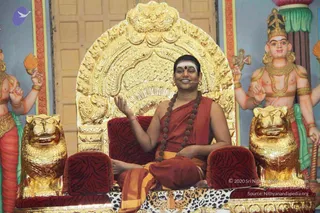
A seated man in saffron-orange robes sits on an ornate gold throne with a carved arched backrest, flanked by two gold lion-head armrests and a leopard-skin cloth draped over the dais. He wears a long rudraksha mala, a white forehead band with a red bindi, and a small microphone clip, and raises one hand in a gesture of speech. Behind him stand painted deity figures with multiple arms holding a trident and other objects, in a temple-style hall with red and yellow pillars. a person: the seated man in saffron robes, rudraksha mala and forehead band fits the a person depiction on the throne, so this is recorded as in_person.A priest in an orange dhoti and orange shawl with a pink border stands at left, holding a lit brass oil lamp (aarti) toward a golden deity murti on horseback. The gold horse carries a rider with a crown and orange garments, decorated with yellow and red marigold garlands and a diamond-studded chest ornament. A golden arched prabhavali frames the figure, and a small golden attendant stands at the base on a maroon-draped platform. Wooden pillars and a cream wall form the background. The priest is a physical person; the deity is a statue, and no identifiable a person candidate is present.

IA-Session

5 photosSource gallery
A man in a rust-red and gold-bordered dhoti and shawl, with a long rudraksha mala around his neck and a red thread on his wrist, stands at a whiteboard on an easel. He holds a black marker and has drawn a rough outline of a face with an eye, nose and ear, and the words "Inner Image" are written below it. A gold figure of a deity stands at the left edge against a dark red curtain, with an orange and gold stage structure behind. Appearance suggests a person presenting in a satsang setting, though the face is not clearly visible.A photograph of a white flip chart on an easel, showing hand-drawn black marker sketches. On the left, a large curved outline with an eye-like oval and a crescent mouth-like shape is labelled "Inner Image" in handwriting. Beside it, curved lines radiate outward toward a second label reading "Outer Image". Five small oval outlines stand in a column on the right, with a tiny handwritten word above the top one. No people are visible in the frame.A man seated in a large brown leather armchair with carved wooden armrests speaks into a small headset microphone during a satsang. He wears an orange-red sleeveless wrap over a yellow lower garment, a long rudraksha mala hangs across his chest, a red bindi and white tripundra mark his forehead, and a red thread is tied on his wrist. His right hand rests near his chin while his left hand rests on his lap. Behind him are vertical white and red bars.A man in a leather-upholstered wooden throne chair sits before a golden ornate backdrop flanked by two golden lion statues, delivering a satsang talk. He wears a rust-red saffron-toned robe draped over his shoulder, a long multi-strand rudraksha mala around his neck, and a small red bindi on a white forehead marking. A lapel microphone is clipped near his face, and he raises his right hand palm-out while the left hand gestures open. Deep maroon curtains frame the stage.A man seated on an ornate brown leather armchair with carved wooden armrests, wearing a rust-red sleeveless robe with a gold border, a large gold and black rudraksha-style mala necklace, a small red bindi and white tripundra marks on his forehead, a headset microphone and an in-ear device. He holds his right hand on his knee, showing a ring on his finger, and a red thread is tied on his left wrist. Behind him are dark maroon drapes and a partly visible ornate carved chair top. An appearance-based probable Swamiji is present, seated in the chair, with long swept-back hair, a rudraksha mala and rust-red robes, while he speaks in a satsang setting.
IA_Session1

8 photosSource gallery
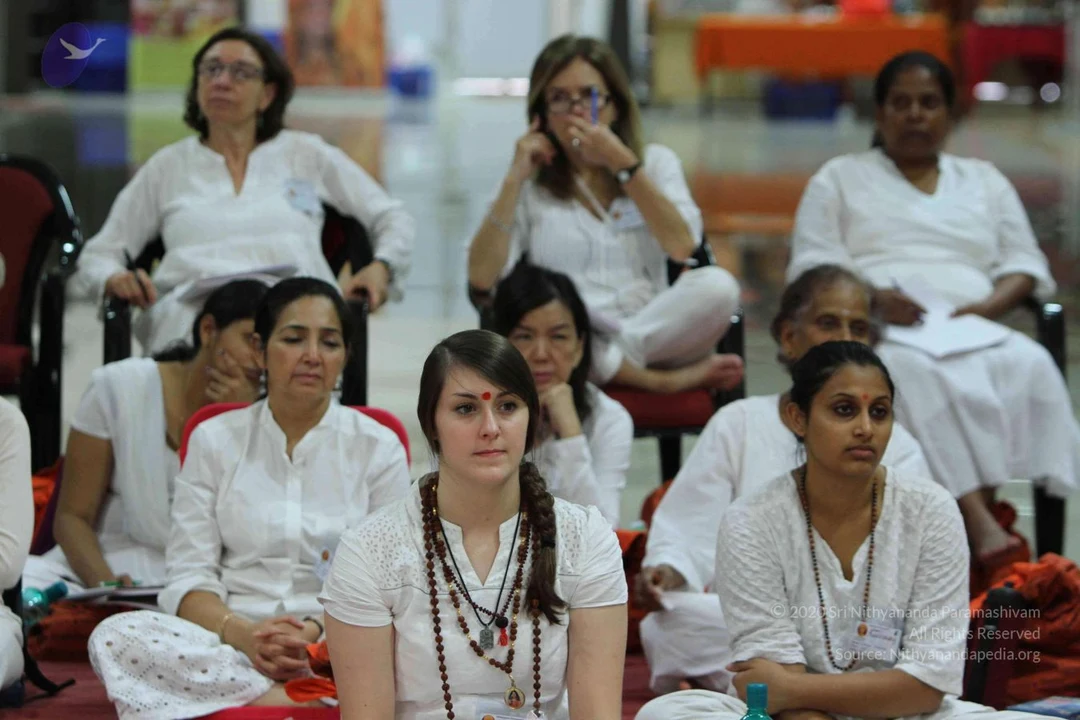
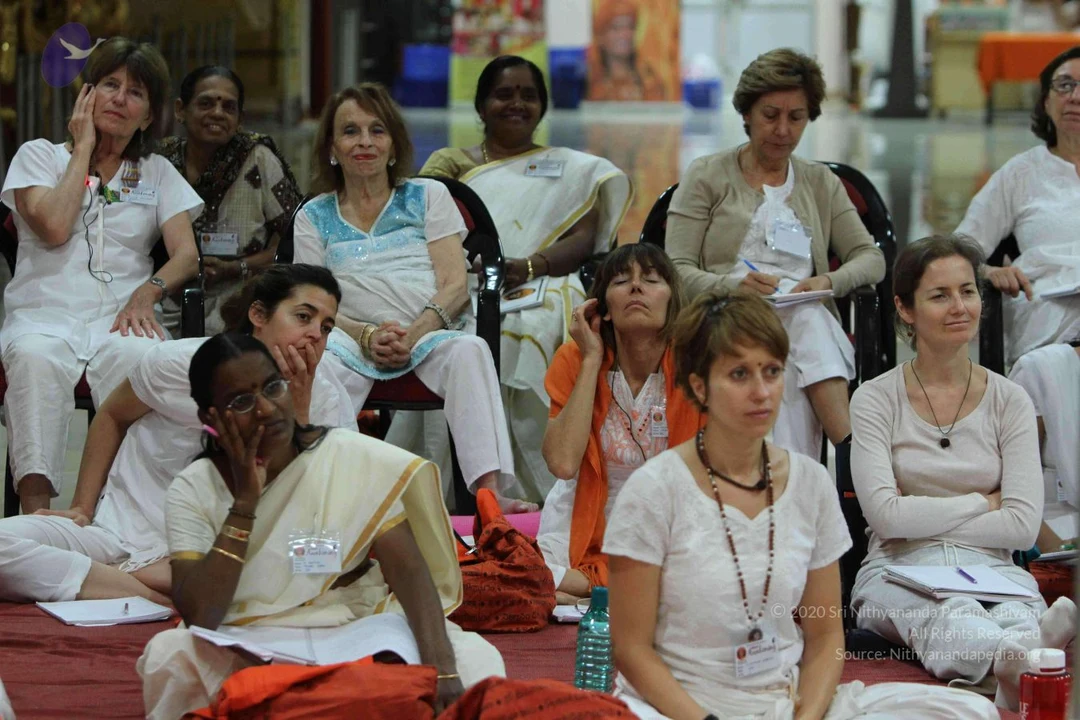
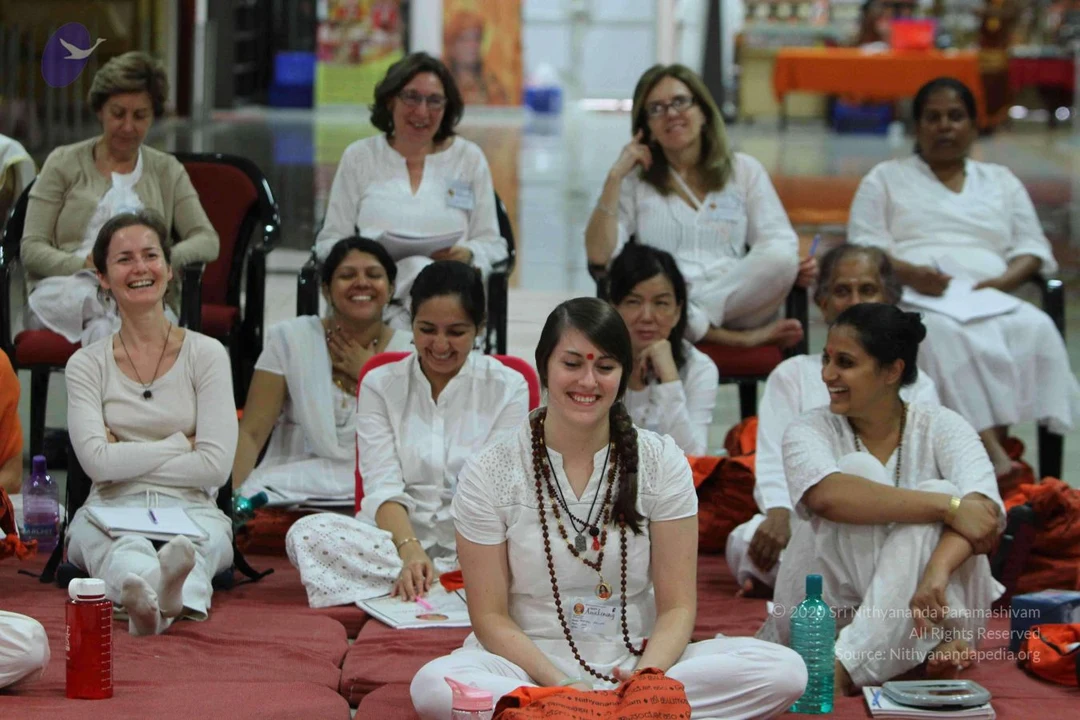
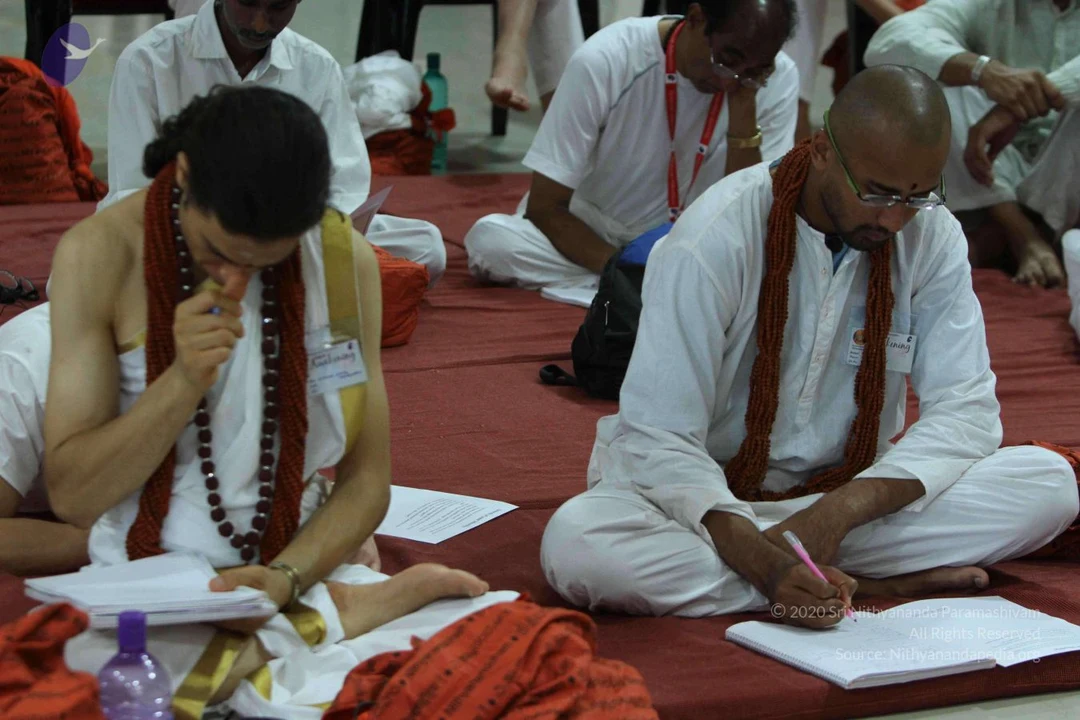
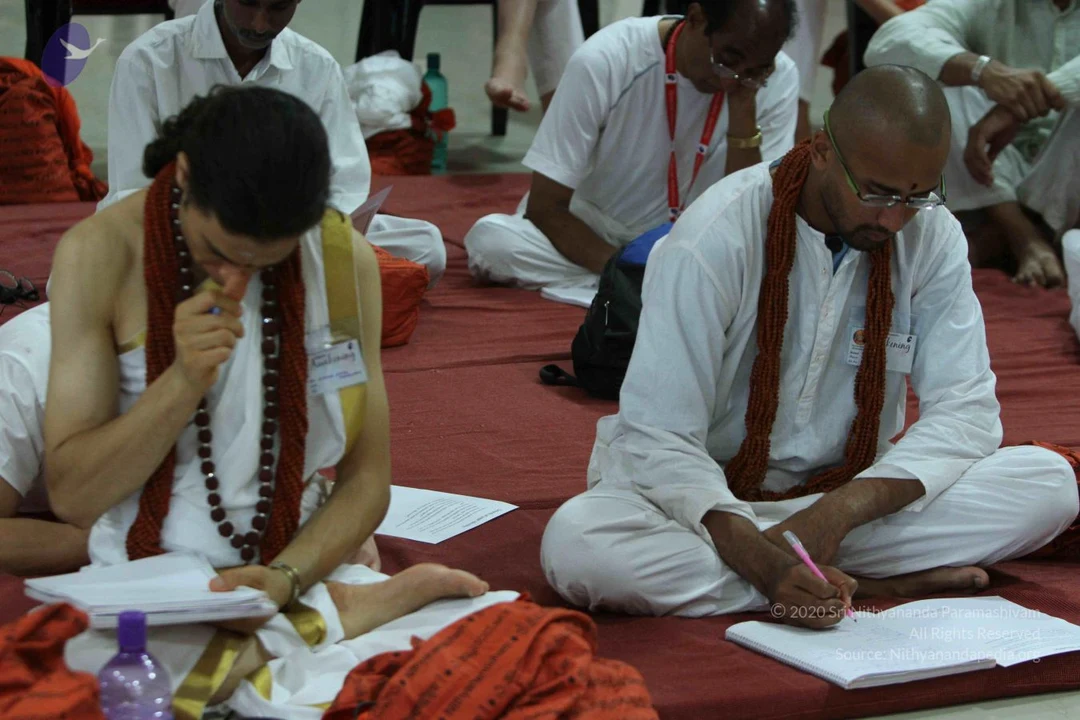
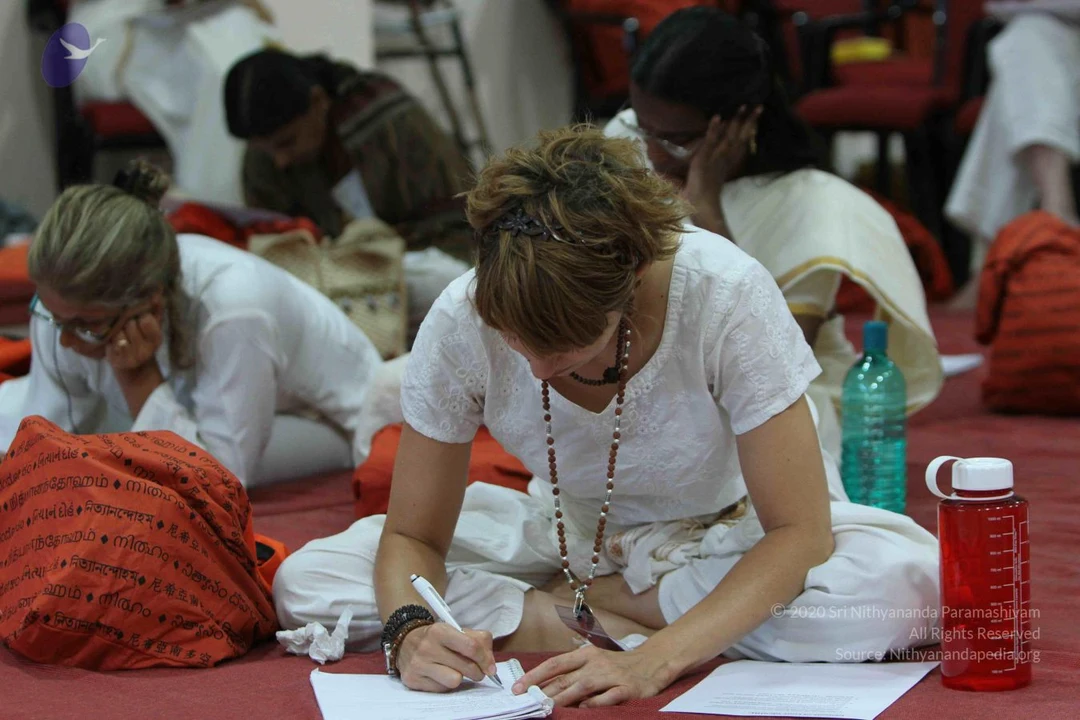
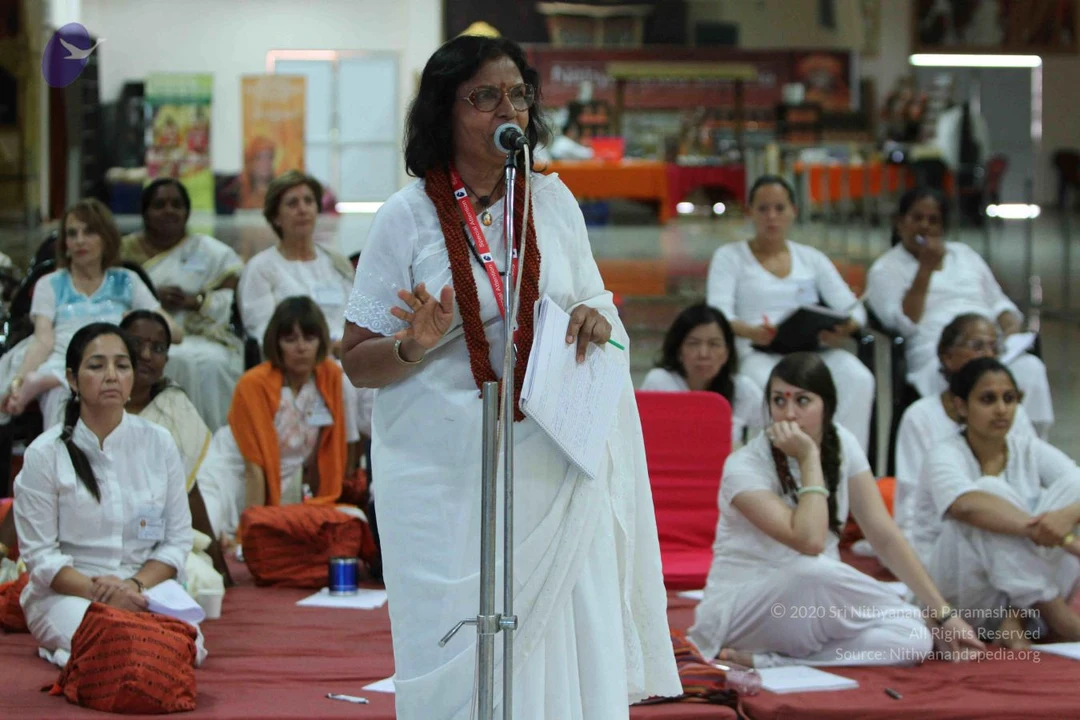
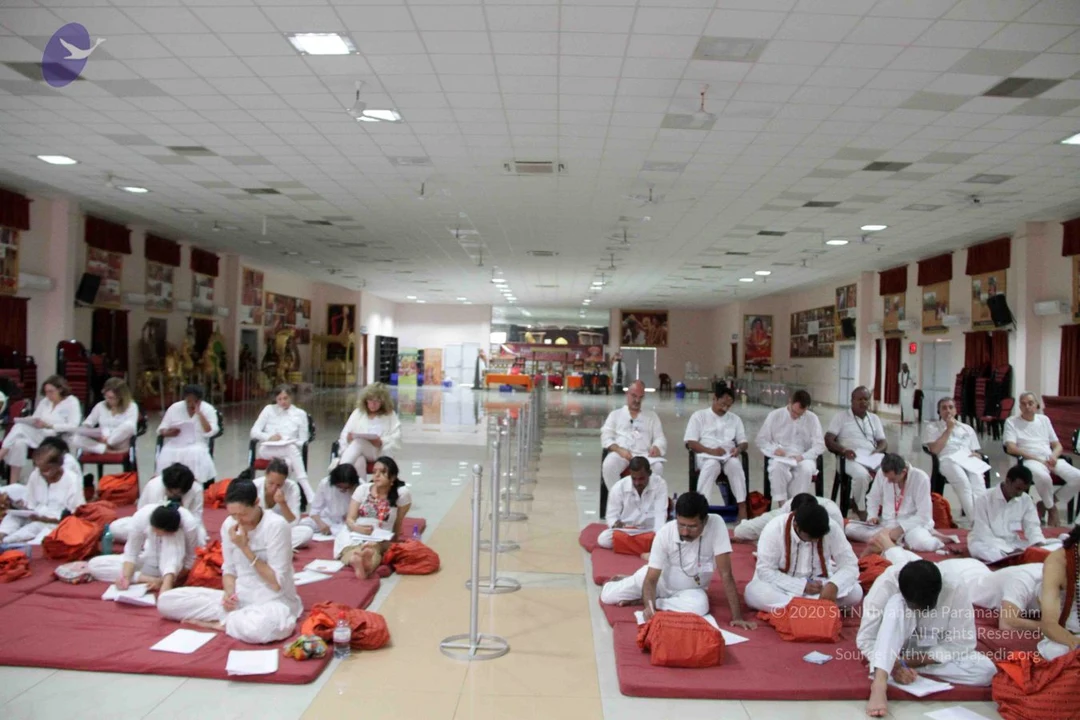
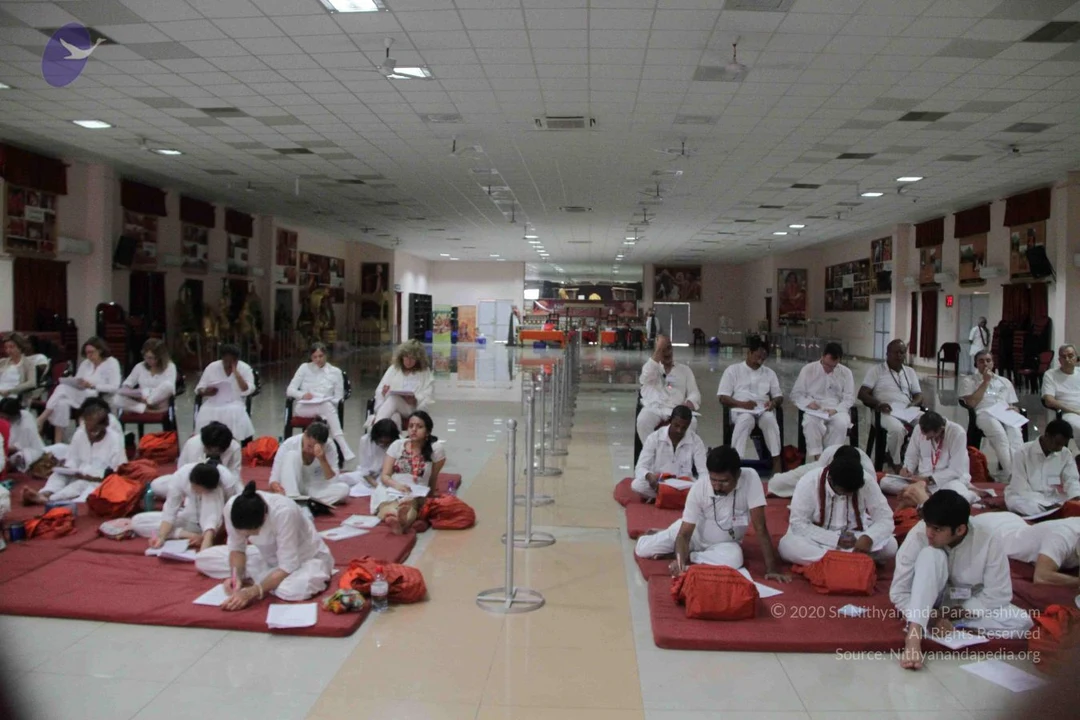
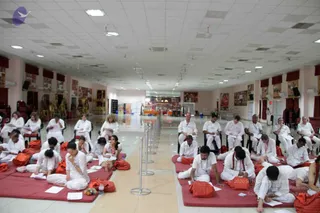
A photograph of a large, bright hall with white ceiling tiles and pink walls hung with framed pictures. Dozens of devotees in white clothes sit in rows on red mats and chairs, many with orange cloth bags beside them and sheets of paper in hand, appearing to take notes or read during a satsang. Stanchions line the central aisle. No individual can be confidently identified as a person from the image, so the a person field is unsure.A large hall with cream tiled ceiling and white walls hung with framed photographs and wall art. Rows of devotees dressed in white sit on red mats and cushions, many writing on loose paper or reading notes, with orange bags placed beside them. A standing roped aisle divides the seating. The hall has a bright, orderly satsang-style atmosphere with a few people standing near the far wall.A man seated in a brown leather armchair with carved wooden arms speaks during a satsang, gesturing with both hands open. He wears a maroon-red draped robe over one shoulder, a long necklace of gold-toned and black beaded rudraksha-style beads, a red bindi and white forehead markings, and a small clip-on microphone. Behind him stands a large gold ornate backdrop and dark curtains. Probable Swamiji (appearance cues: long swept-back hair, saffron-red sannyasi robe, ornate gold beaded mala) seated in the speaker's chair, giving a discourse.A man seated in a large brown leather throne-style chair with carved wooden arms sits before a gilded backdrop. He wears a dark red-brown shawl draped over one shoulder and a long necklace of gold-and-black beads, with a small red bindi on his forehead and white markings on his brow. A small microphone is attached near his face, and a gilded lion figure stands beside the chair. His right hand rests on his knee and his left arm rests on the armrest. a person seated on a peetha throne during a satsang, with a visible microphone indicating a teaching session.A man in a rust-orange sleeveless garment with wide gold-bordered wrap stands beside a whiteboard on an easel, drawing with a black marker. He wears a long rudraksha mala across his chest, has white forehead markings and a red bindi, and has his hair tied back. The whiteboard shows a drawn figure and the handwritten words 'Inner Image'. Behind him are dark red drapes, a red-and-gold structure and a gold statue at left. Appearance-based candidate for Swamiji (probable): long swept-back hair, rudraksha mala and saffron-orange clothing, teaching at a whiteboard during a satsang.A man stands on a red stage beside a whiteboard on an easel, holding a black marker in his right hand. He wears a rust-orange dhoti and shawl with gold borders and a long rudraksha mala with ceremonial gold necklace visible at his chest, with a white tilak and red bindi on his forehead. The whiteboard shows sketched diagrams with the words 'Inner Image' and 'Outer Image' and rows of ovals. Behind him is a gold lion figure and red drapes. The appearance matches the a person, with rudraksha mala and saffron-orange clothing, and he is shown in a teaching setting.

Darshan
10 photosSource gallery
A photograph of a man seen from behind, his short dark hair visible, wearing a white kurta and a thick dark-red rudraksha mala around his neck. He holds a curved wooden hand mirror up to his face, so his reflection is partly visible in it. Blurred figures in white and orange clothing sit in the background of an indoor hall. Only one physical person is clearly visible, though others are partially seen behind him.A woman with short layered brown hair, seen from the side, sits in a white outfit and holds a small grey arched hand mirror up to her face during a seated gathering. Other attendees in white clothing are partly visible behind and beside her, with a blurred crowd in the background.A woman in profile, seated and wearing a plain white top, holds a small red-framed hand mirror up to her face while looking into it. Her shoulder-length brown hair is tucked behind one ear, with a silver dangling earring visible. The blurred background shows a white wall and red accents.A close side profile of a shaved-headed man in a plain white top holding a small oval wooden-framed hand mirror up to his face while looking into it. Other people in white clothing and more mirrors are blurred in the background. No identifiable ceremonial clothing, saffron or crown is visible on the foreground man, so a person's presence cannot be confirmed from appearance.Photograph of a bald, bearded man in a white shirt seen from behind, looking into a small handheld mirror with a wooden frame. His reflection shows his face with a short dark beard. The background is pale and softly blurred with another person in white clothing at the right edge. The man is shown from the back, so no face-based identification is possible; no visible cues establish the a person presentation.A photograph of a person seated in profile, facing left and looking down at a small hand mirror held in their left hand. The person has dark hair gathered in a low bun, wears layered rudraksha beads with a red-orange tone, and a white garment with a gold-yellow border across the shoulder. Another person in white clothing is partly visible at the left edge, and a second hand holds a framed mirror at the upper right. The background is a light wall with a red floor area.