Skip to content
Tuesday

26 August 2014

Listening to yourself is completion

Dated photos
229
Source pages
1
Media
3
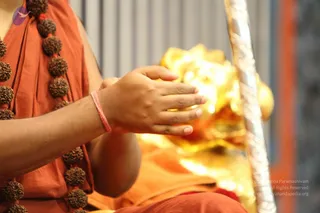
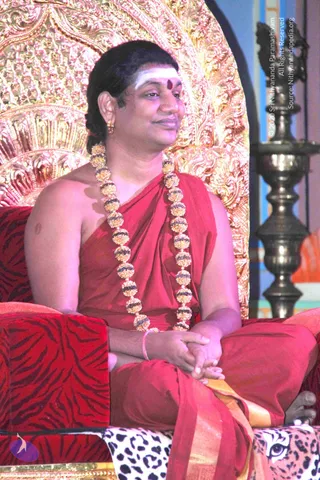
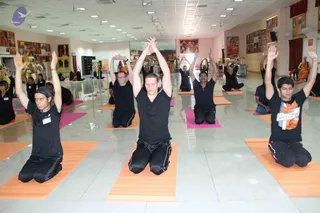
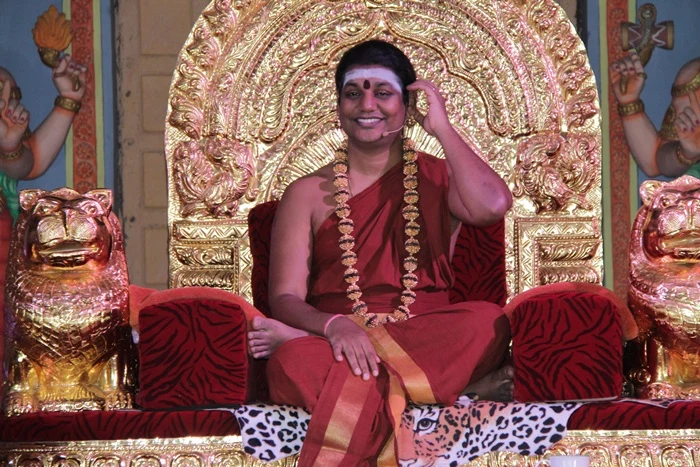
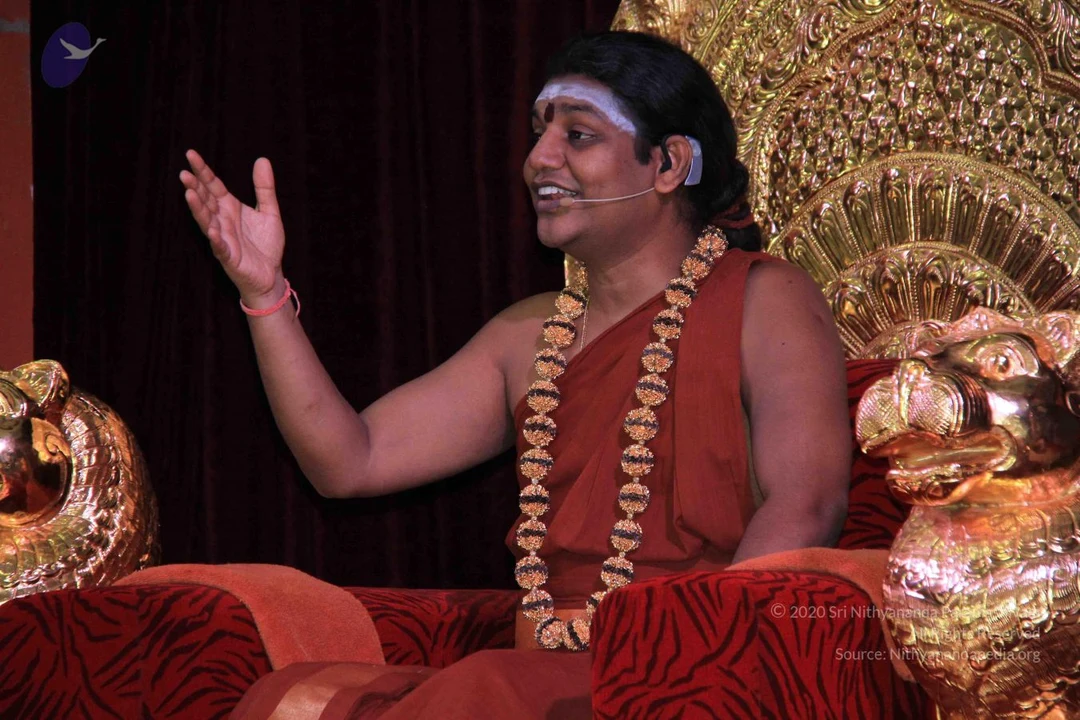
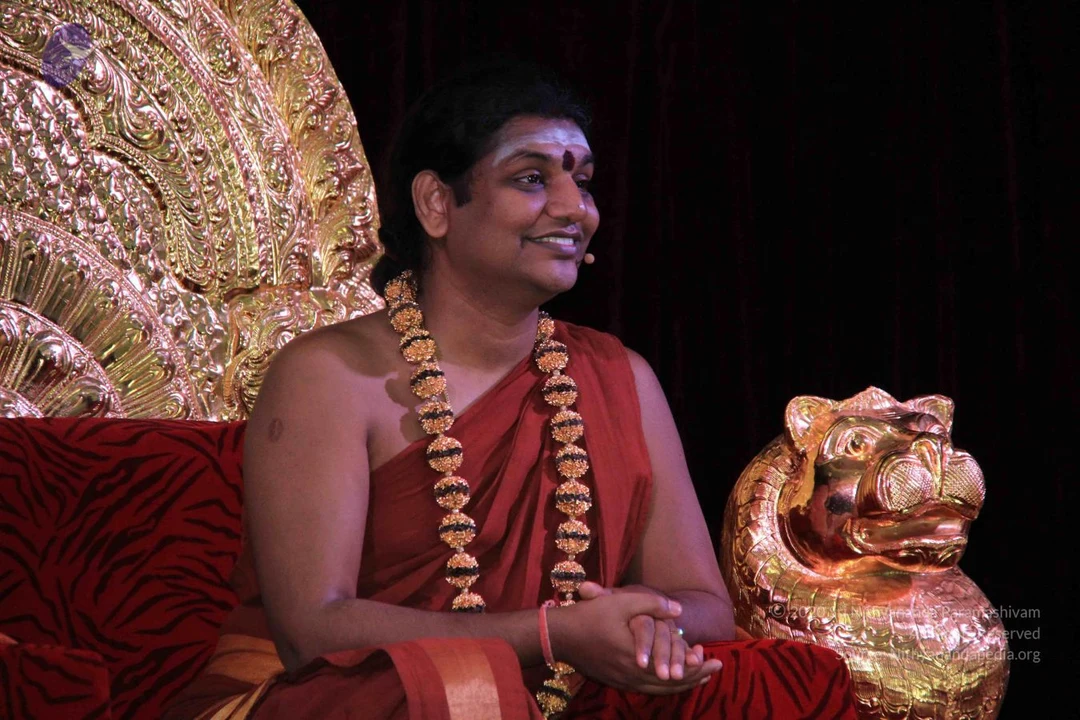
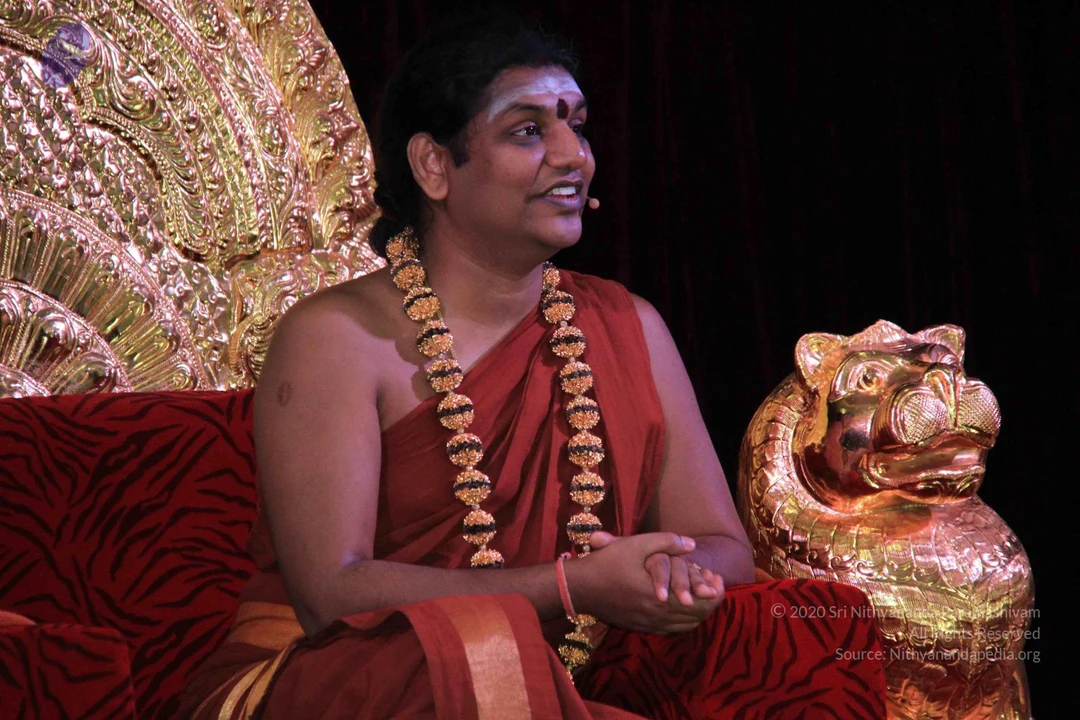
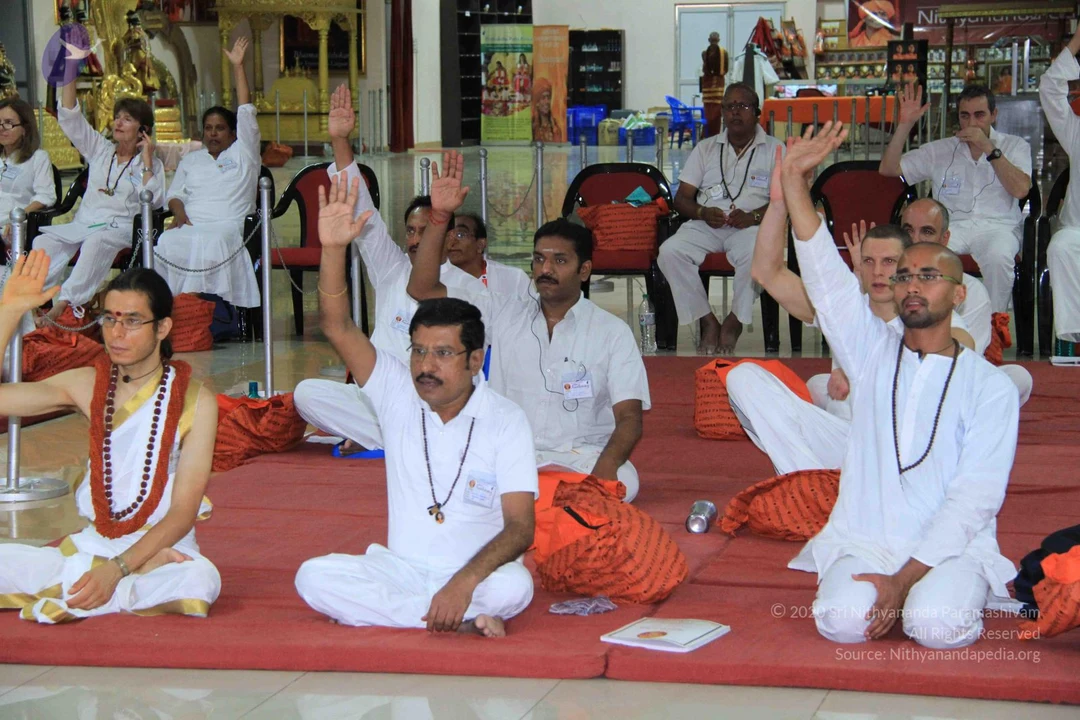
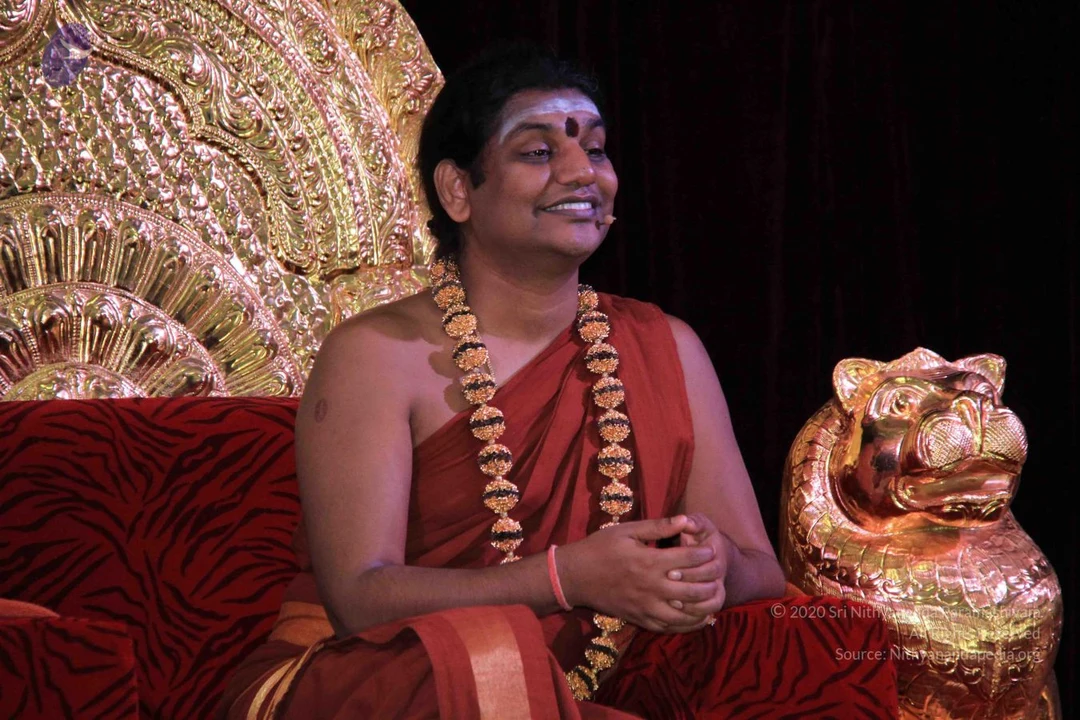
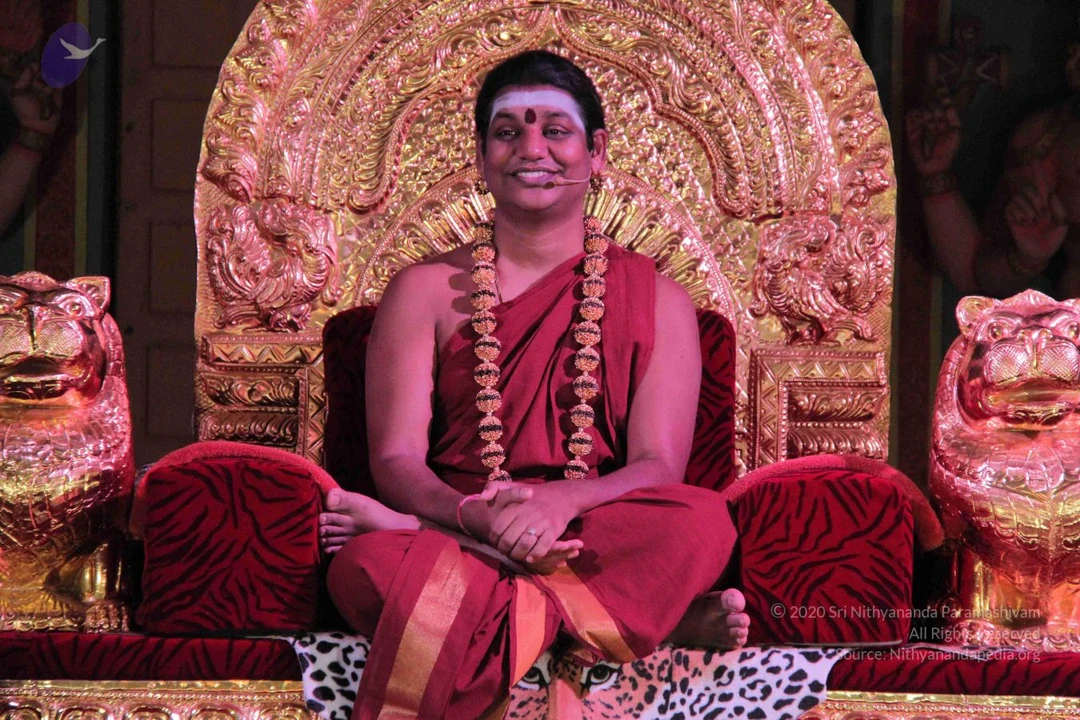
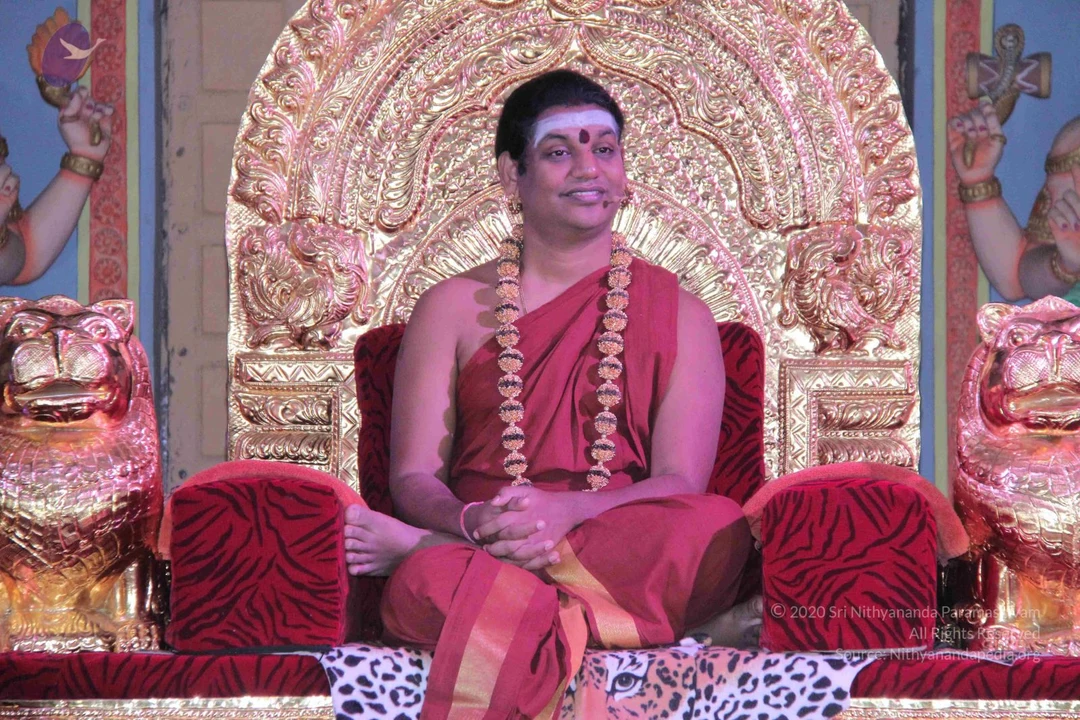
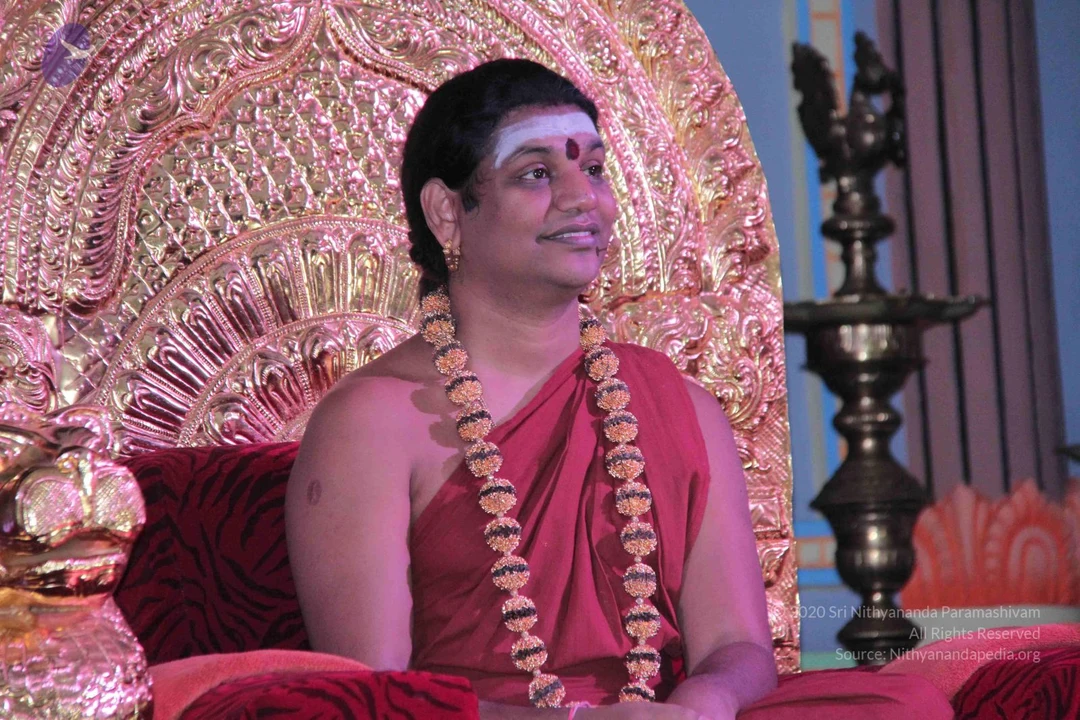
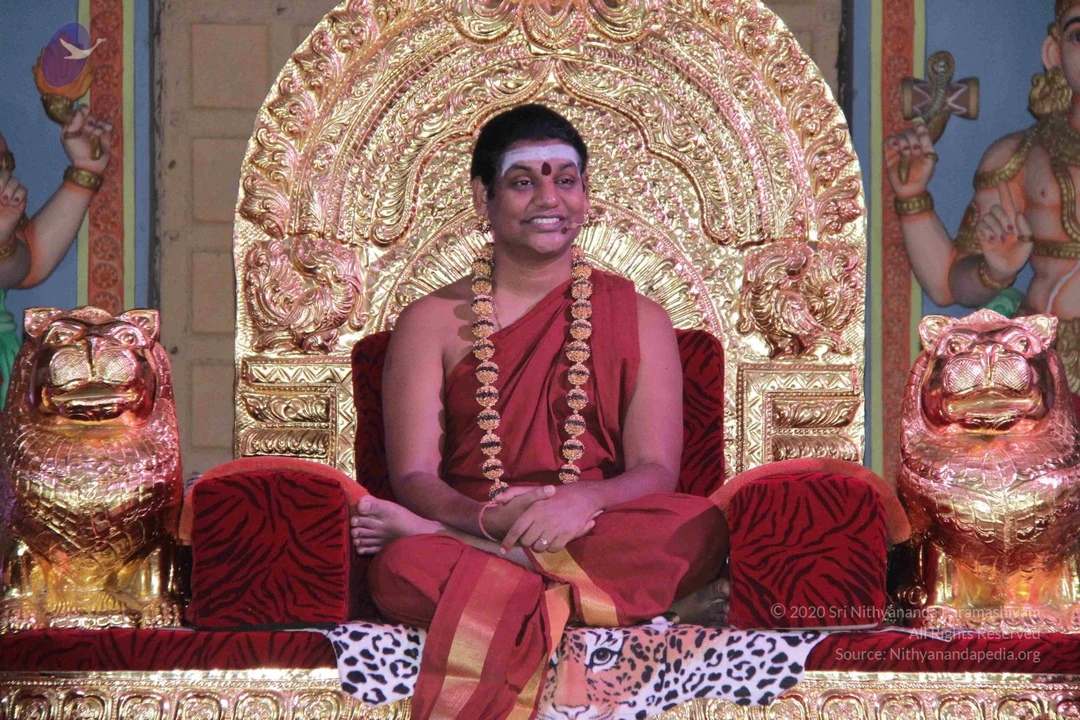
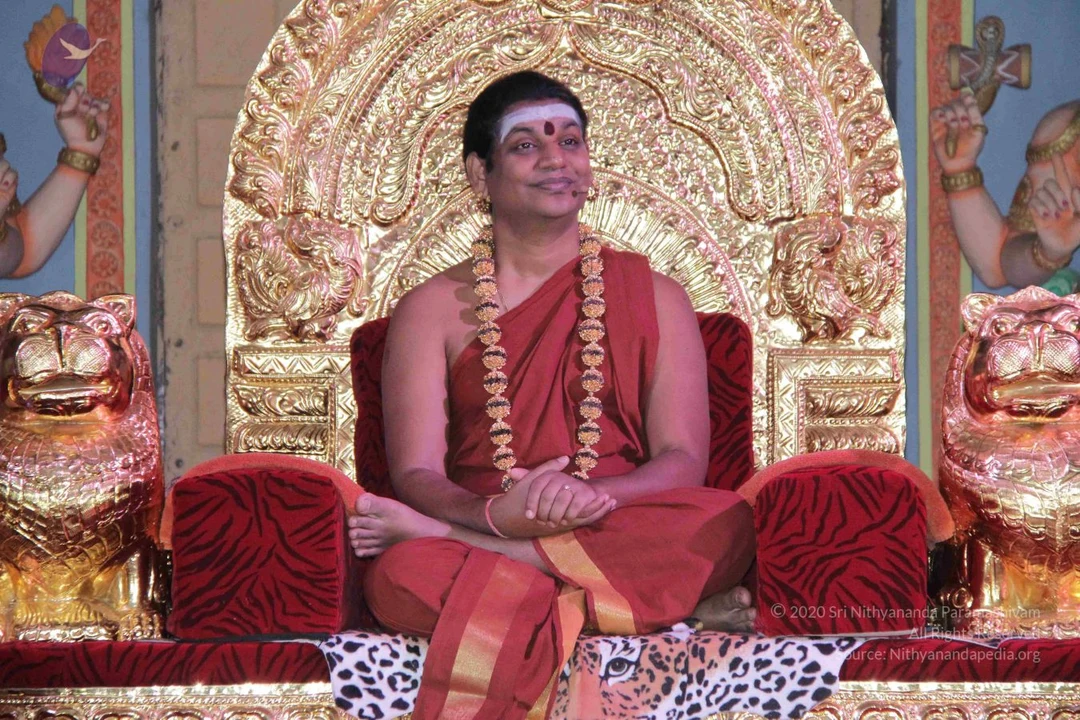
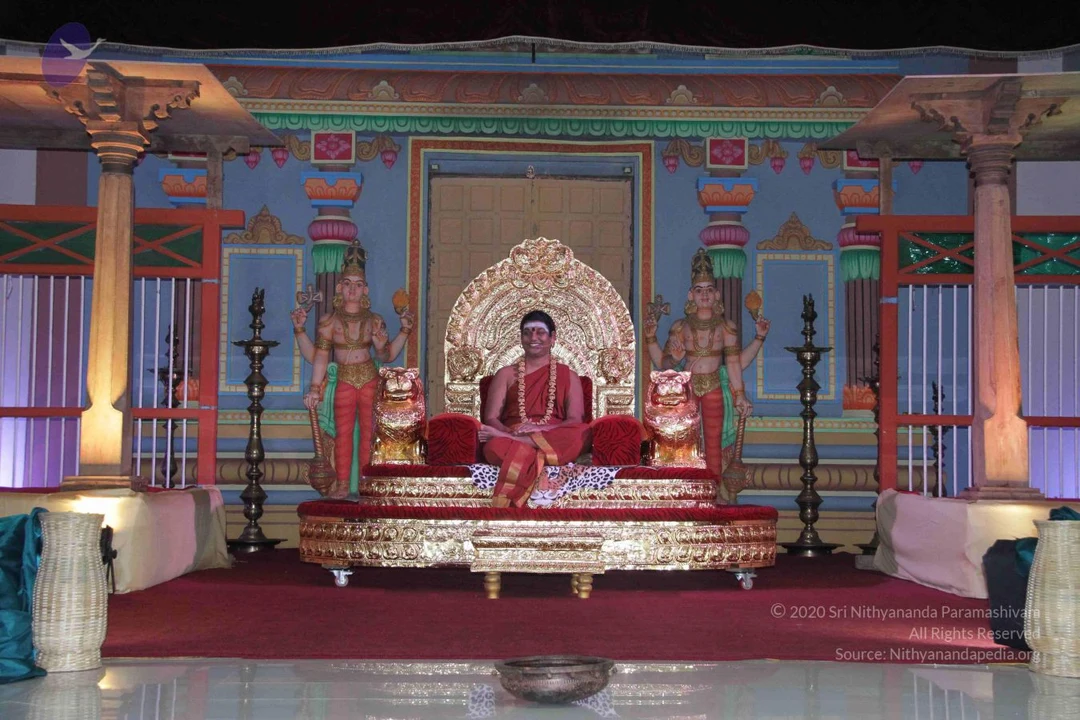
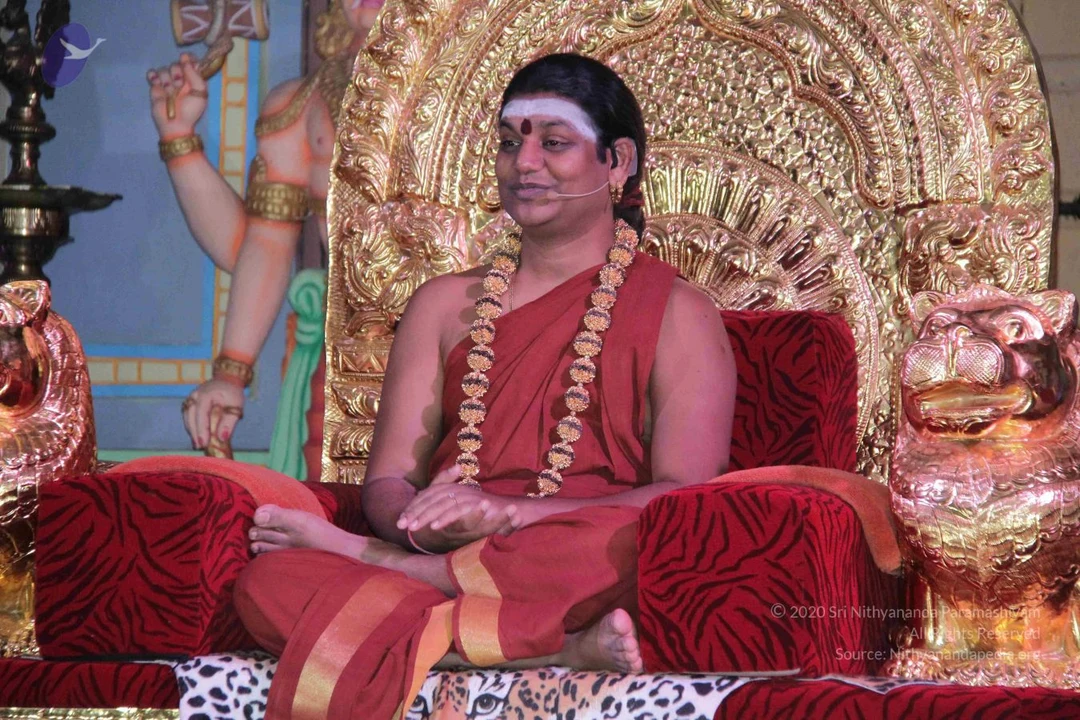
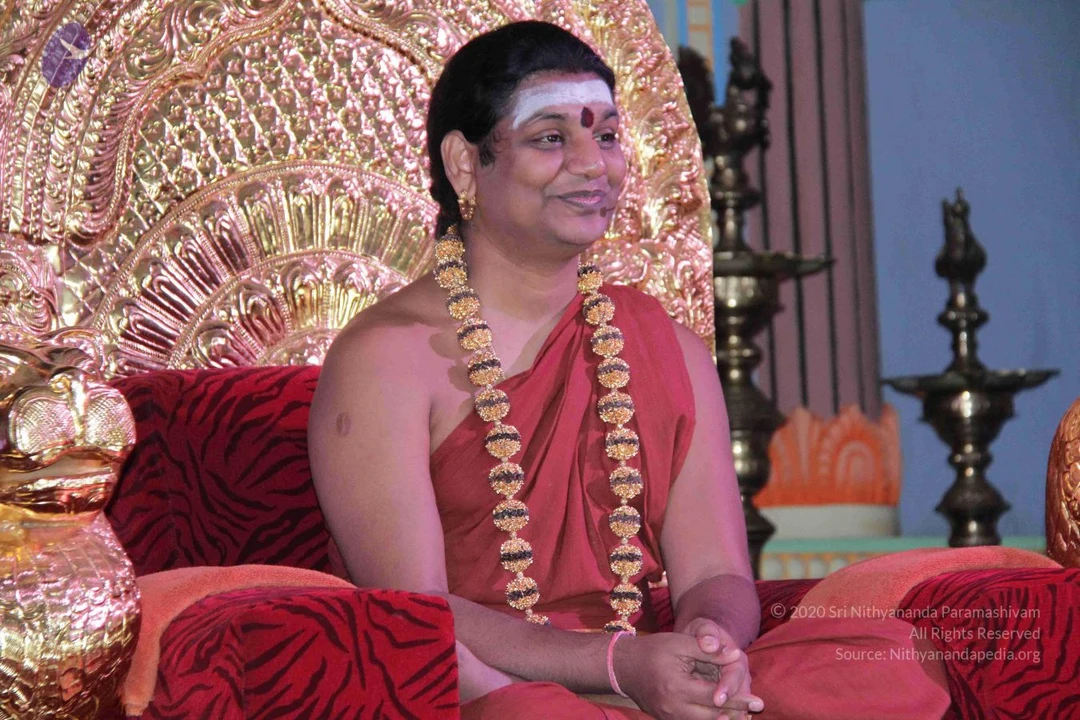
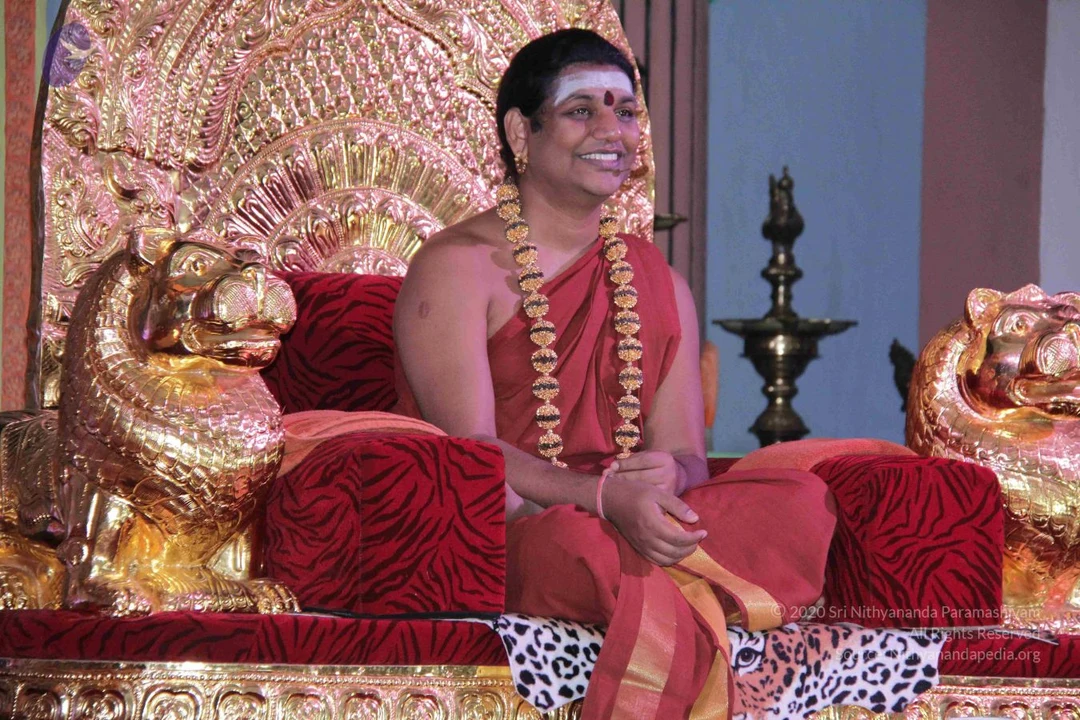
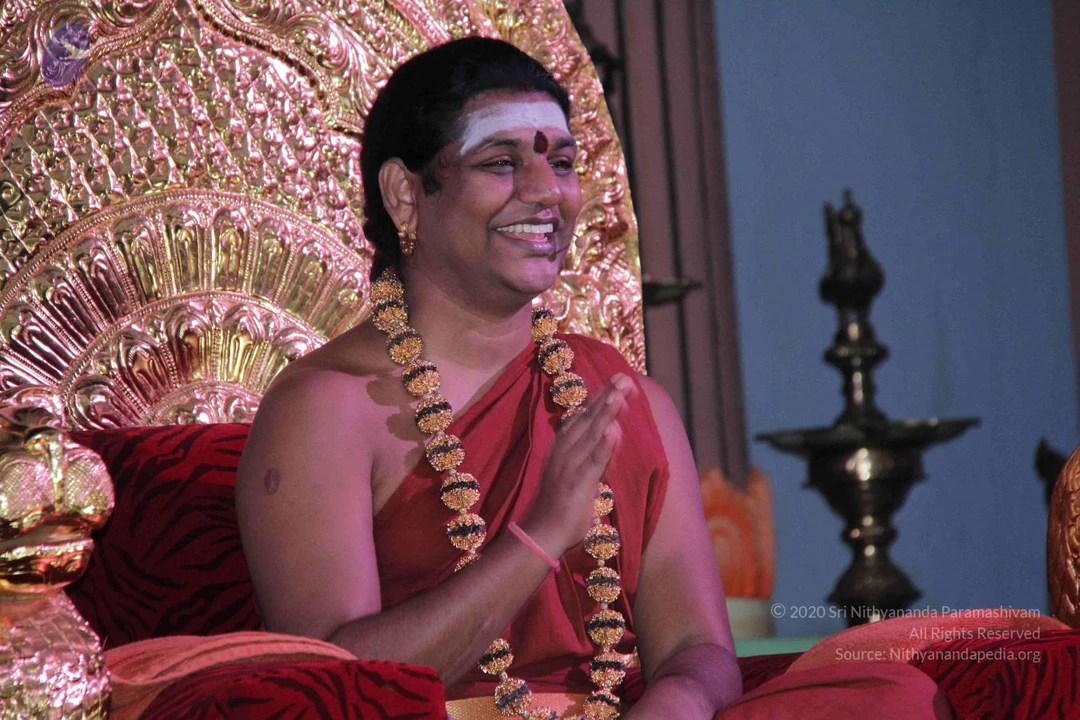
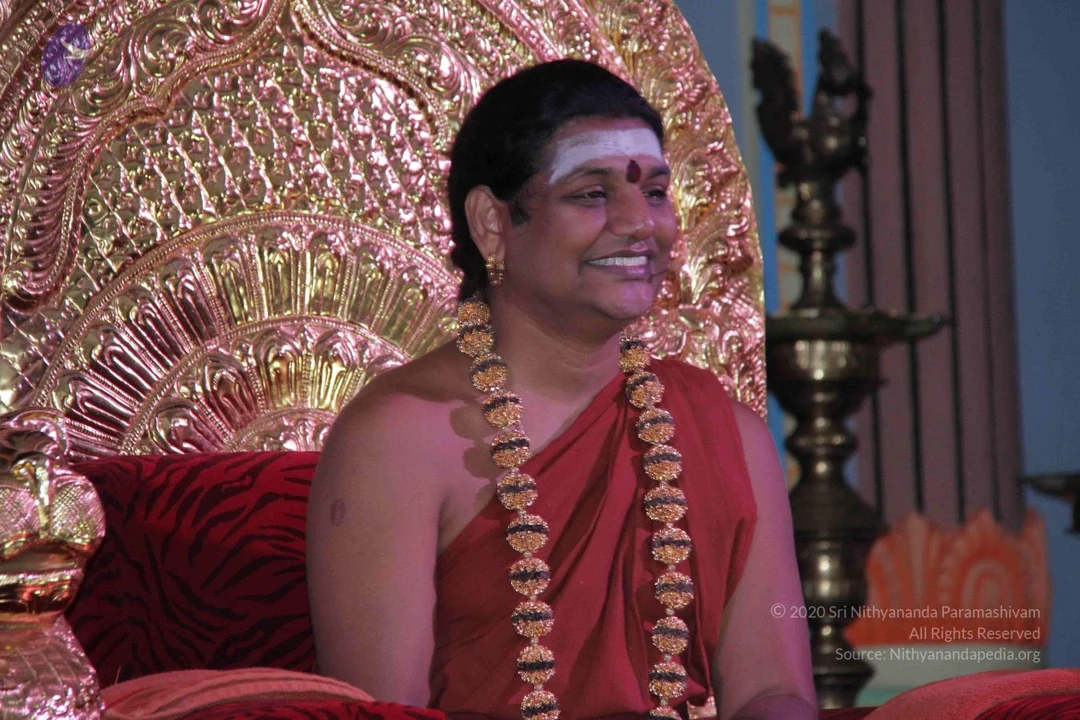
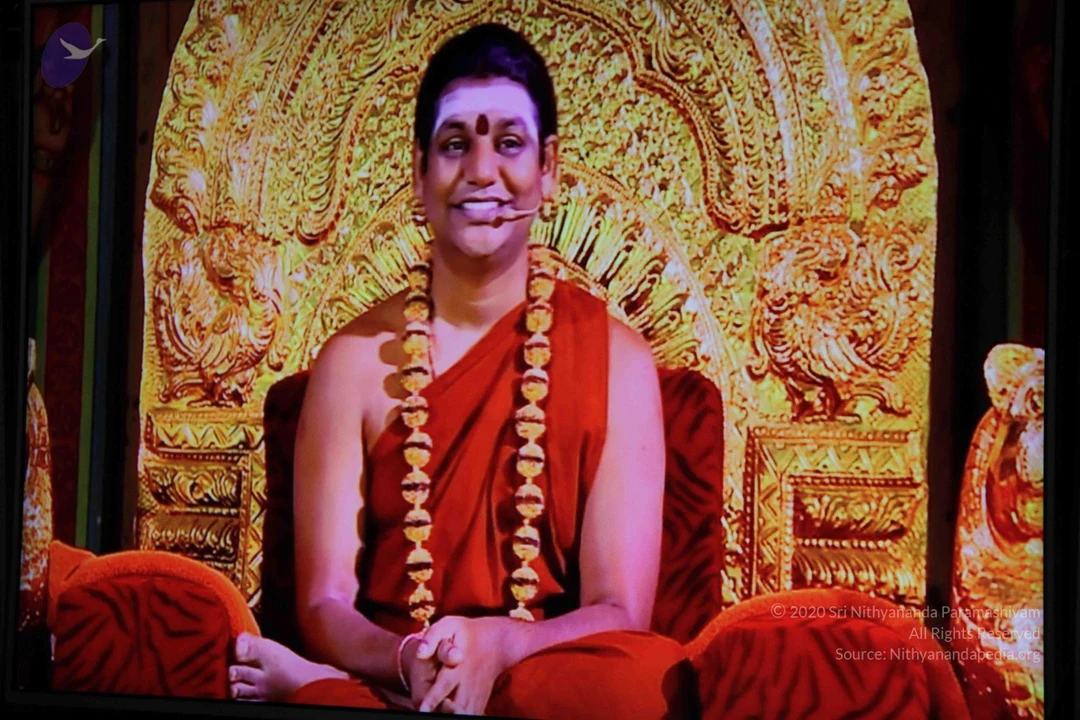
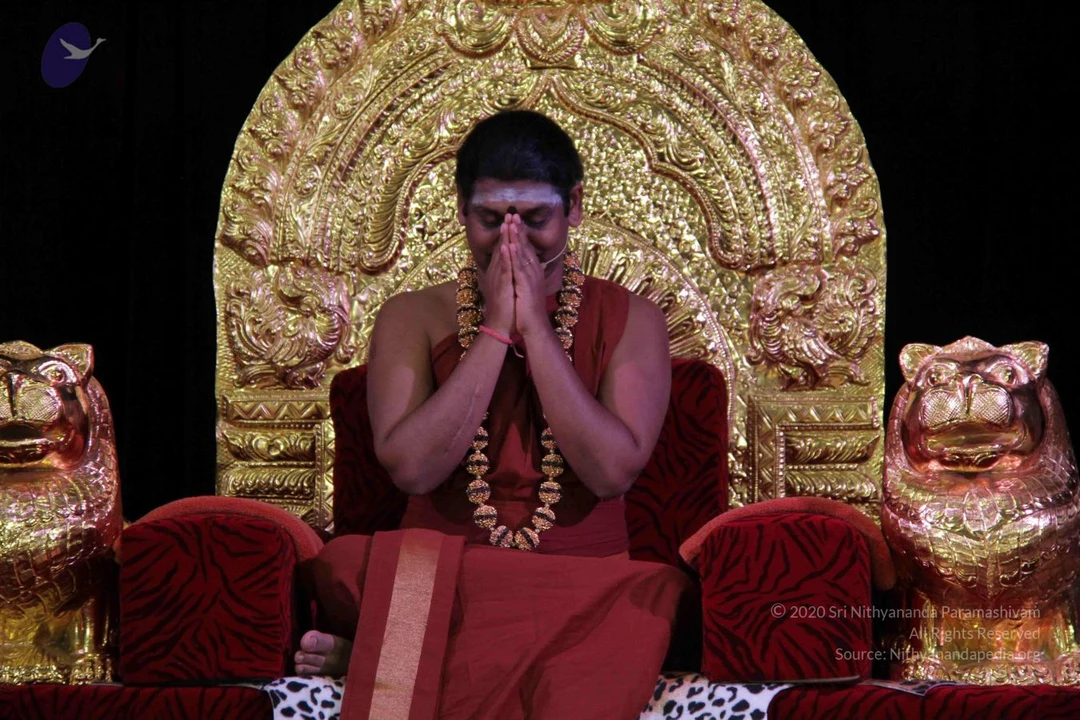
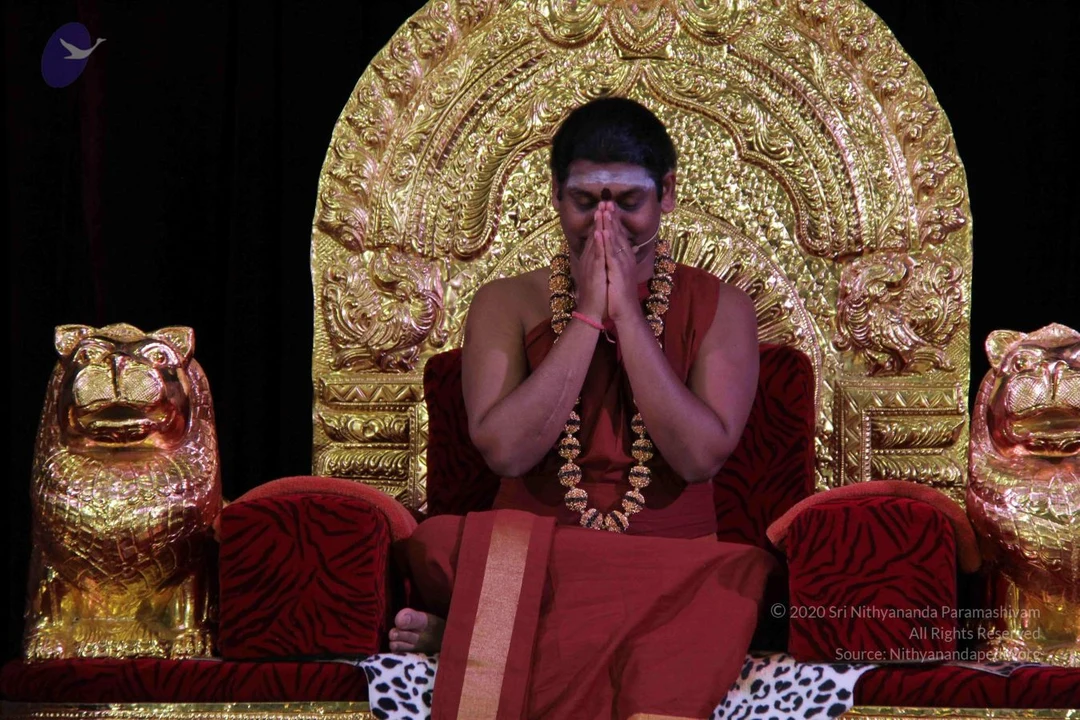
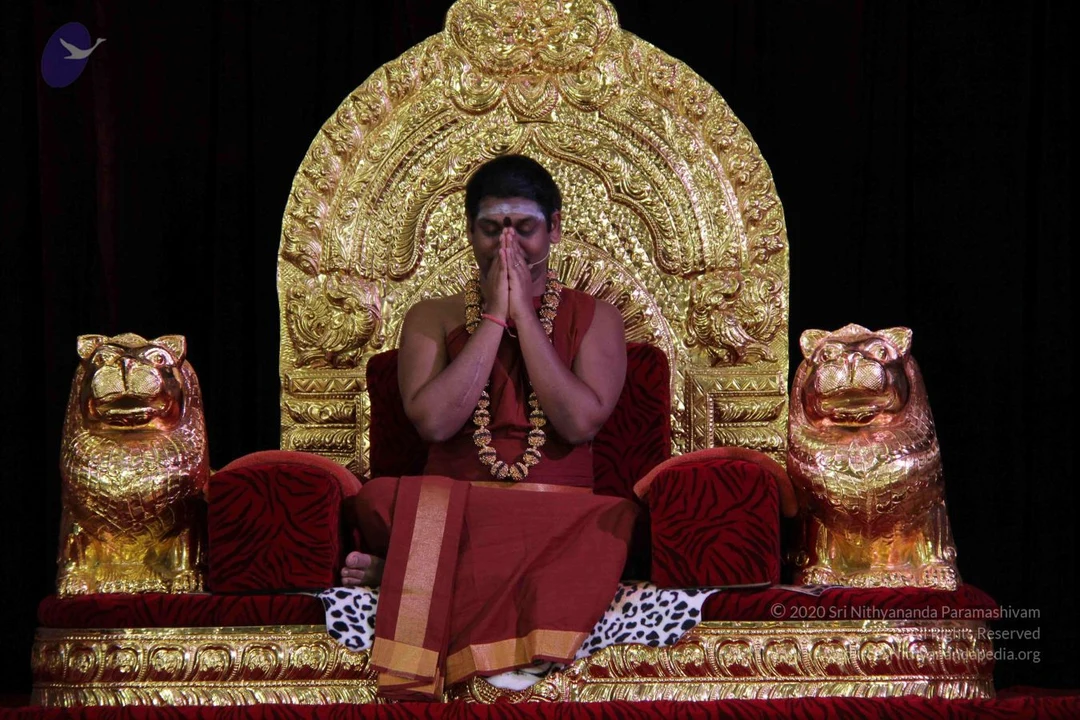
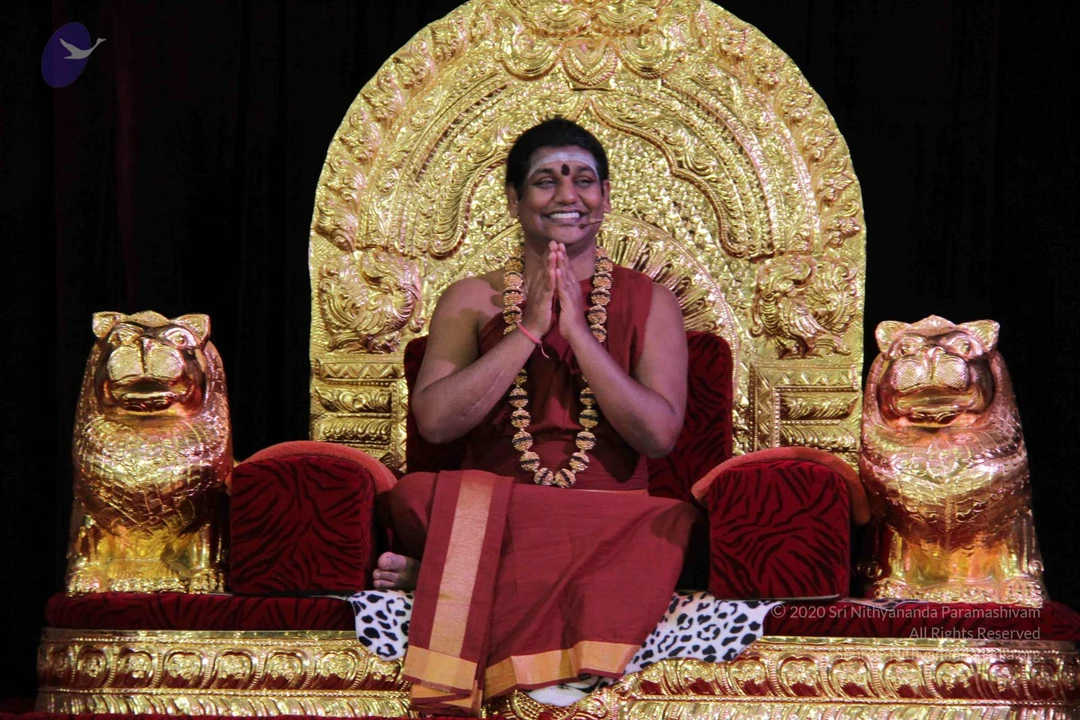
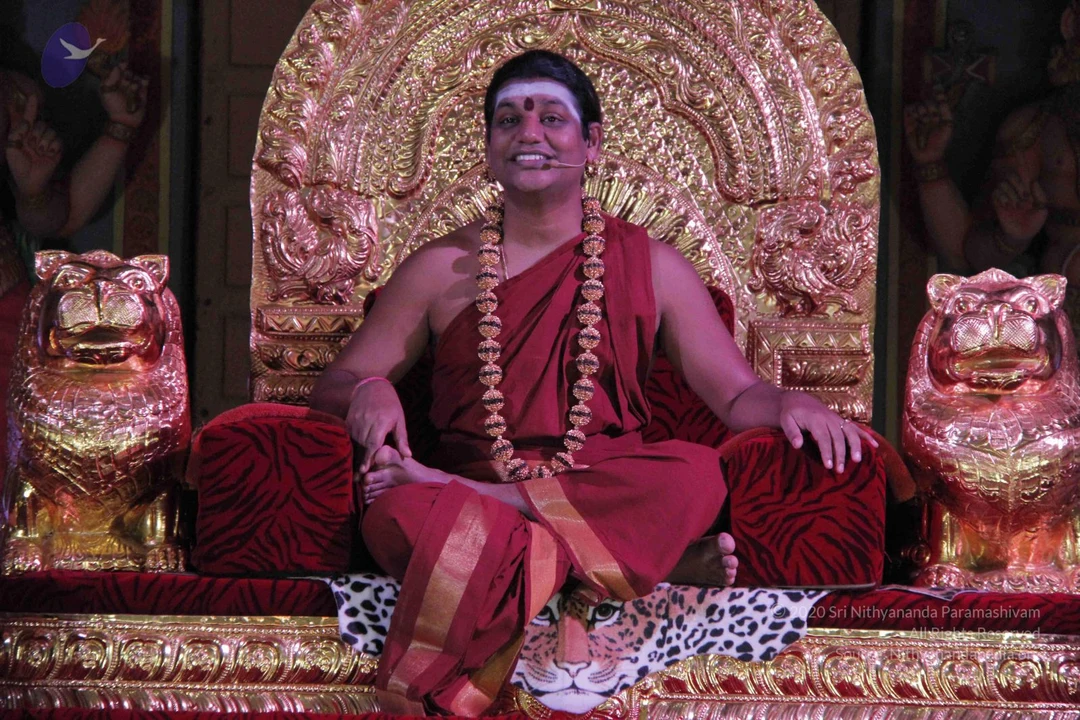
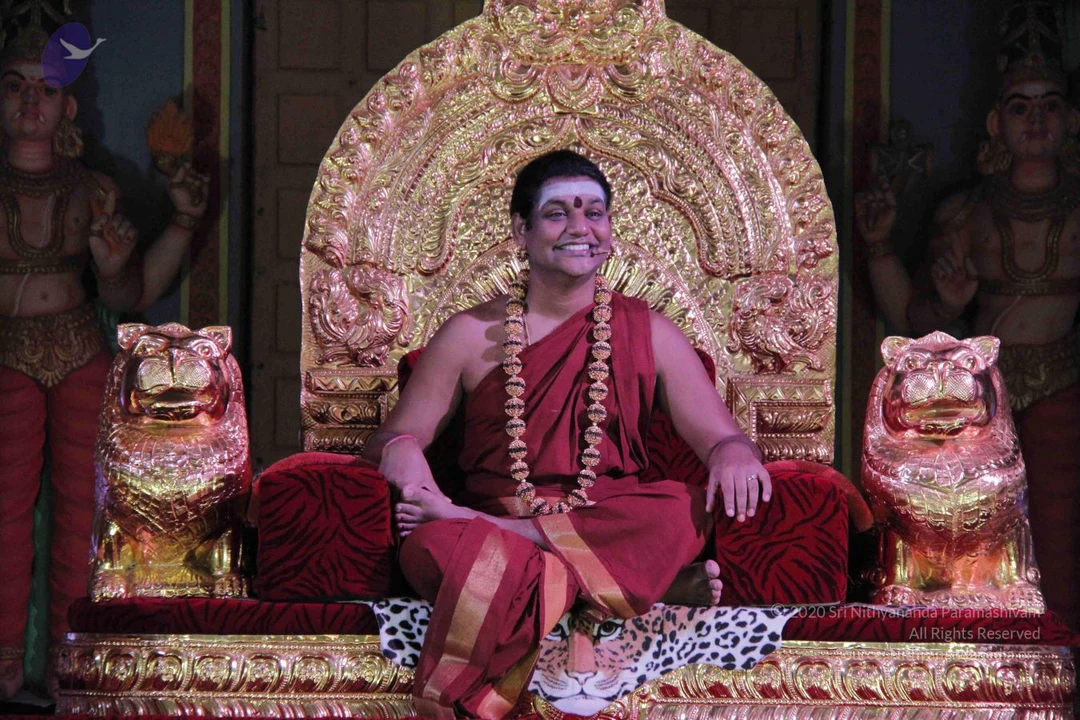
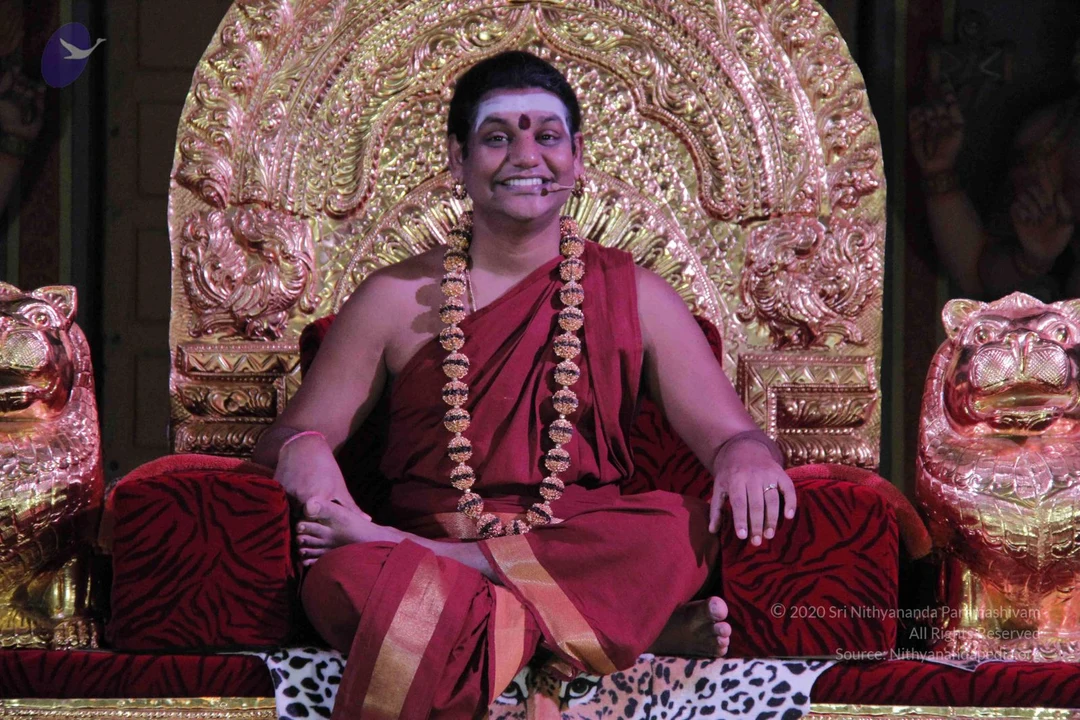
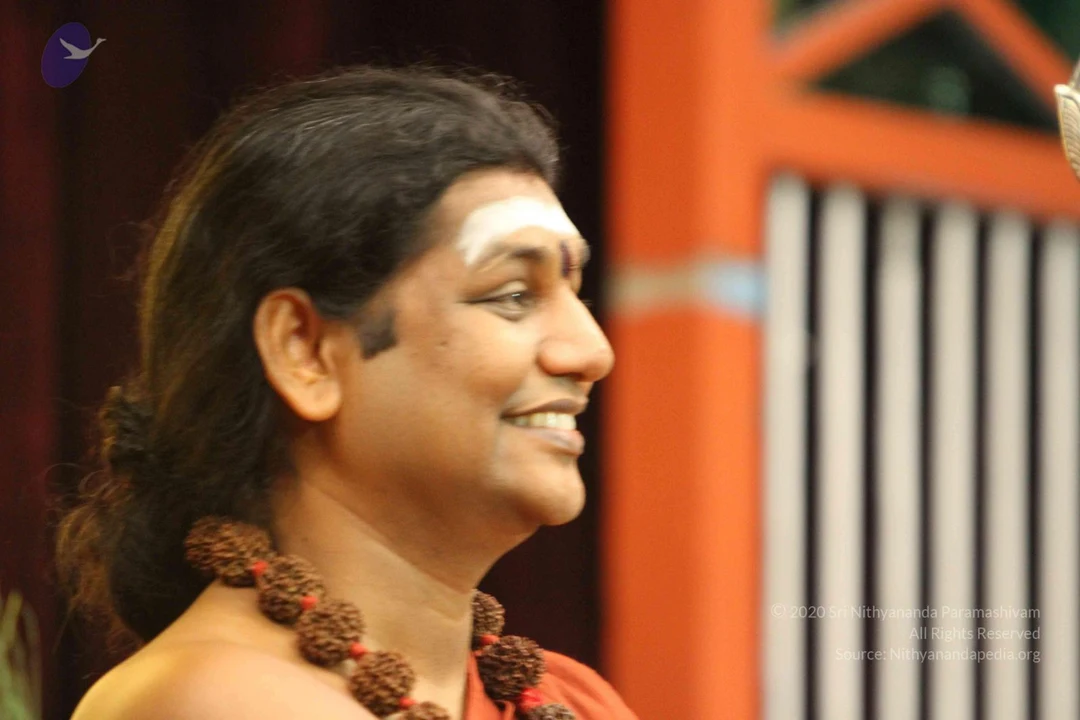
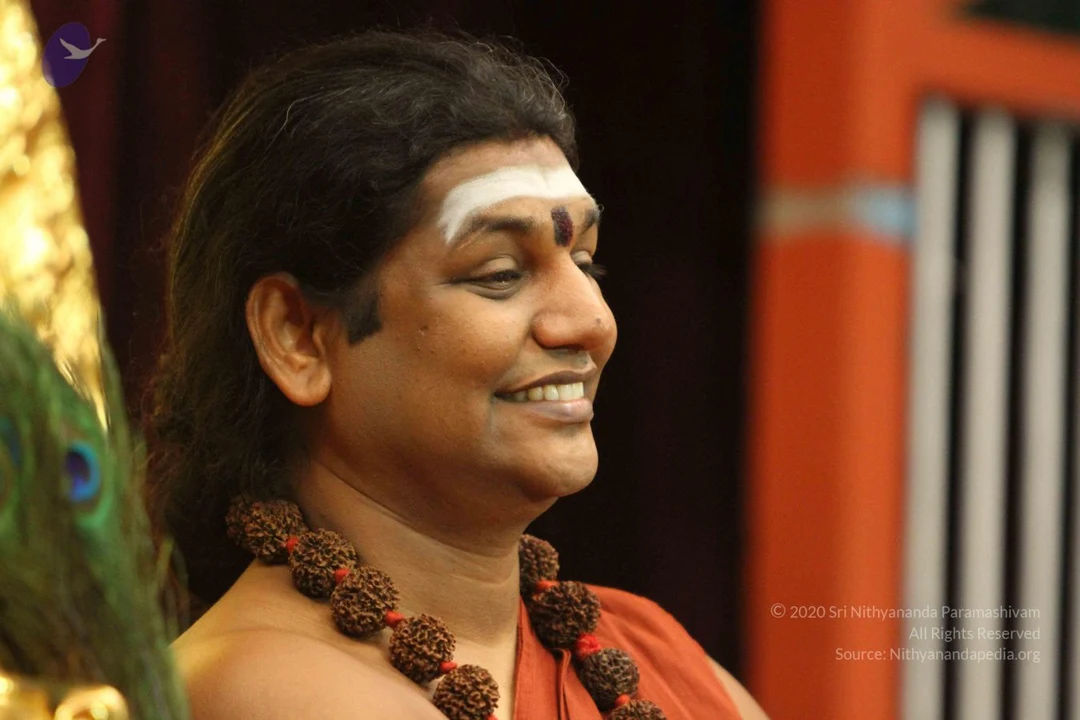
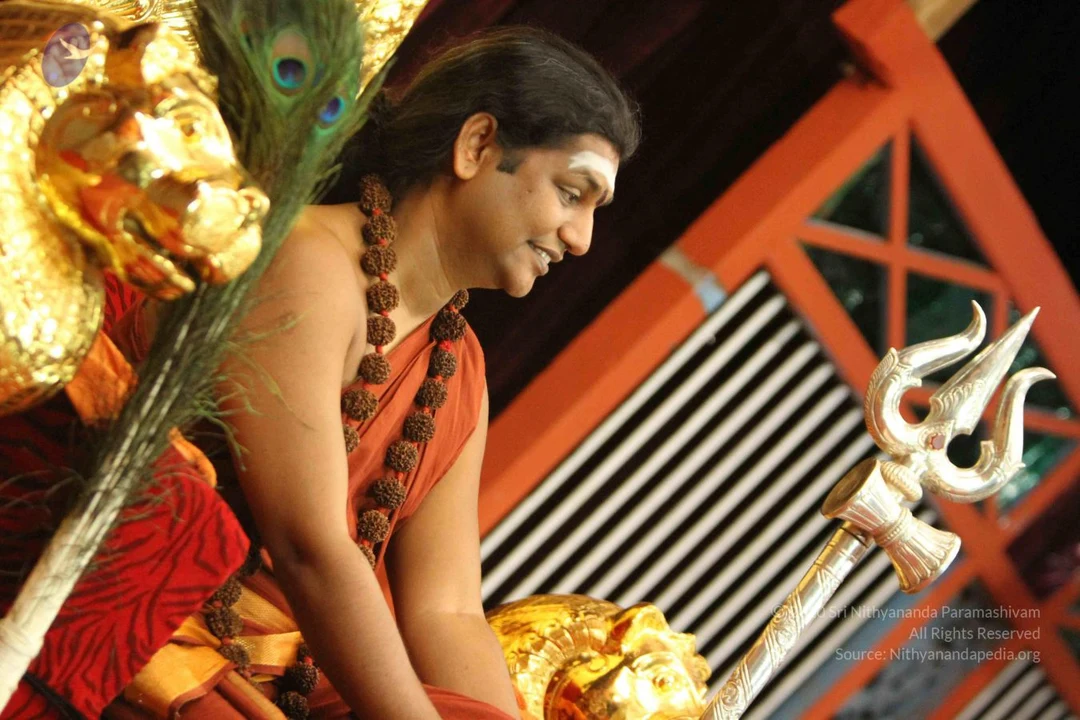
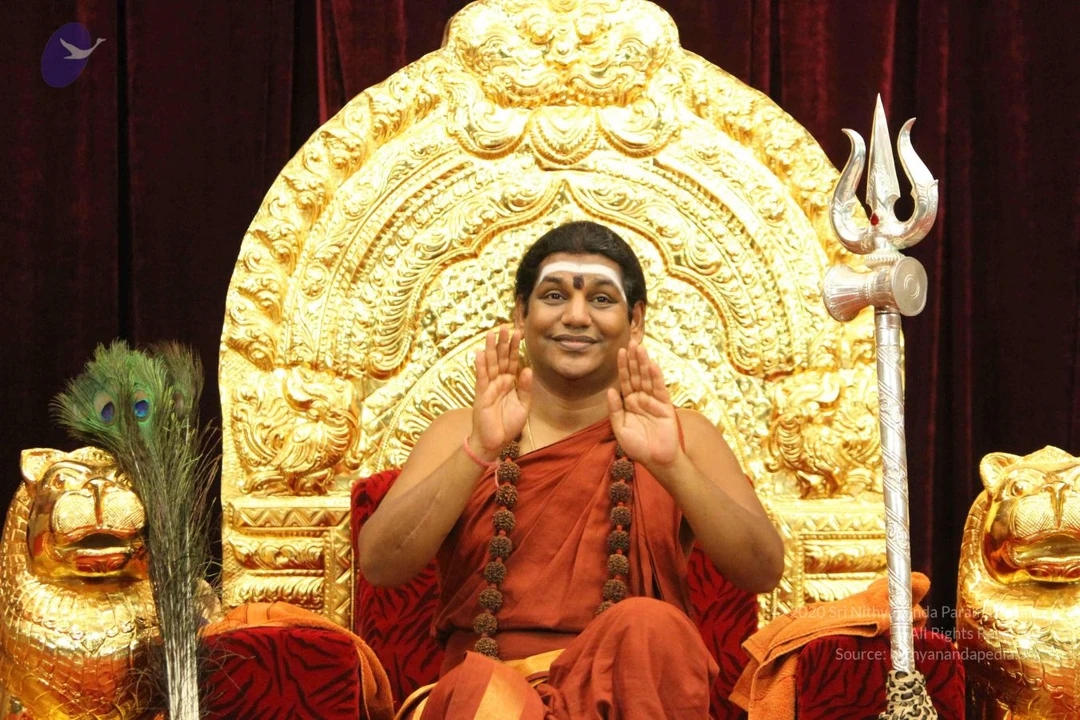
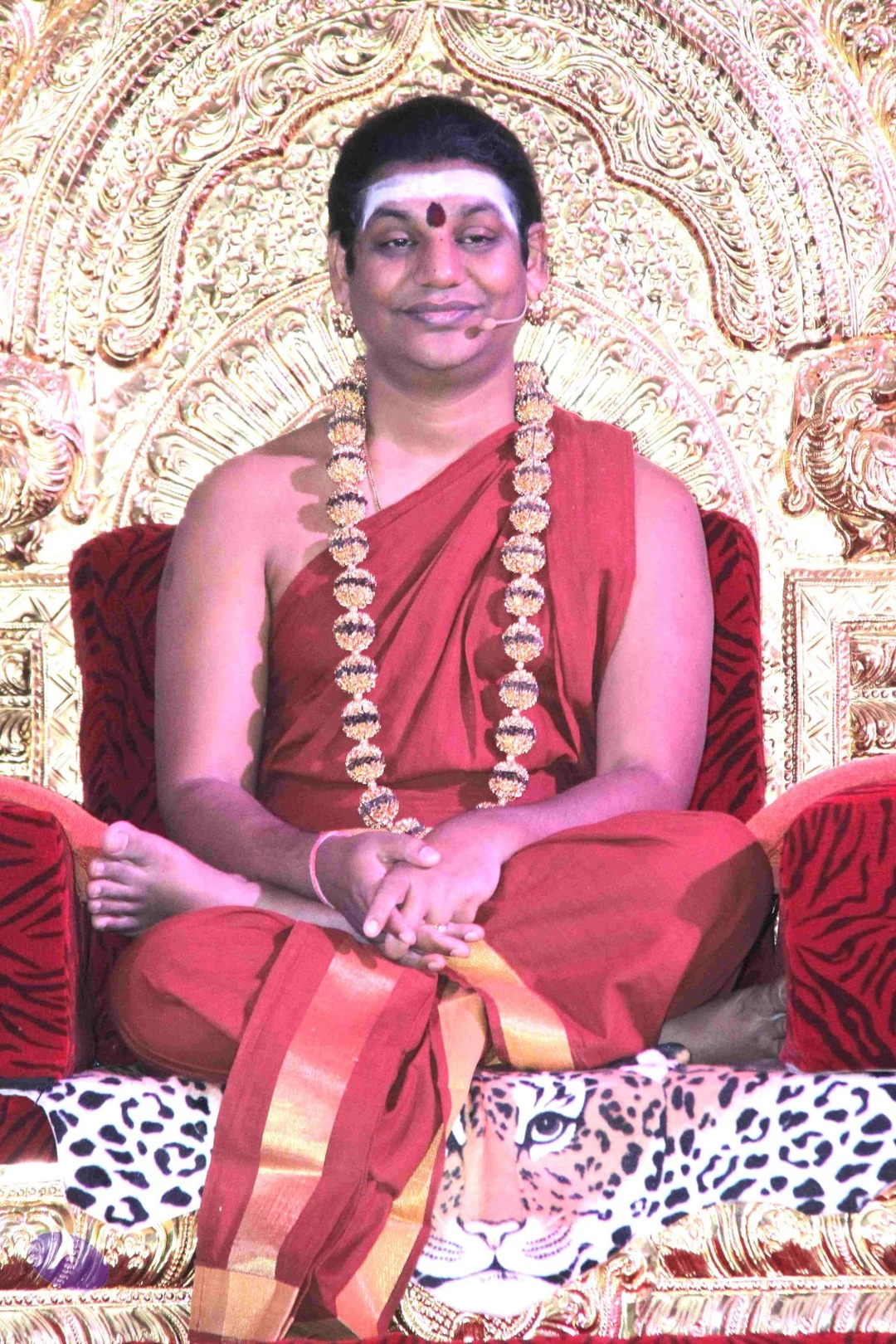
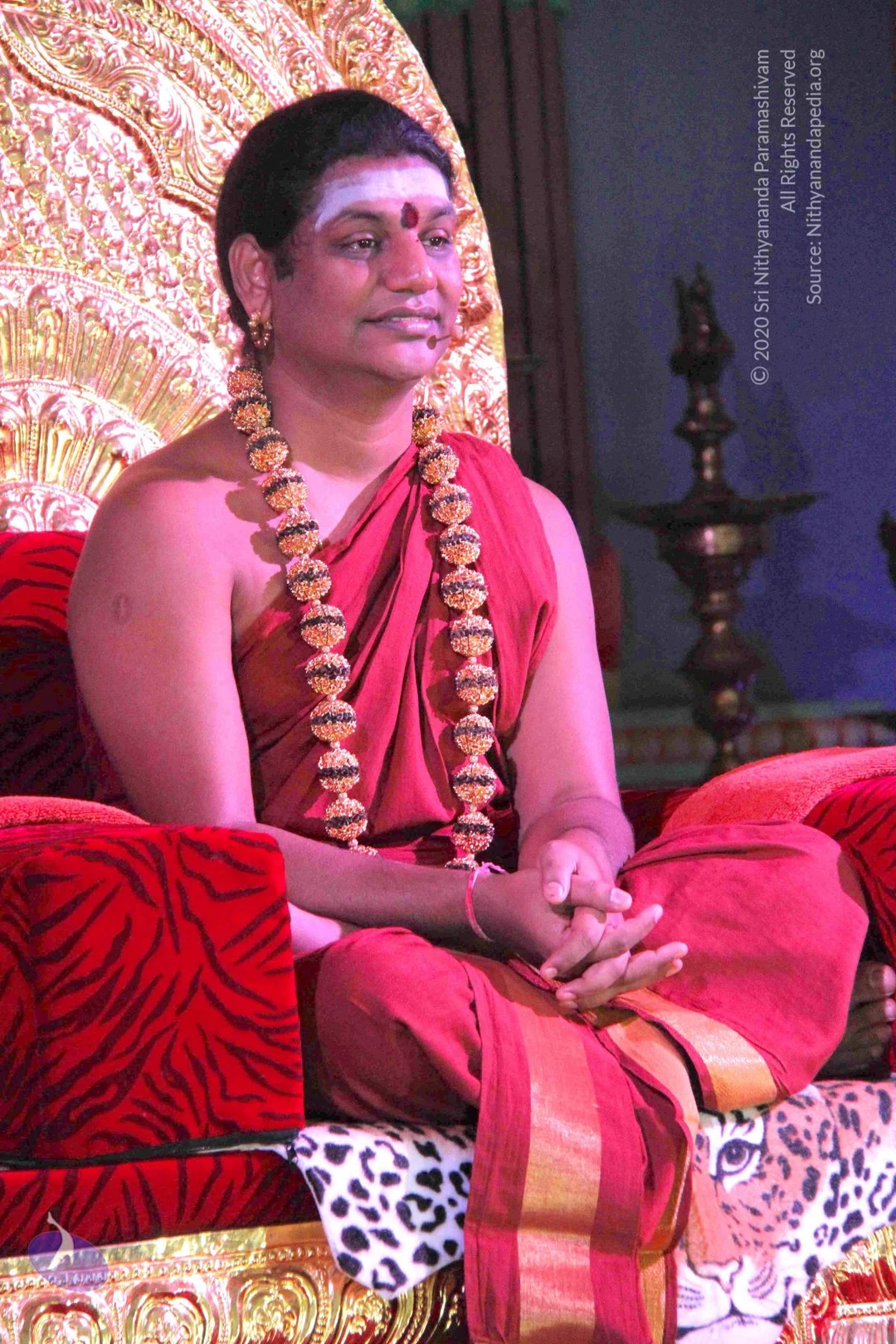
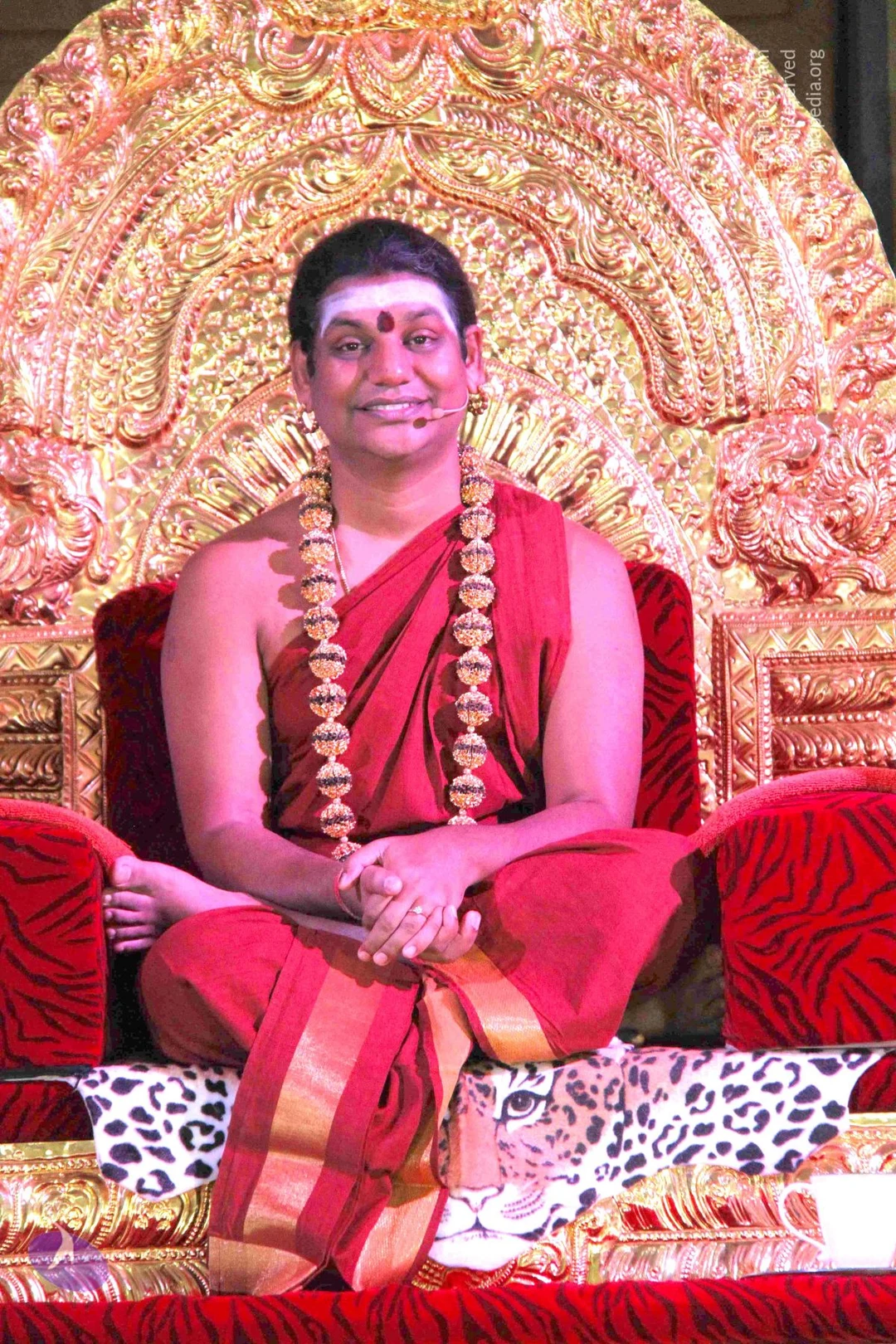
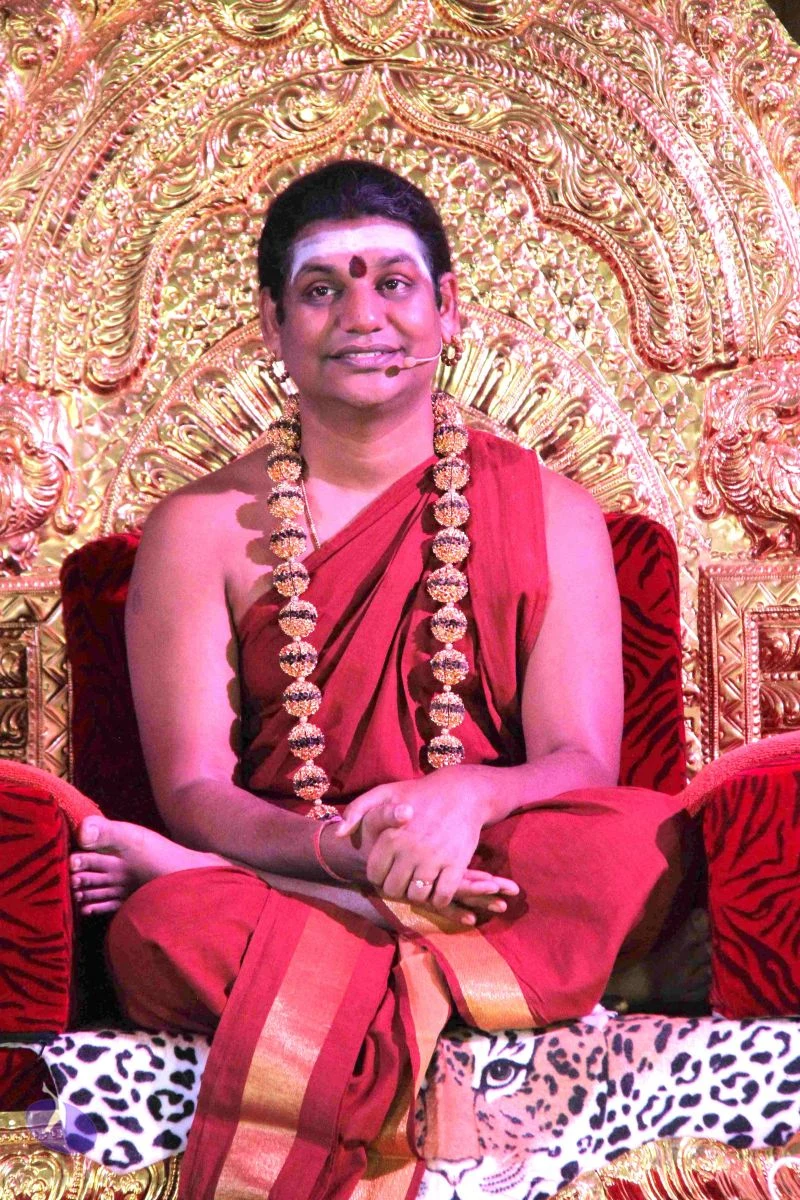
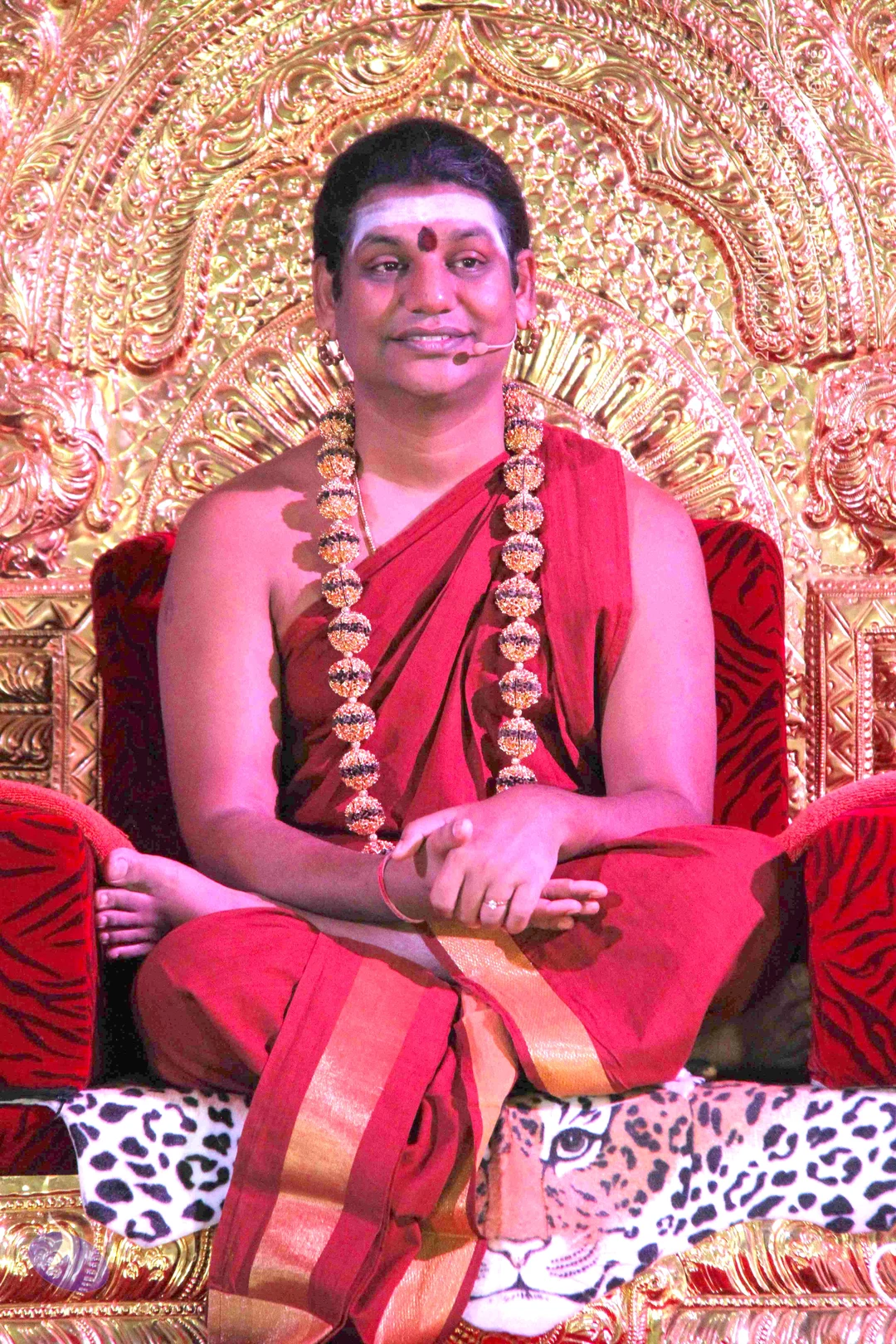
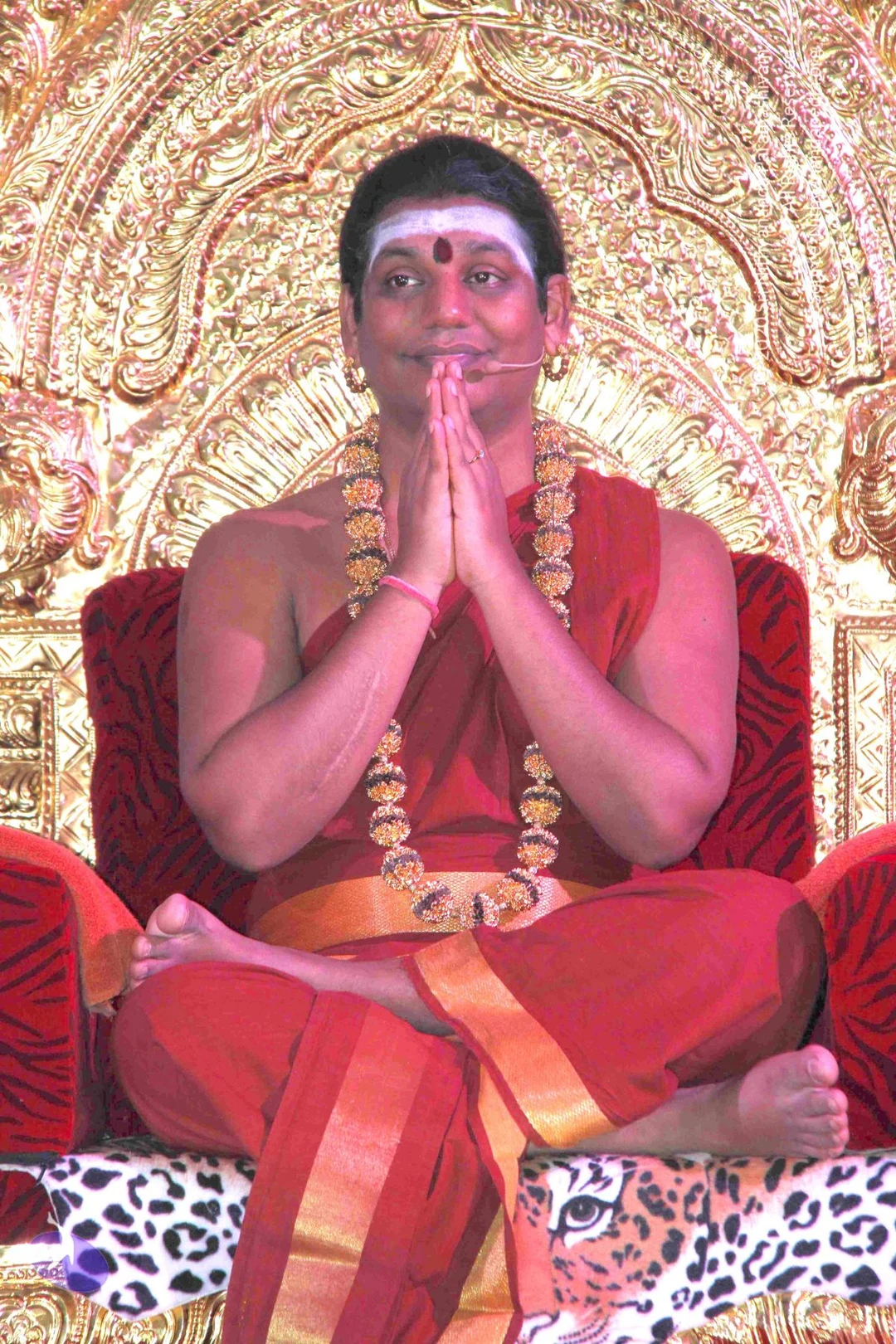
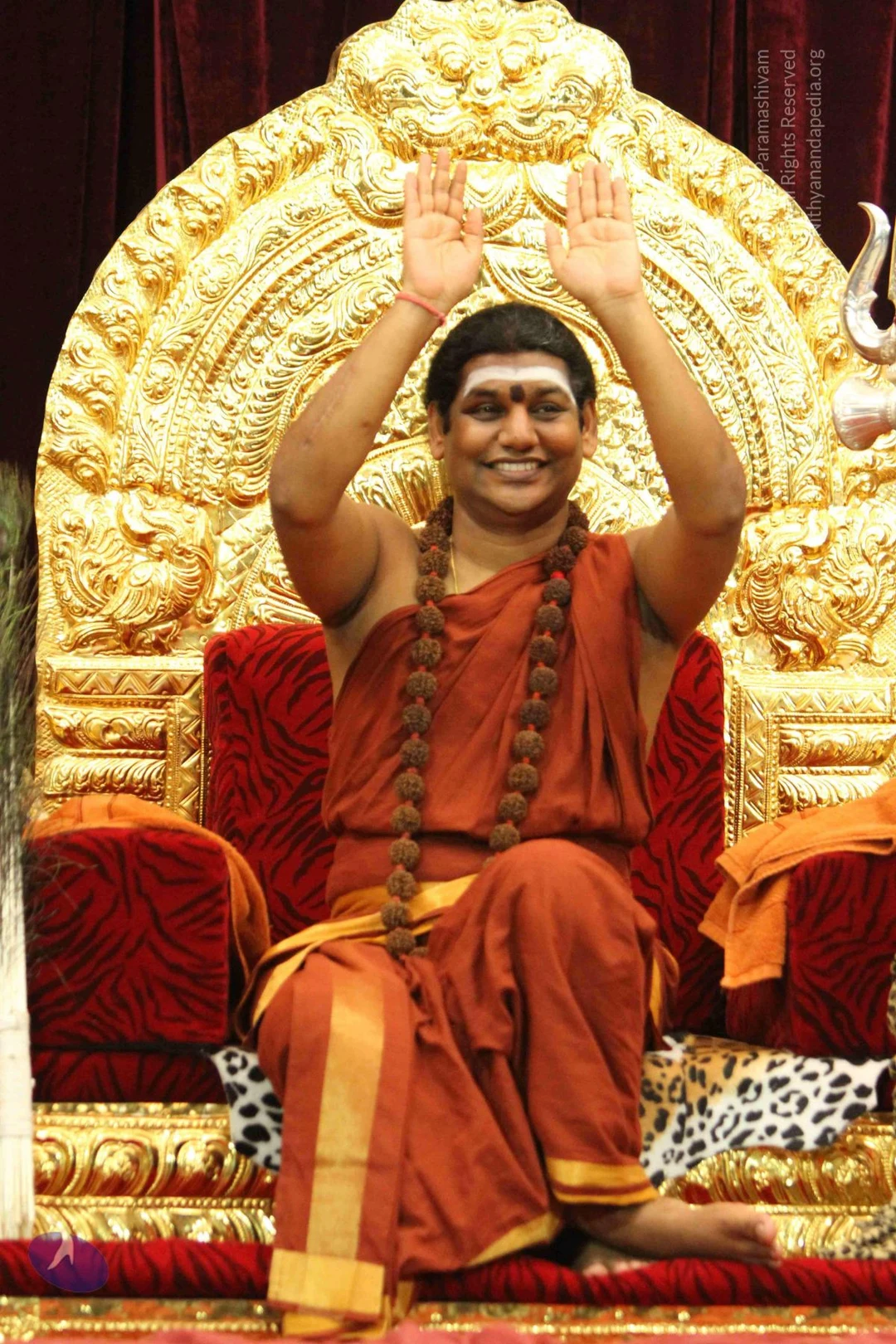
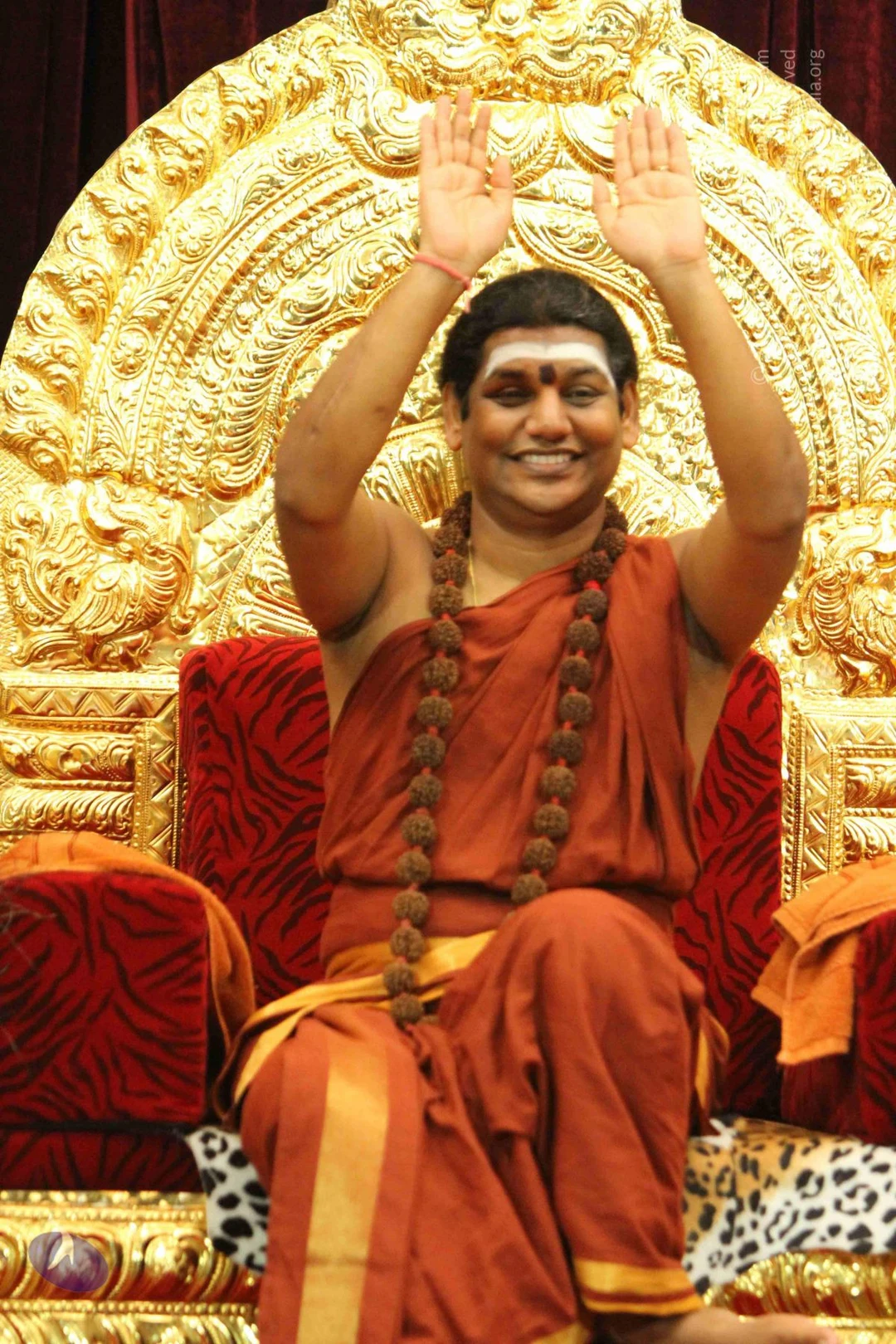
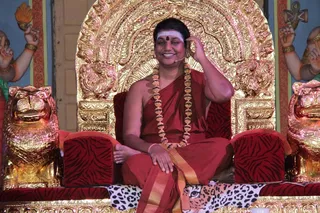
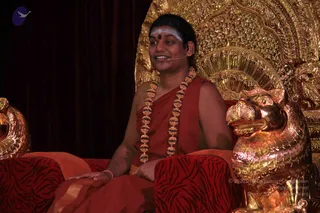
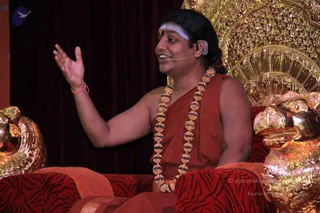
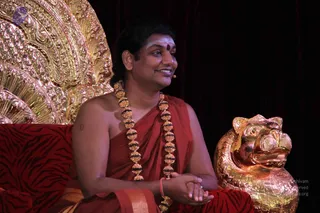
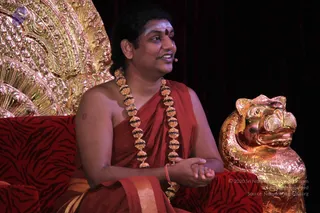
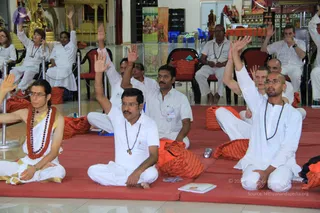
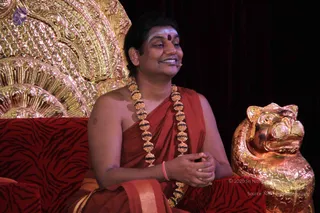
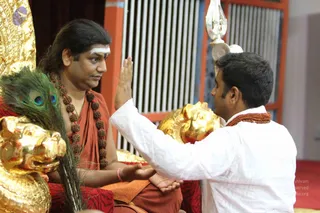
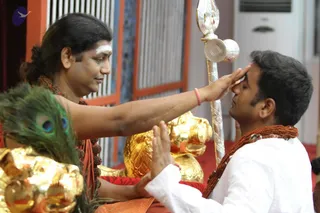
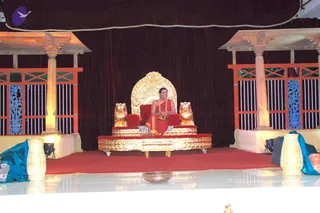
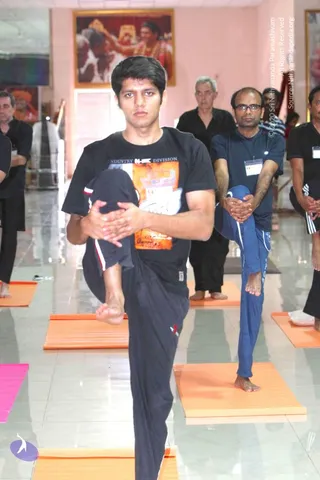
Close photo of a person in orange saffron robes with a long rudraksha mala of dark seeds with red separators draped over the chest. A hand with a pink wrist thread rests on a golden ornate chair or throne surface, with a silver pole and a blurred grey backdrop. Only the torso, arm and hand are visible; the face is not shown.A seated man in red robes sits on an ornate gilded throne with a red zebra-striped cushion and a leopard-print cloth draped over the armrest. He wears a long gold-and-black bead garland, a red bindi, white forehead markings and a small gold earring, with hands folded in his lap. Swamiji (probable): long swept-back dark hair, saffron-red garments and ornate ceremonial gold garland, seated on a throne. A tall metal lamp stands at the right edge of the frame.A photograph of a yoga or meditation session in a bright, tiled hall with framed pictures on pale walls. Several men and women in black clothes kneel on orange and pink mats with both arms raised overhead, palms pressed together. Some participants wear black head coverings and name badges. In the background, a woman in orange robes sits on a chair near the right wall, and a golden lamp stand and framed images are visible on the left. Overall about a dozen people are visible.

August 26 2014

Original wiki page
Contents

Title:

Listening to yourself is completion

Description:

In today’s (26th August, 2014) morning Satsang, Paramahamsa Nithyananda expanded on Listening and completion. He explained that your consciousness, your existence is eternal and does not need protection. The more you listen the more you are complete. Everything must be done from the right context to be in completion. Withdrawal from self-doubt, depression and desperation is adharmic.

Link to Video:

Link to Audio

'Description: Listening To Yourself Is Completion by HDH Bhagavan Nithyananda Paramashivam on 26 August 2014'

Transcript:

Nithyanandeshwara Samaarambhaam Nithyanandeshwari Madhyamaam | Asmath Aachaarya Paryanthaam Vandhey Guru Paramparaam ||

I welcome all of you with my love and respects.

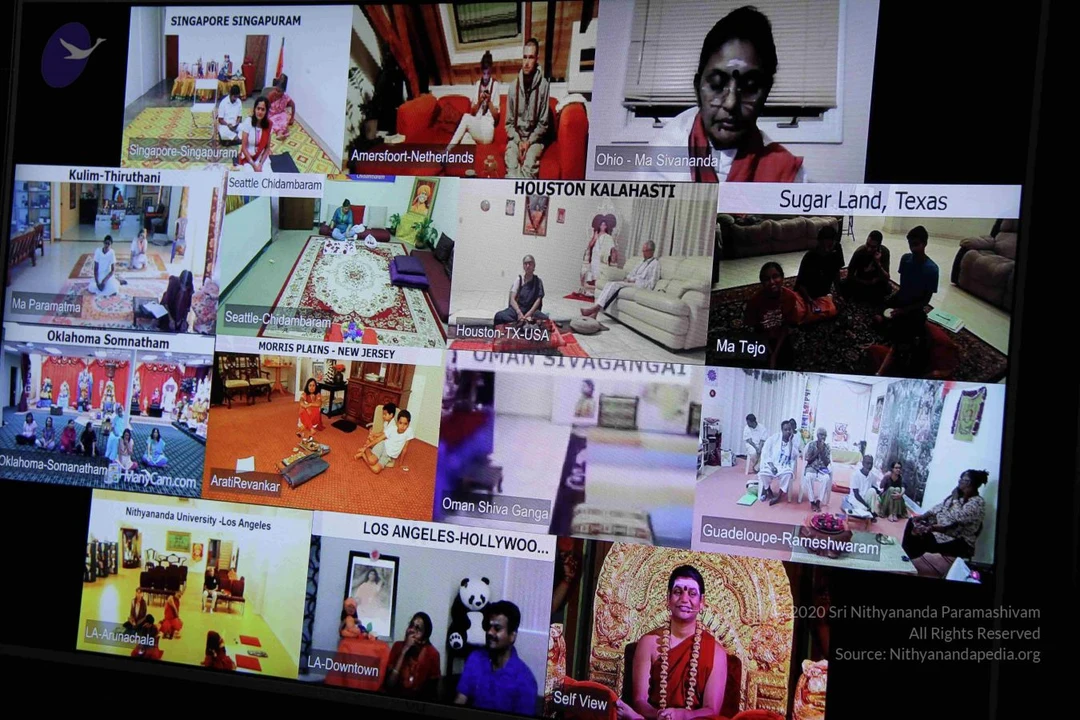
I welcome all the devotees, disciples, samajis, satsanghis, Shrimahants, Mahants, Kotharis, Thanedars sitting with us all over the world through Nithyananda TV, Sadhna TV, and through two-way video-conferencing having Nayana Deeksha all over the world.

Cities sitting with us through two-way video-conferencing having Nayana Deeksha: Phoenix-Kanchipuram, Toronto-Kailasam, San Jose-Madurai, Ohio-Prayag, Enriching Temple-Bidadi, St. Louis-Tirumala, Hong Kong-Sirkazhi, Warrington-UK, Kuala Lumpur-Palani, Dakota Dunes, Singapore-Singapuram, Nithyananda University-Los Angeles, Seattle-Chidambaram, Houston-Kalahasti, Sugarland-Texas, Guadeloupe-Rameshwaram, Amersfoort-Netherlands, Los Angeles-Hollywood, Kulim-Tiruttani, Oklahoma-Somanatham, Morris Plains-New Jersey, Hyderabad-Gupta Kashi...........

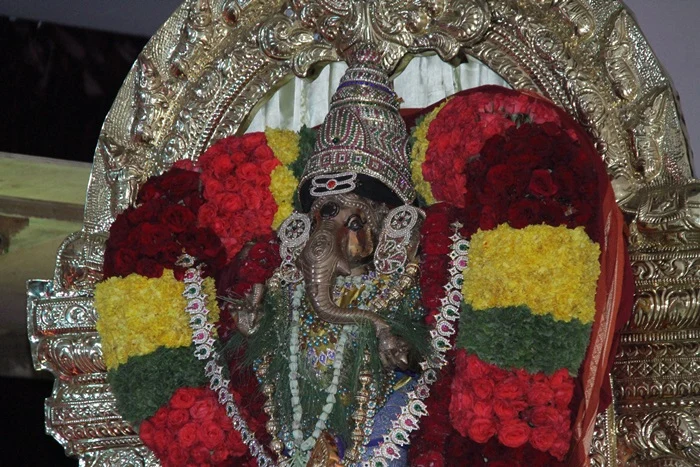
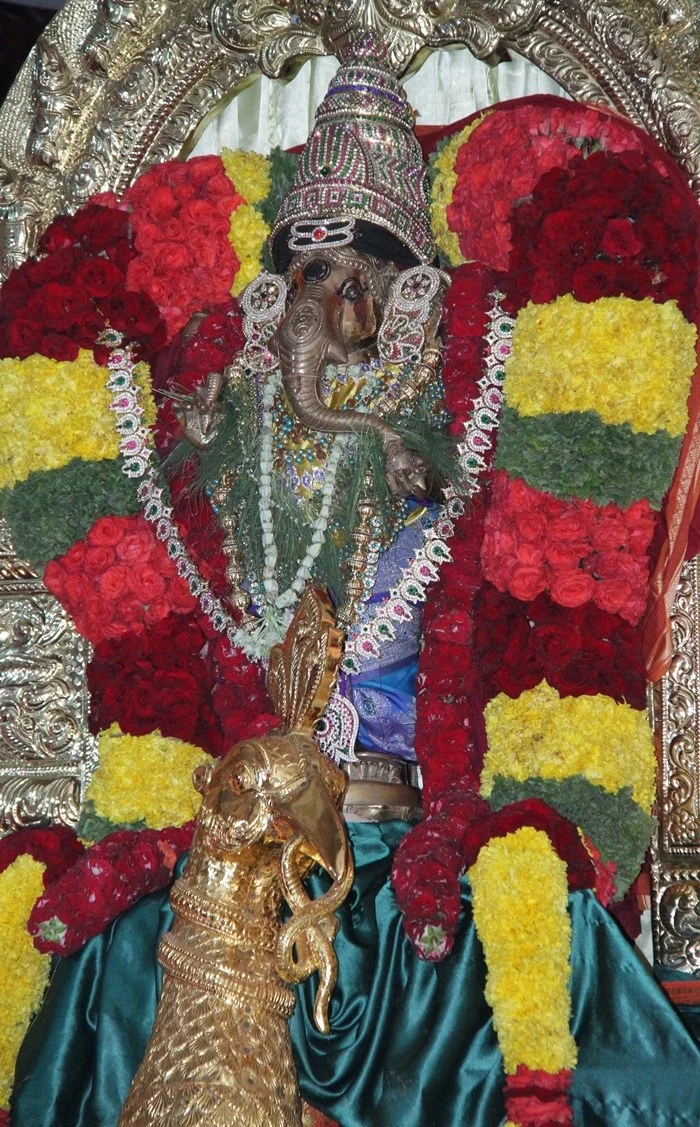
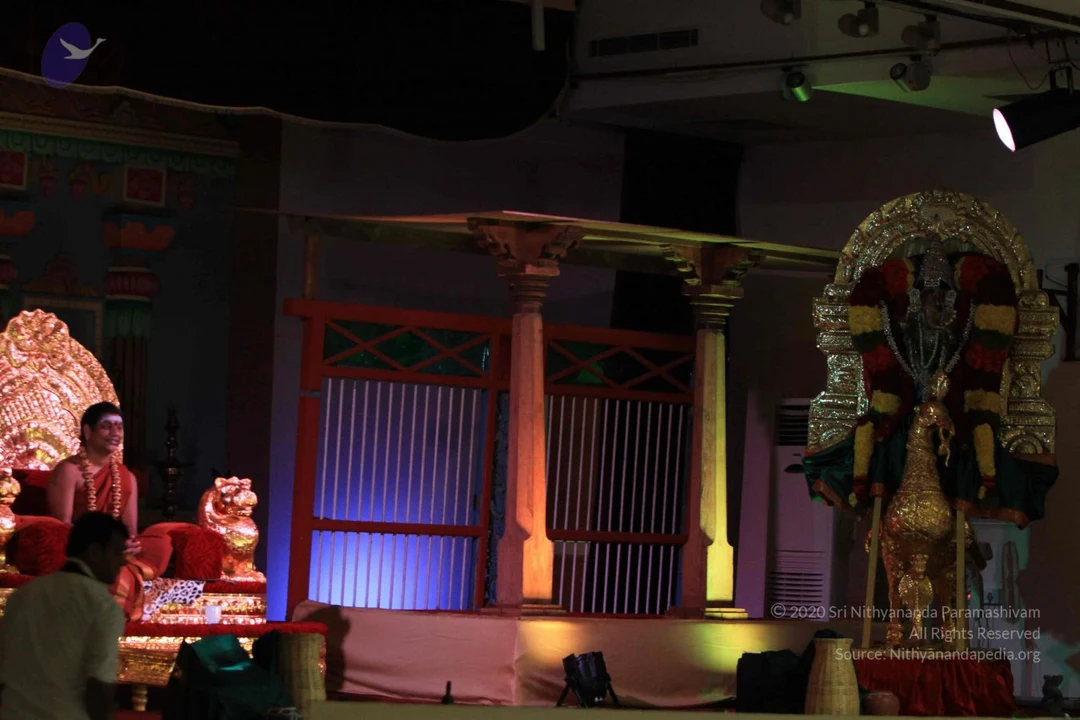
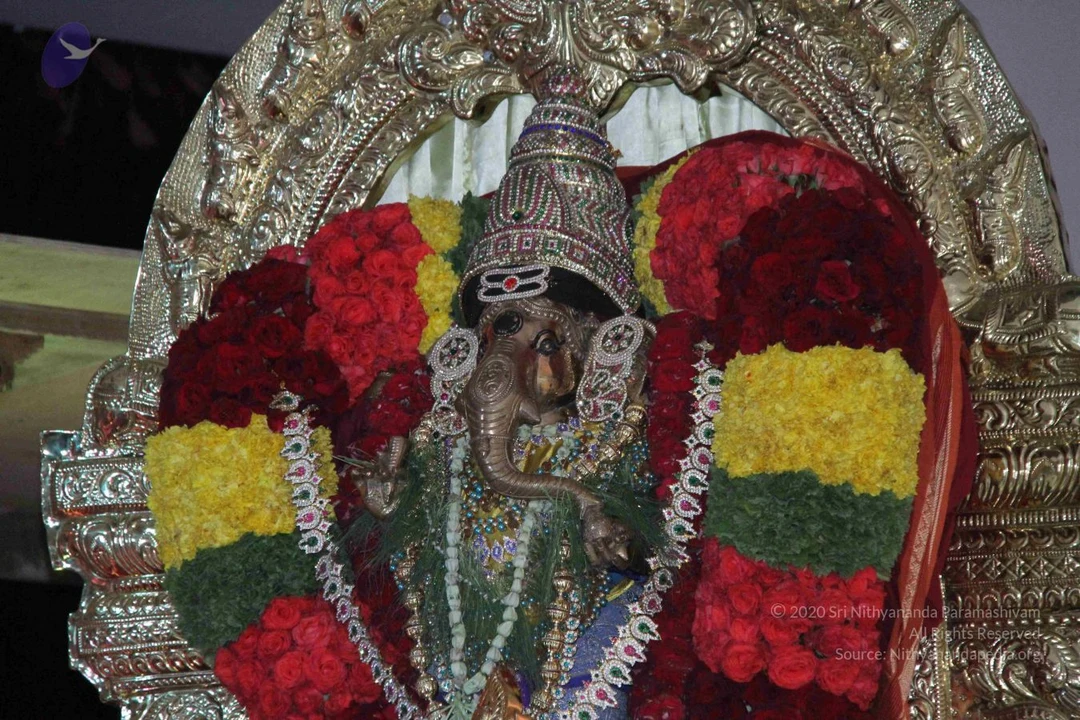
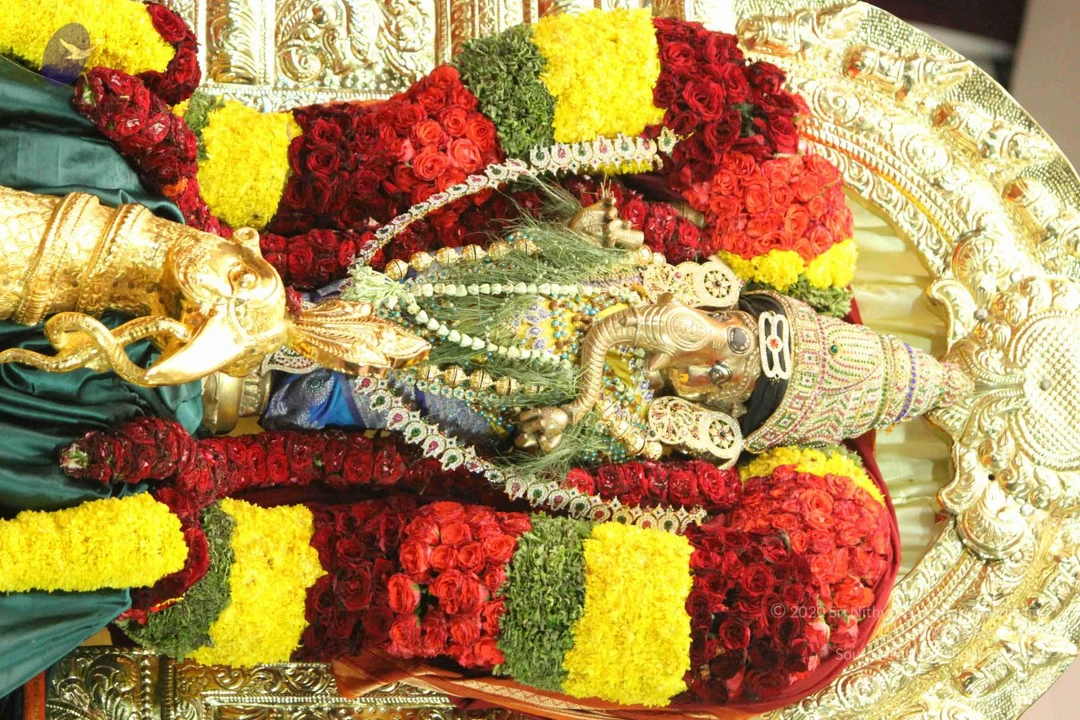
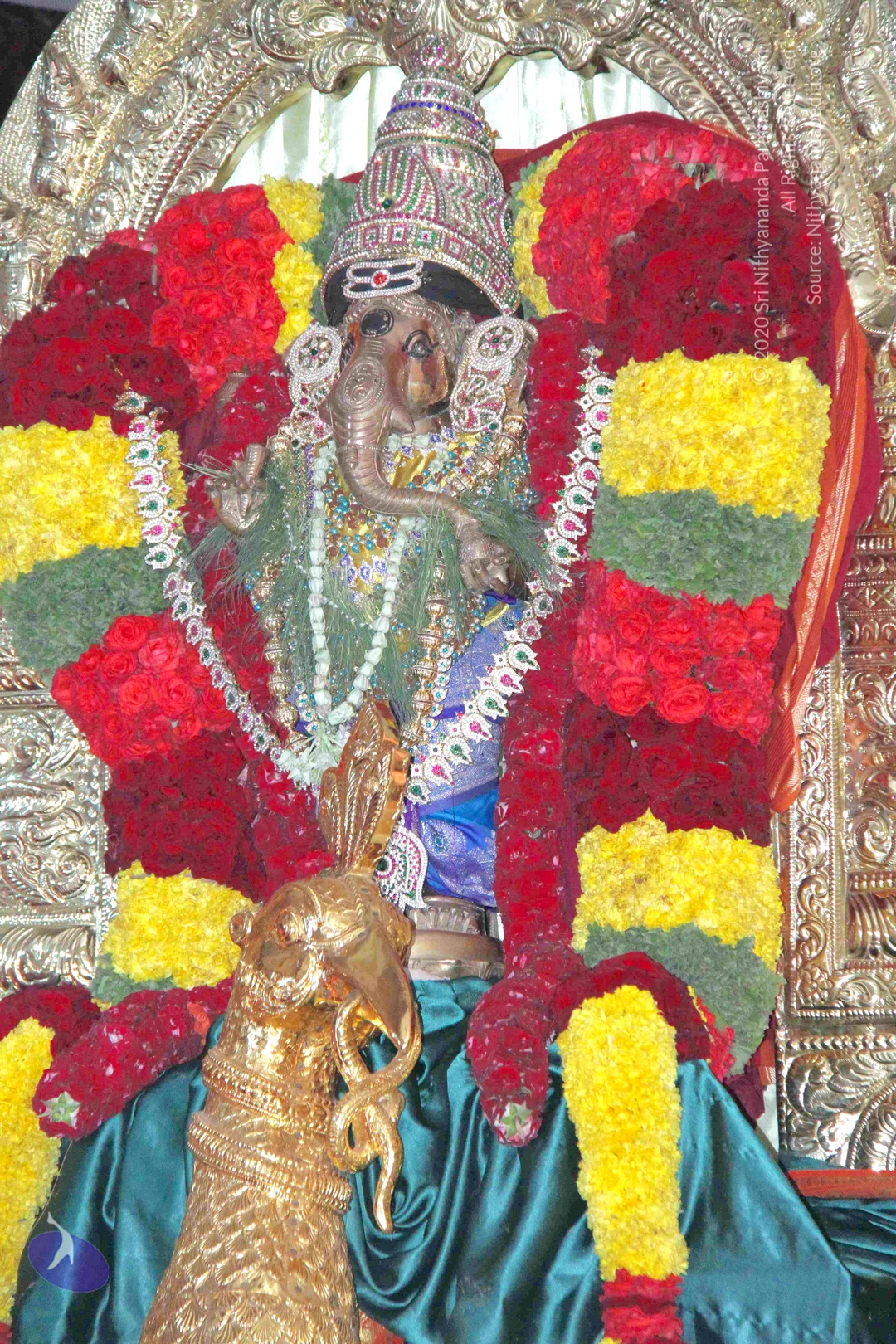
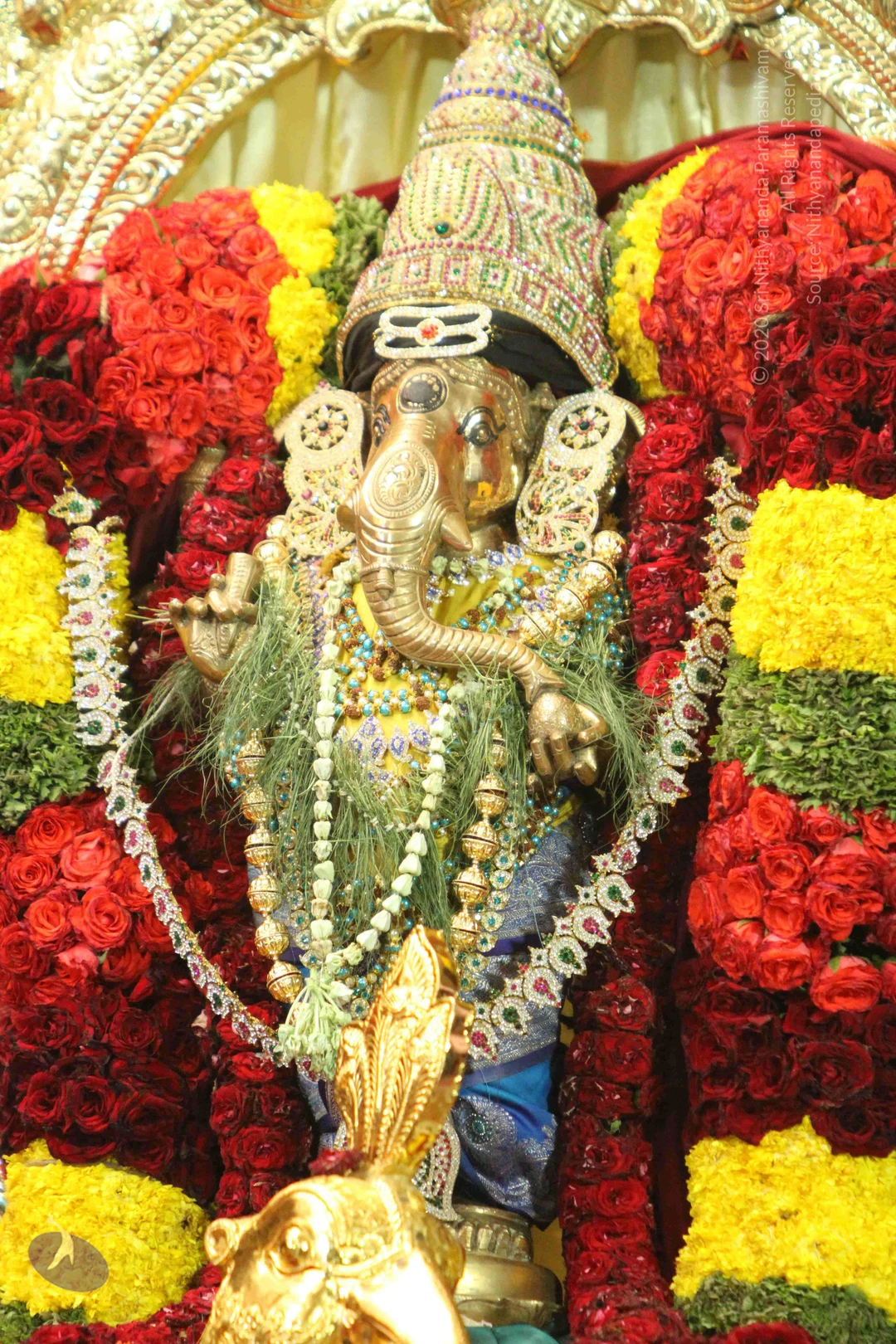
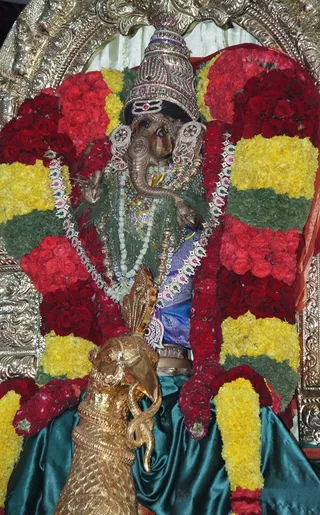
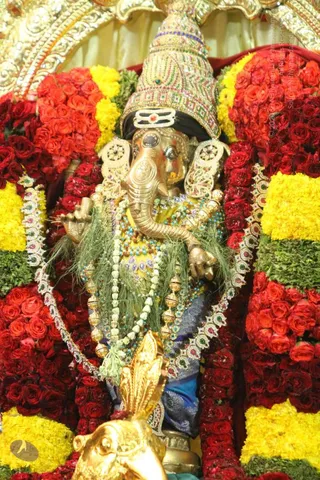
I welcome all of you with my love and respects. Today, Vinayaka Chathurthi, Ganesha Chathurthi Brahmotsava, seventh day! Maha Ganapathy is gracing all of us on the Peacock Vehicle, Suvarna Mayura Vaahana, Golden Peacock Vaahana.

Some more cities are joining. Sugarland-Texas, Houston-Kalahasti, Kulim-Tiruttani, Oklahoma-Somanatham, Guadeloupe-Rameshwaram, Nithyananda University-Los Angeles, Morris Plains-New Jersey..........

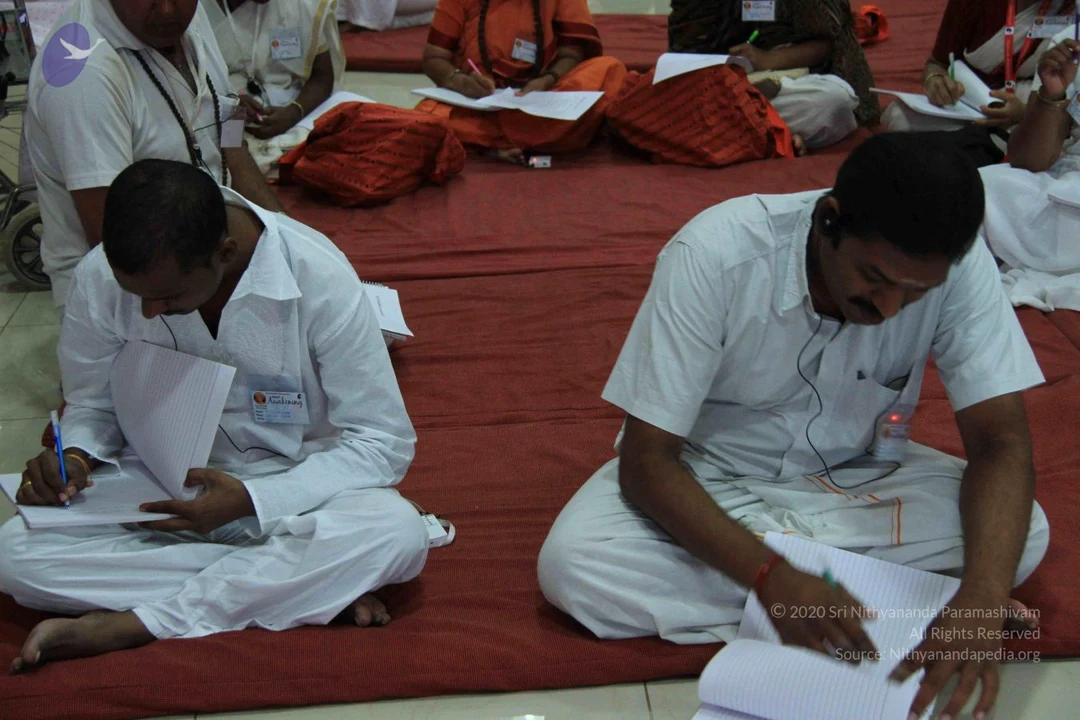
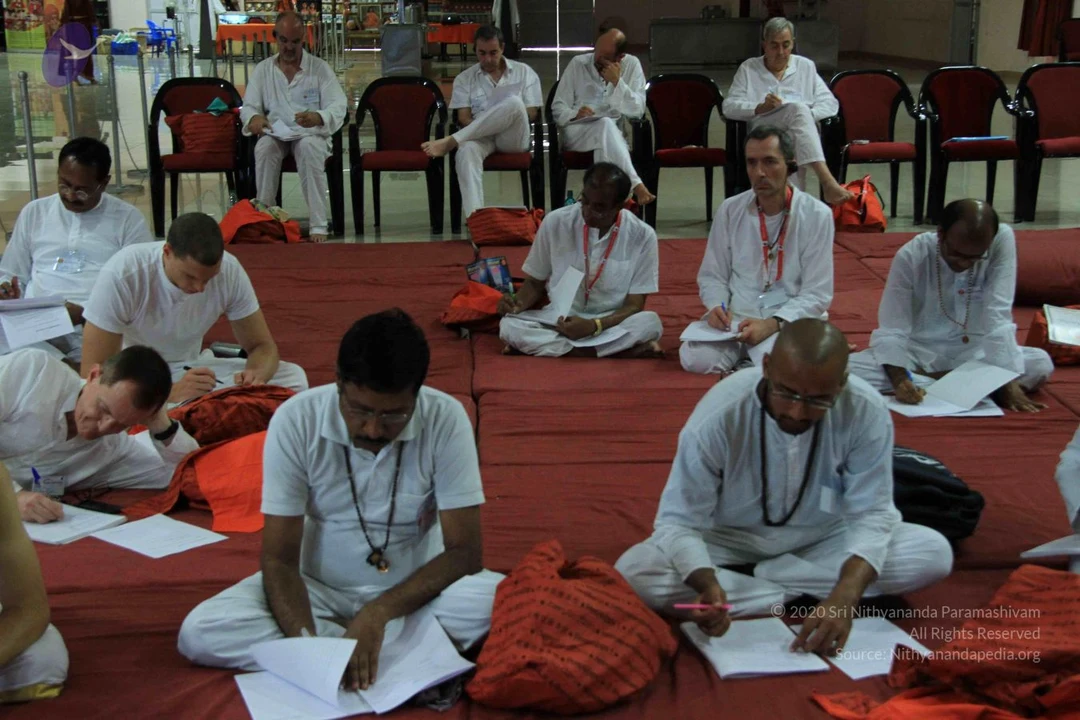
I welcome all of you with my love and respects. Today we are inaugurating the twenty-eighth Inner Awakening and twenty-fifth eN-Genius. I welcome all the participants of the Inner Awakening and eN-Genius with my love and respects.

I will expand on, in today's satsang, I will expand on LISTENING and COMPLETION. How many times I speak on this great subject, LISTENING, how many ever times I speak, I feel I have something more to convey, I have something more to convey, I have something more to convey!

So, today, I will try to expand on this great subject, COMPLETION. Please listen! By your very nature, your consciousness, your existence is immortal. It cannot get destroyed. It cannot lose any of its glory. It cannot lose any of its attributes, powers. It can neither be damaged nor be destroyed. Even if you carry the desperate fear, anxiety, anger, even your desperation cannot make your consciousness lose its glory, its existence, its immortality. But, unfortunately, when you start believing that you are mortal, you can be disturbed, you can be damaged, you can be harassed, you can be abused, you can be killed, you can lose some of your original qualities, physically or psychologically, when this belief settles in your system, that survival instinct, the instinct to protect yourself which becomes the basic root cognition of you, the survival instinct which is awakened in you, please listen, that is the first aggression in your system, primary aggression. Primary aggression goes on speaking, never listening. It goes on acts, never receives.

The primary aggression that you have to do something to save yourself, protect yourself, Oh God, that is the biggest joke, tamasha. The frightened child thinks he needs to protect the whole world which cannot be destroyed. In this whole situation, there is only one thing that can be destroyed, that is the frightened child. But the child is so intelligent, he doesn't say he is waging the war to protect himself, he says he is waging the war to protect the whole world which is not going to be destroyed! He doesn't want to believe.....

Please listen! The frightened child, he wants to protect himself; but if he says openly that he wants to protect himself, that looks too cheap, too selfish. So he wants to look good to the onlooker. So he says, No, no, I am waging the war to protect the whole world! Fool! The world is not going to be destroyed! Only you are going to be destroyed! Same way, your consciousness, YOU, you are immortal; but your agitated, desperate mind goes on telling you and everyone that it is fighting continuously to save your consciousness, to save you, to protect you. In you, only one thing can be killed; that is your desperation your desperate mind, your agitation, and your aggression. Other than that, nothing needs to be killed, nothing can be killed! Nothing needs to be killed, nothing can be killed.

Na jaayathey mriyathey vaa kadhaachith Jnaayam bhoothvaa bhavithaa vaa na bhooyaha | Ajo nithyaha shaashvathoyam puraano Na hanyathey hanyamaaney shareerey ||

It is not born, nor does it die; It is not that having been non-existent it comes into existence; It is unborn, eternal, ancient and ever-lasting; Though associated with the body, it does not get killed even when the body is killed. Second Chapter, twentieth verse of the Bhagavad Gita.

Please understand, I am quoting the Bhagavad Gita not because these lines are just Krishna's experience, but because these lines are my own experience too! I am not trying to hide myself behind Krishna's authority. I am declaring these words are true. Reason one: Krishna said it. Reason two: My experience.

Understand, it is not only Krishna's authority, but my own authenticity. Both stand for these words truth. Both stand to prove these verses are true. Please listen! The desperation, the idea you need to defend something, protect something, that aggression, because of that aggression in your inner-space, you go on being active. Please understand, aggression in your inner-space is you talking to you. Receptivity in your inner-space is you listening to you. I can just define two of the major principles in one line. Please listen! You talking to you is always incompletion. You listening to you is always Completion. That's all! You talking to you means, are you associating yourself with the dimension which is talking to you, or the dimension which is listening to you. As on now, both actions are happening. Your inner-space is like Mahabharata war-field. That is why..... Listen! Listen! Duryodhana all the time shouting, aggressive; Pandavas always ready to listen; both are there in you. Whenever you associate yourself with Duryodhana aggression talking, talking, talking to you, you will be in the space of incompletion.

Whenever you associate yourself with the listening component of you, listening, listening, listening, you get into the space of Completion. Whenever you are in the space of Completion, the consciousness in you stops the aggressive guy talking and he relates with you. That is why Krishna, whenever he wants to talk, he stops the whole war and Time! Whether he wants to talk to Arjuna, or he wants to talk to Bhishma, or he wants to talk to Drona, or he wants to talk to Karna, he stops Time and the war! The aggression cannot be talking while the listening is intensely listening. Listen! Whenever you associate yourself with the listening, don't ever have the fear the aggression part is going to be speaking to you and you are going to be listening to it. No!

Whenever you get into the space of listening, the Lord will speak to you, Bhagawan will speak to you, Mahadeva speaks to you, the Advaitha Sathya, the truth of Advaitha speaks to you. It seems, yesterday, one of our gurukul kids asked his mother, Mom, tell me what is Advaitha Sathya? I wanted to answer that kid. His name is Gnanaprakasha.

The very name is Gnanaprakash! Listen! UNDERSTANDING THAT WHAT YOU EXPERIENCE AS YOU IS THE SAME STUFF EXPERIENCED AS THEM BY EVERYTHING THAT EXISTS is Advaitha Sathya. What you experience as you in the deepest corner of you when you are listening to you, not when you are talking to you, but when you are listening to you, what you feel as you. Remove the patterns, remove the thought patterns, remove the root patterns; all this is your aggression towards you. Thought pattern is the speaker, root pattern is the mike. If you remove all that, IN YOUR PURE LISTENING WHAT YOU EXPERIENCE AS YOU, THAT SAME ONLY IS EXPERIENCED AS THEM BY EVERY BEING EXISTING, that is Advaitha Sathya. Even your worst enemy whom you don't like, whom you can't stand, even he experiences the same stuff as you. So, all your fight is your own one hand fighting with your own other hand, your own one part fighting with your own other part.

All, all, all the wars you are waging is only one part of you waging with the other part. Same way, all desires you have is your own one part having desire for the other part. It is like your own one hand, if you have brought it to your cheek and you are wiping it, that is all is all attachment. Your fight: your own one hand hates that part of the cheek and punching it. But, the pain and the pained is one and the same; the desire and the desired is one and the same.

The person who desires, the desire itself, and the object which is desired is one and the same. Understand, "IN THE PURE LISTENING WHAT YOU EXPERIENCE AS YOU IS THE SAME STUFF EVERY BEING IN THE WHOLE UNIVERSE EXPERIENCES AS ITSELF", is Advaitha Sathya. Gnanaprakasha, you understood? Listen!

I know the kid can understand! All of you, understand, your aggression, agitation, that is responsible for the other person's aggression or agitation. If you master your eyes never to overflow means, tears not to come out you can master and keep the ocean without overflowing! Please listen! If you can master your eyes never to overflow, you can master the ocean and control it never to overflow. It means, the energy which makes your eyes overflow, and the energy which makes the ocean overflow, both are one and the same! Both are one and the same!

Listen! Listen! Listen! Inside you, whenever you associate yourself with the listening part of you and sit with yourself and listen, listen, listen to you, you enter into more and more and more Completion. Especially when you sit with water bodies and try to listen to yourself, you will have that deep listening to yourself, deep listening to yourself. Listen! The pure listening to yourself leads you to more and more and more Completion.

In Sanatana Hindu Dharma, we have one of the very powerful methods called "Ajapa Japa" you listening to you chanting. In Ajapa Japa, the aggressive repetition of the name is not given that awareness, attention, energy support, but the pure listening, you just listening.

Actually, when you deeply listen to you, the sound which happens, that is the "Ishta Mantra" for you. Sometimes it can be Shiva, Shiva, Shiva, or Soham, Humsum, Humsum. Whatever you listen is your Ishta Mantra. In Ajapa Japa, the chanting or repetition, the aggressive action is not emphasized, but the passive listening is emphasized. The passive listening, please understand, the passive listening leads you to Complete Completion. I should tell you, the passive listening is the most powerful Completion!

The passive listening is the most powerful Completion! Keep this as the basic rule, the Law of Life: Whenever your energy is put towards talking to you, whenever your energy is put towards talking to you, you are getting into more and more incompletion. How much ever you talk to you, you will be entering into more and more incompletion. But, the more and more you listen to you, you will enter into more and more Completion.

Completion process is not talking to you, but listening to you. Same way, even with others, the more and more you listen, the more and more you put everyone into the space of Completion. The more and more you talk, the more and more you put everyone into the space of incompletion. From Completion if somebody talks, they put you into the space of Completion, that is only the Master. He articulates Completion, he speaks out of Completion so that you can understand Completion. Completion teaches about itself to you so that you can achieve Completion. That is what is Satsang.

Completion introducing itself to you and making you achieve Completion is Satsang. Other than satsang, any talk is aggression, leads to incompletion; any listening is reception, leads to Completion. Listen! Listen! Listen! The more and more you listen, the more and more you reach the space of Completion. The more and more you enter into the space of Completion, the more and more you are established in the space of Advaitha. Even if you show good qualities like non-violence, because of Self-Doubt it cannot be considered as Dharma.

I am not saying be violent. All I am trying to tell you is be non-violent from the right context. Only then it is Dharma. Everything has to be done from the right context. Right context! Listen! Right context! Everything has to be done from the right context. You should be non-violent from the understanding that what you feel as you is the same they feel as them about them, not because you have doubt about yourself so you allow them to attack you and you withdraw. Withdrawal because of Self-Doubt is not Dharma.

That is what Arjuna was trying to do. Even though he was trying to hide his Self-Doubt, the shivering, the description shows he has entered into Self-Doubt. Shivering, frightened, he didn't even have the power and strength to hold the Gandiva, the bow. But he says, No, no, no, what is the use of killing all of them? Even if I get the kingdom by killing all of them, why should I do? No! He may be uttering those words, but already the Self-Doubt is making him shiver, will he be able to kill them? Understand, Arjuna withdrawing due to Self-Doubt can never be Dharma. If he withdraws from the context, Me and them are the same energy. Then why should I need to kill them? Let them rule the kingdom. What is the problem?, if, from that Advaithic context he has withdrawn, it is Jnana. With that Advaithic context Yes, me, what I feel as me is the same what they experience as them, what they feel as..........

Listen! I am defining! What I feel as me in the pure listening is what is they also. But, unfortunately, they are not listening to that part of them. So, let them be made to listen to that part of them which is me, which is both, the pure consciousness; that is Vijnana. Understand? Yes! What I experience as me is what they also experience; unfortunately, they are so aggressive, they are not listening to their own pure consciousness. So, let them understand, let them be made to listen to their consciousness.

The Gita clearly describes:

Gaandivam sramsathey hasthaath thvak cha eva paridahyathey | Na cha shaknomi avasthaathum bhramatheeva cha may manaha ||

My bow, Gandiva, is slipping from my hands, and my skin is burning all over, and my mind is whirling, and I am now unable to stand here any longer. It is a direct symptom of desperate depression, desperation plus depression put together. The diagnosis is directly desperation and depression put together....the symptoms. So, withdrawal at this mood is Adharma, not Dharma.

Listen! Listen! Listen to the essence of what I am trying to convey to you now! Whatever you may speak to yourself, whenever the aggression part of you is speaking, it is incompletion and leading you more and more into incompletion, leading you to more and more incompletion. And whenever, whenever you are listening, that listening, whenever you are listening, that listening is Completion, and leads you to more and more Completion. Move towards Completion more and more by listening to you.

Today is the first day of the Inner Awakening. So, the first session is all about LISTENING. That is why I gave an introduction about listening. Of course, this introduction is for the whole world. Listen! Listen! Listen! More listening, more Completion! More listening, more Completion!

I bless you all! Let you all radiate with Integrity, Authenticity, Responsibility, Enriching and Causing eternal bliss, Nithyananda! Thank you!

Title

Conscious Editing Clears Confusion || Inner Awakening || 26 August 2014

Link to Video:

Photos From The Day
Photos Of The Day:

FB-photo-of-the-day

Photos Of The Day:

IA-Session
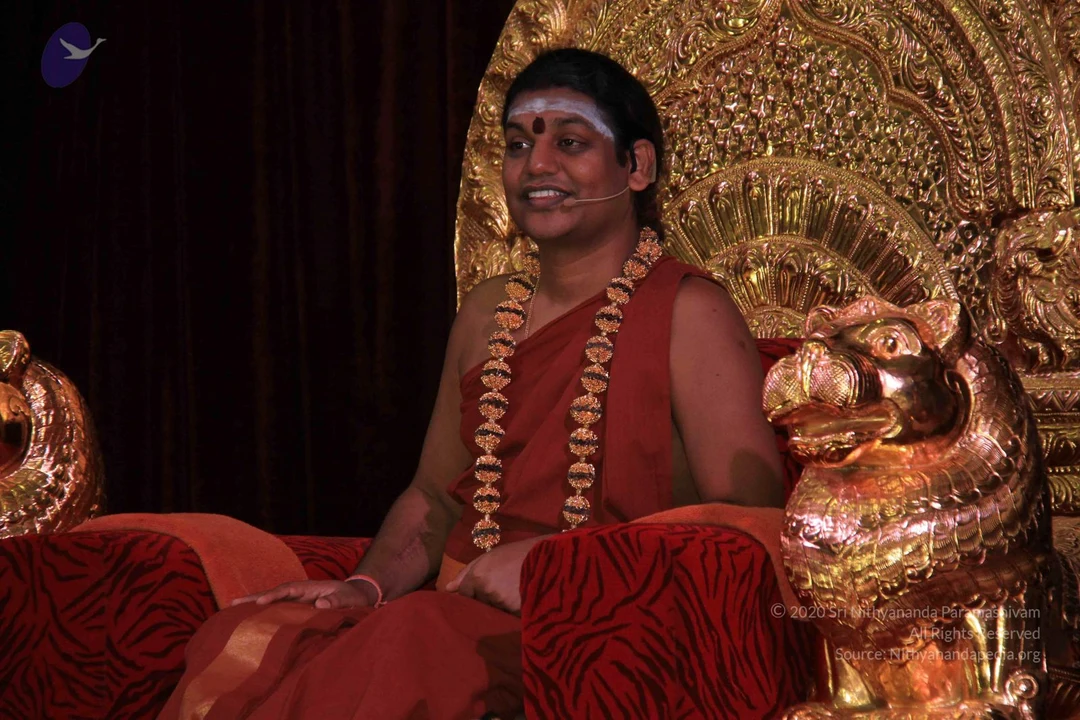
Morning-Satsang

Puja

Photos Of The Day:

Darshan

Photos Of The Day:

IA-Session
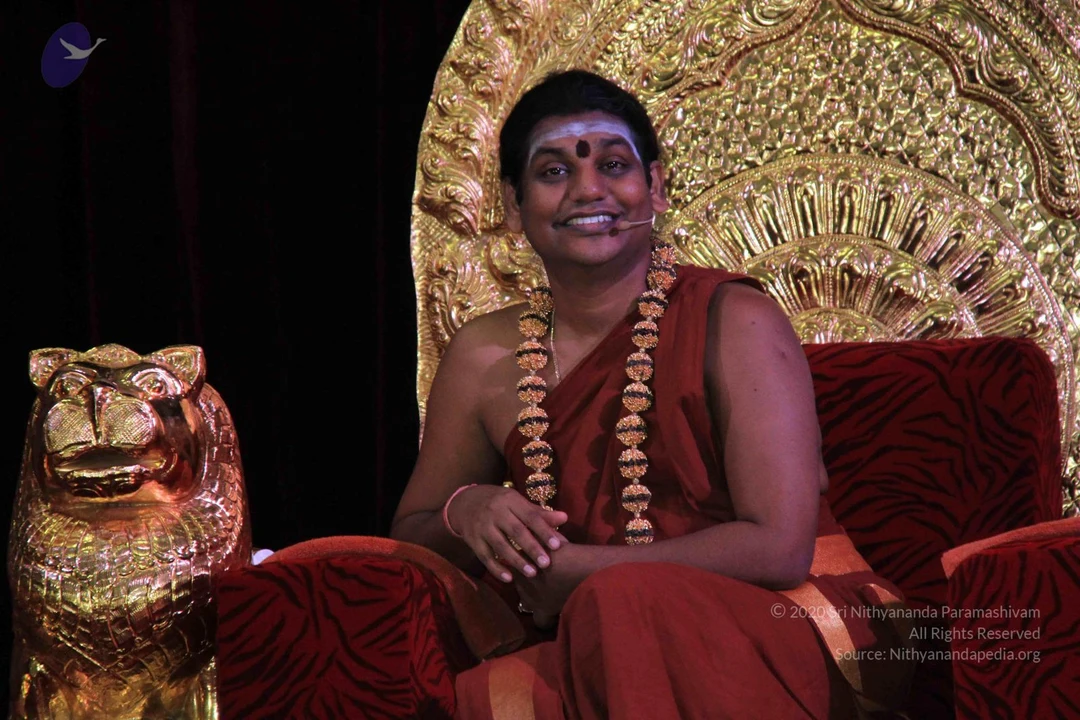
Morning-Satsang

Photos Of The Day:

darshan

Photos from this day

View all 229 photos

Photos From The Day

5 photosSource gallery
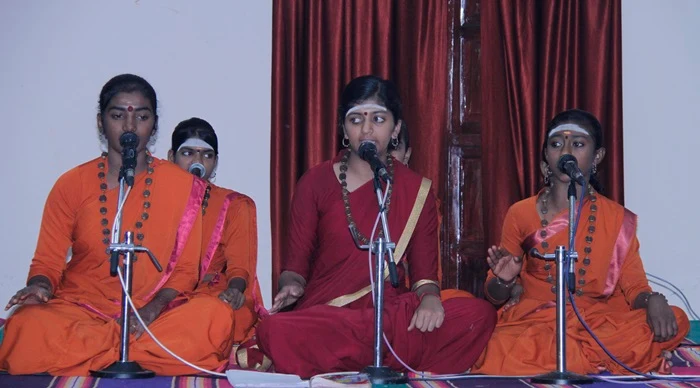
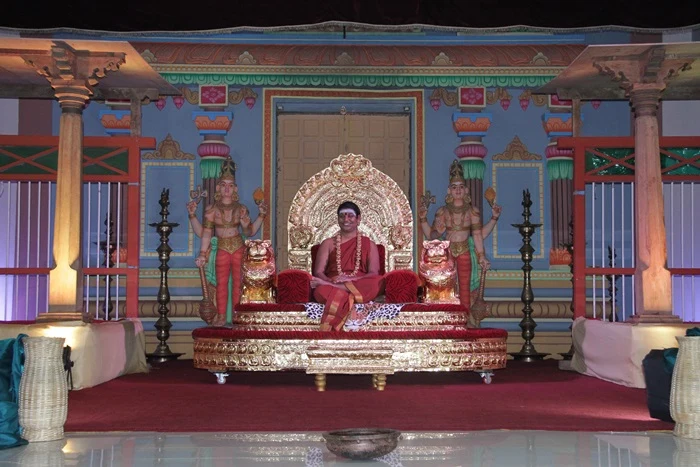
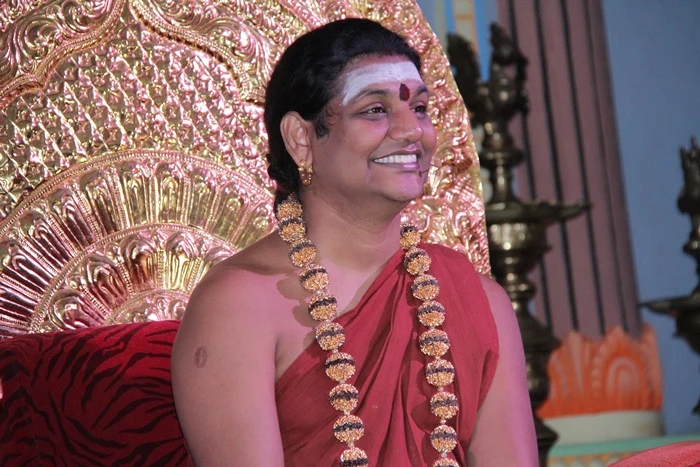
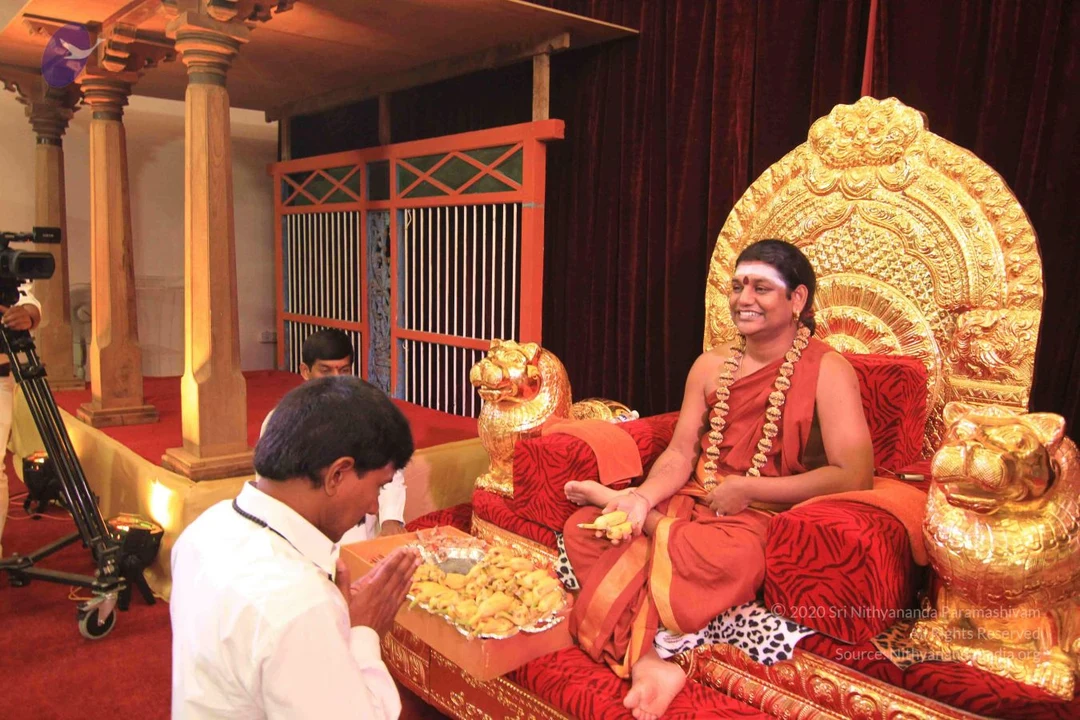
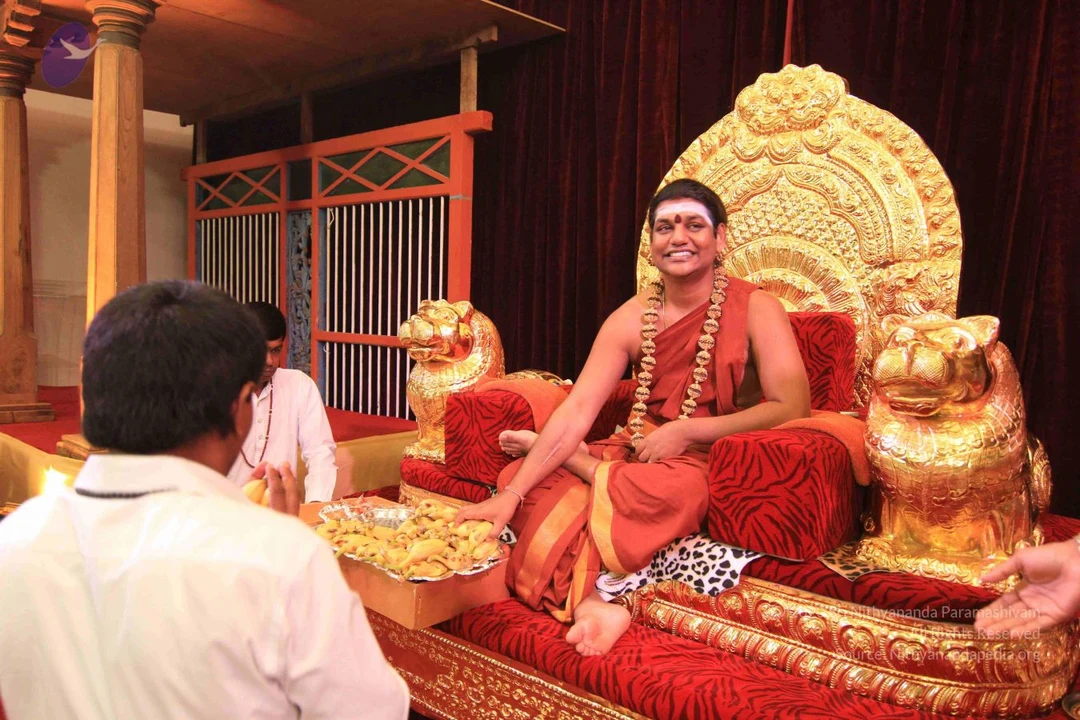
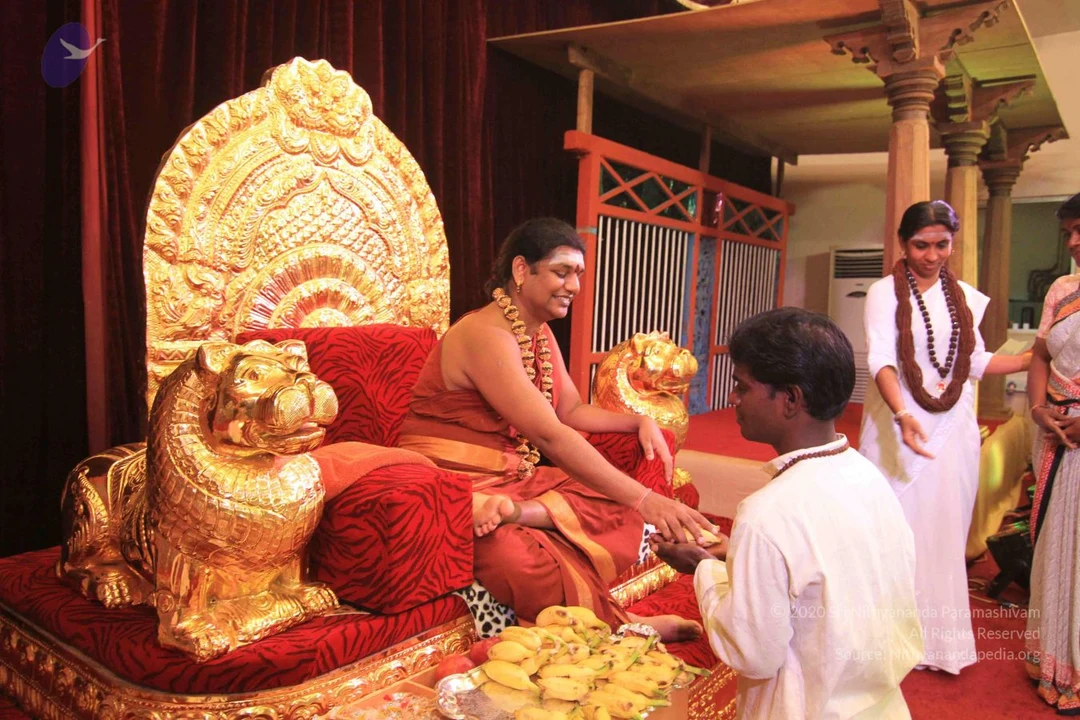
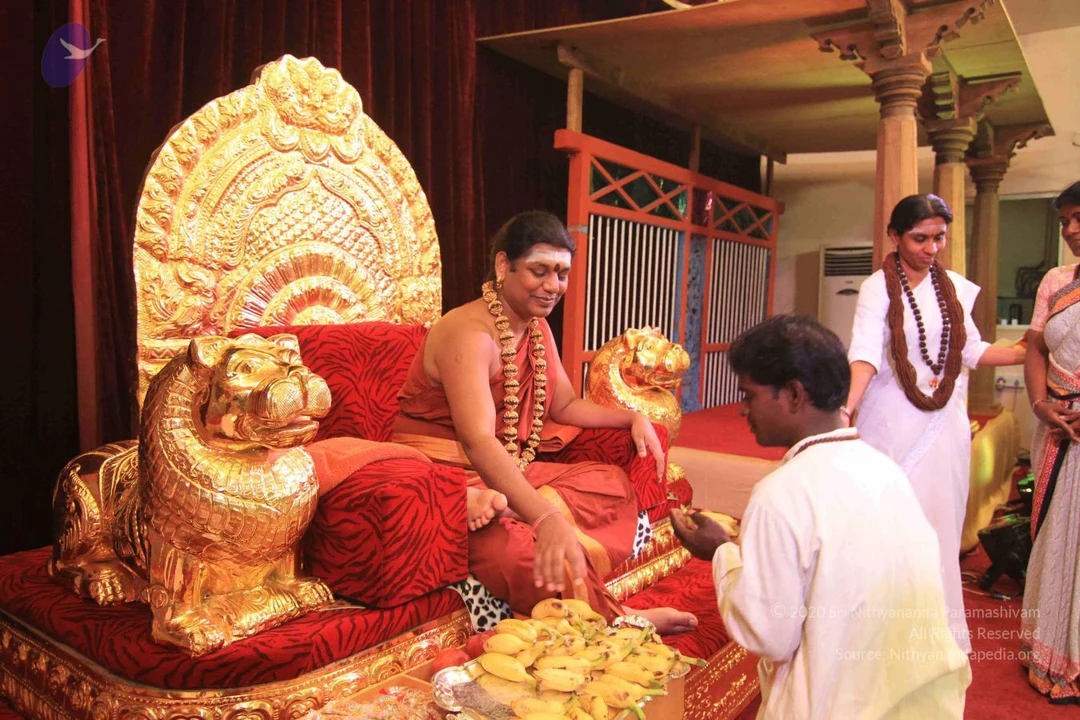
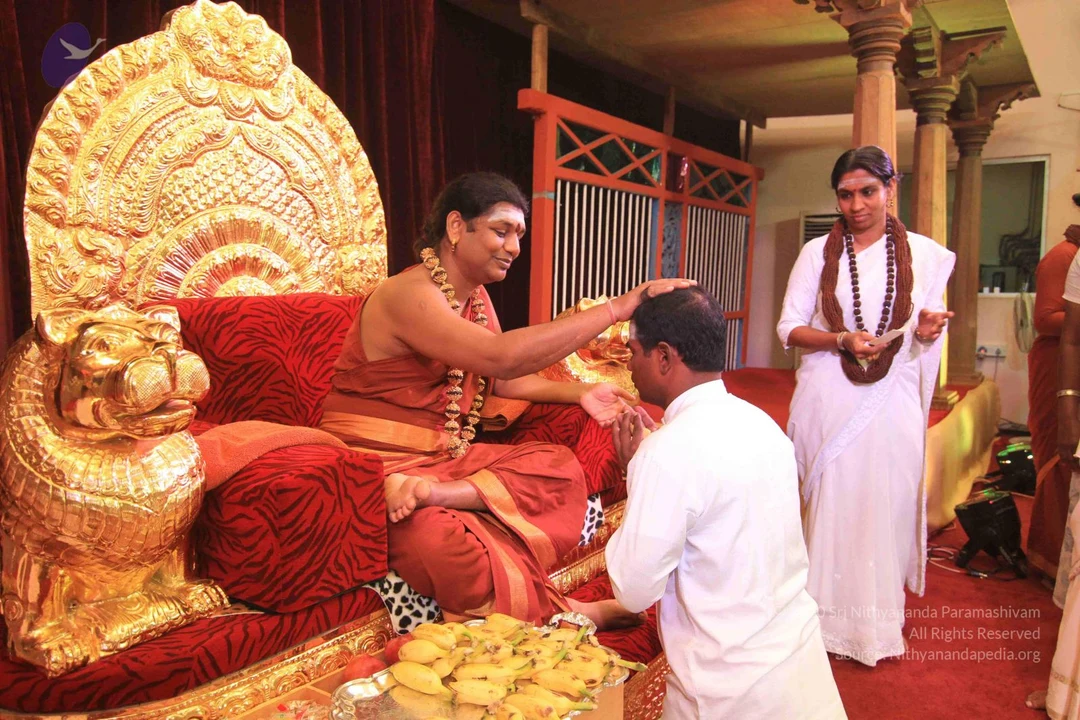
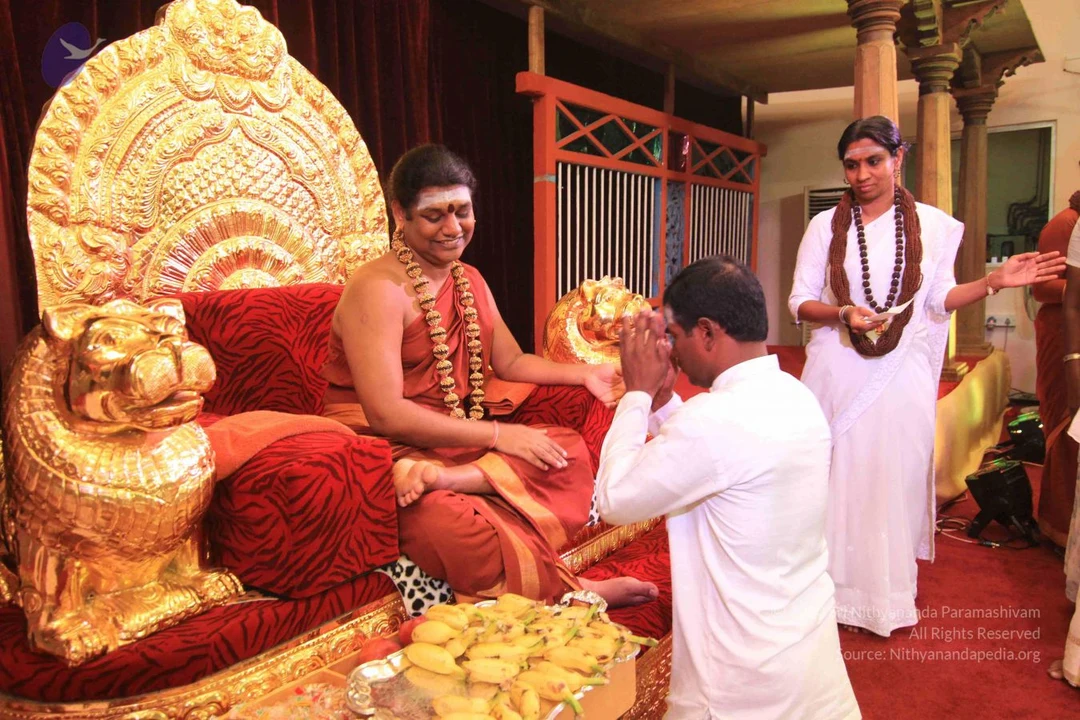
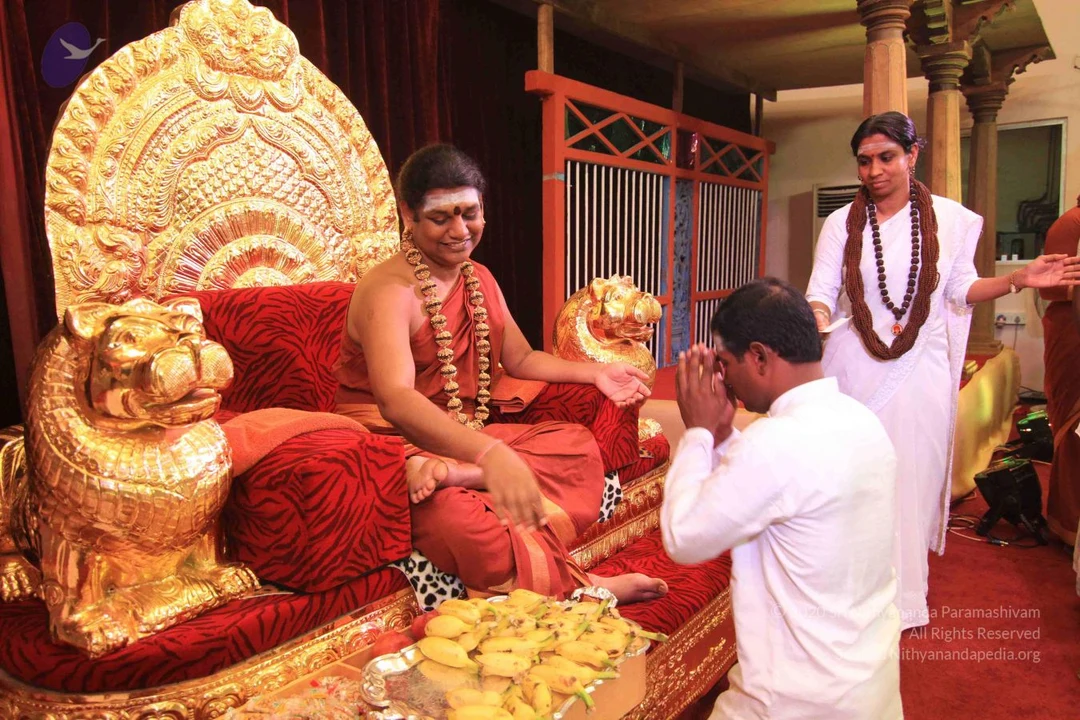
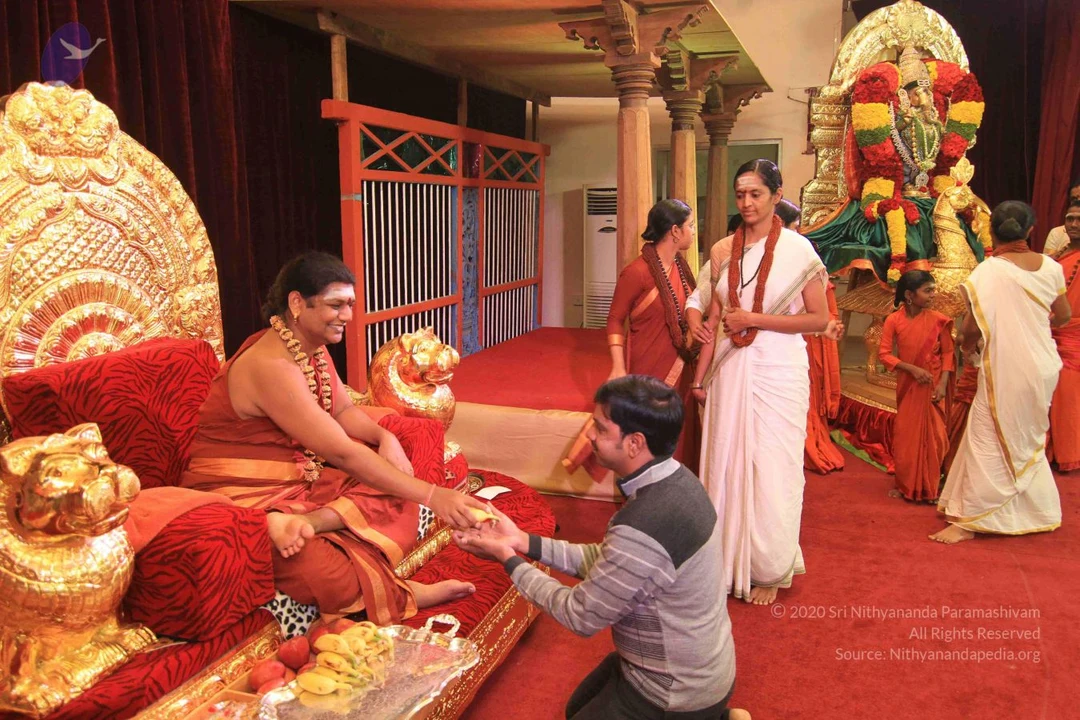
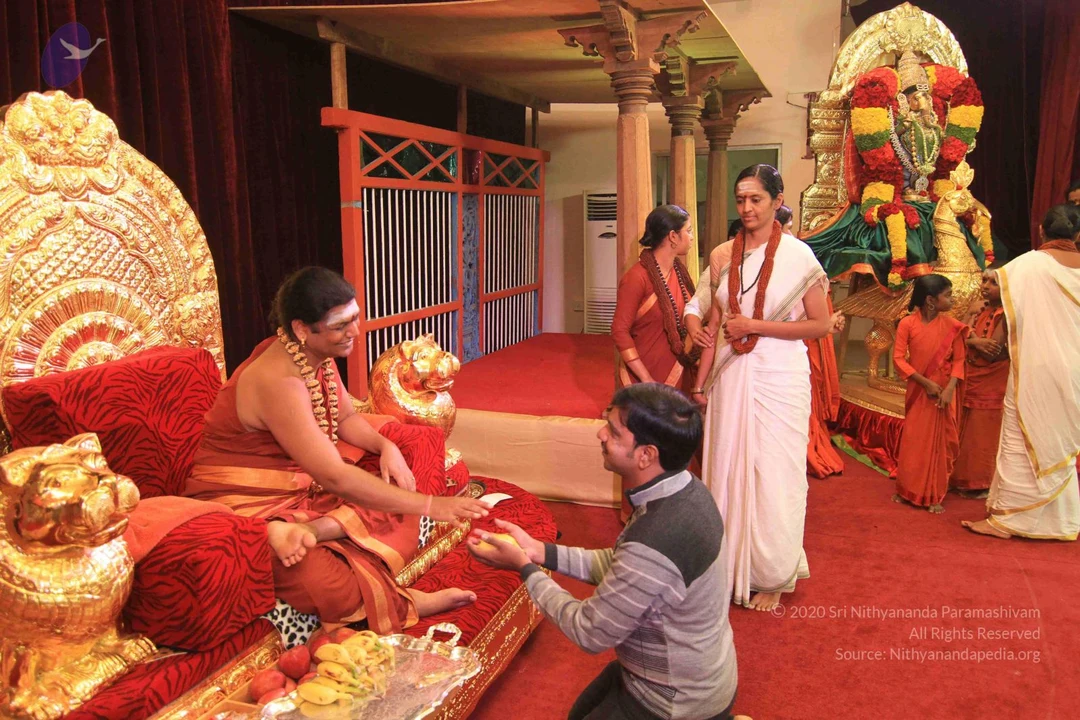
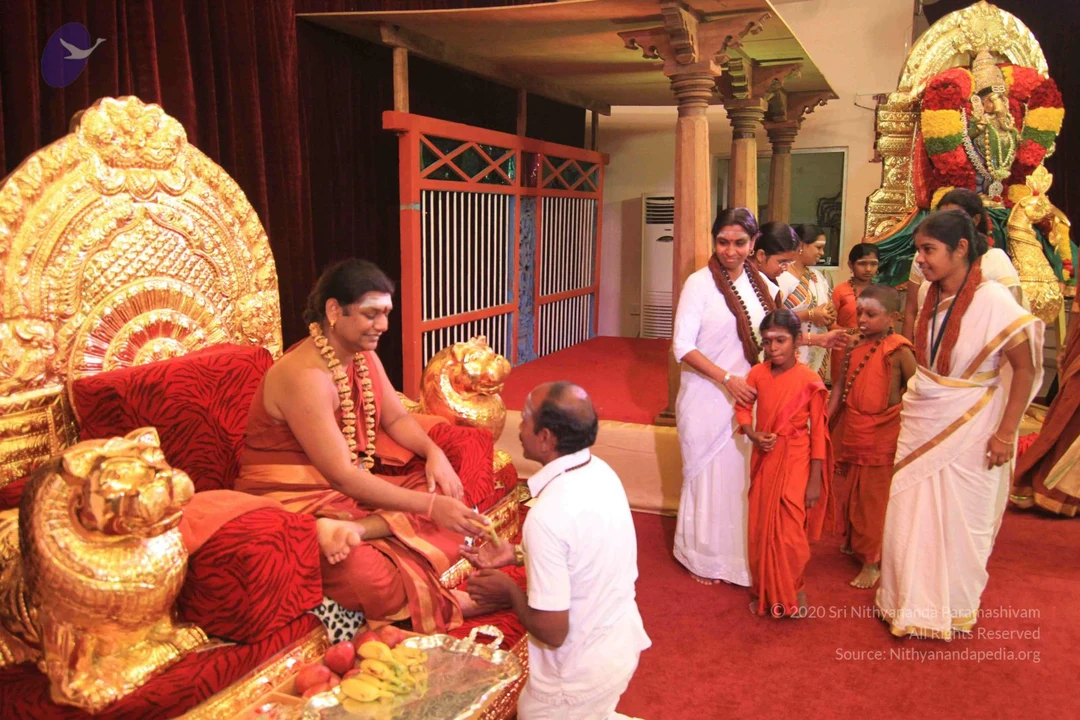
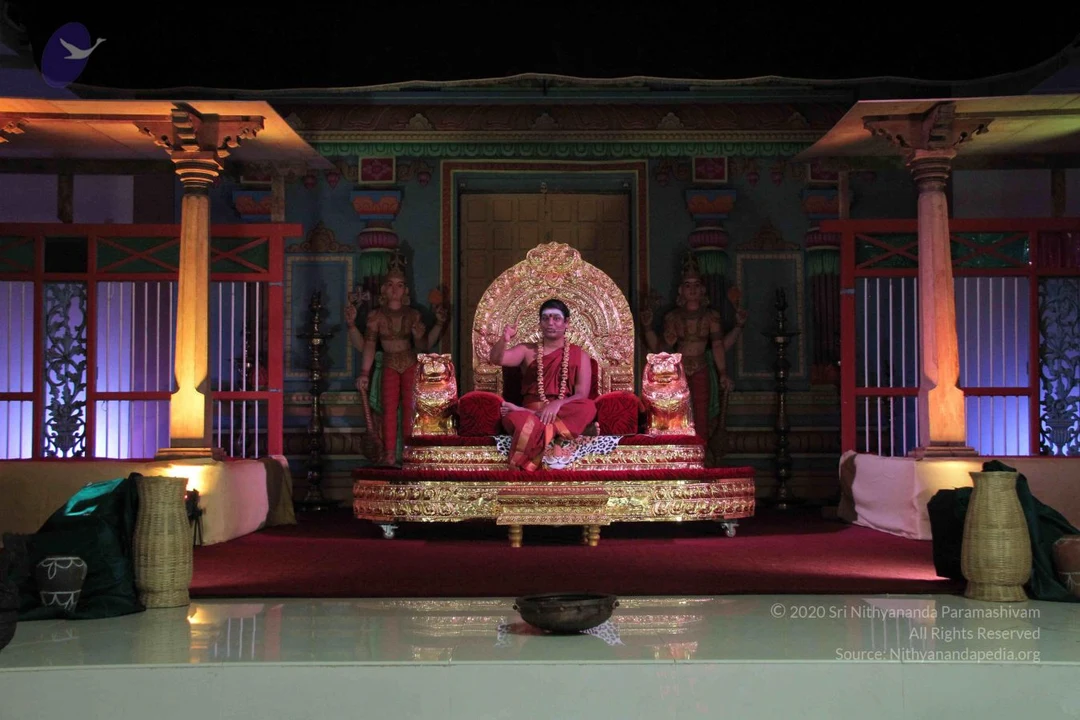
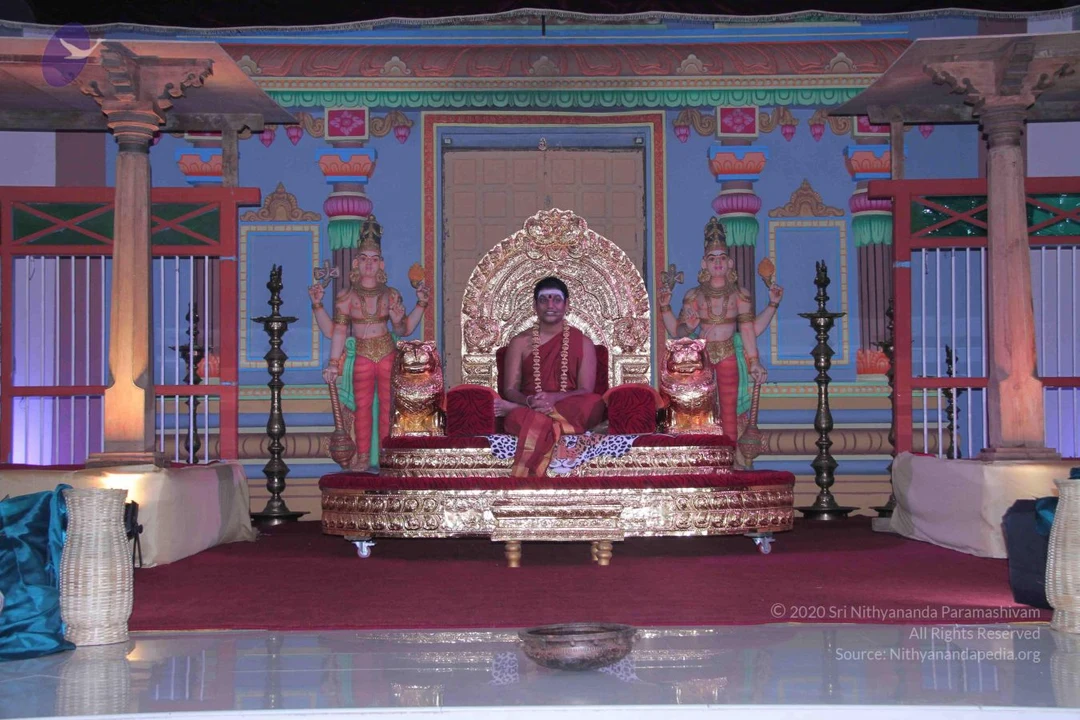
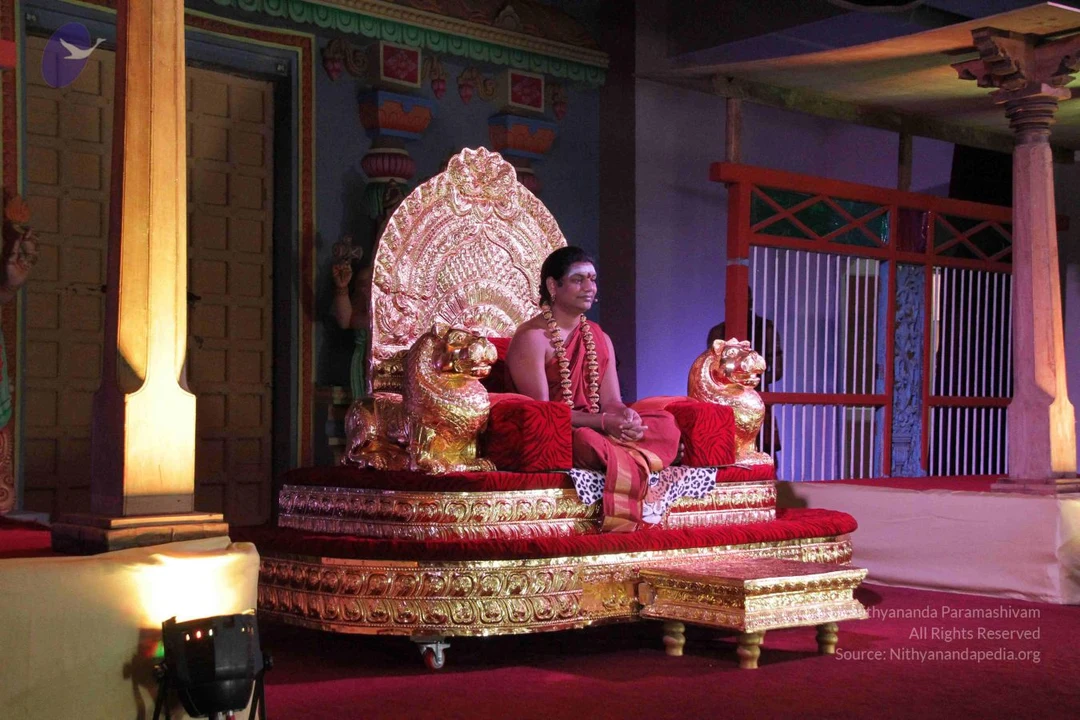
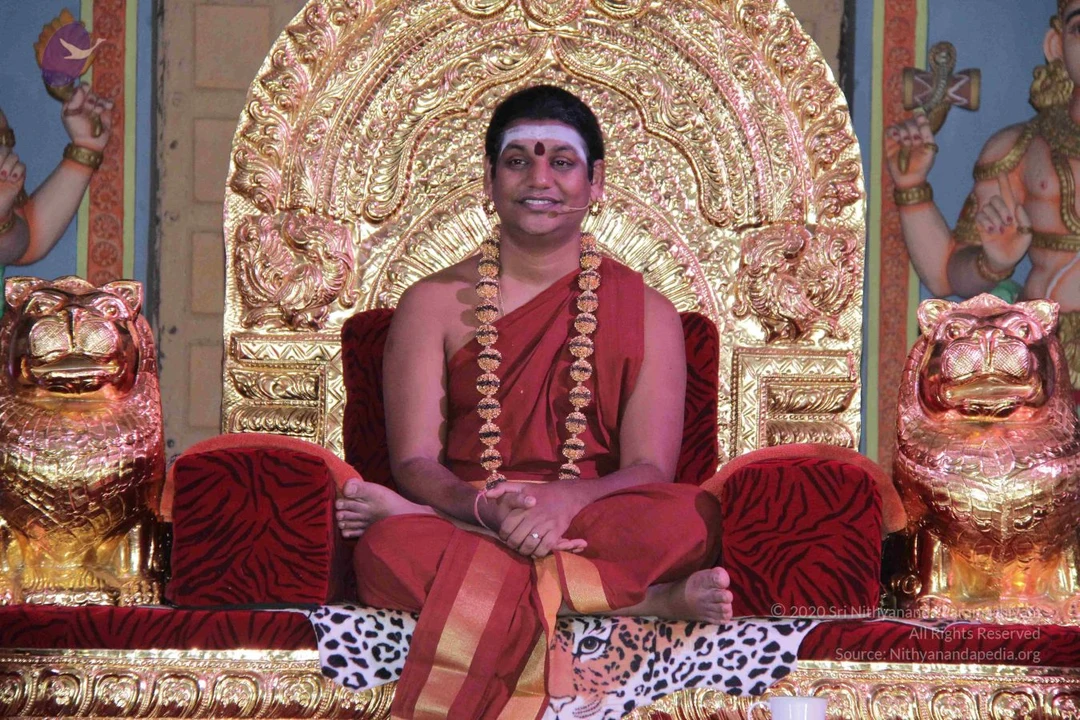
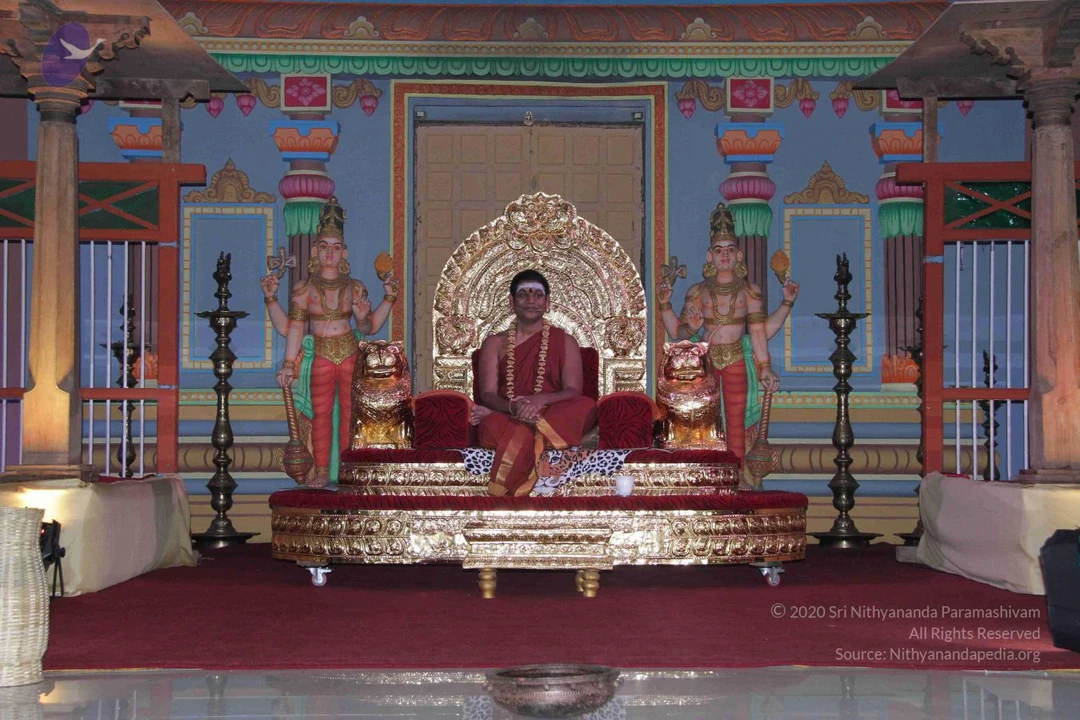
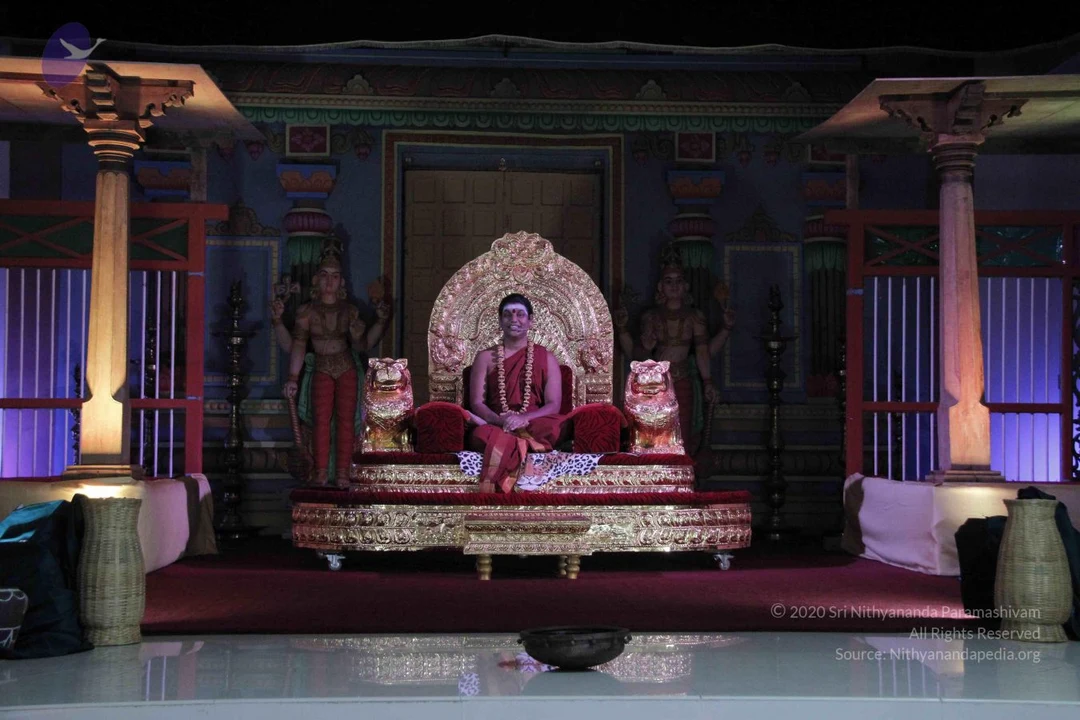
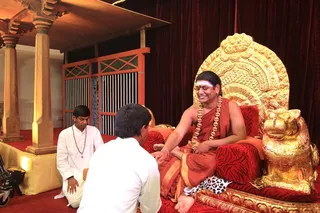
A photograph of a devotional kirtan performance on a stage with a deep red curtain behind. Four women sit cross-legged on a purple cloth, singing into standing microphones. The women on the left and right wear saffron-orange robes with pink borders and rudraksha malas; the woman on the right has a white vertical mark on her forehead. The central singer wears a red robe with a gold-coloured sash and a long mala, with a red bindi and tilak, and her hands are raised in a gesture of song. A fourth singer sits partly hidden behind them. No a person candidate is visible in the image.A photograph of a temple-style stage set with painted blue and gold walls, red-and-gold columns and a golden arched doorway. A seated figure in a saffron-orange robe and a red-and-white garland sits on an ornate gold-and-red throne with lion-shaped armrests. Two standing painted deity statues in red and green flank the throne, each holding a staff. Brass oil lamps (deepas) stand on the red-carpeted dais, and a brass bowl sits on the white floor in front. Persons: 1 seated figure.A smiling man sits cross-legged on an ornate gilded throne with carved gold arches and gold lion figures at each arm, draped in red-and-tiger-print fabric. He wears a red robe with gold border, a red bindi and white tilak on the forehead, a long beaded rudraksha-style mala, and a small headset microphone. His right hand rests near his head. Gilded deity murti arms with ornaments appear at the frame edges.A decorated silver-toned Ganesha murti, the elephant-headed deity, seated in a shrine framed by an ornate silver arch. The murti wears a tall jeweled crown with a small tilak, pearl and bead necklaces, and a blue garment. It is surrounded by thick garlands of red roses alternating with bands of yellow marigolds and green leaves. A golden mouse vahana with ornate detailing sits in front on a teal satin cloth. No people are visible.A seated man on an ornate gold throne with a carved golden back and a gilded lion-form armrest, draped in red-orange cloth with a red-and-white tiger-striped cushion beneath. He wears a white flower garland, a red-and-orange sacred mark on his forehead, and has bare feet, and he is smiling as he extends his hand. A younger man in white clothes kneels on the red carpet with a red-beaded mala around his neck, and a second person in white kneels in the foreground facing the throne. Red curtains, carved wooden lattice and gold-trimmed columns frame the hall.

FB-photo-of-the-day

4 photosSource gallery

IA-Session

57 photosSource gallery
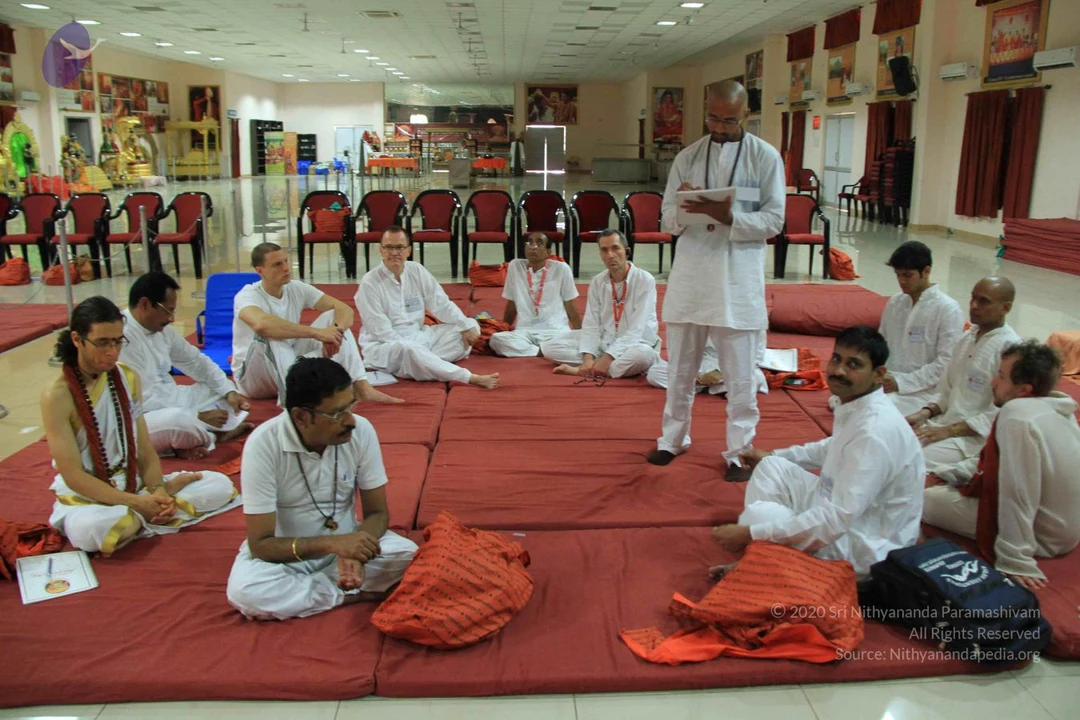
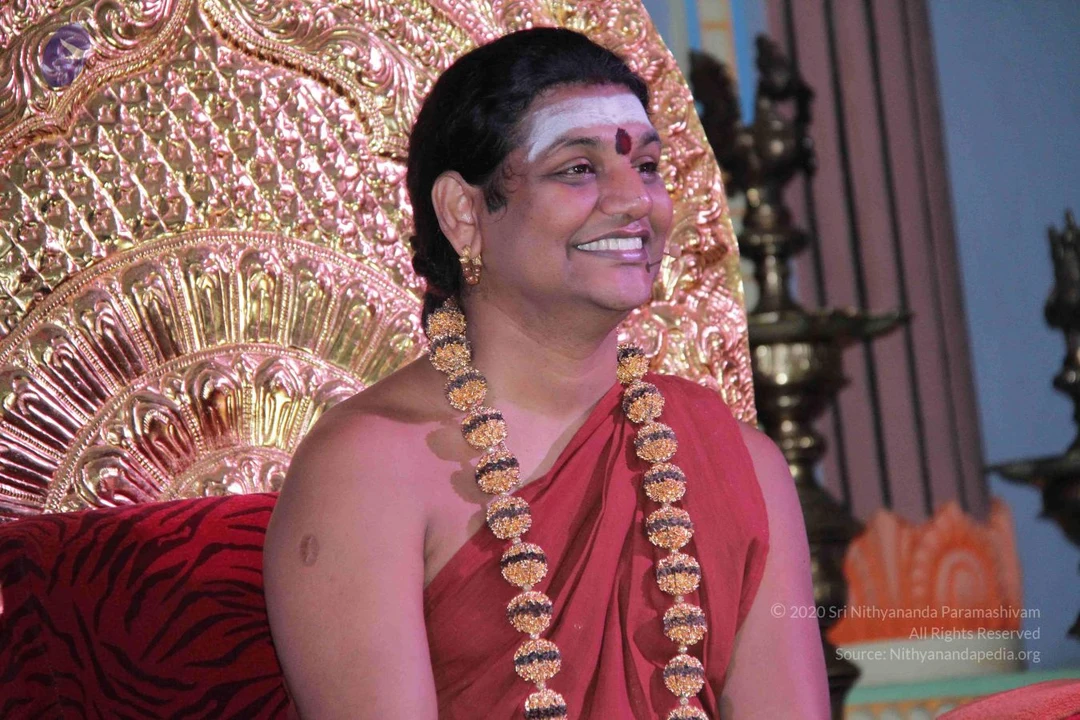
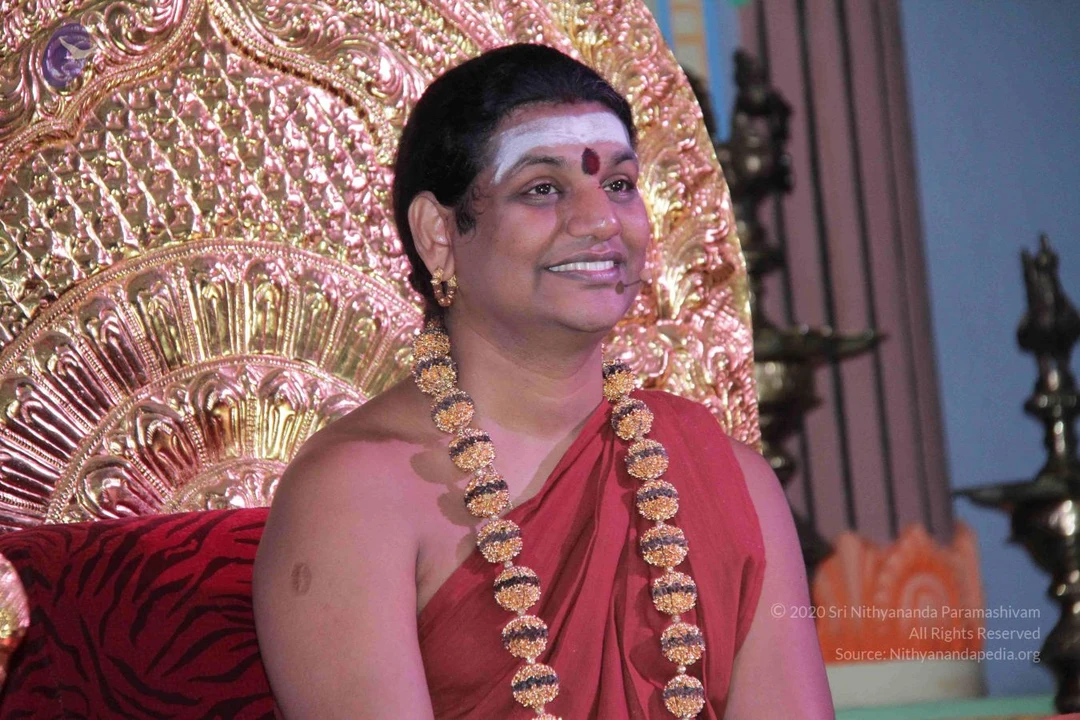
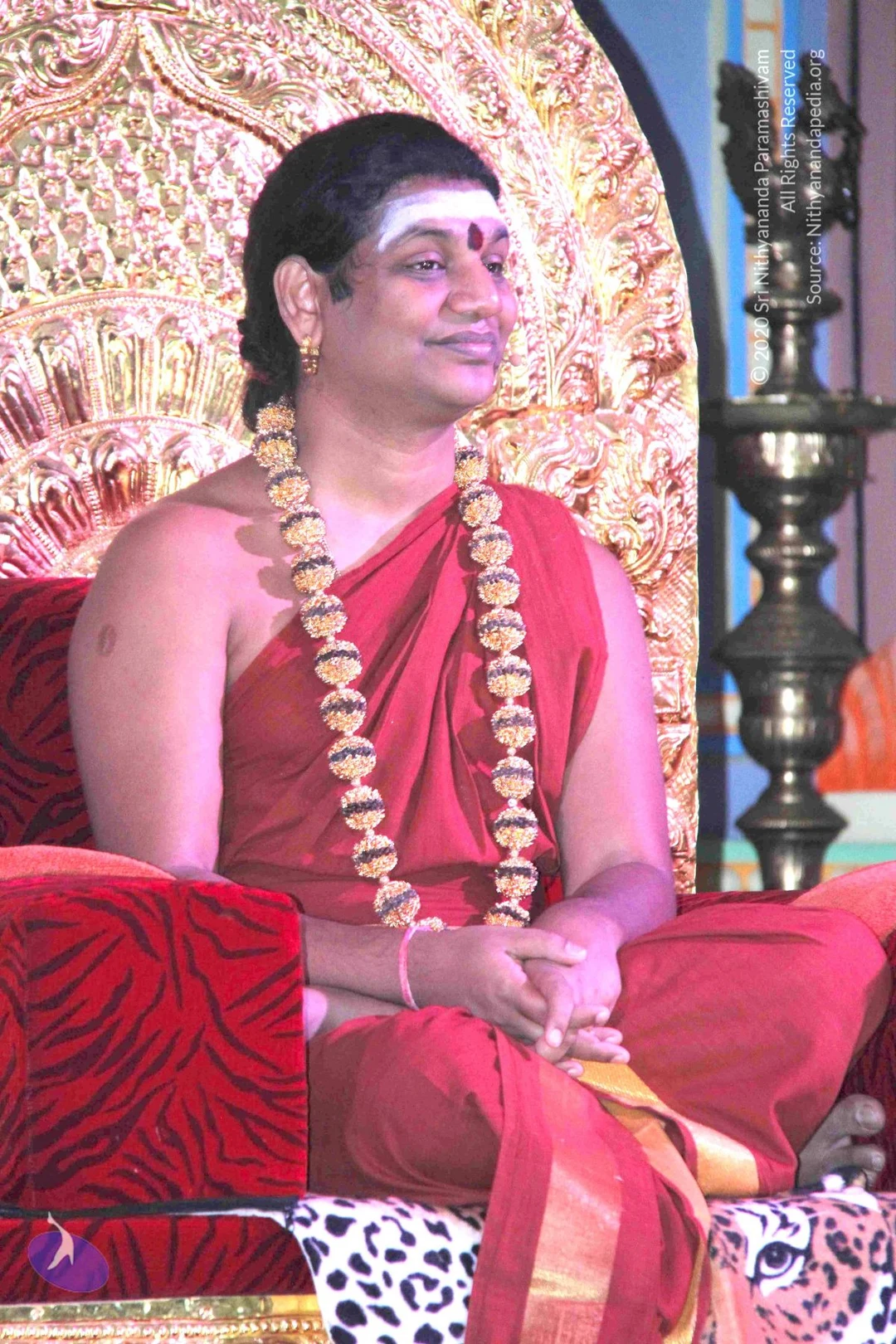
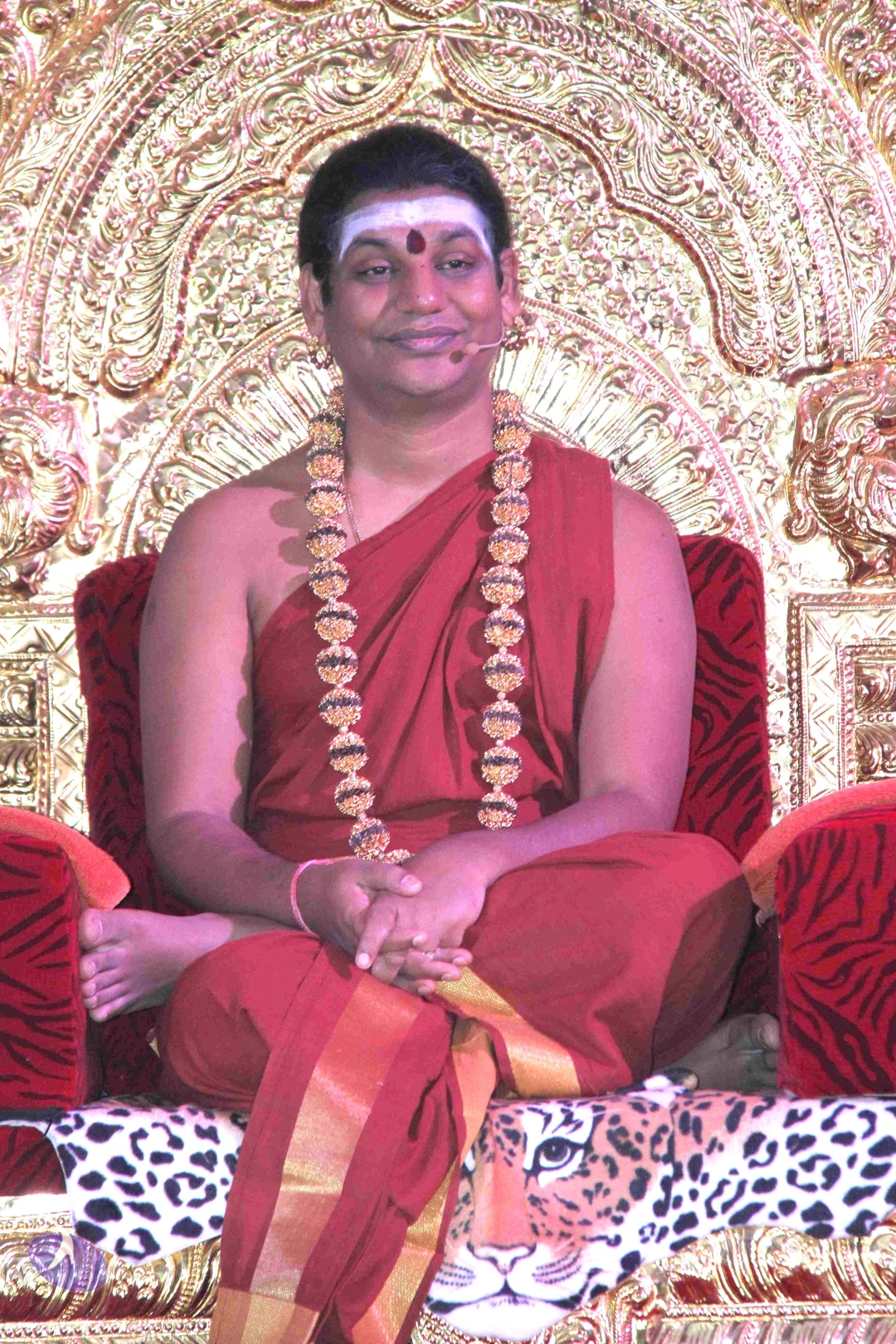
A man in saffron-red robes sits on an ornate gold throne with carved lion-head armrests, set against dark drapes. He wears a rudraksha mala necklace with large beads, a white tilak with a red dot on his forehead, and a headset microphone. He smiles and gestures with his hands while speaking. The red tiger-striped cushions and gilded throne frame the satsang setting.A man seated on an ornate gold throne with carved lion-head armrests, against a dark maroon curtain, speaks while gesturing with his raised right hand. He wears an orange-red shawl over bare shoulders, a long rudraksha mala with gold bead accents, a red thread on his wrist, white forehead markings with a red bindi, and a small head-mounted microphone. The red-and-black patterned upholstery matches the scene.A man seated on an ornate golden throne with a tiger-patterned red cushion, smiling and looking to his left. He wears a red-orange shawl draped over bare shoulders, a long necklace of gold and black beads, and a small red bindi on his forehead, with a lapel microphone clipped near his face. A golden lion-head armrest sits beside him against a dark red curtain. a person: the saffron/orange wrap, ornate gold necklace and rudraksha-style beads are visible cues, and the page identifies this event as a 2014 satsang with a person present, so this is a seated in-person speaker at a discourse.A man in a red-orange saffron robe sits on an ornate gold-carved throne with a red tiger-striped cushion, speaking into a head microphone. He wears a long double strand of gold-and-black beaded ceremonial necklace, a red kumkum bindi and vibhuti marks on his forehead, and has a red thread on his wrist. His hands are clasped in his lap. Beside him stands a gilded lion-head carving on the dark red curtained stage. The setting resembles a satsang discourse. a person appears in a red robe with rudraksha-style beaded necklaces and an ornate gold throne, so the candidate is seated in person on stage.A seated group of devotees in white ritual clothing sits on red mats in a temple hall, many with arms raised in a collective gesture during satsang. In the foreground, a young man with long hair wears a rudraksha mala and orange-and-gold trimmed white garment. Beside him, a bald man in white with a rudraksha mala raises one arm, and a man in white with a mustache and lanyard raises his hand. Orange cushions lie beside the mats. In the background, a golden shrine and framed posters are visible, along with a woman in white raising her hand and a seated man on a chair. No figure with clear presentation cues for the a person is visible.A seated man in a saffron-orange robe sits on an ornate golden throne with a carved gold back and a striped red-and-black upholstered seat. He wears a long necklace of gold-and-black beaded rudraksha-style malas, a red-orange thread bracelet, and a dark kumkum bindi on his forehead, with his hands clasped in his lap. A gold carved lion figure rests beside the throne on a dark red curtain backdrop, and he smiles while speaking into a small headset microphone.

Morning-Satsang

72 photosSource gallery
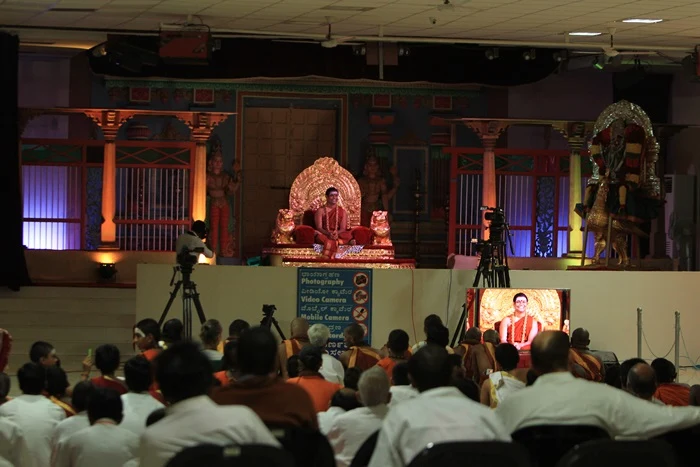
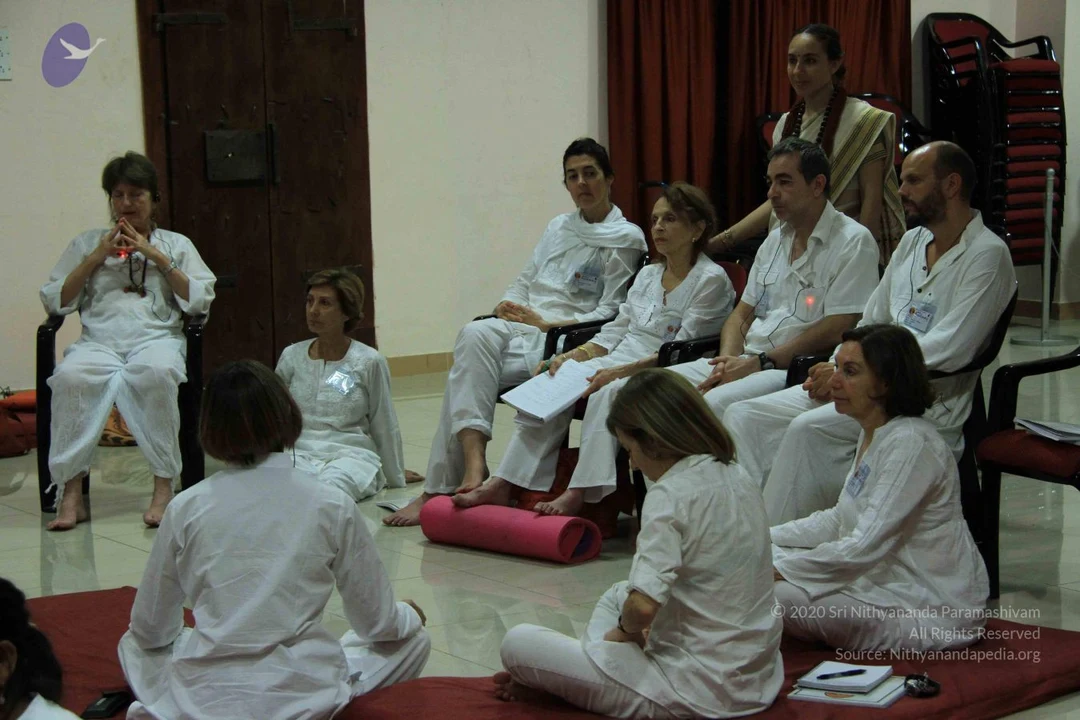
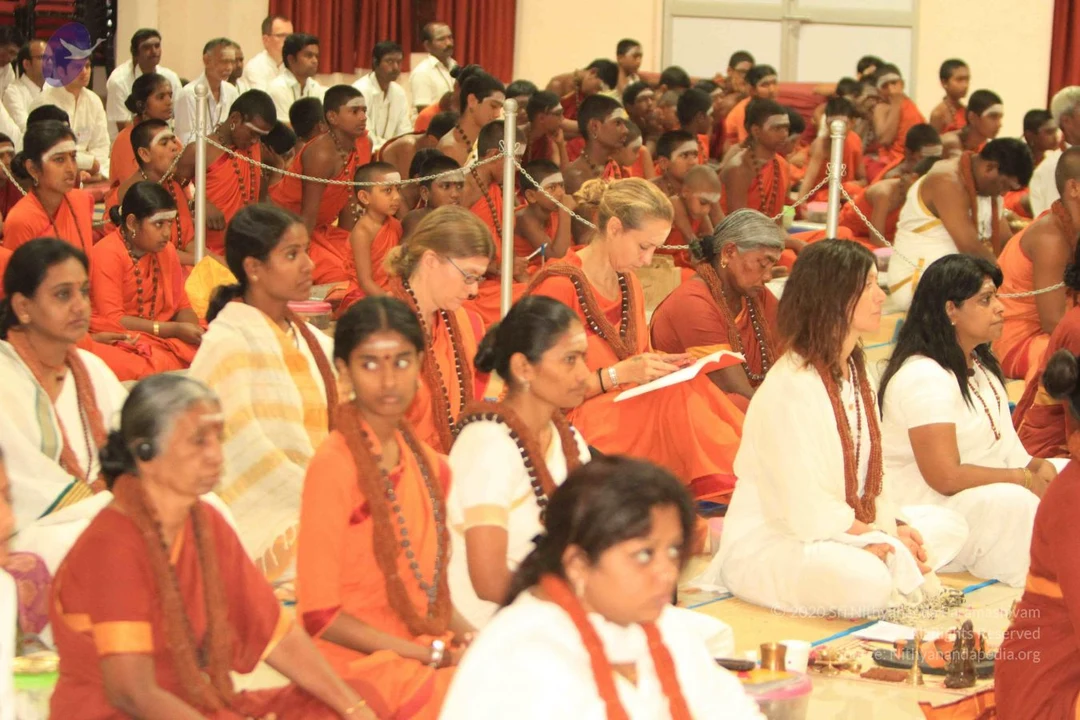
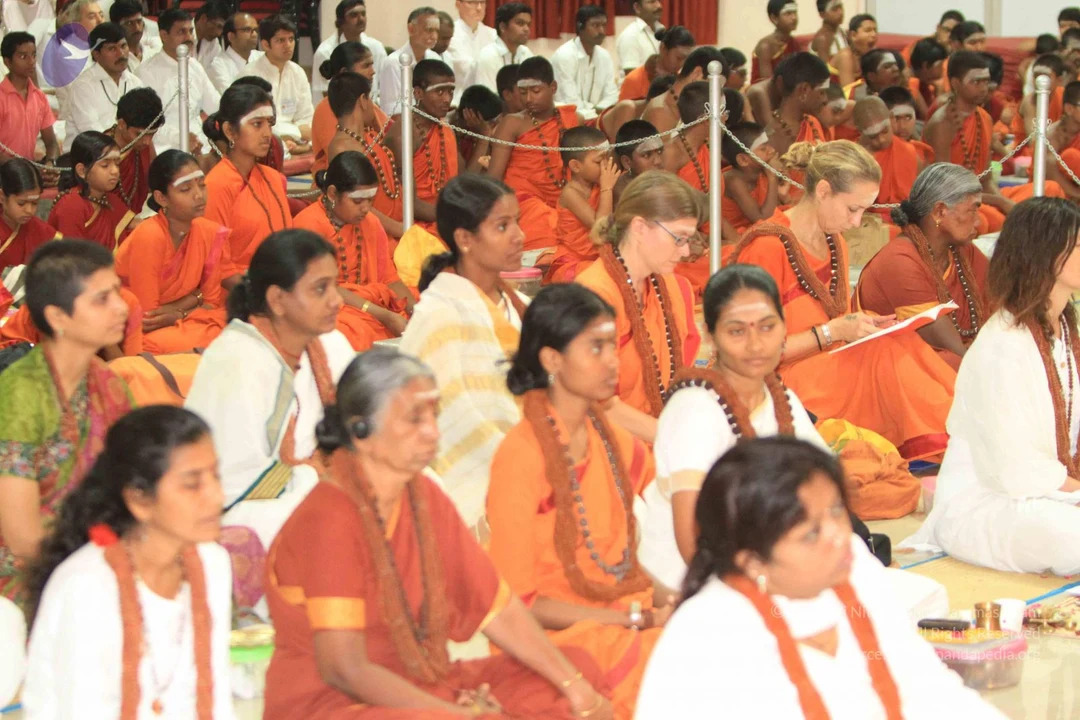
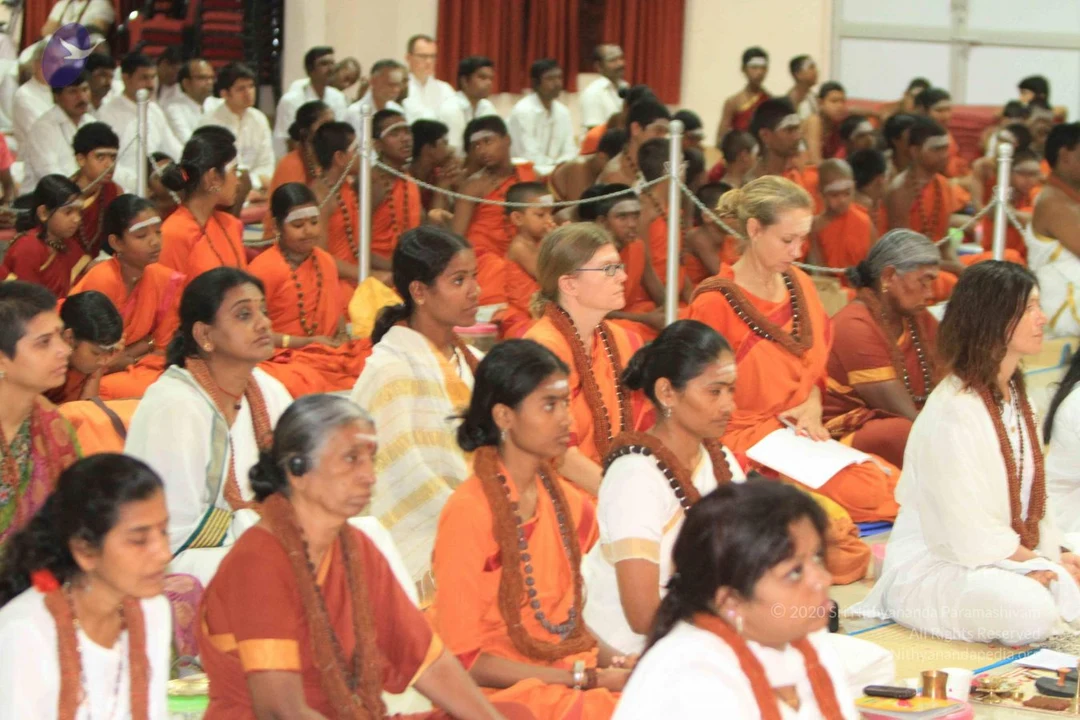
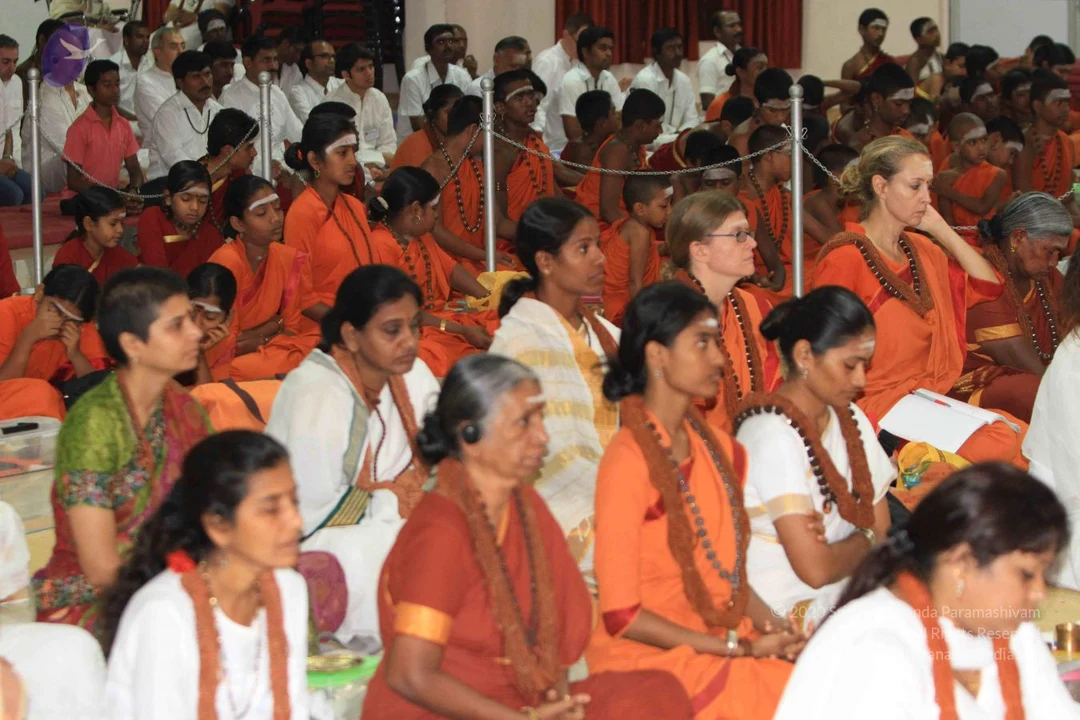
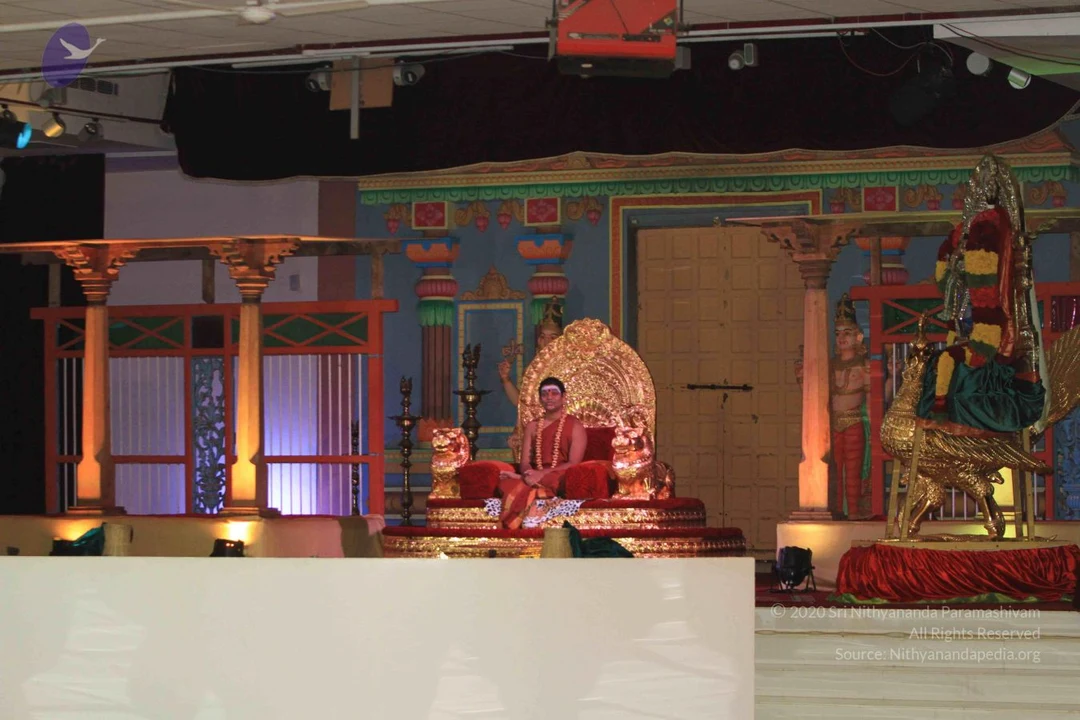
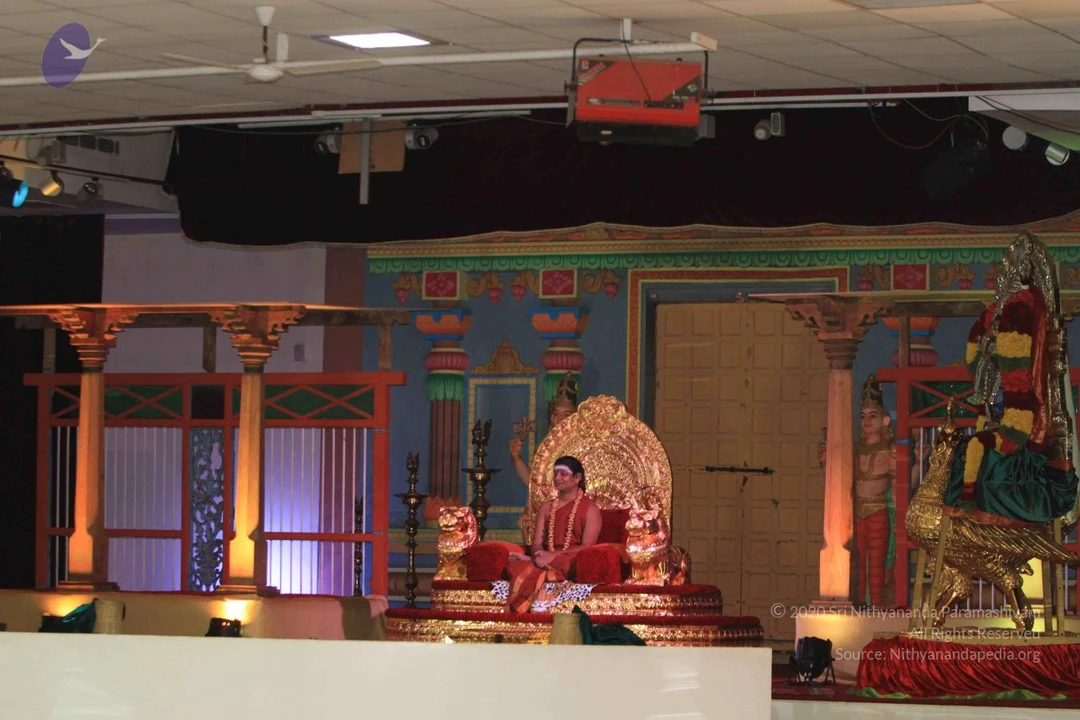
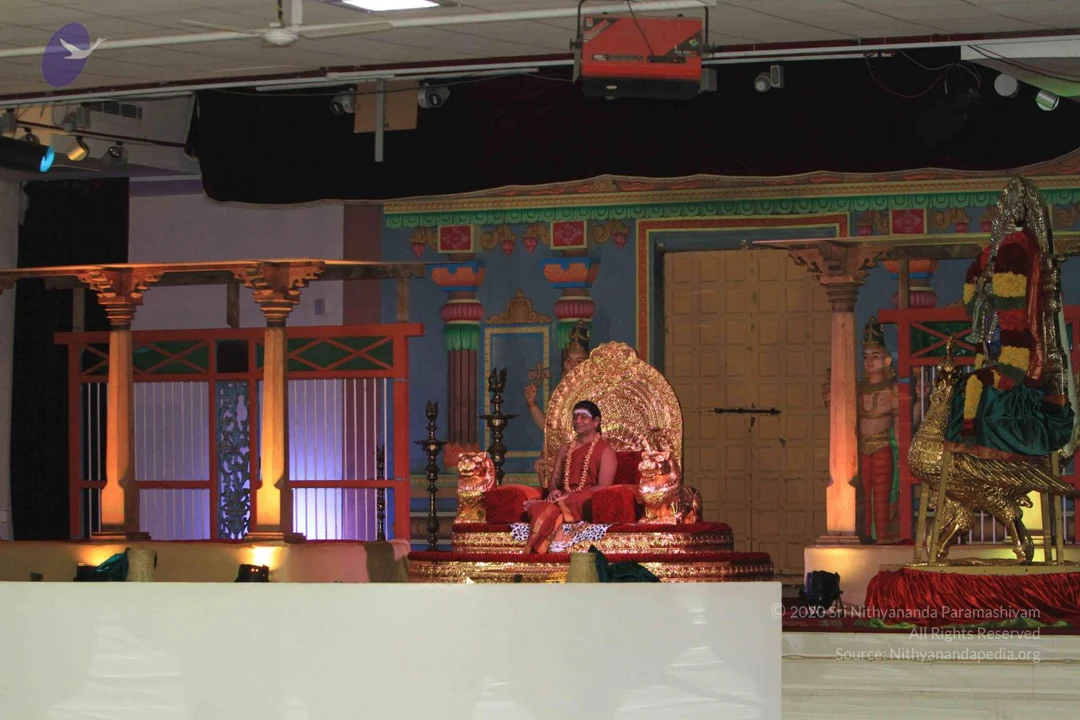
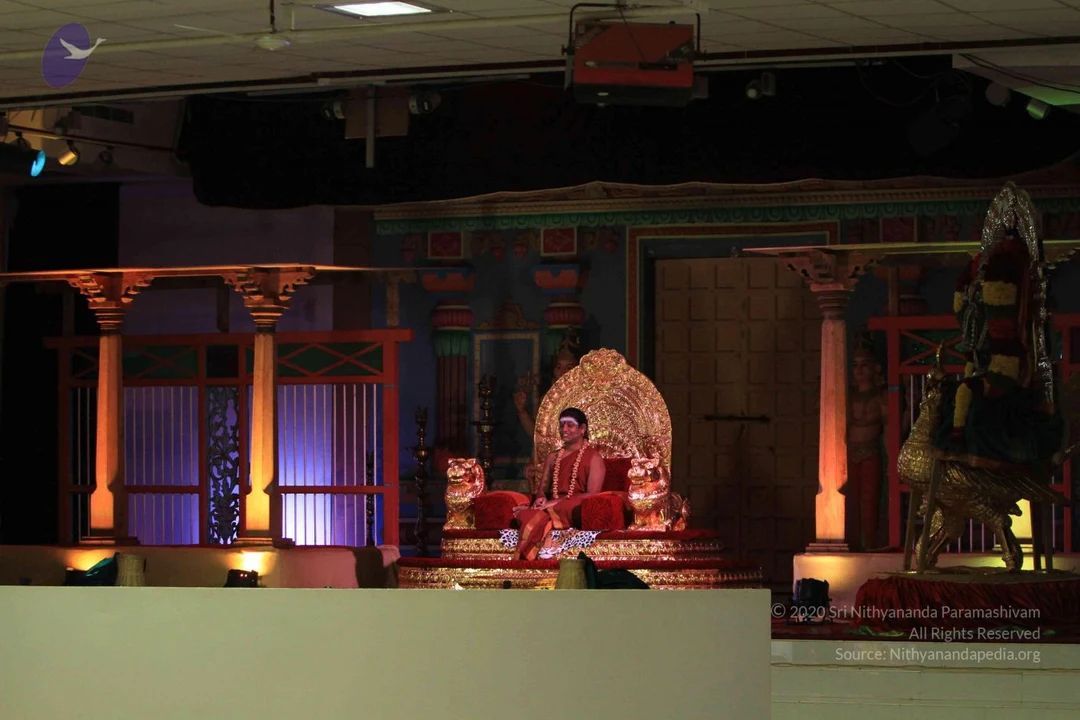
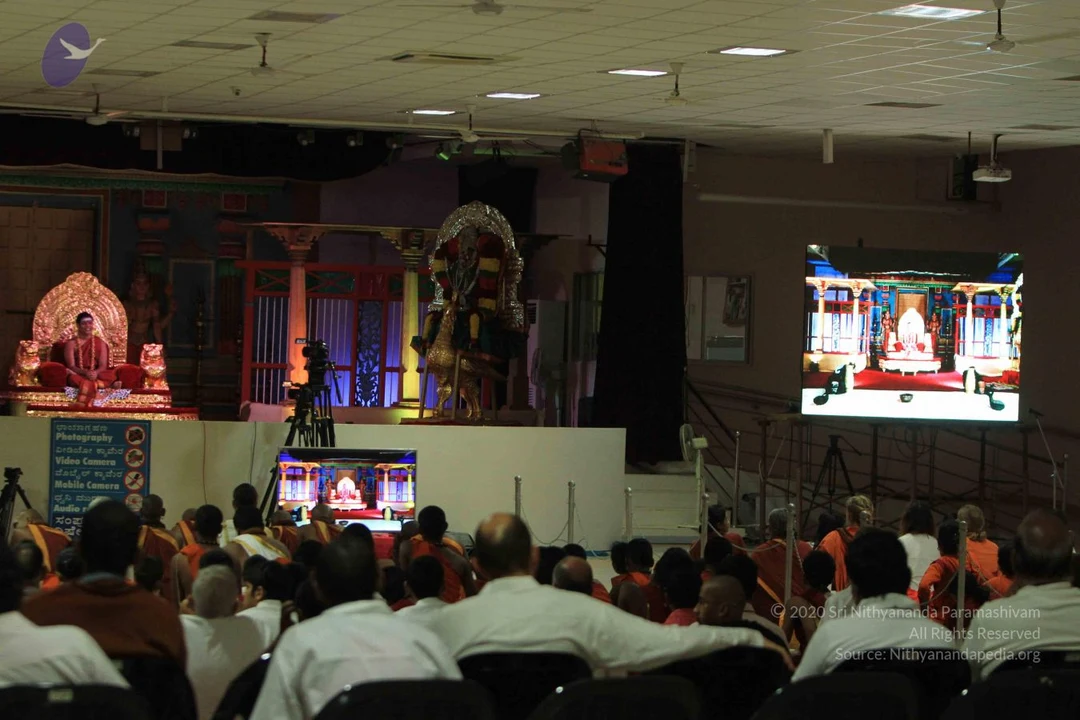
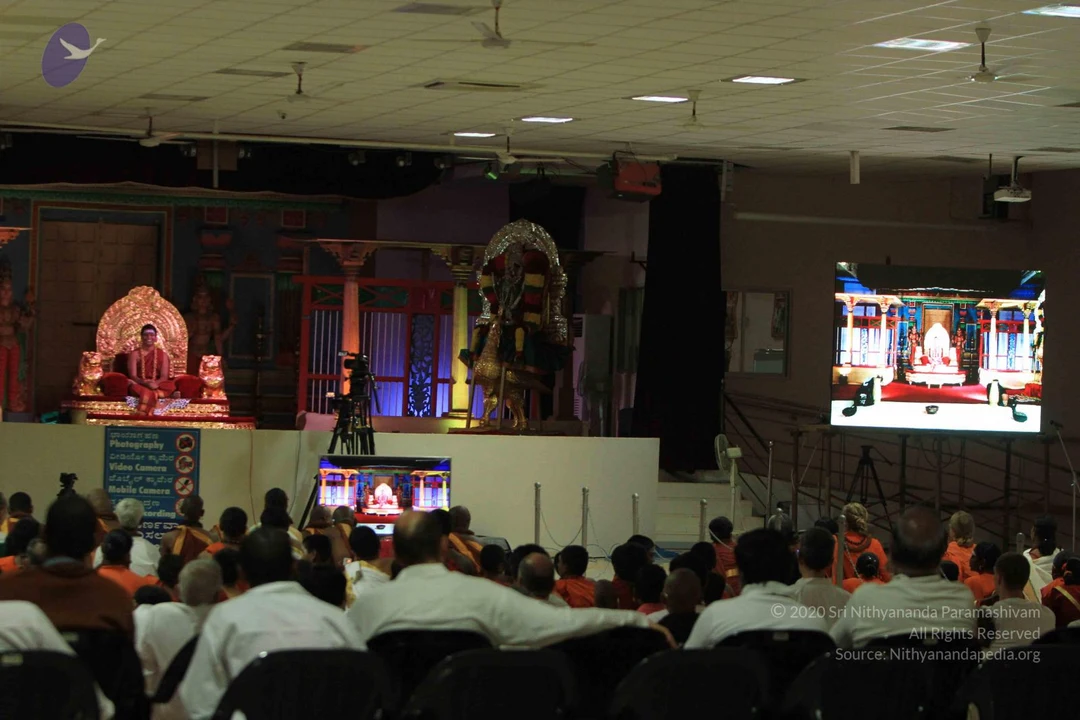
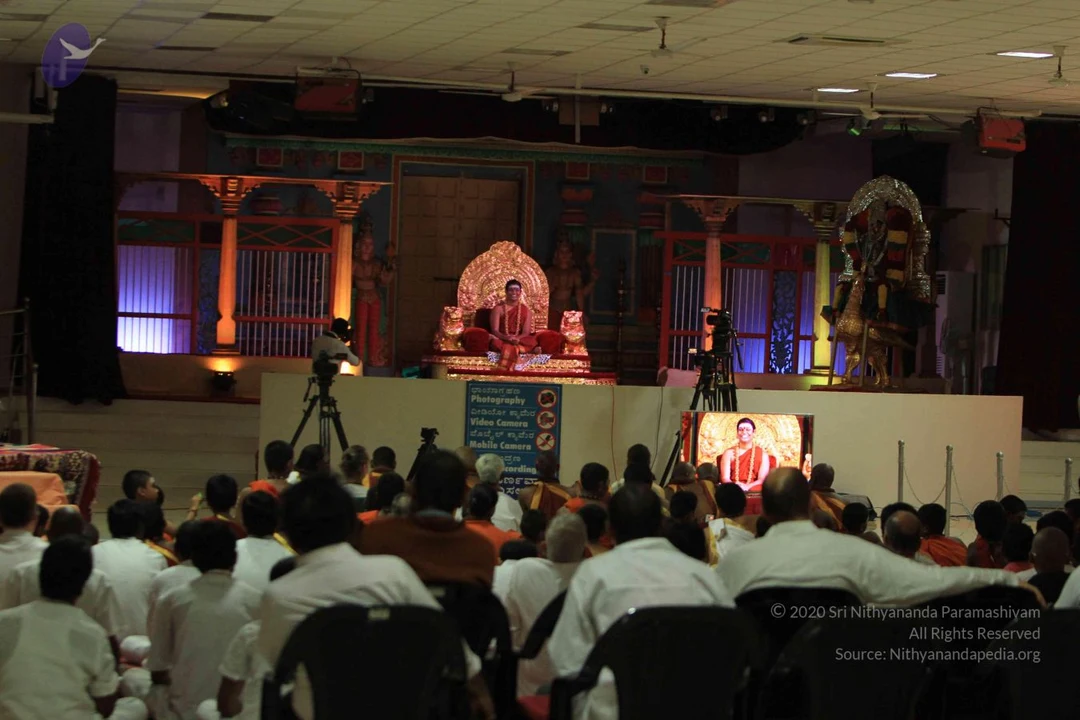
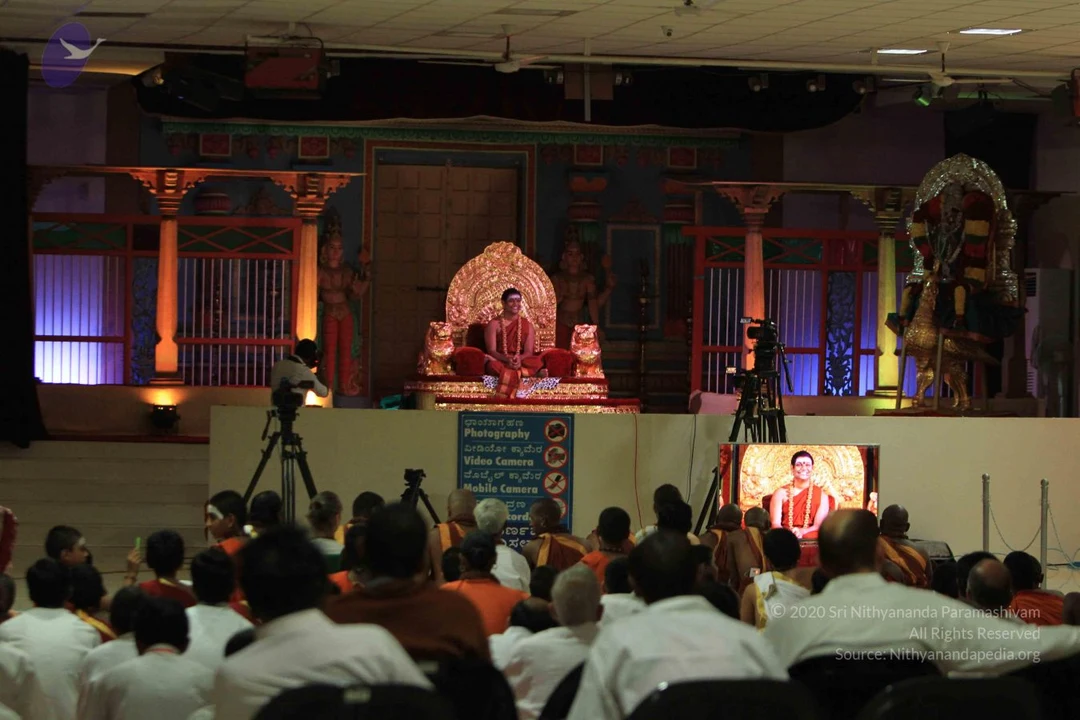
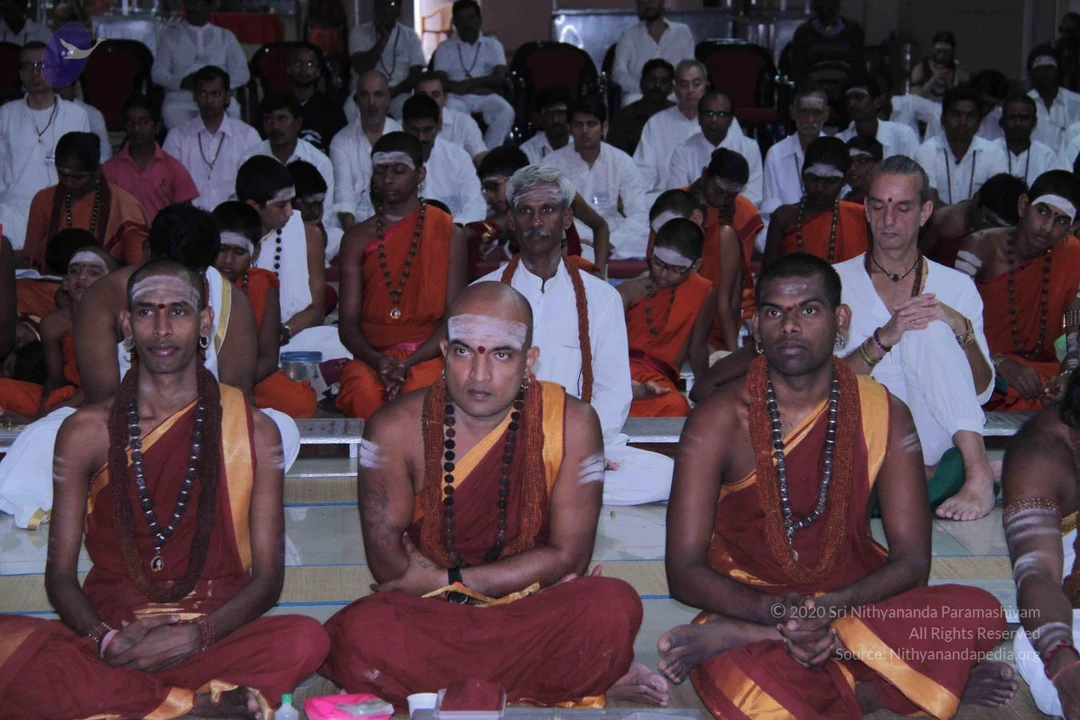
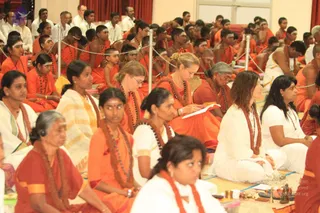
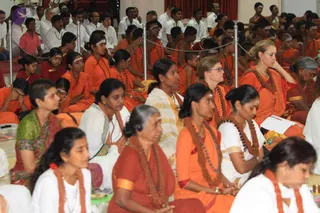
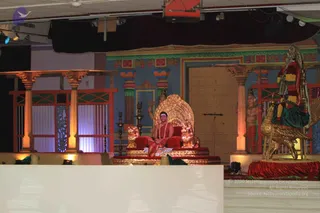
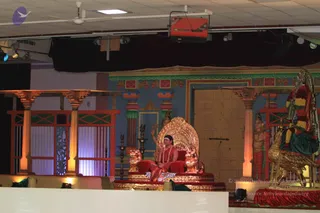
A large seated congregation of devotees in a hall during a satsang. Most wear saffron-orange robes and rudraksha malas, many with white vibhuti or tilak marks on their foreheads. Several women in front wear white or cream saris and shawls, and a woman in white sits near the centre holding a sheet of paper. A white-robed man sits at the back left. Thin chains on poles separate seating sections. No individual can be confidently identified as a person from appearance.A large seated congregation in an indoor hall during a satsang. Many devotees wear saffron and orange robes with rudraksha malas, and some have white or ochre vibhuti marks on their foreheads. Several women in white and cream saris and salwar kameez sit with folded hands or eyes closed, and a few hold notebooks or papers. Young boys in orange sit in rows behind metal poles linked by chains, and brass items and a small tray lie on the floor in front. The camera is focused on the seated devotees; no speaker or central figure is clearly visible in this frame.A seated satsang gathering in a hall with rows of devotees on mats and cushions. Many wear orange or saffron robes with rudraksha malas and white tilak marks on their foreheads, while others wear white dhotis or white kurtas and sarees. A woman in the foreground on the right wears white and a rudraksha mala, and a row of women in orange sit at the centre. Metal rails and rope divide the seating area. Small brass puja items and a plate sit on a mat at the lower right. The hall is large and the people are attentive, facing forward. No individual is clearly identifiable as the a person from this view.Large seated congregation at a satsang, mostly women and some men in orange and saffron robes and white saris and dhotis, with rudraksha malas around their necks and white vibhuti or kumkum marks on their foreheads. Many sit with hands folded or eyes closed, some holding small brass plates and notebooks. A woman in a white sari with gold border sits in the centre, and a few people in white shirts stand at the back. a person is not clearly visible in this frame.A photograph of an ornate stage set with a gilded, cushioned throne in the centre. Flanking the throne are brass oil lamps on stands, a lion-shaped throne armrest, and a painted blue-and-red temple-style backdrop with carved pillars and a wooden door. At the right, a golden peacock-shaped palanquin or vahana decorated with green-and-red floral garlands and a green cloth sits on a red-draped platform, and a carved standing figure stands near the doorway. The stage is lit with warm pillar lights.A photograph of a temple-style stage with painted blue and red columns and a wooden door. A seated man sits on an ornate golden throne with a carved hood and lion-shaped armrests, wearing an orange-red garment, rudraksha beads and a white headband. Two tall brass lamp stands flank the throne. To the right stands a standing figure and a golden mount draped with a green cloth and garlands of yellow and red flowers. The scene is a ceremonial stage setting, with the seated figure as the central focus.

Puja

1 photoSource gallery
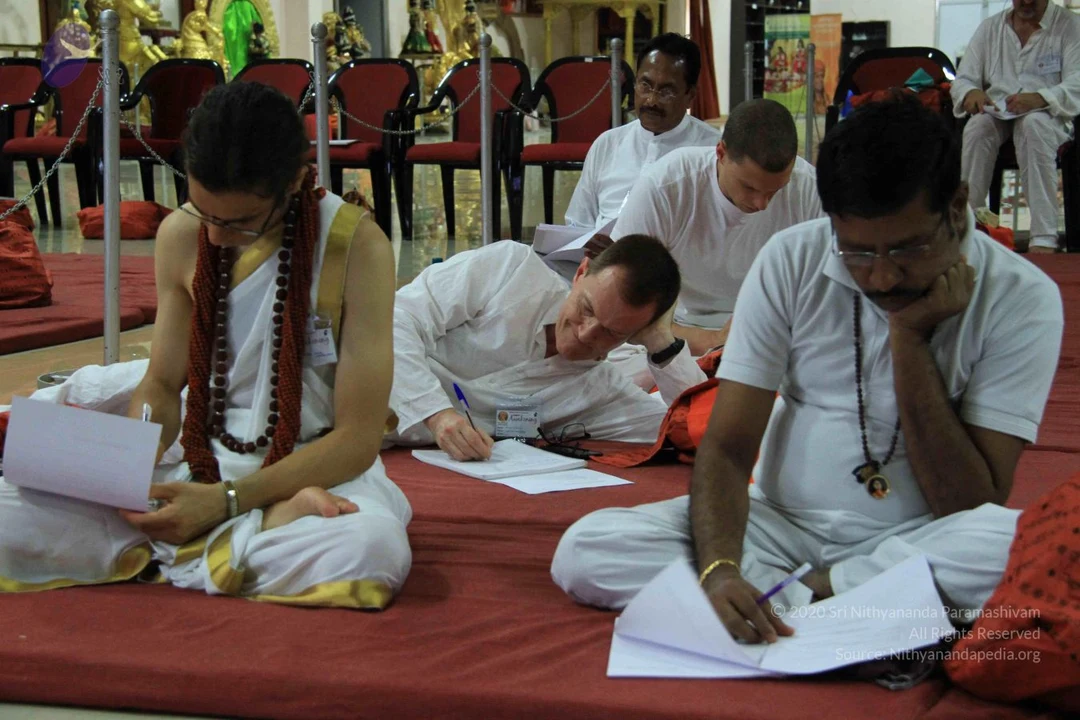
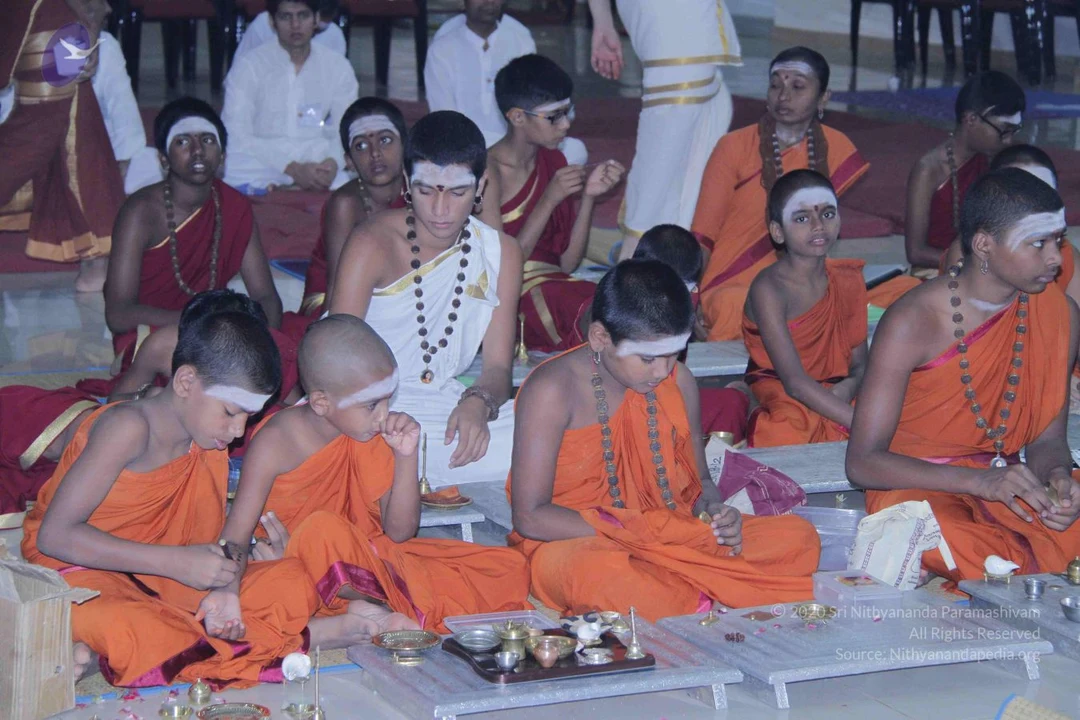
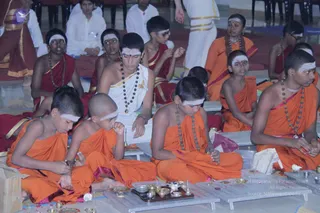
A photograph of a group of young boys seated cross-legged on the floor during a ritual at an ashram hall. Most wear saffron-orange cloths over their shoulders and rudraksha malas, with white tripundra forehead markings, and several have shaved or short-cropped heads. A boy in white dhoti and shawl with a mala sits in the centre, flanked by others in orange and maroon robes. Brass oil lamps, small kalasha-style vessels, bowls, and a tray with offerings sit on low wooden stands before them, and a few are handling items. Behind them, an adult in red-and-gold dhoti and another in white stand or sit in the background, with a dark wooden box at the left edge.

Darshan

57 photosSource gallery
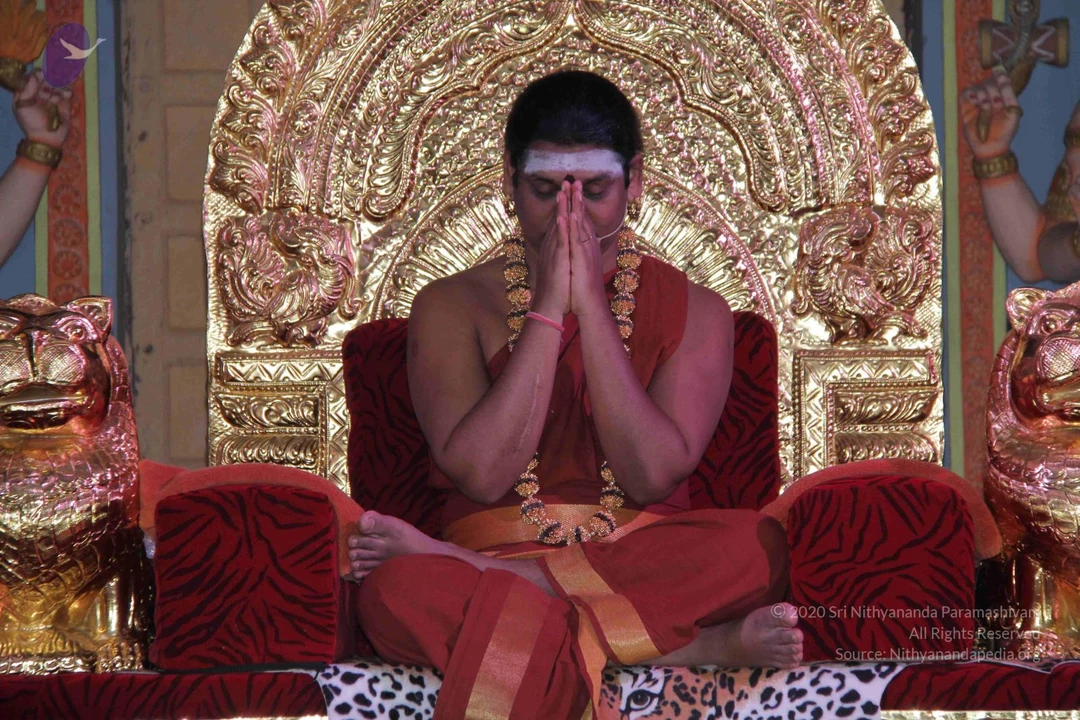
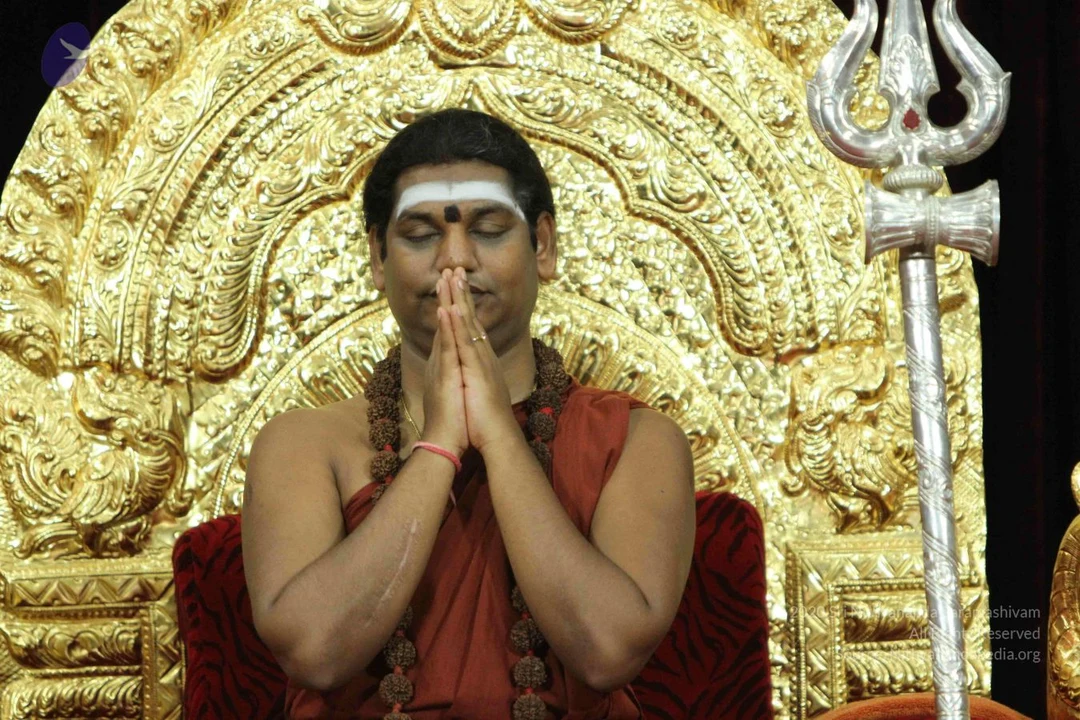
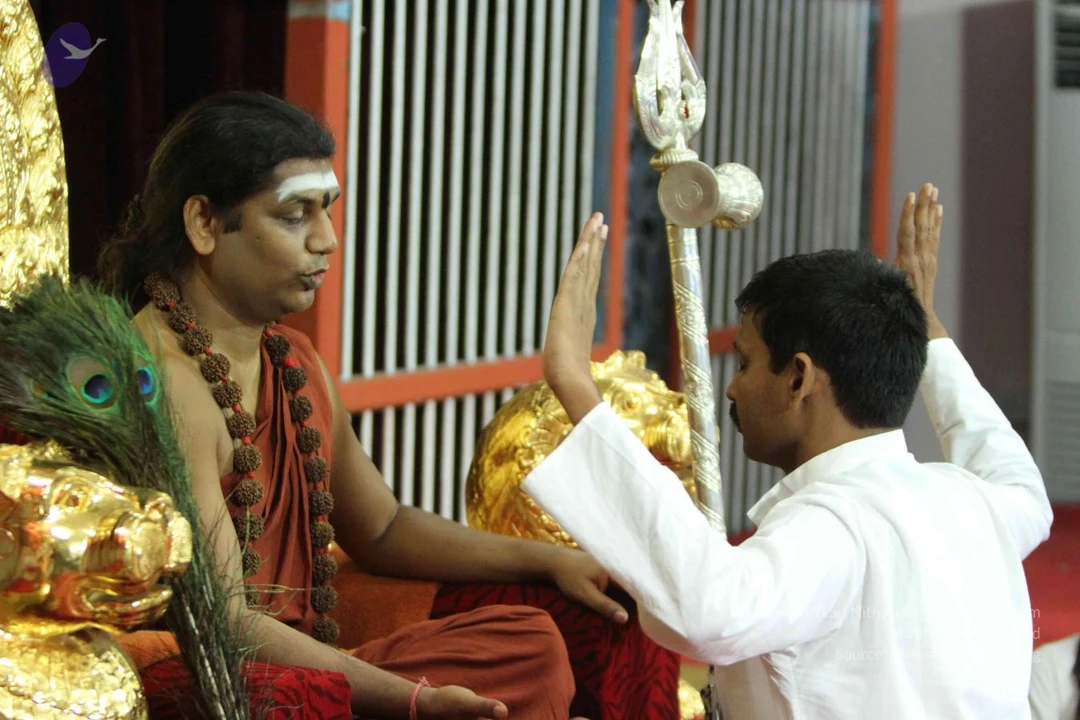
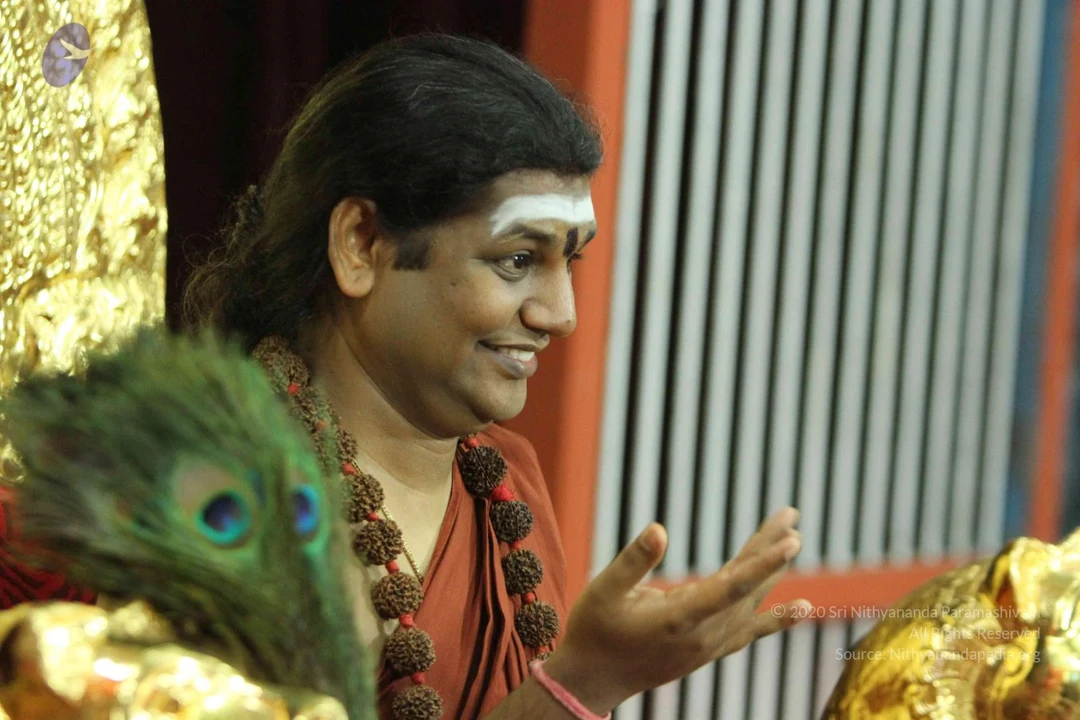
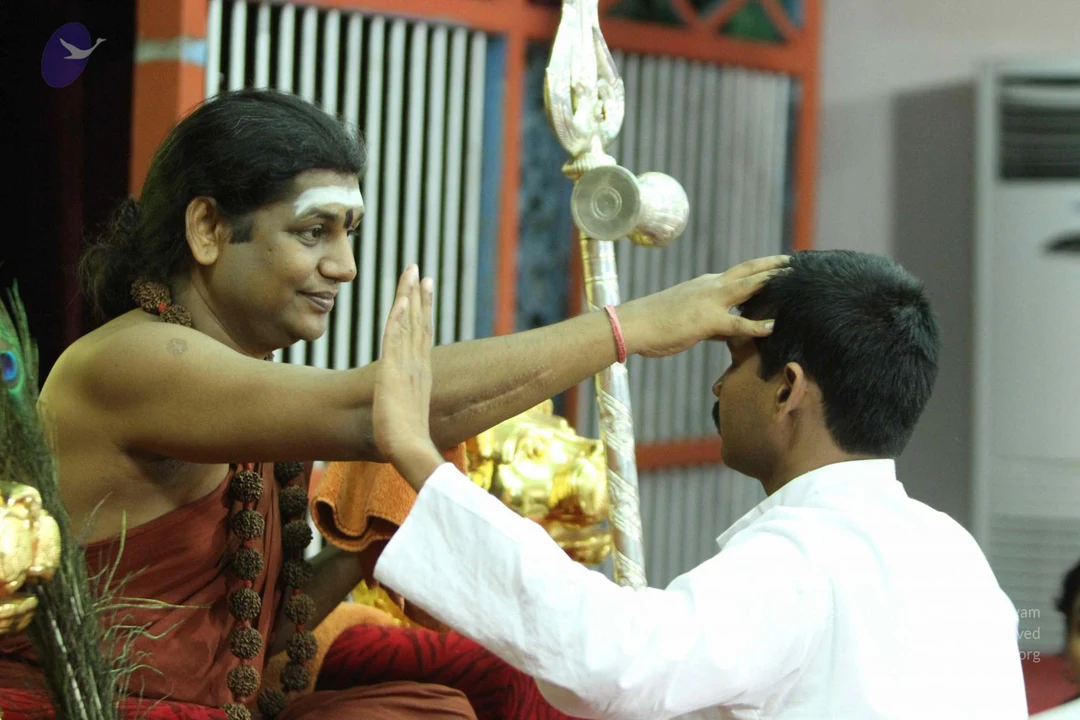
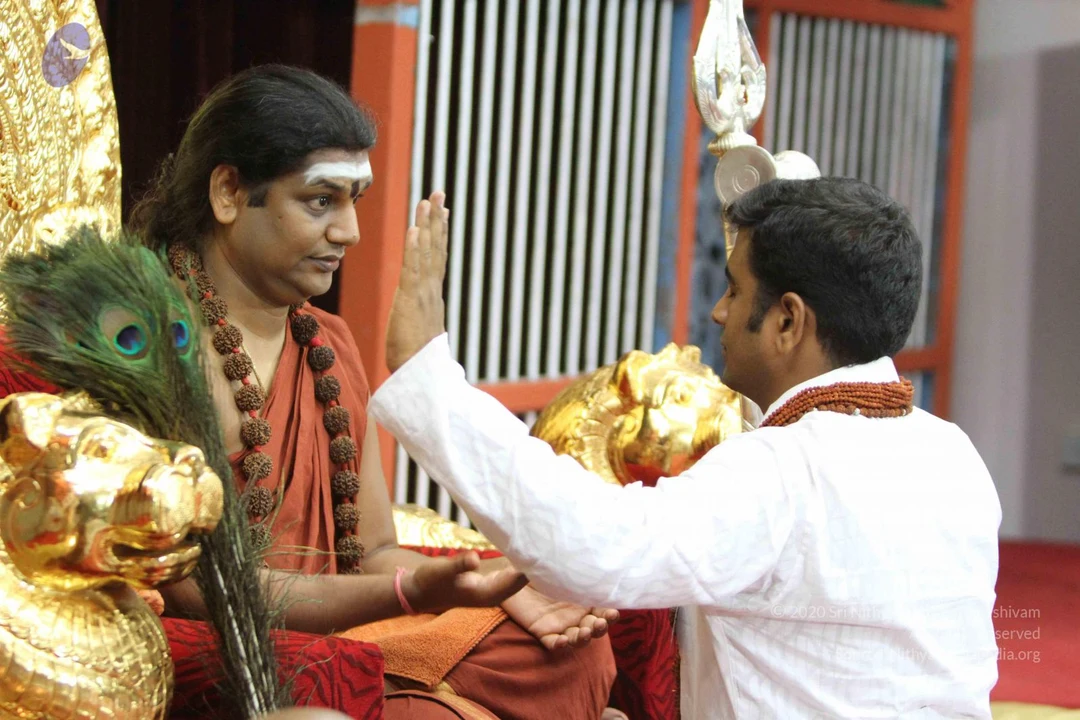
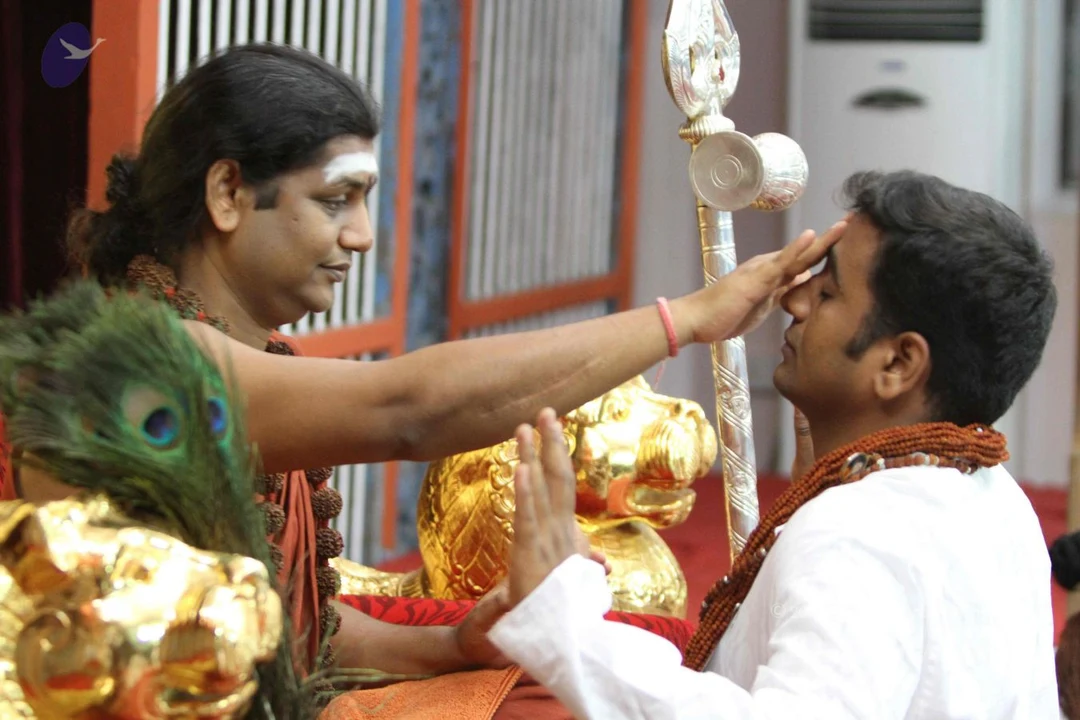
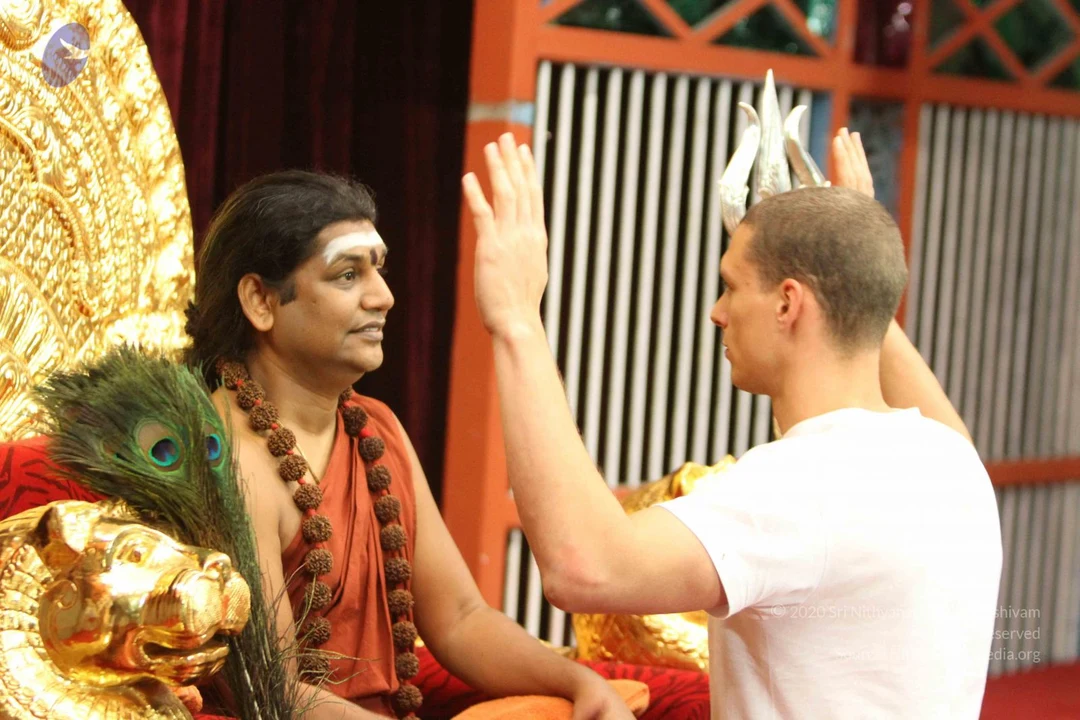
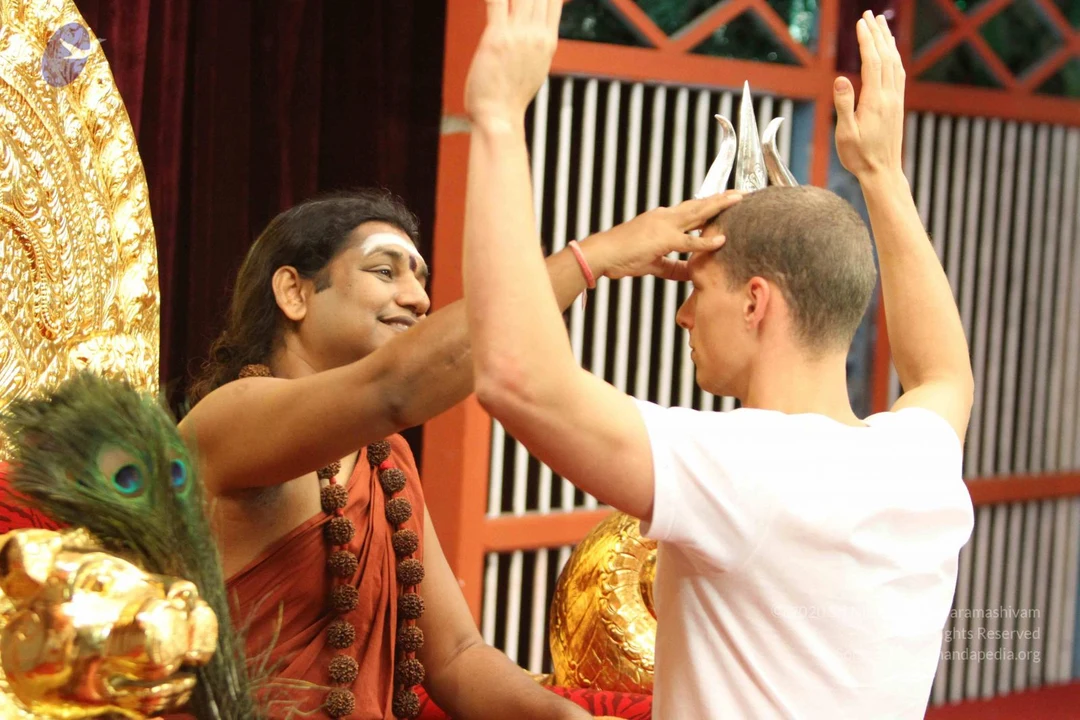
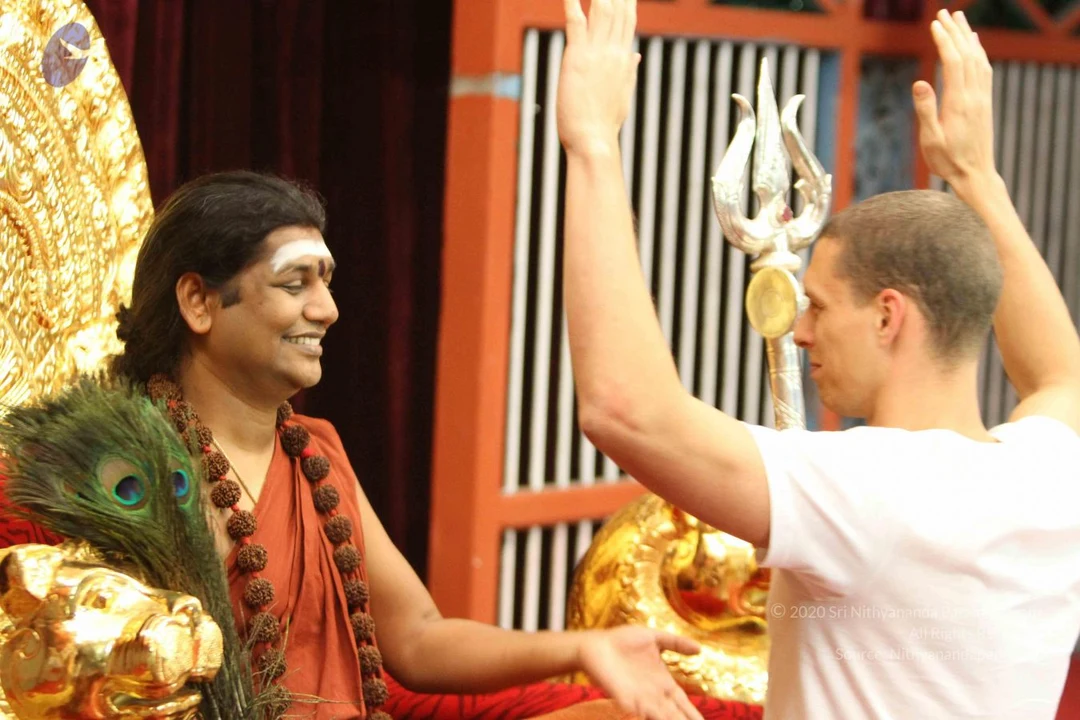
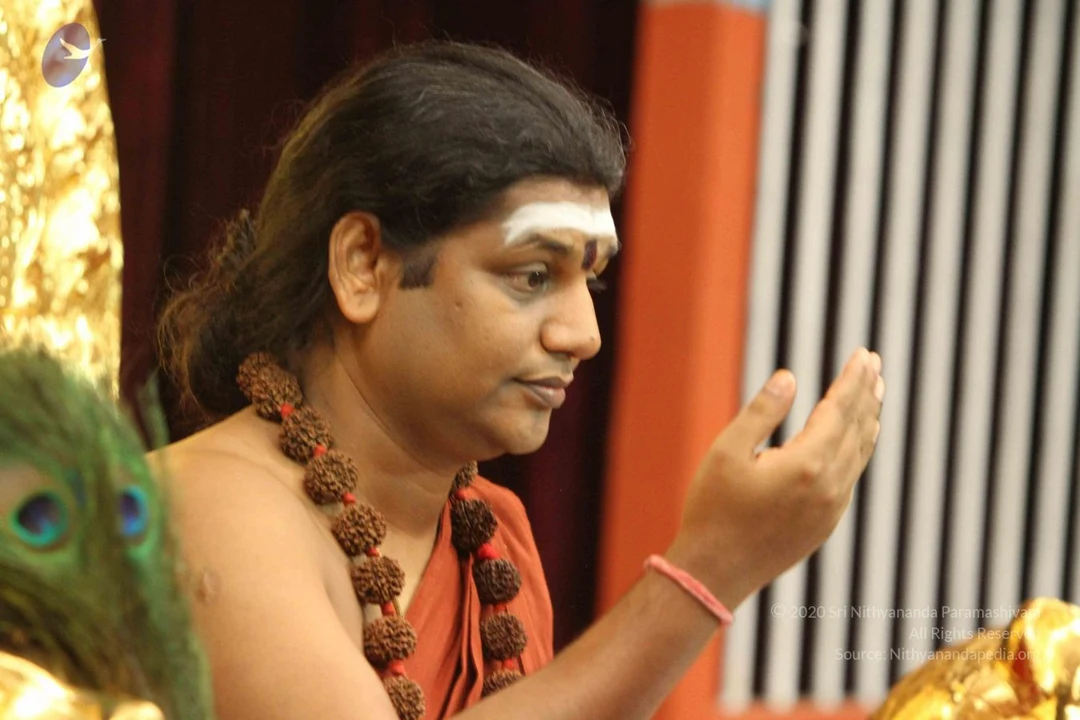
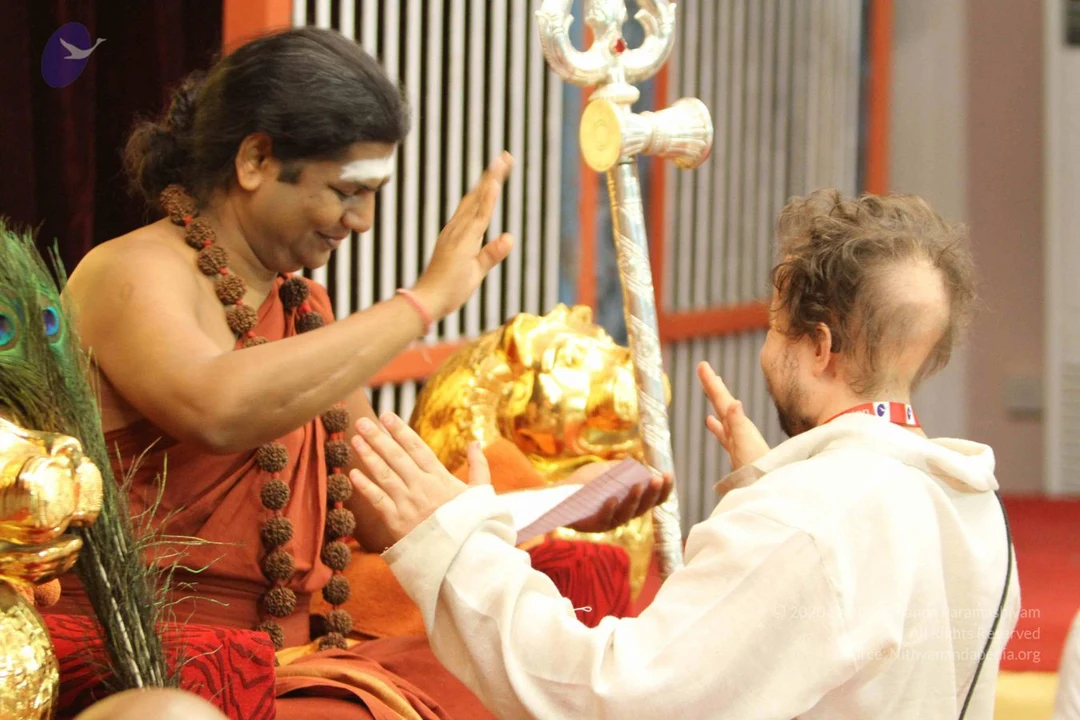
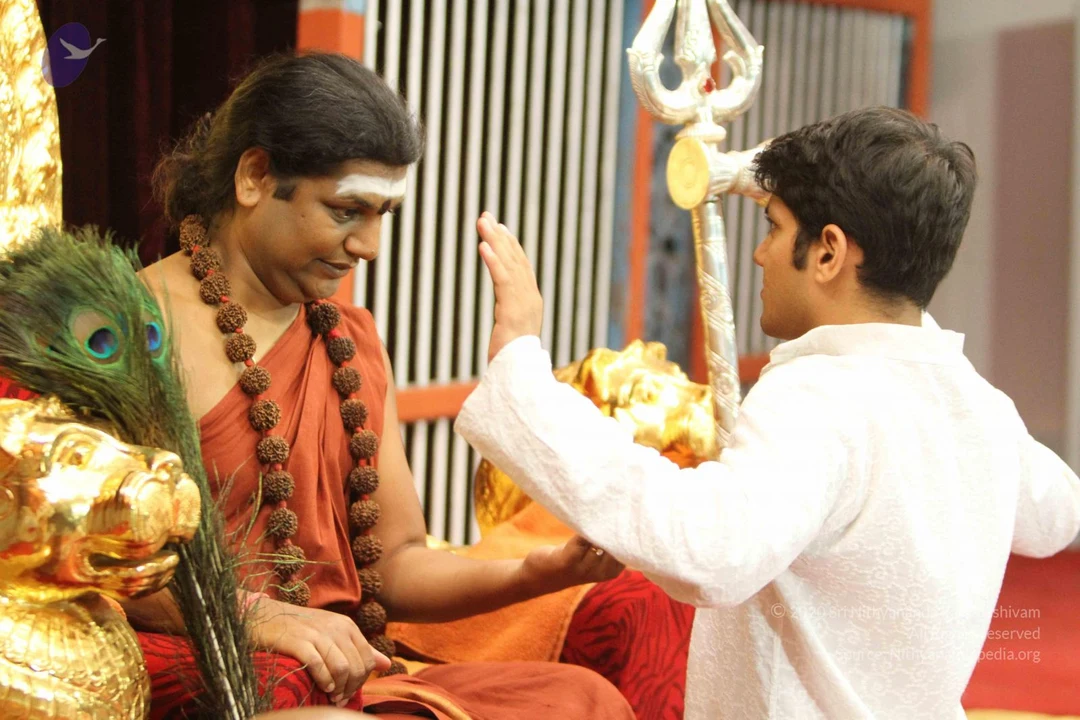
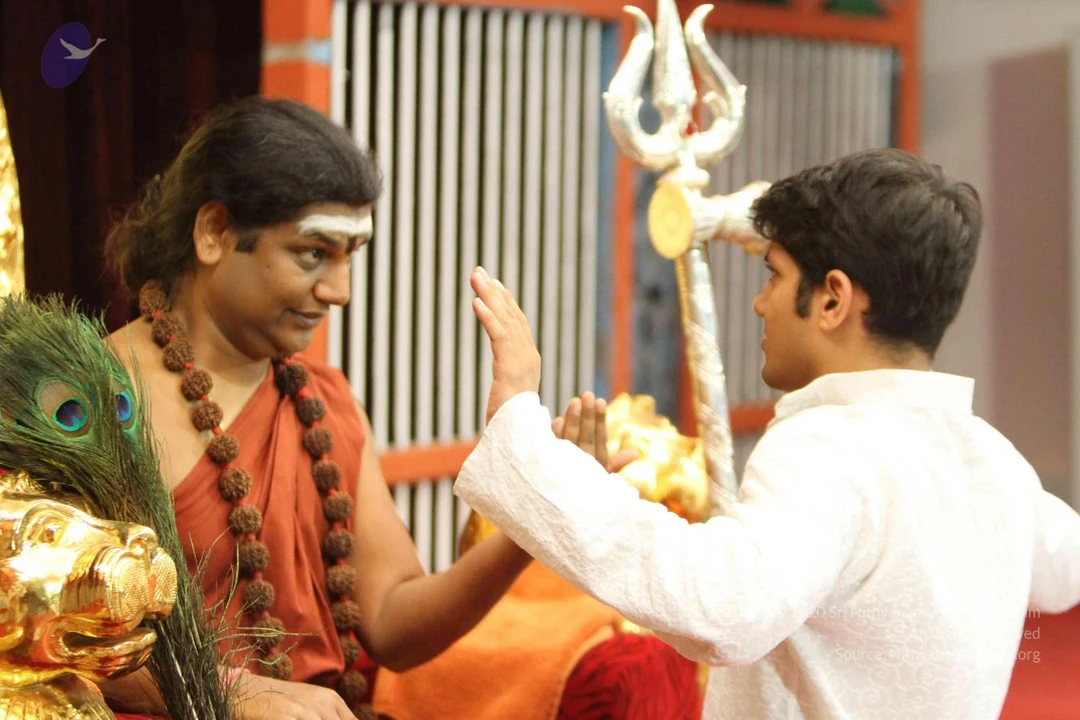
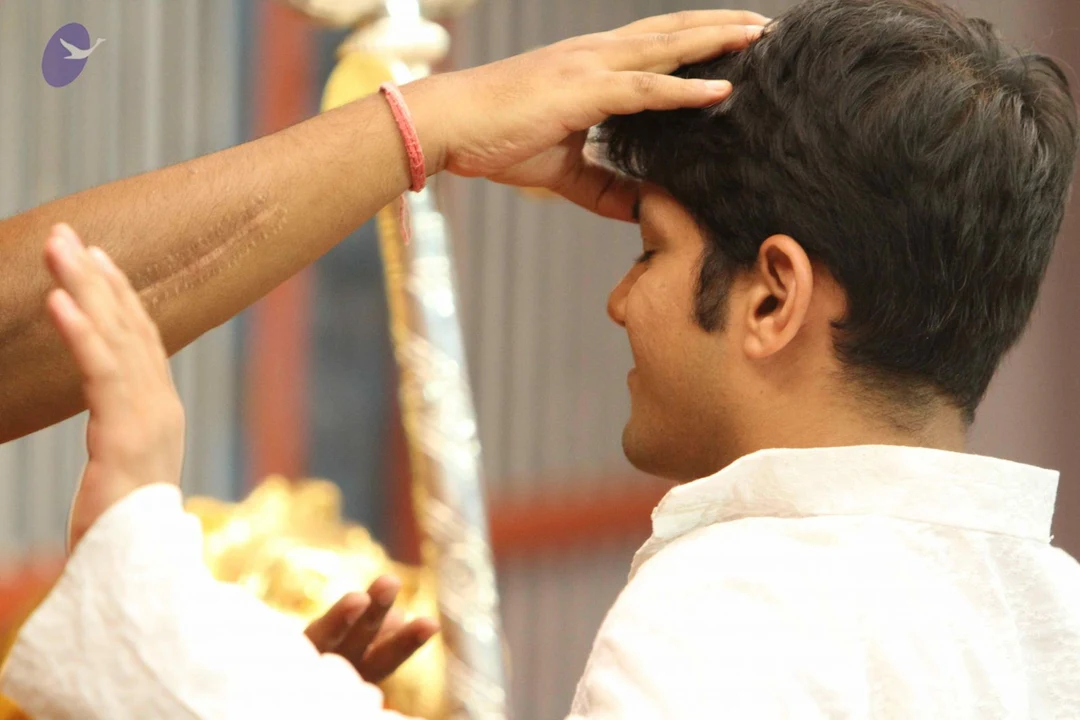
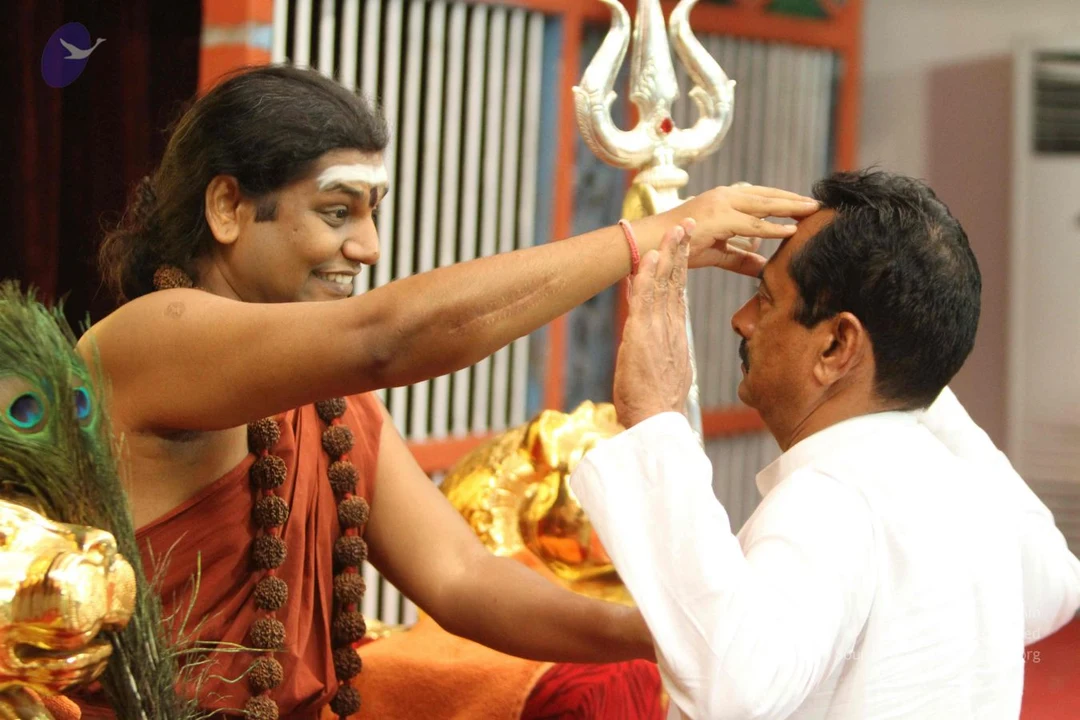
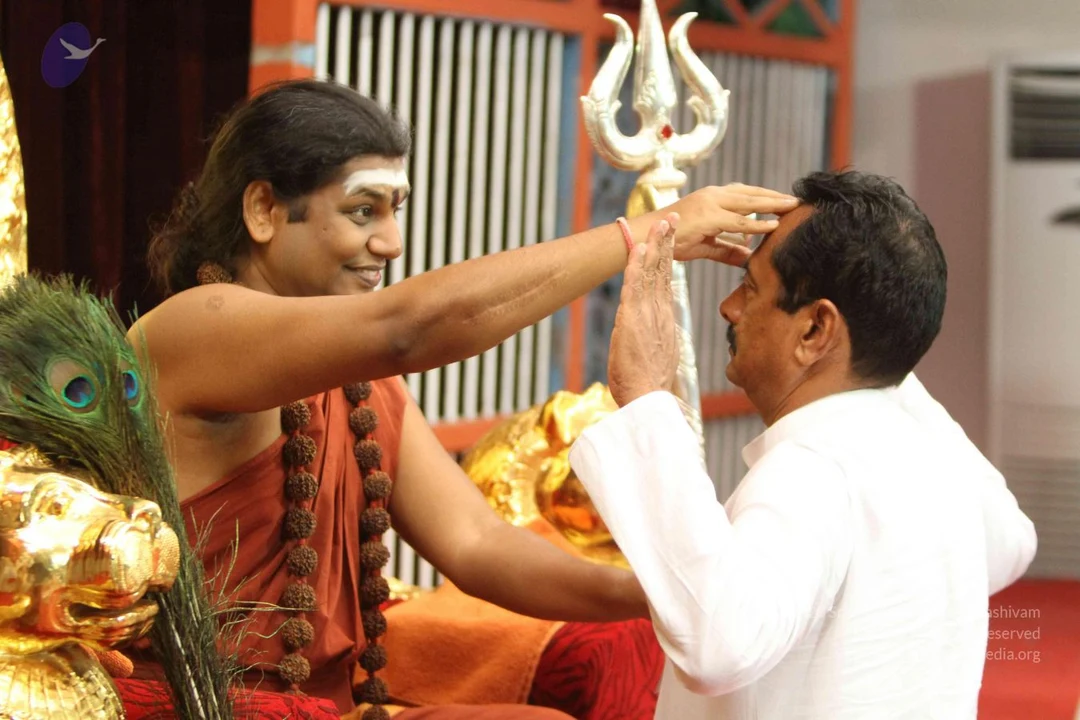
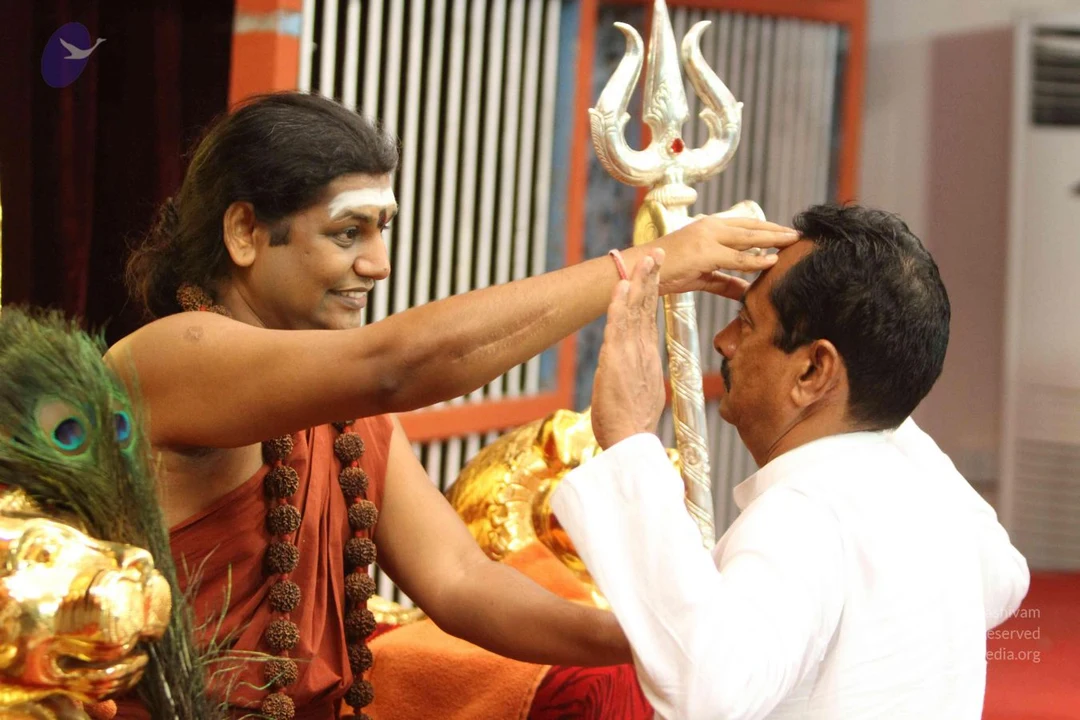
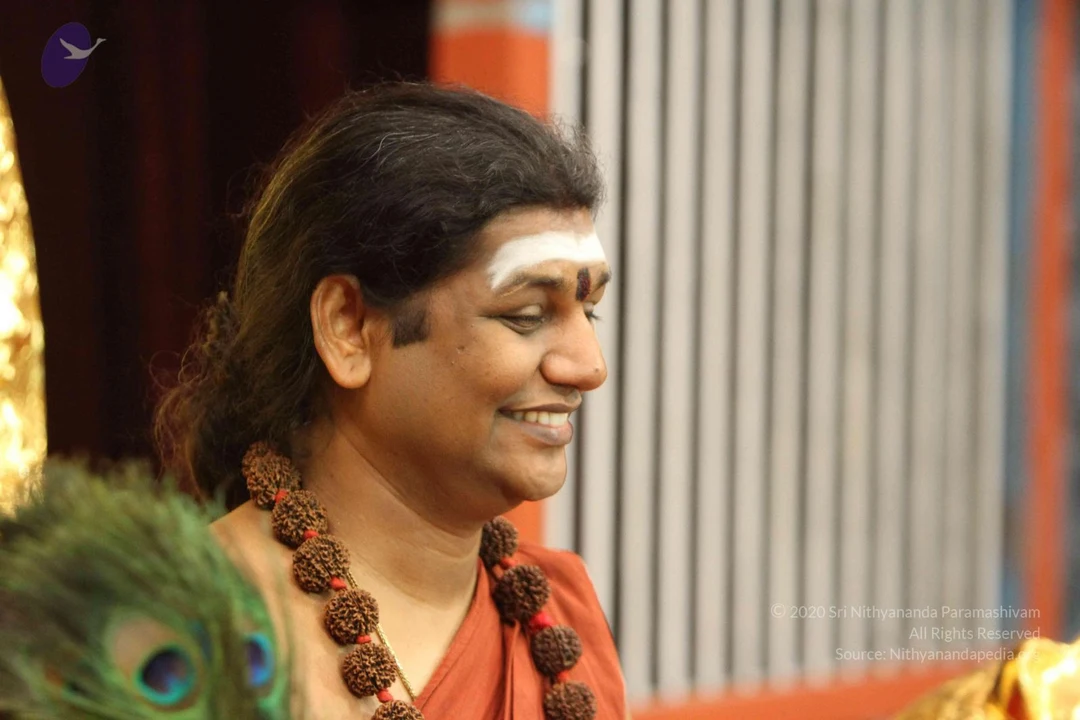
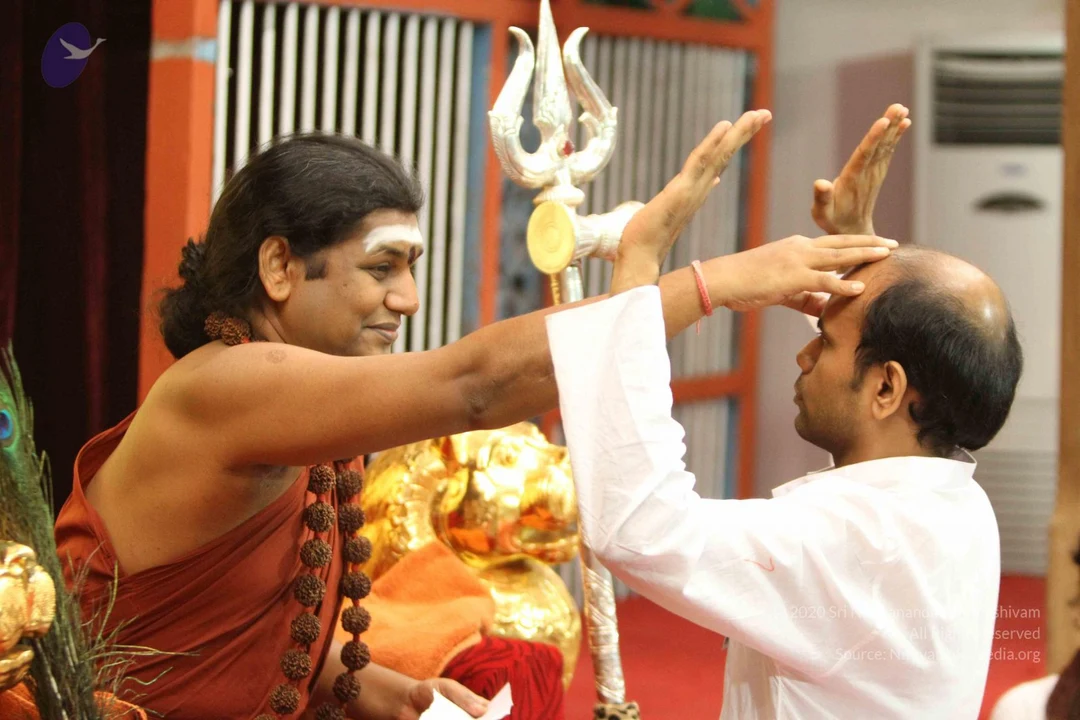
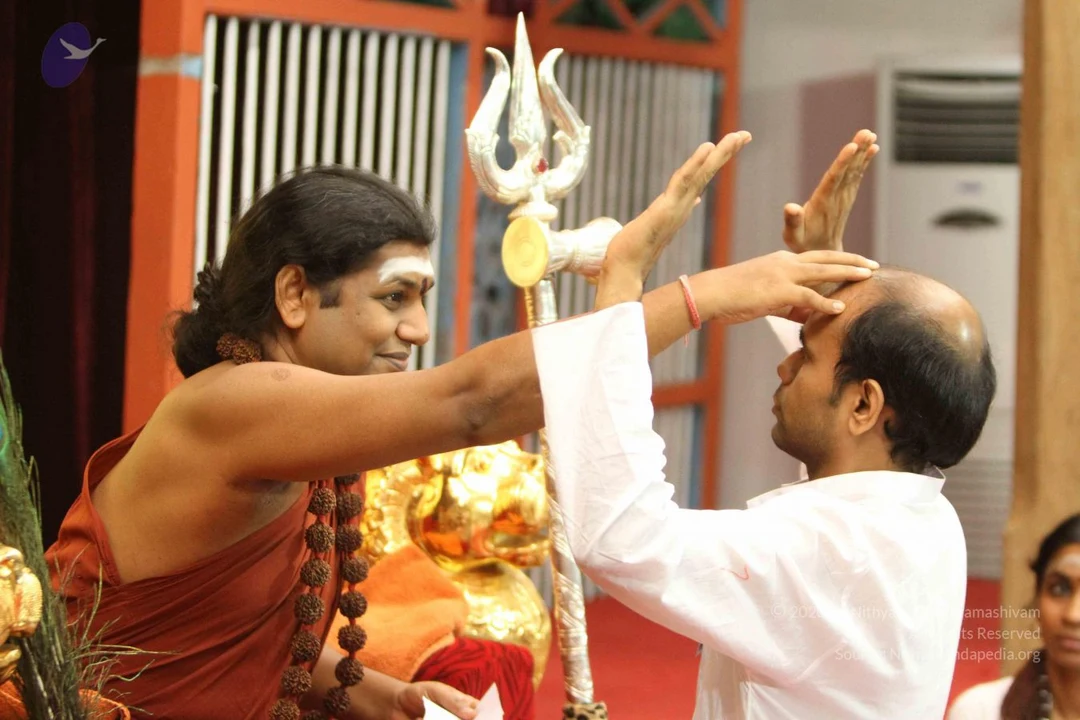
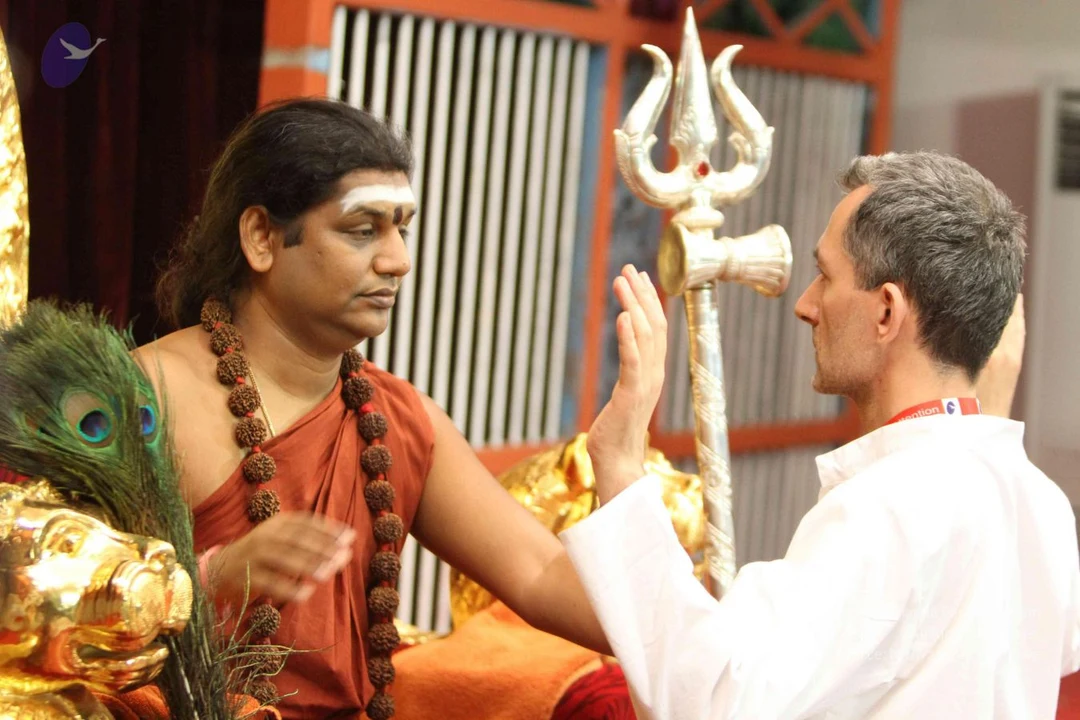
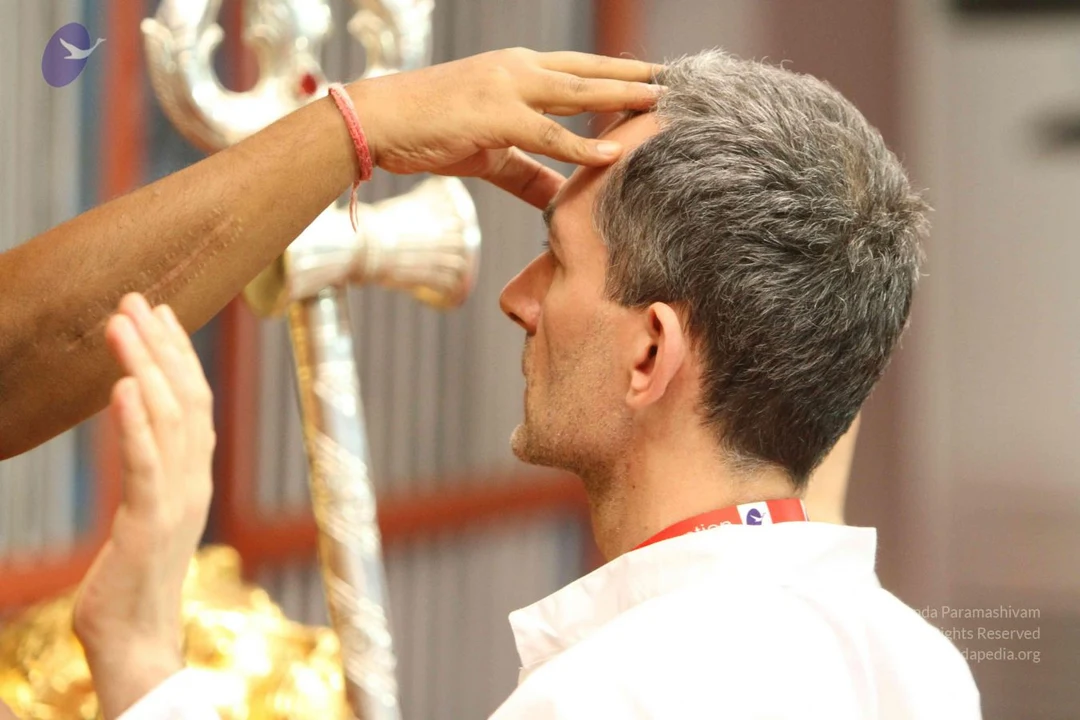
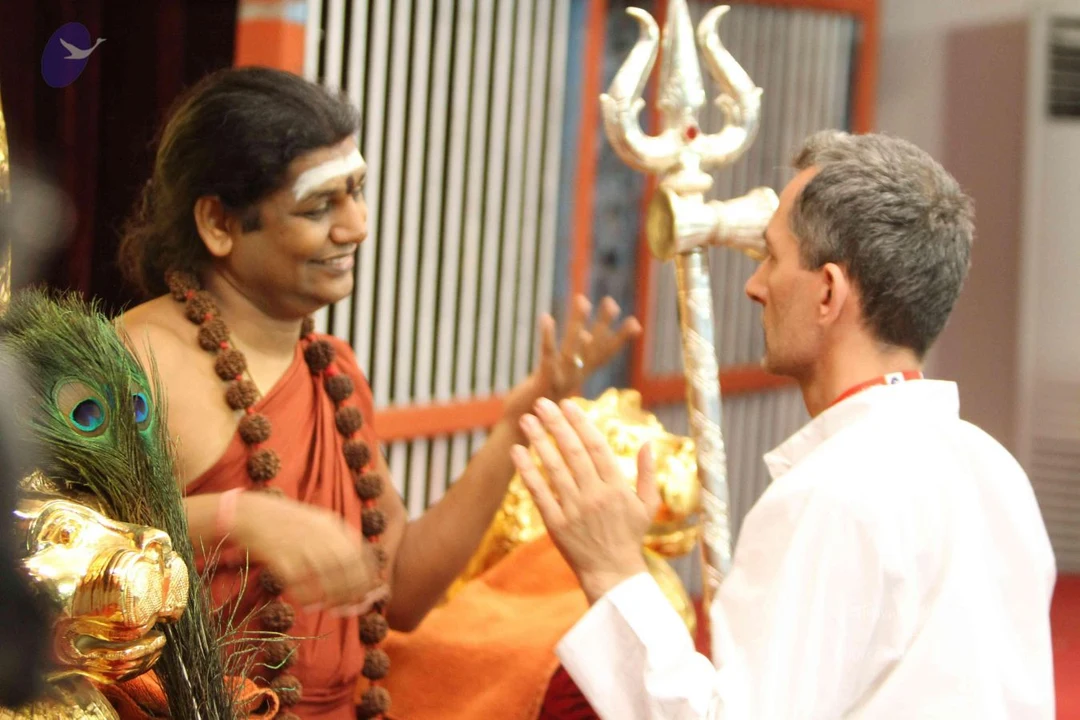
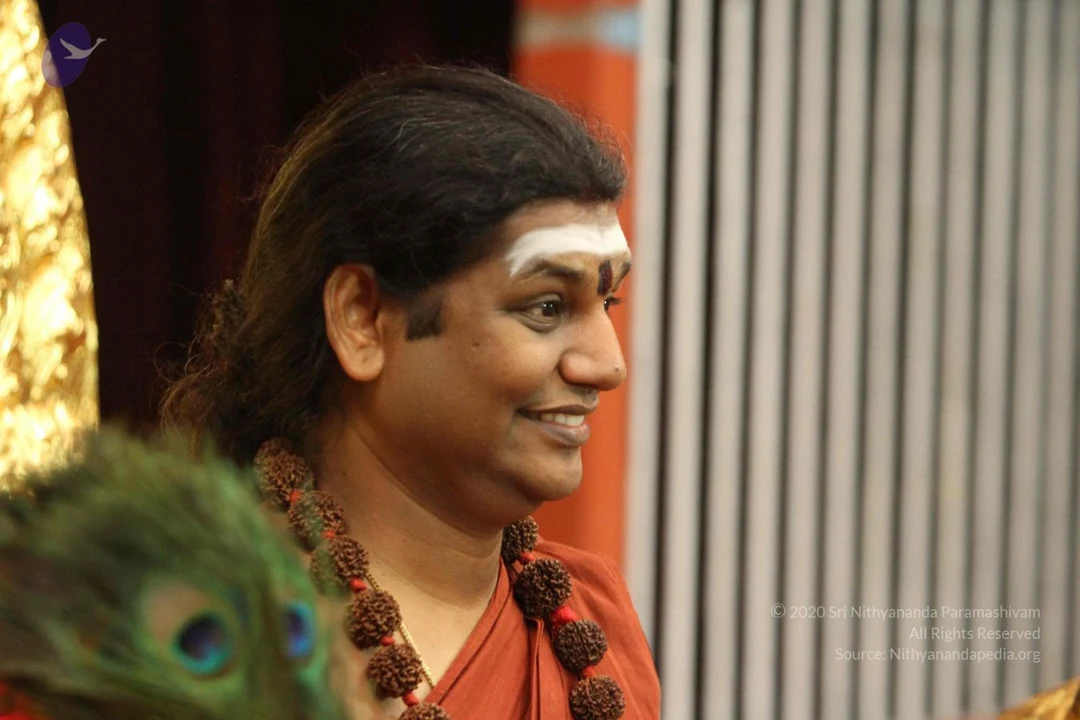
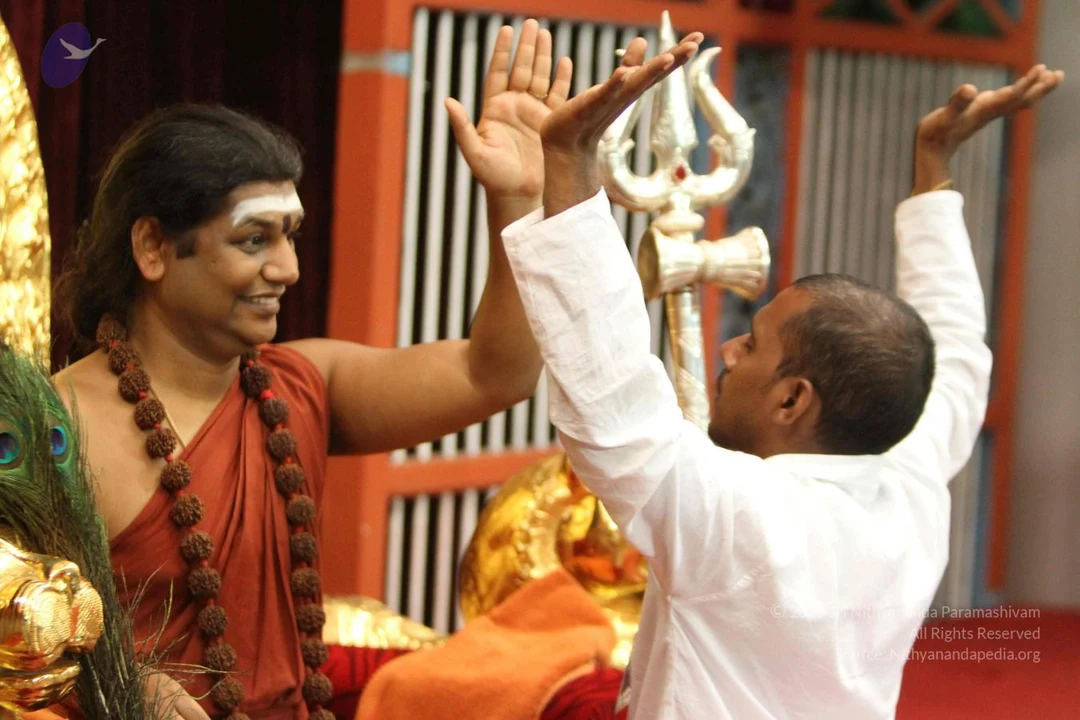
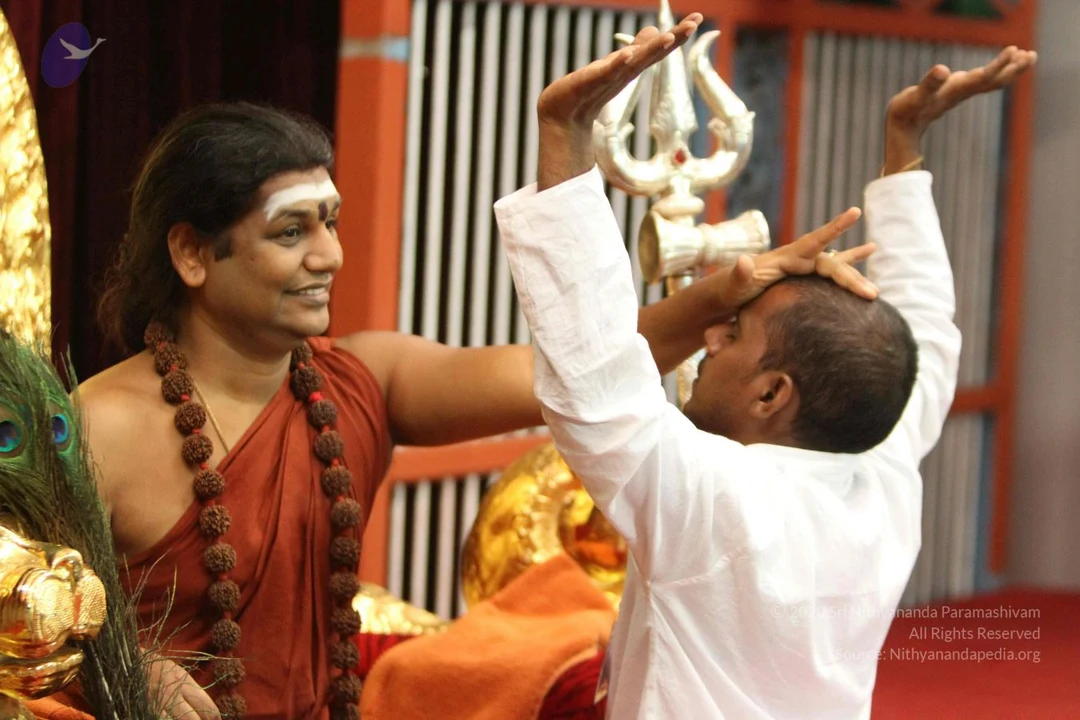
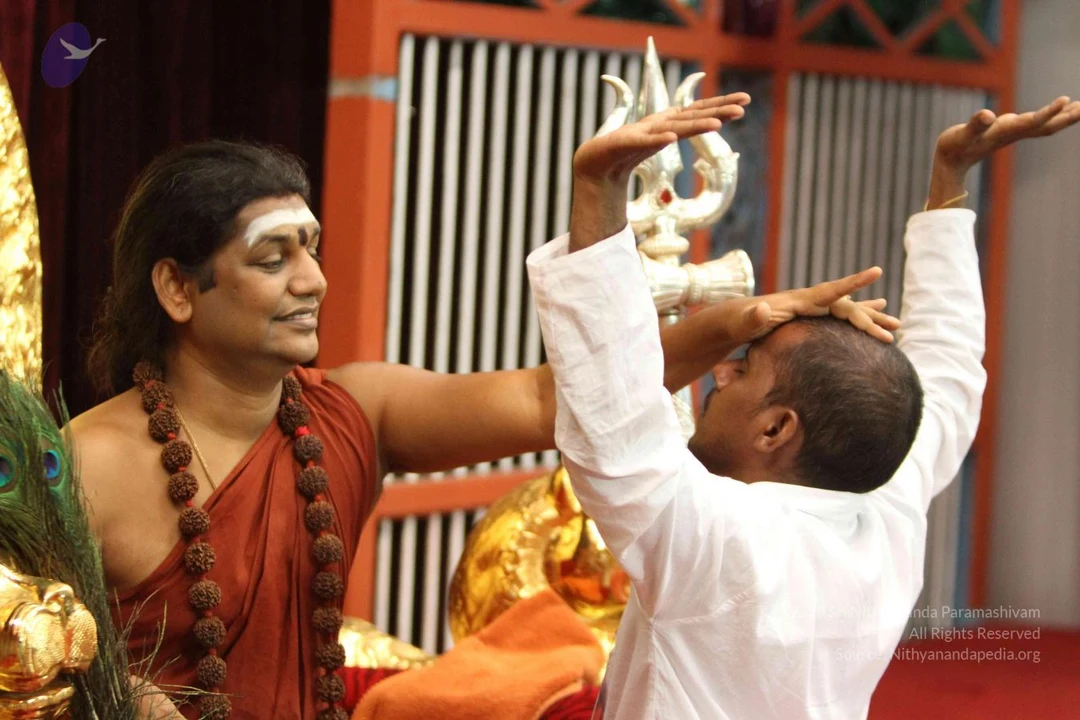
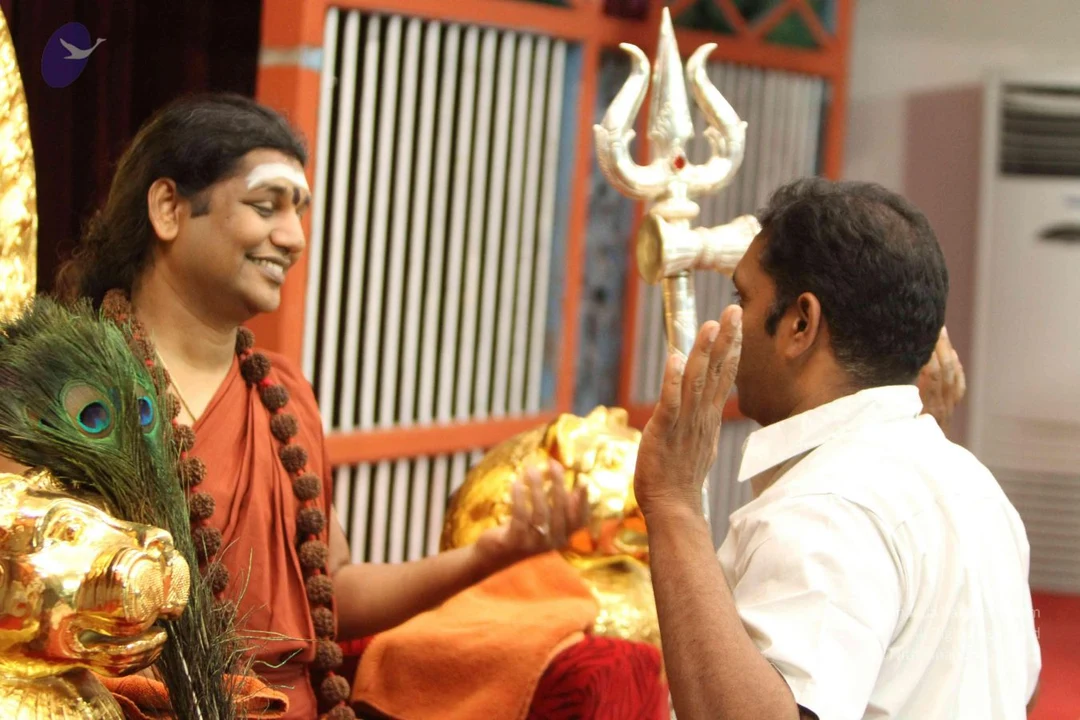
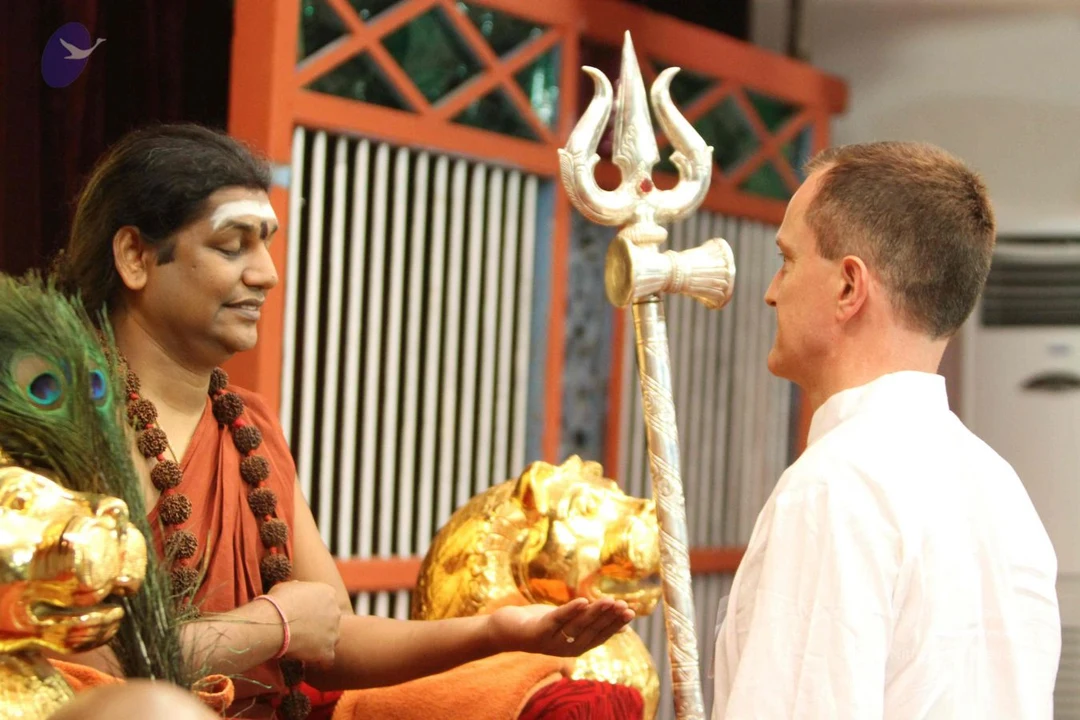
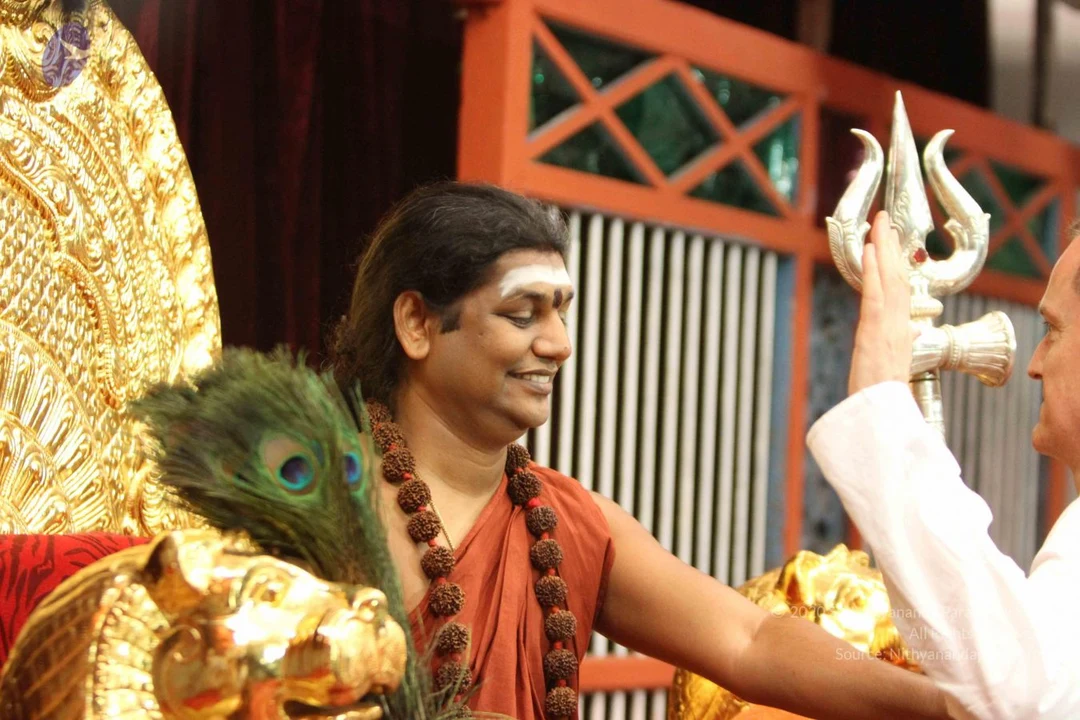
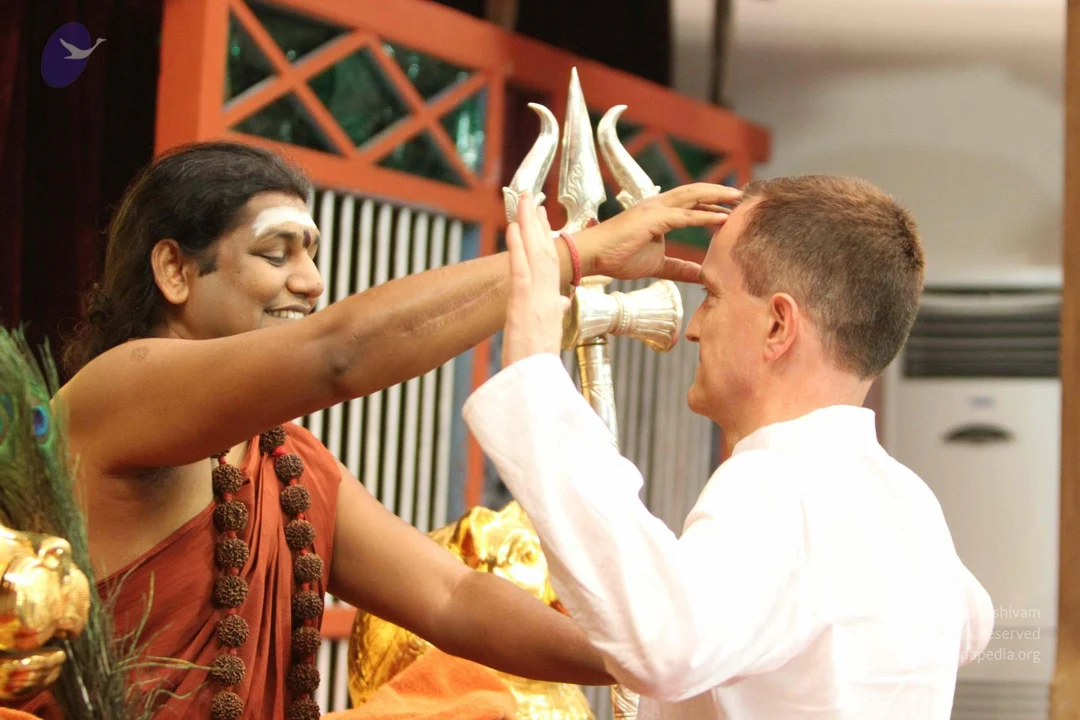
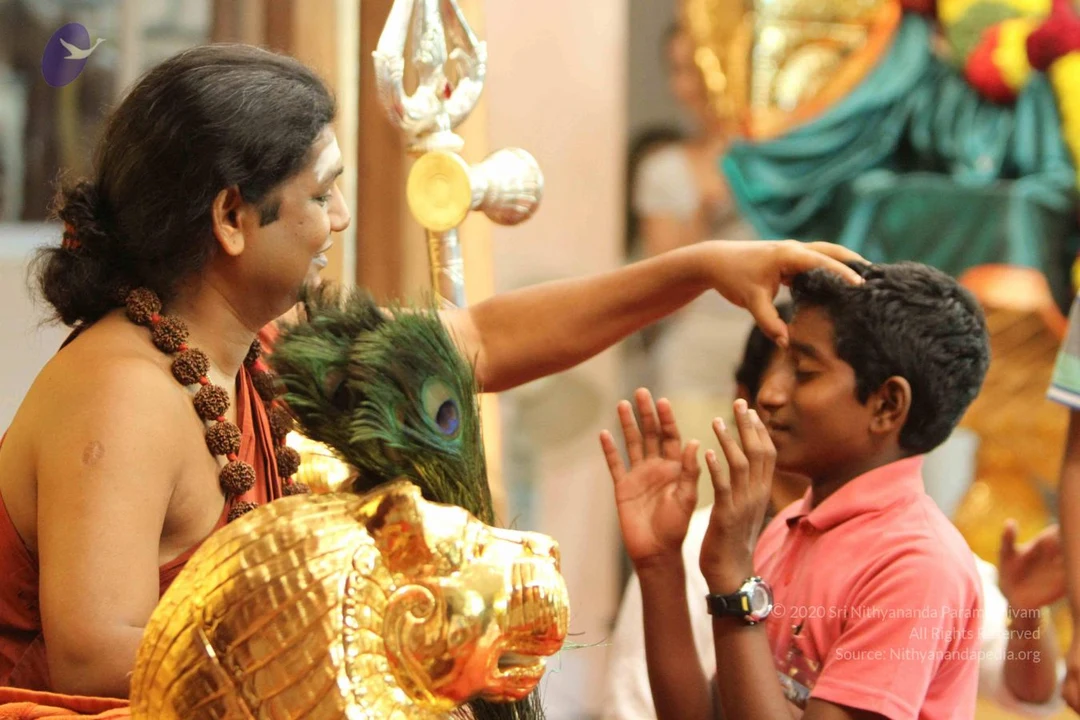
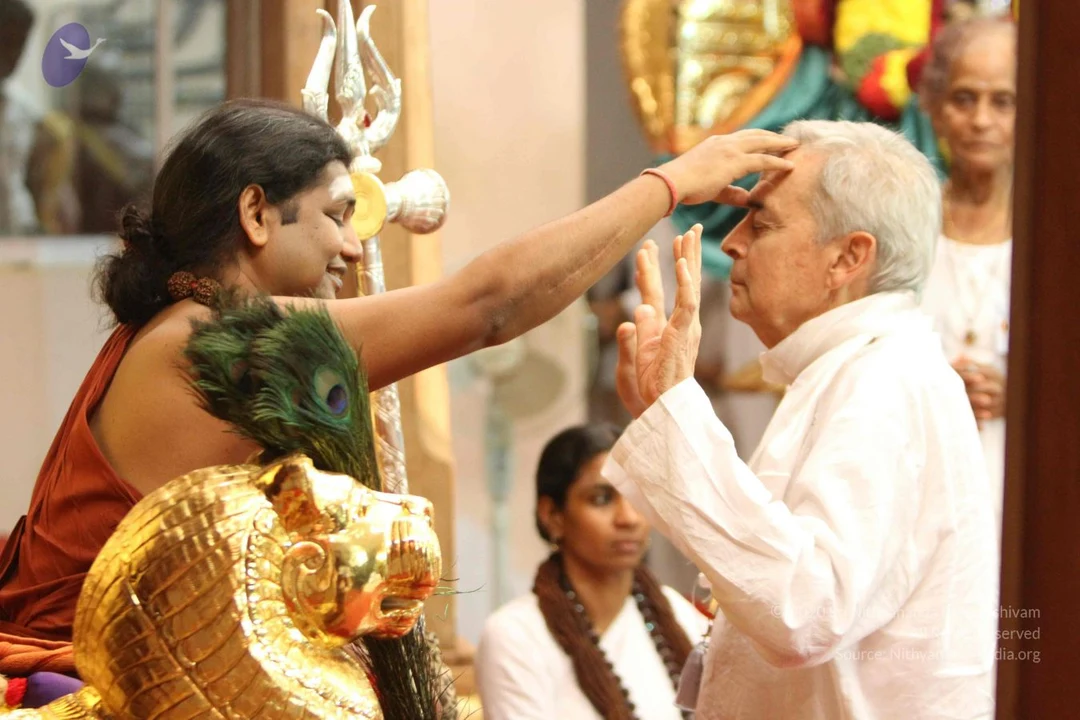
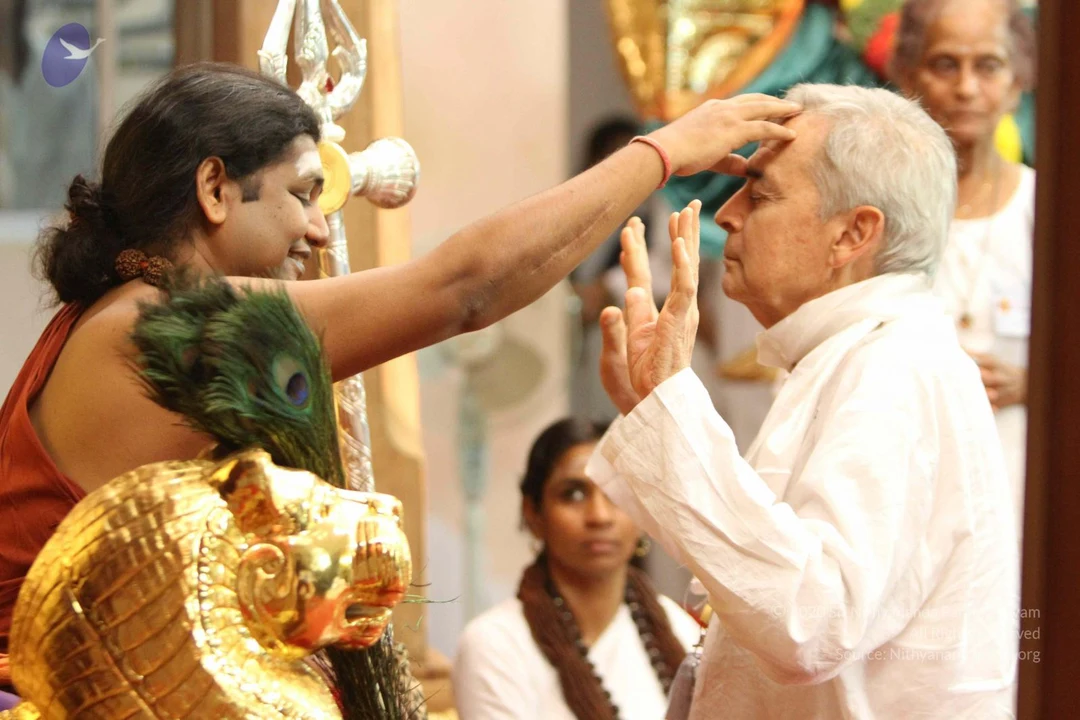
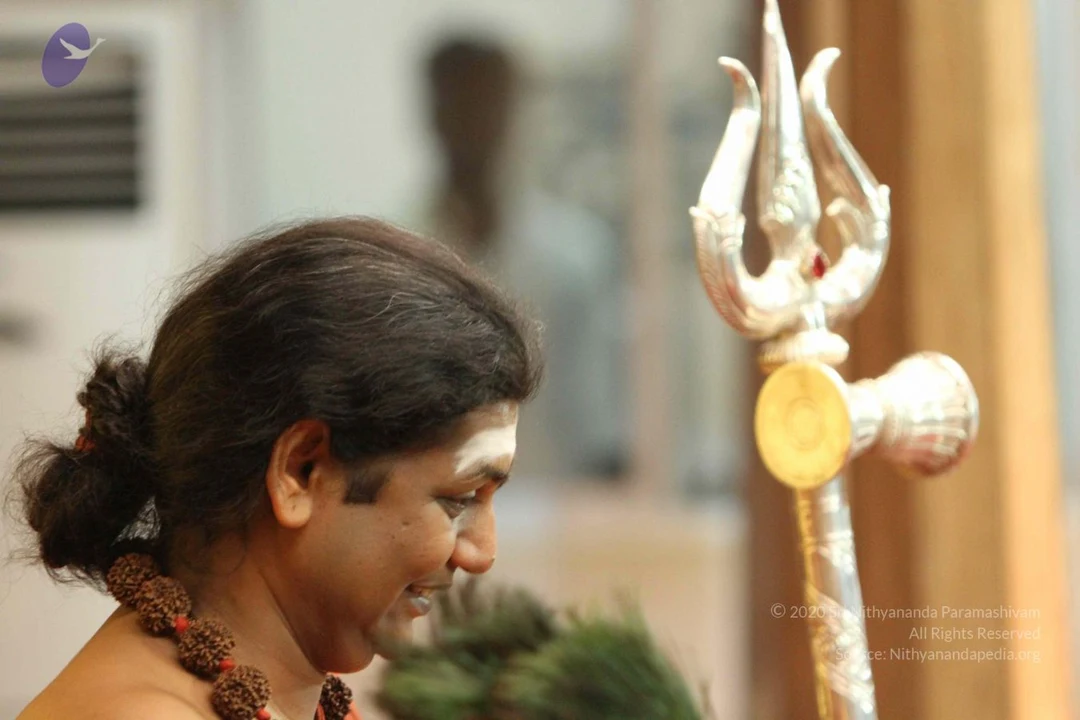
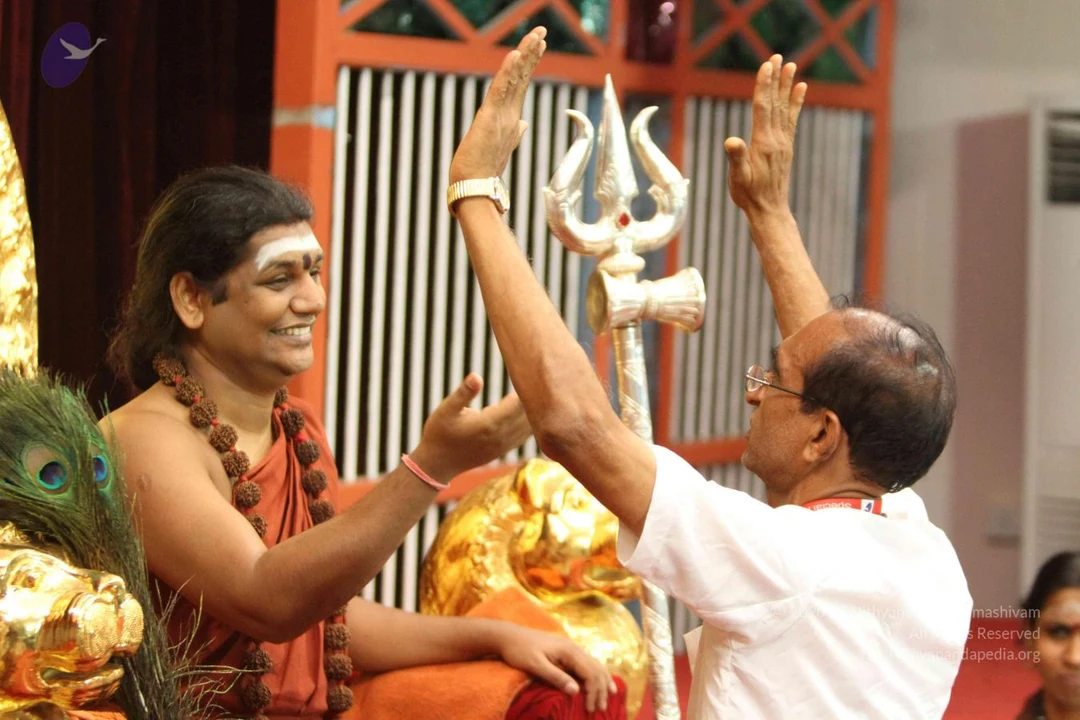
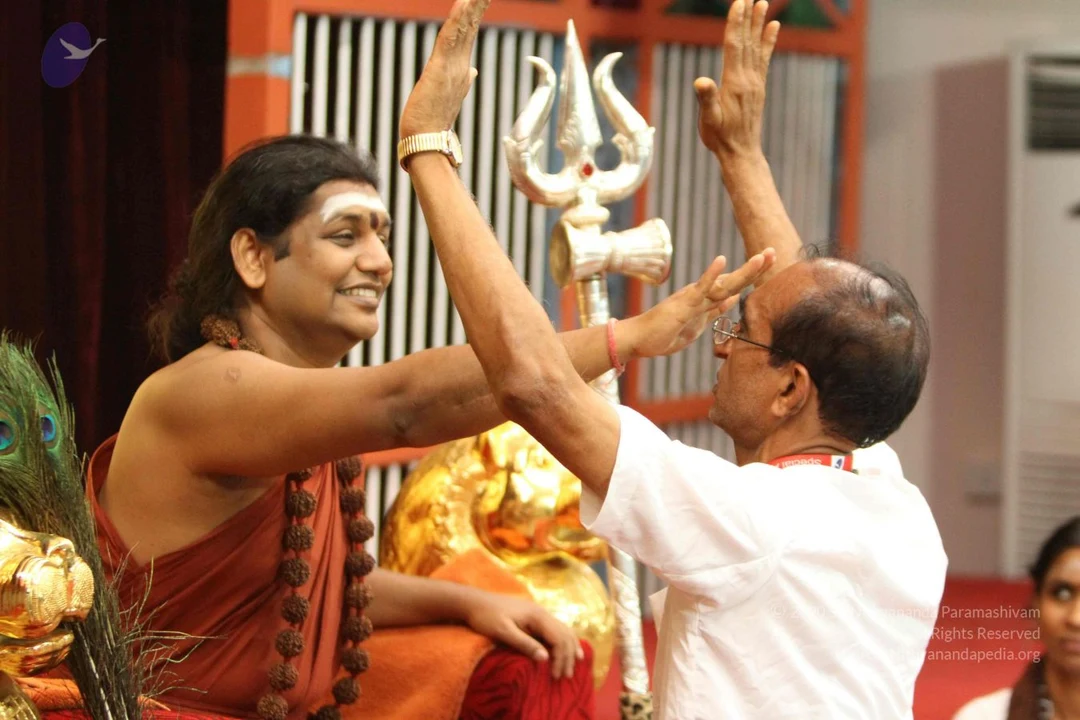
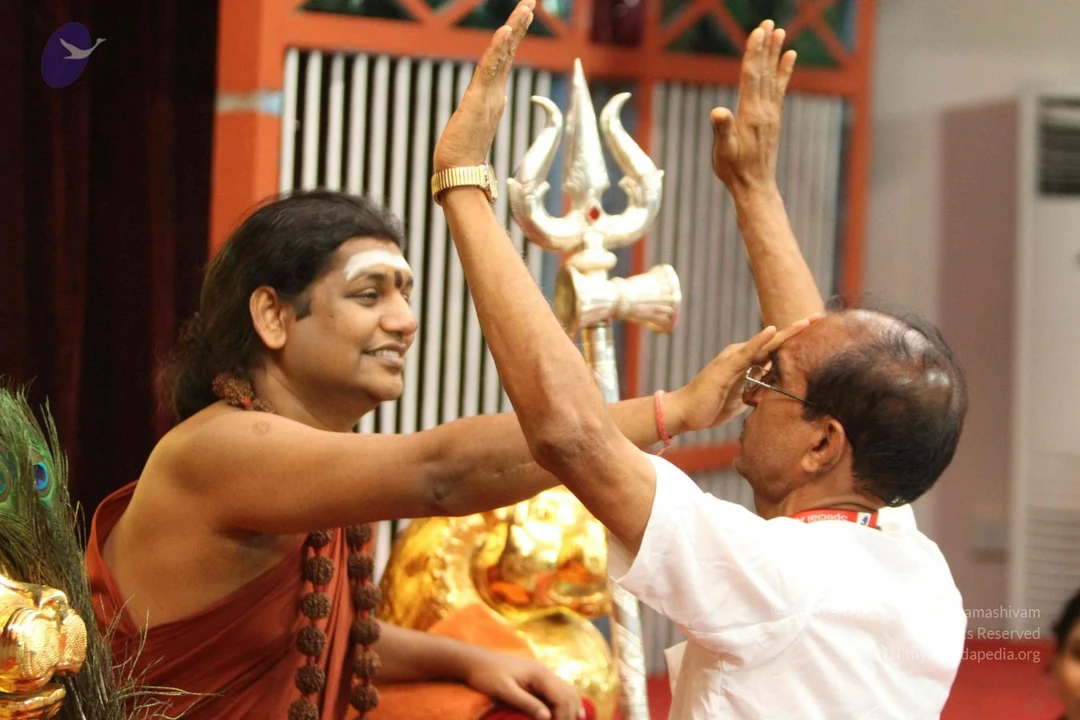
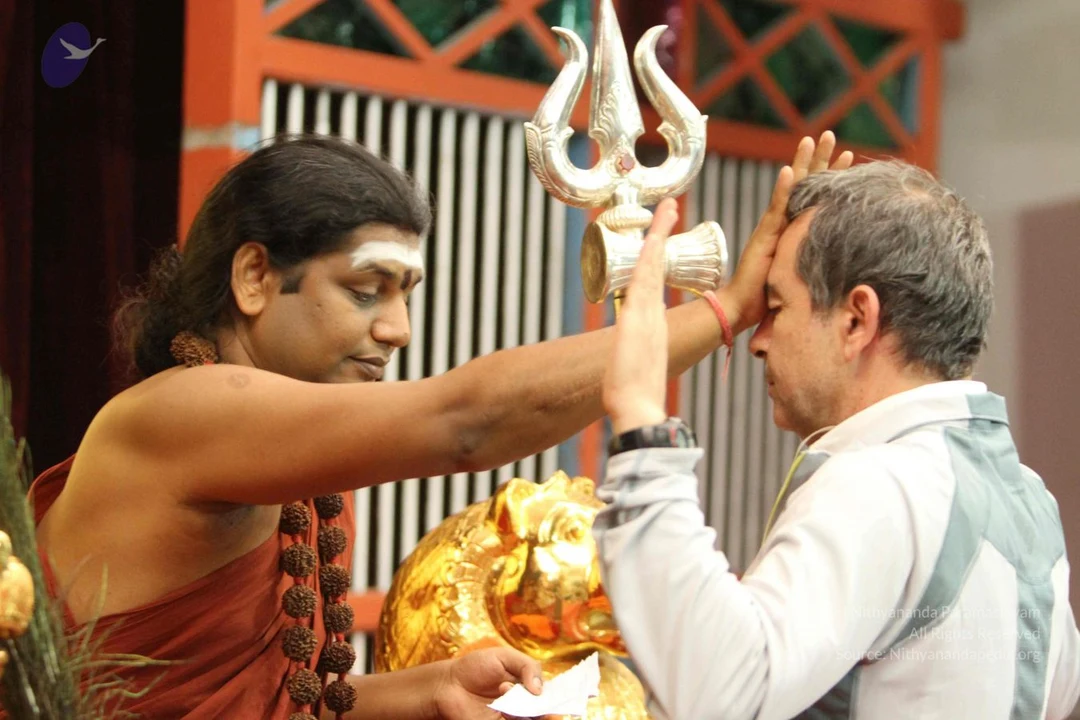
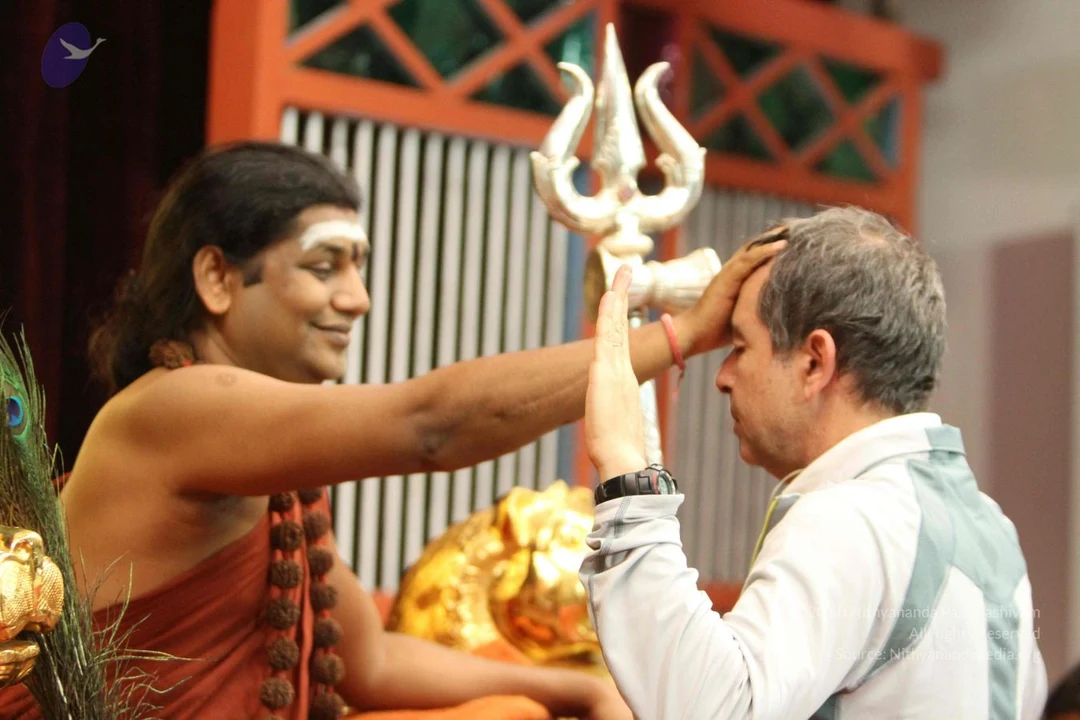
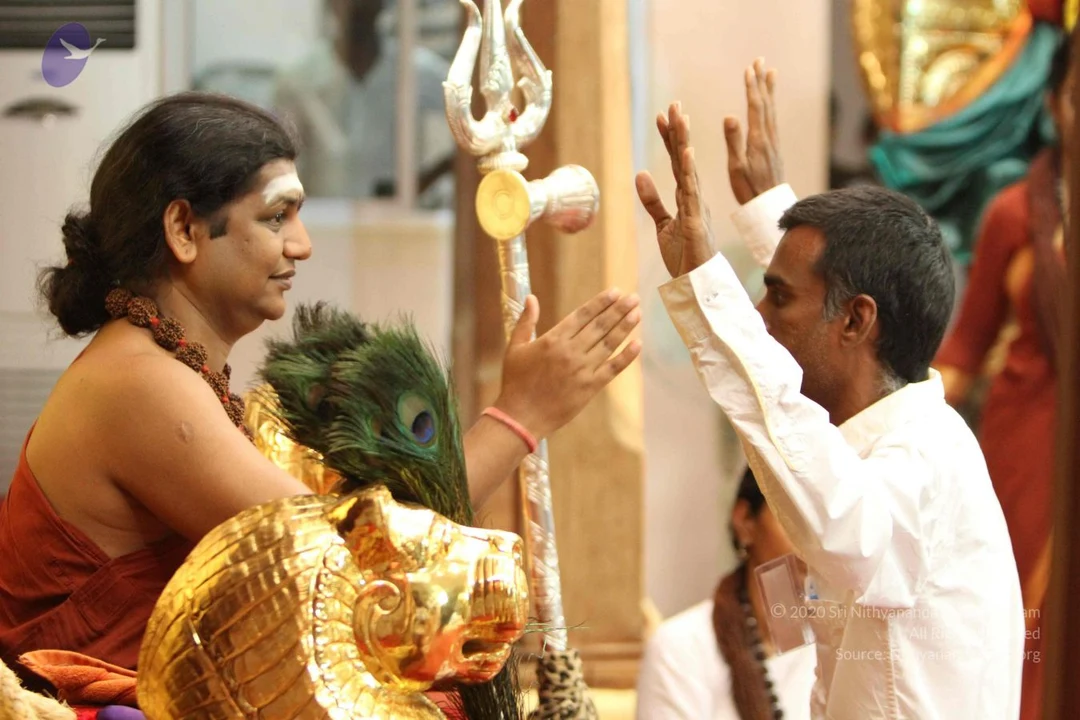
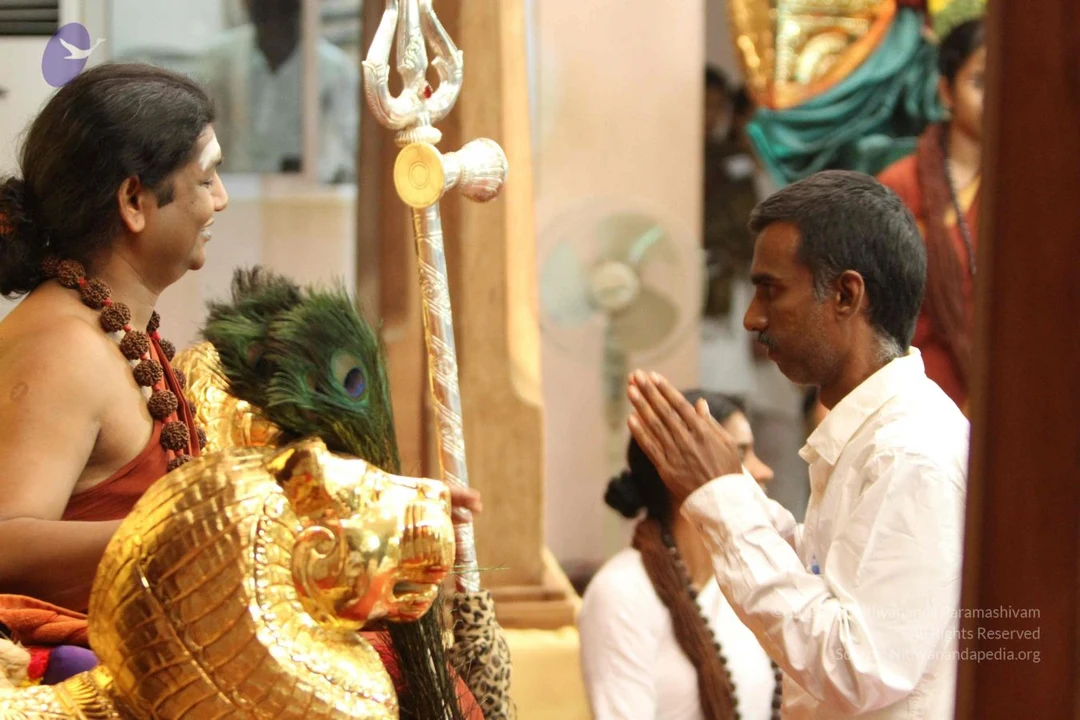
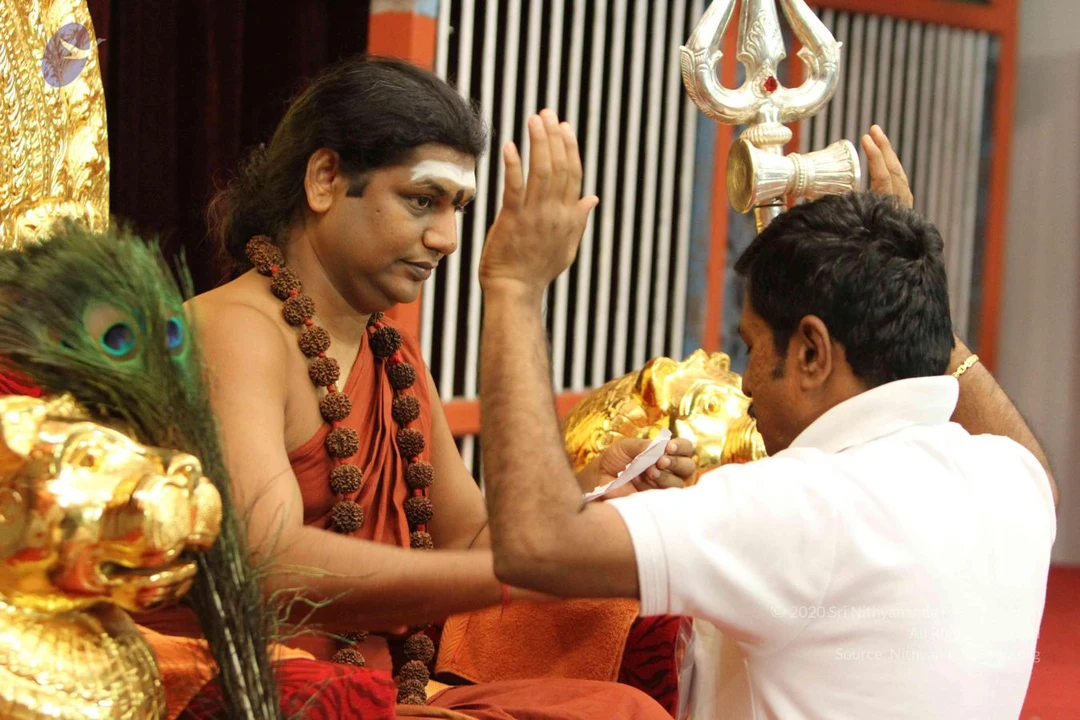
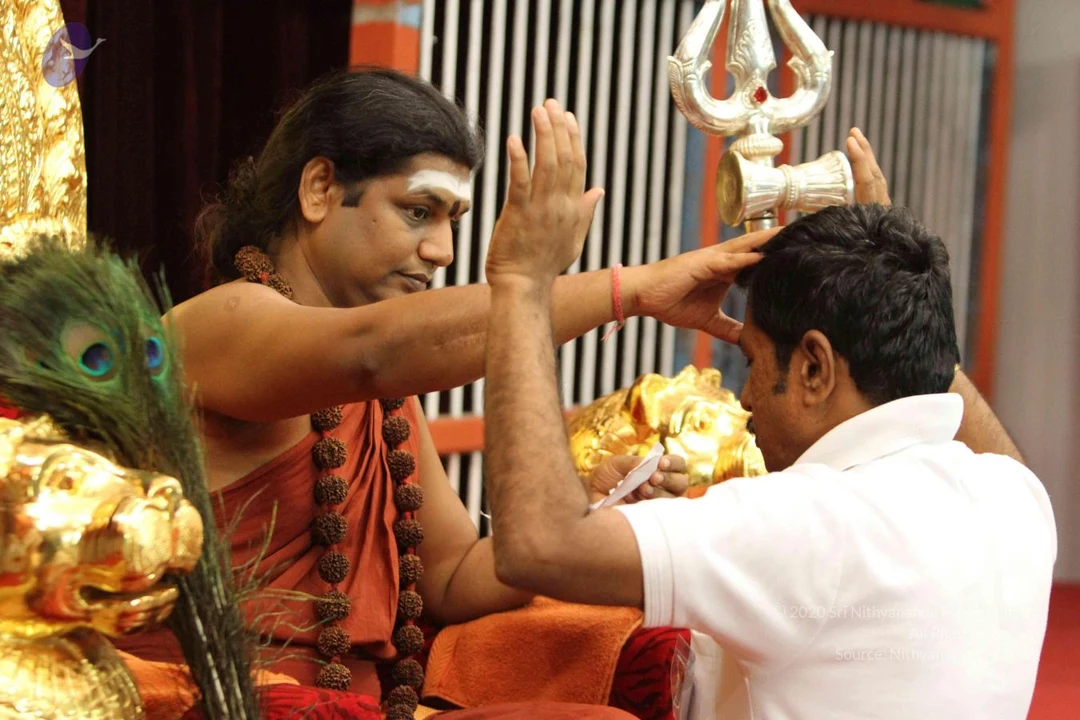
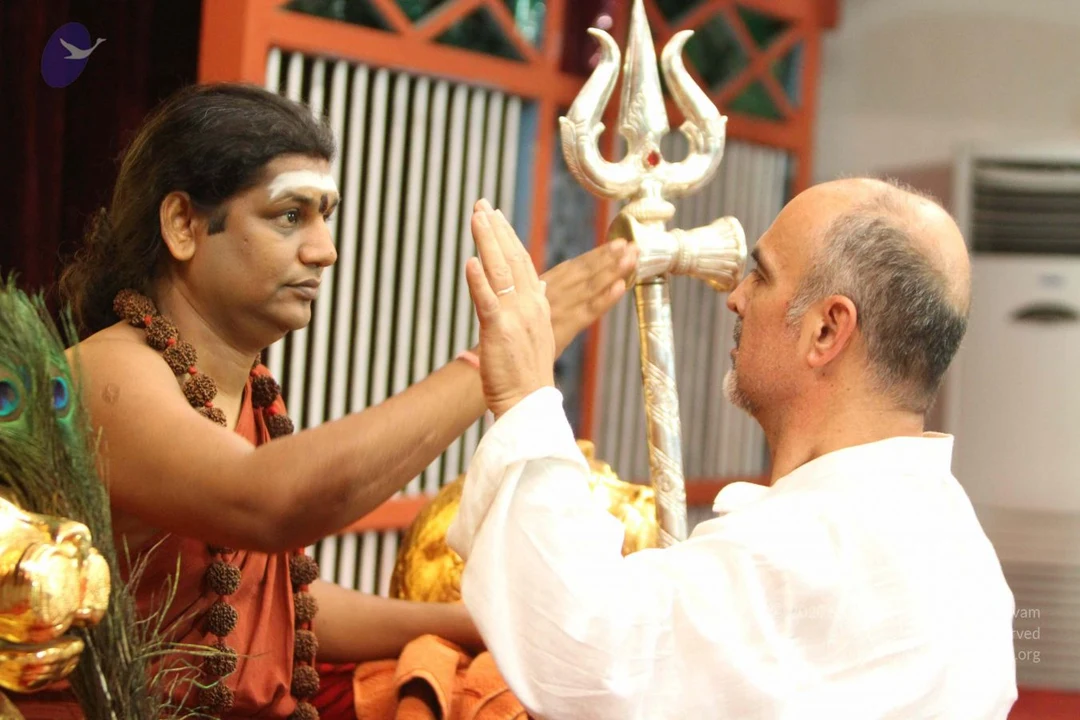
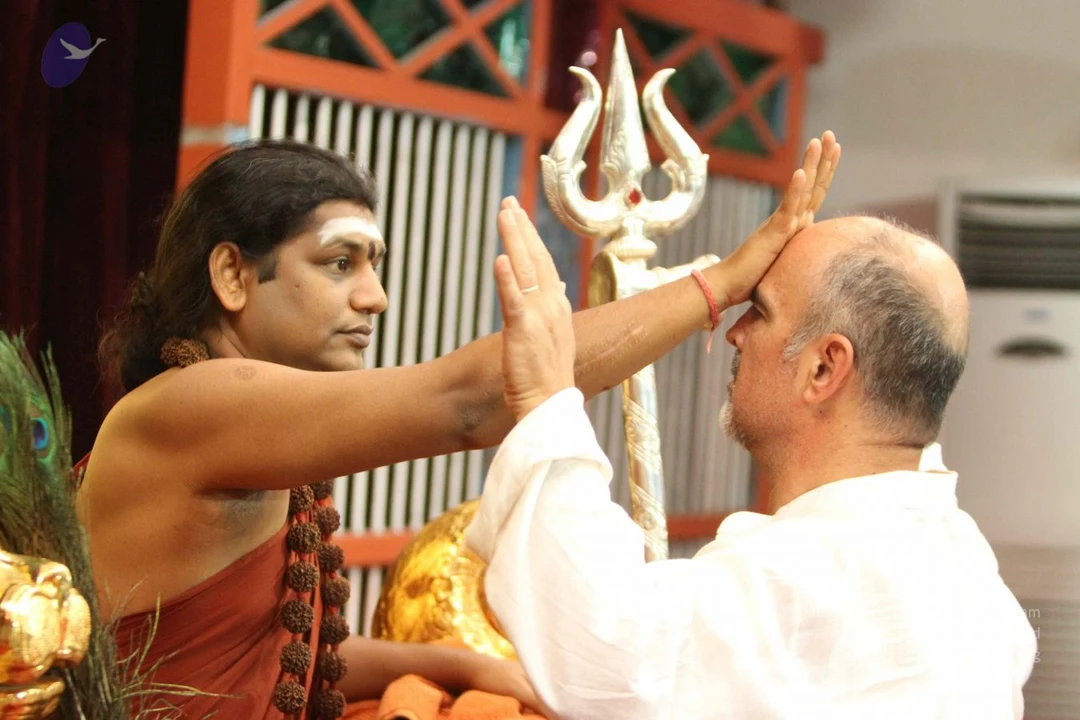
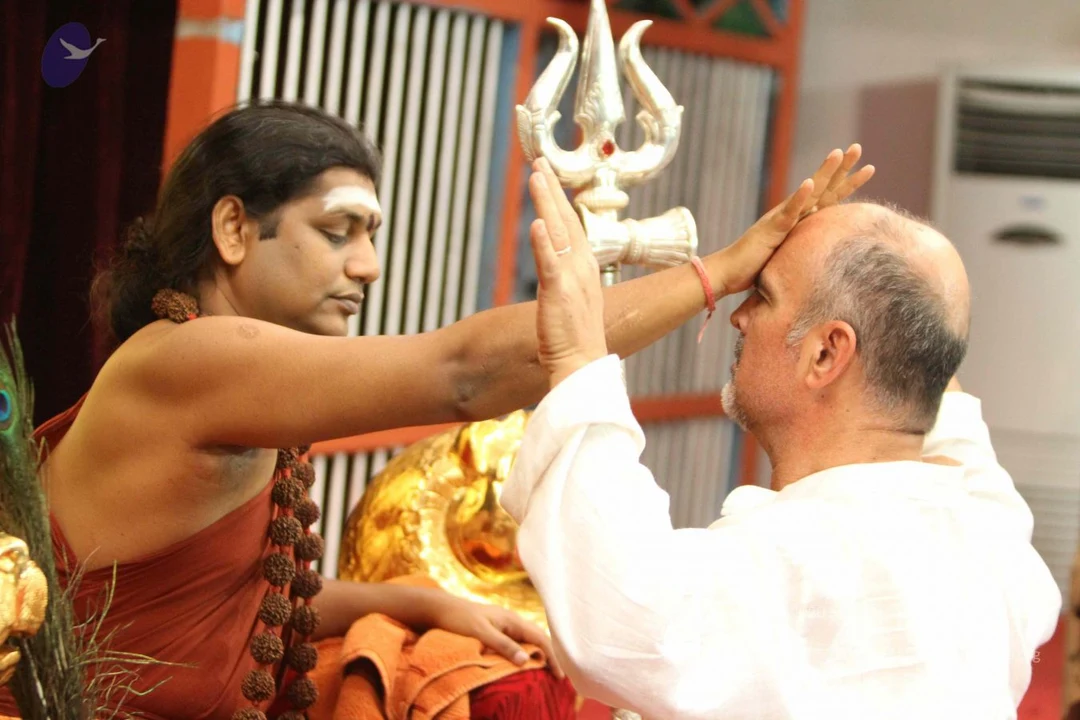
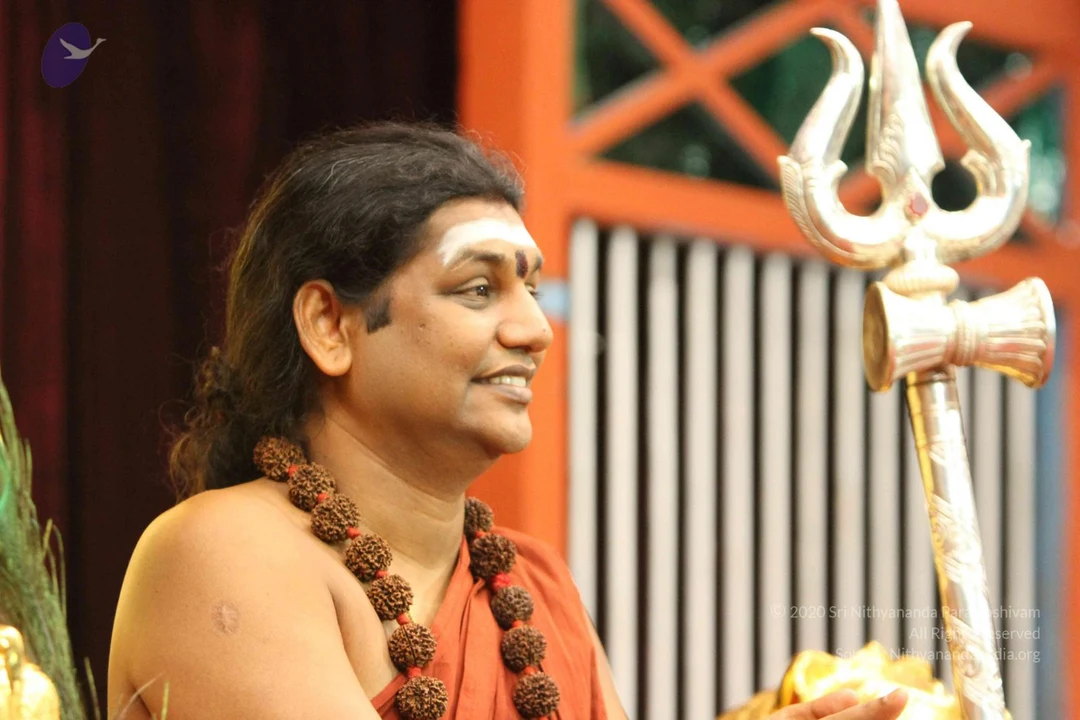
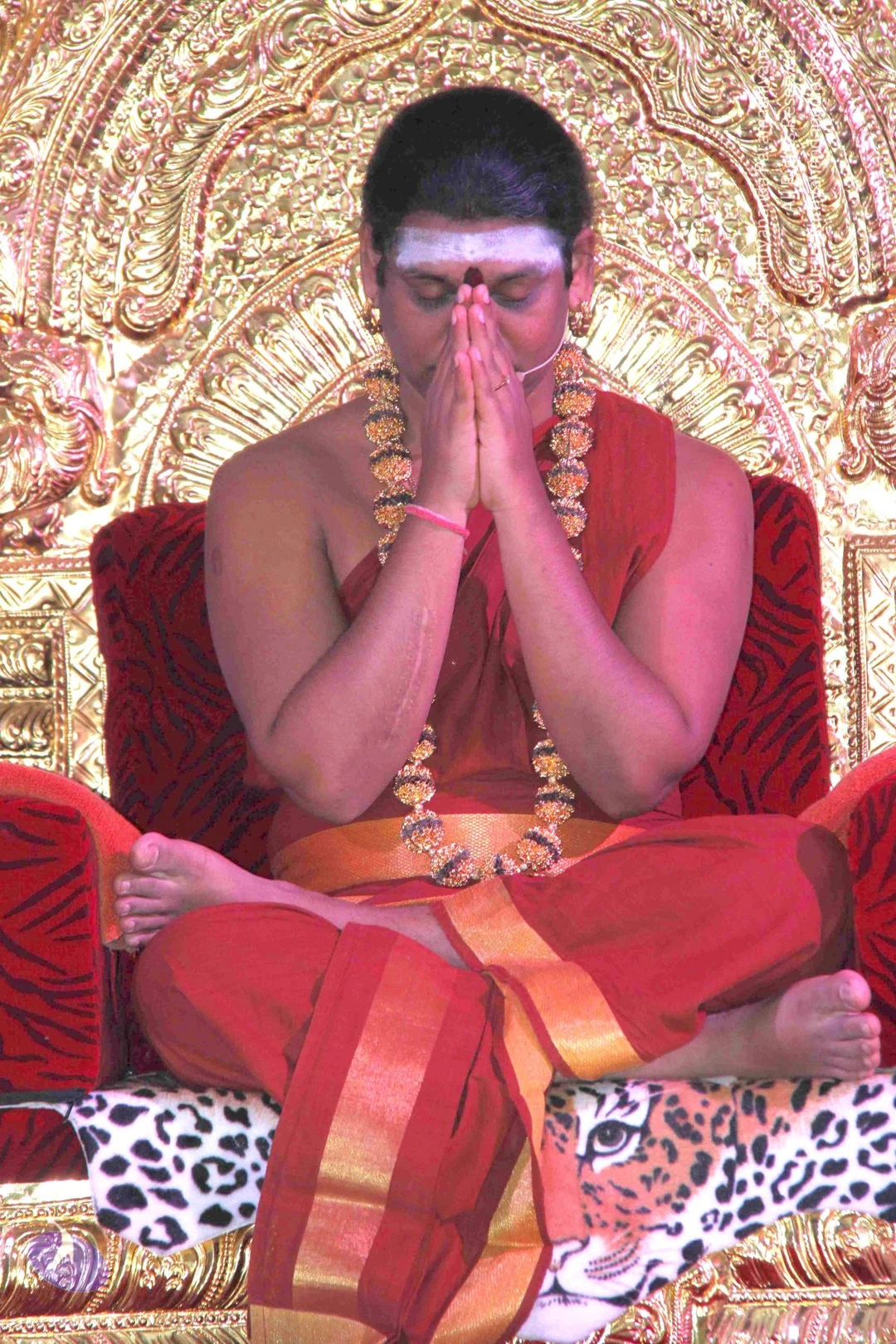
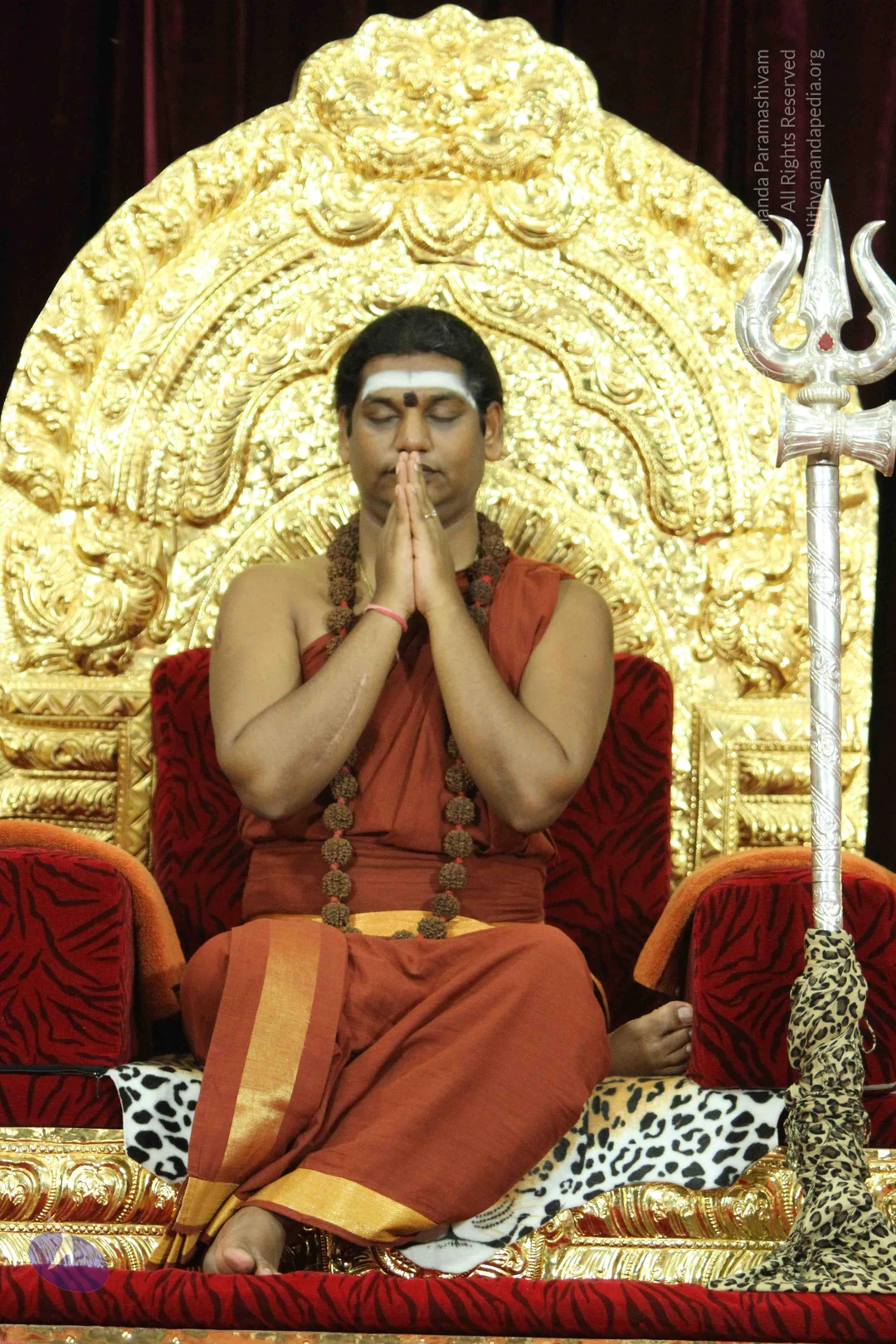
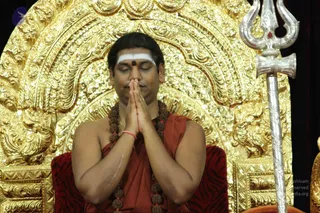
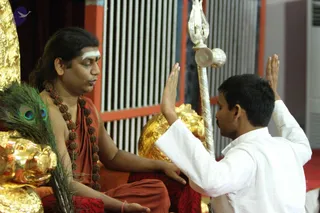
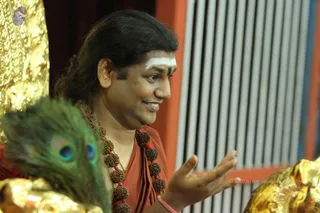
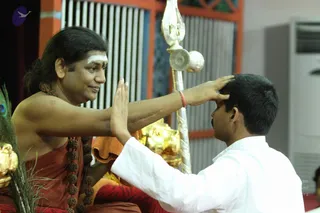
A man seated on a red and black patterned throne in front of an ornate gold repoussé backdrop, palms pressed together at chest level in namaste with eyes closed. He wears a white horizontal tilak with a central dot, a dark rudraksha mala across the neck, a bare right shoulder and a red-orange cloth wrap. A silver trident stands beside him. The figure has long-style hair, a rudraksha mala and saffron-orange clothing, matching the page's a person context, so the identification is probable from appearance cues.A photograph of a seated guru on a gold-and-red throne receiving a devotee in a darshan or blessing moment. The seated figure wears a rust-orange wrap, a rudraksha mala with multiple beads across the chest, a white tripundra on the forehead, and a red wristband, with a peacock-feather fan beside him. The standing devotee in a white kurta and white trousers holds both palms raised in greeting toward him. Behind them is a silver trident with a shell-like finial and a gold lion-shaped armrest, against orange-and-white striped partition panels. Probable Swamiji cues: long swept-back hair, rudraksha mala and orange wrap, seated on a throne. Note the seated figure is a probable match on appearance only.A photograph of a man seated at close range in a satsang setting, smiling and gesturing with his right hand open. He wears a rust-orange robe and a long rudraksha mala with red threads, with a white horizontal forehead band with a central mark. Long dark hair swept back. In the foreground, a peacock-feather fan and gold-coloured ornamental fabric are visible, and vertical white and orange panels form the backdrop.A seated man with long swept-back dark hair and a white horizontal forehead mark wears a bare-chested upper body with a rust-red wrap and a dense rudraksha mala of large brown beads across his chest. He extends his right arm and places his palm on the crown of the head of a kneeling man in a white shirt and white trousers, who bows with his palms together near the forehead. Beside them a silver ceremonial staff with a crowned finial and a peacock-feather fan stand in the foreground, and a golden decorative object sits near the seated man. Orange and red wall panels and a wall-mounted air conditioner form the background. Swamiji (probable) is flagged as the seated man: long swept-back hair, rudraksha mala, and a rust-red wrap are visible, with the blessing role indicating a guru.A seated man with long swept-back hair, a white tripundra forehead marking, an orange-saffron wrap and a necklace of large rudraksha beads sits on a red cushioned seat beside gold lion-head and carved gold armrests, with a peacock-feather fan at left. A younger man in a white shirt and an orange-brown beaded necklace kneels facing him, his right hand raised palm-outward in blessing gesture while his left hand rests open. Behind them stand white-and-orange vertical slatted screens and a golden canopy finial. Swamiji (probable) is seated on the throne, identified by the long swept-back hair, rudraksha mala and saffron wrap; the kneeling man is a devotee receiving blessing. Two people are visible.A photograph of a seated figure in an orange-red garment with a rudraksha mala and a white vertical forehead mark, whose long hair is swept back, placing a raised palm on the forehead of a kneeling man in a white shirt and rust-red rudraksha beads. A silver staff with a finial stands beside them, and a golden deity murti and a peacock-feather fan appear in the foreground. Cues include long swept-back hair, a rudraksha mala and orange clothing, so the seated figure is a Swamiji (probable) bestowing blessing on a devotee.

IA-Session
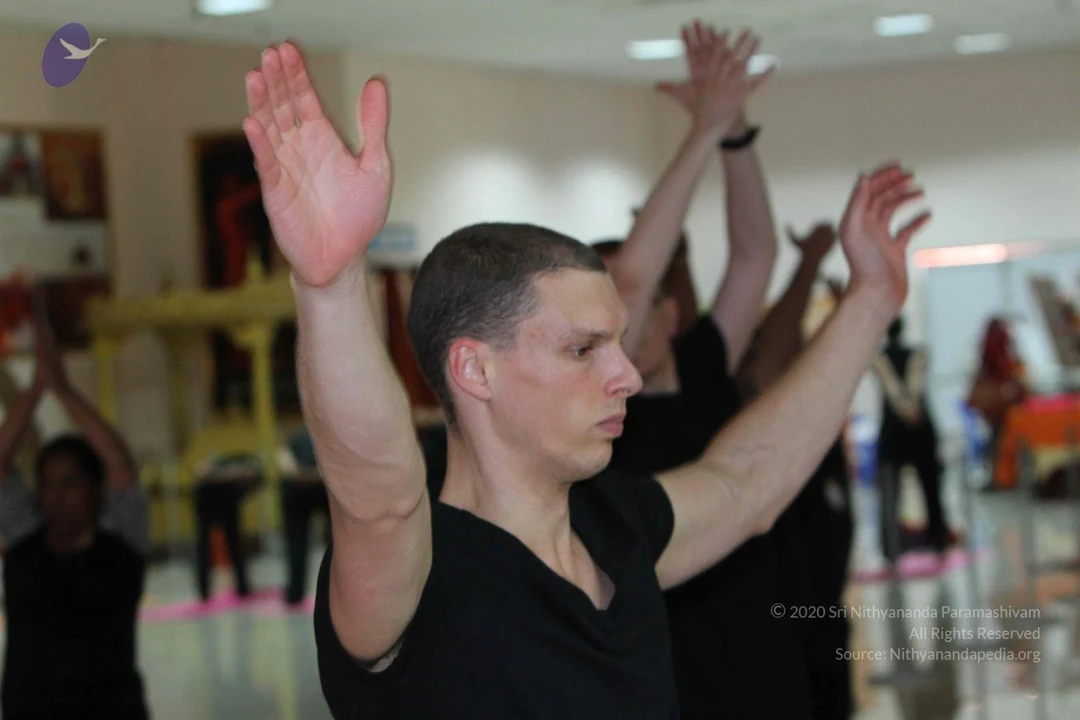
11 photosSource gallery
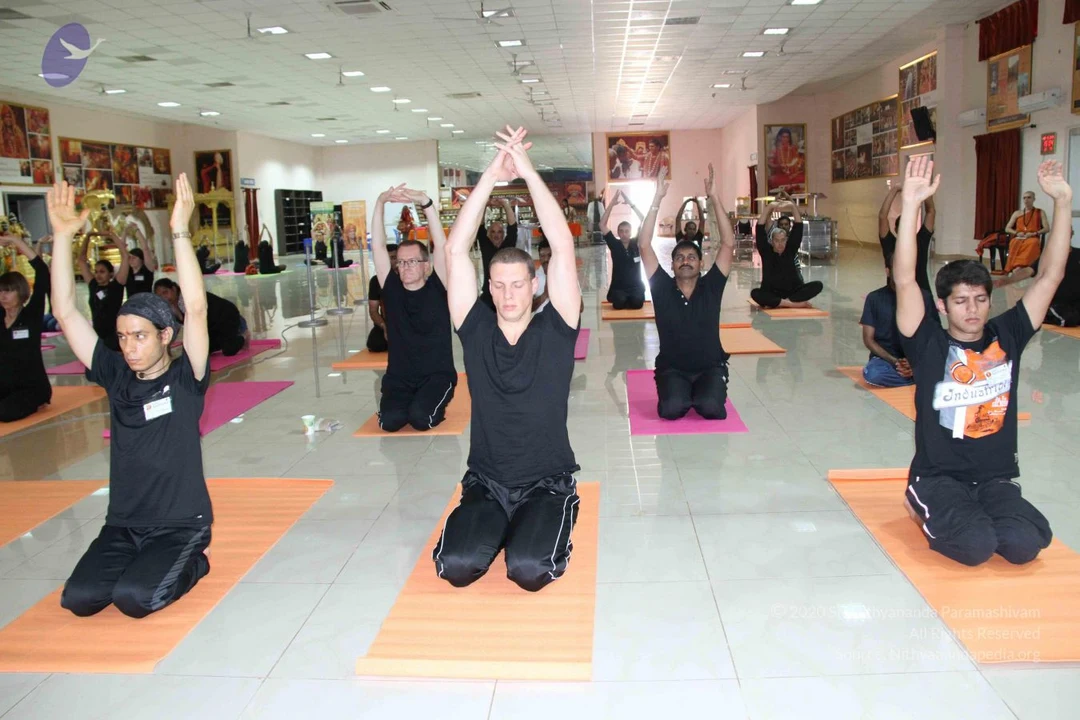
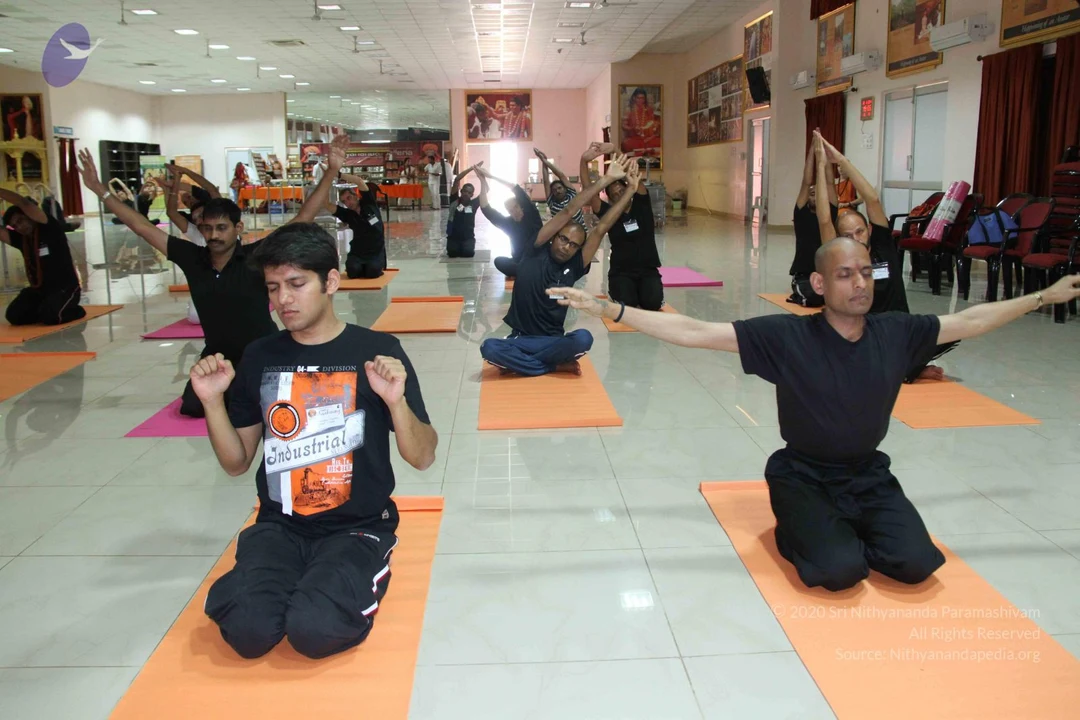
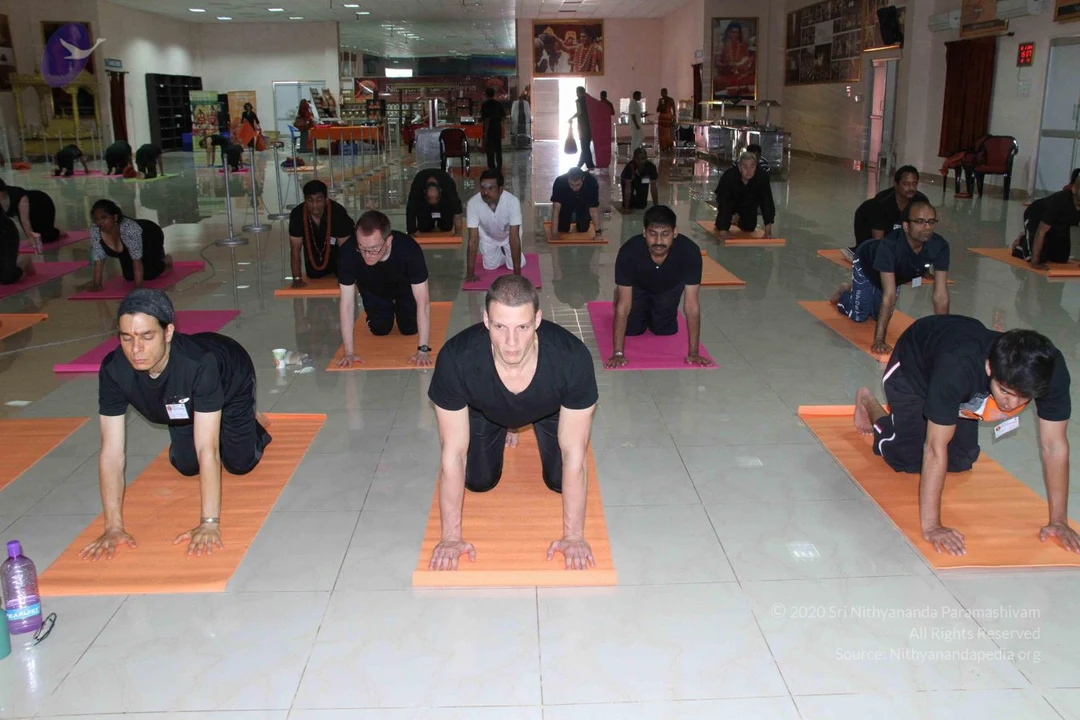
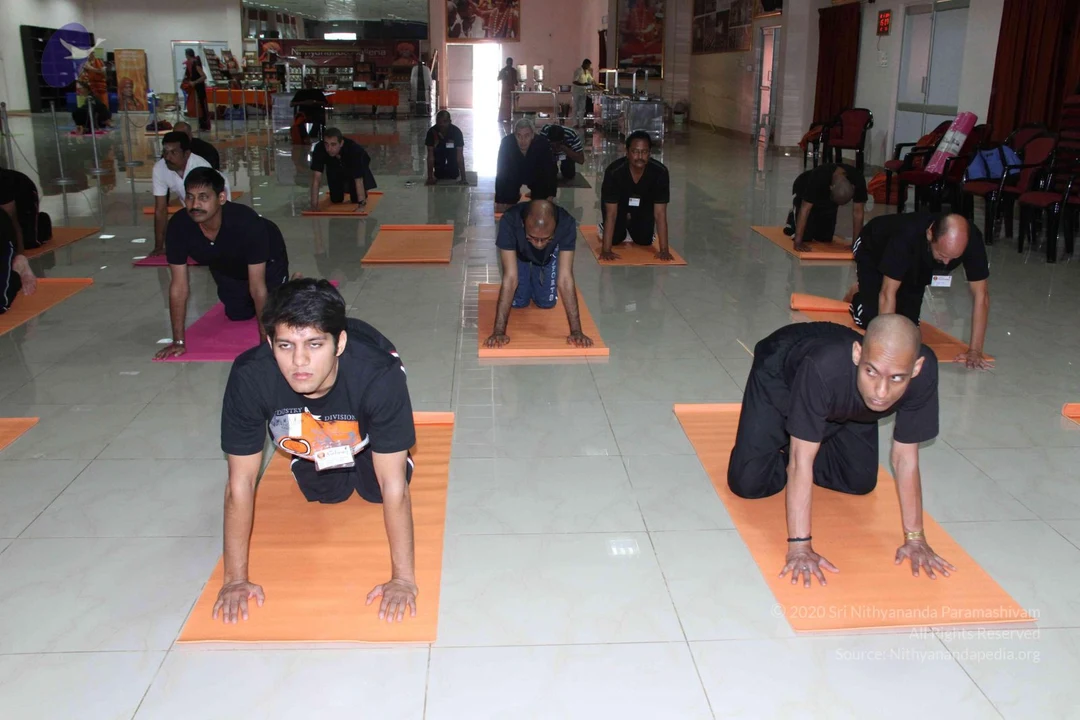
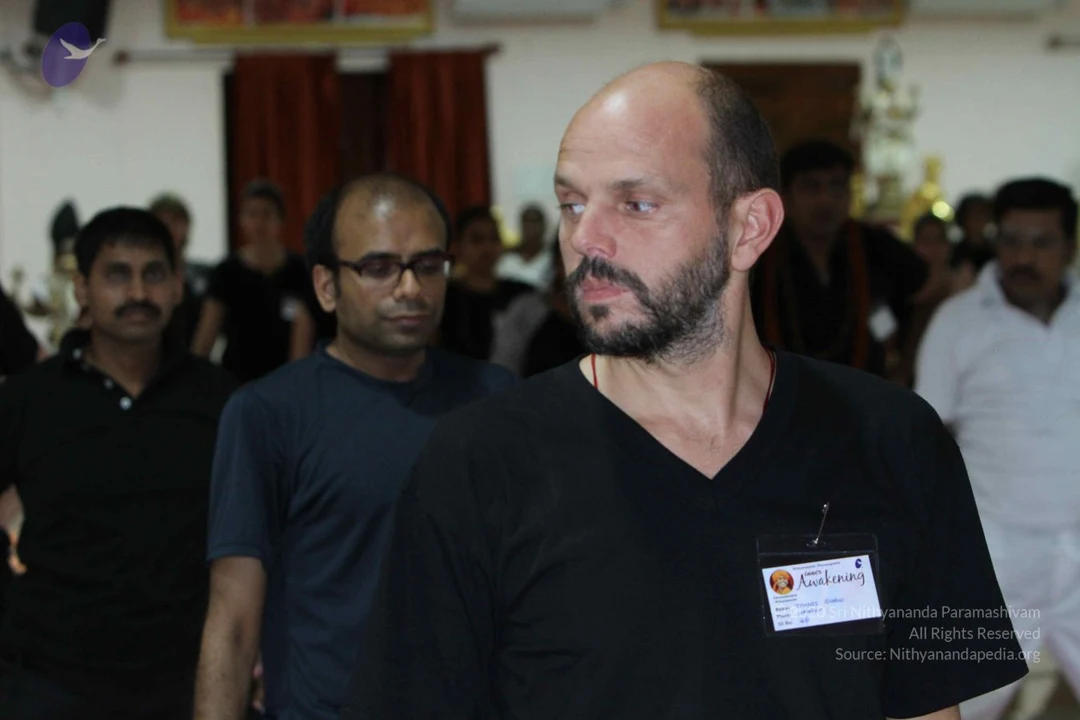
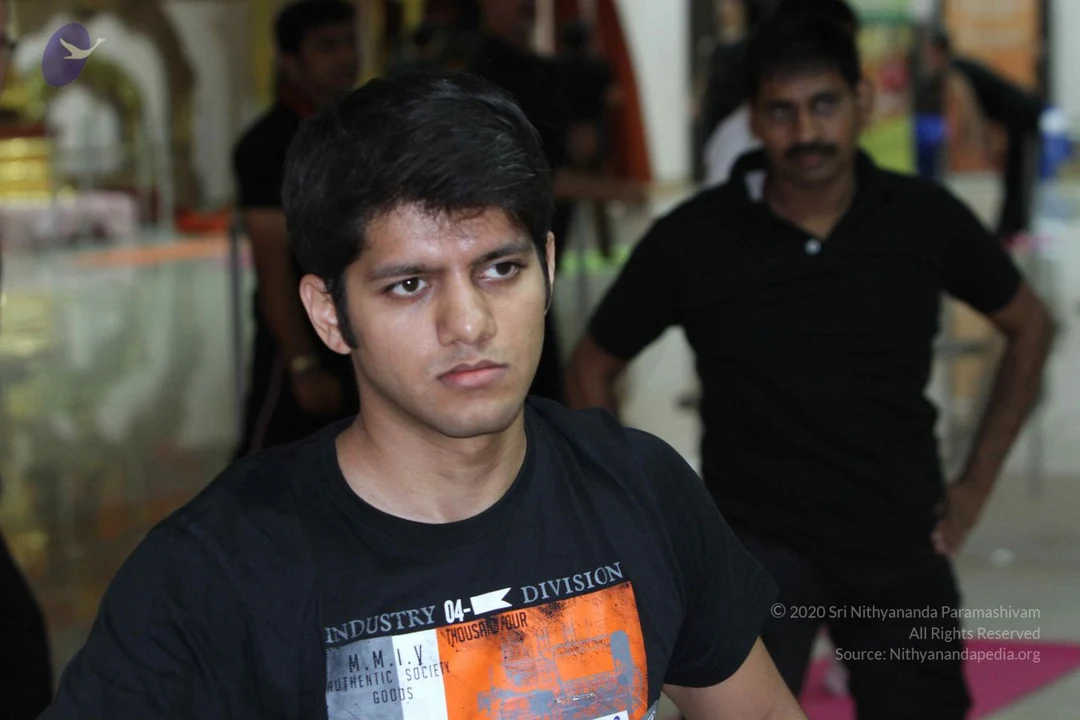
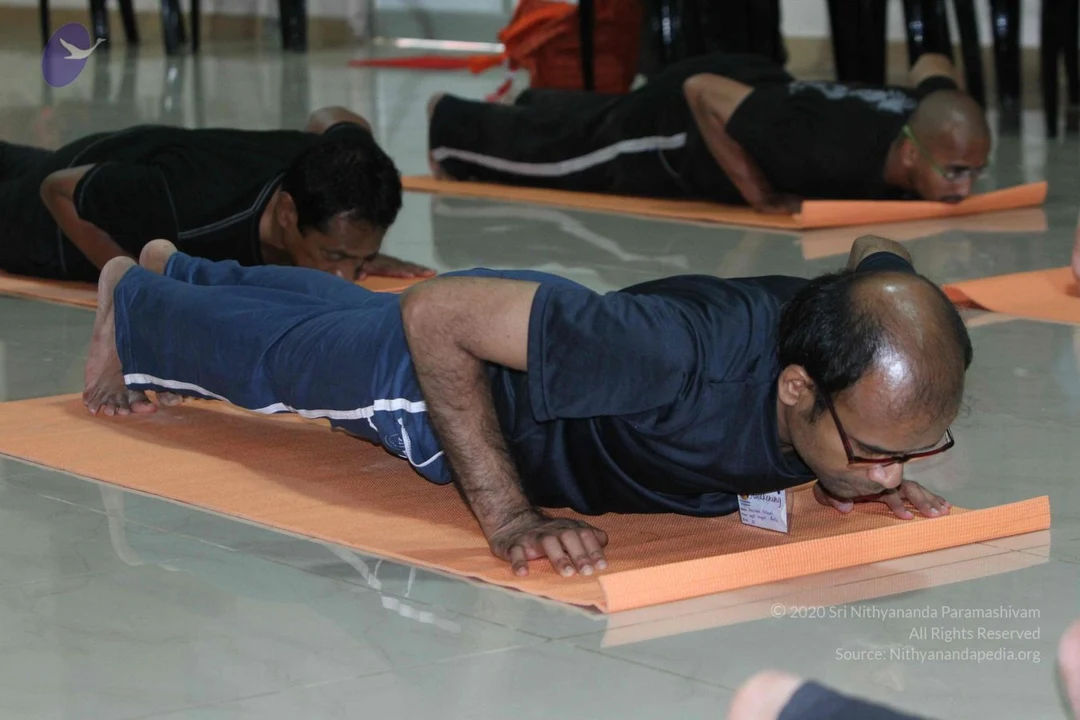
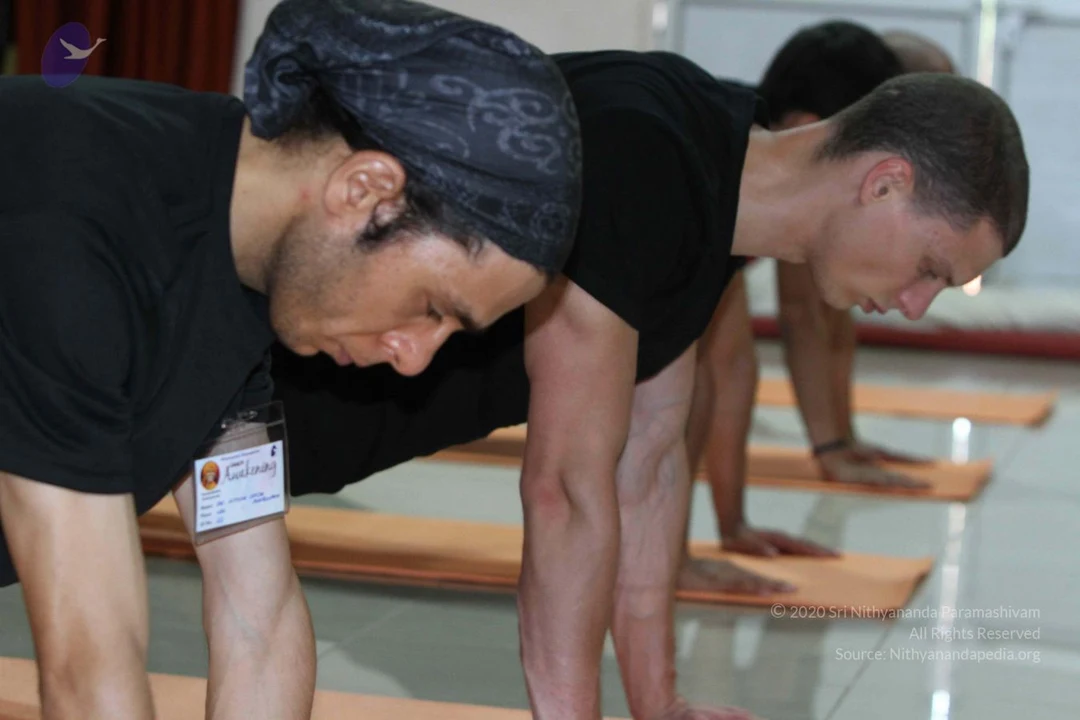
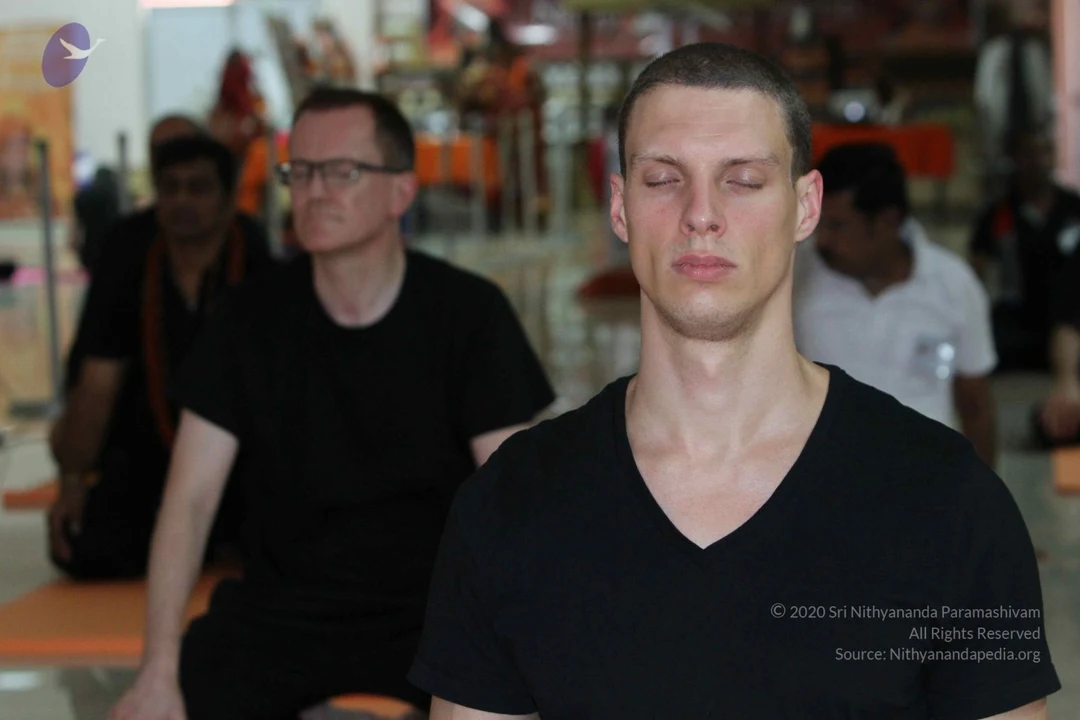
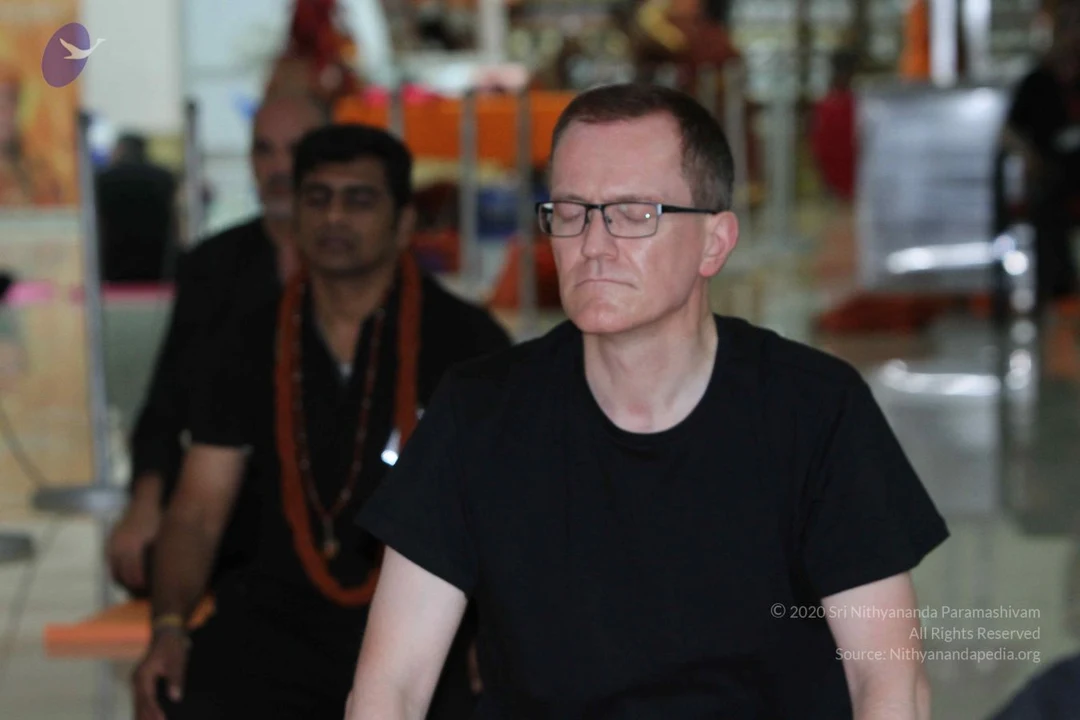
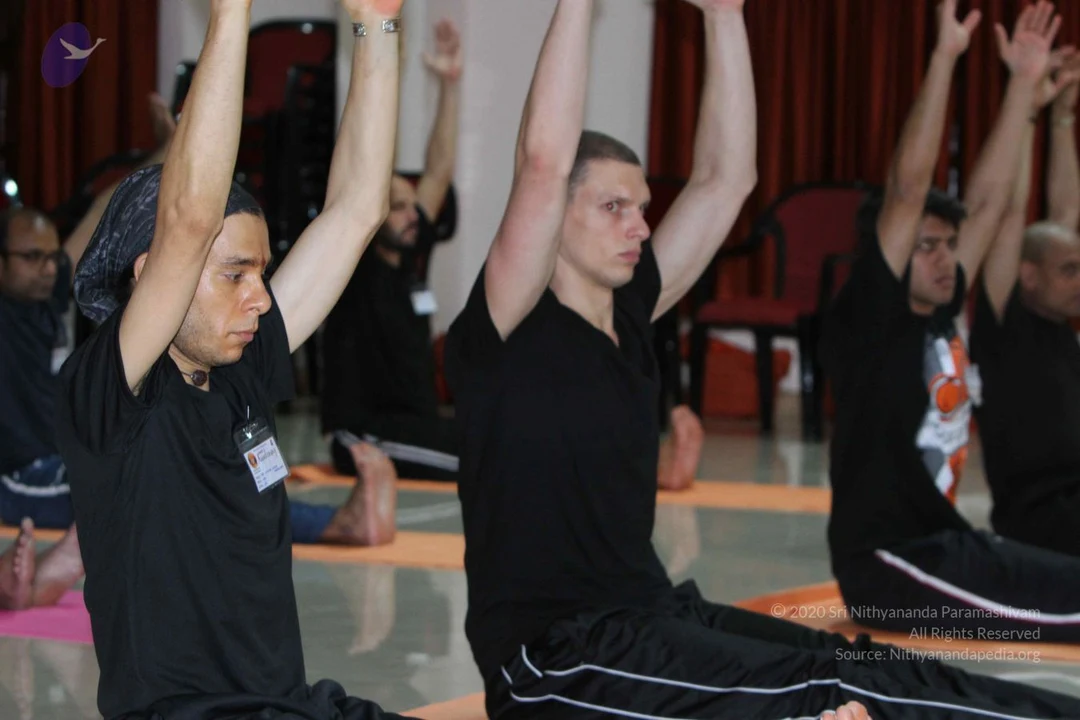
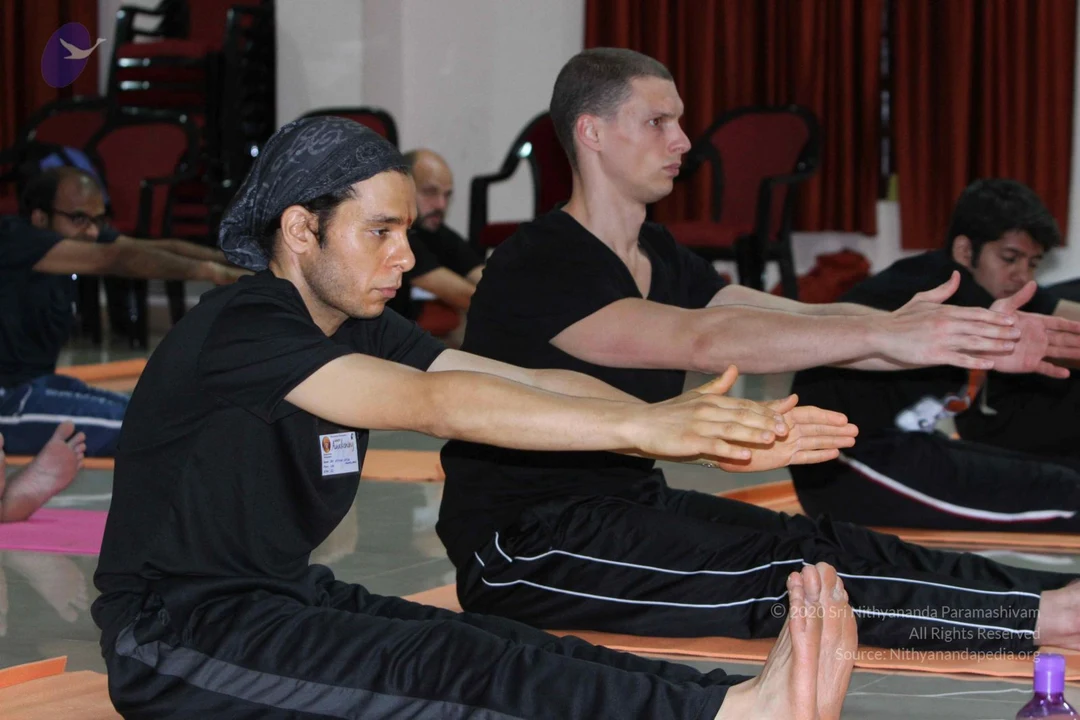
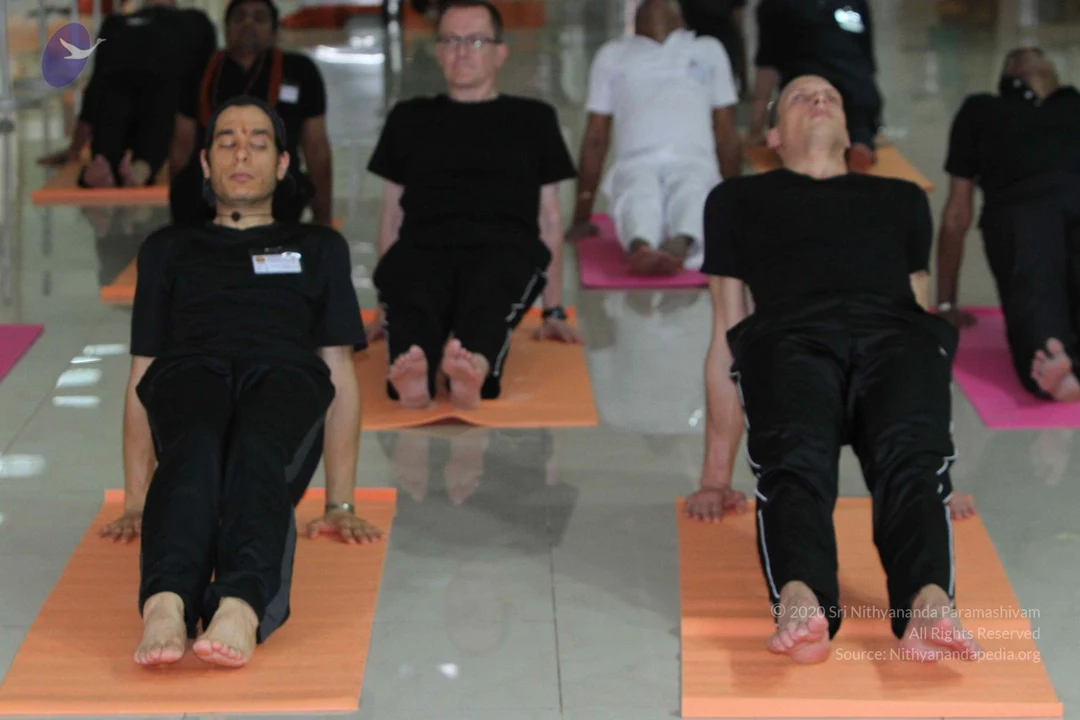
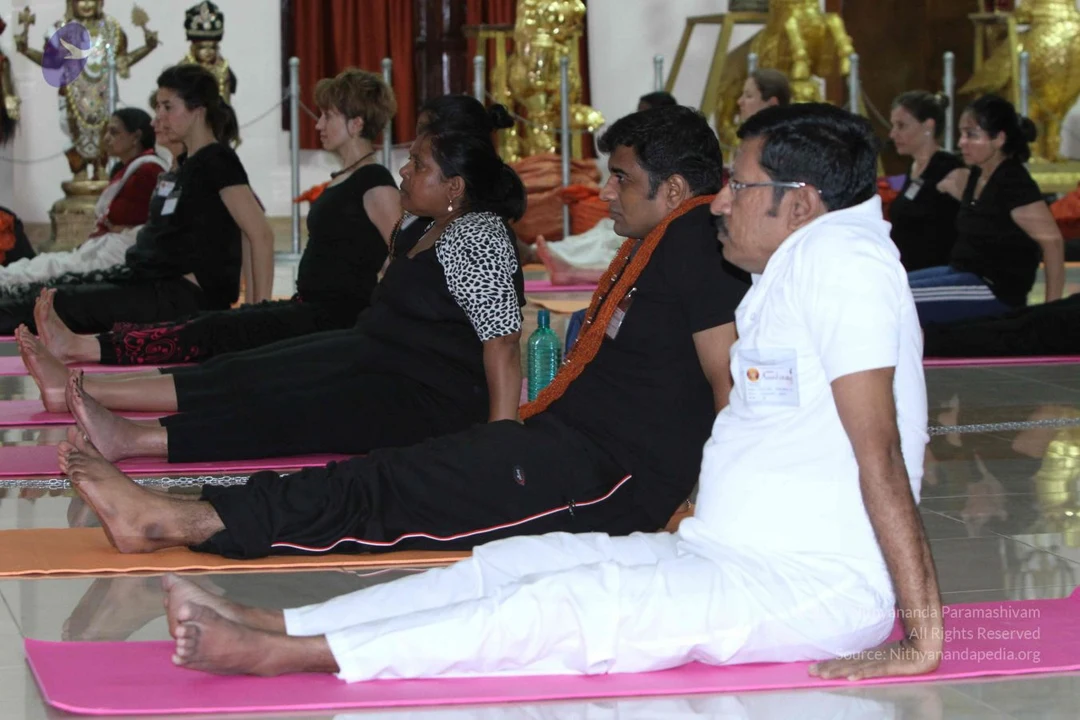
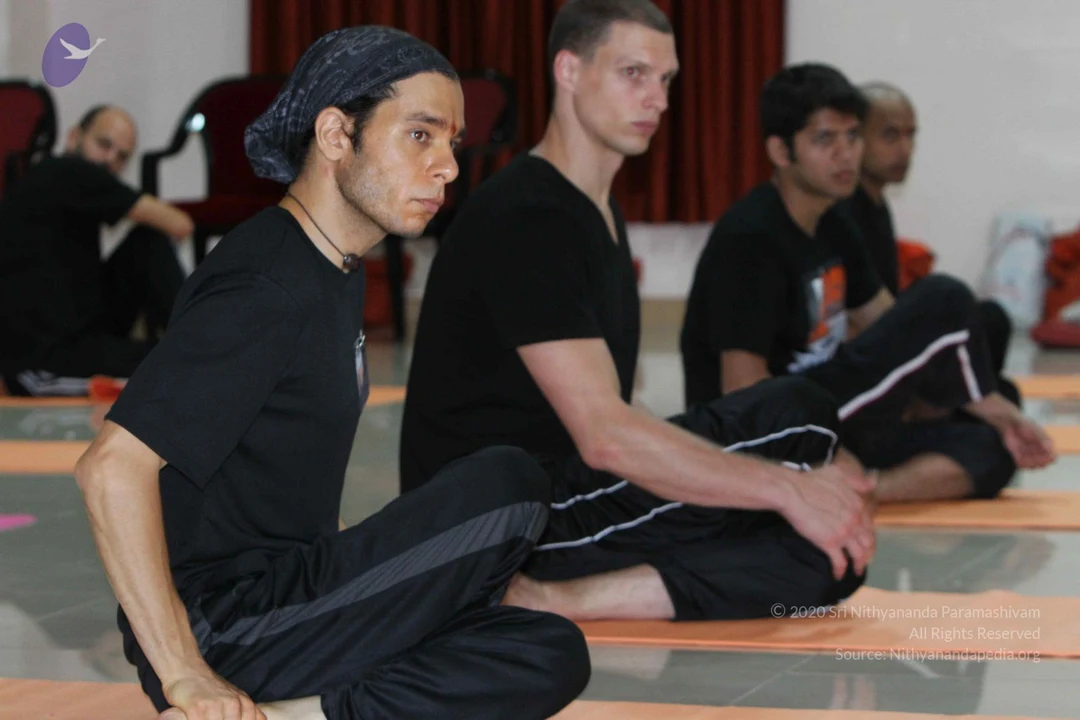
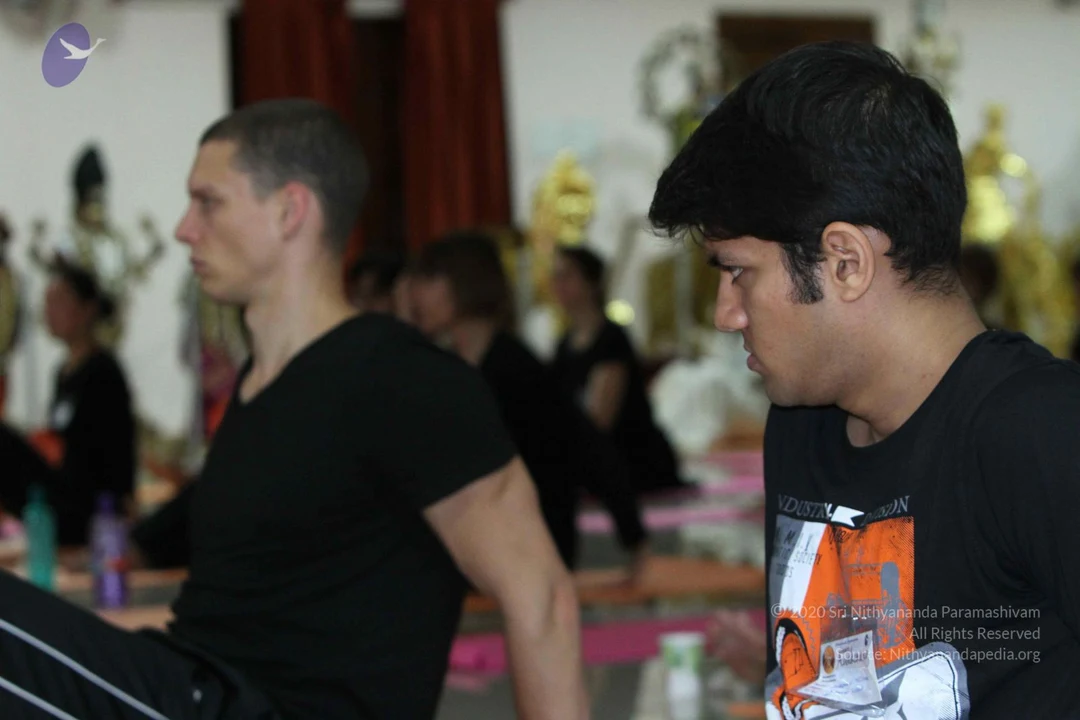
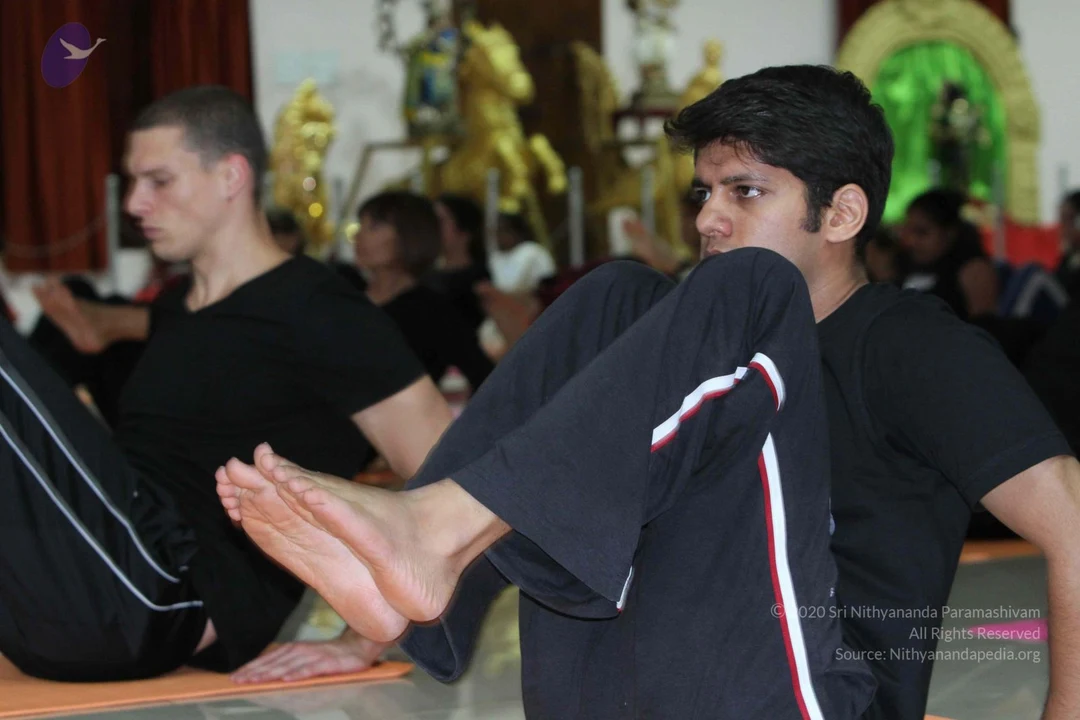
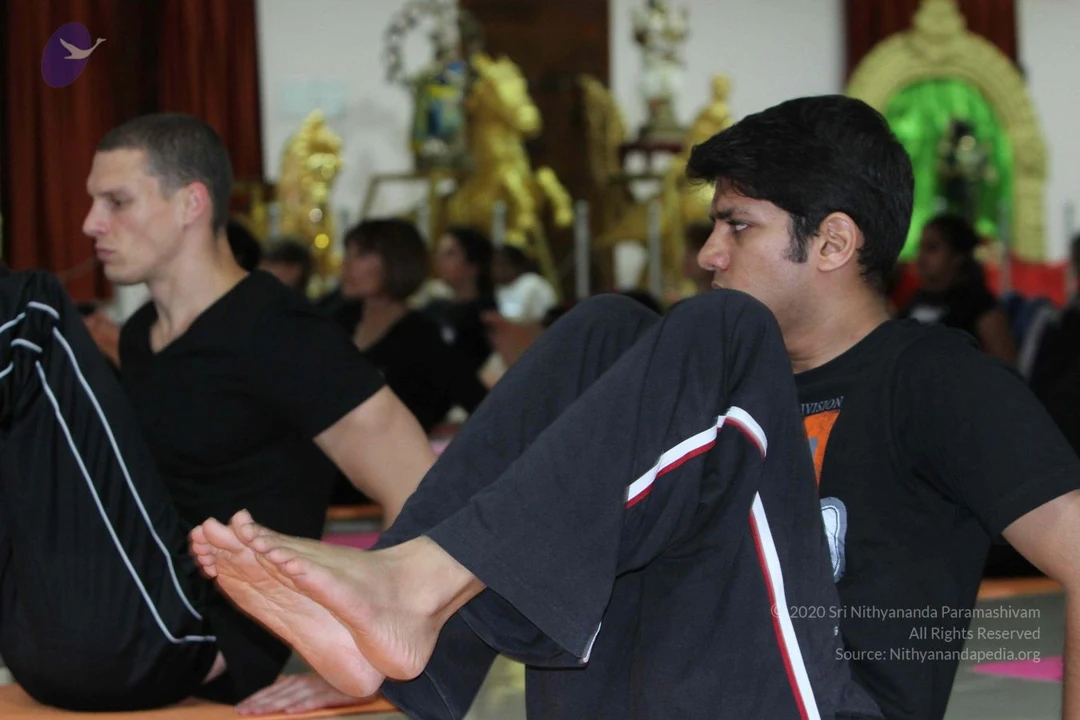
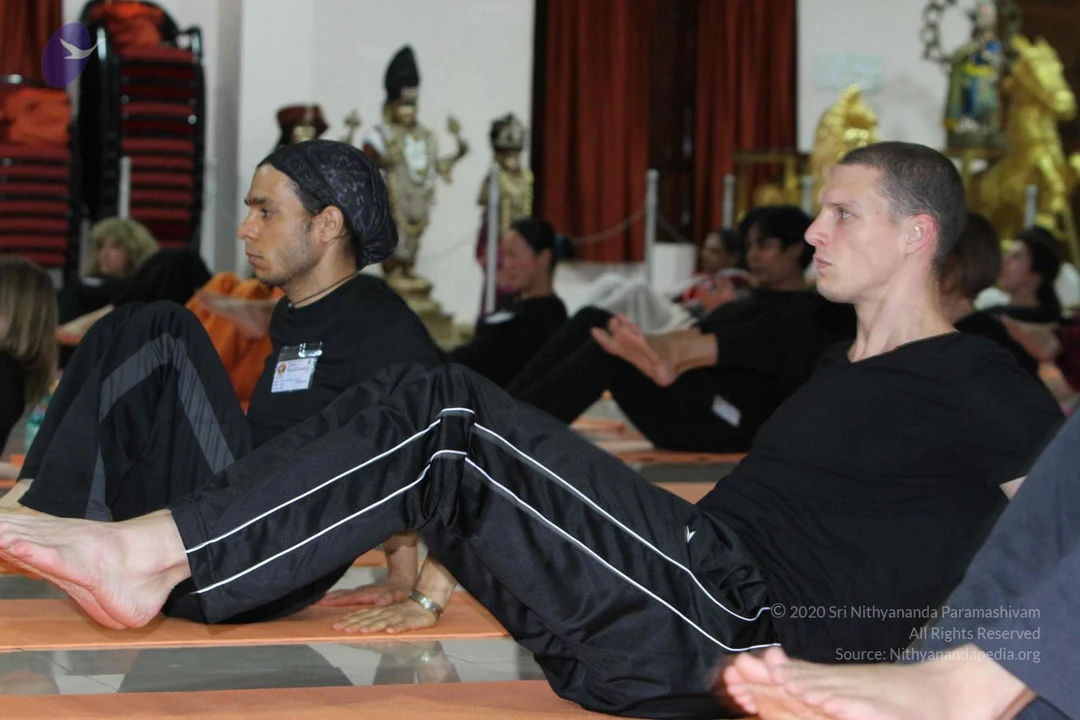
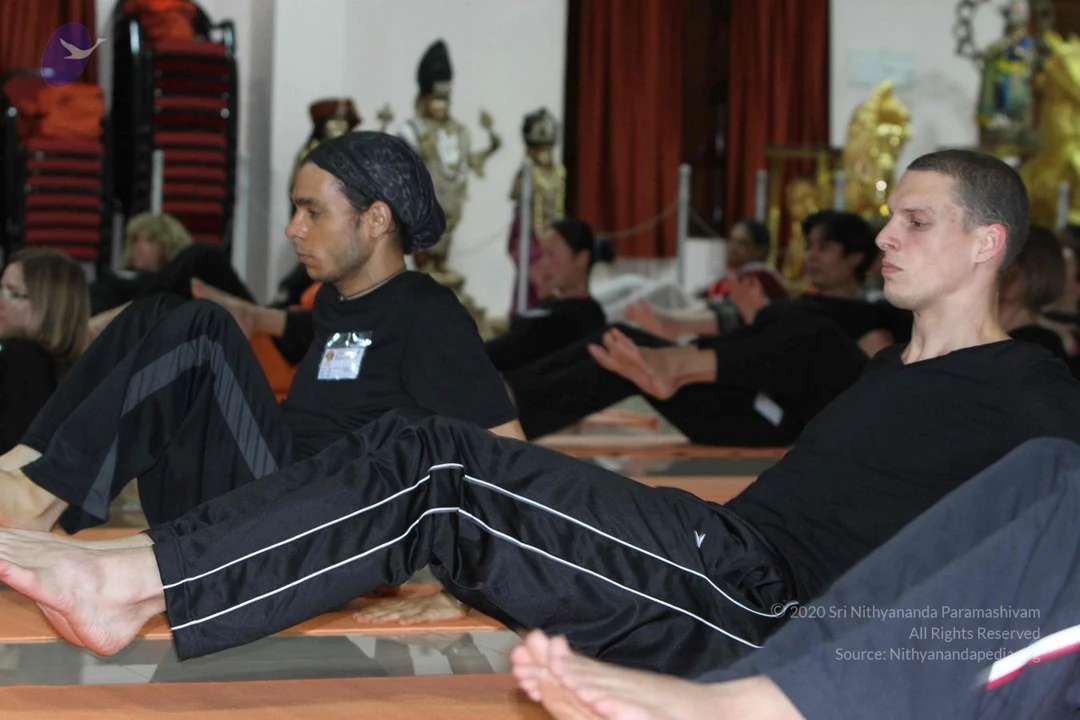
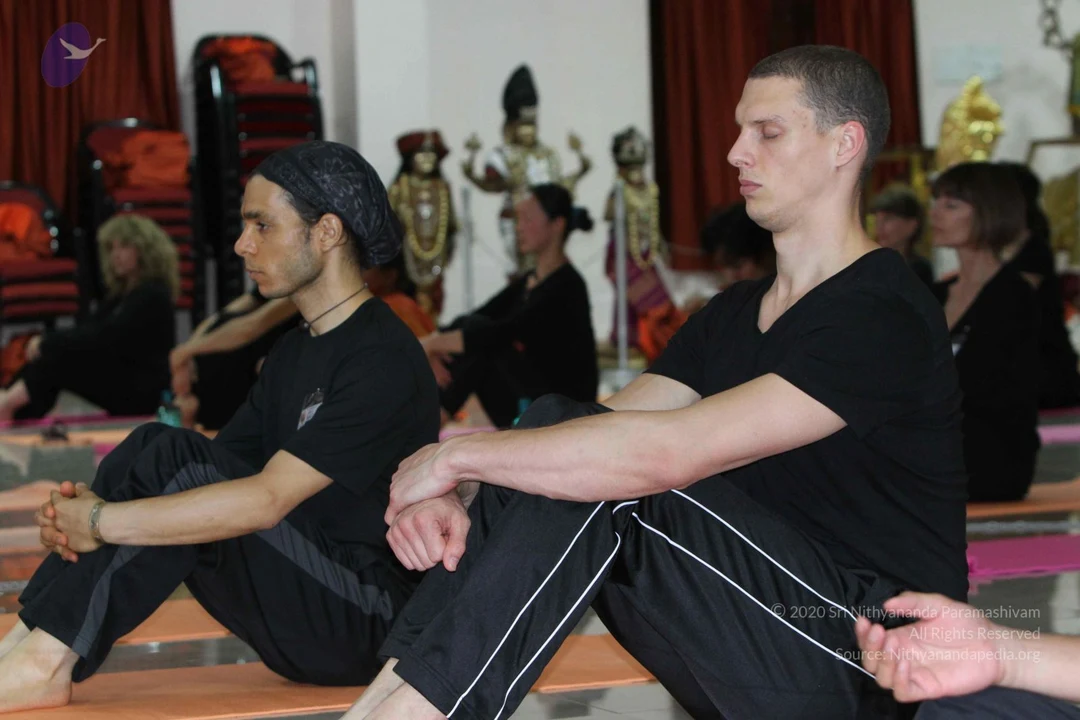
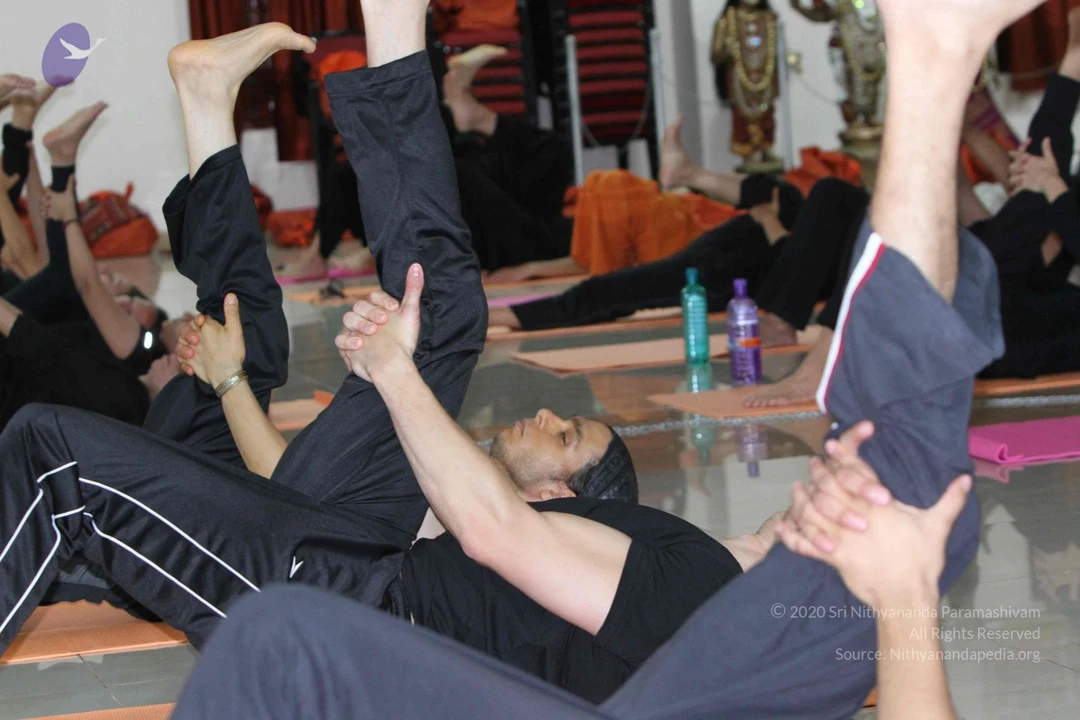
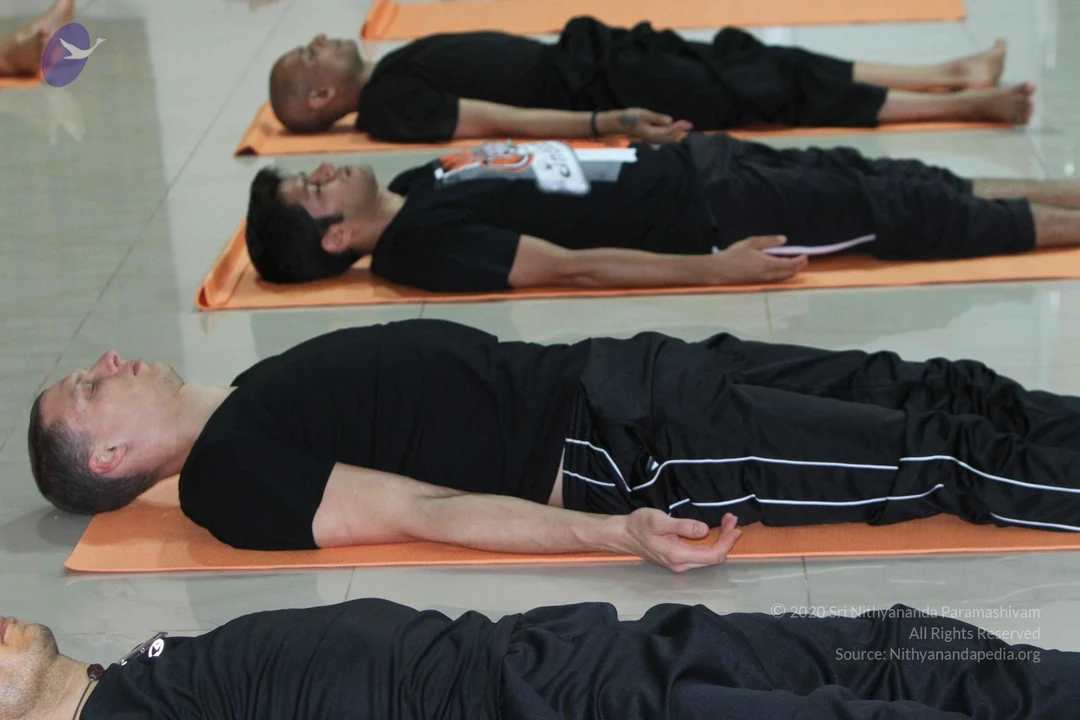
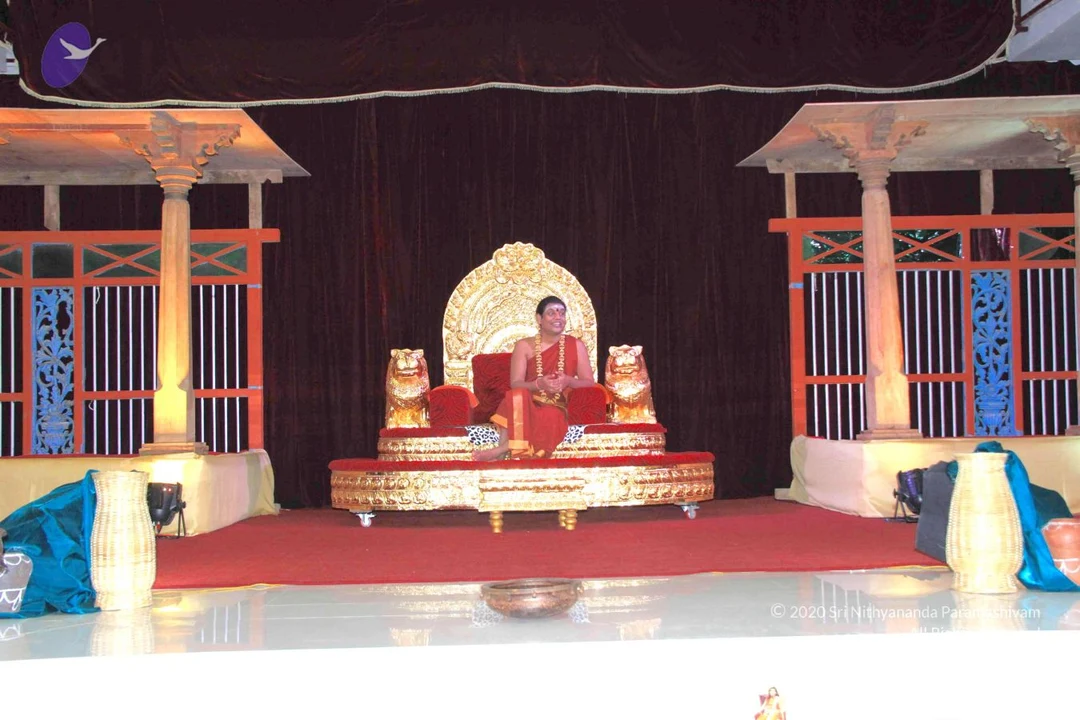
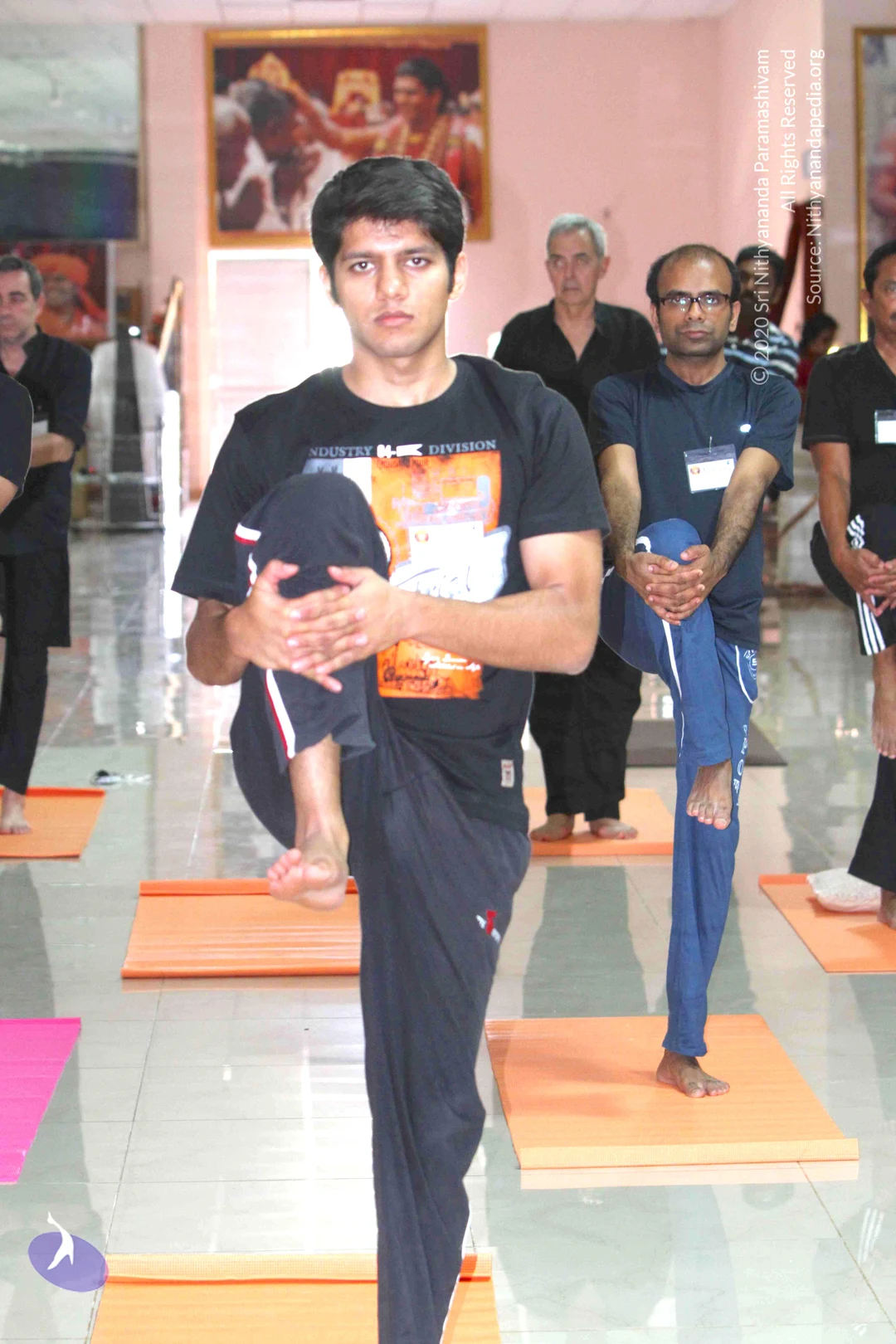
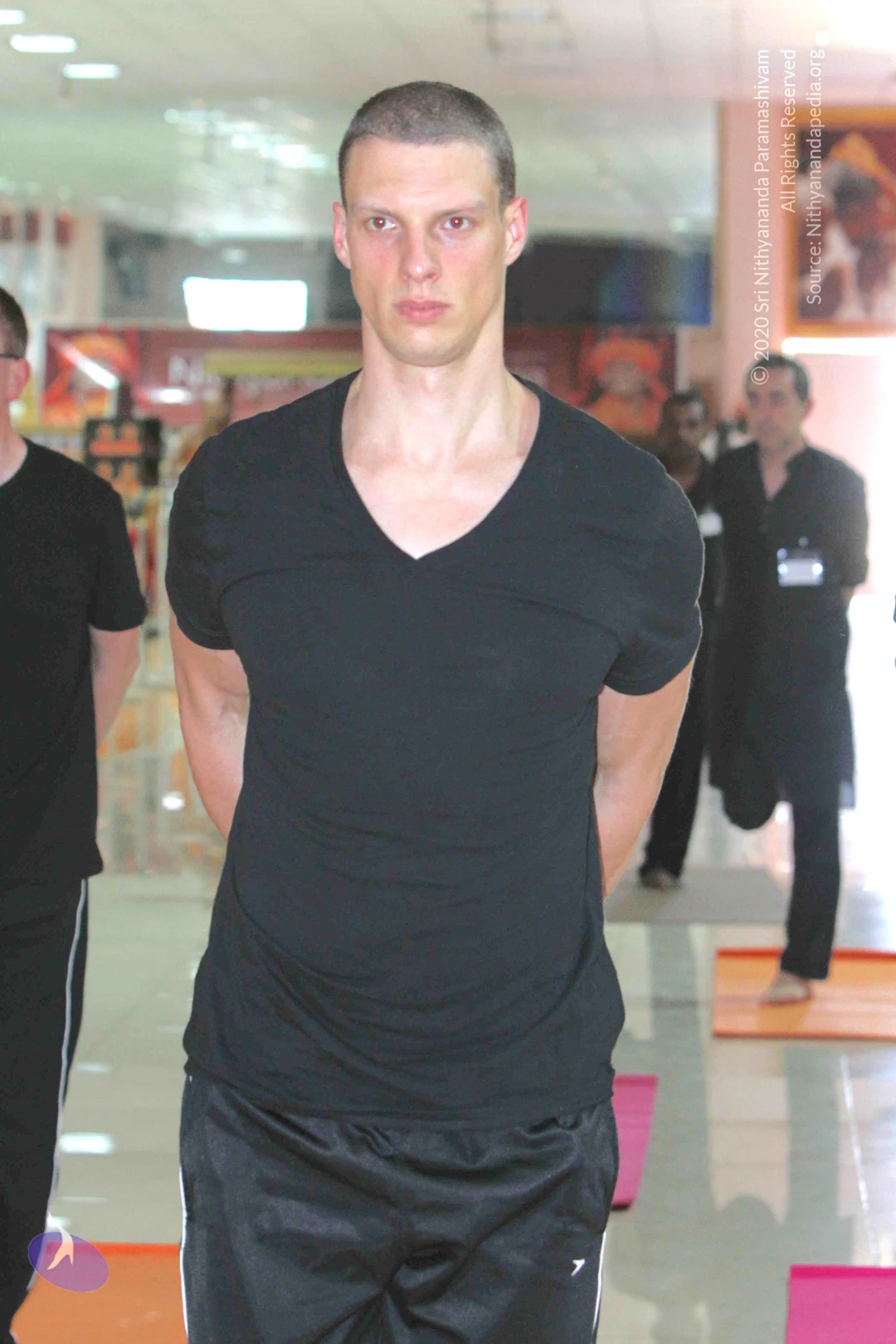
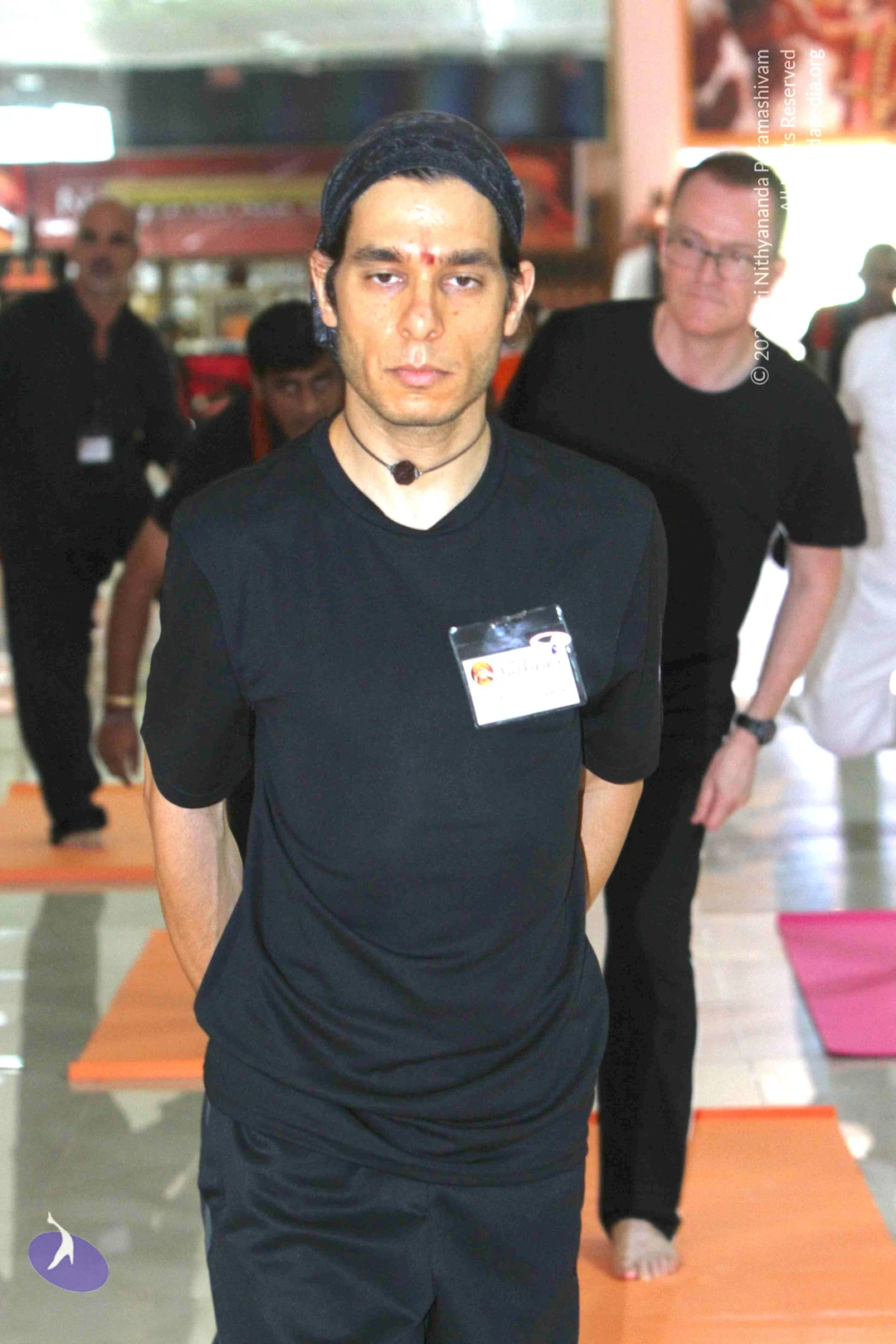
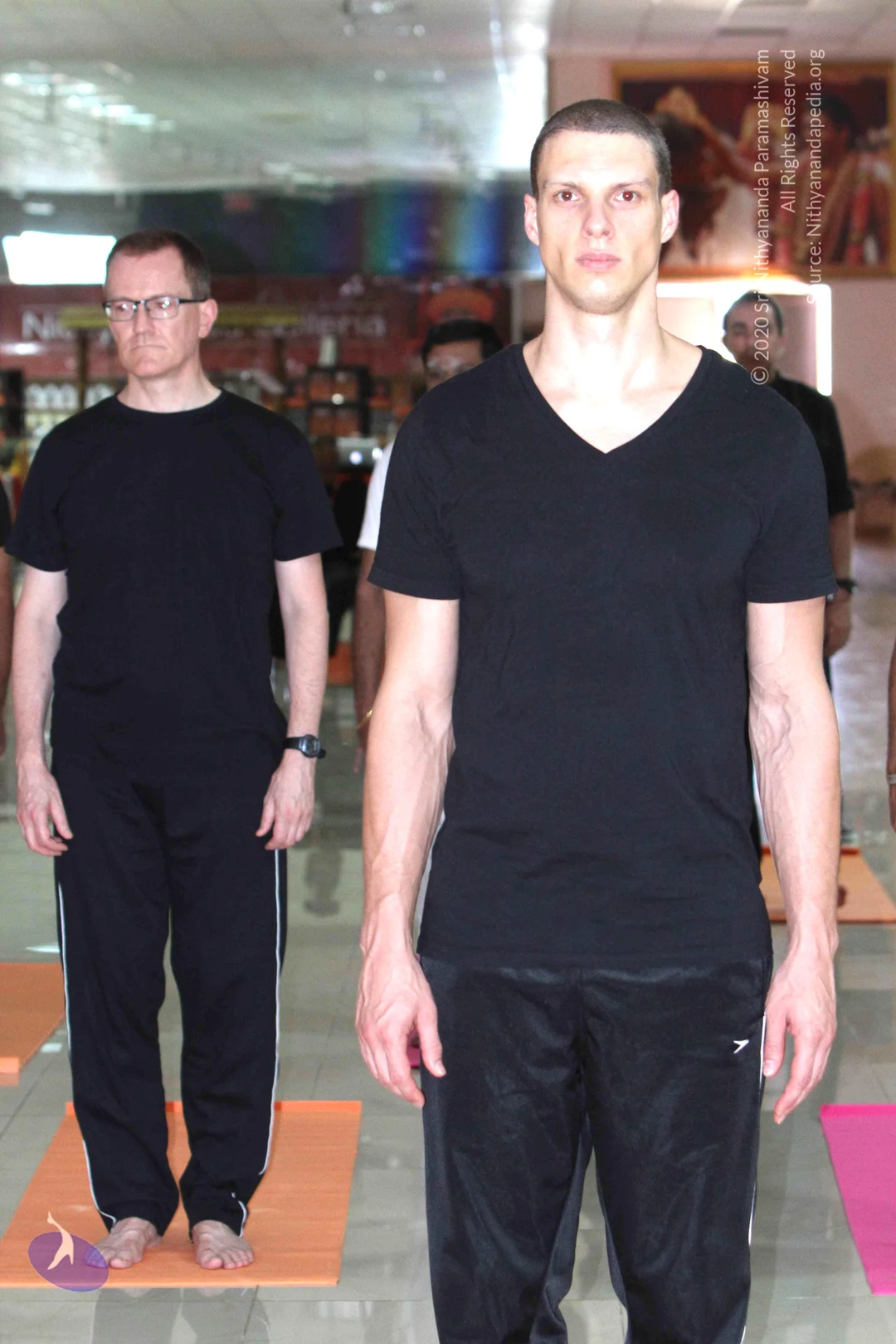
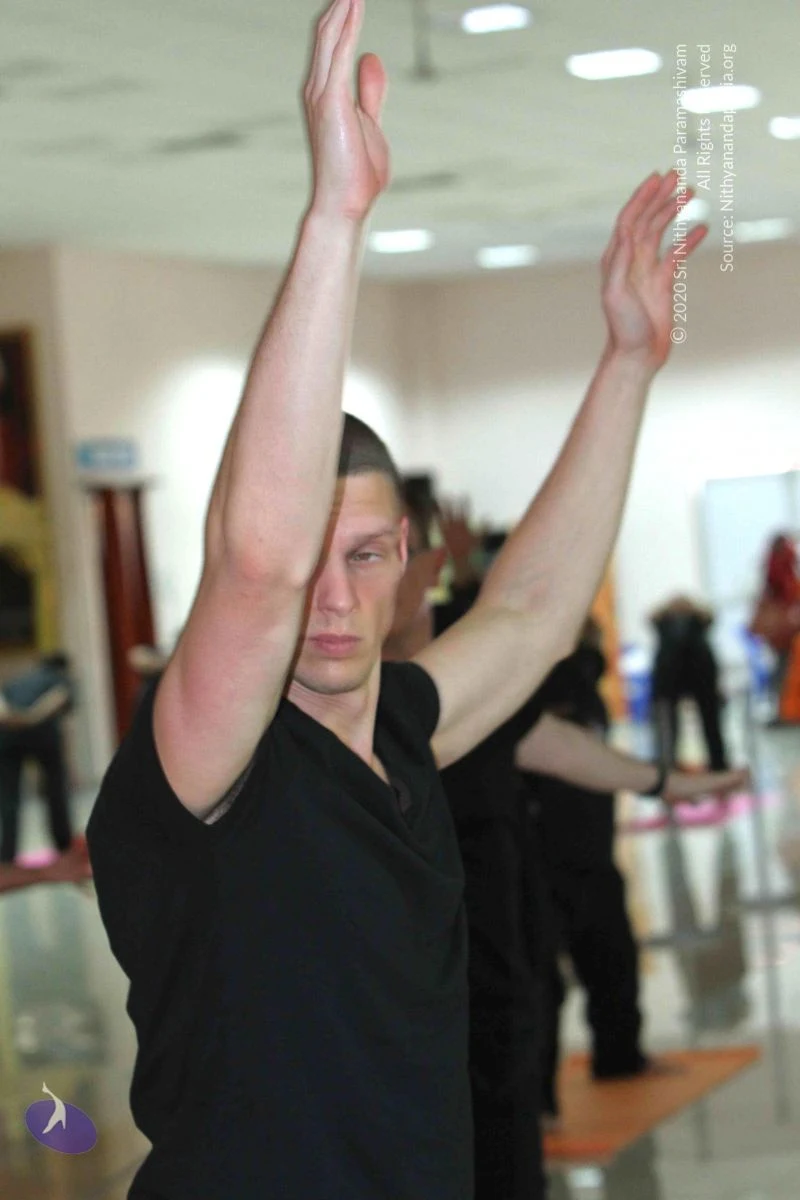
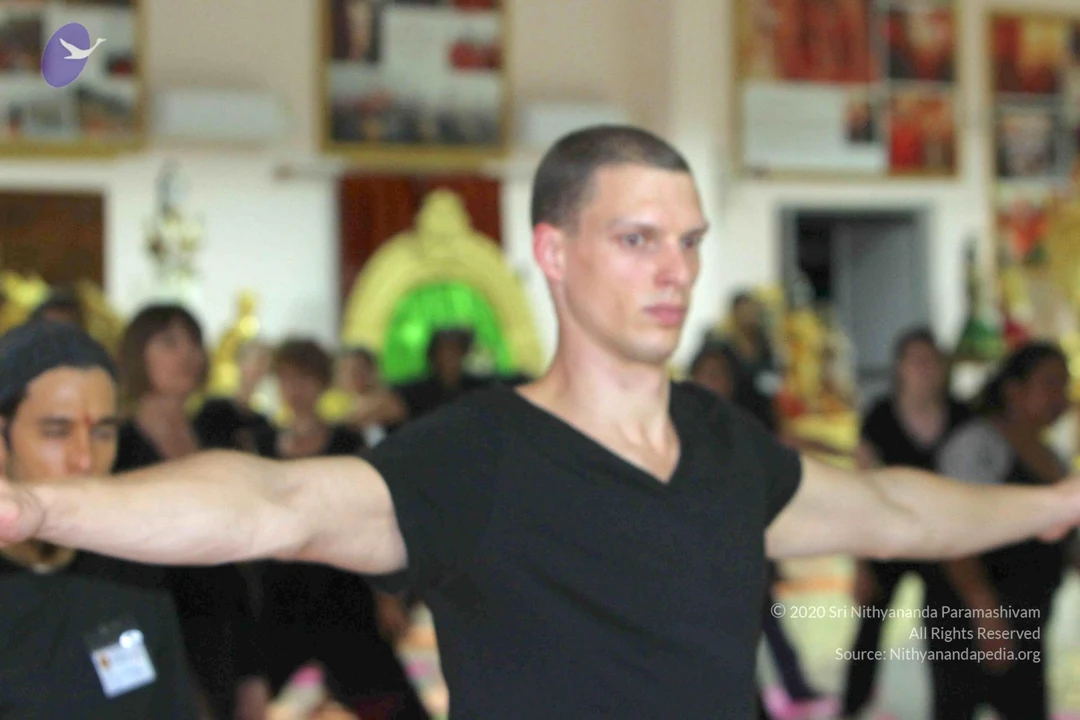
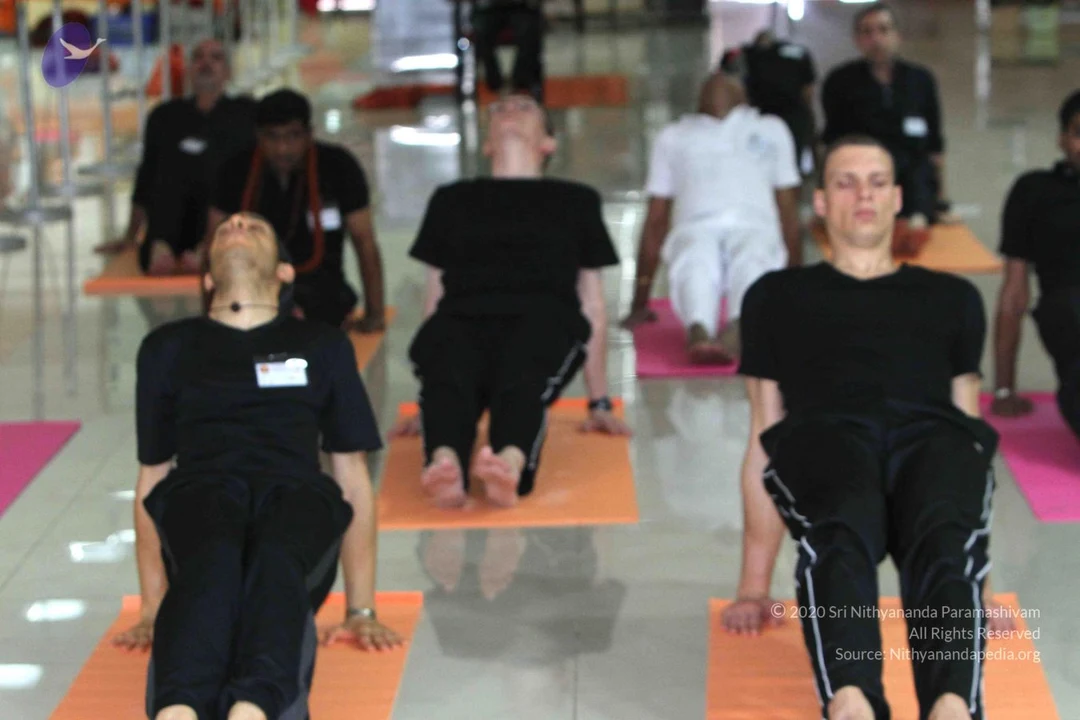
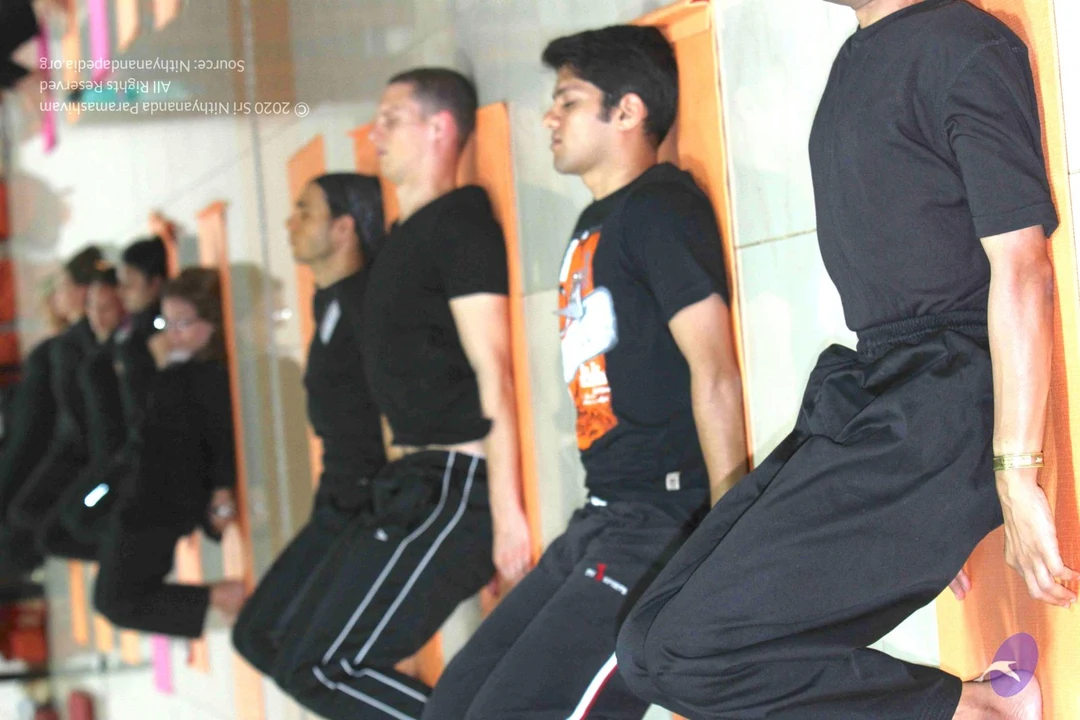
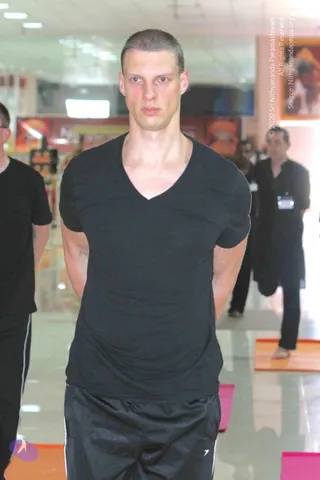
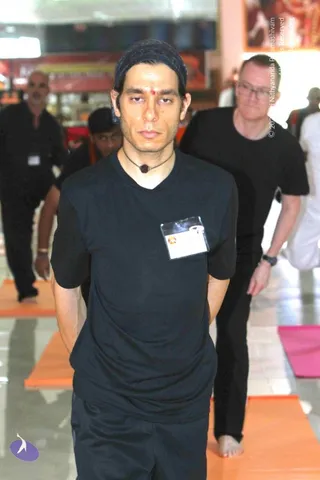
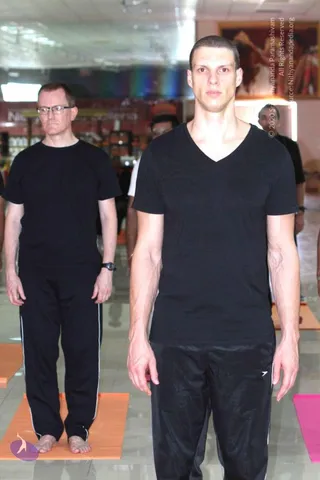
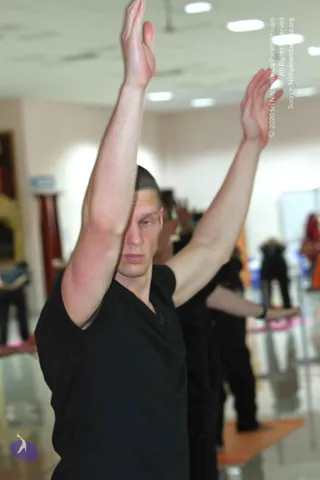
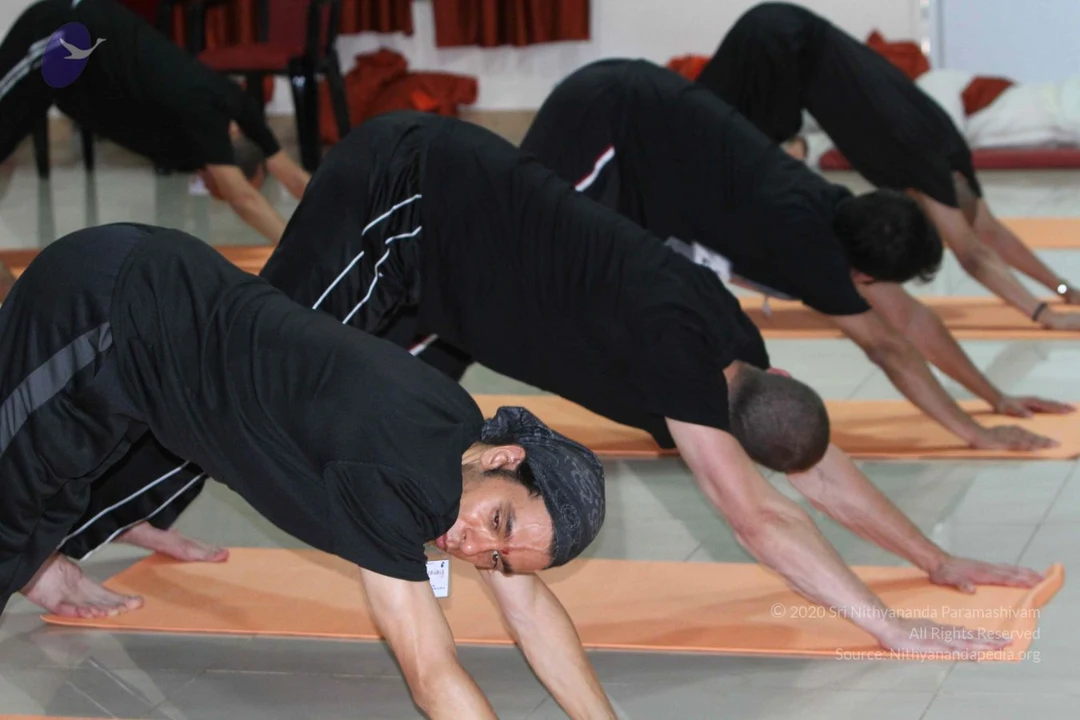
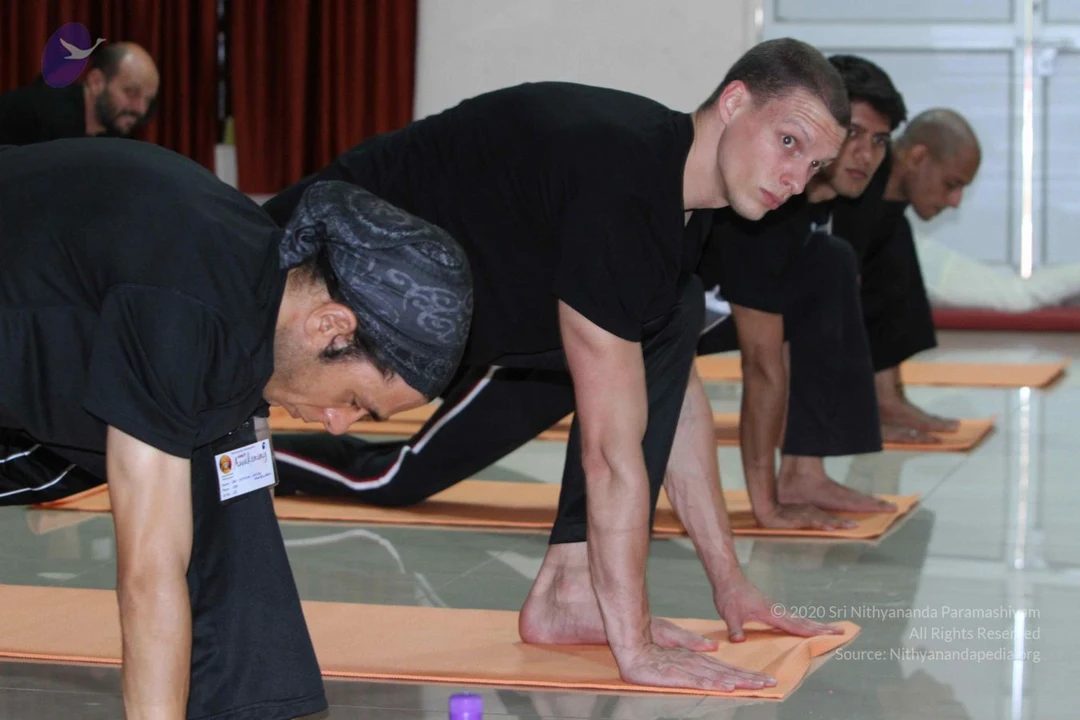
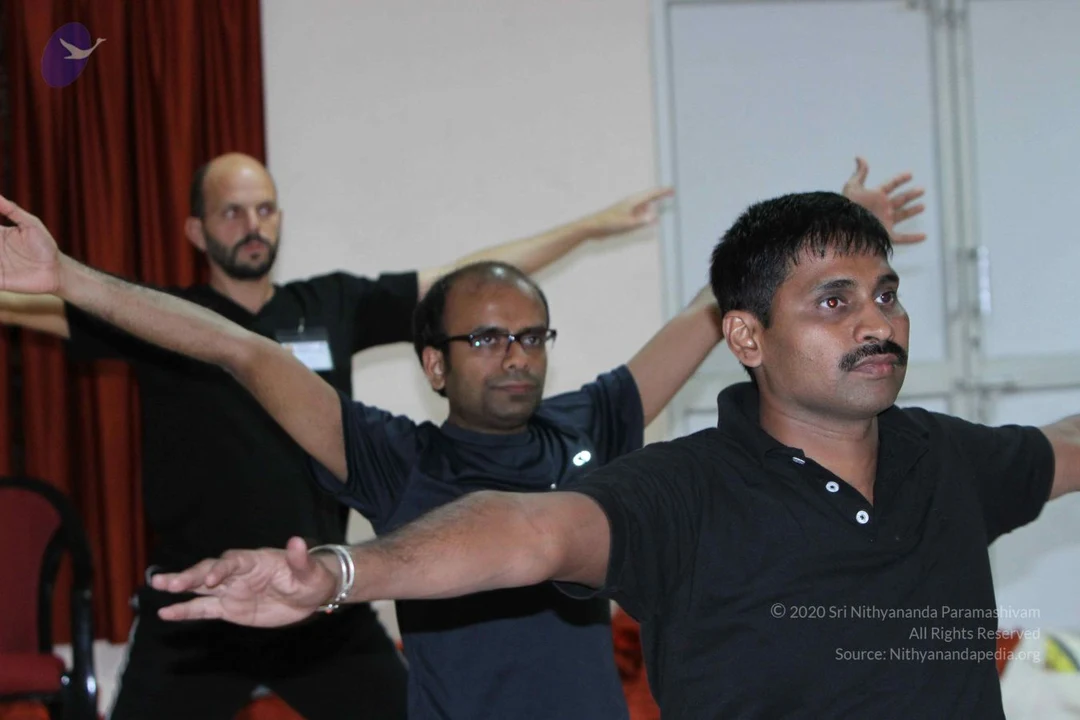
A seated figure in red-orange robes and a long beaded necklace sits on an ornate golden throne with lion-shaped armrests against a gold arched backdrop. The stage has a red carpet, dark drapes, wooden pillared canopies with blue lattice panels, and brass vessels and pots on the floor at the sides. The figure's hair is short and dark, and the person appears to be speaking. The appearance is not distinctive enough to confirm identity, so the figure is described by role as a seated speaker on a throne.A yoga session in a bright hall with pale pink walls and polished tiles. In the foreground a young man in a black "Industry Division" t-shirt and black track pants stands on one leg, hugging the raised knee to his chest. Beside him a man in a navy t-shirt with a visitor badge does a matching standing balance pose, and behind them several men in black clothing stand on orange mats. A framed photograph on the wall shows a robed figure receiving a garland from a devotee. Visible people: about eight.A photograph of a short-haired young man in a black V-neck t-shirt and black track pants standing with his hands clasped behind his back on an indoor tiled floor. Behind him on the left a man in a black t-shirt stands on an orange mat, and to the right another man in black clothes and a visible badge walks past. Orange and pink exercise mats are on the floor, and a poster with orange and red imagery hangs on the wall behind.A photograph of a man standing in the foreground at a hall with orange and pink mats on a polished floor. He wears a black headband, a black crew-neck T-shirt with a plastic-sleeved badge pinned to the chest, black trousers and a dark cord necklace, with a red tilak on his forehead and his arms held behind his back. Behind him, a man in black with glasses and a barefoot man in black and white walk on the mats, and a few other people are partly visible in the background, with framed religious imagery on the wall at top right.Photo of a yoga class standing in a line on orange and pink exercise mats on a tiled floor indoors. In the foreground a short-haired young man in a black V-neck t-shirt and black track pants stands facing the camera with arms relaxed at his sides. Behind him to the left, a man with glasses in a black t-shirt and black track pants stands on an orange mat with a wristwatch. Several more people in dark clothing stand in the background near a wall with a framed picture and shelves. No a person candidate is visible in this image.A young man in a black short-sleeved top stands in the foreground with both arms raised straight overhead, palms facing forward, in a yoga-like upward stretch. Behind him, a line of other people in black clothing perform the same pose on orange mats in a bright, plain hall with a white ceiling and fluorescent lights. The background shows blurred figures, a wall with a framed picture, and red fabric.
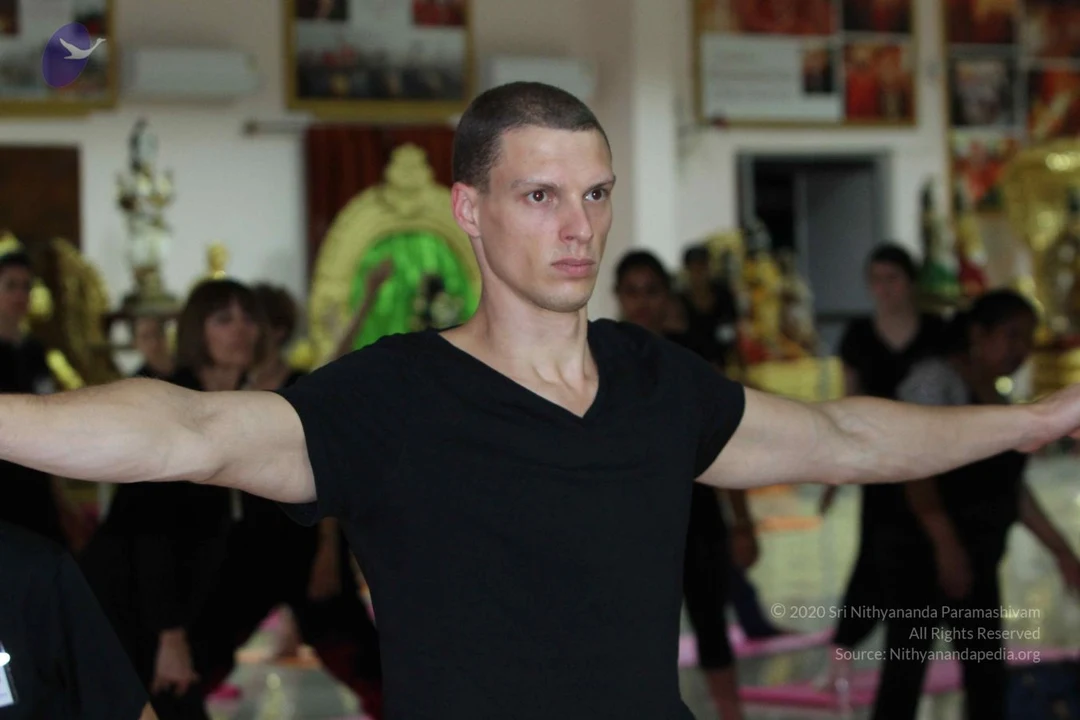
Morning-Satsang

17 photosSource gallery
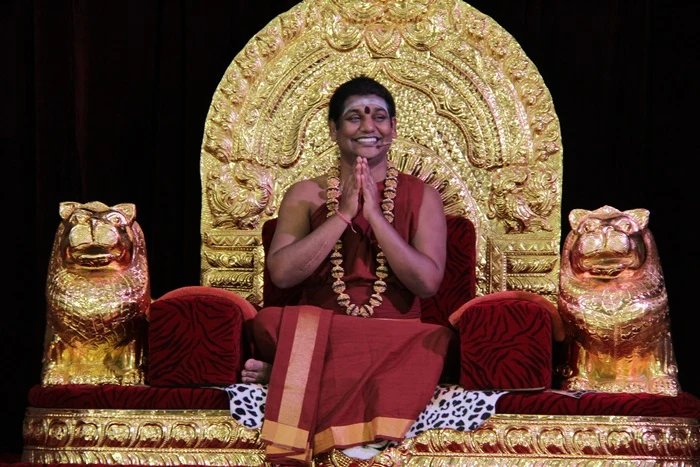
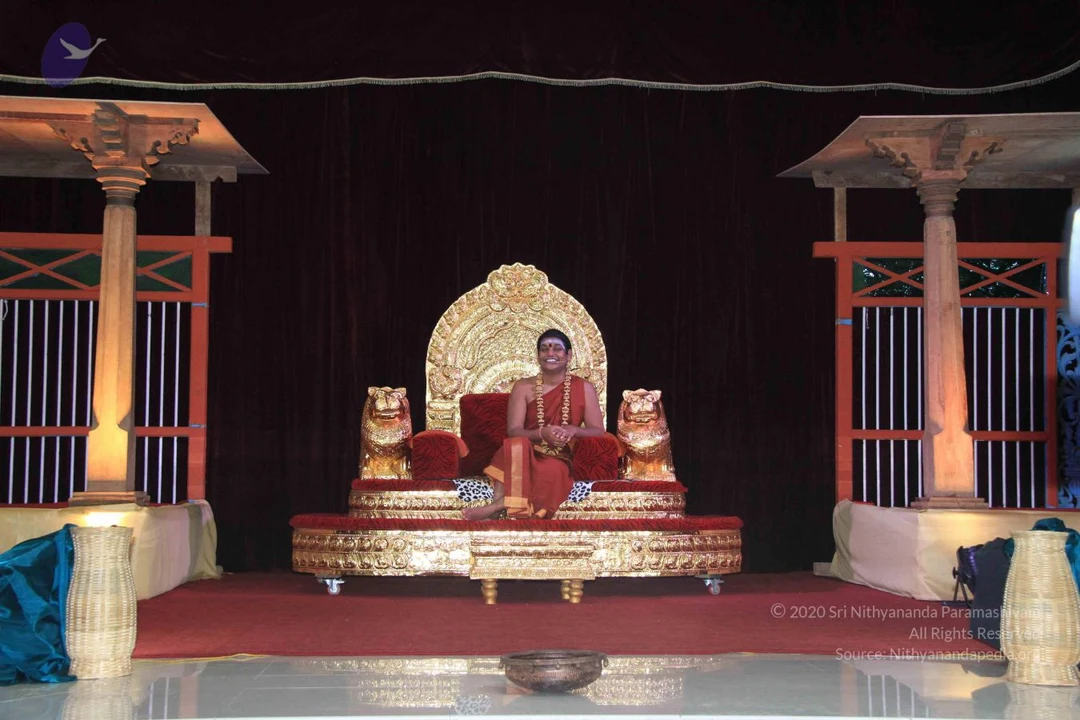
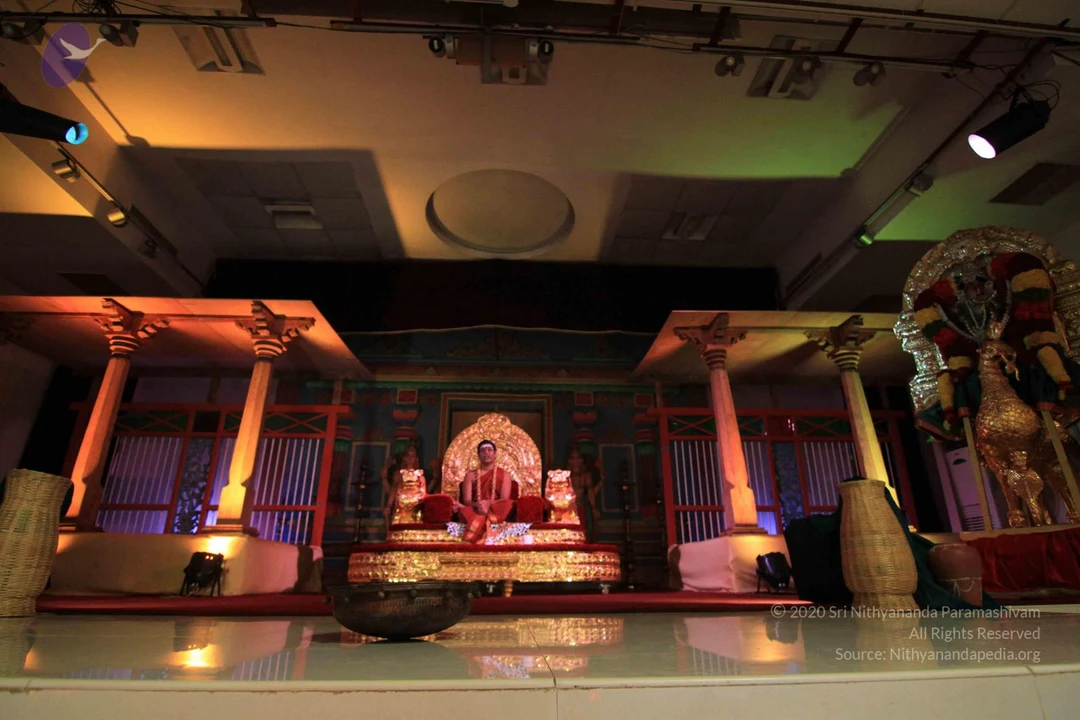
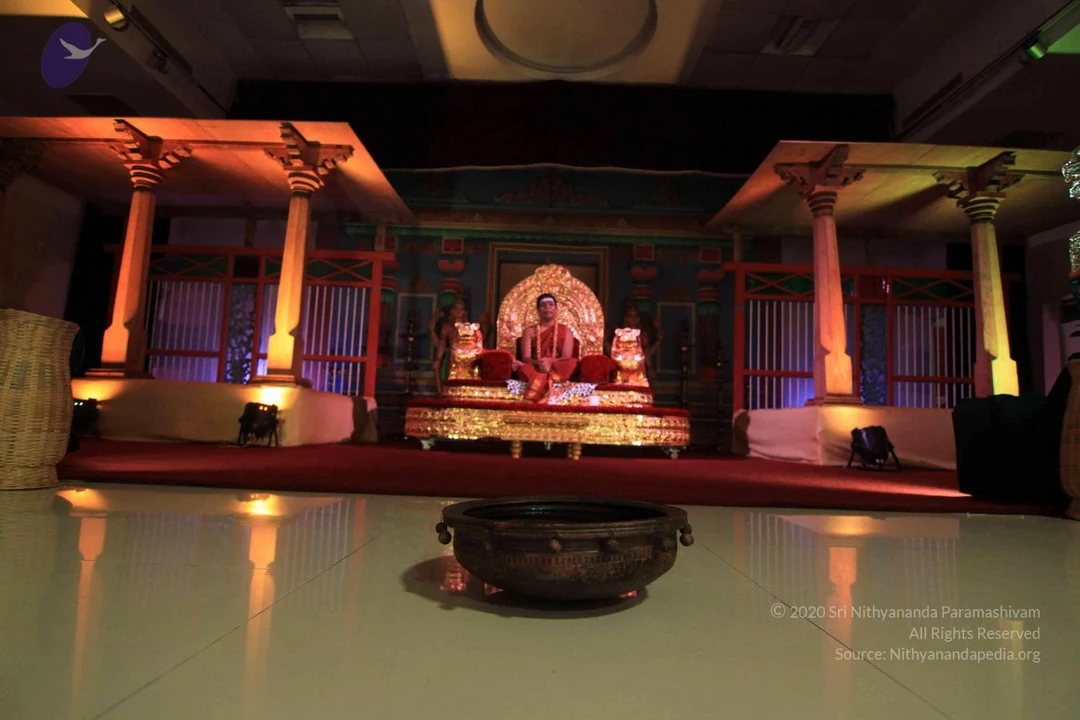
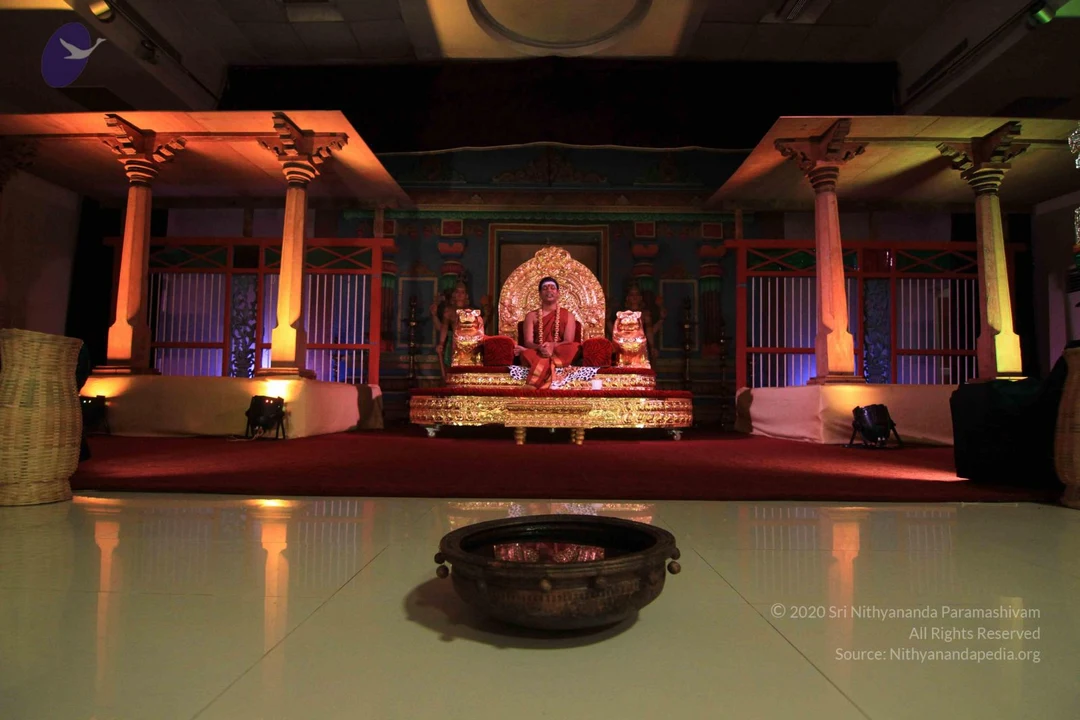
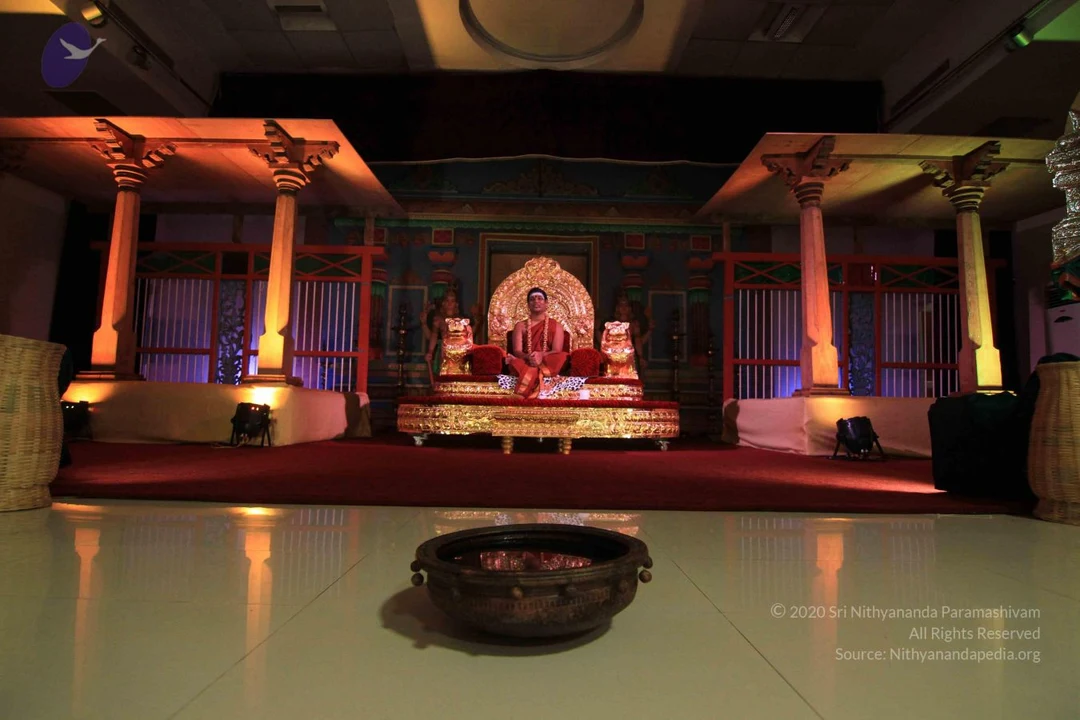
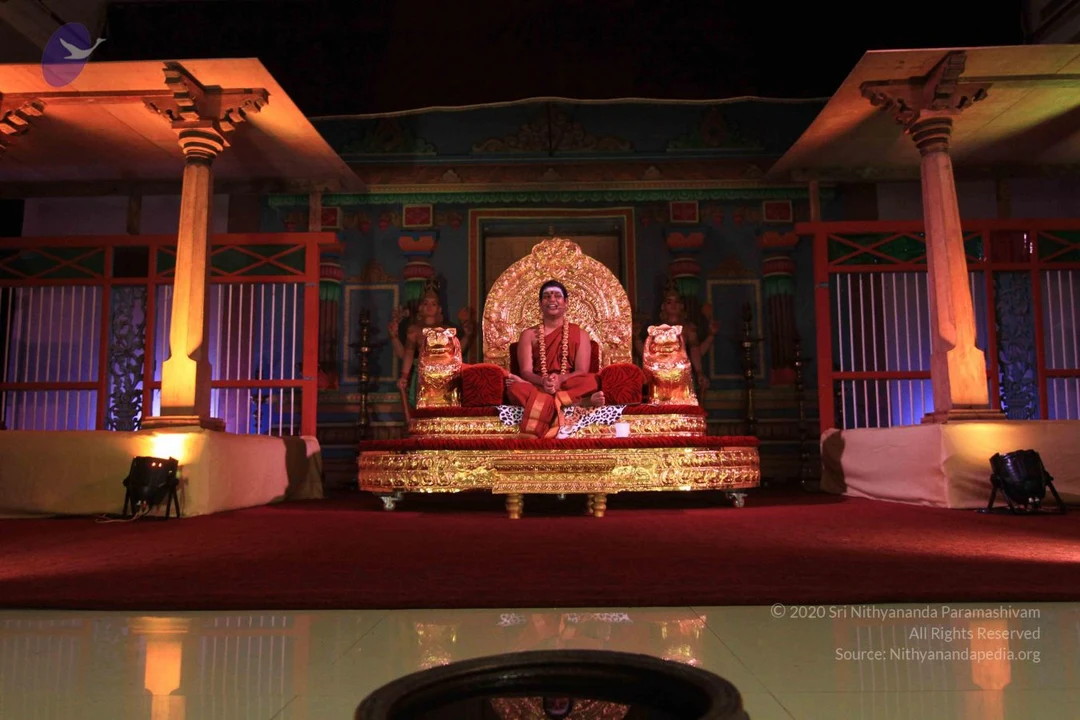
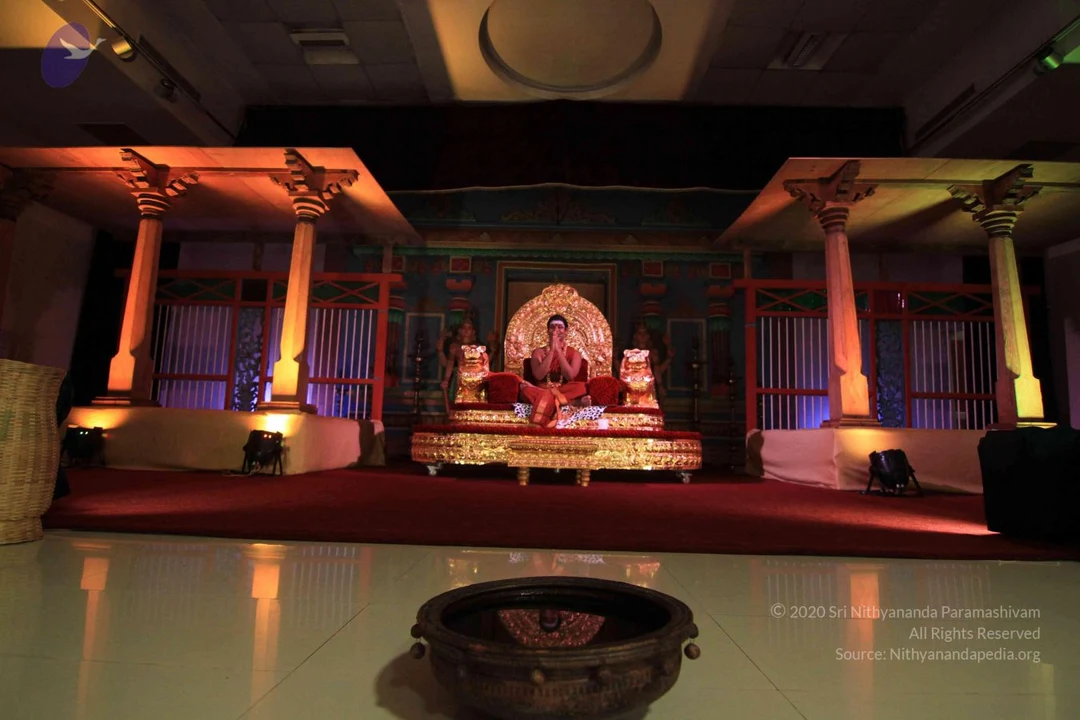
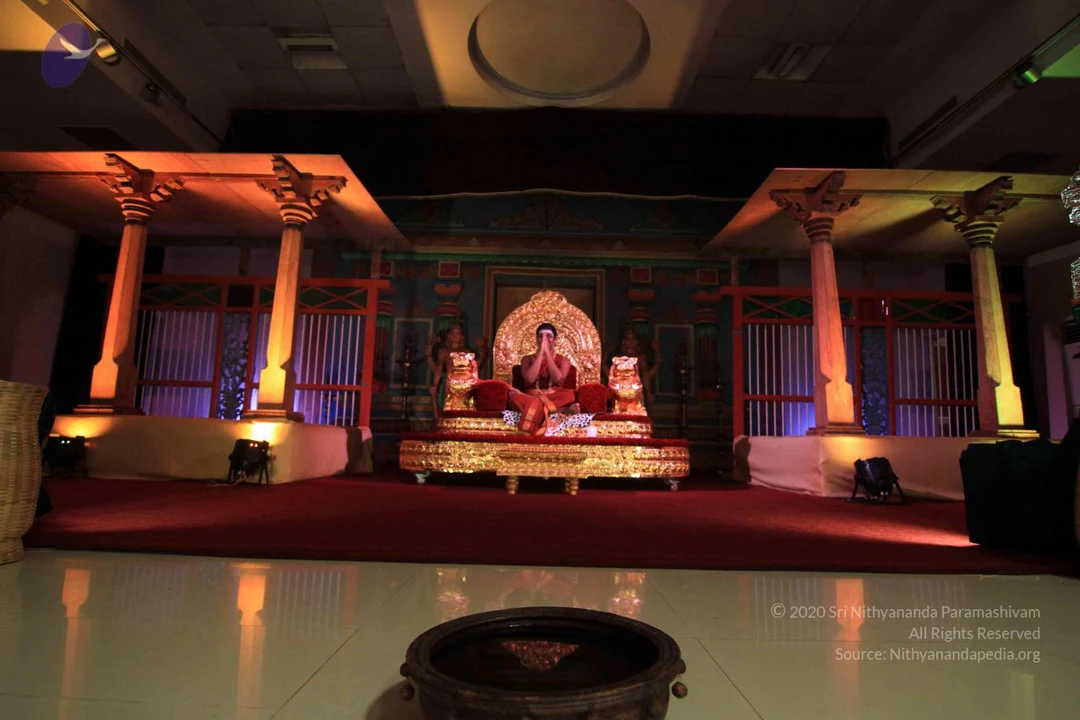
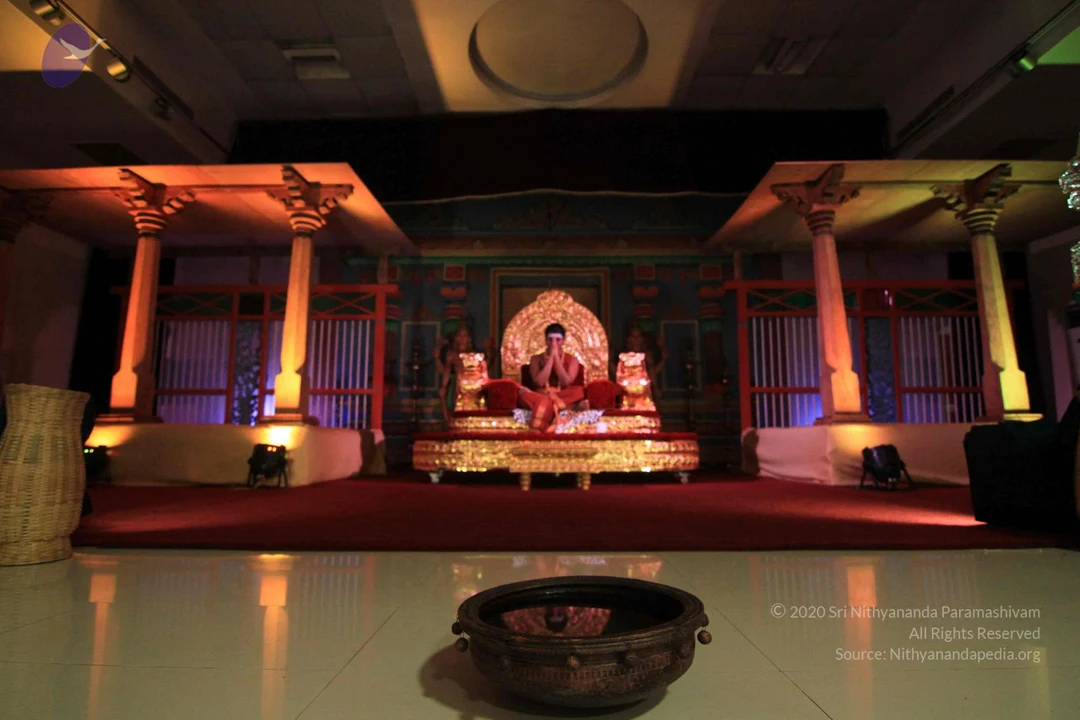
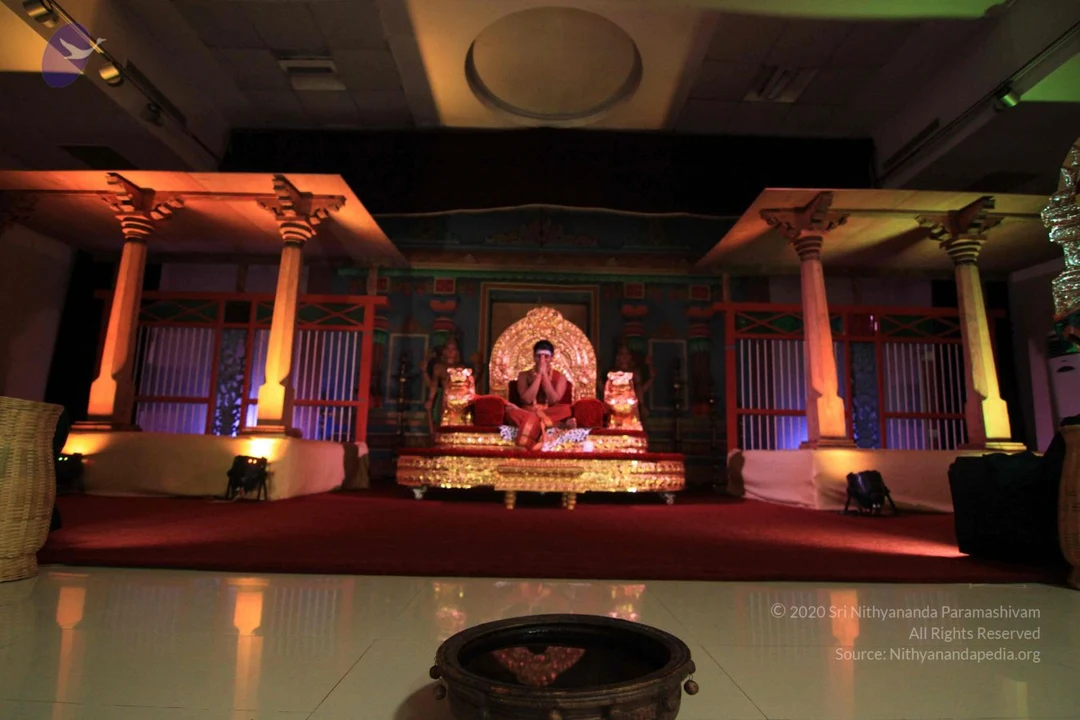
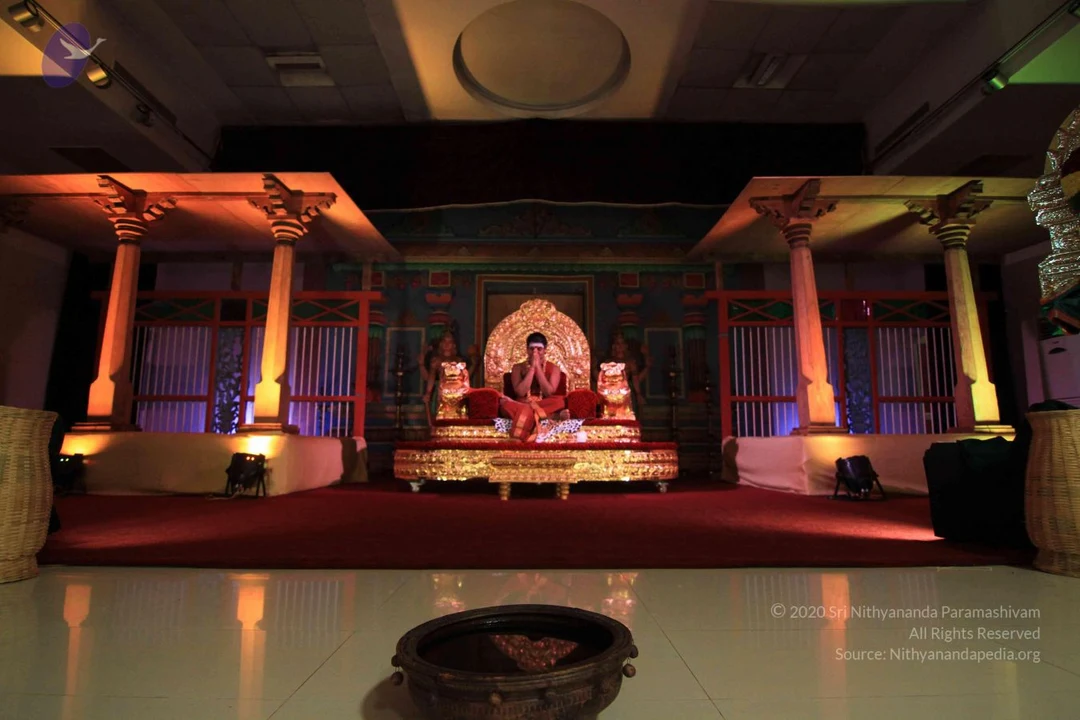
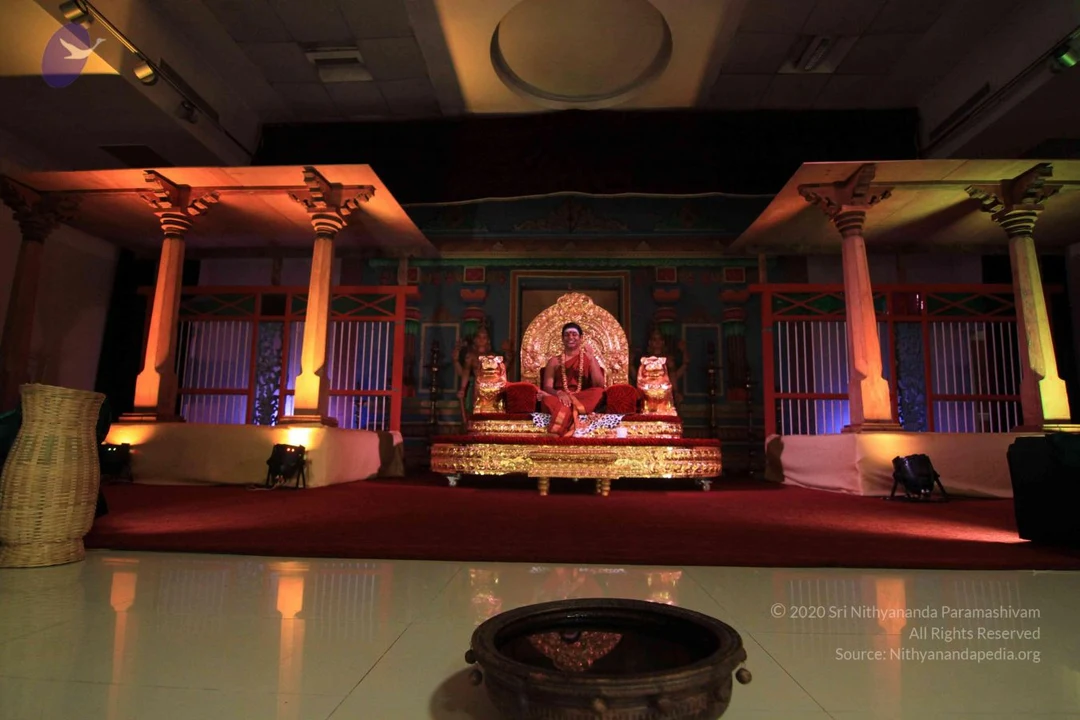
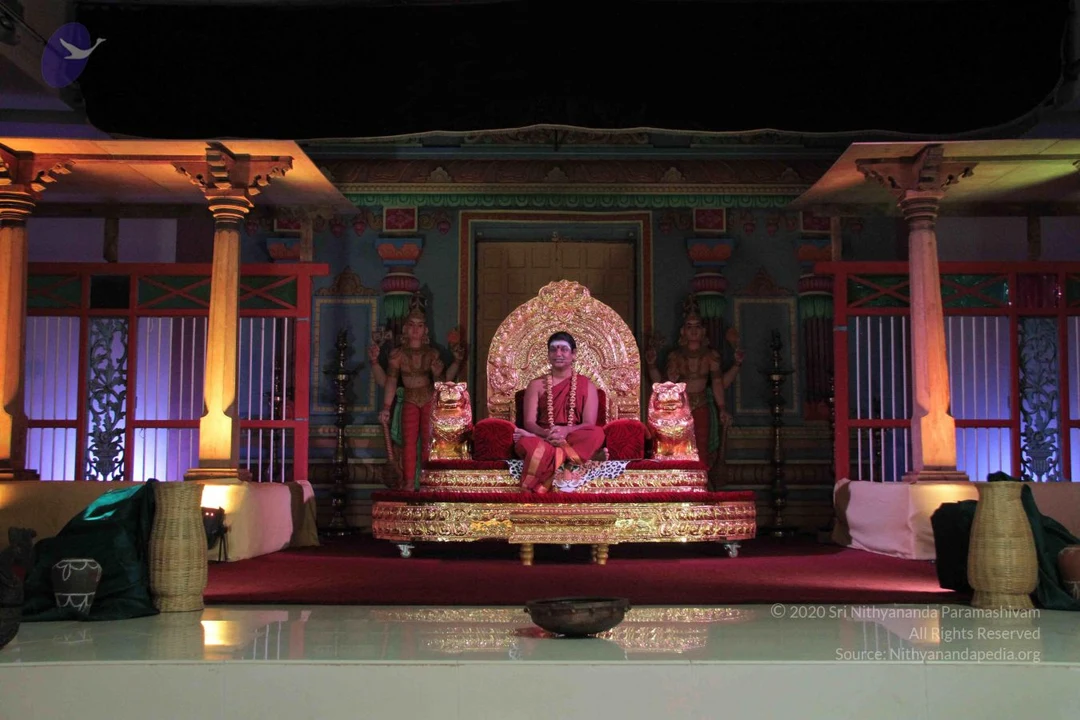
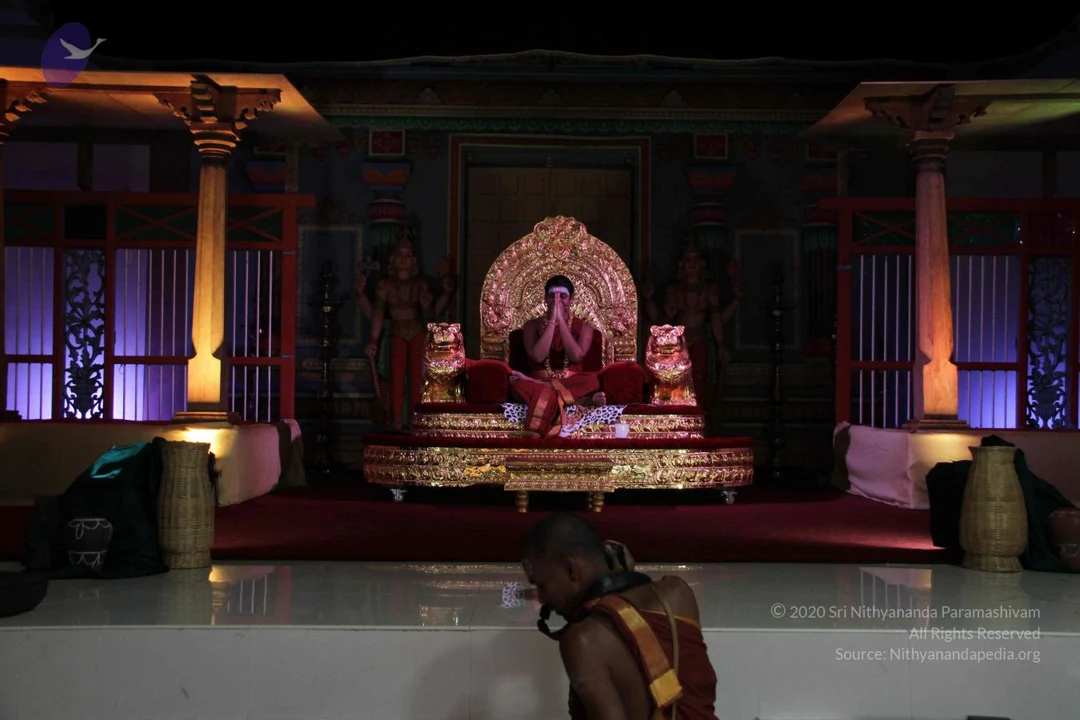
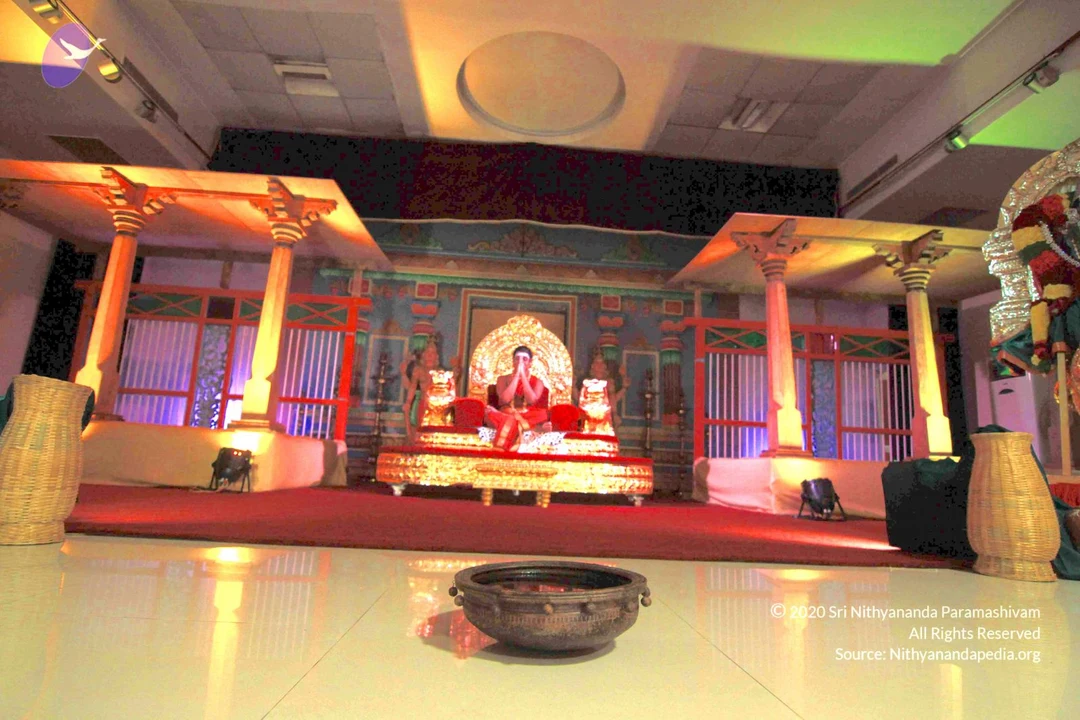
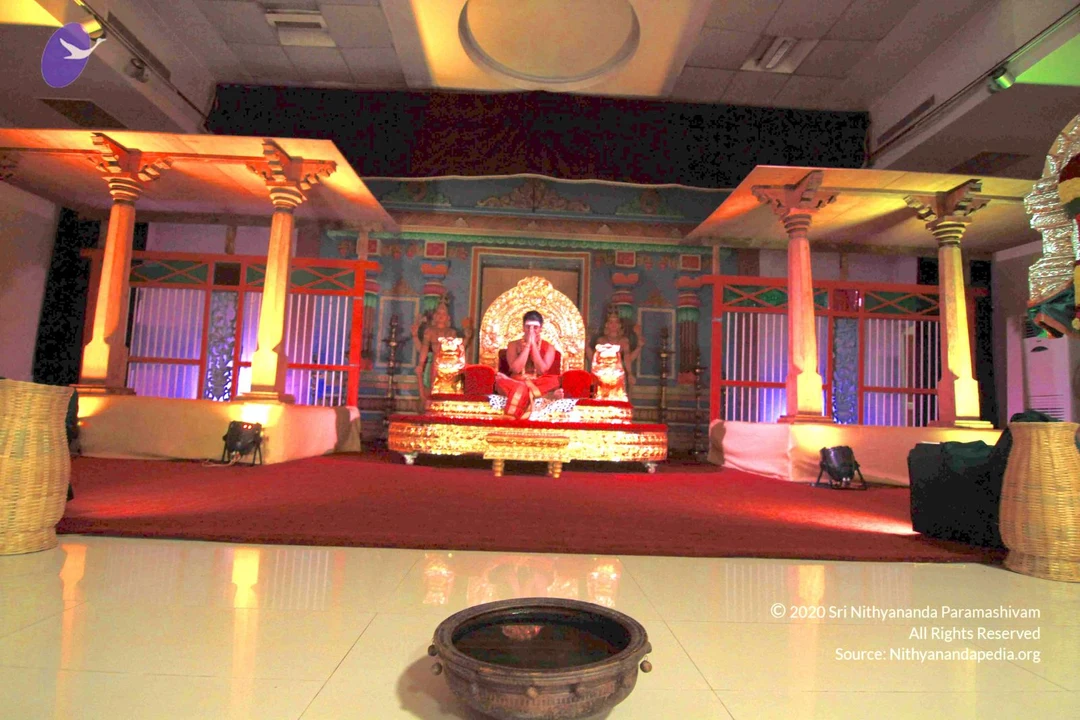
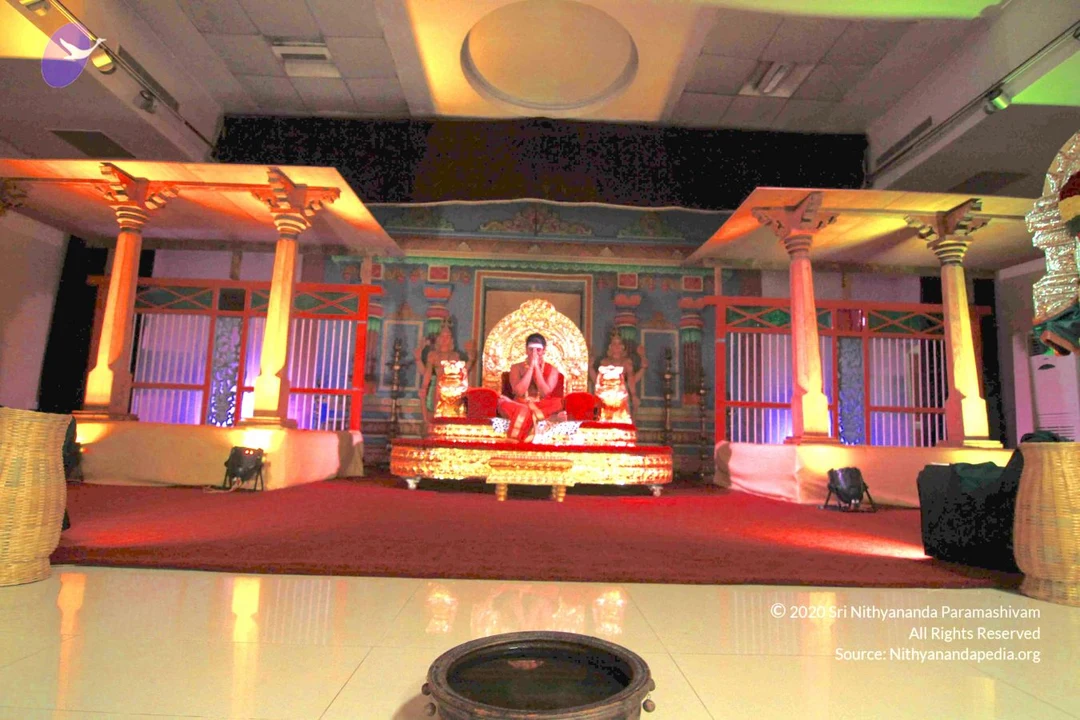
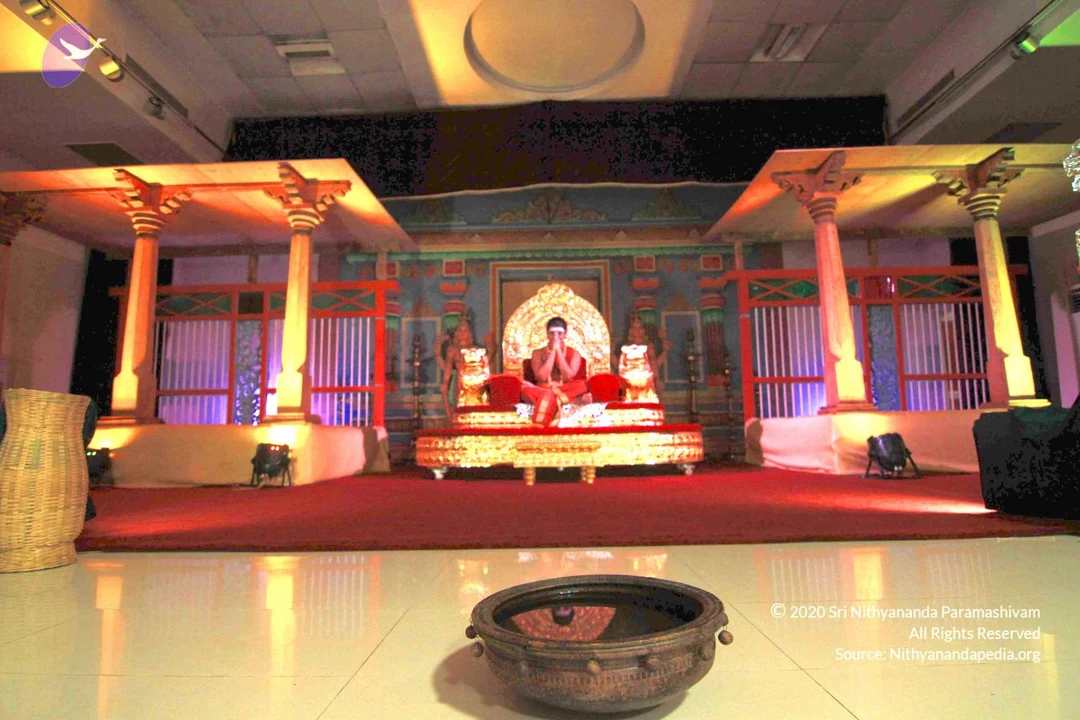
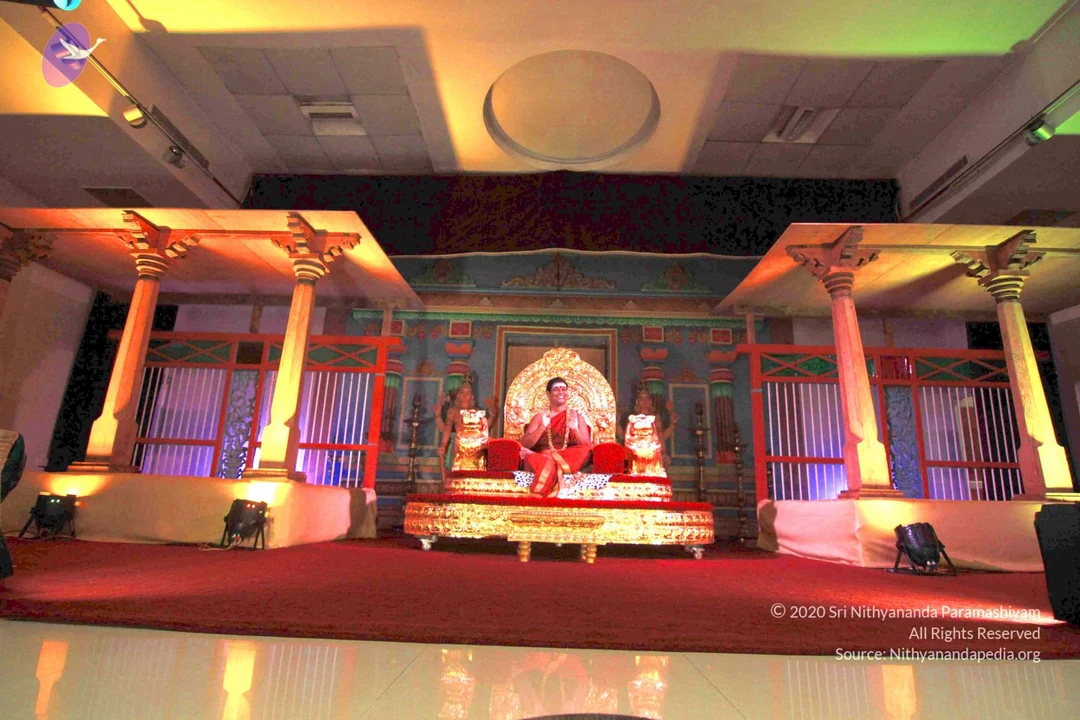
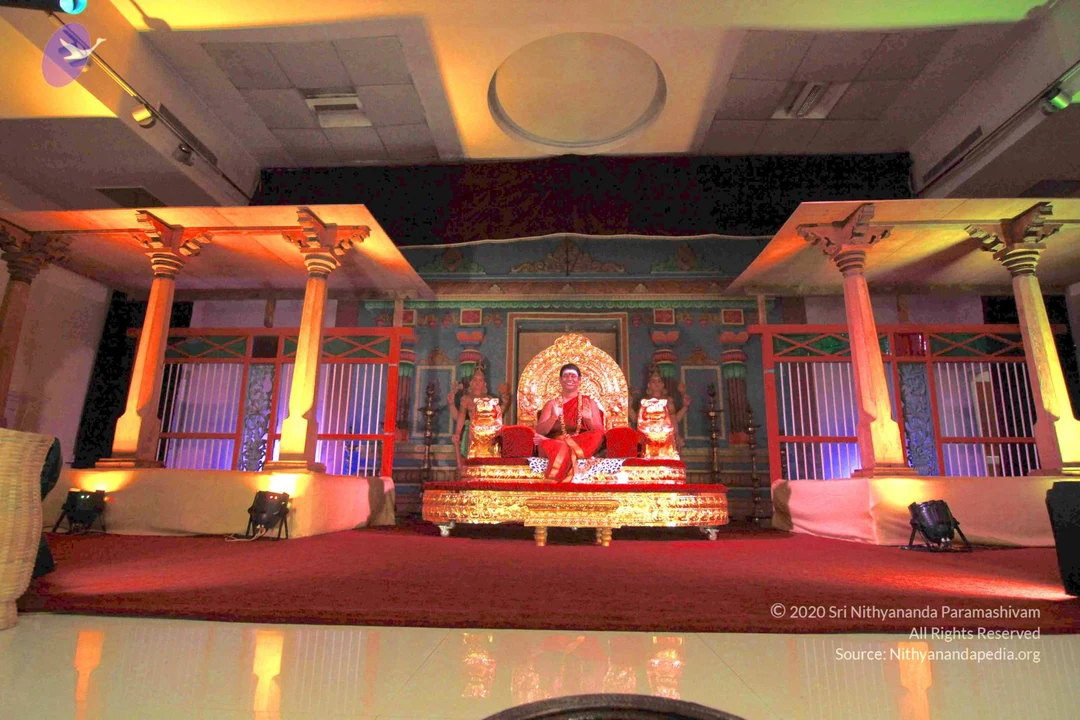
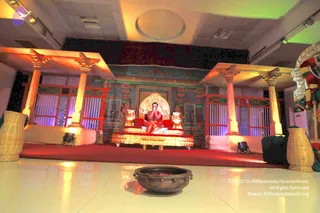
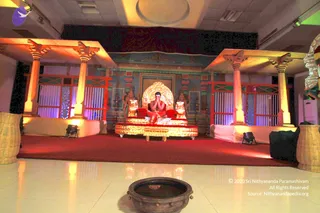
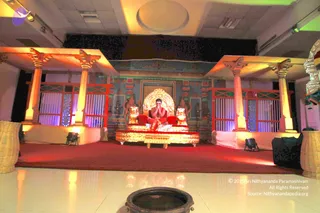
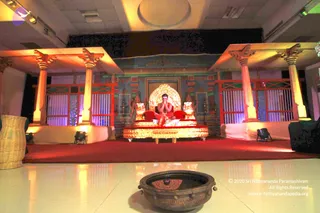
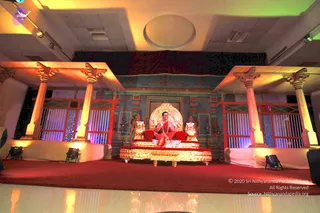
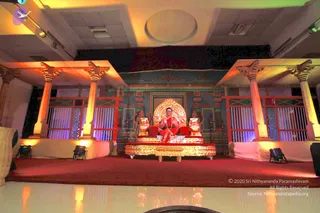
A seated figure in red and white sits on an ornate golden throne with a large gold halo behind, hands folded in a namaskar gesture, on a raised red-carpeted dais in a decorated hall. Two smaller golden lion-like guardian figures flank the throne, and the dais is framed by red-latticed wooden screens and columns with carved capitals. A bronze bowl sits on the glossy floor in front, with wicker baskets at the sides and a garlanded deity murti partly visible at the right edge. The setting is lit with warm yellow and purple lights.Wide view of a stage set with a red carpet and gold-trimmed platform. A seated figure in red or orange robes sits on an ornate golden throne with a tall arched back, hands pressed together in greeting. Two gilded attendant figures stand flanking the throne, and red-cushioned chairs sit to either side. Carved wooden pillars with columns frame the stage, with a painted backdrop of ornamental panels behind. A large bronze vessel sits in the foreground on the white floor, and wicker baskets stand at the edges. Stage lights cast warm and purple tones. Only the seated figure is a physical person in view; the attendants are statues.A photograph of an ornate stage set inside a hall, lit with warm orange and purple lights. A figure in red-orange robes sits cross-legged on a gold and red throne with a gilded arched back, hands folded in front in a namaskar-like gesture. Carved golden lion-like guardians flank the throne on the red carpeted dais, with red-and-white pillars and decorative painted panels behind. A round metal vessel sits on the polished floor in the foreground. The figure appears to be a seated teacher; the seated figure's appearance is too small and indistinct to confirm identity, so this is marked unsure.A photograph of a temple-style stage set with ornate golden pillars and a painted backdrop in red, teal and gold. A seated figure in a red-orange garment sits on a gilded throne with a decorated golden arch behind, hands pressed together in a namaste gesture and a white headband tied on the head. Flanking the throne are two carved figures and gold-ornamented red chairs. A red carpet covers the floor, and a large bronze vessel sits in the foreground beside a wicker basket. The figure wears saffron-orange clothing, which is a distinctive cue, but the face and features are not clearly discernible from this distance, so identity is uncertain; the seated person is a satsang speaker on a throne. Stage lights cast warm yellow and purple glow across the hall.A photograph of a stage set in a hall with a red carpet and warm coloured lighting. Ornate golden throne with red cushions sits centre stage, backed by a painted panel and flanked by carved pillars. A single seated figure in red-orange robes sits on the throne with palms joined in greeting. Two gilded lion-like guardian figures stand beside the throne. Stage pillars, red lattice screens and spotlights frame the set.A decorated stage in a hall with pillars and warm orange and purple stage lights, a red carpet, and a gold-ornate golden throne at centre. A seated figure in red and orange robes with a rudraksha-style mala sits on the throne with hands in a gesture, flanked by two gilded lion-like carved guardians and two ornamental figures against a painted blue-and-gold backdrop. The a person candidate has a compatible presentation with ornate red clothing and a mala, though the face is too small to confirm identity, so this is an uncertain in-person candidate.
darshan
5 photosSource gallery
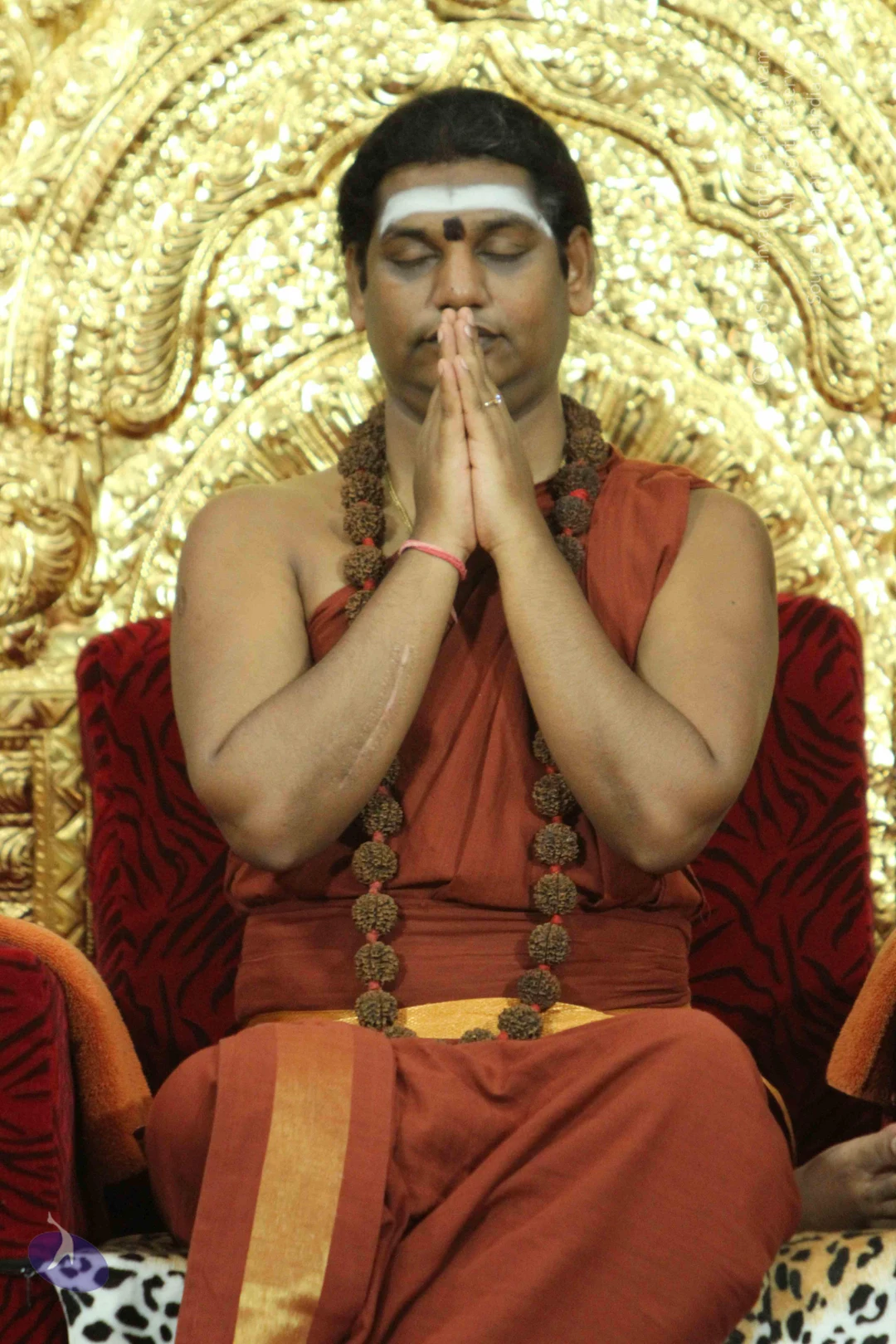
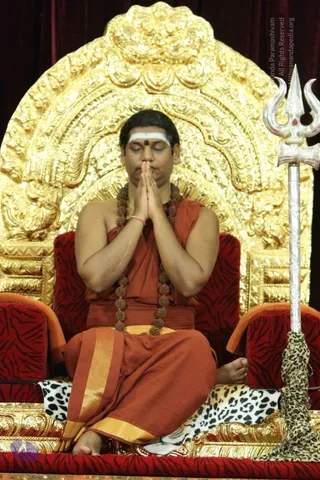
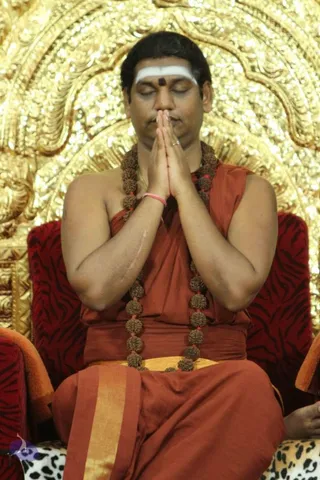
A seated man in saffron-orange robes with gold border sits on a red tiger-striped throne with an ornate gold arched backrest, hands pressed together in namaskar and eyes closed. He wears a white vertical tilak with red dot on forehead, a rudraksha mala with multiple strands, and a red wrist thread. A silver trident rests at right beside a leopard-print cloth on the dais. a person: long-established cues are the saffron-orange robes, rudraksha malas and ornate gold throne setting, shown in person during satsang.A seated man with eyes closed holds his palms together in anjali namaskar greeting. He wears rust-orange bare-shouldered robes with a gold-bordered dhoti, a long rudraksha mala draped over his shoulders and chest, a white forehead stripe with a central dark mark, and a red thread on his wrist. Behind him stands an ornate gold-embossed throne back, and he sits on a red tiger-striped upholstered chair with a leopard-print cushion below. a person: the rudraksha malas, saffron-orange robes and ceremonial seated setting are the qualifying cues, so this is an in-person candidate.A decorated bronze deity murti of Ganesha, elephant-headed, stands within a dense arrangement of red roses, yellow marigold garlands and green leaves. The figure wears a tall jewelled crown decorated with coloured stones and a rudraksha-style mala, a blue garment and a green fringed sash. A small golden mouse vahana appears in the lower foreground. No physical people are visible.A man in rust-orange robes with a golden-yellow border sits cross-legged on a red zebra-striped cushioned throne in front of an ornate gold repoussé backrest. He raises both palms upward in a blessing gesture and smiles. He wears a long rudraksha mala with large beads, a white and red tilak on the forehead and a red thread on the wrist. Leopard-print cushions and an orange cloth lie beside him, and a silver trident is partly visible at the right edge. A watermarked archive photo credit appears in the top right, and the setting suggests a satsang or darshan.A smiling man seated on a red tiger-striped cushioned throne in front of an ornate gold repoussé backrest, raising both open palms above his head in a blessing gesture. He wears an orange-red ochre robe with a golden border, a long rudraksha mala with multiple strands around his neck, and a white vibhuti line with a red kumkum dot on his forehead. A red thread is tied on his wrist. A leopard-print cloth lies on the armrest.