Skip to content
Saturday

15 March 2014

Dated photos
212
Source pages
1
Media
2
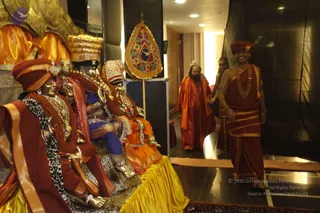
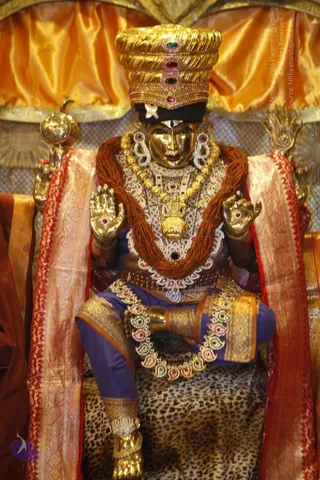
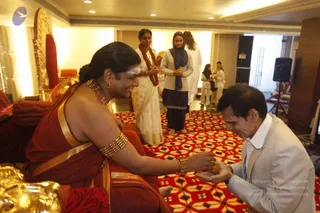
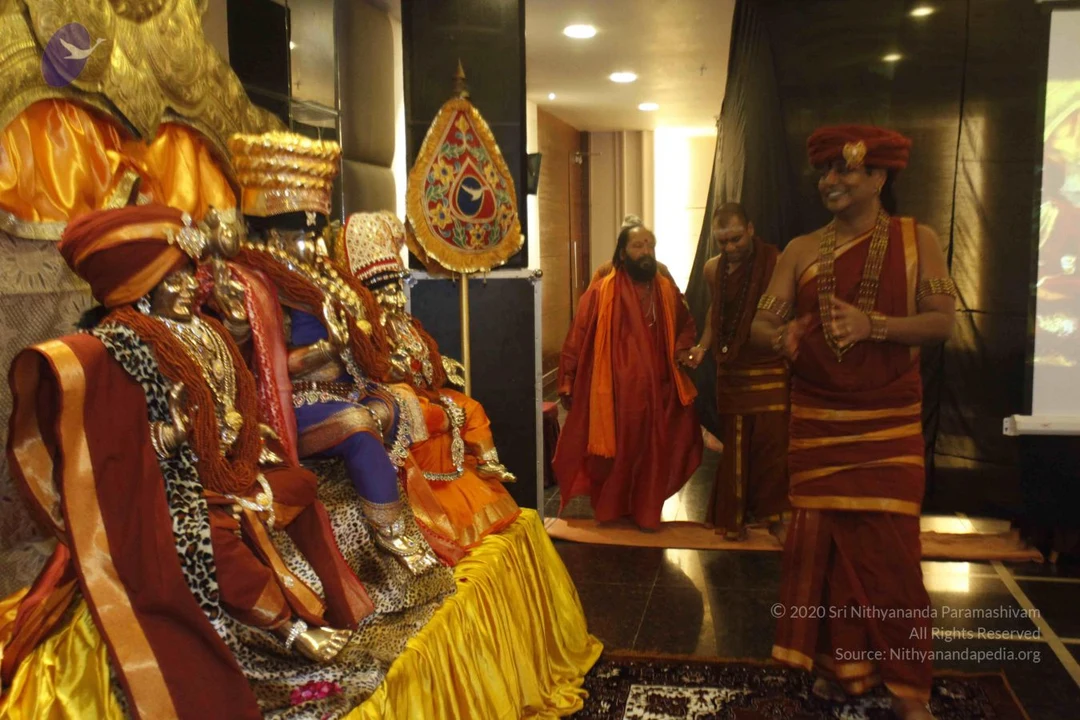
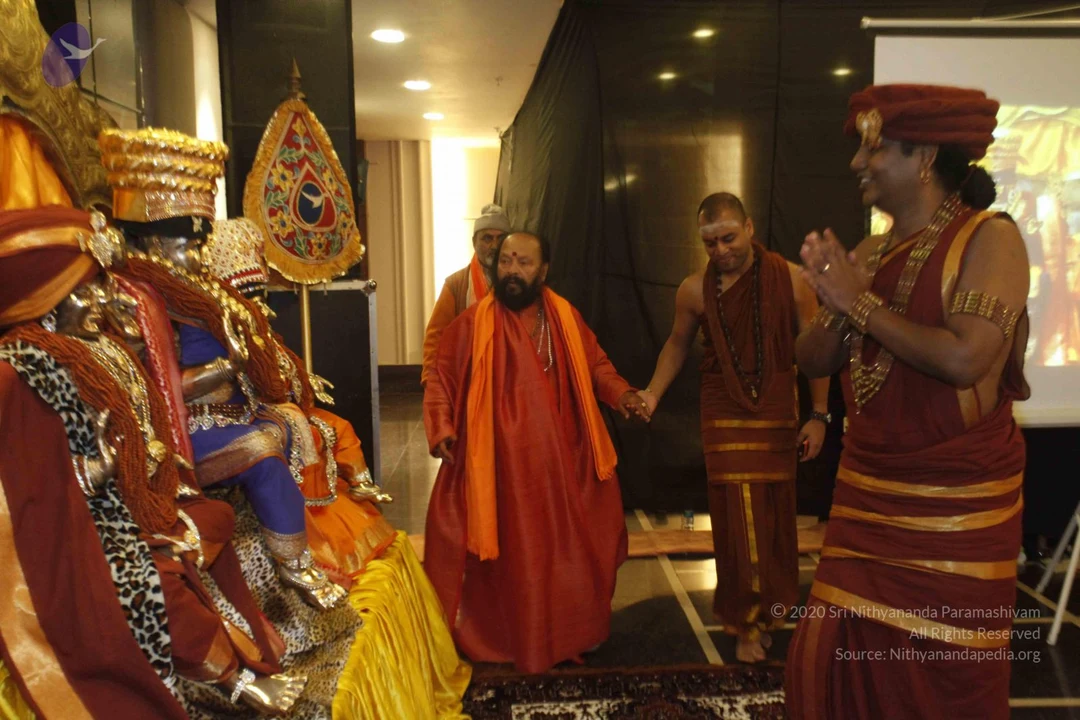
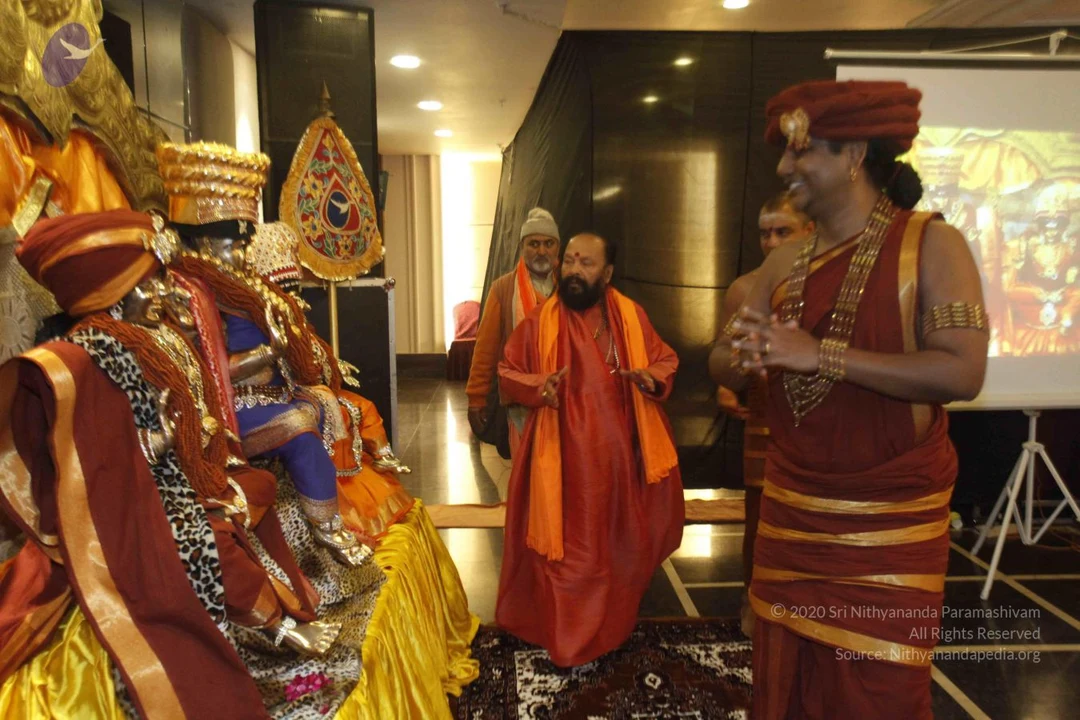
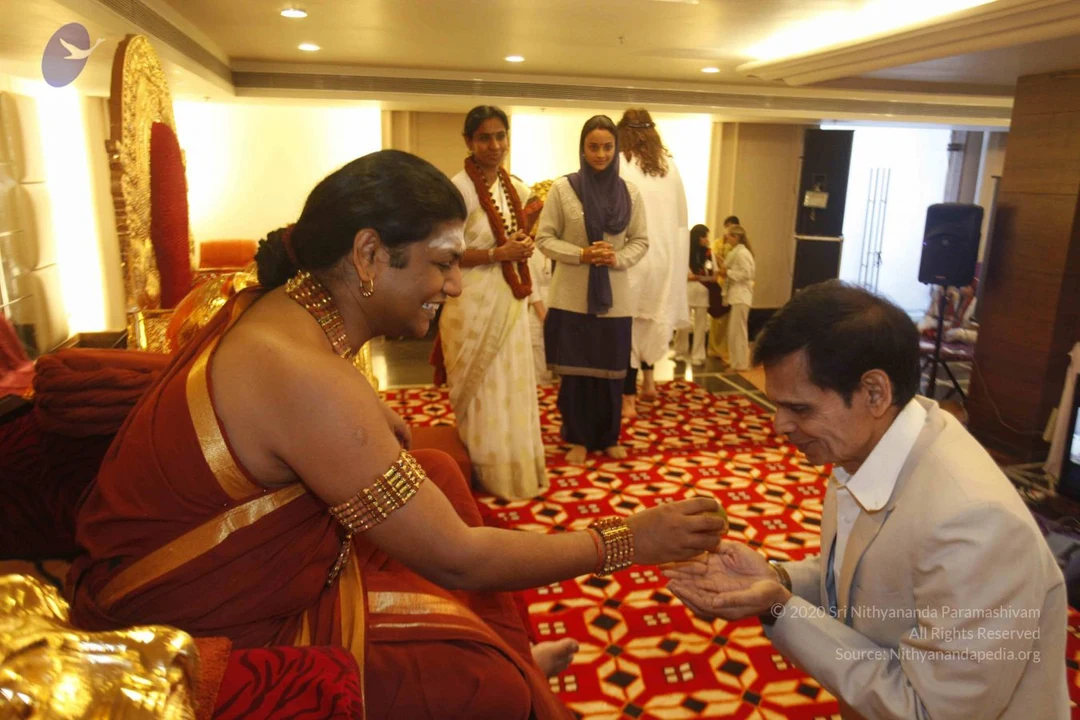
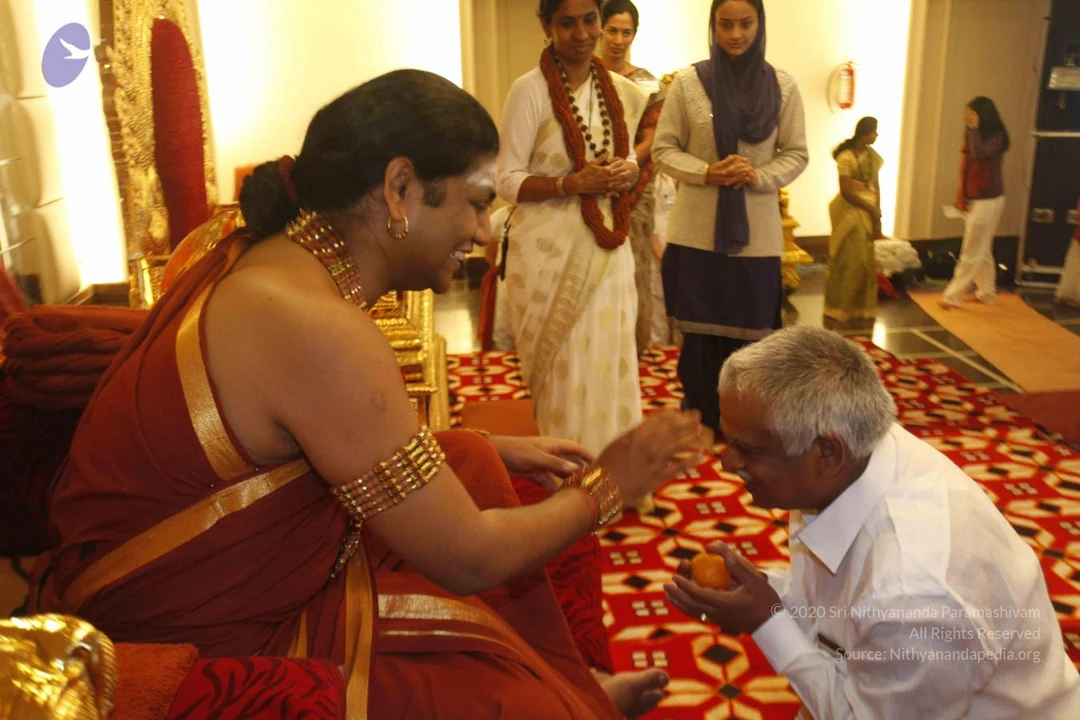
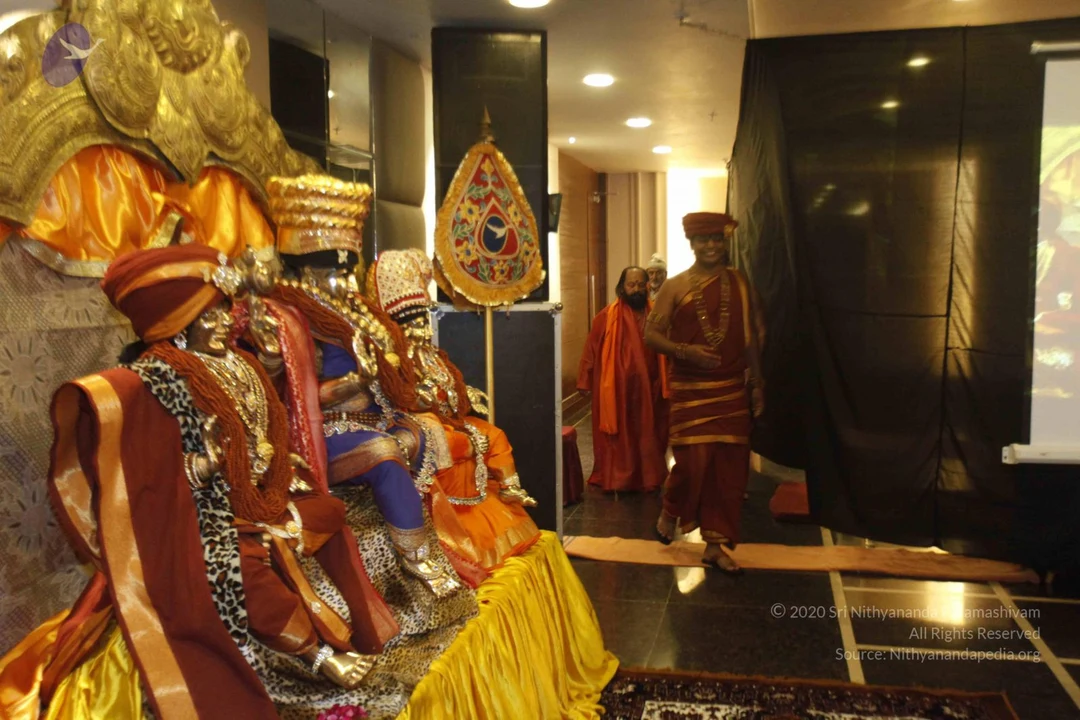
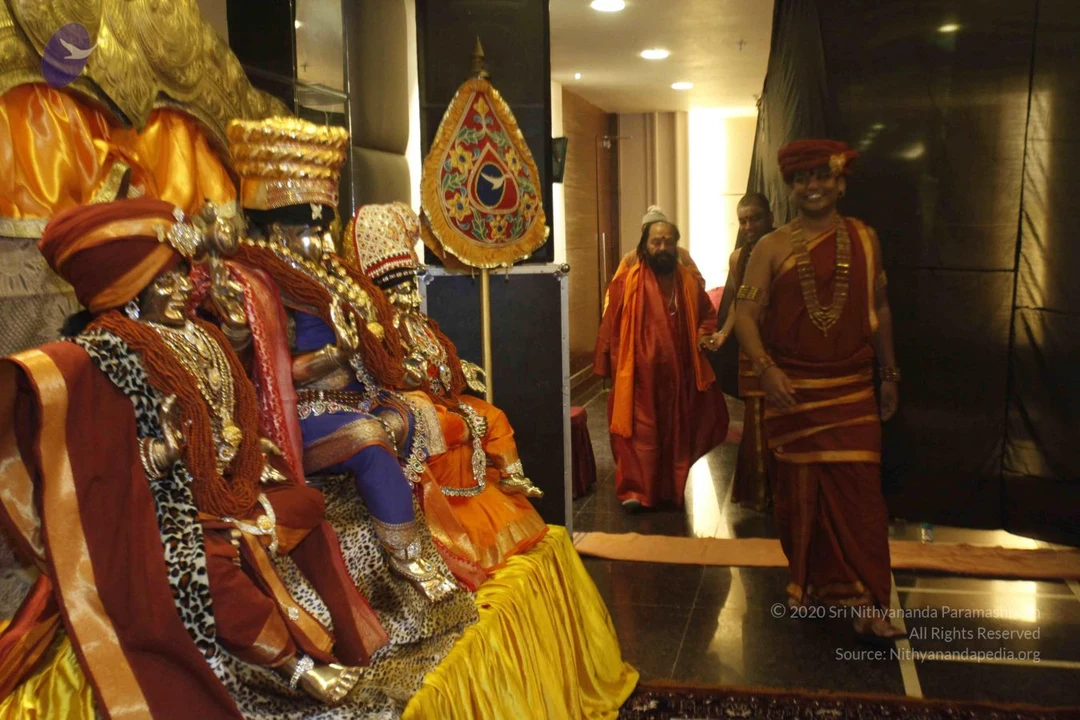
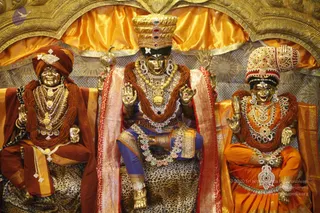
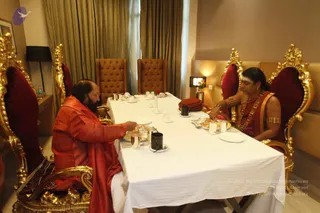
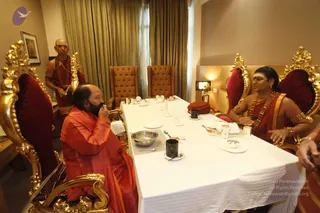
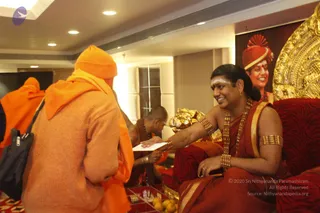
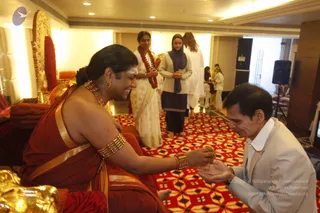
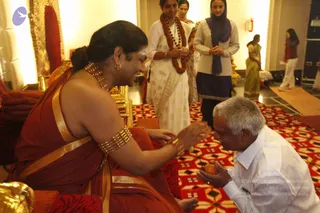
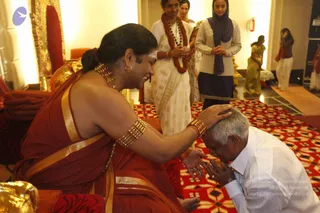
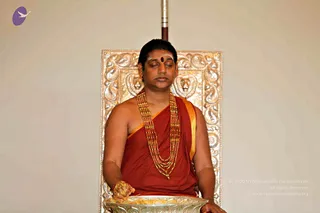
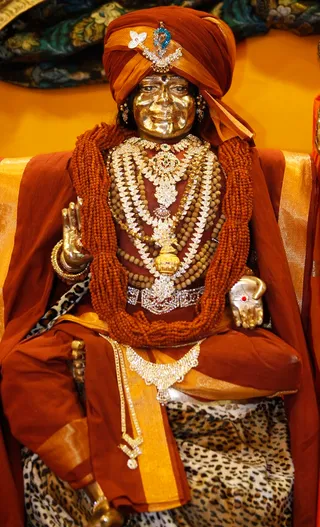
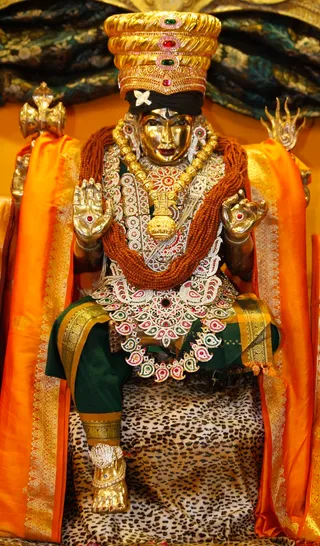
A photograph in a carpeted hotel-style corridor. On the left, several seated deity murtis (statues) in ornate orange, red and blue robes with gold crowns, heavy gold jewellery and red beaded necklaces sit on a yellow-draped platform, with a decorative gold-and-red pennant standing behind them. On the right, three men walk past in saffron and maroon robes; a bearded man in a long orange-saffron shawl and white head covering leads, while a man in a maroon dhoti and maroon turban with a gold-and-white necklace stands smiling near the wall. The statues and the living people are distinct; the statues are not people.A gilded deity murti seated on a leopard-print cushion beneath gold and orange silk drapes. The figure wears an elaborate gold crown set with green and red stones, a black headband, and layered gold and jewelled necklaces over a rust-brown rudraksha-style mala. Blue-violet dhoti-like cloth has a gold and red border, with jewelled anklets. Two hands are raised in mudra gestures, and gold ritual implements, including a trident, stand at the sides of the throne.A seated figure in a deep red and gold saree with a gold-toned blouse and ornate gold necklaces and bangles, sitting on a red and gold throne-like seat, extends a hand to offer a small orange fruit to a kneeling older man in a cream jacket and white shirt. Behind them, a woman in a white saree with a red garland and another woman in a grey jacket and dark blue skirt with a head scarf stand on a red patterned carpet, while other people in white clothes stand near a speaker stand in a warmly lit hall.

March 15 2014

Original wiki page
Contents

Day's Event

The day's routine started with PadukaPuja to Swamiji followed by morning Nithya Satsang and Kalpataru meditation process and Darshan. And Inner Awakening at Haridwar successfully moves to day 10.

Description:

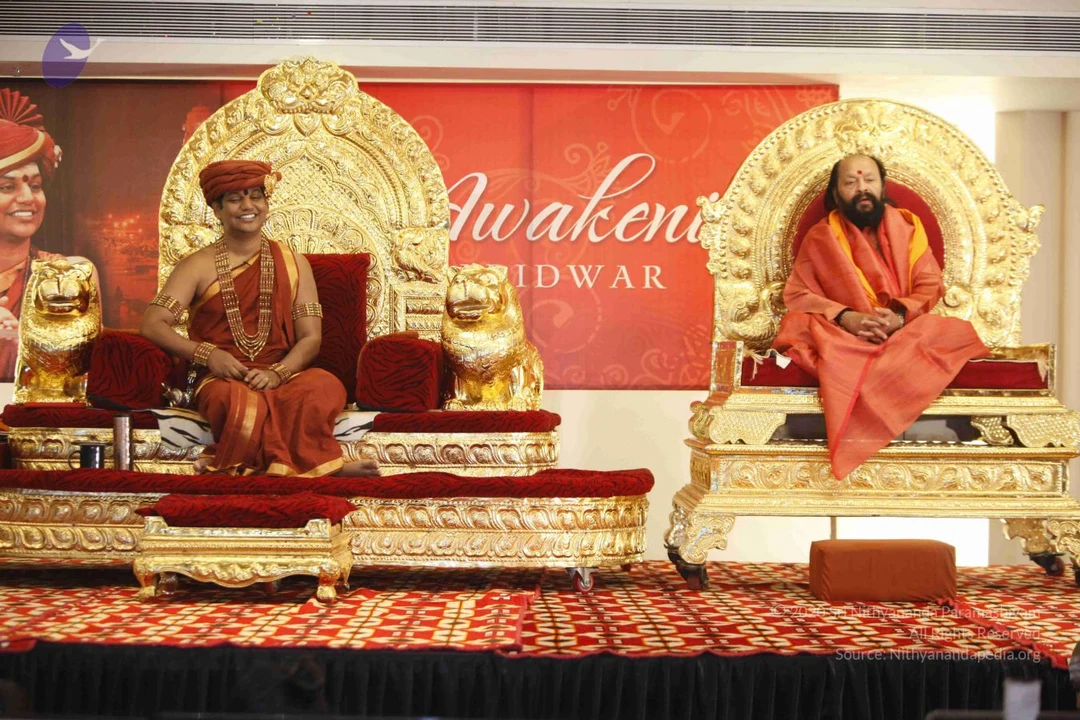
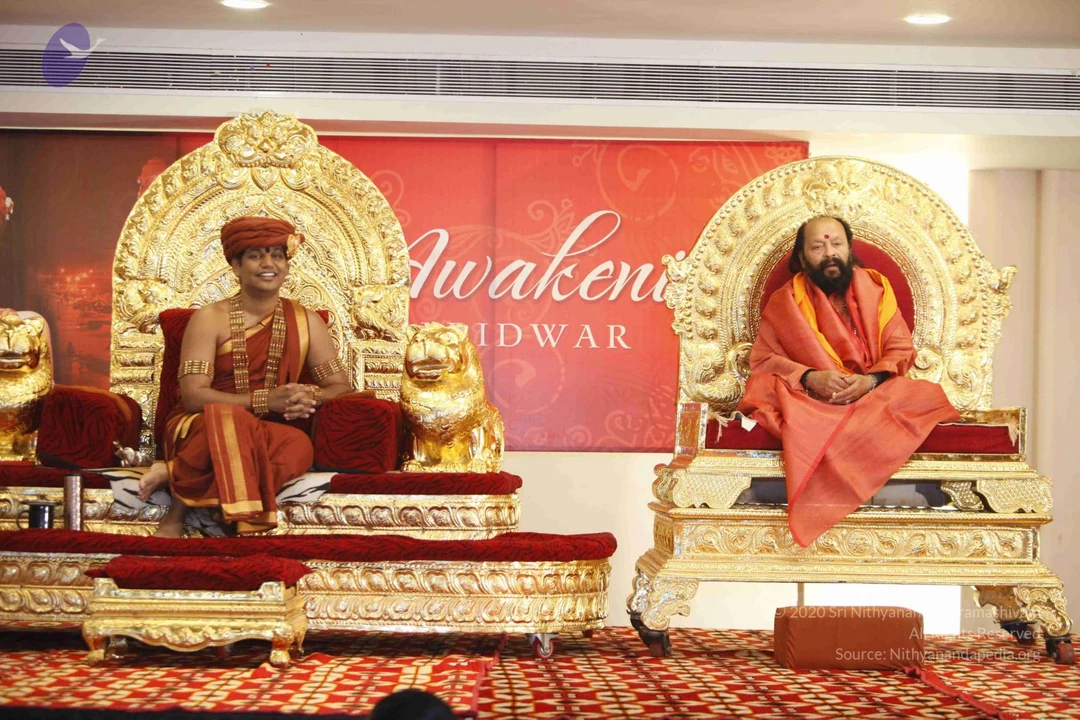
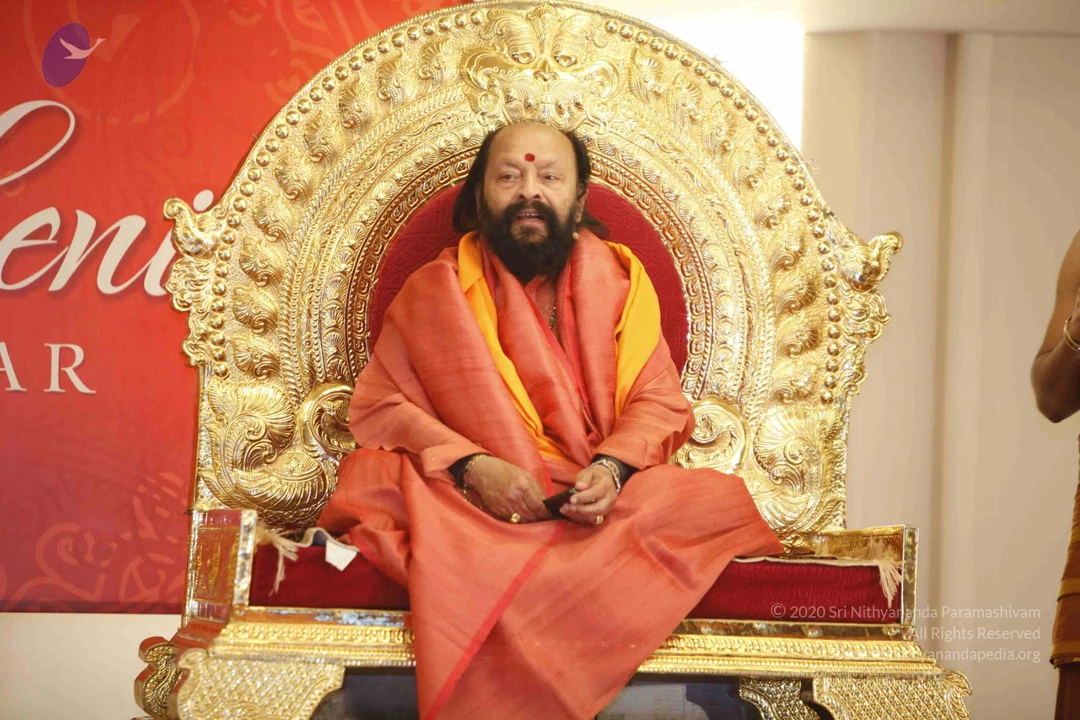
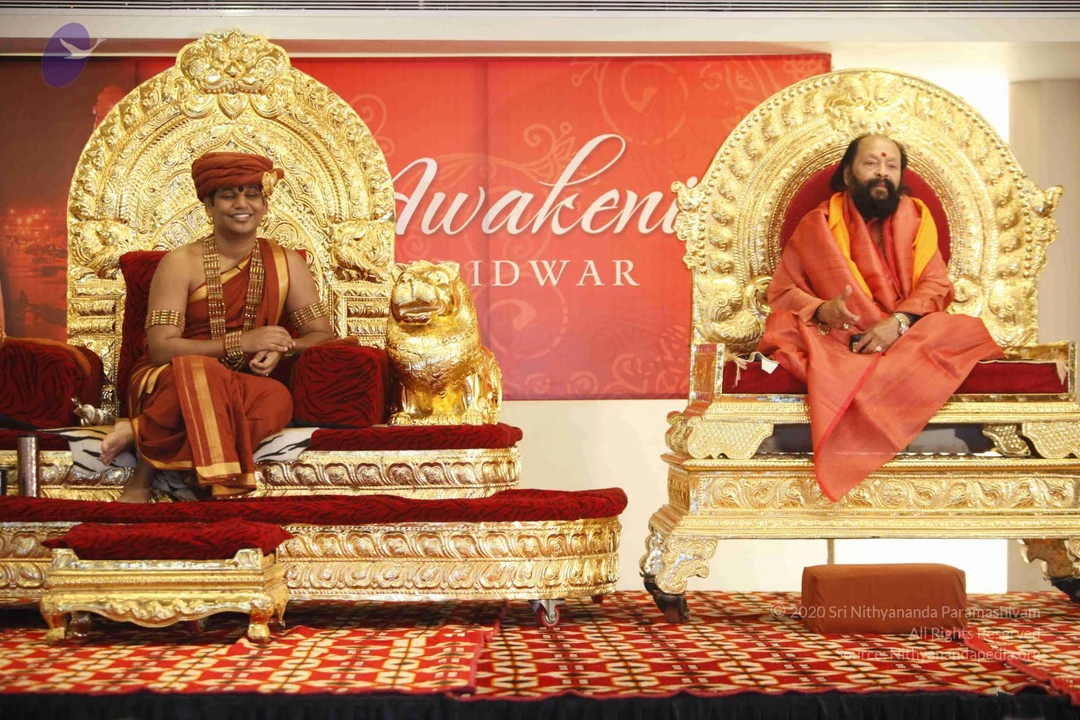
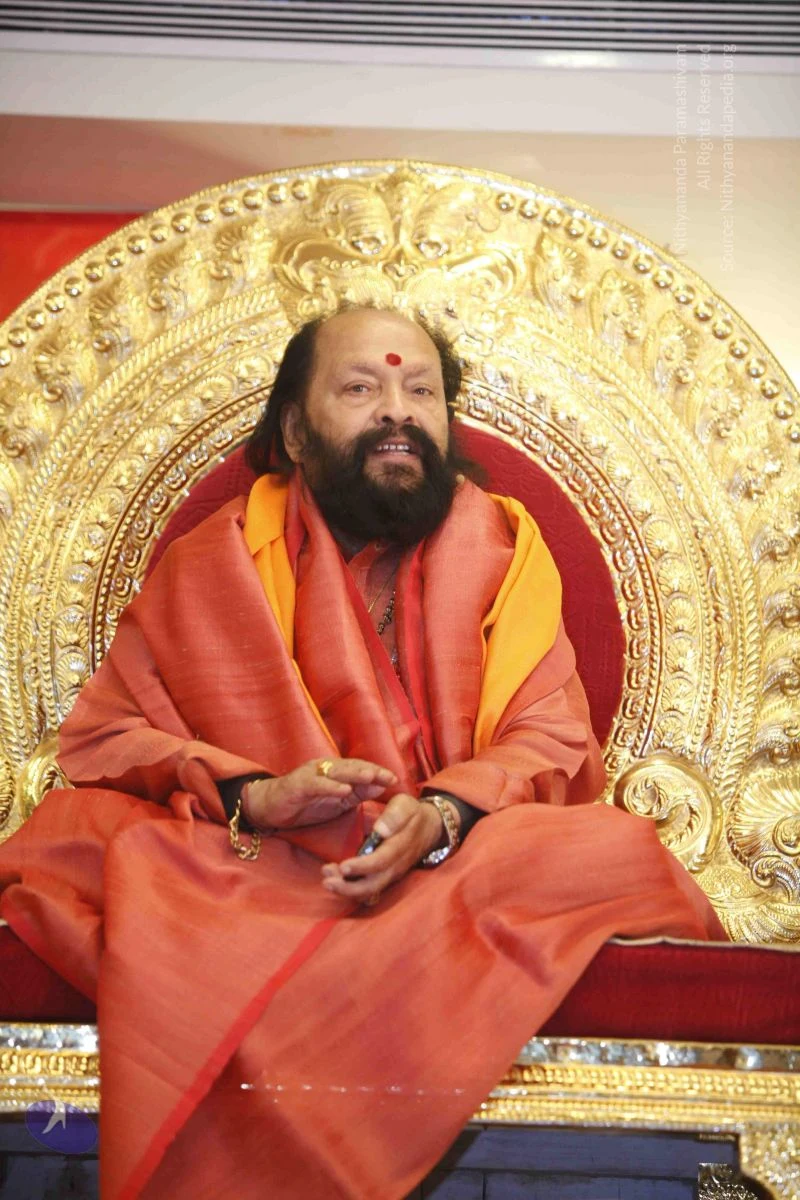
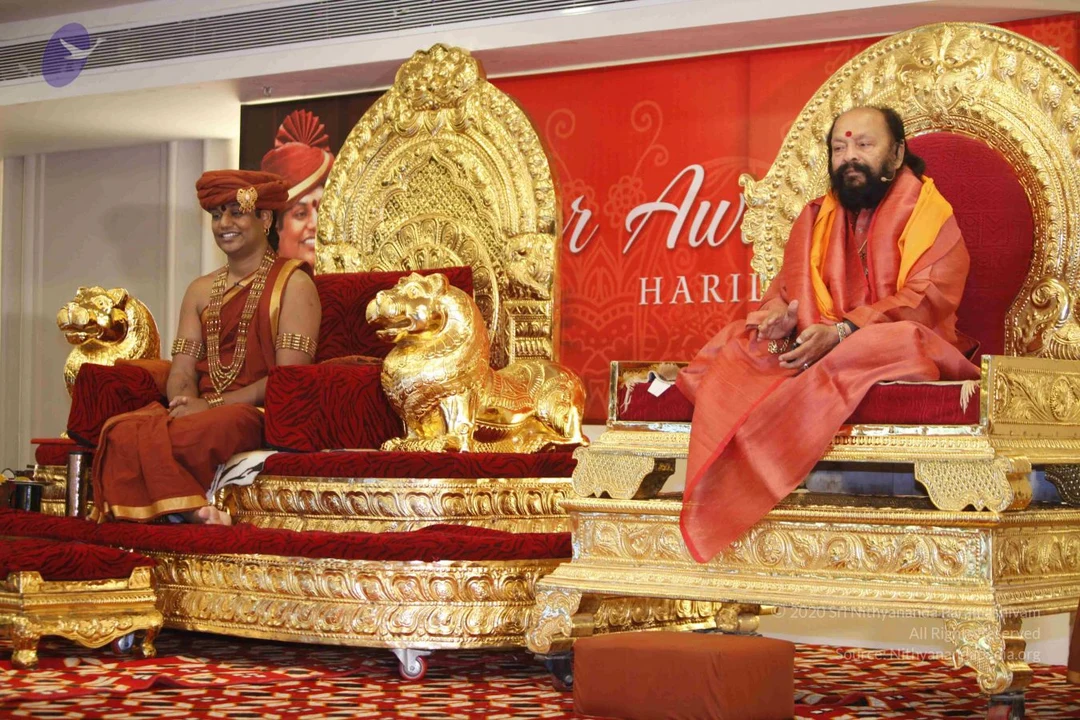
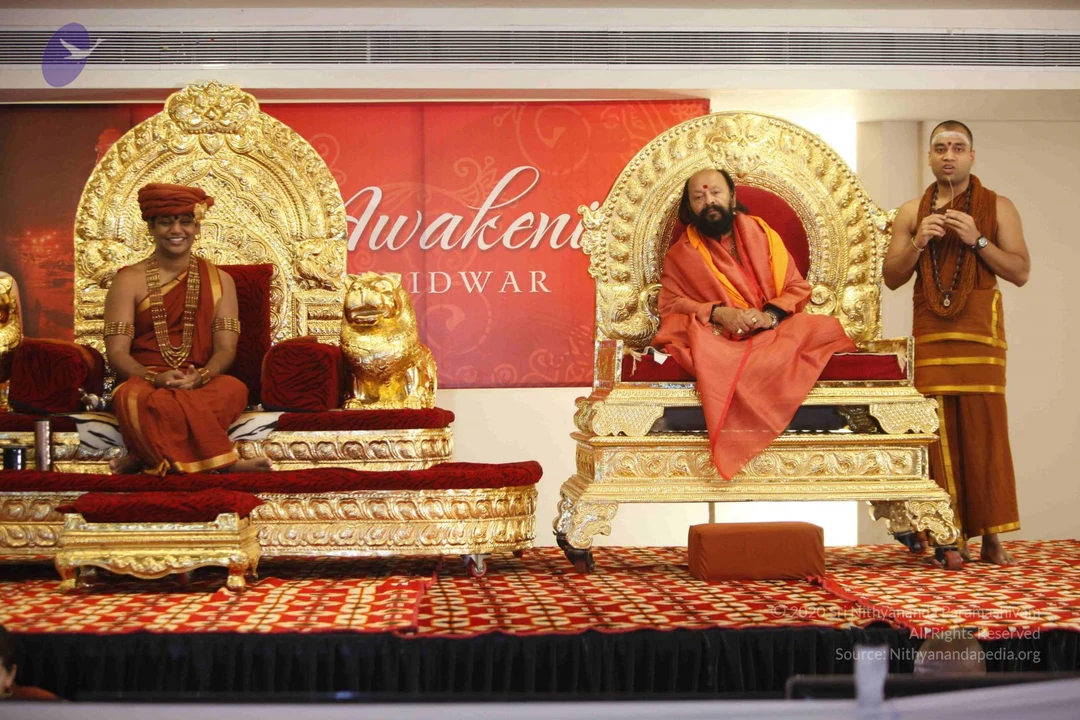
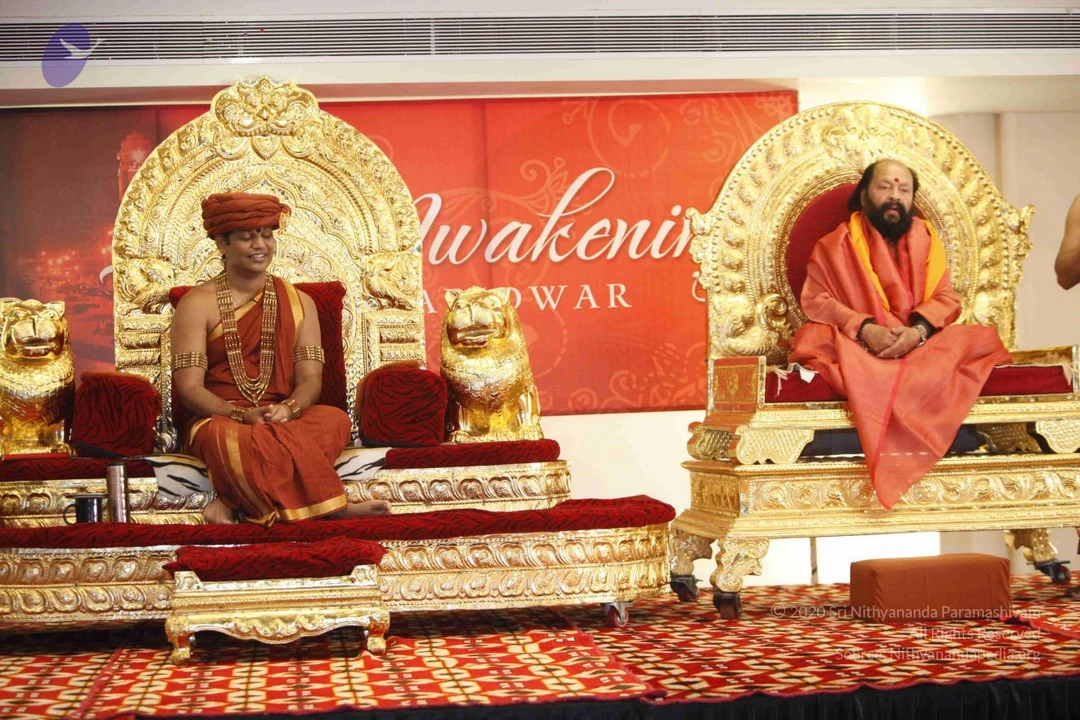
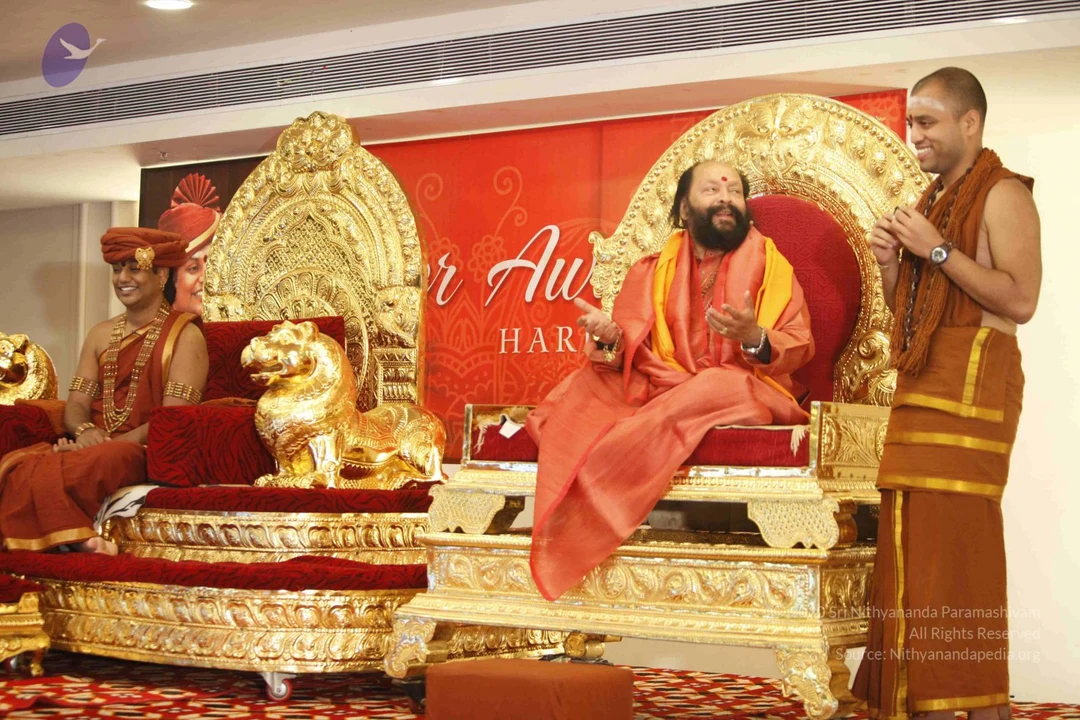
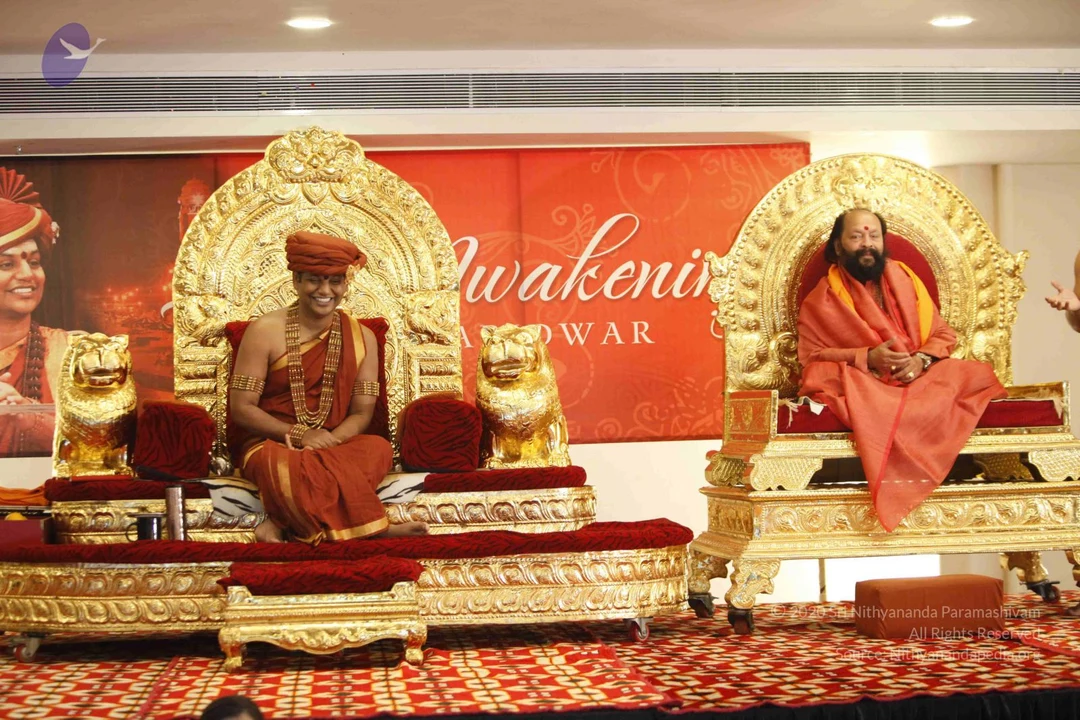
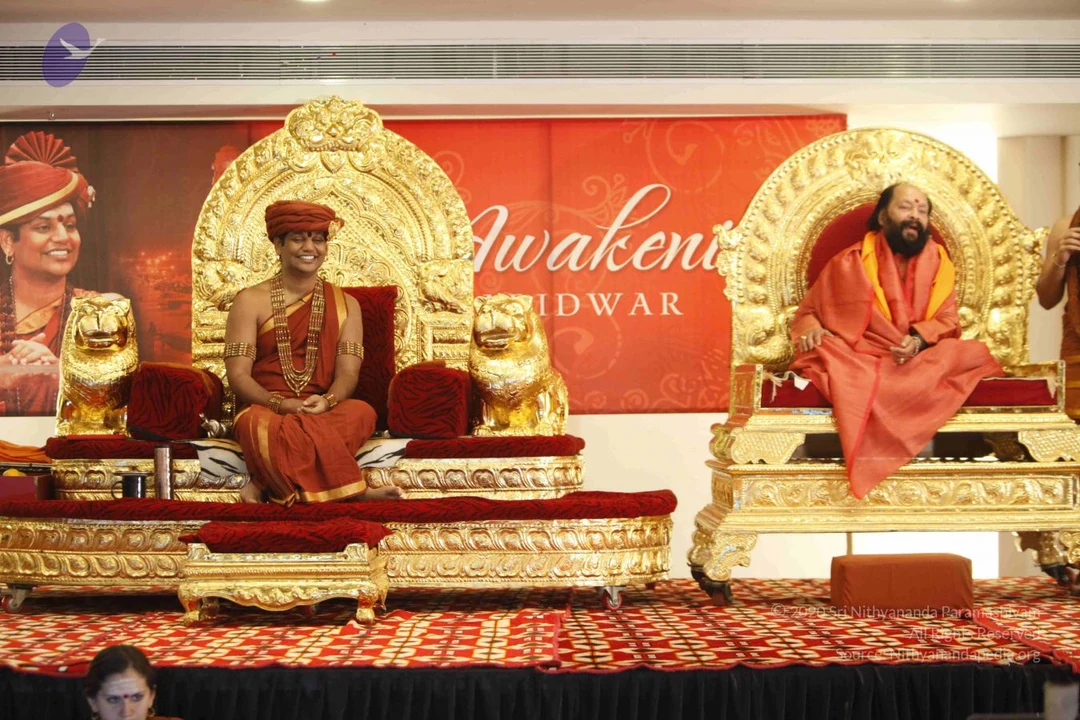
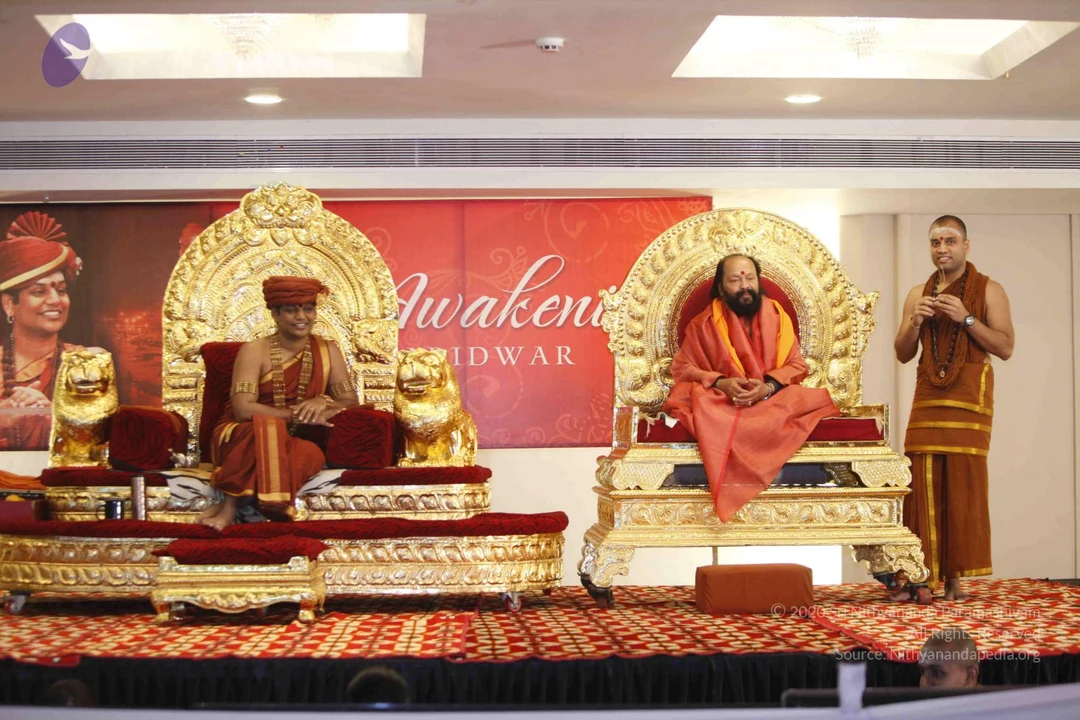
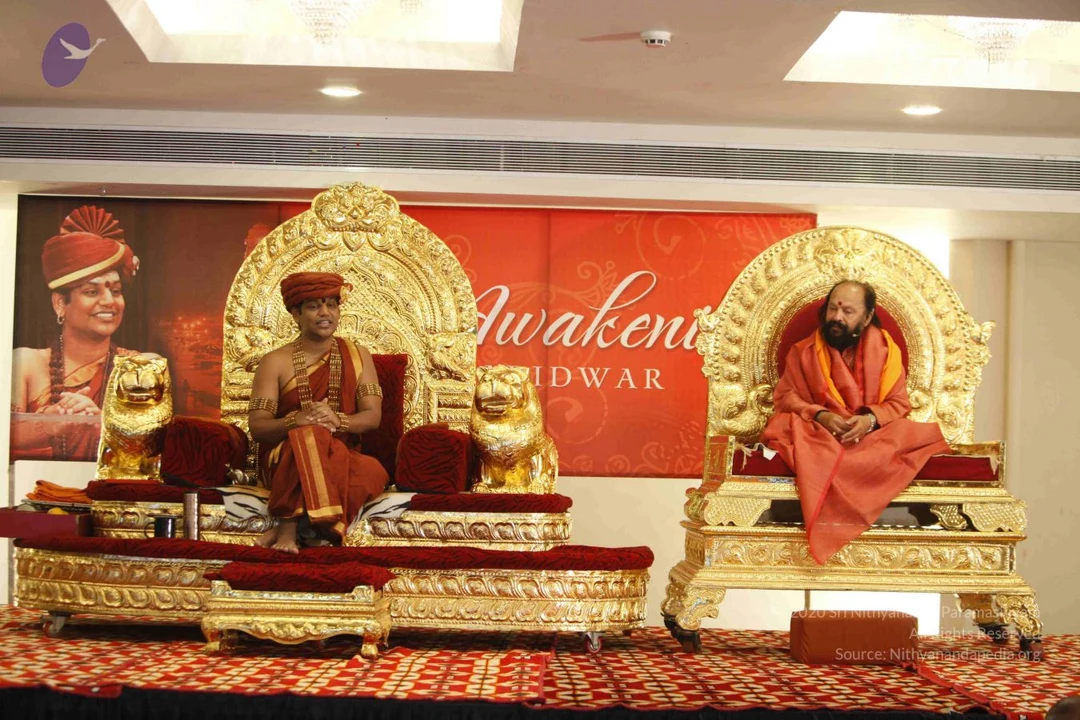
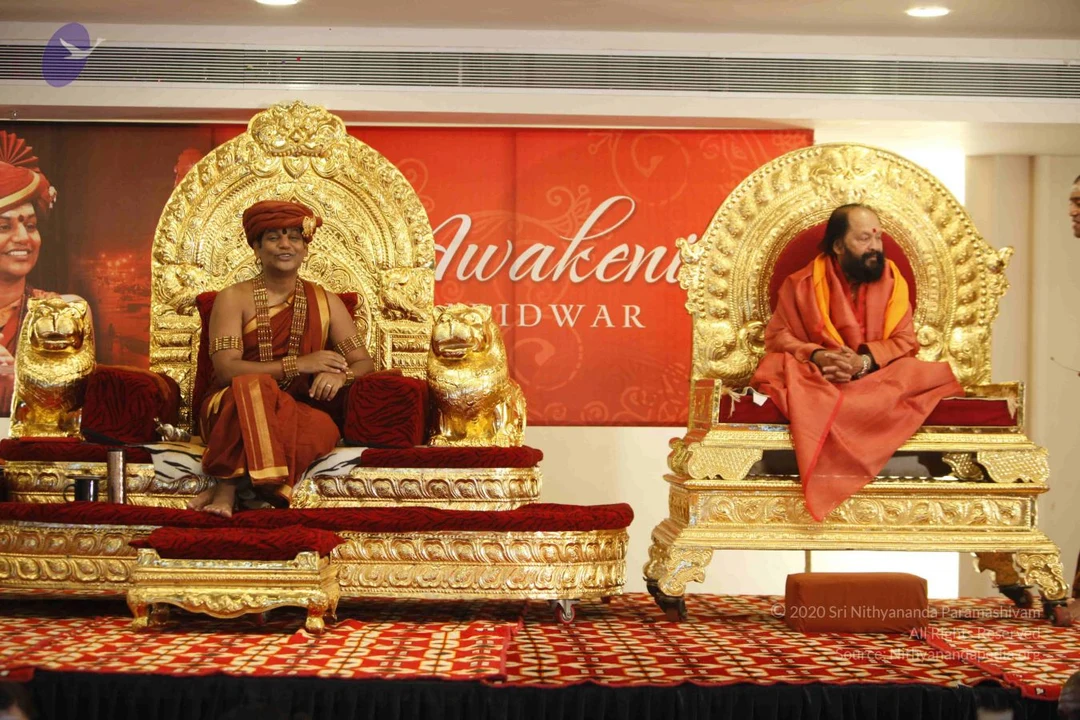
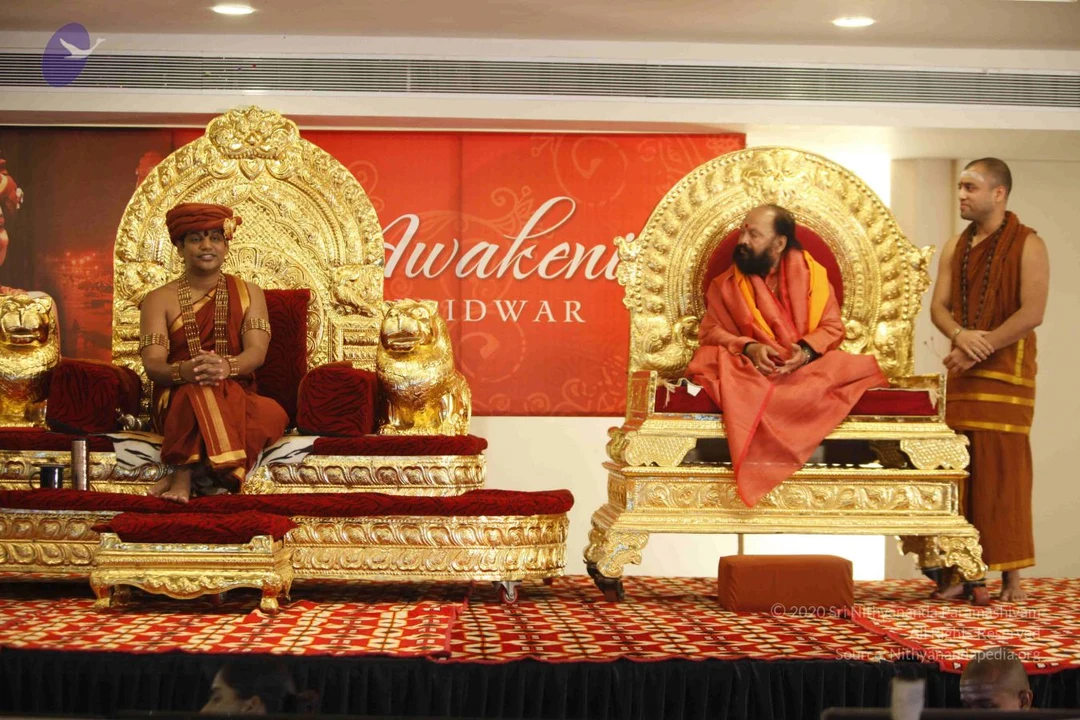
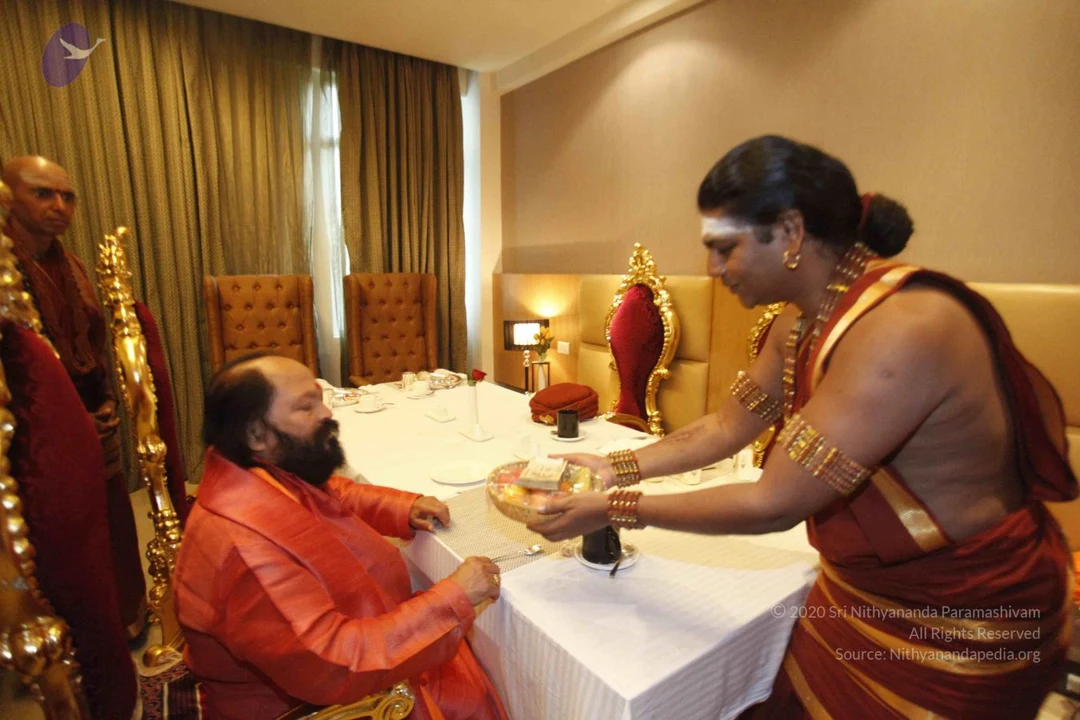
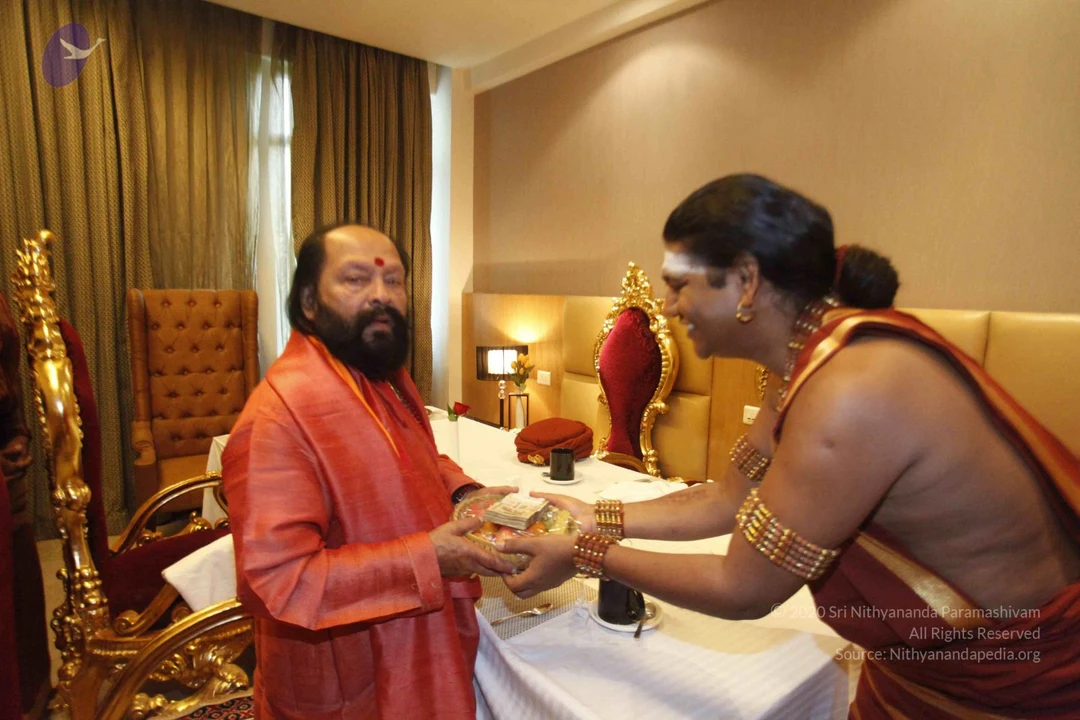
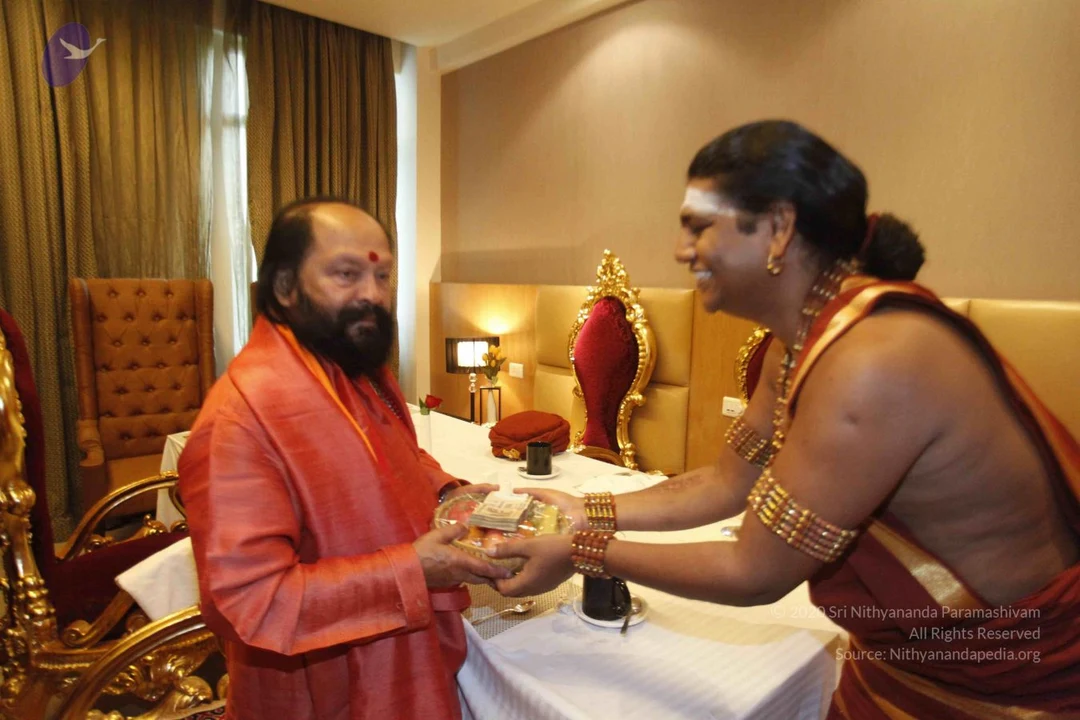
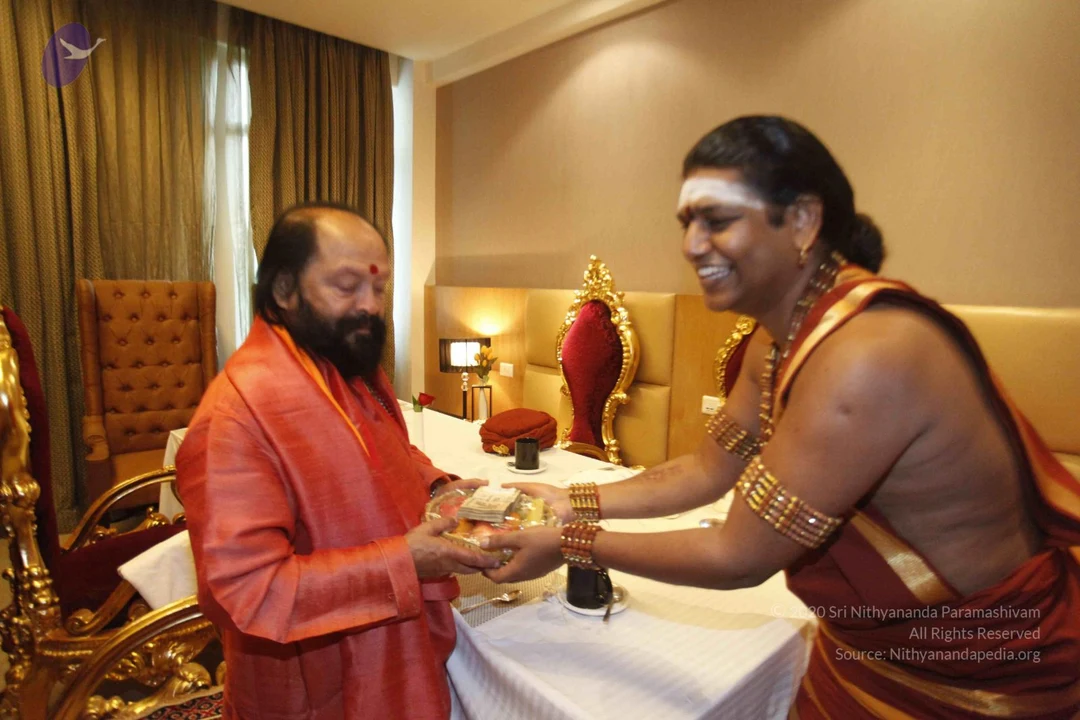
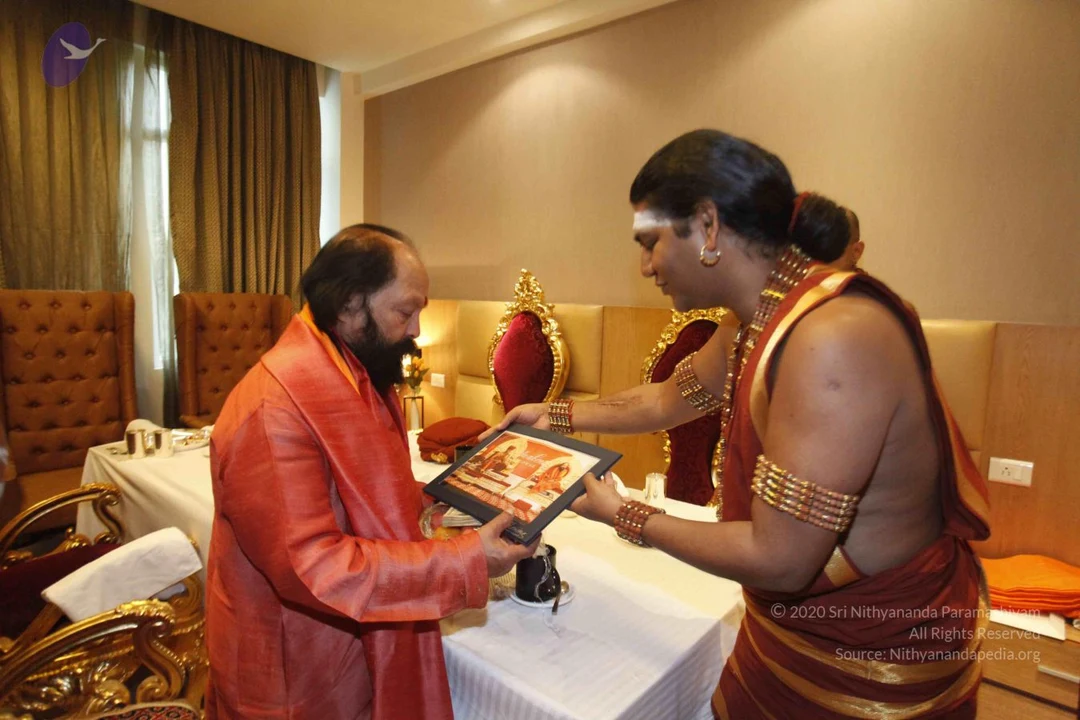
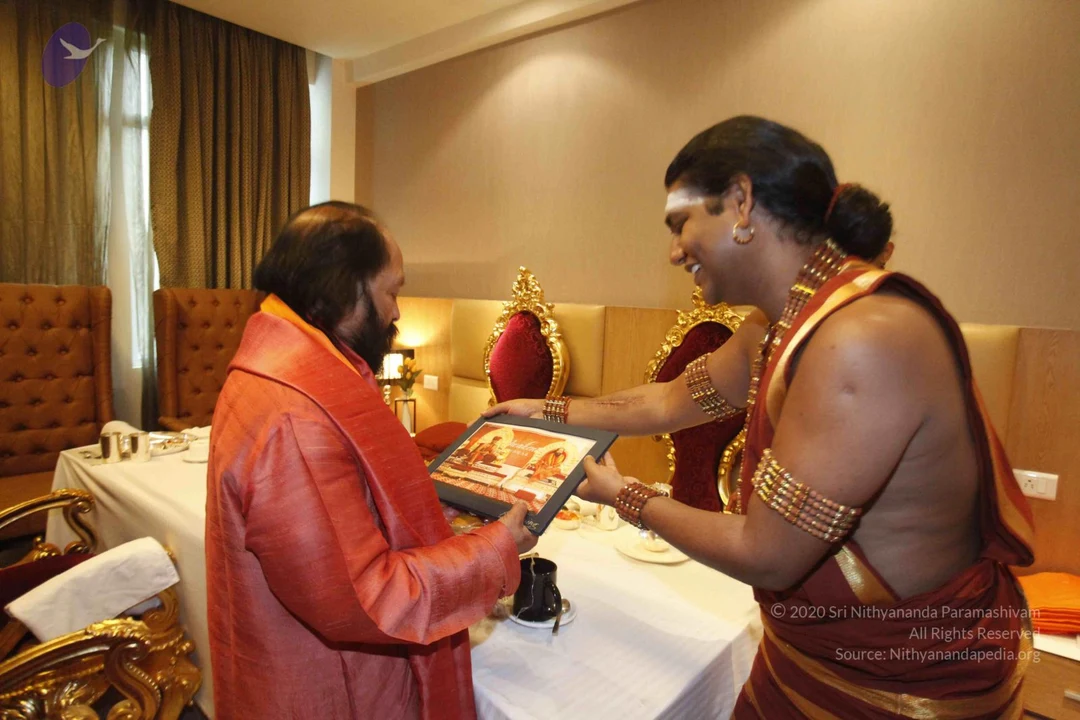
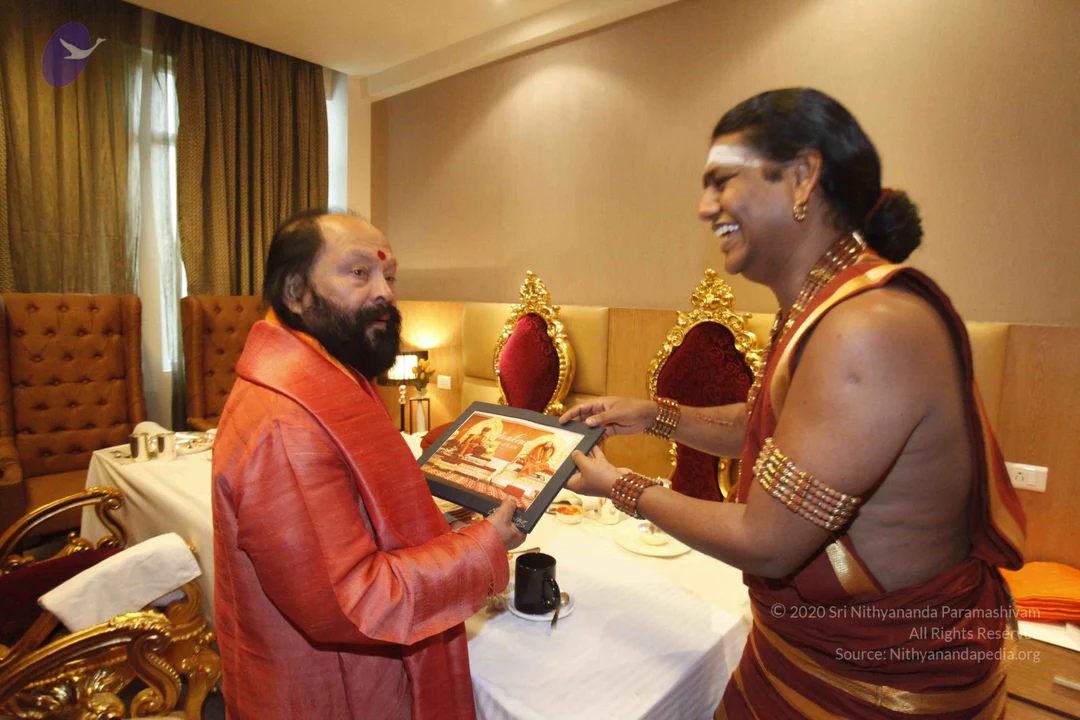
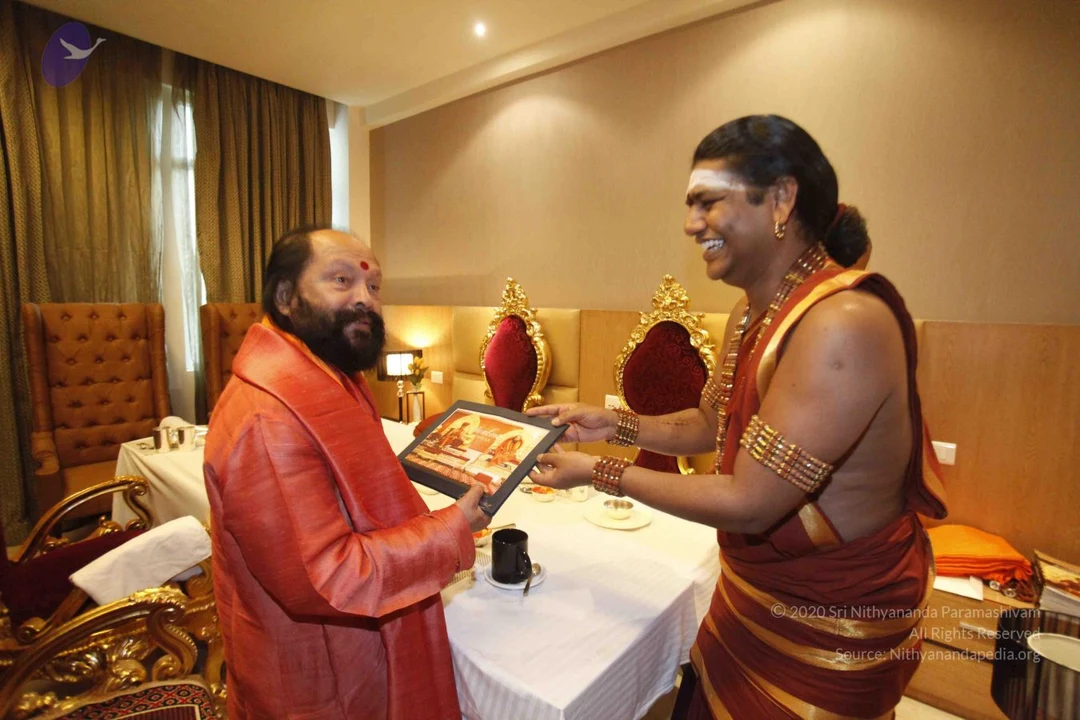
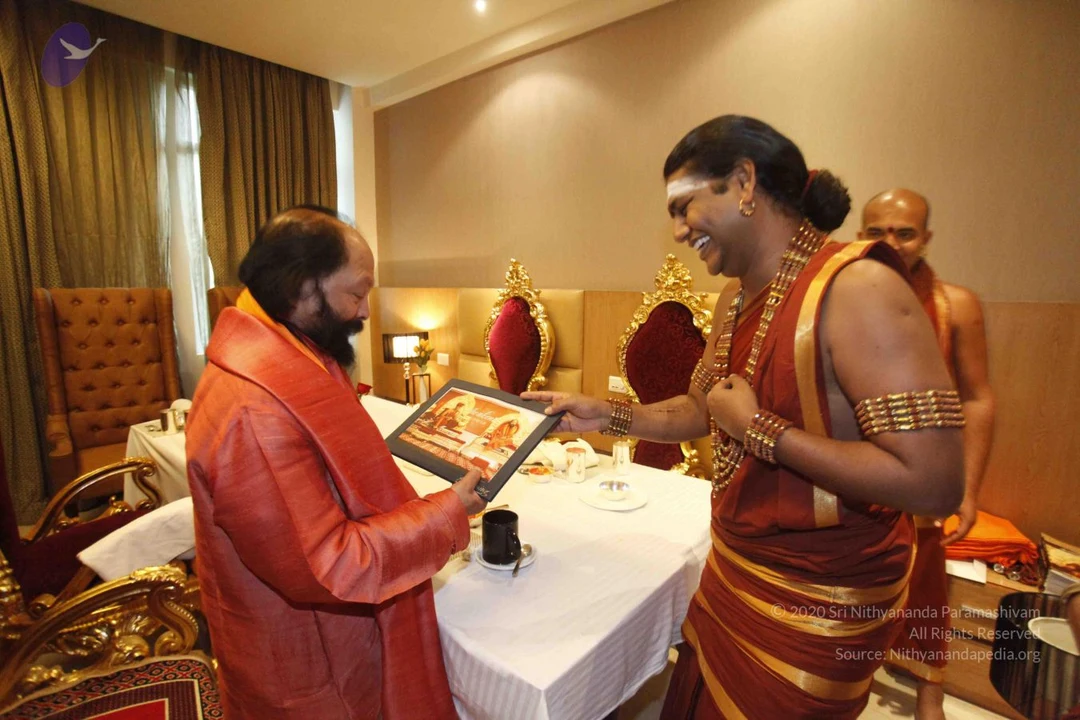
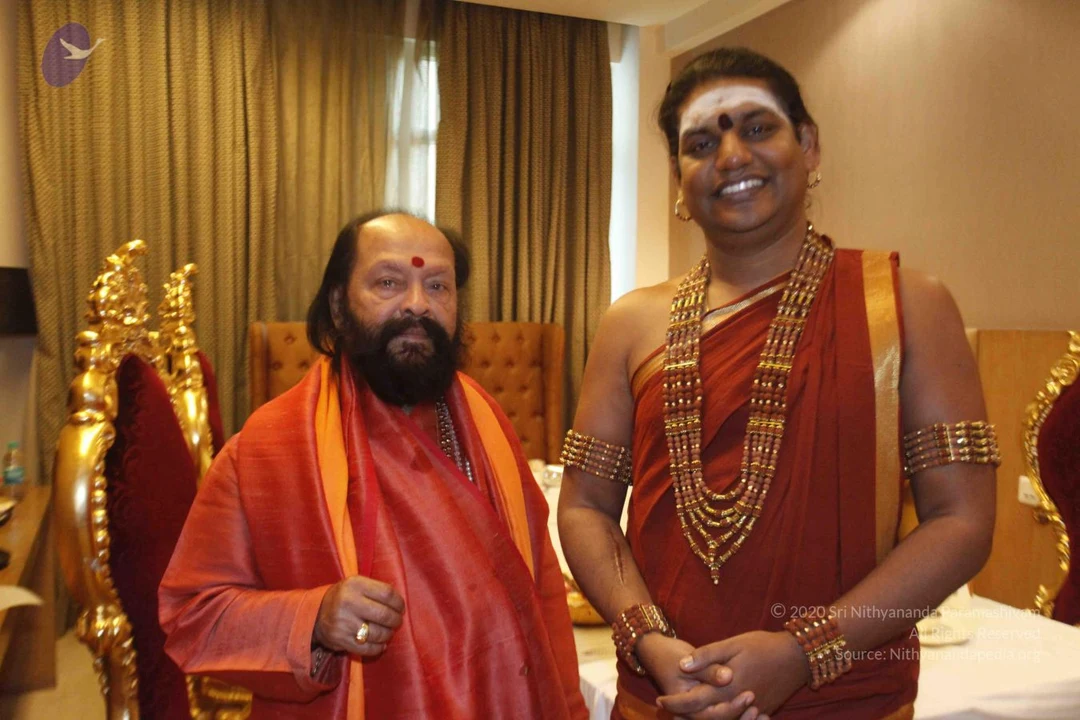
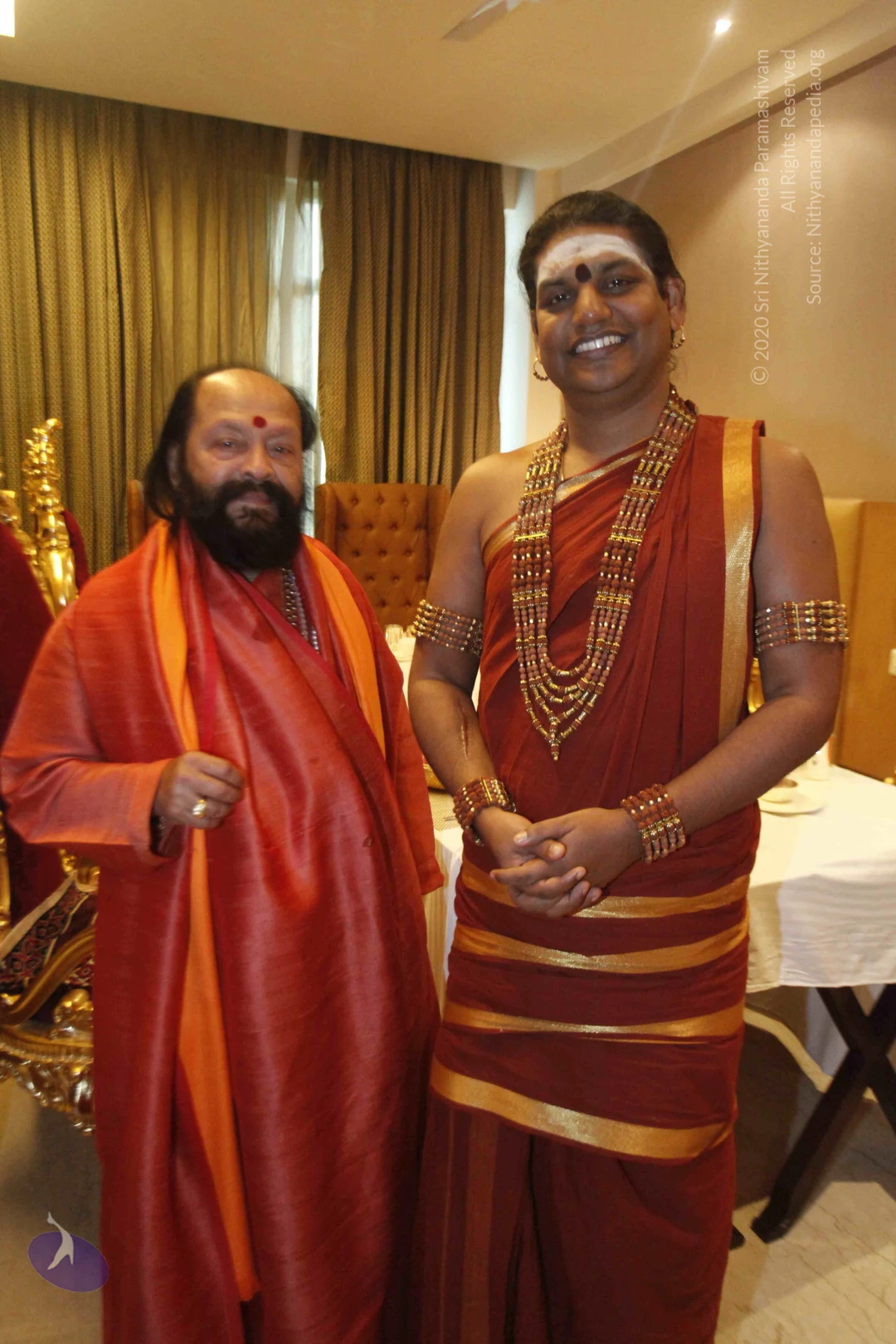
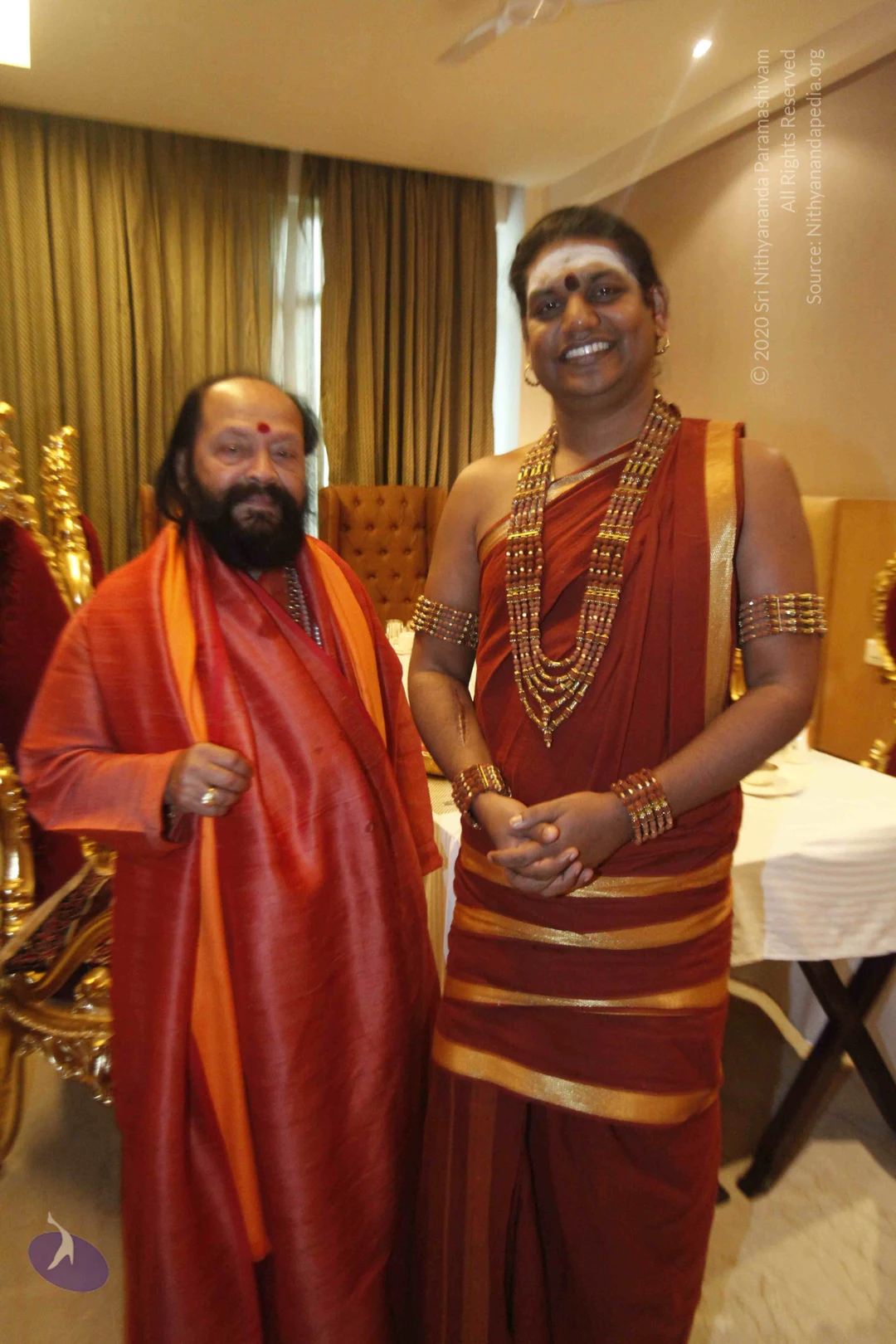
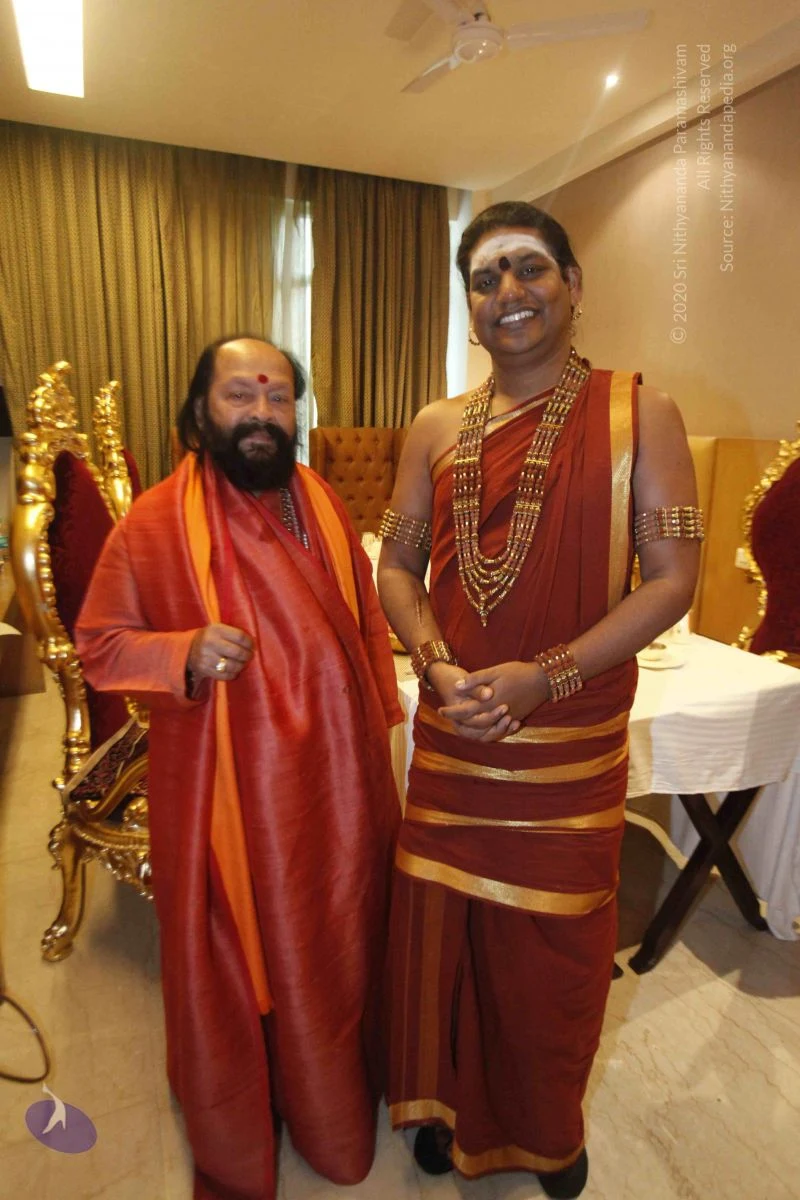
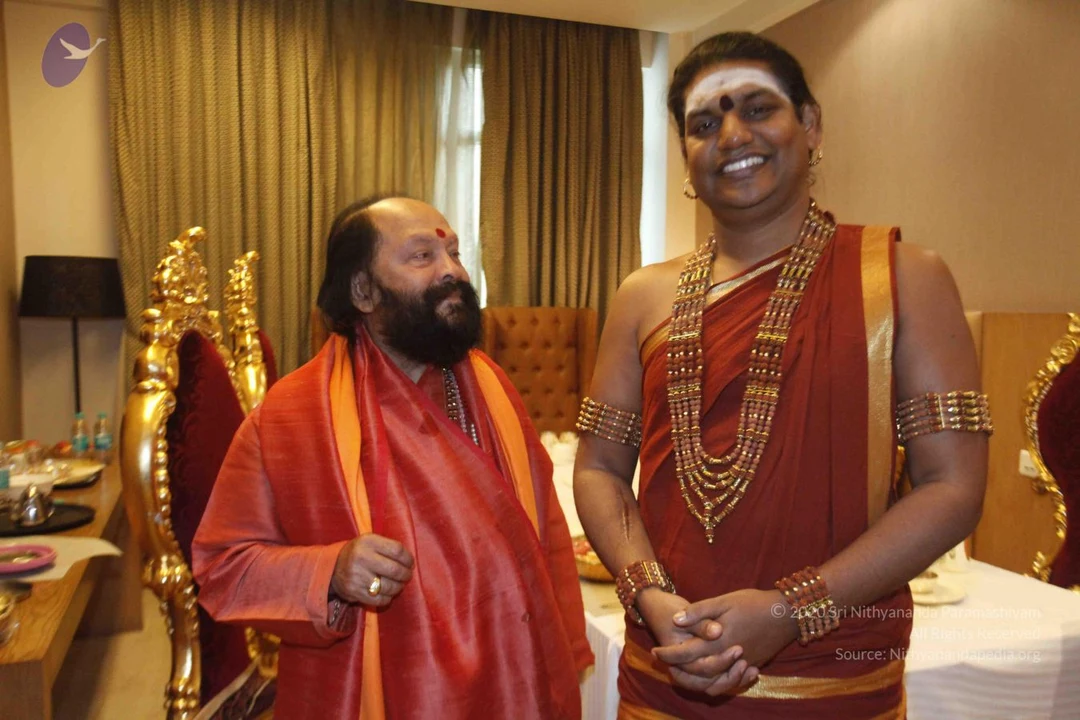
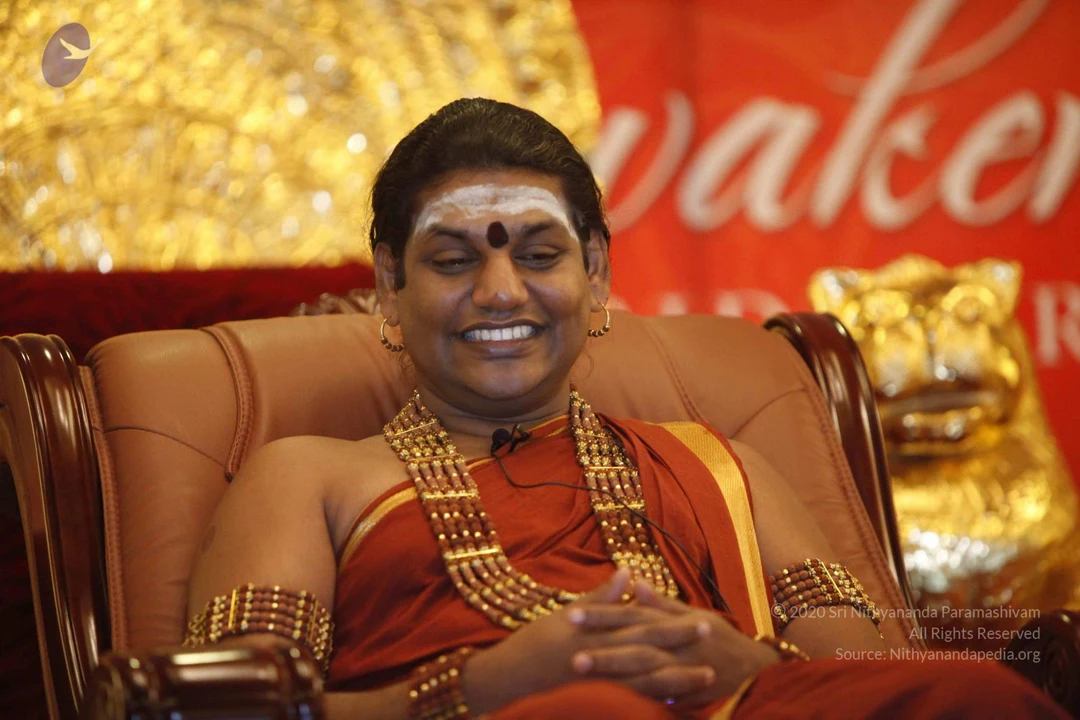
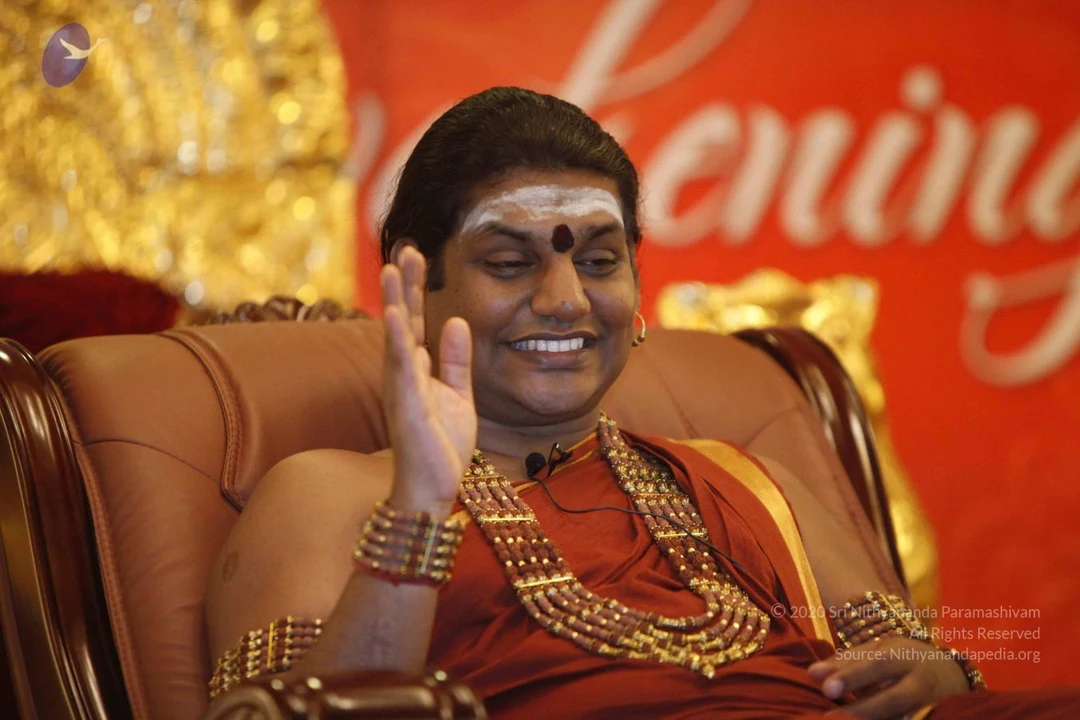
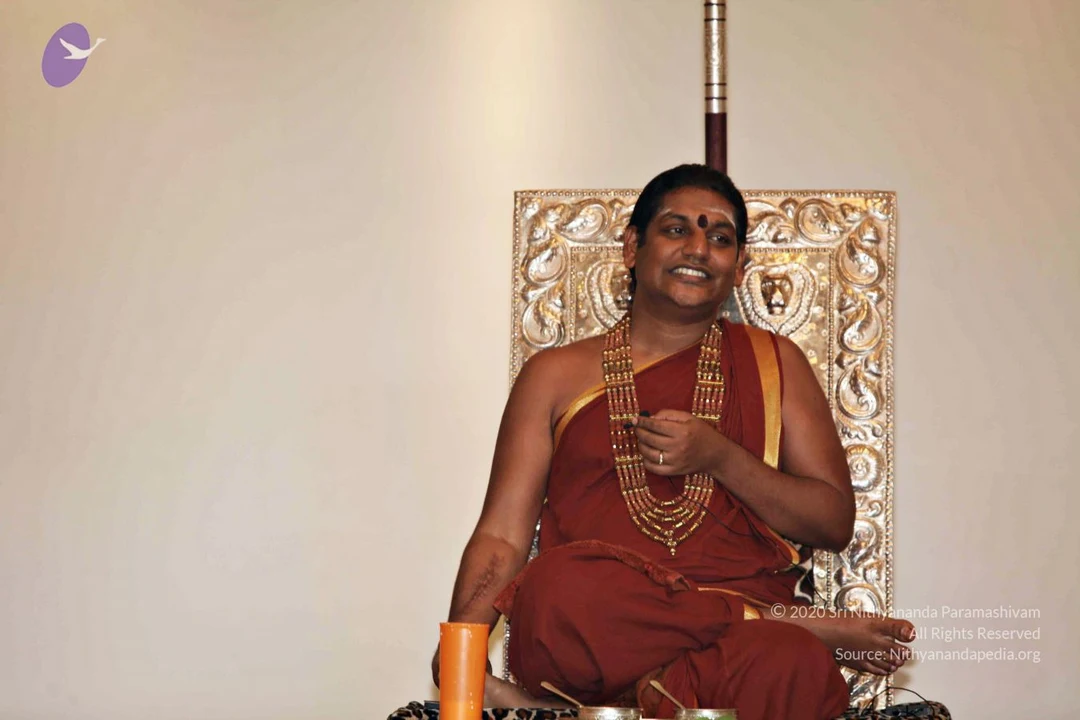
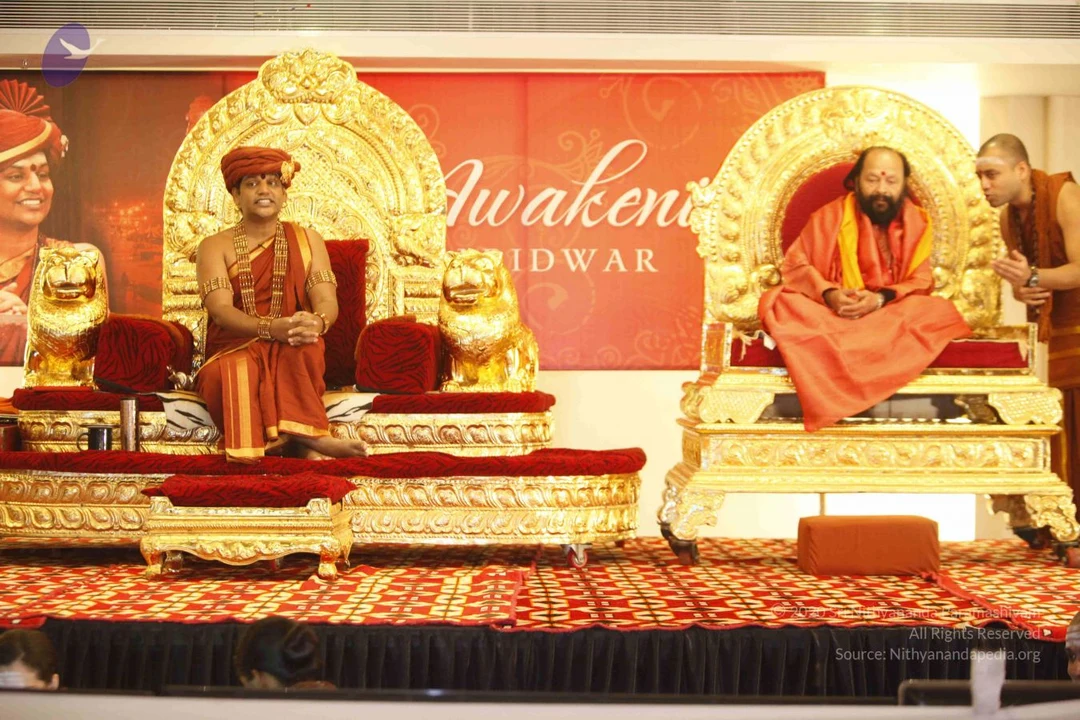
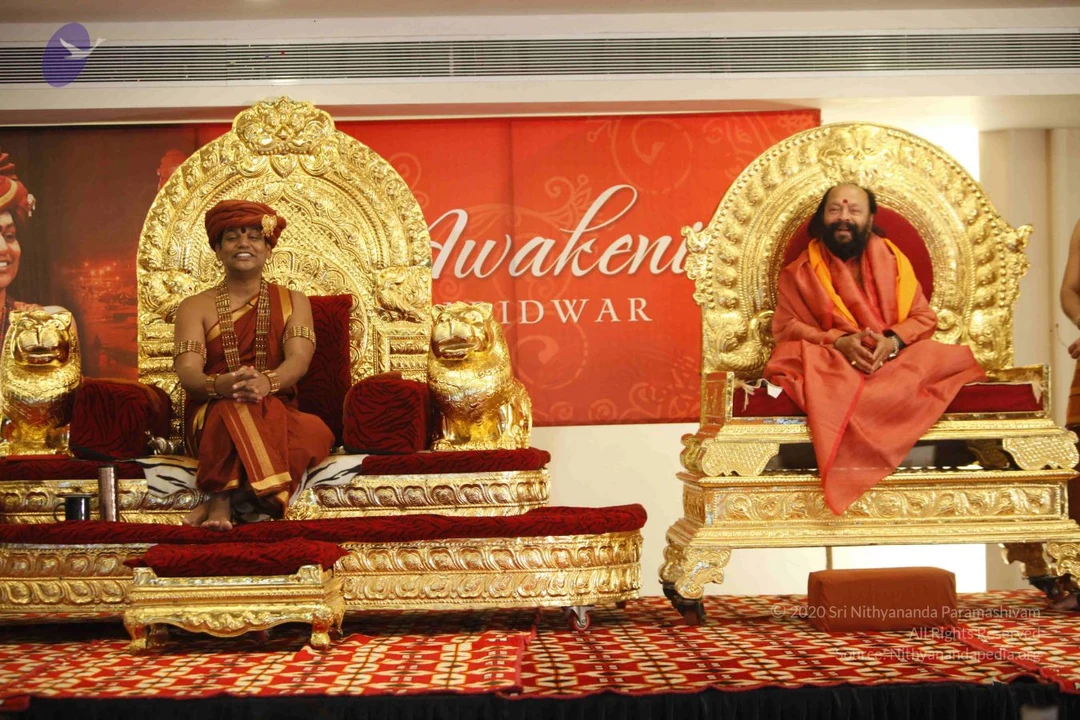
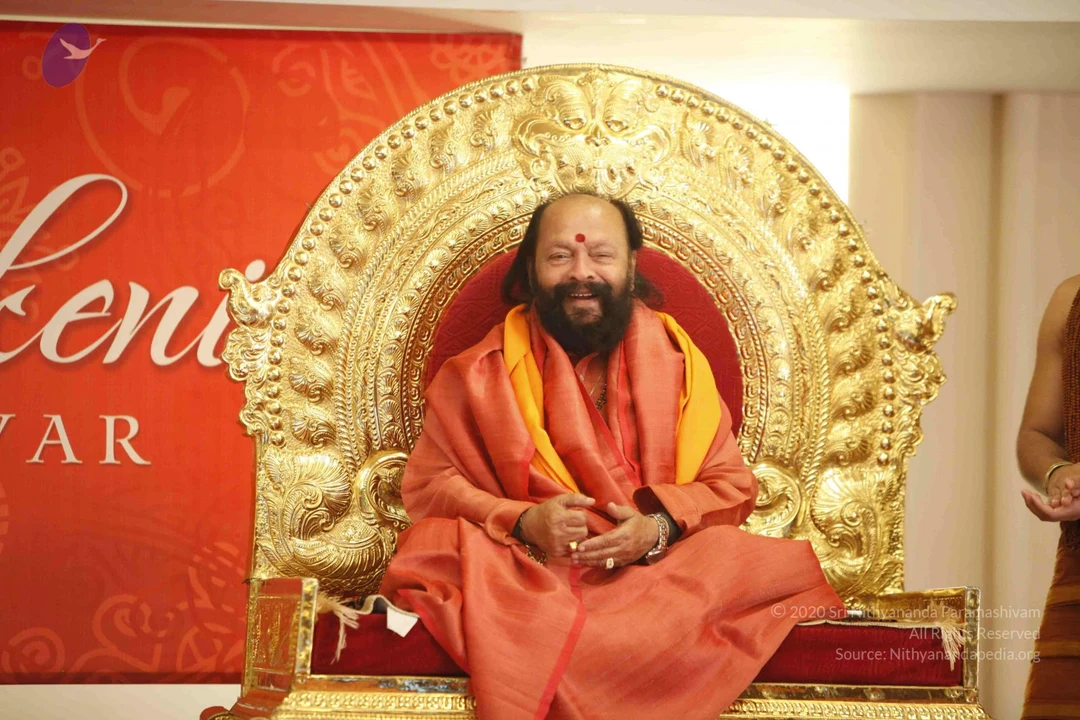
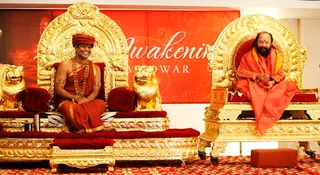
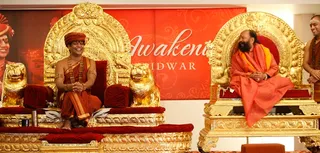
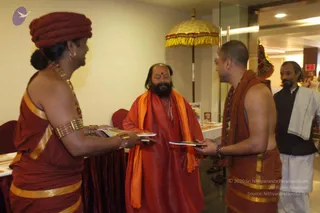
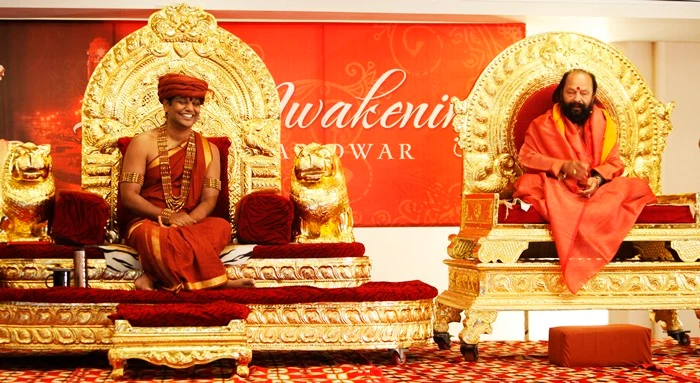
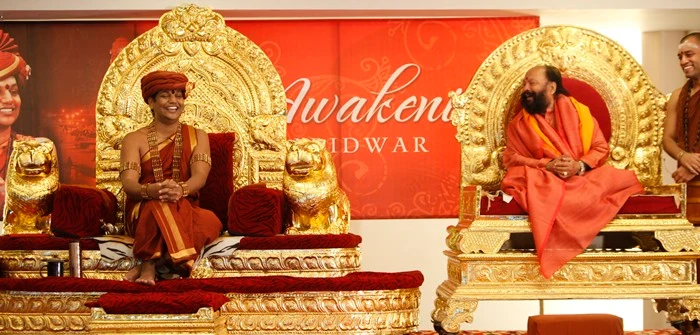
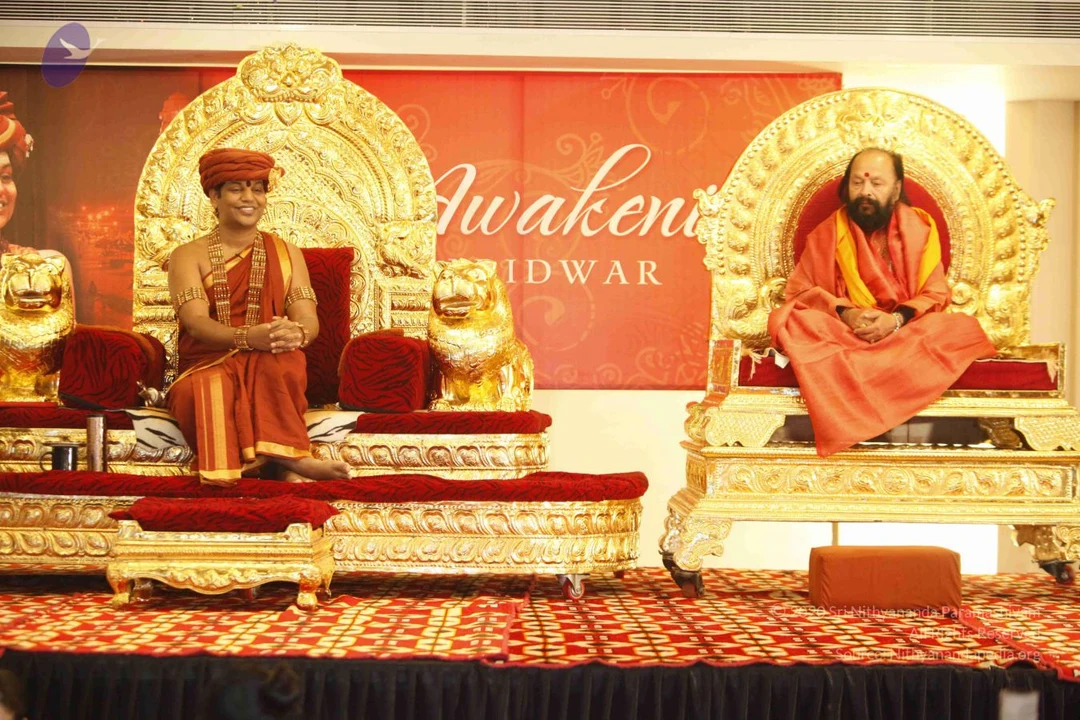
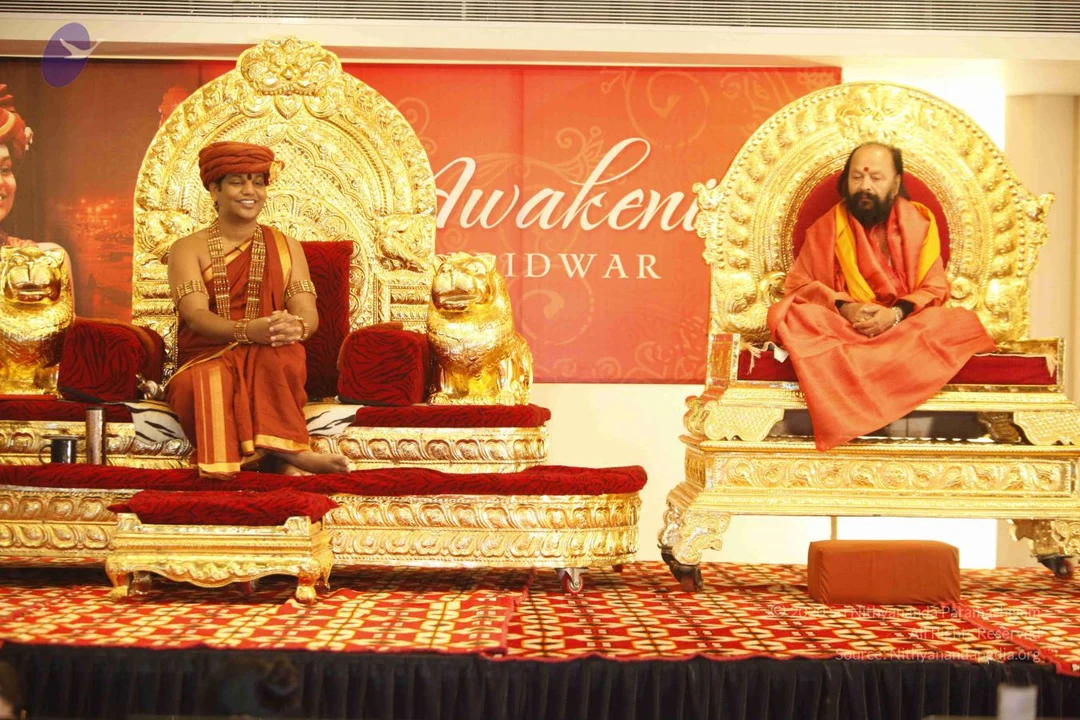
In today’s morning Satsang in Haridwar, Paramahamsa Nithyananda welcomes 1008th Mahamandaleshwar Sri Sri Swami Arjun Puri Maharaj of Juna Akhada. Swami Arjun Puri Ji graces viewers by sharing insights on the land of Shiva and spirituality. He expresses that you can either obtain Moksha when you leave the body, in the form of liberation, or now, in the body, as enlightenment. He stresses that the purpose of life is for living enlightenment now, and that we are very blessed to have Paramahamsa Nithyananda as our SatGuru - the Guru is the most important component for obtaining Moksha.

Link to Video:

VideoAudio

Transcript:

[00:17]

Nithyānandeśvara samārambhām Nithyānandeśvari madhyamām | asmat āchārya paryantām vande guru paramparām ||

Iss samay hamare sath upastith sabhi darshakon aur bhakton ka main prem evam aashirwad sahit swagat karta hun.

[00:52]

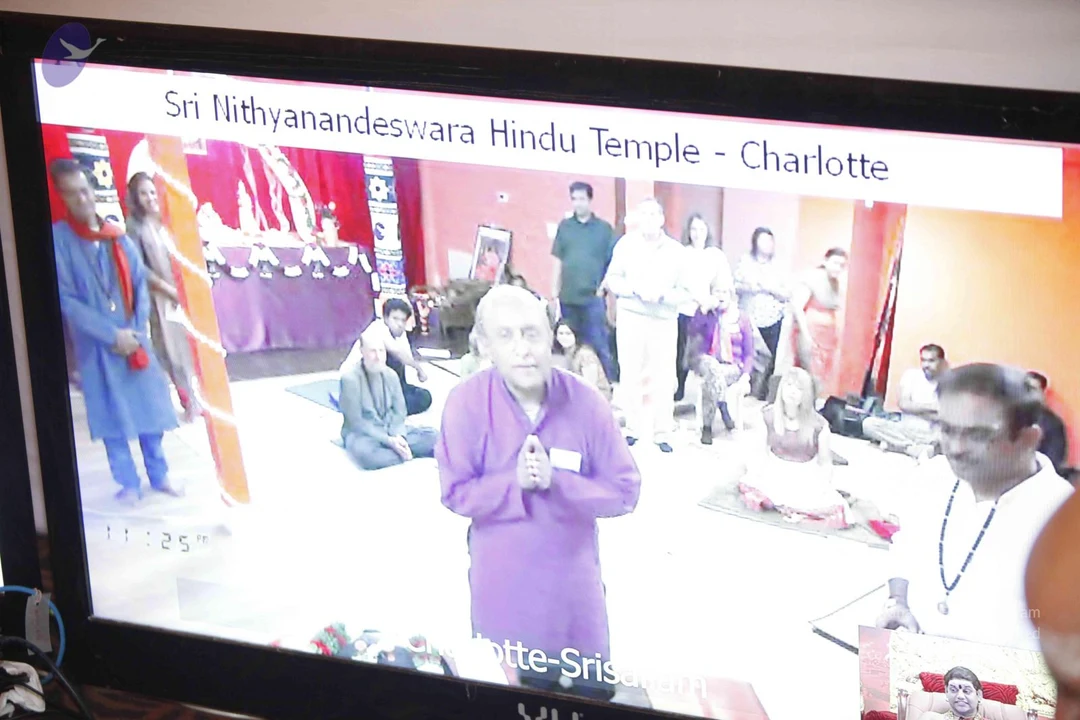
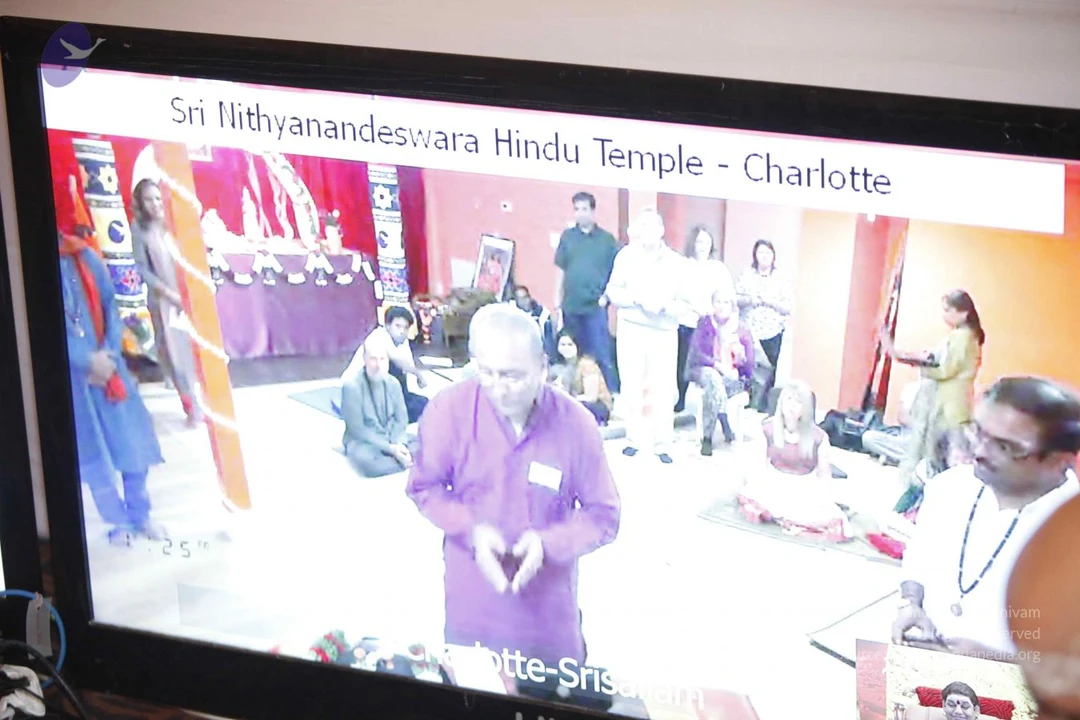
I welcome all the devotees, disciples, samajis, satsangis, Bala Sants, sannyasis, Shrimahants, Mahants, Kotharis, Thanedars sitting with us all over the world through Nithyananda TV, Lotus TV, Janashree TV, Sadhna TV, Eshwar TV, and through two-way video-conferencing. The cities sitting with us through two-way video-conferencing: Island Creek-North Carolina, Adi Arunachalam, Dakota Dunes, Houston-Kalahasti, San Antonio-Texas, Port Washington-New York, Hong Kong-Toon Moon, Nithyananda Dhyanapeetam-Hosur, Hyderabad-Gupta Kashi, Houston-Kalahasti, New Zealand-Adi Arunachalam, Paris-Home Temple, London-Kashi, Bala Sannyasi Training Center-Bidadi, Indira Nagar-Bangalore, Devon-UK, Dubai-Vaidyanatham, Jenkintown-Pennsylvania, Nithyananda Nagara-Bidadi, Kulim-Tiruttani, Ohio-Prayag, Singapore-Singapuram, San Jose-Madurai, Johorbahru-Tiruchendur, Toronto-Kailasam, Oklahoma-Somanatham, New York-Varanasi, Annanagar-Chennai, Charlotte-Srisailam, Nithyananda Nagaramu- Hyderabad, Seattle-Chidambaram, St. Louis-Tirumala, Los Angeles-Arunachalam, Redondo Beach-Ma Mukthananda.....................

[02:57]

I welcome all of you with My love and blessings. Today, I wanted to share these few great truths: The power of Creating Space. Power of Creating Space. Especially to all the participants who have gathered for Kalpataru in Haridwar and in Charlotte ....Haridwar and in Charlotte who have gathered for Kalpataru Darshan. Listen! Never make a decision when you are sad. Never make a commitment when you are happy. 😃 Listen! No, you need to … This is the.. what I am saying is Science of Space. The happiness you feel always brings powerfulness, the power. Whenever you have power, powerful, parts of you itself can’t tolerate you being so powerful. So, it conspires you, conspires, plans against you to somehow put you in powerlessness. What is the best way to put you in powerlessness? Make you commit into something. Push you to commit to something. So, whenever you are happy, don’t commit. No, keep this as a instruction from Science of Space, understand. Whenever you are sad, don’t make decisions. Only when you are in the space of Completion, make commitment or make decisions. So, before every time you are going to make commitments or decision, bring yourself to the space of Completion. Please listen.

[05:35]

See, sometime you feel happy, you show happiness just to even avoid your powerlessness inside. See, I am explaining your own struggles to keep yourself happy, and your own failures, how you fall into powerlessness. You need to understand this. Everyone of you try to keep you happy, but you don’t plan to grow happiness in you. Please understand. You want rice, wheat, all the grains, but you don’t want to do agriculture. You want rice, grain, wheat, all the best things, but you don’t want to do agriculture. All of you want joy, happiness… (While Swamiji is talking, Swami Arjun Puri ji Maharaj, Mahamandaleshwar of Mahanirvani Akhada, enters the hall.) I just wanted to offer our respects to Maharaj Shree, Shree 1008 Shree Mahamanderlaeshwar of Juna Akada, Swami Arjun Puri Maharaj. You all need to know Swamiji is the senior most Mahamandaleshwar in this whole Pancha Puri; Haridwar-Rishikesh and this whole area and Swamiji is one of the very important face of Hinduism. And he is the head of one of the largest temple in Haridwar, Tulsi Manas Mandir. Swamiji is the head of the temple and he has a great Guru parampara and amazing contributions to Hinduism. And I can go on expanding Swamiji’s contribution and his… how much he contributed, he sacrificed for Hinduism and Hindu tradition. Swamiji has built a huge Rama Temple on the banks of Ganga. Just on the way you can see. Not only he has a great Guru Parampara and Sampradaya (tradition), he himself also has contributed so much to Hinduism. I would like to request Swamiji to bless us. SWAMIJI SHRI ARJUN PURI JI MAHARAJ ADDRESSES THE GATHERING:

[08:34]

Hari Om! Hari Om! Hari Om! (All the satsangis in Haridwar chant “Hari Om” along with Swamiji Arjun Puri ji.....) नमो ब्रह्मण्य देवाय गोब्राह्मण हिताय च । जगत् हिताय कृष्णाय गोविन्दाय नमो नमः ॥ Namo Brahmannya Devaaya Go-Braahmanna Hitaaya Ca | Jagat Hitaaya Krssnnaaya Govindaaya Namo Namah ||

(Vishnu Purana: 1.19.65)

अखण्डमण्डलाकारं व्याप्तं येन चराचरम् । तत्पदं दर्शितं येन तस्मै श्रीगुरवे नमः ॥२॥ Akhanndda-Mannddala-Akaaram Vyaaptam Yena Cara-Acaram | Tat-Padam Darshitam Yena Tasmai Shrii-Gurave Namah ||2||

[09:17]

Respected, world-renowned Mahamandaleshwar Swami Nithyananda ji Maharaj, and devotees who have come from India and abroad, I welcome you to Haridwar. HDH: Swamiji is welcoming all of us in Haridwar. Actually Swamiji is the face of the Haridwar! So, he is the most senior Mahatma who resides in Haridwar. Swami Arjun Puri continues his address in Hindi which is translated into English by Turiya Swami: Haridwar is the City of Kumbh Kumbh Mela. The four places where kumbh mela is done Haridwar is the prime most. Haridwar is the city which situated next to the river of Ganga. Hiamlaya starts from Haridwar. So, though this is a great Deva Bhoomi (Land of Penance and Sadhana). Every particle of this land is blessed and divine – but there are four prime most places in this land Gangotri, Badrinath, Kedarnath and Yamunotri. This is the place of land of Shiva. Shiva resides here Himalayas are there. And this is a blessed land. This is the land of Lord Shiva. Lord Vishnu resides here as Badrinarayan. And this is the land of birth of Ganga. The Ganga River which is the very essence of India. Without Ganga, Indian culture, Indian heritage cannot even be imagined. Ganga is really essence of Indian culture.

[12:19]

The name of the city Haridwar. “Hari” means Lord. And “dwar” means gate. So, “Haridwar” literally means Gateway of God. So, in this sacred land, Swamiji (Nithyananda) by inviting all of you to this sacred, blessed land, has given a great krupa, has given a great blessing to all of you. Swamiji is a very, very great Mahamandaleshwar of our Mahanirvani Akhada. And He is a great Guru. He is world famous and He is known all over. So you are really blessed to have the satsang to have the nearness of Swamiji in this program. I am also very, very happy that such a rare saint like Swamiji has come to this Pancha Puri, Haridwar land, and is doing a program, this sadhana intense meditation program here and blessing this land. I am very happy to see Swamiji and all of you here today. So, purpose of life is, goal of life is to get moksha. Normally people think that once you give away the body (once you die), you attain Moksha (liberation). But what happens after you give away the body nobody knows that. So, the best way to achieve Moksha, is living enlightenment.

[15:13]

Tulsidas ji (a great saint of India who wrote the “Ramcharitmanas”) has written in Ramayana that Moksha is the goal of life and Moksha happens only with knowledge and knowledge can happen only from Sadguru. Without Guru, it is not possible to get knowledge at all. Whether it is a small science, you want to learn something small, or anything, for everything or learning anything, you have to have a guru. All of you are very fortunate that Swamiji Nithyananda Swamiji is your spiritual guru. So, all of you are very fortunate. Swamiji started his spiritual journey at such a young age. From a very young age Swamiji has been doing tapas and sadhana. And the way He is blessing everybody, giving this knowledge to everybody, all around the world, it is really, really admirable. Sant Tulsidas says, unless you have a strong body, you cannot attain knowledge. So, to attain knowledge, you have to keep your body very strong and to keep your body strong and healthy you have to practice Yoga. If the body is healthy, your mind and your intelligence, both will be healthy. And if your mind is healthy, you will have concentration in spiritual practices and in the words of the Guru. So, you shoud keep your body healthy.

[19:11]

Today, the whole world is standing at the brink of war. There is so much chaos. Everybody is looking for peace. But how this peace can happen? It can happen only through knowledge and by the satsanga of the Gurus. Everybody is searching for peace and knowledge; but this can happen only through Sadguru. So, when you join a University, immediately you cannot get a degree. You have to go through the classes, years of education and only at the culmination of the course you are awarded a degree. Same way, when you start your spiritual practices, when you do your sadhana, don't expect results in just a day or two. You will have to continuously go on doing tapas and sadhana and only then the results will come. Great thing is that you have the blessings of a very good guru, Swami Nityananda ji so your sadhana becomes faster. I bow down to the Lord for all of you, that all of you achieve your spiritual success and goals as soon as possible. You have come to the right place, to Paramahamsa Nithyananda Swamiji. One thing I would like to tell you: Guru is not changed again and again. You have come to the right guru to the right place; now be here and soon you will realize your spiritual goals. I pray to the God that you get it very soon.

[22:14]

Everybody wants happiness and bliss. But how to get it and what is the sign of somebody who is really happy and blissful? The sign of somebody who is really happy and blissful is, he will always have an everlasting smile on his face! Just ike Swami Nithyanandaji always has a smile on his face! My message to all you; Swamiji Nithyanandaji is like my younger brother. Swamiji has just become Mahamandaleshwar. I have been a Mahamandaleshwar for thirty… thirty-two years. So, I am very happy that in the form of Swamiji our community our sant samaj, our community of saints, has got such a precious jewel or “Navaratna” today. So, I am very happy and blessed also. I travel all across the world. I have so many yatras all over the world. But I can tell you wherever I go, I get to hear Swami Nithyanandaji’s name everywhere. So, the place where I stay, that road name is Sapta Sarovar Road (Sapta Sarovar = Seven Lakes). Now how the name sapta sarover came into existence? The name came because once upon a time seven Rishis used to stay there. So, when Ganga descended from Himalayas, it is first in very aggressive flow till Haridwar. But when it came to Haridwar it is split into seven streams and then only it got rest. How it got rest, I will tell you.

[26:13]

When Ganga came down to Haridwar and saw the seven rishis, seven saints meditating there, Ganga thought it should go around all of the seven saints and got split into seven different streams. So obviously, when one stream gets divided into seven streams, the speed of the flow will be reduced. So, first time after coming from Gangotri, Gangaji got rest in Haridwar. So, this place where it got rest is called as Sapta Sarovar. On the same Sapta Sarovar road, the area where Ganga ji got rest, I have the temple called “Tulsi Manas Temple. This temple has amazing architecture. And I want to invite Swamiji to please visit us. And also, all the devotees who are gathered here all of you also please come and visit us. I am sure you have a very busy schedule but whenever you get time, whenever you can take some time off between the schedule, please come and visit us. I am sure, how Ganga got rest in Sapta Sarovar, same way all the you devotees will also feel relaxed and rest when they visit the temple. With these words I again want to bless everybody and since Swamiji is like my younger brother I can bless Swamiji also and all the devotees present and I would like to end my speech. Thank You.

[28:42]

SWAMI ARJUN PURI JI MAHARAJ CONCLUDES HIS SPEECH. AND PARAMAHAMSA NITHYANANDA RESUMES HIS SATSANG: HDH: So we thank Swamiji for being here. All of you should know, Swamiji (Arjun Puri ji) is not only elder brother for Me, he is a elder brother for so many of the Gurus names you hear. Understand he is… in Haridwar any religious, spiritual function, he receives the first respect. He is given the first respect. I can actually go on adding and I can sing Swamiji’s glory for hours. He is the most respected, senior-most highly venerated, revered Mahamandaleshwar. As I said in one word he is the face of Haridwar.

[29:23]

I bless you all. Let you all radiate with Integrity, Authenticity, Responsibility, Enriching and Causing eternal bliss, Nithyananda. Thank You.

Photos From The Day:

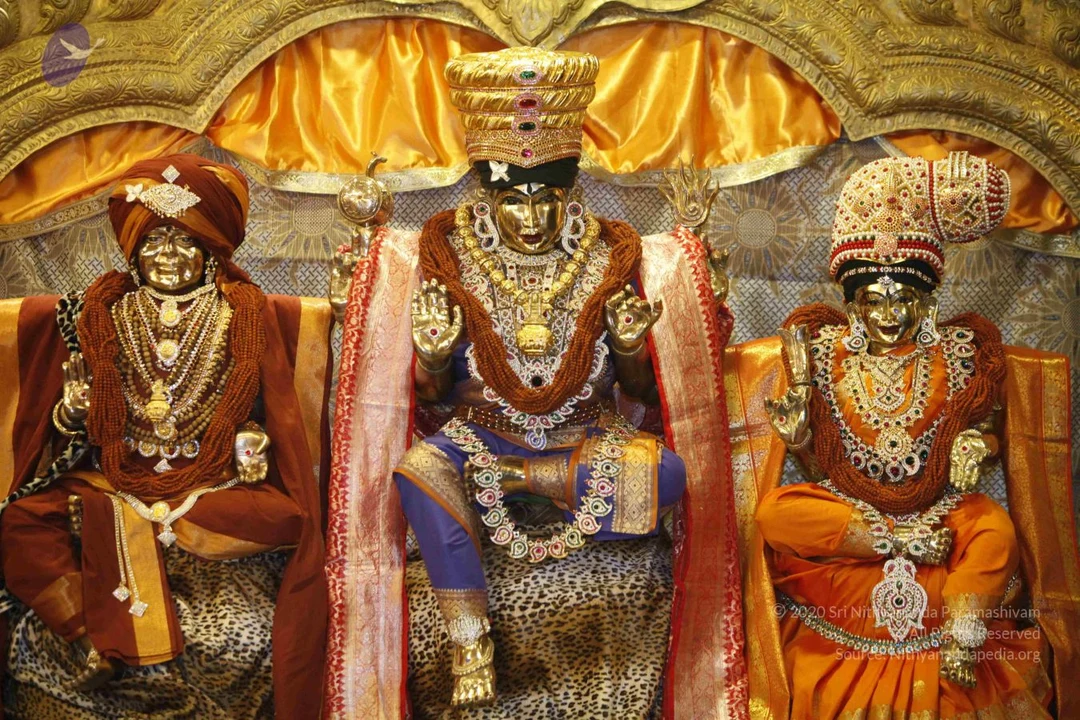
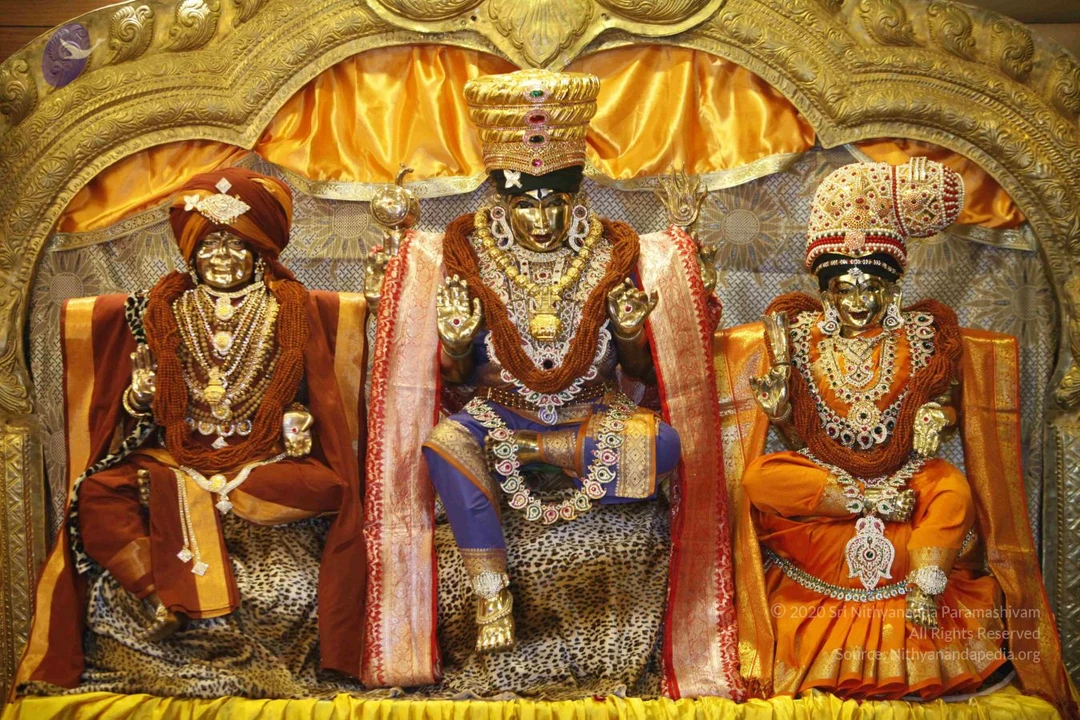
Nithyanandeswara Nithyanandeswari and Nithyananda
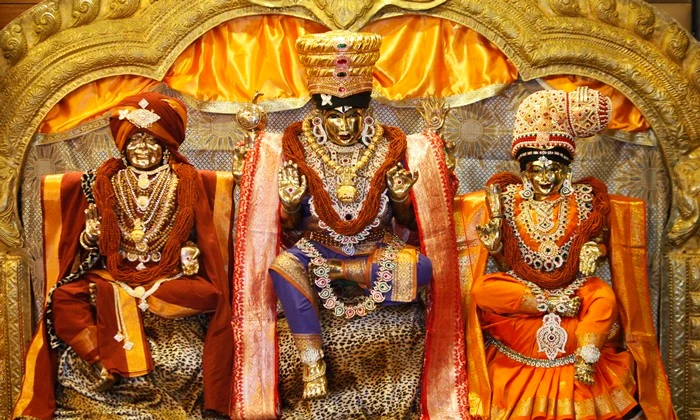
http://nithyananda.org/sites/default/files/photo-gallery/2014-03mar-15th-nithyananda-diary-Haridwar__MG_6531-20140315-171745.JPG

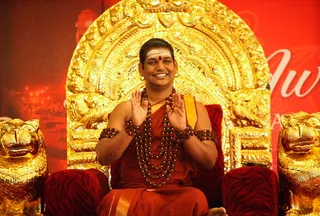
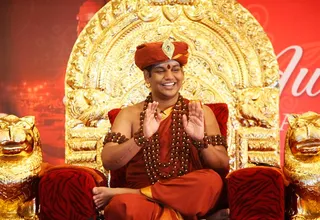
Nithya Satsang

Mahamandaleswar Swami Atmanandaji Maharaj gave Satsang
Tags:

Haridwar, Paramahamsa Nithyananda, Mahamandaleshwar, Mahamandaleshwar Sri Sri Swami Arjun Puri Maharaj, Juna Akhada, Swami Arjun Puri Ji, Shiva, spirituality, Moksha, liberation, enlightenment, satguru, Guru.

Photos Of The Day:

Nithya-Satsang

With-Arjun-Puri-Mahraj

Kalpataru-Darshan

IA-Maheshwarapooja

Kalabhairava-Darshan

Photos Of The Day:

Nithya-Satsang

With-Arjun-Puri-Mahraj

Kalpataru-Darshan

IA-Maheshwarapooja

Kalabhairava-Darshan

Photos from this day

View all 212 photos

Nithya Satsang

3 photosSource gallery
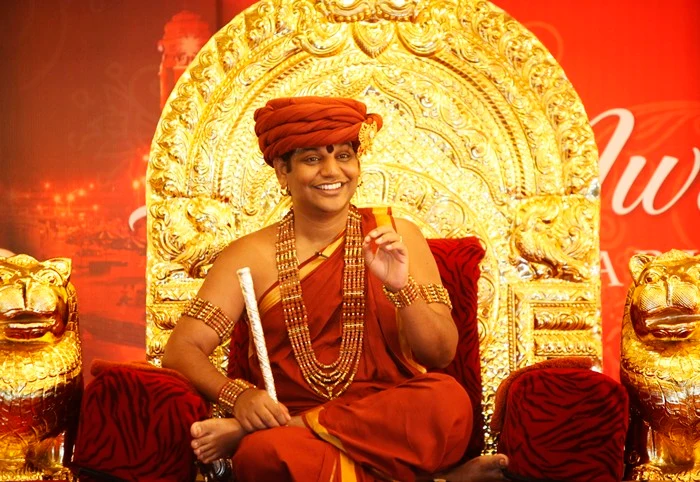
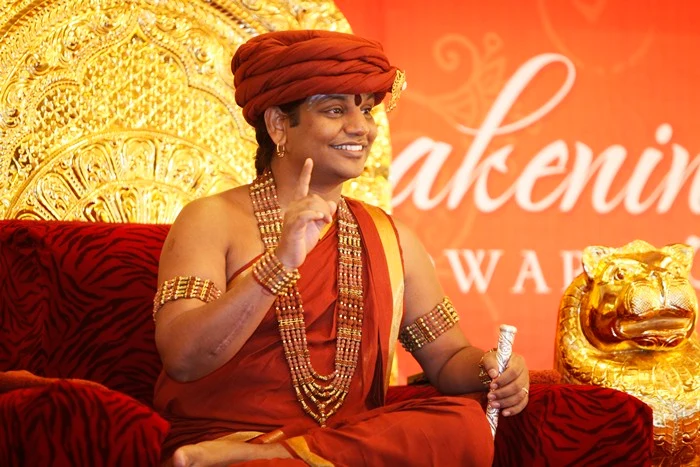
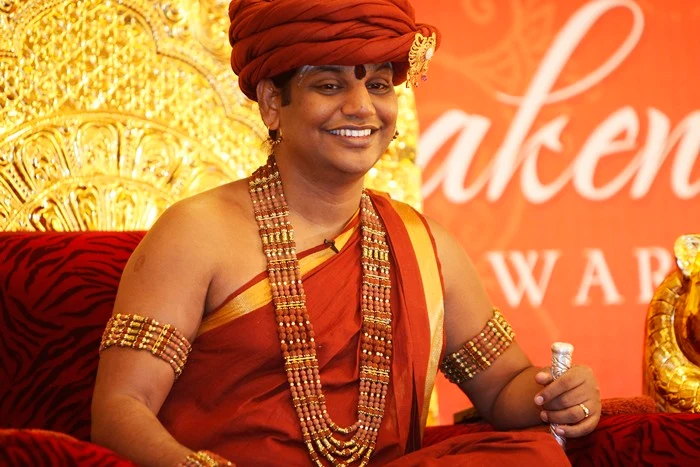
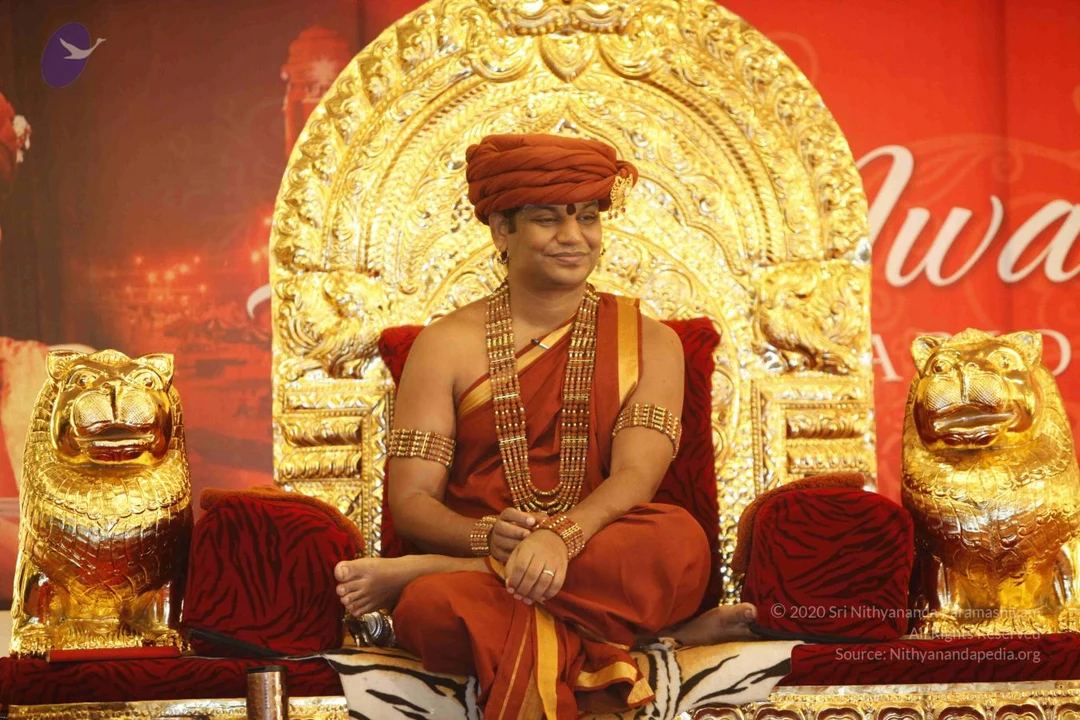
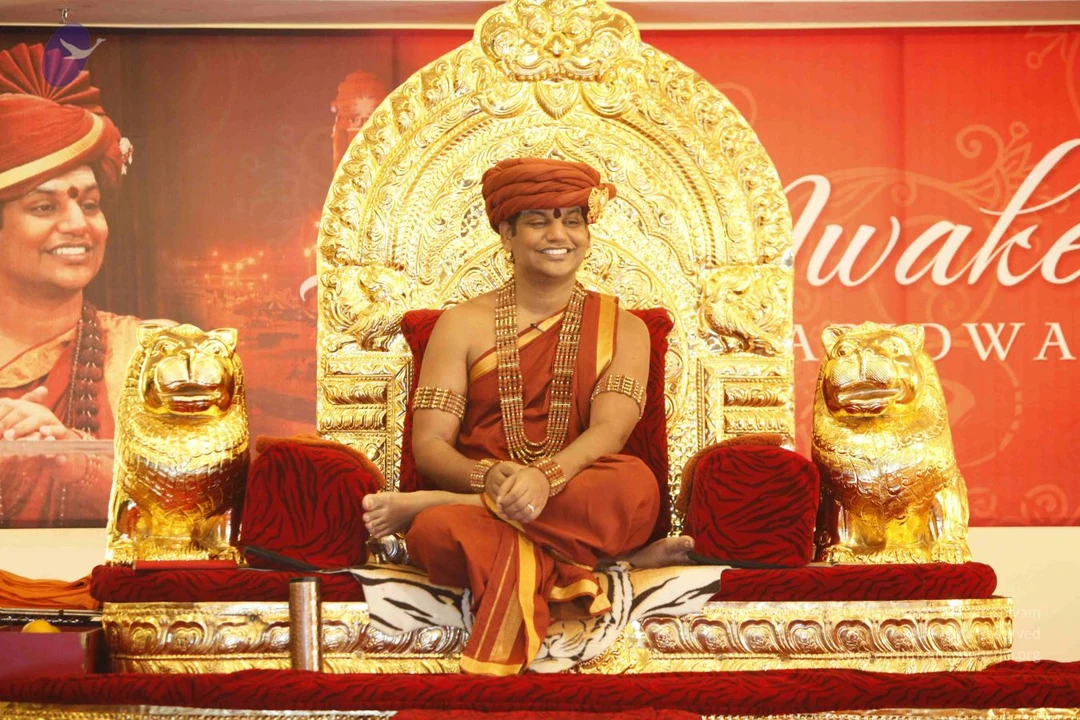
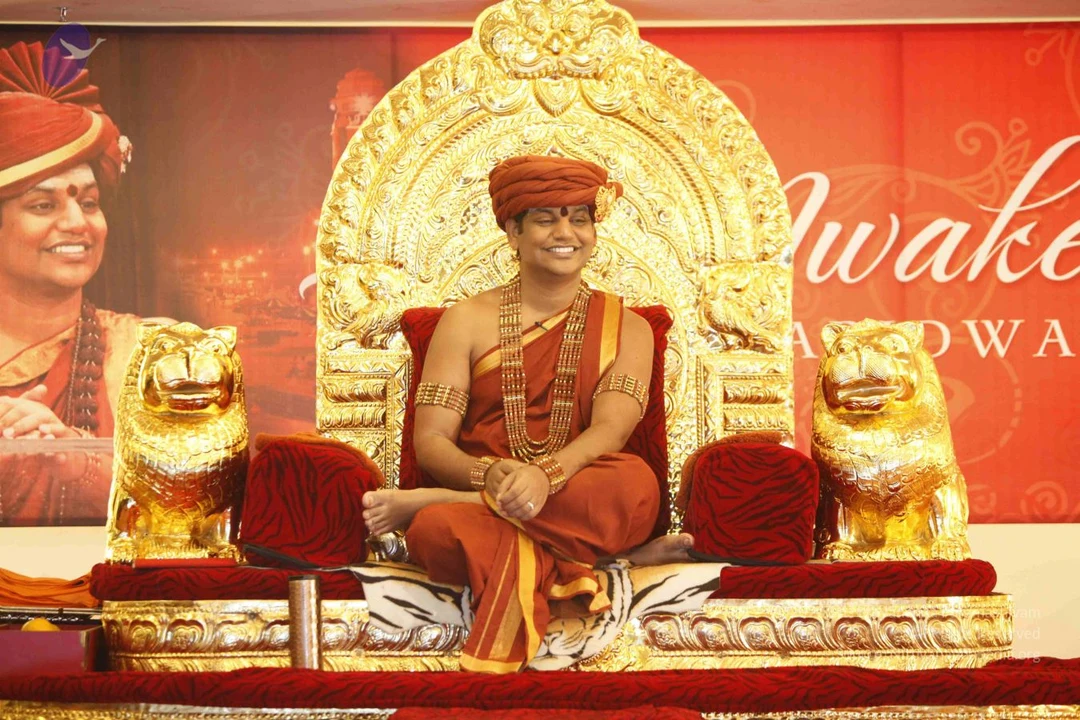
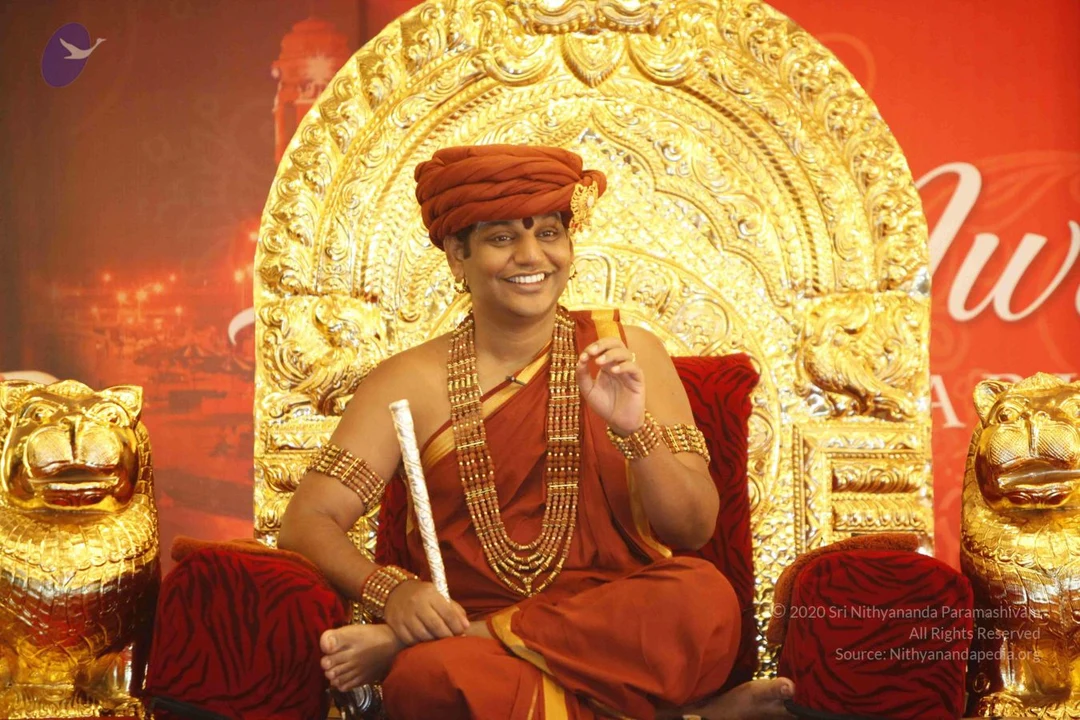
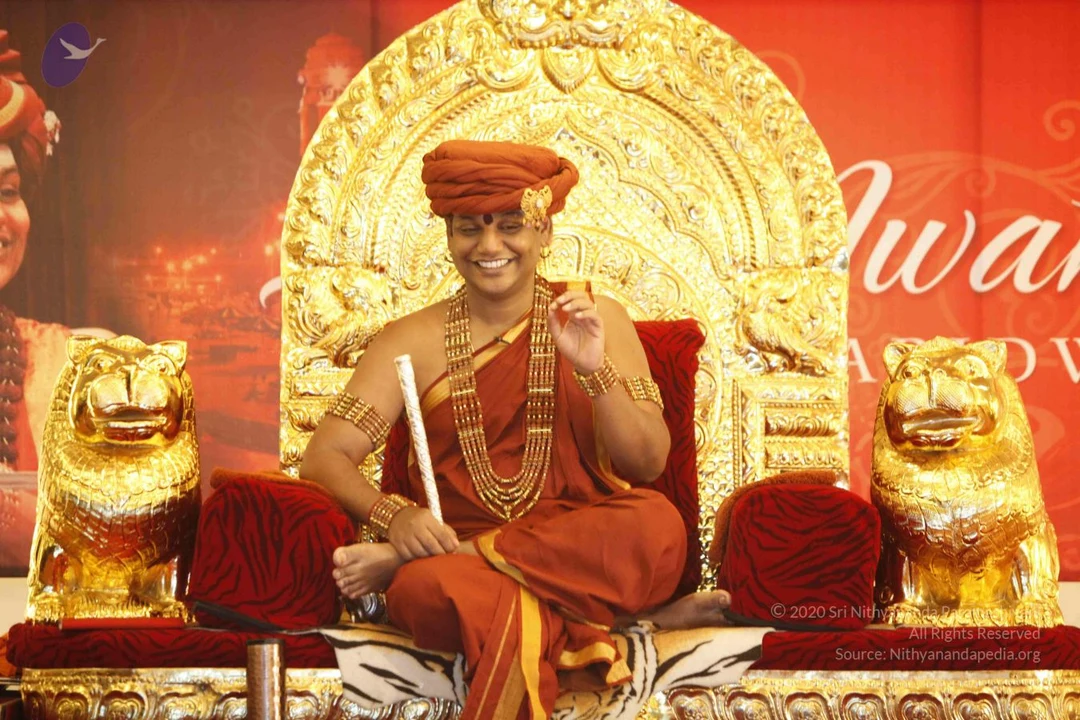
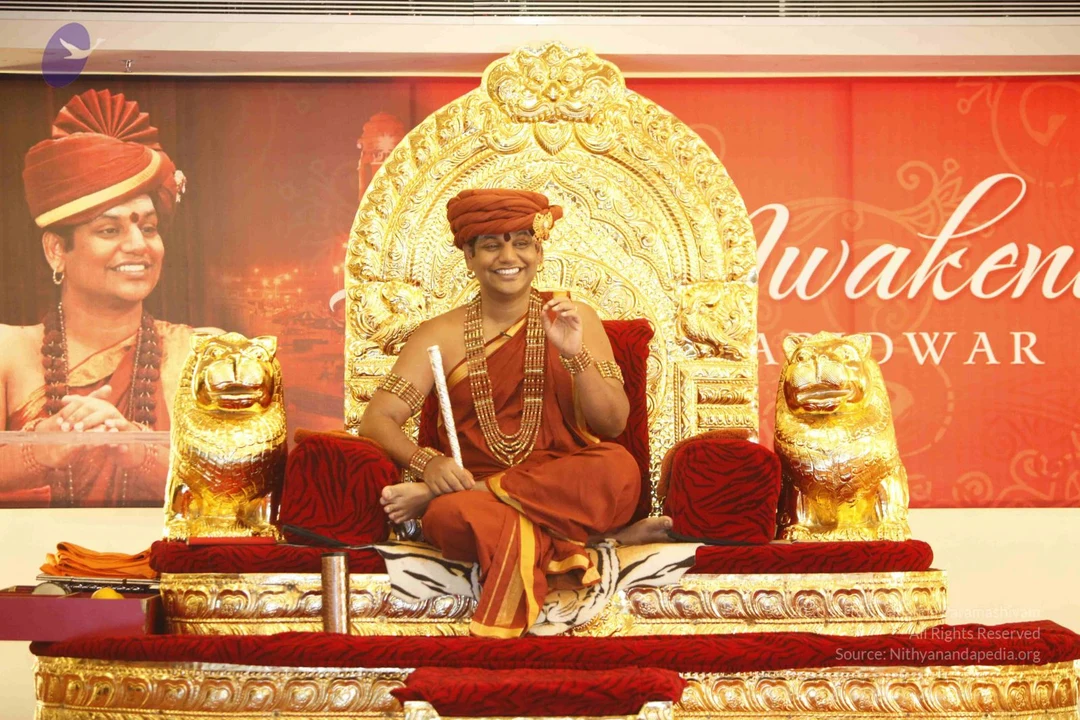
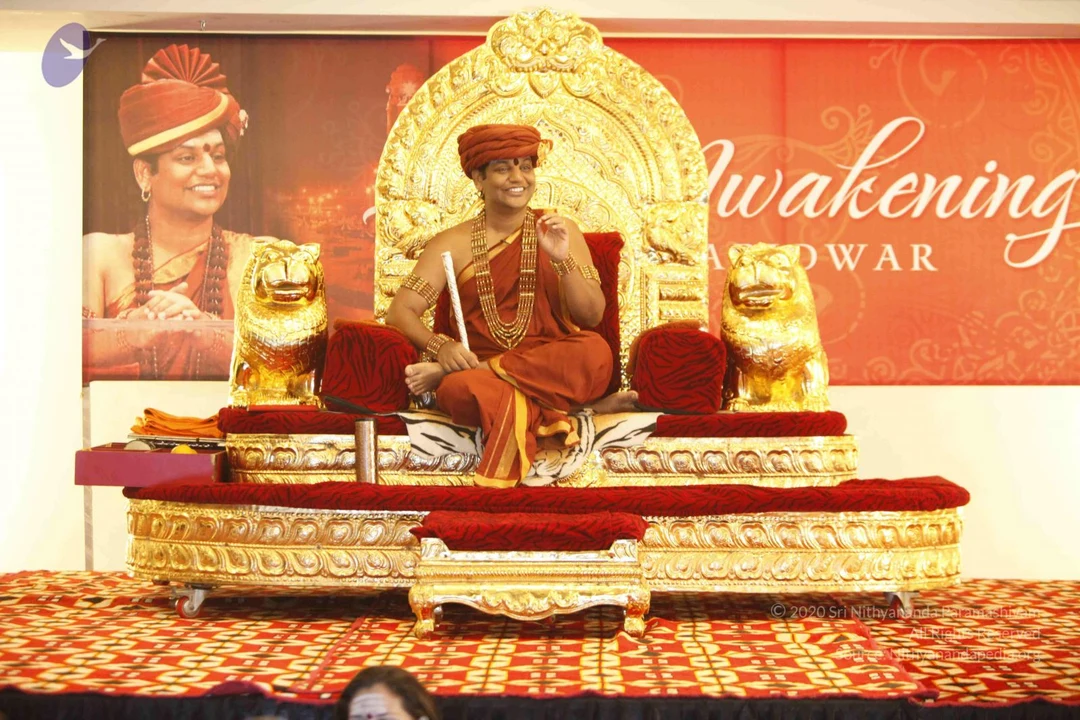
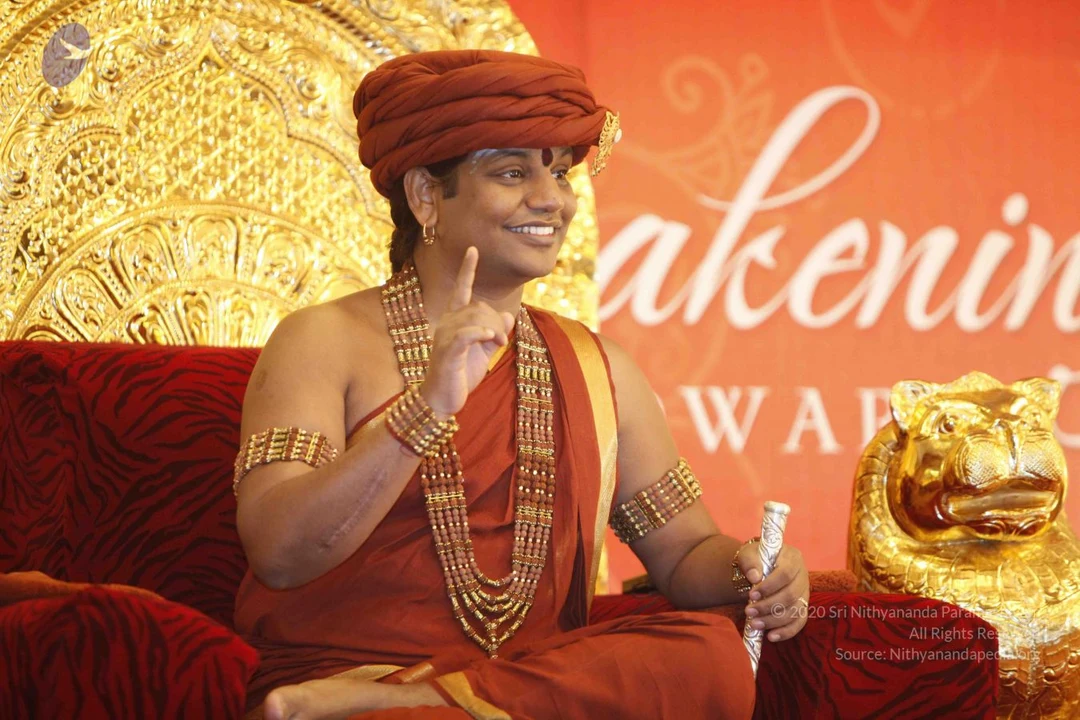
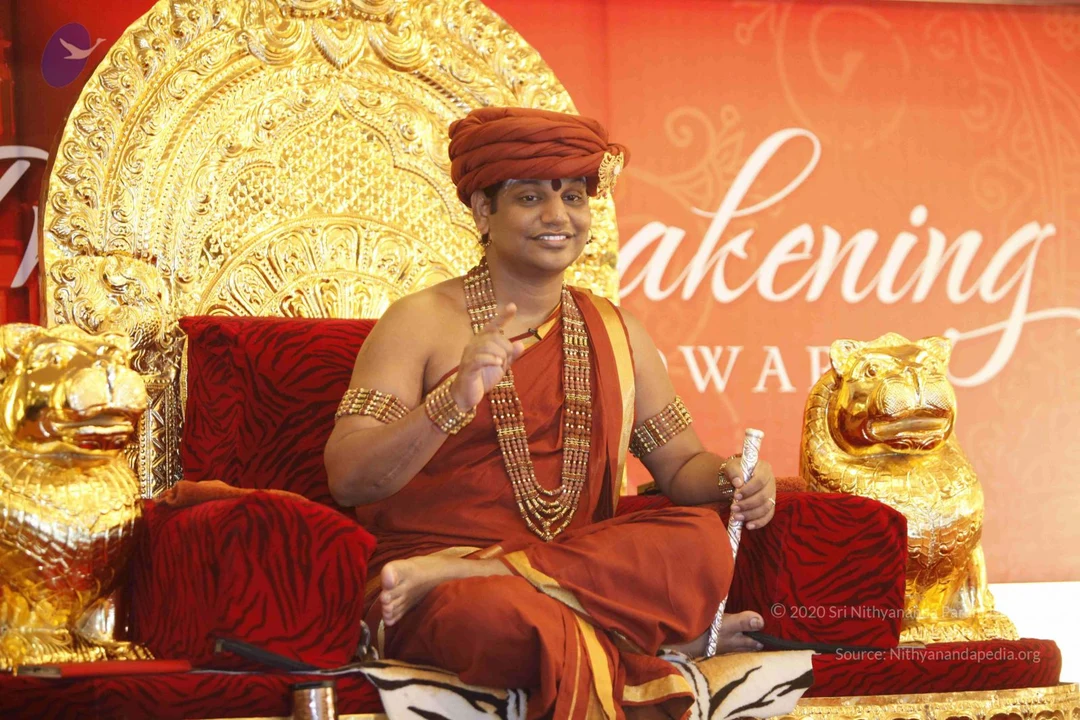
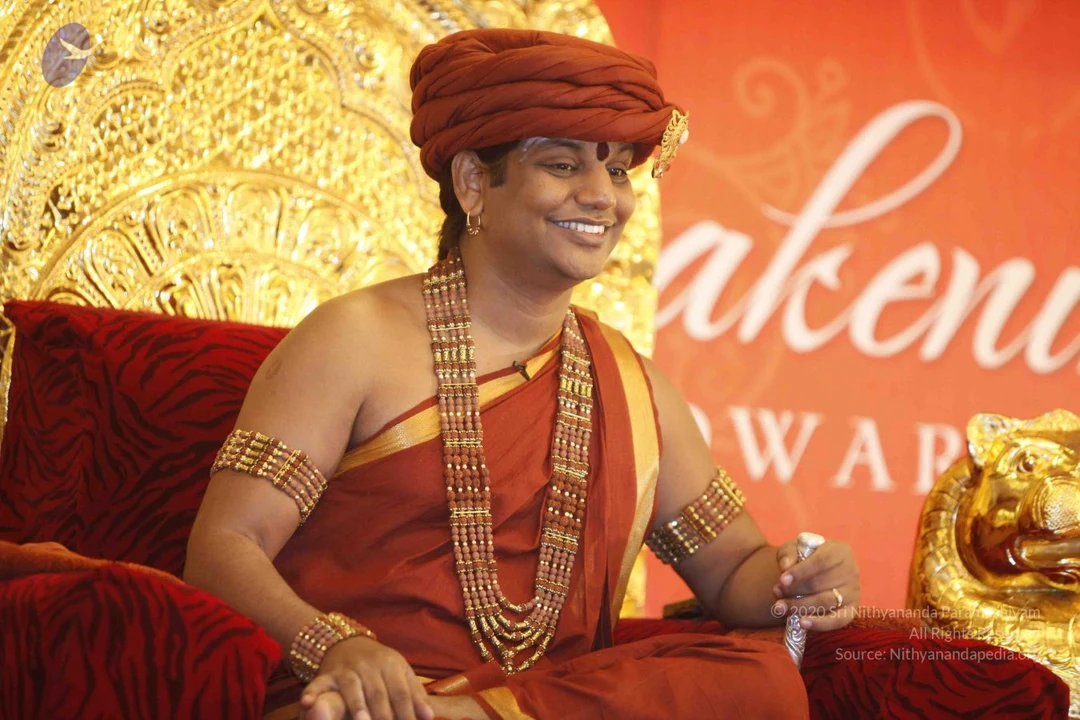
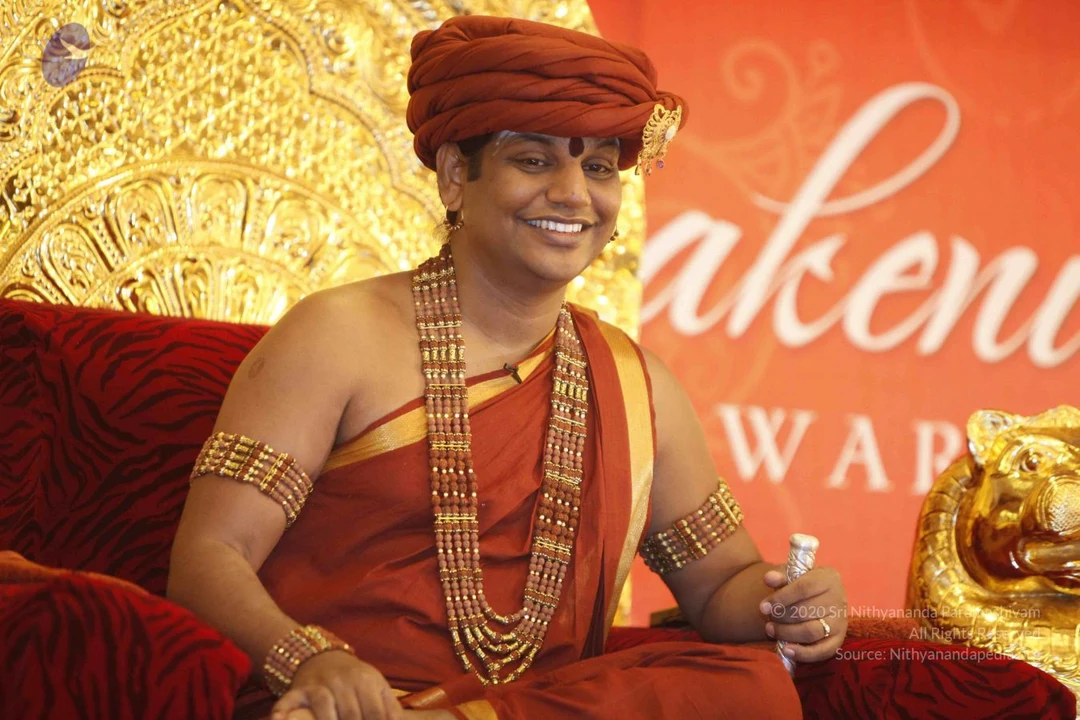
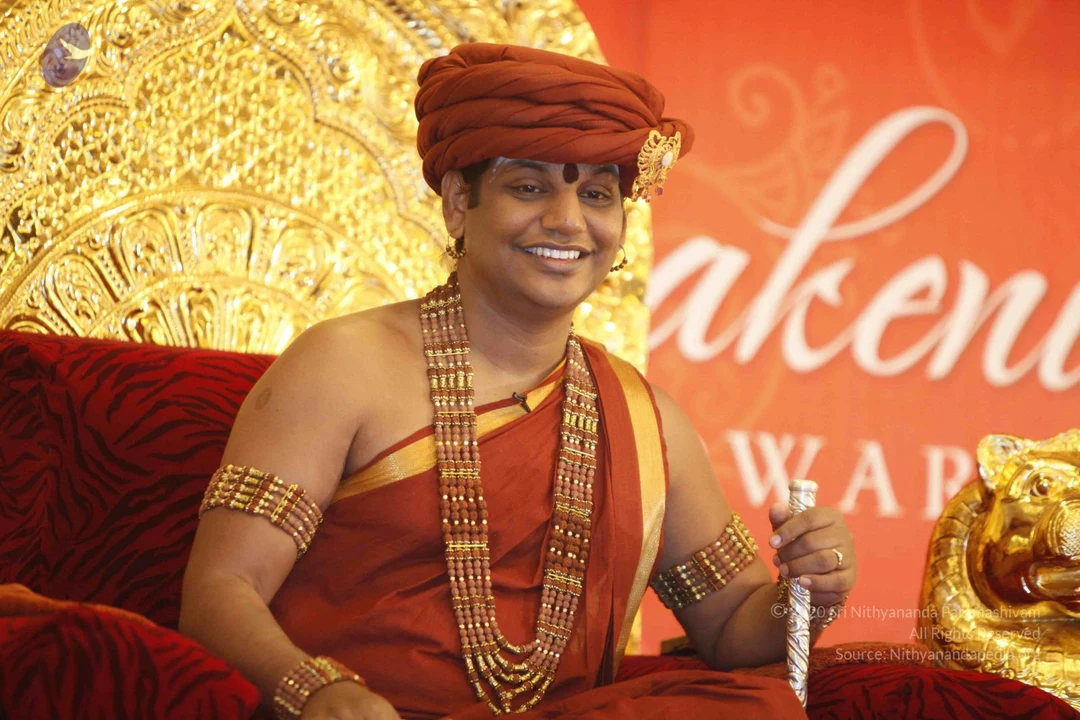
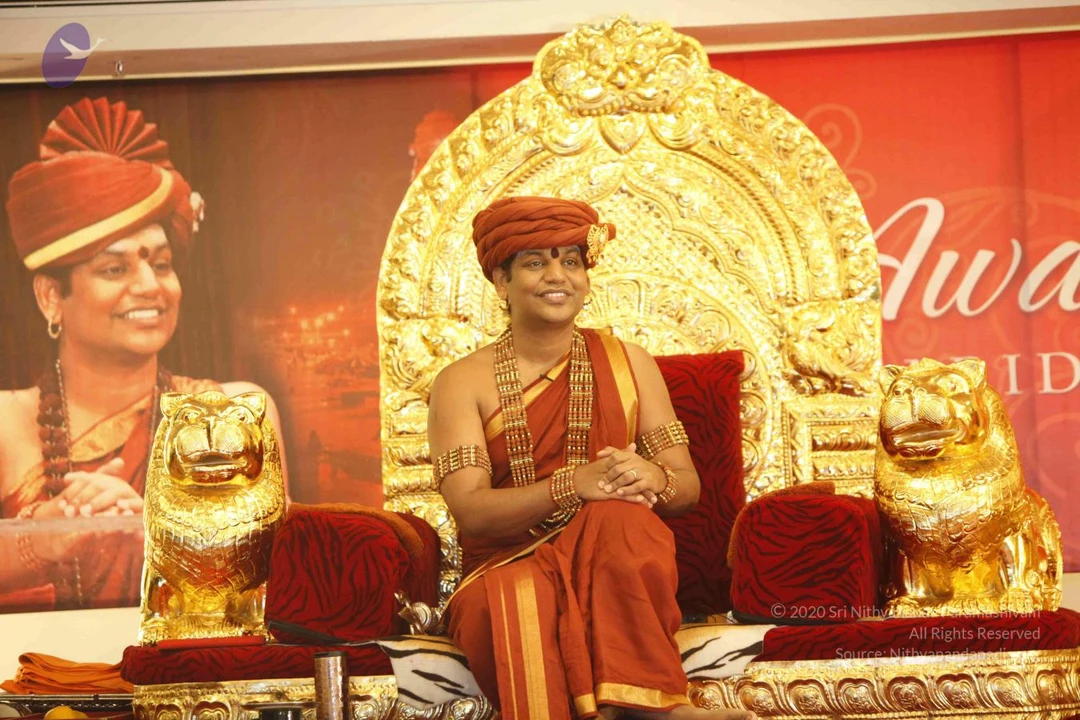
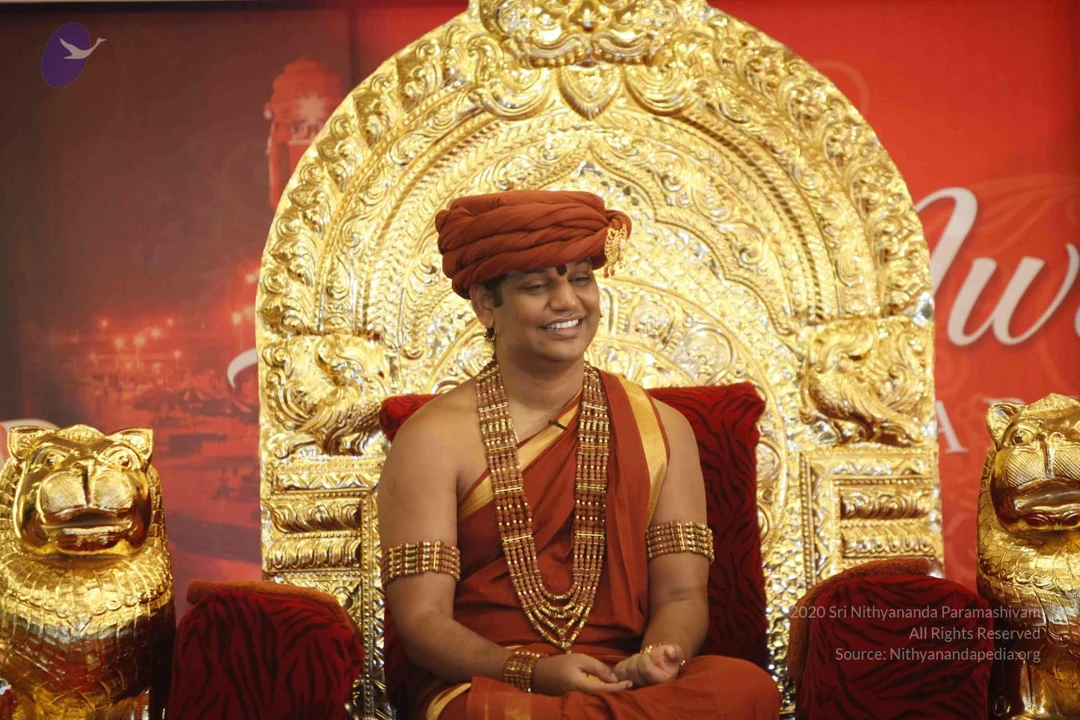
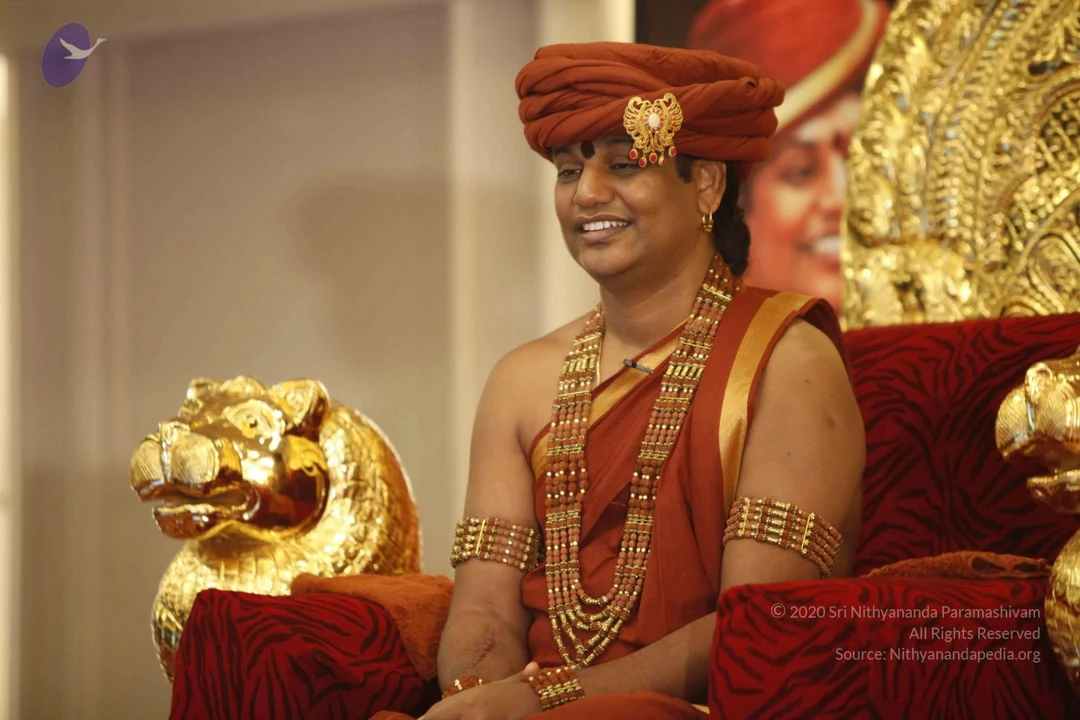
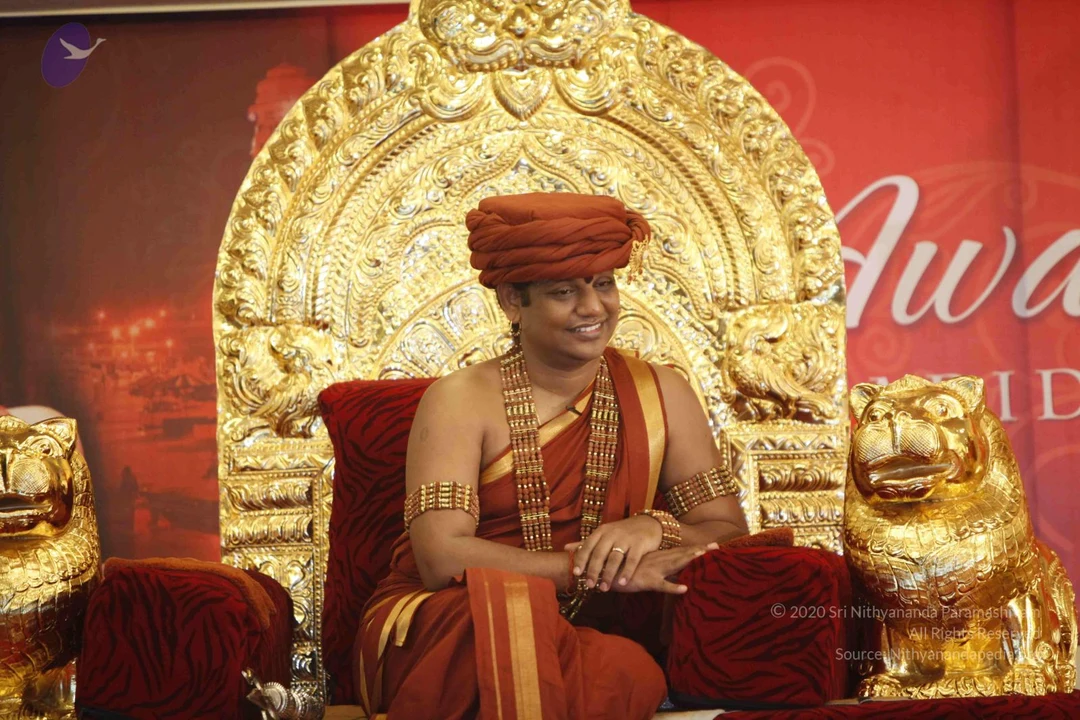
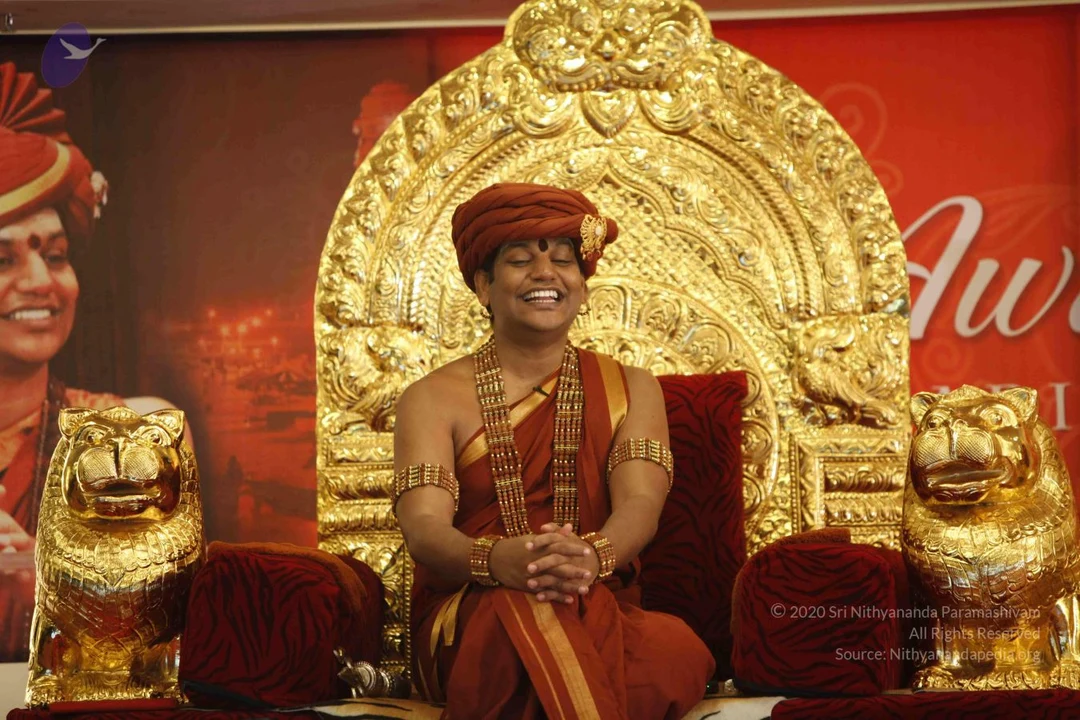
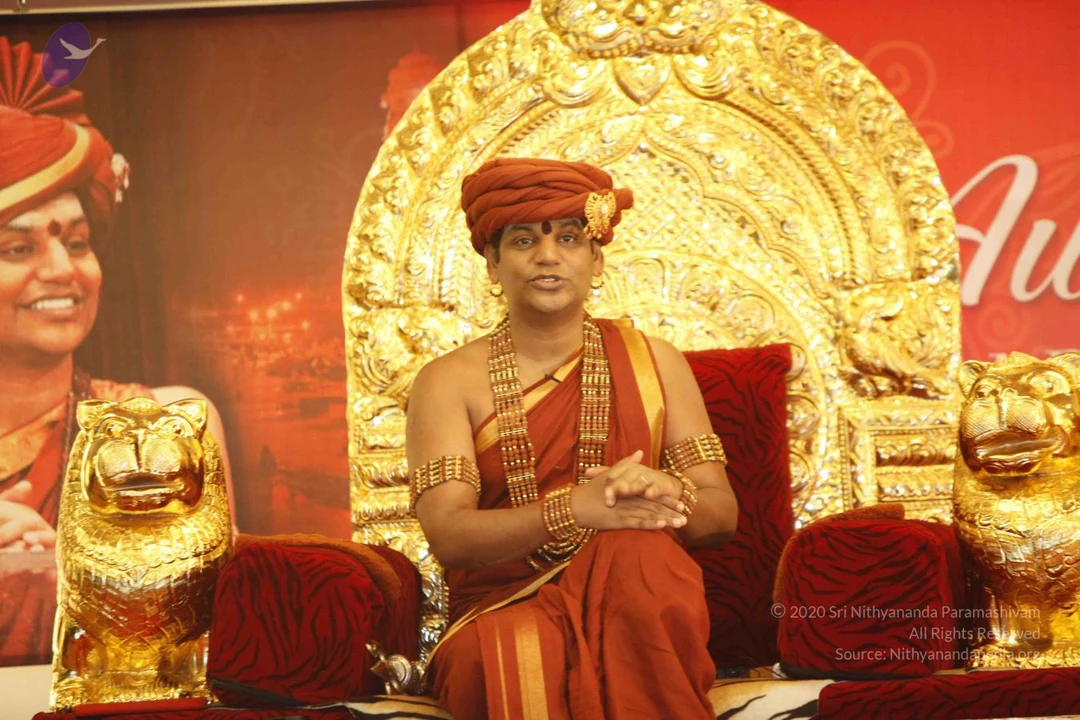
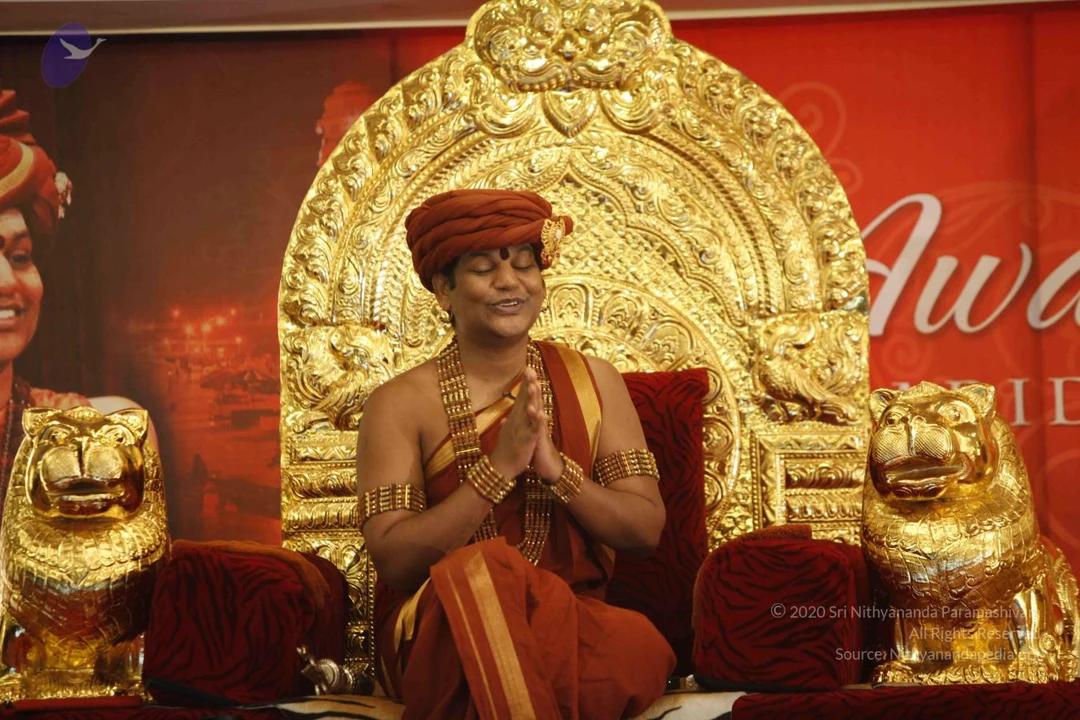
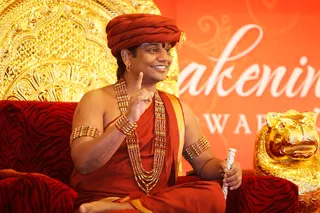
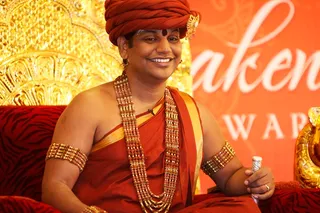
A smiling man sits cross-legged on an ornate golden throne with carved lion-head armrests, flanked by golden lion statues on red cushions. He wears an orange-red turban, a bare chest with a saffron-orange cloth draped over his body, multiple layered gold necklaces, gold armbands and bracelets, and holds a white baton in one hand and a small card in the other. A red backdrop with a faint city image and partial lettering sits behind him.A seated man in saffron-orange robes and a matching orange turban raises one index finger while smiling. He wears layered beaded gold-toned necklaces, bangles on both arms, and a red-and-gold shawl across the body. He sits on a red velvet chair with a zebra-stripe pattern, in front of an ornate gold throne back, beside a gold lion-head figure. Behind him is a bright orange backdrop with large white script lettering reading 'akenin' and partial letters of 'WAR'. He holds a silver-tipped staff in his right hand. The appearance matches the Swamiji (probable) cues of orange turban and robes, ornate gold necklaces and a saffron shawl, seated as a speaker at a satsang stage.A smiling man seated on an ornate gold throne with red tiger-striped upholstery. He wears a deep orange-red turban with a gold ornament, an orange-red shawl over bare shoulders, multi-strand beaded necklaces with gold spacers, and beaded armbands. A red bindi marks his forehead, and a ring is on his hand. Behind him is a bright orange backdrop with partial white script reading "aken" and "WAR". The clothing and ornate seating match the appearance of a person seated for a satsang-style event.

Mahamandaleswar Swami Atmanandaji Maharaj gave Satsang
5 photosSource gallery
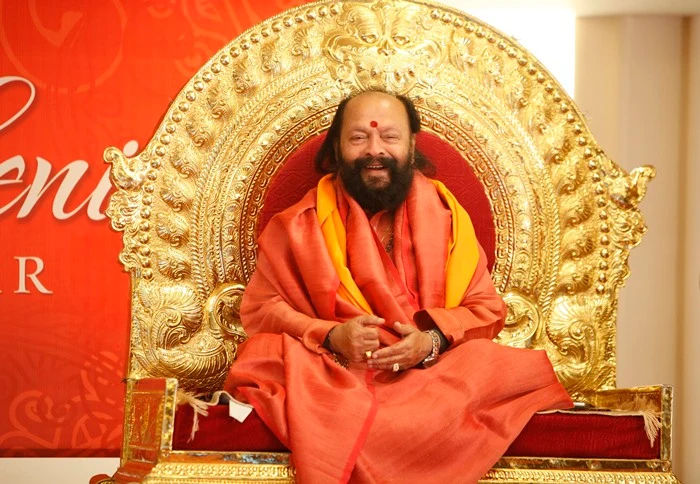
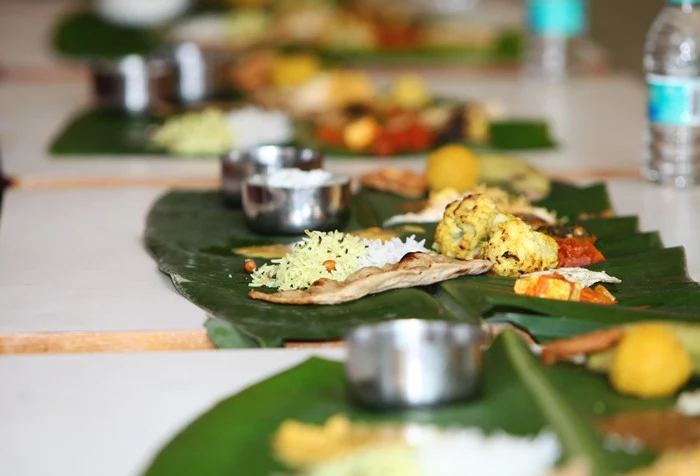
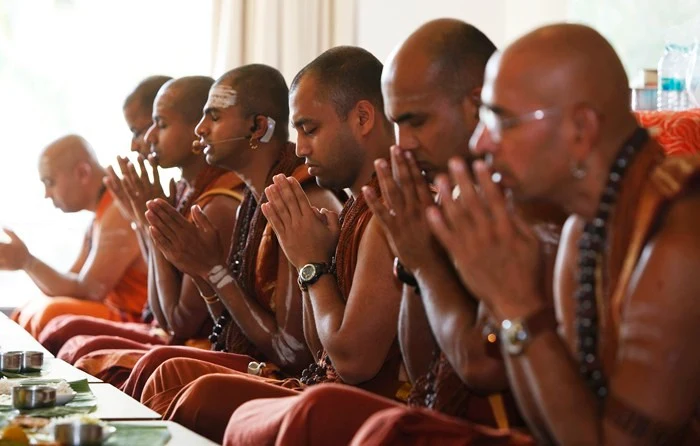
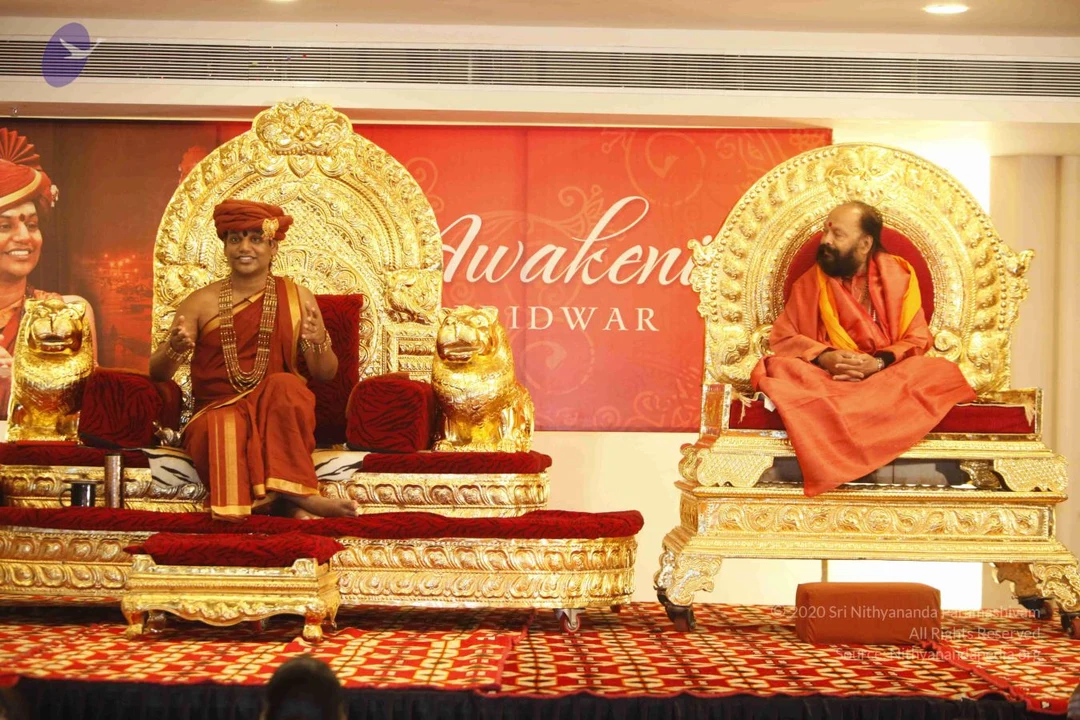
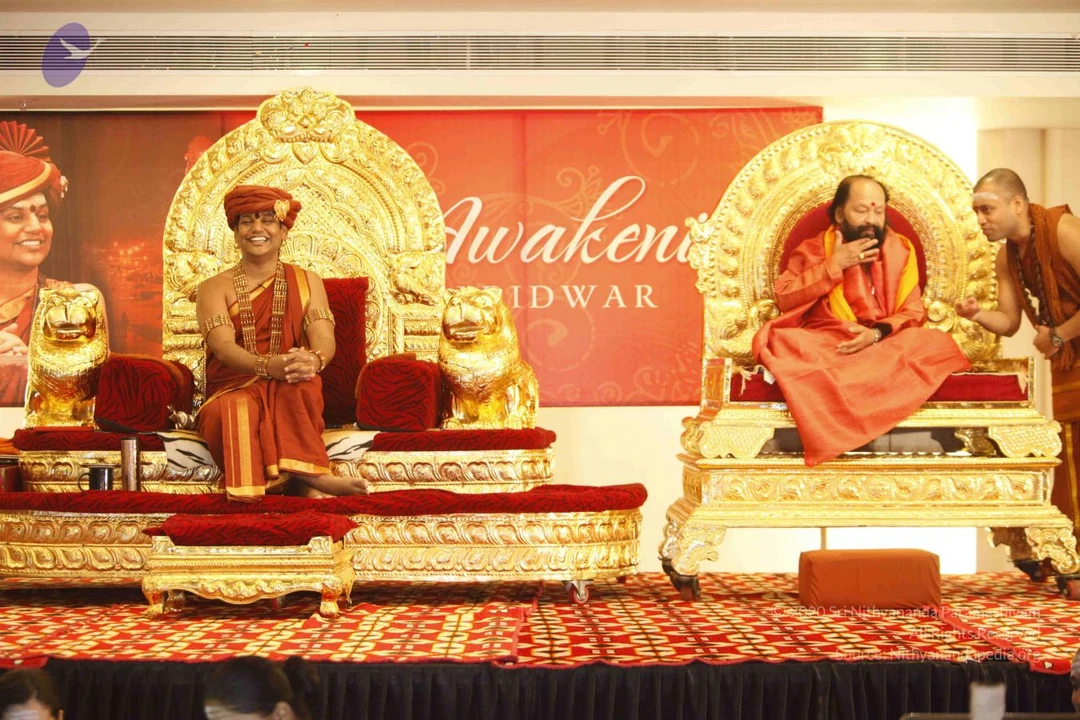
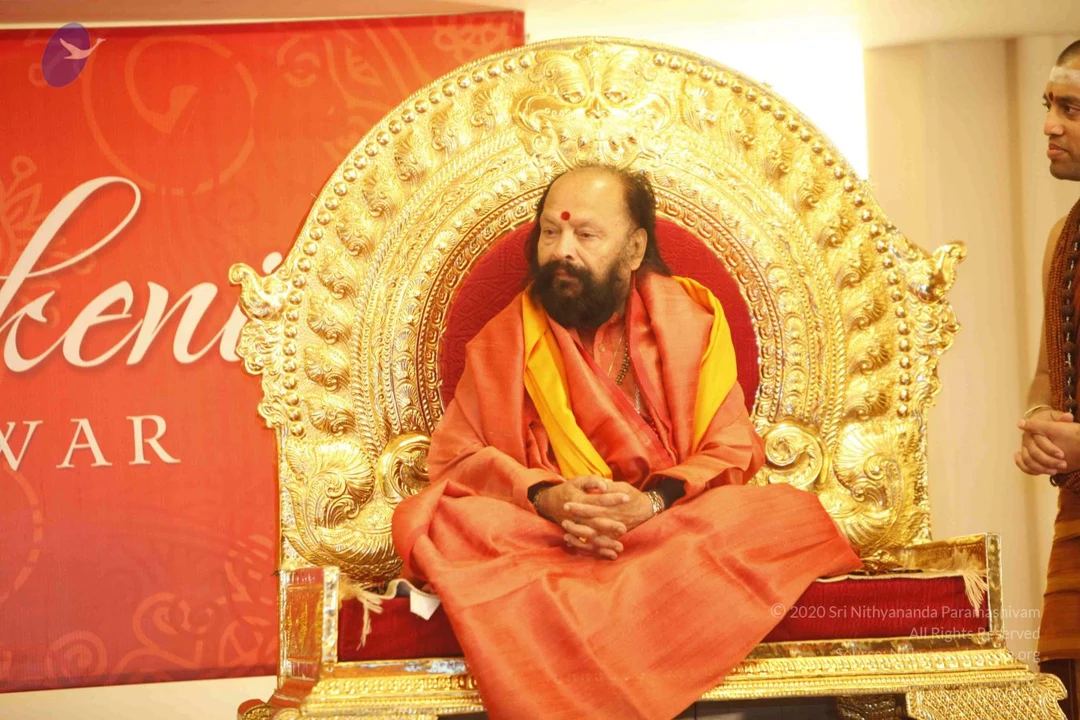
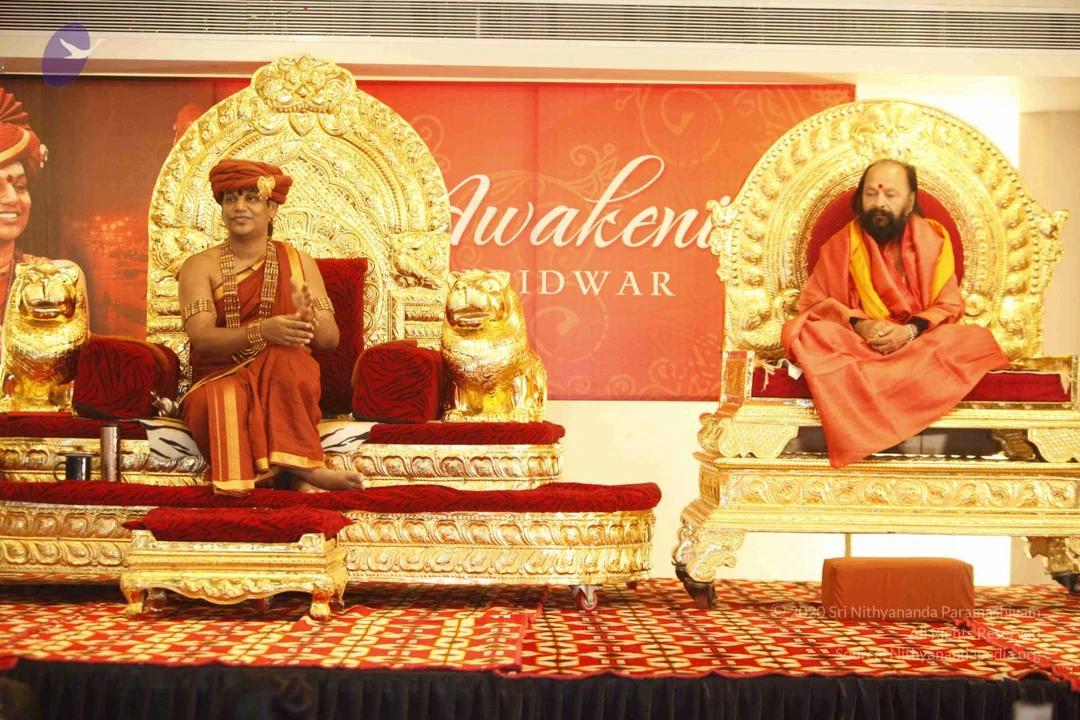
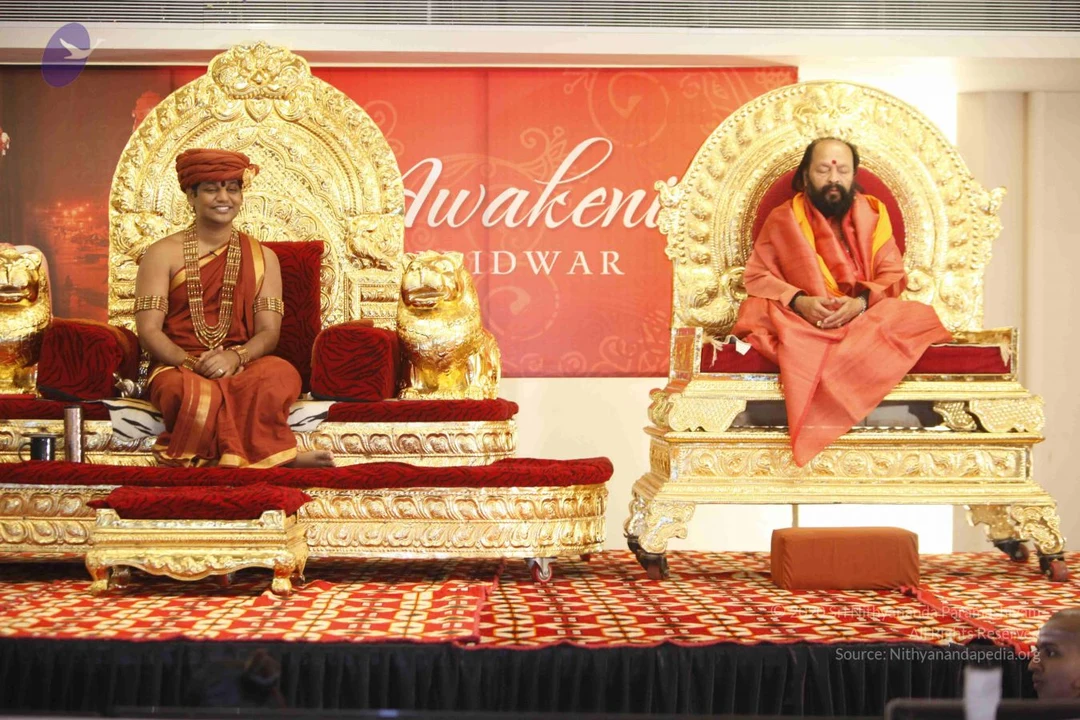
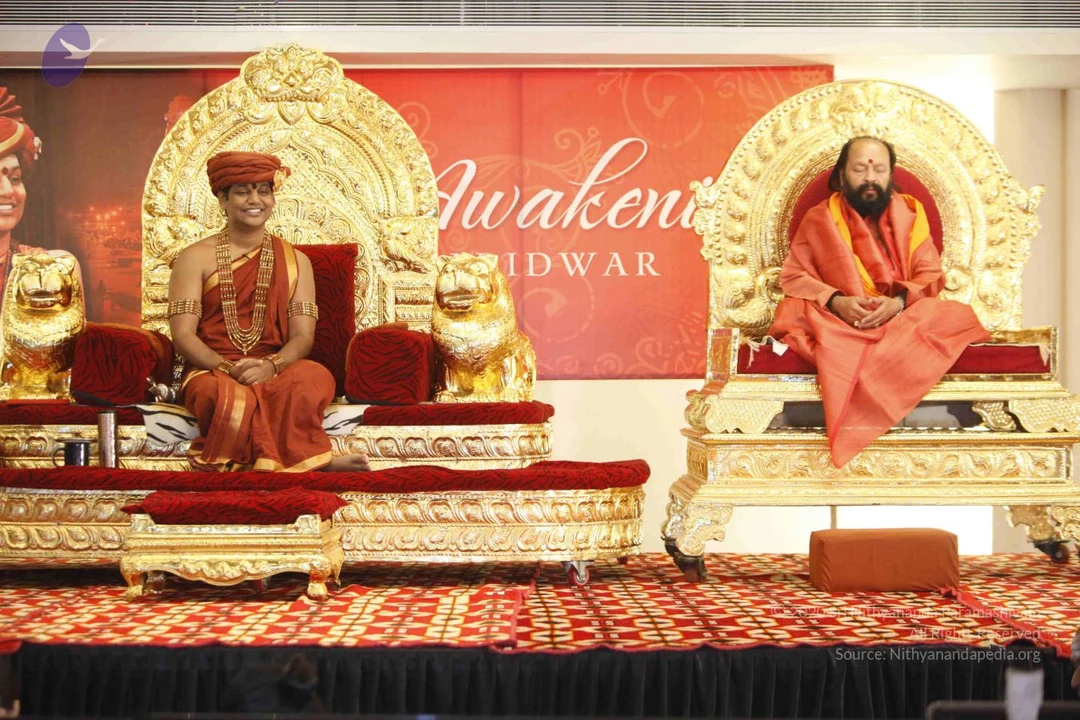
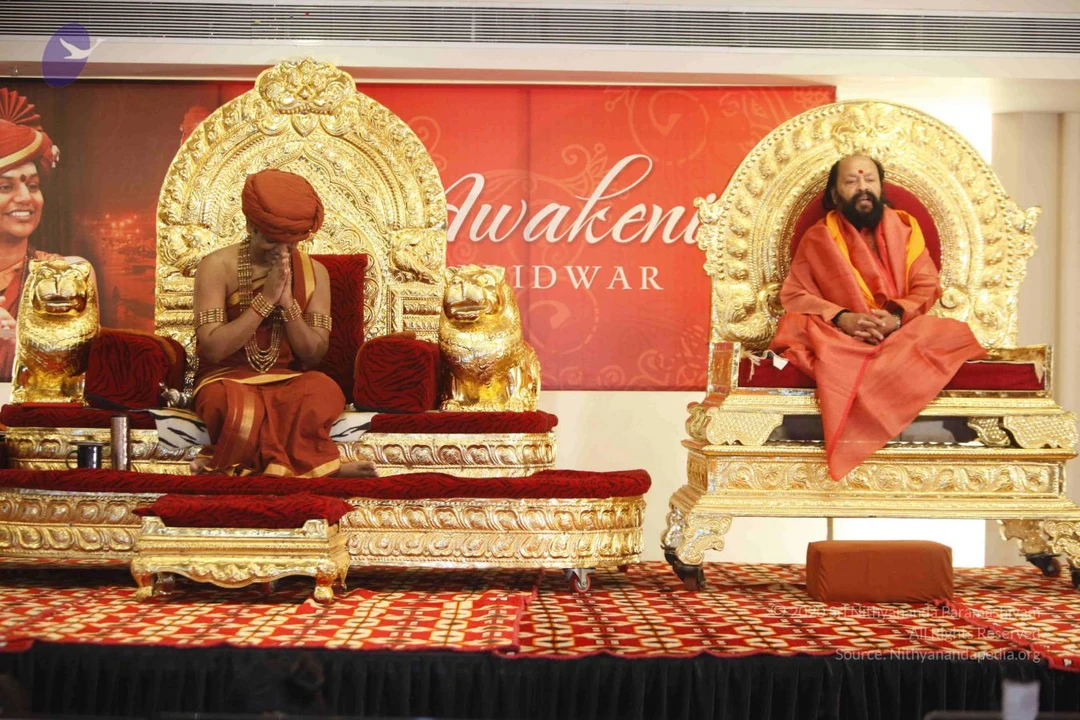
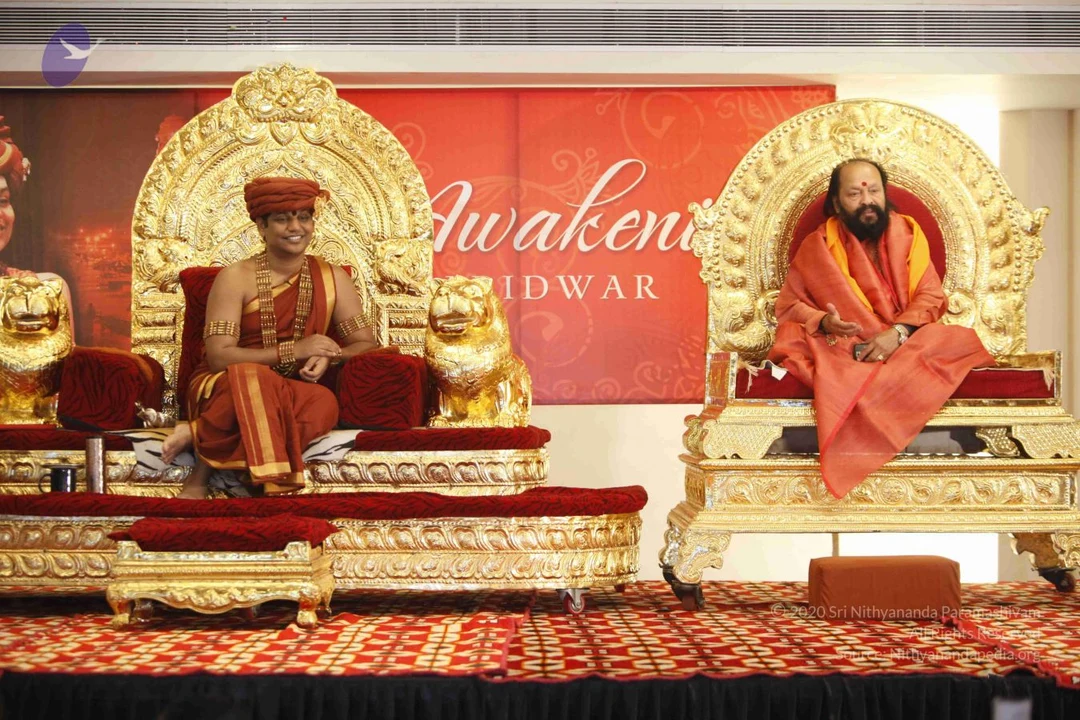
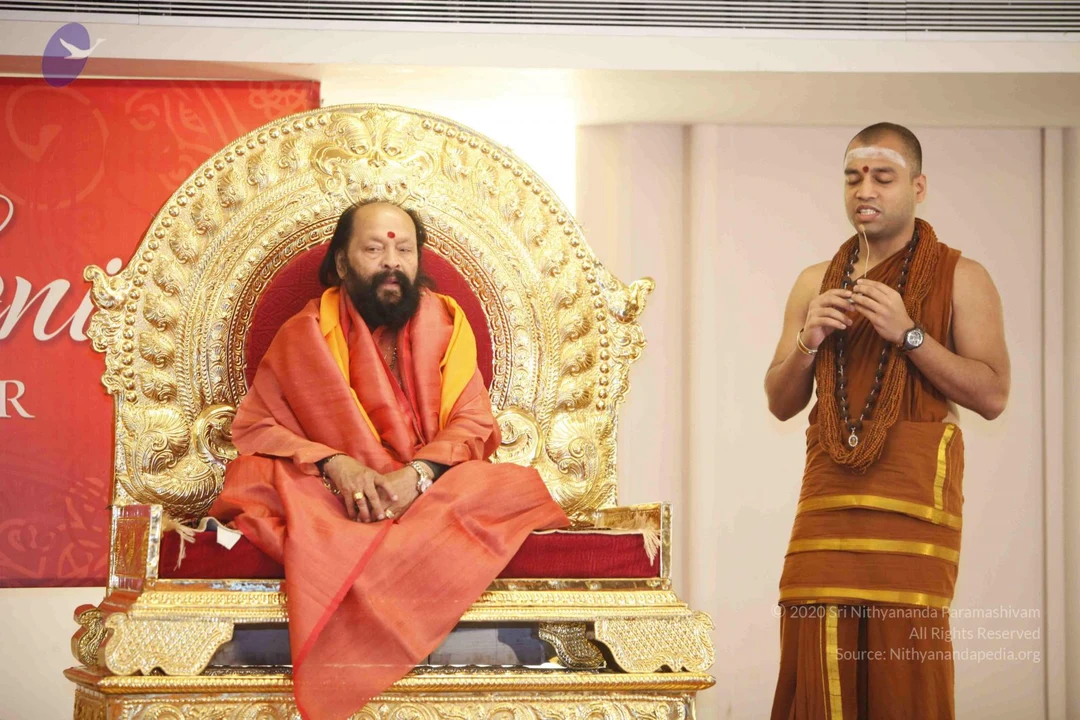
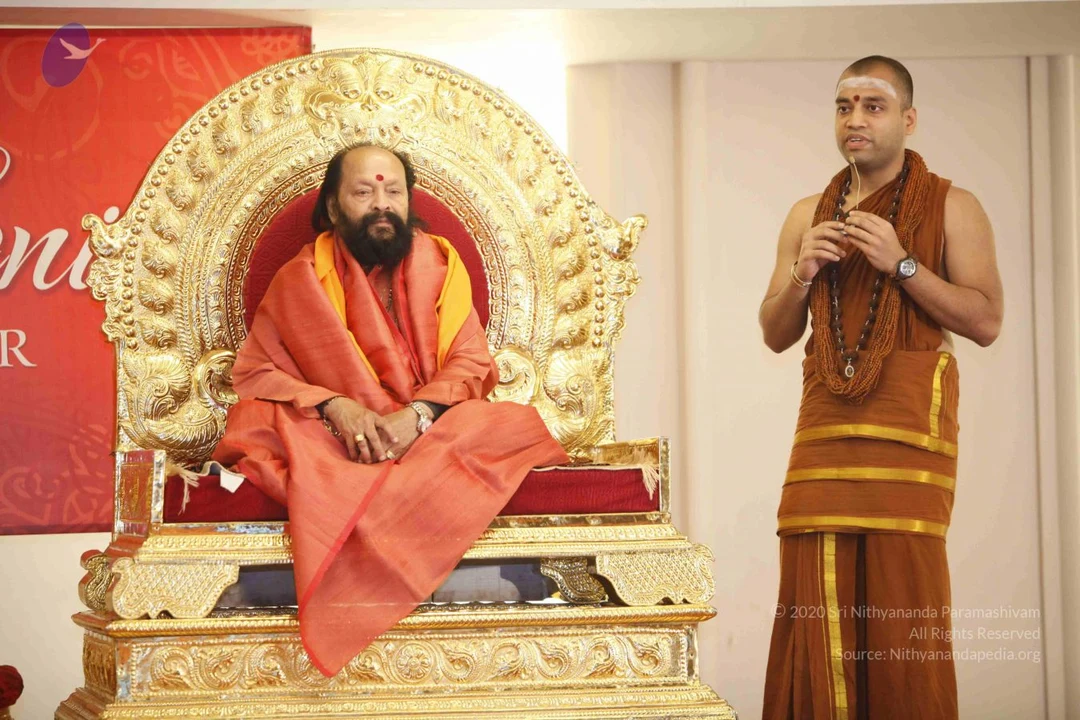
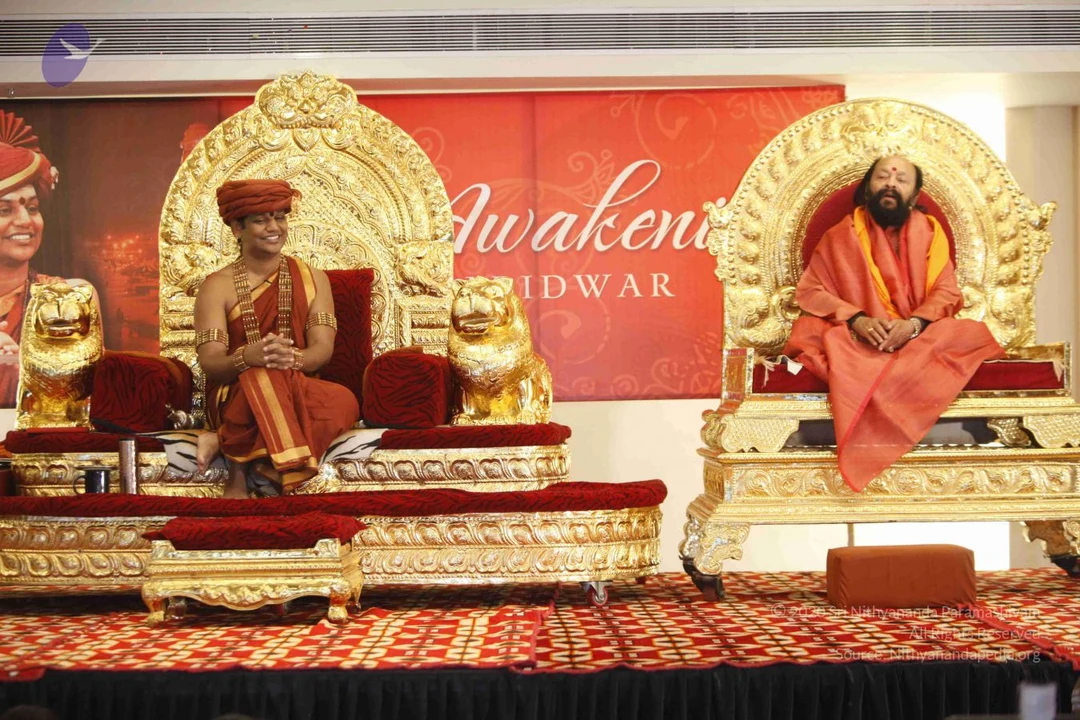
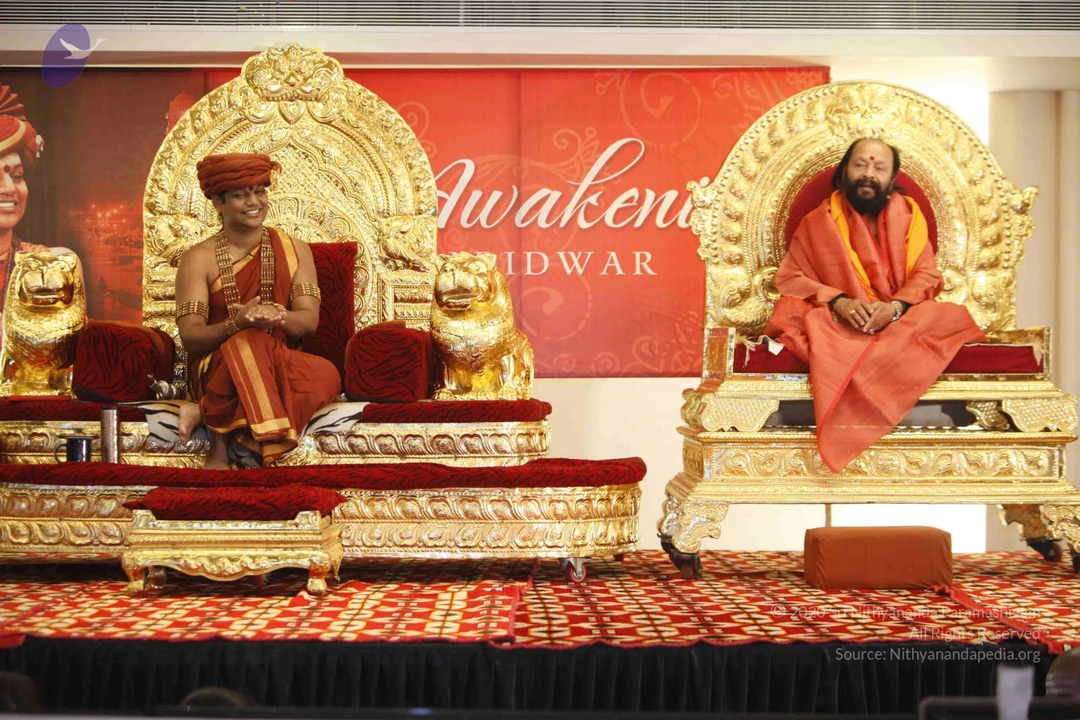
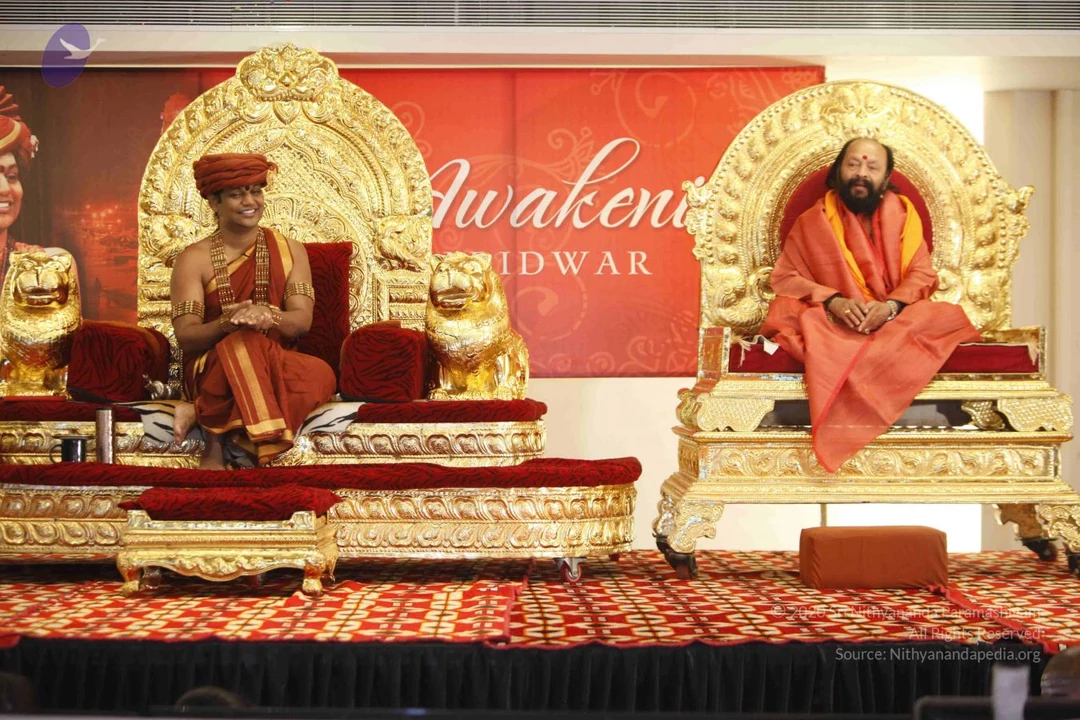
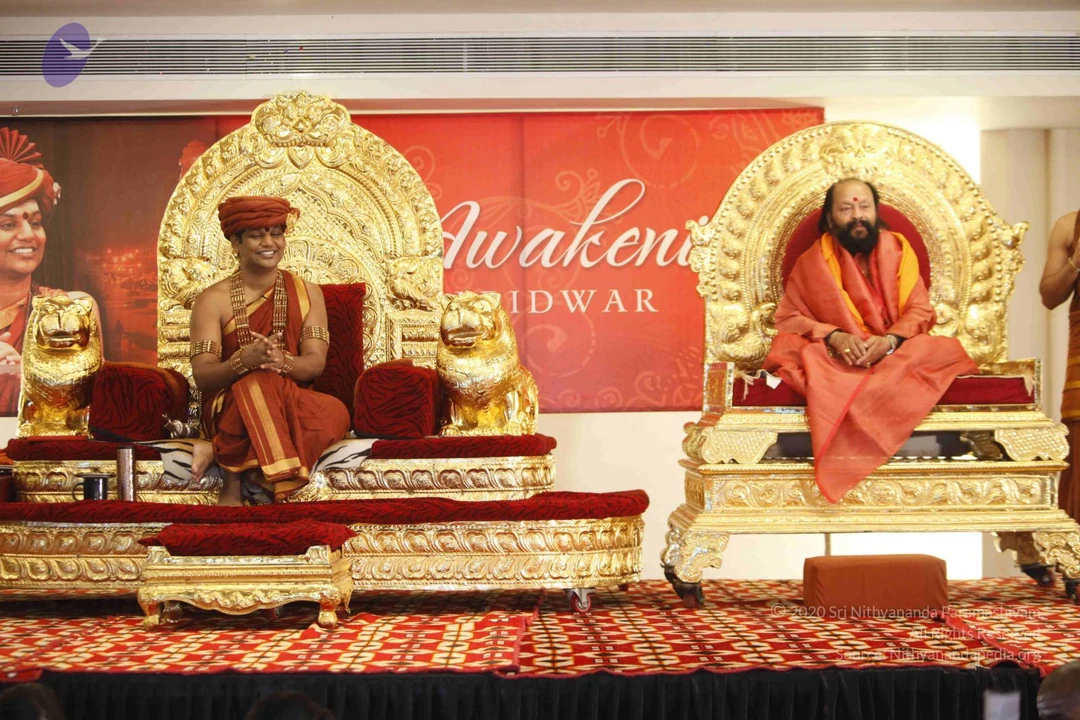
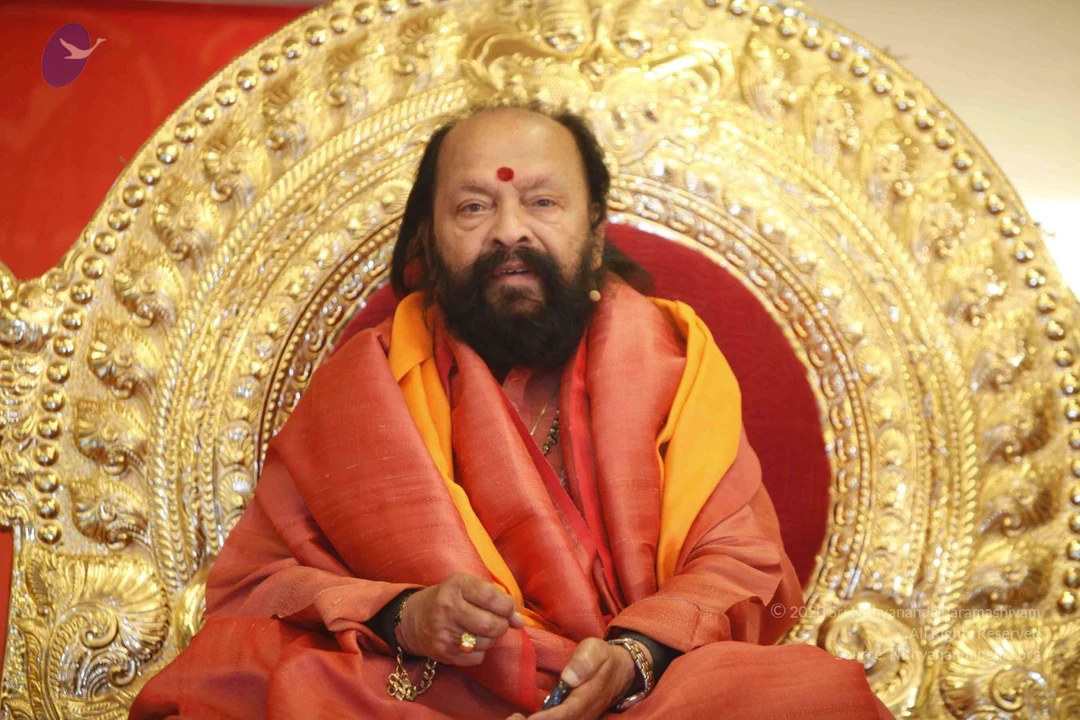
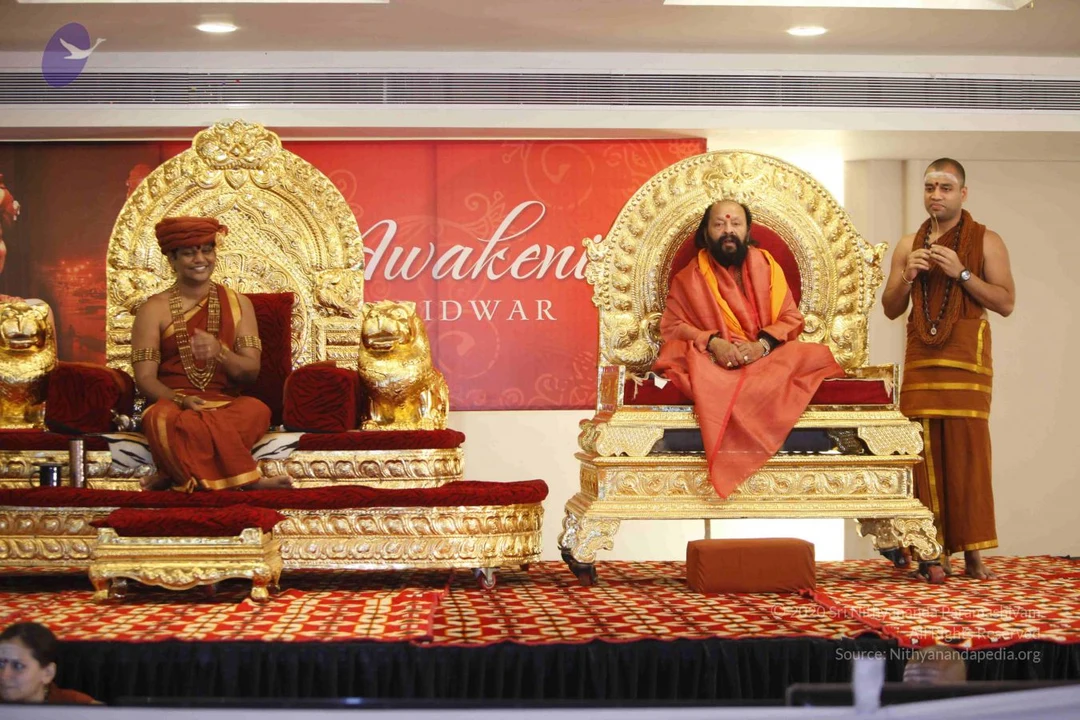
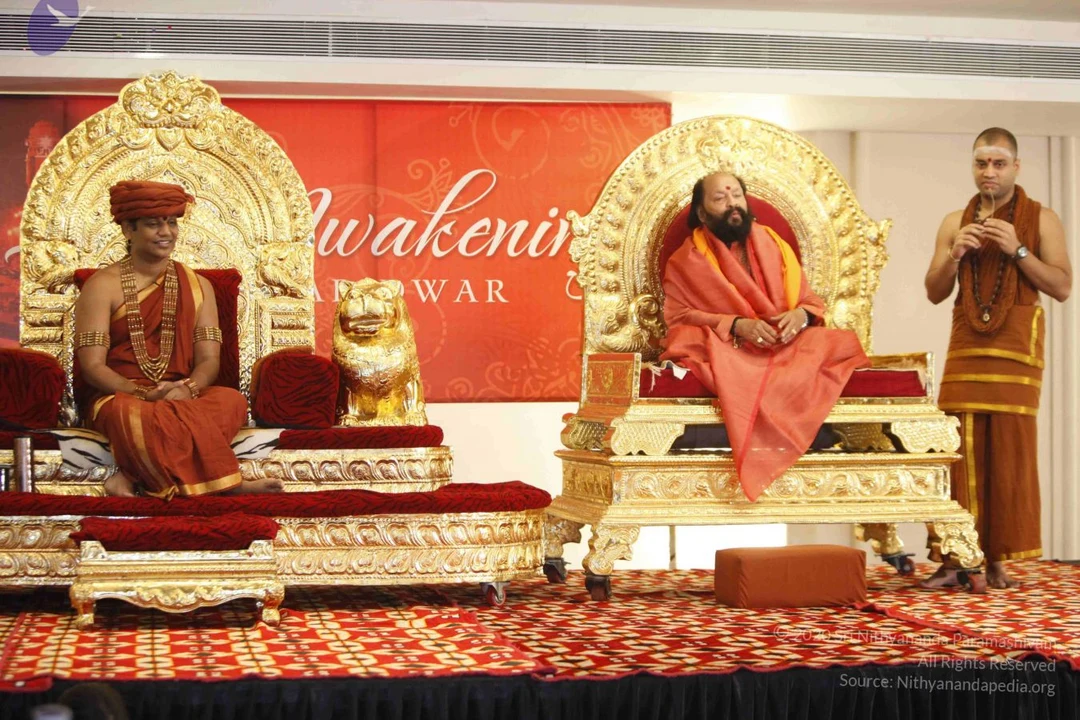
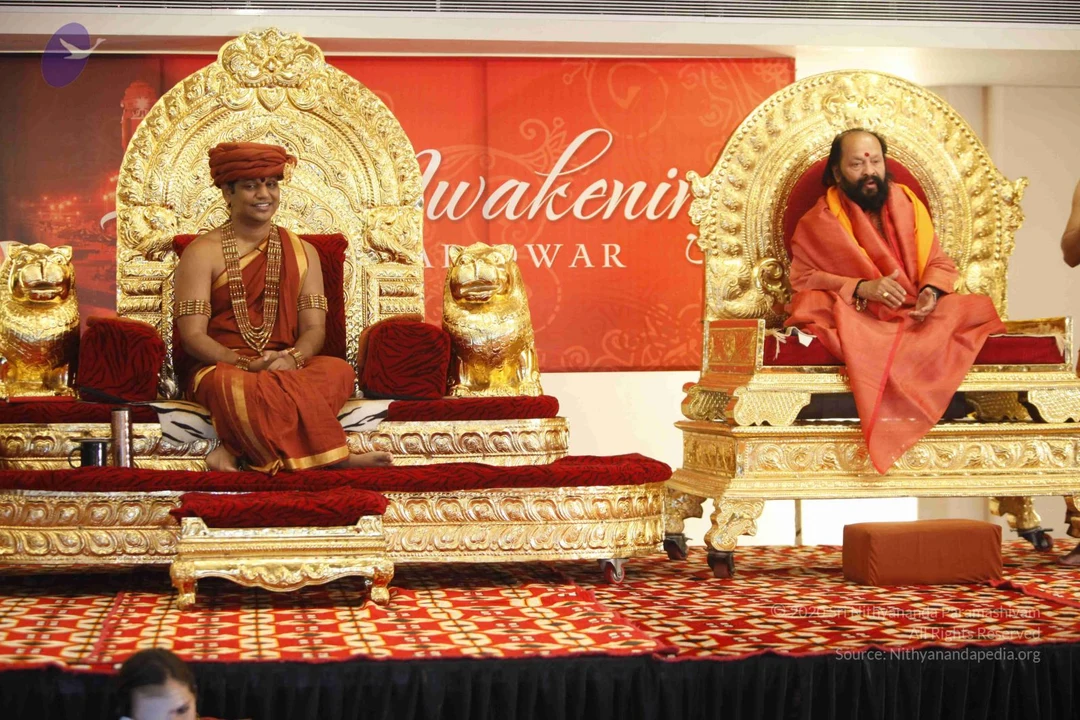
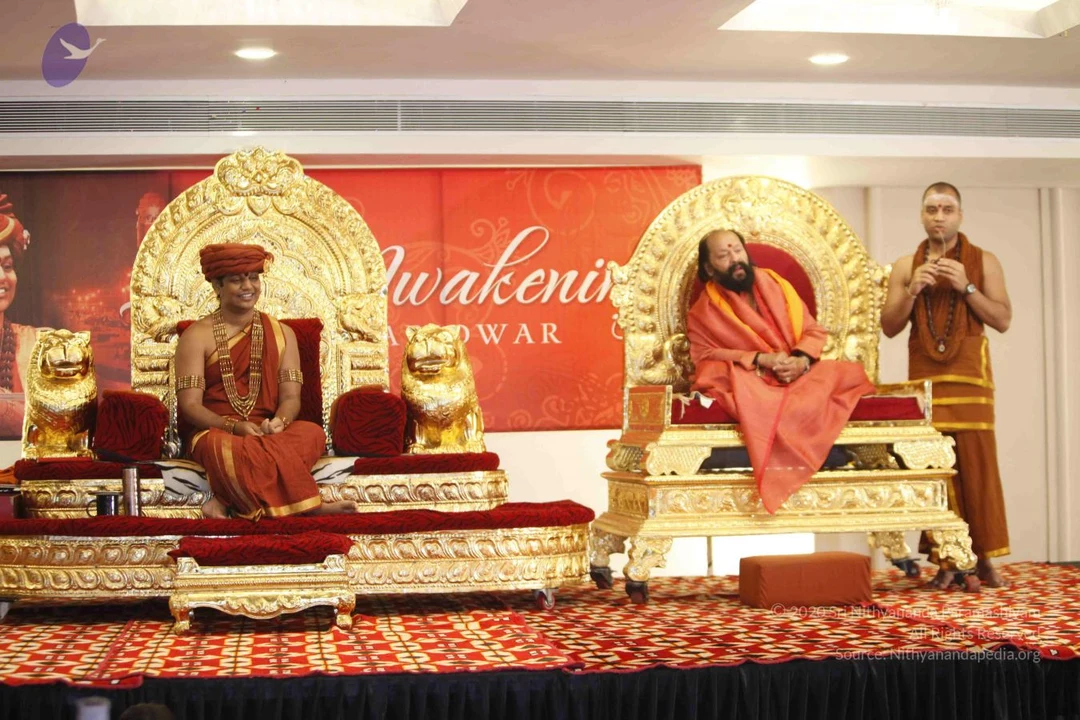
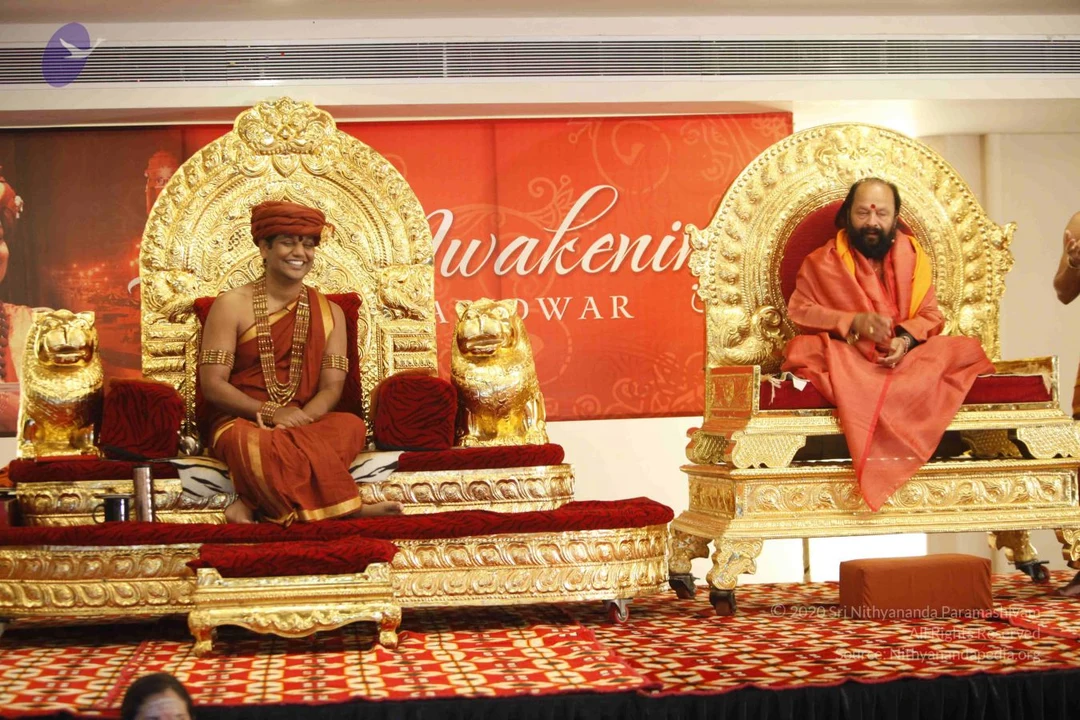
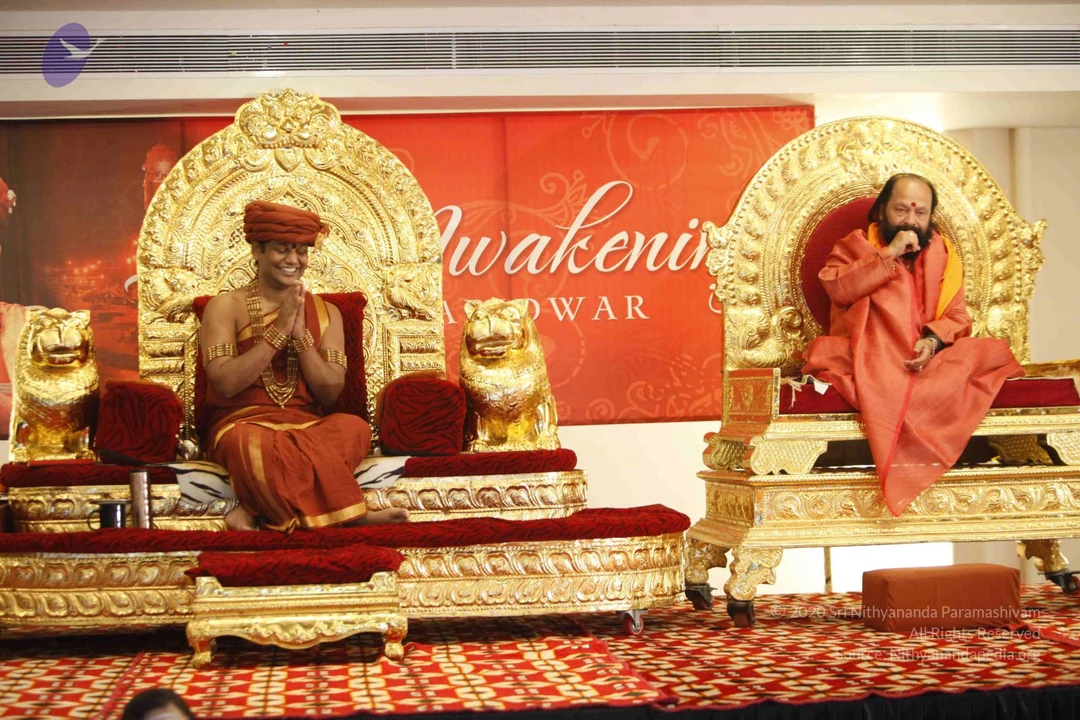
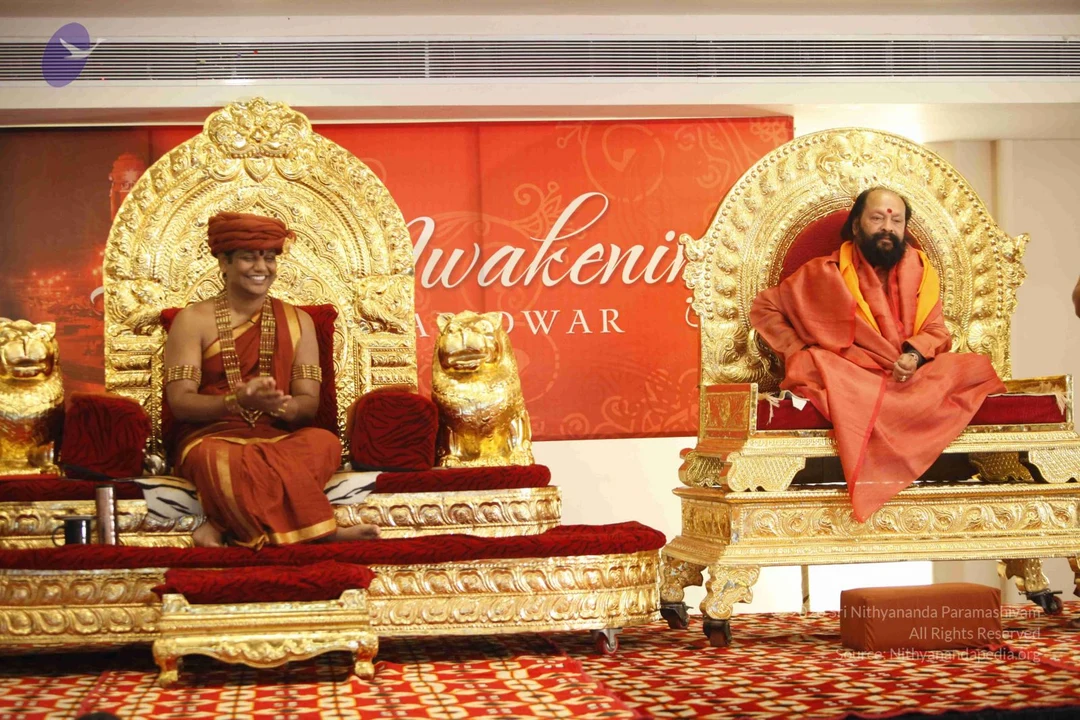
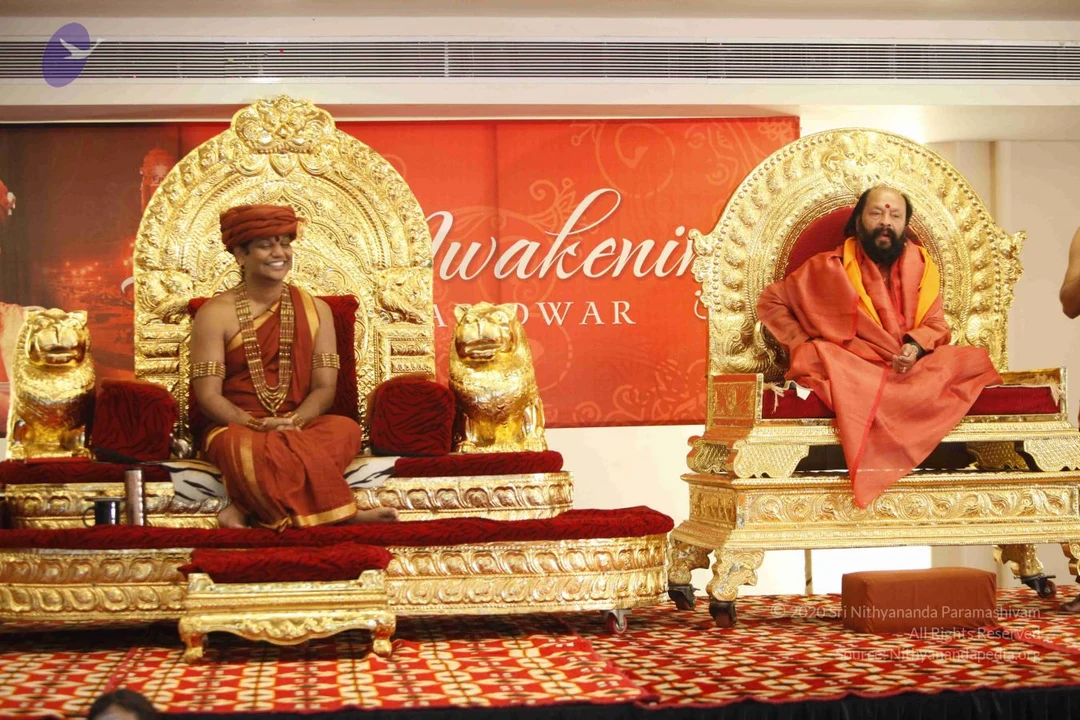
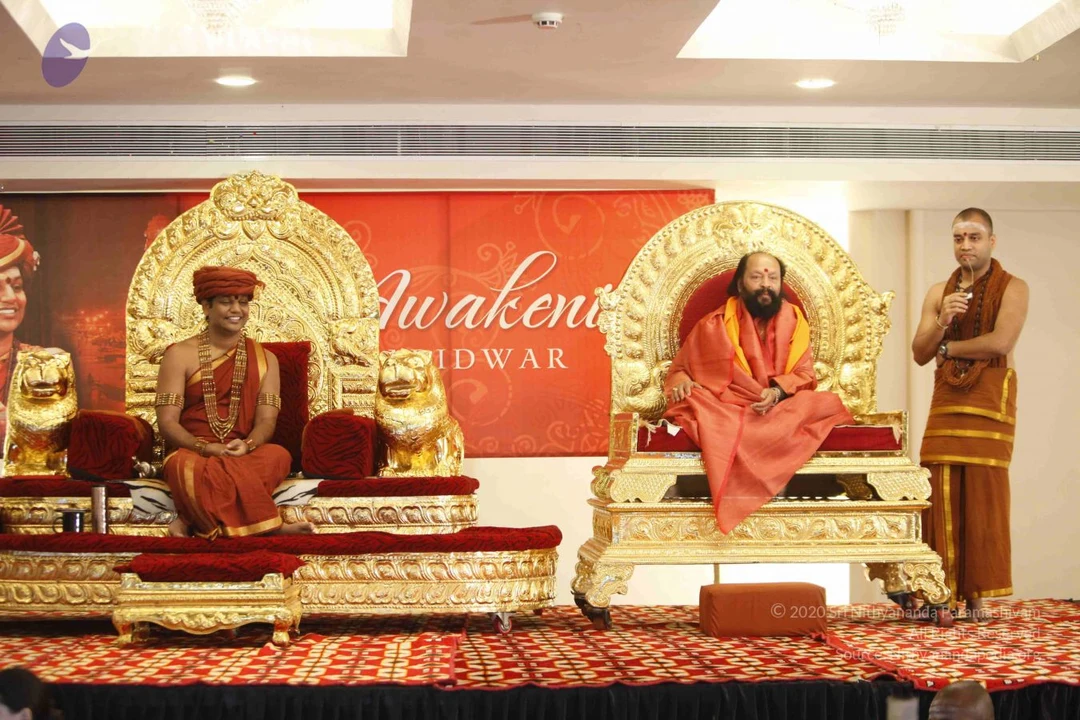
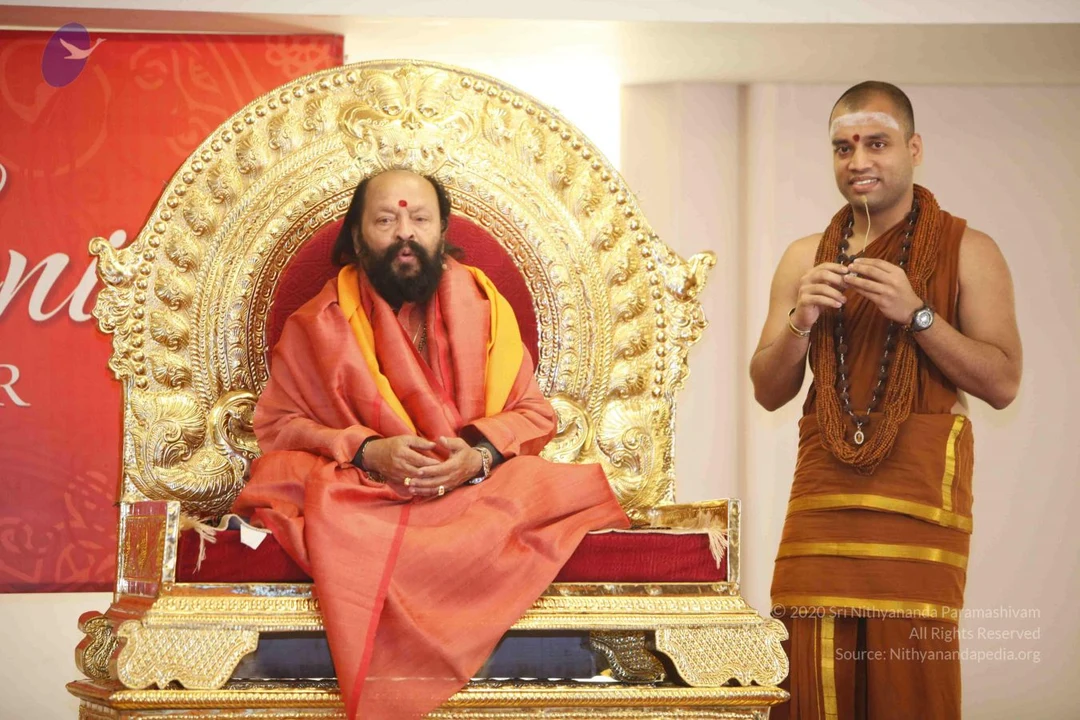
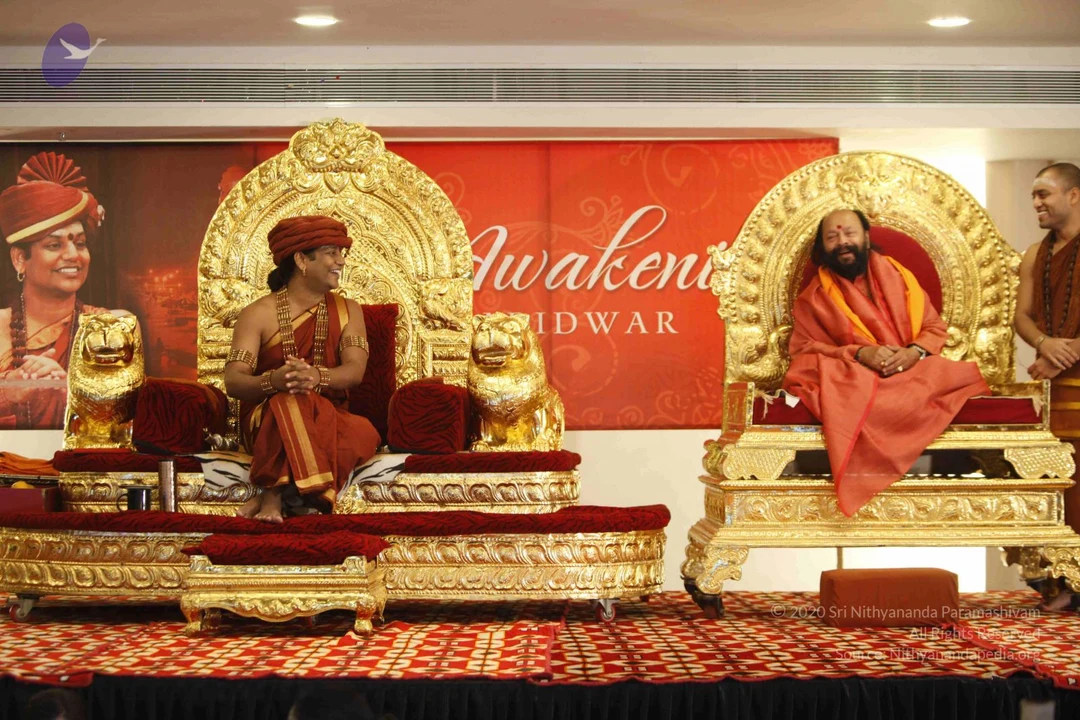
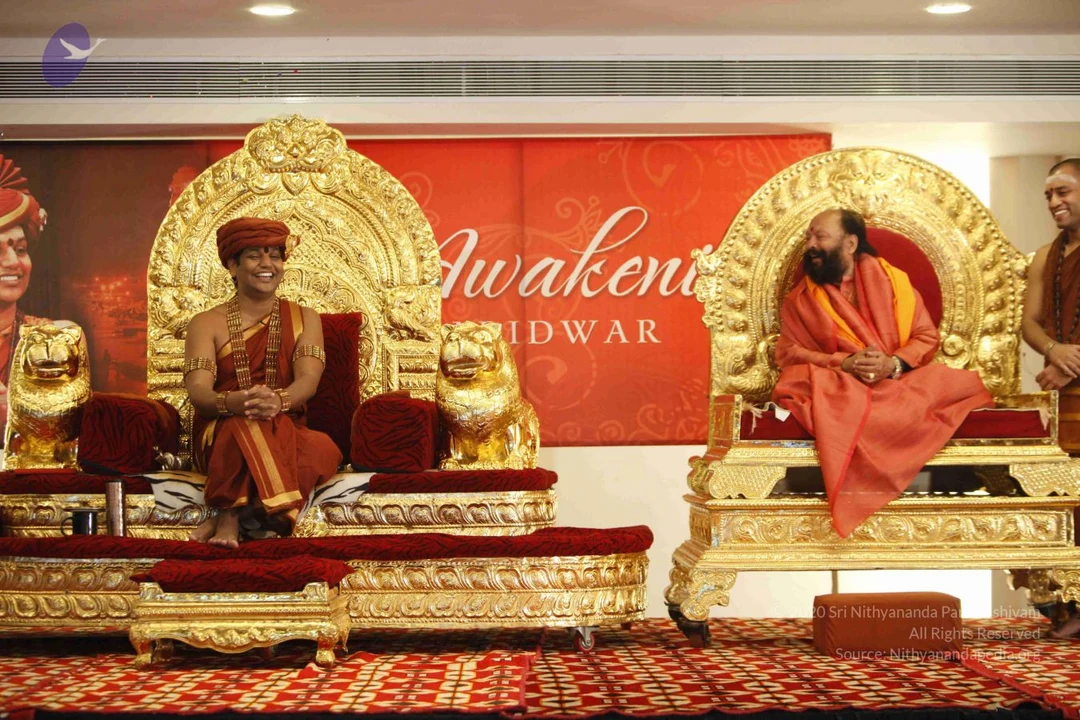
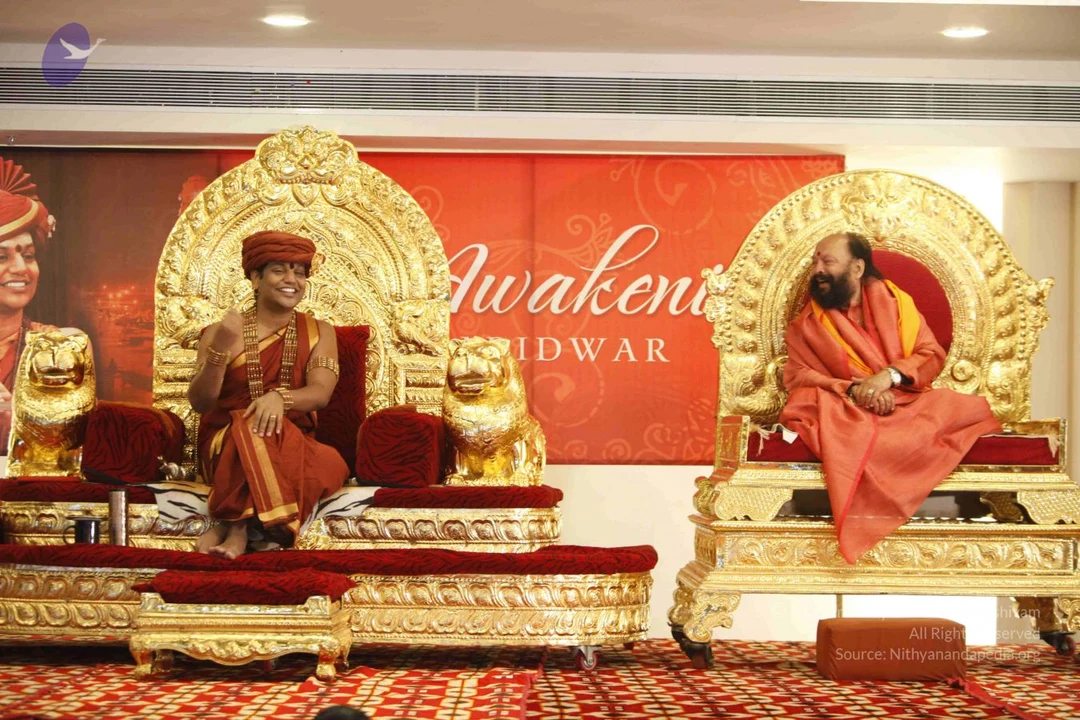
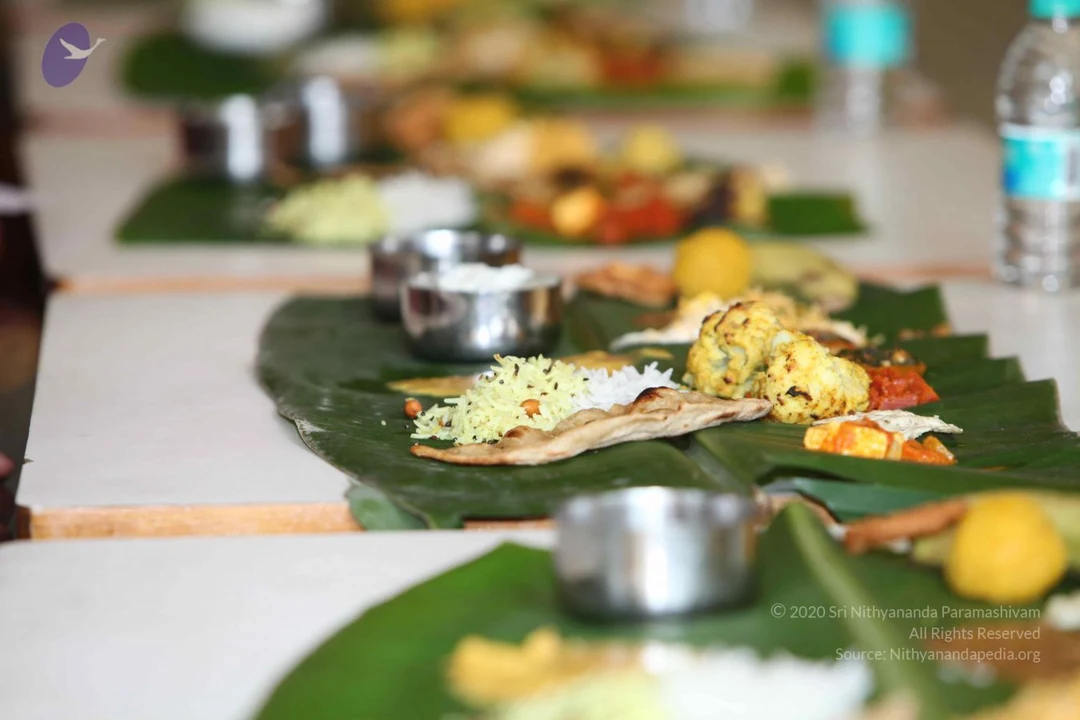
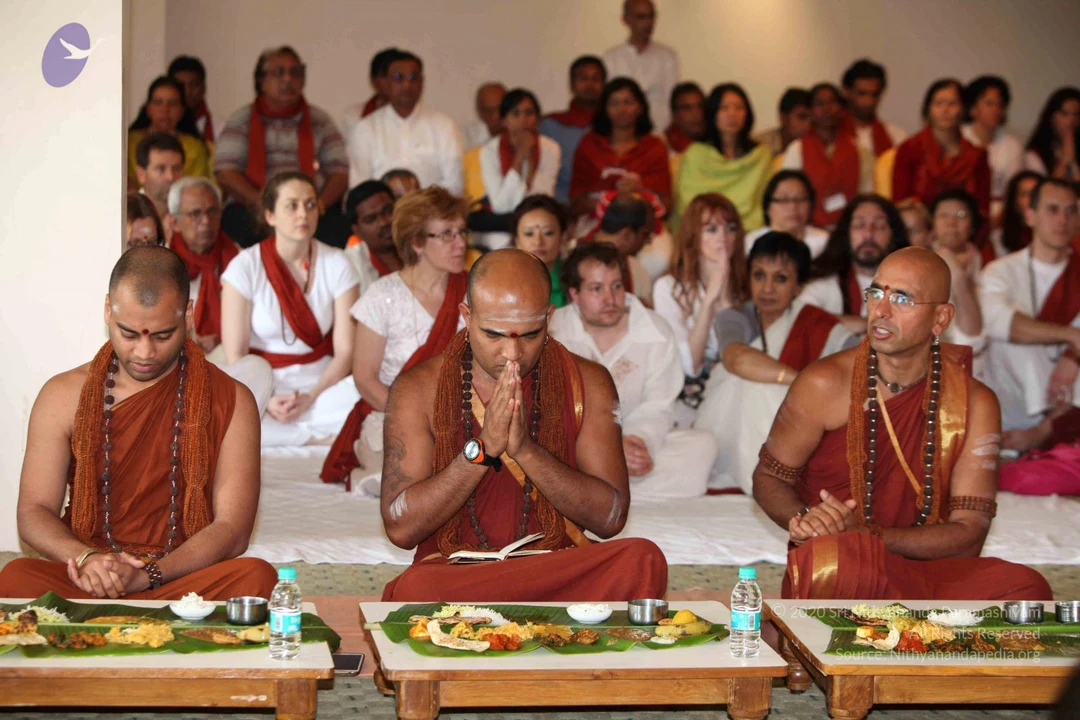
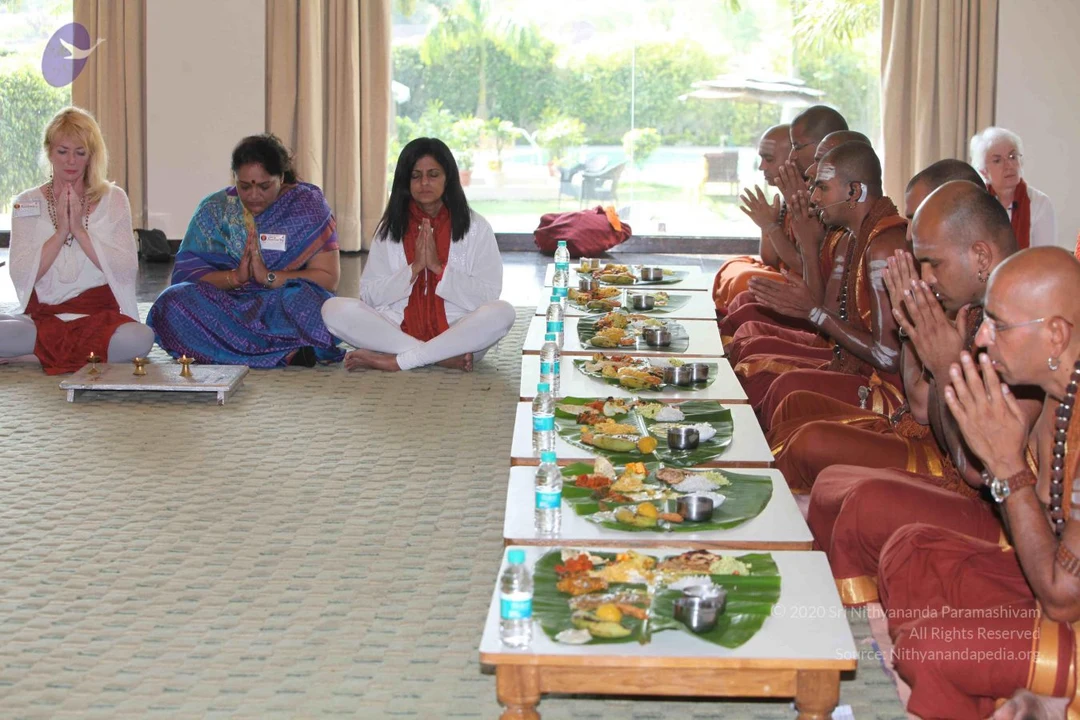
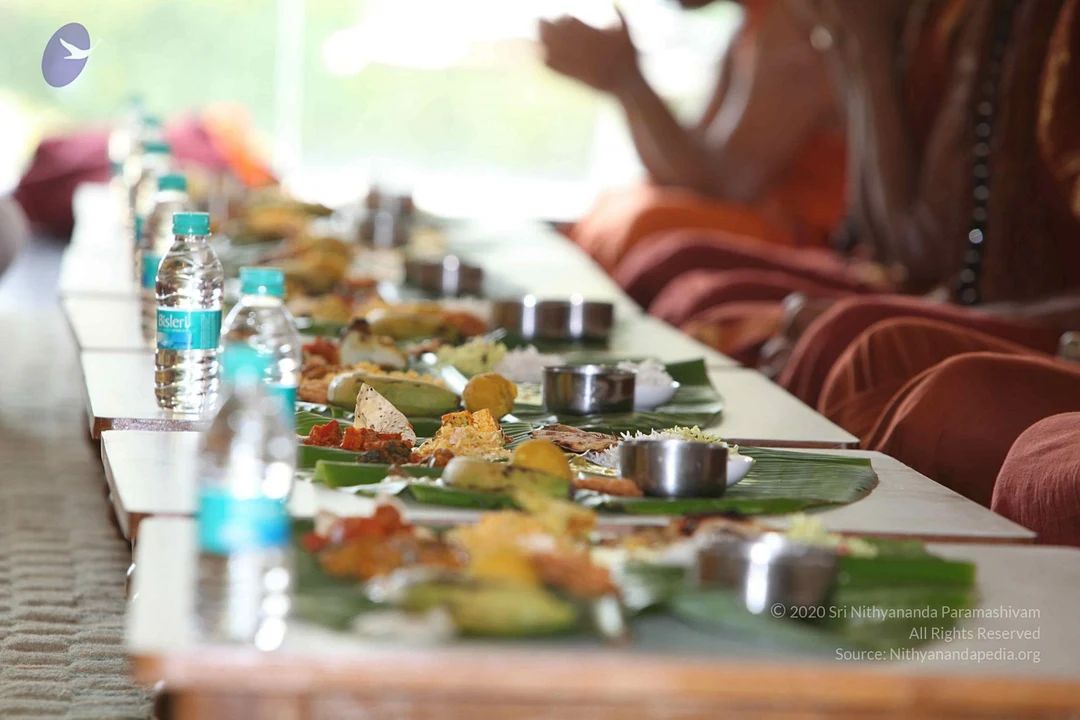
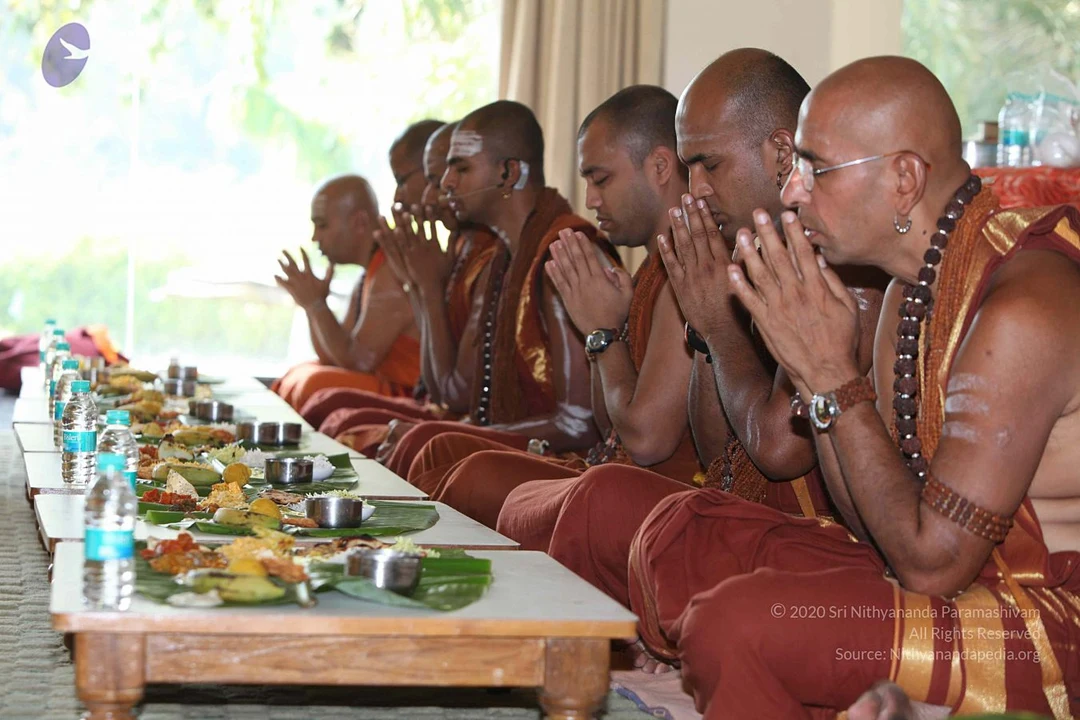
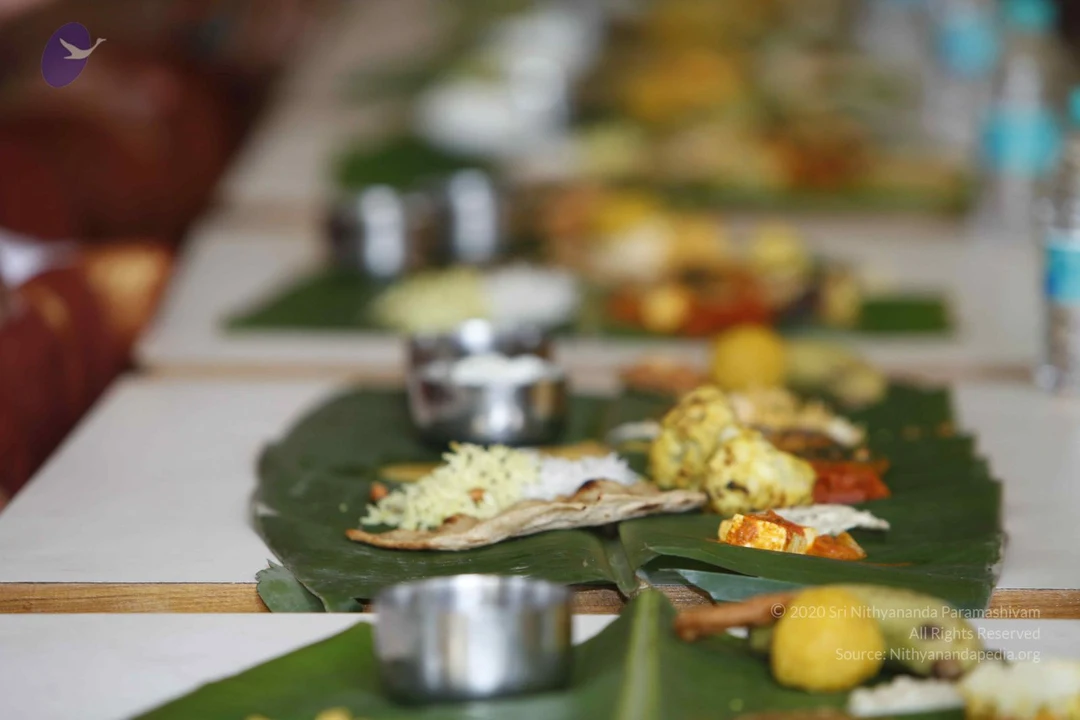
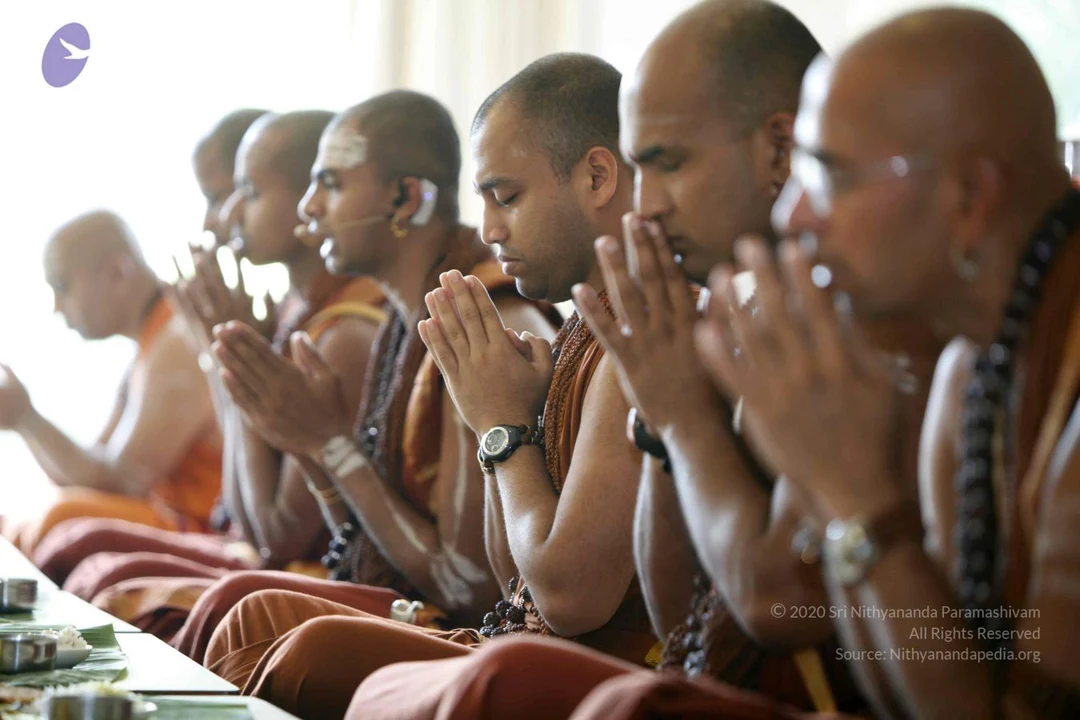
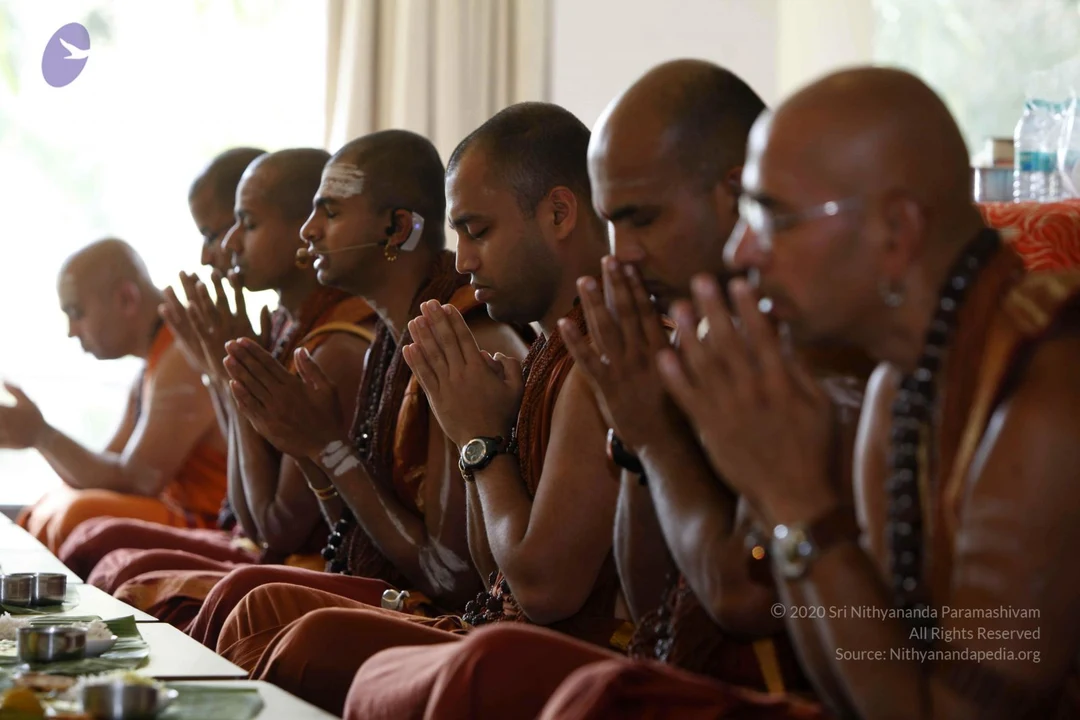
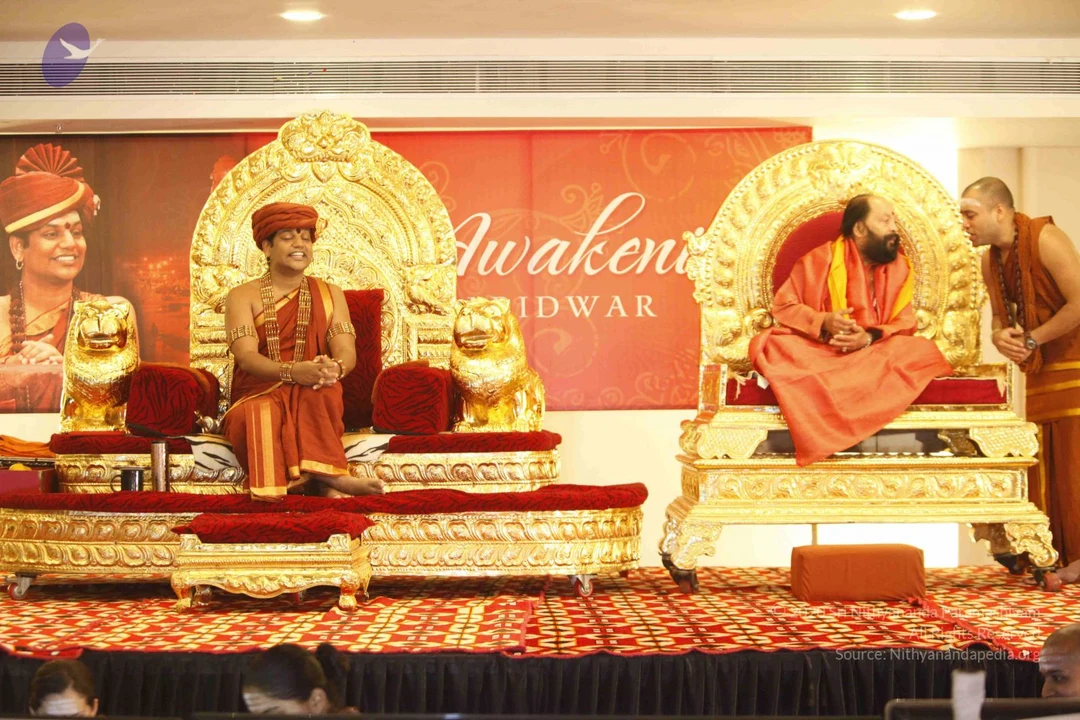
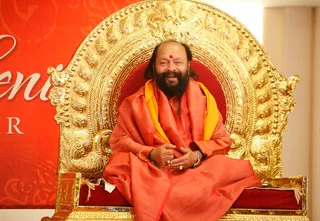
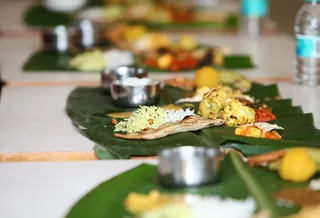
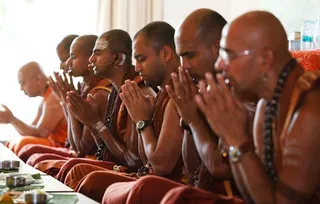
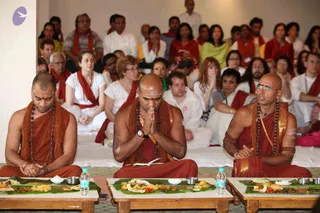
Two seated figures on ornate gold thrones with carved lion arms and red cushions, in front of a red banner reading "Inner Awakening" and "Haridwar". On the left, a smiling man wears a red-orange turban, a red-and-gold shawl, layered beaded necklaces and bangles, seated on a raised throne. On the right, a bearded man in saffron-orange robes and a red shawl sits cross-legged on a larger gold throne, hands folded at his waist. A red carpet and a low red footstool lie at the front. Appearance cues on the left figure (turban, layered malas, ornate jewellery) are compatible with the page's reference to a person, but identity remains uncertain from appearance alone.Two seated figures on ornate gold thrones with lion-armrests and red cushions in front of a red banner reading Awaken Haridwar. On the left, a person in a red turban and saffron-orange robe with a beaded mala sits with hands clasped. On the right, a bearded man with long hair in a saffron-orange shawl sits on a gold throne, smiling. A person in light clothing stands at the far right edge. a person on the right, based on the long hair, beard and saffron-orange clothing, seated as an honoured guest.A smiling bearded man in an orange-red sannyasi shawl with a yellow scarf sits on an ornate gold throne with a red velvet seat and back cushion. He rests his hands clasped in his lap and wears a red bindi on his forehead and a wristwatch. Behind him a red backdrop shows partial gold lettering. The throne has carved gold scrollwork and lion-like finials. No other people are visible.Close-up photograph of a banana-leaf meal served on a long white table. Several leaves hold portions of food: a flatbread, a mound of pale rice with grated coconut, fried cauliflower-style fritters, a red-orange vegetable curry, sliced lemon-yellow fruit, and small stainless steel bowls of sauce or chutney. Clear plastic water bottles stand at the upper right. No people are visible in the scene.A row of shaved-headed monastic men in saffron-orange robes sit side by side with palms pressed together in anjali mudra, eyes closed in devotion. Several wear white tripundra or chandan marks on their foreheads and rudraksha malas around their necks; one on the right wears glasses and a wristwatch. A microphone headset is visible on one man's face. In front of them on a white-covered table sit small brass plates and bowls with leaves and offerings. The setting appears to be a satsang or puja gathering.

Nithya-Satsang
80 photosSource gallery
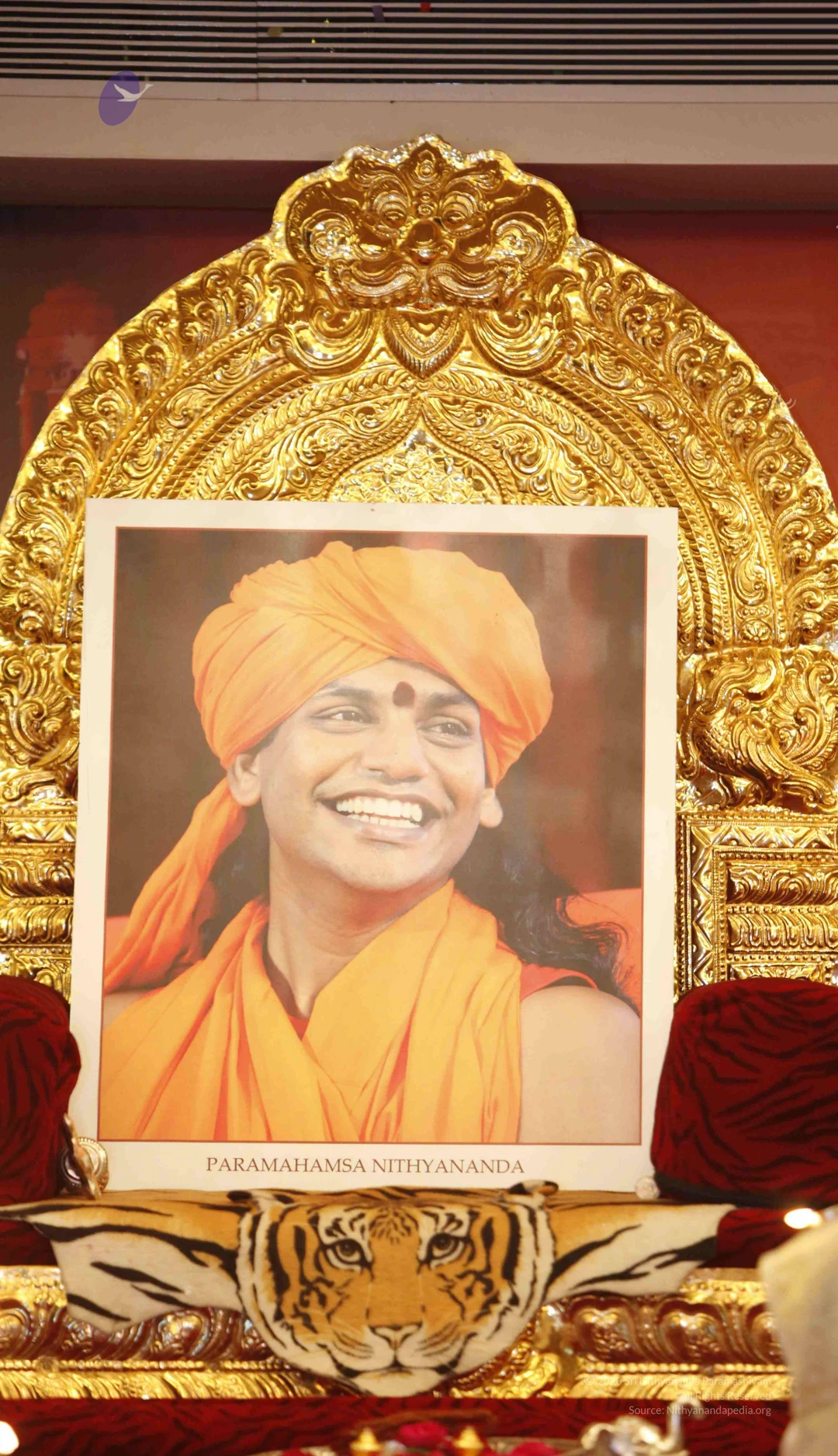
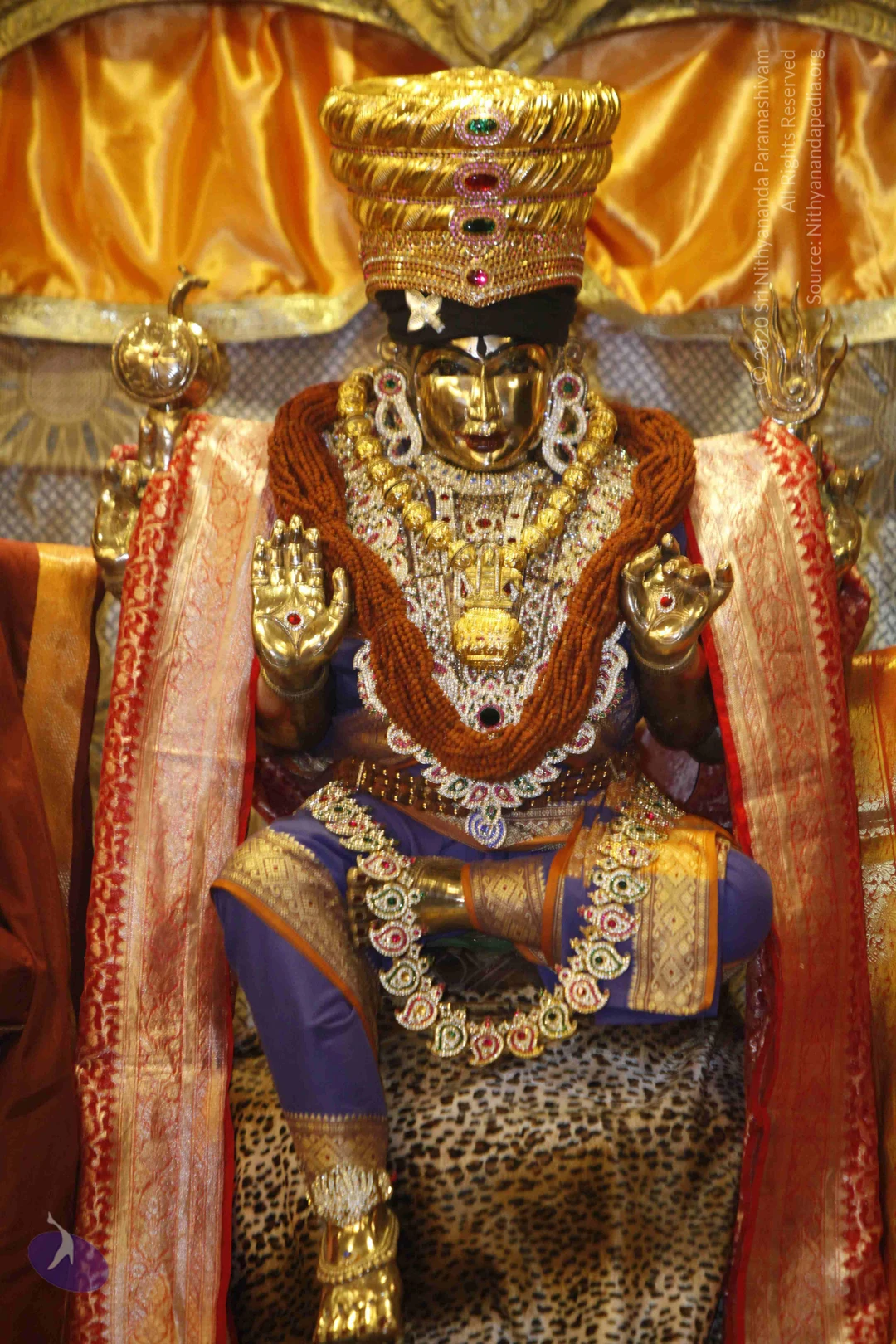
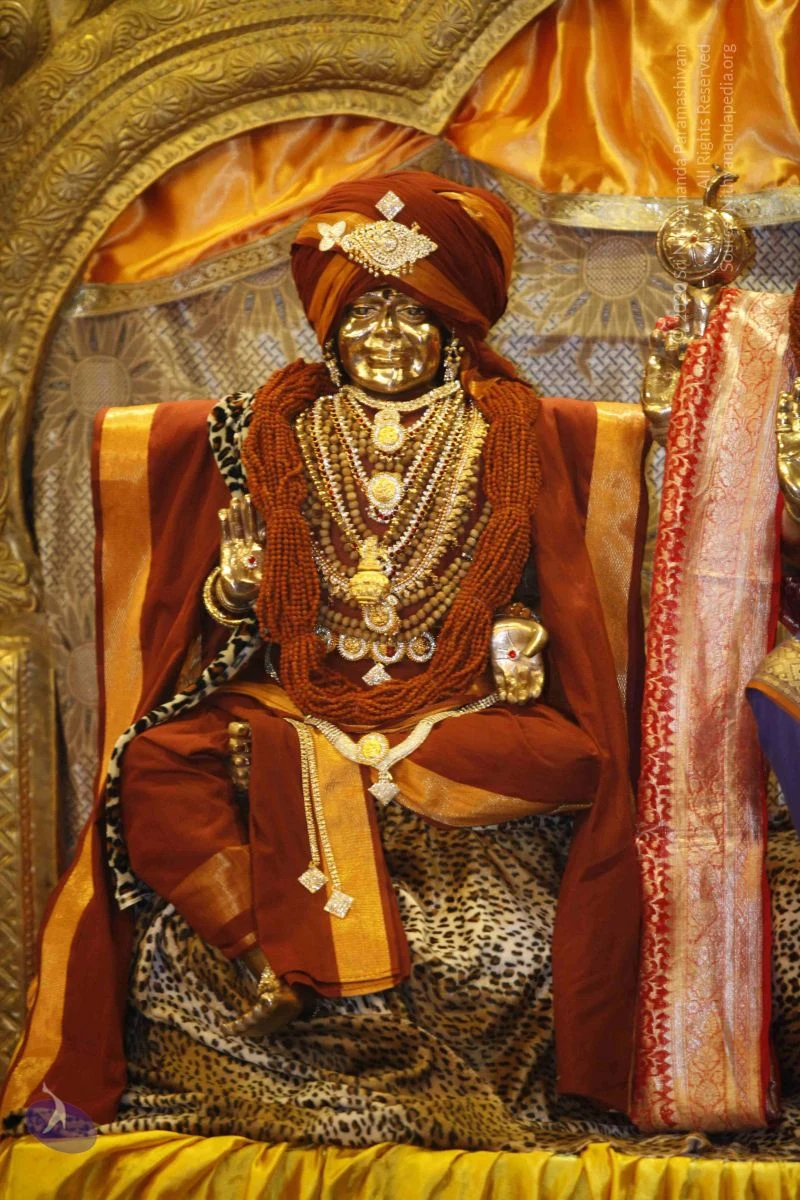
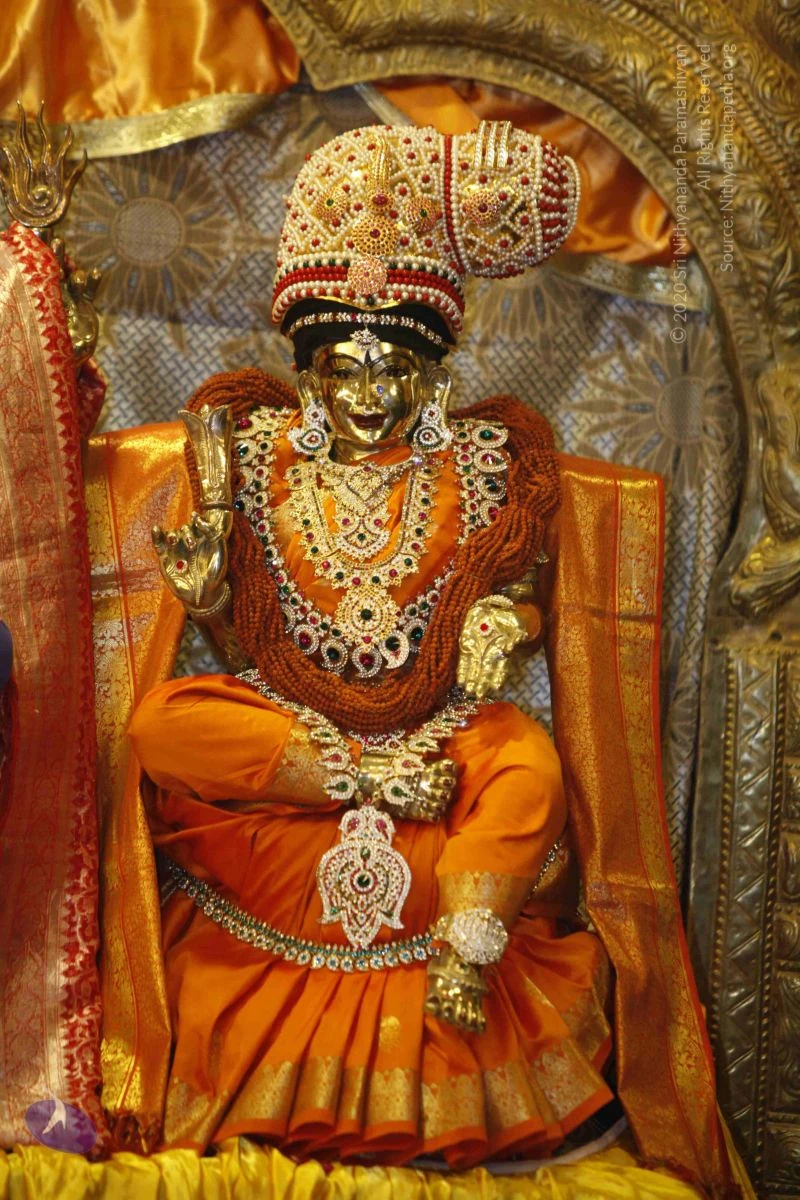
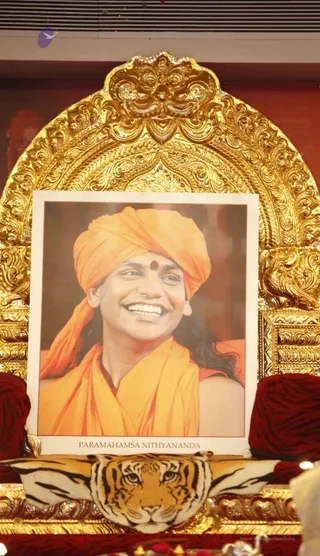
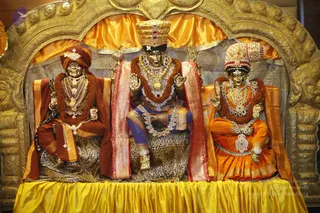
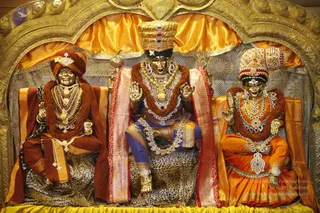
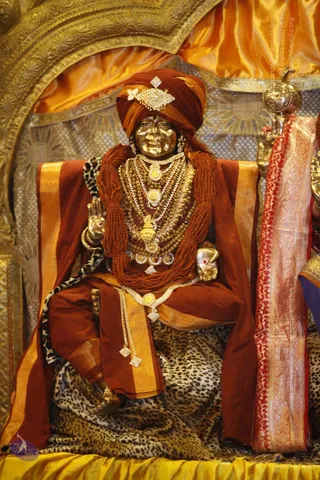
A large printed portrait of a smiling man in an orange turban and orange shawl with a red bindi stands on an ornate gold-framed throne arch. The portrait is labelled "Paramahamsa Nithyananda" in a caption beneath. Below it, a tiger-skin cloth covers the throne base, with red velvet cushions at the sides and a few flowers and a small lamp at the bottom edge. No living people are visible in the frame.Three gilded statues seated side by side under a gold-embroidered canopy with yellow satin draping. The central deity murti is blue-skinned with a tall gold crown set with coloured stones, wearing a heavy gold necklace, a brocade red and gold shawl, and a blue dhoti with a jewelled waist ornament, its hands raised in blessing. To the left, a golden figure in a brown and maroon turban wears layered gold chains and a rudraksha mala, seated on a leopard-print cushion. To the right, a golden figure in an ornate red and gold crown and orange sari wears a gold necklace and holds a hand in a gesture of blessing. Leopard-print cushions cover the seats.Three ornate statues seated on a golden throne-like shrine with gold satin drapery. The central figure wears a tall gold crown set with coloured stones, a blue lower garment, and layered gold and jewelled necklaces, with a red-beaded mala and red-gold shawl. The figure on the left wears a rust-orange turban, orange-brown robes and a beaded mala. The figure on the right wears a tall ornate crown, an orange sari and jewelled ornaments. The golden arch behind is carved with decorative motifs. Statues only; no physical people are visible.Three golden murti figures seated side by side on an ornate gilded throne with a gold-and-red satin canopy behind them. The central figure wears a jeweled golden crown, a deep blue dhoti with gold border, a multi-strand gold necklace and rudraksha-style garland. The figure on the left wears a rust-brown turban, brown robes with gold border and layered gold necklaces. The figure on the right wears a jeweled orange-and-gold crown, an orange silk sari with gold border, and heavy jeweled necklaces. The seats are covered with leopard-print cloth and a yellow fringed cloth lies at the base.A gilded deity murti seated on a leopard-print cushion beneath gold and orange silk drapes. The figure wears an elaborate gold crown set with green and red stones, a black headband, and layered gold and jewelled necklaces over a rust-brown rudraksha-style mala. Blue-violet dhoti-like cloth has a gold and red border, with jewelled anklets. Two hands are raised in mudra gestures, and gold ritual implements, including a trident, stand at the sides of the throne.A golden statue seated on a leopard-print cushion beneath a gold canopy, dressed in a rust-orange turban with a jeweled brooch, rust-orange and gold-bordered robes, a red-beaded rudraksha mala, layered gold and bead necklaces, and a gold belt. The statue raises one hand in a blessing gesture and rests the other on its lap. To the right, a red and gold brocade cloth hangs beside a gold finial. The image is a photograph of a statue, not a living person, so no physical people are present and the figure is classed as a depiction without a confirmed identity.

With-Arjun-Puri-Mahraj

24 photosSource gallery
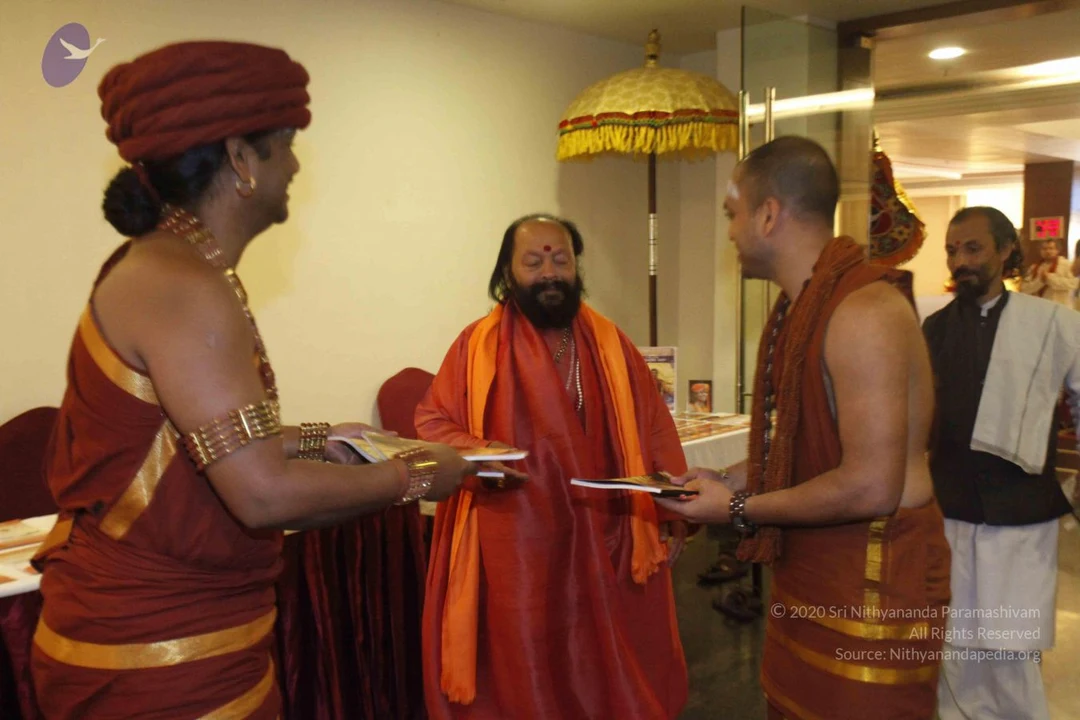
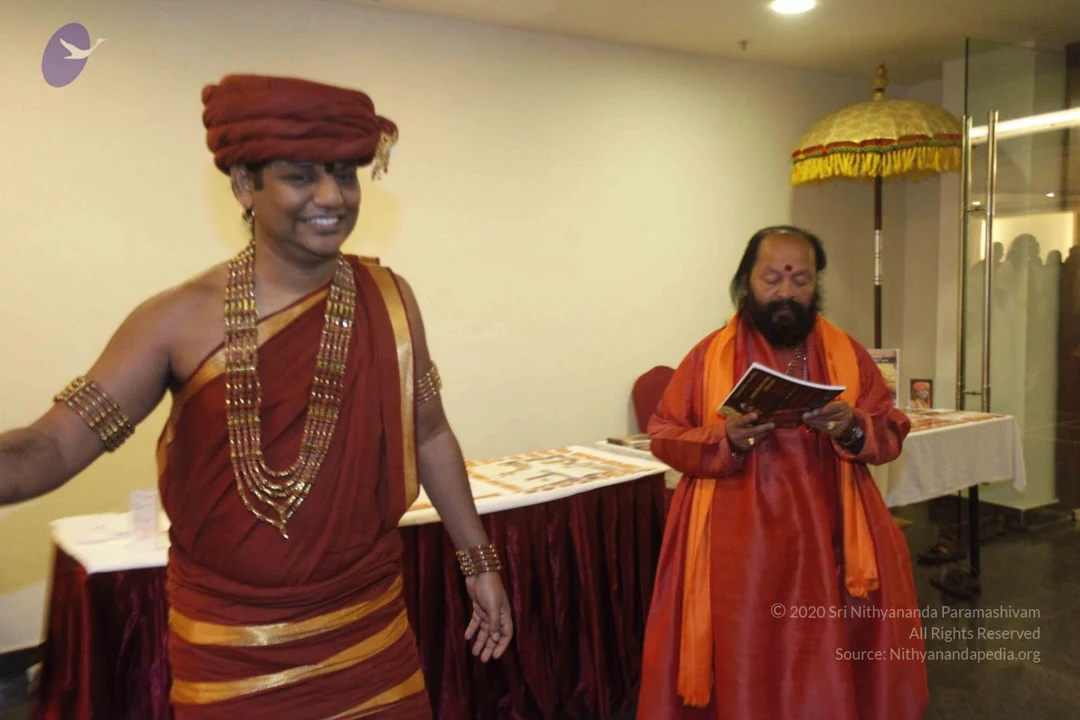
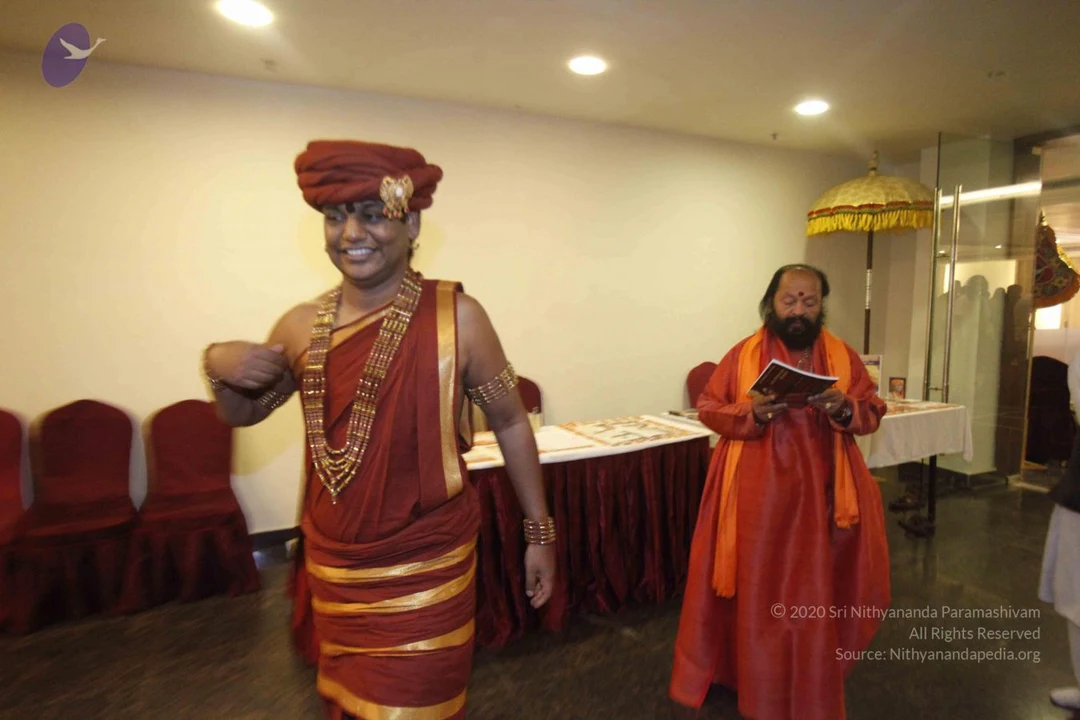
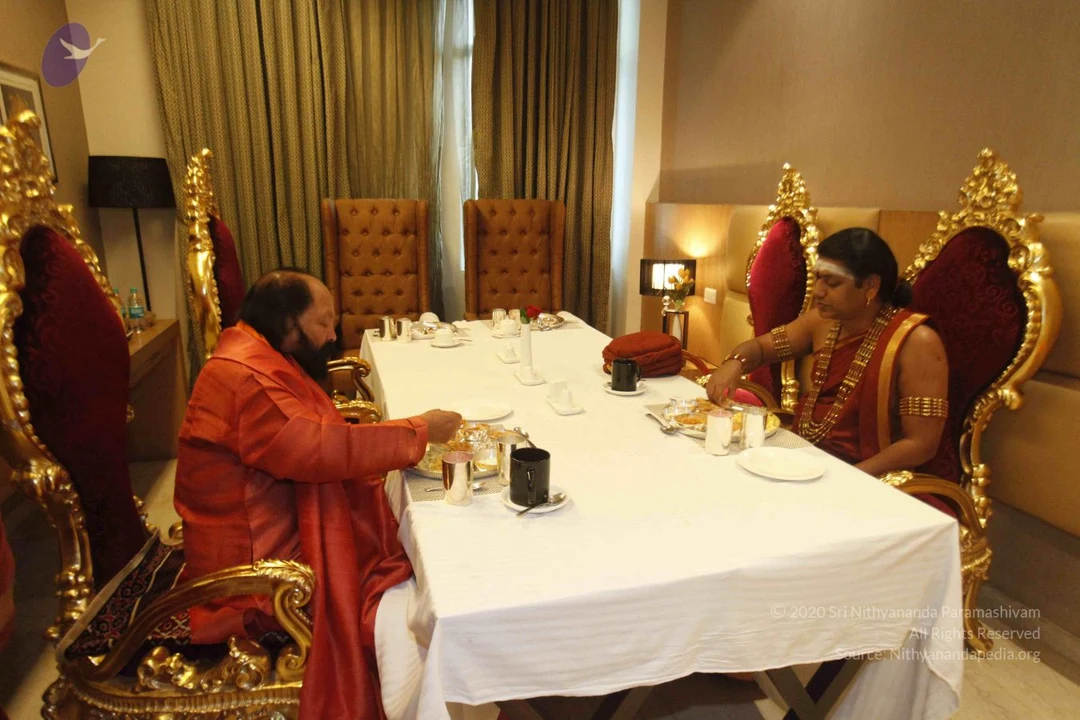
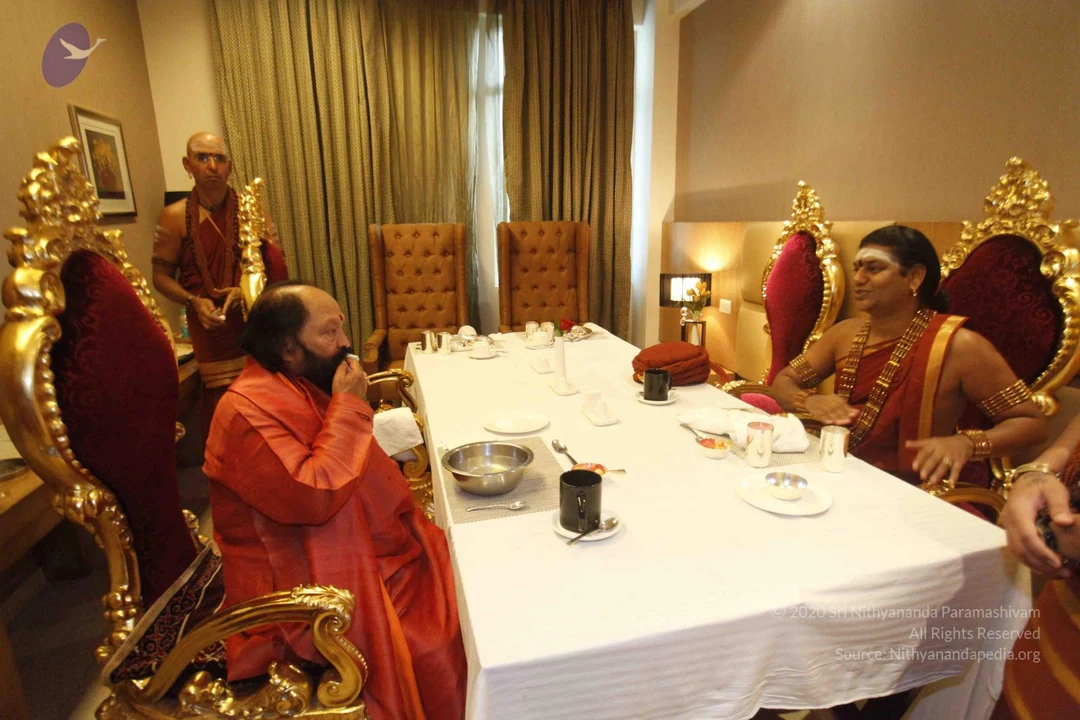
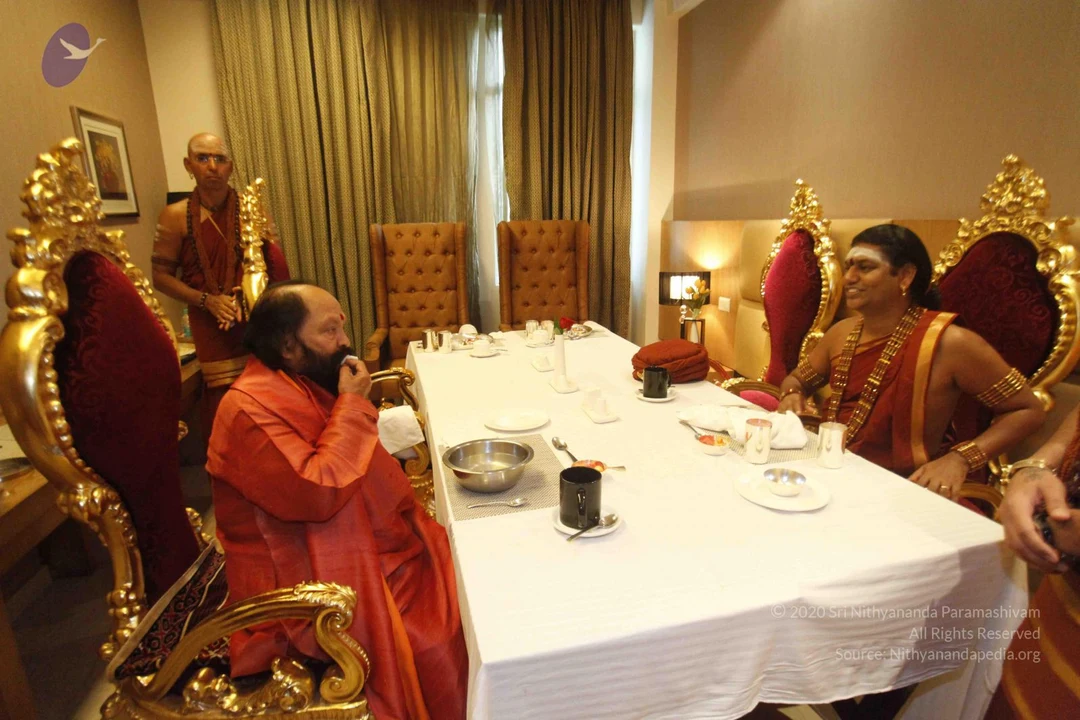
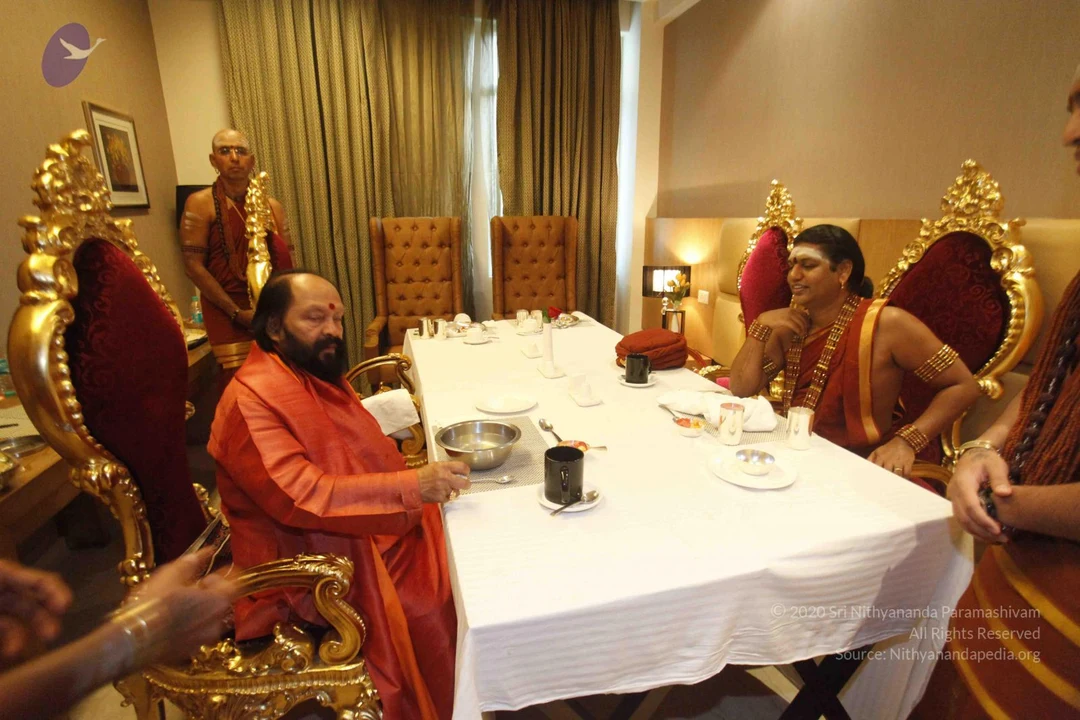
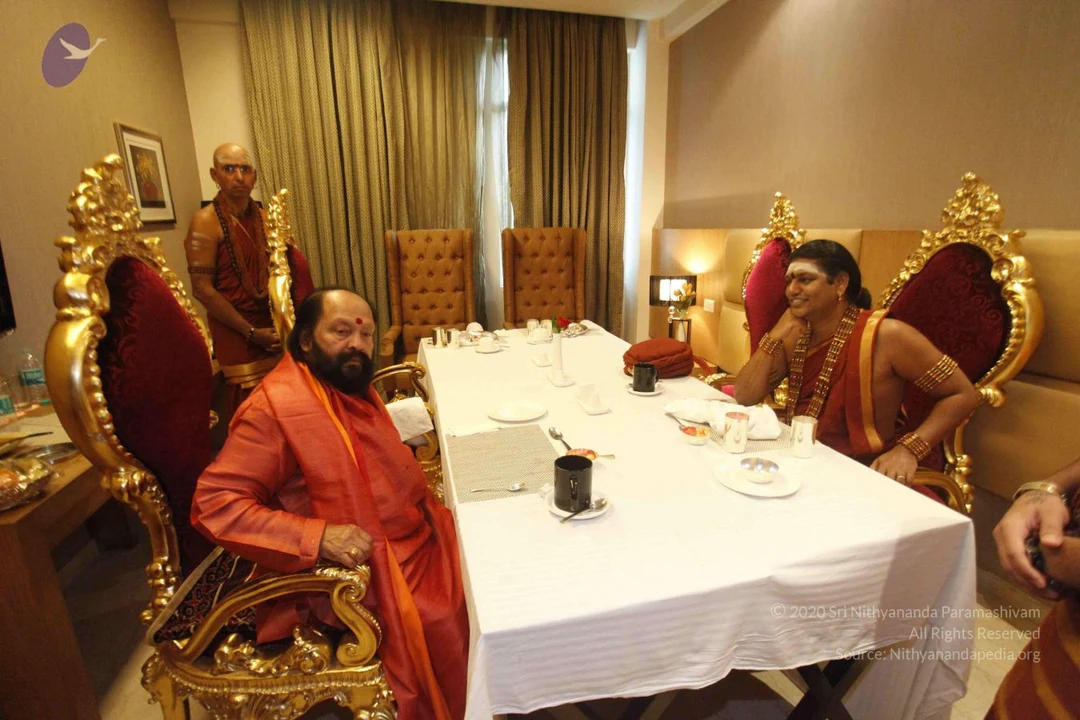
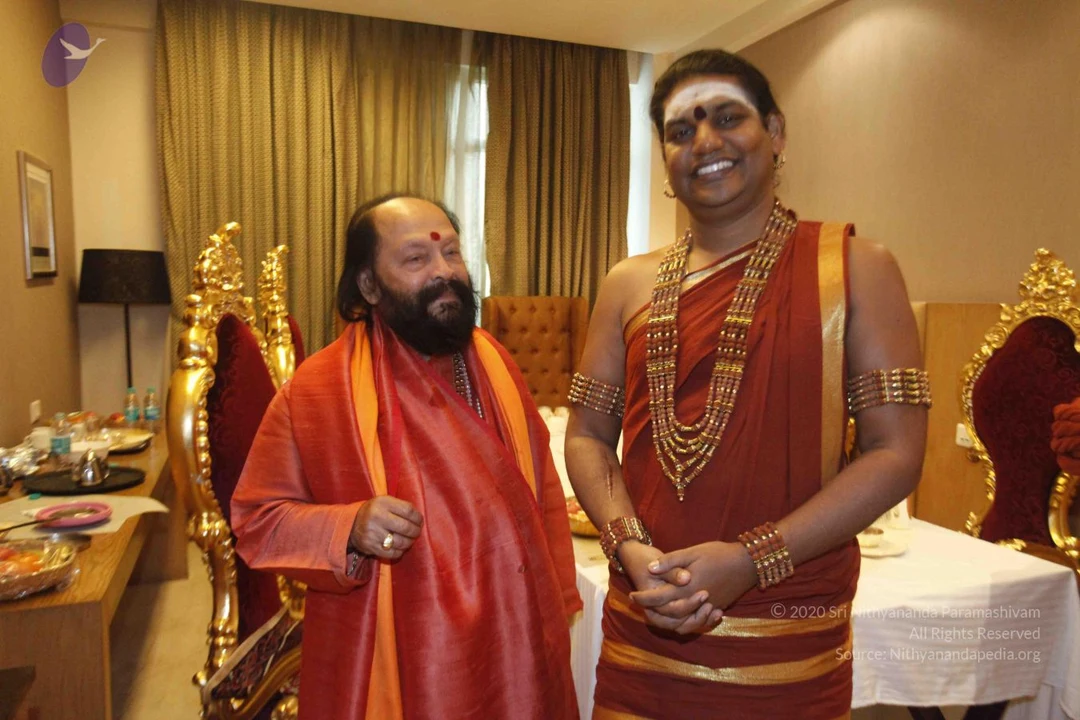
A photograph of four people standing indoors near a table with printed materials. On the left, a person in a maroon wrap with gold trim and bangles and a maroon head wrap holds a booklet. In the centre, a bearded man in saffron-orange robes with an orange shawl, a red tilak on his forehead and rudraksha beads holds a booklet. To his right, a shaved-headed man in a rust-red robe with gold trim holds a booklet. At far right, a man in a black vest over white dhoti-style clothing stands beside them. A yellow and red decorated parasol stands behind, and a table with more printed materials is visible.A photograph of two men in an indoor hall with cream walls, a gold fringed parasol and maroon-draped tables. On the left, a man in a maroon turban, maroon robe with gold borders and multiple beaded bracelets hands a white paper to the centre man. The centre man has a long dark beard, a red tilak on his forehead, a rudraksha mala and an orange shawl over a maroon robe, and holds a paper with both hands. A bare-chested man at the right edge holds a booklet. Red chairs and a glass door are visible behind.Photograph of an indoor event space with cream walls, a gold-and-yellow decorative parasol, and a draped table with printed materials. A man in a maroon turban and draped maroon-and-gold garment wears heavy gold necklaces and armbands and smiles while gesturing with one arm. Beside him, a man with long dark hair and a full beard, wearing a red-orange robe with an orange shawl, reads from a booklet with a red bindi on his forehead. A glass cabinet stands at right.Indoor hall scene with two men in red-maroon and saffron-orange robes. In the foreground a smiling man in a maroon turban with a gold ornament, a long gold-beaded necklace, gold armbands and a maroon dhoti with gold border walks forward. Behind him a bearded man in orange-saffron robes and orange shawl holds a small booklet and reads, with a red tilak on his forehead. A gold-and-yellow umbrella stands in the background beside a draped table with papers, and rows of maroon chairs line the left wall. Two people in total are visible, with a partially visible figure at the right edge.Two men sit at a long white-clothed dining table in an ornate room with gold-framed red velvet thrones and tufted brown armchairs. The man on the left, bearded and wearing an orange-red wrap, eats from a silver-toned plate. The man on the right wears a red-orange dhoti and shawl, a gold necklace, gold armbands, and a white forehead marking, and is seated before a plate of food with a folded red cloth beside him. Cups, saucers, glasses and a small kettle sit on the table. Curtains and a table lamp frame the background.Indoor photo of a formal dining setting with a long white-clothed table and gold-framed high-backed red velvet thrones. A bald man in a red-orange robe with a beard sits at left, hand raised near his face. At right, a man with long dark hair, a gold necklace and rudraksha-style ornaments, wearing a red-orange cloth and many gold armlets, gestures while seated on a throne. A third man in a red-brown robe with a bare shaved head stands at the far left by a wall-mounted framed picture.

Kalpataru-Darshan

12 photosSource gallery
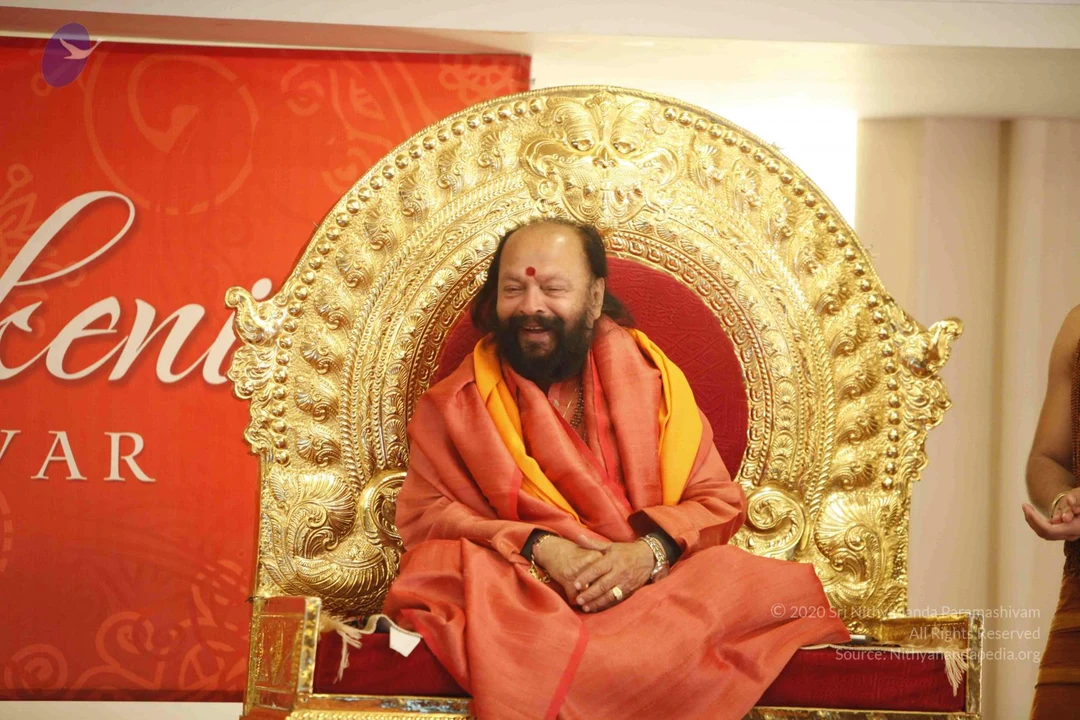
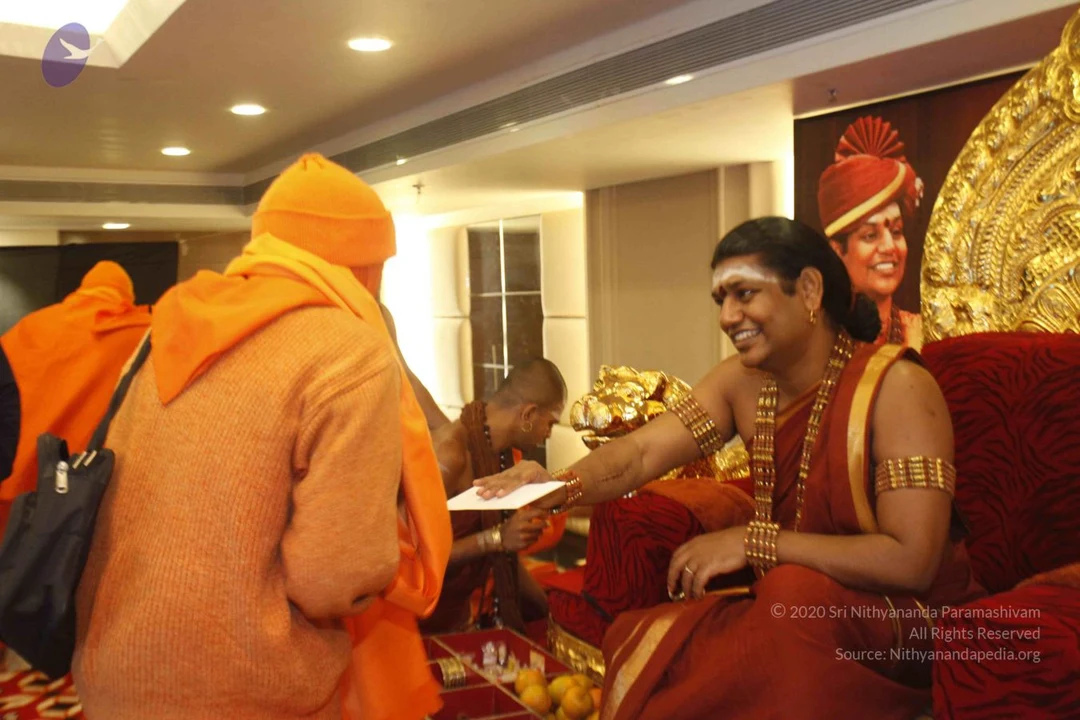
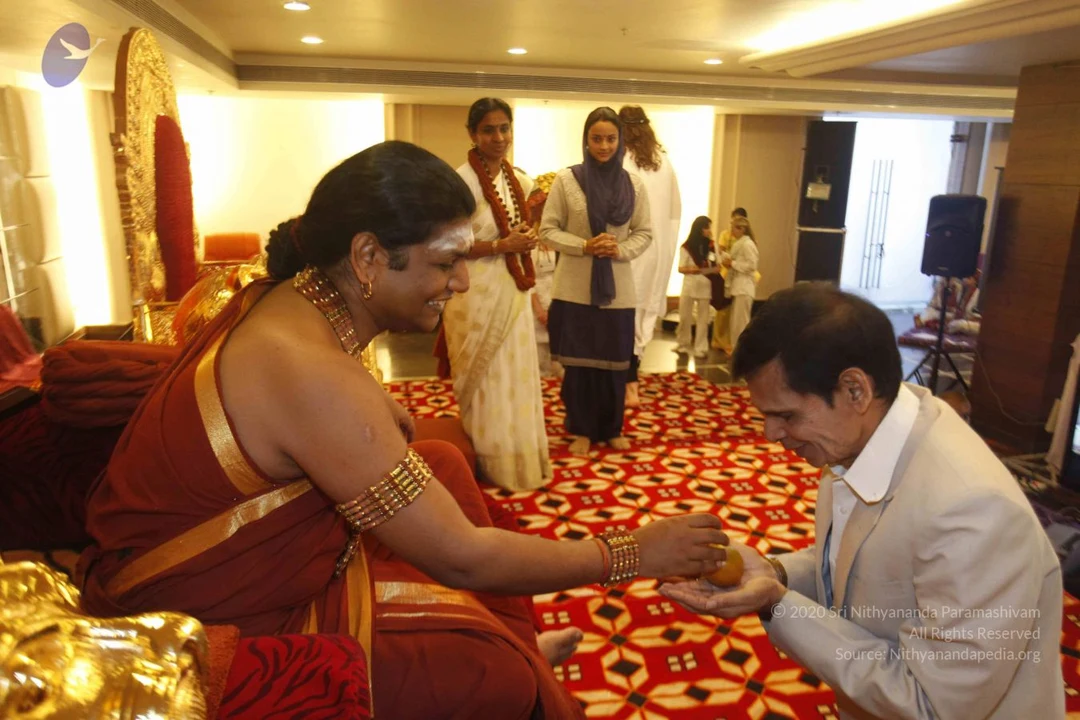
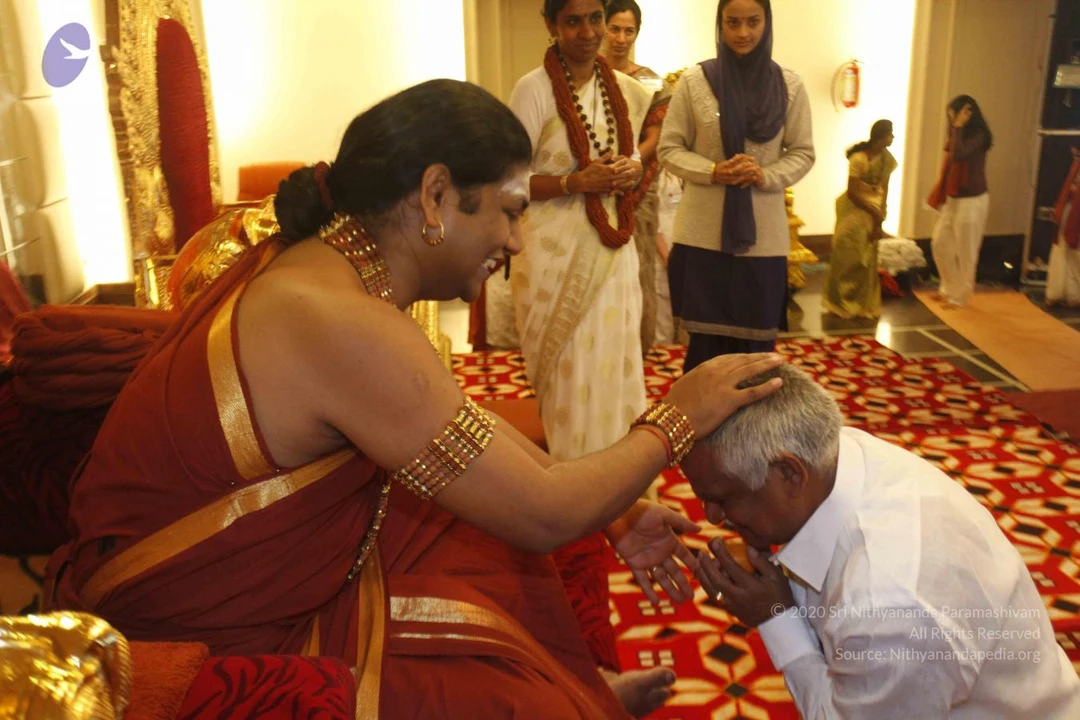
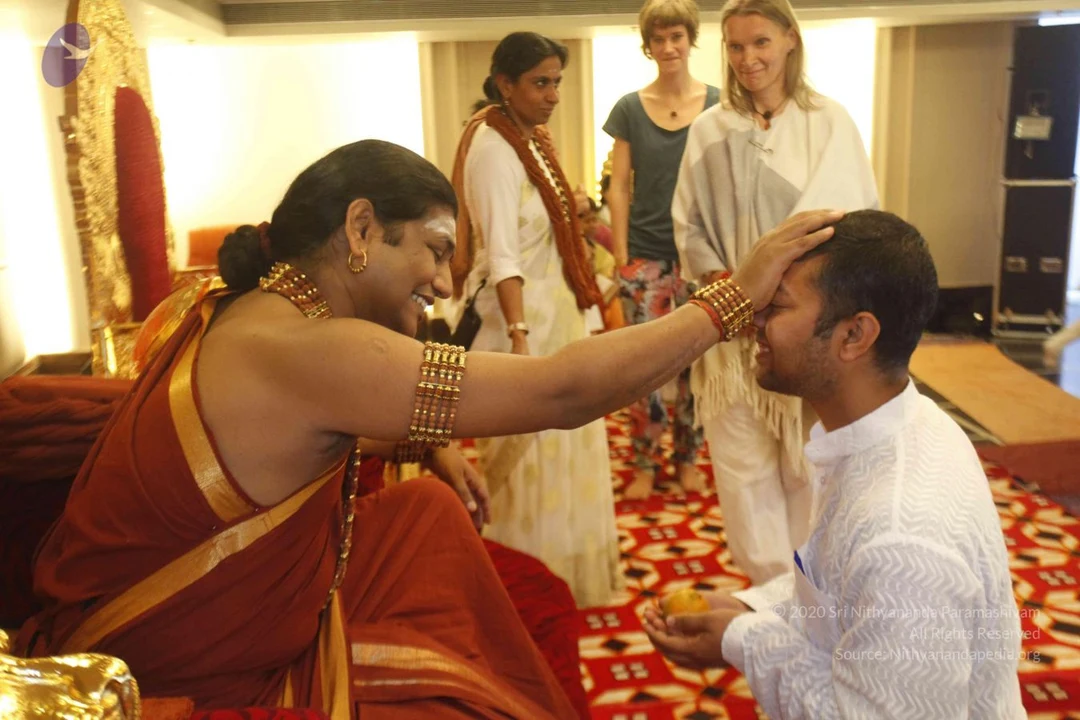
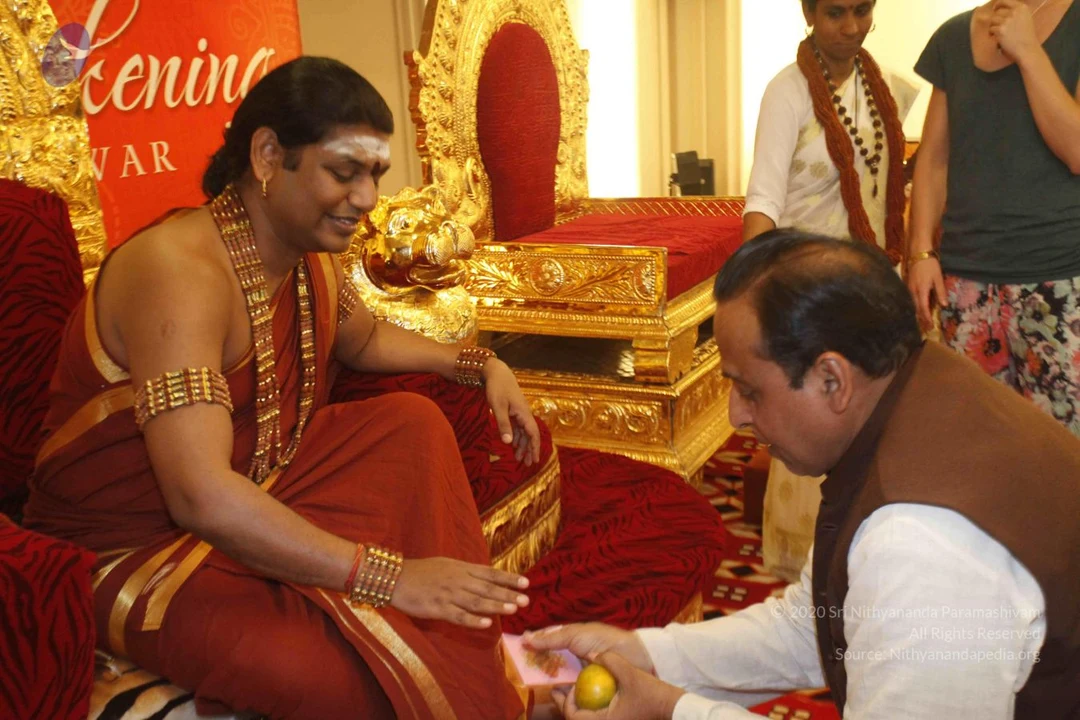
A seated figure in a deep red robe with gold border sits on a red upholstered seat before an ornate gold-carved throne back, receiving an offering. He wears a gold necklace, multiple gold bangles and armlets, and a white vertical tilak on the forehead, and smiles while extending his hand toward a standing visitor in orange robes with an orange cap and shoulder bag. A monk in dark red robes and shaved head bends forward holding a white paper, and a tray of fruit sits in front. Behind is a portrait of a smiling figure in a red turban, and a golden plate or kalasha-like offering rests nearby. a person: the seated figure wears a deep red robe, gold necklace and gold armlets with a tilak, and a portrait of a turbaned figure hangs behind, matching the page's a person reference, so the seated figure is marked a person.A seated figure in a rust-red robe with gold border and gold bangles, wearing a gold necklace and rudraksha-style beaded ornaments, extends a small object to a kneeling man in a cream jacket and white shirt, who holds out cupped hands. Standing behind them are women in white and cream saris and a woman in a navy head scarf and dark skirt; a gilded throne with red upholstery sits at left on a red and gold patterned carpet in a hotel-style hall. Swamiji (probable): the seated figure has long swept-back hair, gold and bead necklaces, and saffron-orange ceremonial clothing.A seated figure in a deep red and gold saree with a gold-toned blouse and ornate gold necklaces and bangles, sitting on a red and gold throne-like seat, extends a hand to offer a small orange fruit to a kneeling older man in a cream jacket and white shirt. Behind them, a woman in a white saree with a red garland and another woman in a grey jacket and dark blue skirt with a head scarf stand on a red patterned carpet, while other people in white clothes stand near a speaker stand in a warmly lit hall.A seated figure in a red-orange saffron robe with gold border and gold armbands and necklaces sits on a red throne-like chair, smiling and reaching toward an elderly man in a white shirt who kneels before them and extends cupped hands holding an orange fruit. Behind them, a woman in a white sari with a red garland and another woman in a grey top and blue head covering stand with hands folded in namaste; a woman in a yellow sari and a figure in white trousers walk in the background. The floor is covered with a red patterned carpet. The seated figure has a long swept-back hair knot and tilak, with ornate gold ornaments, offering a person appearance, sitting as a teacher receiving devotion.A seated figure in a deep red saffron-toned sari with gold border, wearing a beaded necklace, gold-tone bangles and hoop earrings, places a hand on the head of an older bald-headed man in a white shirt who bows low with palms pressed together on a red-and-gold patterned carpet. Standing behind them, a woman in white with a red flower garland and a woman in a grey top and dark blue skirt with a head scarf watch, with a woman in a yellow sari in the background. A tall gold-and-red throne-style chair stands at left in a warmly lit hall. The scene suggests a blessing or respectful greeting.A seated figure in an orange-red saree with a gold border, gold bangles and a gold necklace, hair in a bun and white forehead marking, places a hand on the head of a kneeling man in a white kurta who holds a small orange fruit. Two women in light clothing stand behind, one in a white dress with a brown shawl. A gold-decorated seat with red cushions sits at left on a red patterned carpet. Possible a person depiction cues are present, but identity is uncertain from appearance alone, so the figure is described by role as a giver of blessing.

IA-Maheshwarapooja

57 photosSource gallery
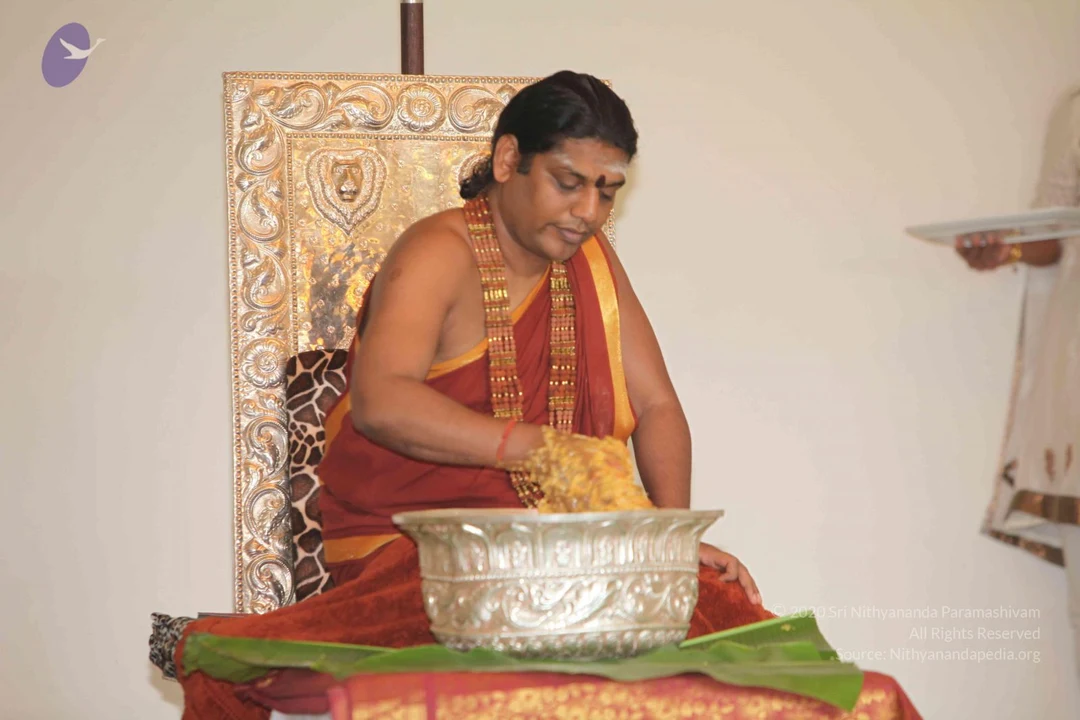
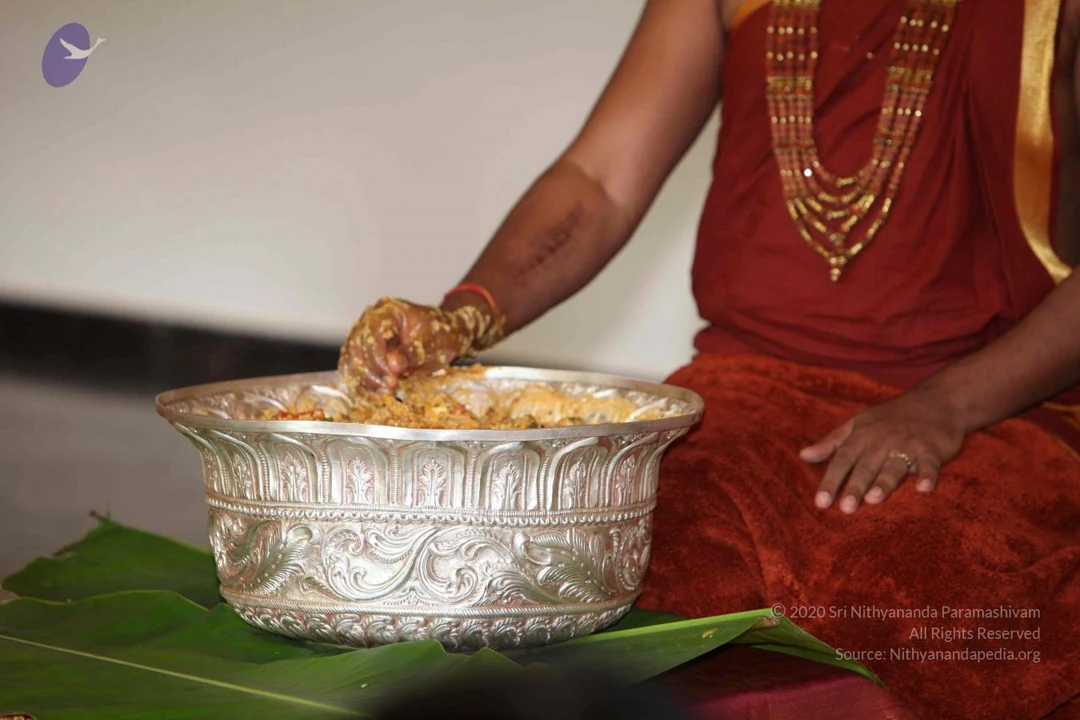
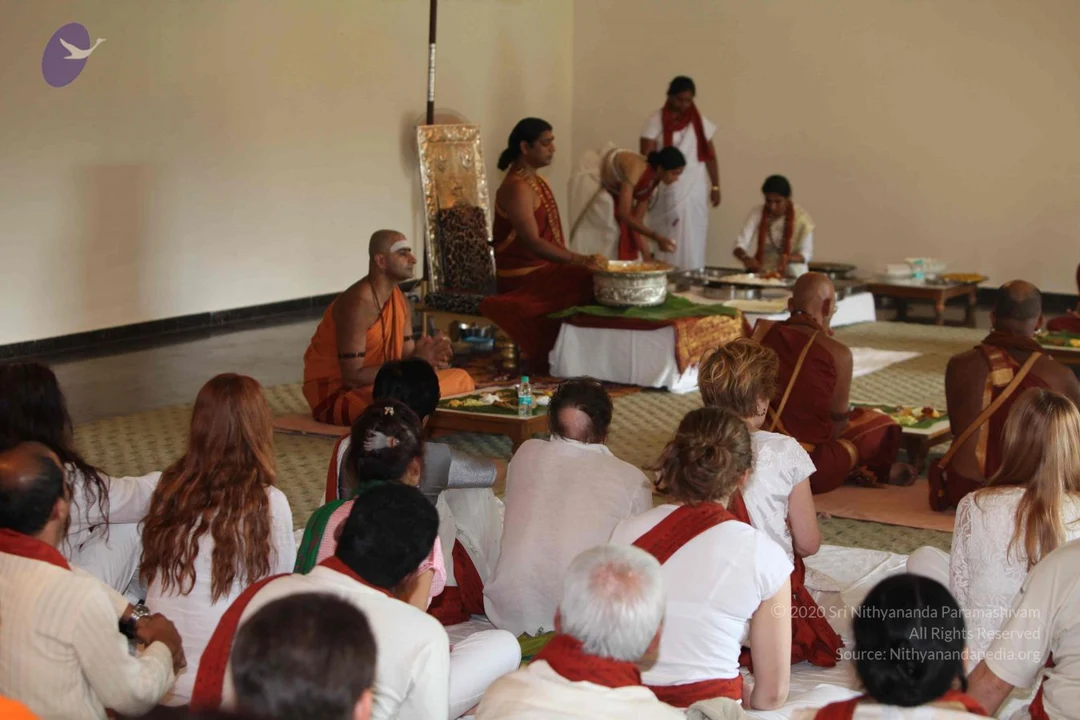
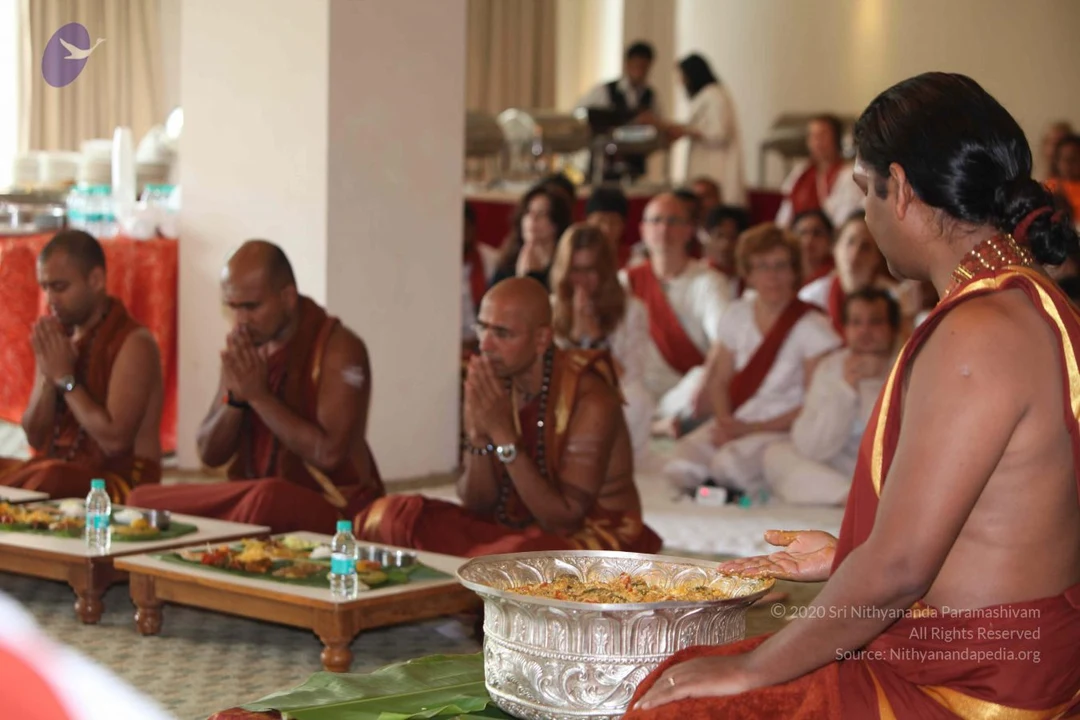
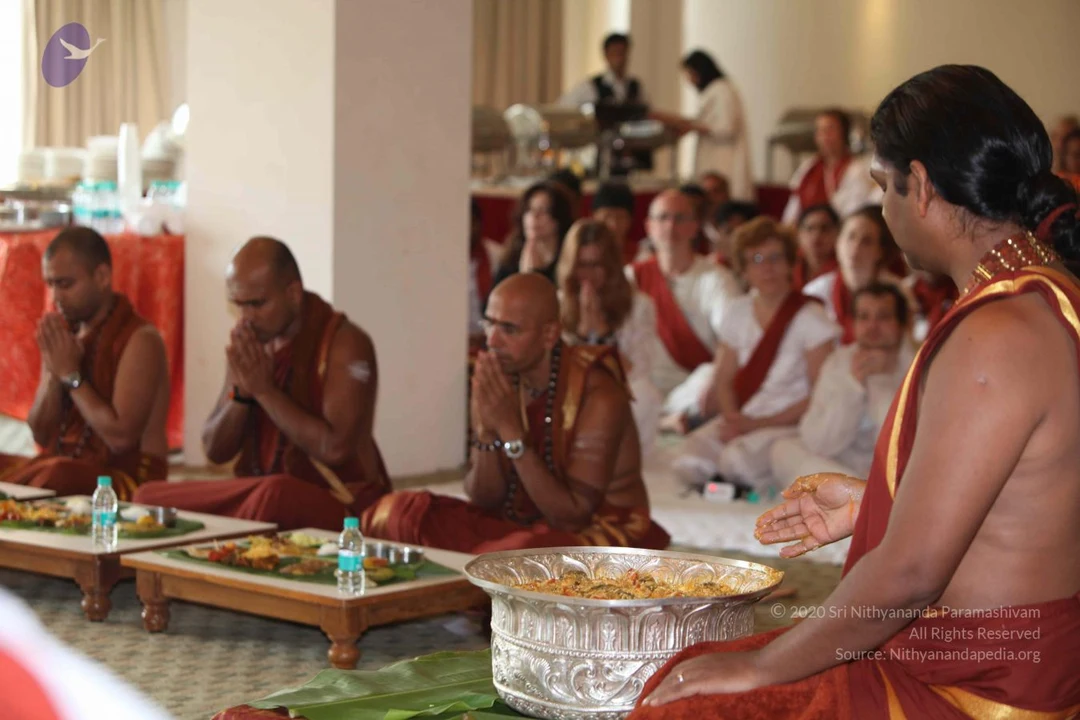
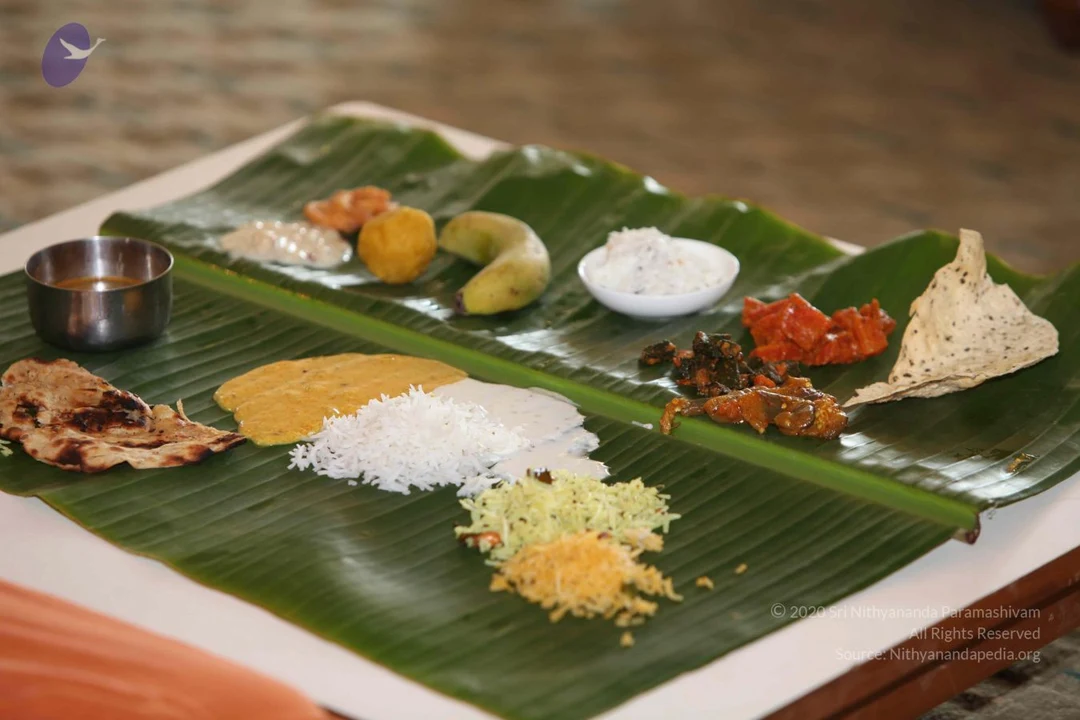
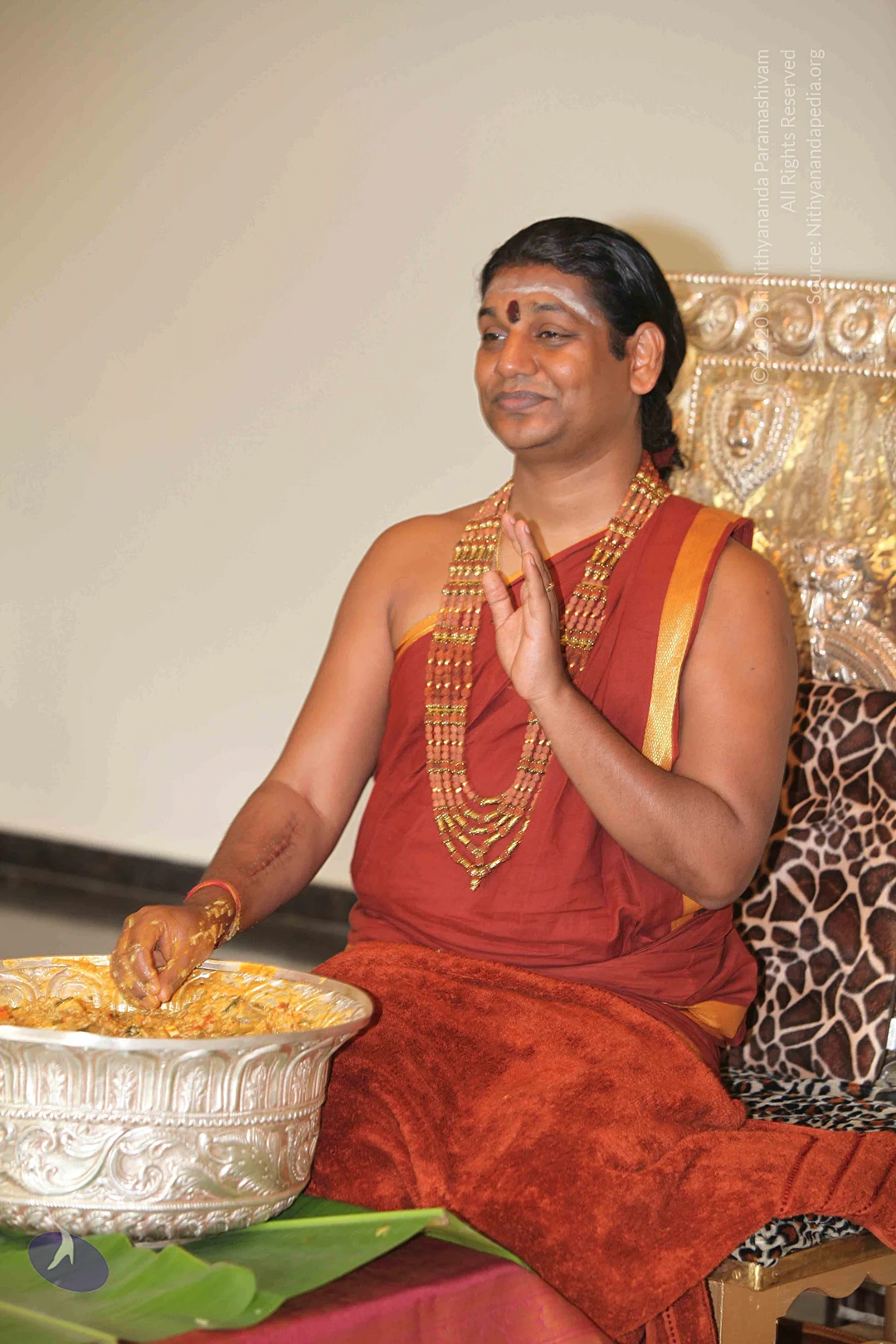
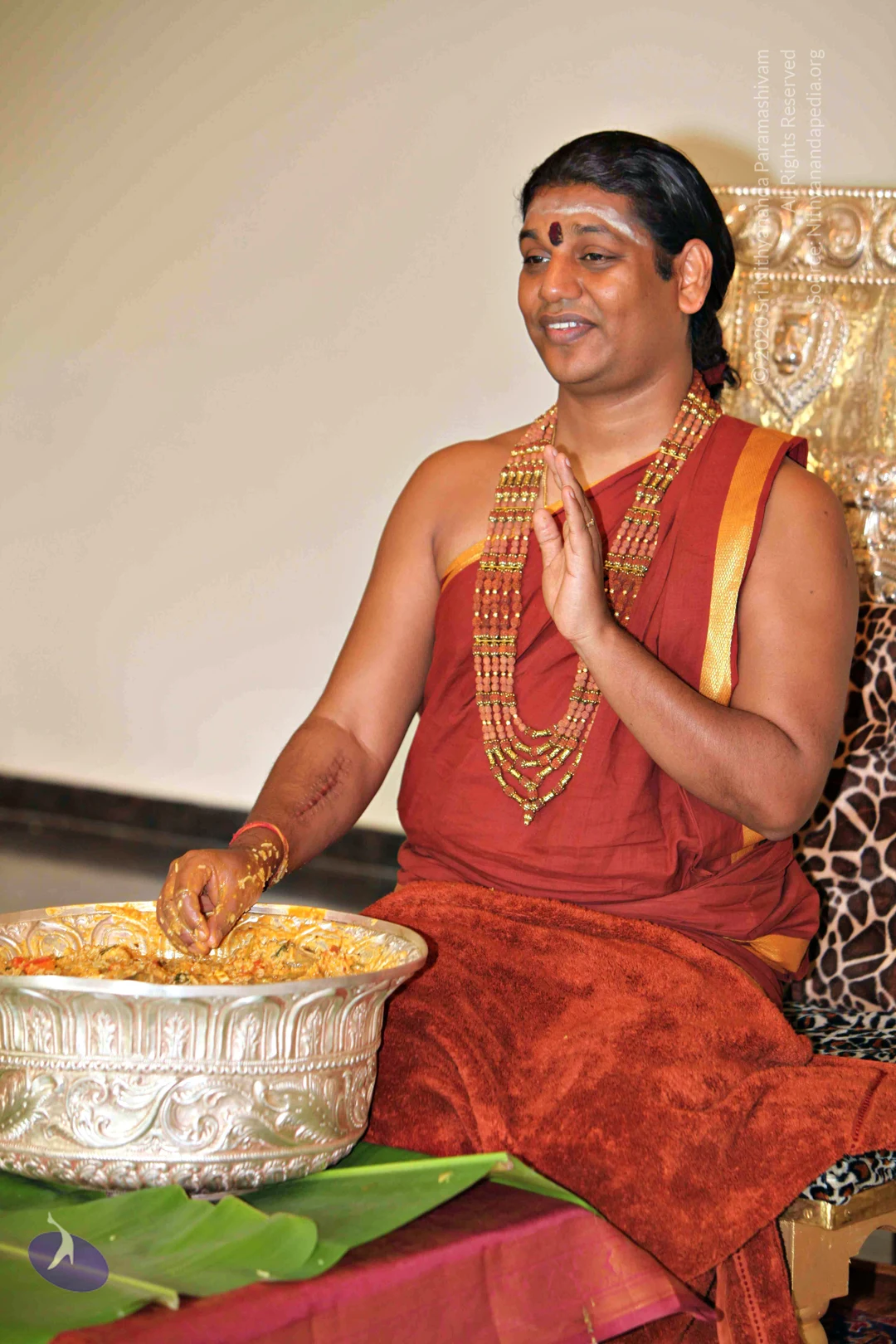
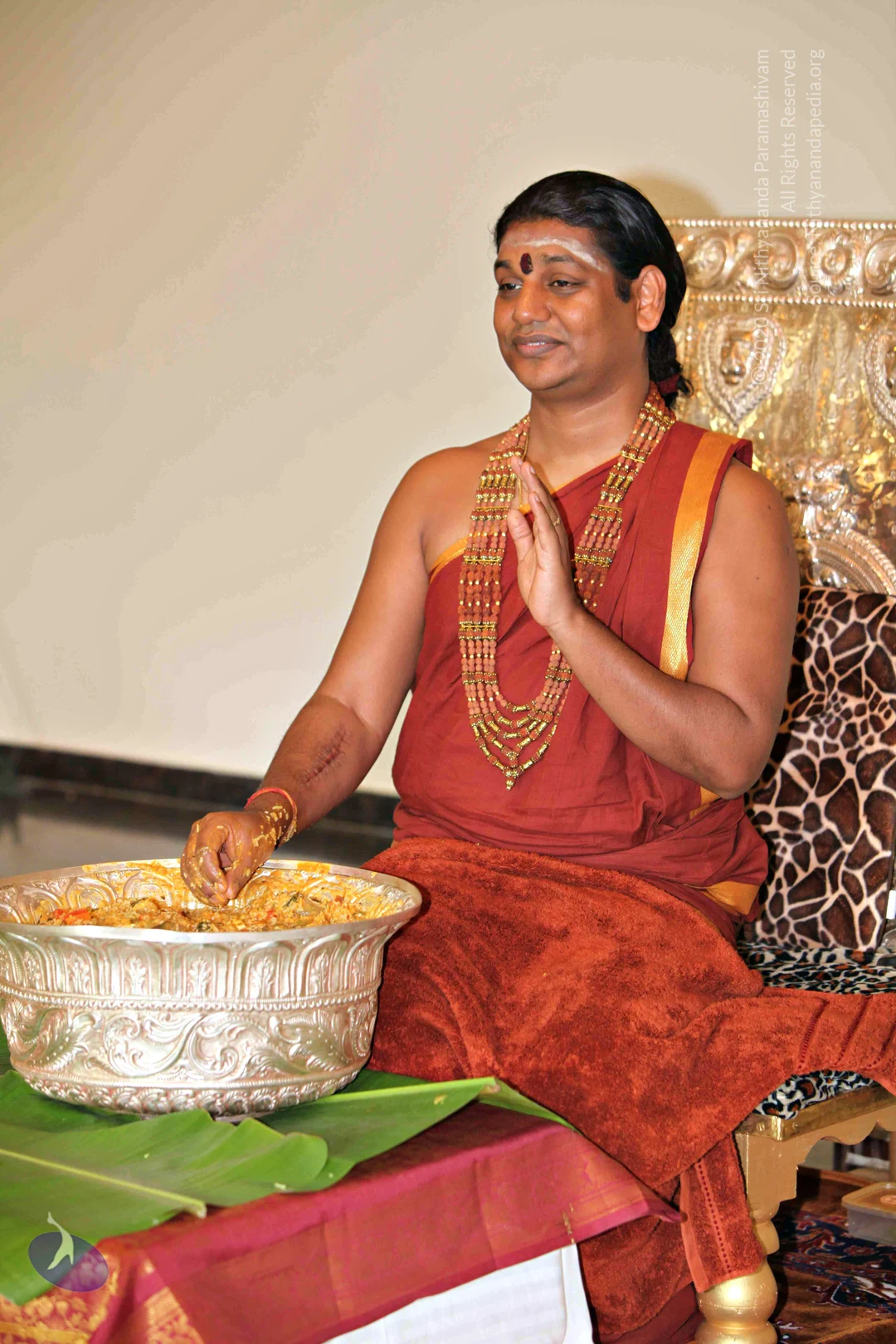
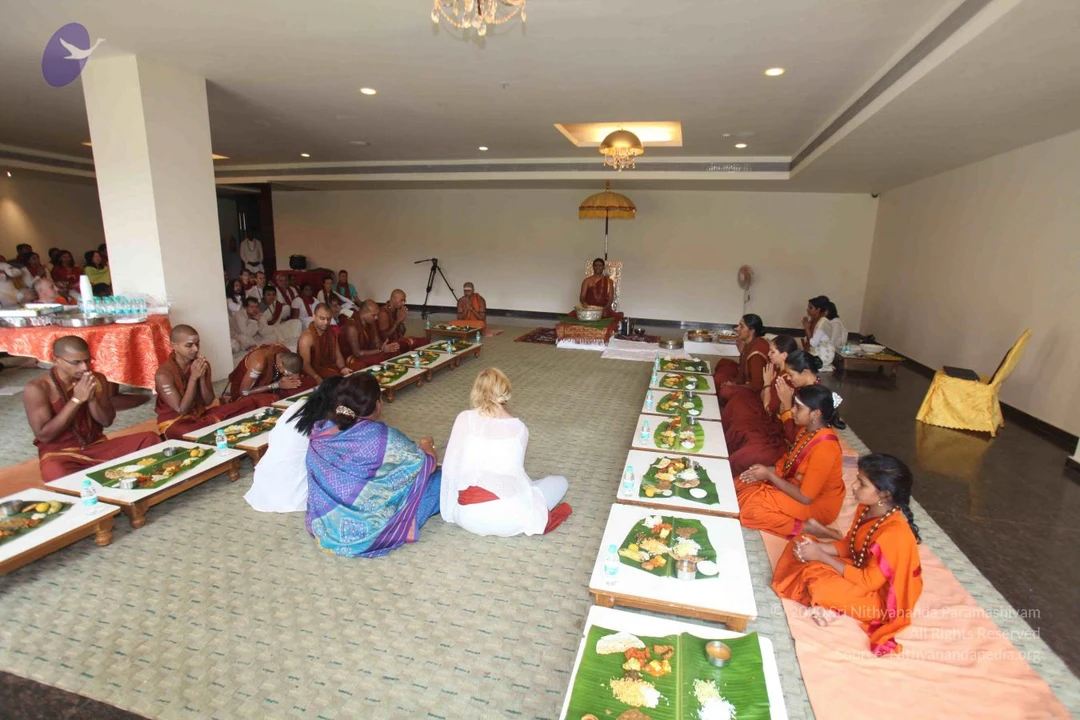
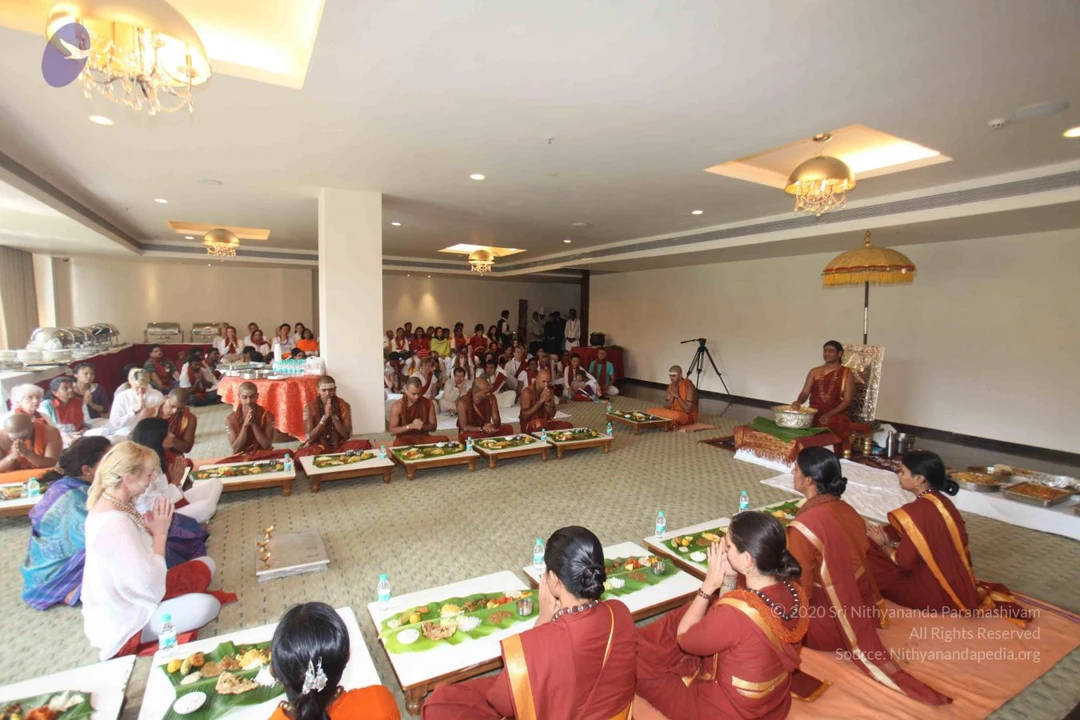
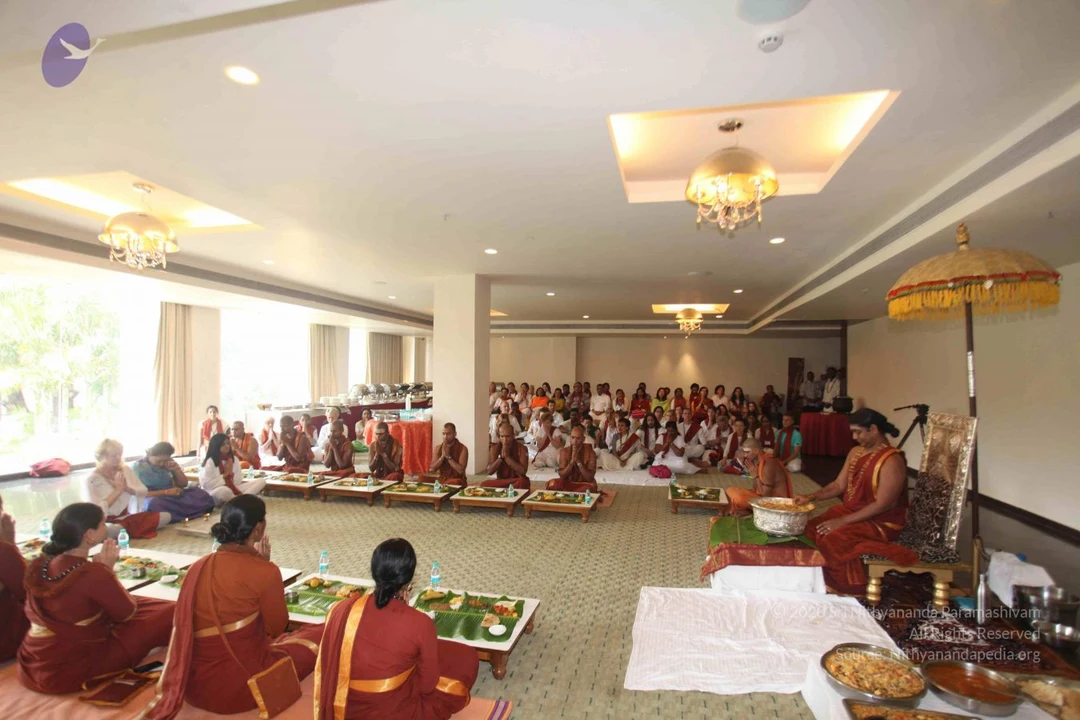
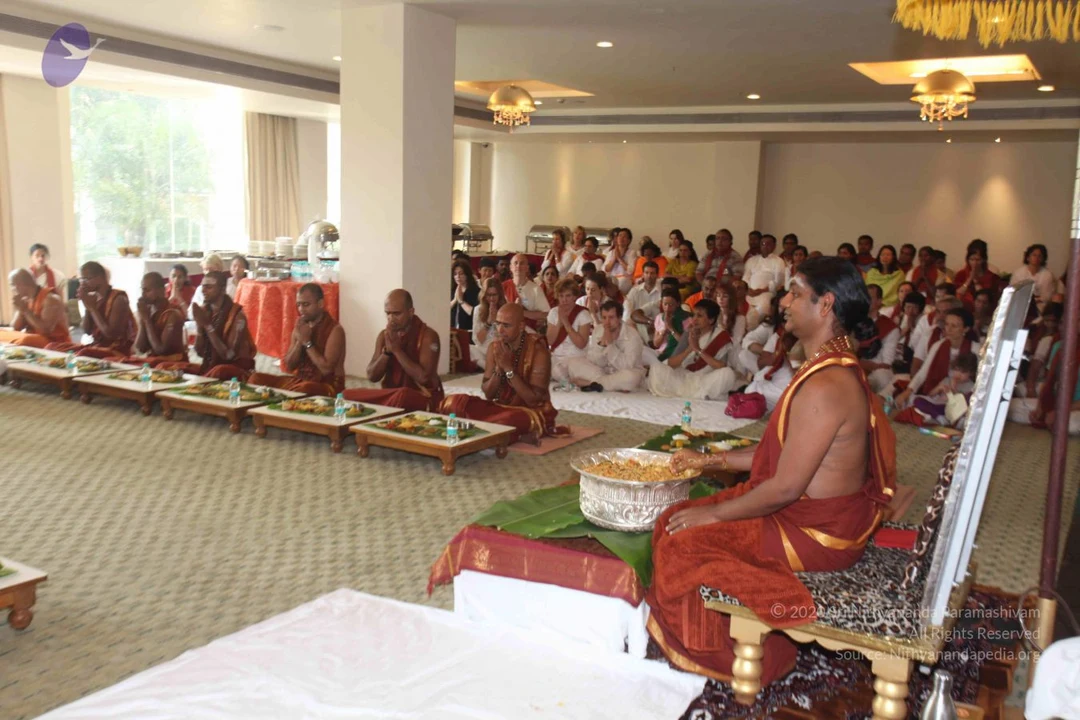
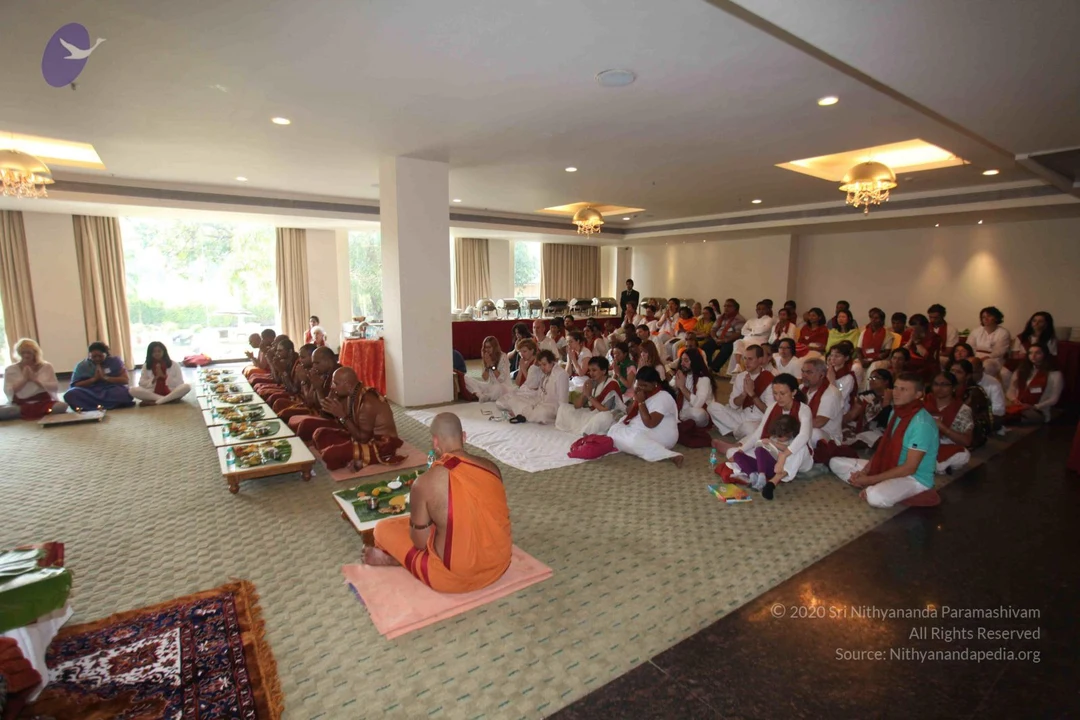
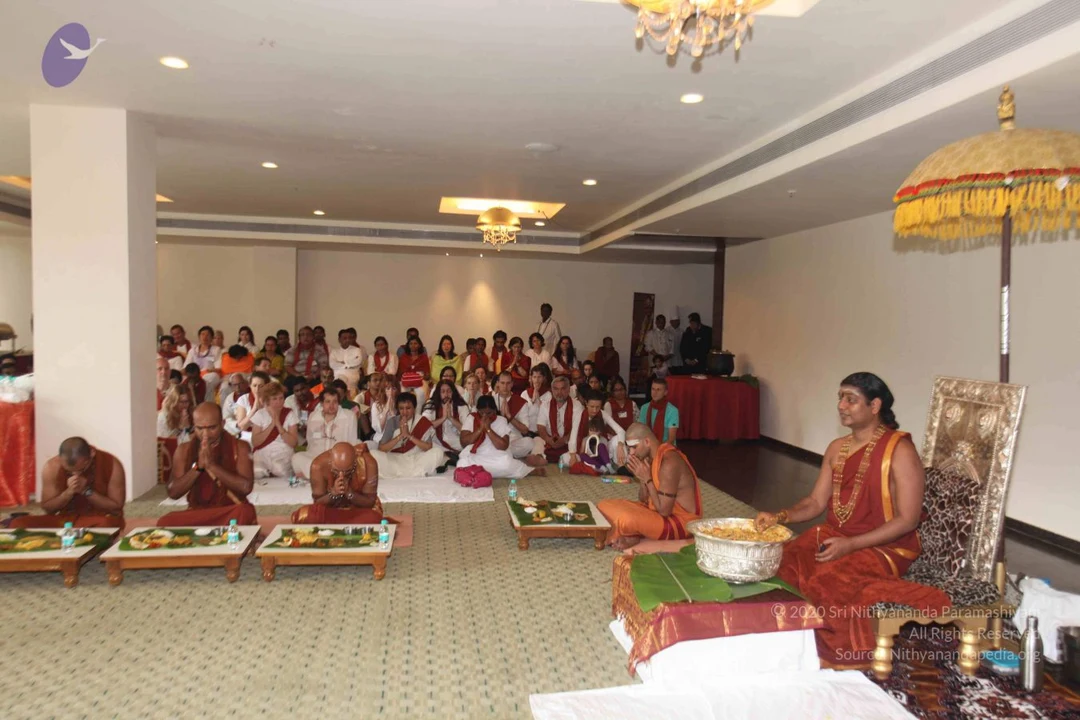
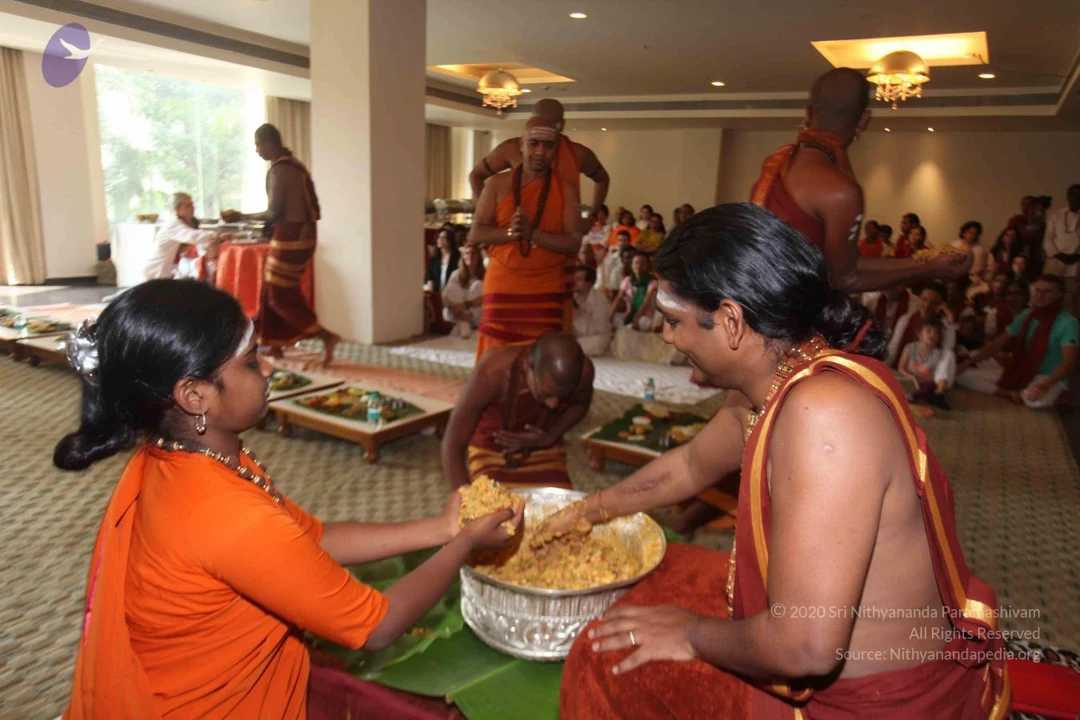
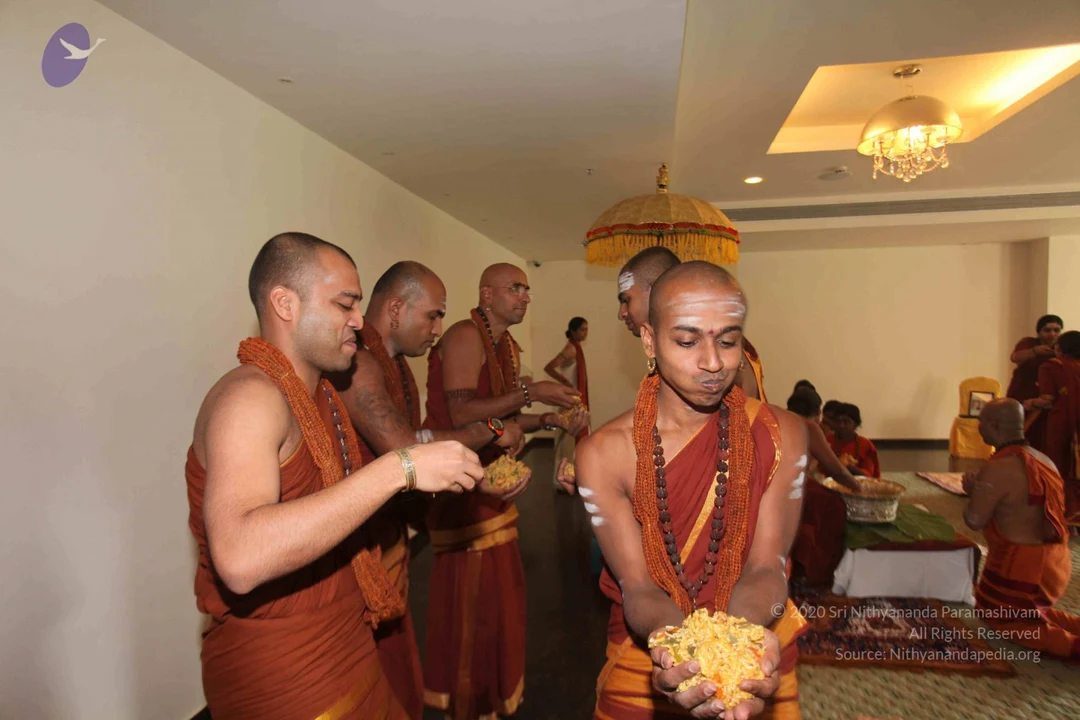
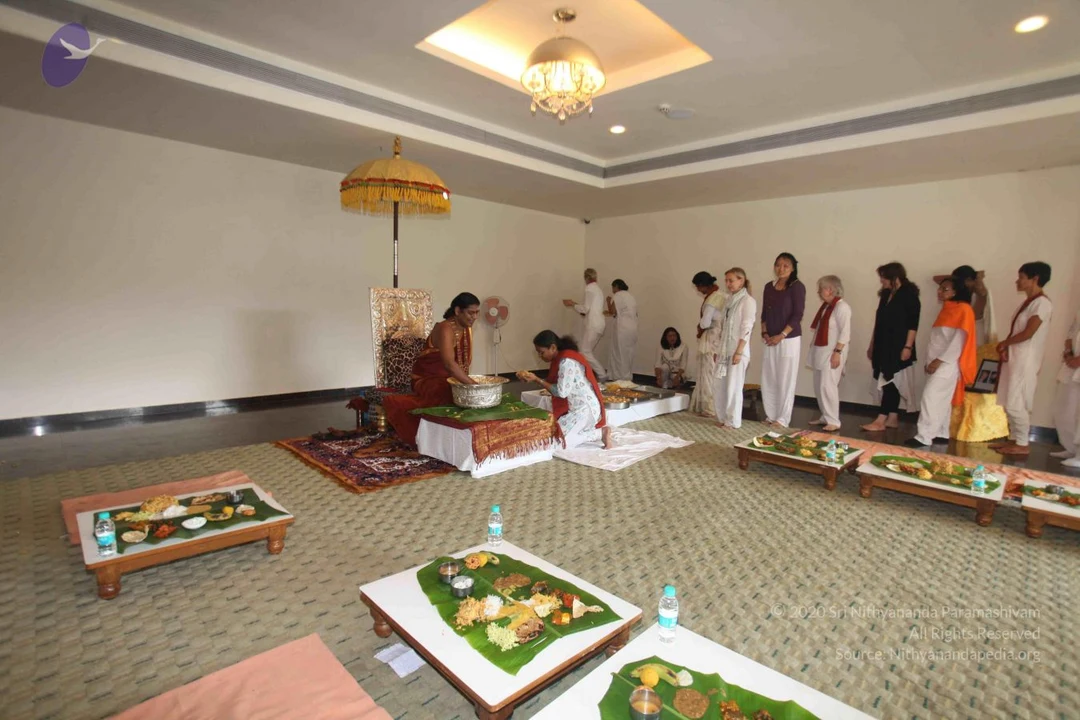
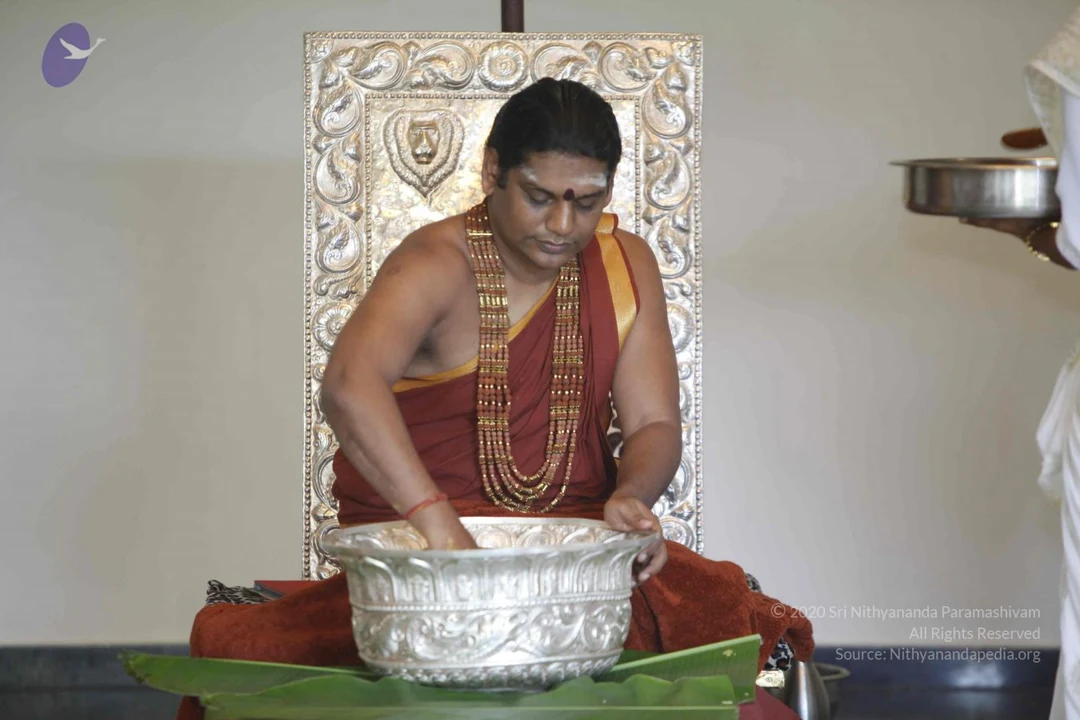
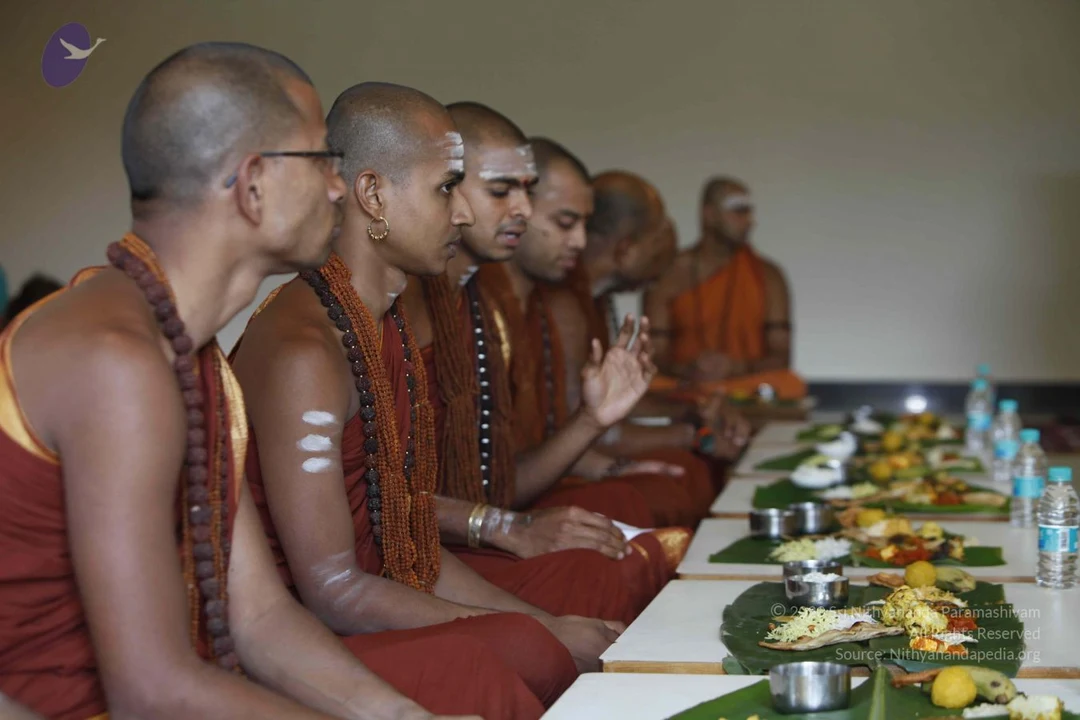
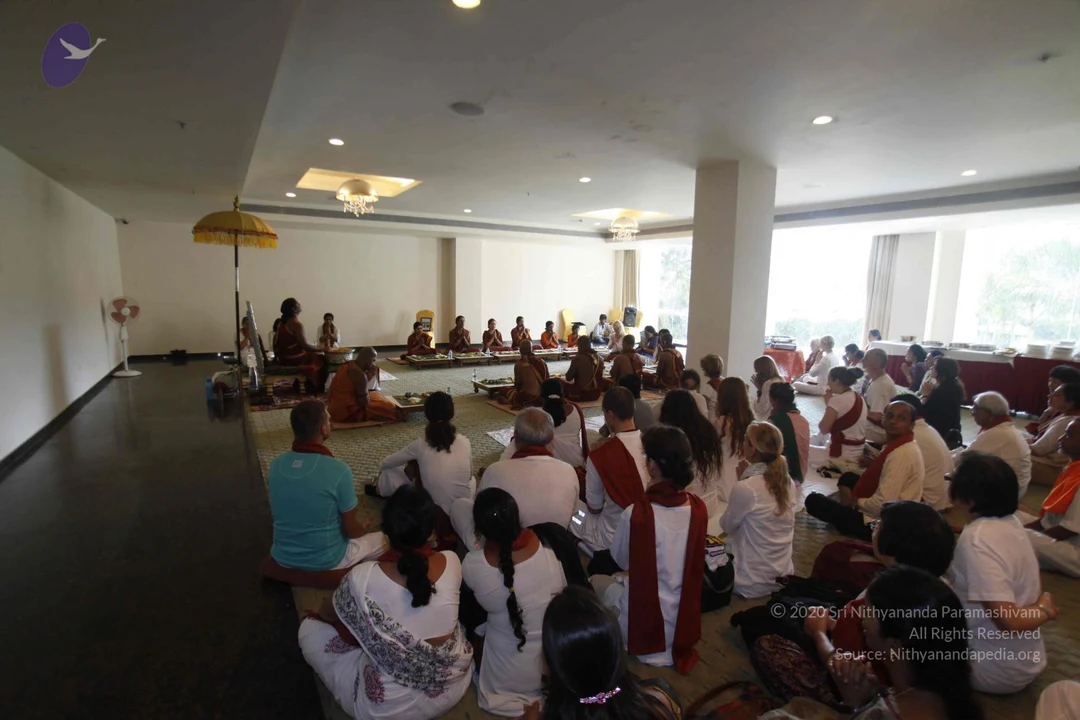
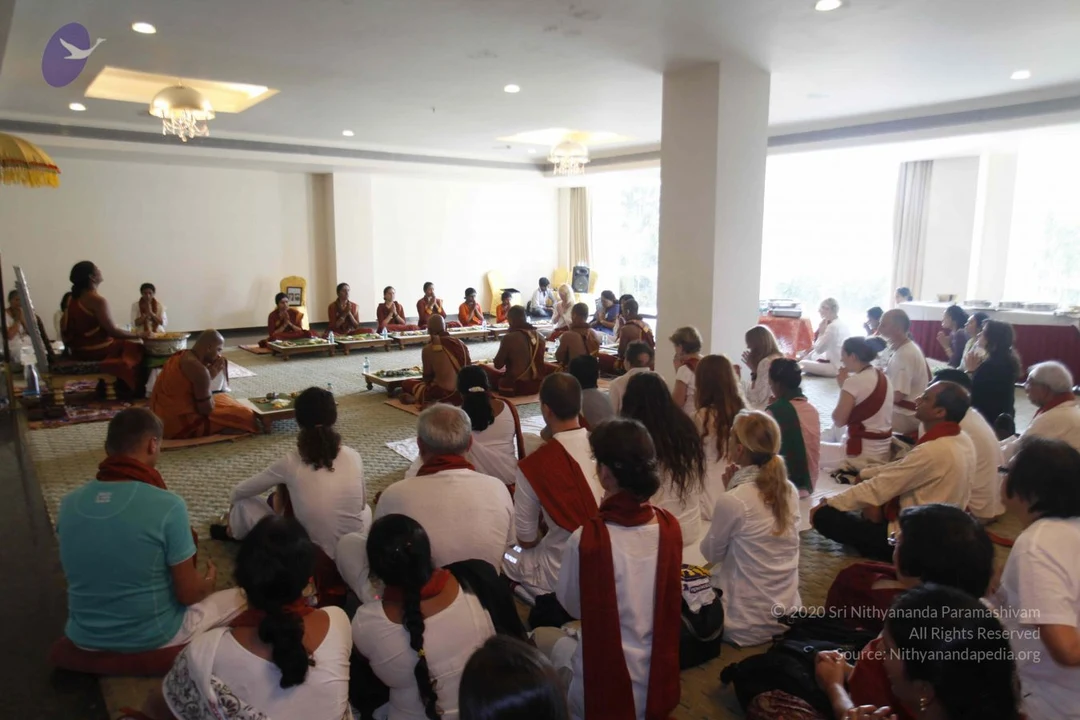
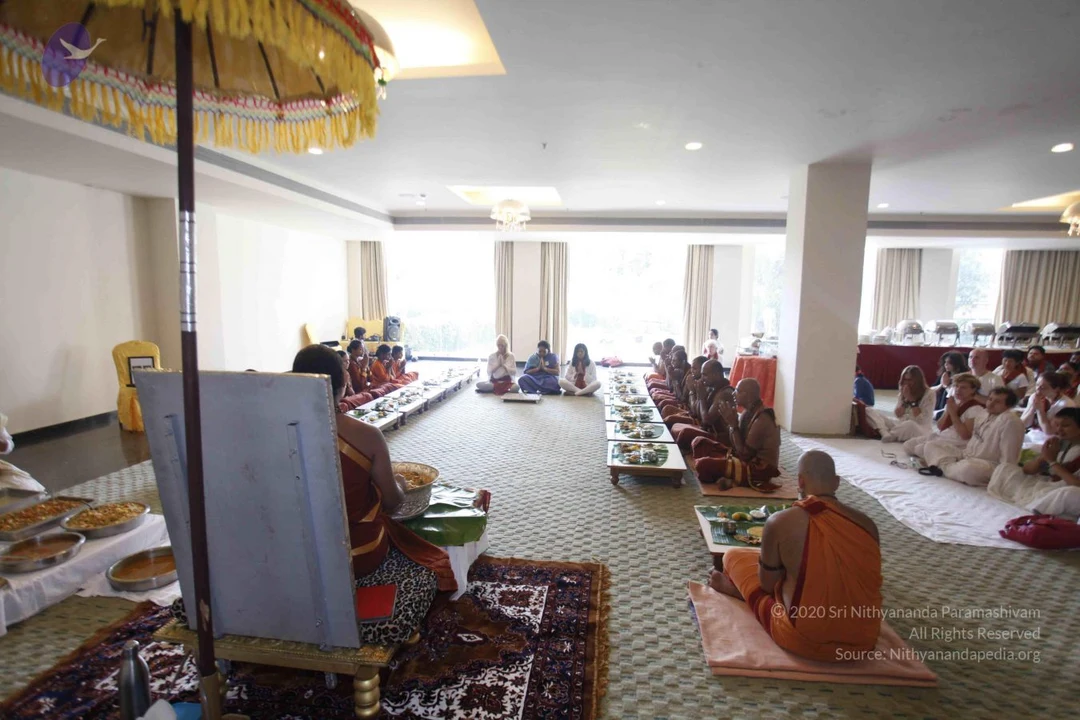
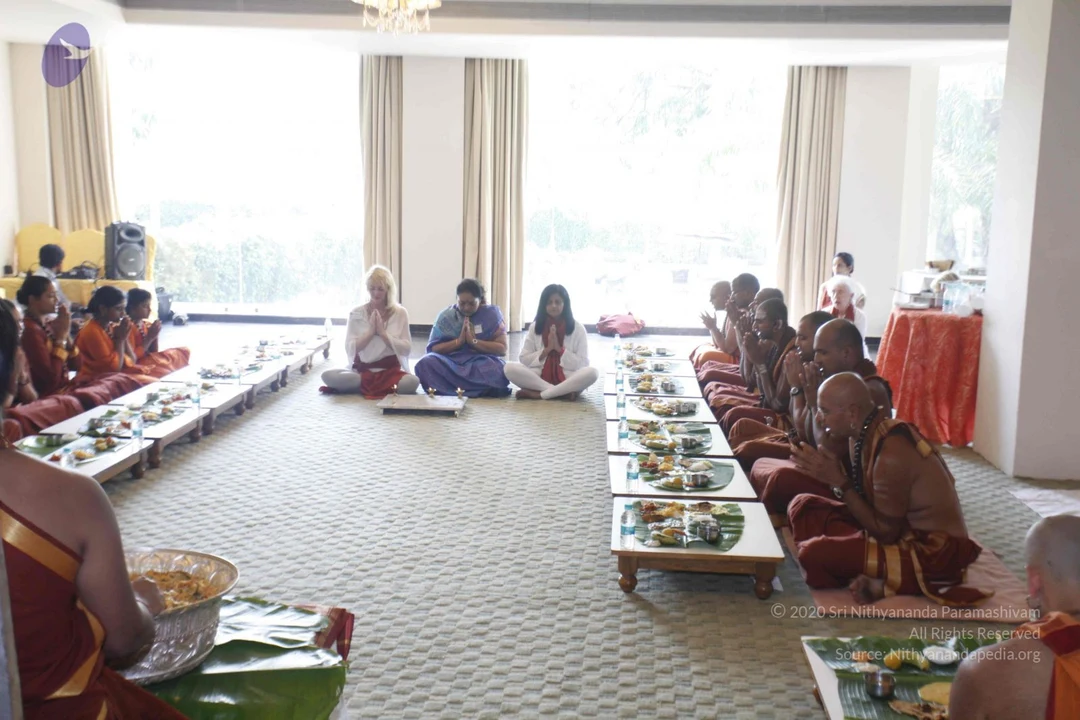
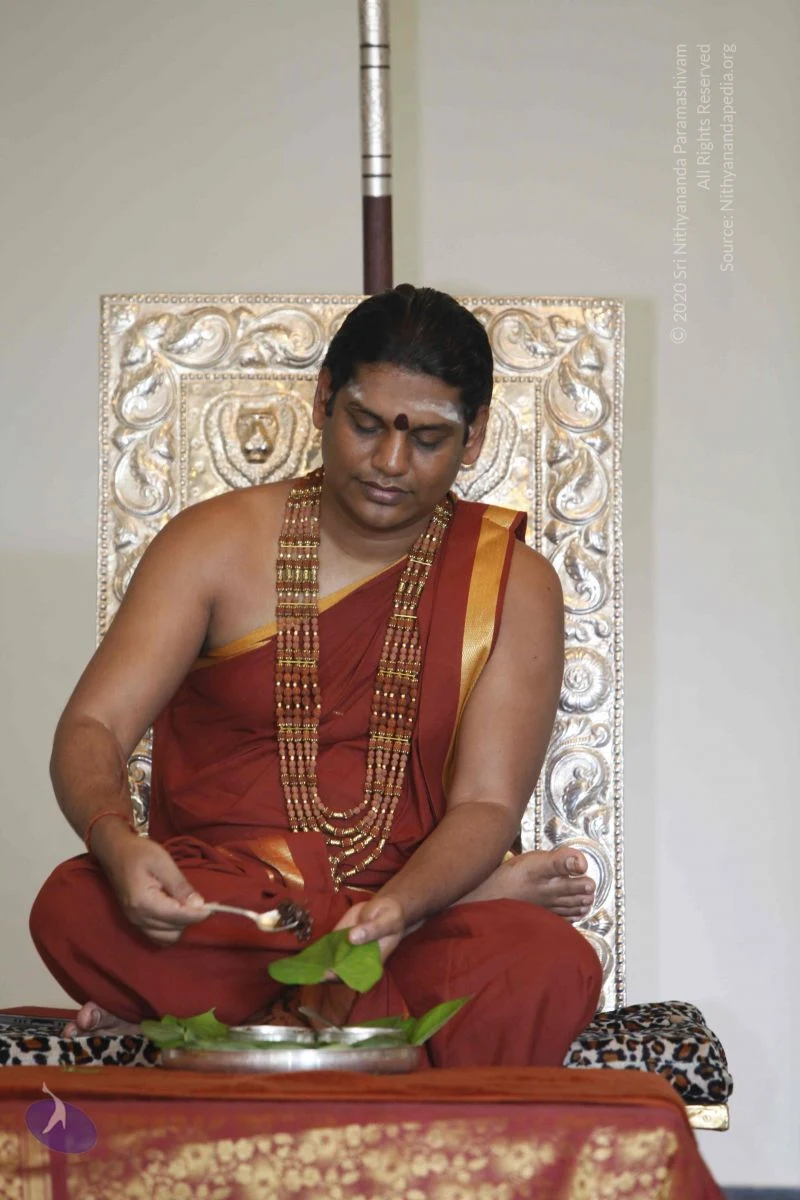
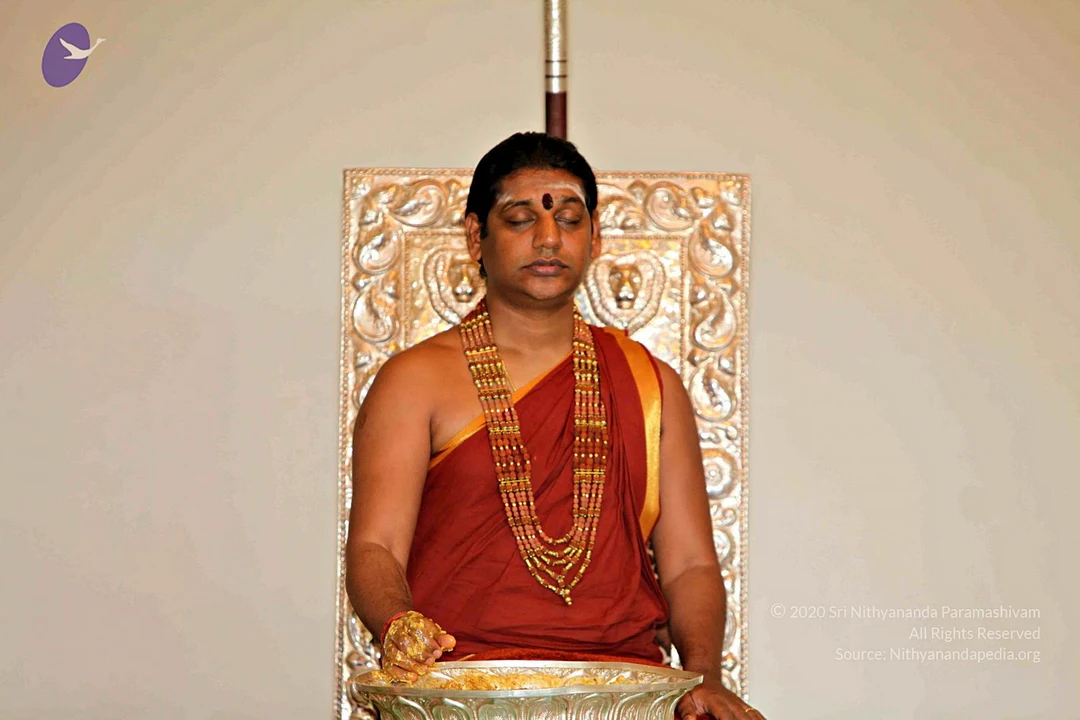
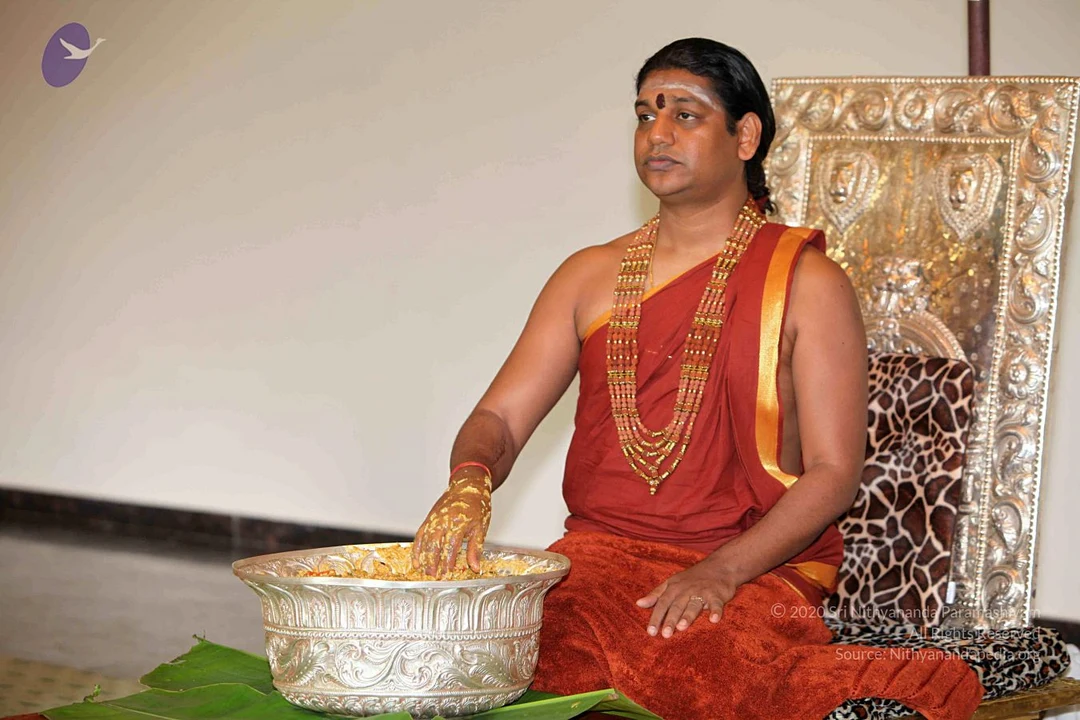
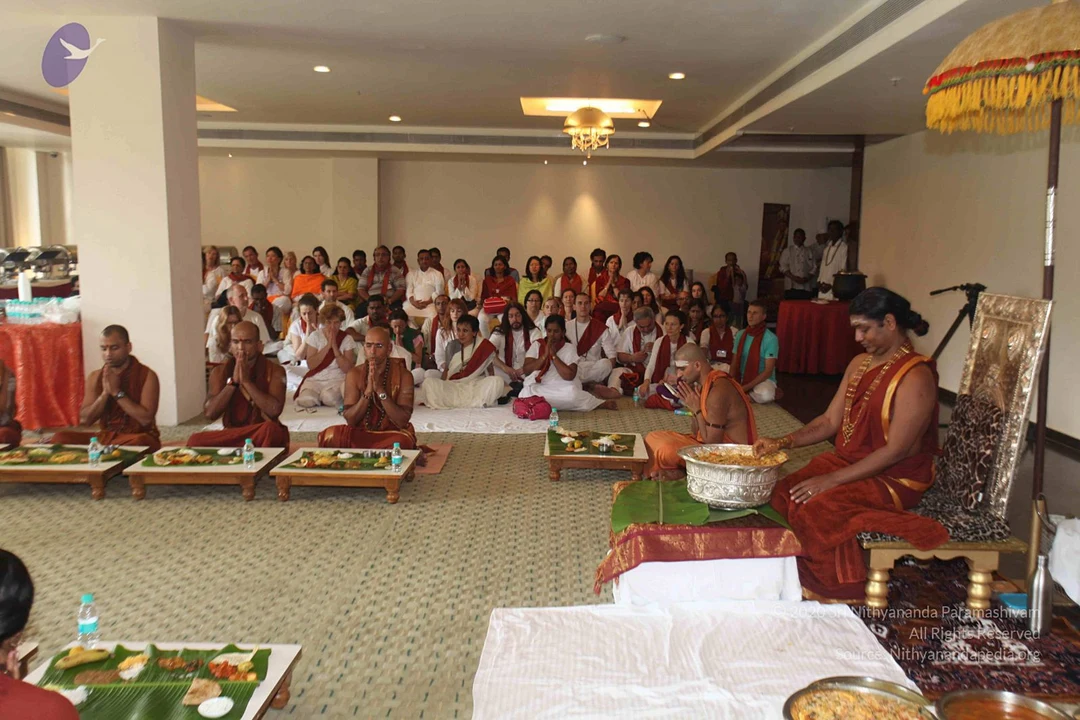
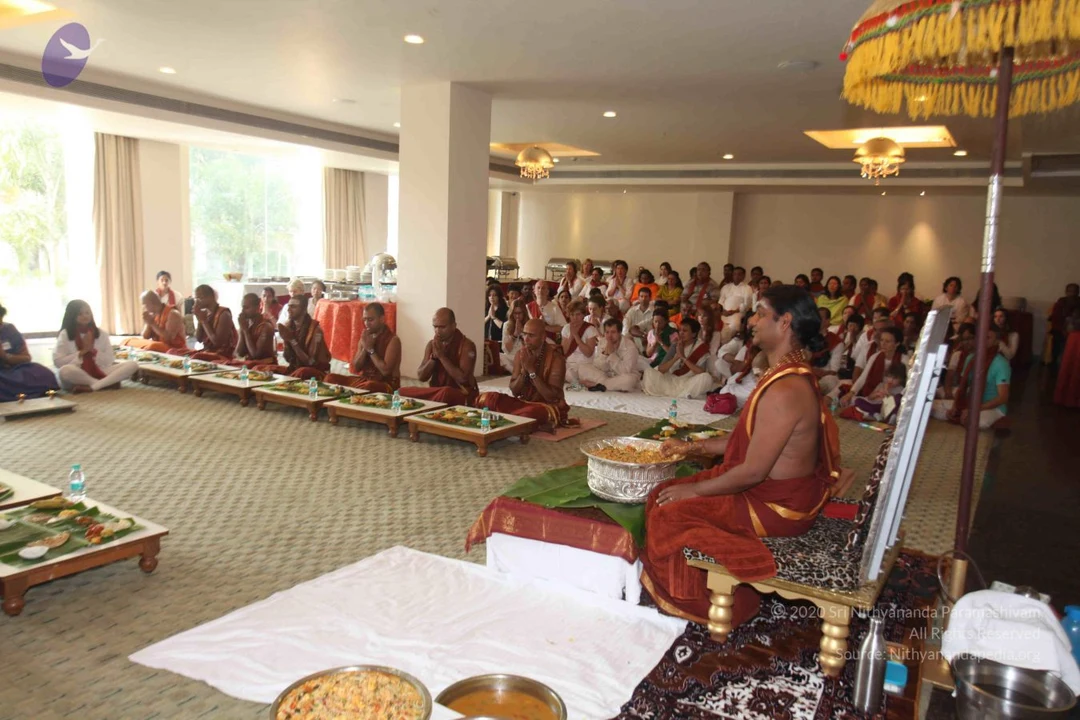
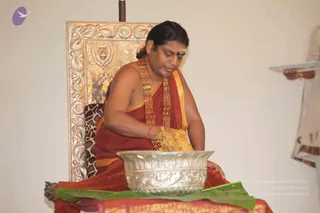
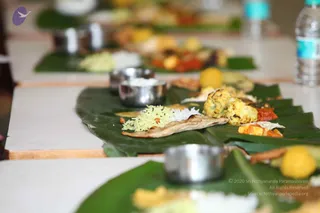
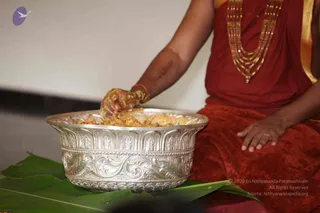
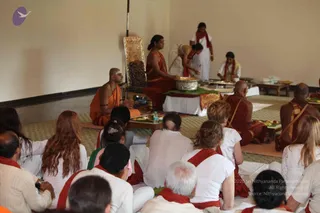
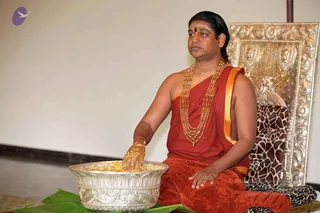
A seated man in a deep red-maroon robe with an orange-gold border sits before an ornate silver-framed backdrop. He wears a multi-strand gold-beaded necklace, a red thread on his wrist, and a vertical tilak on his forehead, and he is pressing or mixing a golden substance, possibly turmeric or flower offering, with both hands over a large ornate silver bowl set on a banana leaf. A dark red cloth with gold border covers the table, and another person in white stands at the right edge holding a tray.Close-up photograph of a meal served on green banana leaves laid along white tables. Each leaf holds a portion of rice with cumin and mustard seed, a flatbread, fried cauliflower florets, orange and red curries, and yellow pickled or fried items, with small stainless steel bowls of sauce and a lemon-like fruit. Water bottles with teal labels sit in the blurred background. No people are visible in the frame, so this shows an ashram-style annadan prasad meal setting.Three shaven-headed monks in saffron-orange robes and rudraksha malas sit cross-legged on a white-covered floor before banana-leaf plates of food on low wooden tables. The centre monk, with a wristwatch, holds his palms together in anjali, while the monk on the right, wearing spectacles, speaks with hands clasped. Behind them, a seated audience of about 40 people wears white clothes with red shawls, many sitting attentively in a bright hall. Water bottles and small steel bowls sit on the tables.A photograph of a seated person in a red-orange robe and a layered beaded necklace reaching into a large embossed silver bowl filled with a yellow-golden food offering. Only a forearm, hand and torso are visible; the face is not shown. A small ring is on one finger and a red thread is tied on the wrist. The background is a plain pale wall.Indoor ritual gathering with devotees seated on mats facing a puja setup. A figure in orange robe with white forehead markings sits cross-legged at left, with a bronze bowl and leaf-plate offerings before a leopard-print seat and gilded frame. Several people in white clothing with red shawls stand and kneel at the offering tables, one holding a bowl. Foreground devotees in white and red sit with their backs to the camera. Setting appears to be a plain-walled hall with the padukapuja or satsang arrangement. Roughly eleven people are visible.Close-up photograph of a hand pressing into a large ornate silver bowl filled with a golden-orange mixture. The bowl is embossed with floral and scrolling patterns. The hand, wearing a red thread bracelet, is partly coated in the same yellowish paste. A dark red cloth lies at lower left and a green leaf at lower right. No people beyond the hand are visible.

Kalabhairava-Darshan

1 photoSource gallery
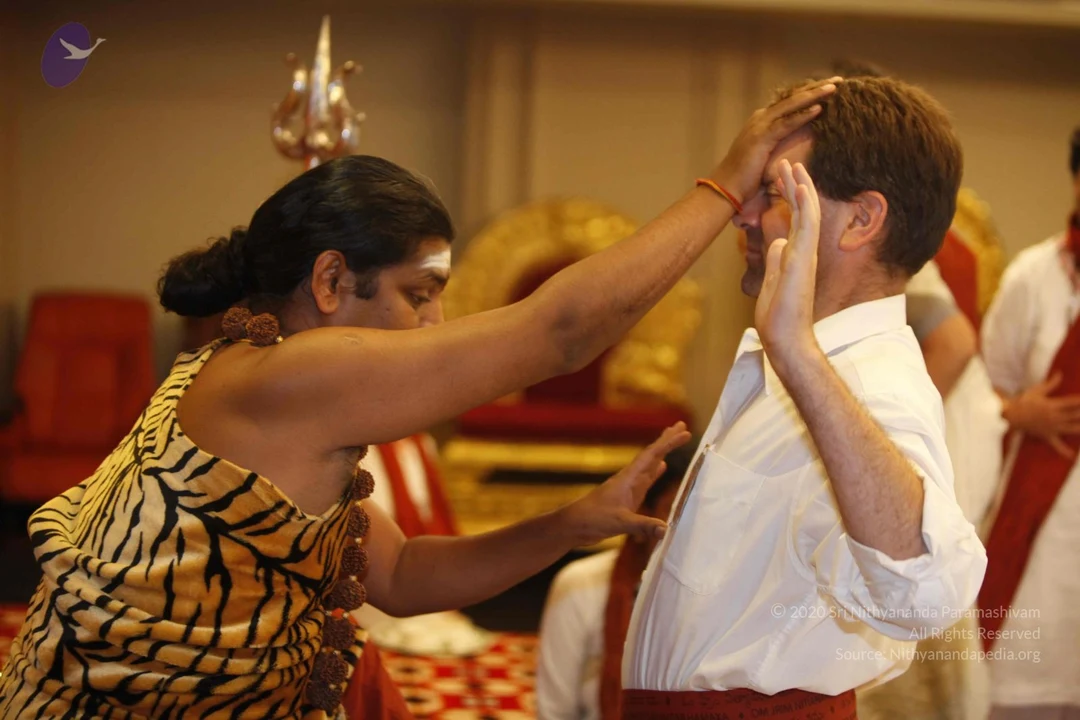
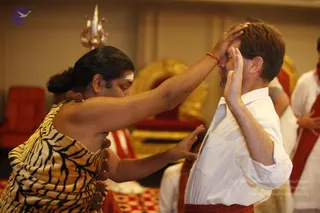
A photograph of a shaved-headed man in a striped yellow and black tiger-pattern shawl with rudraksha beads and a white forehead mark, his hair tied in a knot, placing his right hand on the forehead of a man in a white collared shirt with a red-and-white cloth at his waist. The standing man keeps his eyes closed and his left hand raised in receiving. Behind them, a golden throne-like chair, red seating, a silver trident and several other people in white with red-bordered cloths are visible. The scene suggests a blessing or initiation moment in an ashram hall.

Nithya-Satsang
88 photosSource gallery
A large printed portrait of a smiling man in an orange turban and orange shawl with a red bindi stands on an ornate gold-framed throne arch. The portrait is labelled "Paramahamsa Nithyananda" in a caption beneath. Below it, a tiger-skin cloth covers the throne base, with red velvet cushions at the sides and a few flowers and a small lamp at the bottom edge. No living people are visible in the frame.Three gilded statues seated side by side under a gold-embroidered canopy with yellow satin draping. The central deity murti is blue-skinned with a tall gold crown set with coloured stones, wearing a heavy gold necklace, a brocade red and gold shawl, and a blue dhoti with a jewelled waist ornament, its hands raised in blessing. To the left, a golden figure in a brown and maroon turban wears layered gold chains and a rudraksha mala, seated on a leopard-print cushion. To the right, a golden figure in an ornate red and gold crown and orange sari wears a gold necklace and holds a hand in a gesture of blessing. Leopard-print cushions cover the seats.Three ornate statues seated on a golden throne-like shrine with gold satin drapery. The central figure wears a tall gold crown set with coloured stones, a blue lower garment, and layered gold and jewelled necklaces, with a red-beaded mala and red-gold shawl. The figure on the left wears a rust-orange turban, orange-brown robes and a beaded mala. The figure on the right wears a tall ornate crown, an orange sari and jewelled ornaments. The golden arch behind is carved with decorative motifs. Statues only; no physical people are visible.Three golden murti figures seated side by side on an ornate gilded throne with a gold-and-red satin canopy behind them. The central figure wears a jeweled golden crown, a deep blue dhoti with gold border, a multi-strand gold necklace and rudraksha-style garland. The figure on the left wears a rust-brown turban, brown robes with gold border and layered gold necklaces. The figure on the right wears a jeweled orange-and-gold crown, an orange silk sari with gold border, and heavy jeweled necklaces. The seats are covered with leopard-print cloth and a yellow fringed cloth lies at the base.A gilded deity murti seated on a leopard-print cushion beneath gold and orange silk drapes. The figure wears an elaborate gold crown set with green and red stones, a black headband, and layered gold and jewelled necklaces over a rust-brown rudraksha-style mala. Blue-violet dhoti-like cloth has a gold and red border, with jewelled anklets. Two hands are raised in mudra gestures, and gold ritual implements, including a trident, stand at the sides of the throne.A golden statue seated on a leopard-print cushion beneath a gold canopy, dressed in a rust-orange turban with a jeweled brooch, rust-orange and gold-bordered robes, a red-beaded rudraksha mala, layered gold and bead necklaces, and a gold belt. The statue raises one hand in a blessing gesture and rests the other on its lap. To the right, a red and gold brocade cloth hangs beside a gold finial. The image is a photograph of a statue, not a living person, so no physical people are present and the figure is classed as a depiction without a confirmed identity.

With-Arjun-Puri-Mahraj

24 photosSource gallery
A photograph of four people standing indoors near a table with printed materials. On the left, a person in a maroon wrap with gold trim and bangles and a maroon head wrap holds a booklet. In the centre, a bearded man in saffron-orange robes with an orange shawl, a red tilak on his forehead and rudraksha beads holds a booklet. To his right, a shaved-headed man in a rust-red robe with gold trim holds a booklet. At far right, a man in a black vest over white dhoti-style clothing stands beside them. A yellow and red decorated parasol stands behind, and a table with more printed materials is visible.A photograph of two men in an indoor hall with cream walls, a gold fringed parasol and maroon-draped tables. On the left, a man in a maroon turban, maroon robe with gold borders and multiple beaded bracelets hands a white paper to the centre man. The centre man has a long dark beard, a red tilak on his forehead, a rudraksha mala and an orange shawl over a maroon robe, and holds a paper with both hands. A bare-chested man at the right edge holds a booklet. Red chairs and a glass door are visible behind.Photograph of an indoor event space with cream walls, a gold-and-yellow decorative parasol, and a draped table with printed materials. A man in a maroon turban and draped maroon-and-gold garment wears heavy gold necklaces and armbands and smiles while gesturing with one arm. Beside him, a man with long dark hair and a full beard, wearing a red-orange robe with an orange shawl, reads from a booklet with a red bindi on his forehead. A glass cabinet stands at right.Indoor hall scene with two men in red-maroon and saffron-orange robes. In the foreground a smiling man in a maroon turban with a gold ornament, a long gold-beaded necklace, gold armbands and a maroon dhoti with gold border walks forward. Behind him a bearded man in orange-saffron robes and orange shawl holds a small booklet and reads, with a red tilak on his forehead. A gold-and-yellow umbrella stands in the background beside a draped table with papers, and rows of maroon chairs line the left wall. Two people in total are visible, with a partially visible figure at the right edge.Two men sit at a long white-clothed dining table in an ornate room with gold-framed red velvet thrones and tufted brown armchairs. The man on the left, bearded and wearing an orange-red wrap, eats from a silver-toned plate. The man on the right wears a red-orange dhoti and shawl, a gold necklace, gold armbands, and a white forehead marking, and is seated before a plate of food with a folded red cloth beside him. Cups, saucers, glasses and a small kettle sit on the table. Curtains and a table lamp frame the background.Indoor photo of a formal dining setting with a long white-clothed table and gold-framed high-backed red velvet thrones. A bald man in a red-orange robe with a beard sits at left, hand raised near his face. At right, a man with long dark hair, a gold necklace and rudraksha-style ornaments, wearing a red-orange cloth and many gold armlets, gestures while seated on a throne. A third man in a red-brown robe with a bare shaved head stands at the far left by a wall-mounted framed picture.

Kalpataru-Darshan

12 photosSource gallery
A seated figure in a deep red robe with gold border sits on a red upholstered seat before an ornate gold-carved throne back, receiving an offering. He wears a gold necklace, multiple gold bangles and armlets, and a white vertical tilak on the forehead, and smiles while extending his hand toward a standing visitor in orange robes with an orange cap and shoulder bag. A monk in dark red robes and shaved head bends forward holding a white paper, and a tray of fruit sits in front. Behind is a portrait of a smiling figure in a red turban, and a golden plate or kalasha-like offering rests nearby. a person: the seated figure wears a deep red robe, gold necklace and gold armlets with a tilak, and a portrait of a turbaned figure hangs behind, matching the page's a person reference, so the seated figure is marked a person.A seated figure in a rust-red robe with gold border and gold bangles, wearing a gold necklace and rudraksha-style beaded ornaments, extends a small object to a kneeling man in a cream jacket and white shirt, who holds out cupped hands. Standing behind them are women in white and cream saris and a woman in a navy head scarf and dark skirt; a gilded throne with red upholstery sits at left on a red and gold patterned carpet in a hotel-style hall. Swamiji (probable): the seated figure has long swept-back hair, gold and bead necklaces, and saffron-orange ceremonial clothing.A seated figure in a deep red and gold saree with a gold-toned blouse and ornate gold necklaces and bangles, sitting on a red and gold throne-like seat, extends a hand to offer a small orange fruit to a kneeling older man in a cream jacket and white shirt. Behind them, a woman in a white saree with a red garland and another woman in a grey jacket and dark blue skirt with a head scarf stand on a red patterned carpet, while other people in white clothes stand near a speaker stand in a warmly lit hall.A seated figure in a red-orange saffron robe with gold border and gold armbands and necklaces sits on a red throne-like chair, smiling and reaching toward an elderly man in a white shirt who kneels before them and extends cupped hands holding an orange fruit. Behind them, a woman in a white sari with a red garland and another woman in a grey top and blue head covering stand with hands folded in namaste; a woman in a yellow sari and a figure in white trousers walk in the background. The floor is covered with a red patterned carpet. The seated figure has a long swept-back hair knot and tilak, with ornate gold ornaments, offering a person appearance, sitting as a teacher receiving devotion.A seated figure in a deep red saffron-toned sari with gold border, wearing a beaded necklace, gold-tone bangles and hoop earrings, places a hand on the head of an older bald-headed man in a white shirt who bows low with palms pressed together on a red-and-gold patterned carpet. Standing behind them, a woman in white with a red flower garland and a woman in a grey top and dark blue skirt with a head scarf watch, with a woman in a yellow sari in the background. A tall gold-and-red throne-style chair stands at left in a warmly lit hall. The scene suggests a blessing or respectful greeting.A seated figure in an orange-red saree with a gold border, gold bangles and a gold necklace, hair in a bun and white forehead marking, places a hand on the head of a kneeling man in a white kurta who holds a small orange fruit. Two women in light clothing stand behind, one in a white dress with a brown shawl. A gold-decorated seat with red cushions sits at left on a red patterned carpet. Possible a person depiction cues are present, but identity is uncertain from appearance alone, so the figure is described by role as a giver of blessing.

IA-Maheshwarapooja

63 photosSource gallery
A seated man in a deep red-maroon robe with an orange-gold border sits before an ornate silver-framed backdrop. He wears a multi-strand gold-beaded necklace, a red thread on his wrist, and a vertical tilak on his forehead, and he is pressing or mixing a golden substance, possibly turmeric or flower offering, with both hands over a large ornate silver bowl set on a banana leaf. A dark red cloth with gold border covers the table, and another person in white stands at the right edge holding a tray.Close-up photograph of a meal served on green banana leaves laid along white tables. Each leaf holds a portion of rice with cumin and mustard seed, a flatbread, fried cauliflower florets, orange and red curries, and yellow pickled or fried items, with small stainless steel bowls of sauce and a lemon-like fruit. Water bottles with teal labels sit in the blurred background. No people are visible in the frame, so this shows an ashram-style annadan prasad meal setting.A man seated in front of an ornate silver-framed throne backdrop, eyes closed, wearing a rust-red dhoti-style wrap with a gold-coloured edge and multiple strands of gold and red beaded necklaces. He has a red tilak mark on his forehead and a gold-coloured bracelet on his wrist. Both hands rest on a large silver bowl filled with yellow turmeric-coloured offering. A tall silver staff rises behind his head. No other people are visible.Three shaven-headed monks in saffron-orange robes and rudraksha malas sit cross-legged on a white-covered floor before banana-leaf plates of food on low wooden tables. The centre monk, with a wristwatch, holds his palms together in anjali, while the monk on the right, wearing spectacles, speaks with hands clasped. Behind them, a seated audience of about 40 people wears white clothes with red shawls, many sitting attentively in a bright hall. Water bottles and small steel bowls sit on the tables.A photograph of a seated person in a red-orange robe and a layered beaded necklace reaching into a large embossed silver bowl filled with a yellow-golden food offering. Only a forearm, hand and torso are visible; the face is not shown. A small ring is on one finger and a red thread is tied on the wrist. The background is a plain pale wall.A seated man in an orange-red dhoti-style wrap with a gold-coloured border and a long multi-strand gold necklace dips his decorated hand into a large ornate silver bowl filled with yellow-orange material resting on green leaves. He has long swept-back hair, a red bindi and a white forehead mark. Behind him is an elaborate silver-framed throne with a leopard-print cushion. Probable Swamiji is seated before the bowl, with the distinctive long hair, saffron-toned ceremonial clothing and gold necklace cues.

Kalabhairava-Darshan

1 photoSource gallery
A photograph of a shaved-headed man in a striped yellow and black tiger-pattern shawl with rudraksha beads and a white forehead mark, his hair tied in a knot, placing his right hand on the forehead of a man in a white collared shirt with a red-and-white cloth at his waist. The standing man keeps his eyes closed and his left hand raised in receiving. Behind them, a golden throne-like chair, red seating, a silver trident and several other people in white with red-bordered cloths are visible. The scene suggests a blessing or initiation moment in an ashram hall.

March 15 2014

1 photoView all
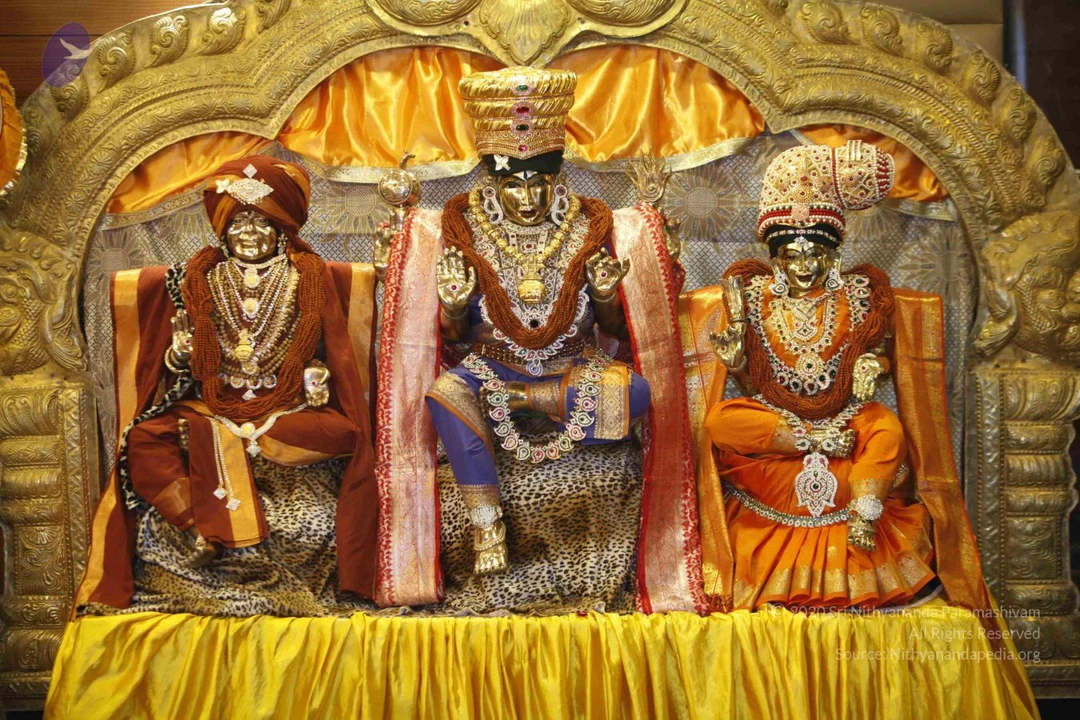
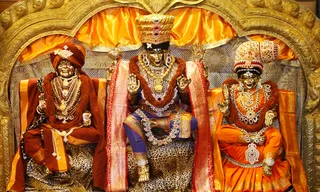
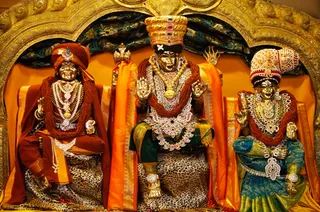
Three golden murti statues seated side by side on an ornate gilded throne framed by a gold arch with orange satin drapery. The central figure wears a tall jeweled crown, a red-and-gold shawl, a purple garment and layered gold necklaces and rudraksha-style beads, with hands raised in blessing. The figure on the left wears a rust-brown turban, a brown shawl and gold necklaces, seated on a leopard-print cloth. The figure on the right wears an orange and gold sari-style garment, a patterned jeweled headdress and layered gold necklaces, with a decorated pendant at the chest. Ornate silver and gold decorative backdrop behind them. No physical people are visible.

More photos

13 photosView all
Three golden murti statues seated side by side on a raised golden throne-like platform under an ornate gilded arch with green and gold drapery. The central figure wears a tall jewelled golden crown, a gold necklace and a white-and-red floral lace garland, with hands raised in blessing mudra. The figure on the left wears a rust-orange turban and saffron-orange shawl, with rudraksha beads and white and gold necklaces, seated on a leopard-print cloth. The figure on the right wears a red and gold jewelled headdress, a teal-blue sari with gold border, and layered gold and pearl necklaces, seated on a leopard-print cloth. Orange and gold silk fabrics frame all three figures. These are statues, not living people.A gold-coloured statue of a seated guru figure, not a living person, is the main subject. The statue wears a rust-orange turban with a jewelled ornament, a rust-orange shawl edged with gold, and layered necklaces of white beads and jewelled pendants. A rudraksha mala of rust-coloured beads hangs across the chest, and gold bangles circle the wrists. One hand is raised in abhaya mudra and the other rests on the lap. The statue sits on a leopard-print cushion against a warm orange backdrop, with a dark embroidered cloth at the top. The figure is a statue, so it is a depiction, and no physical people are present.A golden statue of a seated deity murti, shown in an ornate altar setting. The figure wears a tall gold jeweled crown with red and green stones, a black cloth band, and a heavy rudraksha-style brown bead mala over an elaborate white and red embroidered garment. It has a gold necklace with a central gold pendant, green silk lower garment with gold border, and a leopard-print seat cushion. Orange silk drapes frame the figure, with a gold trident-like ornament on the right side. The hands are raised in abhaya and gesture mudras. Since this is a statue, no physical people are present; the a person field reflects only that the page links this image to the event, and no in-person figure is shown.A man seated cross-legged on an ornate gilded throne with carved lion heads and a red-and-gold backdrop, smiling with both palms raised in greeting. He wears an orange-red turban with a jewelled ornament at the front, an orange-red robe, a long rudraksha mala necklace and multiple rudraksha bracelets on both wrists, and is barefoot. Red velvet cushions with tiger-stripe patterns flank the throne, and a red backdrop with partial script is visible at the right edge. Appearance-based candidate: Swamiji (probable), seated in person as the presiding speaker at a satsang-style setting, identified by the saffron/orange turban, rudraksha malas and ceremonial throne.A smiling man in an orange-saffron turban with a green and gold emblem sits cross-legged on an ornate gold throne with red cushions and carved golden lion heads at each side. He wears a saffron robe, multiple rudraksha mala necklaces, and beaded rudraksha bracelets on both arms, and raises his right hand in a blessing gesture. A red backdrop with partial gold lettering is behind him, consistent with a satsang stage setting.