Skip to content
Tuesday

3 December 2013

Nithyananda Diary | Inner Awakening Bali Day - 3 | Padukapuja | Satsang | Niraharasamyama | Sarvadarshan

Dated photos
156
Source pages
1
Media
2
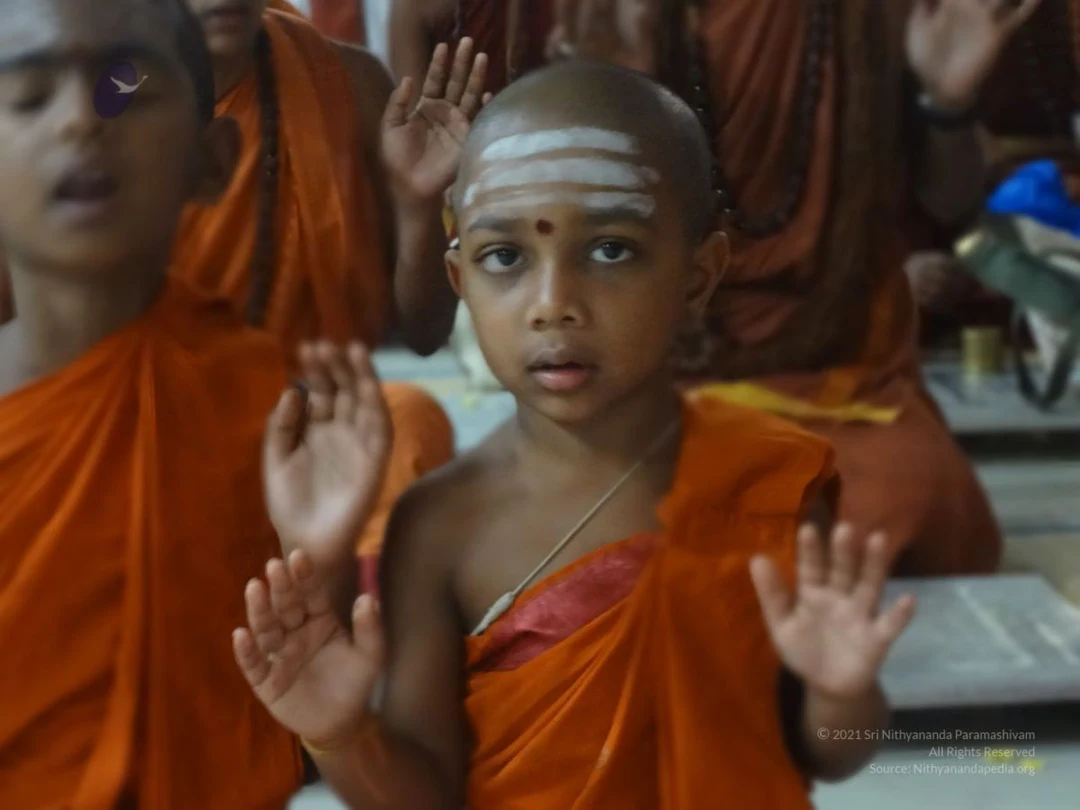
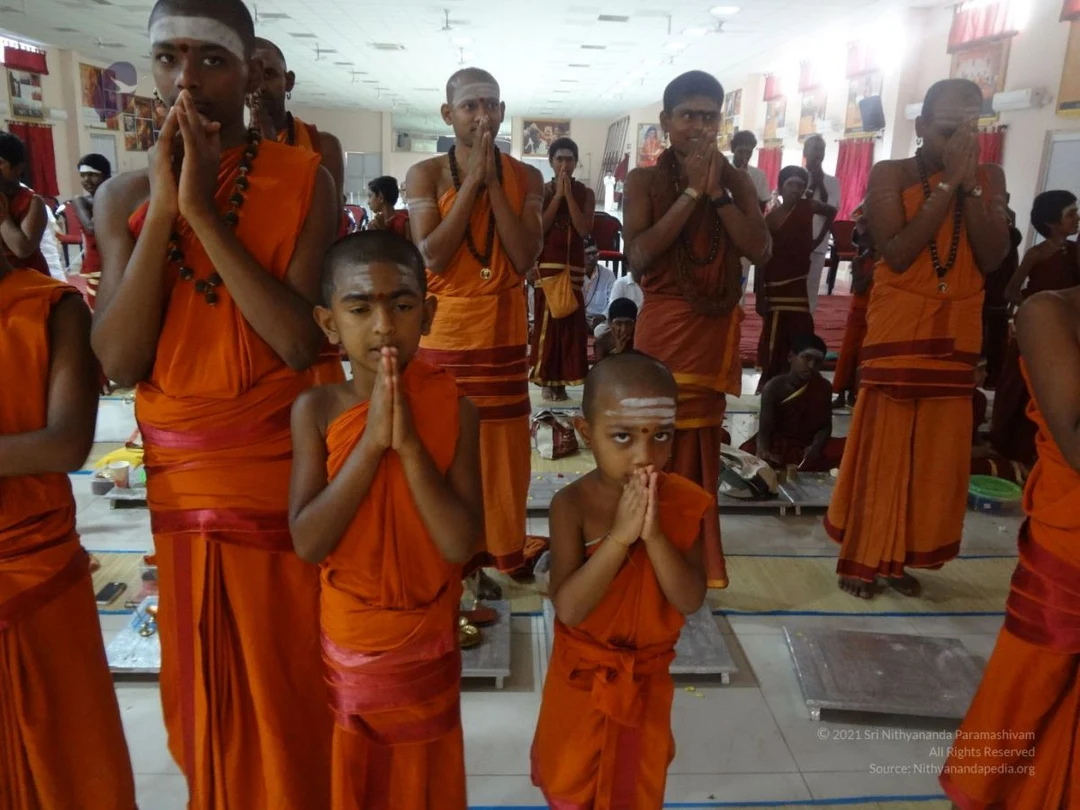
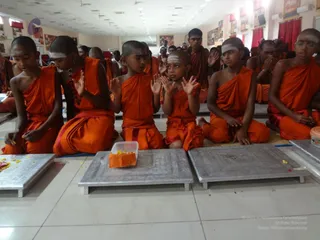
A young shaved-headed boy in saffron-orange robes sits among other orange-robed participants, raising both palms outward in a gesture of devotion or blessing. He has white urdhva-pundra style marks and a red bindi on his forehead, and a thin cord is visible across his bare chest. Behind him, several seated figures in orange and rust-coloured robes and rudraksha beads continue the chanting or ritual. A white cloth and a small brass object are visible on the floor at right.

December 03 2013

Original wiki page
Contents

Title

Nithyananda Diary | Inner Awakening Bali Day - 3 | Padukapuja | Satsang | Niraharasamyama | Sarvadarshan

Description:

In today’s morning satsang from Bali Paramahamsa Nithyananda introduced us to the science of neuron mirroring, using an example of someone standing on the beach watching another person swimming and experiencing the same brain activity as the person swimming. He said that when we sit in Upanishad with an enlightened master our brain will mirror his state of completion. This was followed by the Nirahara Samyaa meditation.

Link to Video:

VideoAudio

Transcript:

Nithyanandeshwara Samaarambhaam Nithyanandeshwari Madhyamaam | Asmath Aachaarya Paryanthaam Vandhey Guru Paramparaam ||

00:50 Hindi - 00:59

I welcome all of you with my love and respects. I welcome all the devotees, disciples, samajis, satsanghis, sitting with us through Nithyananda TV, Lotus new schannel Sadhna TV, Janashree TV, Eshwar TV, , and through two-way video-conferencing, Sadhna TV all over the world

Cities sitting with us in two-way video-conferencing: Devon-UK, Ohio-Prayag, Paris-Kalighat, Santa Fe-New Mexico, Los Angeles-Arunachalam, Tiruvanmiyur-Chennai, Bangalore North, San Diego-La Jolla, Dubai-Vaidyanatham, Port Washington-New York, Bidadi-Nithyananda Nagara, Oklahoma-Somanatham, Seattle-Chidambaram, Surrey-British Columbia, Toronto-Kailasam, Hyderabad-Gupta Kashi, Nithyananda Nagaram-Hyderabad, Singapore-Singapuram, Bogota-Colombia, San Jose-Madurai, Warrington-UK, Oman-Sivagangai, Dakota Dunes, Kuala Lumpur, Kathmandu-Nepal, Jorpati-Nepal, Enriching Temple-Bidadi, Paris-France, Alice France. So I welcome all of you with my love and blessings. Today third day. Oh now there’s one more centre joining the Sannyas Padayatra from Rajapalayam on the way to Bidadi they are joining blessings to all the Sannyasis doing padayatra.

Today be ready for a mind blowing Satsang!

I am introducing one of the sacred secrets, the spiritual principle to all of you.

Please listen to the key word: “MIRROR NEURONS.” Let me explain the concept then we will re-cognize many of our understandings with this truth, as I said re-cognizing is recognizing.

Mirror Neurons. Very recently I was studying a research paper where they beautifully established with various analyses, researches, one very powerful truth. For example, if somebody is swimming in the ocean, you stand and watch, whatever brain activity is happening in that person’s brain, whatever activities are happening in his brain, in his neurons – please listen – even if you are watching, the same activities are mirrored in your brain, the same neuron activities are mirrored in your brain.

Listen. If you are watching totally, the same effort is mirrored totally in you. If you are absorbed in it, you also know a little swimming – please listen – if you know a little swimming and you are absorbed in it, you are not swimming but you are just standing, both brains are in the same frequency, the same effect, and no difference!

Listen. If somebody is swimming in the ocean, you are standing and watching, if you don’t know swimming, if you are not completely absorbed in it, may be some 80% is mirroring. If you are absorbed in it and you also know swimming, there is no difference at all between his brain and your brain. The mirroring effect, I tell you, if you are watching totally absorbed in it, then the same activity is replicated in your brain. Meaning the same kind of electrical and neurological impulses are activated in your brain. This defines, this de-mystifies many mystical phenomena.

Please listen. Now you know why just by gazing into my eyes you are in the space of Completion, why just looking at me you are in the space of Completion. I am swimming in the Ocean of Consciousness in the space of Completion. Even in these so-called moments of my screaming, whether I am smiling, telling a joke, or rat-a-tat-tat! That is why, even if you are absorbed in what I am doing, even if you are absorbed in the jokes I am telling you, even you are absorbed in the actions, like very mundane, me serving food or ordinary actions – walking, sitting, talking, joking, even in the ordinary actions. See, you will not get 100% absorbed in me if I am sitting in Samadhi; but if I am doing normal activities, like you will feel comfortable – ‘Oh, like us’ – naturally you will get absorbed. Even that feeling absorbed will put you in the space of Completion. This is the reason why the gold, diamonds, silk are all put on the deity. Even if you absorb all that ornaments, even that puts you in the space of Completion.

Usually, you don’t have the 100% capacity to listen or to be absorbed with the happening called “life”. But if you start doing both, your whole 100% will be on me. How many of you are getting it? Only listening 100%, you will not be able to do! Only absorbing 100%, you won’t be able to do. But that is why here I am playing multiple games. It is literally like a big circus! By the time you understand the joke and start laughing, I have already moved on to some other verbal jugglery or brain candy. So, naturally, you are absorbed in total absorption. Actually, total absorption, totally being absorbed happens during Energy Darshan. Whether you are there or not it’s my job I just pull you to that space during Energy Darshan, so you cannot escape, and you have to vibrate in the same frequency as me. That is why people don’t know ABCD of life, just after the twenty-one energy darshans and they go back it is totally different, their life is different.

In this Level-4, fortunate and blessed are you guys. I can take you to the next level of initiations, not just darshans, because, almost all of you have gone through the initiations, gone through many initiations and darshans; now your body is ready to vibrate. As I said, if you already know little swimming and absorbed in somebody’s swimming, there is no difference. Same way, you already know darshans and initiations. See, if that person does not know swimming, not completely absorbed, only 80% mirrors. If he knows swimming, the observer if he knows swimming, and he has absorbed 100% he just mirrors. Almost all of you know initiations and energy darshans; it is not new to your body. Is only one person I heard was a little afraid, and the person expressed to me in energy darshan. I said, ‘don’t worry, I‘ll slowly prepare your body and give you the darshan. Slowly I prepare your body and mind. You don’t need to worry about it.’ Other than that one or two people, every one of you know darshan, initiations.

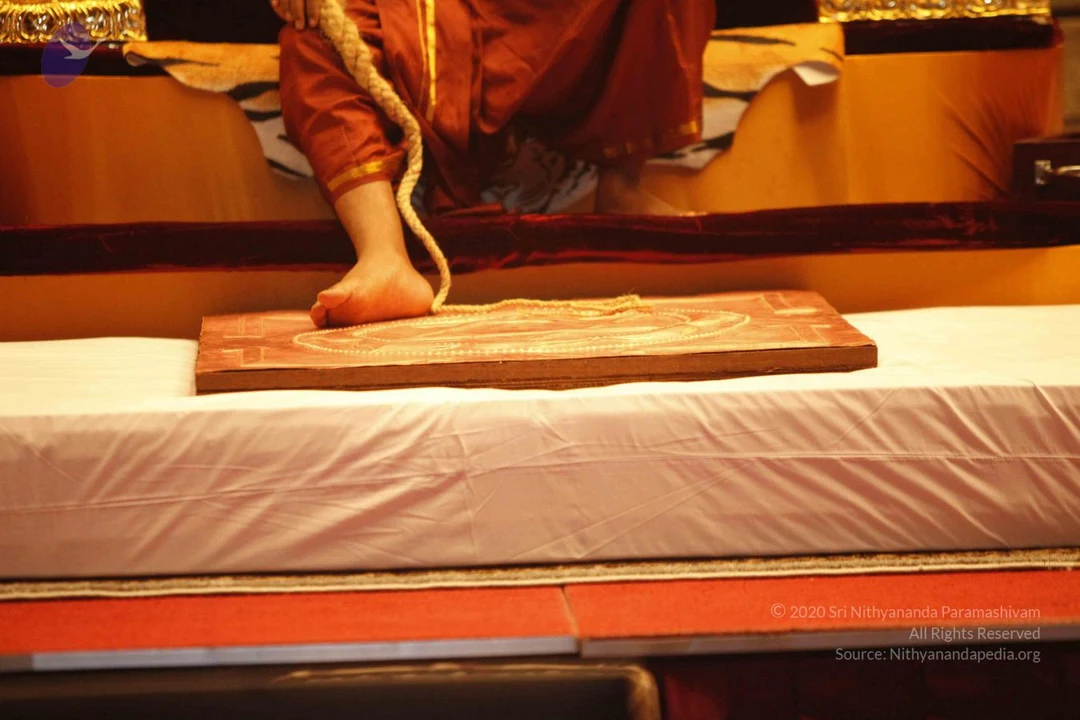
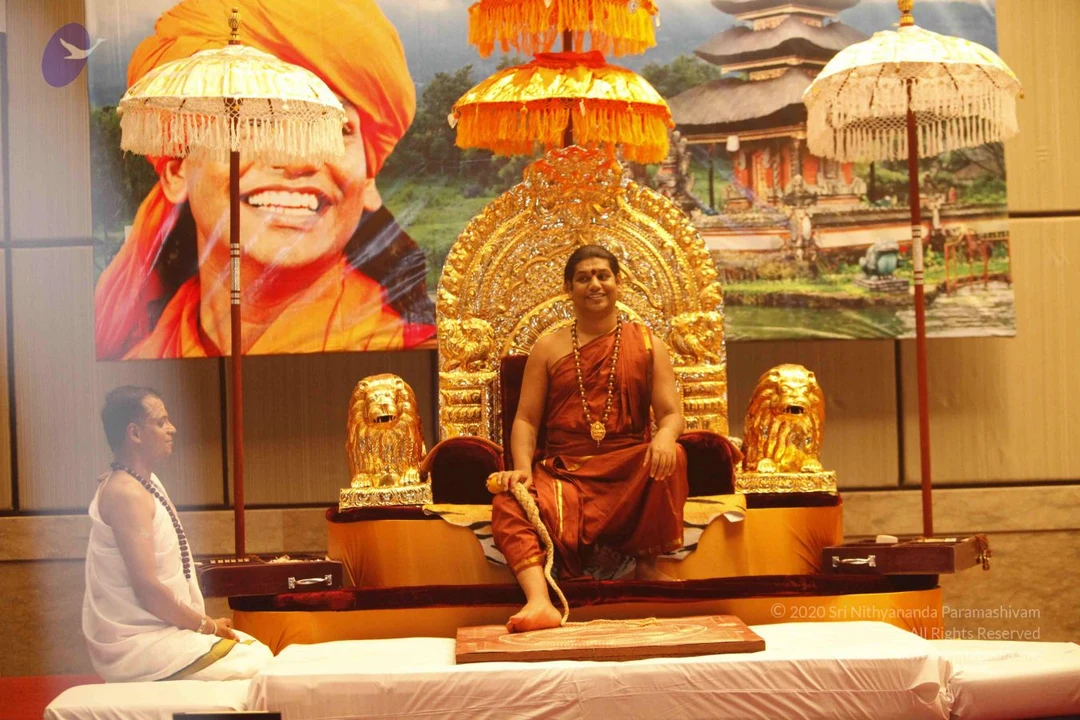
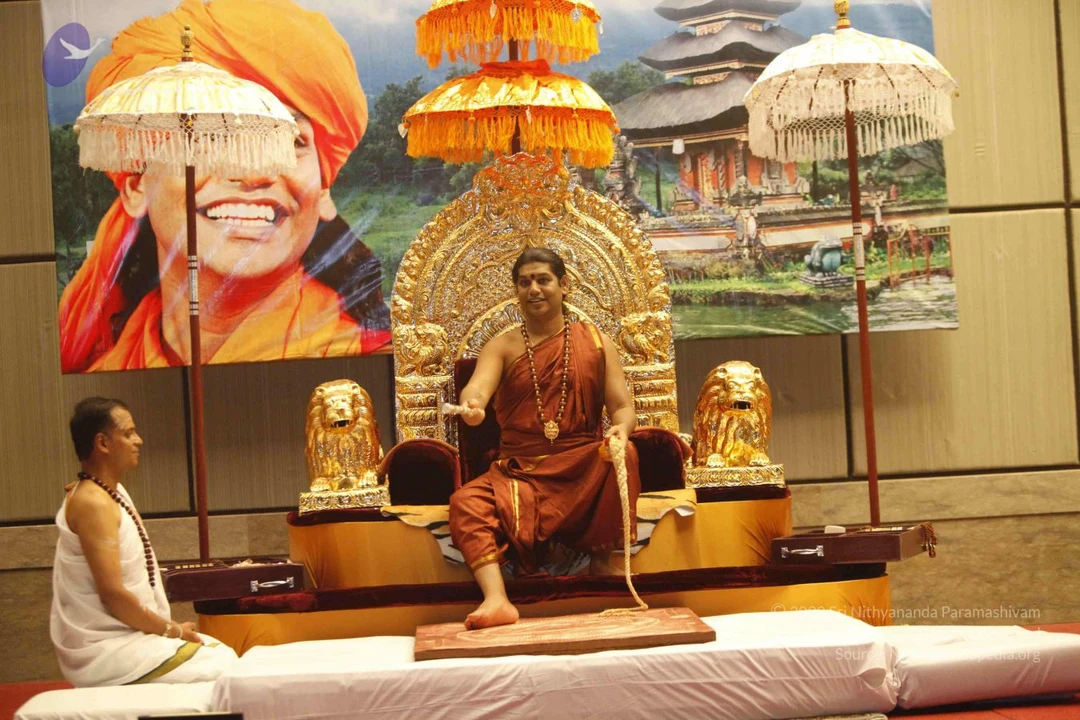
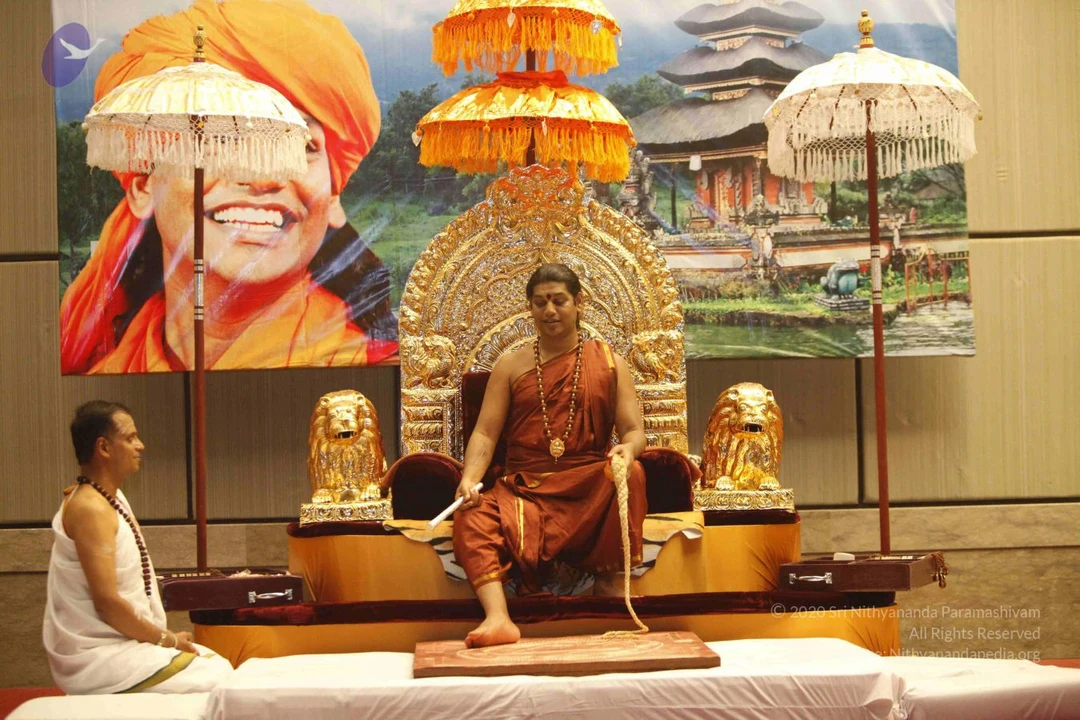
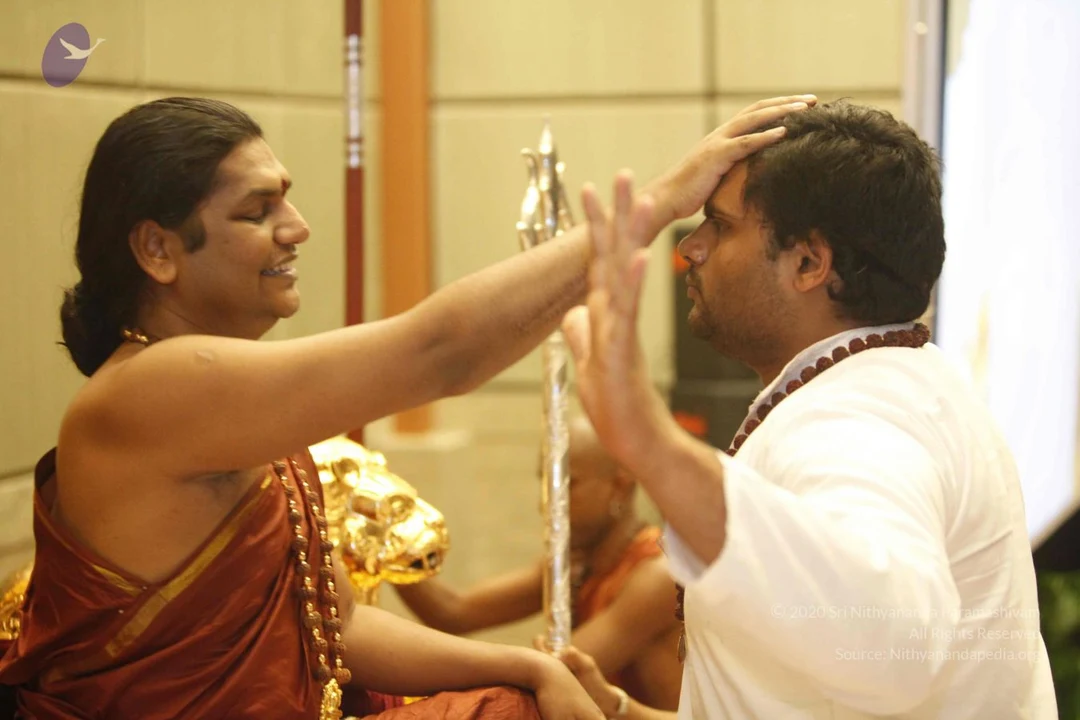
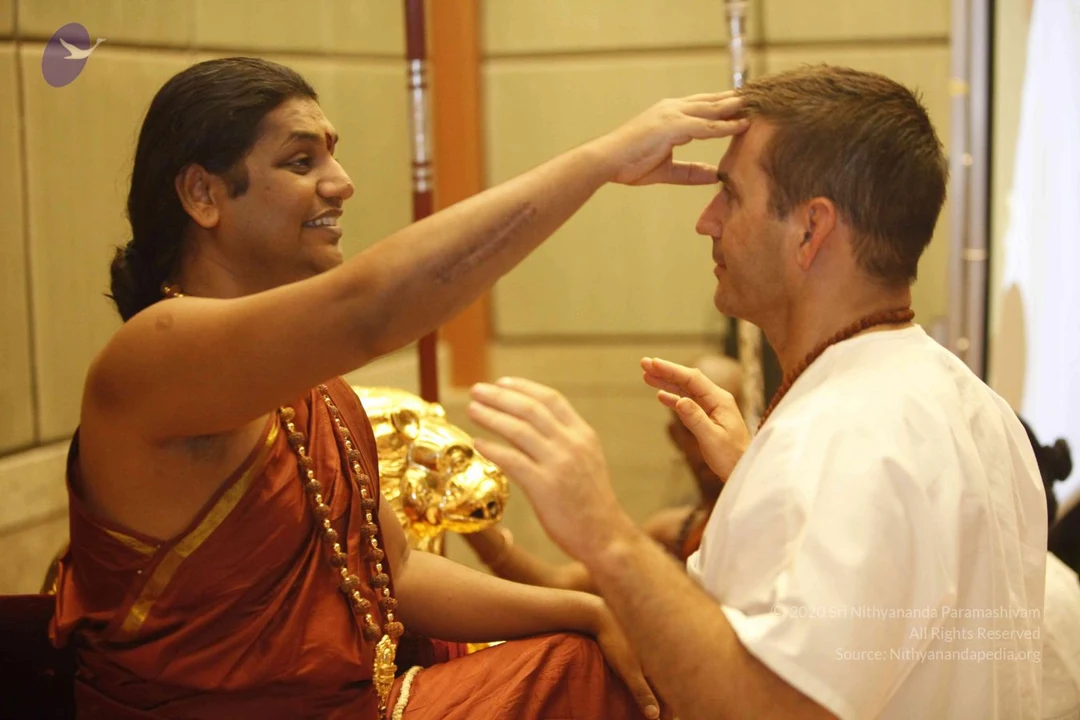
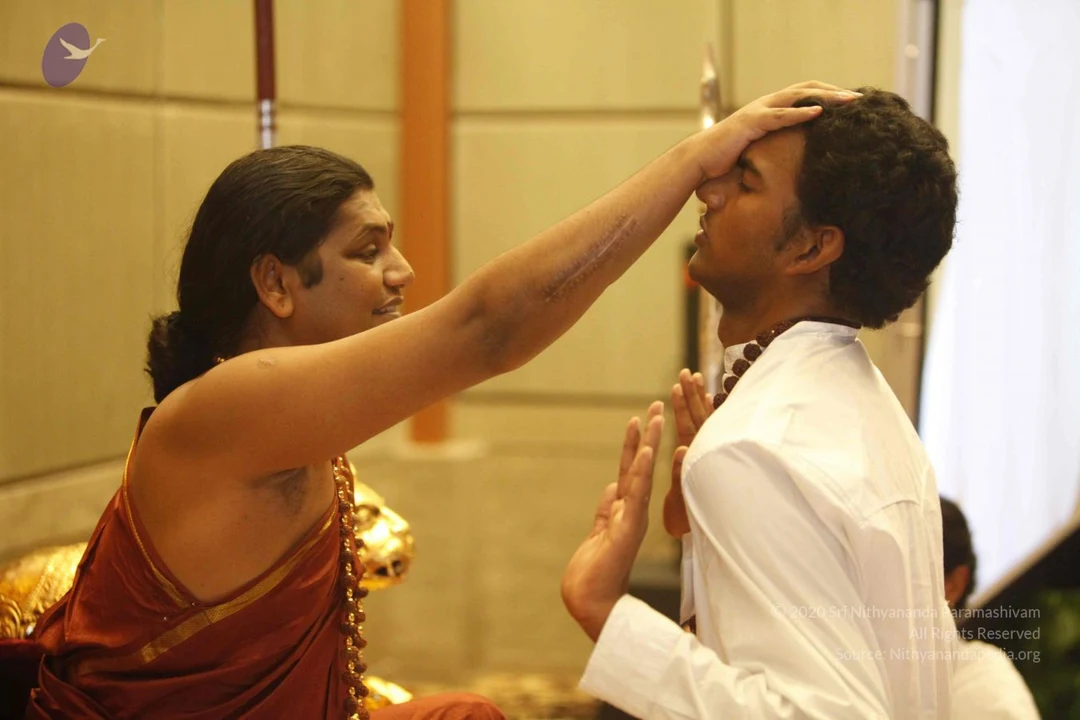
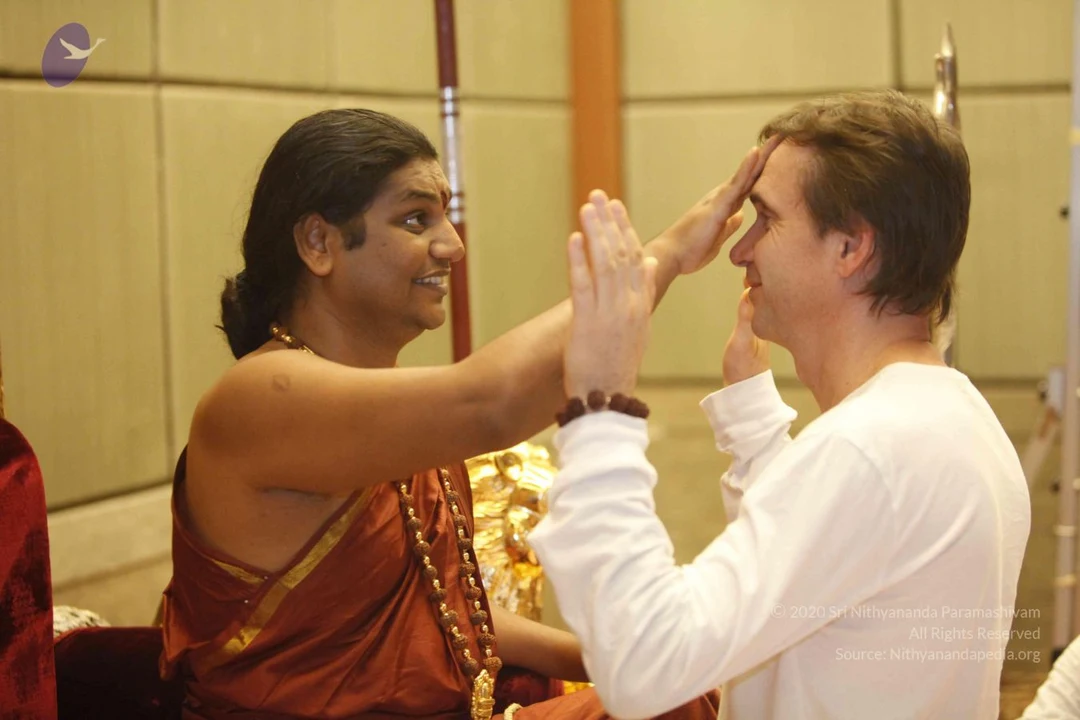
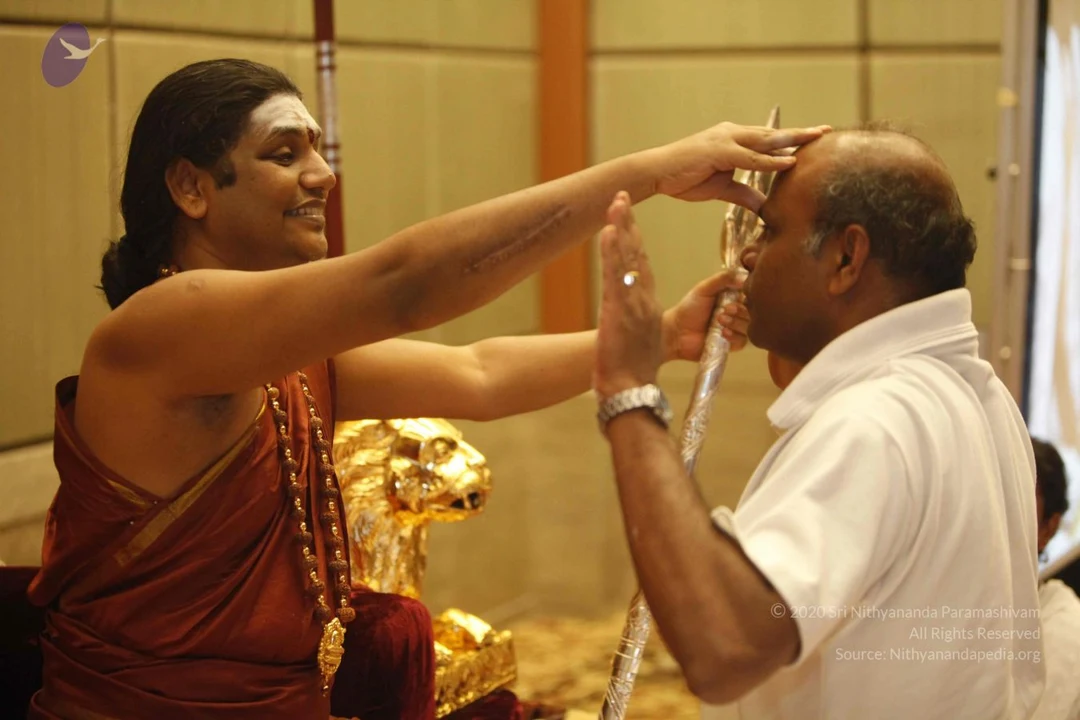
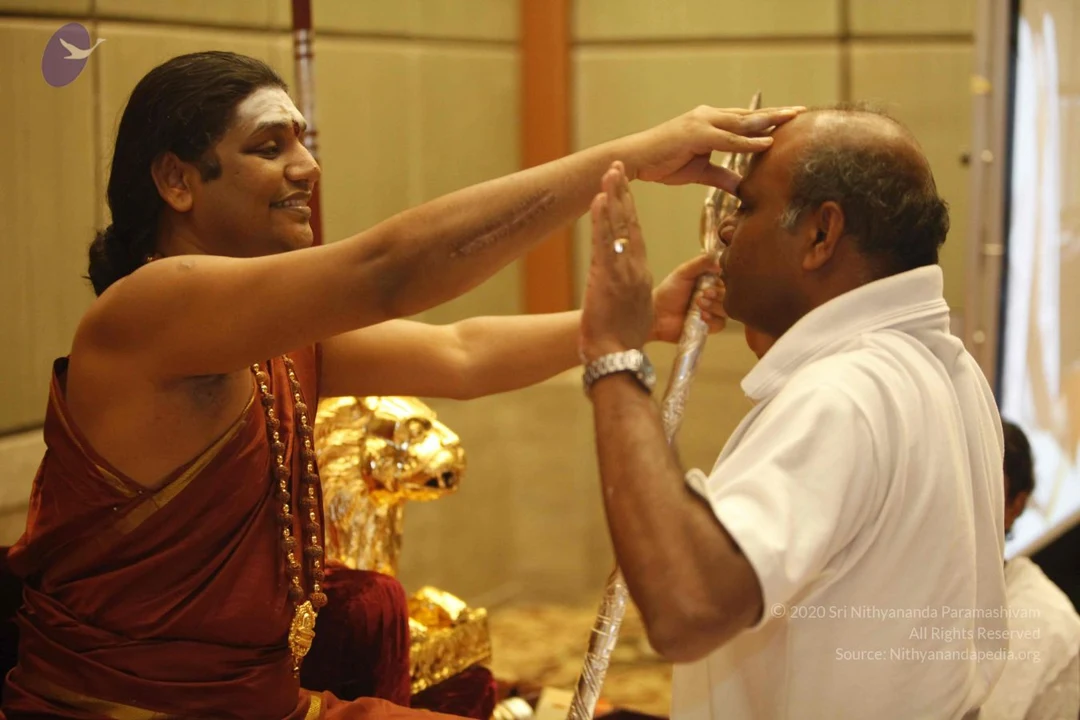
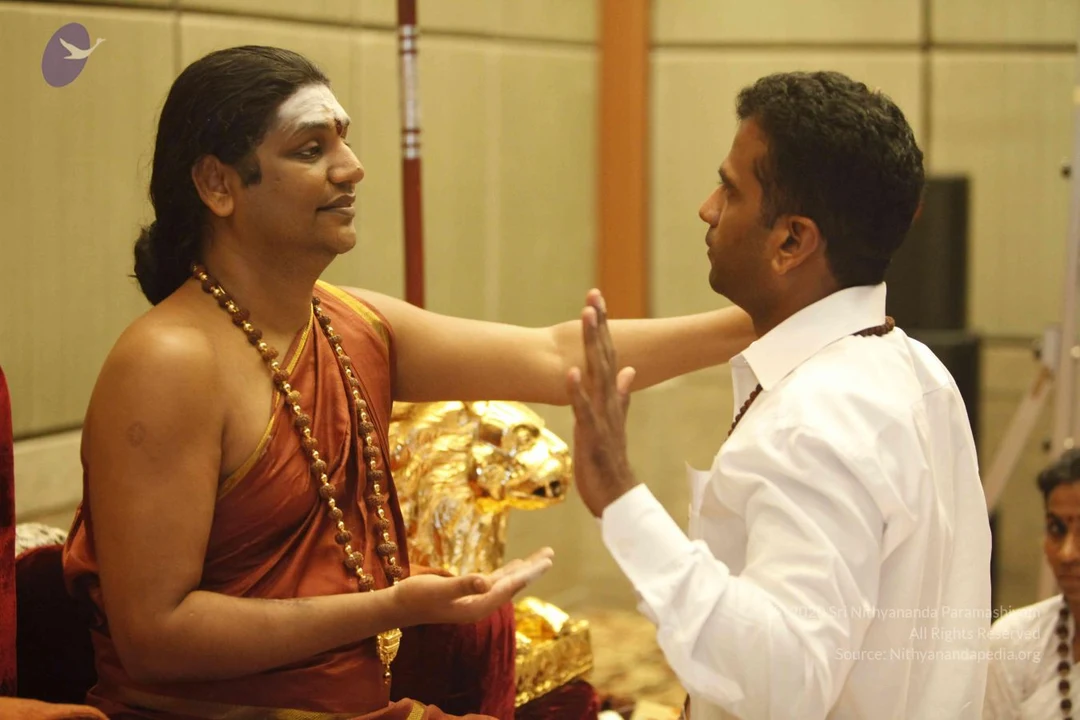
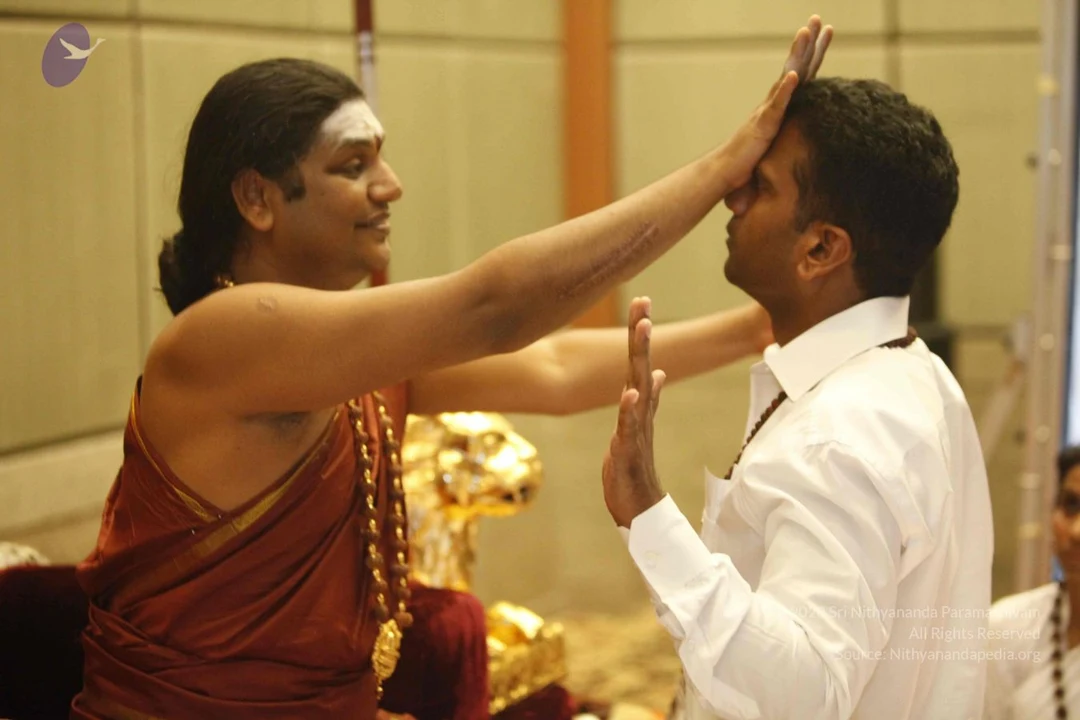
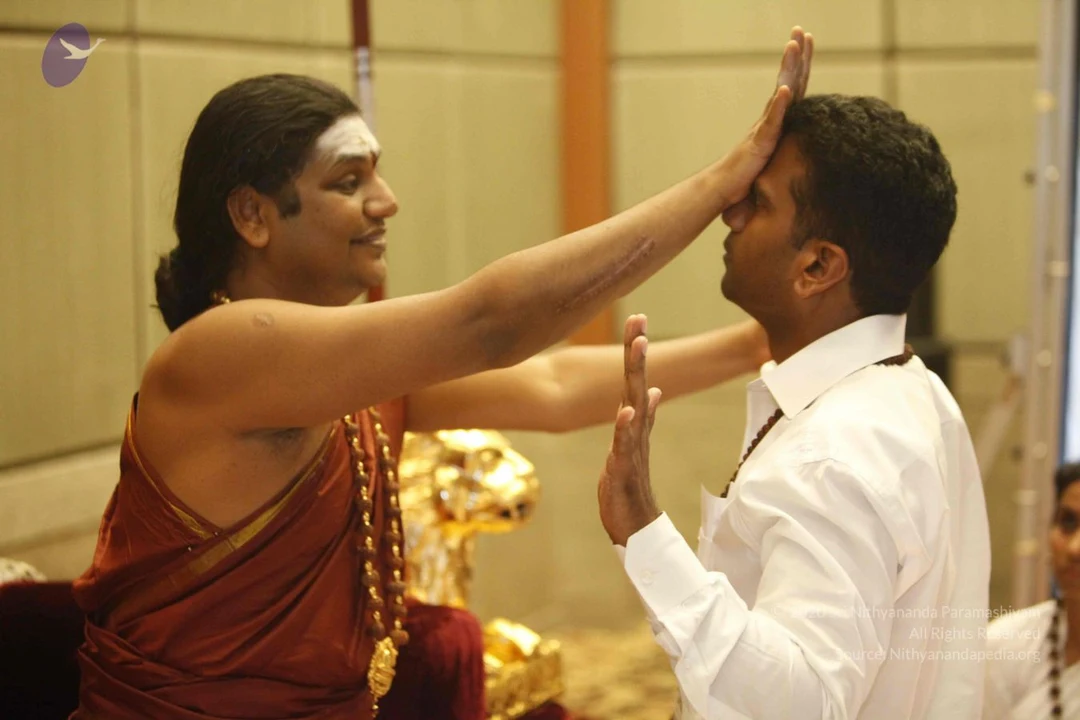
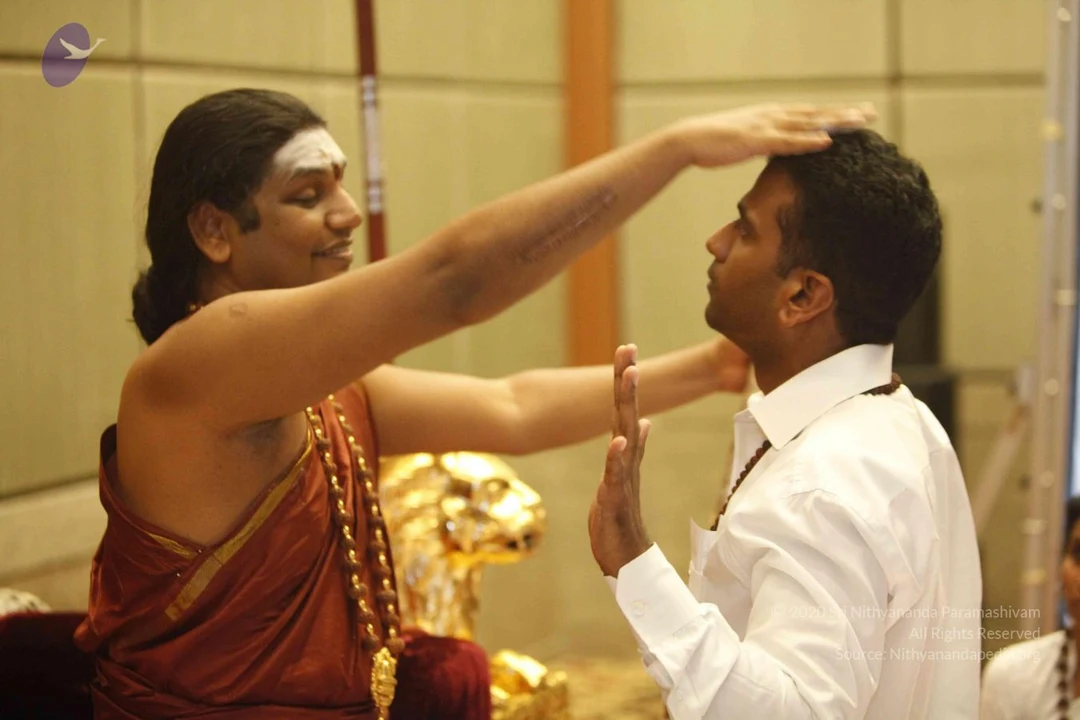
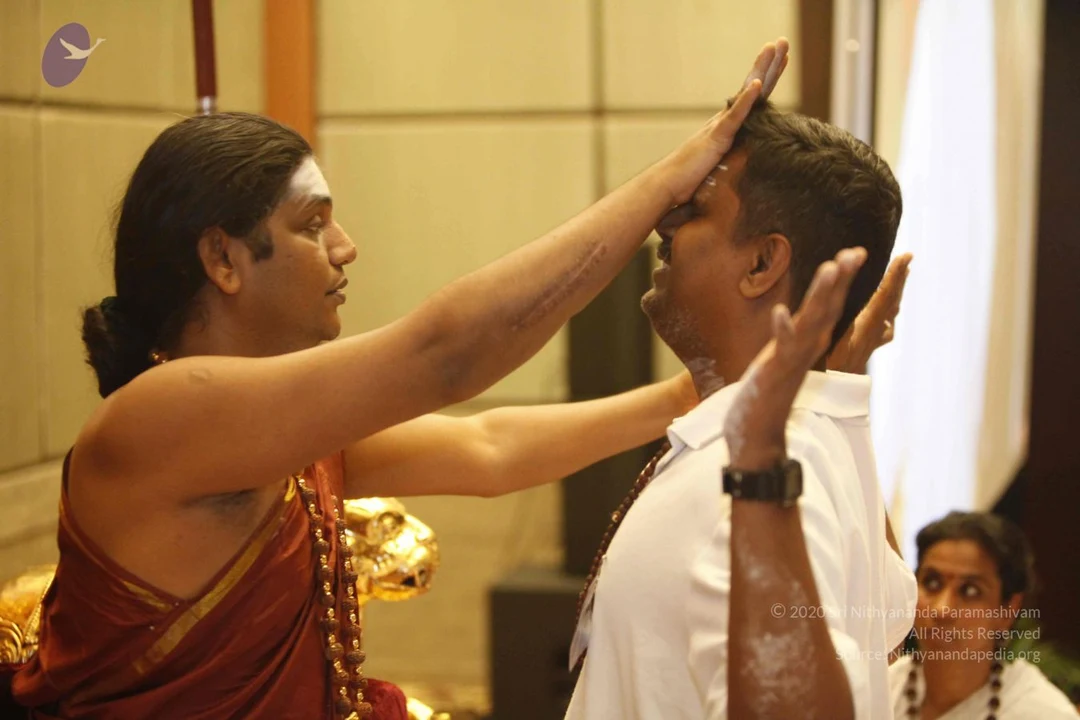
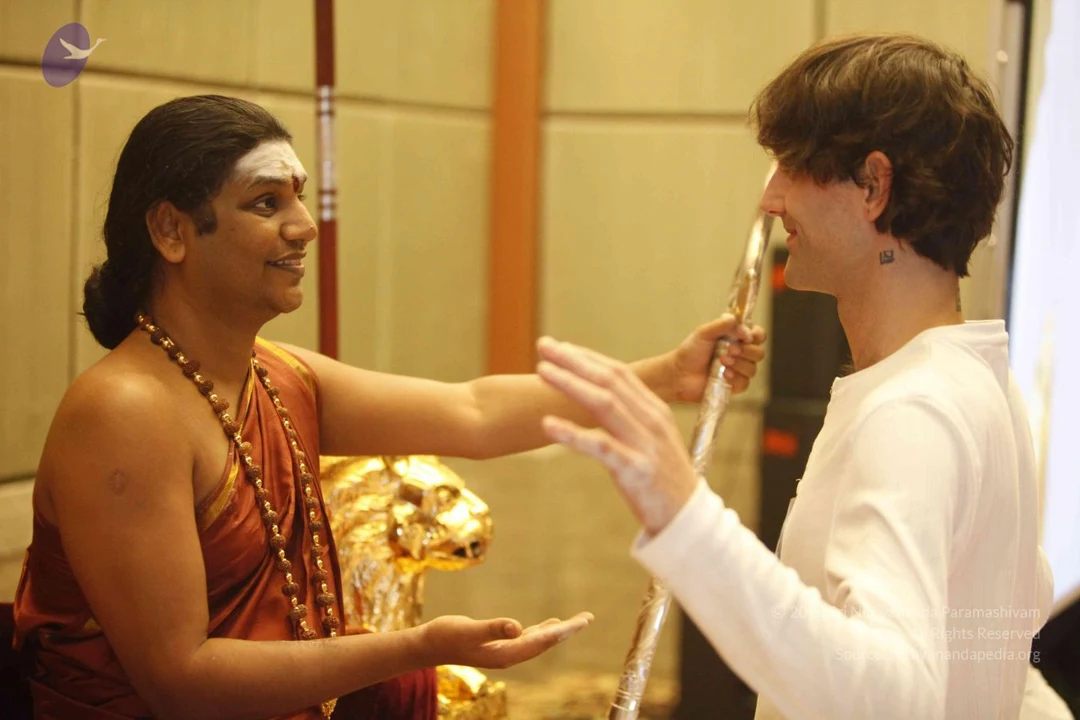
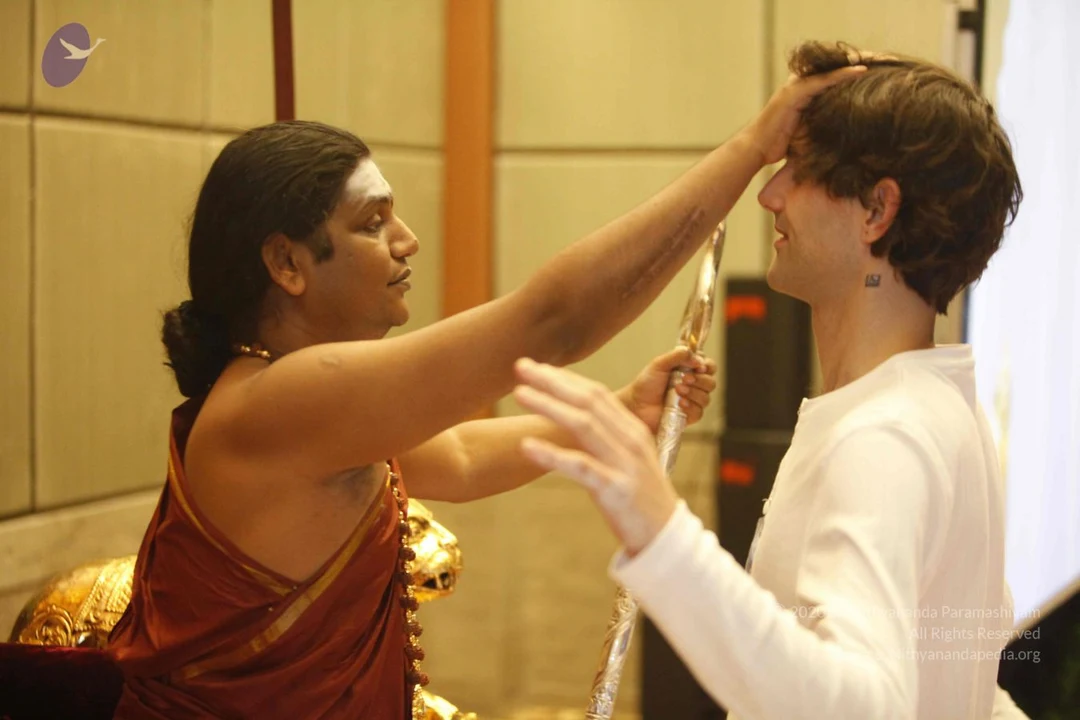
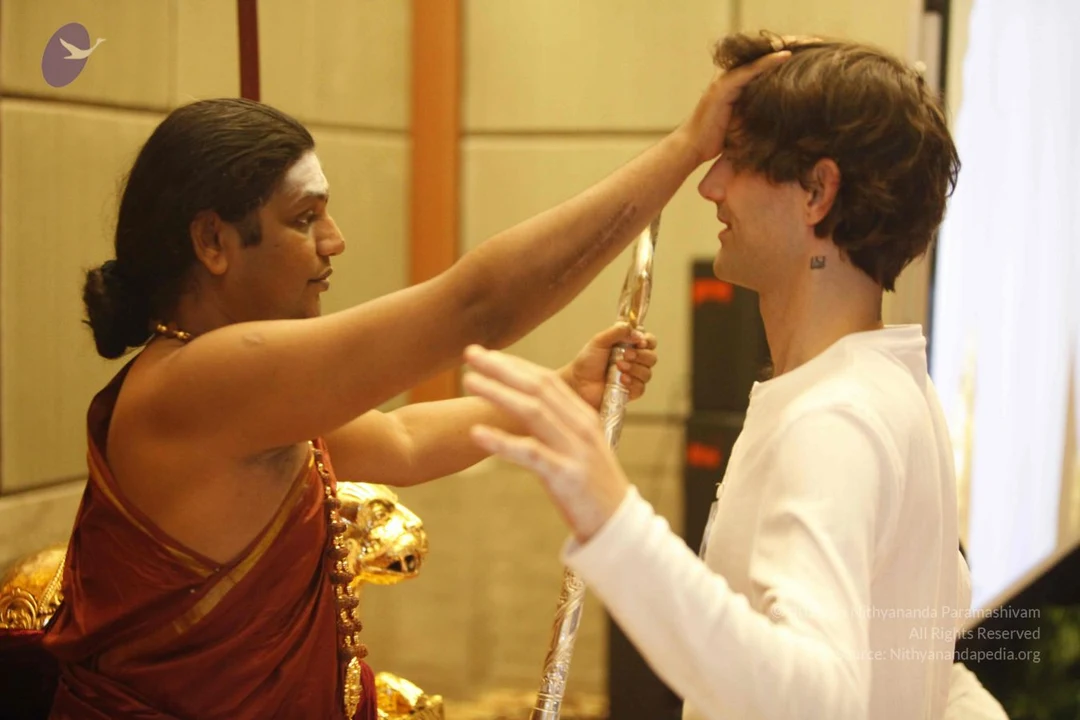
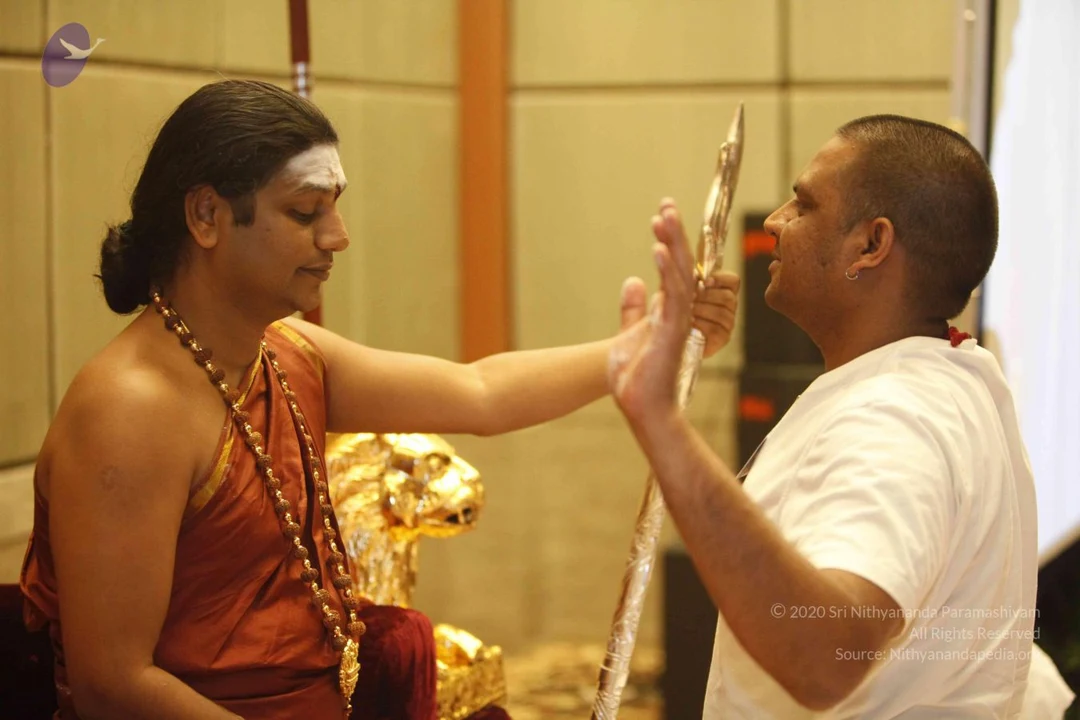
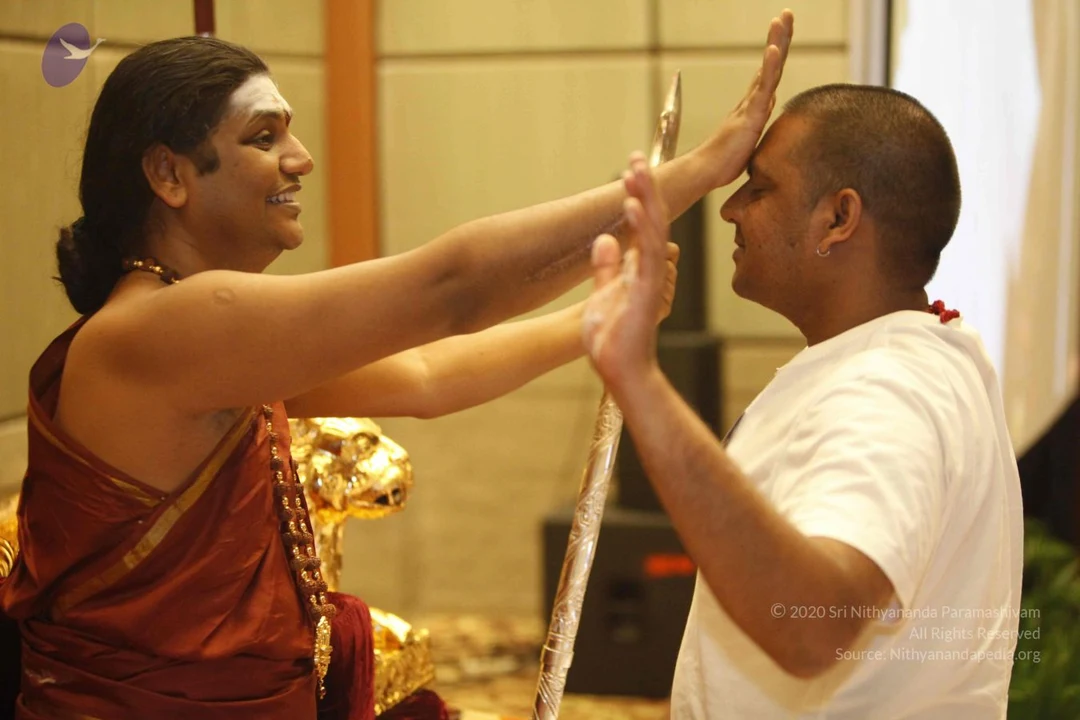
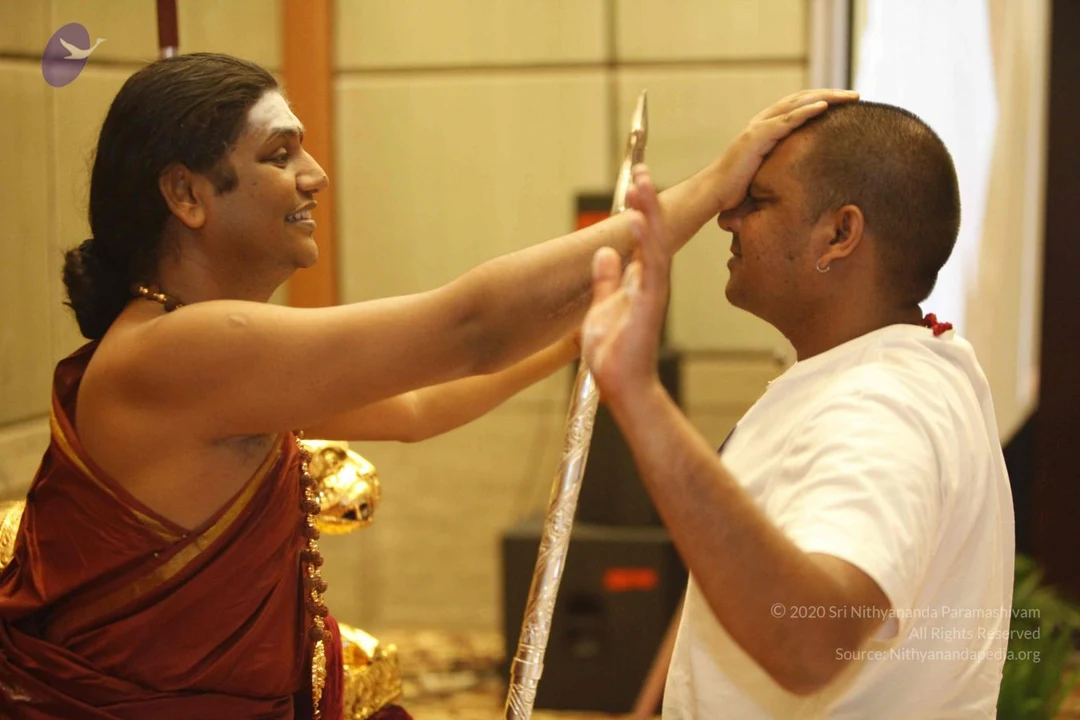
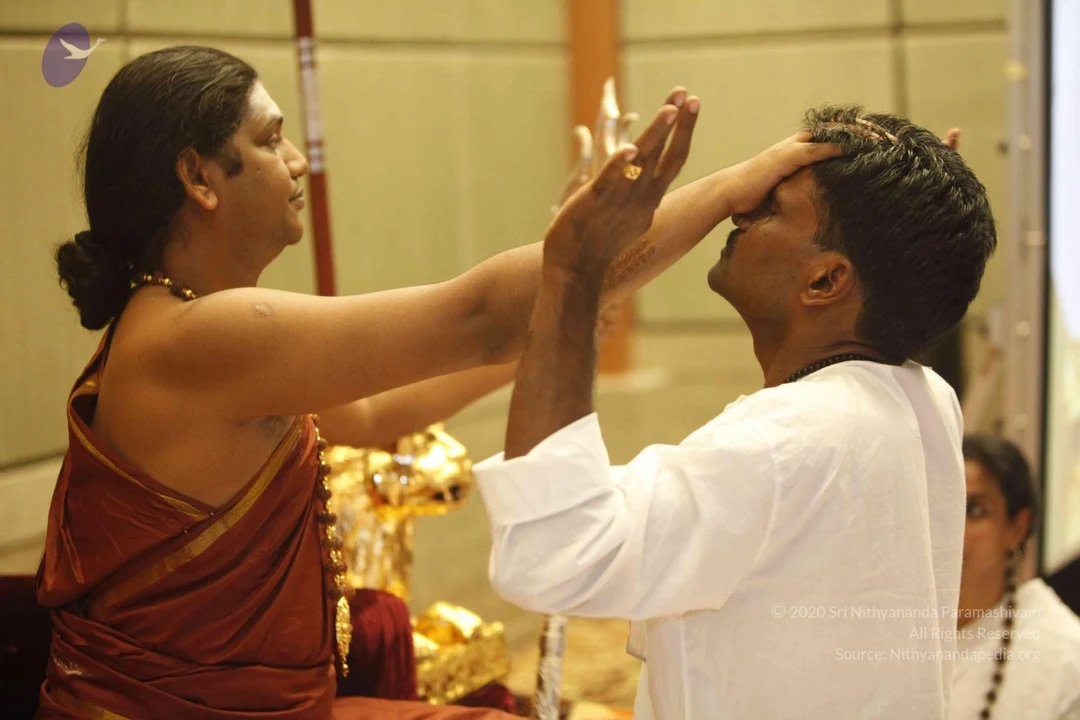
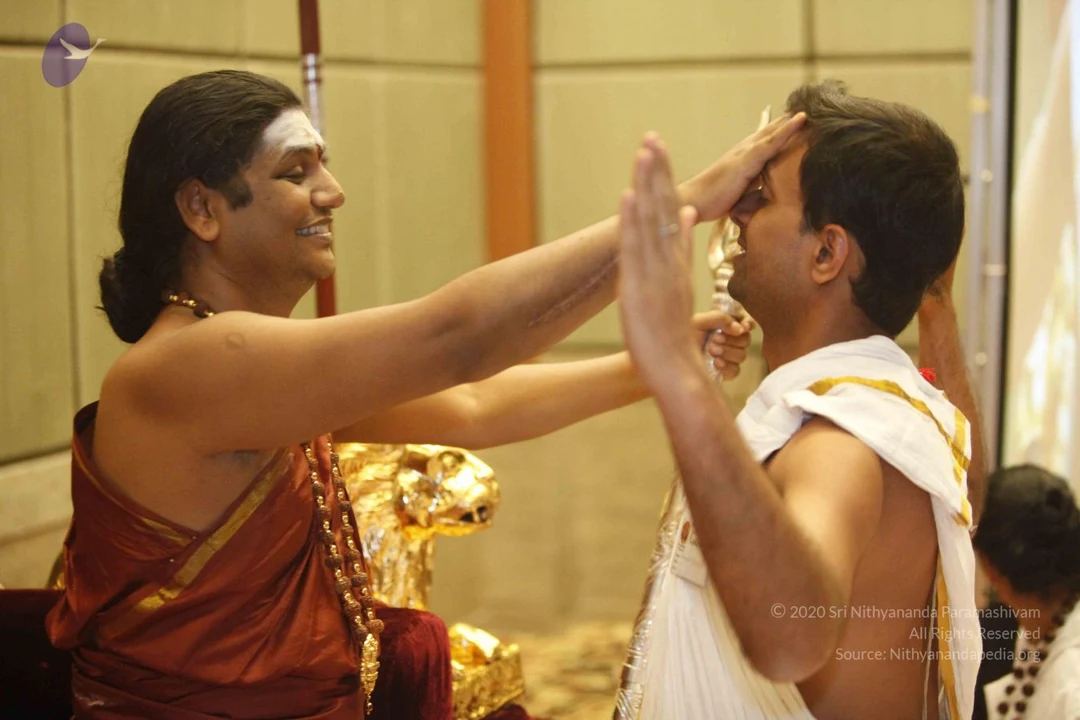
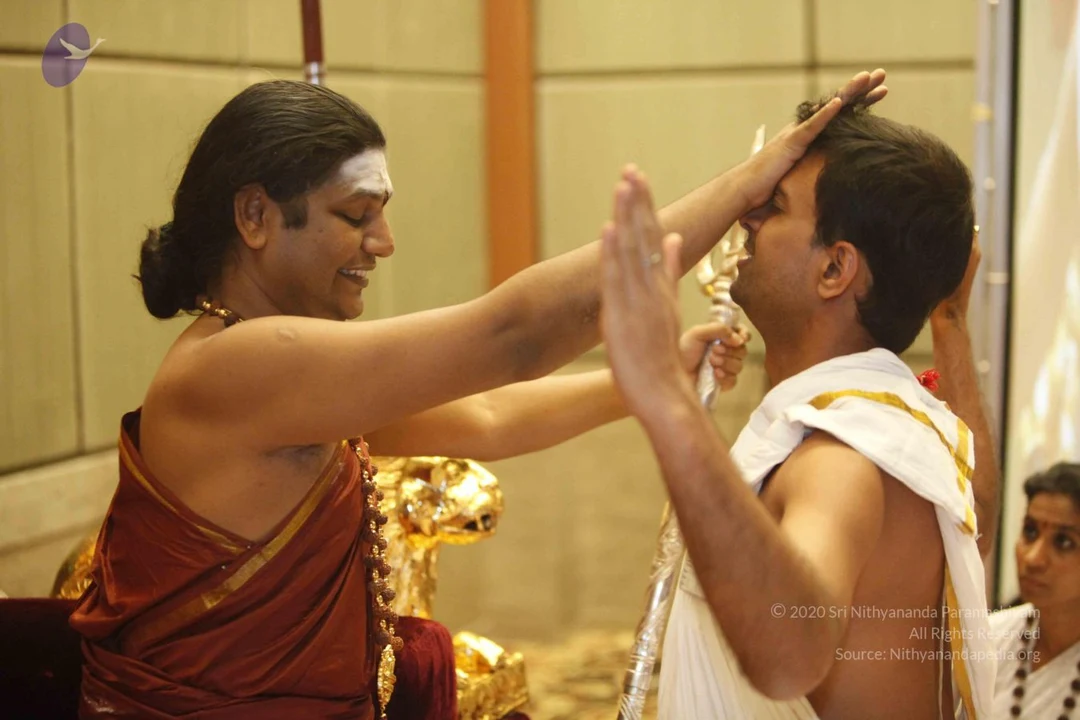
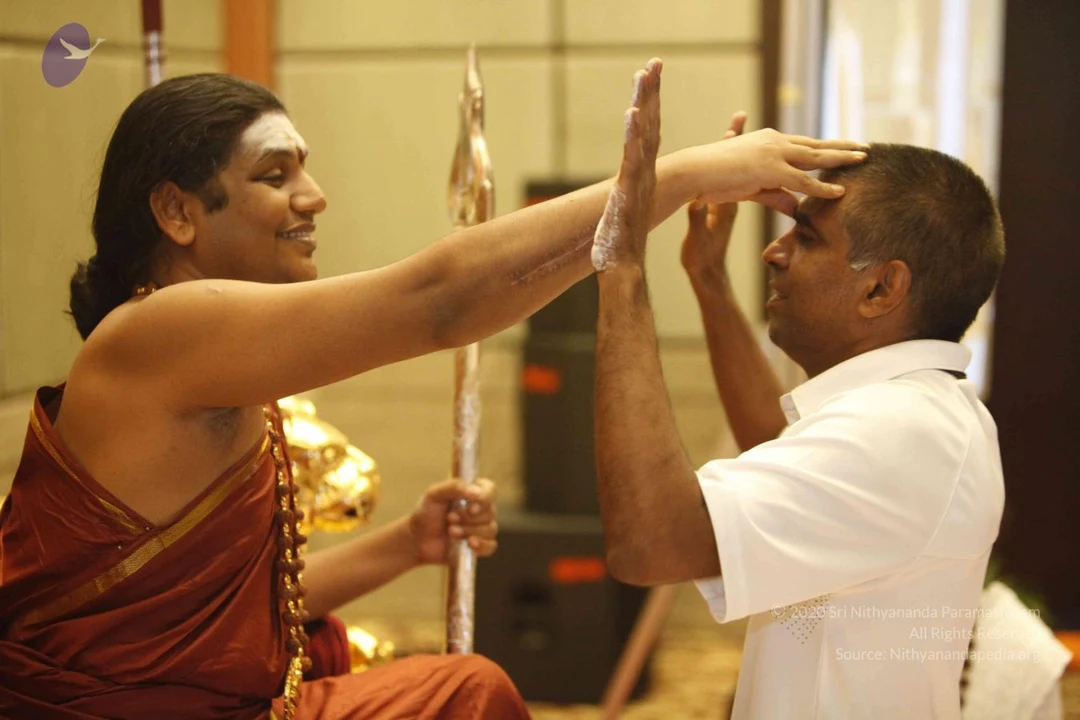
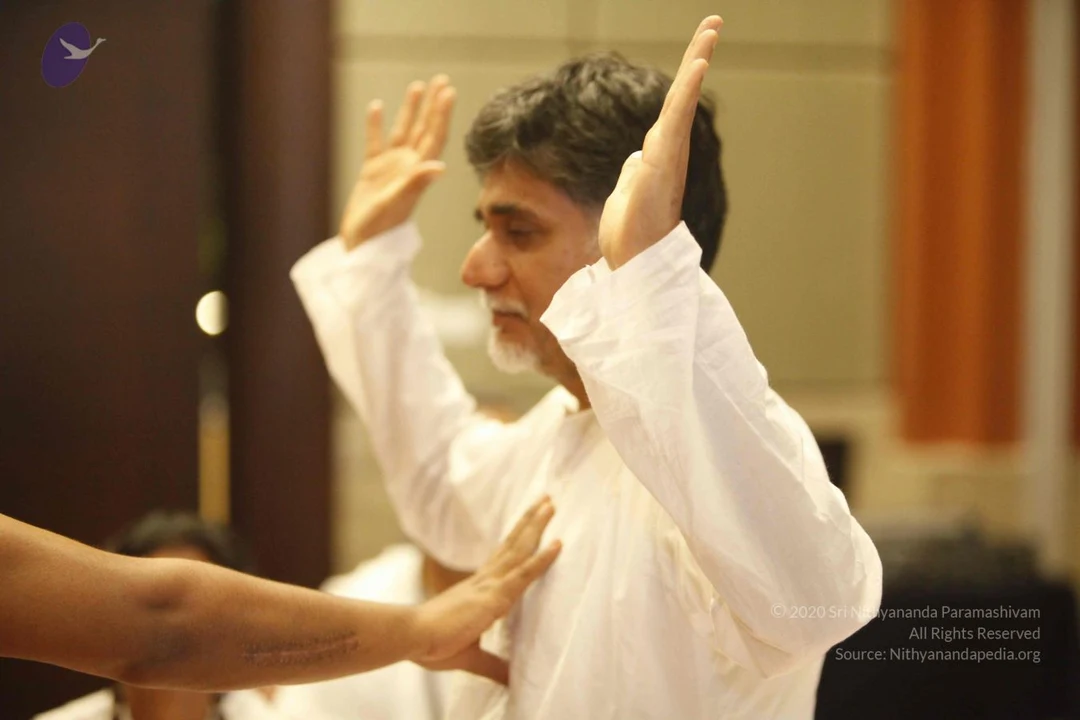
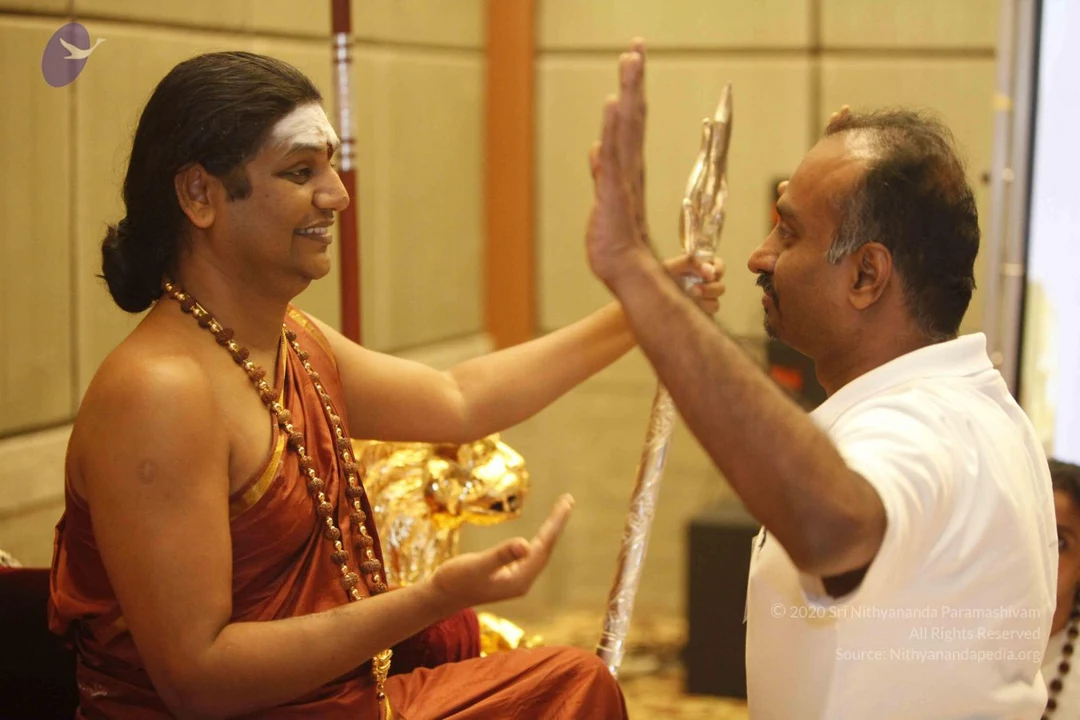
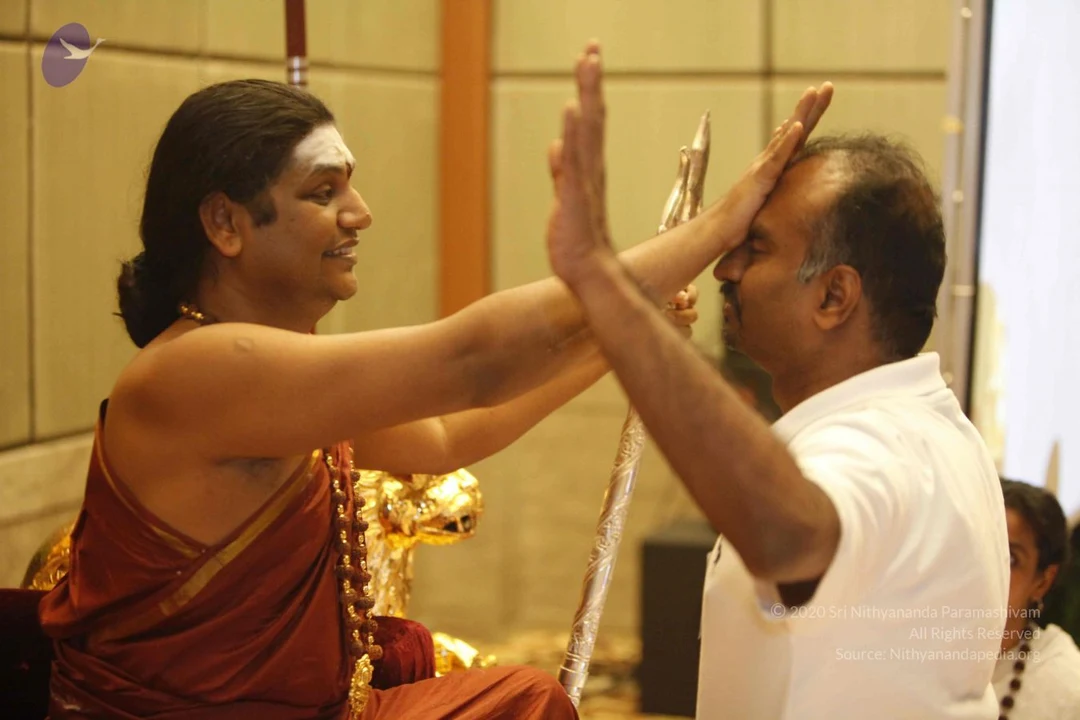
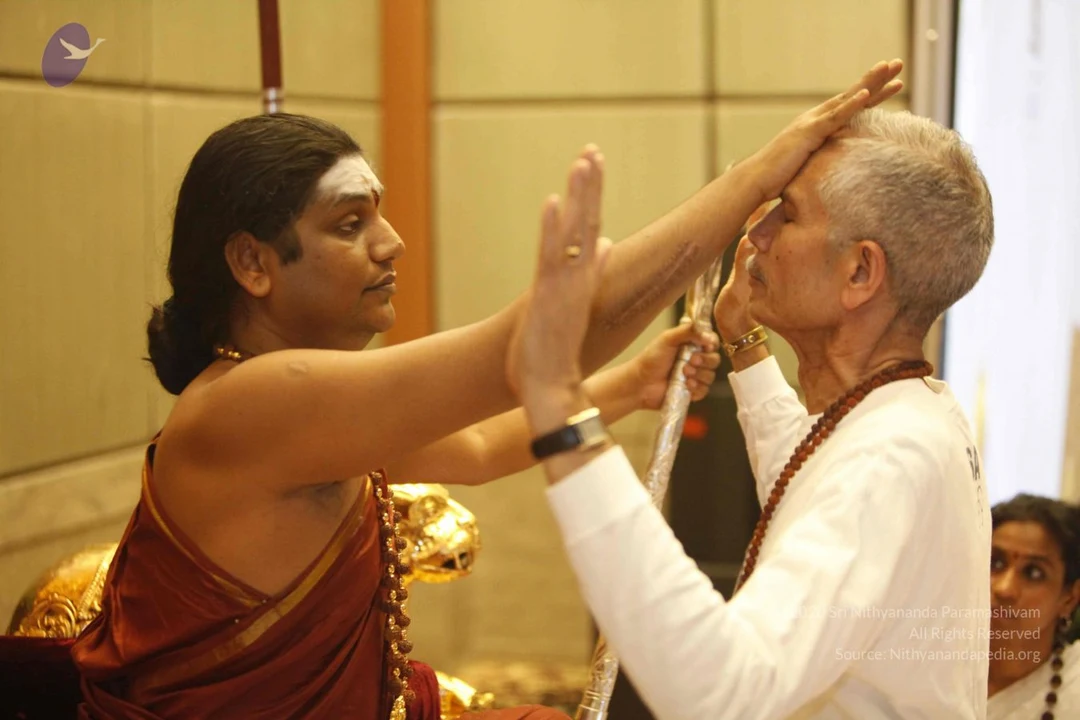
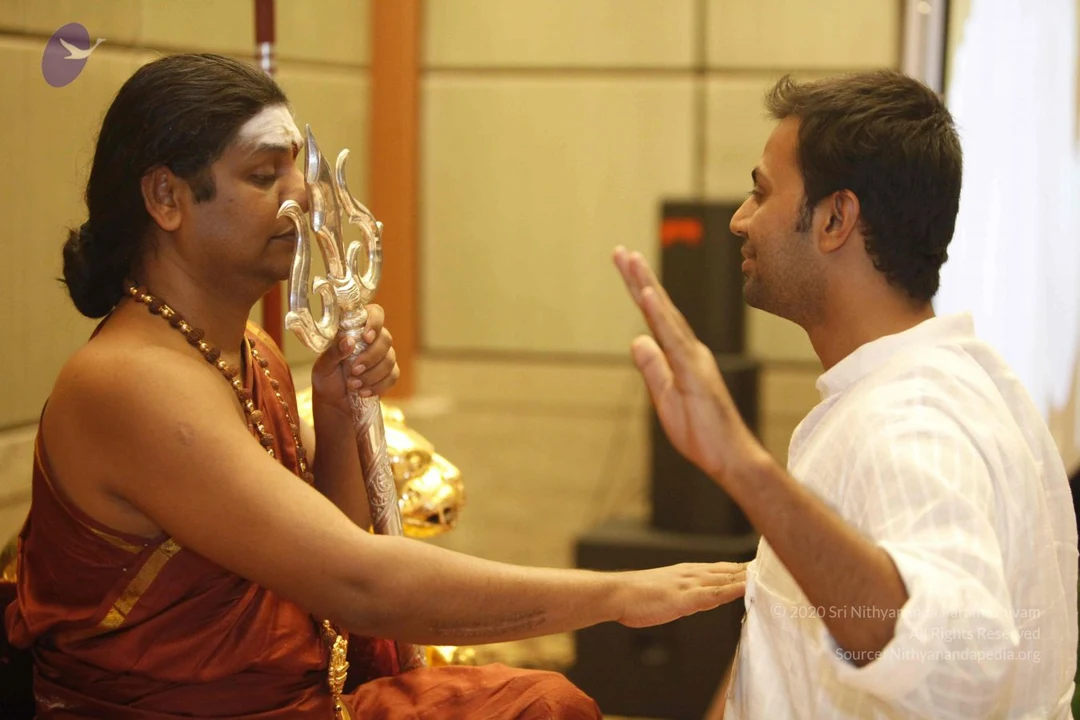
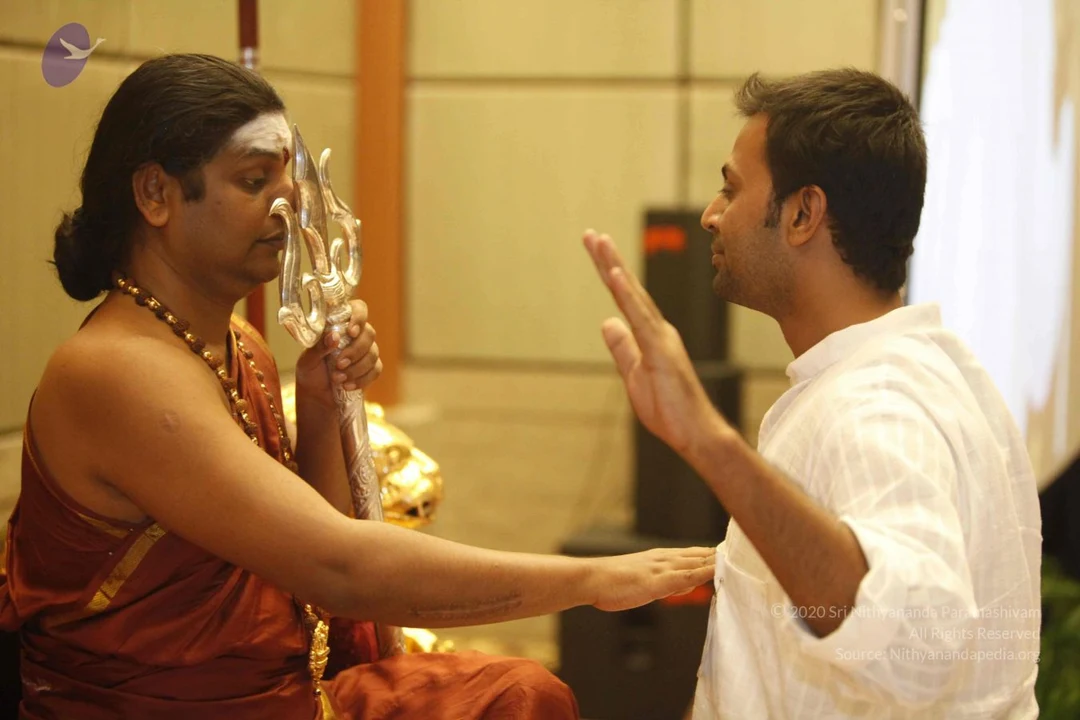
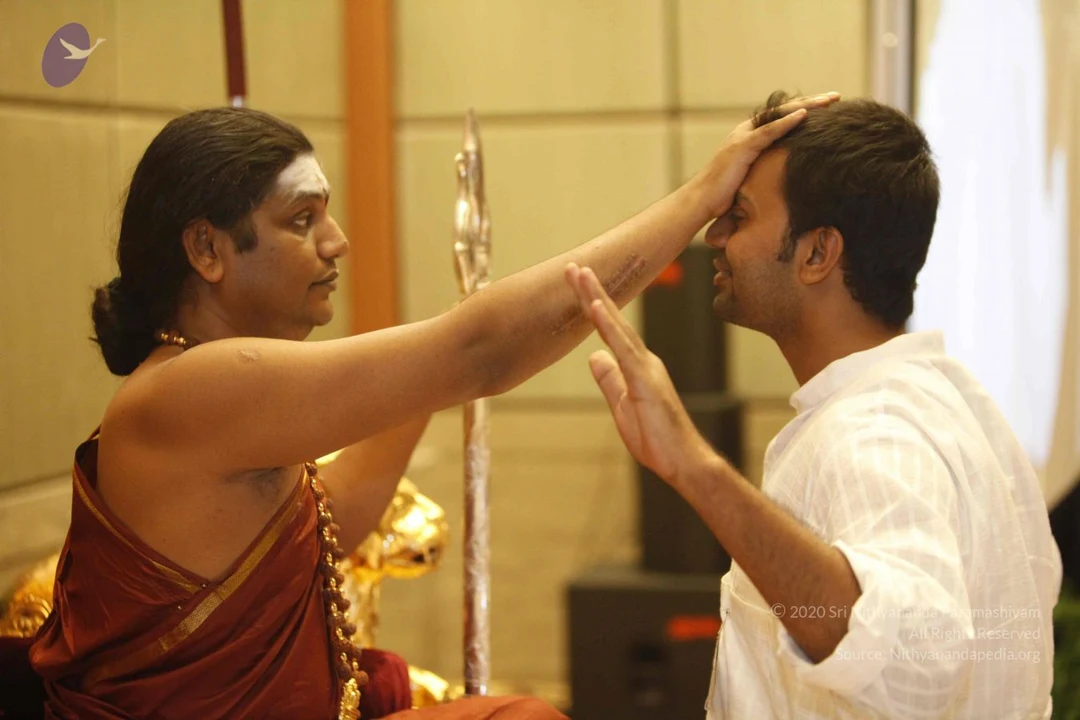
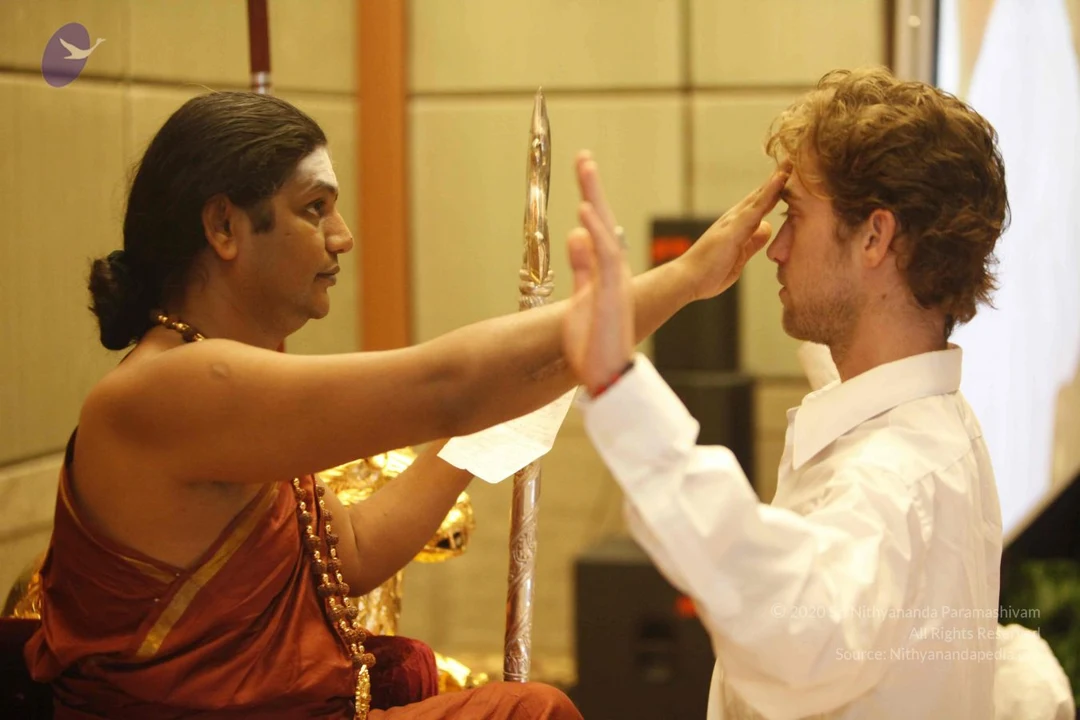
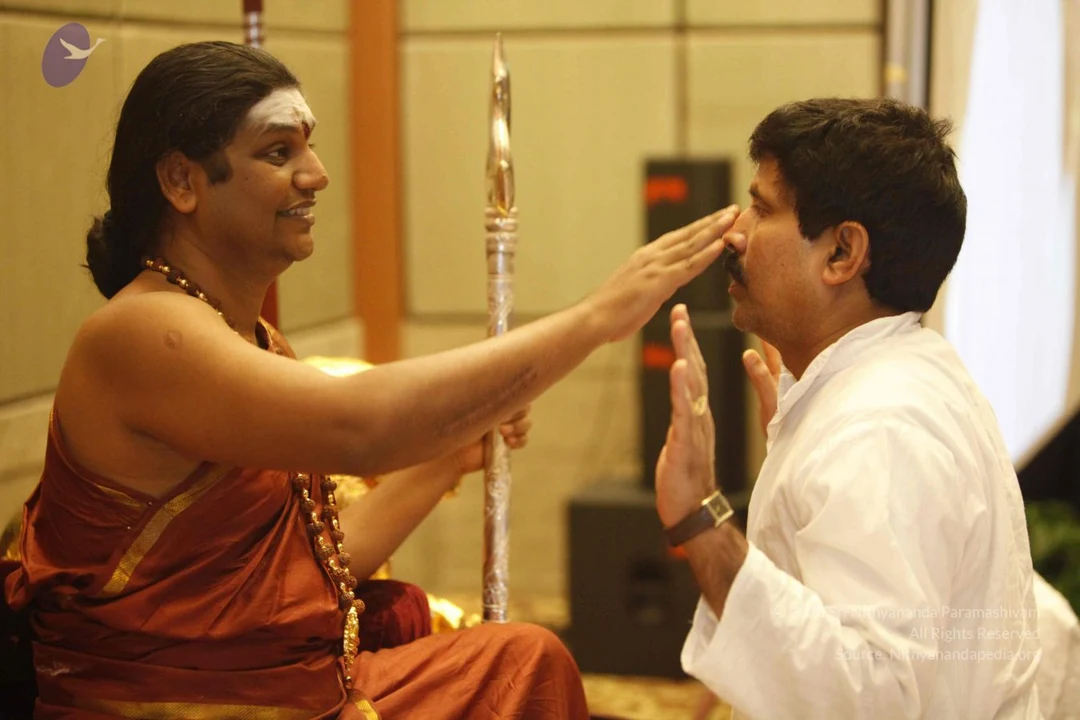
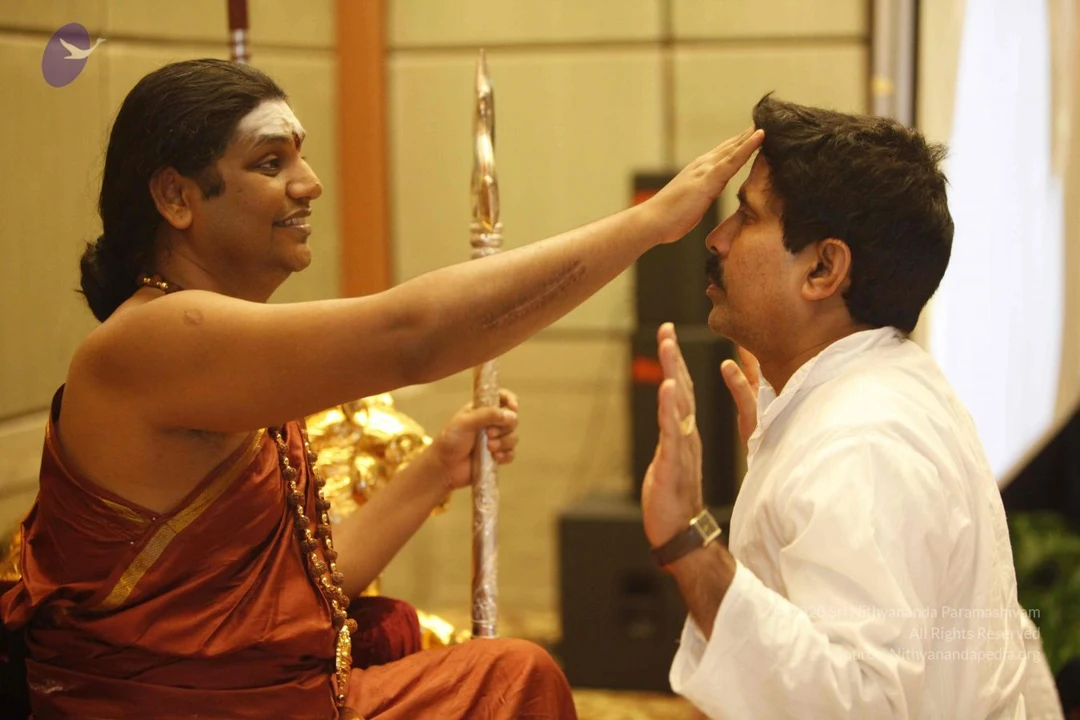
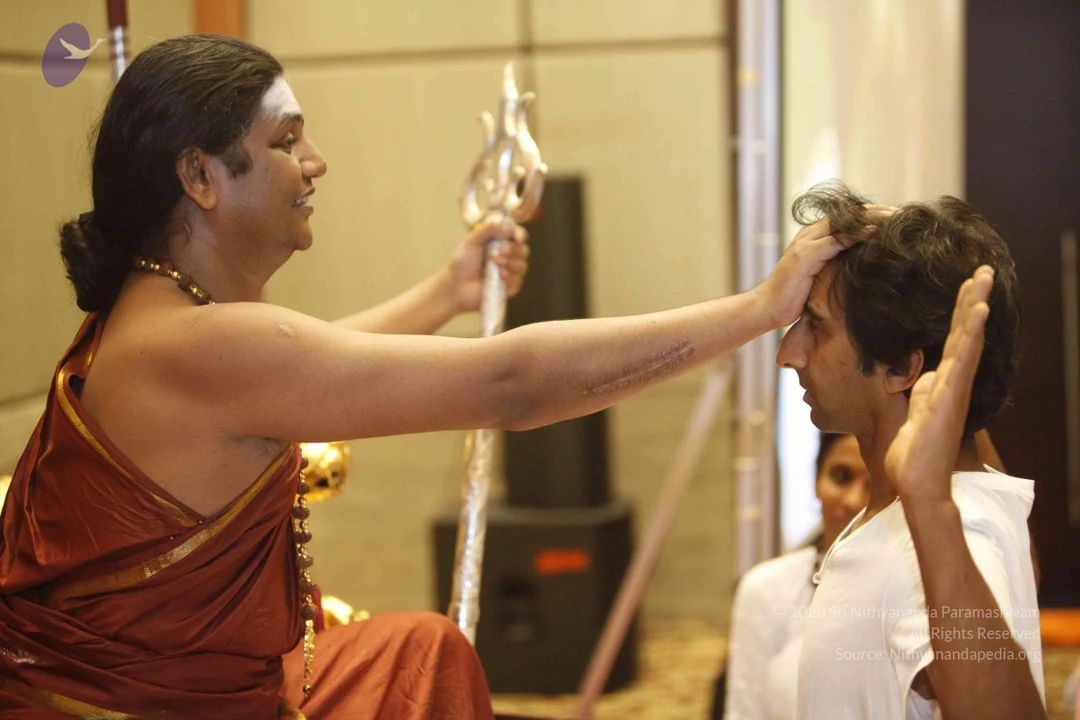
From today, the initiations are going to the next level, because I am going to be using Yantra below you; you will be on the Yantra. From the first day I was using the Yantra, but behind. I was preparing your body and minds. Yantra is a geometric, sacred diagrammatic representation of the various cosmic energies. The Master’s movements, the body movements, are Tantra. How I move the hand or blow the air, awaken the Kundalini that is Tantra. And the sound vibrations, the music or song or chanting, that is Mantra. And you are going to be sitting on the Yantra. Then understand the power of initiations. Initiation using the Yantra is thousand times more powerful, but your body need to be prepared. I am so happy that, other than one or two persons, every one of you are ready, ready. First two-three days, it will lead to sleepless, tireless nights; but don’t worry about it, because there won’t be tiredness, there won’t be tiredness. Only that one or two people who are a little afraid, you don’t need to get into the Yantra; I’ll directly give you the Darshan, I’ll prepare you also. It’s not that you will be left out; I will prepare you for a few more days. It awakens the non-mechanical parts of the brain, just like that. Very mystical and most powerful initiation.

Please understand, Yantra is actually a geometrical representation of the neuron activity happens in your brain during the Kundalini awakening. When your Kundalini is awakened, when you vibrate in the same space as me, when the neurons are mirrored in you, the geometry appears in your brain, awakening the non-mechanical parts of your brain. That geometry is Yantras. Almost every one of you, your Kundalini is awakened, your non-mechanical brain is getting awakened, your body and mind are balanced to receive this kind of a vibration, to receive this kind of a energy experience, to receive this kind of a neuron mirroring.

Please understand, actually this whole IA Level-4 is about Neuron Mirroring. It’s replicating the highest neural activities inside me, into you. In Level-1, Level-2, Level-3, I may not be able to replicate 100%, because you are new to it. If you yourself don’t know a little bit of swimming, 100% replicating is not possible. Now you yourself know some Completion. You try. You may, may not be successful; that is not the problem. You try; that is enough. And you yourself have learned something about Upanishad and now your body and mind knows what is darshan. When you just like that a jump, your mind doesn’t get agitated, your body doesn’t feel afraid. Says, ‘It’s okay. It’s a fun.’ Have a roller coaster ride without roller nor coaster! Neither a roller or coaster, have roller coaster ride. I tell you, that is why, even when I scream, my Swamis and Swaminis don’t get afraid of me, because only in the superficial outer they get afraid, or they show like they are afraid. Inside, their brain is mirroring my neuron activity which is deep love and compassion. The impact of this will be when you go back, when you begin living your life. It will be like me not like you.

Otherwise, I tell you, I’ll be screaming in my seventh pitch, eighth pitch, ninth pitch and these fellows will be laughing inside.

Listen, listen. When I read about this whole research, I was so relieved; I was so relieved about one thing. Now I know, whether I am able to convey it verbally or not, everybody who comes and sits in my presence will have the glimpse of me and will have the space of Completion.

So this Inner Awakening Level-4 is all about awakening, mirroring the same neurological activities, mirroring the same neurons experiencing and living life with the cognition, energy and the inner-space of an incarnation. So, fasten your seat belts and get ready. Sit back and enjoy the flight!

Actually, when I read that report, I felt that a big load has been taken away from me, because I am always feel ‘Am I making people understand? Am I doing the job properly? Am I really capable of what I am doing? Will I be able to replicate what I am talking? Or am I talking somewhere and people are somewhere?’ No, I doubt my capability sometimes. When I read this report, I was so complete. I felt, ‘wow what a big relief.’ See, I know this mystery; this is the basic science of Upanishad, sitting with the Master and all that. I know this mystery. But it’s now beautifully, step-by-step validated by science. Like a.... The new, new understandings which I got is: If that guy does not know swimming, it’ll not be 100%. If he knows a little bit of swimming it will be, if he’s absorbed it is 100%. All this are a beautiful thing to know, now I know why you also need to know little bit about Completion.

Ramana Maharishi used to say, ‘If you do the search, Atma Vichara, “Who am I?” my presence will make you enlightened.’ So, the person also needs to do a little bit. He also need to know a little bit. Only then the 100% reflection happens, mirroring of the neuron happens.

I tell you guys, when I understood step-by-step this whole mystery being scientifically validated, I was so happy. Oh God! Now you guys just need to know a little bit about Completion. You should have tried with your sincerity; that is enough. There’s no need of anything else. Whatever you call as “sincerity”, you understand as “sincerity”, with that much if you try, that is enough. You just sit and absorb; that’s all. You are teleported to that space, you are transported to that mystery, you are transported to that level to that initiation, to that experience. It’s not bound by Time and Space. I really, really, sincerely, with Integrity, Authenticity, Responsibility and Enriching wanted to replicate 100% of that enlightenment experience into all of you. See, I tell you honestly, I never keep anything for reserve. - ‘No, no, no, no, it will be reserved for IA level 5.’ No, only when people don’t catch in Level-1, I make Level-2. If they miss again, then I make Level-3. These levels are not made out of my pleasure or joy or some purpose. It is made out of necessity.

Sit, please all of you sit for a few minutes. Now you all know Completion. So, now you don’t even need to be doing Completion, because you know Completion. You are absorbing, you are absorbing me; that is enough to mirror these neuron activities in your brain also. Just sit mirroring Nithyananda! Namah Shivaya!

I’ll move to the next segment of the morning satsang – Dial-the-Avatar. But all AI participants, you continue to be absorbed. May be you can keep your eyes open, that’s all; because your body and mind is already prepared for initiations and darshans, because you already know the Science of Completion. Just be absorbed you will experience 100% mirroring neuron activity.

Let you all achieve, experience, live, express, radiate, share and explode in eternal bliss, Nithyananda.

Photos
Tags:

Paramahamsa Nithyananda, science, neuron, mirroring, brain, activity, Upanishad, Enlightened Master, completion, Nirahara Samyama.

Photos Of The Day:

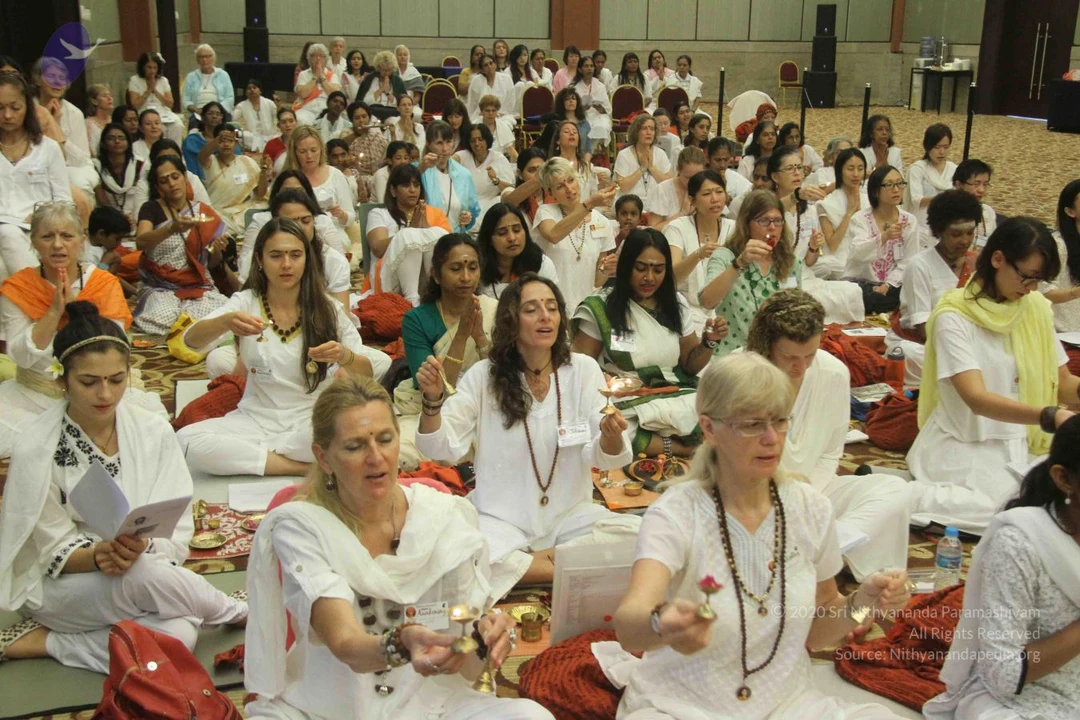
PADUKA-PUJA
NITHYA-SATSANG
IA-YOGA

DARSHAN

Photos Of The Day:

Pada-Puja

1-Nithya-Satsang

2-IA-Darshan-Yantra

Photos from this day

View all 156 photos

Photos

4 photosSource gallery
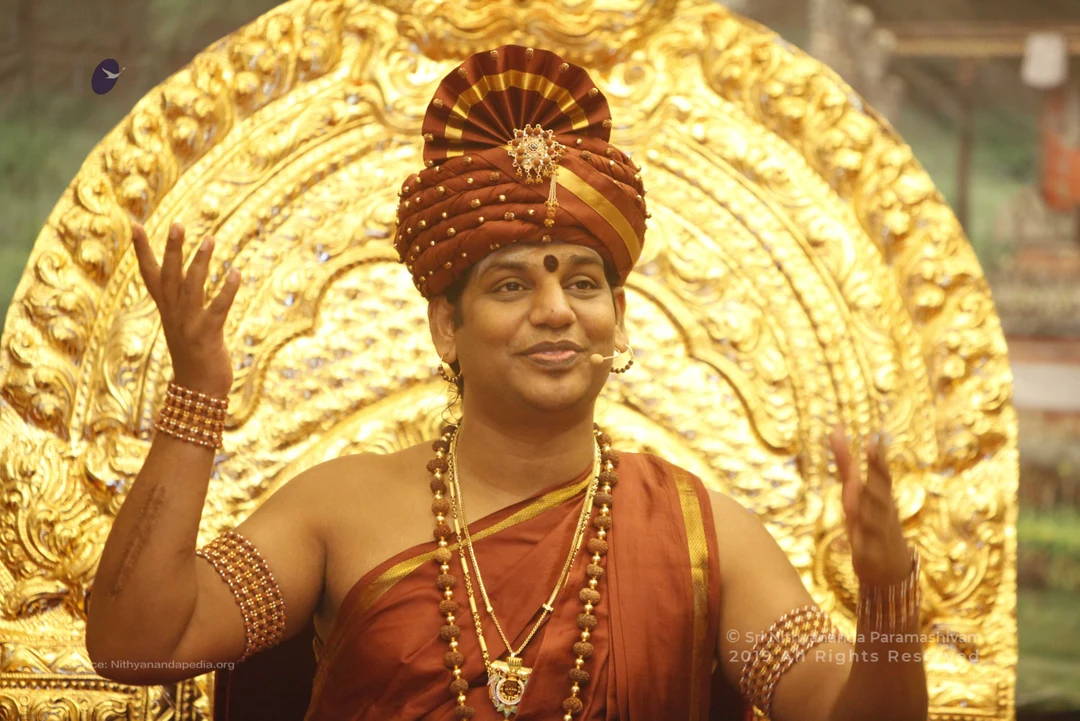
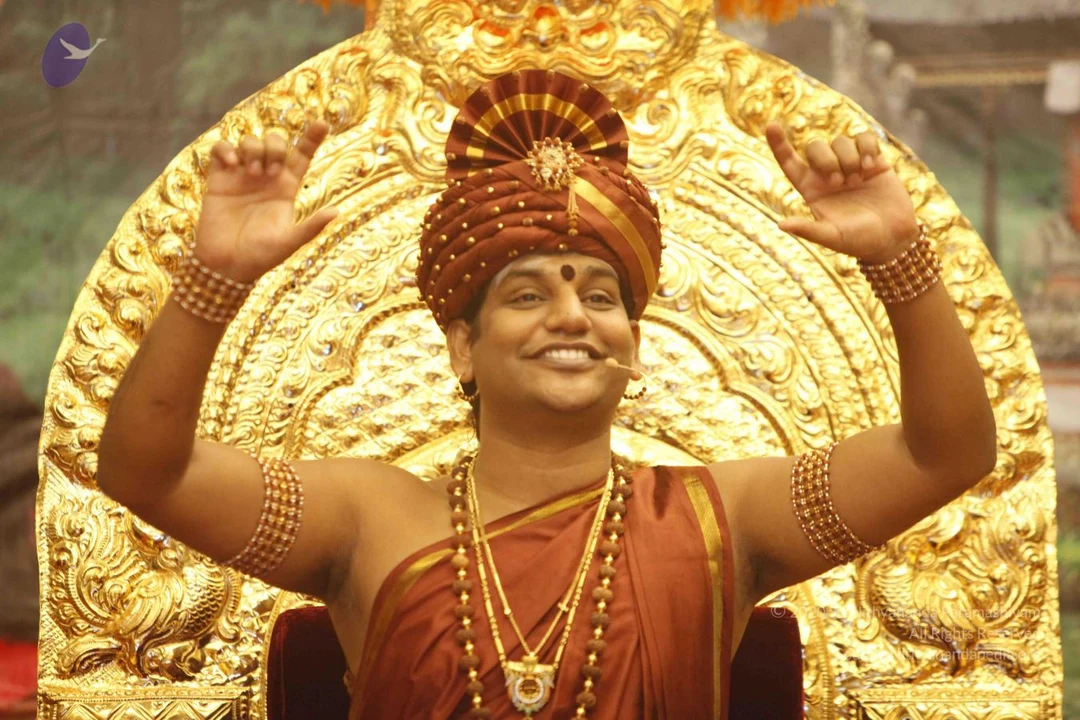
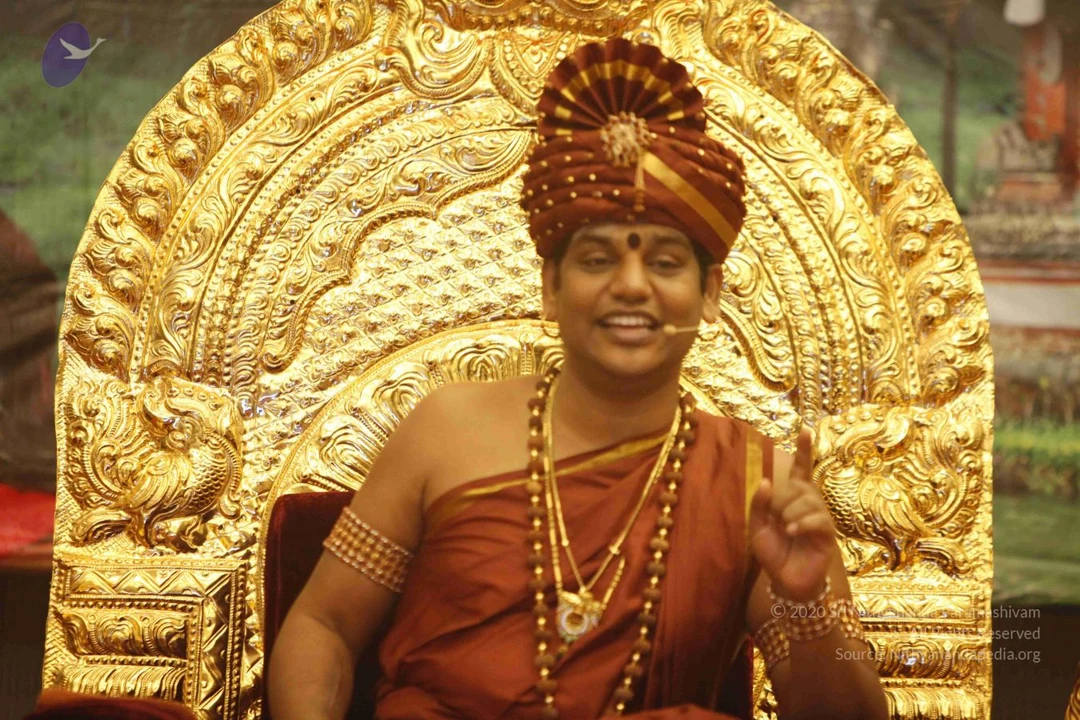
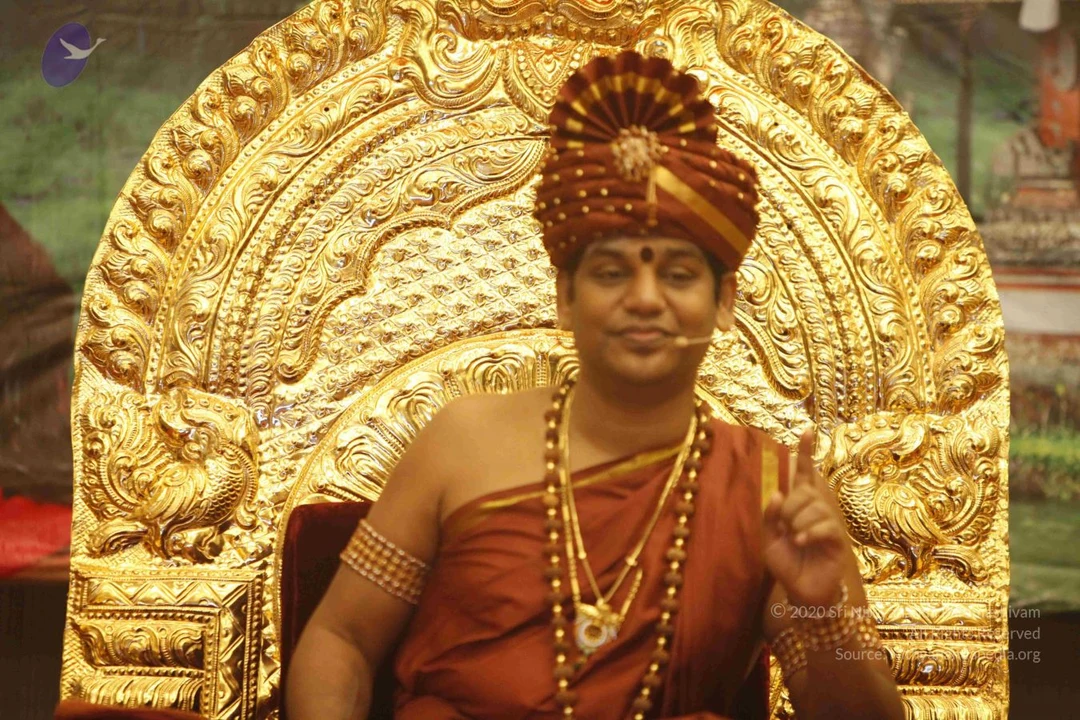
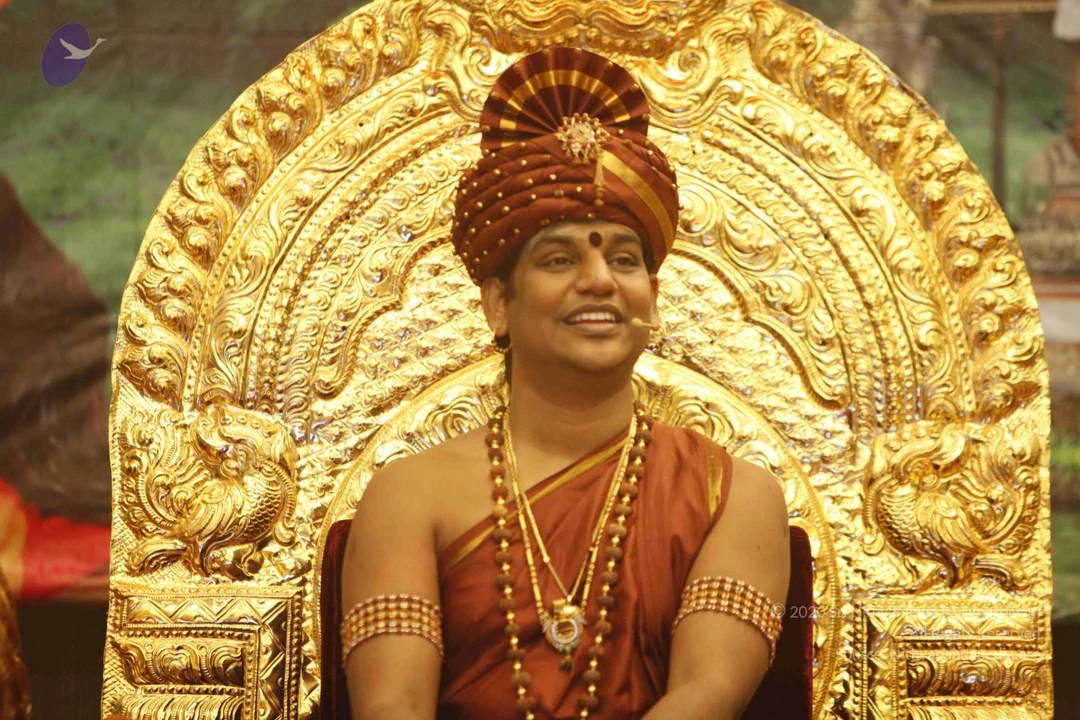
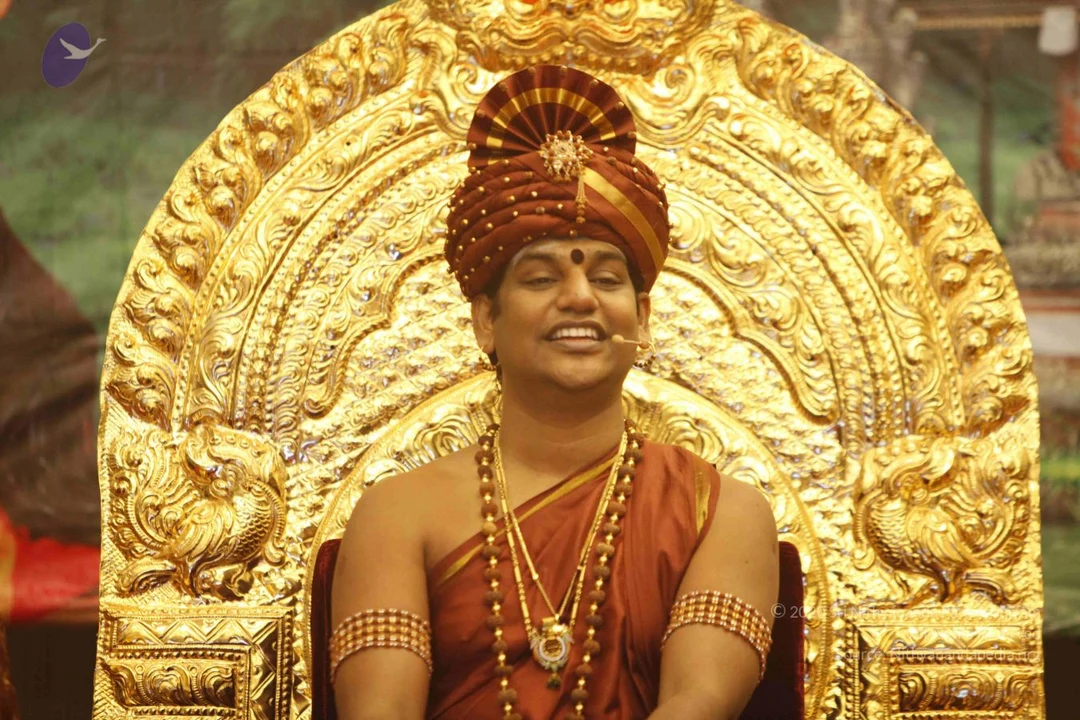
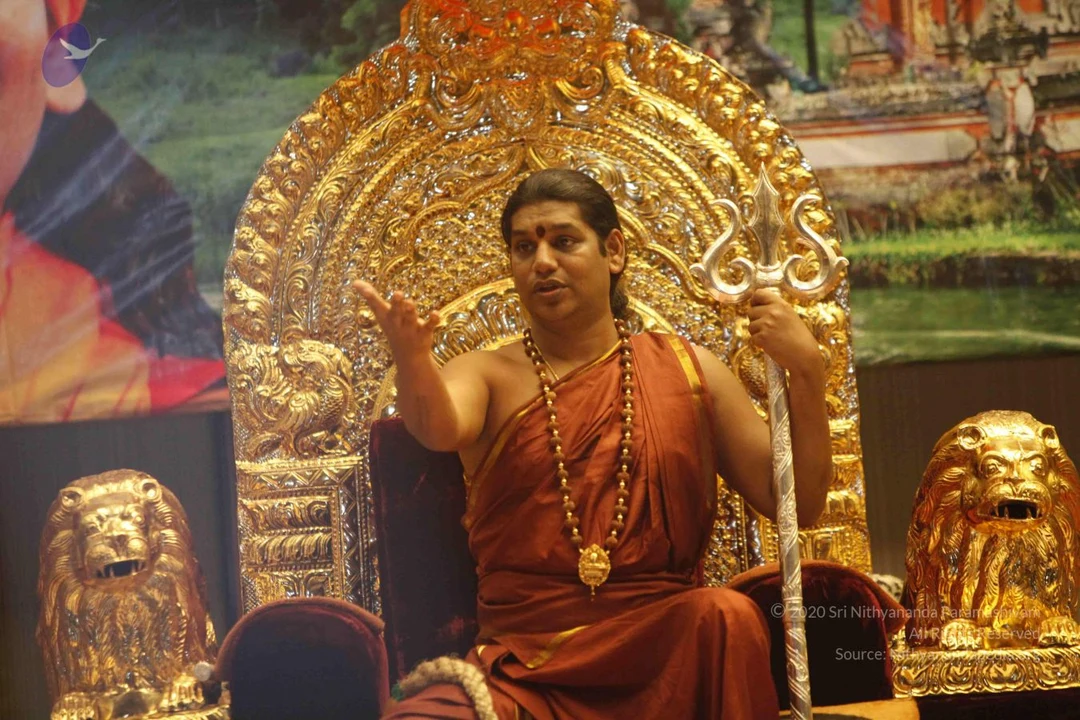
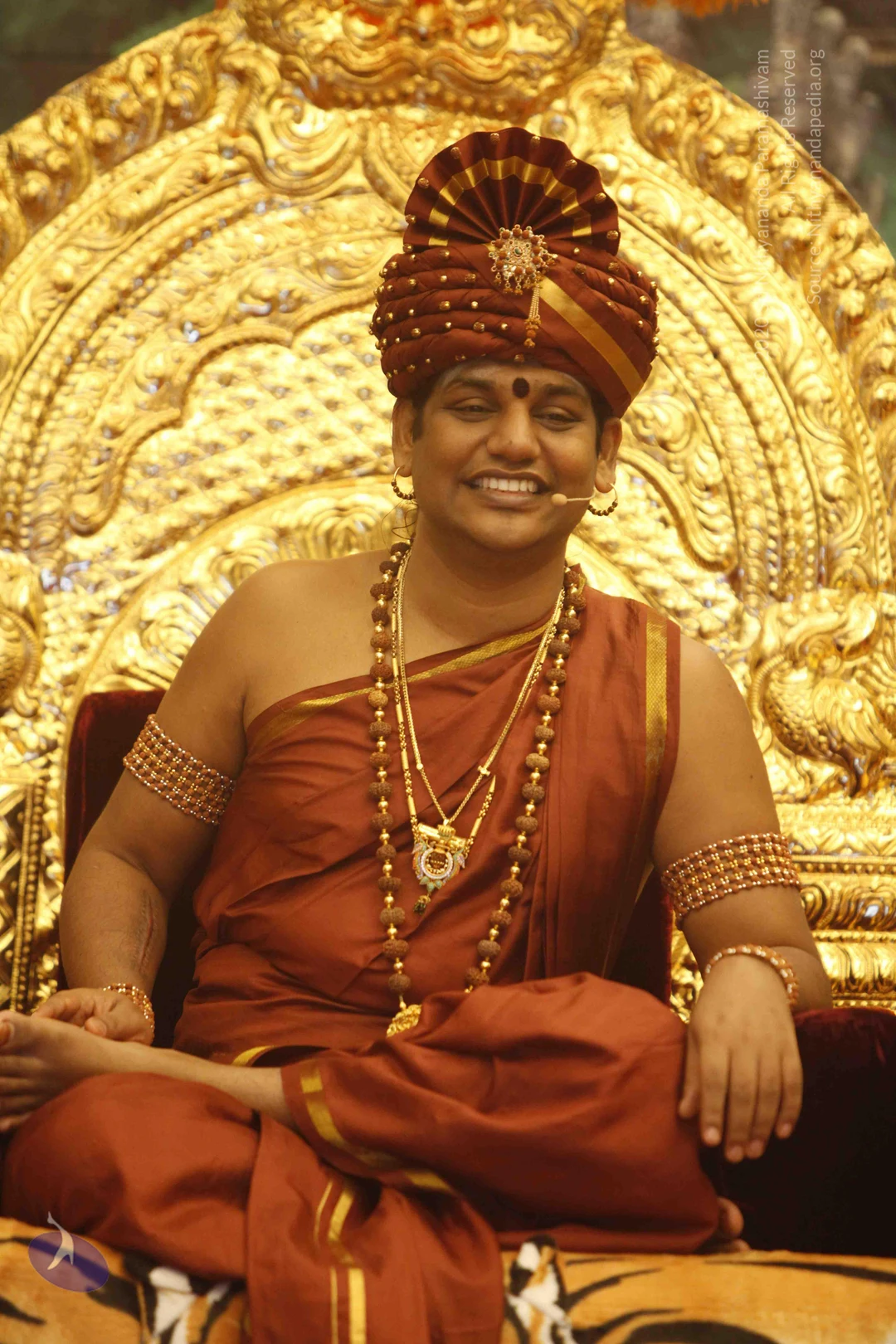
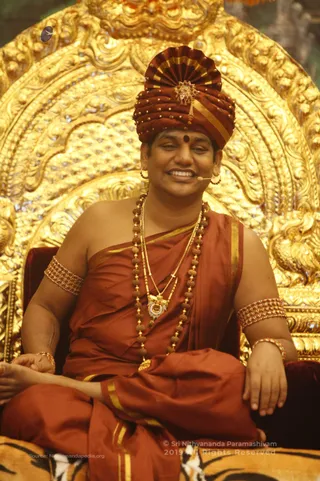
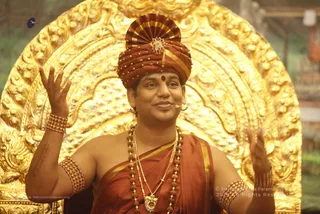
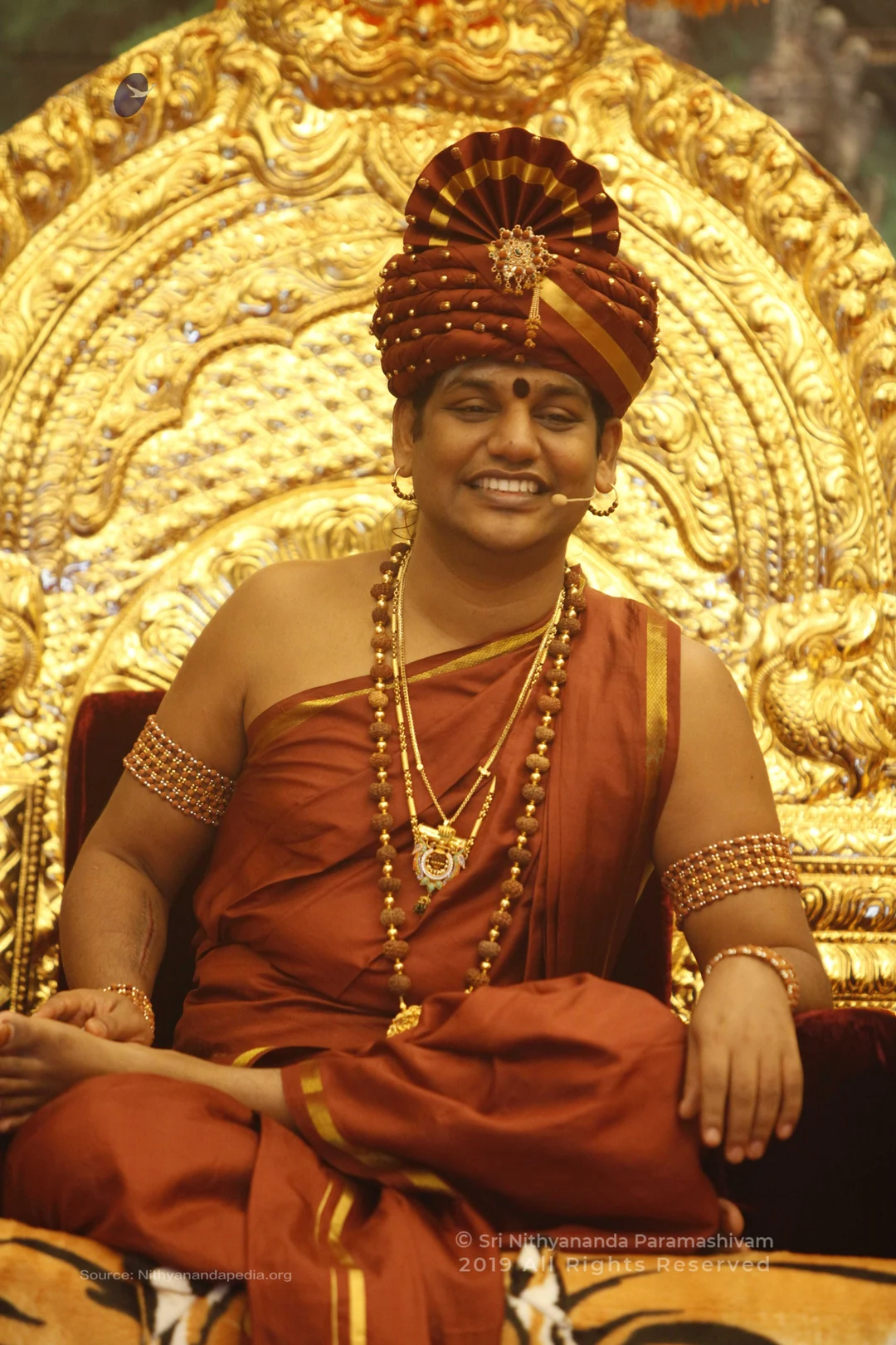
A man seated before an ornate golden throne back, speaking with both hands raised in an animated gesture. He wears a rust-red turban with gold banding and a jewelled brooch, a rust-red robe with gold border, layered rudraksha malas, a gold ceremonial pendant necklace, gold earrings, a bindi, and beaded wristbands. A small clip microphone is visible at his ear. Swamiji (probable): a saffron-clad figure with a turban, rudraksha malas and gold necklace, presenting a satsang discourse. Behind him is a gilded throne backdrop with floral and foliate relief.

Photos

3 photosSource gallery
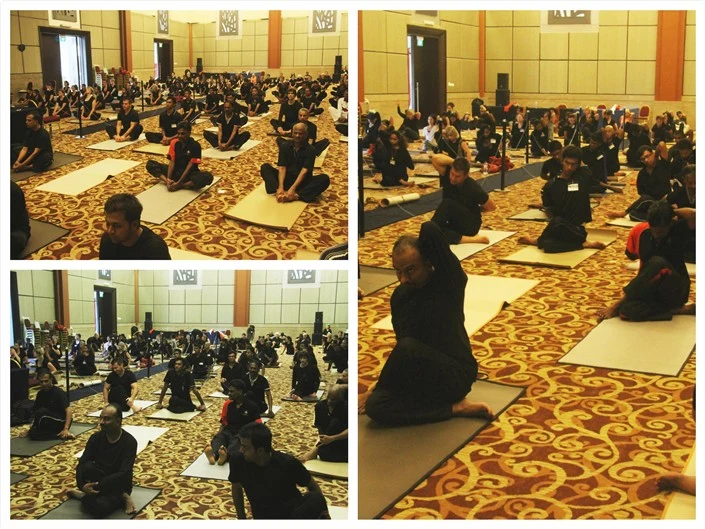
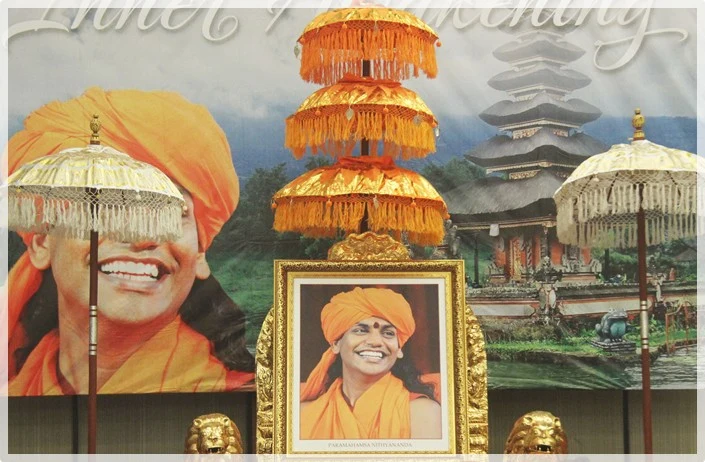
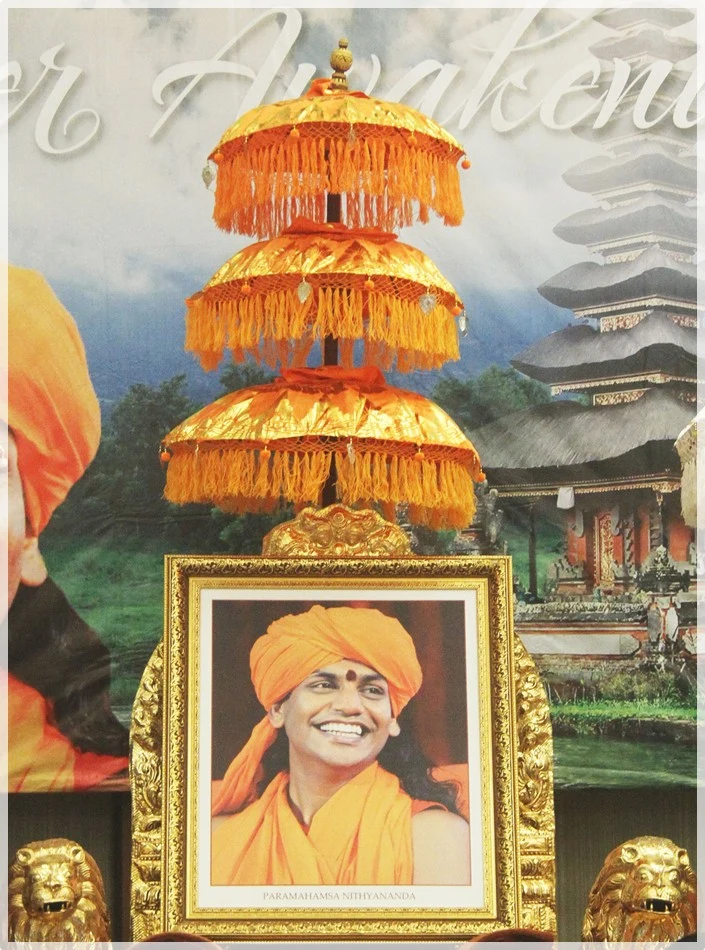
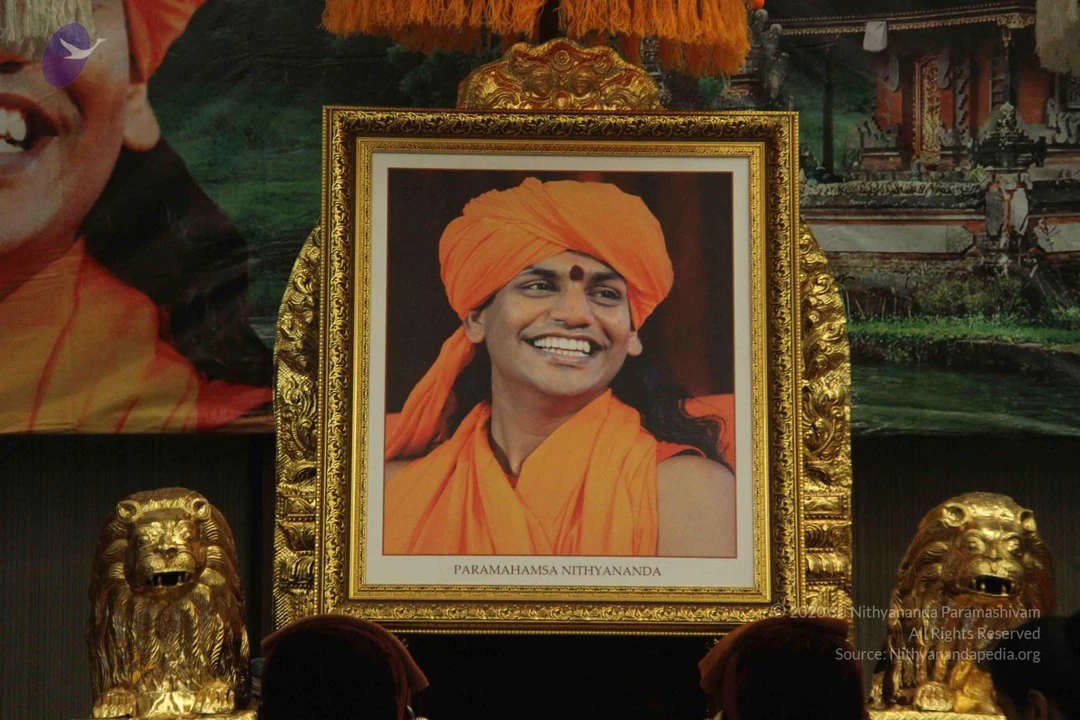
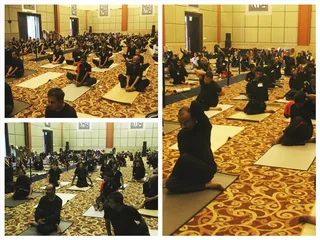
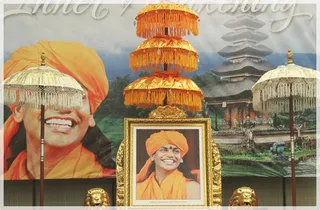
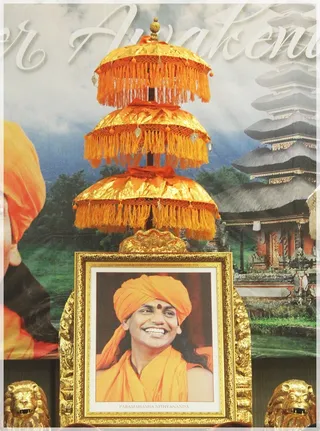
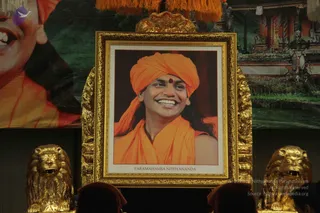
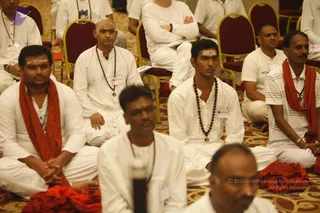
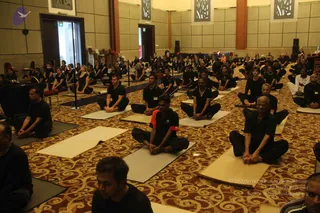
A four-panel collage of a large hall with patterned gold-and-red carpet where many people in black clothing sit cross-legged on cream meditation mats in rows, some with red shawls or sashes. The top-left and bottom panels show wide views of the seated crowd; the right panels show closer views of attendees, including a bald man in a black shirt sitting on a mat in the foreground and a woman in black with a red sash. Wall decor and a stage-like backdrop appear at the far end. Several people face the same direction in silent sitting practice.Stage backdrop at an event with a large printed photograph of a smiling man in an orange-saffron head wrap and robe, beside a framed portrait with an orange turban and orange robe, set on a gold-framed altar with gold lion statues. A tiered golden-orange umbrella stands above the framed portrait, with two cream and gold parasols on either side. The backdrop shows a temple with a multi-tiered pagoda-style roof set against green hills, and the title text 'Inner Awakening' is visible at the top. No physical people are visible.A framed portrait labelled "PARAMAHAMSA NITHYANANDA" stands on a gilded stand at the centre of the stage. The printed portrait shows a smiling man in an orange turban and orange shawl with a red bindi. Above it rises a three-tiered golden-orange Balinese parasol with fringed tassels. Golden lion figures flank the base. Behind is a backdrop with the words "...er Awaken..." and a Balinese temple with pagoda-style roofs in a green landscape. At the left edge a partial figure in an orange turban and orange robe is visible. This is a photograph of a stage setup with a printed portrait, not a live depiction.

PADUKA-PUJA

6 photosSource gallery
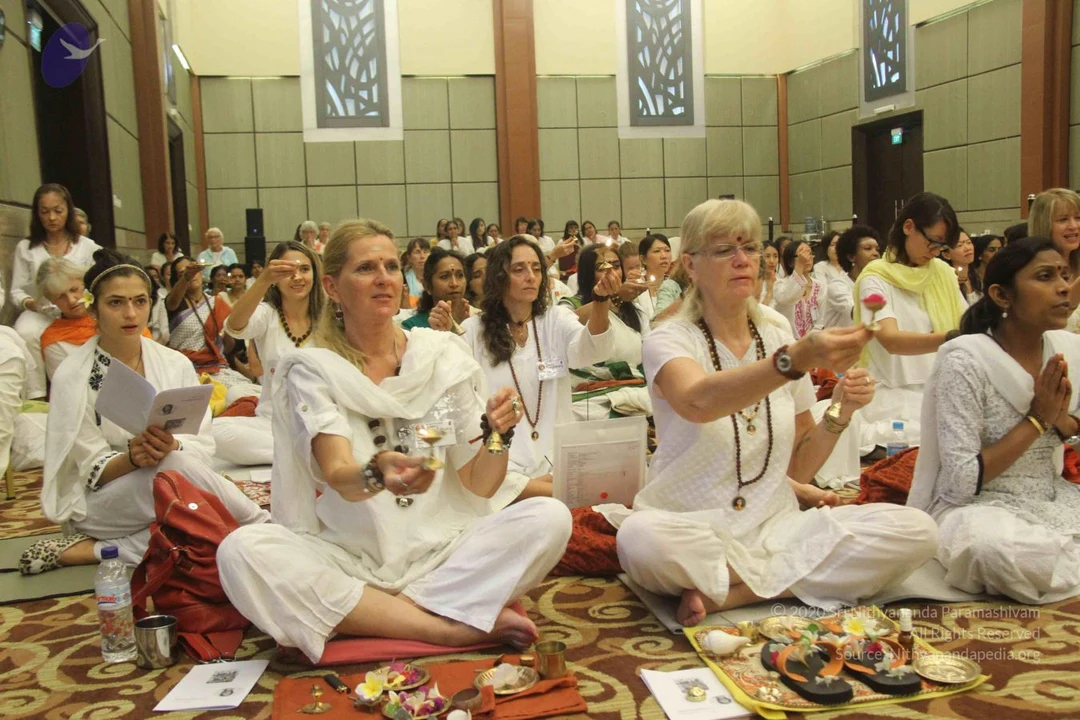
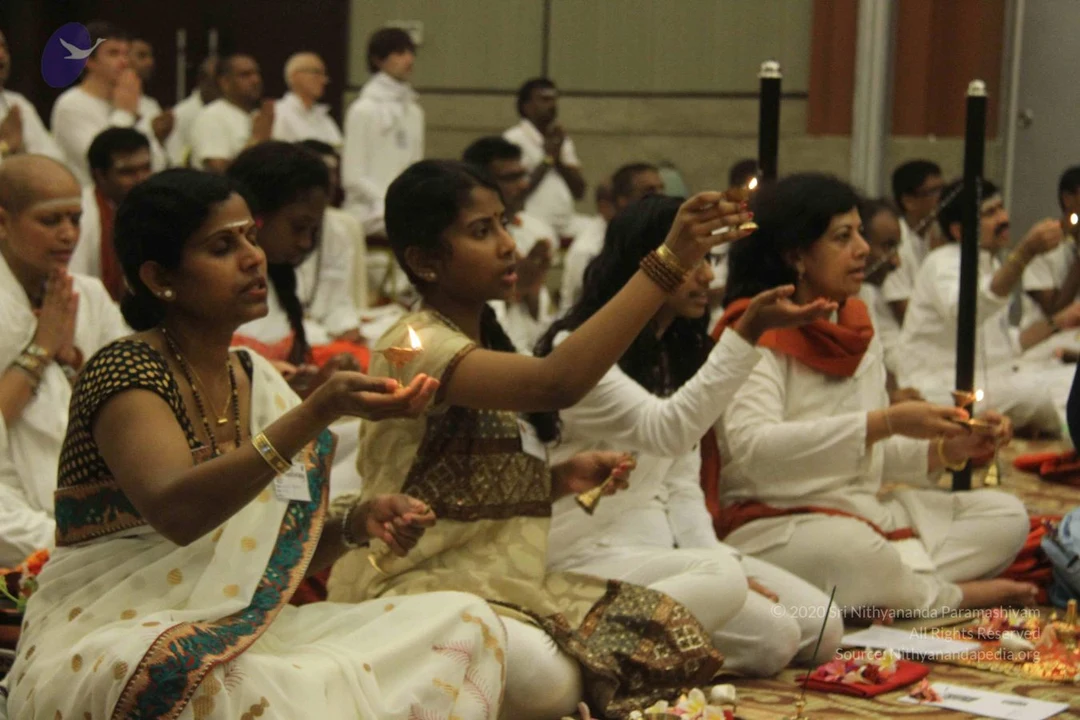
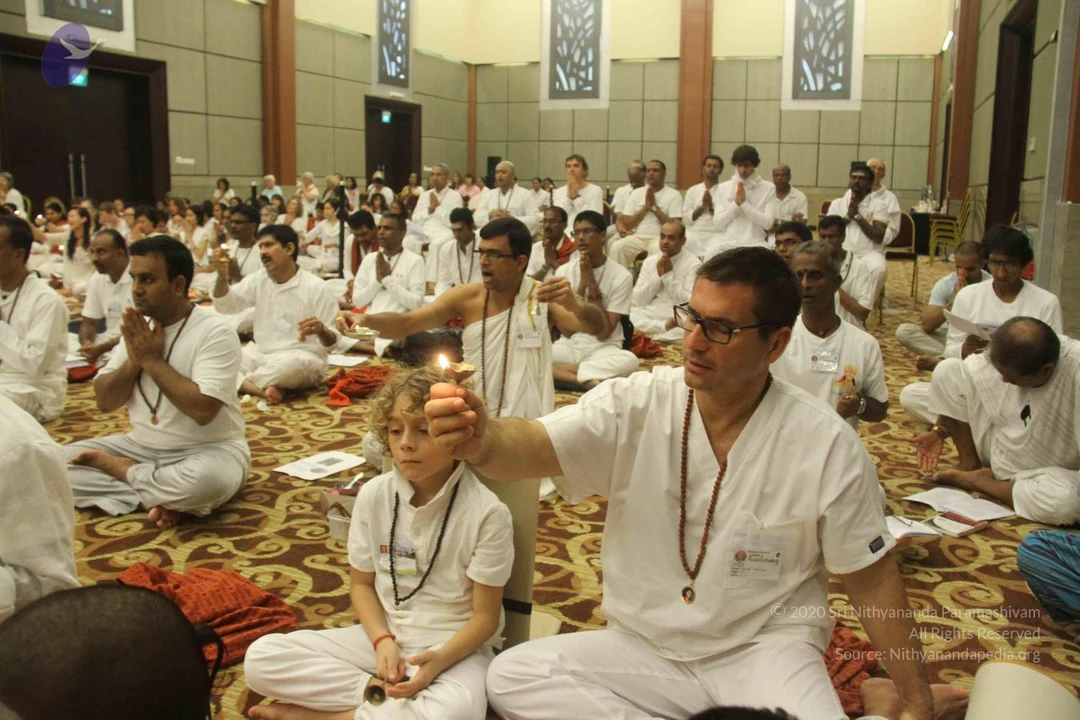
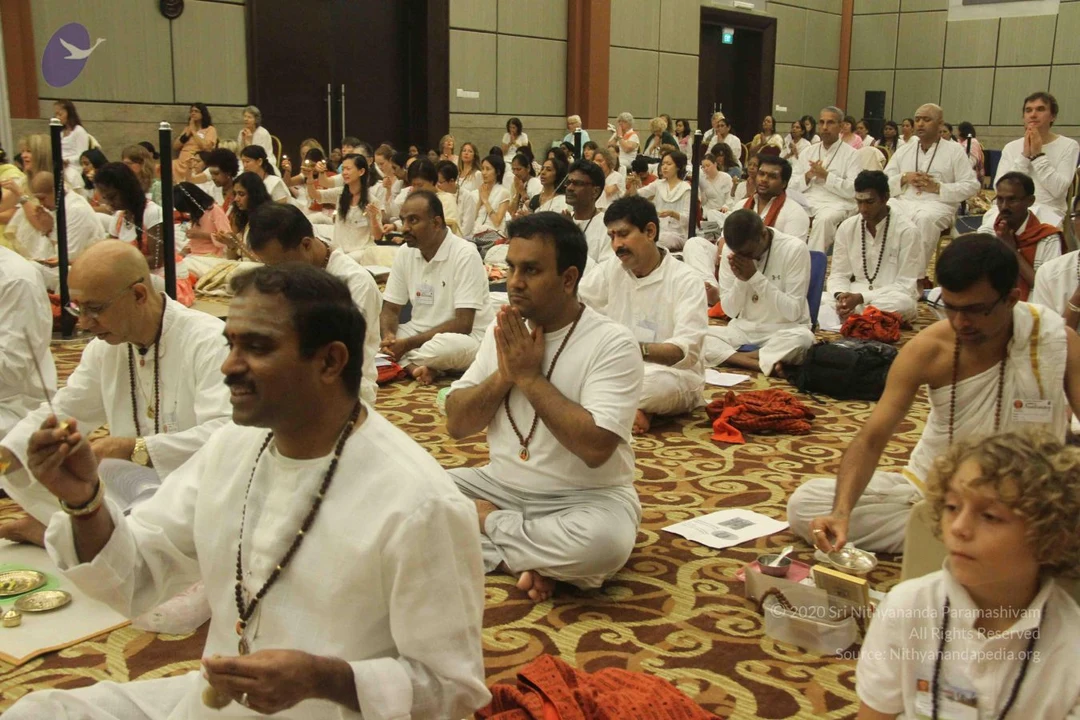
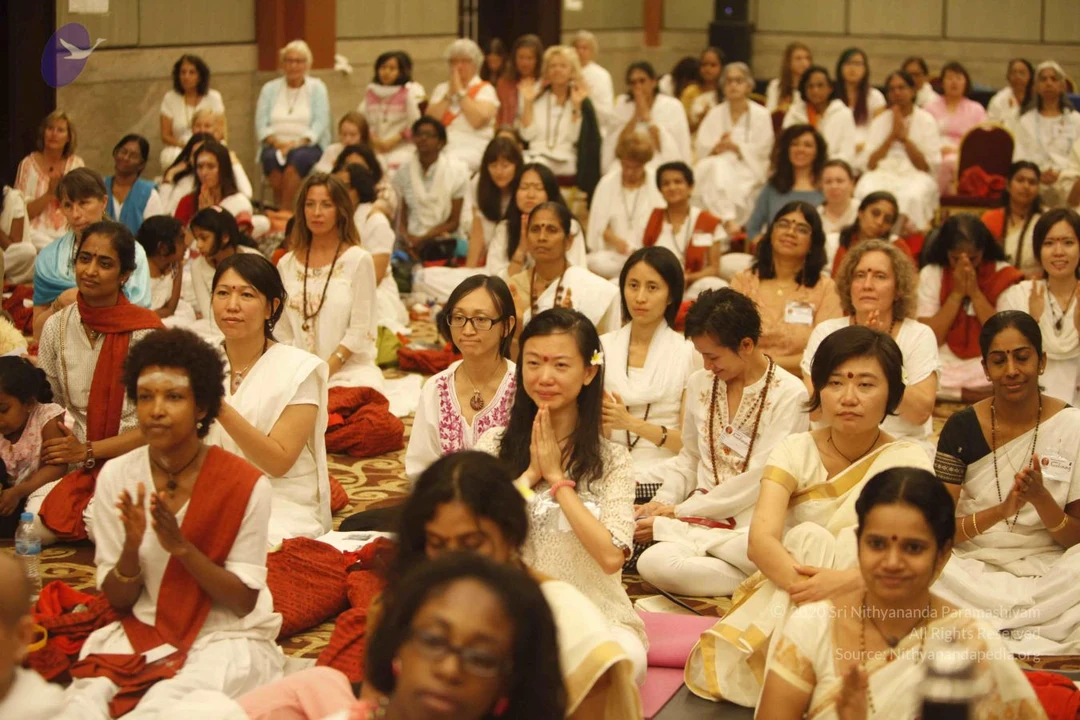
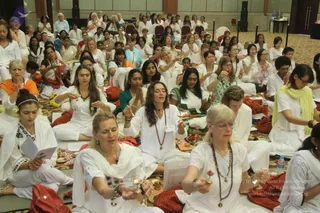
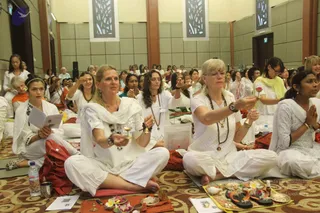
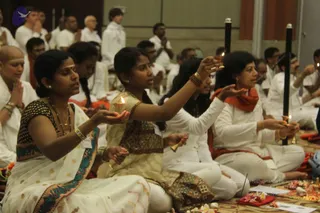
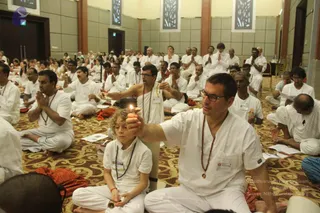
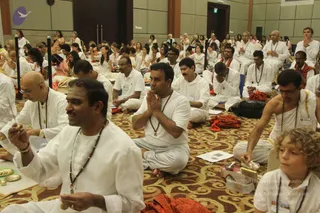
A large seated congregation in a hotel ballroom performs a puja with oil lamps and small brass vessels. Most participants wear white and cream clothing, many with rudraksha and bead malas. A woman in the centre wears a white outfit and long beaded mala and holds a small lit lamp. Women in saffron, green and yellow saris and white kurtas sit on red floor cushions. Some hold flowers and small brass lamps, and others have palms pressed together. Ceiling lights and a curtained wall are visible behind the crowd.A seated group of devotees in white clothing performs a padukapuja-style ritual in a large hall with patterned carpet. Several women in white kurtas and salwars hold small brass or glass vessels and flower-tipped offerings, and a woman in front lifts a small lamp or cup. A woman at right with a rudraksha mala holds a pink flower and offers it forward. Brass plates hold flowers, sandals or wooden paduka-shaped footwear, and a small lamp. Dark-red cushions and bags lie nearby. No individual is clearly identifiable as a person, and no one in the frame is visibly in a throne or elevated seat.A photograph of devotees seated on the floor in a hall during a ritual, several holding small oil lamps with lit flames in outstretched hands. In the foreground a woman in a cream sari with a teal and gold border and a tilak on her forehead holds her palms out toward the flame, while beside her a young girl in a beige and gold outfit with bangles raises a lamp. To the right, a woman in white with an orange shawl holds a lamp, and tall black candles stand behind them. Behind the seated group, men and women in white clothing sit with hands folded or raised, and marigold petals and a red cloth lie on the floor. Approximately 15 people are visible.A large group of devotees dressed in white sits cross-legged on a patterned carpet in a hall with cream walls and dark wooden doors, during a satsang or puja. In the foreground a bespectacled man in white clothes and a rudraksha mala holds a lit oil lamp toward the viewer, while a curly-haired boy in white with a mala sits beside him holding a small brass bell. Other participants sit with palms joined in anjali or hold printed sheets, and a few wear orange cloth beside them. No one is clearly identifiable as a person from appearance.A large indoor hall with patterned carpet and cream walls holds a seated congregation of devotees in white clothing with rudraksha malas. In the foreground, a man in white with a rudraksha mala holds a small brass object and a plate, while beside him a man with folded hands sits in a meditative pose. Many others in white kneel or sit with palms joined in prayer, and a curly-haired child in white sits at the lower right. Small brass plates and orange cloths rest on the floor. No clearly identifiable ceremonial figure is visible on a seat or dais. The scene resembles a satsang or puja gathering.A photograph of a framed portrait displayed on a stage at a gathering. The large ornate gold frame holds a printed portrait labelled "PARAMAHAMSA NITHYANANDA" showing a smiling man in an orange turban and orange shawl with a red bindi. Flanking the frame are two golden lion sculptures, and a red-brown fringe hangs at the top. Behind it, a backdrop shows a painted temple and greenery. Only the backs of a few heads are visible in the foreground, with a dark-clothed audience below. The portrait is a printed depiction, not a person physically present on stage.

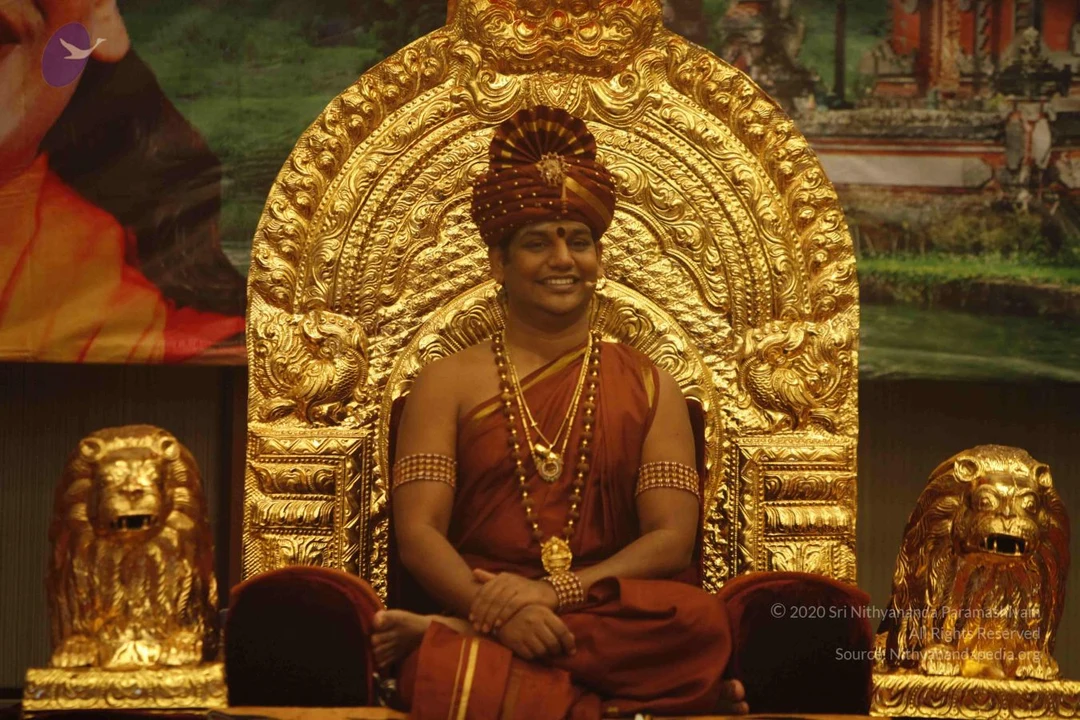
NITHYA-SATSANG
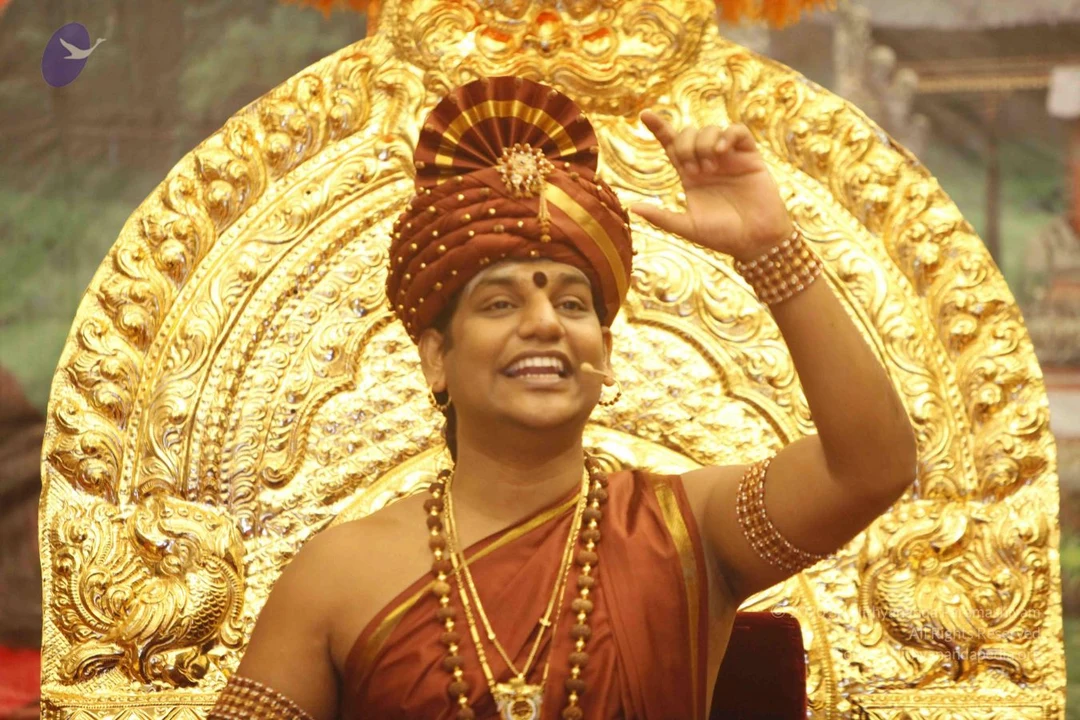
28 photosSource gallery
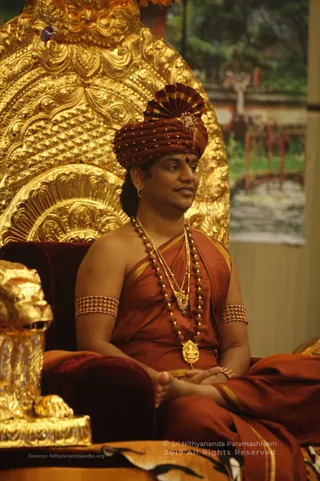
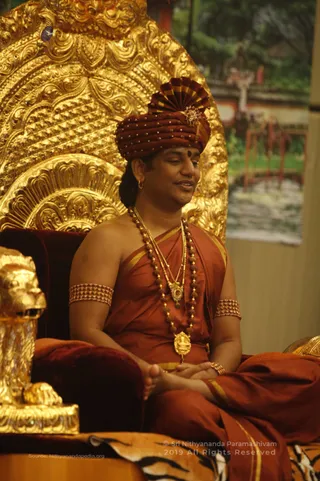
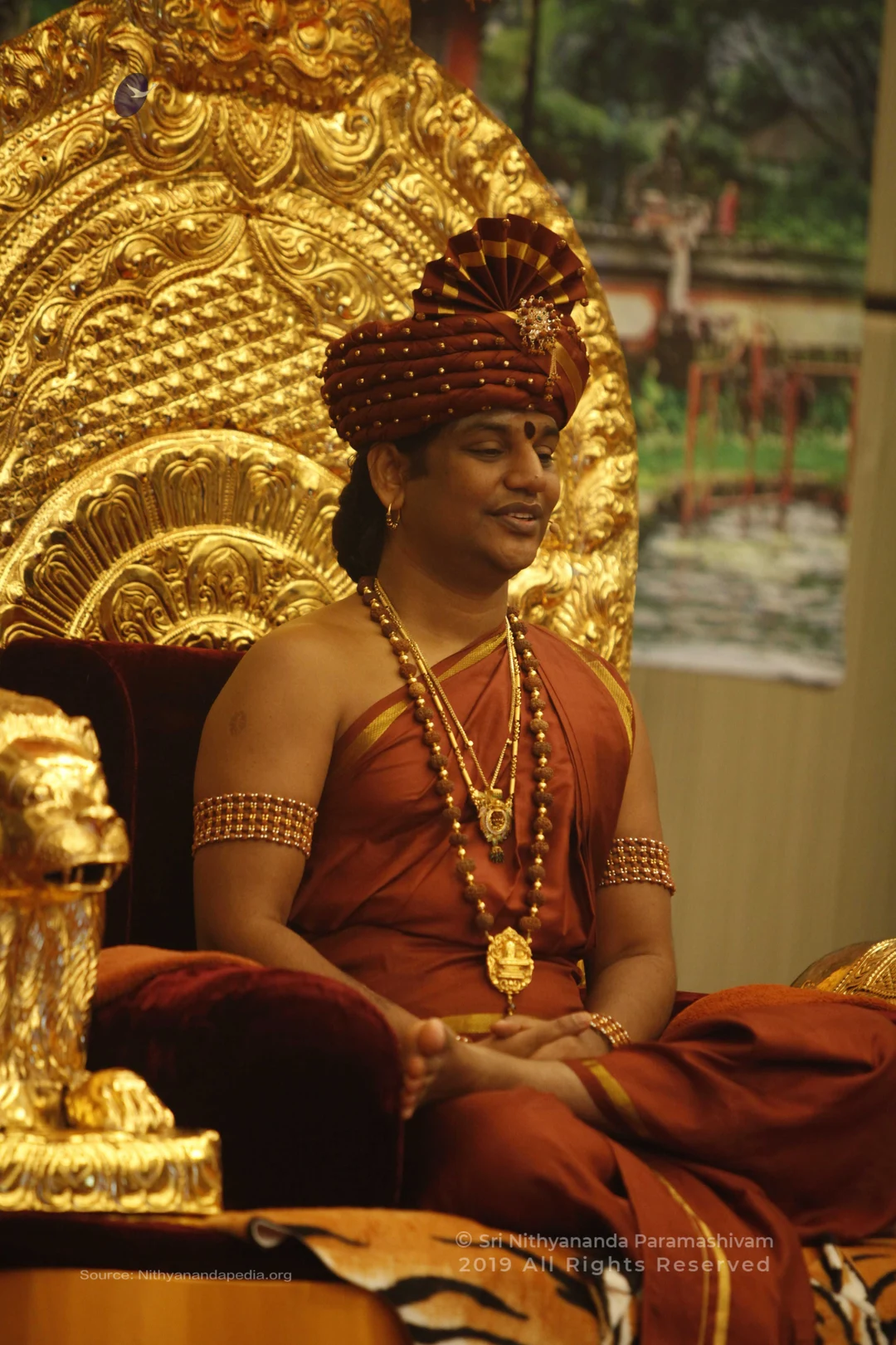
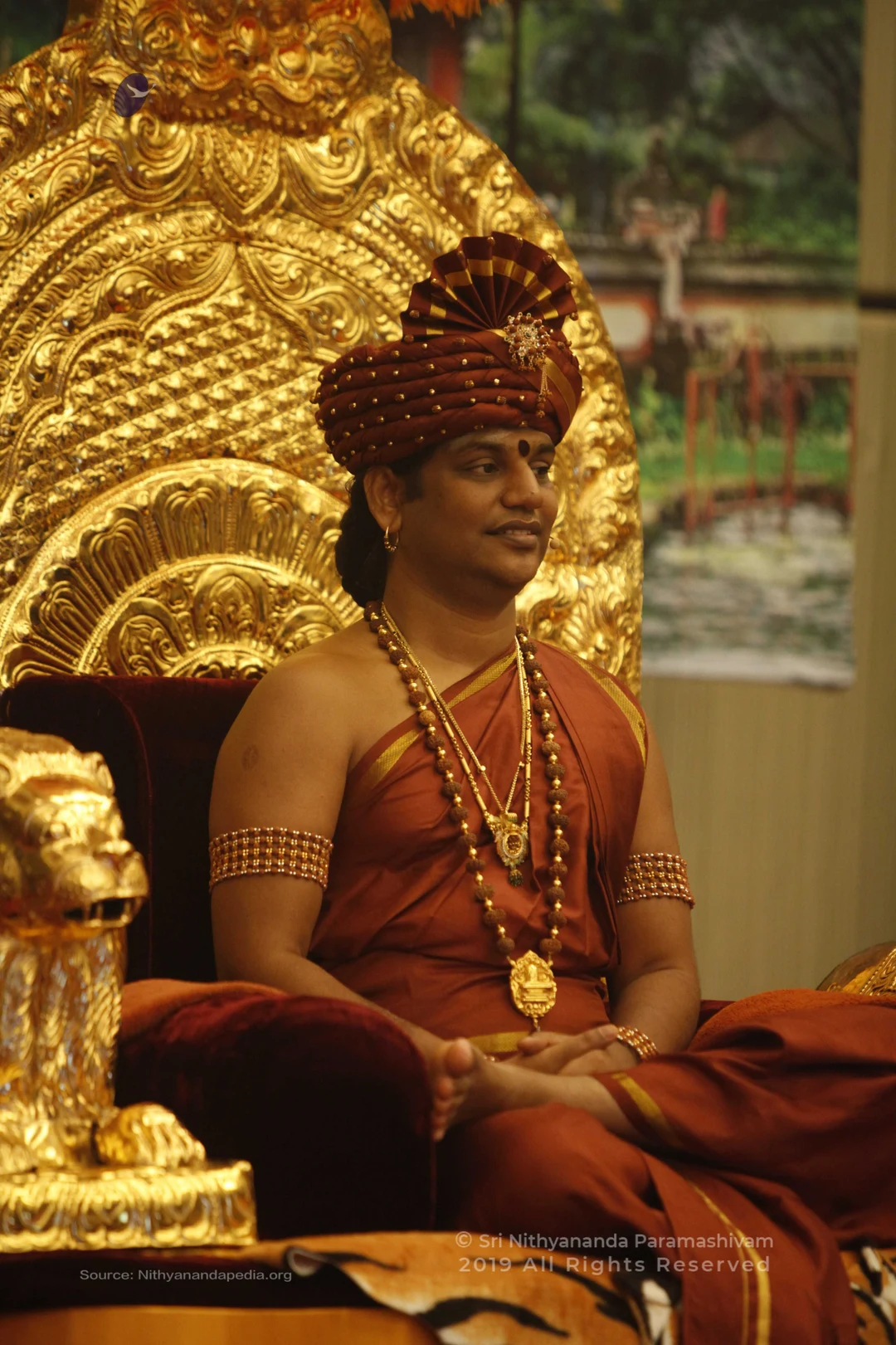
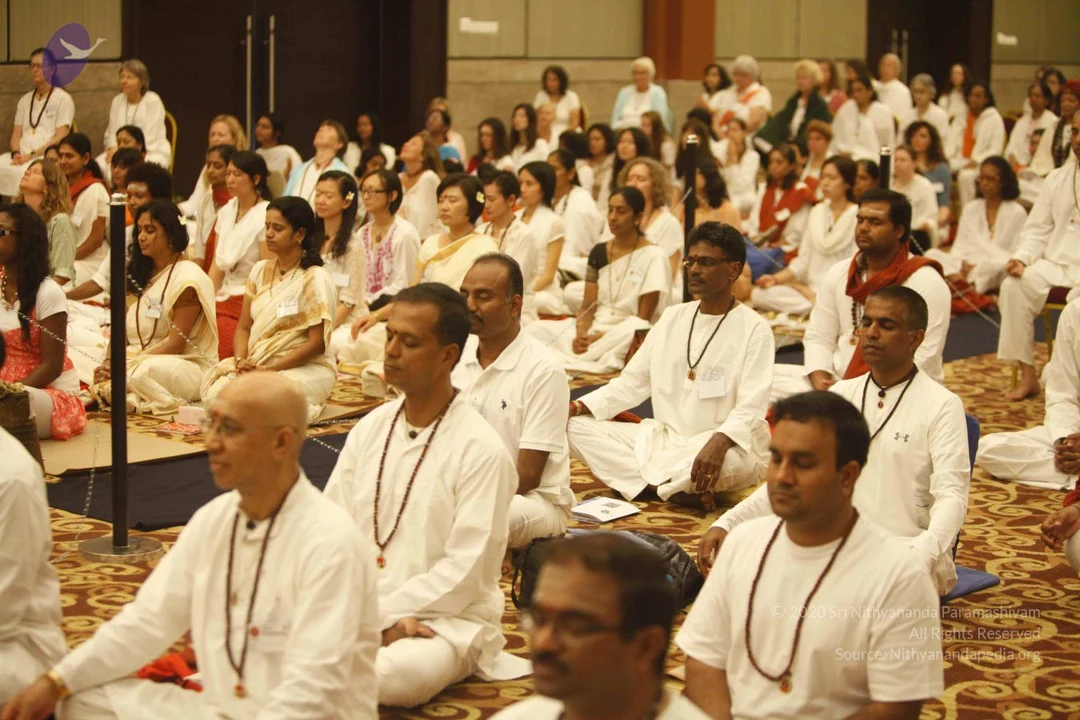
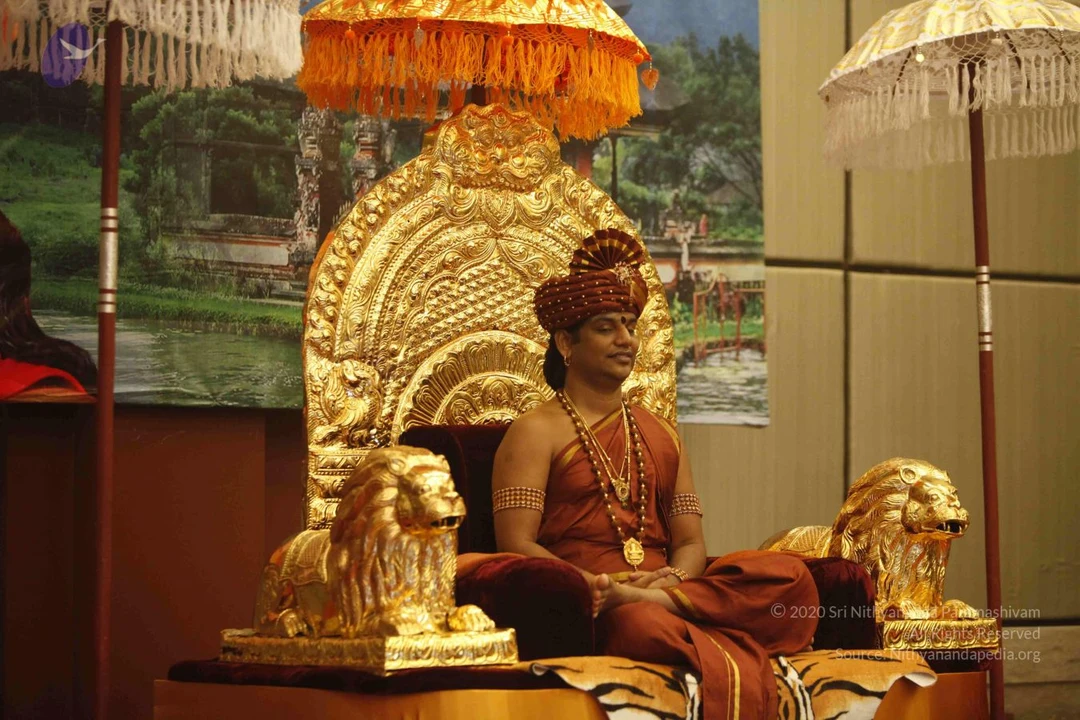
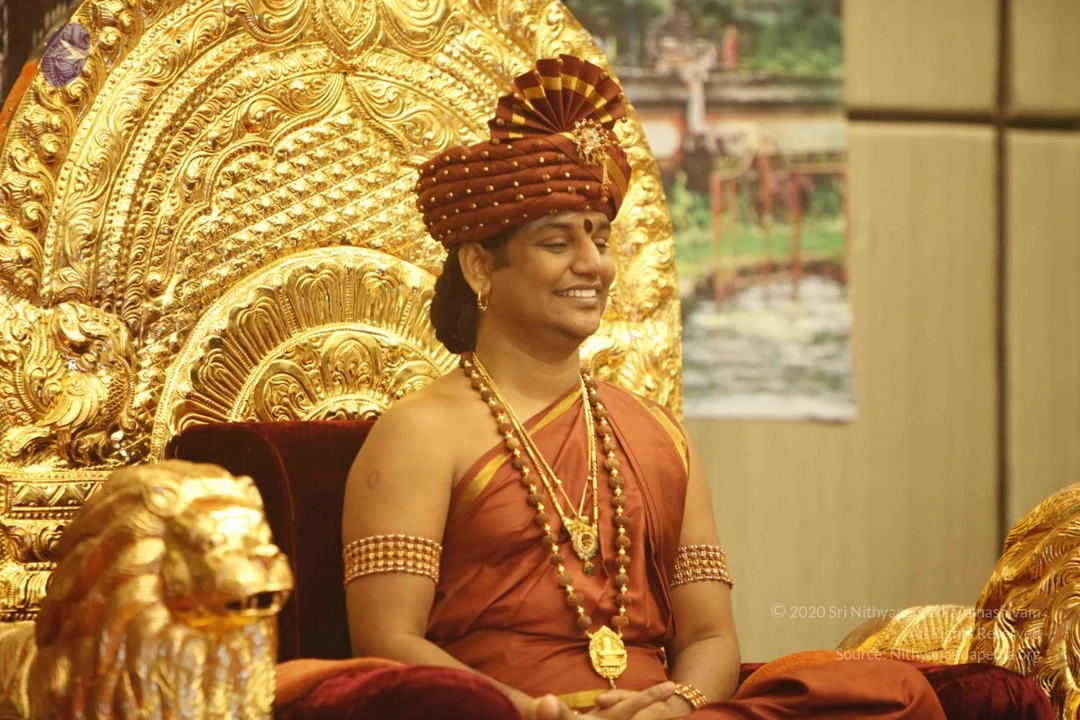
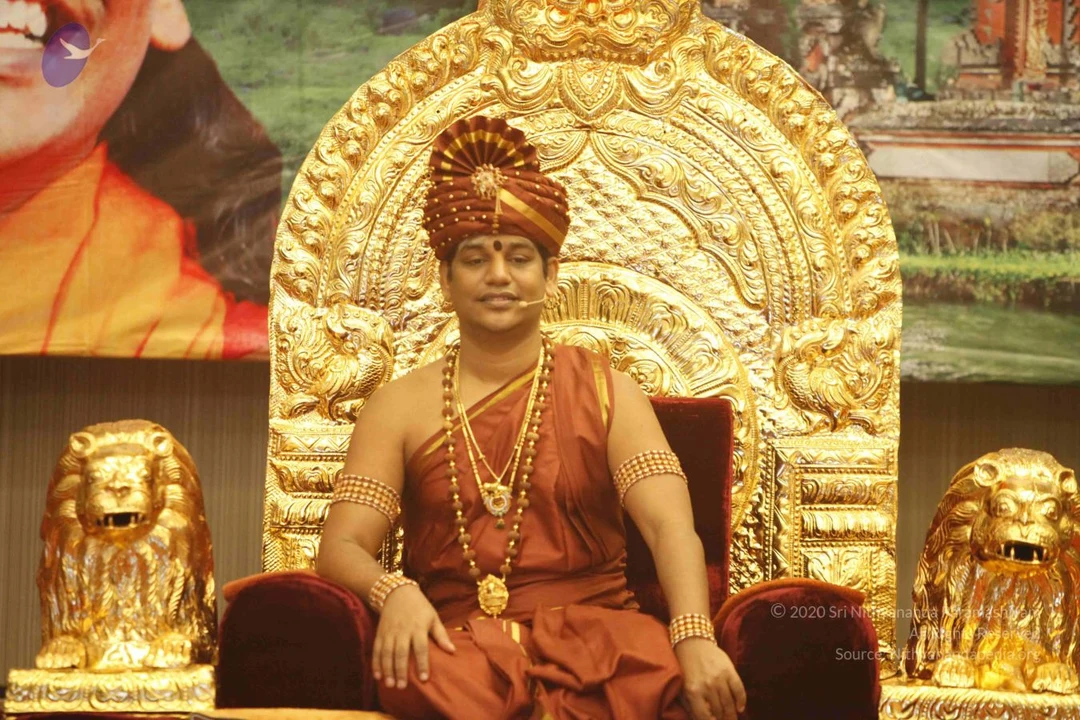
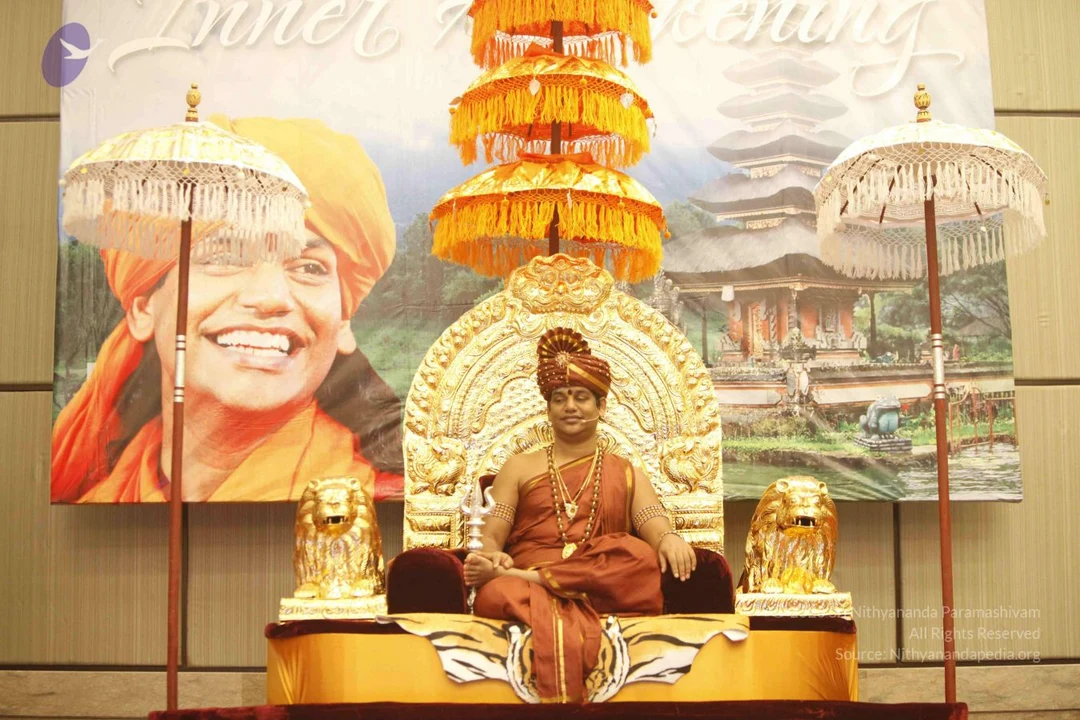
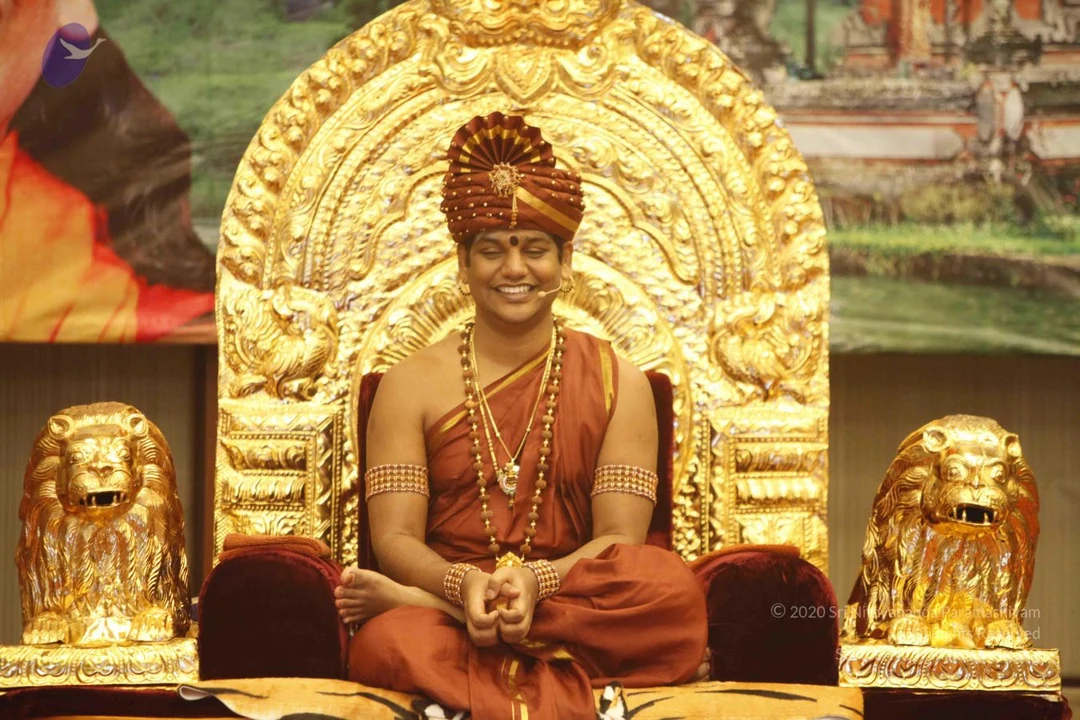
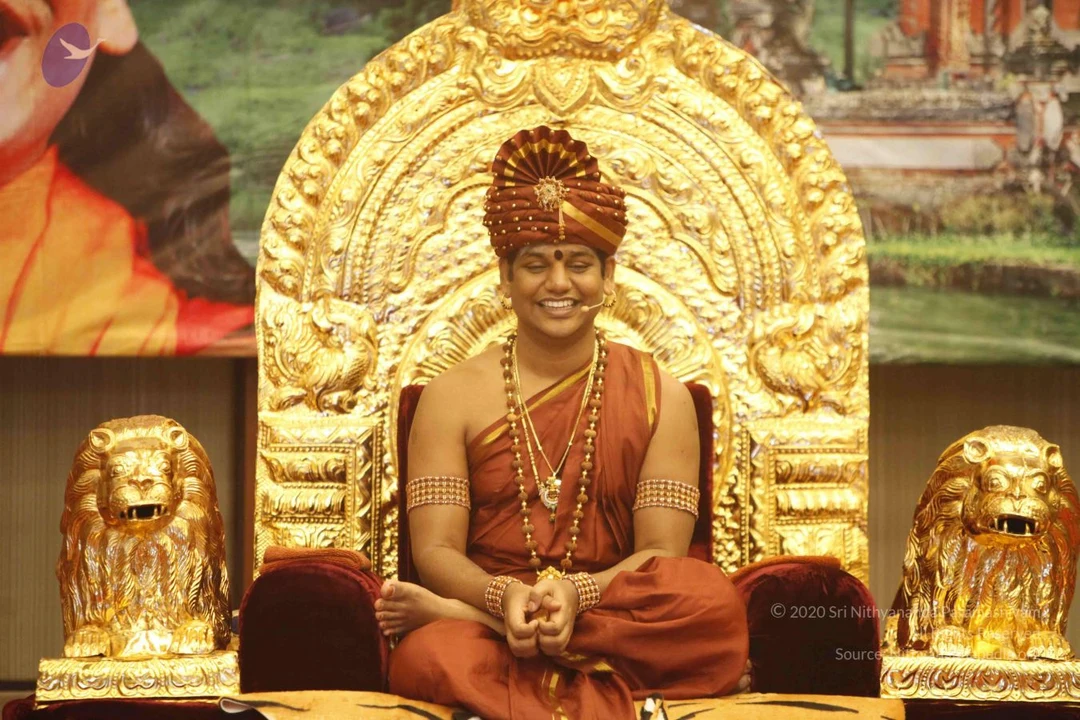
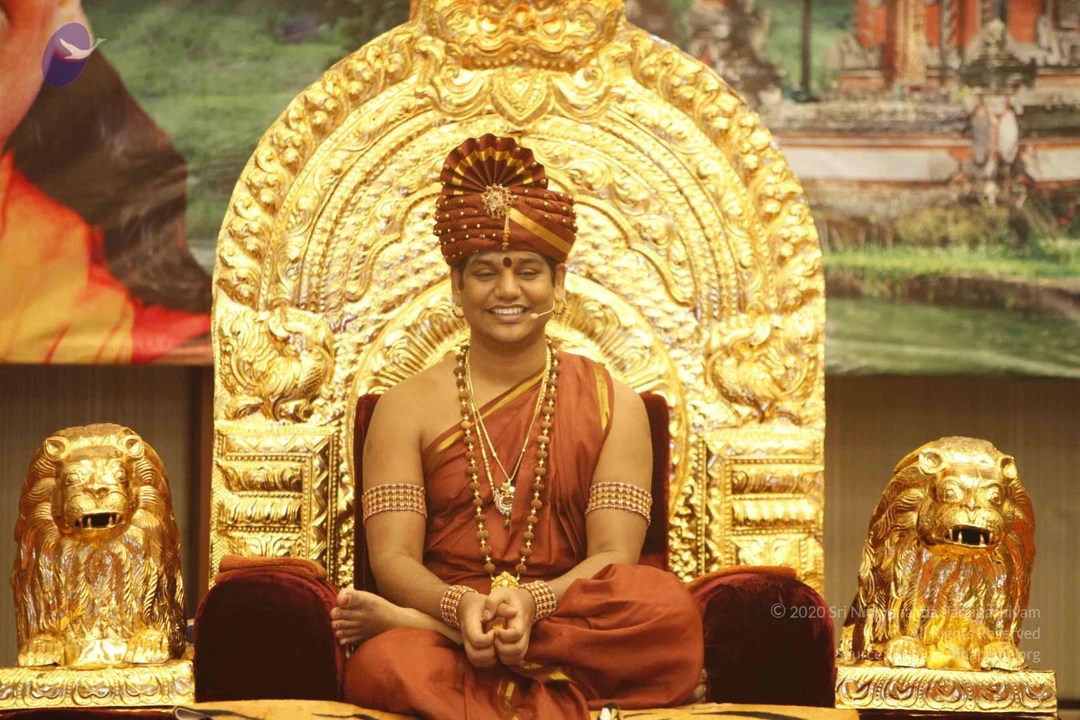
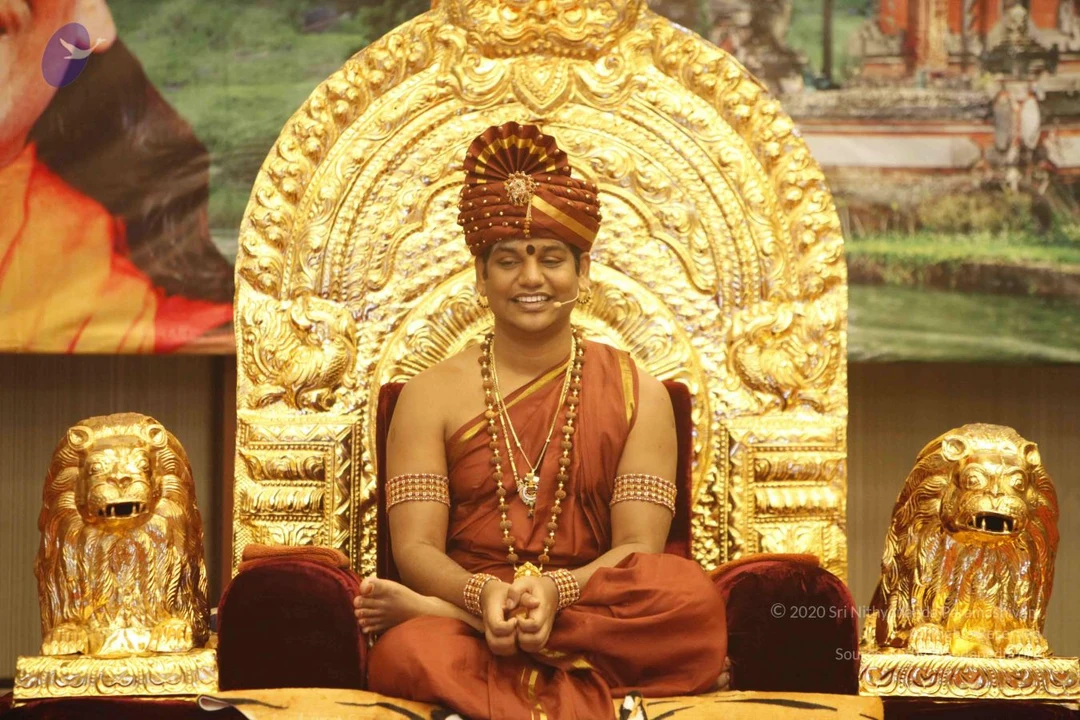
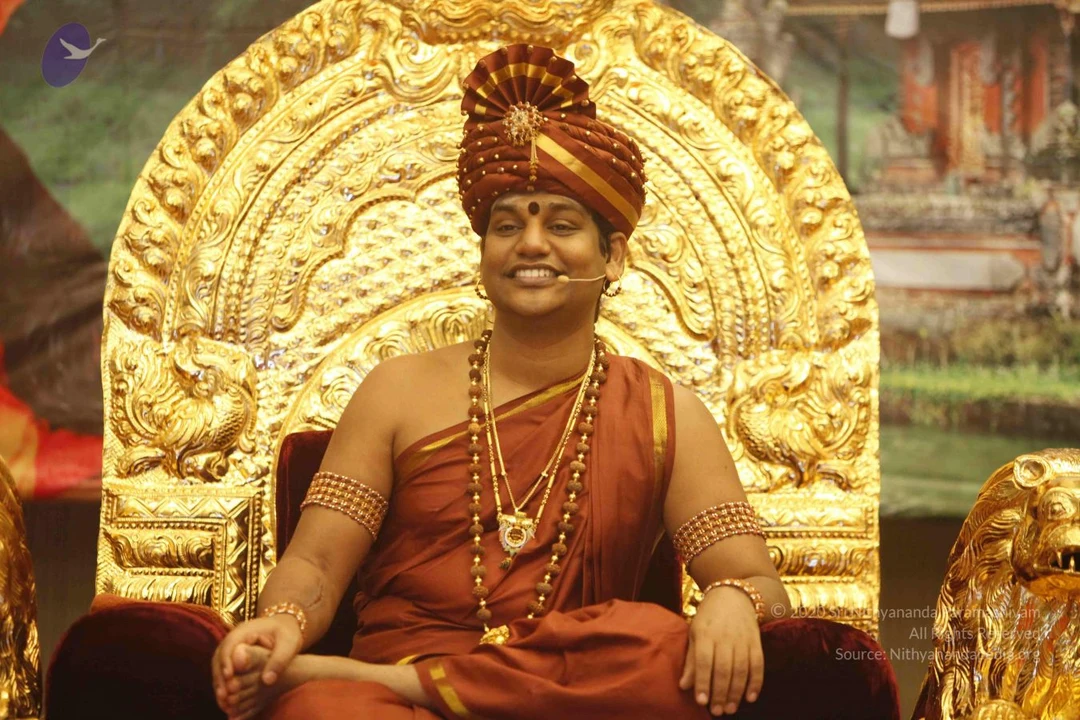
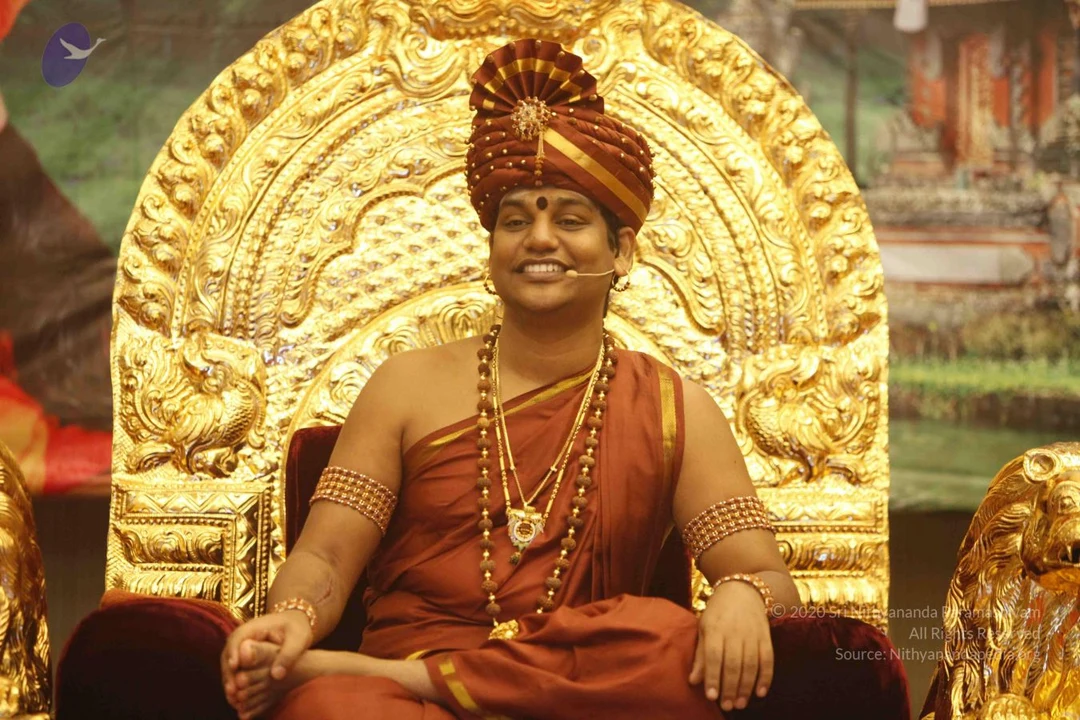
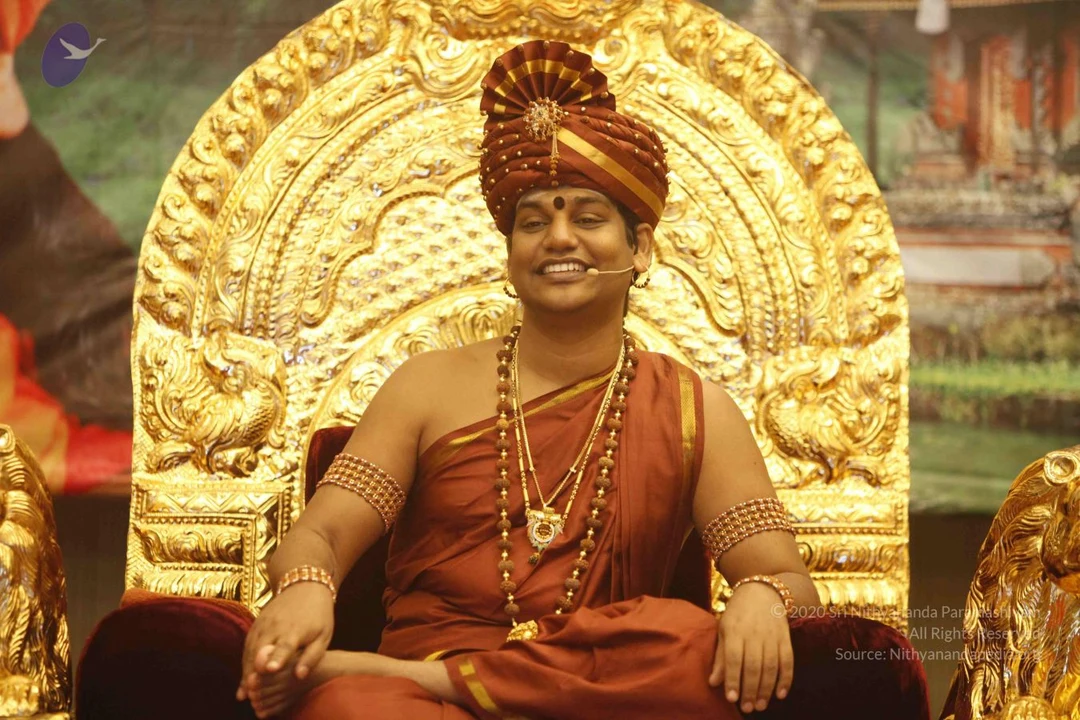
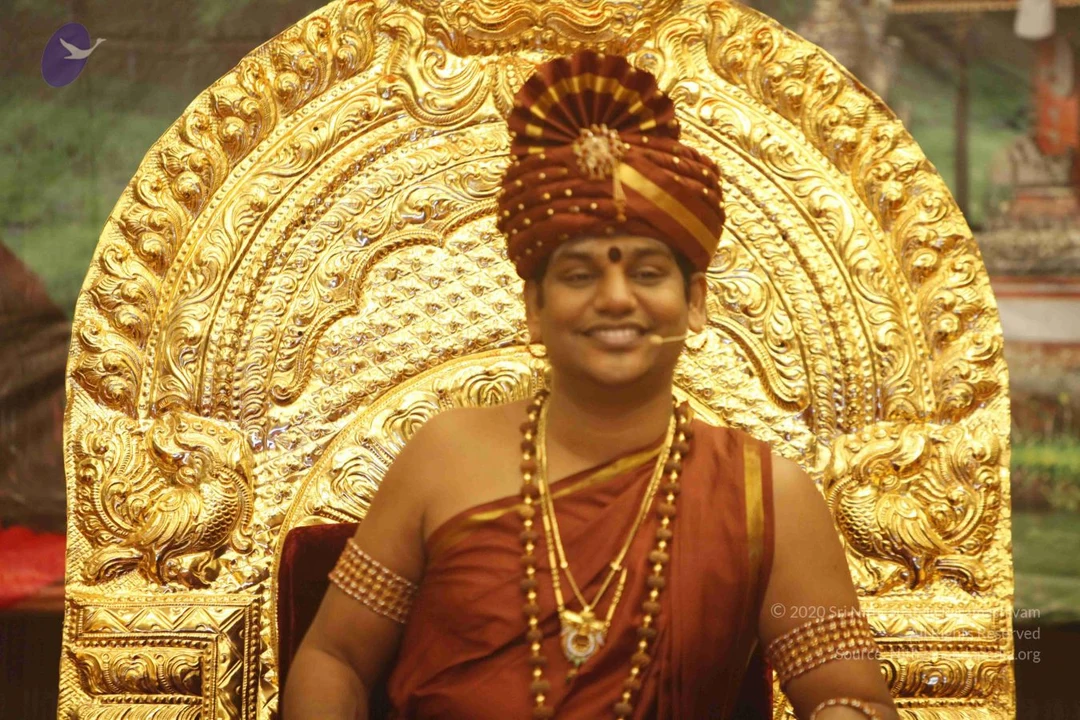
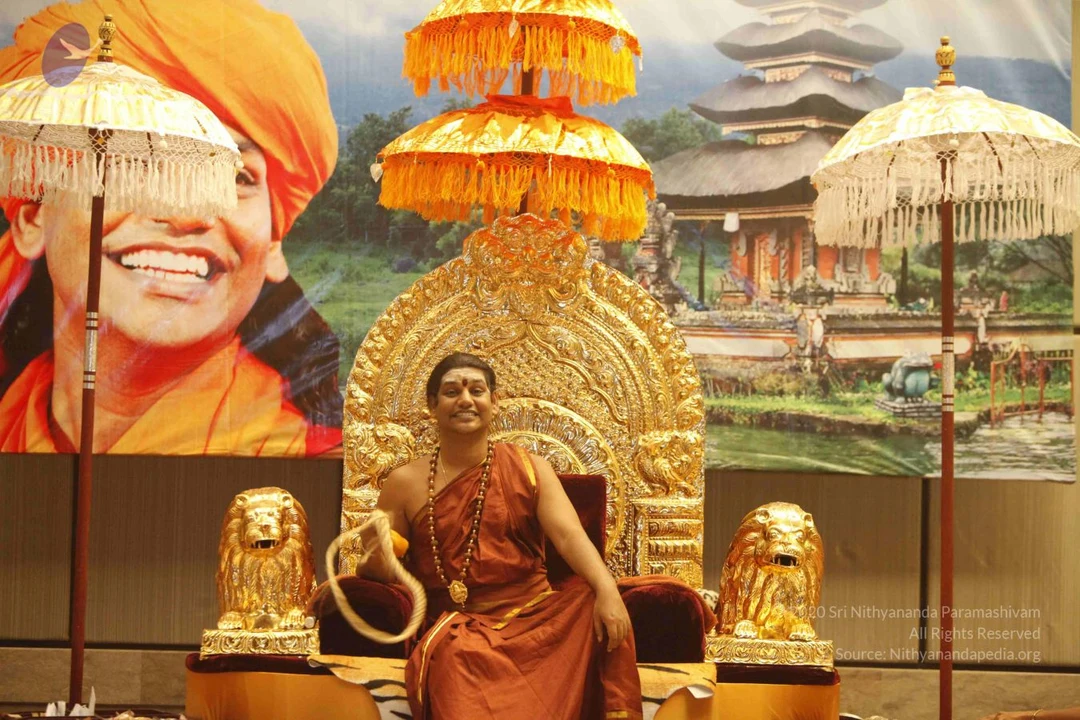
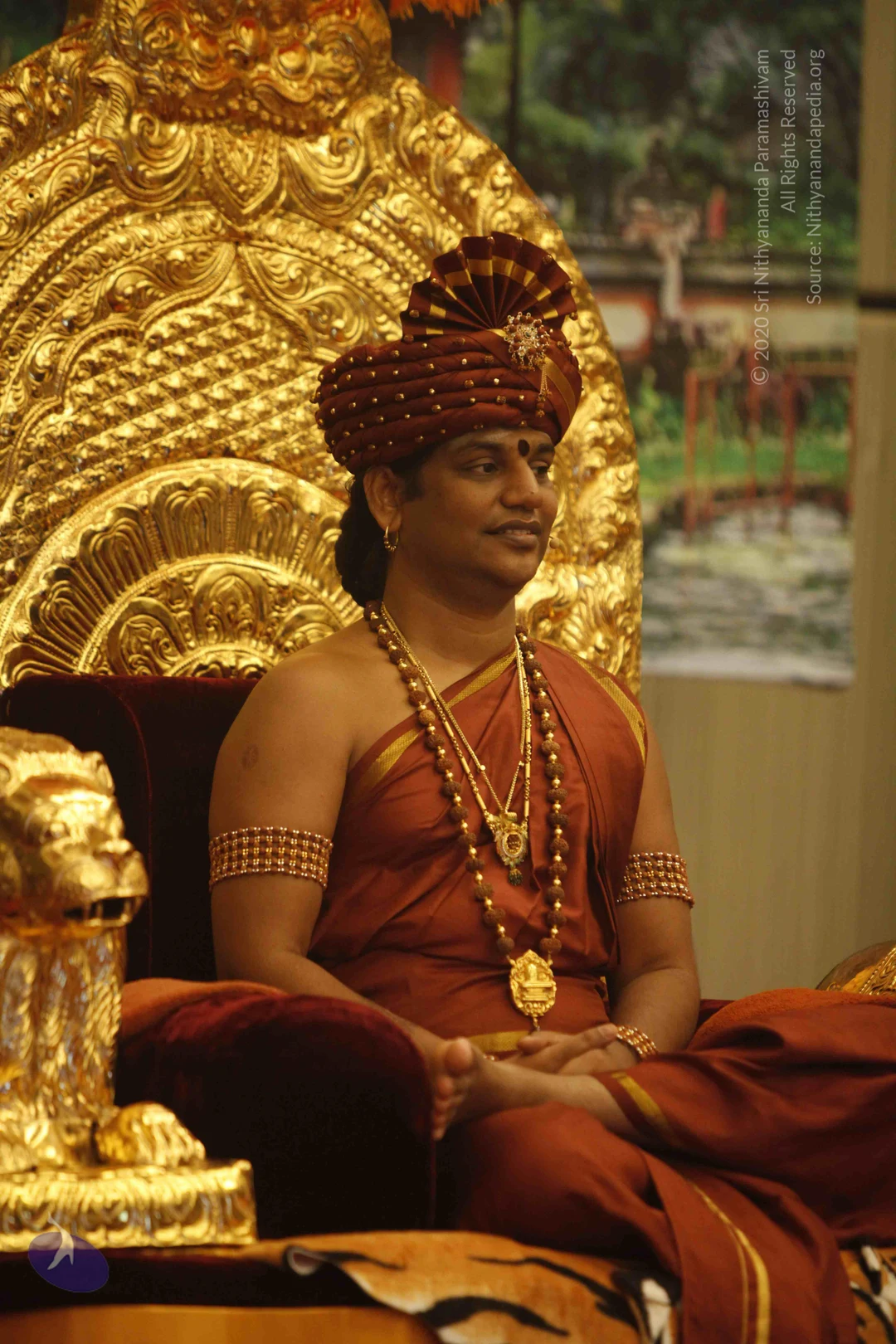
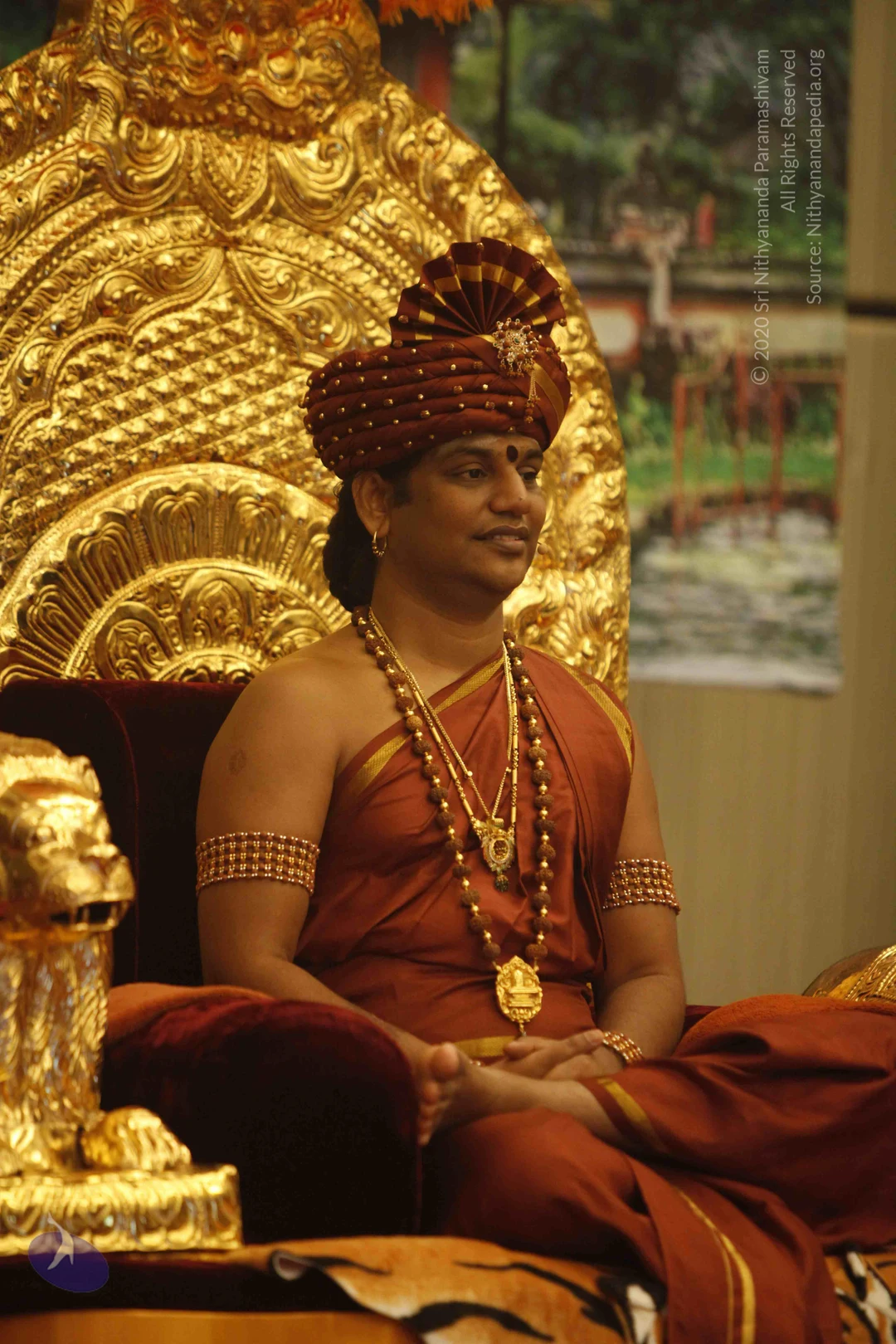
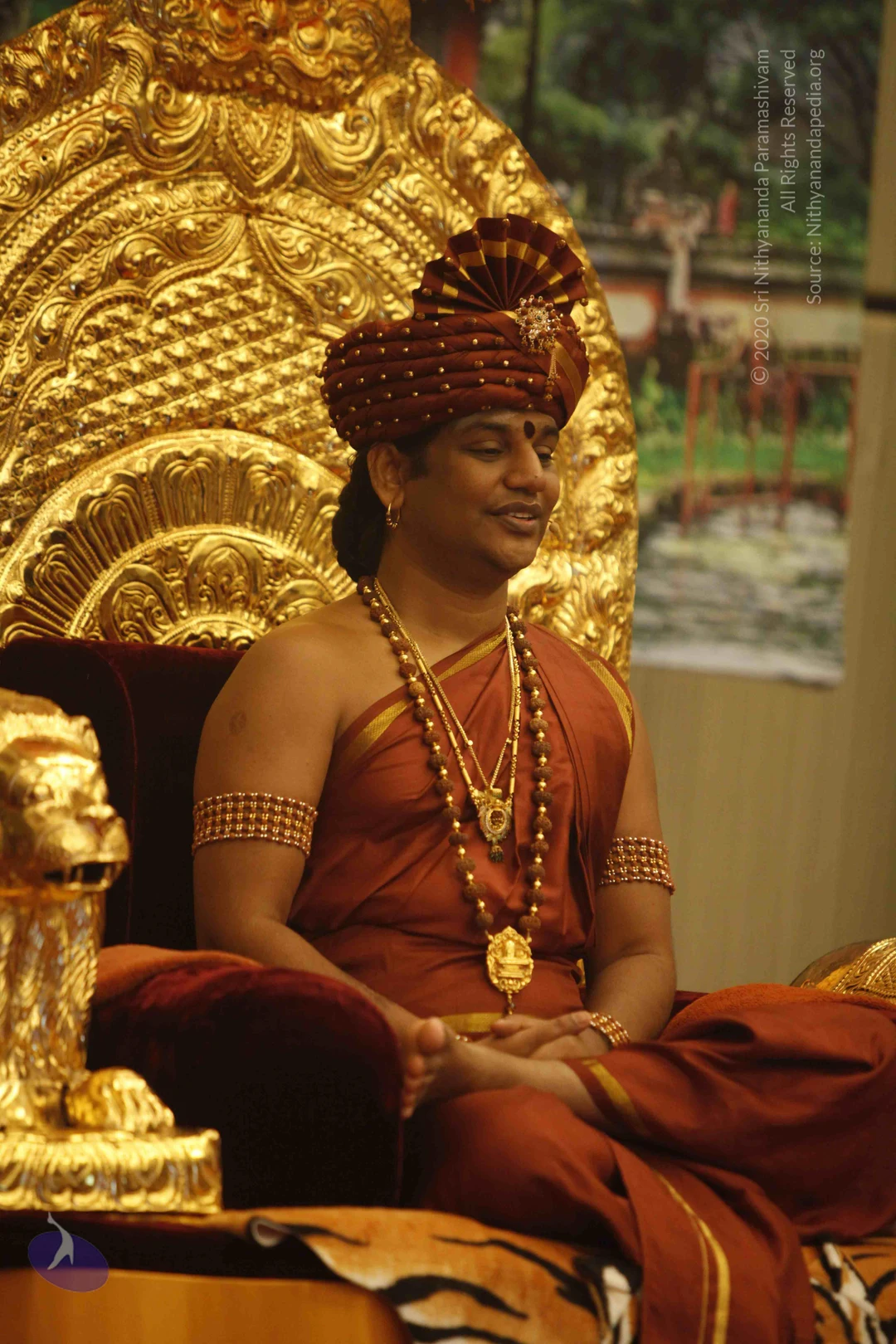
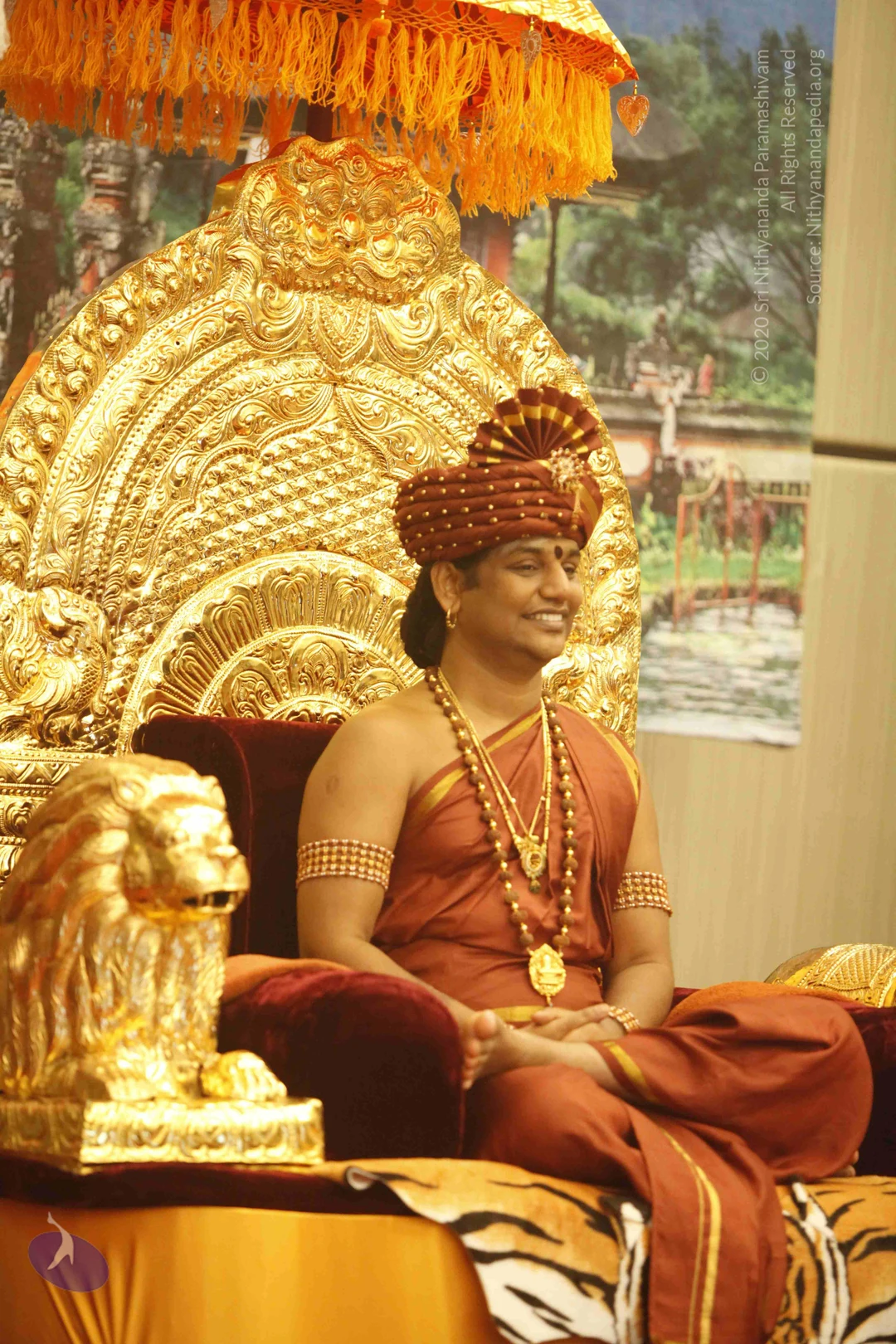
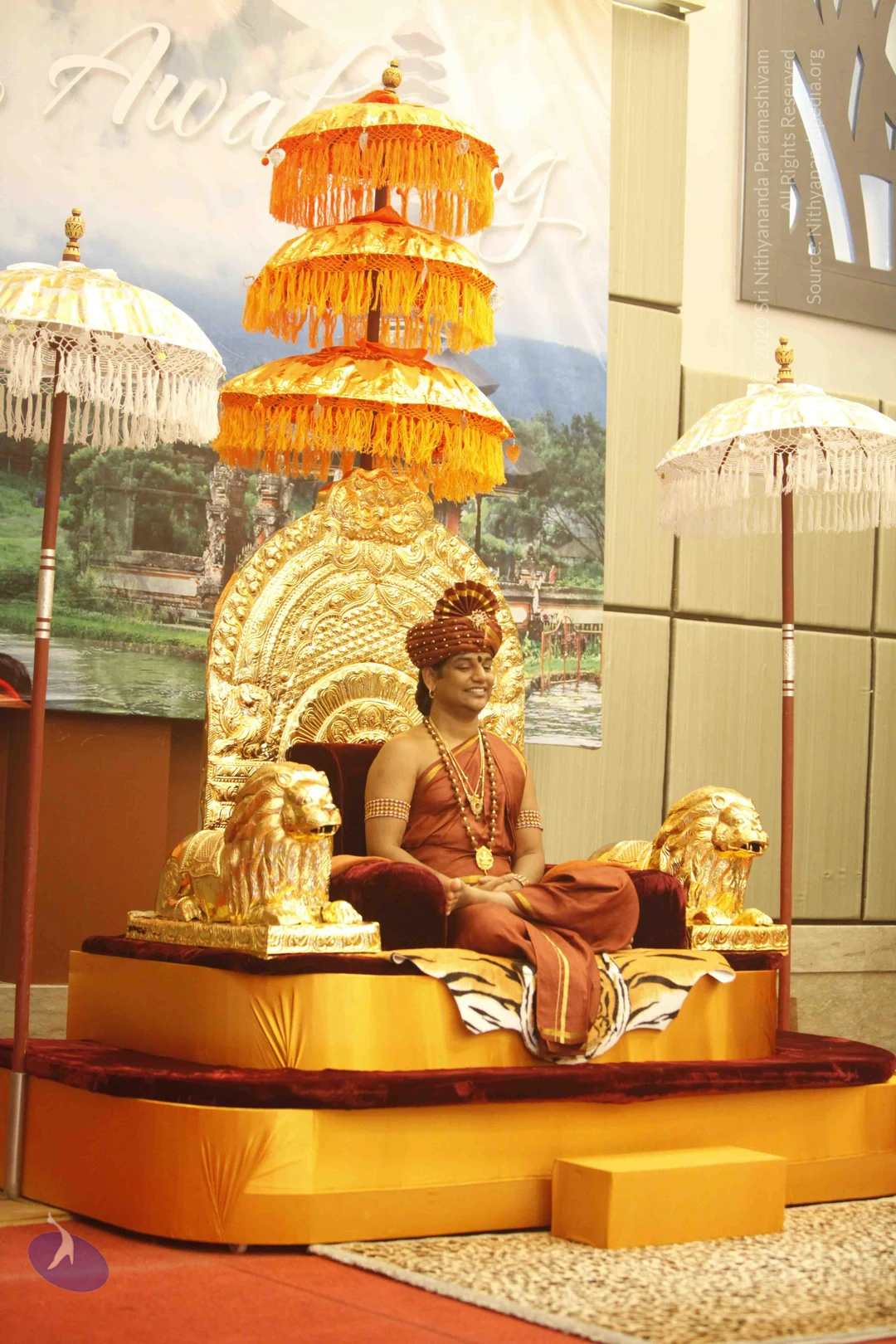
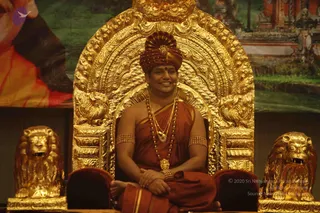
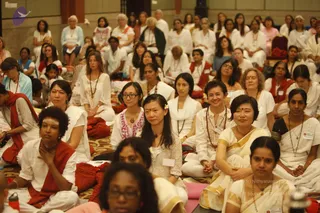
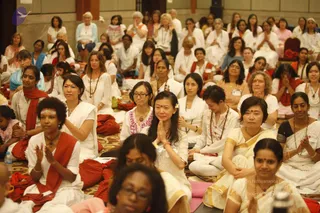
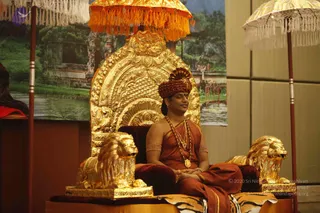
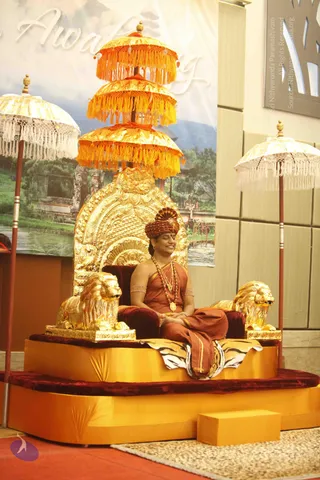
A seated man in a saffron-orange robe sits cross-legged on an ornate gold throne carved with foliage and flanked by two gold lion sculptures. He wears a dark red turban with a small gold emblem, a rudraksha mala and layered gold necklaces, plus ornate gold armbands, and smiles with hands folded in his lap. Behind the throne, a large painted backdrop shows a tropical temple with green rice fields, and a partial portrait in orange robes appears at the left edge. Identity is not established from appearance alone; the figure is described by role only.A seated audience fills a hall at a satsang, packed in rows on patterned carpet. Most wear white clothing, with several women in white saris bordered in gold and others in white kurtas. Many wear rudraksha or bead malas and pendants. A woman in front wears a red-and-white shawl and a white-marked forehead; a woman at lower right in a white sari with gold border and red bindi sits with hands folded. A red chair stands at upper right beside a stone-framed wall.A photograph of a seated group of devotees in a hotel-style hall with red-and-gold patterned carpet and red-cushioned gold-legged chairs. In the foreground, a man in white kurta with a red shawl sits with hands folded, and a man in a striped polo with a red shawl sits beside him. Center, a young man in white clothes wears a rudraksha mala and sandalwood tilak on his forehead. Behind them, others in white kurtas and white t-shirts sit on chairs and the floor, one holding papers, and a bald man in white with a mala sits upright. Several participants wear name badges. No identifiable a person candidate is clearly present in this frame.A seated congregation fills a hall during a satsang, with many devotees in white clothing and some in red and orange shawls. Most are sitting cross-legged on a patterned carpet with hands pressed together in anjali mudra, and several have eyes closed. A woman at the left wears a red shawl and has white markings on her forehead. A woman in the centre wears a white embroidered top with a red bindi and a sandalwood-coloured dot on her forehead. Rudraksha and bead malas are visible on several devotees. Women in saffron and golden-bordered saris sit at the right. The background is filled with rows of further attendees, and no speaker or throne is clearly visible.A large indoor meditation gathering in a hotel ballroom with a patterned brown and gold carpet. Many devotees sit cross-legged in white ritual clothing, with rudraksha malas around their necks, in rows of seated participants. Some women wear white and yellow saris and others wear white kurtas. A few men in the foreground wear white with rudraksha malas, and one man in front wears a white t-shirt and a rudraksha mala. Some attendees in the back wear saffron or red shawls. Dozens of people fill the room. No single figure is clearly identifiable as a person from this distance and angle.A seated man in a golden ornate throne with carved lion figures at its base and tiger-striped cloth on the platform, flanked by two decorated parasols with fringed edges, one orange and one cream. He wears a maroon turban, a maroon-orange draped garment, a rudraksha mala and a gold pendant necklace, with beaded bangles on his upper arms, and his hands rest in his lap in a meditative pose. A Bali temple-garden backdrop with green foliage and a pond stands behind the throne. The appearance shows long swept-back hair, a turban, a rudraksha mala and ornate ceremonial gold, so this is a probable Swamiji (probable) in a seated, honoured role on the peetha.

IA-YOGA
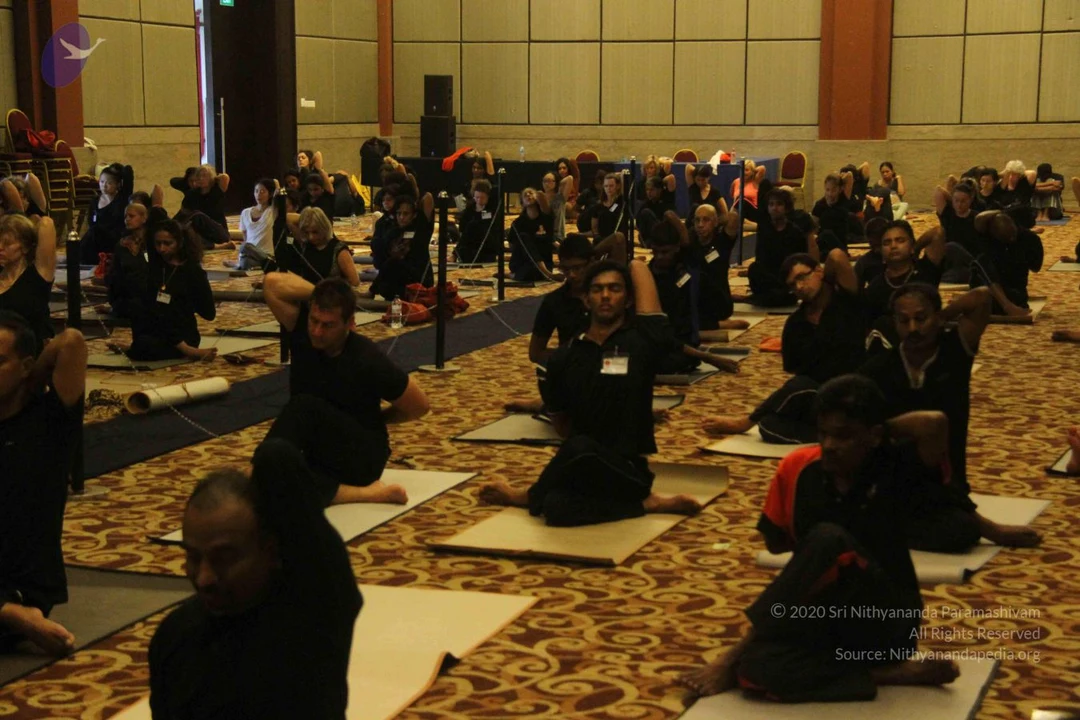
6 photosSource gallery
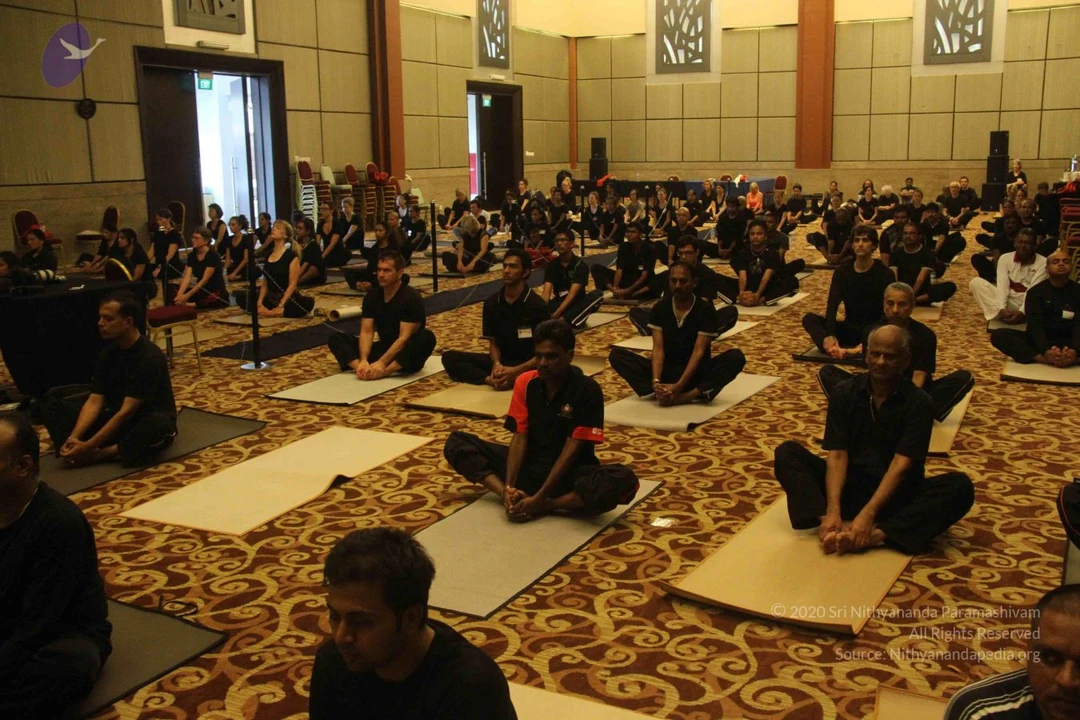
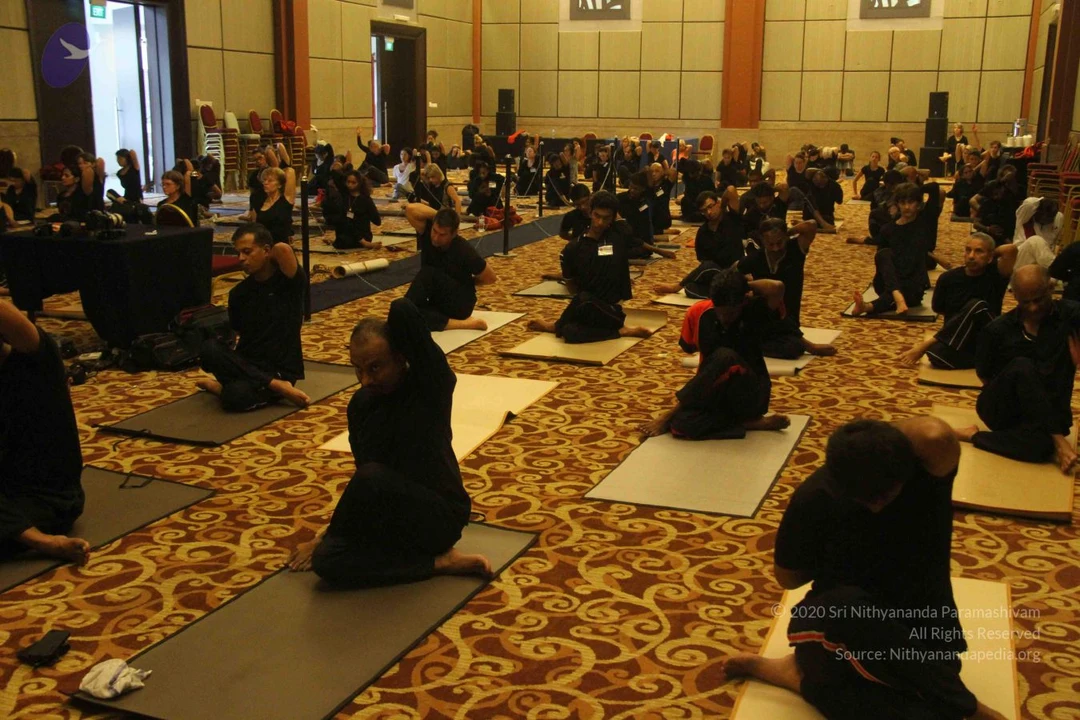
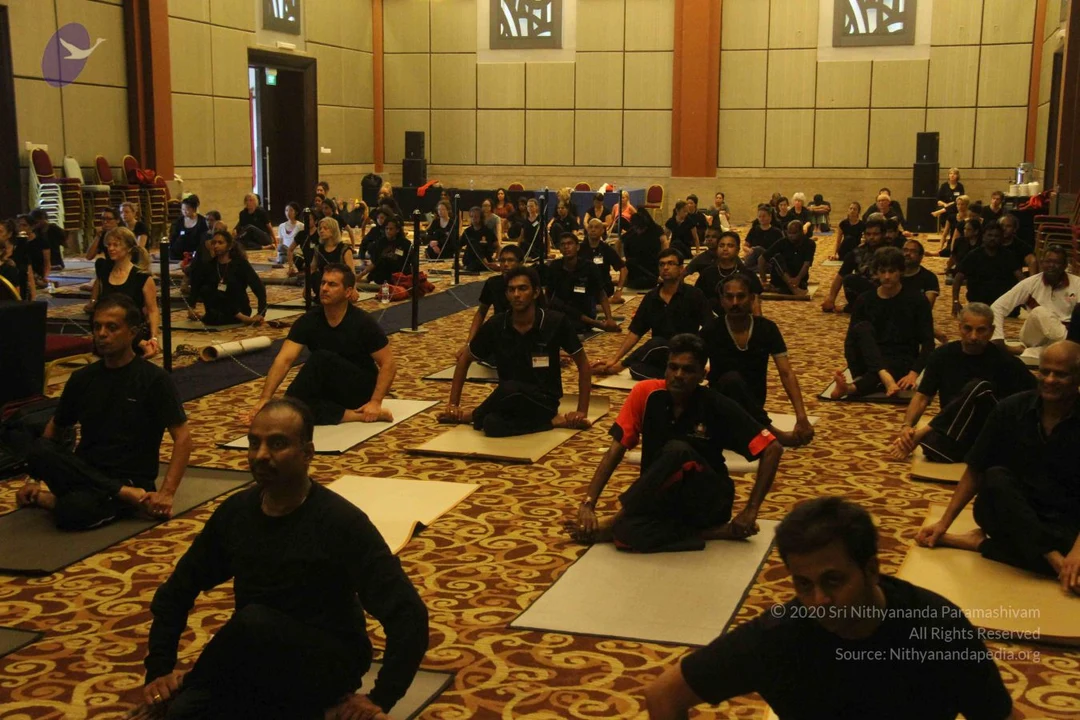
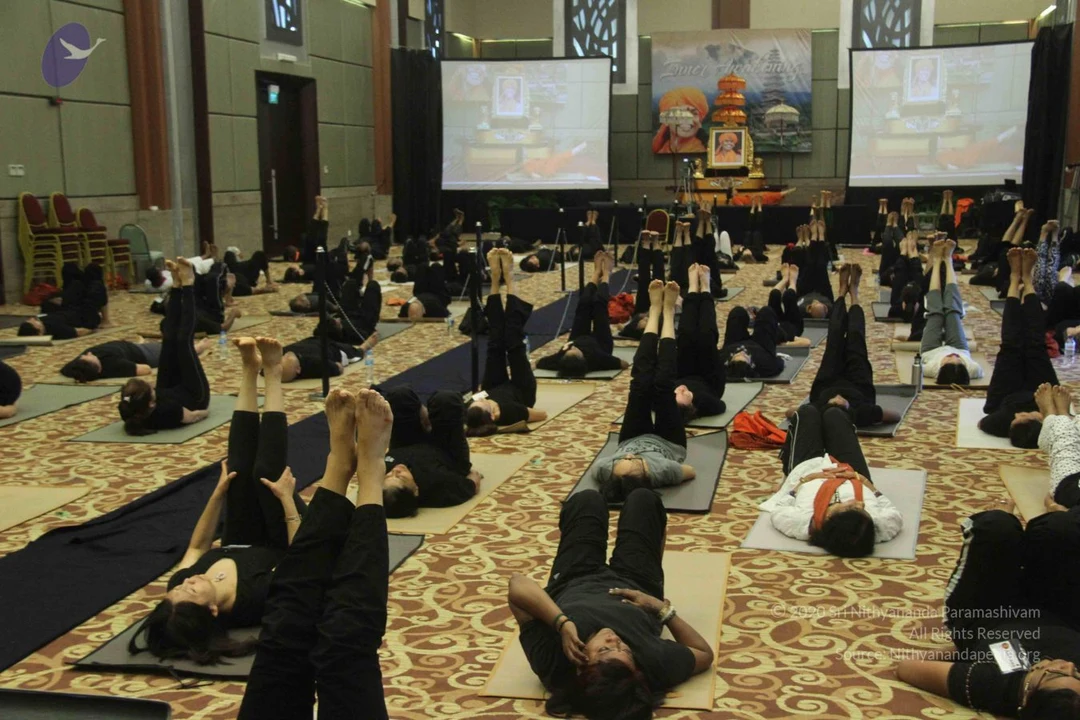
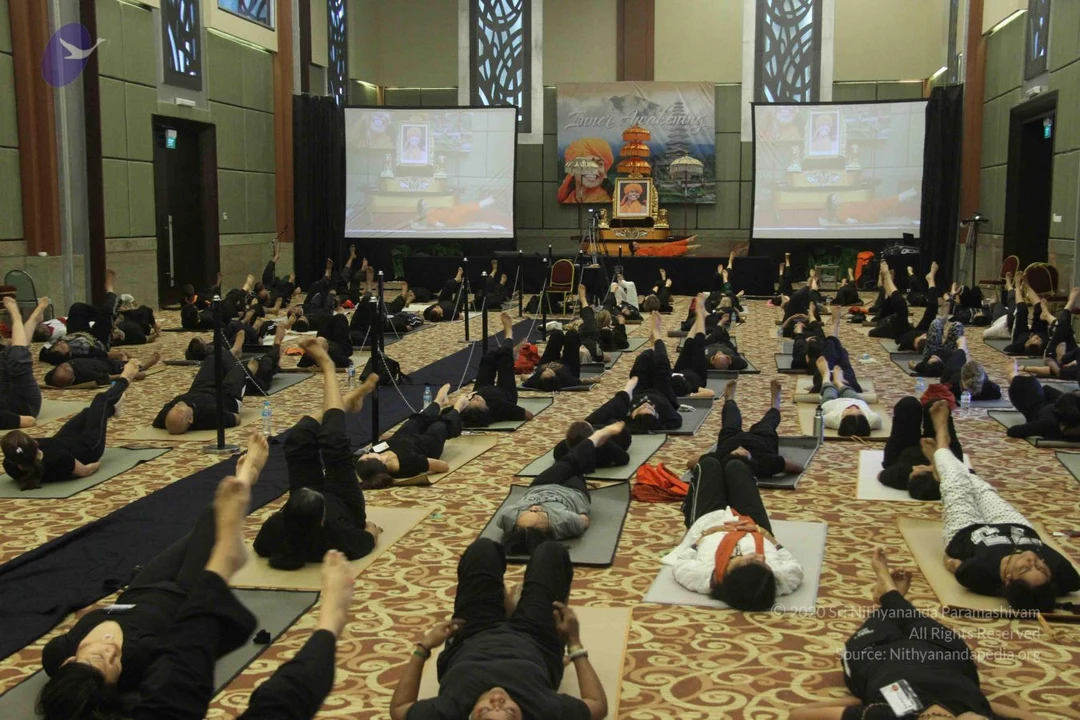
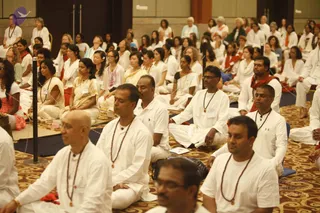
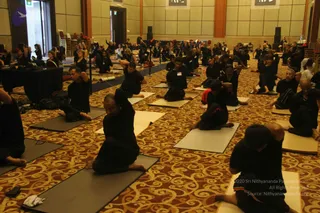
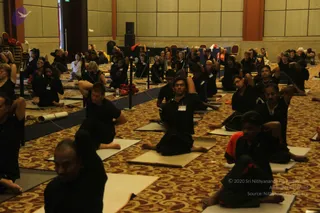
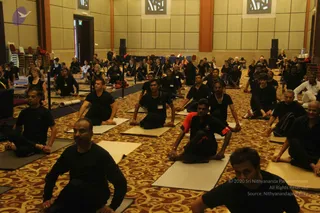
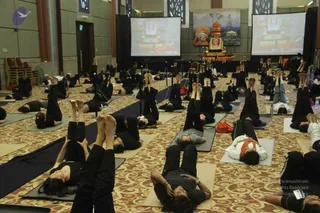
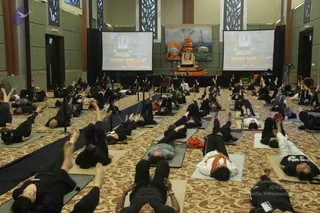
A large hall with patterned gold-and-brown carpet and beige walls, where many people sit cross-legged on cream meditation mats in neat rows, most dressed in black clothing. A few wear red or white. The room has tall pillars with geometric panels, and a camera stands at the left edge. The seated audience appears to be in a meditation or satsang session. No one at the front is identified as a person in this view.A photograph of a large carpeted hall where many people in plain black clothing sit on mats in yoga-style seated postures, several twisting or bending forward with arms raised behind or overhead. Some sit on dark grey mats and others on pale cream ones. A black table with equipment stands at left, rolled mats lie near the centre, and a few people wear white or red garments. Wall panels and an exit door appear in the background. No deity, throne or a person candidate is visible; the figures are seated participants in a group meditation or yoga session.A large hall with a patterned carpet is filled with many seated participants dressed in black clothing, sitting on rolled mats and small cushions in rows. Many have their arms raised overhead with hands behind their heads, performing a stretching or meditation posture. Some wear name badges on their chests. A stage area with speakers and a blue-draped table is visible at the back of the room, with red cushions and chairs along the walls. No single leader is clearly identifiable among the participants in the foreground.A large hall with patterned gold-and-brown carpet where many people in black clothes sit on cream and grey mats in rows, performing seated meditation or yoga postures. Most wear black shirts and trousers, one man in the foreground wears a black top with orange sleeves, and a few figures at the right wear white. Wood-panelled walls, a doorway at left, stacked chairs and black speakers frame the room. a person is not visibly identifiable among the seated participants.A large hall with a patterned carpet where many people lie on their backs on mats, legs raised straight up with feet pointing to the ceiling, in a yoga-style inverted posture. Most wear black clothing; one woman in the foreground wears a white top with an orange-red strap. Two large projection screens on the back wall show a man in orange robes at a desk. Between them stands a golden shrine holding a framed portrait and a small figure in orange, beneath a banner showing a smiling figure in orange with a temple graphic. Black drapes and chairs line the left side.A large hall with patterned carpet where many people lie flat on yoga mats with arms and legs raised, many dressed in black, some in white or grey, at what appears to be a meditation session. Two large screens show a seated figure in orange at a lectern, and a banner reading Inner Awakening hangs behind a small altar with a figure in orange and a lit lamp. Black cords and stanchions divide the rows. Several participants wear black tops, one in a white jacket with an orange scarf. Roughly thirty to forty people are visible, mostly lying down, some with arms overhead.

DARSHAN
81 photosSource gallery
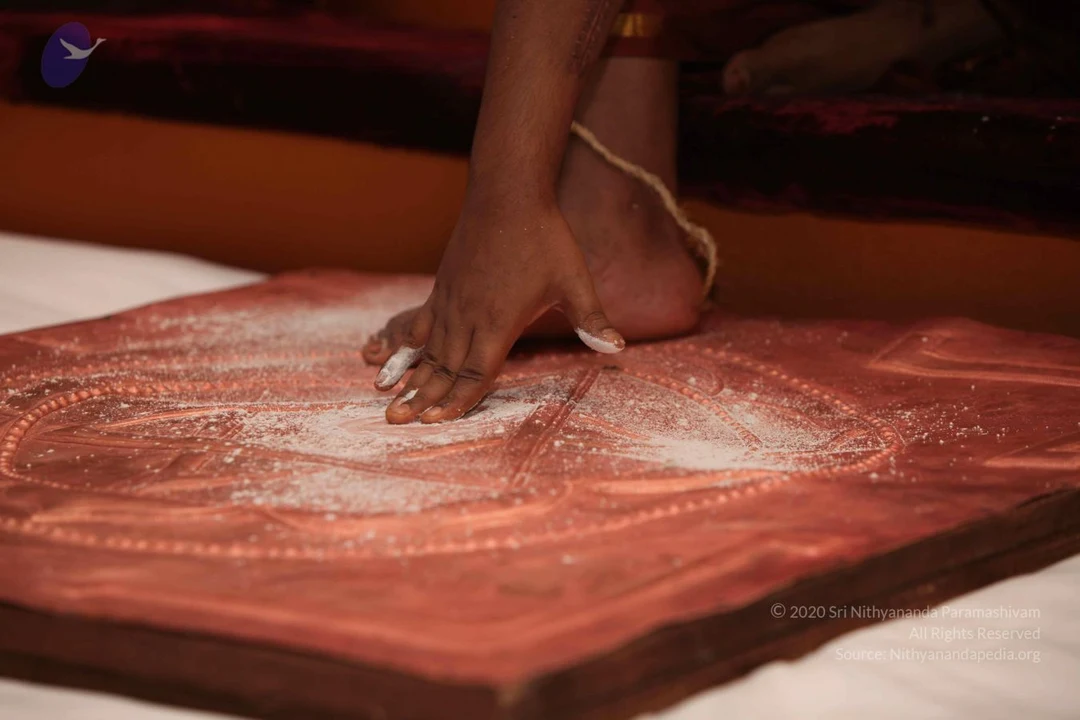
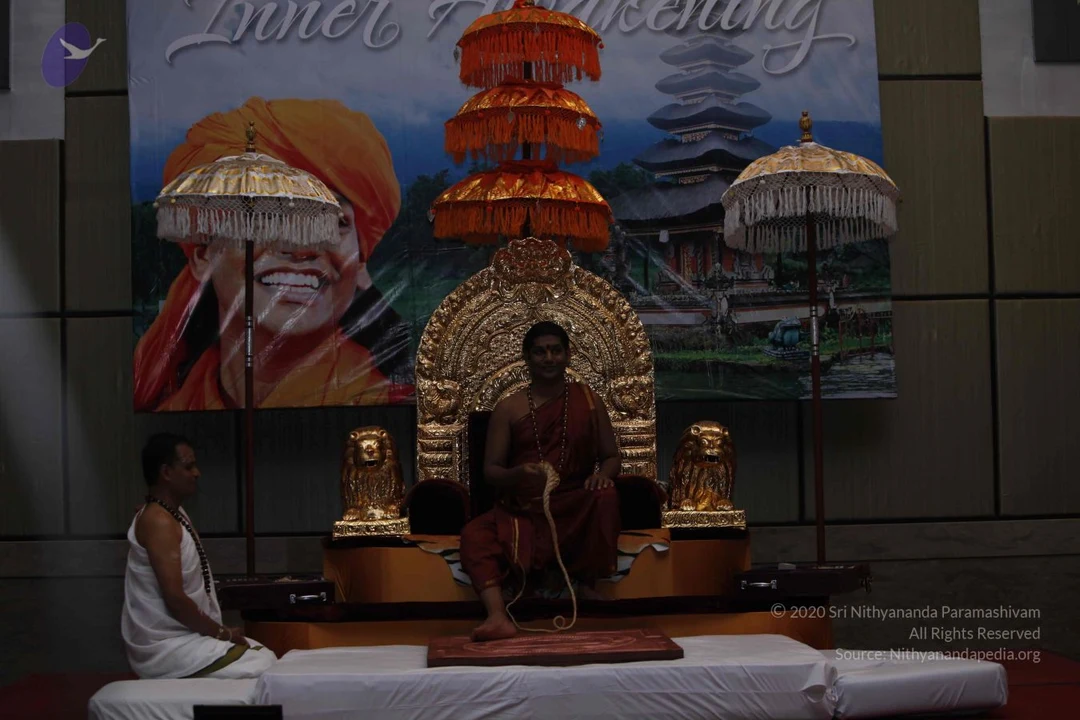
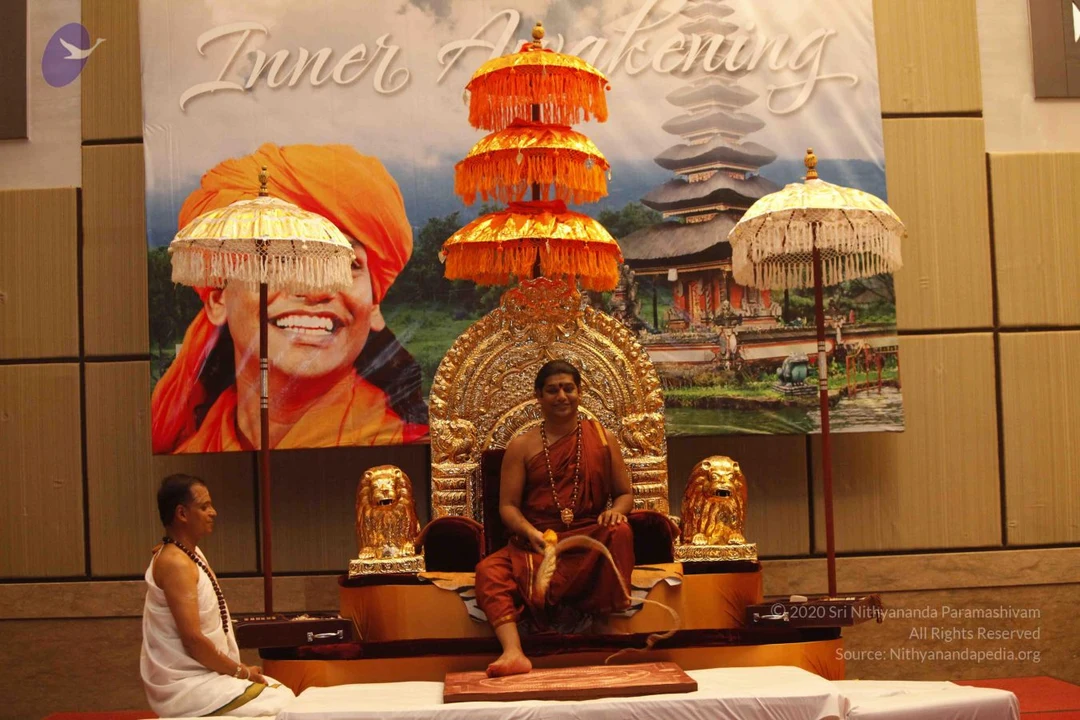
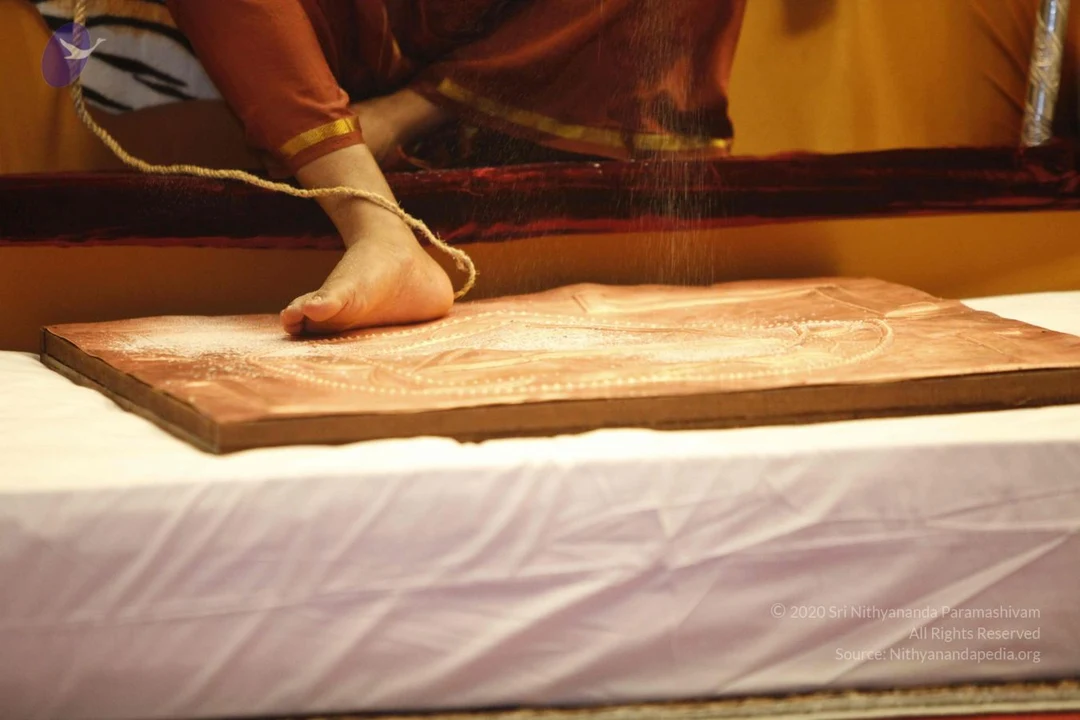
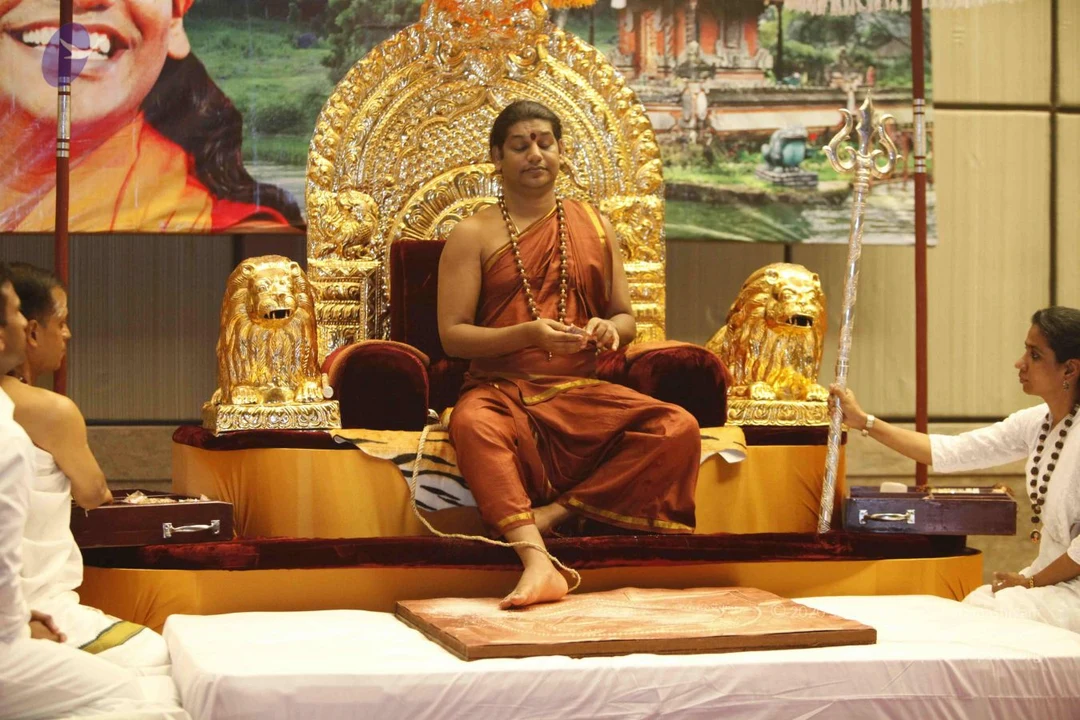
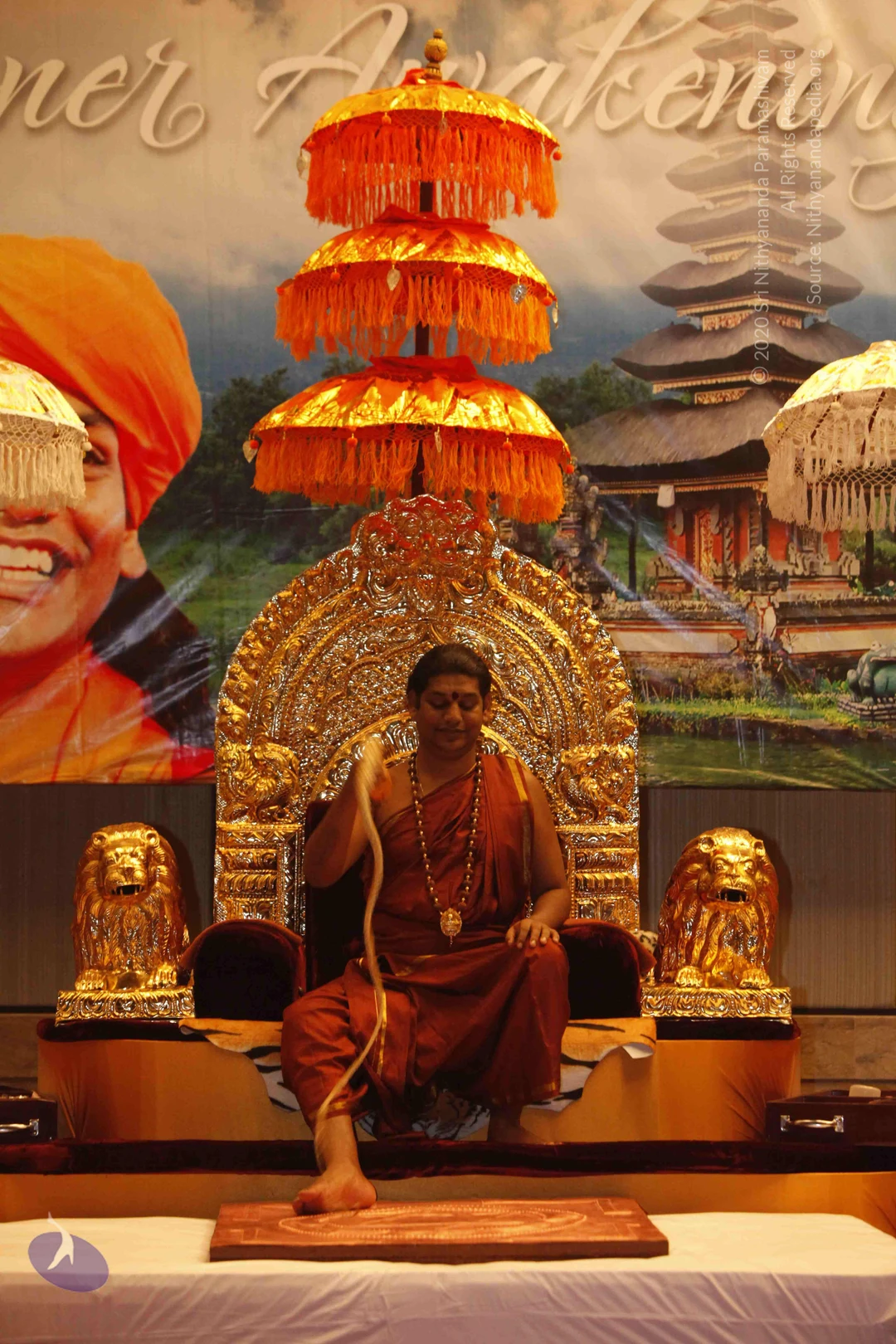
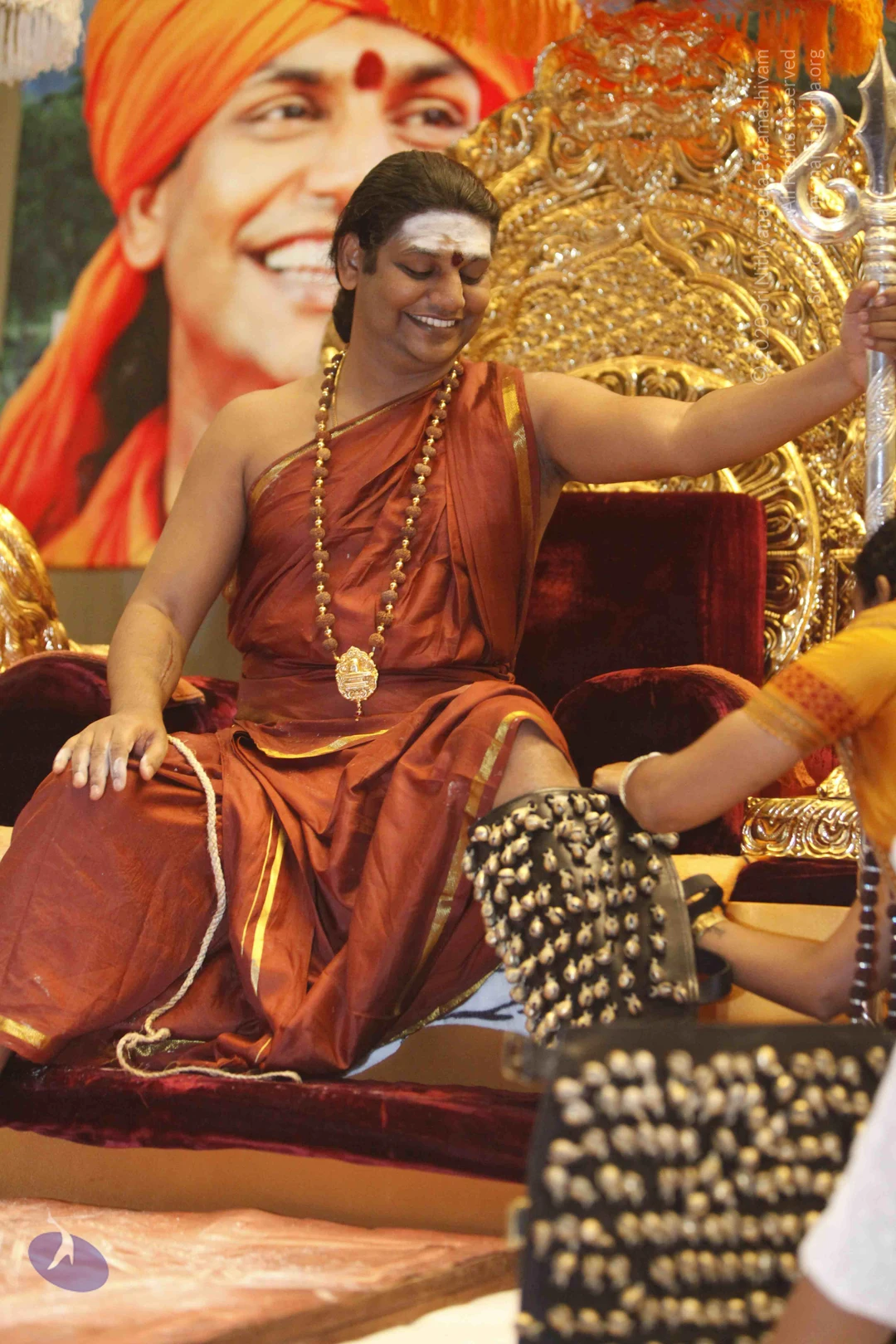
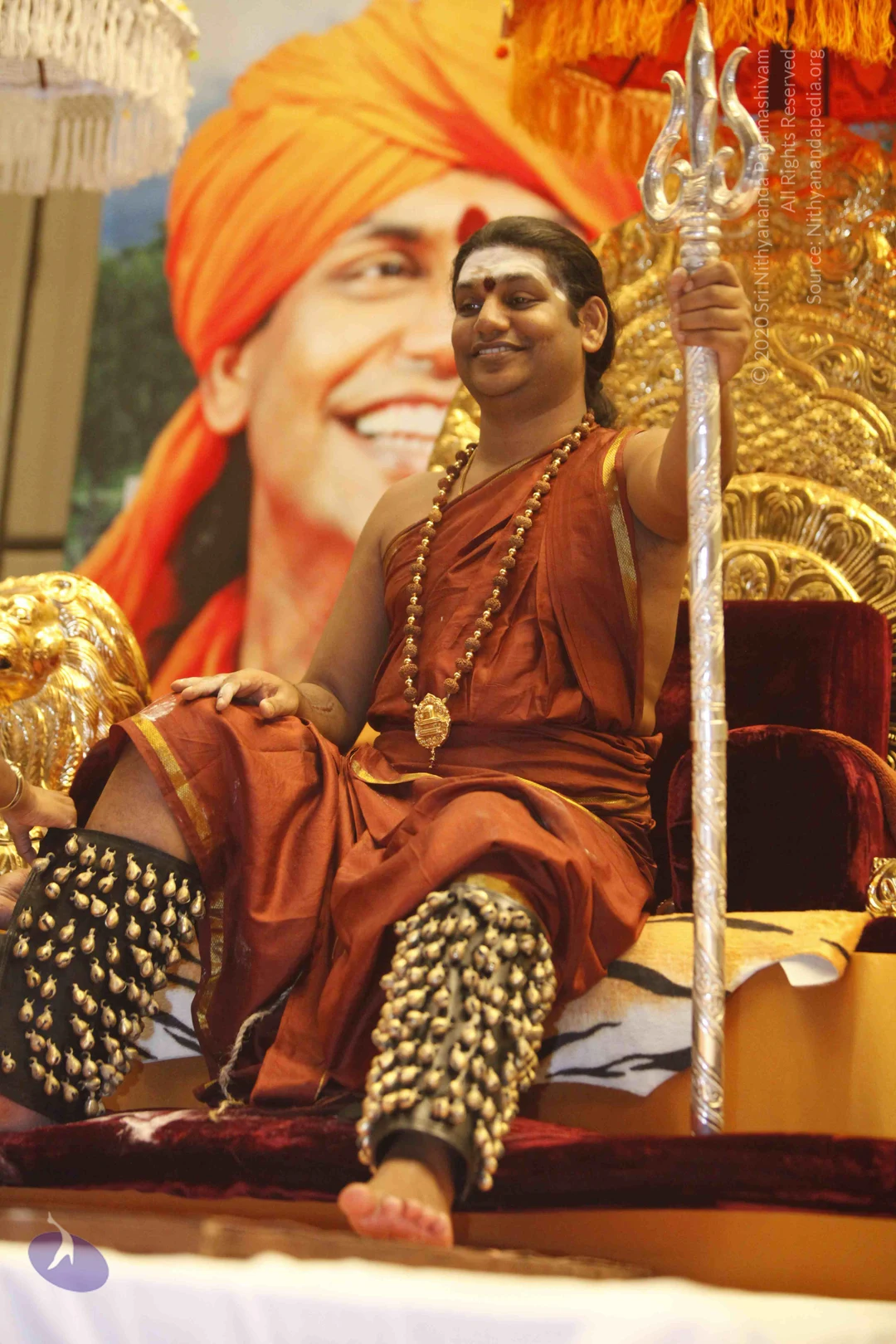
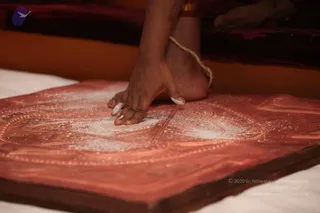
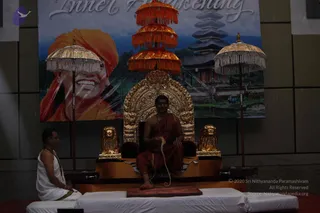
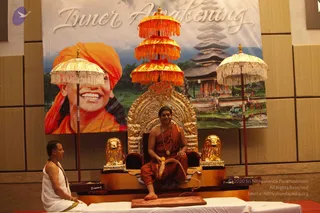
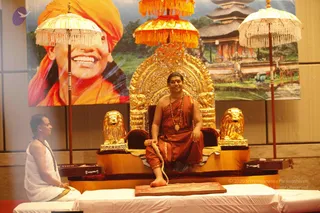
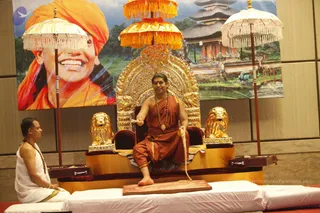
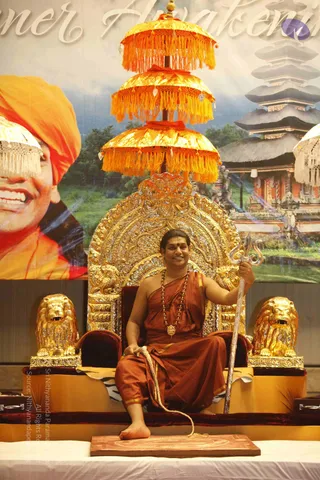
Close-up photograph of a person's hand and bare foot at a red-orange wooden or stone slab carved with a raised circular design. The hand, with white powder on its fingertips, presses onto the slab where white powder is scattered over the carving. A thin cord is tied around the ankle, and a gold band is visible at the top edge. The setting suggests a ritual preparation of a sacred diagram, possibly a padukapuja or ritual drawing, with a white cloth beneath the slab. No faces are visible.A seated man on a gilded throne with a golden arched back and two golden lion figures at its sides, holding a length of rope, wears an orange-red dhoti-style garment and a rudraksha mala. Two golden-fringed ceremonial parasols stand on either side and an orange tiered umbrella rises above him. Behind the stage a large banner reads Inner Awakening, showing a smiling man in an orange turban and a temple with tiered roofs. A second man in white ritual clothes sits to the left with a mala. The white-draped platform is set in a hall with tiled walls.A seated figure on an ornate gilded throne with lion-face armrests and a carved backrest sits at the centre of a stage, flanked by two golden lion statues and two gold-fringed parasols. The throned figure wears a rust-red garment and a rudraksha mala, with bare feet resting on a wooden platform. Behind the throne hangs a large banner reading Inner Awakening, showing a smiling person in an orange turban and orange robes beside a Balinese temple with a multi-tiered pagoda-style roof. A shaved-headed man in white ritual clothes and a rudraksha mala sits on the floor at the left, facing the throne. Three tiered orange and gold umbrellas stand behind the throne. Wall panels of wood-toned tiles frame the stage.Close-up photograph of a bare foot stepping onto a wooden padukapuja board inlaid with a rope or cord border and a decorative design, placed on a white-draped platform. The person's legs wear rust-red trousers with gold trim, and a tiger-striped cloth and gold-embellished seat are visible behind. The setting appears to be a ceremonial stage in an ashram hall with red carpeting in the foreground.A seated guru on a gilded throne with two golden lion sculptures and an ornate golden backrest, under two yellow-and-orange ceremonial parasols with fringed white edges. He wears a rust-red robe and a long rudraksha mala with a gold pendant, and holds a rope-like cord. Before him sits a white-clad devotee on a white cloth with a beaded mala, facing the throne. Behind them a large banner shows a smiling face in orange robes and a Bali temple with a pagoda-style roof and rice-paddy scenery. A short bodily-appearance cue of long hair and crown is absent here; the seated figure's rudraksha mala and gold pendant are the visible cues, so this is a probable identification as Swamiji (probable), seated in person on the throne.A photograph of a seated figure on an ornate gilded throne flanked by two golden lion sculptures, under two golden-fringed ceremonial umbrellas. The central figure, barefoot, wears a rust-orange dhoti and shawl with a long rudraksha mala and a gold pendant, and gestures with one hand while holding a short cane. A seated attendant in white ritual clothes and a rudraksha mala sits to the left on a white cushion. Behind them hangs a large banner showing a smiling figure in an orange turban and orange robes, beside a Balinese temple with a tiered roof and a water garden. A white-and-gold cloth and a wooden footstool sit before the throne. a person appears as the central figure seated on the throne.

Pada-Puja

7 photosSource gallery
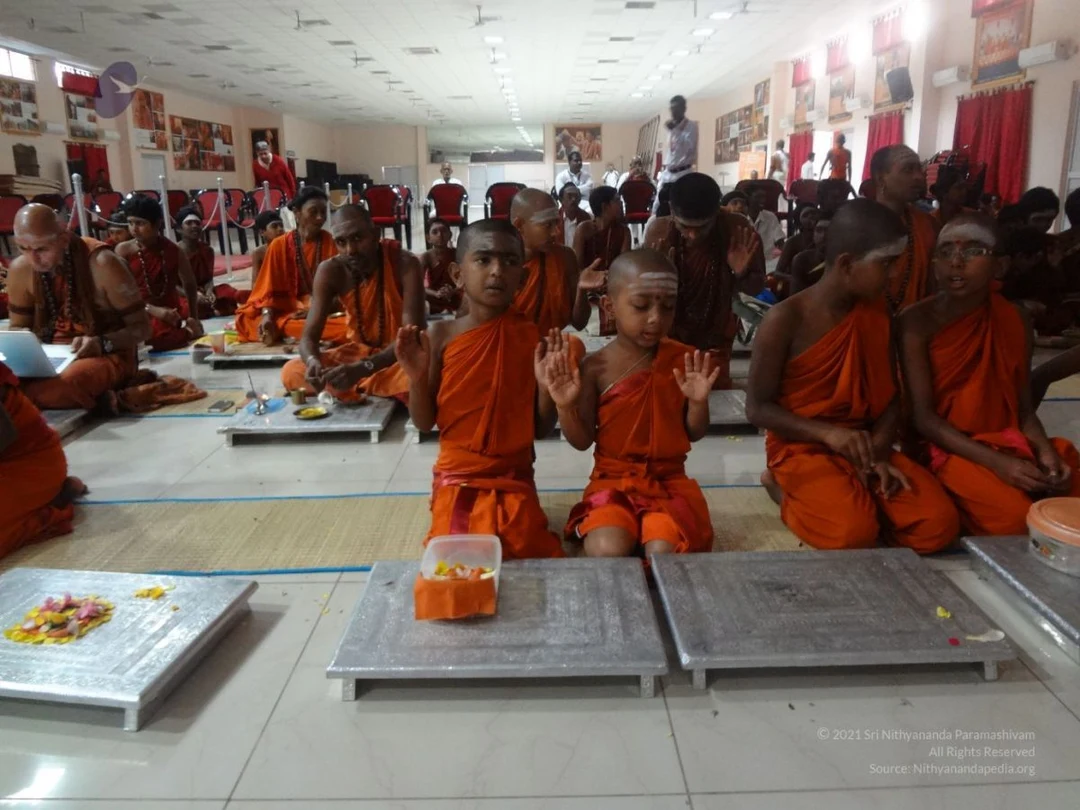
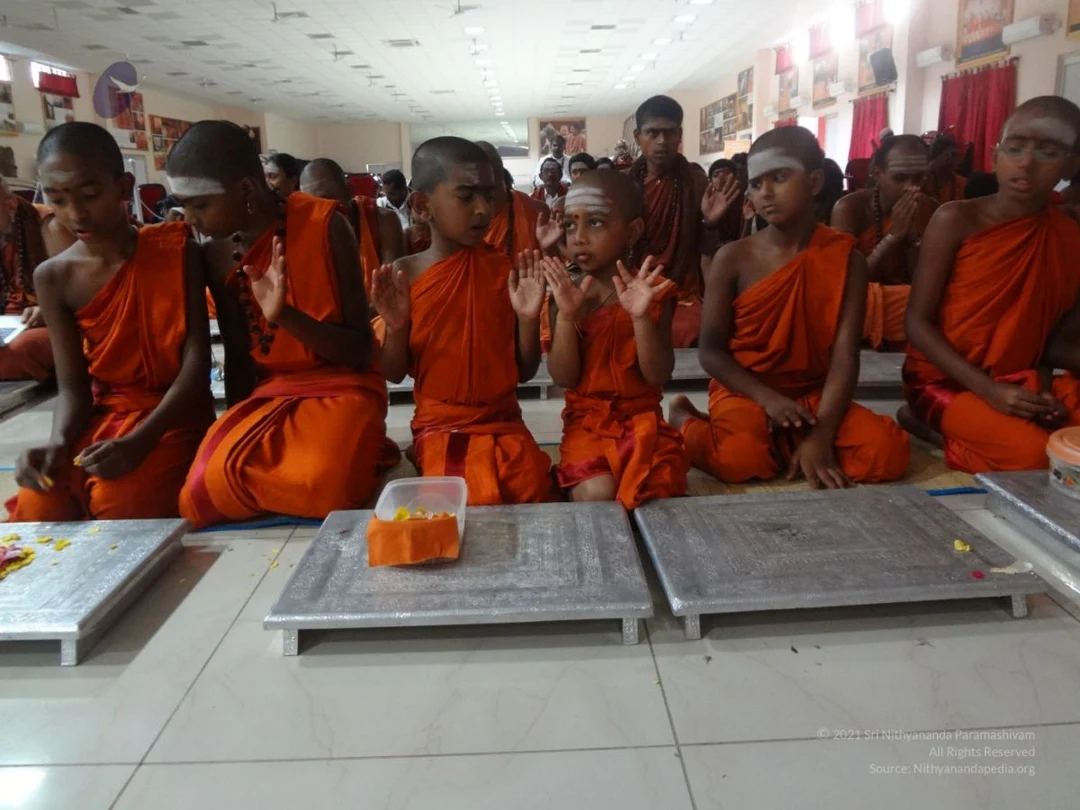
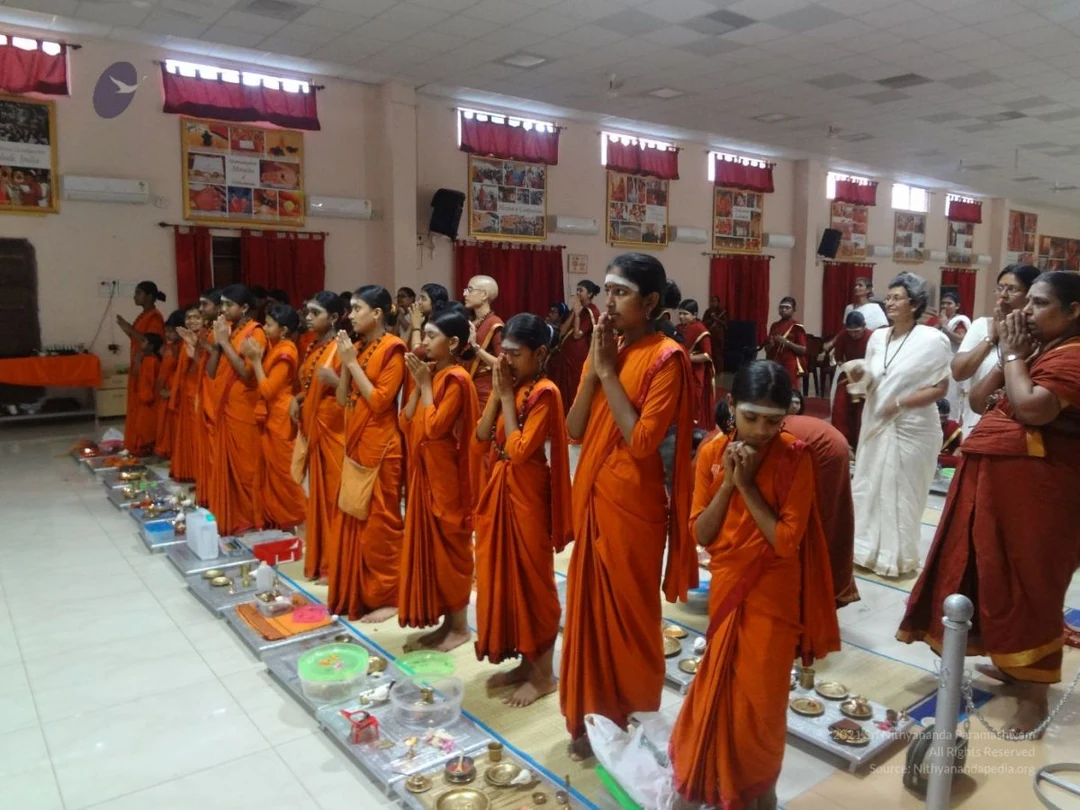
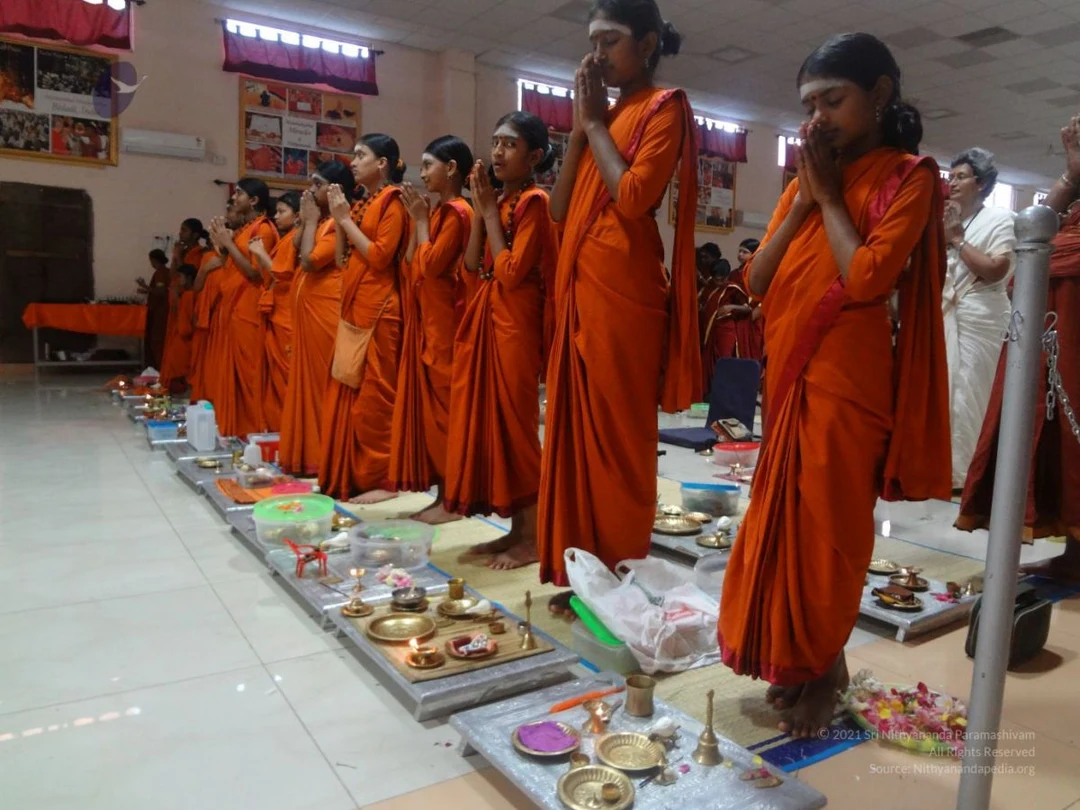
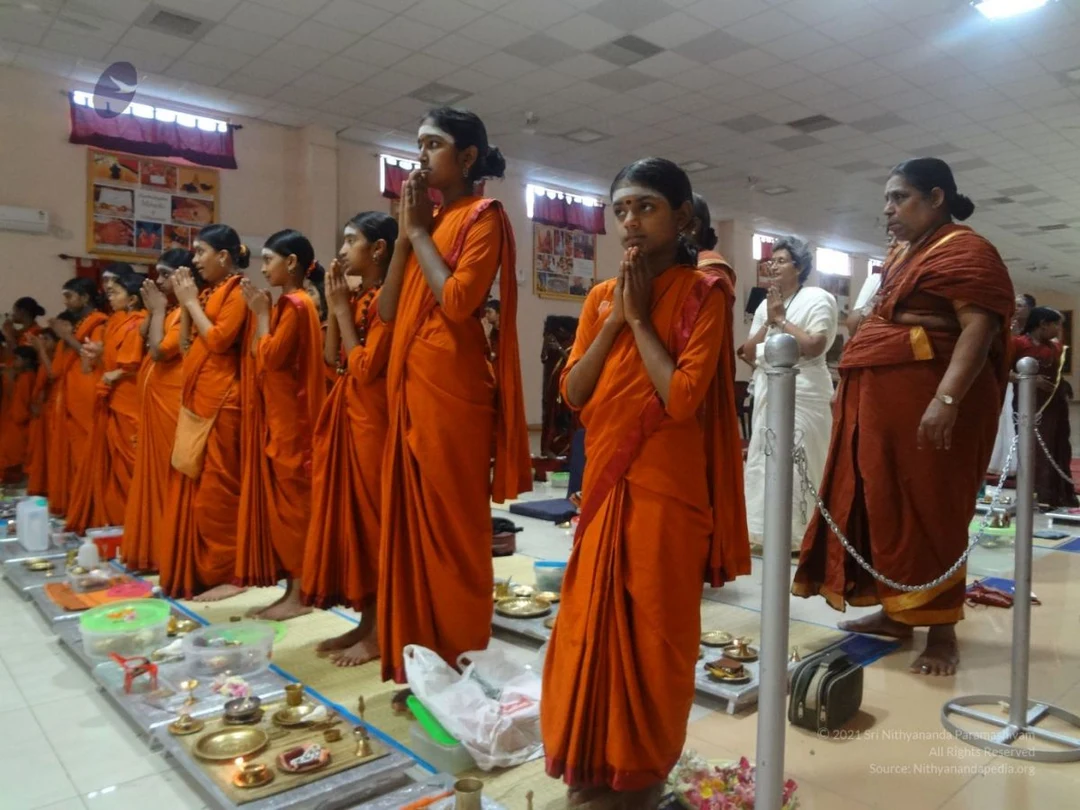
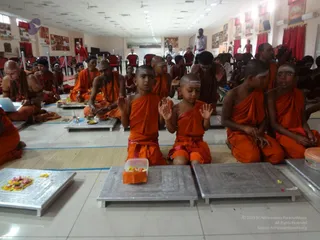
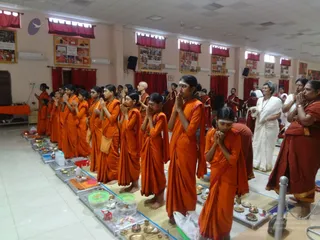
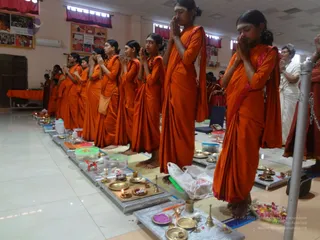
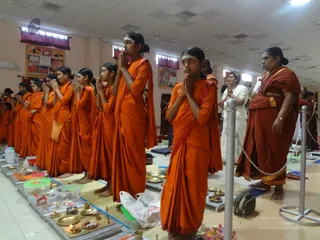
A photograph of a large hall where young boys and adult sannyasis in saffron-orange robes sit cross-legged on the floor before silver-coloured square metal pujas plates. In the foreground two young boys with shaved heads and white tilak marks on their foreheads sit with palms pressed together in prayer, while behind them other orange-robed devotees sit in rows, some holding rudraksha malas. Small offering plates hold flower petals and fruit, and a clear plastic container of petals sits near the boys. Red curtains and framed photographs line the walls, and chairs are arranged along the back of the hall. Several standing attendants in white clothes are visible in the background, along with a person in a red robe at the left.A young shaved-headed boy in saffron-orange robes sits among other orange-robed participants, raising both palms outward in a gesture of devotion or blessing. He has white urdhva-pundra style marks and a red bindi on his forehead, and a thin cord is visible across his bare chest. Behind him, several seated figures in orange and rust-coloured robes and rudraksha beads continue the chanting or ritual. A white cloth and a small brass object are visible on the floor at right.A group of young boys with shaved heads and white tilak marks on their foreheads kneel on the floor of an indoor hall, wearing saffron-orange robes with red-trimmed waist cloths. Several have palms pressed together in prayer or raised hands in devotion, while one small boy in the centre gestures with open palms. Silver-coloured rectangular yantra or meditation boards sit before them, with a plastic container of yellow flower petals and orange offerings nearby. Behind them, older devotees in orange and red garments sit with hands folded, and the walls display framed photographs and red drapes. No one clearly identifiable as a person is visible.A hall of devotees in orange saffron robes stands in rows with palms pressed together in namaskar, facing a line of brass and steel trays set on the floor with small oil lamps, bowls, brass plates and puja items. Several women in white and red saris stand at the right edge, and framed photo panels hang along the back wall beneath red curtains. The orange-clad figures include young women and a shaved-headed devotee near the centre back. No figure is clearly identifiable as a person, so no appearance-based candidate is claimed.A row of young women in saffron-orange sarees stands barefoot in a hall, hands pressed together in anjali mudra with eyes closed, in front of low tables laid with brass puja thalis, lamps, bells and small bowls of coloured powder and flowers. A woman in white stands at the right edge, and a figure in red-orange robes is visible further right. Walls display framed photographs and a wall poster. The scene looks like a ritual padapuja-style worship. Roughly ten to twelve people are visible.A hall with tiled floor and fluorescent lights shows a row of young women in saffron-orange saris standing with palms pressed together in namaste during a ritual. Brass plates, small lamps, bowls and offerings sit on mats along the floor in front of them. Several of them wear orange shawls and bindis. Behind them, older women in orange saris and a woman in white stand with hands folded. A metal stanchion with chain separates the area. Wall posters and banners hang in the background. The scene resembles a padapuja or puja gathering.

1-Nithya-Satsang

6 photosSource gallery
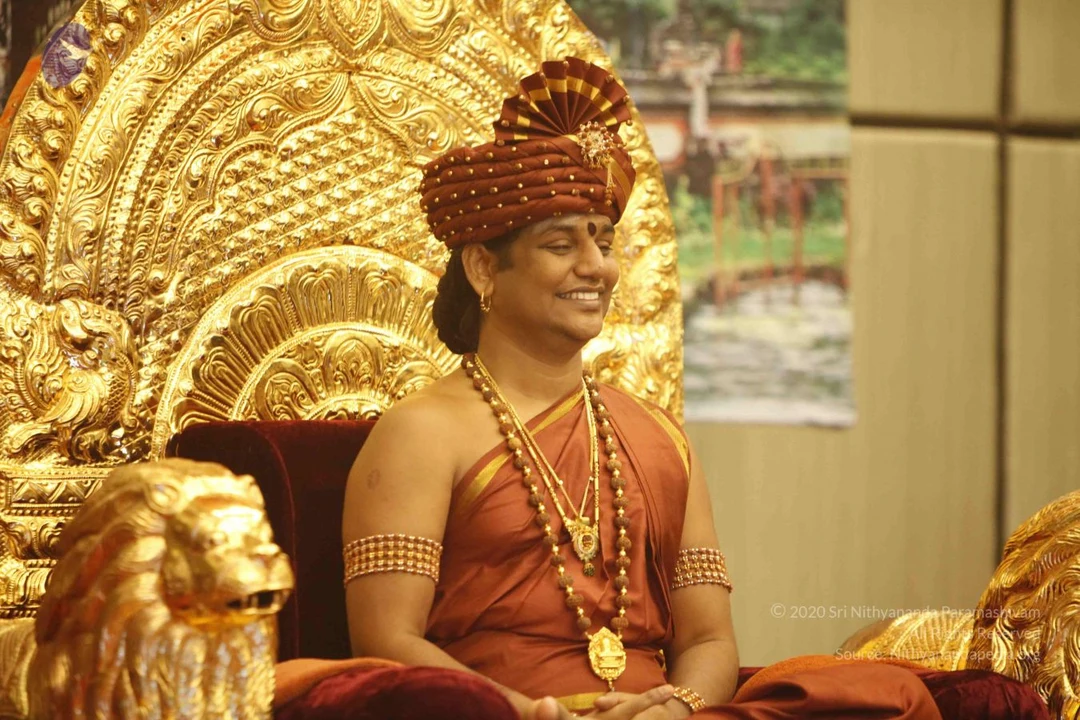
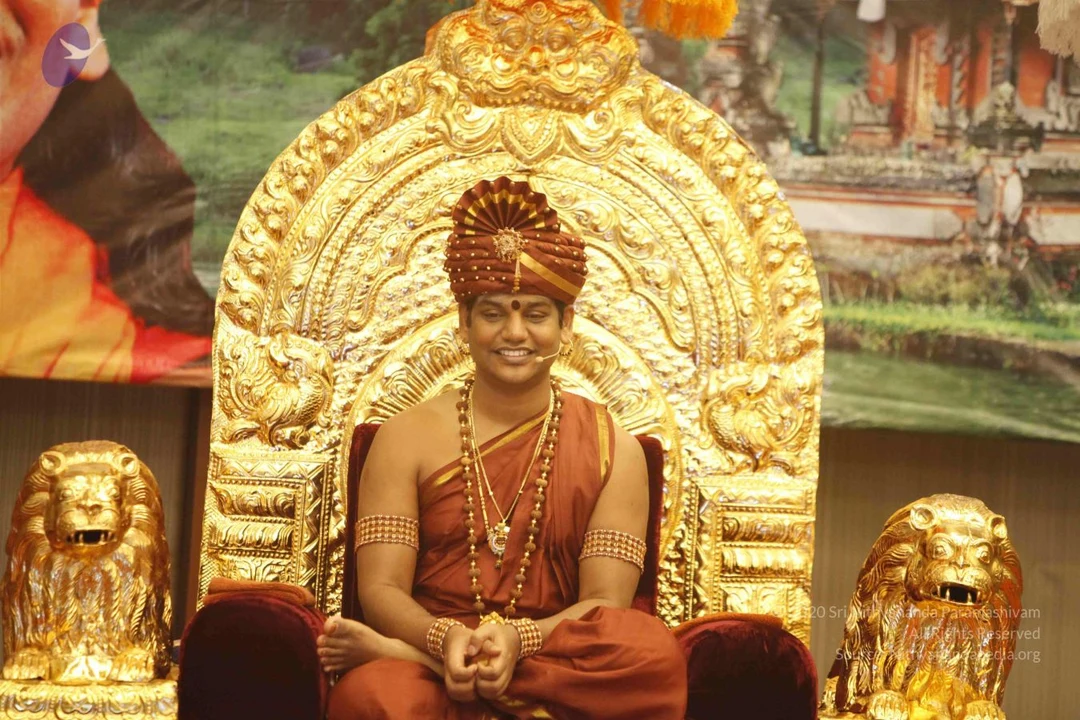
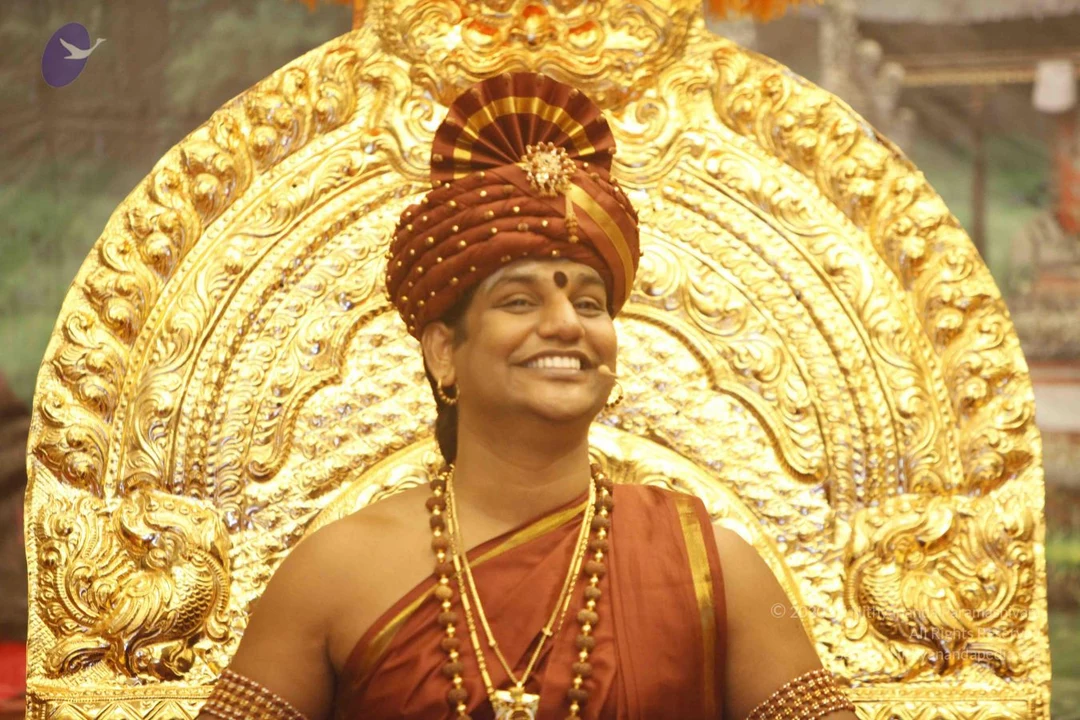
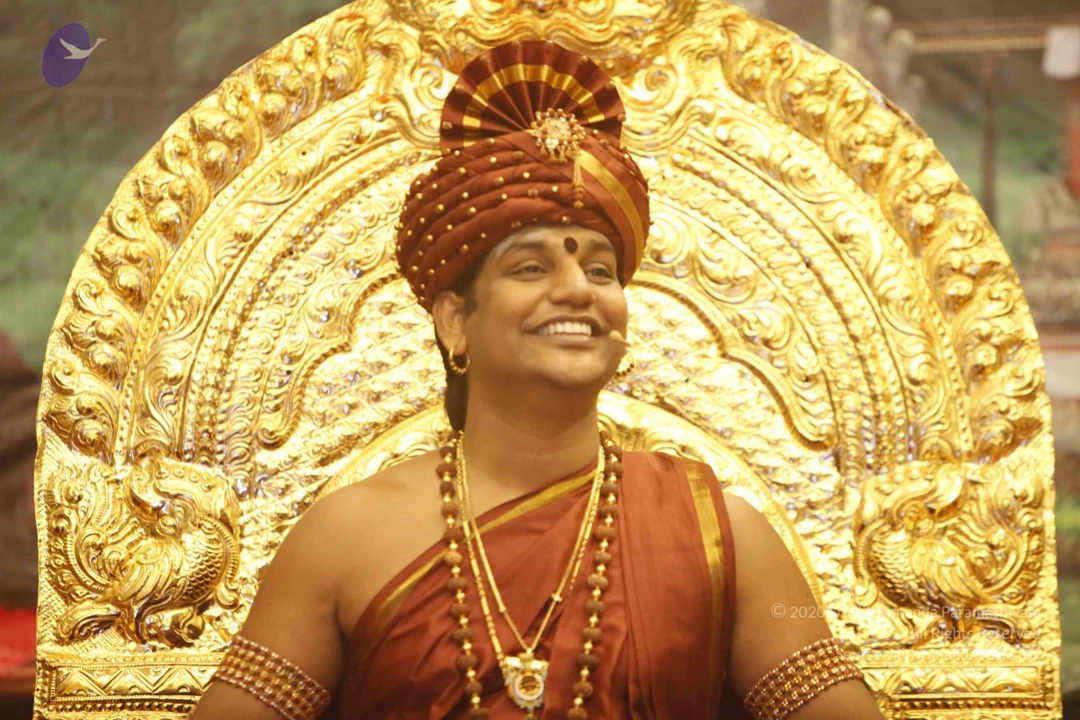
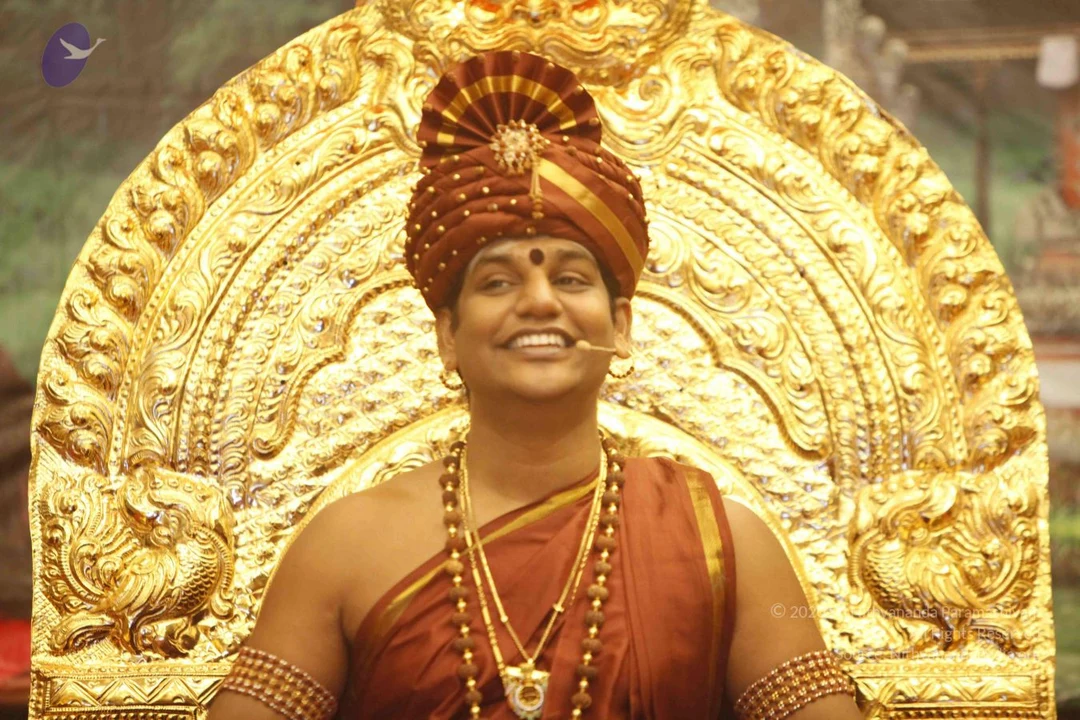
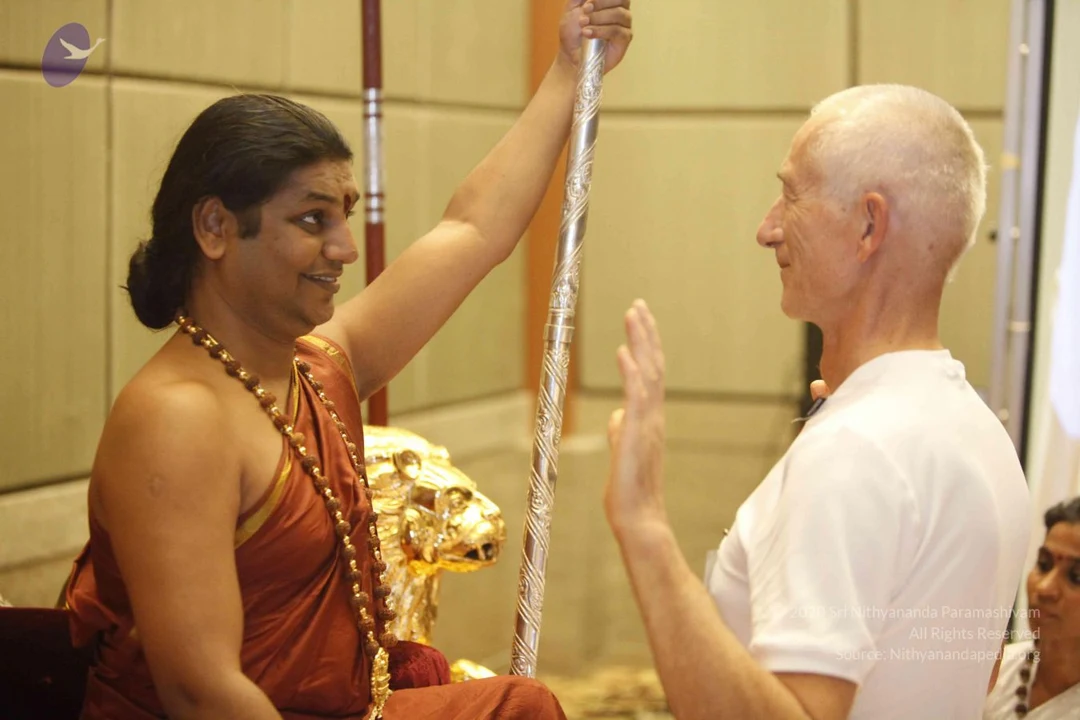
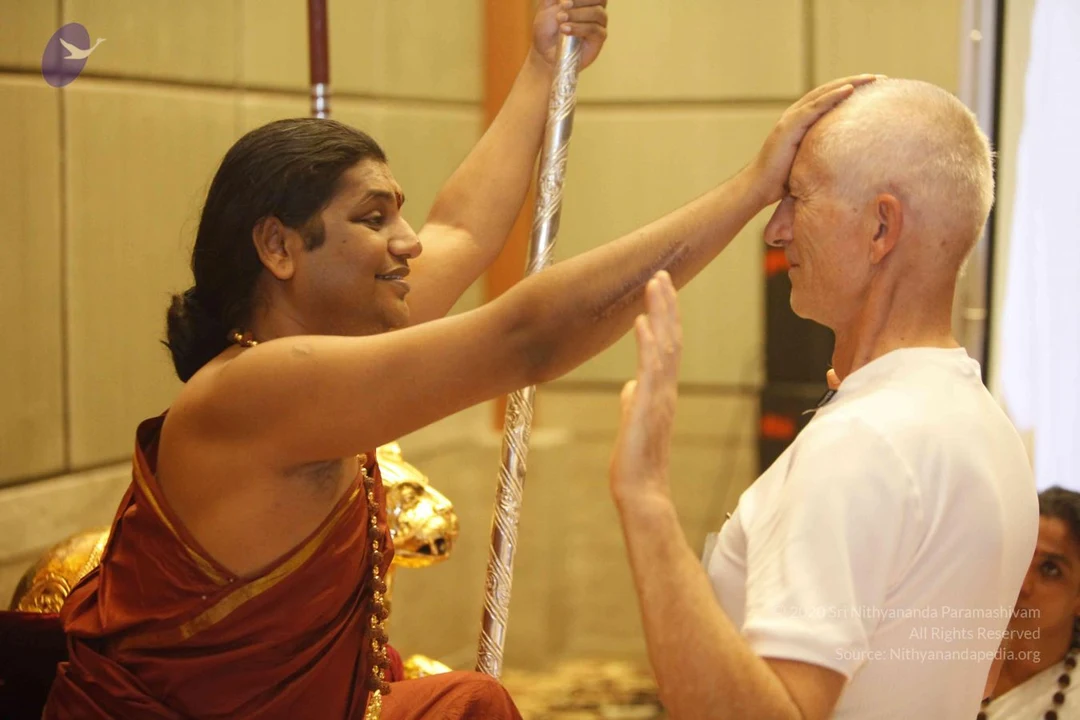
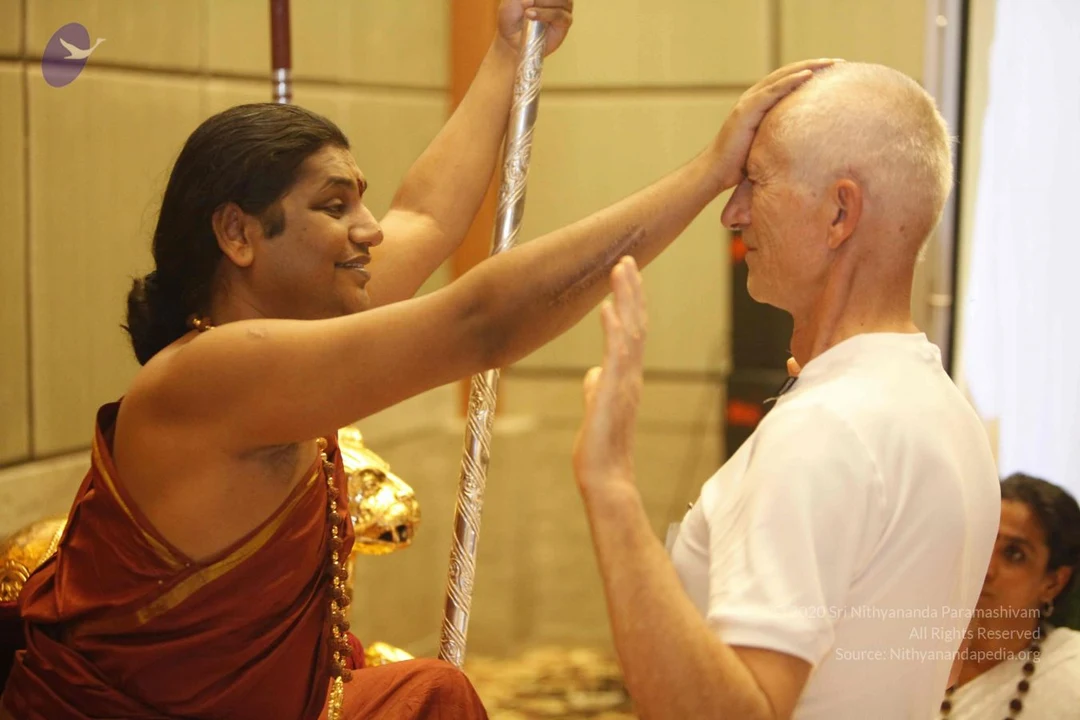
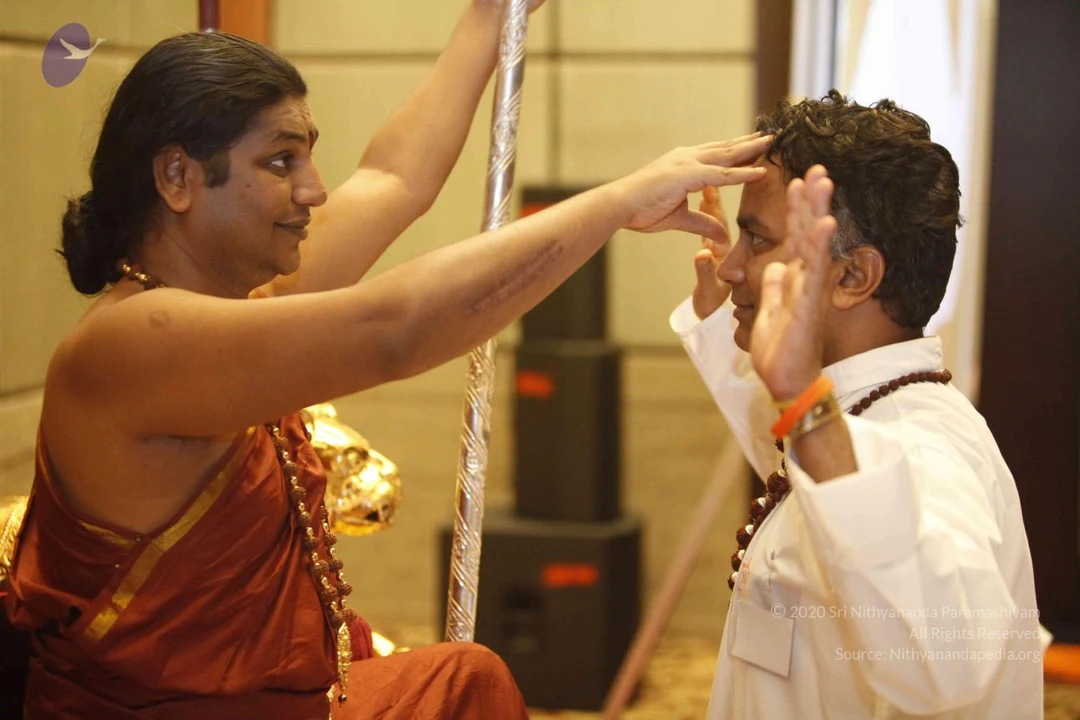
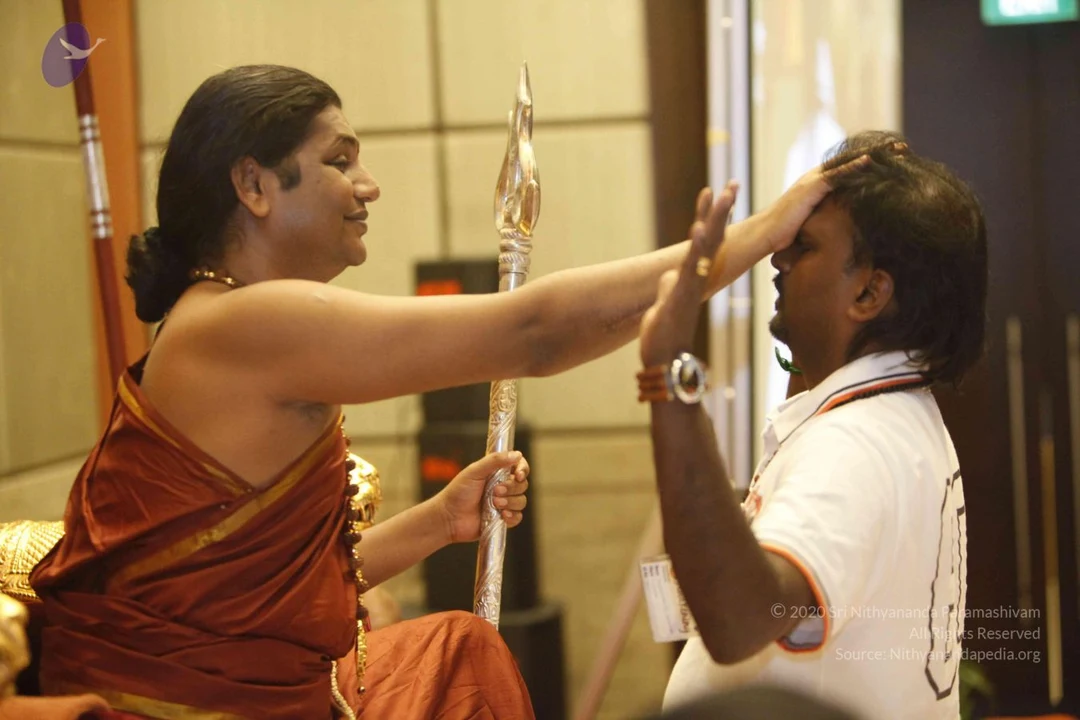
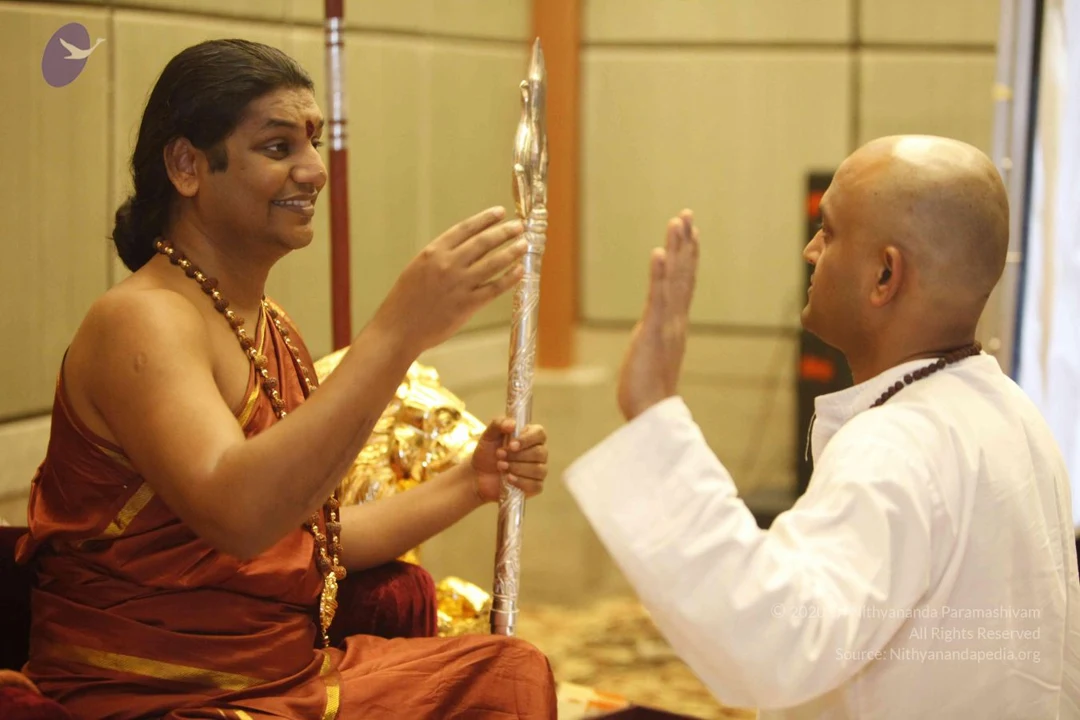
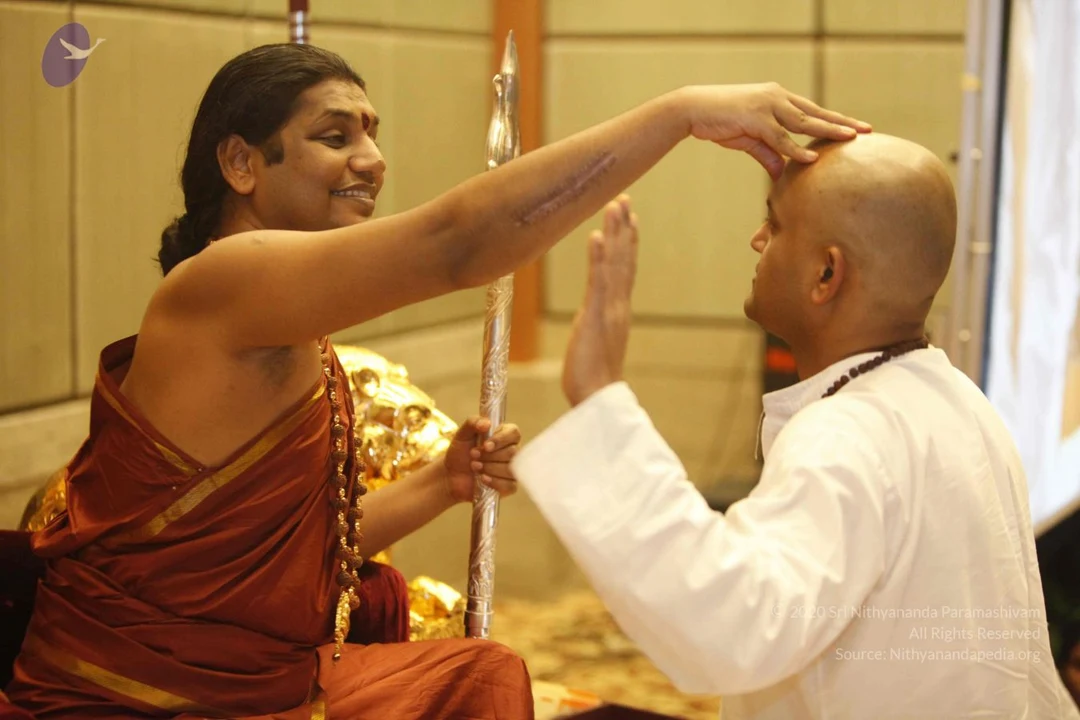
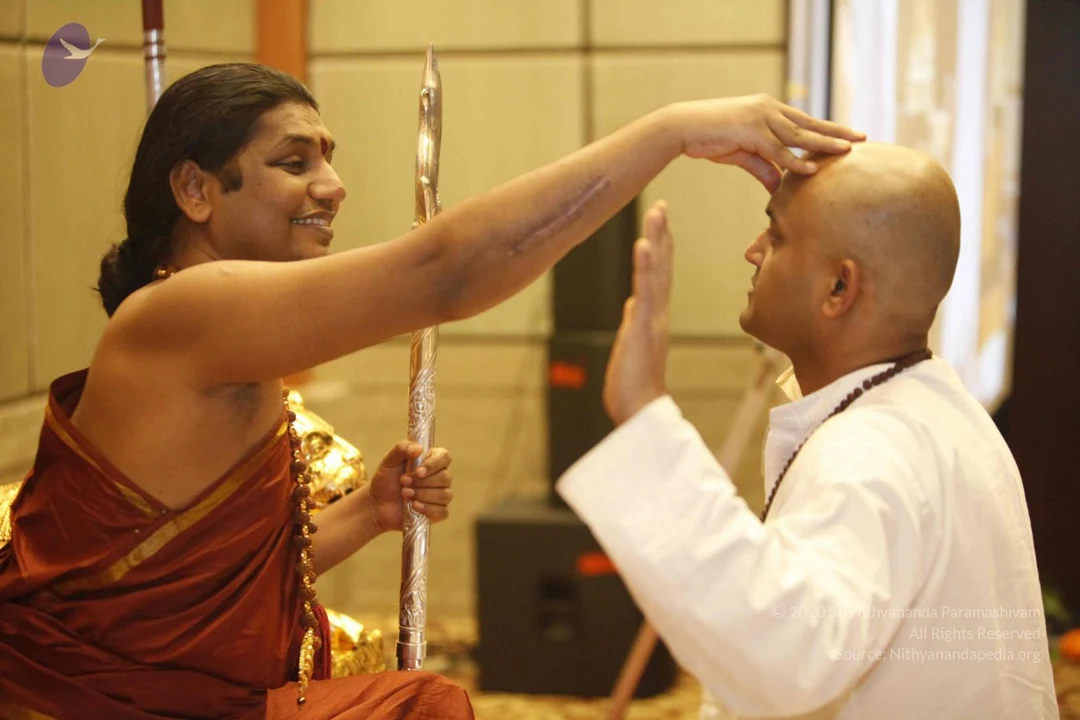
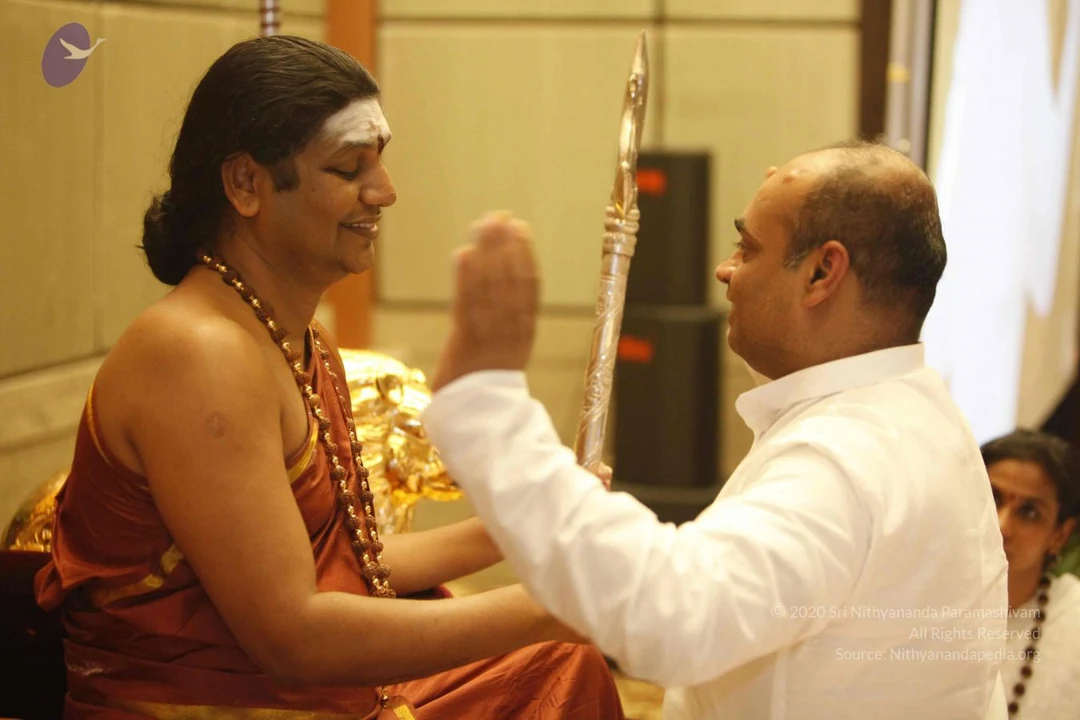
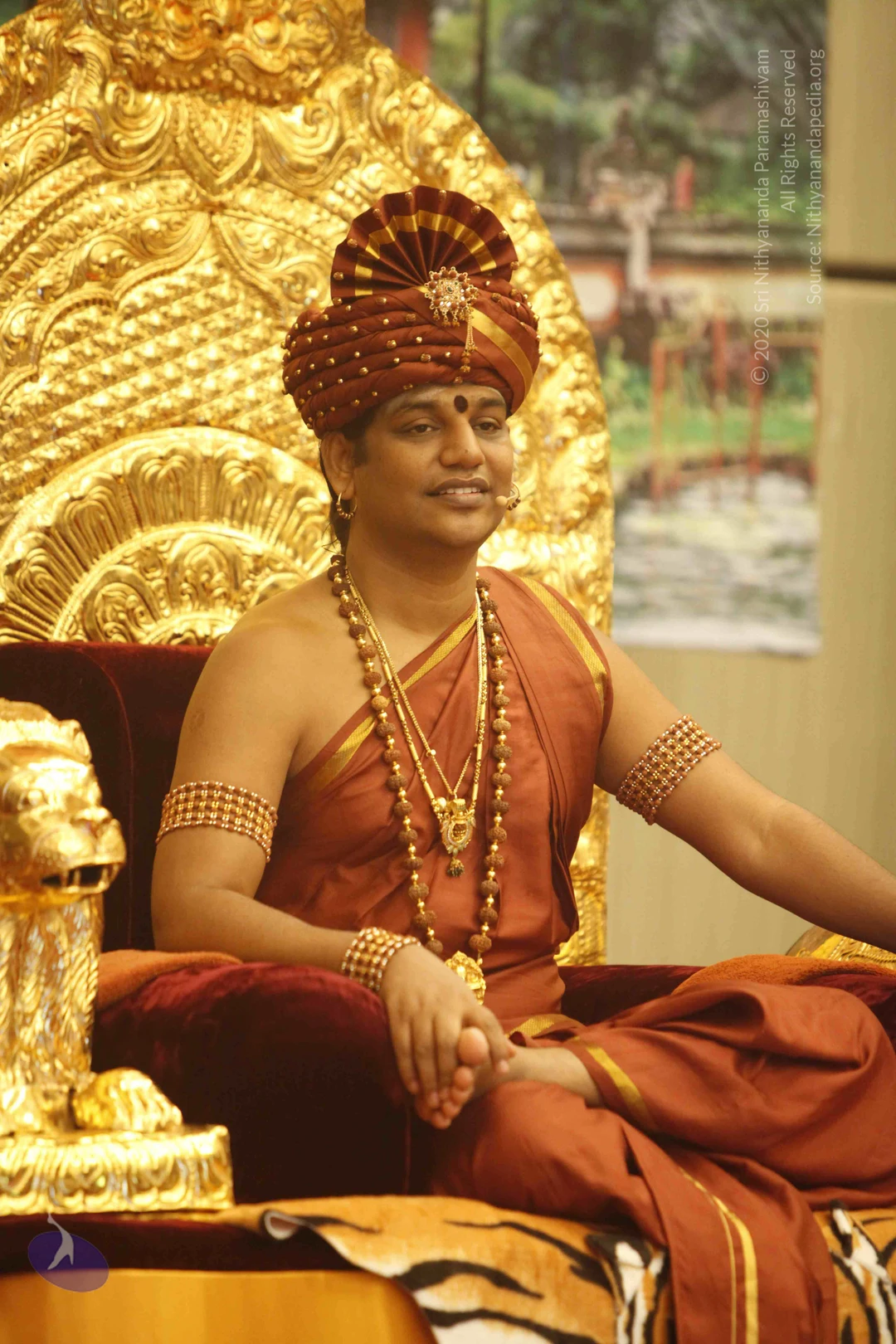
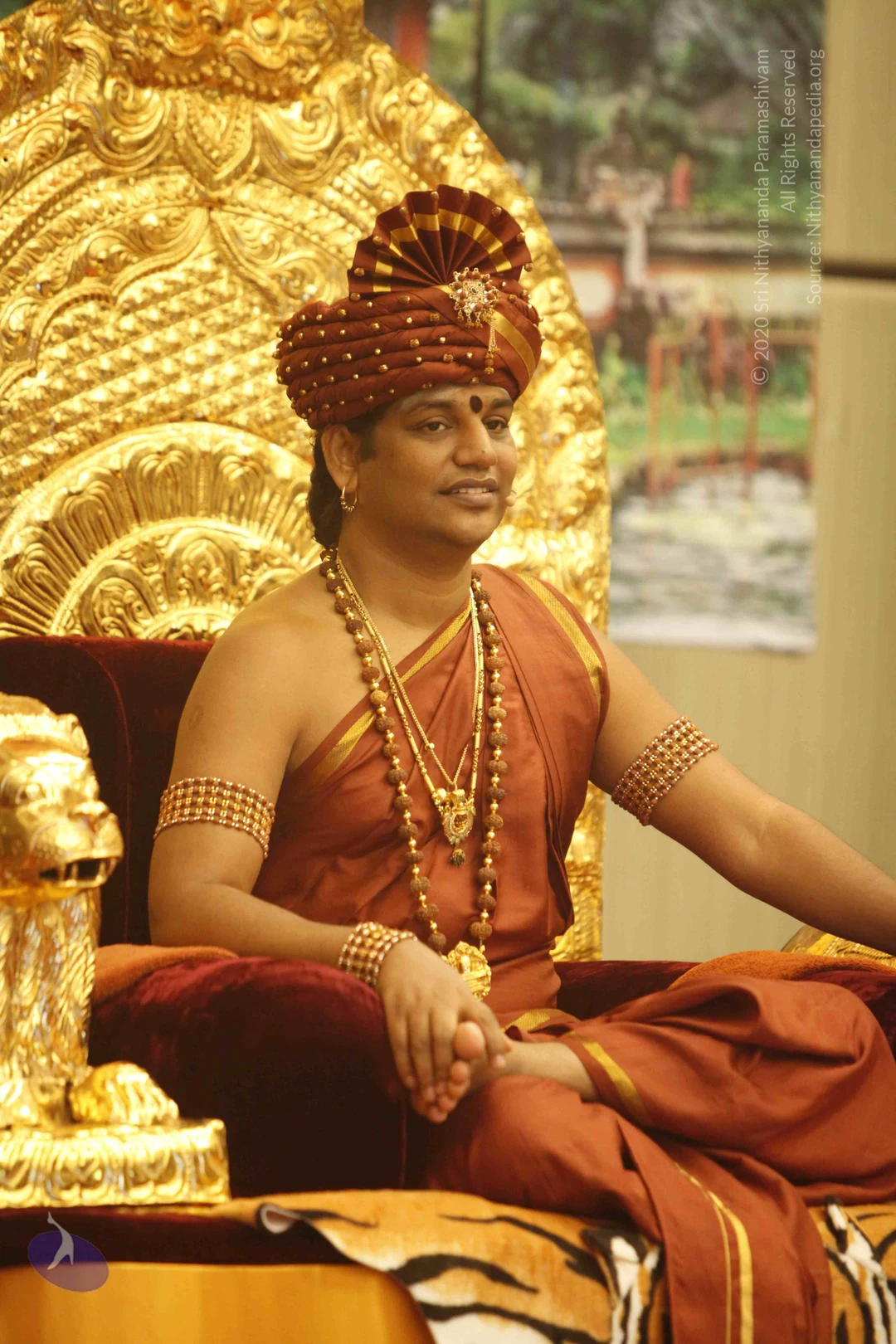
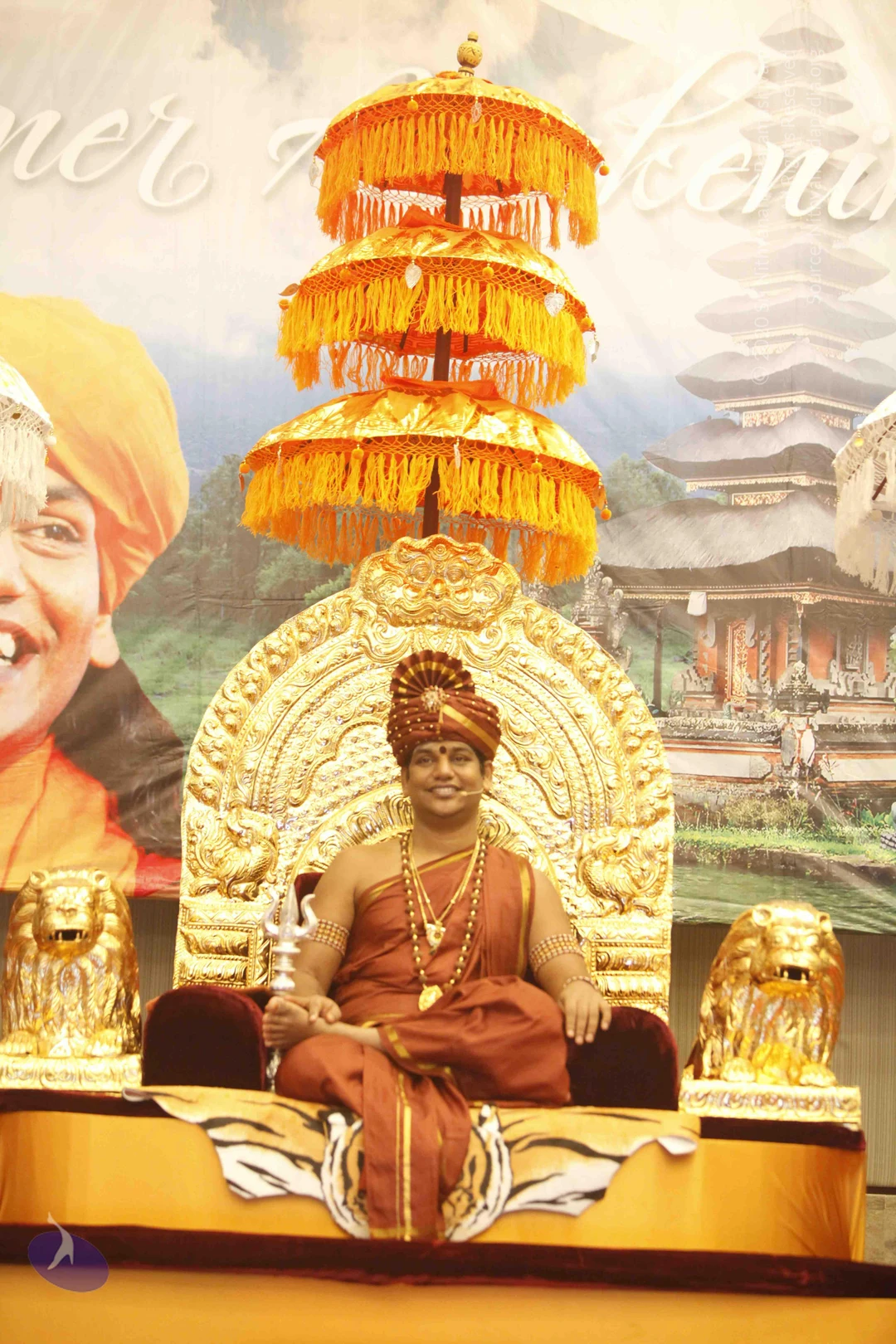
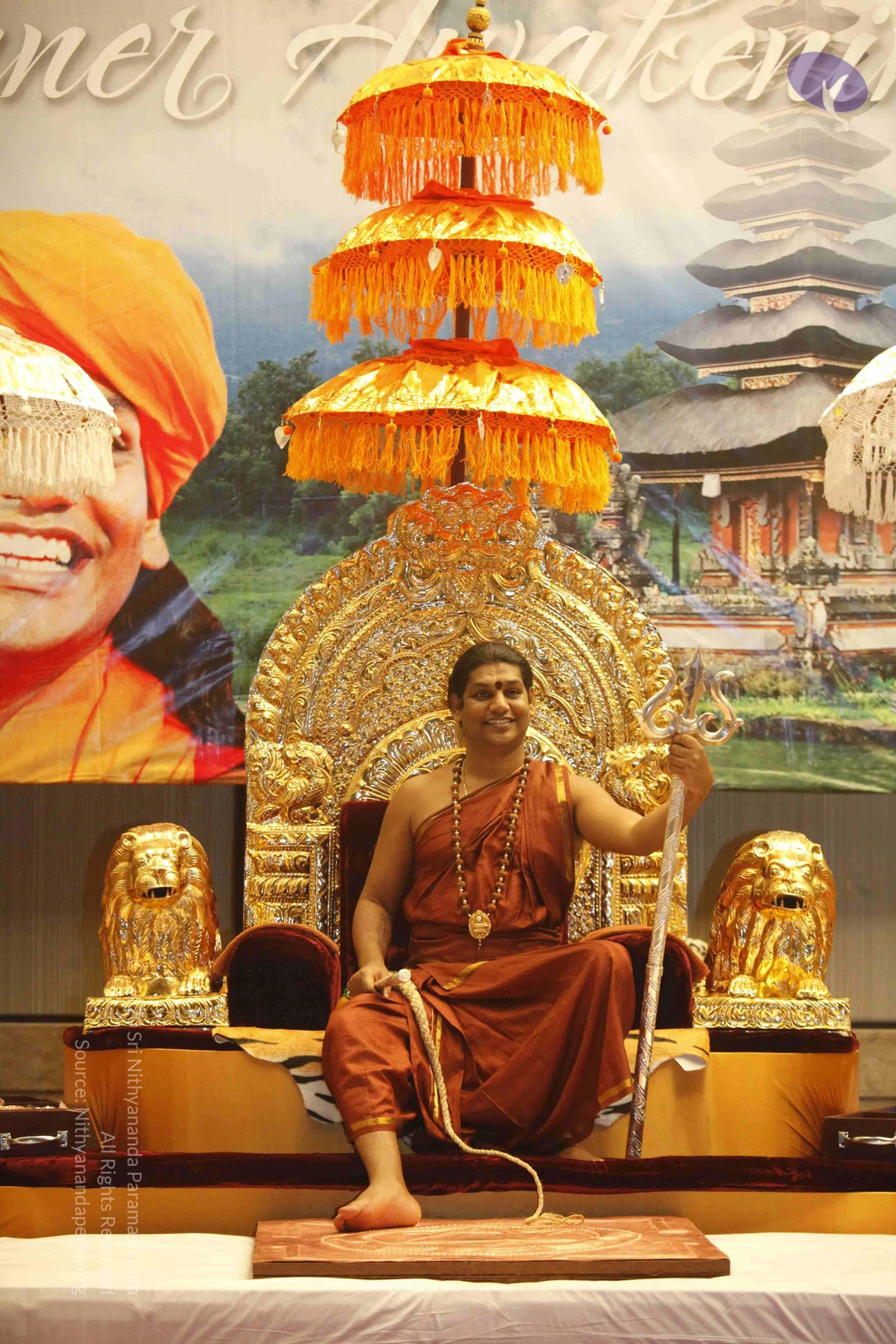
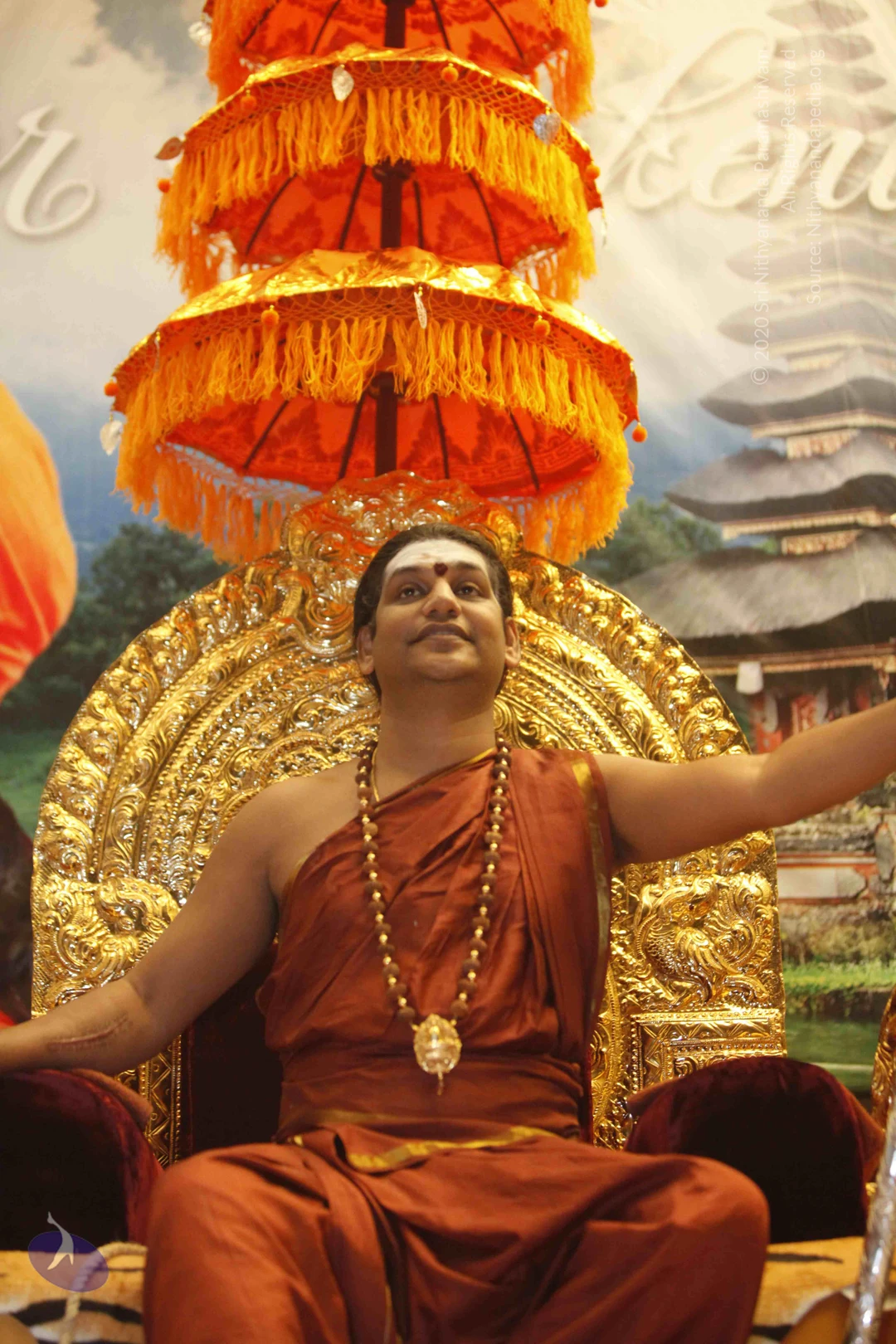
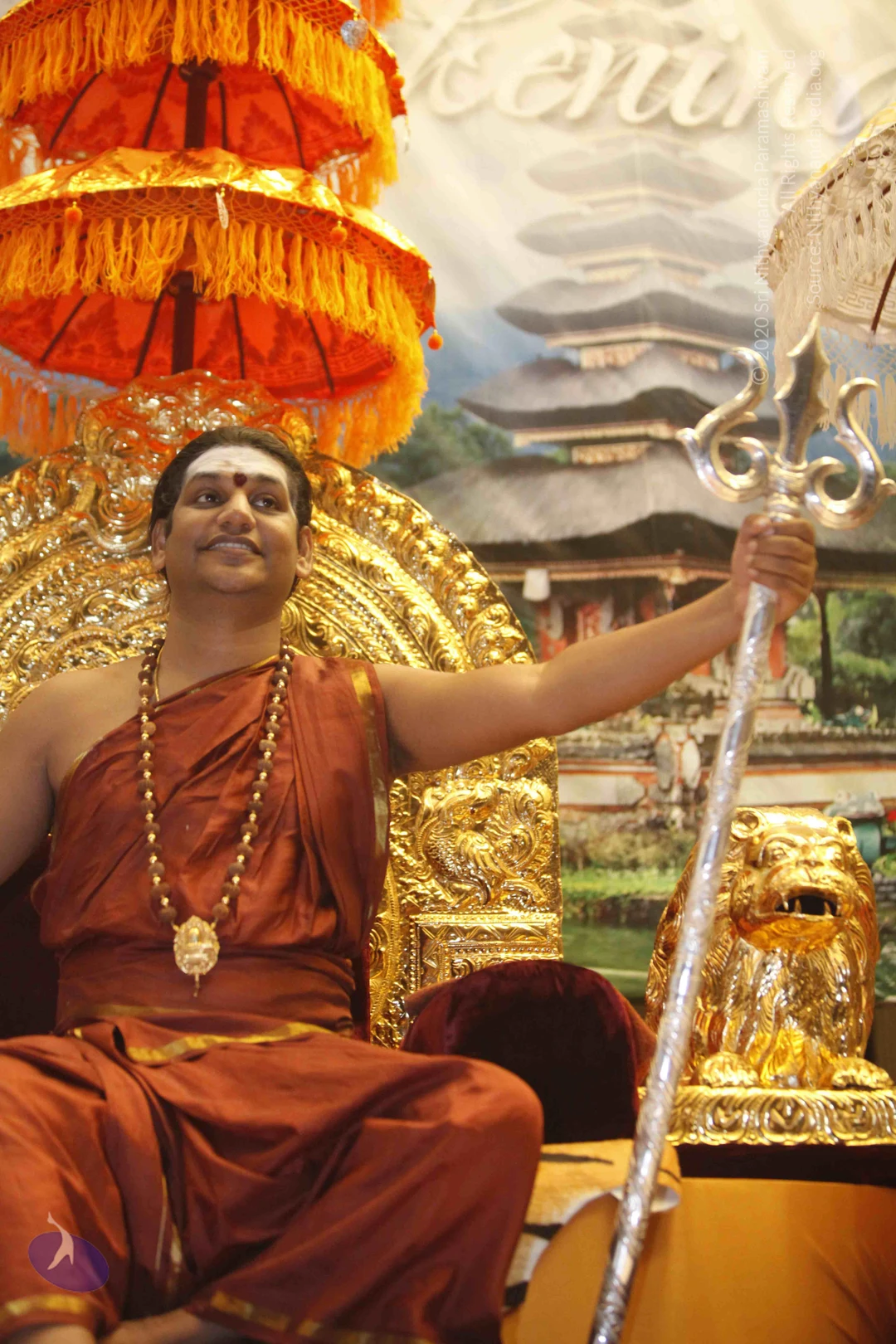
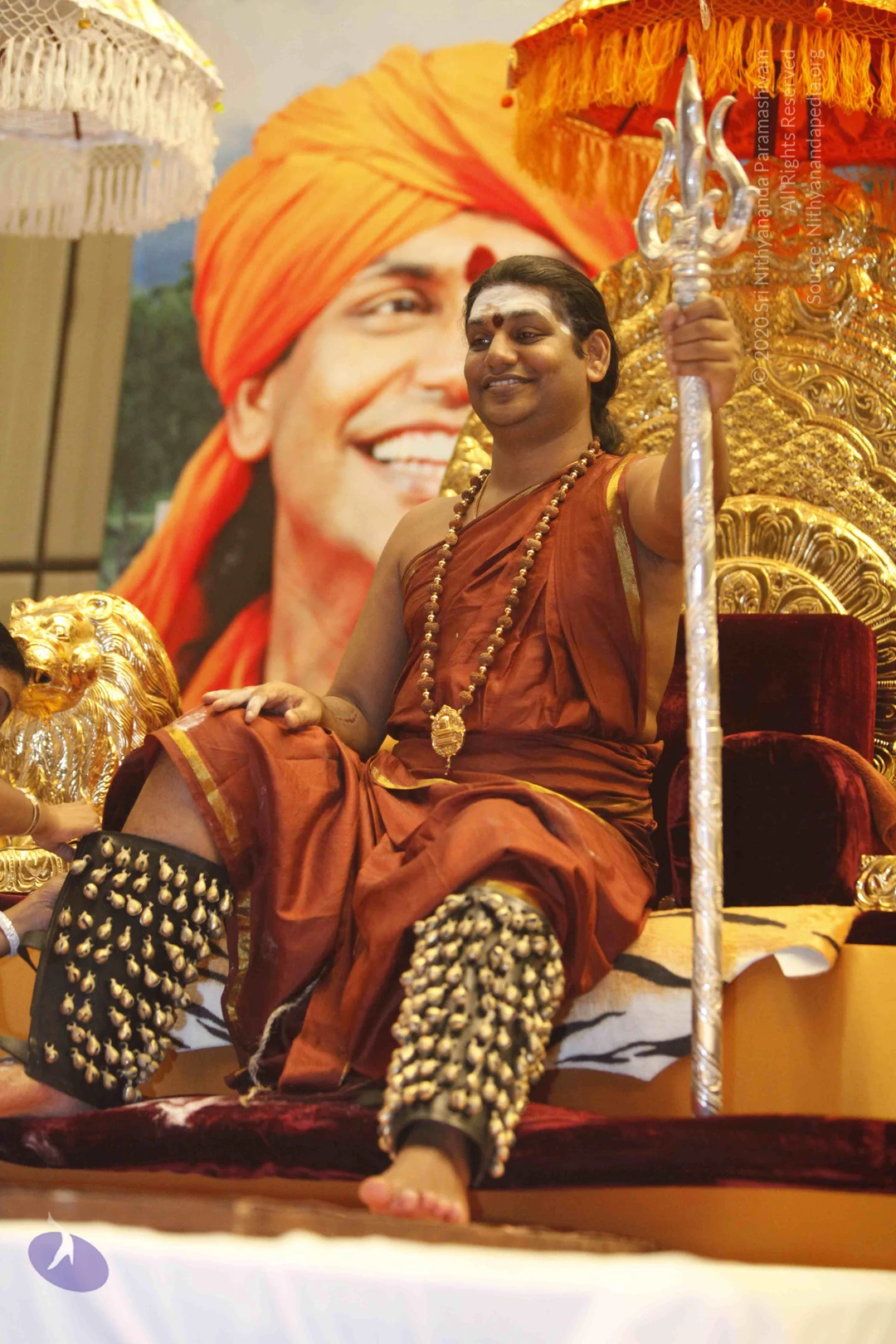
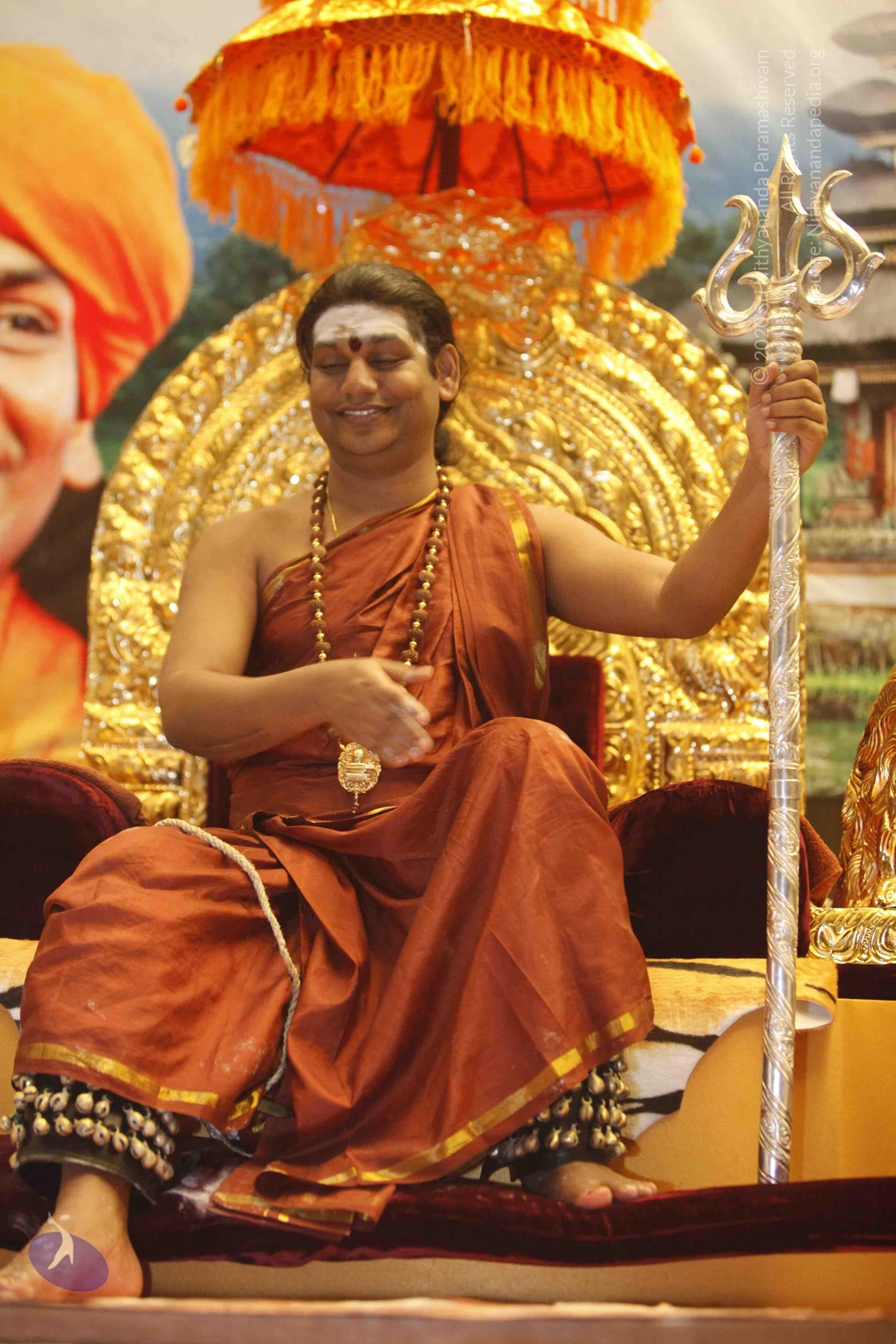
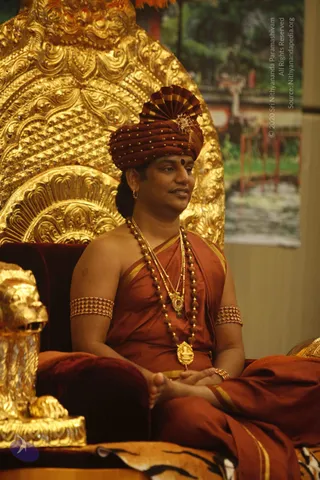
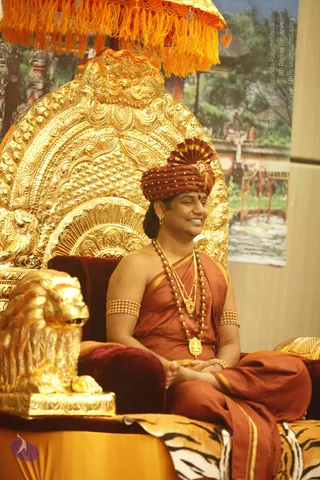
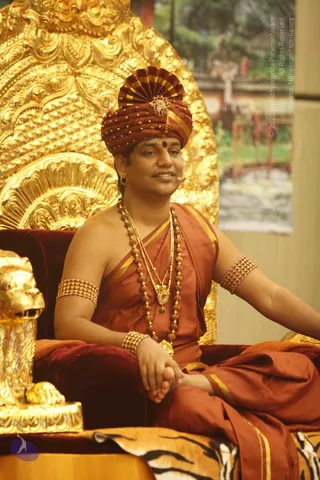
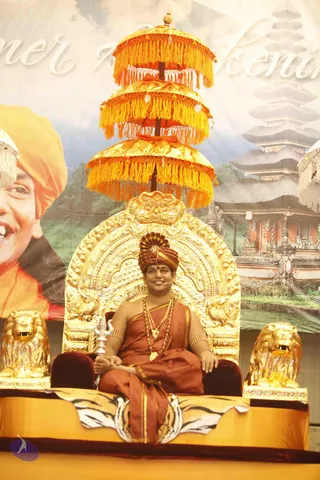
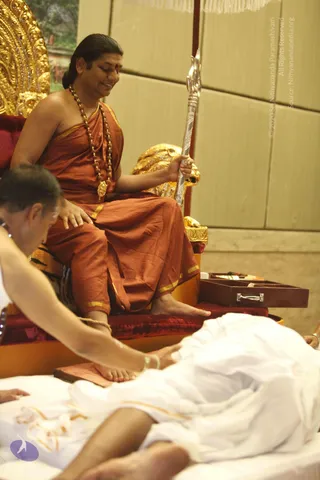
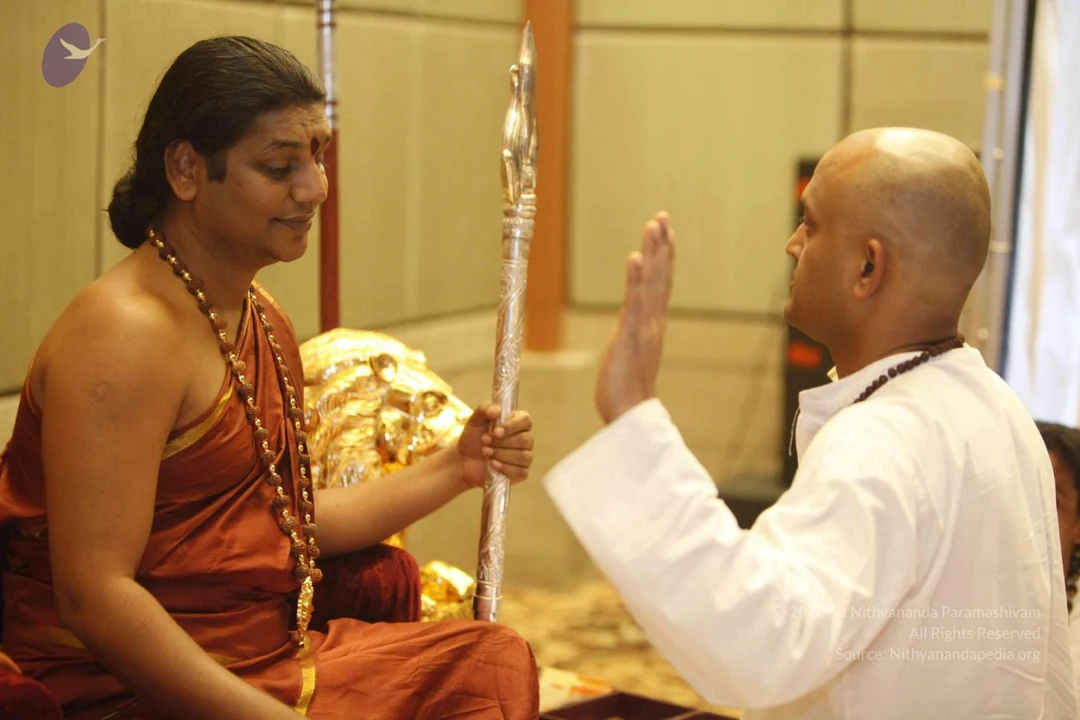
A seated man in a maroon turban with gold embellishments and a red-brown dhoti-style garment with gold borders sits on a red velvet throne before an ornate gold-leaf backrest and a gilded lion armrest. He wears layered rudraksha malas with gold beads, a gold pendant and beaded gold armbands, with hands resting in his lap. A garden photograph hangs behind him.A seated man in a rust-red turban with a gold fan-shaped ornament sits on an ornate gold throne with a large gold-embossed backrest beneath an orange tasselled canopy. He wears a rust-red dhoti-style wrap with gold border, multiple strands of rudraksha and gold beads, a gold pendant, gold armlets and bangles, with his hands resting in his lap. A gold lion statue sits at the left, and a tiger-striped cloth covers the seat. A backdrop photo shows a temple scene with greenery. Visible cues include a turban, a gold-embossed throne and rudraksha mala, so the appearance matches the Swamiji (probable) candidate, presented as a seated guru on a throne.A seated man in an orange-red robe and matching red-and-gold turban sits cross-legged on a gilded golden throne with carved backrest, flanked by two golden lion sculptures and a tiger-striped cloth draped over the seat. Three tiered orange and gold fringed umbrellas stand above him, with white fringed parasols on either side. He wears multi-strand rudraksha-style beaded malas and a gold pendant, with bangles on his arms, and his hands rest in his lap. A banner behind him shows a temple and lake landscape with the word 'Awakening'. The figure is an appearance-based probable Swamiji candidate with orange clothing, distinctive ornate necklaces and a turban, seated in a central honorific throne.A seated man in a golden ornate throne with a red velvet seat and carved gilded backrest, wearing a rust-red turban with gold trim and a central jewelled brooch, a rust-orange shawl with gold border over bare shoulders, layered rudraksha malas and gold necklaces, beaded bangles on the arms, and a tiger-striped cloth on the throne. A golden lion-headed armrest stands at left. A red vermilion bindi is on his forehead and a small microphone is clipped near his face. Behind him is a framed garden landscape photograph. Appearance-based candidate: Swamiji (probable) seated on a throne in ceremonial attire with rudraksha malas and a turban.A seated man in a rust-red turban with gold-trimmed fan-pleated fold and a jewelled brooch, wearing an orange-red shawl with gold border over bare shoulders, gold rudraksha-bead malas and a gold pendant necklace, beaded bangles on the upper arms and wrists, and a red bindi. He sits on a red velvet throne backed by an ornate gold carved arch, with a gold lion-head armrest at left and a tiger-striped cloth draped over the seat. Behind him is a framed landscape picture of a pond and temple structures.A seated man in rust-orange and maroon silk garments sits on an ornate gilded throne with a carved arched back, flanked by two golden lion sculptures and a tiger-striped cloth draped over the dais. He wears a maroon turban with a fan-shaped pleat, layered gold and beaded necklaces, bangles, and holds a silver trident-like staff in his hands. Above him a tiered golden parasol with yellow tassels stands behind the throne. The backdrop is a large banner showing a Balinese multi-tiered temple and a smiling figure in an orange turban, with partial script reading 'Inner Awakening'. Only one physical person is visible.

2-IA-Darshan-Yantra
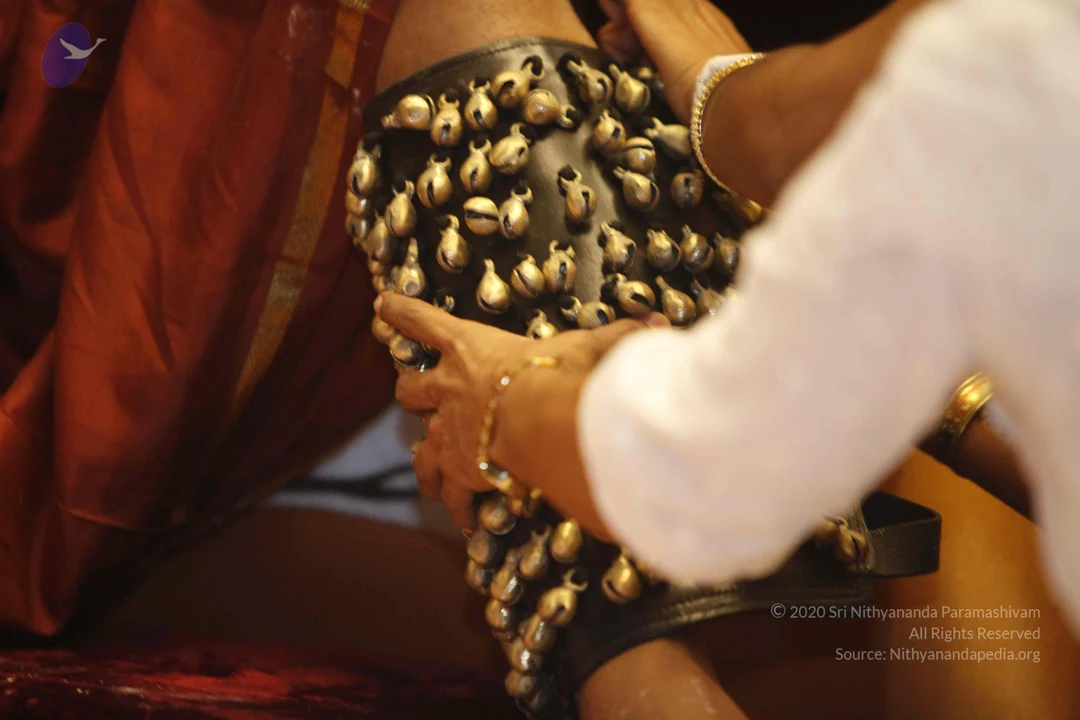
15 photosSource gallery
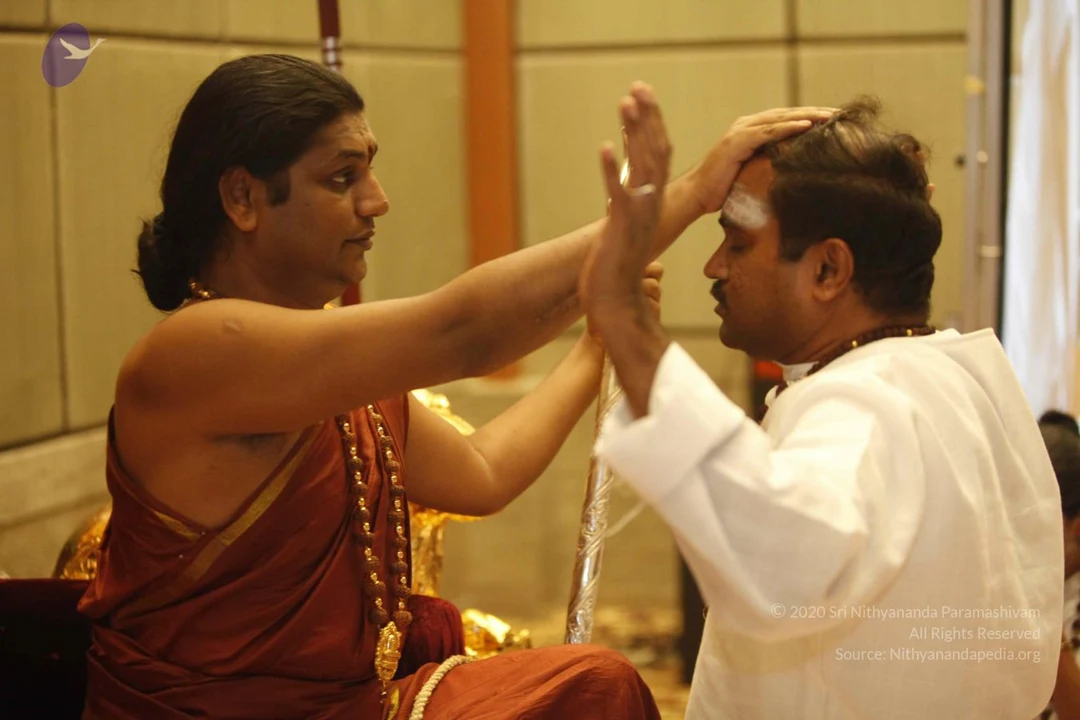
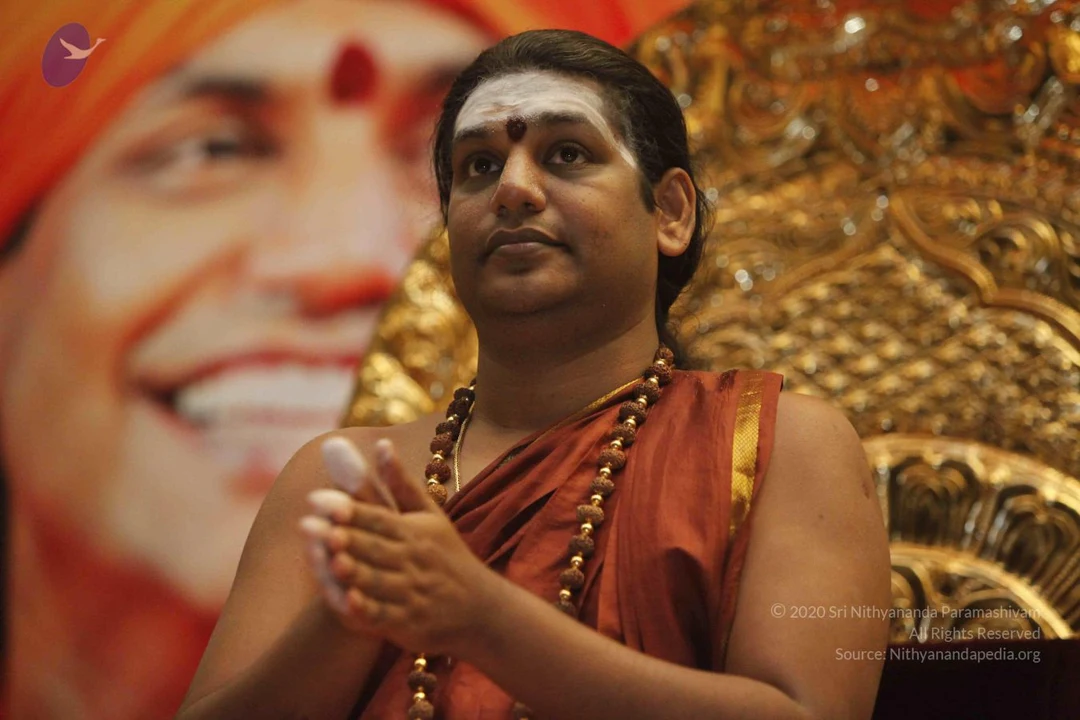
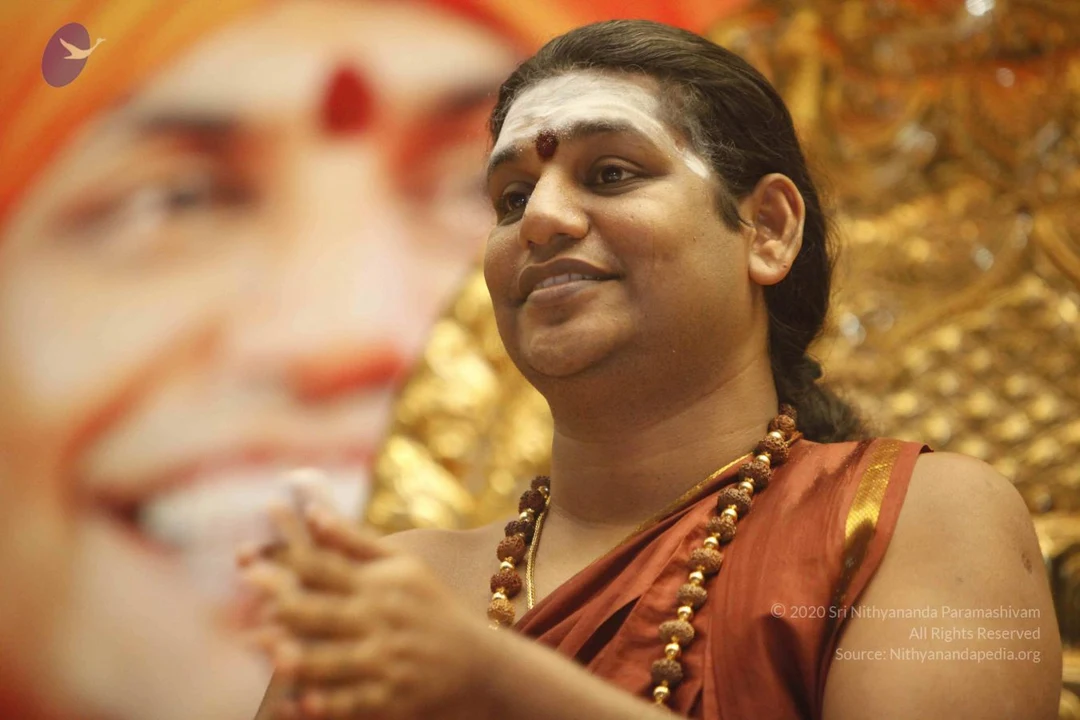
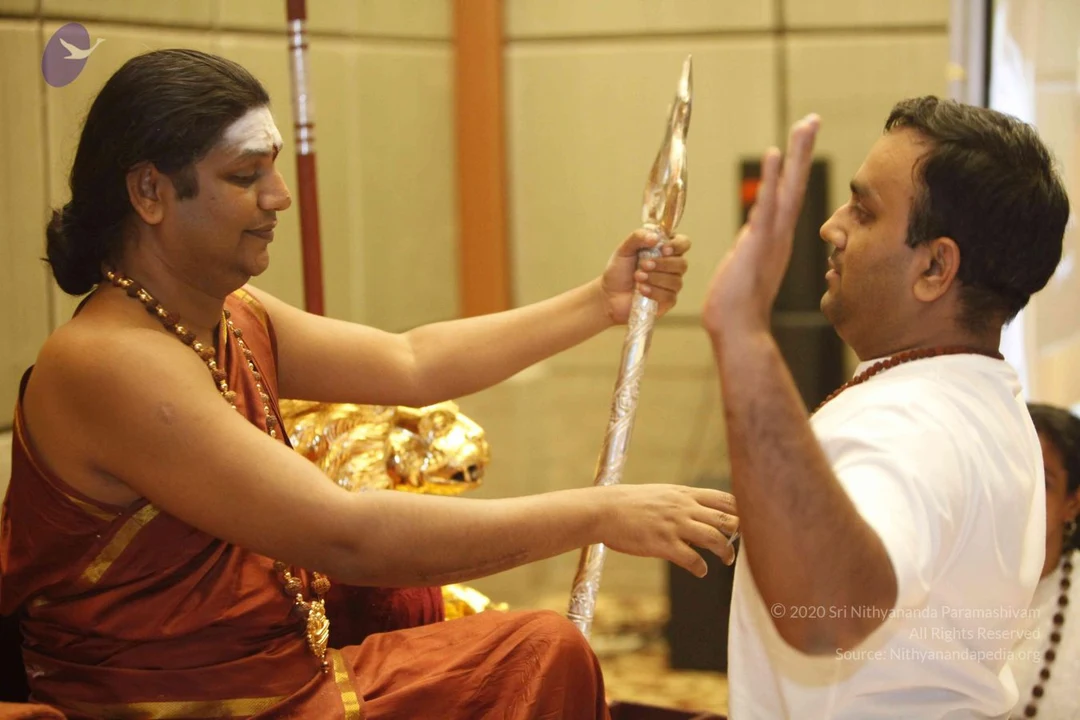
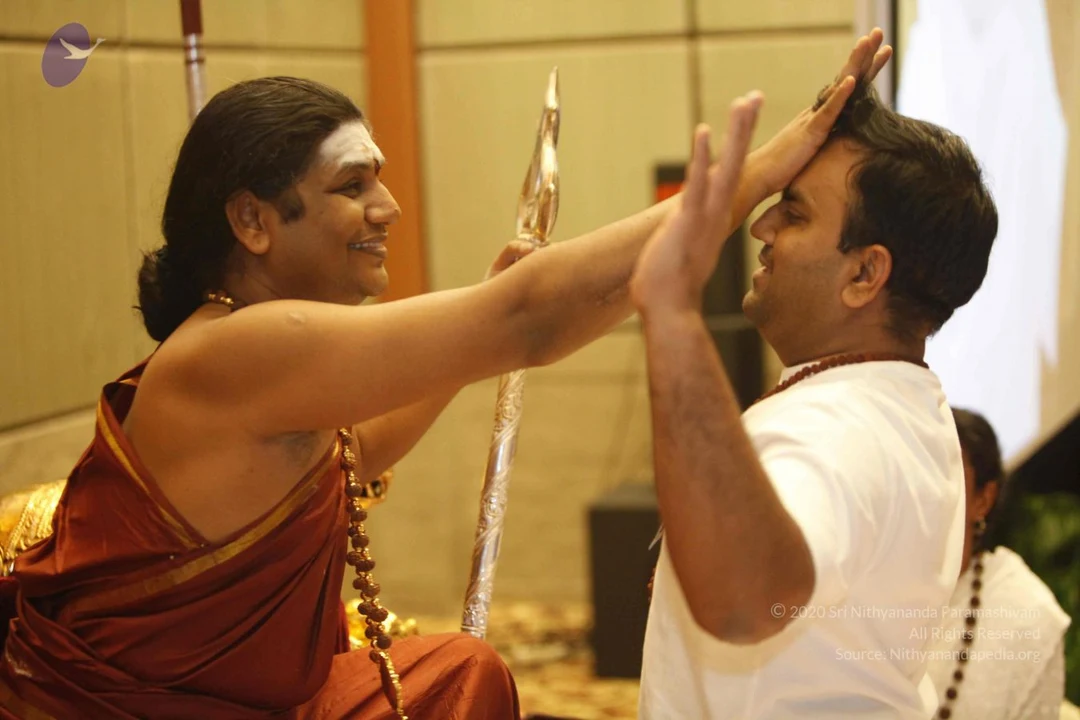
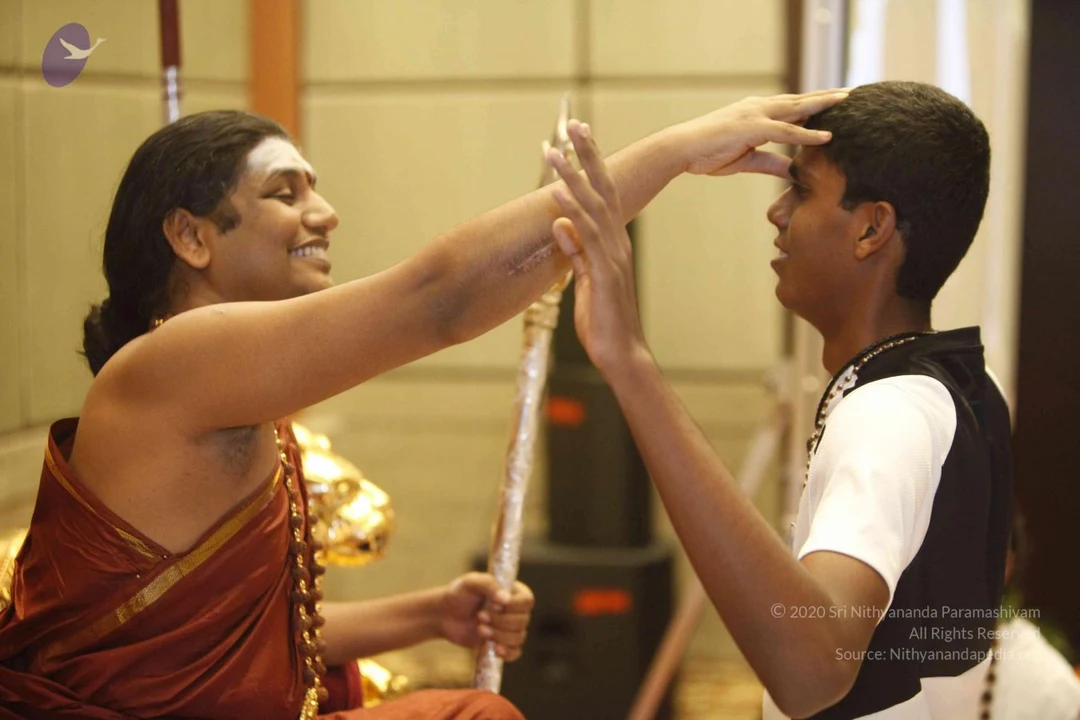
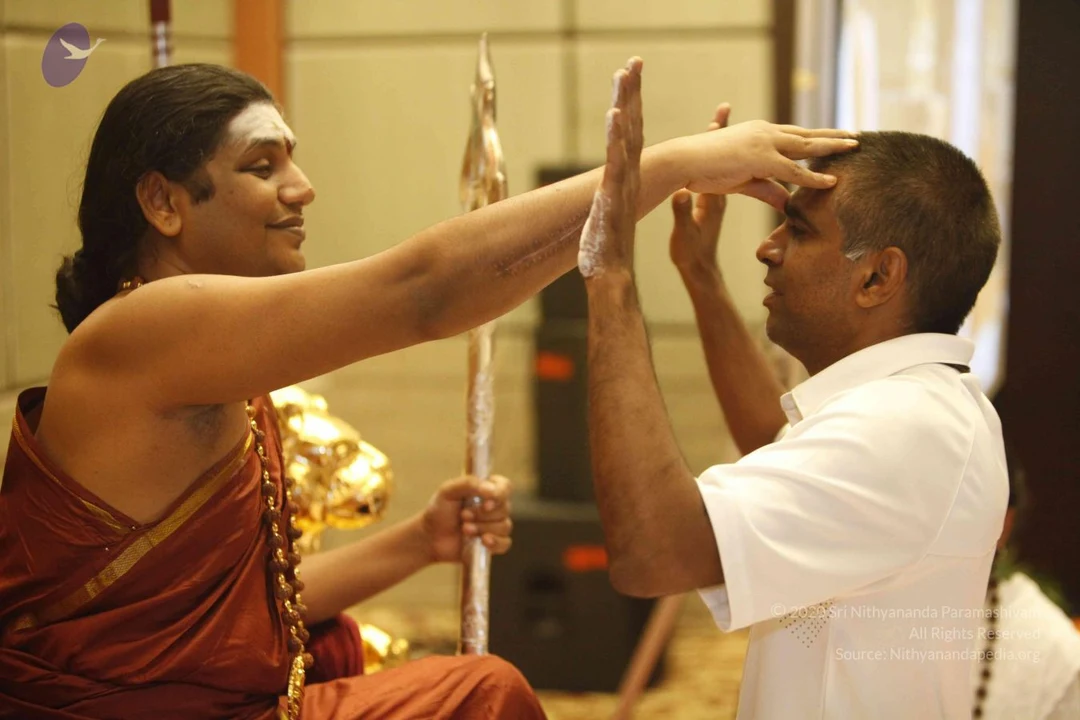
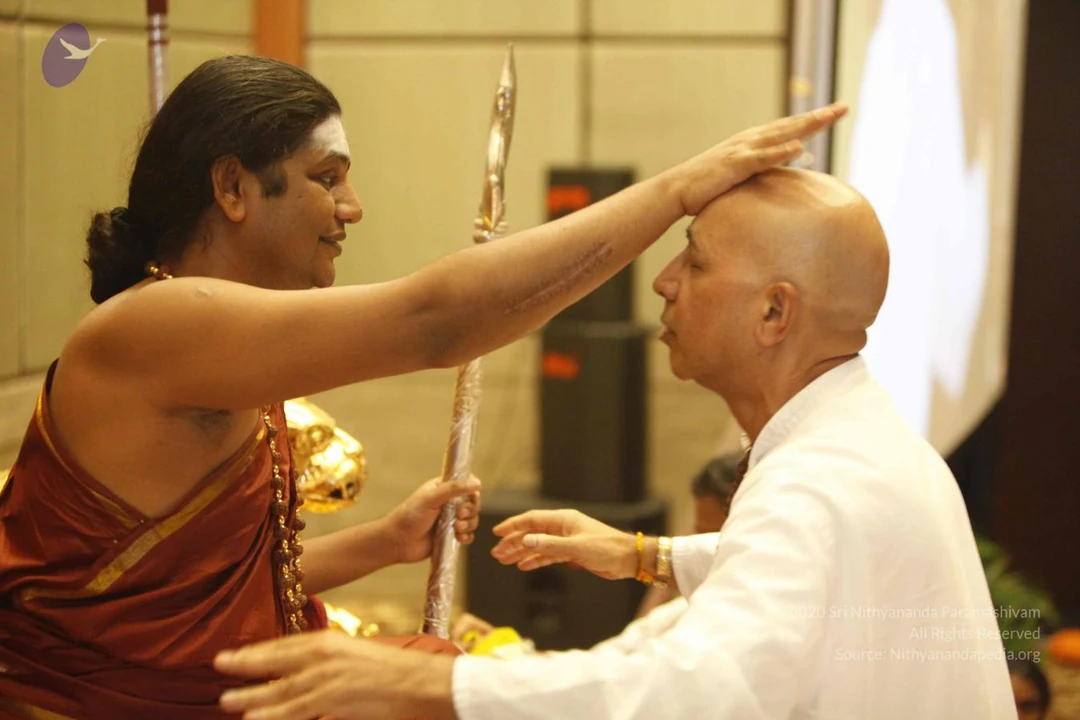
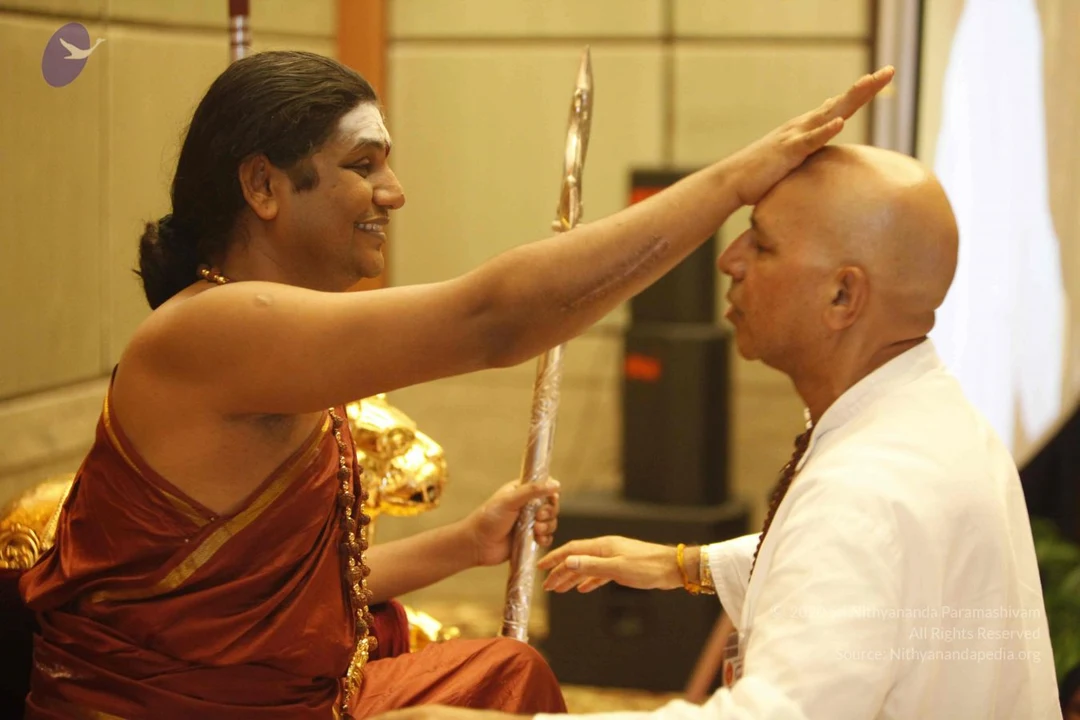
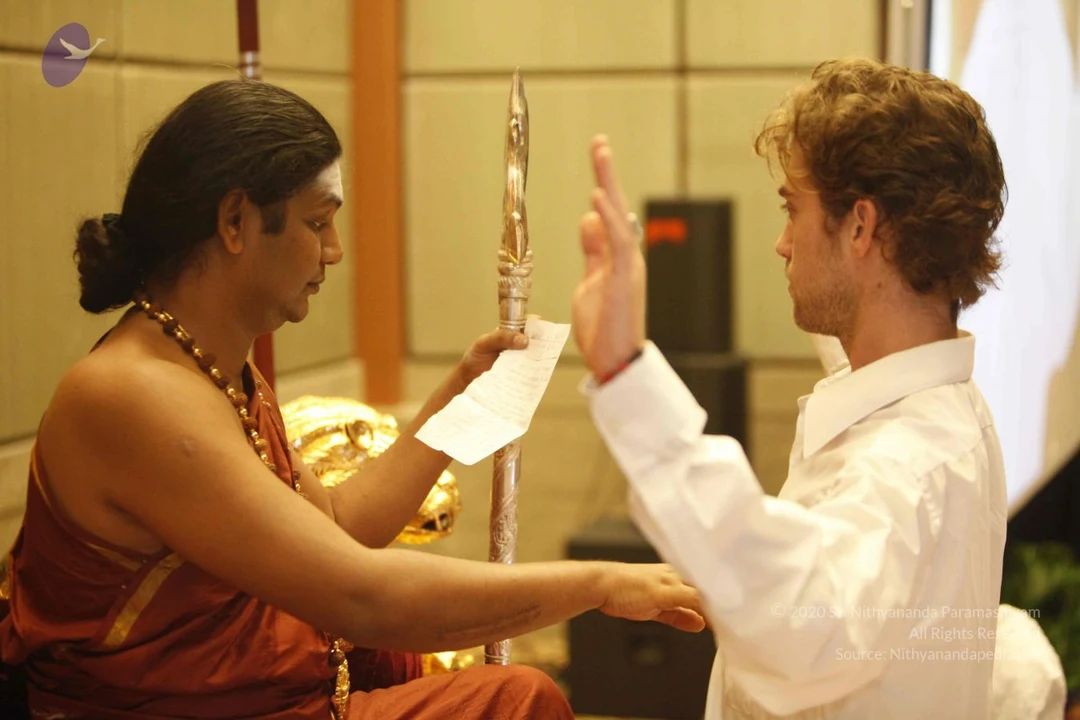
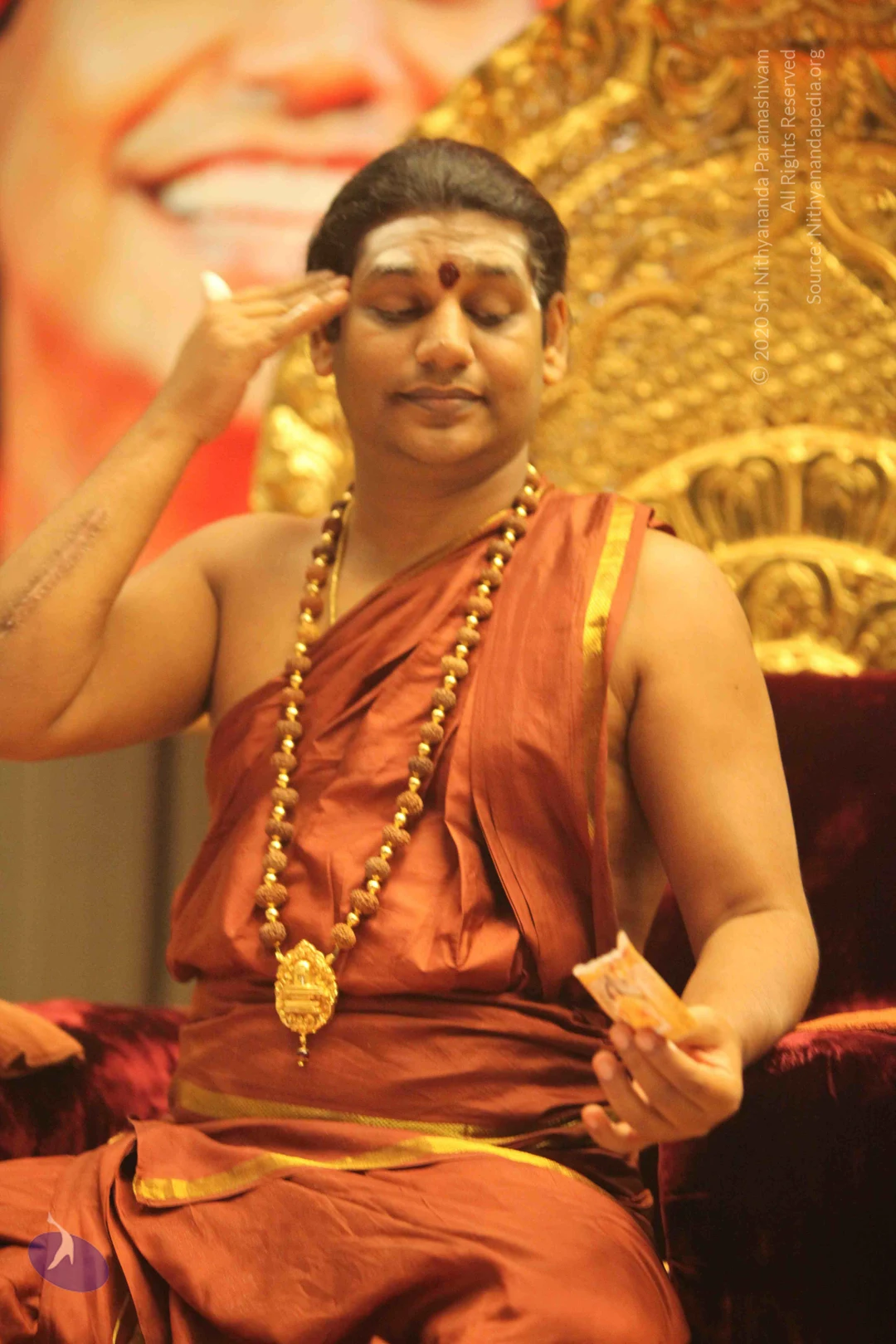
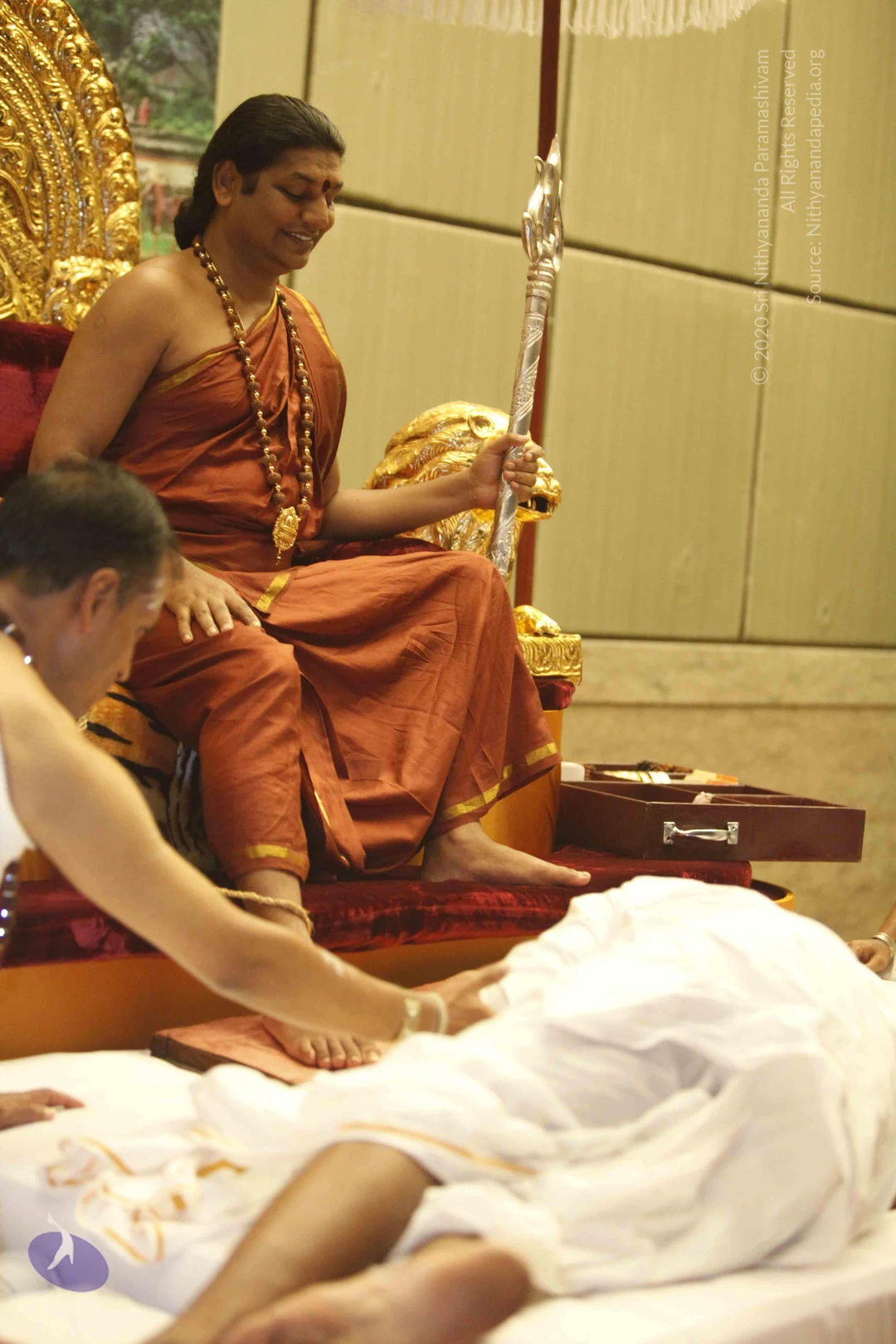
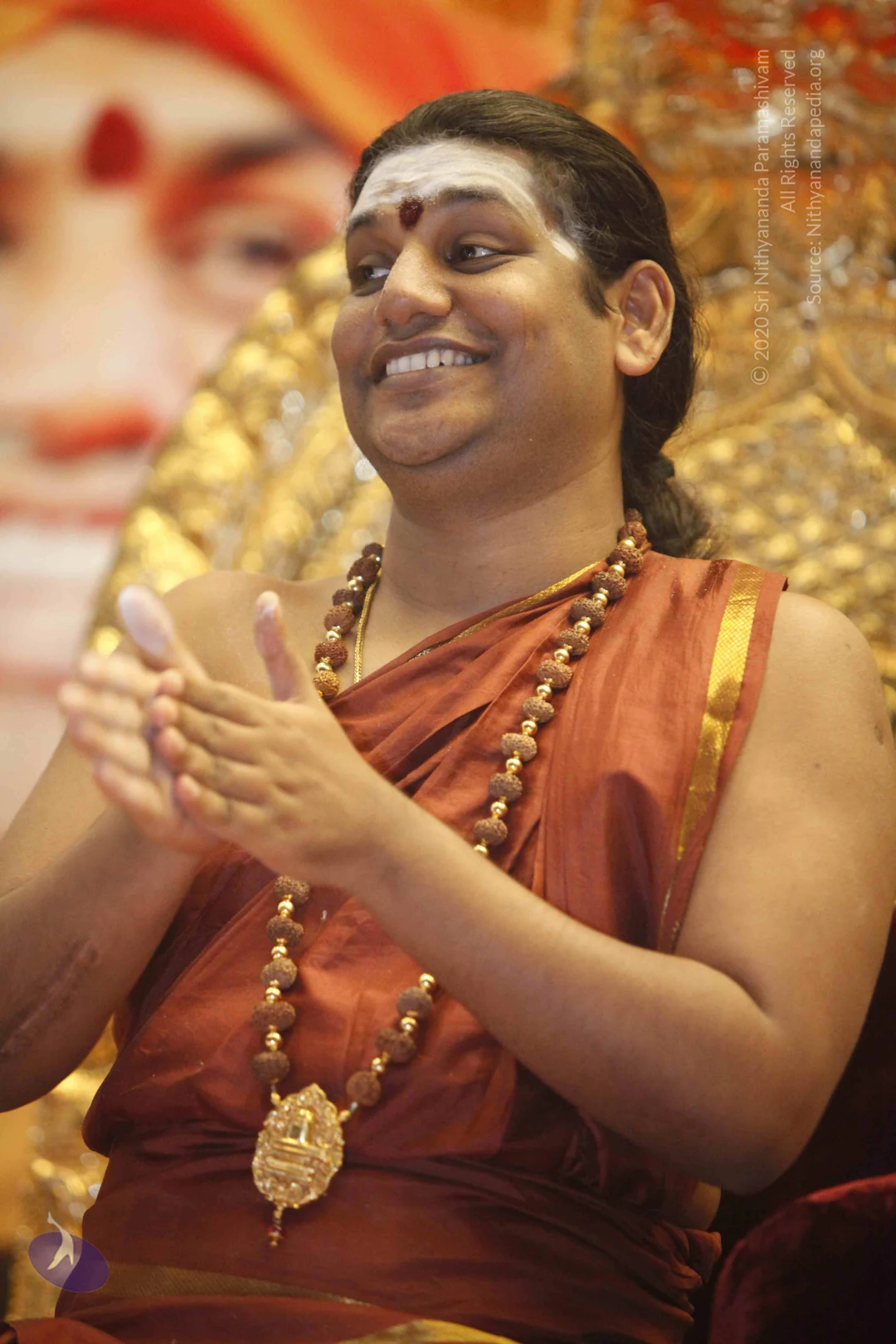
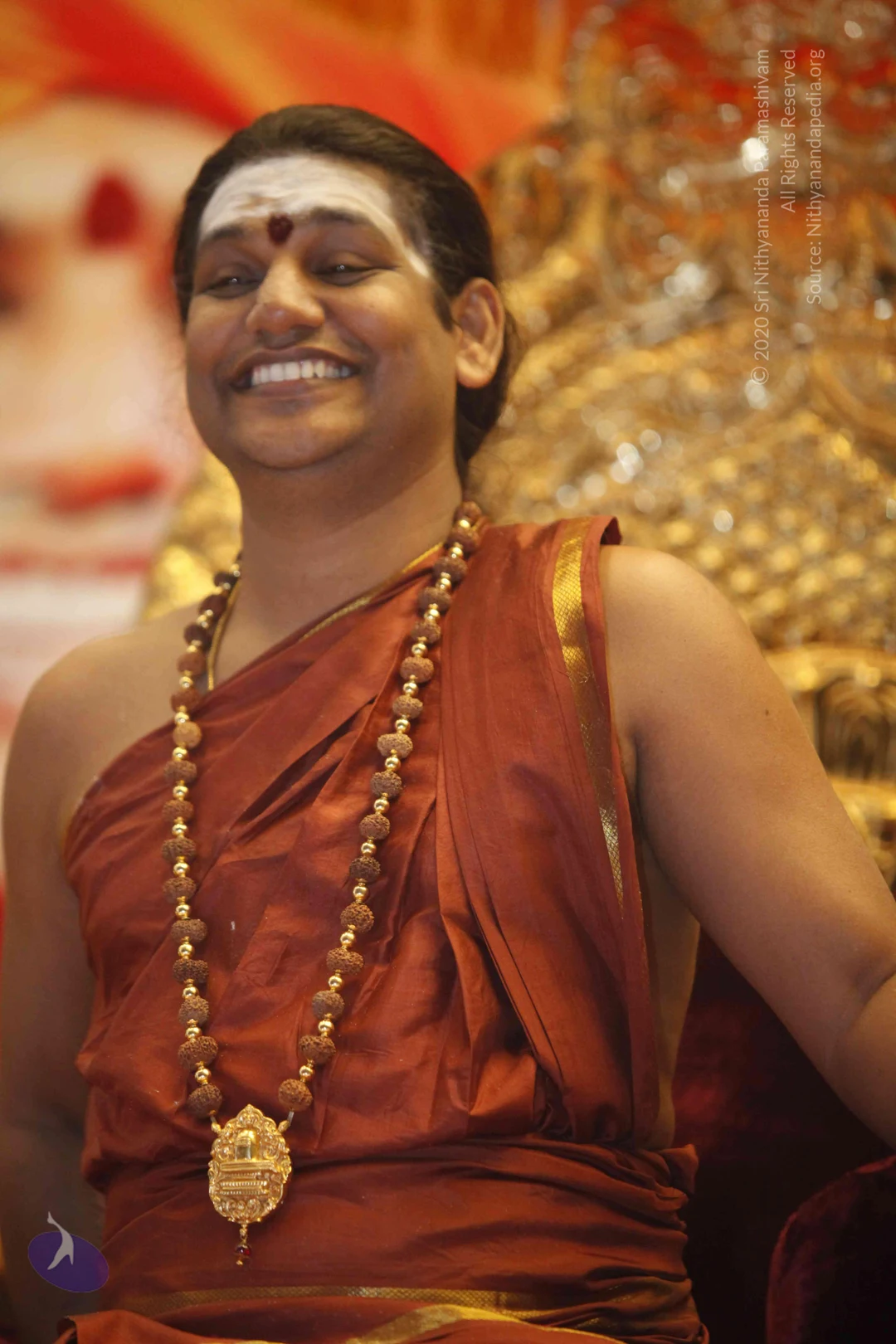
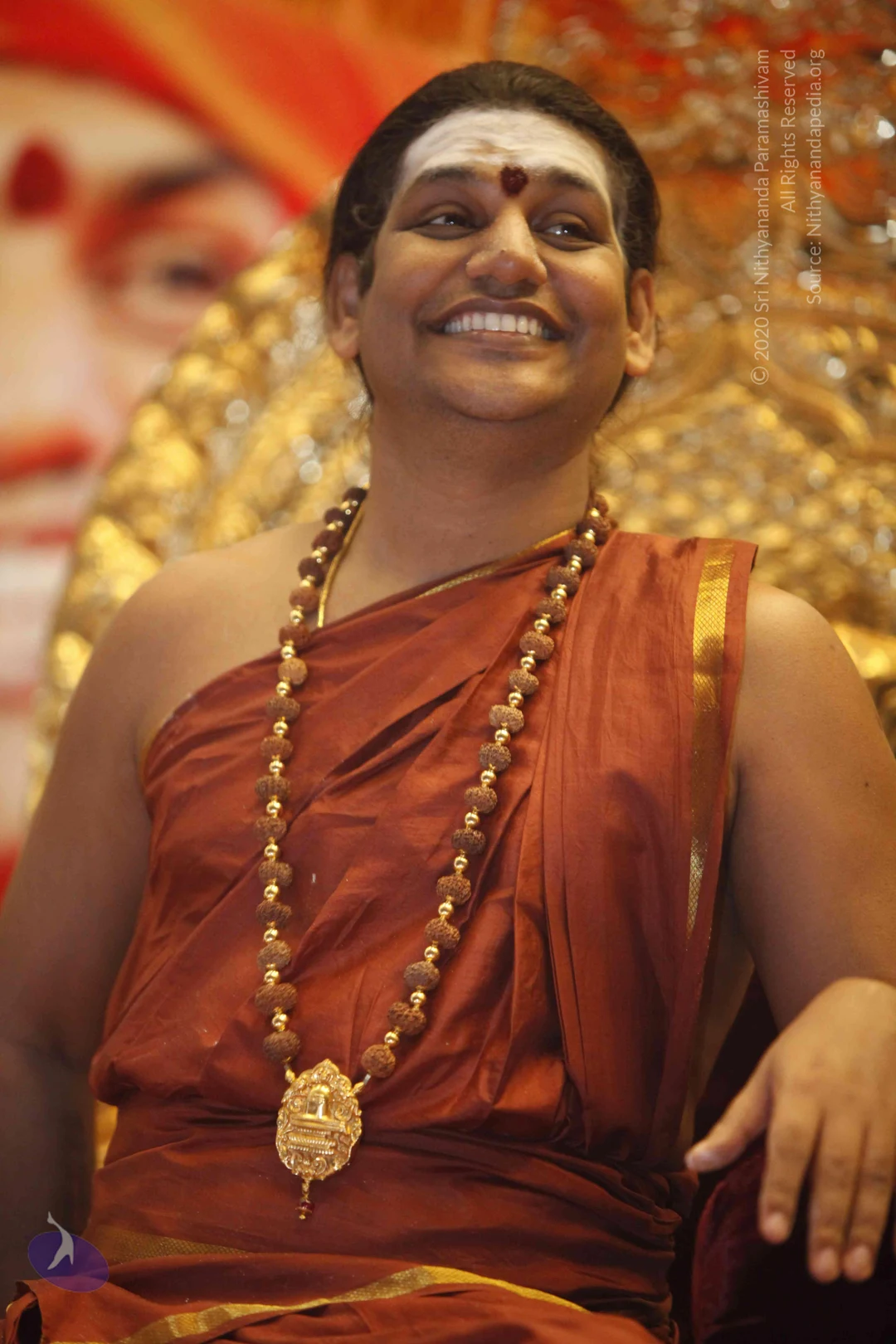
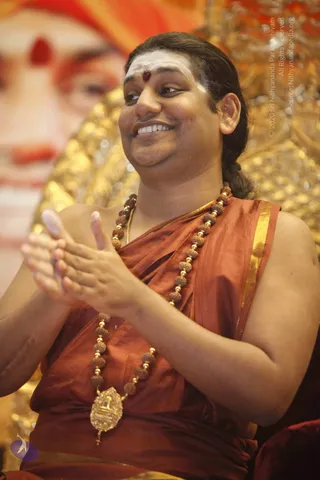
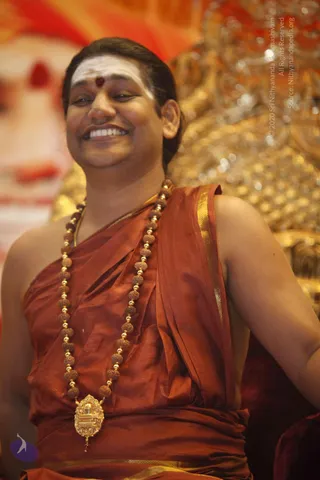
A seated man in rust-orange silk robes with gold border, wearing a long rudraksha mala with gold beads and a gold pendant, sits on a red velvet throne-like seat before an ornate gold backdrop. His right hand is raised to his forehead in a salutation gesture while his left hand holds a small packet. His eyes are closed and white sacred marks with a red bindi are on his forehead. A large portrait of a smiling face is visible at the upper left. a person: the rudraksha mala, gold ceremonial necklace and orange robes match the appearance cues, and the page reports a person at this event, so the seated man is a probable in-person candidate.A seated man in a rust-red robe and rudraksha mala sits on an ornate gold-and-silver throne flanked by two golden lion statues. He holds a long white cloth or whisk in one hand and rests the other on his knee, eyes closed. Three tiered orange and gold umbrellas with tasselled fringes rise above the throne. Behind is a banner with a Balinese pagoda-style temple and a partial portrait of a smiling man in orange turban, printed text reading 'Inner Awakening'. A white-draped platform sits in front. a person: the seated man wears a rudraksha mala and red robe on a throne, cues appearance-based only, so this is a presiding teacher at an Inner Awakening event.A man seated on an ornate gilded throne with a tall arched back, flanked by two golden lion sculptures. He wears a rust-red wrap and a rudraksha mala with a pendant, and holds a silver trident in his right hand and a rope in his left. Three tiers of orange and gold fringed parasols rise above the throne. Behind him a large banner shows a smiling man in an orange turban and a Balinese temple with a multi-tiered pagoda roof. A tiger-skin cloth covers the dais. The seated man is a person by appearance cues: a rudraksha mala and ceremonial dress, seated on a throne in an event setting.A seated man in an orange-rust robe with gold-edged border sits on an ornate gold-and-red throne, holding a silver staff topped with a flame-like finial, with a rudraksha mala and a gold pendant at his chest and a small red mark on his forehead. In the foreground a second person in white bends over a figure lying on a white cloth, pressing their feet, in what appears to be a padapuja ritual. An open wooden box with ritual items sits beside the throne, and the background is pale yellow wall panels. Appearance-based candidate for Swamiji (probable), with long swept-back hair, rudraksha mala and orange robe.A smiling man with long dark hair swept back sits clapping his hands in front of a golden backdrop. He wears a rust-orange sleeveless wrap with a gold border and a mala of rudraksha beads with gold spacers, plus a gold pendant. A white vertical mark and a red bindi show on his forehead. Swamiji (probable) is seated at the centre of the scene; the cues are the long swept-back hair, saffron-orange clothing, rudraksha mala and ornate gold ornaments. A blurred red-and-gold image of a deity or portrait appears at the left edge.A smiling man sits in front of an ornate gold throne-like seat, wearing a rust-orange draped garment with a gold border and a long rudraksha mala with a gold pendant. He has a white forehead band with a red dot and swept-back dark hair. The background shows a blurred red and gold ceremonial setting.