Skip to content
Friday

4 October 2013

Dated photos
291
Source pages
1
Media
2
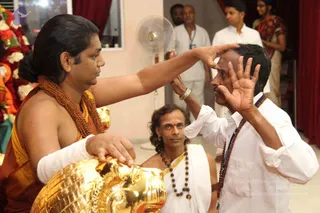
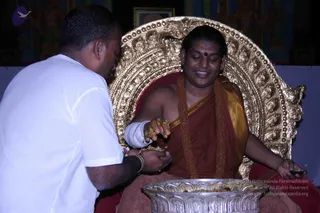
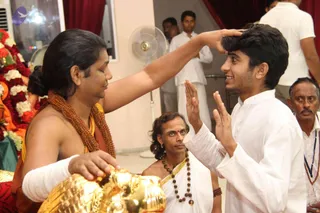
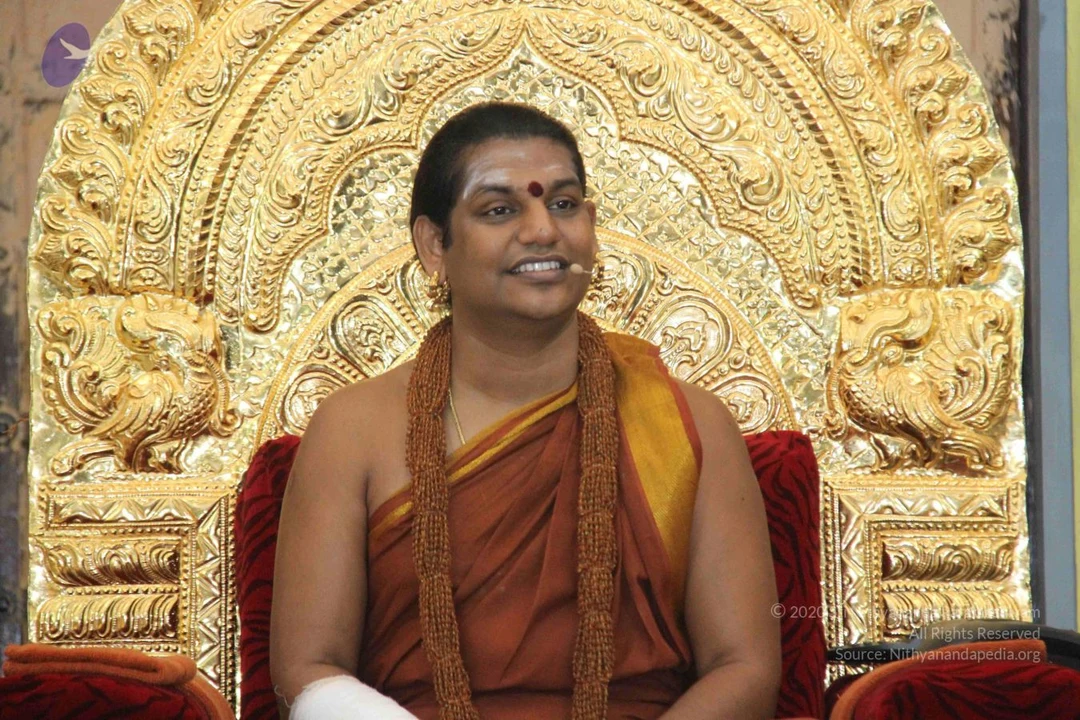
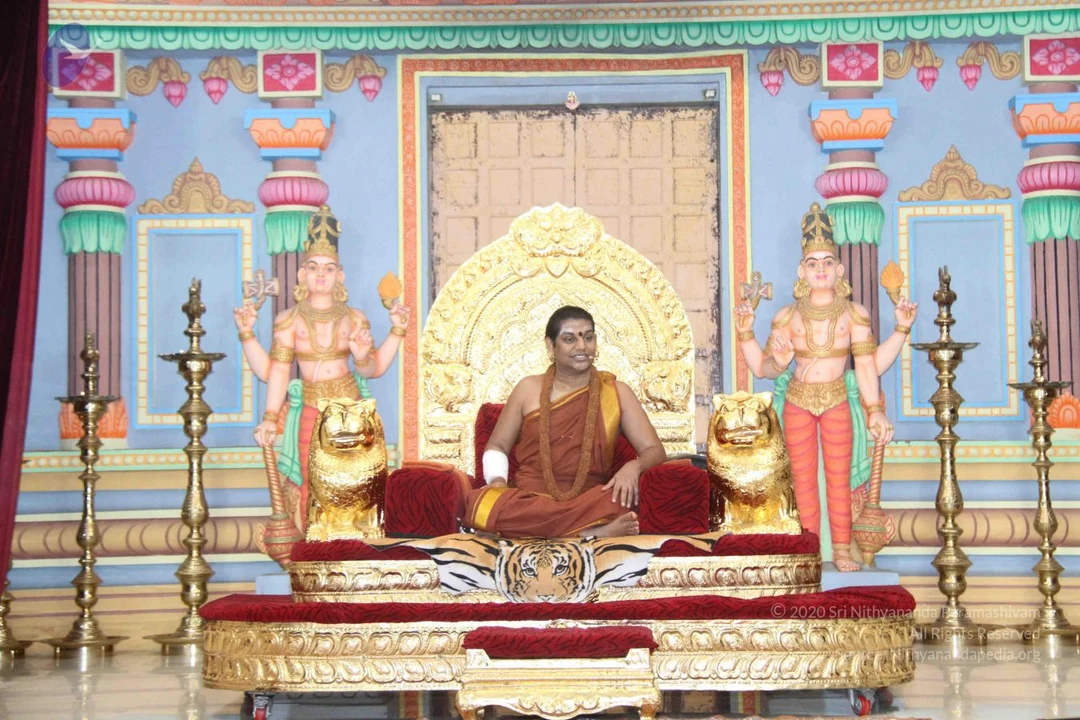
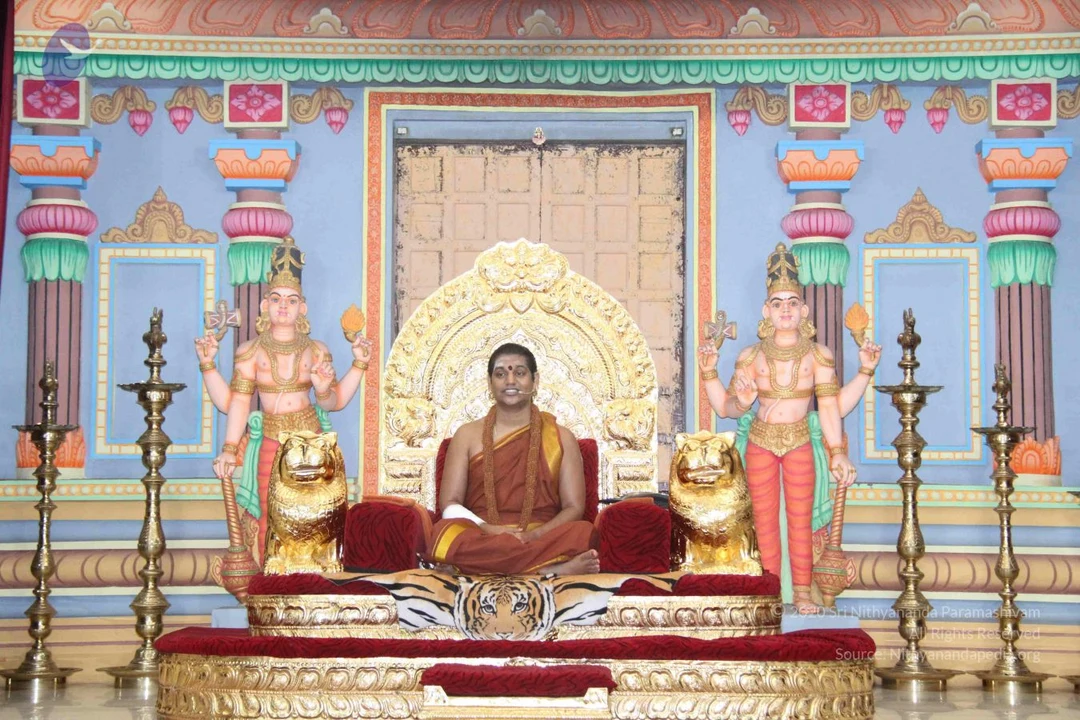
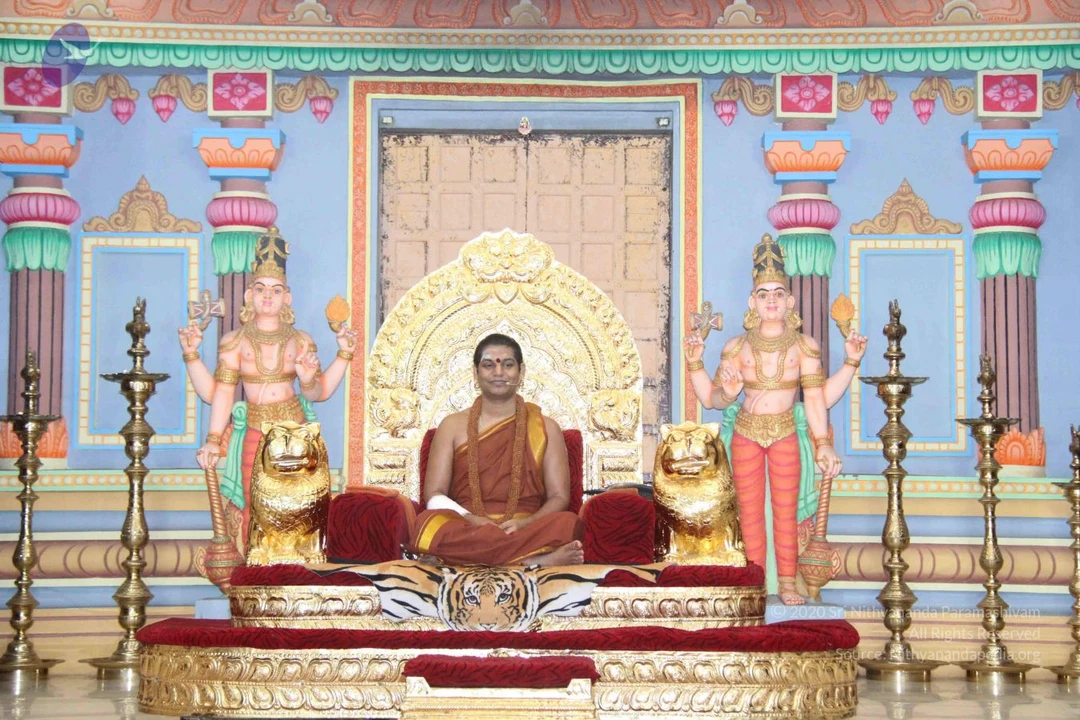
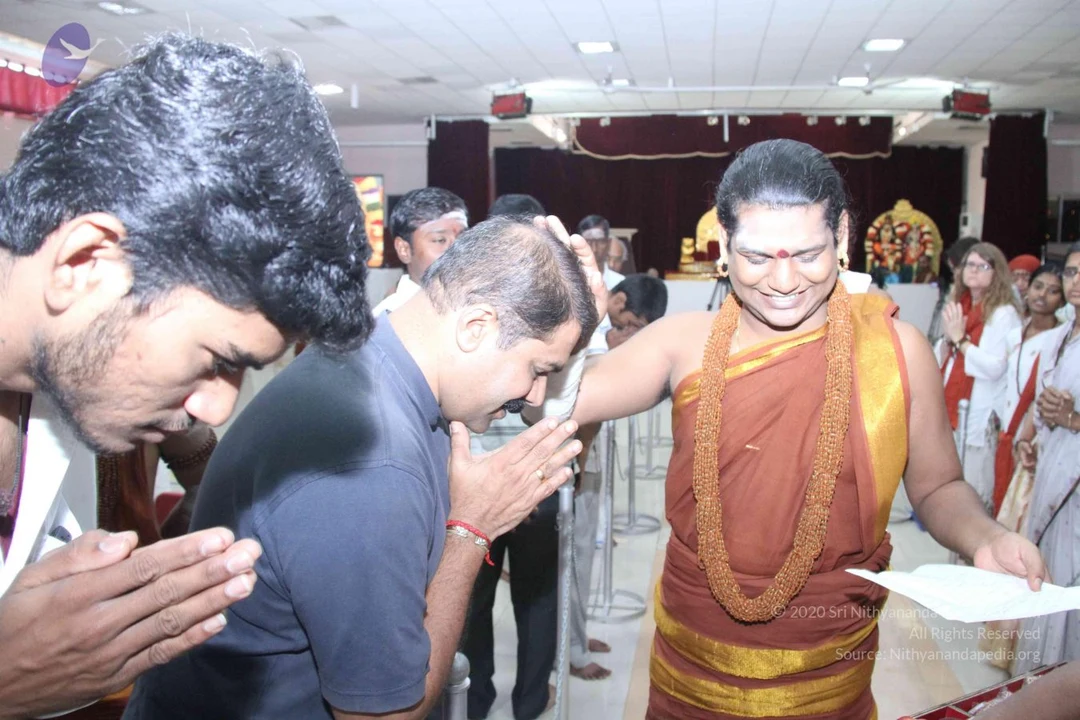
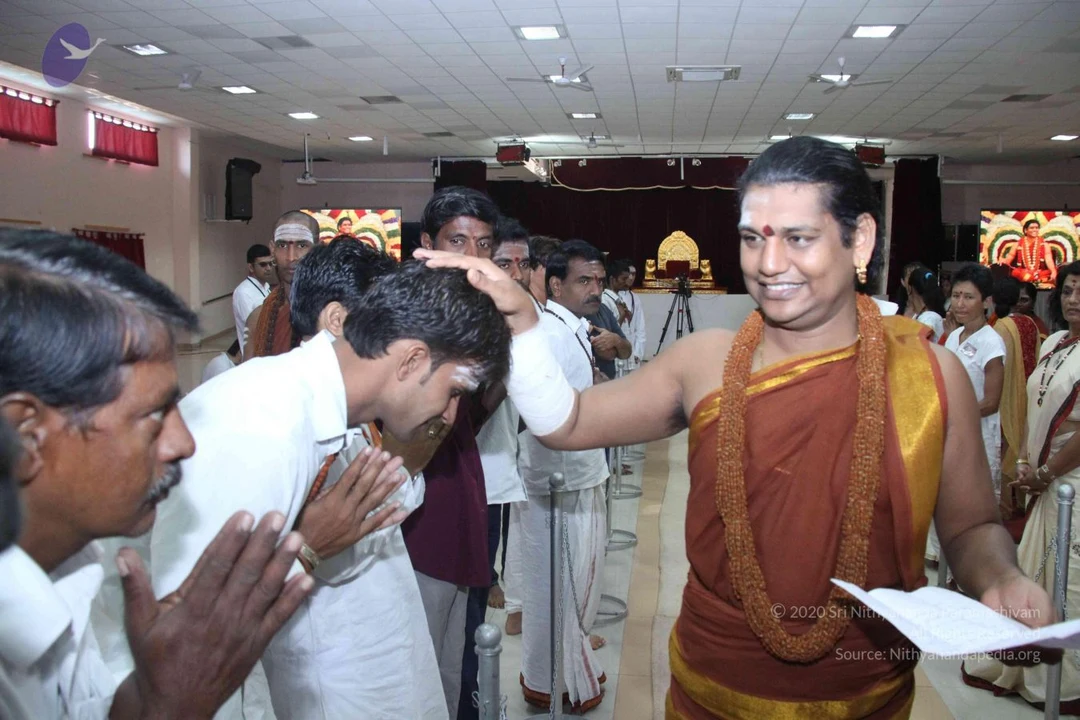
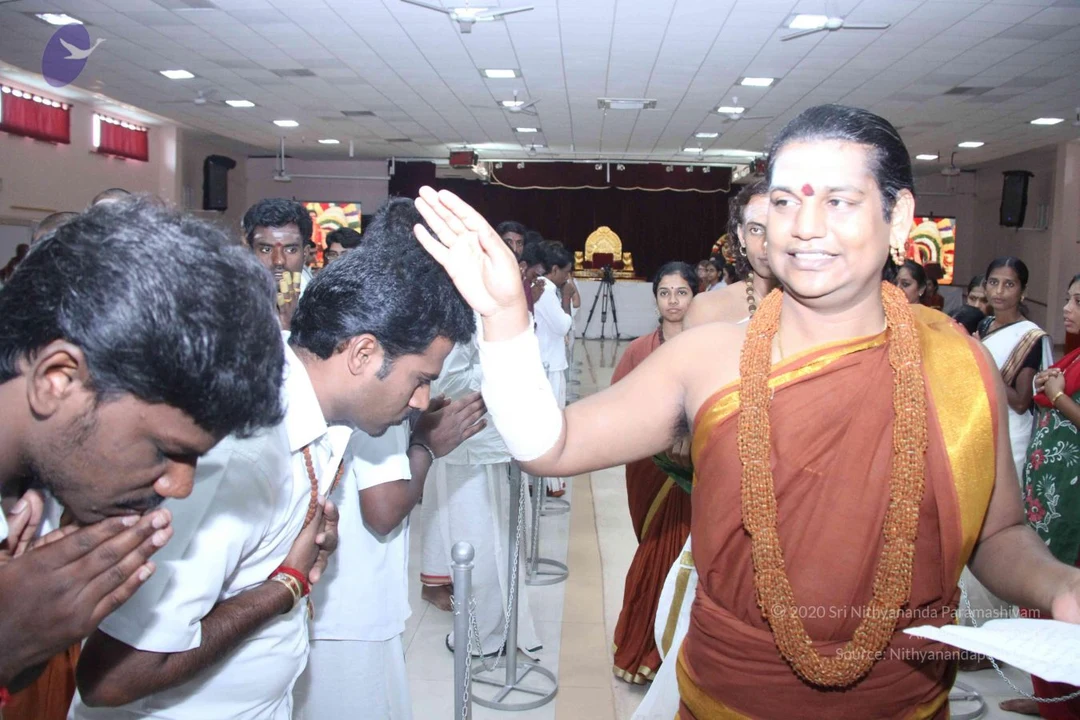
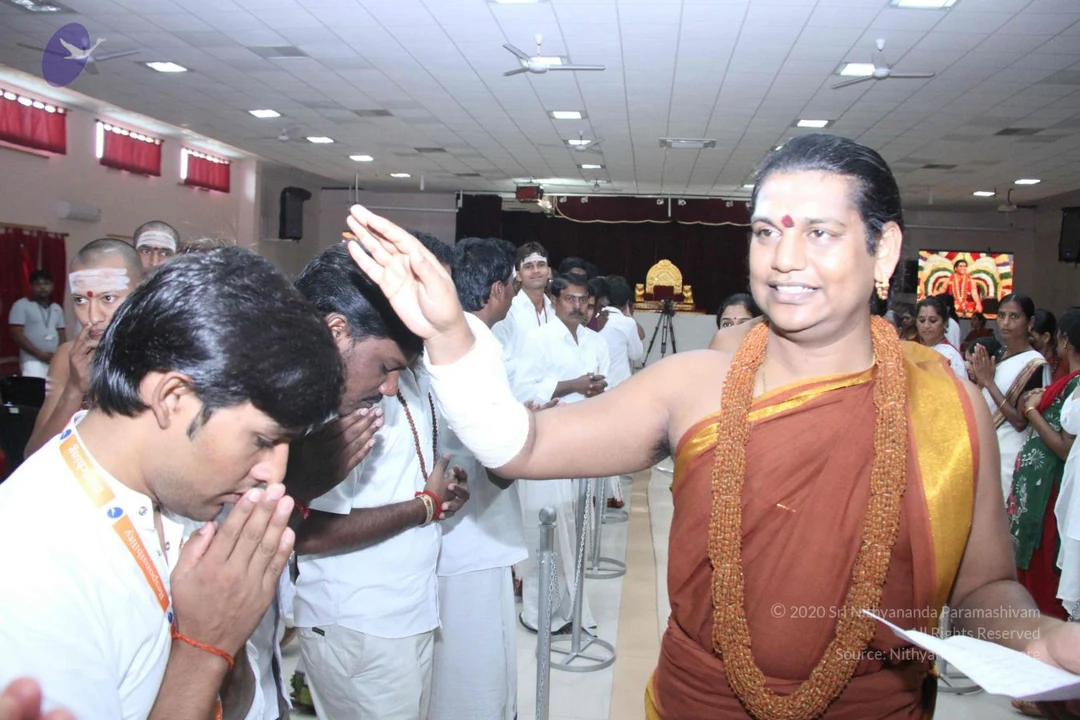
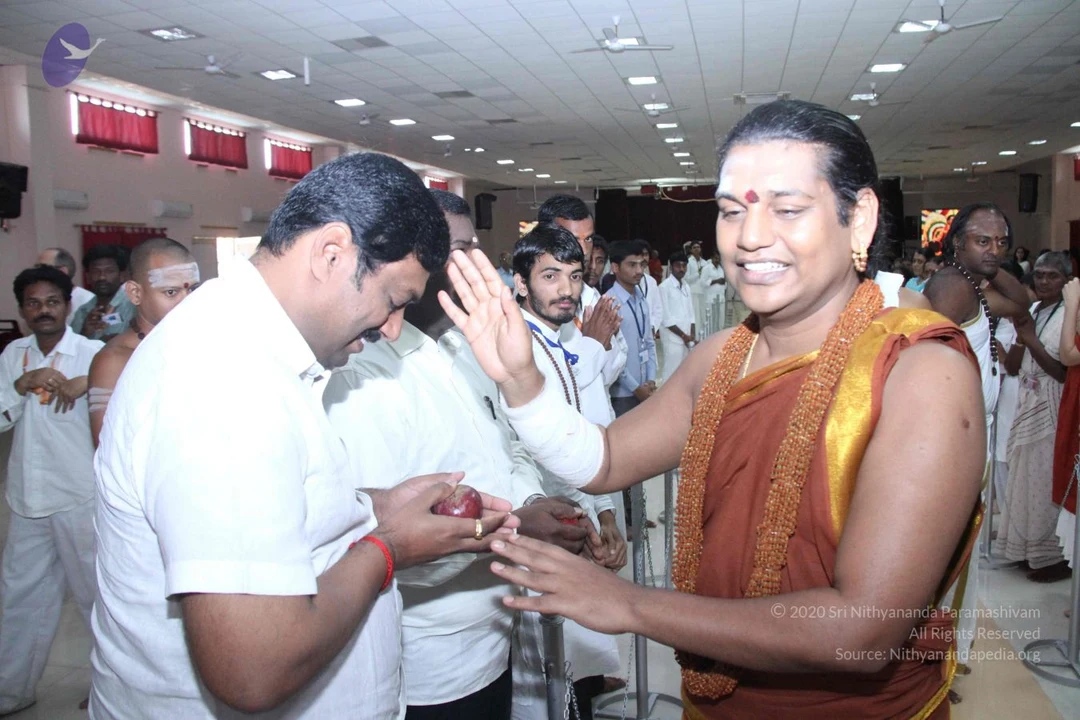
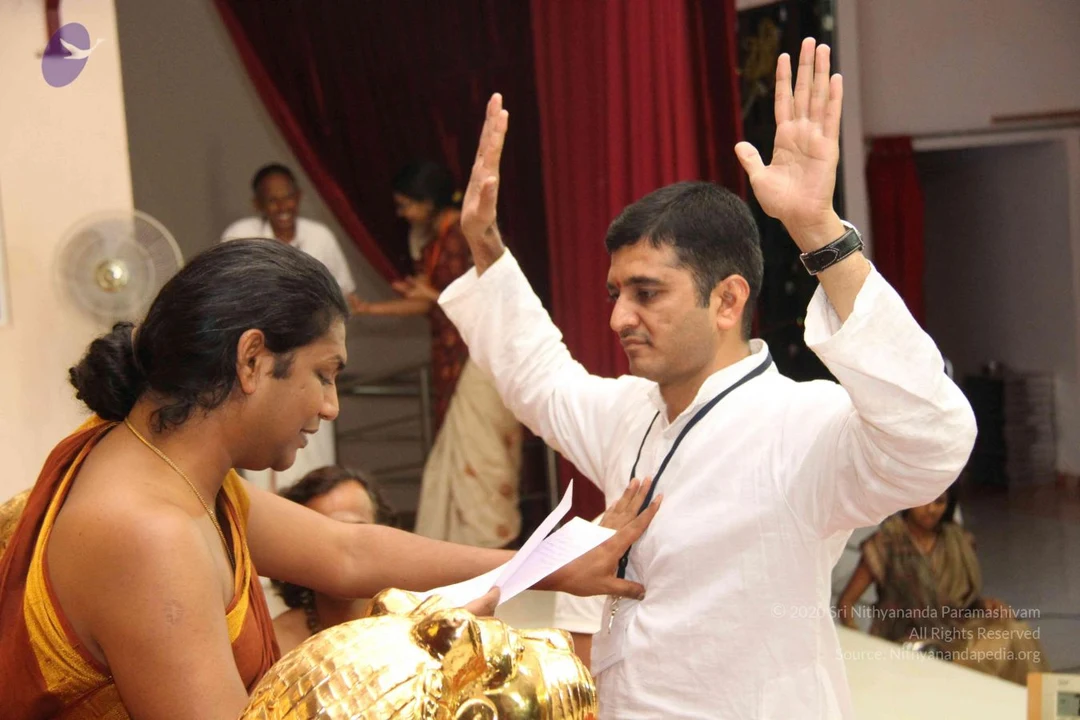
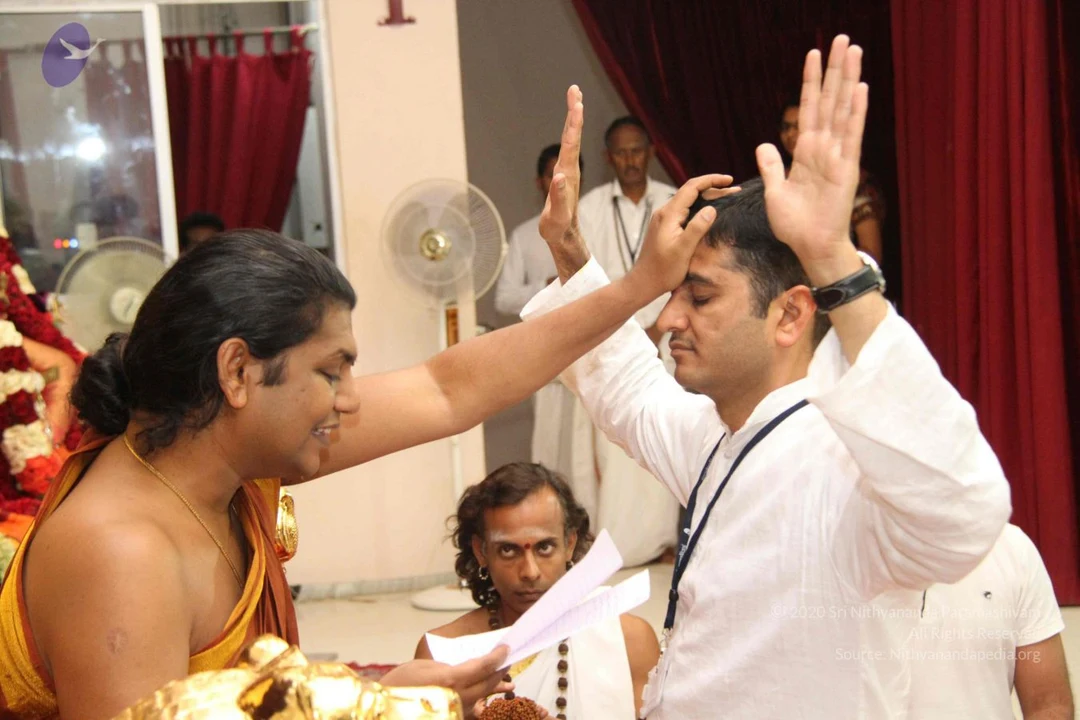
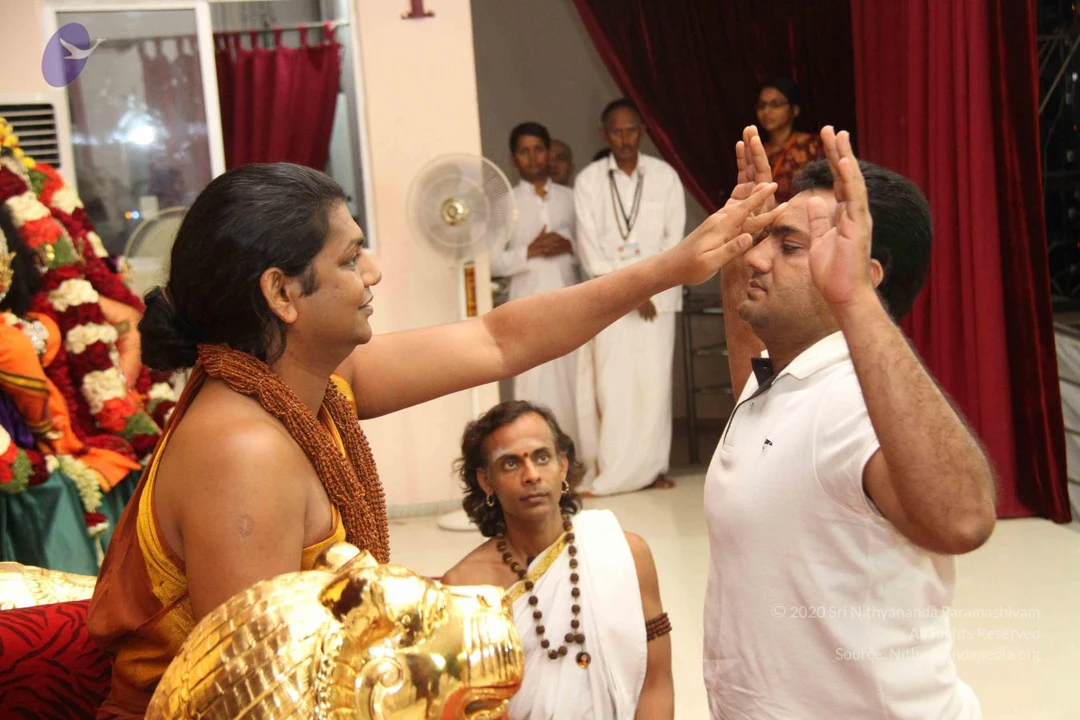
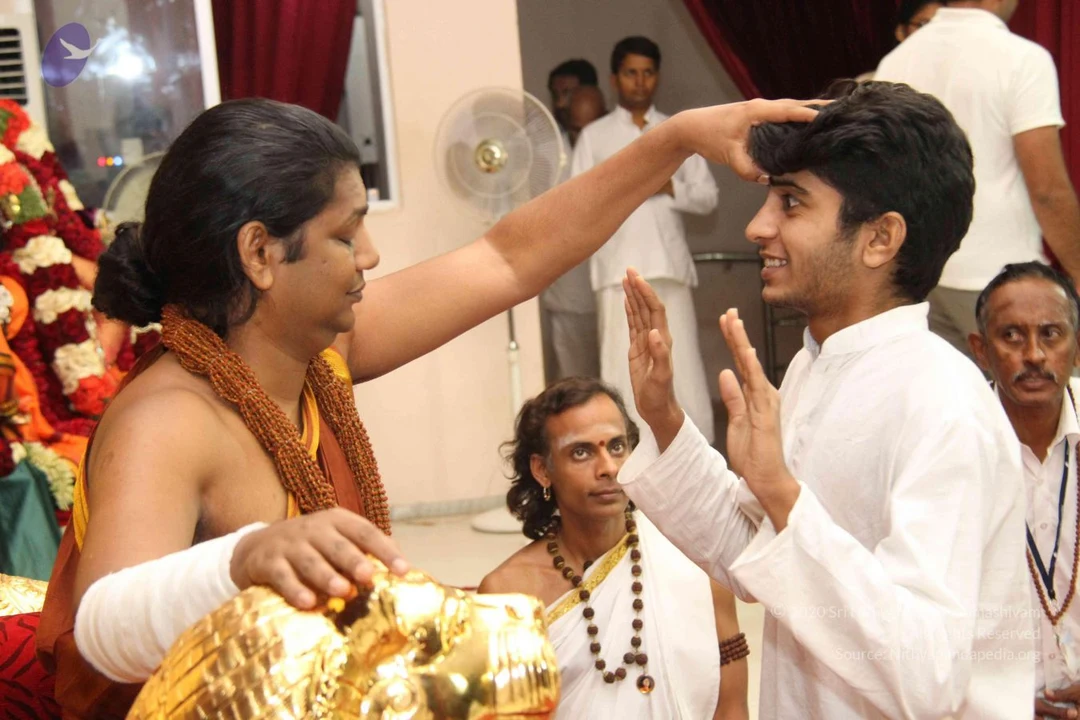
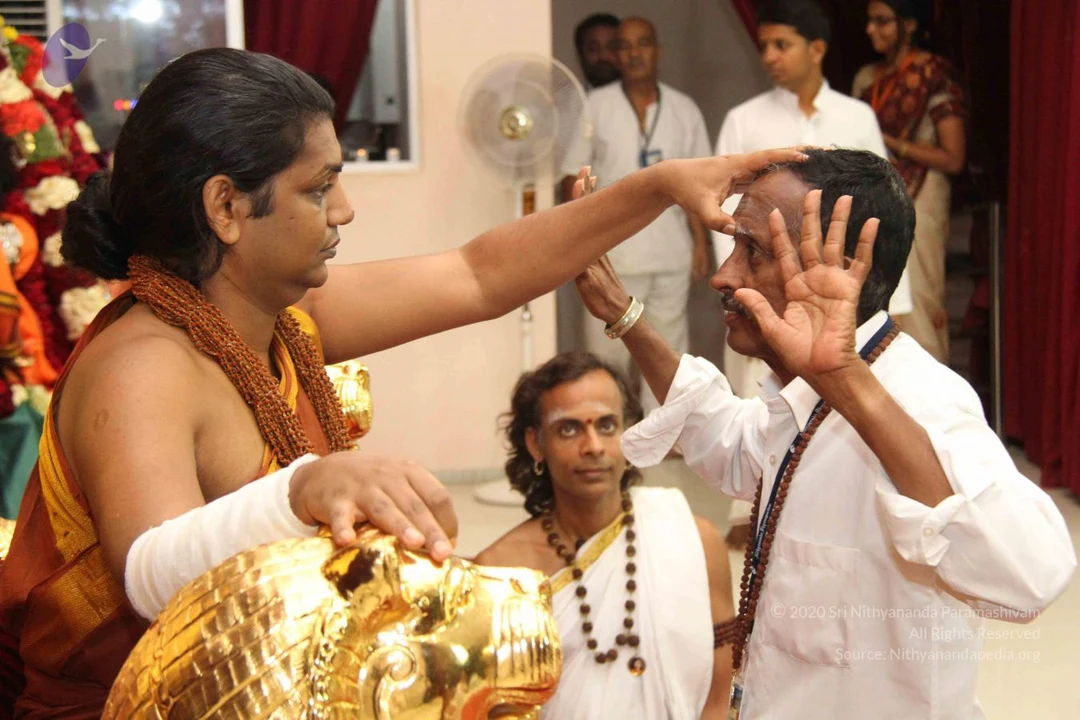
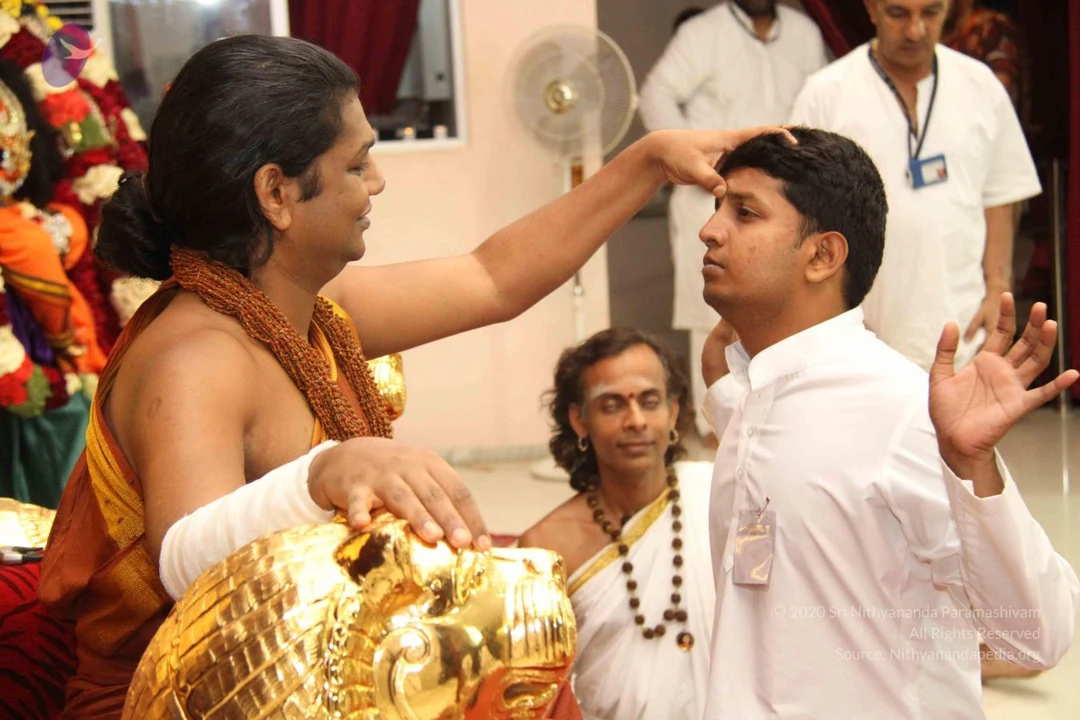
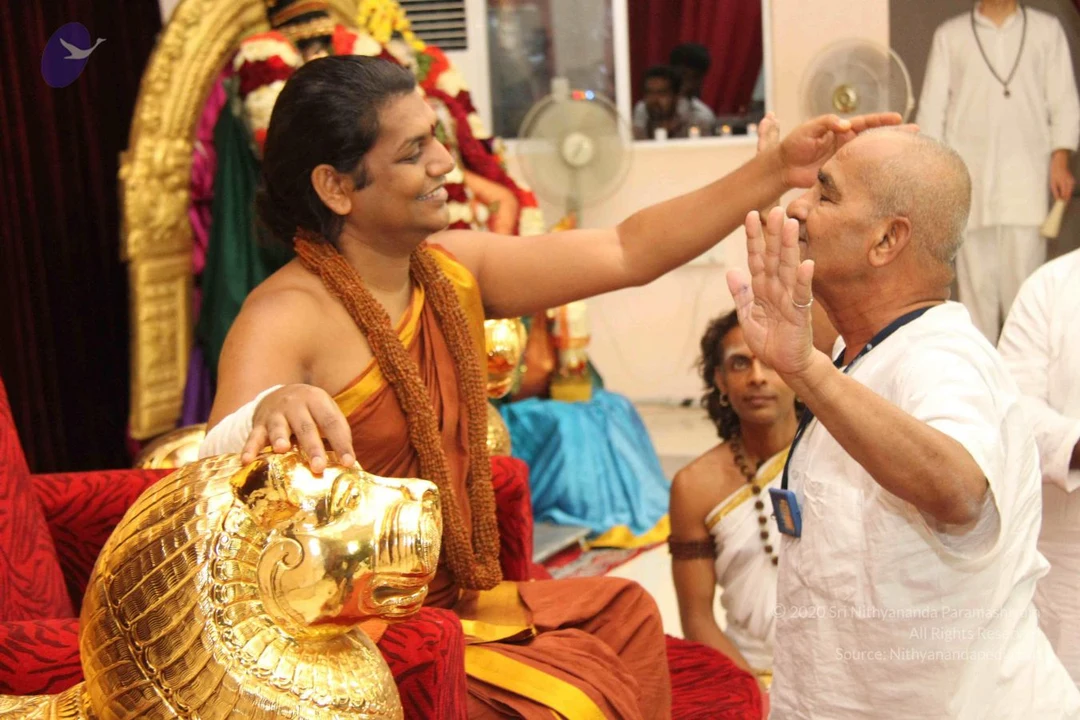
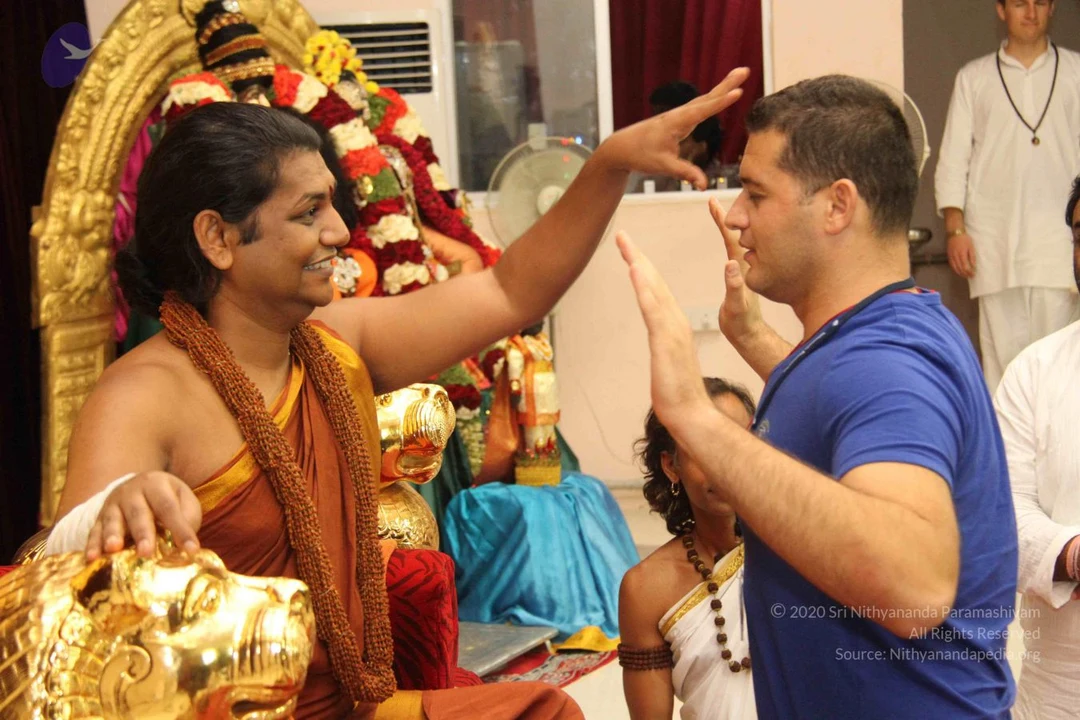
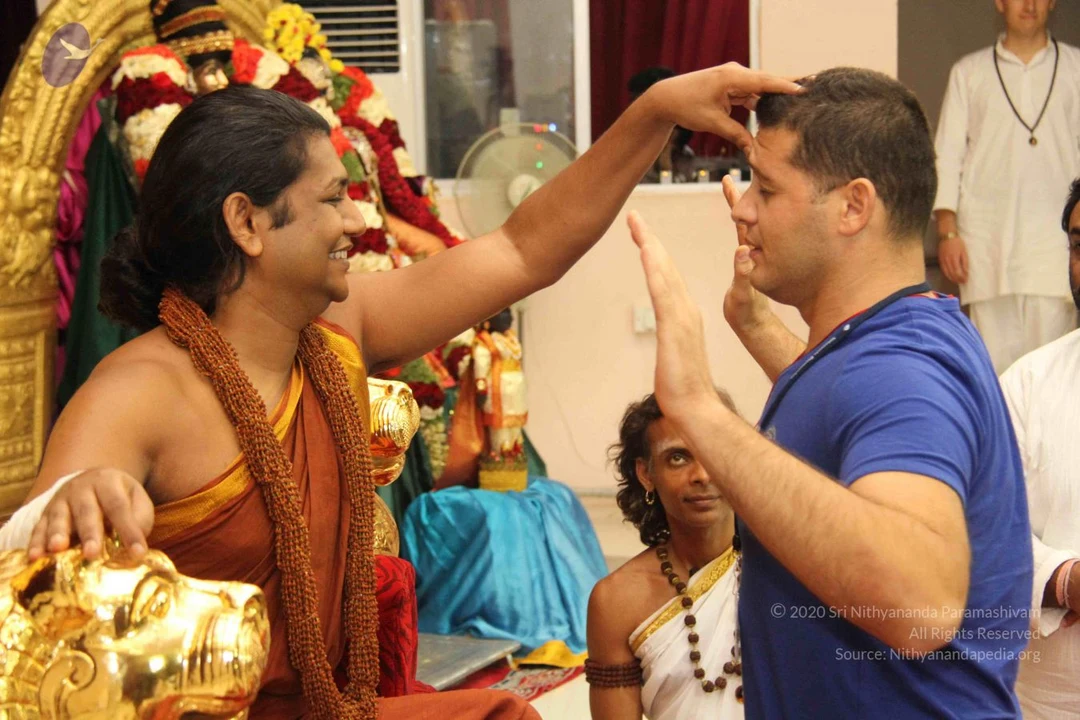
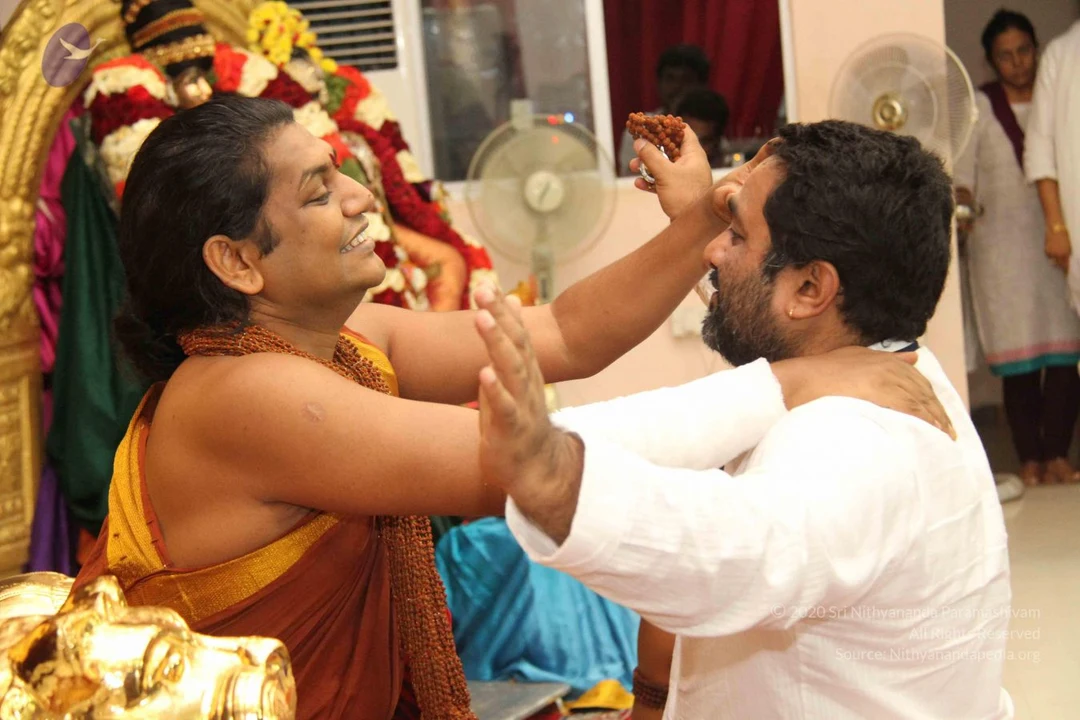
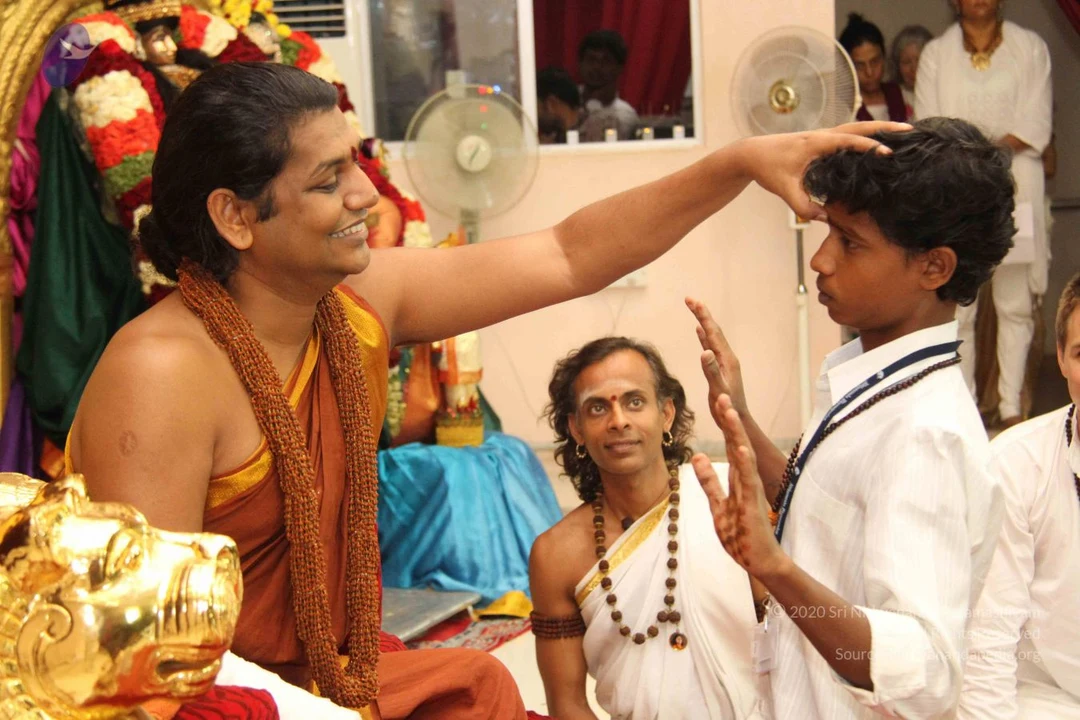
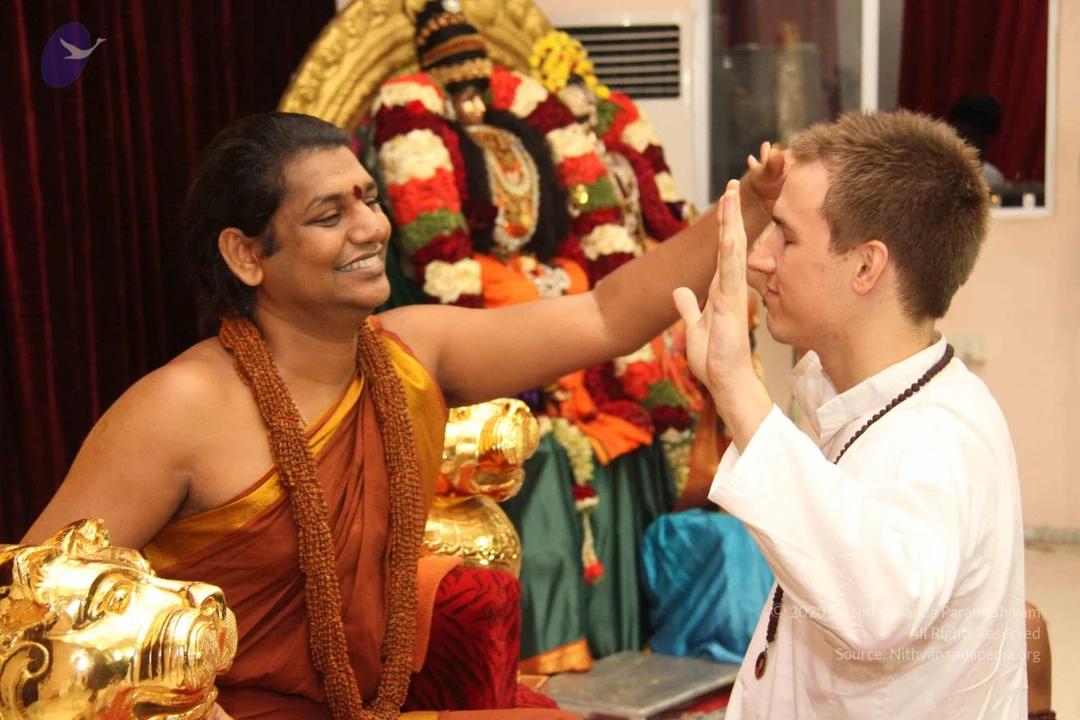
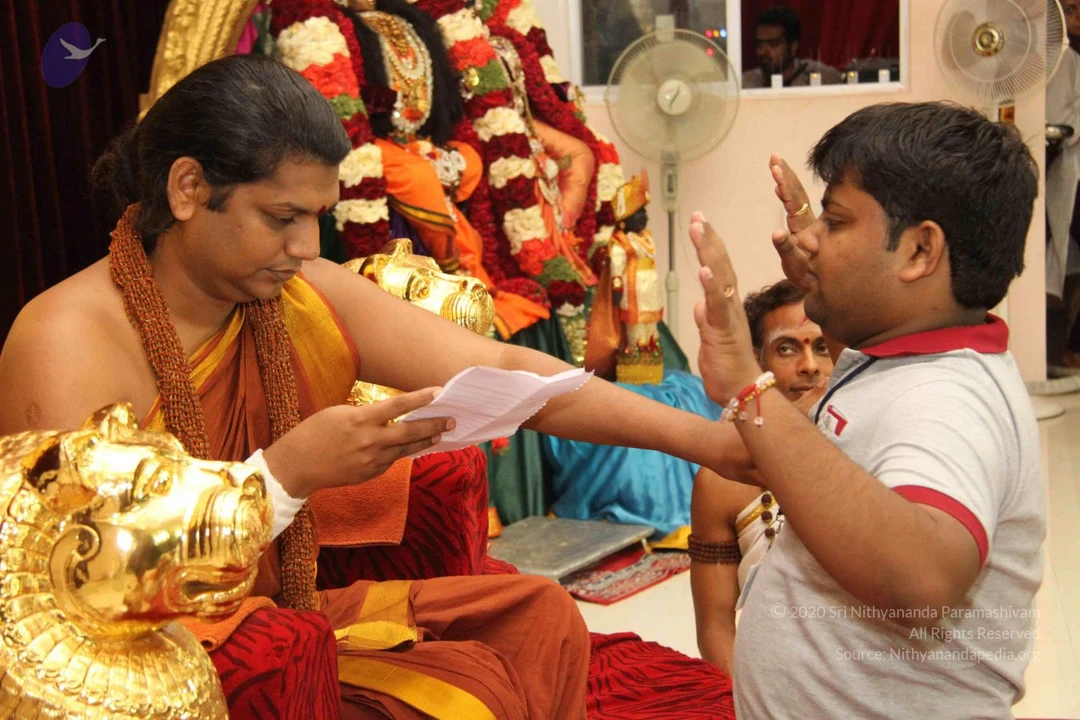
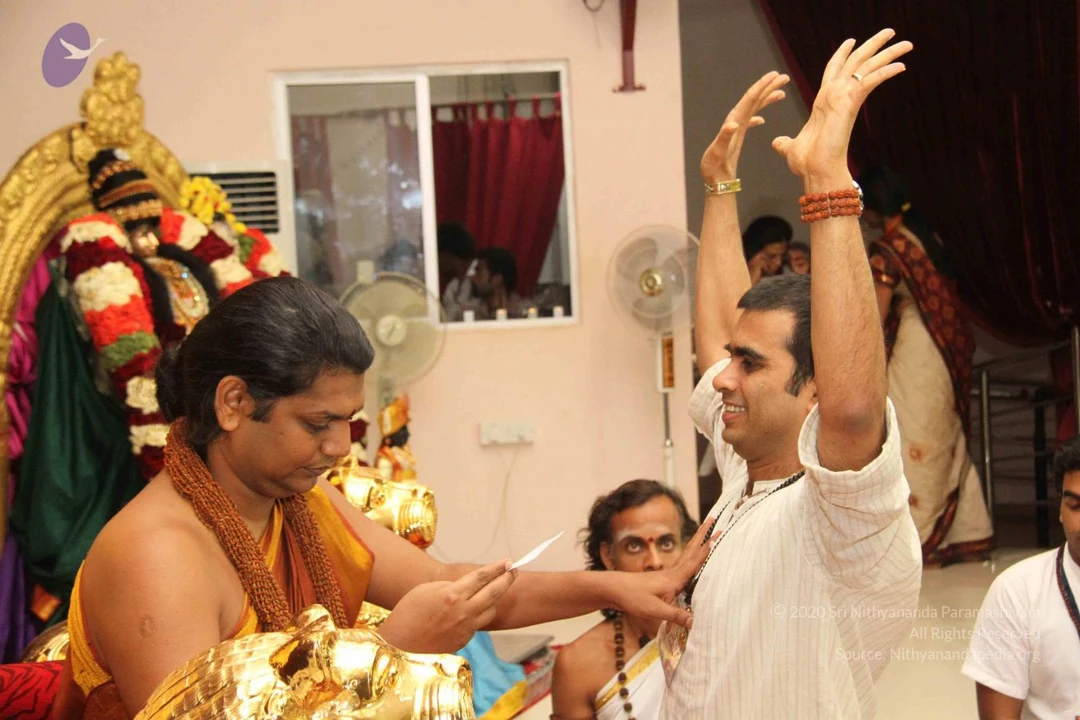
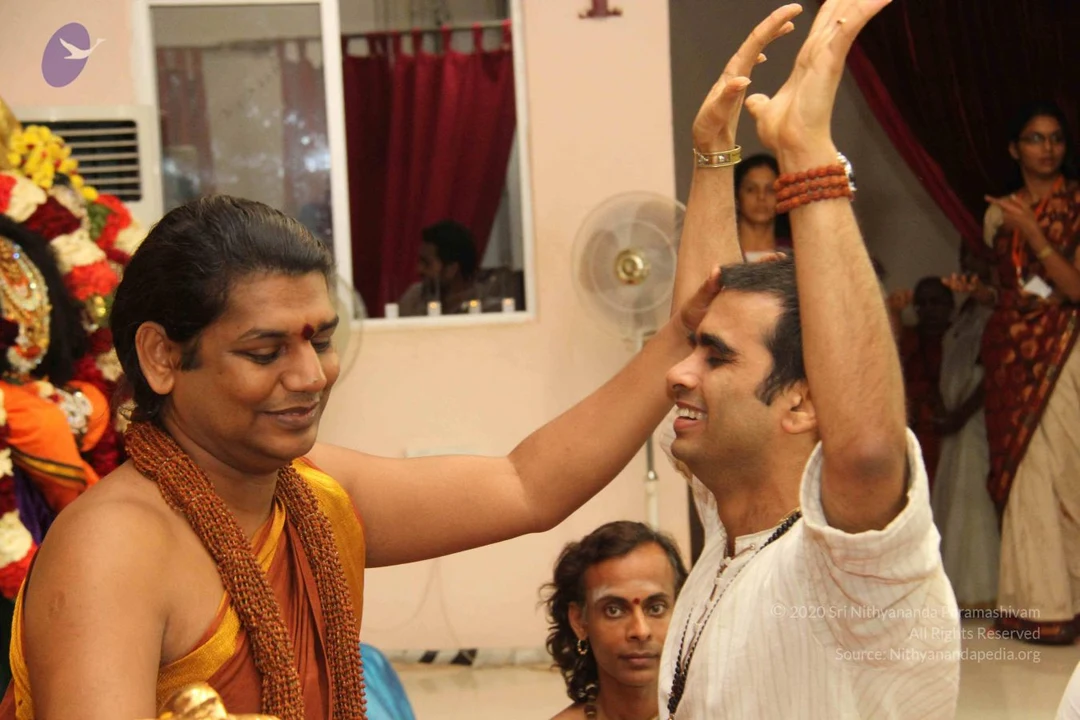
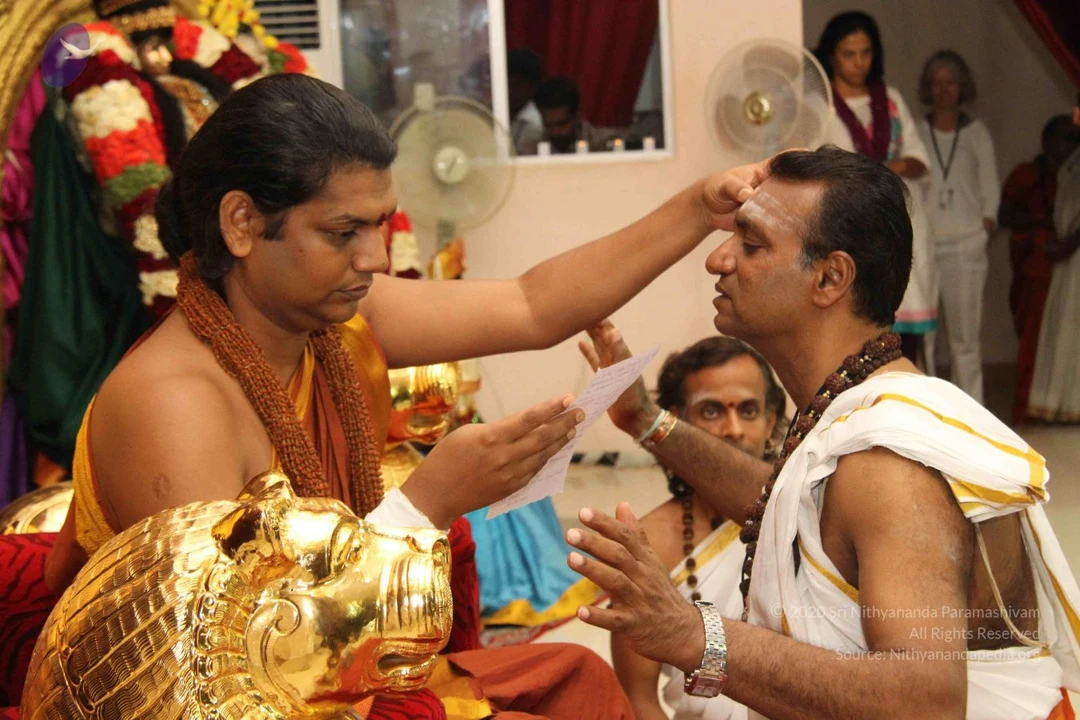
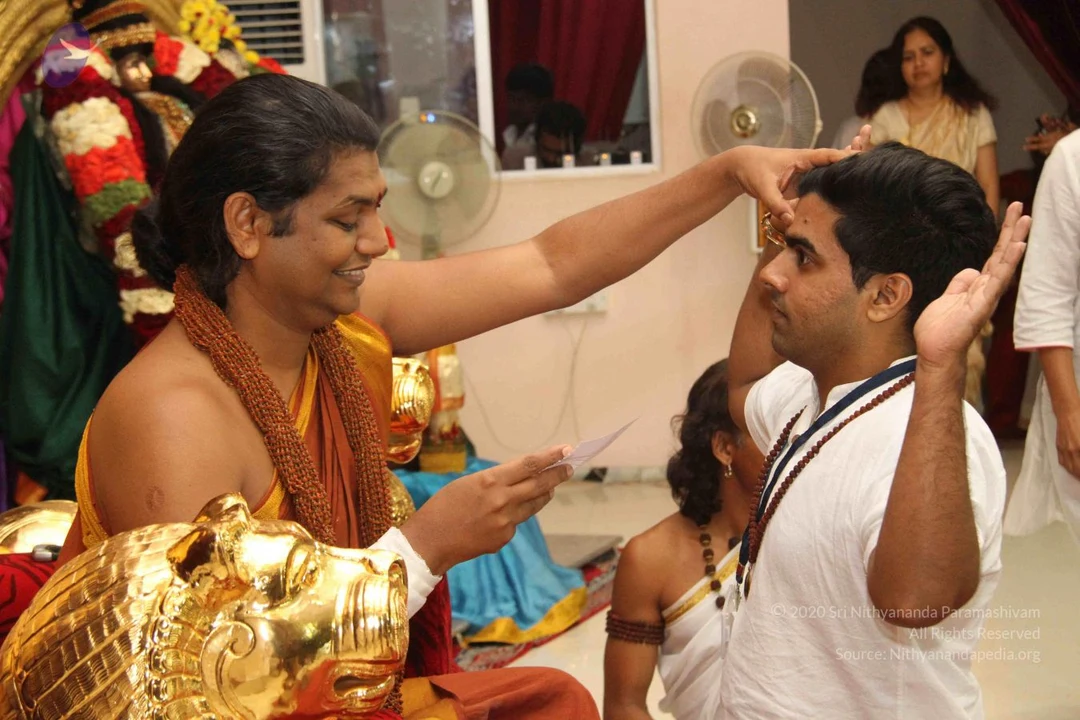
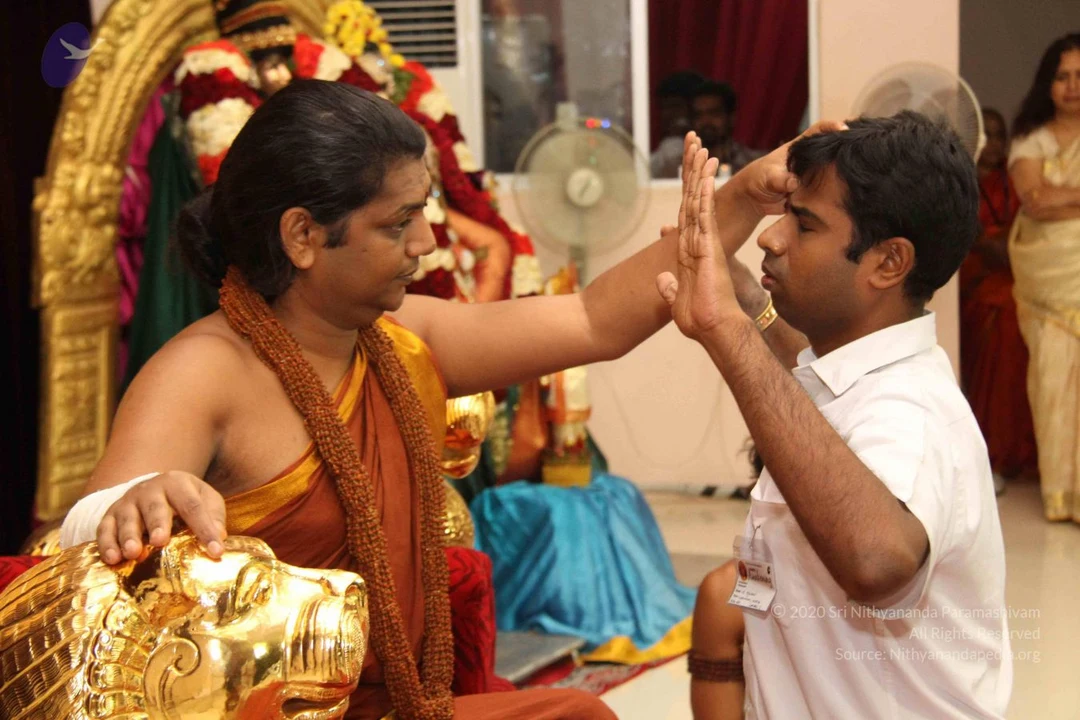
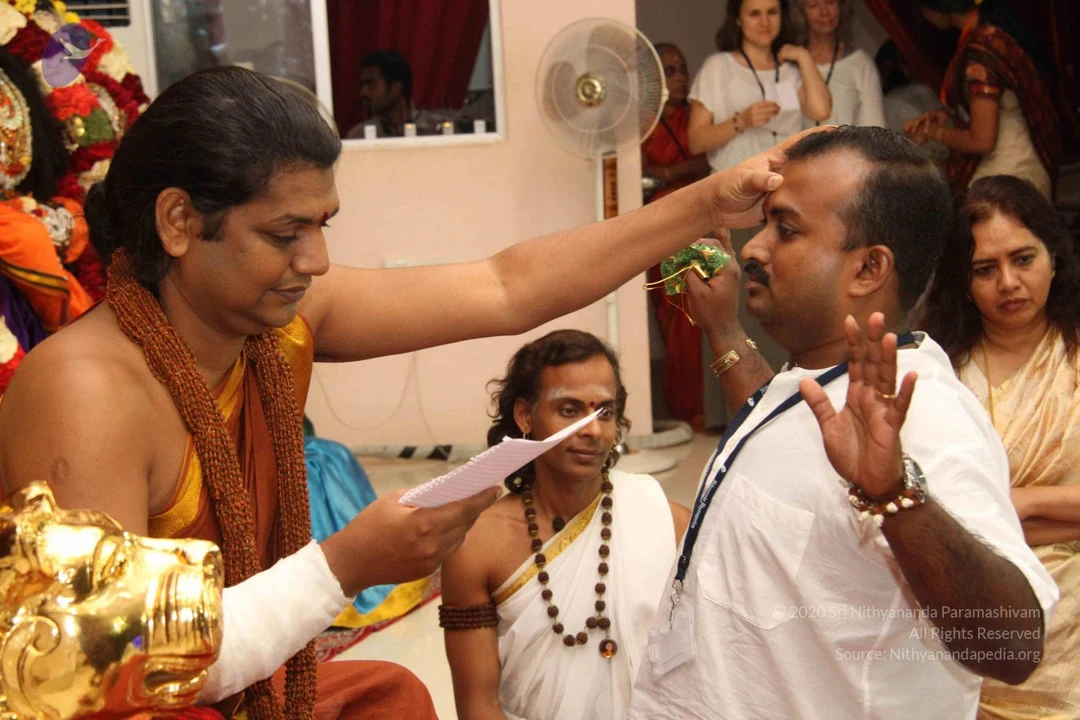
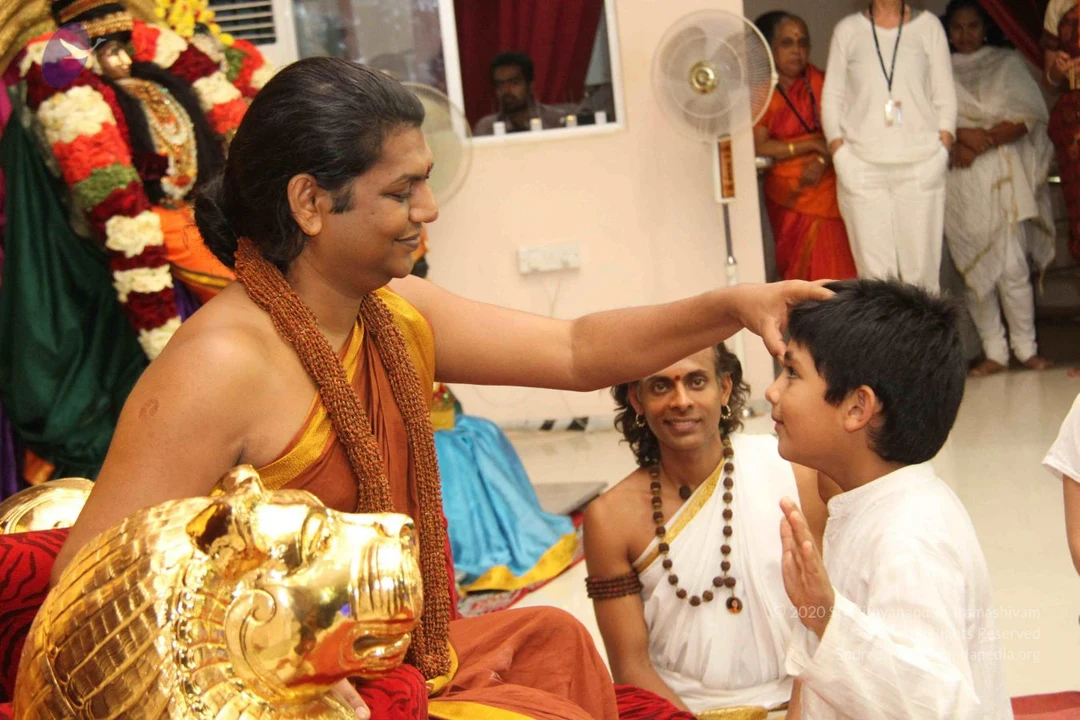
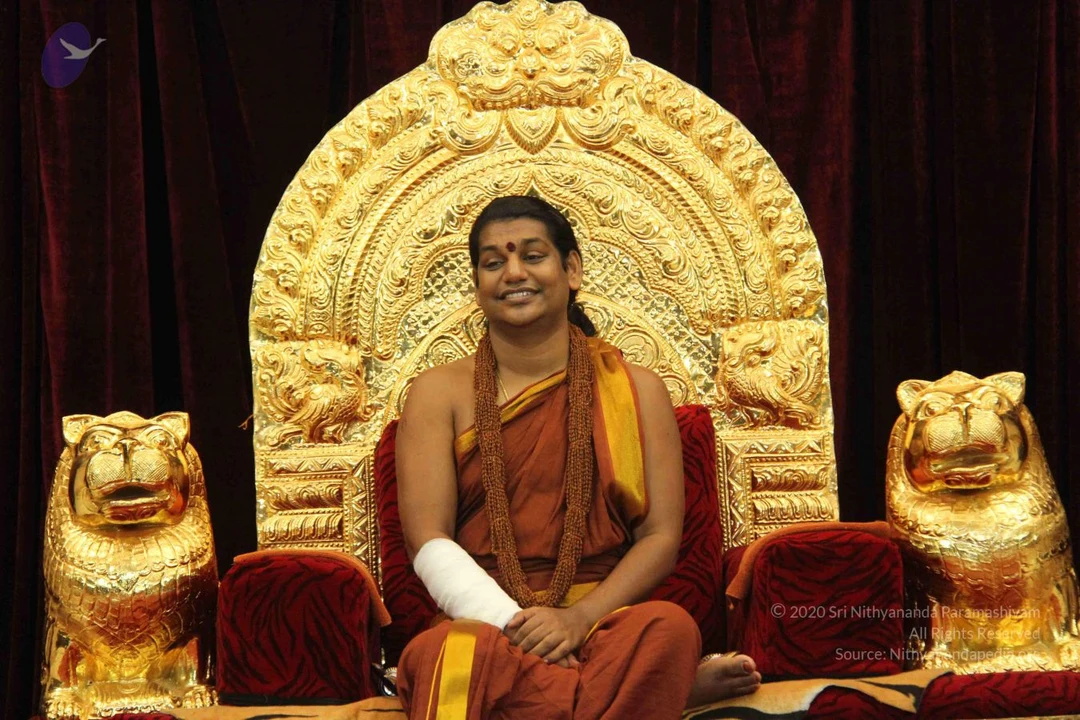
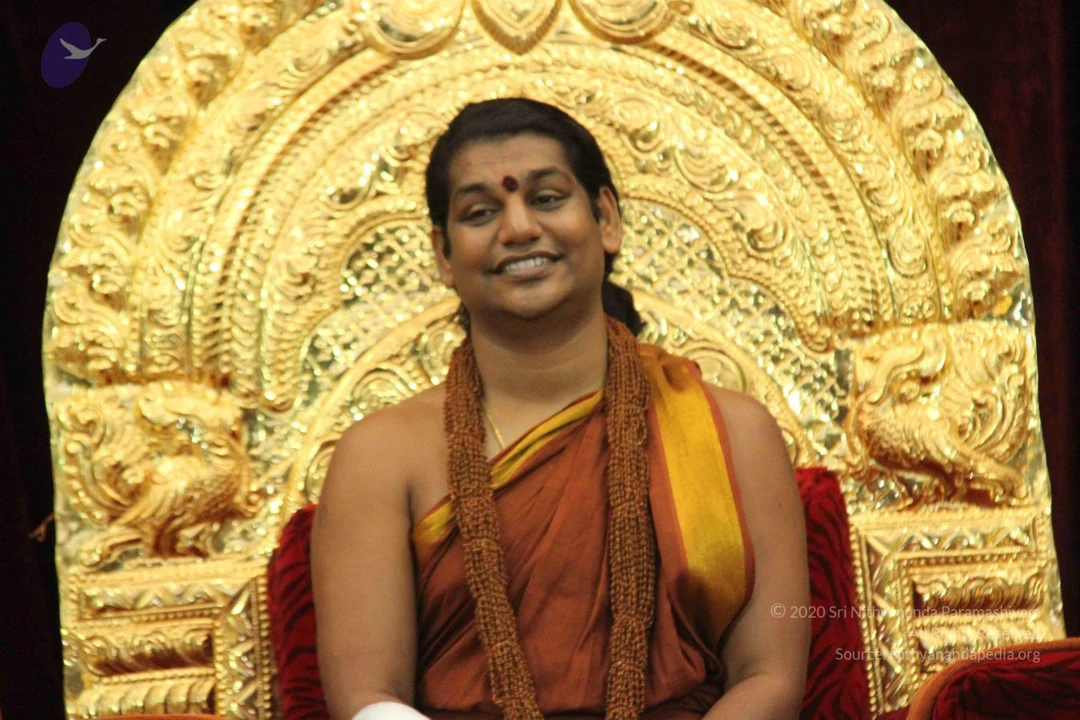
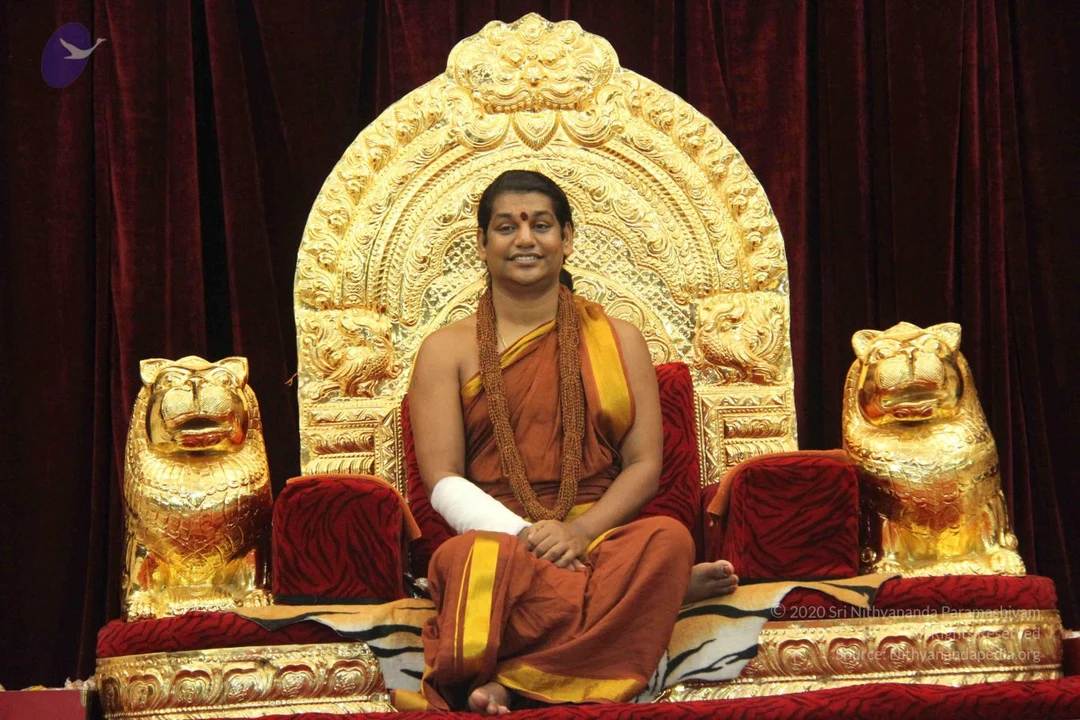
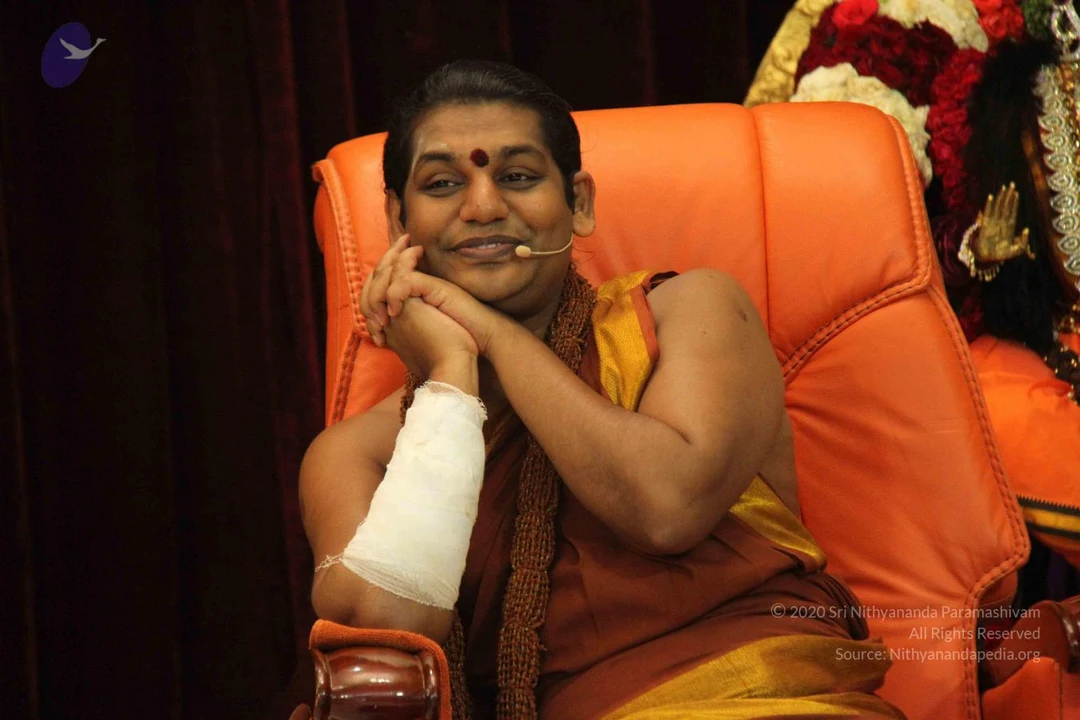
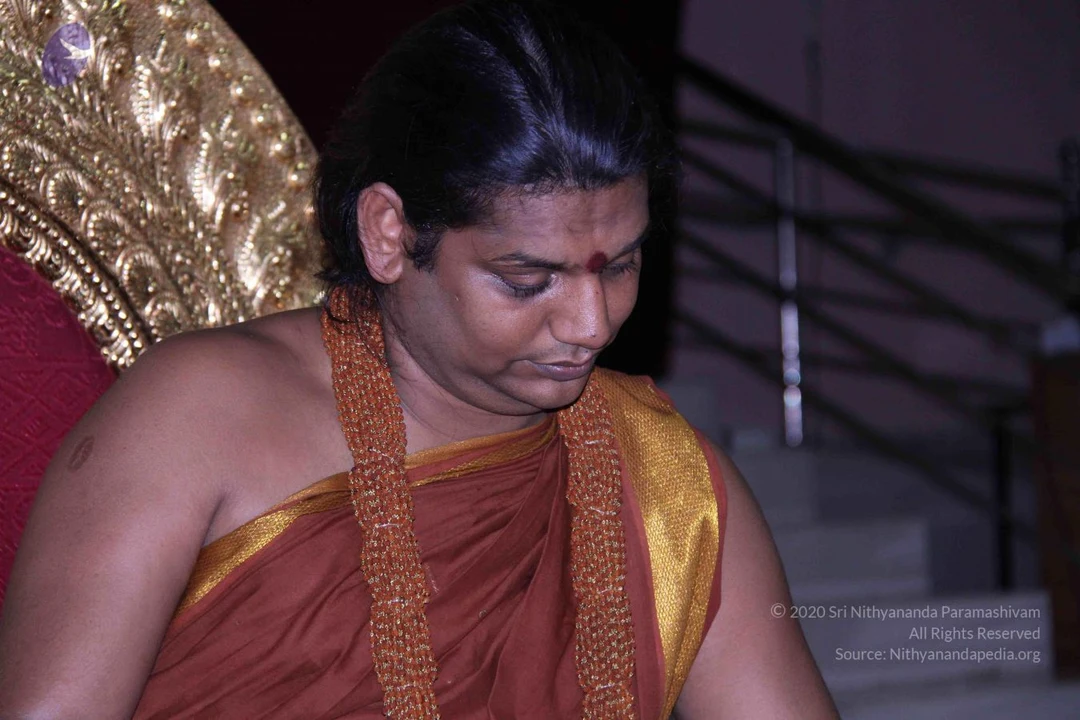
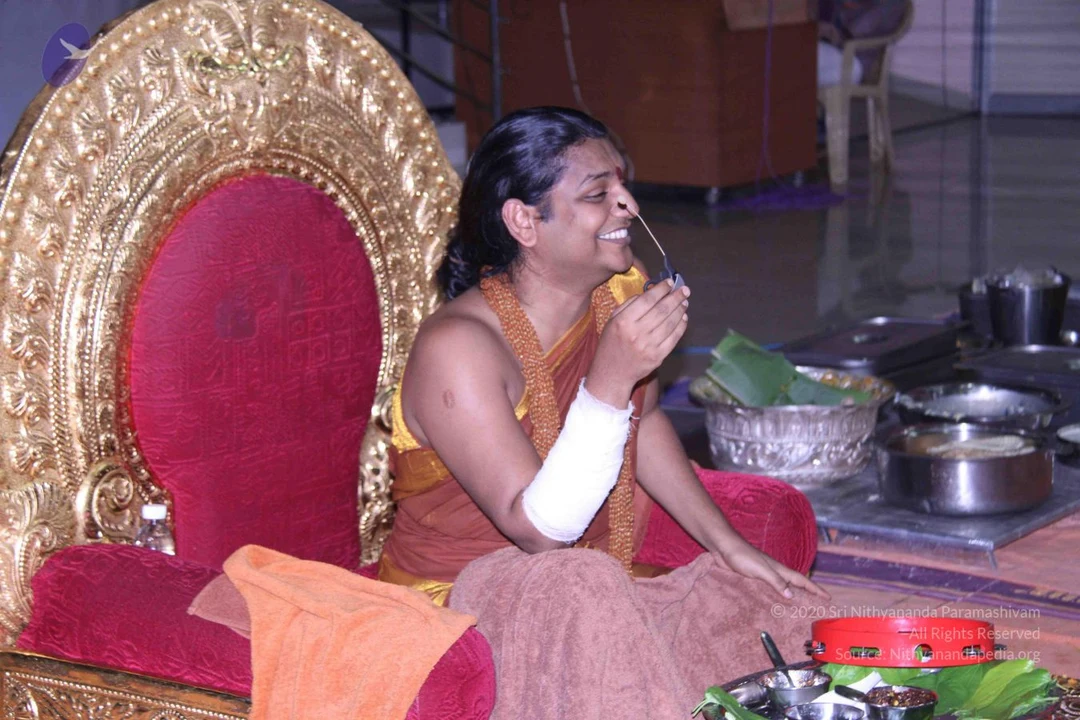
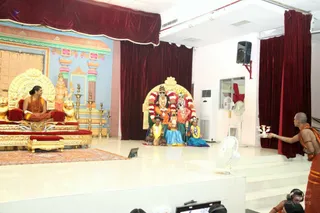
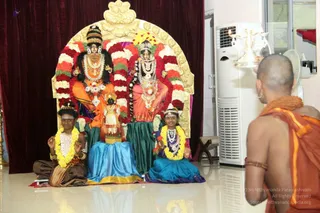
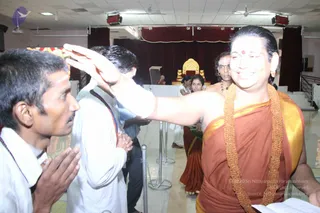
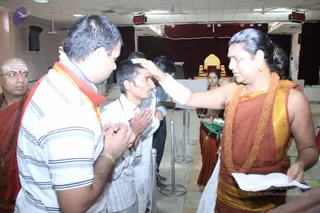
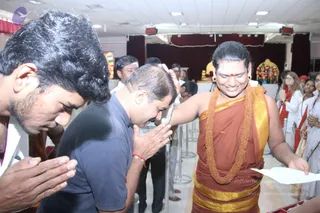
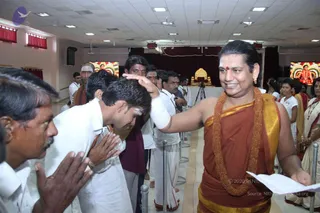
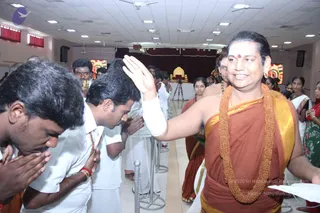
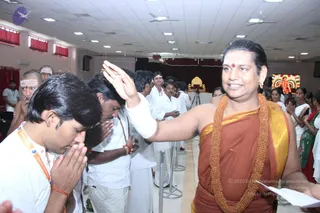
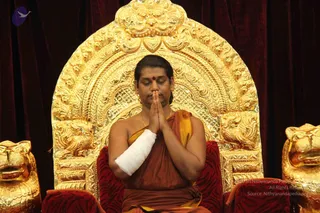
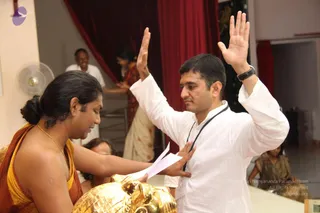
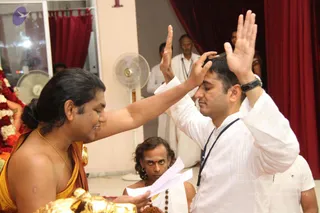
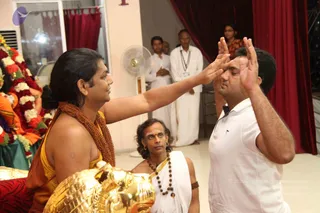
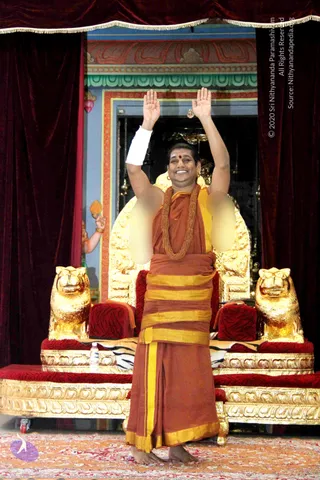
A photograph of a ritual blessing inside a room with red curtains and a floral garland backdrop. A man in a saffron-orange dhoti and draped wrap with a rudraksha mala and ceremonial gold necklace extends his right hand toward the forehead of a man in a white shirt with a rudraksha mala, who holds his palms up and open. The blessed man wears a lanyard. Beside them a golden kalasha-shaped vessel is held. Behind, a seated man in white with a rudraksha mala and a standing man in a white shirt watch. A white table fan and a woman in a dark embroidered sari stand in the background.A photograph of a seated man on an ornate gilded throne with carved scrollwork and a red cushion. He wears a rust-red robe with a gold-edged shawl, a long rudraksha mala and a red bindi, and smiles while his hand is dipped into a silver bowl. A man in a white shirt, with a bandaged wrist and red and gold bangles, leans in from the left and holds a small cup over the bowl. The bowl holds a golden grain or sweet mixture. a person: the seated man wears a rudraksha mala, a red bindi, a rust-red robe with gold shawl and sits on a gilded throne.A photograph of an indoor ritual blessing. A man in an orange-saffron garment with a long rudraksha mala stands on the left, his right hand raised and placed on the forehead of a young man in a white kurta who stands on the right with palms pressed together in a respectful gesture. The blessing man holds a golden object in his left hand. Behind them, a seated man in white with a rudraksha mala and bindi watches, red curtains hang in the background, and a fan and a few other men in white and light clothing are visible. Garlands of red and white flowers decorate the left edge.

October 04 2013

Original wiki page
Contents

Description:

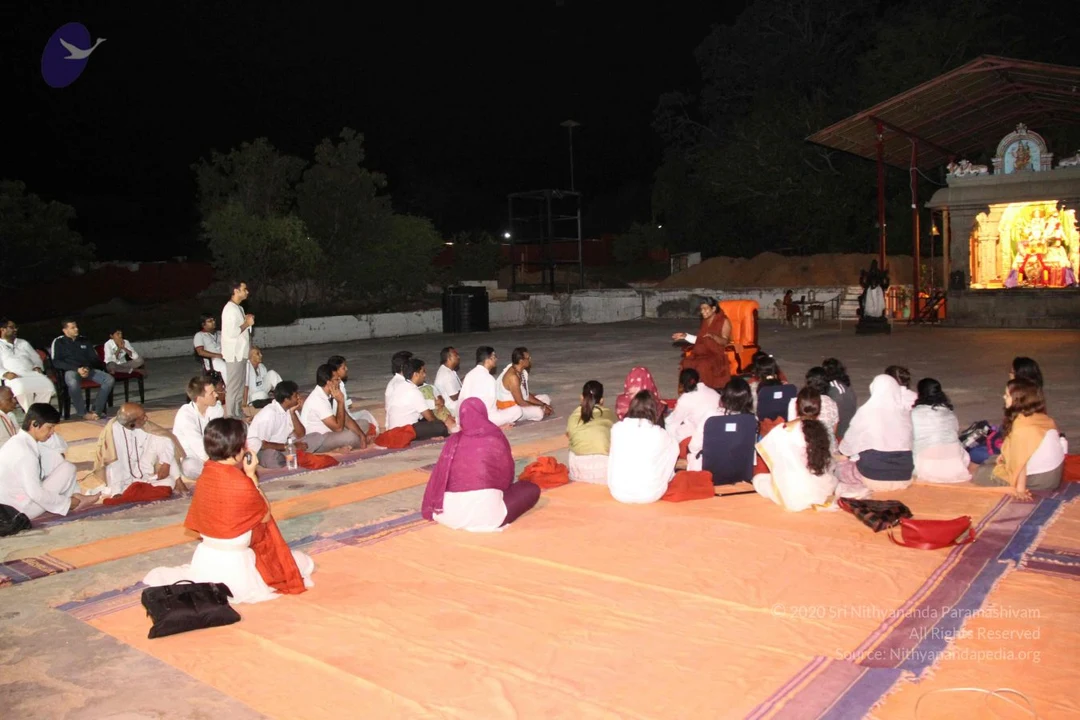
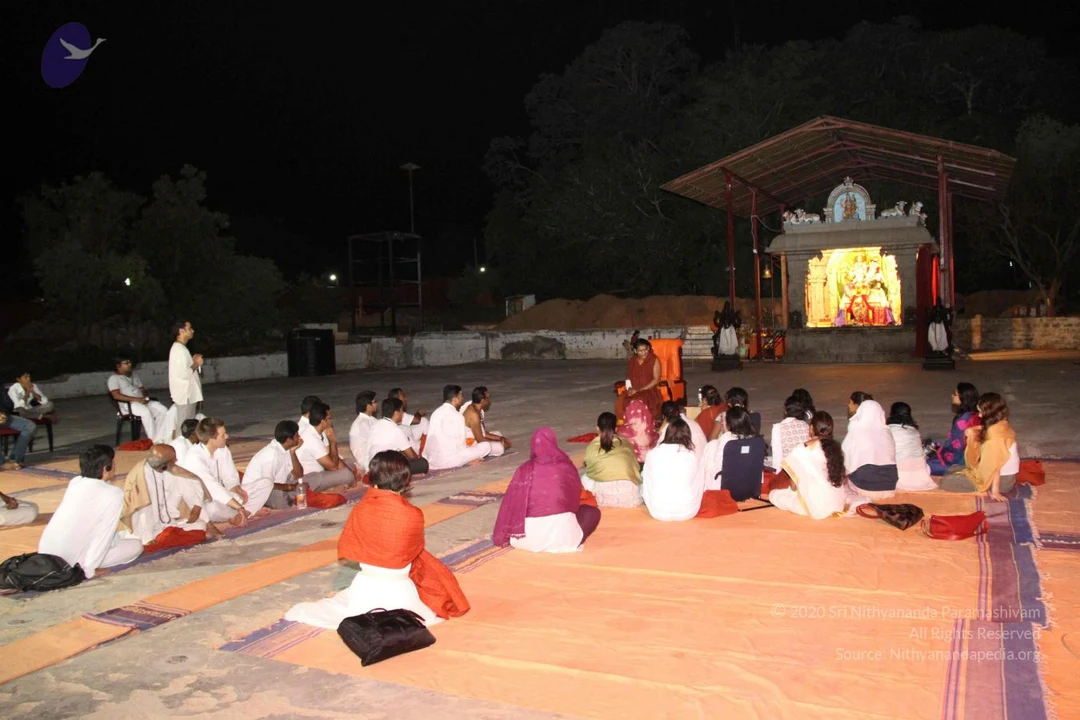
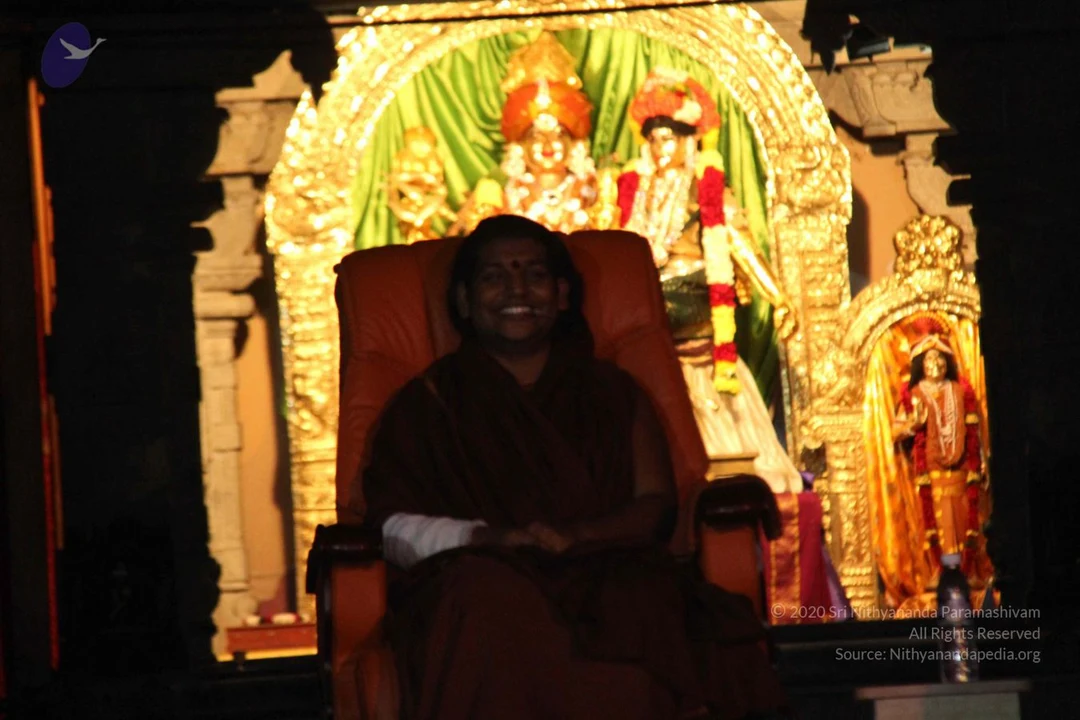
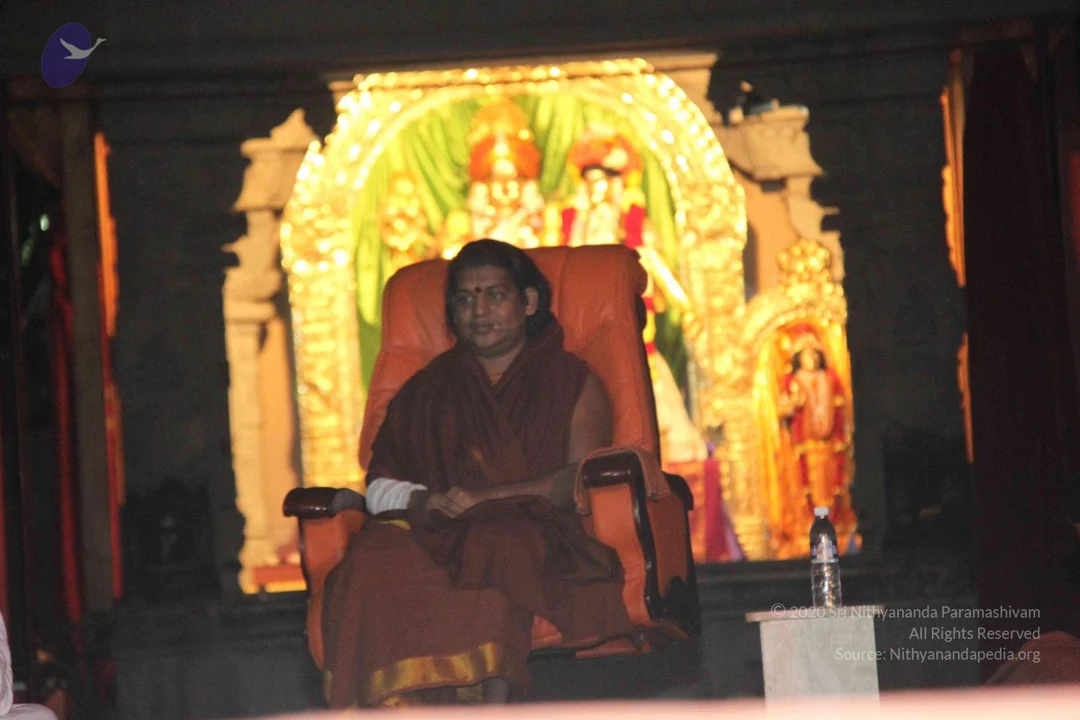
In today’s morning Satsang, Paramahamsa Nithyananda describes how each of our systems are loaded with a default program of powers. We can wake up and utilize our power of words, thinking, feeling, and living by practicing the four spiritual truths or Tattvas: Integrity, Authenticity, Responsibility, and Enriching. Let us wake up our powers by practicing the Tattvas, remembering never to give up on ourselves or others!

Link to Video:

VideoAudio

Transcript:

Nithyanandeshwara Samaarambhaam Nithyanandeshwari Madhyamaam | Asmadaachaarya Paryanthaam Vande Guru Paramparaam ||

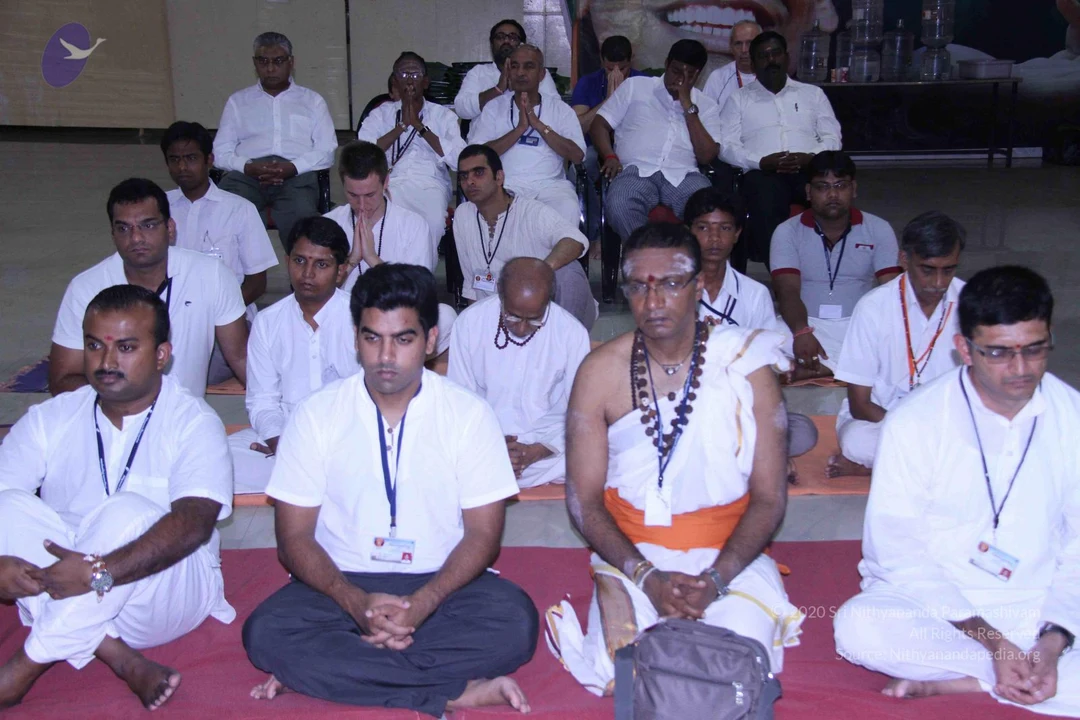
I welcome all of you with my love and respects. I welcome every one of you who are sitting with us around the world through Nithyananda TV, Sadhana TV, Lotus News Channel, and through two-way video-conferencing in twenty-nine places having Nayana Deeksha from so many countries.

Cities sitting with us in two-way video-conferencing having Nayana Deeksha: Sharjah, Ohio-Prayag,Houston-Kalahasti, Oklahoma-Somanatham, Seattle, Enriching Temple-Bidadi, Los Angeles, Guadeloupe-Rameshwaram, Tiruvanmiyur-Dhyanapeetam, Charlotte, New York-Varanasi, Hyderabad Bahyanagaram,Devon-UK, Singapore-Singapuram, Dallas-Dwaraka, Saudi Arabia, Jefferson-South Dakota, Hong Kong,San José-Madurai, East London-UK, Port Washington-New York, Dubai-Vaidyanatham, Slovakia-Shivaloka, San Diego-La Jolla, Bangalore North, Oman-Sivagangai, Peethadheeshwari’s Training Centre-Salem, Jorpati-Nepal, Olympia-Washington, Chandravimala in-transit, Varanasi………..

I welcome all of you with my love and blessings!

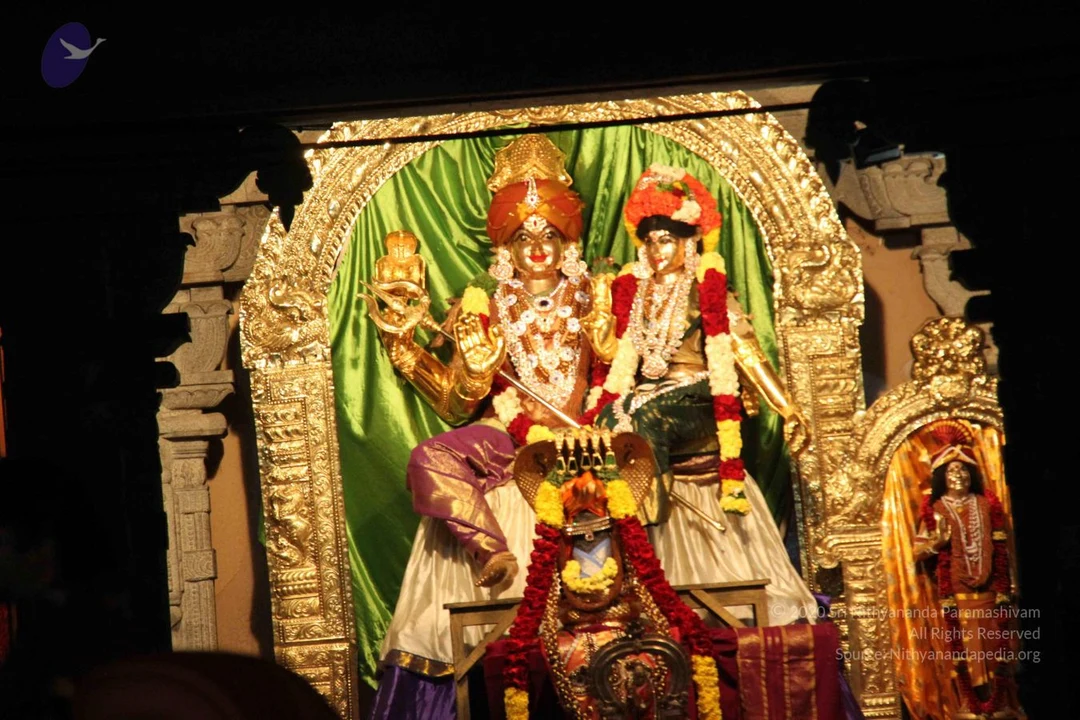
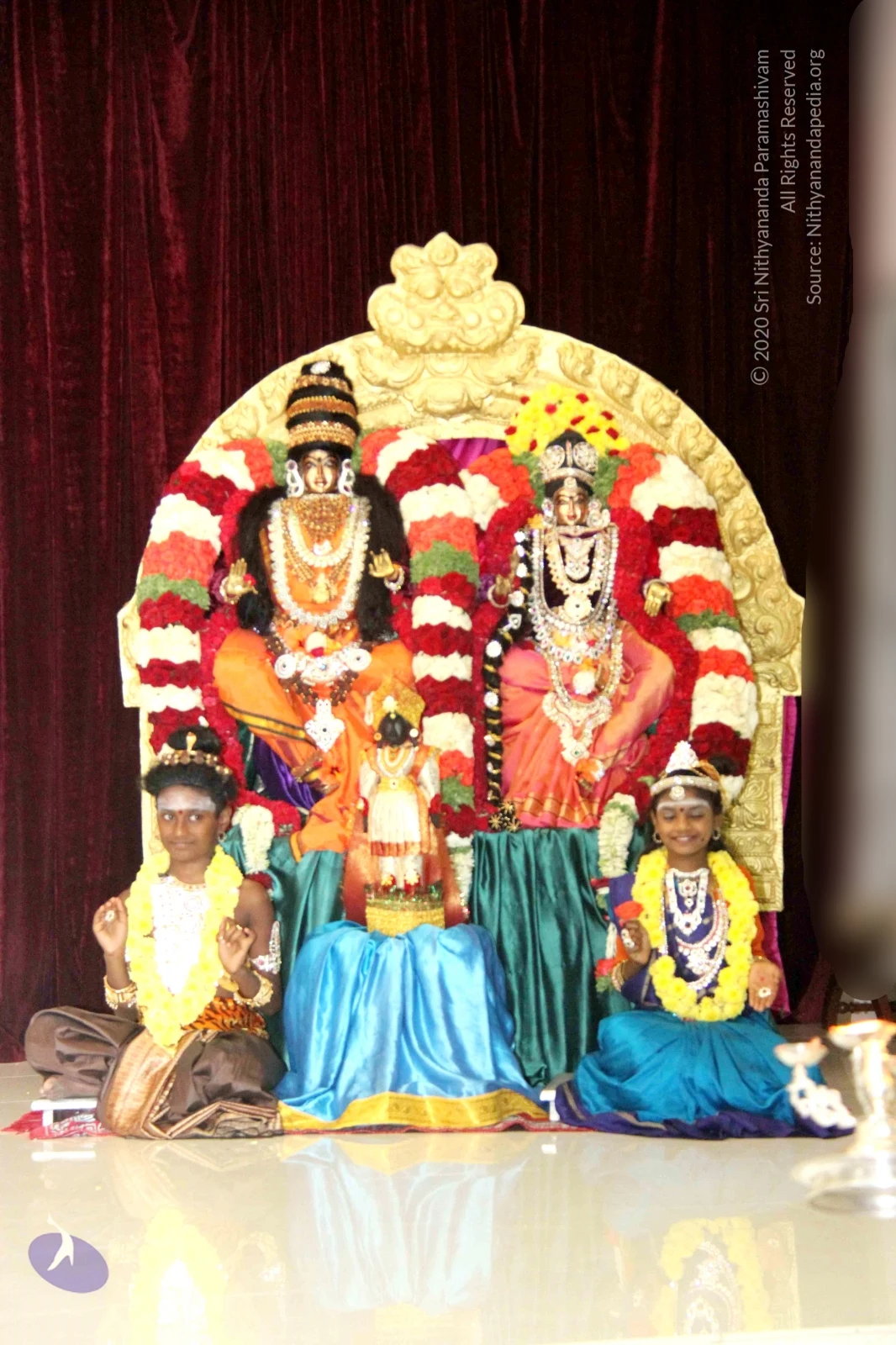
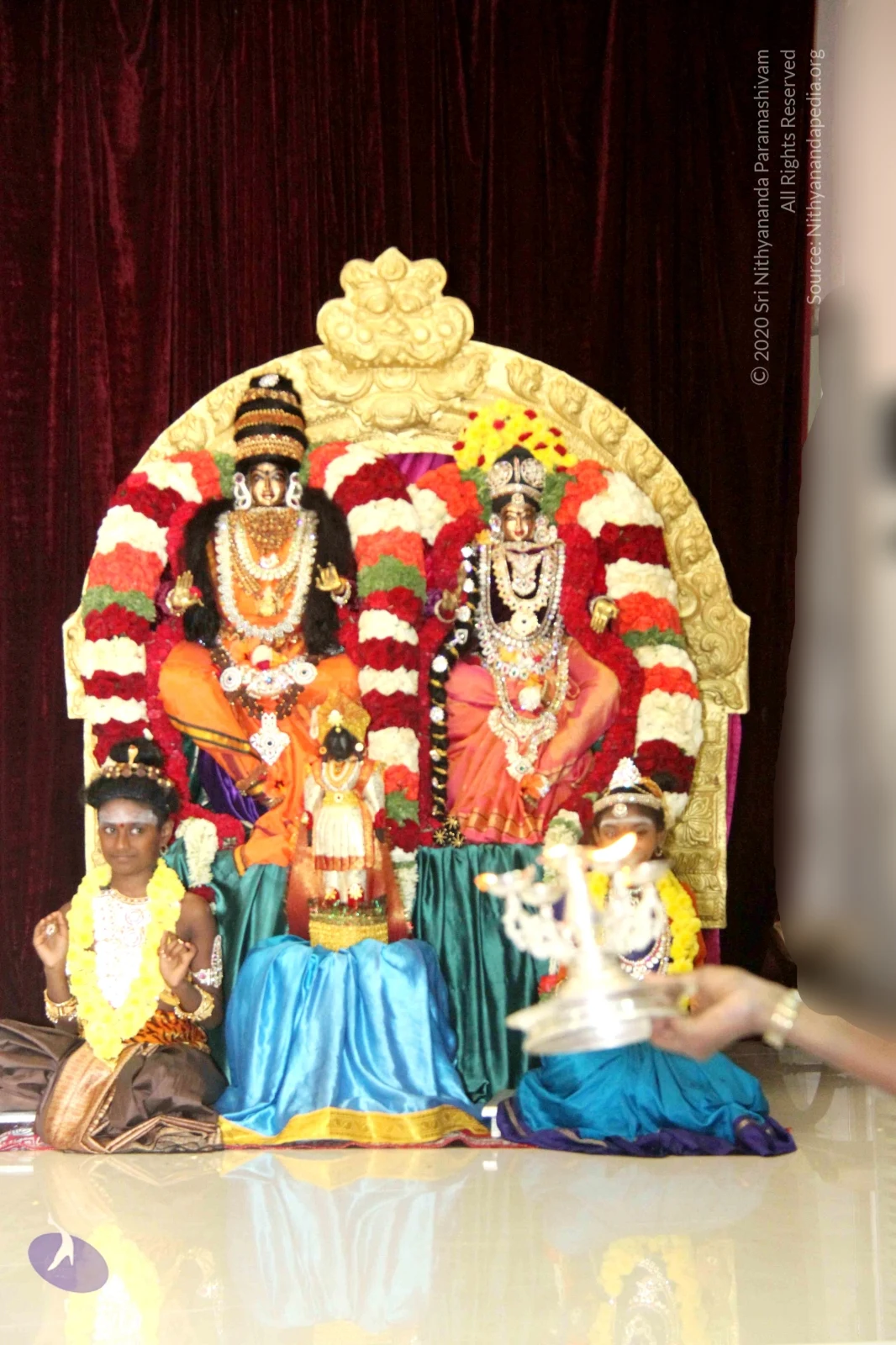
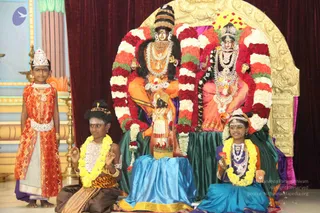
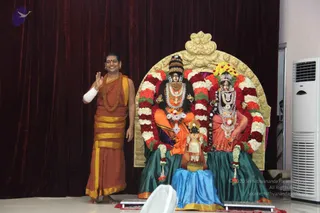
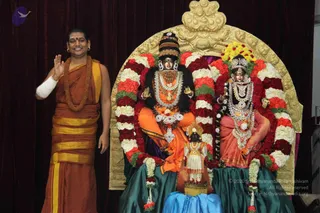
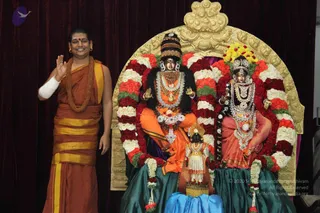
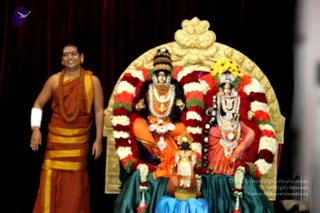
Today, Mahadeva is gracing us in the Leela Dhyána: HOW SUNDARESHWARA GIVES DARSHAN IN MADURAI TO A CHOLA KING.

Not only the Pandyas, even the Chola kings were devotees of Sundareshwara.

There was a Chola king who was a great devotee of Sundareshwara and he really, really wanted to have darshan of Sundareshwara. But unfortunately, because Pandyas and Cholas were enemies, he could not go to Madurai to have darshan of Sundareshwara.

Sundareshwara appeared in his dream and said, ‘Alright, you come in the night and I will give you darshan.’ As per Sundareshwara’s instructions, the king goes to Madurai at night. Sundareshwara appears as a mystic and opens the doors of the temple secretly and arranges for his darshan, gives darshan to the king.

The moment the Chola king has darshan, Sundareshwara sends him back. After locking the door, as a symbol that He did this Leela (divine play), Sundareshwara removes the Pandya’s Fish Symbol Flag (Meen Kodi) from the temple tower, (the royal insignia of the Pandyas); and puts the Rishabha Flag, His own flag, Shiva’s own flag, and disappears.

Next morning, when the Pandya king got up, the whole Pandya kingdom is shocked! How can the flag be changed suddenly?

The Pandya king was shocked and goes and asks Sundareshwara.

Sundareshwara appears and tells Pandya king the whole thing, and actually all that happened.

So today, let us have the leela dhyána and remember the Leela of Sundareshwara. Opening His temple doors secretly for a devotee’s sake and giving darshan!

Today:

• 20th batch Inner Awakening, 8th day;

• 17th batch eN-Genius, 8th day;

• 19th batch Nirahara Samyama, Level-2, 5th day;

• 20th batch Nirahara Samyama-break. Tomorrow, we will start Level-2;

• 9th batch The Samyama, 8th day;

And, today, one more important auspicious day – Mahálaya Amavasya. Why I said “auspicious”, because from today Navaratri Brahmotsava starts. We will be raising the flag, may be today evening or tomorrow. The timing will be announced.

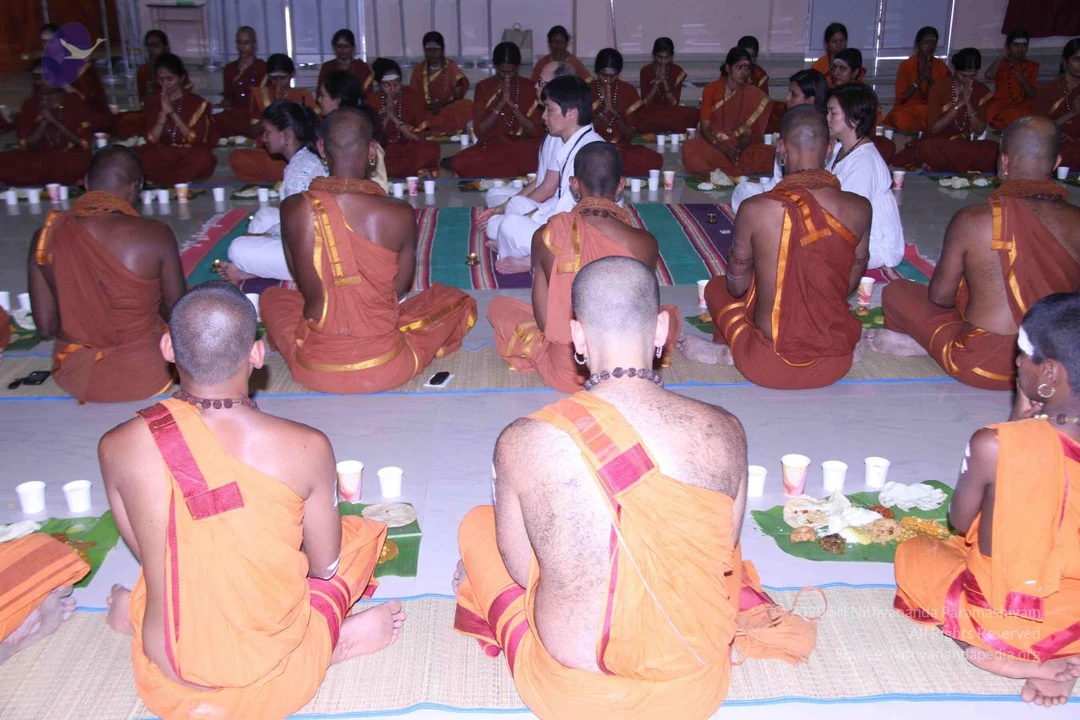
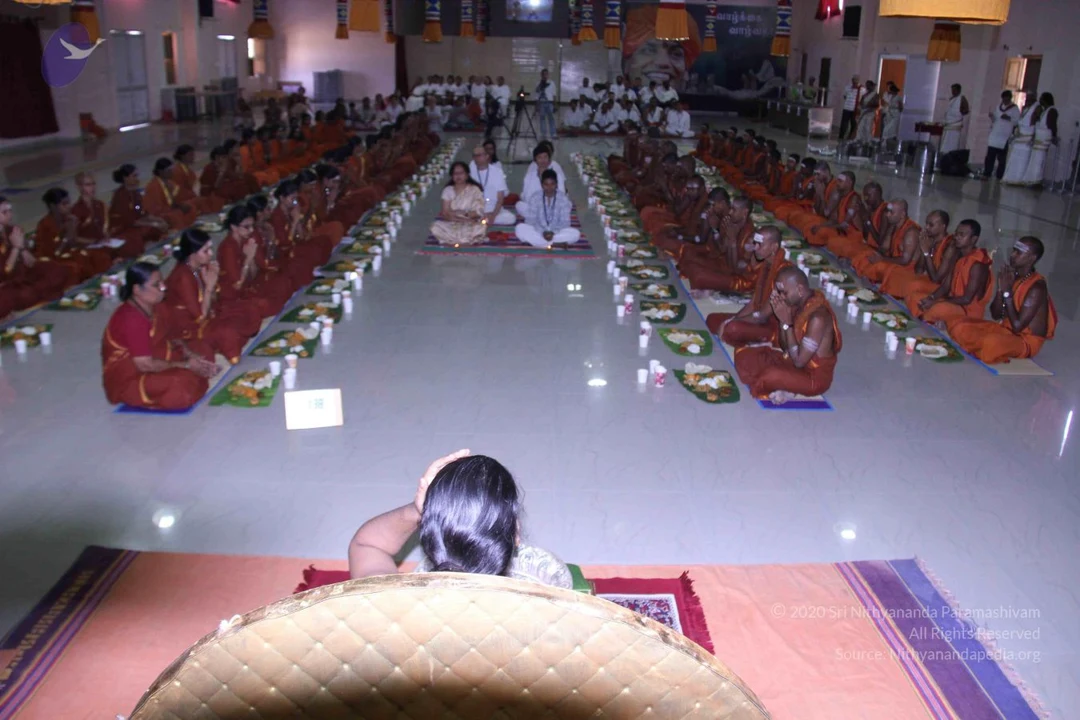
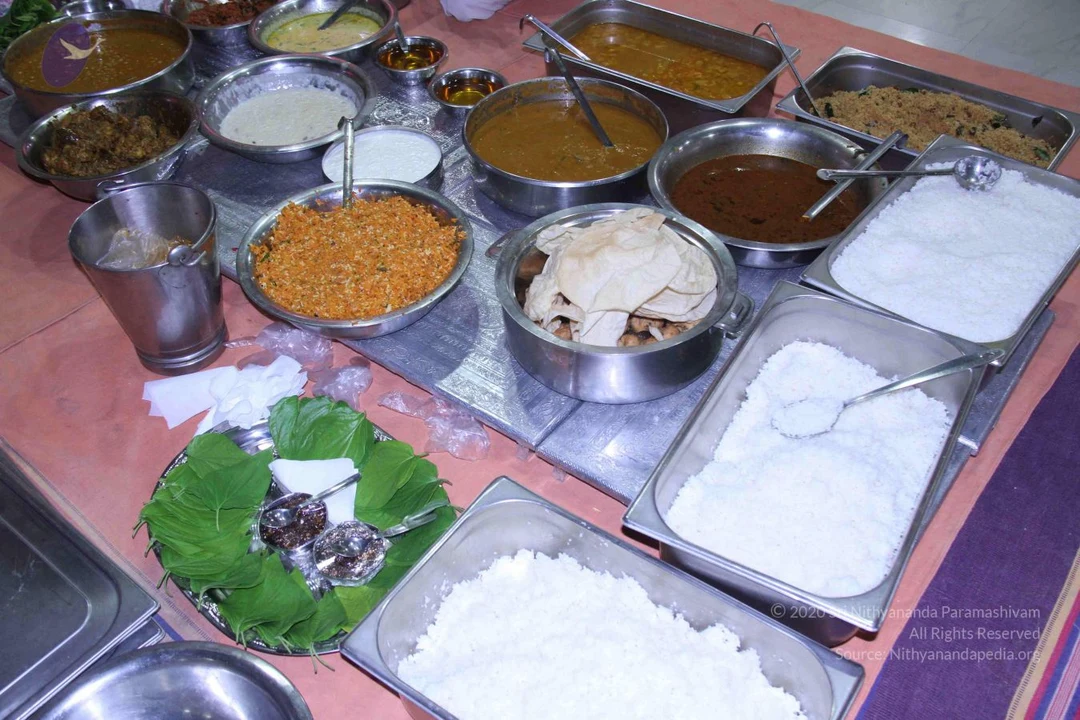
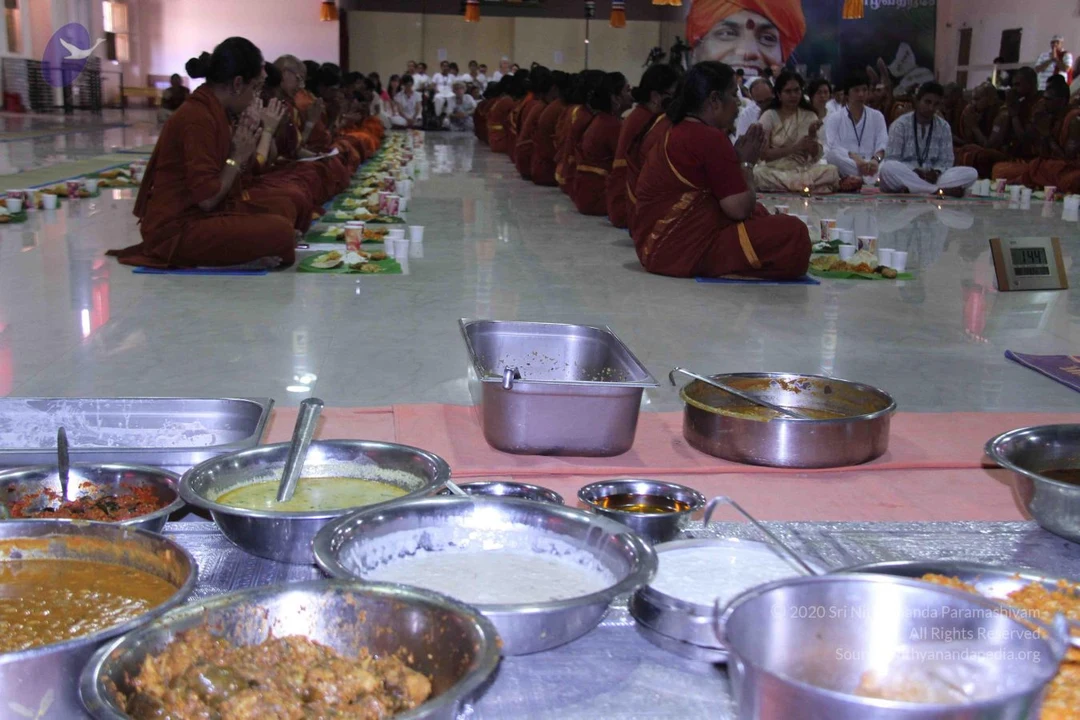
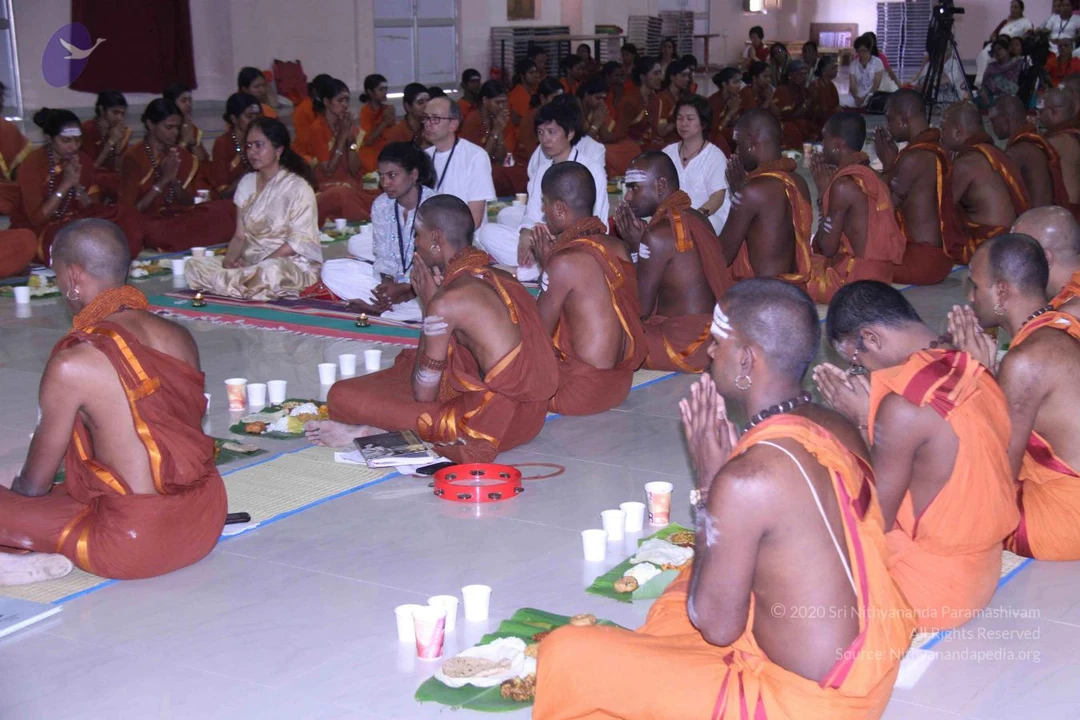
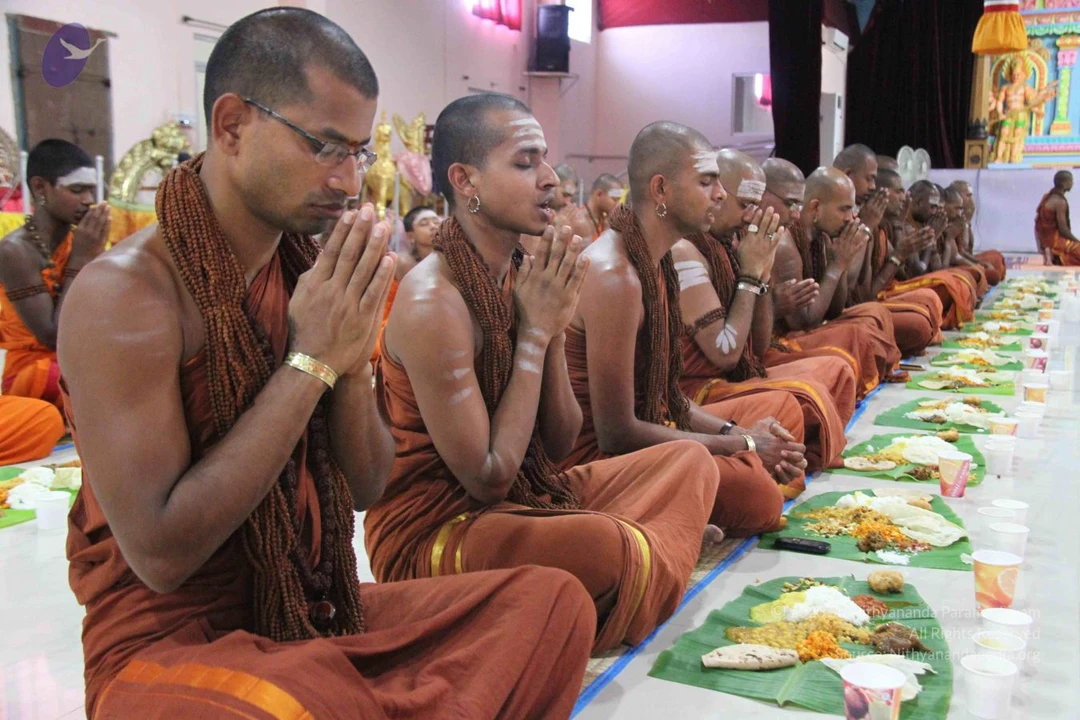
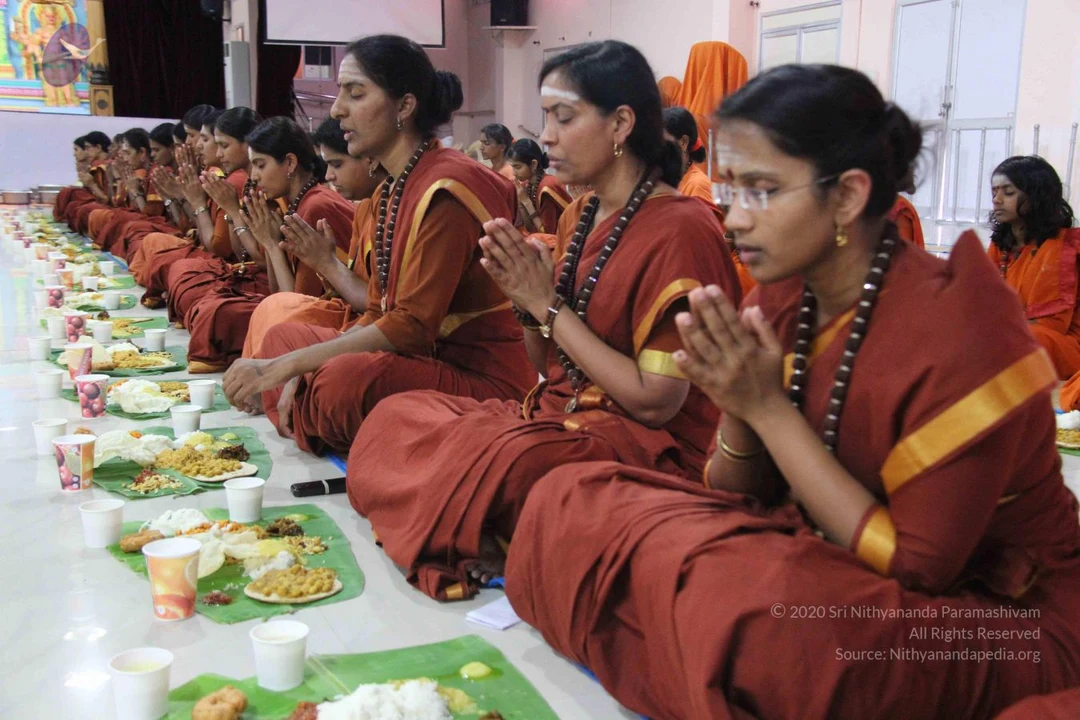
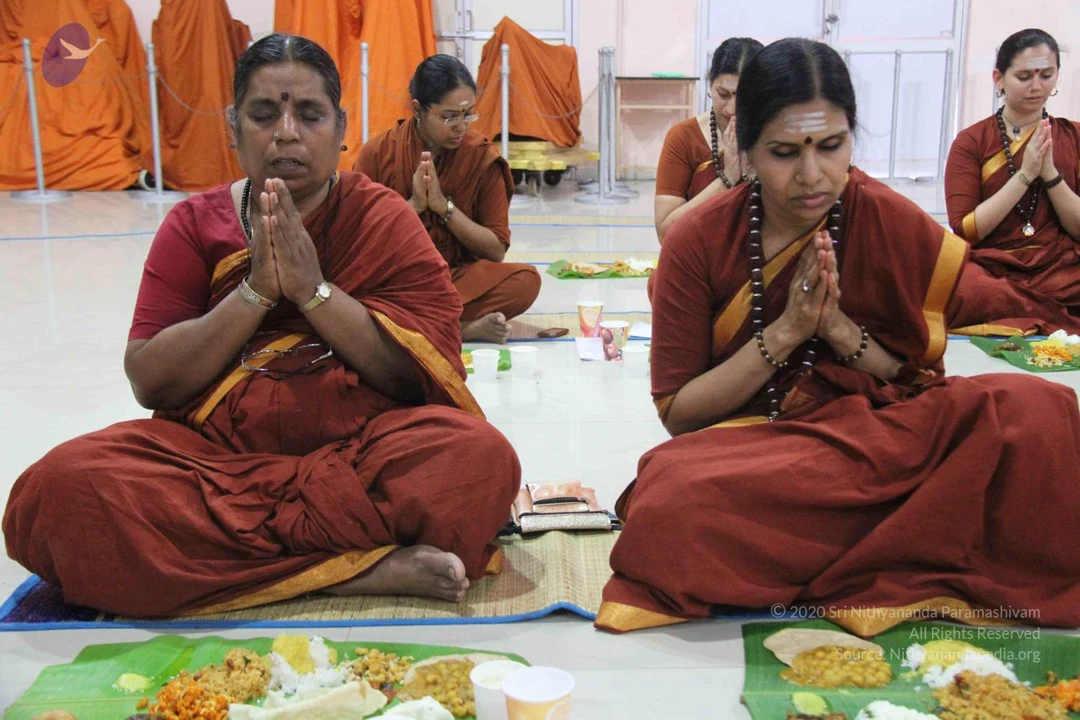
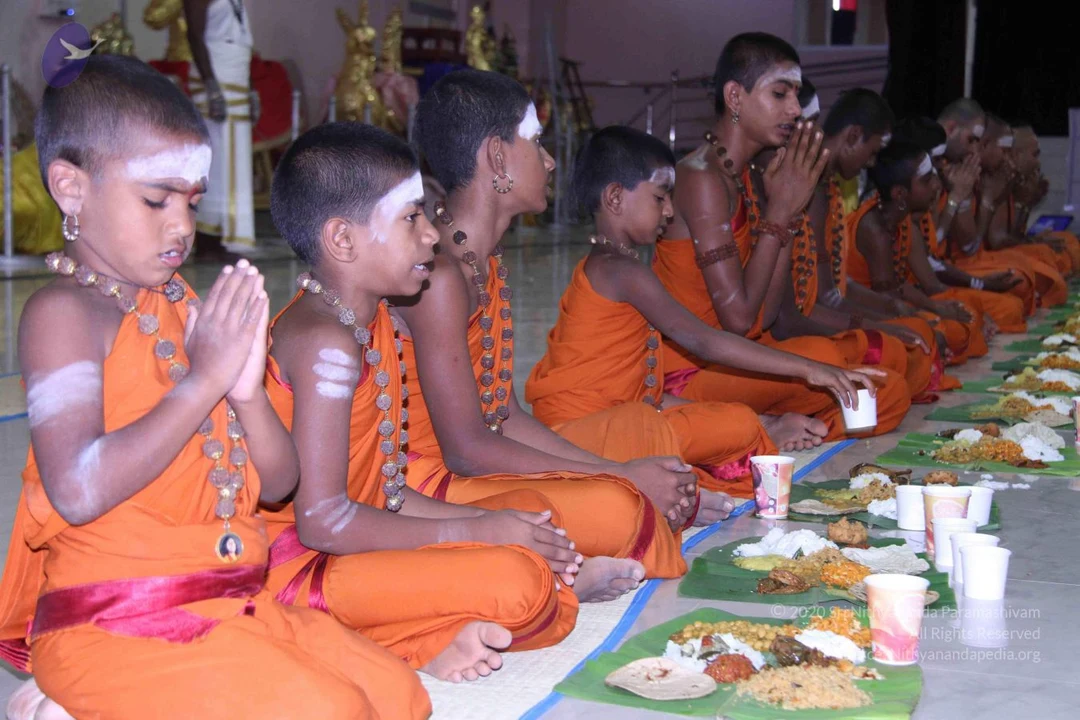
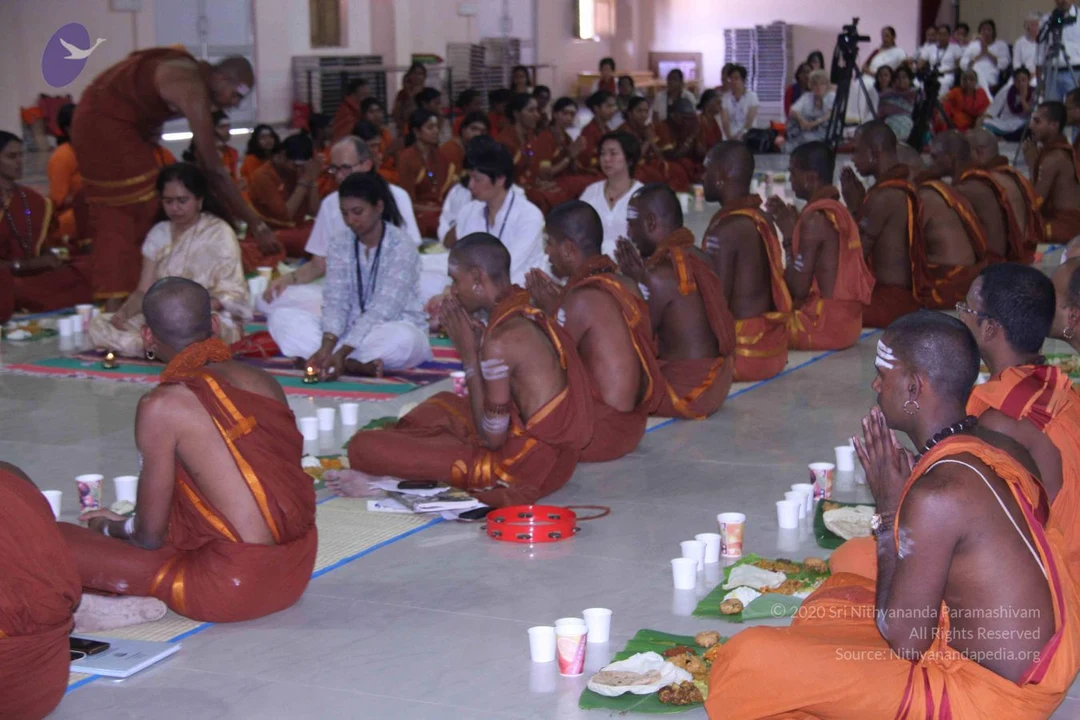
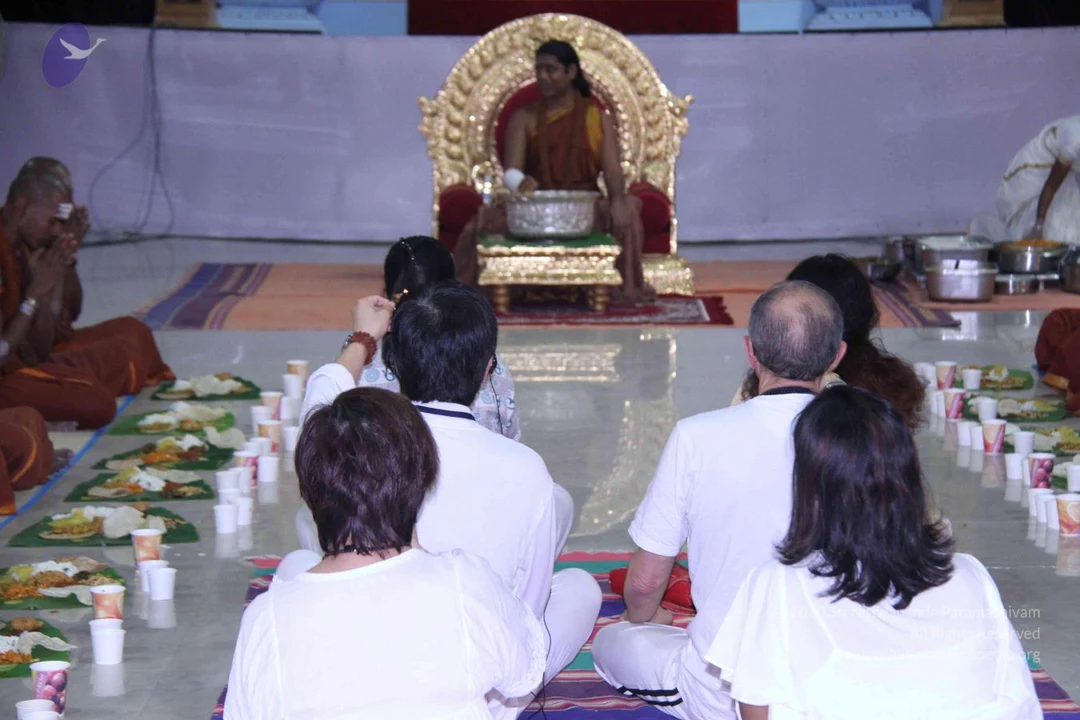
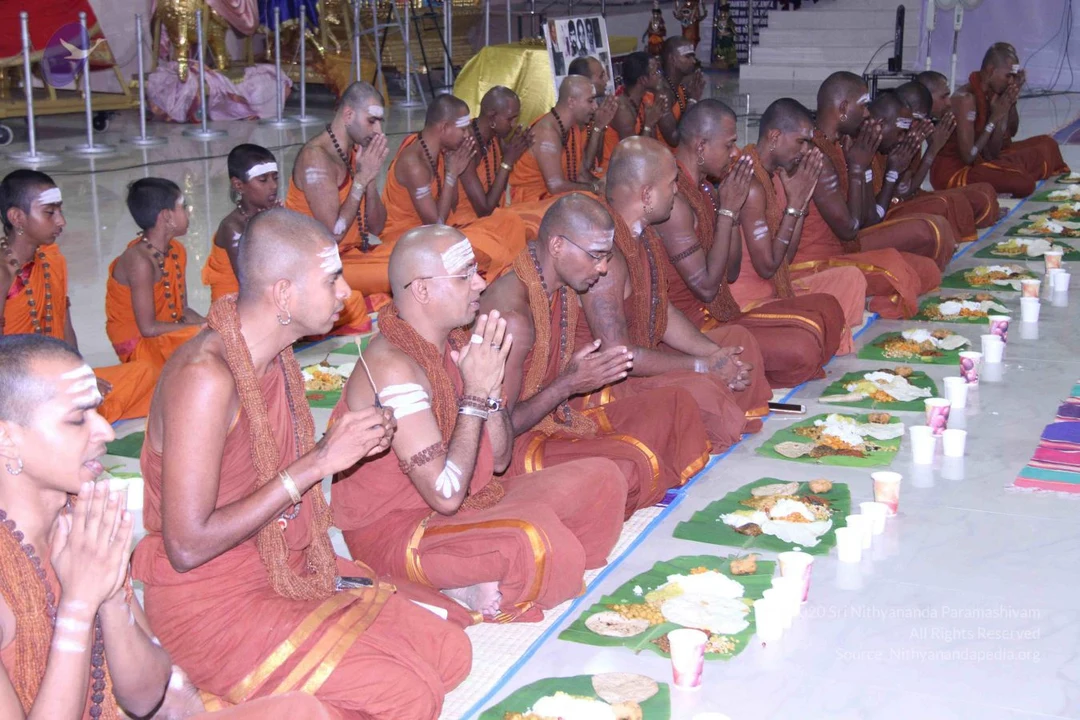
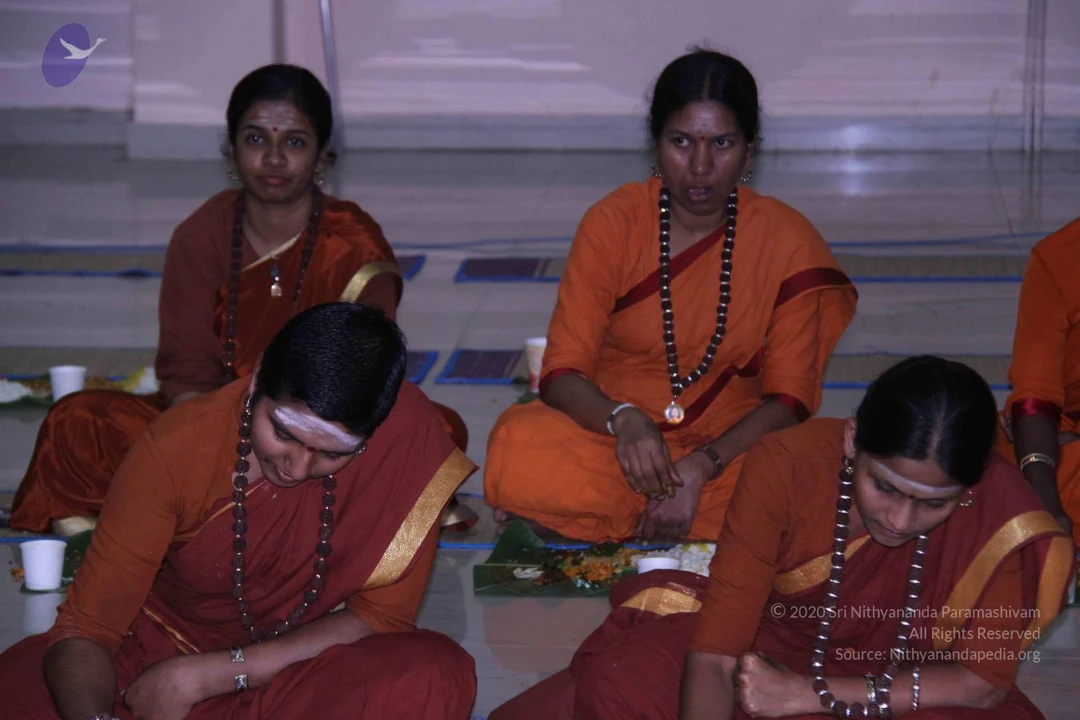
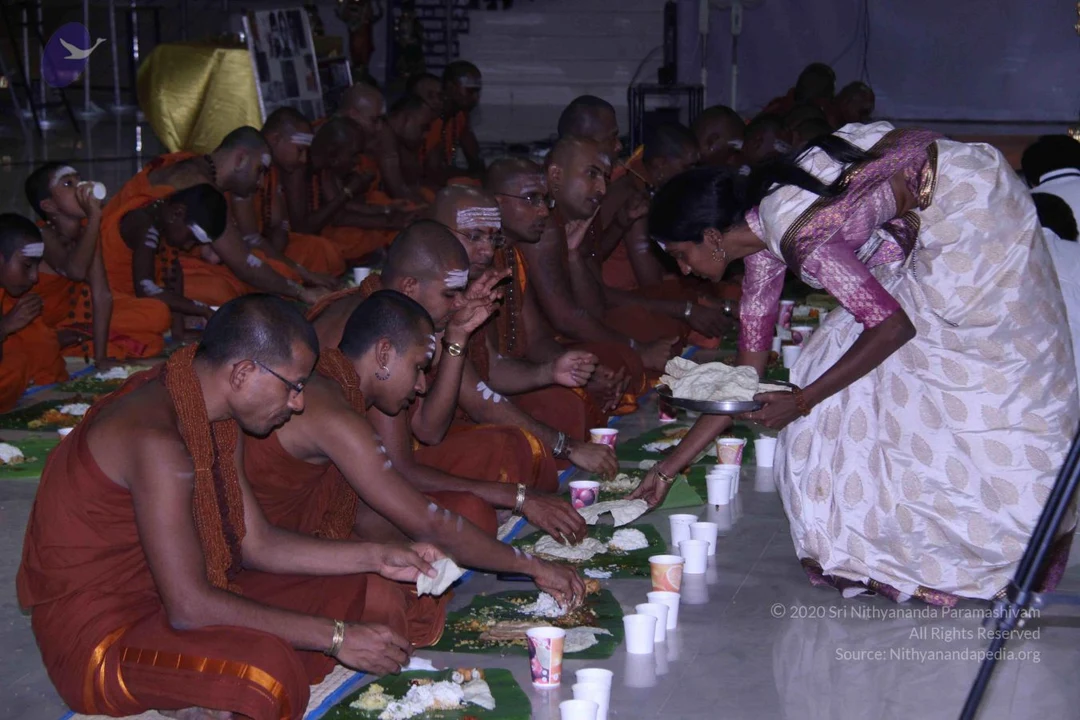
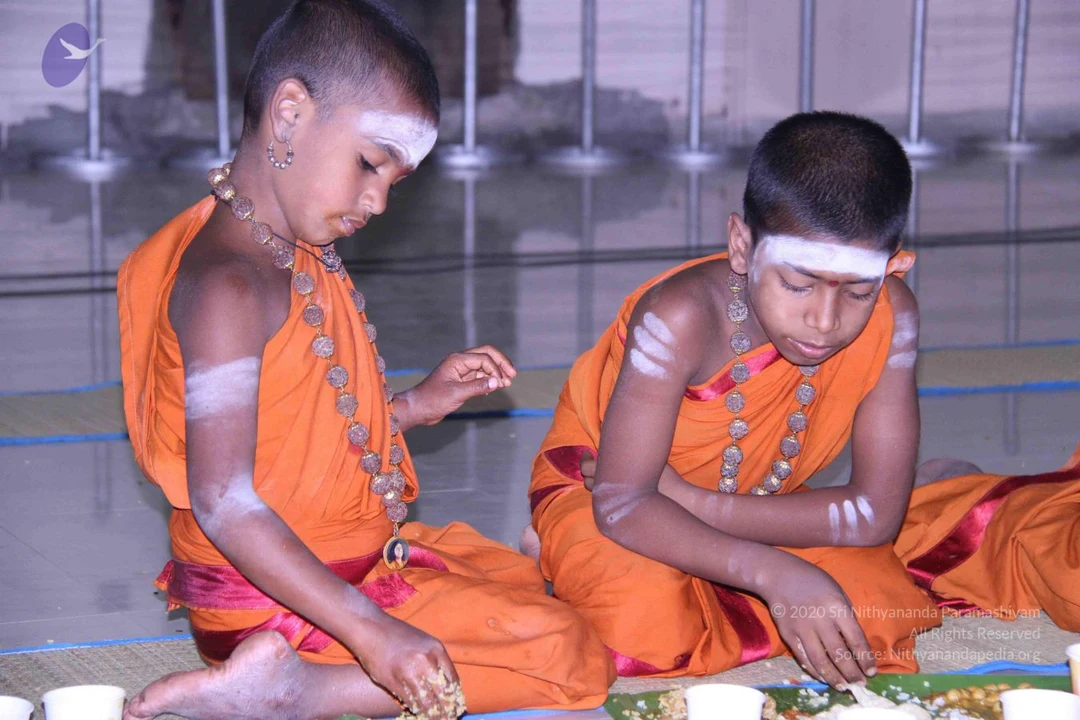
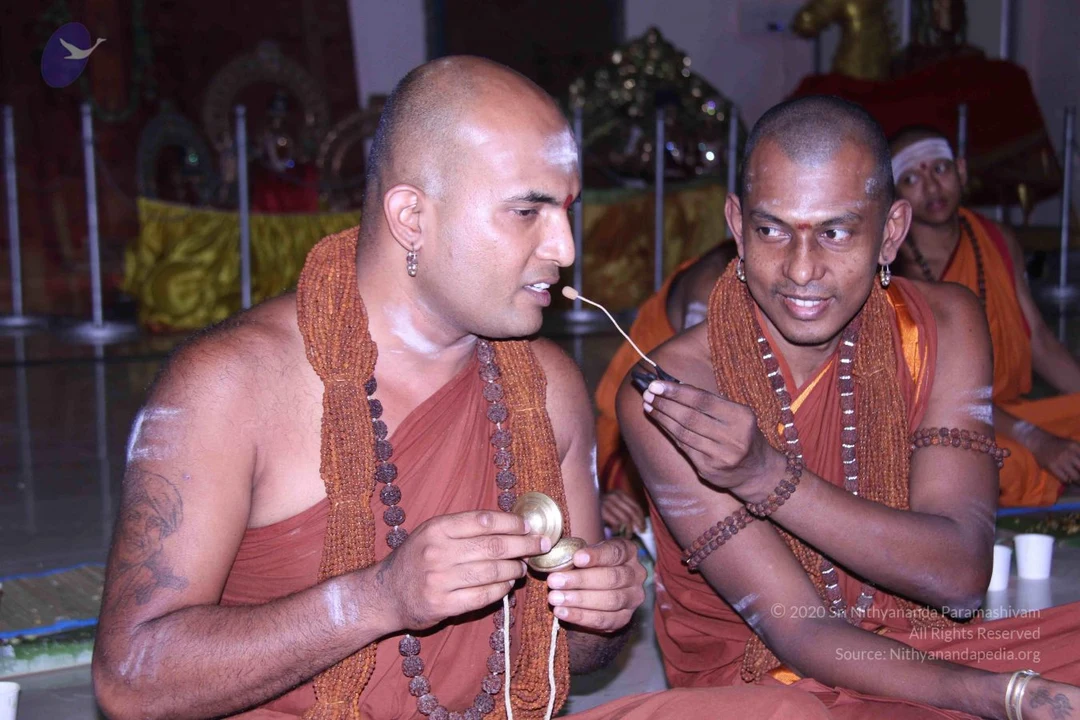
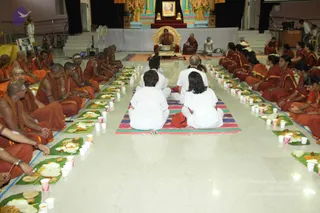
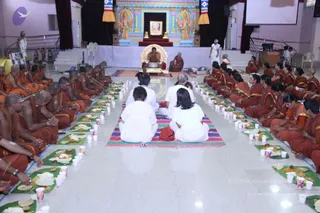
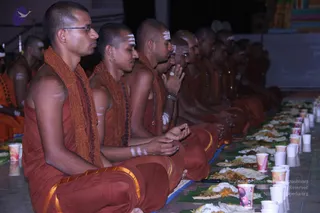
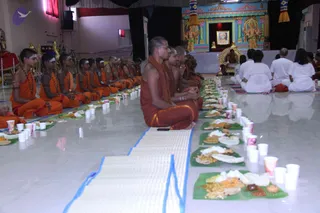
And, today is one more important thing. Today, Hindus offer Completion to the departed souls, elders,parents. The shraaddha, oblations to the departed ancestors is done today. Today is a very important day. Surya (Sun) enters into Kanya Ráshi (Virgo), and the ancestors descend on the earth to accept the respects and rites, oblations, from all human-beings. Today is the auspicious day to offer Maheshwara Puja, and we will be having Maheshwara Puja here in Bidadi.

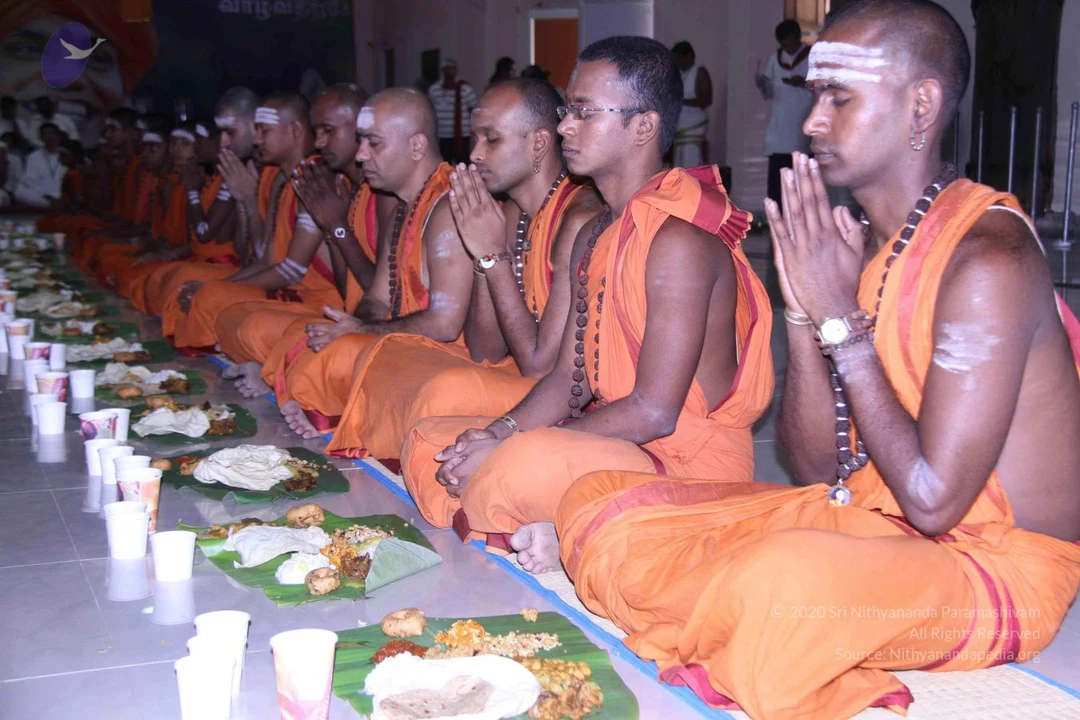
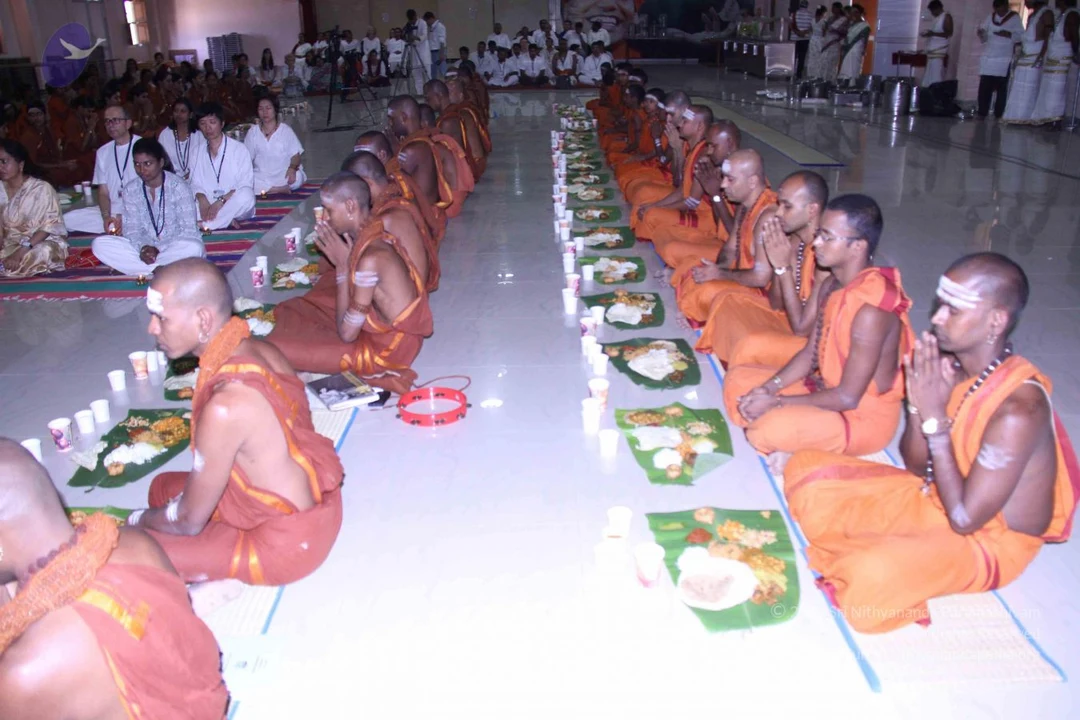
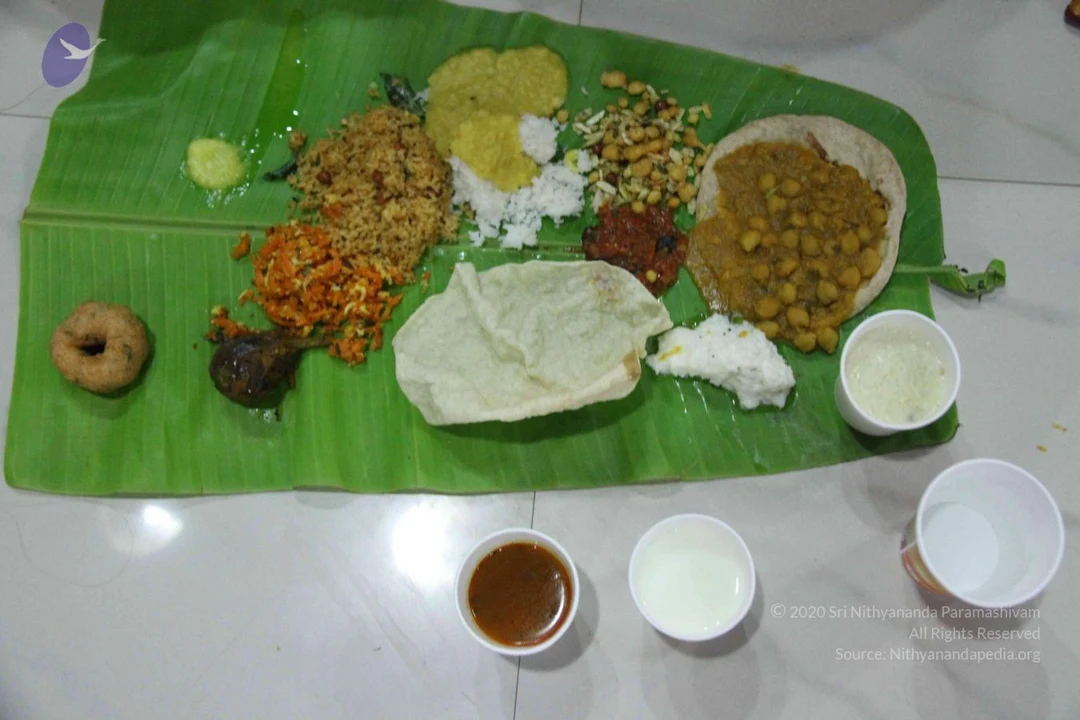
And, I also request all our Sangha to offer Maheshwara Puja, if you have our sannyasis staying in your place, like Los Angeles, Toronto, New York. Wherever our sannyasis are staying, I request our Sangha to offer Maheshwara Puja to our sannyasis and sannyasinis. Today, feeding any sadhu, giving food to any sannyasi, directly leads you to Completion with the ancestors who have left the body. So, it is a very good thing. If you don’t find our sannyasis, at least the people who have taken sannyas formally and who live sannyas with Integrity, offer food to them; even that will lead you to Completion with the ancestors.

Today, at noon, 1:30 pm Indian Standard Time, you can see the Maheshwara Puja live on Nithyananda TV. All the devotees can see Maheshwara Puja live on Nithyananda TV, and whoever sees today the Maheshwara puja, I will give all of you guys the punya of feeding the sadhus and doing Maheshwara Puja! Even if you see today, you will have the Punya of shraaddha and Completion with ancestors. And, if you want to offer Maheshwara Puja, you can e-mail [email protected] or call the number appearing on the screen (+91 80 2727 9999).

Alright! I will move to today’s Nithya Satsang.

Today, I wanted to speak about the important powers which are given to us, but still we have not started using.

As human-beings, all of us are given as a default program certain powers!

POWER OF WORDS:

Please understand, if you can harness the power, the Power of Words… please be very clear, the words you utter are YOU! If you constantly utter the words, ‘I am this, I am this, I am this’, you will become that! Constantly utter right words about you inside you and outside you. Please listen, the Power of Words, unfortunately we do not harness the Power of Words, and as per the law, any power when you don’t use and play with it without knowledge about it, it destroys you, like electricity! You can use electricity for the best things in your life; but if you don’t want to, and misbehave with it, it destroys you, it kills you straightaway! That is why I am saying, learn to harness every power available to you.

The Power of Words! The words you utter towards you and the words you utter towards others can do so much to your life, please understand, can do so much to your life. If you want to harness the Power of Words, the practice you need to do is Integrity. Bring Integrity. Align all your words more and more towards Completion. Please understand, I am defining Integrity: Integrity means: “Aligning your words, internal and external, more and more towards Completion” is Integrity.” Aligning the words you utter inside and outside you, aligning them towards Completion, is Integrity.

I tell you, if you are telling yourself and others again and again that “you are a man, you are a man, you are a man”, it is a lie! If you complete more and more and more, you will understand you are Divine;you are an embodied being; you are God! When I utter the words “I am Divine” and “I am God”, people feel I am telling a lie. But only when people utter the words that they are human-beings, I feel they are telling a lie! Only when you are saying you are a human-being, you are out of Integrity. When I say I am Divine, I am God, I am completely established in my Integrity!

Understand, aligning yourself more and more, deeper and deeper into your Completion, aligning your words, internal and external, towards the space of Completion, is Integrity. When you start practicing Integrity, you will harness the power of words; the words you utter will have so much power, just through the words you will be able to change your life, others’ lives for the better! Please understand,from the time I know myself, I am doing this only – using the right words to transform people’s lives,using the right words to transform people’s lives.

The Power of Words! Please understand, ability to speak, ability to utter words towards yourself, and ability to utter words towards others, this is the powerful ability, you can use it either to make your life or break your life. Right words being uttered in right time will make your life. Wrong words uttered in the wrong moment can break your life. Especially, the words you are uttering towards yourself and the words you are uttering towards others, the words you are uttering towards yourself and the words you are uttering towards others.

Harness the Power of Words; that is the first right. I tell you, the basic right for human-beings is not Freedom of Speech; it should be Power of Speech! The first fundamental human right, I think we should change the word from Freedom of Speech to Power of Speech! You need to know the Power of Speech. You should be educated about the Power of Words. Knowing the Power of Words is the fundamental freedom, fundamental right: Freedom to speak! If you know the Power of Words, your fundamental right will be right.

The next important power you have which you can harness is the POWER OF THINKING!

Please understand, Power of Words are different and Power of Thinking is different!

When you practice Integrity, you will have the clarity and experience about the Power of Words.But, the Power of Thinking is deeper than the Power of Words. The Power of Words can make one relationship or break one relationship. The Power of Thinking can make or break your life itself. How you think about you, how you project about you, how you think about others, and how you think about what others think about you!

Listen, the Power of Thinking is another one powerful resource we have which we neither use properly nor use fully. One good news is, because you don’t use it fully, even though you use it improperly;please listen, even though you are using it improperly, because you don’t use it fully, you don’t get into deeper sufferings. Even in the wrong direction you use only a very minimum amount of your Power of Thinking. The Power of Thinking is used in the right direction, the power is harnessed and put in the right direction, when you practice Authenticity.

21:02

What you think about you, what you think about others, what you think about how you want to project you to others and what you think about others thinking about you.

Please listen, what you think about you can be changed just in ten days. In the night time, whenever you fall asleep, align yourself, your ideas, to your new thinking: ‘From now, I’ll think about me as God. From now I will think about me as this.’ Decide and fall asleep. Your whole thinking in the dream and the deep sleep will be aligned to that. I tell you, when your dreams are aligned to what you want to think about you as you, you’re successful in living that.

Please understand, dreams lead you to reality. You need to know this truth. In every field, whether it is Science or Maths, or discovery or entertainment, or invention, in every field, dreams lead you to reality. And in the night, bring the dreams, every night align it, align it, what you want to think about you, what you want to think about others, what you want to think about how you want to show you to others, what you want to think about others thinking about you, align everything as you want and fall asleep in that same state every night; you will fall into Samadhi.

I tell you, power of thinking, Power of Thinking is so beautiful, it is such high power, it is such an extraordinary power, it can cause miracles to you. In this whole Inner Awakening Level-1, I help people to catch and harness Power of Words. Level-2, I help people to catch and harness the Power of Thinking.

And the next, the next is Power of your Feeling

Understand, Power of Feeling is another one important power. How you feel about you and the world, how you cognize about you and the world. Power of Feeling, that is a very important power. You can harness that power and put that power for your use if you start feeling Responsibility. Please listen, in the feeling, you can feel yourself as a very small creature or you can feel yourself as a very powerful big guy. Your feeling, listen, your feeling will be strengthened only when you feel responsible. If you feel responsible for everything, if you feel responsible for more and more things, if you feel responsible for more and more, I tell you, you harness the Power of Feeling, you move to the next level of life, you raise yourself to the next level of life. Power of Feeling, Power of Feeling. When you start taking the Responsibility, you will see very clearly how just when your feelings about you and the world changes, the whole world changes and the response of the whole world towards you changes.

Next is Power of Living.

Living itself is a power. Every day you are walking, talking, sitting, thinking, feeling. All these put together, living, is a power. I tell you, sometime even if you decide to live in the right property, that property will become yours. Nothing, just by living there. In many countries anybody who lives in that land, the land is theirs. So, even living in right place is a power and anybody who lives in the energy field, naturally this becomes power for you. Living itself is a power.

Understand, living, the Power of Living can be enriched. You can harness the Power of Living and use it in your life when you decide to live Enriching. Please understand, when you decide your life is for others, you harness the best cream of Power of Life. When you decide Enriching is your life, you are showered everything best of the life by the life. When the ocean decides to give all its best things to you, it will give you the best pearls, best things it has. Same way, when life decides to give its best things to you, you can’t even imagine the gifts life will bring it to you, because still you do not know the best things life is having it. Please understand, when you decide authentically to enrich, when you decide authentically Enriching is your life, life brings the best things of life to you.

Power of Words, Power of Words will be available to you if you practice Integrity. Power of Thinking, Powers of Thinking will be available to you when you practice Authenticity. Powers of Feeling will be opened to you when you practice Responsibility. Powers of Living will be available to you the moment you decide to enrich others.

In this whole thing, an important truth is “not giving up on yourself and people”. Even if hundred times people fail, continue to work with them. People failing is nothing but you failing, frustration towards your failure because you can’t handle the frustration of your failures, you can’t handle the frustration of people’s failures.

I tell you, many times people ask me, ‘Why should we work with these people? They are not integrated, they are not authentic. They are liars, cheats.’

I tell them, ‘Come on, if you are not able to handle their failures, you will not be able to handle your failures. Because you are not able to handle your failures, you are not able to handle their failures.’

Giving up on people will make you give up on you, which is worse than suicide. Giving up on yourself is spiritual suicide. Understand, giving up on others and giving up on yourself is spiritual suicide. Giving up on others is social suicide. Giving up on yourself is a spiritual suicide and if you give up on others, I guarantee, you will give up on you. I don’t want to even reduce the spirit by saying “social suicide”. No, giving up on others is also spiritual suicide because, if one happens, the other will happen. Giving up on yourself, if it is done, giving up on others also will happen.

So, the essence of today’s satsang:

Harness the Power of Words through Integrity. Harness the Power of Thinking through Authenticity. Harness the Powers of Feeling through Responsibility. Harness the Powers of Living through Enriching. Never give up on you and others. Any pattern influencing you to give up on you and others, complete with it. Don’t give up on you and others. Giving up on you and others is spiritual suicide.

Let you all achieve, experience, live, express, radiate, share and explode in eternal bliss, Nithyananda.

36:42

Photos Of The Day:

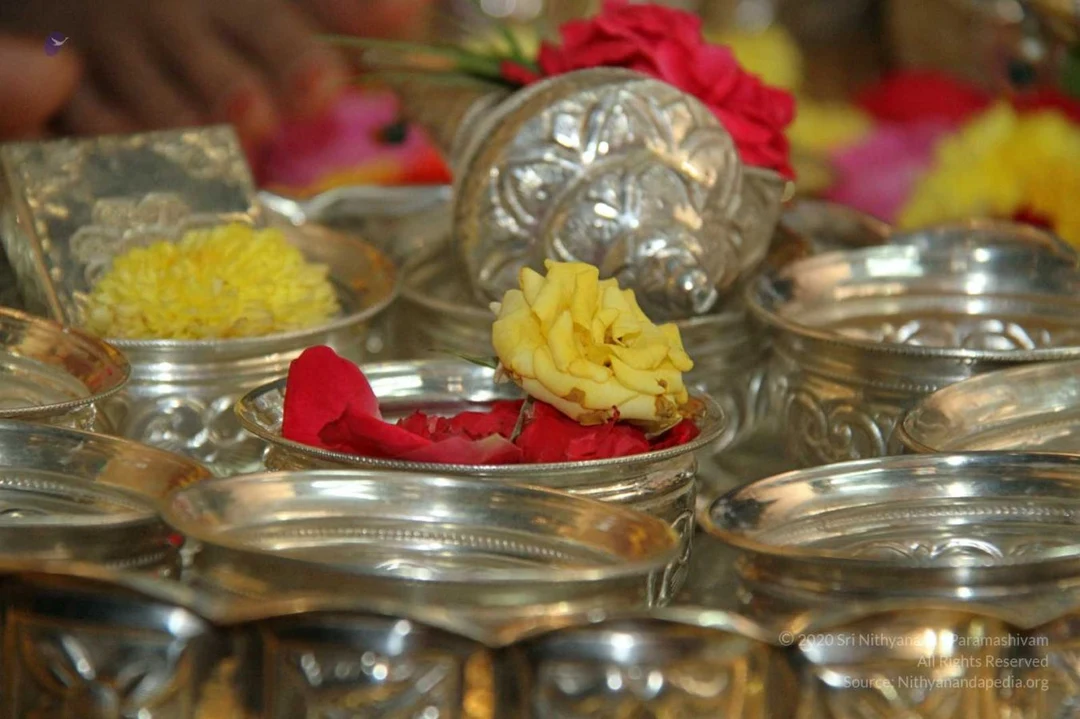
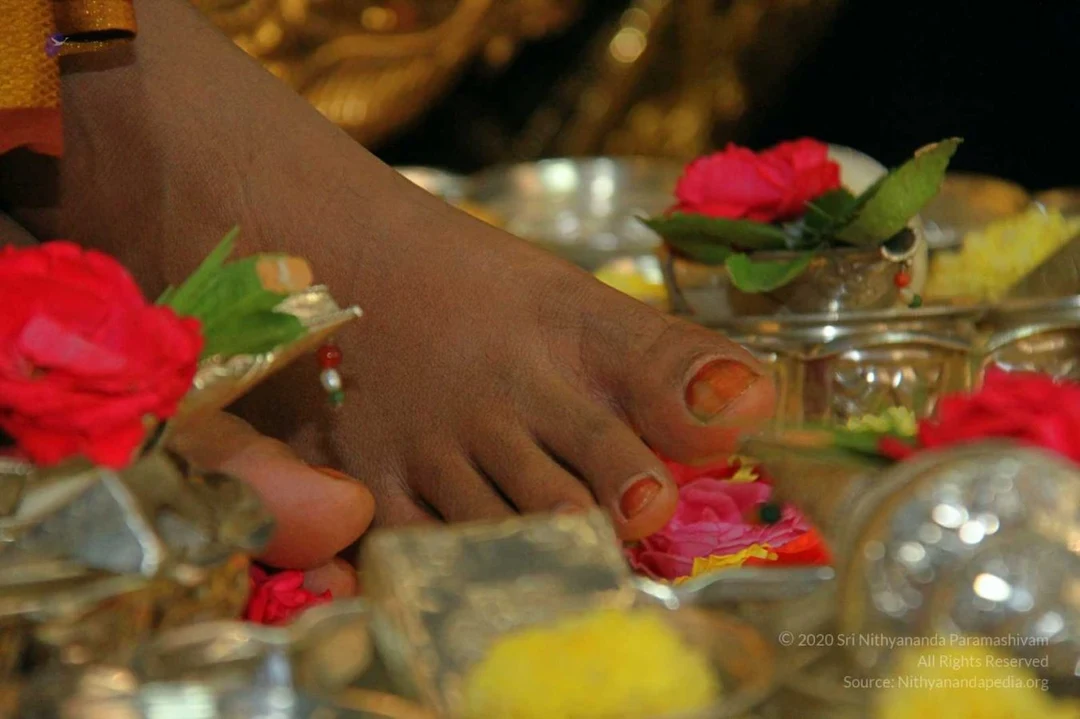
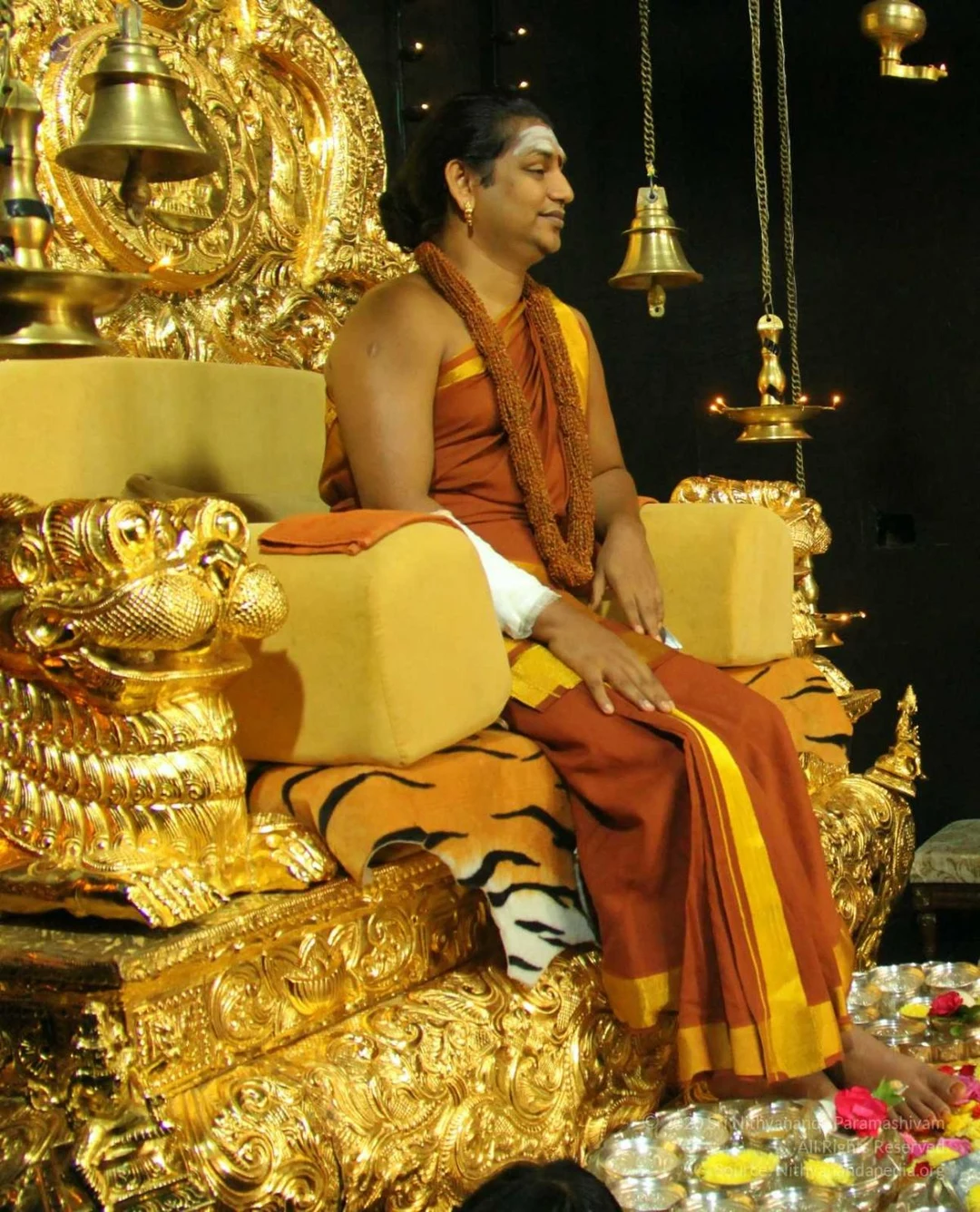
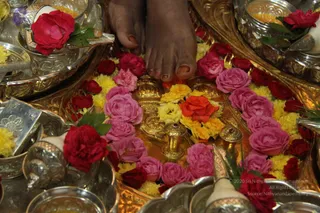
PratyakshaPadaPuja
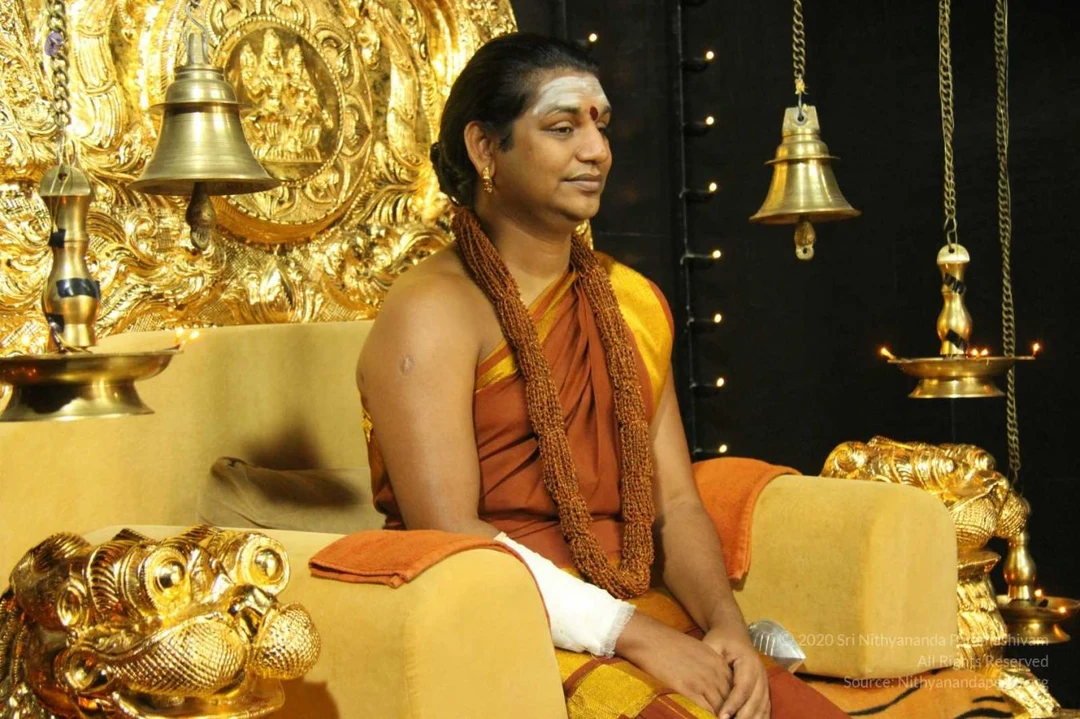
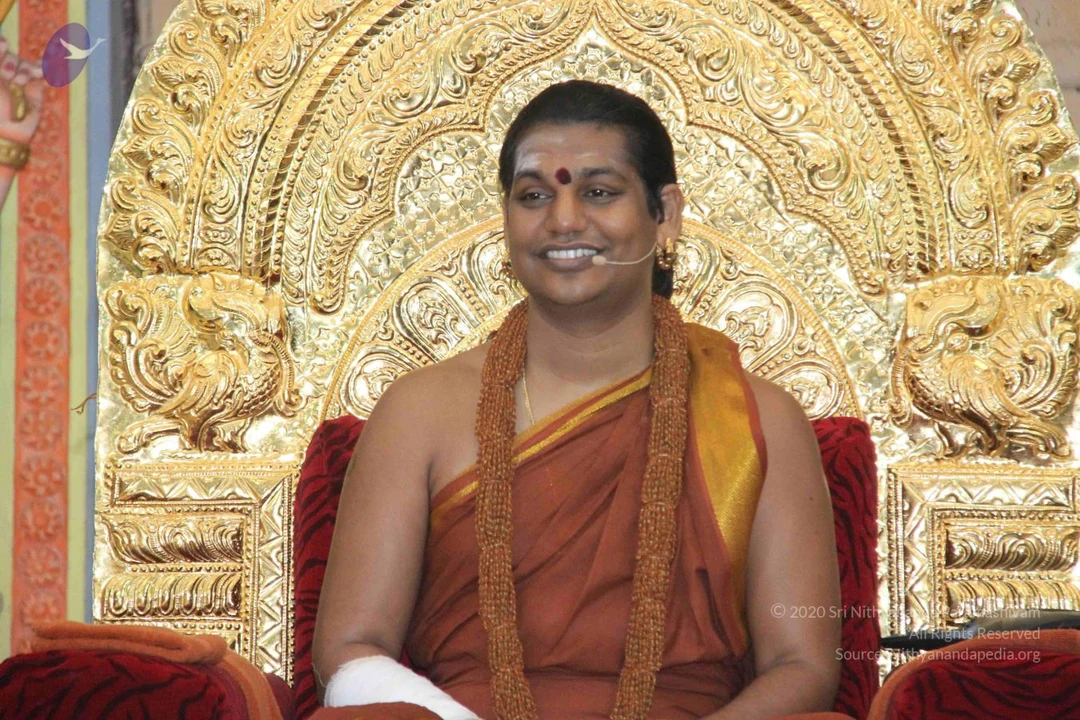
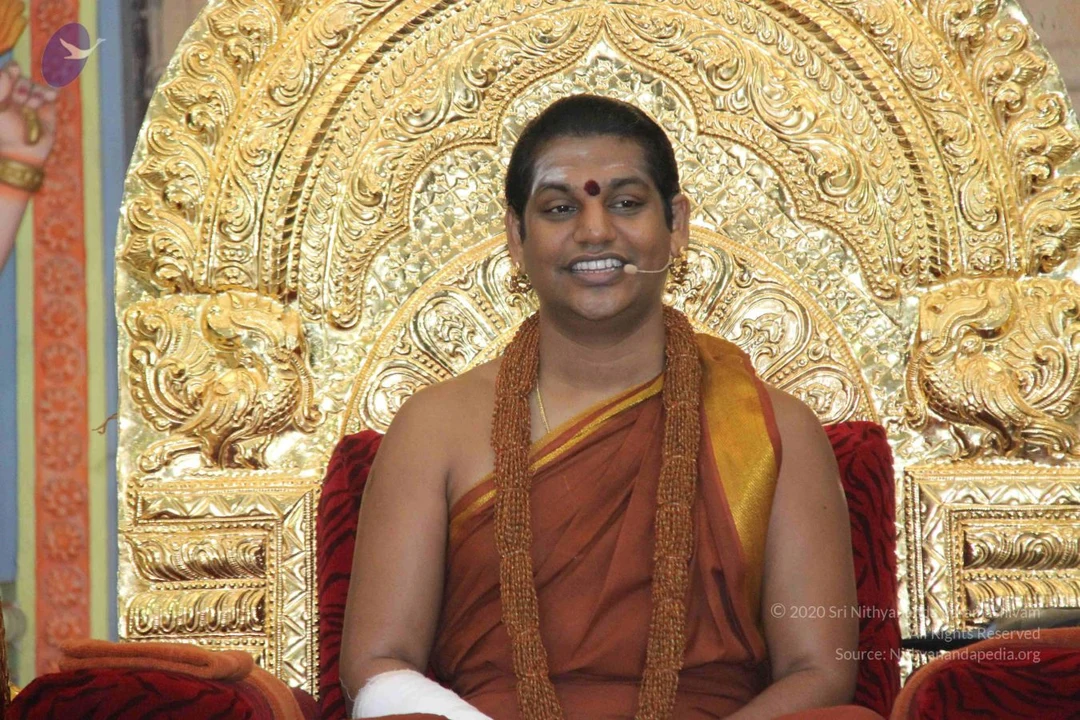
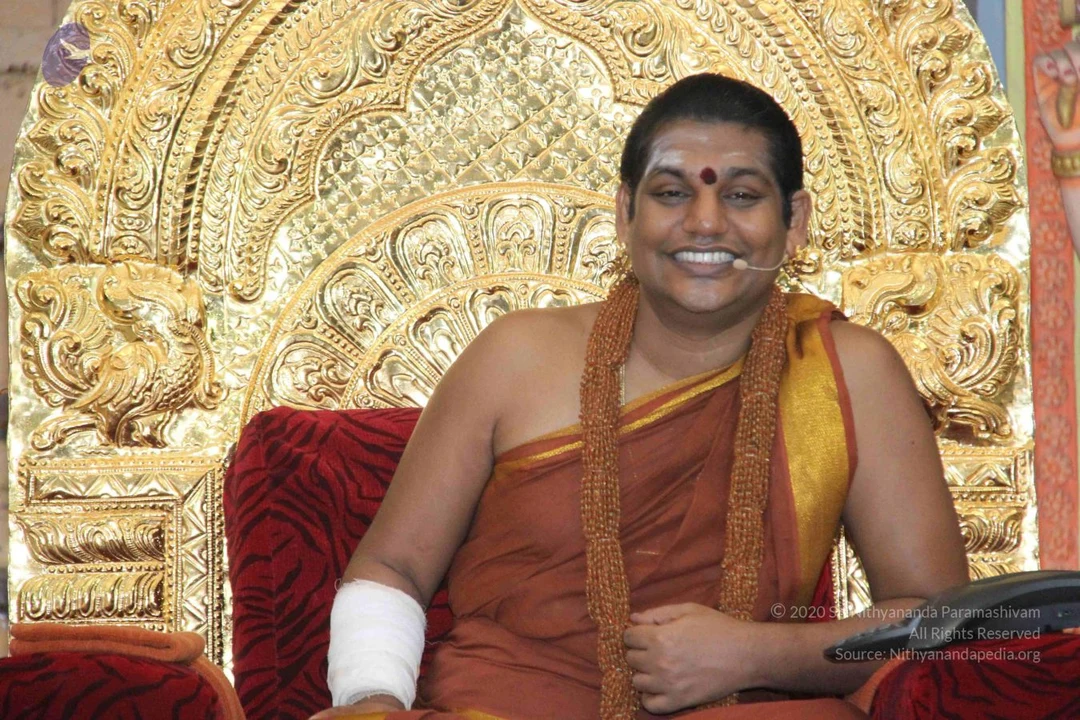
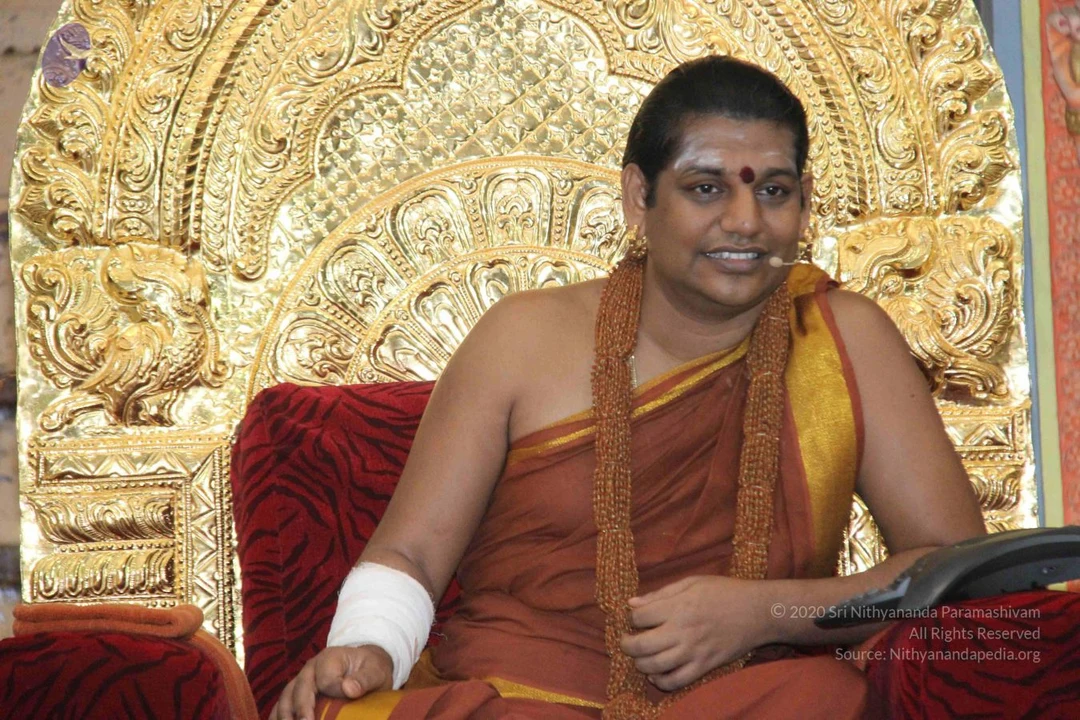
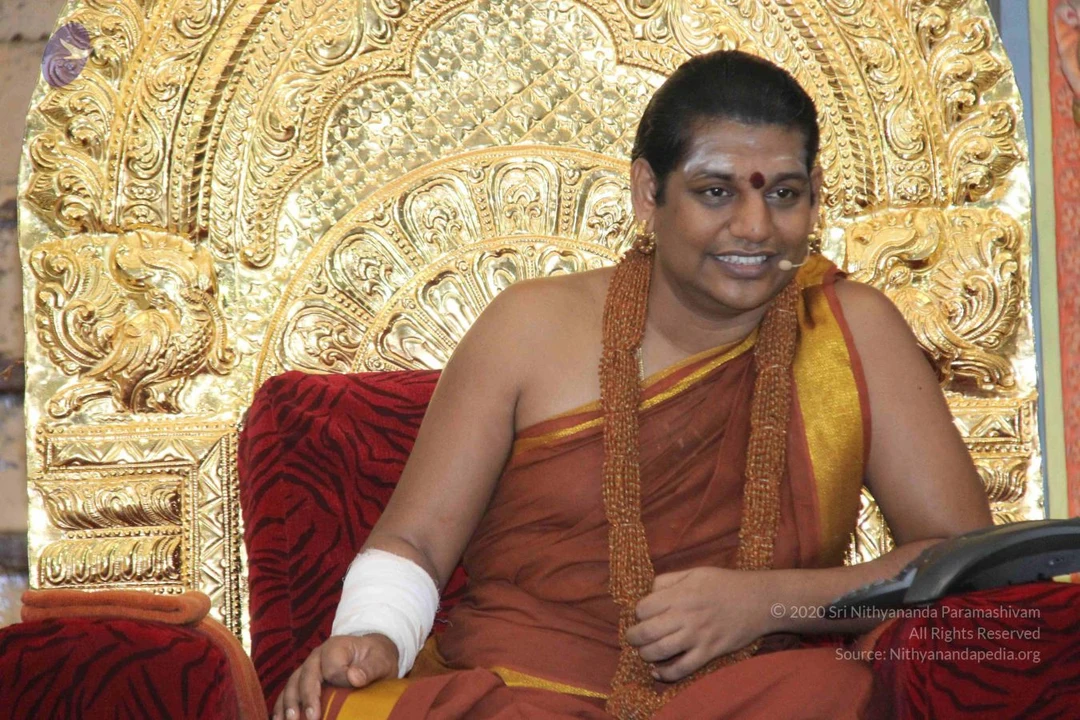
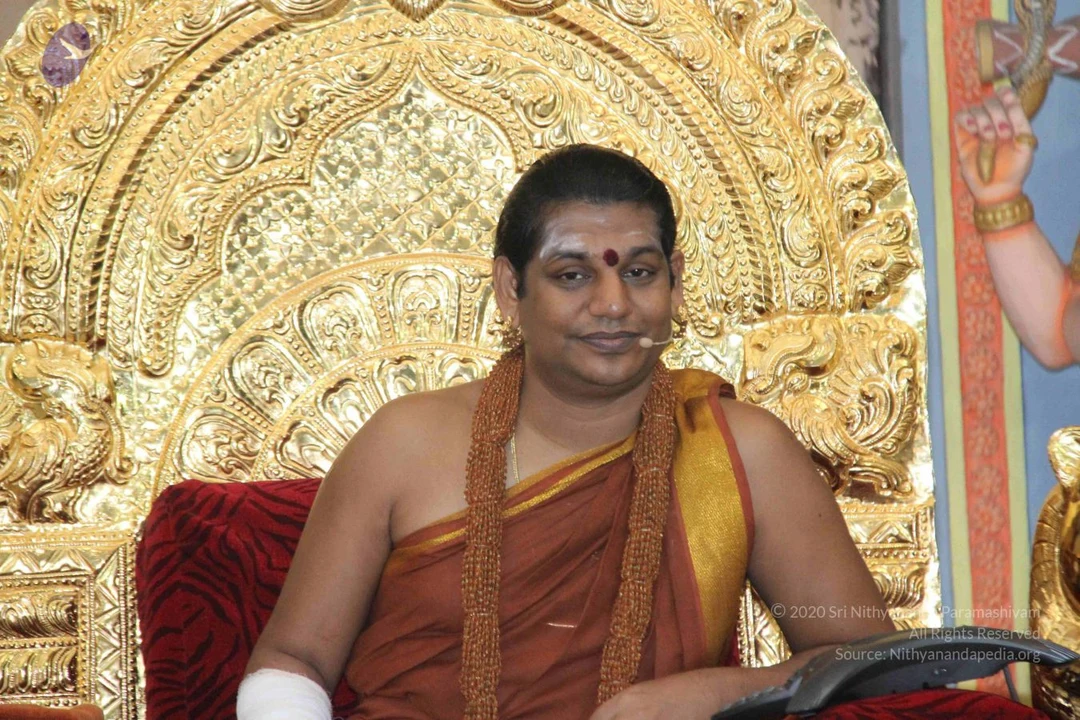
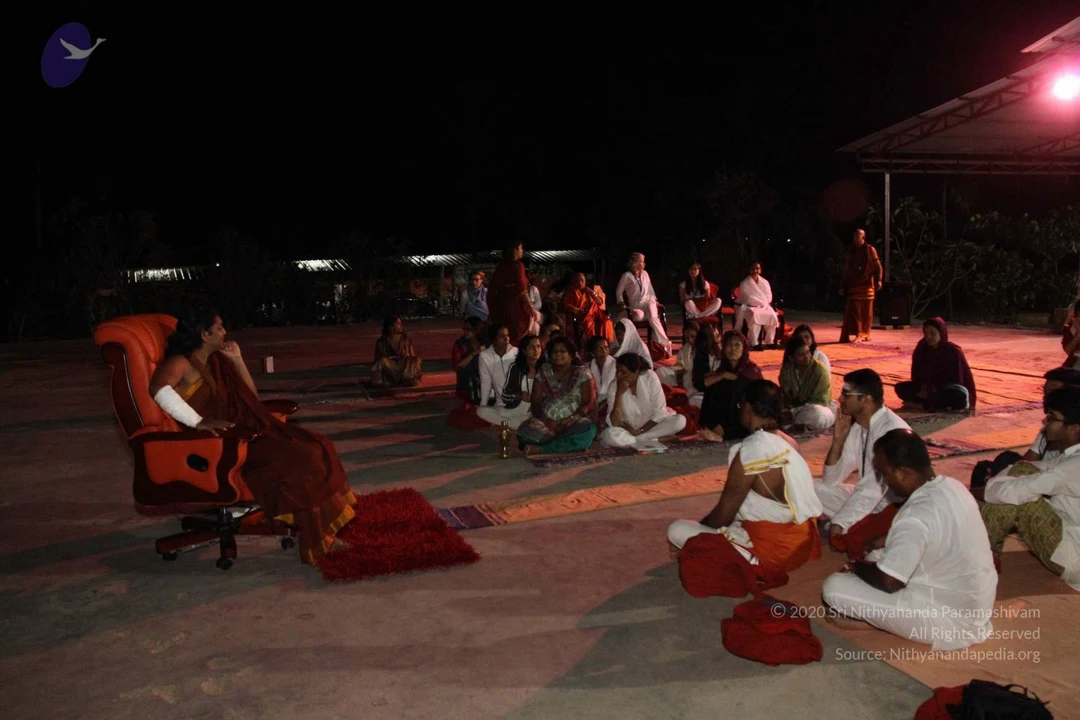
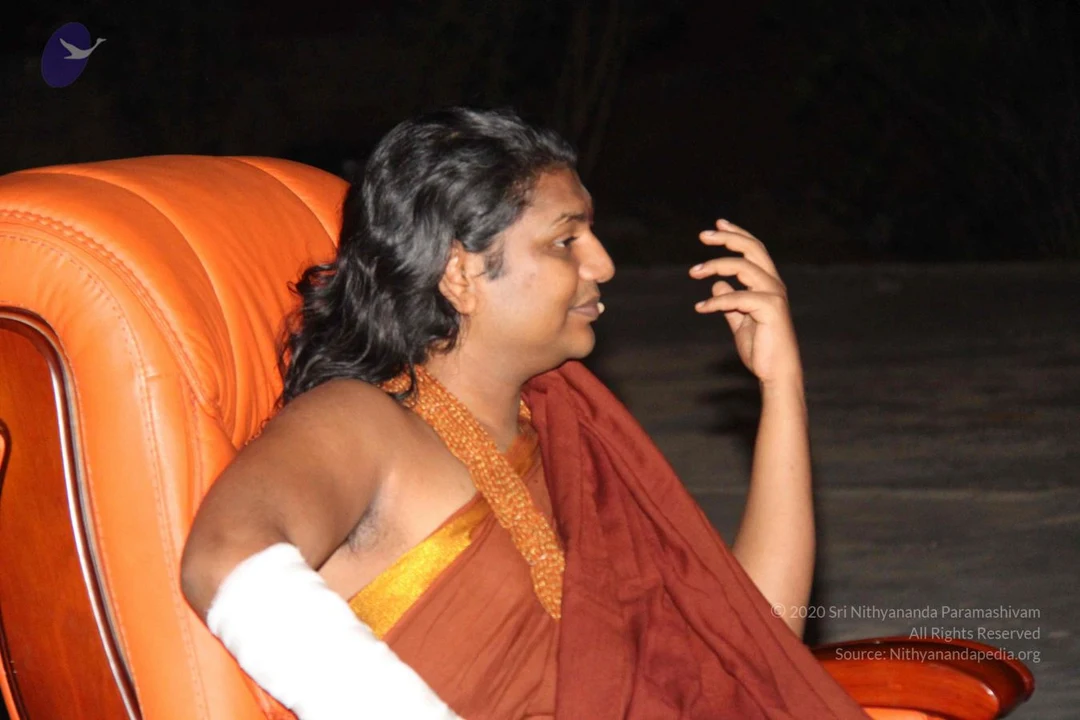
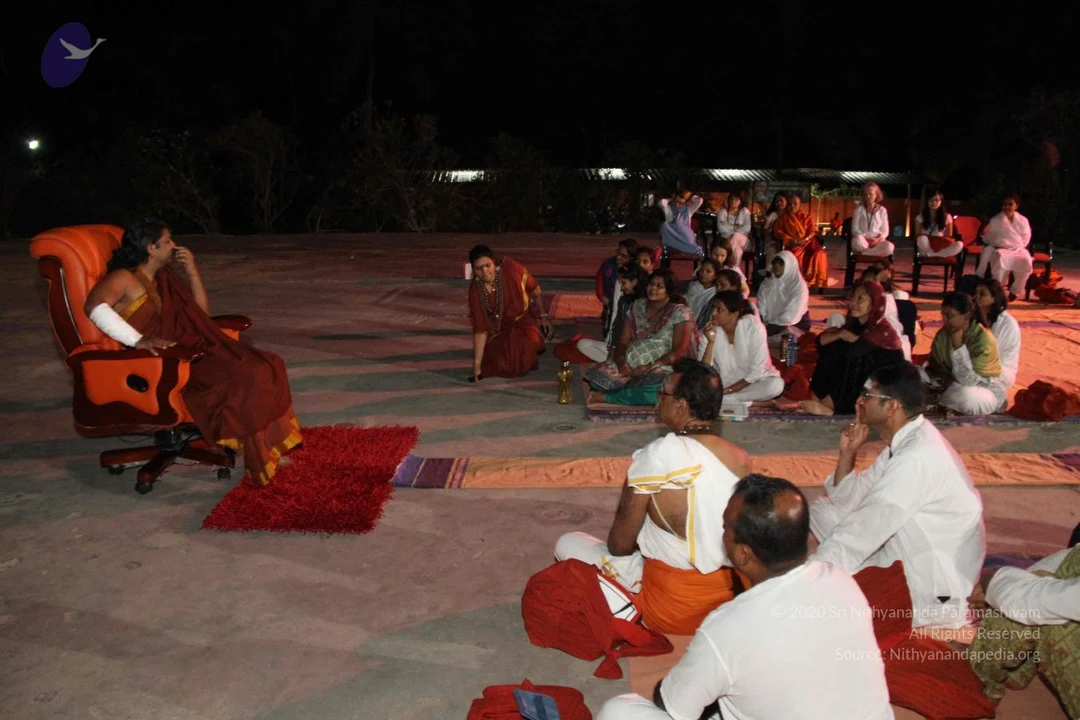
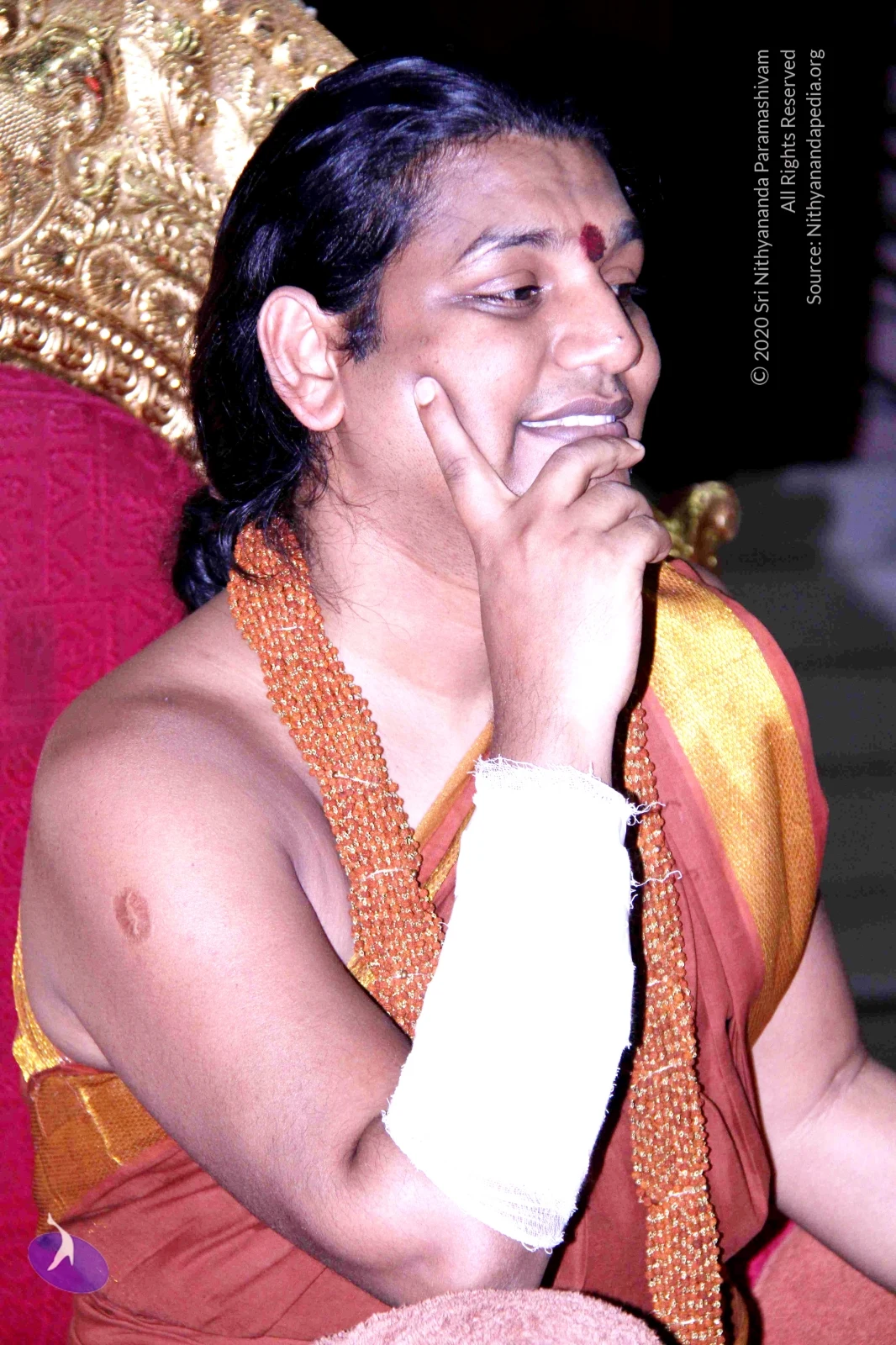
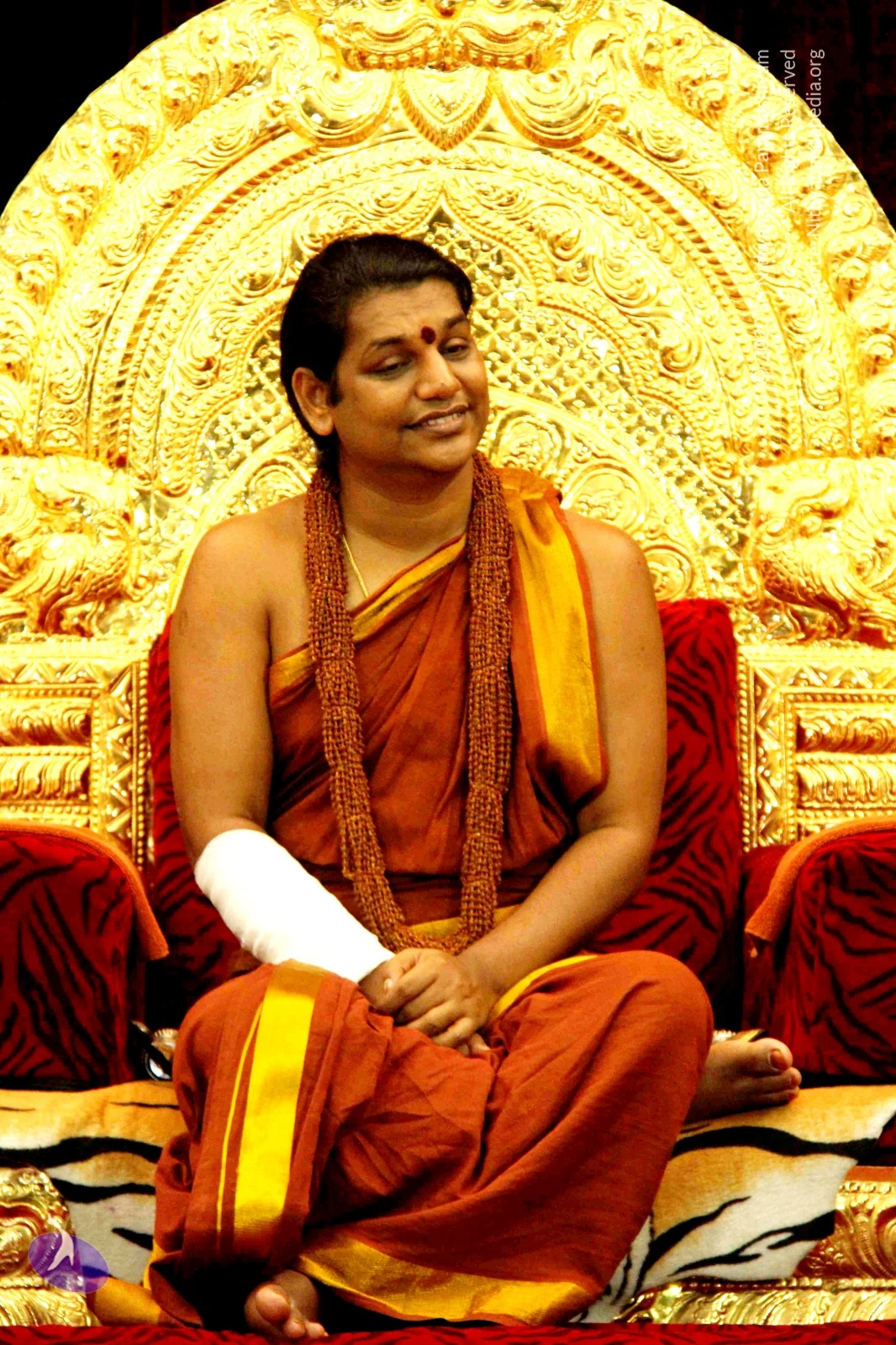
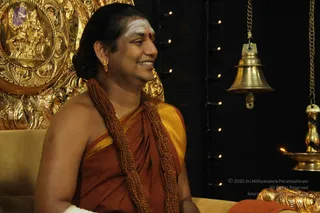
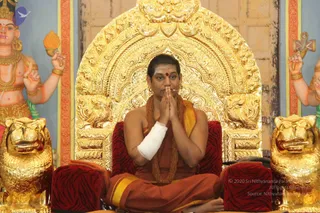
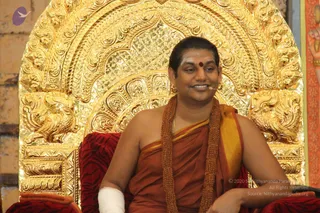
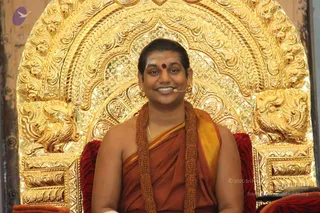
NithyaSatsang_Swamiji

Leela Alankar

SarvaDarshan

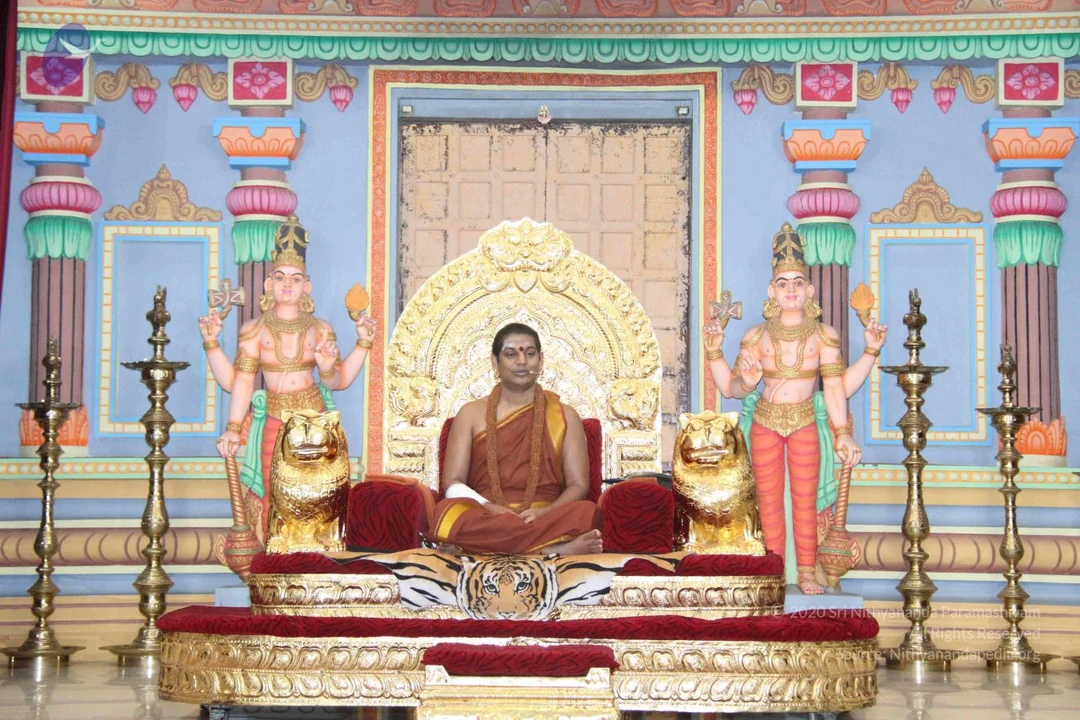
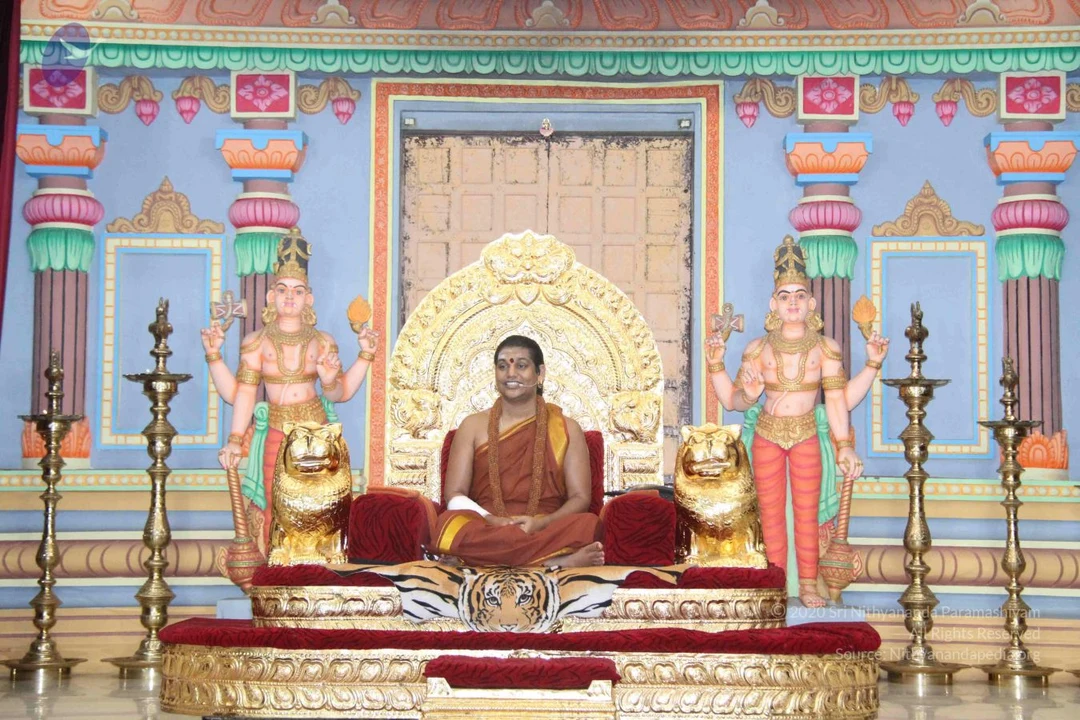
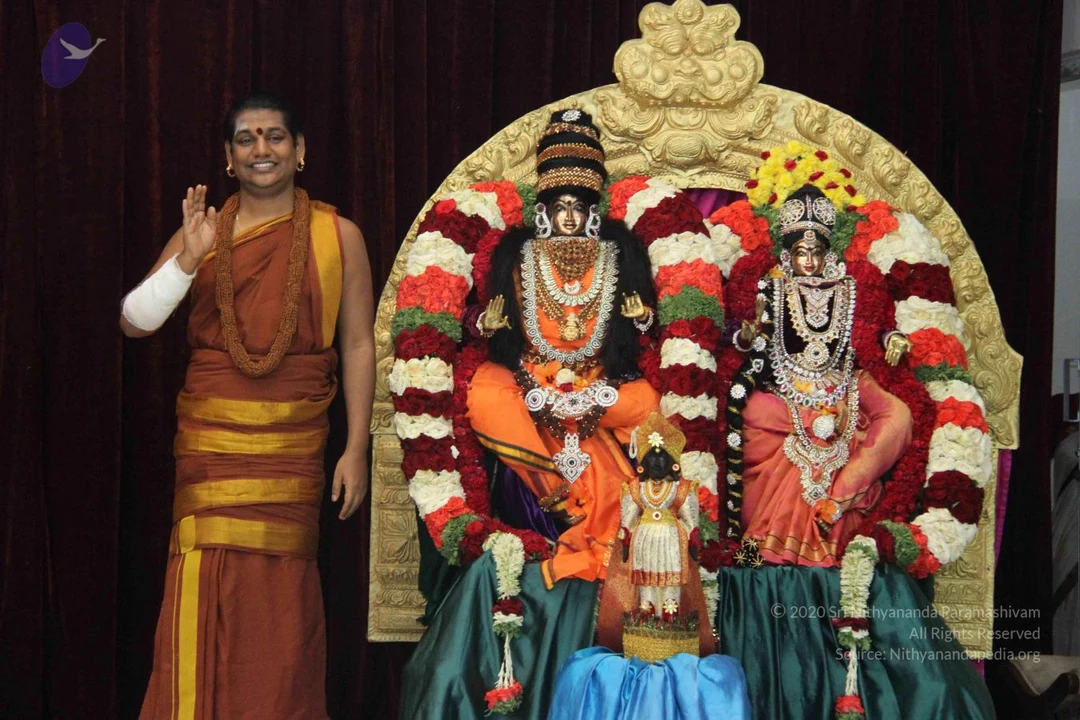
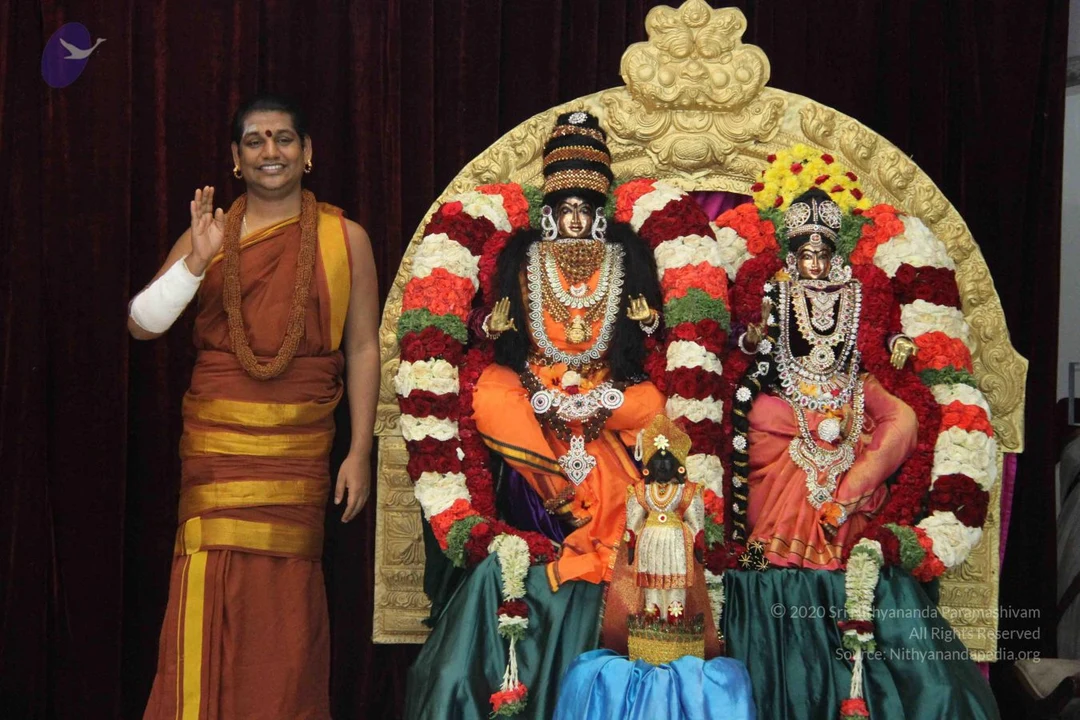
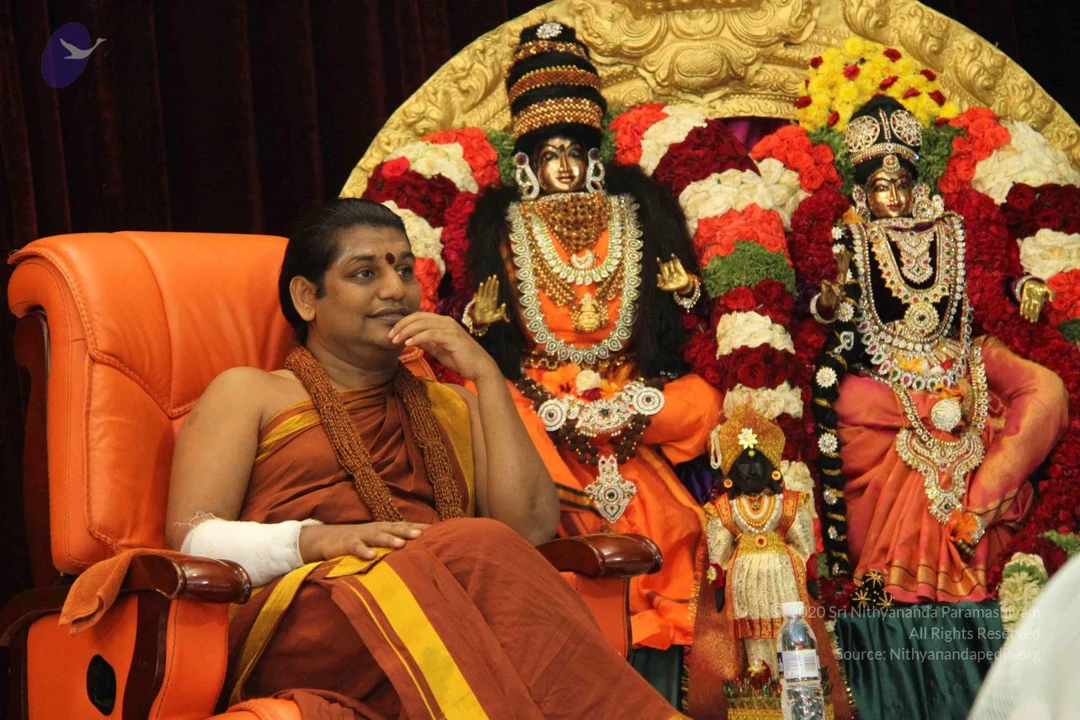
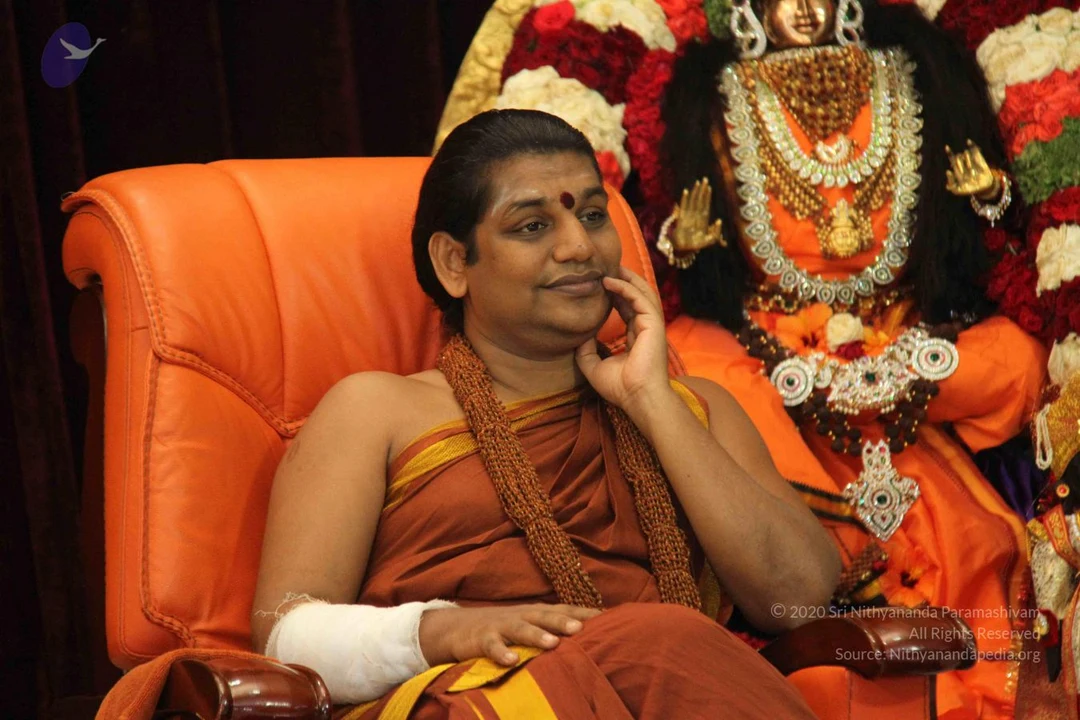
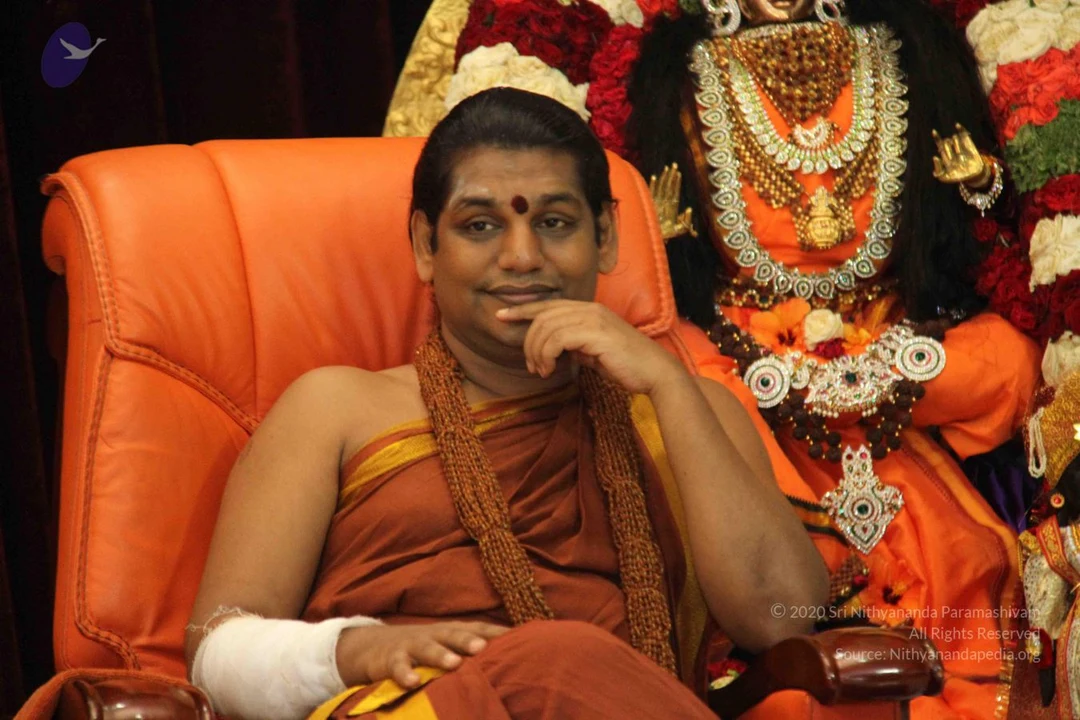
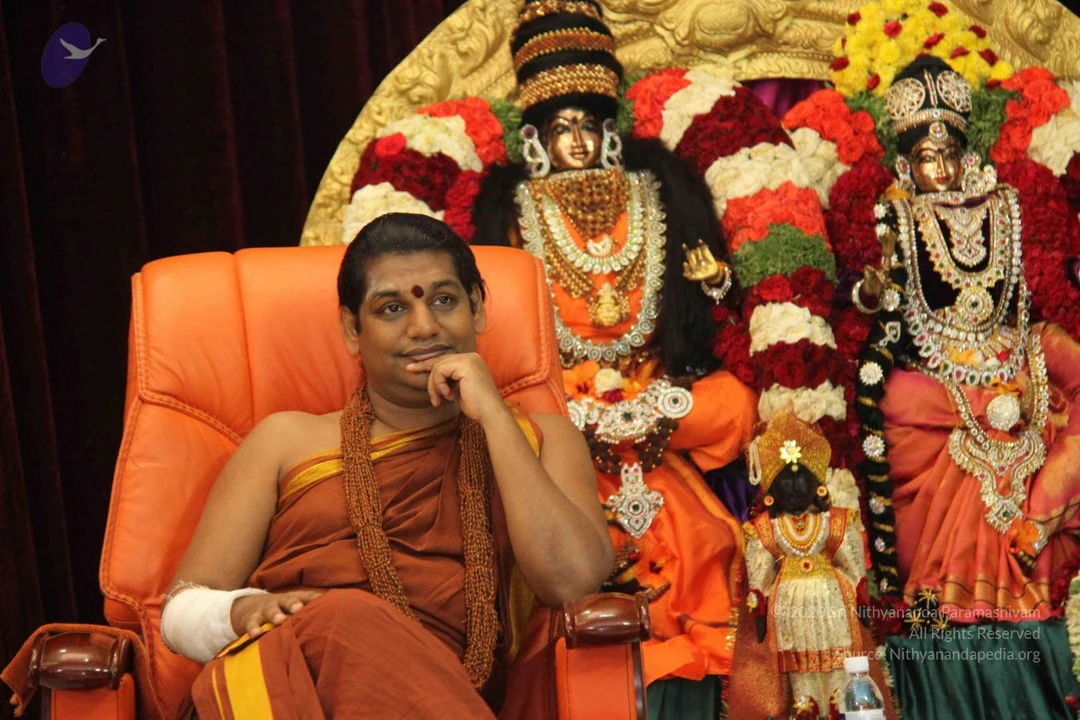
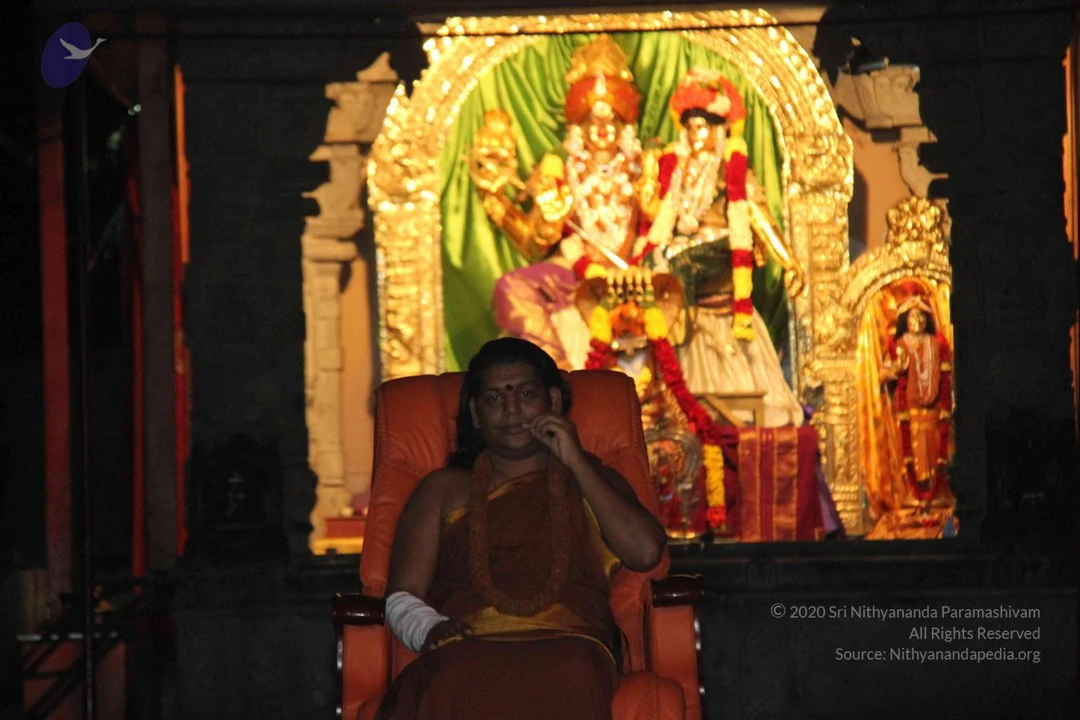
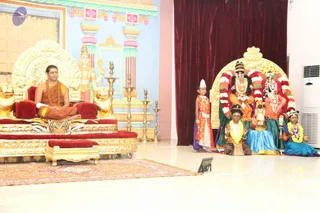
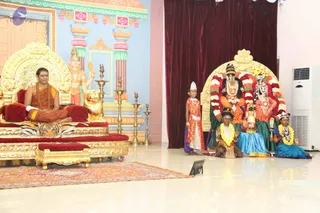
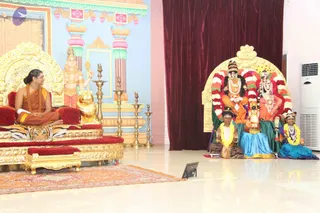
Swamiji_Deities

Inner Awakening_Day8

MaheswaraPuja_Swamiji

Tags:

Paramahamsa Nithyananda, power, words, thinking, feeling, living, spiritual truths, Tattvas, Integrity, Authenticity, Responsibility, Enriching.

1-Pratyaksha-Pada-Puja

2-Swamiji-With-Deities

3-Leela-Alankar

4-Sarva-Darshan

5-Inner-Awakening-Day8

Photos from this day

View all 291 photos

PratyakshaPadaPuja
31 photosSource gallery
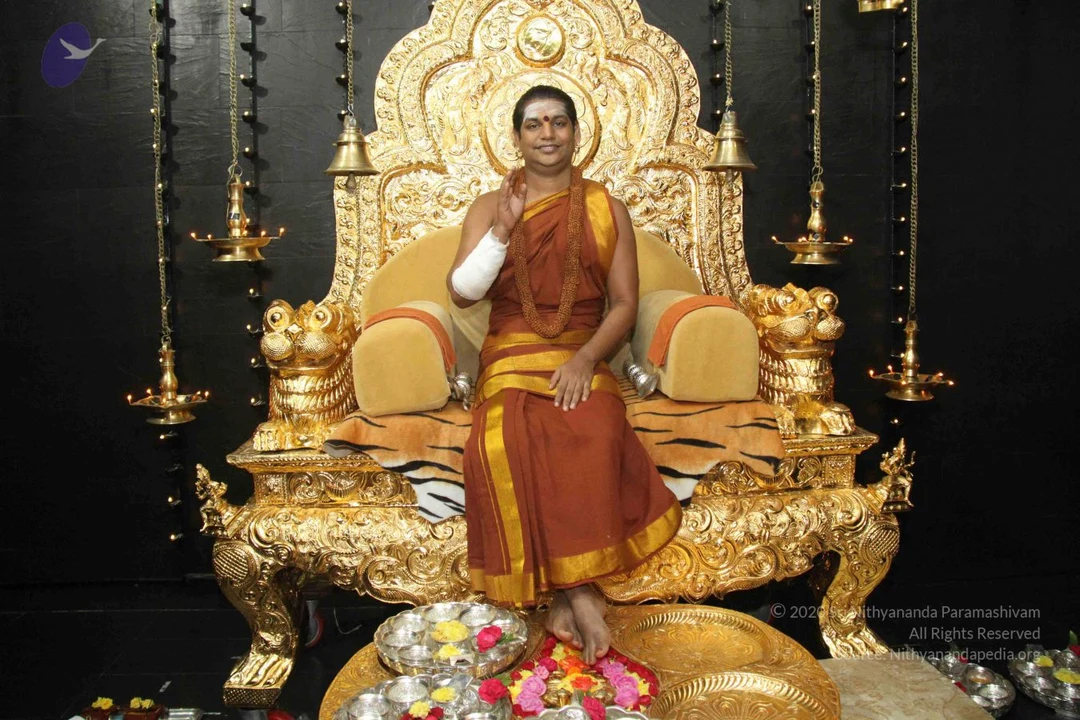
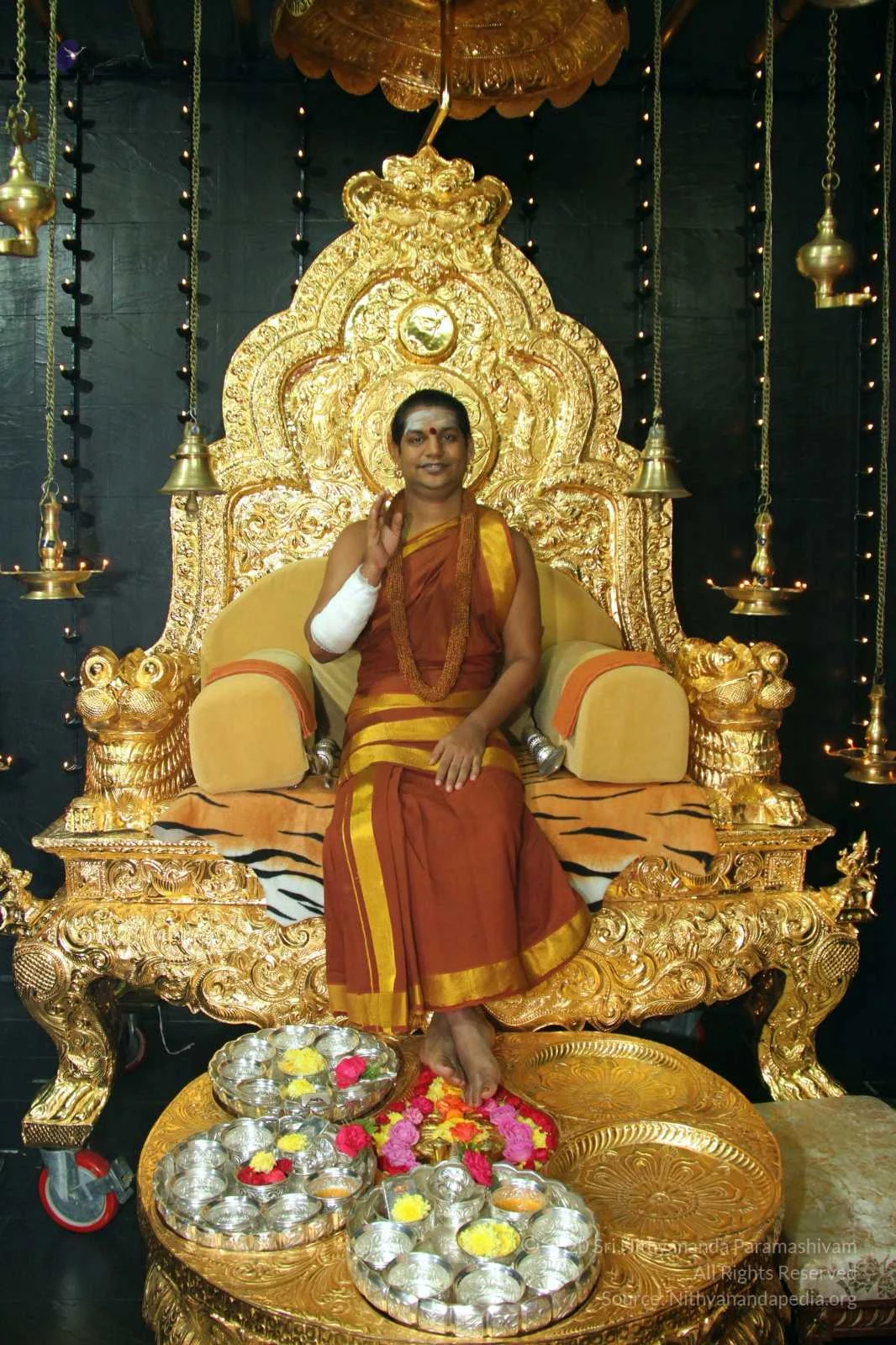
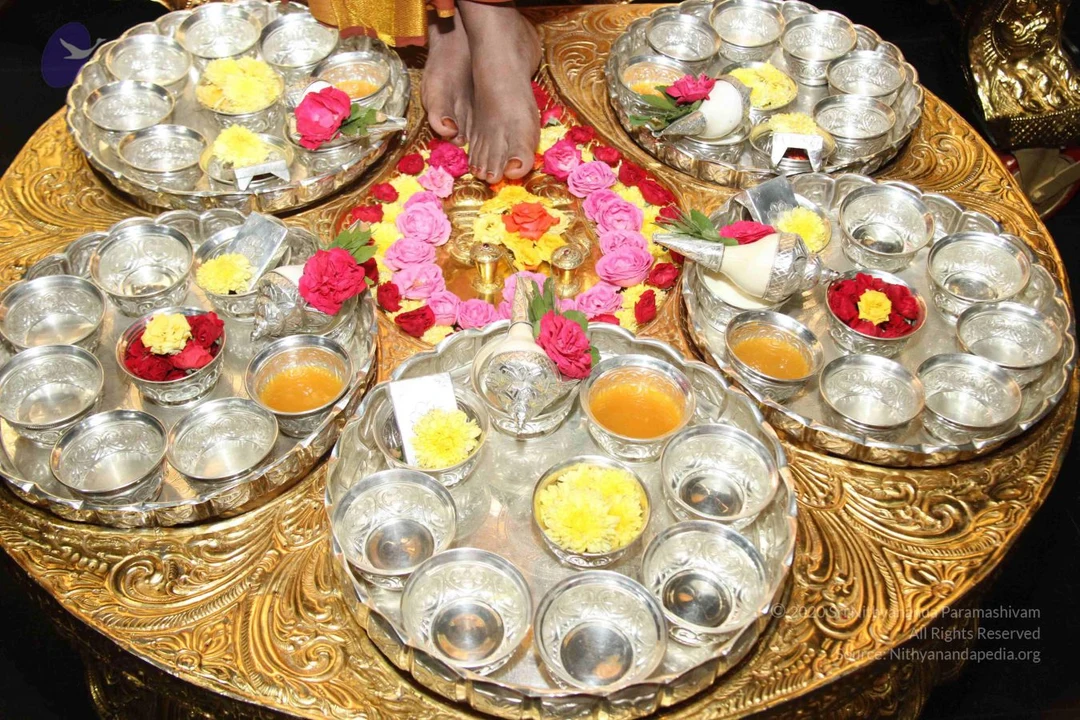
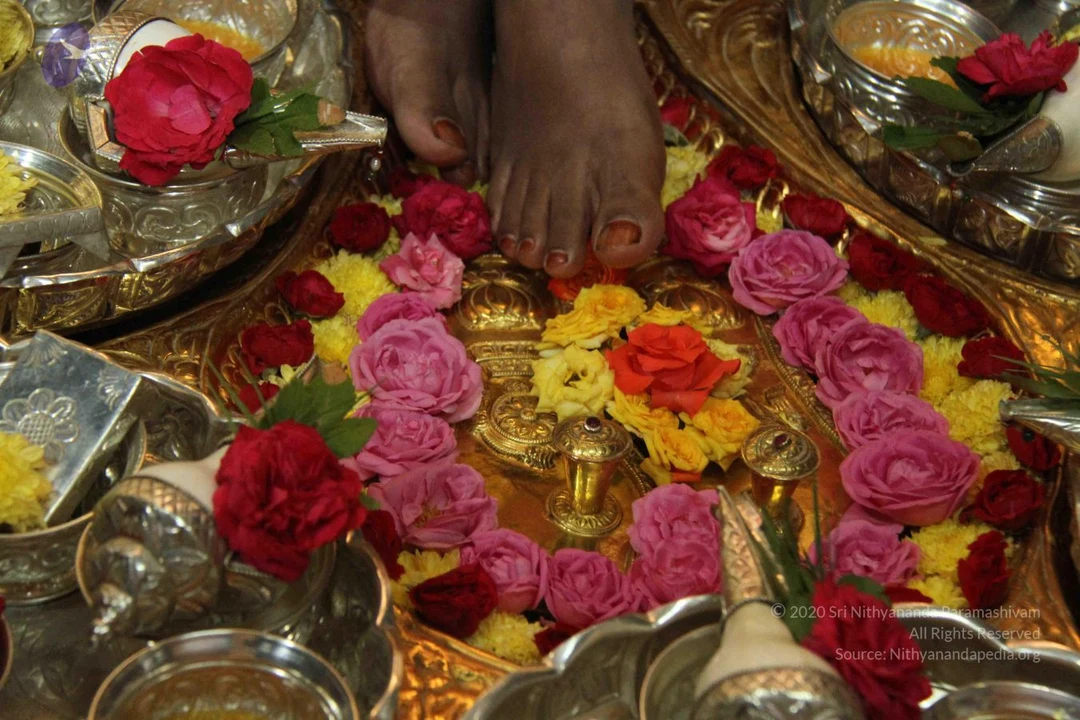
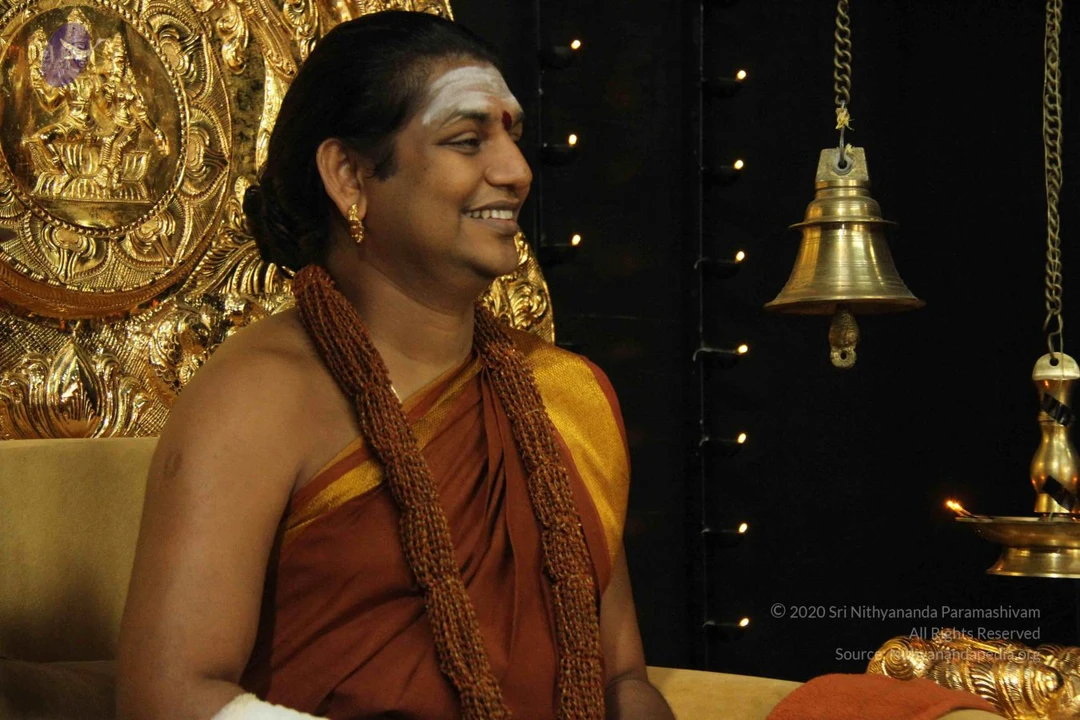
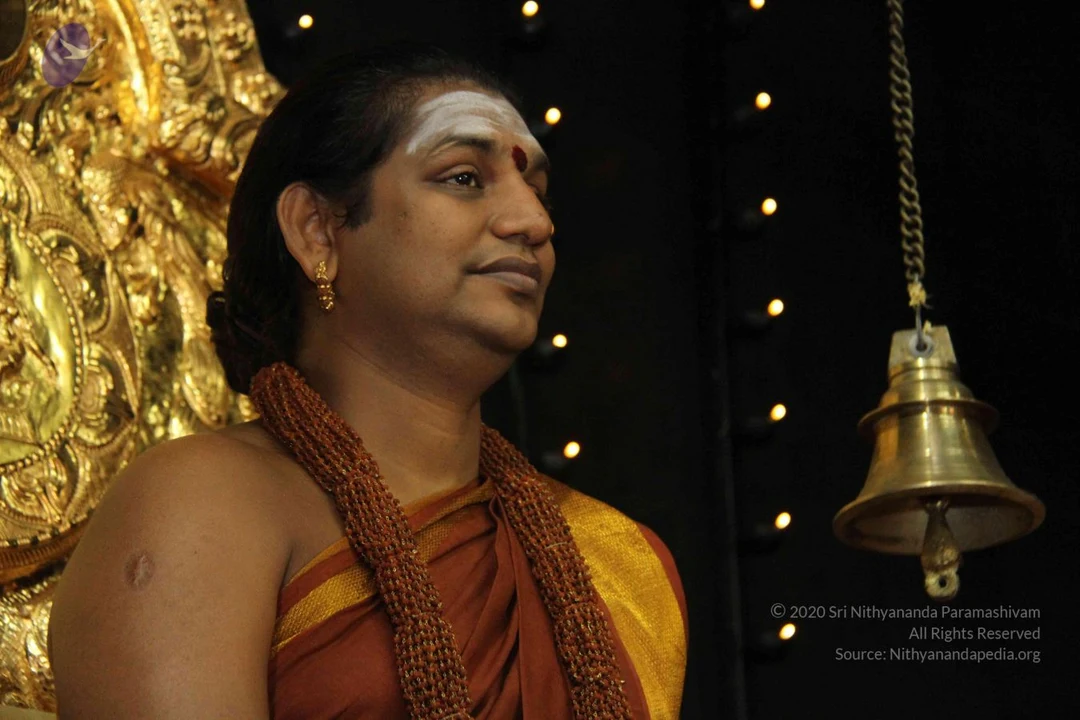
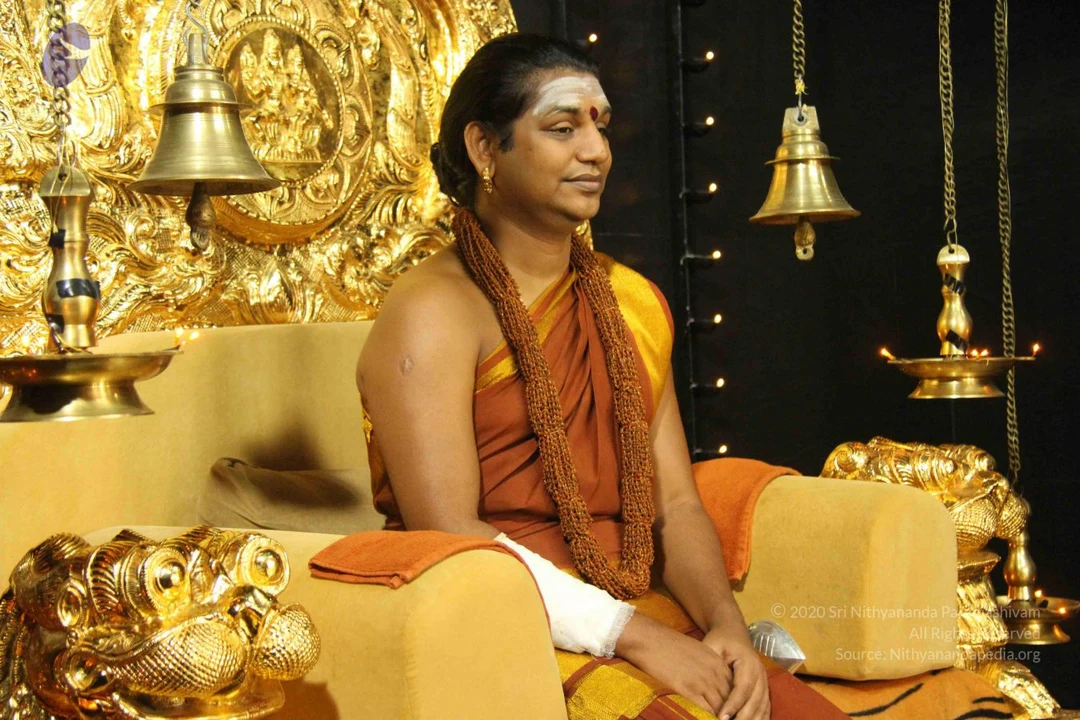
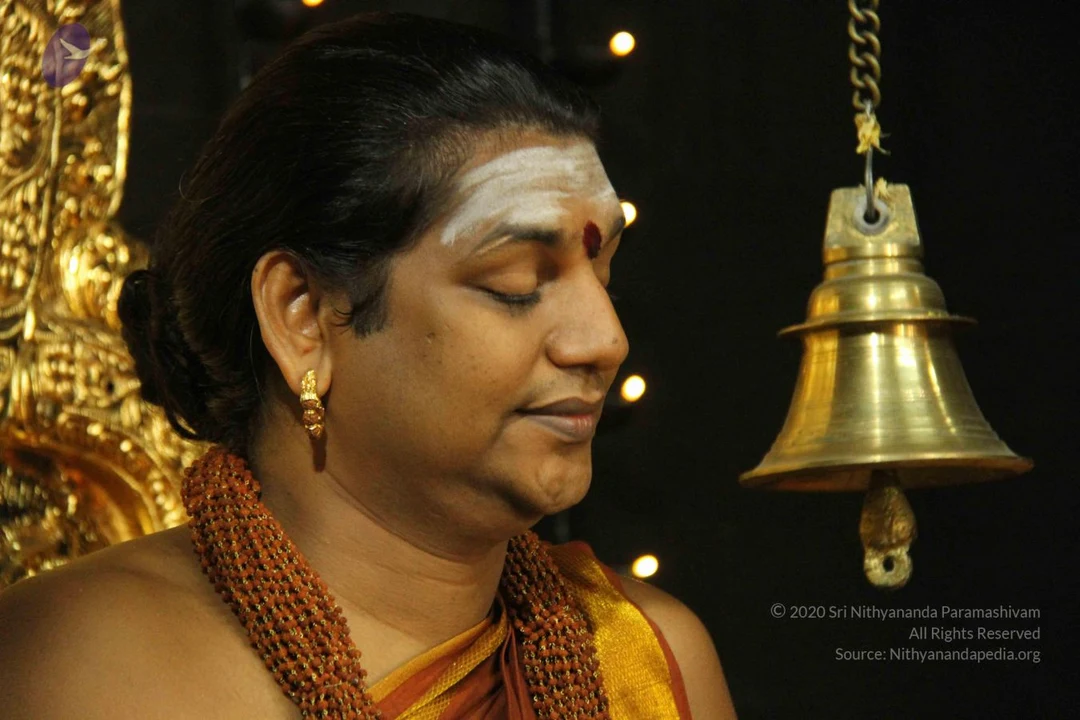
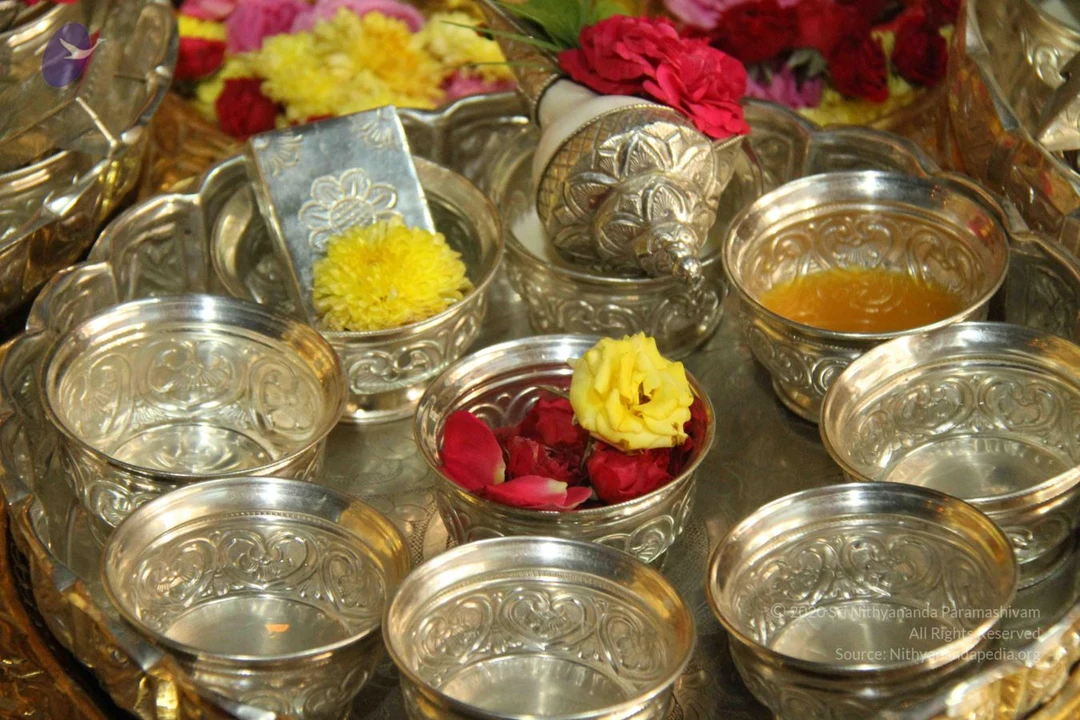
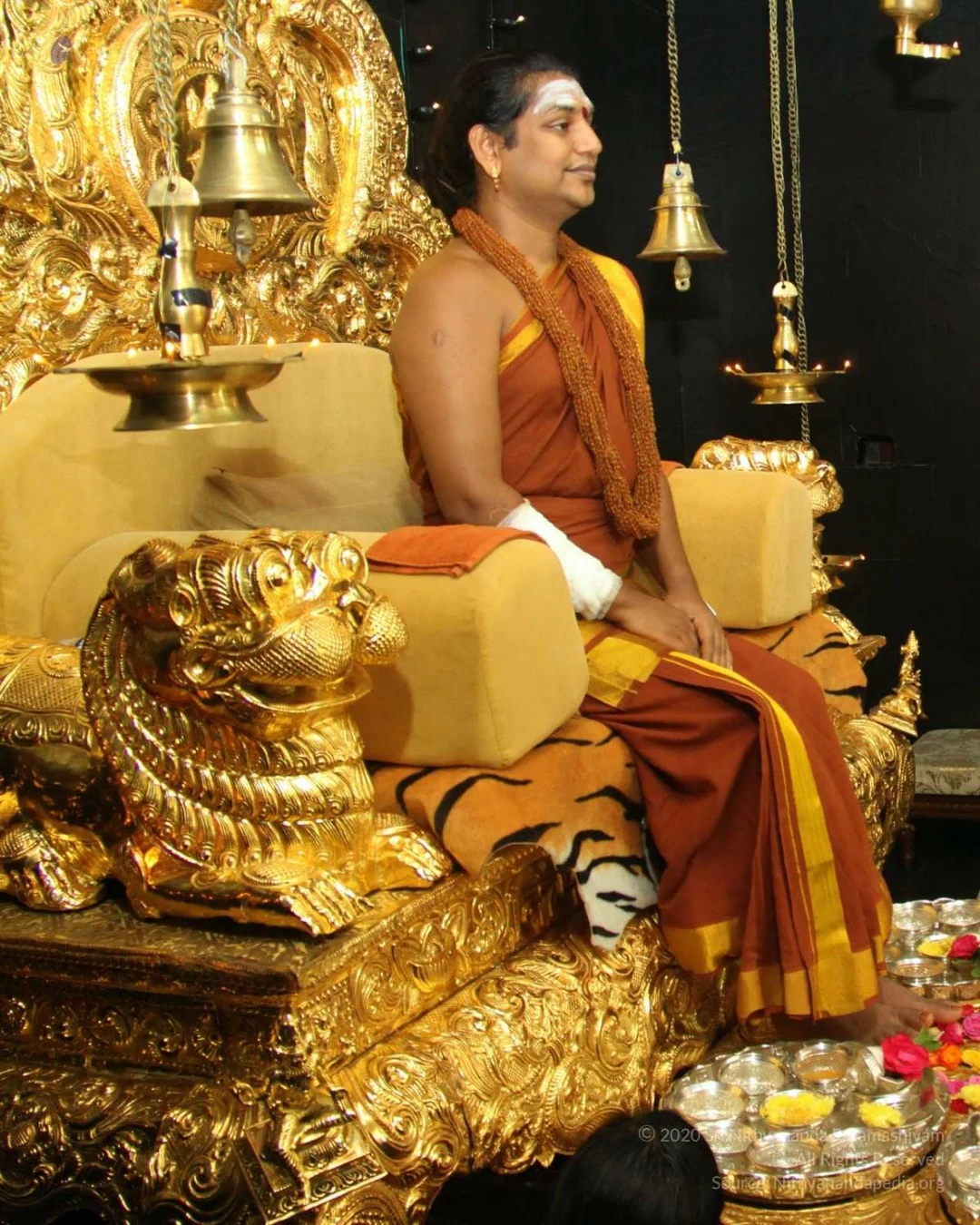
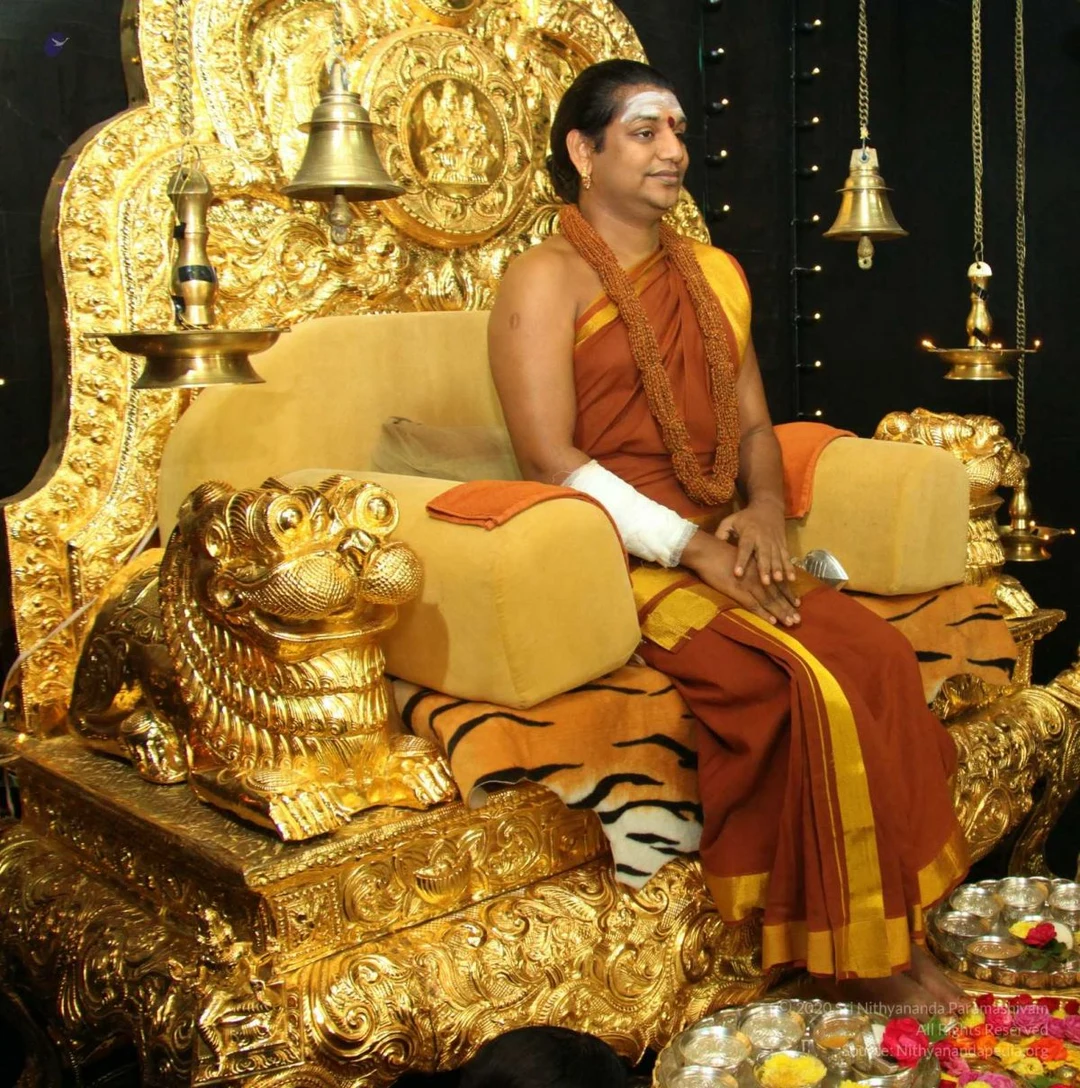
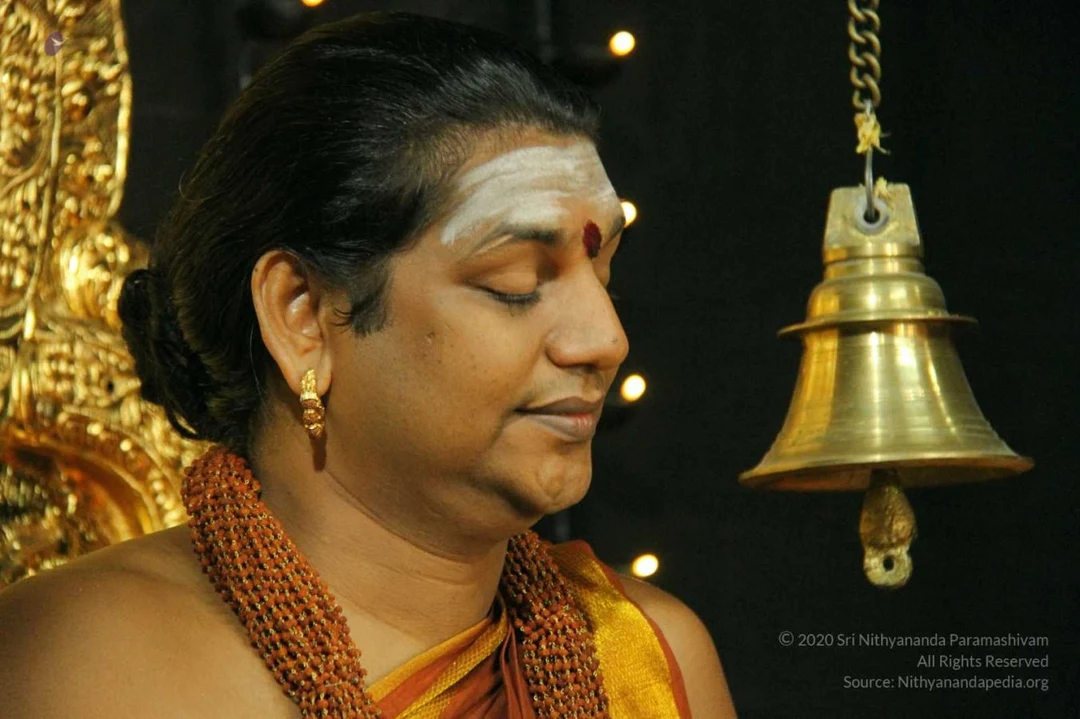
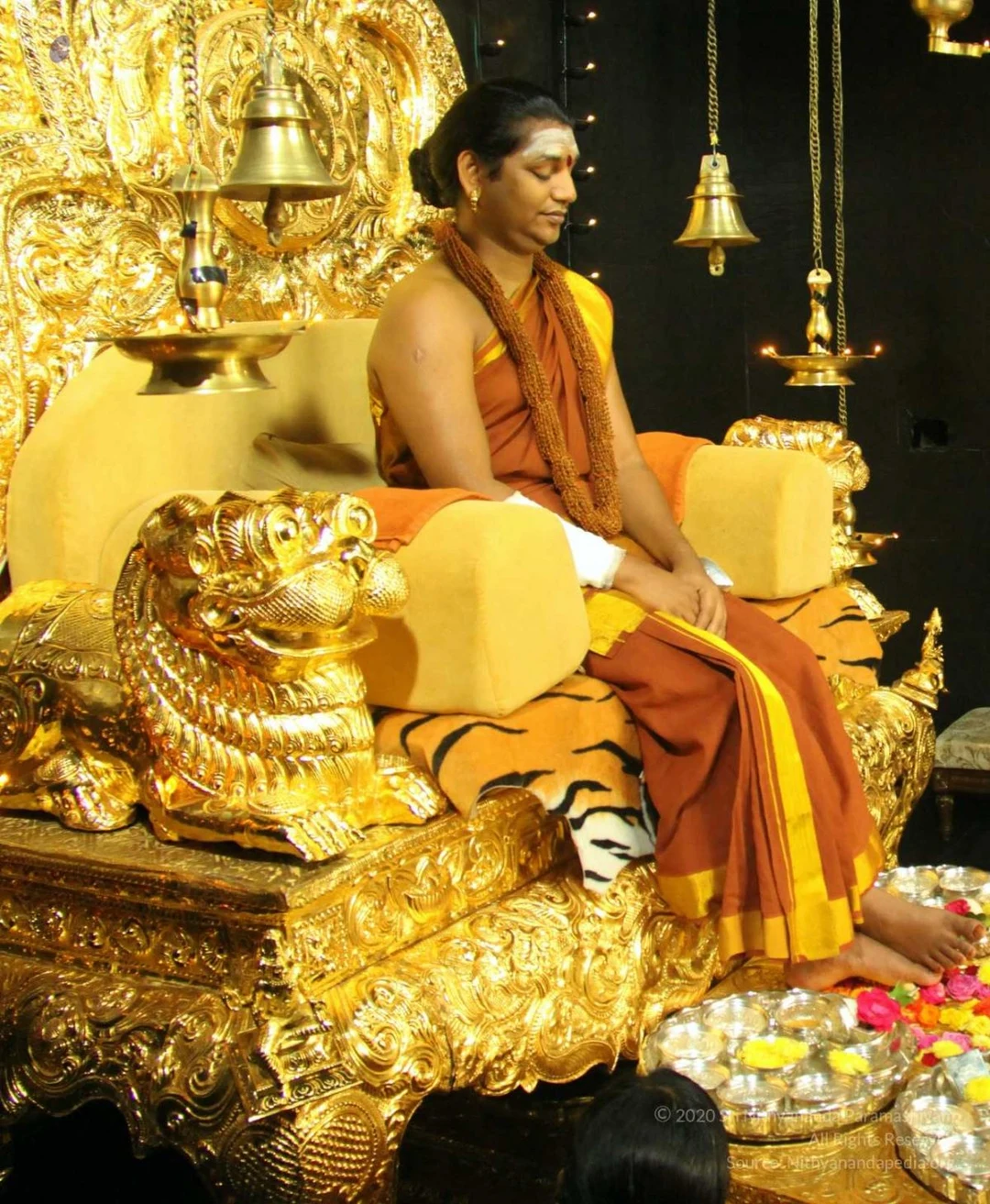
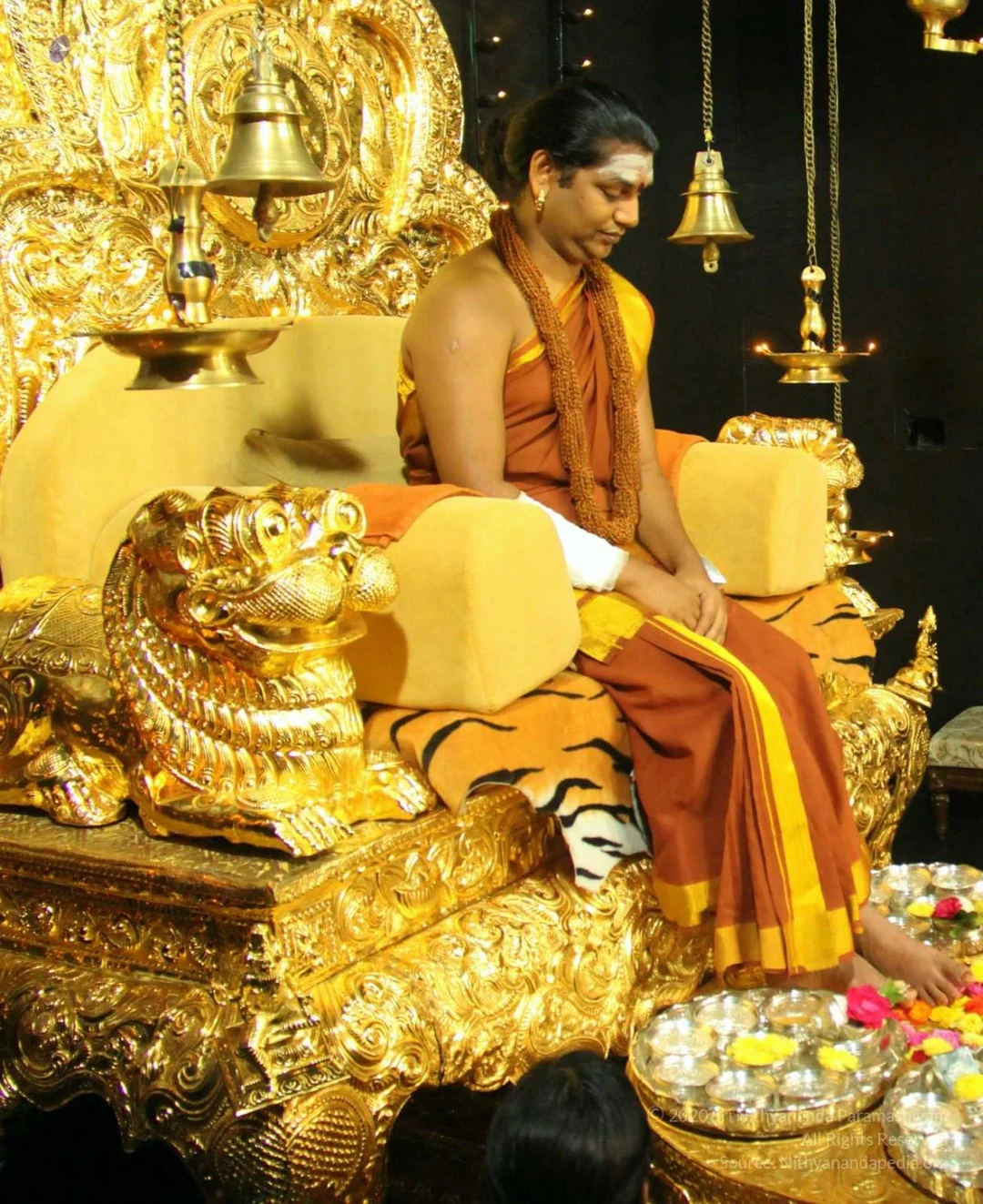
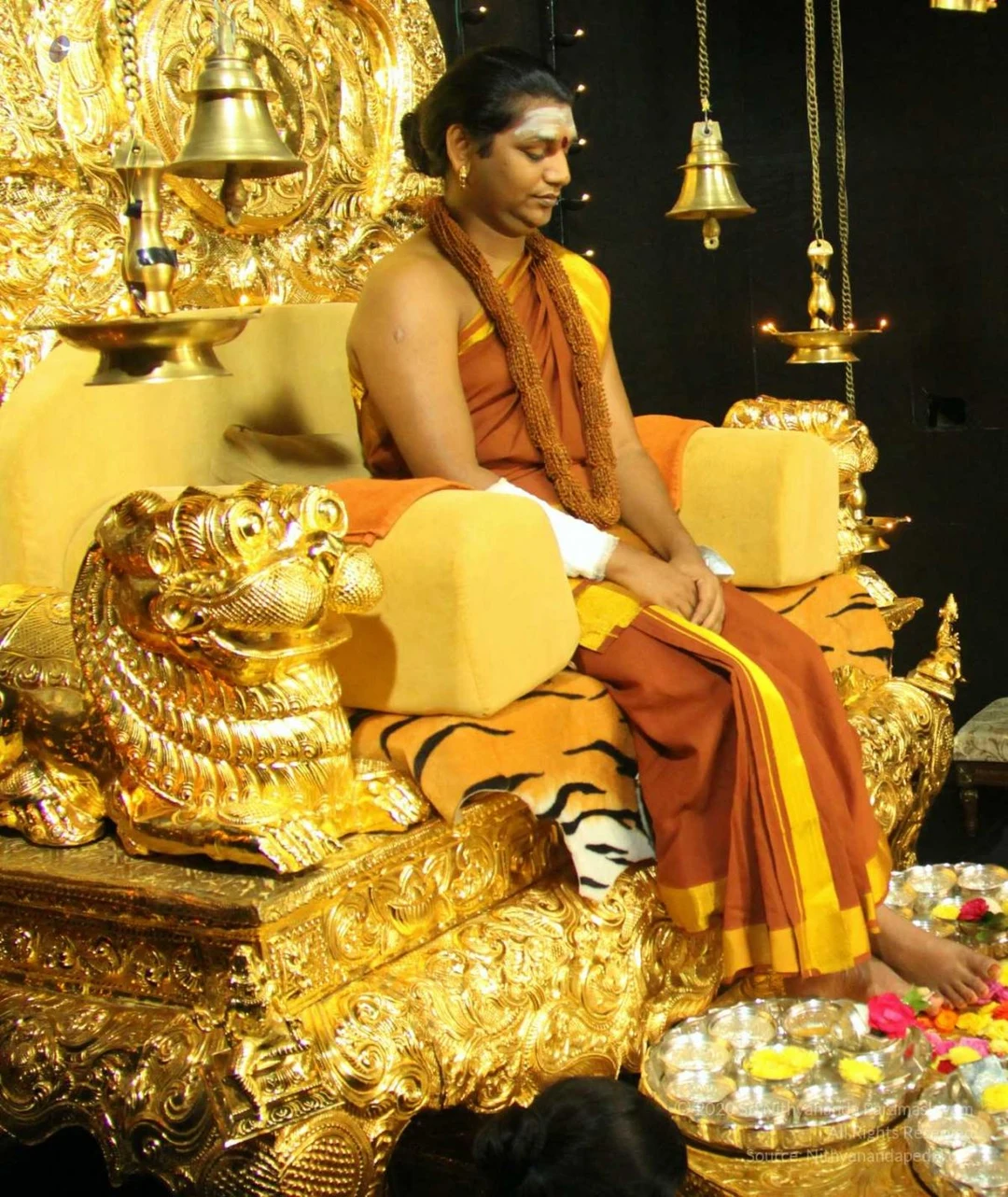
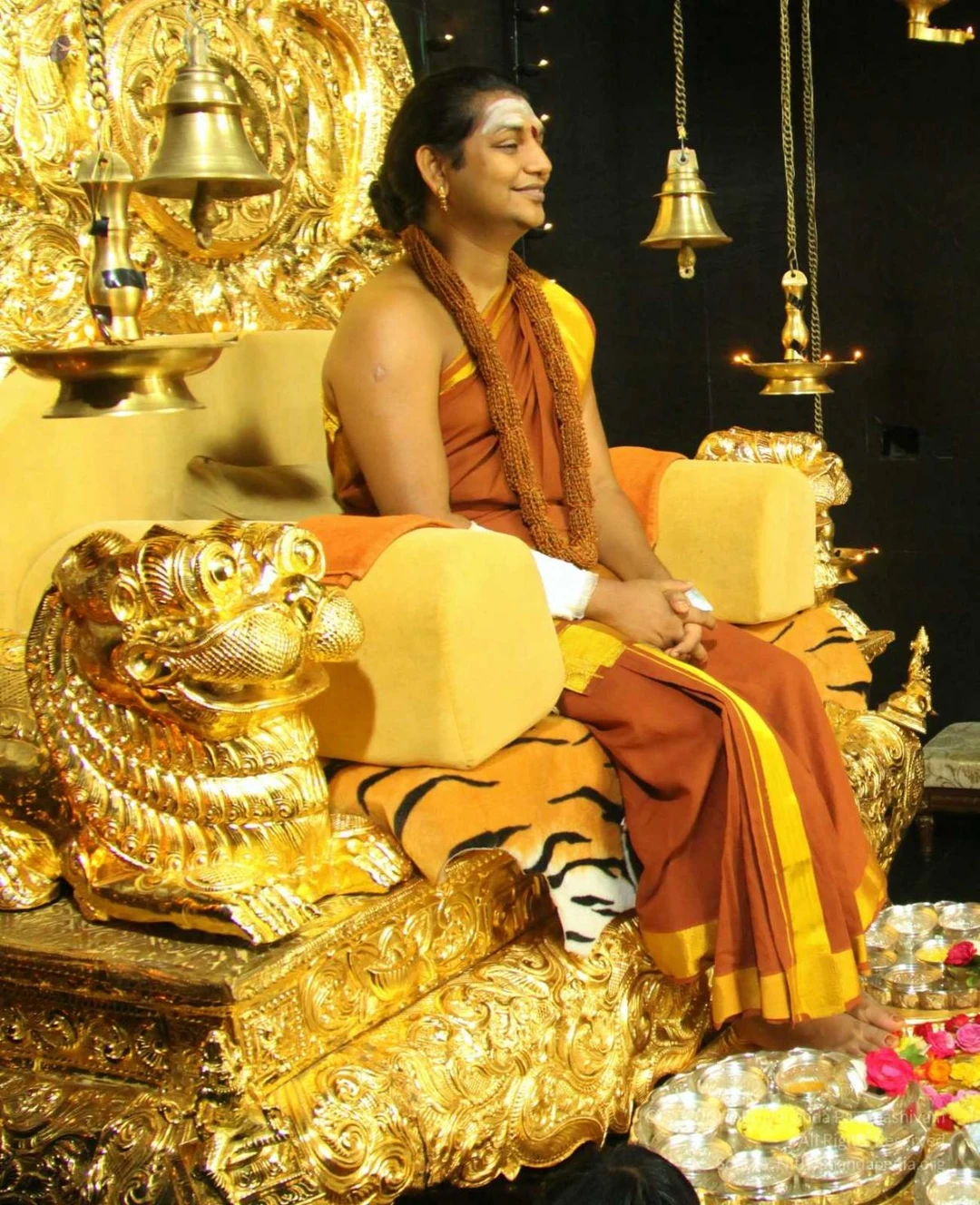
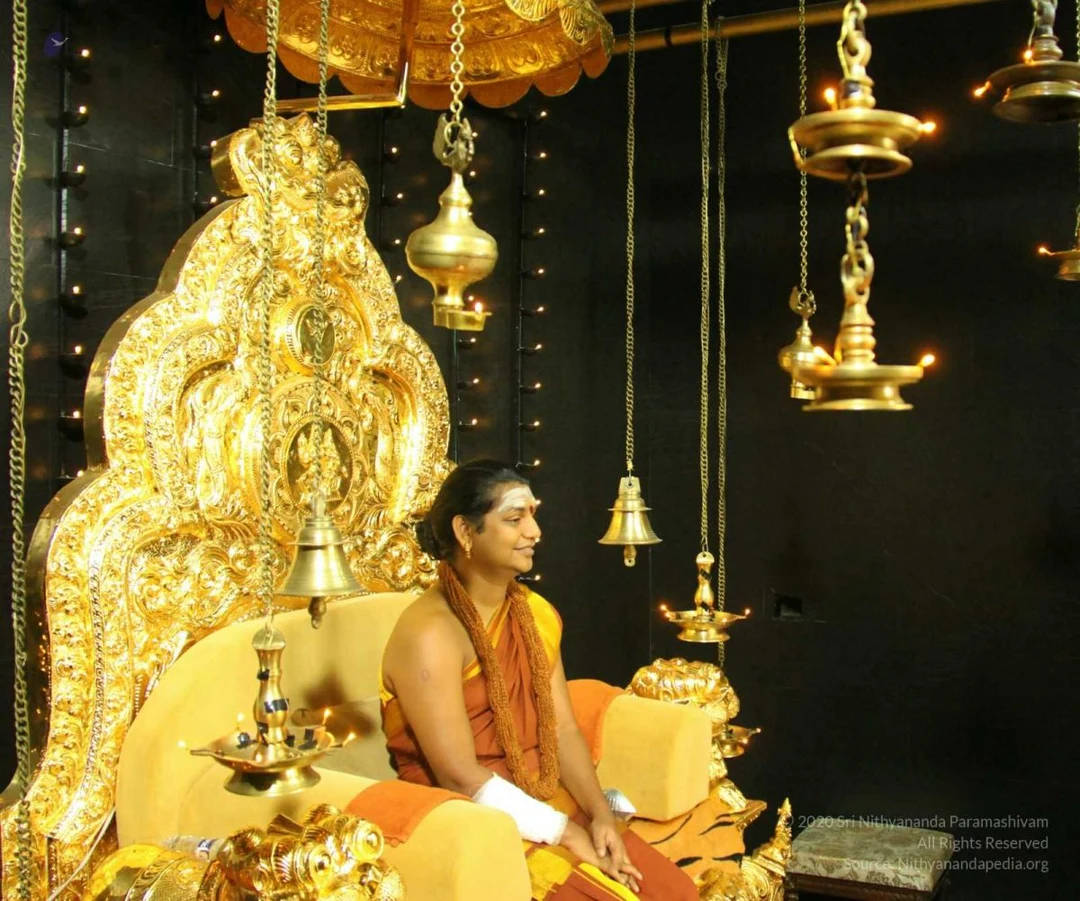
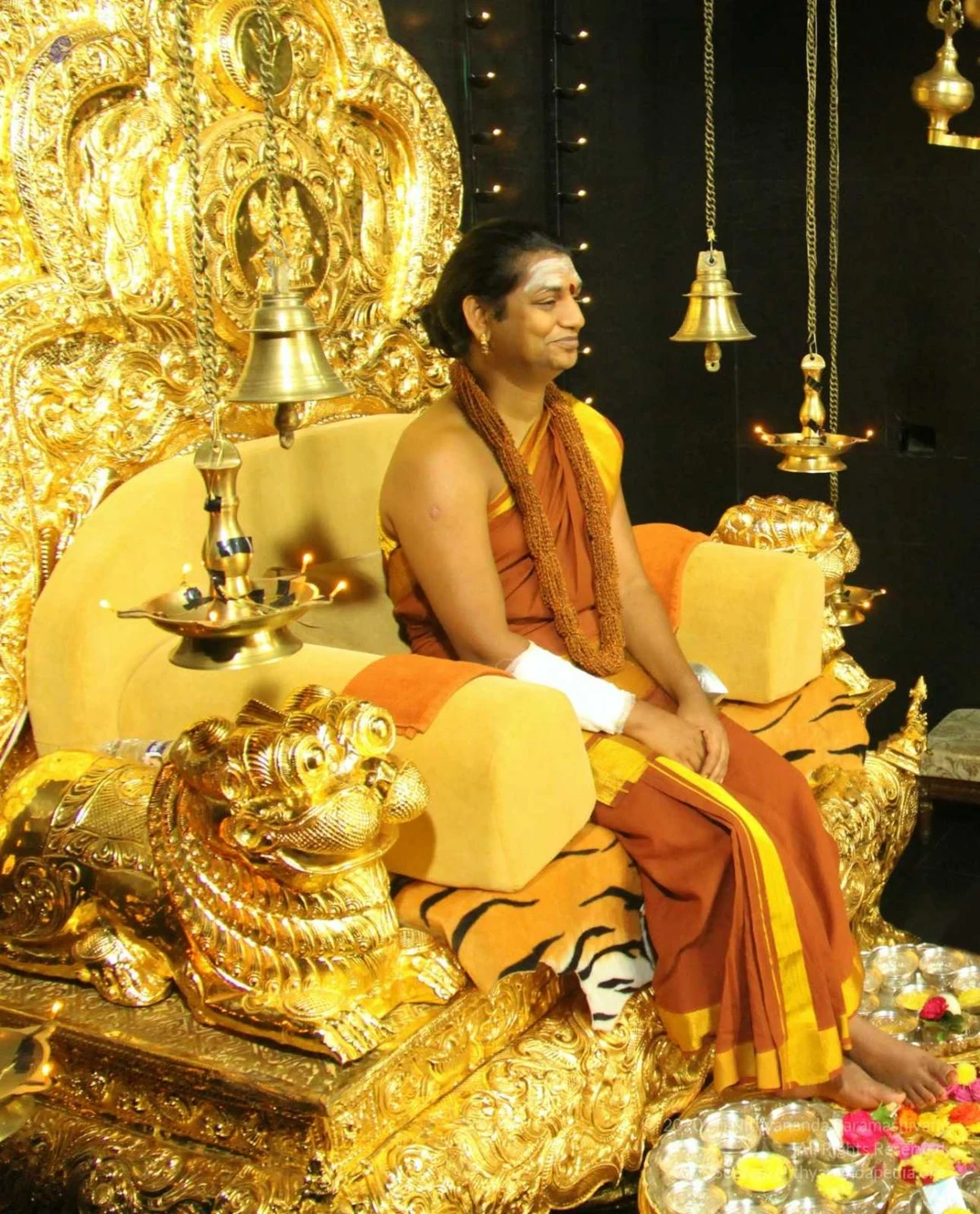
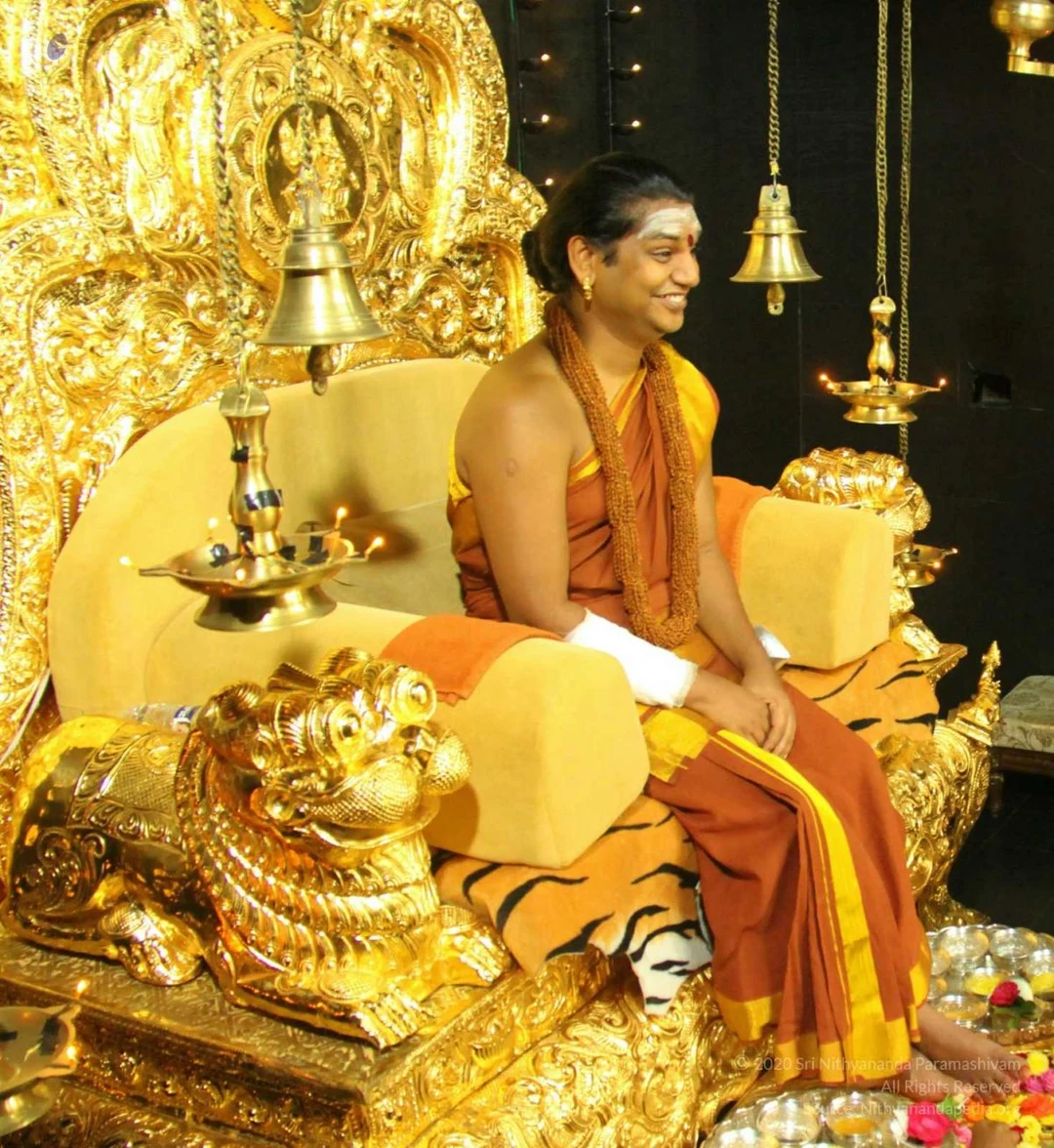
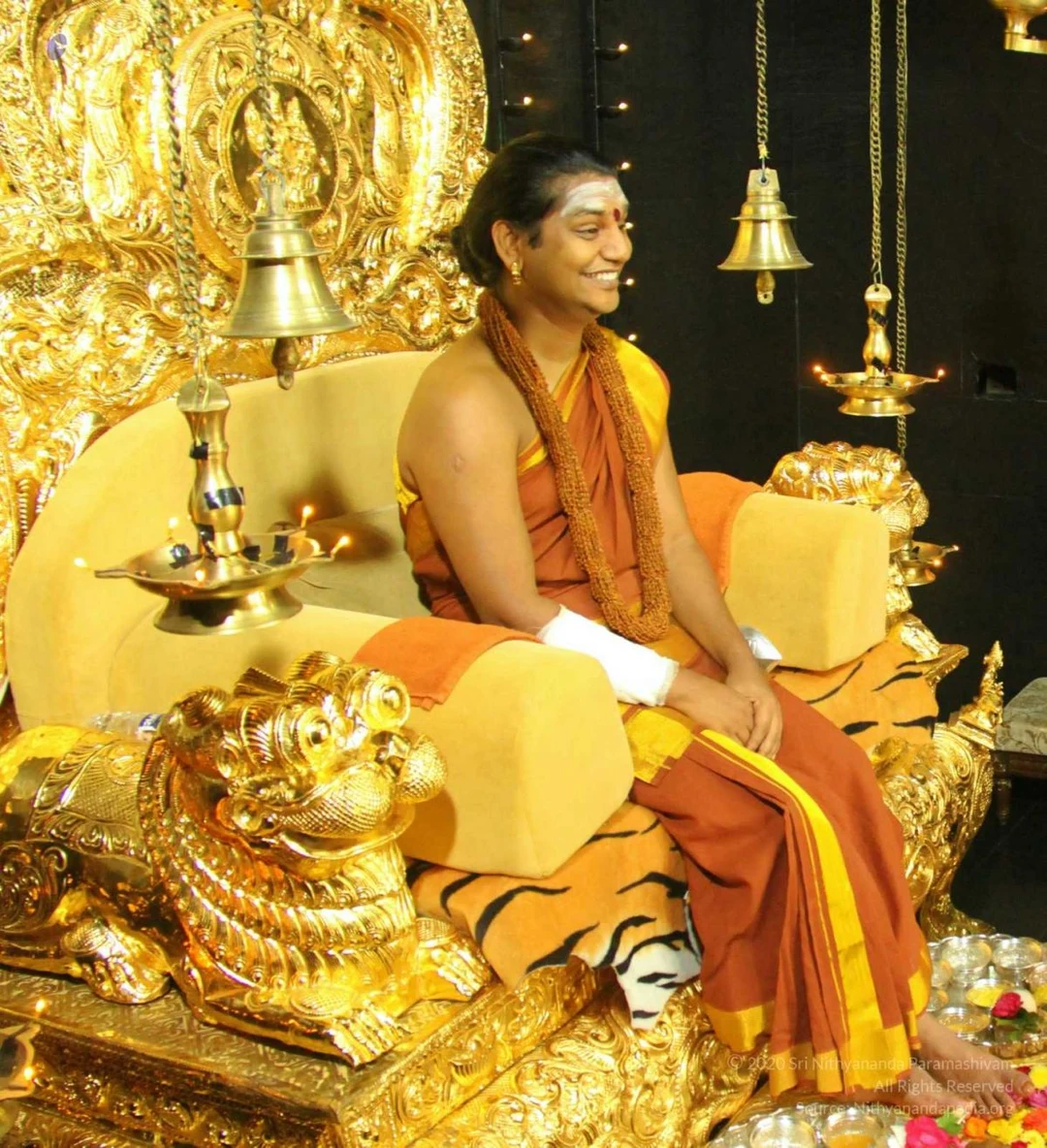
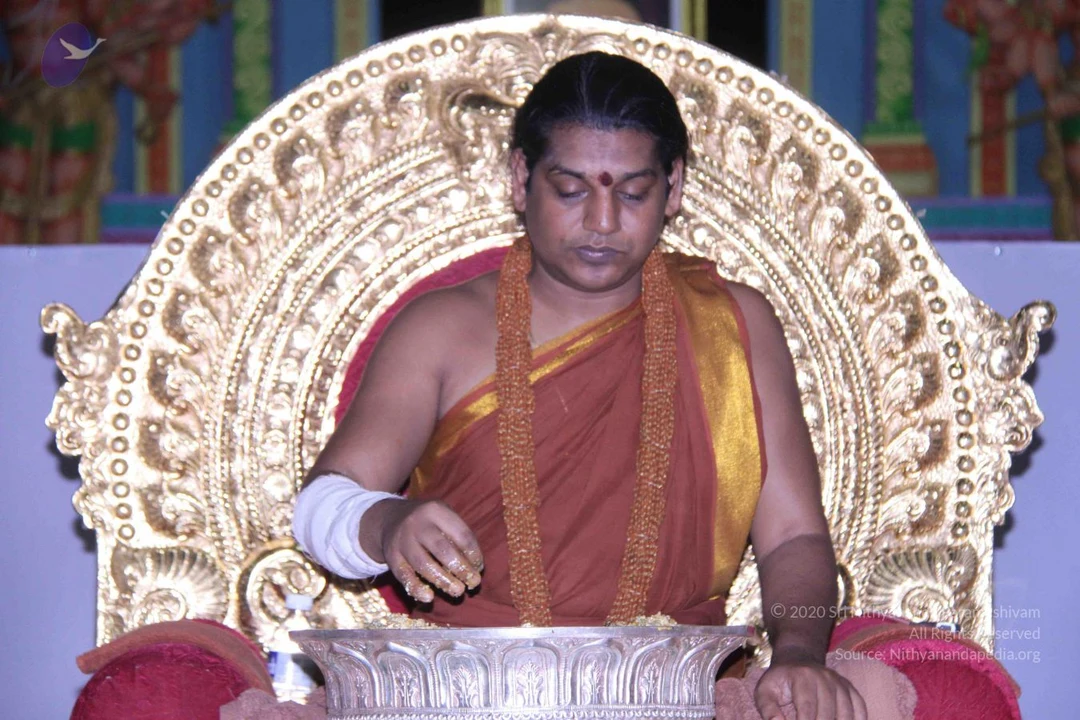
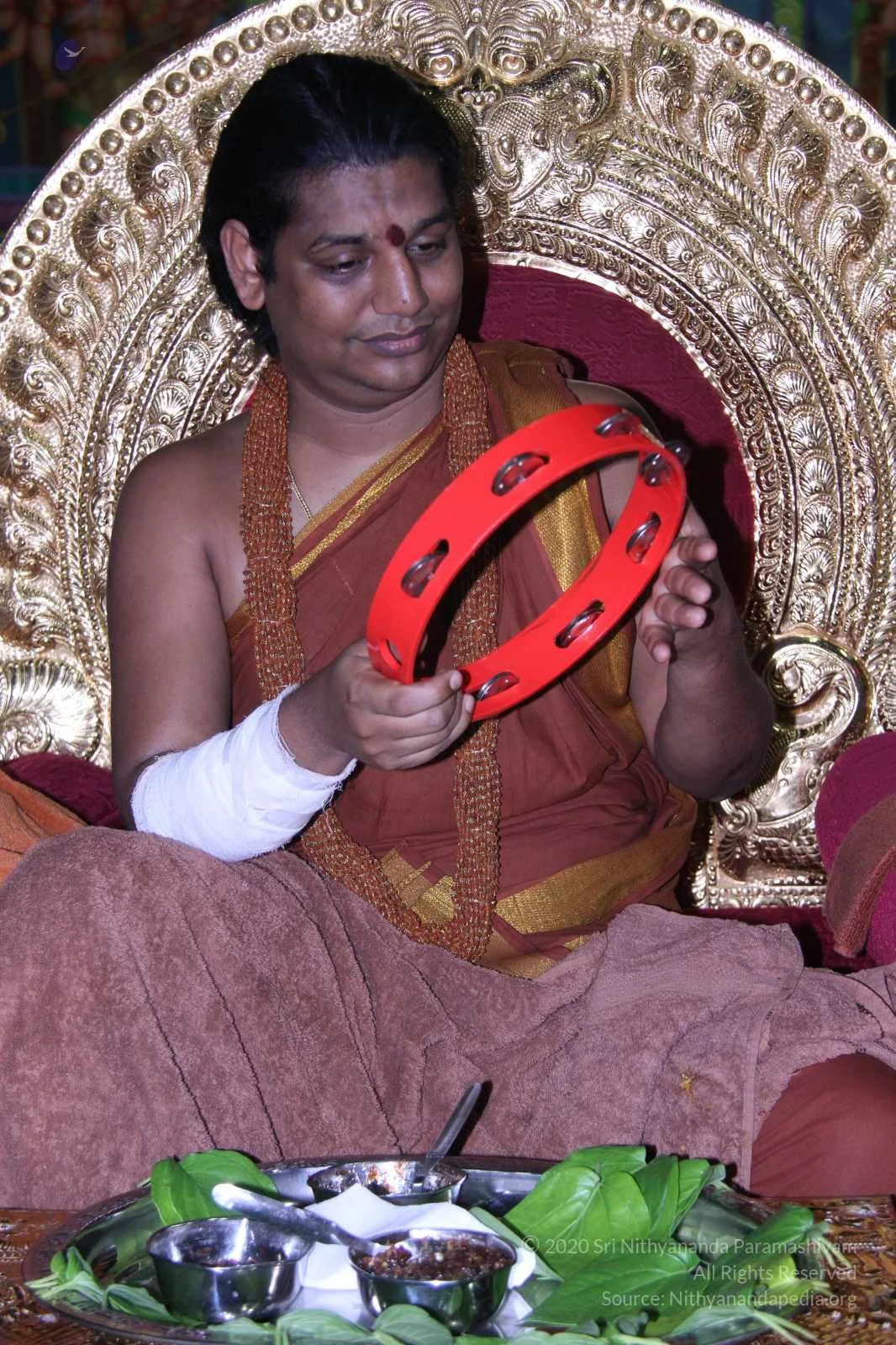
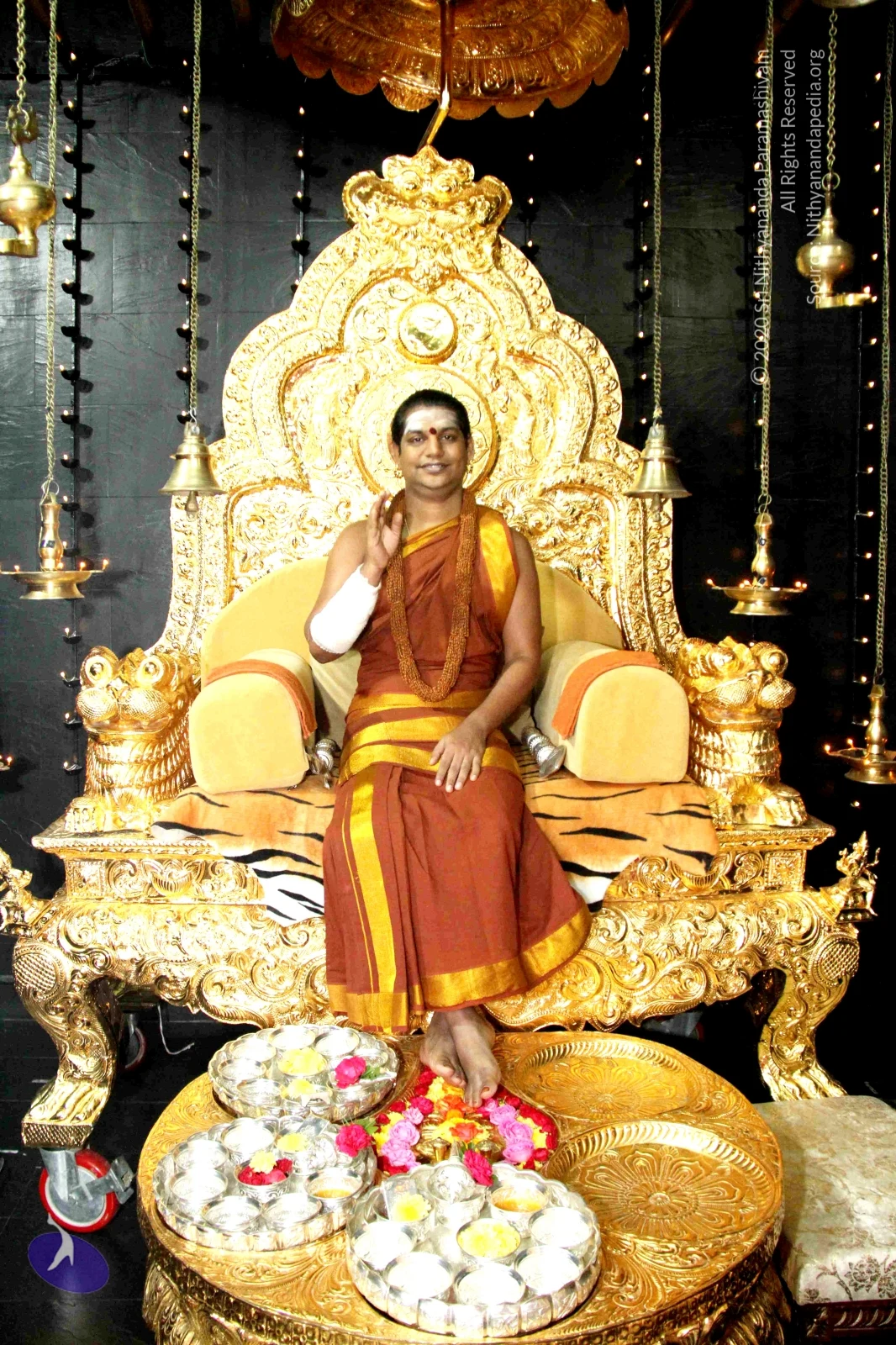
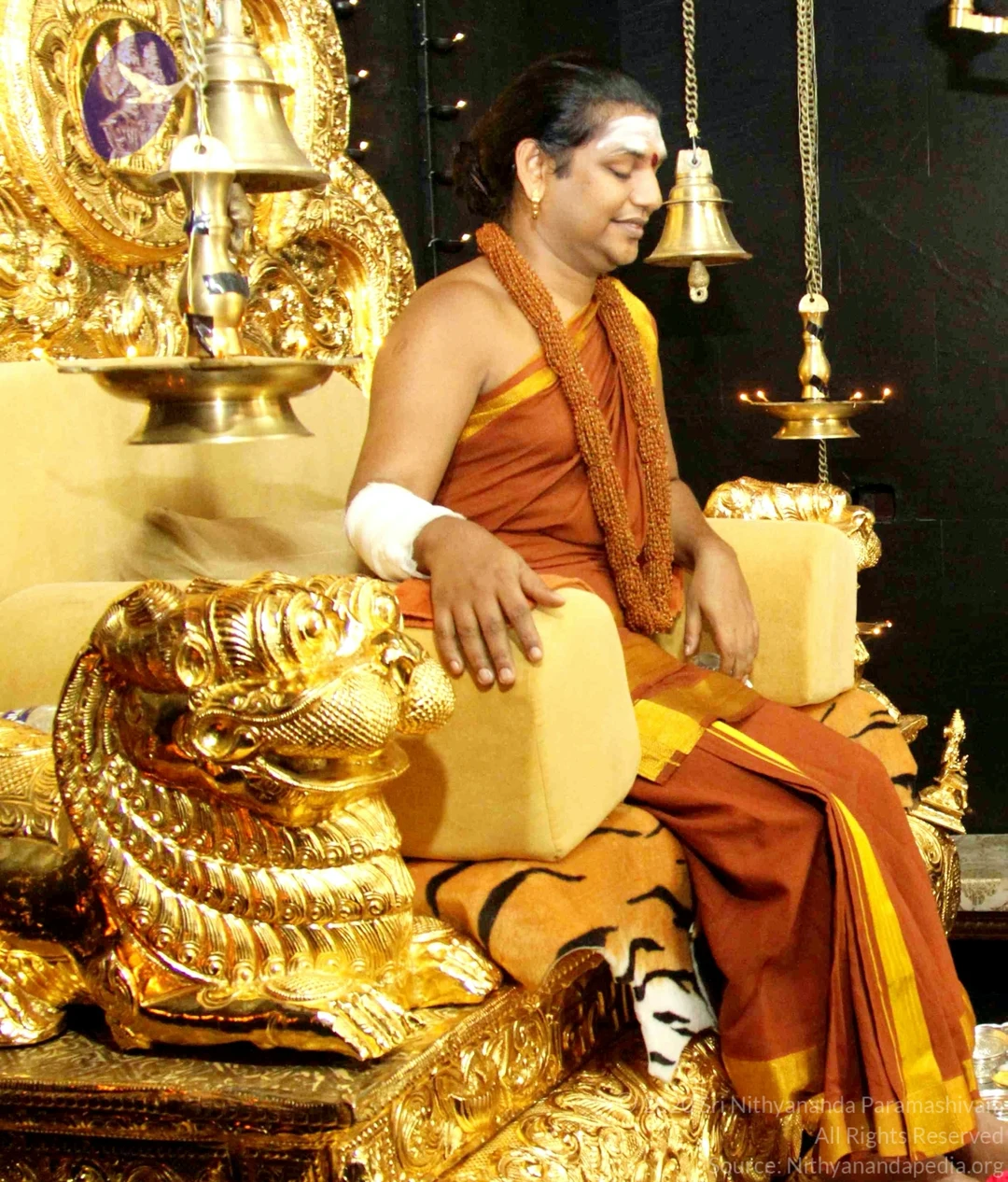
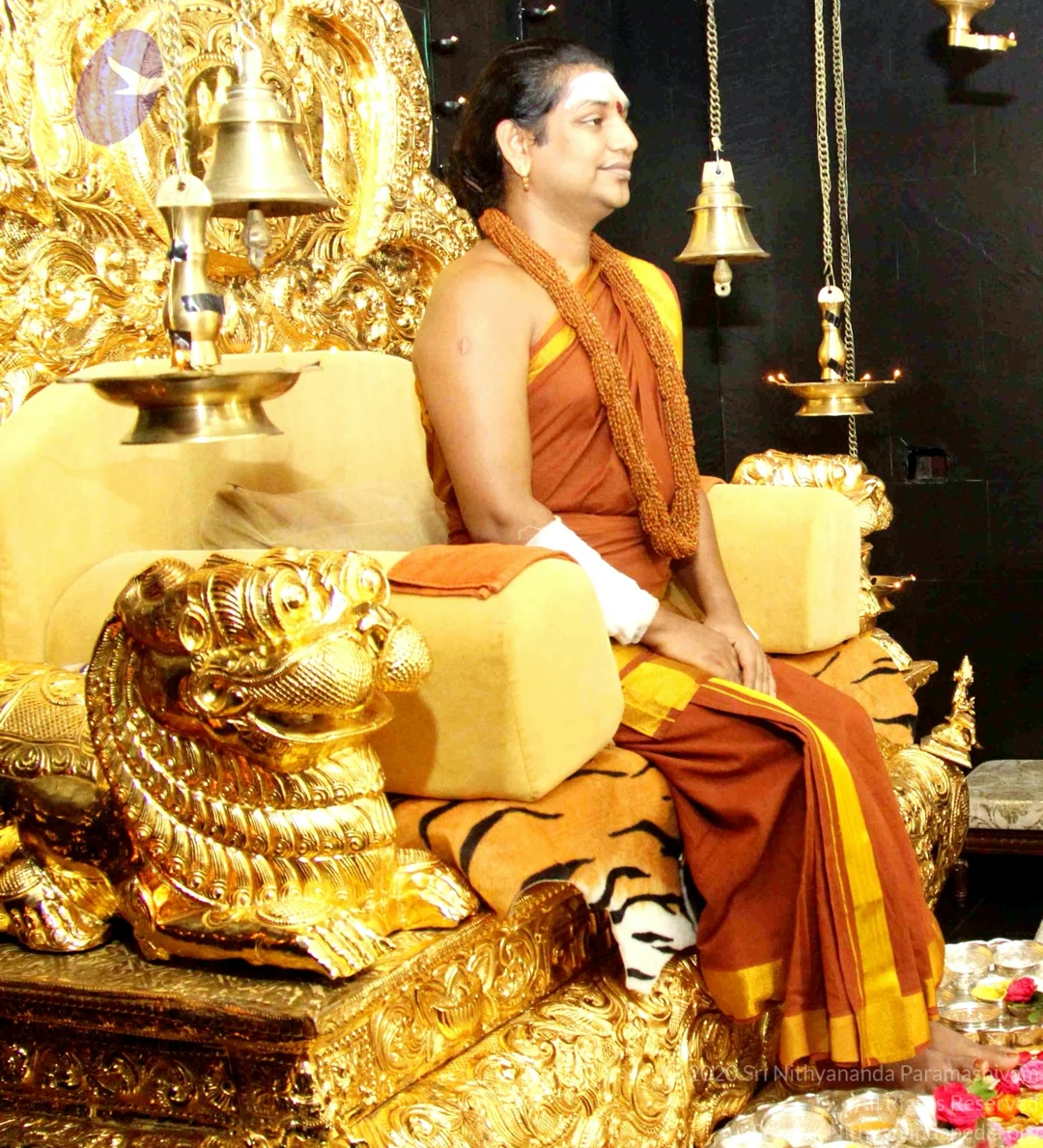
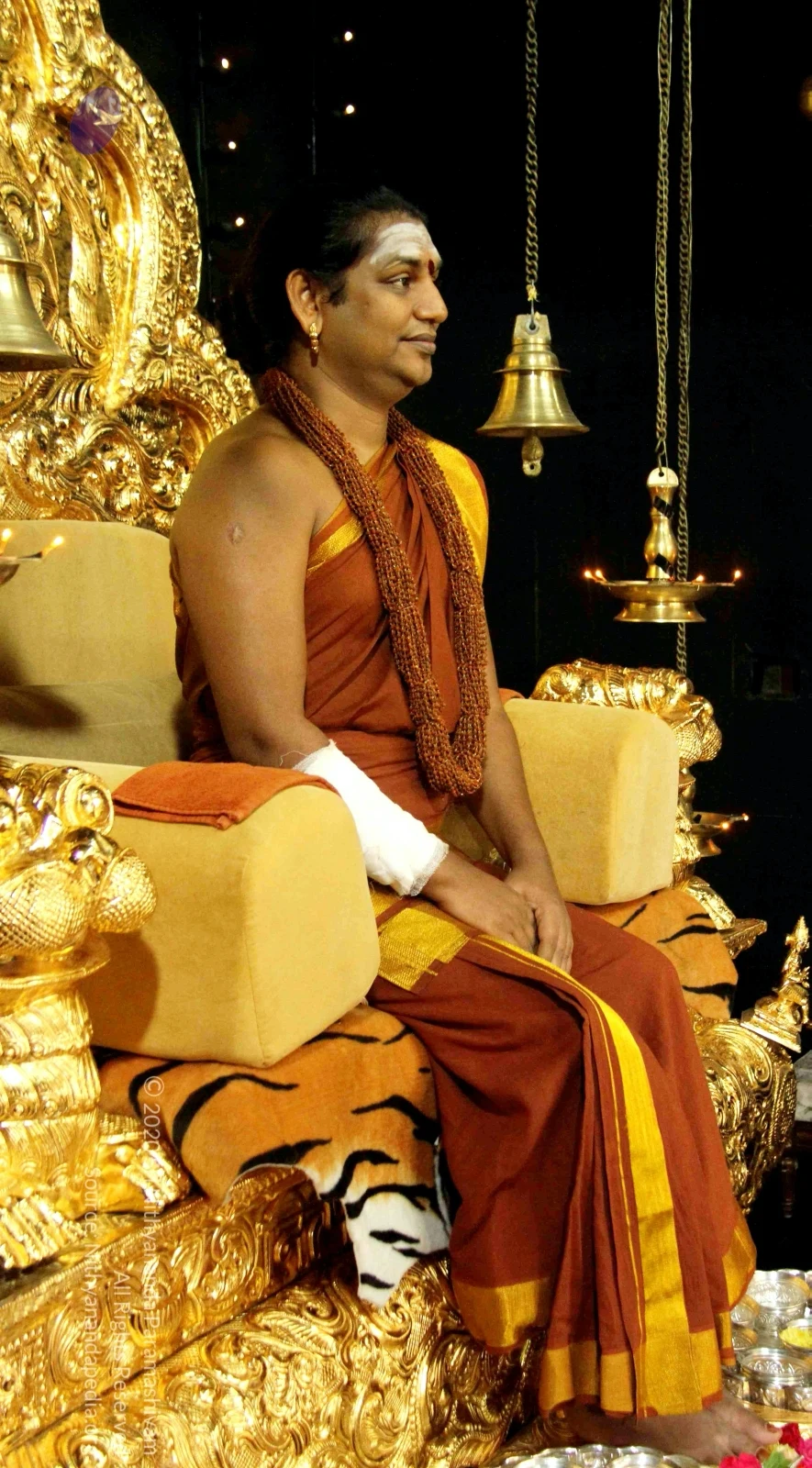
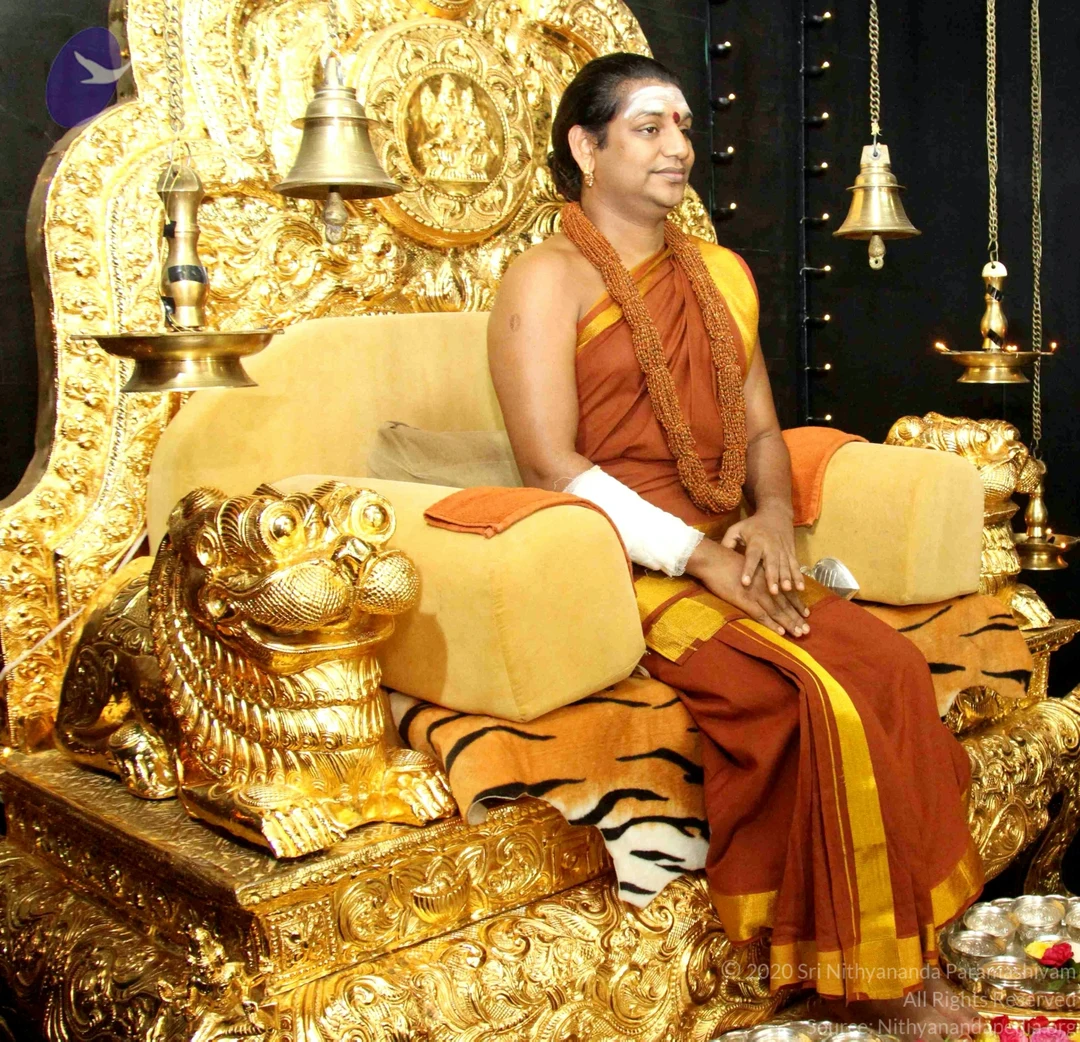
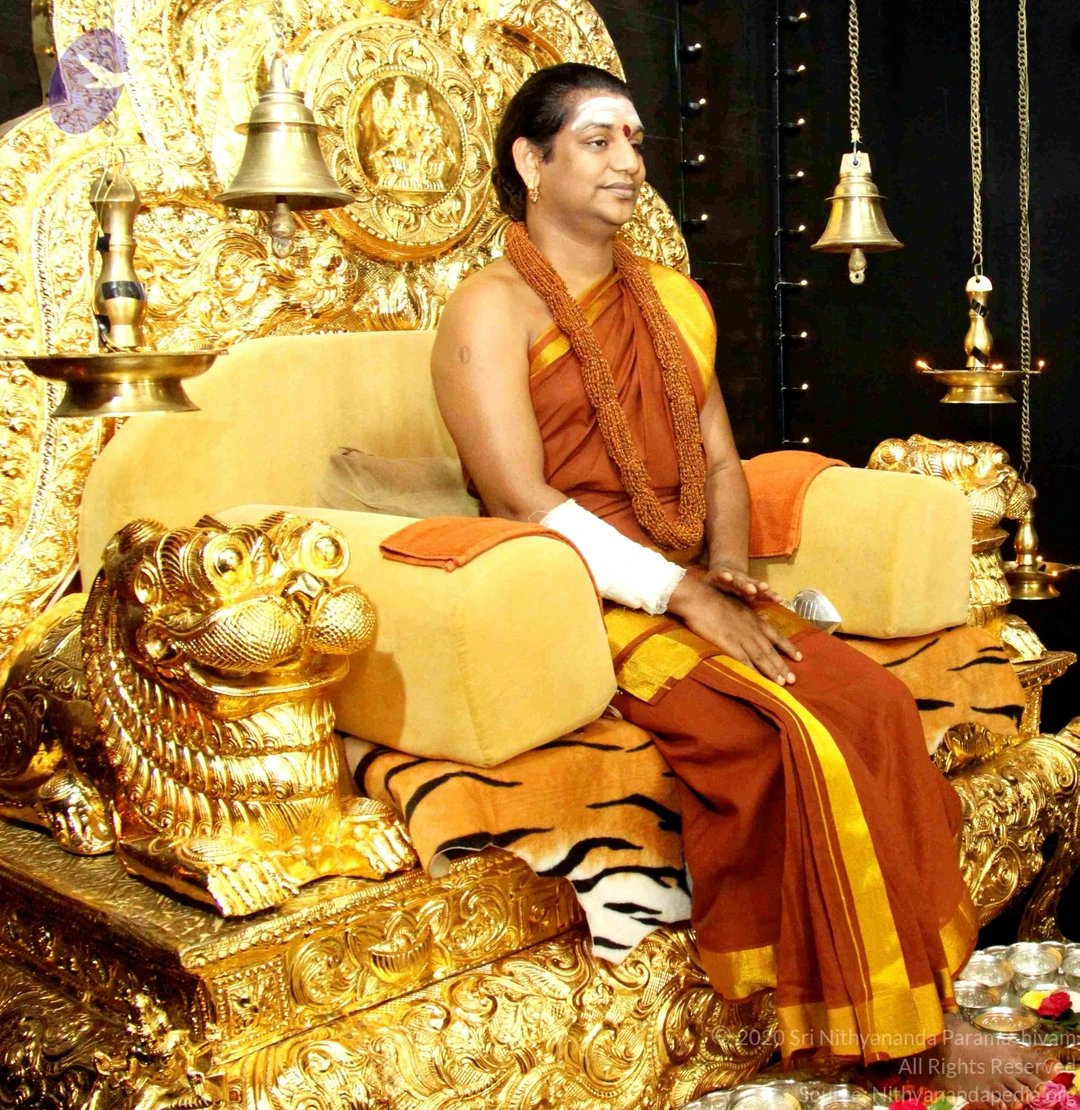
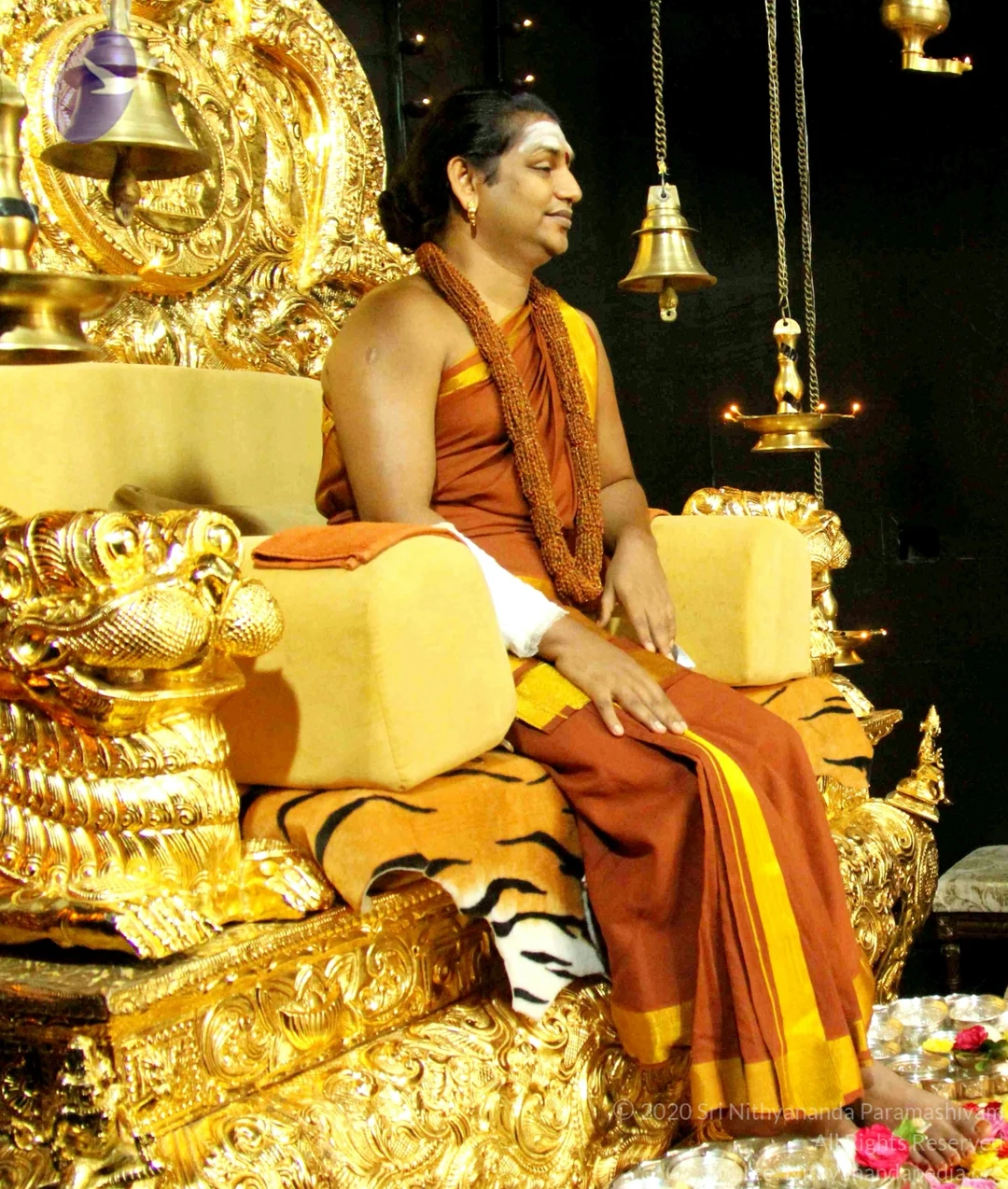
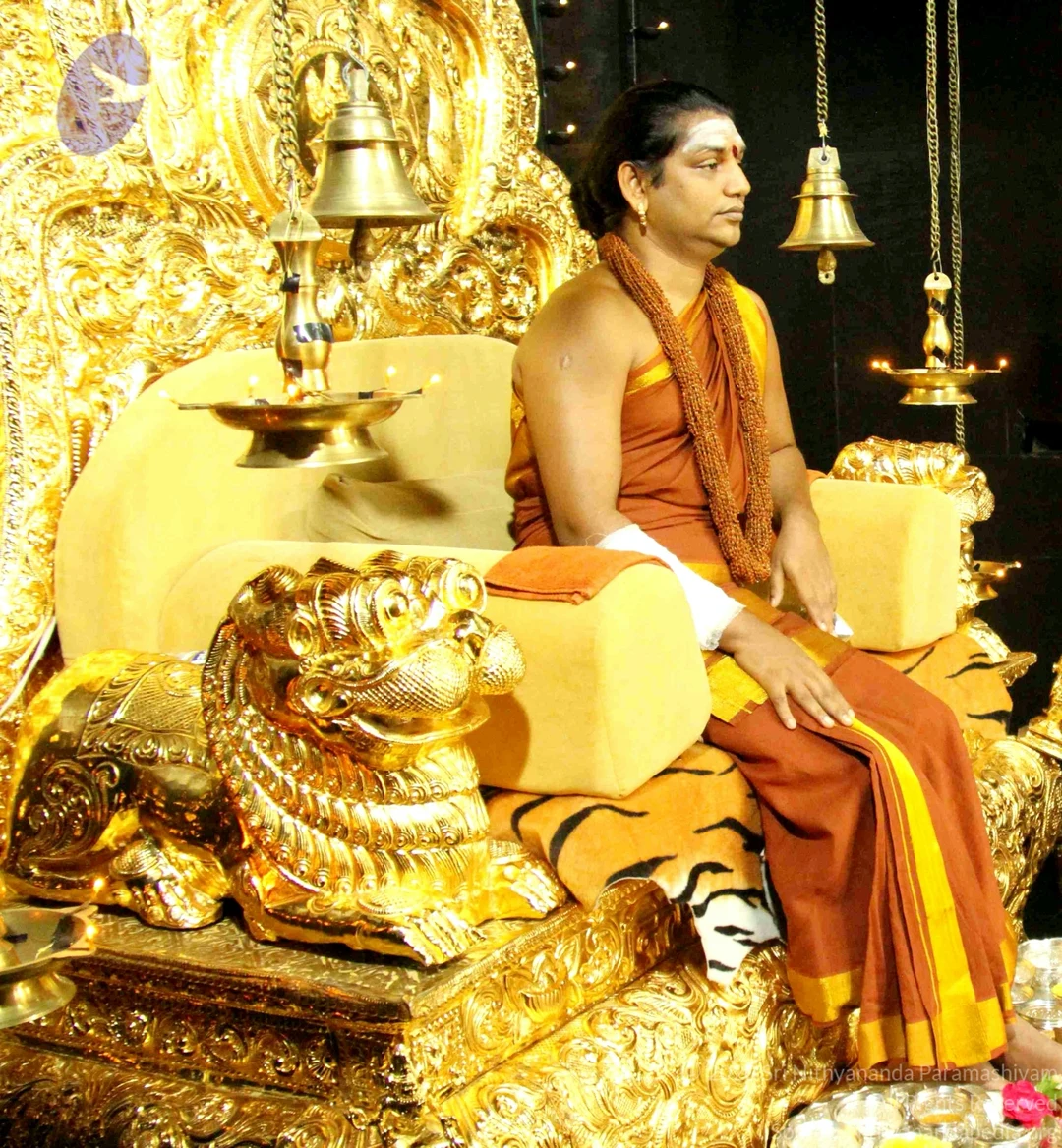
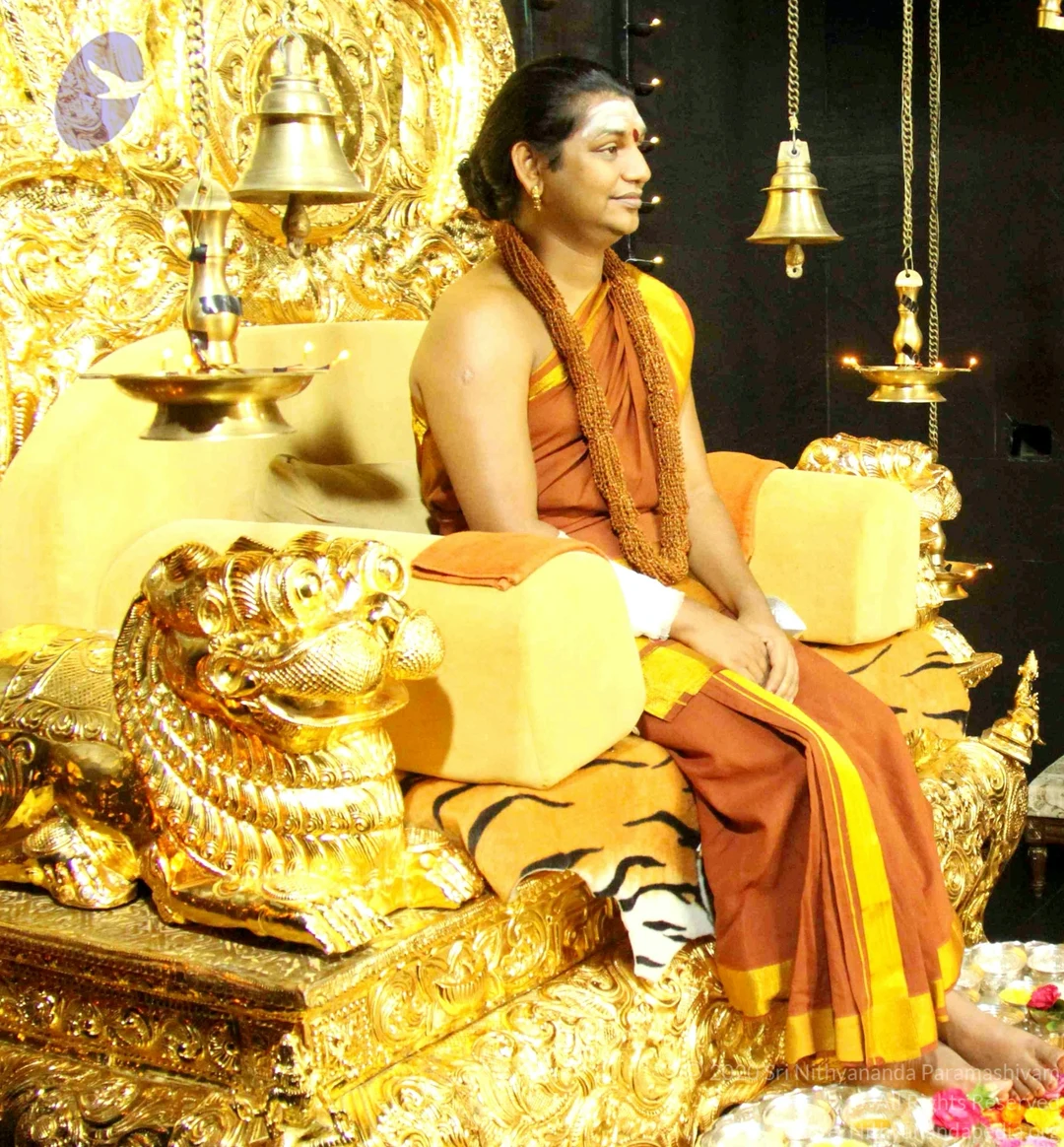
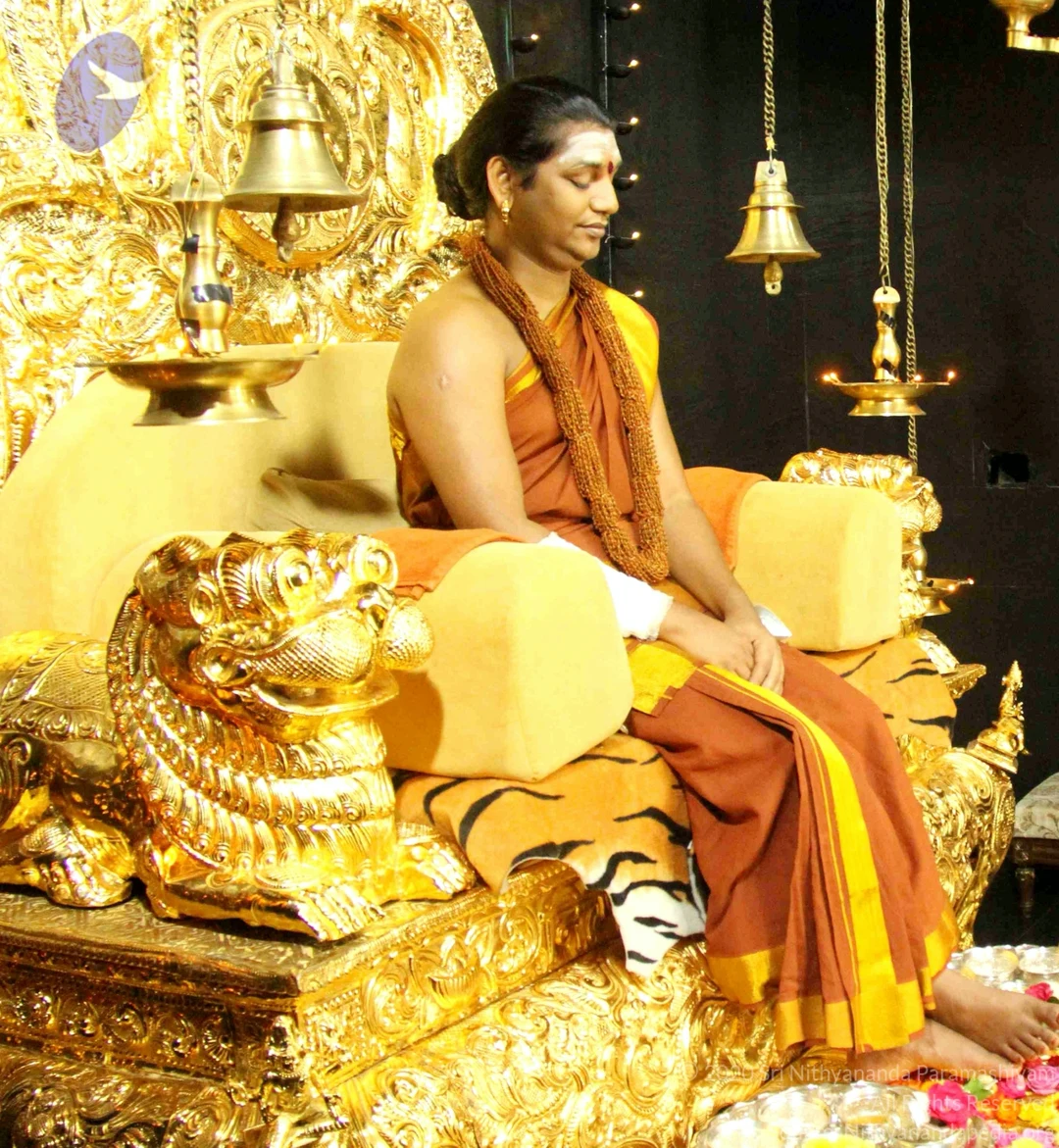
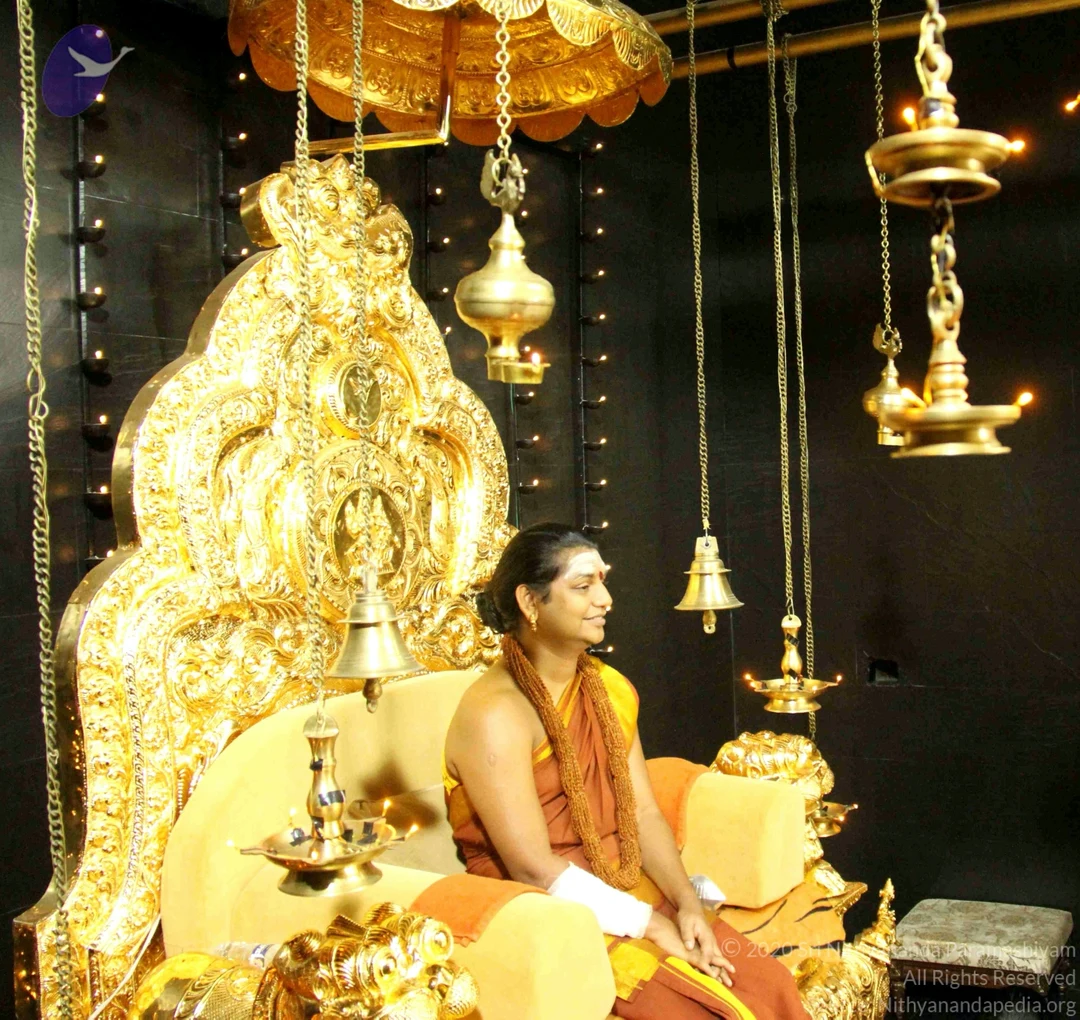
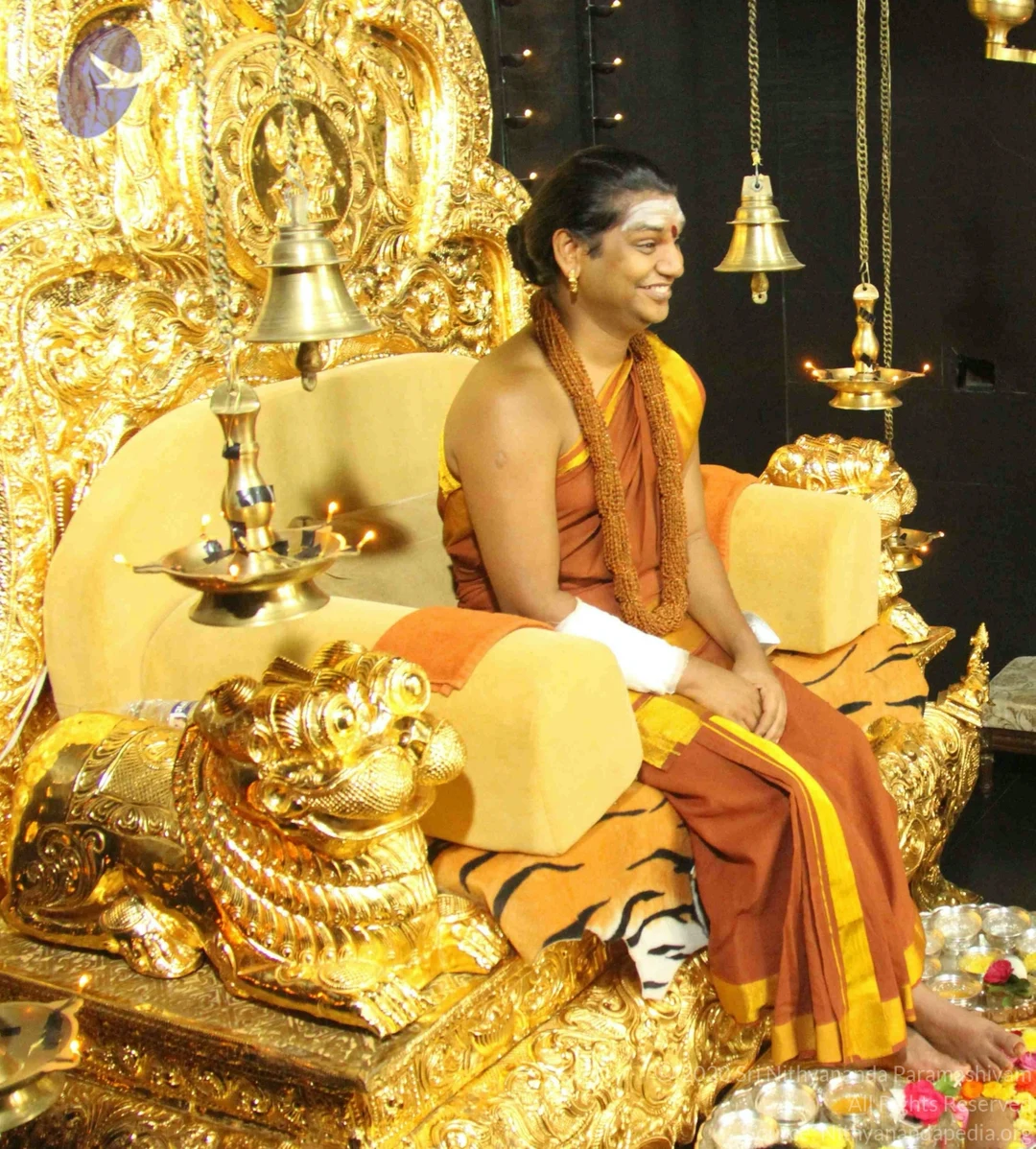
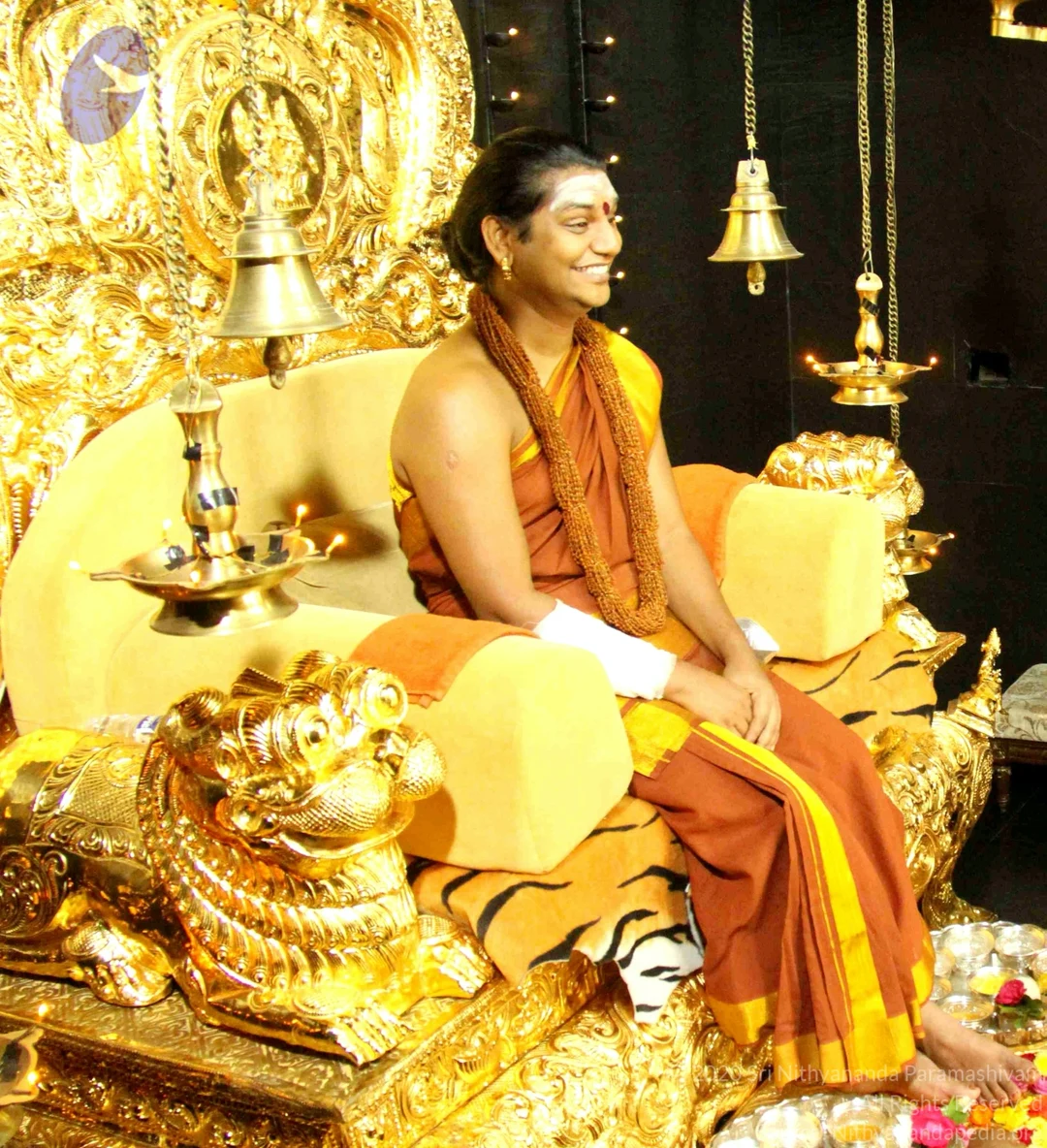
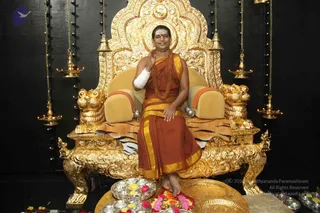
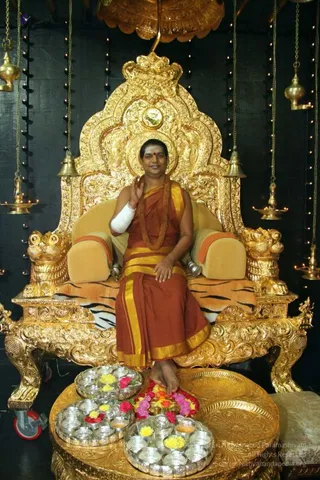
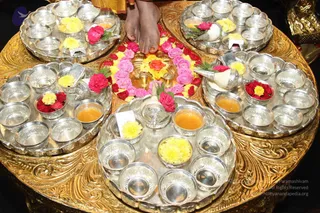
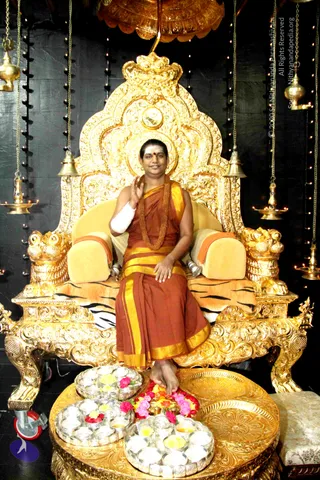
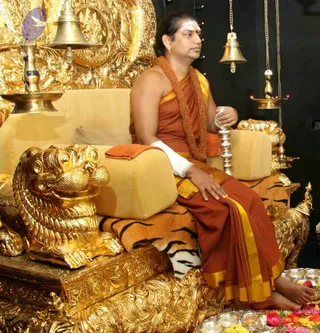
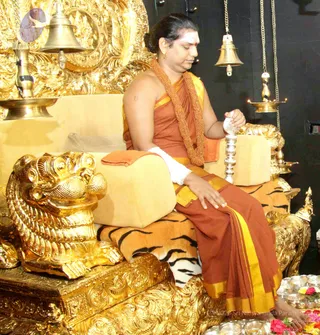
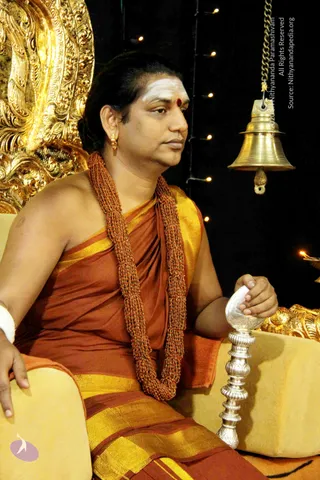
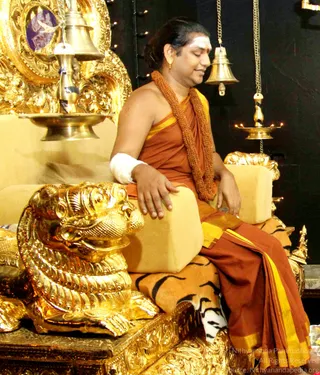
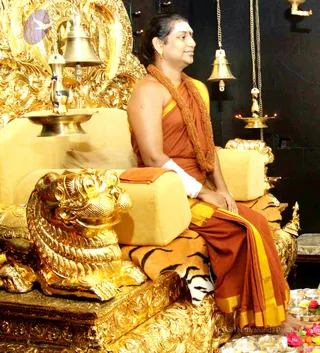
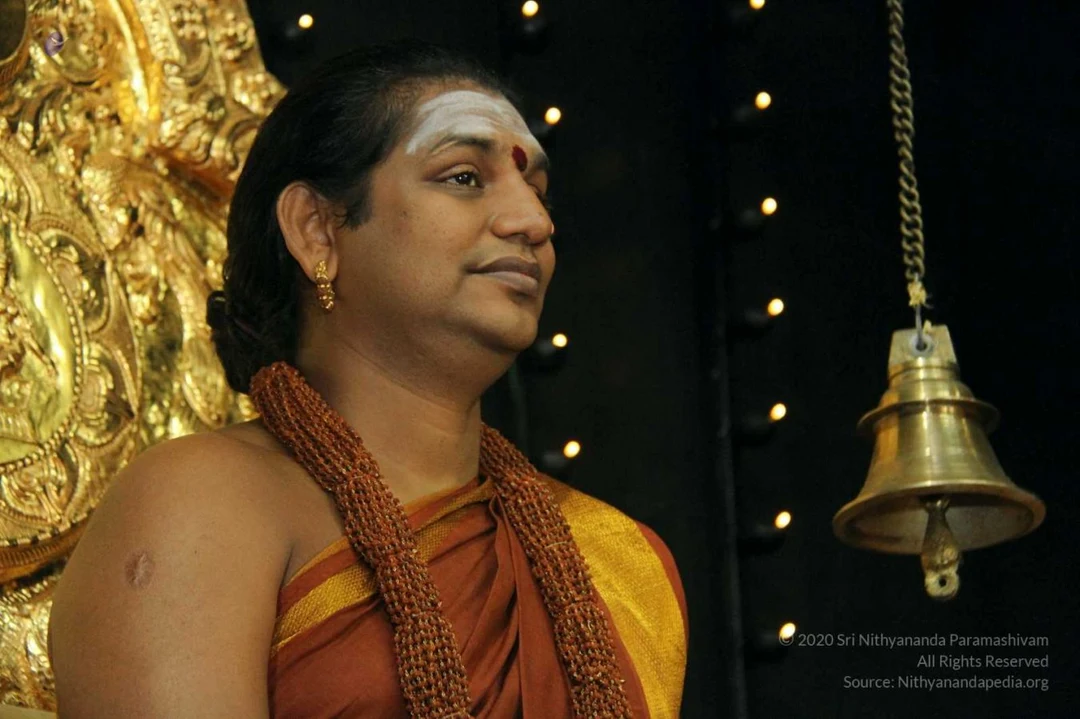
Close-up photograph of a pink rose with layered petals beside an ornately engraved silver vessel with a raised rim and floral and geometric chasing. Green leaves and stems appear at the right, and a blurred red flower sits in the background. No people are visible.A seated man in an ornate gold throne with carved lion-head armrests and a tiger-striped cushion raises one hand in blessing. He wears an orange-maroon robe with gold borders, a rudraksha mala necklace, and a white bandage on the raised forearm, with white and red tilak on his forehead. Before the throne stand silver bowls of flowers, a gold plate with pink and red blossoms, and oil lamps hang from the chains behind. a person candidate, identified only by appearance cues in this setting.A man in a rust-orange and gold-bordered robe sits on an ornate gilded throne with lion-head armrests and a tiger-striped cushion, one hand raised in blessing and a white bandage on the other forearm. He wears a long rudraksha mala, a red bindi and a vibhuti horizontal mark on his forehead. In front of the throne, silver thalis hold yellow and orange flowers, and flower petals and marigolds are scattered on a gold tray. Hanging brass oil lamps and rows of small lamps decorate the dark backdrop.A photograph of a padapuja arrangement on an ornate gold tray. Bare feet of a person stand on a bed of pink, red and yellow flower petals beside a brass lamp and small brass vessels. Around the centre are silver plates and bowls holding yellow marigold blossoms, red roses, orange liquid offerings and a silver kalasha-style vessel with a spout. A corner of a gold-coloured garment is visible at the top. The silver platters and bowls are arranged in a circular pattern for ritual offering. The image is a close top-down view with no visible faces.Close-up photo of bare feet standing on a golden tray during a padapuja ritual, surrounded by red, pink, orange and yellow roses and yellow marigold petals arranged in a ring. Silver and brass bowls with flowers, a silver spoon and a small golden kalasha-style vessel sit around the tray. The feet belong to a person whose face is not visible, and no other people are shown.A smiling man sits on a gold-ornate throne-like seat in front of a golden carved backrest showing a deity figure. He wears an orange-saffron dhoti-style wrap with a gold border and a long rudraksha-style brown bead mala draped over his shoulders, a white tilak on his forehead and a red dot at the centre. A brass hanging bell and a brass oil lamp with a lit flame stand at right against a dark panelled wall.

NithyaSatsang_Swamiji
31 photosSource gallery
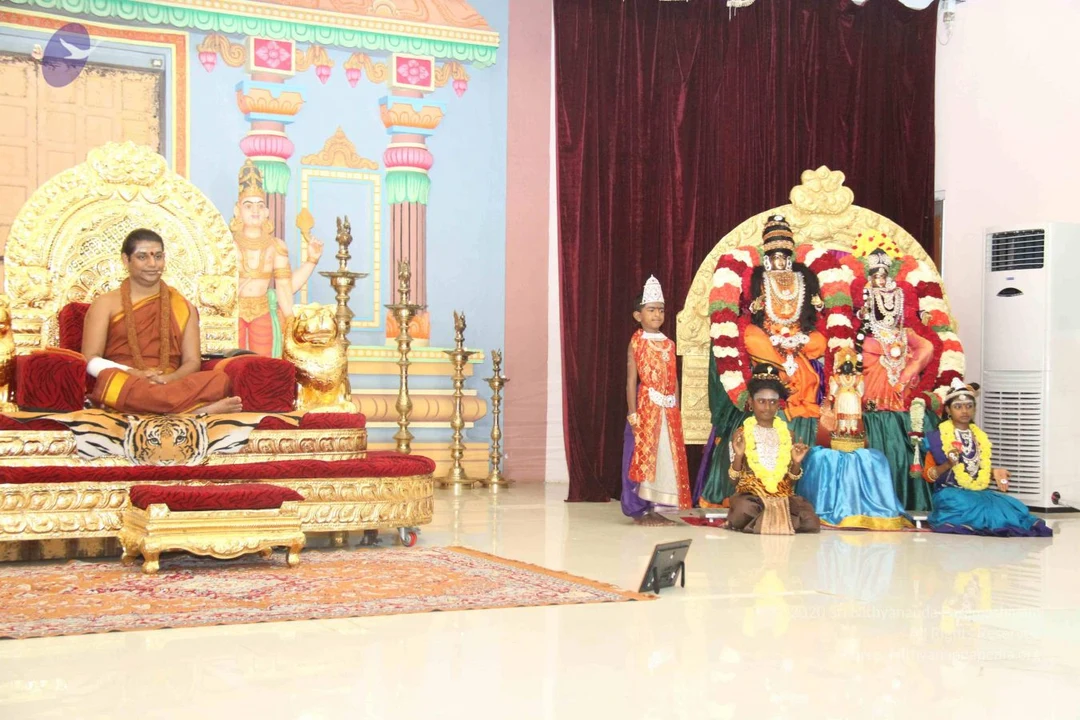
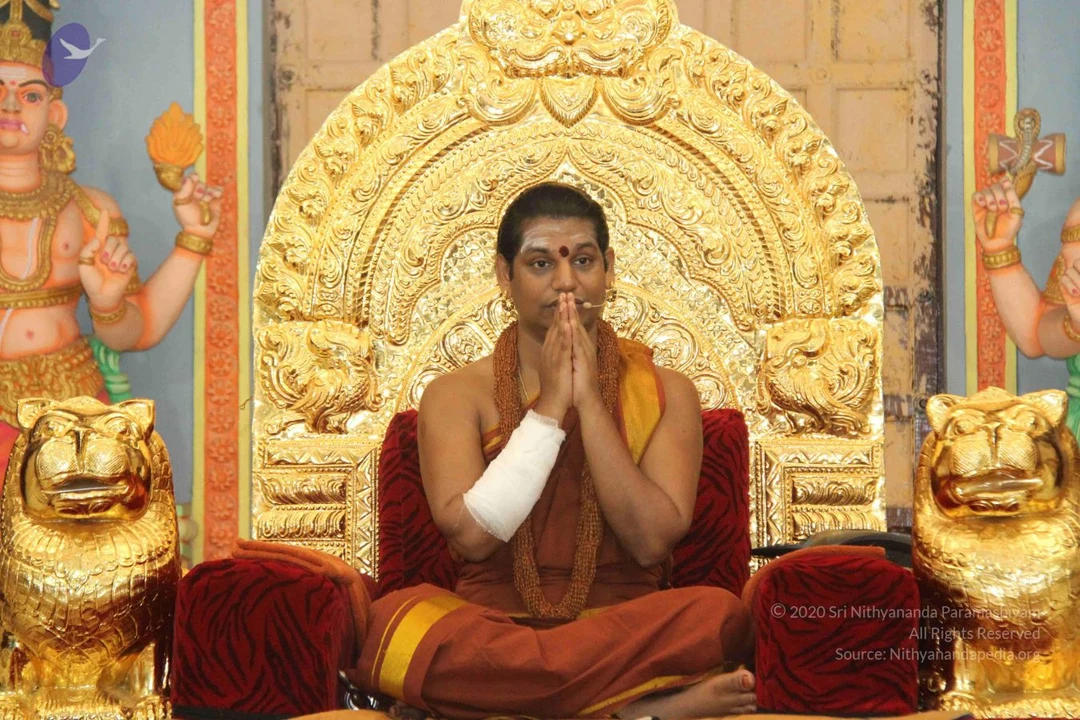
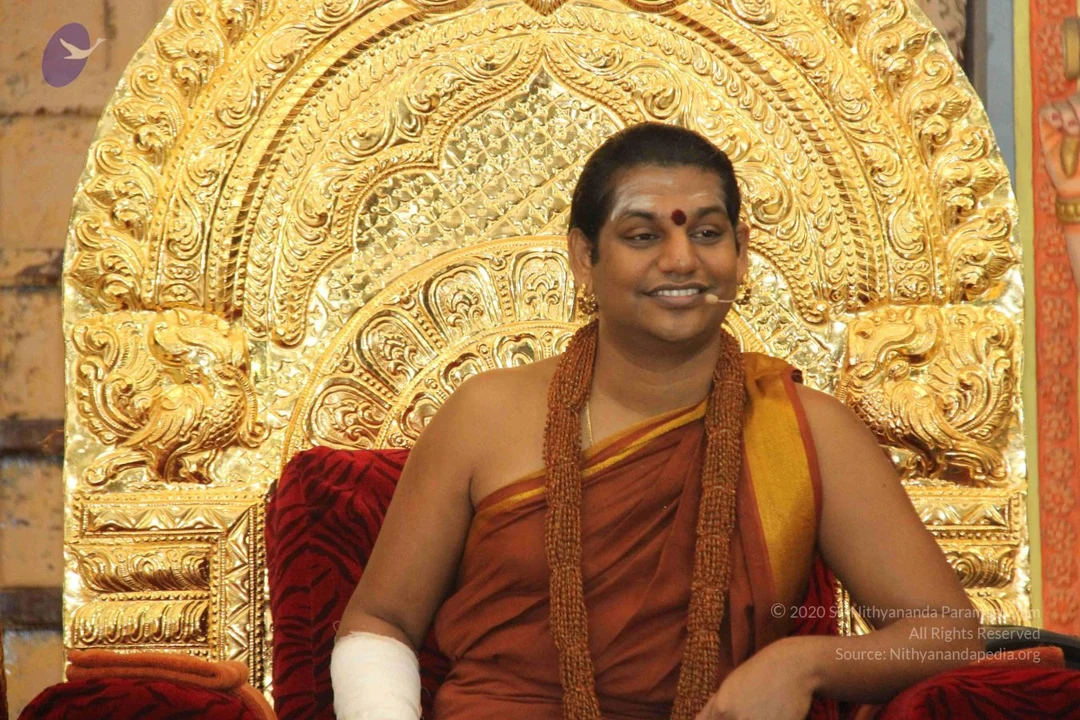
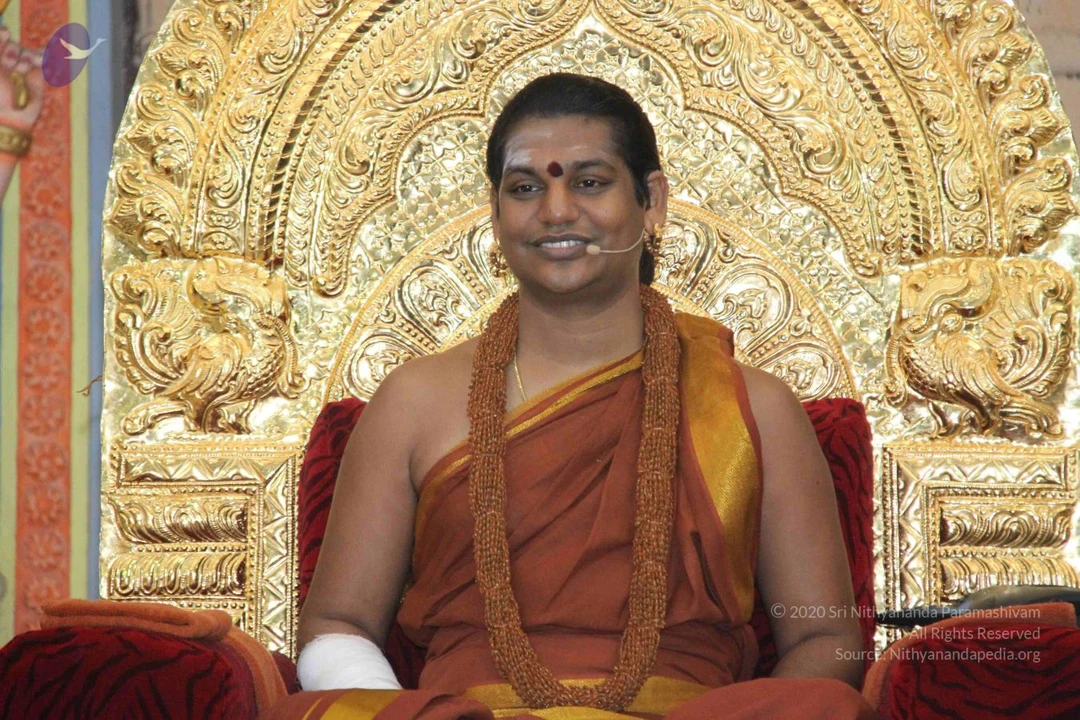
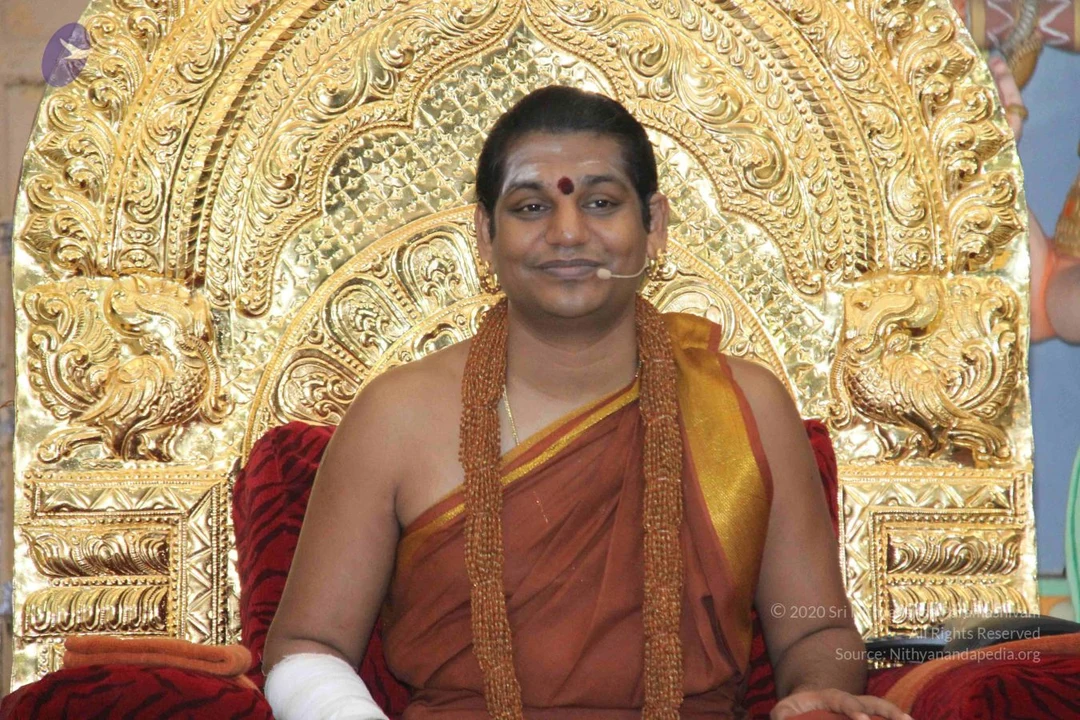
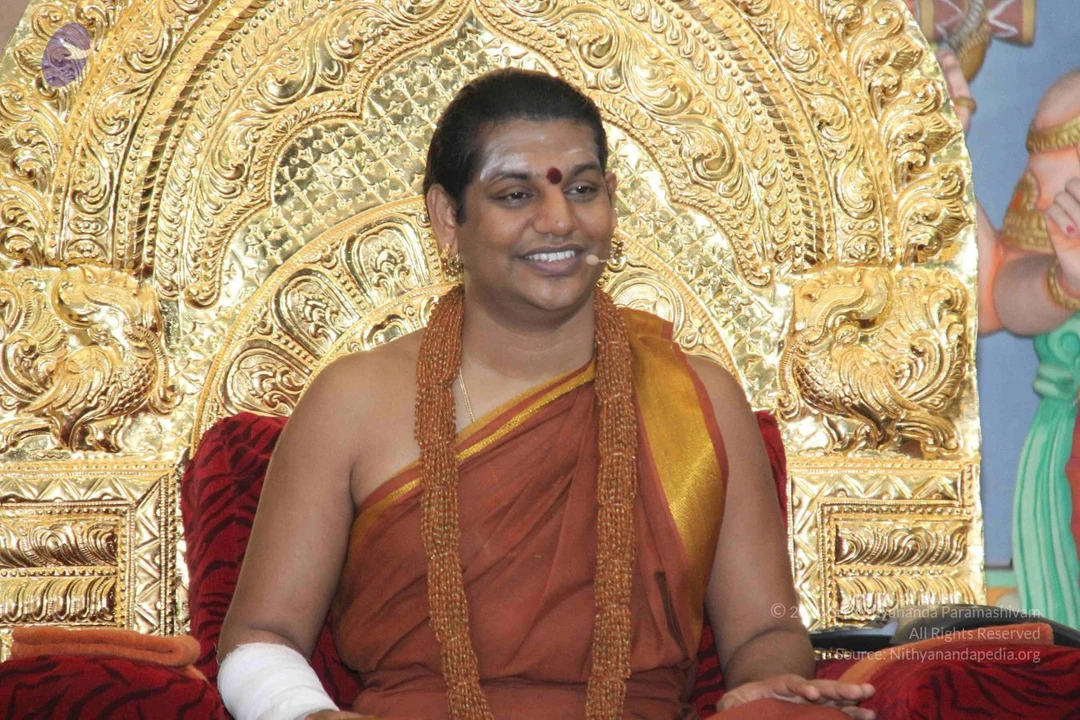
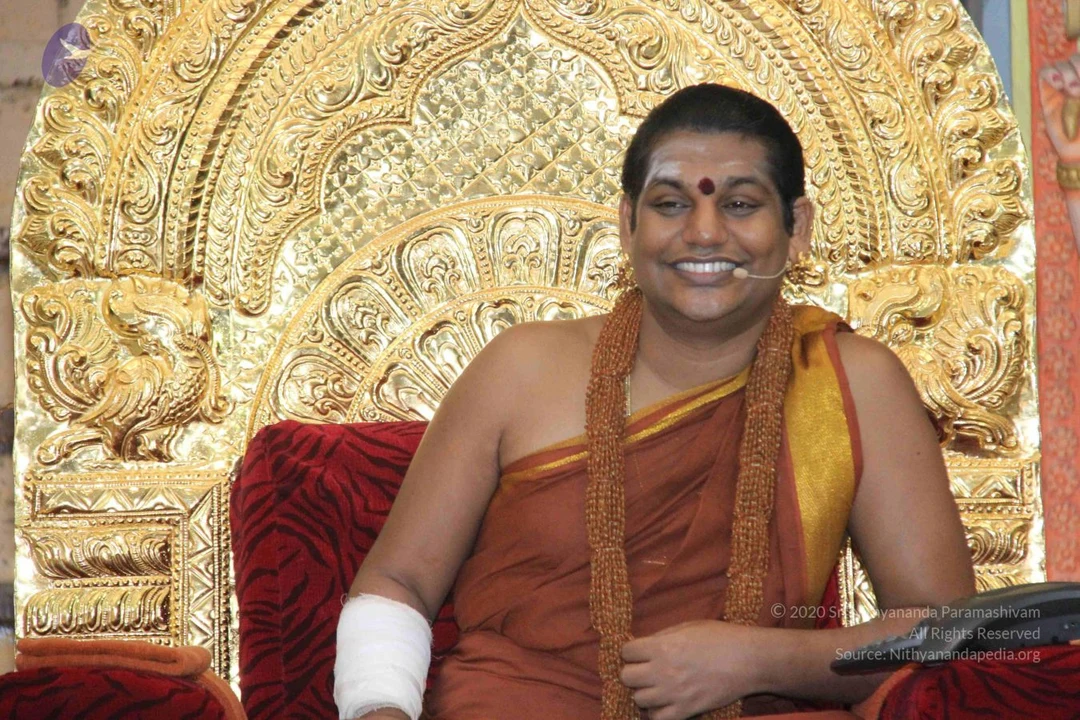
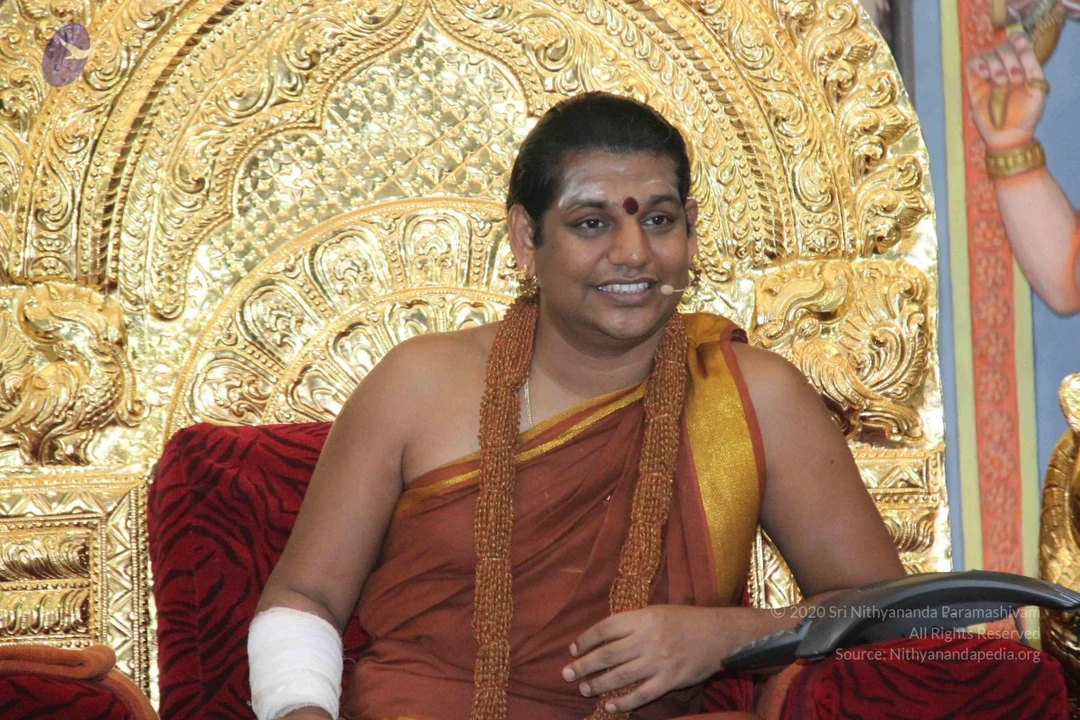
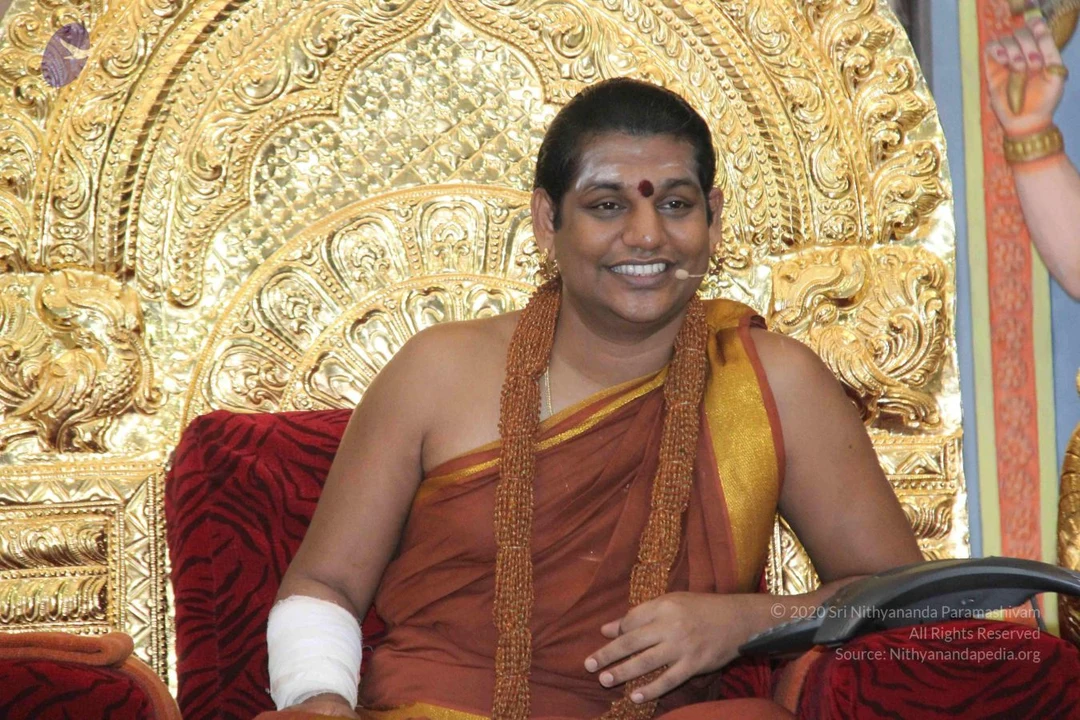
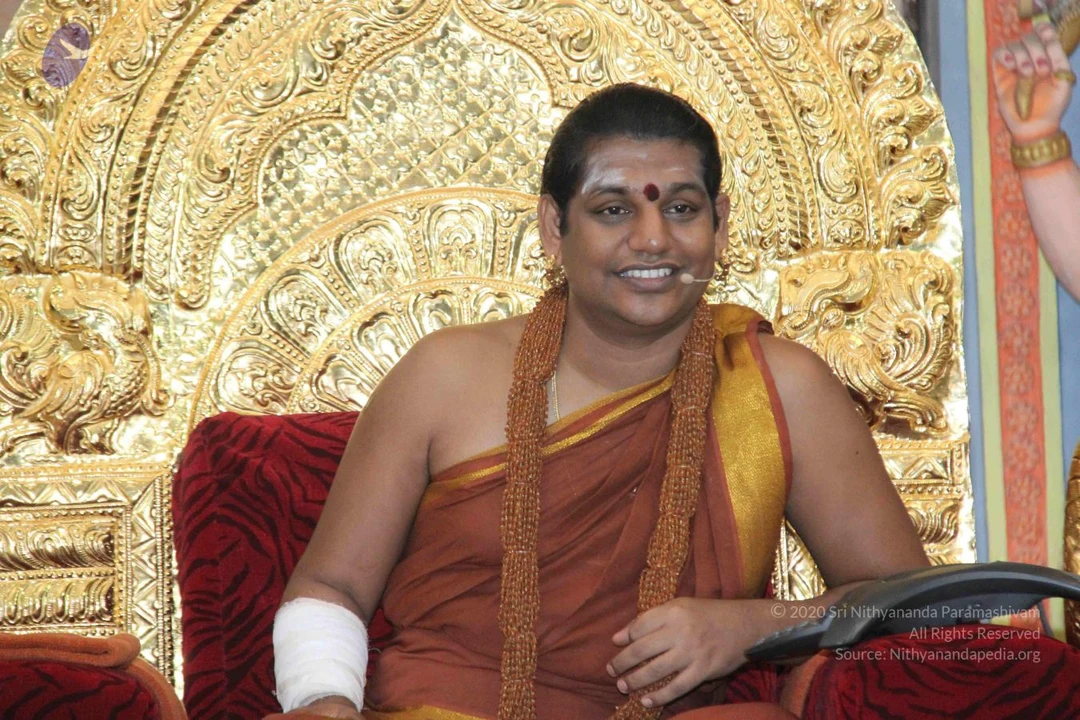
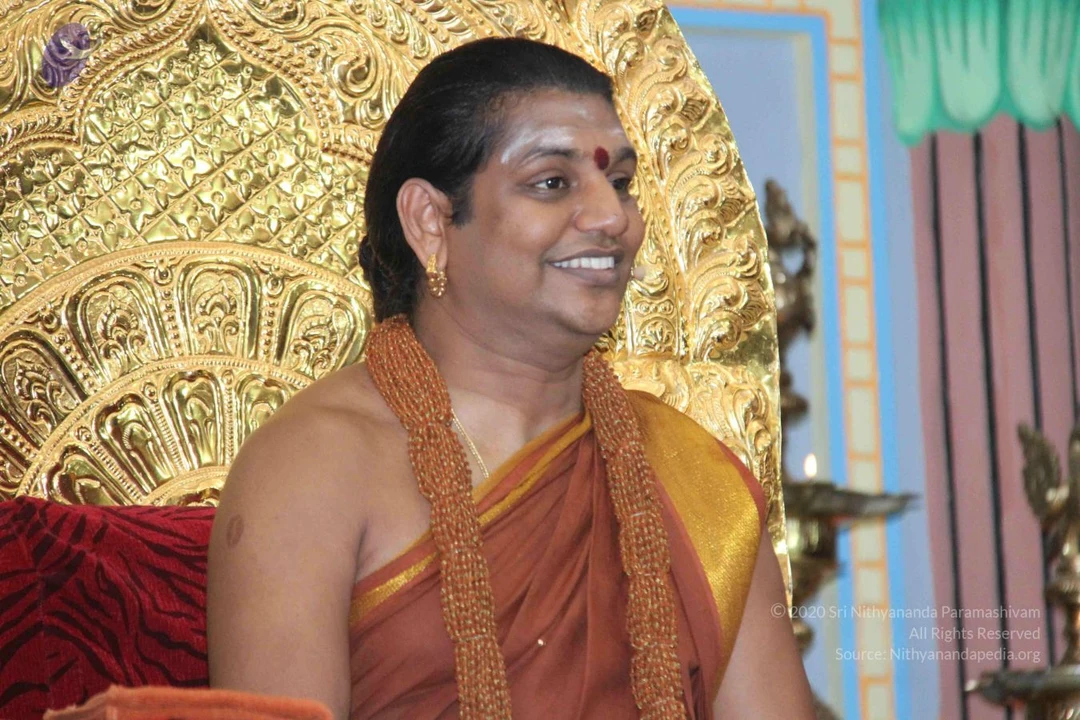
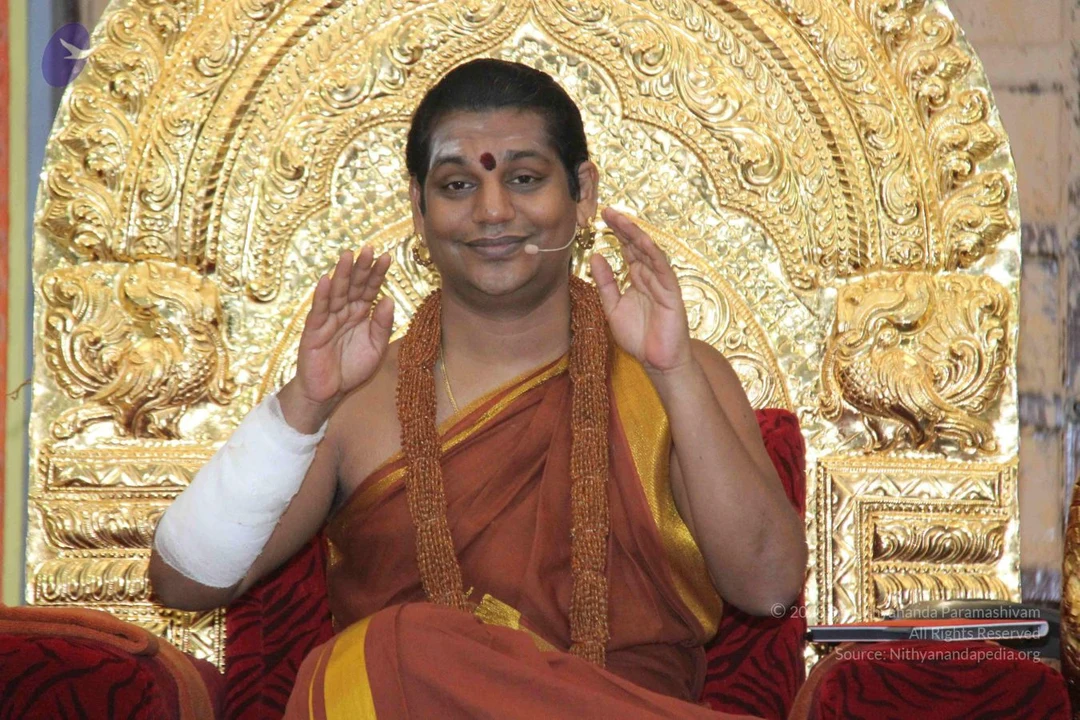
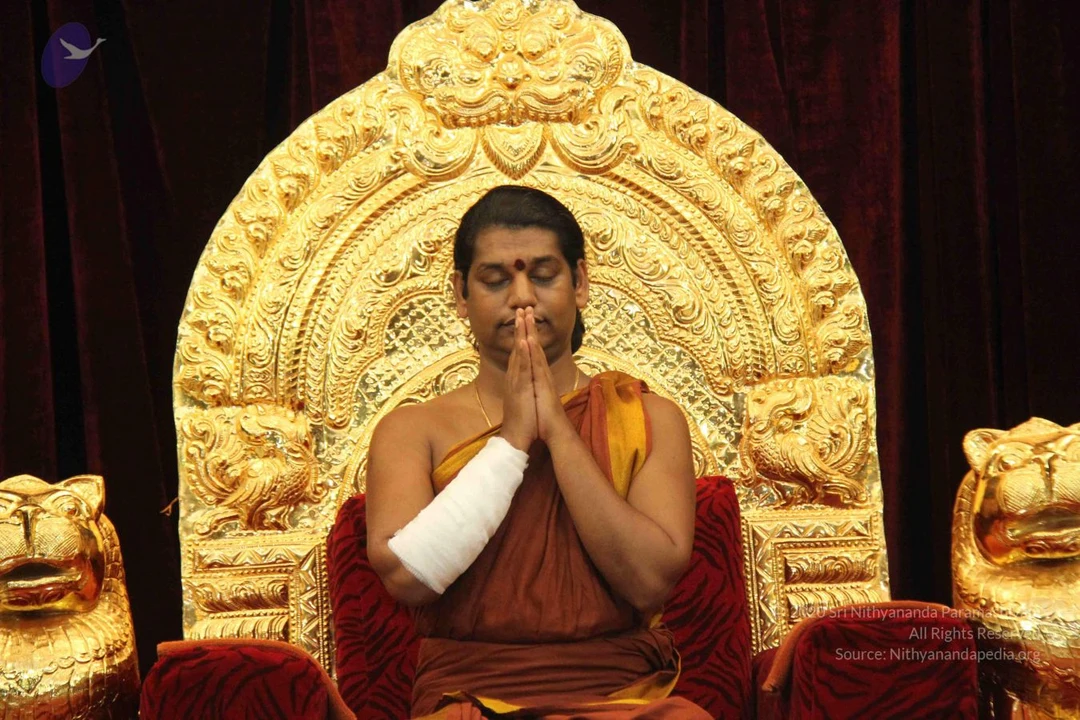
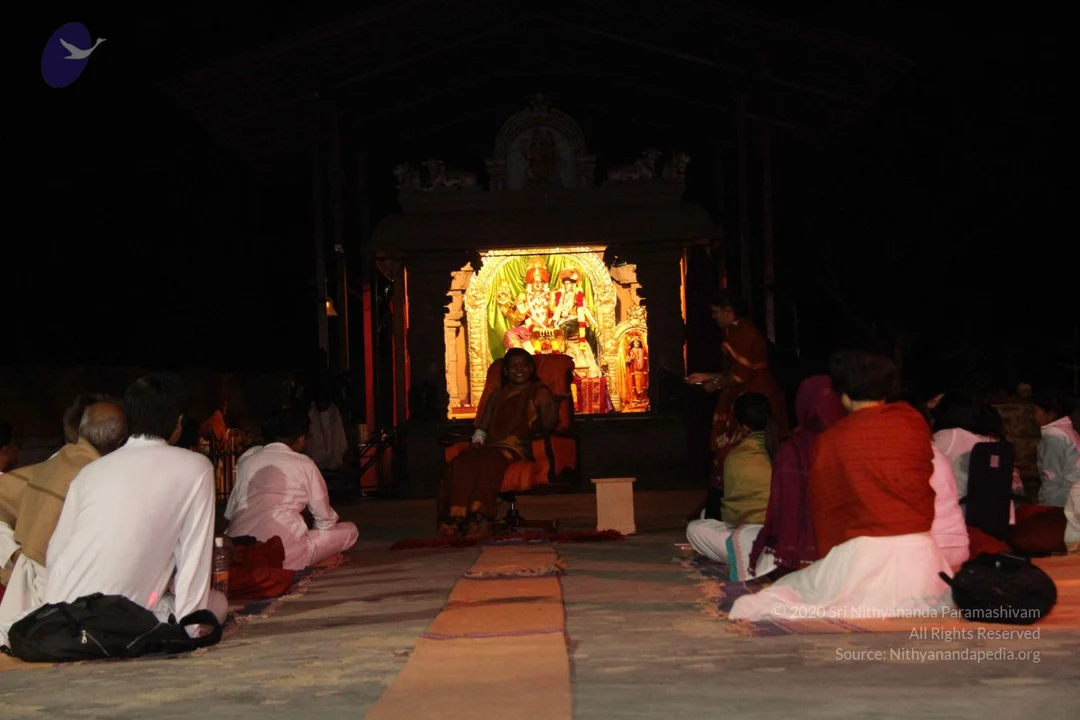
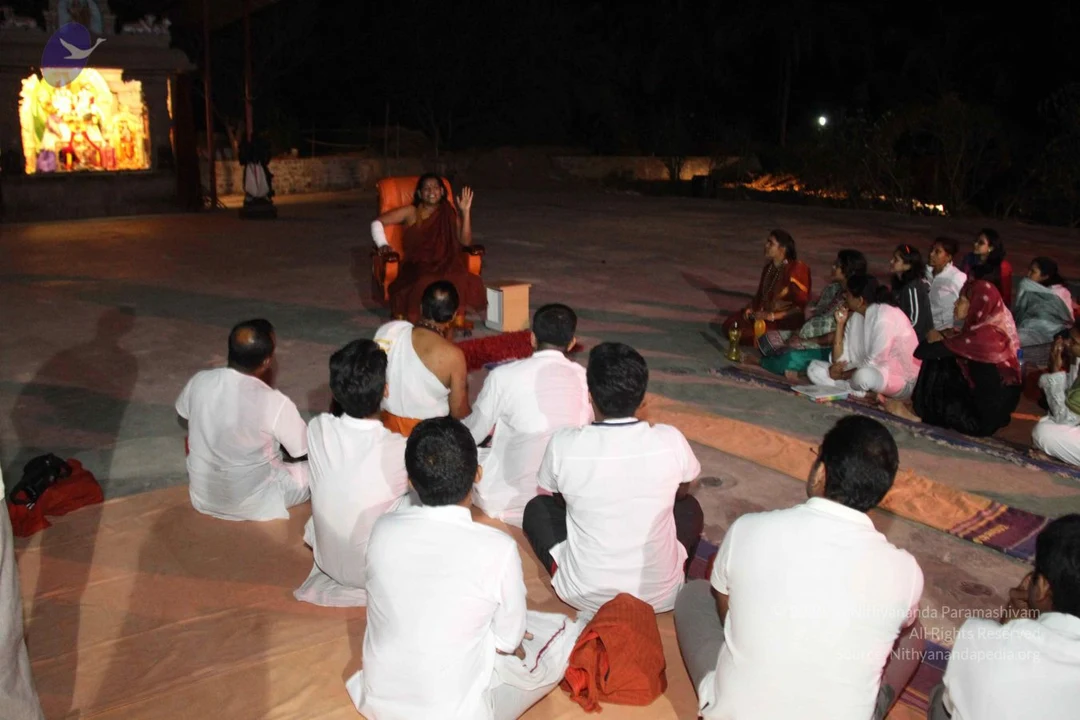
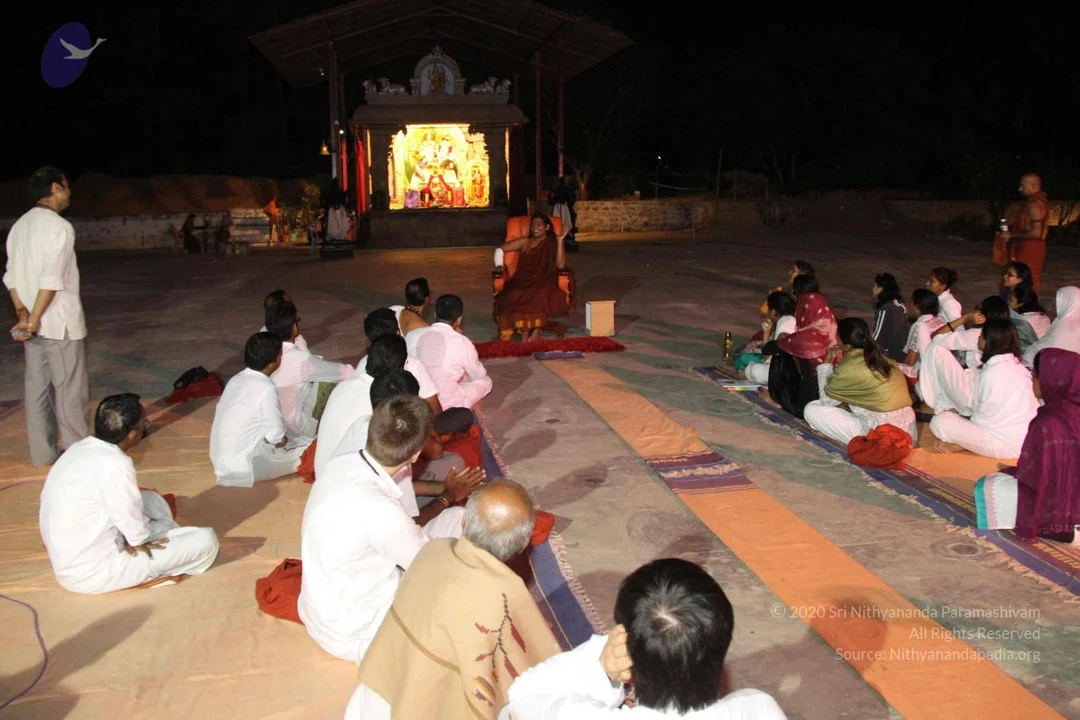
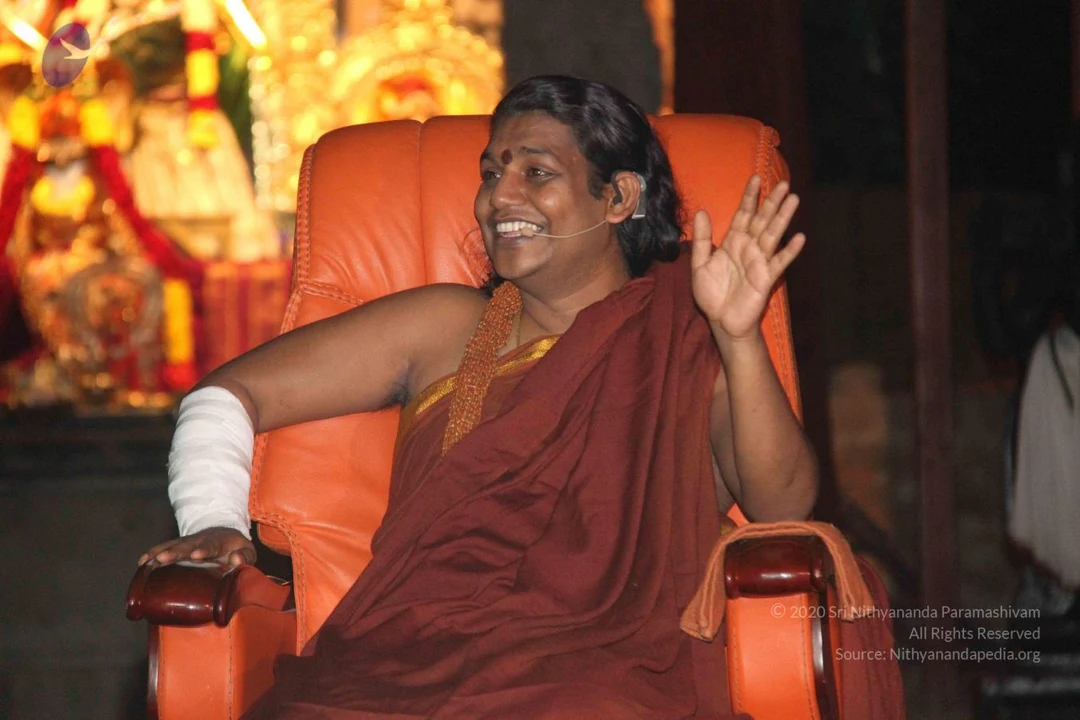
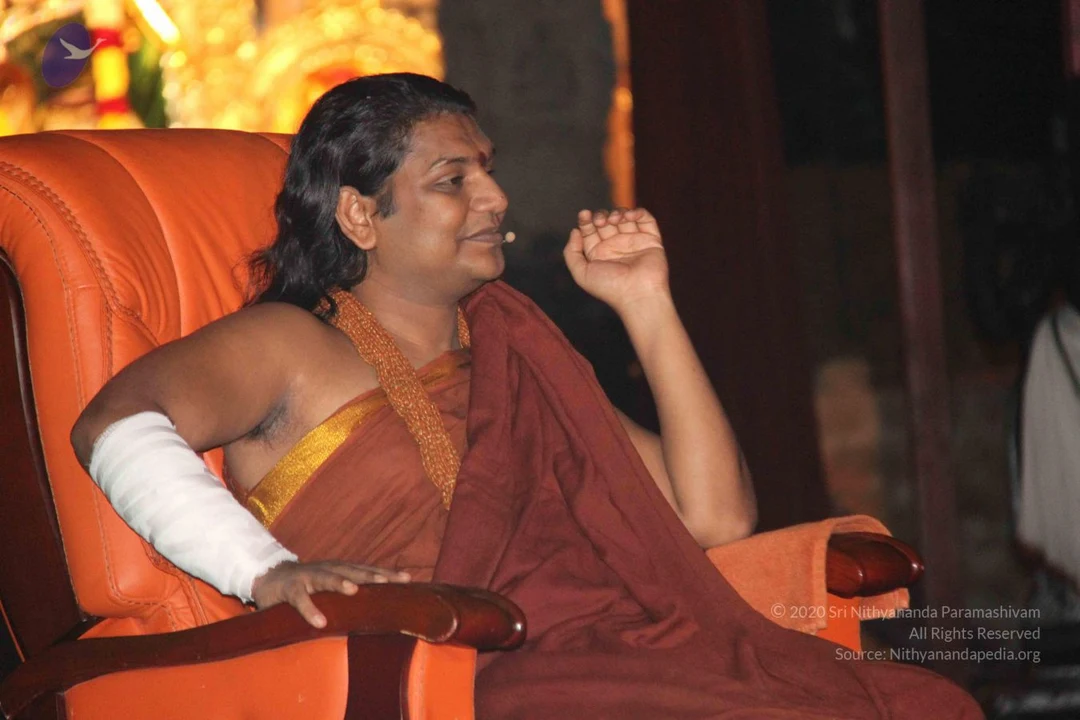
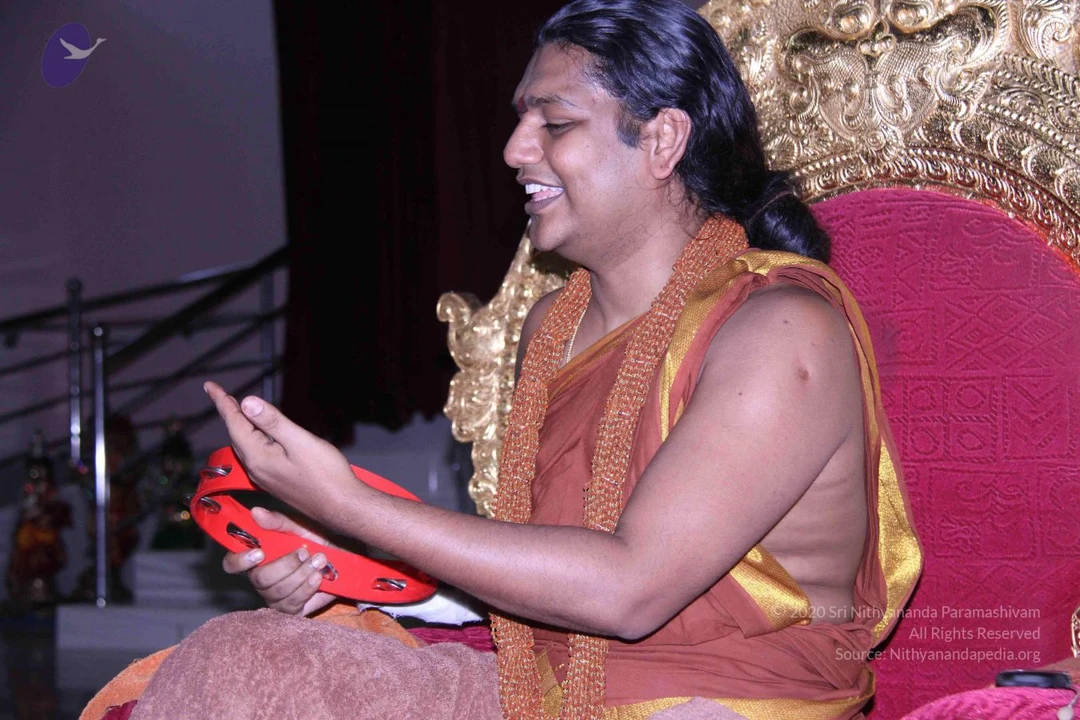
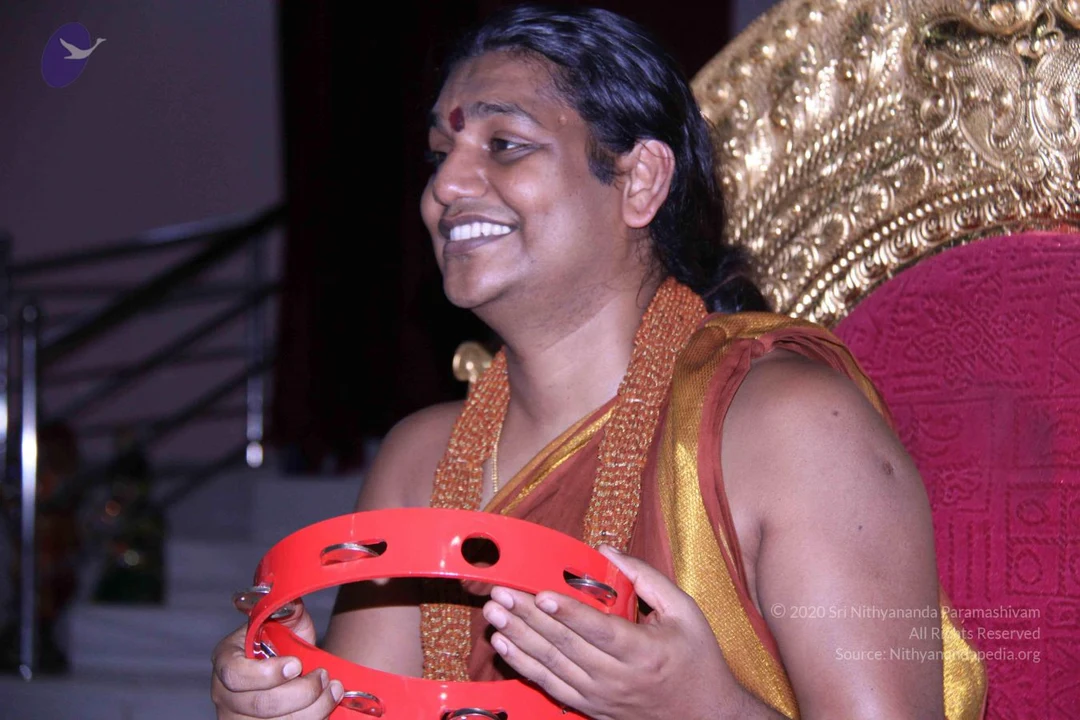
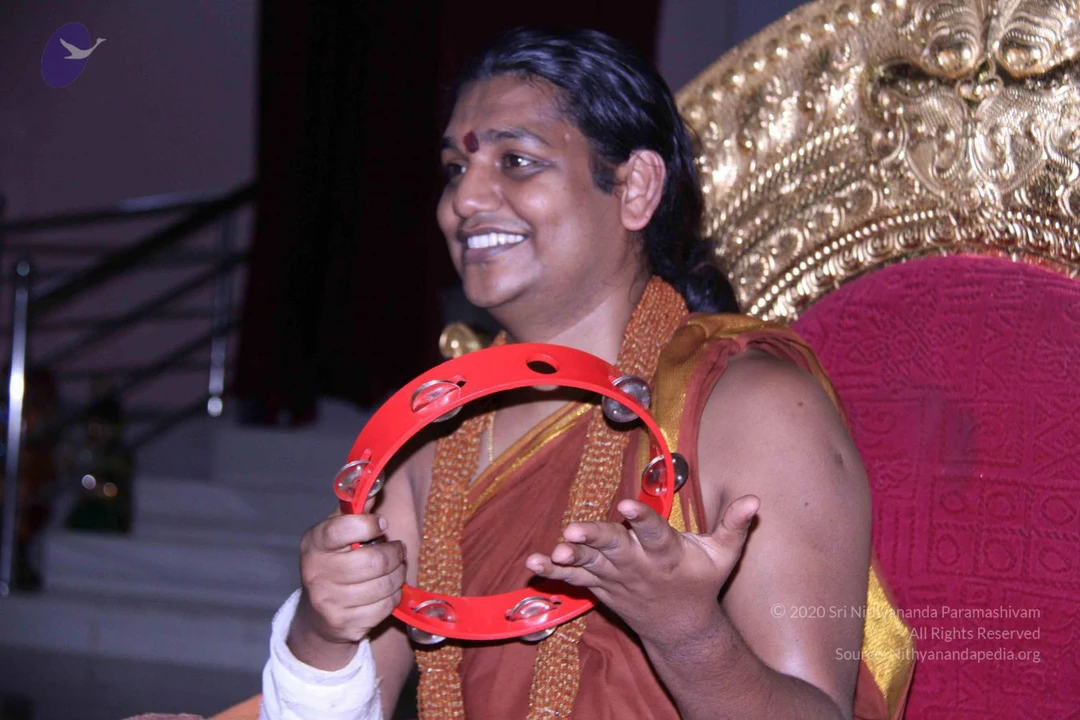
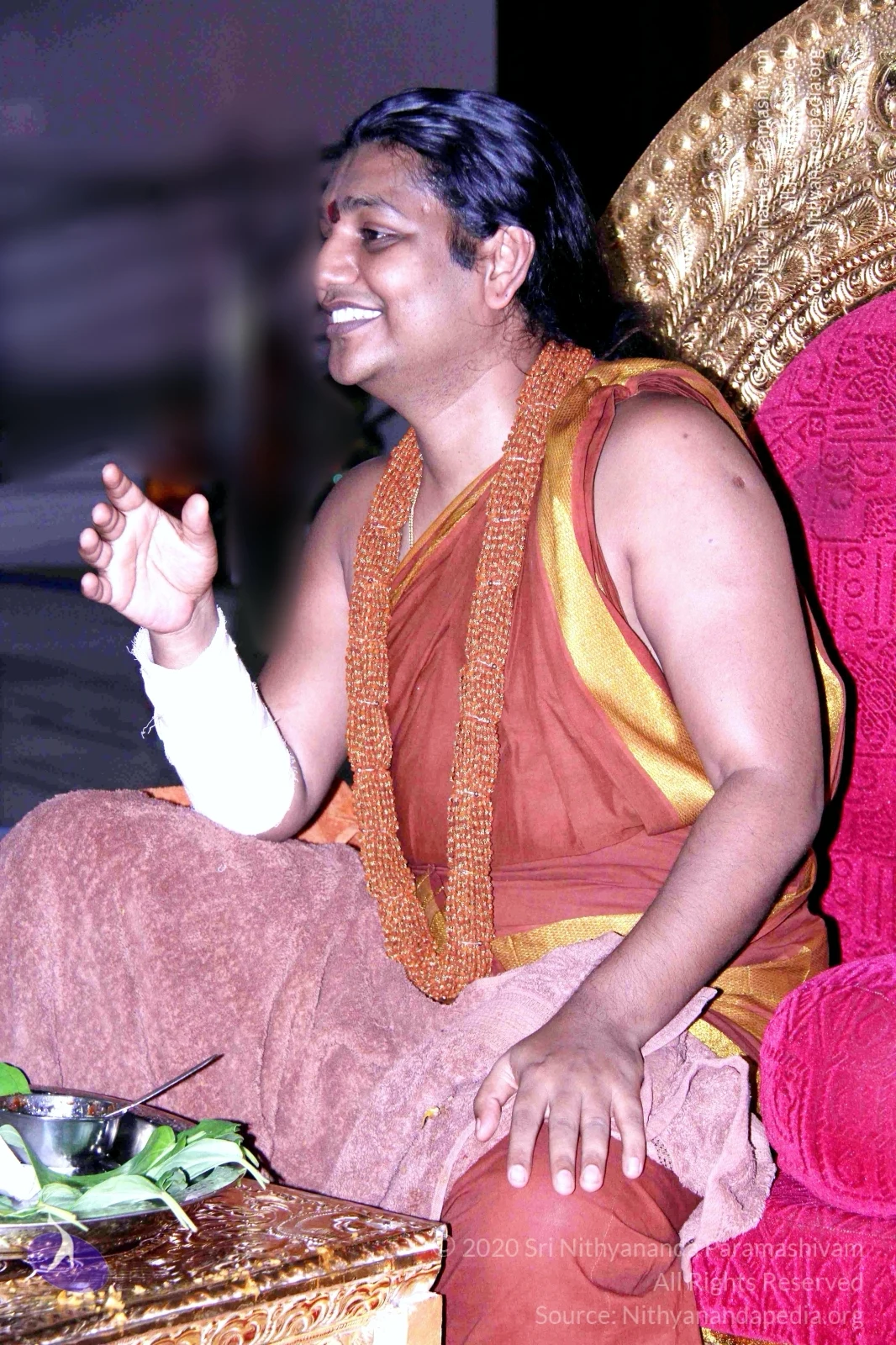
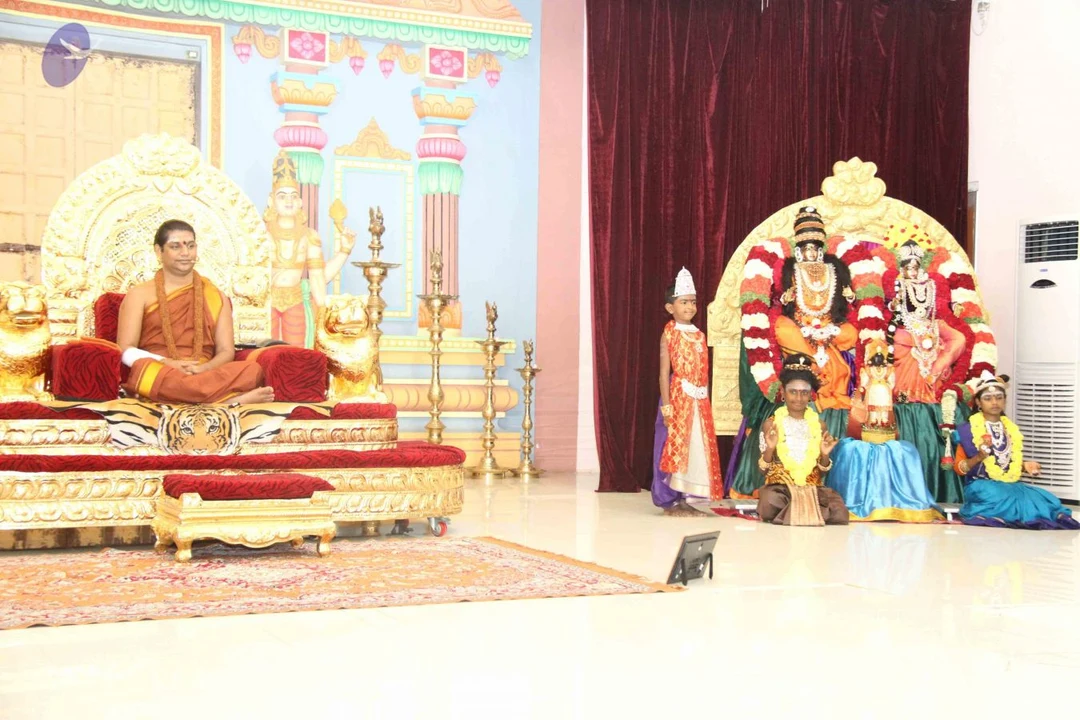
A photograph of an indoor hall with a gilded throne at left, where a man in saffron and orange robes sits cross-legged on a red cushion draped with a tiger-skin cloth, flanked by carved gold lion armrests. Behind him a painted mural shows a standing figure holding a staff. At right, a deity murti adorned with garlands of white and red flowers and gold jewellery sits beneath a gold arch, with a female deity figure beside it. In front, four children sit or stand in ceremonial dress: one boy in white and red robes with a white cap, a child in blue and gold, and children draped with yellow and white flower garlands. Brass oil lamps stand on the floor near the throne, and a rug lies at the bottom left.A photograph of a ceremonial hall with a golden throne draped in a tiger-skin cloth and red cushions. A bald-headed man in a saffron-orange robe with a rudraksha mala sits on the throne, which is at left. Behind and beside him stands a painted image of a deity with a raised hand. At right, a gold-arched alcove holds a deity murti decorated with red and white garlands, flanked by a child in a red and gold costume with a white crown, and two young performers in ornate costumes seated on the floor, one wearing a yellow garland and a blue dress. Brass oil lamps stand on the floor near the throne, and a dark red curtain hangs behind the stage.A seated man in orange-and-saffron robes sits cross-legged on an ornate gold throne with a tall, intricately carved gold back and red velvet cushions. He holds his palms pressed together in namaste, has a red bindi, a rudraksha mala with multiple strands around his neck, and a white bandage on his right forearm. Flanking the throne are two golden lion-head pedestals, and painted deity figures stand on either side, one holding a flaming torch and the other a trident-like staff. The setting appears to be a satsang hall with a pale blue wall behind the throne.A figure in orange and saffron robes with a long shawl sits on an ornate gold throne upholstered in red cushions and a tiger-skin cloth, at left. A gilded lion sculpture rests before the throne, and brass oil lamps stand on the floor. At right, a decorated deity murti pair of a male and female form sits under a floral garland arch, dressed in orange and green garments with a red-and-white garland. Two children sit at the base beside them, one in a yellow garland and saffron clothes, another in a blue-green dress and garland. A painted backdrop of pillars and a standing figure with a staff fills the wall. Maroon velvet drapes hang behind. The scene reads as a satsang setting.A smiling man with short dark hair and a red bindi sits on a red velvet cushioned chair in front of an ornate gold-leaf throne back with carved peacock and floral motifs. He wears a rust-orange robe with a golden-yellow border over one shoulder, a long rudraksha mala with a multi-strand necklace, and a small microphone clipped near his face. A white bandage wraps his left forearm. a person (appearance-based label: saffron robe, rudraksha mala and gold-lined throne setting, seated as the speaker at a satsang). The image is a photograph of a seated speaker on a throne with a microphone.A smiling man in a saffron-orange robe with a gold-and-orange shawl sits on a red velvet-cushioned seat before an ornate gilded throne with carved floral and scroll details. He wears a long rudraksha mala with a gold chain, a red bindi on his forehead, and a small headset microphone. The setting appears to be a satsang hall.

Leela Alankar

7 photosSource gallery
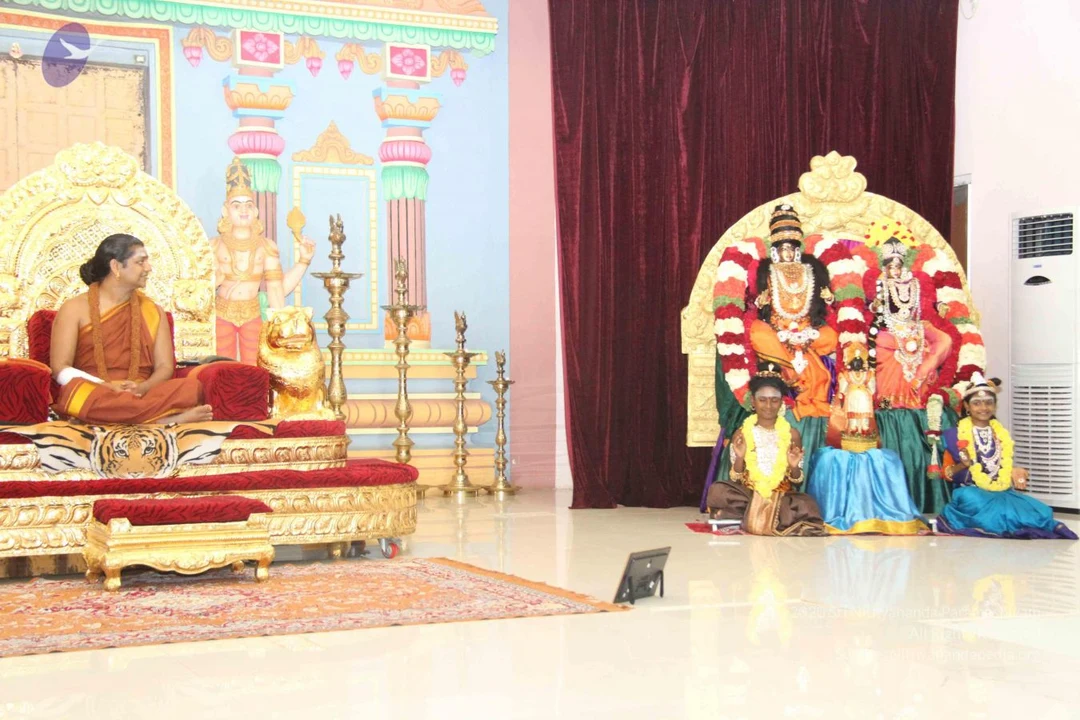
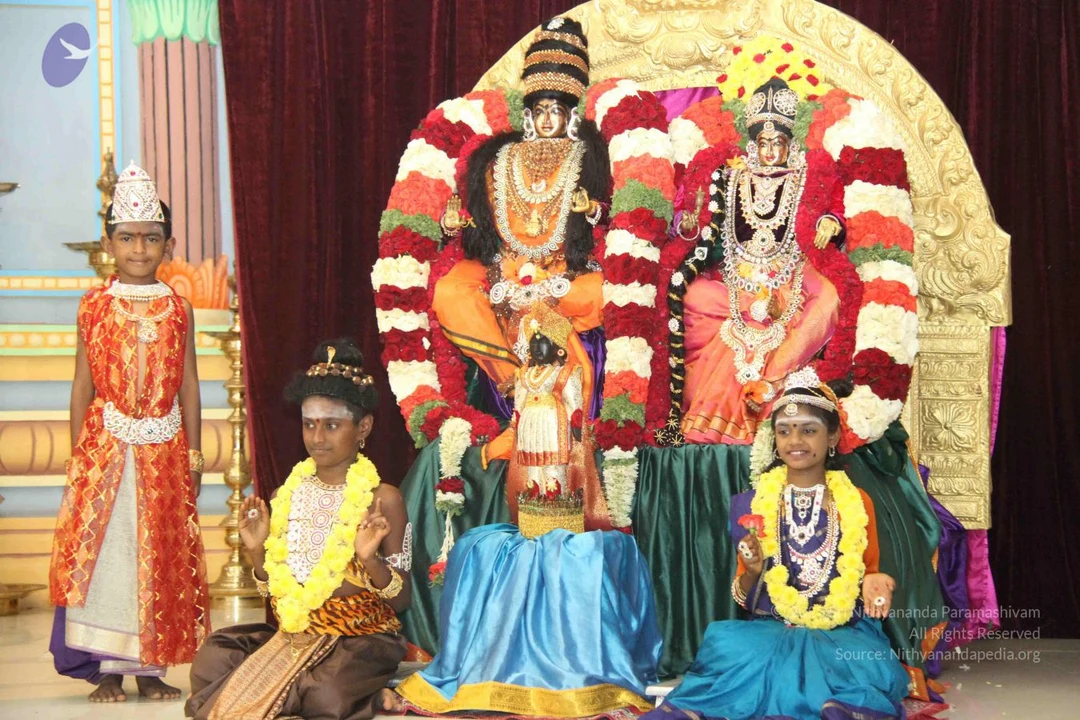
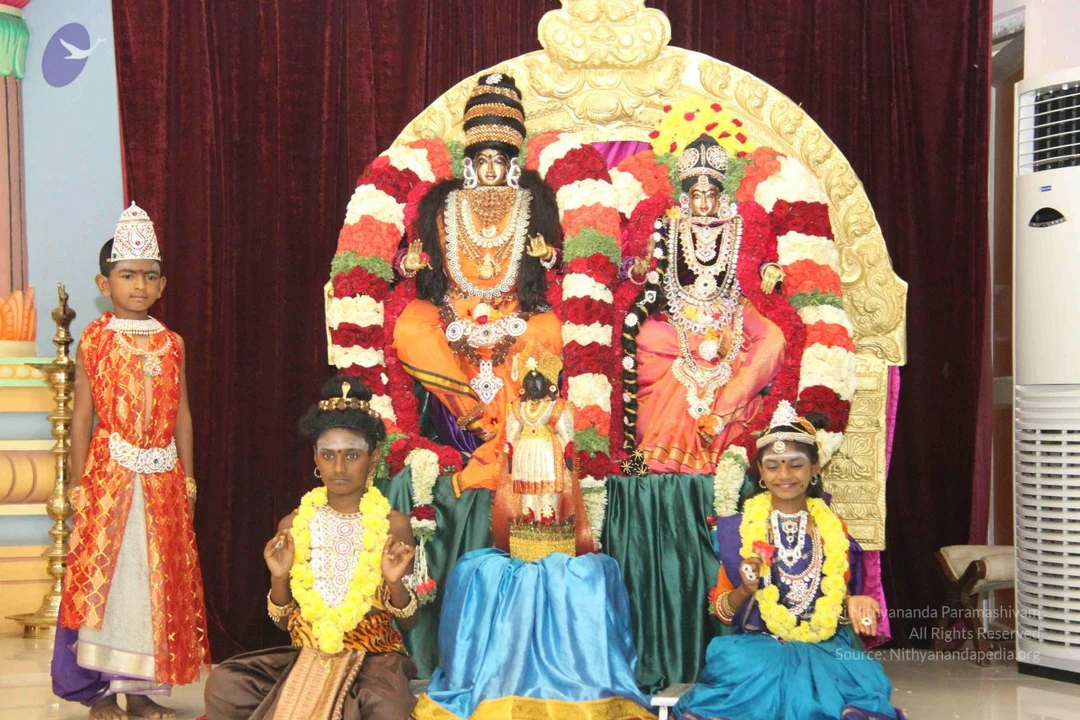
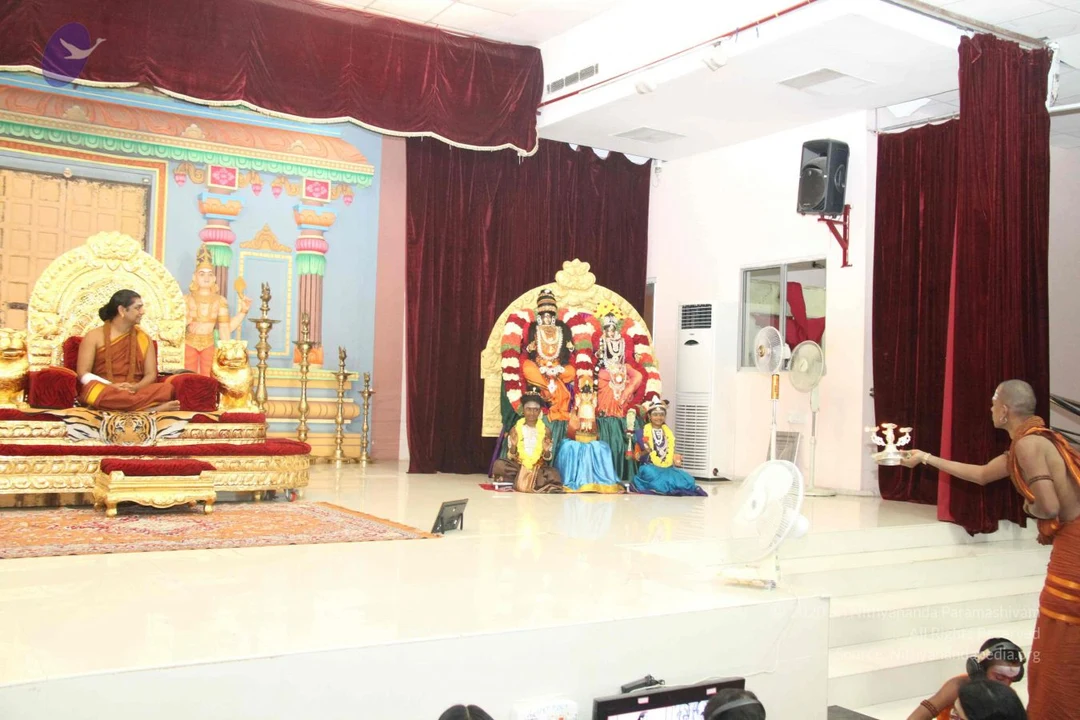
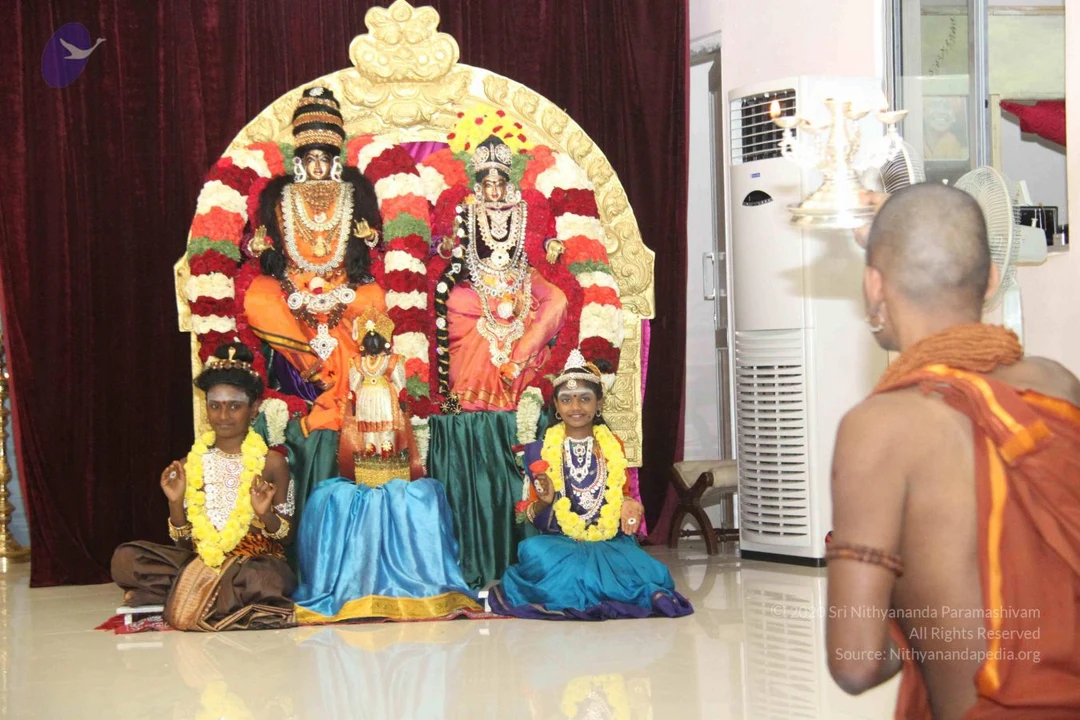
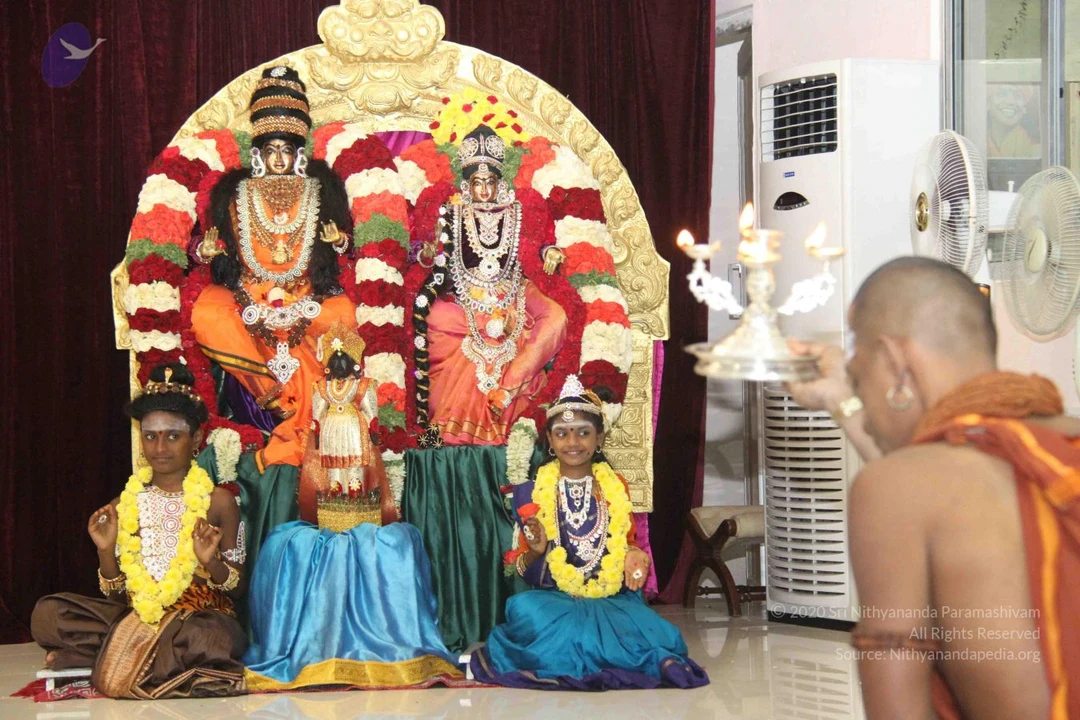
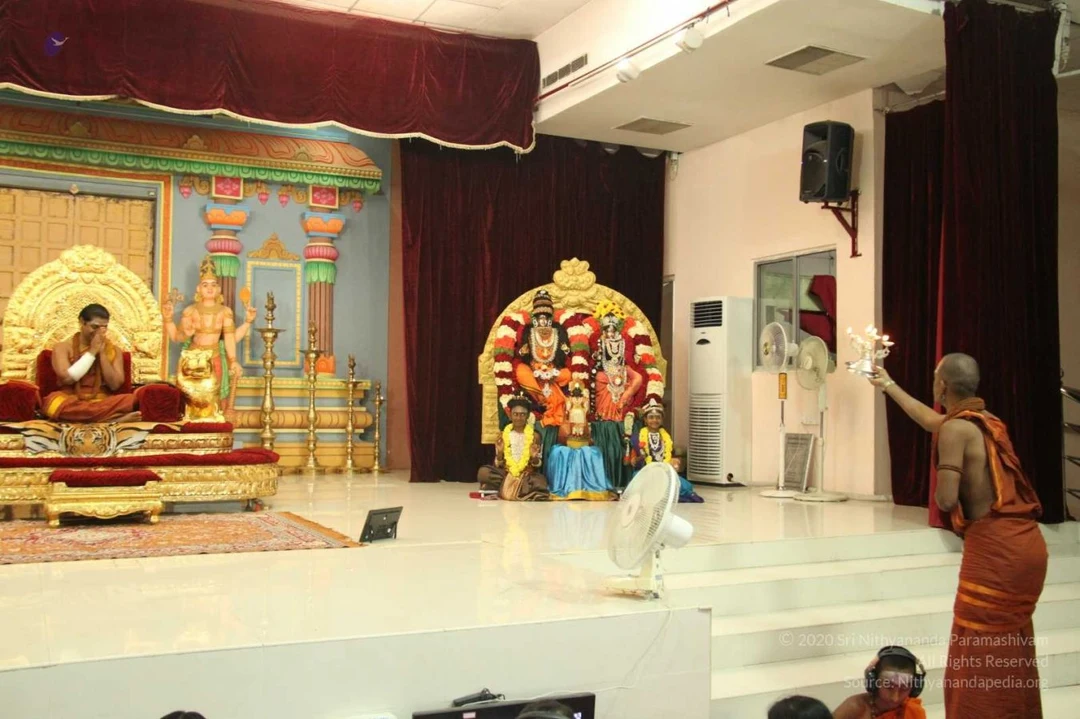
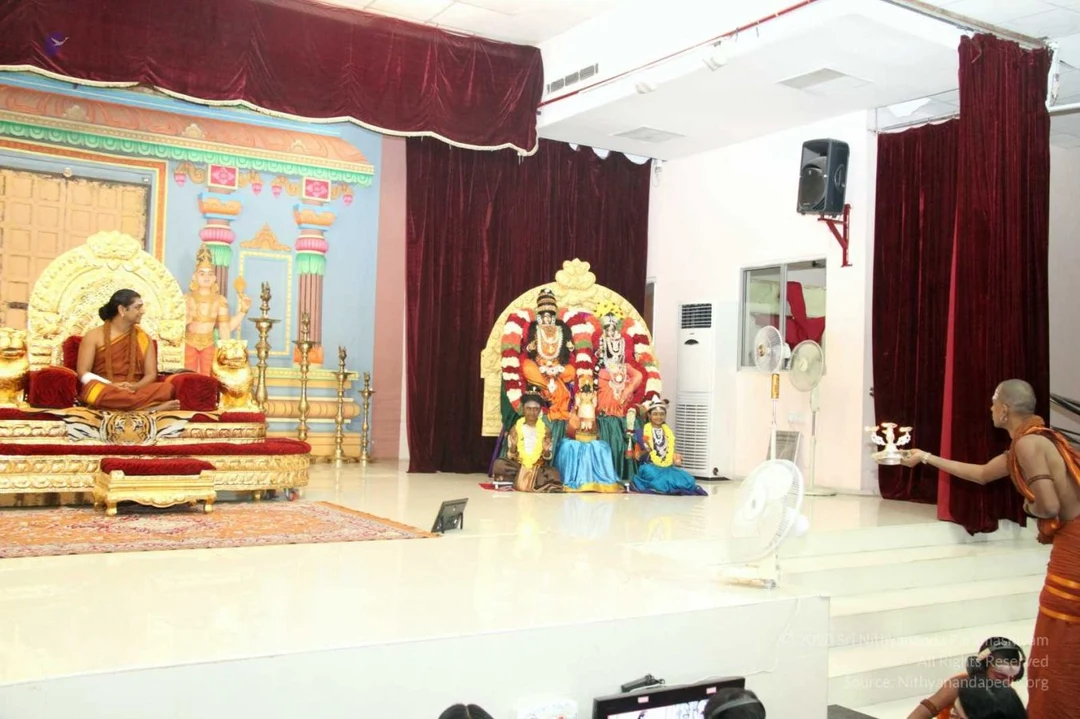
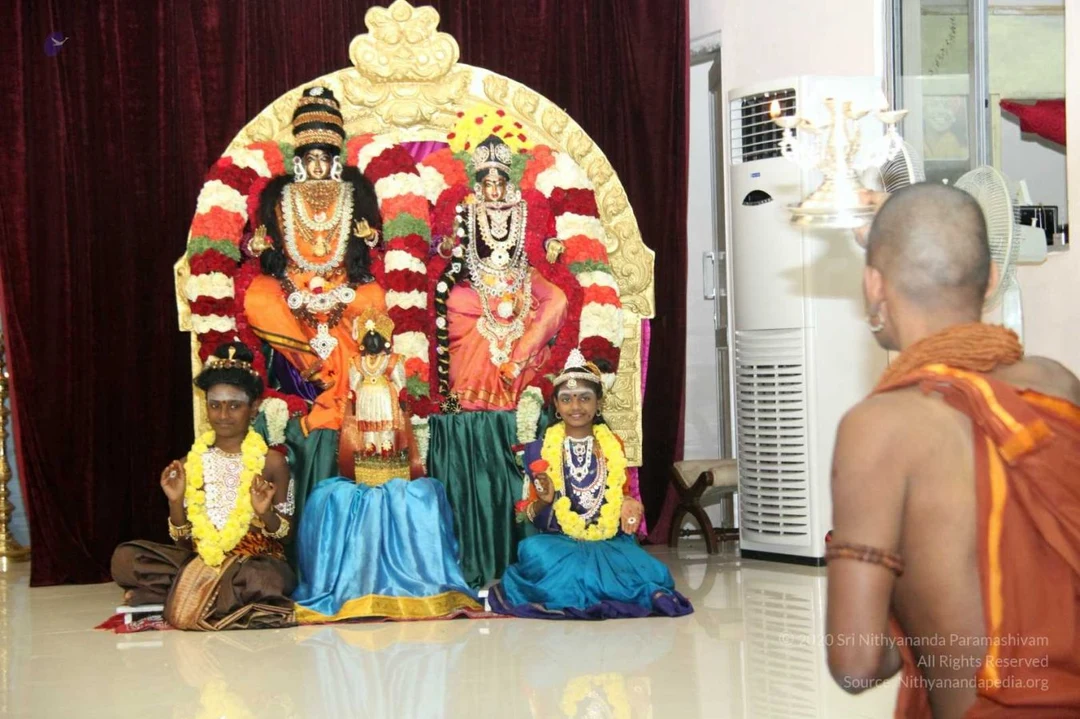
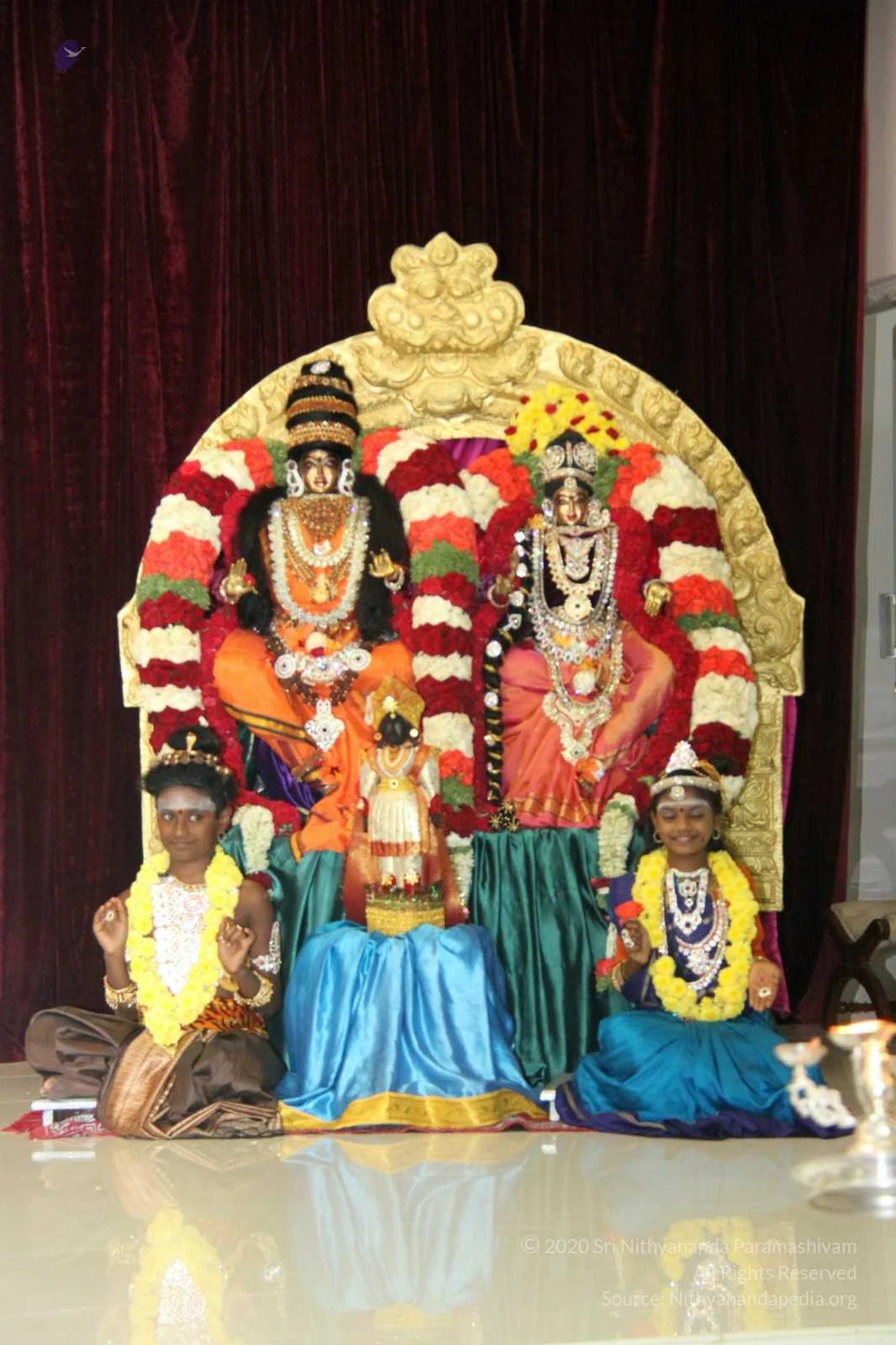
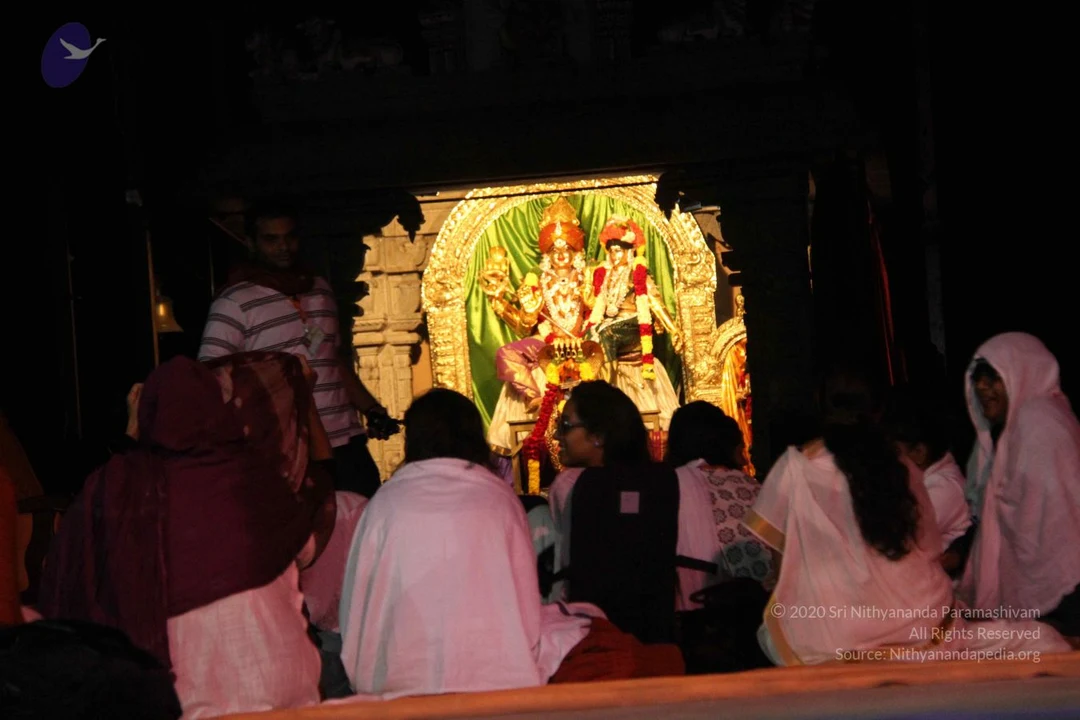
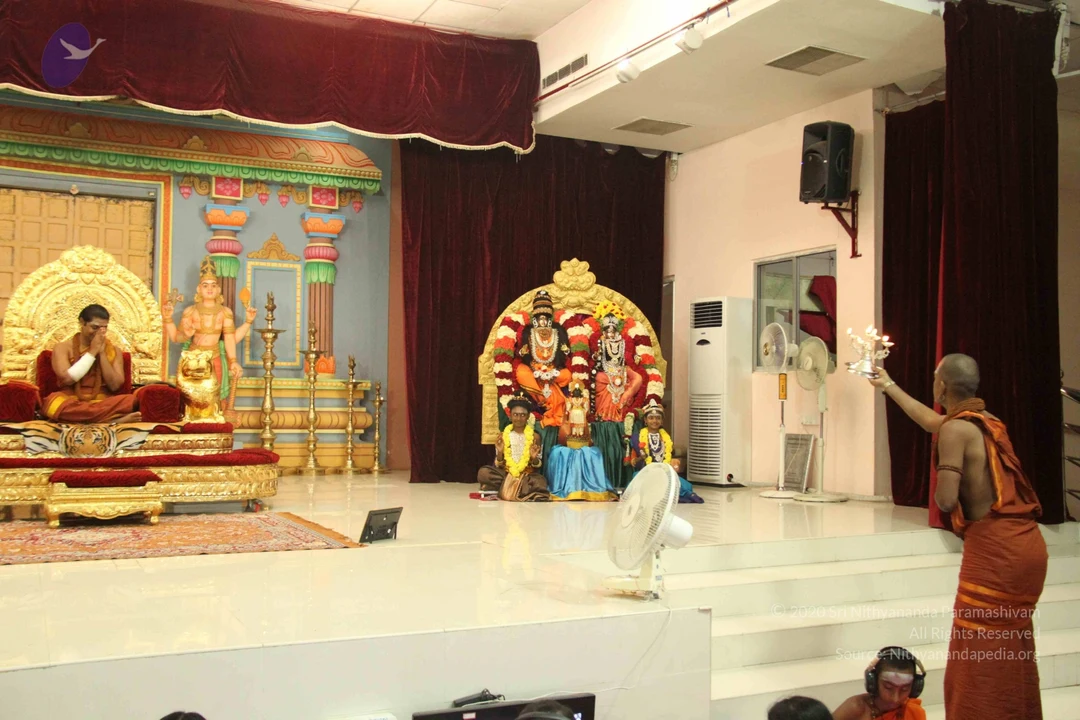
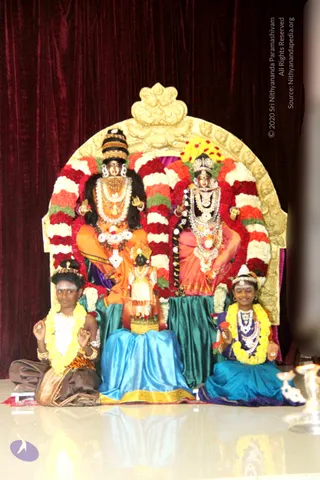
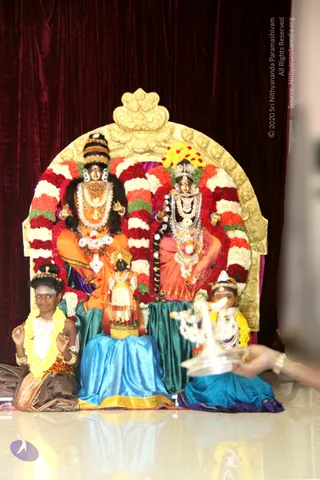
A staged photograph of a devotional tableau on a decorated stage. Two large deity murtis sit enthroned behind a garland arch of red, orange and white flowers: the left figure has dark hair, a tall gold crown, and an orange garment with heavy gold necklaces; the right figure wears a pink sari, a silver-and-gold crown and layered pearl necklaces. A small child figure in orange sits between them. In front, three children pose: a boy in a red-orange embroidered costume and white belt stands at left with a jeweled crown, a boy seated at center wears a bare chest with white beads, yellow marigold garland, a dark crown and tilak, and a girl at right wears a blue-and-purple outfit with a yellow garland and a headpiece. Brass lamps and a gold-trimmed backdrop frame the scene.A photograph of a temple tableau with a large decorated murti of a deity pair seated in front of a gold arch and a dark red curtain, both wrapped in garlands of red, orange and white flowers. The figure on the left wears an orange-and-gold garment, a tall black-and-gold crown and heavy gold necklaces; the figure on the right wears a pink garment and a jewelled crown. A small child figure stands between them. In front, three children sit on a blue cloth: a boy at left in a tiger-stripe-patterned garment with a yellow flower garland and a bindi-like forehead mark, a girl at right in a purple-and-blue outfit with a white garland, and a boy at far left standing in an orange, red and grey costume with a jewelled crown. An air conditioner unit stands at the right edge.A worship scene before a gold-framed arch decorated with red, white and yellow flower garlands. Two large deity murtis stand behind, one with a crown and orange-and-gold garment, the other in pink and green with layered necklaces. Two young children sit cross-legged in front: a boy in a brown dhoti with yellow garland, and a girl in a blue skirt with yellow garland. A small central figure in a white and gold costume sits between them. On the right, a man with a shaved head and orange-and-yellow shawl offers a lit silver aarti lamp toward the deities. Wall-mounted fans and an air conditioner surround the altar.A stage at a temple-style hall with a gold throne on the left where a seated figure in orange and white, hands folded, sits on red cushions beside a gilded lion-like base and painted pillars. In the centre, a garlanded deity murti pair stands in a gold arched niche with two small children in saffron and white garlands seated before it. On the right, a standing priest in orange robe and shaved head raises a lit lamp toward the deities. Brass lamps stand on the stage, with red velvet curtains, a floor fan and a wall air conditioner.

SarvaDarshan

13 photosSource gallery
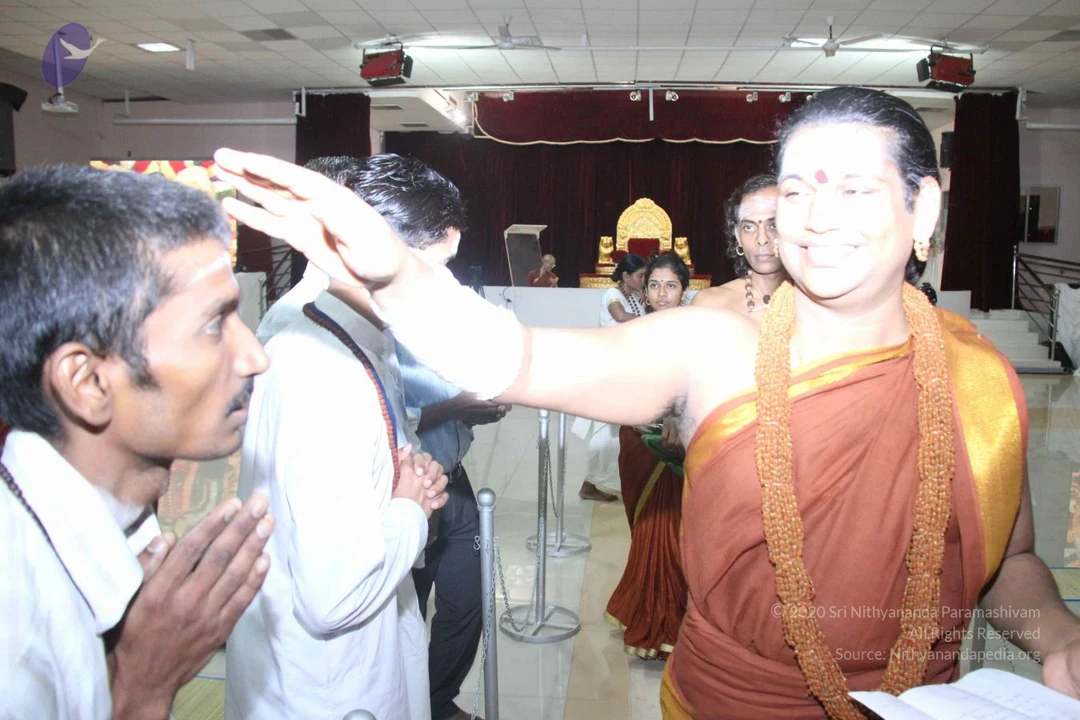
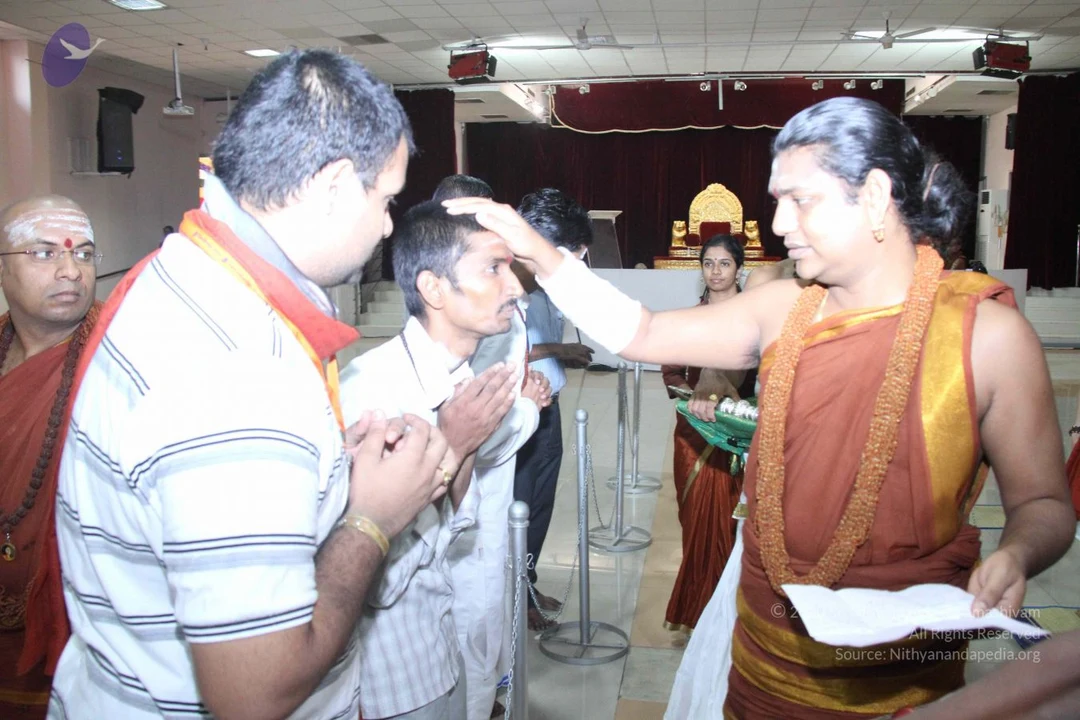
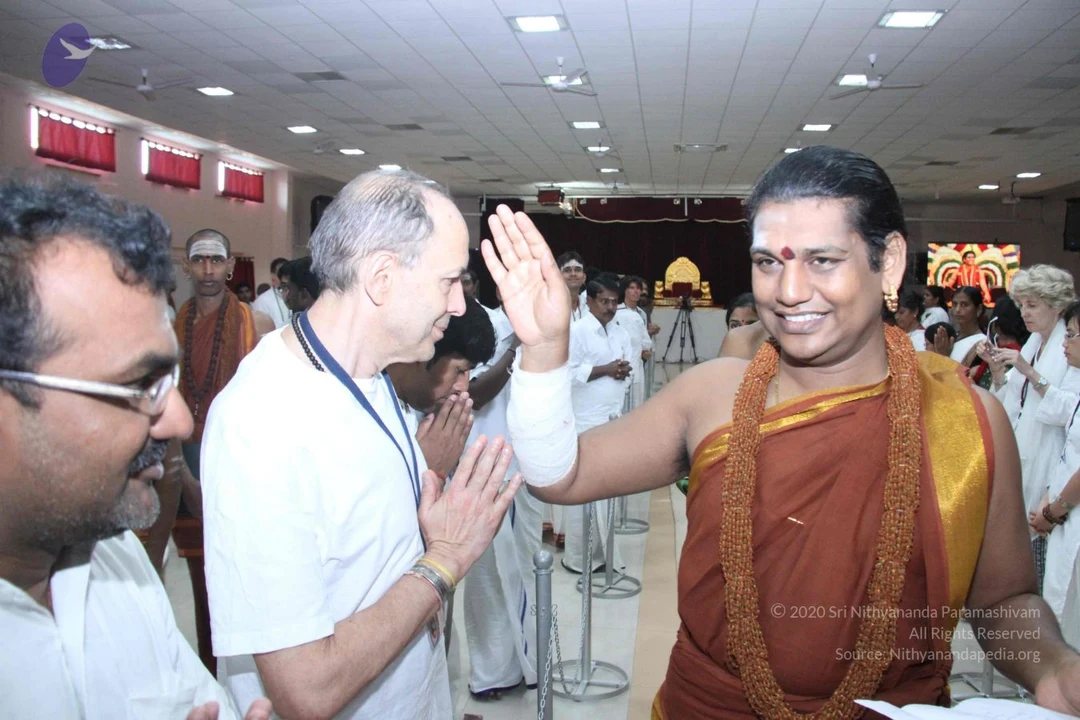
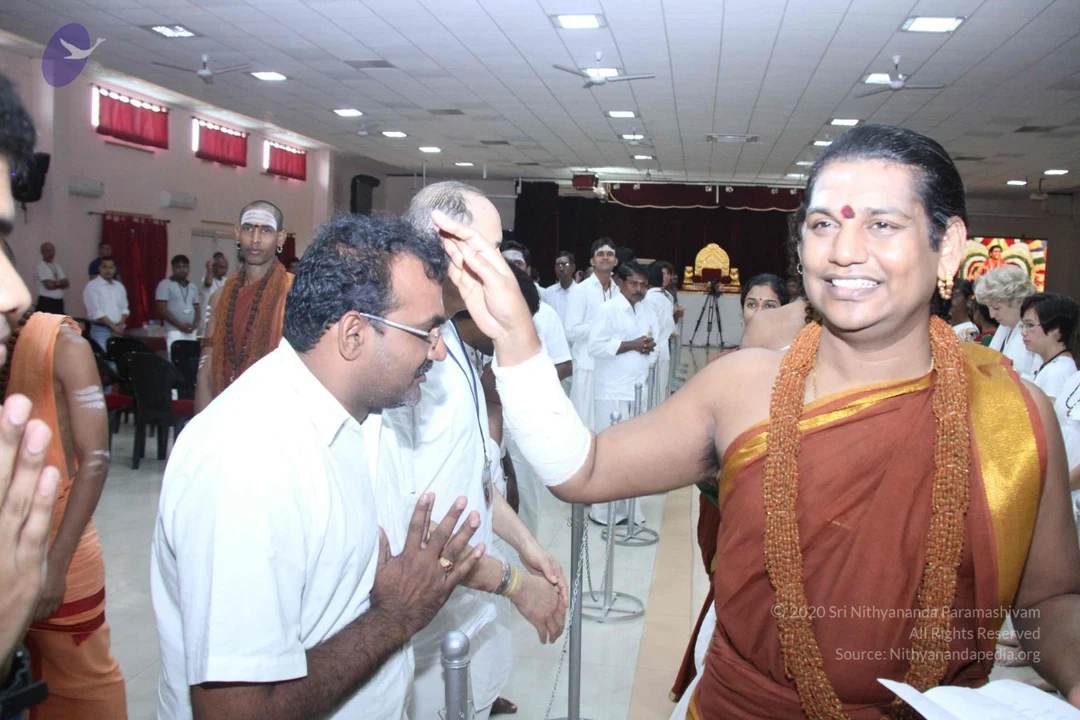
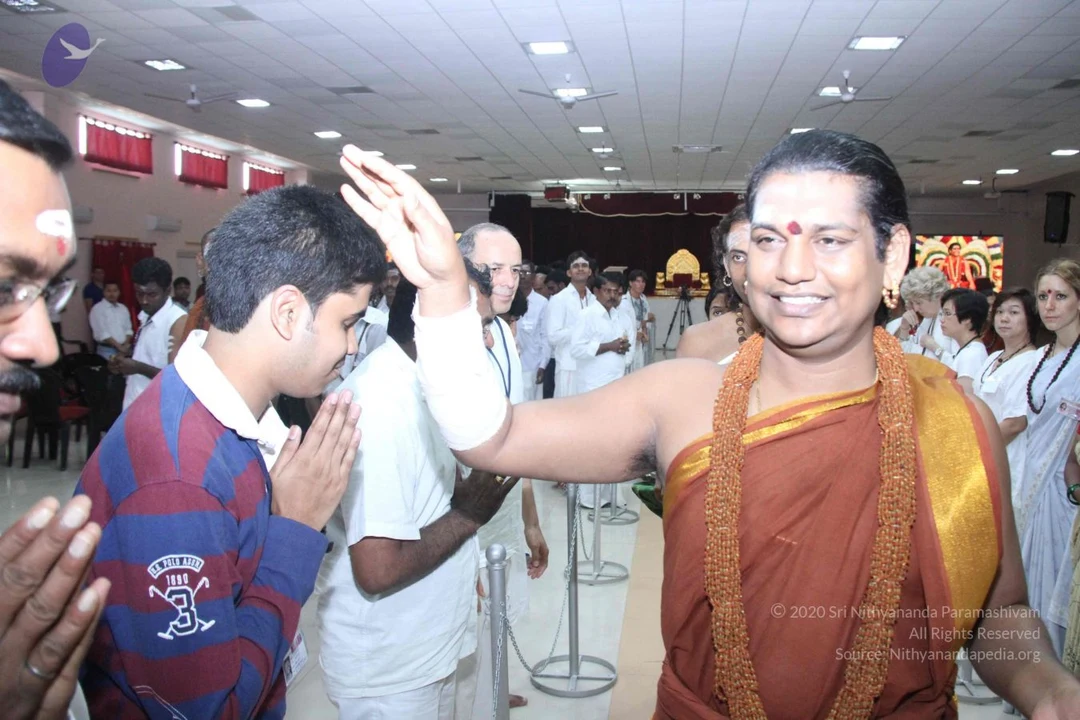
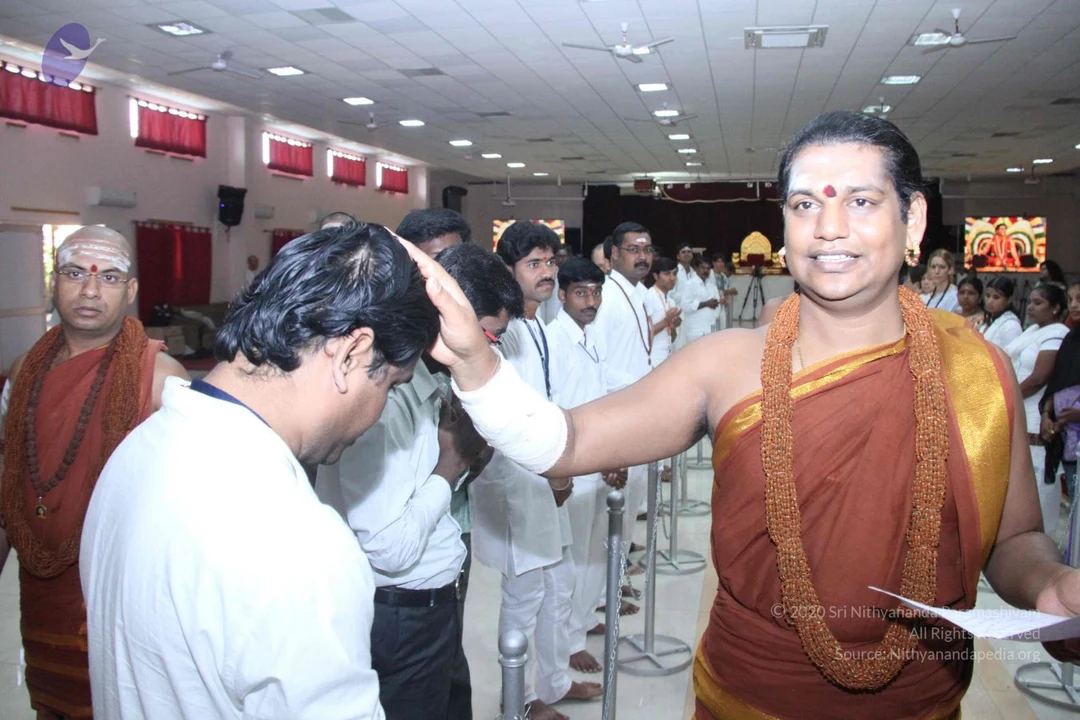
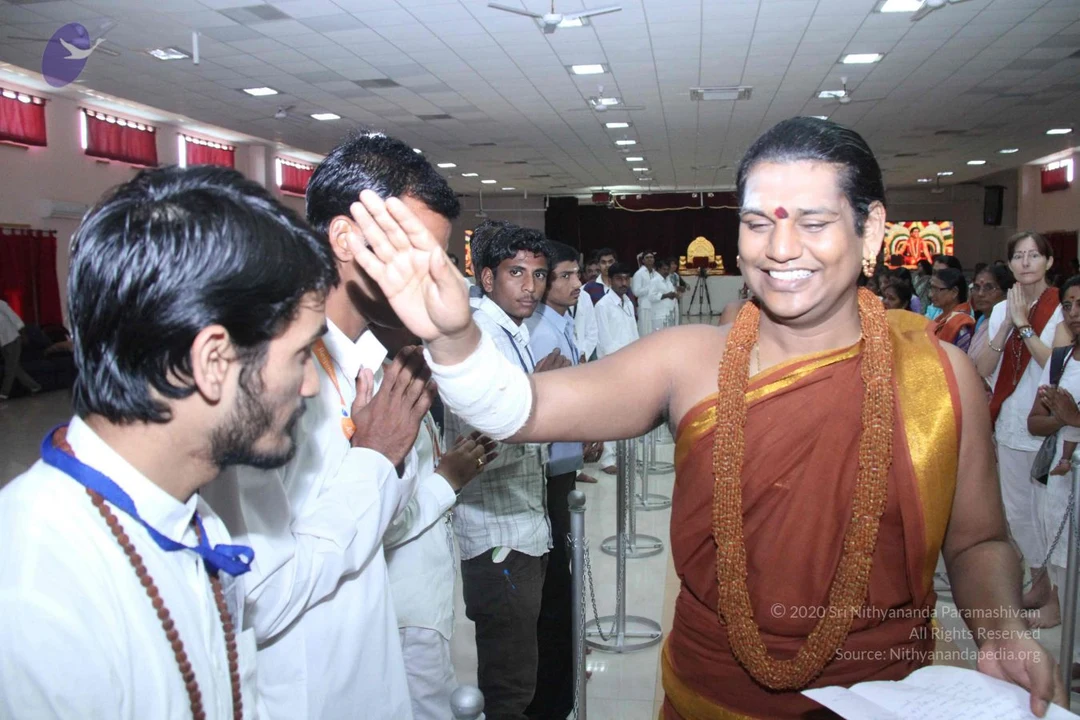
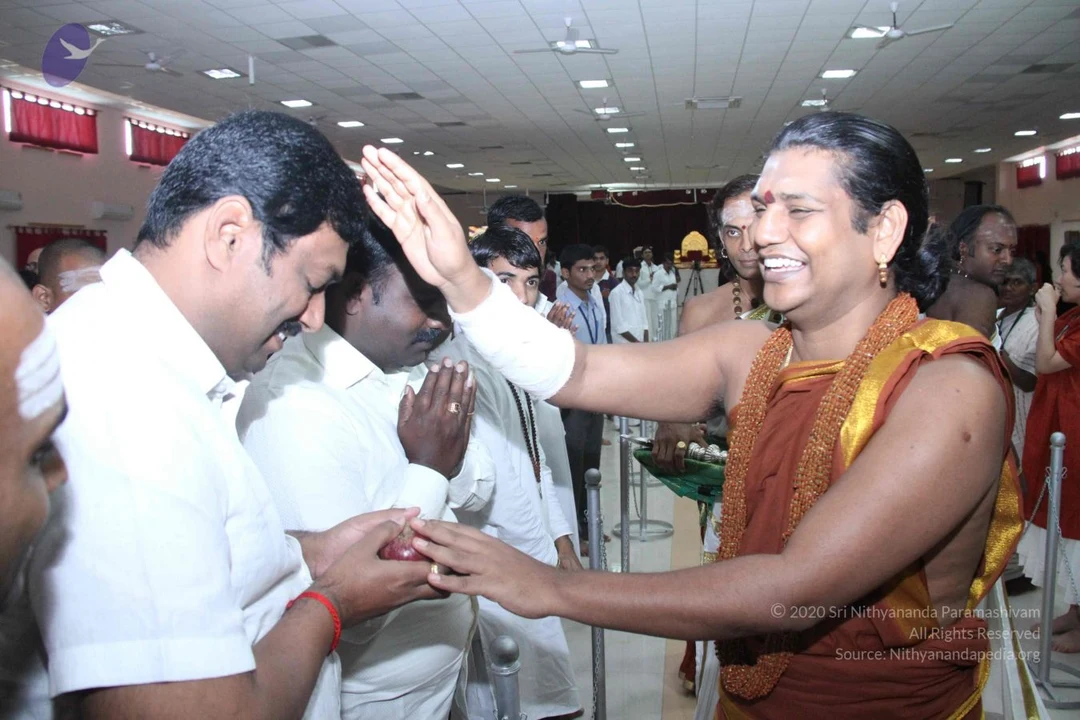
A photograph inside an indoor hall with a red curtain backdrop and a golden throne-like seat in the background. In the foreground a man in a saffron-orange robe with a golden border and a long beaded necklace of rudraksha-style beads raises his hand in blessing toward a man with folded hands in white clothes and a cloth-wrapped devotee in white. The robed figure holds an open book and has a red bindi and swept-back dark hair. Behind them another person in white and a woman in a red sari stand near metal stanchions. Overhead are stage lights and a ceiling fan. Appearance-based probable Swamiji (probable) with long swept-back hair, saffron robe, golden shawl and ornate beaded necklace, giving a blessing to a devotee.A photograph in a hall with dark red curtains and a gold throne-like seat behind. A man with long swept-back hair, wearing an orange-saffron dhoti-style garment with gold border and a long orange-beaded mala, places his right hand on the forehead of a man in a white shirt with a saffron-edged shawl, who has his palms pressed together. A second man with hands folded waits behind, and a shaved-headed priest in orange robes with white-and-red forehead markings stands at left. Women in saffron sarees hold a tray in the background. a person (long swept-back hair, saffron garments and a beaded mala) is performing a blessing touch on the forehead as a devotee.A photograph inside a hall with maroon curtains and an altar with a golden deity murti at the back. A man in a rust-orange shawl with gold border, a long rudraksha mala and a red tilak on his forehead stands on the right, smiling, one hand touching the head of a man in a dark navy polo shirt who bows with palms pressed together. A man in white on the left also holds his hands in anjali. Devotees in white and red clothing stand behind, some with folded hands. Setting resembles a darshan or satsang blessing.A indoor hall with a golden throne and red-curtained stage in the background. A man in an orange-red robe with a gold border and a long rudraksha mala extends his right hand to bless the head of a devotee who bows with palms joined. The devotee wears a white dhoti and shirt and a white headband with a forehead tilak. Another white-clad man stands beside, and several people in white and beige saris and dhotis line a metal barrier. Screens on the walls show a figure in red with a floral backdrop. Swamiji (probable): the robed man is a long-haired figure with a red tilak, gold earrings and rudraksha mala, performing a blessing as the central figure in the scene.Photograph inside a large hall with a tiled floor and ceiling fans. In the right foreground, a man in a rust-orange robe with a gold-bordered sash and a long rudraksha mala raises his right palm in blessing, with a red bindi on his forehead and a white bandage on his forearm. a person (appearance cues: rudraksha mala, orange robe, gold border). To the left, several men in white shirts and white dhotis bow with folded hands and heads lowered, some with red threads on their wrists. Women in saris stand behind a barricade of chrome posts and chains. In the background, a golden throne-style seat sits on a stage flanked by large framed portraits and a dark curtain.Indoor hall with white ceiling fans and a line of devotees with palms pressed together. In the right foreground a man in saffron-orange robe with a gold border and a long orange beaded necklace raises his right hand in blessing toward the people. He has a red bindi and swept-back dark hair. Devotees in white dhotis and shirts stand behind a metal barrier, some with tilak marks and red threads, others bowing with hands folded. A gold throne sits on a stage in the background beside a screen showing a figure. a person candidate stands centrally, blessing devotees; the appearance cues are a saffron robe and long orange beaded necklace with swept-back hair.

Swamiji_Deities

3 photosSource gallery
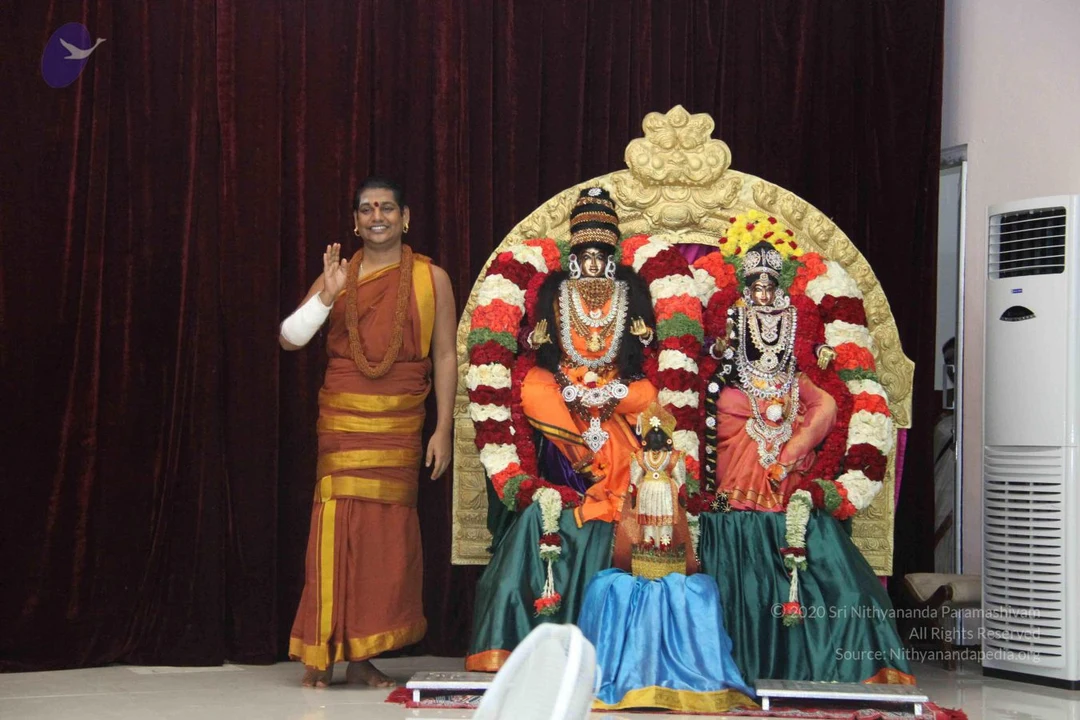
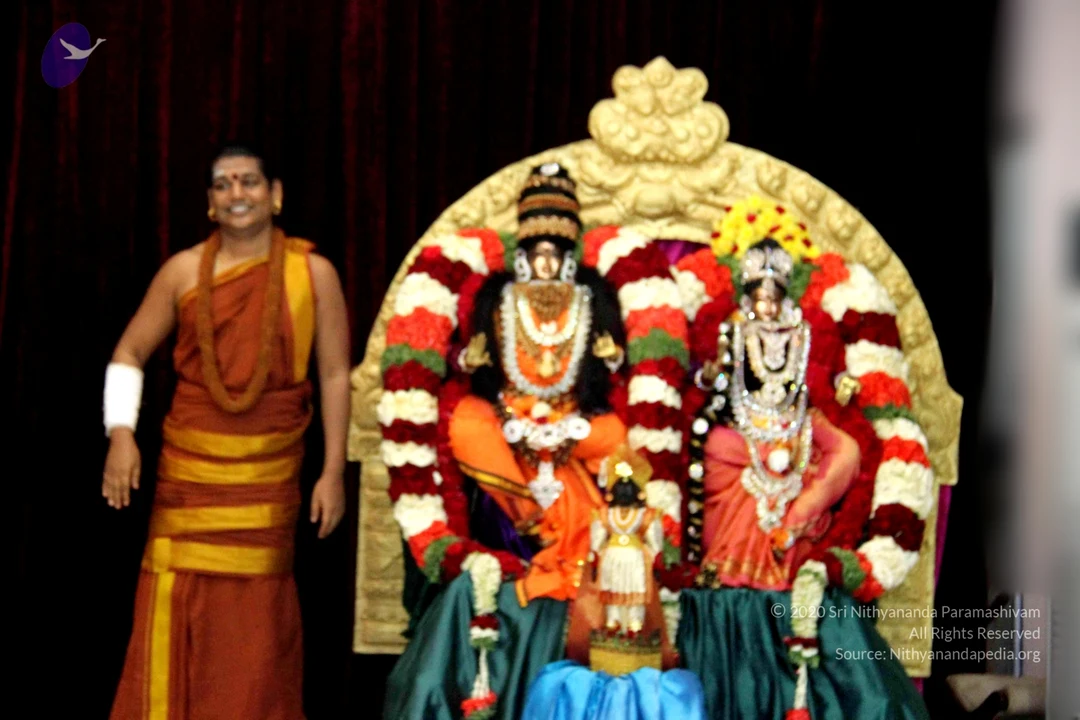
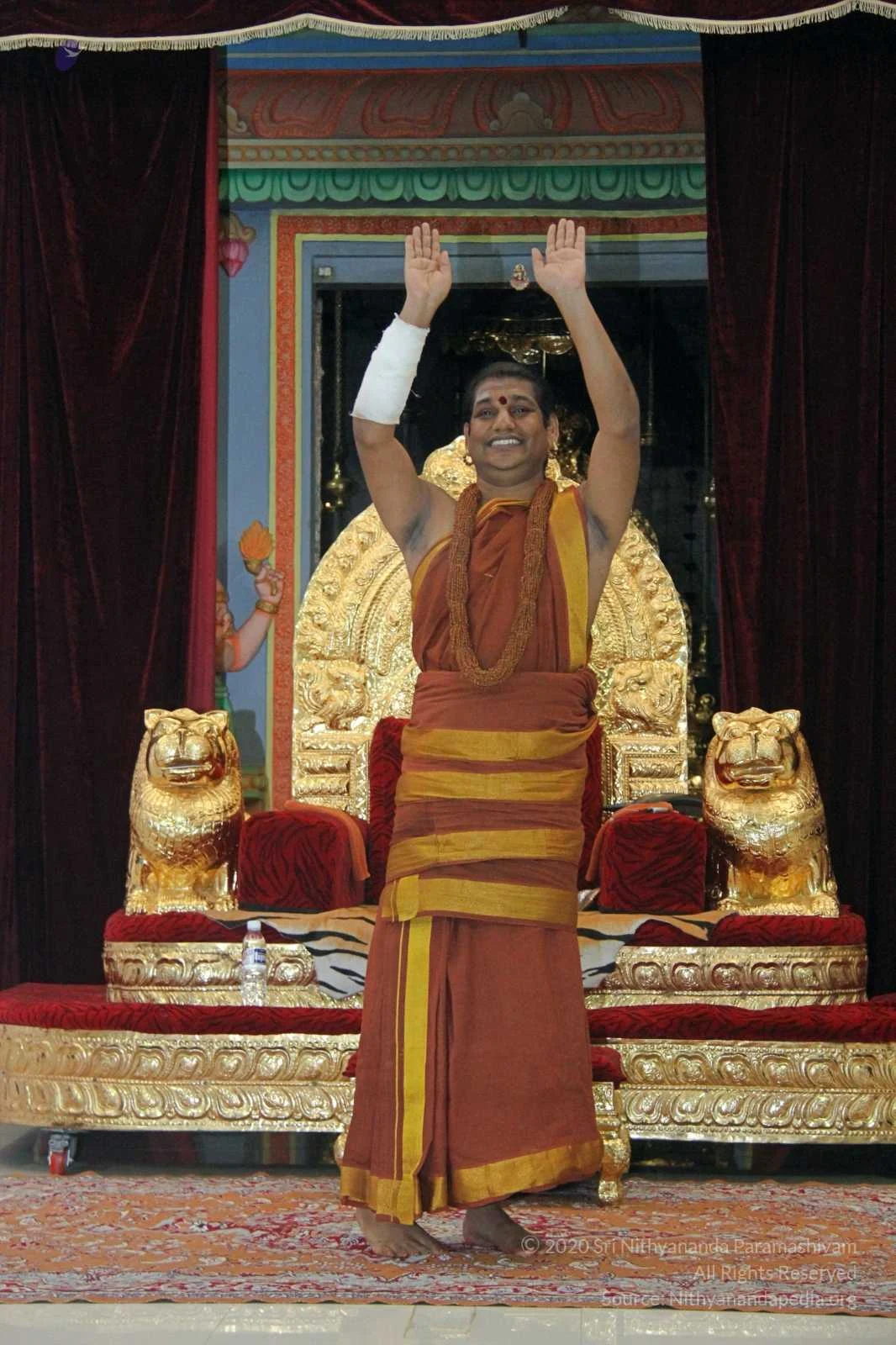
A man in orange-saffron robes with a gold-bordered dhoti and a rudraksha-style beaded mala stands at left, raising his right hand in a wave while his left arm is in a white cast. Beside him, a pair of deity murtis sit on a decorated dais under a gold arch, garlanded with red, white and orange flowers. The seated murtis wear ornate gold jewellery and crowns, one in orange and one in green-and-pink, with a small child figure between them on a blue cloth. A deep maroon velvet curtain backs the scene, and a white air conditioner stands at right on a tiled floor.A man in a rust-orange and yellow-bordered ochre dhoti and upper wrap stands at left, smiling and raising his right hand in a greeting, with a white bandage on his left forearm and a rudraksha-style mala around his neck. Beside him is a garlanded deity murti group on a gold arched frame: a seated male form in orange garment and ornate silver necklaces with a tall striped crown, and a seated female form in pink sari and silver jewellery, both draped in red, white and yellow flower garlands. A small child figure in white and red stands between them on a gold base. Dark red velvet curtains form the background.A photograph of a standing man in an orange-and-gold saffron dhoti and shawl wearing a rudraksha mala, with a white bandage on his left forearm, smiling and raising his right hand in a blessing wave. Beside him is an ornate gold arch framing a large deity murti pair seated on a throne, garlanded with red roses, white flowers and green leaves. The left murti wears an orange garment, a crown, a jewelled necklace and a rudraksha mala; the right wears a pink sari, silver jewellery and a crown. A small child-sized murti in white stands in front on a blue cloth, and a maroon velvet curtain backs the scene. Several people are not present; the only physical person is the standing man.

Inner Awakening_Day8

52 photosSource gallery
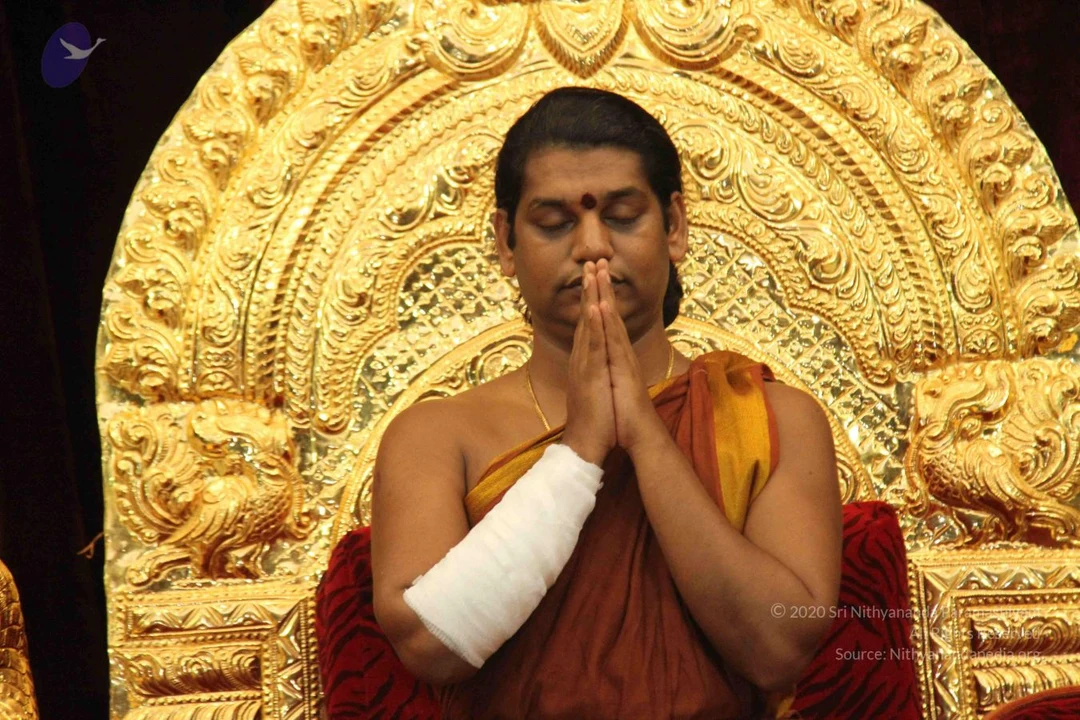
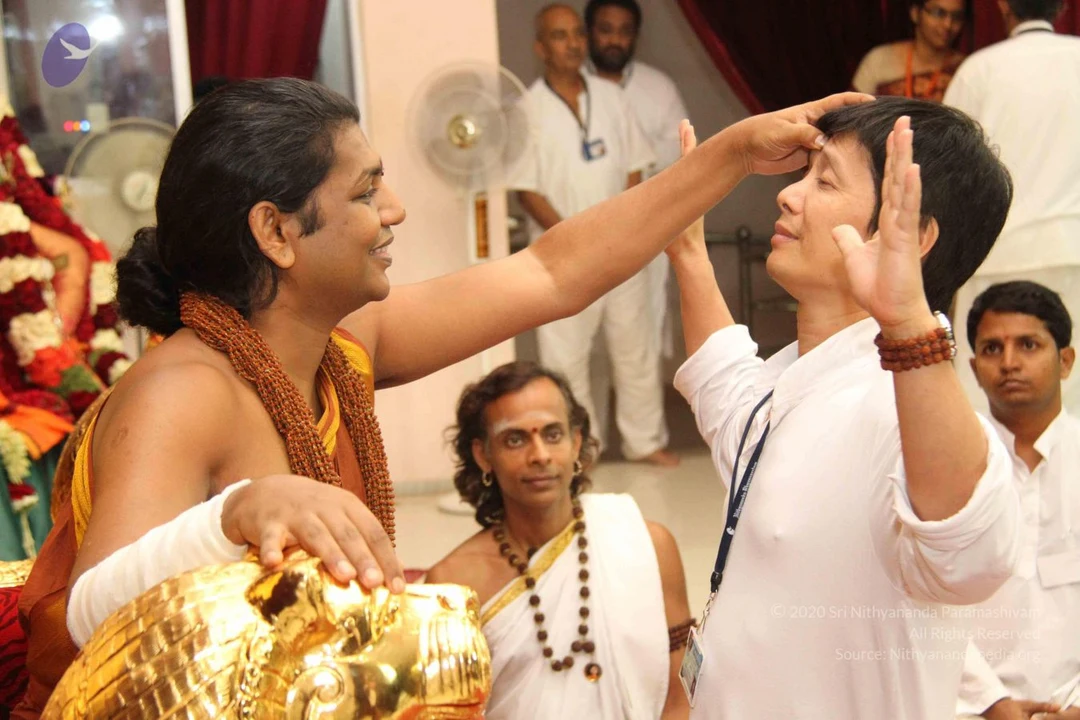
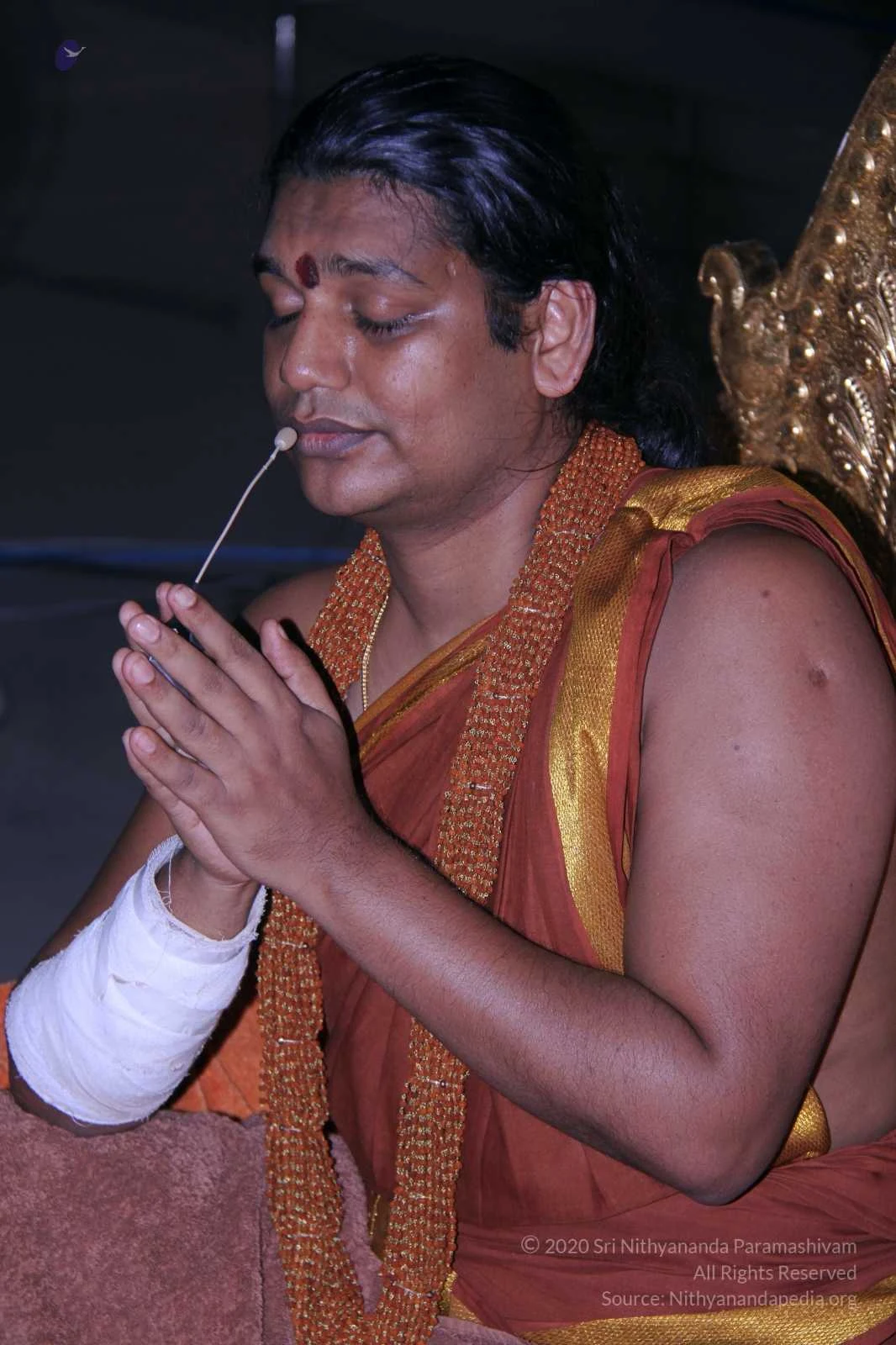
A seated man with closed eyes presses his palms together in anjali mudra at chest height. He wears a rust-orange dhoti-style cloth with a yellow-gold border, a thin gold chain, and a red bindi on his forehead. A white cloth bandage wraps his right forearm. He sits on a red-and-black patterned cushioned seat in front of an ornate gold-leaf throne back carved with floral scrollwork and lion figures. a person: the long swept-back hair, ornate gold throne, and saffron-orange robe are consistent with the page's identification, but the face-independent cues are only partly distinctive, so the match is uncertain. Scene is a single person in a ceremonial setting.A man seated on a red and gold upholstered chair before an ornate gilded throne back with carved floral and lion motifs, with a dark red curtain behind. He sits with eyes closed, palms pressed together in namaste, wearing a rust-orange robe with a yellow-gold sash and a white bandage on his right forearm. A red kumkum dot marks his forehead, and a thin gold chain is visible at his neck. Carved golden lion heads flank the throne. a person: a central figure in saffron-orange robes with a red bindi, seated on a golden throne, offering namaste during satsang.A photograph of an indoor hall with a red curtain in the background. A man in a white kurta with a dark lanyard stands with both arms raised, palms open and forward, while a woman in an orange-and-gold blouse with her hair in a bun leans forward and presses a folded paper against his chest over a golden figure. Another woman in a cream sari and a smiling person in white stand in the background, and a folded stack of papers sits on a table at right.A photograph of a blessing ritual indoors. On the left, a bare-shouldered figure wearing an orange-saffron shawl and a gold necklace, with long dark hair tied back, extends a hand to touch the forehead of a man in a white kurta with a blue lanyard, who stands with eyes closed and his other hand raised in a palm-out gesture. Behind them a second person in white holds a sheet of paper and wears rudraksha beads and a red-and-white tilak, and a few other people in white stand in the background. Red curtains, a standing fan, and a garland of red and white flowers frame the scene, with a gold object in the lower foreground.A photograph of an indoor ritual setting. A man with long dark hair tied back, wearing a saffron-orange wrap and a rudraksha mala, extends his right hand toward the forehead of a man in a white polo shirt, who raises both hands in front of his face. Seated beside them is a shaved-headed man in white dhoti and shawl with a rudraksha mala and a red tilak. Behind them, two men in white dhotis and a woman in a red sari stand near a red curtain. At left, a golden figure and garlands of red and white flowers are visible. a person appears to be the man in saffron-orange wrap and rudraksha mala performing the blessing gesture.A photograph of an indoor ritual blessing. A man in an orange-saffron garment with a long rudraksha mala stands on the left, his right hand raised and placed on the forehead of a young man in a white kurta who stands on the right with palms pressed together in a respectful gesture. The blessing man holds a golden object in his left hand. Behind them, a seated man in white with a rudraksha mala and bindi watches, red curtains hang in the background, and a fan and a few other men in white and light clothing are visible. Garlands of red and white flowers decorate the left edge.

MaheswaraPuja_Swamiji
95 photosSource gallery
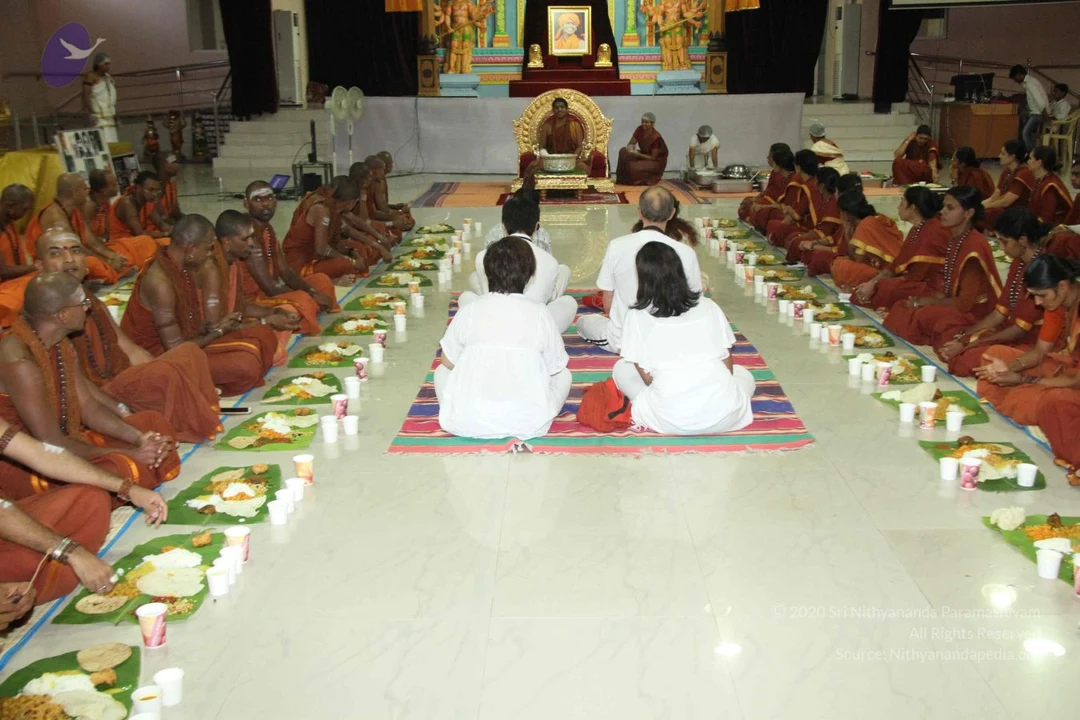
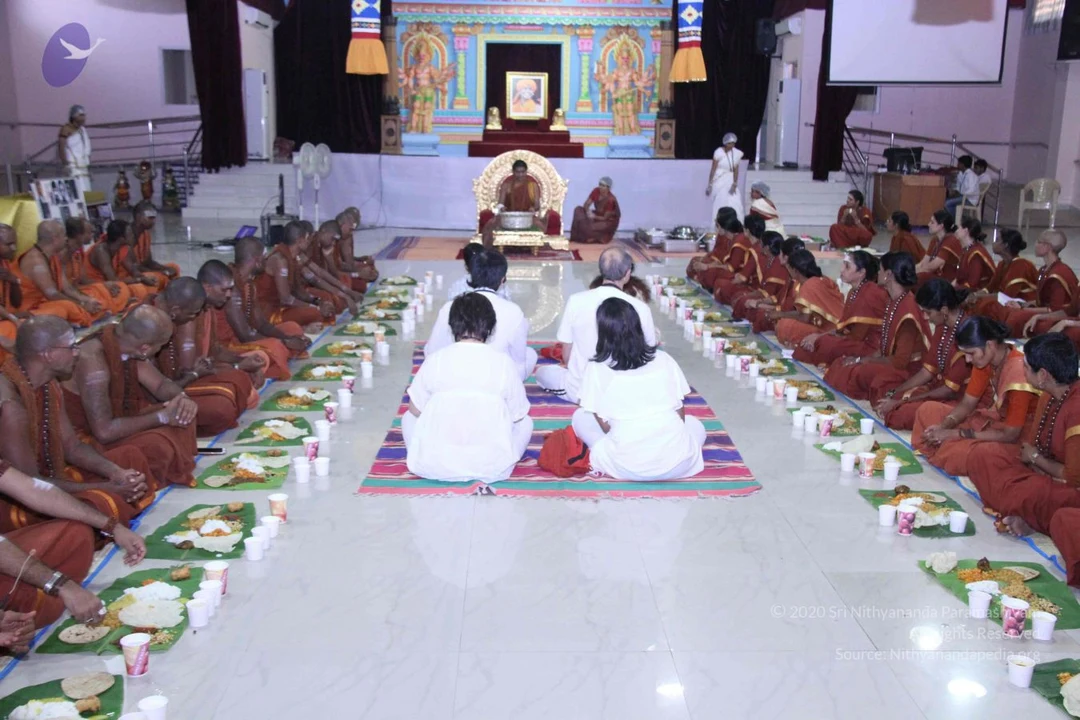
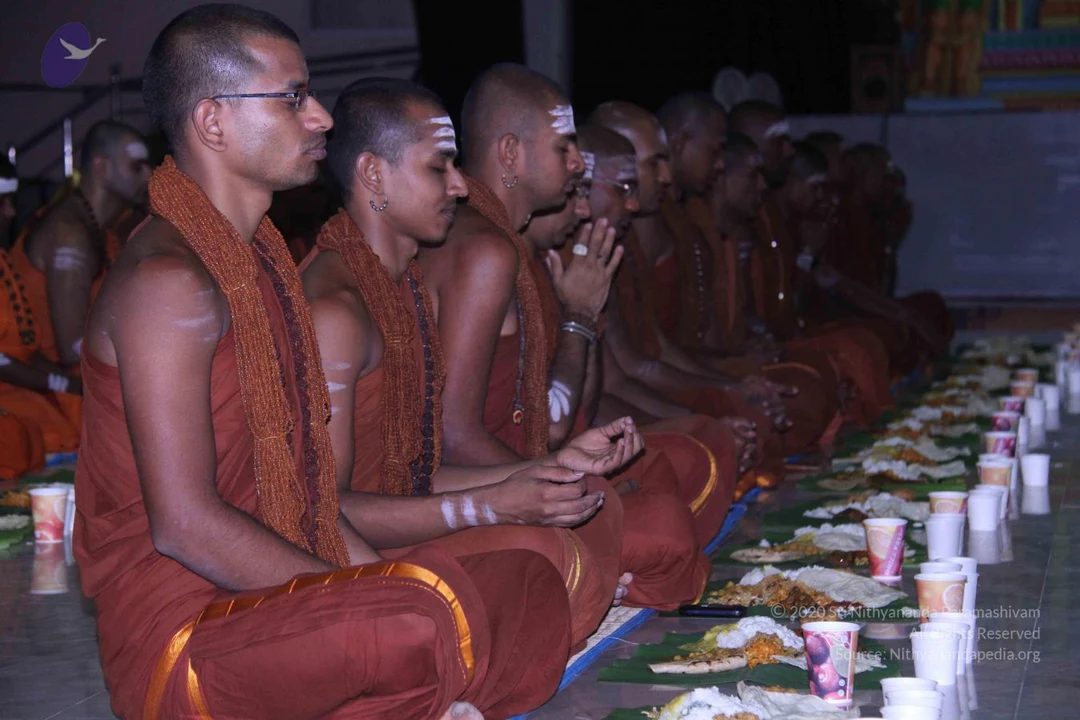
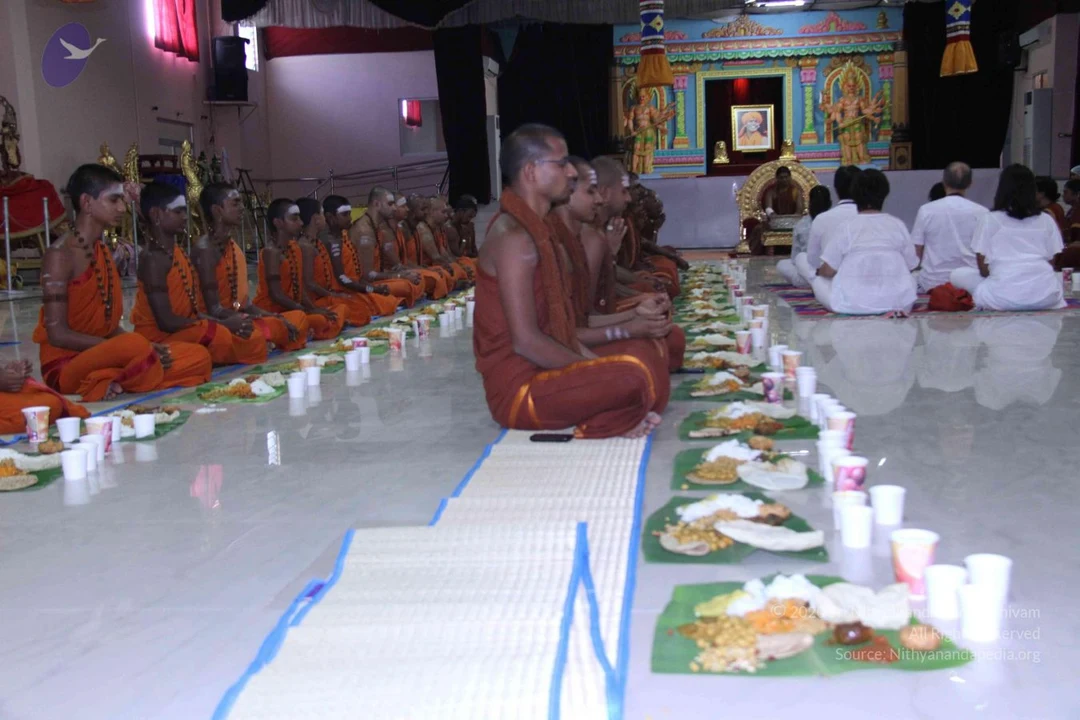
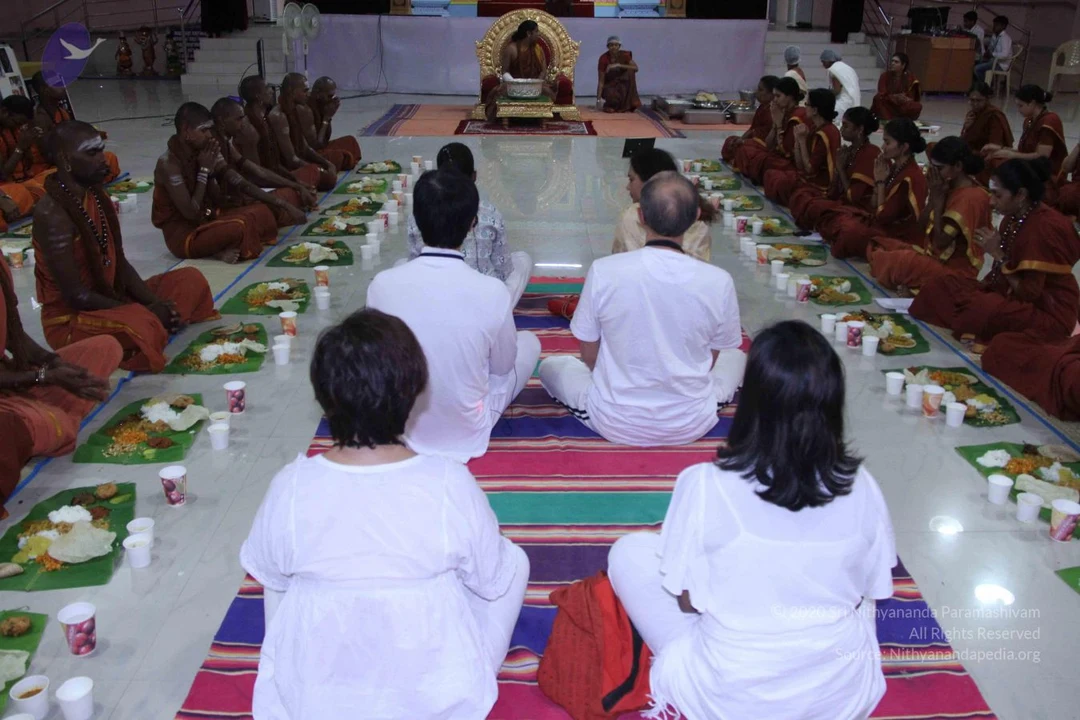
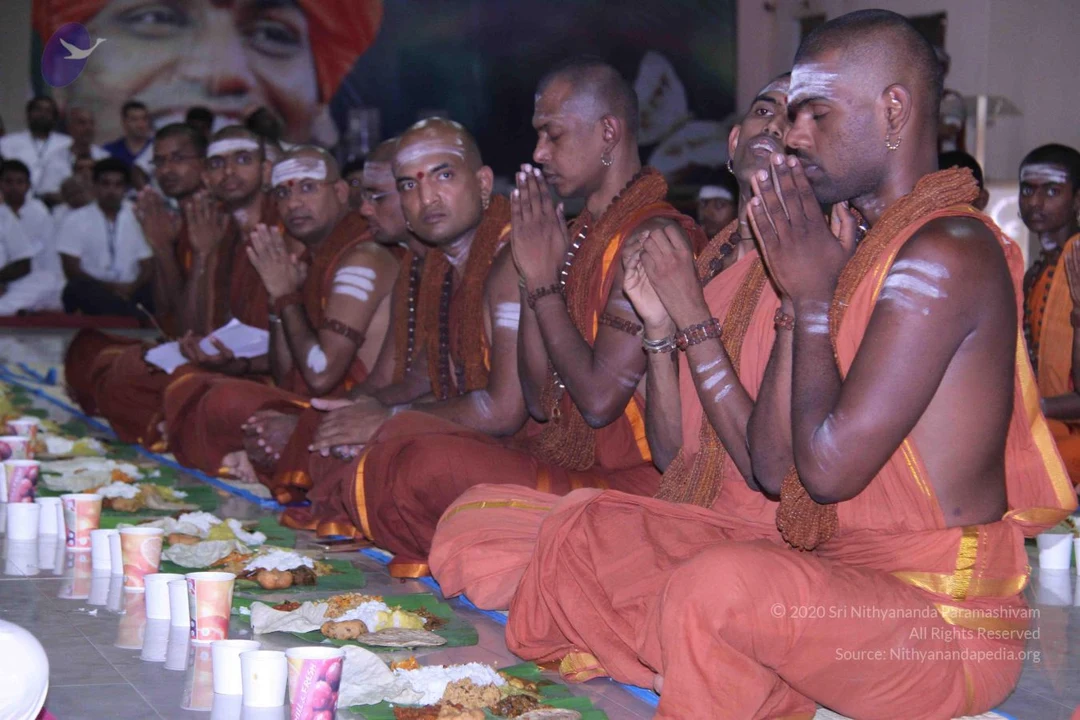
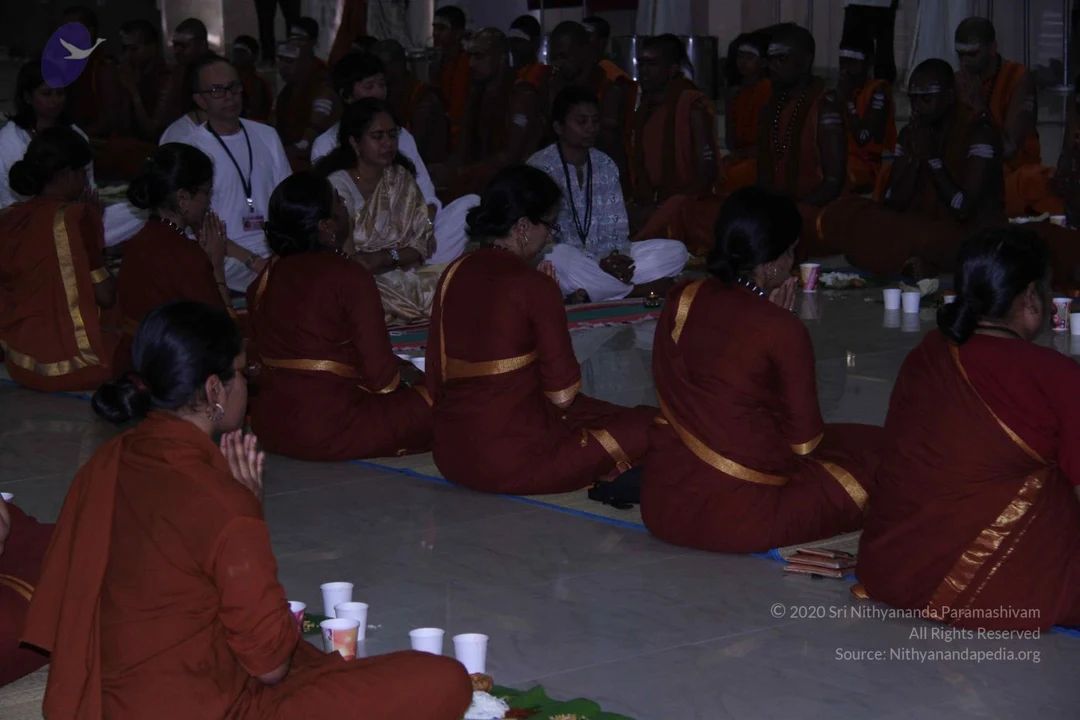
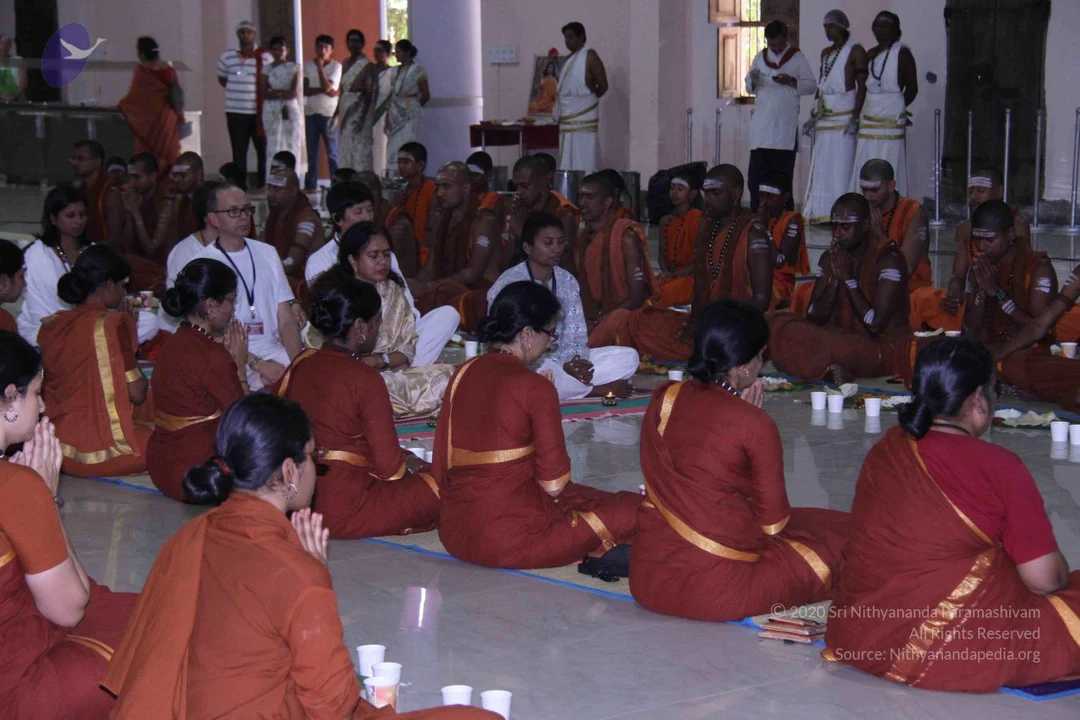
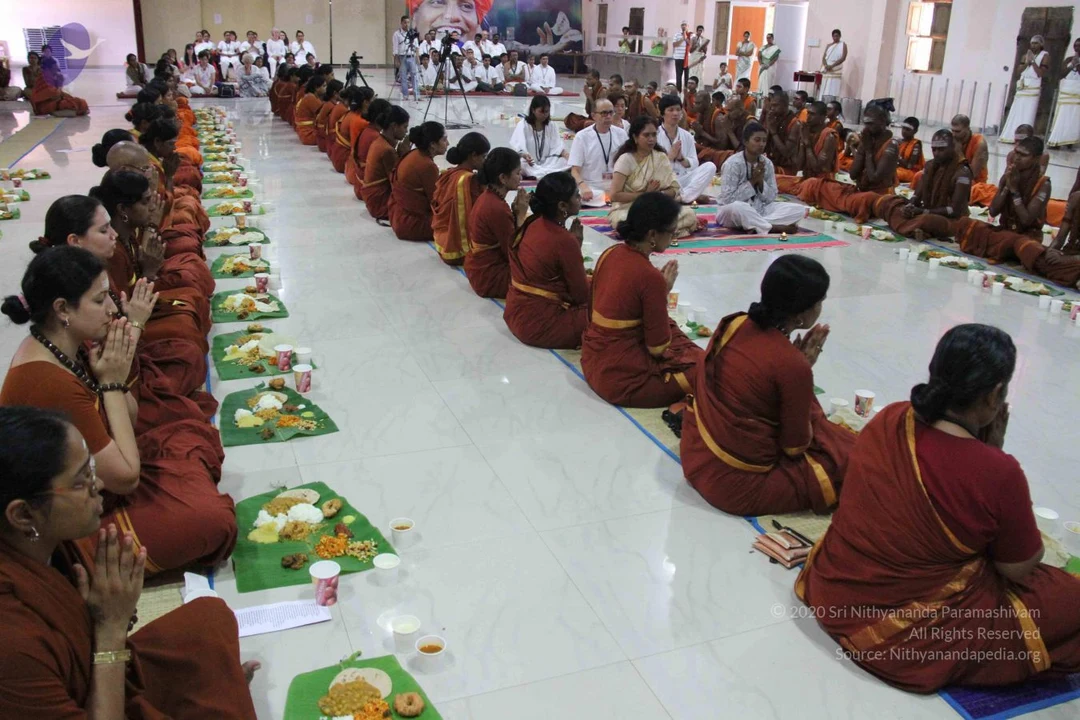
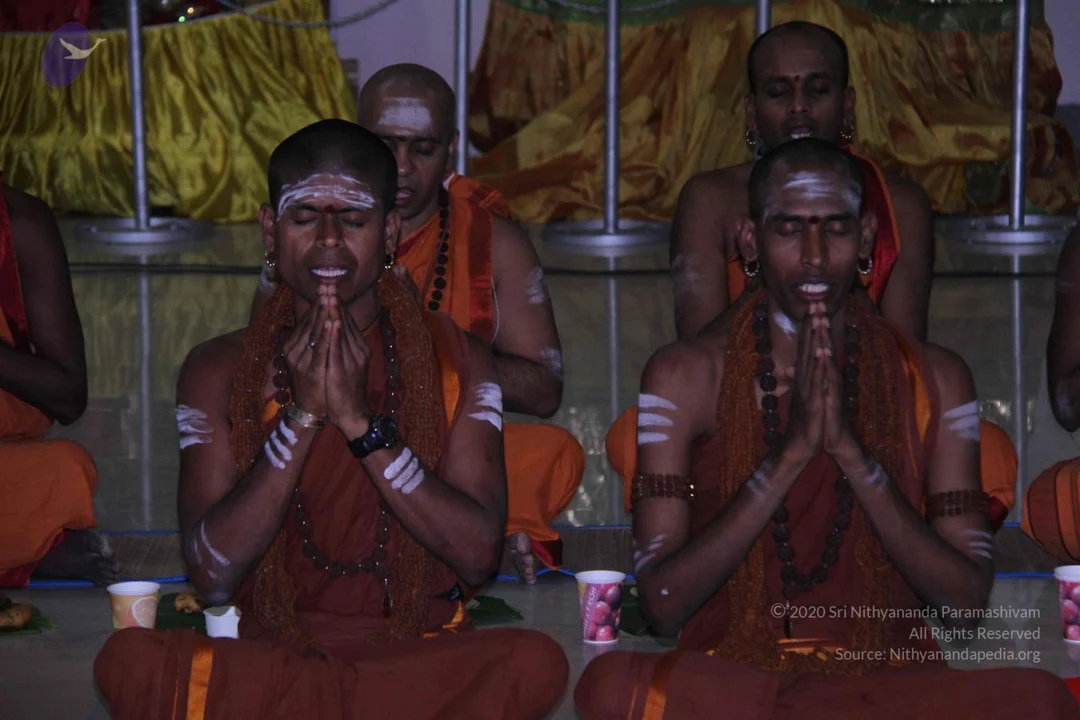
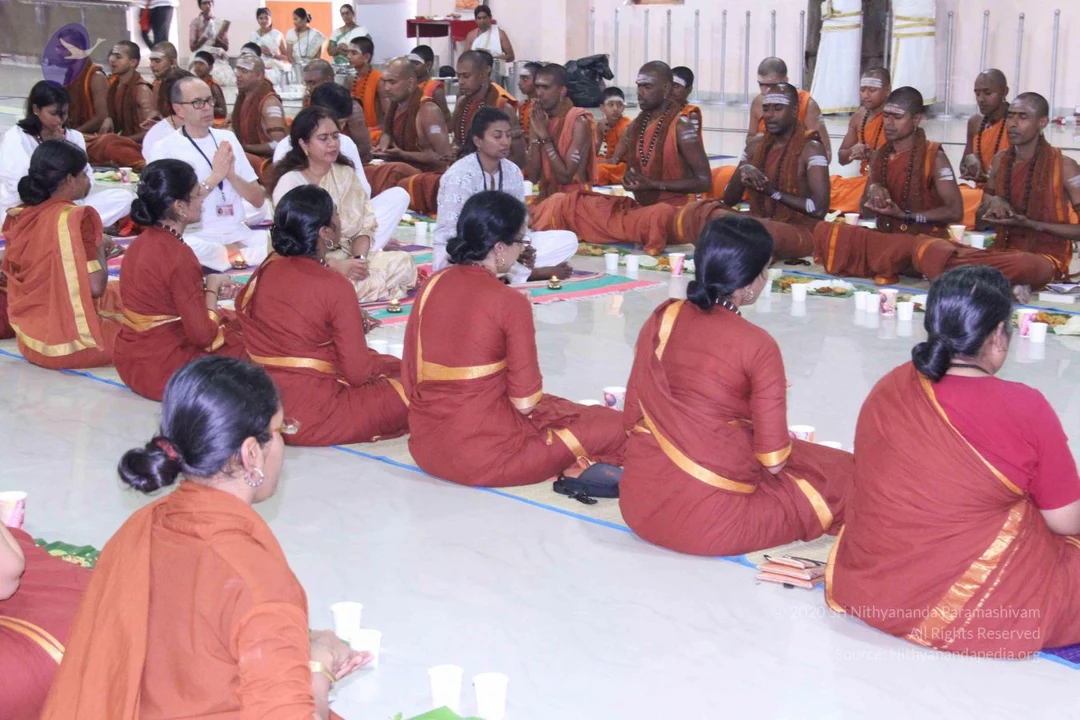
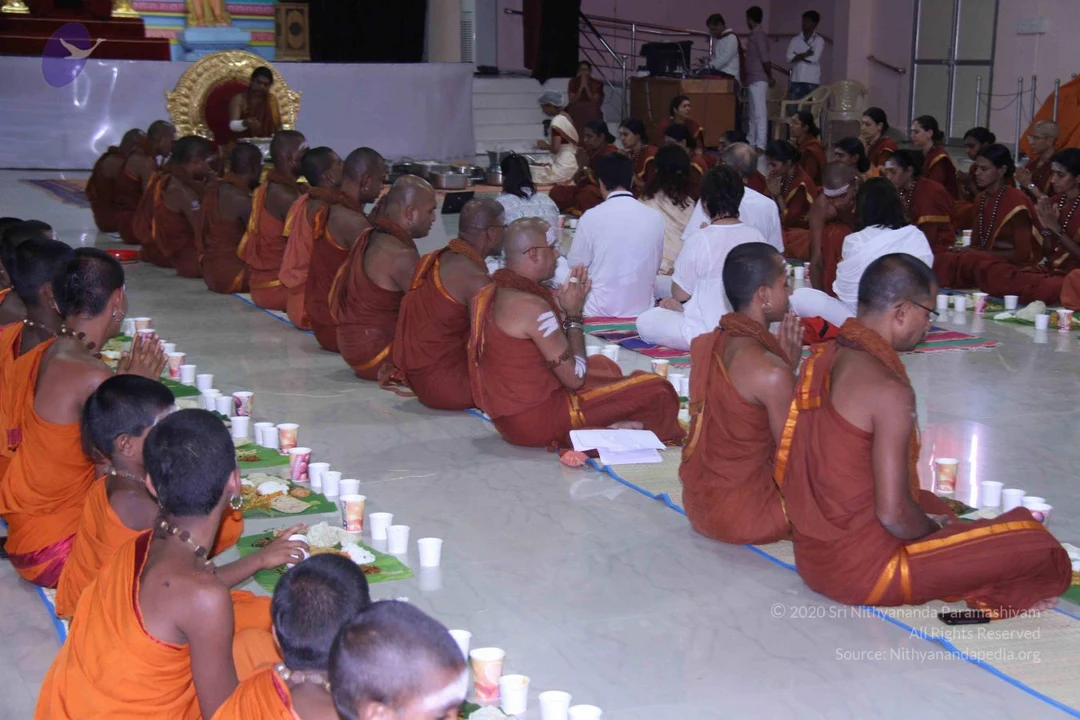
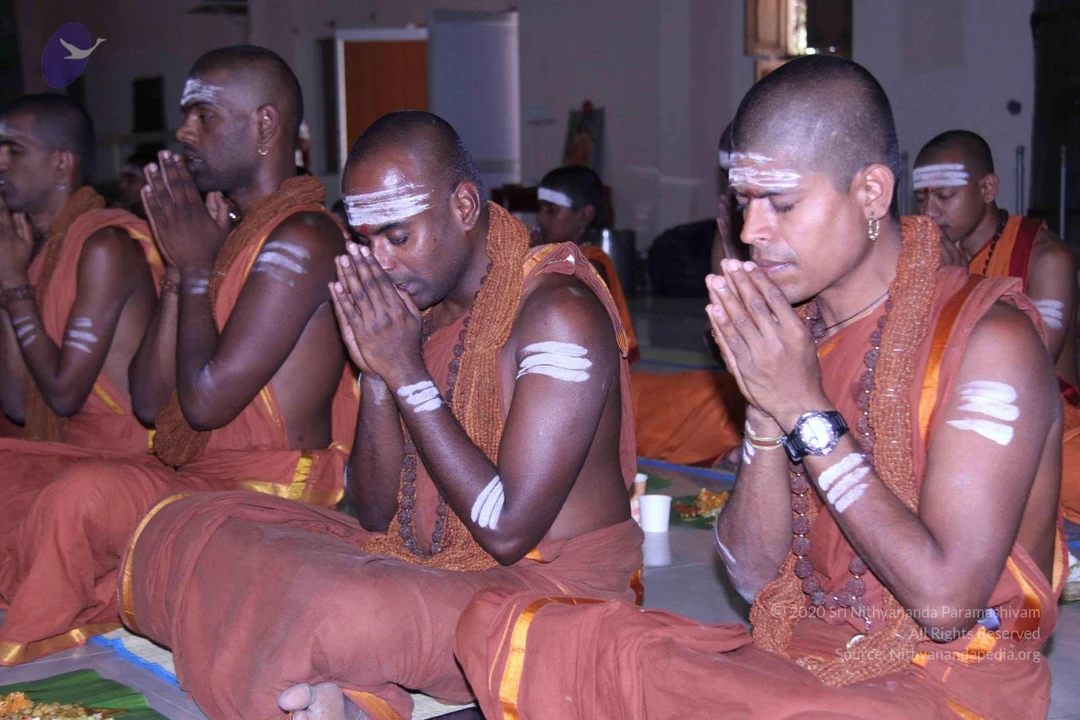
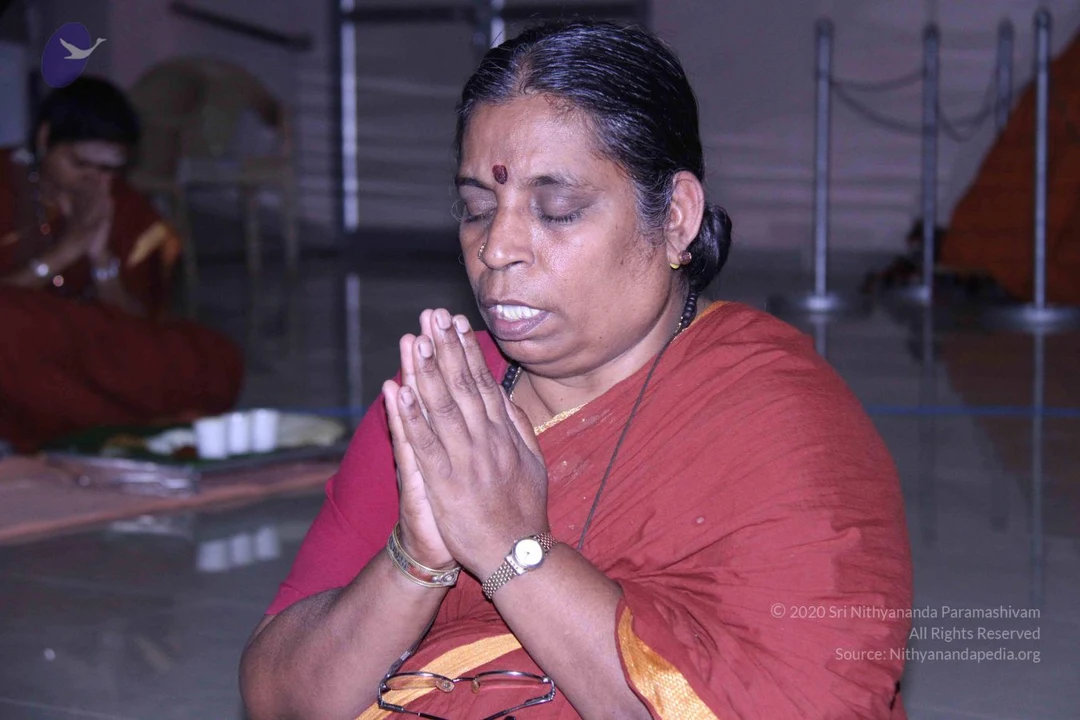
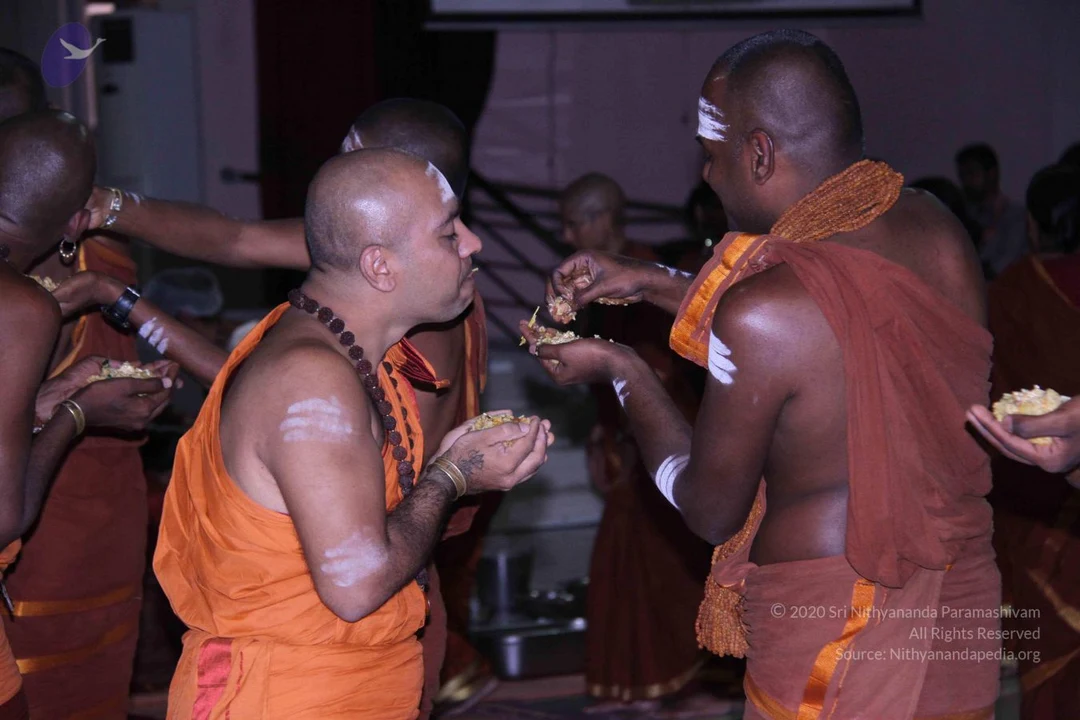
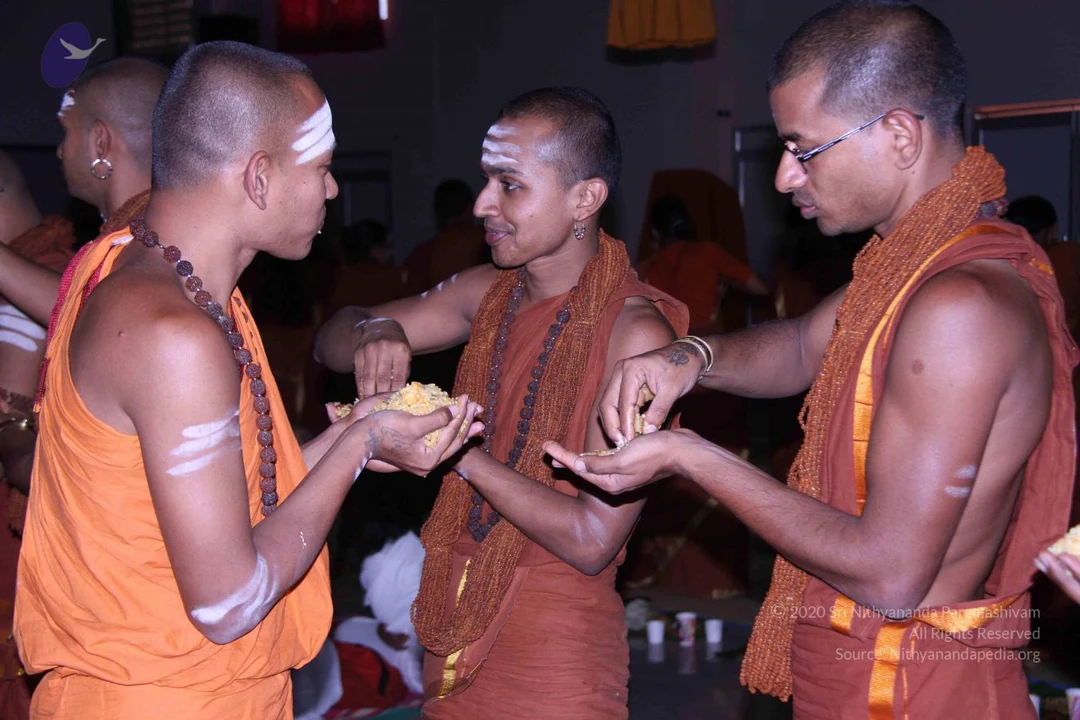
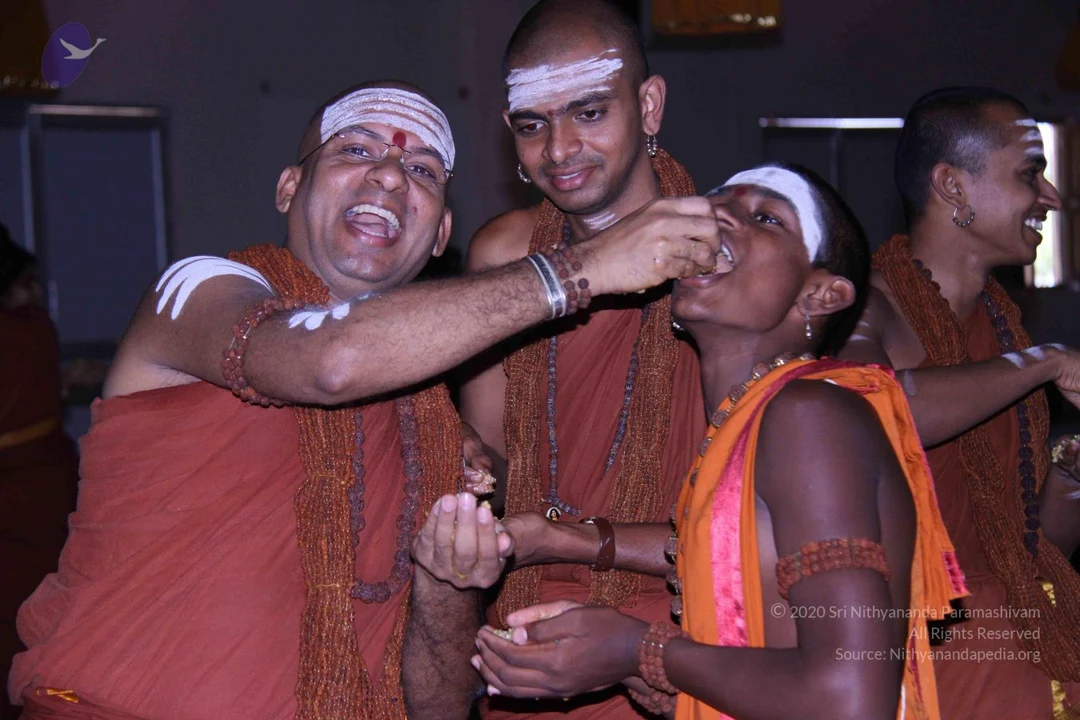
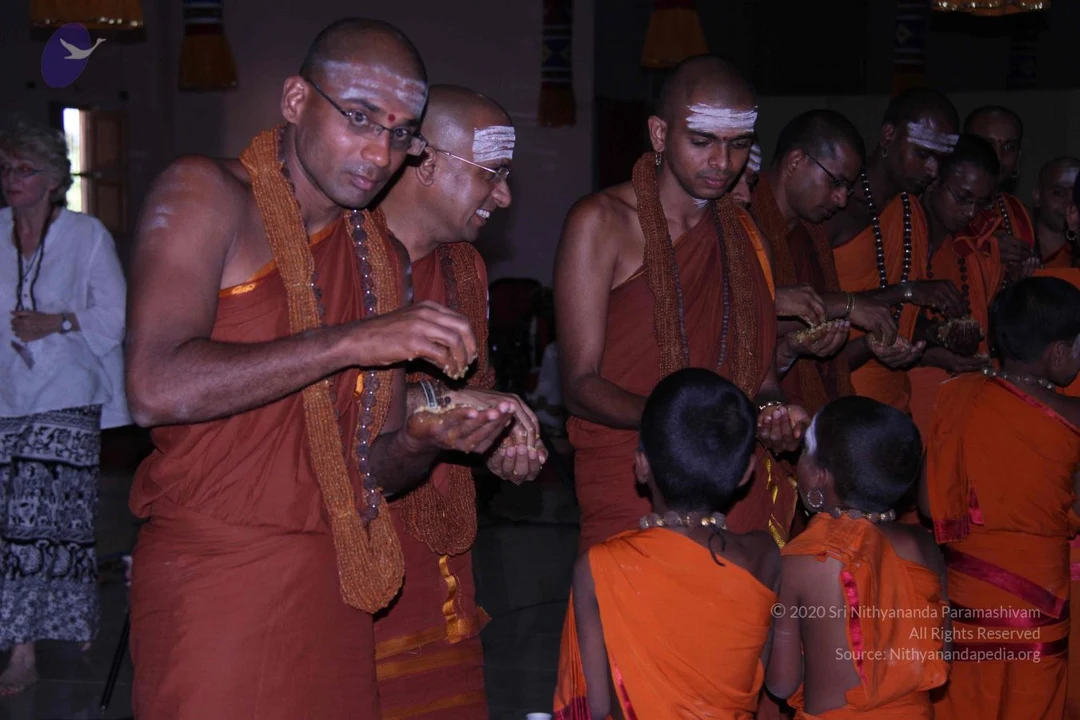
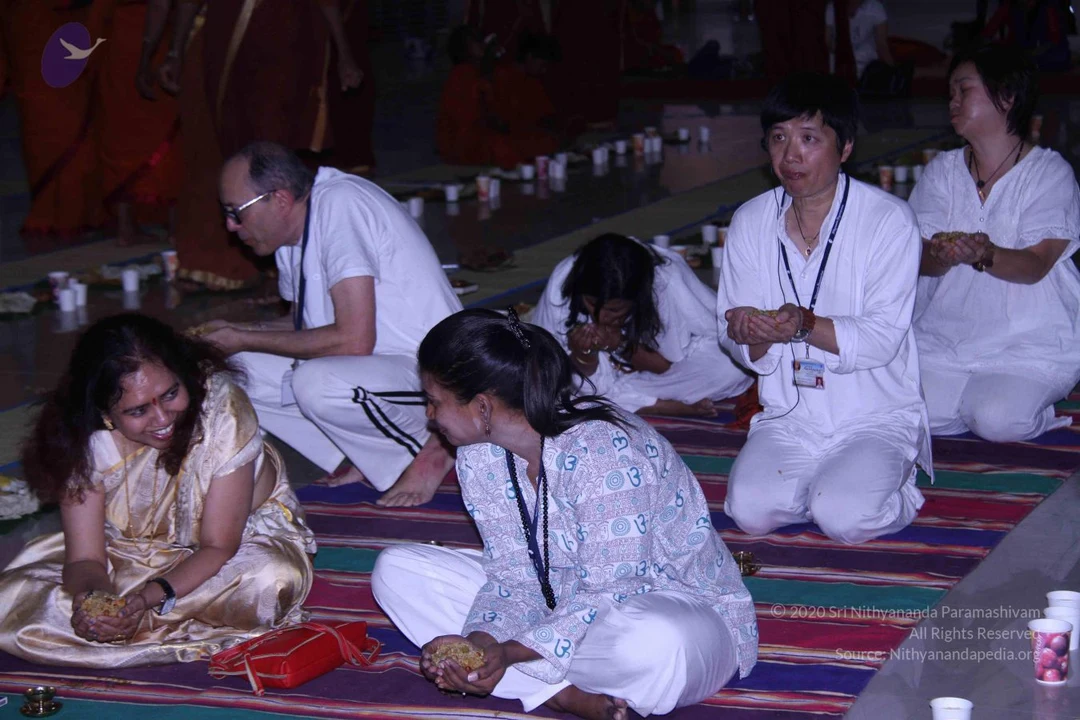
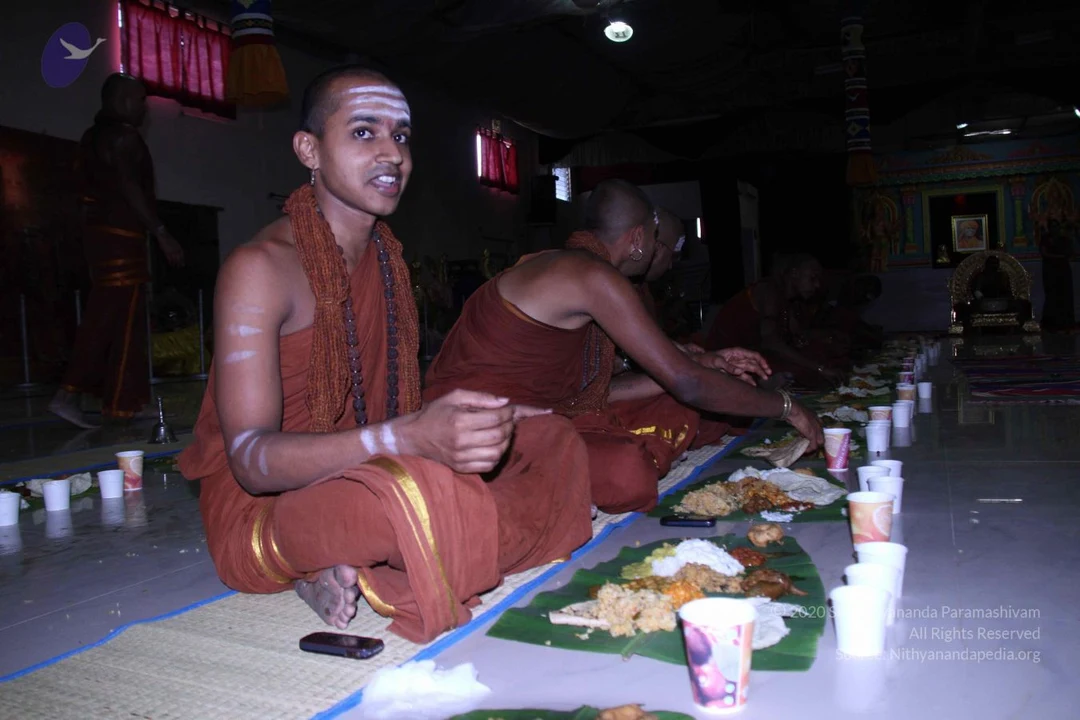
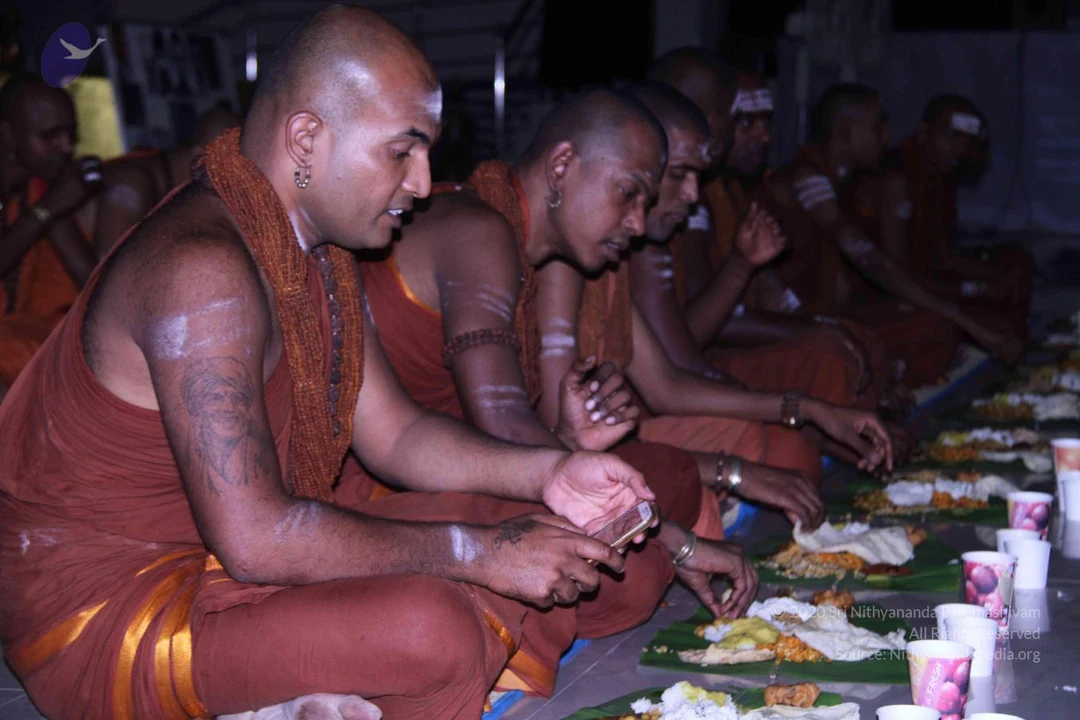
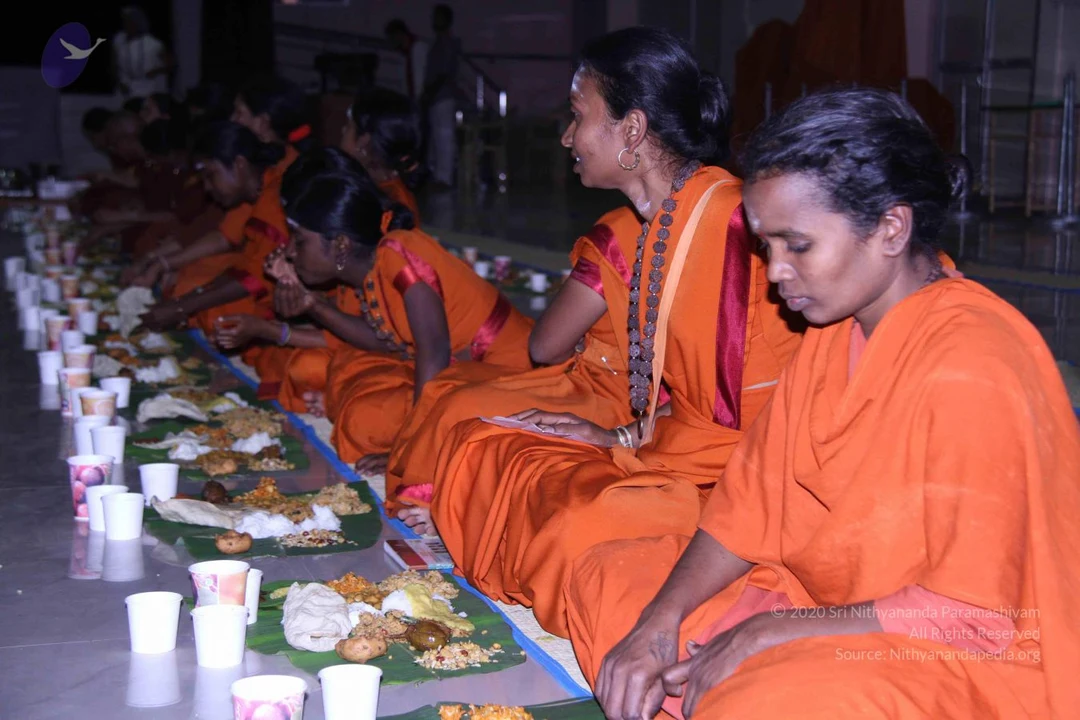
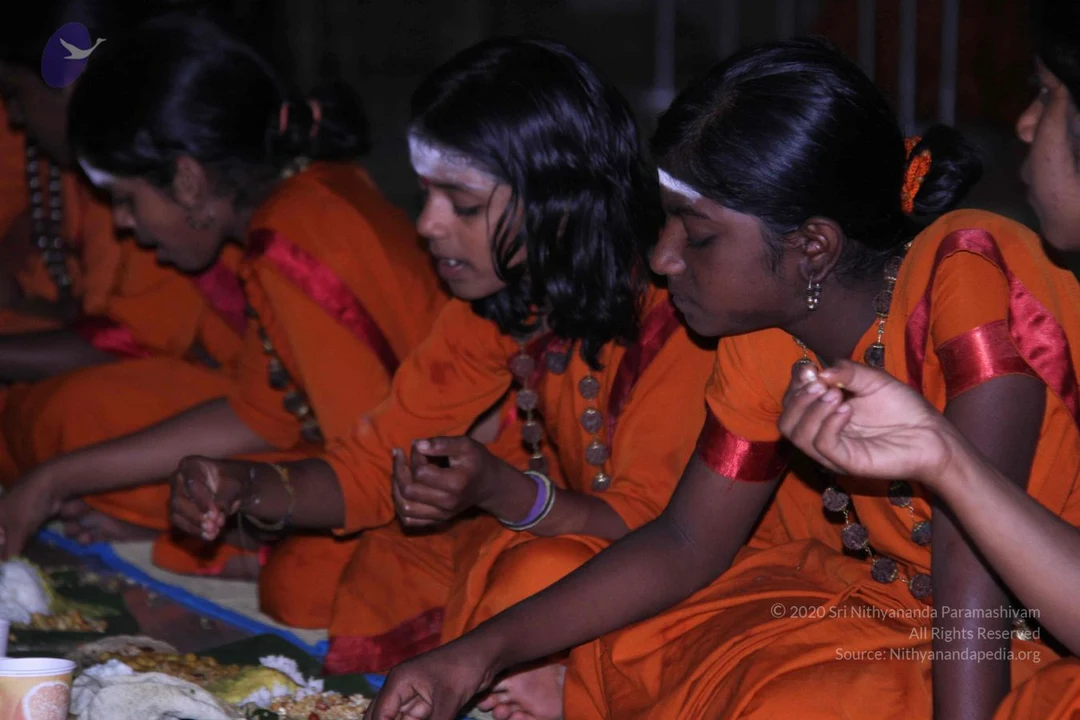
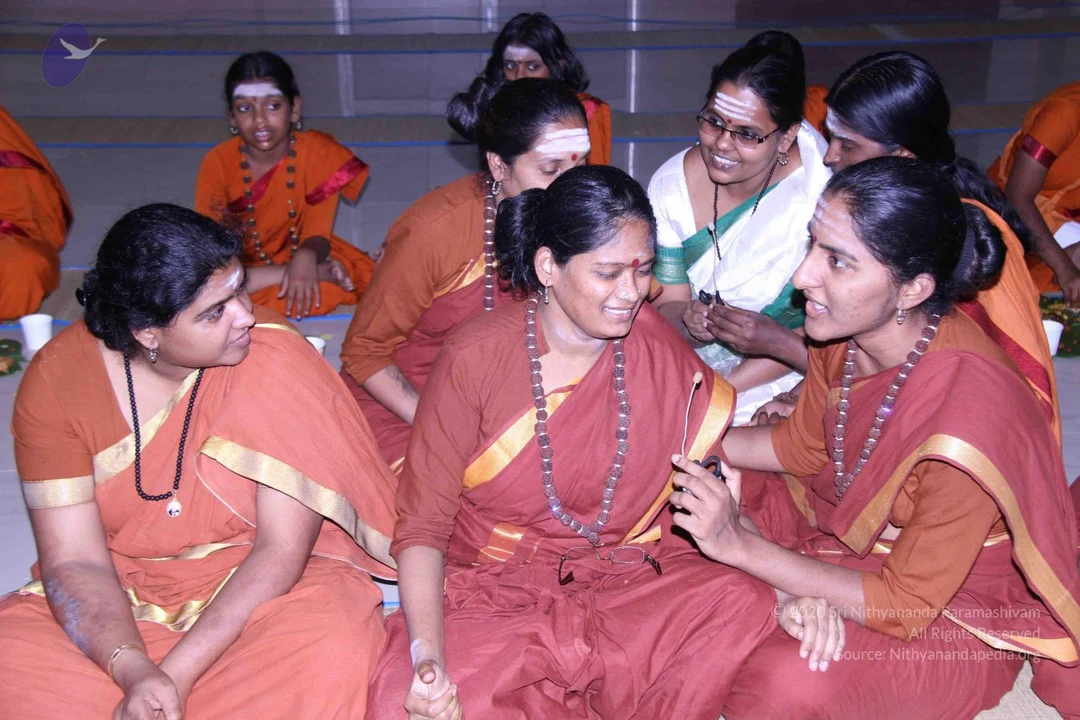
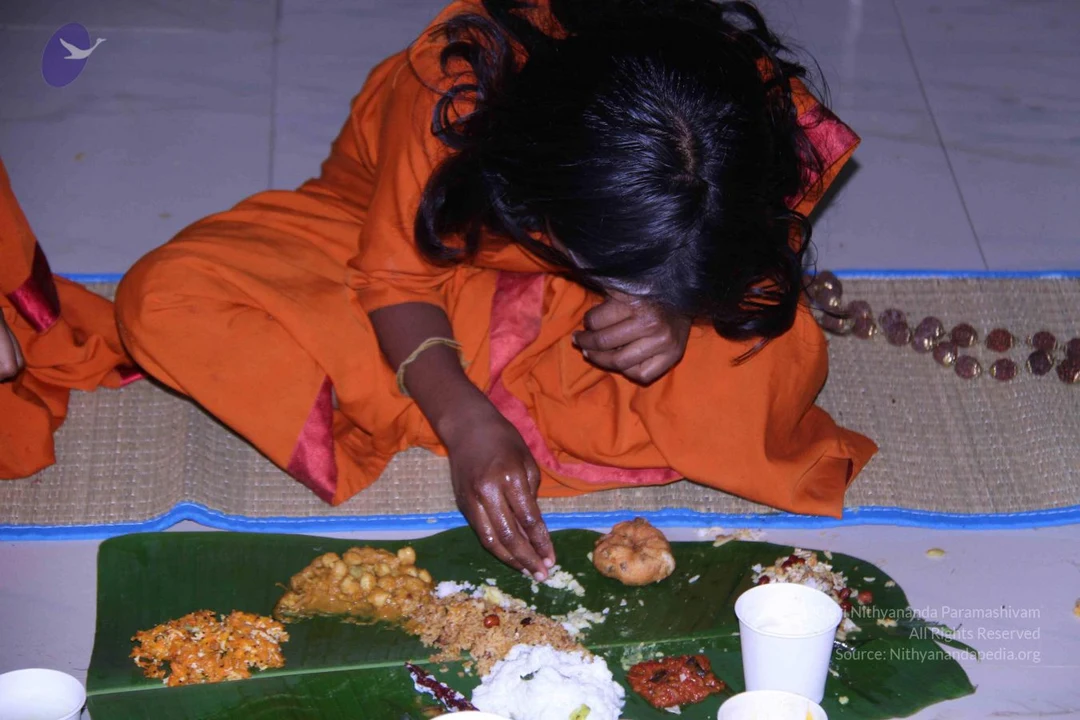
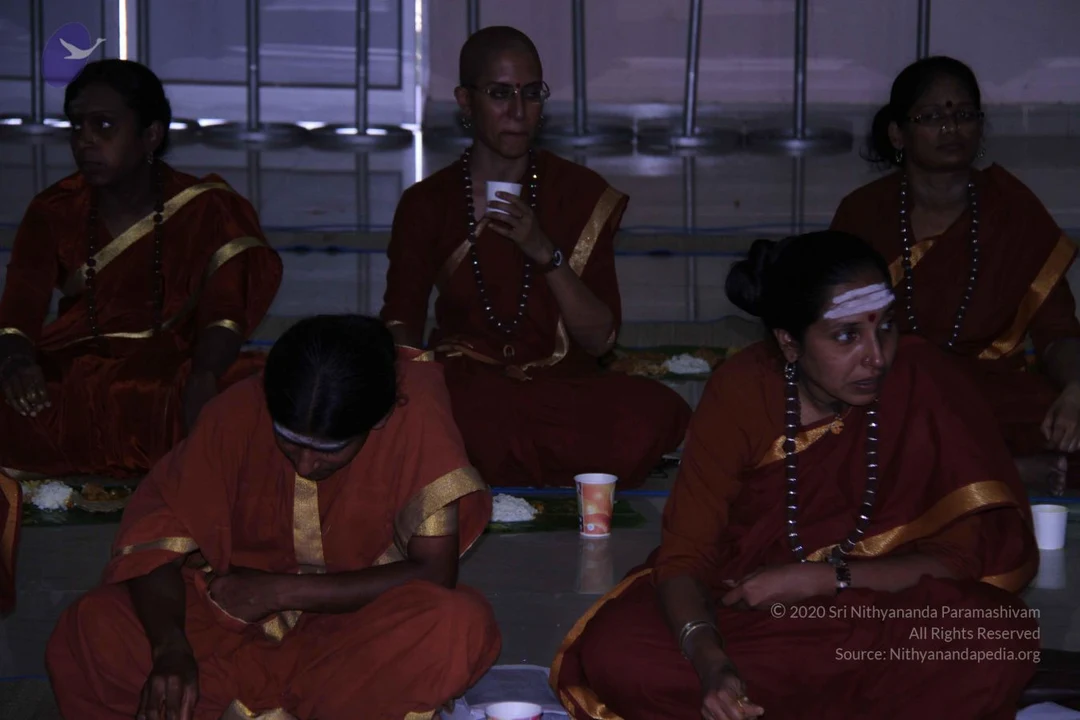
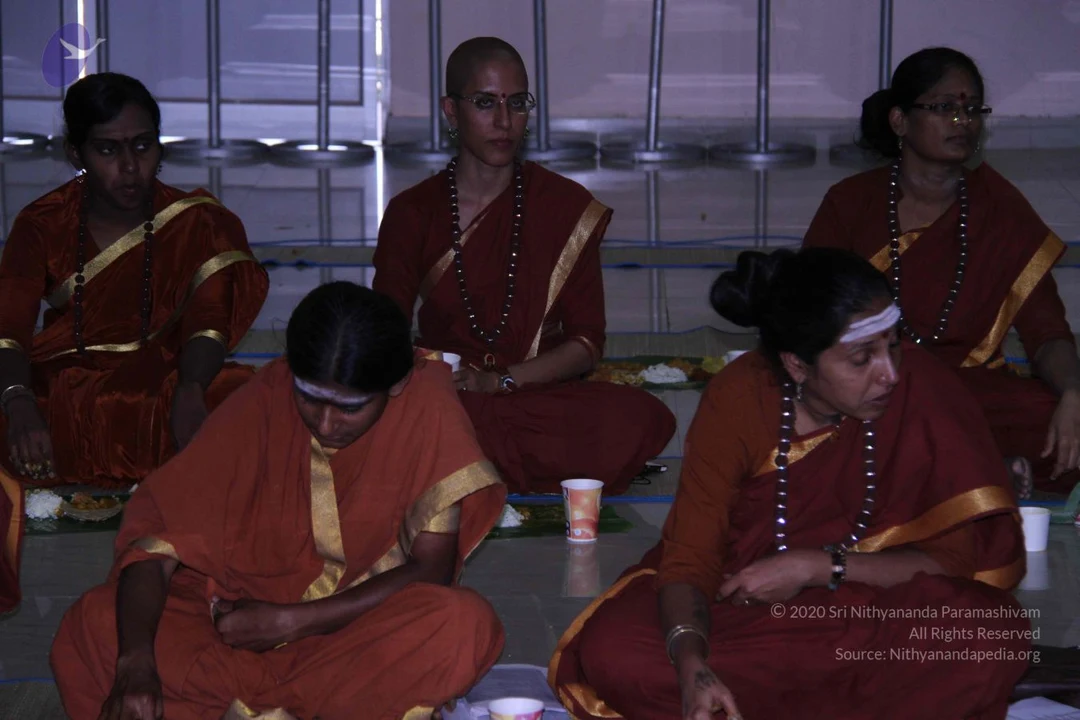
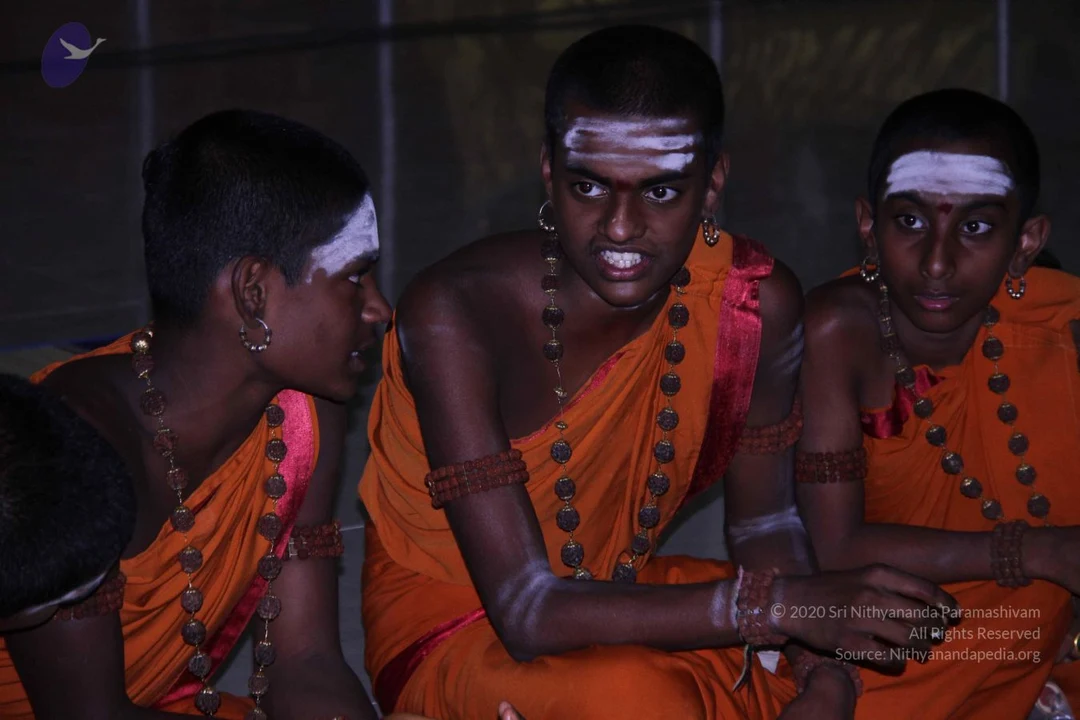
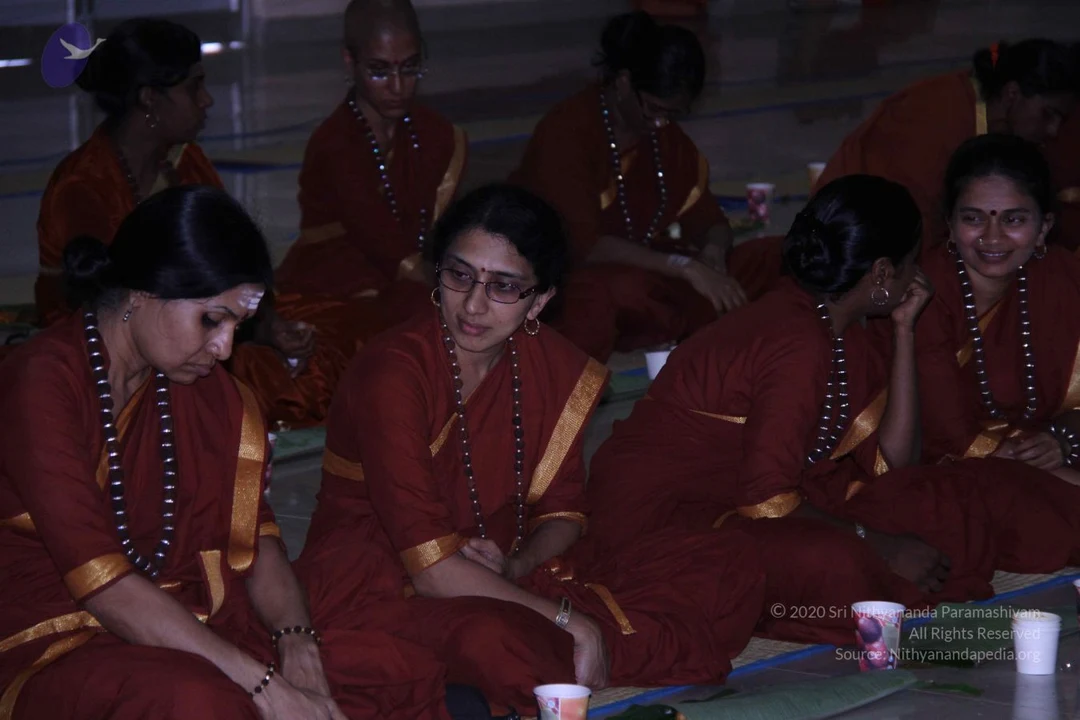
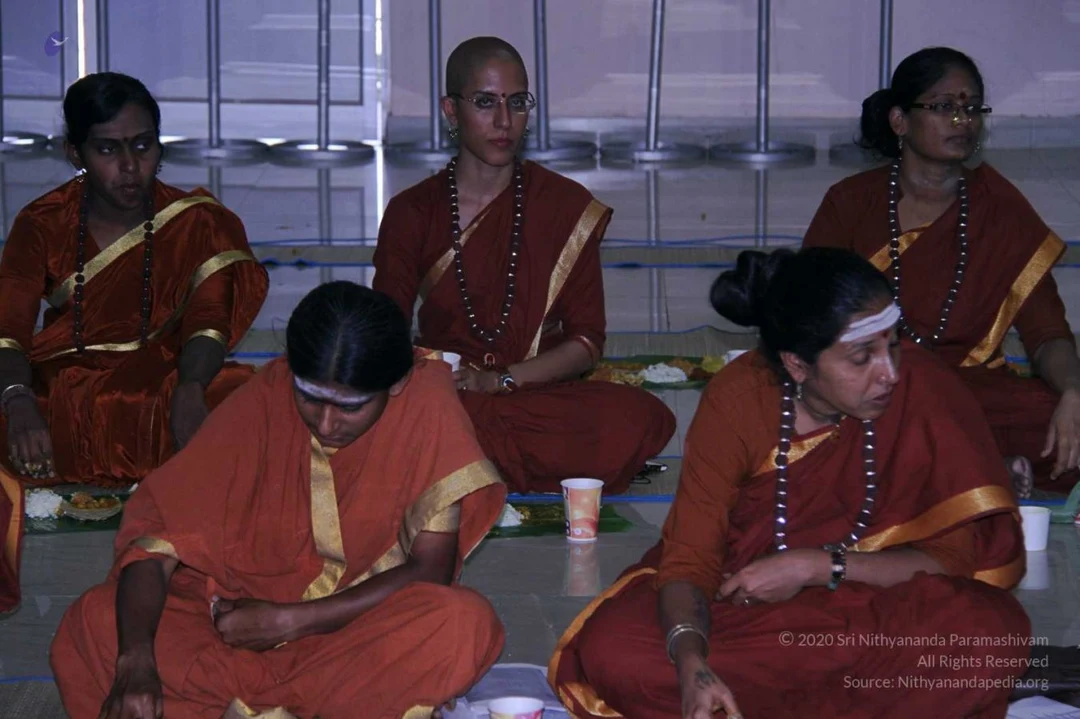
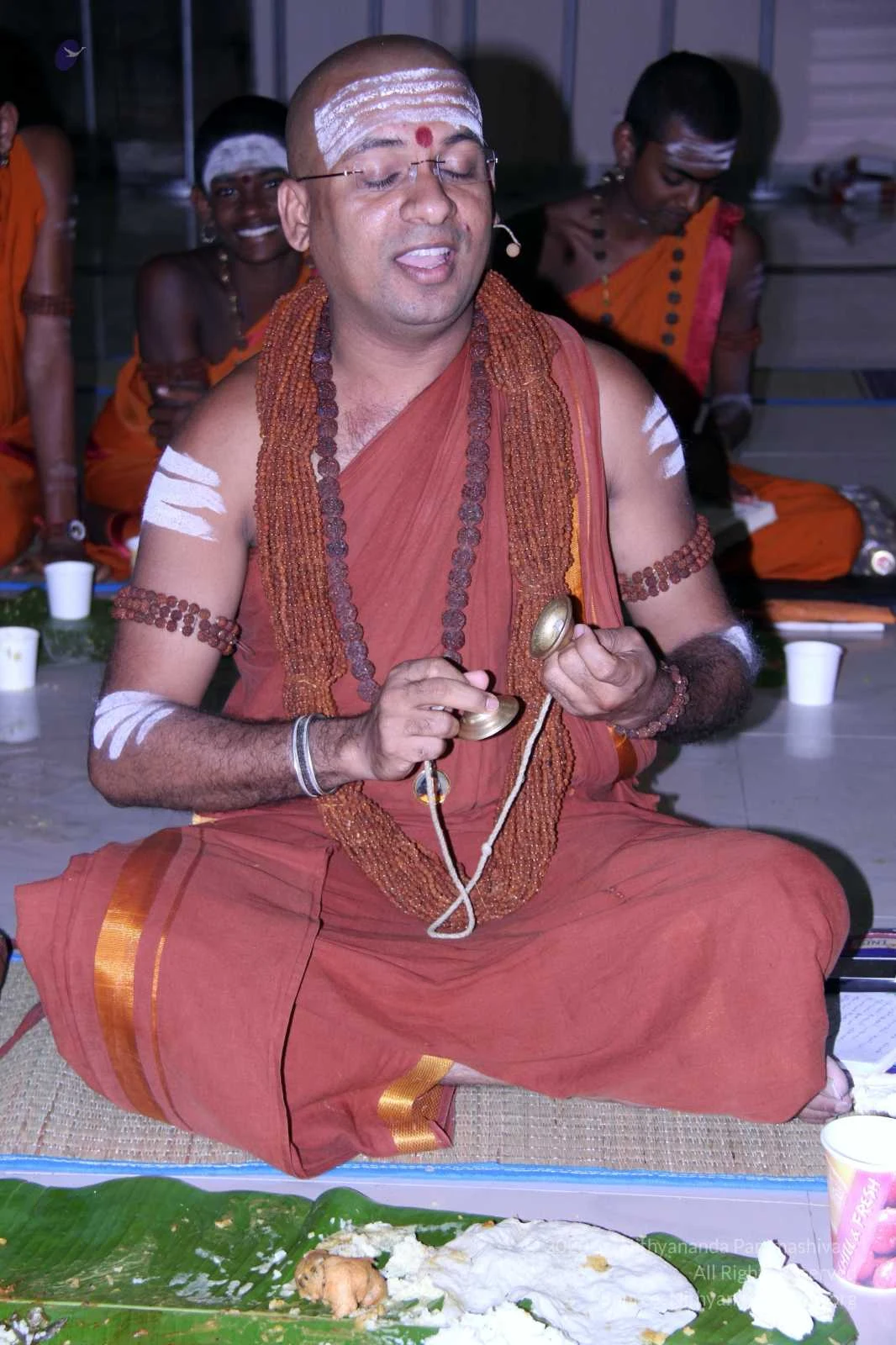
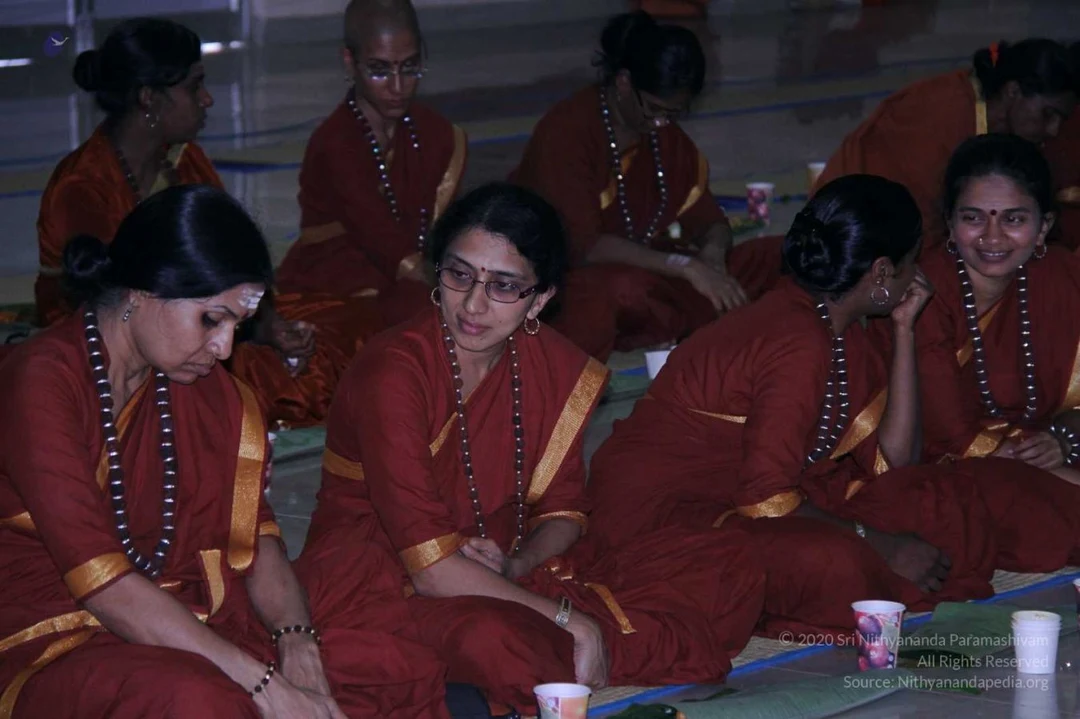
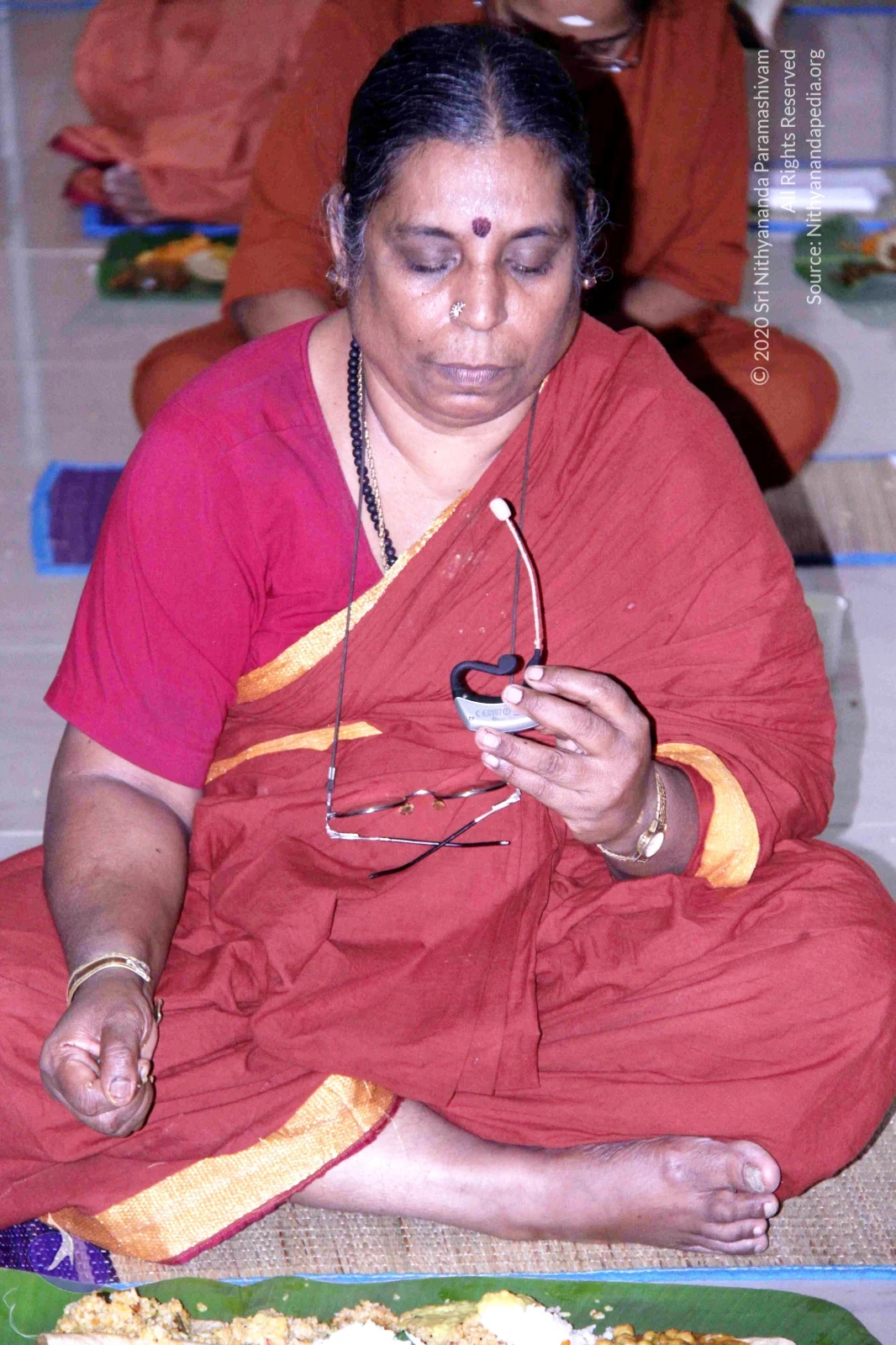
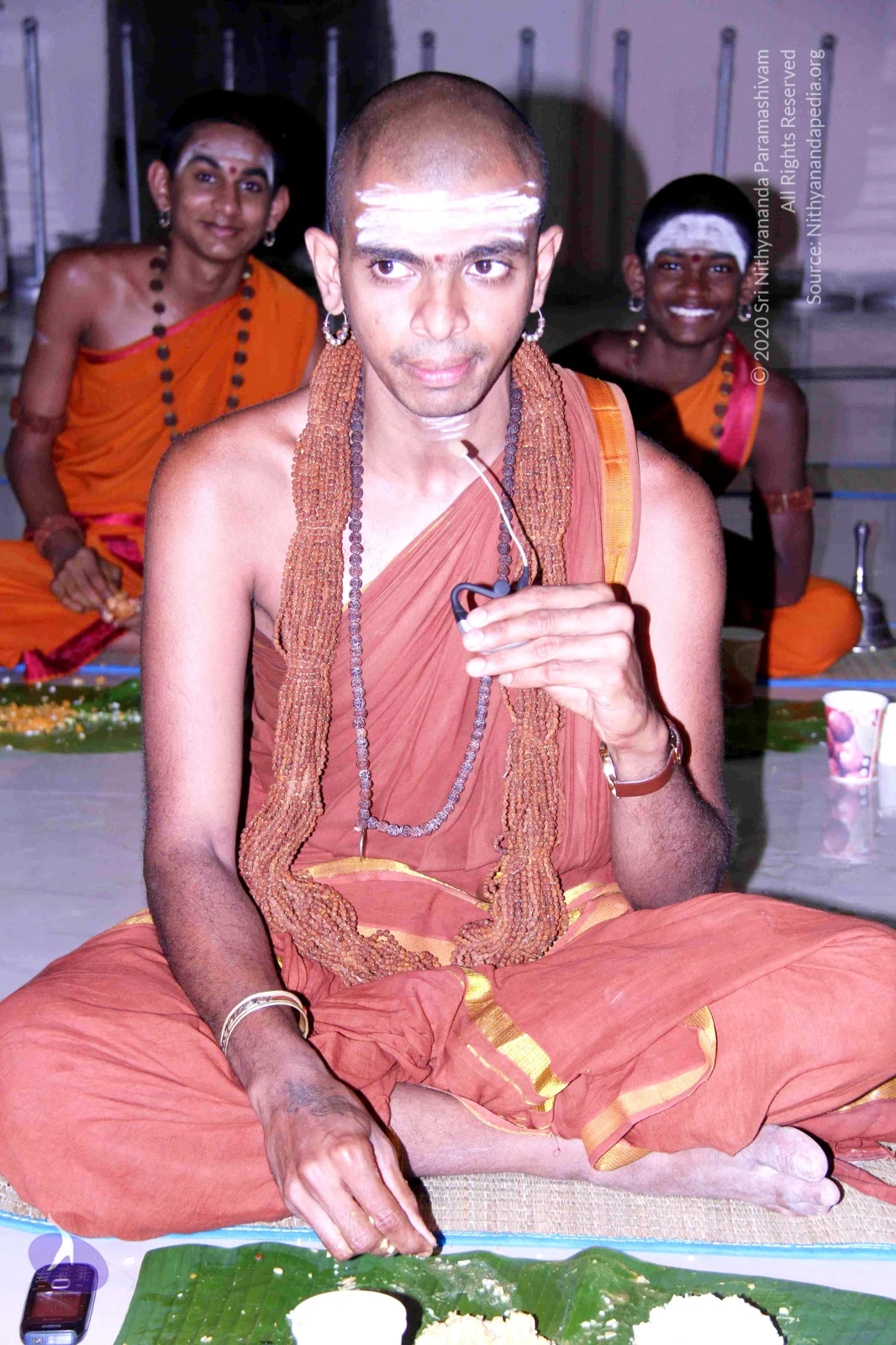
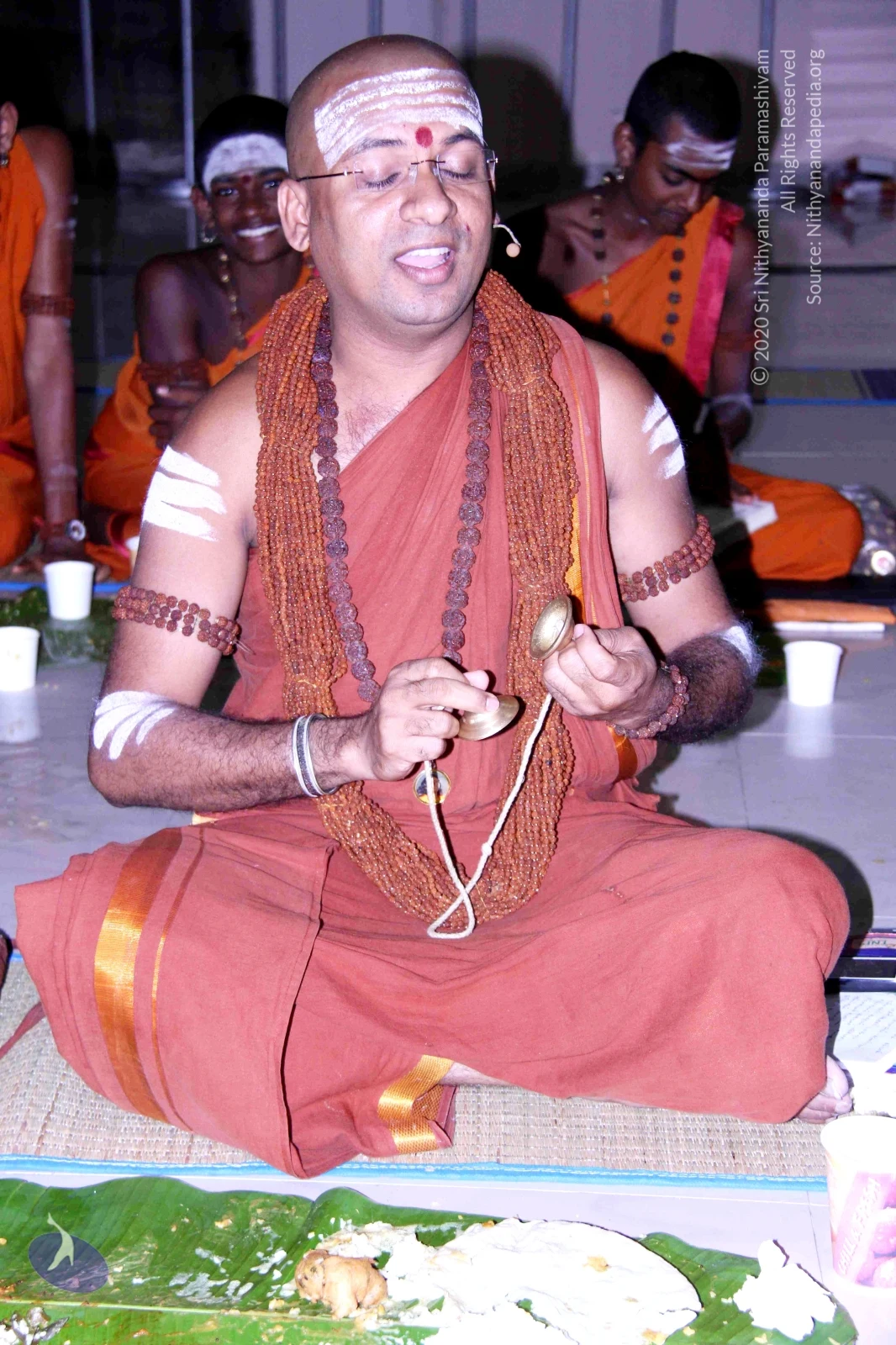
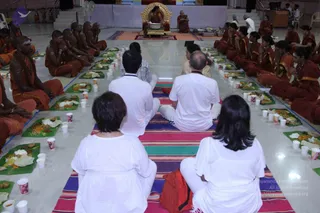
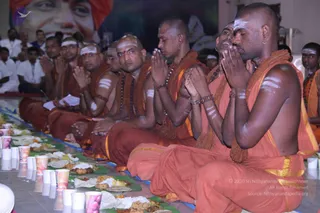
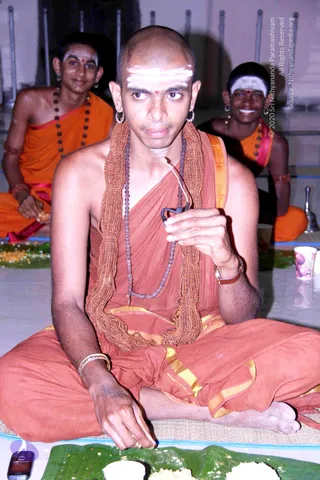
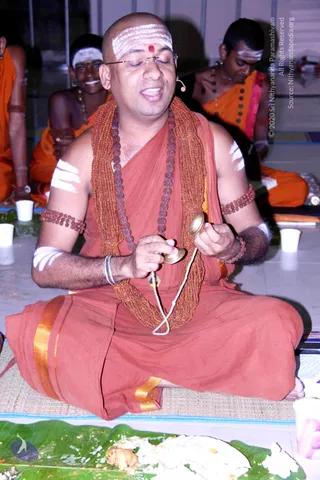
A seated meal in a large hall with white marble floor. Rows of monks and nuns in saffron-orange robes sit cross-legged on both sides, each before a banana-leaf plate of food with paper cups of water. In the centre, two people in plain white clothing sit facing a central figure on a golden throne-like seat, backed by a red and gold shrine with standing deity figures and a framed portrait. A figure in orange sits near the throne. Brass lamps and offerings are visible, along with a stage area and several people standing at the edges. The scene suggests a communal food offering in a temple hall.A large hall set for a communal meal, with rows of seated devotees on both sides of a central aisle. Rows of banana-leaf plates are laid on the floor, each with food and small paper cups of water. In the centre, two people in plain white clothes sit with their backs to the camera on a striped mat, facing the stage. Men on the left wear orange and saffron robes, and women on the right wear orange and red sarees with rudraksha malas. On the stage, a seated figure in saffron clothing sits on a gold throne before an ornate multicoloured backdrop with painted deities, with a framed portrait above. A standing attendant in white stands at the side. Several people in orange sit at the far right near the stage.A row of shaved-headed monastic men in rust-orange robes sits cross-legged on a hall floor during a meal. Several have white vertical tilak marks on their foreheads and white painted markings on their arms and shoulders. Some wear orange shawls with beaded strands, and one wears glasses. Their hands are folded or clasped in front of them. Before them sit banana leaves holding rice dishes, with paper cups of drink along the leaves. The leaves run in a long line toward the right edge of the frame. No individual is identifiable as a person from appearance cues in this image.A photograph of a seated meal in a hall with a white glossy floor. In the foreground, rows of young men in orange robes and rudraksha malas sit cross-legged on banana leaves heaped with rice, dal, vegetables and sweets, with steel cups and paper cups beside them. Several monks in orange robes sit in a line along the leaf plates, one with his hands folded in front of him. Behind them, people in white ritual clothes sit on mats. At the back, a seated figure in orange sits on a gold-trimmed throne in front of a decorated stage with painted deity figures and a framed portrait, with a mat and a cloth covering the floor. The scene shows a communal meal in an ashram setting.A photograph of a seated group sharing a meal in a bright hall with a light tiled floor. In the foreground, four people in white clothing sit with their backs to the camera on a striped rug. Facing them across a long row of banana-leaf plates is a line of people in saffron-orange robes, several with shaved heads and white markings, their plates holding rice, vegetables and sweets. At the far end, a figure in red and gold sits on a high ornate golden throne-like seat, with an attendant in saffron nearby. Cups of water are set along the leaf plates, and a small table with objects stands at the right edge.A photograph of a seated meal line in a hall. Several men in saffron-orange robes with gold borders sit cross-legged on the floor, hands pressed together in namaskar with eyes closed. Many have white horizontal tripundra markings on their foreheads and arms, and wear rudraksha and wooden beaded malas. In front of them, banana leaves hold rice, bread, sweets and side dishes, with rows of white and pink paper cups. Behind them, a large framed portrait shows a face in an orange turban, and several men in white shirts stand along the back wall.

1-Pratyaksha-Pada-Puja

19 photosSource gallery
A photograph of a seated figure on an ornate gold throne with carved lion-head armrests and a tiger-striped cushion, in front of a black wall hung with brass oil lamps and bells. The figure wears a rust-orange robe with gold borders, a rudraksha mala, a white arm bandage and a vertical sacred mark on the forehead, and raises one hand in blessing. Two silver trays of lit oil lamps with petals, and a gold platter of marigolds and pink flowers sit before the throne. a person is shown seated centrally, with rudraksha mala and saffron-orange clothing; the page's Pratyaksha Pada Puja album context is not visible in the image.A man seated on an ornate gold throne carved with lion heads and draped with a tiger-striped cloth, wearing a rust-orange dhoti and shawl with gold borders and a long rudraksha mala. He has white vibhuti and a red bindi on his forehead, a white bandage on one forearm, and holds a silver staff. Brass bells hang on chains and a lit oil lamp sits on a stand beside him, with silver bowls and flower offerings at his feet. A figure in the scene is described by appearance as a person seated in a ritual setting with rudraksha mala and orange clothing; the image shows a seated person on a golden throne during a puja-style setting.A seated man in a rust-orange dhoti and shawl with gold borders sits on an ornate gold throne carved with lion heads and draped with a tiger-striped cloth. He wears a long rudraksha mala, a white forehead mark with a red dot, and a white bandage on one forearm. He holds a small silver vessel with one hand. Hanging brass bells and a brass oil lamp are visible beside the throne, and a tray of silver bowls with flowers sits in the lower right corner. The scene is a person seated in a ritual setting.A seated man in a rust-orange and gold-bordered dhoti and shawl wears a long rudraksha mala and small gold earrings, with a red bindi and white forehead markings. He sits on a gold-carved throne-style chair and rests one hand on a silver ceremonial stand beside a hanging brass bell. Oil lamps glow in the dark background. The distinctive long hair and ornate ceremonial attire match the page's a person candidate, so this is an appearance-based a person in person, with a visible brass bell and silver stand as the ritual setting.A photograph of a seated man in an orange-brown robe with a gold border and a long rudraksha mala around his neck, sitting eyes-closed on an ornate golden throne carved with a lion head. His left forearm is wrapped in white bandage. Behind him hang brass bells and oil lamps, and a tiger-striped cloth covers the seat. The gilded backdrop and dark room suggest a ceremonial satsang setting.A seated man in a rust-orange and gold-bordered dhoti and shawl sits on an ornate gold throne carved with lion heads, draped with a striped tiger-skin cloth. He wears a rudraksha mala around his neck, a white tilak on his forehead, and gold earrings. Hanging brass bells and lamps hang above him against a black wall, and brass plates of flowers and offerings sit at his bare feet. a person is the seated figure, wearing a rudraksha mala and saffron-orange clothing on the throne, as the page indicates.

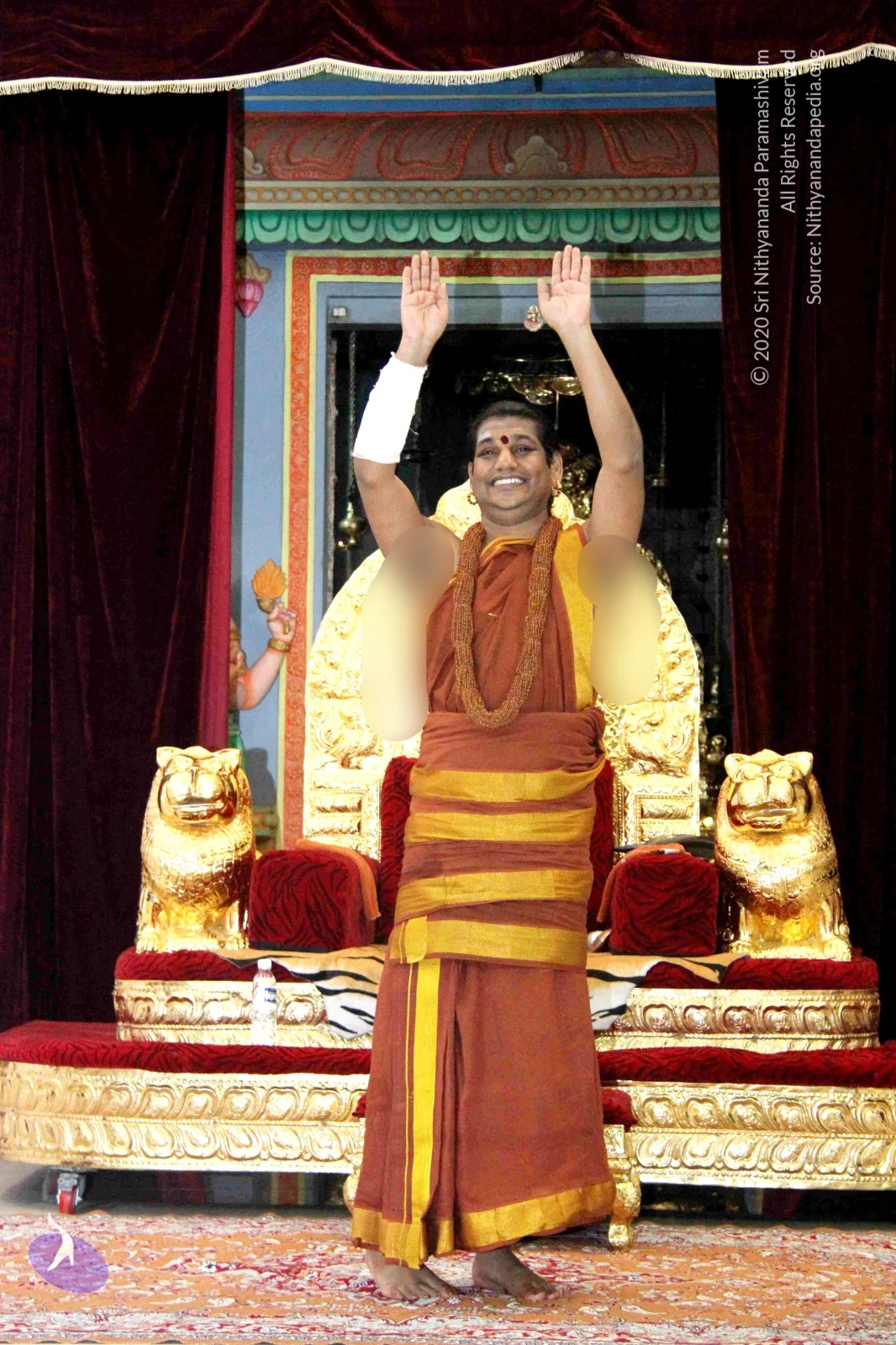
2-Swamiji-With-Deities

4 photosSource gallery
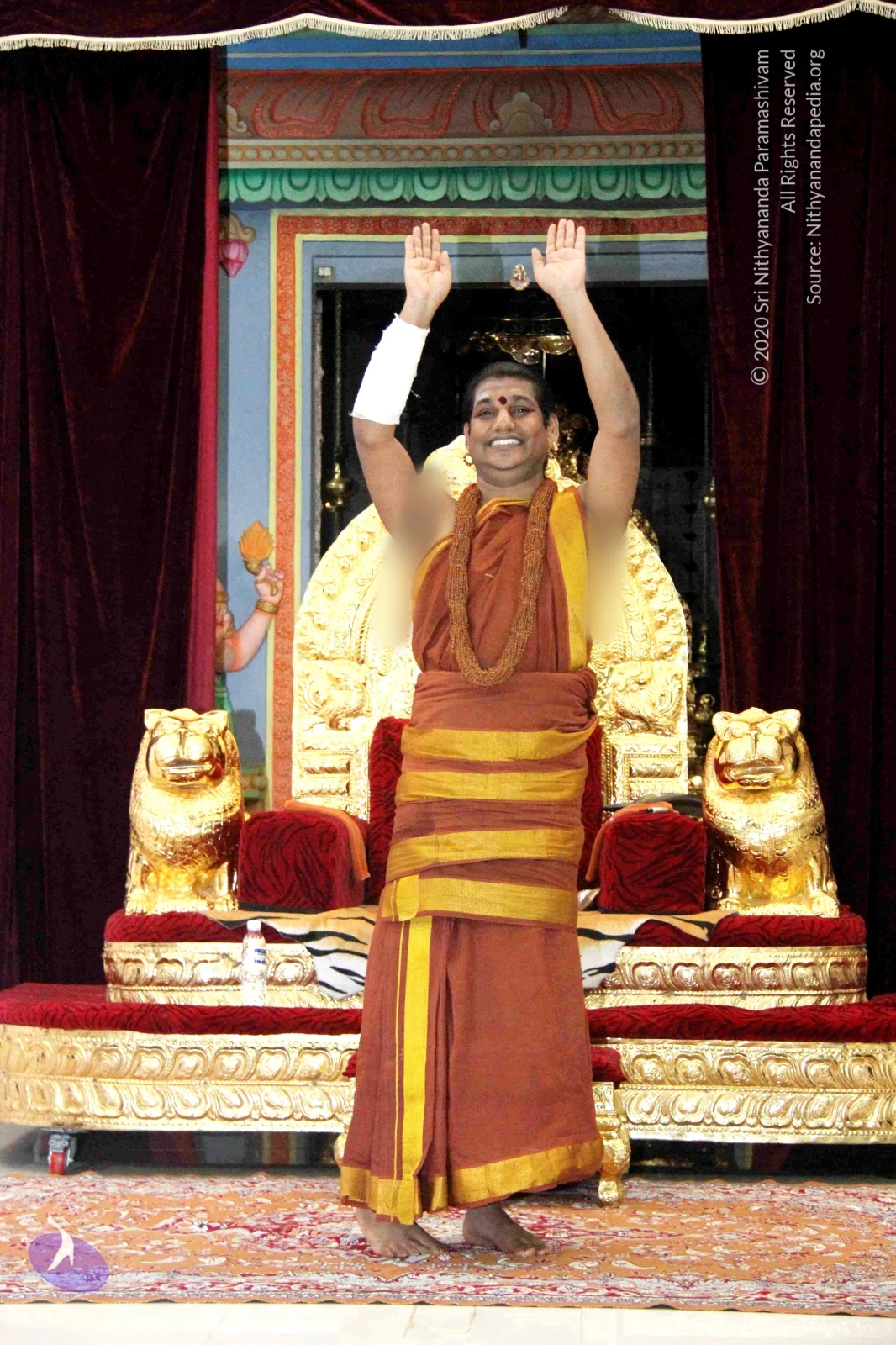
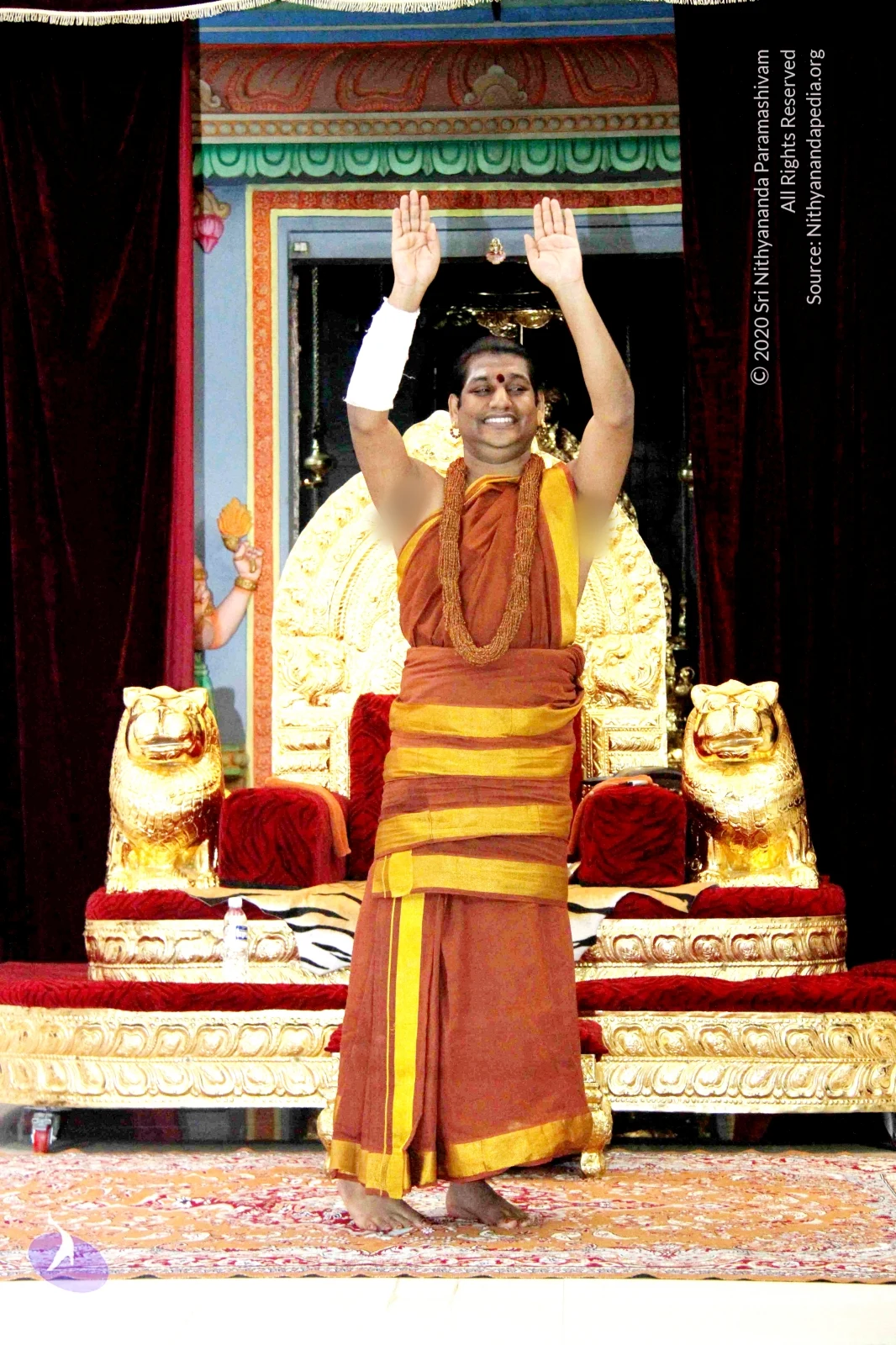
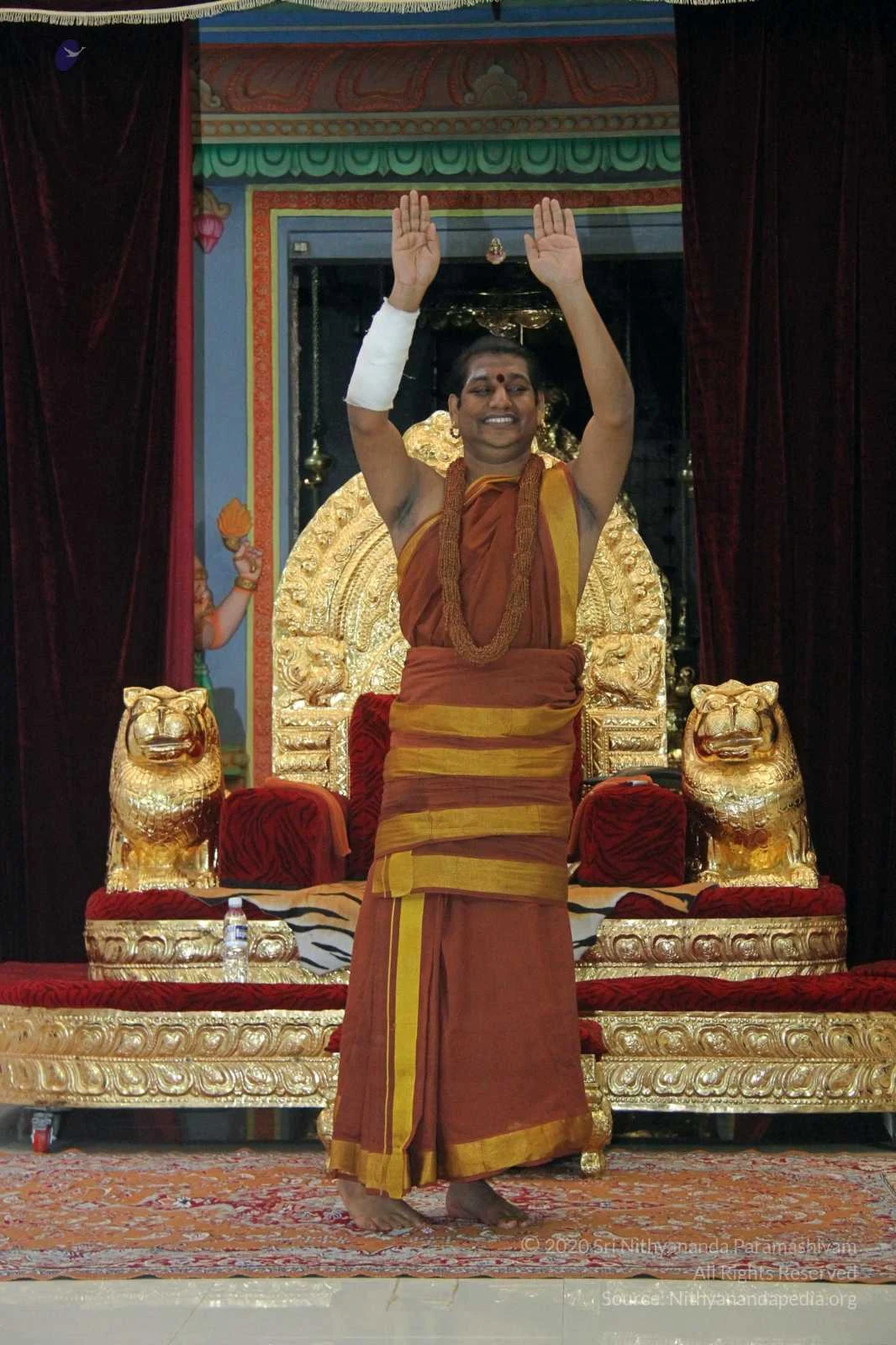
A man stands barefoot on a patterned carpet in front of an ornate golden throne flanked by two golden lion figures and red cushions, with dark red velvet drapes behind. He raises both arms overhead with palms open, smiling. He wears a rust-orange dhoti and shawl with gold borders, a red bindi on the forehead, a rudraksha mala necklace and a white arm bandage. A decorated temple-style backdrop with painted motifs and a hanging lamp is visible behind the throne.A barefoot man in a rust-orange and gold-bordered sannyasi-style wrap stands on a patterned rug with both arms raised high in an open-handed gesture. He wears a long rudraksha mala and a red bindi, and a white bandage is wrapped on one forearm. Behind him sits a large gold lion-armed throne with red velvet cushions, flanked by gold lion statues, beneath red velvet drapes and a painted temple-style frieze. A deity mural with a lamp-holding figure is visible at the left edge. a person: the rudraksha mala and orange-saffron clothing fit the appearance cues, though the figure is not clearly distinctive.A photograph of a single man standing barefoot on a patterned red-and-cream carpet in front of an ornate golden throne flanked by two gold lion sculptures with red velvet cushions. He has both arms raised high with palms open, smiling broadly. He wears a red-brown ochre dhoti and shawl edged with gold borders, a long rudraksha mala around his neck, a red bindi on his forehead, and a white wrist band. Behind him are red velvet curtains, a painted temple-style frieze, and a golden deity figure with a lit lamp in one hand.A photograph of a stage with a dark red curtain backdrop. On the left stands a smiling man in an orange-saffron dhoti and shawl with yellow borders, a rudraksha-style mala around his neck and a white wrist bandage. On the right is a golden arched backdrop framing two large deity murtis decorated with red and white flower garlands. The central murti wears an orange garment, a crown and a long necklace; beside it stands a smaller figure in white, and the right murti wears a pink garment and a crown with yellow flowers. The murtis are seated on teal-green draped bases.

3-Leela-Alankar

2 photosSource gallery
Photograph of a decorated stage tableau set against deep red velvet drapery. Two large deity murtis sit under a gold arch framed by red, white and yellow flower garlands: a male figure with a tall crown, orange garment and ornate necklaces, and a female figure in pink and orange with a jewelled crown and layered necklaces, with a smaller child-form murti seated between them in white and gold. Two young girls sit in front on the floor: the one at left wears a brown skirt, a yellow garland and a small crown, her hands in a mudra; the one at right wears a blue skirt, a yellow garland, a jewelled necklace and a crown. Silver lamps stand at the right edge on a reflective white floor.A photograph of a decorated deity tableau set before a maroon velvet curtain, framed by an ornate gold arch. Two large murtis of a male and female deity stand side by side, adorned with red, white and orange flower garlands, jewelled necklaces and crowns. A small child-sized figure in white stands between them. In front, two young female performers sit on the glossy floor: the left one in a brown and gold sari with a yellow flower garland and hands raised in gesture, the right one in a teal blue skirt receiving or holding a silver oil lamp with a lit flame, while a hand extends from the right edge to steady it. Ritual lamp offering with flower decoration.

4-Sarva-Darshan

19 photosSource gallery
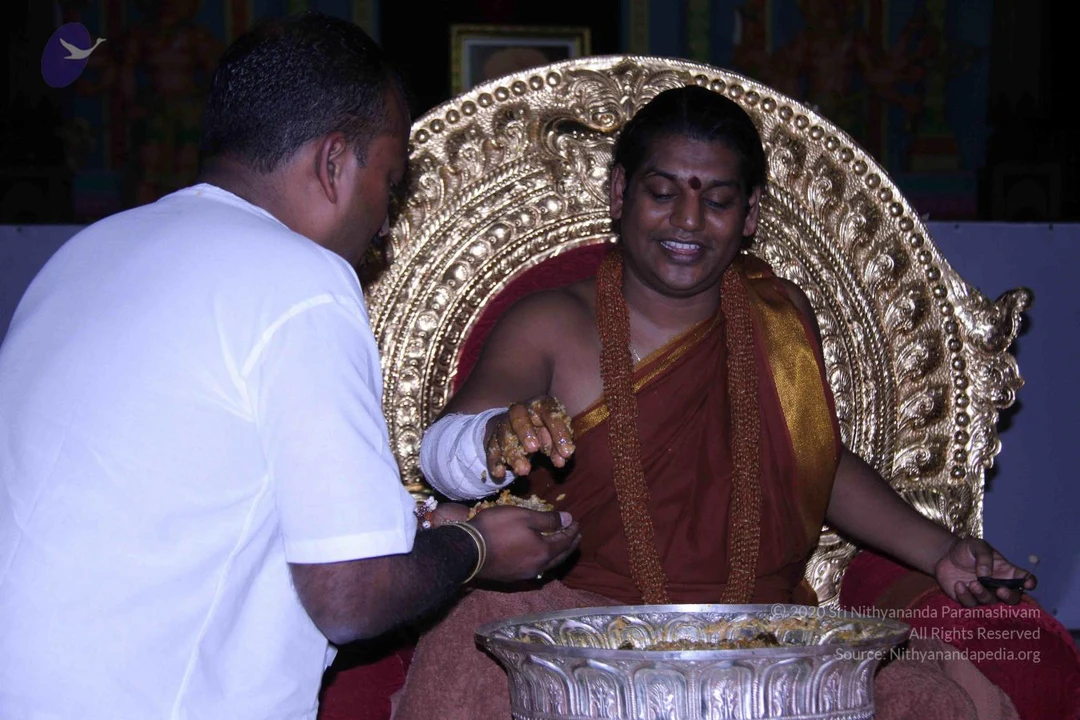
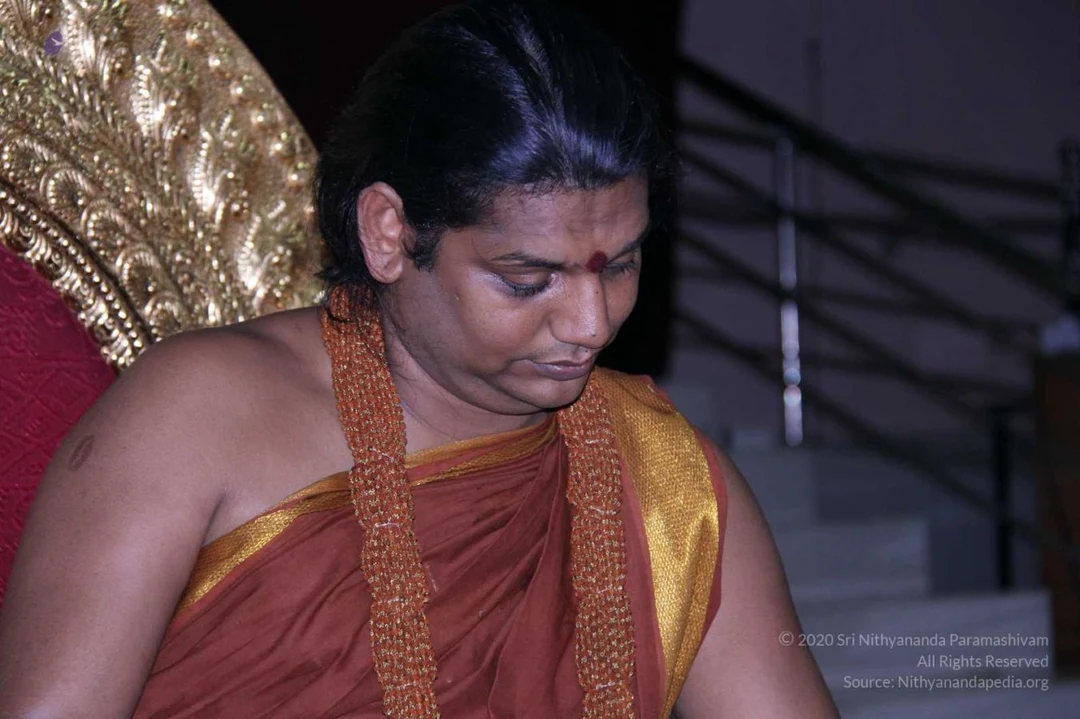
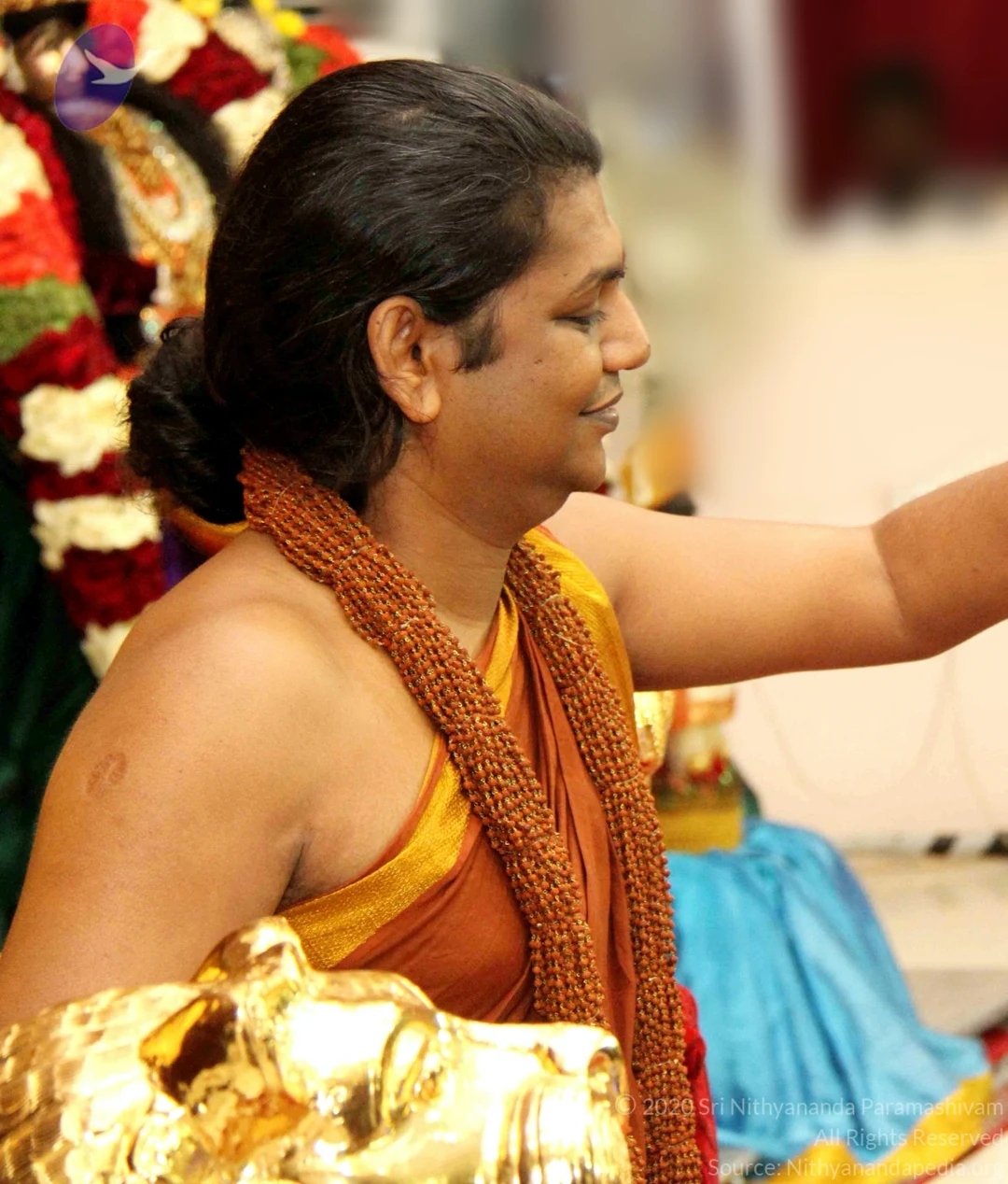
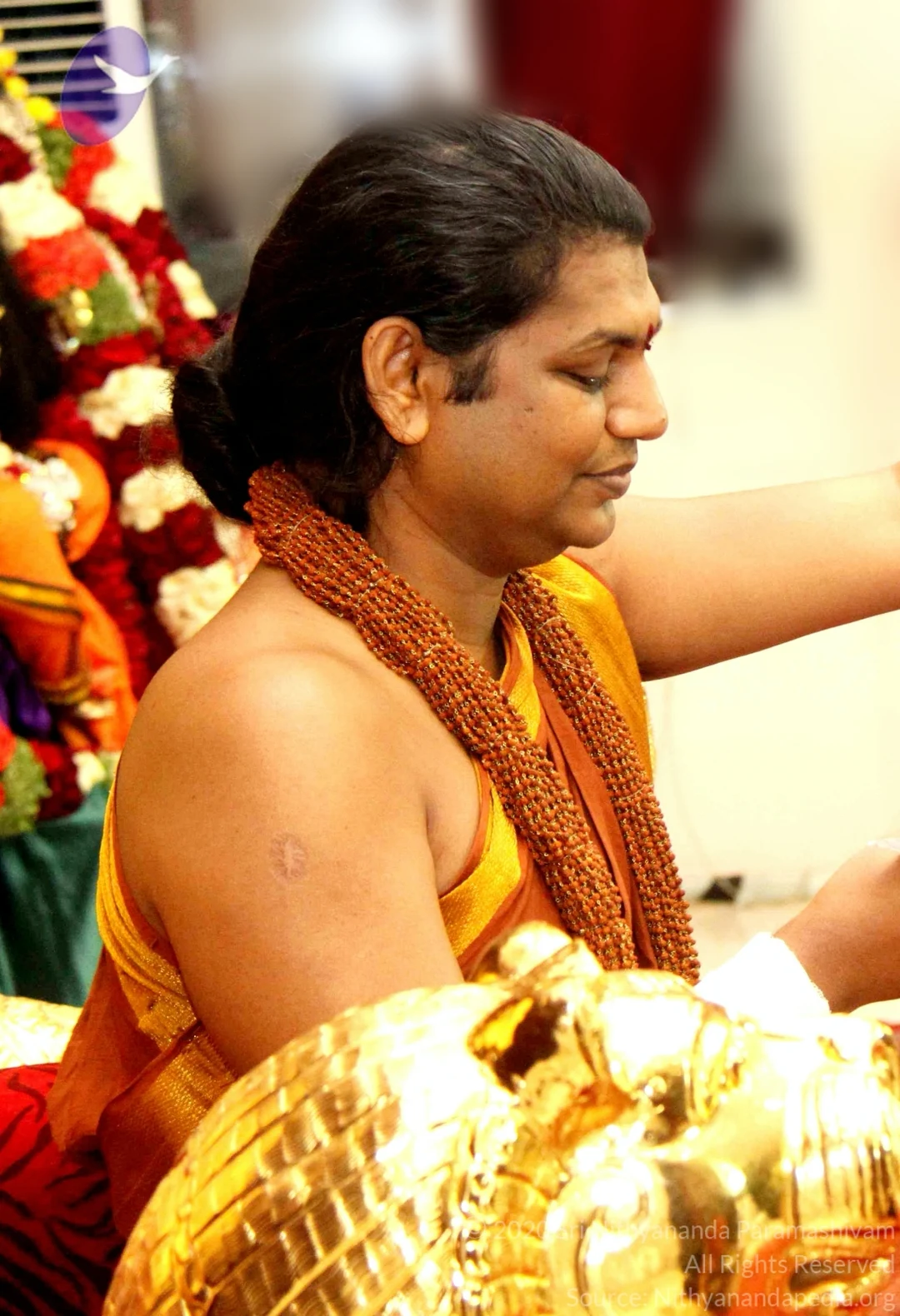
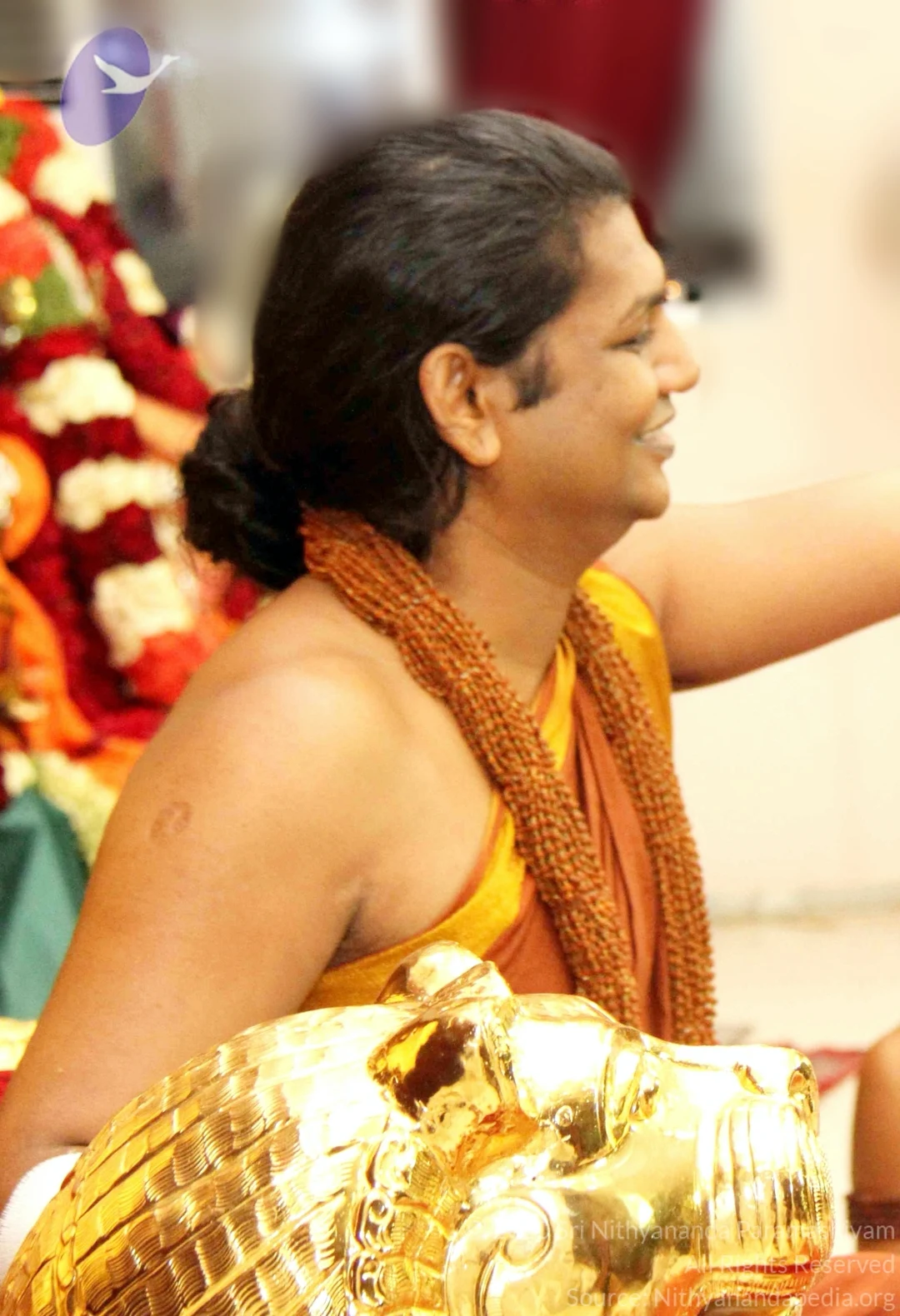
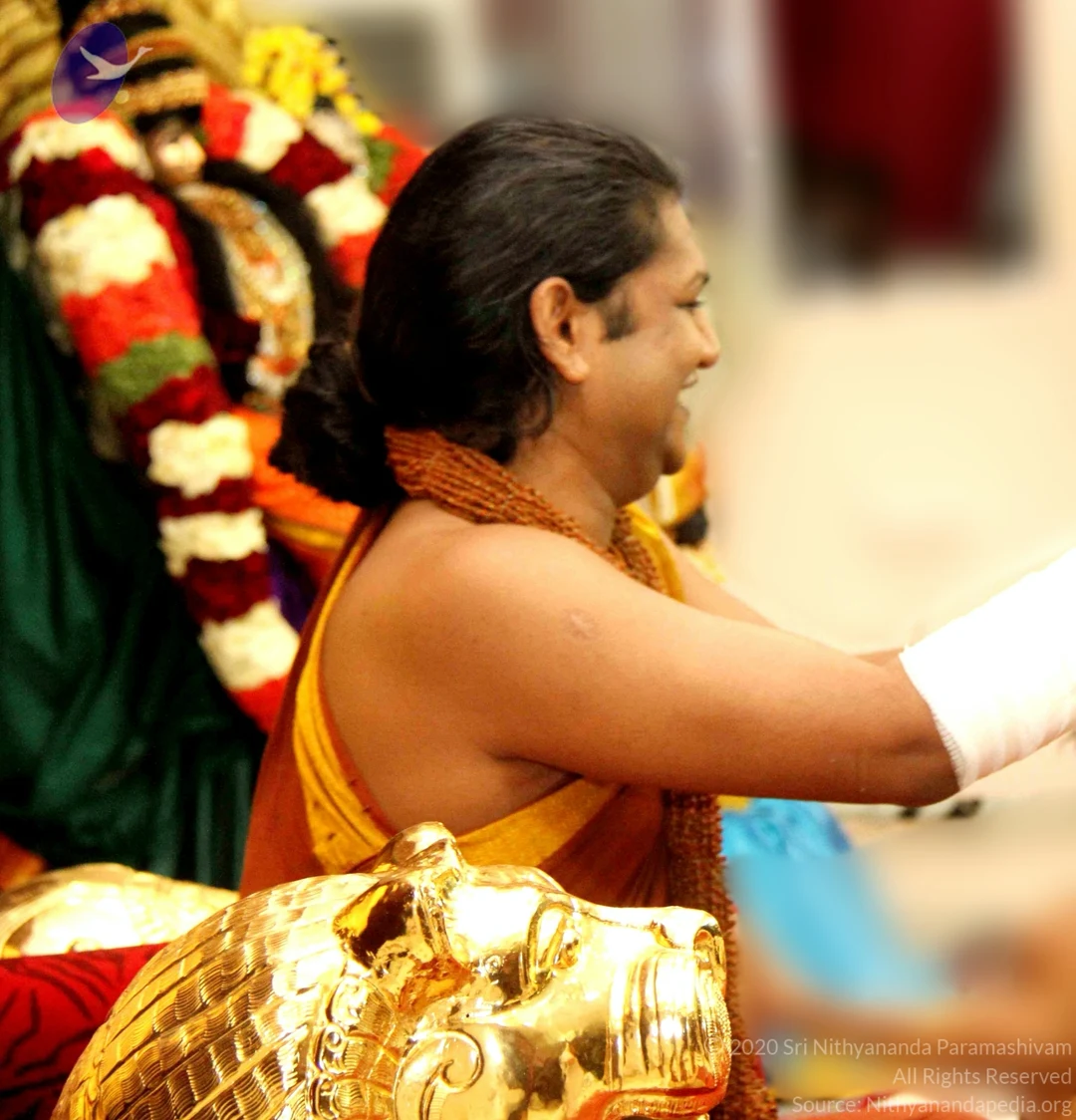
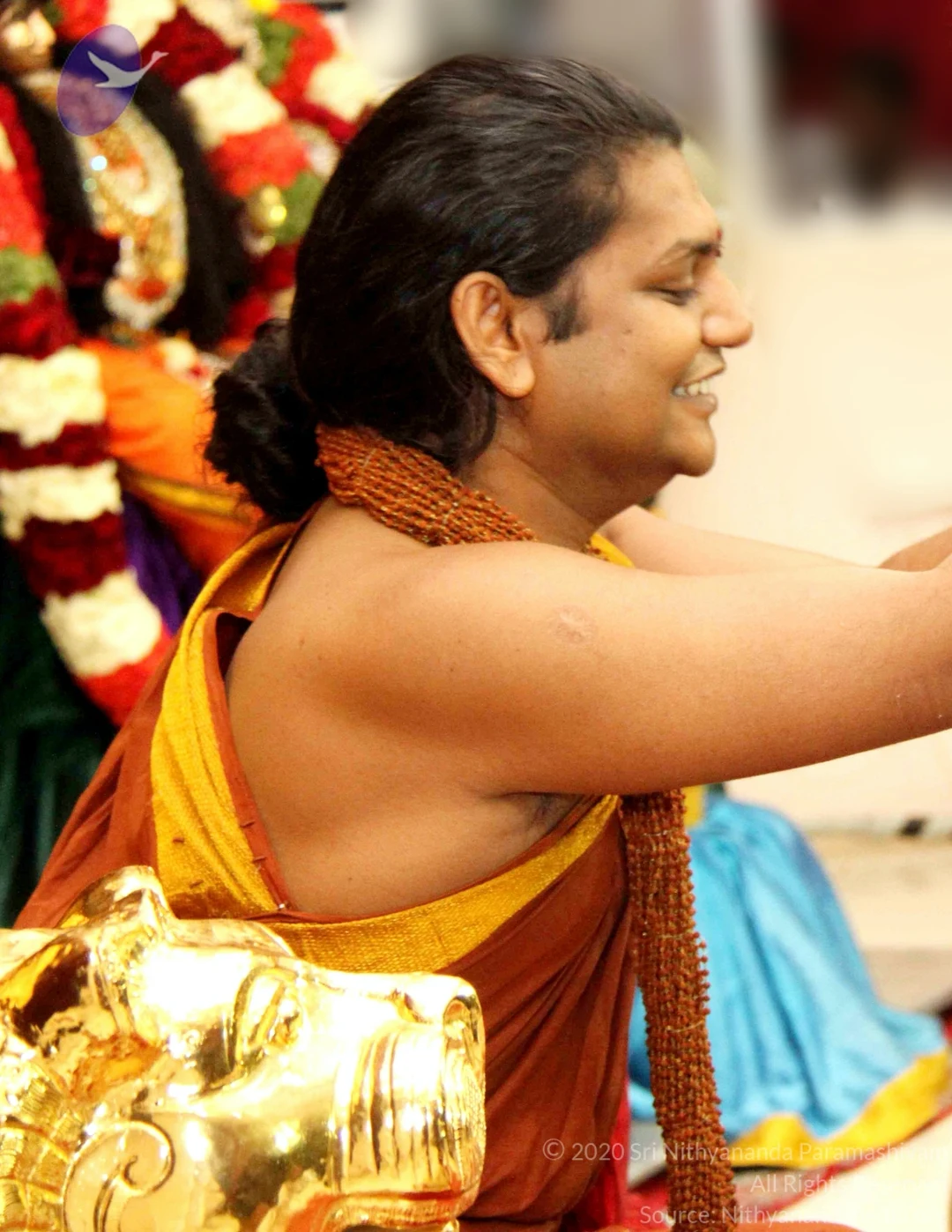
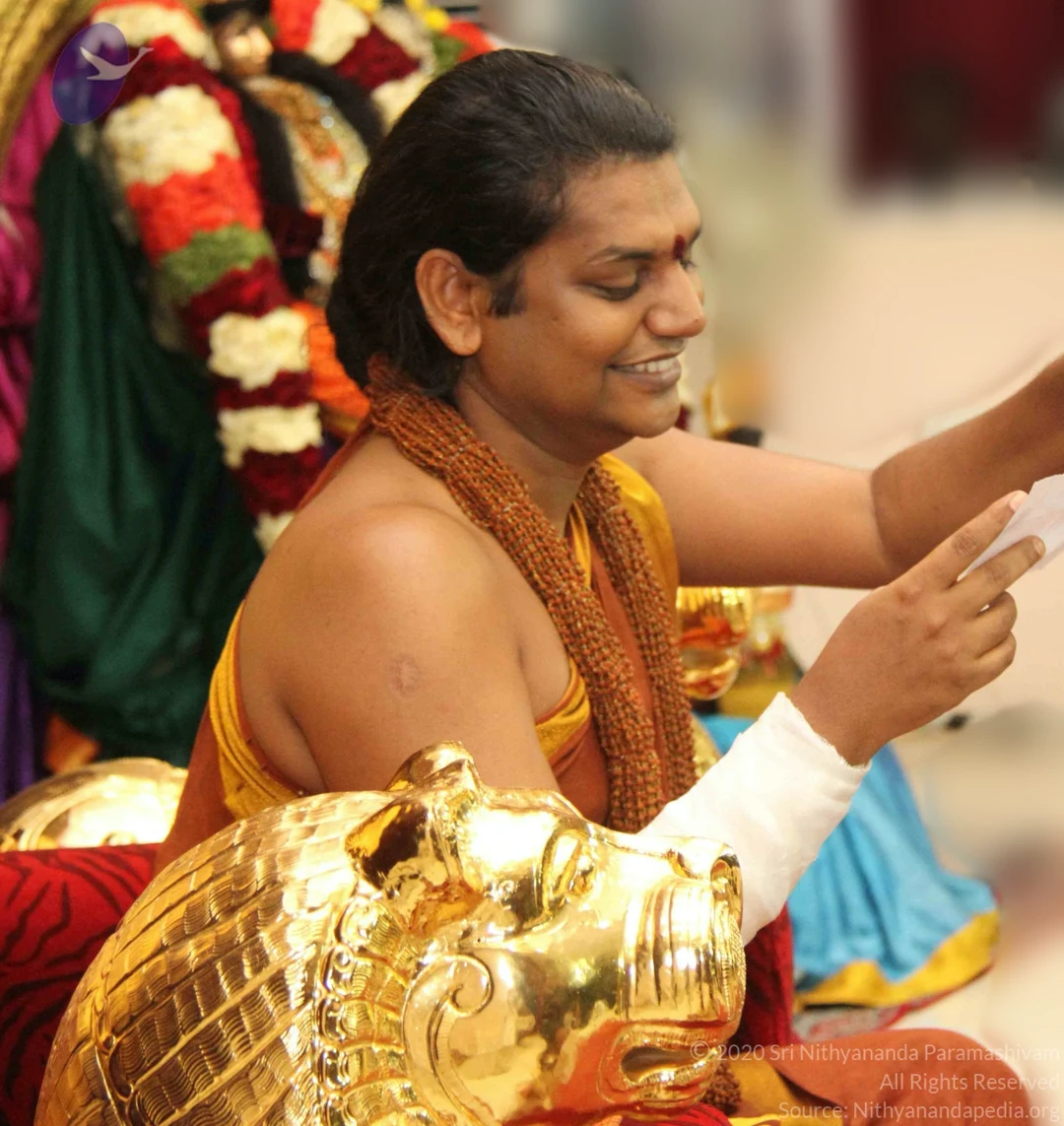
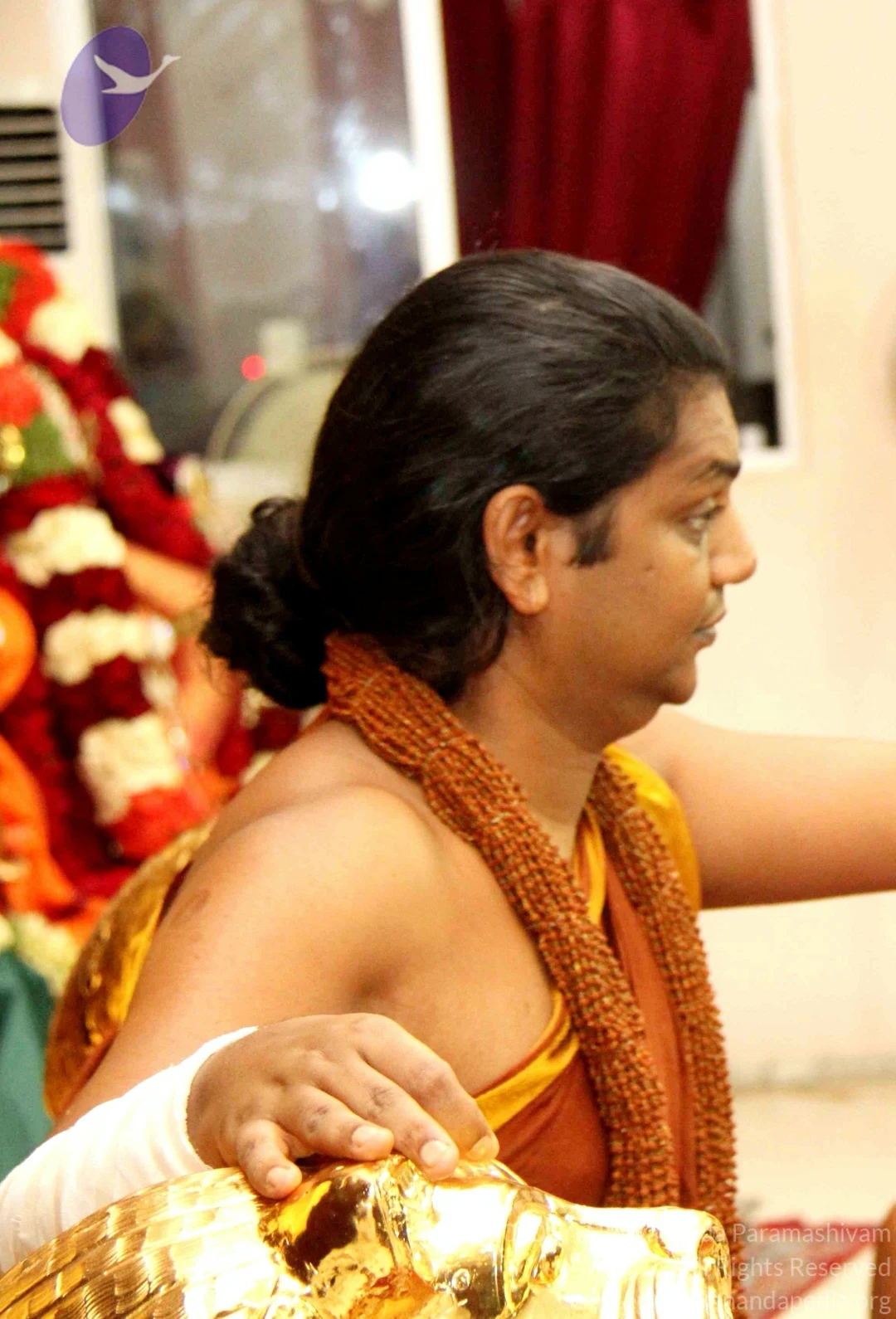
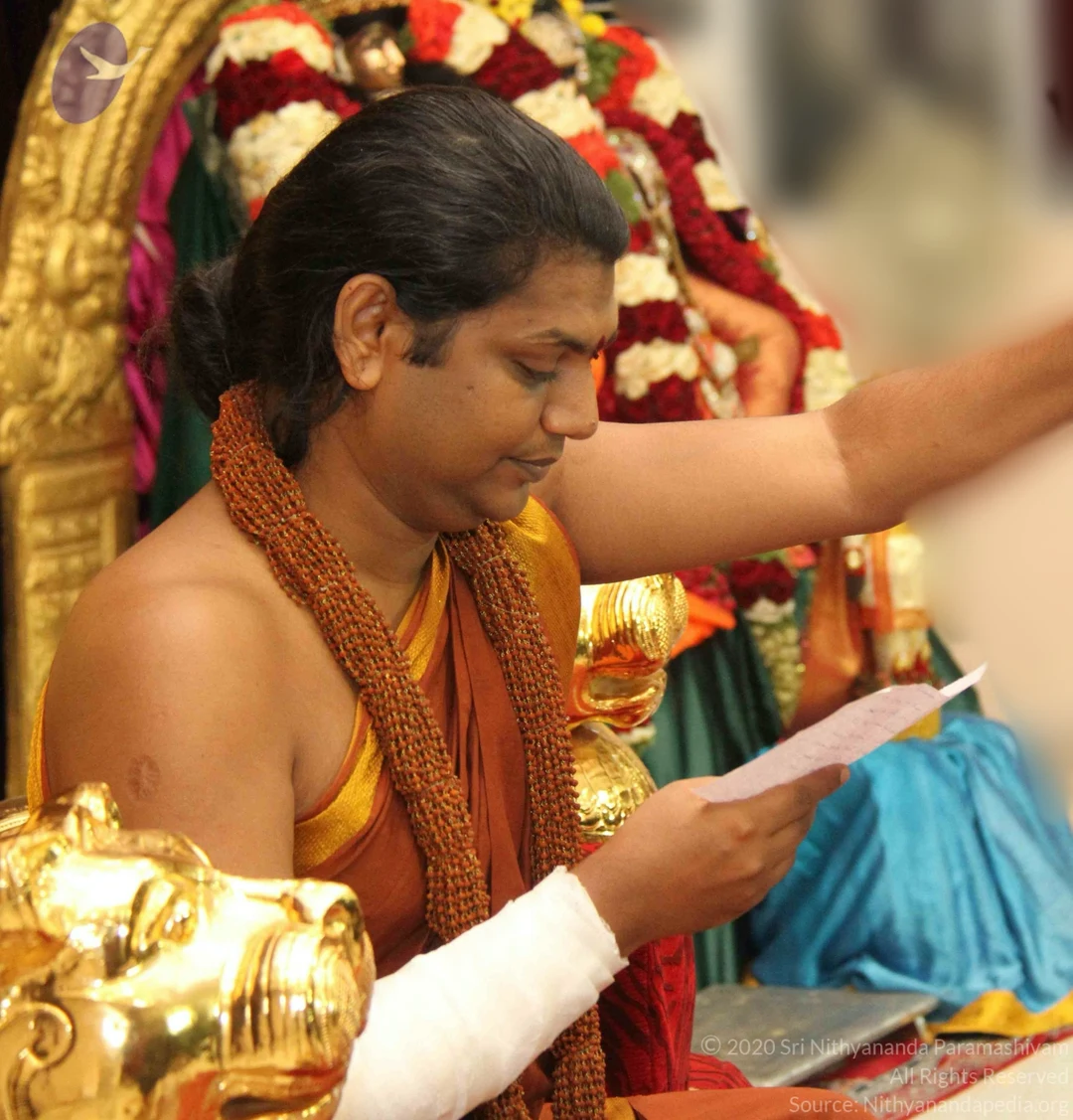
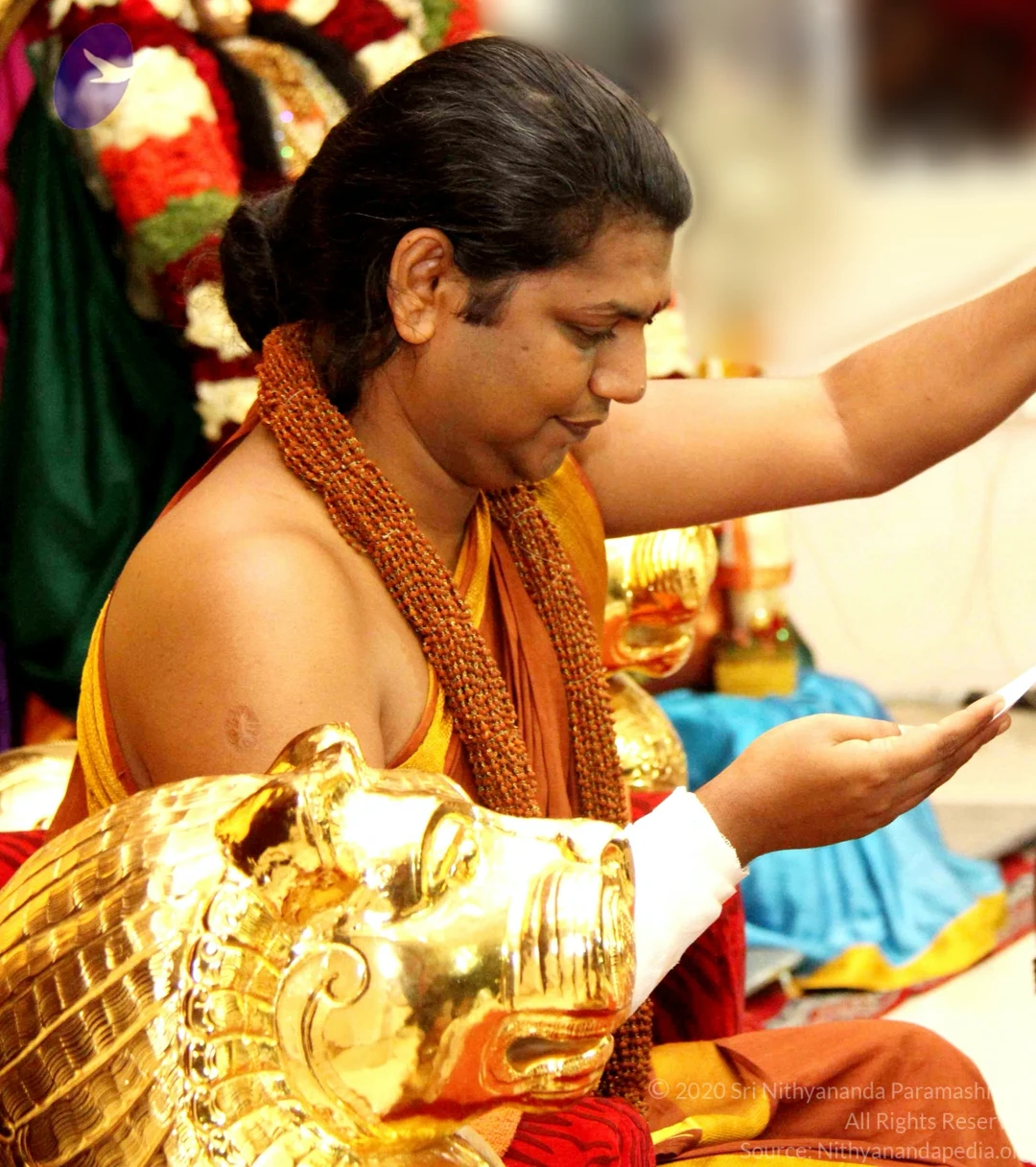
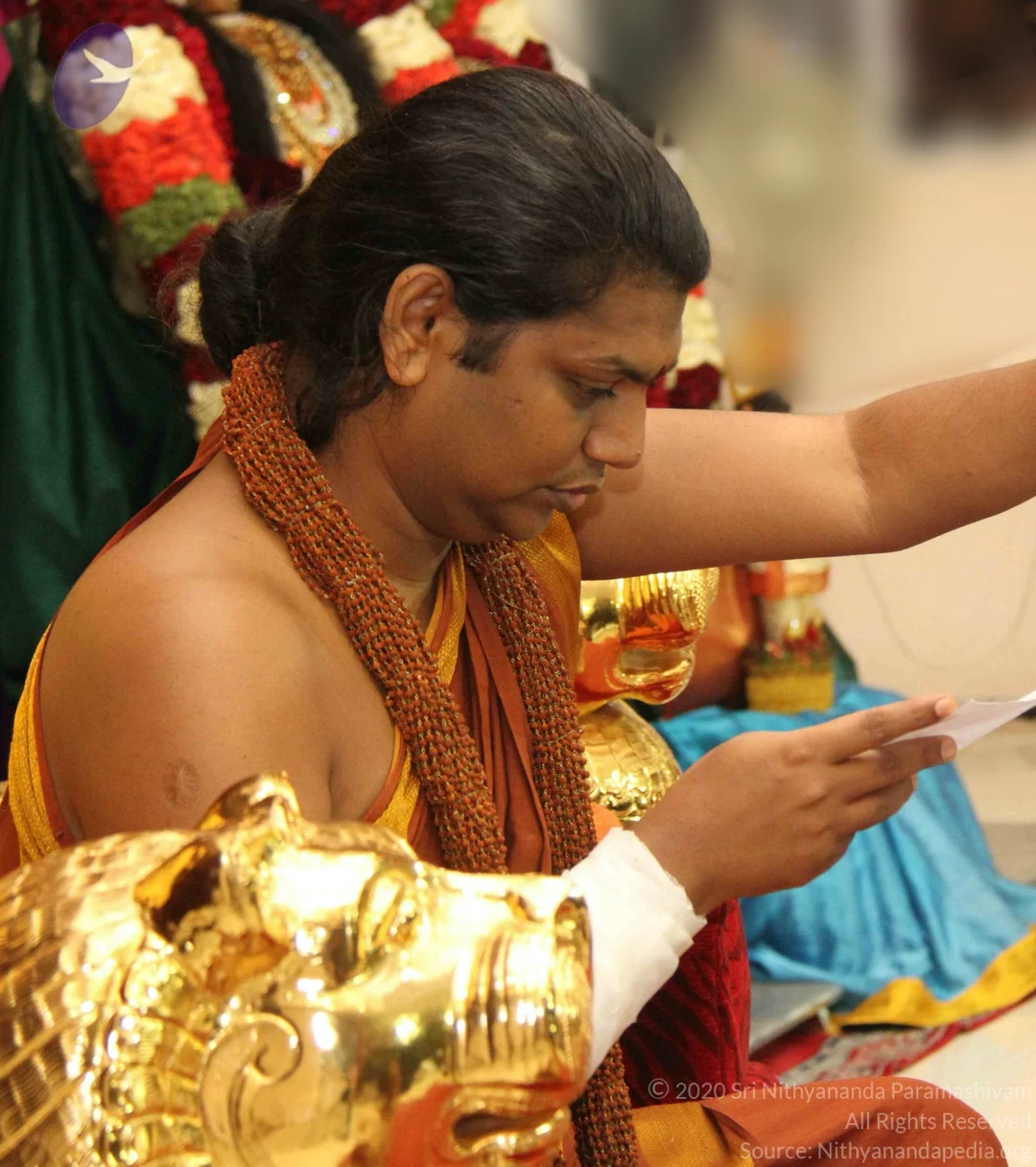
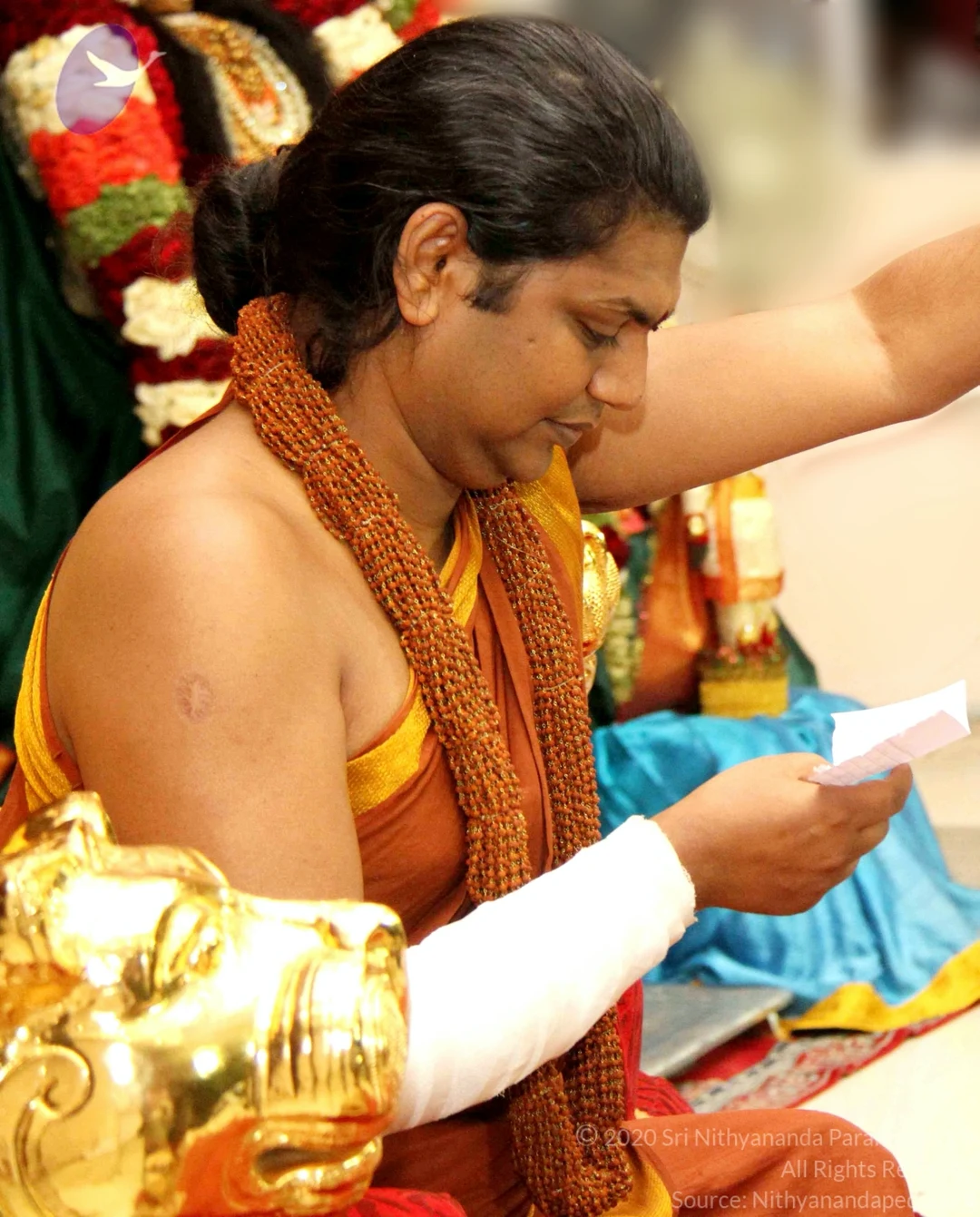
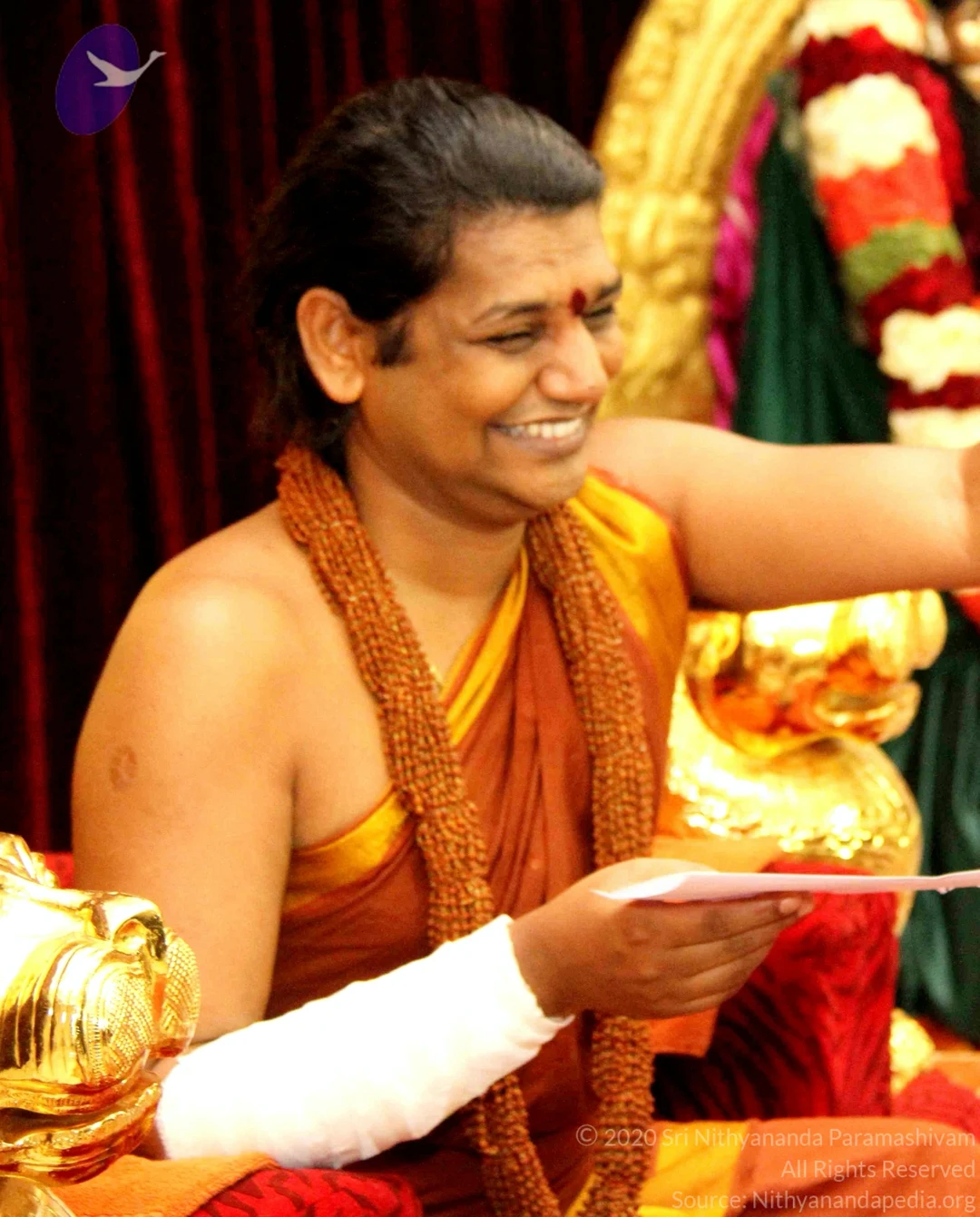
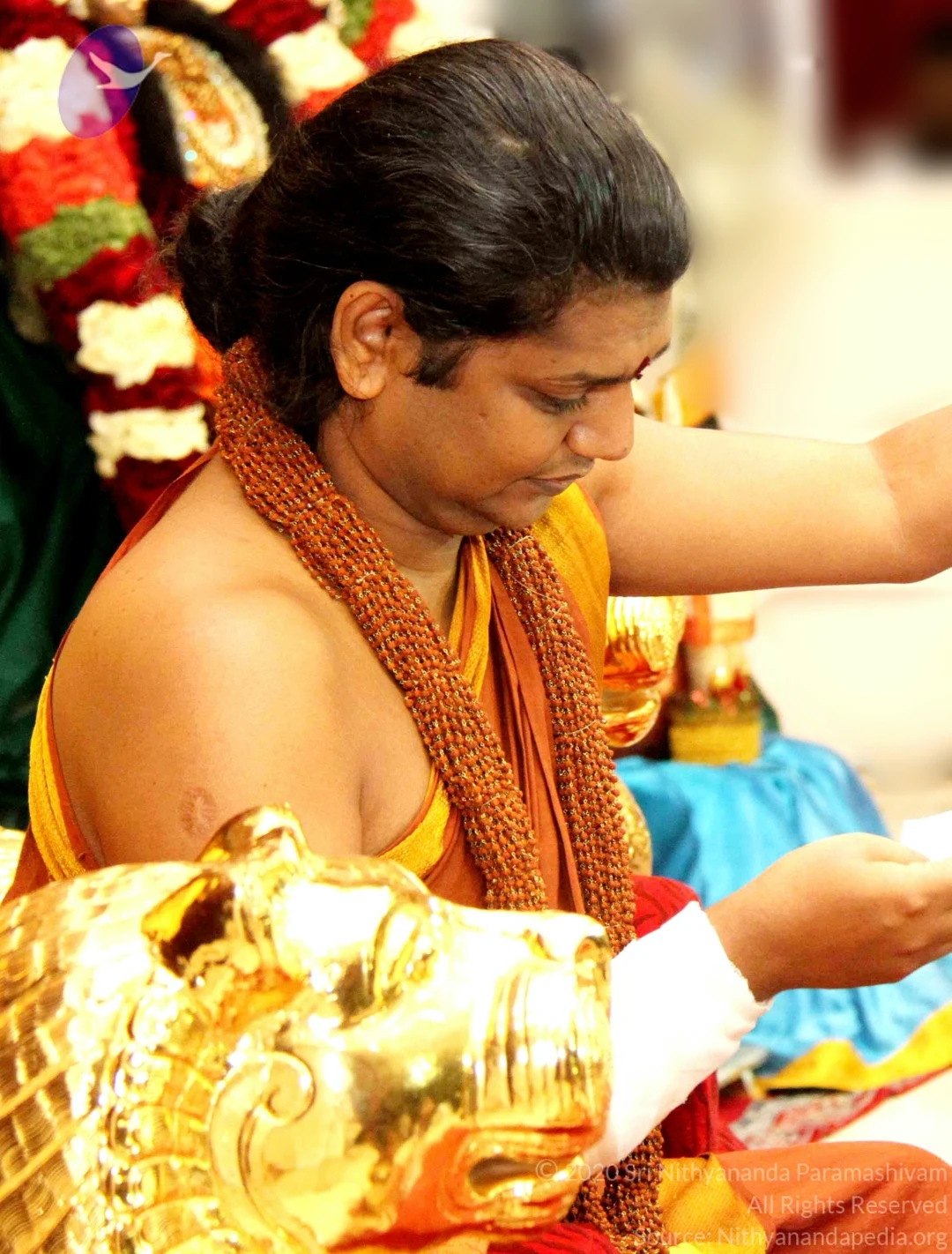
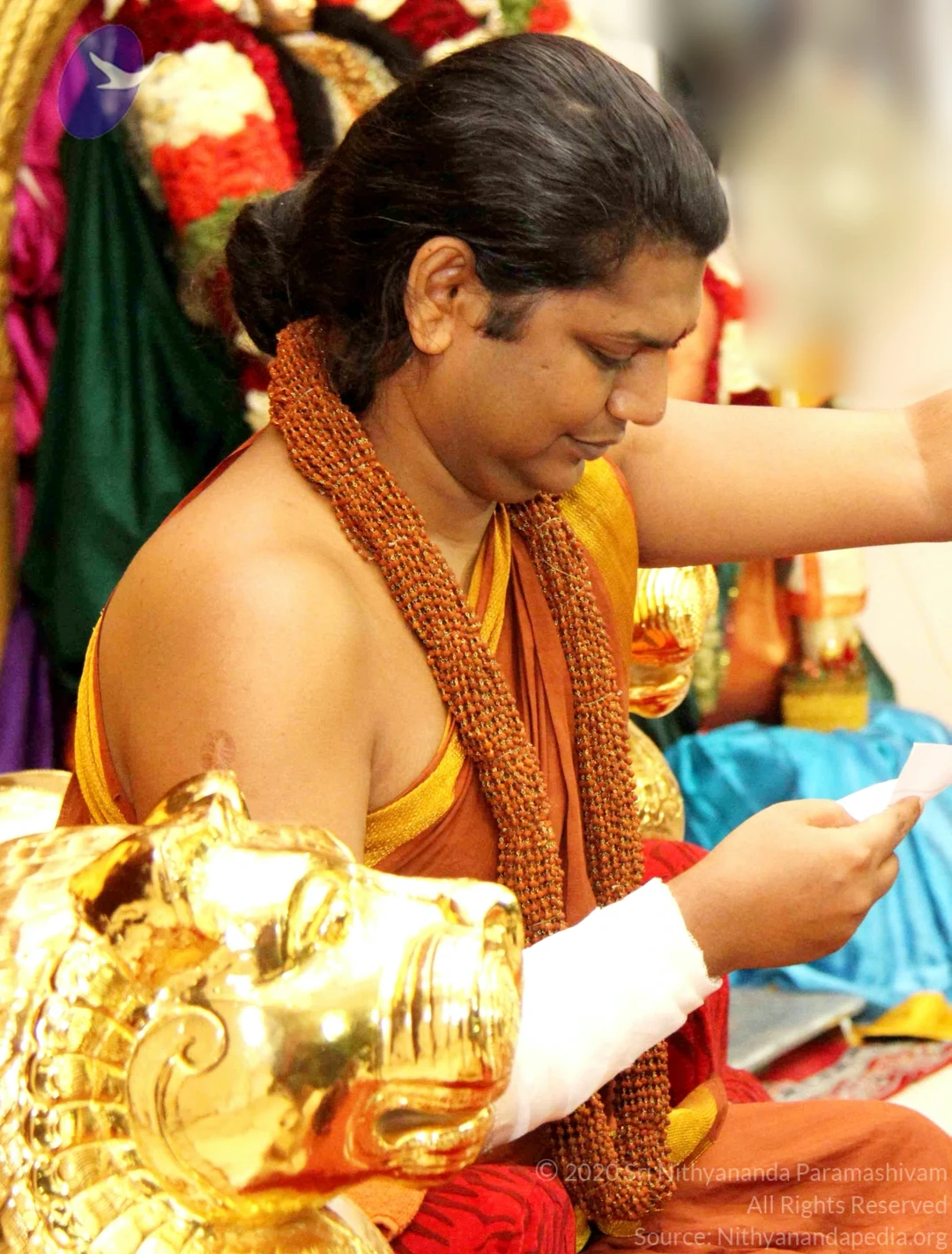
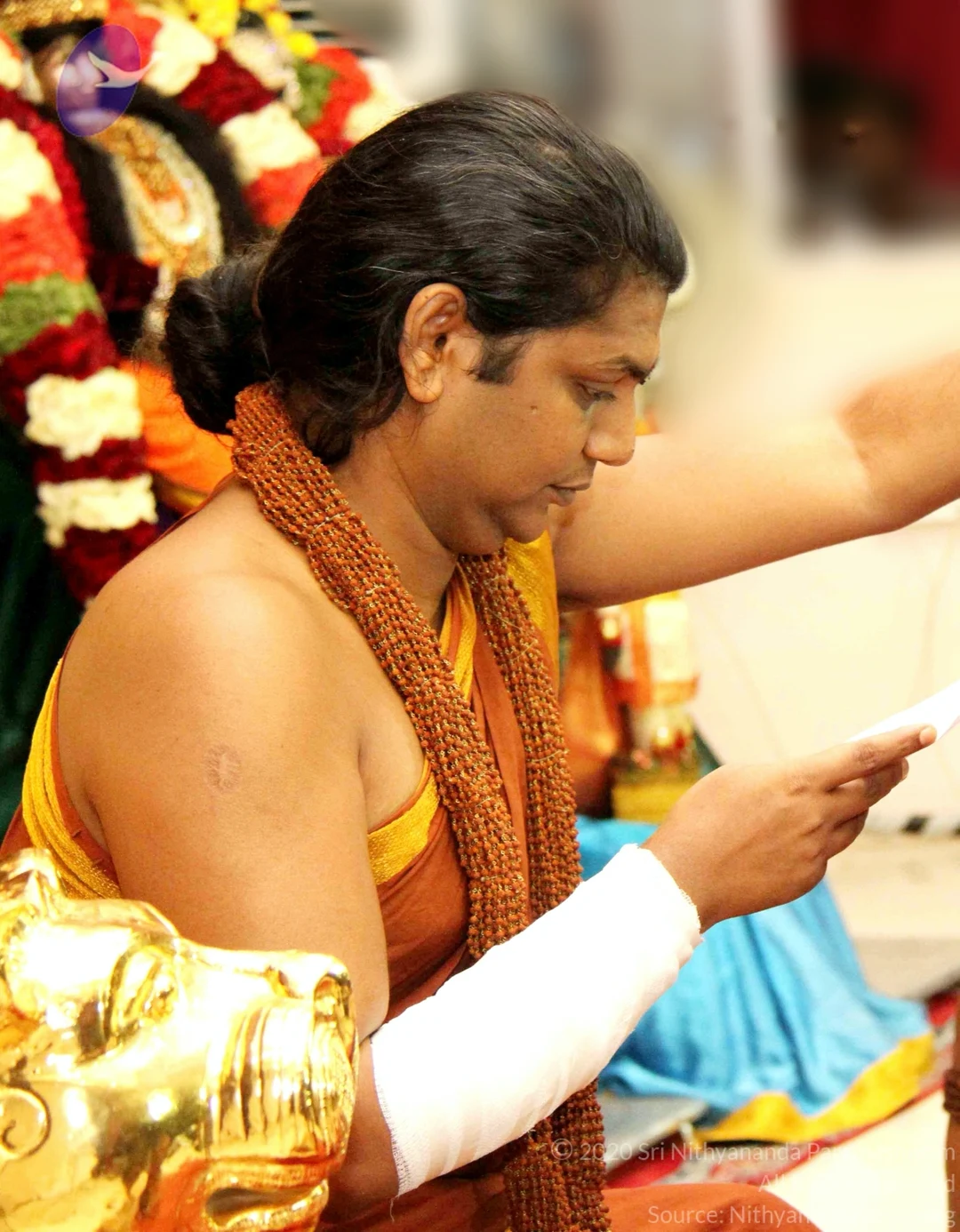
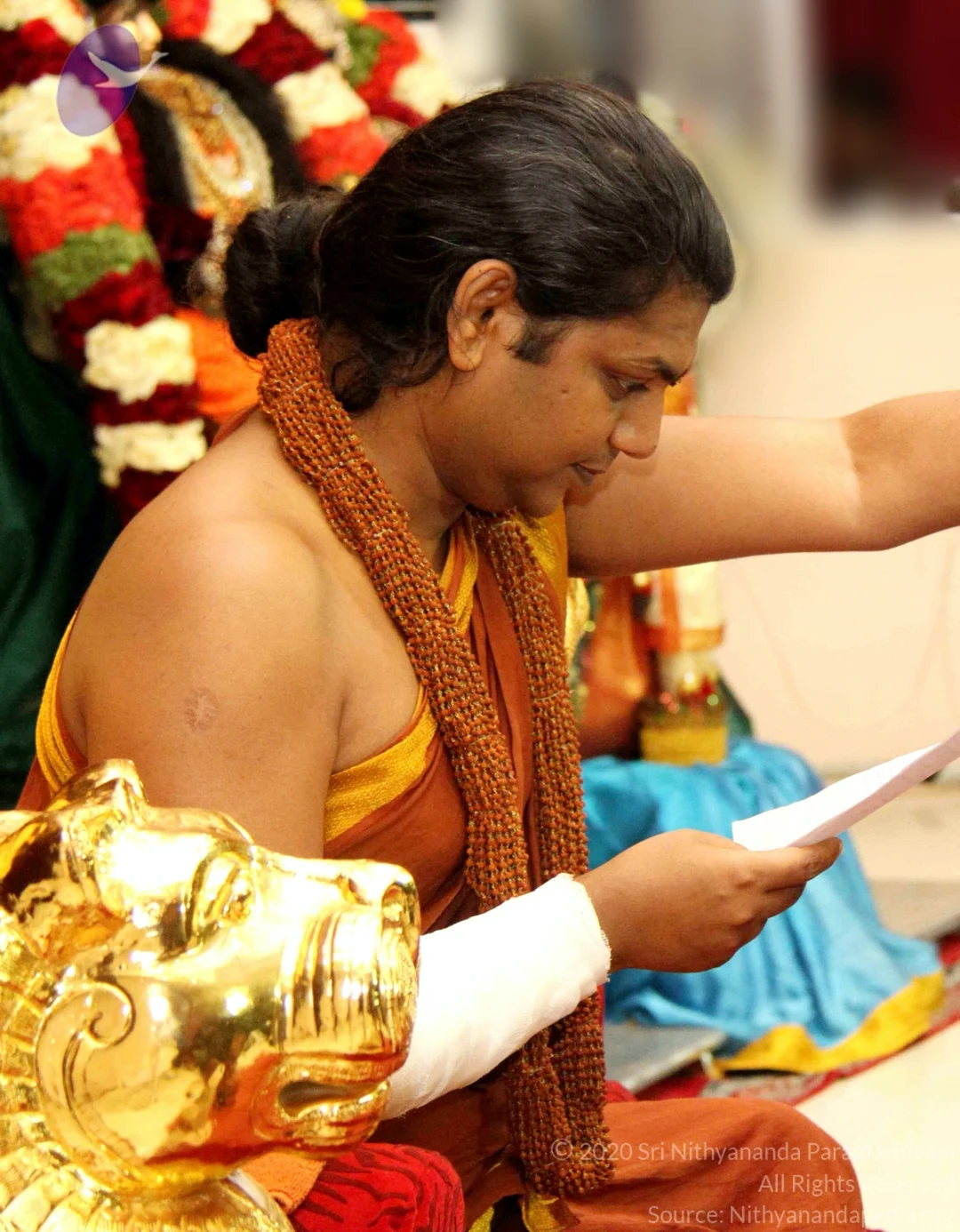
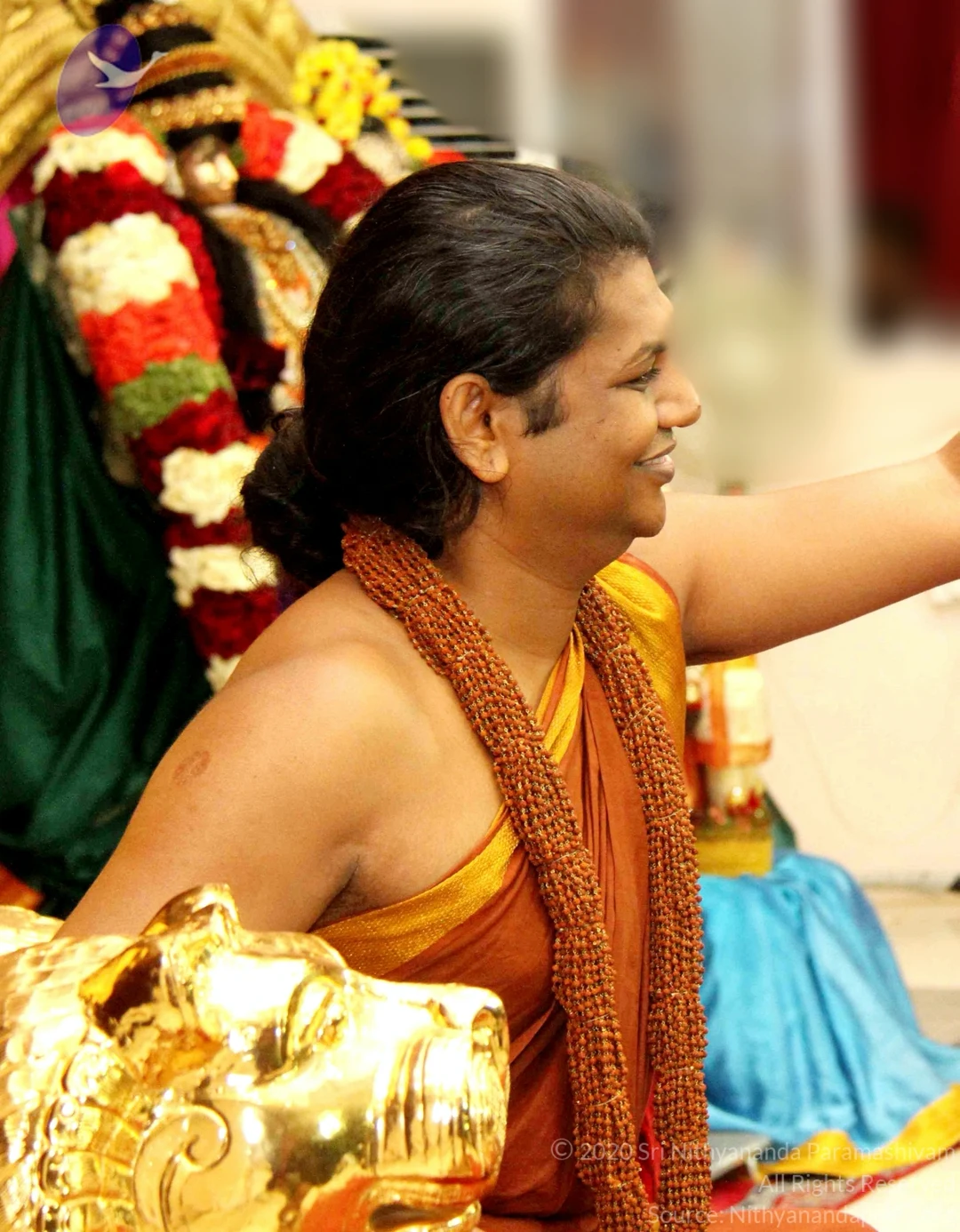
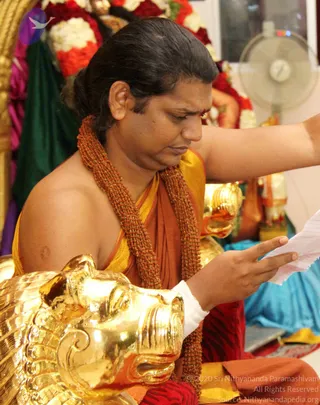
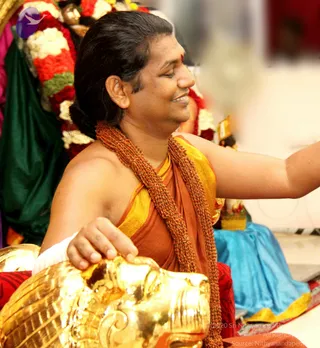
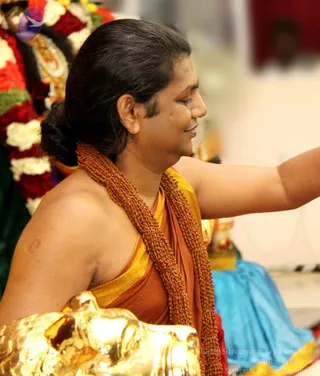
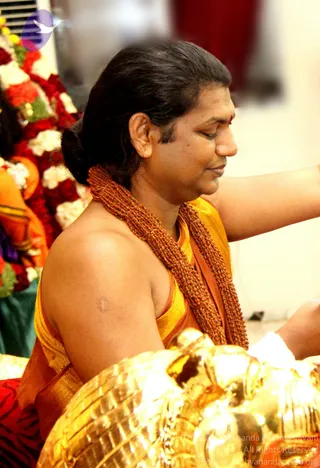
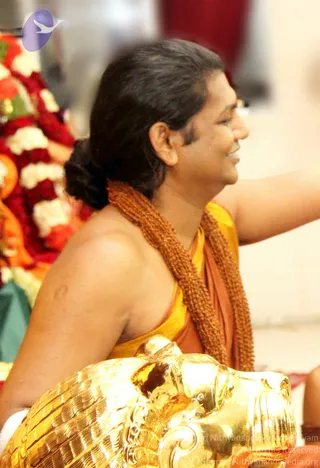
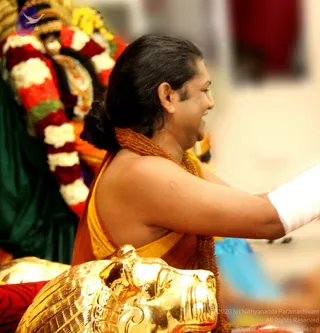
A seated man with dark hair swept back into a low bun reads a sheet of lined white paper held in his right hand, while another person's arm reaches in from the right to hand it to him. He wears an orange-red cloth draped over his shoulder with a gold-bordered yellow edge and a long rudraksha mala of brown beads around his neck, and has a red tilak on his forehead. Behind him are garlands of red and white flowers, a green cloth, and a gold-coloured lion-faced chair arm in the foreground. A ceiling fan is visible at upper right. a person is seated on the throne-like seat and reading.A smiling man with swept-back dark hair and a red tilak on his forehead sits beside a golden animal figure. He wears an orange-red garment with a gold-bordered edge over his bare shoulder and a long rust-coloured beaded mala draped across his chest. Behind him are garlands of red, white and green flowers and a green cloth, with a blue draped cloth and a gold-edged cloth in the foreground. Another arm reaches in from the right edge of the frame. The setting suggests a temple or ritual space.Side-profile photograph of a person seated with hair pulled back in a low bun, wearing an orange-brown garment with a gold border and a long rudraksha mala draped across the shoulders. The person's arm extends toward the right edge of the frame. Behind and to the left are red, white and green flower garlands, and to the right a blue draped cloth. In the foreground at lower left is a gold ornate object.A close side-profile photograph of a seated person with dark hair pulled back into a low bun, wearing a small red bindi, a gold-and-orange silk garment draped over the shoulder, and a long orange-brown rudraksha mala worn around the neck. Golden floral garlands in red, orange and white fill the left background, and a gold-coloured ceremonial object sits in the foreground. Another person's arm reaches in from the right, possibly performing a ritual gesture. The person appears to be looking down with eyes partly closed. Candidate appearance is consistent with a person, based on the rudraksha mala, flowing dark hair and saffron-gold clothing, though the face is not clearly distinguishable.Side-profile photograph of a smiling man with long dark hair tied back, wearing an orange-and-saffron garment over a bare shoulder and multiple strands of rudraksha beads around his neck. A gold-plated ornate object, shaped like an animal head, sits in the foreground, with red and white flower garlands behind him. The person is the only one clearly visible. Appearance-based label: Swamiji (probable), with long hair, saffron clothing and rudraksha malas as cues.Side profile photograph of a man with long dark hair swept back into a low knot, wearing a rudraksha mala of reddish-brown beads and a saffron-orange cloth draped over the shoulder, with a yellow inner cloth visible. A bare white-gloved hand reaches in from the right toward a large golden bull figure (nandi-like) in the foreground. Behind him is a green fabric backdrop and a garland of red, white and yellow flowers. The setting appears to be a temple or ritual hall with a blurred background. a person: long swept-back hair, rudraksha mala and saffron clothing are visible cues, though the face is partly turned away.
5-Inner-Awakening-Day8
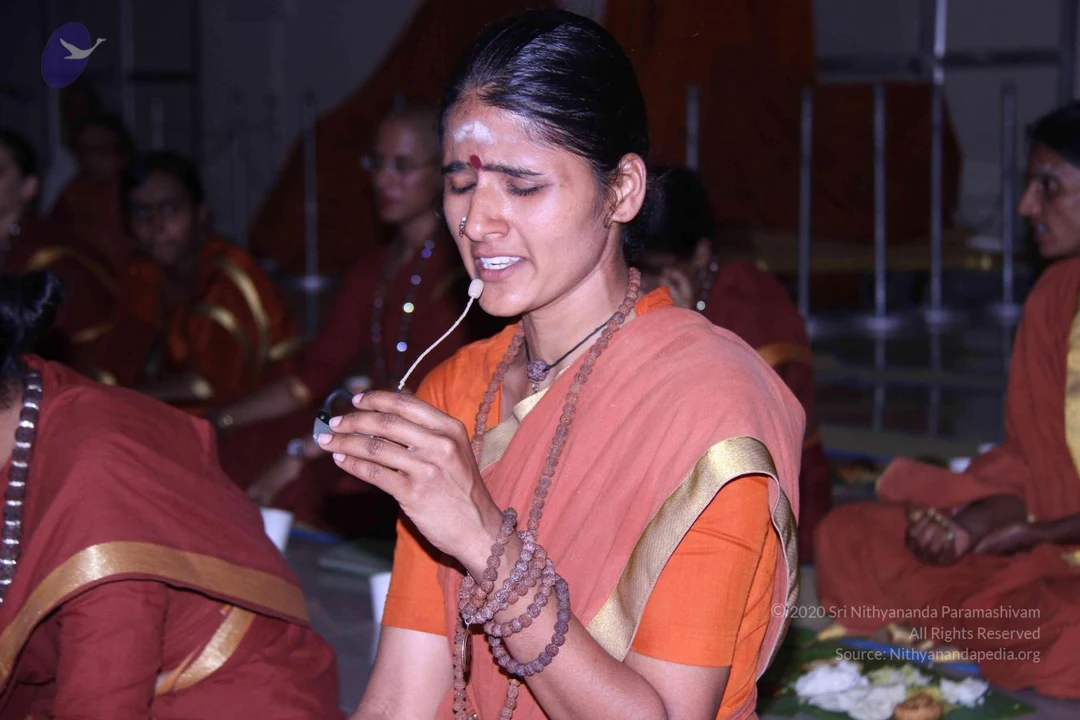
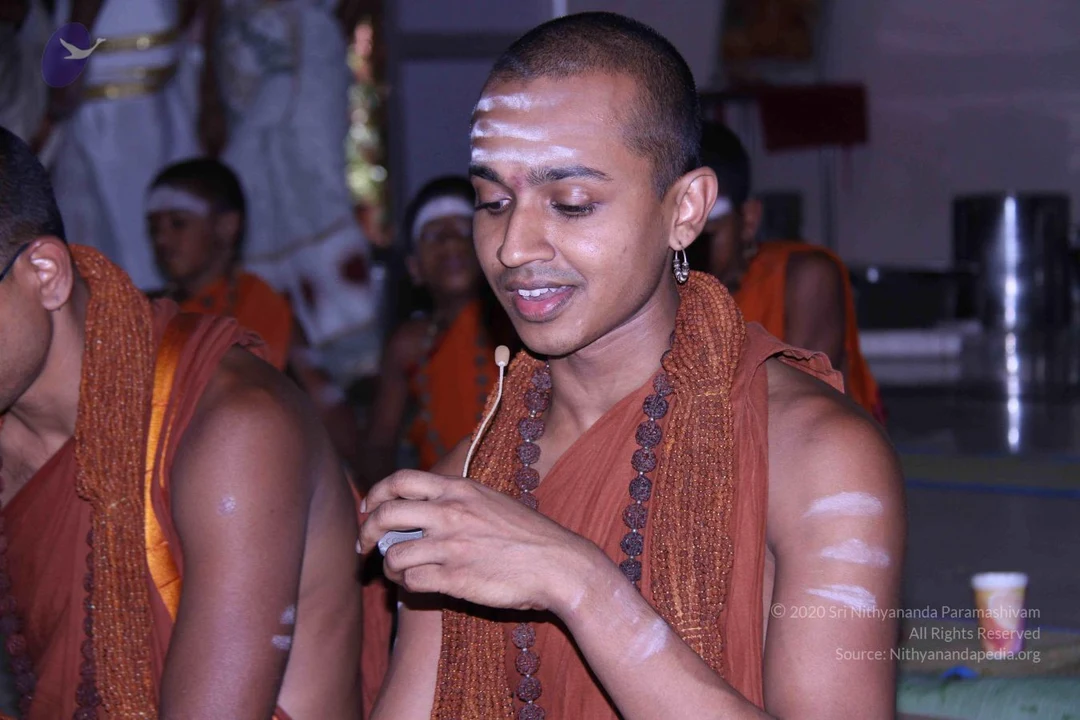
15 photosSource gallery
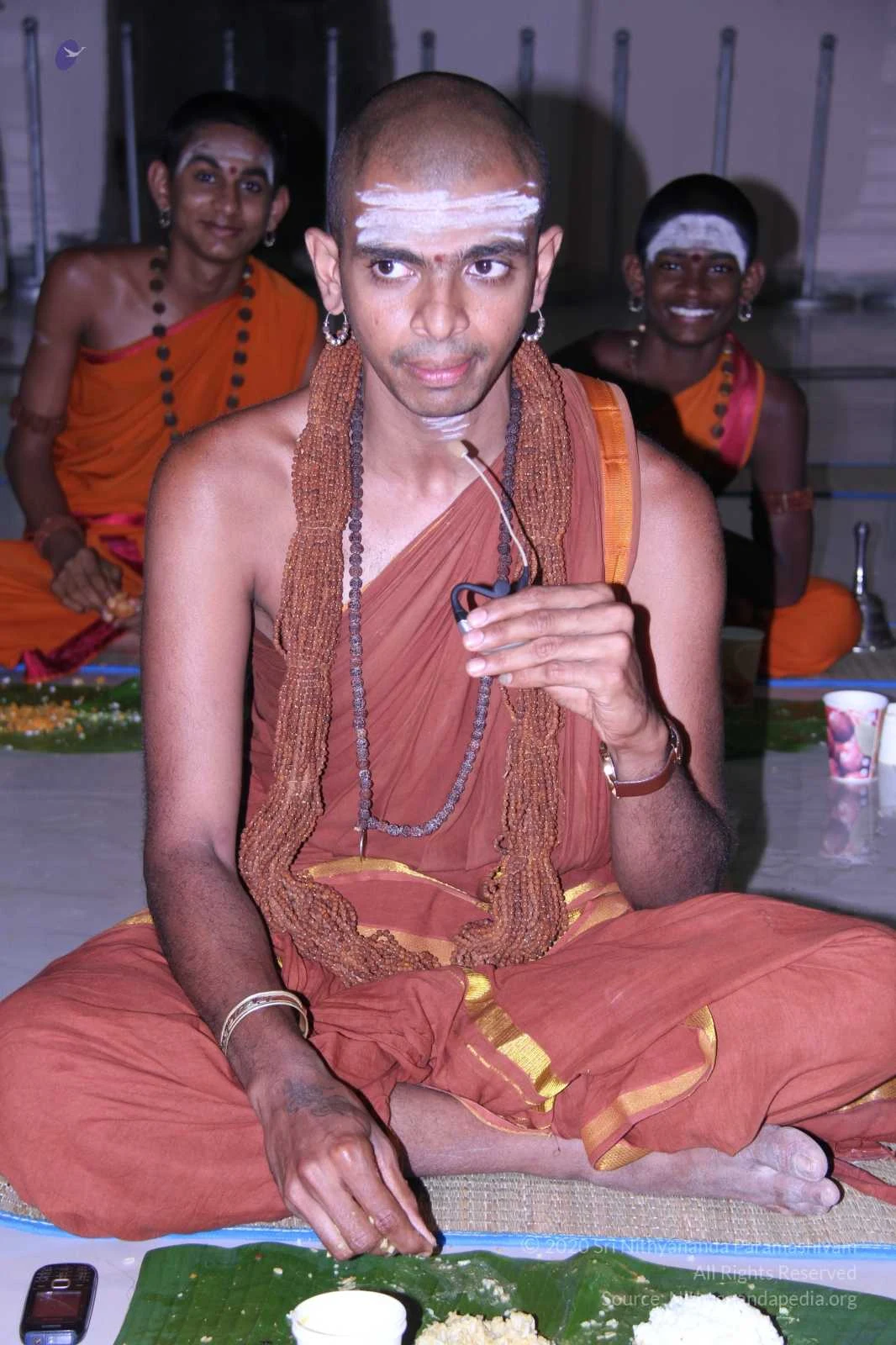
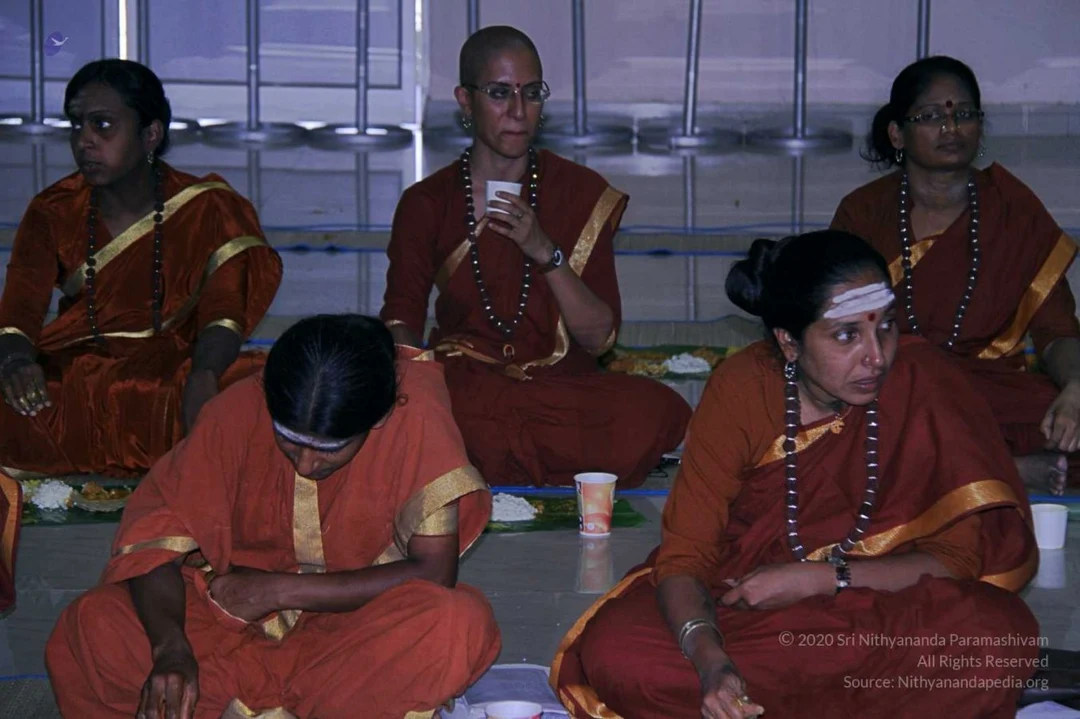
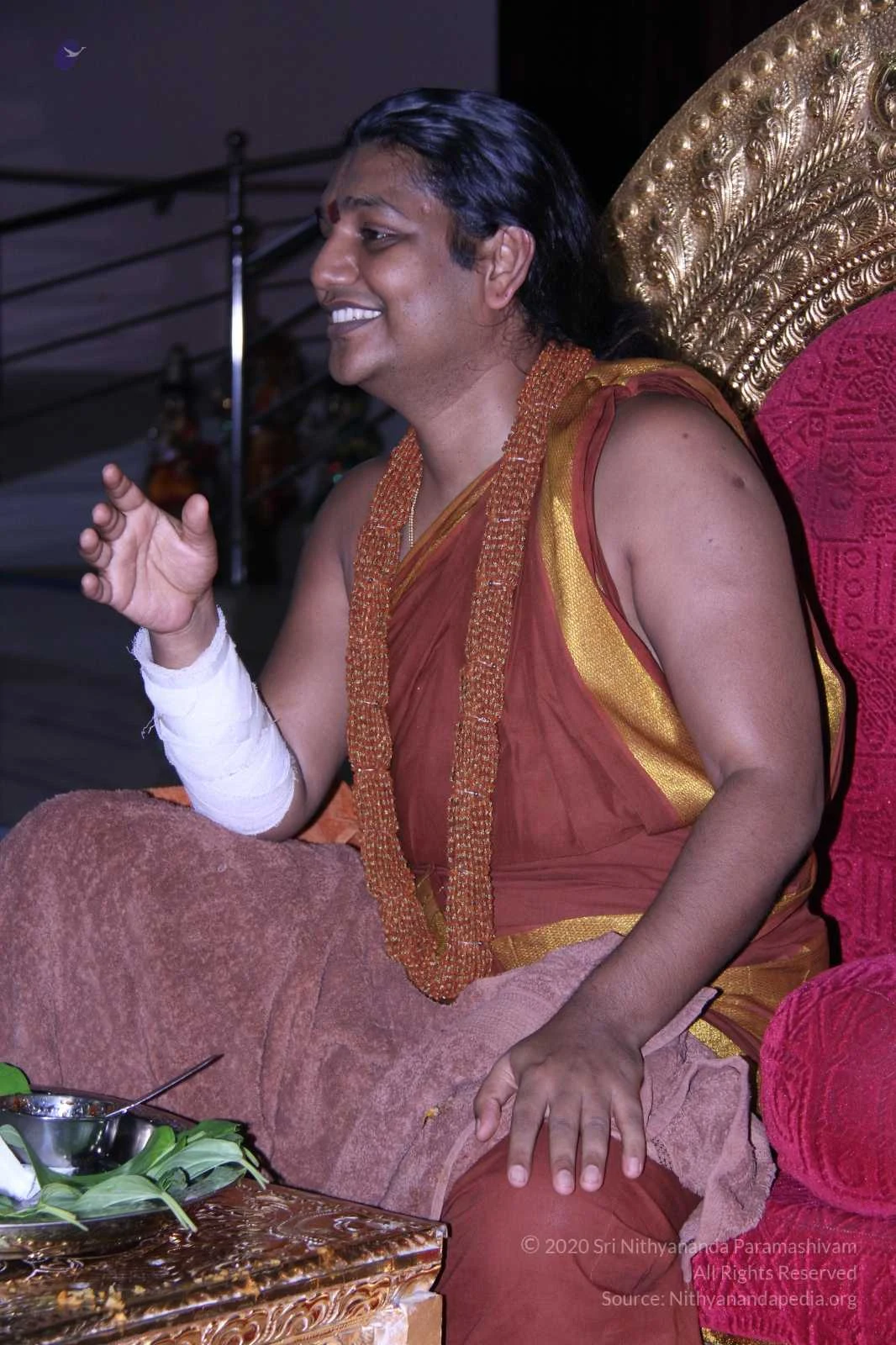
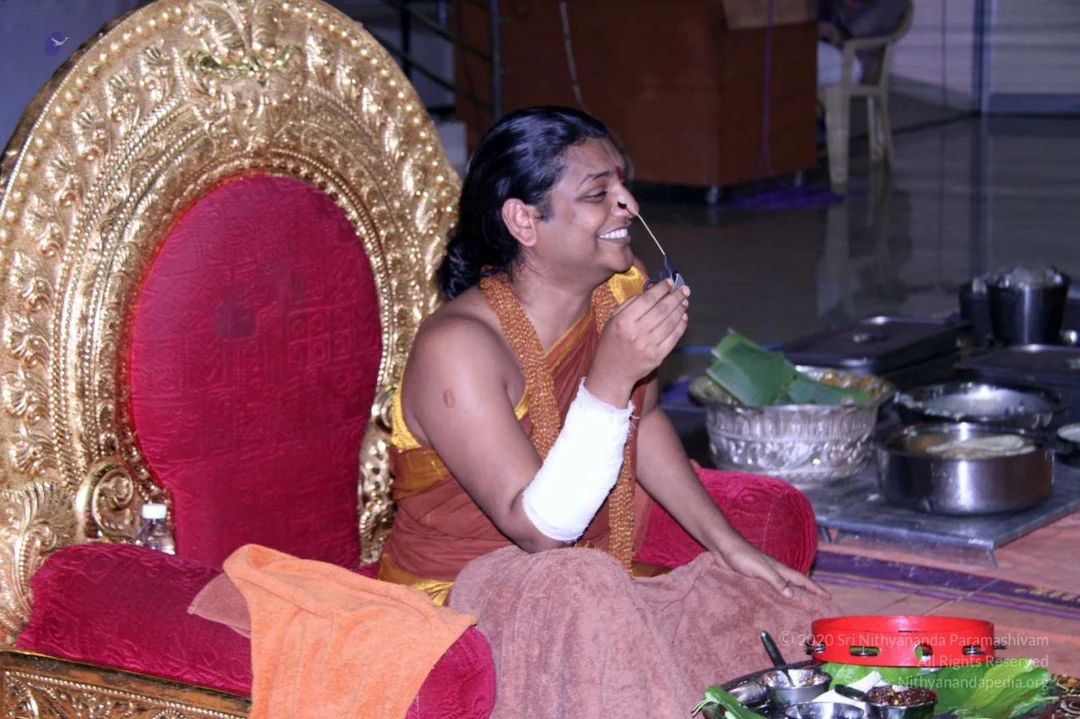
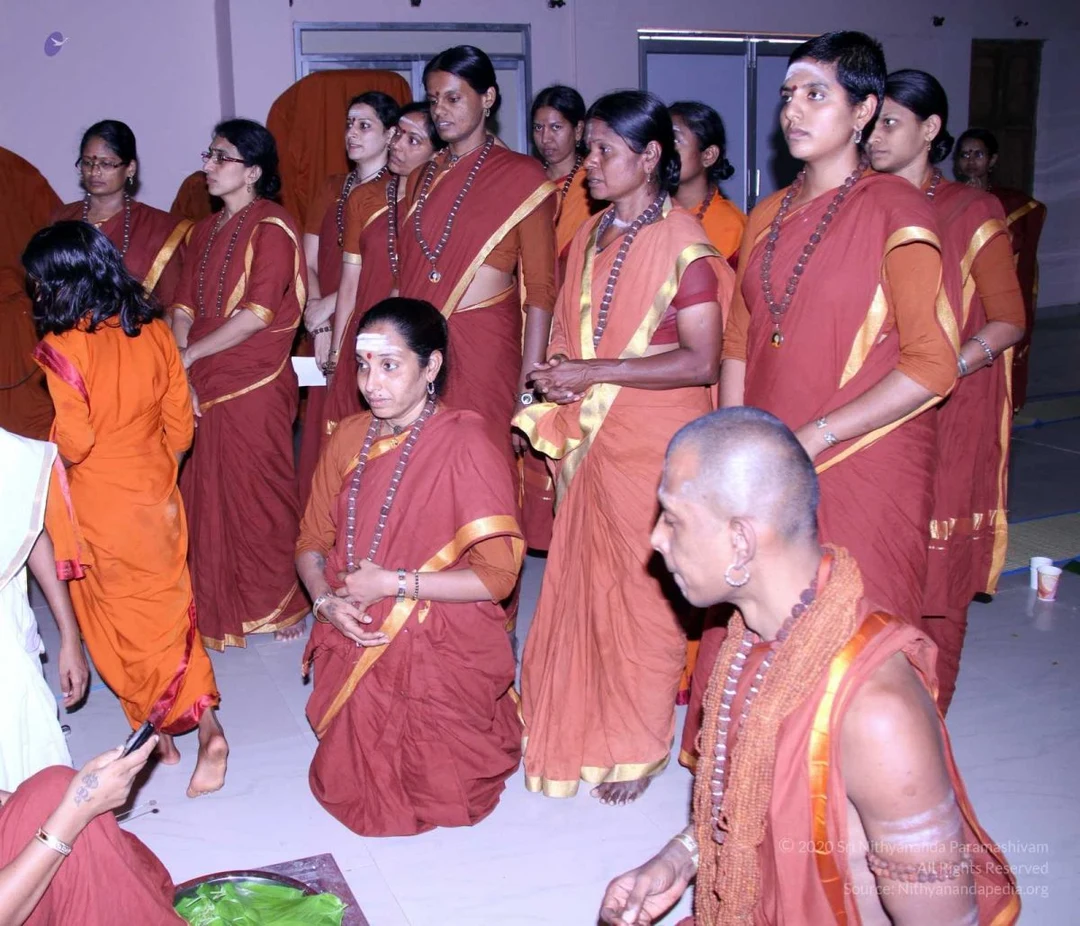
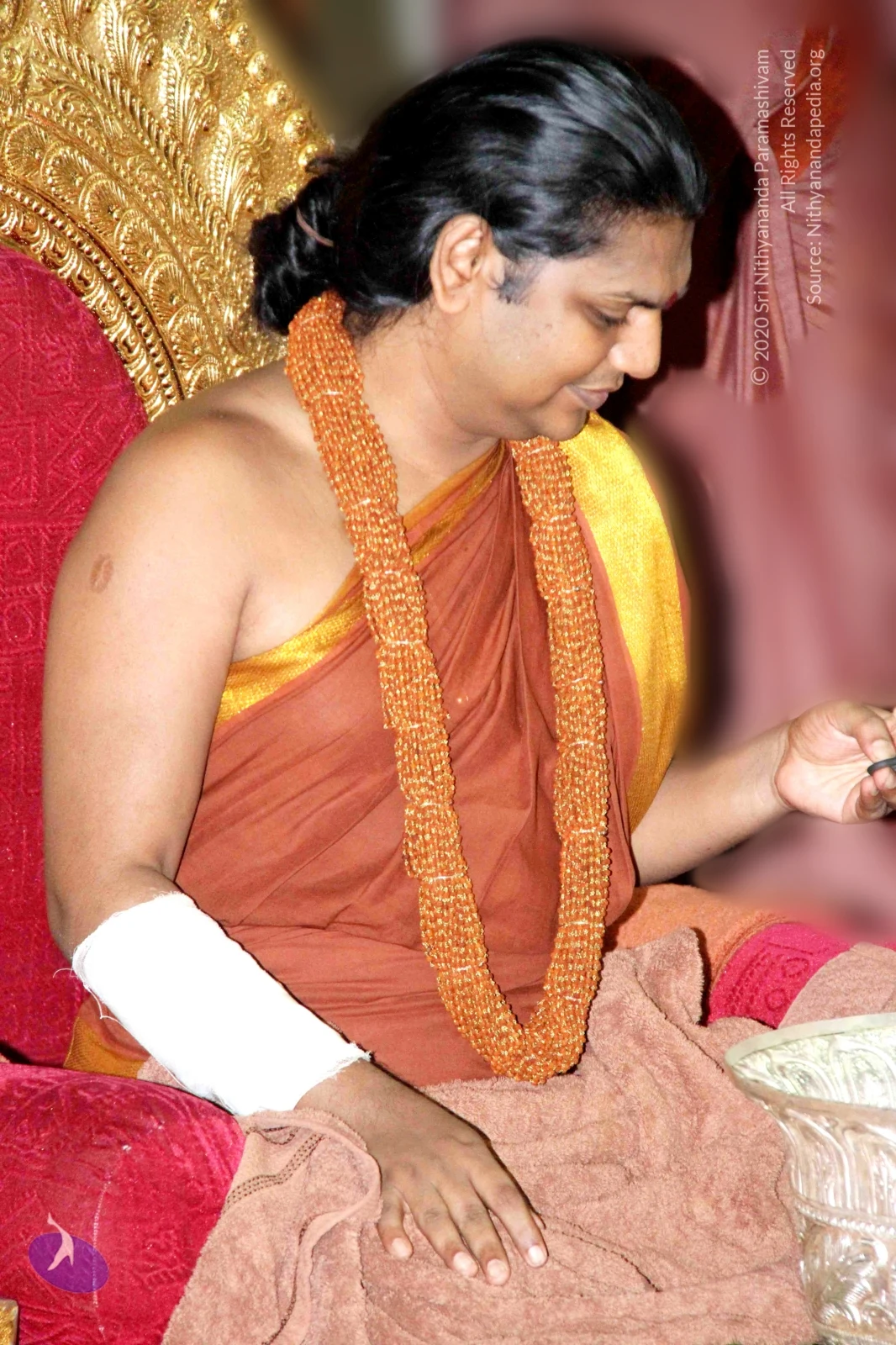
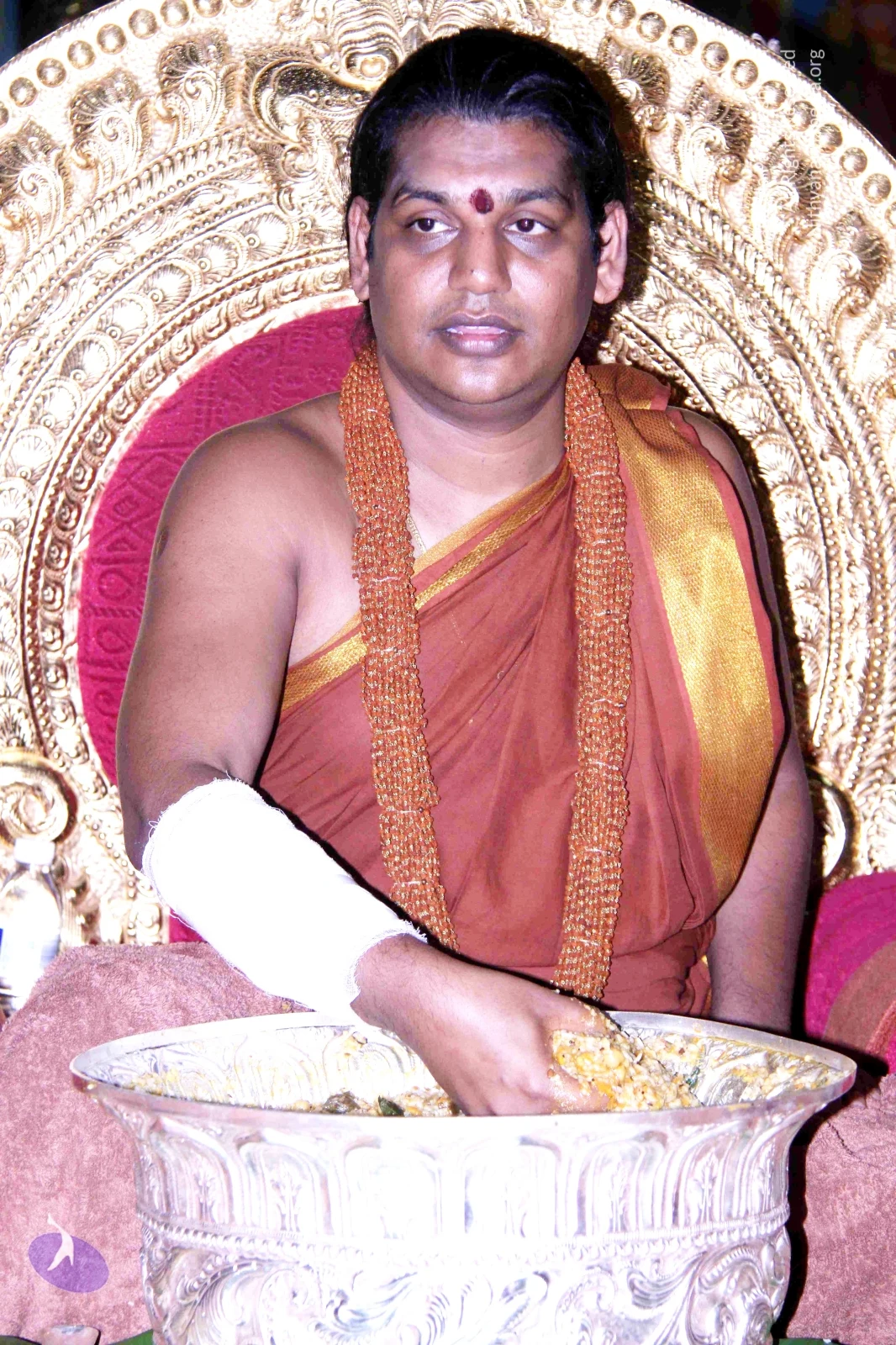
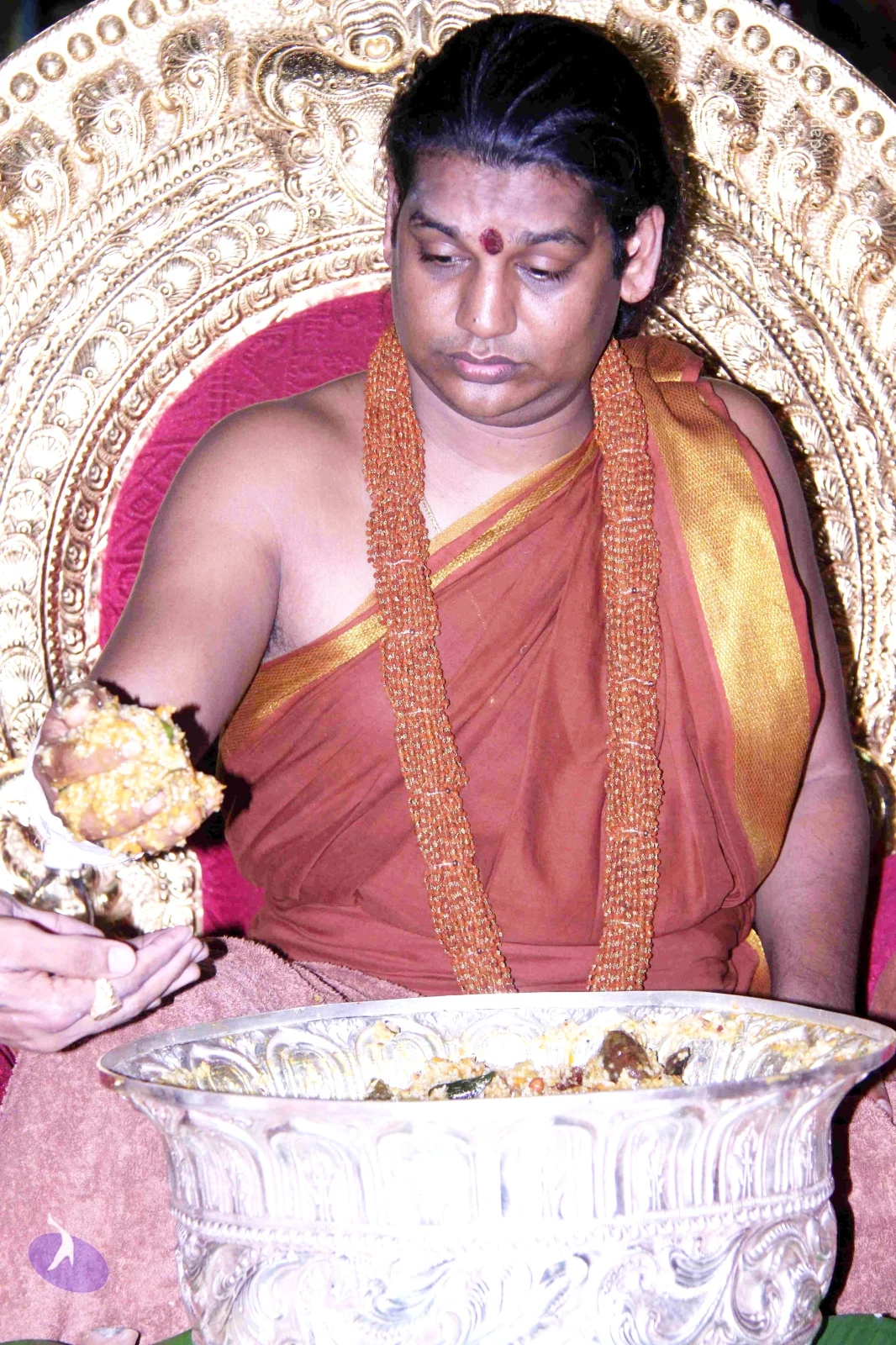
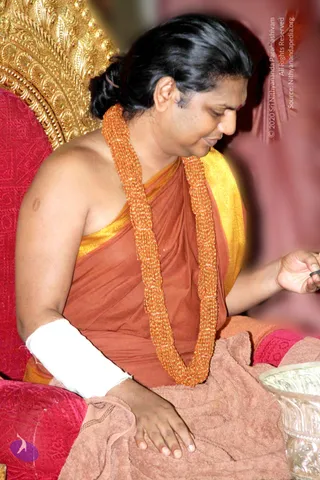
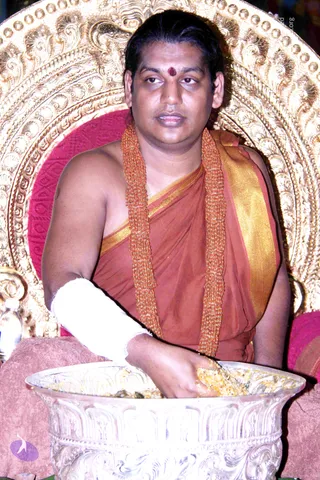
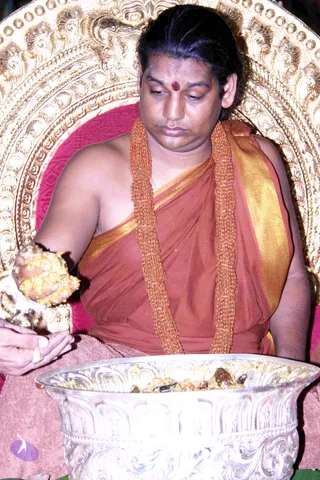
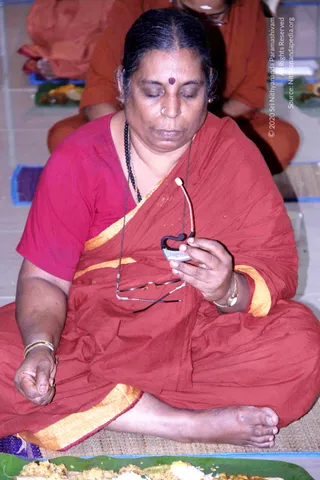
A seated man in an ochre-orange robe with a gold-edged cloth draped over his shoulder wears a long orange-beaded mala around his neck. His dark hair is tied back in a low knot and he has a red tilak on his forehead. He sits on a red velvet throne with an ornate gold backrest, looking down and to the side, with his right arm bandaged in white and his hand resting on a pink towel on his lap. A silver vessel sits at the lower right edge of the frame. Swamiji (probable): the visible cues are the long swept-back hair, orange-beaded mala and ornate gold-edged saffron clothing, seated on a throne.A seated man in an ornate gold-and-red throne chair wears a reddish-orange robe with a gold border and a long orange rudraksha-style mala draped over his shoulders, with a red bindi on his forehead. His right arm is bandaged in white and his hand rests in a large ornate silver bowl filled with food. He appears to be a person in a ceremonial setting.A seated man in a rust-orange and gold-bordered robe and a long gold-toned beaded necklace sits on an ornate gilded throne with a red cushion. He has a red bindi on his forehead and swept-back dark hair, and he looks down while holding a rice-and-sesame ball in his raised hand. In front of him is a large embossed silver bowl filled with a mixture of grains, nuts and herbs. a person: the orange robe, long beaded mala and throne suggest the a person candidate performing an offering-type ritual.A seated woman in a red sari with a gold border and a red blouse sits cross-legged on a woven mat, eyes lowered, holding a small silver-and-black receiver with a wired earpiece. Her wrists bear gold bangles and a wristwatch, a black bead necklace hangs at her neck, and she wears a nose stud and a red bindi. Spectacles rest on her lap. Behind her, people in orange robes sit on mats, and in the foreground a banana leaf holds rice and side dishes.A photograph of a shaved-headed man in orange-red robes seated cross-legged on a mat, eating from a banana leaf with food. He wears white tilak lines on his forehead, dangling earrings, and multiple strands of rudraksha beads across his chest, with a gold-bordered orange cloth. Two young men in orange robes with white forehead markings sit behind him, one smiling. A bell, paper cups and a mobile phone are visible on the floor, along with scattered food on the leaves.A shaved-headed man in rust-orange robes with a gold border sits cross-legged on a mat, eyes closed, singing while ringing a small brass handbell held in his right hand. He wears layered rudraksha mala necklaces, rudraksha armbands, a white horizontal tilak with a red dot, and thin-rimmed glasses. Behind him, several young men in saffron-orange cloth sit on the floor, some smiling. In the foreground, a banana leaf holds rice and food offerings. The setting appears to be a ritual gathering, possibly puja or satsang.