Skip to content
Thursday

26 September 2013

Question all your answers!

Dated photos
237
Source pages
1
Media
2
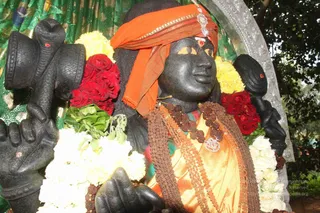
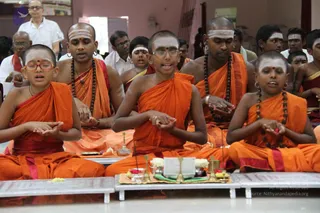
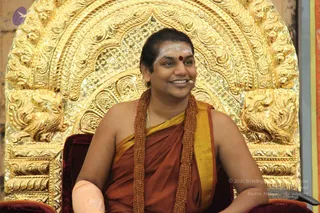
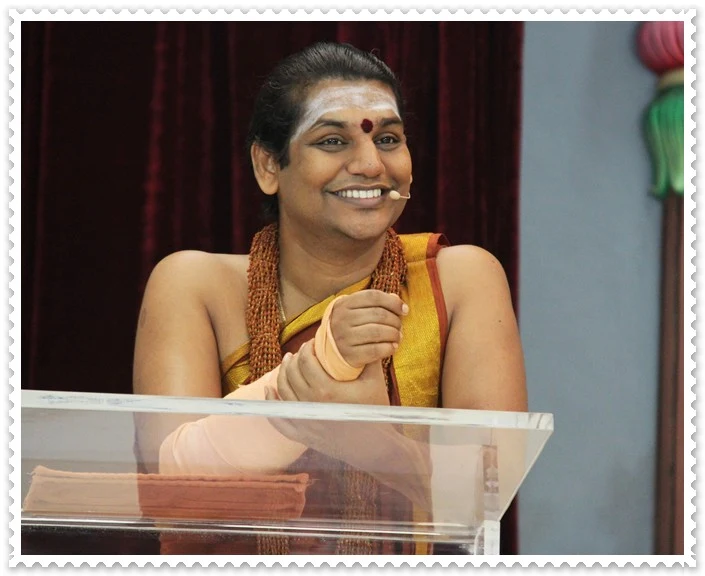
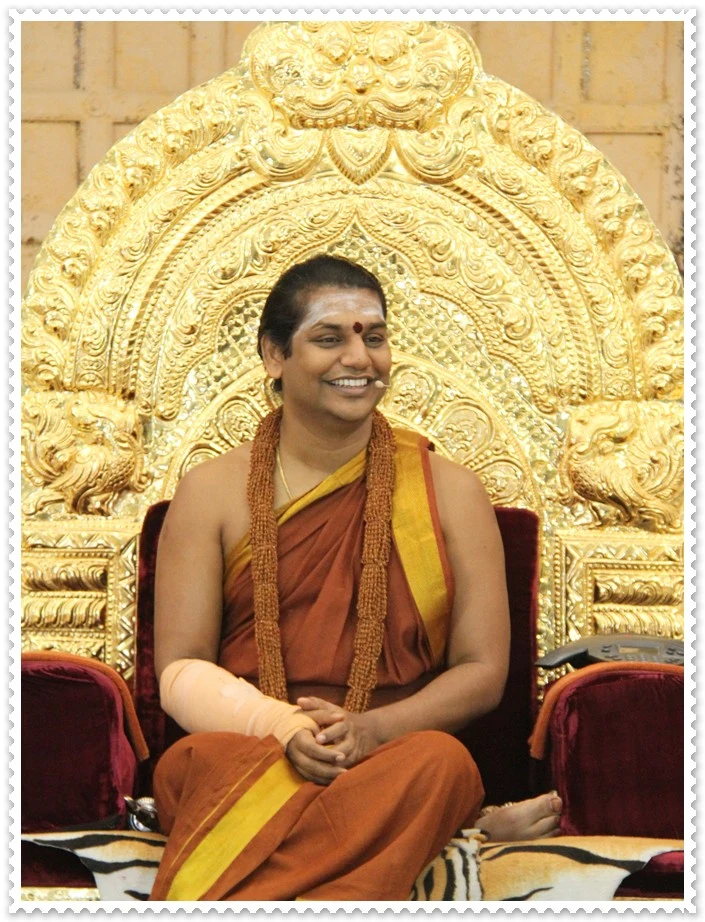
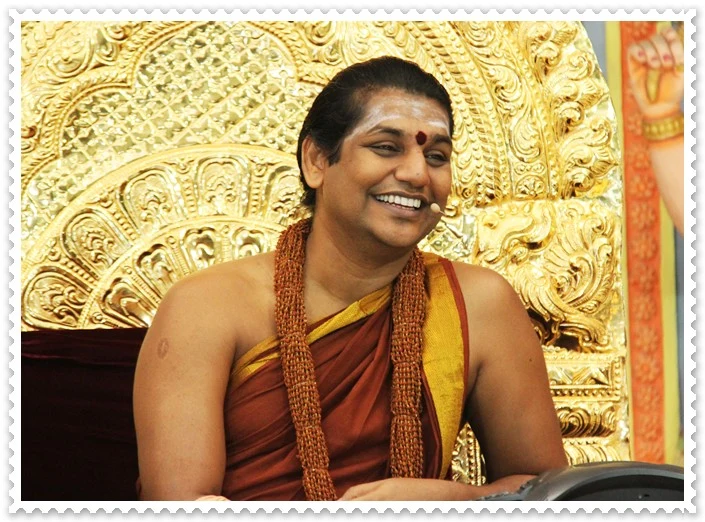
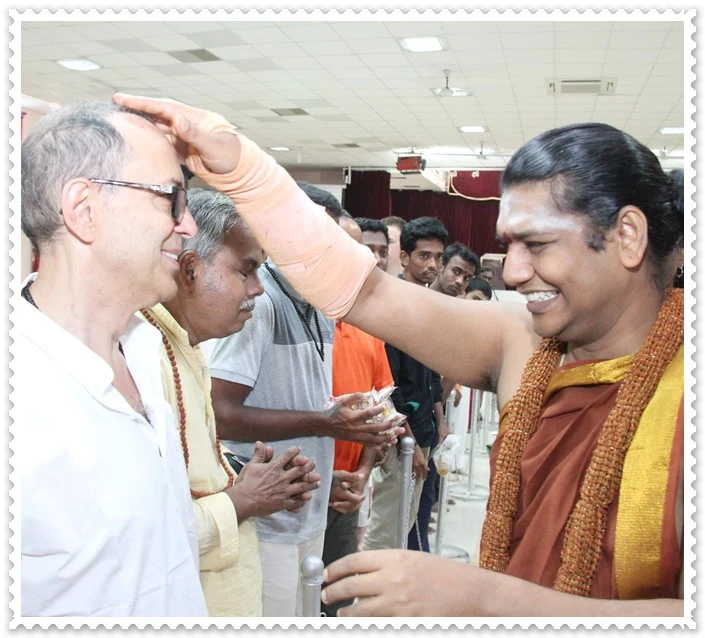
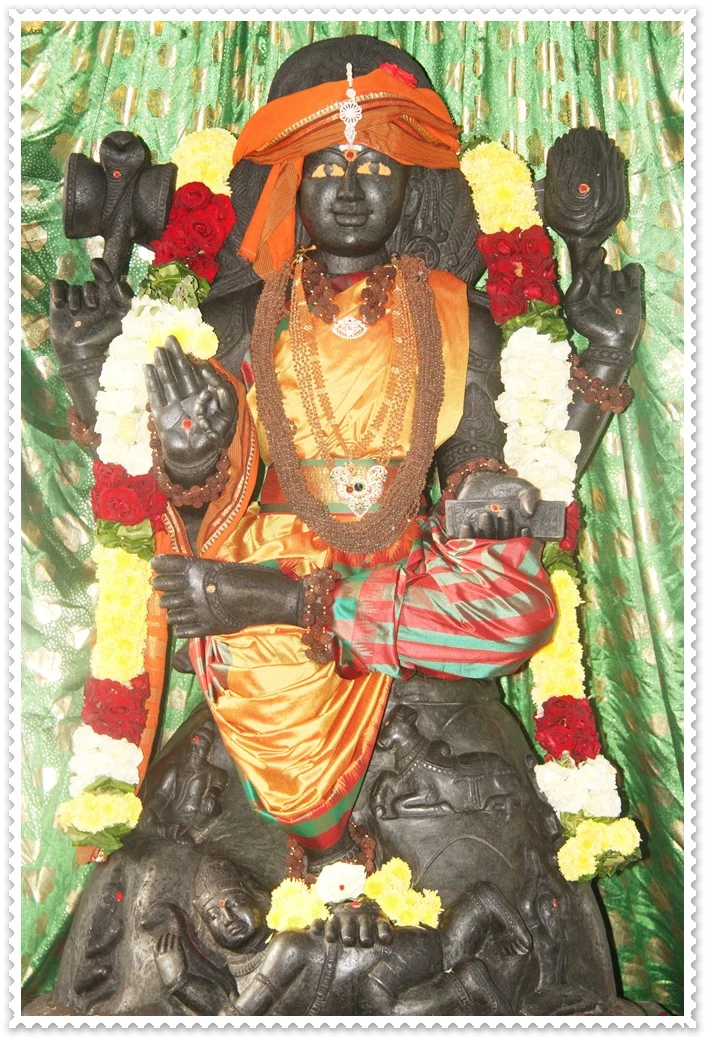
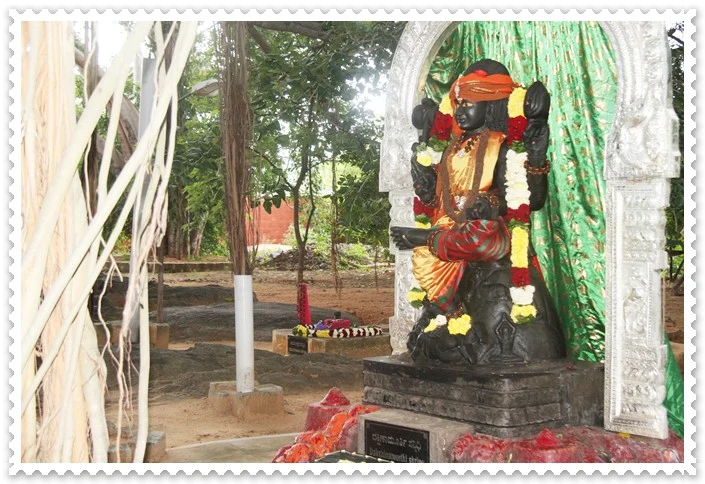
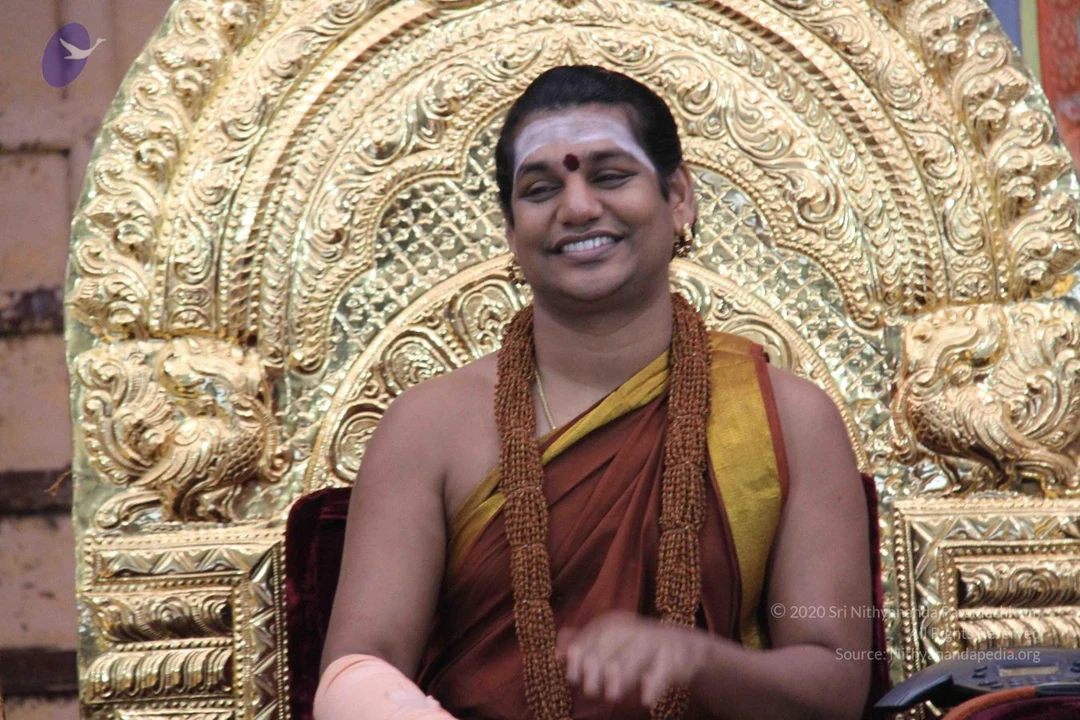
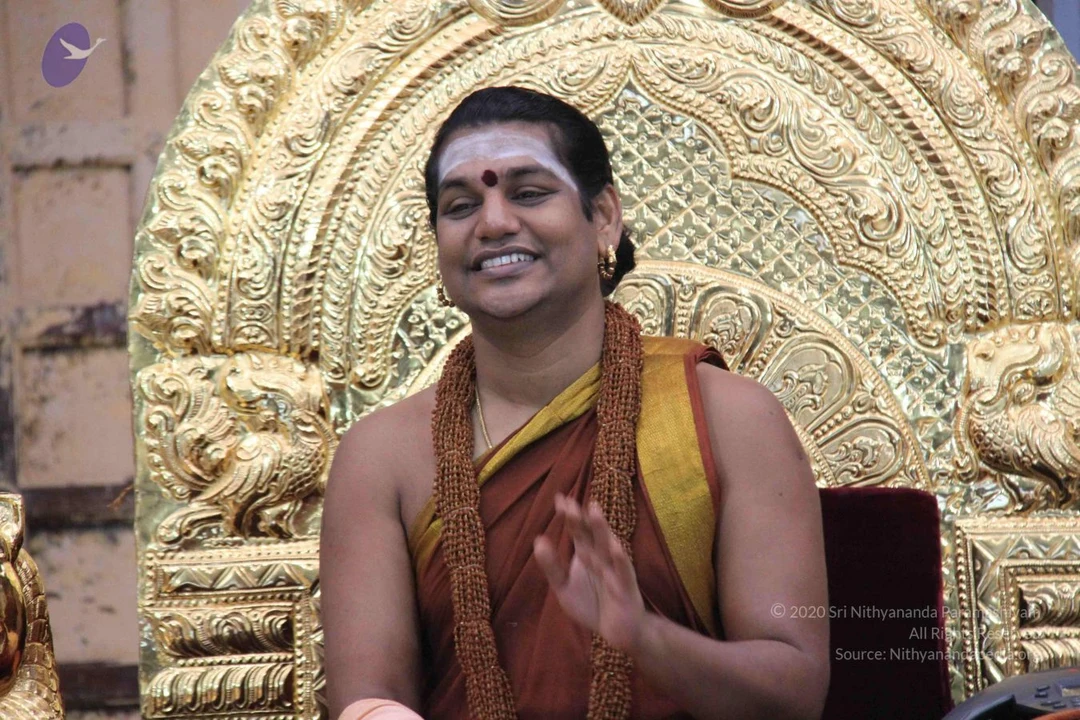
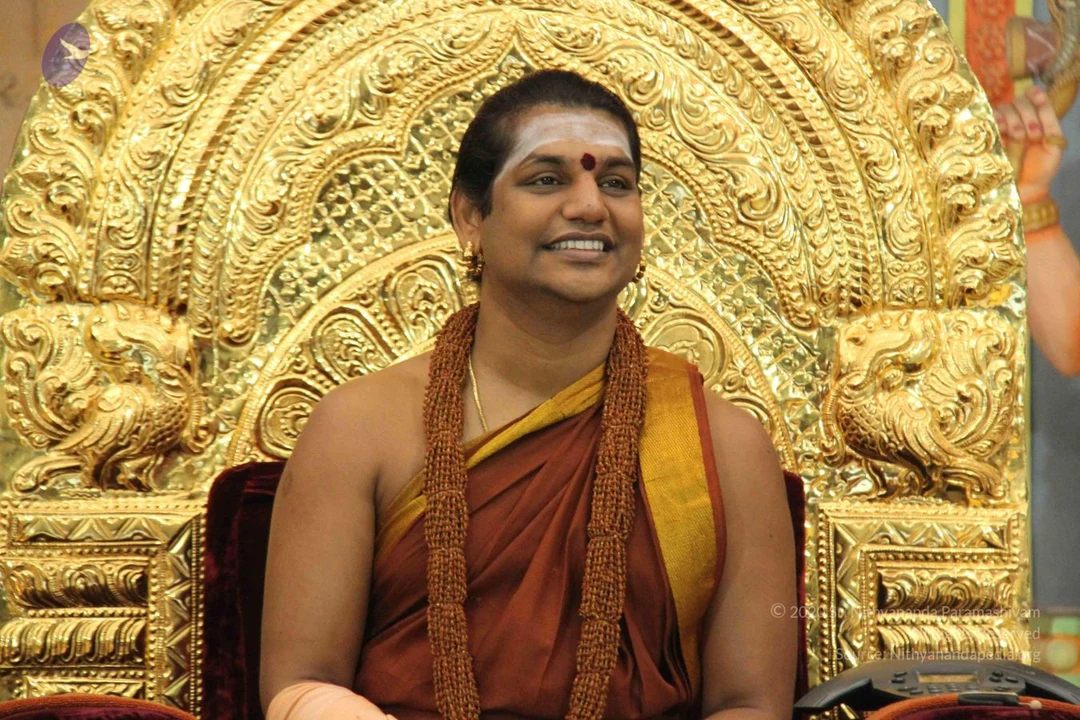
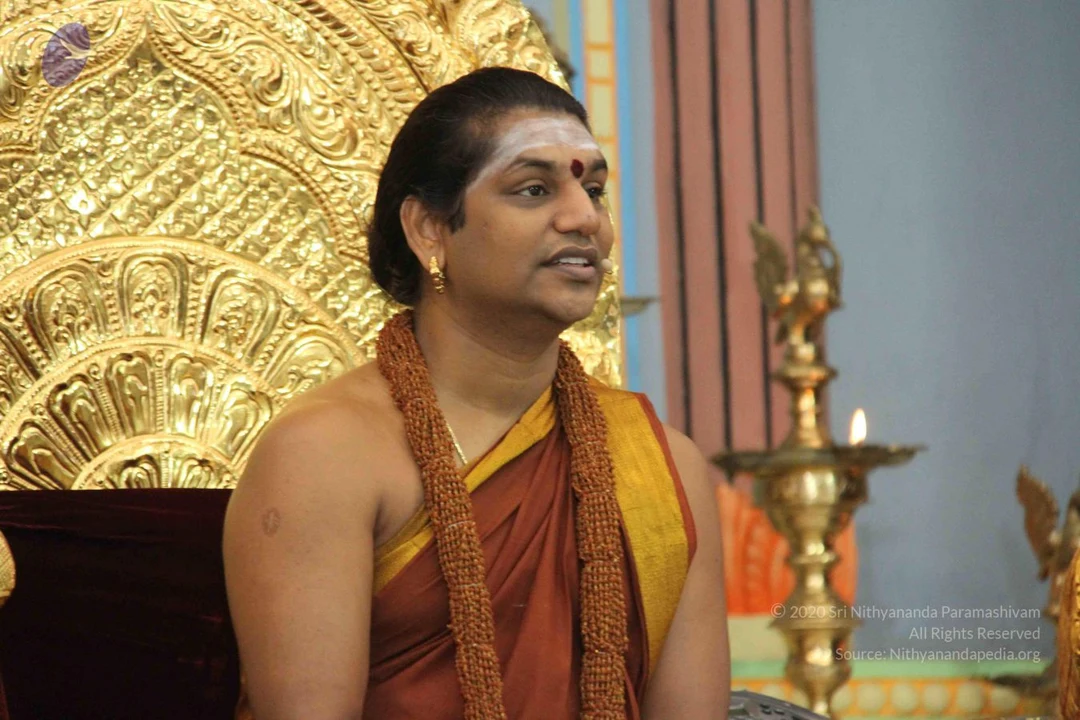
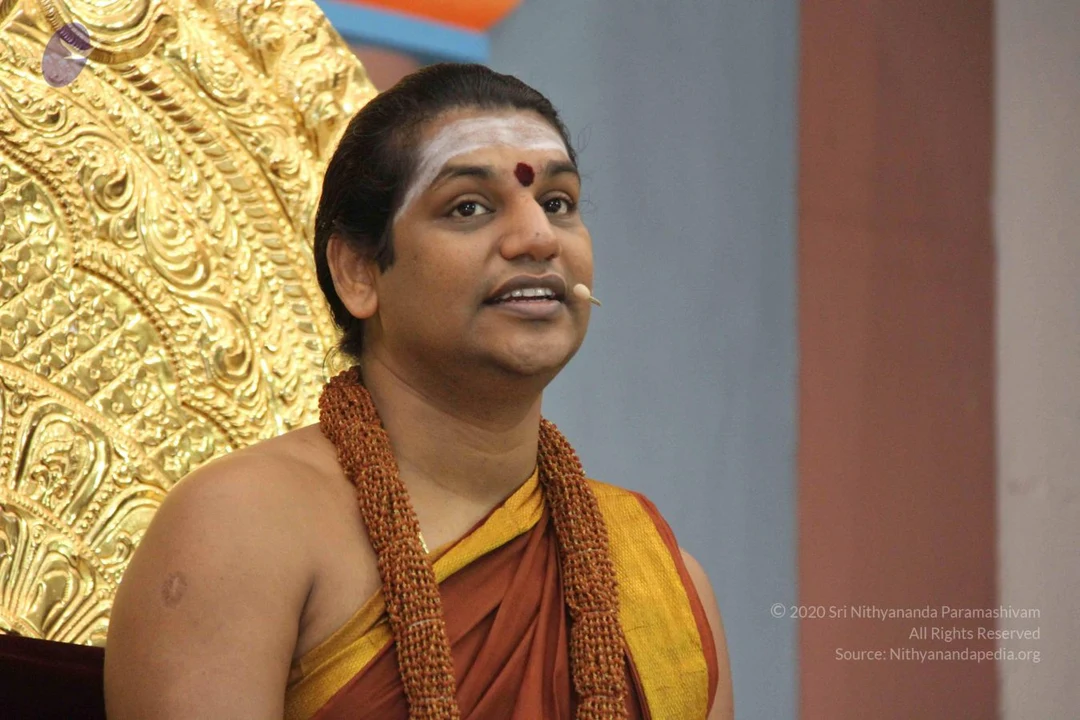
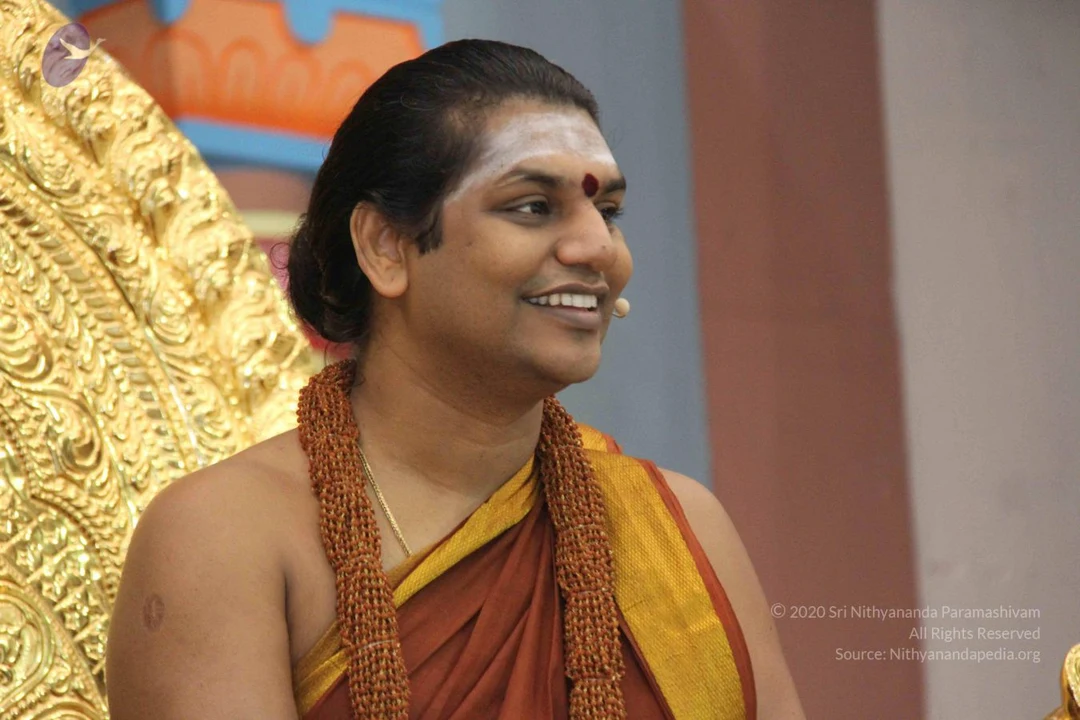
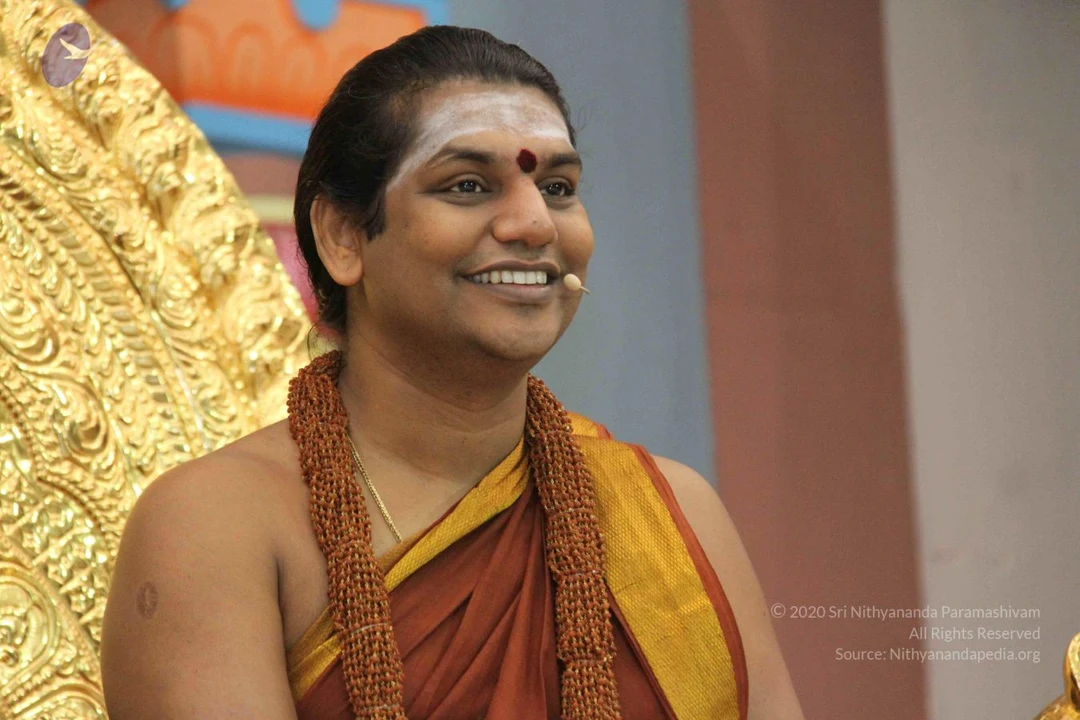
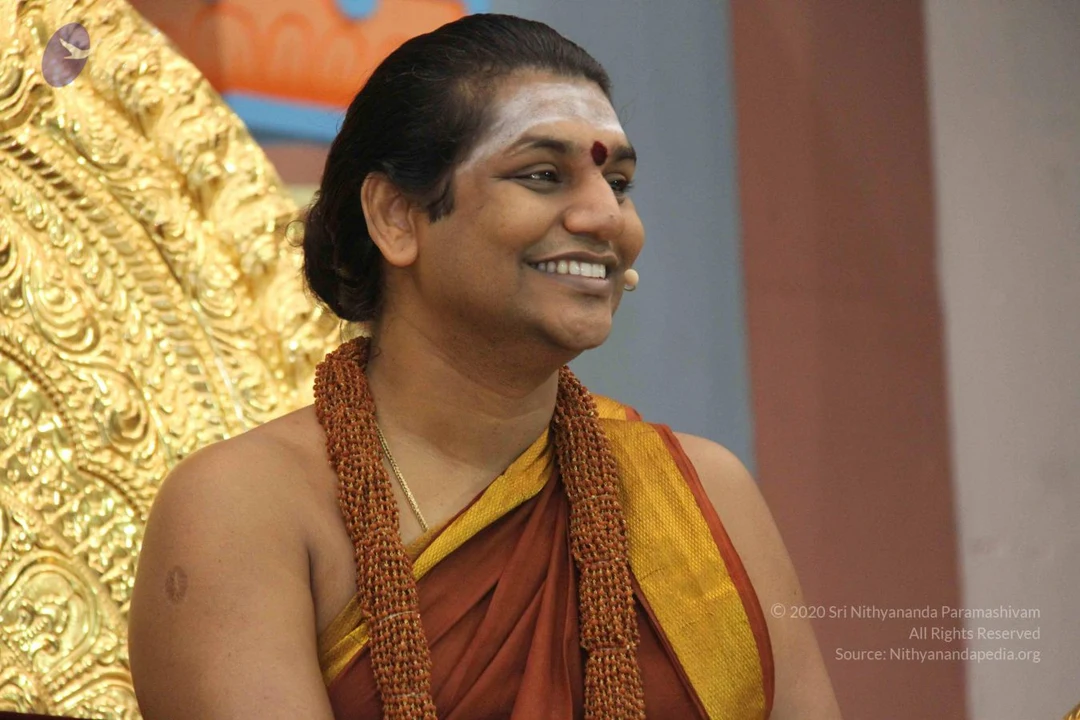
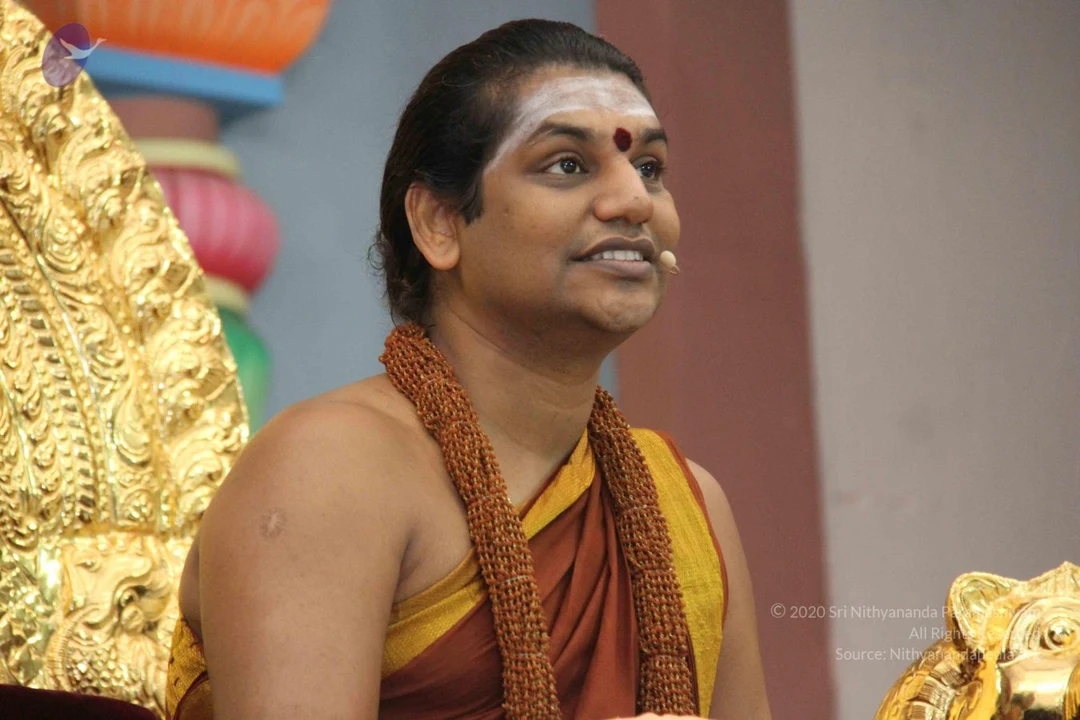
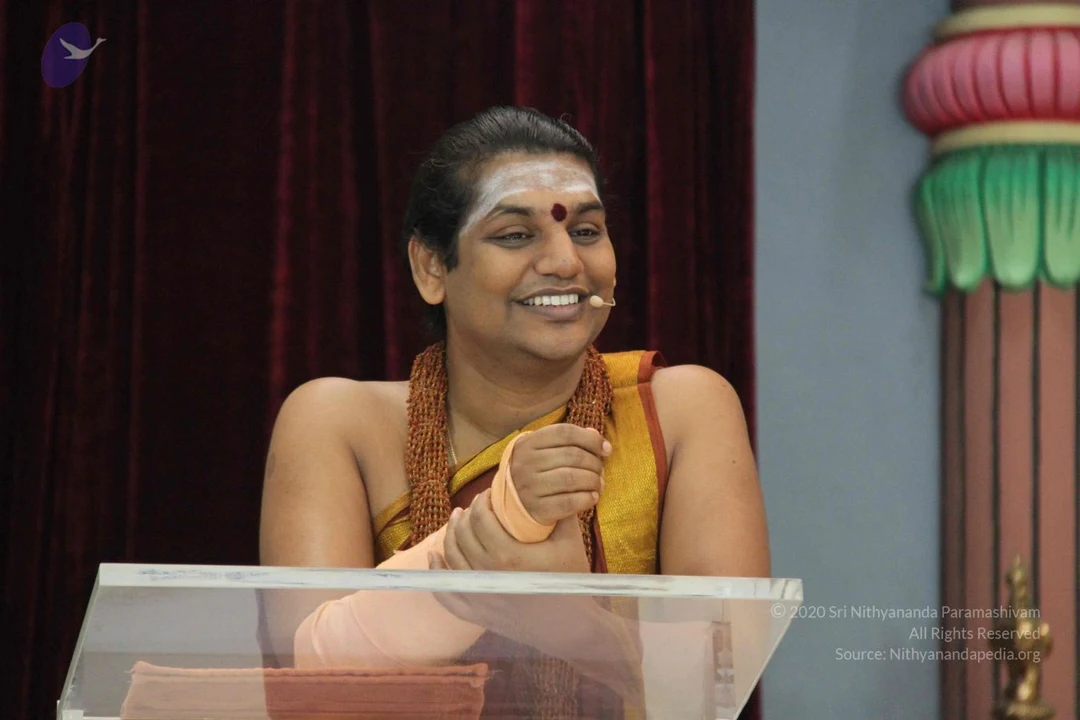
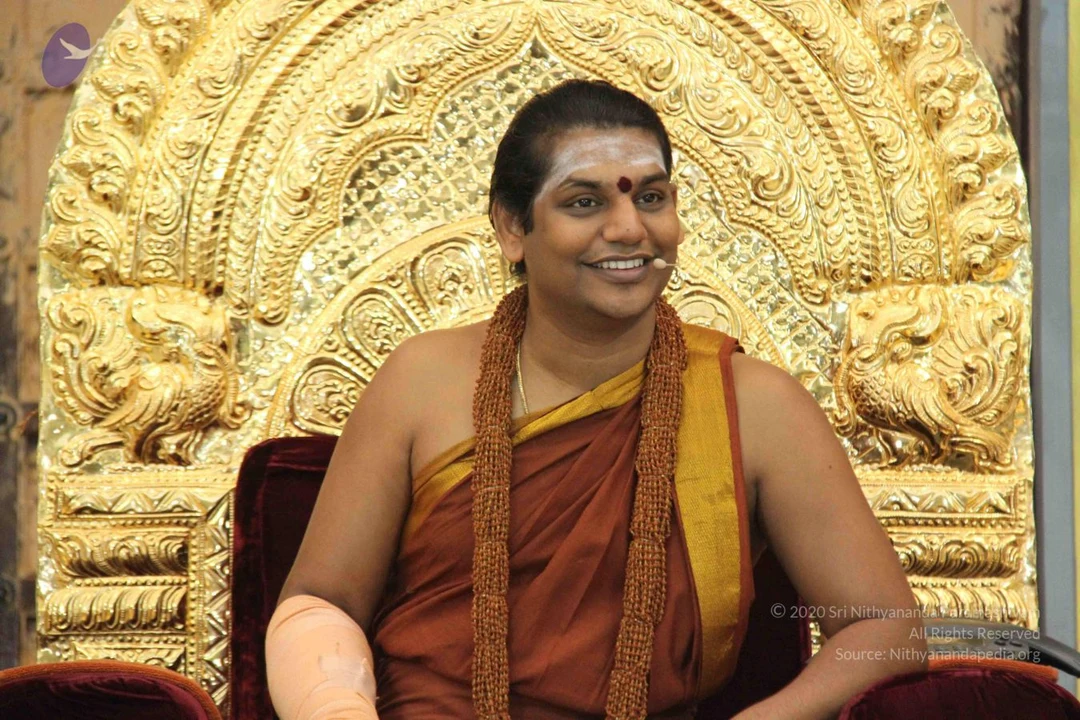
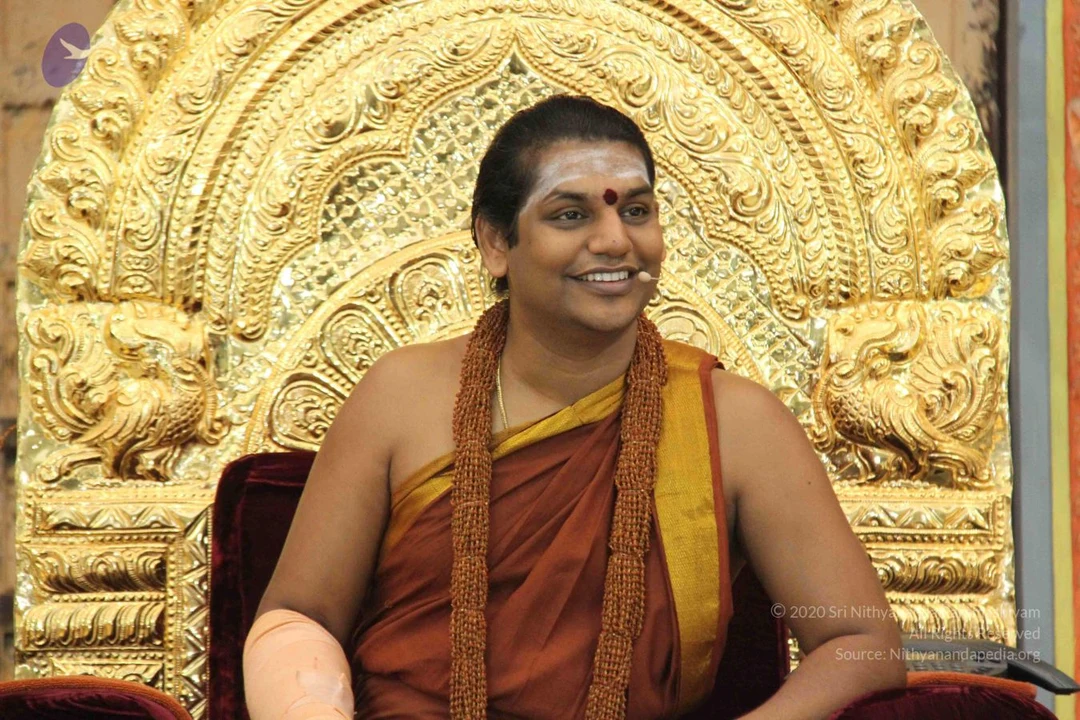
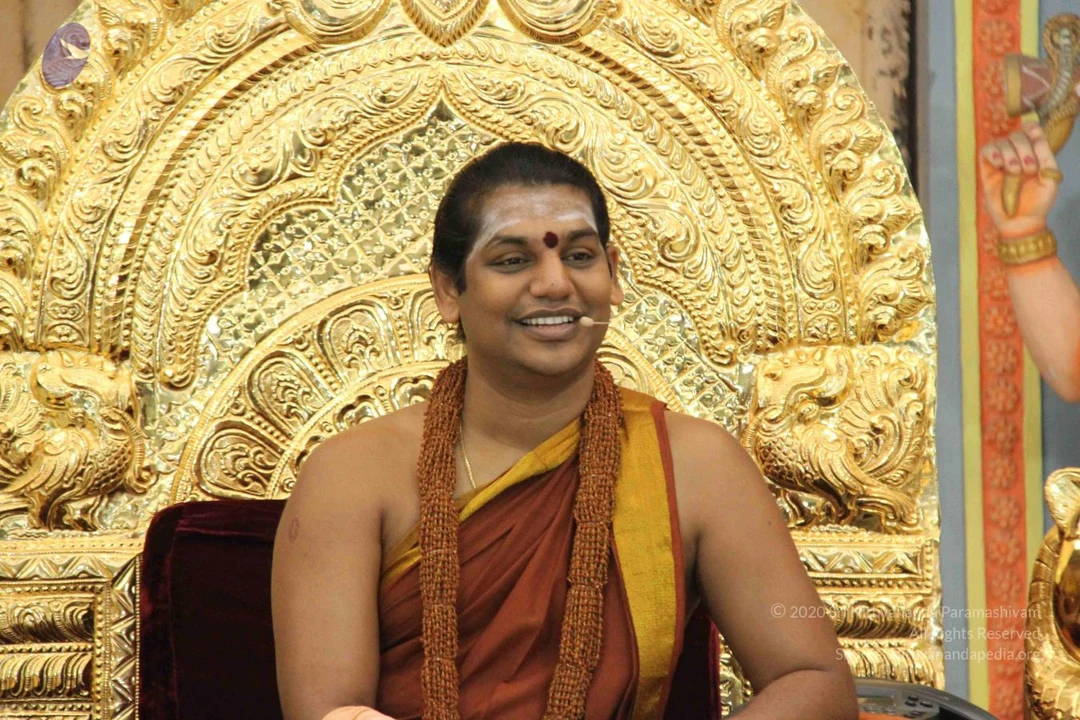
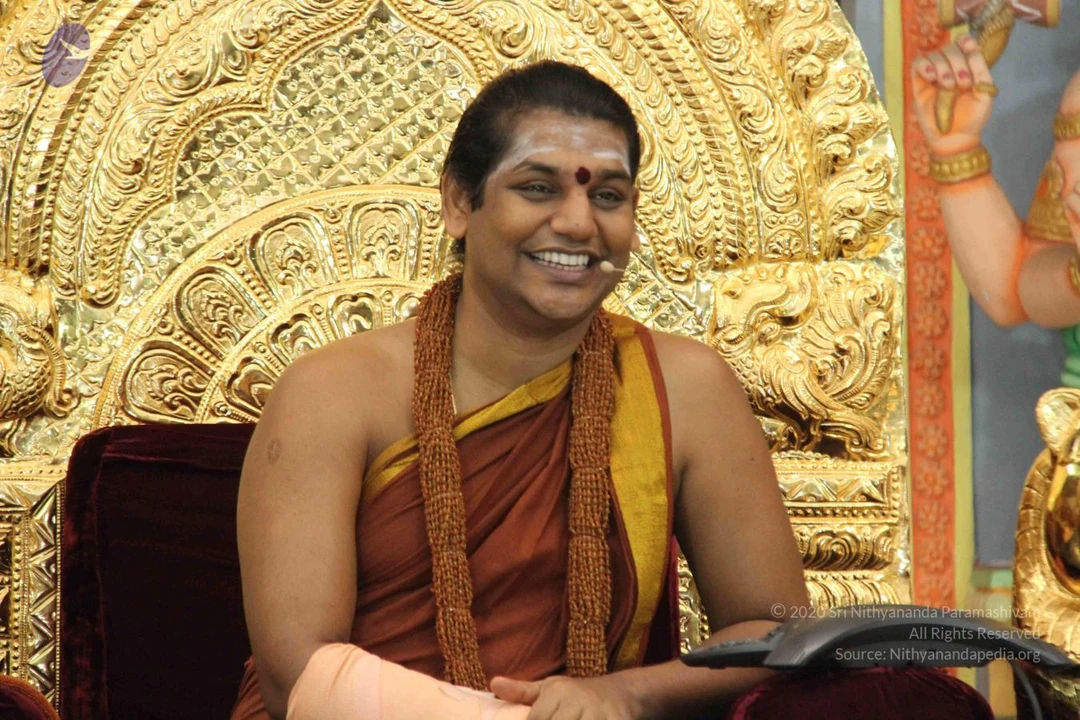
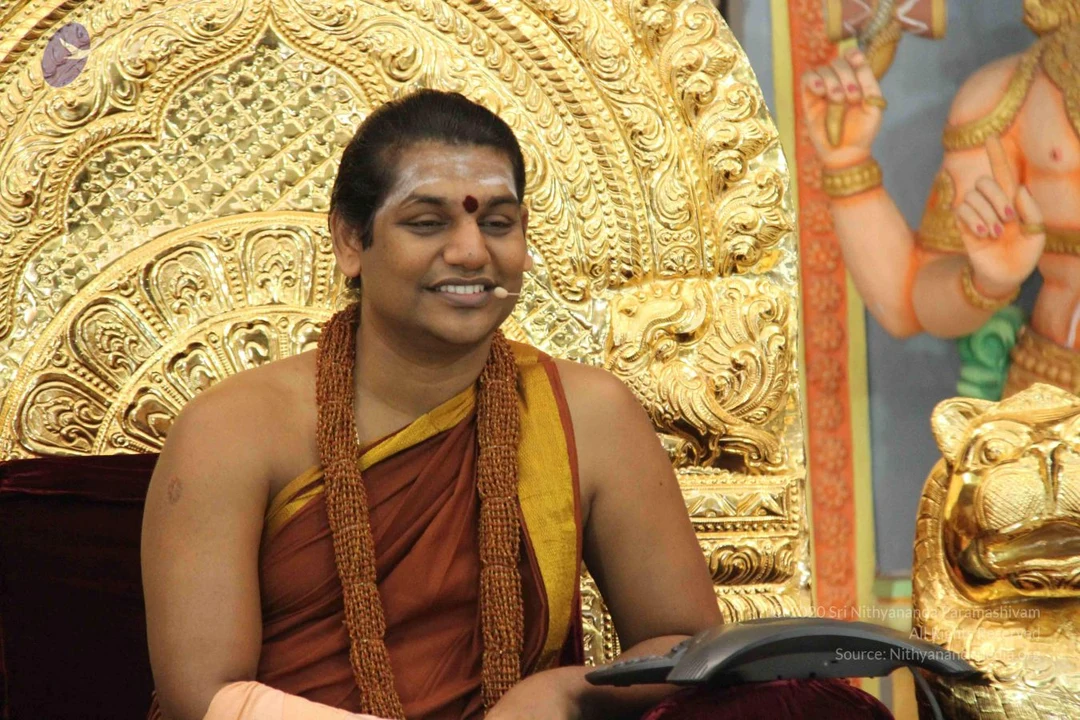
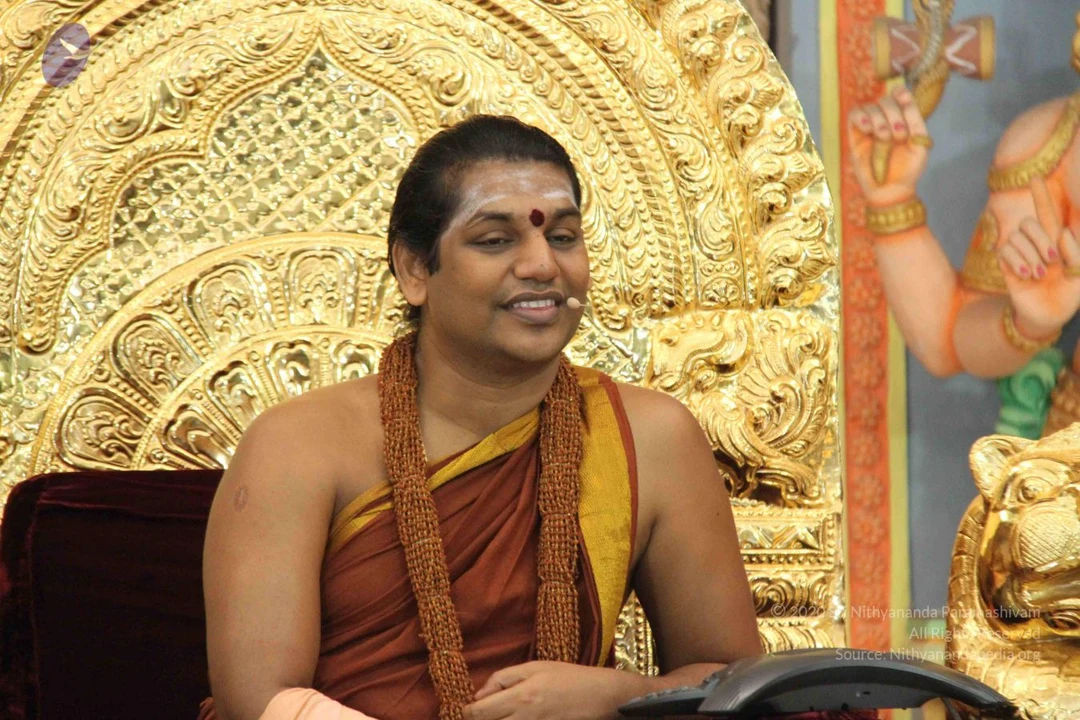
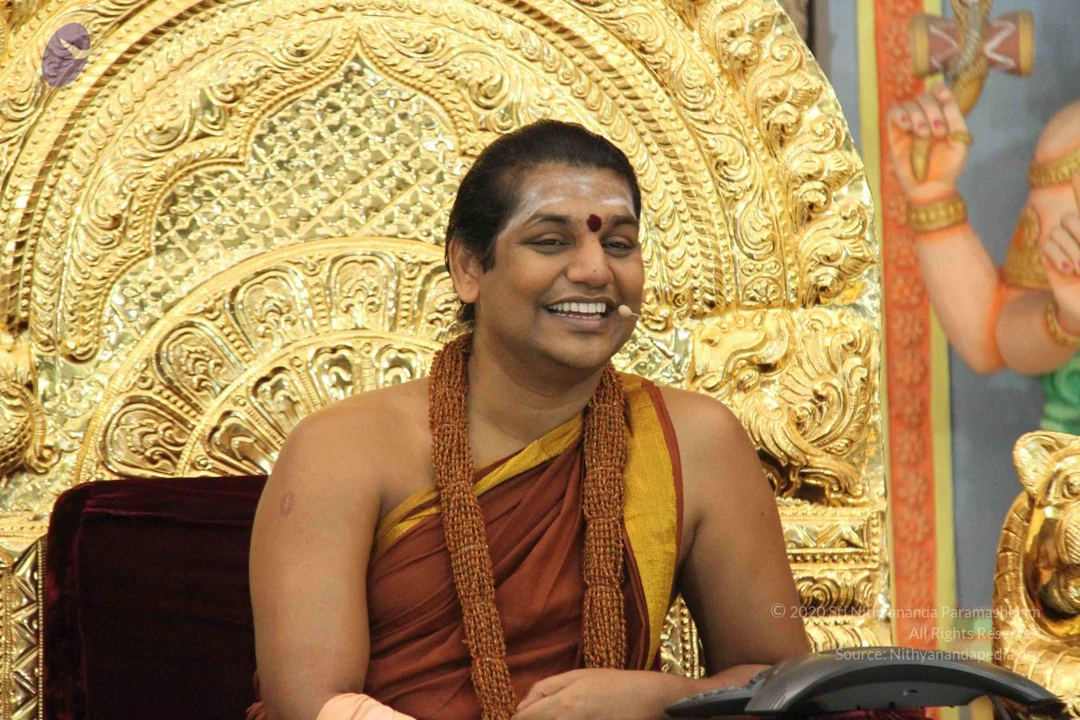
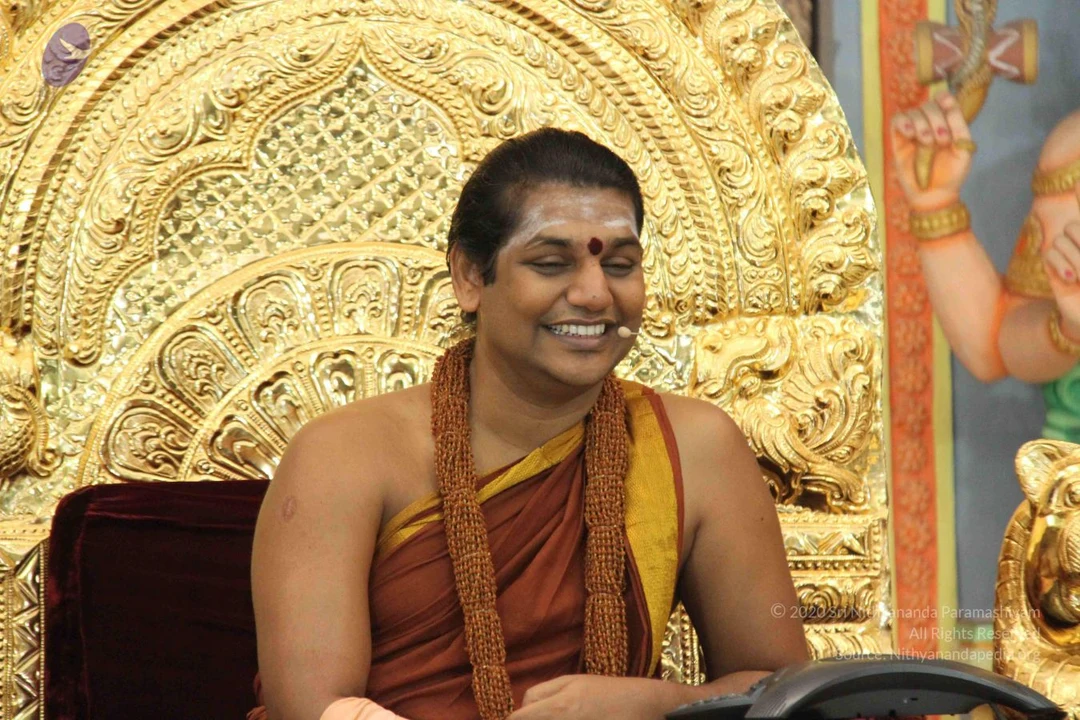
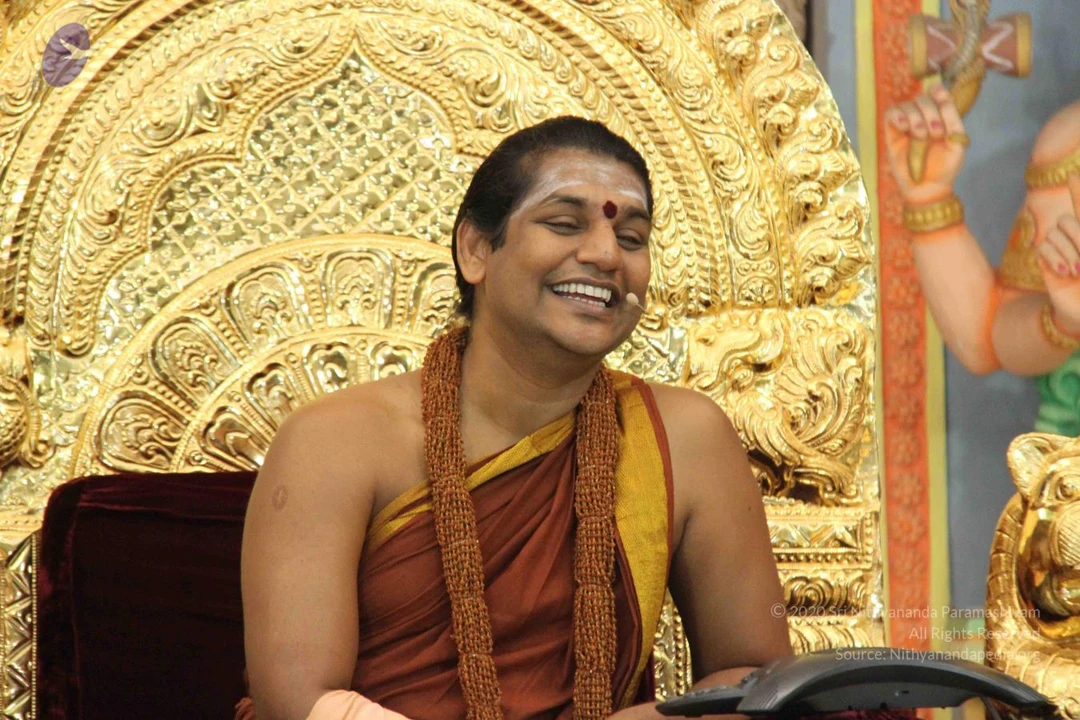
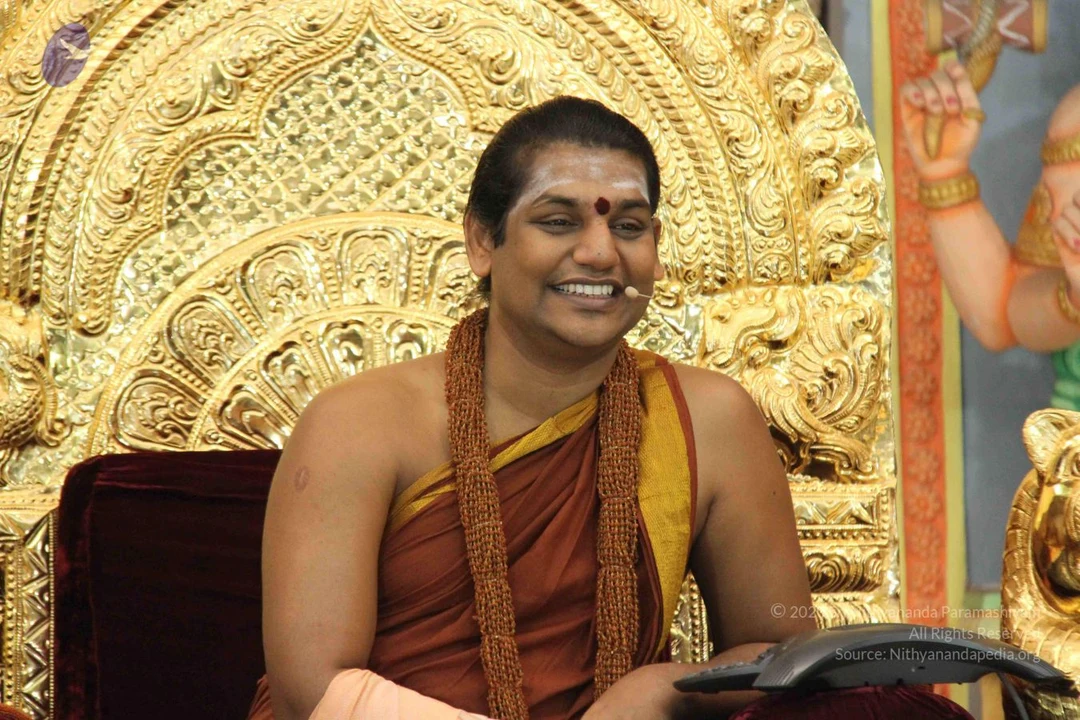
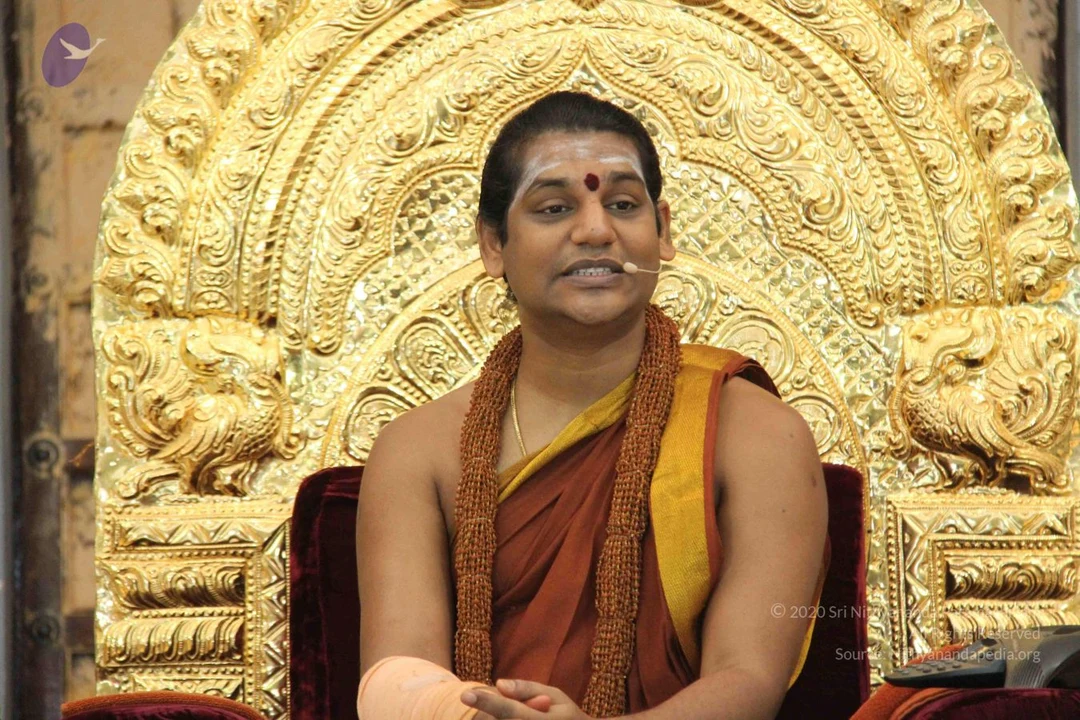
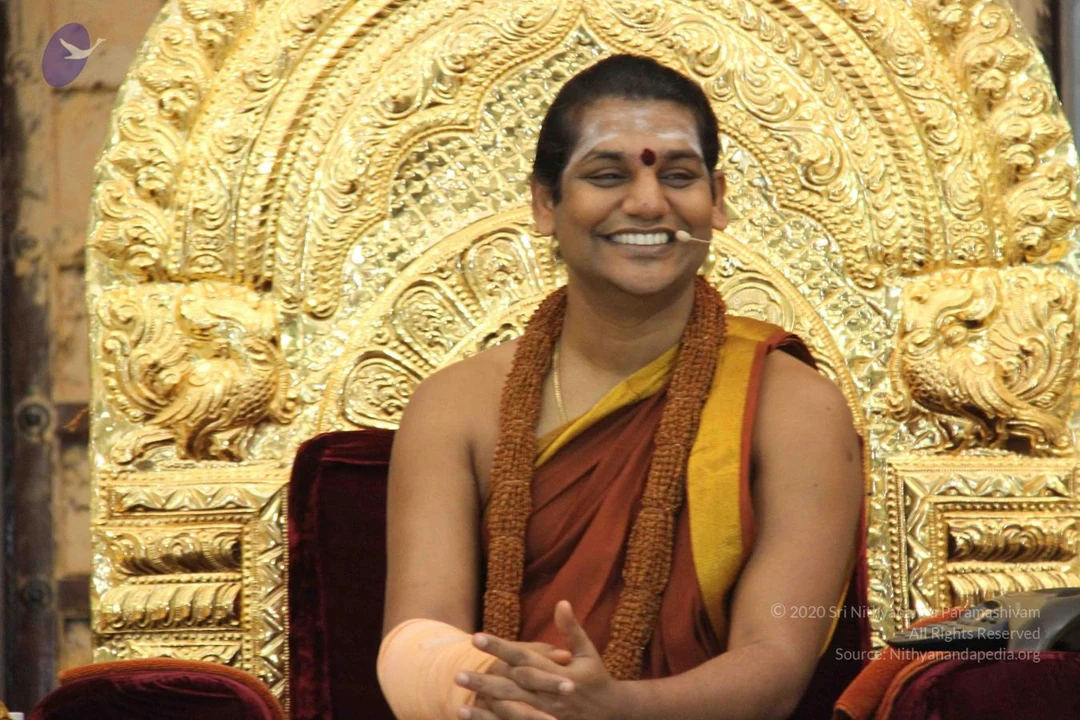
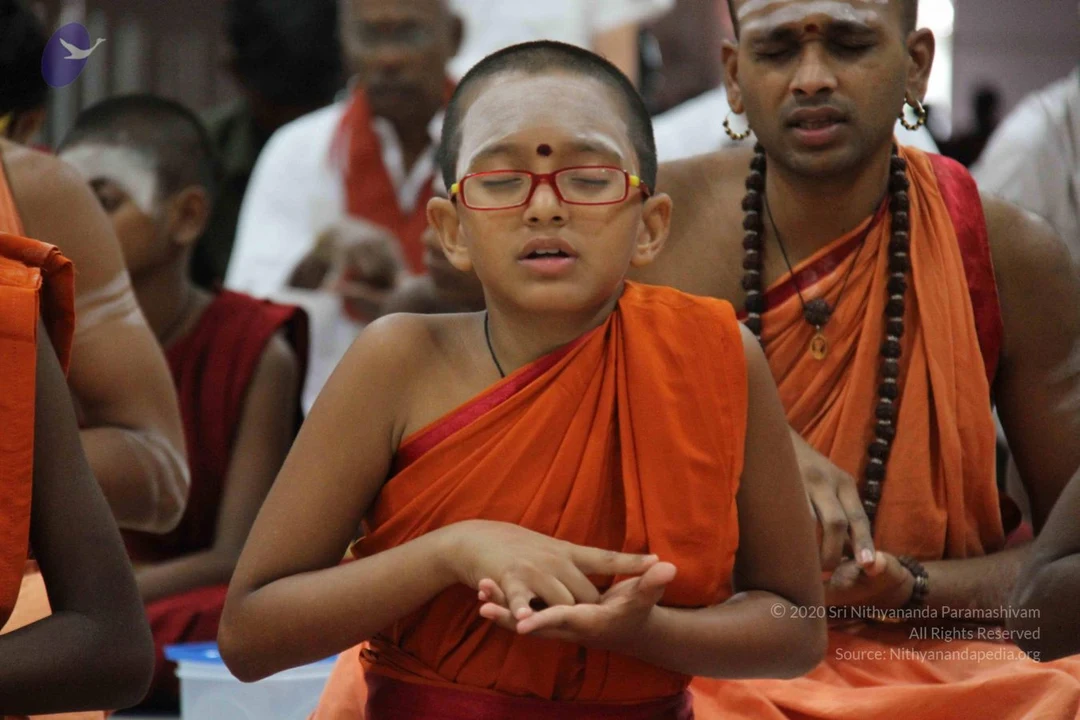
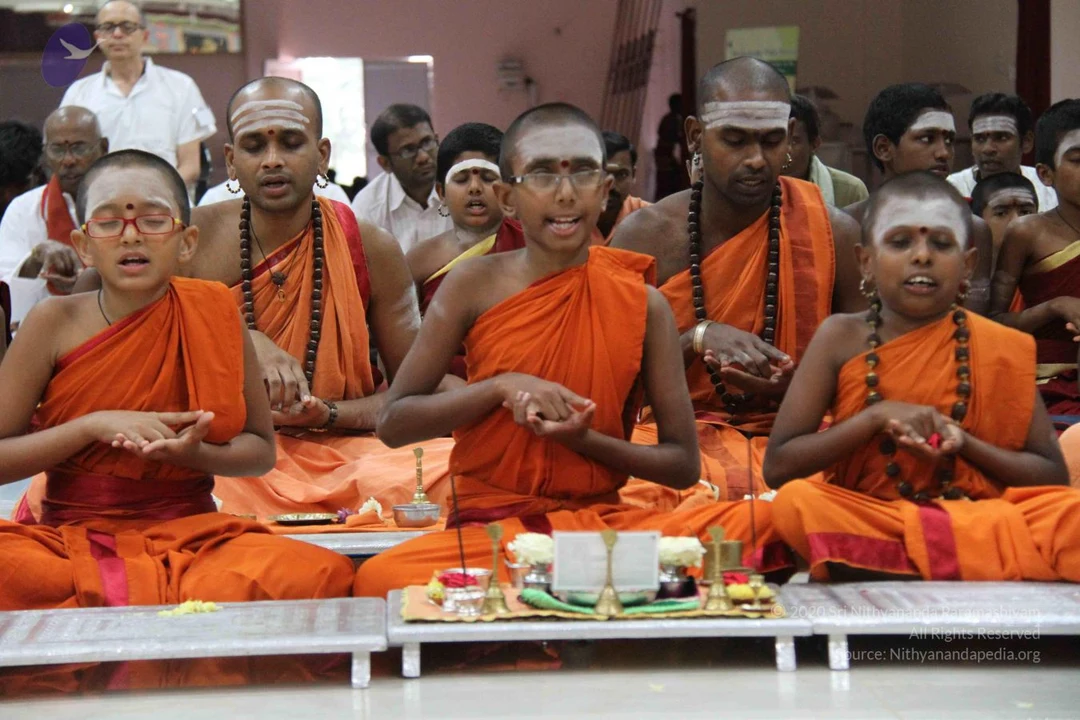
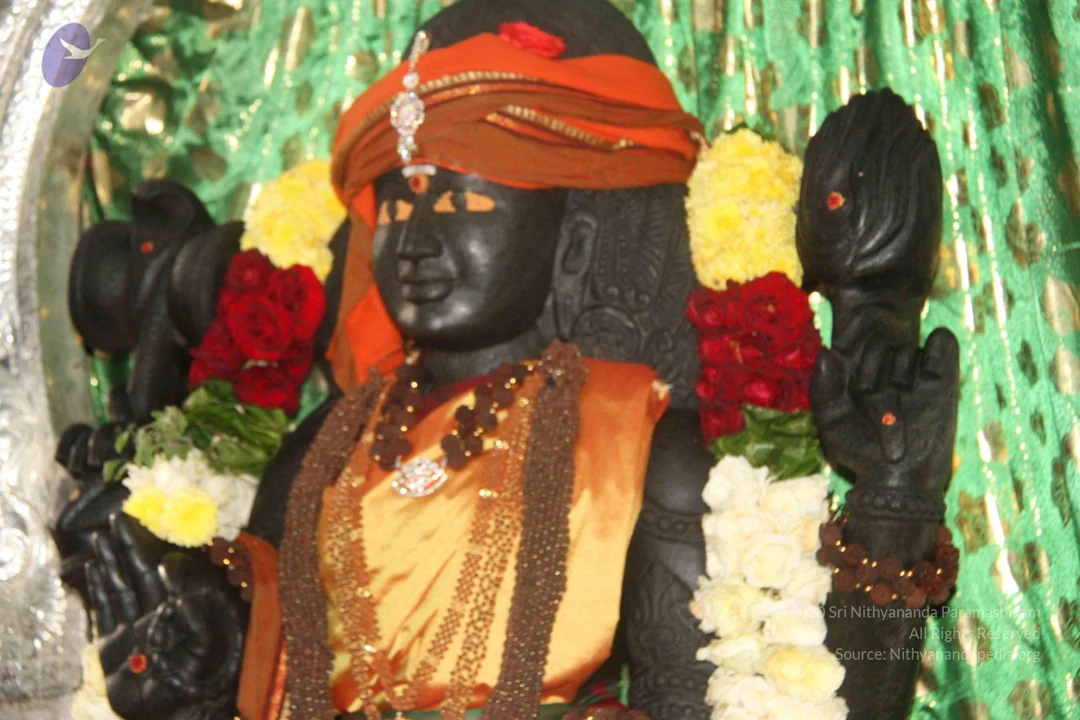
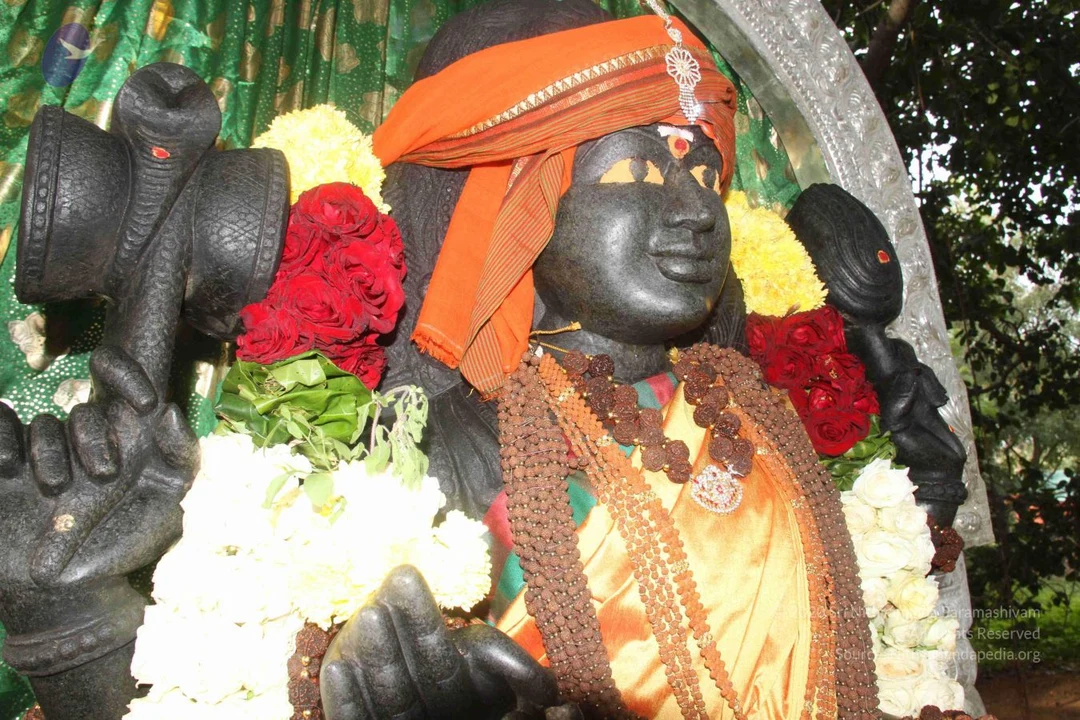
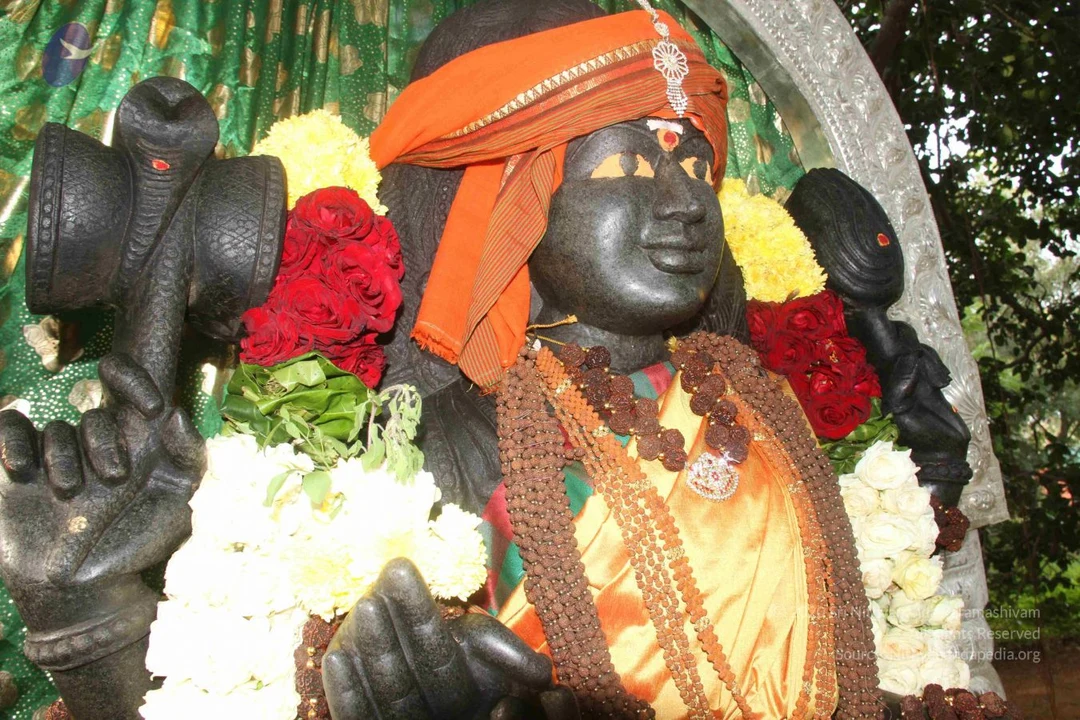
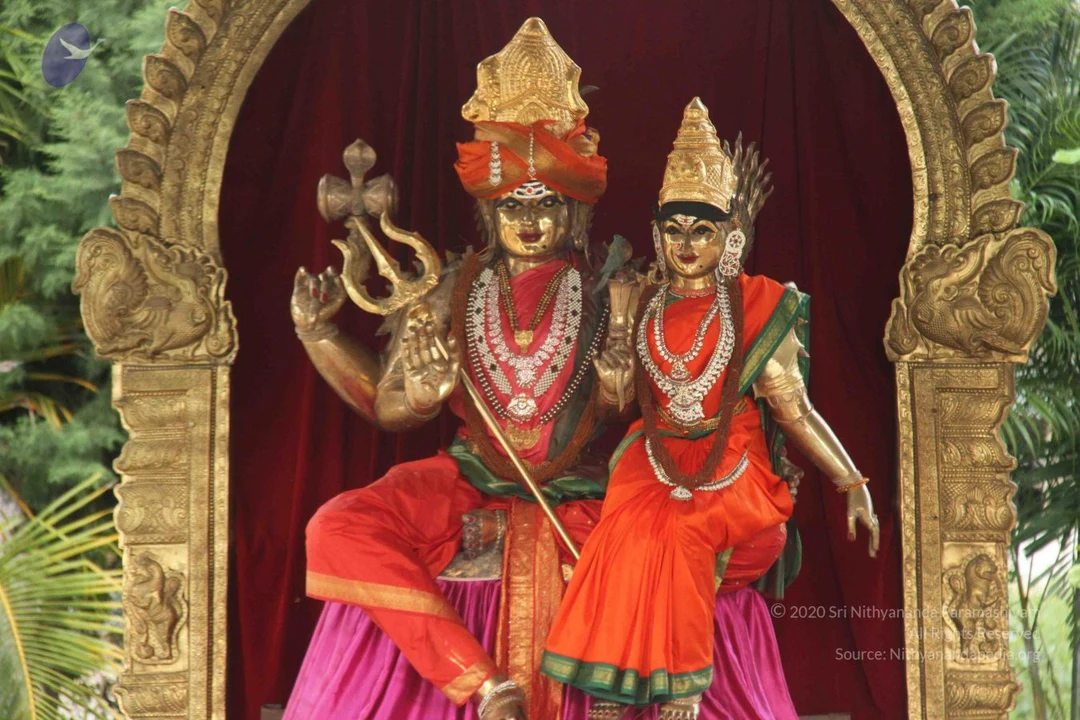
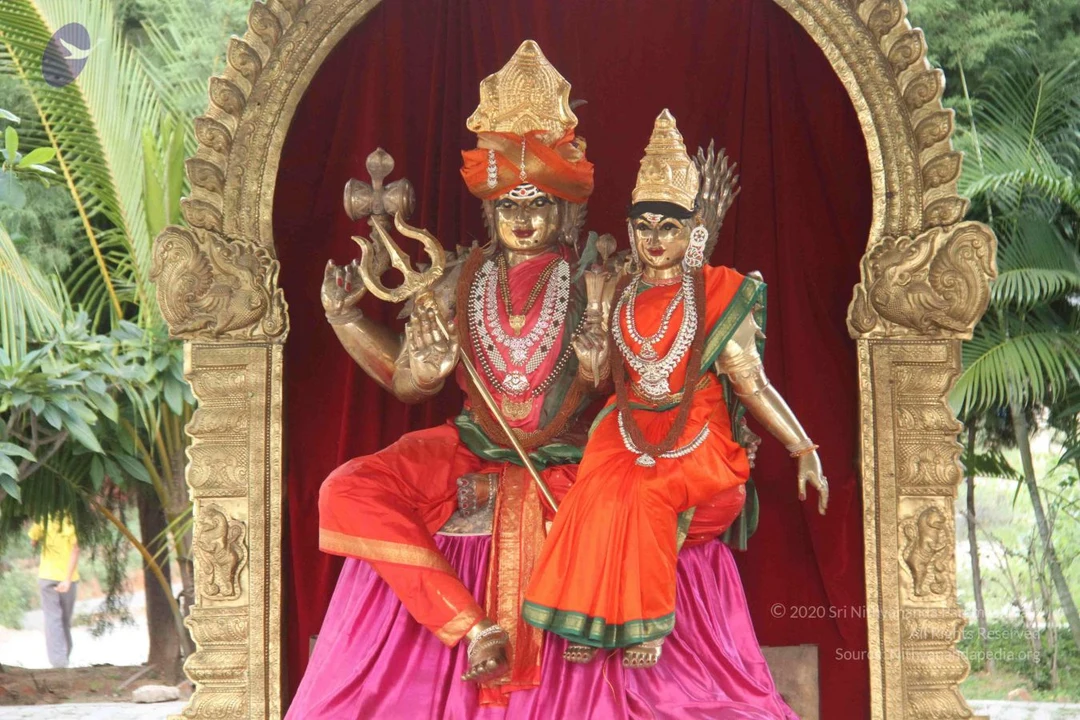
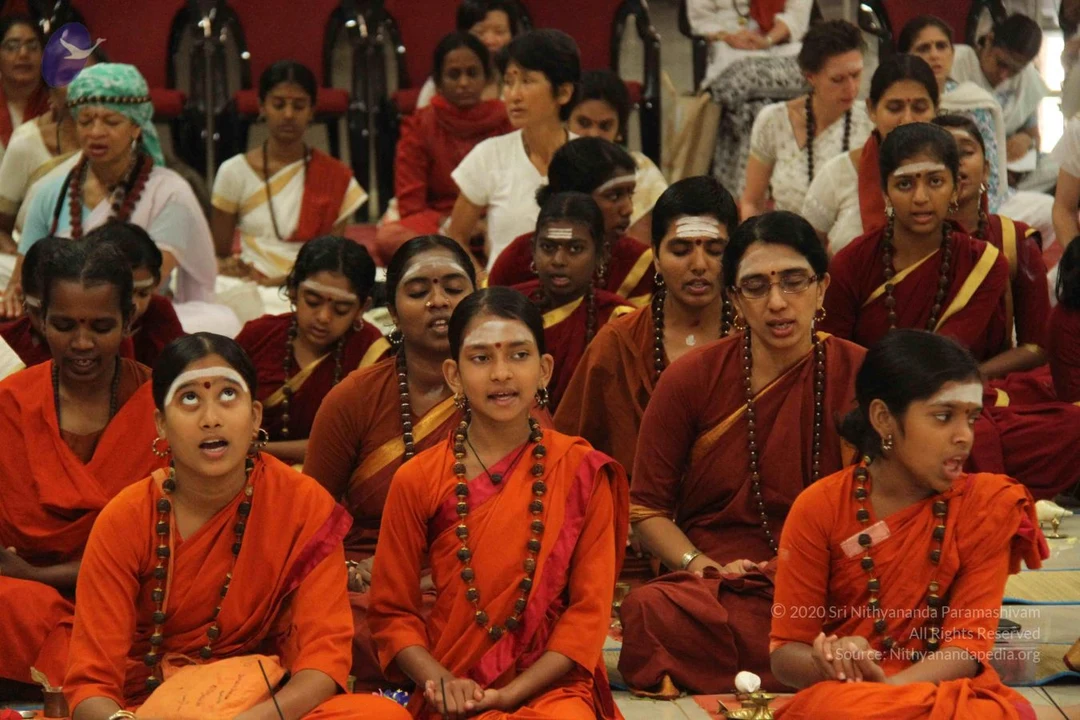
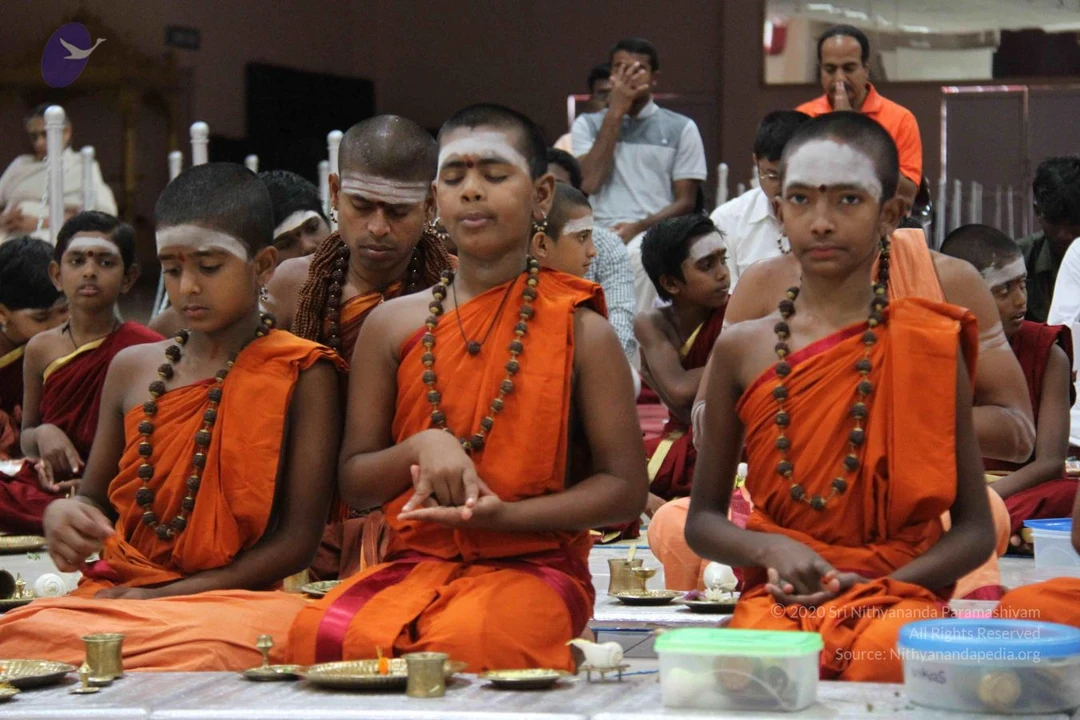
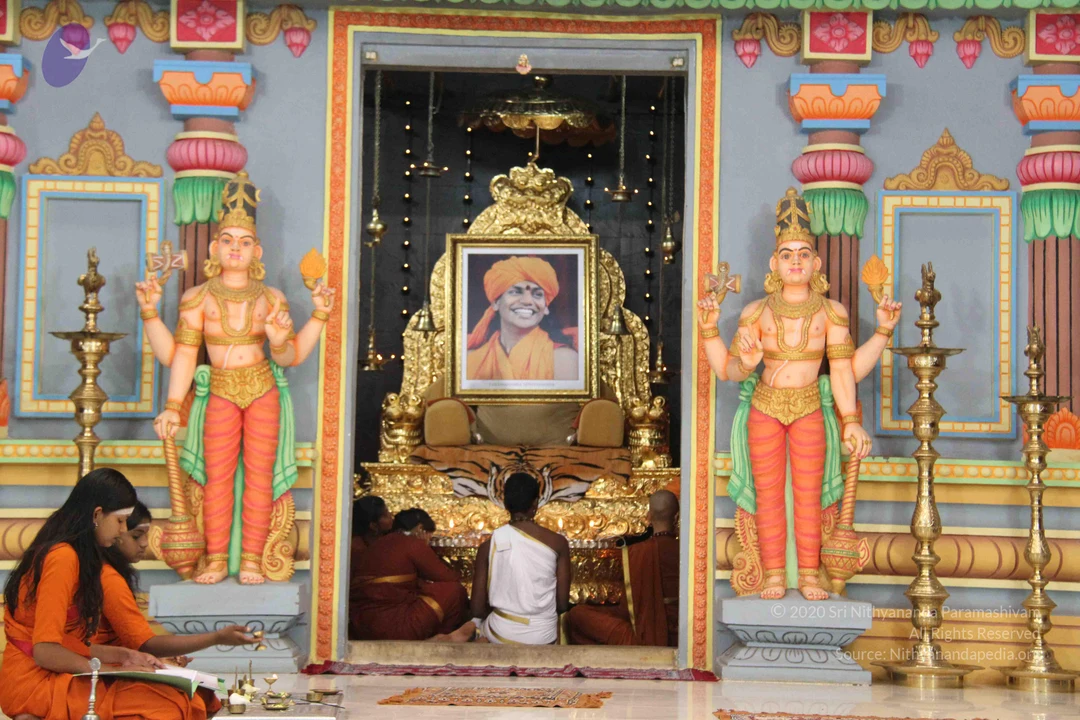
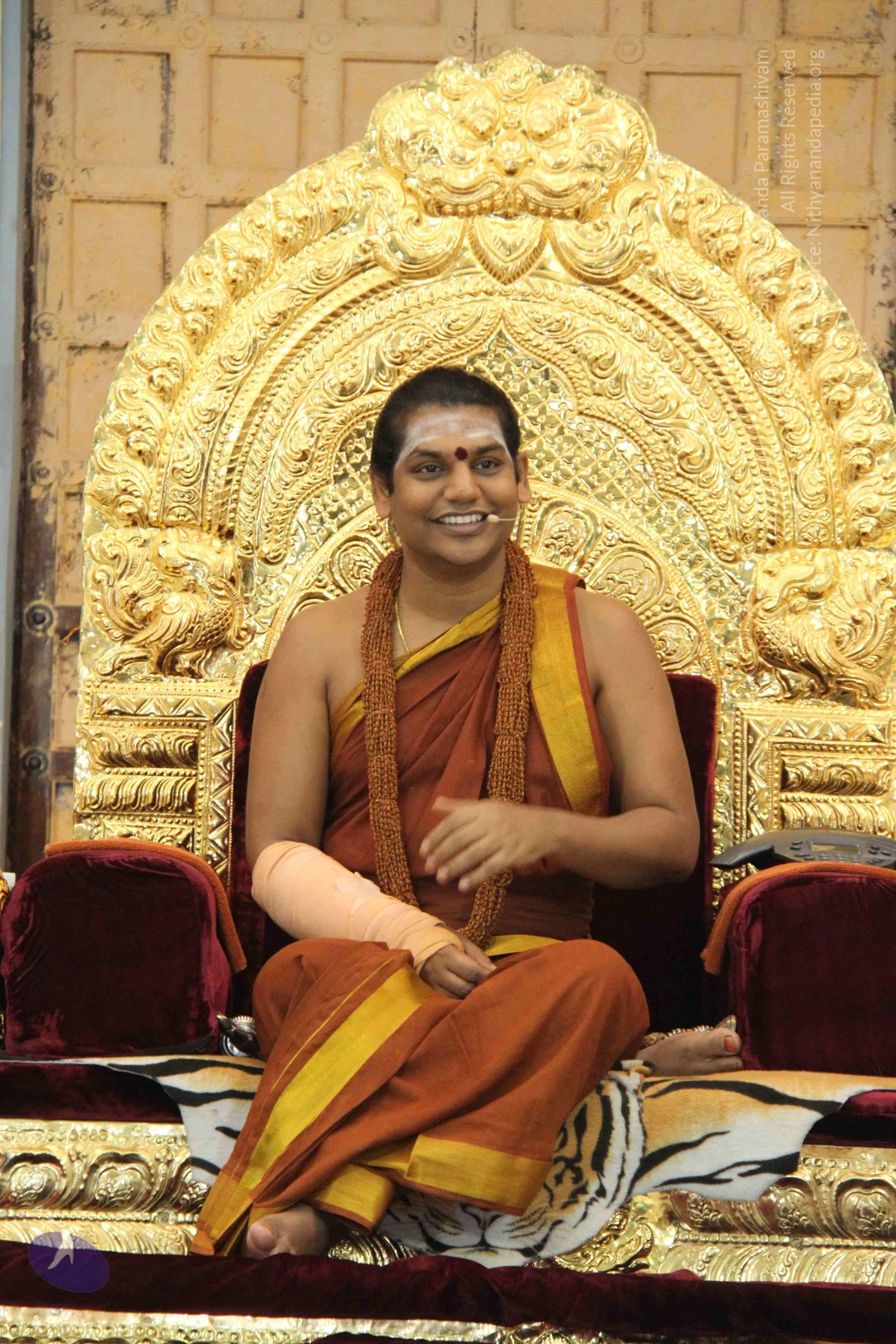
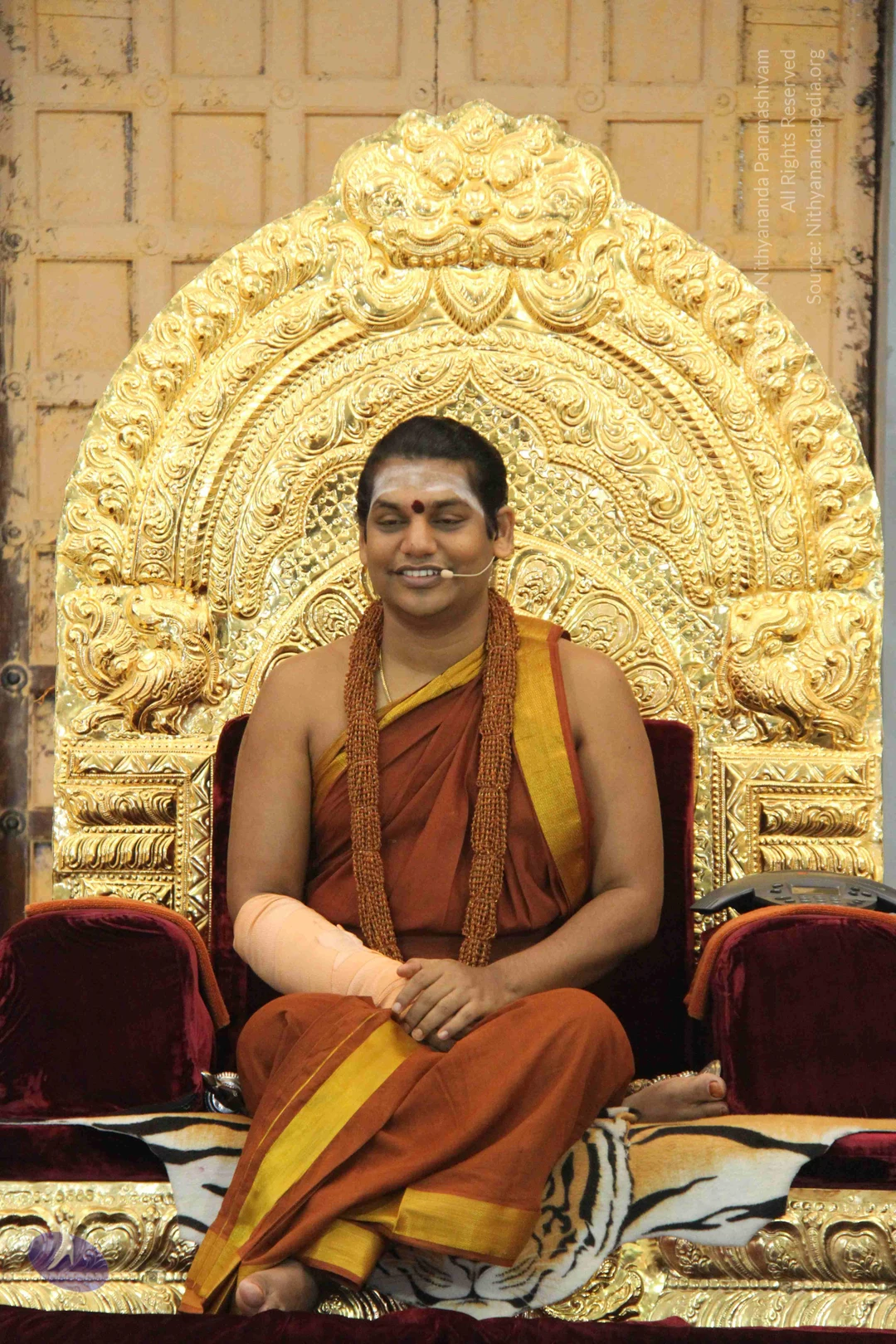
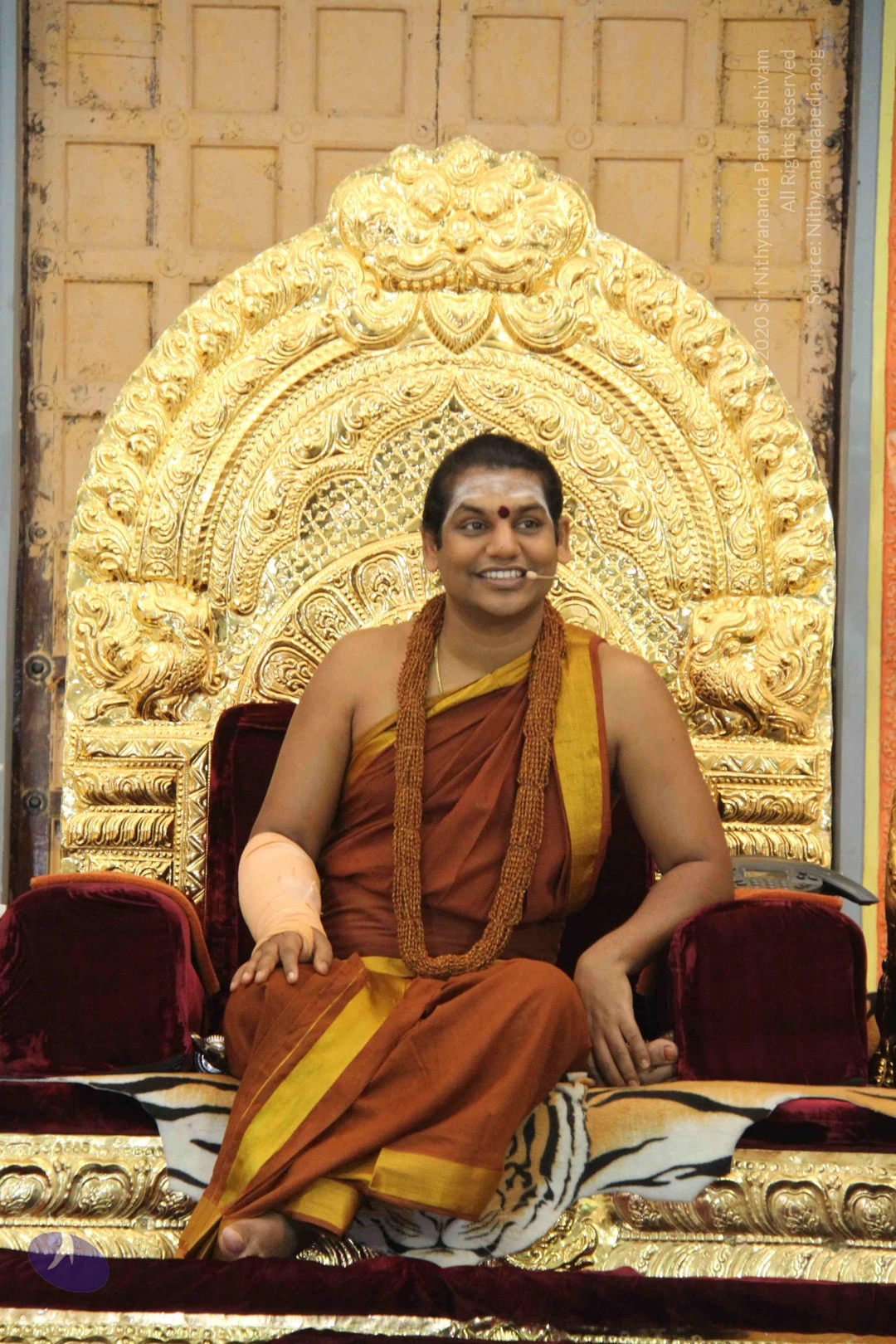
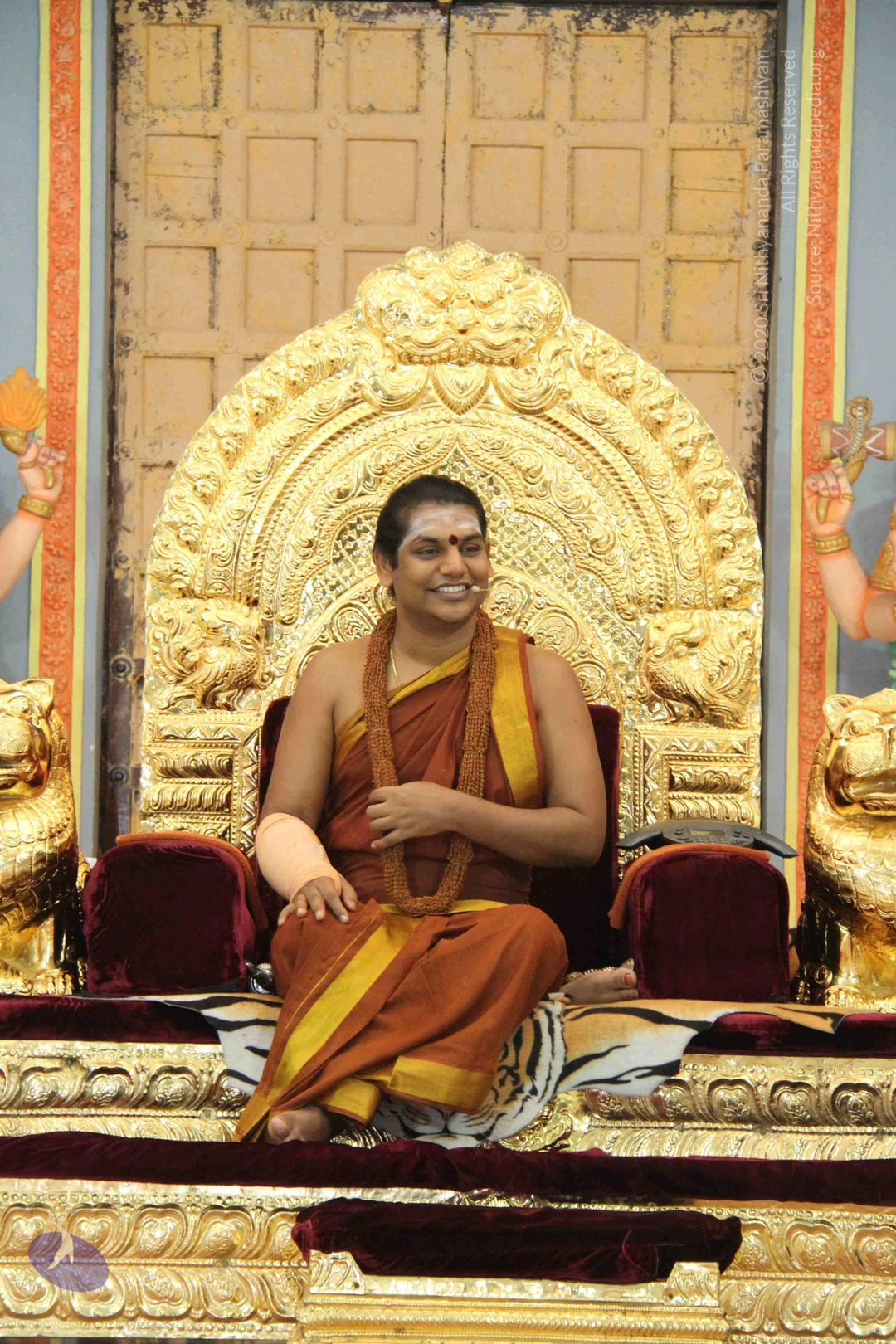
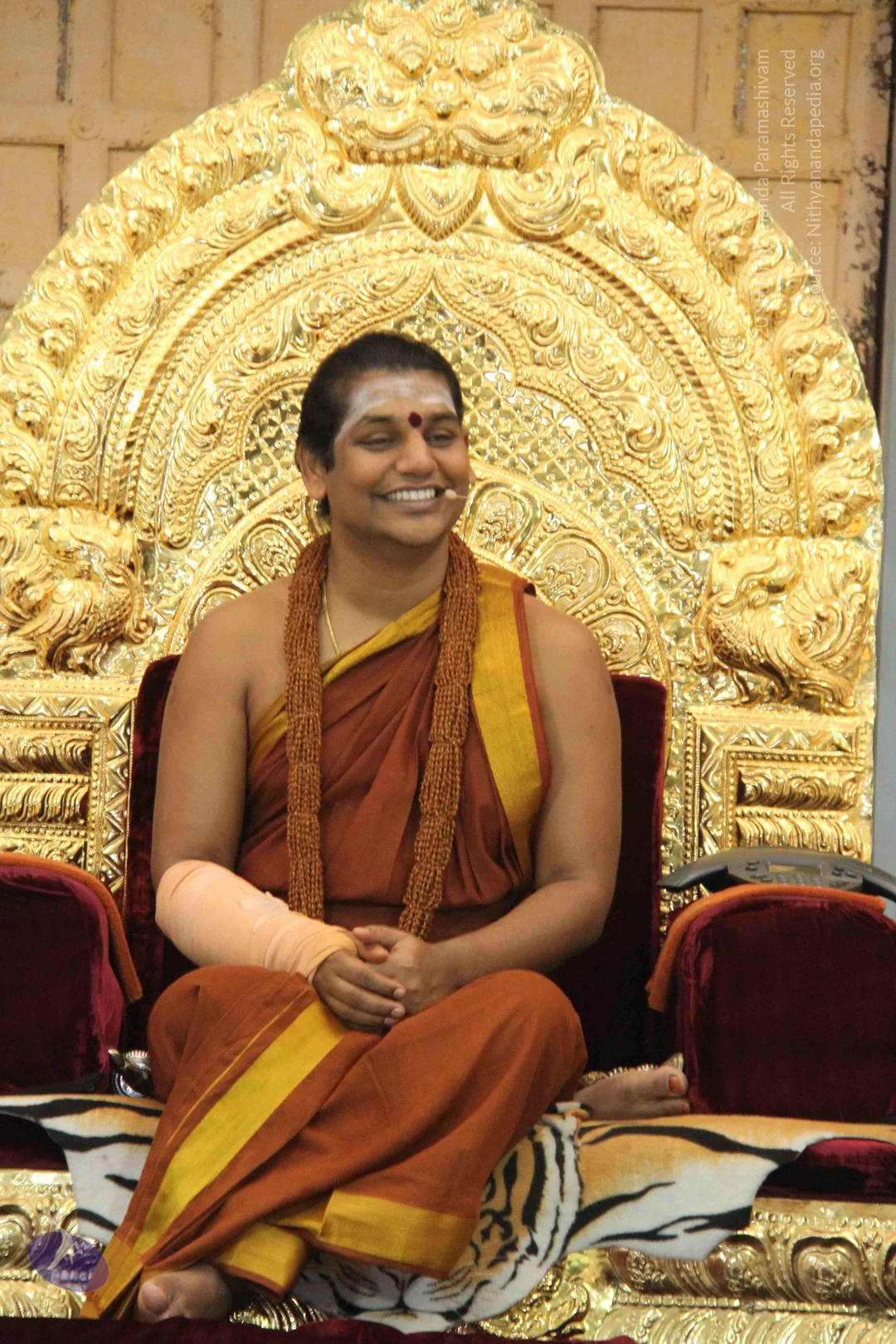
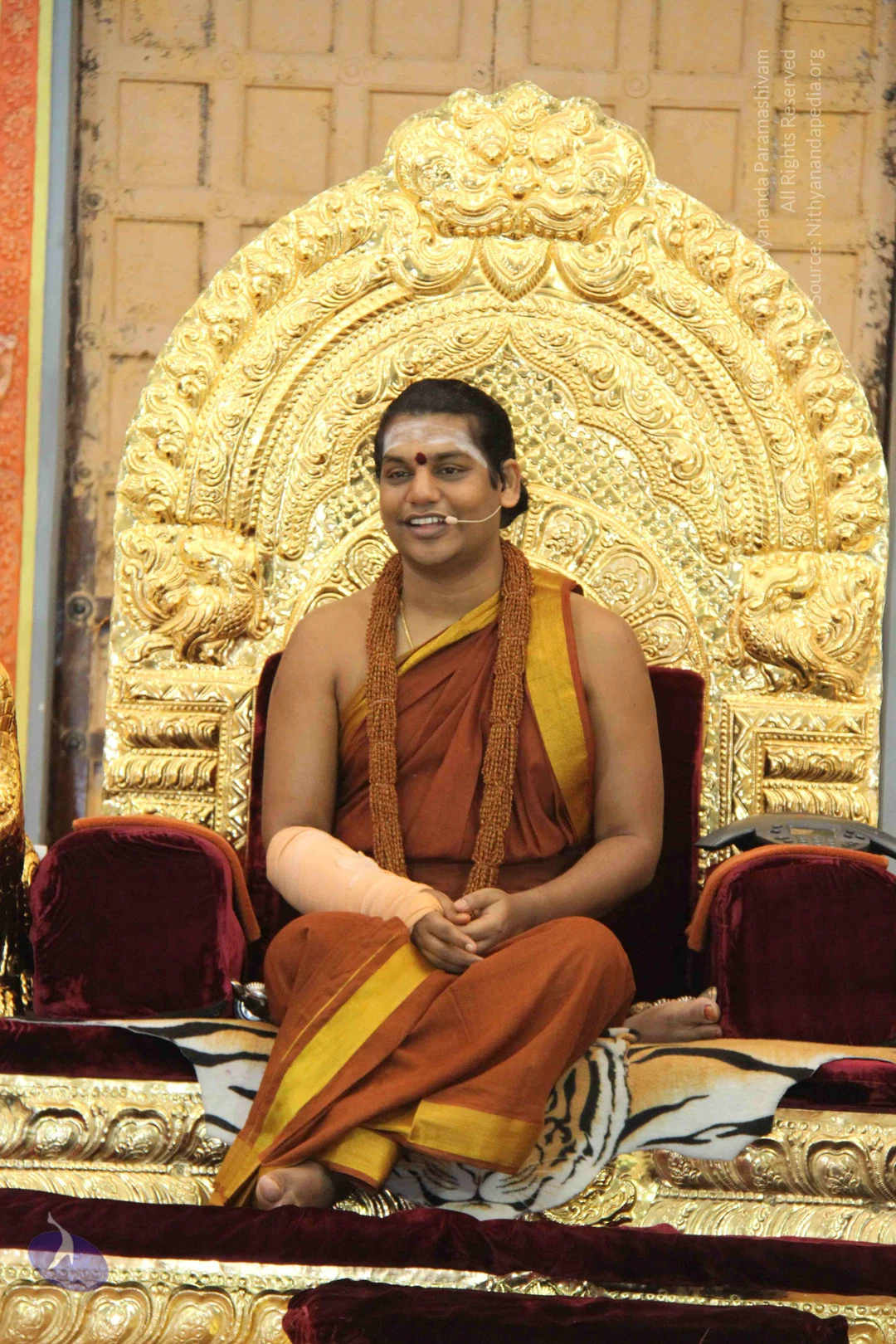
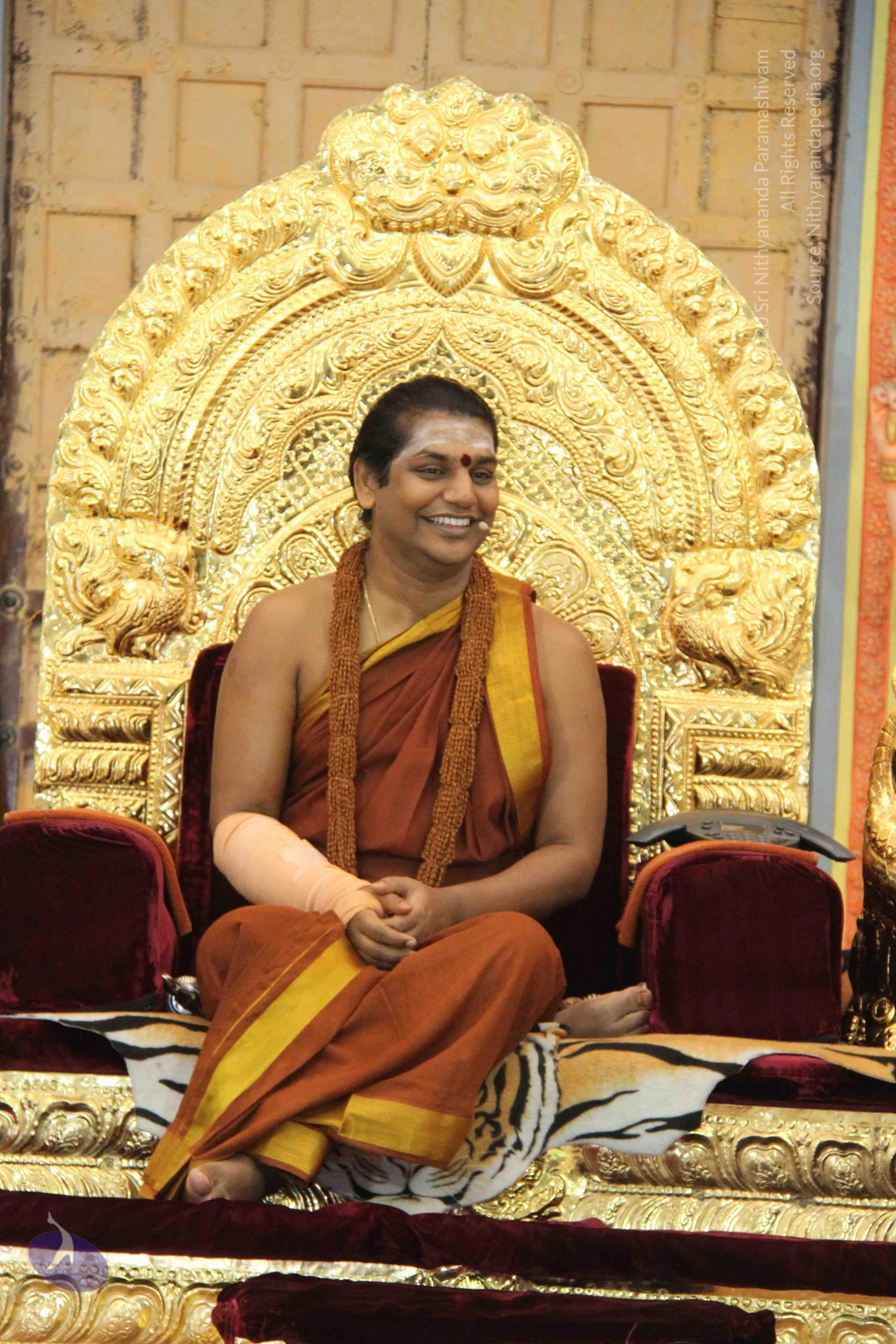
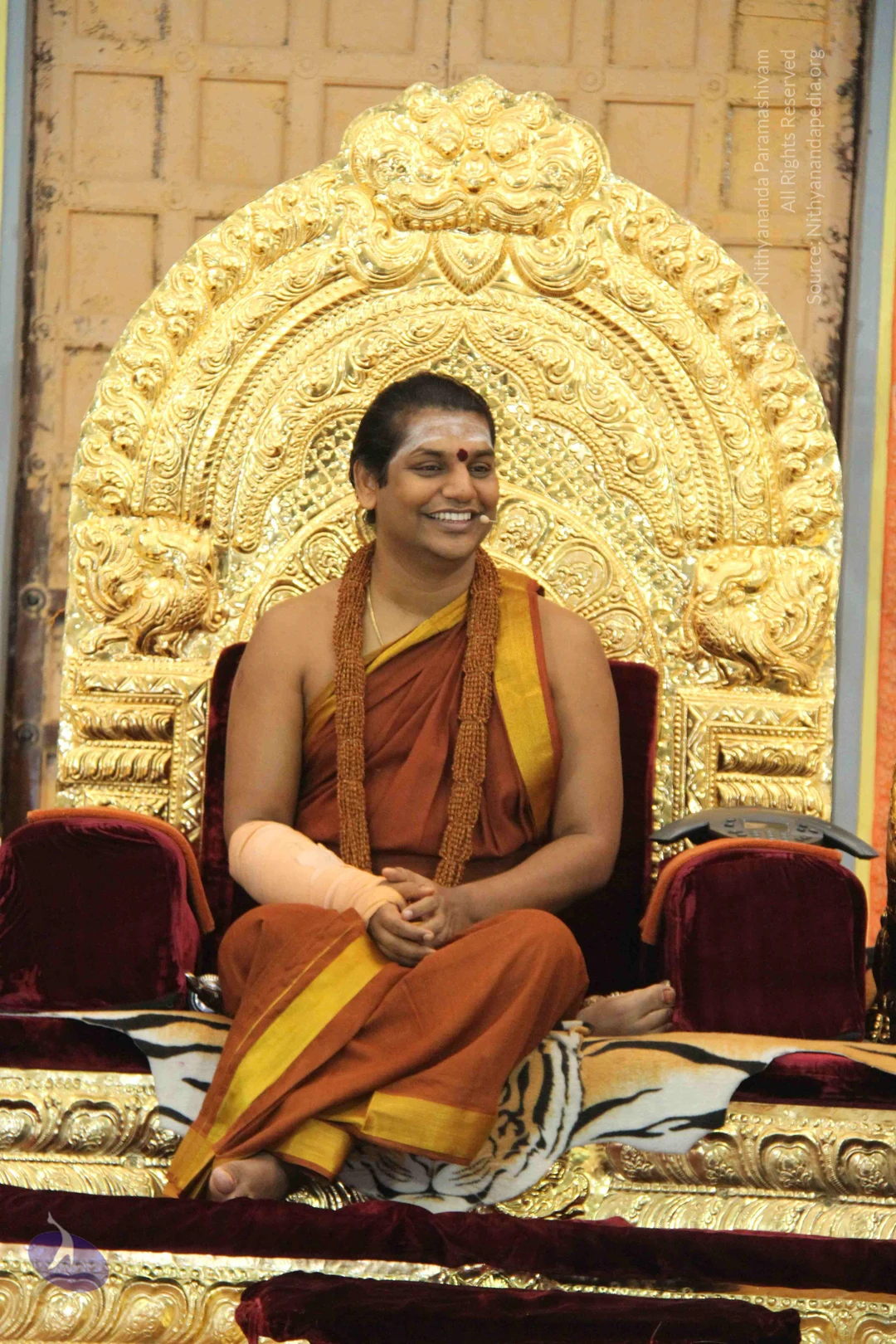
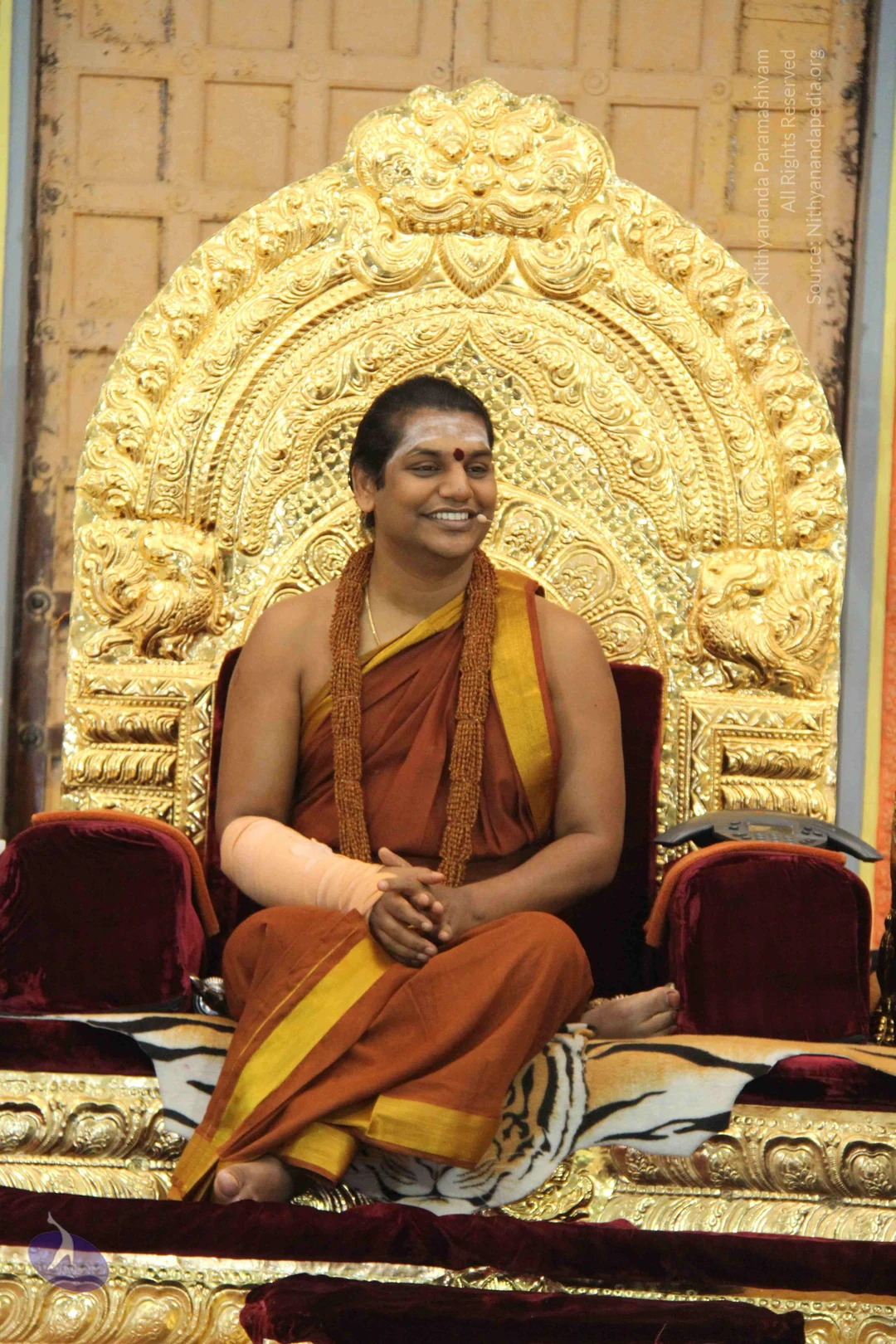
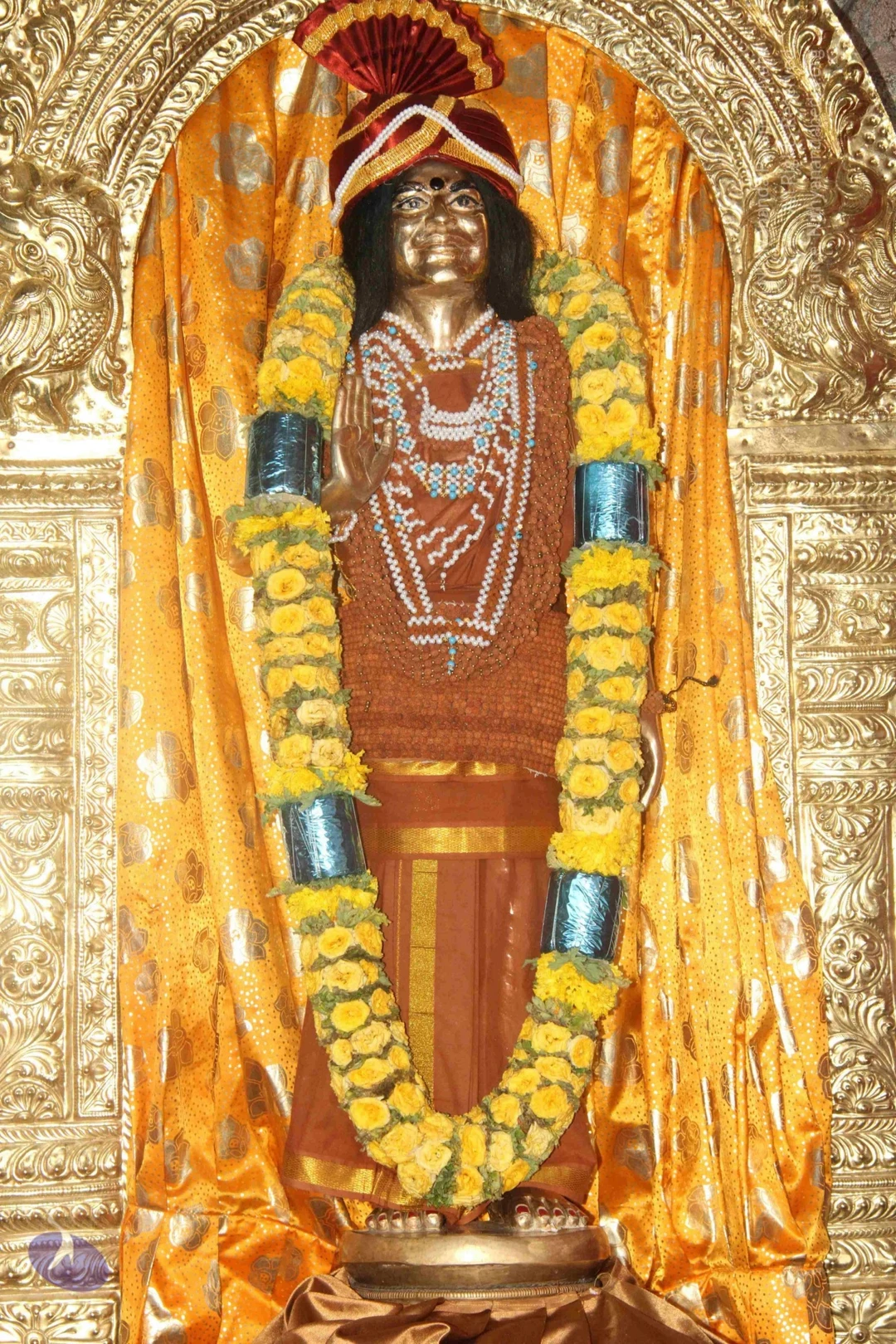
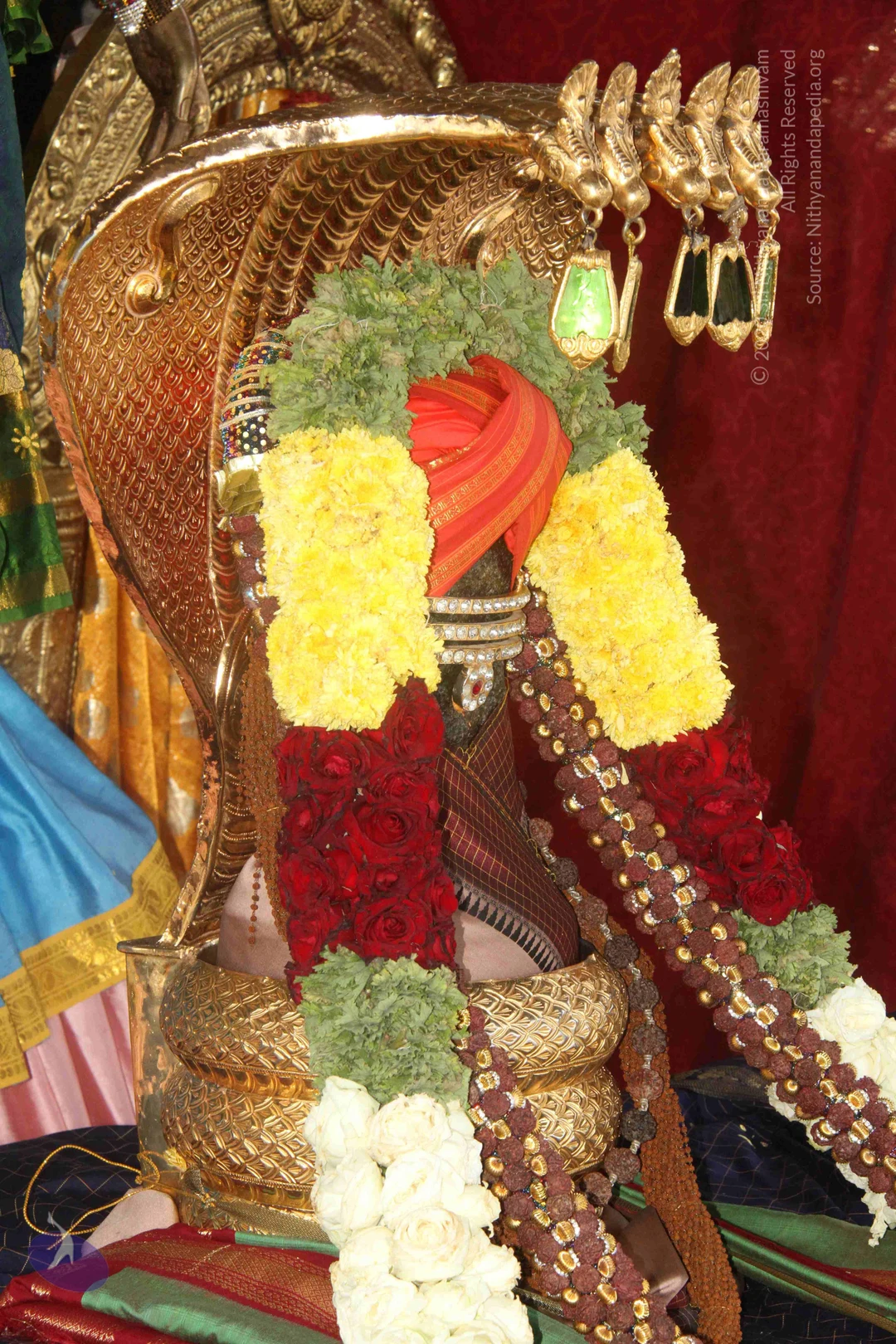
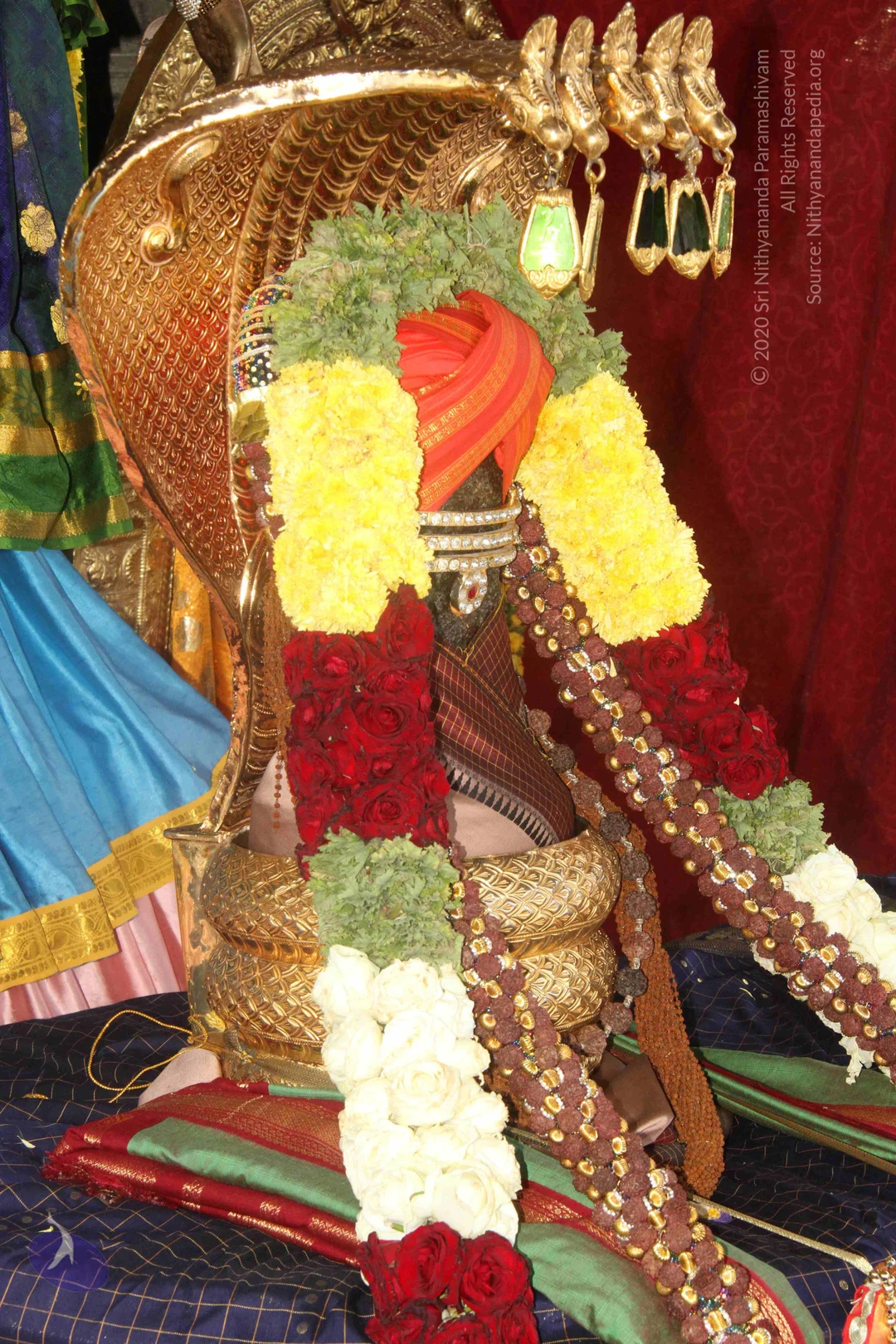
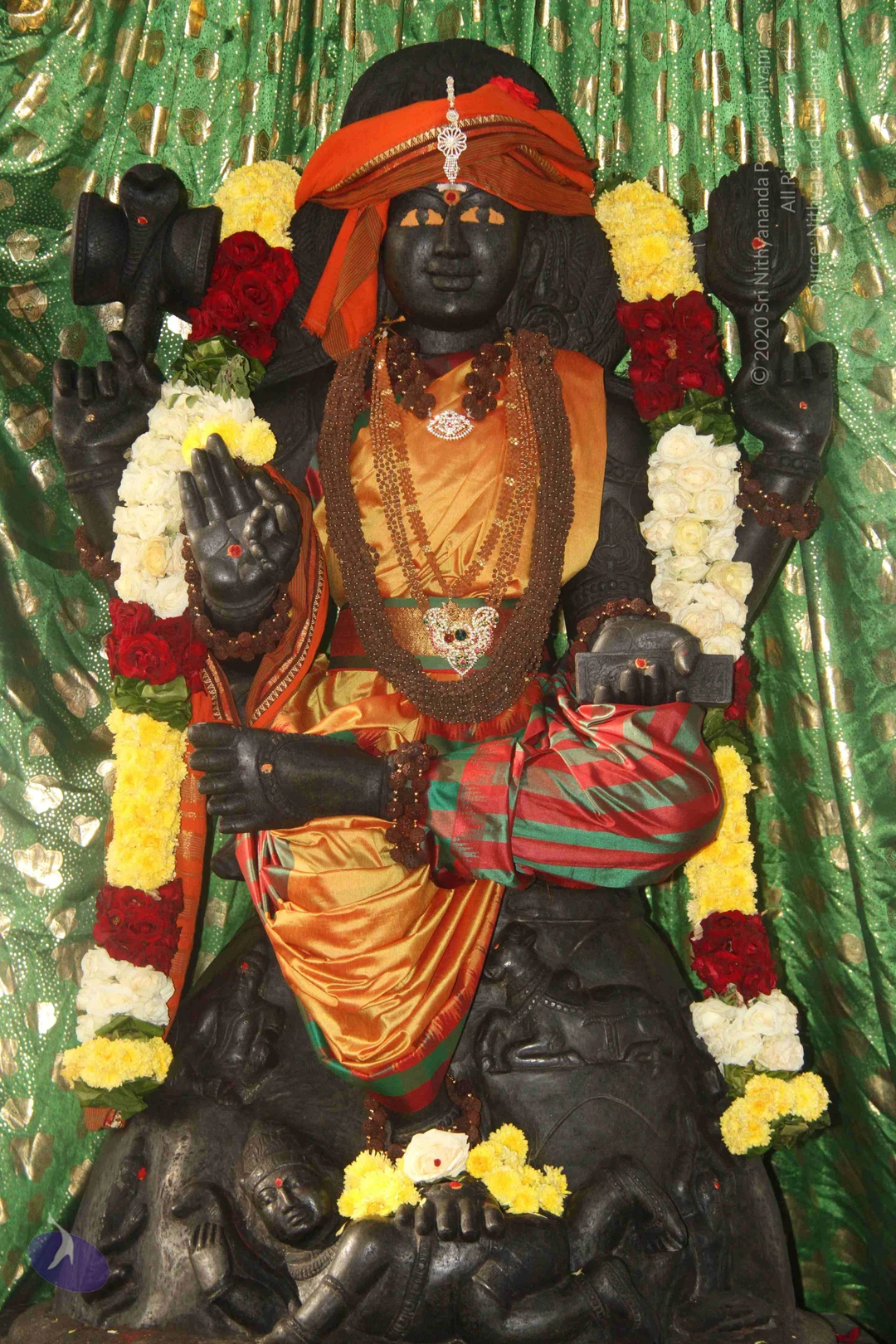
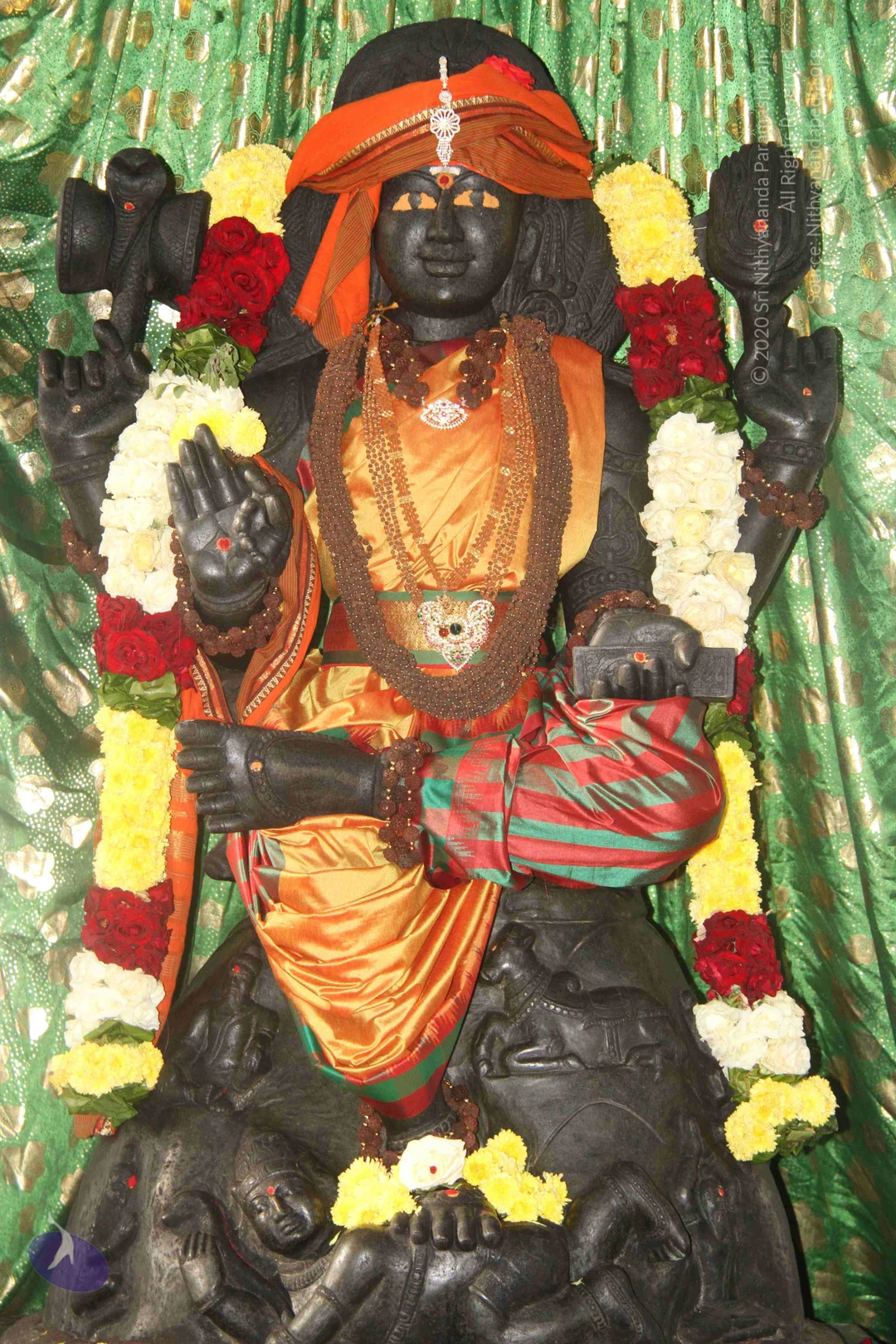
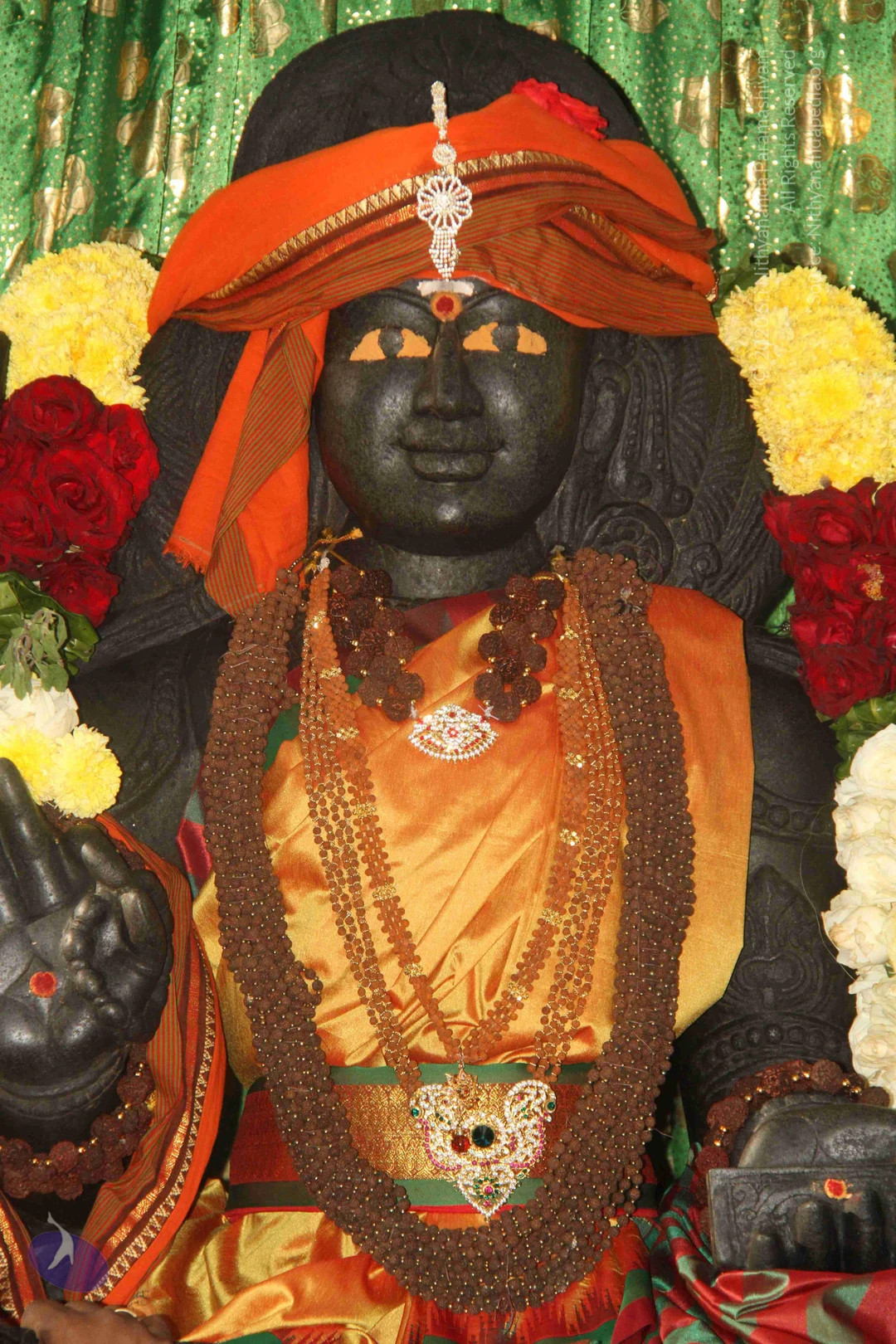
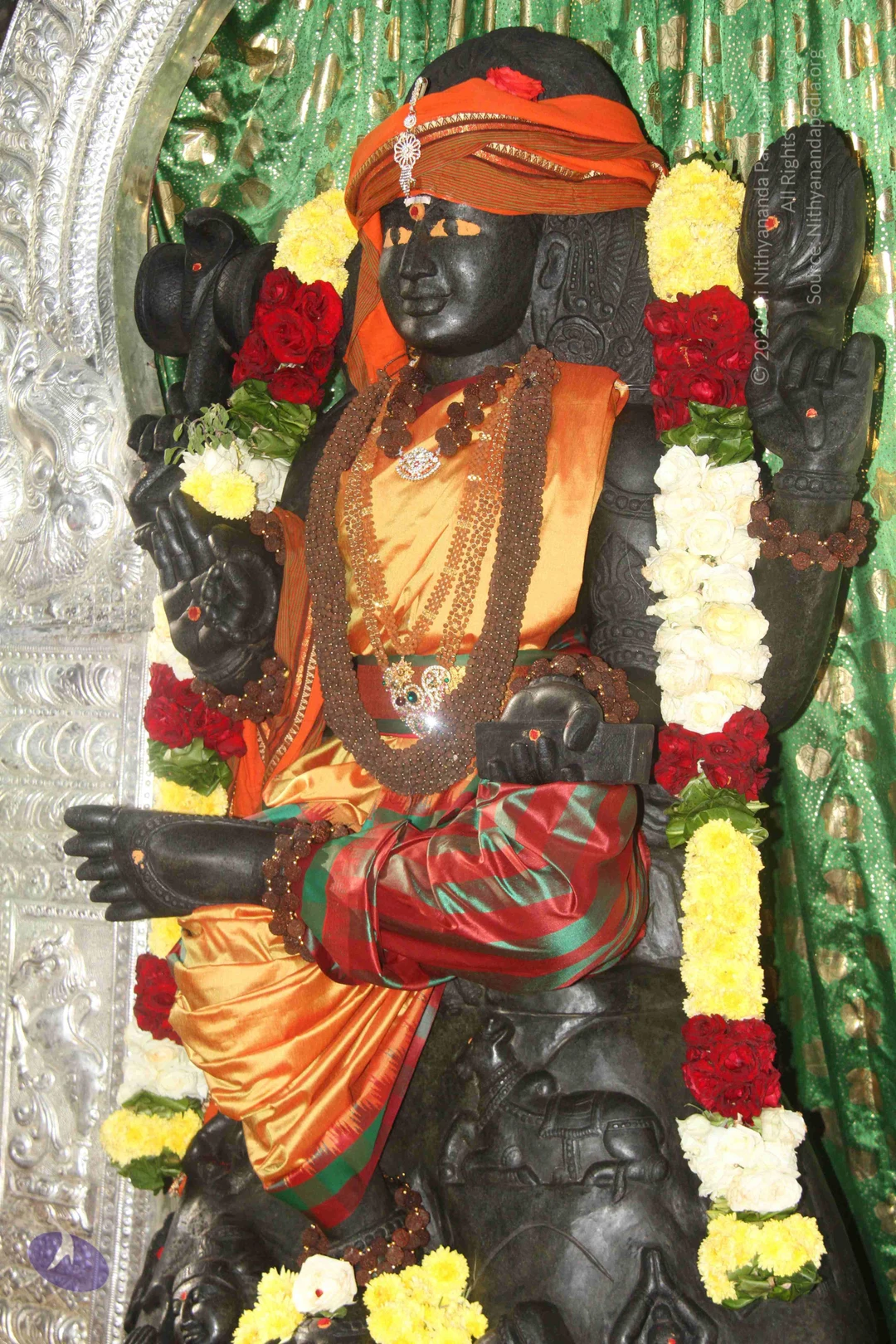
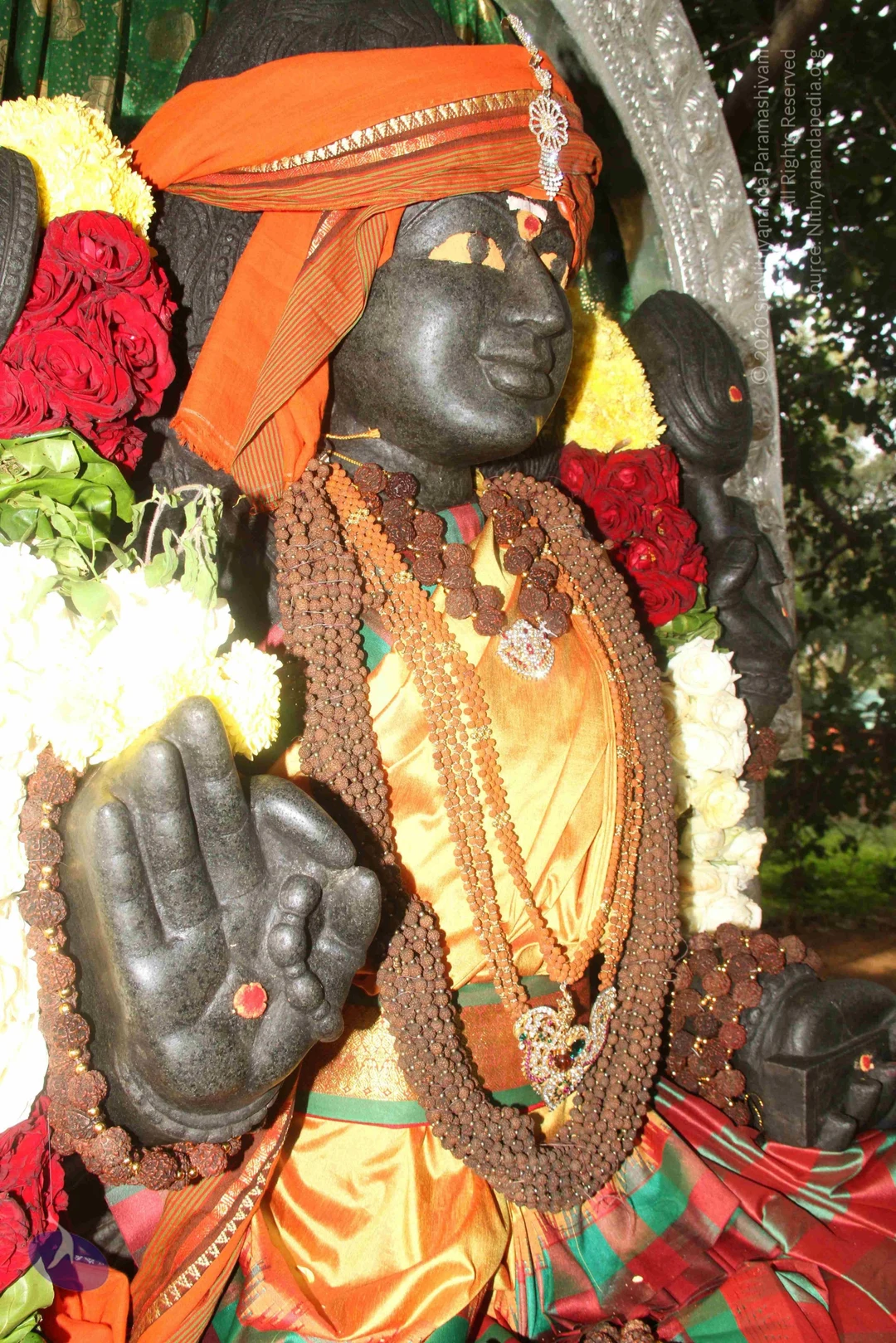
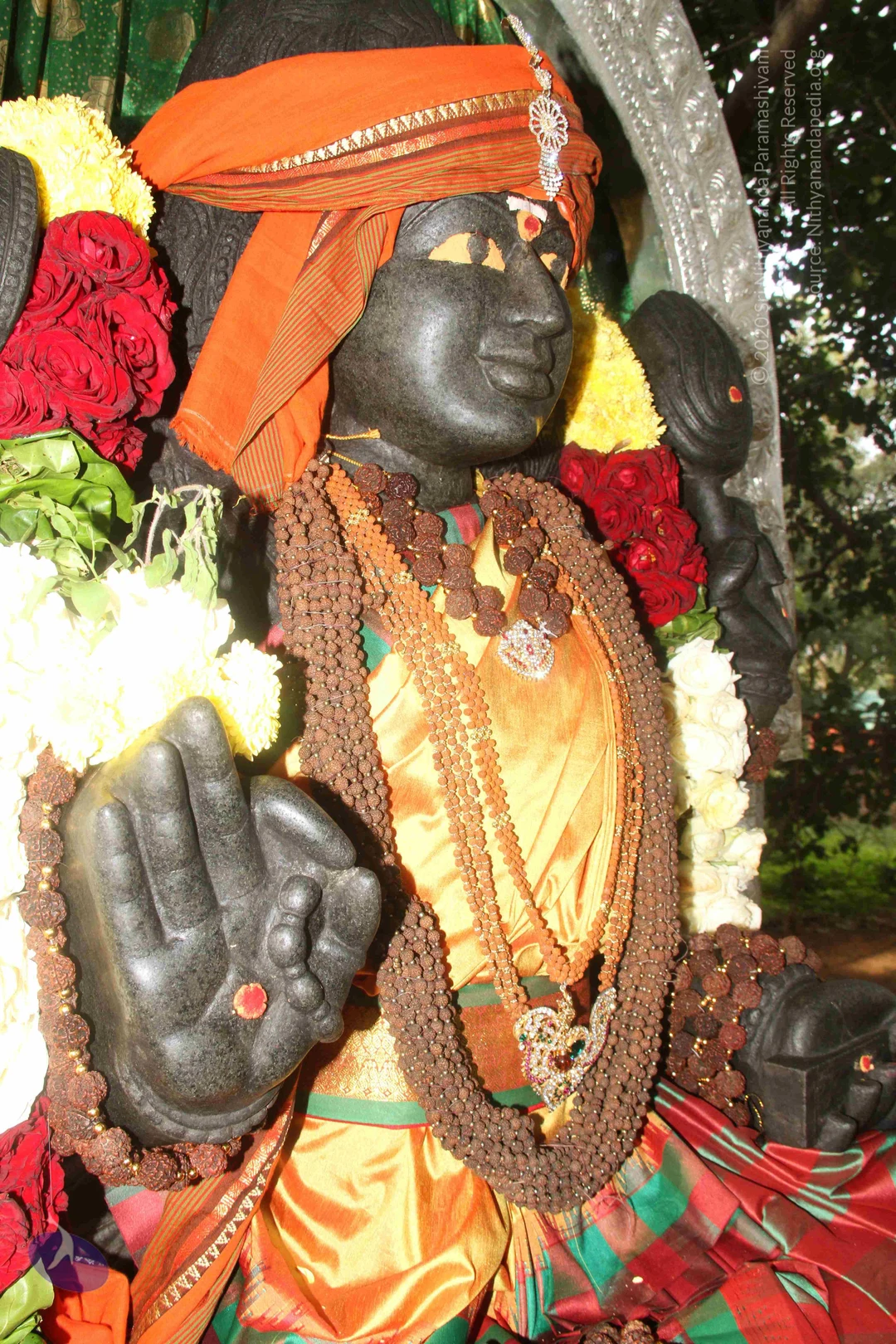
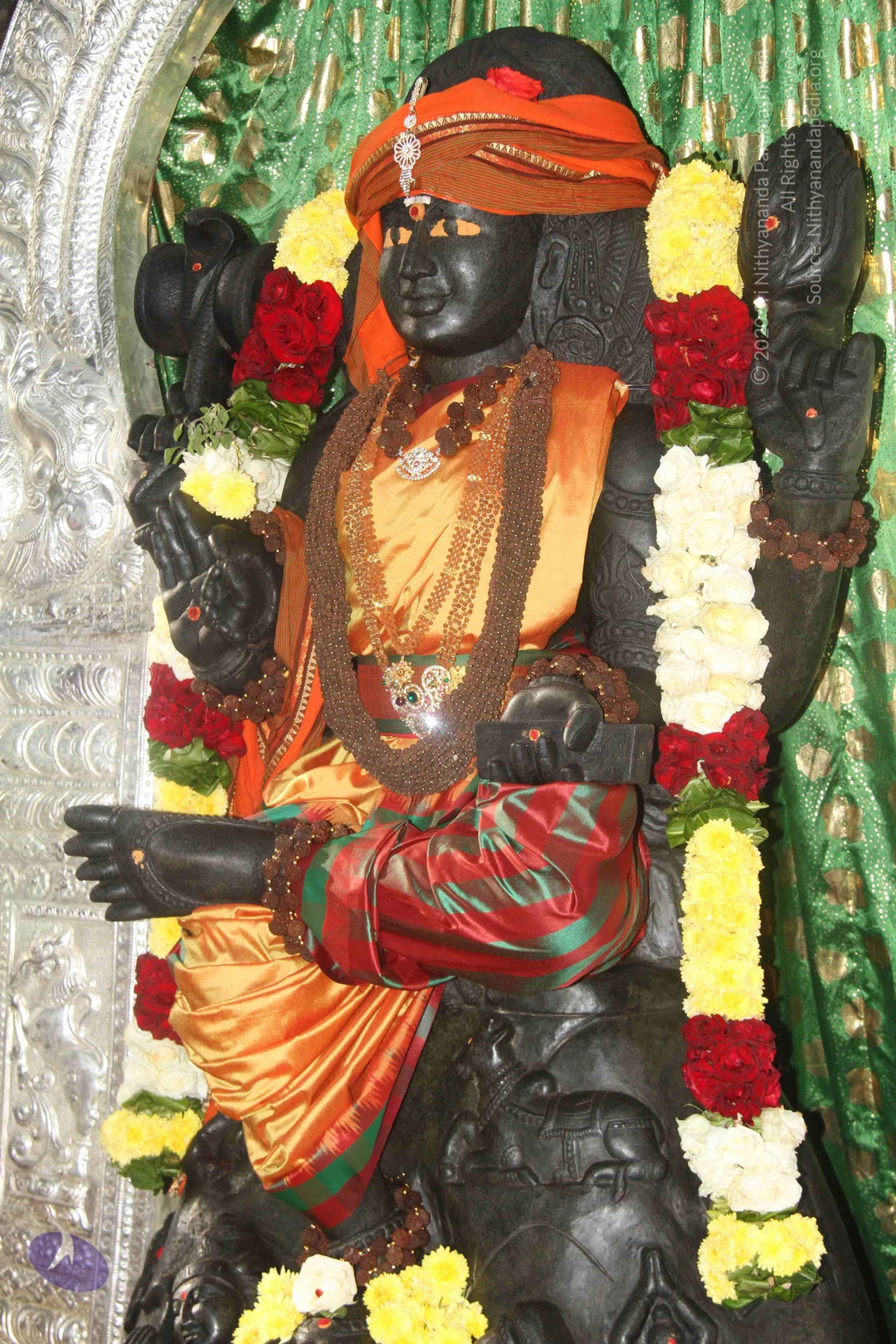
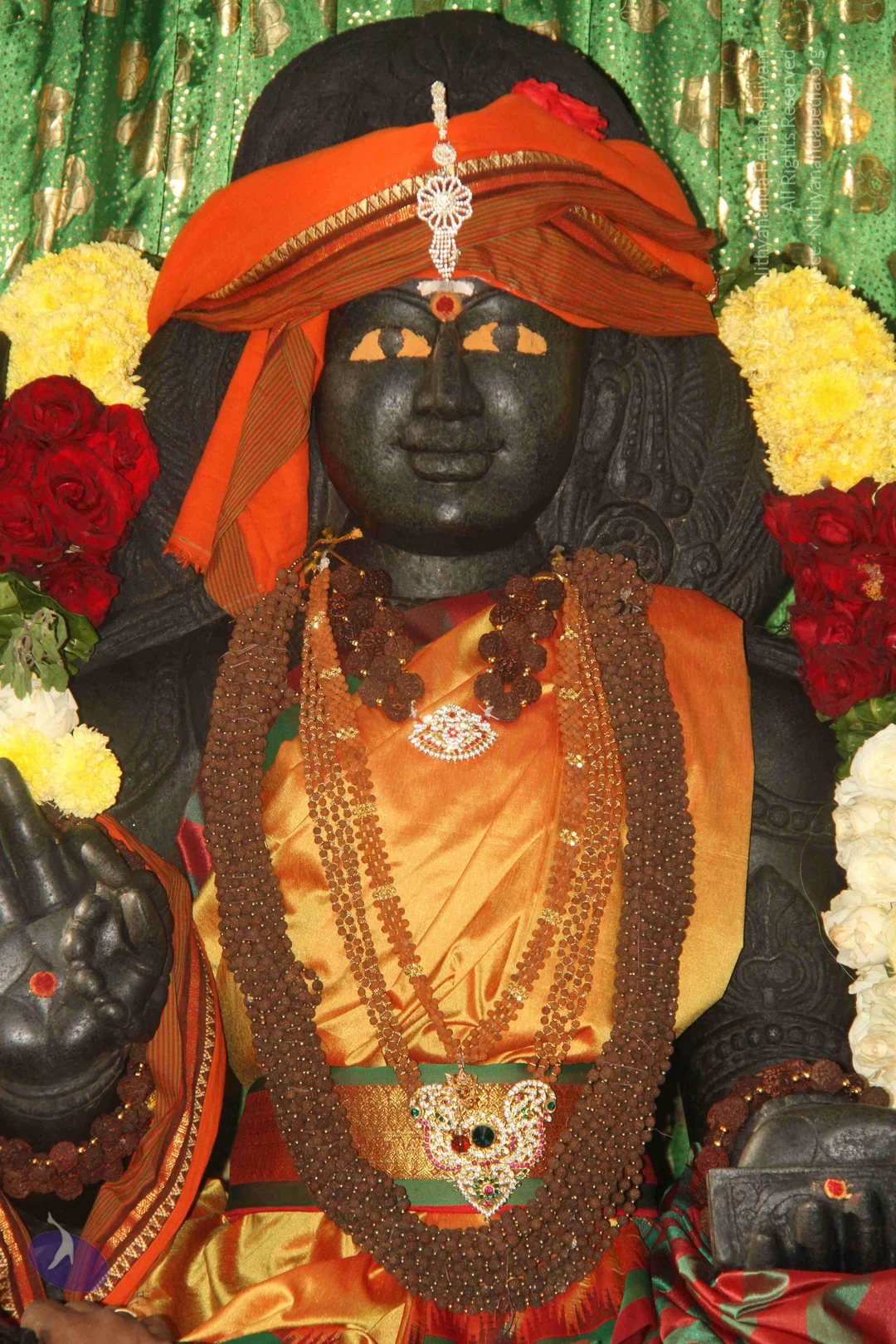
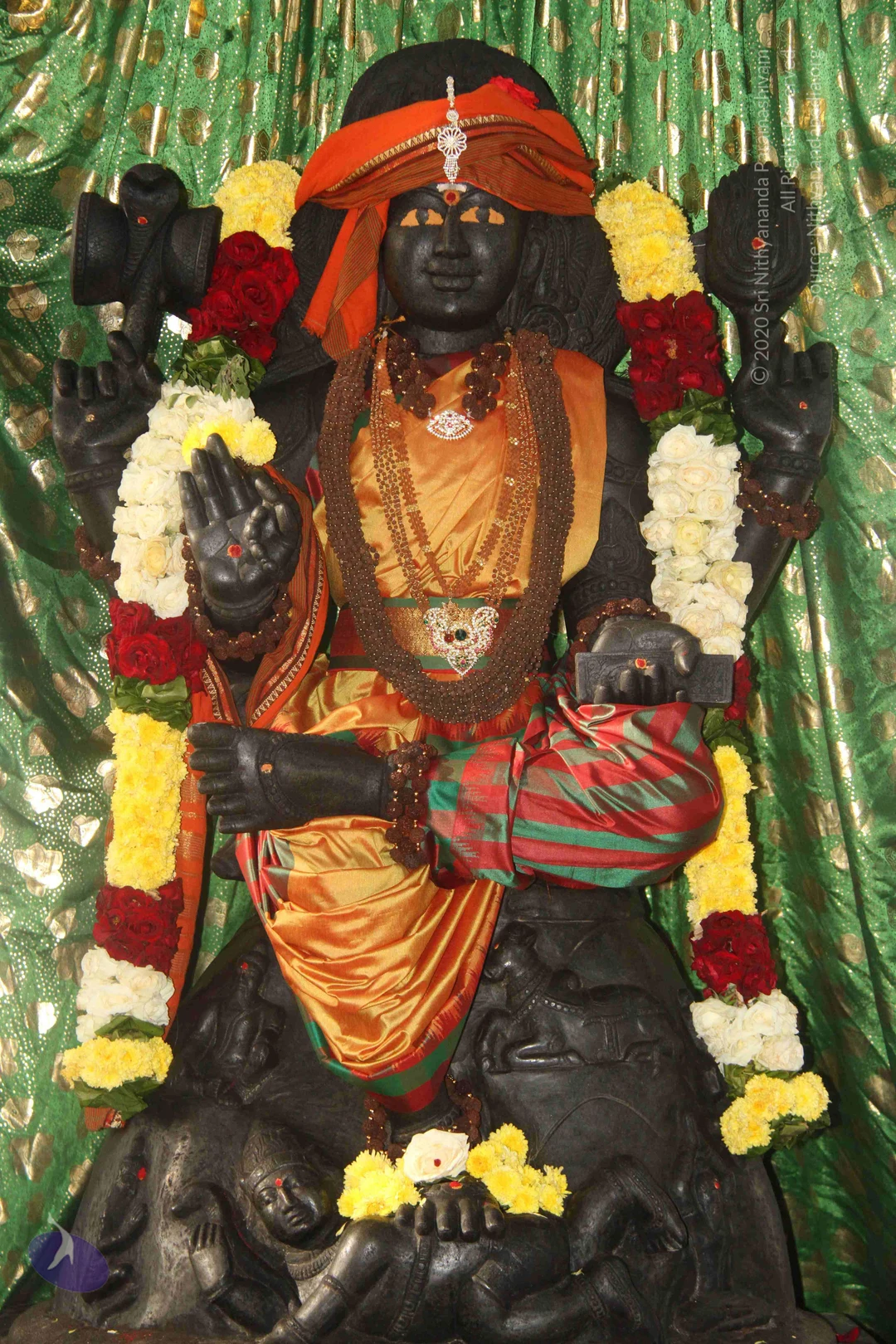
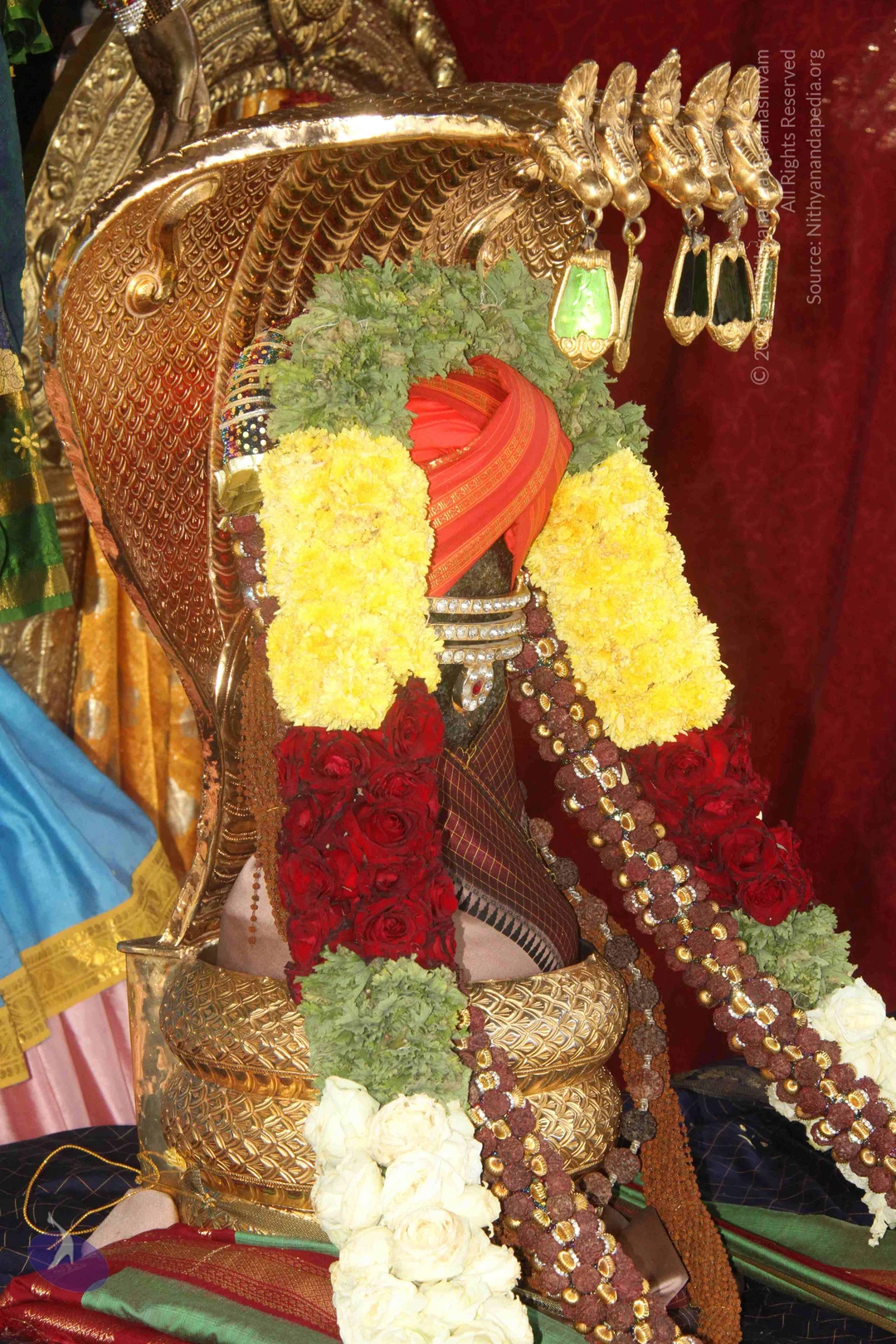
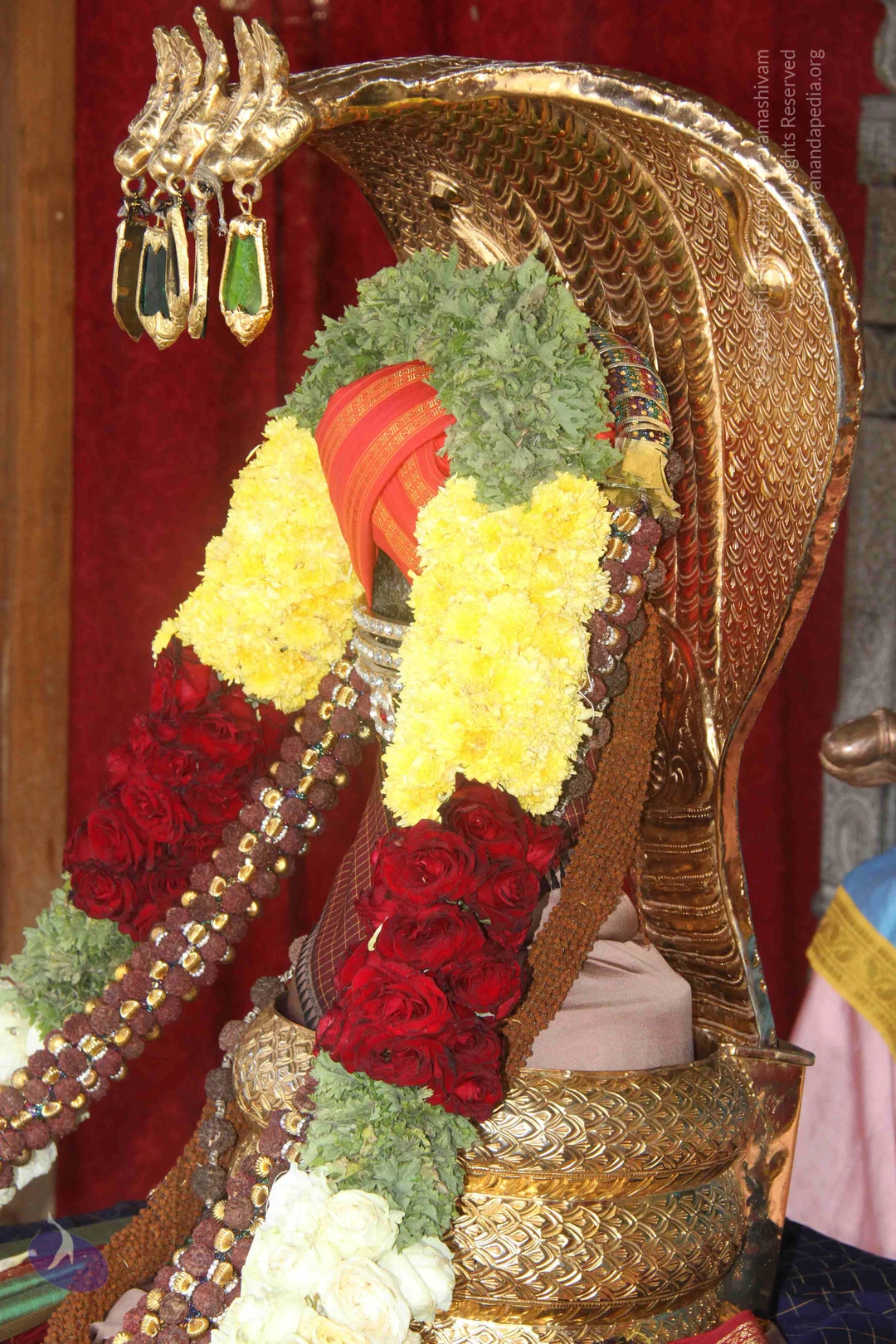
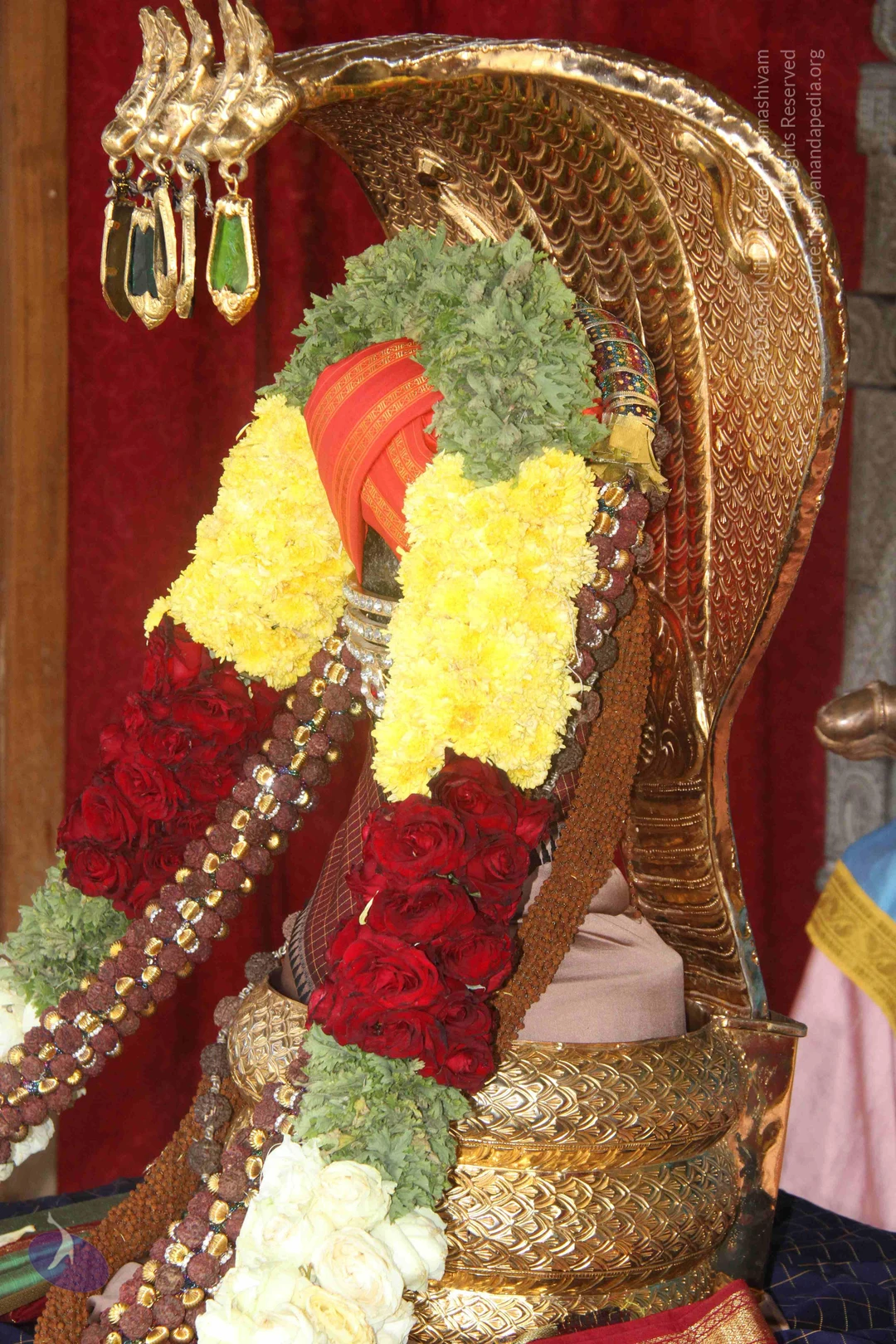
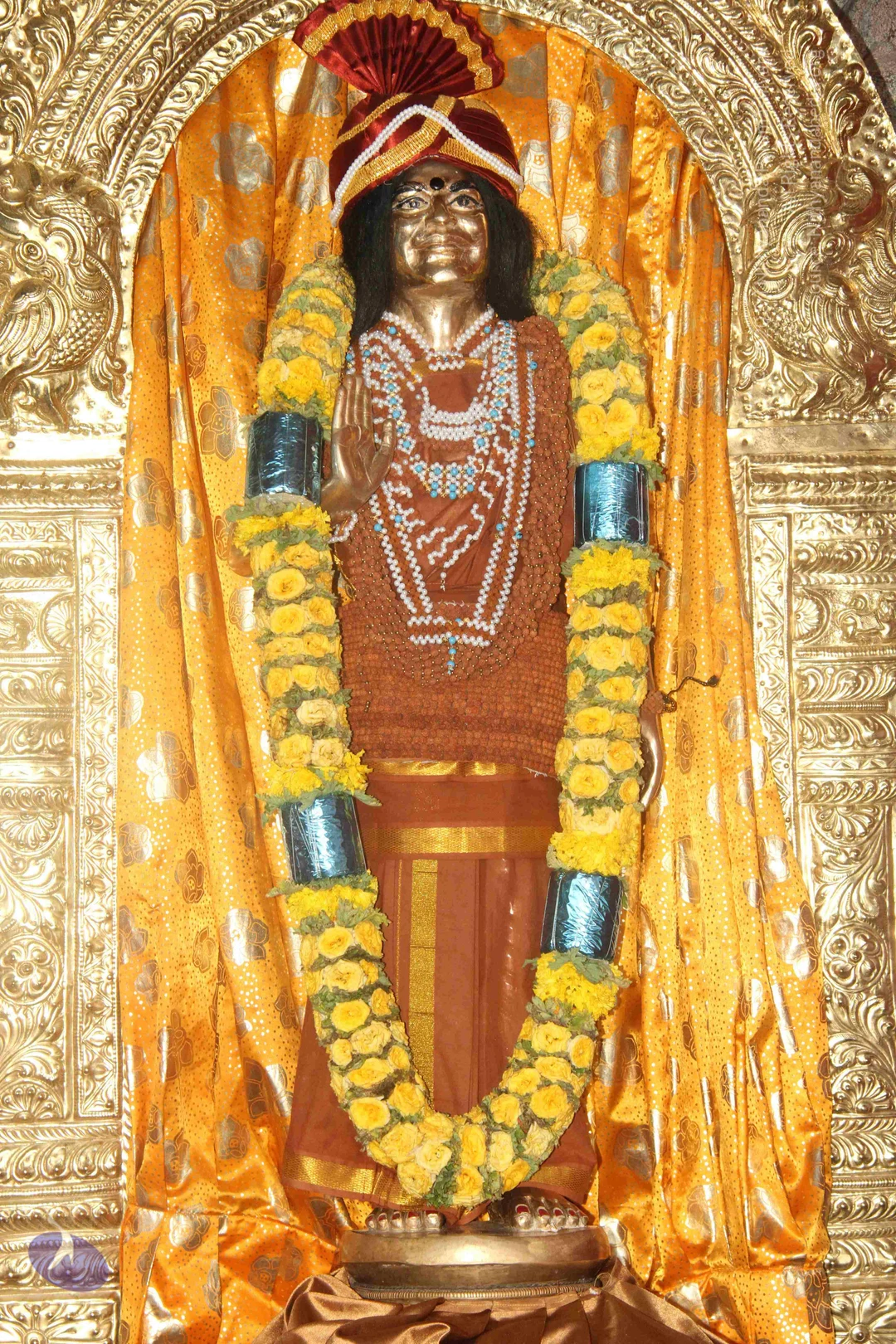
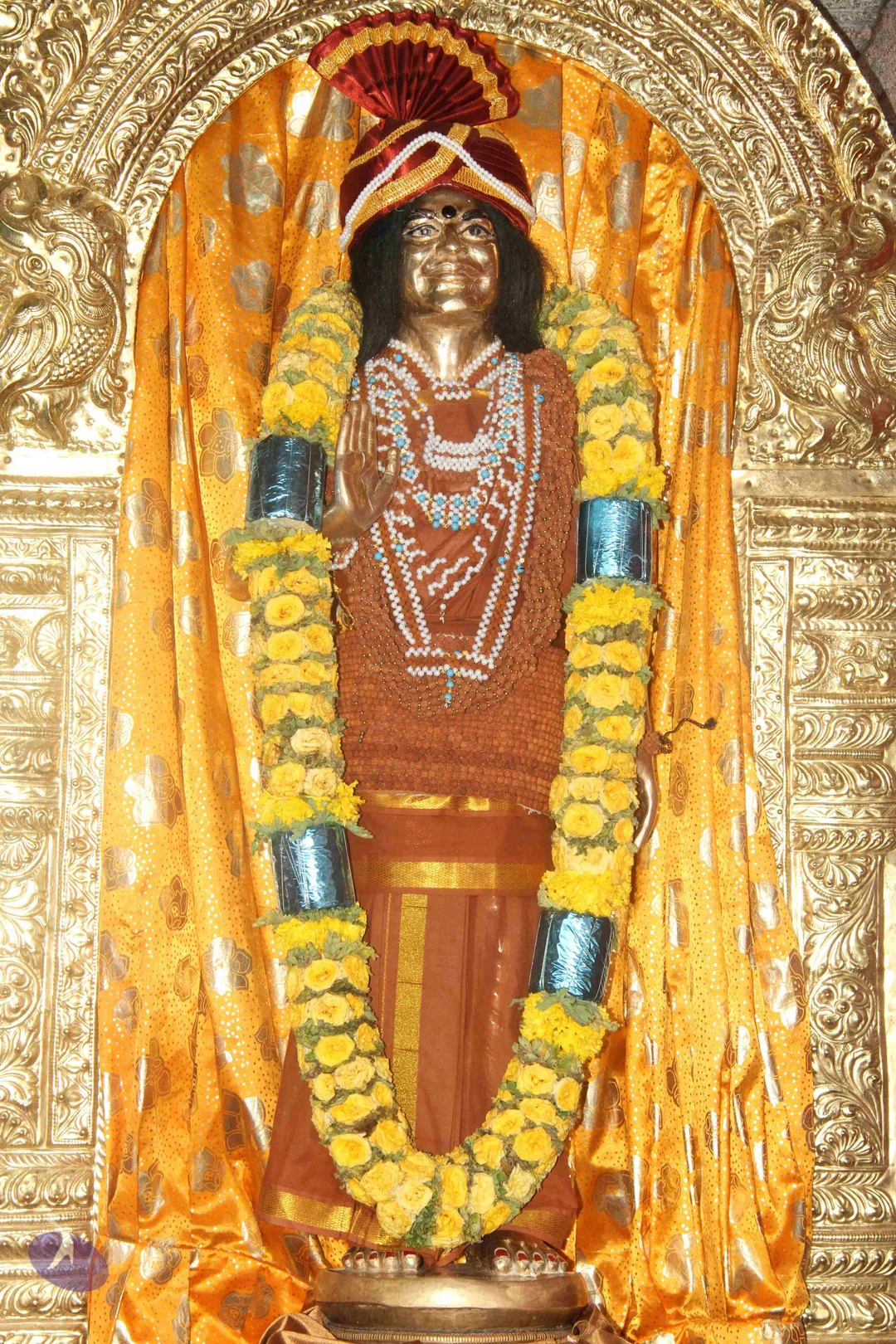
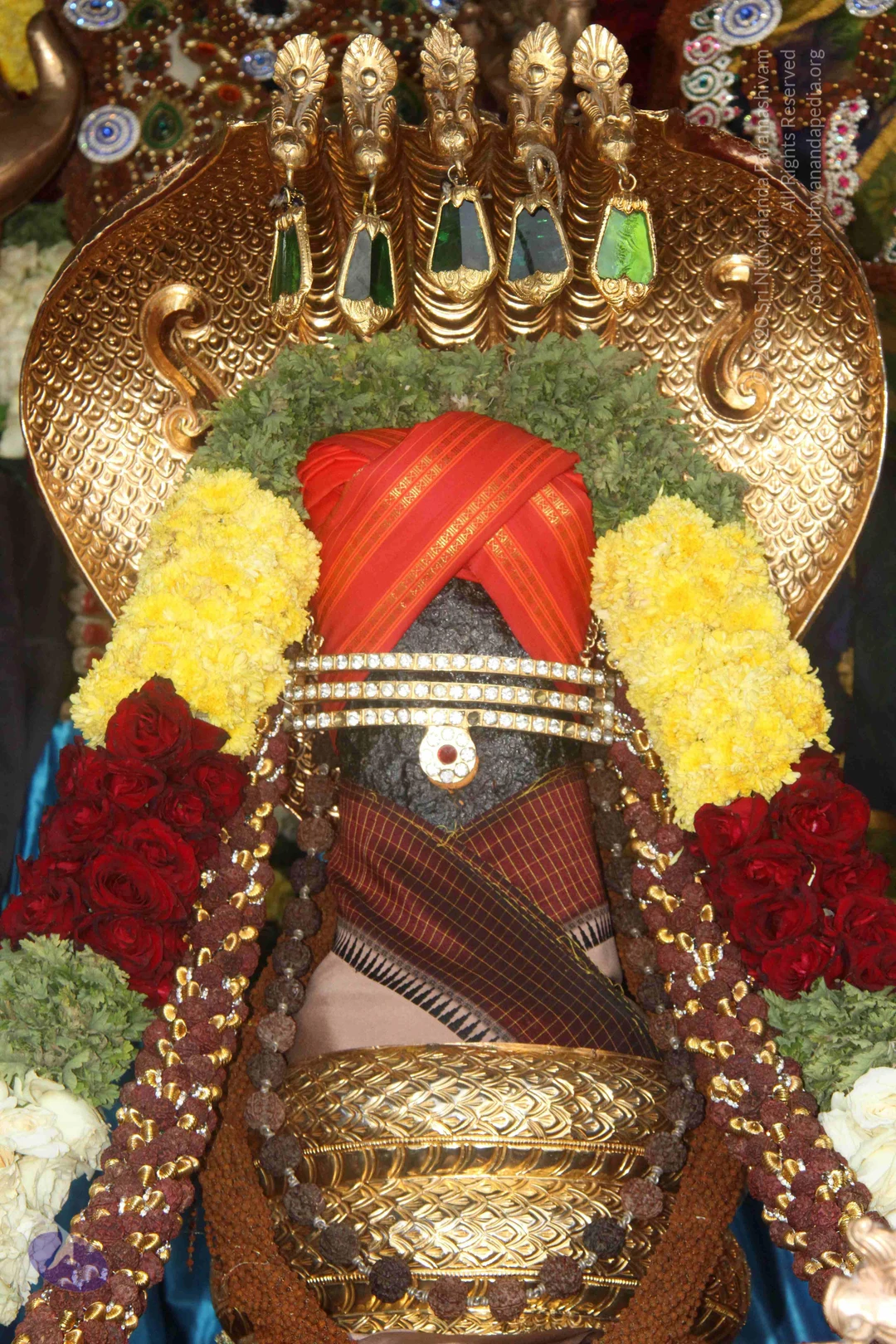
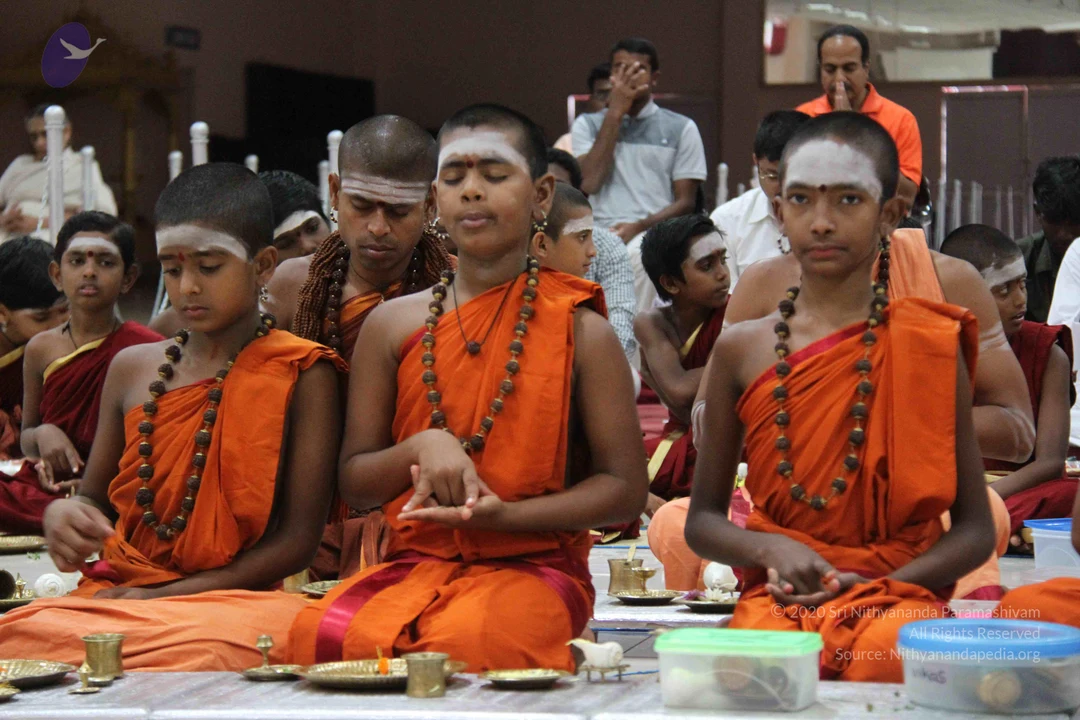
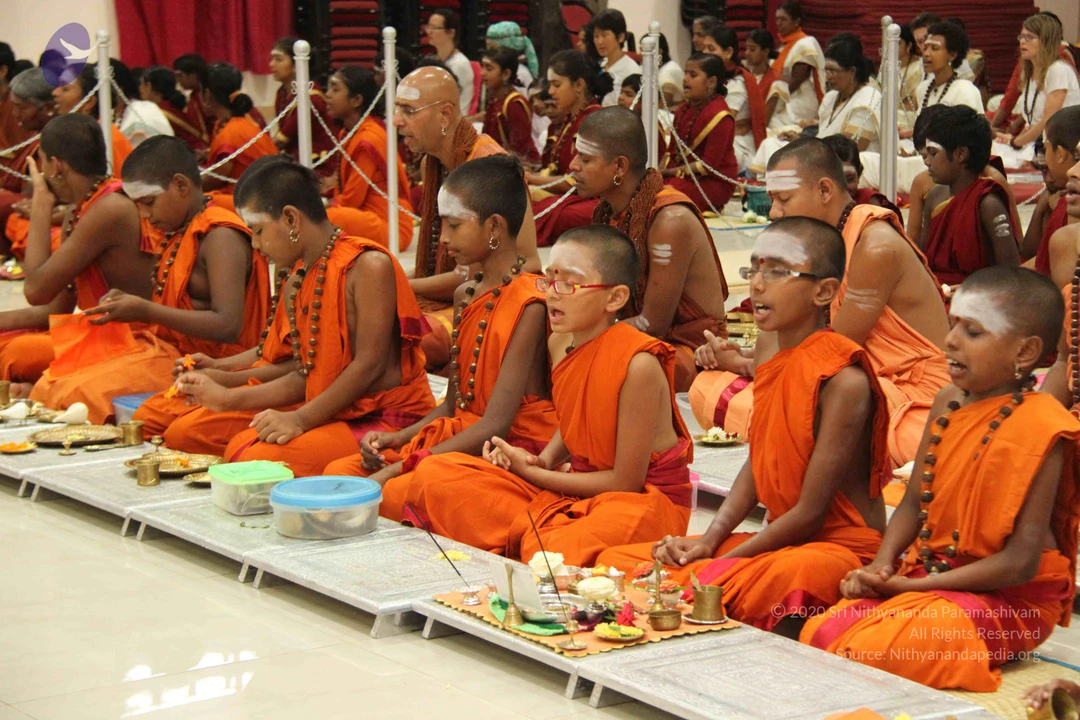
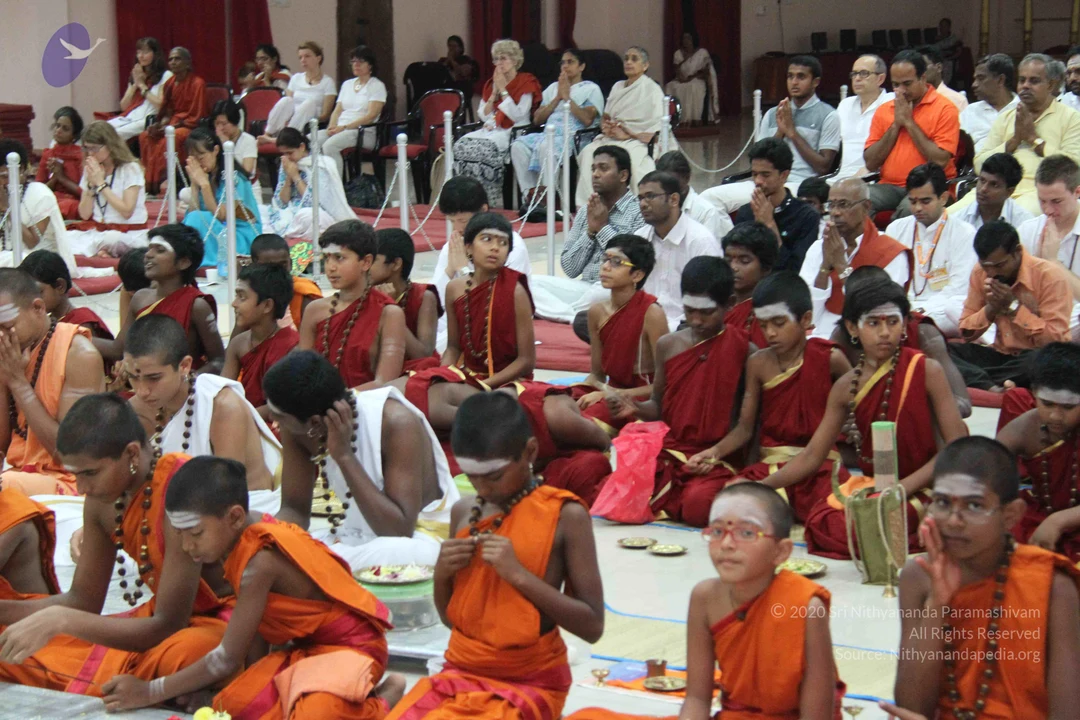
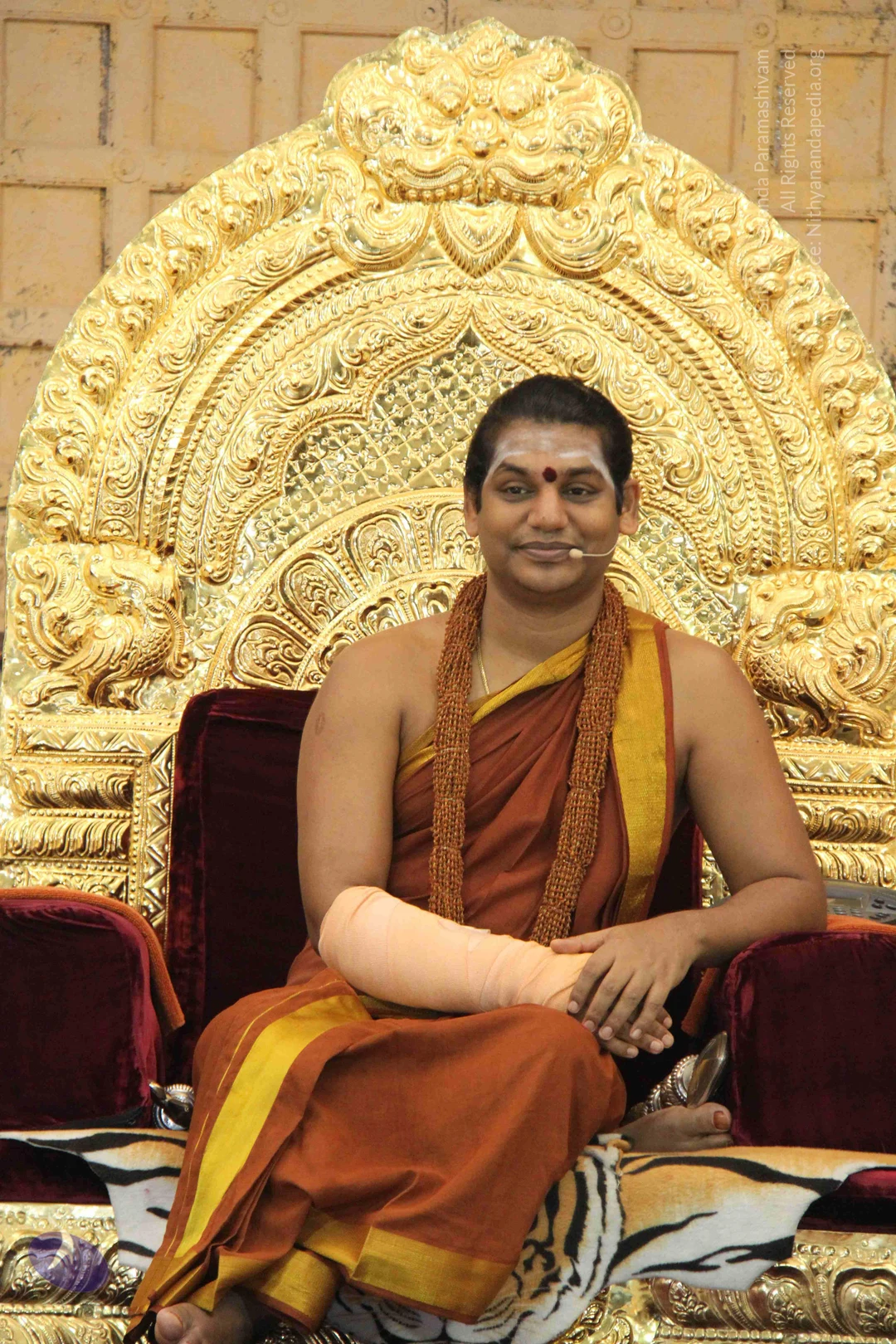
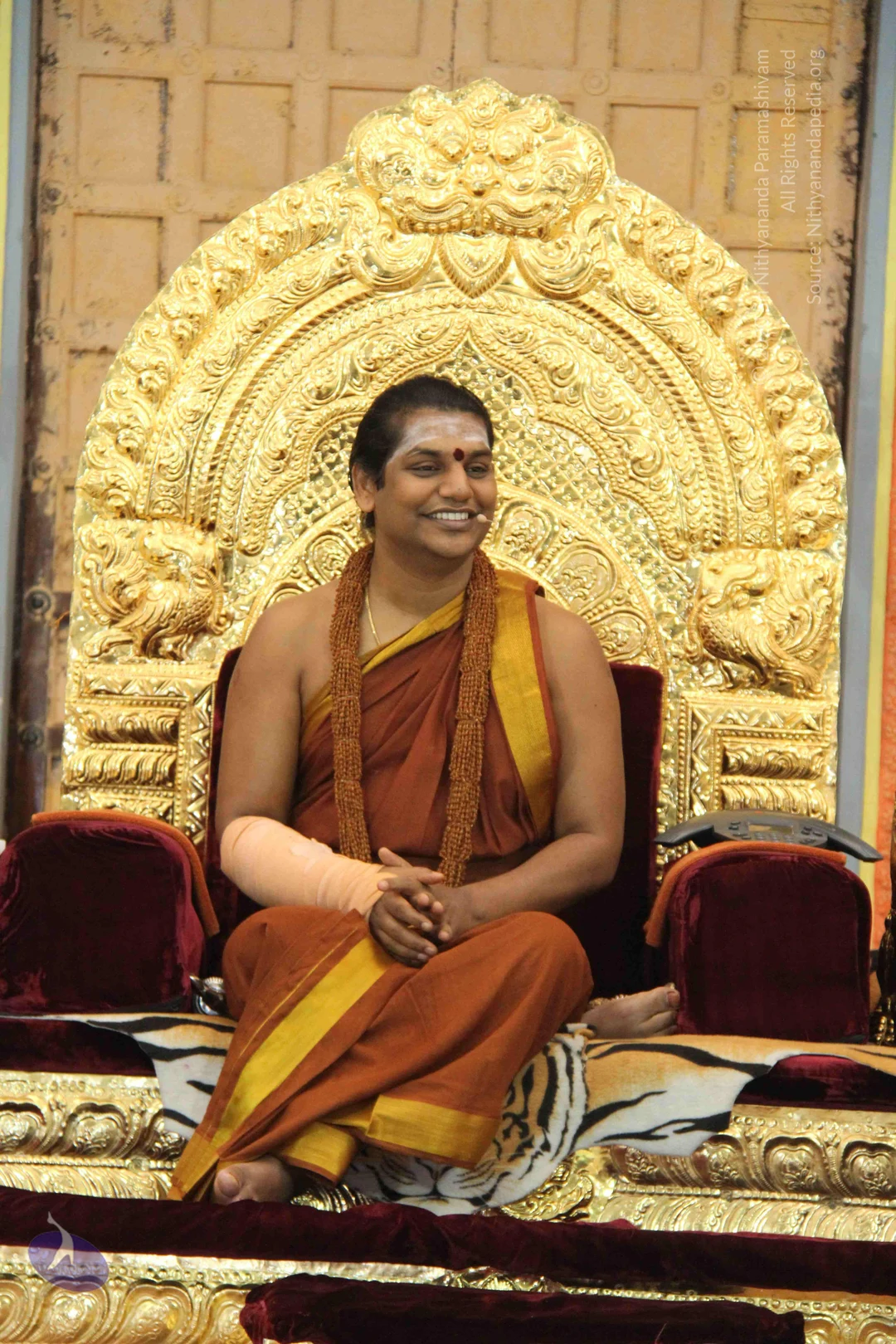
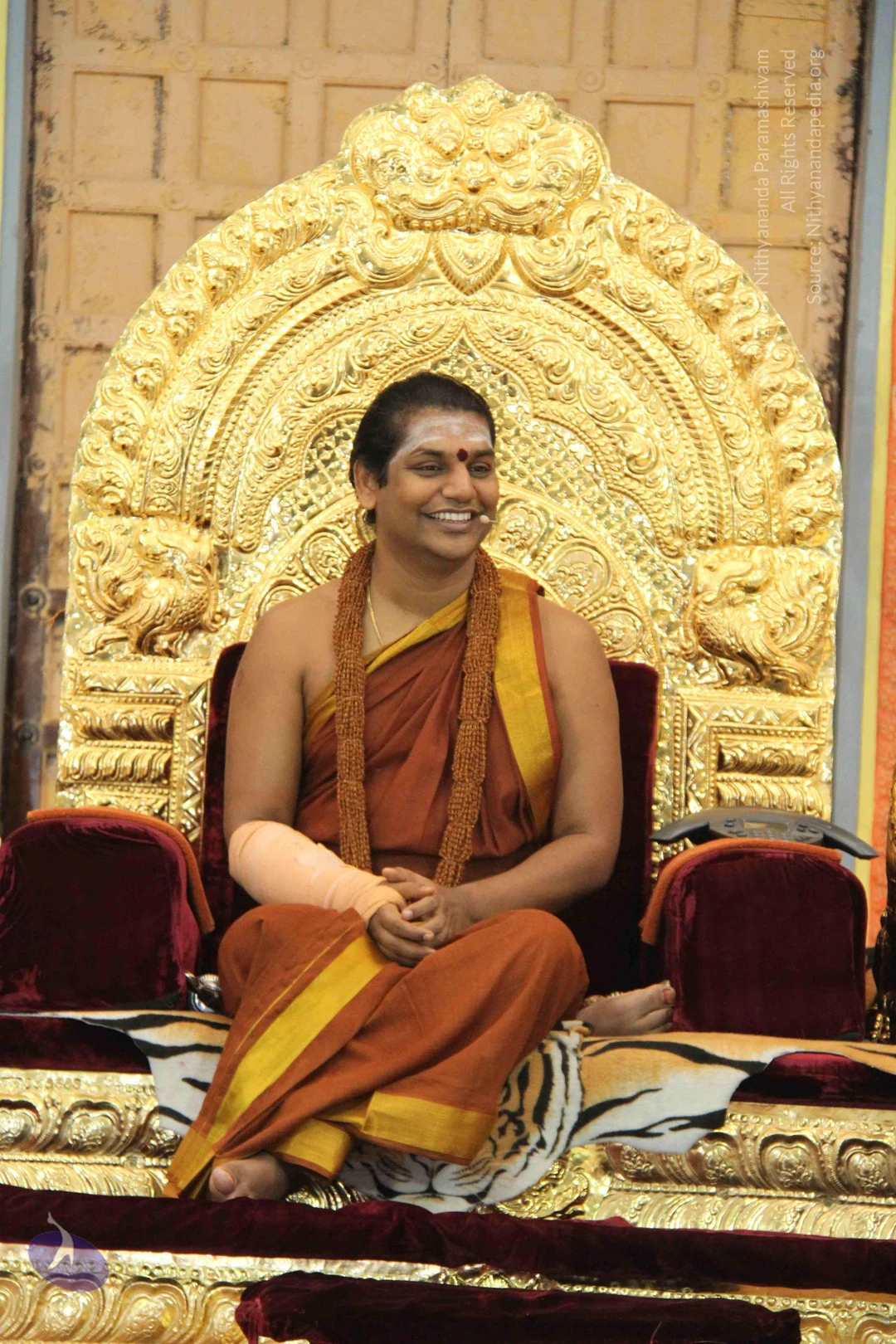
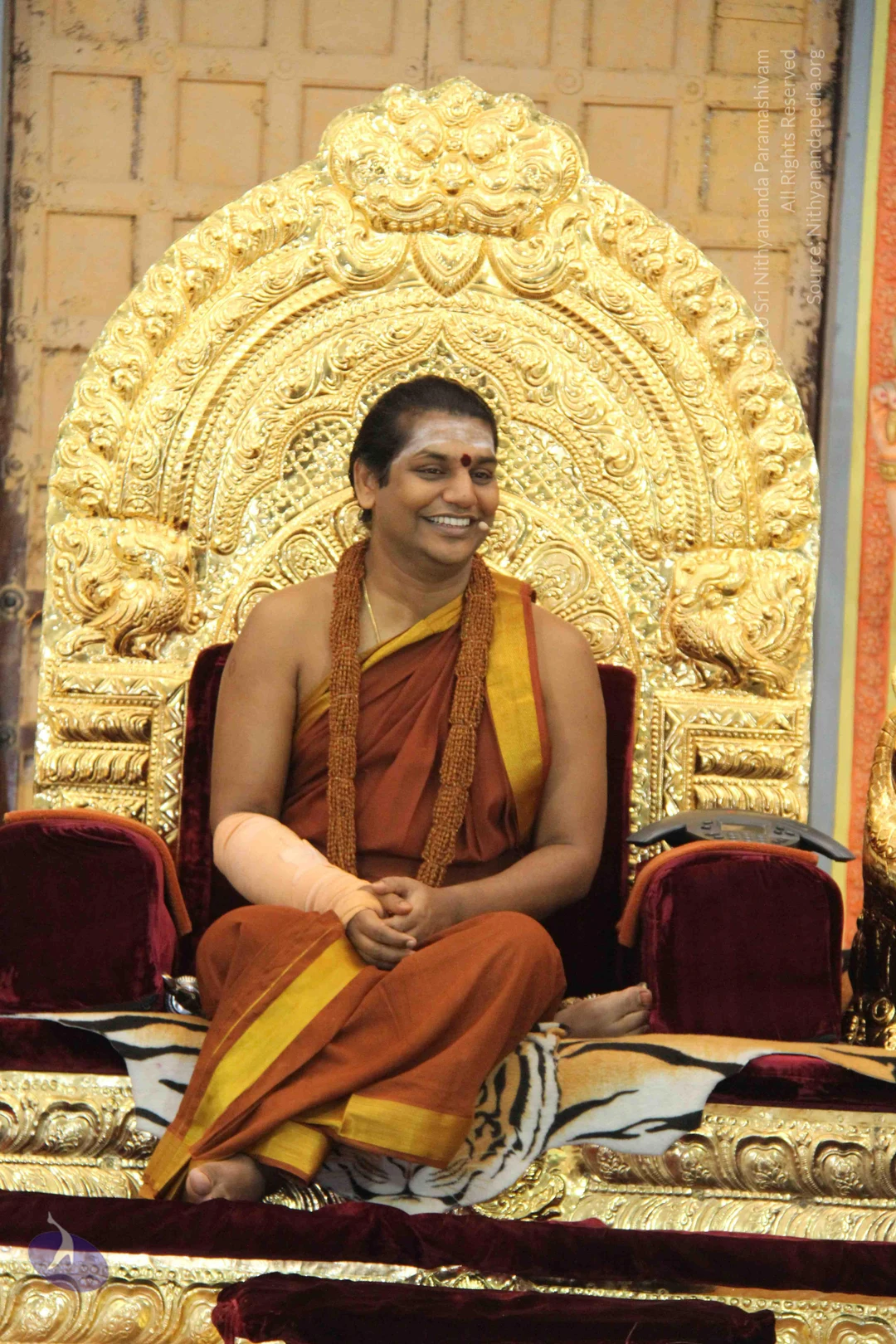
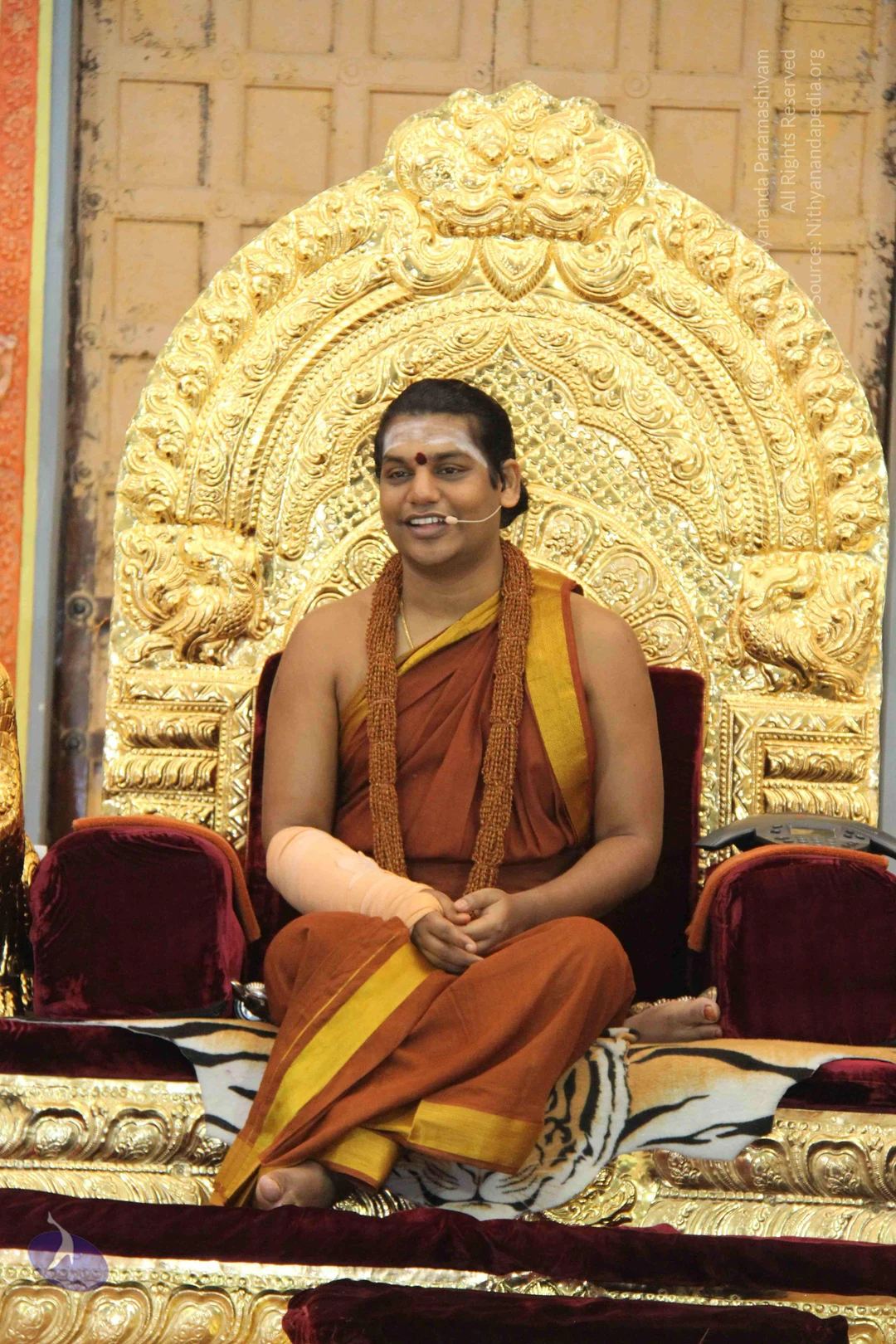
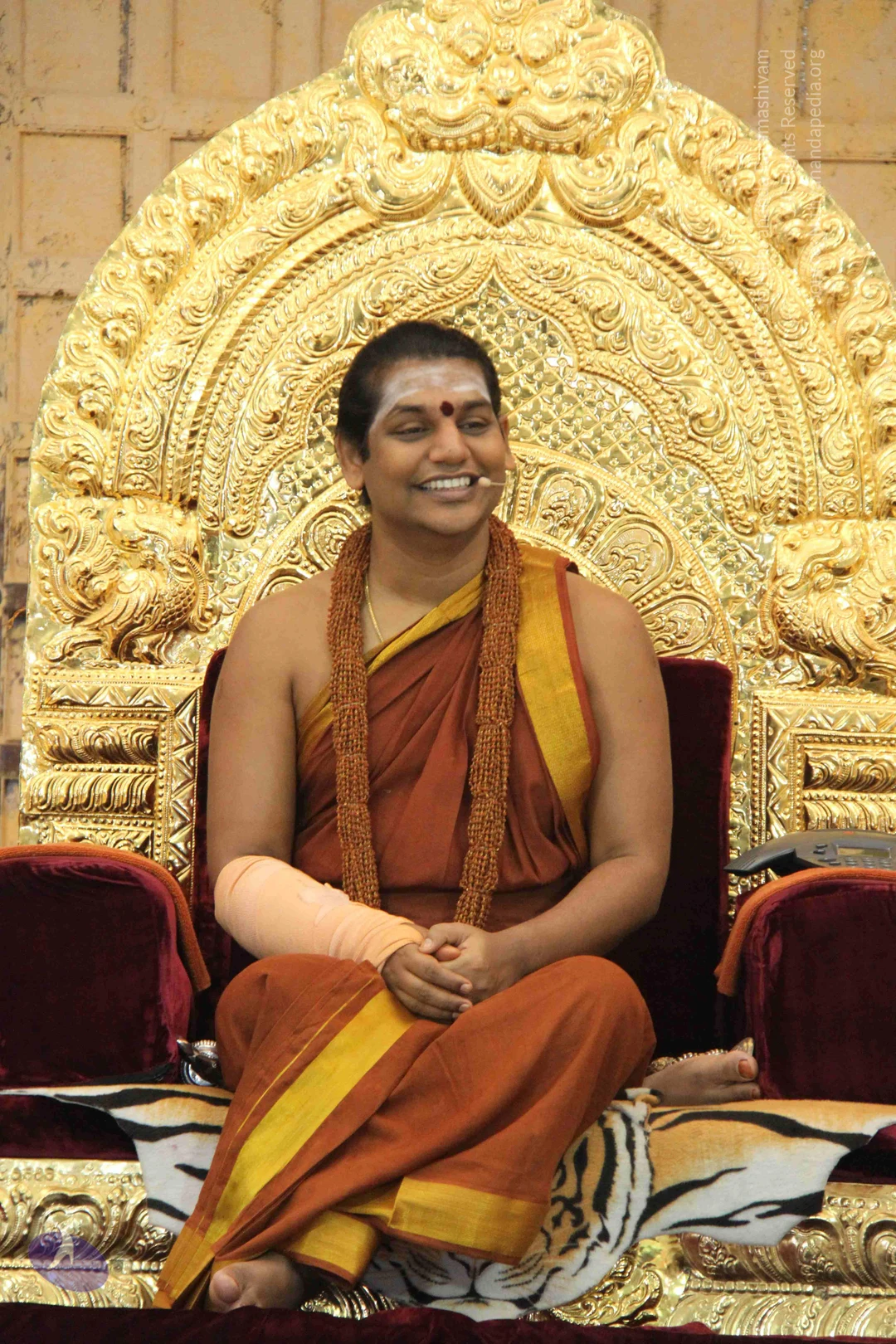
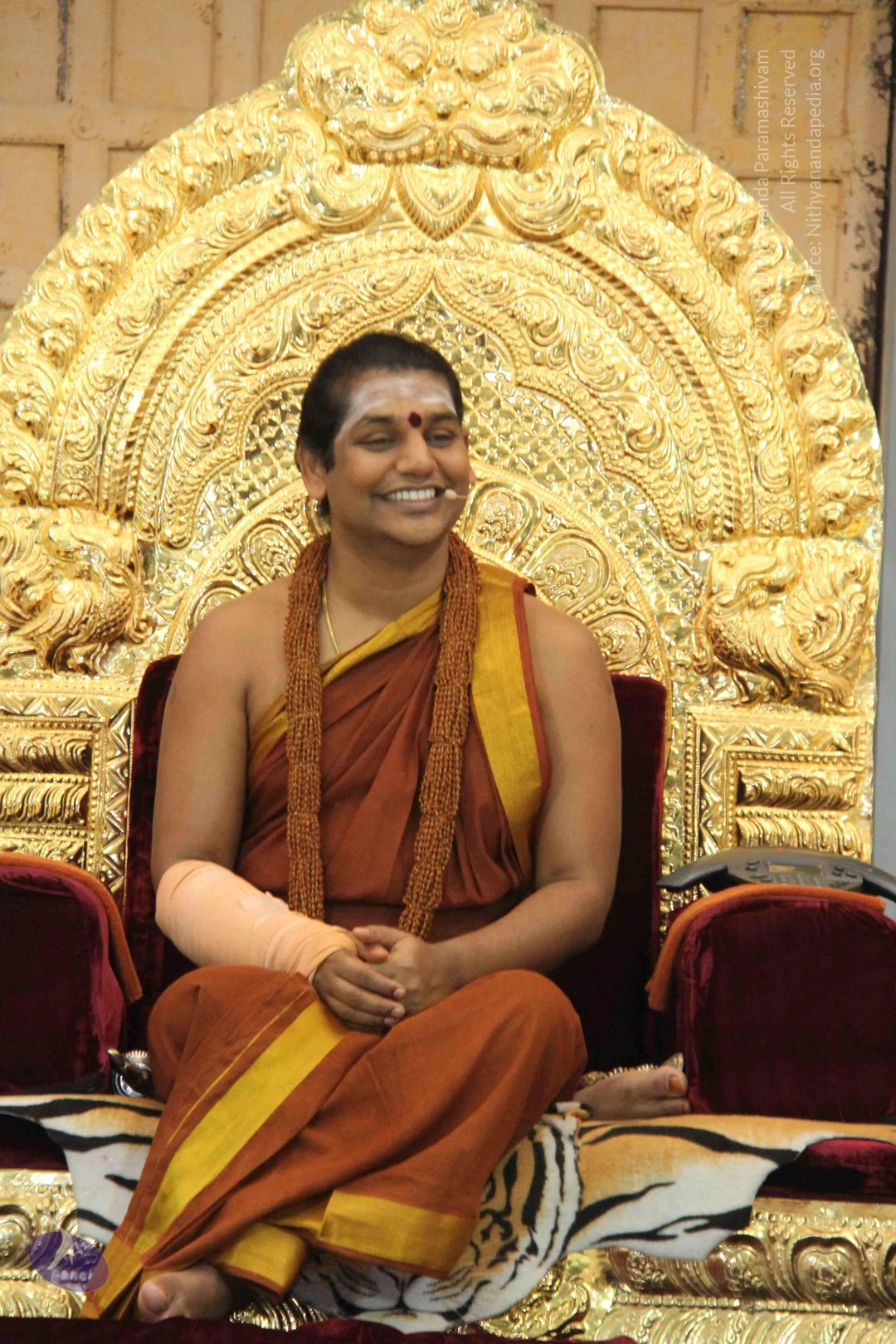
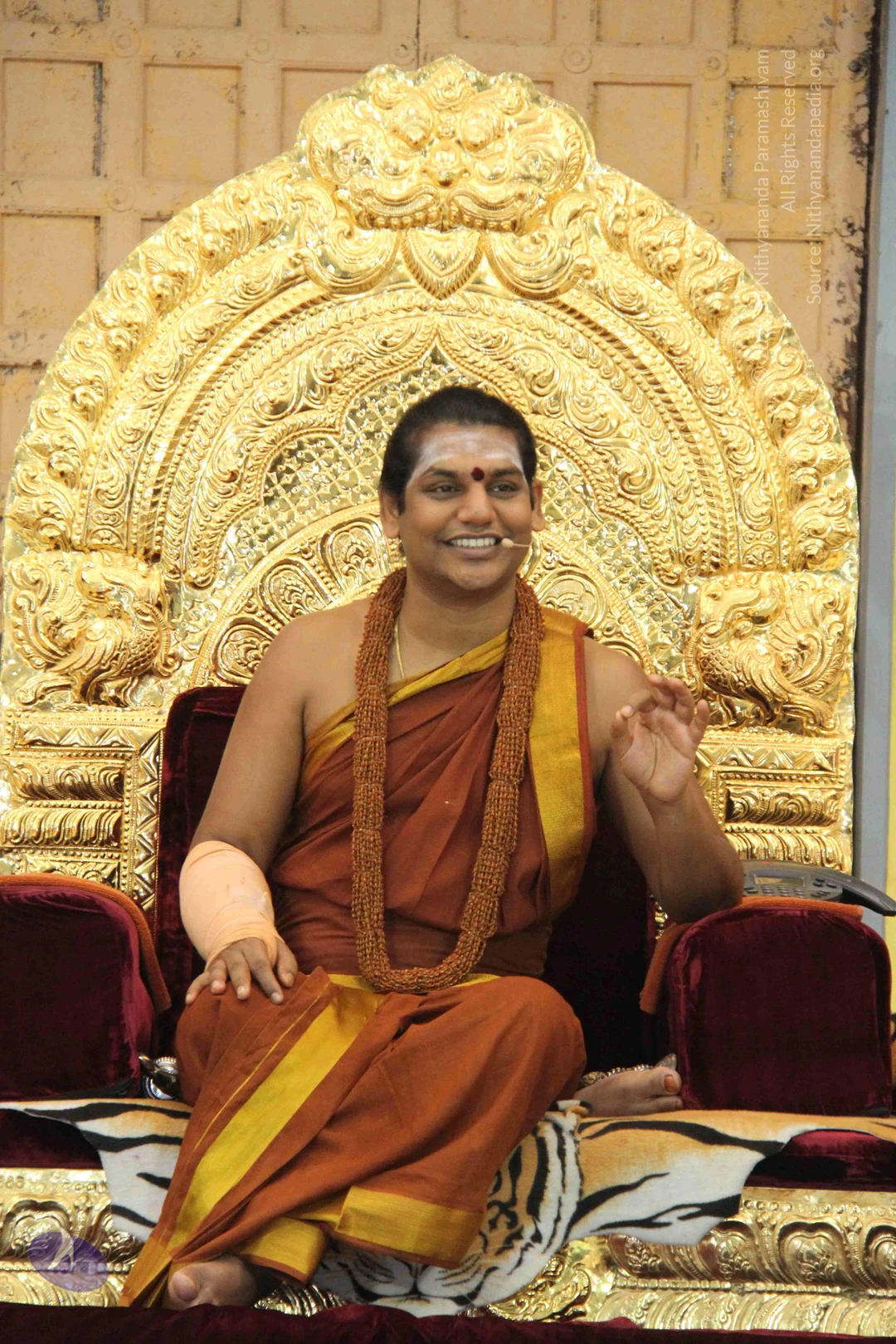
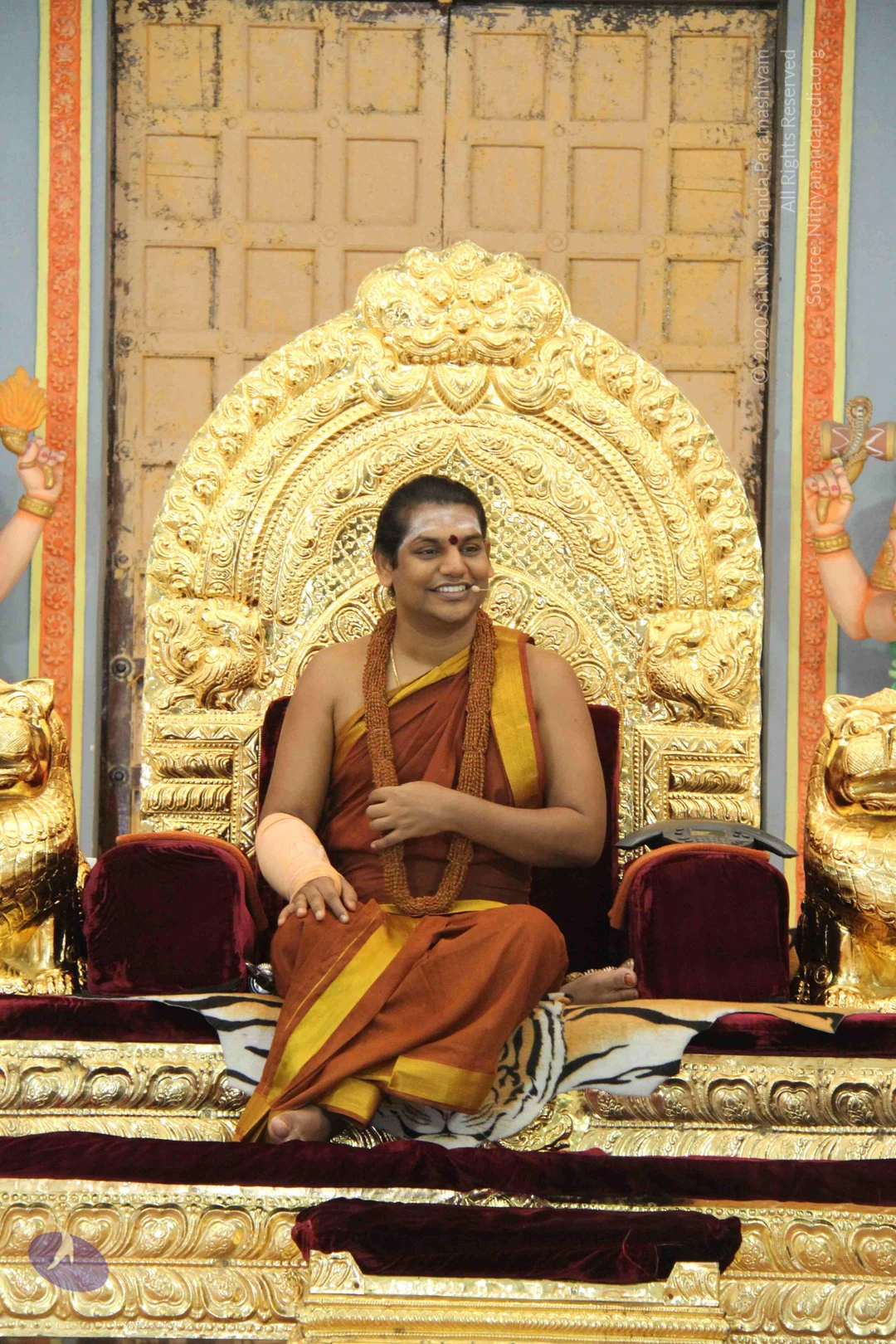
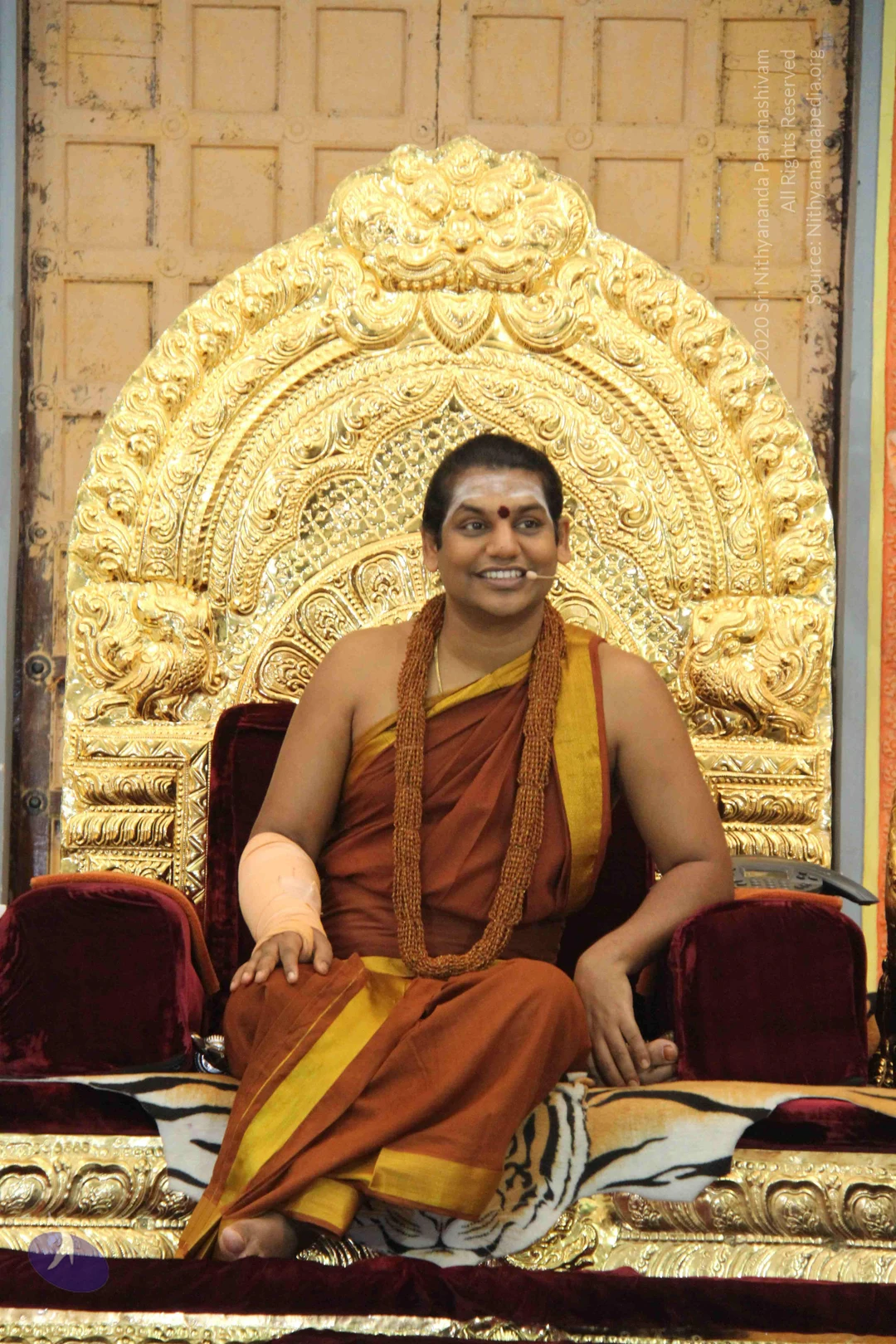
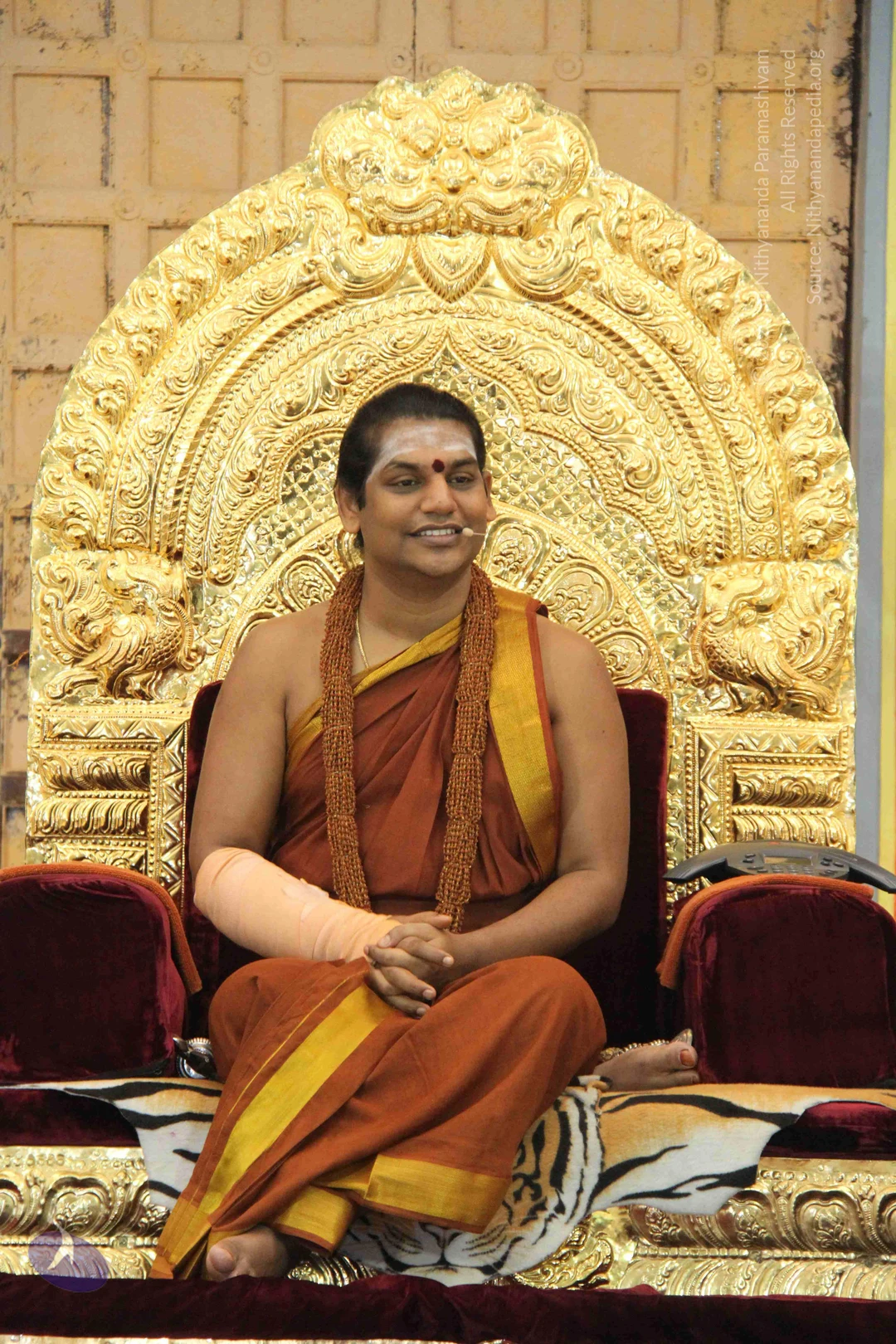
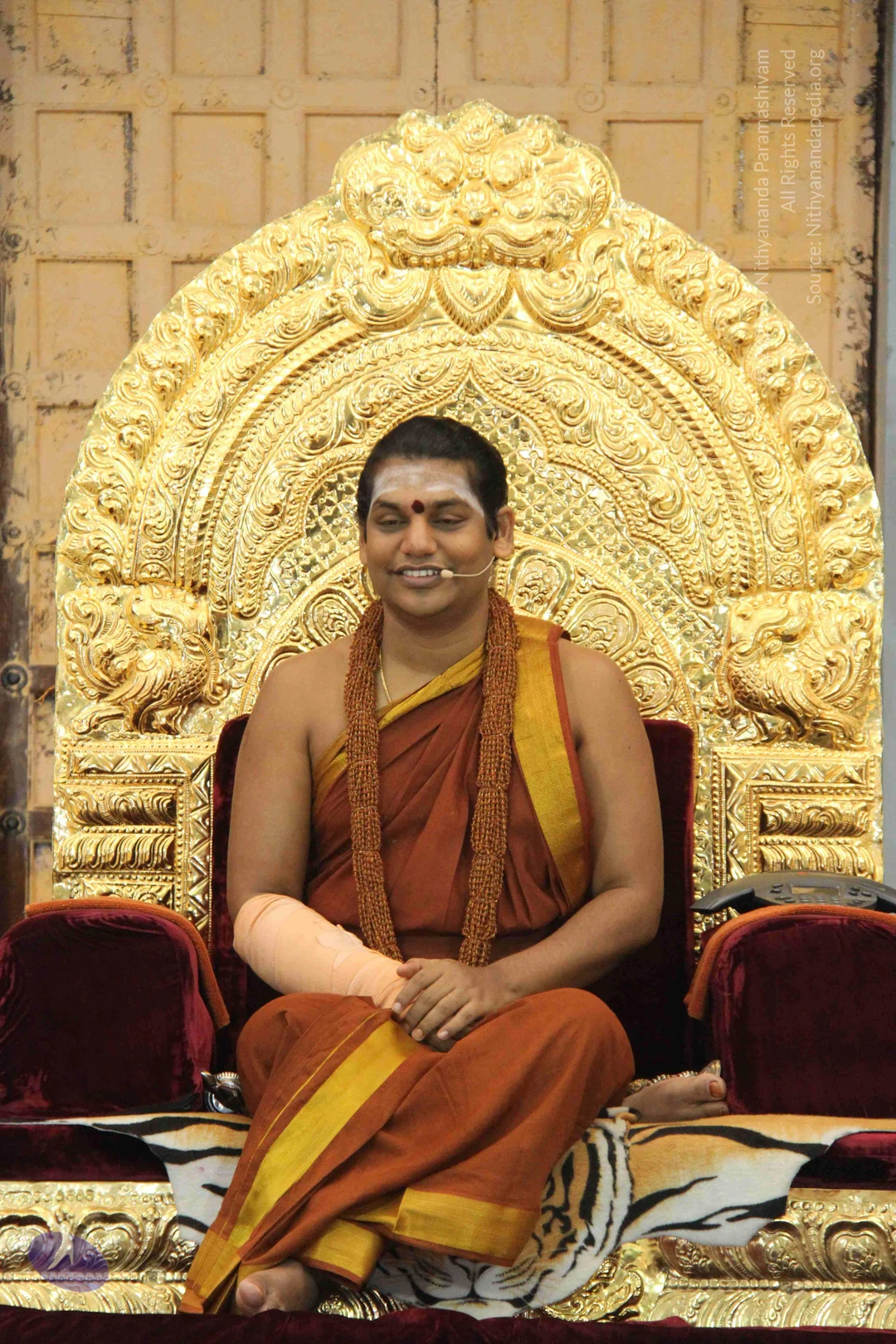
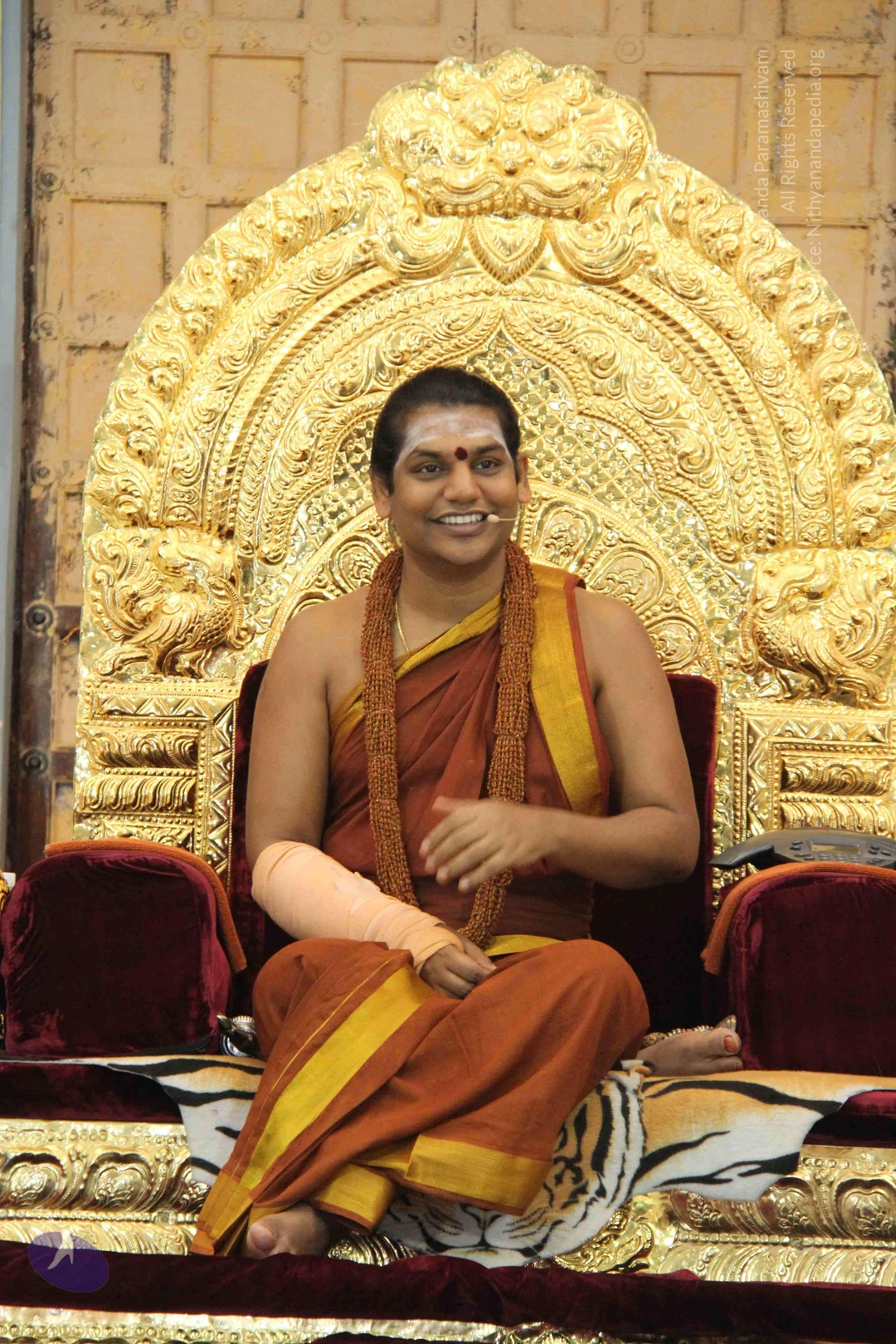
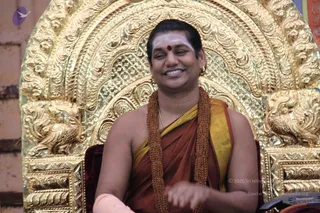
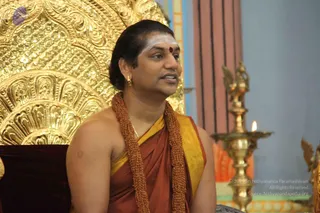
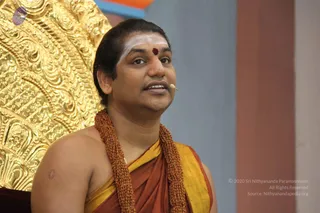
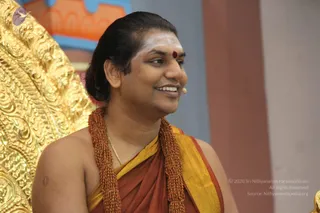
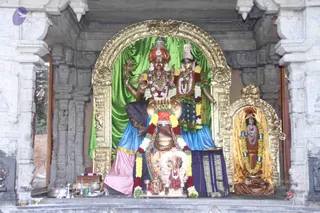
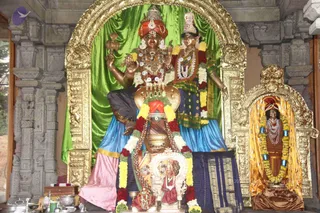
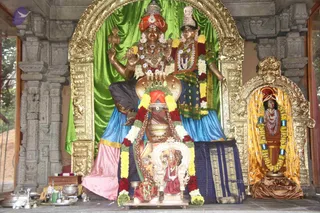
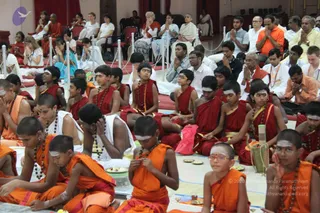
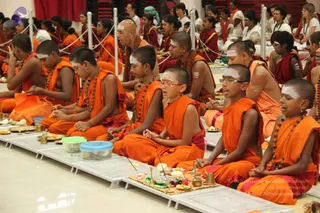
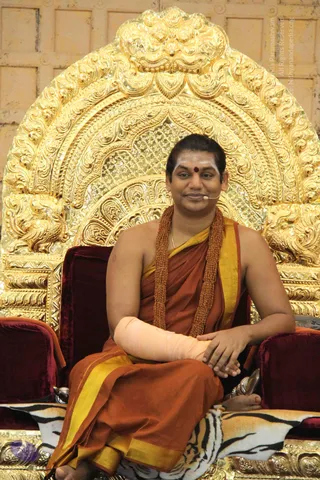
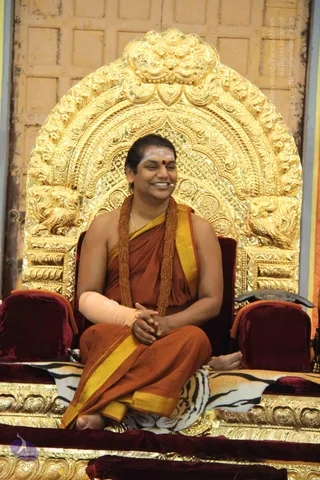
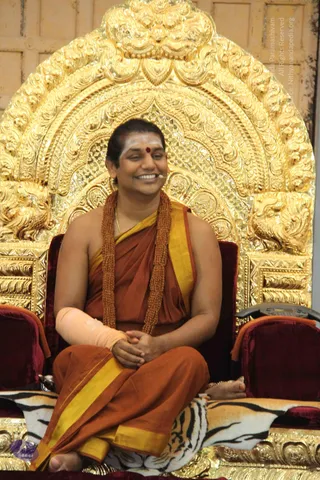
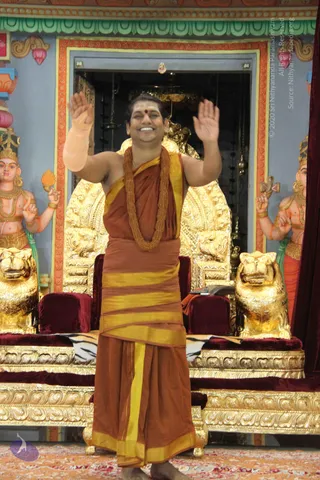
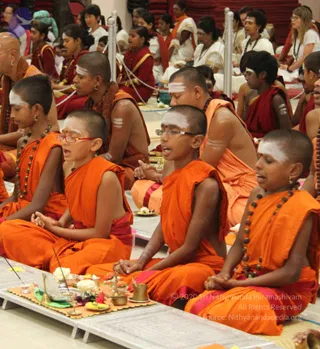
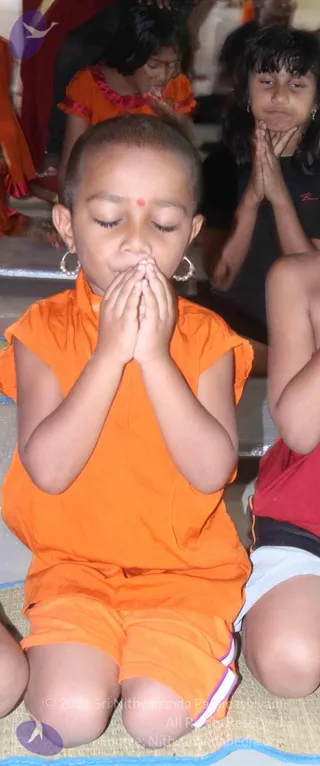
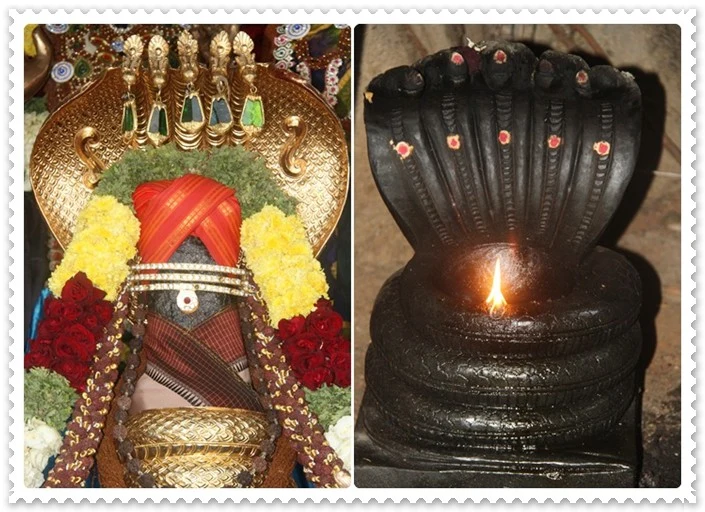
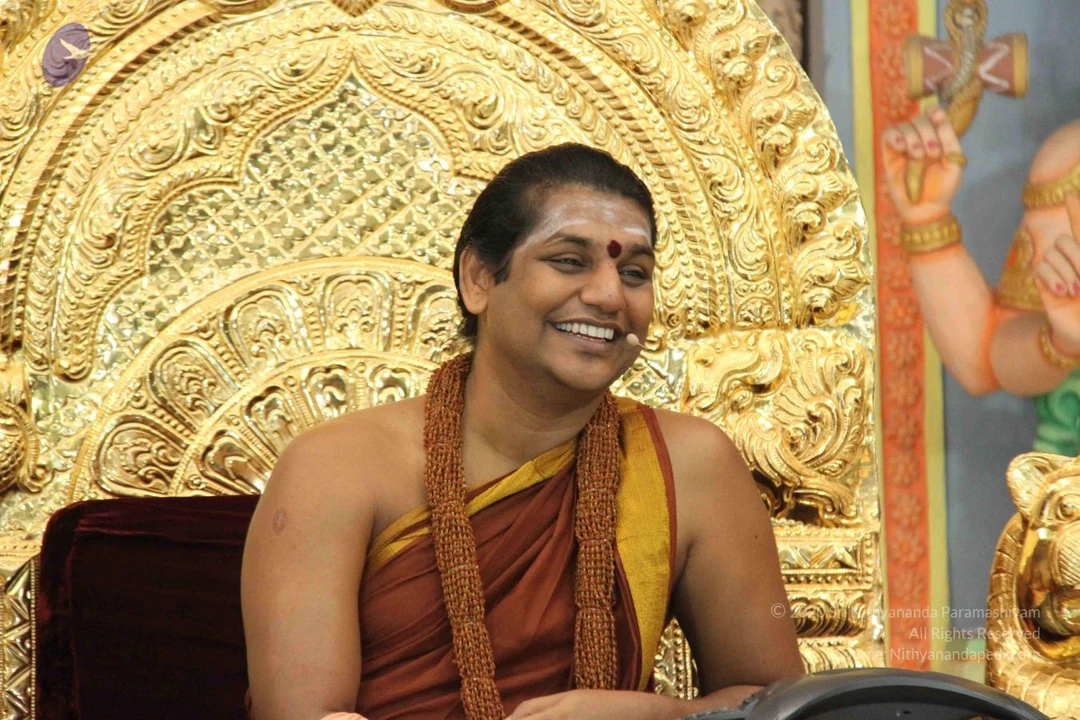
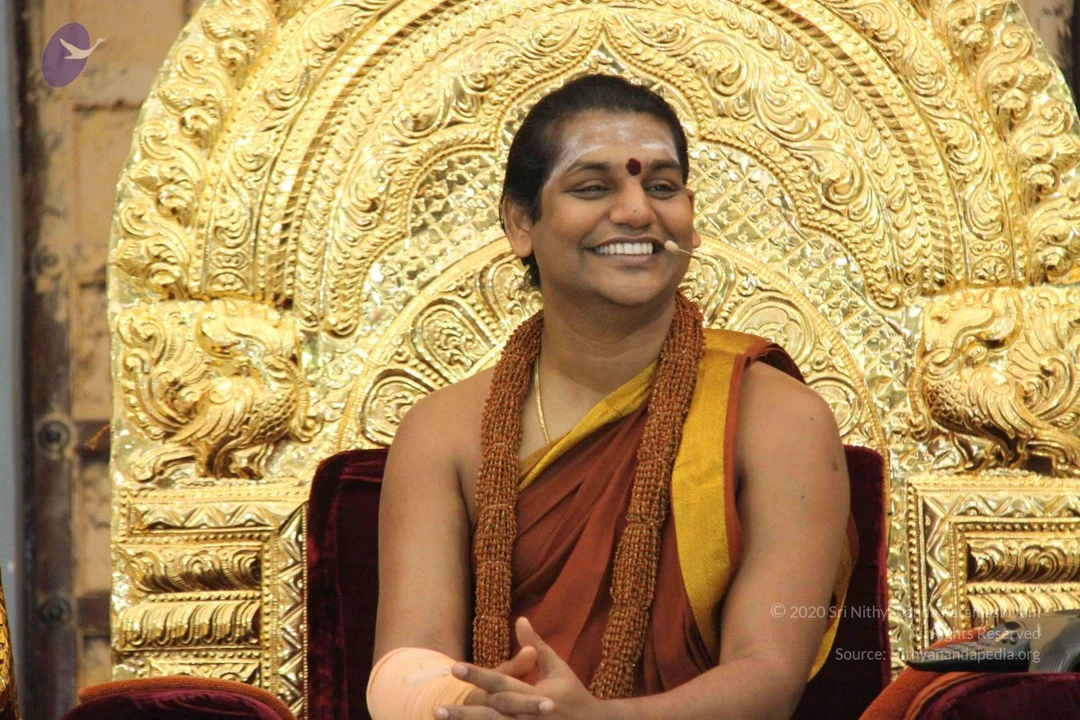
A black stone murti of a seated sannyasi-style figure, adorned for worship. The statue wears an orange-saffron turban with a jeweled ornament and a bright orange-gold cloth draped over the body. Multiple long rudraksha malas hang across the chest, with a small ornate pendant. Red roses, white and yellow garlands and green leaves surround the figure. Its raised right hand holds a trident-like emblem and a ritual object with a red-dotted tip rests at the left, beside a carved black stone ornament. A green cloth backdrop and foliage lie behind. Because this is a statue rather than a living person, no one is physically present.A photo of young saffron-robed sannyasi boys seated in a row in meditative chanting posture, with hands held in mudra before brass puja vessels, bells and flower offerings on a low wooden stand. Several children have white vibhuti tripundra marks on their foreheads; some wear glasses and rudraksha malas. Behind them, adults in white shirts and dhotis sit and stand in an indoor hall with pink walls. Five people are prominently visible, with more partially visible in the background, so the count is 6-20.A man seated on an ornate gold throne with a carved arched backrest and lion-like figures, smiling while speaking into a small headset microphone. He wears a rust-orange robe with a gold-bordered yellow shawl draped over one shoulder, long rudraksha malas around his neck, and a gold chain. He has a white sacred ash mark on his forehead with a red bindi, and his hair is swept back. The throne has a deep red velvet cushion. a person appears in person, seated and teaching, with rudraksha malas, orange robes and a gold-bordered shawl as the qualifying cues.

September 26 2013

Original wiki page
Contents

Title:

Question all your answers!

Description:

In today’s morning Satsang, Paramahamsa Nithyananda delivers a powerful new technique for completion. He tells us to question all of the answers we give to ourselves – ask why to all of our answers and we will reach completion! Unfortunately, many of us don’t feel that transformation is even possible. We don’t think to question our own reality because we are exposed only to society’s all-encompassing answers to our problems. Transformation will happen through the direct instruction of an enlightened Being. He gives us precise solutions, on an individual basis, to all of our questions. We discover that through questioning our answers, we arrive at a place where we can just be. This is the space of completion - the questions no longer exist and the answers have lost their meaning.

Link to Video:

VideoAudio

Transcript:

Nithyanandeshwara Samaarambhaam Nithyanandeshwari Madhyaam | Asmath Aachaarya Paryanthaam Vandhey Guru Paramparaam ||

00:43 Hindi -00:51

I welcome you all with my love and respects. I welcome all the television viewers, visitors, disciples, devotees, samajis, satsanghis sitting with us around the world at this moment through Nithyananda TV, Lotus News Channel, two-way video-conferencing, Sadhna TV, and two-way video conferencing having Nayana Deeksha all over the world.

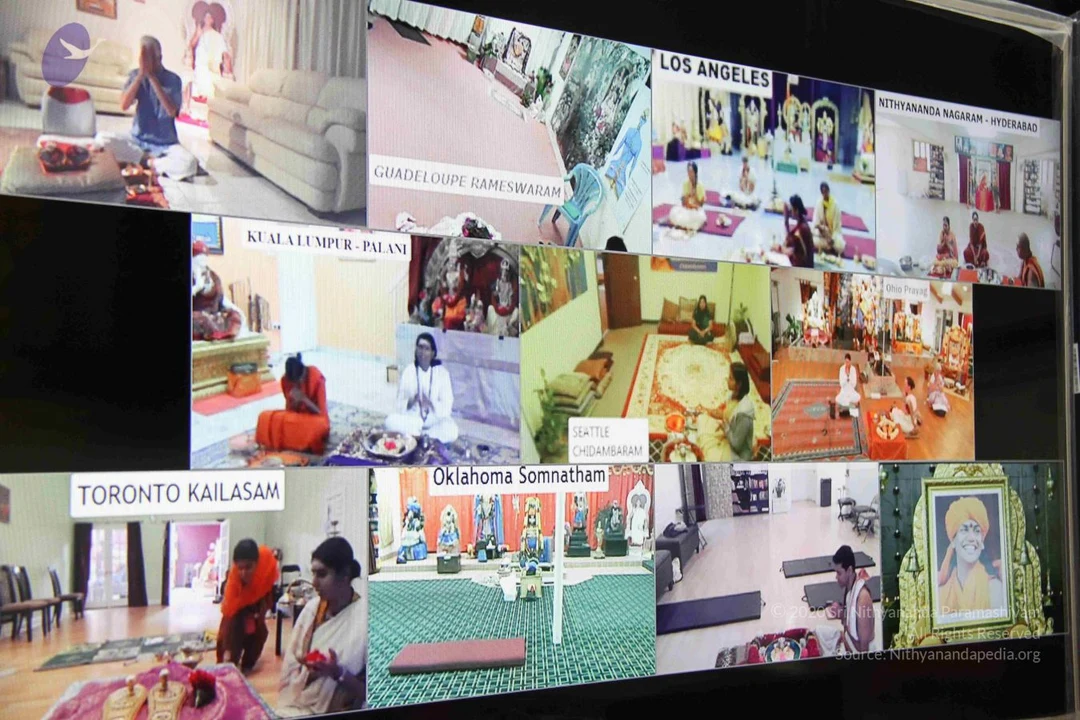
Cities sitting with us in two-way video conferencing having Nayana Deeksha: Houston, Guadeloupe, Oklahoma, Ohio, Seattle, Kuala Lumpur, Hyderabad, Toronto, San Jose, Tiruvanmiyur, Indrani-New Jersey, Charlotte-Srisailam, Vancouver, Washington DC-Sripuram, Vancouver-British Columbia Enriching Temple-Bidadi, Dubai, San Diego La Jolla, Hyderabad - Gupta Kashi, Singapore-Singapuram, Devon-UK, Monterrey-Mexico, East London-UK, Warrington-UK, Ohio-Ma Shivananda, New York-Varanasi, Australia, Jorpati-Nepal, Paris Home Temple, Oman-Sivagangai.

I welcome all of you with my love and respects.

We’ll enter into the satsang.

I will expand on the subject I started yesterday, because I attended to only one dimension of that subject – “Why? Why suffering?”

Please understand, for this question there are some logical answers, some illogical answers, some imaginary answers, some intuitive answers, some interesting answers, some mystical answers, some intellectual answers, some emotional answers. I can say, all possible types of answers have been given for this one question. This one question is attended to so many times, the question itself is now loaded with so much of distorted meanings. Sometimes, so much is attributed to the question, so much of answer has been given, the moment you think of the question you feel your brain is burning. This is one of that type of questions.

As I said, each answer leads to further questions, how this answer can be made reality for us? For example, Buddha says, ‘Desire is root cause of suffering.’ The next question automatically comes: ‘How we can make this answer as an experience? How we can use it, apply it in our life?’ Then that becomes a philosophy. So, each answer to this question becomes philosophy. Each answer to this question becomes a philosophy and whoever wants to become a philosopher tries to answer this question in a very innovative way, in their own way.

As I said, some answers are good for intellectual stunt from stage. Sitting in the stage, you can do intellectual stunt like a all-encompassing answers. There are some which are not good to be uttered from the stage, but very good for the individual who is suffering because they will be precise solutions. The precise solutions, precise solution is such powerful, important need, please listen, I tell you without precise solutions, just with the encompassing solutions, people can spend their whole life, but they will be wasting it. I have seen this happening.

I have seen many Hindu monks, Buddhist monks, Christian monks and nuns, I have seen many sincere religious leaders, they are not insincere, they are not unintegrated, they are very integrated; but, unfortunately they try to solve their whole life with all-encompassing answers. I wanted all the viewers, visitors, television viewers, devotees, to know very clearly now, if you are trying to achieve Completion just by the morning satsang, you are doing the same mistake. All-encompassing answers will naturally lose precision. Please understand, it will naturally miss precisely addressing you and your needs. Precisely getting your ideas addressed, listen, dyanse suniya, precisely getting your ideas addressed is the most.

Please understand, when you work with the Master closely, not only your questions, problems get addressed precisely, your ideas get addressed. Now you need to understand, I am adding this one word; I am giving a small twist. Many time, you may not have a problem or question with your settled idea but even that ideas need to be addressed. Sometime you settle down without any question, without any doubt, second thought with some ideas. Even they should be addressed.

Many a time your bio-memory believes so strongly you are nothing more than the six feet body. You settle down with that idea. You may not even have a question or a doubt: ‘Am I only the body?’ You may just settle down thinking that it is a fact. Even that should be addressed.

Please understand, from the dais, from the stage, the settled ideas in you can never be addressed. Only when you work with the Master, only when he helps you to find the precise solutions, the precise solutions, only that can liberate you. Only that can free you. Only that can lead to solution.

Please understand, yesterday, I threw two words – “all-encompassing answers” and “precise solution”. These two words are the key words of yesterday’s satsang. Today’s satsang key words, listen, “not only answering your questions”, “questioning many of your answers”. Many of your answers need to be questioned: ‘Why, why will you have this answer? Why will you have this answer?’

Sometime, such strong answers we carry, we are ready to give up even our life, but not our answers. You are ready to give up your life, but not your answers! Listen, because you feel the answers you are holding on is a psychological strength for you, believing which you gave up many things, you did many things. It is like you marry somebody and give up everything else for that person’s taste and you accommodate yourself for that person and everything your morning till night, your thinking, feeling, acting, everything is done for the sake of that person. Suddenly you discover that person is not integrated to you, that person is not authentic to you. Your whole being is shaken. Sometime even if you know he is not authentic to you, you don’t want to believe it. You say, ‘No, no, no, no, no. Don’t bring such an important revelation to me, such big fact to me. No, that will be hurting me too much.’

So, today, I want all of you to understand, not only you should have the precise solutions for your questions, your answers also should be questioned. Your answers should be questioned. When you work with the Master closely, that is what he does. In the morning satsang, I’ll never be able to answer your questions with the precise solutions and never, never, never will be able to question your answers; because I do not even know the answers with which you are sitting. Even if I know, where is the time to question everyone’s answer?

Sometimes I through some riddles to question everyone’s answers. Your answers need to be precisely questioned. Your questions need to be precisely answered. Only then transformation of the being happens. Please listen, transformation of the being happens only when your answers are questioned precisely, questions are answered precisely. Your answers should be questioned in a very precise way; your questions should be answered in a very precise way. All-encompassing answers can create mass hysteria. Please understand, mass hysteria is religion. Precise solution, precise solutions creates enlightened beings. Precise solutions help a spiritual tradition. All-encompassing answers create mass hysteria which is religion. Precise solutions create spirituality which is a lifestyle. Precise solutions create spirituality.

And I tell you, when your answers are questioned, enlightened beings are created. If all your answers are questioned, you become an enlightened being. I am telling you the exact truth. You have no answer left unquestioned. Everything is questioned the moment you start any answer, ‘I think…..’ No, it is already questioned. ‘Do you exist? Do you think?’ In the utter questioning mode, you fall into Completion.

Please understand, Completion is the space where you are. The moment you come to any conclusion, it is incompletion. Please listen, all conclusions are incompletion and Completion is the space where all your answers are questioned and you are neither interested in answer nor interested in question; you are just be. You be! All questions answered, answers questioned, questions answered, answers questioned, neither answer exists nor question exists, is the space of Completion.

People who spend their whole life just with the all-encompassing answers never find solution, end of the day feel cheated. I have seen many Hindu monks feel at the end of their life that they have been cheated by their gurus, or by the Hindu tradition. I have seen Christian monks, I have seen Christian Fathers, at the age of seventy they come and express their depression to me, their inability to solve their problems, their inability to live spiritual life, their feeling that they are failures. I have seen Buddhist monks at the age of eighty discovering that monastic life is not possible for them.

Please understand, listen, listen to this truth. If you are missing this line, you may miss your whole life, so, please listen. If you are also trying to sort out all your problems just from the all-encompassing solutions, you are wrong, you’re completely wrong. After spending years and years, you will only feel depressed, disturbed. Solutions are discovered, solutions are found only when you work precisely with your problems and the Master. Sometime Master will question your answers so much he himself will become a problem for your life. No, really, sometimes he himself will become a problem. That’s the most sweetest problem you could have in your life, because he questions, he takes away all the answers on which you are standing, the ground on which you are standing is taken away, it is not there anymore.

Answers of the society, so-called settled human-beings of the society are the most pseudo component of humanity, are the most pseudo beings of the humanity. In the modern day, I am seeing, I am seeing very clearly how the human beings live a very superficial life, how the human beings don’t even feel like questioning their sufferings. The modern day, middle class, middle aged human beings, which is a mass, please understand, the modern day, middle aged, middle class human beings – this is my definition for mass; maybe I can add one more word “mediocre” – middle class, middle aged, mediocre mass, is not even questioning their reality; they don’t even think it is possible you can transform. See, when you do a act of love by giving something or sharing something, enriching somebody, you see you are so overflowing with joy, but you don’t want to take that to the next level; you don’t think taking that to the next level is possible for you. You don’t even feel you can take that experience to the logical conclusion. You say, ‘This much is enough, next.’

I have seen this in my life. My mother is a typical middle class lady, but I am a extreme guy in anything I take up. Anything I take up, I am fully into it.

One day, my grandfather was doing Maheshwari Puja, means feeding the sadhus, and then after doing the Maheshwara Puja he did namaskar, he fell at the feet of all the sadhus.

I asked my mother why he is falling at their feet after giving food.

My mother said, ‘We will get Shiva Loka.’ That is the, that much only she knows.

But she doesn’t know at that age itself I have already studied the scriptures and started listening and I learnt. I think this happened around the age of six or seven. By the time I am already exposed to Raghupathi Yogi and his words.

So, she said, ‘We will get Shiva Loka.’

Then I told her, ‘Alright, if that is the case, let us give, every day let us feed all the sadhus who come.’

Then she said, ‘No, no, no, no no,no , no. We should do only this much.’

I could not get a convincing answer from her why we should not do every day with all the money we have and even she never thought about it.

I asked her, ‘Why you do not think further? You say, this is good, and even you feel good.’

I have seen her, very sincerely she will do. She will cook and feed. The Annadhana, the quality of feeding people, I learnt from her. Still I am happy about it. Still I carry one pride: all our ashrams and campuses, without even me telling our sannyasis, have learnt this one idea -if you start ashram you have to start feeding people. Whoever comes, you should make sure they eat and go. When they start an ashram or a temple, whether it is America or Aminjikarai, Kanchipuram or California, they know one thing: Dhyanapeetam means you have to feed, you have to give food; whatever you have, you have to share with the people. But unfortunately, she never took that to the next level. She stopped enriching people with food; never to the next level.

So, I have seen this middle class people, because of their innate mediocrity, do not raise themselves to the next level. See, feeding people is good but that is not enough. That is not ultimate. You have to have something more than just giving food – enriching people with enlightenment.

Just yesterday I okayed a project plan; I approved it. In all the government schools, first in this next, in the four nearby districts, we are launching in all government schools, every evening after the school hours are over, we will recruit the same school teachers, we’ll pay them salary and make them teach the Nithyananda Vidyalaya syllabus about Integrity, Authenticity, Responsibility, Enriching, Completion and one nutritious meal, one nutritious meal. Both we are doing. Just yesterday, I approved the project. Please understand, just giving food is not going to be enough.Or just giving western education is not enough.

You know these so called education is nothing more than poison whom you are feeding or giving this so called education, there is every possibility, not every possibility, he will be only useless to himself and society. He only develops false identity, doesn’t relate with reality. He doesn’t become livable for himself or worthy of livable for others to live with him. He can neither live with himself nor with others. He loses livability in the life. So, that is why I decided to bring Bala Vidyalaya syllabus, where they will learn life education, educating them to live, educating them to live Integrity, Authenticity, Responsibility, Enriching, Completion and tuition also. They will have their school syllabus also and a nutritious meal. We will work with government officials, launch this project in the nearby four districts schools, then expand it. We really wanted to expand it to the whole country because my hope lies only on the next generation. The next generation should become the new generation. This is the tagline I gave for Nithyananda Bala Vidyalaya: “Making NewGen out of NextGen”. “Making NewGen out of NextGen” is the tagline I gave for the Nithyananda Bala Vidyalaya.

Don’t be the mediocre, middle class mass. Think, think, think. Think “Why Suffering?” Question the answers you carry with you. Why marriage? Why Children? Why Sannyas? Why life? Why I am where I am? Why I am doing what I am doing? Why I am living where I am living? Question all your answers; you will reach Completion. I can tell you, one of the best way to reach Completion is, question all your answers. Questioning all your answers; you will reach Completion.

I will give the essence of whatever I uttered today, I shared with you all today, in Hindi.

33:25 Hindi - 36:25

The essence of today’s satsang:

Not just answering your questions, even precisely answering your questions is not enough. Questioning all the answers with which you are sitting is necessary. Whenever you question all your answers, you stop becoming or being mediocre, you become genius. Please understand, the person who lives with the answers is mediocre. The person who questions all the answers is genius. If you answer all your questions, you may become mediocre. If you question all your answers, you become genius. Question, question, question all your answers. Question all your answers, you become genius. Question all your answers, you become genius. Listen, listen to the truth.

37:55 Hindi -40: 22

Let you all achieve, experience, live, express, radiate share and explode in eternal bliss, Nithyananda.

40:36

Photos From The Day:
Tags:

Paramahamsa Nithyananda, completion, transformation, reality, society, enlightened, Being, solutions, discover, just be, space, exist.

Photos Of The Day:

Nithyasatsang

Dwajaarohanam

padukapuja

Goshala-Rabbit

Gurukul

IA-registration

Nature

SarvaDarshan

Temple

Photos Of The Day:

PadukaPuja-Individuals-crowd

NithyaSatsang-Swamiji

SarvaDarshan

Flag

Nature

Goshala-Rabbit

Temple

Gurukul

IA-Registration-WelcomeCenter

1--PadukaPuja-Individuals-crowd

2--NithyaSatsang-Swamiji

3--SarvaDarshan

4--Final-Blessings

7--Temple

8--Gurukul

IMG_9196_CMP_WM done

01-TEMPLE

02-PADUKA-PUJA

03-NITHYA-SATSANG

04-SARVA-DARSHAN

Photos from this day

View all 237 photos

Photos From The Day:
28 photosSource gallery
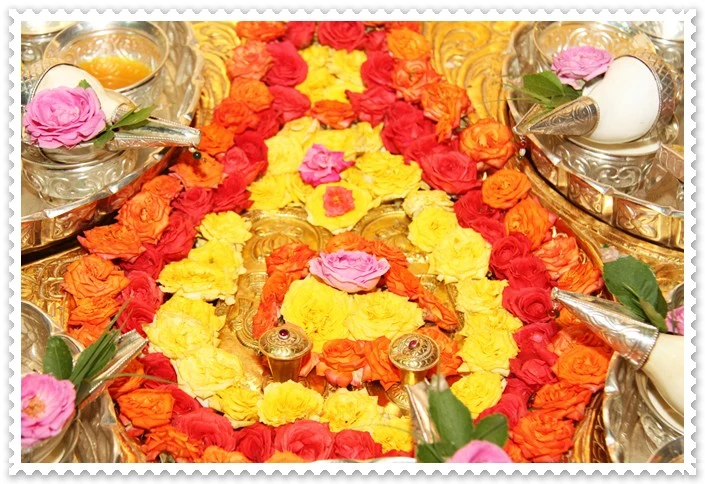
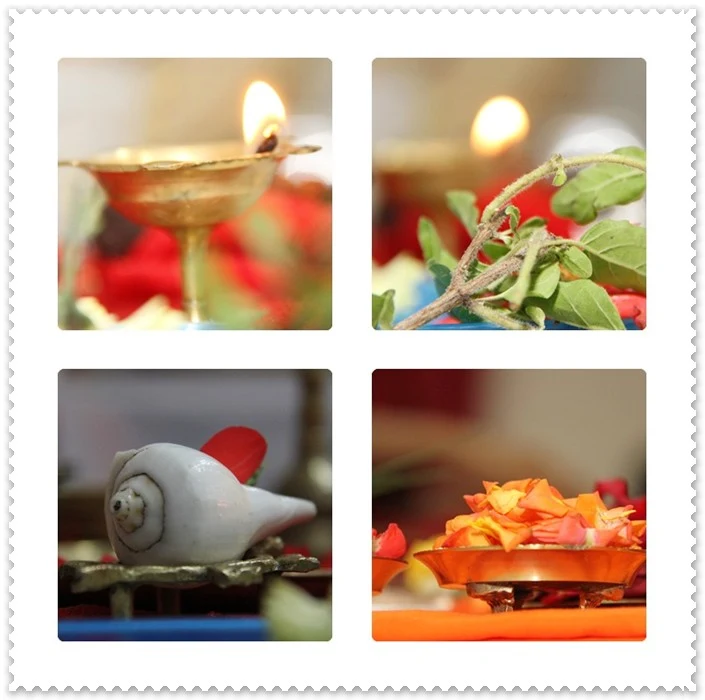
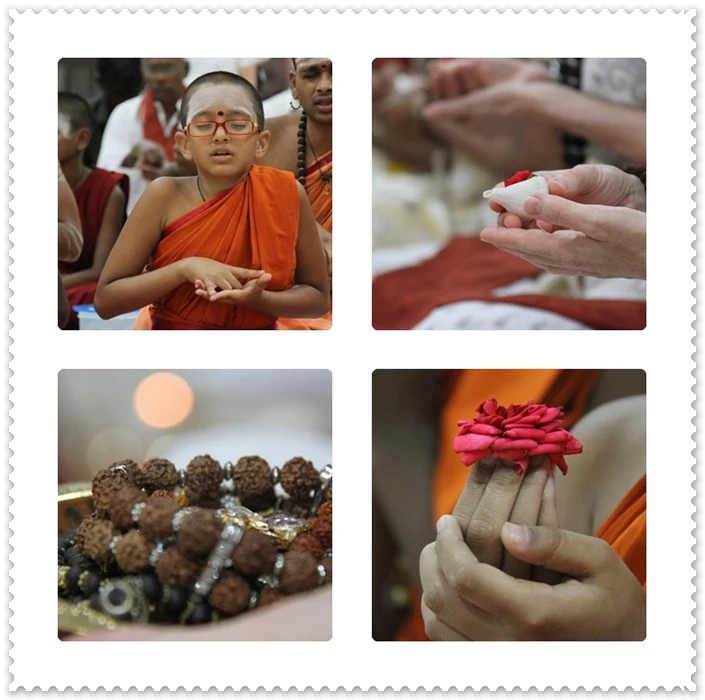
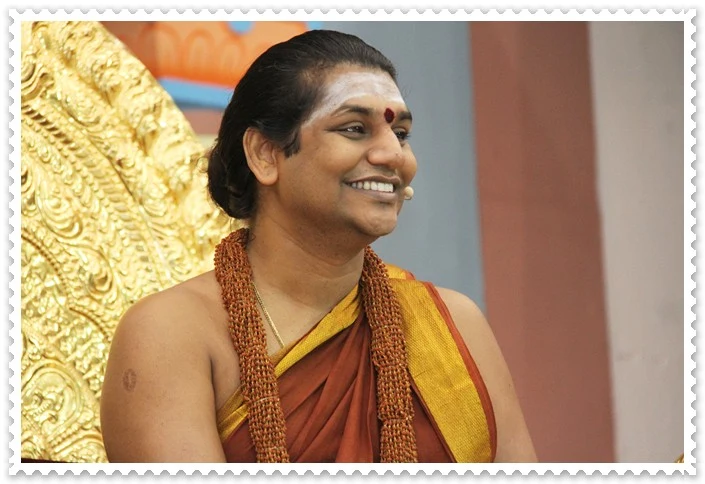
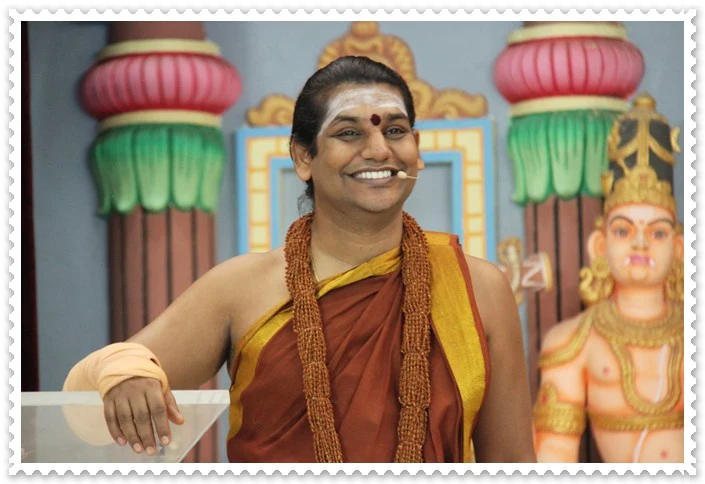
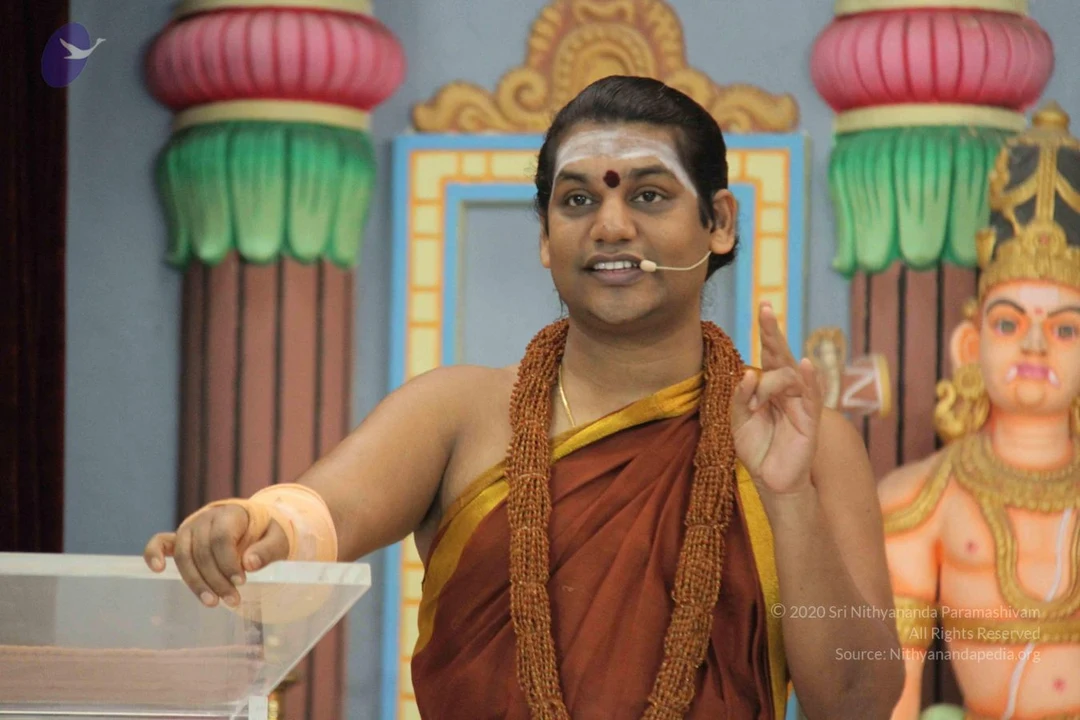
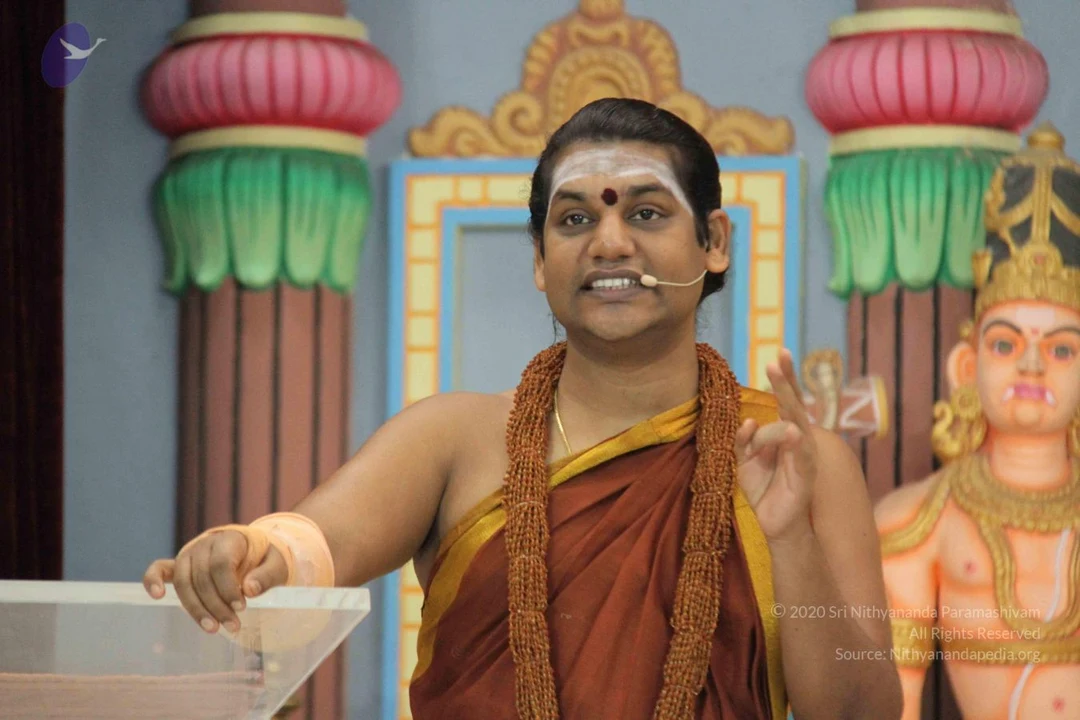
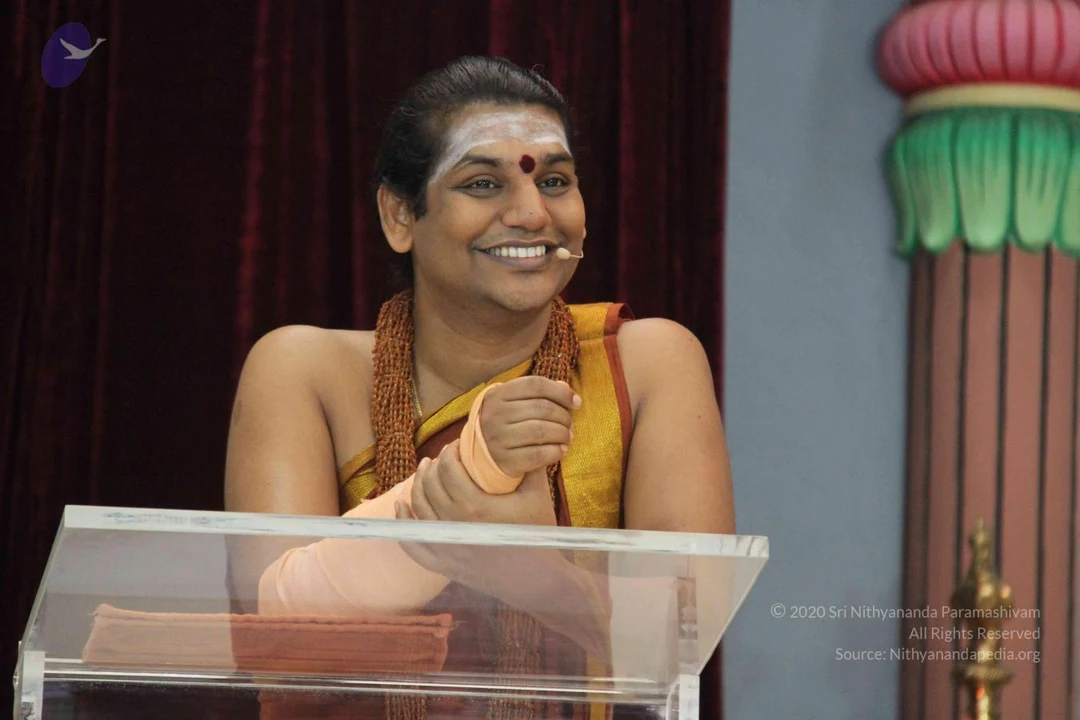
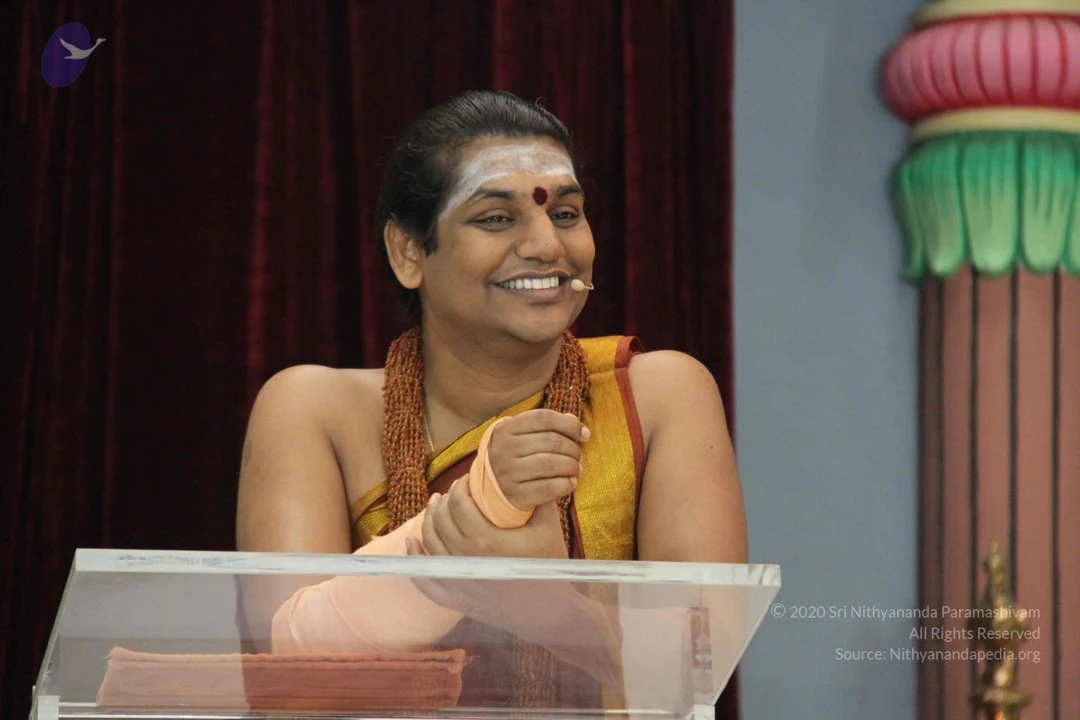
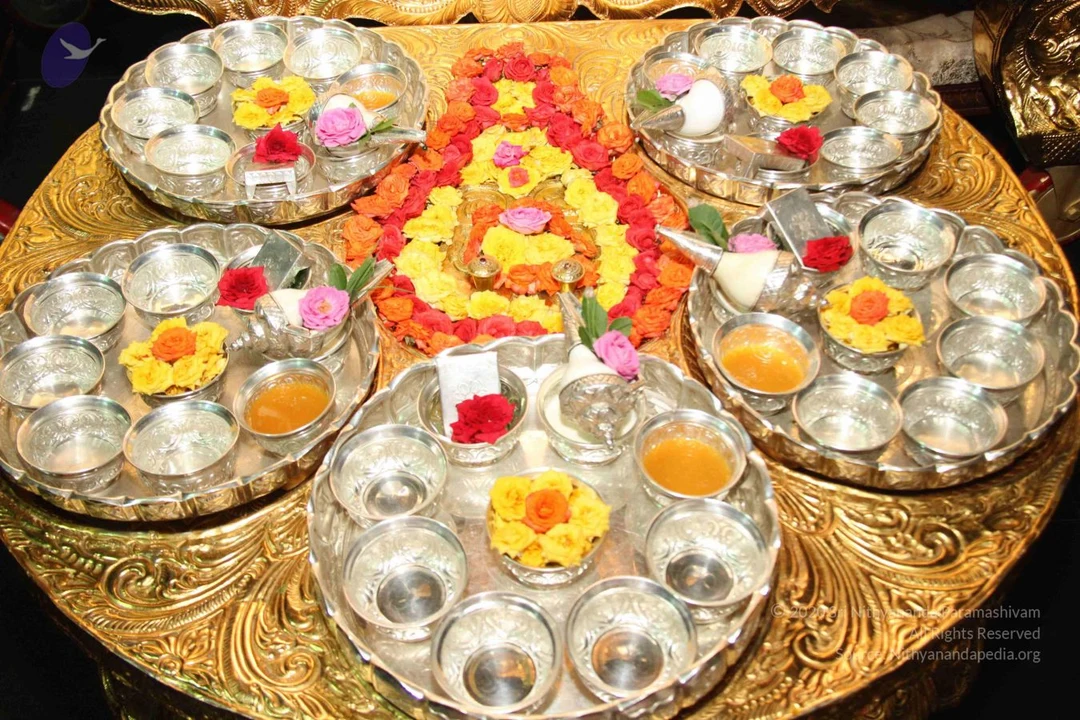
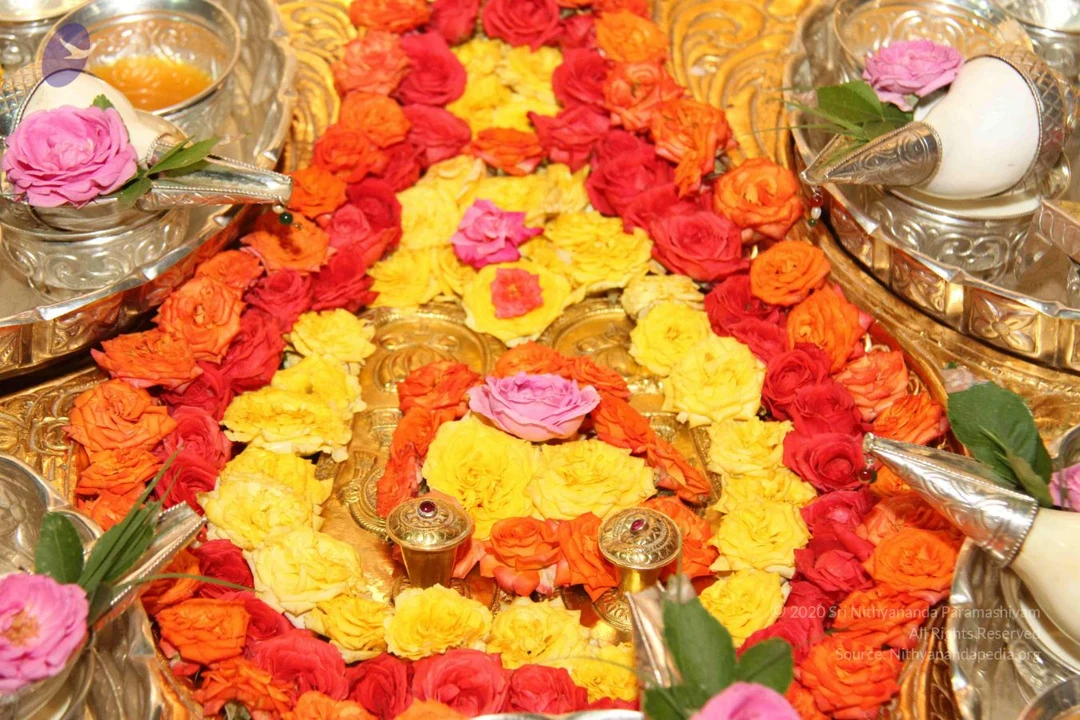
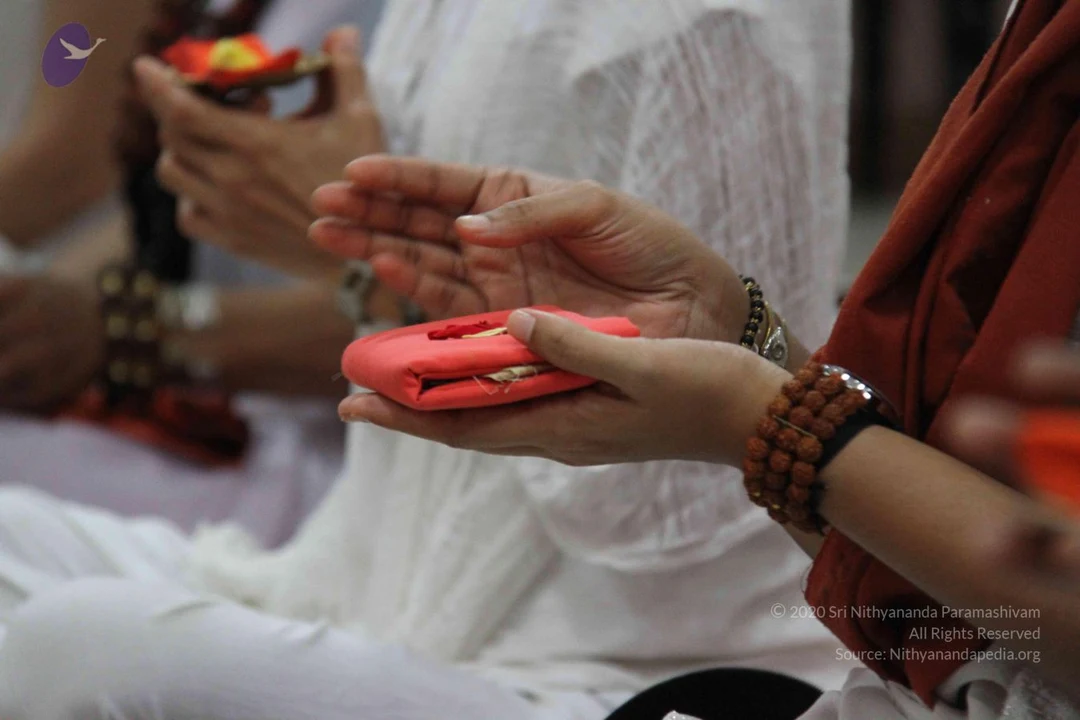
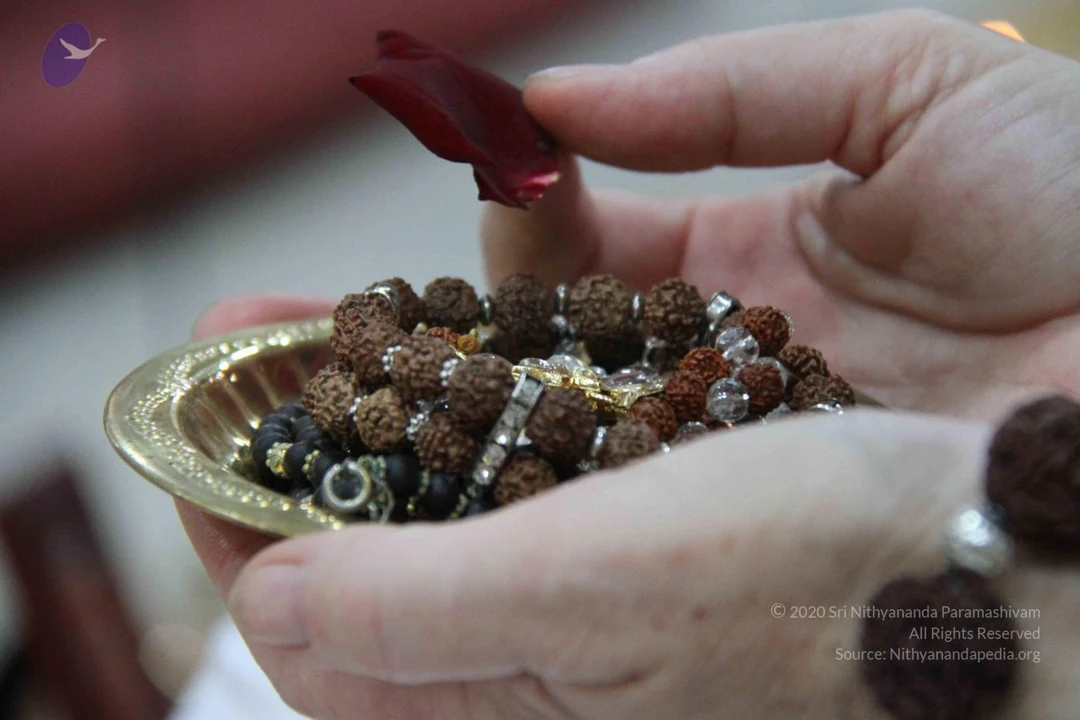
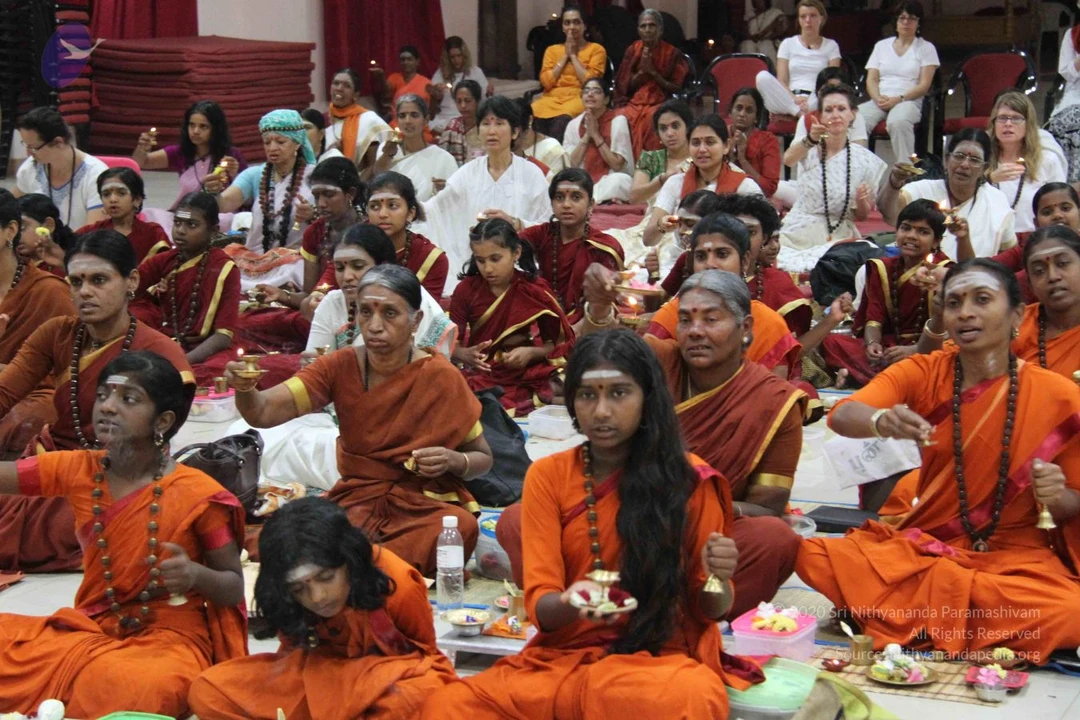
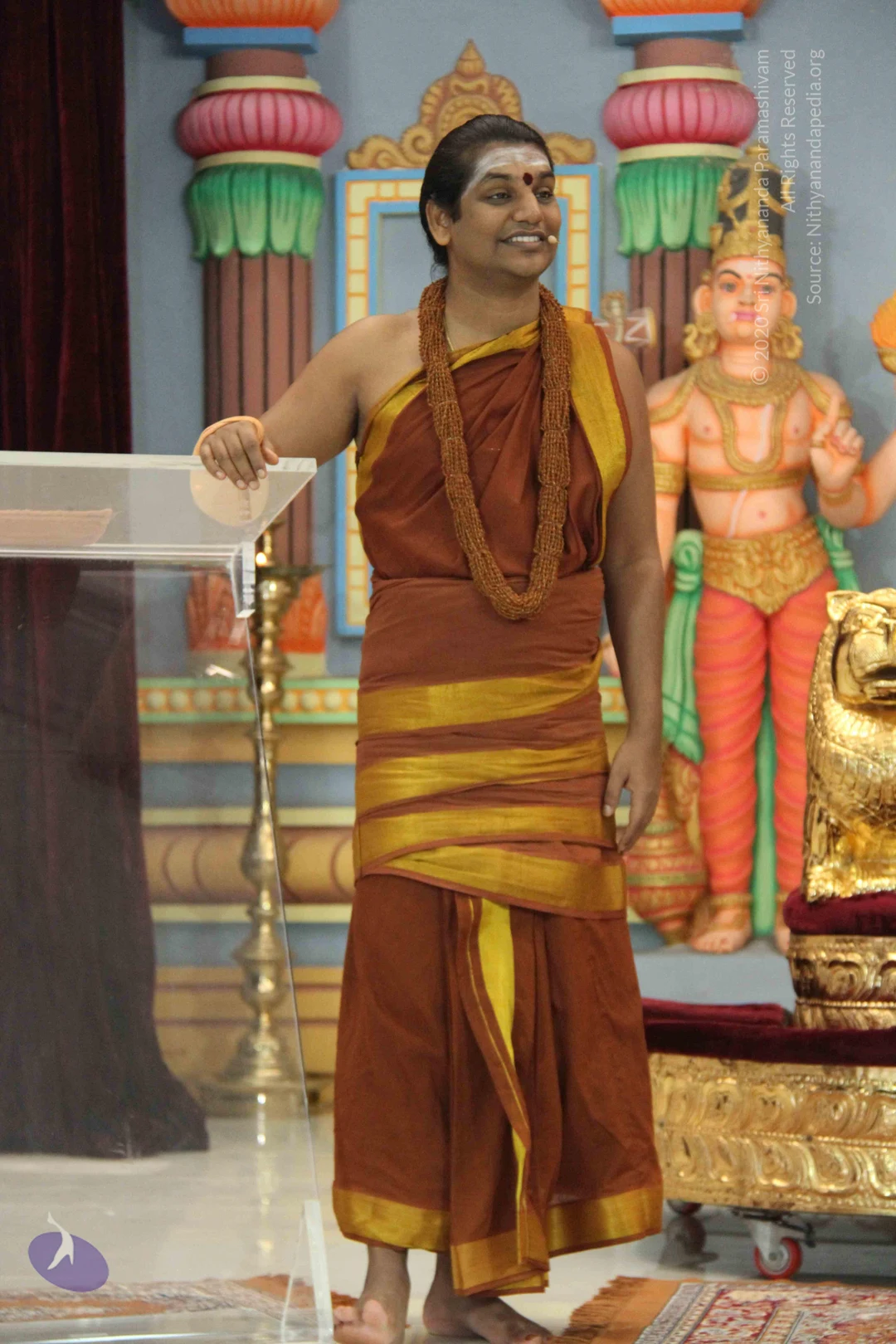
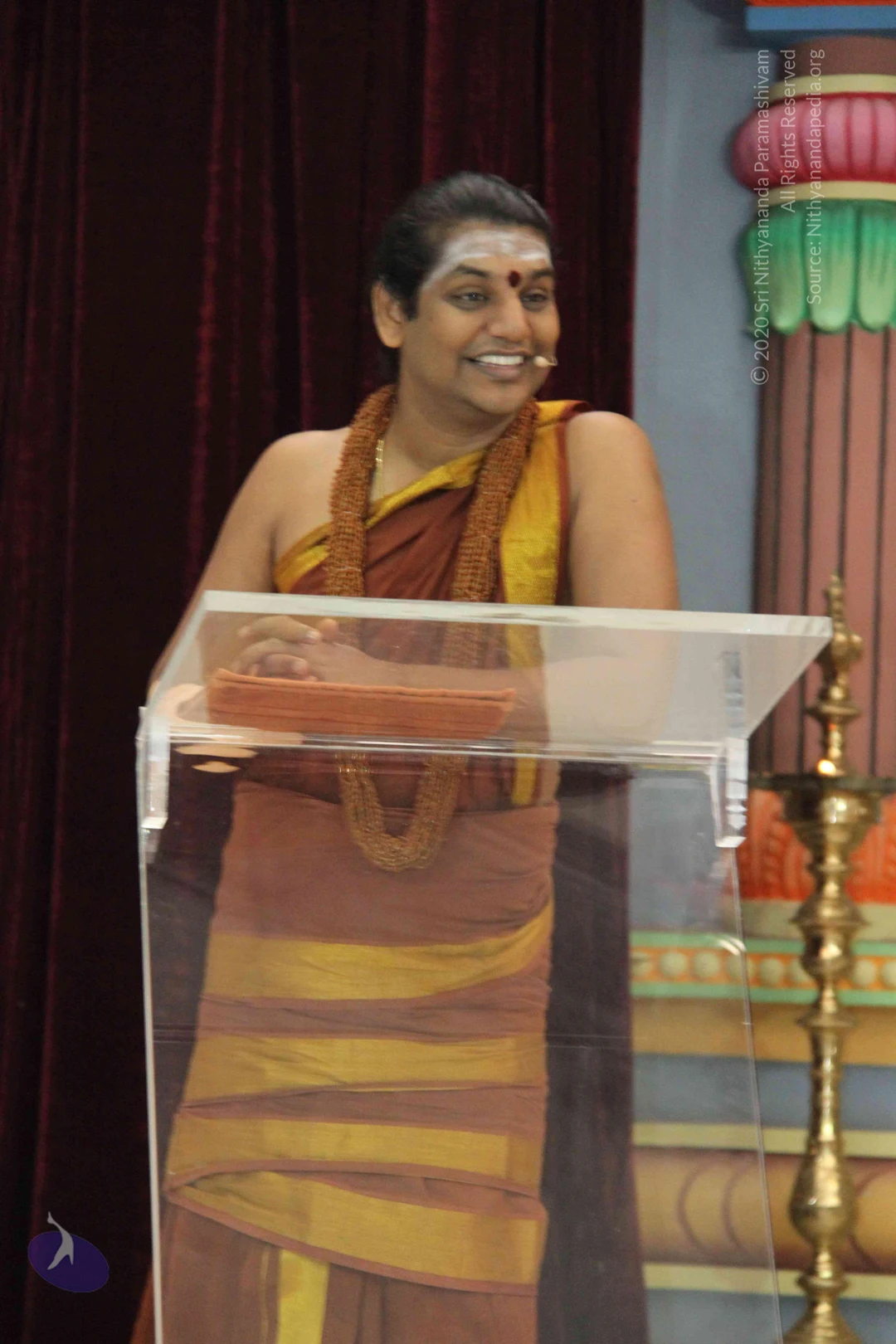
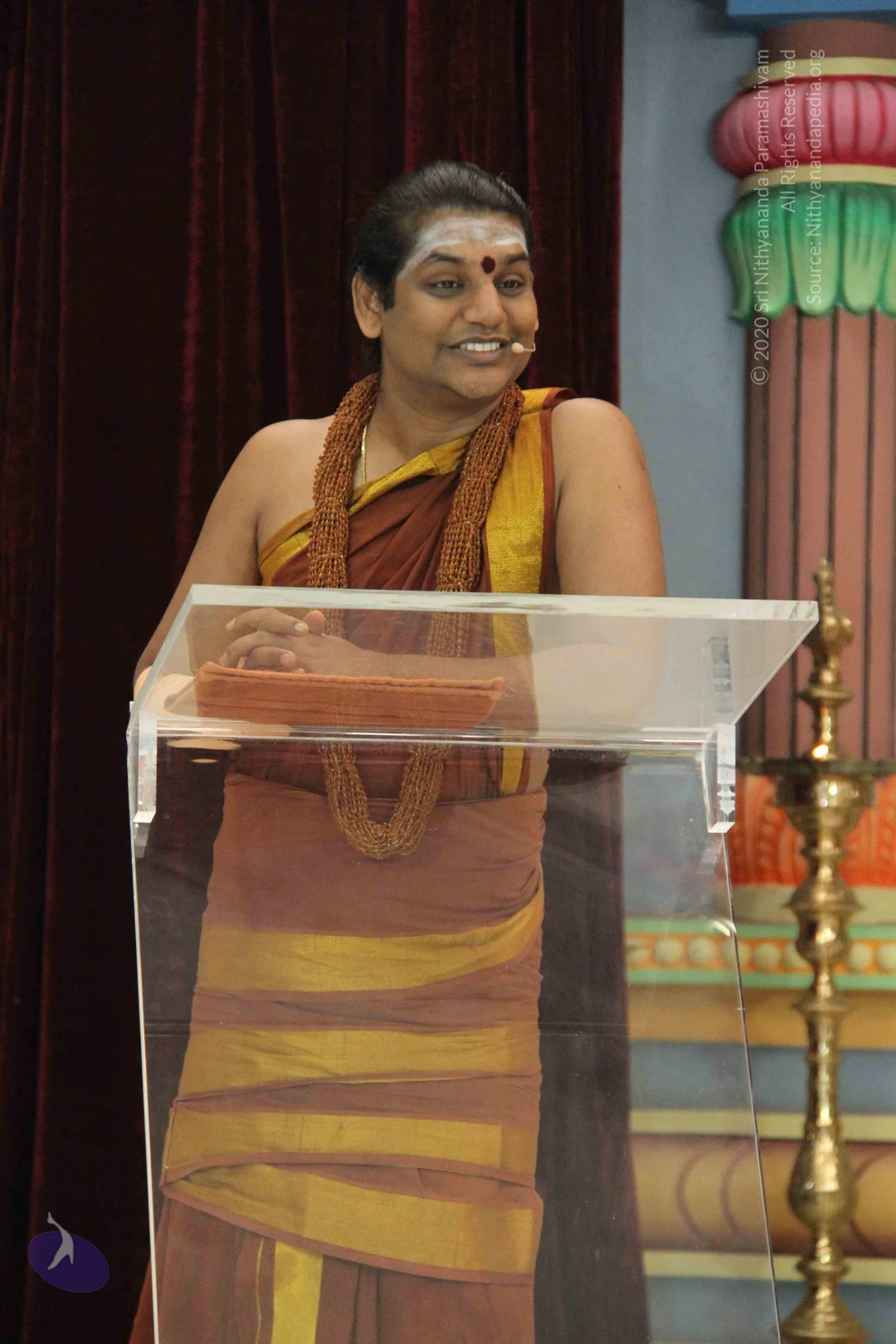
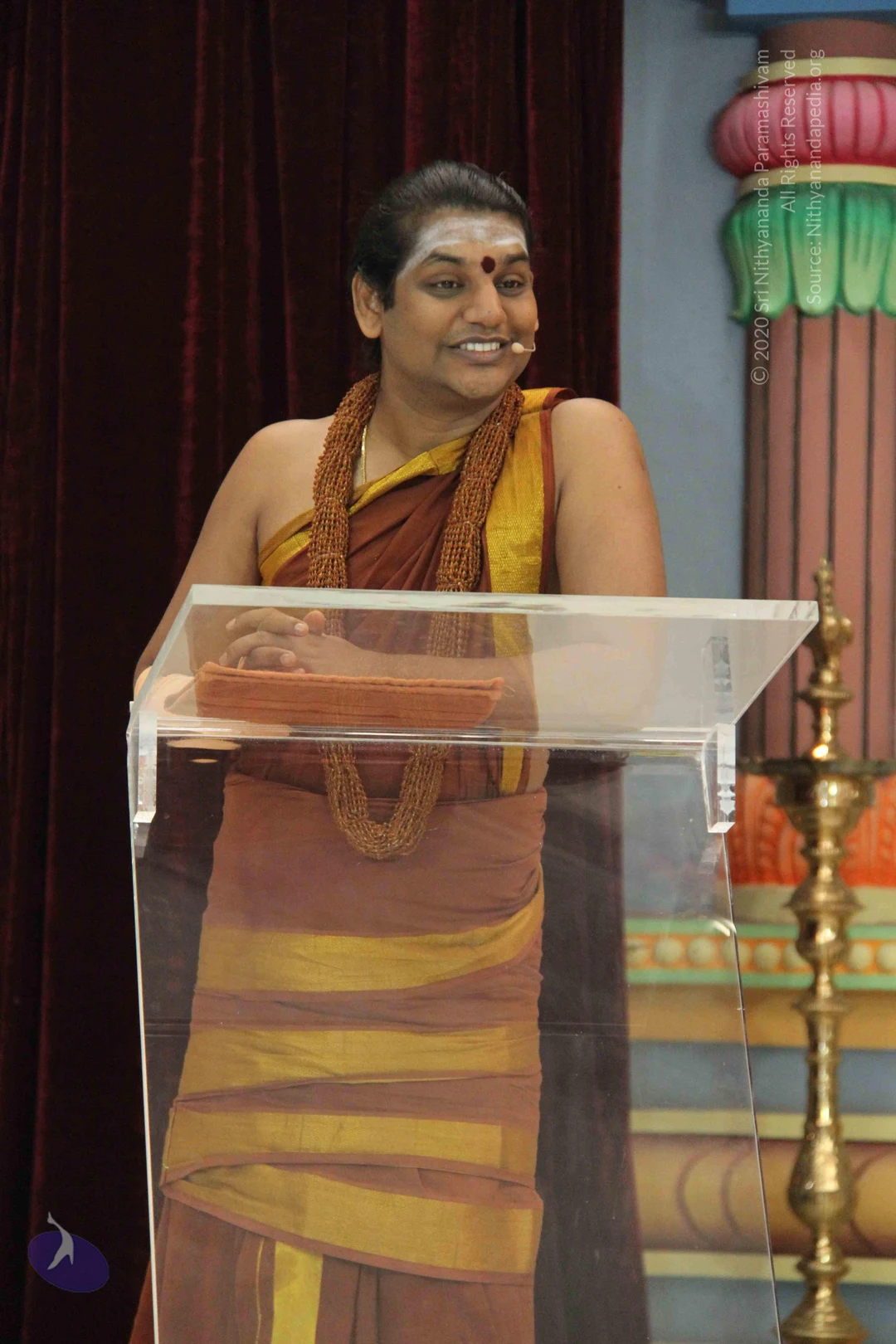
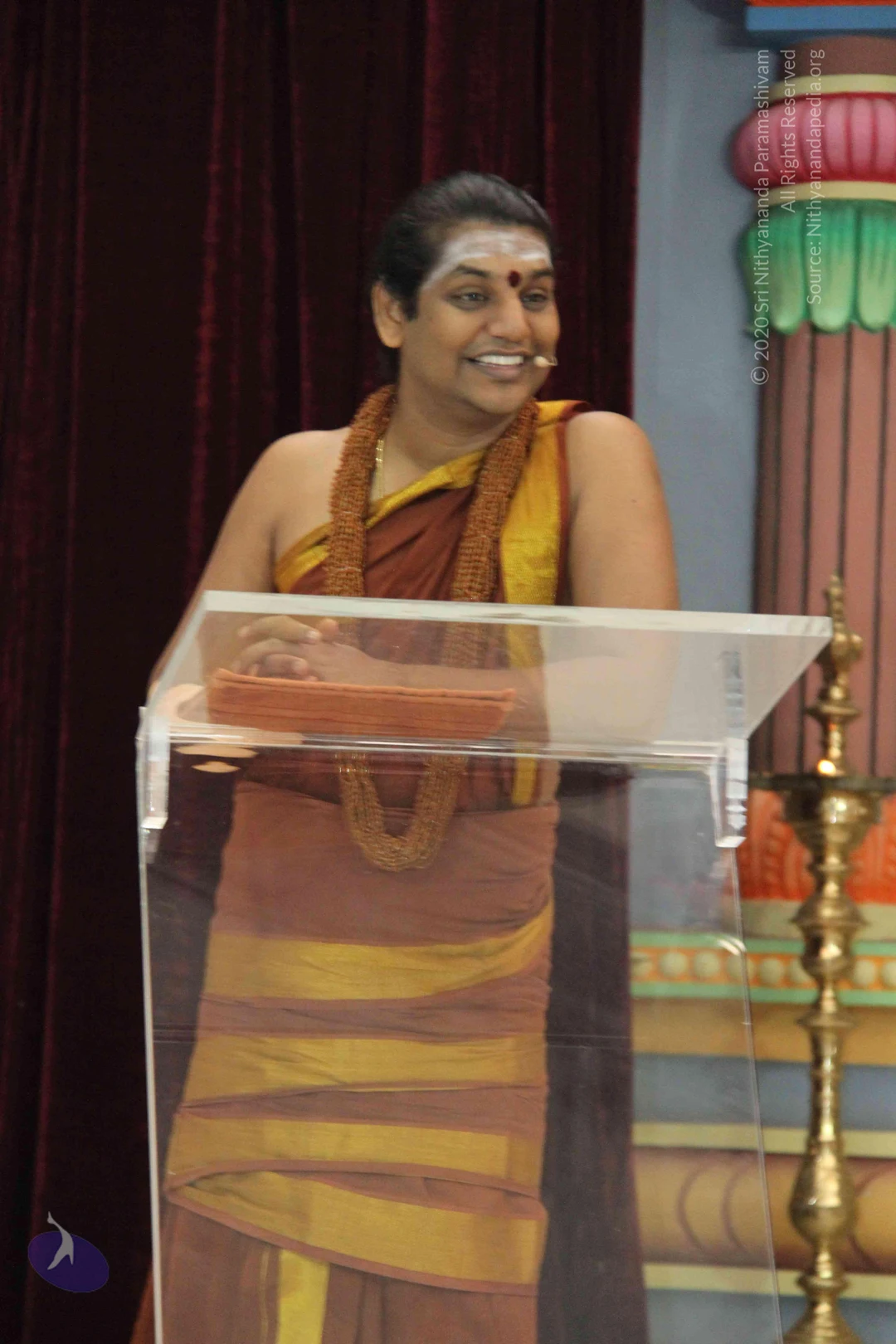
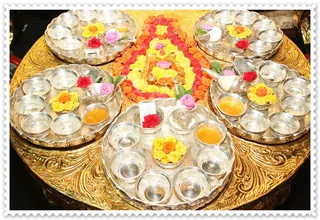
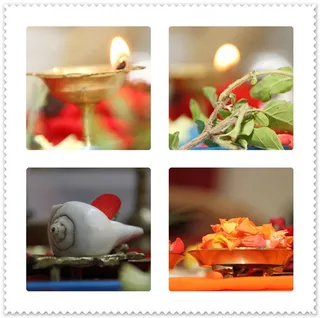
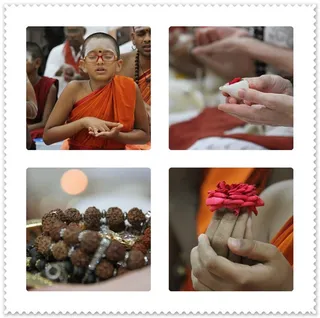
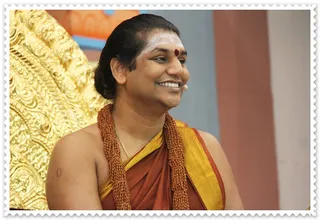
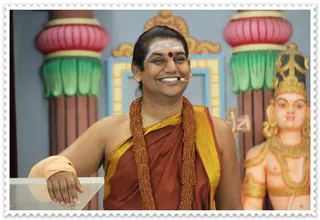
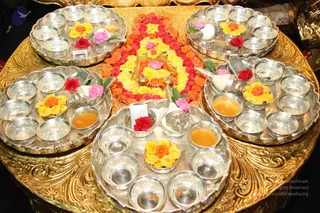
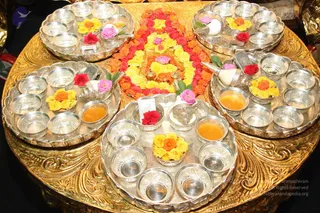
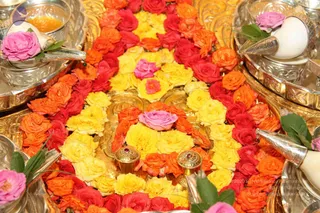
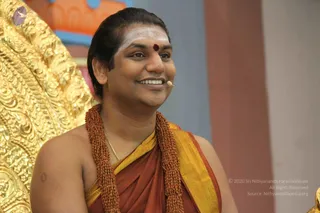
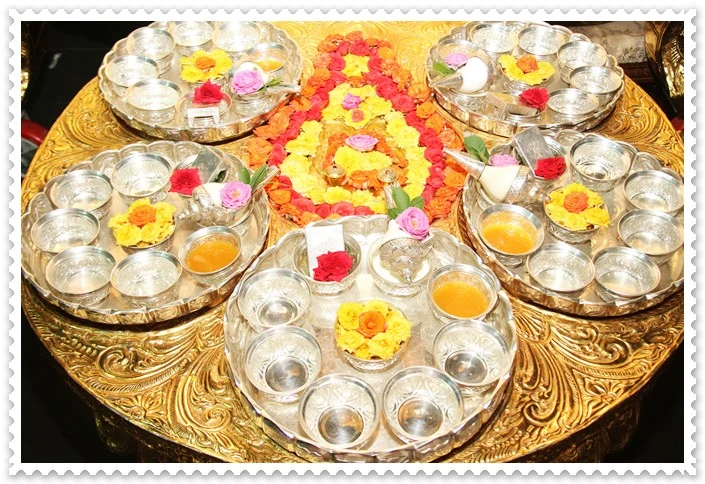
Overhead view of a ritual offering arrangement on an ornate gold-embossed round platform. Five silver trays with scalloped rims hold small silver cups filled with flowers, red and yellow blossoms, and golden-yellow liquid. A circular bed of red, orange and yellow marigold-style flowers with pink petals sits at the centre. Small white cards and a silver vessel are placed among the trays. No people are visible in the scene.Close-up photograph of a ritual arrangement of loose flowers on gold-toned trays. Red, orange and yellow rose petals and blooms are scattered across the centre in a decorative pattern, with pink roses placed on top. Silver and gold bowls, a small golden vessel with a red jewel and silver spouted cups line the edges, with green leaves at the corners. No people are visible. The setting suggests a puja offering arrangement of flowers and vessels.A four-panel collage of close-up photographs of puja items. Top left shows a brass oil lamp with a lit flame on a stand. Top right shows a lit lamp behind a sprig of green leaves on a stem. Bottom left shows a white conch shell with a red marking resting on a metal stand. Bottom right shows a brass dish of orange and red flower petals on an orange cloth. No people are visible.A four-panel collage of temple and satsang scenes. Top left: a young boy in saffron robes and red-framed glasses, with a red bindi, sits with eyes closed and hands held in a mudra in front of him, while another person in saffron and a rudraksha mala sits behind. Top right: hands holding a folded white cloth and red petals over a white-and-red draped surface. Bottom left: a close view of rudraksha mala beads with silver spacers and gold ornaments, with a warm blurred light behind. Bottom right: hands in saffron clothing offering a pink flower. The collage shows ritual and devotional items rather than a single event.A smiling man with swept-back dark hair sits before an ornate gold throne carved with floral patterns. He wears a white forehead marking with a red bindi, a saffron-red shawl with a gold-bordered edge, and a long rudraksha mala with a gold chain at his neck. A small microphone is visible near his face. The background shows a pink-and-blue wall. a person by appearance, seated as the speaker at a satsang-style event.A smiling man in a headset microphone stands behind a clear acrylic lectern, speaking to an audience. He wears a rust-red and gold-bordered dhoti-style wrap over bare shoulders, a long rudraksha mala of brown beads, and a red bindi with white vertical tilak on his forehead. His hair is swept back. Behind him, a painted pillar in pink, green and gold and a gold-framed blue panel frame a large orange-skinned deity figure with a golden crown and jewelled necklace. The swami figure is. Setting appears to be a satsang hall.

Nithyasatsang
34 photosSource gallery
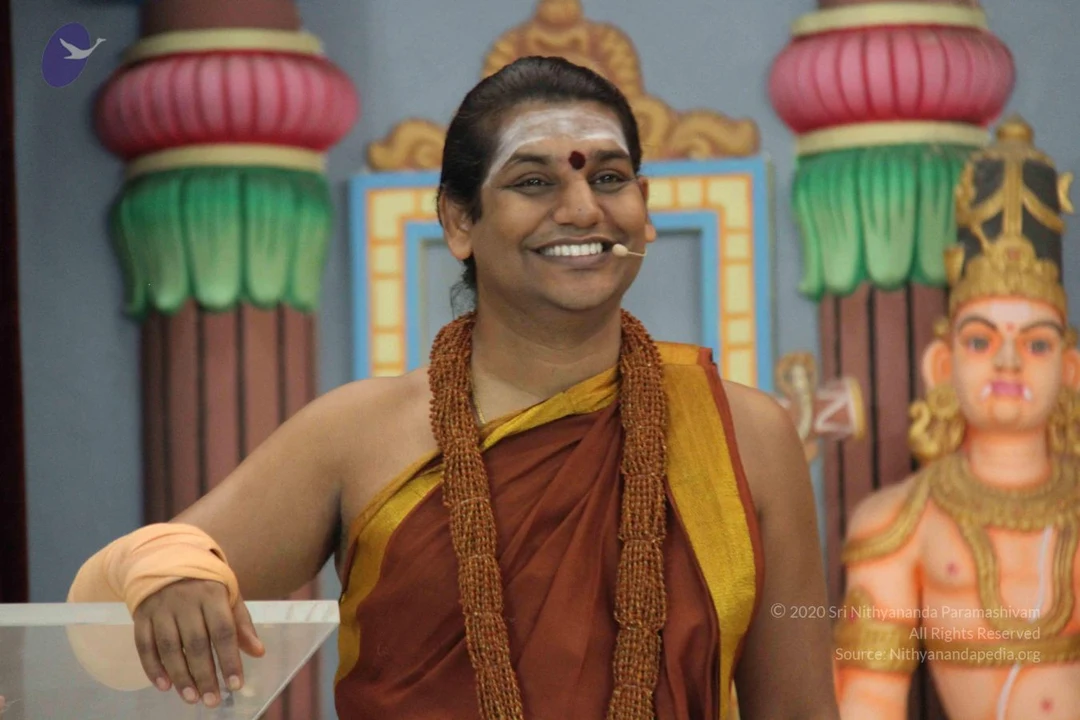
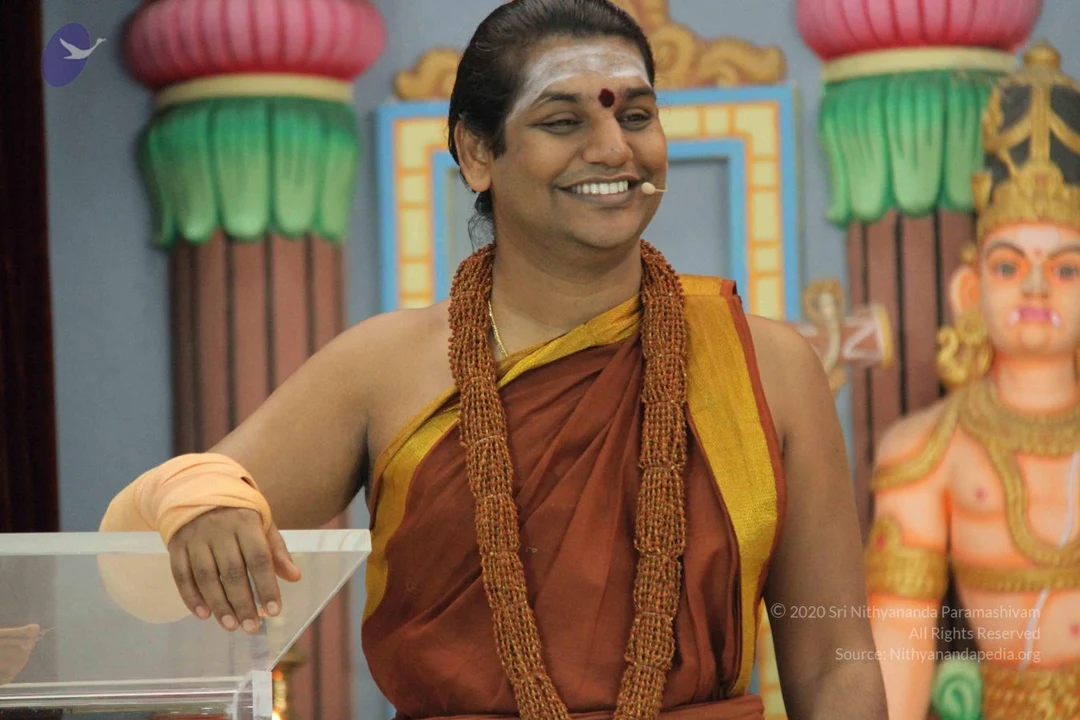
A smiling man sits on an ornate gilded throne with carved floral and lion-like motifs. He wears a rust-orange shawl over the shoulders with a gold-yellow border, rudraksha-style beaded malas around the neck, a white forehead marking with a red dot, and a gold earring. a person by appearance: long swept hair, saffron-orange clothing and rudraksha malas in a satsang seat; the page indicates he is present. A small microphone and a pale hand appear at the lower edge.A smiling man seated on an ornate gilded throne with a richly embossed golden backrest featuring floral scrollwork and carved animal motifs. He wears a rust-red garment with a gold-yellow border draped over his shoulder, a long rudraksha mala of rust-coloured beads around his neck, and a thin gold chain. He has a white vibhuti horizontal mark on his forehead with a red kumkum dot, and his hair is swept back. His right hand is raised in a gesture while he speaks to the gathering. Swamiji (probable): the appearance cues of swept-back hair, rudraksha mala and ornate clothing on a throne match the page's claim, though the face is not used for identification. A pale orange cloth edge is visible at the bottom. The image is a photograph with a KAILASA copyright overlay in the lower right corner.A smiling man with short dark hair sits on an ornate gilded throne with carved lion-like finials and filigree backrest. He wears a rust-red and gold-bordered robe, a rudraksha mala draped over his shoulders, a gold chain and gold earrings, with a white vertical tilak and red bindi on his forehead. Behind him a painted figure holds a red-tipped object. Presentation cues match the a person label: a sannyasi in saffron-orange with a rudraksha mala and ceremonial gold ornaments, seated on a throne in a satsang setting.A man seated on an ornate gold throne with a large repoussé gold backrest, wearing a rust-orange and gold-bordered dhoti-style wrap over bare shoulders, a long rudraksha mala with orange beads, a thin gold chain, gold earrings, a white forehead mark with a red bindi, and his hair swept back. He looks to the side while speaking, with a small microphone near his face. Beside him stands a polished brass oil lamp with a lit flame and a brass bird figure, against a pastel blue and pink wall.A photograph of a man seated before an ornate gold-leaf throne with carved floral and scrollwork patterns. He wears a rust-orange and gold-bordered cloth draped over his left shoulder, with a dense rudraksha mala in brown beads around his neck. He has a white vertical tilak on his forehead with a red dot at the centre, and a small clip-on microphone near his mouth. He is speaking, with his gaze directed to the side, against a pale blue wall and a terracotta-coloured pillar. a person: long swept-back hair, saffron and gold clothing and rudraksha mala cues are visible, though the image is ambiguous.A photograph of a smiling man seated beside an ornate gold carved throne-like structure. He has swept-back dark hair, a white vertical forehead mark with a red dot, and wears a rust-orange wrap with a gold-bordered yellow edge over bare shoulders. Two long rudraksha malas hang on his chest along with a thin gold chain. A small headset microphone is visible near his cheek. Behind him are orange and blue panels on a reddish-brown wall.
Dwajaarohanam
8 photosSource gallery
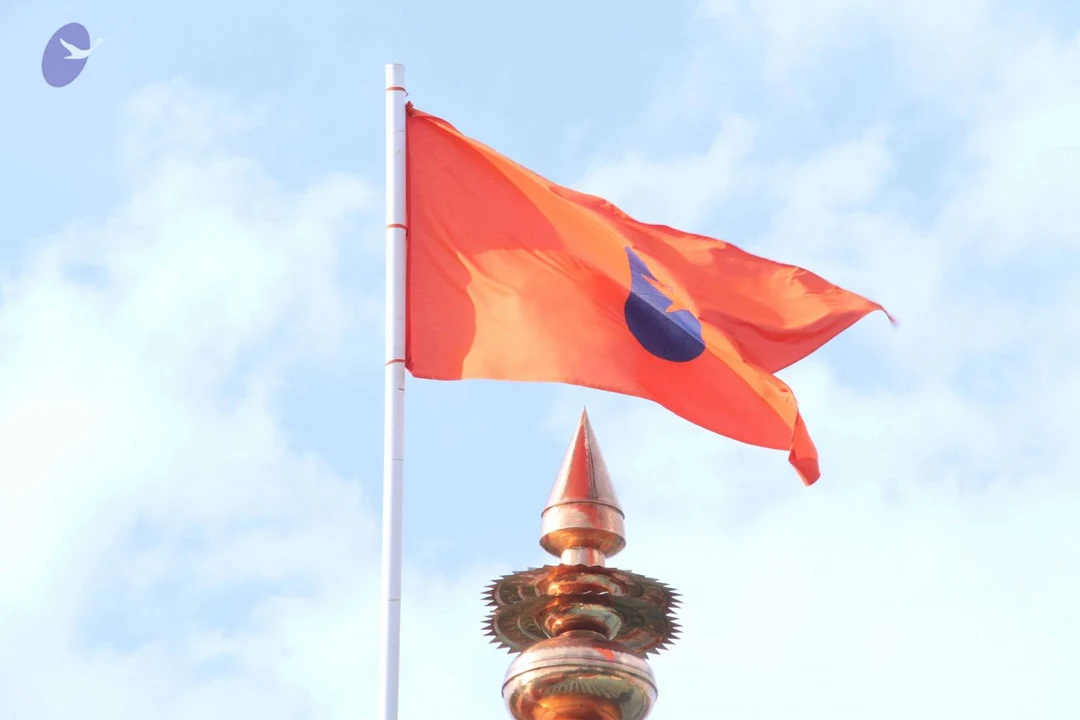
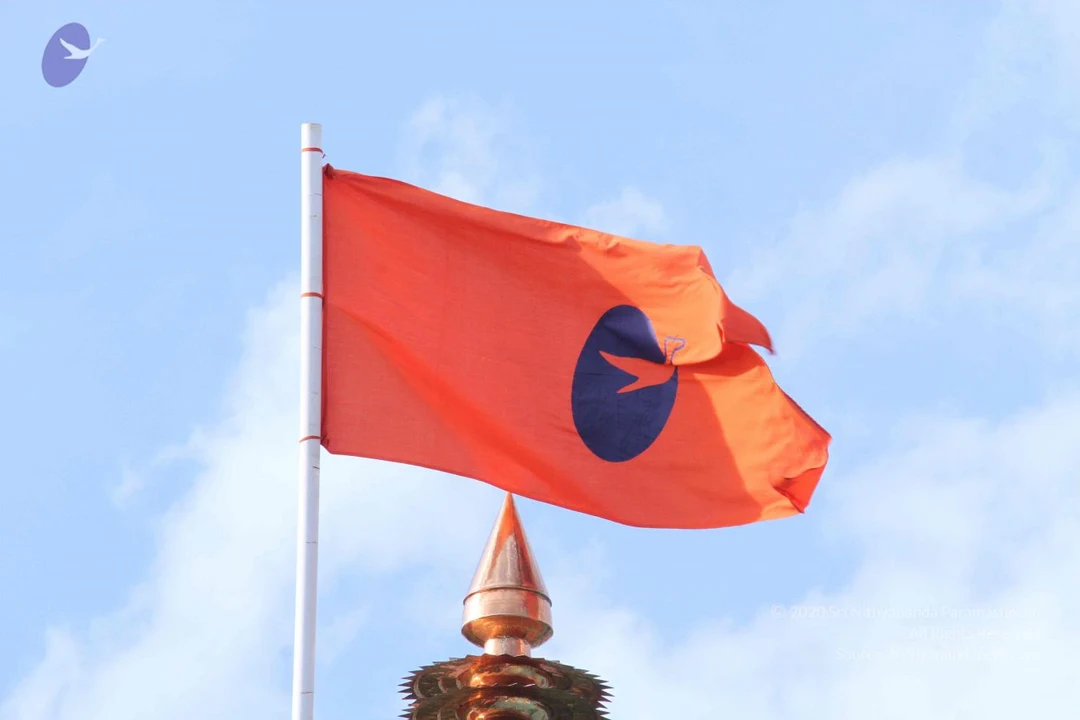
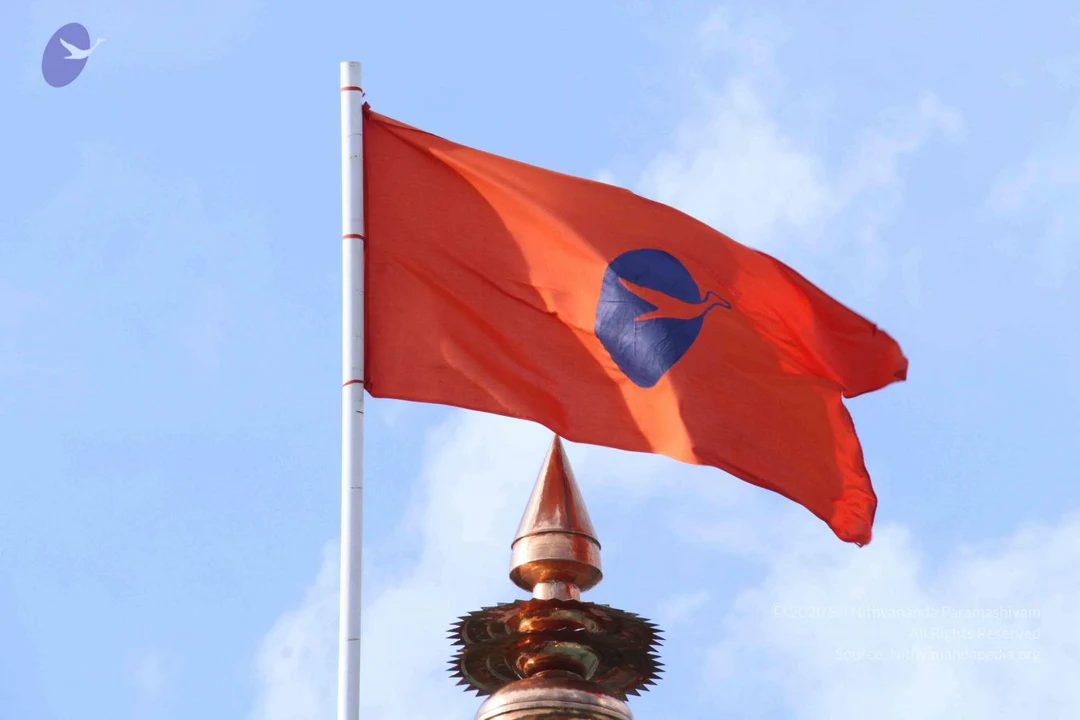
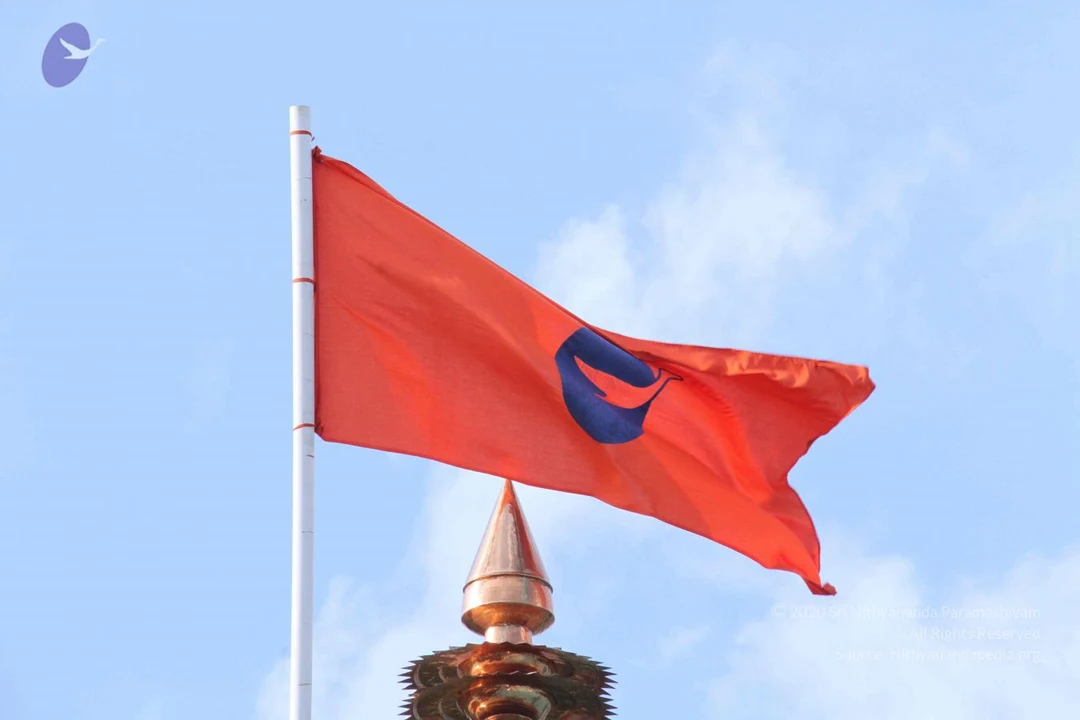
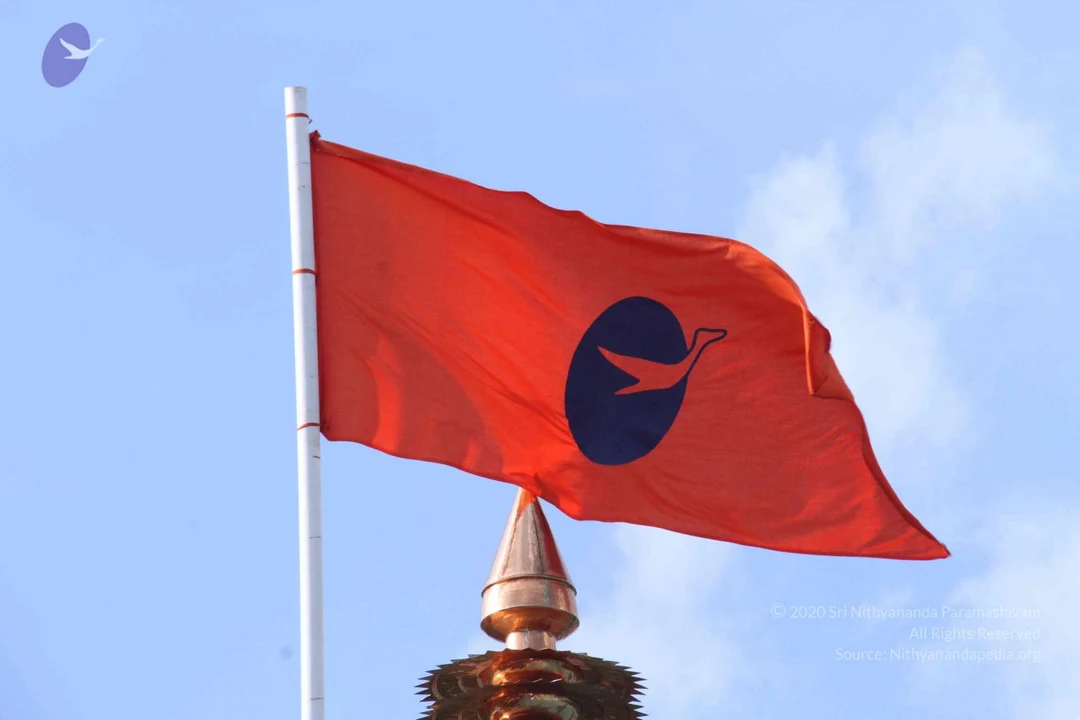
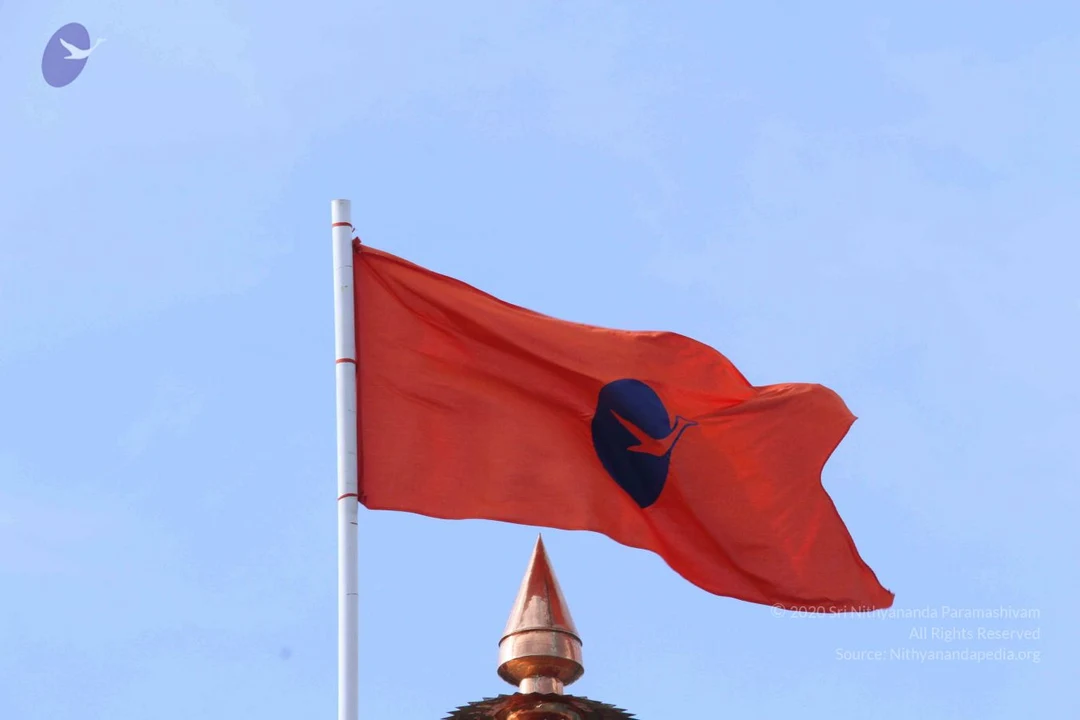
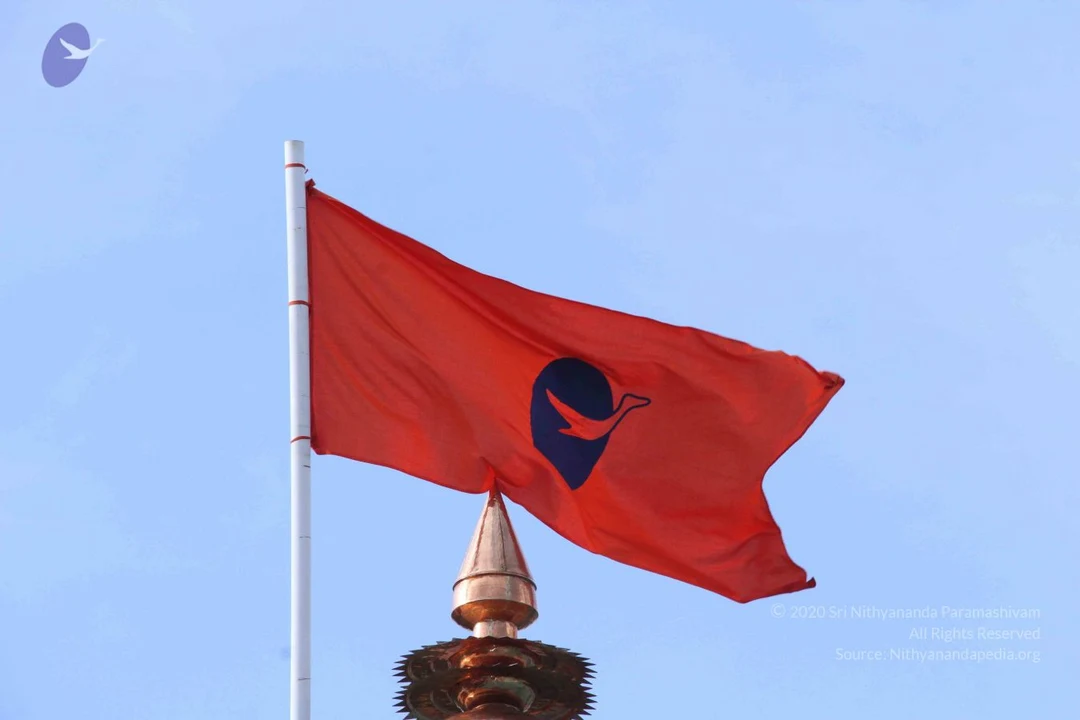
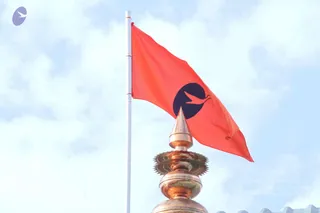
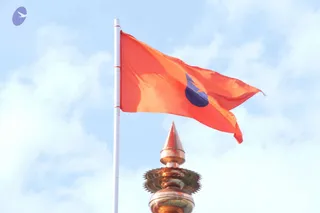
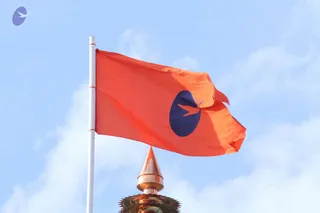
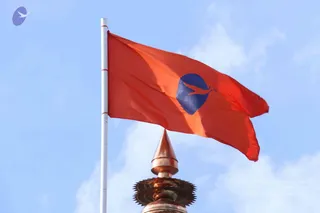
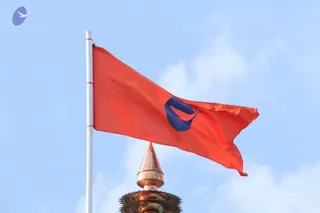
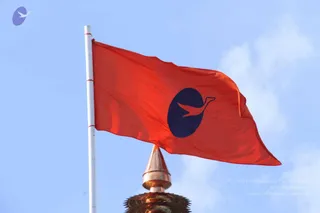
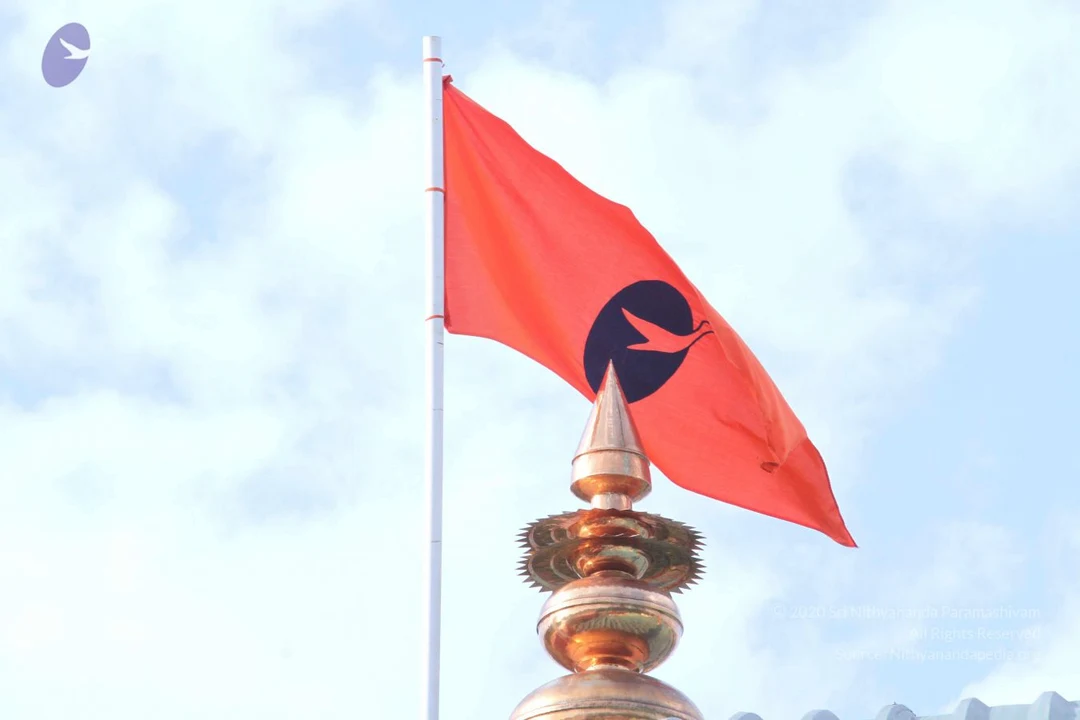
A photograph of a red-orange flag with a black circle bearing a white bird silhouette, flying from a white pole above a polished copper finial with a spiked spire and a fluted ring below. The flag ripples against a pale blue sky with soft clouds. No people are visible.A photograph of an orange saffron flag with a dark blue emblem fluttering on a white pole against a pale blue sky with clouds. Below the flag, the top of a copper-coloured finial with a conical tip and a serrated disc sits on a structure. No people are visible.An orange saffron flag with a dark blue oval emblem and a small white bird-like motif flutters on a white pole against a clear blue sky with wispy clouds. Below the flag, the copper-coloured finial of a temple spire rises, with an ornate tiered base visible at the bottom. No people are visible in the scene.A photograph of a bright orange-red flag with a blue bird emblem flying on a white pole against a pale blue sky with wispy clouds. The flag's emblem is a stylized blue bird in flight. Below the flag, a copper finial with a spiked, ornamental base is visible at the top of a structure. No people are present.A photograph of a saffron-orange flag with a dark blue emblem flying from a white pole against a pale blue sky with wispy clouds. Below the flag, a copper-coloured finial with tiered ridges crowns a temple structure. No people are visible.A photograph of a bright red-orange flag fluttering on a white pole against a pale blue sky with wispy clouds. The flag bears a dark navy oval with a stylised white bird in flight. A copper finial with a decorative base sits at the top of a structure in the lower foreground. No people are visible.

padukapuja
42 photosSource gallery
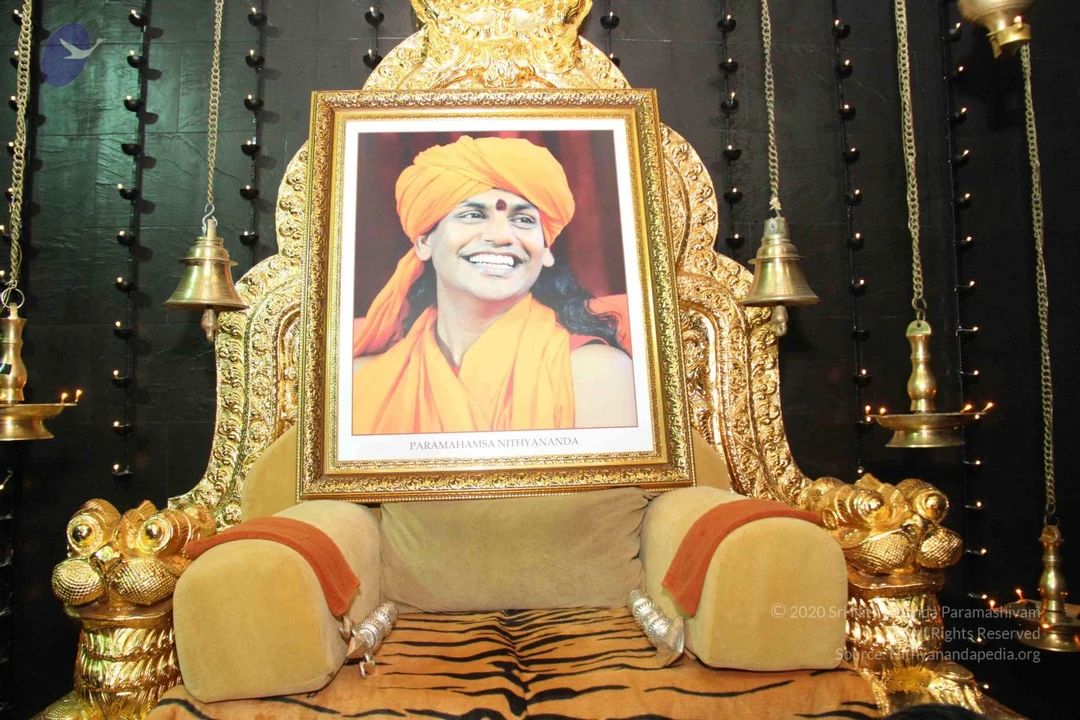
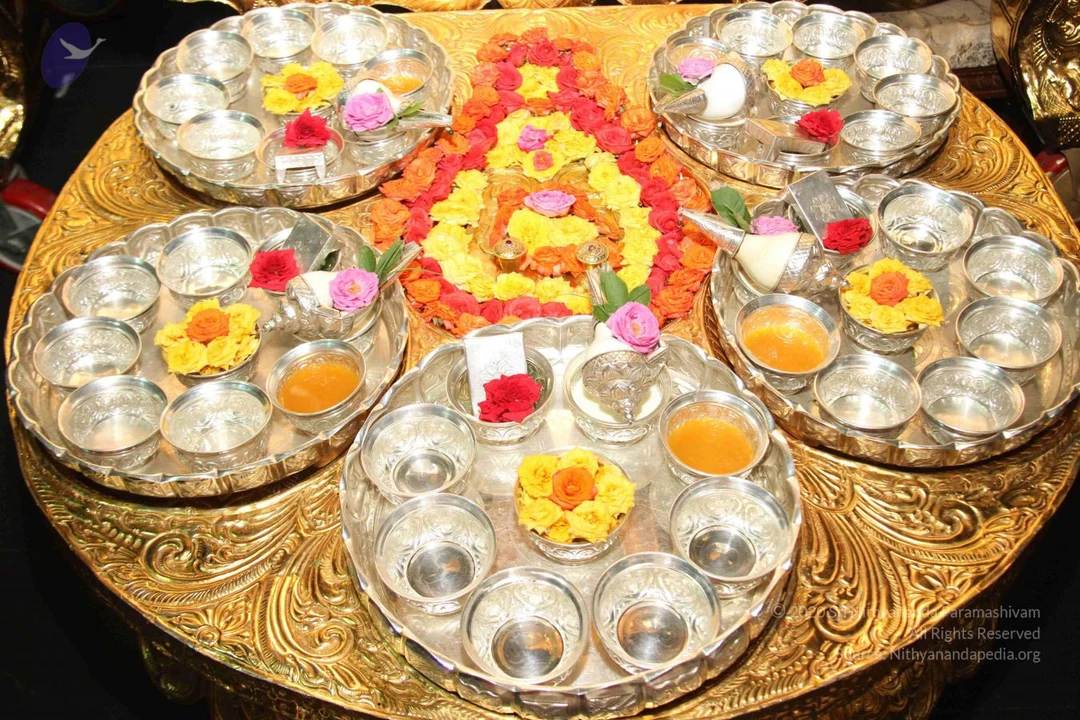
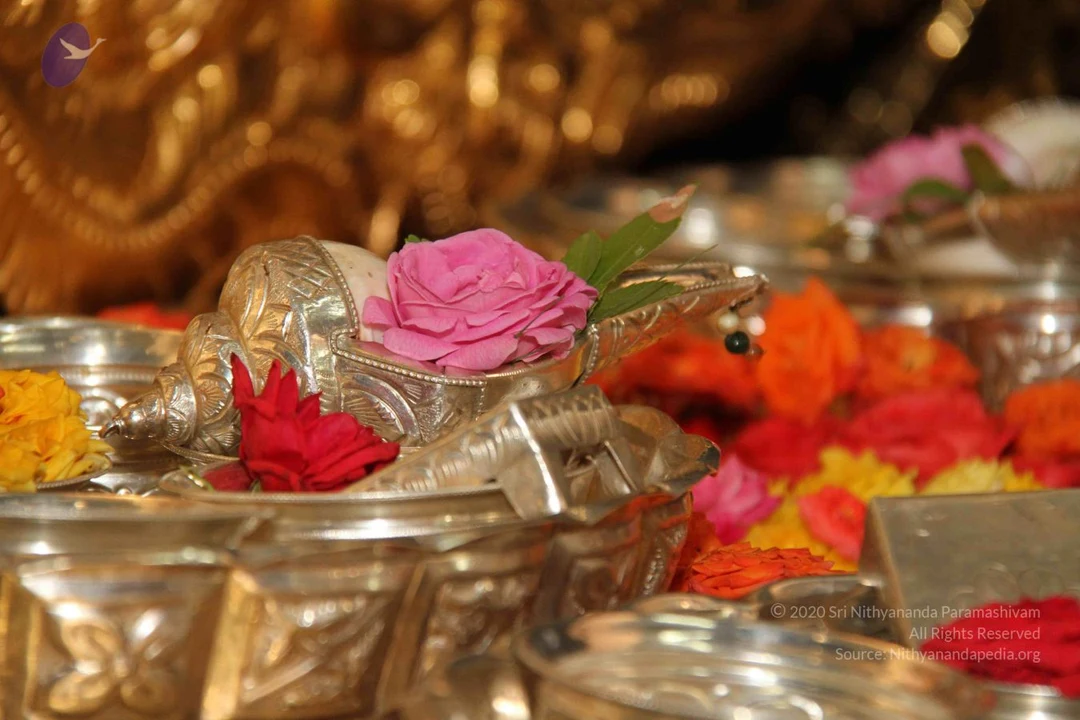
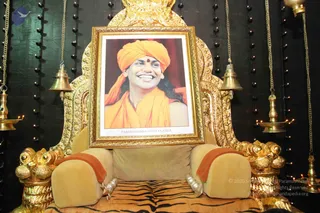
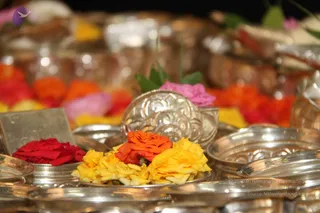
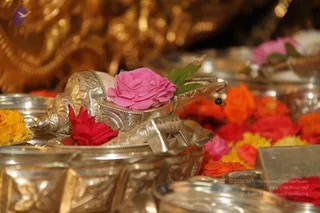
An empty ornate golden throne (peetha) with a carved gold backrest and lion-like armrests, draped with a tiger-striped cloth and tan cushions with orange trim. Centered in the throne is a framed photographic portrait of a smiling man with an orange turban, orange shawl and a red bindi, labelled as a portrait caption. Brass bells hang on chains and brass oil lamps with lit flames stand on either side against a dark textured wall strung with rudraksha beads. No physical people are present.Overhead view of a ritual offering arrangement on a large gold-embossed tray. Several silver plates with scalloped rims hold small silver bowls, some filled with orange-yellow liquid or paste, and silver spouted vessels. Marigolds in yellow and orange and red roses are arranged in a floral border around a central gold-coloured object, and pink flowers and green leaves are scattered among the dishes. No people are visible.A photograph of an arrangement of silver offering plates on an ornate gold-embossed tray, displayed as a ritual setting. Several round silver trays hold small silver bowls arranged in circles, filled with marigold-yellow and orange flowers, pink and red roses, and bowls of orange-yellow sweet offerings. Pink and red roses and green leaves sit near small silver vessels with pouring spouts. A central bed of orange, red and yellow flowers forms a decorative pattern, with lit oil lamps amid the petals. No people are visible; the setting is an arrangement of puja offerings and flowers.A photograph of a ritual arrangement on a gold-toned tray: a large oval field of densely packed roses in yellow, orange, red and pink, with a single pink rose at the centre. Two small gold cups with red stone accents sit in the middle, and silver spoons with white handles lie at the edges beside silver bowls and a dish holding a golden substance. Pink roses and green leaves decorate the corners. No people are visible; this appears to be a floral offering or puja setup.Close-up photograph of silver ritual vessels and flower offerings arranged on a tray during a temple-style puja setting. In the foreground, a silver bowl holds yellow and orange marigold-like flowers with a red flower pile to the left. A pink rose sits near an ornately embossed silver container, with green leaves and stems behind. Blurred silver plates, bowls and more flowers in red, orange and pink fill the background. No people are visible.Close-up photograph of ornate silver ritual vessels with embossed floral and leaf patterns, arranged before a blurred gold-embossed backdrop. A pink rose with green leaves rests in a silver bowl, while a red flower sits on a silver tray, and orange, yellow and red marigolds and roses are scattered among the vessels. A small silver spouted pot and a silver pitcher with bead-like tassels are visible. No people or deity figure is shown; the arrangement suggests puja offerings of flowers and vessels.
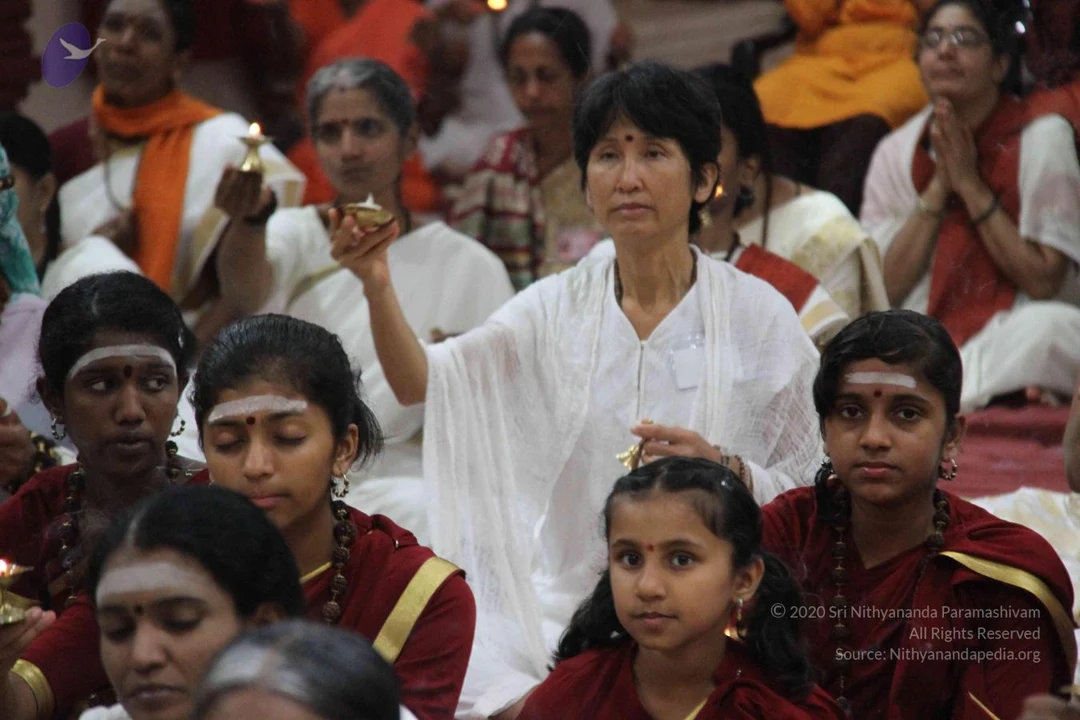
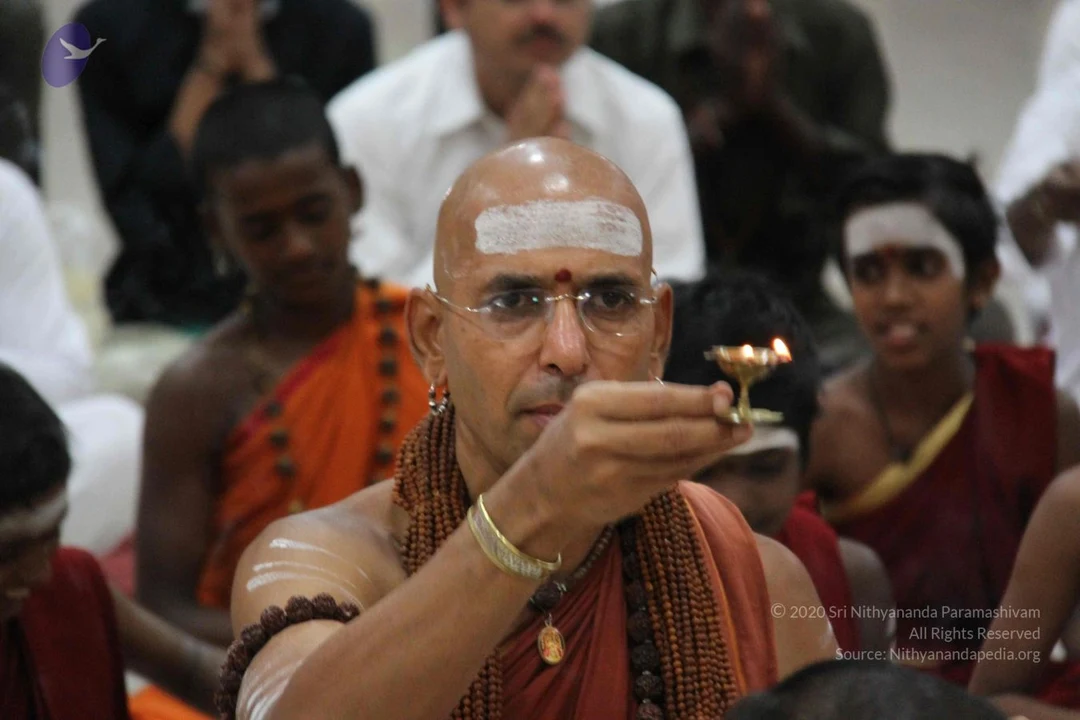
Goshala-Rabbit

3 photosSource gallery
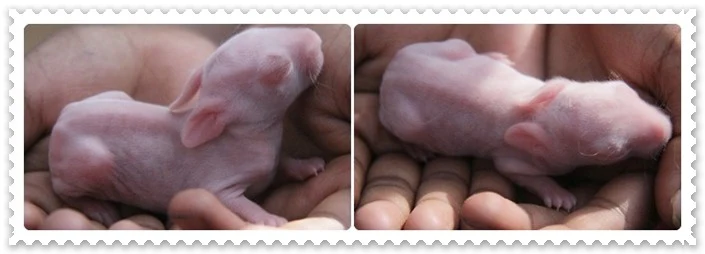
Close photo of two cupped hands holding a tiny newborn hairless animal, pinkish-grey skin, small folded ears, tiny clawed feet, lying on its side. No people's faces visible. Purple bird logo in the top-left corner.A photograph of a small hairless newborn animal lying on a pinkish-white plastic tray with a mesh edge at the left. The pink body is wrinkled and bare, with a small tail-like limb extended to the right, and the head is turned downward toward the tray surface. Scattered dirt and reddish stains mark the tray. No people are visible in the frame.A photograph of a newborn, hairless animal lying on its side on a pinkish, speckled surface, possibly a piglet or puppy. Its tiny legs and ears are visible, and the surface has stains and dirt. No people, ritual setting, or identifiable a person appearance is present.

Gurukul

4 photosSource gallery
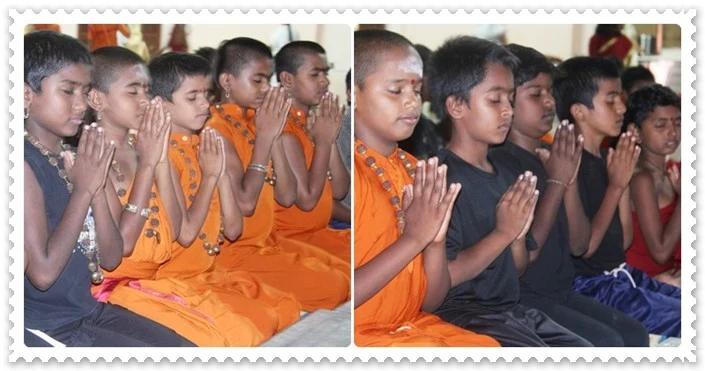
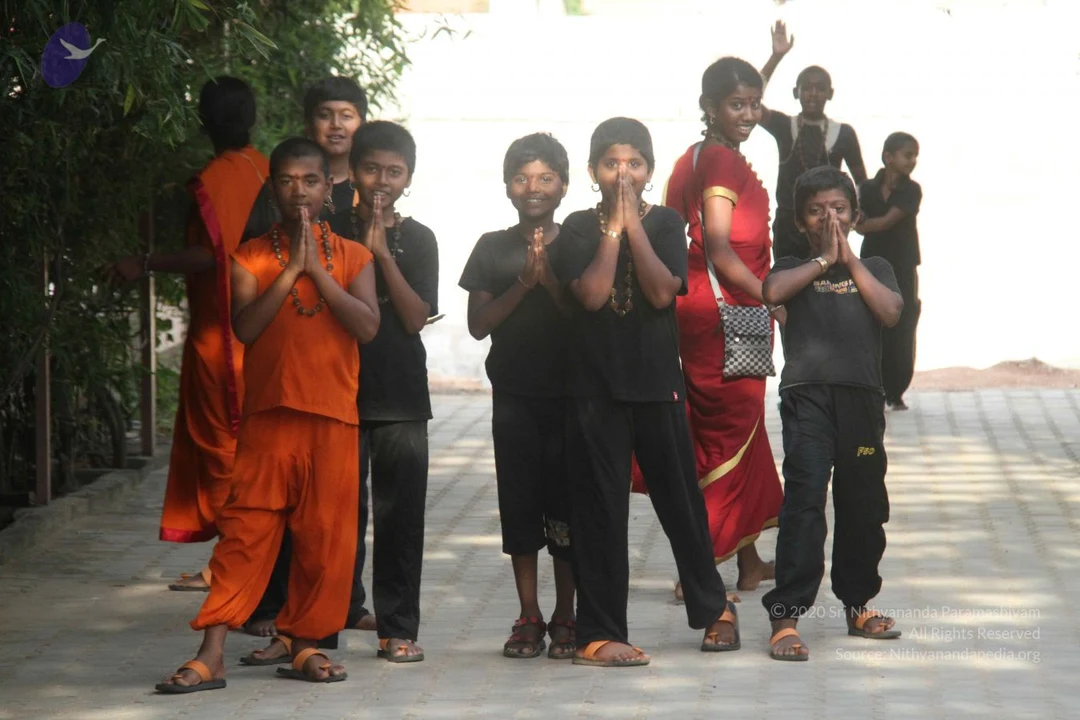
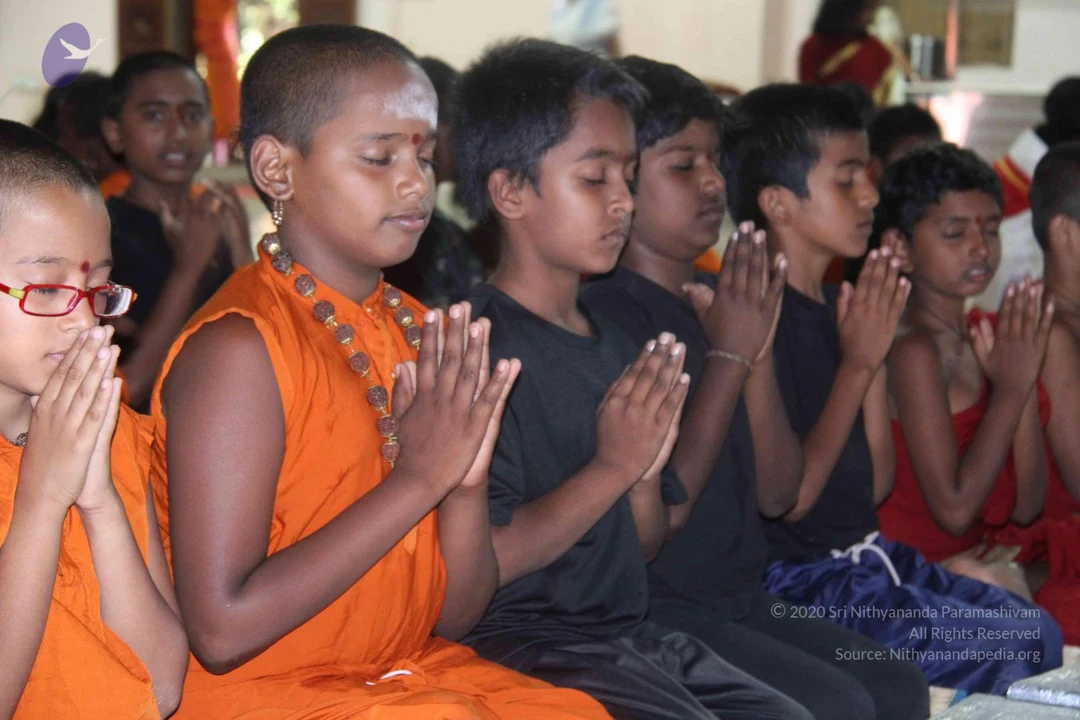
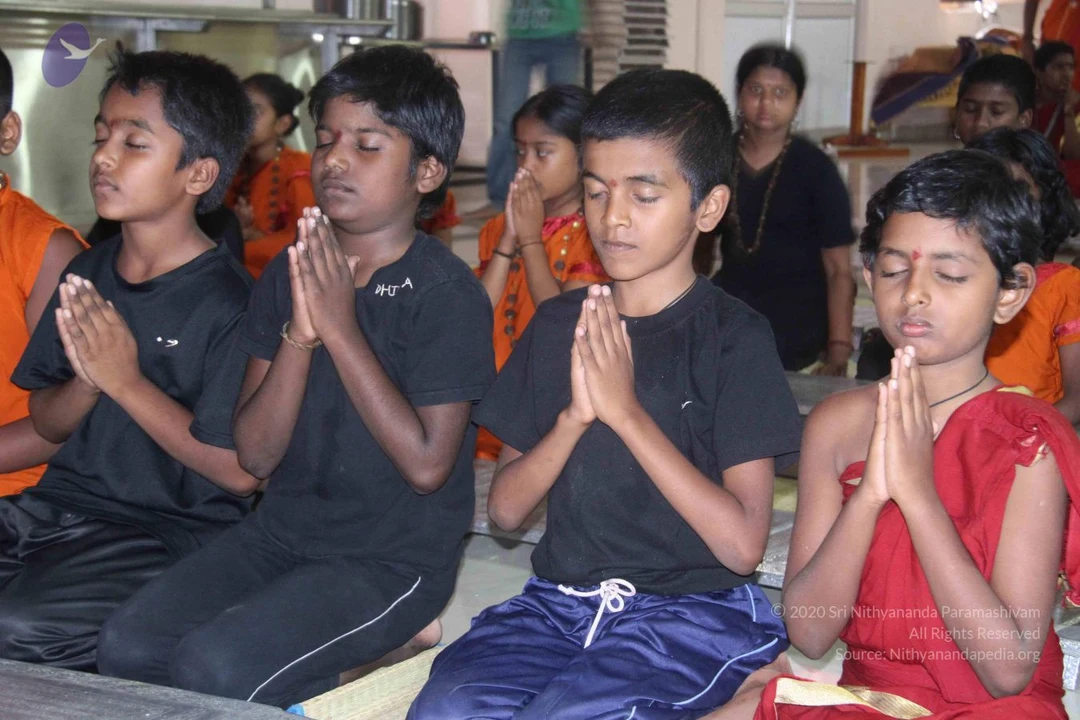
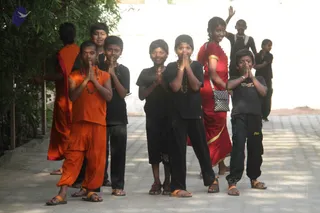
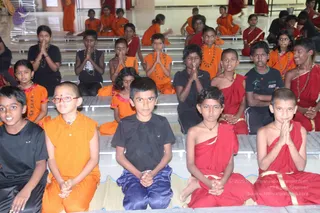
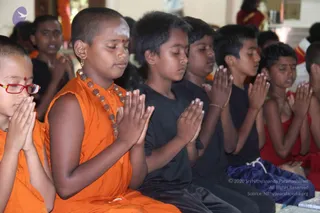
A photograph of a group of young people standing on a paved courtyard path beside green foliage, several with palms pressed together in anjali namaskar greeting. A boy in front wears an orange sleeveless top and orange harem-style trousers with rudraksha beads around his neck. Beside him, a boy in a black t-shirt and black trousers also presses his hands together, and a girl in a black top with a rudraksha mala hands together as well. A girl in a red saree with gold border and a checked handbag stands to the right, and a few more people in black and orange clothing appear in the background, one raising a hand. No a person candidate is visible.A photograph of a seated group of young children, mostly boys and some girls, in a hall with light tiled floor and grey wooden benches. Most wear saffron-orange or red robes, with black or navy T-shirts among others, and many have rudraksha malas around their necks. Many sit with palms pressed together in anjali mudra, and a few have vibhuti or red tilak marks on their foreheads.Several young boys sit in a row with eyes closed and palms pressed together in anjali mudra, a devotional posture during satsang or prayer. The boy in front wears a saffron-orange sleeveless robe, a rudraksha mala and a red bindi on his forehead; a boy to the left wears orange and red-framed glasses; others wear plain black t-shirts, and a boy at right wears a red garment. Some shaved-headed children and a sanskrit-style vibhuti mark appear in the background. No adults are clearly visible in the foreground, and the room has white walls and a curtain behind them.A photograph of a group of children seated with eyes closed and palms pressed together in anjali mudra, appearing to be in prayer or meditation. Most wear black t-shirts and dark shorts or track pants, while the child at right wears a red garment draped over the shoulder. Two children in the back row wear orange clothing, and an adult in a black top with a beaded mala necklace sits behind them. Some children have a red tilak mark on the forehead. The setting is an indoor hall with a wooden platform and a dark-clad adult in the background. No identifiable a person figure is visible.

IA-registration

4 photosSource gallery
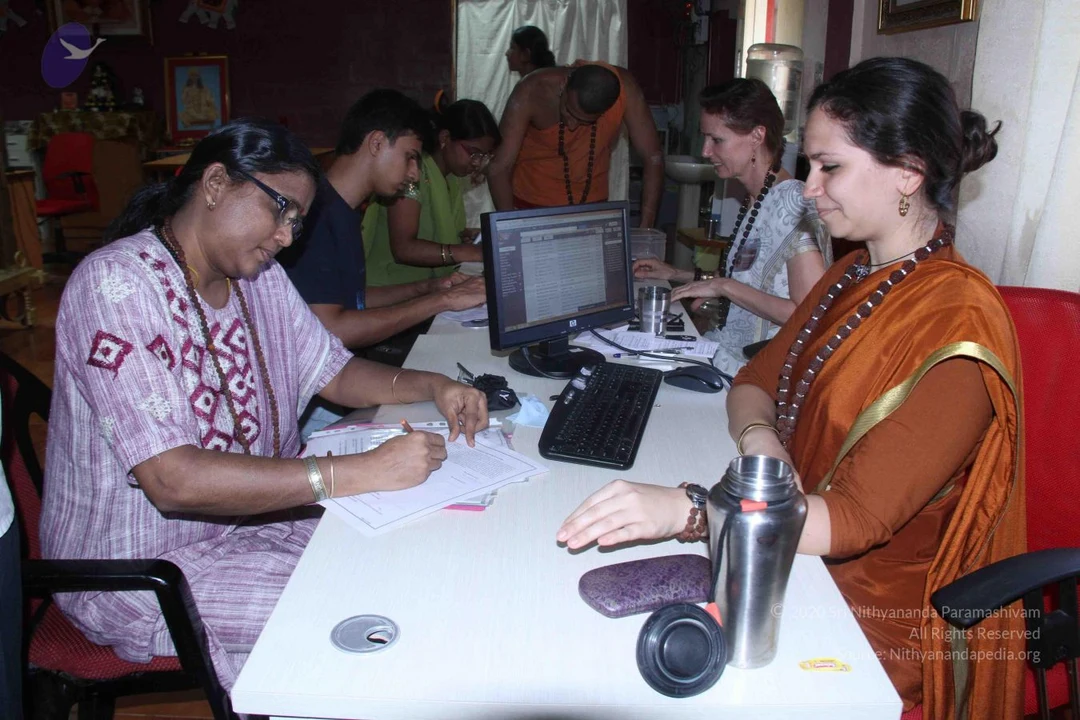
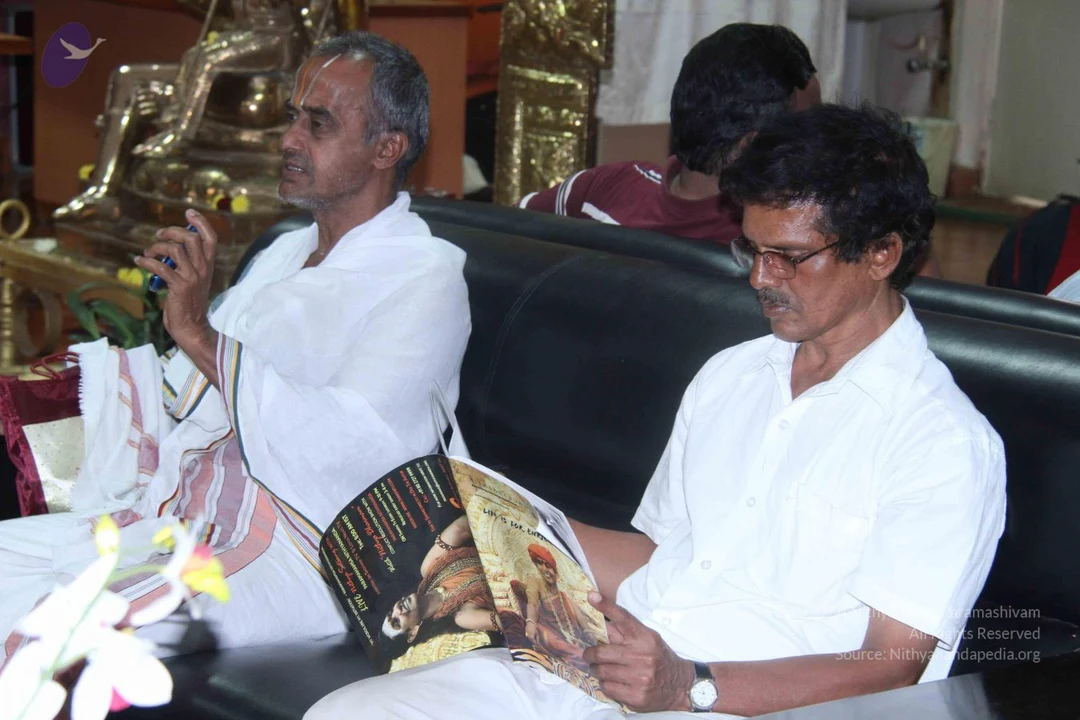
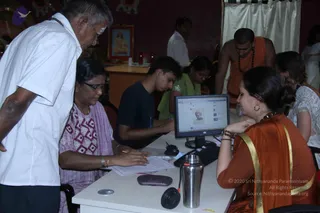
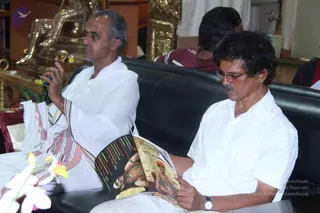
A photograph of an indoor registration or help desk. A white-haired older man in a white shirt stands at left, leaning over a desk beside a woman in glasses and a pink-and-white patterned top who is writing on a printed form. A young man in a dark t-shirt sits at a computer monitor, and a woman in an orange-and-gold saree sits in front of the screen at right. Behind the desk, a monk-like figure in orange robes with a rudraksha mala stands, and a small framed portrait hangs on the maroon wall. A stainless steel bottle and a purple case sit on the desk.A photograph of an office-style registration desk in an ashram room with maroon walls and a framed portrait of a bearded sage on the wall behind. A standing older man in a white shirt and dark trousers leans over the counter. Seated at the desk, a woman in a pink-and-white patterned top and glasses writes on a form. At the monitor, a young man in a dark t-shirt works at a keyboard. On the right, a smiling woman in an orange sari with a gold border and a rudraksha-style necklace sits at the desk, a steel flask and a small purple case in front of her. Behind them, a man in orange robes and a mala bends over a table, and other people sit in the background.Indoor office-style registration scene at a desk with a computer monitor. A woman in a lilac and white printed kurta with a rudraksha mala writes on a form at left. Beside her a young man in a navy shirt and a woman in lime green sit at a computer. Behind them a man in saffron-orange robes with a rudraksha mala leans over a table. At right a woman in white and a woman in a saffron-orange sari with a beaded mala sit at the desk, with a steel water flask and a purple pouch on the table. A framed picture hangs on a maroon wall behind.A photograph of two men seated on a black leather sofa in a temple-like room. The man on the left wears white dhoti-style clothing with a red-and-white bordered shawl, has a white tilak on his forehead, and holds a small object in his raised hand. The man on the right wears a white short-sleeved shirt and glasses, and reads a glossy magazine whose cover shows a figure in orange and gold clothing. Behind them, a golden deity murti and yellow flowers are visible, and another person in a maroon shirt sits in the background. Two people are visible.

Nature

1 photoSource gallery
A photograph looking upward through dark silhouetted leaves of a tree toward a bright, overcast sky with grey and dark clouds. No people, statues or ritual objects are visible; the scene is a natural landscape of foliage against cloud.

SarvaDarshan

21 photosSource gallery
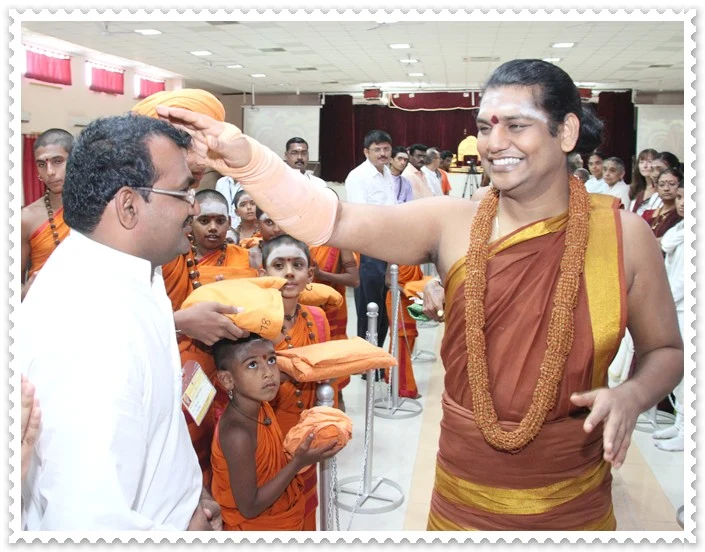
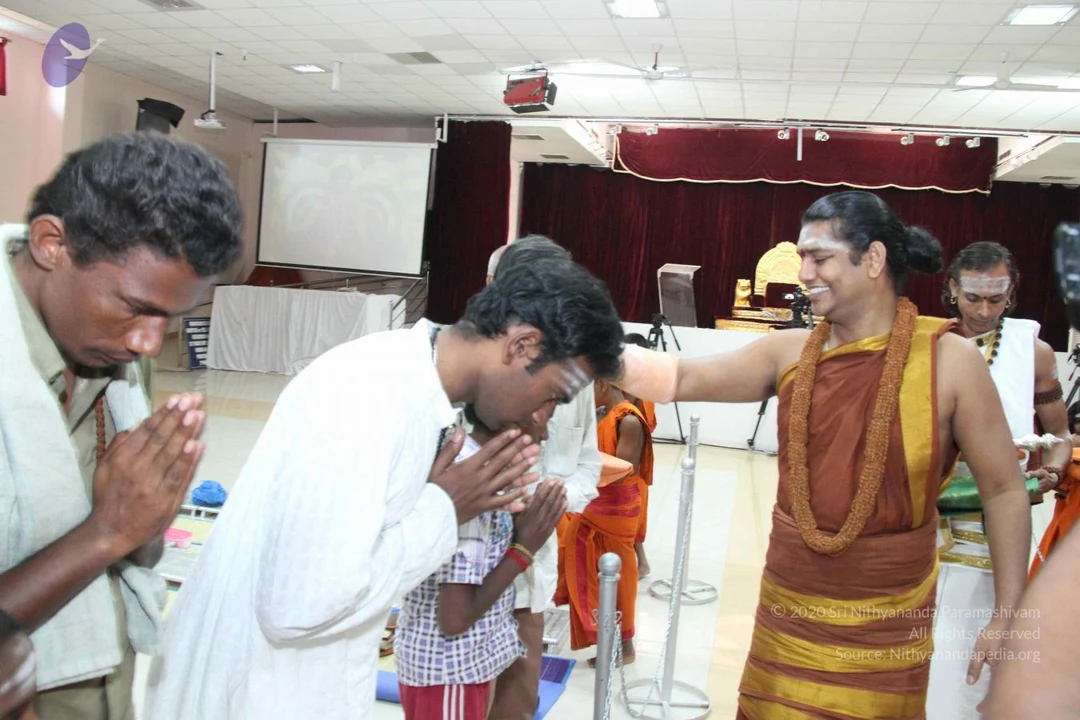
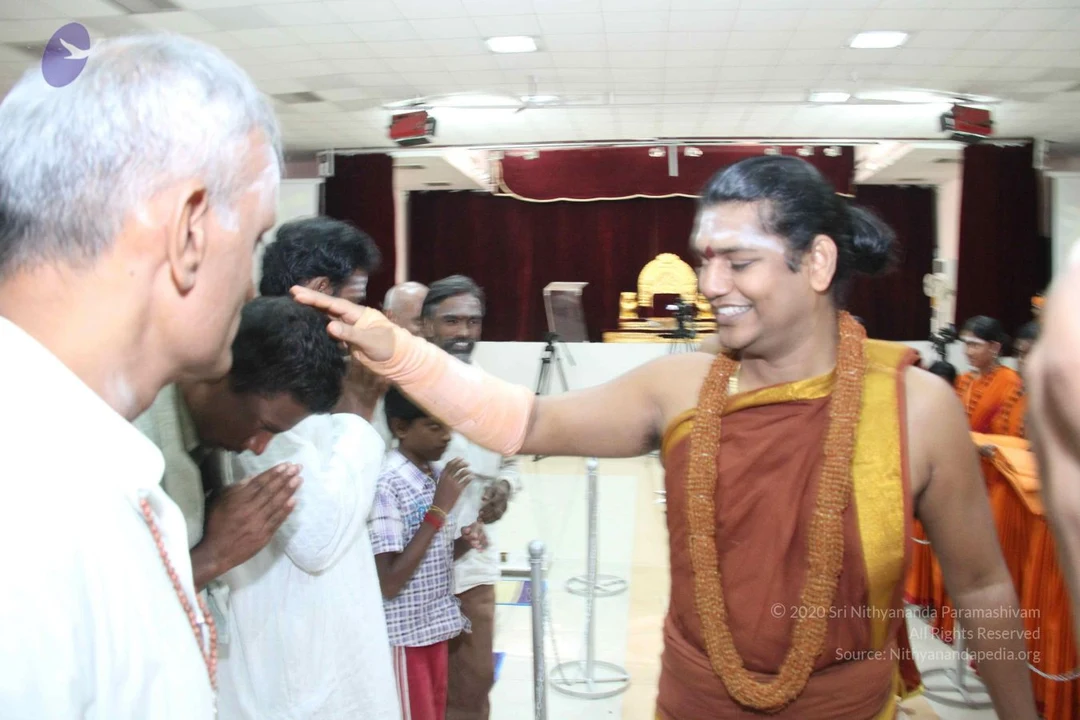
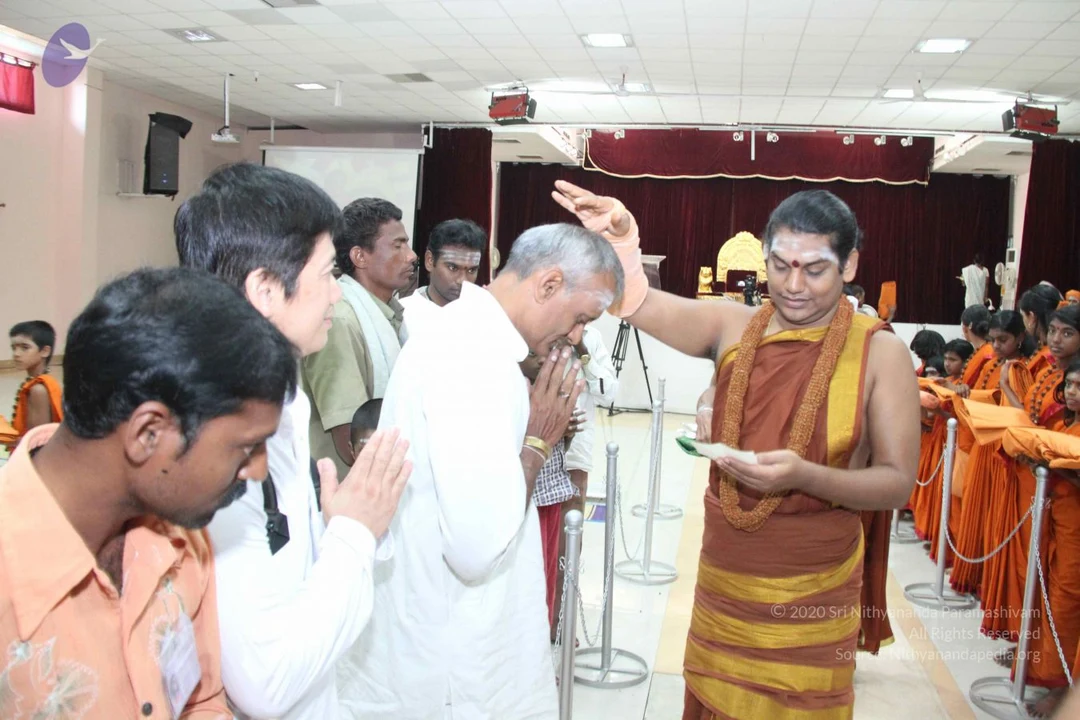
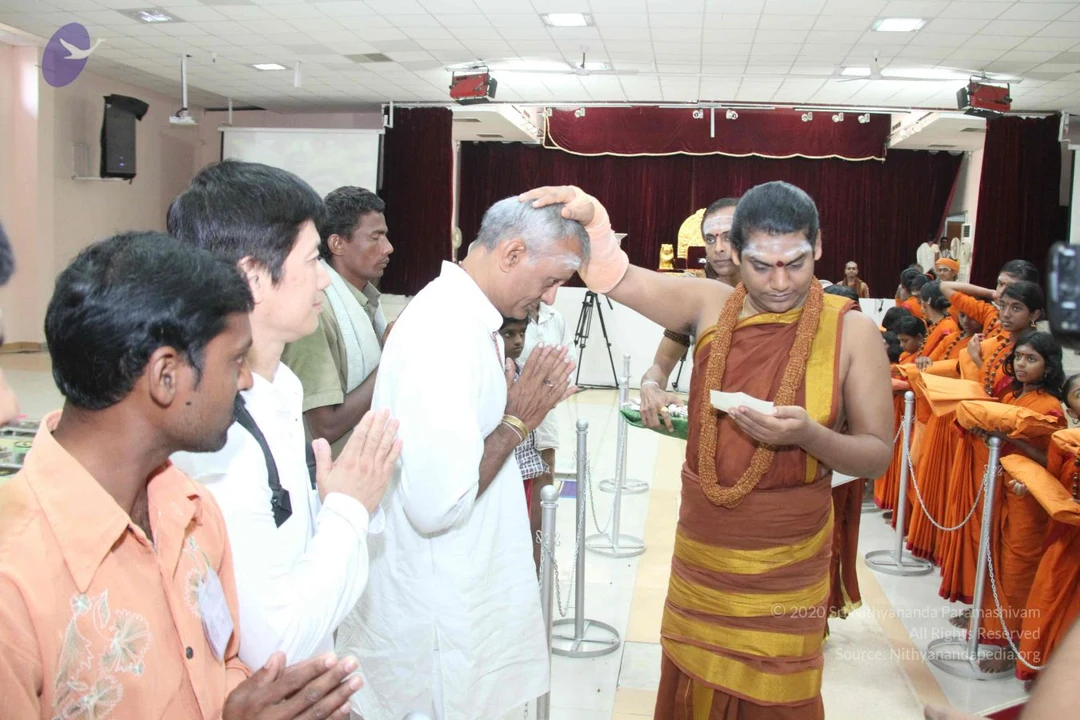
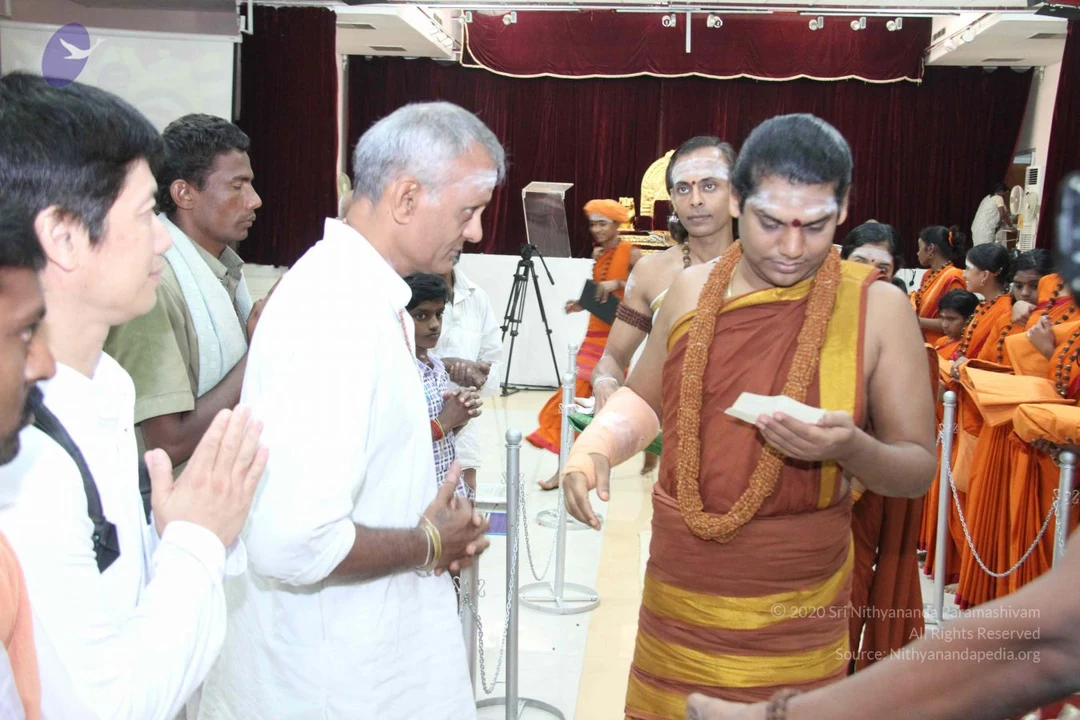
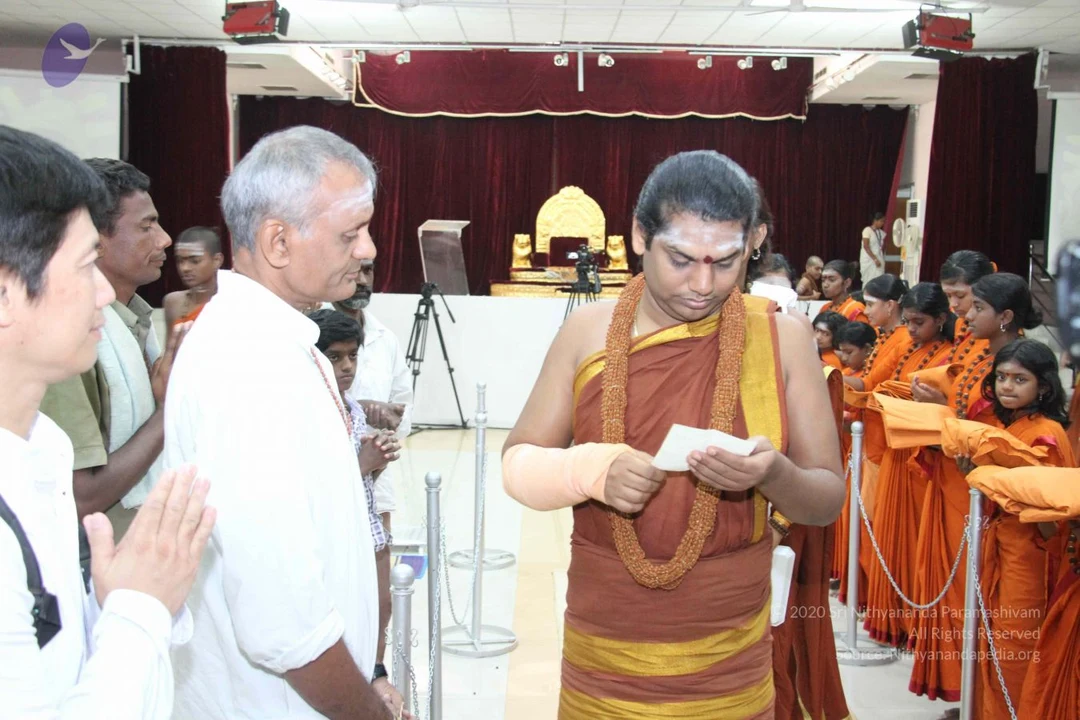
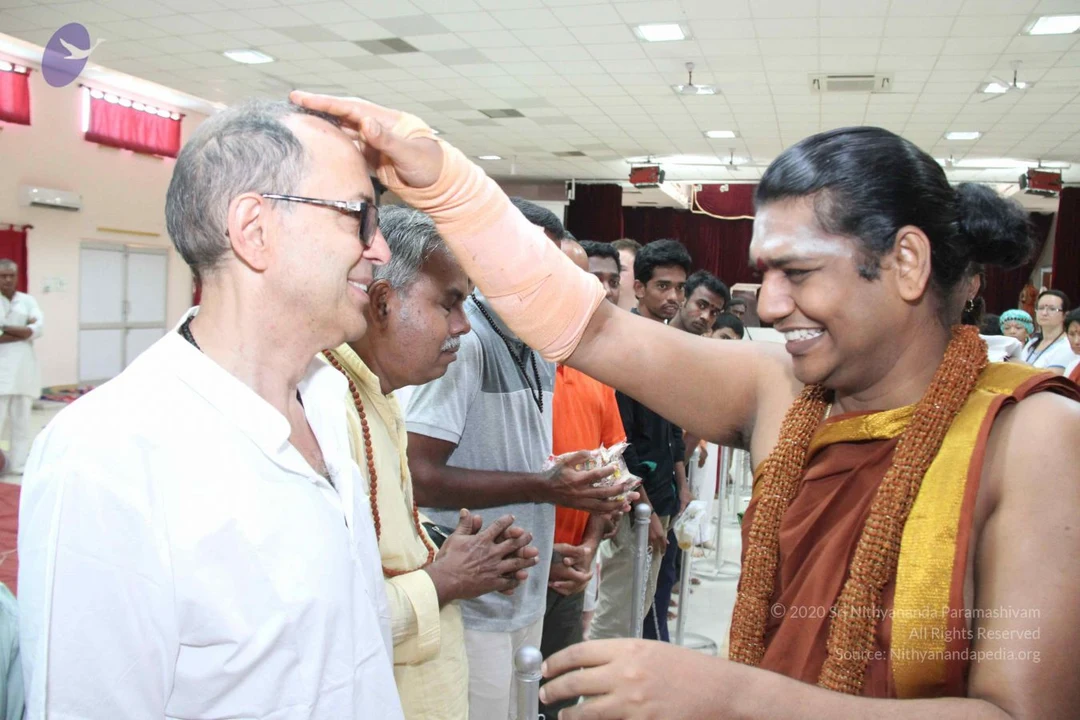
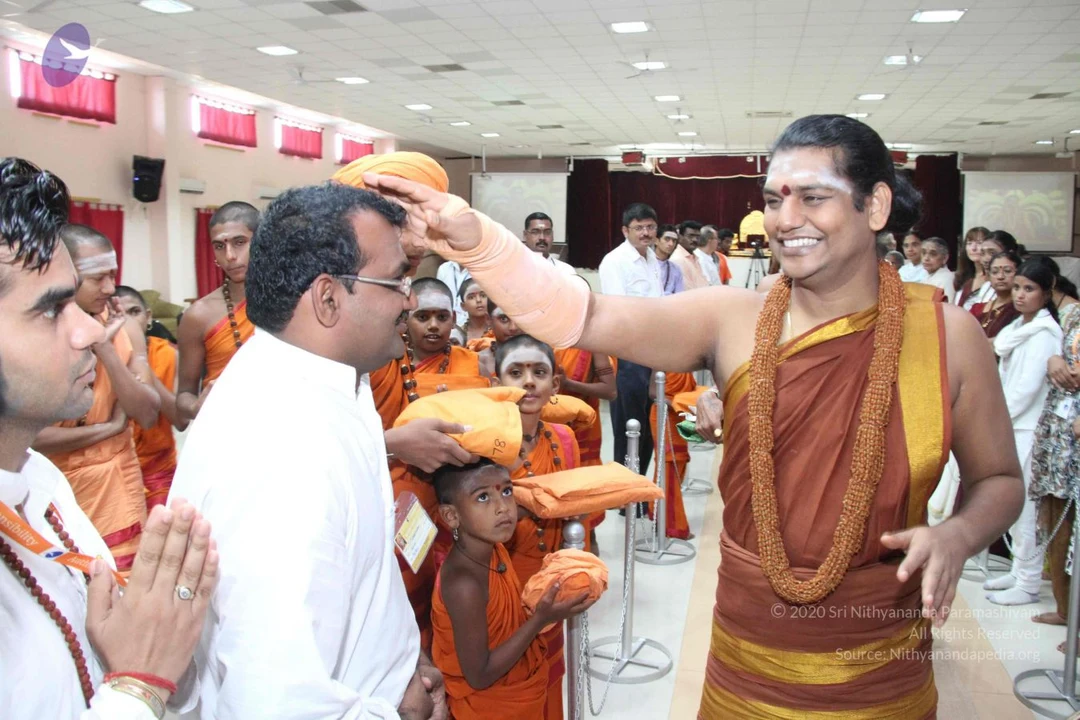
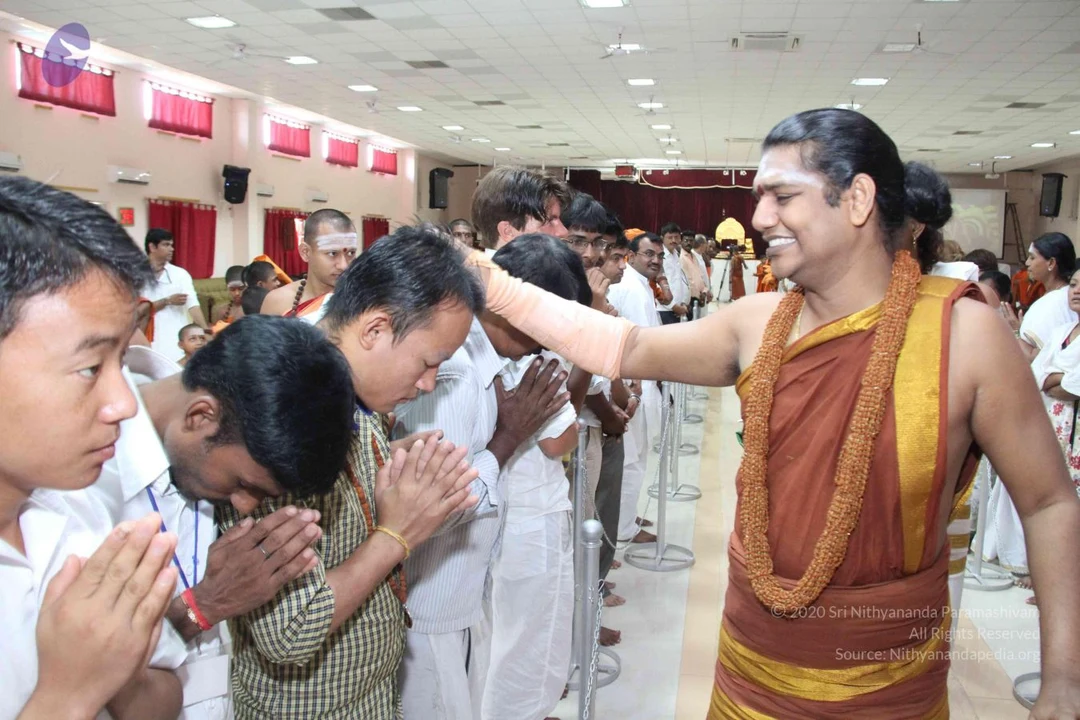
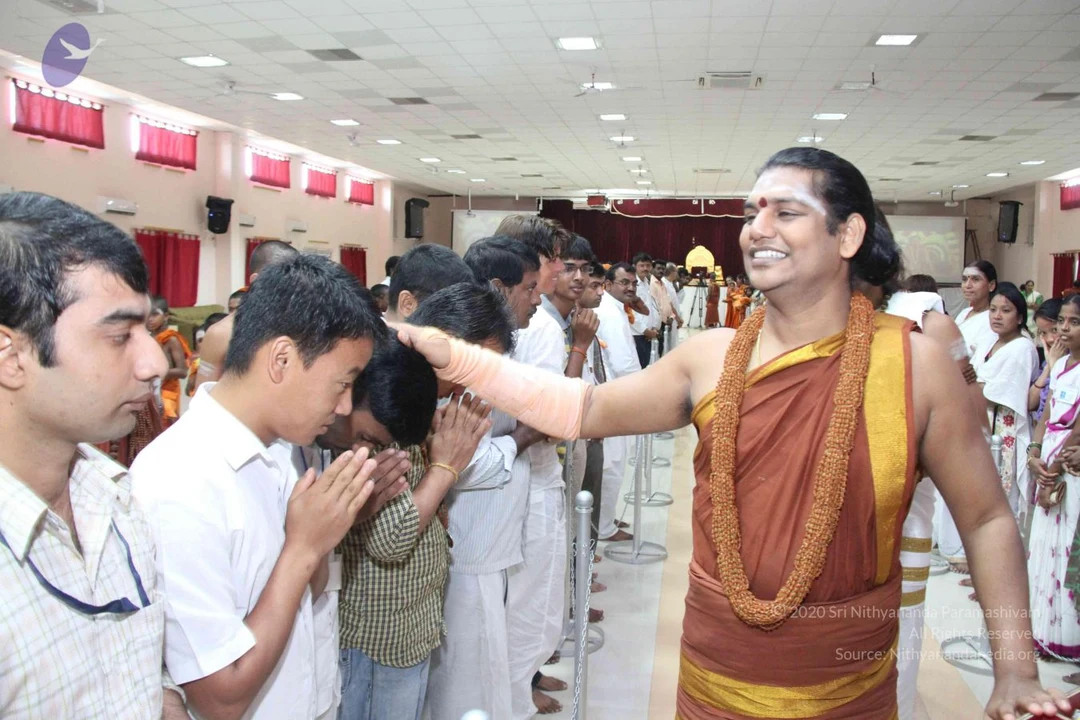
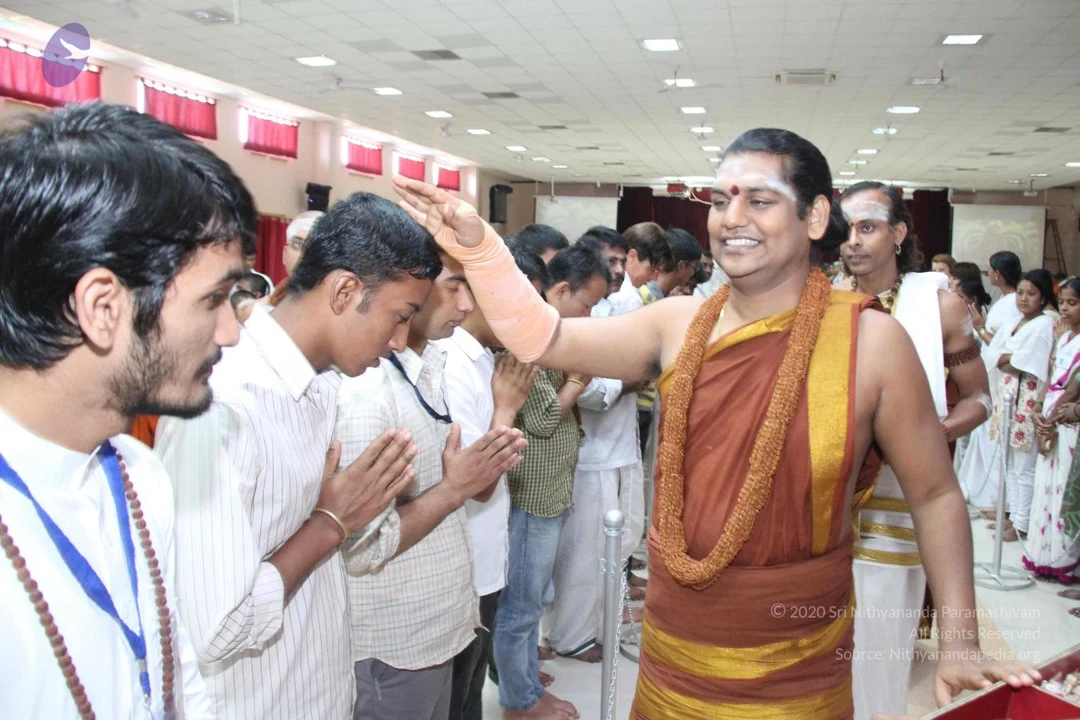
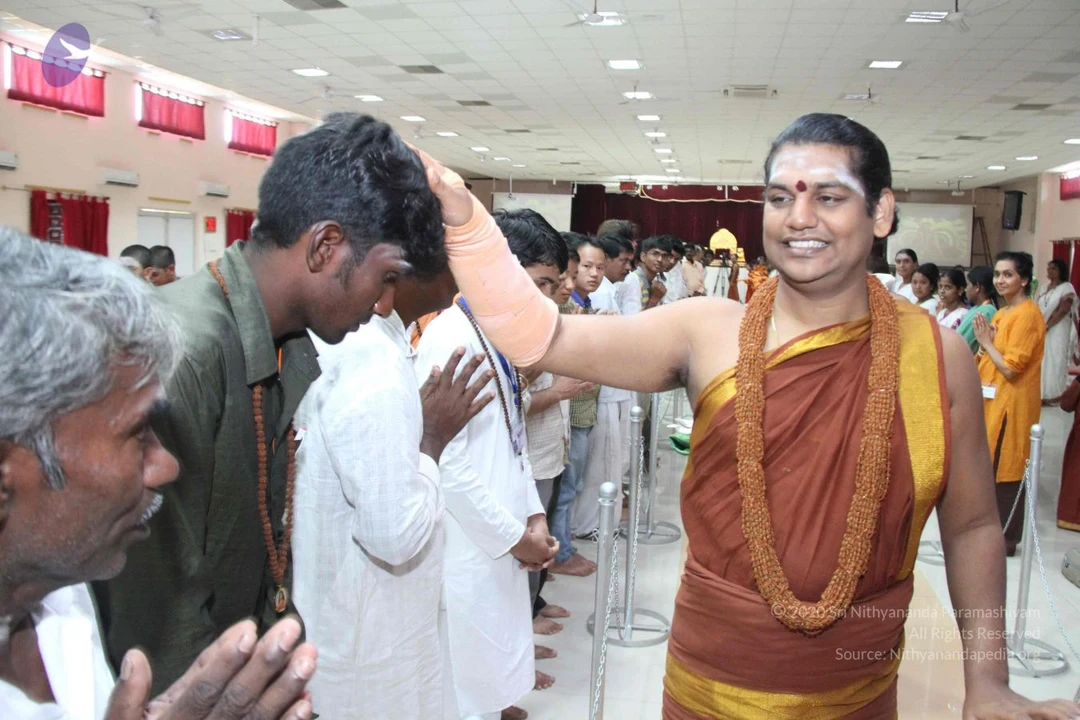
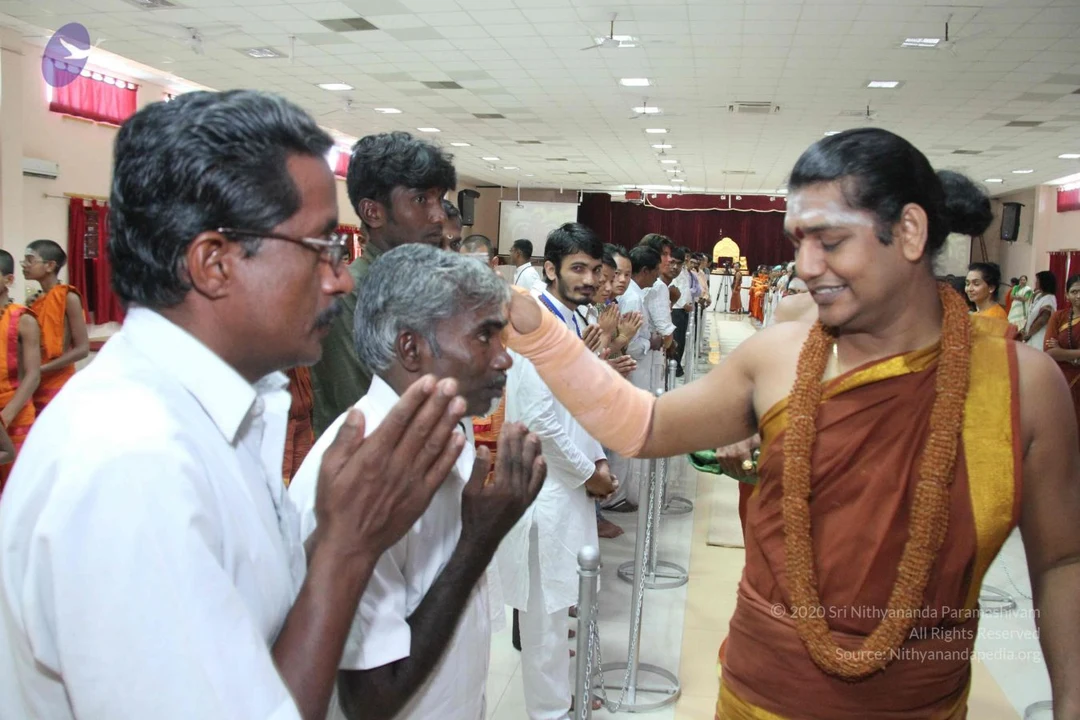
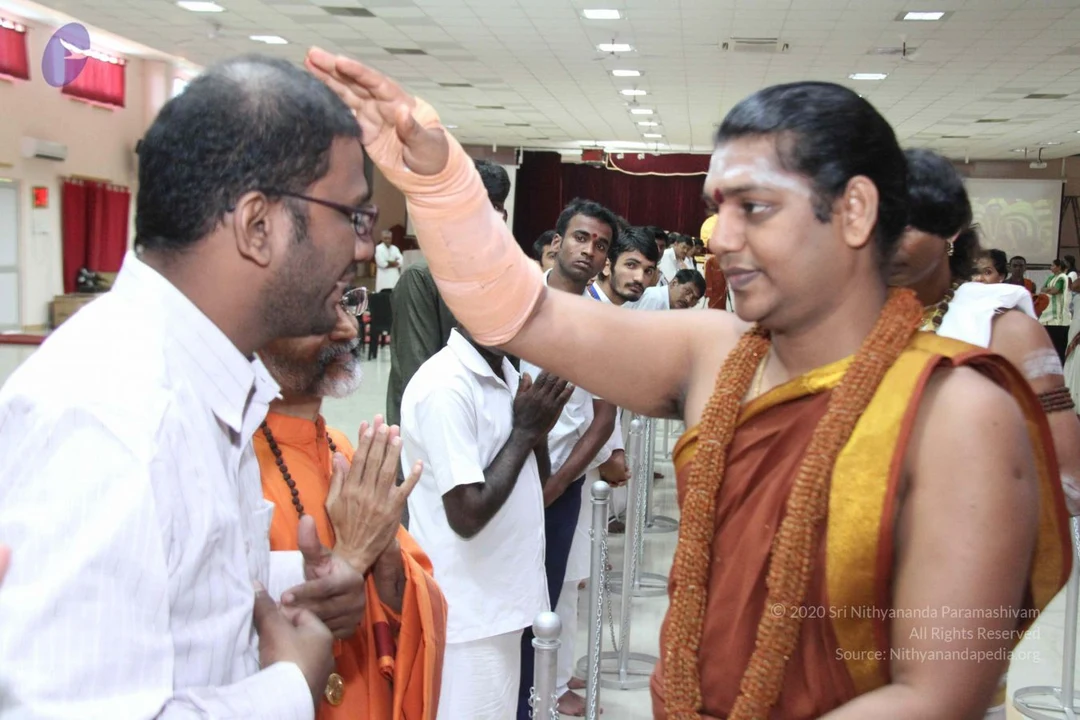
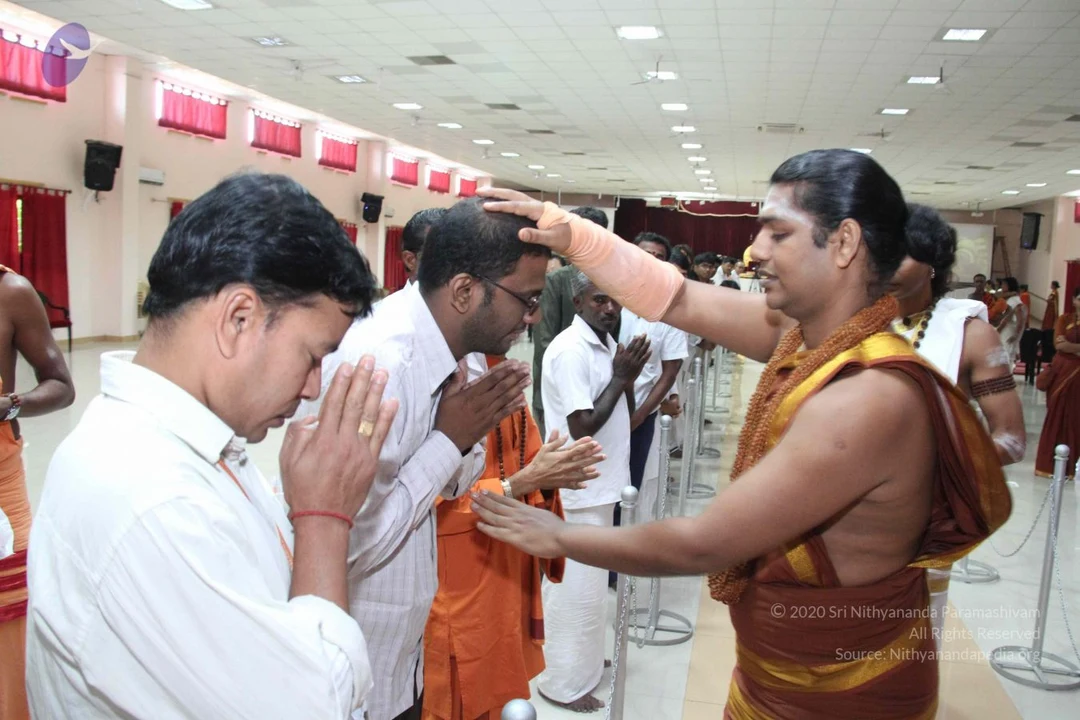
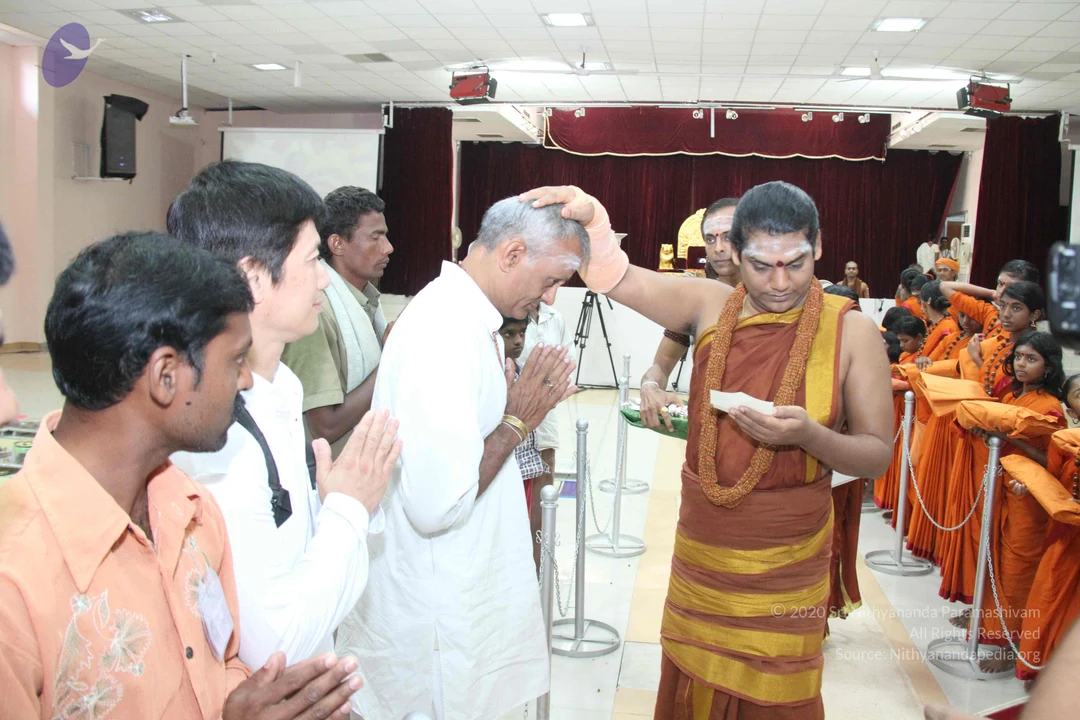
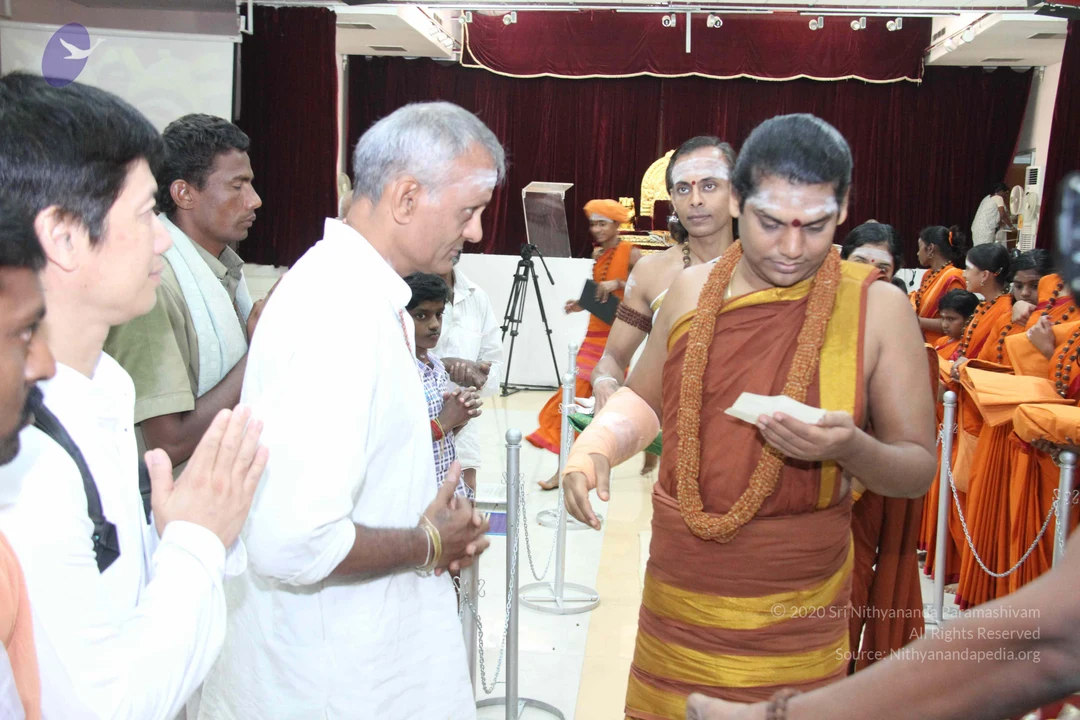
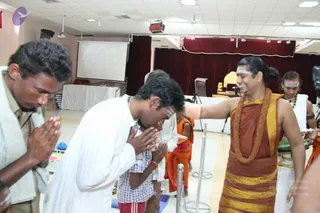
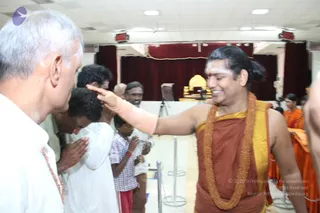
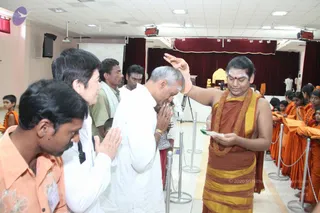
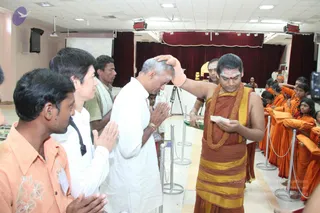
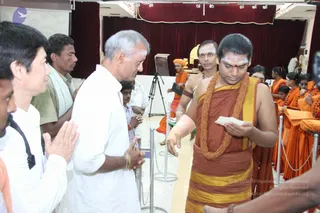
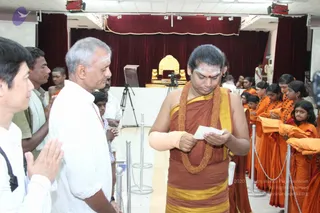
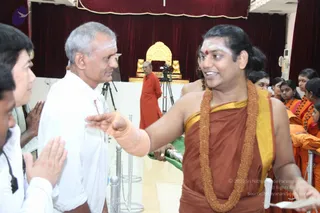
Photograph of an indoor hall with a stage, red velvet drapes, a projection screen and a golden chair at the back. In the foreground, a man in a brown-and-gold saffron wrap and a rudraksha mala places his hand on the head of a young man in a white kurta, who bows with palms pressed together. A man in a light shirt on the left also stands with folded hands, and a child in a checked shirt stands in the middle. A man in a white dhoti with a white forehead mark and a shorter-haired figure in orange stand in the background. The person in the brown-and-gold wrap has a long hair knot, a tilak and a mala. a person identity is uncertain from appearance alone.A photograph in an indoor hall with a maroon curtain backdrop and a golden throne-like seat in the background. A man with long dark hair tied in a bun, white vibhuti marks and a rudraksha mala, wearing a maroon and gold-bordered robe, smiles and extends his bandaged right forearm forward, toward a visitor. Several people stand or bow with folded hands, including an older man in white on the left and a man in a white garment bowing. Another man in orange robes stands at the far right. a person is the man in the maroon and gold robe, identified by long swept-back hair, rudraksha mala and ceremonial robe cues, and is shown giving blessings to devotees. Visible people total about 8.A photograph of a hall with maroon curtains and a white ceiling. In the foreground, a man in a rust-brown and gold-bordered dhoti and shawl, with a sandalwood-marked forehead and a long rudraksha-style bead garland, raises his right hand in blessing toward an older man in white kurta who bows with folded hands and lowers his head. Beside him, a man in an orange shirt and another in white stand with palms joined, and several more people in white and orange robes stand behind a line of stanchions. Young people in orange robes stand along the right edge holding orange cloth. A gold-decorated seat or throne is visible at the back of the stage.Photograph of an indoor hall with maroon curtains and a projector screen. A man in a saffron-and-gold dhoti with a rudraksha-style orange mala and white forehead marks stands at right, one hand raised to touch the crown of the head of an older man in white kurta who stands with palms pressed together in namaskar. Left of them, a young man in orange shirt and a man in white shirt with a camera strap stand with hands folded. Behind, rows of people in saffron robes and orange garments line a barrier. The right-hand priest holds a small white paper and a tray. A pale stand and tripod appear in the background.A photograph of a ceremonial reception in a hall with red curtains and a golden throne-like chair in the background. A young man in a saffron-orange robe with a yellow-gold border and a long orange-beaded rudraksha-style mala holds a small white card in his hands and receives an older man in a white shirt and white trousers who stands with palms pressed together in greeting. Other people in orange and saffron robes stand nearby, and a man in a white towel and a man in a light shirt are on the left, with a man in a white shirt and a young boy in a checkered shirt also visible. Some attendees have white and red forehead markings. A tripod and a clear-glass podium stand in the middle of the stage area, with metal stanchions and chains marking a walkway.A photograph in a hall with dark red curtains and a gold-coloured throne with lion figures at the back. A bare-chested man in a saffron-orange dhoti and orange shawl with gold border stands centre, wearing a long rudraksha-style mala with white forehead markings and a red bindi, holding a small white card. To the left, a man in a white shirt presses his palms together and others in light clothing stand near. On the right, a line of young girls in orange robes stands behind a chrome rope barrier, several holding folded orange cloths. A cameraman with a tripod is at centre back. The scene shows an event with devotees and ashram members.

Temple

22 photosSource gallery
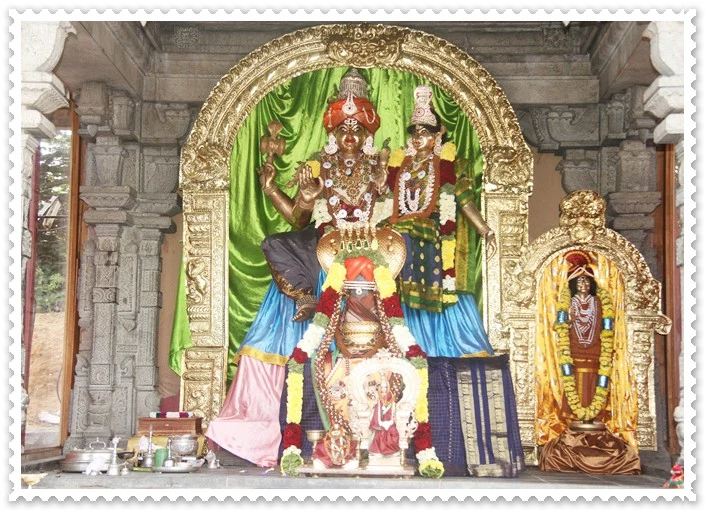
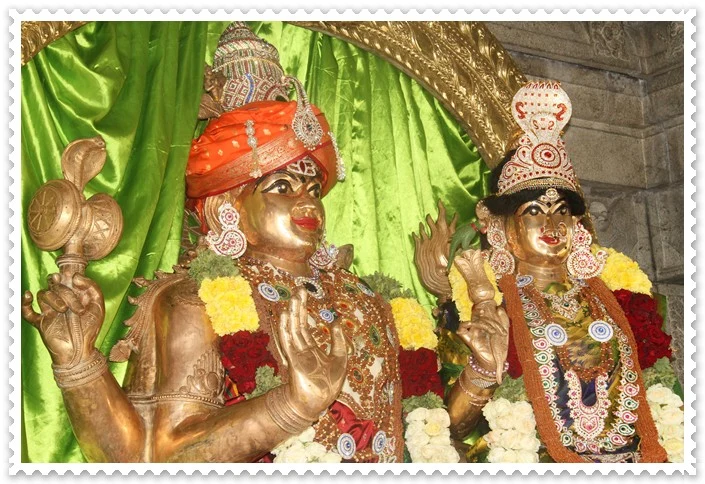
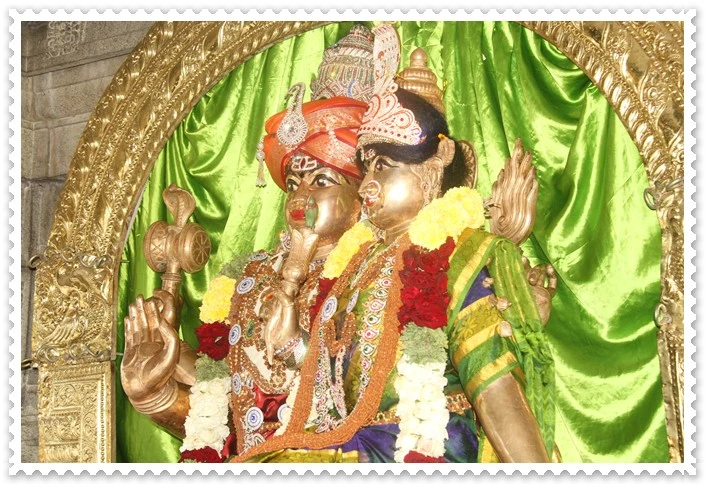
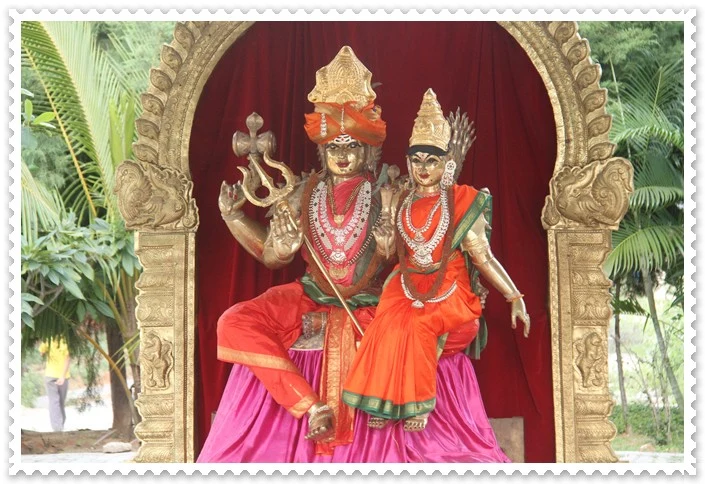
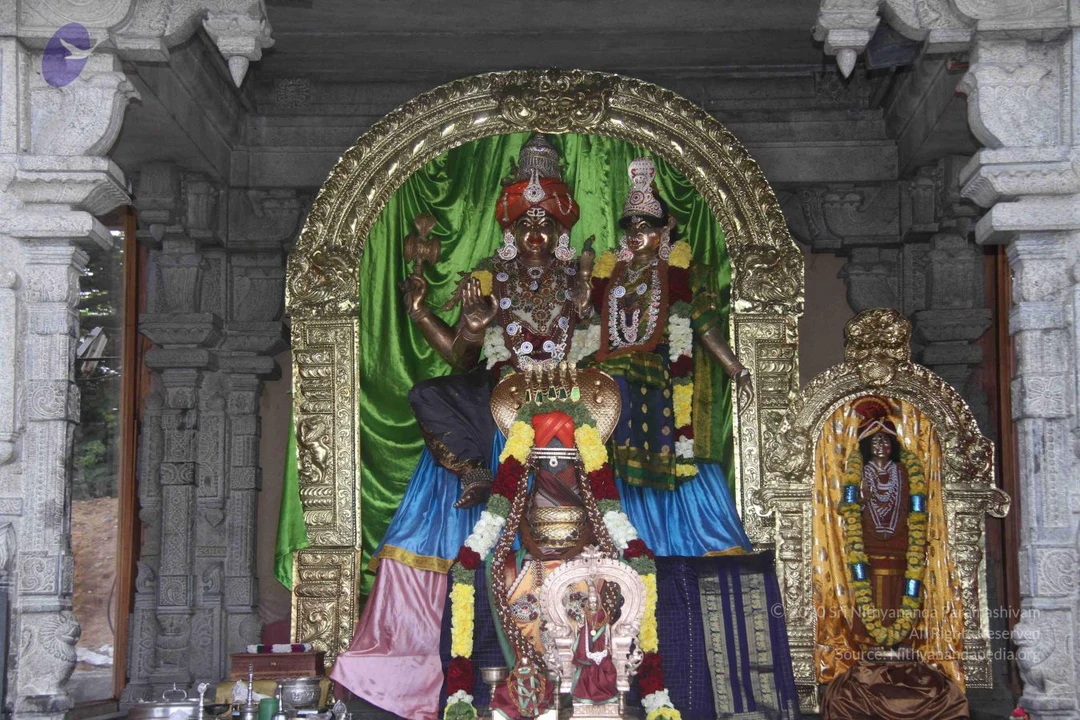
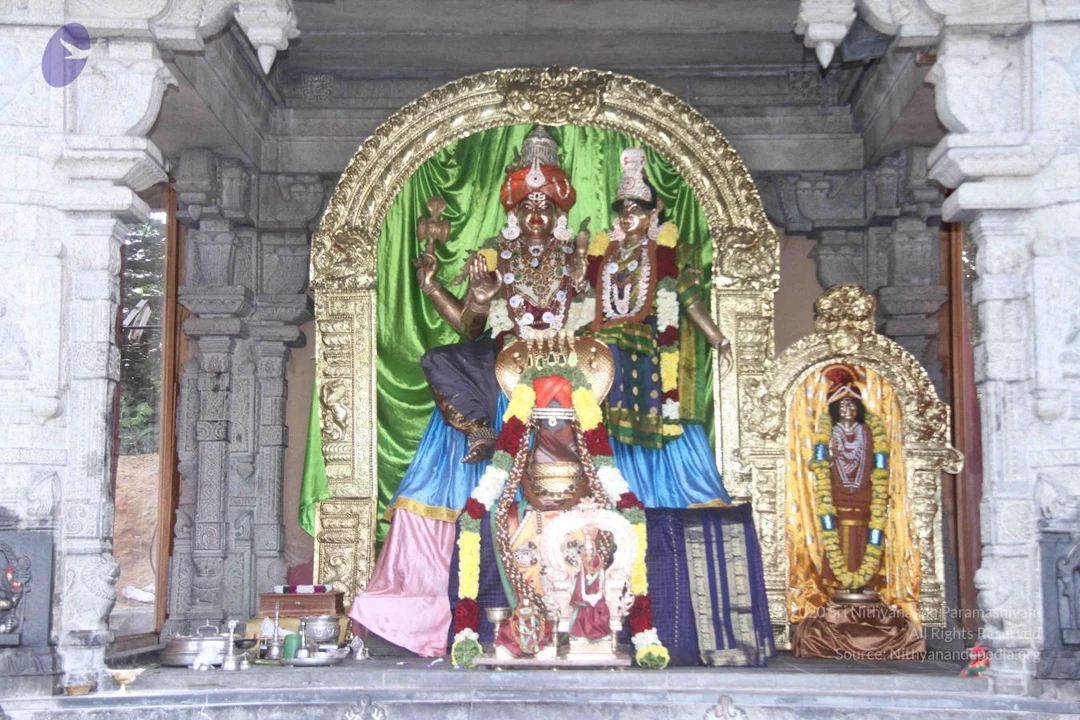
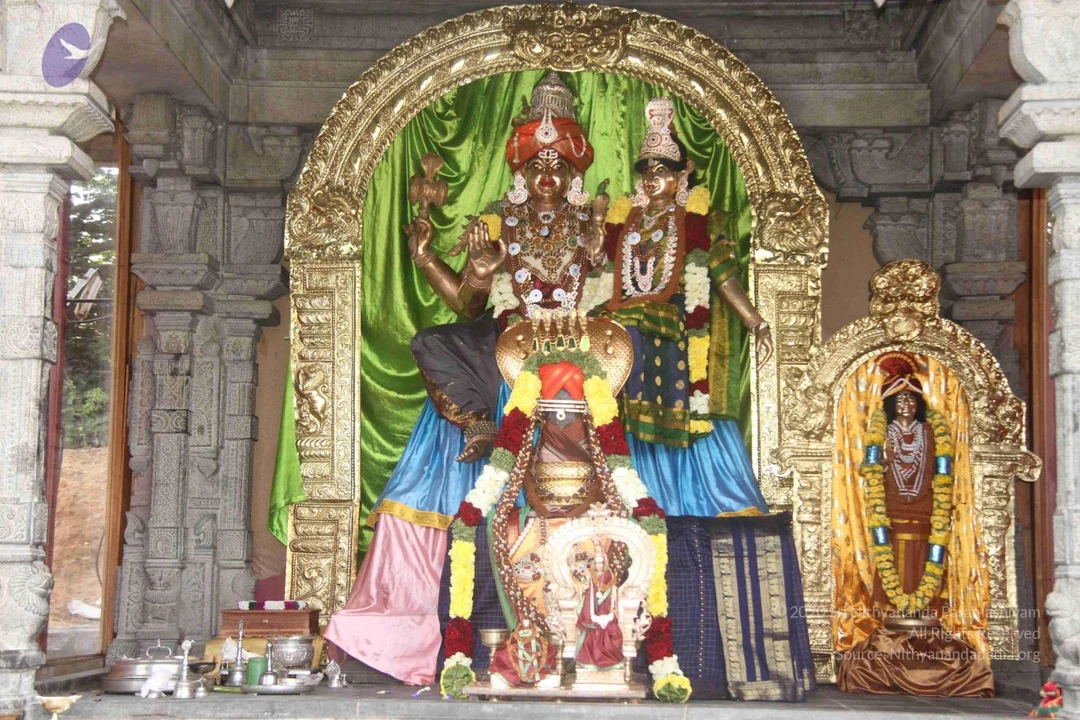
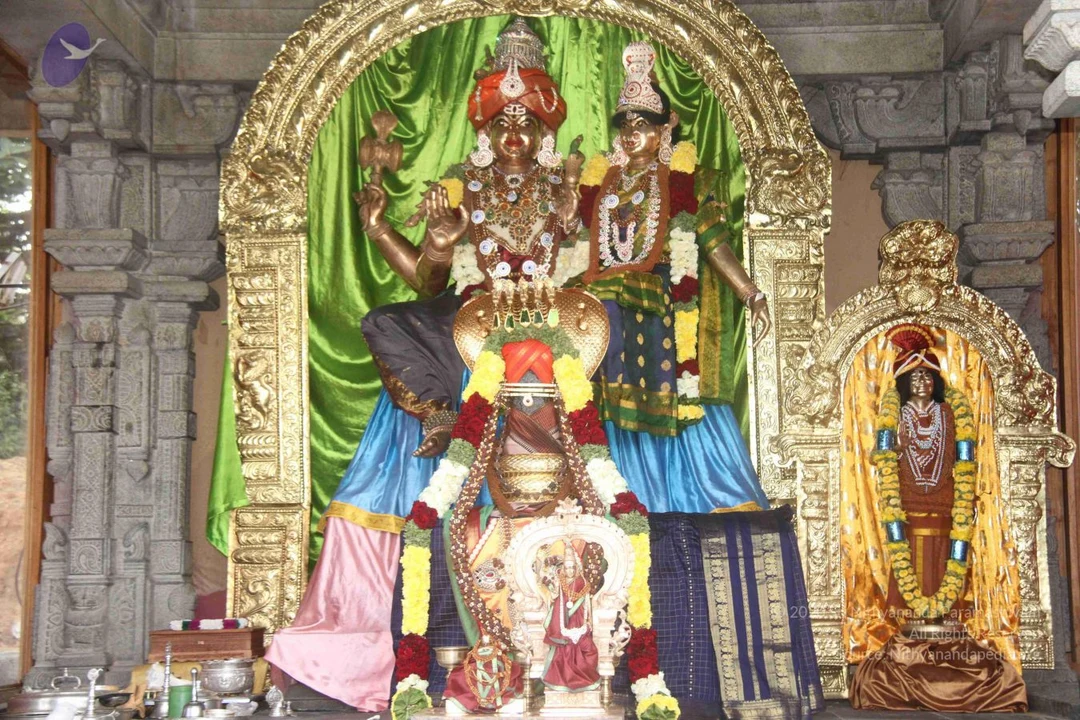
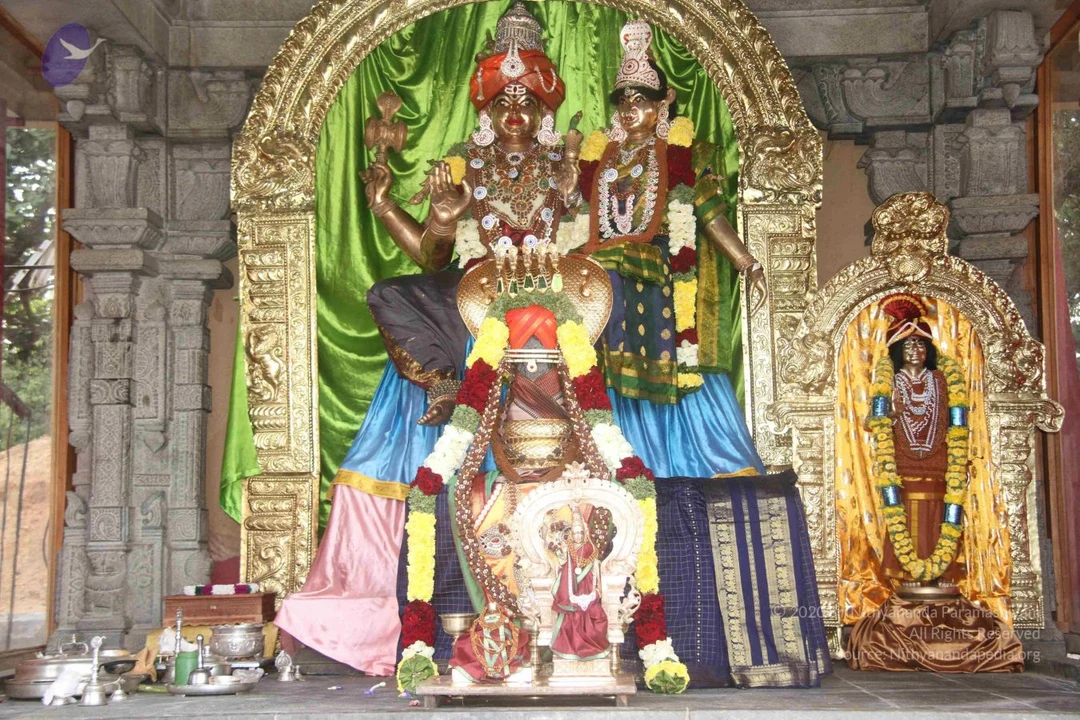
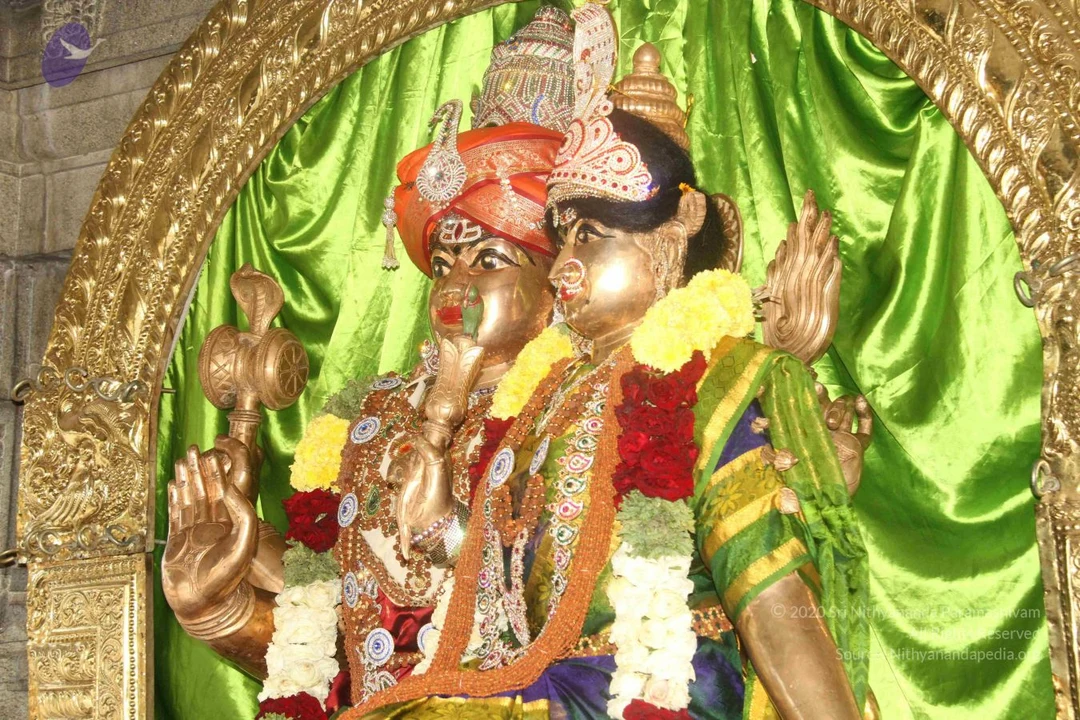
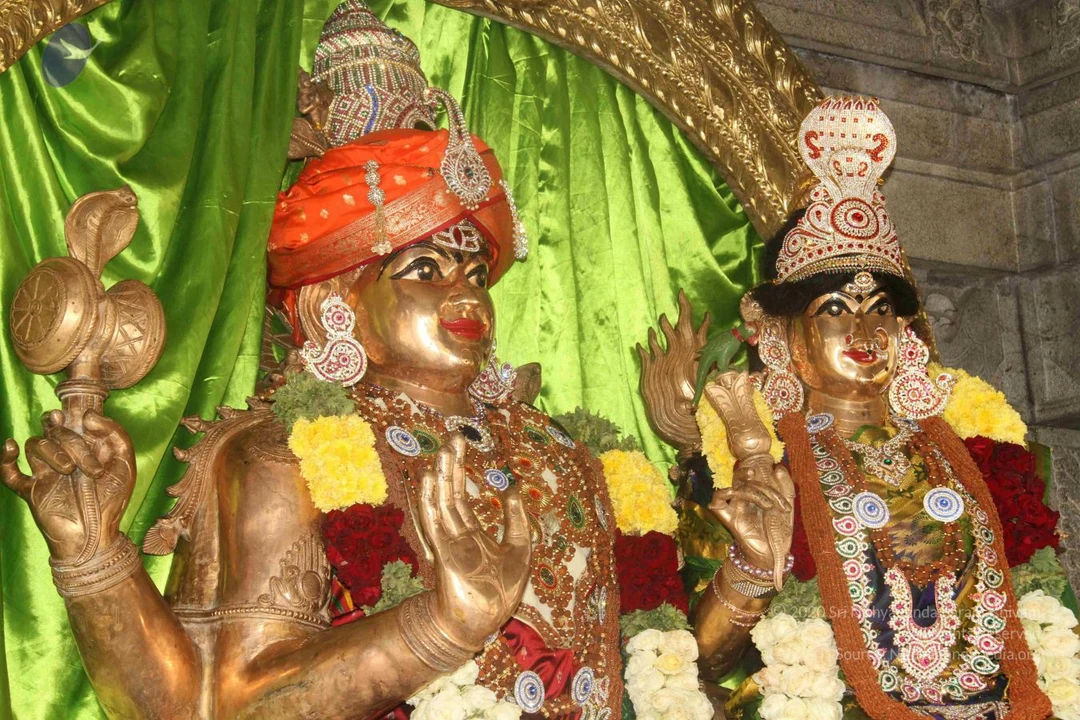
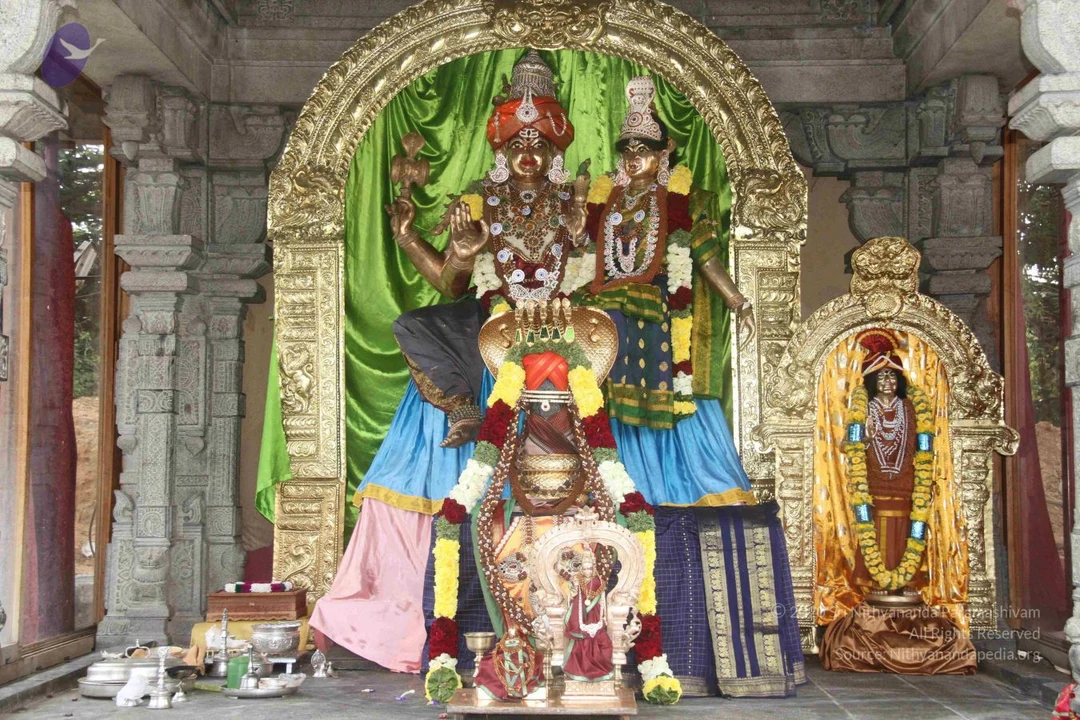
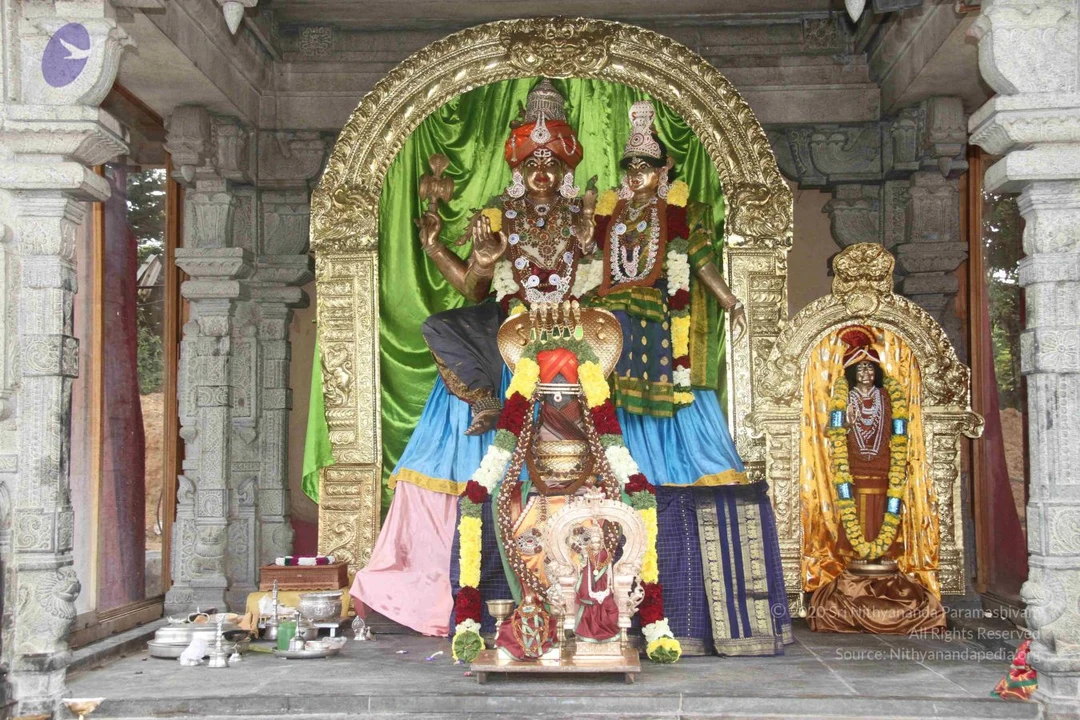
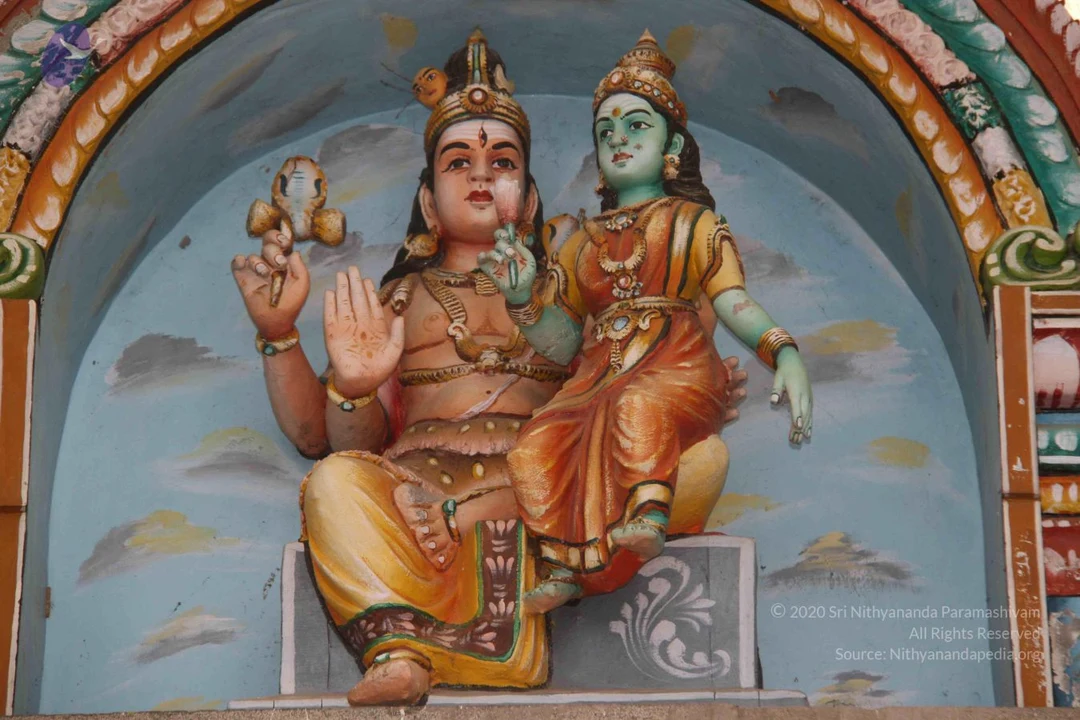
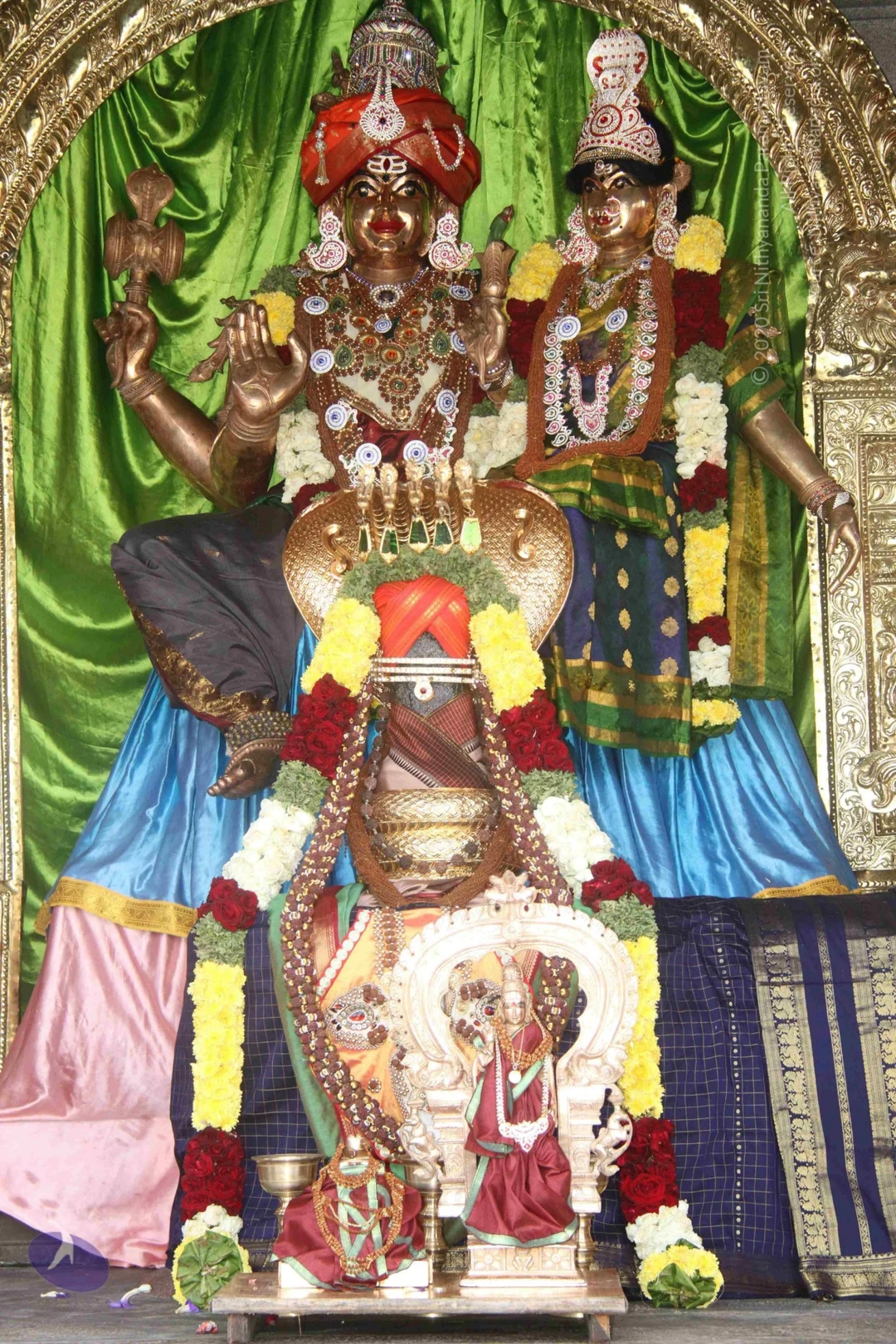
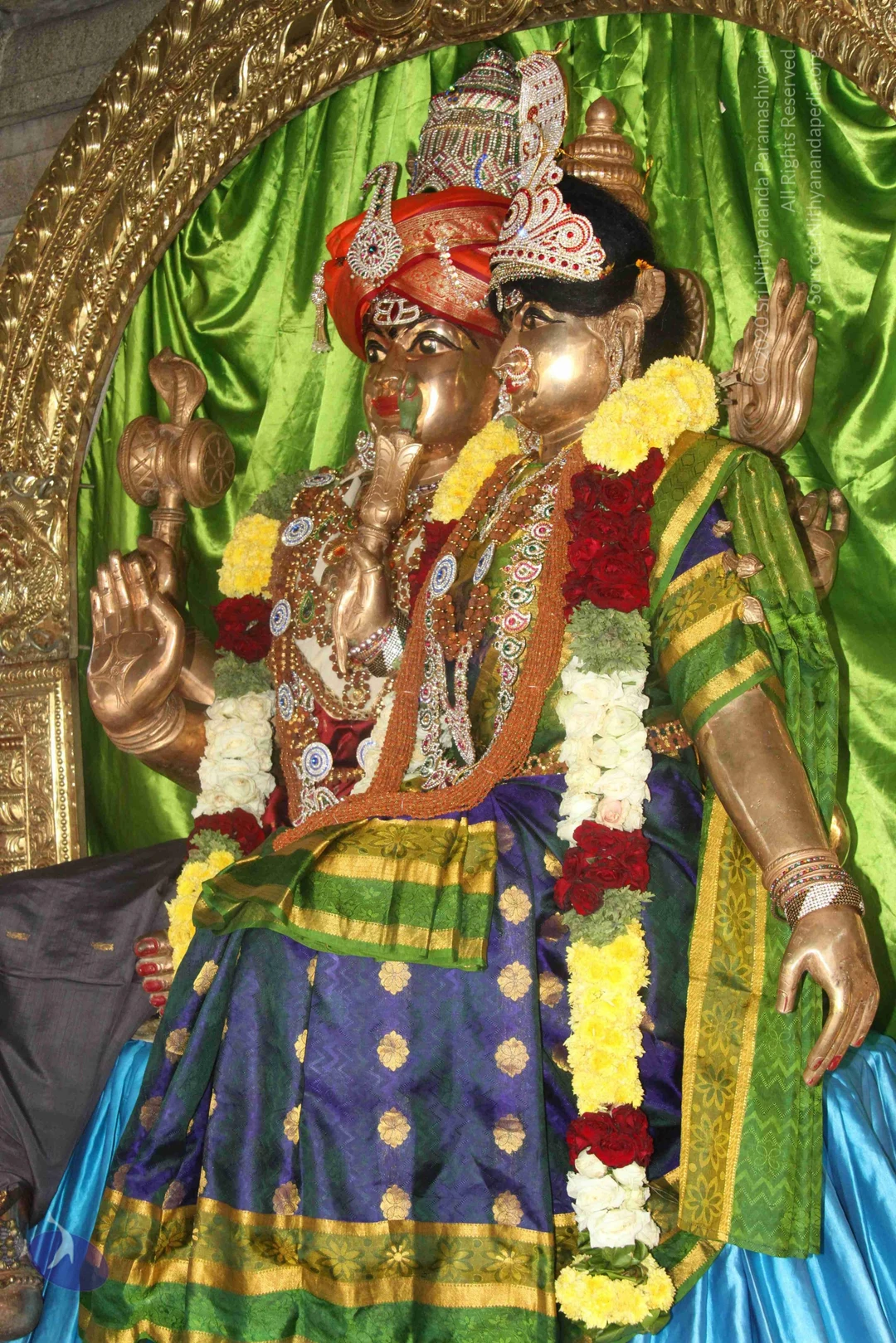
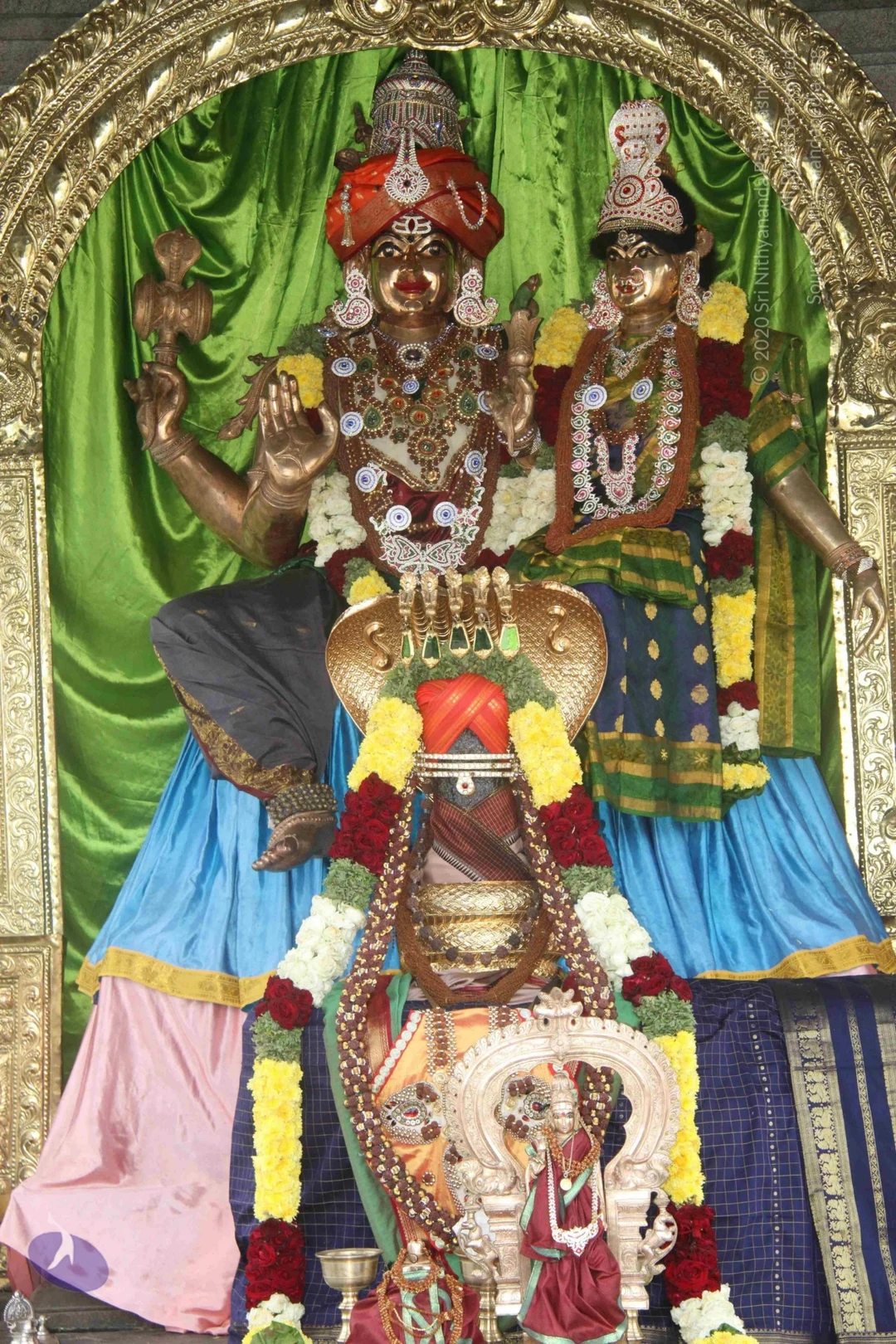
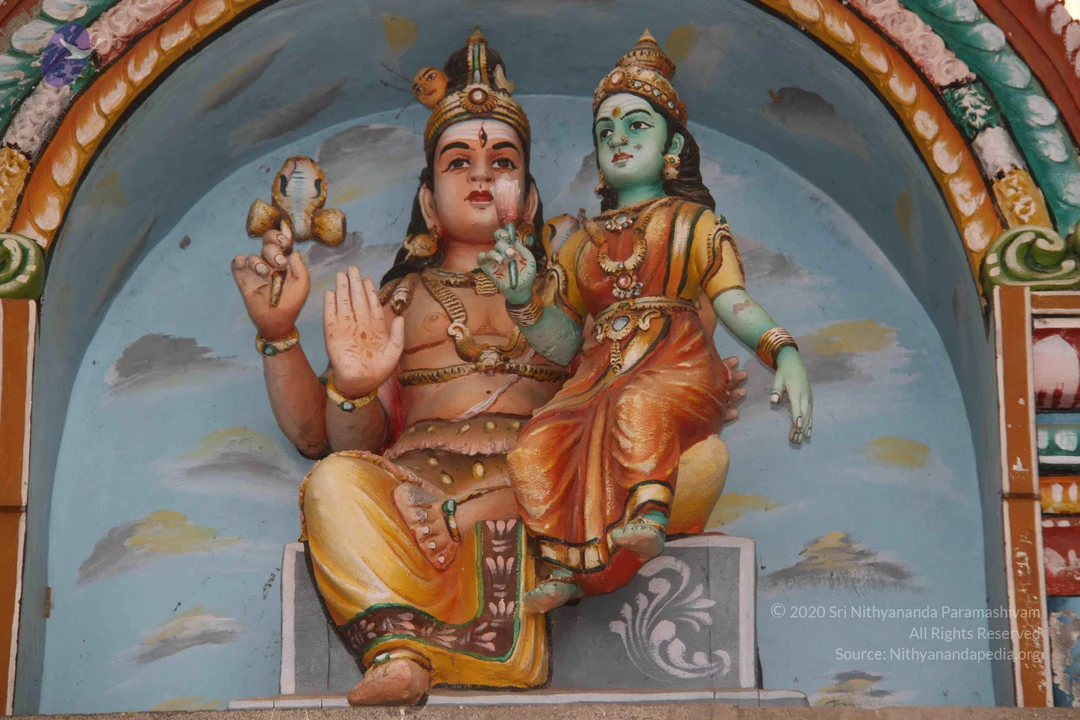
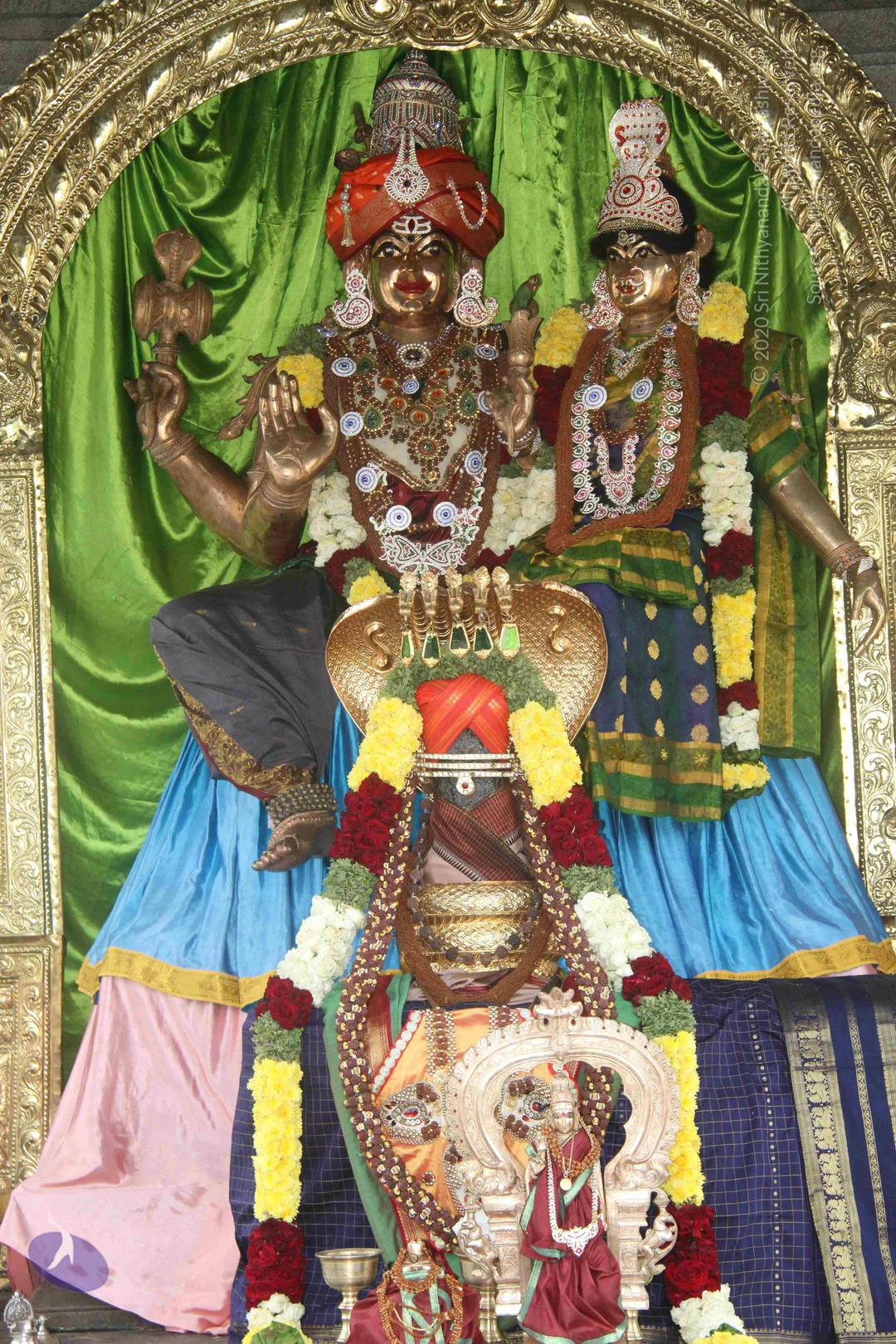
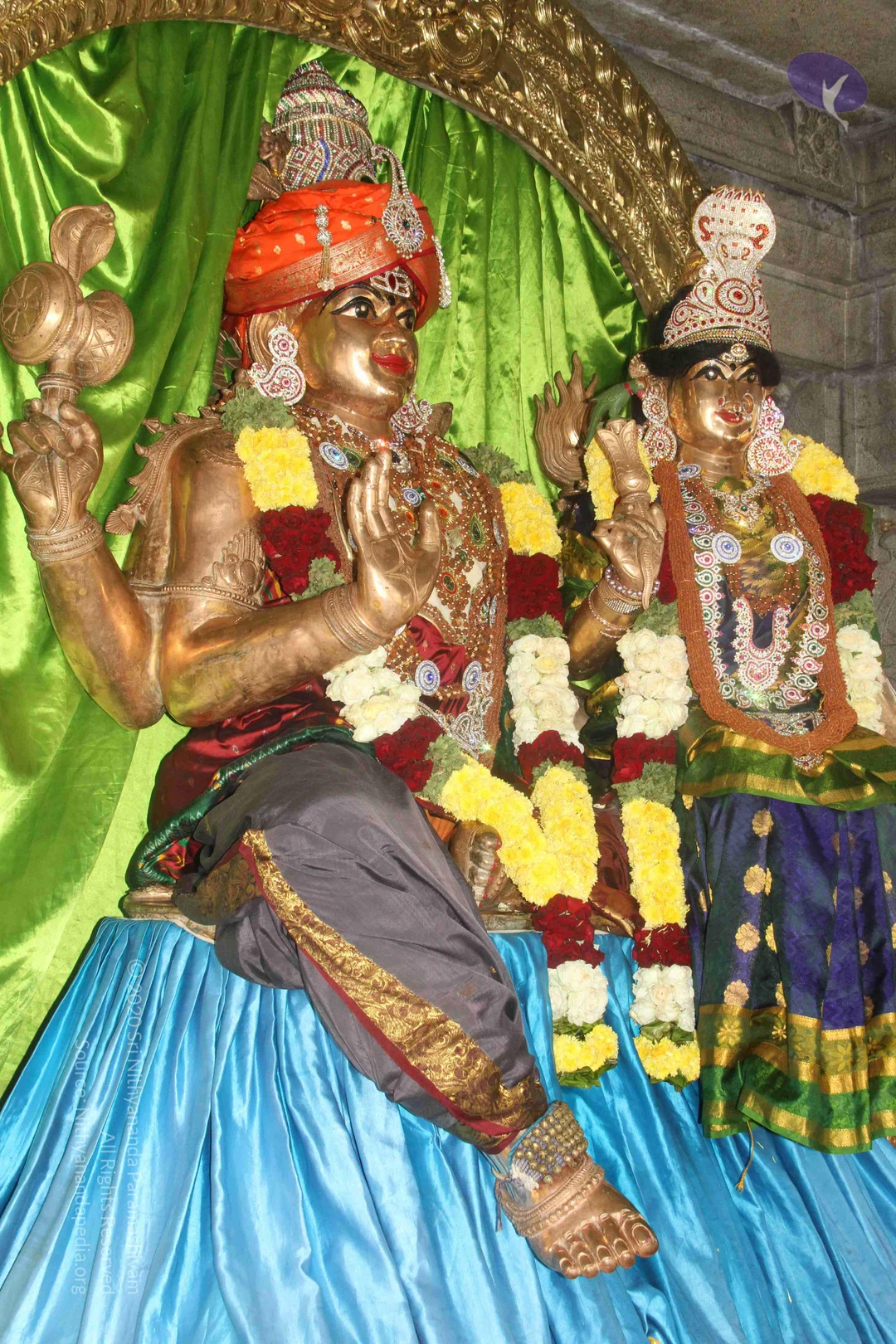
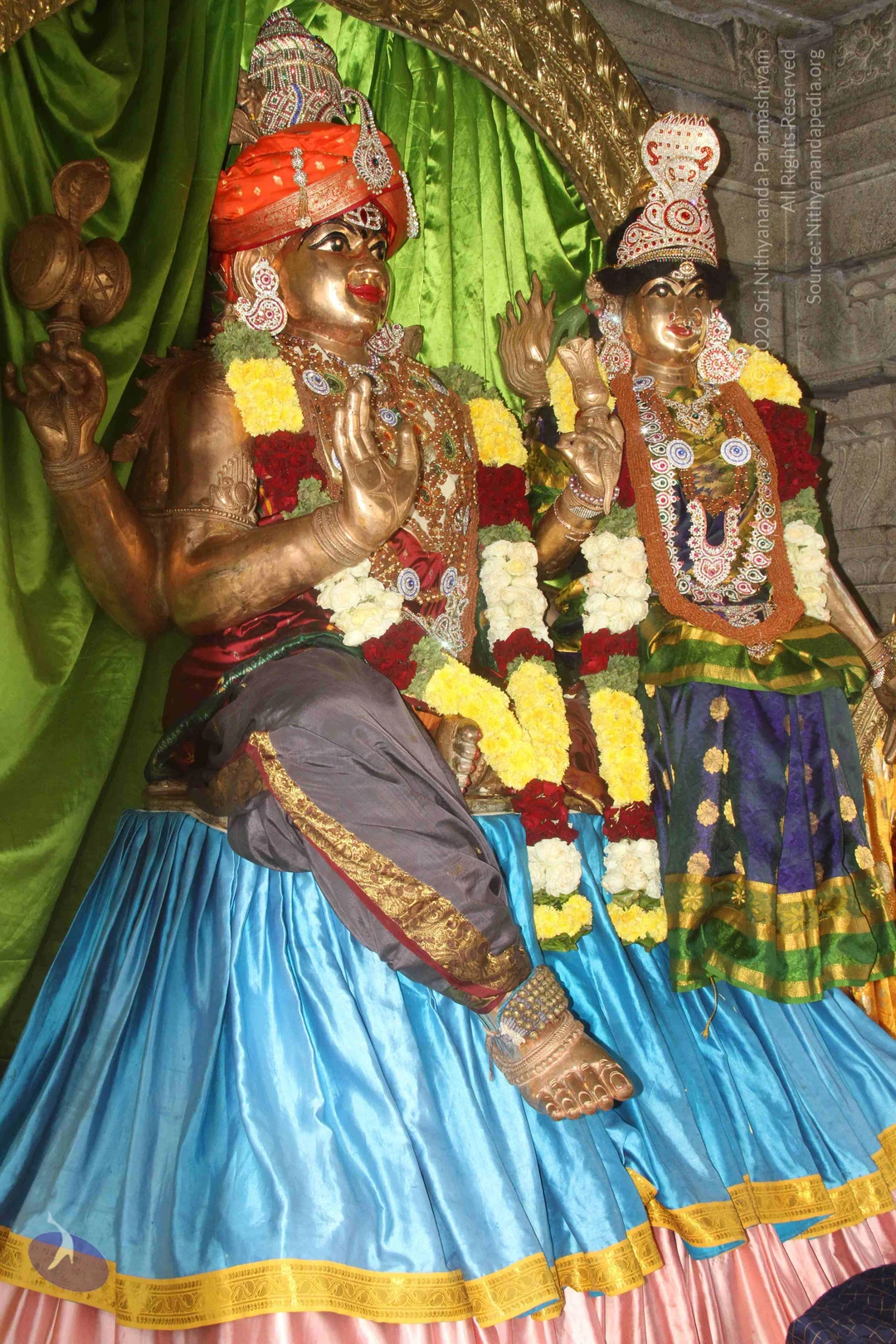
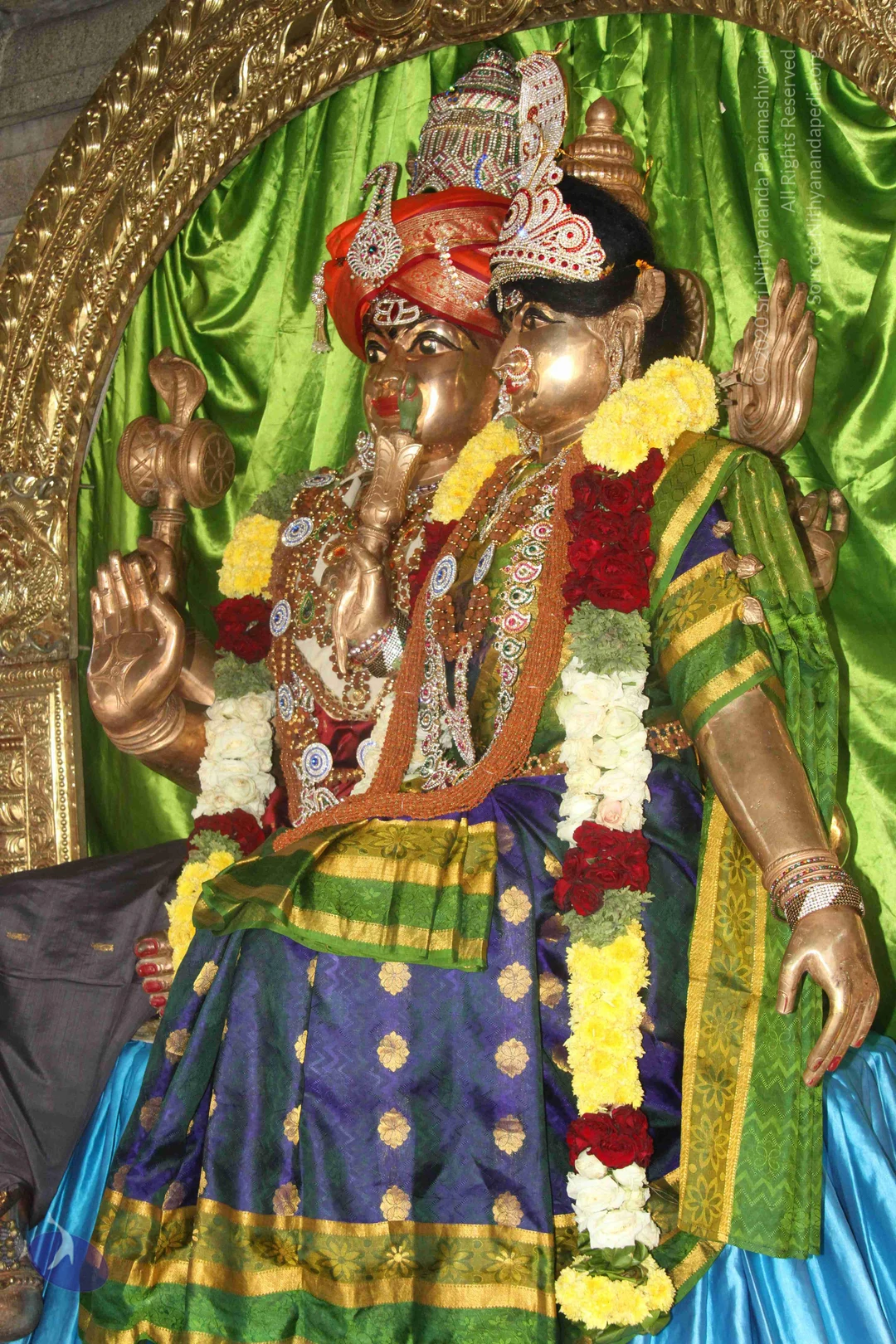
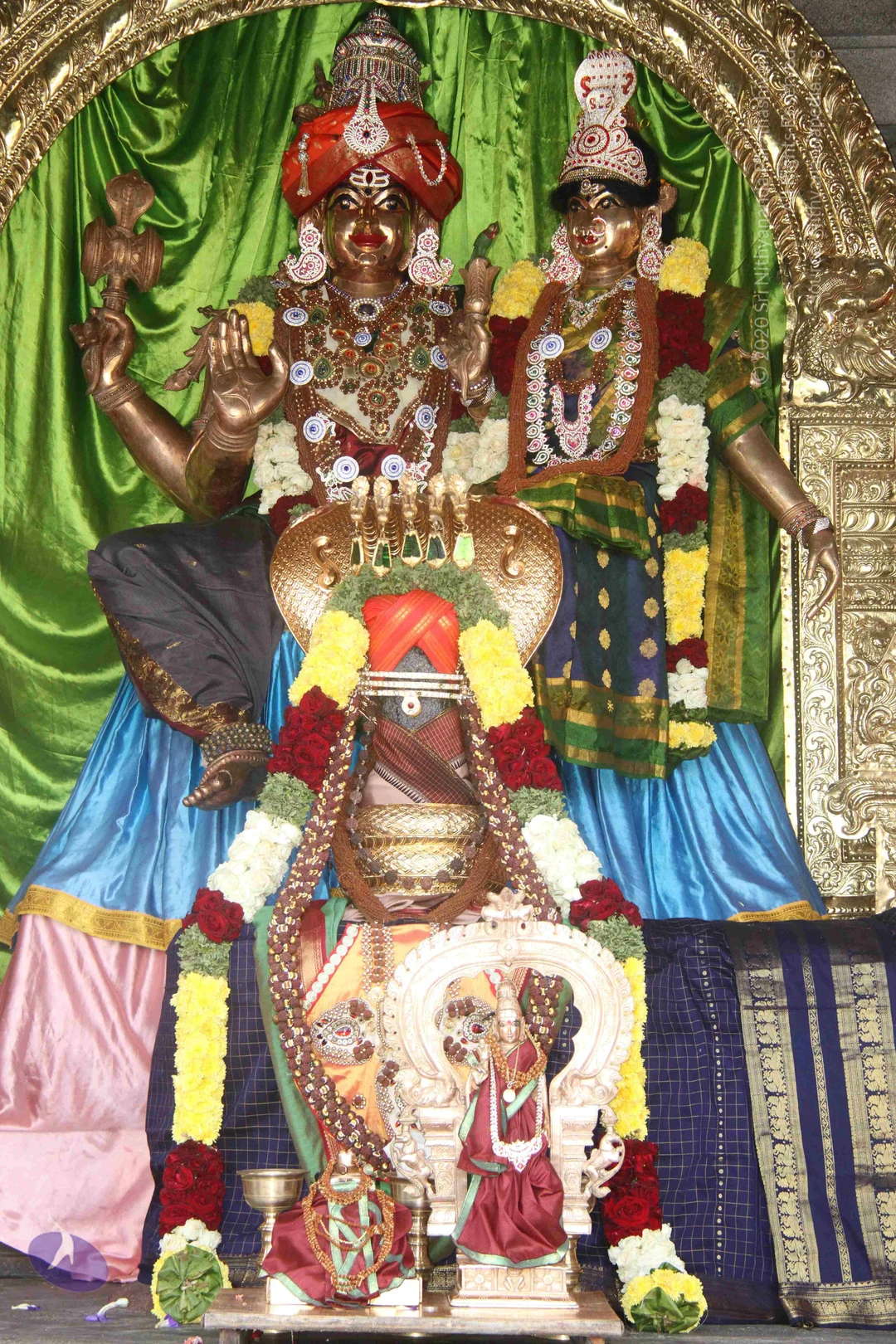
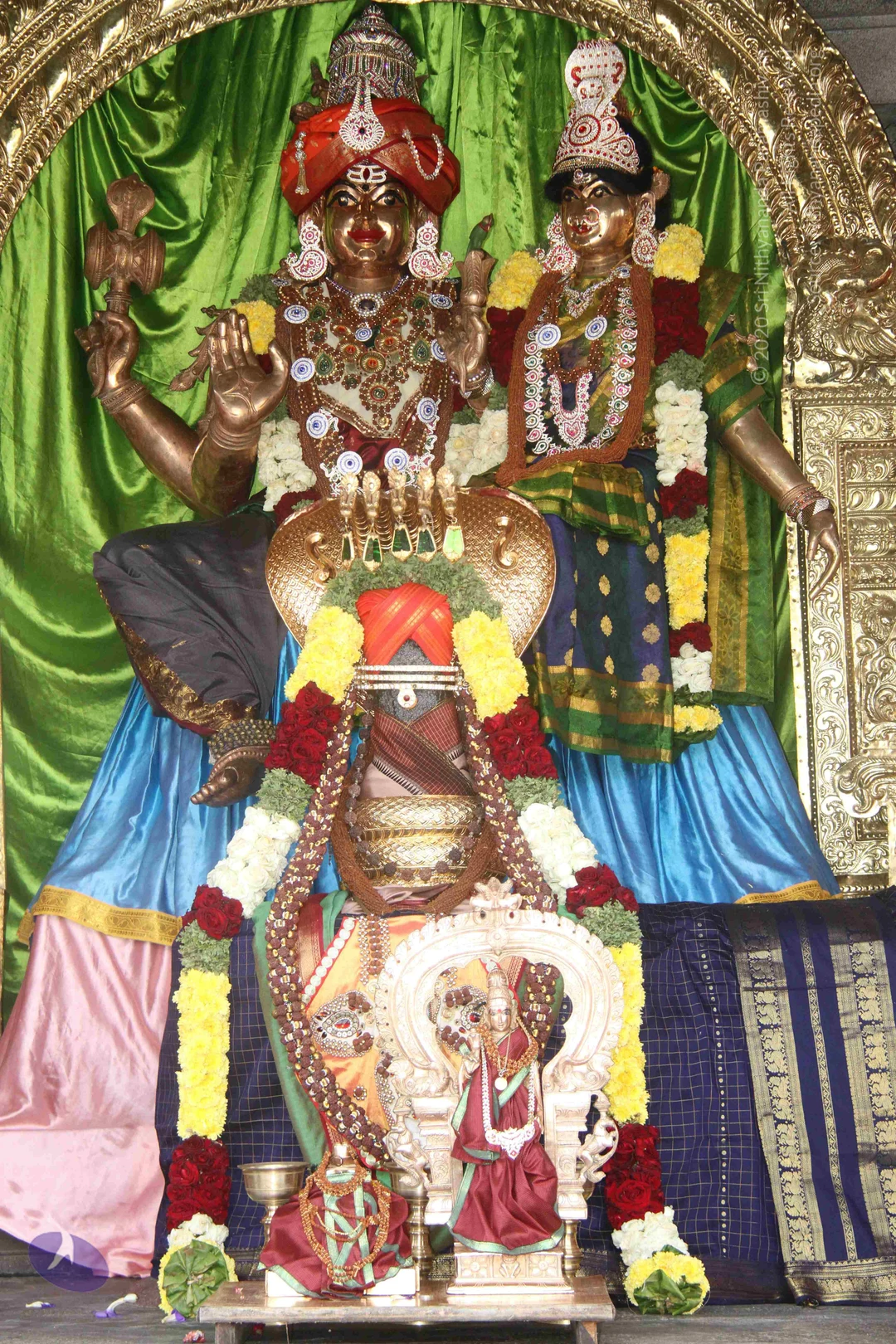
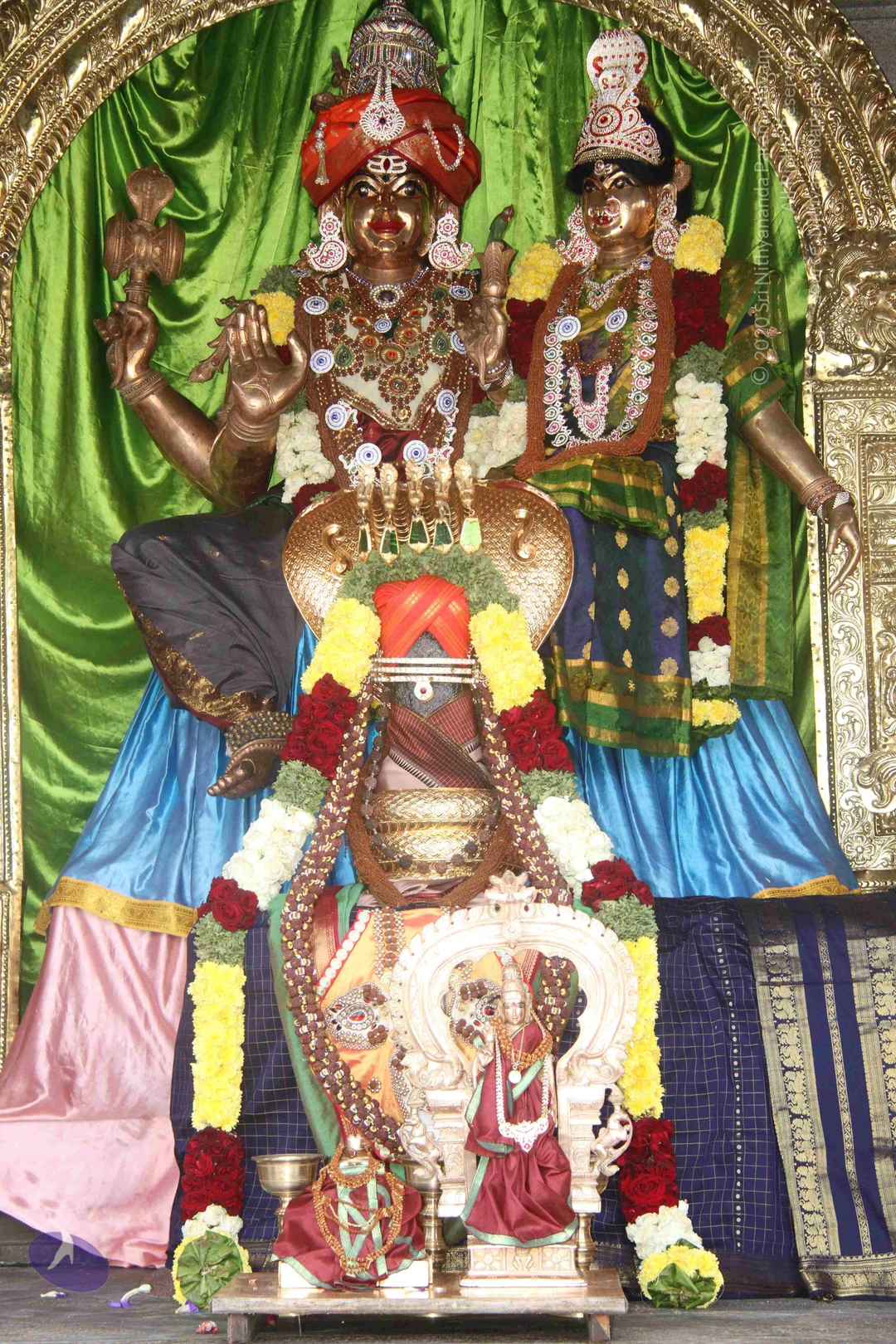
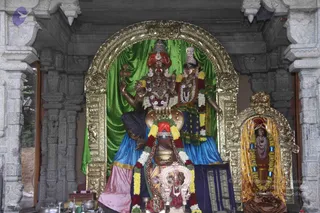
A temple sanctum with a large bronze-coloured deity murti of a standing male and female pair under a gilded arched frame and green velvet backdrop. The male figure wears a red and gold crown, a jewelled necklace and a dark blue dhoti, and holds a ceremonial implement in one hand; the female figure wears a tall crown, a white and red garland and a green sari. Flower garlands in yellow, red and white drape the figures and a kalasha-like pedestal below. To the right, a smaller deity murti is dressed in an orange cloth with a blue and white garland. Stone pillars frame the shrine and brass vessels sit on the floor in front. No people are visible.A photograph of a stone temple shrine with a golden arched frame and a green cloth backdrop. Two large deity murtis stand together: the left figure has a red and orange crown, multi-armed pose, a dark blue and red garment and garlands; the right figure wears a white and gold crown, a blue and green garment and white and red garlands. Below them sits a smaller seated murti draped in red and yellow garlands with a golden base. A separate smaller shrine to the right holds a standing figure in a yellow cloth and garland. Brass ritual vessels and lamps sit on the stone platform in front.A photograph of a temple shrine with a large deity murti group framed by an ornate gold arch and a green cloth backdrop. The central figure has an orange turban, a raised hand holding a staff-like object, and layered gold necklaces and garlands, seated beside a second figure in a green and yellow garment with a tall ornate crown. Below them stands a smaller figure with a red headdress and garlands of yellow and red flowers, and a brass lamp with offerings sits at the front. A smaller deity in a gold-trimmed niche to the right wears a gold-embroidered orange cloth and a flower garland. Stone pillars frame the scene, with metal vessels and offerings on a side table at lower left.A photograph of a temple sanctum showing large gilded statues of a deity pair standing before a green silk backdrop within an ornate golden arch. The taller central figure is a four-armed deity with a red turban and gold crown, holding a trident-like staff and gesturing with one hand; beside it stands a second figure in a blue and pink garment with a tall crown, both draped in garlands of yellow and red flowers and beaded necklaces. In front sits a smaller seated figure wearing a red turban and a garland, with a kalasha-like vessel and a small shrine before it. On the right, a smaller statue in a golden-orange cloth and white necklace sits within a carved niche, also garlanded. Brass ritual vessels and a lamp appear at the lower left. These are statues, not living people.A photograph of a temple shrine with large painted statues of a male and female deity pair seated on a golden throne under a green draped backdrop. The male figure wears a red turban, a multi-strand ornate necklace and raises a hand in blessing; the female figure wears a white-and-gold headdress, pearl necklaces and a green-and-yellow sari. Both are garlanded with yellow and red flower strands. In front, a smaller deity murti stands on a pedestal beneath a brass kalasha-like vessel, and a separate shrine to the right holds a golden-clad figure in an orange cloth with blue-and-white beaded garlands. Brass puja vessels and lamps sit on the floor in the foreground. No physical people are visible.A golden metal statue of a deity murti stands in a gilded arched niche against a bright green satin backdrop. The figure wears an orange-and-red turban with a jewelled ornament, a golden crown, and a multicoloured beaded necklace. Garlands of yellow and red flowers and white blossoms hang around the neck and shoulders. One hand holds a mace-like staff with a snake motif, while another hand is raised in a blessing gesture. A green and gold sari with floral patterns drapes the figure. The image is a photograph of a statue, with no physical people present.

PadukaPuja-Individuals-crowd

47 photosSource gallery
An empty ornate golden throne (peetha) with a carved gold backrest and lion-like armrests, draped with a tiger-striped cloth and tan cushions with orange trim. Centered in the throne is a framed photographic portrait of a smiling man with an orange turban, orange shawl and a red bindi, labelled as a portrait caption. Brass bells hang on chains and brass oil lamps with lit flames stand on either side against a dark textured wall strung with rudraksha beads. No physical people are present.Overhead view of a ritual offering arrangement on a large gold-embossed tray. Several silver plates with scalloped rims hold small silver bowls, some filled with orange-yellow liquid or paste, and silver spouted vessels. Marigolds in yellow and orange and red roses are arranged in a floral border around a central gold-coloured object, and pink flowers and green leaves are scattered among the dishes. No people are visible.A photograph of an arrangement of silver offering plates on an ornate gold-embossed tray, displayed as a ritual setting. Several round silver trays hold small silver bowls arranged in circles, filled with marigold-yellow and orange flowers, pink and red roses, and bowls of orange-yellow sweet offerings. Pink and red roses and green leaves sit near small silver vessels with pouring spouts. A central bed of orange, red and yellow flowers forms a decorative pattern, with lit oil lamps amid the petals. No people are visible; the setting is an arrangement of puja offerings and flowers.A photograph of a ritual arrangement on a gold-toned tray: a large oval field of densely packed roses in yellow, orange, red and pink, with a single pink rose at the centre. Two small gold cups with red stone accents sit in the middle, and silver spoons with white handles lie at the edges beside silver bowls and a dish holding a golden substance. Pink roses and green leaves decorate the corners. No people are visible; this appears to be a floral offering or puja setup.Close-up photograph of silver ritual vessels and flower offerings arranged on a tray during a temple-style puja setting. In the foreground, a silver bowl holds yellow and orange marigold-like flowers with a red flower pile to the left. A pink rose sits near an ornately embossed silver container, with green leaves and stems behind. Blurred silver plates, bowls and more flowers in red, orange and pink fill the background. No people are visible.Close-up photograph of ornate silver ritual vessels with embossed floral and leaf patterns, arranged before a blurred gold-embossed backdrop. A pink rose with green leaves rests in a silver bowl, while a red flower sits on a silver tray, and orange, yellow and red marigolds and roses are scattered among the vessels. A small silver spouted pot and a silver pitcher with bead-like tassels are visible. No people or deity figure is shown; the arrangement suggests puja offerings of flowers and vessels.

NithyaSatsang-Swamiji

29 photosSource gallery
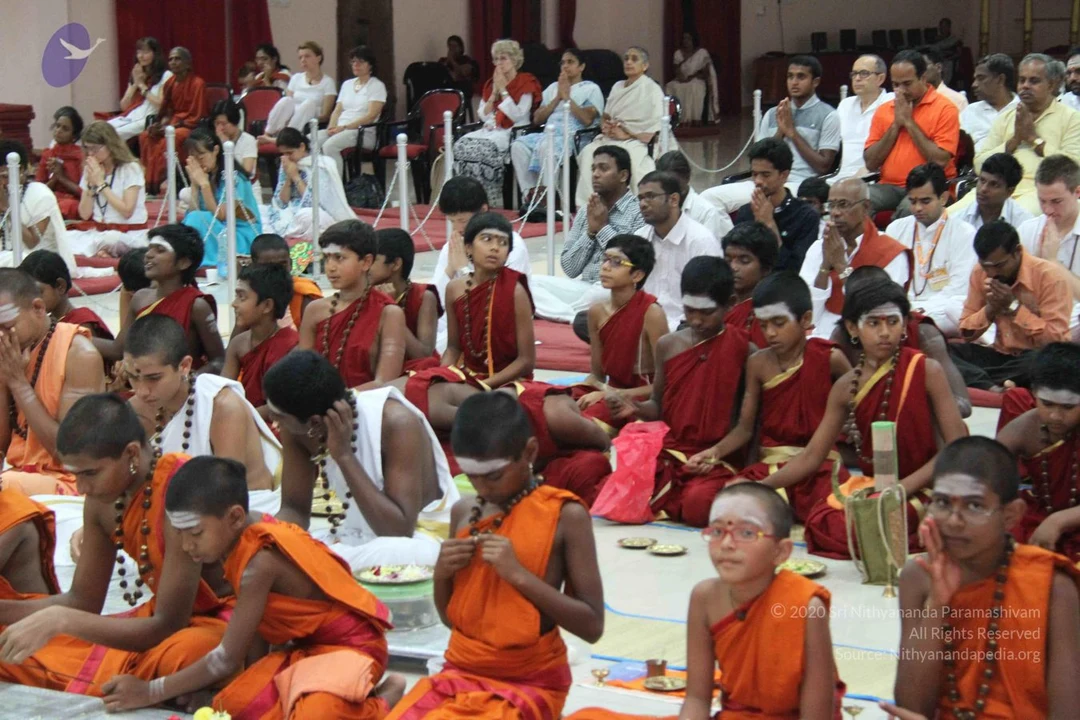
A smiling man with short dark hair sits on an ornate gilded throne with carved lion-like finials and filigree backrest. He wears a rust-red and gold-bordered robe, a rudraksha mala draped over his shoulders, a gold chain and gold earrings, with a white vertical tilak and red bindi on his forehead. Behind him a painted figure holds a red-tipped object. Presentation cues match the a person label: a sannyasi in saffron-orange with a rudraksha mala and ceremonial gold ornaments, seated on a throne in a satsang setting.A photograph of a seated audience at a satsang-style gathering in a hall with red curtains. In the foreground, many young boys with shaved heads and white forehead markings wear saffron-orange and red robes and rudraksha malas, sitting cross-legged with hands joined in prayer. Small brass oil lamps and offering plates rest on the floor near them. Behind them, adults in white, orange and yellow clothes sit in folding chairs and on the floor with palms pressed together, and a woman in a red shawl is visible. No speaker or throne-seated figure is clearly identifiable in this frame.A man seated on an ornate gold throne with a large repoussé gold backrest, wearing a rust-orange and gold-bordered dhoti-style wrap over bare shoulders, a long rudraksha mala with orange beads, a thin gold chain, gold earrings, a white forehead mark with a red bindi, and his hair swept back. He looks to the side while speaking, with a small microphone near his face. Beside him stands a polished brass oil lamp with a lit flame and a brass bird figure, against a pastel blue and pink wall.A photograph of a man seated before an ornate gold-leaf throne with carved floral and scrollwork patterns. He wears a rust-orange and gold-bordered cloth draped over his left shoulder, with a dense rudraksha mala in brown beads around his neck. He has a white vertical tilak on his forehead with a red dot at the centre, and a small clip-on microphone near his mouth. He is speaking, with his gaze directed to the side, against a pale blue wall and a terracotta-coloured pillar. a person: long swept-back hair, saffron and gold clothing and rudraksha mala cues are visible, though the image is ambiguous.A photograph of a smiling man seated beside an ornate gold carved throne-like structure. He has swept-back dark hair, a white vertical forehead mark with a red dot, and wears a rust-orange wrap with a gold-bordered yellow edge over bare shoulders. Two long rudraksha malas hang on his chest along with a thin gold chain. A small headset microphone is visible near his cheek. Behind him are orange and blue panels on a reddish-brown wall.Photo of a smiling man seated beside an ornate gold carved throne-back, wearing a small lapel microphone. He has swept-back dark hair, white vertical tilak lines on the forehead with a red dot at the centre, and a rust-red and gold-bordered shawl draped over bare shoulders. A rudraksha-style mala of rust-coloured beads hangs around his neck along with a thin gold chain. Background shows coral and pale walls with a blue-and-orange banner edge. The setting suggests a satsang or discourse stage. Appearance-based label: a person seated as a speaker, with the page noting his presence at this event.

SarvaDarshan

17 photosSource gallery
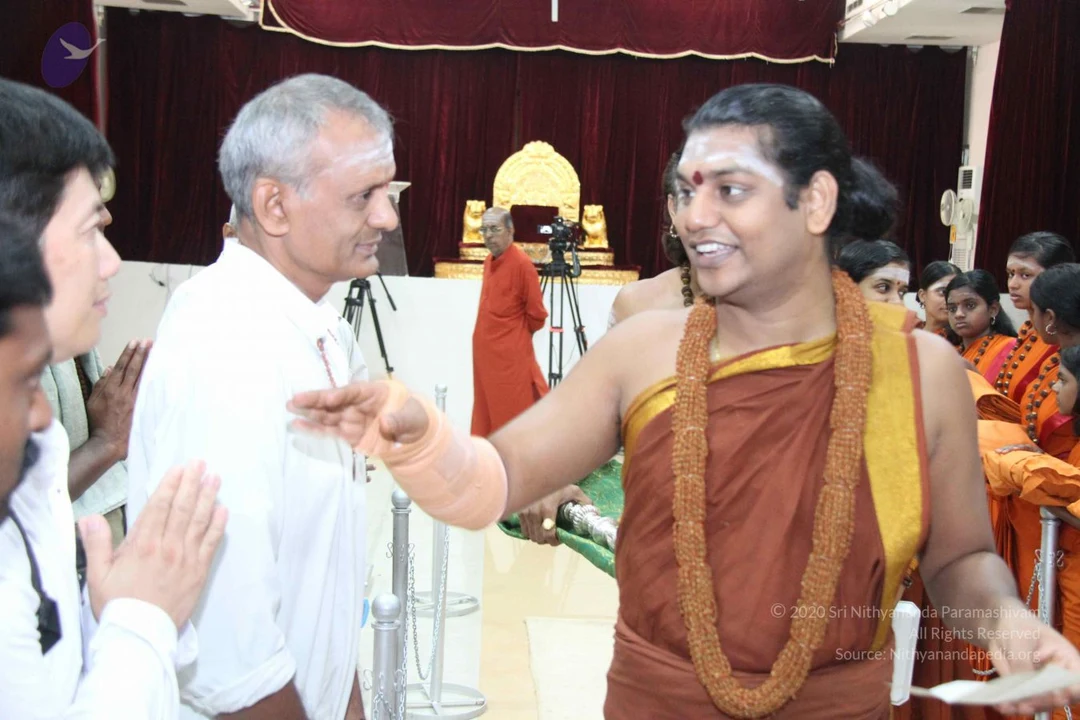
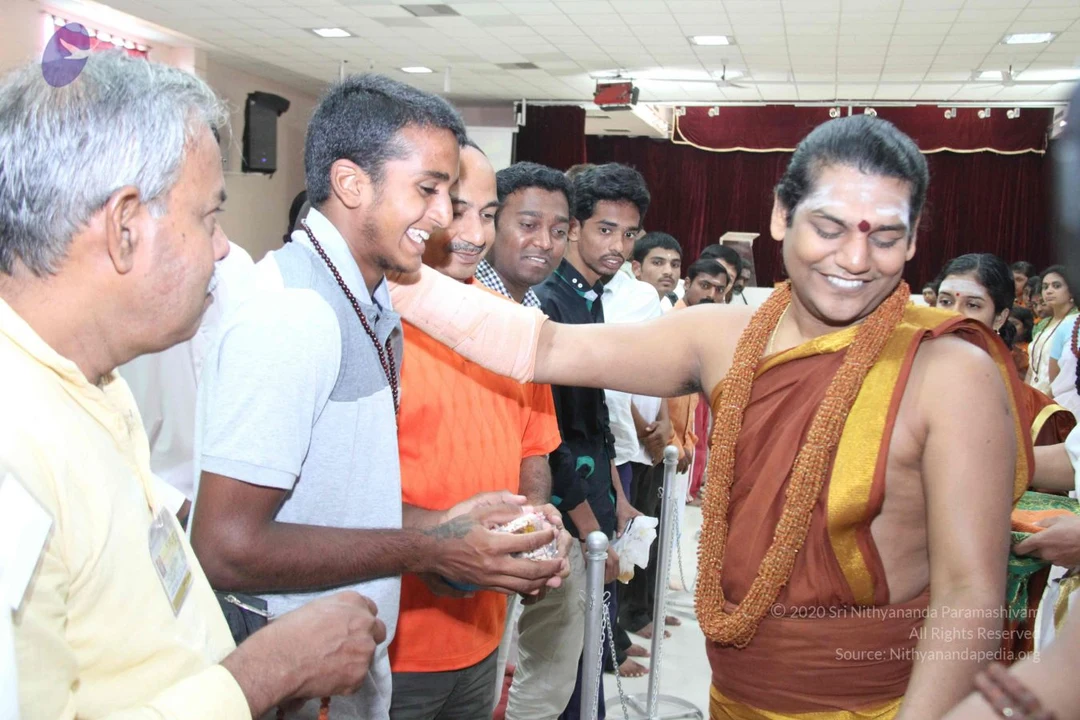
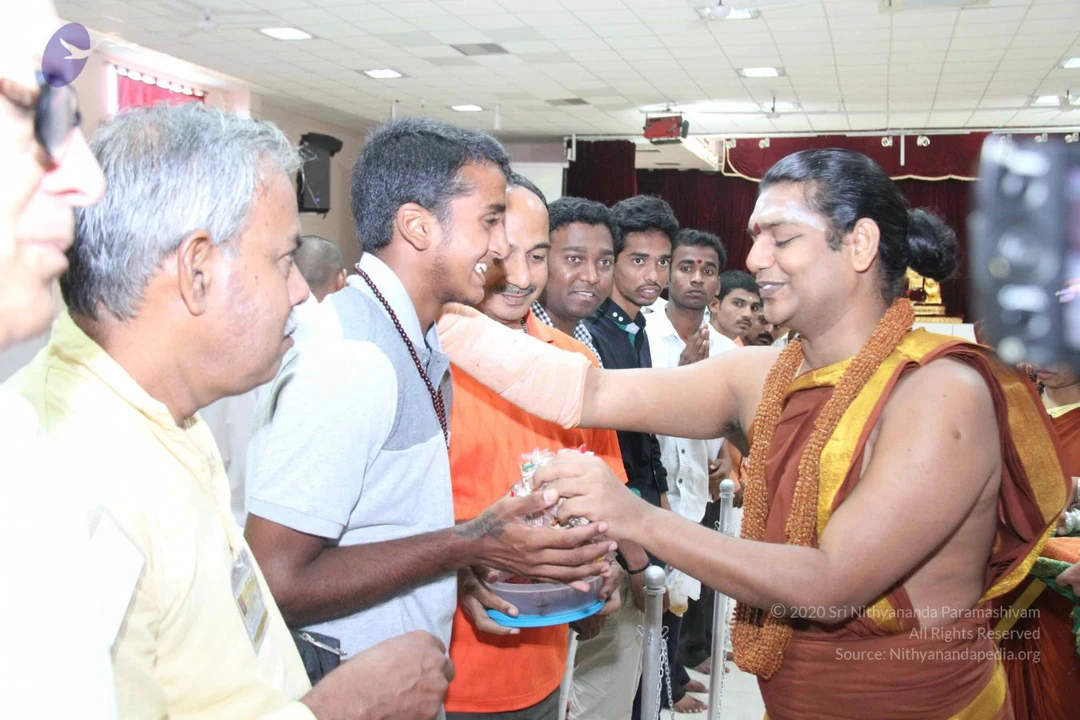
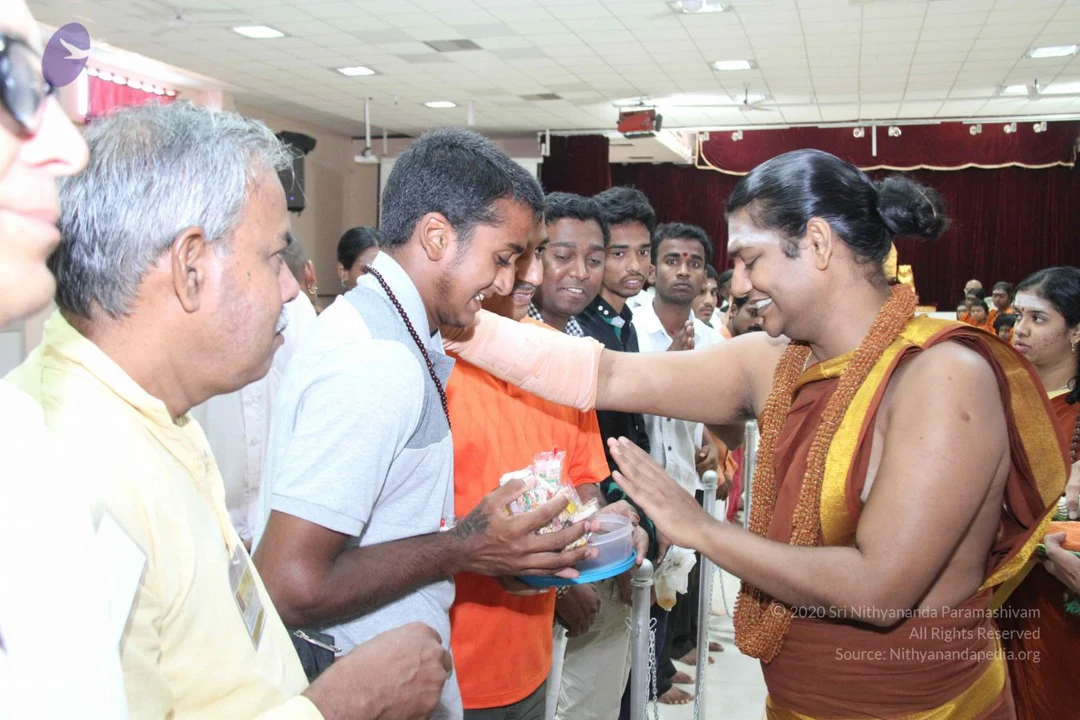
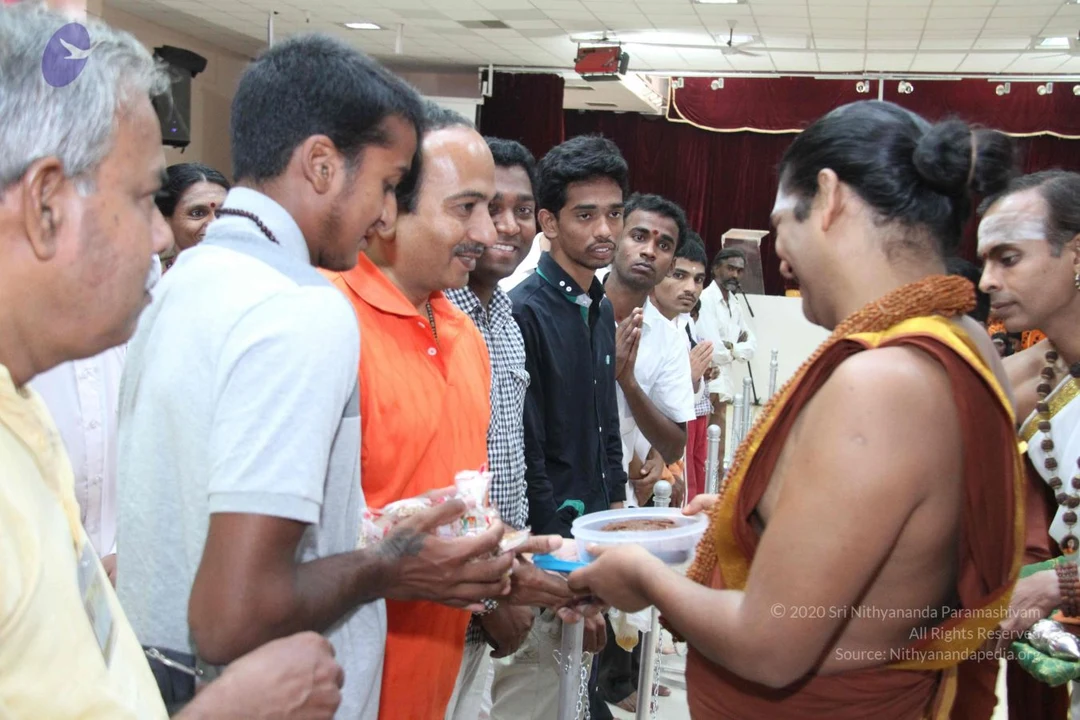
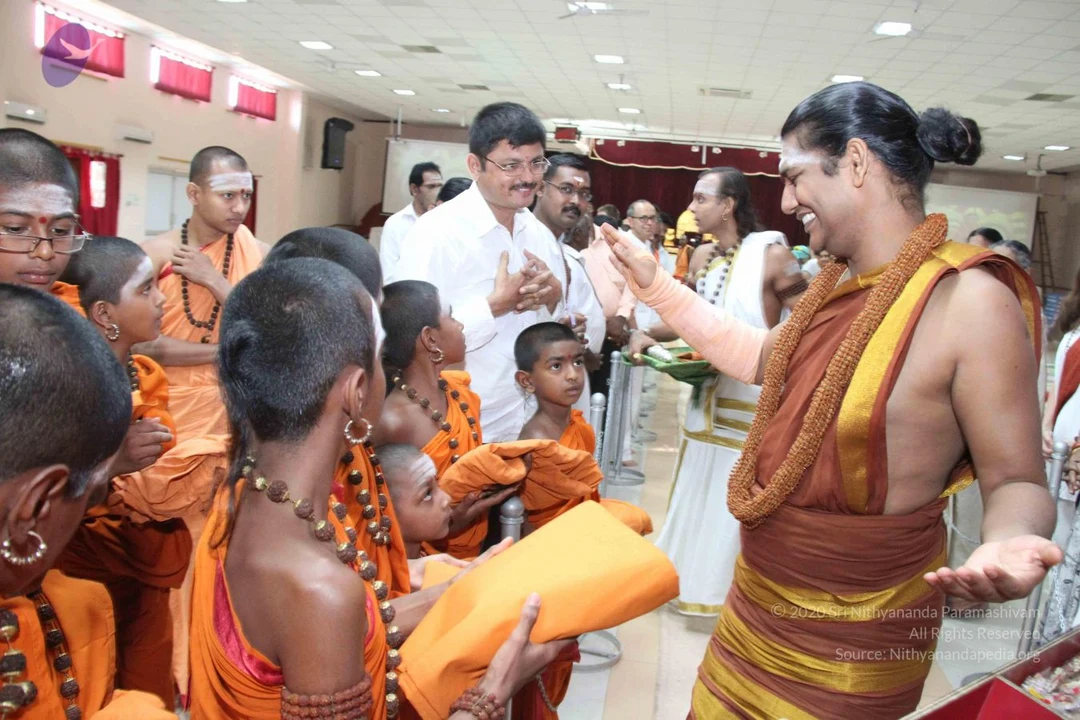
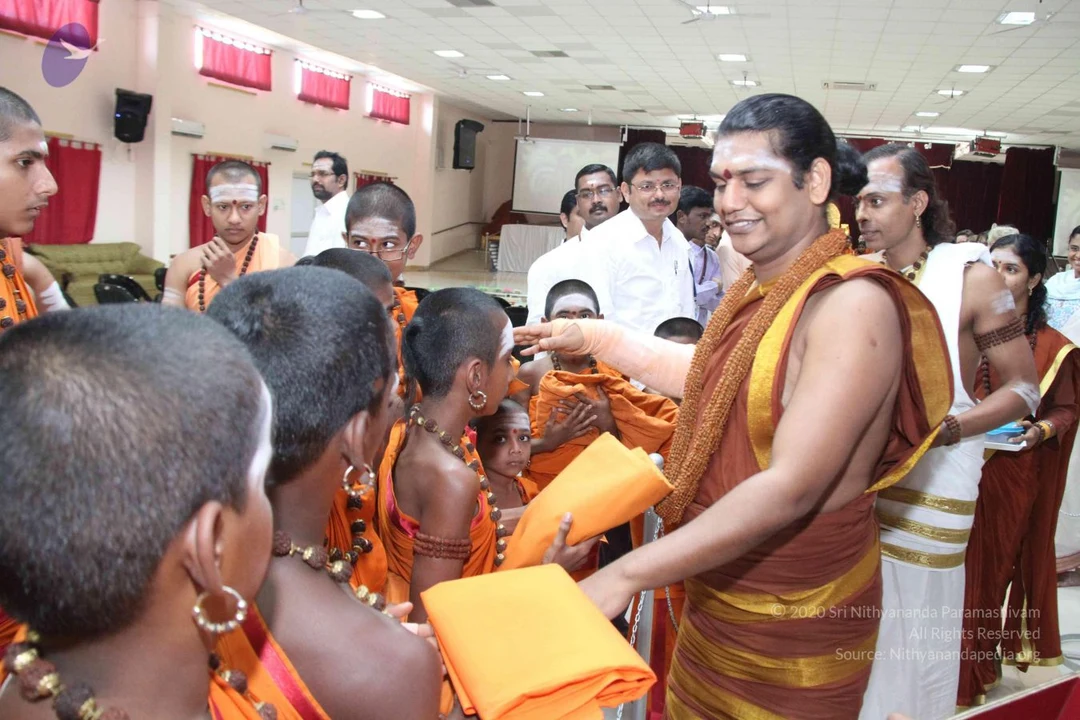
Photograph of an indoor hall with a stage, red velvet drapes, a projection screen and a golden chair at the back. In the foreground, a man in a brown-and-gold saffron wrap and a rudraksha mala places his hand on the head of a young man in a white kurta, who bows with palms pressed together. A man in a light shirt on the left also stands with folded hands, and a child in a checked shirt stands in the middle. A man in a white dhoti with a white forehead mark and a shorter-haired figure in orange stand in the background. The person in the brown-and-gold wrap has a long hair knot, a tilak and a mala. a person identity is uncertain from appearance alone.A photograph of a hall with maroon curtains and a white ceiling. In the foreground, a man in a rust-brown and gold-bordered dhoti and shawl, with a sandalwood-marked forehead and a long rudraksha-style bead garland, raises his right hand in blessing toward an older man in white kurta who bows with folded hands and lowers his head. Beside him, a man in an orange shirt and another in white stand with palms joined, and several more people in white and orange robes stand behind a line of stanchions. Young people in orange robes stand along the right edge holding orange cloth. A gold-decorated seat or throne is visible at the back of the stage.A photograph in a hall with dark red curtains and a gold-coloured throne with lion figures at the back. A bare-chested man in a saffron-orange dhoti and orange shawl with gold border stands centre, wearing a long rudraksha-style mala with white forehead markings and a red bindi, holding a small white card. To the left, a man in a white shirt presses his palms together and others in light clothing stand near. On the right, a line of young girls in orange robes stands behind a chrome rope barrier, several holding folded orange cloths. A cameraman with a tripod is at centre back. The scene shows an event with devotees and ashram members.A photograph of a satsang hall with red velvet drapes and a golden throne with lion figures behind. In the foreground, a man with swept-back long dark hair, white and red forehead markings, a dark red dot, a long orange-brown shawl with gold border and a long rudraksha mala extends his right hand to greet a grey-haired man in a white shirt with white forehead markings, who presses his palms together. A man in a saffron robe stands near a camera on a tripod. Women in orange-saffron sannyasi clothing with beaded necklaces stand to the right behind a metal barrier. A devotee with folded hands is at left, and a printed credit reads Sri Nithyananda Paramashivam andA photograph of an indoor hall with a white ceiling, red curtains and a small golden shrine in the background. A bare-chested man in a rust-red dhoti with a gold-bordered shawl and a long rudraksha mala stands at right, extending his hand to offer a small item from a blue bowl held by a young man in a grey t-shirt. Nearby, a man in an orange shirt, a man in a yellow shirt and several young men in white and dark clothing look on, smiling. The figure at right has long hair tied in a bun and a tilak on the forehead. Probable Swamiji (probable), shown as a giver of prasad, with the matching cues of a rudraksha mala, ornate gold-bordered rust-red shawl and long swept-back hair.A photograph of a hall with maroon curtains where a person with a bun hairstyle, bare-chested and wearing a saffron-and-gold shawl over a long ceremonial garland of rudraksha beads, smiles and extends a hand toward a young man in a grey polo and rudraksha mala. The young man holds a small clear container of sweets or snacks. Behind him, a line of men in orange, white and dark shirts waits, and a man in a yellow shirt stands at left. Metal barrier posts and a ceiling with lights are visible.

Flag

8 photosSource gallery
A photograph of a red-orange flag with a black circle bearing a white bird silhouette, flying from a white pole above a polished copper finial with a spiked spire and a fluted ring below. The flag ripples against a pale blue sky with soft clouds. No people are visible.A photograph of an orange saffron flag with a dark blue emblem fluttering on a white pole against a pale blue sky with clouds. Below the flag, the top of a copper-coloured finial with a conical tip and a serrated disc sits on a structure. No people are visible.An orange saffron flag with a dark blue oval emblem and a small white bird-like motif flutters on a white pole against a clear blue sky with wispy clouds. Below the flag, the copper-coloured finial of a temple spire rises, with an ornate tiered base visible at the bottom. No people are visible in the scene.A photograph of a bright orange-red flag with a blue bird emblem flying on a white pole against a pale blue sky with wispy clouds. The flag's emblem is a stylized blue bird in flight. Below the flag, a copper finial with a spiked, ornamental base is visible at the top of a structure. No people are present.A photograph of a saffron-orange flag with a dark blue emblem flying from a white pole against a pale blue sky with wispy clouds. Below the flag, a copper-coloured finial with tiered ridges crowns a temple structure. No people are visible.A photograph of a bright red-orange flag fluttering on a white pole against a pale blue sky with wispy clouds. The flag bears a dark navy oval with a stylised white bird in flight. A copper finial with a decorative base sits at the top of a structure in the lower foreground. No people are visible.

Nature

1 photoSource gallery
A photograph looking upward through dark silhouetted leaves of a tree toward a bright, overcast sky with grey and dark clouds. No people, statues or ritual objects are visible; the scene is a natural landscape of foliage against cloud.

Goshala-Rabbit
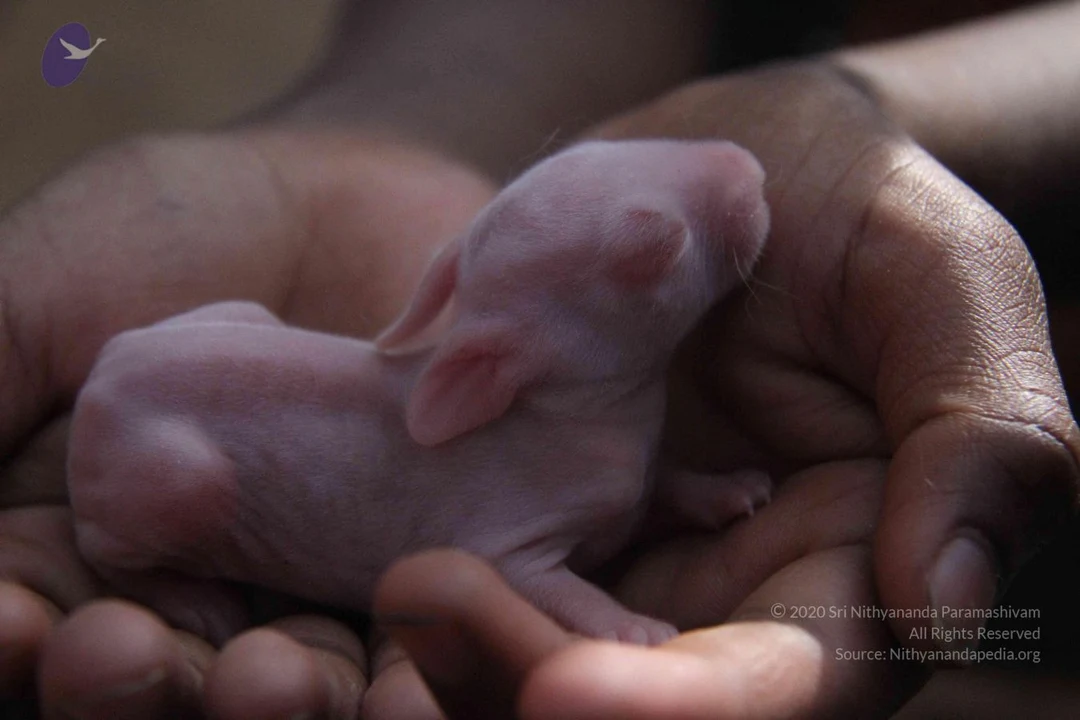
3 photosSource gallery
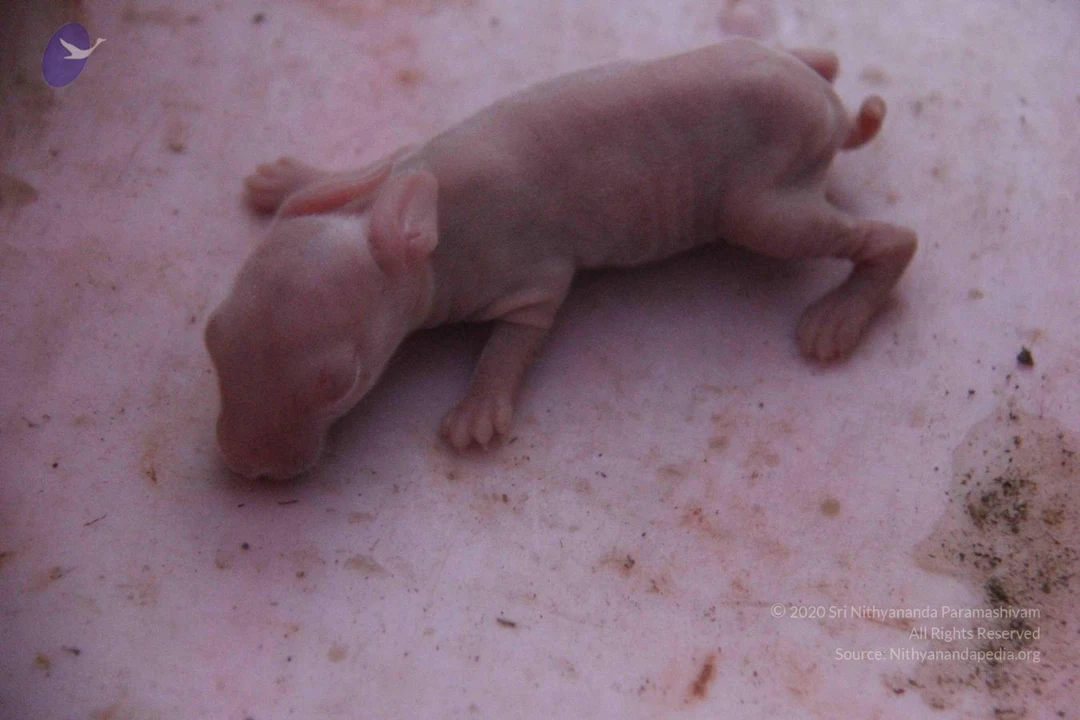
Close photo of two cupped hands holding a tiny newborn hairless animal, pinkish-grey skin, small folded ears, tiny clawed feet, lying on its side. No people's faces visible. Purple bird logo in the top-left corner.A photograph of a small hairless newborn animal lying on a pinkish-white plastic tray with a mesh edge at the left. The pink body is wrinkled and bare, with a small tail-like limb extended to the right, and the head is turned downward toward the tray surface. Scattered dirt and reddish stains mark the tray. No people are visible in the frame.A photograph of a newborn, hairless animal lying on its side on a pinkish, speckled surface, possibly a piglet or puppy. Its tiny legs and ears are visible, and the surface has stains and dirt. No people, ritual setting, or identifiable a person appearance is present.

Temple
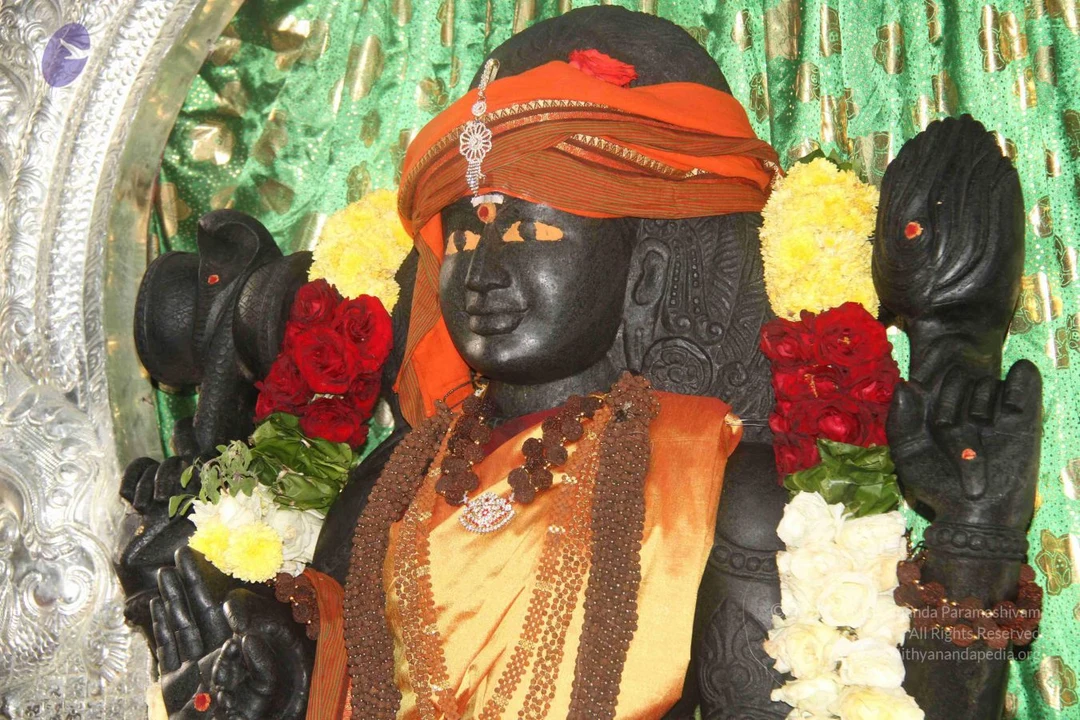
23 photosSource gallery
A temple sanctum with a large bronze-coloured deity murti of a standing male and female pair under a gilded arched frame and green velvet backdrop. The male figure wears a red and gold crown, a jewelled necklace and a dark blue dhoti, and holds a ceremonial implement in one hand; the female figure wears a tall crown, a white and red garland and a green sari. Flower garlands in yellow, red and white drape the figures and a kalasha-like pedestal below. To the right, a smaller deity murti is dressed in an orange cloth with a blue and white garland. Stone pillars frame the shrine and brass vessels sit on the floor in front. No people are visible.A photograph of a stone temple shrine with a golden arched frame and a green cloth backdrop. Two large deity murtis stand together: the left figure has a red and orange crown, multi-armed pose, a dark blue and red garment and garlands; the right figure wears a white and gold crown, a blue and green garment and white and red garlands. Below them sits a smaller seated murti draped in red and yellow garlands with a golden base. A separate smaller shrine to the right holds a standing figure in a yellow cloth and garland. Brass ritual vessels and lamps sit on the stone platform in front.A photograph of a temple shrine with a large deity murti group framed by an ornate gold arch and a green cloth backdrop. The central figure has an orange turban, a raised hand holding a staff-like object, and layered gold necklaces and garlands, seated beside a second figure in a green and yellow garment with a tall ornate crown. Below them stands a smaller figure with a red headdress and garlands of yellow and red flowers, and a brass lamp with offerings sits at the front. A smaller deity in a gold-trimmed niche to the right wears a gold-embroidered orange cloth and a flower garland. Stone pillars frame the scene, with metal vessels and offerings on a side table at lower left.A photograph of a temple sanctum showing large gilded statues of a deity pair standing before a green silk backdrop within an ornate golden arch. The taller central figure is a four-armed deity with a red turban and gold crown, holding a trident-like staff and gesturing with one hand; beside it stands a second figure in a blue and pink garment with a tall crown, both draped in garlands of yellow and red flowers and beaded necklaces. In front sits a smaller seated figure wearing a red turban and a garland, with a kalasha-like vessel and a small shrine before it. On the right, a smaller statue in a golden-orange cloth and white necklace sits within a carved niche, also garlanded. Brass ritual vessels and a lamp appear at the lower left. These are statues, not living people.A photograph of a temple shrine with large painted statues of a male and female deity pair seated on a golden throne under a green draped backdrop. The male figure wears a red turban, a multi-strand ornate necklace and raises a hand in blessing; the female figure wears a white-and-gold headdress, pearl necklaces and a green-and-yellow sari. Both are garlanded with yellow and red flower strands. In front, a smaller deity murti stands on a pedestal beneath a brass kalasha-like vessel, and a separate shrine to the right holds a golden-clad figure in an orange cloth with blue-and-white beaded garlands. Brass puja vessels and lamps sit on the floor in the foreground. No physical people are visible.A golden metal statue of a deity murti stands in a gilded arched niche against a bright green satin backdrop. The figure wears an orange-and-red turban with a jewelled ornament, a golden crown, and a multicoloured beaded necklace. Garlands of yellow and red flowers and white blossoms hang around the neck and shoulders. One hand holds a mace-like staff with a snake motif, while another hand is raised in a blessing gesture. A green and gold sari with floral patterns drapes the figure. The image is a photograph of a statue, with no physical people present.

Gurukul

3 photosSource gallery
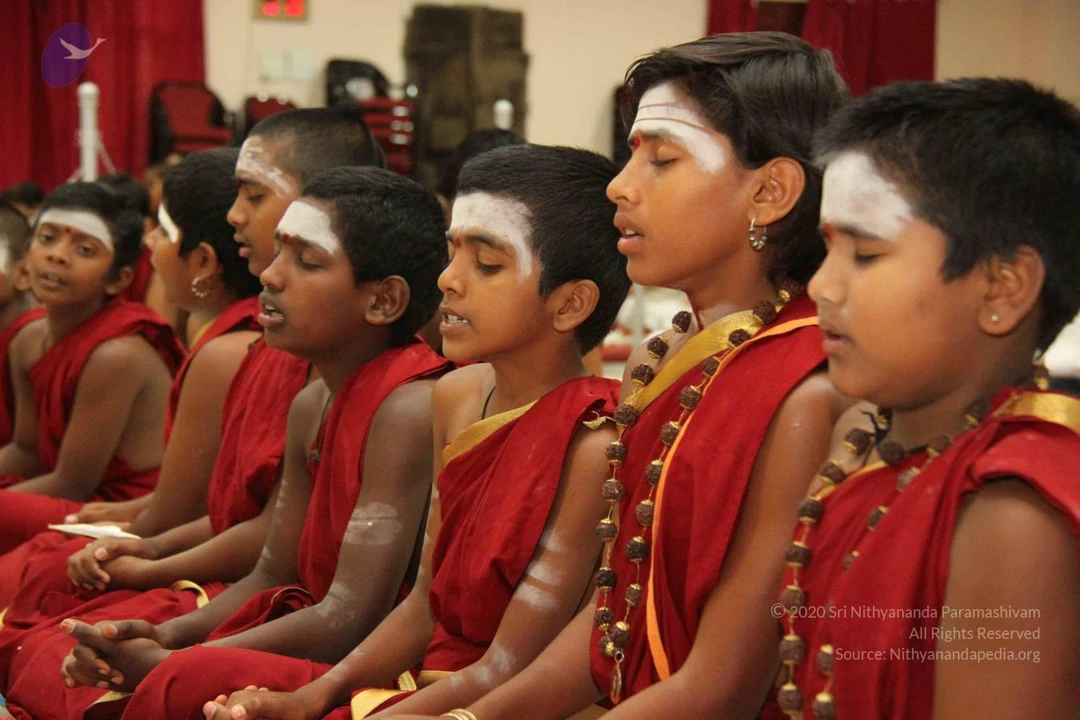
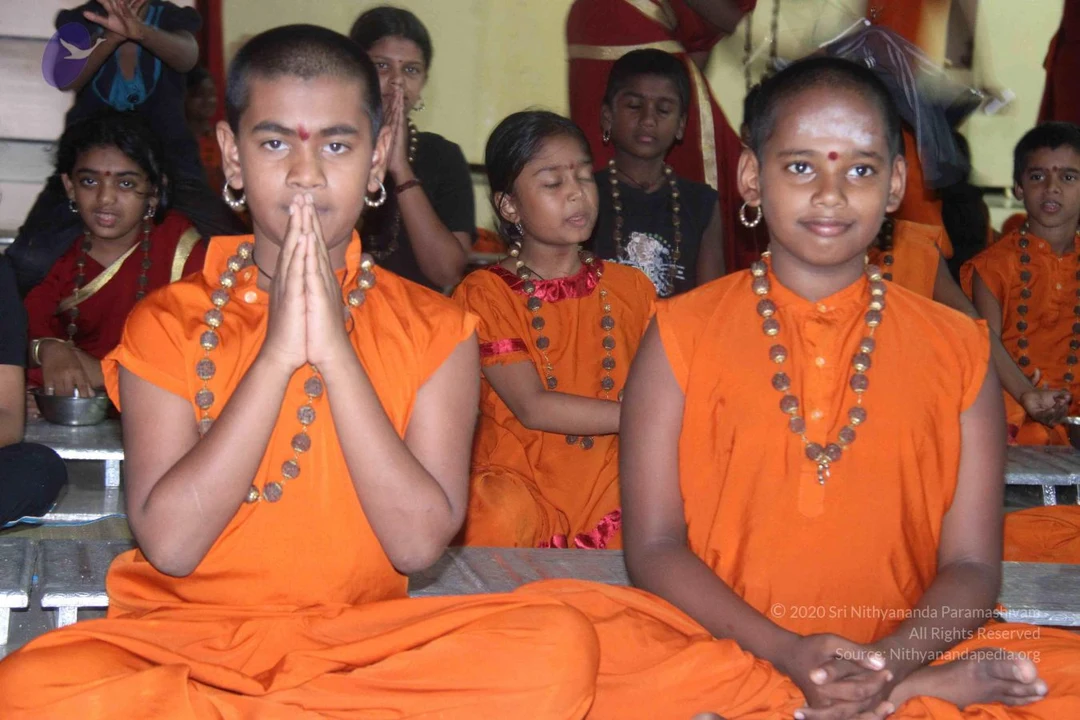
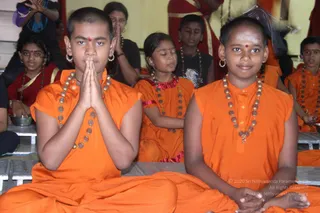
Children seated in a satsang or meditation gathering wear saffron-orange robes and rudraksha malas. The boy on the left sits cross-legged with palms pressed together in anjali mudra, eyes open and looking forward. Beside him a girl sits with eyes closed and hands resting in her lap, and a boy in an orange robe sits behind her. On the right, a shaved-headed young sadhaka in orange smiles faintly with hands folded, a red bindi and white vibhuti marks on his forehead. Behind them adults in dark and red clothing are seated.A photograph of a seated group of young children, mostly boys and some girls, in a hall with light tiled floor and grey wooden benches. Most wear saffron-orange or red robes, with black or navy T-shirts among others, and many have rudraksha malas around their necks. Many sit with palms pressed together in anjali mudra, and a few have vibhuti or red tilak marks on their foreheads.Several young boys sit in a row with eyes closed and palms pressed together in anjali mudra, a devotional posture during satsang or prayer. The boy in front wears a saffron-orange sleeveless robe, a rudraksha mala and a red bindi on his forehead; a boy to the left wears orange and red-framed glasses; others wear plain black t-shirts, and a boy at right wears a red garment. Some shaved-headed children and a sanskrit-style vibhuti mark appear in the background. No adults are clearly visible in the foreground, and the room has white walls and a curtain behind them.

IA-Registration-WelcomeCenter

4 photosSource gallery
A photograph of an indoor registration or help desk. A white-haired older man in a white shirt stands at left, leaning over a desk beside a woman in glasses and a pink-and-white patterned top who is writing on a printed form. A young man in a dark t-shirt sits at a computer monitor, and a woman in an orange-and-gold saree sits in front of the screen at right. Behind the desk, a monk-like figure in orange robes with a rudraksha mala stands, and a small framed portrait hangs on the maroon wall. A stainless steel bottle and a purple case sit on the desk.A photograph of an office-style registration desk in an ashram room with maroon walls and a framed portrait of a bearded sage on the wall behind. A standing older man in a white shirt and dark trousers leans over the counter. Seated at the desk, a woman in a pink-and-white patterned top and glasses writes on a form. At the monitor, a young man in a dark t-shirt works at a keyboard. On the right, a smiling woman in an orange sari with a gold border and a rudraksha-style necklace sits at the desk, a steel flask and a small purple case in front of her. Behind them, a man in orange robes and a mala bends over a table, and other people sit in the background.Indoor office-style registration scene at a desk with a computer monitor. A woman in a lilac and white printed kurta with a rudraksha mala writes on a form at left. Beside her a young man in a navy shirt and a woman in lime green sit at a computer. Behind them a man in saffron-orange robes with a rudraksha mala leans over a table. At right a woman in white and a woman in a saffron-orange sari with a beaded mala sit at the desk, with a steel water flask and a purple pouch on the table. A framed picture hangs on a maroon wall behind.A photograph of two men seated on a black leather sofa in a temple-like room. The man on the left wears white dhoti-style clothing with a red-and-white bordered shawl, has a white tilak on his forehead, and holds a small object in his raised hand. The man on the right wears a white short-sleeved shirt and glasses, and reads a glossy magazine whose cover shows a figure in orange and gold clothing. Behind them, a golden deity murti and yellow flowers are visible, and another person in a maroon shirt sits in the background. Two people are visible.

1--PadukaPuja-Individuals-crowd
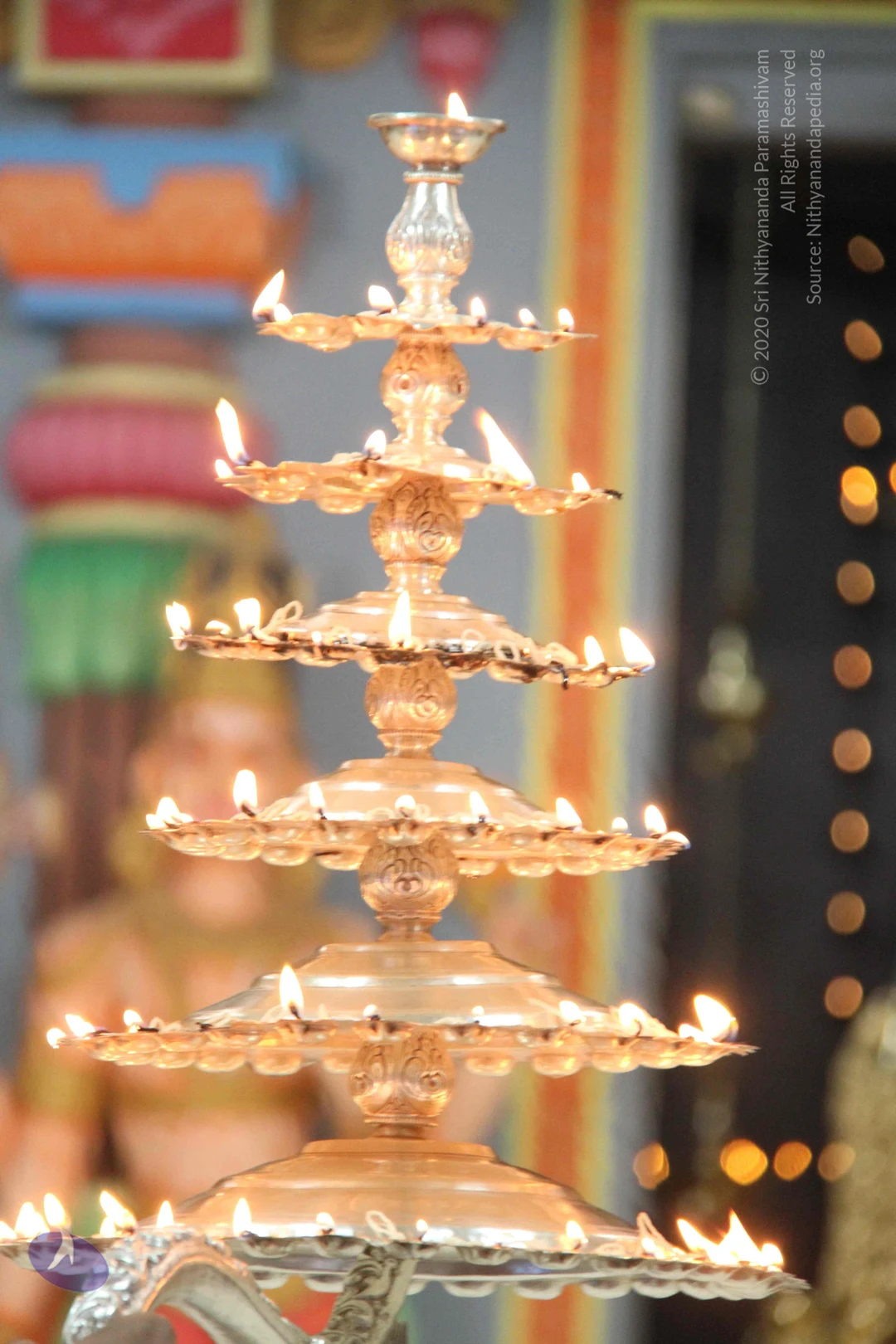
5 photosSource gallery
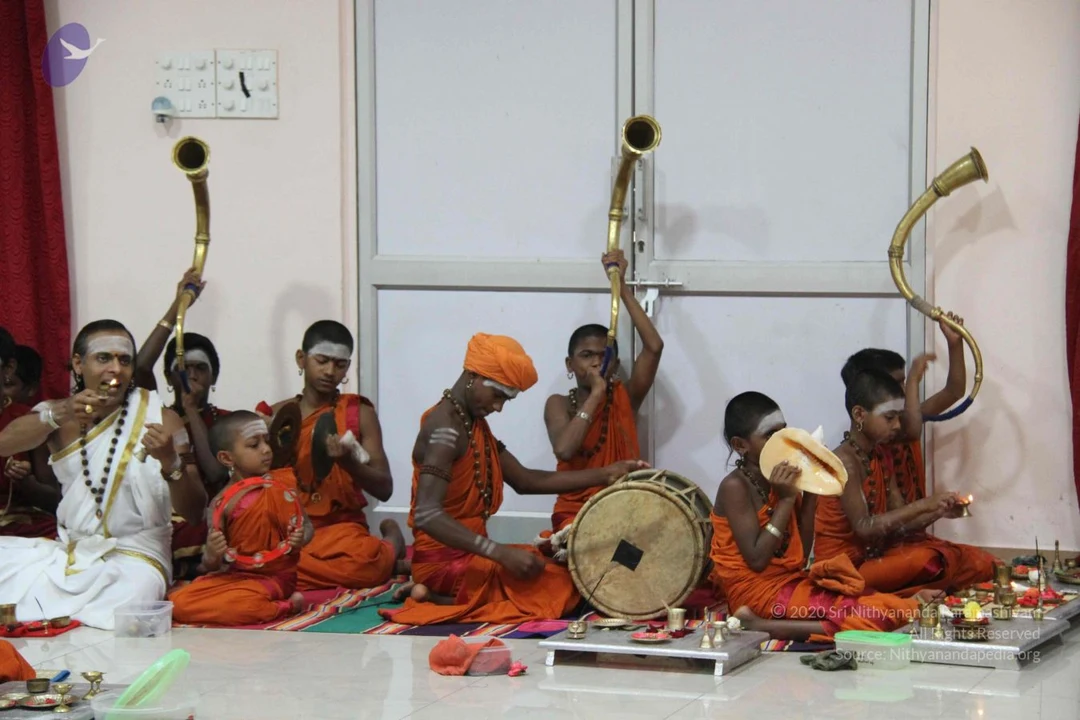
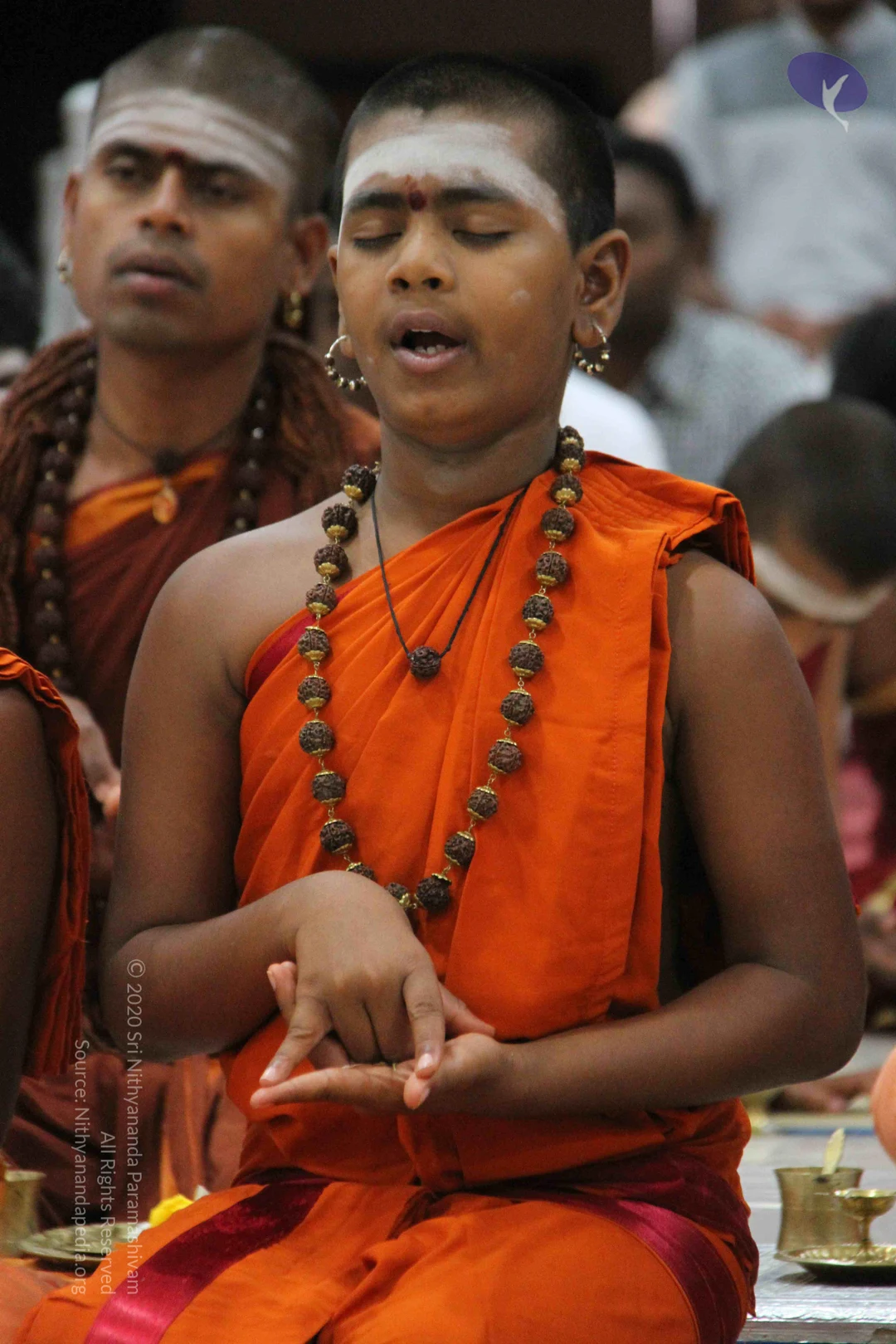
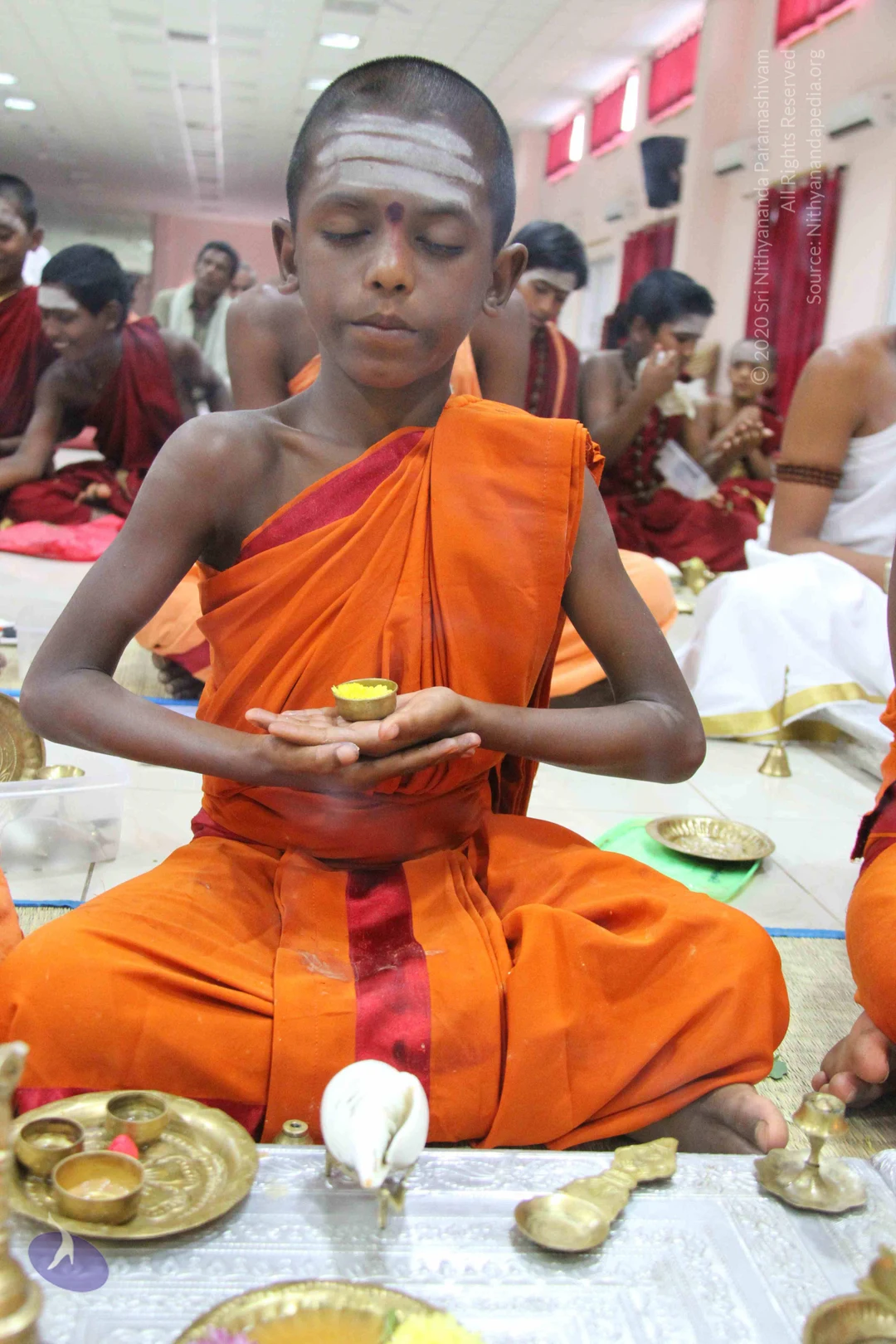
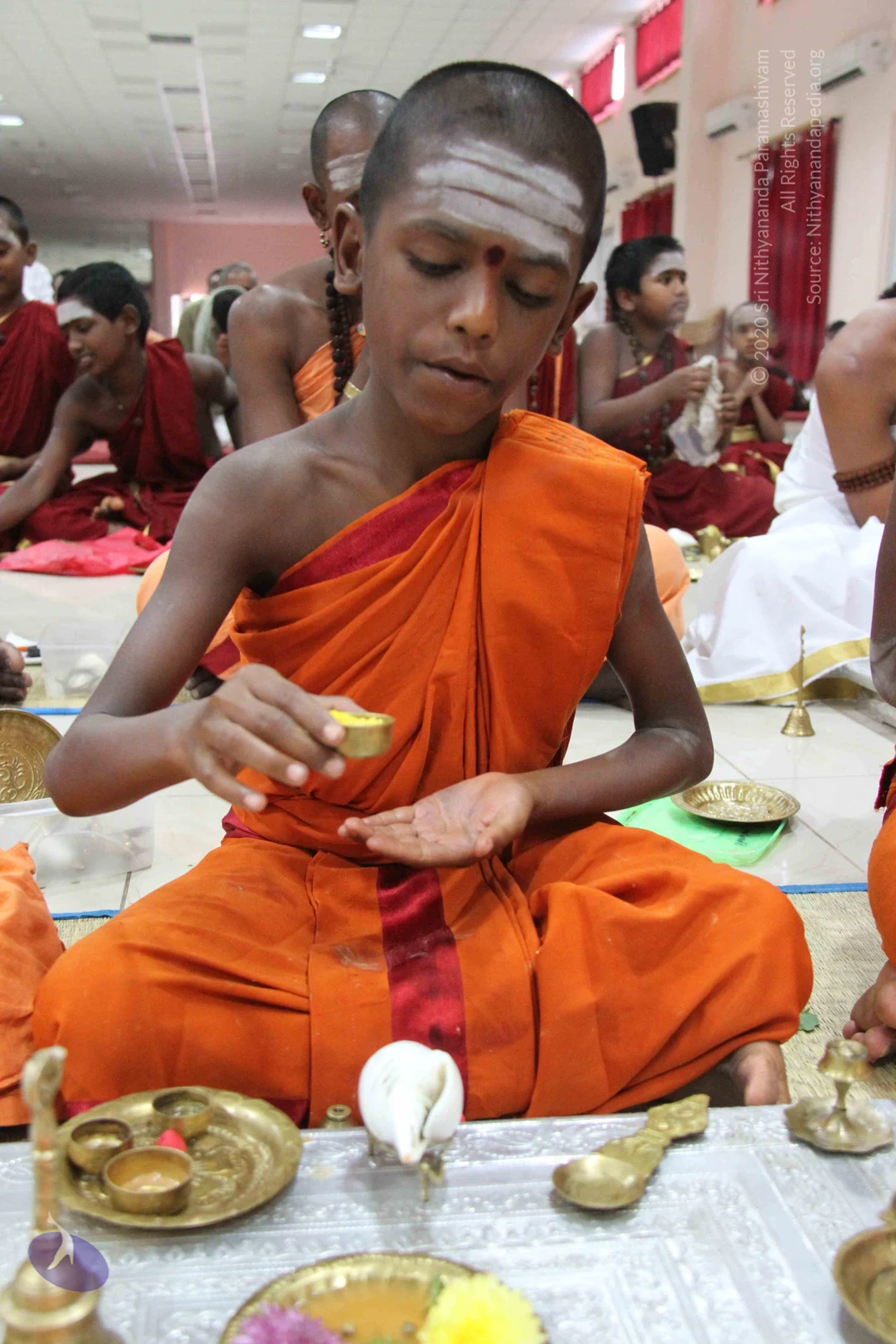
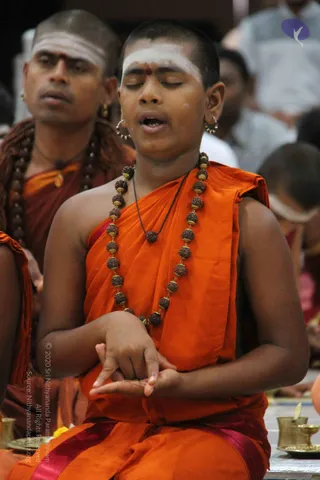
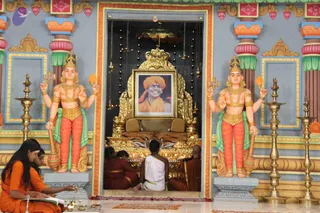
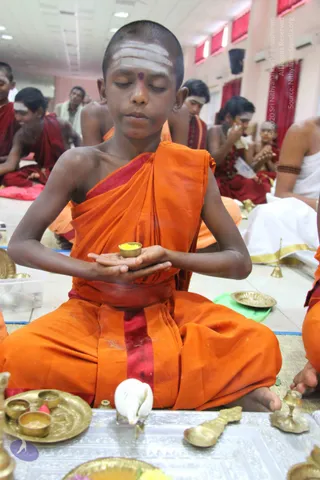
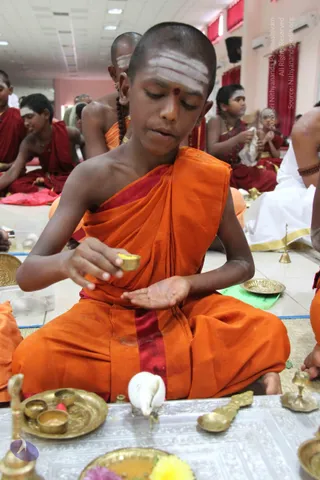
A young boy with a shaved head and white tilak with red bindi sits cross-legged in orange saffron robes with a red border, eyes closed and mouth open in chanting, hands in a mudra on his lap. He wears a long rudraksha mala with gold spacers and a black cord with a single bead, plus gold hoop earrings. Behind him, an older man in matching orange robes with a white forehead band and rudraksha mala also sits with eyes open. Brass vessels and a small brass lamp sit on a tray in the lower right, and seated devotees fill the background.A temple shrine interior with a central framed portrait labelled "Paramahamsa Nithyananda" showing a smiling man in orange headwear and orange garments, set above a golden throne draped with a tiger-skin cloth. Two large painted deity statues with four arms, golden crowns and red and green dhoti-style garments flank the doorway. Brass oil lamps stand beside them. In the foreground, a young woman in orange robes sits on the marble floor, while a man in white dhoti and shawl sits with his back to the camera in front of the shrine. Several other seated people in orange and maroon robes are visible behind him, performing a puja-style ritual with small brass vessels.A tiered brass lamp stand in near darkness, with many small oil lamps burning on successive rings of its shelves. Flames glow warm yellow against black background, lighting the tiers of the stand. No people are visible. The scene suggests a devotional lamp offering.A young boy with a shaved head and white vertical tilak with a red bindi sits cross-legged with eyes closed, holding a small brass bowl of yellow turmeric paste in cupped hands. He wears an orange saffron robe with a red border. Brass puja vessels, a brass bell and a white conch-shaped object sit on a white cloth in front of him. Behind him, several other boys in red-bordered robes and white tilaks sit on the floor in a hall with red curtains, appearing to take part in a puja or ritual.A young boy with a shaved head and white sacred ash lines on his forehead sits cross-legged on the floor in an orange saffron robe with a red border. He holds a small brass cup in his right hand, tipping yellow liquid into his left palm, while brass puja plates, a brass bell, a shell and flower petals lie on a white cloth in front. Behind him, other boys in red and orange robes sit in rows during a ritual gathering in a bright hall with red curtains and wall air conditioners.

01-TEMPLE

26 photosSource gallery
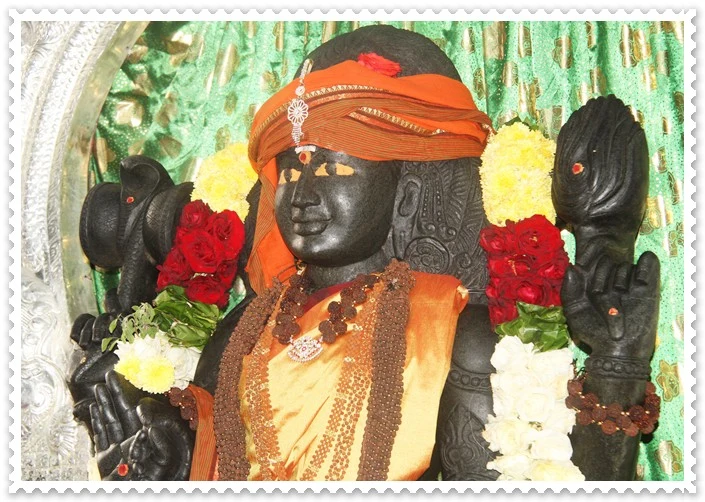
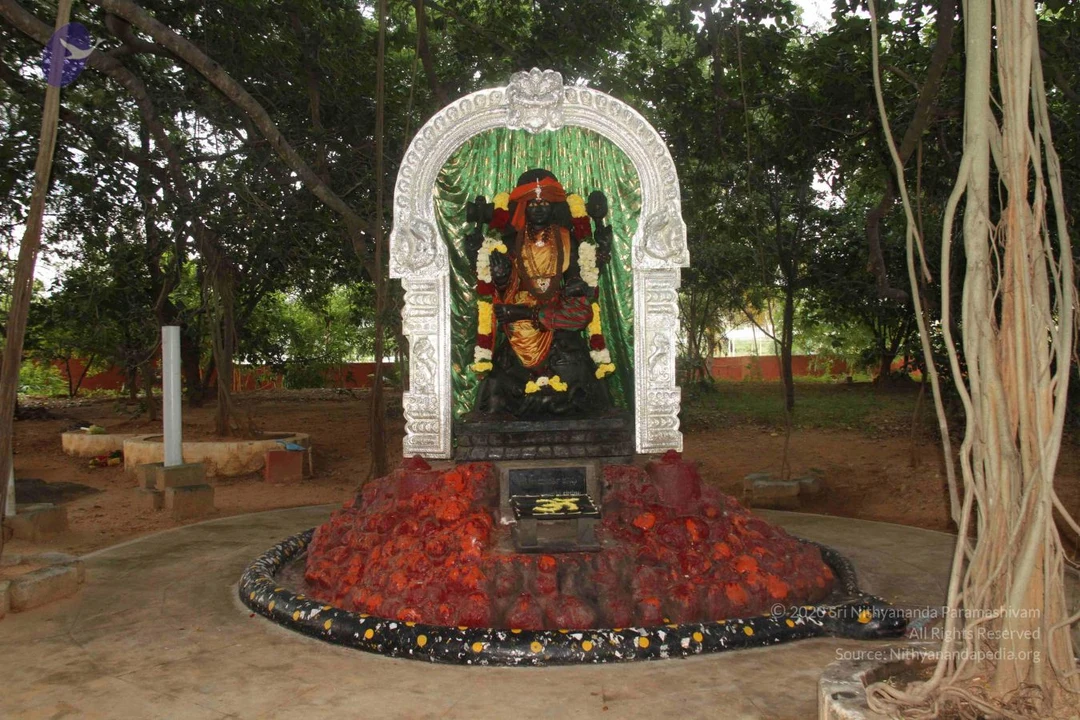
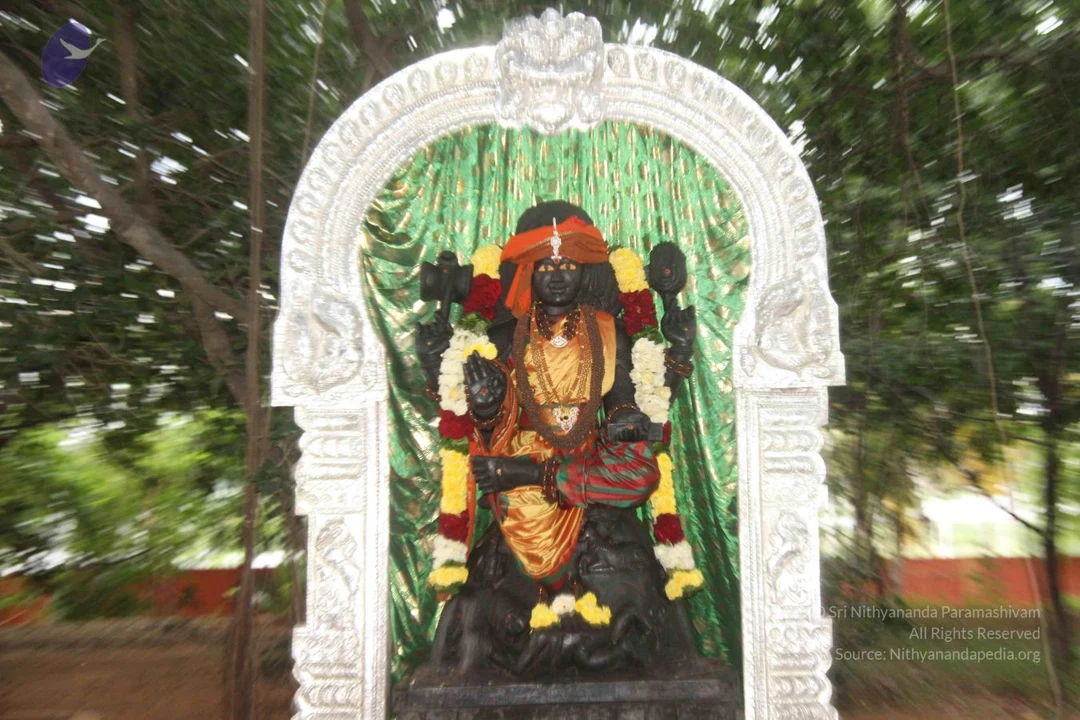
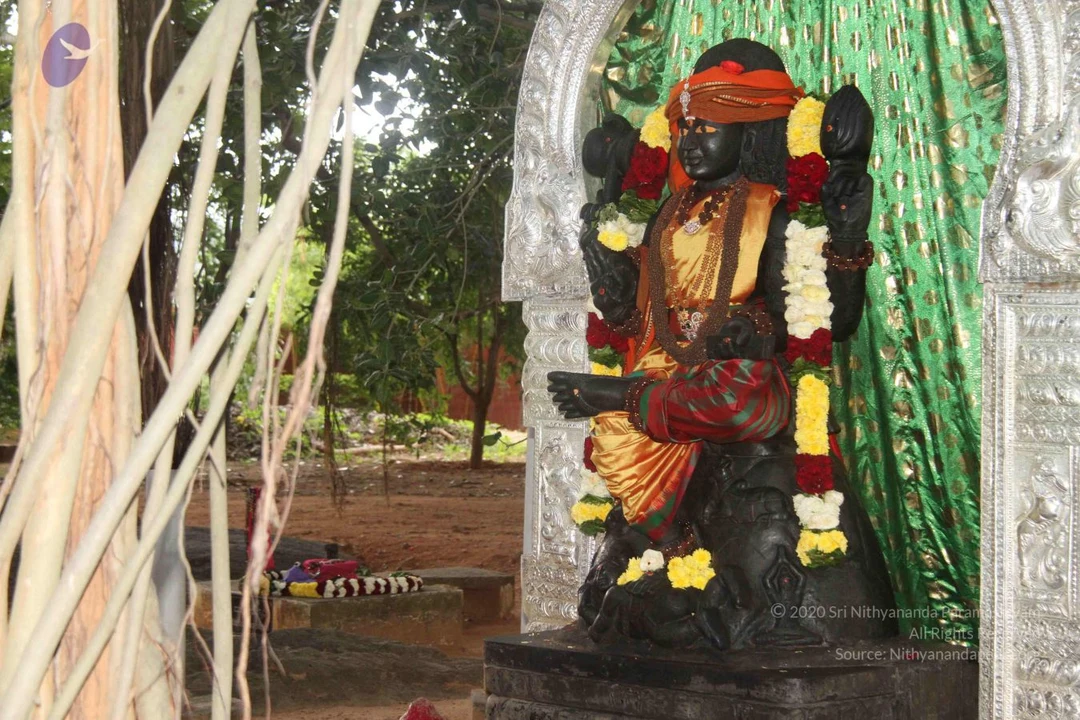
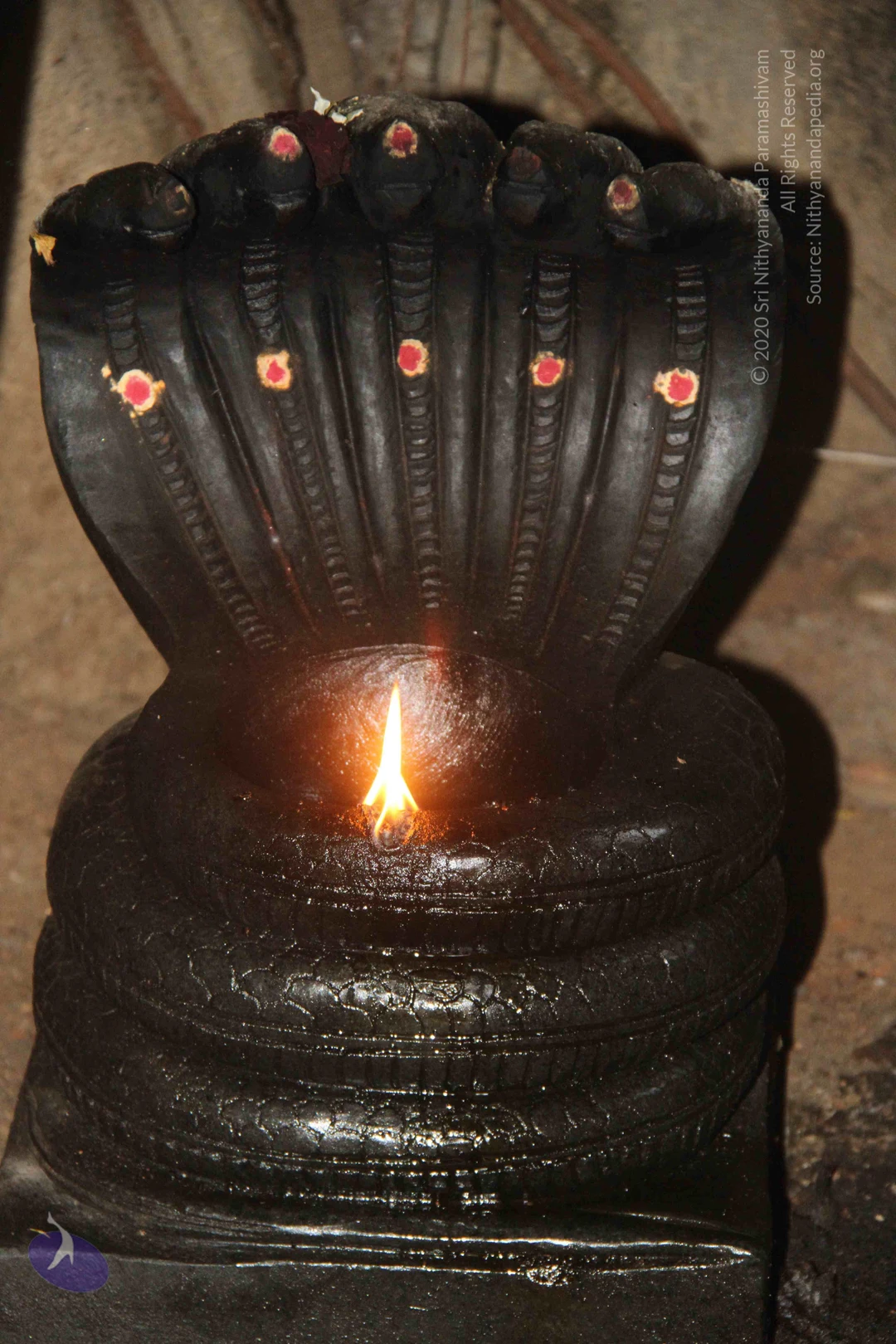
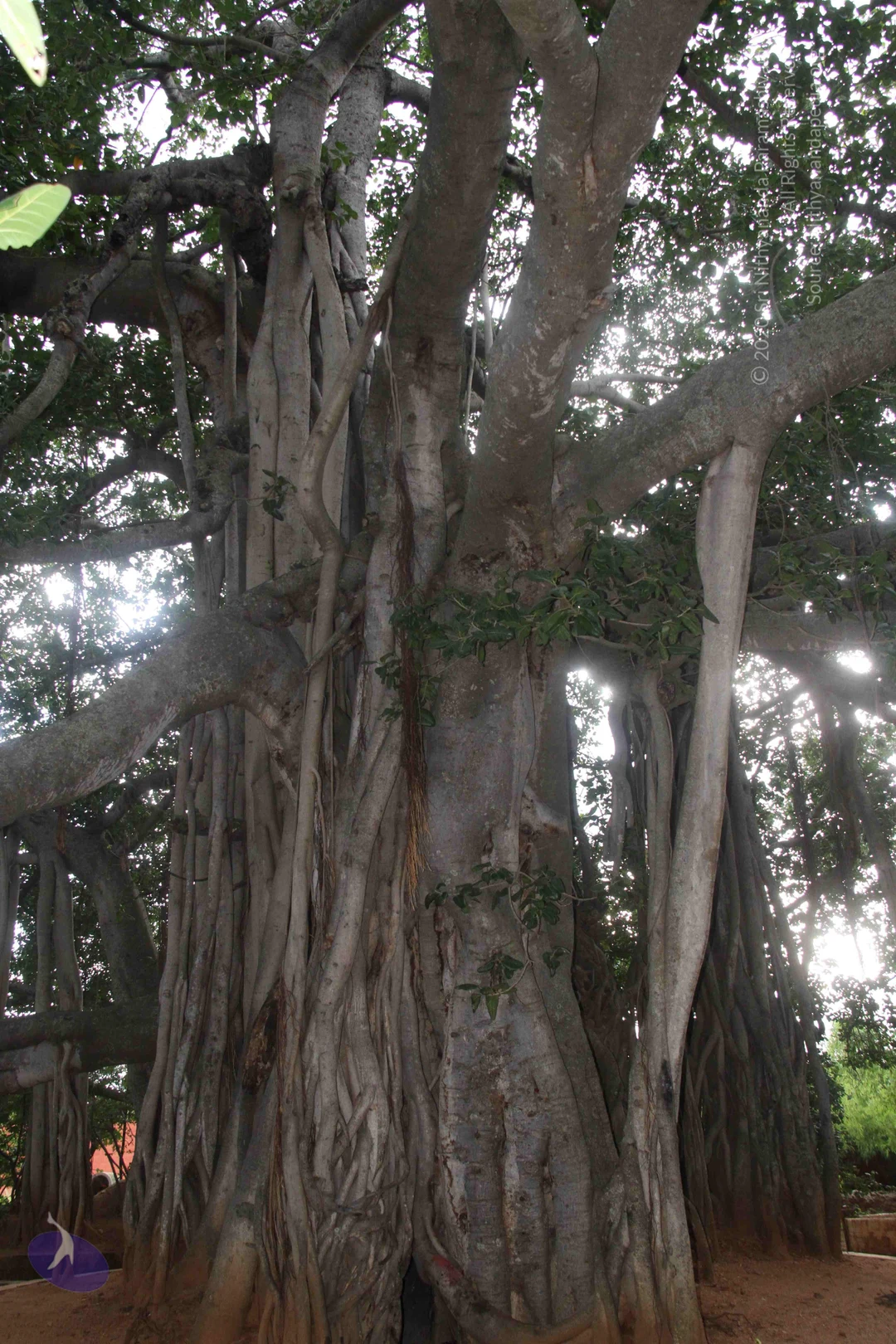
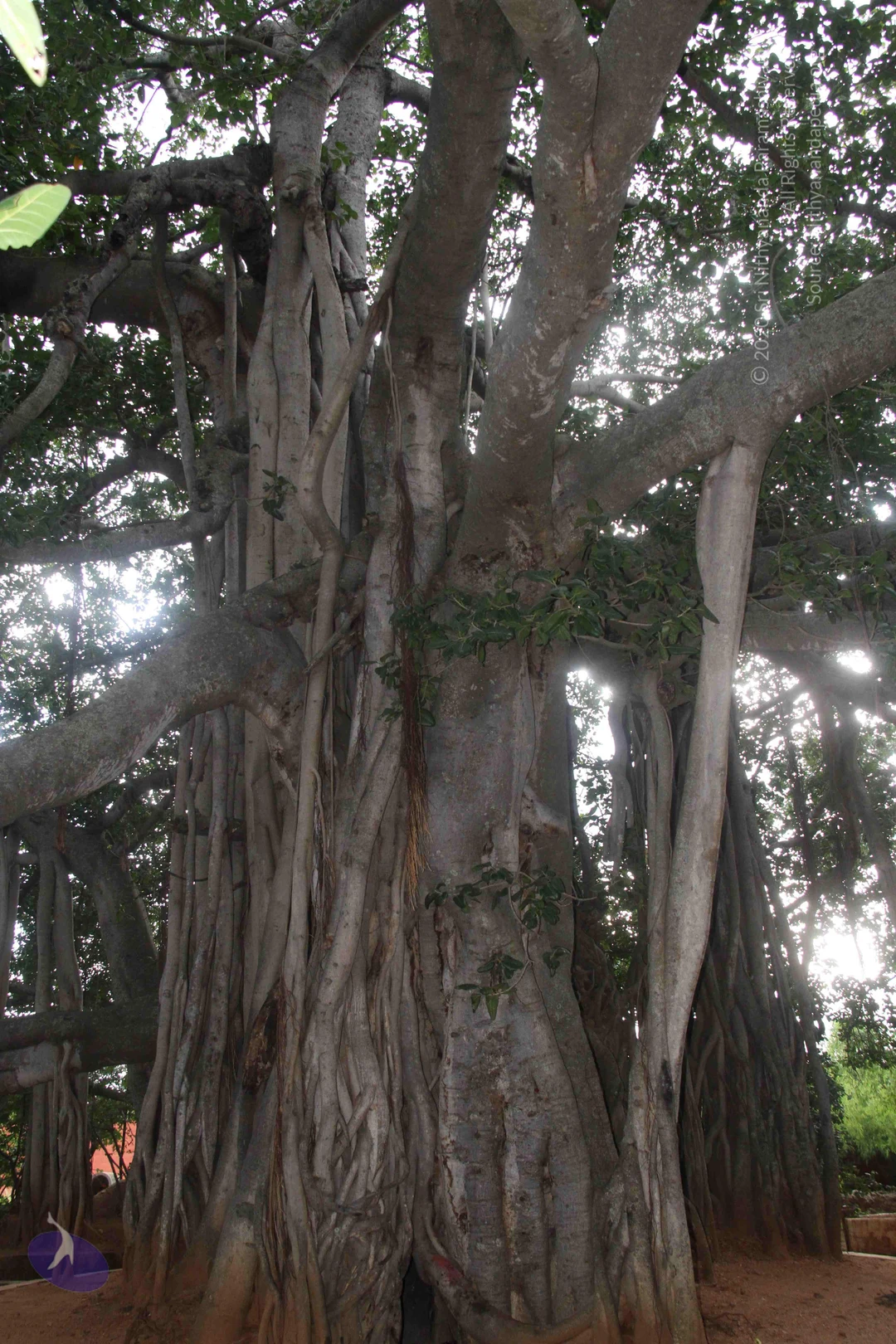
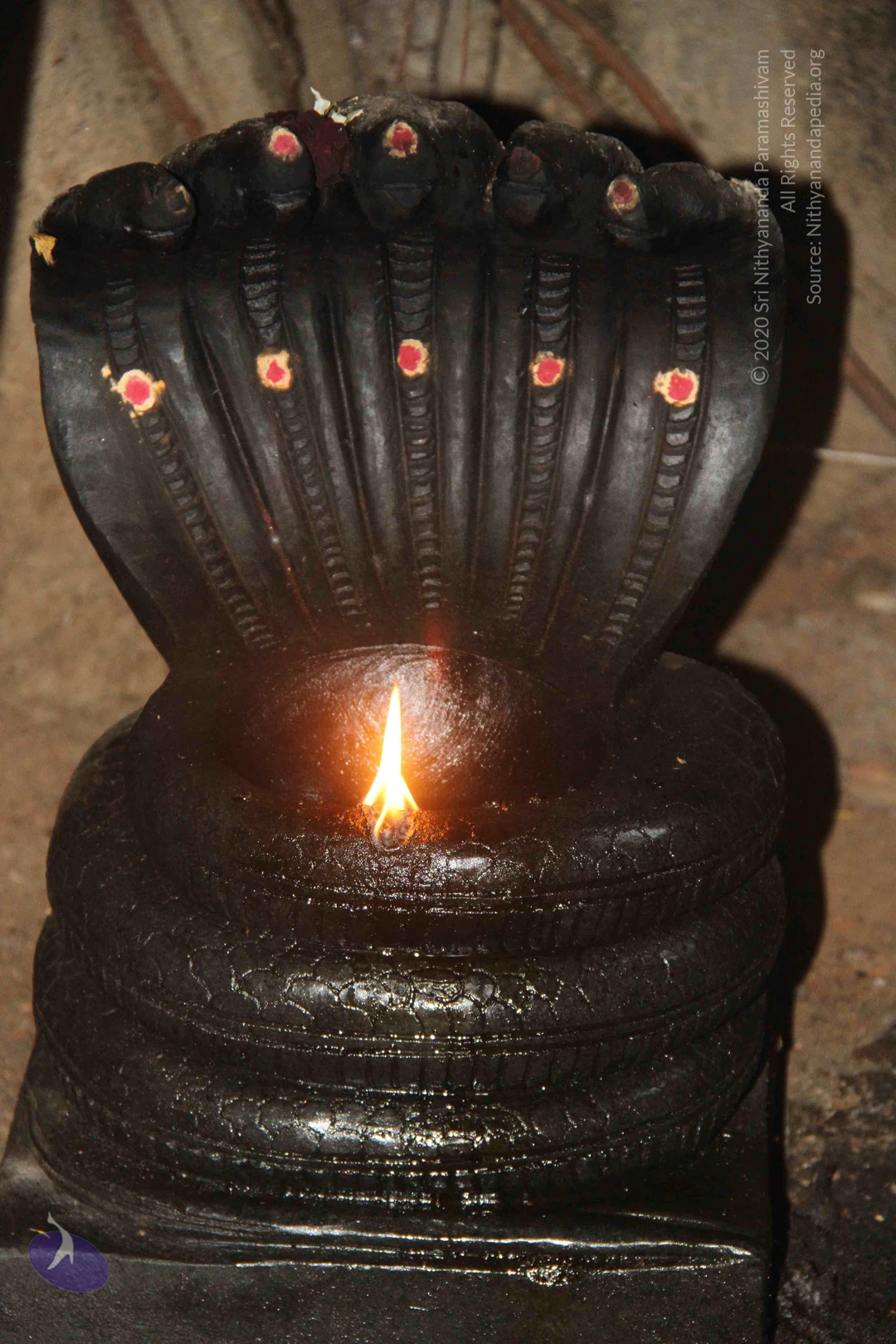
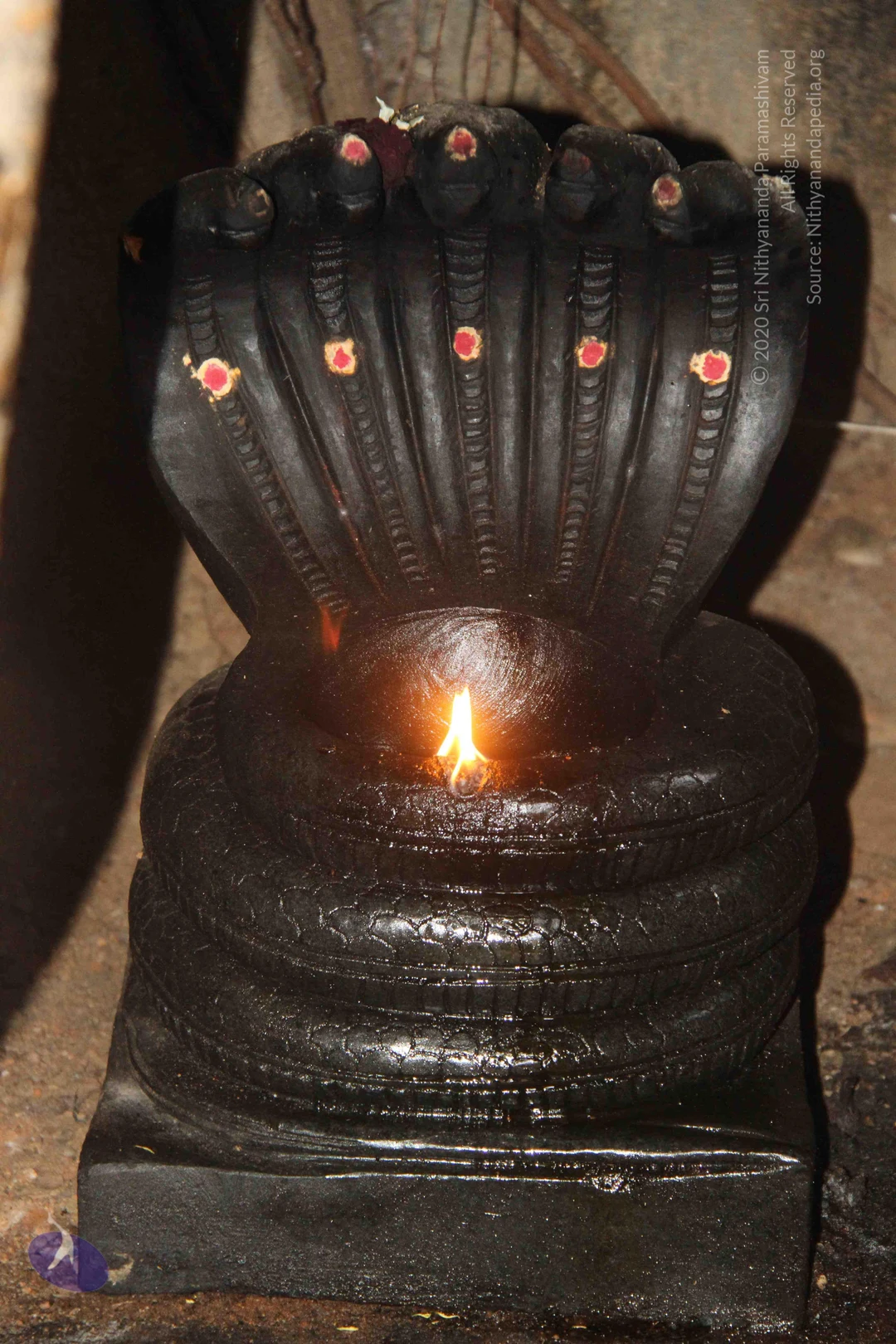
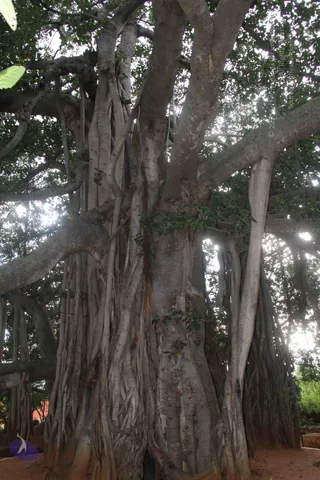
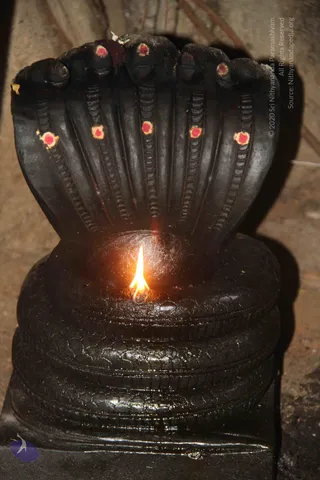
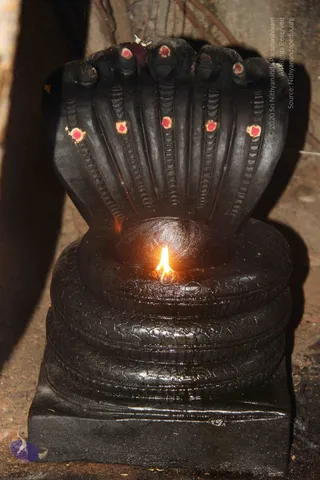
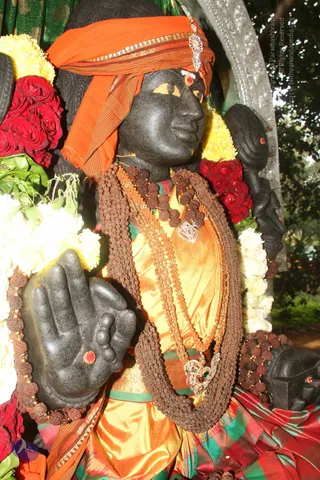
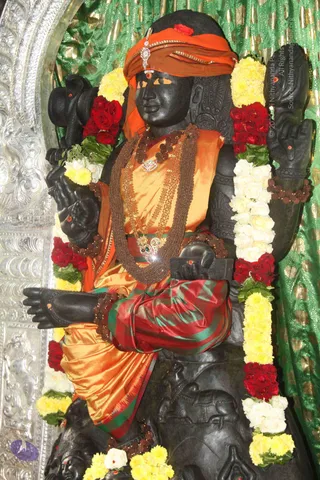
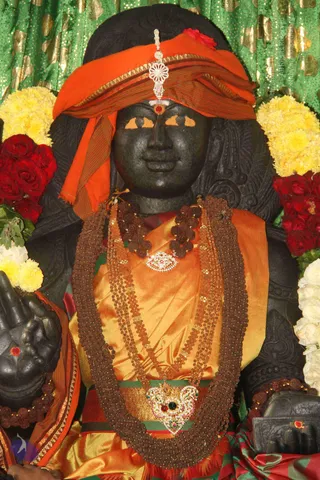
A large, old banyan tree photographed from ground level, its thick grey trunks and many aerial prop roots forming a dense, sprawling canopy. Leafy green branches spread across the upper frame against a pale sky. Dry reddish-brown earth lies at the base. No people or ritual activity are visible.Close photograph of a black stone naga sculpture with a multi-hooded cobra canopy, its hood marked with red and yellow dots. A single lit oil lamp flame sits in a cup-shaped depression on the coiled serpent body, with no people visible. Dim, dusty ground surrounds the base.Close photograph of a black stone naga (serpent) sculpture with a hooded multi-headed cobra canopy, its heads marked with red kumkum dots, resting on a stacked coiled base. A small oil lamp flame burns in a cupped hollow in front of the coils. No people are visible. Dim shadowed background with a faint rope or wire behind the statue.Close photograph of a black stone statue of a seated figure wearing an orange-red turban with a decorative brooch, red bindi and yellow sandalwood marks on the face. The statue is draped in layers of brown rudraksha mala necklaces and a gold-orange silk garment with green and red border. Red and white flower garlands surround it, and the raised left hand has a red kumkum mark. Dense foliage is behind. The statue is a depiction, not a living person, so no physical people are present.A dark stone murti seated on a carved pedestal, dressed in an orange silk turban and orange-gold silk garment with a striped red and green silk sash across the body. Multiple rudraksha malas and a jeweled ornamental necklace adorn the chest, and the figure wears vibhuti or kumkum marks on the forehead. Garlands of red roses, white roses, yellow marigolds and green leaves hang over the shoulders and arms. Behind the figure is a green silk backdrop with gold motifs and a silver-toned carved panel to the left. This is a statue, not a living person.A black stone statue seated with an orange turban, a jewelled brooch at the forehead, and orange-gold silk wrap. Multiple strands of rudraksha malas and a jewelled pendant hang at the chest, and a green sequined backdrop with yellow and red garlands frames the figure. The right hand, raised in a blessing gesture, is visible at left, with a red tilak mark. Statue on a deity-like altar, no living people present.

02-PADUKA-PUJA
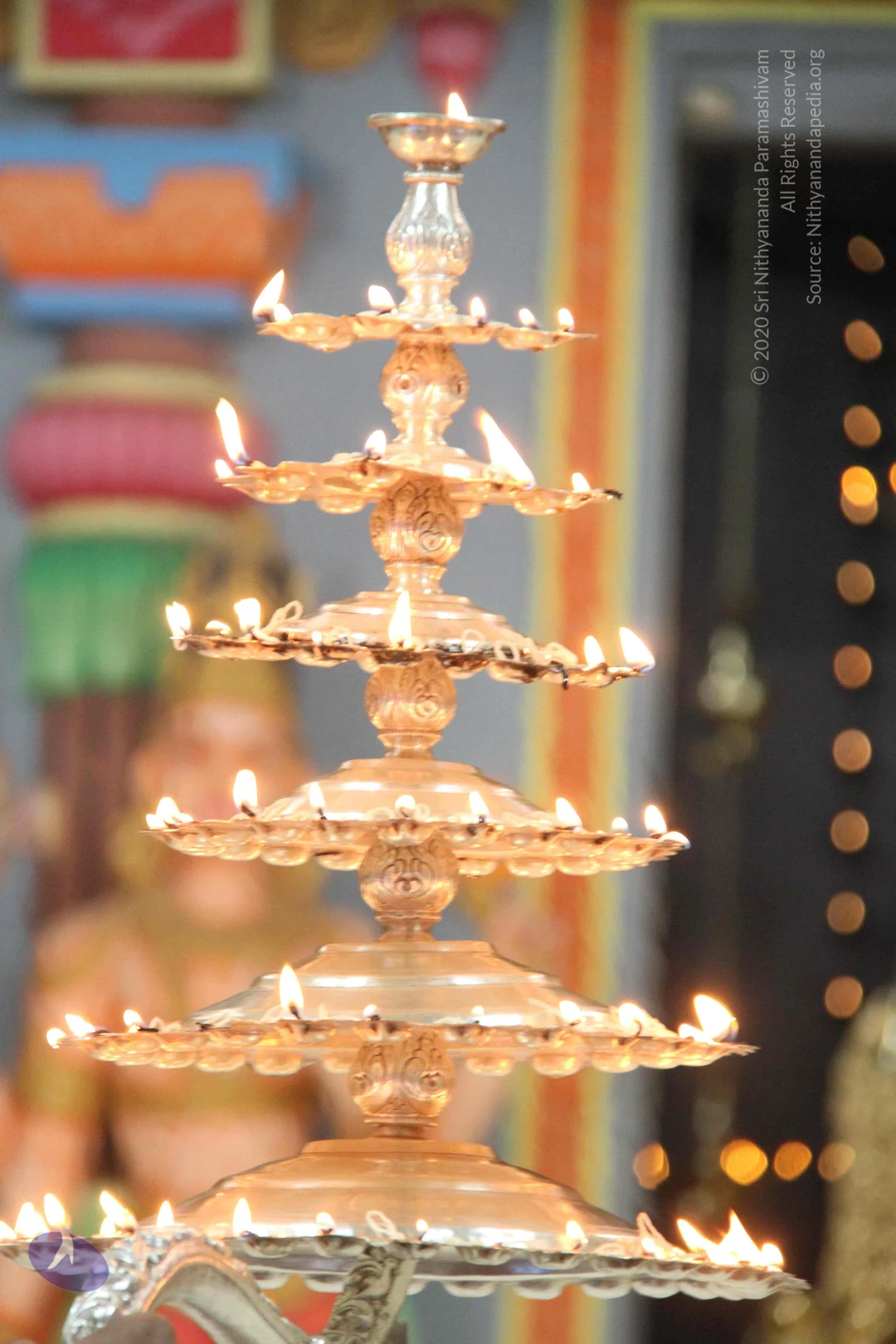
3 photosSource gallery
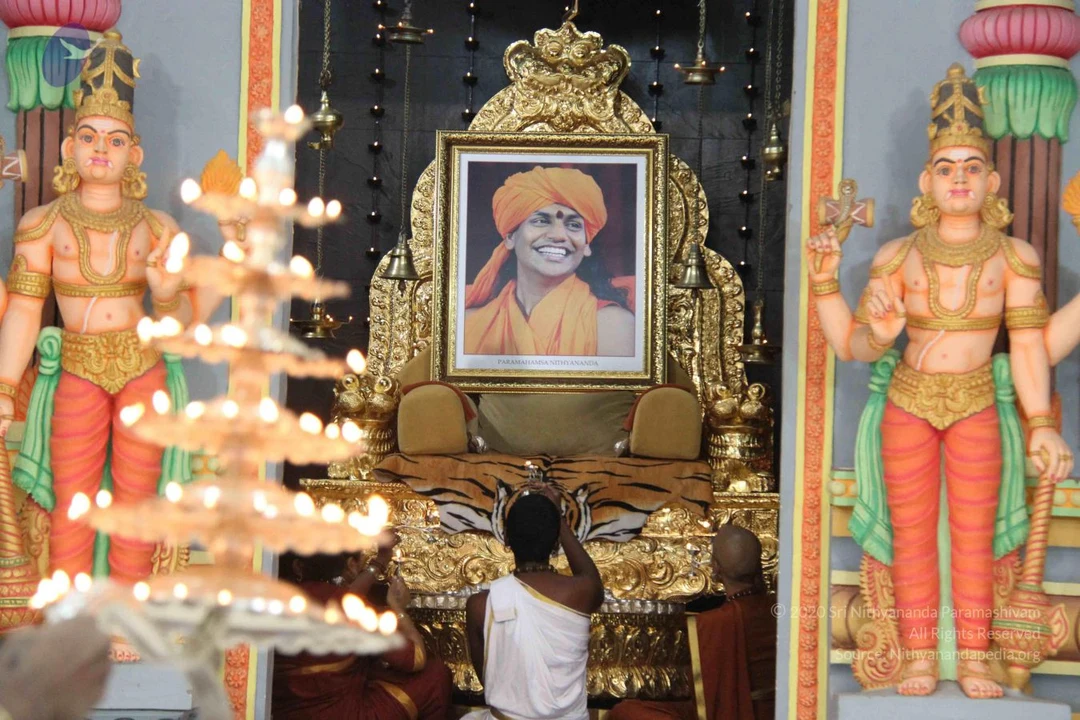
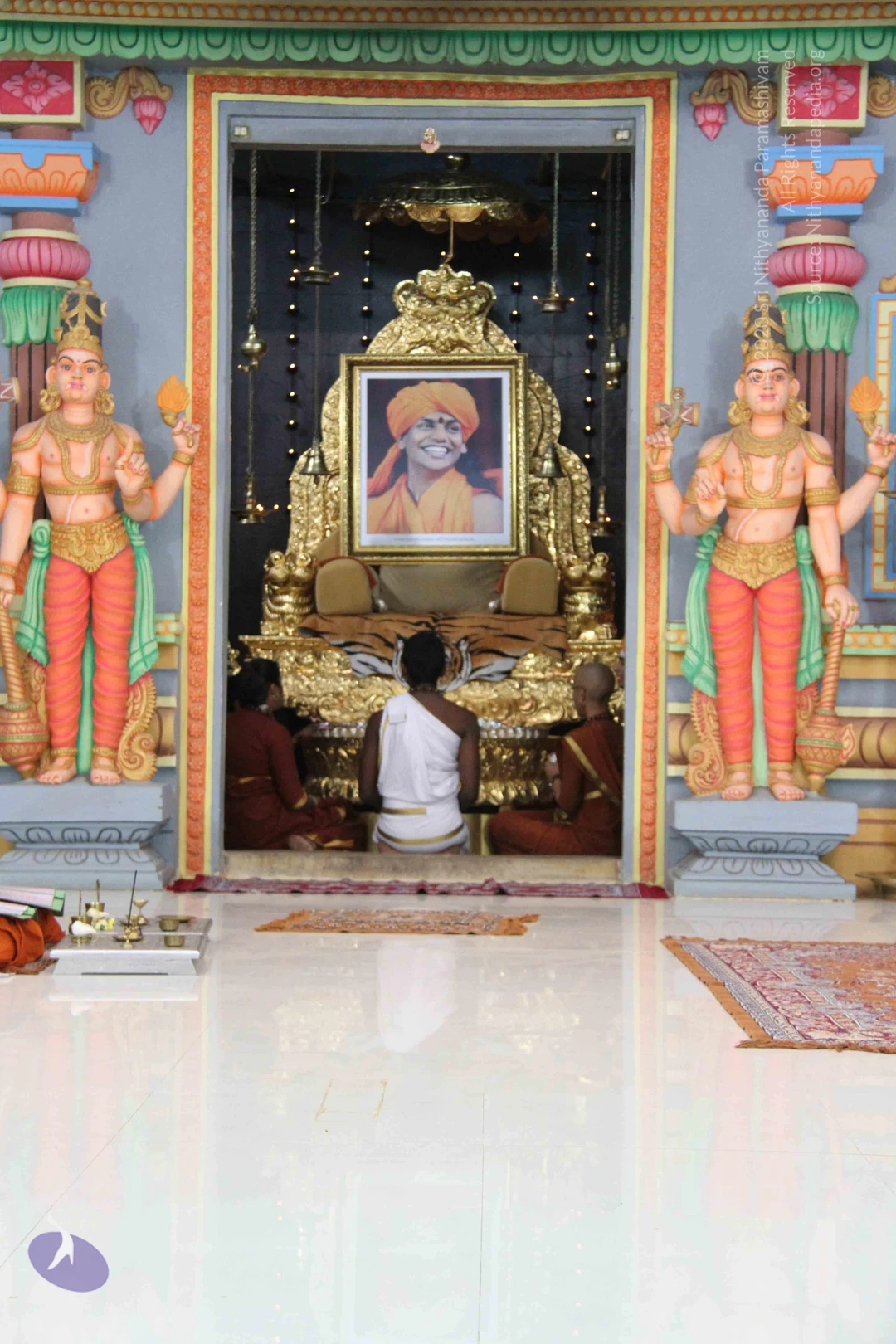
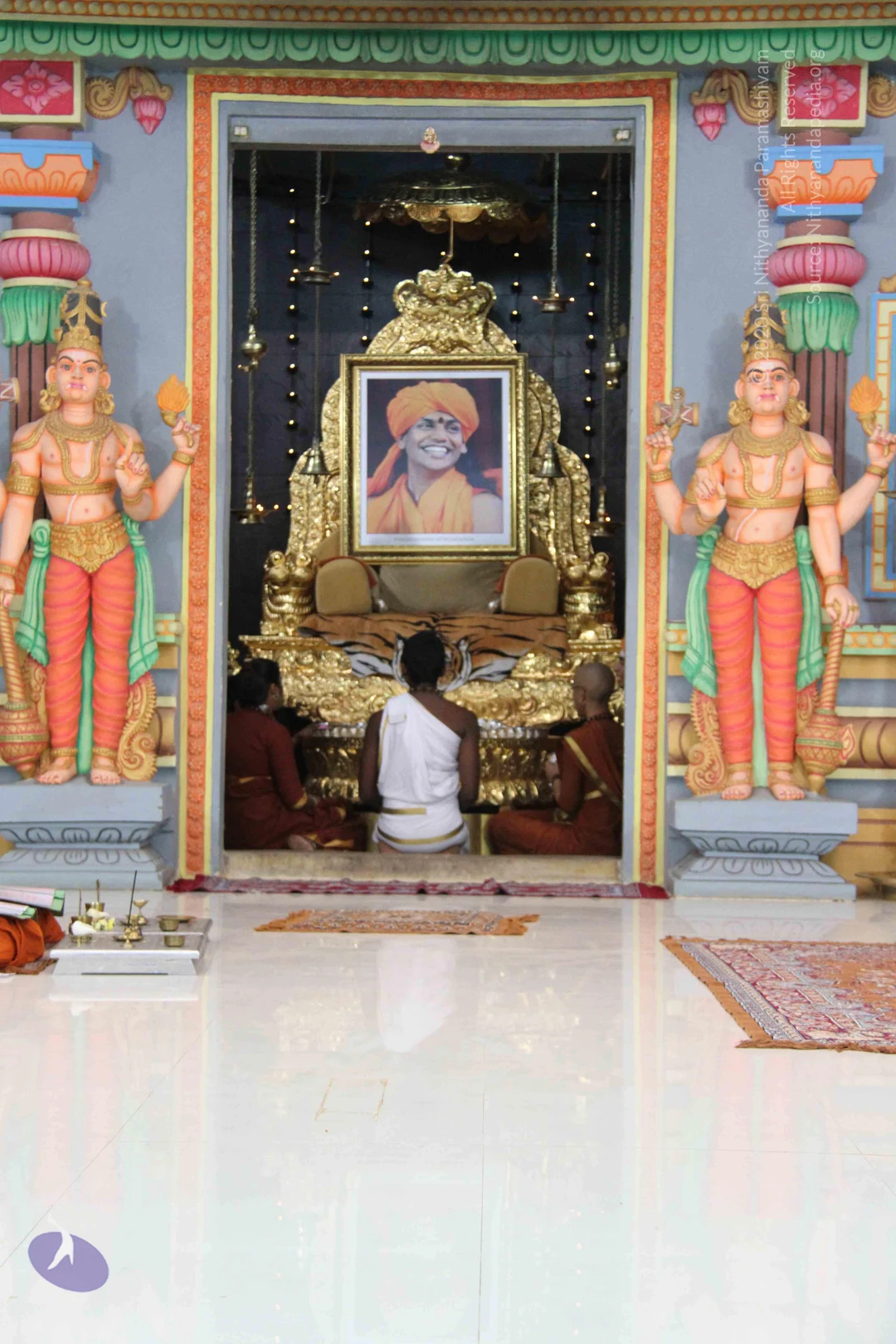
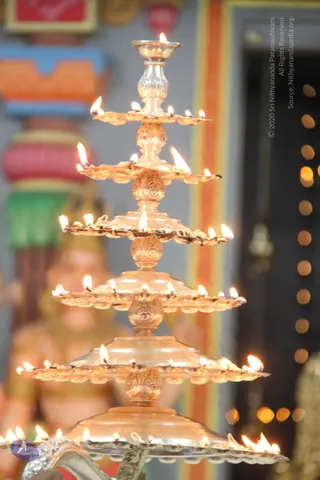
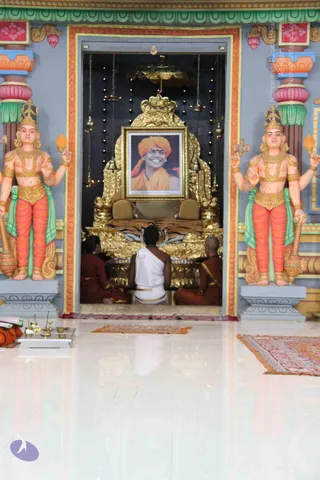
A tall multi-tiered brass lamp stand, a deepam or aarti lamp, holds many lit oil lamps on its stacked, flared trays. Ornate embossed knobs separate each tier, and a single flame crowns the top cup. Behind it, blurred orange and red temple pillars and bokeh lights suggest a temple hall. No people are visible.Interior of a temple shrine with a gilded throne seat draped with a striped tiger-skin cloth, set in a doorway flanked by two painted guardian statues holding ritual objects. Above the throne hangs a framed portrait labelled "Paramahamsa Nithyananda" showing a smiling man with an orange turban and orange robe. In front of the throne, a figure in a white dhoti and shawl kneels facing the throne, with two men in orange-brown robes seated beside him. Hanging brass lamps and beaded strings decorate the dark backdrop, and a small brass puja table with lamps and offerings sits on the left at the edge of the floor, which is covered with rugs.A photograph of a seated group of young saffron-robed initiates in a large hall, performing a puja with brass lamps, bowls of offerings and small plates of fruit and sweets arranged on low silver-topped platforms. Several boys have shaved heads, white forehead markings and rudraksha malas; one wears red-framed glasses and chants with eyes closed. Behind them, a bald older man in orange robes sits among other saffron-clad devotees, and women in white and red saris watch from the back. Foreground shows incense sticks and a small brass vessel.

03-NITHYA-SATSANG
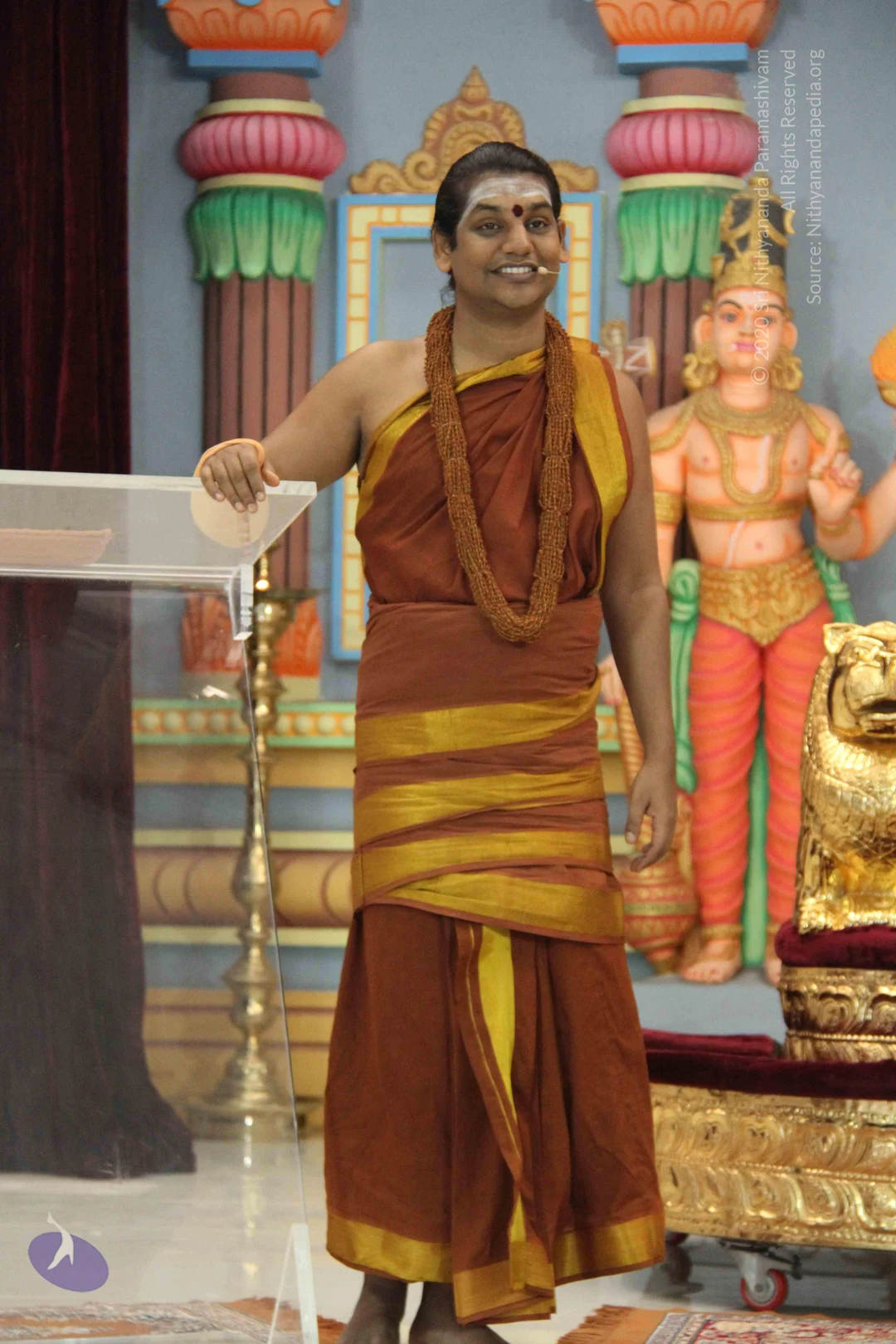
19 photosSource gallery
A man seated on an ornate gilded throne with a large arched backrest decorated with repoussé floral and scrollwork. He wears an orange-brown robe with a gold-bordered edge and a long rudraksha mala around his neck, with a thin gold chain visible at the throat. His forehead bears white markings and a red dot, and he has a small headset microphone near his face. His left forearm is wrapped in a bandage and rests on his lap, and his bare feet rest on a tiger-striped cloth draped over the throne's platform. Behind him is a patterned gold-and-beige wall panel.A man with swept-back dark hair and a red bindi sits smiling on an ornate gold throne with carved lion-faced armrests and a large arched gold backrest. He wears a rust-orange shawl with a yellow border over bare shoulders and a long rudraksha mala with a thin gold chain. His arm is bandaged and his hands rest together in his lap. The throne is covered with a striped tiger-skin cloth and a small microphone is clipped near his face. Behind him a carved wooden panel with a wrapped bandage-free vertical design. Swamiji (probable): the long swept-back hair, saffron-orange shawl, rudraksha mala and ornate gold throne are the qualifying cues.A smiling man with short dark hair and white forehead markings with a red dot sits cross-legged on an ornate gold throne with a carved arched backrest, lion figures, and a tiger-striped cloth draped over the seat. He wears an orange-red sannyasi wrap with a gold-bordered yellow edge and a long rudraksha mala around his neck, and his right forearm is bandaged. A small clip microphone is visible near his face. The background is a panelled cream wall with an orange hanging at the right edge. Appearance-based candidate present: a person, seated in the throne role, with saffron-orange robes, rudraksha mala and ceremonial gold setting cues.A man with short dark hair, a red bindi and white vertical tilak sits cross-legged on an ornate gold throne with a tiger-striped cloth draped over the seat. He wears an orange-red sleeveless robe with yellow borders and a long rudraksha mala. A small microphone is clipped near his mouth, and he smiles while speaking, with one hand resting on the other in his lap. A gold arched backrest with carved floral and lion motifs stands behind him, and a wooden panelled wall is visible.A smiling man in an orange-brown robe with yellow border sits cross-legged on an ornate gilded throne with a carved golden arch and lion-like side figures. He wears a long rudraksha mala draped over his chest, a thin gold chain, a red bindi and white tilak on his forehead, and a lapel microphone. His right forearm is wrapped in a flesh-coloured bandage. A tiger-striped cloth covers the seat beneath him, and a telephone sits on the right side of the throne.A seated man in a rust-orange robe with a gold-bordered yellow shawl sits cross-legged on a red velvet chair before an ornate gold throne-back with carved lion-like figures. He wears a rudraksha mala of brown beads, a small gold chain, a red bindi and white forehead markings, and a headset microphone. His right forearm is wrapped in a flesh-coloured bandage. Beneath him is a tiger-striped cloth. a person is seated on the throne, smiling broadly, with his hands folded in his lap. A satsang setting is suggested by the throne and microphone.

04-SARVA-DARSHAN
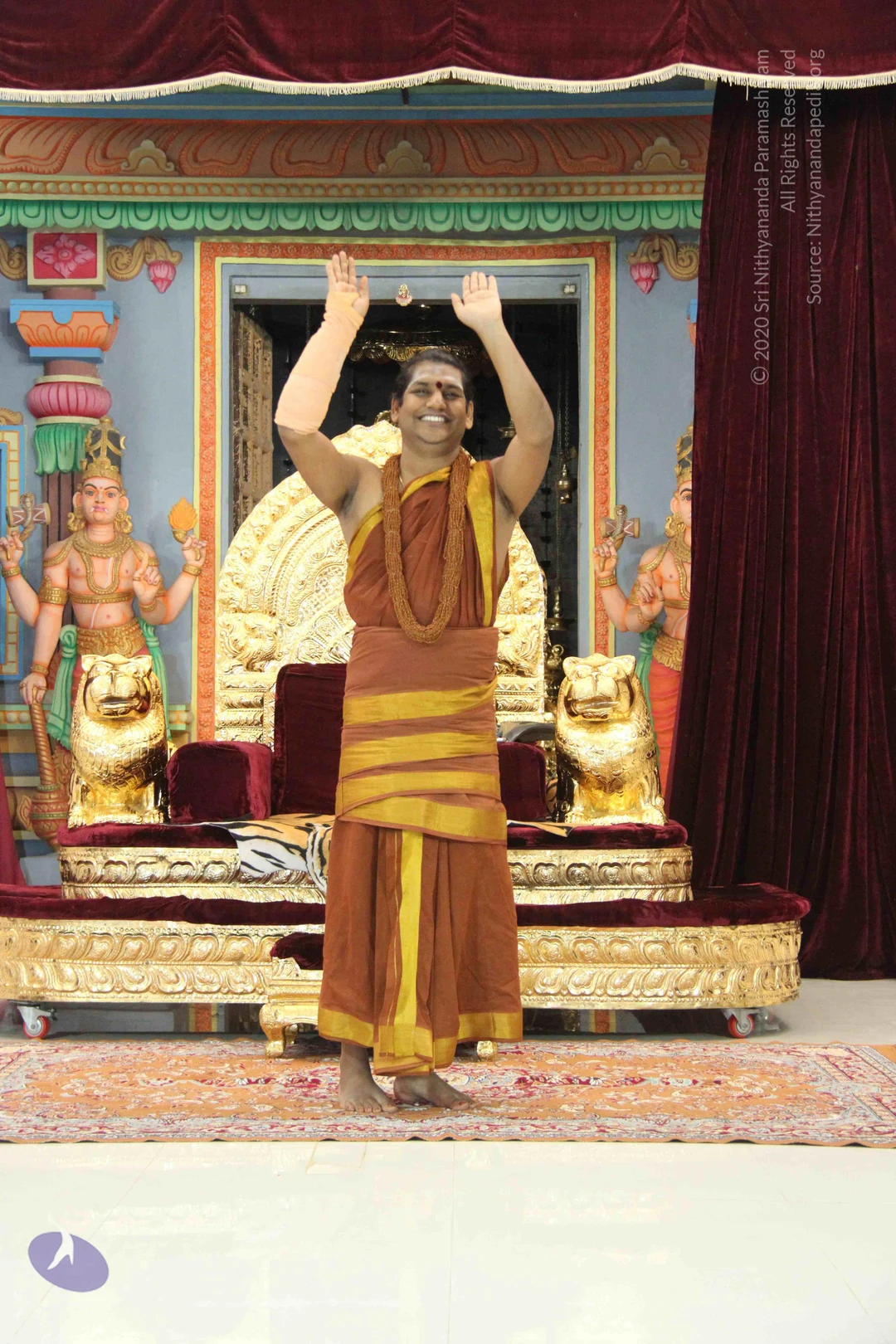
3 photosSource gallery
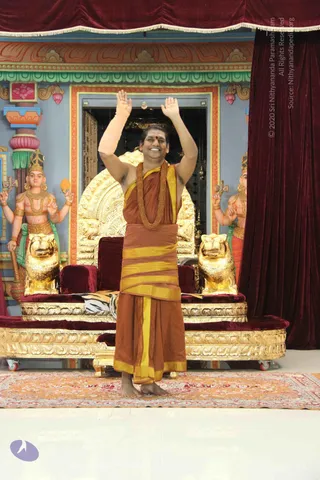
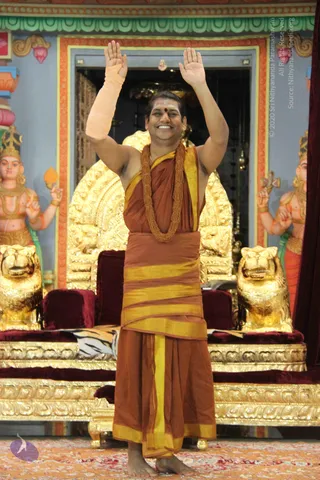
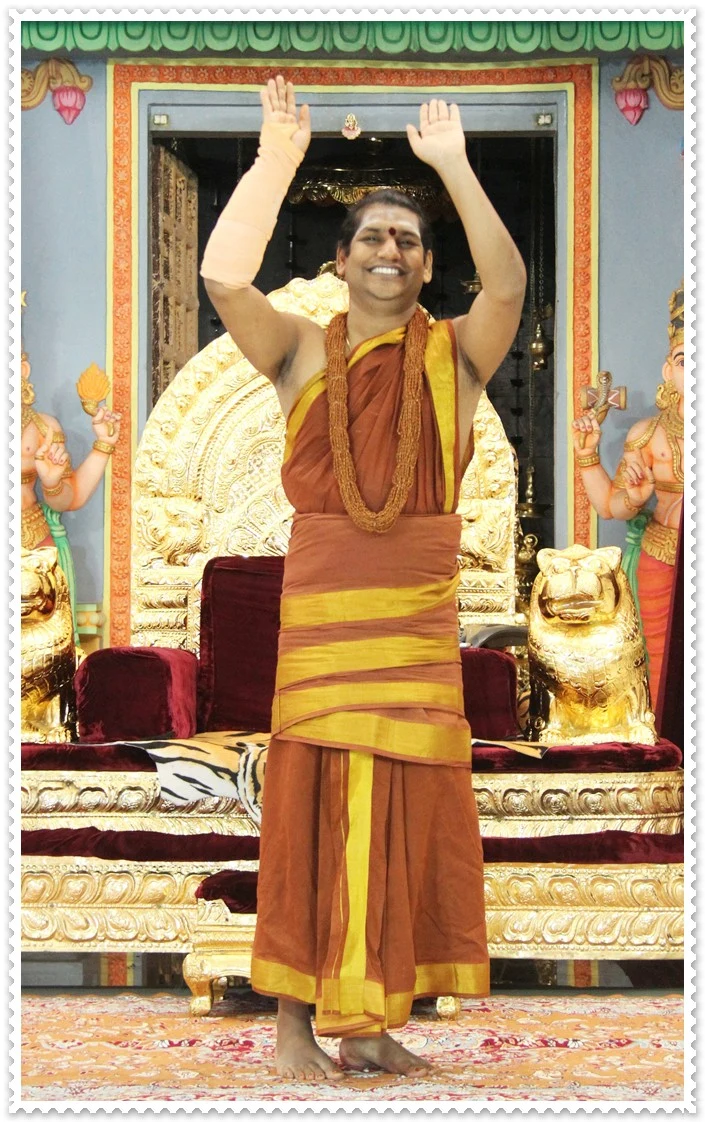
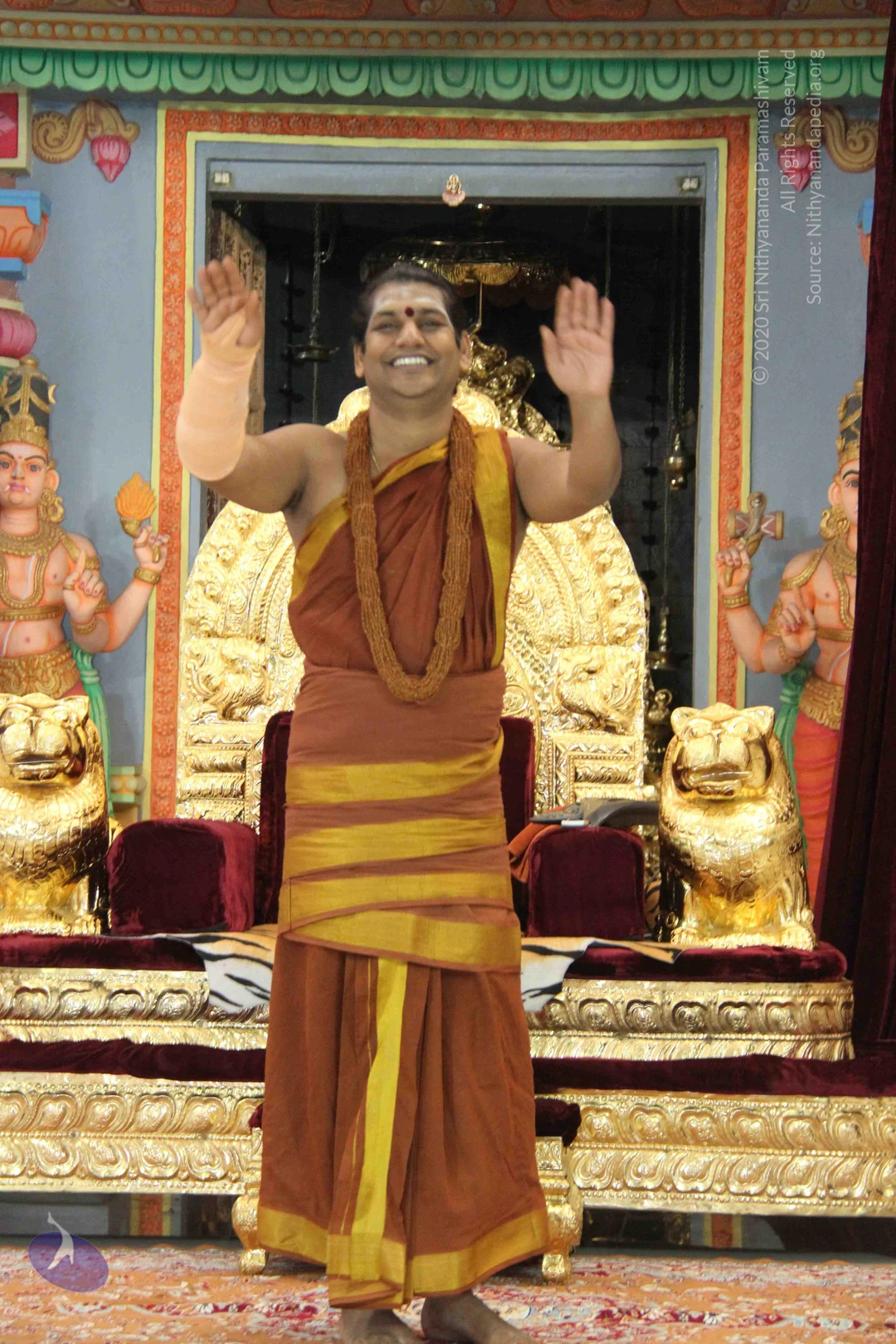
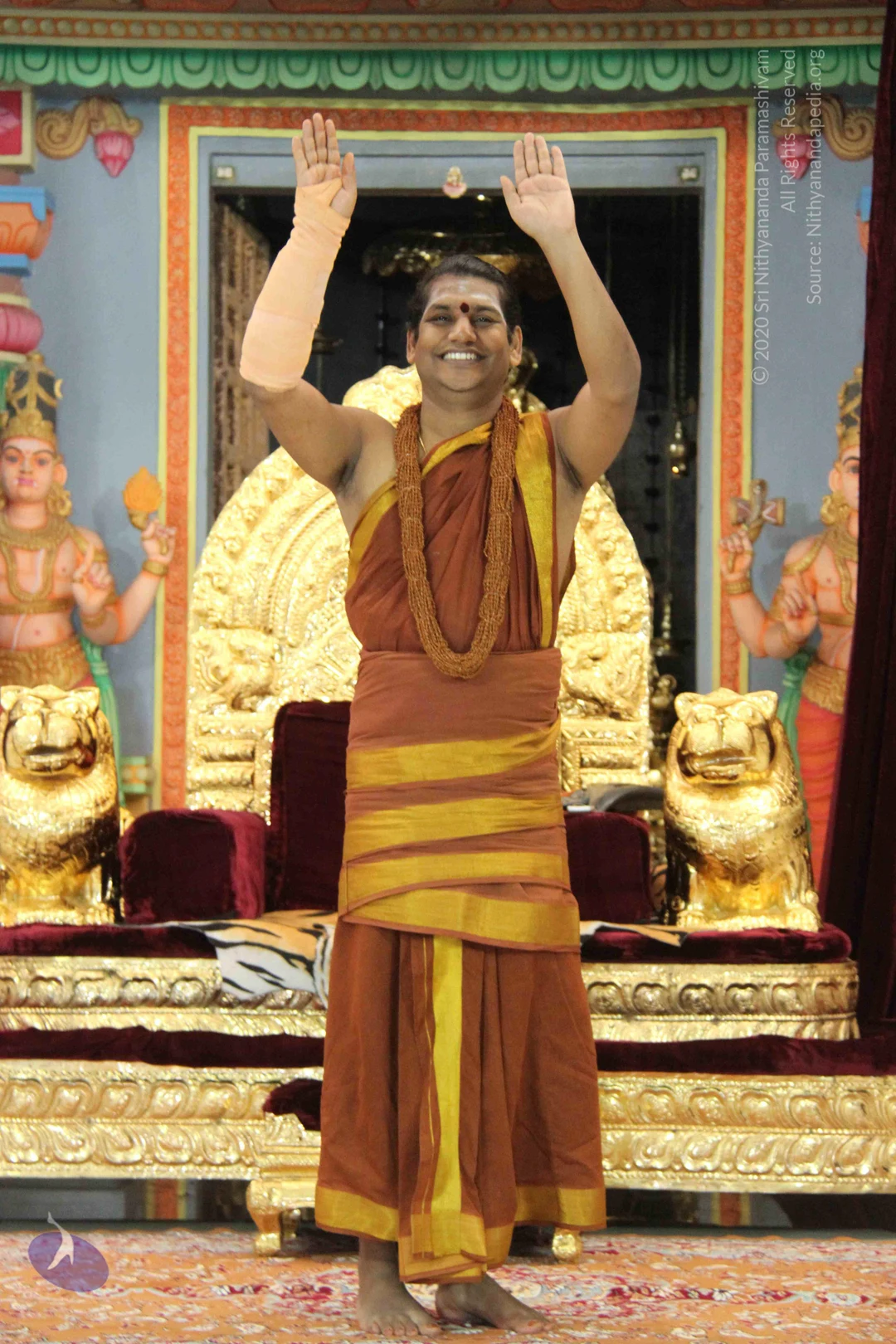
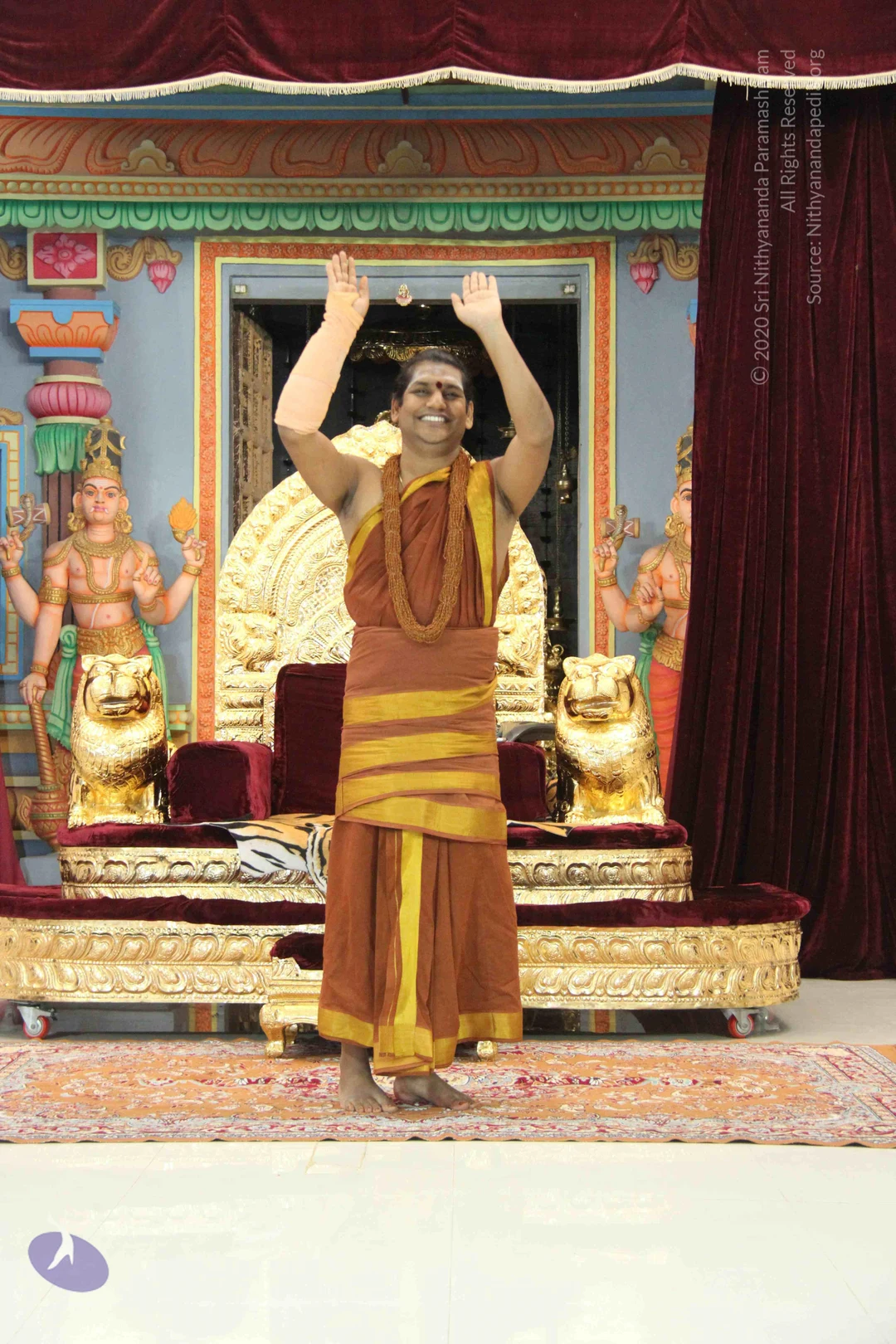
A smiling man stands barefoot on a patterned rug before a gilded throne, raising both arms overhead with palms open. He wears a rust-brown robe with gold borders, wrapped at the waist, a rudraksha mala around his neck and a red bindi on his forehead; one forearm is bandaged in a pale wrap. Behind him, a golden throne with lion-form armrests sits in front of a red velvet curtain. Flanking the throne are painted multi-armed deity murti figures, one holding a trident and another a lamp, set against a blue and red temple-style backdrop with carved pillars. The setting suggests a temple-style hall with a stage arrangement for satsang or darshan.A smiling man stands barefoot on a patterned rug before a golden throne with carved lion armrests and maroon cushions, raising both arms overhead with palms open. He wears a rust-brown dhoti and shawl with gold borders, a rudraksha mala around his neck, and a red bindi. Behind him are gilded arch decorations and a doorway, with painted deity figures on the pillars at each side. The appearance matches the a person cues of rudraksha mala and saffron-toned ceremonial dress, presented in front of a throne, so he is labelled as a candidate present in person.A smiling man in rust-brown and gold-bordered sannyasi-style cloth stands barefoot before a golden throne with carved lion heads, raising both palms outward in greeting. A rudraksha mala hangs around his neck and a red bindi marks his forehead. Flanking the throne are painted deity murti figures with multiple arms holding a flame and other objects, and a dark doorway with hanging lamps stands behind. The floor is covered with a red patterned carpet and a tiger-skin-patterned cloth lies on the throne.

September 26 2013

3 photosView all
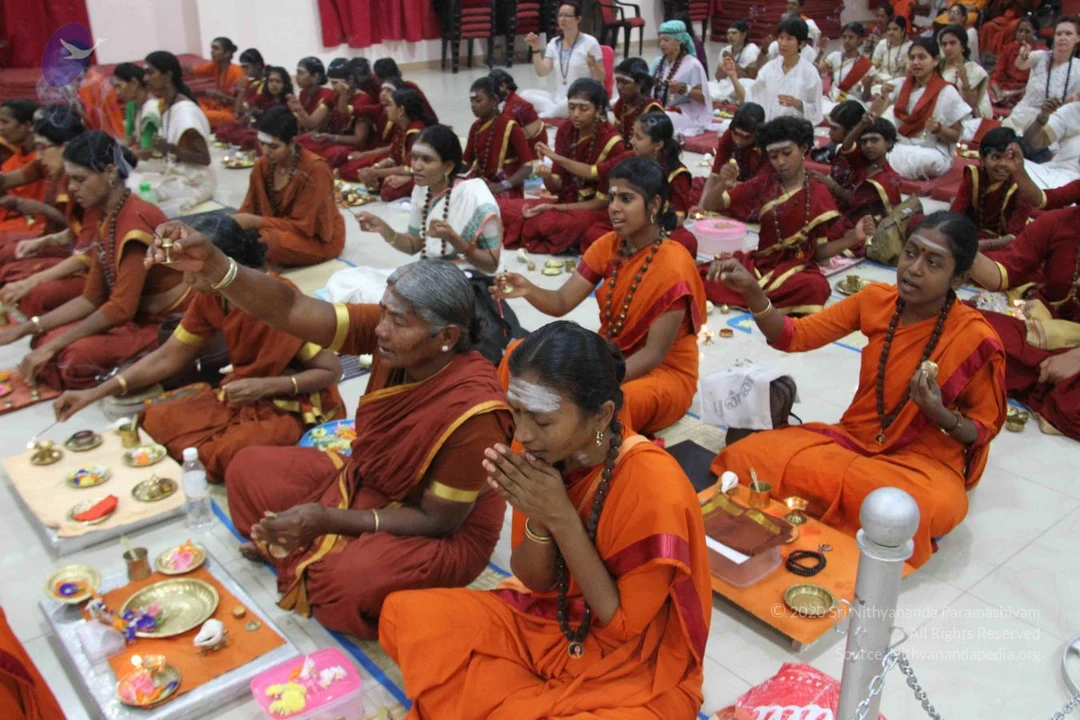
A photograph of a seated puja ceremony with several shaved-headed young boys in saffron-orange robes with rudraksha malas, their foreheads marked with white sandalwood paste, chanting with eyes closed. Behind them, a seated group of adults in white and red-orange clothing sits on mats in a hall. In the foreground, a silver tray holds brass lamps, flowers, a bell and small offering bowls. Among the seated figures, an older man at the left in orange robes with a rudraksha mala and white markings on his arms also sits in the ritual row, though his face is partly turned away.A photograph of a group ritual indoors where young shaved-headed boys in saffron-orange robes and rudraksha malas sit on the floor holding brass oil lamps and small offering plates, some with incense smoke rising. Several boys wear white tilak on their foreheads and chant with mouths open. Behind them, older men in white dhotis and kurtas, some wearing white shirts and rudraksha malas, sit on red mats with hands folded in prayer or holding small lamps. A brass plate of offerings and a small brass pot sit on an orange cloth in front. No candidate for a person is clearly identifiable by appearance in this scene.A photograph of children seated on a mat in prayer posture. In the foreground, a young boy with a shaved head and a red bindi wears an orange sleeveless top and orange shorts, his palms pressed together at his chin with eyes closed. Beside him, a girl with long dark hair wears a black top and presses her palms together. Behind them, another child in orange clothing sits with hands folded, and a child in red is partly visible at the right edge. The scene suggests a devotional gathering. No a person candidate is visible in the image.