Skip to content
Tuesday

24 September 2013

Hold the peak possibility for everyone

Dated photos
114
Source pages
1
Media
2
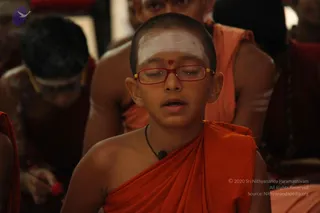
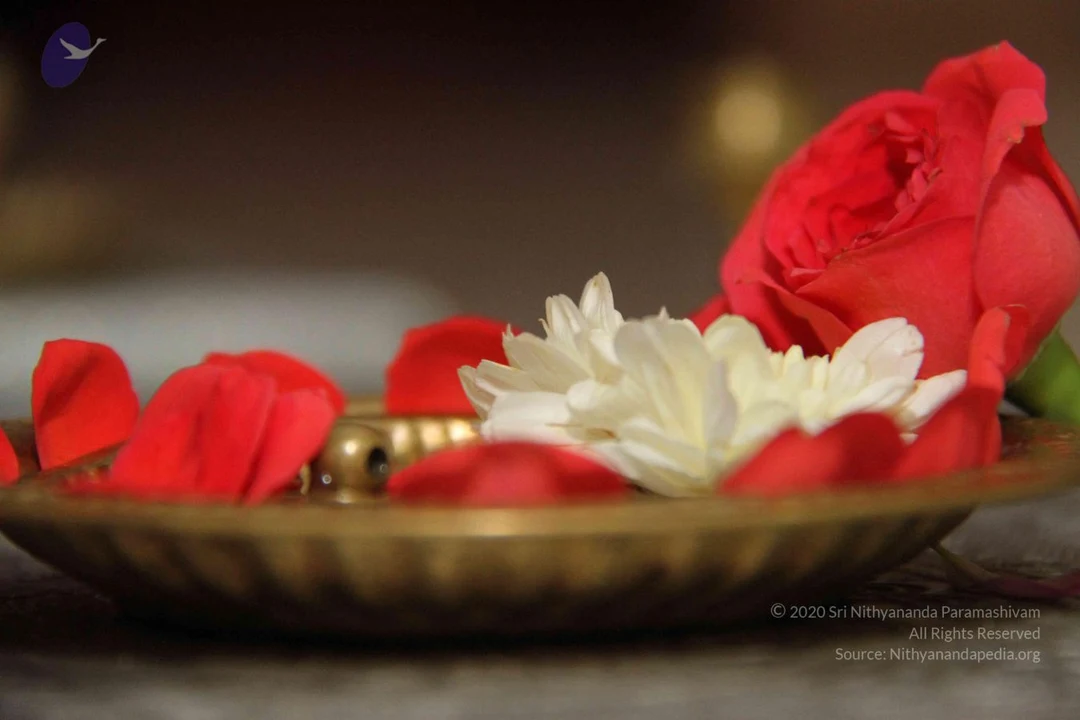
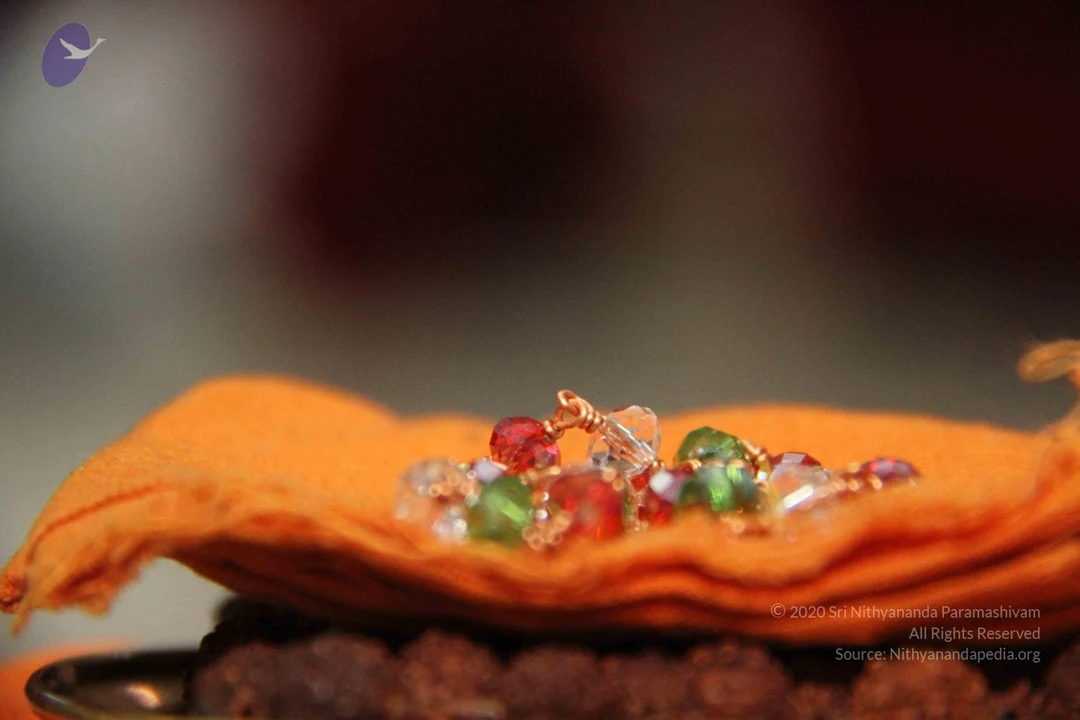
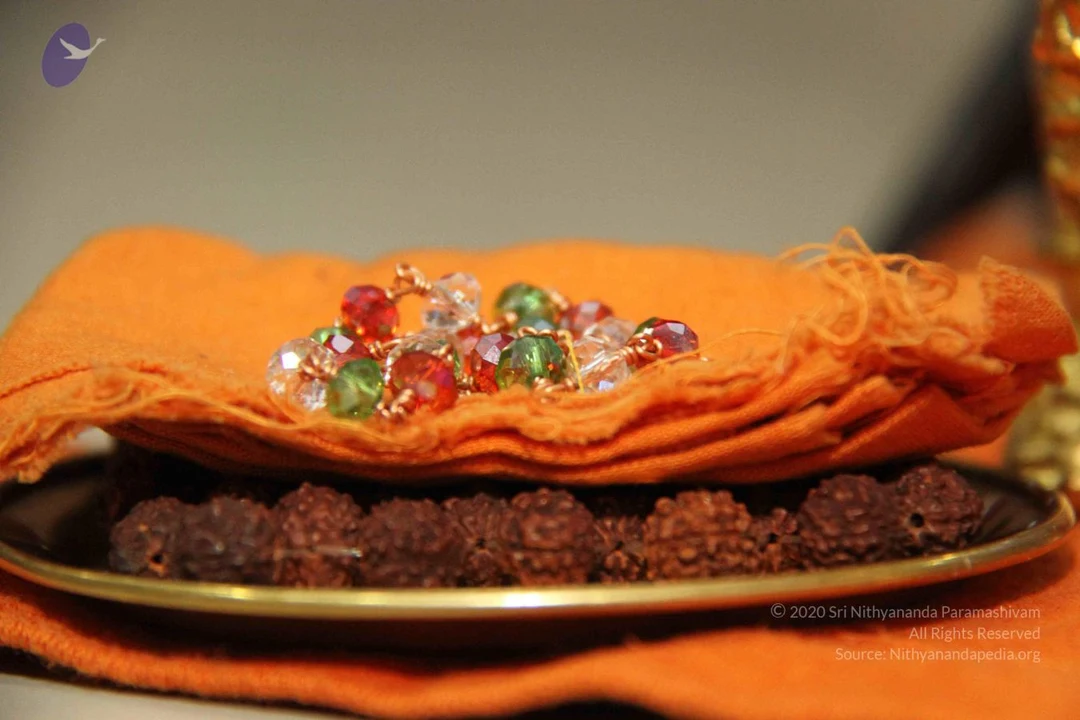
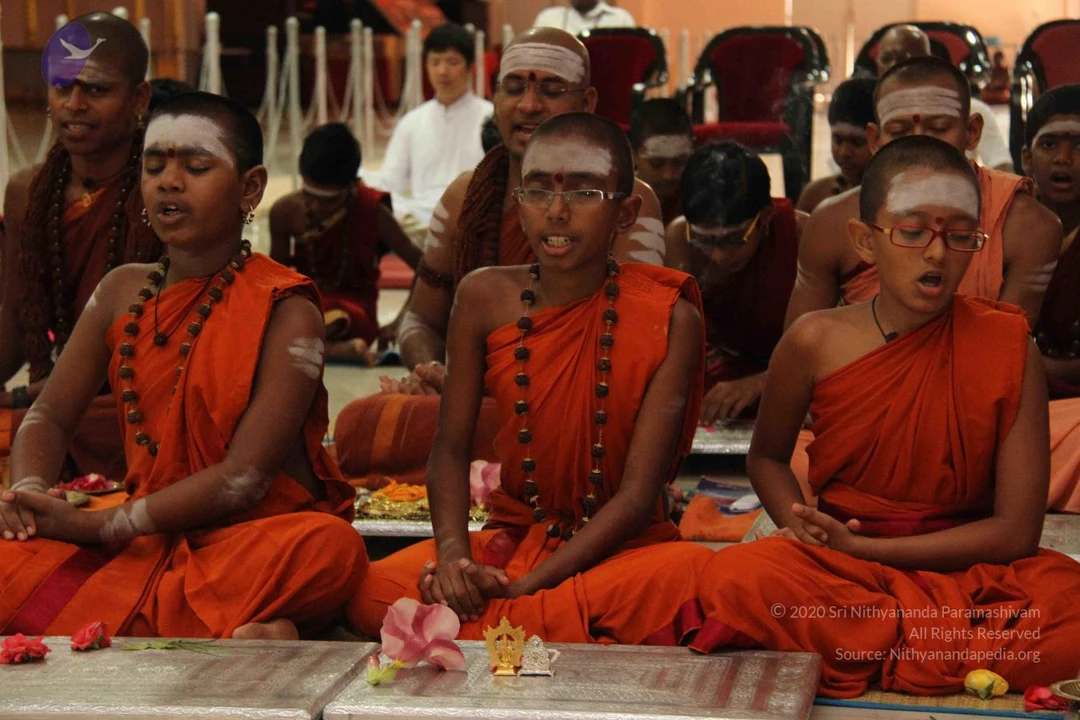
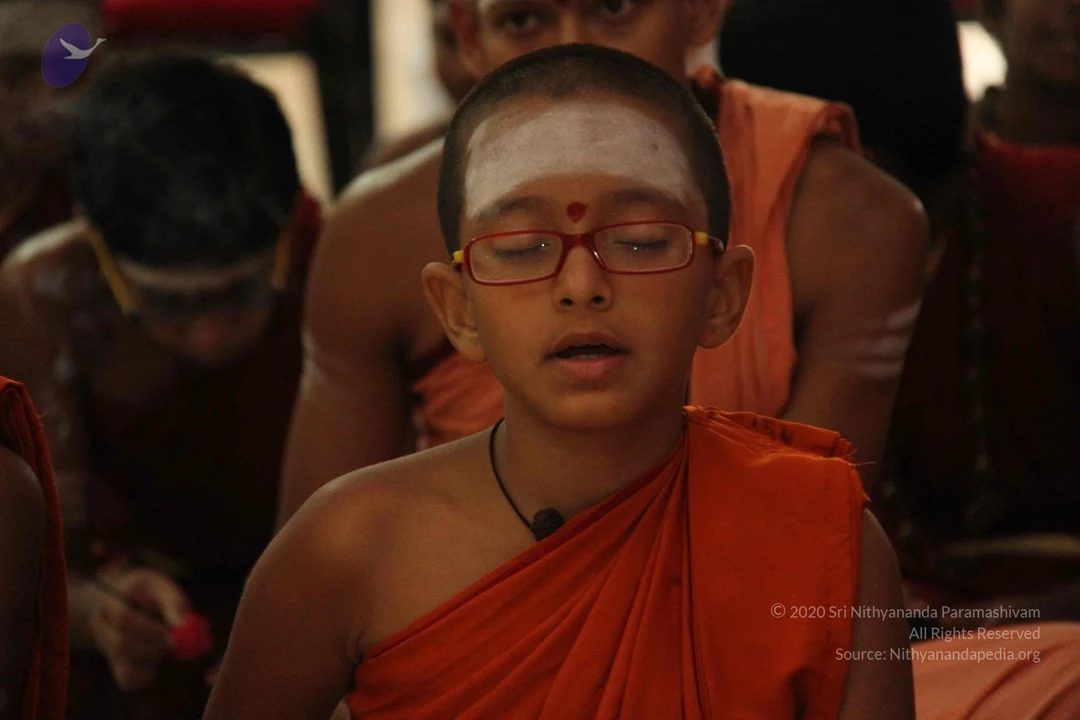
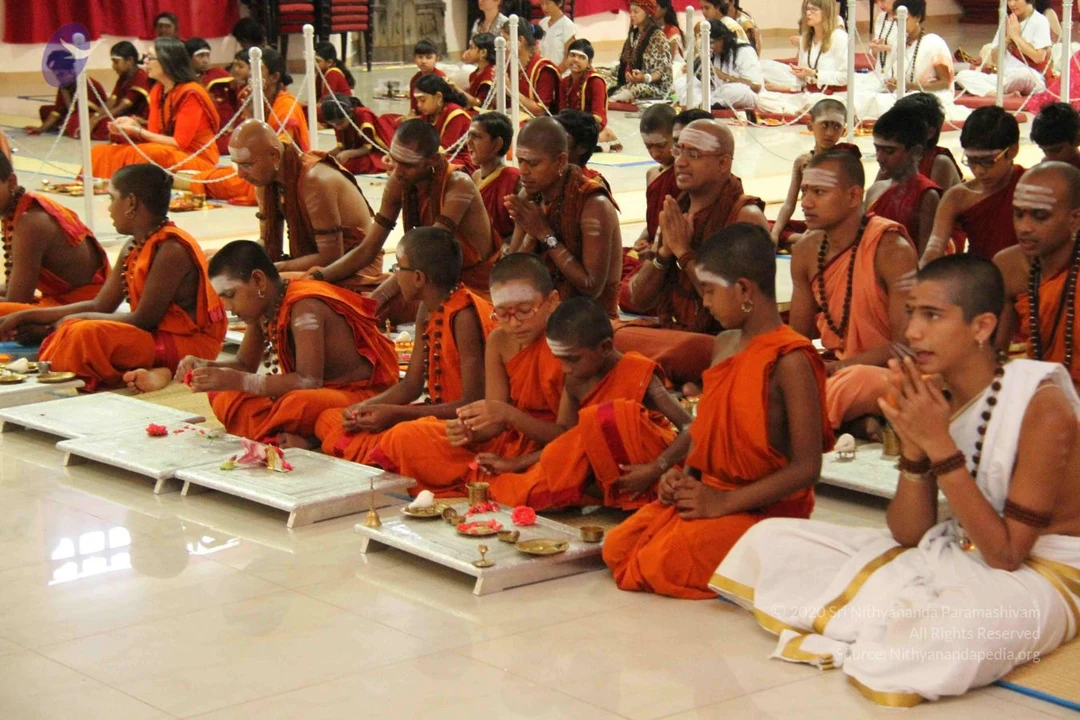
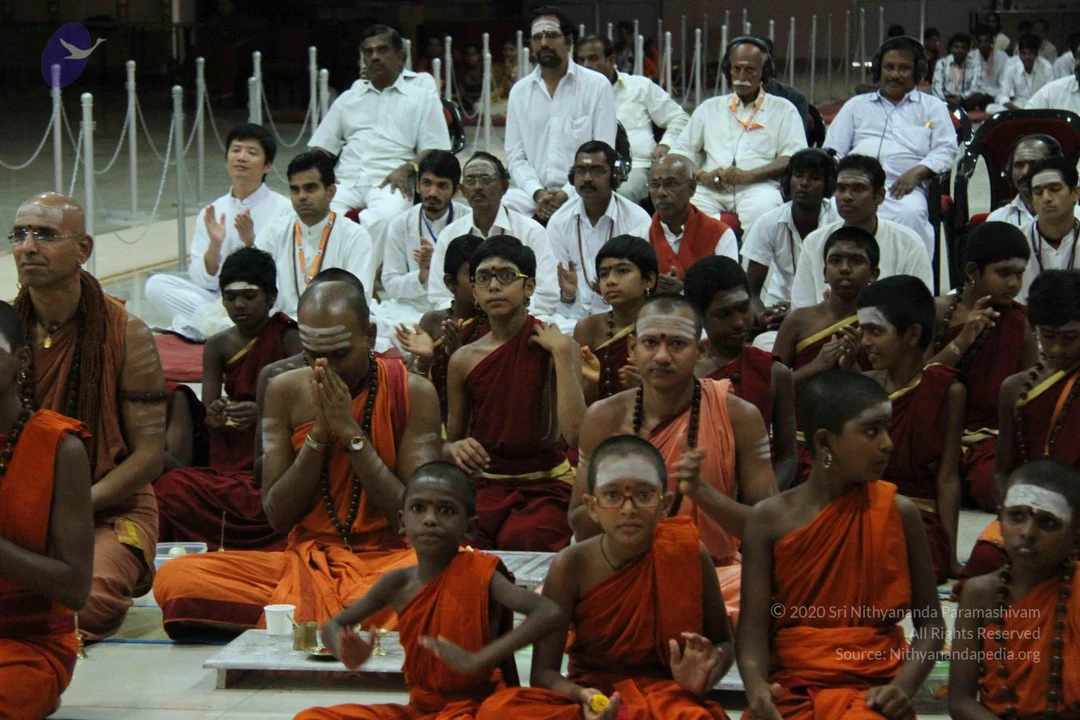
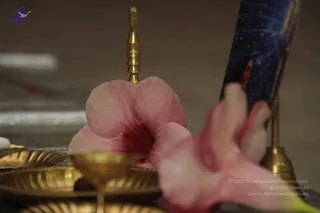
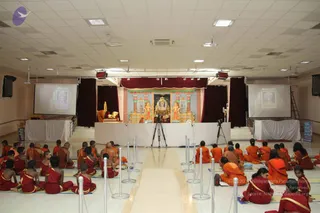
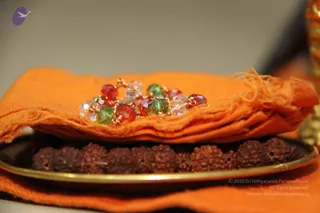
Close-up photograph of a small heap of loose faceted beads resting on a folded orange cloth. The beads are red, green and clear crystal, strung on fine copper-coloured wire loops, with a bundle of smaller beads spilling across the fabric. Beneath the cloth sits a dark, granular brown surface, possibly rudraksha-like seeds or earth, and a metal edge curves at the bottom left. The background is a soft, out-of-focus blur of grey and deep red. No people are visible.Close photo of a shaved-headed young boy in an orange saffron robe with his eyes closed, chanting or meditating in a seated group. He wears red-rimmed glasses, a white sandalwood forehead mark with a red kumkum dot, and a black cord with a small lapel microphone at his neck. Behind him, other saffron-robed people sit with white markings on their foreheads. The background includes a red cloth and figures in deep red and orange clothing.Close-up photograph of a polished brass tray holding red rose petals, a fresh red rose, and white jasmine-like flowers. The shallow focus blurs a dark, warm background with soft light spots. No people are visible; the scene is a flower offering arrangement, possibly for puja.

September 24 2013

Original wiki page
Contents

Title:

Hold the peak possibility for everyone

Description:

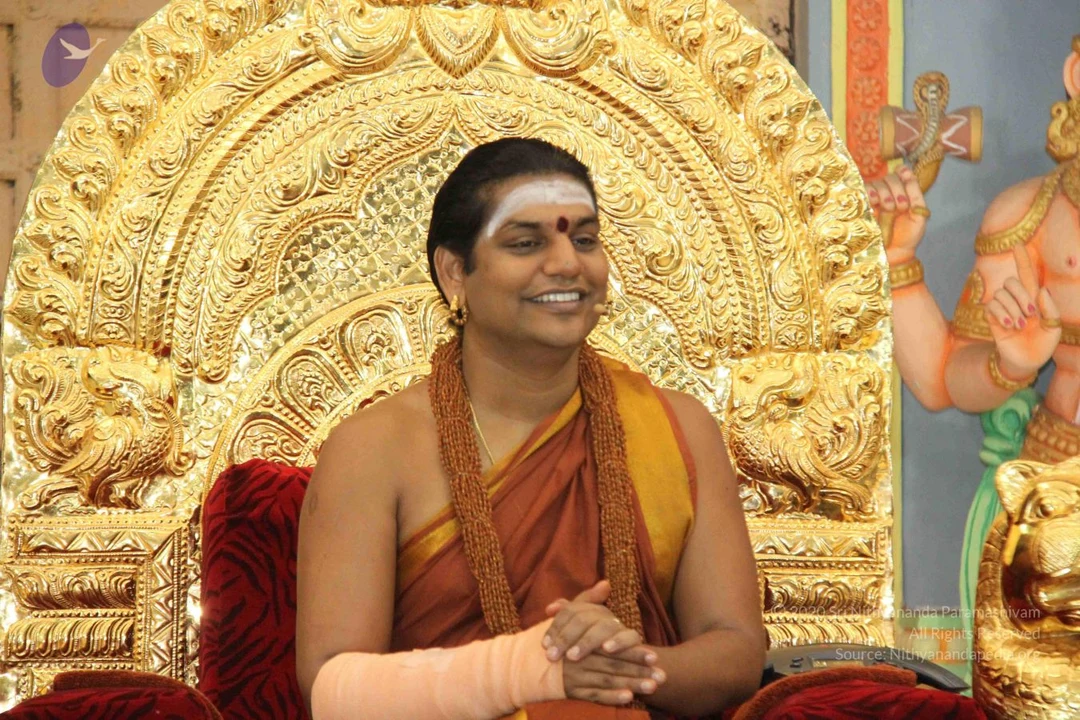
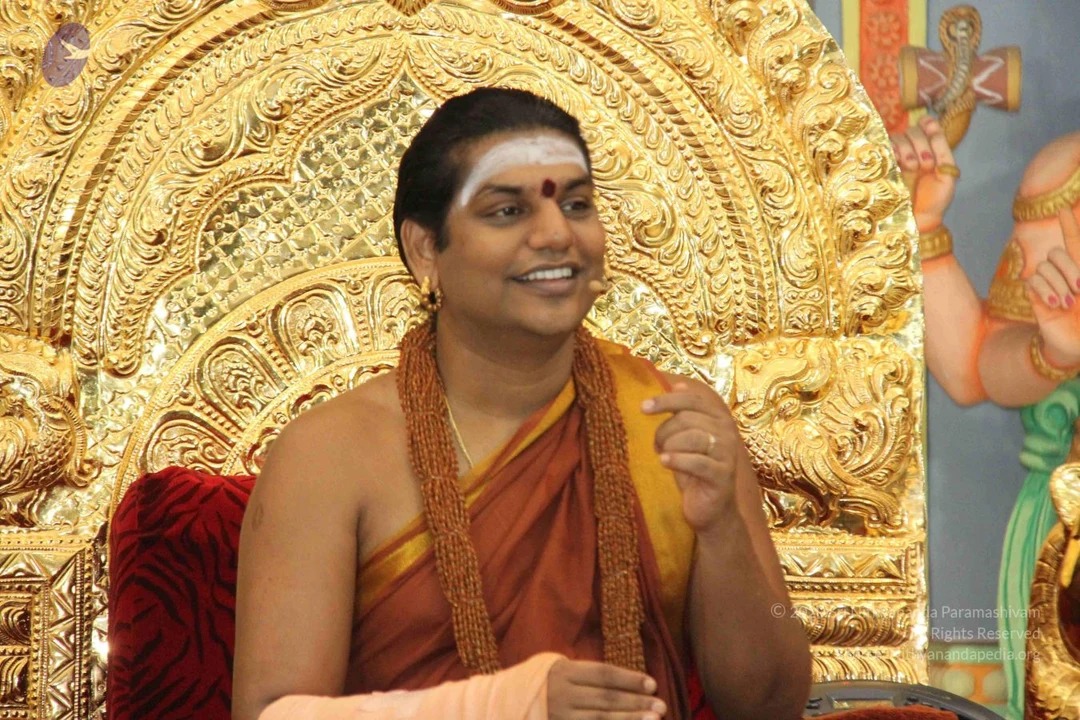
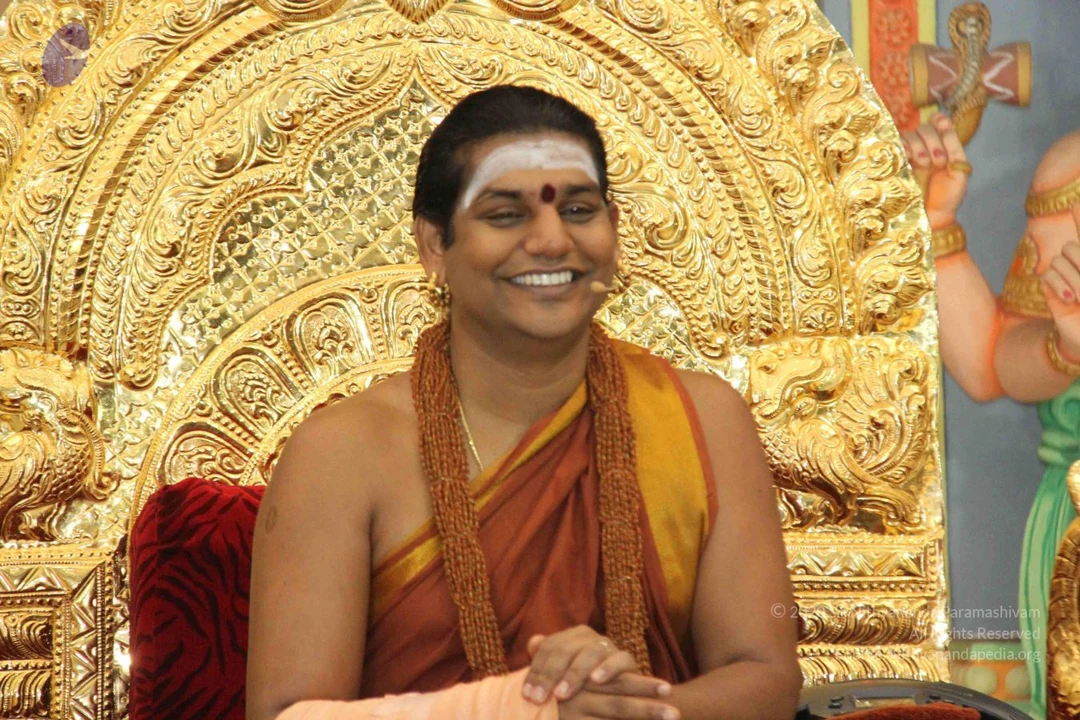
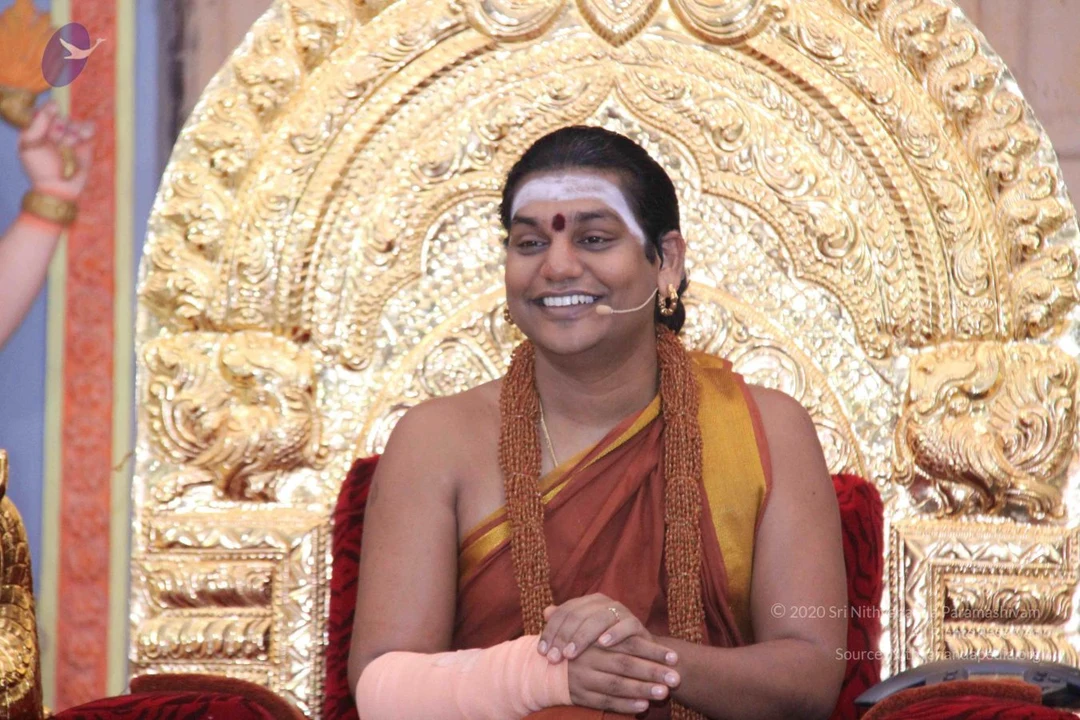
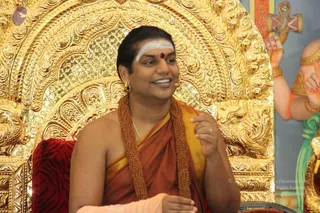
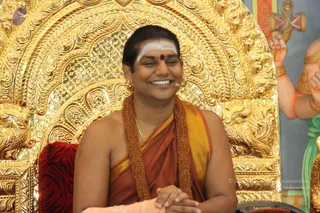
In today’s morning Satsang, Paramahamsa Nithyananda delivers new insights on how to make enriching our lifestyle. Living the essence of enriching is not giving up on ourselves, holding ourselves by ourselves to our highest possibility, while not giving up on others. Enriching raises us to a higher frequency, allowing us to see that everyone is part of us. Now why would we give up on others, knowing we are essentially giving up on ourselves? When we give up on ourselves, we declare bankruptcy with the Cosmos! Let us declare to enrich ourselves, others, and live our highest possibility in Authenticity, Integrity, Responsibility, and Enriching!

Link to Video:

VideoAudio

Transcript:

Nithyanandeshwara Samaarambhaam Nithyanandeshwari Madhyamaam | Asmath Aachaarya Paryanthaam Vandhey Guru Paramparaam ||

<Hindi translation>

I welcome all the devotees, disciples, samajis, satsangis, viewers, visitors sitting with us all over the world through Nithyananda TV, Sadhana TV, and two-way video-conferencing, and Lotus News Channel, with us all over the world.

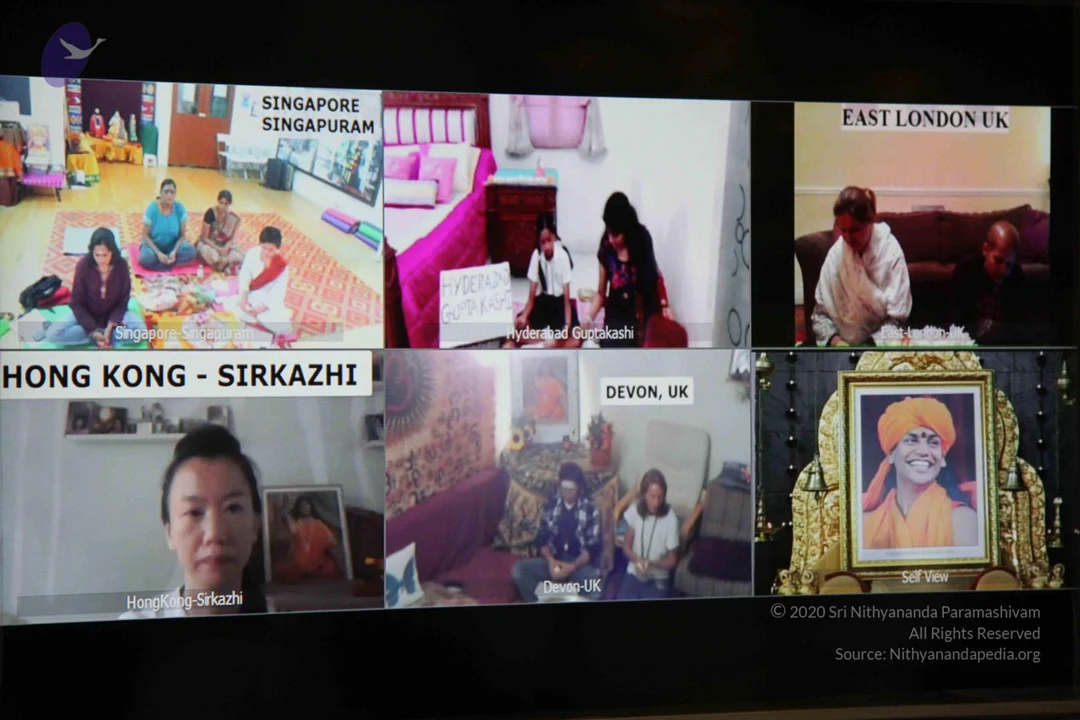
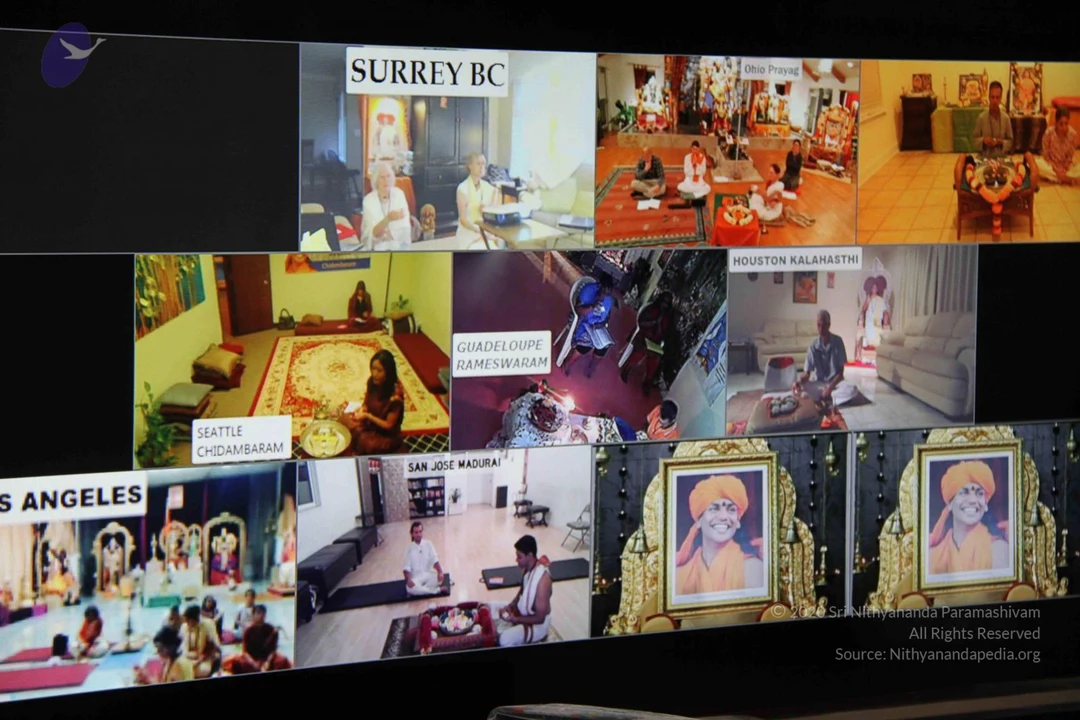
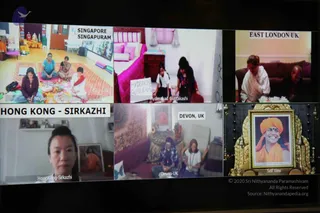
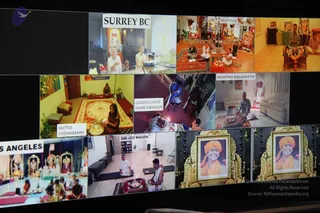
The cities sitting with us all over the world in two-way video-conferencing: San Jose, Surrey-British Columbia, Ohio-Prayag, Houston-Kalahasti, Guadeloupe-Rameshwaram, Kuala Lumpur-Palani, Charlotte, Los Angeles, Seattle, East London, Singapore, Hyderabad, Devon, Tiruvanmiyur, Dubai, New Zealand-Adi Arunachalam, East London-UK, Indrani-New Jersey, Enriching Temple-Bidadi, Hong Kong-Sirkazhi, Oman-Sivagangai, Varanasi, Jorpati-Nepal………..

I welcome all of you with my love and respects.

Today I will expand on “BRINGING ENRICHING INTO YOUR LIFE – ENRICHING AS A LIFESTYLE”.

Please understand, when you bring Integrity into your thinking, Authenticity into your actions, Responsibility into your cognition, Being, whatever happens is only one part of you. If you bring Enriching in your life, literally your whole life is raised to the next frequency. Enriching raises you completely to the next frequency.

Please listen! Let me define “Enriching”. Enriching means, “Constantly raising you to the higher levels with the clarity that others are also part of you.” Constantly raising you to the next level whether it is physical health, mental health, or spiritual well-being, in relationships, or in anything, raising you to the next level, knowing others are also part of you. Basically, please understand, it boils down to not giving up on you and others, not allowing this status quo lifestyle which Indians are in love with.

If I have to describe the whole India in one word, I will describe “Status Quo”. Really, I am telling you! Anything, “status quo” is our default program! Just “status quo”! Whether it is a social problem to be solved, or a property issues!

One guy came to me and he told me, ‘Swamiji I am sitting in a property for the last thirty years. Please bless me that I should get the property documentations in my name.’

I said, ‘What do you mean? Thirty years you are sitting and you don’t have the documentation in your name? Means it’s not your property?’

‘No, Swamiji. When the property came in the court for a case, before he got the stay order, I just went and sat inside the property. I went inside as if I am going to brush my teeth and do 1-2-3 and come out. Morning I heard when I was in the property, I got the Status Quo! And for the last thirty years I am in that property.’ Already “Status Quo”.

“Status Quo” means, just it is there. It should be there as it is; undisturbed. Only in India you can have this thirty years status quo and all. And now this fellow thinks he can get ownership!

Please understand, if you are from some other country and you are watching the satsangh, you may laugh! But, in India, it is a lifestyle! The first thing we need is to get out of this pattern of status quo.

Even in your life, you can see. Indian divorce is nothing but status quo. Husband and wife, both will be living in the same house. Not one day, two days; 15-20 years they will be living in the same house, they won’t even be talking to each other! Sometimes, both of them will use the same bedroom, but things are in status quo! What is the status quo?

Same way, I have seen these religious leaders, peethadhipathis, when they face even a small conflict in their life, they put themselves in status quo. I have seen a few peethadhipathis who are in status quo for the last forty years! After their coronation, they have not moved anything else other than one or two things in their life which should not be moved! No! The whole thing is just status quo! Getting out of this status quo mentality……

Please understand, again and again, I am asked this question, ‘Why can’t I just live this middle-class life and die? What is the use of unnecessarily working so much, thinking so much?’

Life oozes through your body for fulfillment, for its highest expression. Please understand, when a bank gives you a loan of a million dollars, it expects you to become rich by doing business, putting your intelligence and effort into it. Not only you will pay back….. Of course, if you don’t pay back, they will take away your properties that is different, but all the banks don’t expect when they give you the loan that they have to only take away your properties. They really expect you to flourish, pay them back with interest and continue to develop more and more relationship. Any good bank will expect you will become successful in your life.

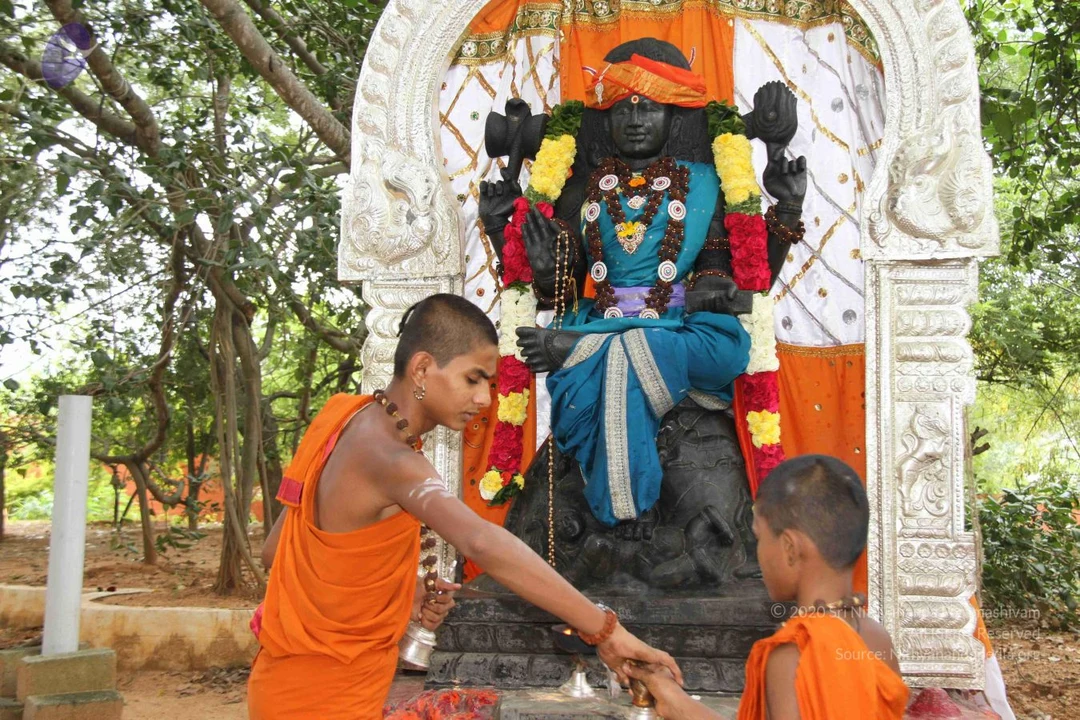
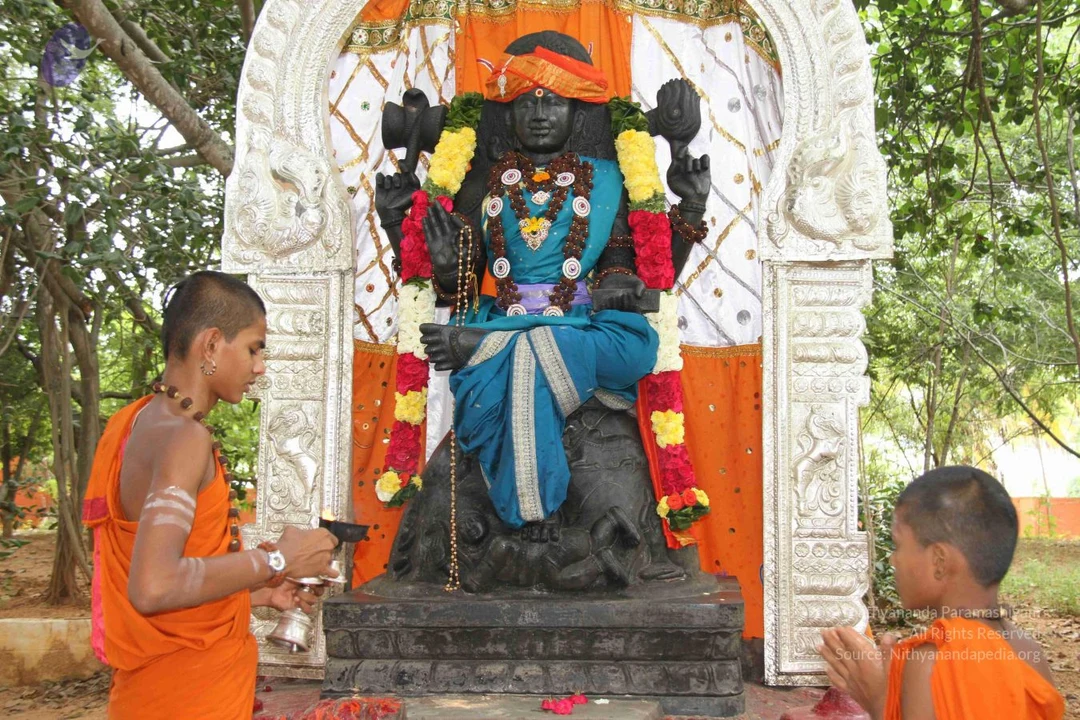
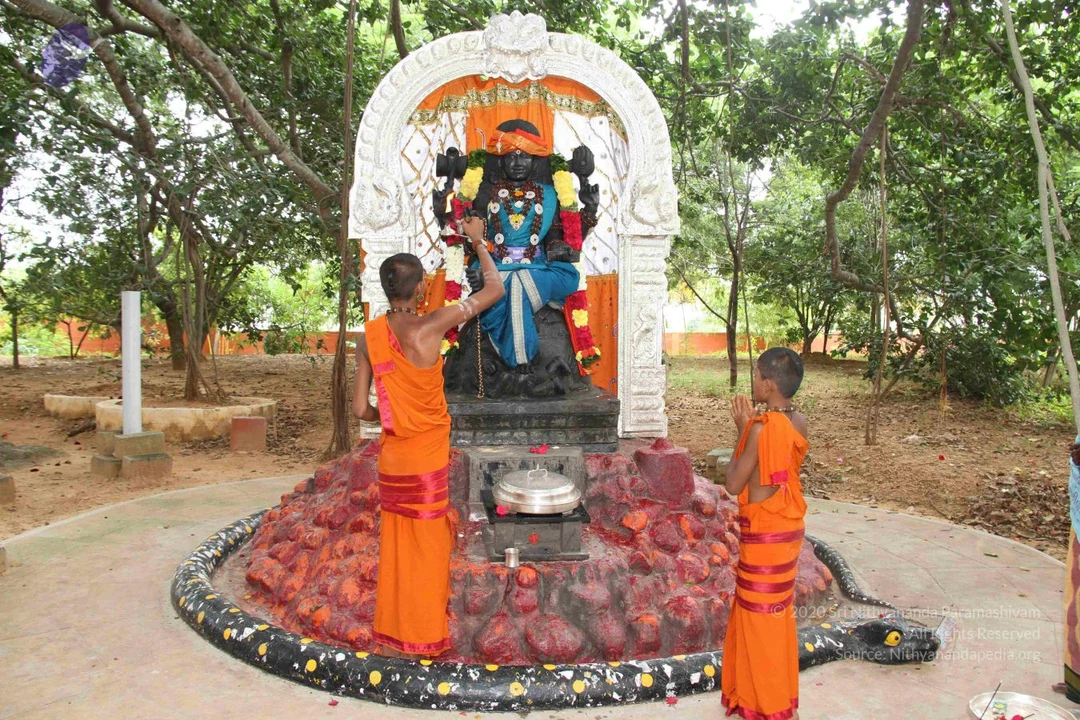
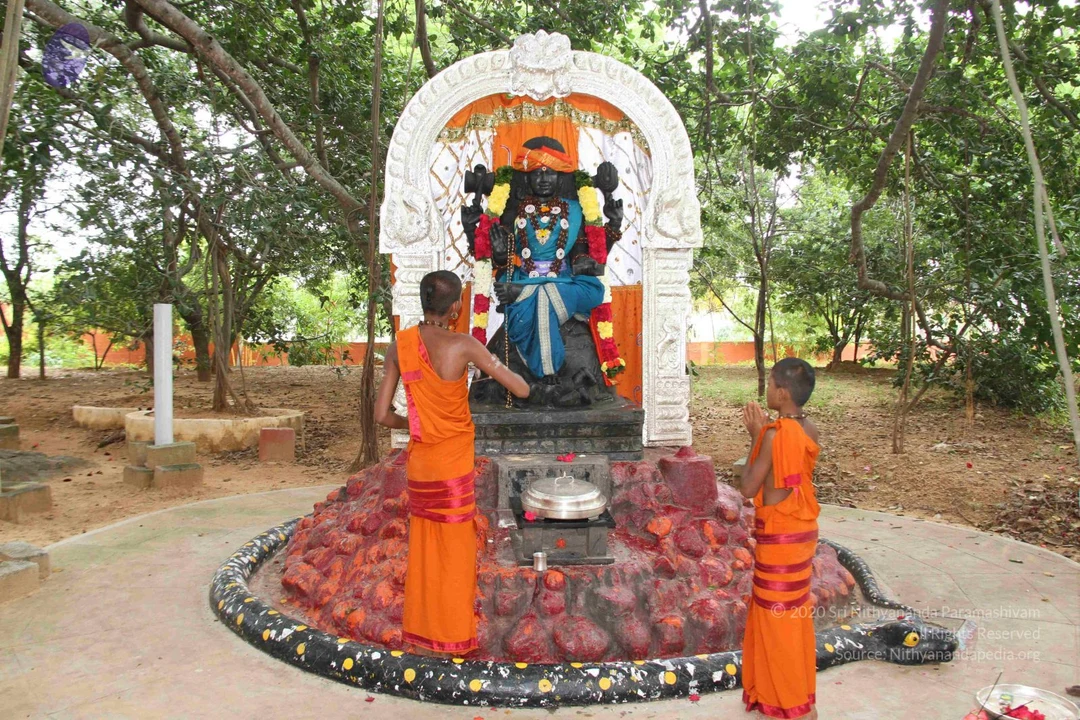
Same way, when the Cosmos gives you life, it expects you to become the peak possibility. It is not expecting you to become bankrupt. It is not expecting you to declare bankruptcy. Understand, giving upon you is “declaring bankruptcy”. And never, ever expect again any loan from Cosmos! If you give up on you, you are declaring bankruptcy with Kalabhairava! Forget about any good thing in your life anymore! Forget about it! The guy who declares bankruptcy cannot expect new loans in life. The guy who declares bankruptcy cannot expect the bank to do any good thing. Same way, a person who gives upon, especially the vows you take, the commitments you give it to Kalabhairava, when you give upon them, forget about any good thing in your life! Get ready to the long-drawn, suffering-filled life, and births and births and births!

Giving up on you is declaring bankruptcy in the Cosmos. Sometimes it’s like you take a loan of a million dollars telling the bank you are going to do big business and then pay the bank back with interest and all that. Suddenly you decide after seeing one million dollars, ‘What is the problem? I think these one million dollars if I will keep with me and eat every day. Every day my expense is only twenty-five dollars. My whole life I will keep these one million dollars and die. What is the need of unnecessarily doing business? What is the need of anything else?’

Please listen, just like how we make concrete….. See, when concrete pillars are made, first they make a wooden box all around, then they pour concrete, the concrete sets, and then they remove the wooden box. Same way, all the vows given to you, all the commitments you give to others and yourself, means, the Mamakara, Ahankara, Anyakara, Swa Anyakara, these all are the four sides wooden box. When the energy is poured into you, that is the life, the concrete which is poured inside the box, just like that the energy which is poured inside you is life. Before the concrete sets if you remove these vows, what will happen? Not only the pillar will not be created, the energy poured on you, the concrete poured on you will be wasted. And the Cosmos does not like you to waste things!

In marriage, the moment you commit with the other person with the vow, your energy becomes double. Now you are two. You are no more one person. You are two. Not only you are two, many problems which can stop you, being a single, are taken away. So you are more than two. For example, if you are alone, it is not that you are one. One suffering with loneliness! So you are not even one full person. When one more is added, you are not just two; the suffering with loneliness is removed; you are more than two. So when you become two through commitment, through the vows of the marriage, so many things happen between both of you which are irrevocable. All the support you gave to your husband or wife cannot be taken away when you divorce. If you want to divorce, at the time of divorce, the irrevocable exchange of being happens. That is why I am telling you this kind of commitments can never be treated as a business. This cannot be treated as a business agreement at all. You cannot say, ‘What is there? They both tried to live together. They are not able to. They are not compatible with each other. It is a mutual agreement. They both separated.’ No! There are tons and tons of things. It is an energy mould. As I said, in a wooden box when you pour the concrete, remove the wooden box before the concrete sets, how it completely damages the possibility of the pillar, same way when you give up on you, you become a blot on the Cosmos.

15 min

Please understand, Enriching, I am defining Enriching. Enriching is nothing but not giving up on you and others who are part of you and continuously Enriching yourself and others! Continuously Enriching you and others, knowing that others are part of you. It all boils down to one line. I can say, in this one line I can finish defining the whole Enriching: “Not giving up on you, holding you to yourself by yourself to the highest possibility of you.” Holding you by yourself to the highest possibility of you. Holding you high up continuously with Integrity, Authenticity, Responsibility. If you have a Master, hold yourself high up to his Anyakara; you are done! You will have everything imaginable and beyond your imagination!

Understand, if you can hold yourself up to the Master’s Anykara, you will automatically have Integrity, Authenticity, Responsibility, Enriching and everything! If you don’t have a Master in your life, at least hold yourself up to whatever you understand as Integrity, Authenticity, Responsibility and Enriching.

Understand, this dhamma is self-purifying. Please understand, any sutra has to be self-explanatory; Any Dhamma has to be self-purifying. Means, even if you start with your understanding, it will lead you to the deeper and deeper understanding and ultimately to the goal of Moksha itself. Dhamma is always designed in such a way that even if you start in a very raw, crude form, it purifies you, enriches you in such a way, you evolve, evolve, evolve, and finally reach the goal!

Please understand, it is like when you enter school, straightaway you don’t start studying Ph.D. syllabus; you only study A for Apple, B for Brinjal, C for Cat; but the education takes you to the next, next, next level, and you achieve the ultimate goal. Same way, dhamma!

That is why Krishna says in the Gita, ‘Even if it is practiced in a very crude form, don’t discourage people practicing dhamma, because dhamma is self-purifying system.’

Vivekananda says, ‘Even the most cruel forms of practices which you call primitive, even those things I will not try to abolish, because even from there you can beautifully evolve to the next, next, next level and achieve the ultimate goal; the goal of Completion, fulfillment, the goal of enlightenment.’

It may start in a very raw, crude form, but it will reach the ultimate dhamma. Even if you start practicing Integrity, Authenticity, Responsibility the way you understand, these truths are powerful enough to purify itself and raise you to the next, next, next level. I tell you, these truths are so powerful, they will swallow all your patterns and they will become the owners of your being!

In Tamil there is a proverb: “If you just give a place to sleep, he will take over the whole house.” Same way, these four tattvas. If you just give a little place for it to be in your being, it will take over your whole cognition.

Understand, I am giving you the essence of this Enriching; essence of Enriching: Don’t give up on you and others who are part of you. Constantly hold you and others to the highest possibility and live just for that, think for that, act for that, be for that. Whatever is your peak possibility, think for that; that is Integrity. What is your peak possibility, act for that; that is Authenticity. Whatever is your peak possibility, be for that; that is Responsibility. Thinking for your peak possibility is Integrity. Acting for your peak possibility, is Authenticity. Being for your peak possibility is Responsibility. Living for your peak possibility is Enriching.

Understand, when you miss dhamma, even Shiva cannot save you. When Sati missed dhamma, Mahadeva says, ‘Don’t go!’ When Sati wants to go back on her commitments with Mahadeva, when she wants to fall back to Daksha’s palace, to the father’s bio-memory, Mahadeva says, ‘Don’t go!’ She is not ready to listen. When she is not ready to listen, even Mahadeva is not able to save her. No one can save you when you fall from dhamma. See, finally! Of course, it is not that Mahadeva did not have love for her. Even after that, Mahadeva sent Nandi, Shiva Ganas. ‘Be with her and protect her from Daksha and Daksha’s army.’ But nobody expected that the bio-memory which is sitting inside her is going to destroy her. Finally, she gave up her life. Of course, Shiva was able to do only one thing; because of his commitment to her, he brought her back in the next janma, purified her and then accepted her. As Sati, even Shiva is not able to save Sati. When you fall from dhamma, no one can save you. Even Mahadeva cannot save you!

I tell you, dhamma is so powerful, even living a little bit brings so much of good. Like Adi Shankara says, ‘Even one drop of Ganga water, once reciting Govinda’s name, once reading one Gita sloka, leads to liberation.’ Dhamma, even if a very little is practiced, can raise you to a different level which you can’t imagine. Same way, when you fall from that, the after-effects also can’t be imagined at all!

Enriching is nothing but “Don’t give up on you and don’t give up on others.” You hold yourself for the highest possibility which you declared, which you committed. Hold others for the highest possibility which others declared and others have committed. Please understand, especially in the Sangha, I wanted everybody to take up this Enriching as a practice from today. Not only you will take Responsibility for what you declared as you, you will hold the other person also as his or her declaration and hold yourself responsible for Enriching the other person to his or her declaration.

When you don’t hold the other person as the person’s possibility, you are the Rahu for that person. If you hold the other person as the person’s possibility, you are the Ketu for the person. Don’t go around and be Rahu for people. Go around and be Ketu for people. When you go around in your life and if you hold the other person as the possibility declaration, ‘I will create the largest Shiva temple!’ When you look at that person, ‘Wow! Here is a guy who is creating such a beautiful thing, space!’, then you are Ketu for that person; you are constantly reminding that person and Enriching that person to hold that person to that person’s declaration! And if you constantly go around, ‘Oh, this one! He is already sleeping! All the time in depression! And this is Dippu only’, then you are Rahu for that person. Already that person is in dippu, and when you also confirm, that person is going to fall more and more into “Dippu”. “Dippu” is the nickname given for depression! “Dippu” is the name given for depression in our Sangha! When the person is in depression, and you also hold him in the same space, then you become Rahu for that person. I tell you, constantly hold the other person also to his possibility, not to his lower level.

It is so unfortunate, it is so unfortunate, constantly one acts as the Rahu for the other, and the whole bunch becomes Rahu’s! Instead, one should act as the Kethu for the others, and the whole group should lead each other into jnana, into enlightenment, into the space of possibility!

I tell you, from today, this is the Enriching we are going to practice. We will all hold ourselves responsible for every other person’s declaration without giving up. First I declare, I hold myself responsible for making all your declarations into reality. I’ll hold myself responsible. In my cognition I will be responsible; in my Authenticity I will be acting; in my Integrity I will be thinking to make everyone of your declarations into reality. I‘ll do it and I can do it! I request each one of you the same way to hold yourself responsible for your declaration, your possibility, and everyone around you, their possibilities. For everything, hold yourself responsible.

I tell you, when you hold yourself responsible for everyone’s declaration, possibility, only then the real Enriching happens. Out of that real Enriching, the expansion which happens is Enriching. That is real Enriching!

E is for Enriching. Only when you decide life is for Enriching, life starts happening to you, any good thing starts happening to you. And when you start making your life for Enriching, you will see everything that happens is miracles!

I tell you, if you are made of diamond, how much ever the attack happens from outside, it will only polish you. If you are made out of some other stuff, how much ever scent you use, you will stink inside,and the stinking inside will come out, because the scent smell will fade away in a few days, few hours. The stuff out of which you are made decides what you are. So let Enriching be the material out of which you are made!

I tell you, let you be made out of Enriching. Let that be your thinking, action, being. Let your thinking be out of Enriching. Let your actions be out of Enriching. Let your being be out of Enriching. Let Enriching be your life and lifestyle. Let Enriching be your life and lifestyle. When you hold yourself for Enriching, every moment of your life miracles continuously happen, because life is miracles!

Understand, Enriching is the essence of life. That should be your breathing. That should be your Lifestyle!

I bless you all! Let you all radiate with Integrity, Authenticity, Responsibility and Enriching, with eternal bliss, Nithyananda! Thank you!

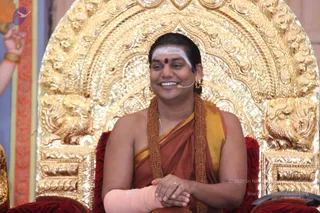
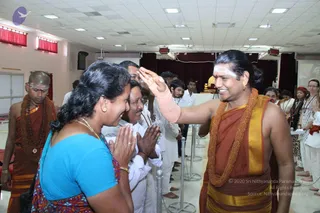
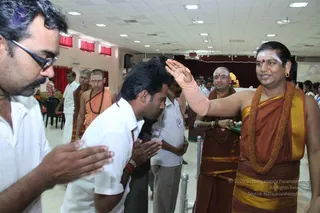
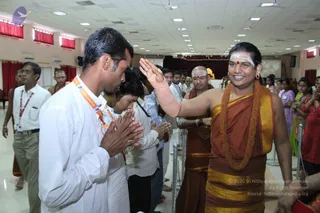
Photos From The Day:
Facebook links

https://www.facebook.com/ParamahamsaNithyananda/posts/534269813327540

Tags:

Paramahamsa Nithyananda, lifestyle, possibility, frequency, Cosmos, Authenticity, Integrity, Responsibility, Enriching

Photos Of The Day:

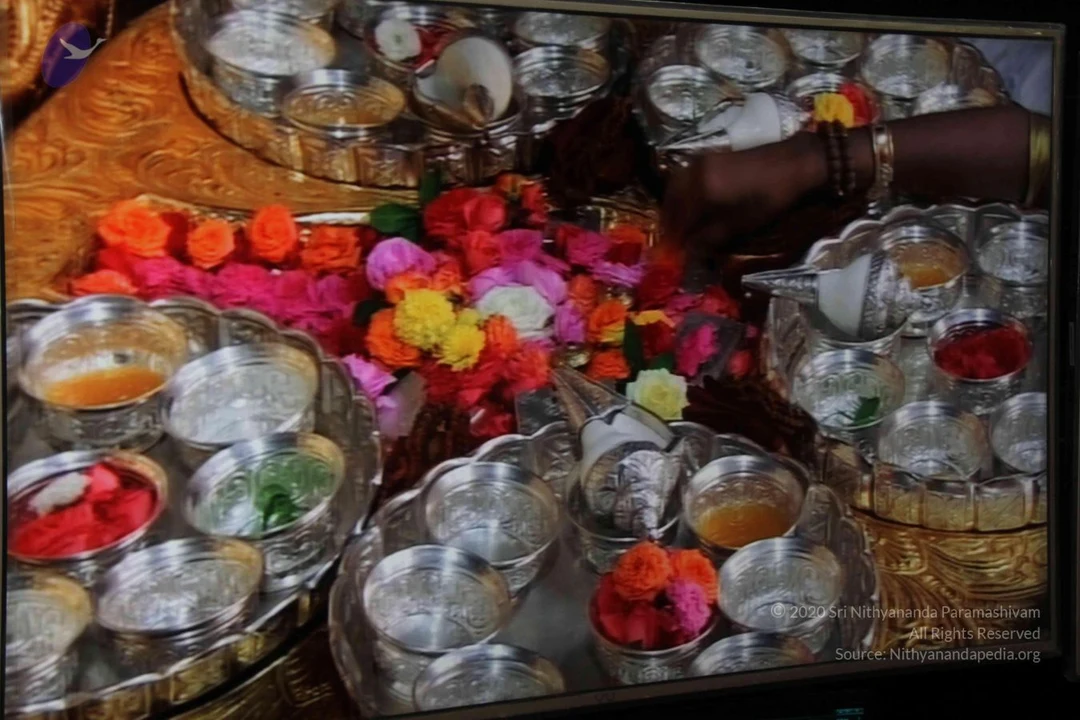
PadaPuja
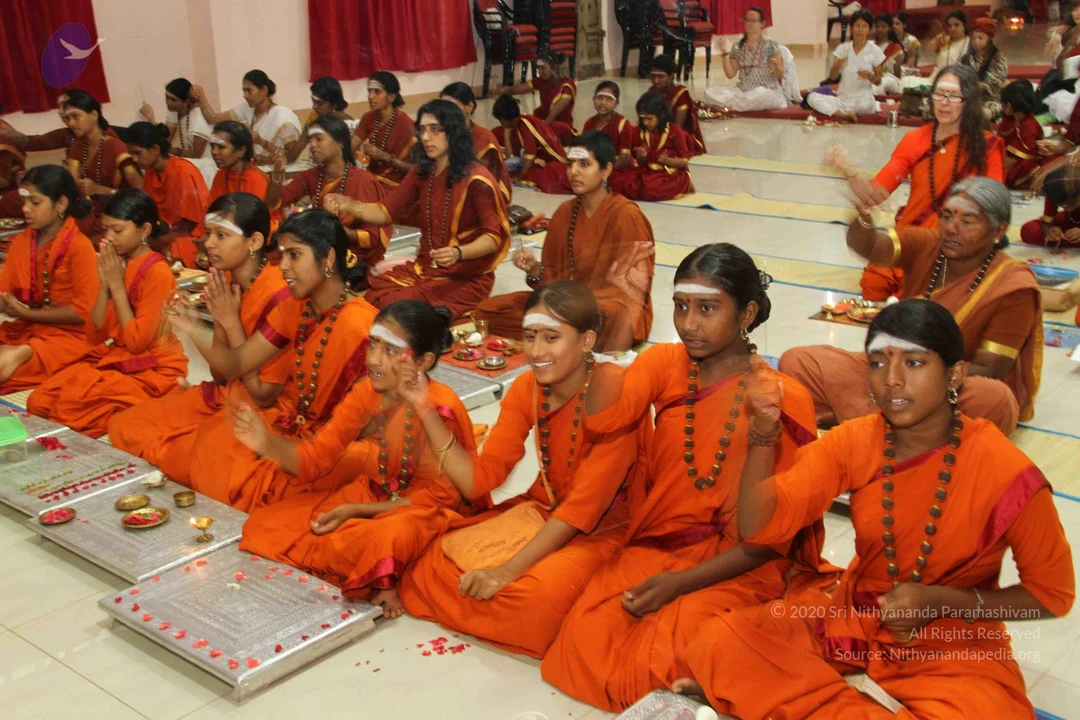
Nithya-Satsang
Sarva-Darshan

Temple

Two-Way

Photos Of The Day:

Paduka-Puja-2-Way

Paduka-Puja-Crowd

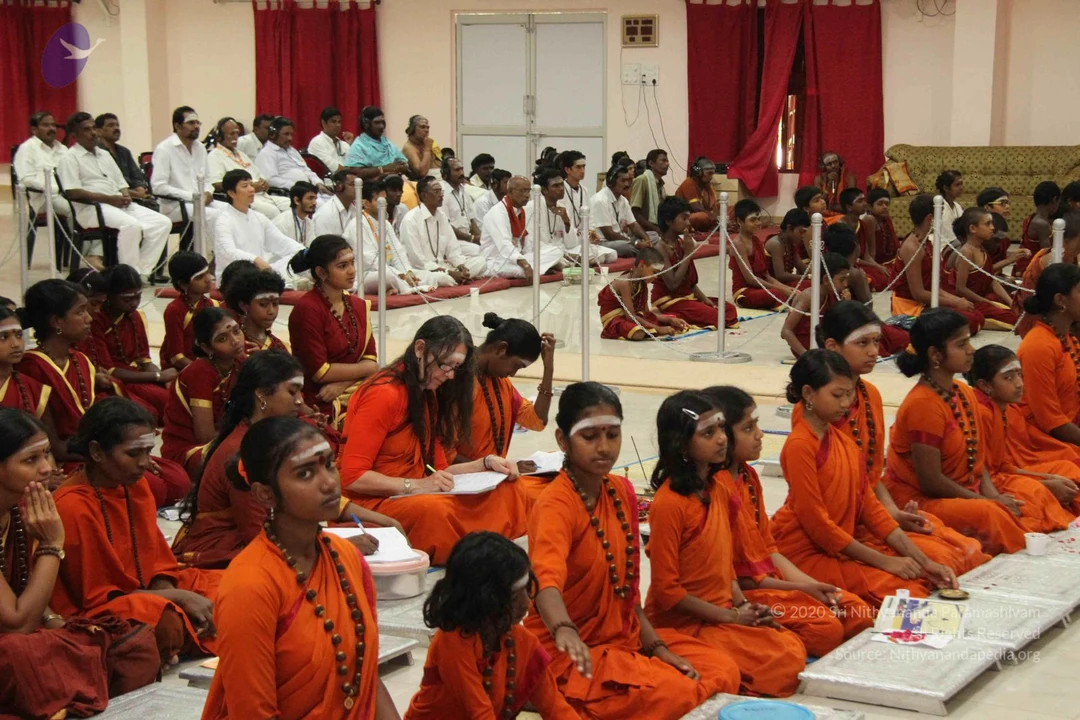
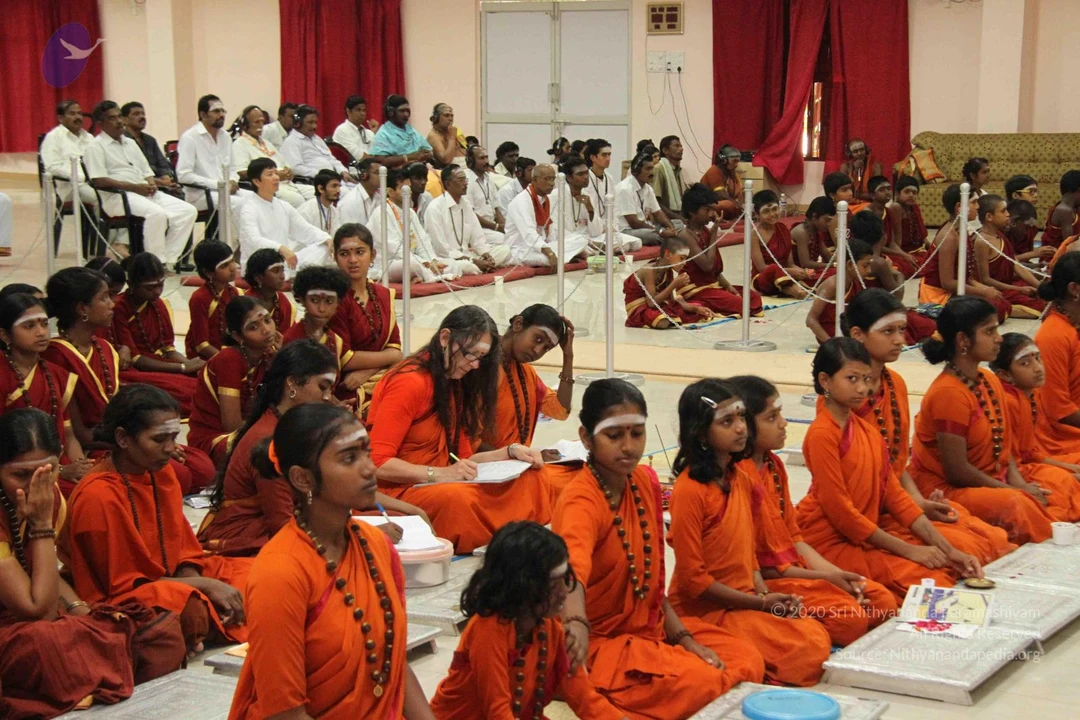
NithyaSatsang-Crowd

NithyaSatsang-Swamiji

SarvaDarshan

Temple

Photos from this day

View all 114 photos

Photos From The Day:

8 photosSource gallery
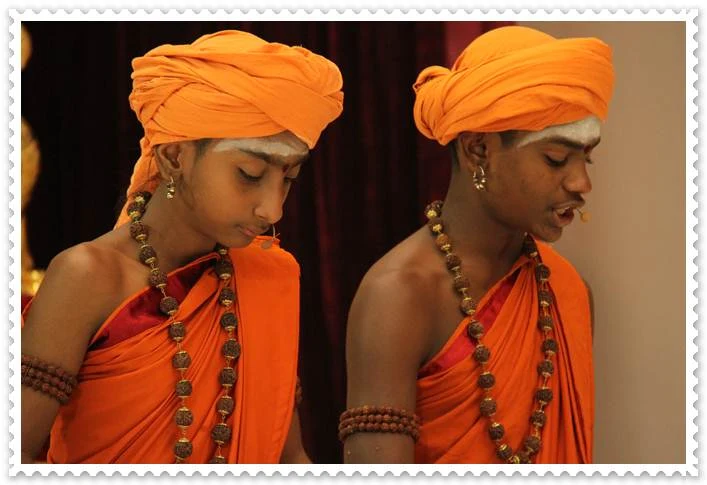
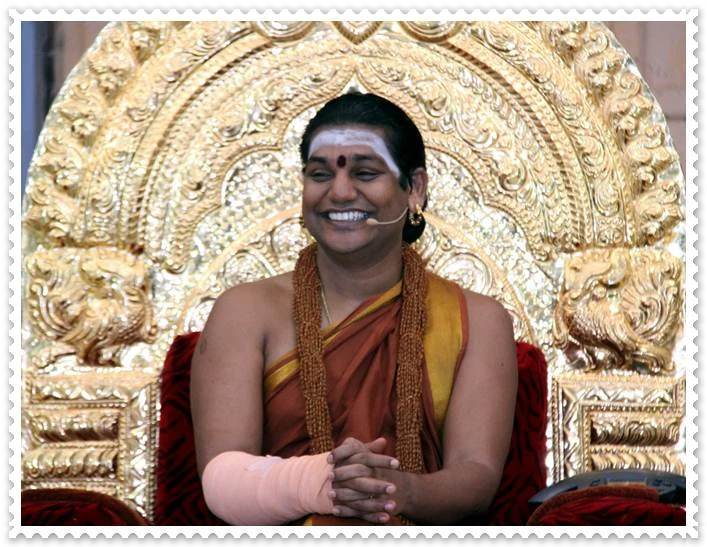
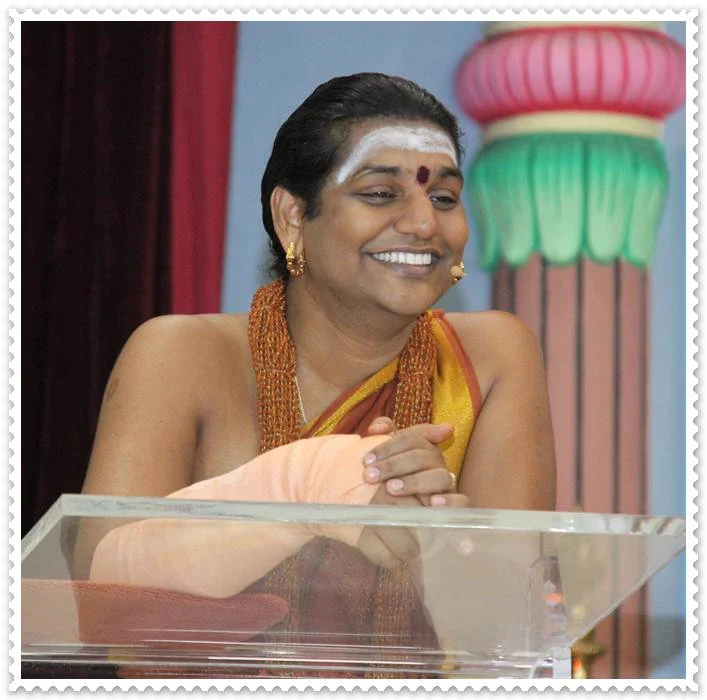
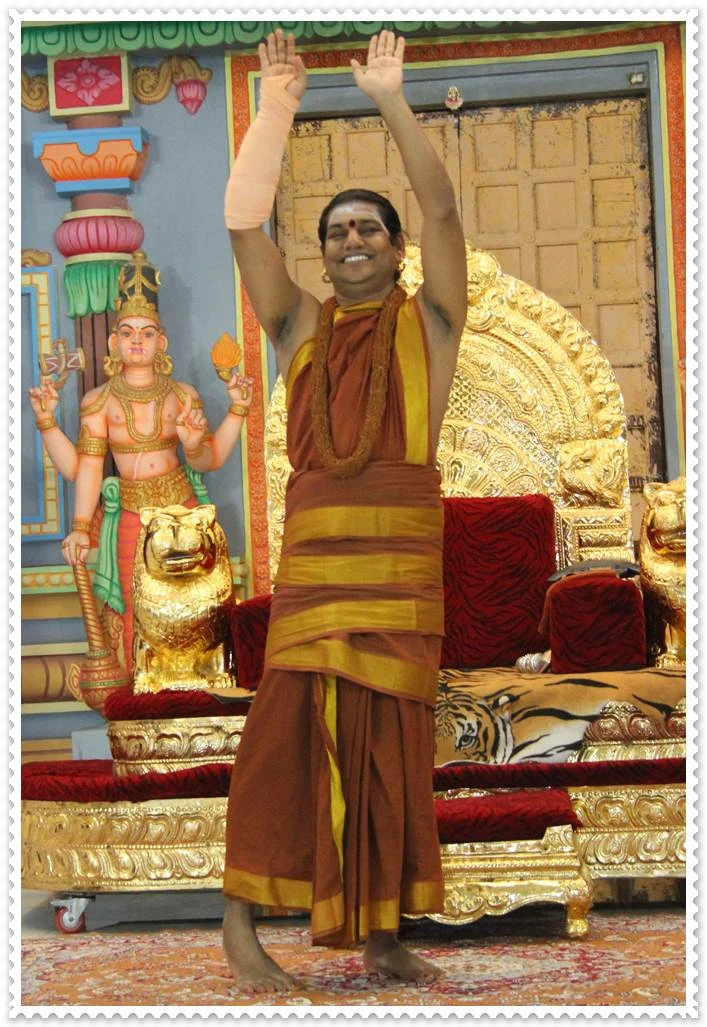
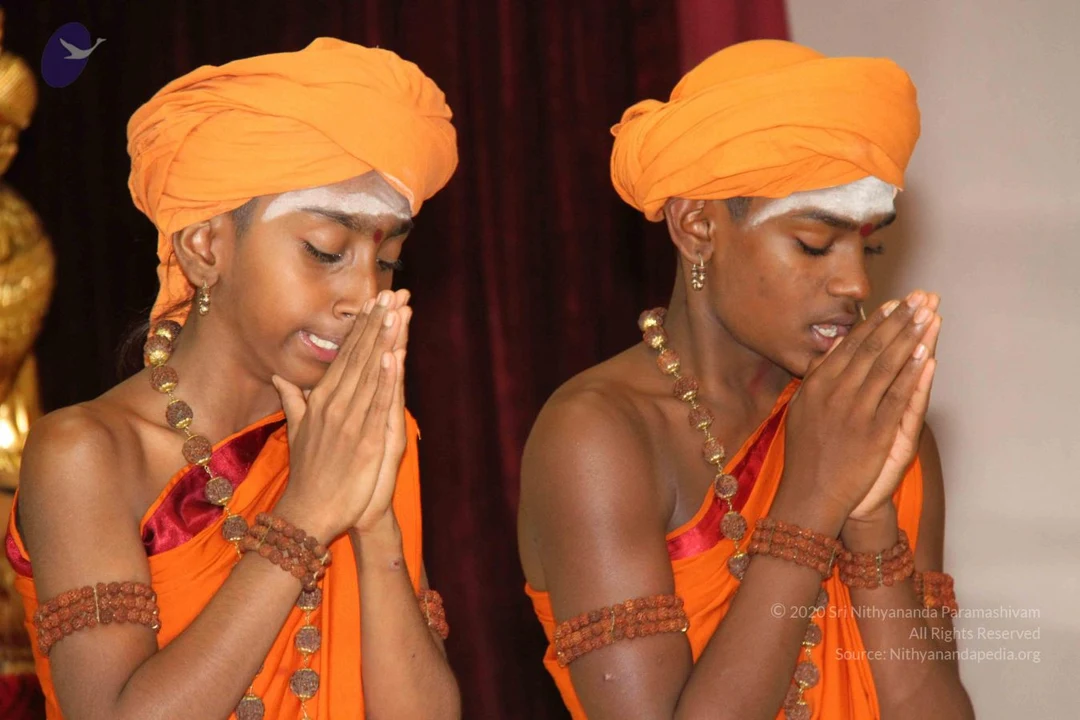
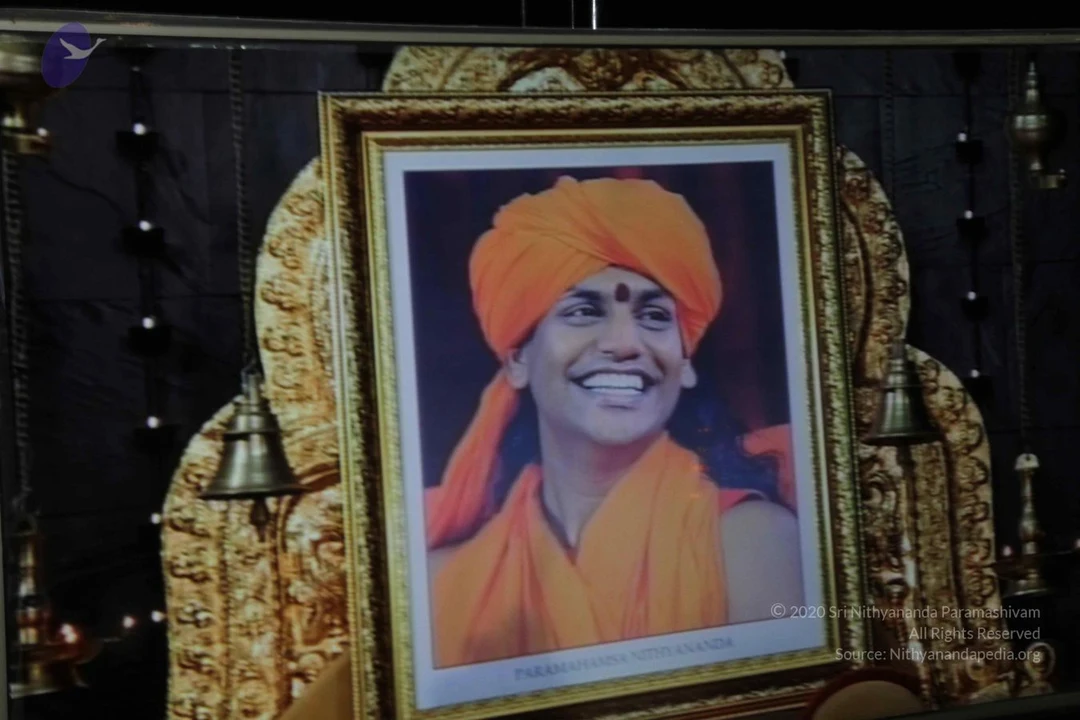
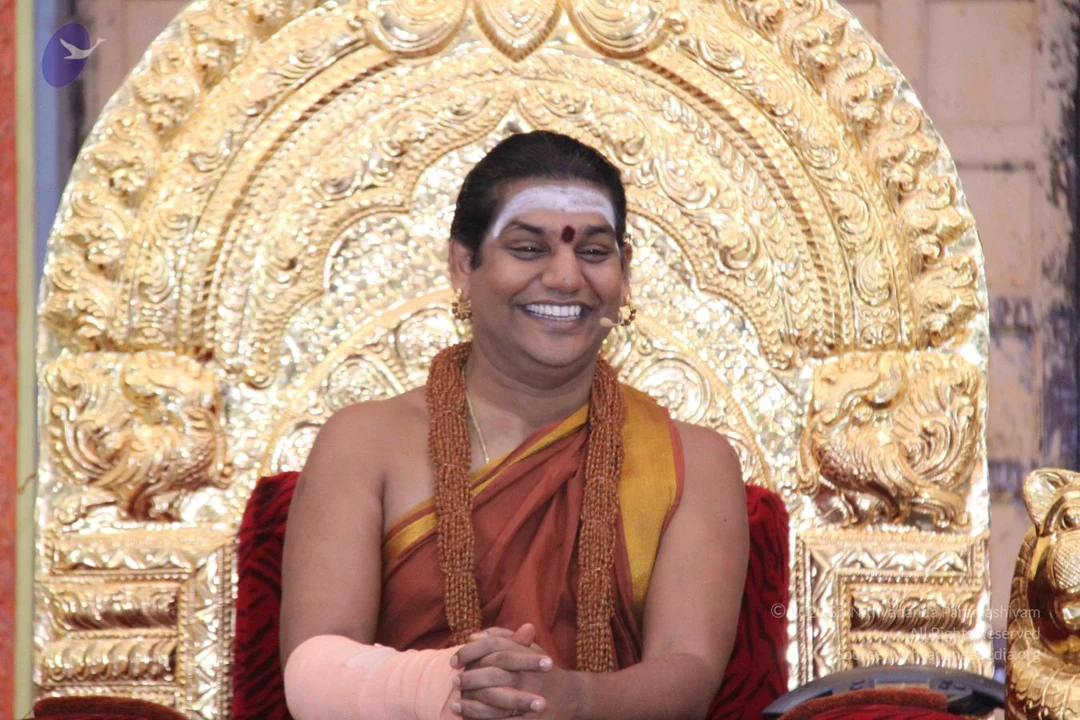
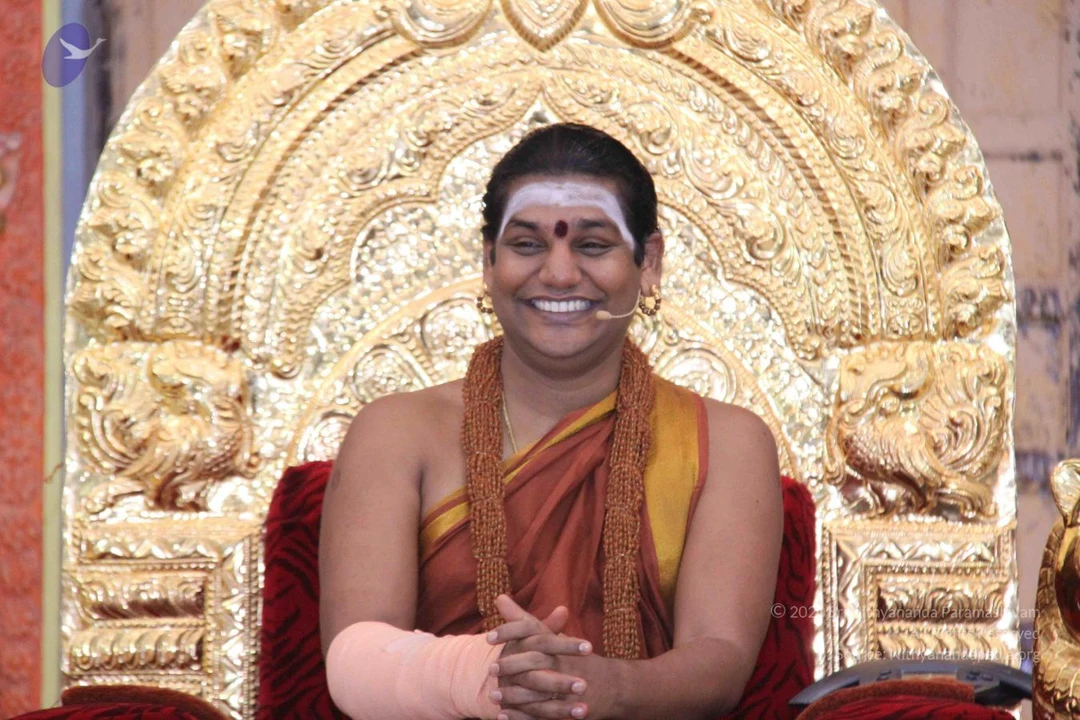
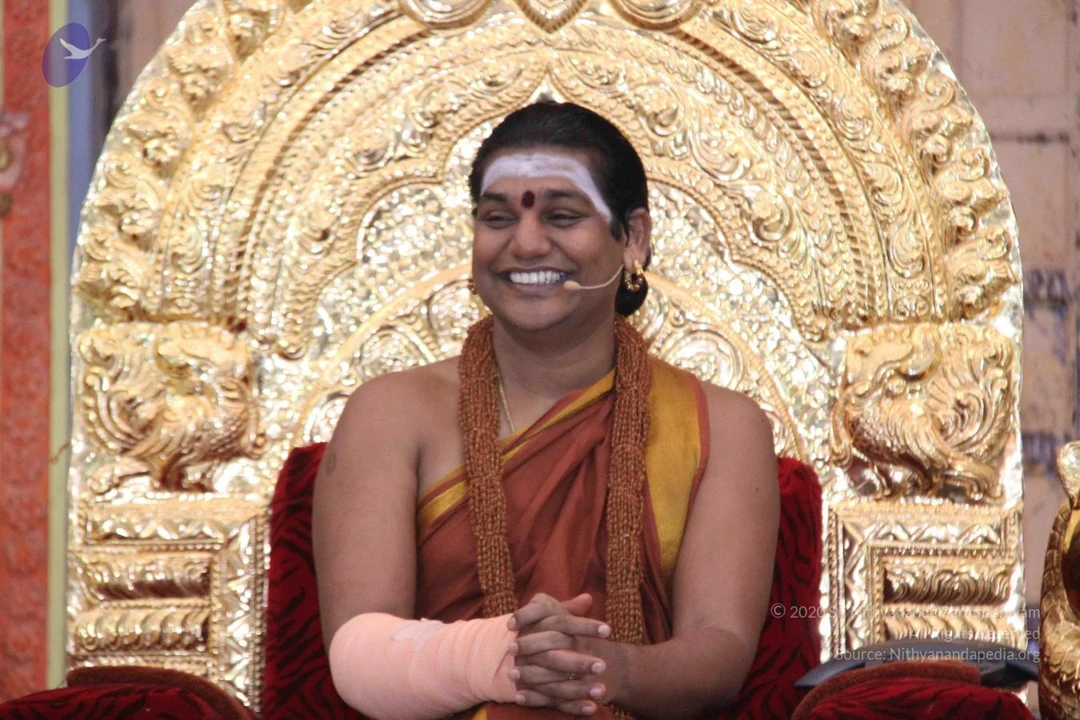
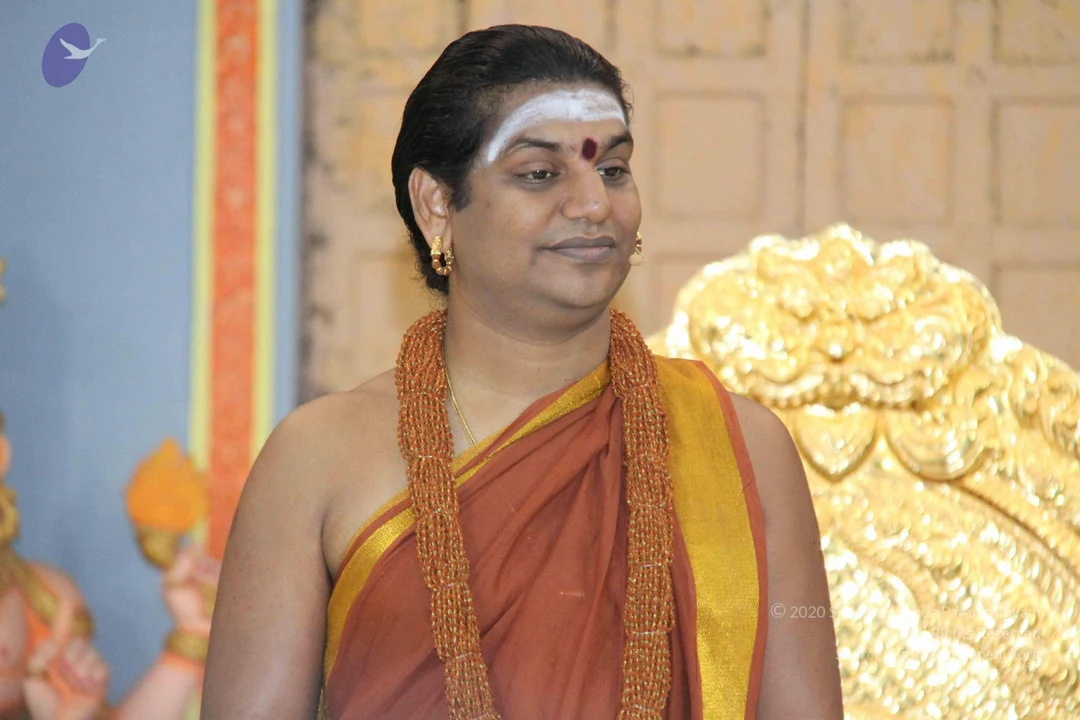
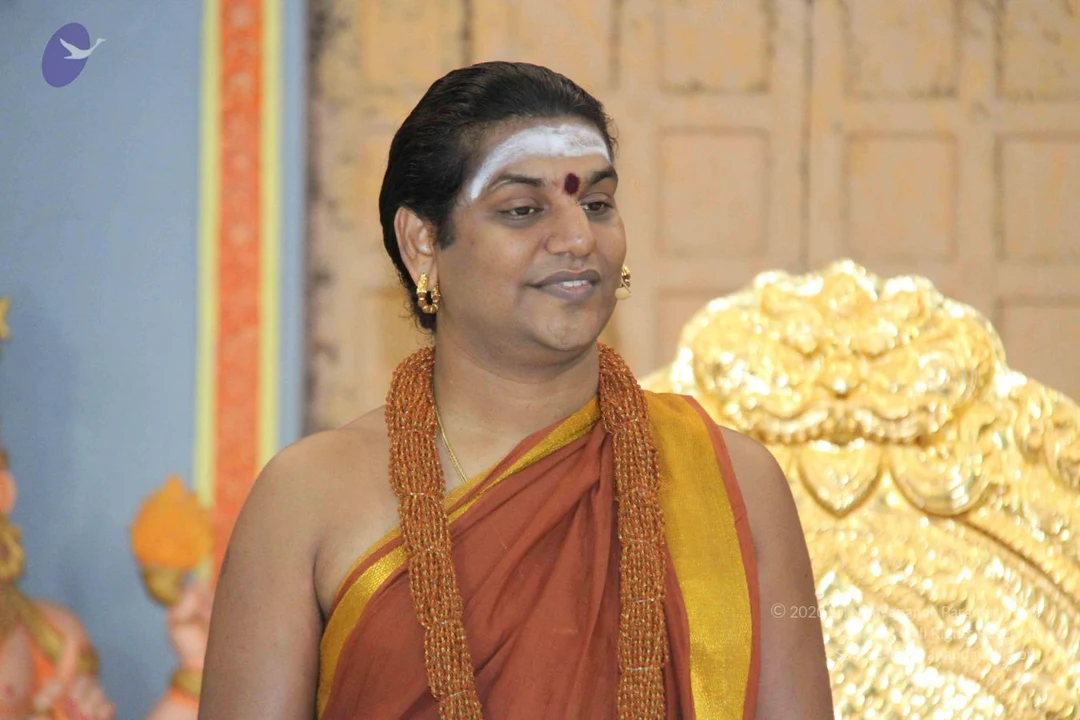
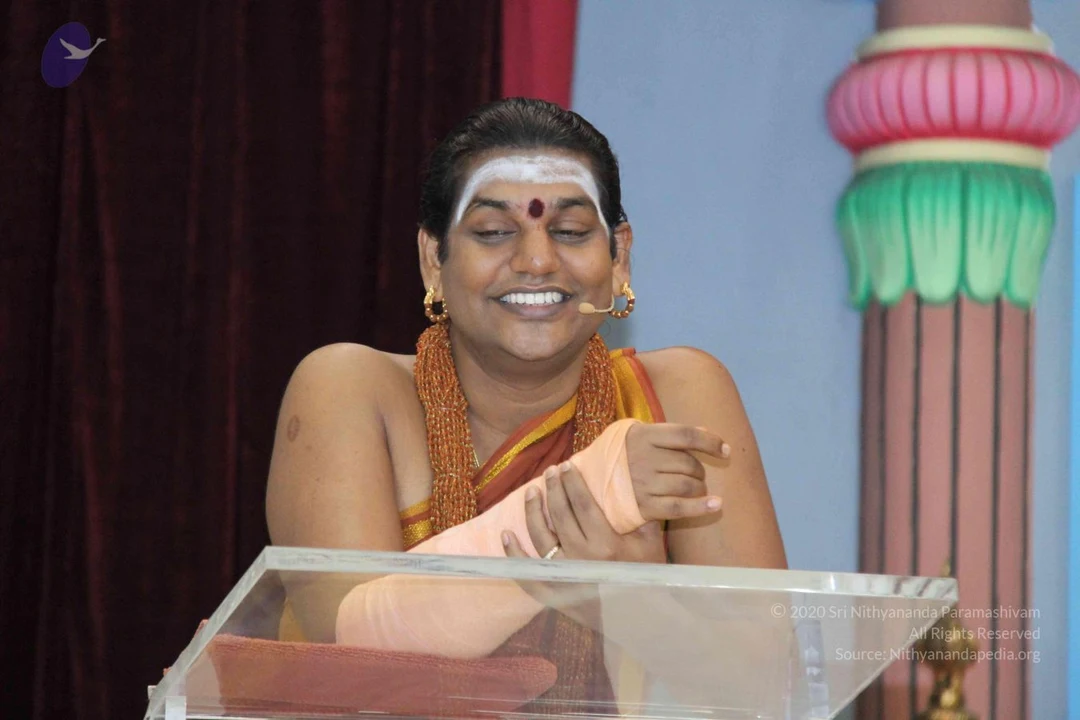
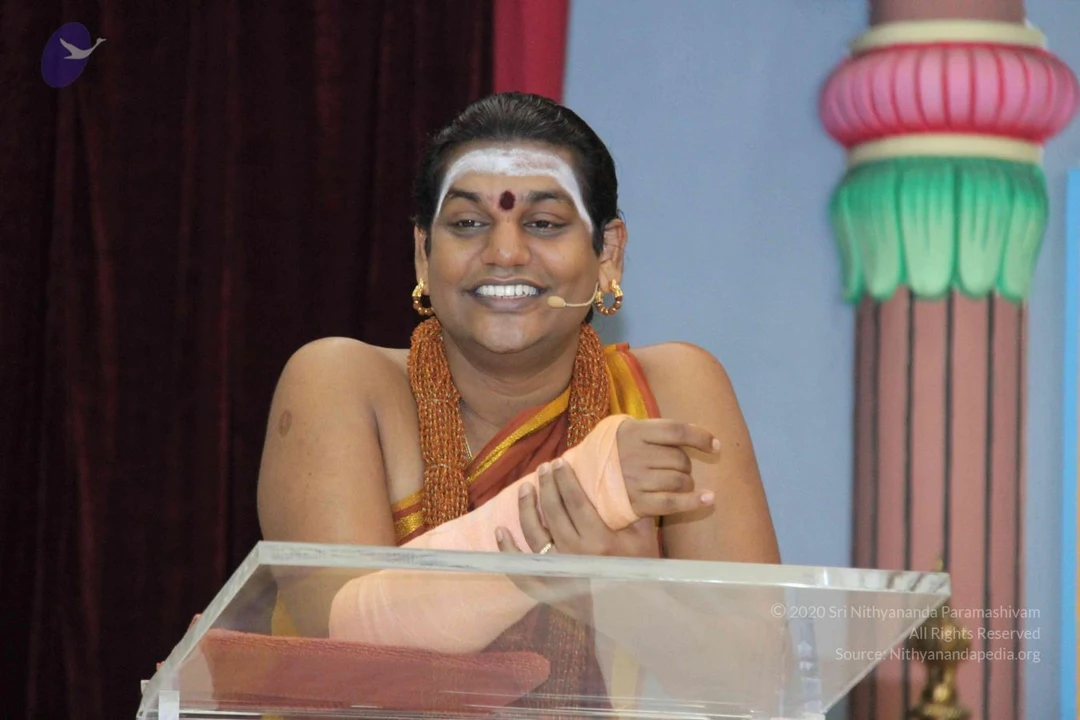
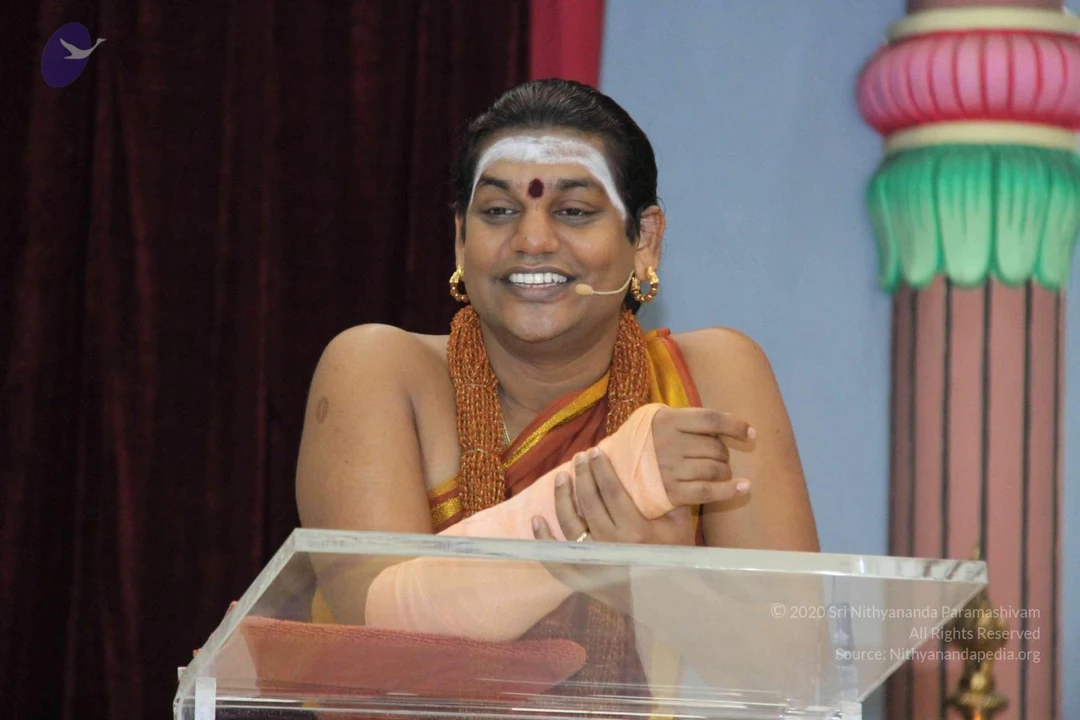
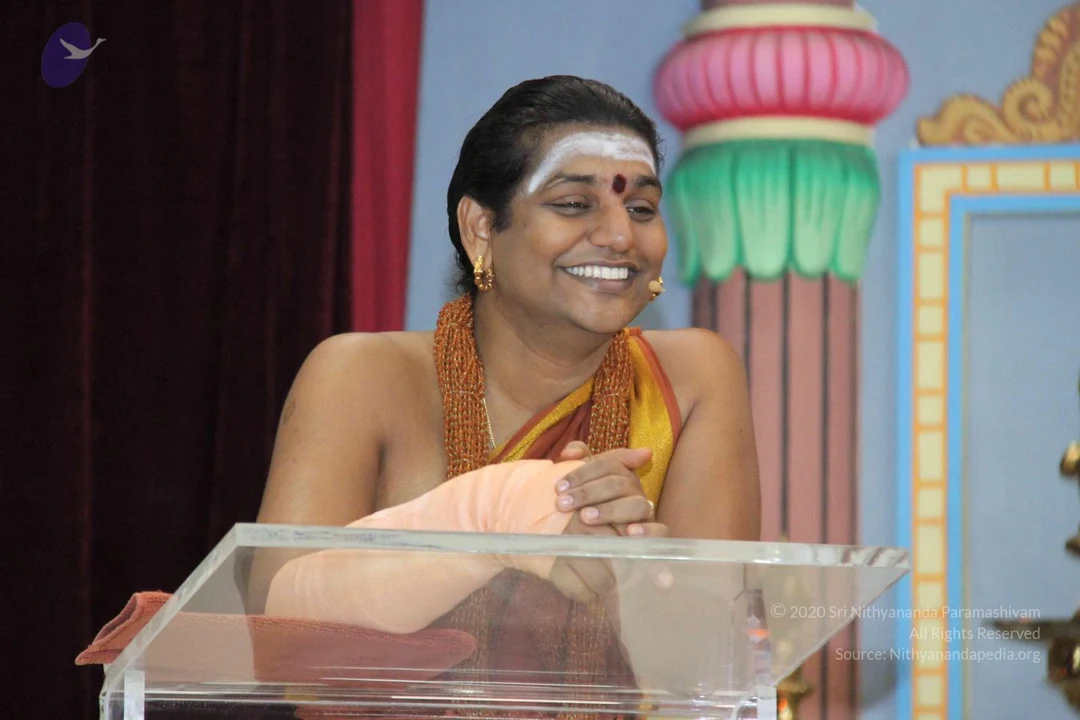
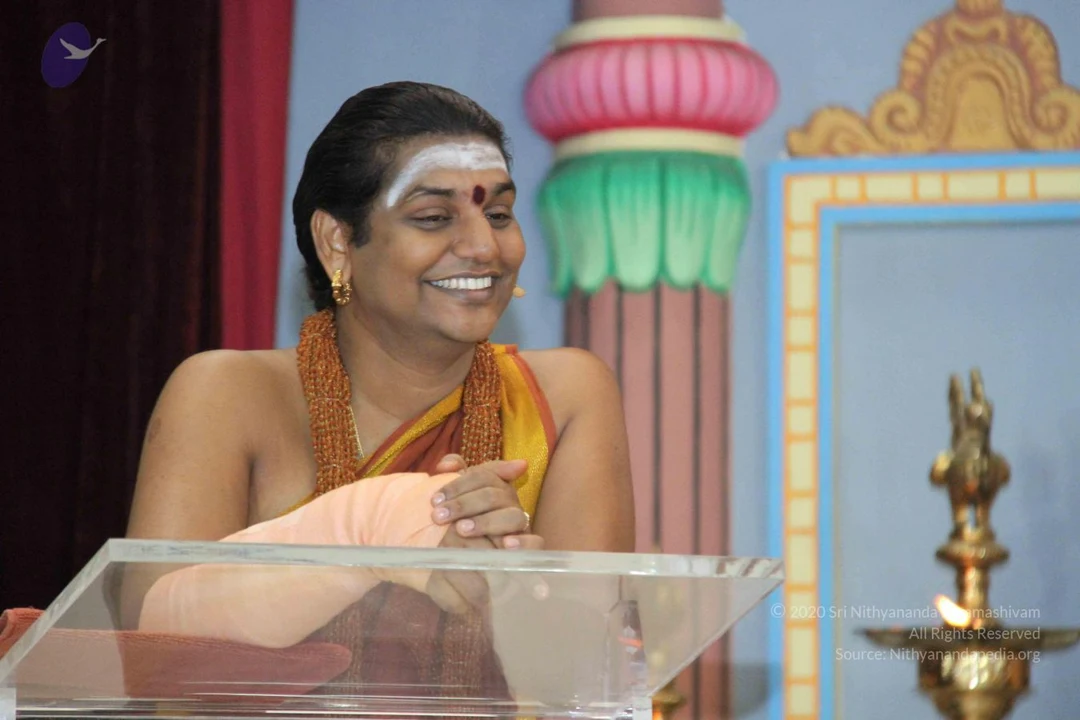
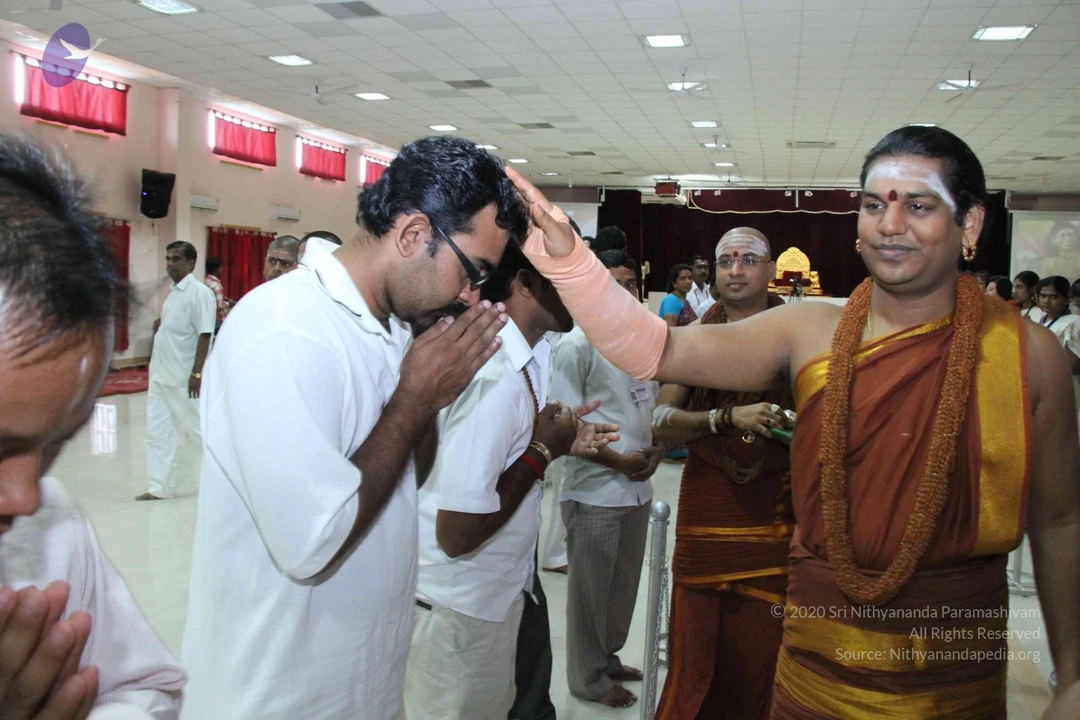
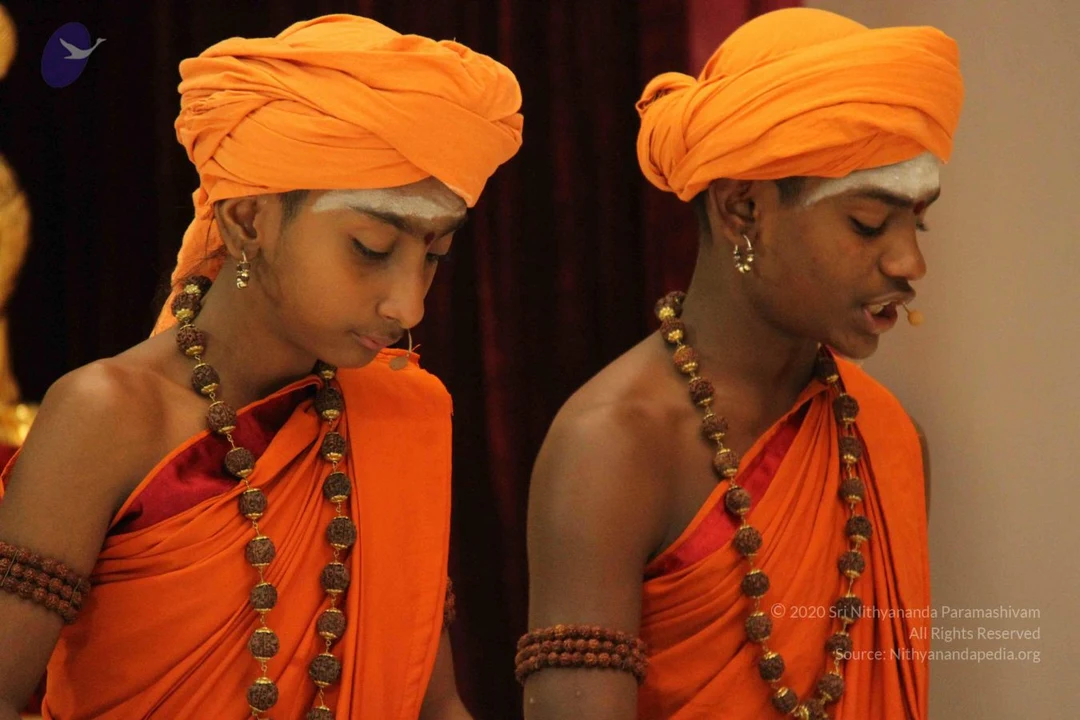
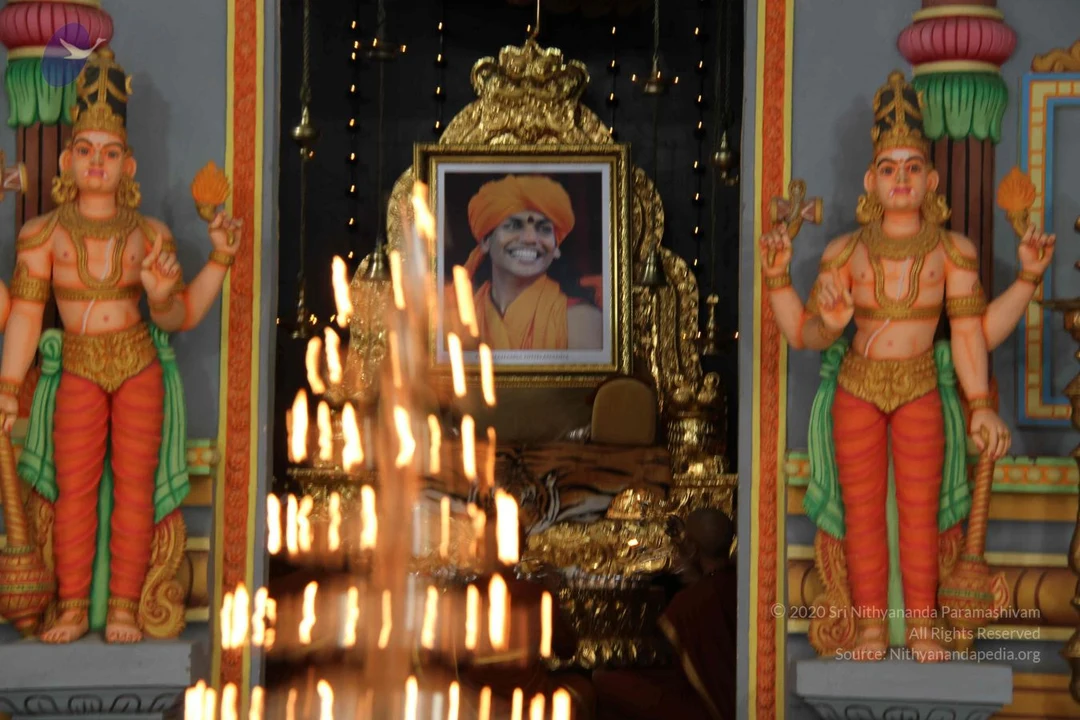
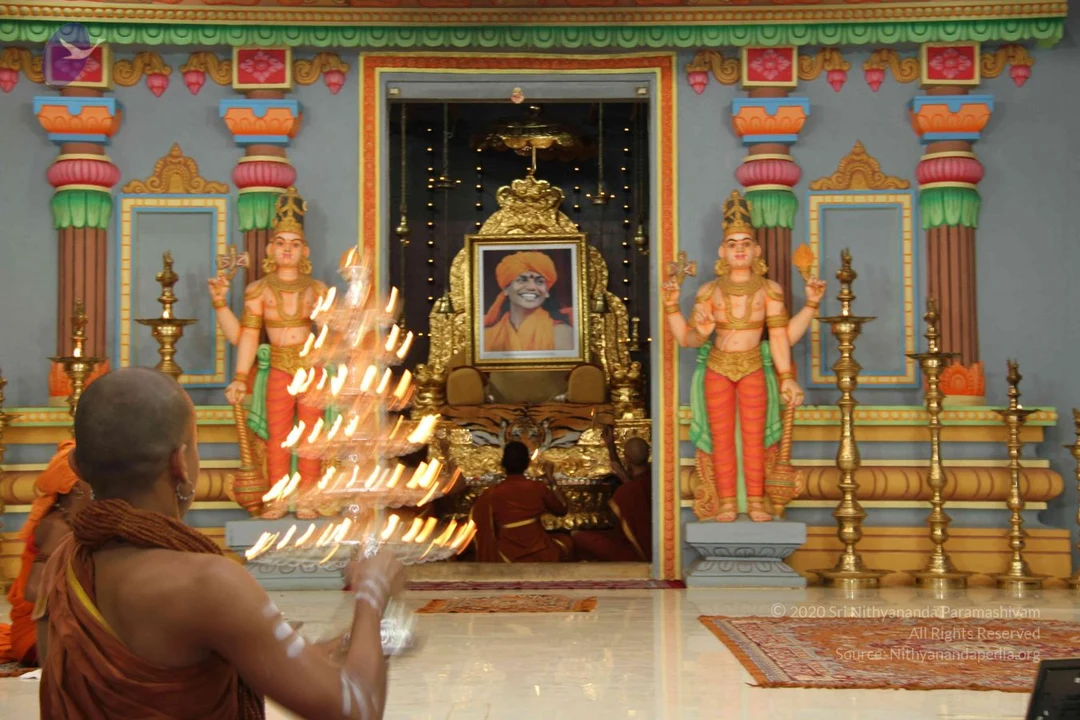
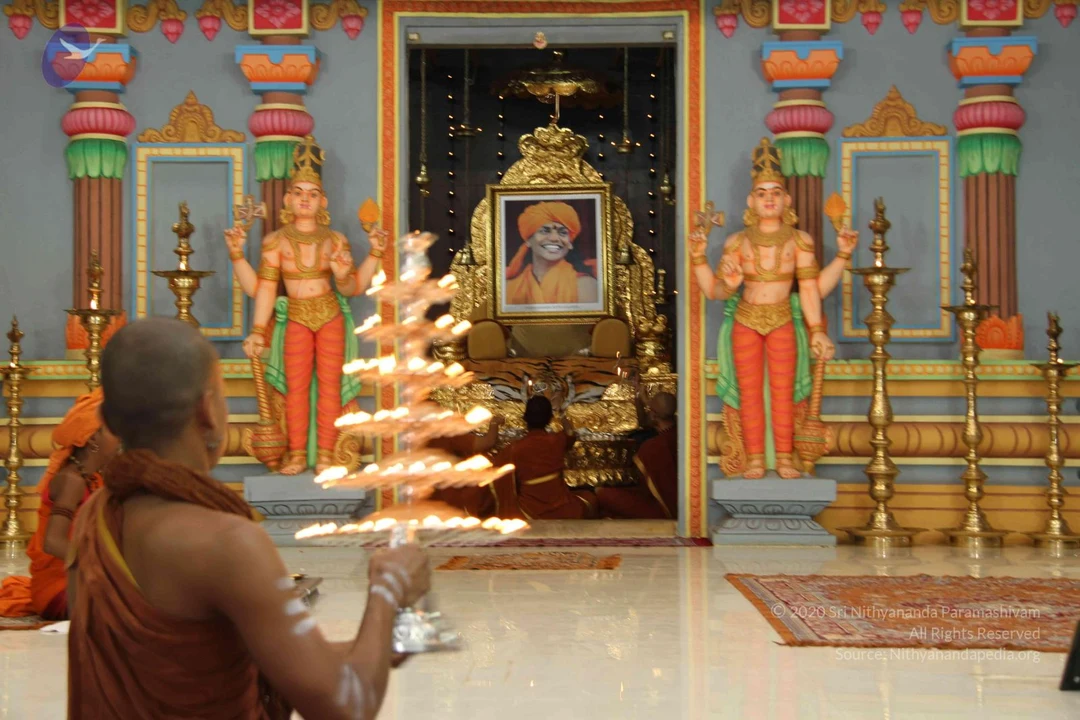
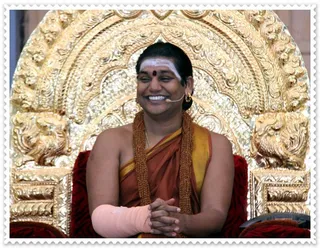
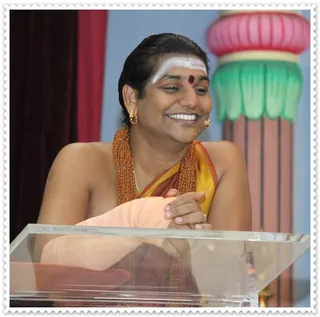
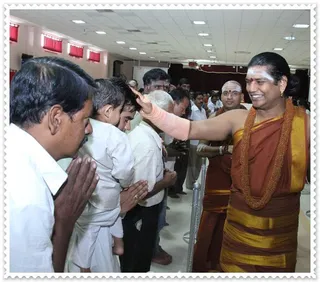
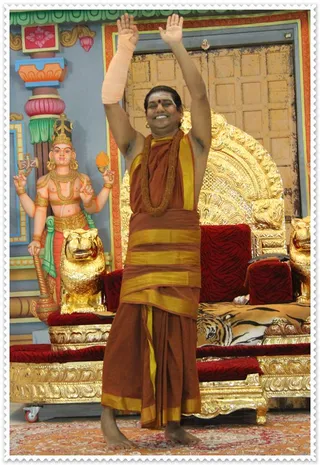
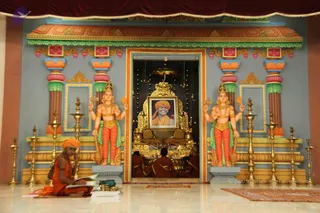
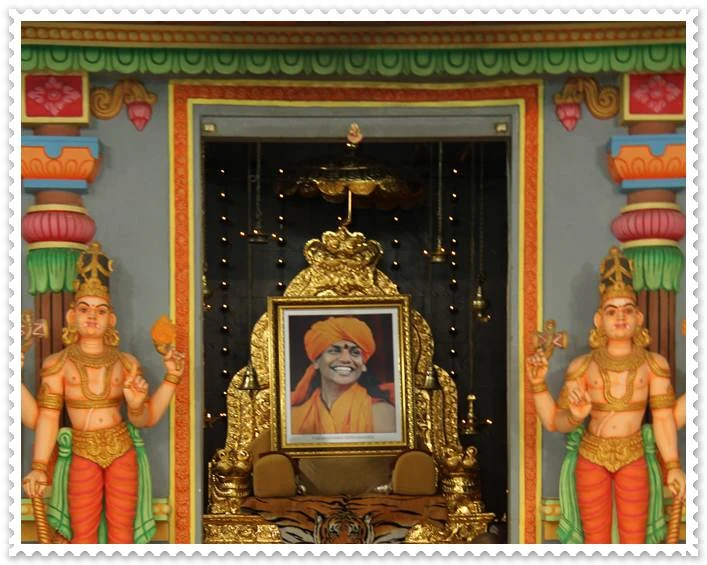
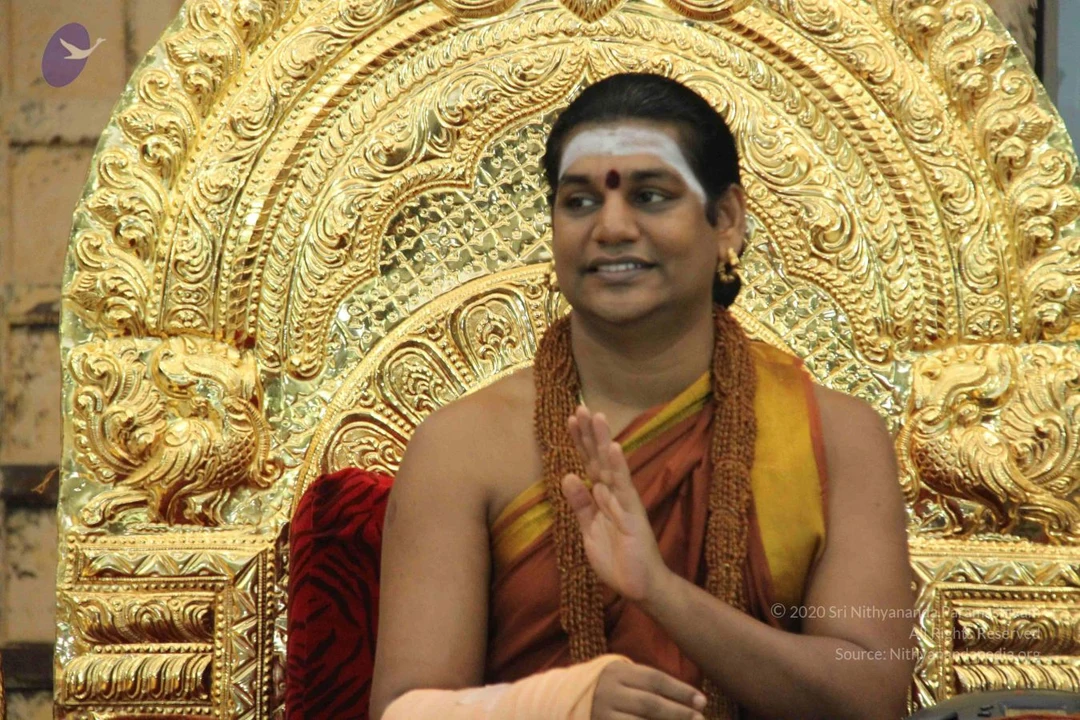
A shrine niche framed by two painted statues of standing deities with four arms, gold crowns and gold ornaments on bare-skinned bodies, orange and green draped cloths. At the centre, a gilded ornate frame holds a printed portrait of a smiling man in an orange turban and orange robe, set on a golden throne-like seat atop a tiger-skin cloth. Hanging small bells, lamps and a golden canopy surround the niche, which is painted in green, pink and blue tones.Two young men in saffron-orange sannyasi attire stand side by side in a close photograph. Each wears a matching orange turban, a white vertical tilak marking on the forehead, gold hoop earrings, and a long rudraksha mala with gold beads over an orange shawl. Both have bracelets of rudraksha beads on their wrists. The left figure looks down with eyes lowered, while the right figure speaks or chants with his mouth open, a small microphone visible near his face. The background is a dark red curtain with a warm light at the edge.a person seated on an ornate gold throne with carved lion-head arms and gilded filigree behind him. He smiles broadly, holding his hands together in front of him, with a headset microphone at his cheek. He wears a rust-orange and yellow shawl over bare shoulders, long rudraksha malas hanging to his waist, and a gold chain. White vibhuti lines mark his forehead with a red bindi, and his right forearm is wrapped in a flesh-toned bandage. Red velvet cushions frame the throne in this single-person seated satsang scene.A smiling person sits behind a clear acrylic lectern, hands clasped on the stand. They wear rust-orange and gold garments, a long orange-brown beaded necklace of rudraksha-style malas with a gold chain, and gold earrings. A white tilak marks the forehead with a red dot at the centre. Behind them stands a pink and green lotus-shaped pillar and a red curtain.A photograph inside a bright hall with a white ceiling and red framed windows. A man in a long-sleeved orange-brown robe with gold borders and a long ceremonial gold-bead necklace, with white forehead markings and swept-back hair, extends his right arm to bless a line of devotees. Hair, forehead marking and ornamented saffron robes give a person appearance, and he is smiling as he blesses. Beside him stands a man in a light robe with a shaved head and white tilak, and in front a row of men in white shirts and dhotis press palms together in namaste, with a child in white among them. Several more people wait behind a metal railing.A smiling man in a brown and gold draped robe with a rudraksha mala stands barefoot on a red carpet, both arms raised high with palms open, in front of a golden ornate throne flanked by golden lion heads and a tiger-skin cover. Beside him a painted deity murti with four arms, gold crown and jewellery stands on the left, and a wooden door panel is behind. The man has a red bindi and wears a bandage on one forearm. a person is shown in an apparent satsang setting, in saffron-brown clothing with distinctive gold-trimmed drape and mala cues.

PadaPuja

17 photosSource gallery
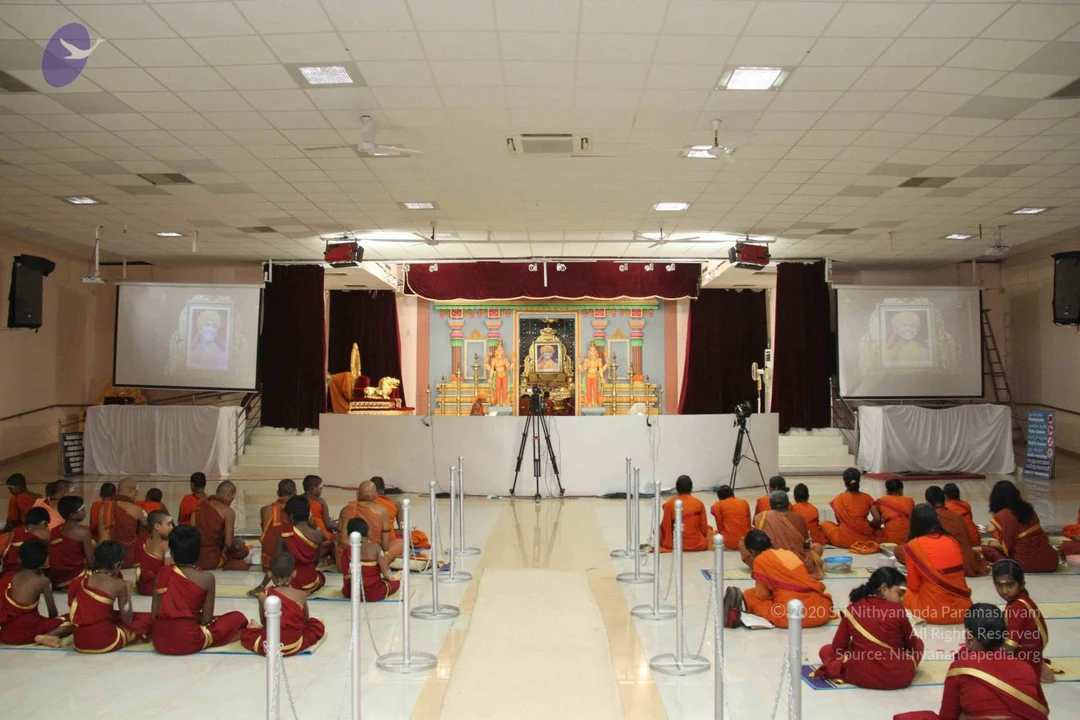
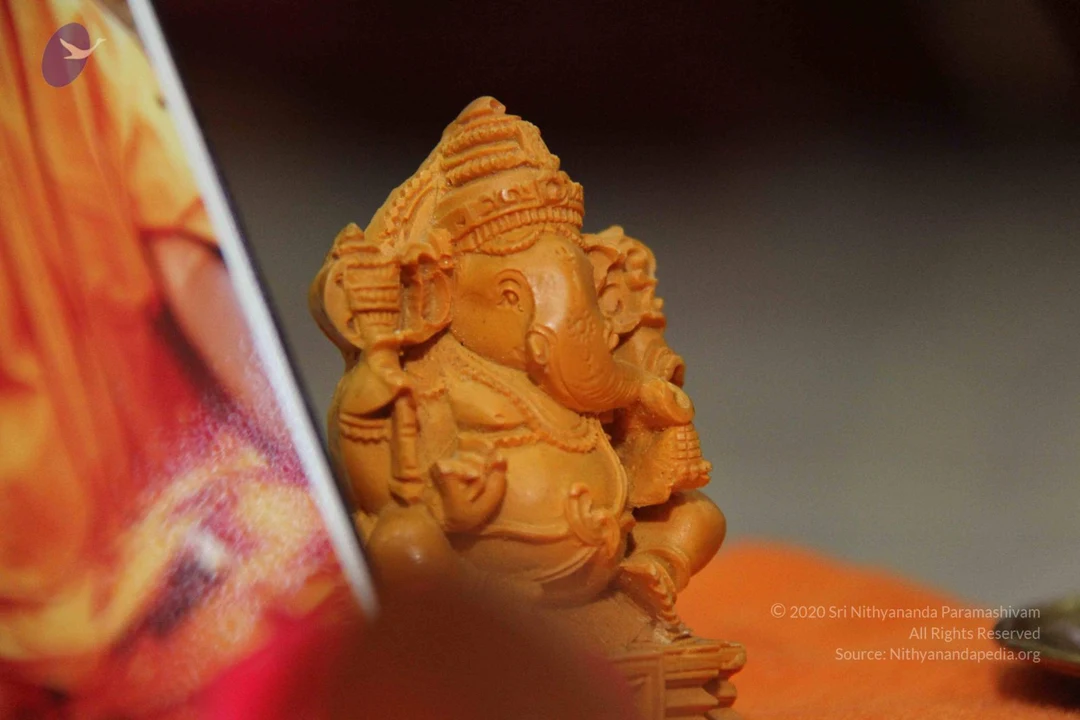
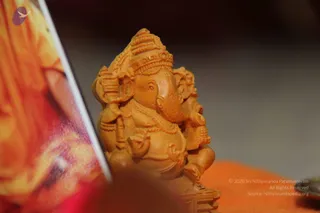
Close-up photograph of a brass puja setup on a tray: a pink flower (likely a trumpet-shaped bloom) lies in the foreground beside a small brass oil lamp or diya with a shallow cup. A tall brass stand with a tiered finial rises behind the flower. At the upper right, a blurred blue-and-gold printed image shows a figure with dark hair, possibly a framed picture or poster, partly out of focus. No people are visible in the frame.Close-up photograph of a polished brass tray holding red rose petals, a fresh red rose, and white jasmine-like flowers. The shallow focus blurs a dark, warm background with soft light spots. No people are visible; the scene is a flower offering arrangement, possibly for puja.A large hall with a white ceiling and recessed lights shows a seated congregation of about 40 people on yoga mats facing a raised stage. Most wear saffron, orange and maroon robes; several are children in red and orange. Some are shaved-headed and some women have their hair pulled back. A central stage has a dark red valance, a decorated altar with painted pillars, a framed portrait and two golden figures, and a seated figure in orange at the left of the dais. Two projection screens on either side show a framed portrait. Tripod-mounted cameras stand near the stage and stanchions line the central aisle.Close-up photograph of a small heap of loose faceted beads resting on a folded orange cloth. The beads are red, green and clear crystal, strung on fine copper-coloured wire loops, with a bundle of smaller beads spilling across the fabric. Beneath the cloth sits a dark, granular brown surface, possibly rudraksha-like seeds or earth, and a metal edge curves at the bottom left. The background is a soft, out-of-focus blur of grey and deep red. No people are visible.Close-up photo of a brass tray holding a row of dark brown rudraksha beads, topped with a folded orange cloth on which sit a small cluster of red, green and clear faceted crystal beads strung on gold wire. The orange fabric drapes over the tray edge and the background is blurred. No people are visible.A close photograph of a small orange-brown carved Ganesha figure seated on an orange cloth, with its trunk turned to one side and a tall ornate crown. In the blurred foreground a slice of a printed image with orange and yellow tones is visible at the left edge. The background is dark and out of focus. No people are visible, and the figure is a statue, not a person.

Nithya-Satsang
27 photosSource gallery
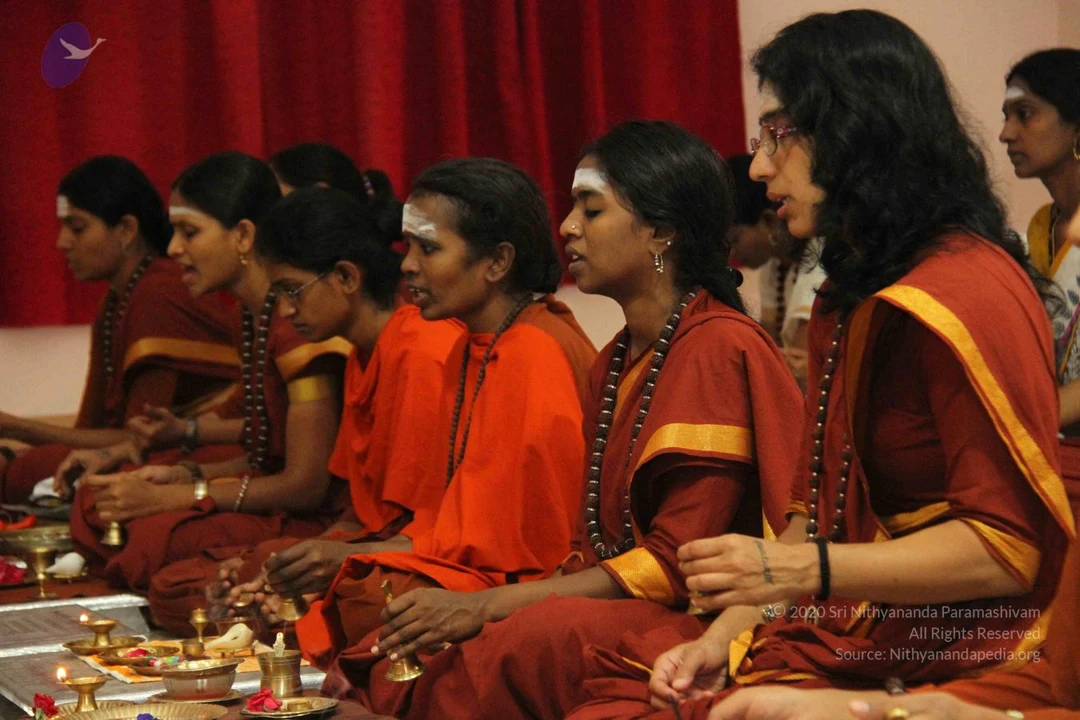
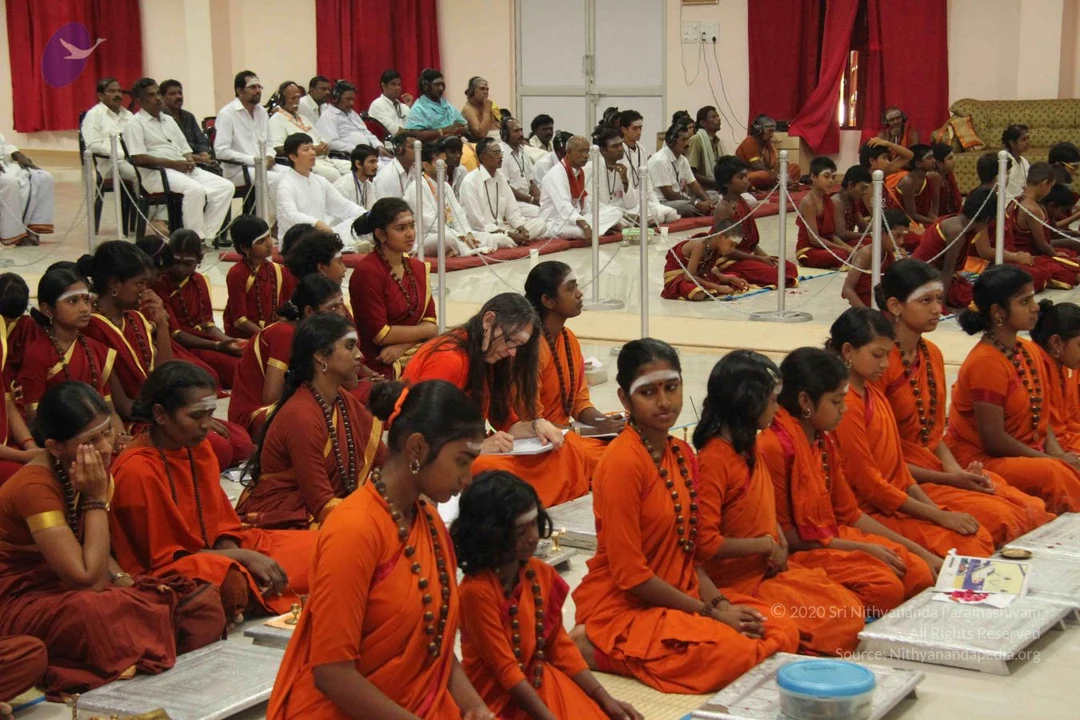
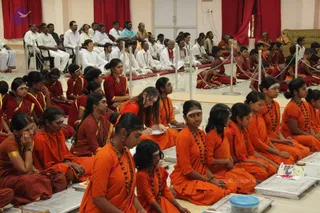
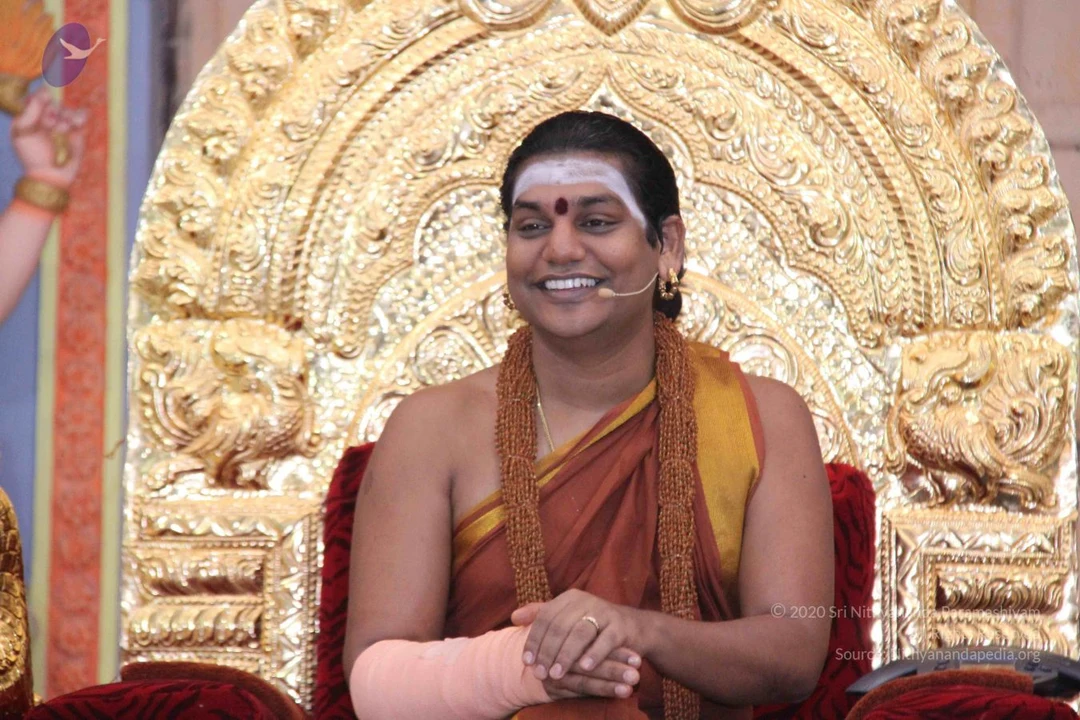
A man seated on an ornate gold throne with carved arched backrest and lion-like side motifs, wearing a saffron-orange shawl with yellow border and a long rudraksha-style beaded mala. He has a white vertical tilak on his forehead with a red dot, gold earrings, and raises one hand in a blessing gesture while smiling. Red patterned cushion visible at the left of the throne. Appearance-based candidate: a person, with rudraksha mala, saffron clothing and ornate gold seat cues, seated on throne and giving blessing.A photo of a seated satsang in a hall with red curtains, where dozens of people sit on the floor in orange and maroon robes with white forehead markings and rudraksha malas. Young women and girls in orange saris and maroon garments sit in rows at the front. Behind them, men in white shirts and dhotis sit on chairs and mats along the back. Metal stanchions separate the rows. A small silver plate and offerings sit on the floor in front.A satsang hall with red curtains and cream walls. Rows of young women and girls in orange saffron robes, rudraksha malas and white forehead tilak sit on the floor, many writing in notebooks or listening attentively. Behind them, men and women in white clothes sit on red mats, some wearing headphones. A brown sofa is at the right edge.Photograph of a smiling man seated on an ornate gilded throne with a carved golden arch and red tiger-striped cushions. He wears a saffron-orange robe with a yellow border, a long rudraksha mala draped around his neck, and a white vibhuti line with a red kumkum dot on his forehead. His hands are clasped in his lap and his right forearm is bandaged. Beside the throne stands a painted deity figure with multiple arms and a golden lion-headed element in the corner. a person is seated centrally, identified by the seated throne, rudraksha mala and saffron robes.A man seated on an ornate gilded throne with embossed floral and scroll carvings, speaking and smiling while gesturing with his right hand. He wears a saffron-orange robe with a gold-yellow border, a multi-strand rudraksha mala draped over his shoulders, a white vertical tilak and a red bindi on his forehead, a small earpiece microphone, and a gold chain. Beside him, a painted deity figure with multiple arms and a red-and-gold weapon is partly visible against a red and white backdrop. A red tiger-striped cushion lies on the seat. The scene suggests a satsang or discourse.A smiling man sits on an ornate gold throne with carved floral and animal motifs, dressed in an orange-red and gold-bordered shawl draped over the shoulder, with a long beaded rudraksha-style mala necklace and a gold chain. He wears a white horizontal forehead mark with a red bindi and a small lapel microphone, hands clasped in his lap. Behind him a painted deity figure with green and orange tones is partly visible. The a person appears in a satsang setting, with the presentation cues of orange shawl, rudraksha mala and ornate throne.

Sarva-Darshan
10 photosSource gallery
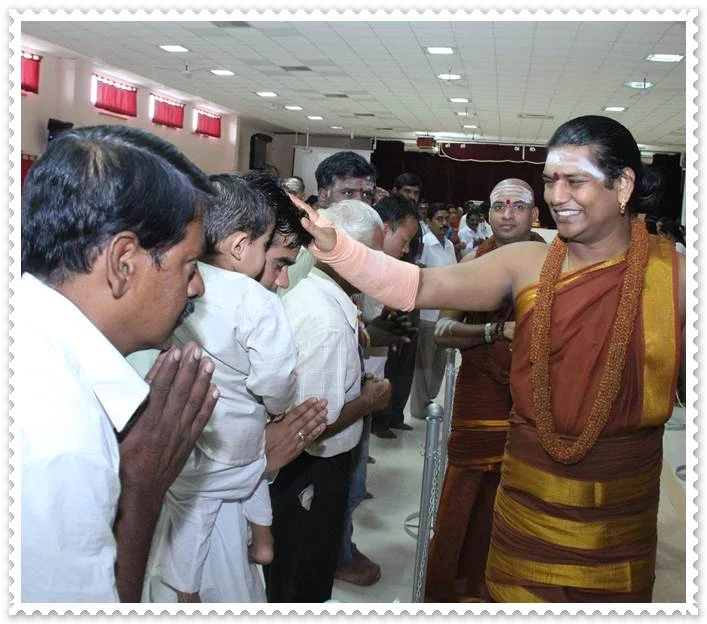
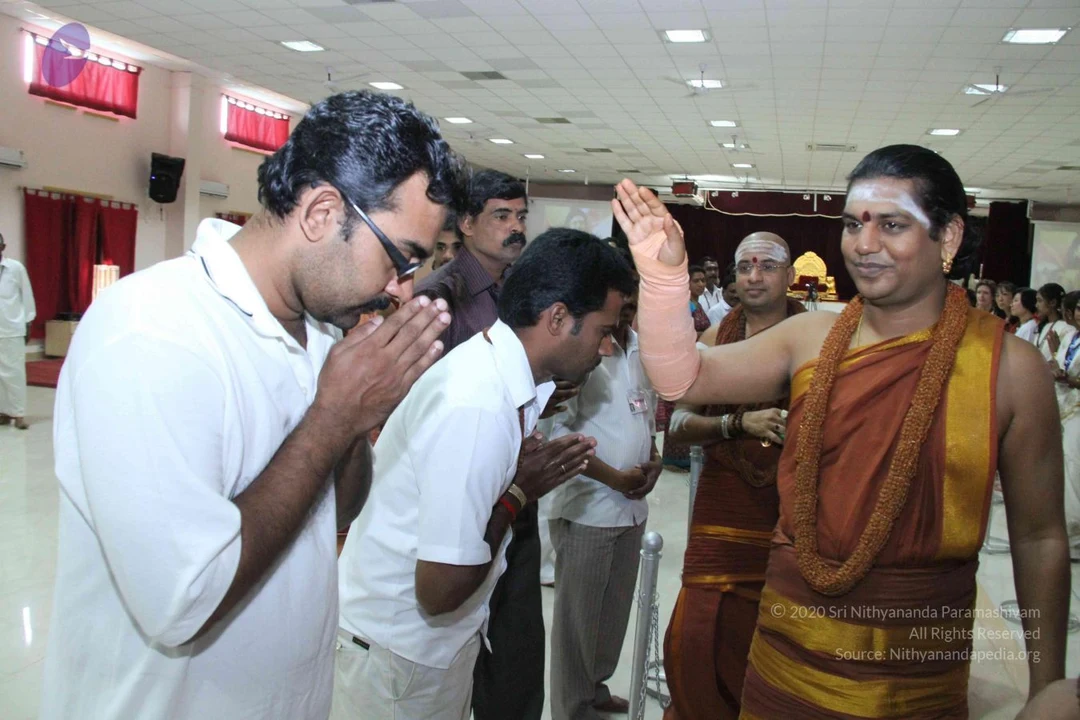
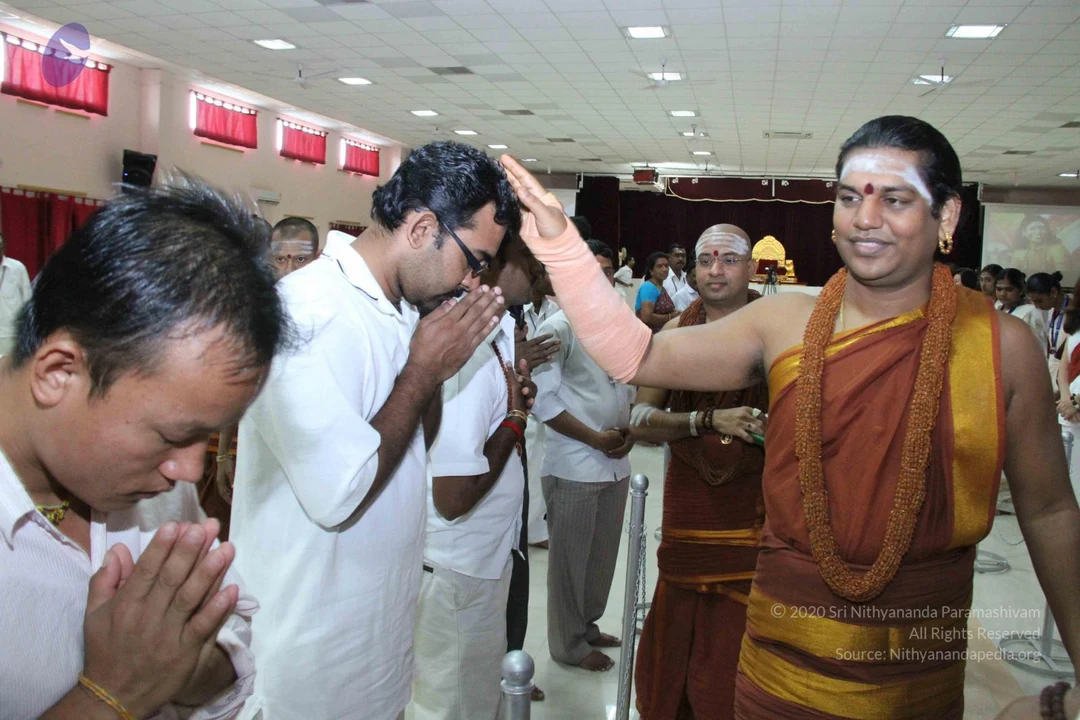
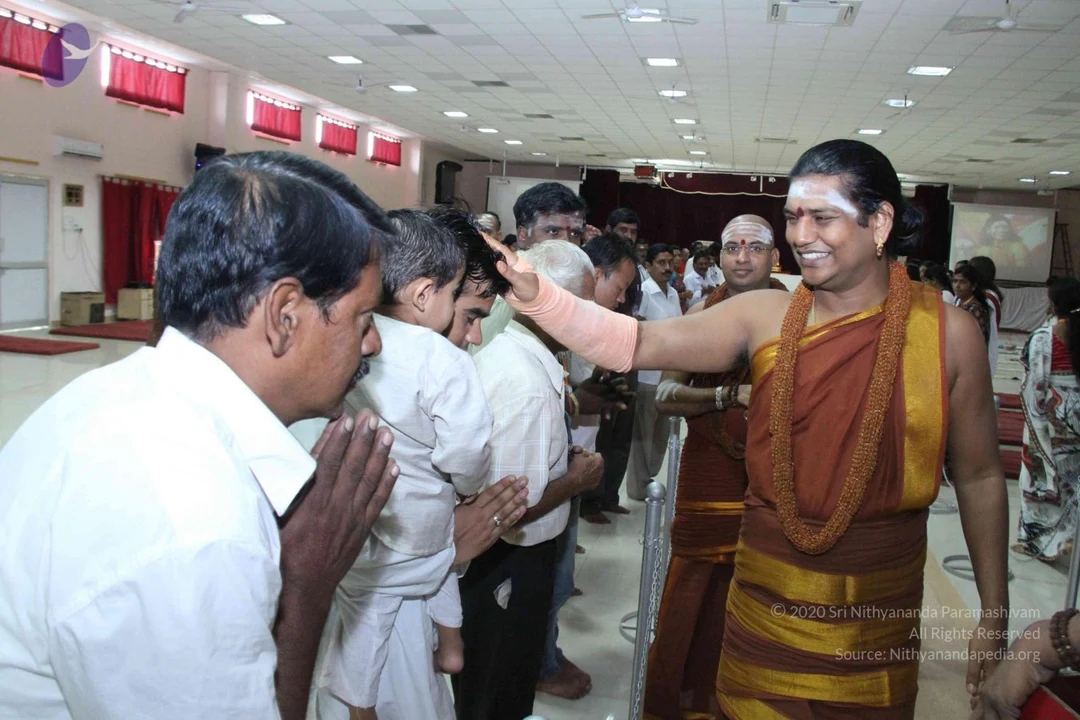
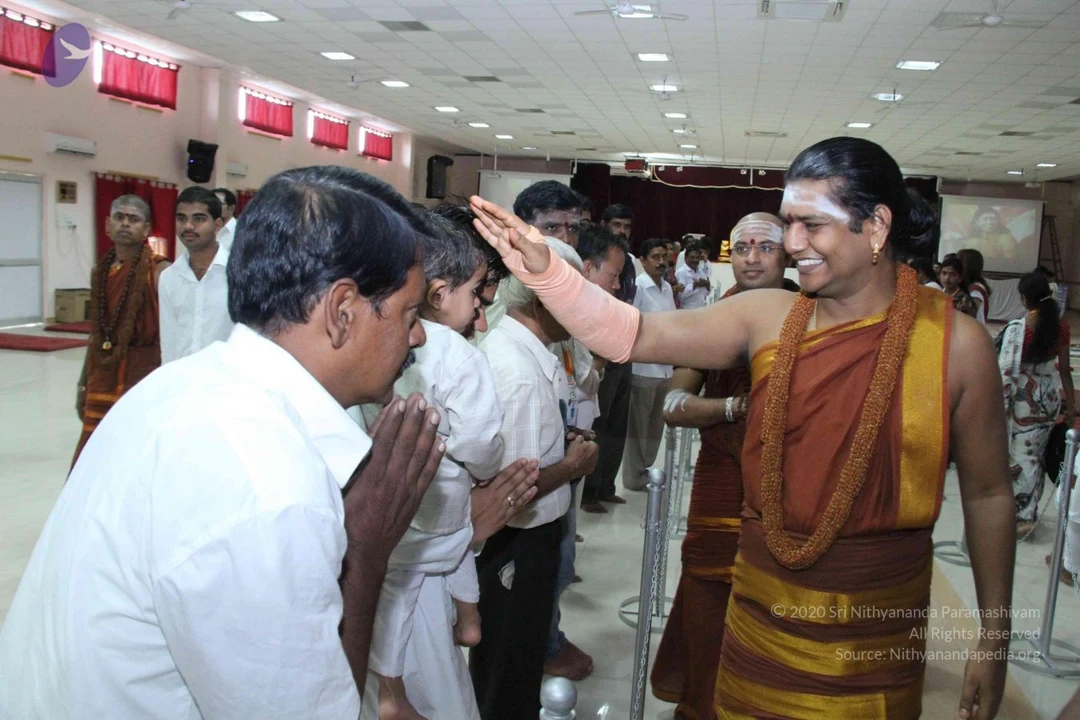
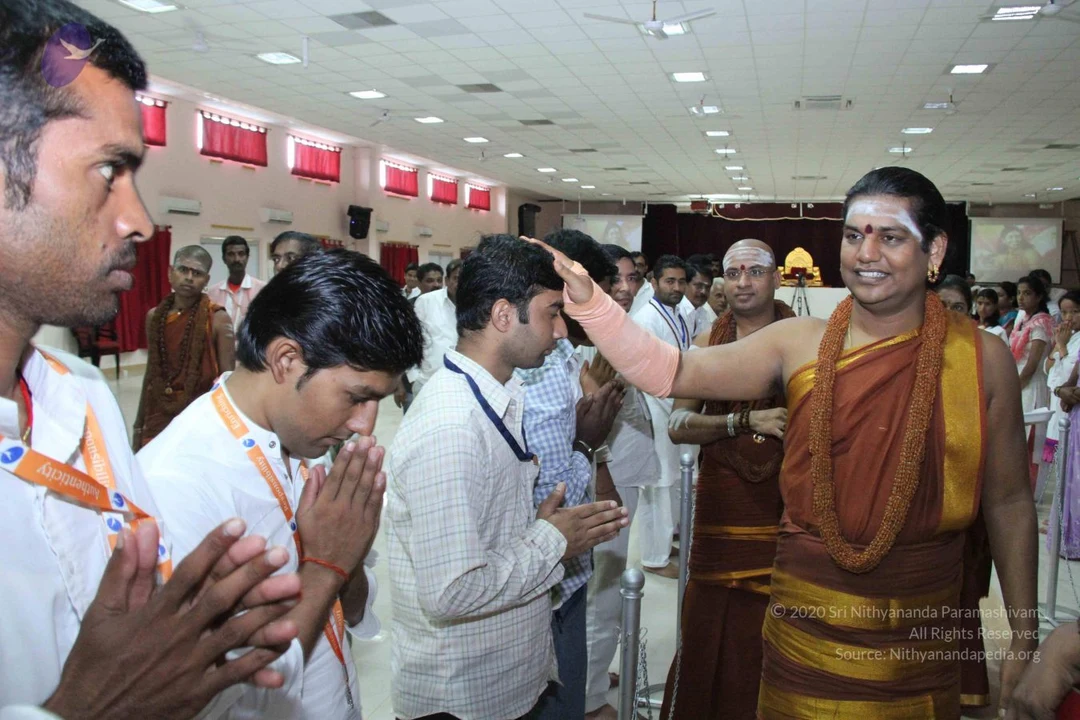
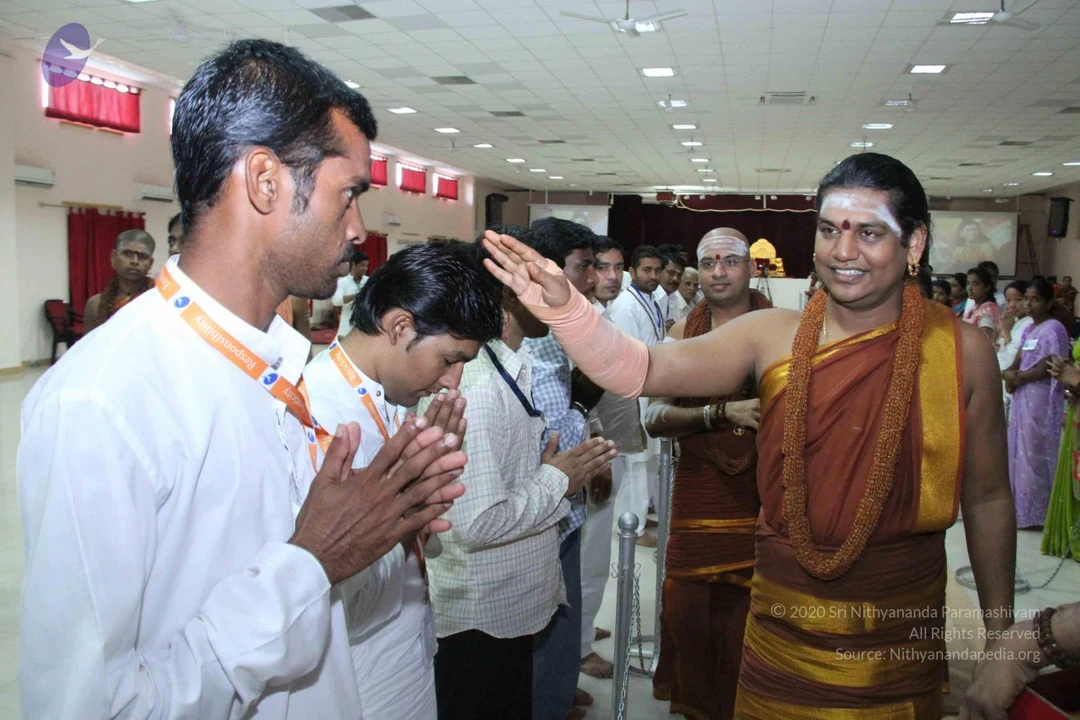
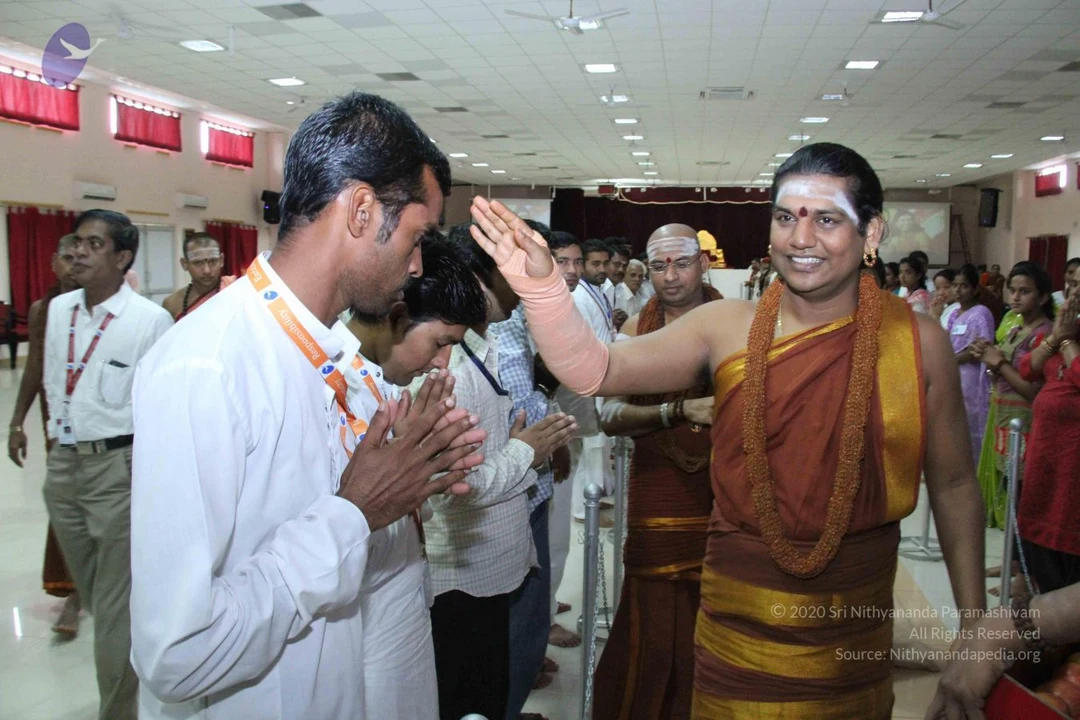
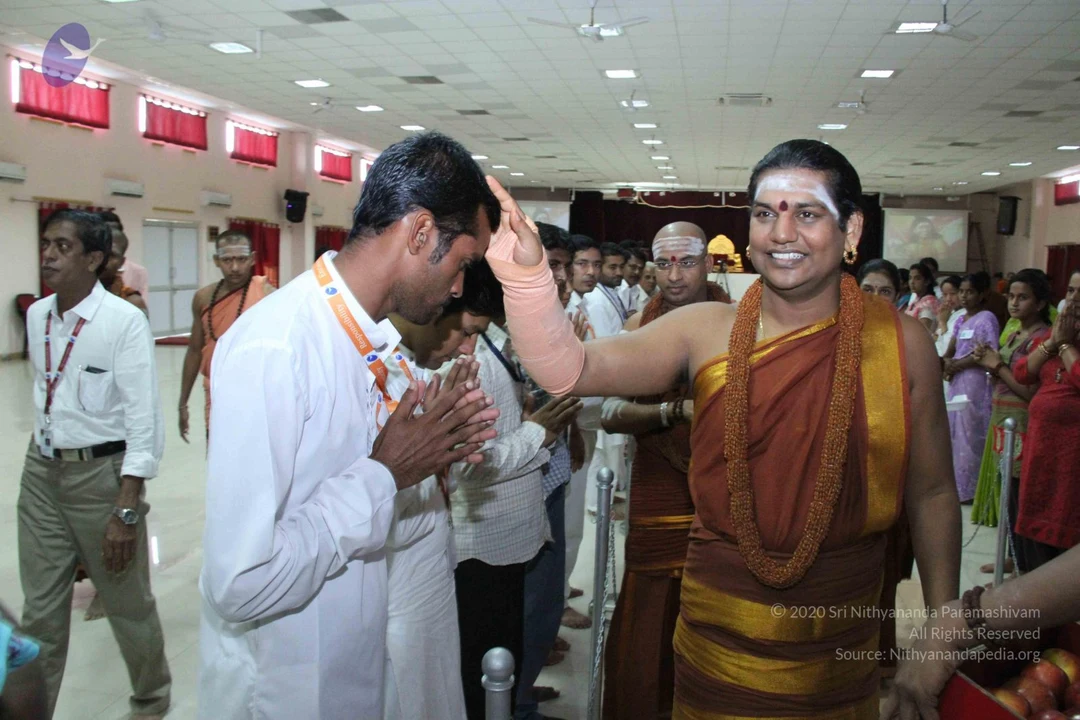
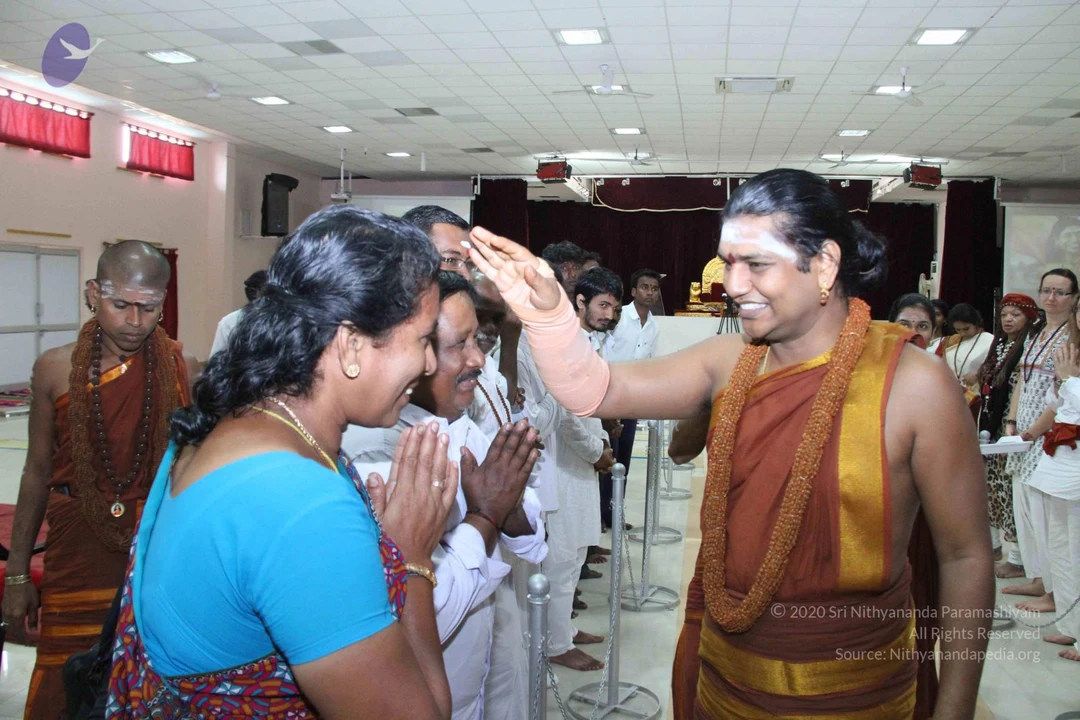
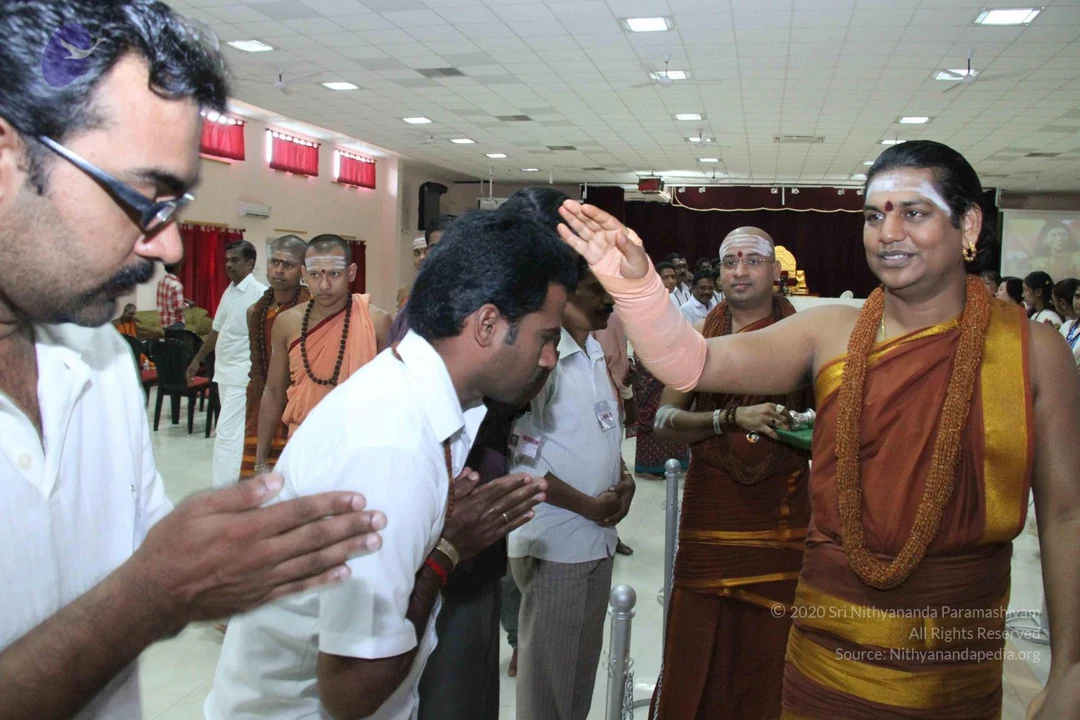
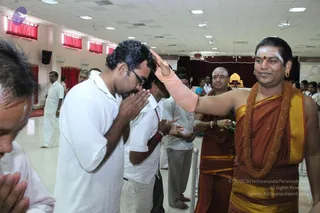
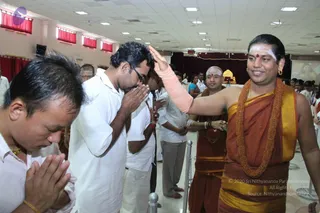
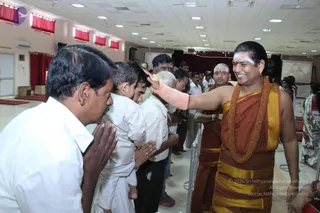
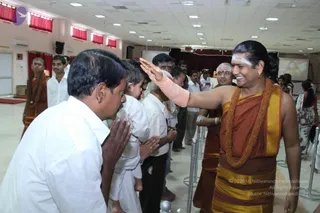
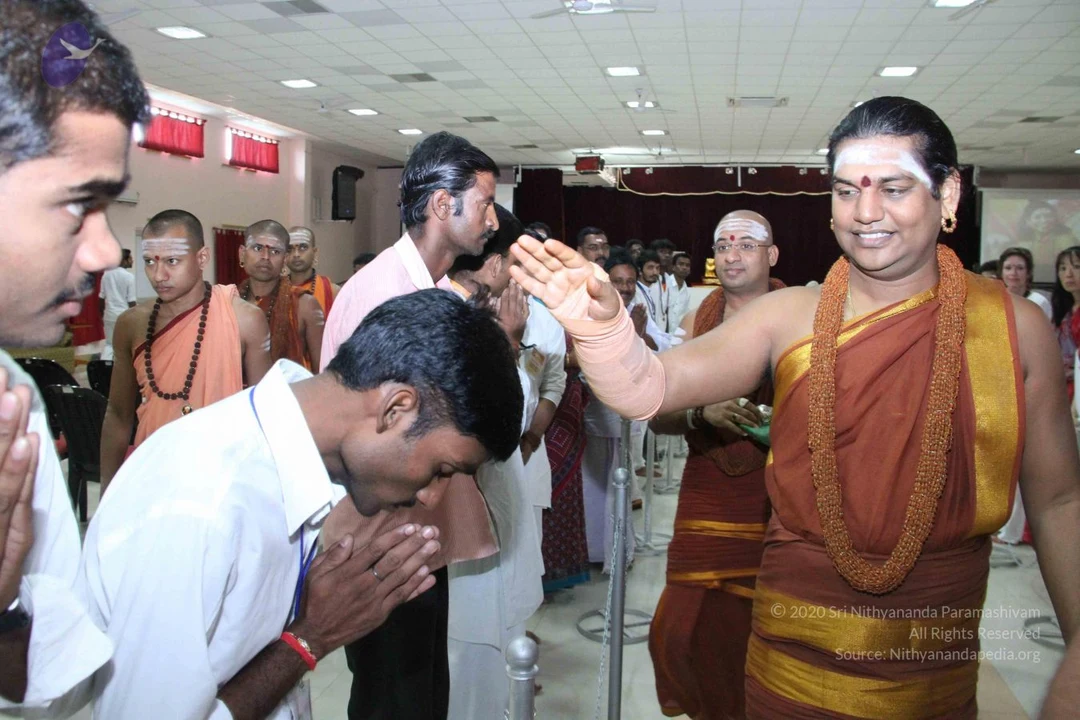
A photograph inside a hall with white walls, ceiling lights and red curtains. On the right, a smiling man with swept-back dark hair, a red bindi and white forehead markings wears an orange-brown robe with a gold border and a large orange beaded mala, raising his hand in blessing toward a devotee. A man in a white shirt bows with palms joined in the foreground, and a man in a pink shirt stands nearby. Behind them, several saffron-robed men with shaved heads and white tilak stand in a line, and additional people in white and orange clothing are visible further back. Swamiji (probable): the right-hand figure has long swept-back hair, an orange-gold robe and an ornate beaded mala, matching the page's Swamiji reference.Indoor hall with white ceiling tiles, red curtains and a gold-cushioned seat in the background. A standing man in a saffron-orange robe with a gold-and-saffron shawl, a long orange rudraksha-style bead garland and gold earrings, with white and red forehead markings, raises his right hand in blessing toward a devotee. Several men in white shirts and white dhotis stand before him with palms pressed together in namaskar, one bowing with eyes closed. A man in a white shirt and dark glasses at left presses his hands together. Behind, a man in a dark maroon garment and another in a white turban-style head marking stand near a metal rope barrier. The figure in orange is a probable Swamiji by appearance (long swept-back hair, saffron robe, rudraksha garland, gold ornaments), receiving namaskar and blessing devotees.Indoor hall with a tiled floor, red curtains and ceiling lights. On the right, a man in a saffron-orange robe with a gold-bordered shawl, a saffron-orange rudraksha-style garland, white and red forehead markings and a bare raised arm blesses a kneeling devotee with his palm on the head. The devotee in white shirt and glasses holds hands in prayer. Another man in white shirt holds his palms together nearby, and a priest in an orange-brown dhoti stands behind with a gold-trimmed ceremonial setup. A gold throne-like seat is visible in the background. a person is the figure in the saffron robe with the garland and forehead markings, visible in the ceremonial blessing role; appearance cues are consistent but not fully certain.Photograph of a devotee blessing ceremony in a hall with red curtains and white ceiling lights. A man in a saffron-orange robe with a gold-and-saffron shawl, a rudraksha mala and gold earrings stands at right, his right hand raised in blessing toward a bowed devotee's head. He has white tripundra ash and a red bindi. Beside him, a saint in saffron dhoti and a white head covering stands with folded hands. At left, a man in white shirt and glasses presses his palms together in namaskar, and another bearded devotee in white kurta bows with hands folded. A row of attendees in white stands in the background near a gold throne-like seat. a person as the saffron-robed figure giving blessing, with rudraksha mala and gold earrings and ash markings, in an appearance-based label only.A photograph inside a hall with red curtains and a white ceiling. A man with long swept-back hair, white forehead markings, an orange-saffron shawl, a gold-bordered dhoti and a long rudraksha mala stands on the right, smiling and extending his right arm to bless a line of devotees. Swamiji (probable): he has long swept-back hair, a saffron shawl and ornate gold-bordered clothing with a rudraksha mala. Devotees in white shirts and dhotis stand in a line on the left with palms pressed together, one man bowing his head. Behind them a monk in orange robes with a shaved head and white markings watches, and a projection screen shows a figure.A photograph in an indoor hall with cream ceiling lights and red curtains. A man in saffron-orange robes with a gold-bordered dhoti, an orange shawl, a long rudraksha mala and gold ear ornaments stands on the right, his long hair swept back, raising his right hand in a blessing gesture while smiling. Facing him on the left, a man in a white shirt and white dhoti presses his palms together in namaste, with a young child in white beside him. Other devotees in white shirts and orange-clad attendants line a barrier rail behind them, and a projection screen hangs on the wall. Appearance-based candidate for a person, giving blessing to devotees in a hall.

Temple
27 photosSource gallery
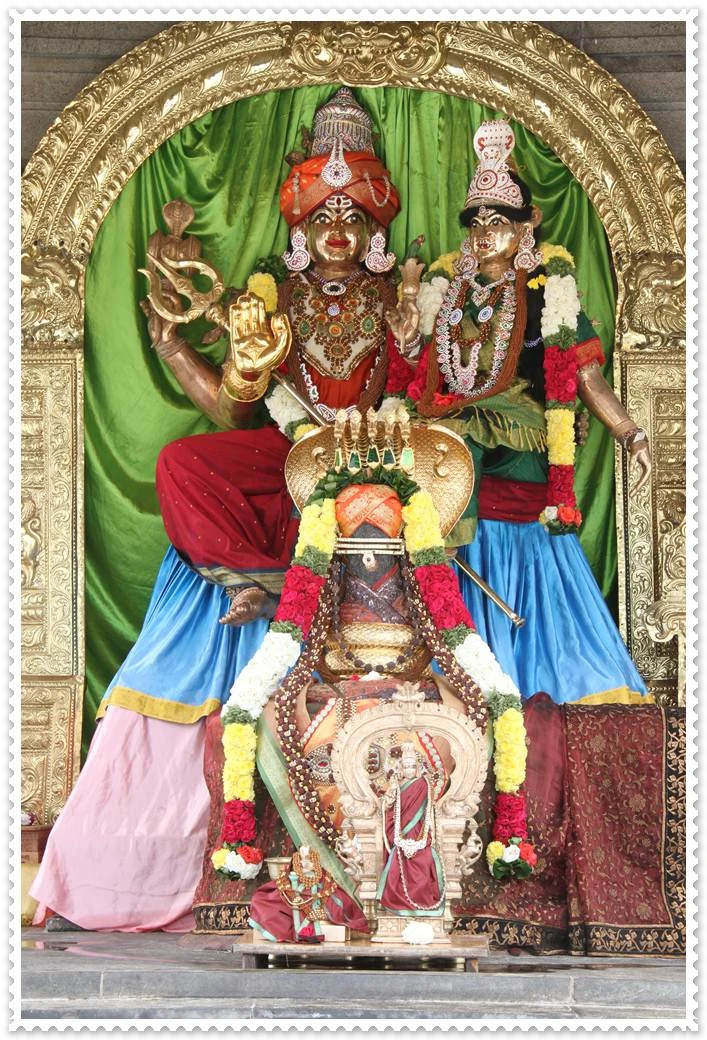
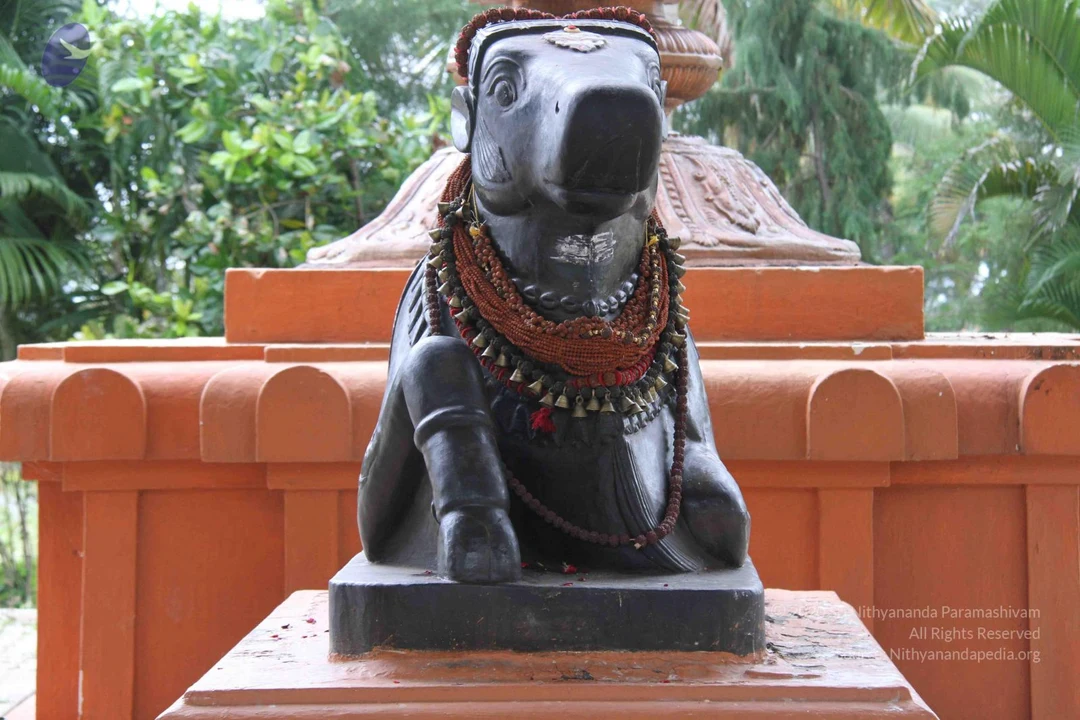
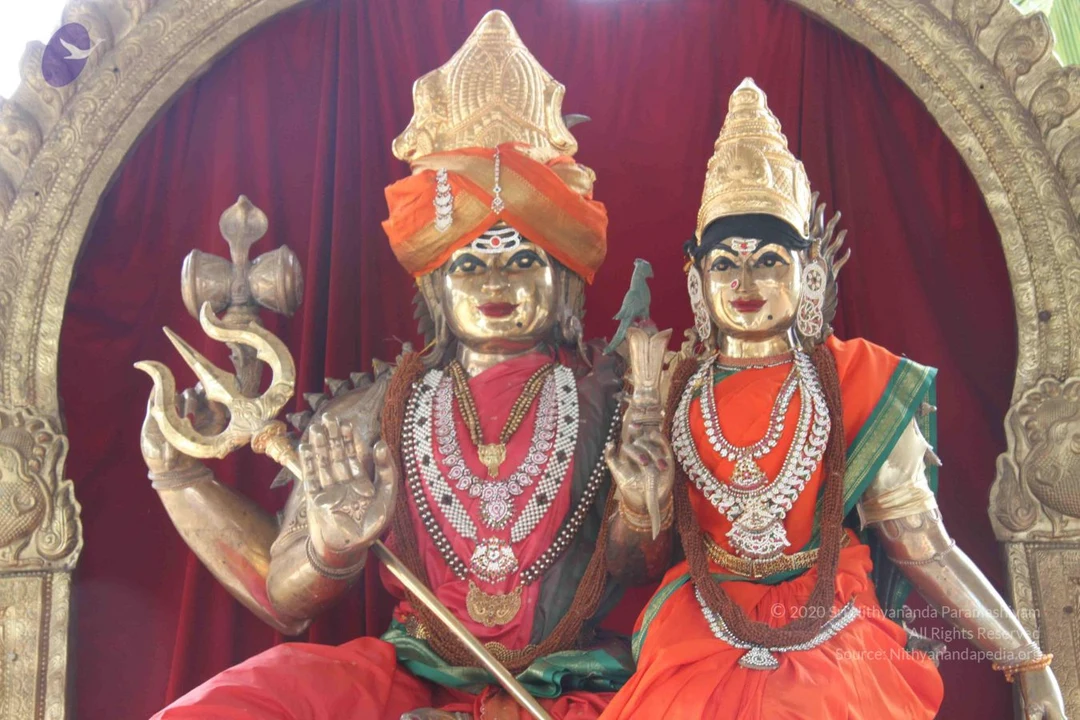
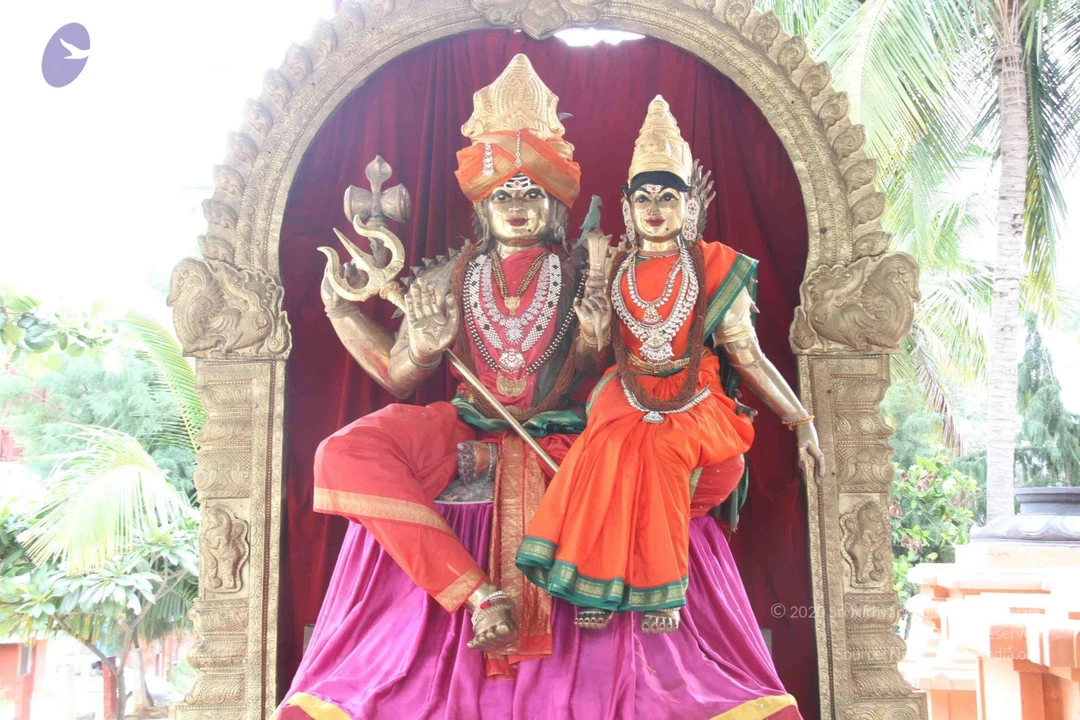
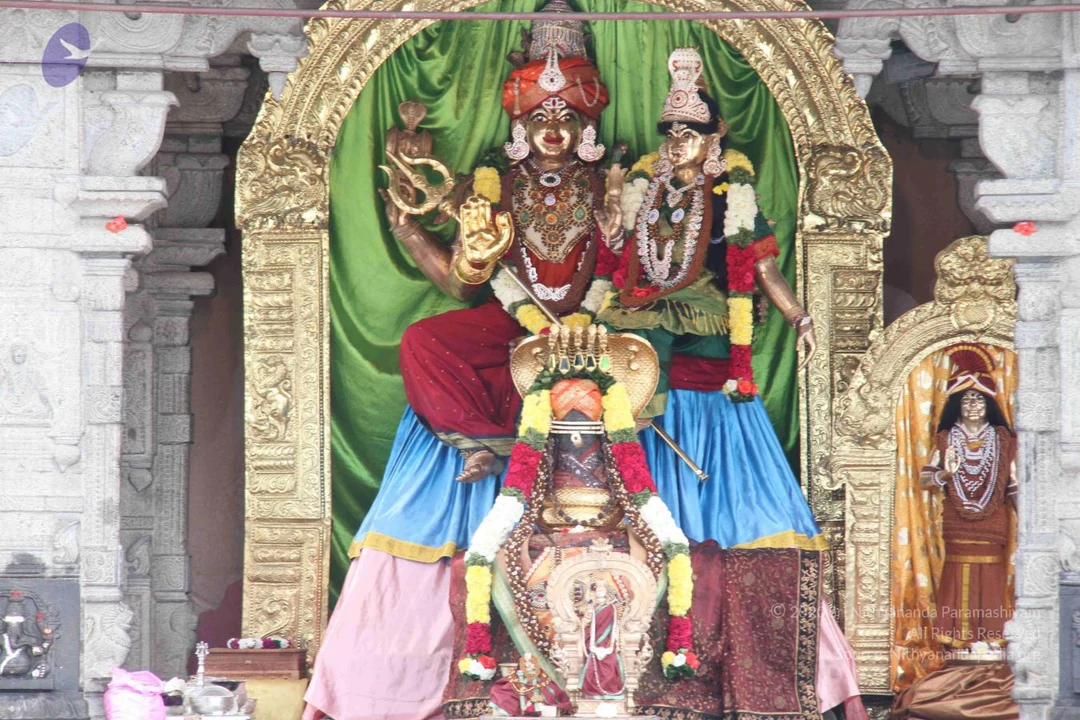
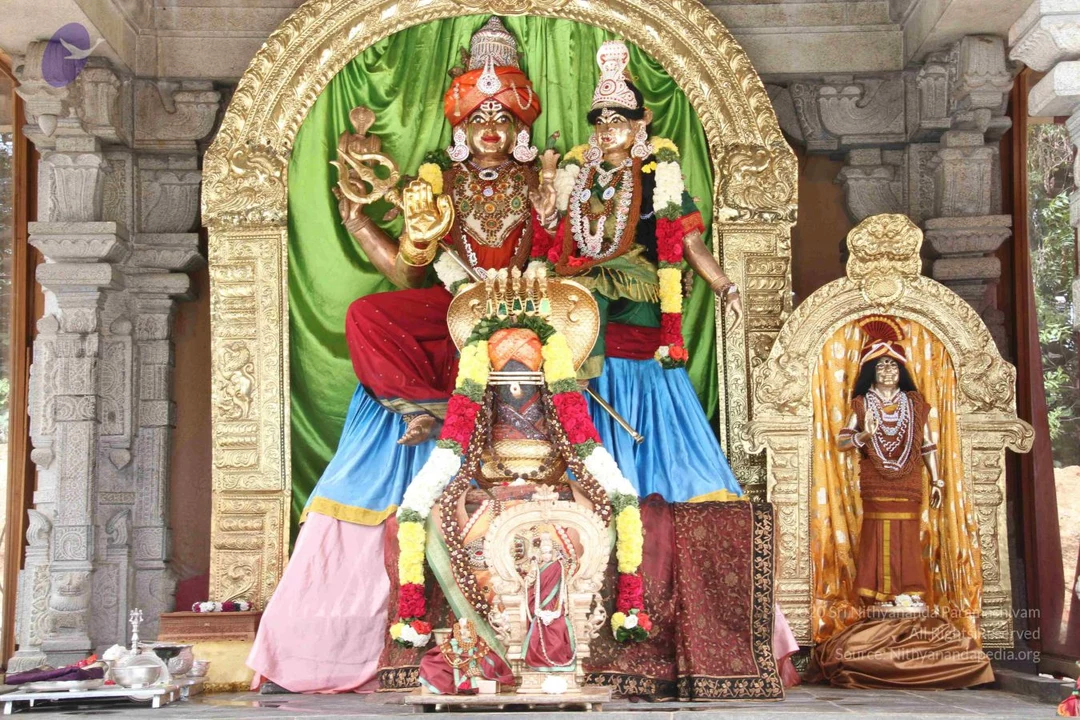
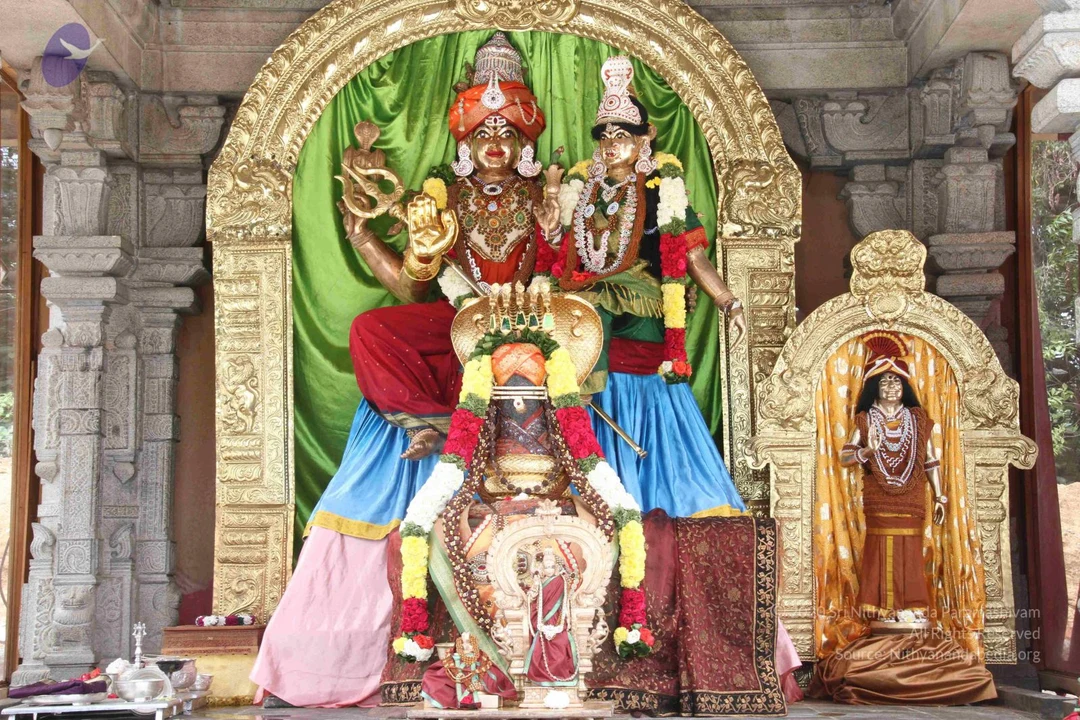
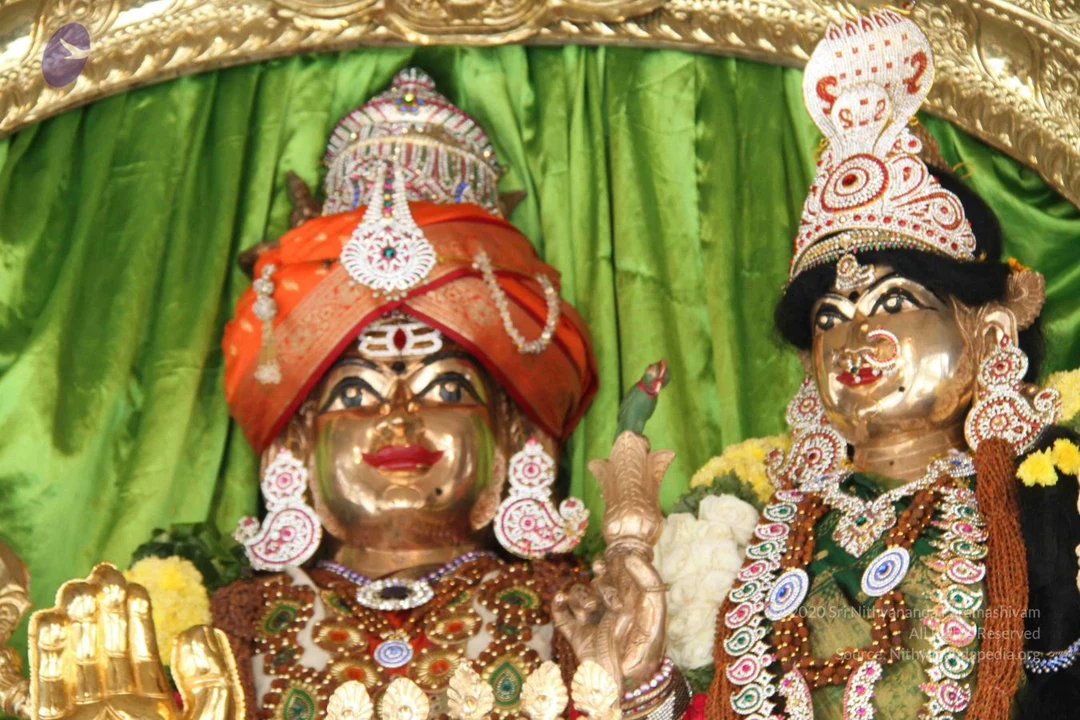
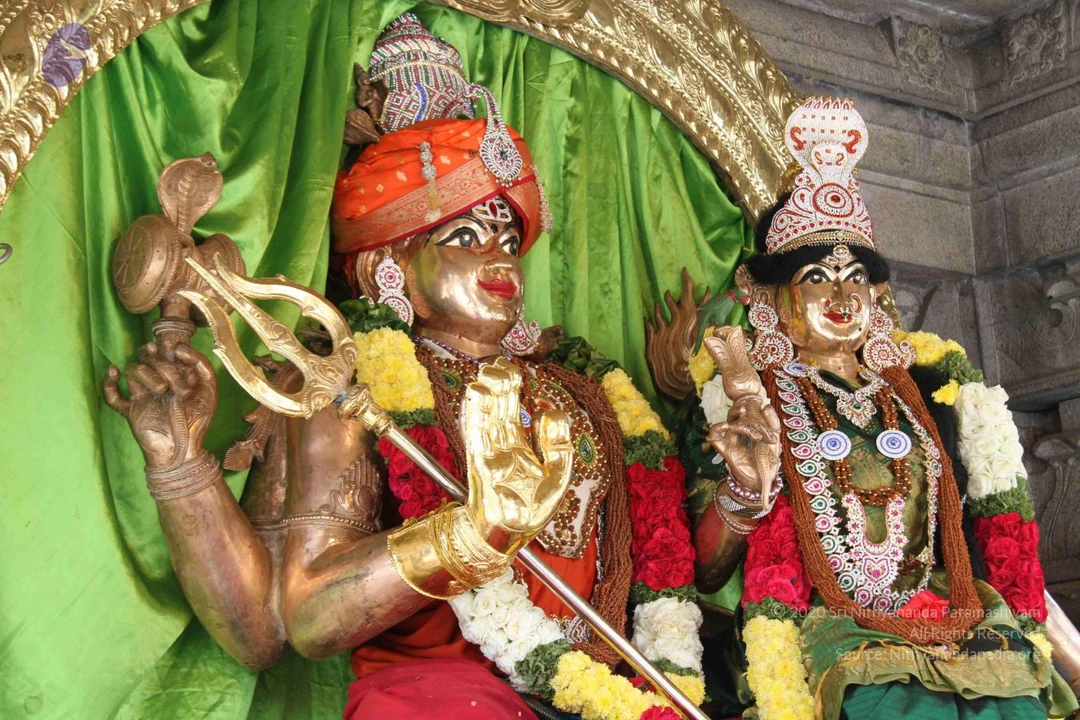
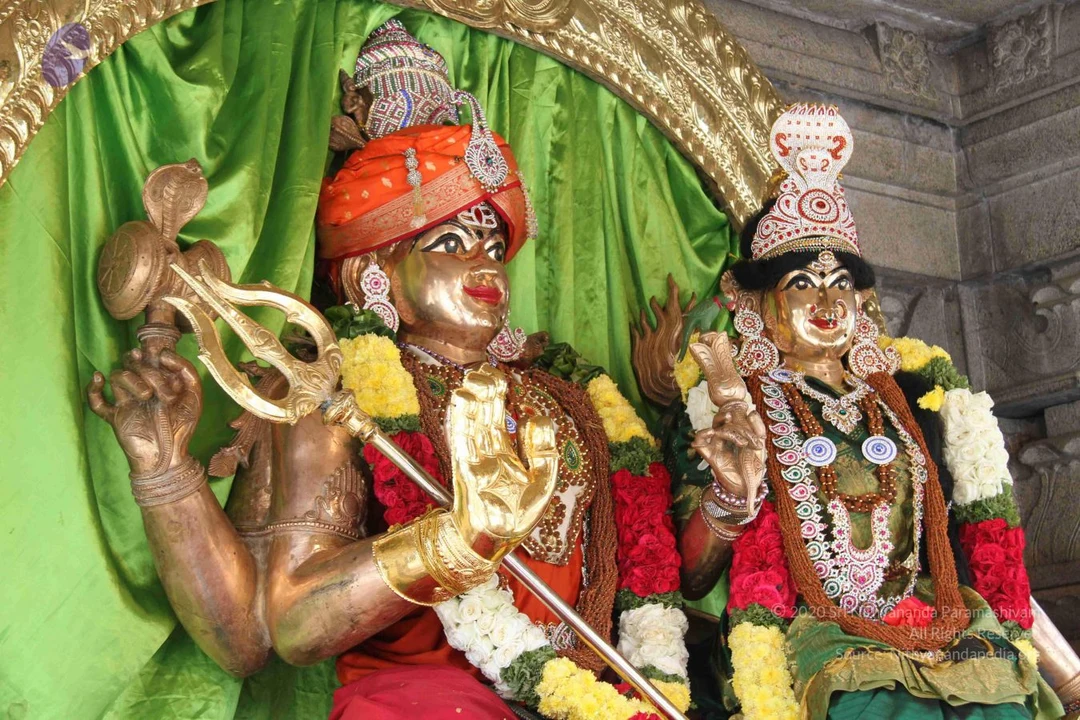
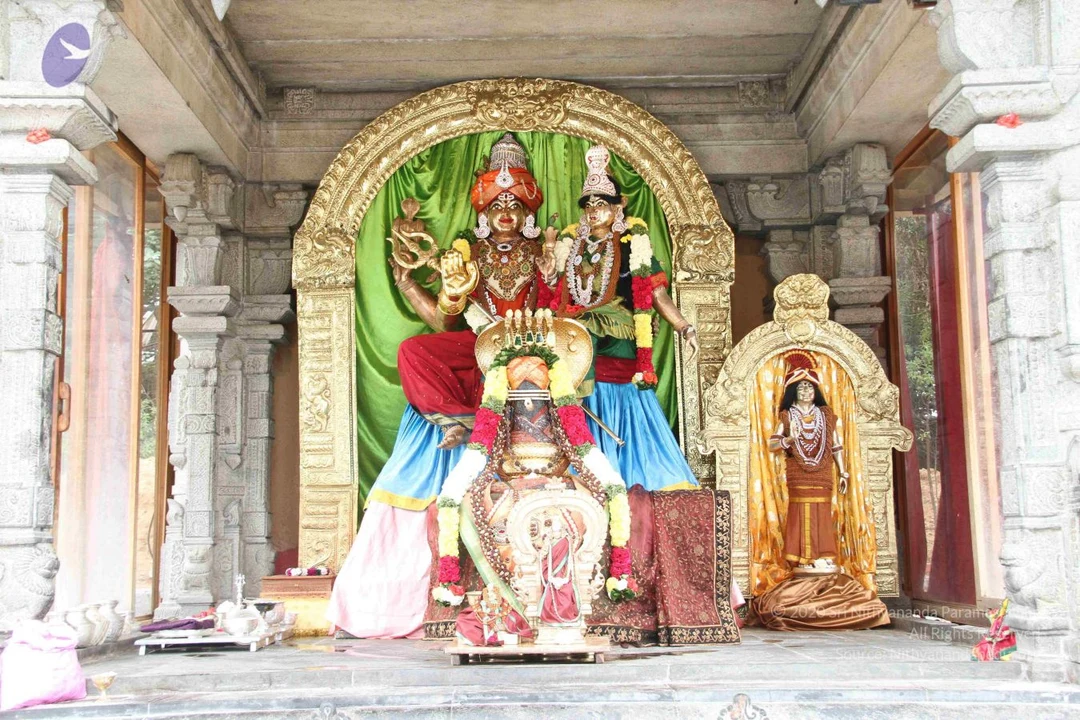
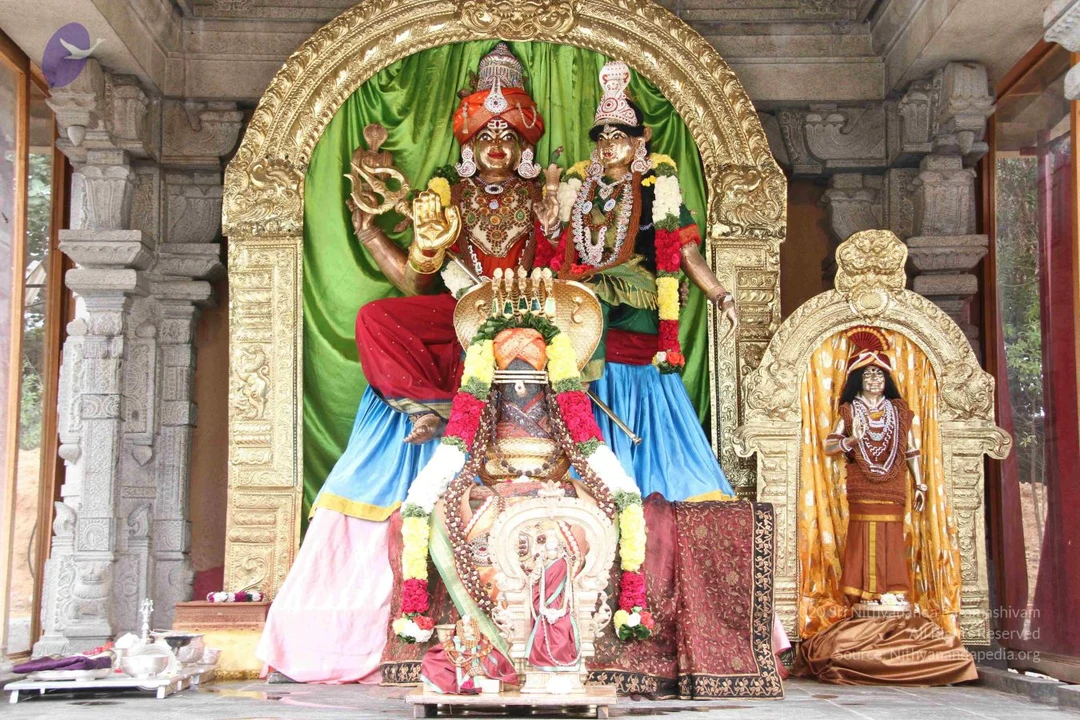
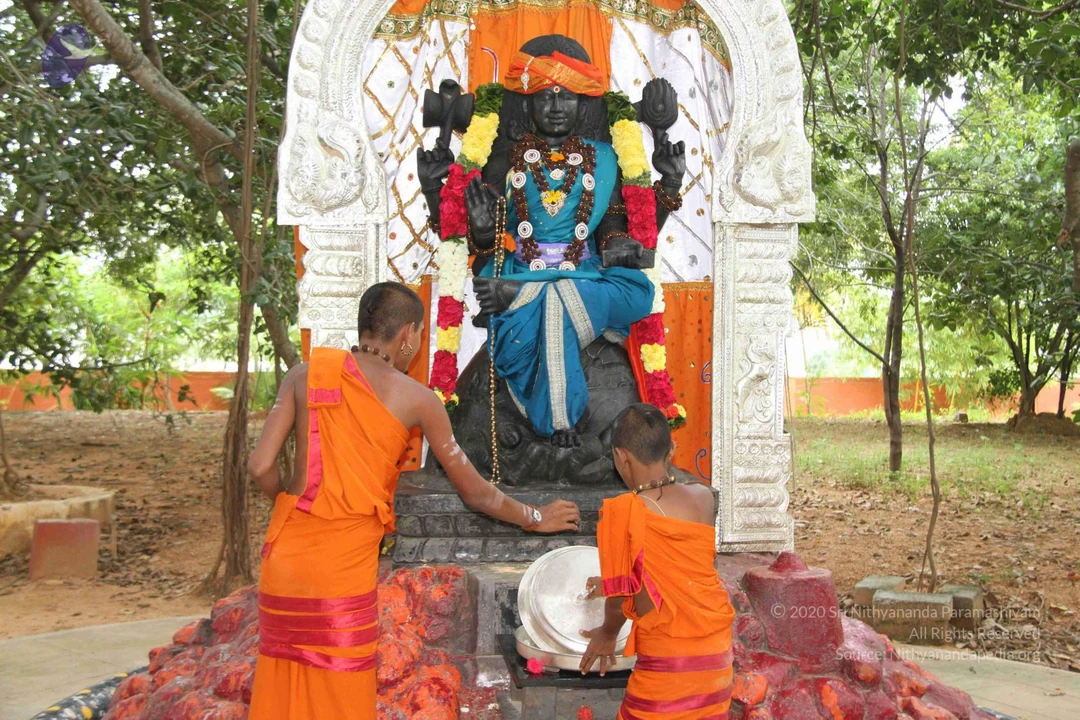
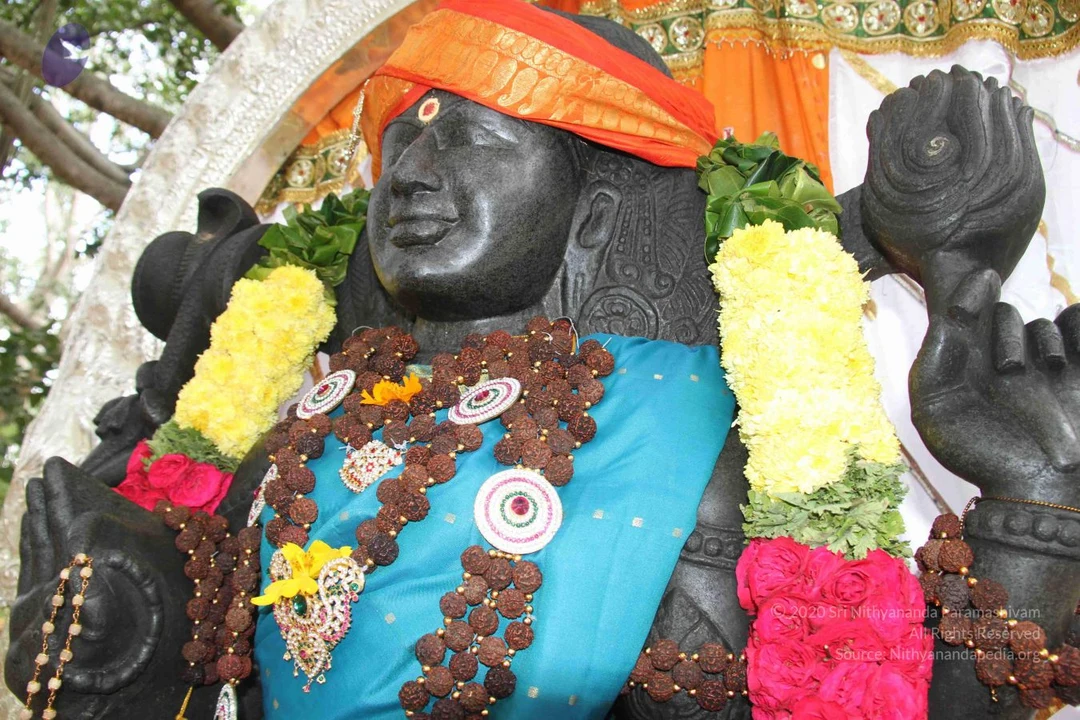
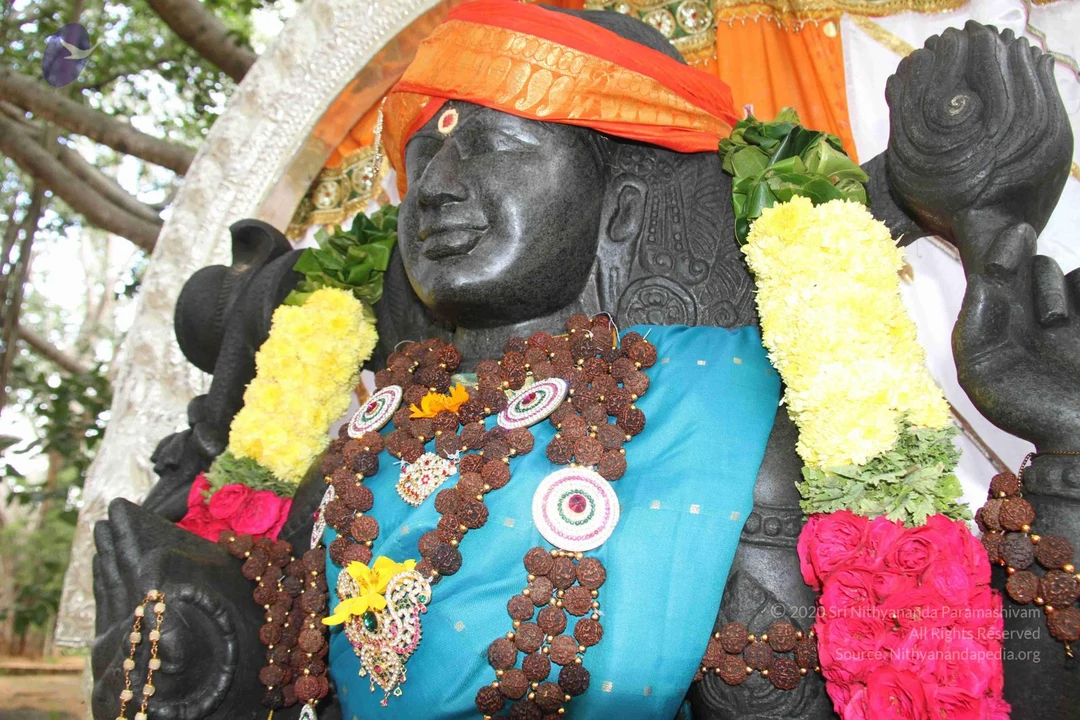
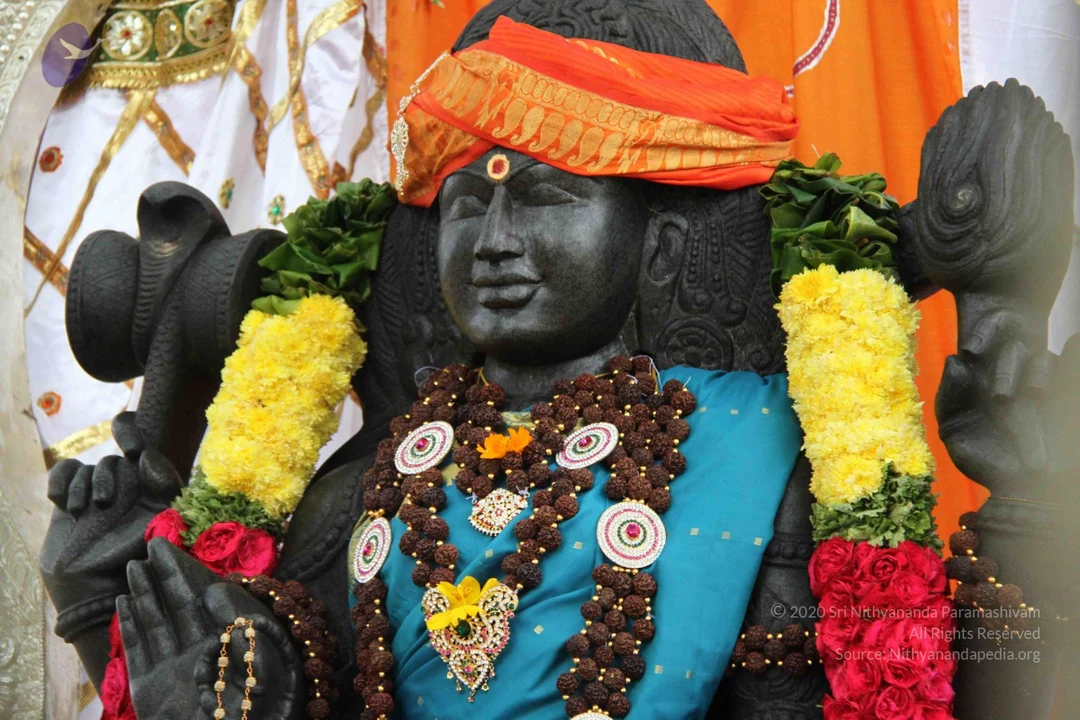
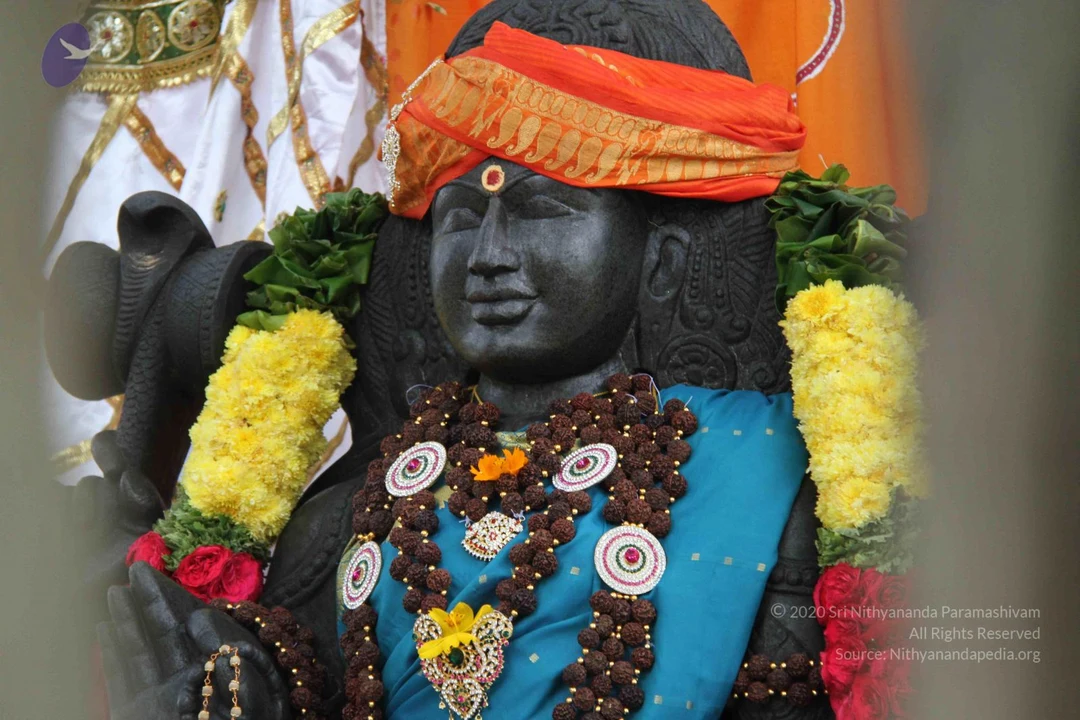
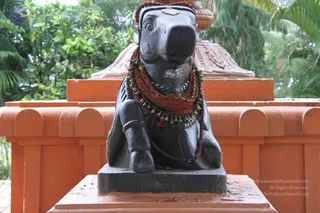
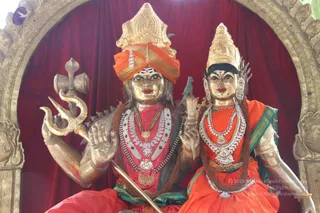
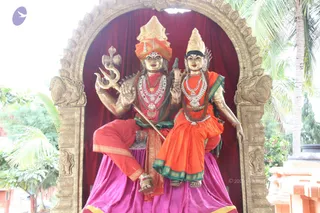
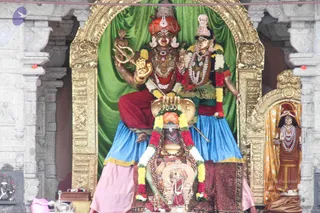
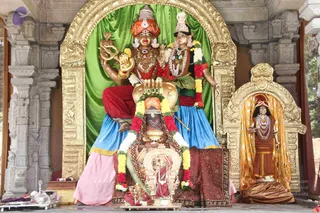
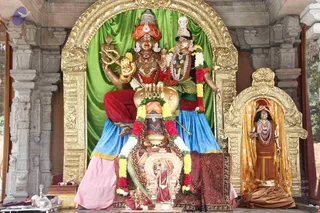
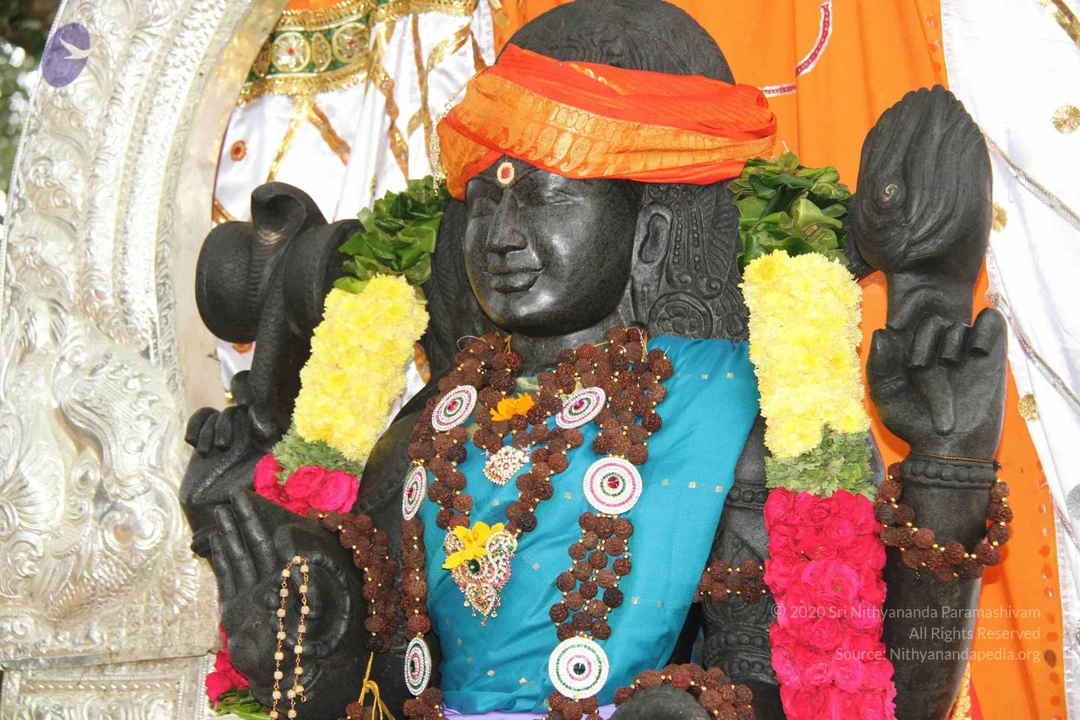
A dark stone Nandi bull statue sits on a black pedestal atop an orange-painted plinth in an outdoor garden setting with palm and leafy green foliage behind. The Nandi wears a red and beige bead necklace layered with rudraksha-style beads, dangling brass bells, a red tassel, and a red garland draped over its head, with a small white marking on its forehead. Scattered petals lie on the base. No people are visible in the scene, and the statue is a deity murti, not a depiction of any person.A photograph of a pair of golden deity murti statues seated side by side within an ornate gilded arch before a deep red draped backdrop. The figure on the left has a trident-like staff, a raised hand, an orange and red turban, and layered beaded necklaces and a rudraksha-style mala over a red and green cloth. The figure on the right wears a gold crown, an orange sari with a green border, and silver necklaces, holding a small parrot-like bird. Both statues bear red and white forehead markings. Statues only; no physical people are present.A large golden-toned statue of a deity couple seated on a pink and magenta draped base in front of a dark red velvet arch with carved gold border. The male figure wears an orange and red turban-like crown, a white and red beaded necklace, and holds a trident and a rudraksha-style hand object; the female figure wears an orange sari with green border, a silver crown, and layered white and silver necklaces. Palm trees and tropical foliage surround the arch, with a partial orange and cream temple structure at the right edge. A small purple logo appears in the upper left corner.A photograph of a temple shrine with a large painted sculpture group on a raised stone platform. A four-armed deity murti with red turban, gold crown, large earrings, and layered jewelled necklaces holds a trident and a raised hand, seated beside a second figure in a crown and white garland. Both wear red and blue dhoti-style drapery and are backed by a green cloth and gilded arch. Below them, a shivalinga-like object is draped with marigold and red flower garlands. A smaller figure on the right wears an orange dhoti and beaded necklaces. Ritual brass vessels and flowers sit at the base. No physical people are visible.A photograph of a temple sanctum showing large painted statues rather than living people. Two tall deity figures stand against a green backdrop within a gilded arch: the figure on the left has four arms, a red dhoti-style garment, a red and orange turban-like crown, and holds a conch-like object and a raised hand; the figure on the right wears a crown, a white garland, and a blue and red skirt. Between them sits a smaller seated figure with a yellow-orange head covering, decorated with marigold and red flower garlands, in front of a small carved shrine niche. To the right, a separate niche holds a standing figure in an orange cloth draped behind it, wearing a brown garment and a beaded necklace. Brass ritual vessels and flower offerings sit on the floor at the lower left.A photograph of a large temple murti set inside a gilded arch against a green curtain. Two standing deity figures dominate: the left one has four arms, a red-orange turban and a trident-like emblem, with a red garment and blue skirt; the right one wears a tall white-and-gold crown, a blue skirt and a red sash, with a garland of white and yellow flowers. Below them is a yoni-shaped base draped with red and white flower garlands and a golden pot. To the right, a smaller figure in saffron-yellow drapery and a rudraksha-style necklace stands in a niche. Silver puja vessels sit at the lower left. No physical people are visible.

Two-Way

2 photosSource gallery
A screen grid of six video-conference tiles showing satsang participants in different cities, labelled SINGAPORE SINGAPURAM, Hyderabad Guptakashi, EAST LONDON UK, HONG KONG - SIRKAZHI, Devon UK, and Self View. The Singapore tile shows several people sitting on patterned mats in a room with a small altar. The Hyderabad tile shows a girl in white uniform and a woman standing beside a bed, with a hand-written sign. The East London tile shows two people seated on a sofa in white clothing. A woman in a dark top is in the Hong Kong tile beside a framed photo. In the Devon tile two people sit on a sofa. In the Self View tile a framed portrait of a smiling man with a saffron-orange turban is set within a gold ornate frame with bells, on an altar. The portrait is a depiction, not a physical person in the room.A photograph of a large video wall showing a multi-city video-conference grid of satsang participants. Tiles are labelled SURREY BC, Ohio Prayag, Seattle Chidambaram, Guadeloupe Rameswaram, Houston Kalahasthi, Los Angeles, and San Jose Madurai. In the top-left tile, a shaved-headed man in white sits beside a seated elderly woman. Other tiles show seated devotees in front of shrines, a man in white and red sitting on a mat, and a lit oil lamp. In the bottom-right two tiles, framed portraits of a smiling man with an orange turban and orange robe rest on gold-trimmed stands, shown as printed or screen images rather than physical presence.

Paduka-Puja-2-Way

2 photosSource gallery
A screen grid of six video-conference tiles showing satsang participants in different cities, labelled SINGAPORE SINGAPURAM, Hyderabad Guptakashi, EAST LONDON UK, HONG KONG - SIRKAZHI, Devon UK, and Self View. The Singapore tile shows several people sitting on patterned mats in a room with a small altar. The Hyderabad tile shows a girl in white uniform and a woman standing beside a bed, with a hand-written sign. The East London tile shows two people seated on a sofa in white clothing. A woman in a dark top is in the Hong Kong tile beside a framed photo. In the Devon tile two people sit on a sofa. In the Self View tile a framed portrait of a smiling man with a saffron-orange turban is set within a gold ornate frame with bells, on an altar. The portrait is a depiction, not a physical person in the room.A photograph of a large video wall showing a multi-city video-conference grid of satsang participants. Tiles are labelled SURREY BC, Ohio Prayag, Seattle Chidambaram, Guadeloupe Rameswaram, Houston Kalahasthi, Los Angeles, and San Jose Madurai. In the top-left tile, a shaved-headed man in white sits beside a seated elderly woman. Other tiles show seated devotees in front of shrines, a man in white and red sitting on a mat, and a lit oil lamp. In the bottom-right two tiles, framed portraits of a smiling man with an orange turban and orange robe rest on gold-trimmed stands, shown as printed or screen images rather than physical presence.

Paduka-Puja-Crowd

33 photosSource gallery
Interior photo of a temple-style shrine hall with painted blue and orange pillars, green and red decorative bands, and a maroon fringed canopy. Two tall painted dvarapala guardian figures with four arms, crowns and gold jewelry stand on either side of a doorway. Inside the doorway a golden throne with a framed portrait labelled 'Paramahamsa Nithyananda' sits beneath a golden umbrella, with a portrait of a smiling figure in orange robes and turban shown in the framed picture. Three seated people in orange robes sit before the throne at the back, and a single seated person in orange robes with a orange headwrap and rudraksha mala sits on the left floor reading a book. Brass oil lamps line the front and steps, and a red carpet lies on the floor.Close-up photograph of a brass puja setup on a tray: a pink flower (likely a trumpet-shaped bloom) lies in the foreground beside a small brass oil lamp or diya with a shallow cup. A tall brass stand with a tiered finial rises behind the flower. At the upper right, a blurred blue-and-gold printed image shows a figure with dark hair, possibly a framed picture or poster, partly out of focus. No people are visible in the frame.Close-up photograph of a polished brass tray holding red rose petals, a fresh red rose, and white jasmine-like flowers. The shallow focus blurs a dark, warm background with soft light spots. No people are visible; the scene is a flower offering arrangement, possibly for puja.A large hall with a white ceiling and recessed lights shows a seated congregation of about 40 people on yoga mats facing a raised stage. Most wear saffron, orange and maroon robes; several are children in red and orange. Some are shaved-headed and some women have their hair pulled back. A central stage has a dark red valance, a decorated altar with painted pillars, a framed portrait and two golden figures, and a seated figure in orange at the left of the dais. Two projection screens on either side show a framed portrait. Tripod-mounted cameras stand near the stage and stanchions line the central aisle.Close-up photograph of a small heap of loose faceted beads resting on a folded orange cloth. The beads are red, green and clear crystal, strung on fine copper-coloured wire loops, with a bundle of smaller beads spilling across the fabric. Beneath the cloth sits a dark, granular brown surface, possibly rudraksha-like seeds or earth, and a metal edge curves at the bottom left. The background is a soft, out-of-focus blur of grey and deep red. No people are visible.Close-up photo of a brass tray holding a row of dark brown rudraksha beads, topped with a folded orange cloth on which sit a small cluster of red, green and clear faceted crystal beads strung on gold wire. The orange fabric drapes over the tray edge and the background is blurred. No people are visible.

NithyaSatsang-Crowd

3 photosSource gallery
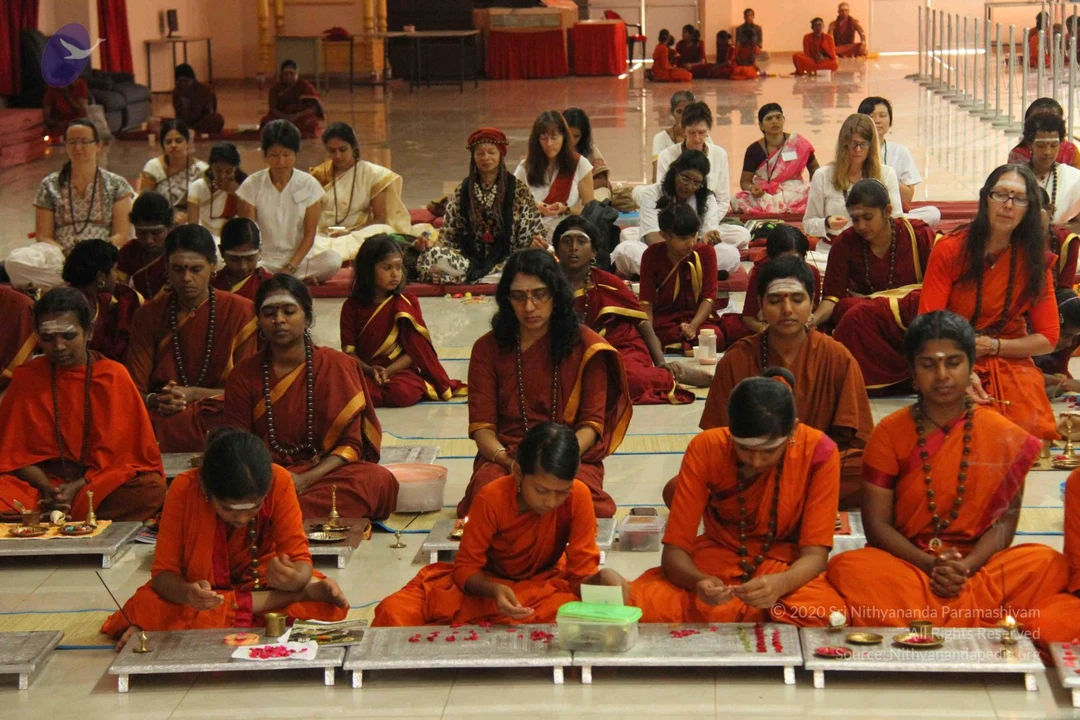
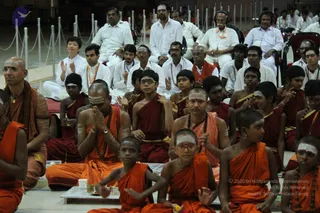
A satsang hall with red curtains where many devotees sit on the floor in orange and red robes with rudraksha malas and white vertical forehead marks. Rows of women and girls in front sit on low wooden platforms, some with hands folded. Behind them, men in white shirts and dhotis sit on the floor and in chairs near the back wall. A small sign or board lies on a platform at right, and a metal stand holds a water jug. No clear presenter is visible at this framing, and no one is identifiable as a person from the visible cues.A photo of a seated satsang in a hall with red curtains, where dozens of people sit on the floor in orange and maroon robes with white forehead markings and rudraksha malas. Young women and girls in orange saris and maroon garments sit in rows at the front. Behind them, men in white shirts and dhotis sit on chairs and mats along the back. Metal stanchions separate the rows. A small silver plate and offerings sit on the floor in front.A seated satsang gathering in an open hall with white ropes and posts in the background. Front rows hold many saffron and orange-robed young boys and monastic devotees with white forehead markings, rudraksha malas and folded or raised hands. Several boys wear maroon robes. Behind them, men in white shirts and white dhotis sit with headsets and lanyards, some applauding. A bald man in a saffron robe and rudraksha mala sits at the far left. Small brass cups and a low white table sit near the front.

NithyaSatsang-Swamiji

23 photosSource gallery
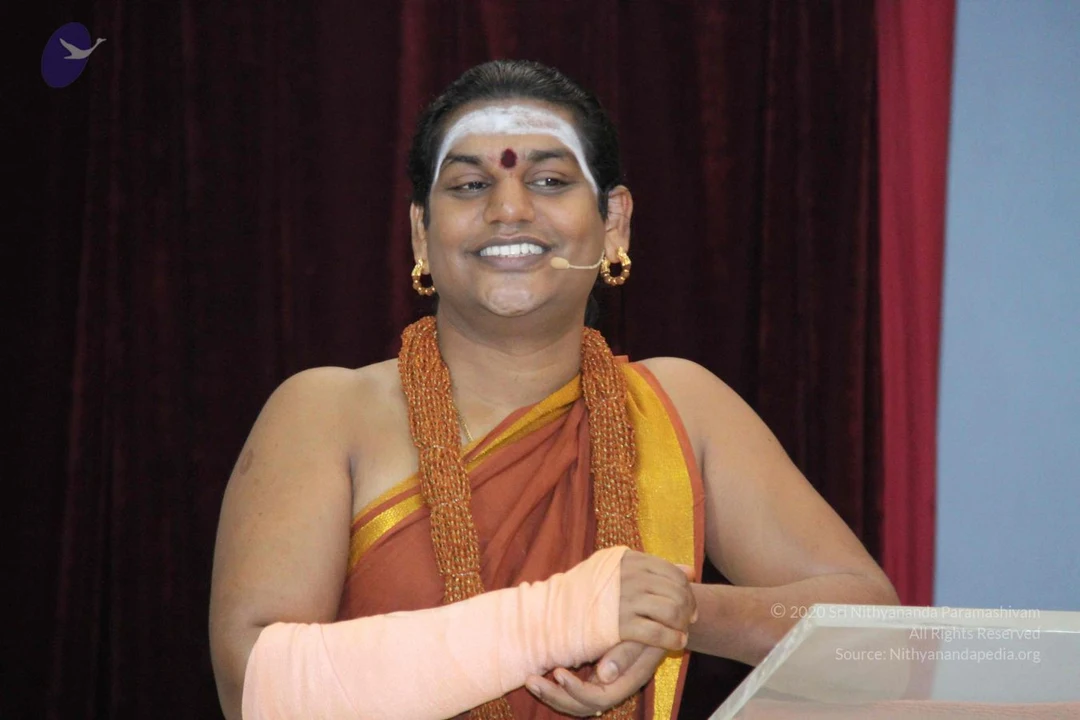
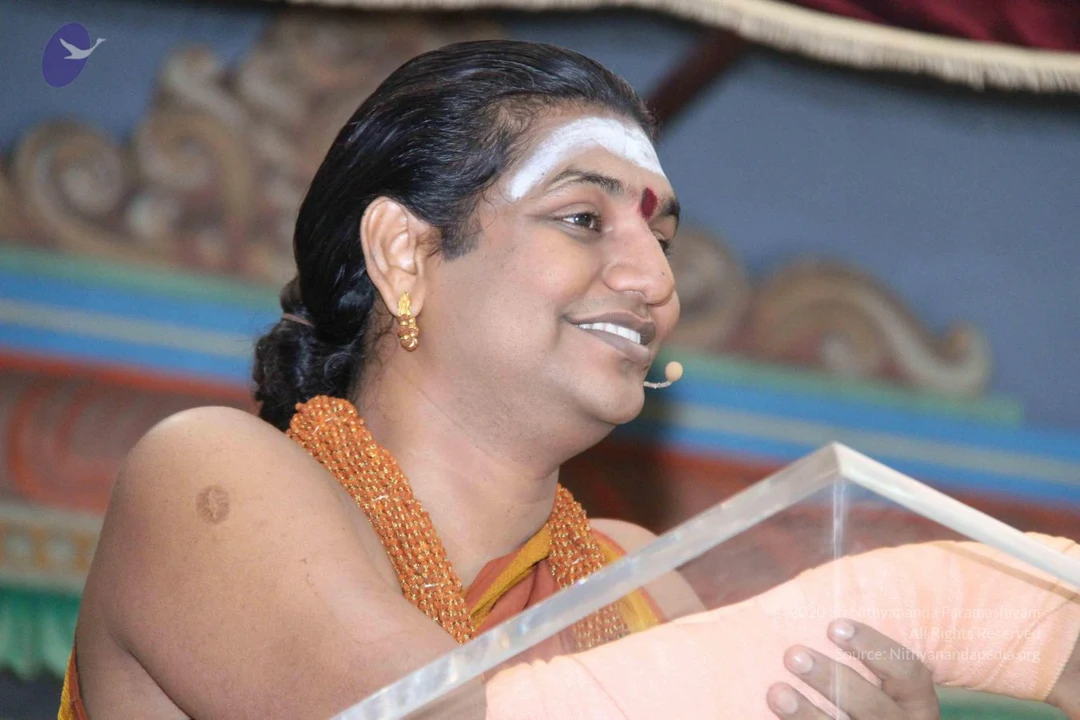
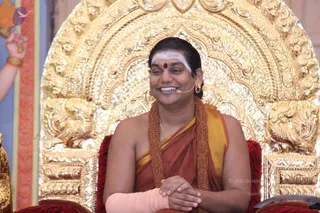
A man seated on an ornate gold throne with carved arched backrest and lion-like side motifs, wearing a saffron-orange shawl with yellow border and a long rudraksha-style beaded mala. He has a white vertical tilak on his forehead with a red dot, gold earrings, and raises one hand in a blessing gesture while smiling. Red patterned cushion visible at the left of the throne. Appearance-based candidate: a person, with rudraksha mala, saffron clothing and ornate gold seat cues, seated on throne and giving blessing.Photograph of a smiling man seated on an ornate gilded throne with a carved golden arch and red tiger-striped cushions. He wears a saffron-orange robe with a yellow border, a long rudraksha mala draped around his neck, and a white vibhuti line with a red kumkum dot on his forehead. His hands are clasped in his lap and his right forearm is bandaged. Beside the throne stands a painted deity figure with multiple arms and a golden lion-headed element in the corner. a person is seated centrally, identified by the seated throne, rudraksha mala and saffron robes.A man seated on an ornate gilded throne with embossed floral and scroll carvings, speaking and smiling while gesturing with his right hand. He wears a saffron-orange robe with a gold-yellow border, a multi-strand rudraksha mala draped over his shoulders, a white vertical tilak and a red bindi on his forehead, a small earpiece microphone, and a gold chain. Beside him, a painted deity figure with multiple arms and a red-and-gold weapon is partly visible against a red and white backdrop. A red tiger-striped cushion lies on the seat. The scene suggests a satsang or discourse.A smiling man sits on an ornate gold throne with carved floral and animal motifs, dressed in an orange-red and gold-bordered shawl draped over the shoulder, with a long beaded rudraksha-style mala necklace and a gold chain. He wears a white horizontal forehead mark with a red bindi and a small lapel microphone, hands clasped in his lap. Behind him a painted deity figure with green and orange tones is partly visible. The a person appears in a satsang setting, with the presentation cues of orange shawl, rudraksha mala and ornate throne.A smiling man seated on an ornate gilded throne with a large arched backrest carved with scrolling and lion-like motifs, the seat upholstered in red. He wears a saffron-orange and gold-bordered wrap over bare shoulders, a long rudraksha mala with a ceremonial gold necklace, a white vertical tilak with a red dot on the forehead, and a small head microphone. A bandage covers one forearm, and his hands rest folded in his lap. Swamiji (probable) cues: swept-back dark hair, saffron wrap, rudraksha malas, and ornate gold necklace on a throne, seated as a speaker. A partially visible hand with bangles and a red-and-orange decorated panel appear at the left edge.A smiling man sits on an ornate golden throne with a red velvet seat and carved lion-like motifs, wearing a reddish-brown and saffron-gold shawl over bare shoulders. He has a long rudraksha mala draped down his chest, a white forehead marking with a red bindi, a small gold earring and a headset microphone. His hands rest clasped on one leg, and a pale forearm bandage is visible. Behind him is a gilded arch, and part of a colourful painted panel with a hand holding bangles appears at the left edge. The setting suggests a satsang discourse.

SarvaDarshan

5 photosSource gallery
A photograph in a hall with a white ceiling, red window valances and dark red drapes. On the right, a man with long hair swept back, a white tripundra on his forehead, a rudraksha-bead necklace and an orange-and-gold robe raises his right palm toward a woman in a blue blouse with a colourful patterned shawl who stands with palms pressed together. Beside her, a man in white clothes holds his hands together. On the left, a shaved-headed priest in an orange robe wears a rudraksha mala. Behind them, several people in white and orange stand near a golden seat and silver stanchions, and a portrait hangs on the right wall.A photograph inside a hall with white walls, ceiling lights and red curtains. On the right, a smiling man with swept-back dark hair, a red bindi and white forehead markings wears an orange-brown robe with a gold border and a large orange beaded mala, raising his hand in blessing toward a devotee. A man in a white shirt bows with palms joined in the foreground, and a man in a pink shirt stands nearby. Behind them, several saffron-robed men with shaved heads and white tilak stand in a line, and additional people in white and orange clothing are visible further back. Swamiji (probable): the right-hand figure has long swept-back hair, an orange-gold robe and an ornate beaded mala, matching the page's Swamiji reference.A photograph in an indoor hall with white ceiling lights and red curtains. On the right, a man with long swept-back hair, a red bindi, white forehead markings, large gold earrings, a long amber-beaded mala and a rust-orange and gold-bordered cloth raises his right hand in a blessing gesture toward a bending devotee in a white shirt with folded hands. Several devotees in white shirts and trousers stand or fold their hands on the left. Behind them, saffron-robed sannyasis with white forehead markings, and a man in an orange robe with a tall crown-like headpiece stand near a golden shrine item. A woman in a sari stands at the right edge. The scene suggests darshan.Indoor hall with white ceiling tiles, red curtains and a gold-cushioned seat in the background. A standing man in a saffron-orange robe with a gold-and-saffron shawl, a long orange rudraksha-style bead garland and gold earrings, with white and red forehead markings, raises his right hand in blessing toward a devotee. Several men in white shirts and white dhotis stand before him with palms pressed together in namaskar, one bowing with eyes closed. A man in a white shirt and dark glasses at left presses his hands together. Behind, a man in a dark maroon garment and another in a white turban-style head marking stand near a metal rope barrier. The figure in orange is a probable Swamiji by appearance (long swept-back hair, saffron robe, rudraksha garland, gold ornaments), receiving namaskar and blessing devotees.Indoor hall with white ceiling fans, red curtains and a stage backdrop. In the foreground, a smiling man in a saffron-and-gold shawl and a long garland of orange beads raises his right hand in blessing toward a man in a white shirt and white trousers with an orange lanyard, who stands with palms pressed together in namaskar. Behind them, several people in white and checked shirts, a man with a shaved head wearing an orange shawl, and women in saris stand near metal barrier rails. The smiling figure wears a white tilak with a red bindi and a saffron shawl. a person in the saffron shawl and garland, giving a blessing to a devotee.

Temple
30 photosSource gallery
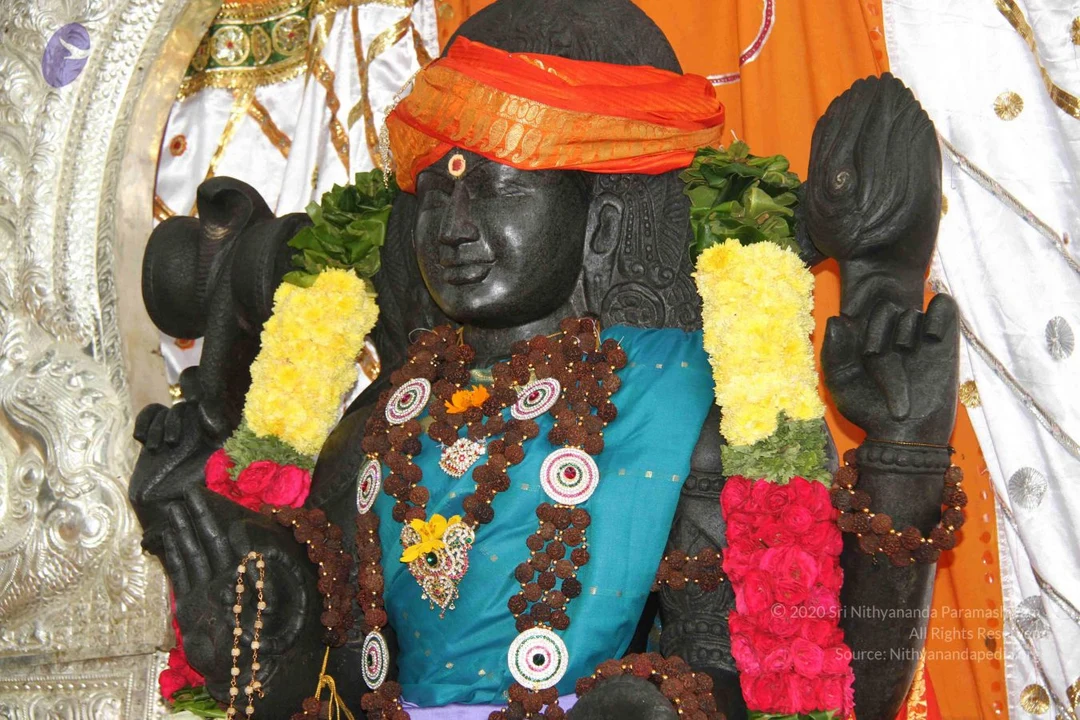
A dark stone Nandi bull statue sits on a black pedestal atop an orange-painted plinth in an outdoor garden setting with palm and leafy green foliage behind. The Nandi wears a red and beige bead necklace layered with rudraksha-style beads, dangling brass bells, a red tassel, and a red garland draped over its head, with a small white marking on its forehead. Scattered petals lie on the base. No people are visible in the scene, and the statue is a deity murti, not a depiction of any person.A photograph of a pair of golden deity murti statues seated side by side within an ornate gilded arch before a deep red draped backdrop. The figure on the left has a trident-like staff, a raised hand, an orange and red turban, and layered beaded necklaces and a rudraksha-style mala over a red and green cloth. The figure on the right wears a gold crown, an orange sari with a green border, and silver necklaces, holding a small parrot-like bird. Both statues bear red and white forehead markings. Statues only; no physical people are present.A large golden-toned statue of a deity couple seated on a pink and magenta draped base in front of a dark red velvet arch with carved gold border. The male figure wears an orange and red turban-like crown, a white and red beaded necklace, and holds a trident and a rudraksha-style hand object; the female figure wears an orange sari with green border, a silver crown, and layered white and silver necklaces. Palm trees and tropical foliage surround the arch, with a partial orange and cream temple structure at the right edge. A small purple logo appears in the upper left corner.A photograph of a temple shrine with a large painted sculpture group on a raised stone platform. A four-armed deity murti with red turban, gold crown, large earrings, and layered jewelled necklaces holds a trident and a raised hand, seated beside a second figure in a crown and white garland. Both wear red and blue dhoti-style drapery and are backed by a green cloth and gilded arch. Below them, a shivalinga-like object is draped with marigold and red flower garlands. A smaller figure on the right wears an orange dhoti and beaded necklaces. Ritual brass vessels and flowers sit at the base. No physical people are visible.A photograph of a temple sanctum showing large painted statues rather than living people. Two tall deity figures stand against a green backdrop within a gilded arch: the figure on the left has four arms, a red dhoti-style garment, a red and orange turban-like crown, and holds a conch-like object and a raised hand; the figure on the right wears a crown, a white garland, and a blue and red skirt. Between them sits a smaller seated figure with a yellow-orange head covering, decorated with marigold and red flower garlands, in front of a small carved shrine niche. To the right, a separate niche holds a standing figure in an orange cloth draped behind it, wearing a brown garment and a beaded necklace. Brass ritual vessels and flower offerings sit on the floor at the lower left.A photograph of a large temple murti set inside a gilded arch against a green curtain. Two standing deity figures dominate: the left one has four arms, a red-orange turban and a trident-like emblem, with a red garment and blue skirt; the right one wears a tall white-and-gold crown, a blue skirt and a red sash, with a garland of white and yellow flowers. Below them is a yoni-shaped base draped with red and white flower garlands and a golden pot. To the right, a smaller figure in saffron-yellow drapery and a rudraksha-style necklace stands in a niche. Silver puja vessels sit at the lower left. No physical people are visible.