Skip to content
Monday

23 September 2013

Enriching Raises your frequency

Dated photos
109
Source pages
1
Media
4
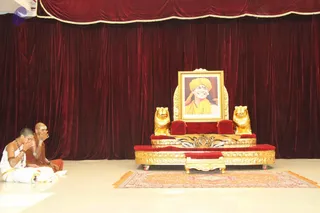
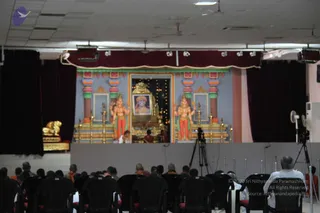
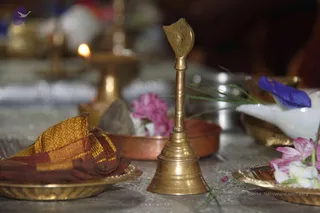
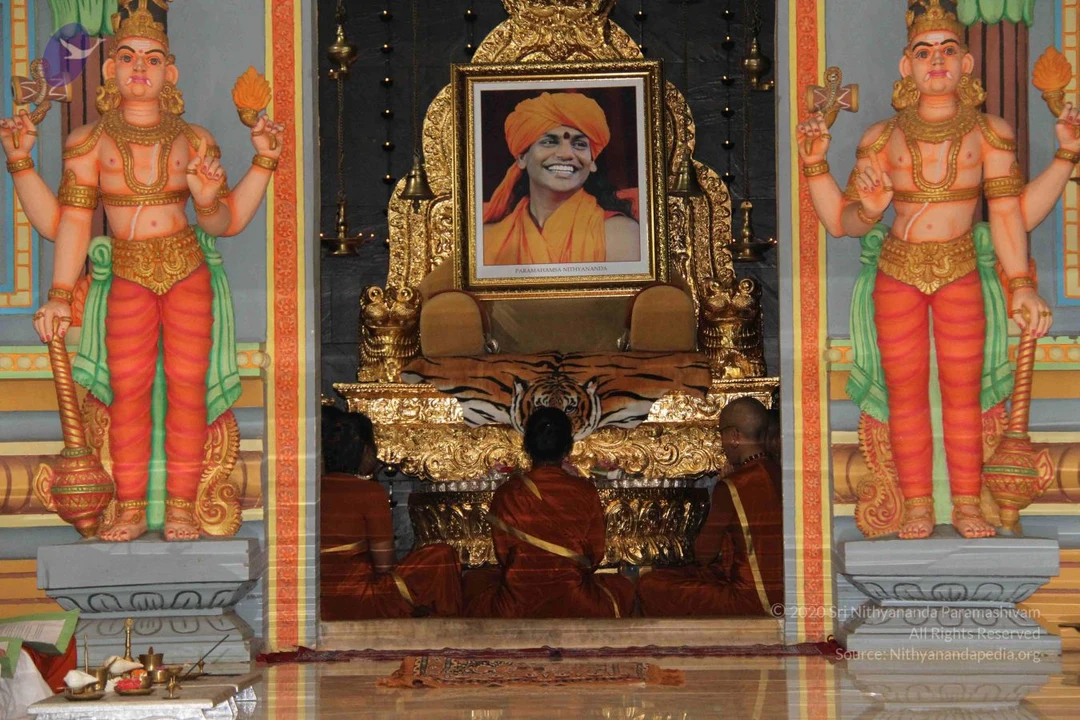
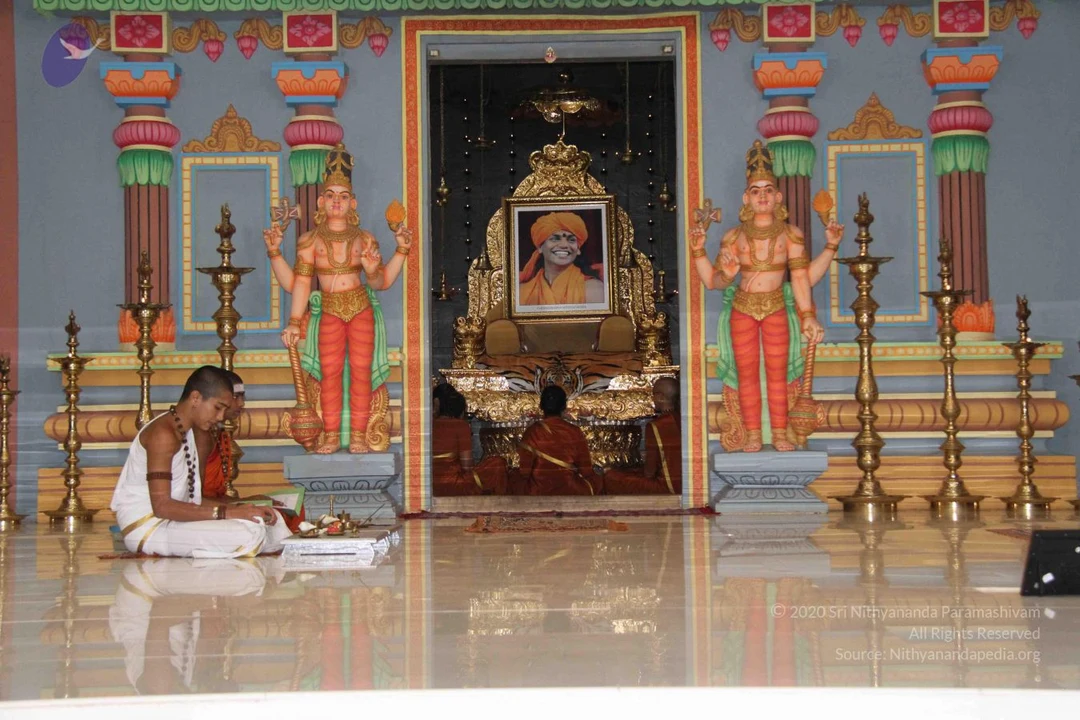
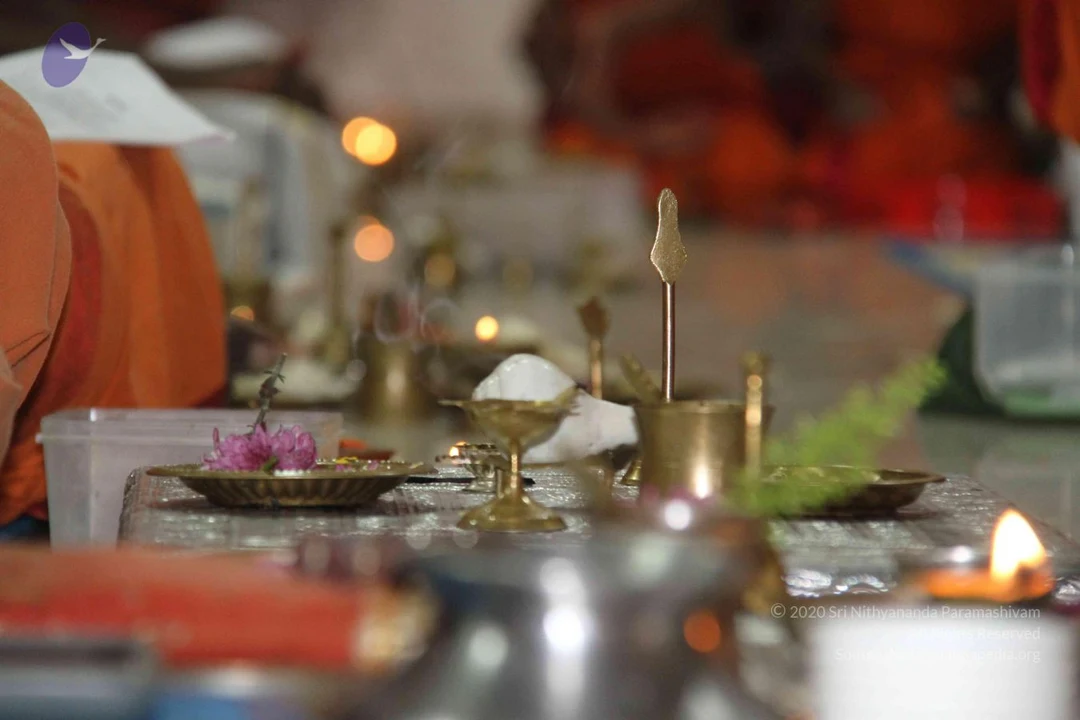
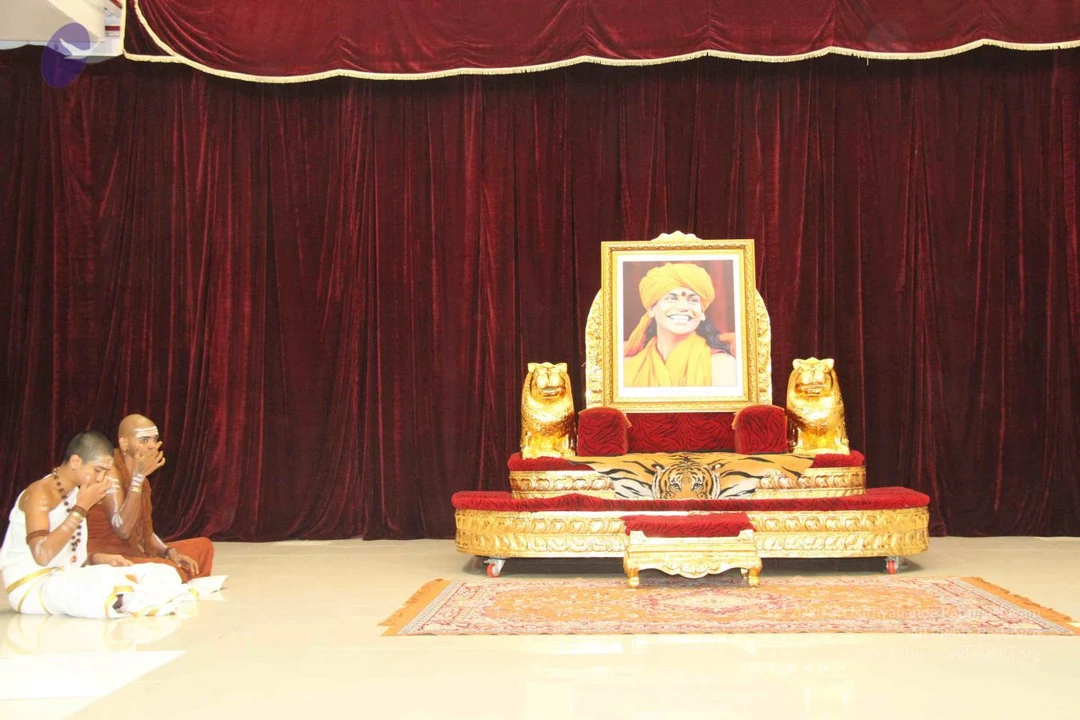
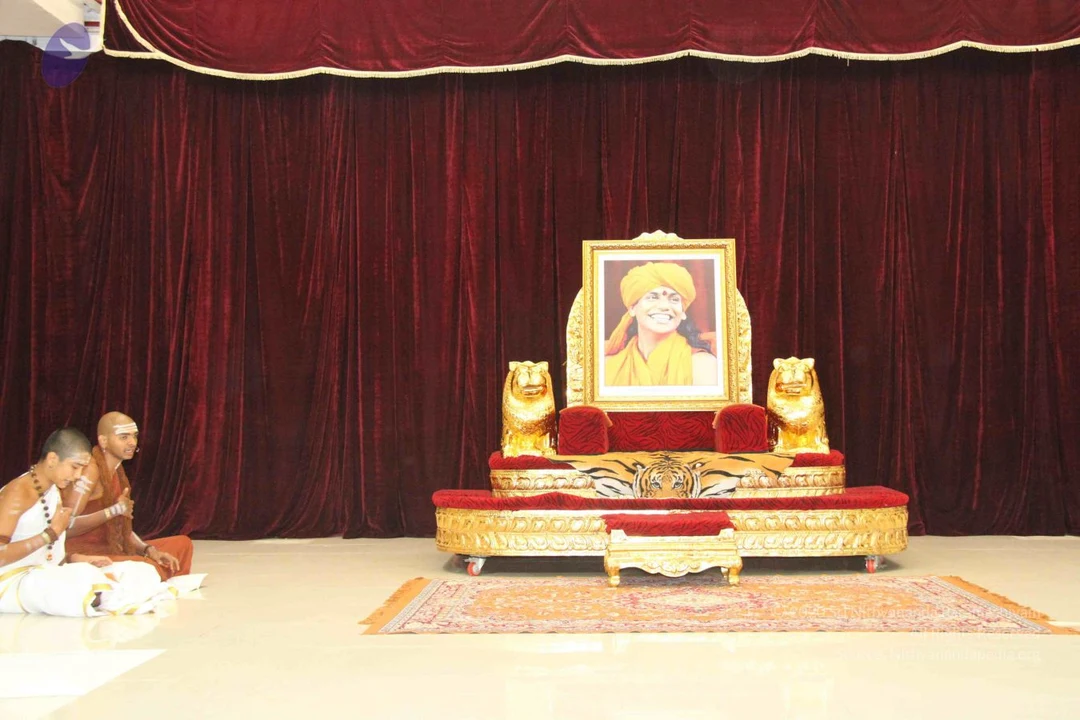
Photograph of an empty ceremonial stage with a gold-and-red throne backed by lion-head arm supports and a tiger-skin cushion, set before deep red velvet drapes. A framed portrait labelled "Paramahamsa Nithyananda" sits above the throne, showing a smiling man in an orange turban and orange robe. A small gold footstool and a patterned rug lie in front. At the lower left, two men sit on the floor: one in white dhoti and shawl with a rudraksha mala, the other in orange robe with shaved head and white tilak, both with hands raised near their faces.Photograph of an indoor hall with a stage backdrop painted with two large deity figures in red and green garments flanking a central shrine with a framed portrait and a golden lion-shaped seat at left. Rows of black chairs face the stage, where several people sit on the floor in orange and white clothing near ritual objects and oil lamps. Seated audience members in orange and white attire occupy the foreground, with a tripod-mounted camera and a large ceiling fan visible.Close-up photograph of a brass puja setup on a metal tray. In the centre stands a tall brass handbell with a flared top and a bulbous base, resting on a silver surface. To the left, a folded gold-and-maroon cloth sits on a brass plate. Behind, a copper bowl holds pink flowers and a grey stone, and a small oil lamp with a lit flame glows in the background. A purple flower and white blossoms lie on a brass plate at right, with a white ceramic vessel beside them. No people are visible.

September 23 2013

Original wiki page
Contents

Title

Enriching Raises your frequency

Description:

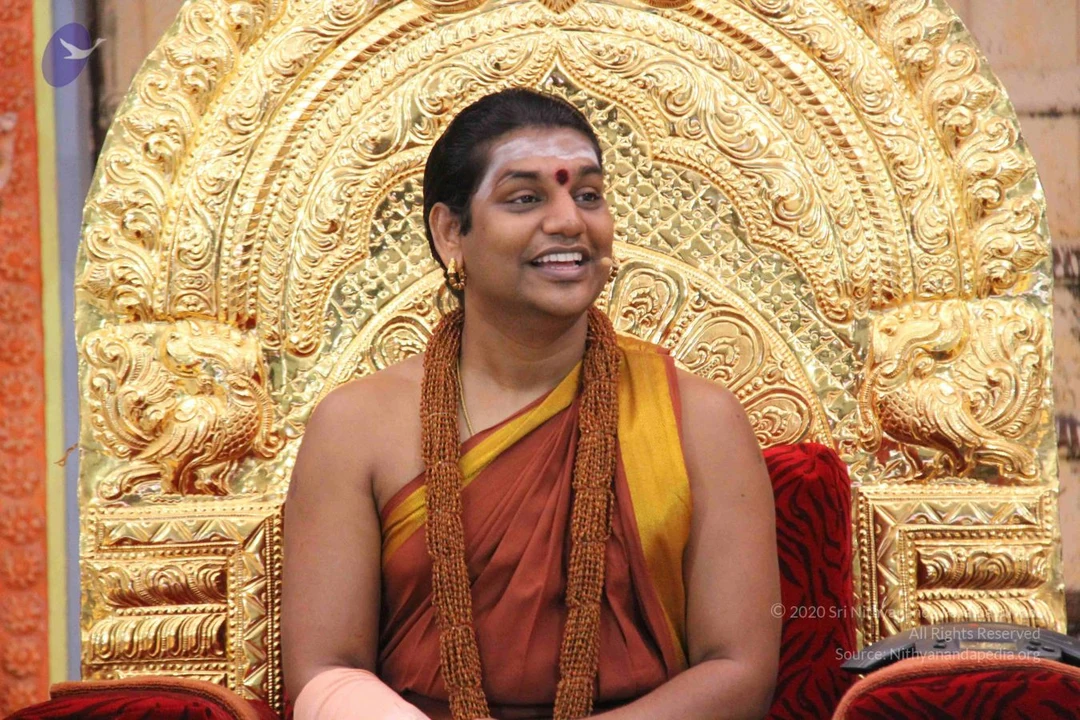
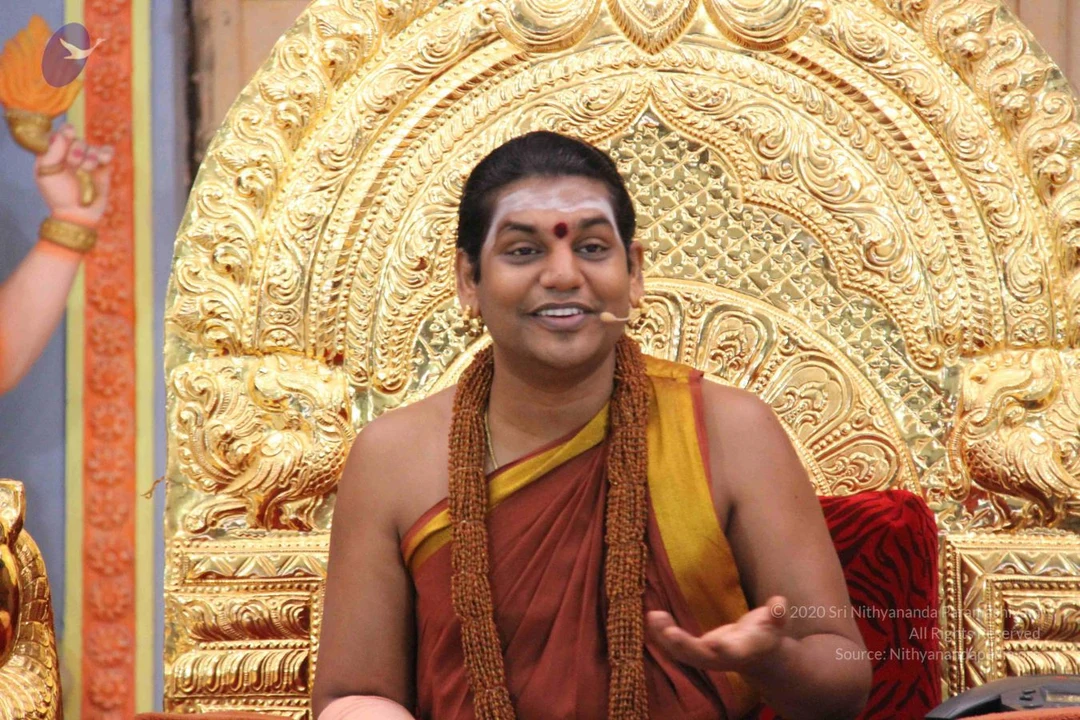
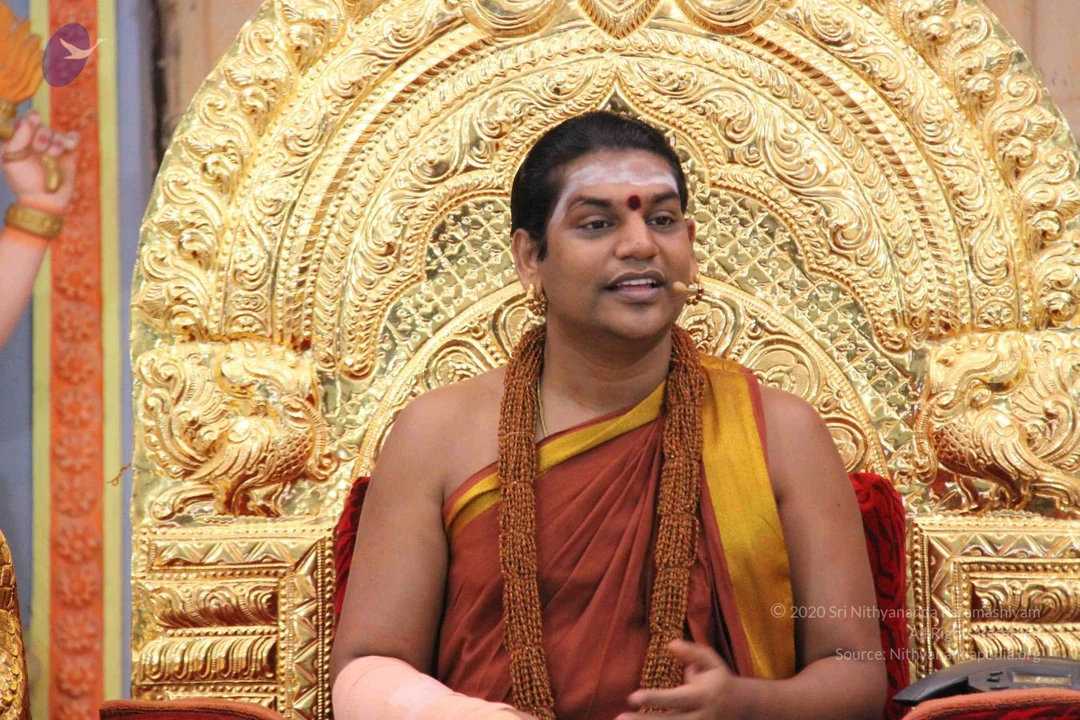
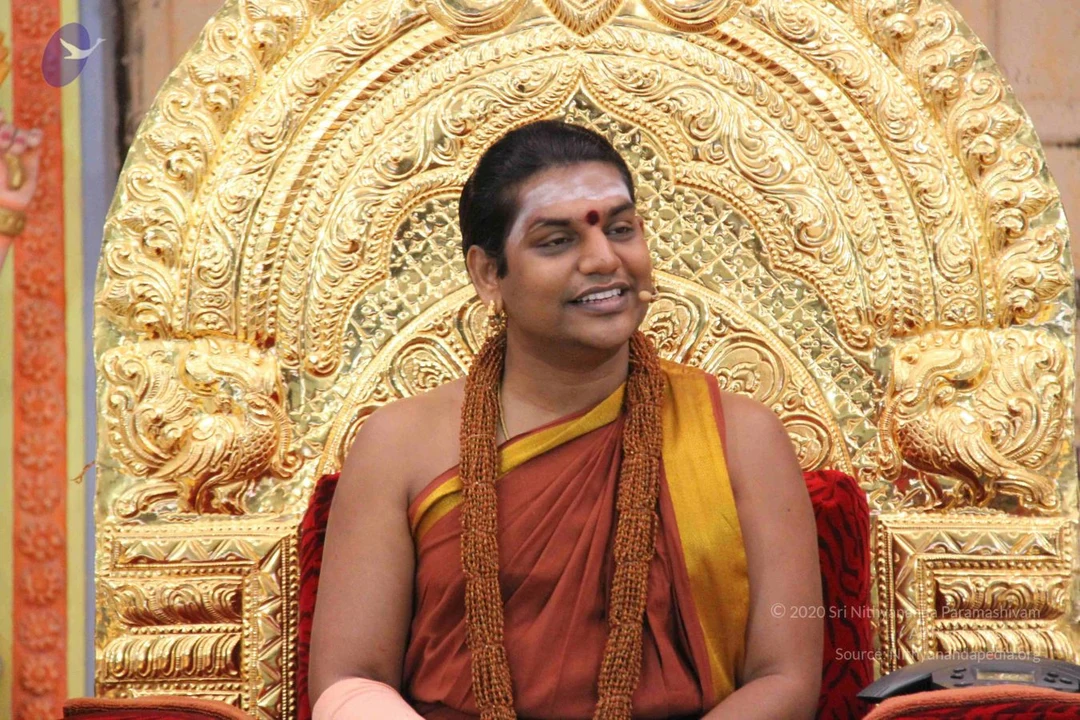
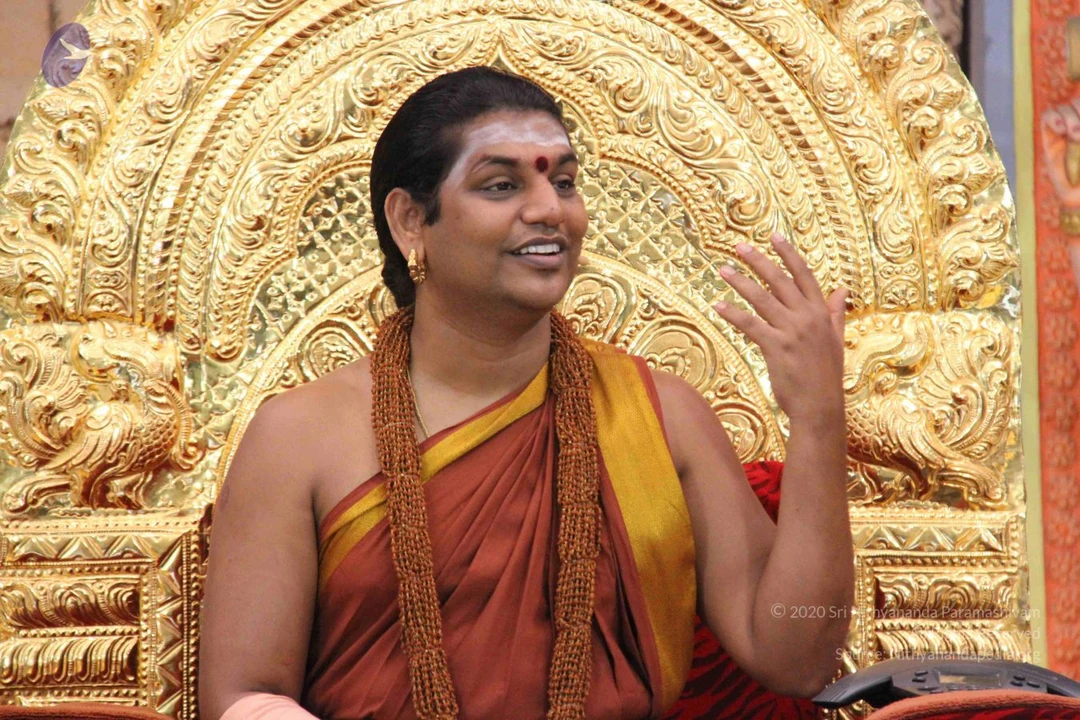
Today Swamiji spoke about the Deeper impacts of Enriching. There should not be any restriction in our responsibility. We should be responsible for the whole world; for everything. Enriching is a great asset to face life. Enriching raises the frequency of your whole life. We need to complete with the life negative pattern of believing we live only in the body. The Truth is we live in all human beings and it keeps us in excitement. Expansion in Life energy happens only through enriching; transmitting the highest consciousness to others. This is making people live enlightenment. Every day enrich others to live an Enlightened Life.

Link to Video:

VideoAudio
VideoAudio

Transcript:

Today I will expand on "The Deeper Impacts of Enriching". I was explaining bringing Integrity into your thinking, Authenticity into your actions, Responsibility into your being.

See, when I say "responsibility into your being" you need to understand, bring Responsibility into your cognition. For example, I gave you one example that day. I wanted to repeat. When you see the headlines in a news channel: "Sixty People Dead, Two Ministers Hurt in a Bomb Blast!" You are just shaken up. Your head is literally put inside the television screen and the moment you read the words "in Iran", you relax. Means, you feel responsible only for India. In your cognition you feel responsible only for India. That is why the moment you saw the country "Iran", you just put your head down, 'Okay, that is usual, leave it. Next.' How many of you have experienced this in some form? Yes, that's all.

See, if you are from America, when there is a scrolling: "Developing Story: 120 People Dead in Terrorist Attack," you just wake up, your head is completely on the television set; you just read one next line "in India, Mumbai", and you drop your , because you feel you are responsible only for America.

Please understand, change your cognition. You are a human being; you are responsible for the whole world. Naturally, in the place where you are, if there is some terrorist attack or problem, you are going to run immediately, help the people, save yourself and save others, no doub, but your cognition itself should not be restricted to the place you live. Please listen, your cognition itself should not be restricted to the place you live. Please understand, your cognition should be responsible for everything. You should cognize you are responsible for everything. Feeling that you are responsible for everything should be your cognition. This is what I call "bringing Responsibility into your cognition".

People with zero cognition, they don't take cognisance of anything happening around them. There are some people, even if you see them it is wrong, because you may catch their cognition as a standard. There are some people, even if you see it is wrong, it is inauspicious. People with a very low level of cognition, even if you see them it is wrong. Please understand, even if you see them it is wrong.

Bring right cognition into your being. Take cognisance of everything happening around you. Responsibility means, having higher cognition in your being.

The fourth: Enriching. Please understand, bring Enriching to your whole life. Even when you breathe out, remember you are releasing oxygen for the sake of trees. Everything should be with the motive of Enriching. No action, no thinking, no feeling should be done by you which is not Enriching. Every action, every thinking and every feeling should be with a very established cognition of Enriching. Please understand, I am making a statement: "Established Cognition". Means, sometimes you start creating your own fantasy. You think people enjoy your service but actually they are tortured by you. That is why I am using the word "established cognition of Enriching".

Sometime people think even stealing others' property you teach lesson to them. When you steal they will have to start working for more. No, really, even thieves think they enrich others. That is why I am using the word "established cognition of Enriching". That Enriching should be accepted by an established cognition of people, not that you can simply tell you will steal somebody's properties, 'You see, I am enriching him by stealing his property, because when you steal, he has to live simple life and I am teaching him to live a simple life and that is the way I am enriching him." No. You can't build your own cognition and enrich people. The Enriching has to be based on established cognition of Enriching.

Just look at your life. Whenever you feel good about you, whenever you feel powerful, wherever you feel powerful, if you scan, it will always be because you are Enriching at that moment. Look. When you feel you are loving, you are loved, when you feel you are powerful, when you feel people are supporting you or you supporting others, whenever, whenever you feel powerful, whenever you feel energetic, alive, look, look into your life. Please understand, look into your life.

Photos From The Day:

Photos Of The Day:

GurukulKids_Instruments
GurukulKids_Krama
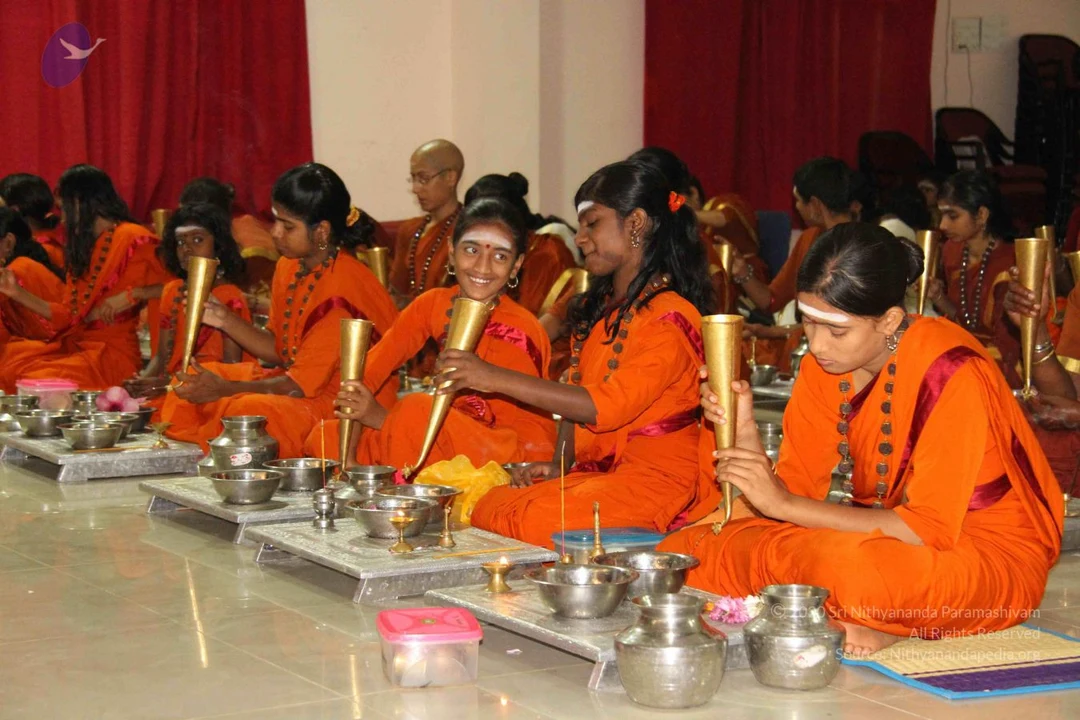
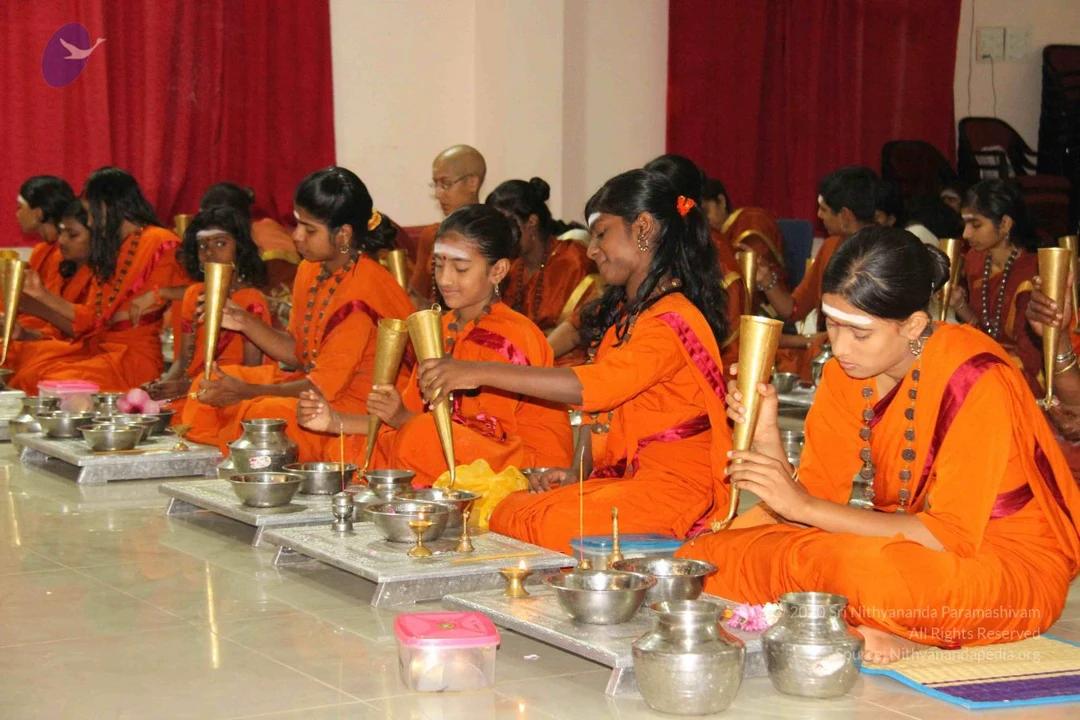
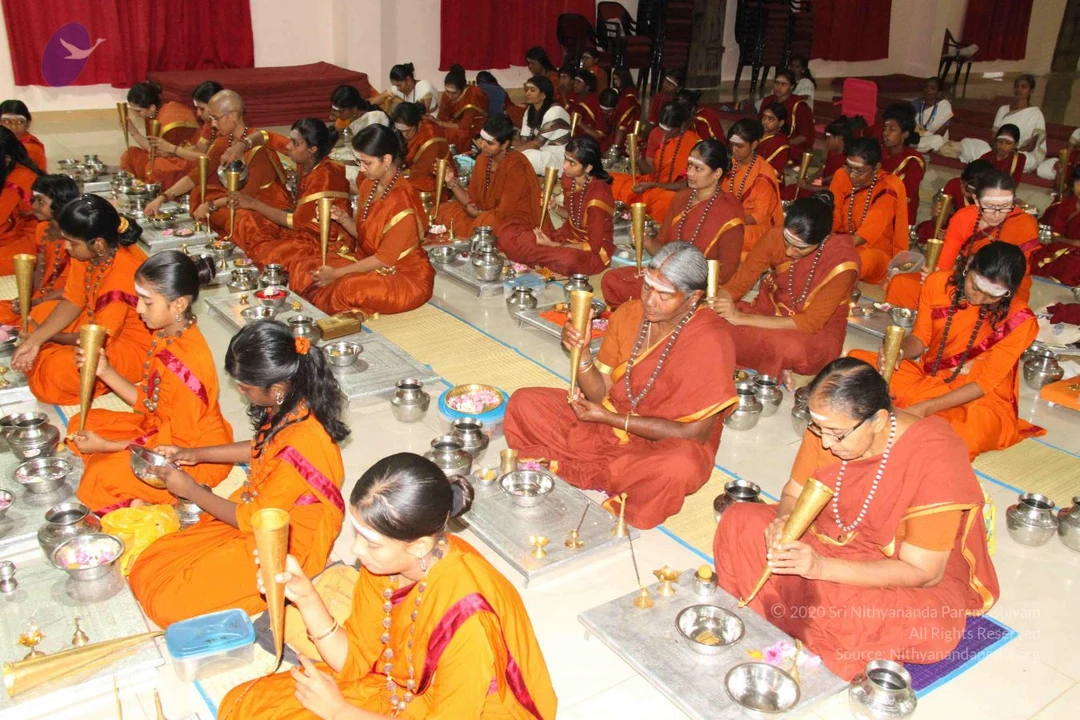
PADUKA POOJA
RUDRABHISHEKAM

SATSANG

SARVA DARSHAN

1-RudraAbhishekam

IMG_8012_CMP_WM

2-Paduka-Puja

3-Nithya-Satsang

5-Final-Blessings

Photos from this day

View all 109 photos

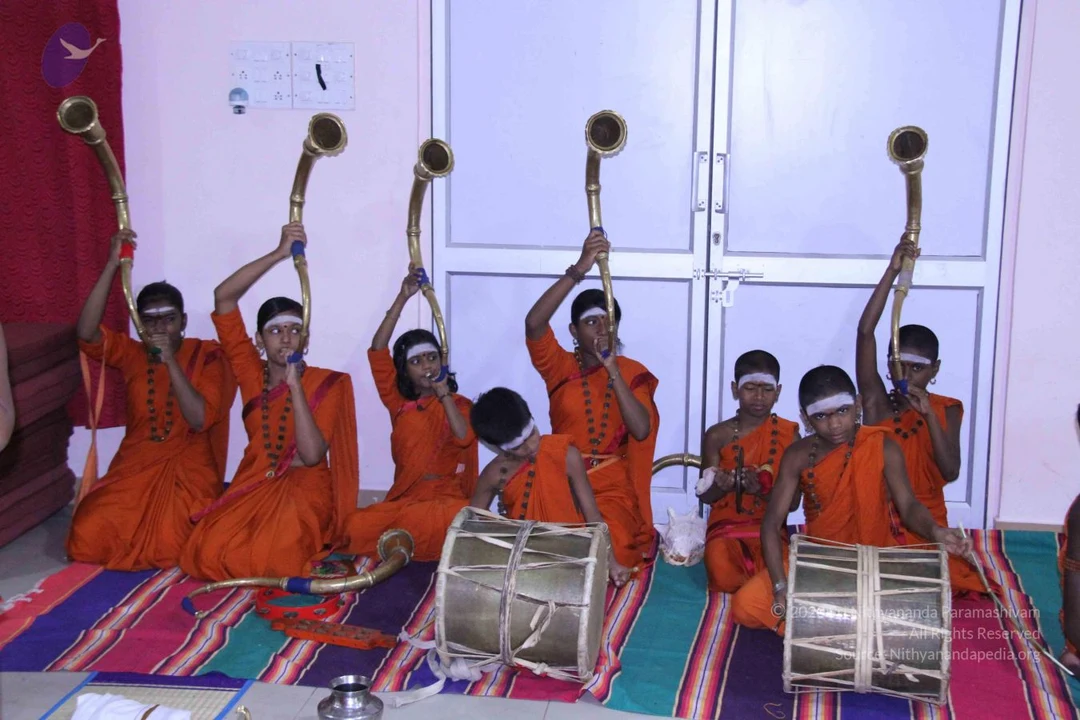
GurukulKids_Instruments

2 photosSource gallery
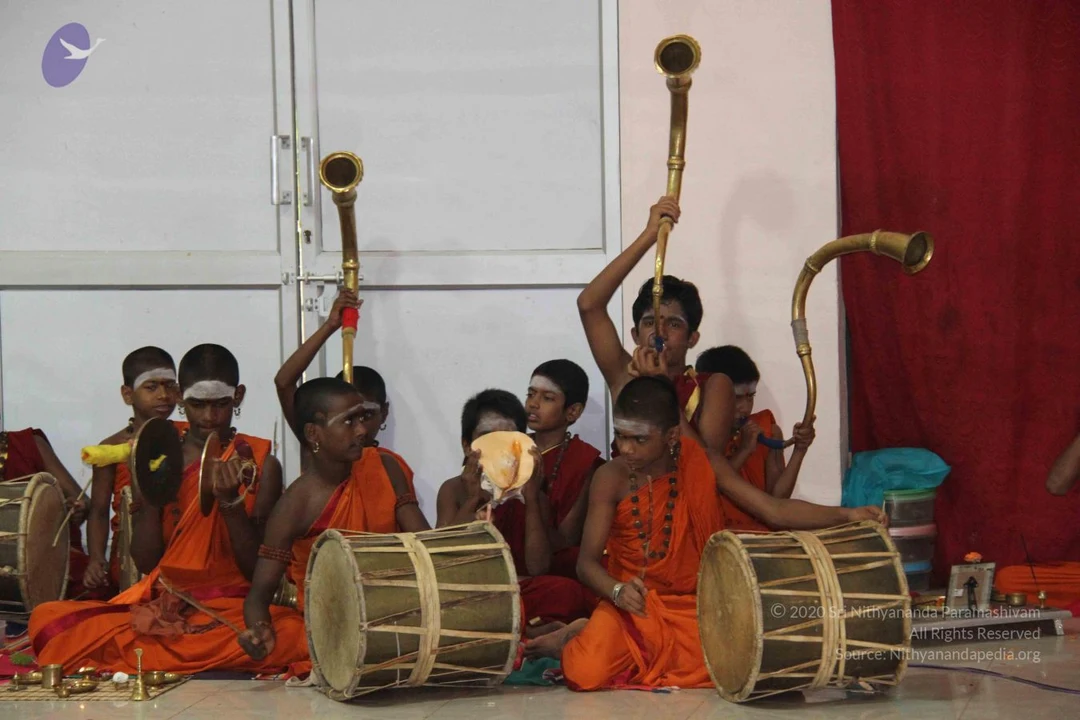
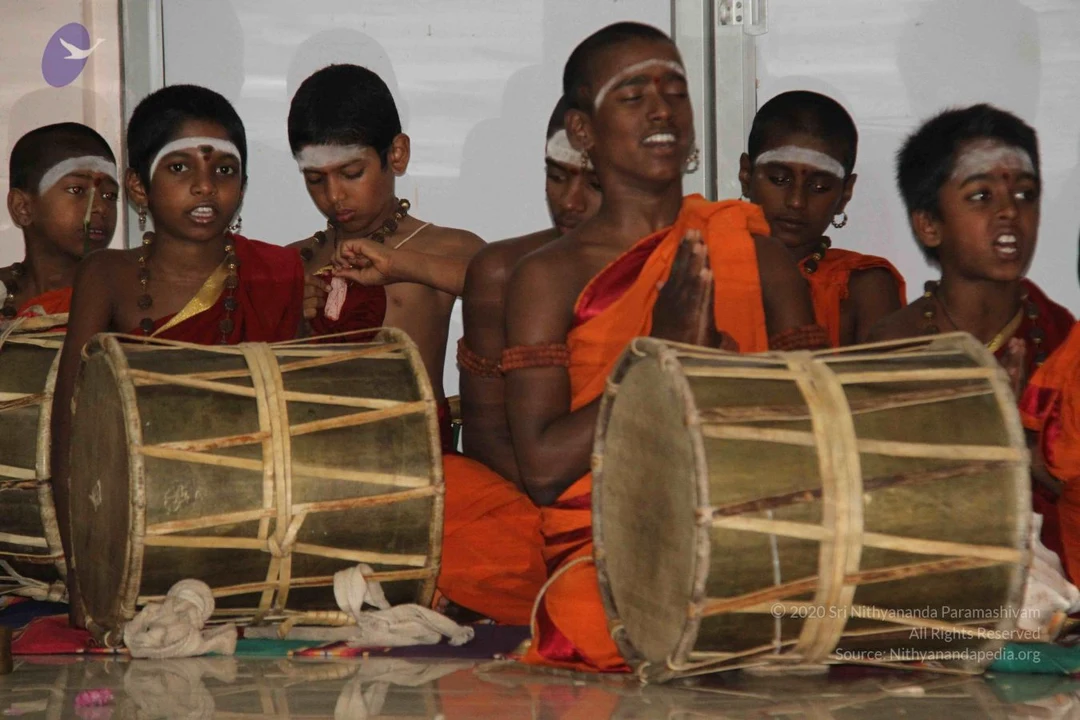
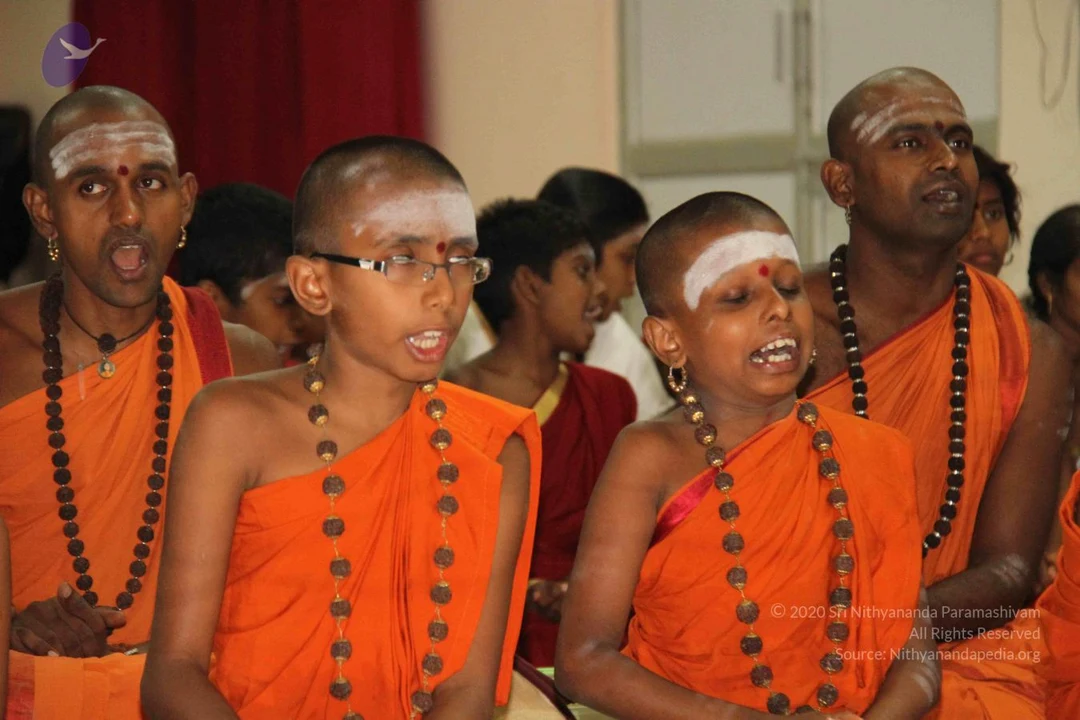
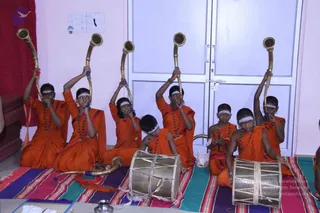
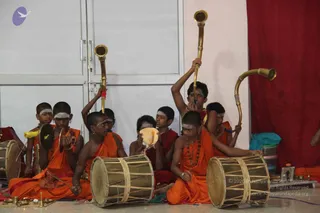
Seven young boys in saffron-orange robes sit on a colourful striped woven mat playing traditional brass horns and drums. Each boy has white forehead markings, and several wear rudraksha-style beaded necklaces. Two large cylindrical drums with laced hides sit in front, and a brass pot and a red cloth lie on the floor. Behind them a white double door and a pink wall with a small wall clock frame the scene. The boys raise the long curved horns skyward as they play.A group of young male musicians in saffron-orange dhoti-style clothing and white forehead markings sit cross-legged on a tiled floor performing a ritual music ensemble. Two large barrel drums with woven rope tension lacing sit in front; one player beats a drum with bare hands. Several players blow long brass horns (ceremonial trumpets) raised high, and one player holds a small cymbal-like hand drum. Rudraksha-style beaded necklaces are visible. Behind them is a red curtain and white doors, with brass lamps and vessels on the floor at the lower left.

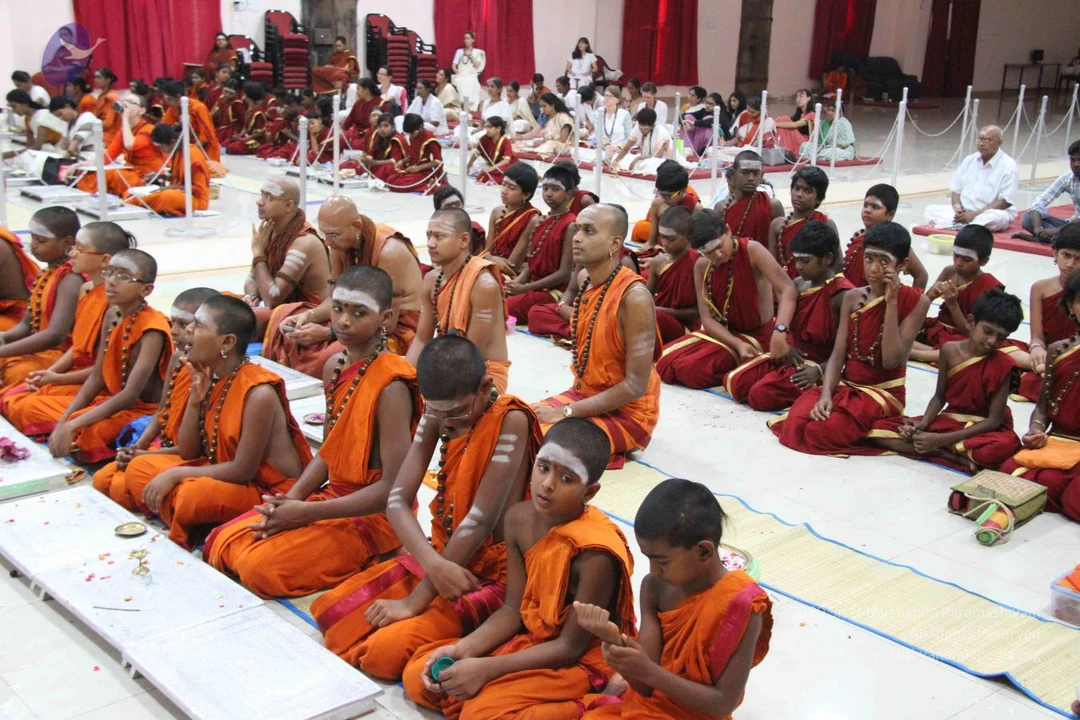
GurukulKids_Krama

4 photosSource gallery
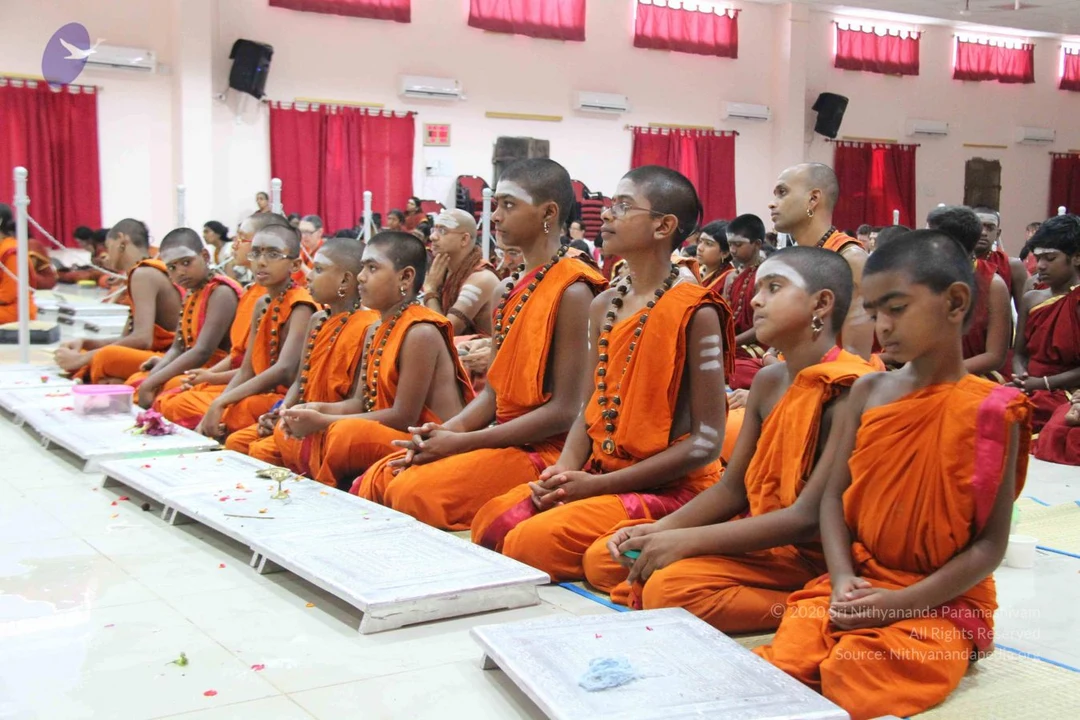
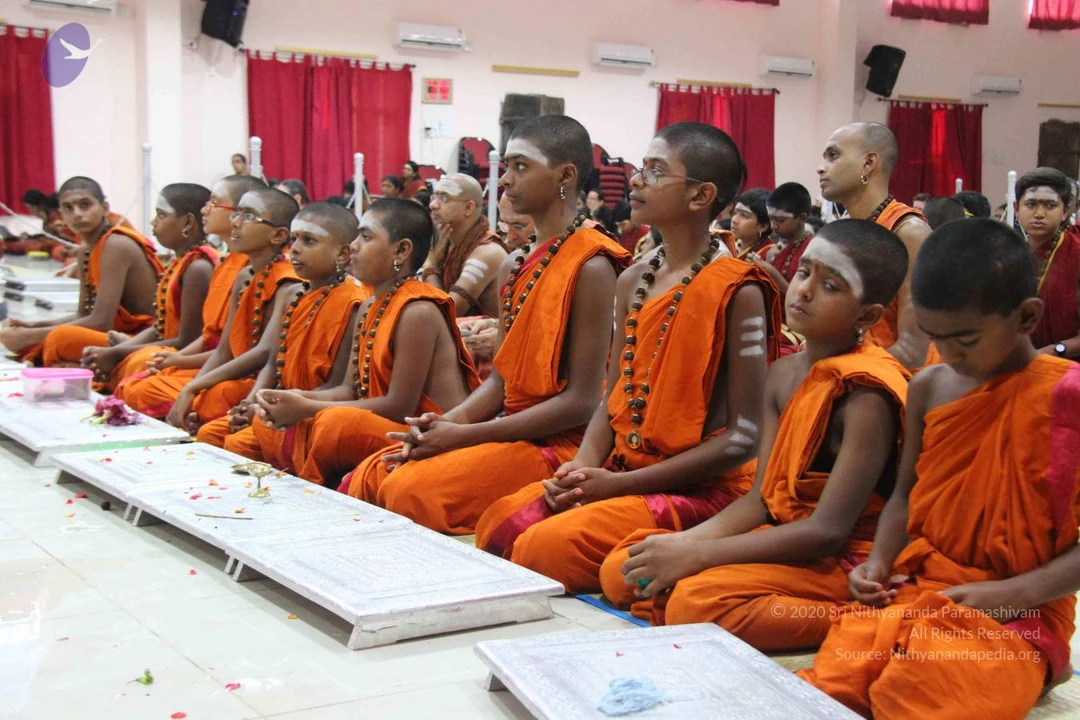
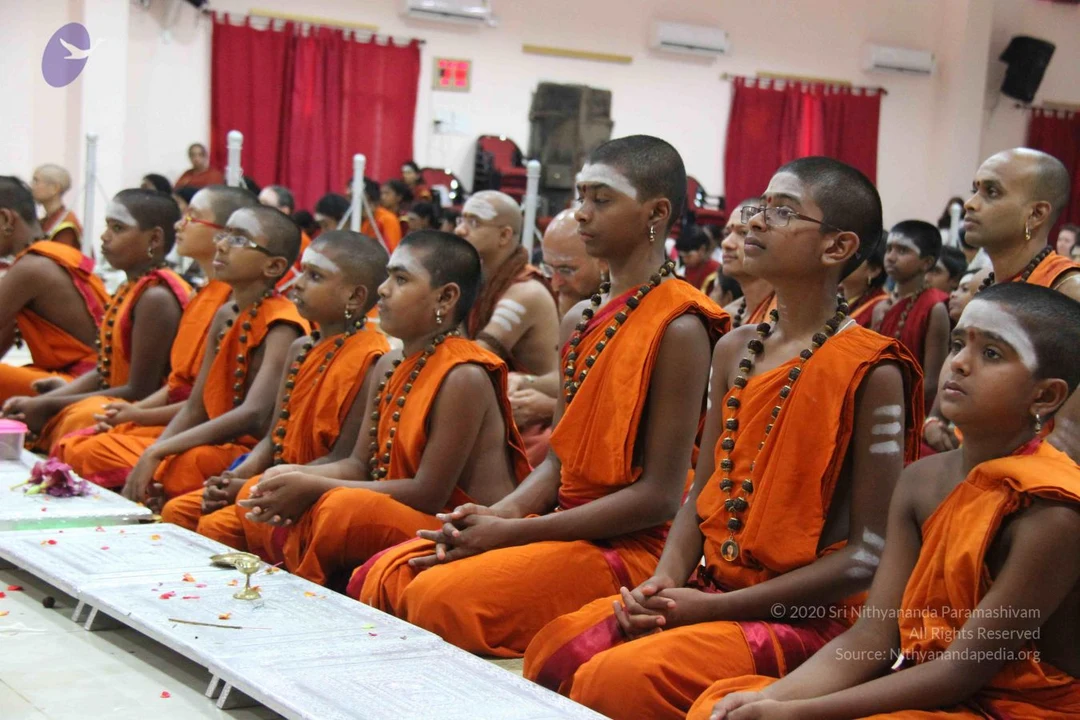
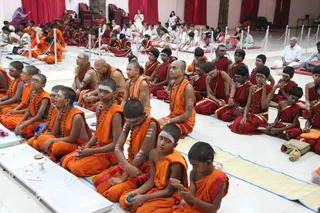
A photograph of a large seated gathering in a bright white hall with red curtains and red-cushioned chairs in the background. Many young boys and some adult men sit cross-legged on mats in rows, wearing saffron/orange and maroon robes with rudraksha malas around their necks, and white horizontal tilaka-like markings across their foreheads. Several boys hold small items, and some sit with hands folded. In the foreground, white floor cloths hold scattered flower petals, a small brass dish, and a folded cloth. Behind them, women in white and an older man in white sit in the back rows. The scene looks like a ritual or puja gathering of young sannyasi-style students.A row of young shaved-headed sannyasi-style students sits cross-legged on a white tiled floor in an ashram hall, wearing saffron-orange robes and rudraksha malas, with white and tilak markings on their foreheads. Several hold their hands together in prayer or rest them in lap. Behind them older devotees in orange and maroon sit in rows, and red curtains hang from the walls beneath air conditioners. White wooden platforms with flower petals lie in front of them. A man in orange robes with a shaved head sits among the older devotees on the right. A small blue cloth lies on the floor near the front row.A photograph of a row of young boys seated cross-legged on the floor of a hall, dressed in saffron-orange robes with rudraksha mala necklaces and white vibhuti lines painted on their foreheads, several with shaved heads. Their hands are folded or resting on their laps as they sit attentively. In the foreground, white stone ritual platforms or seats are arranged with scattered flower petals and a small brass lamp. Behind them, a shaved-headed man in orange and an older bald man in a red-orange shawl sit among other devotees near red curtains and wall air conditioners. The scene appears to be a ceremonial gathering or puja.Photo of a seated row of young shaved-headed monastic students in saffron-orange robes with rudraksha malas and white vertical forehead markings, hands folded or resting on their laps, facing forward in a hall with red curtains and wall air conditioners. Several adults in orange robes and white forehead marks sit behind them. A small brass oil lamp and scattered flower petals lie on a white ritual platform in the foreground, with a bunch of pink flowers at left. Several onlookers stand in the background.

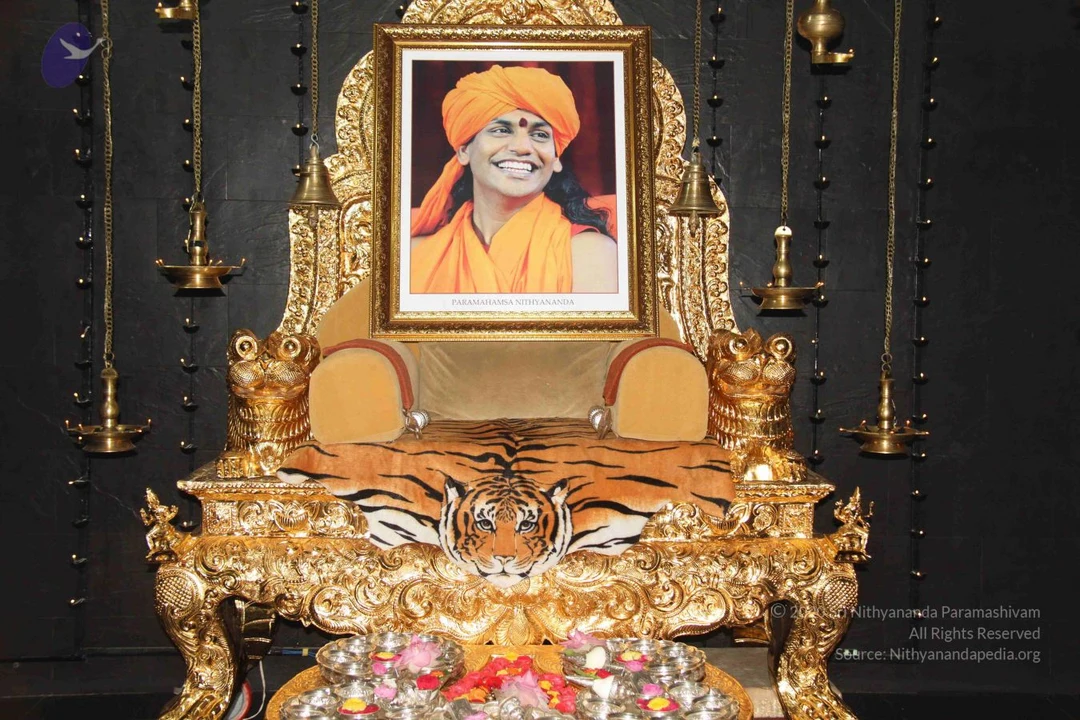
PADUKA POOJA
37 photosSource gallery
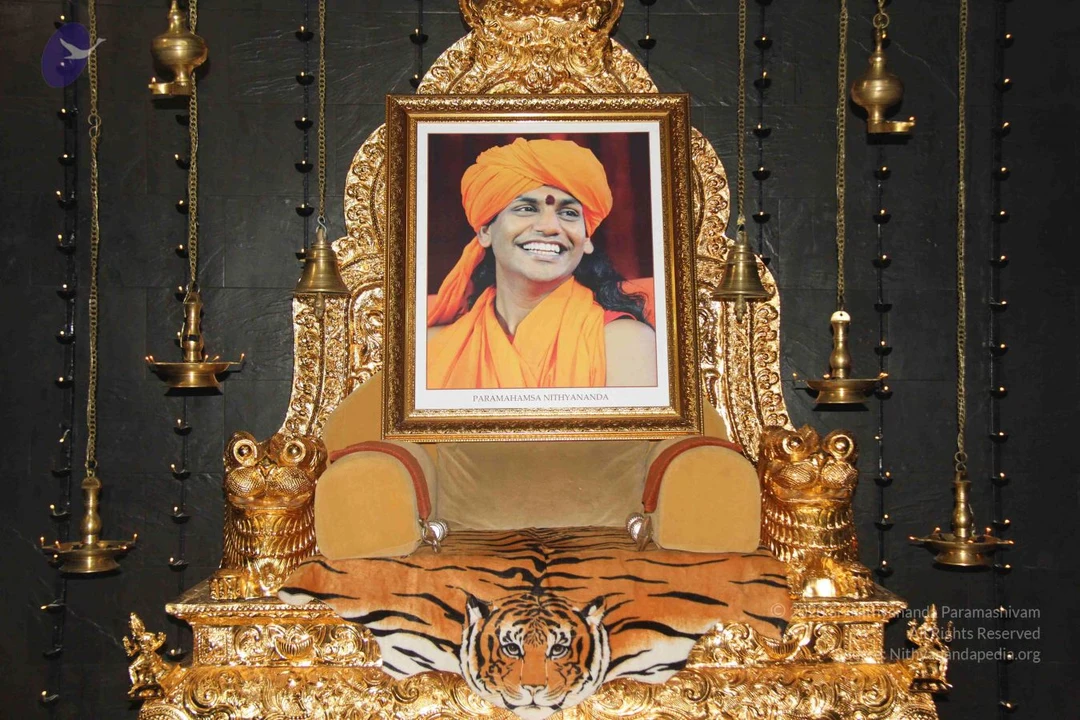
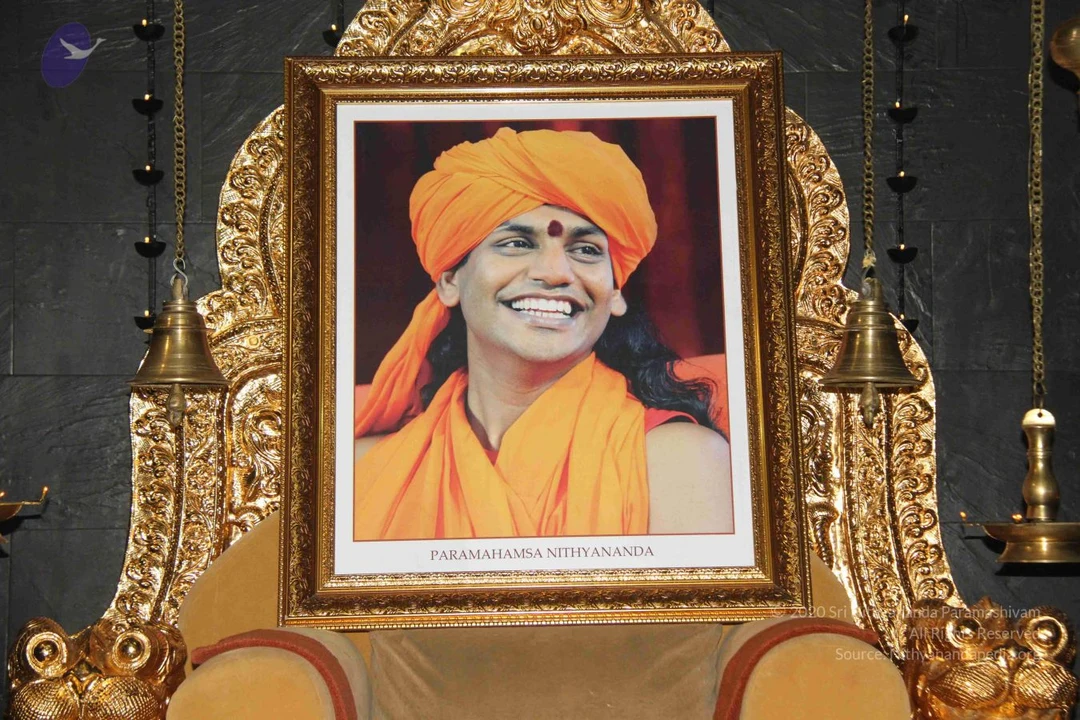
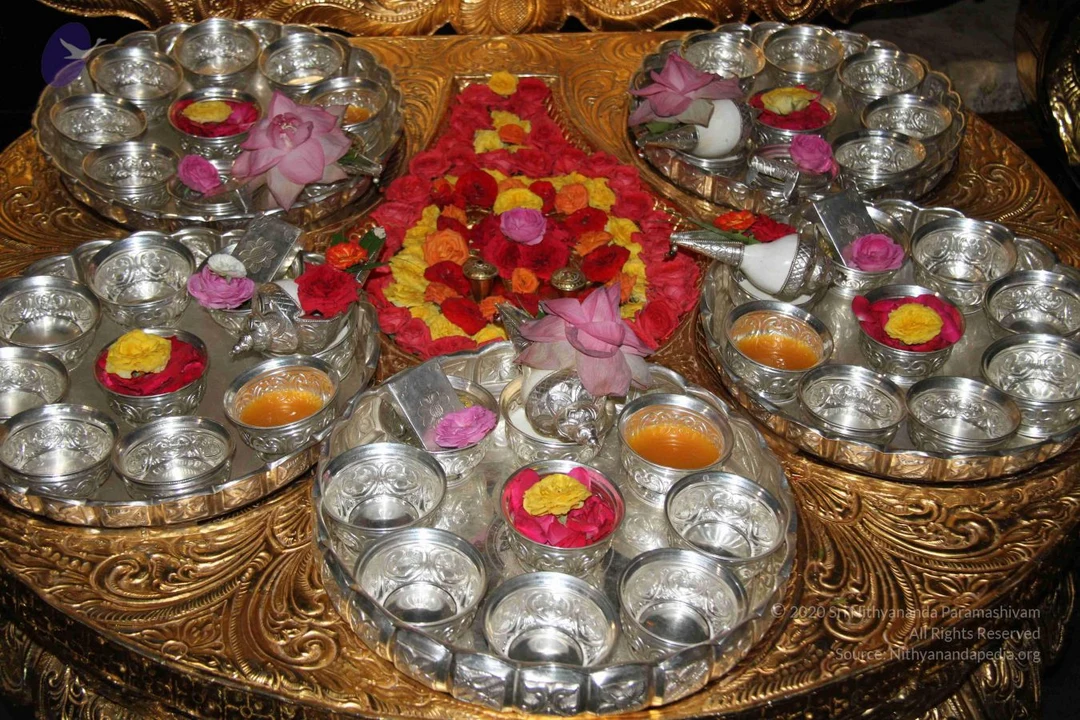
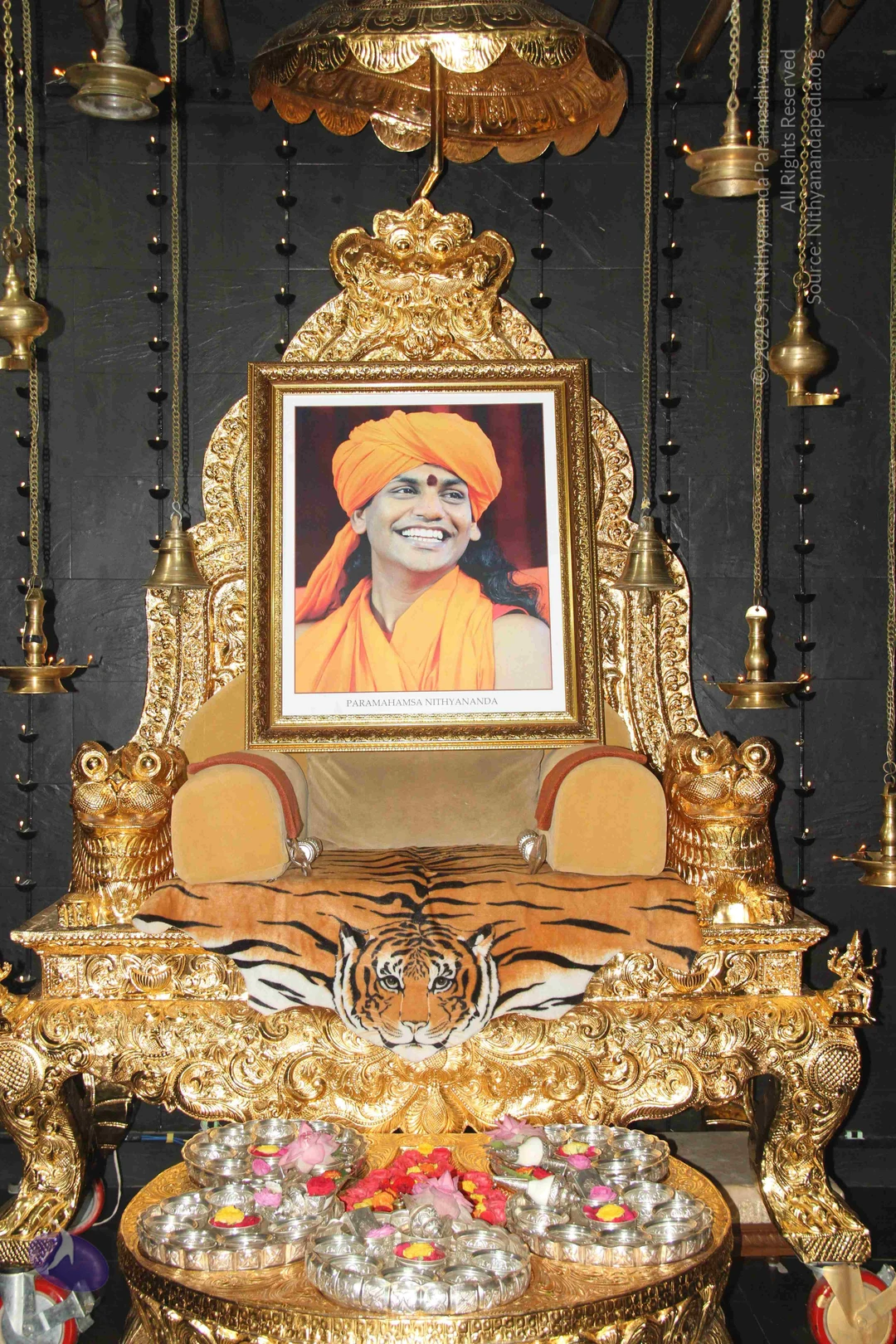
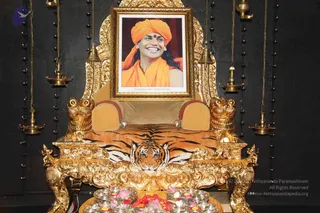
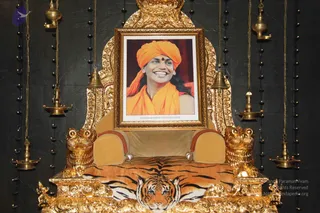
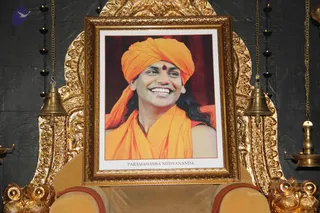
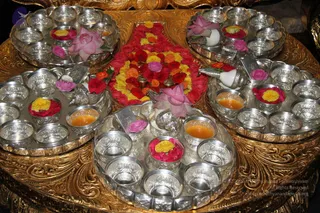
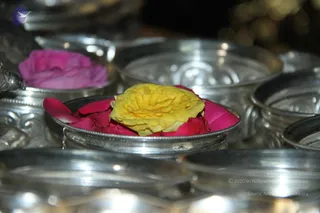
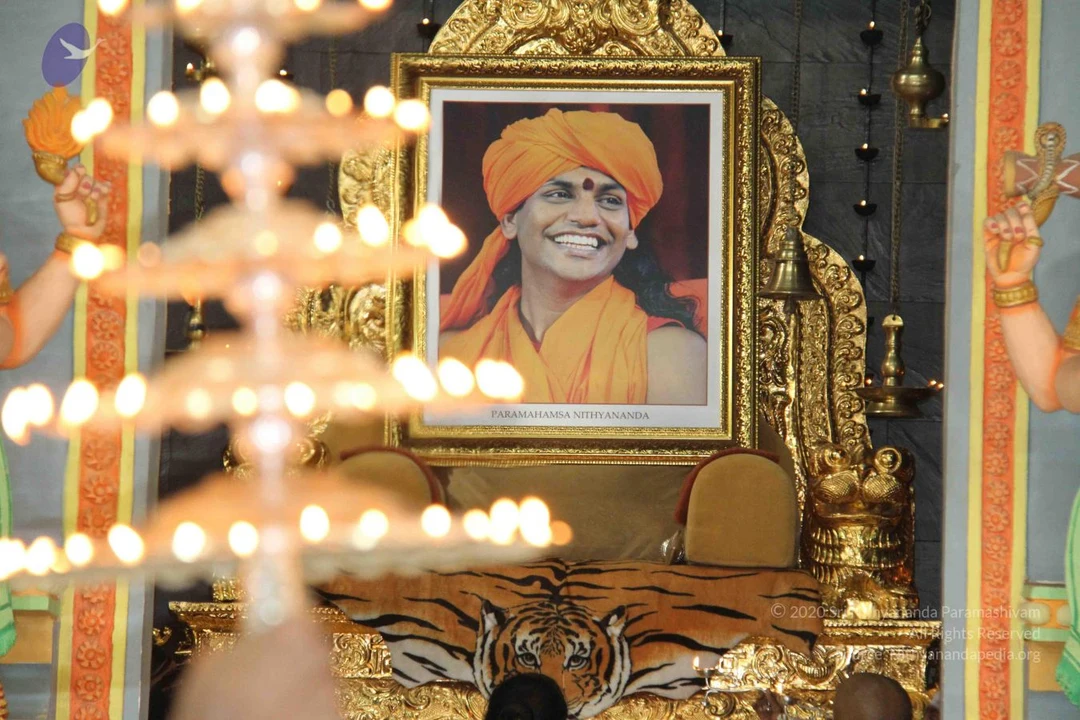
A golden ornate throne is the central subject, draped with a tiger-skin cushion and flanked by carved lion-head armrests. Above it hangs a framed portrait labelled "PARAMAHAMSA NITHYANANDA" showing a smiling man with a saffron-orange turban and orange robes, with a red bindi on his forehead. Brass oil lamps and bells hang on chains on either side, and in front of the throne sit silver plates and bowls filled with pink and red flower petals and marigolds. A dark wall forms the backdrop. No physical people are present.An empty ornate golden throne (peetha) with carved lion-head armrests sits against a black stone wall, draped with a tiger-skin cushion showing a tiger face at the front. Above the seat hangs a framed portrait labelled "PARAMAHAMSA NITHYANANDA" showing a smiling man with a red bindi, orange turban and orange robes, with long dark hair. Hanging brass oil lamps (deepa) on chains flank the throne, along with strings of dark beads. No people are physically present in the scene.A framed photograph portrait of a smiling man with a red bindi, orange turban and orange shawl, displayed on an ornate gold throne-like chair with a cushioned tan seat. A brass oil lamp hangs on chains on the left and a brass lamp stands on the right against a dark stone wall. The portrait is labelled "PARAMAHAMSA NITHYANANDA" on the frame. The portrait is a printed picture, not a physical person, so no one is physically present in the scene.A photograph of an ornate ritual arrangement on a gilded, embossed golden tray. Silver bowls and dishes are arranged in tiered circles, holding saffron-yellow and orange liquid, yellow marigold-like flowers, and pink and red petals. Pink lotus blossoms and white and silver kalasha-style vessels stand among them. At the centre, red, orange and yellow petals form a patterned floral design with small brass lamps. No people are visible.Close-up photograph of a ritual offering arrangement on a metal tray. Several ornate silver bowls with embossed floral borders hold petals: a yellow marigold-like flower with pink rose petals in the central bowl, and pink petals in another bowl at left. Behind them rests a silver conch-shaped vessel with a pink lotus flower laid across it. A silver ritual object with a long handle is visible at upper right, and blurred red flowers and gold fabric appear in the background. The scene suggests a puja offering setup, with no people visible.Close-up photograph of several polished silver bowls on a surface, the foreground bowl holding a yellow rose and scattered pink and magenta rose petals. Other silver bowls with pink petals sit blurred in the background. No people are visible.
RUDRABHISHEKAM
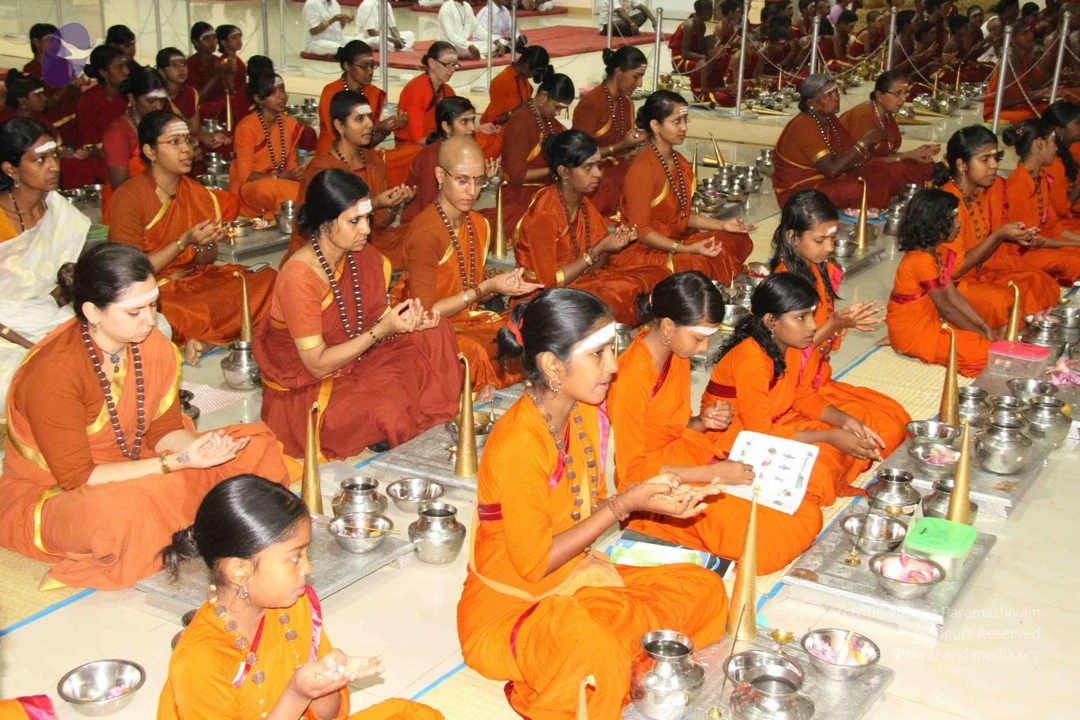
18 photosSource gallery
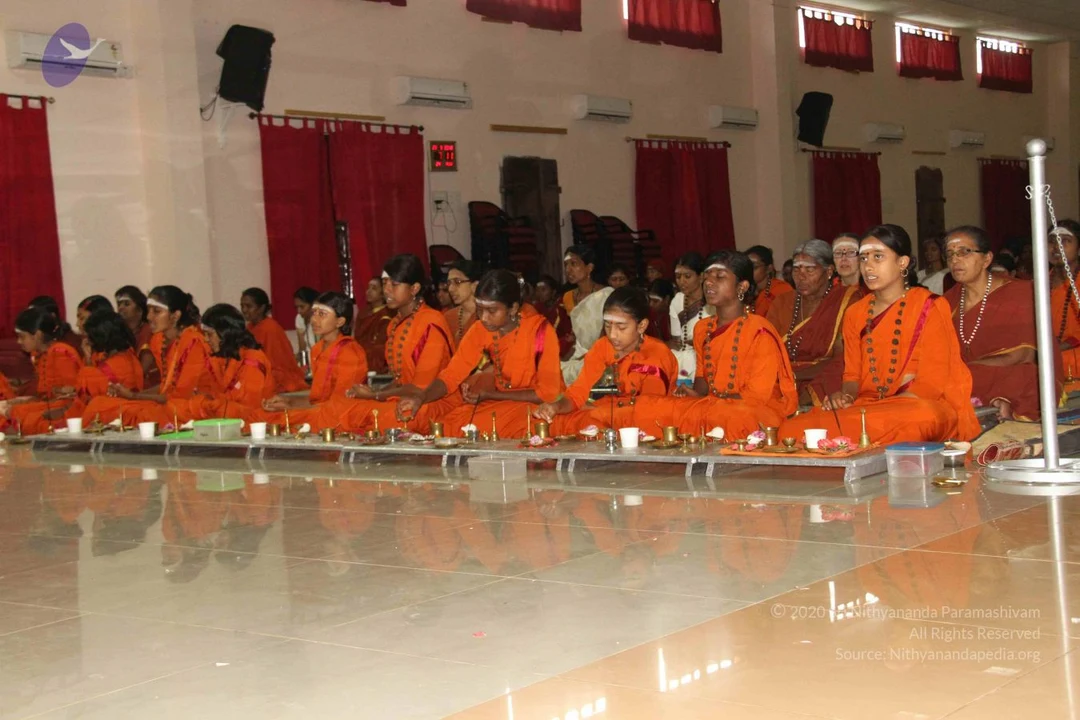
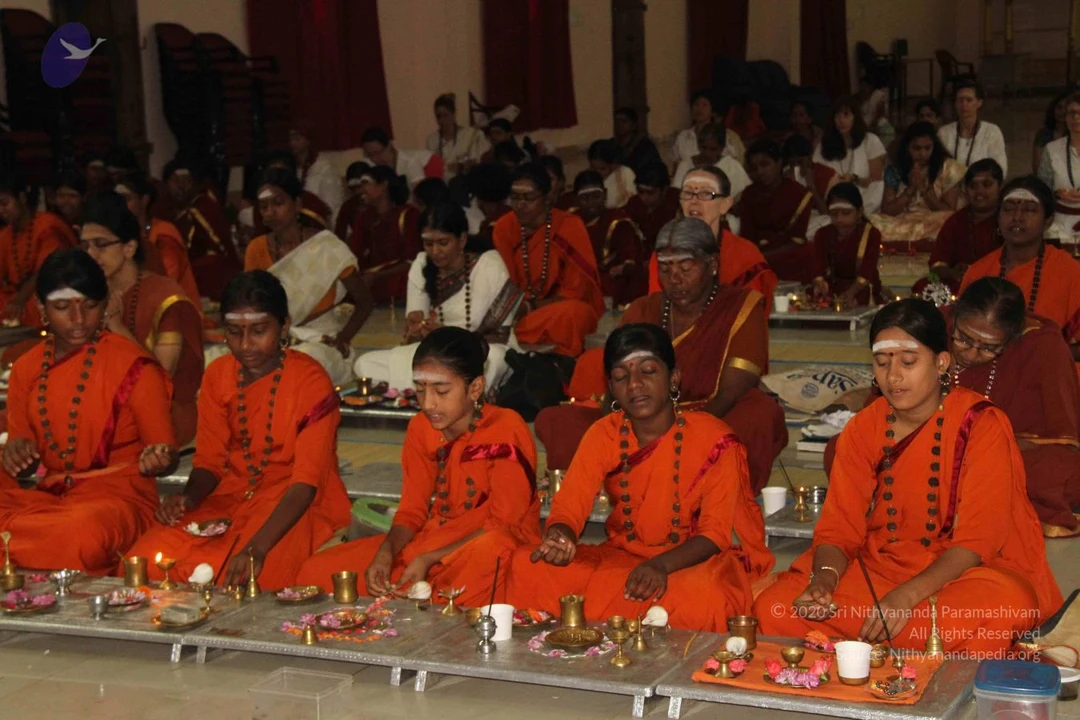
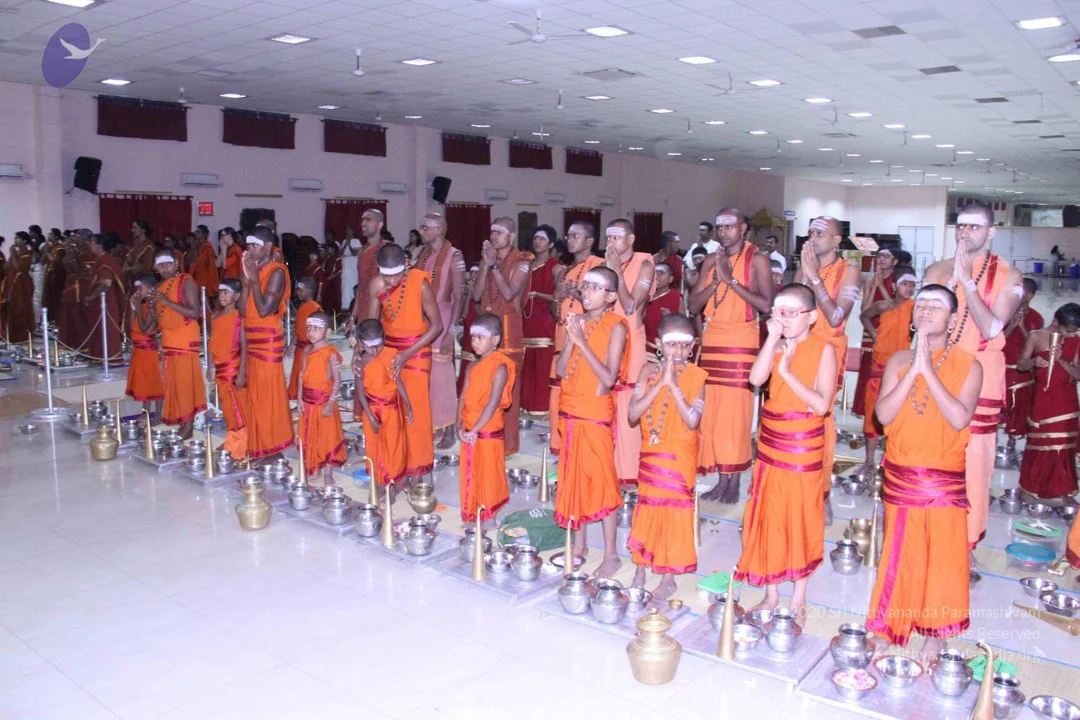
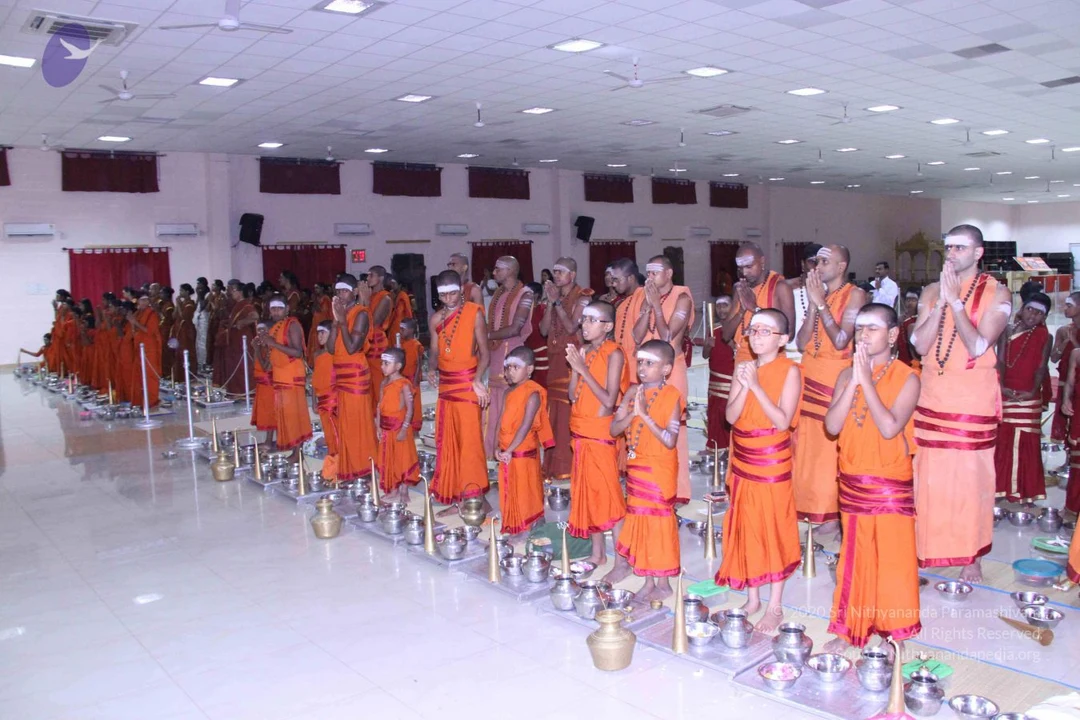
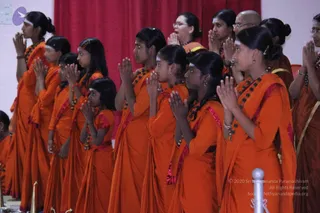
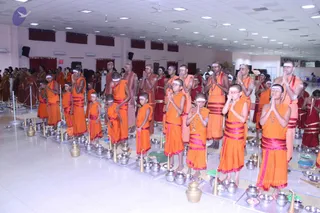
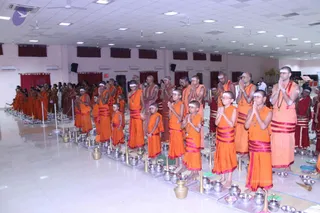
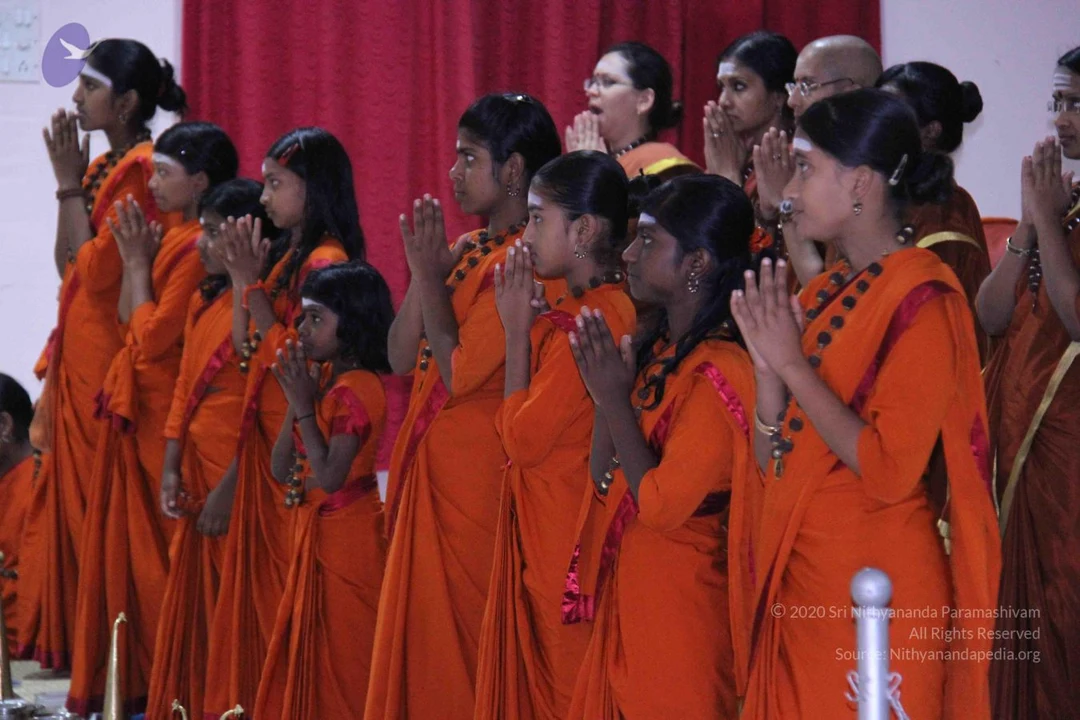
A row of young women and girls in orange saris with dark rudraksha-style beaded necklaces stand in a hall with palms pressed together in namaste, facing right. Several wear white tilak marks on their foreheads and some have flowers in their hair. Behind them a red curtain hangs and a woman in orange with glasses and a shaved-headed man in white stand among the group. A white microphone stand and a brass lamp edge the lower frame. Devotees appear to be offering greetings during a gathering.A photograph inside a large hall with white walls, red curtains and ceiling lights shows a row of young boys and adults in orange and saffron dhotis and wraps with pink or red waist sashes, standing with palms pressed together in namaskar. Several have white headbands and rudraksha malas. Brass kalashas, pots and bowls sit on low platforms in front of them. Behind them, more people in orange and maroon clothing stand among rows of attendees. No individual can be confidently identified as a person from appearance cues alone.A large hall with white tiled floor and ceiling fans shows a long row of saffron-robed sannyasis and young boys standing with palms pressed together in namaskar. Many have shaved heads, wear rudraksha malas, and have red-and-maroon waist cloths. Behind them, rows of brass and steel pots, bowls and kalasha vessels sit on low stands. A devotee in a dark shirt stands at the far right. The scene is a formal group ritual, with some figures in maroon and red garments further back.A photo of a seated group of young and adult sannyasis in saffron and orange robes with rudraksha malas, many with white vibhuti markings on their foreheads and arms, sitting on mats during a ritual. Several hold their hands in prayer (anjali) while others sit with hands folded or resting on laps. Around them are brass and steel pots, bowls, and kalasha-style vessels, with conical brass cups and pieces of fruit and flowers on silver trays. Some wear pink or red sashes over saffron cloth, and a few older men wear pale pink robes with orange shawls. The setting is a tiled hall with a light-coloured floor and an ornate cushioned sofa in the background.A photograph of a large group of young and adult sannyasis seated cross-legged on the floor of a temple hall during a ritual. Most wear saffron-orange robes with rudraksha malas and white sacred ash (vibhuti) marks on their foreheads and bodies. Several have their hands folded in anjali, while others hold small brass vessels and metal bowls filled with offerings. Brass kalashas, bronze pots and steel bowls are arranged on low platforms in front of them. Some wear red and pink borders, and a few are young boys. The setting is a tiled hall with a golden backdrop.Photograph of an empty ceremonial stage with a gold-and-red throne backed by lion-head arm supports and a tiger-skin cushion, set before deep red velvet drapes. A framed portrait labelled "Paramahamsa Nithyananda" sits above the throne, showing a smiling man in an orange turban and orange robe. A small gold footstool and a patterned rug lie in front. At the lower left, two men sit on the floor: one in white dhoti and shawl with a rudraksha mala, the other in orange robe with shaved head and white tilak, both with hands raised near their faces.

SATSANG
25 photosSource gallery
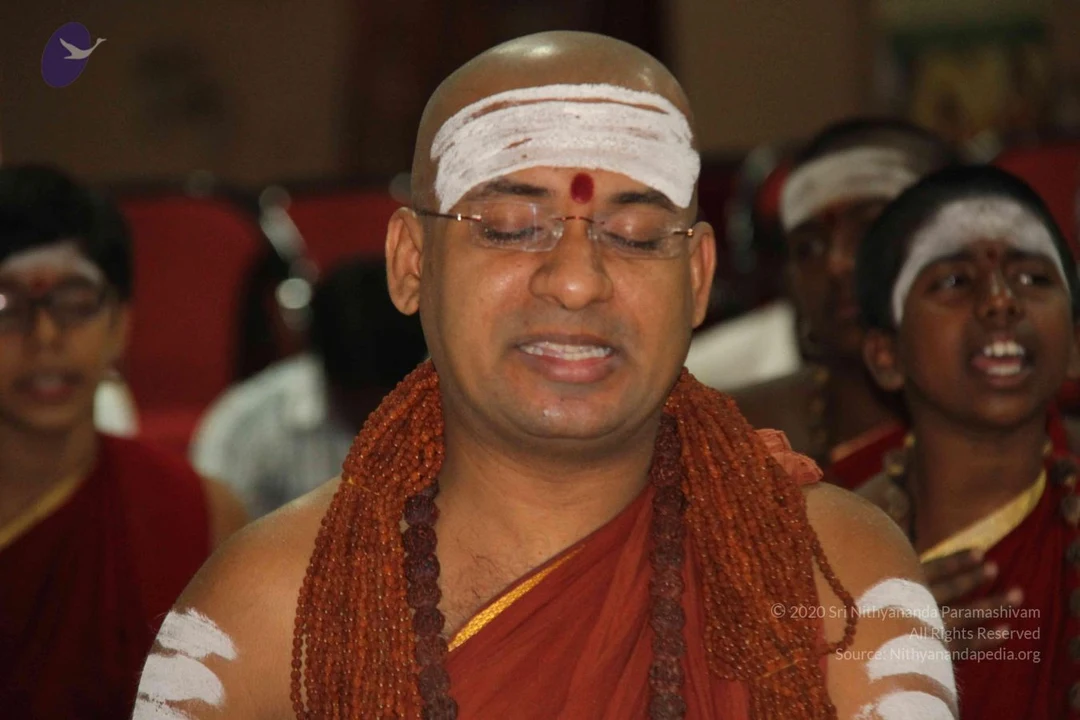
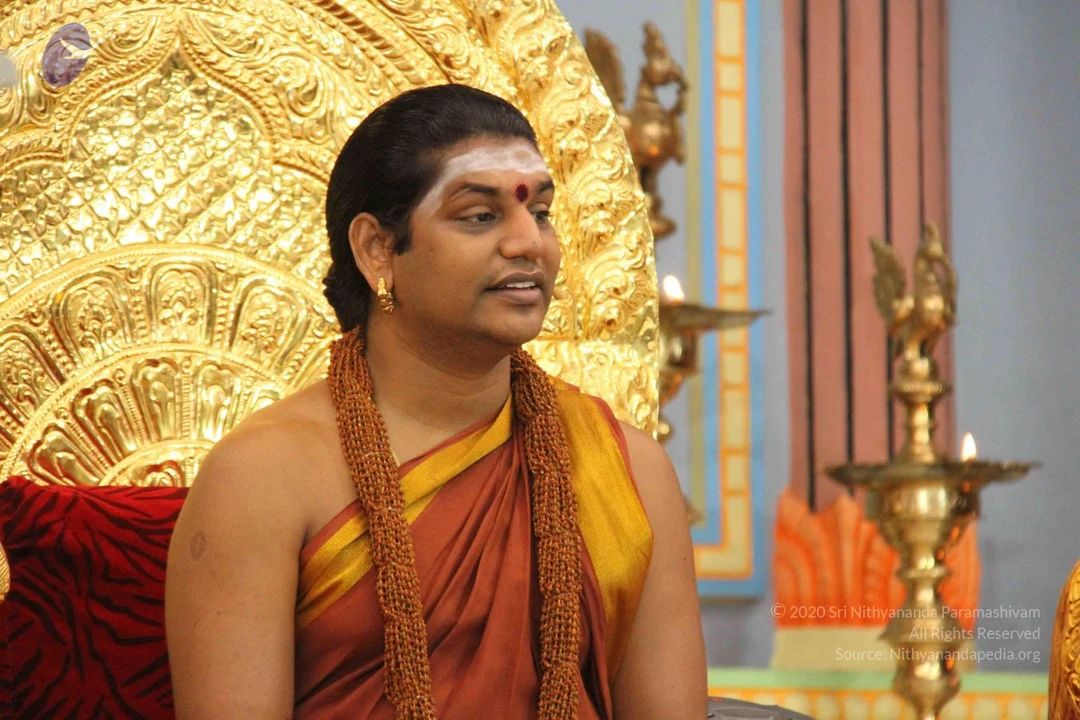
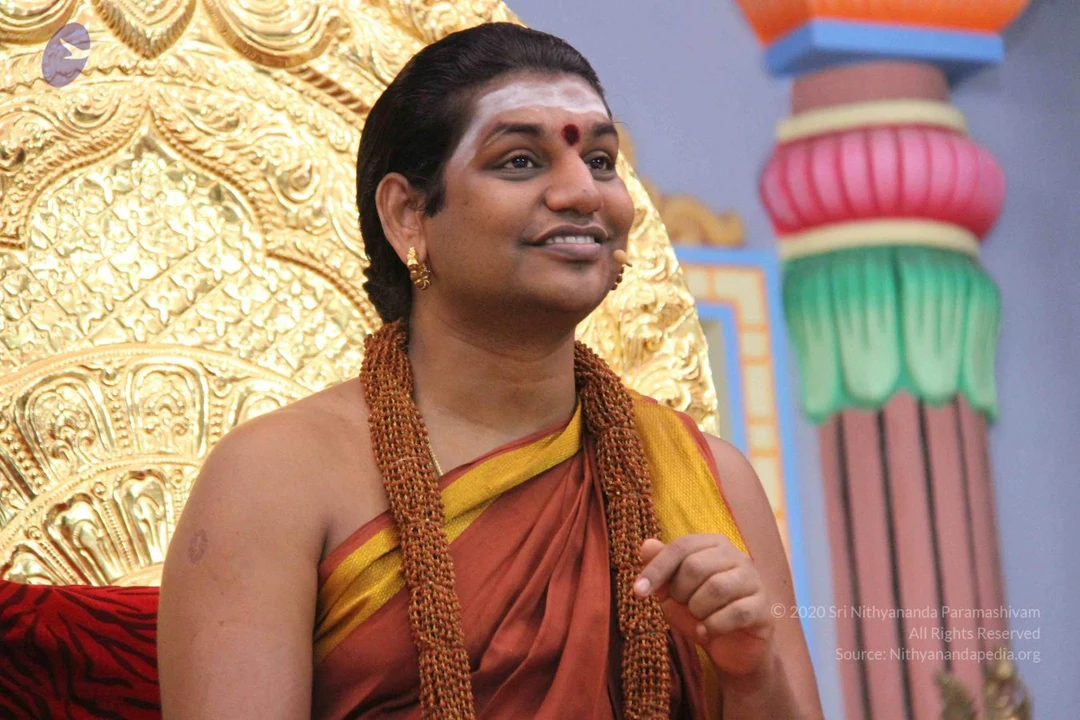
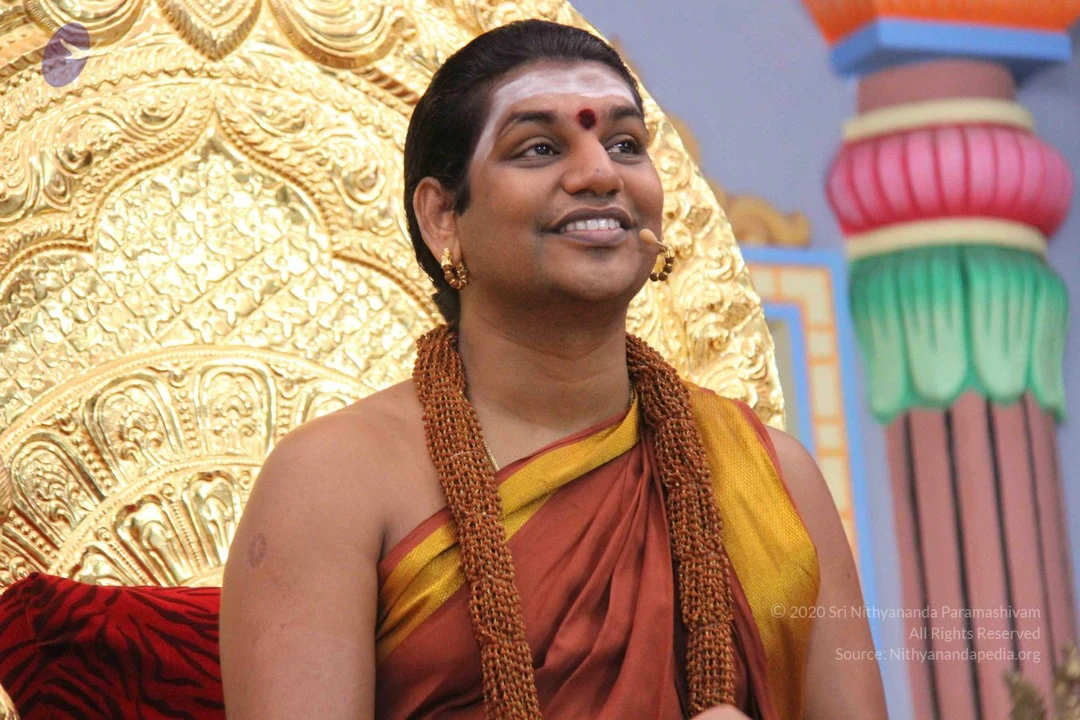
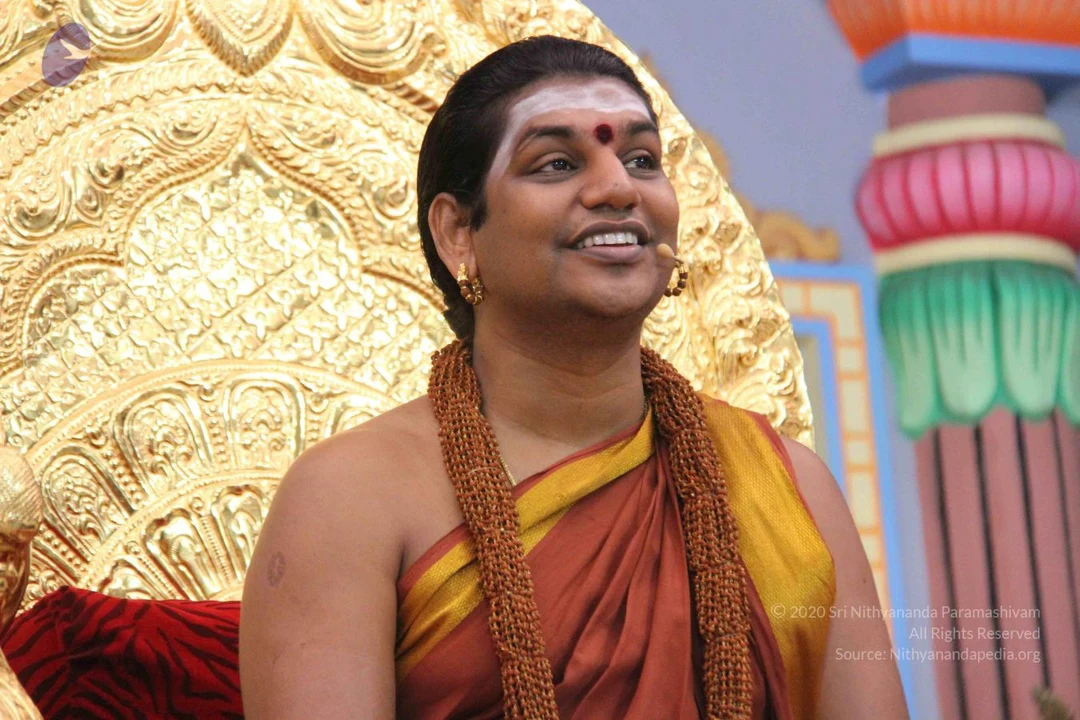
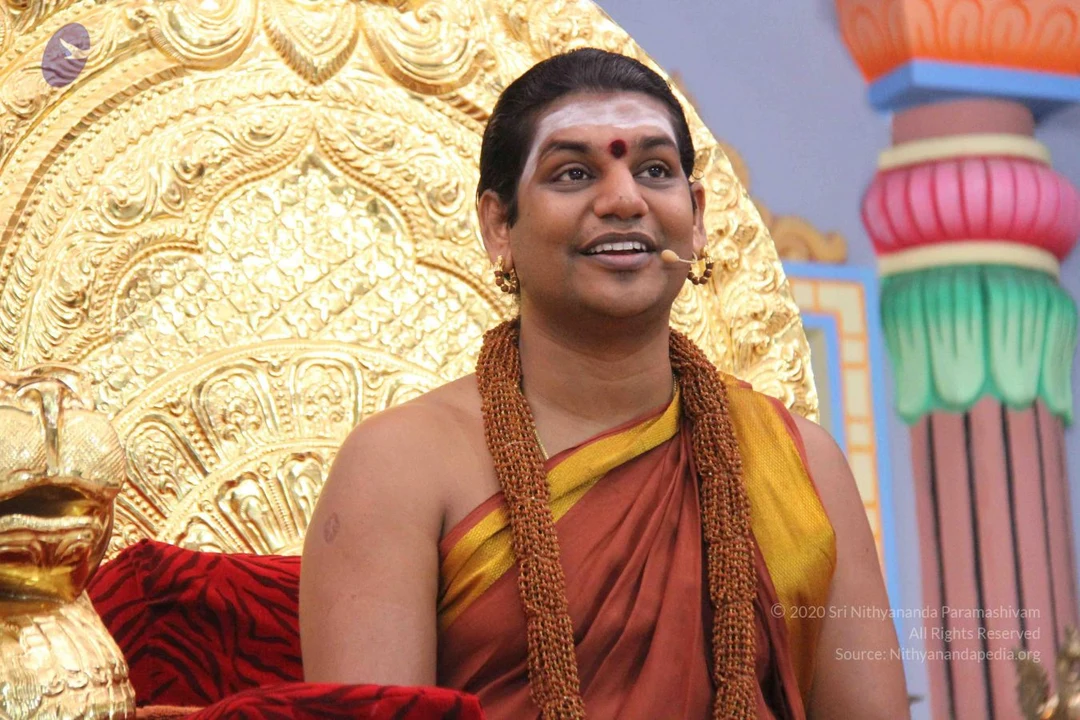
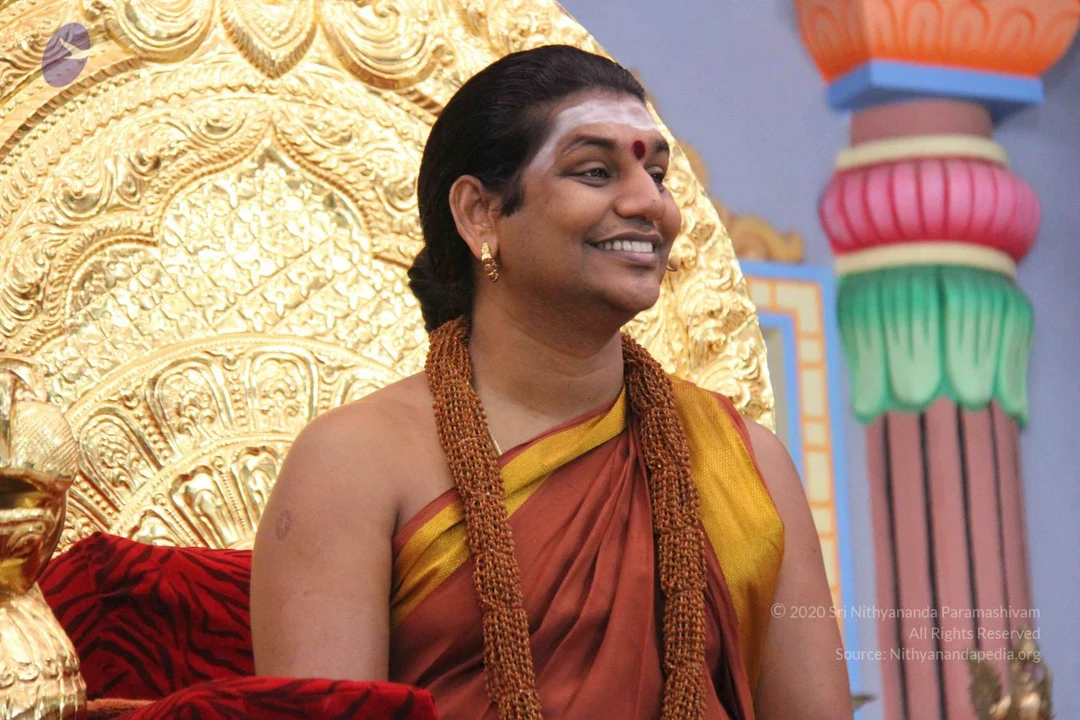
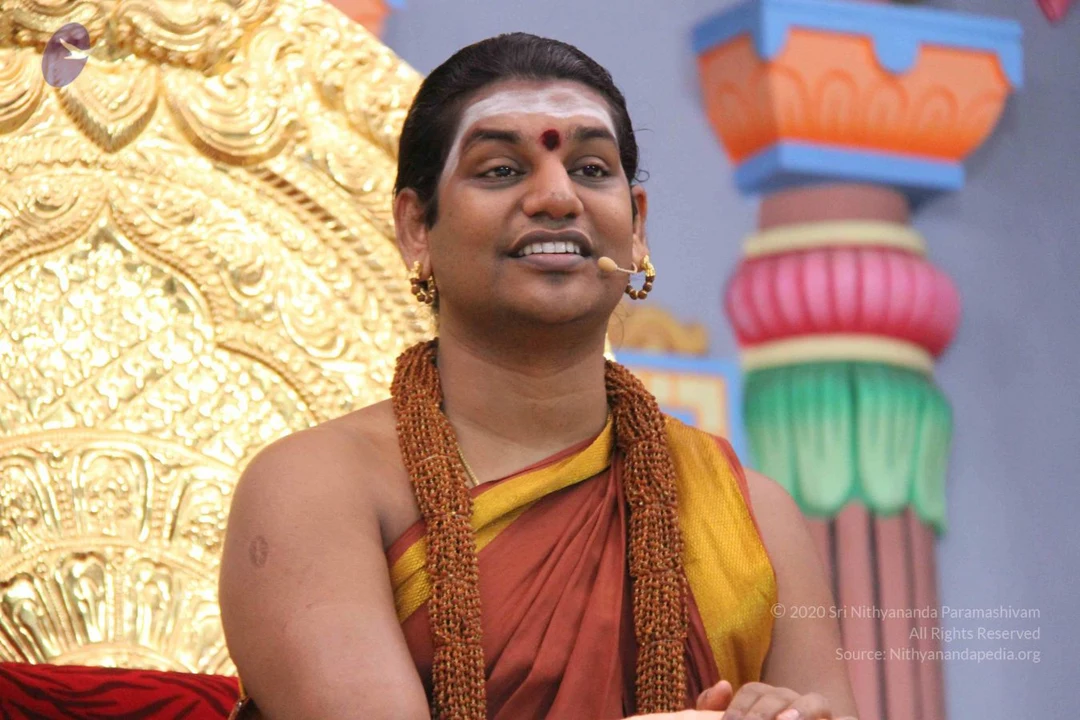
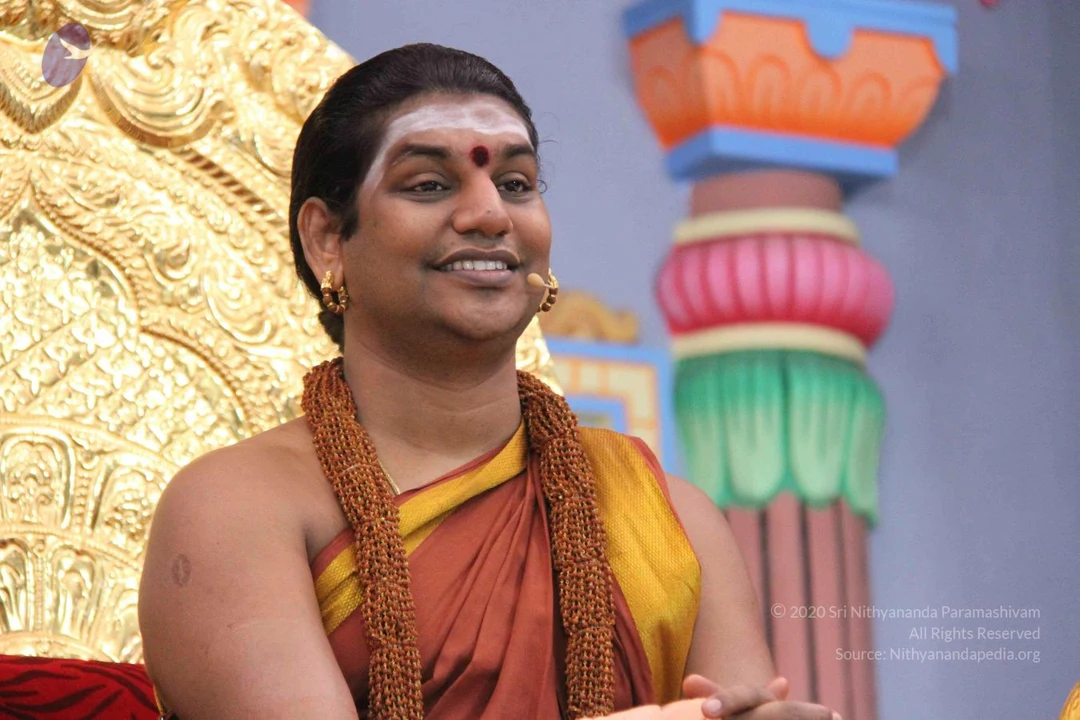
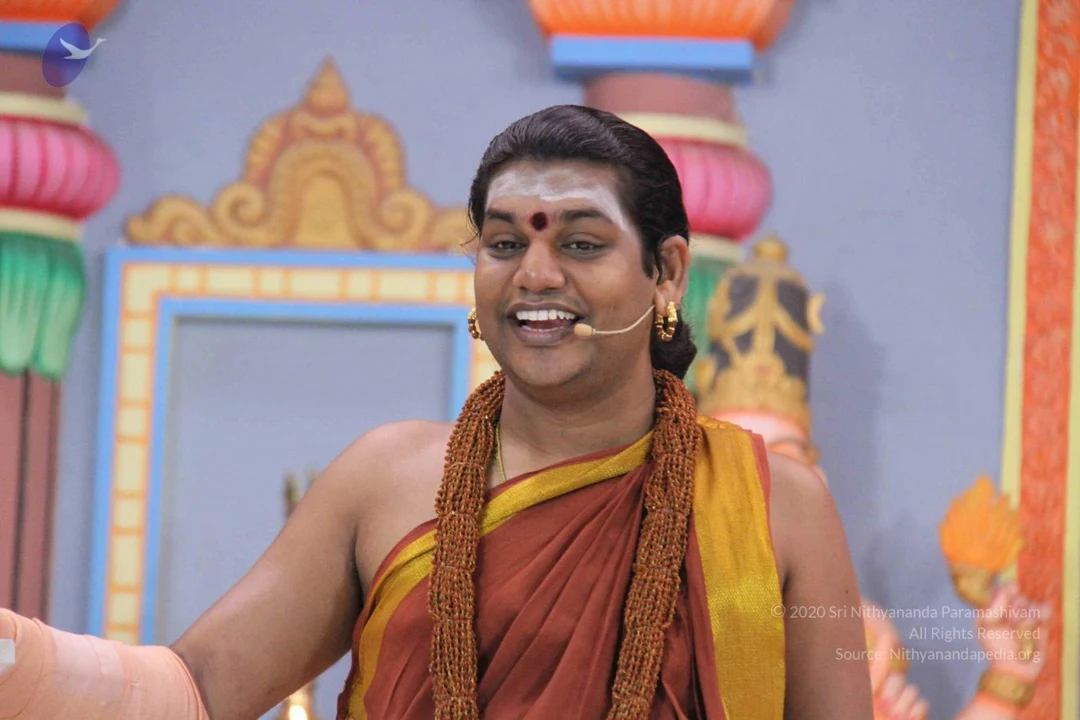
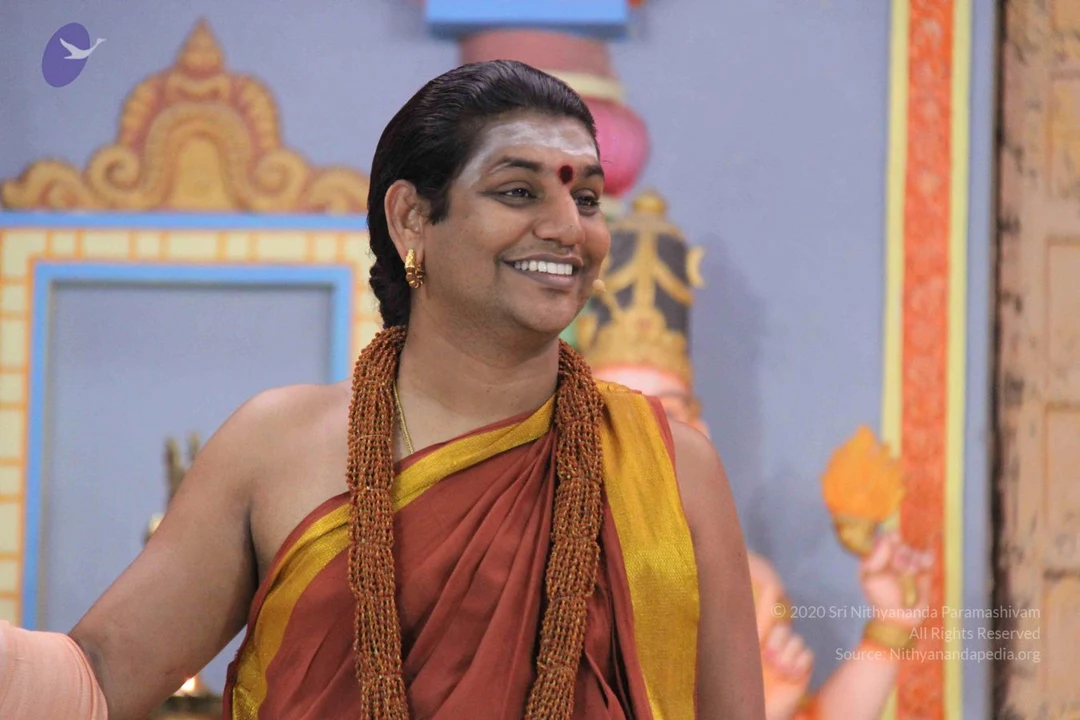
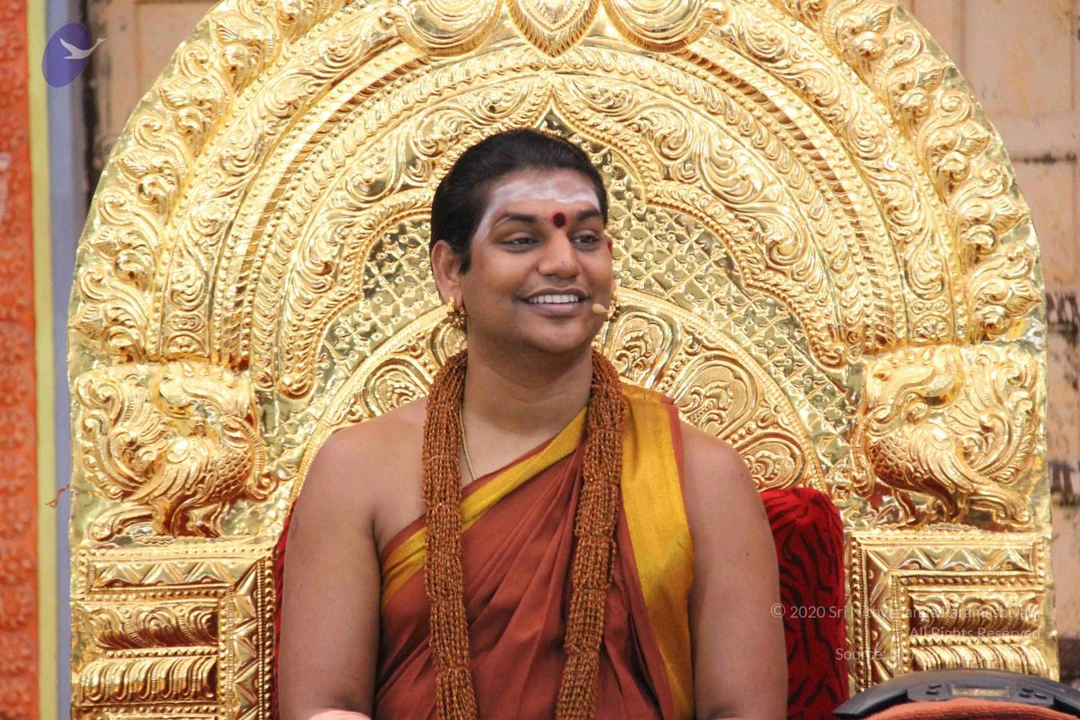
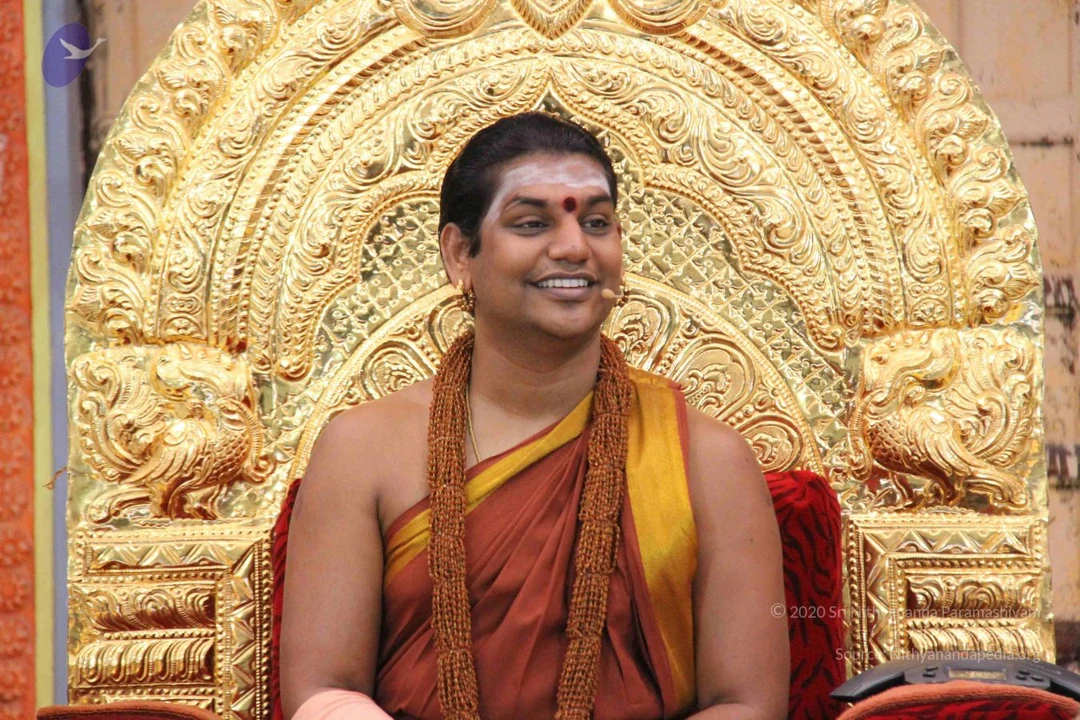
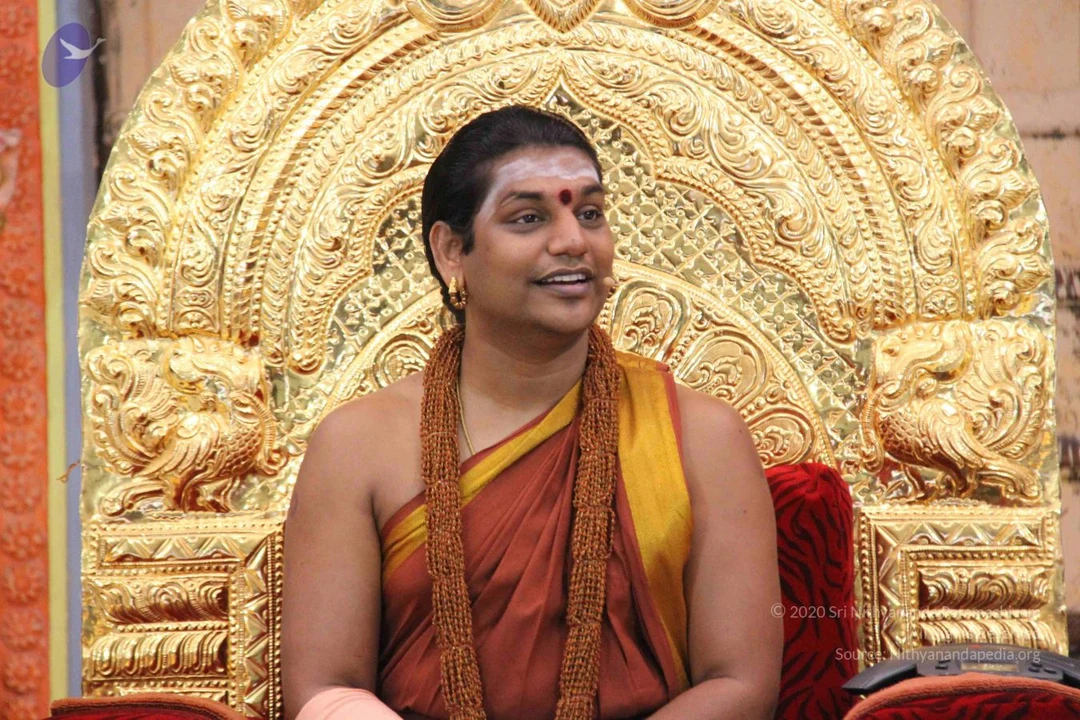
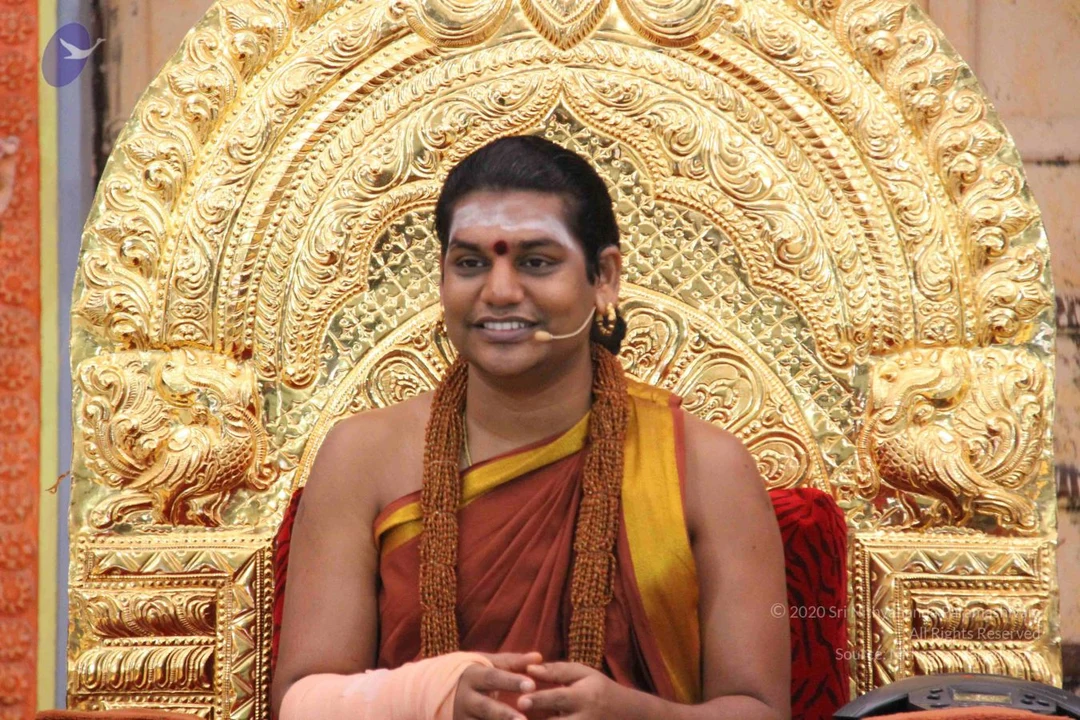
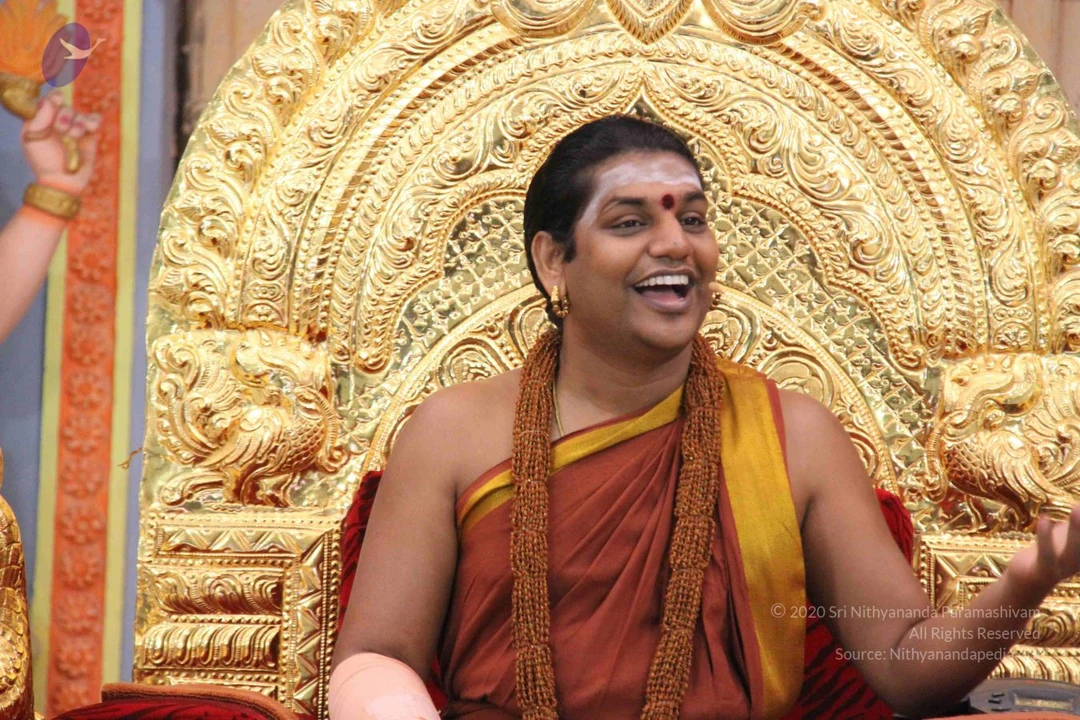
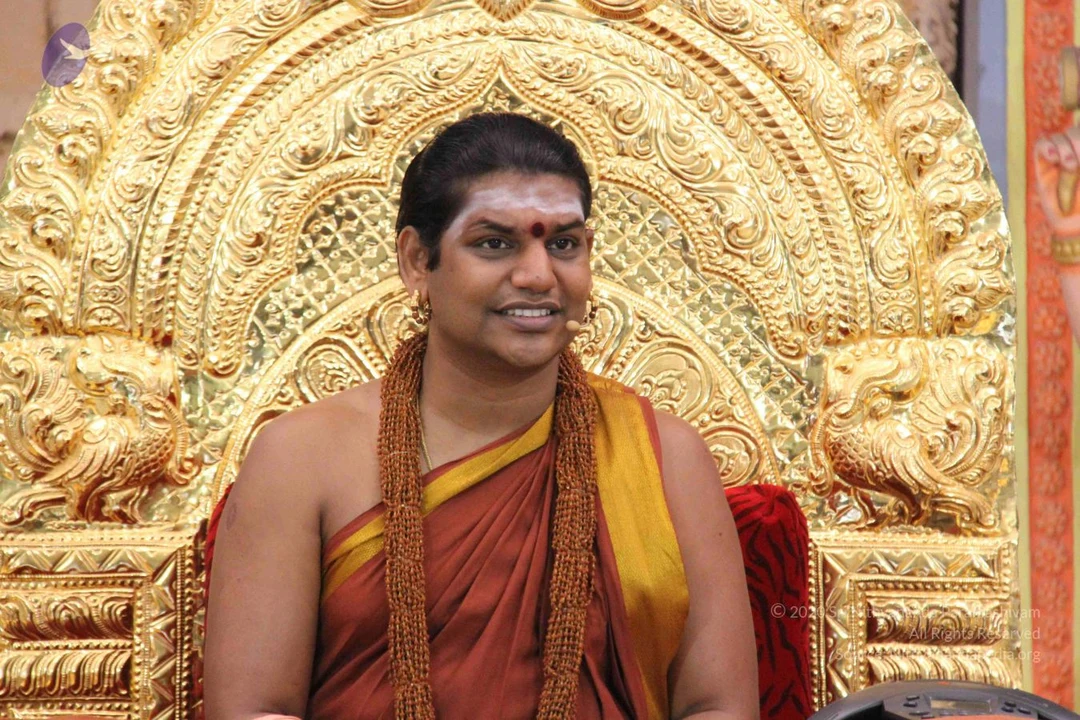
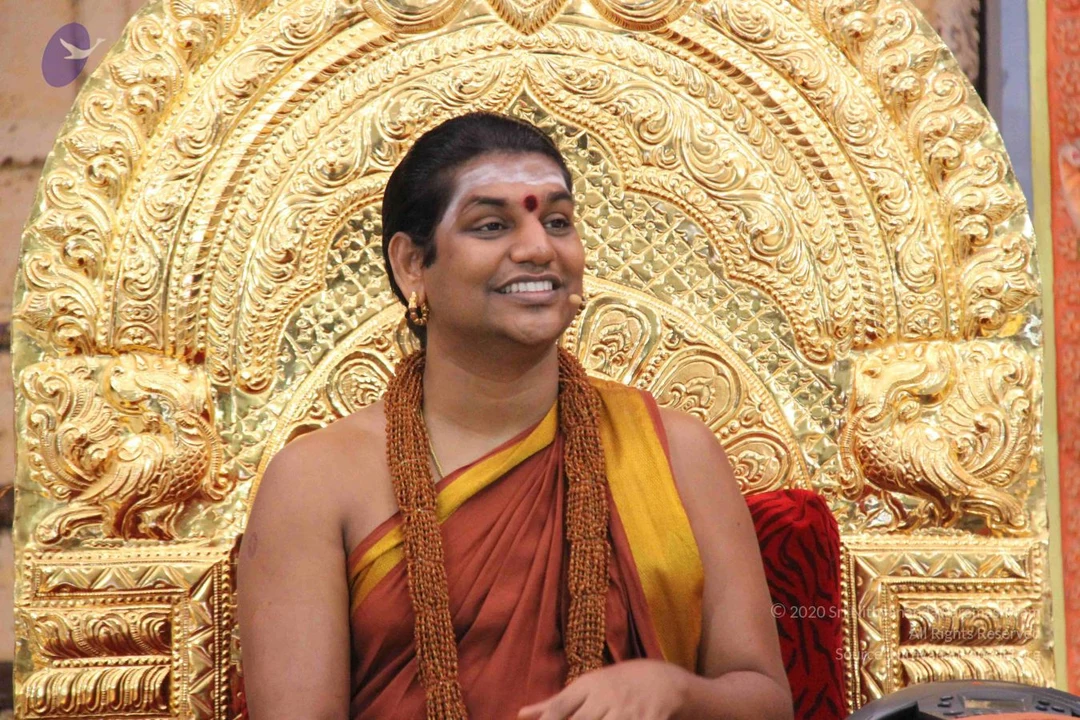
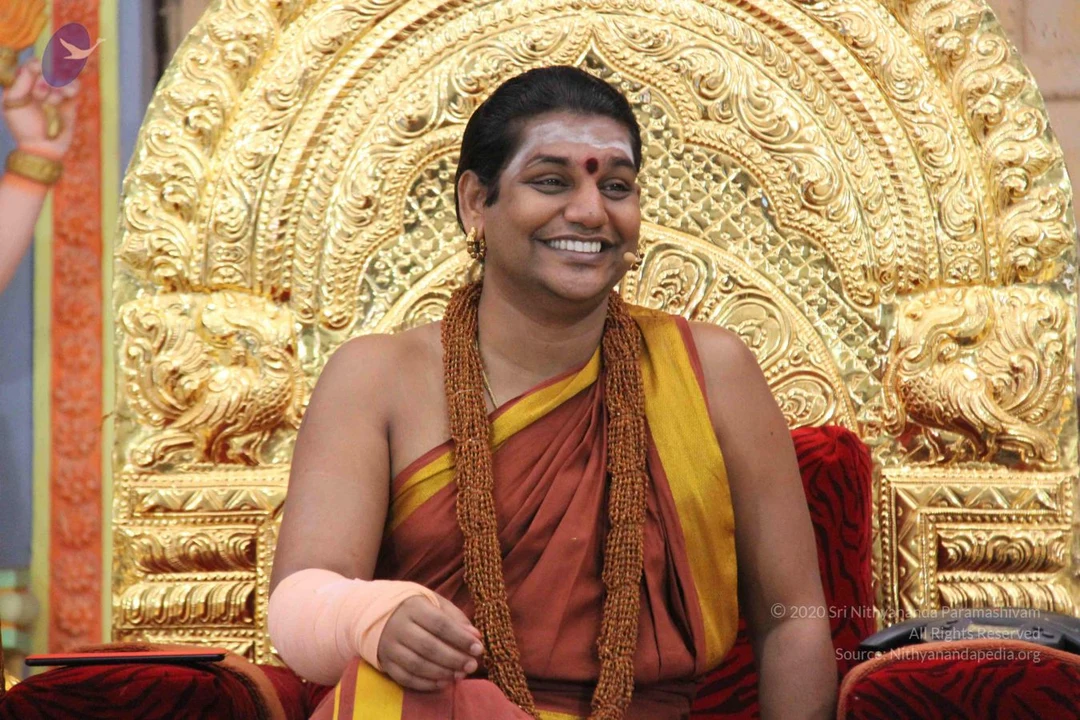
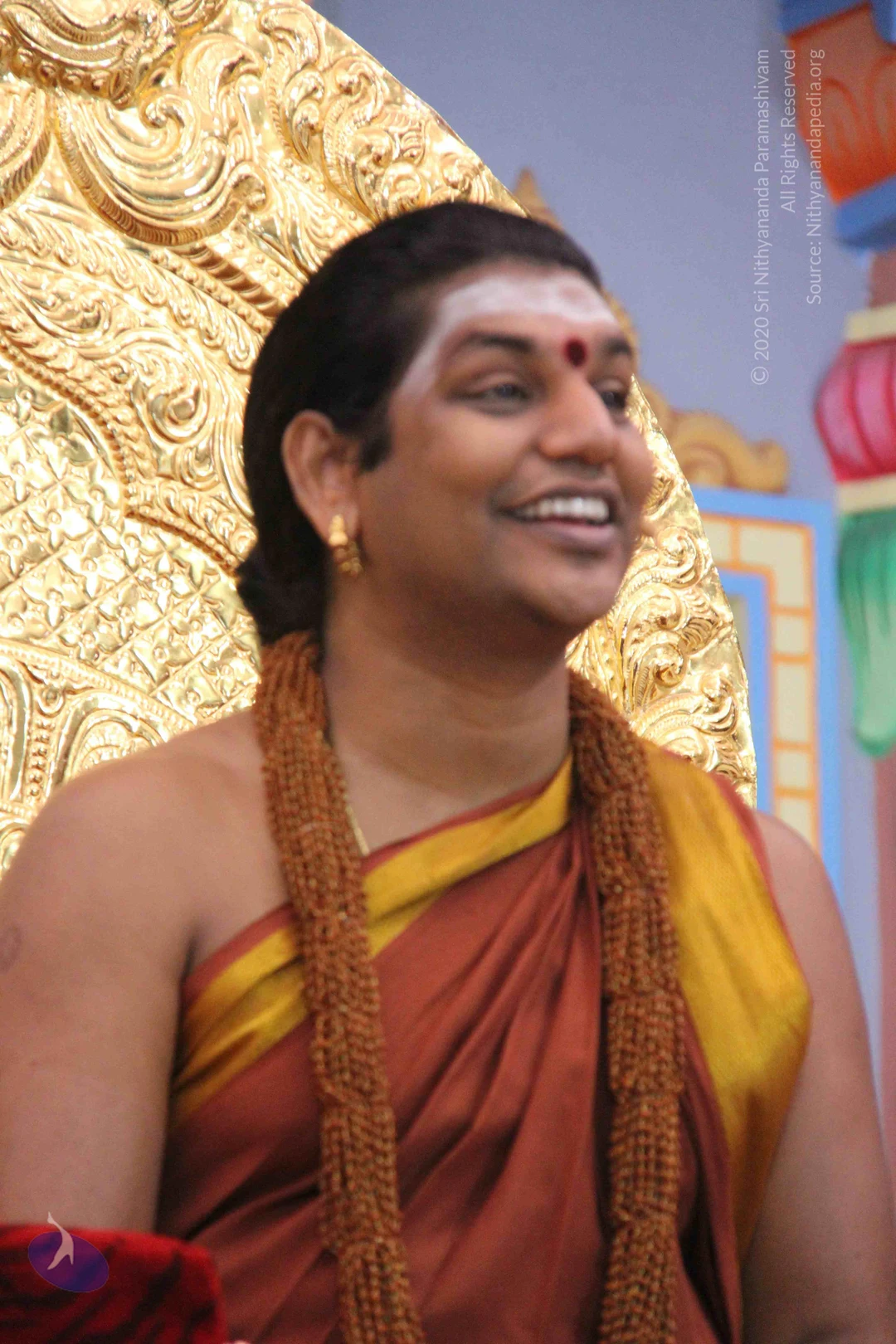
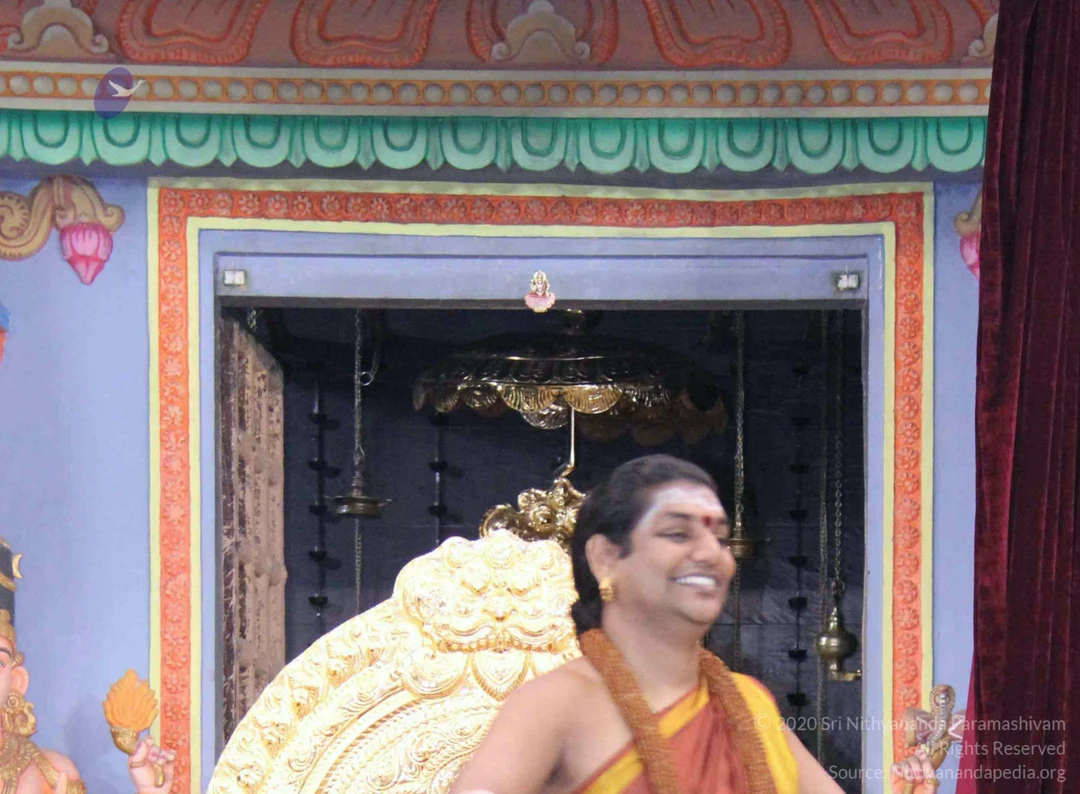
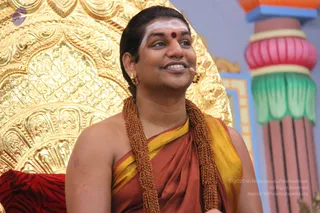
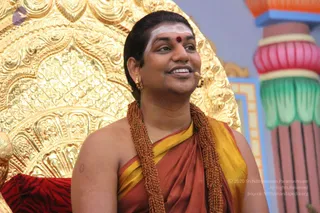
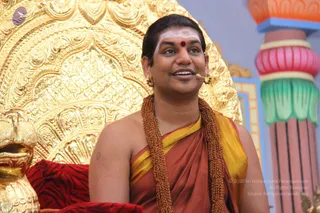
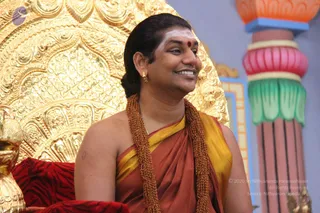
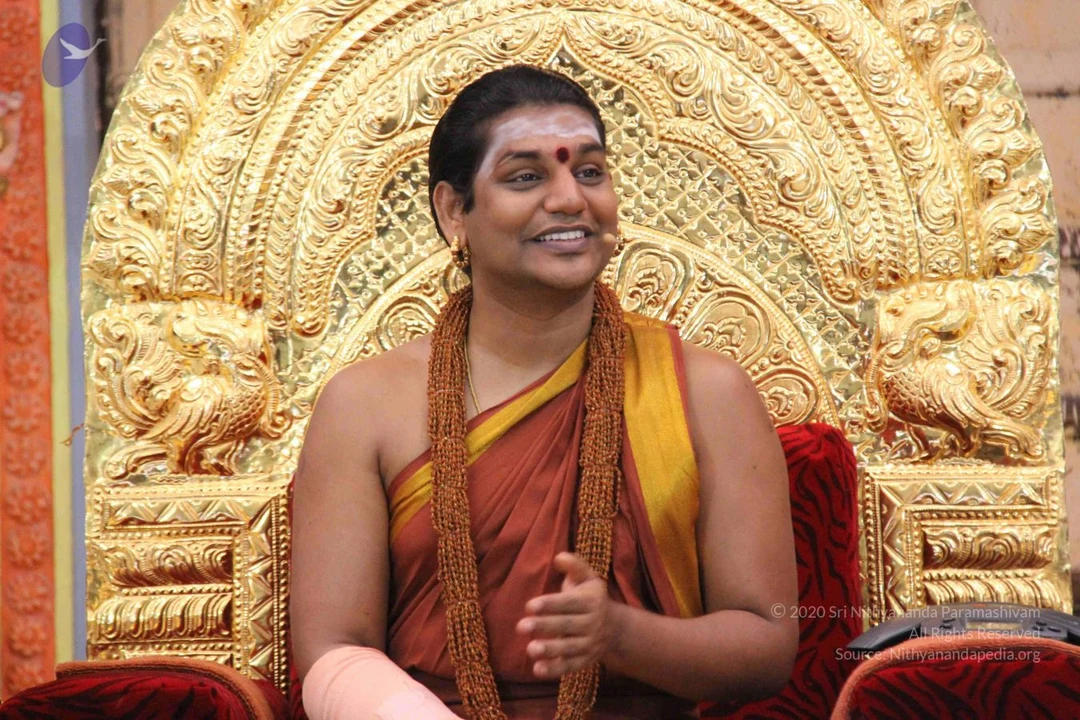
A man seated before an ornate golden throne with a large fan-shaped gilded backrest, wearing a rust-orange and gold shawl over bare shoulders and a long braided rudraksha-style mala necklace. He has white sandalwood paste on his forehead with a red kumkum dot and a small gold earring, and looks to his side while speaking. Behind him stand a lit brass oil lamp and a brass kalasha-style lamp stand on a pink and blue backdrop; a red tiger-striped cushion lies at the lower left. Swamiji (probable): the swept-back hair, saffron-orange shawl, ornate gold throne setting and long mala are consistent with the page's reference to Swamiji, who is teaching.A photograph of a single man seated before an ornate golden throne with repoussé floral patterns, a red velvet cushion visible at lower left. He wears a rust-orange and gold-bordered shawl over bare shoulders, with long brown-beaded rudraksha-style malas draped across his chest and a small gold earring. He has a white forehead mark and a red kumkum bindi, smiling and gesturing with one raised hand. A pink and green painted pillar stands at right. a person appearance cues include the saffron-orange shawl, rudraksha malas and ornate gold throne, indicating a seated speaker giving teaching.A photograph of a single seated man in an orange-red robe with a gold border, wearing a long rudraksha mala draped over the shoulders and a small red bindi with white forehead markings. He has a small microphone at his ear, smiling and looking to the side. Behind him is a large ornate gold throne backrest with embossed floral patterns, and to the right a pillar with pink and green lotus-style capital and a blue-and-yellow painted wall. The setting suggests a seated discourse.A smiling man sits on an ornate gold throne with a red tiger-striped cushion, wearing a rust-orange and gold-bordered shawl over one shoulder and a thick rudraksha mala with a gold necklace. He has white vertical tilak on the forehead, a red bindi, gold earrings and a small headset microphone. Behind him is a pink, green and orange pillar with a painted blue wall.A man seated on an ornate gold throne with a red tiger-stripe cushion, smiling and speaking into a small headset microphone. He wears a rust-orange and gold-bordered shawl draped over bare shoulders and a long rudraksha mala with a gold-toned clasp, plus gold earrings. A white forehead marking with a red bindi is visible. Behind him stand pillars with pink, orange and green lotus-style capitals. a person: the man has distinctive ceremonial cues of a rudraksha mala, ornate gold, and a throne-seated teaching pose, consistent with the page's reference to a person speaking.Photograph of a smiling man seated on an ornate gold throne with a red tiger-stripe cushion. He wears a rust-orange and gold-bordered shawl over bare shoulders, a long beaded brown rudraksha-style mala with a gold-coloured necklace, a red bindi and white forehead markings, and a gold earring. A carved gold backrest and a pink, green and orange decorated pillar stand behind him.

SARVA DARSHAN
7 photosSource gallery
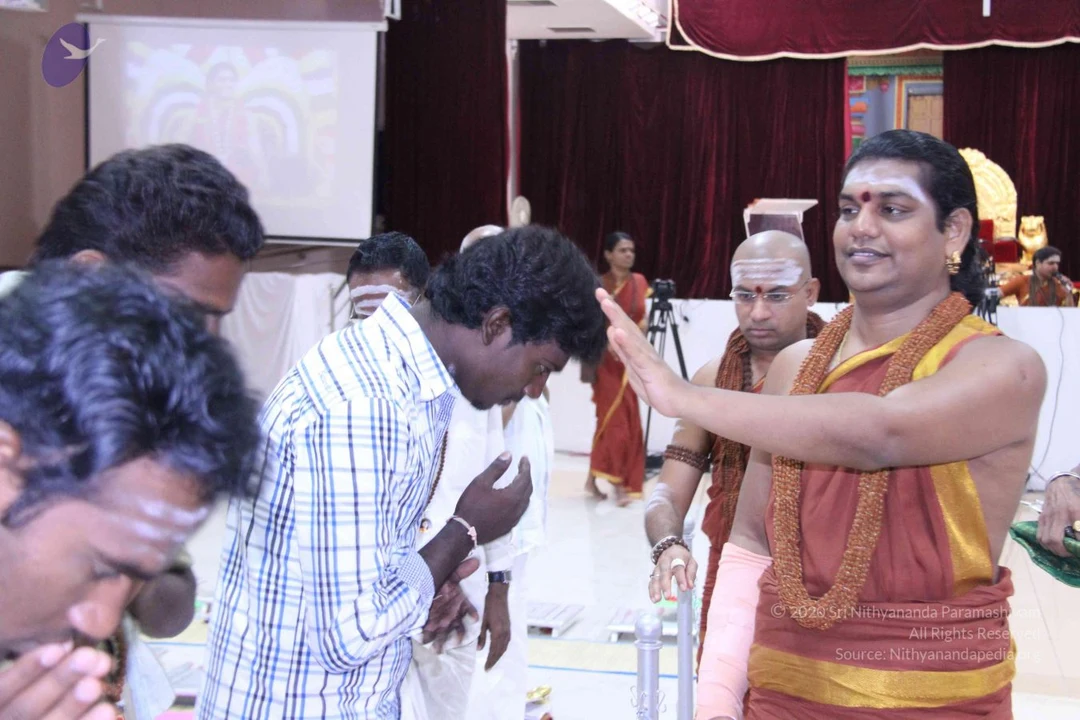
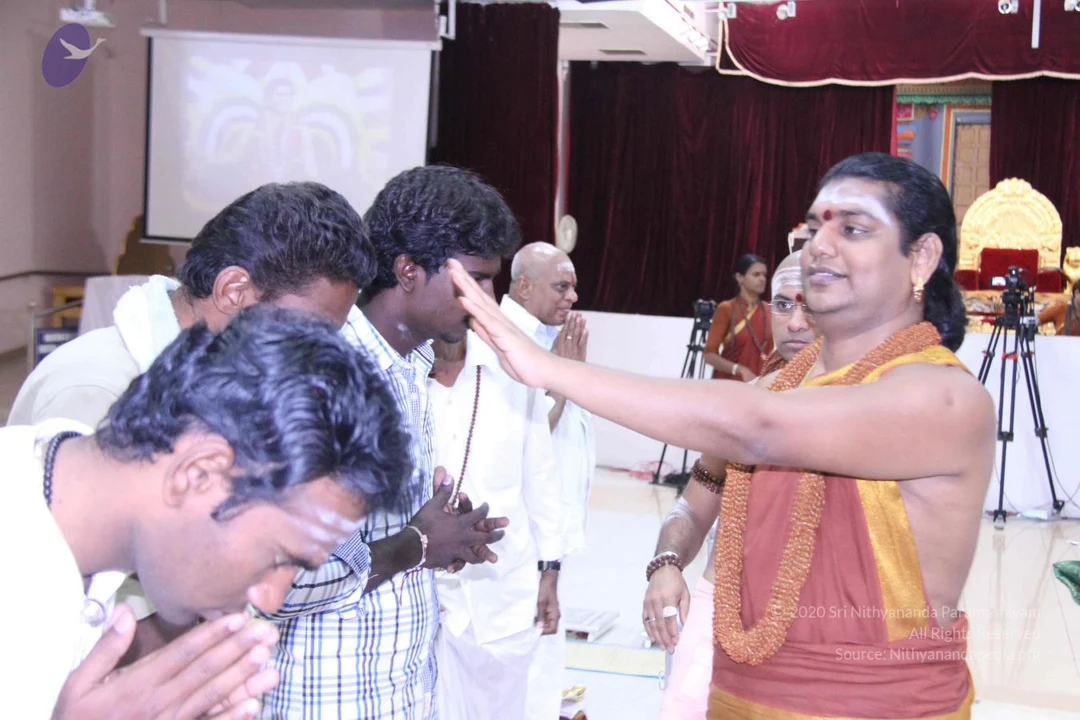
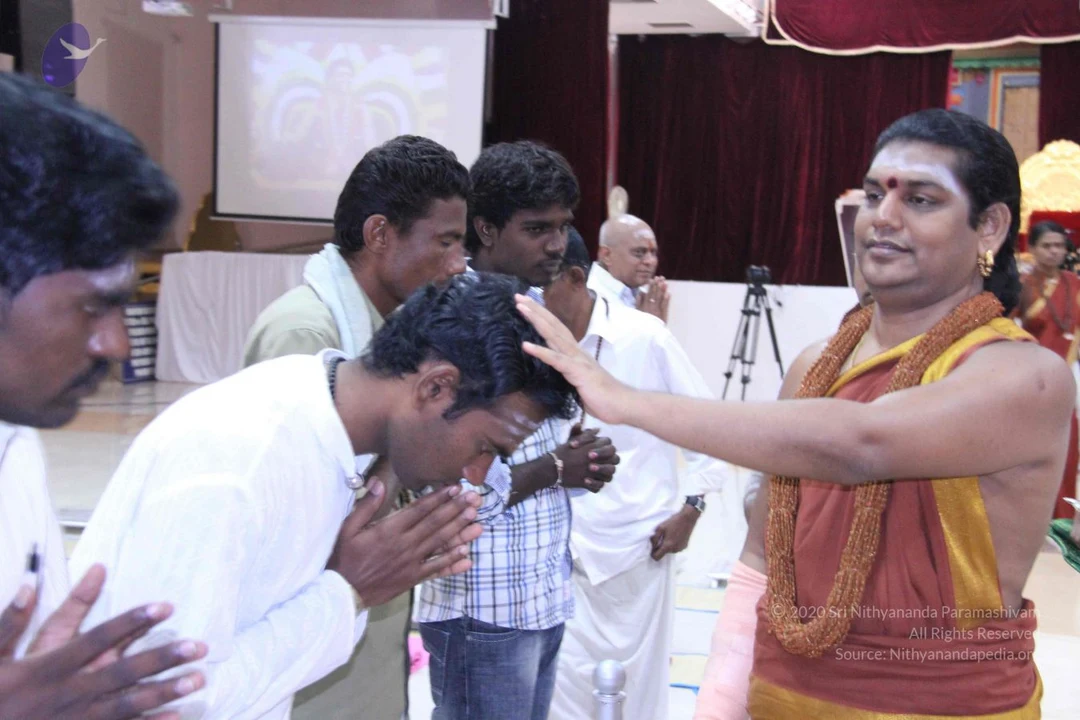
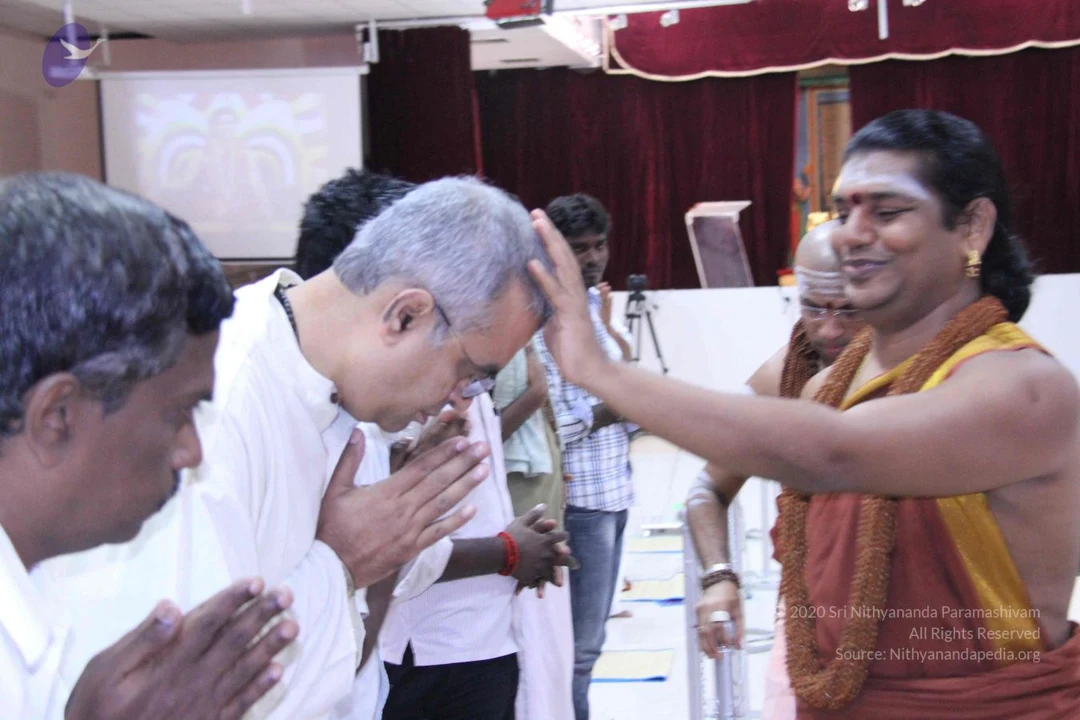
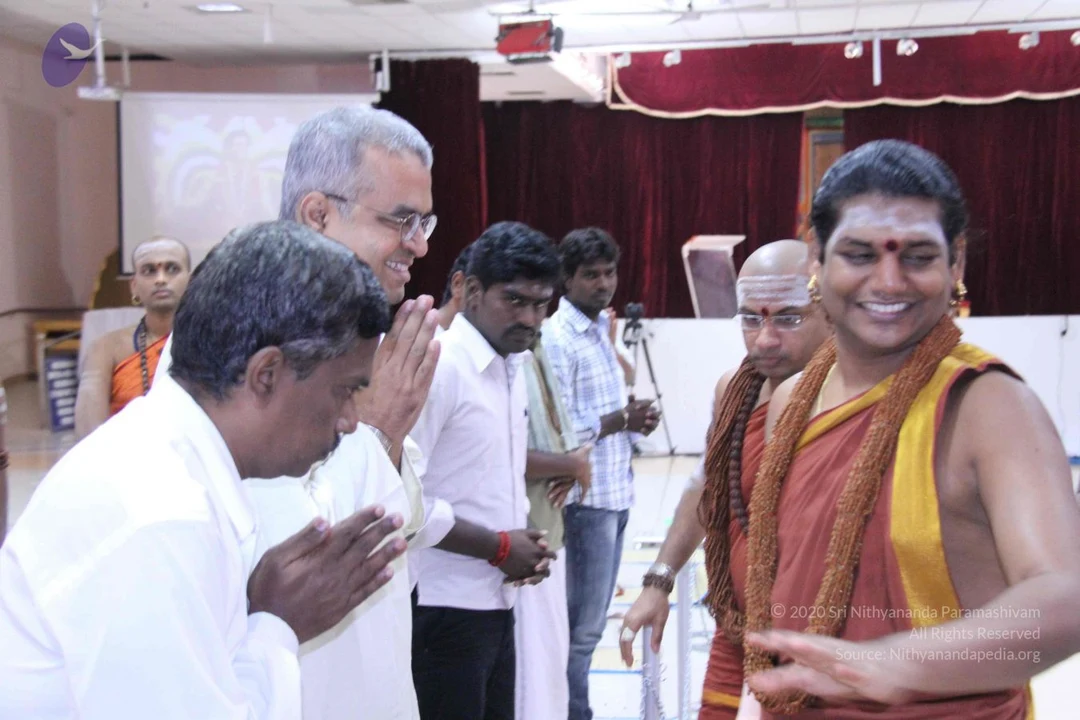
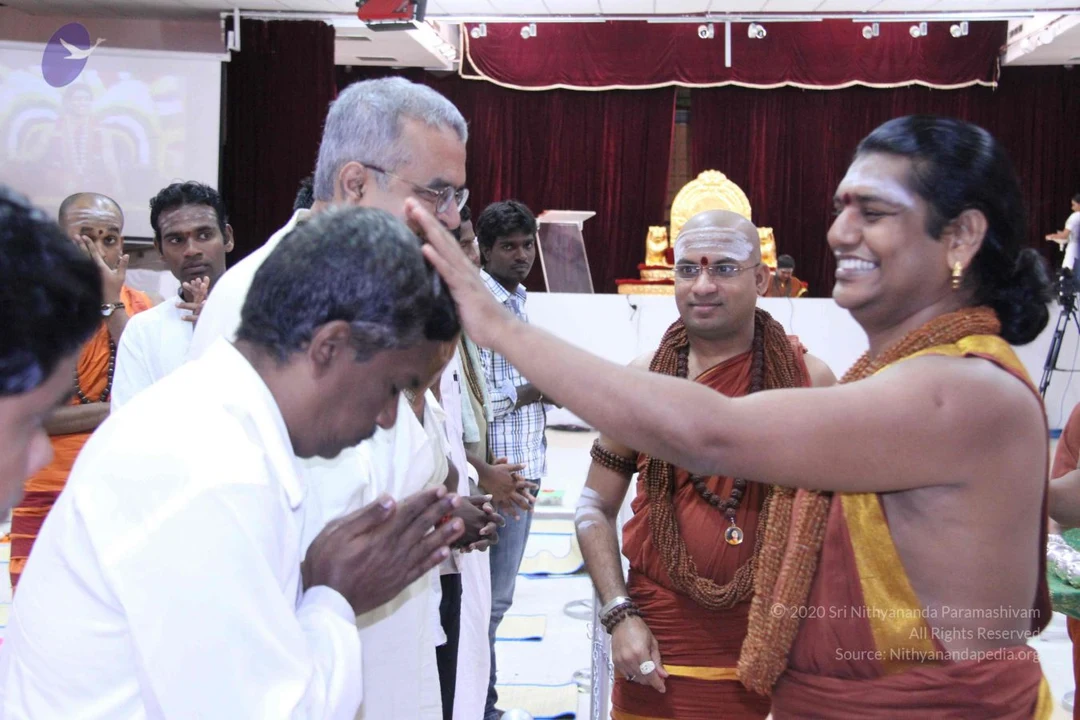
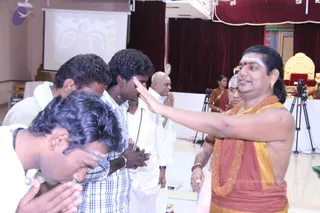
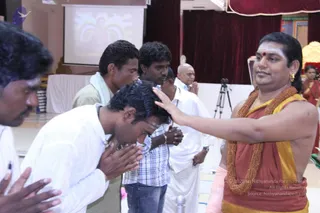
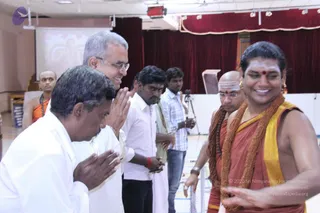
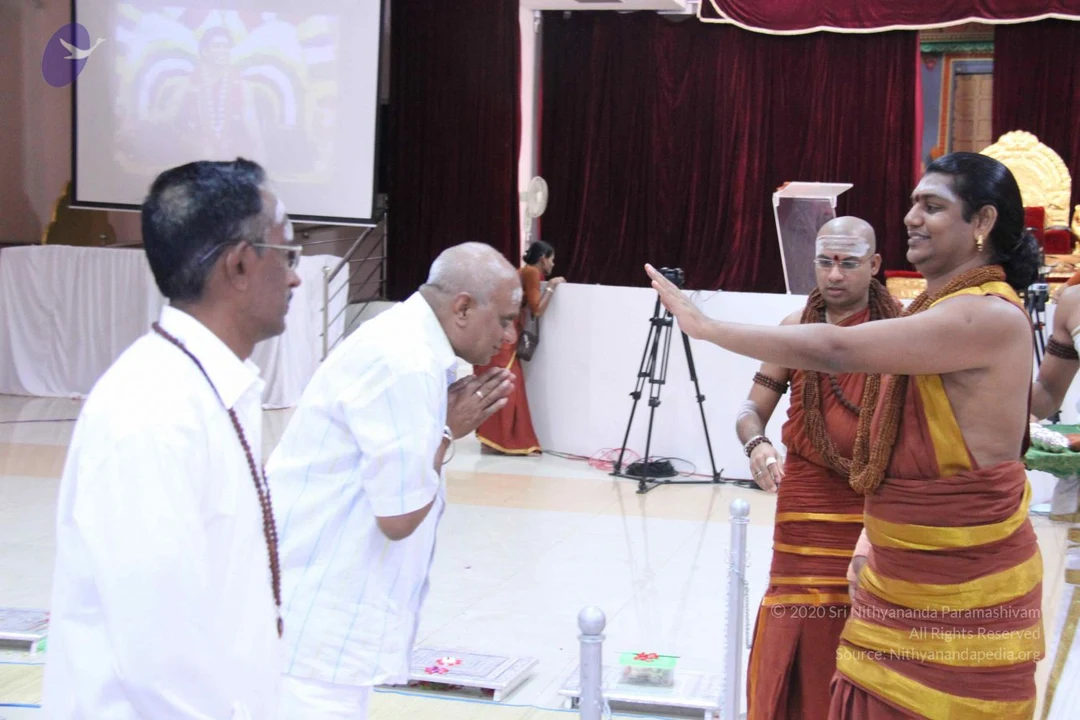
A photograph in a hall with a red curtain and a projection screen showing a deity image. A man in orange-red robes with a long swept-back hairstyle, gold necklace, rudraksha mala and gold-striped orange wrap raises his hand in blessing toward a older man in white shirt who bows with folded hands. Another man in white stands at left wearing a rudraksha mala, and a bald priest in orange-red robes with a white forehead band and rudraksha malas stands beside the blessing figure. A woman in orange sari is in the background near a tripod-mounted camera, and a small plate of offerings sits on the floor. Probable Swamiji (probable) is the robed figure in the orange-gold wrap with the swept-back hair, gold necklace and rudraksha mala, giving blessings.A photograph inside a hall with red curtains and a projector screen. A man in an orange-saffron dhoti and shawl, with a red bindi, white forehead lines, a rudraksha-style mala and gold earrings, stands at right with his right hand raised in blessing. Beside him a bald priest in a saffron-red dhoti with white forehead marks and beaded bracelets stands near a metal stand. Devotees in white shirts and dhotis bow with folded hands and heads lowered in front of him. A gold throne with a golden lion-shaped armrest sits in the background. a person is the saffron-clad man with long swept-back hair and rudraksha mala, blessing the devotees.Photograph of an indoor hall with maroon drapes and a gold-and-red throne-style seat in the background. In the foreground a man in a red-and-gold saffron-toned cloth with a rudraksha-style orange bead garland and a red tilak on his forehead raises his palm in blessing toward a kneeling man in a checked shirt who has his hands folded in namaskar. Other devotees in white dhotis and white shirts stand with hands folded in namaskar, and a woman in an orange sari stands further back beside a tripod-mounted camera. A projector screen is visible at upper left.A photograph of a satsang-style gathering in a hall with a projector screen and red curtains behind. A man in an orange-red and gold dhoti with a long rudraksha-style mala and gold earrings stands at right, with a red bindi and white forehead marks, extending his right hand in blessing over the bowed head of a young man in a white shirt who presses his palms together. Other devotees in white and checked shirts stand with hands folded, and a white-clad elderly man stands behind. A camera on a tripod is visible at right. The man in orange presents as a person by his distinctive saffron dress and long mala, while the setting suggests a blessing or darshan.A photograph of a devotional blessing in an indoor hall with red curtains and a projection screen behind. A man with swept-back long dark hair, orange-saffron robe with yellow edge, a rudraksha mala and a gold earring stands at right, palm placed on the head of a bowing man in white kurta with grey hair and glasses, hands folded in namaskar. Other people with folded hands stand at left and behind, and a shaved-headed man in white is partly visible at right. Probable Swamiji (long hair, saffron robe, rudraksha mala cues) is giving a blessing to a devotee; the blessing gesture is a head touch.Indoor photo at a hall with a red velvet curtain and projector screen. Beside him, a bald man in orange cloth with a beaded mala stands. At left, a man in white shirt presses his palms together in greeting, and a smiling man in white with glasses also joins palms. Other onlookers in shirts stand behind, and a tripod-mounted camera appears at center.

2-Paduka-Puja

6 photosSource gallery
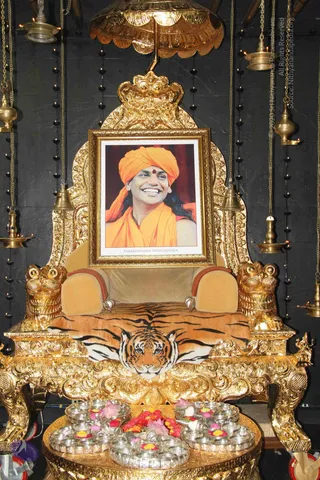
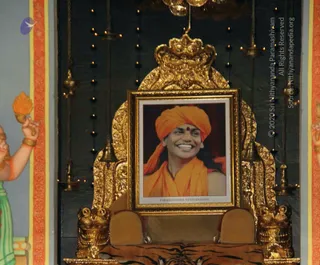
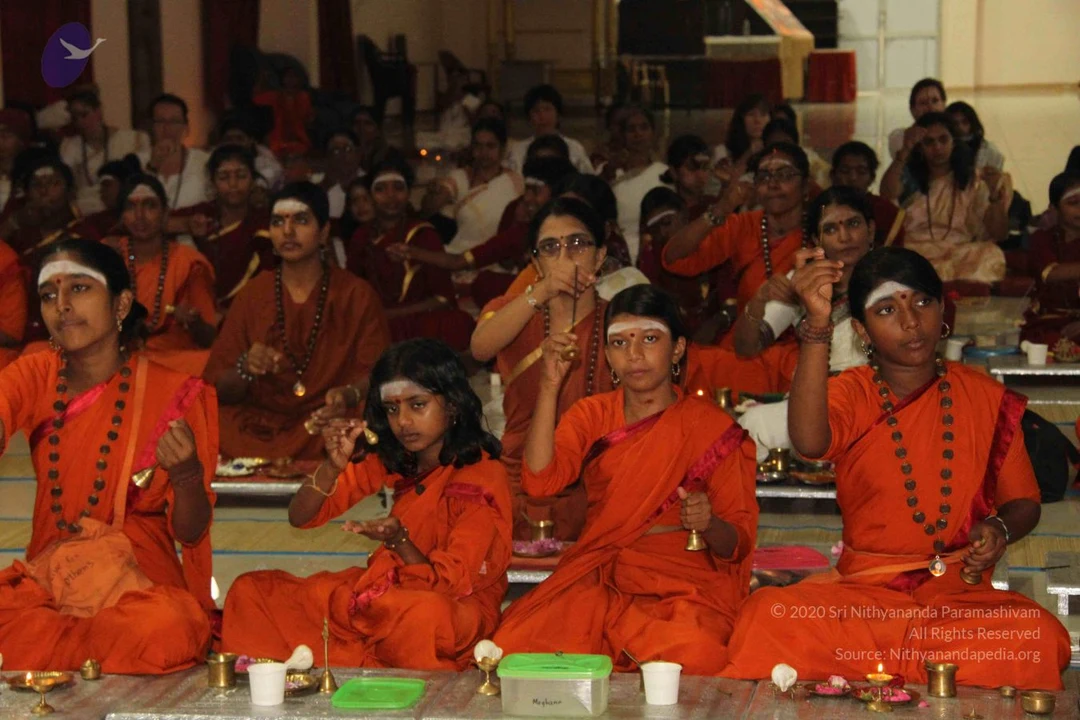
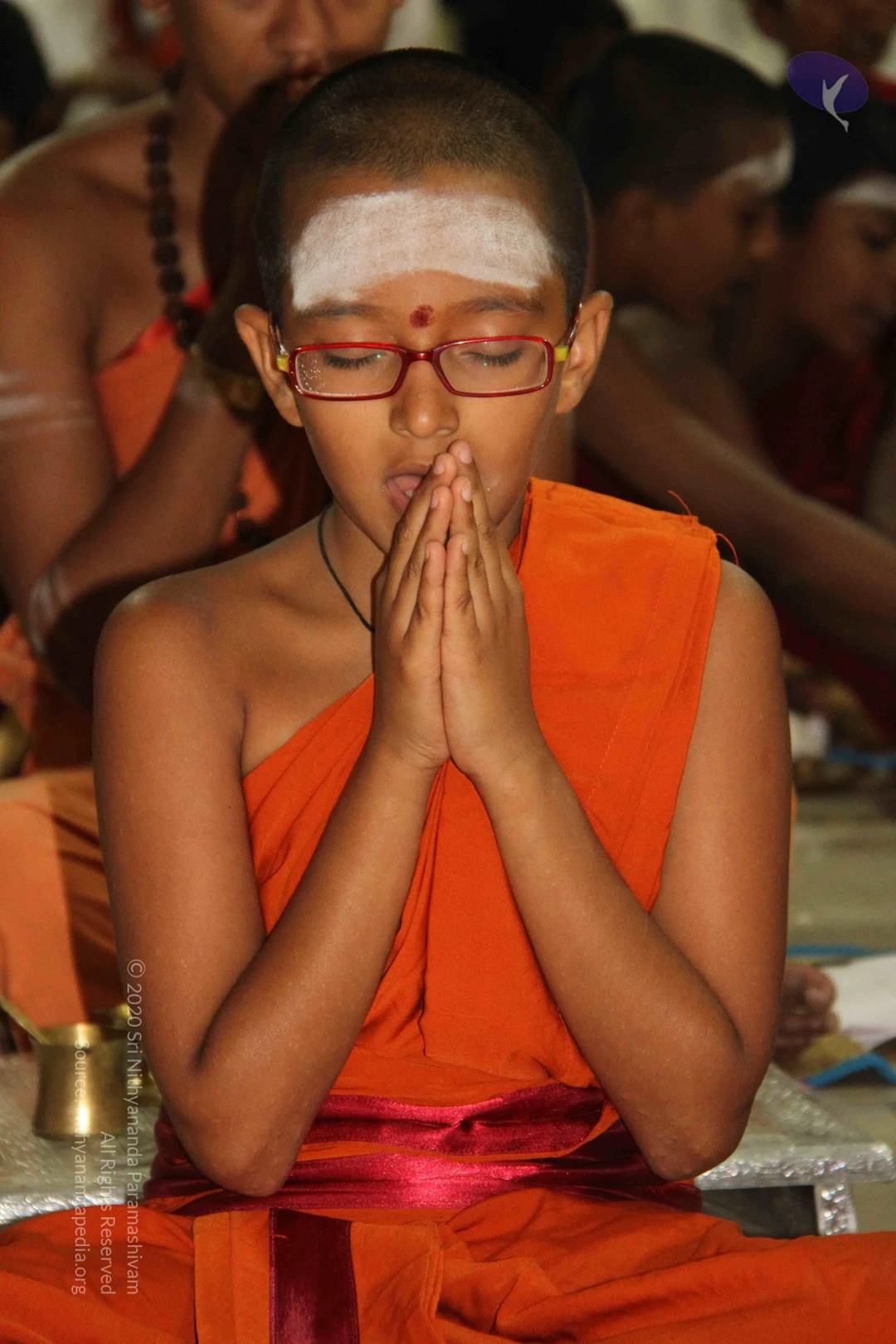
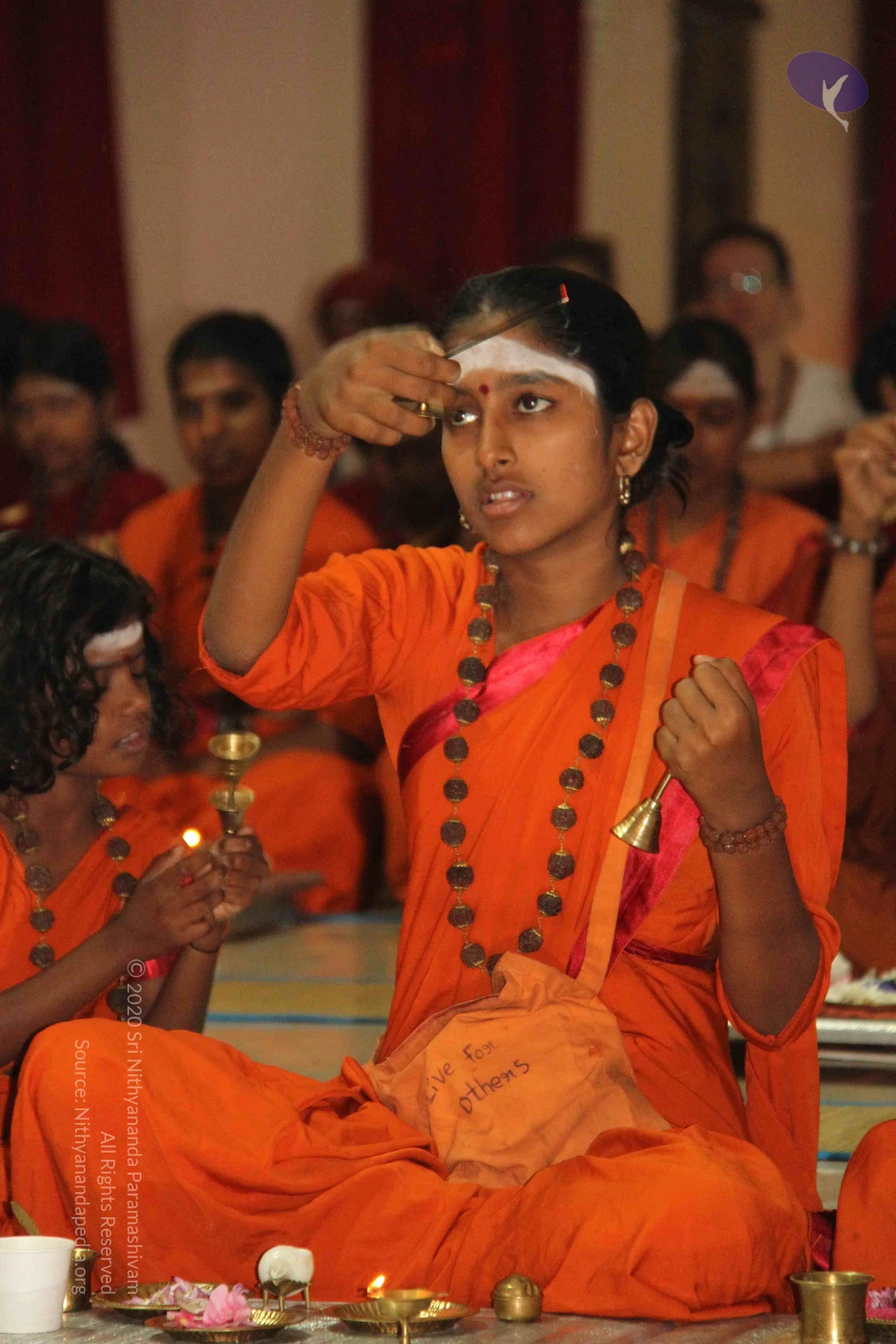
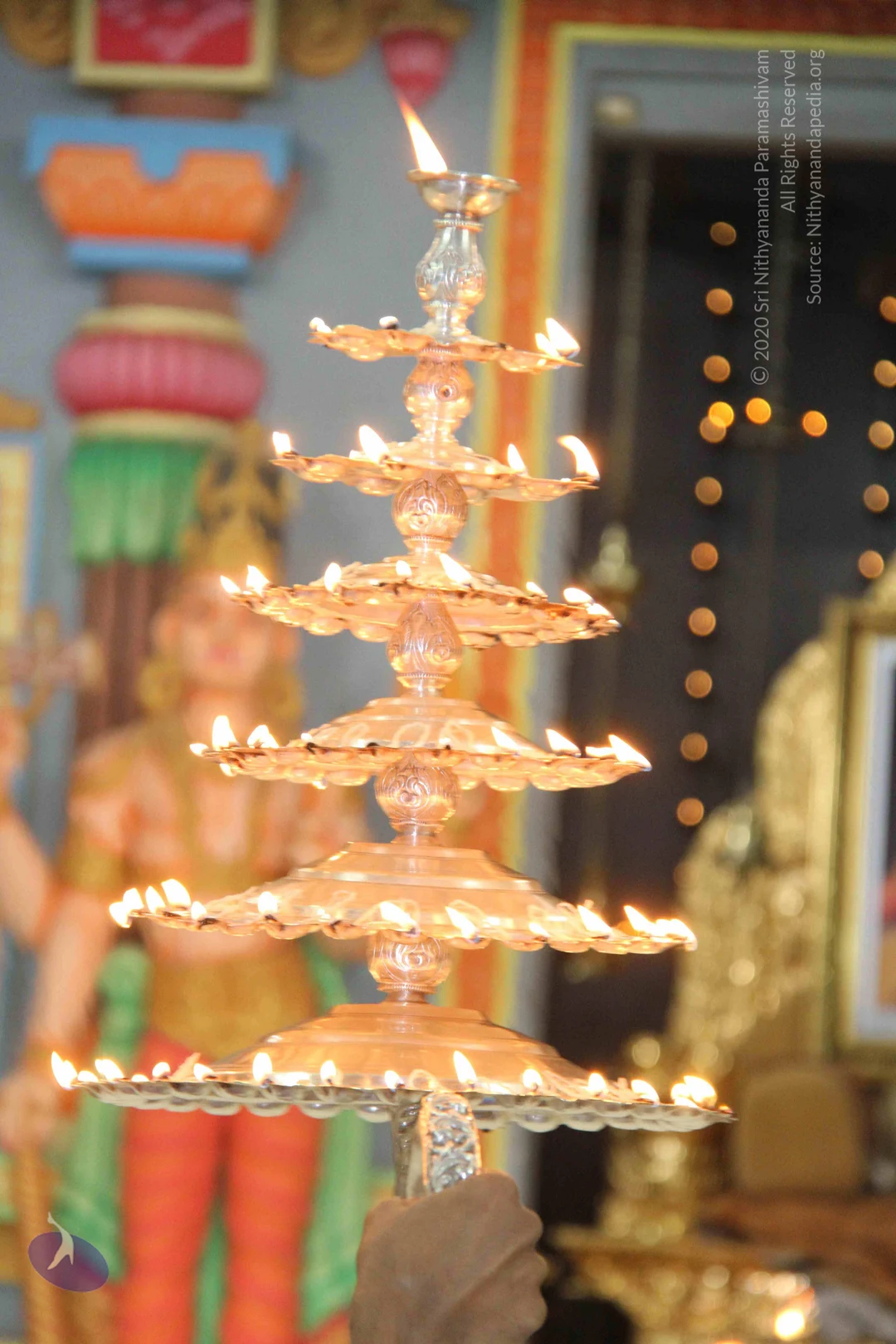
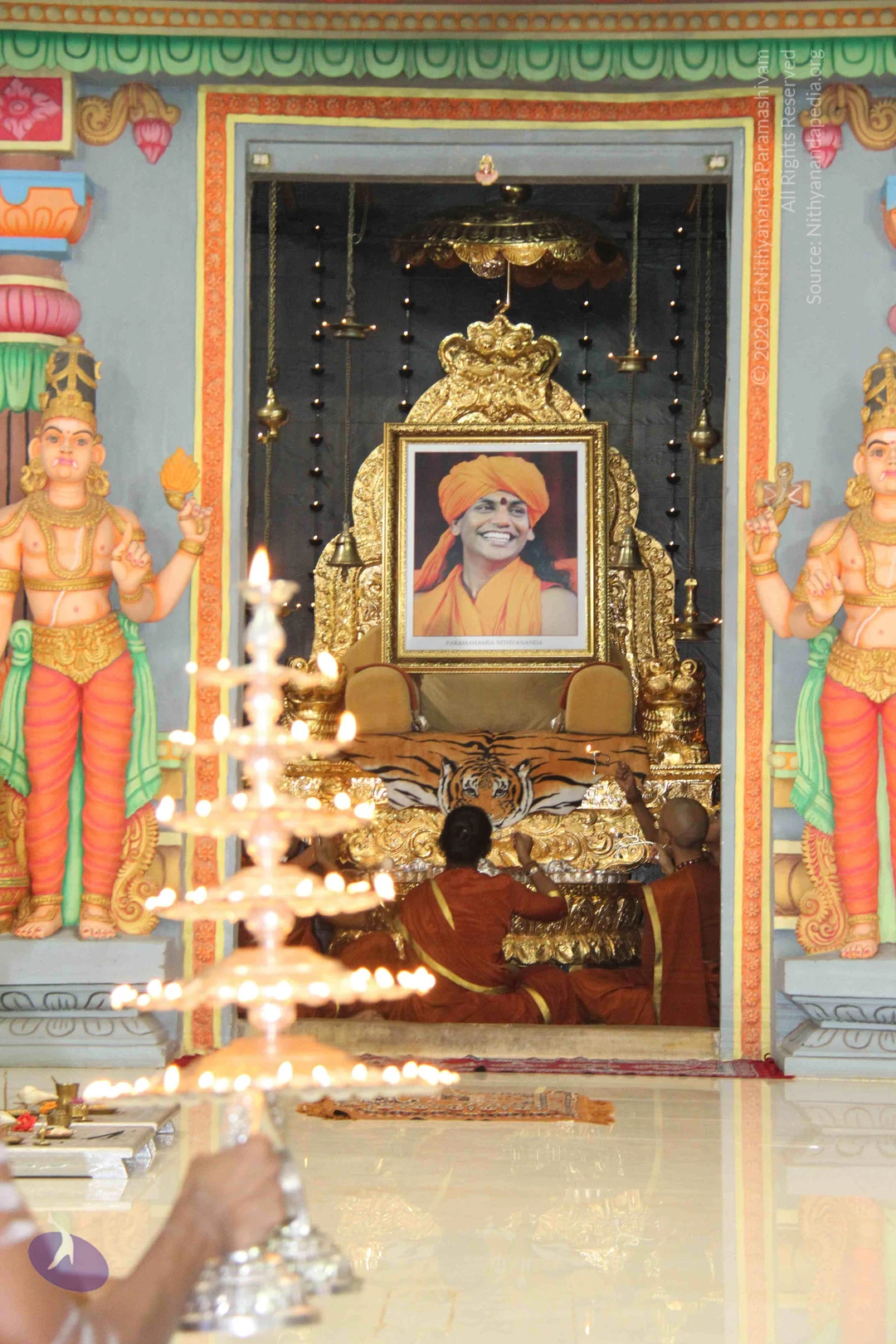
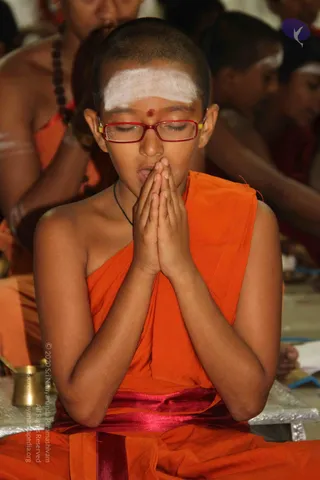
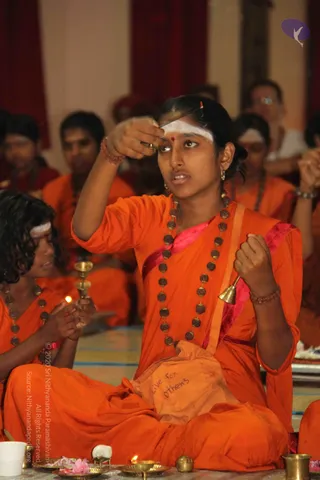
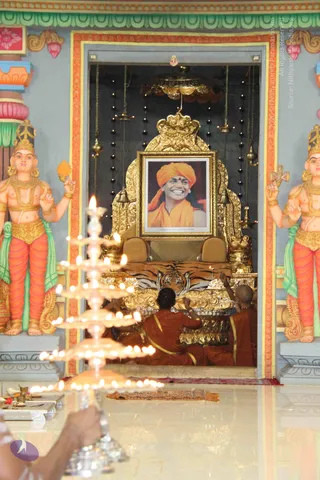
An empty ornate gilded throne stands against a dark stone wall, draped with a tiger-skin rug and flanked by carved gold lion heads. Above it hangs a gilded framed portrait of a smiling man with long dark hair, wearing an orange-saffron turban and orange shawl with a red tilak on his forehead; the printed caption reads "PARAMAHAMSA NITHYANANDA". Gilded umbrella canopy and hanging brass oil lamps surround the throne. In front, on a gold tray, silver plates hold flower petals and red and yellow marigold offerings. No physical people are present; the portrait is a printed depiction.A framed portrait photograph of a smiling man in an orange turban and orange shawl with a red bindi is displayed in an ornate gold-leaf frame on a gilded throne-like altar in a temple shrine. The framed portrait is a printed picture, not a person physically present. Brass oil lamps and dark beaded strings hang around it, a painted deity figure holding a torch stands at left, and a tiger-skin cloth covers the base. A printed caption beneath the portrait reads "PARAMAHAMSA NITHYANANDA".A young boy with a shaved head, white sacred ash band across his forehead and a red bindi, wearing red-rimmed glasses, sits with palms pressed together in namaste and eyes closed in prayer. He wears an orange sleeveless robe with a red satin waist sash and a thin black cord at his neck. Behind him, other seated figures in orange and white forehead markings are also in prayer, with a brass vessel visible at the lower left.A young woman in orange saffron robes sits cross-legged on the floor during a ritual, applying white vibhuti ash in a horizontal band across her forehead with her raised right hand, with a red kumkum dot at its centre. She wears a long rudraksha mala with multiple strands and a bell is held in her other fist. Behind her, several people in orange robes and white forehead marks sit in rows. Brass oil lamps, a small lit flame, brass vessels and plates with pink flowers sit on the floor in front. Her orange cloth bag reads "Live for others". The setting is an indoor hall with red curtains and cream walls, consistent with a satsang or puja gathering.A tiered silver aarti lamp with many lit oil wicks on successive round trays is held up in the foreground by a hand at the bottom, flames blazing at its top and along each tier. Behind it, a blurred painted deity murti stands in a multicoloured temple setting with orange, green and red tones, and warm bokeh lights hang on the right beside a gilded throne-like frame. The scene suggests an aarti offering in a temple shrine.A temple shrine with a large gold ornate throne draped with a tiger-skin cloth, flanked by two painted deity dvarapala statues with crowns and green sashes. A framed portrait labelled "Paramahamsa Nithyananda" shows a smiling man in an orange turban and orange robe, set on the throne. Several devotees in orange robes kneel and attend at the throne base. In the foreground a multi-tiered silver aarti lamp with many lit oil lamps burns, and a hand holds the lamp at the lower left. Hanging bells and beaded strings decorate the dark backdrop, and a golden canopy hangs above.

3-Nithya-Satsang

6 photosSource gallery
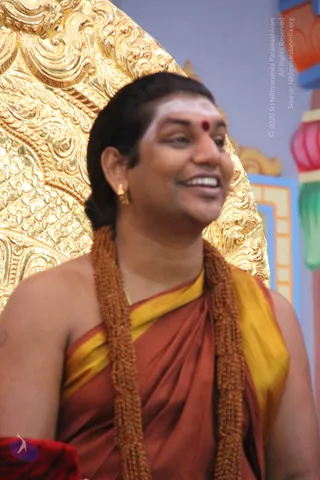
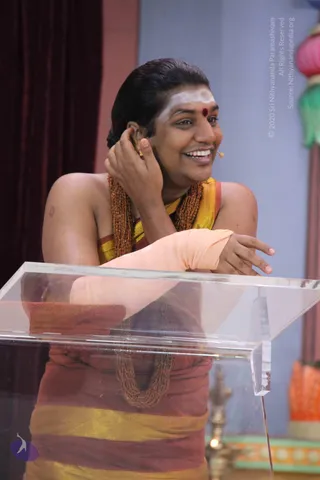
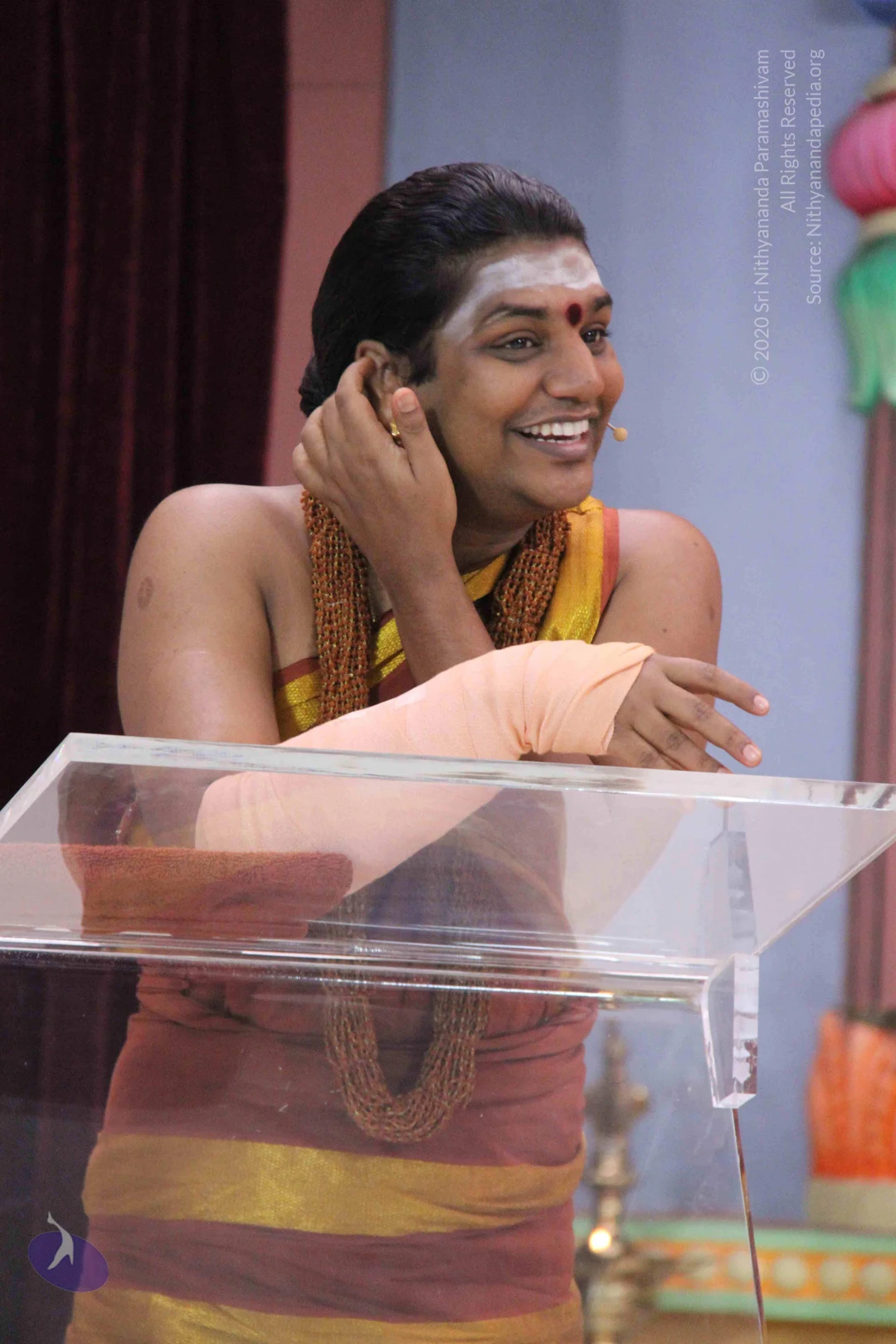
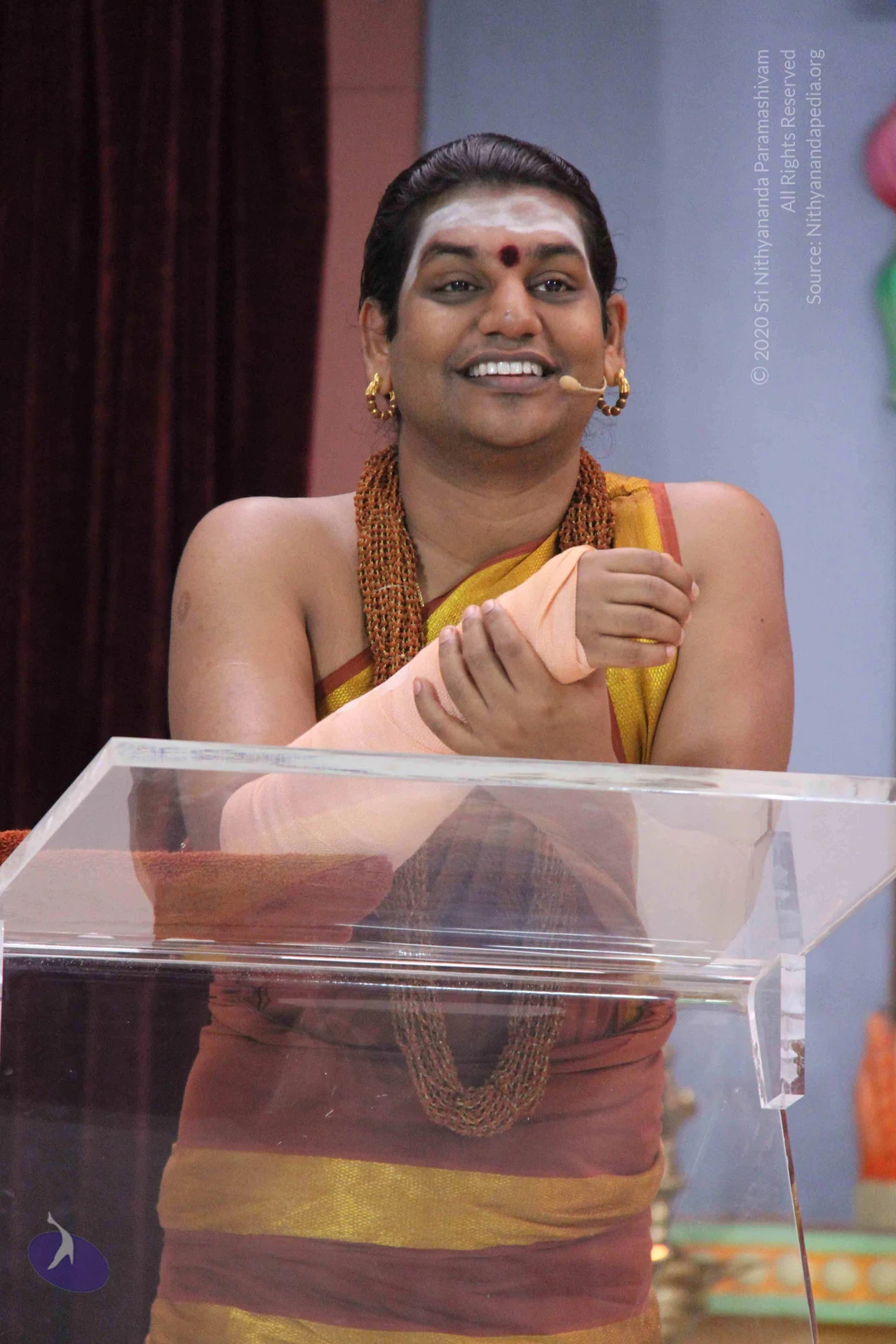
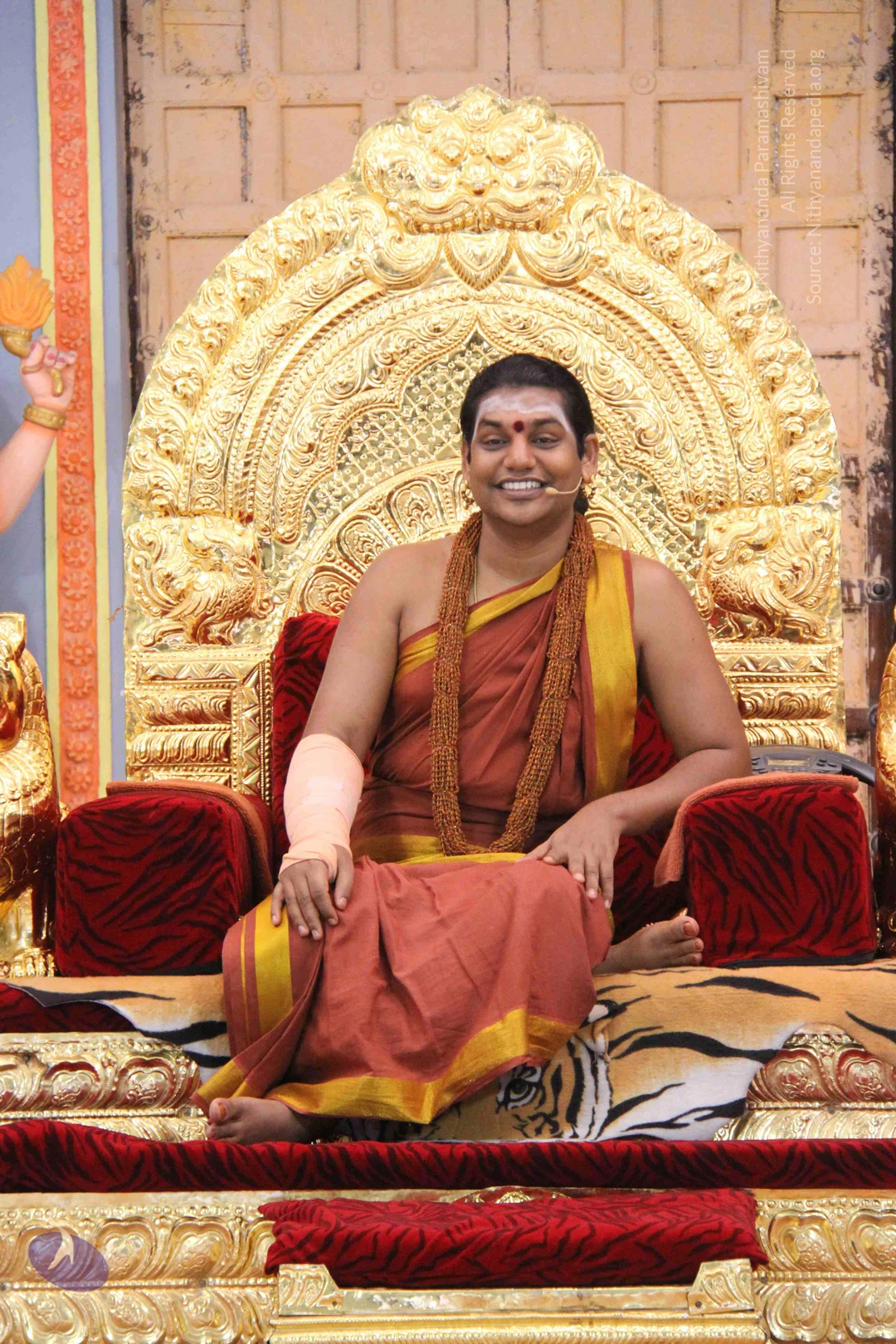
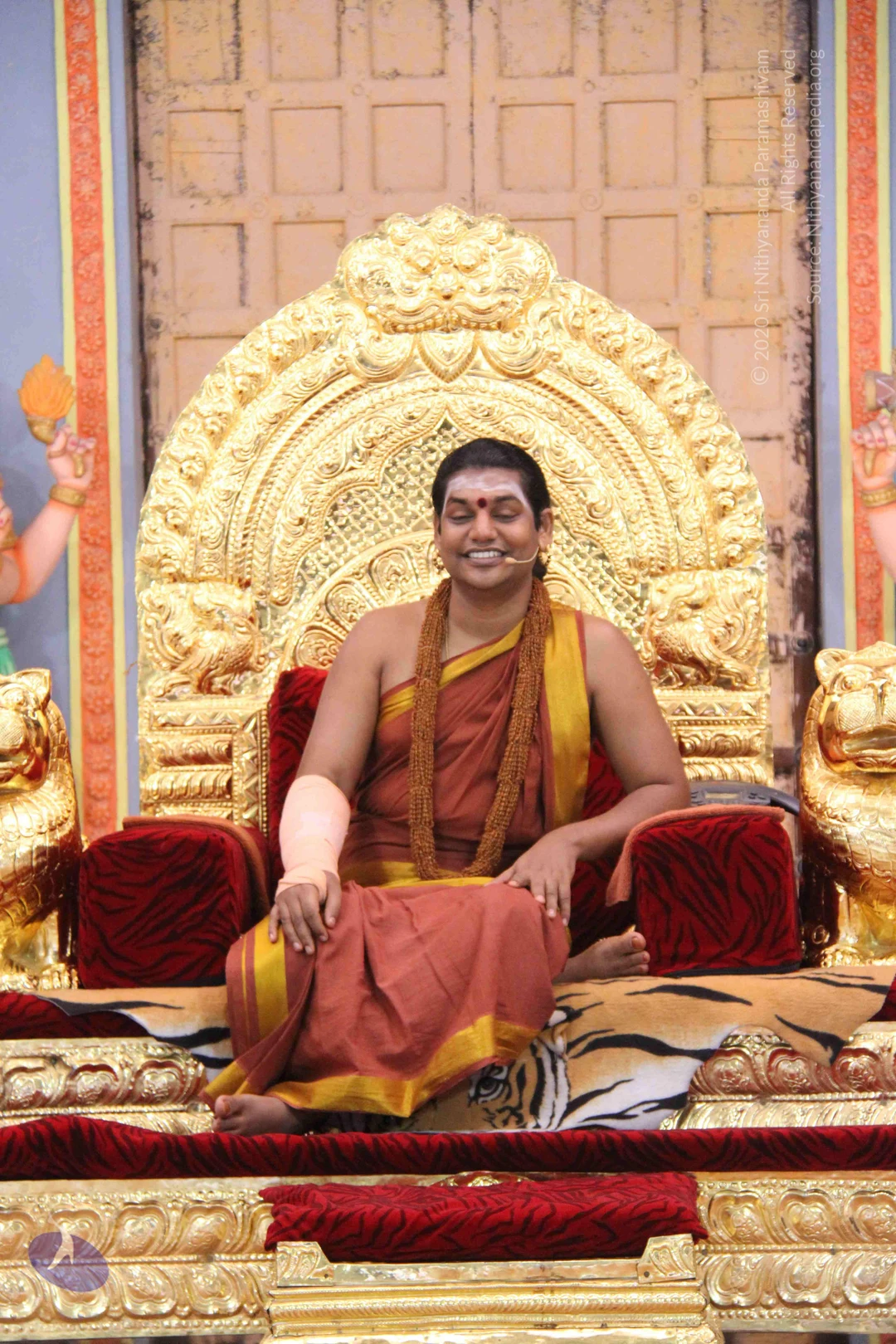
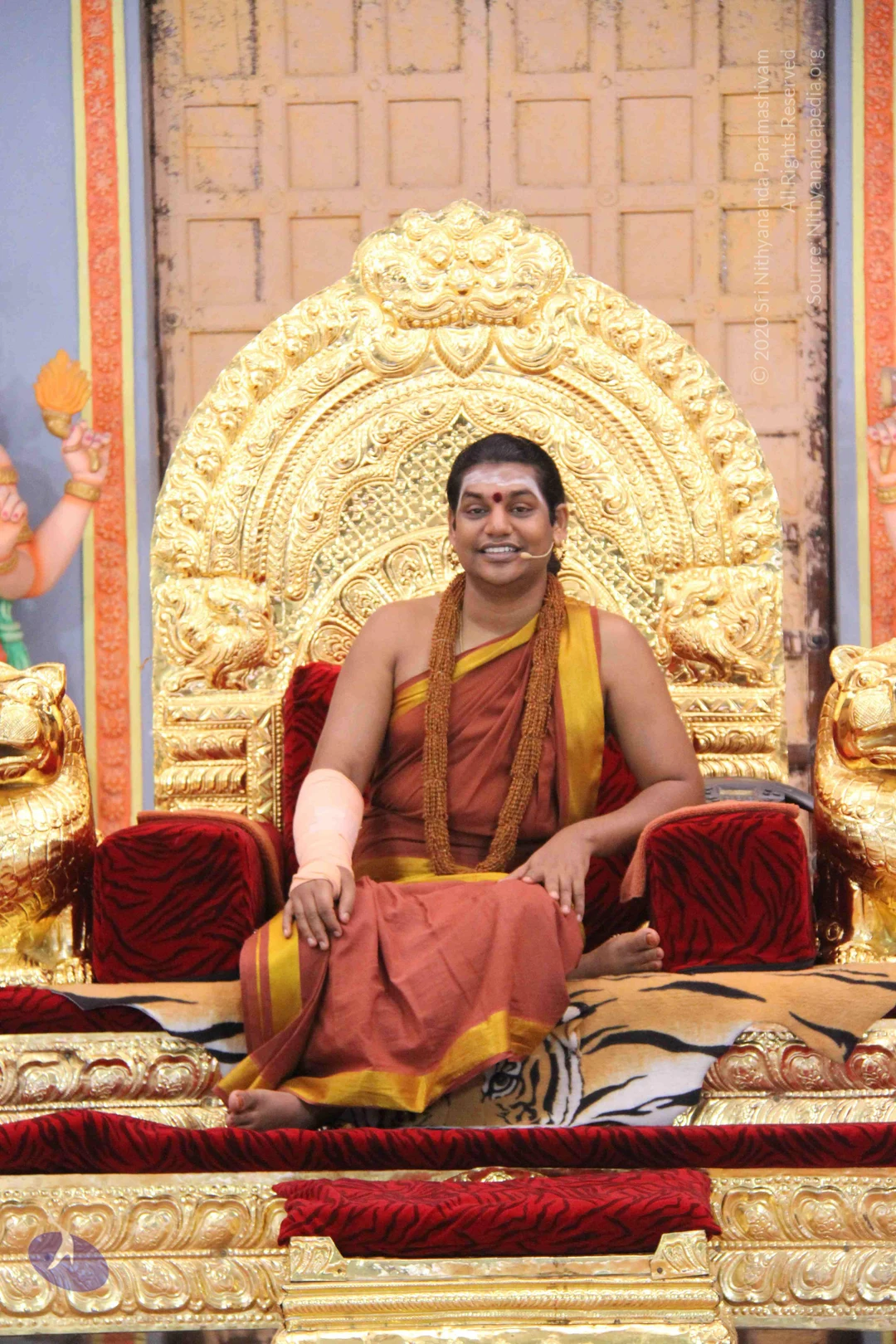
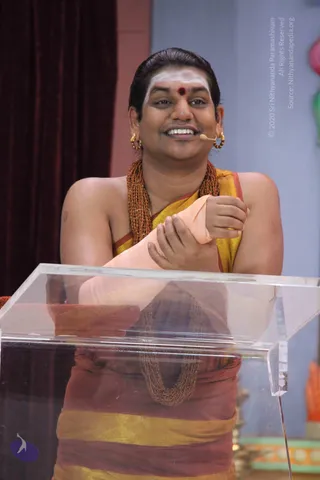
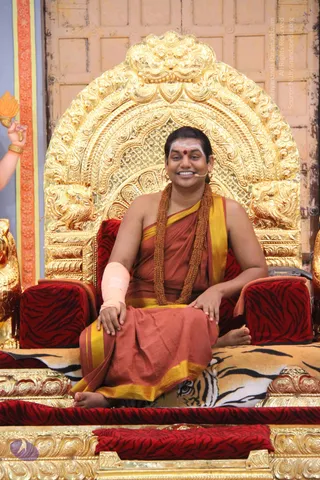
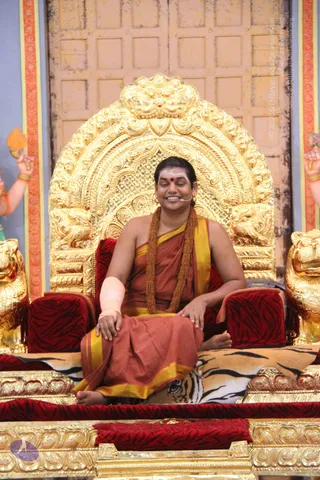
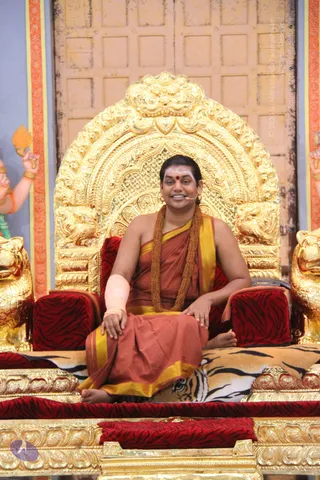
Close photo of a smiling man seated before an ornate gilded golden throne back with repoussé scrollwork. He wears a rust-red and gold-bordered draped robe, multiple strands of rudraksha-style beads around his neck, a gold earring, a white horizontal forehead marking and a red bindi. Pink and green painted pillar elements appear at the right edge. Swamiji (probable): long swept-back dark hair, rudraksha malas, saffron-orange clothing and ceremonial gold ornaments match the appearance cues for the page's Swamiji attribution, but the image is cropped and the identification remains uncertain. One person visible.A photograph of a smiling man with slicked-back dark hair, white forehead markings and a red bindi, wearing a red and gold garment with an orange-brown beaded necklace. He stands behind a clear acrylic lectern, one hand raised to his ear, with a small microphone at his cheek. Behind him are a red curtain, a brass oil lamp and colourful decorations.A photograph of a smiling man with slicked-back dark hair, white vertical forehead markings and a red dot, standing behind a clear acrylic lectern during a satsang talk. He wears a peach-coloured wrap with a gold and red border over bare shoulders, a rust-brown beaded mala necklace, gold hoop earrings and a small headset microphone. His hands rest on his folded peach sleeve. Behind him are a maroon curtain and a light blue wall with a pink hanging decoration. a person's cues here are the ornate gold-bordered wrap, mala necklace and speaking position at the lectern; the appearance is consistent with the page claim, so the candidate is treated as present.A smiling man with a shaved head, white vertical tilak and red bindi sits on an ornate gold throne with red tiger-striped cushions and a tiger-skin cloth. He wears a rust-orange and gold-bordered dhoti and shawl, a long beaded rudraksha-style mala necklace, and a headset microphone. His right forearm is wrapped in a pale bandage. Behind him is a gilded arched backrest, and a painted figure holding a flame stands at the left edge. a person is seated on the throne, but the cues are limited to the throne and a mala, so the identification is uncertain.A seated man in a rust-red and gold-bordered robe sits on an ornate gold throne with a carved arched backrest and gold lion-head armrests, draped with red and tiger-striped cushions. He wears a rudraksha mala, a white vibhuti marking with a red kumkum dot on his forehead, and a lapel microphone, smiling with eyes closed. His right forearm is wrapped in a pink bandage. Behind him is a carved wooden door, and a painted deity figure with a raised hand is visible at the left edge. A tiger-skin cloth covers the throne's platform. A single seated figure in the scene and the setting suggests a satsang discourse. The person appears to be a person by cues: a rudraksha mala and ornate gold throne with saffron-toned clothing.A man sits on an ornate gold throne with carved lion-head armrests and a red-and-black tiger-striped cushion, speaking into a headset microphone. He wears an orange-brown robe with a gold border, a long rudraksha mala around his neck, and white vibhuti with a red bindi on his forehead. His right forearm is wrapped in a pink bandage. Behind him are a carved wooden door and a painted deity figure on the left edge. Appearance-based label: a person, seated in the throne in an orange robe with rudraksha mala and a visible bandaged arm, shown as an in-person speaker at a satsang.

5-Final-Blessings

3 photosSource gallery
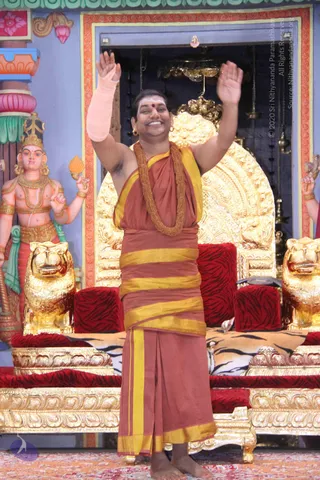
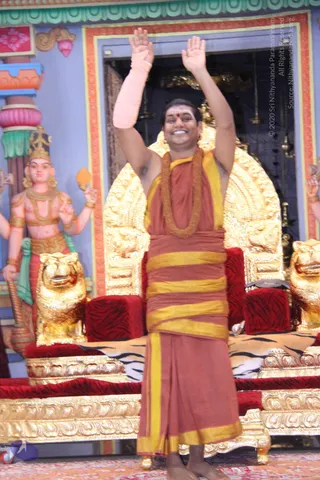
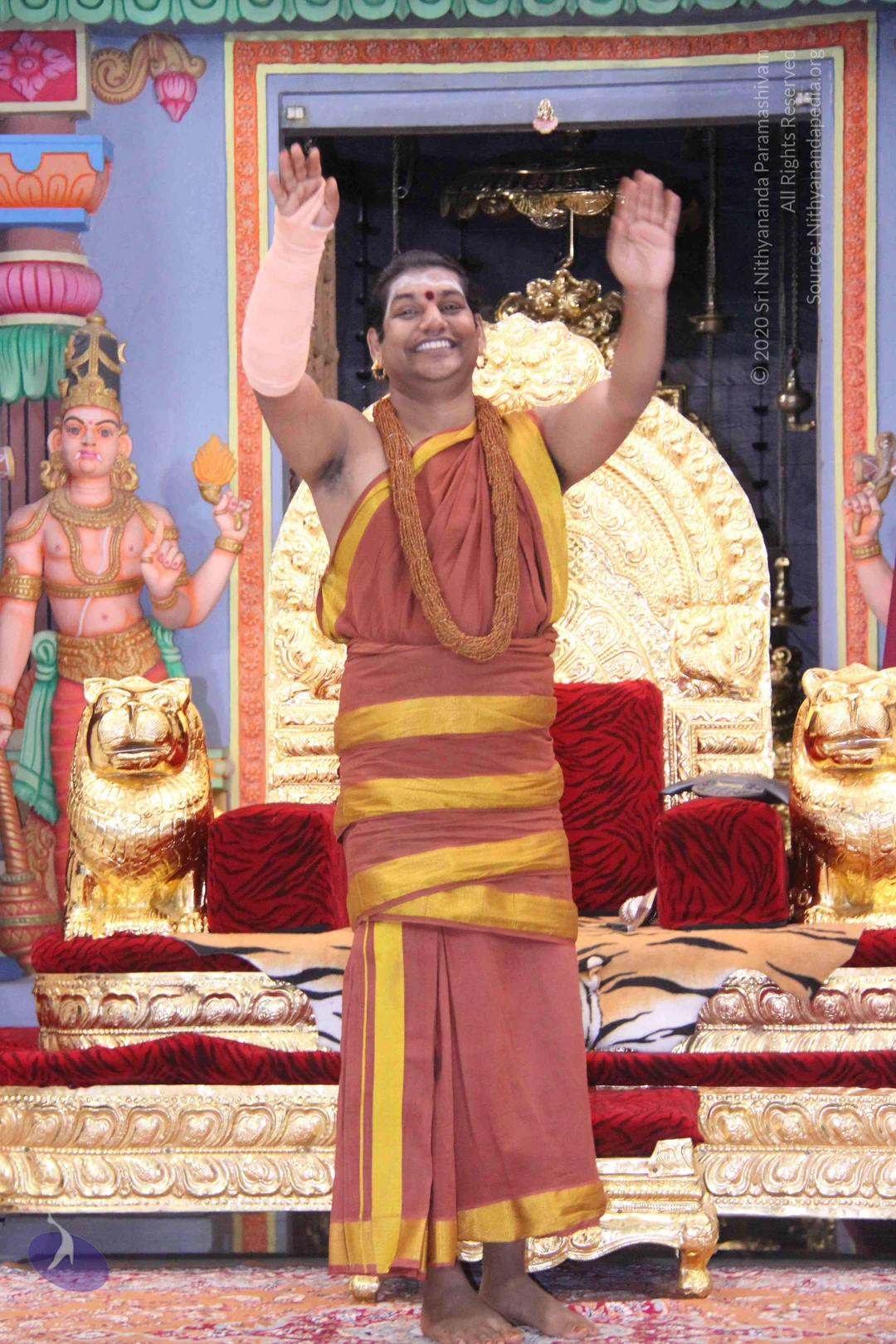
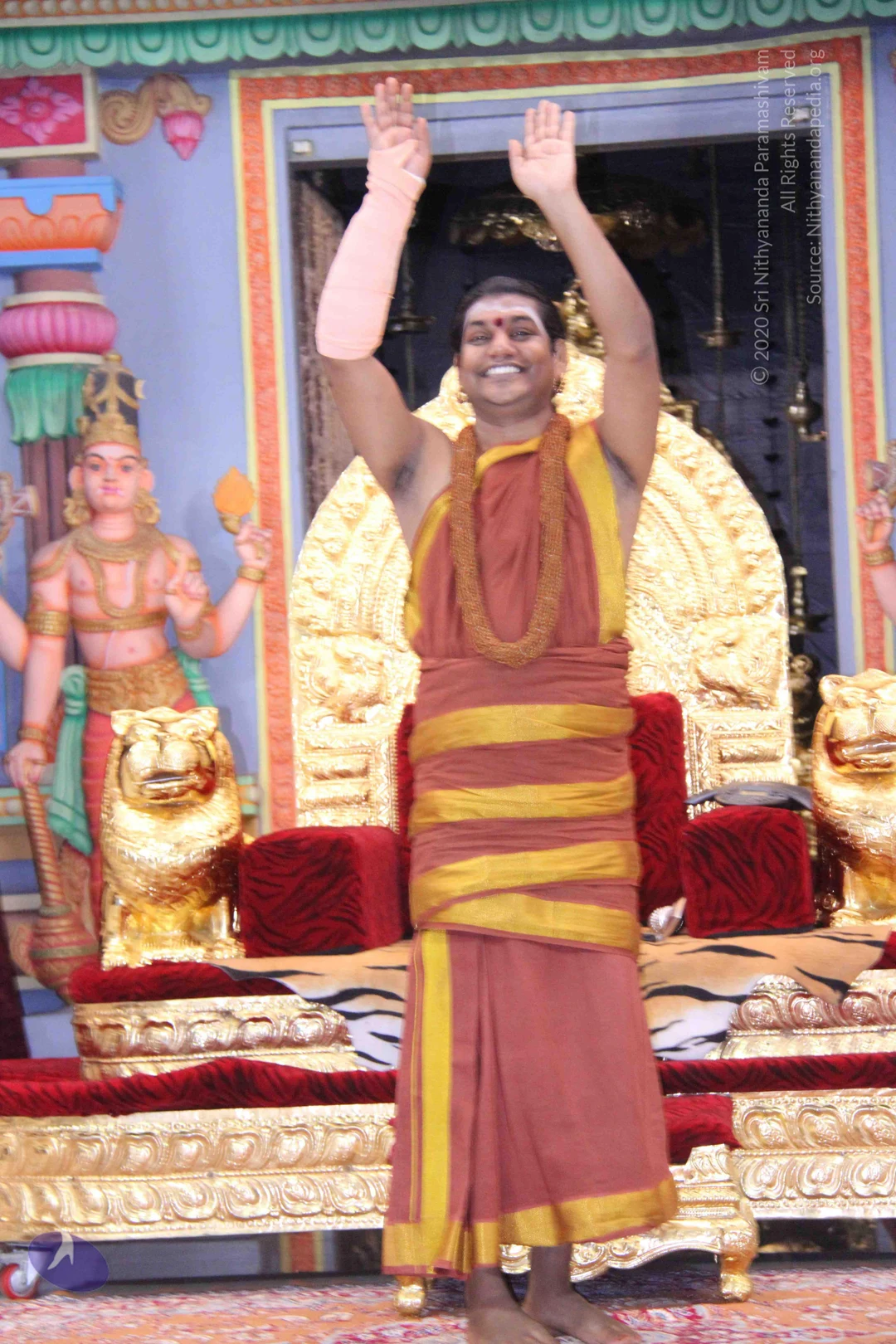
A photograph of a smiling man standing barefoot before an ornate golden throne flanked by golden lion figures with red and tiger-striped cushions. He wears a rust-red garment with broad gold borders wrapped over one shoulder, a long beaded rudraksha-style mala, a white forehead marking with a red dot, and small gold earrings. Both arms are raised in greeting, one wrapped in a pale bandage. Behind him stand a painted deity murti with a crown and raised hand holding a flame, and a brass hanging lamp is visible. The scene suggests a temple or ashram hall. a person, appearing as the man in the foreground with a rudraksha mala, rust-red and gold robes and a white forehead marking, is standing in front of the throne with both arms raised.Photograph of a smiling man standing barefoot on a stage, arms raised high in an open gesture. He wears a rust-red sannyasi-style garment with gold borders, a long beaded rudraksha-style mala necklace, and a red bindi with white tilak marks. Behind him is a gilded throne with lion-head arms, red velvet cushions and a tiger-skin cover. To the left stands a painted deity murti with multiple arms and a gold crown. A pink bandage covers his left forearm.A smiling man with swept-back dark hair, a red bindi and white forehead markings, wears a saffron-and-orange garment and a rudraksha mala with gold ornaments in his ears. He stands beside an ornate gold-carved throne (peetha) in a temple-like hall with painted blue walls, orange and green borders, and a gold canopy with hanging brass lamps behind him. A painted figure appears at the left edge. The setting suggests an ashram stage. Swamiji (probable) based on the ornate saffron attire, rudraksha mala and swept-back hair beside the throne.

September 23 2013

1 photoView all
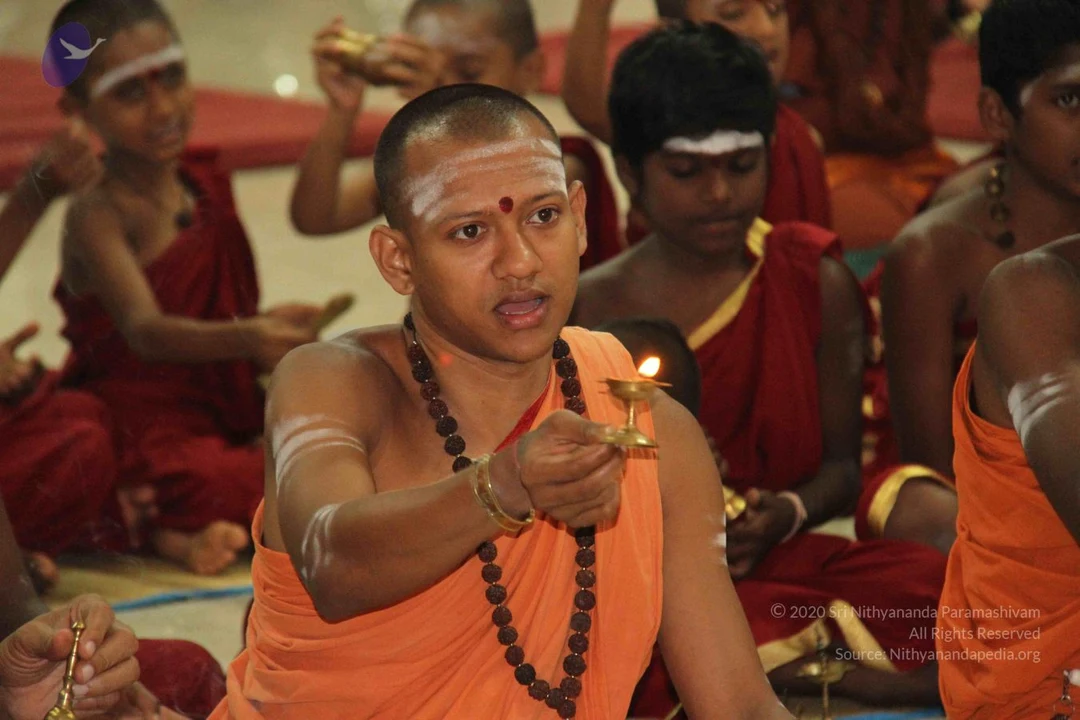
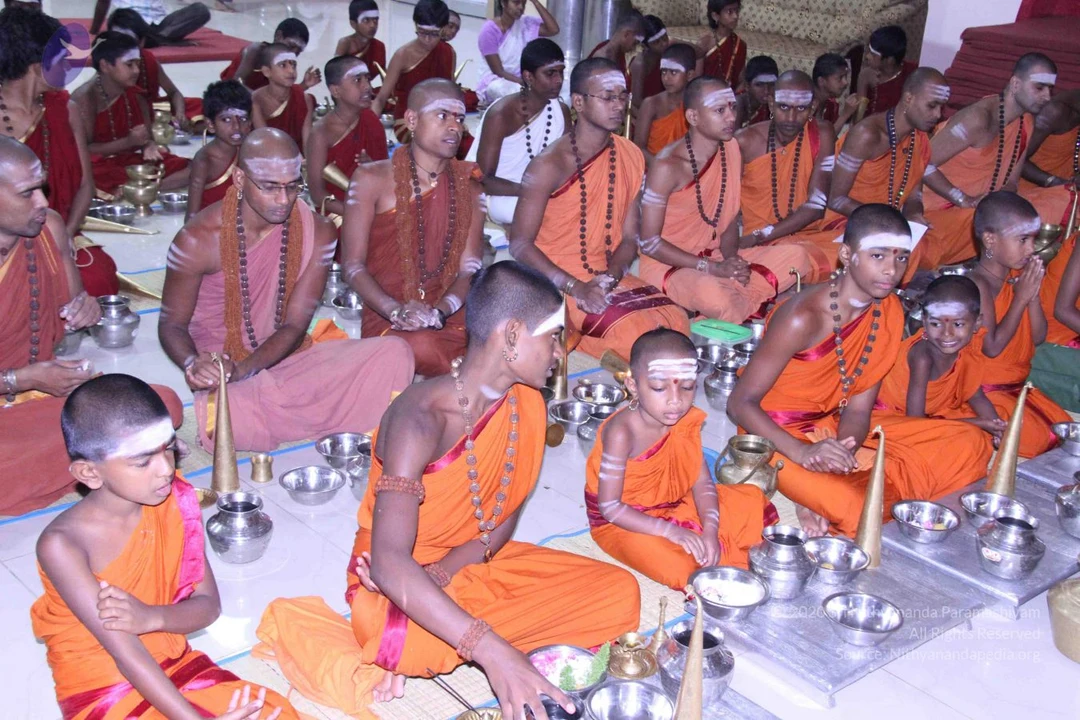
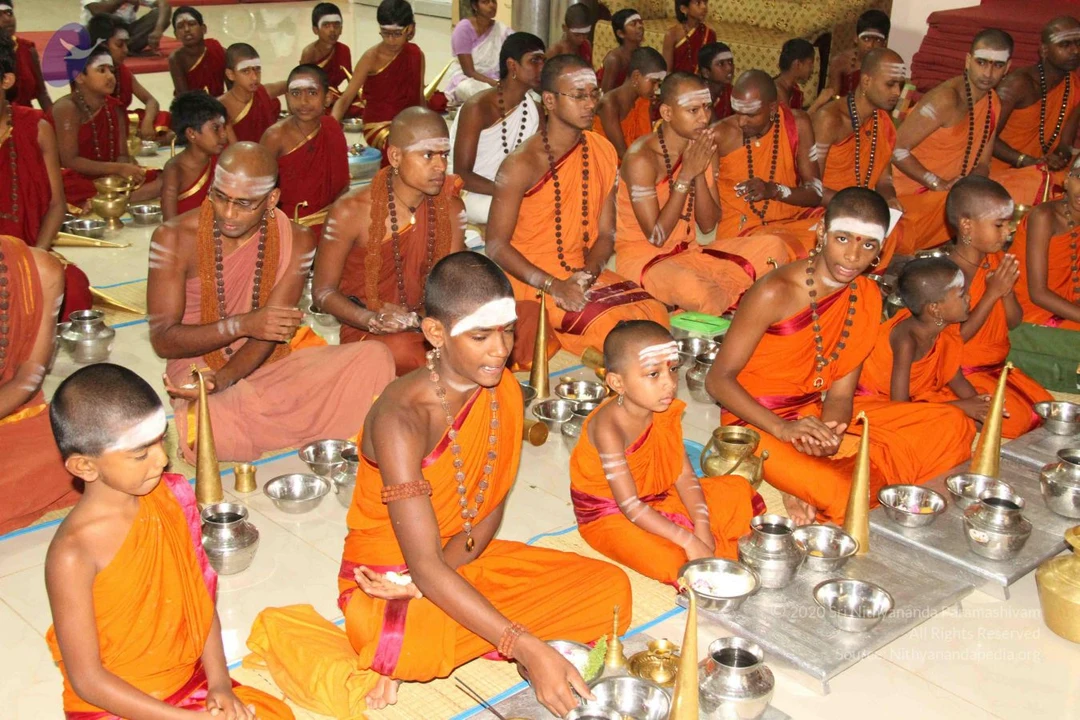
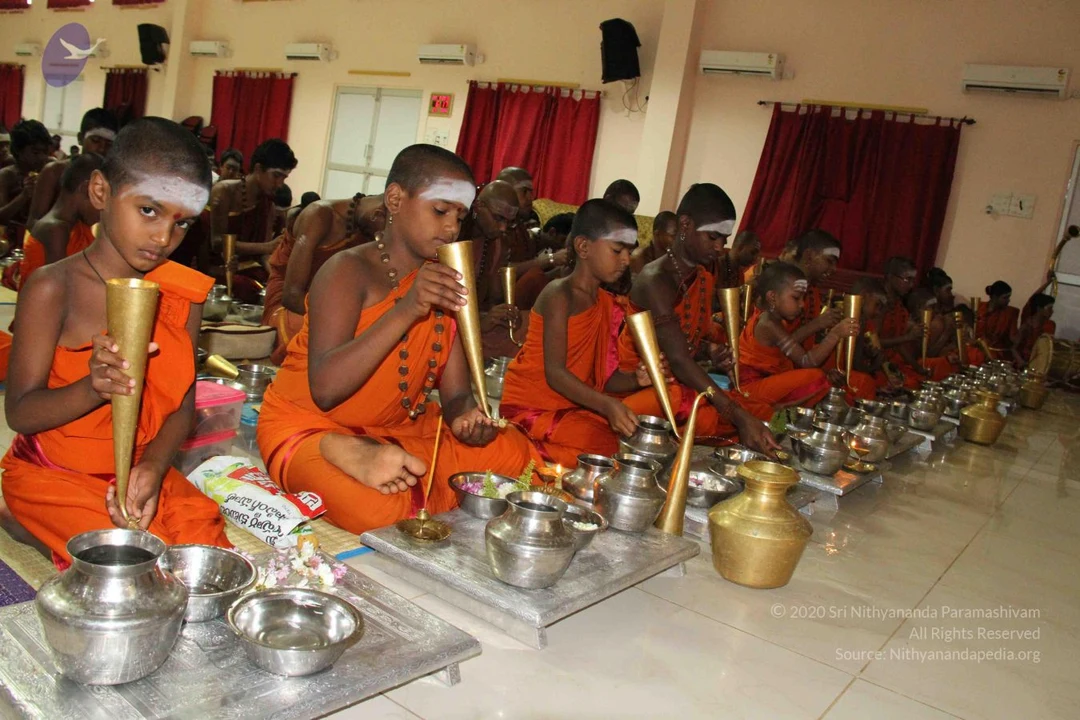
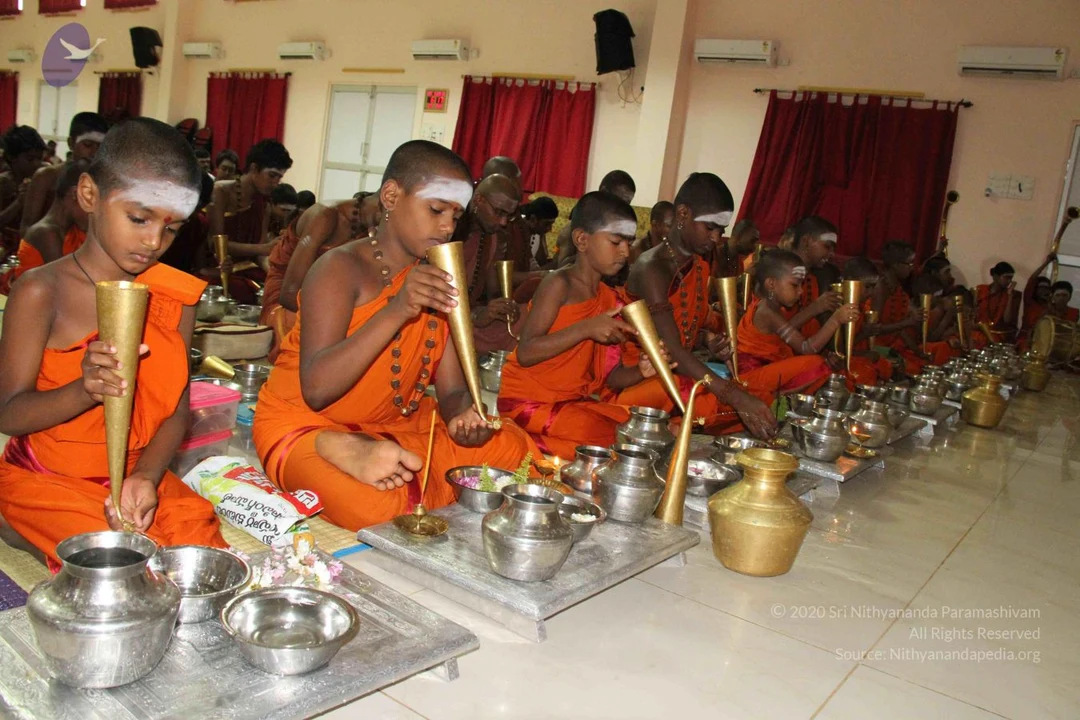
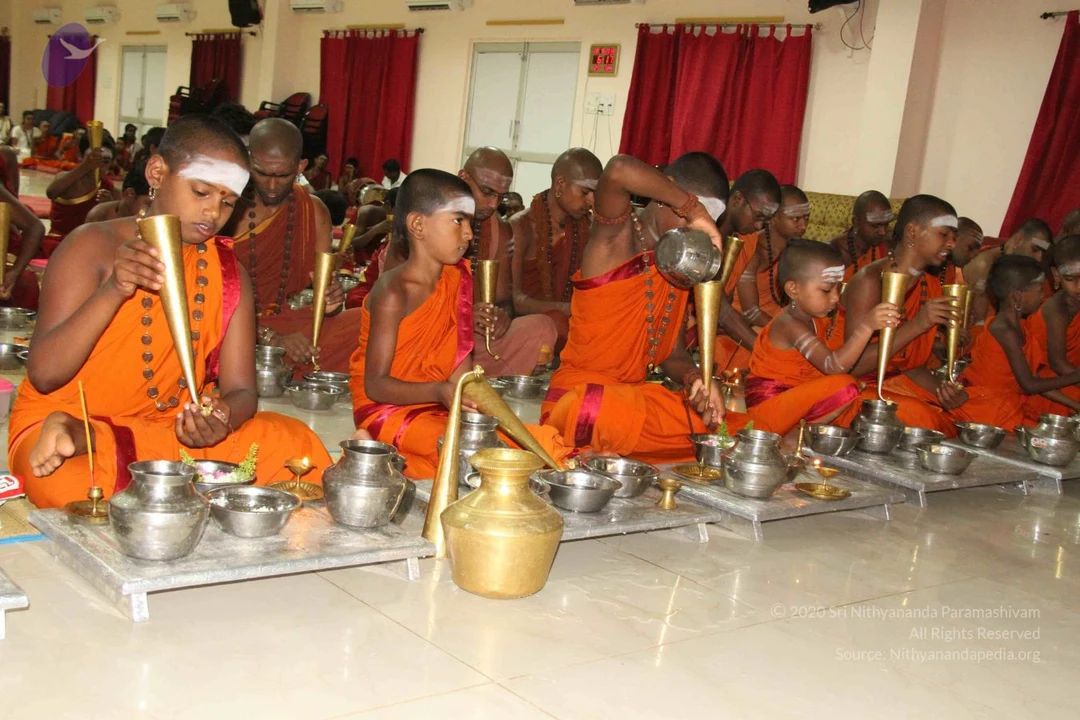
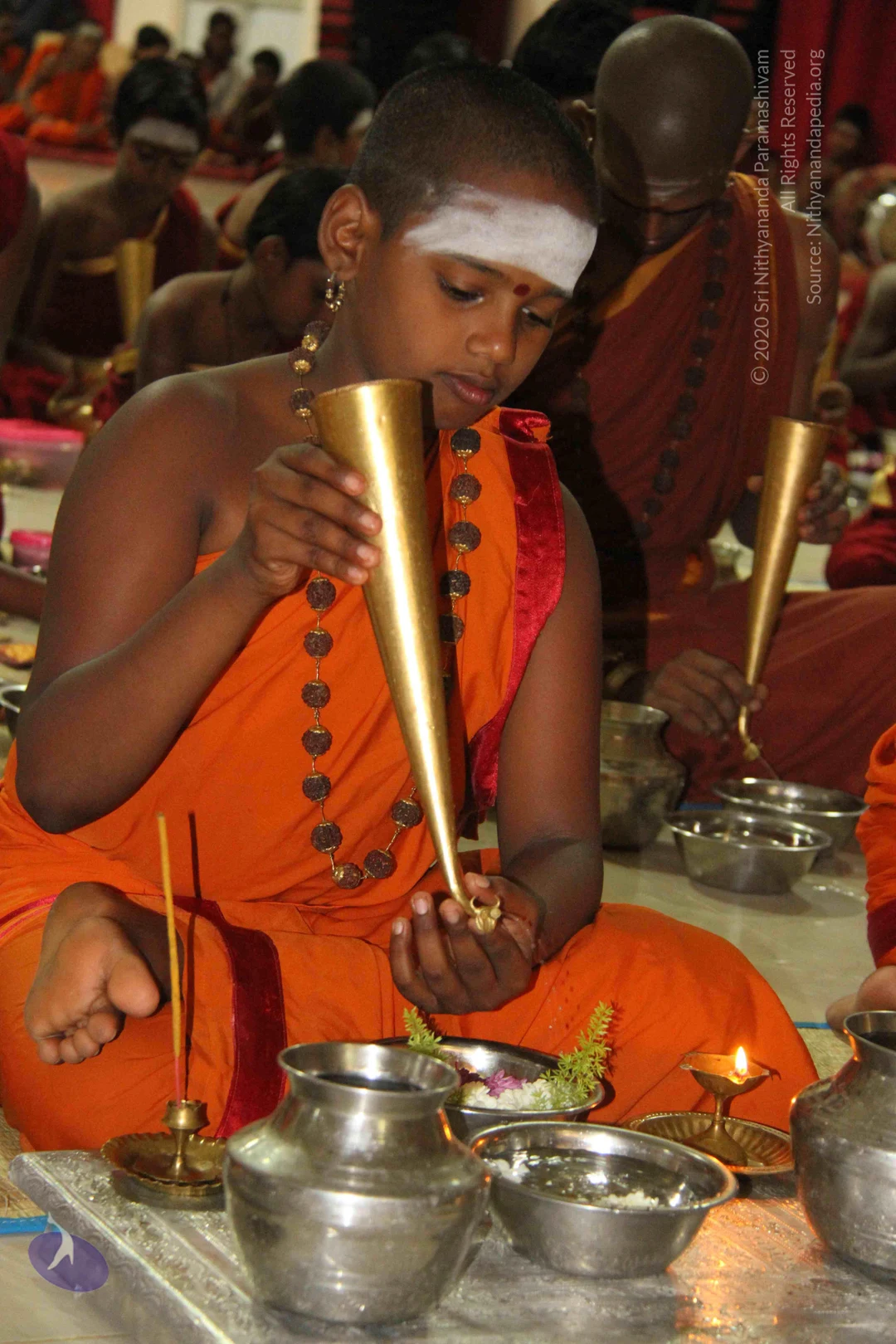
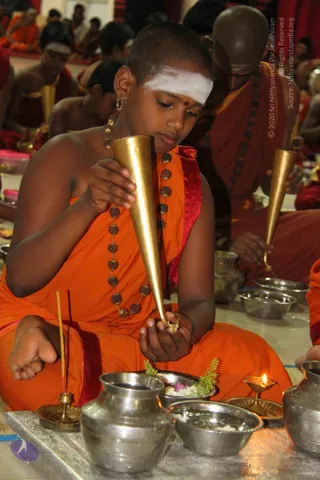
A young boy with a shaved head, white forehead band and red bindi sits cross-legged in an orange robe with a red velvet edge and rudraksha mala, holding a gold conical vessel to his lips during a ritual. Brass and steel vessels, a small oil lamp, incense sticks and a plate with flowers and greenery sit before him. Other saffron-robed men and boys sit behind him, each with a similar golden cone. The scene looks like a puja or abhishekam in a hall.