Skip to content
Thursday

19 September 2013

Dated photos
186
Source pages
1
Media
2
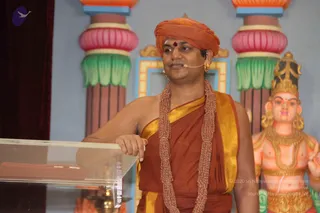
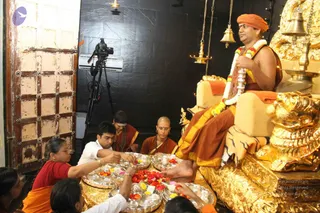
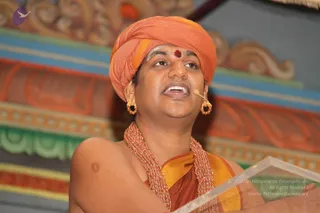
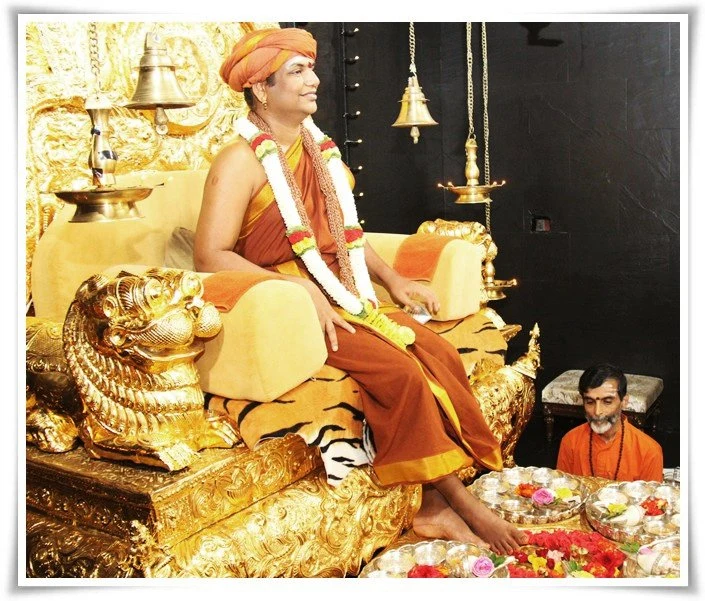
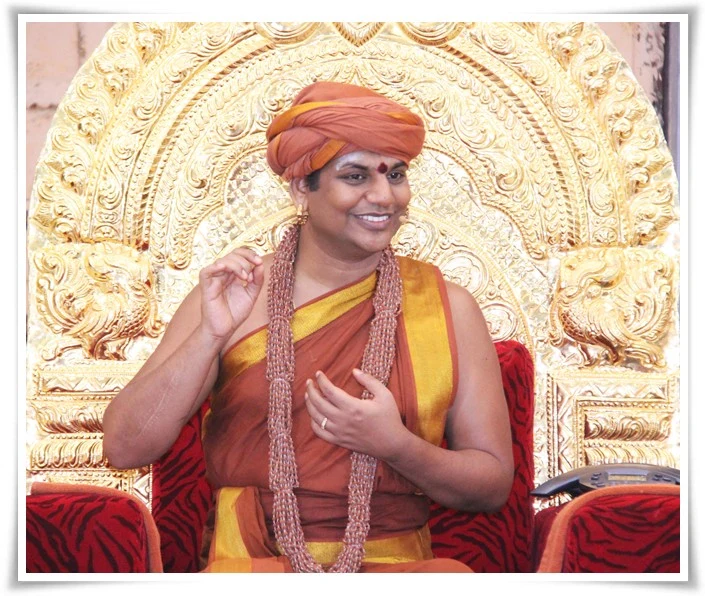
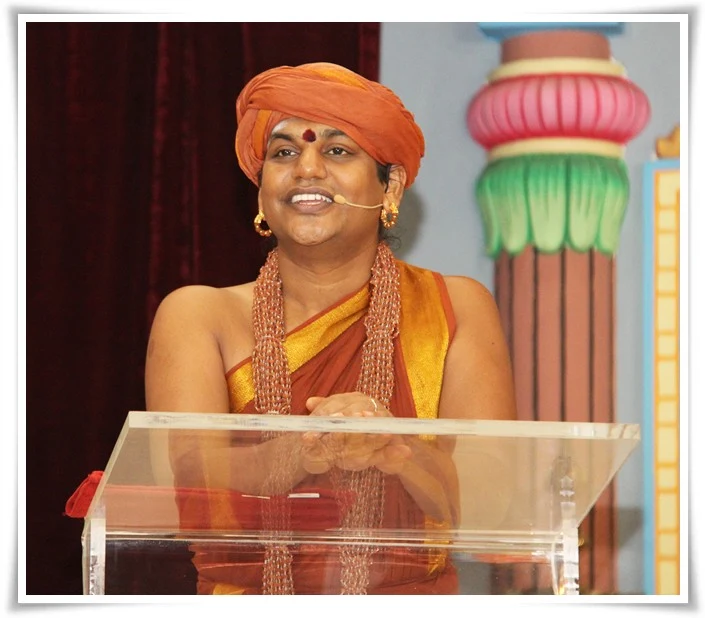
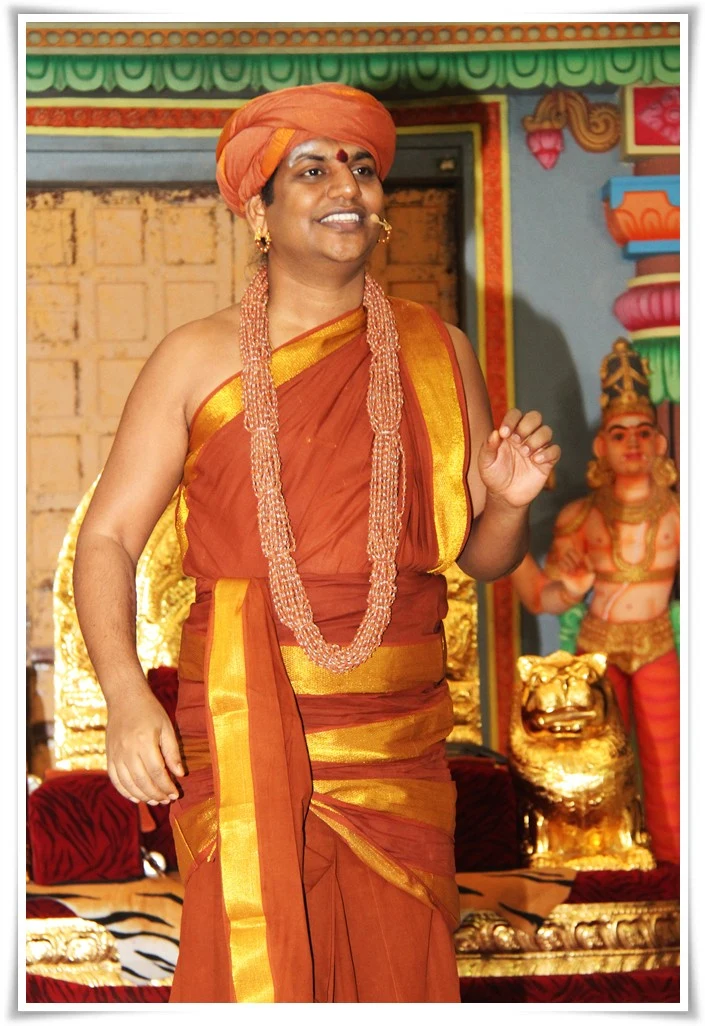
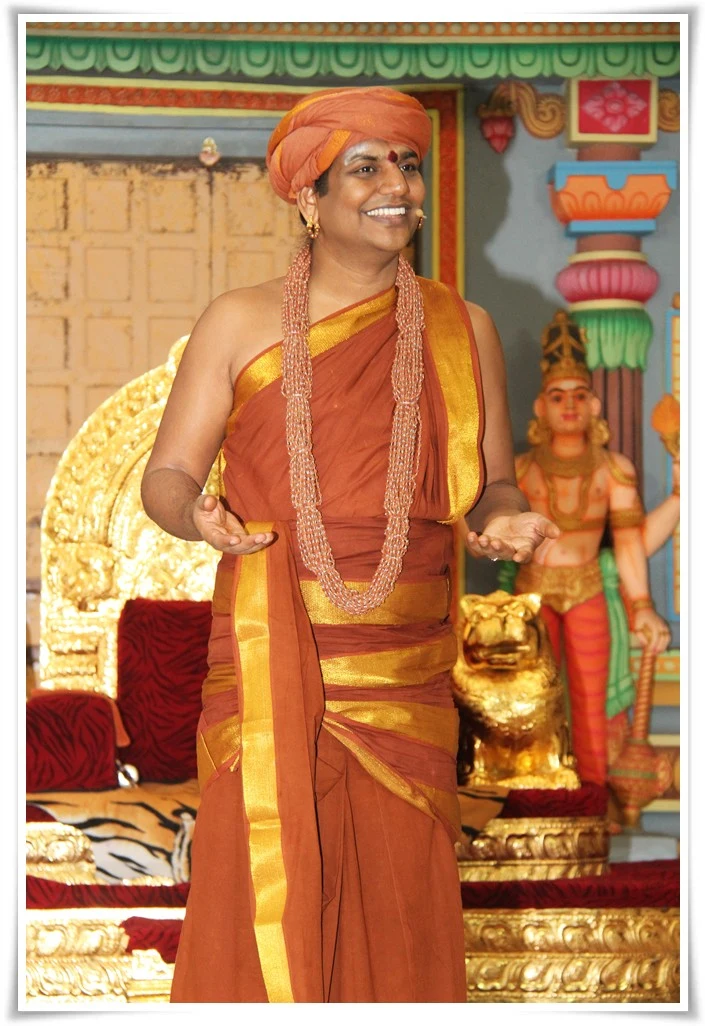
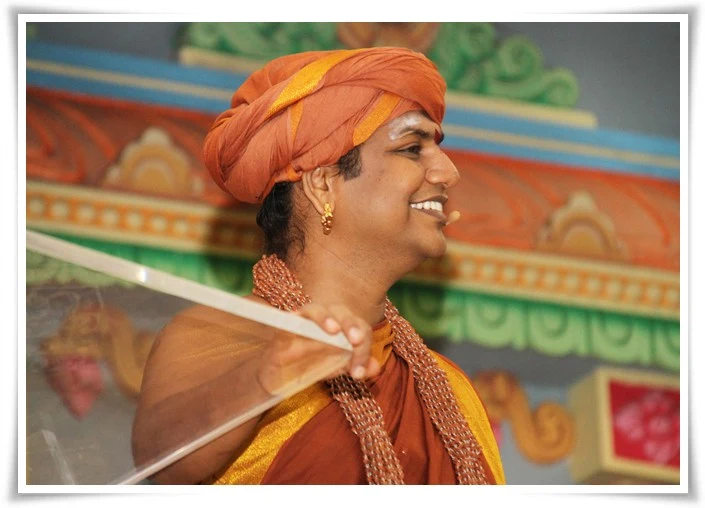
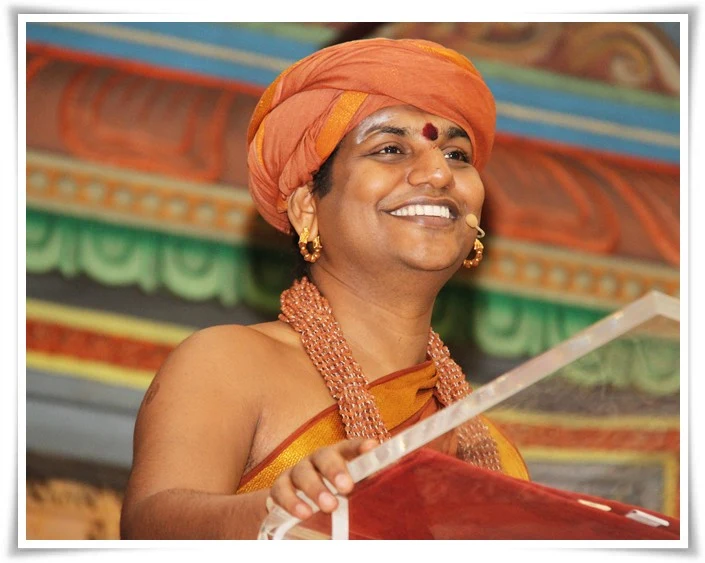
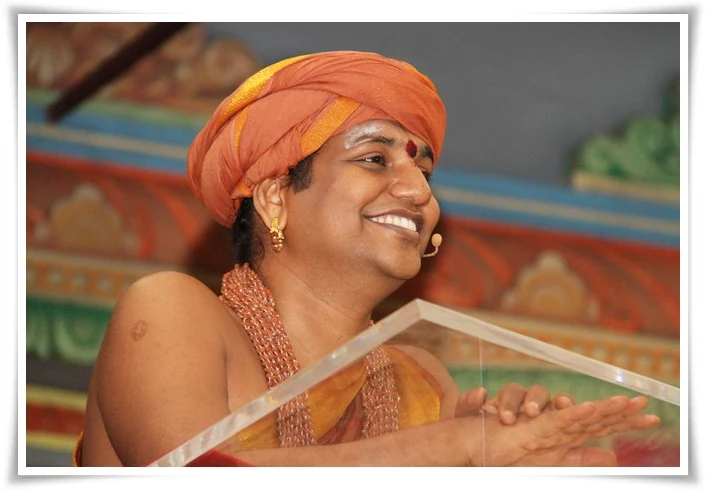
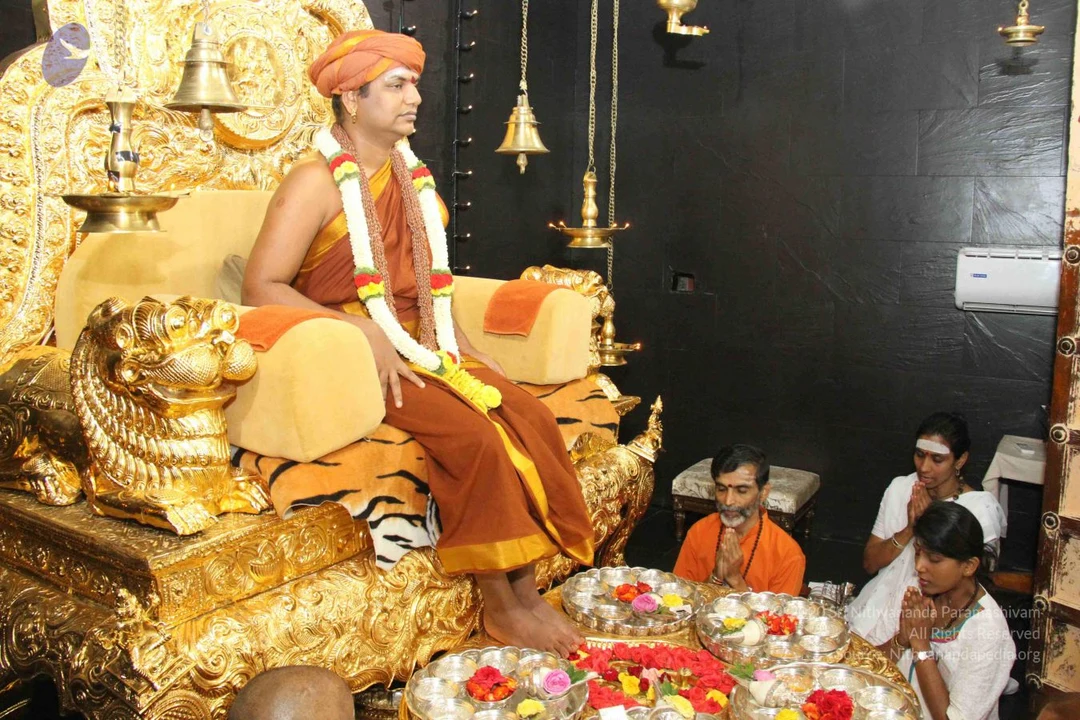
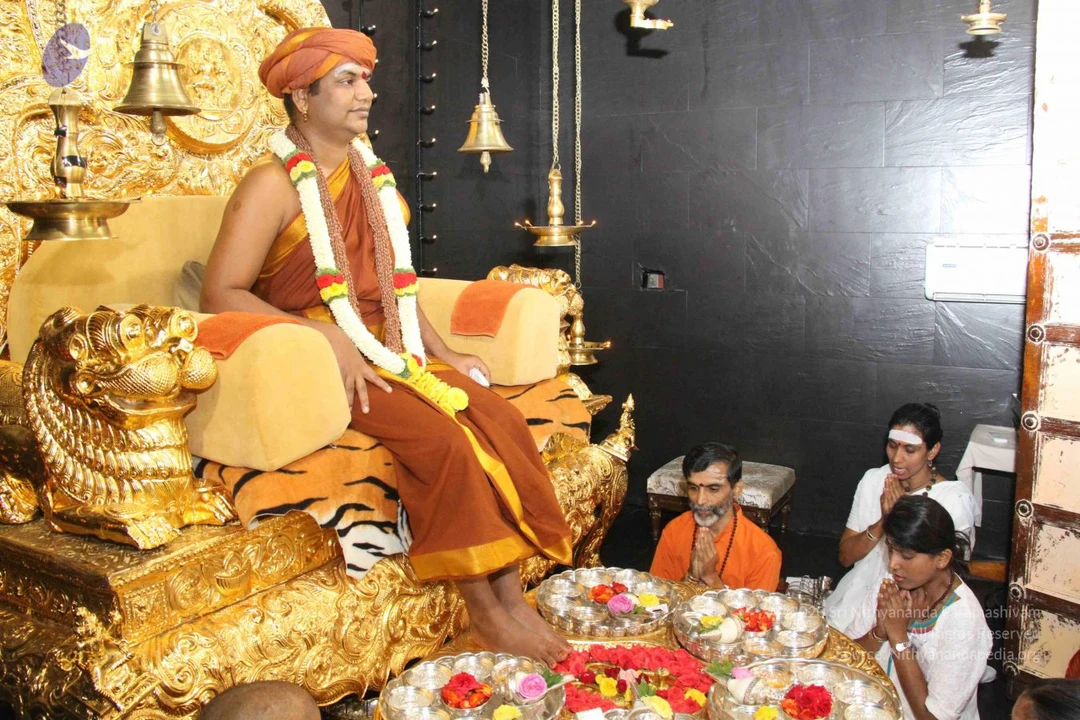
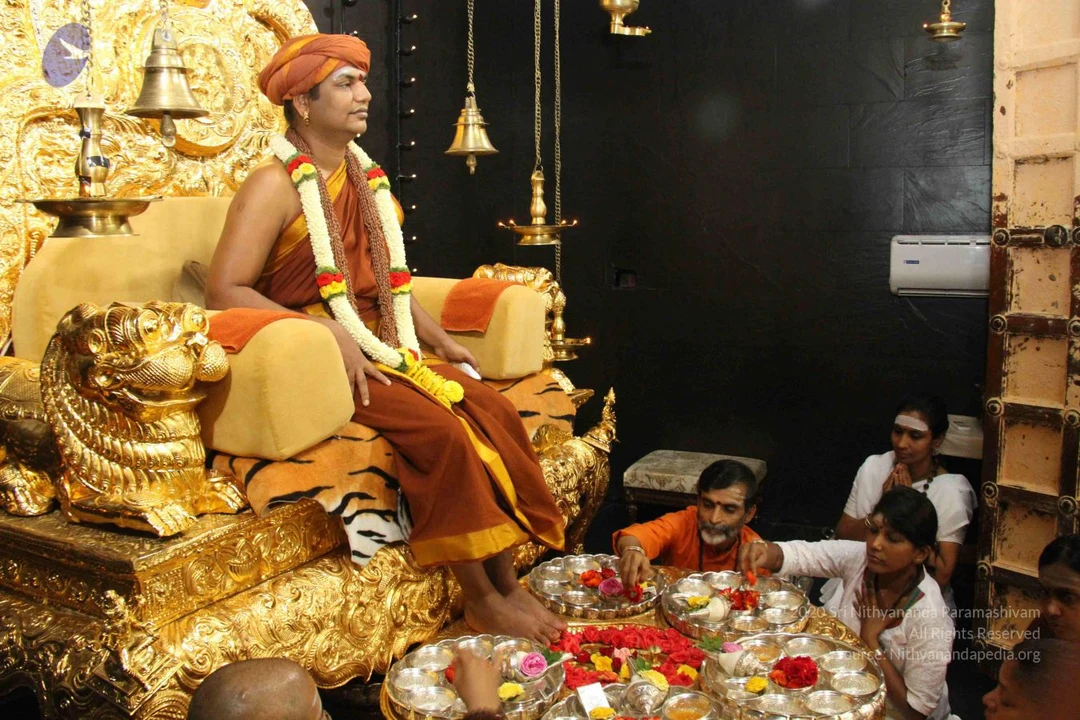
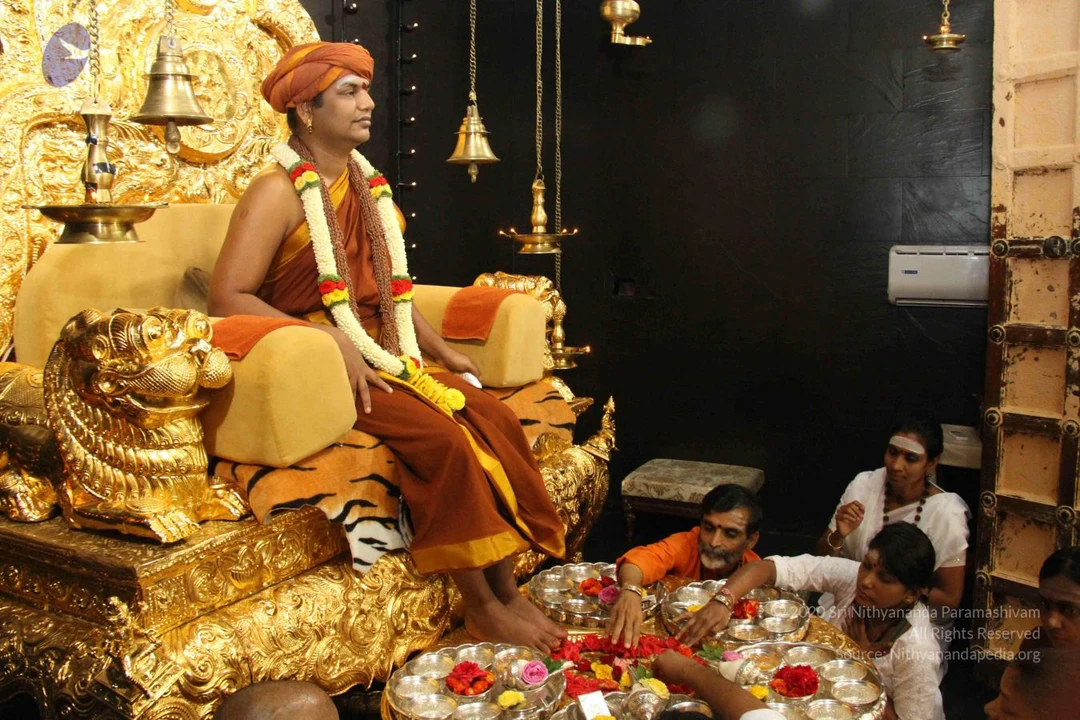
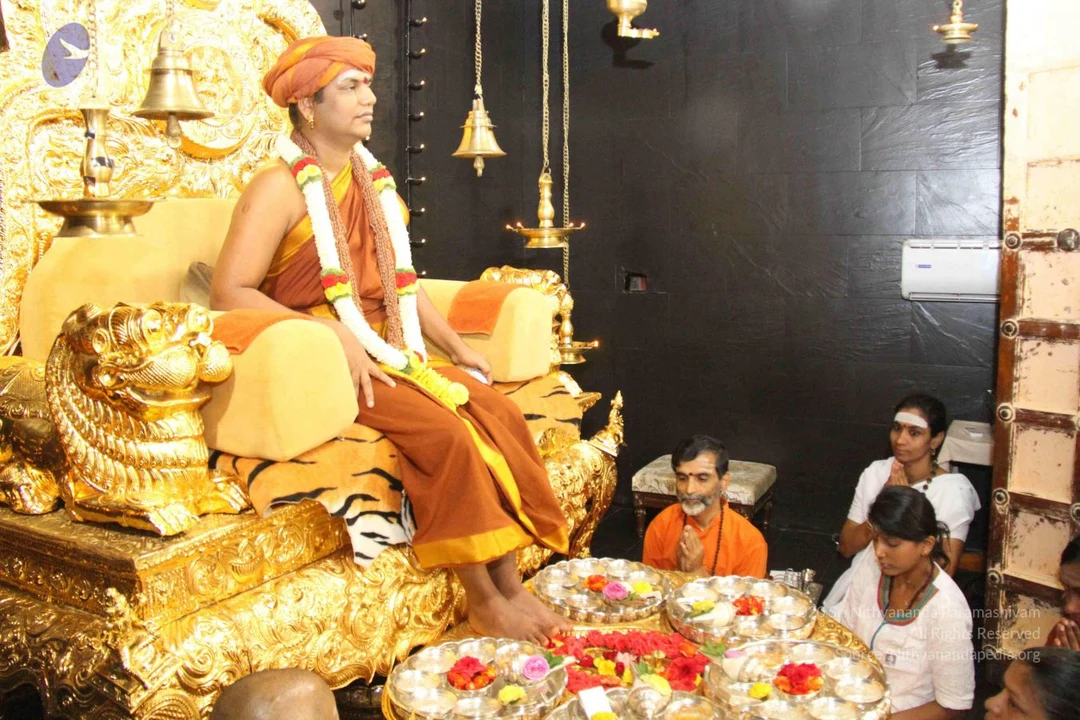
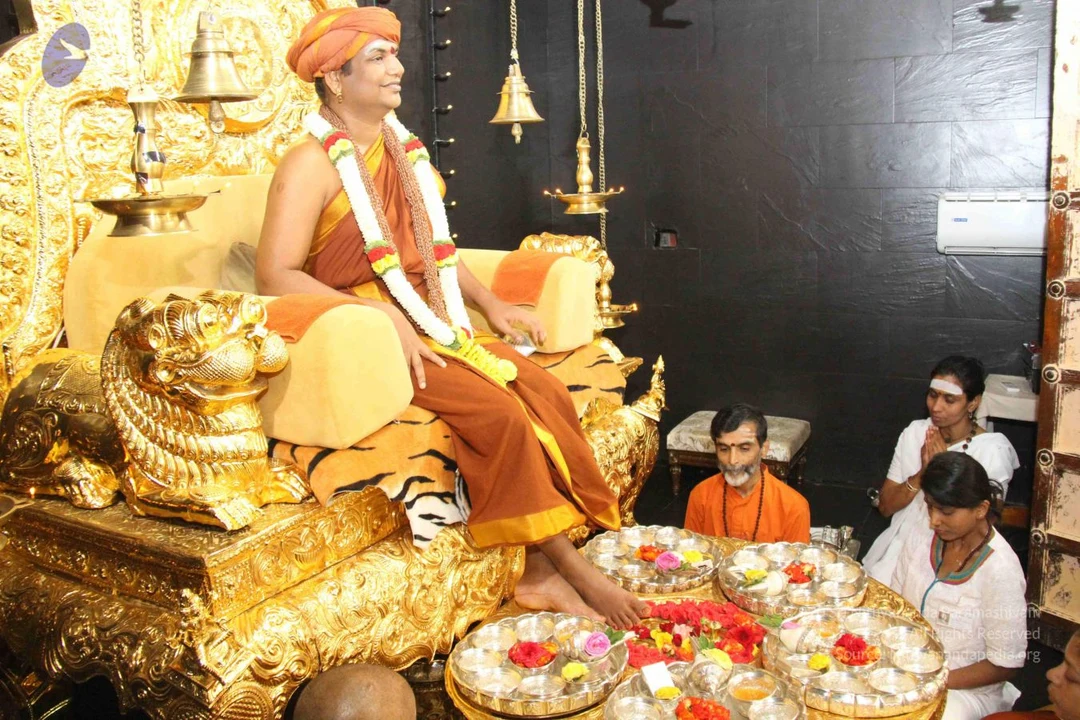
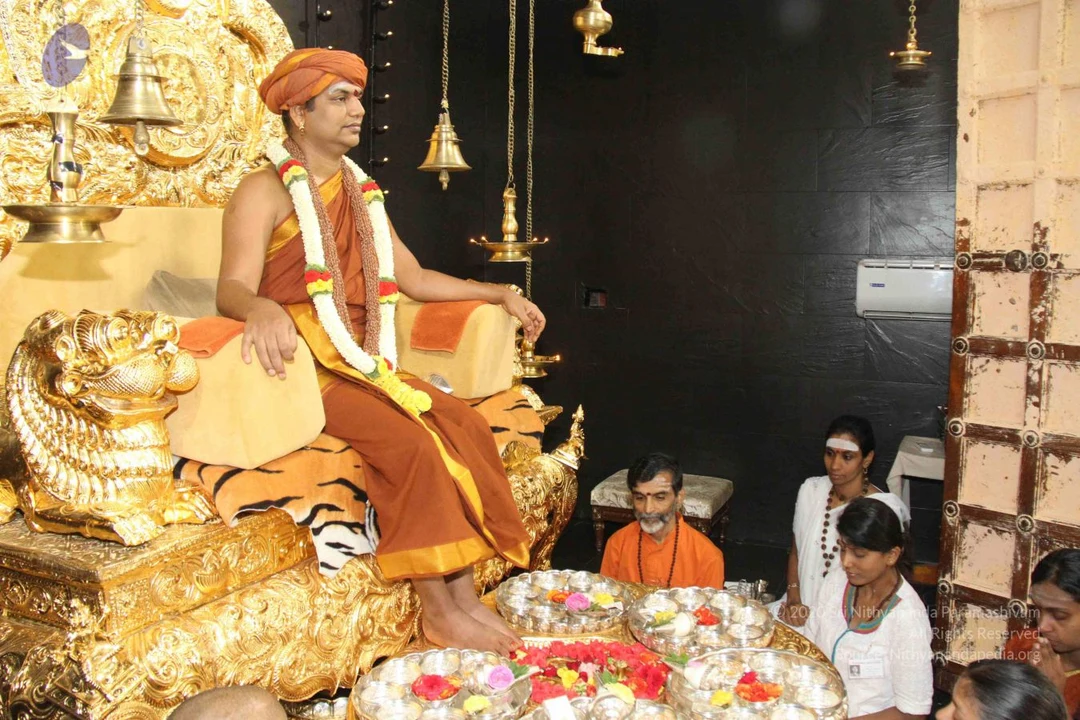
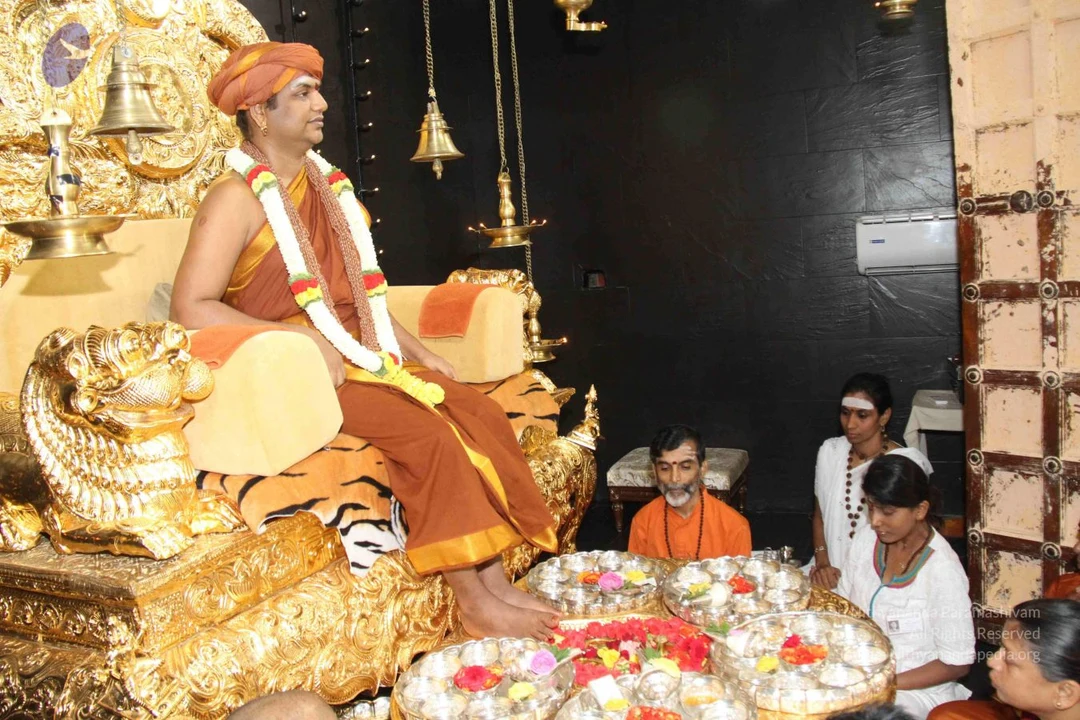
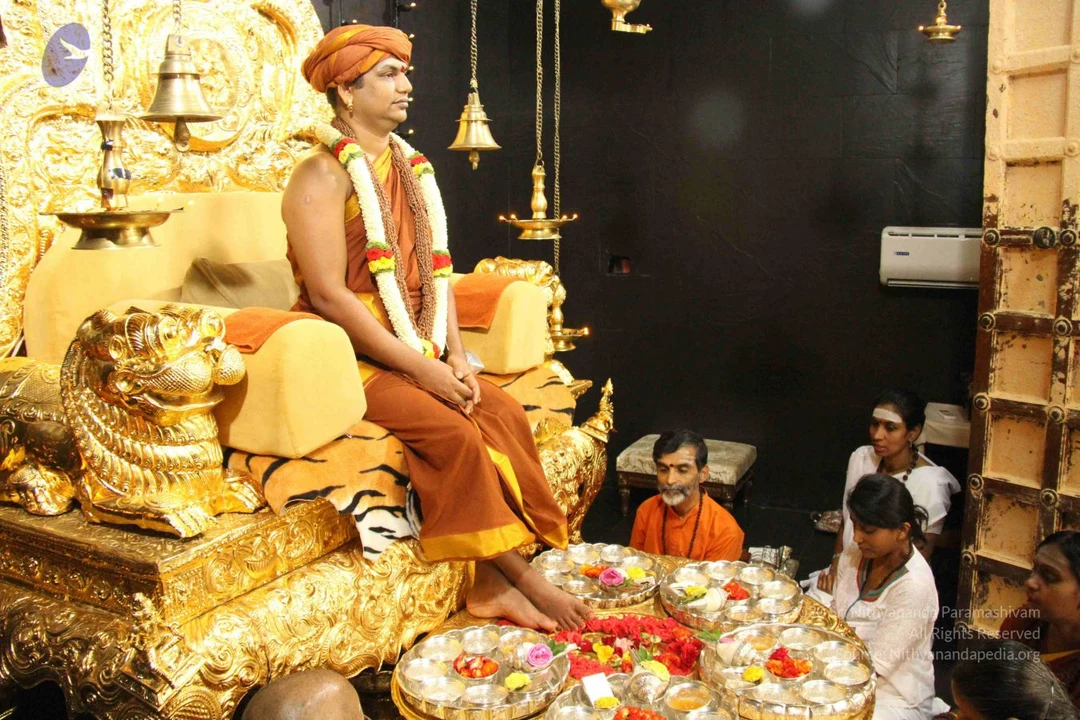
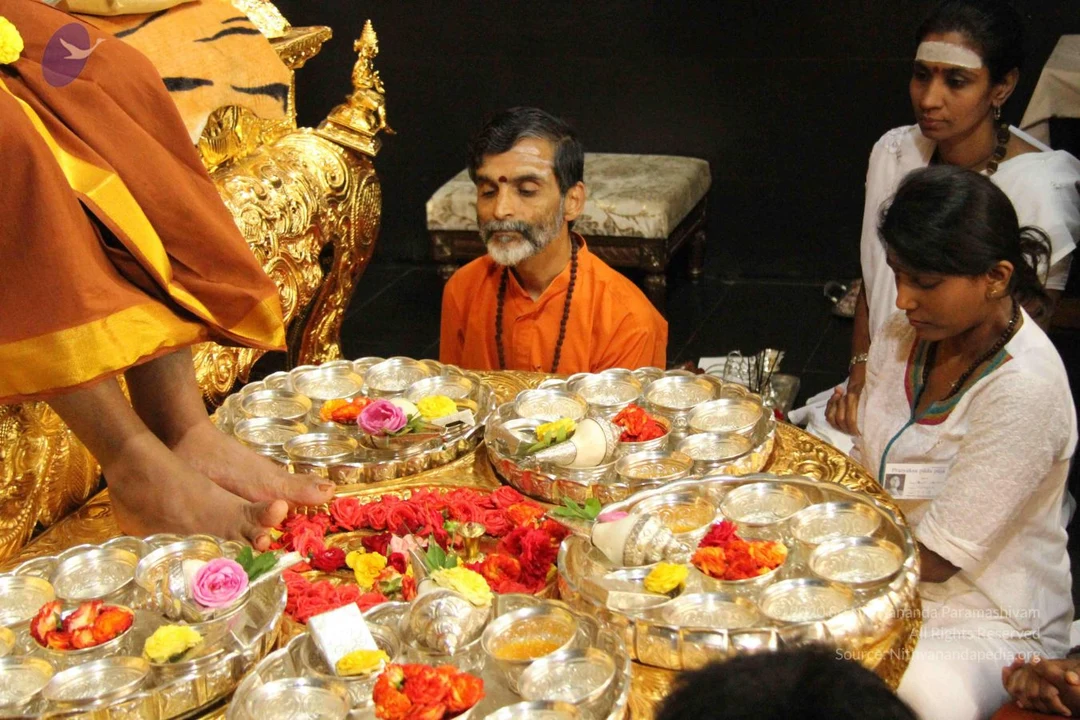
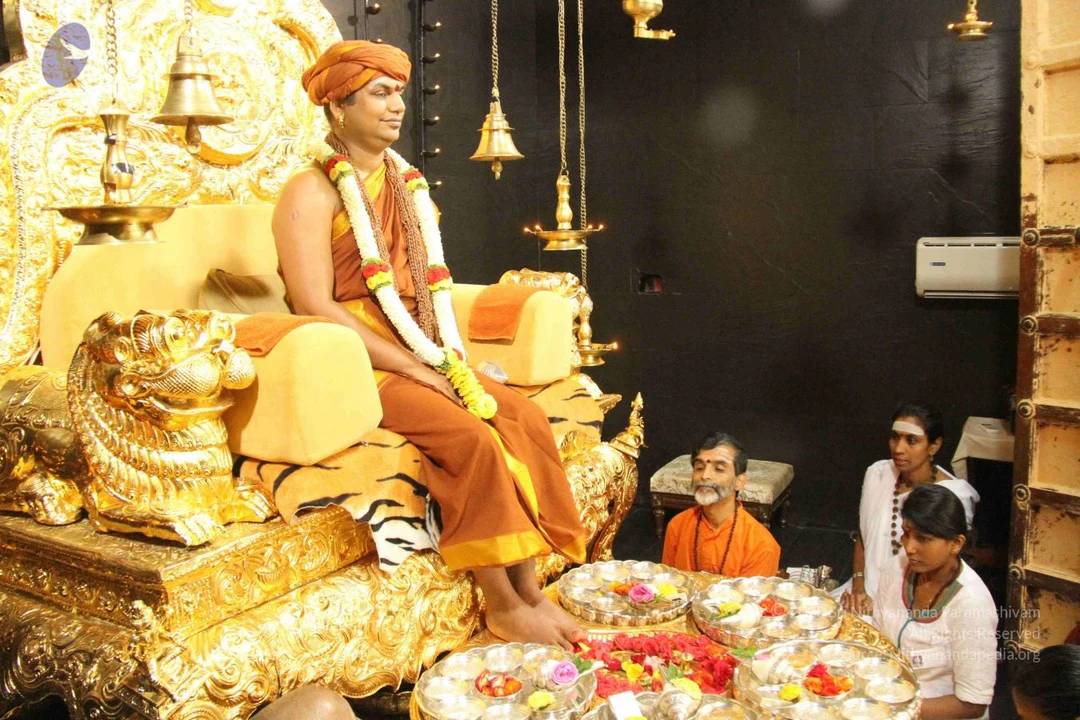
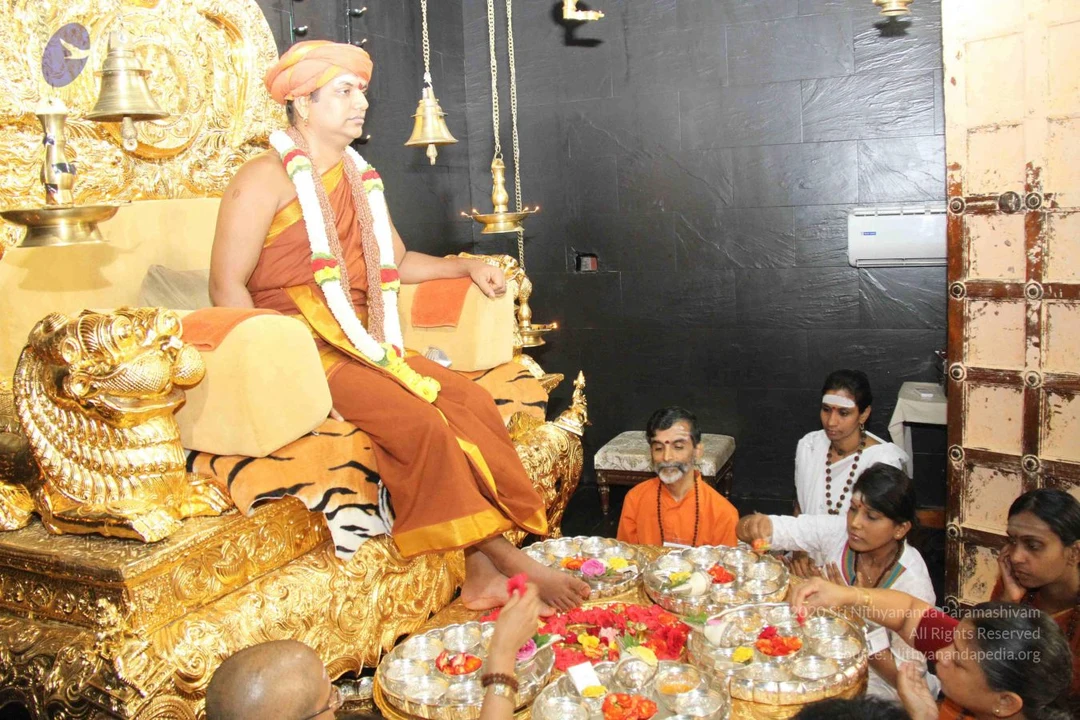
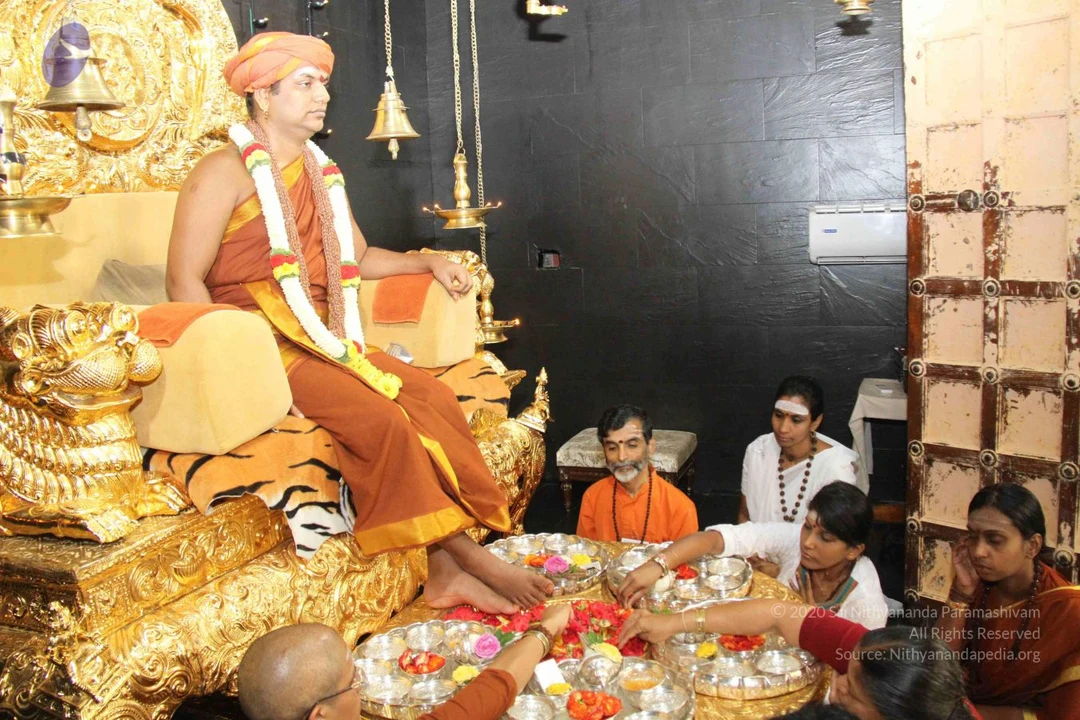
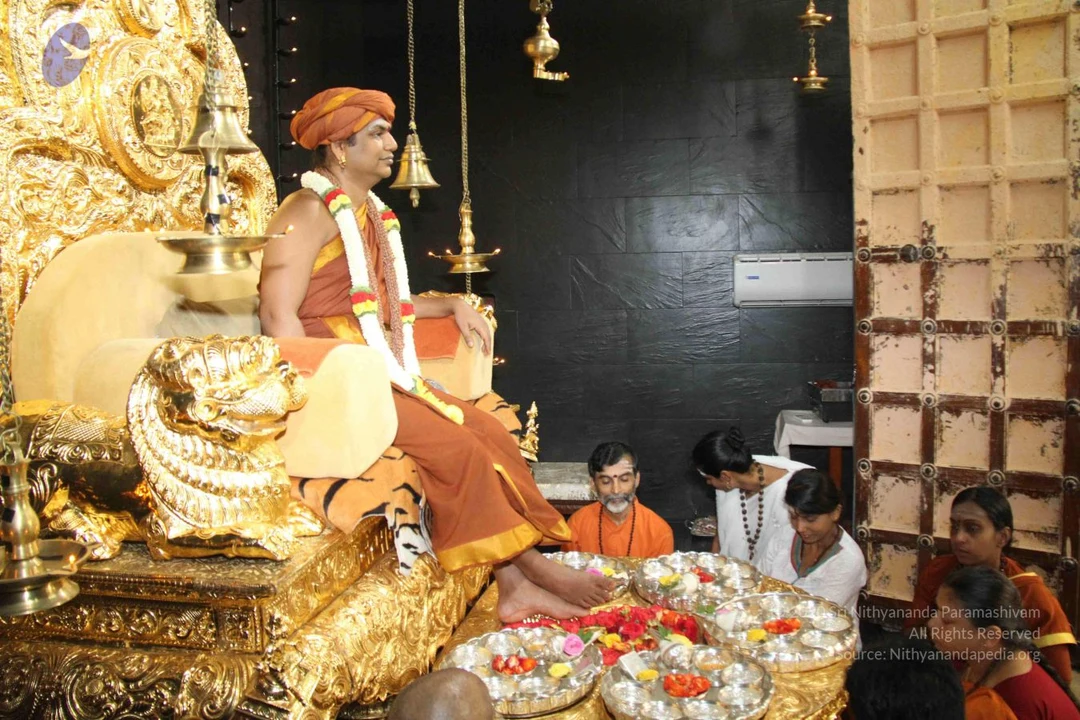
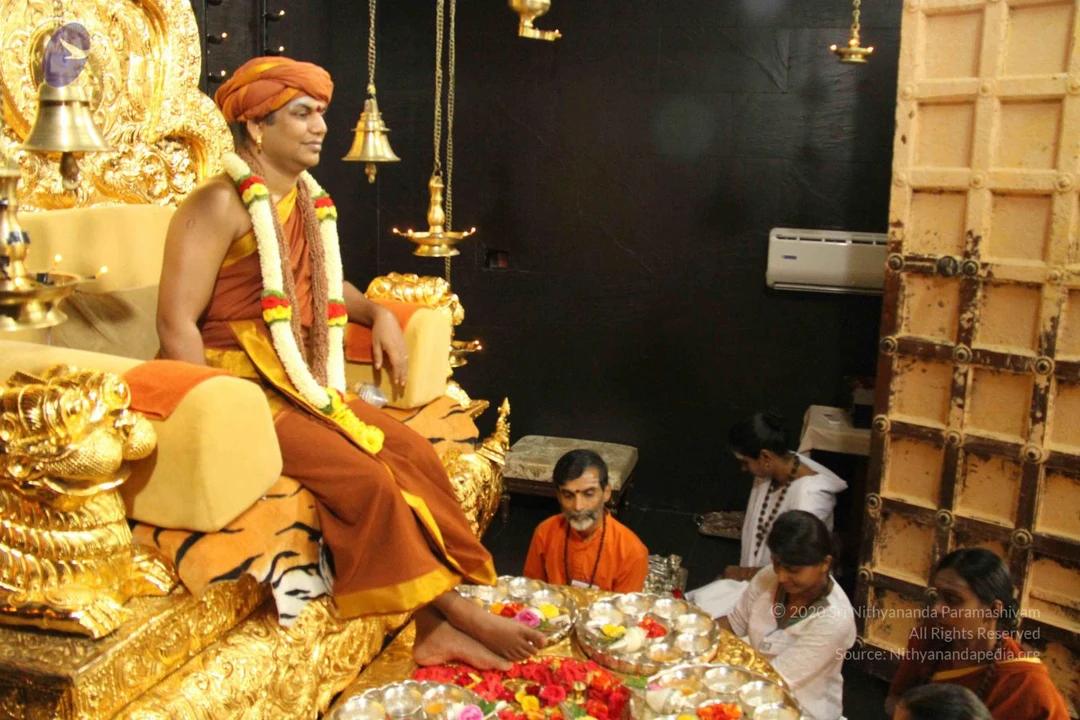
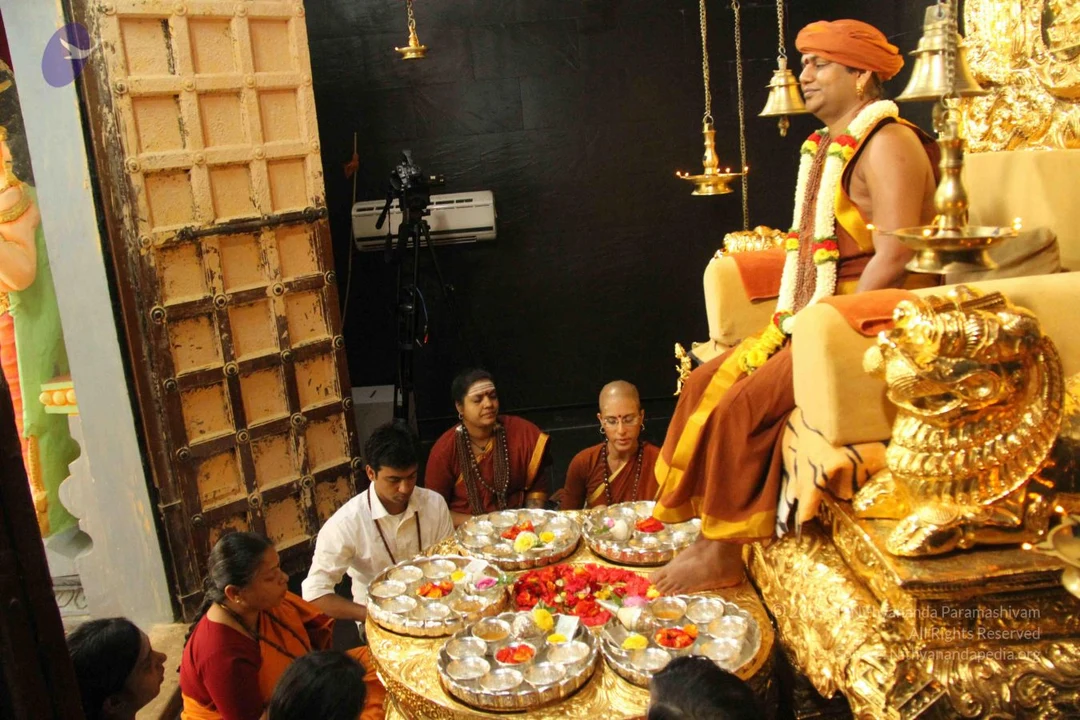
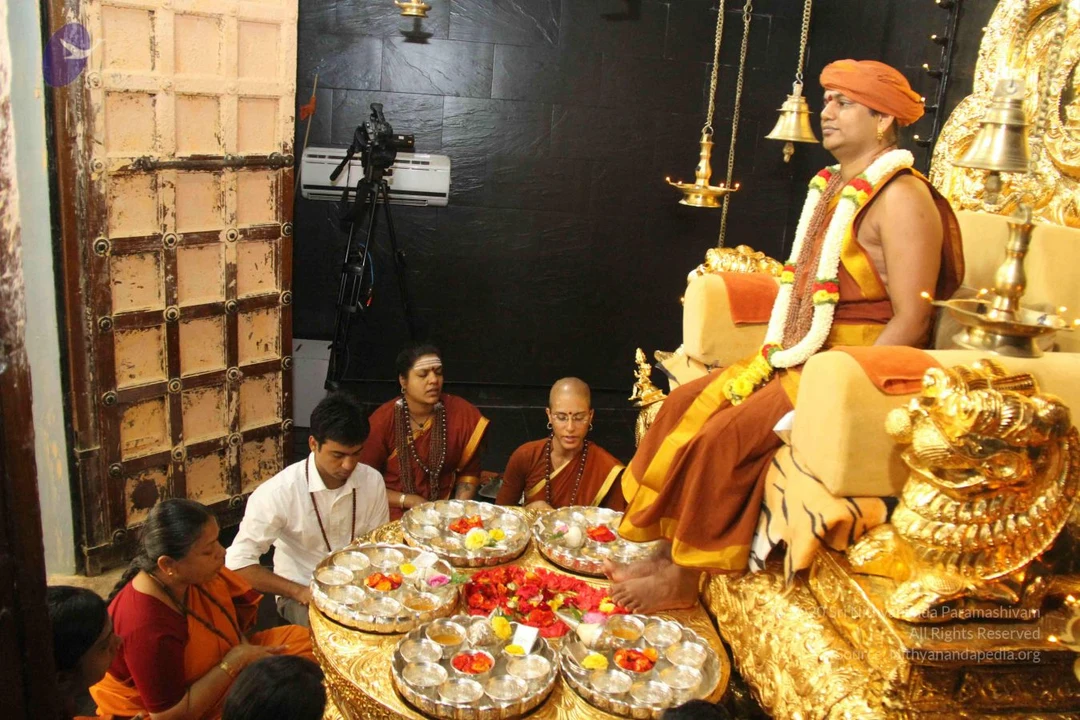
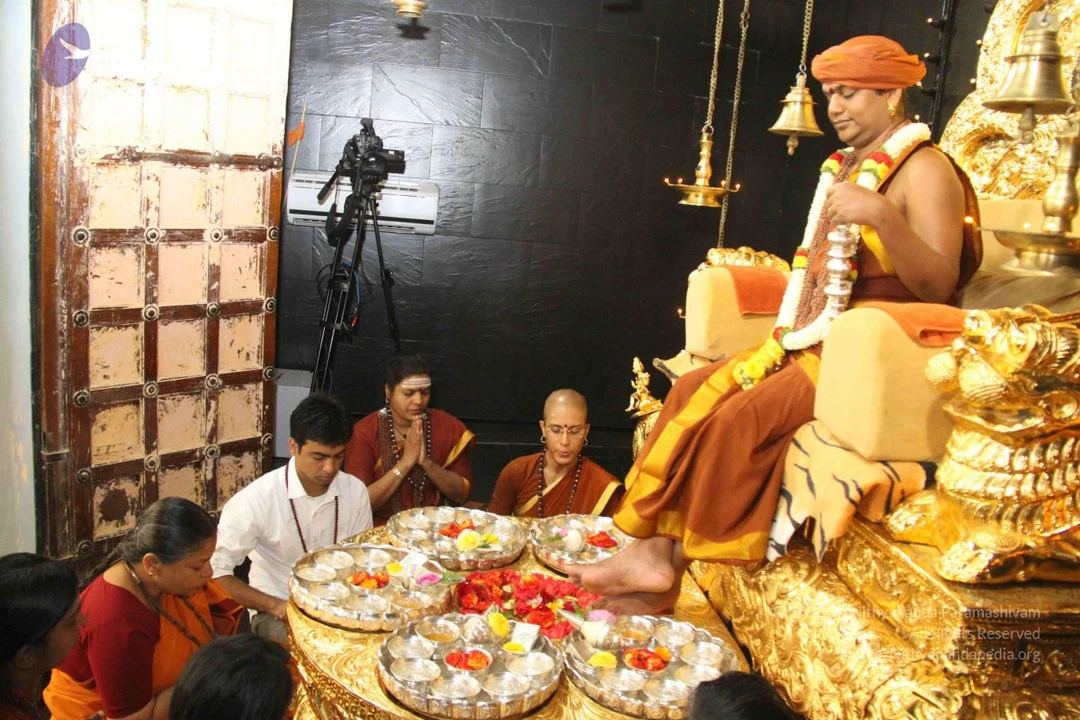
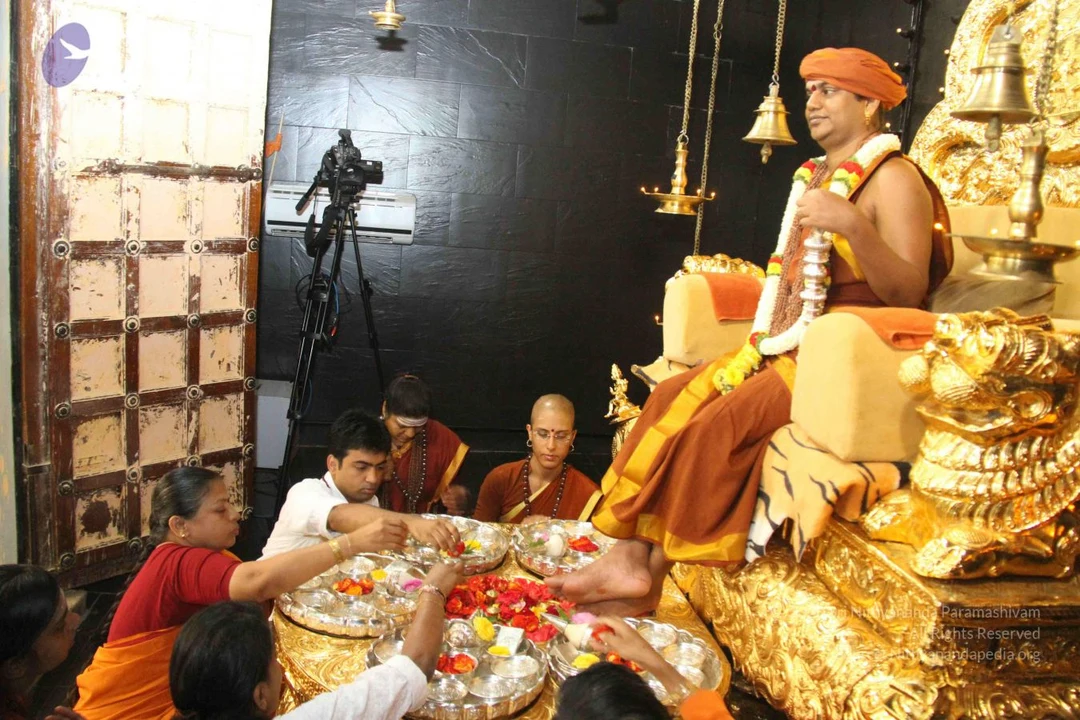
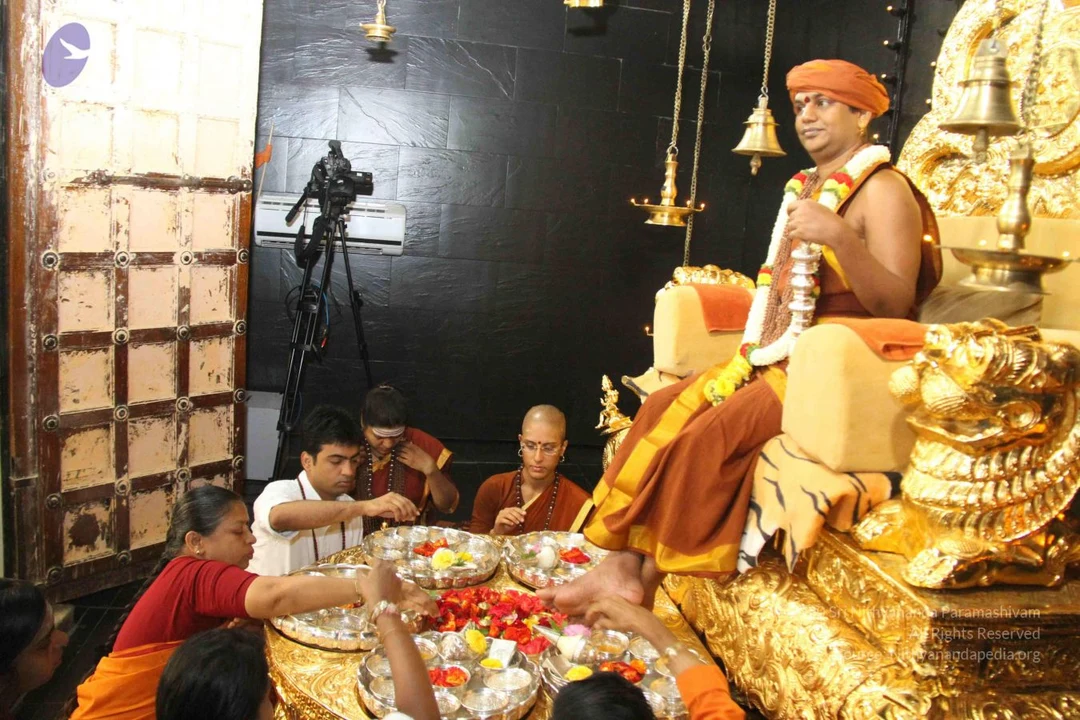
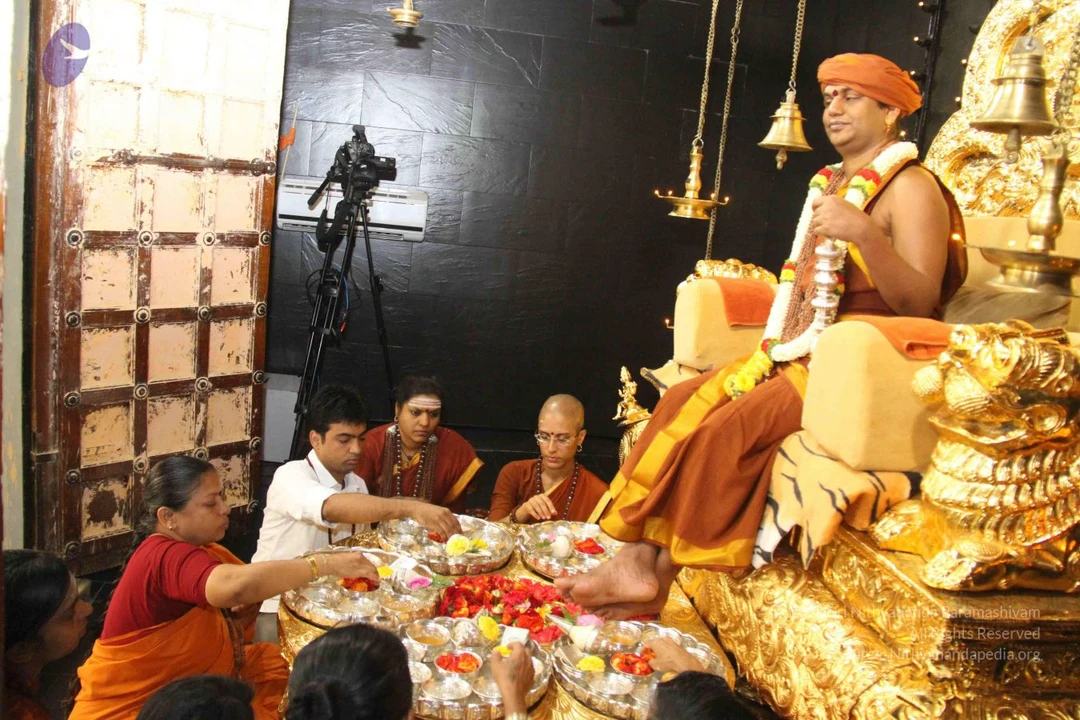
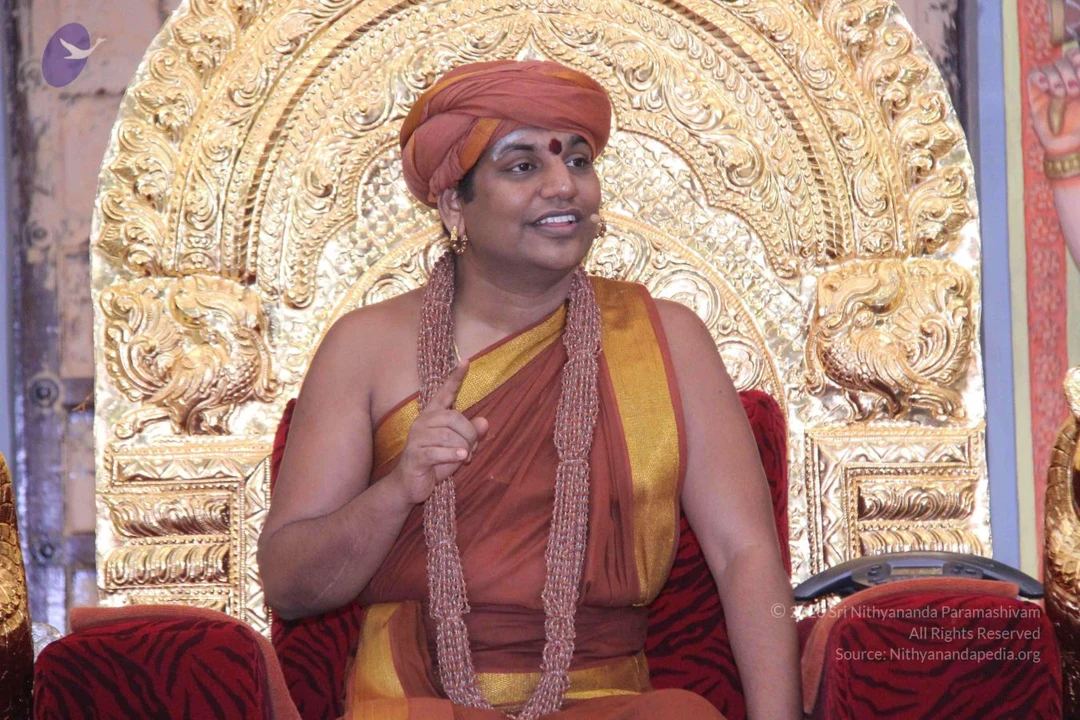
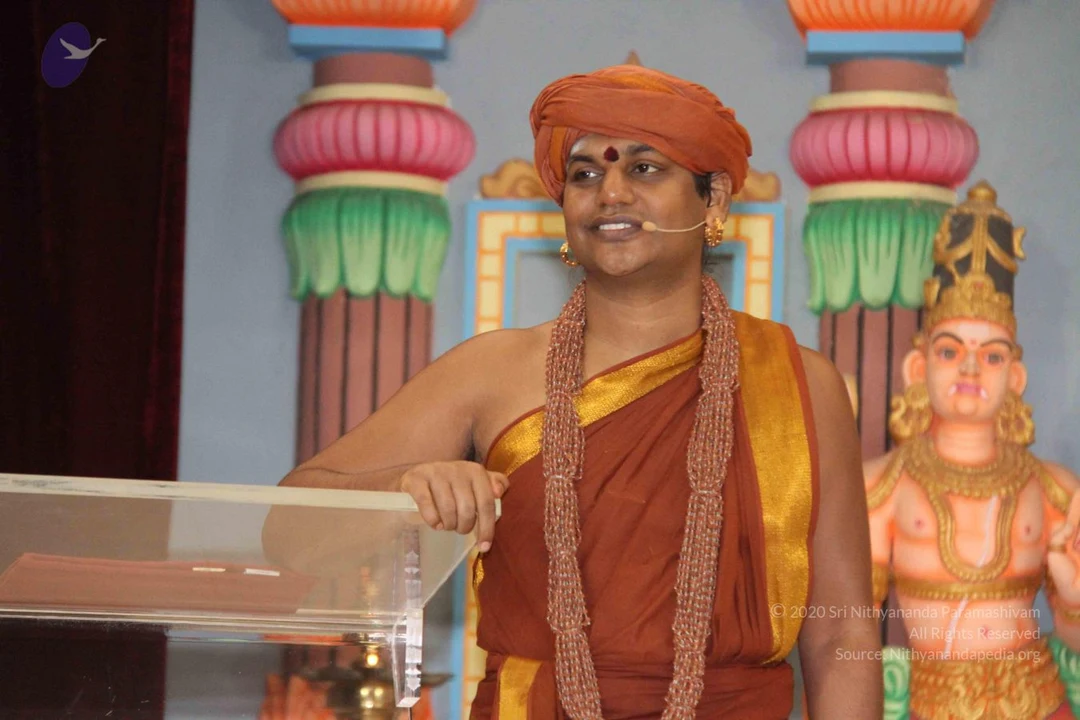
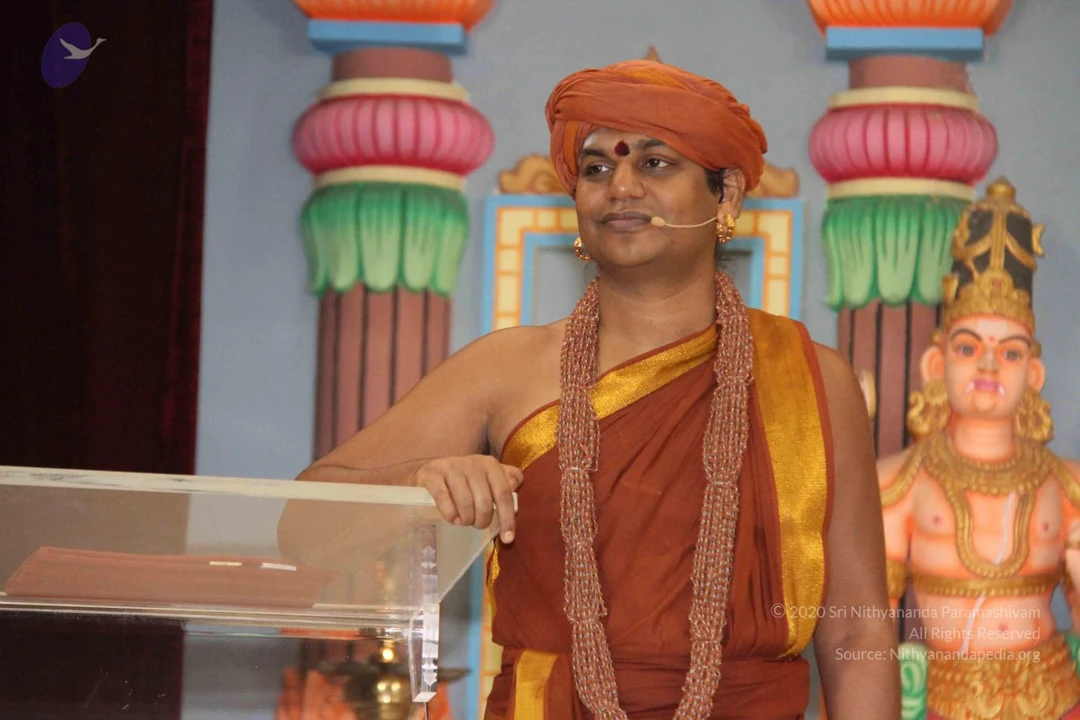
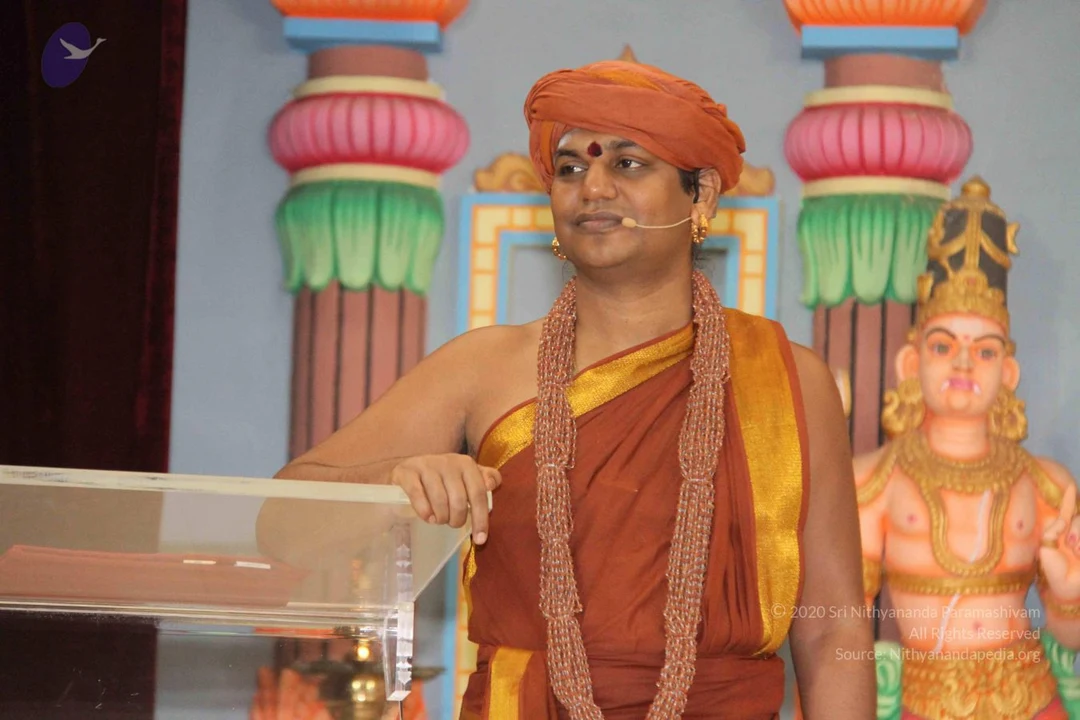
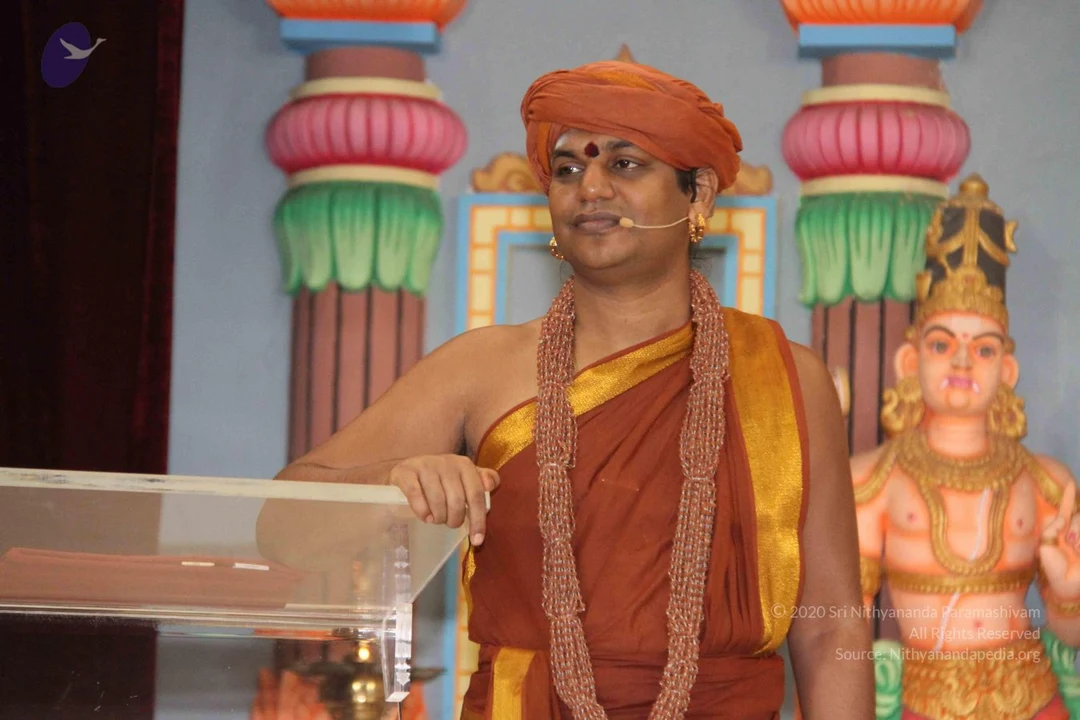
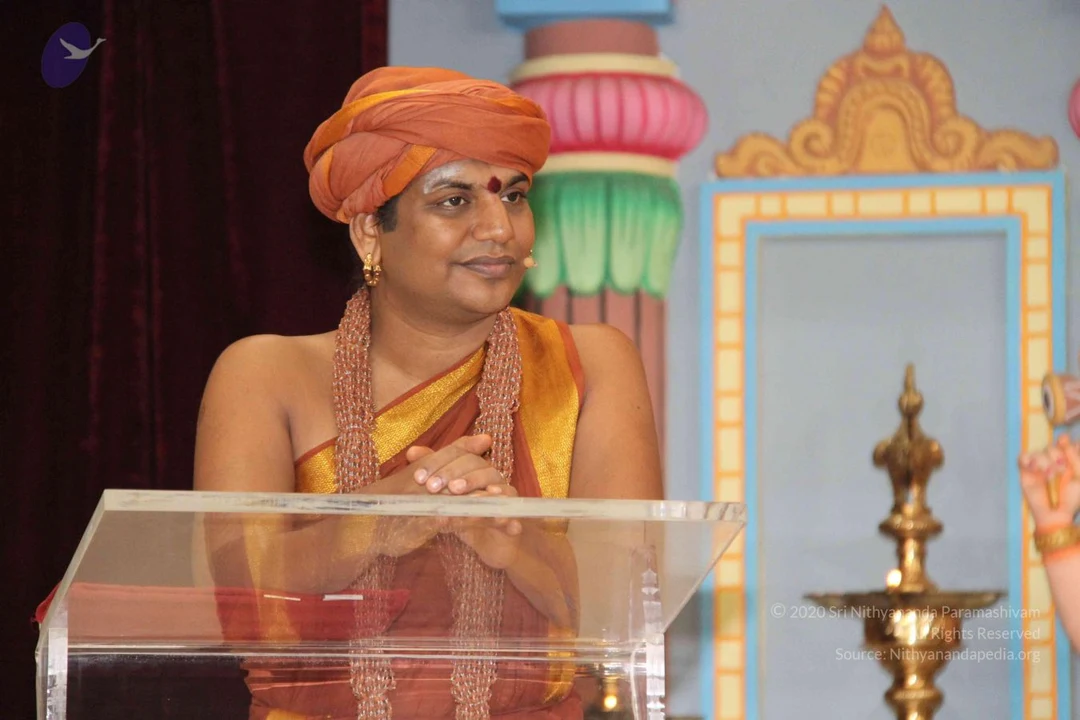
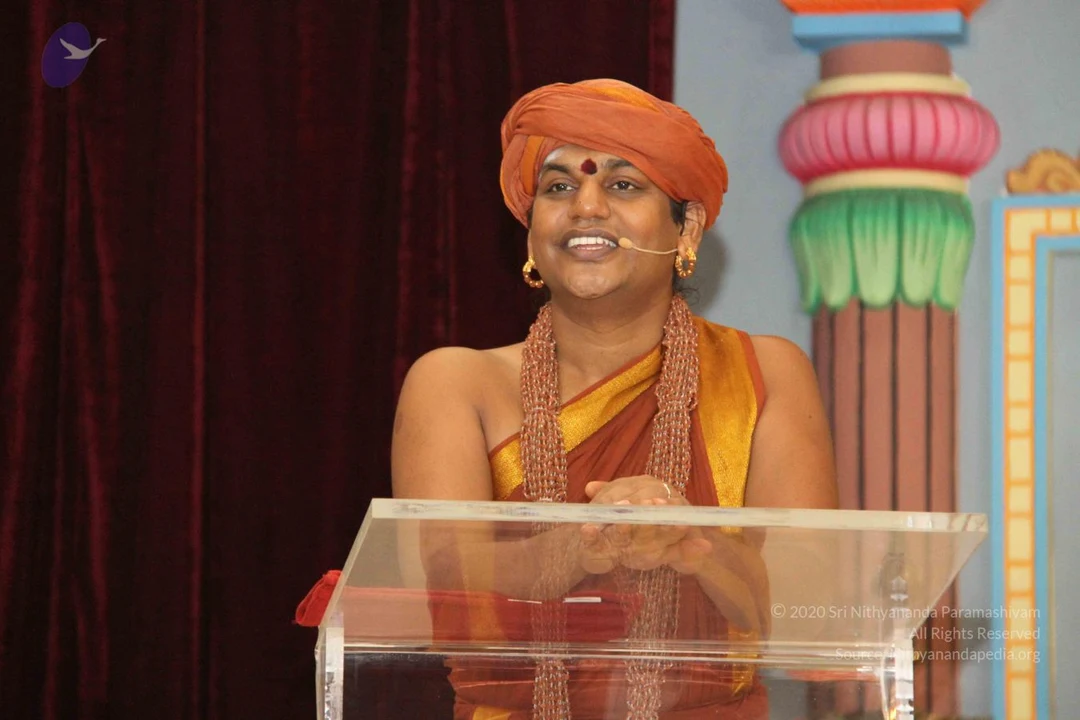
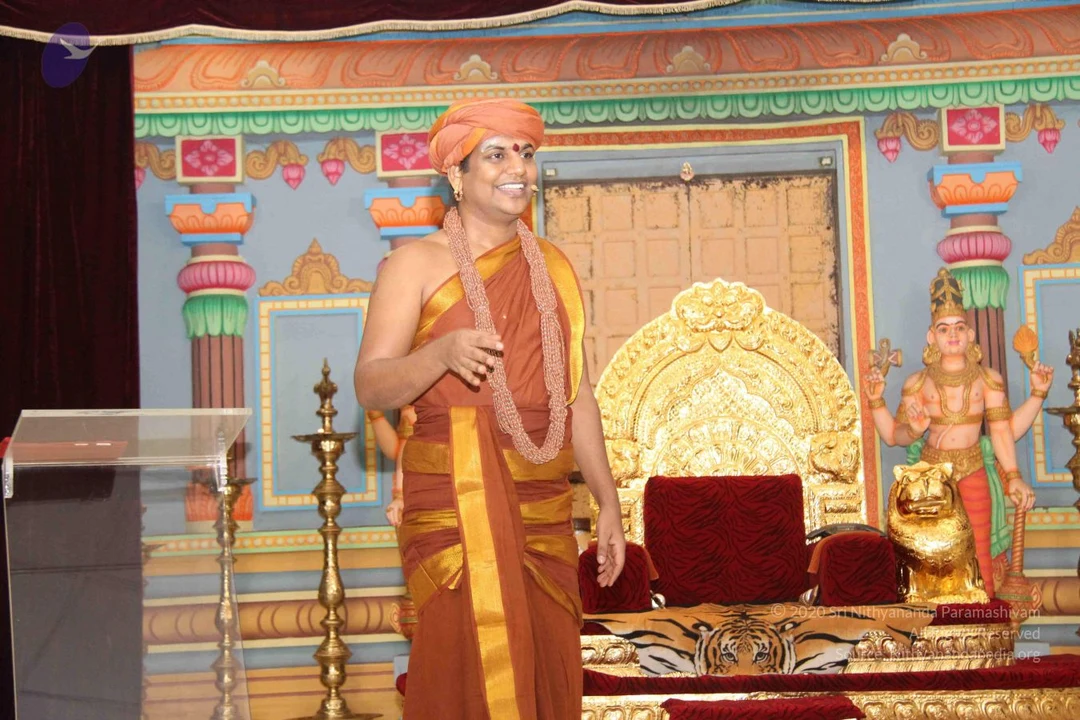
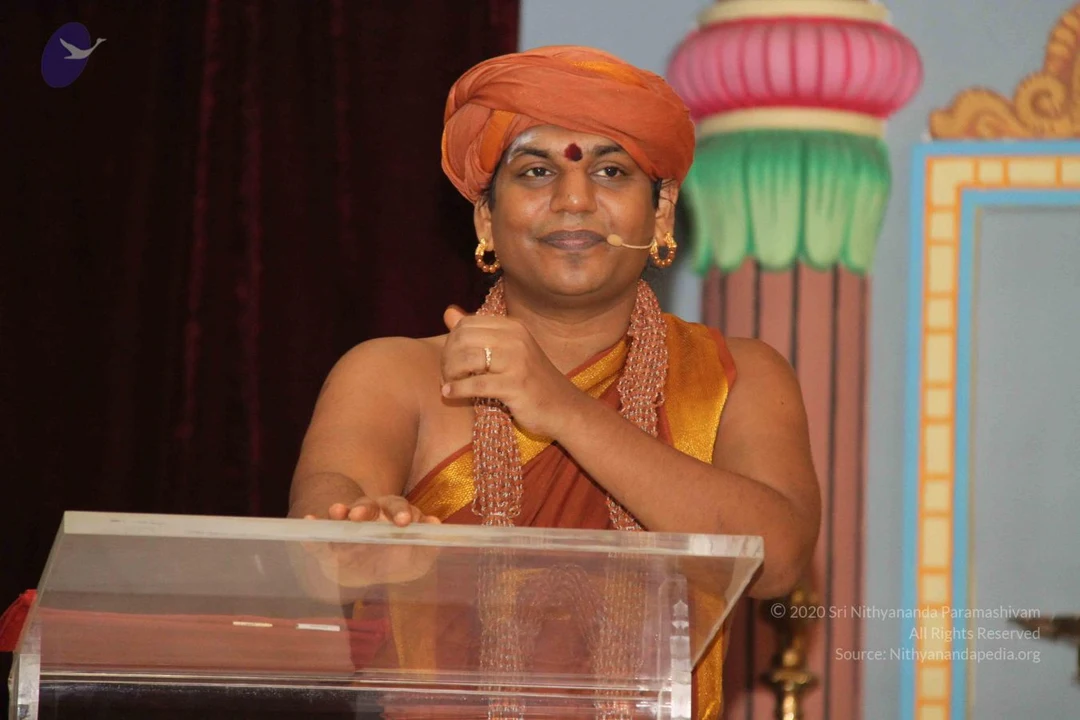
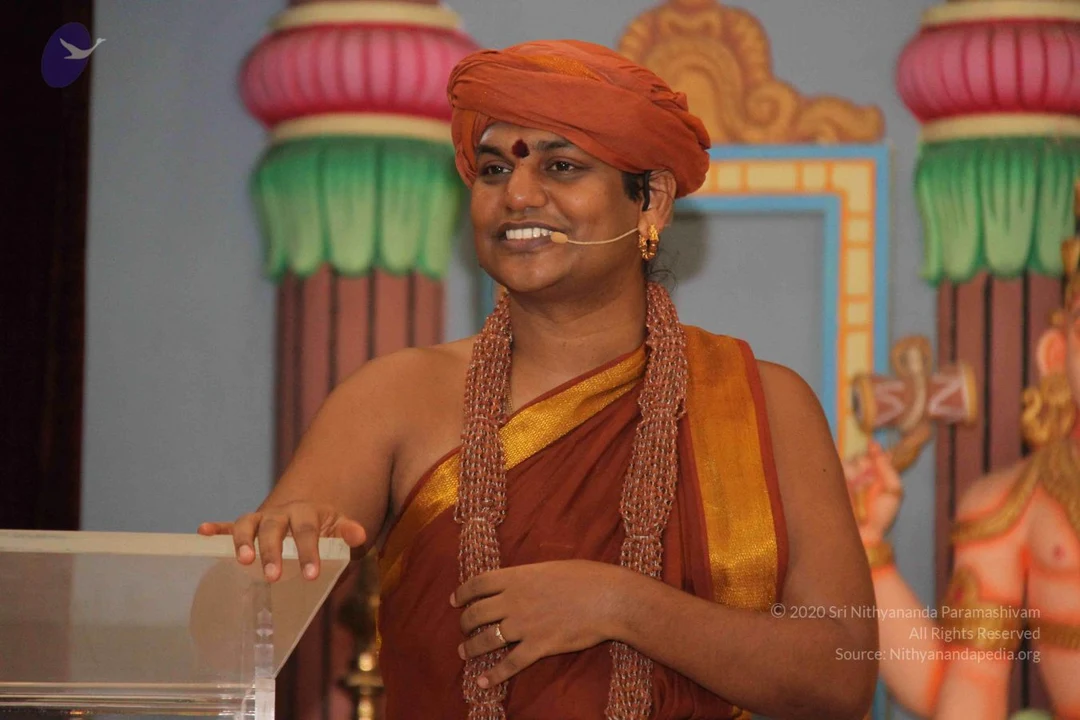
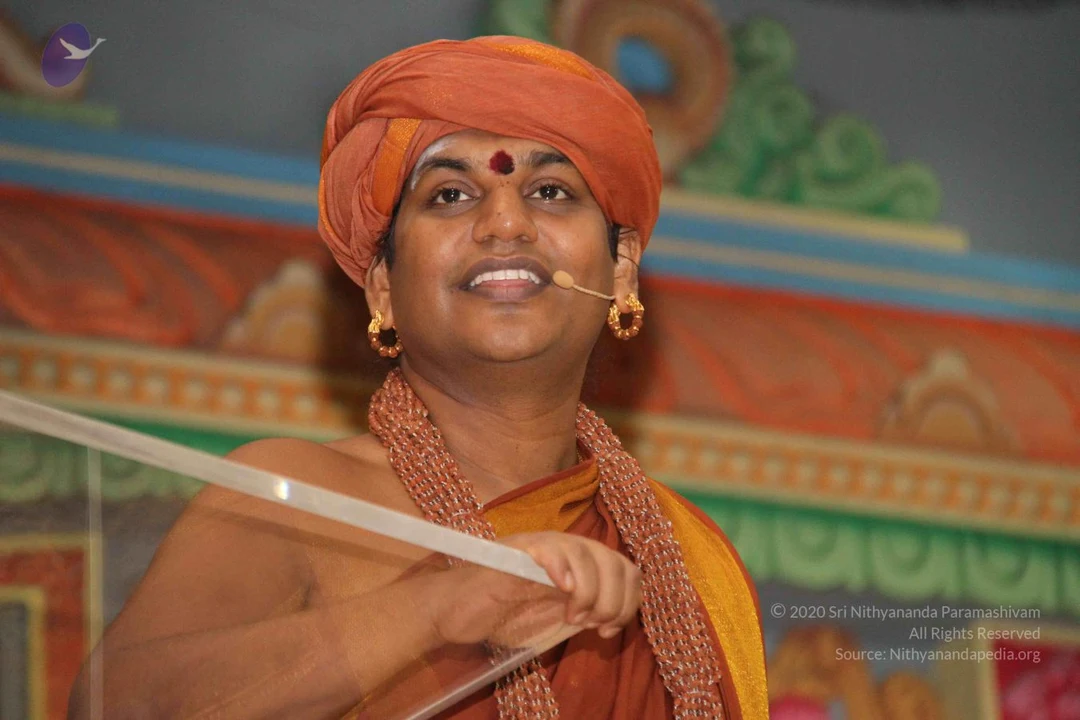
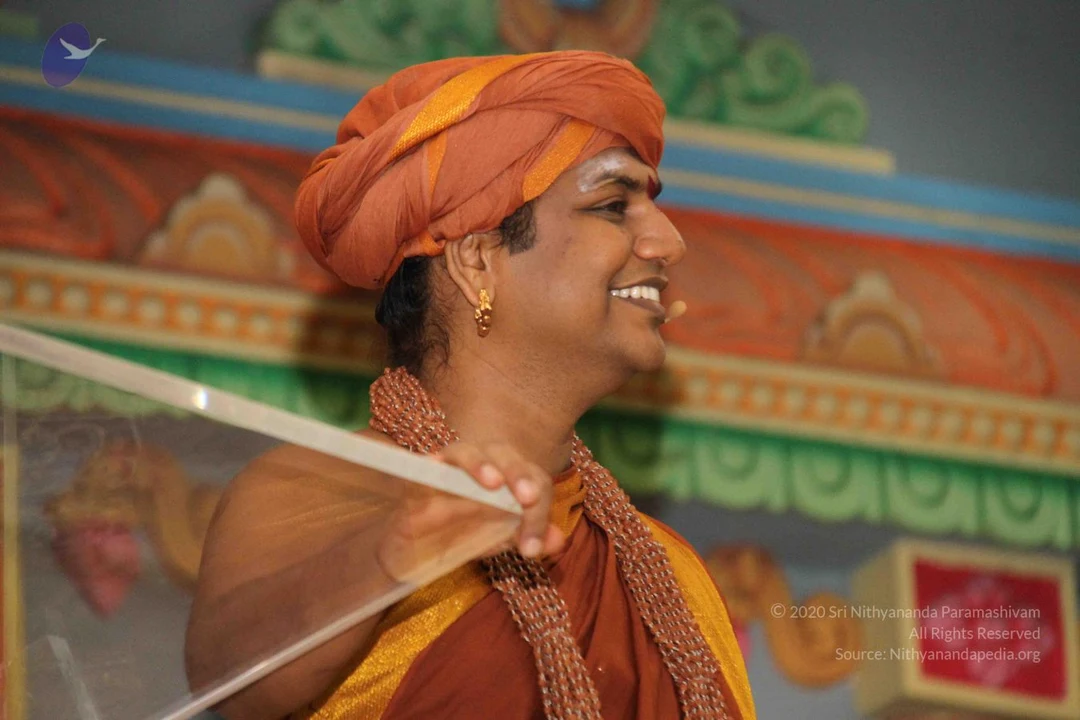
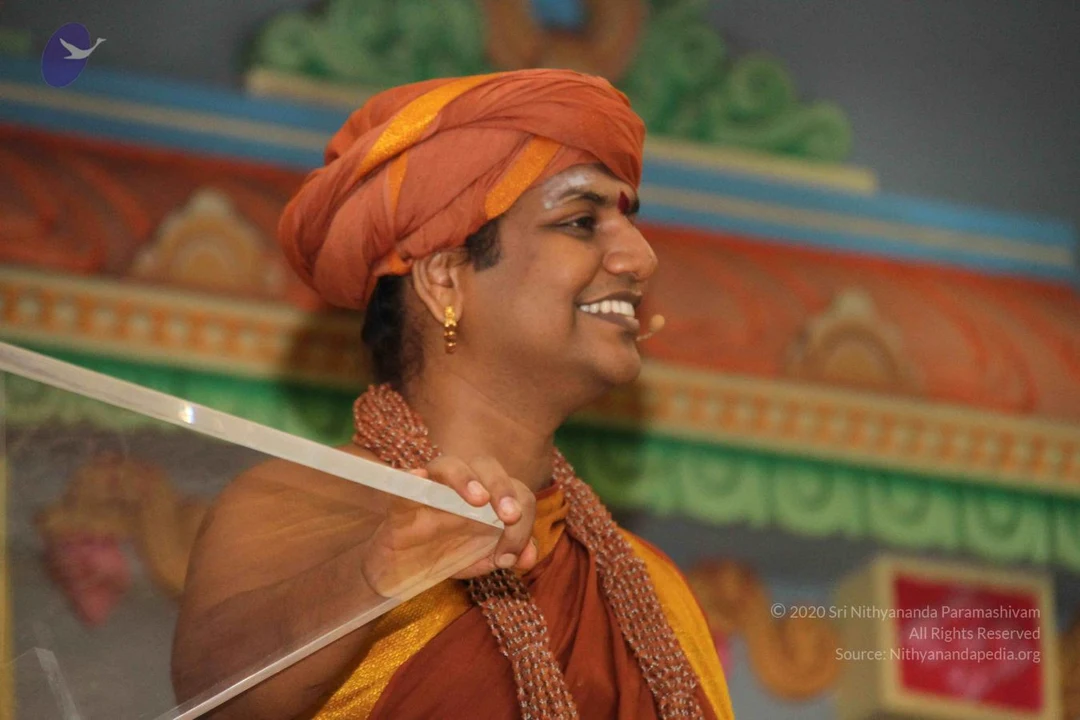
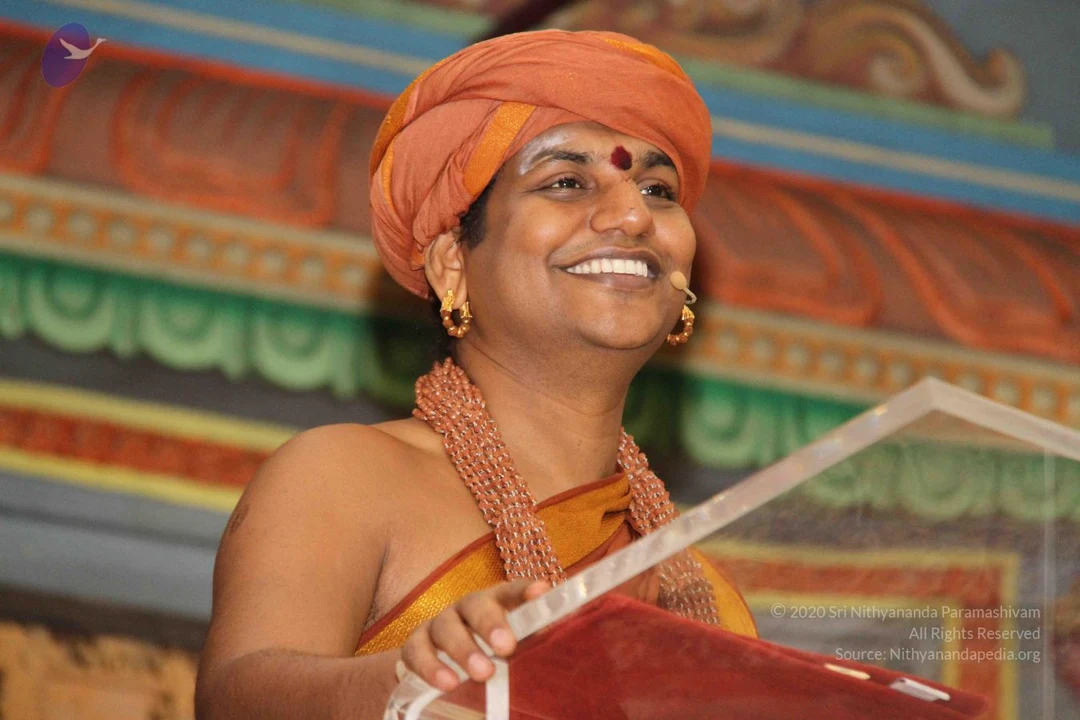
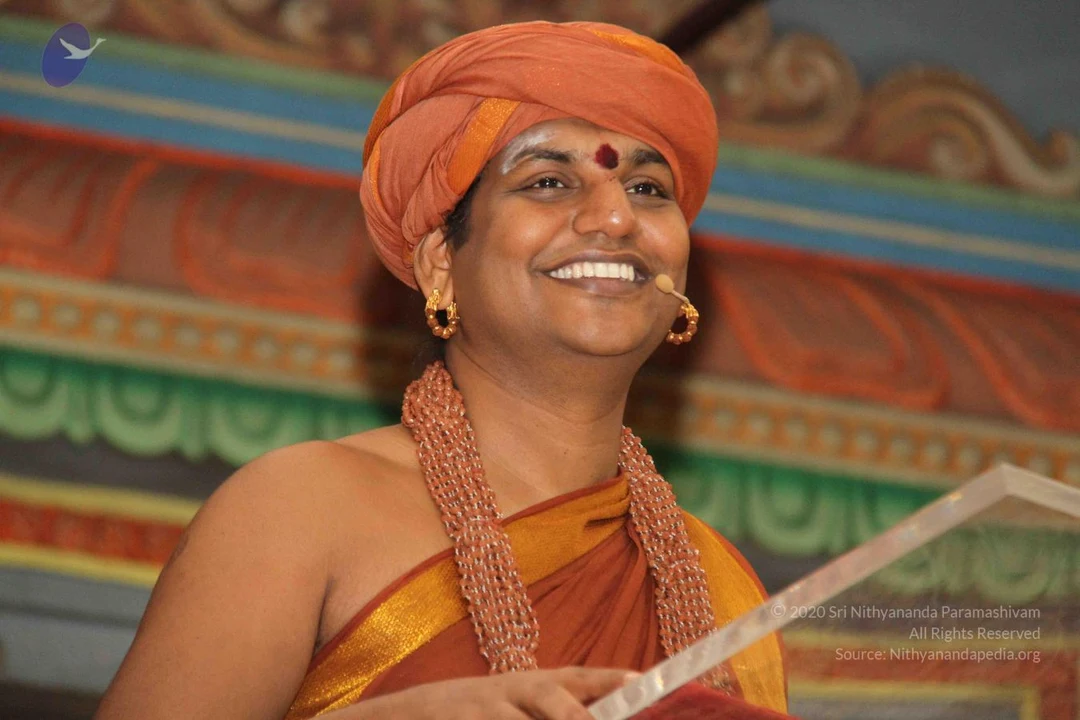
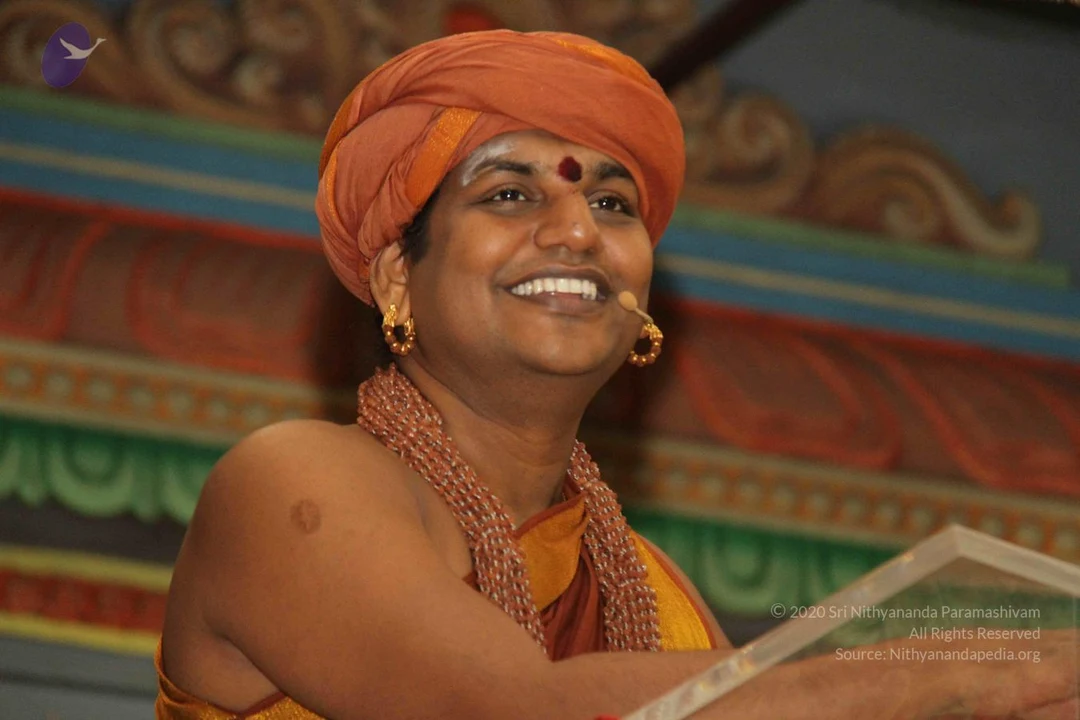
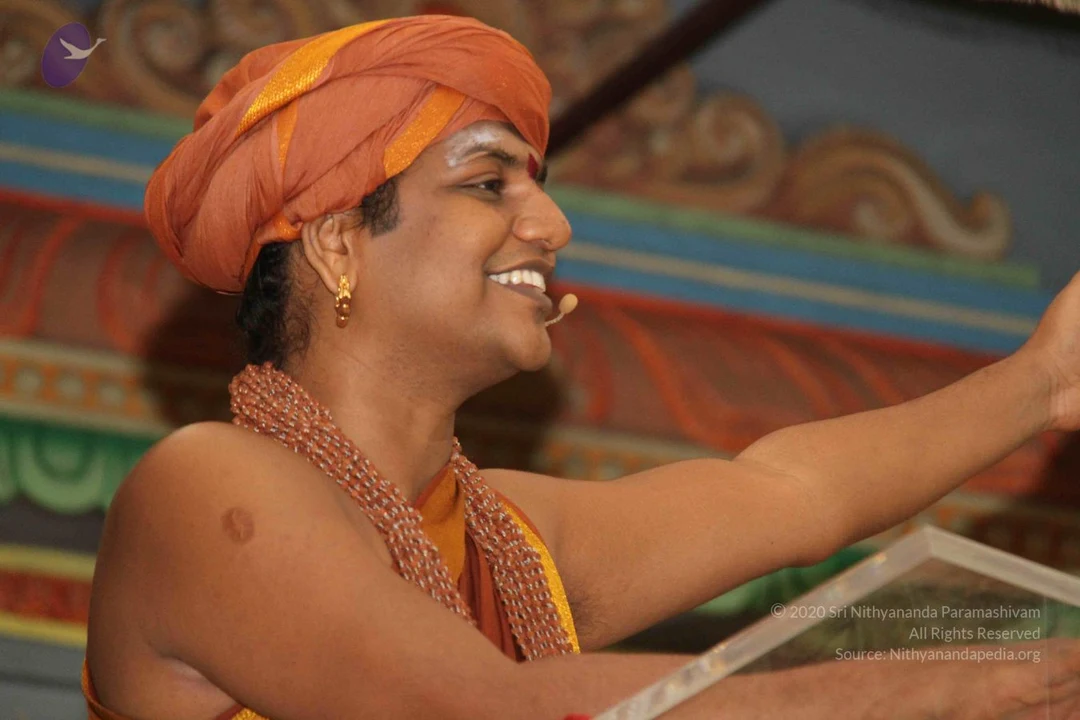
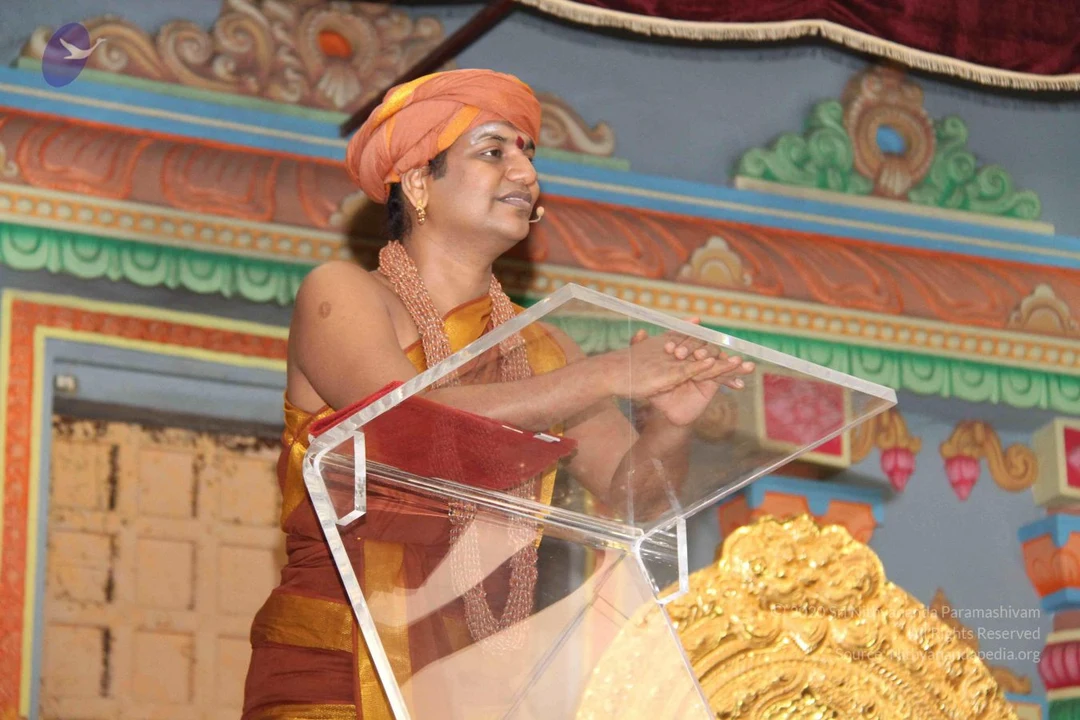
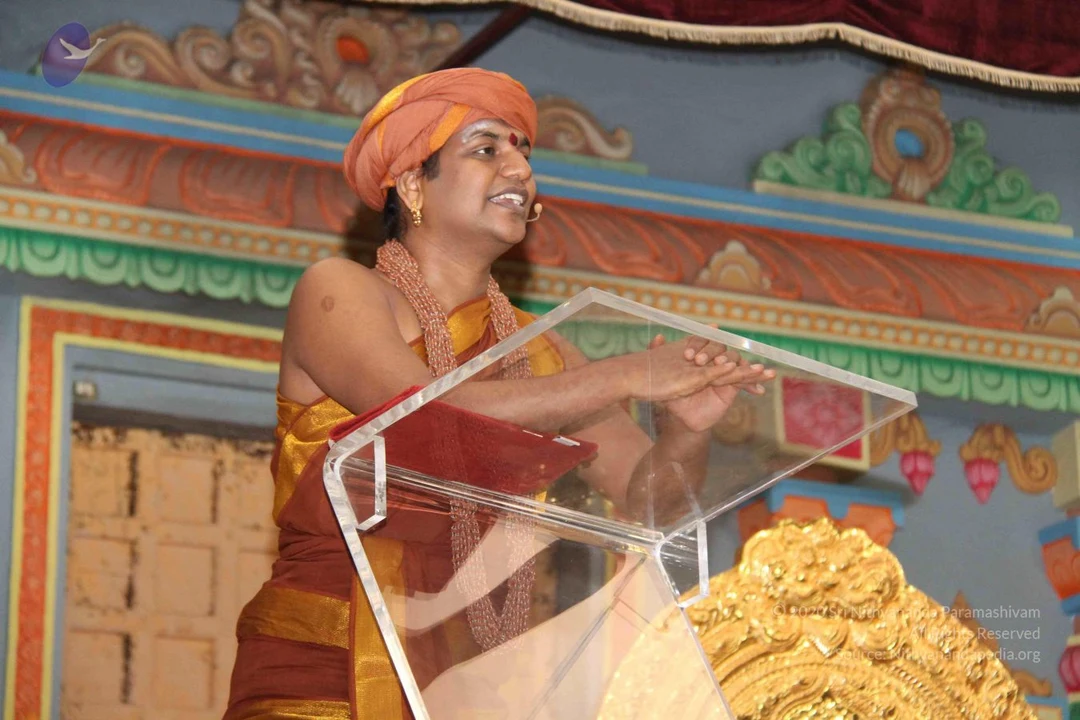
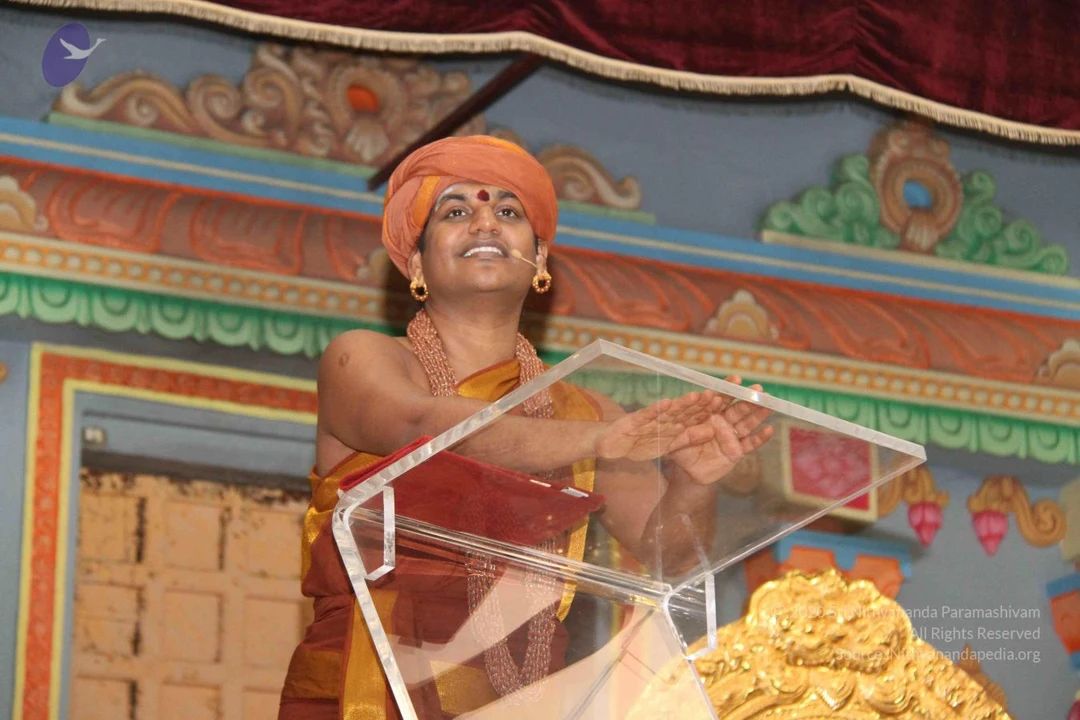
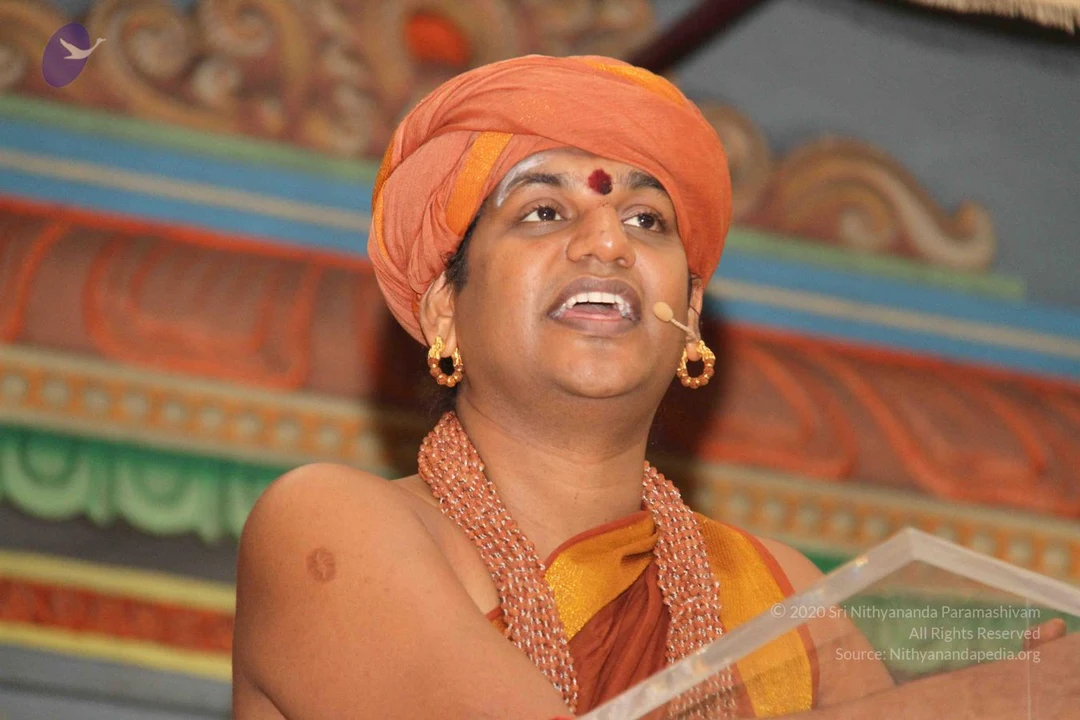
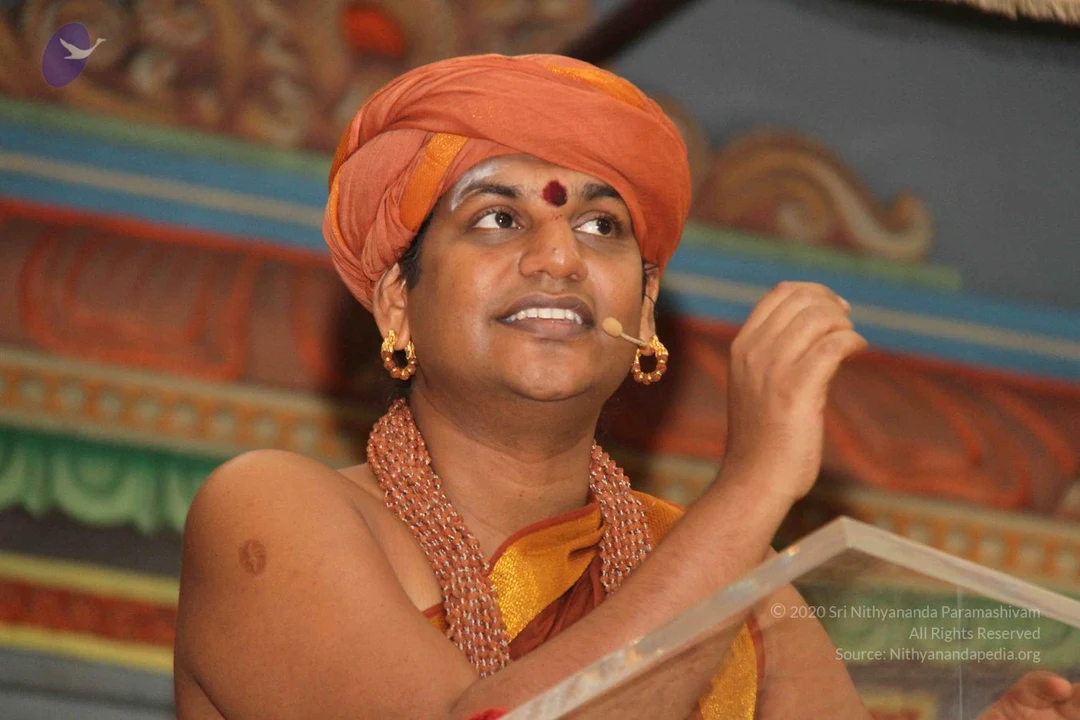
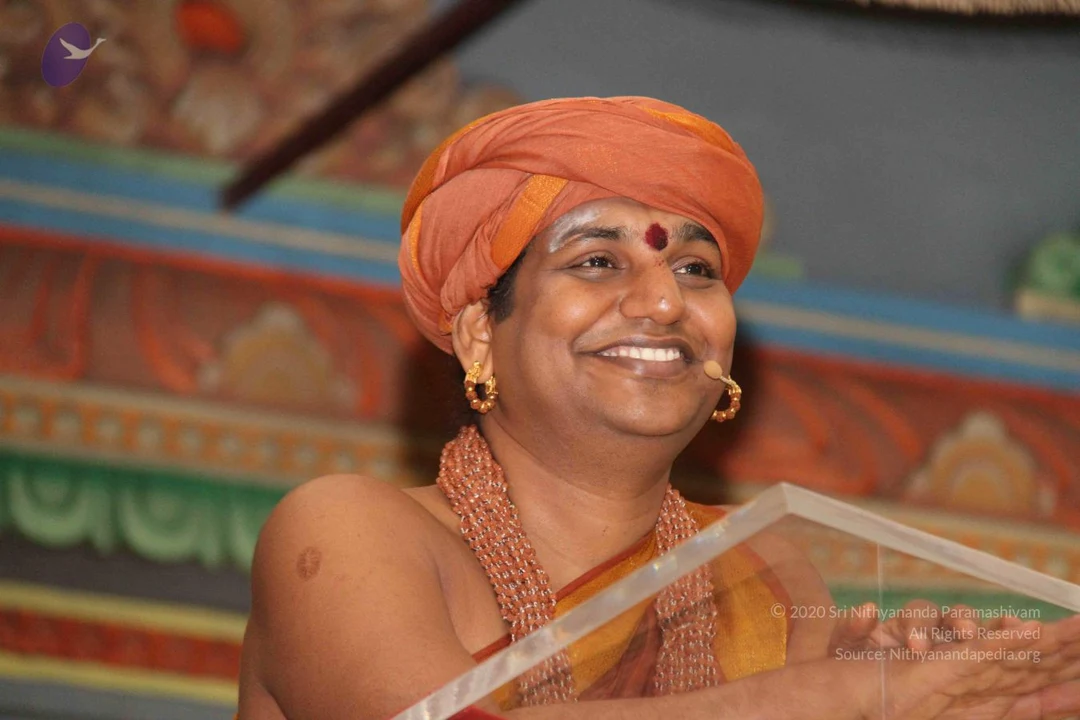
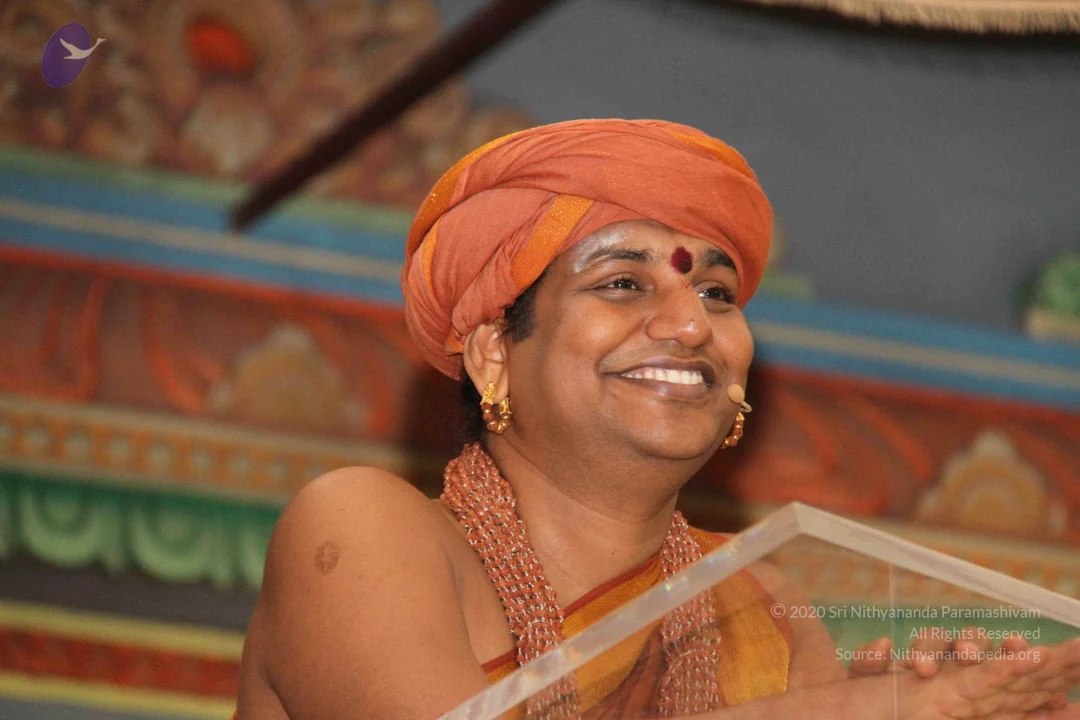
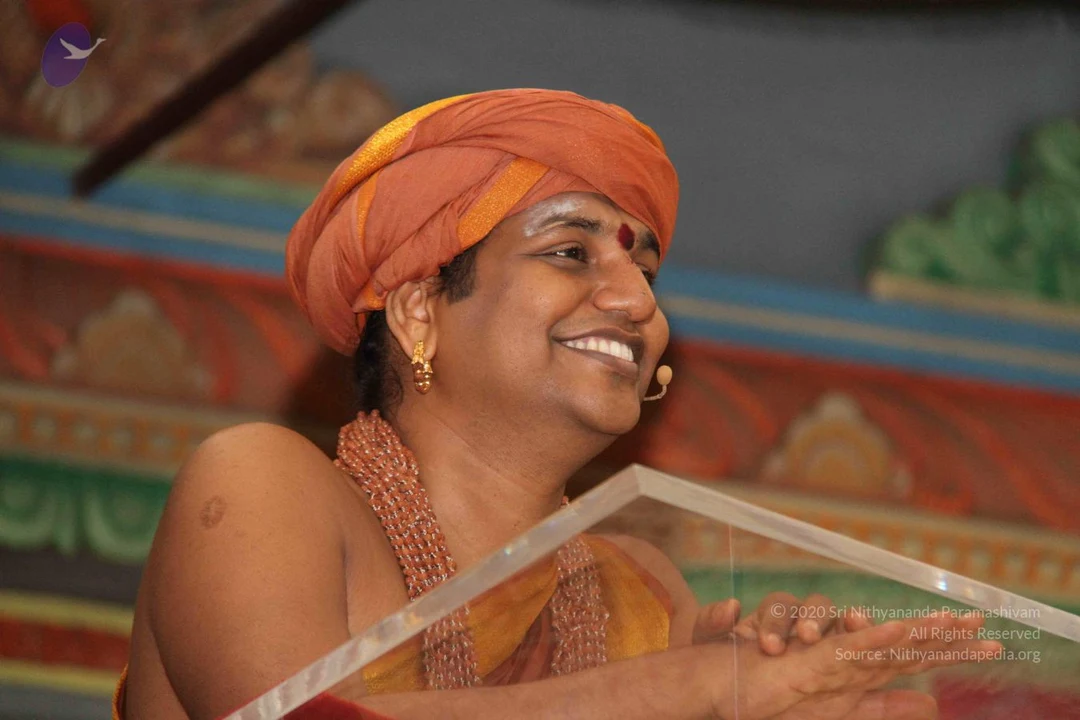
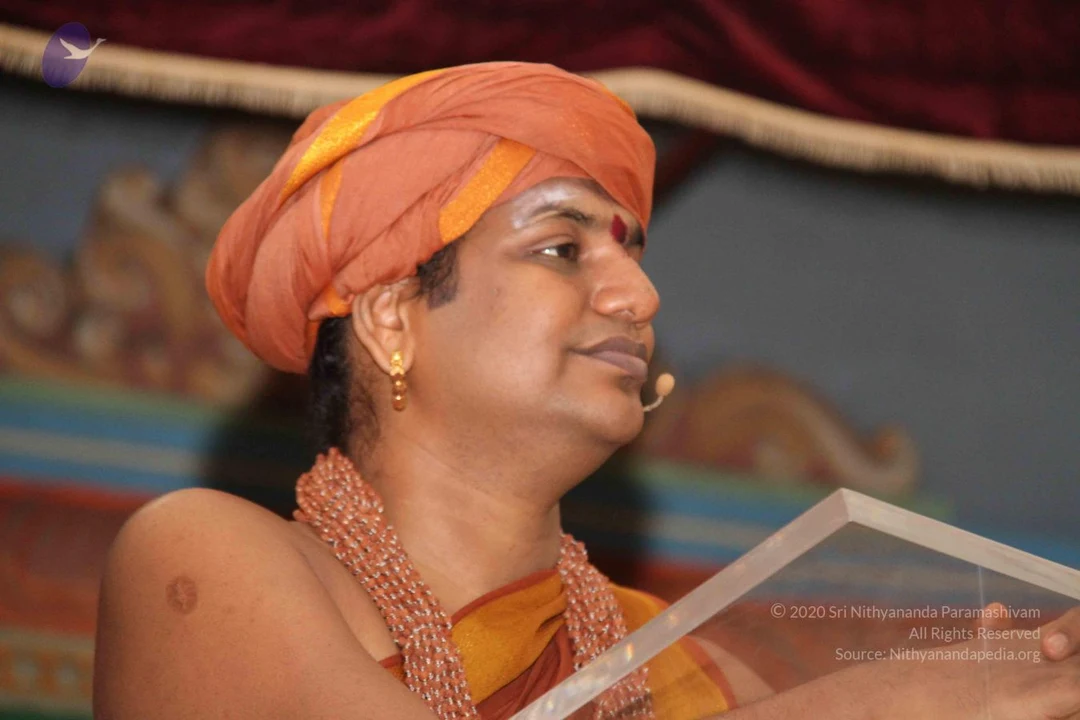
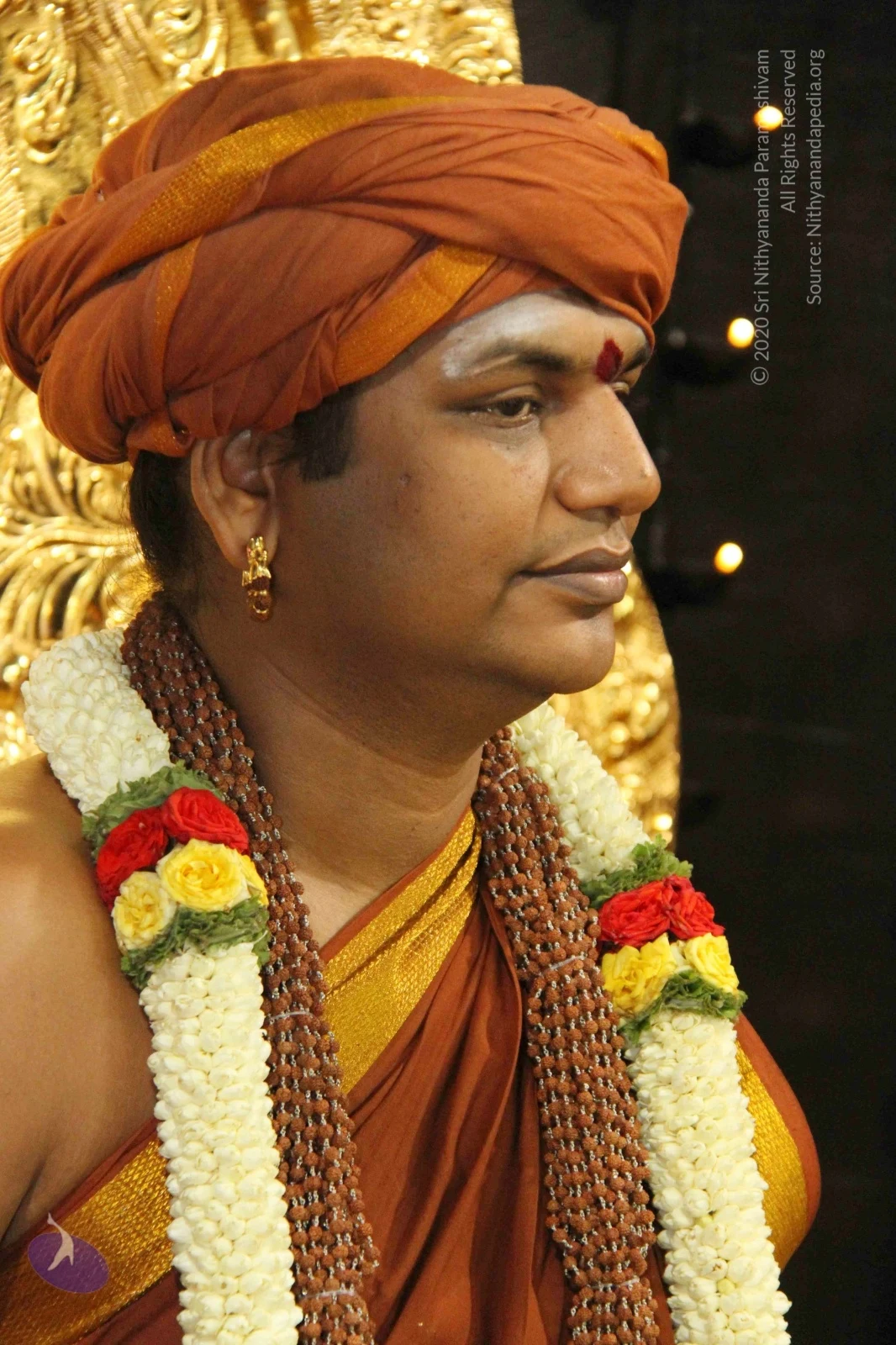
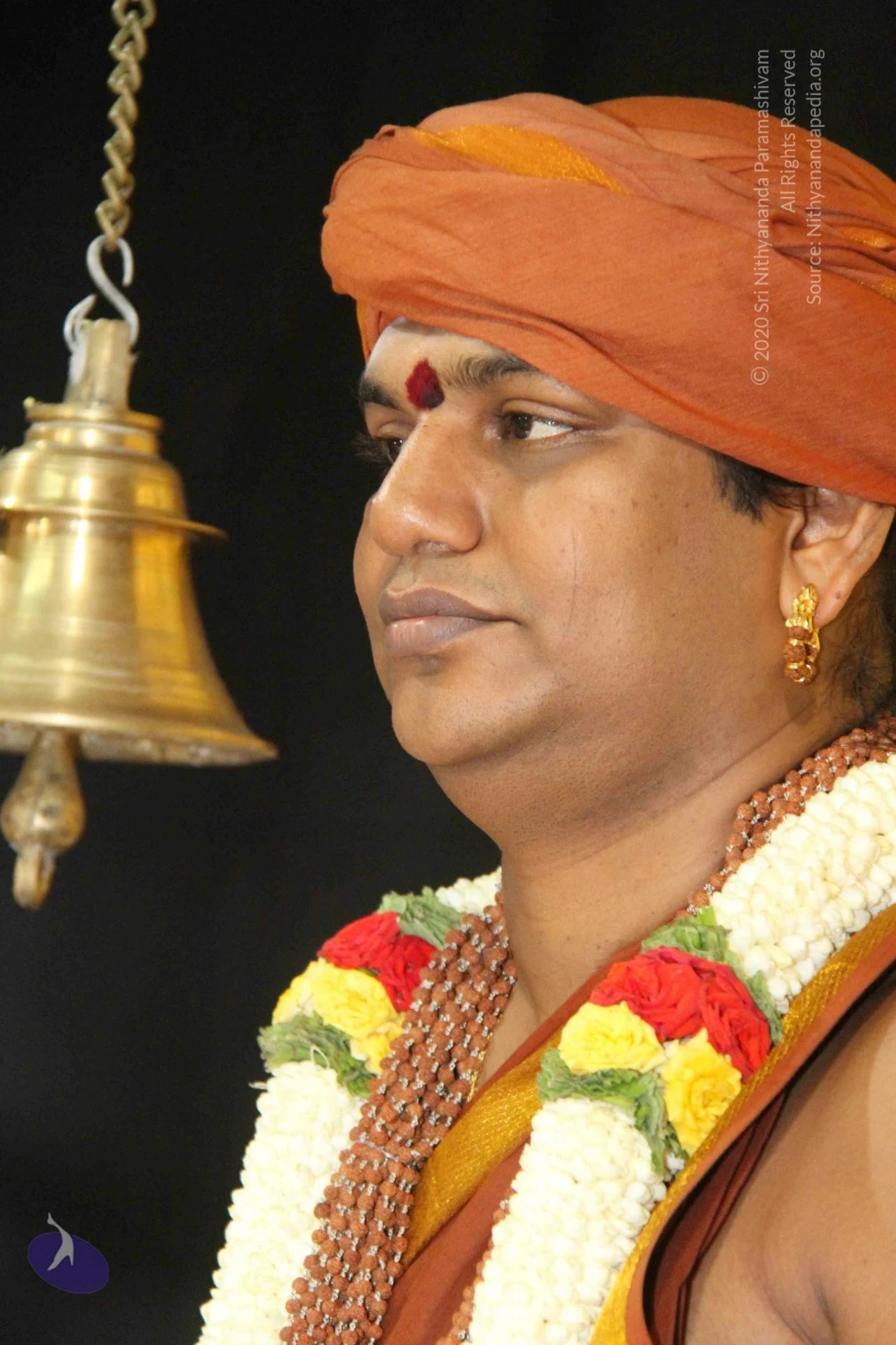
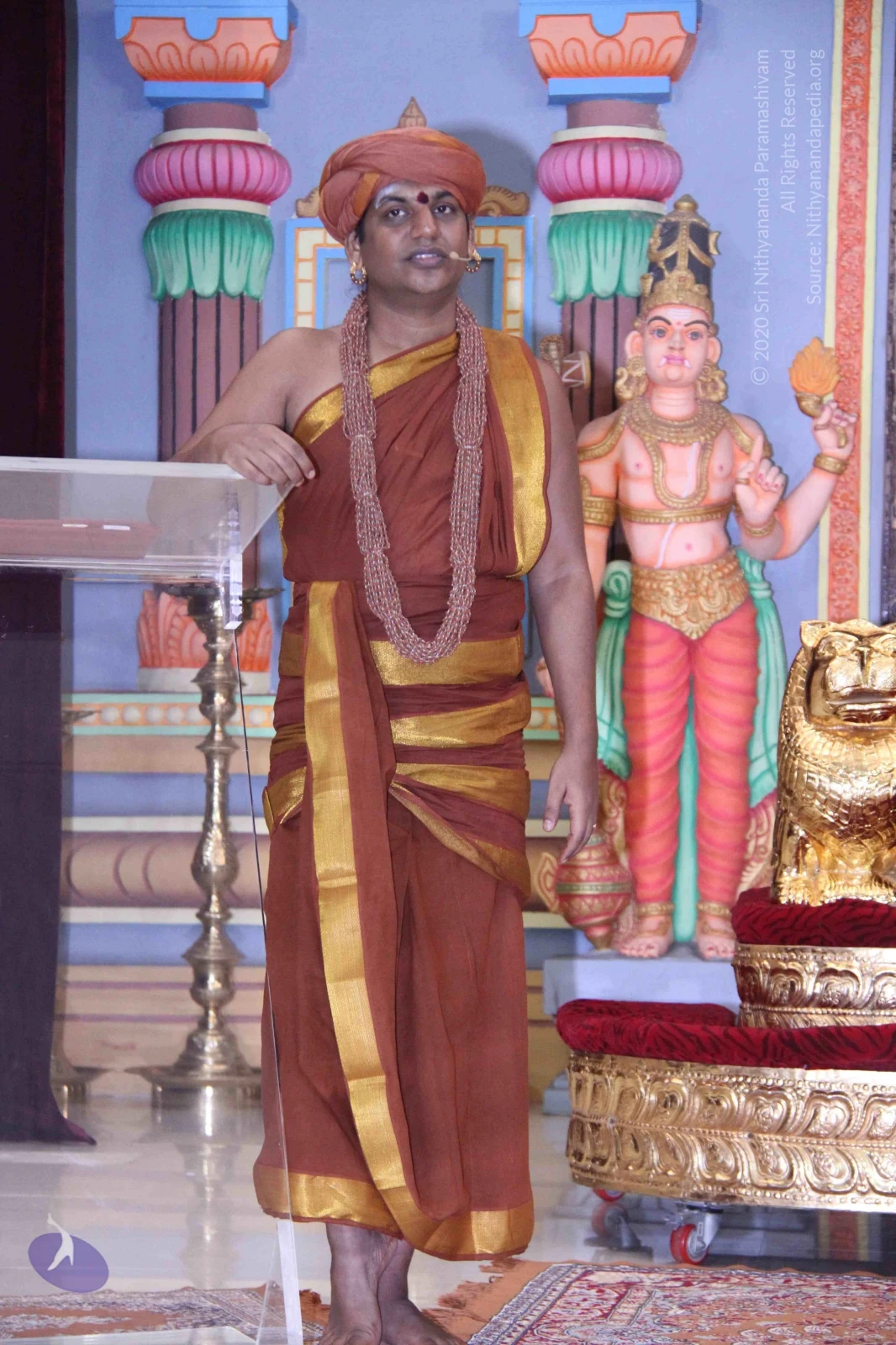
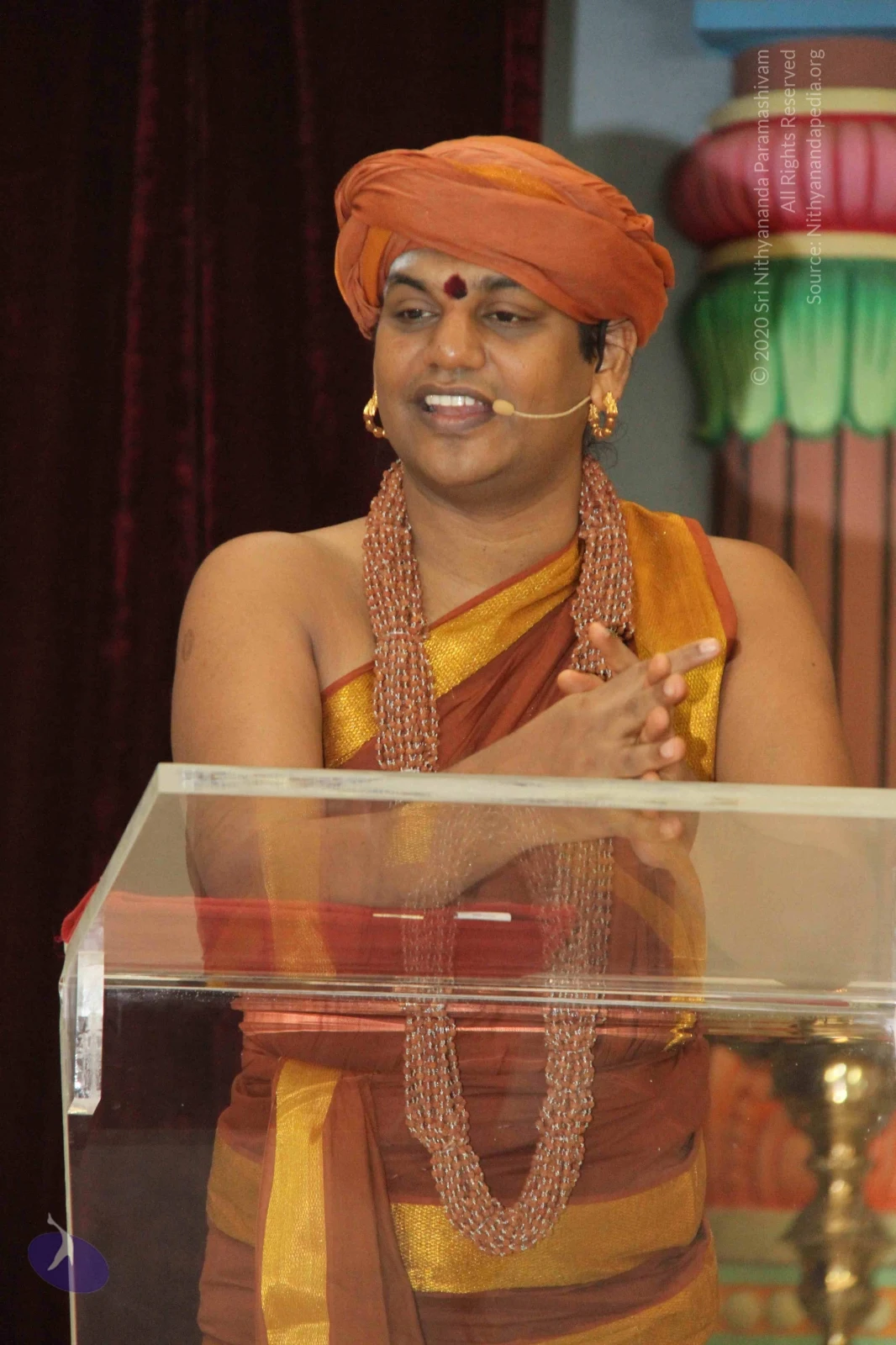
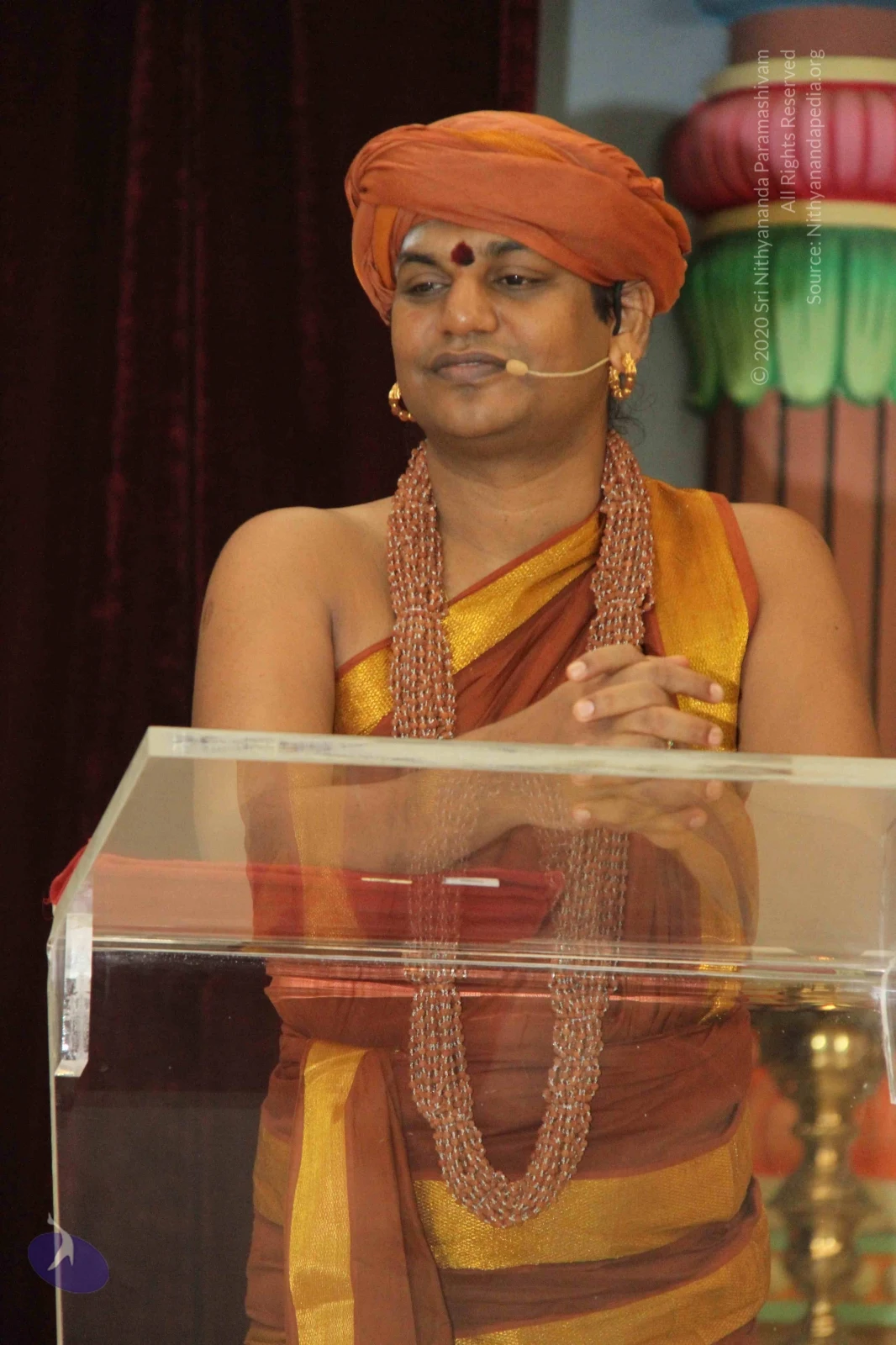
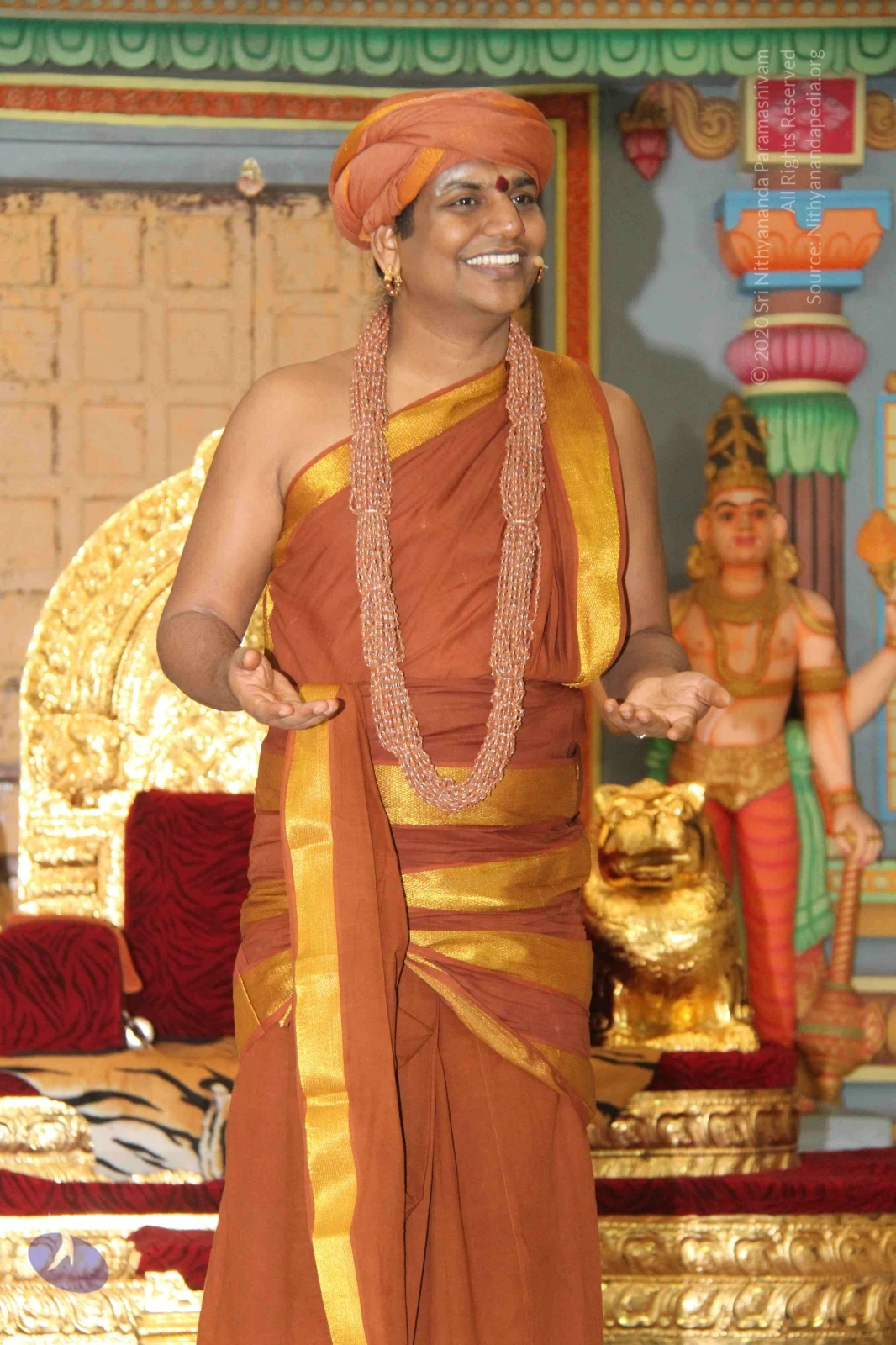
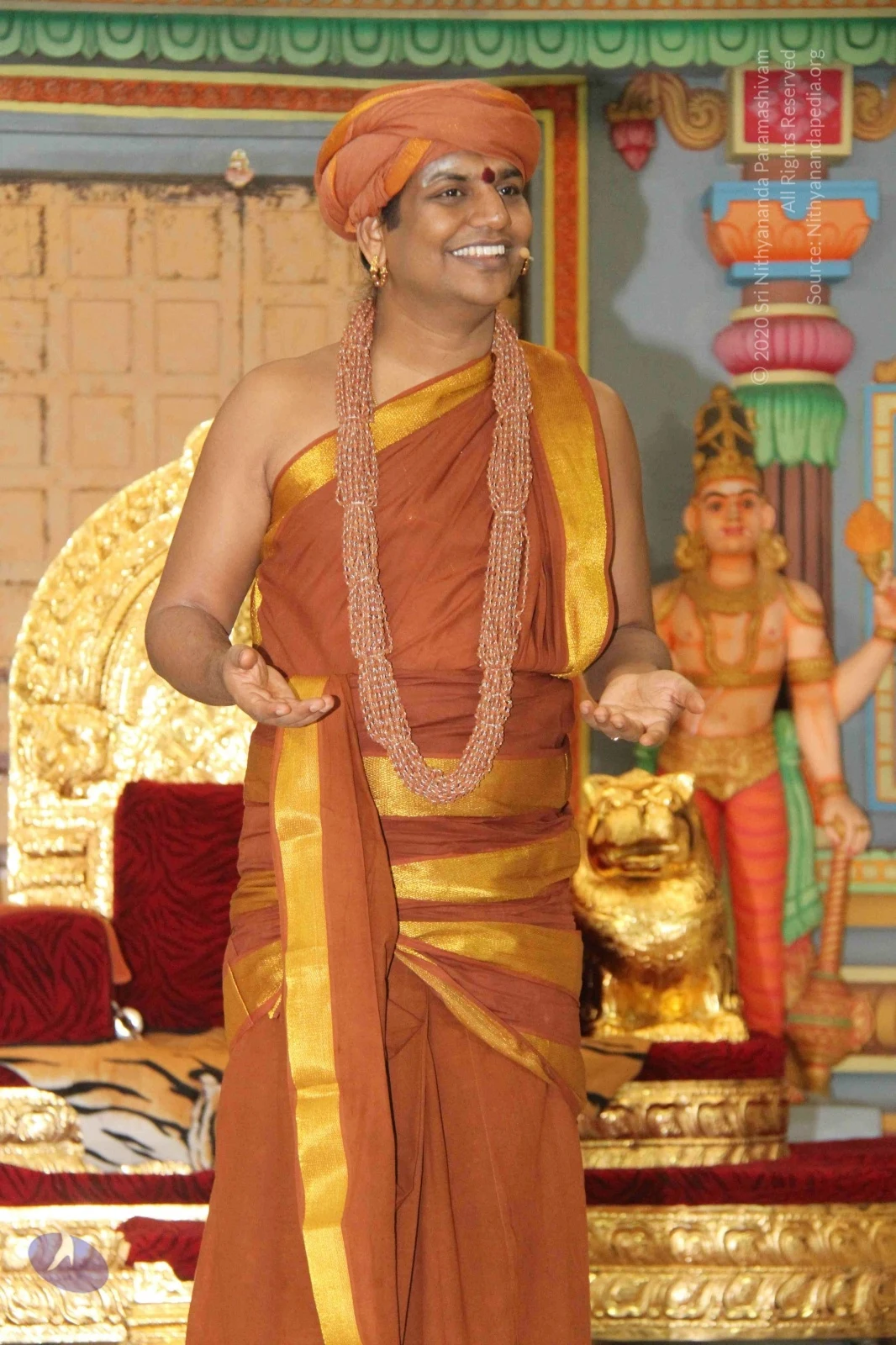
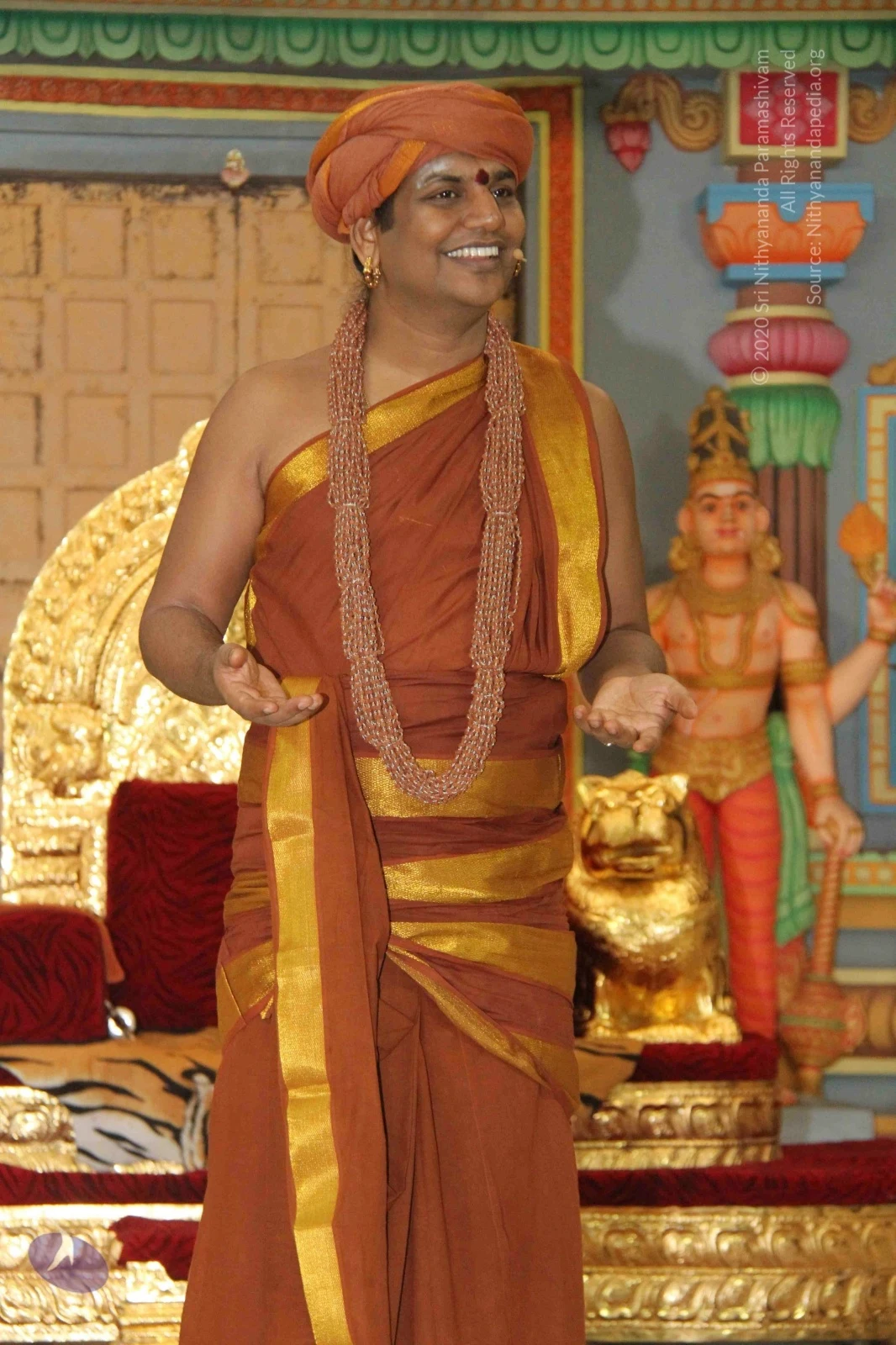
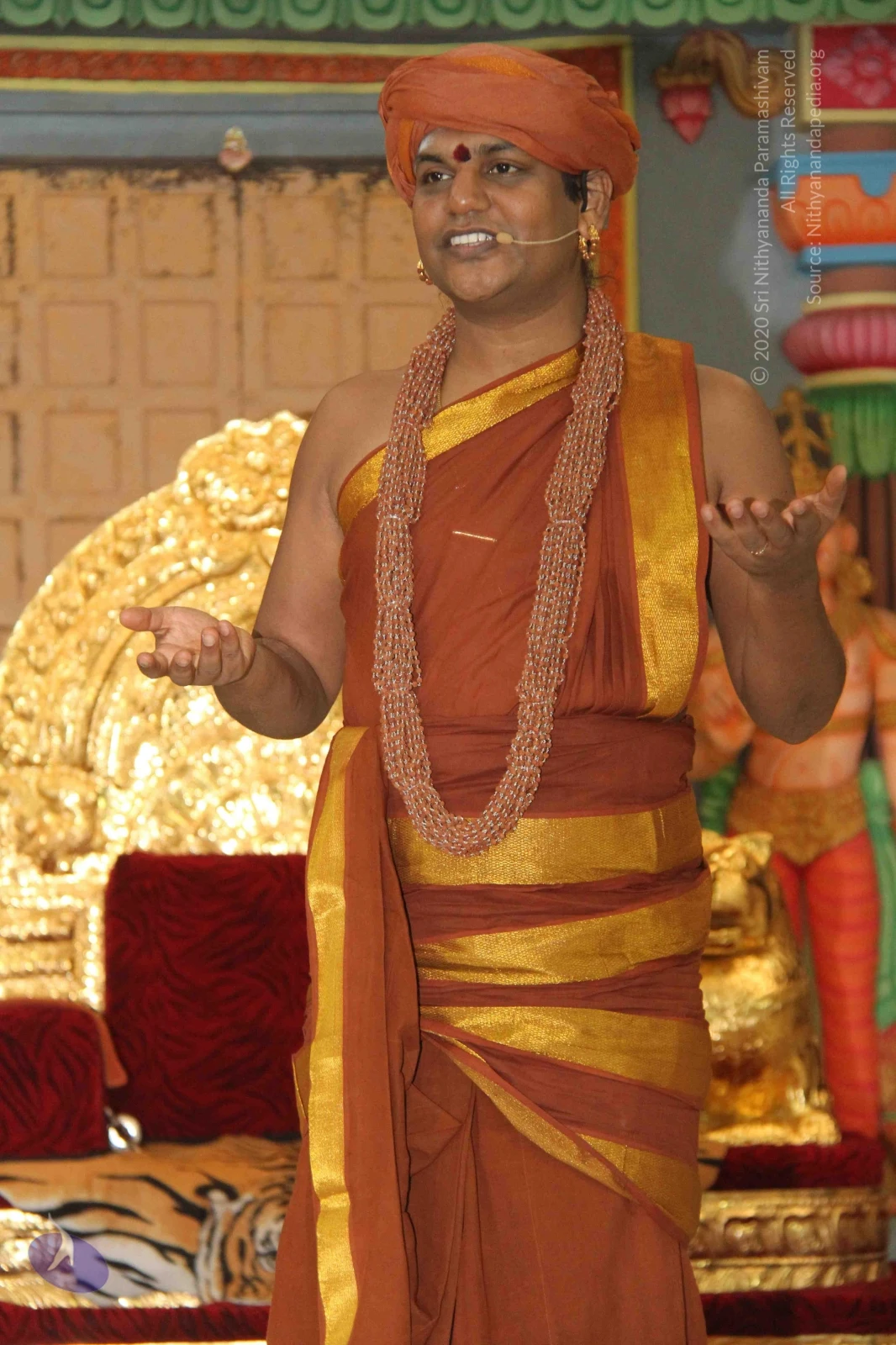
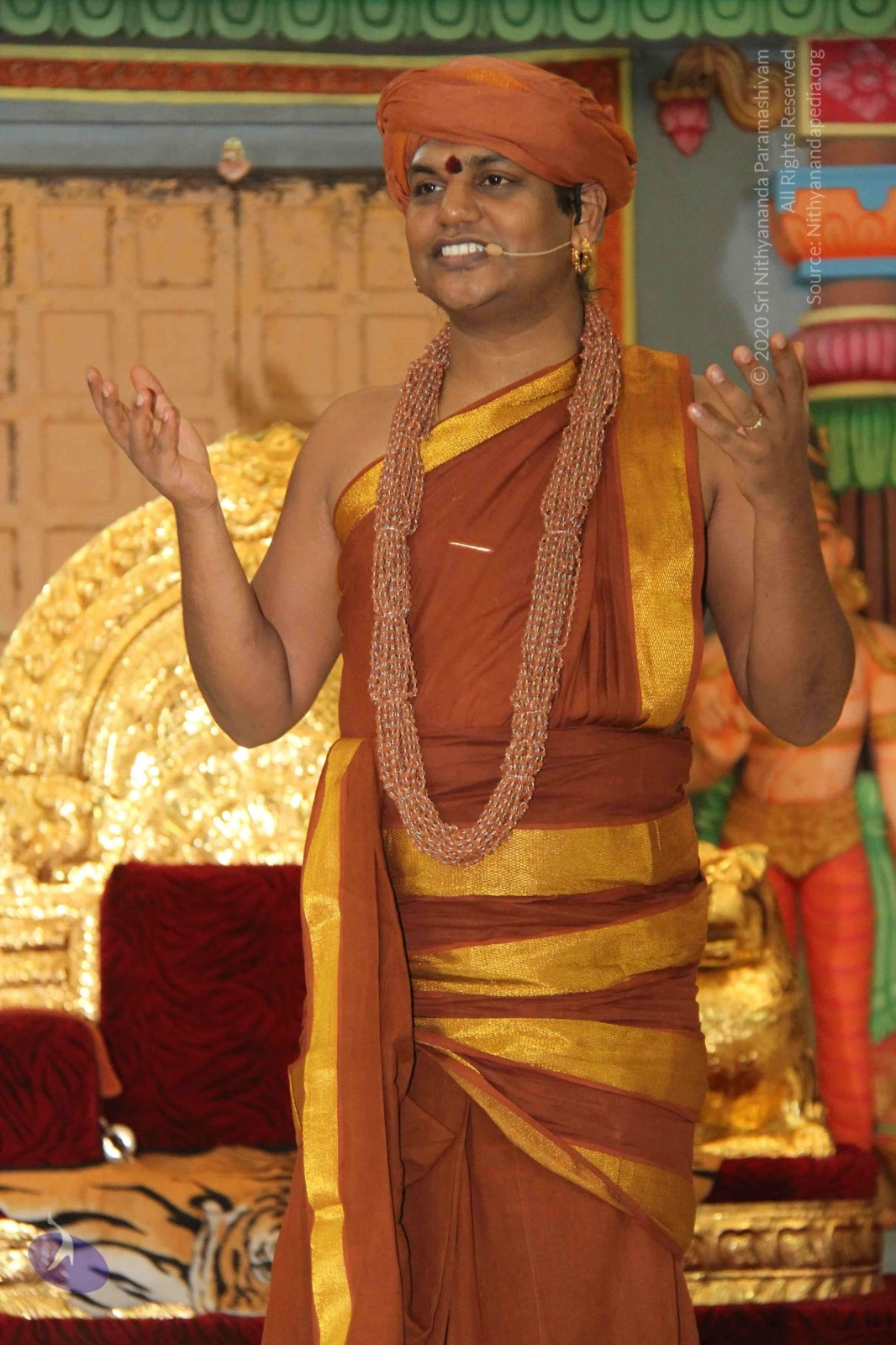
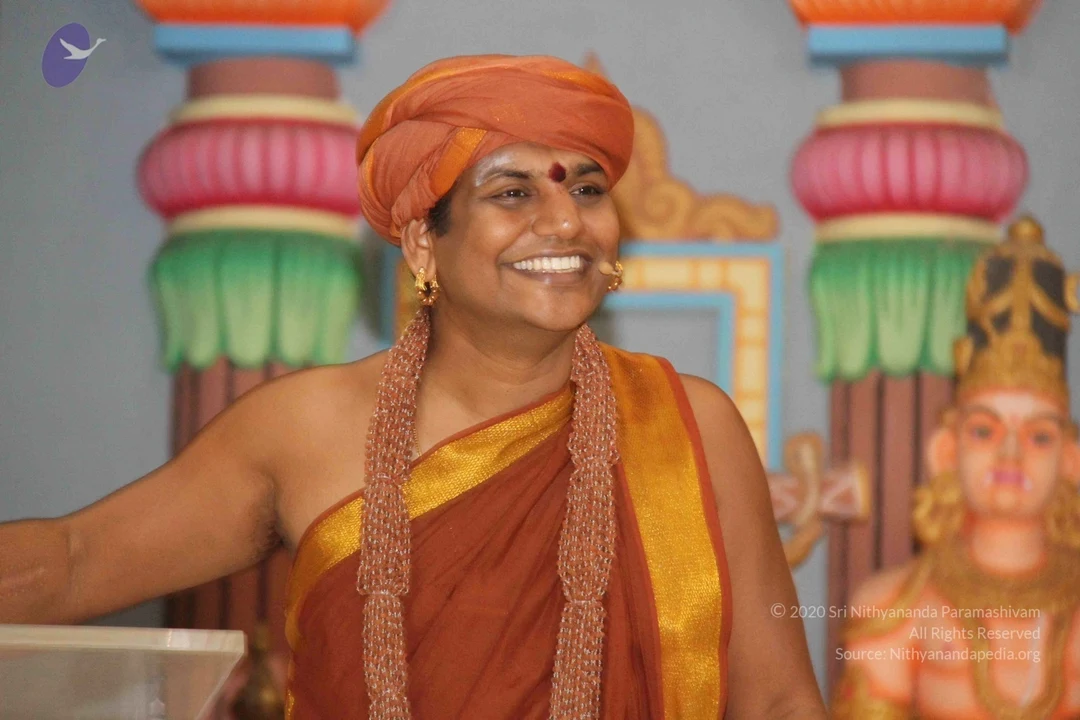
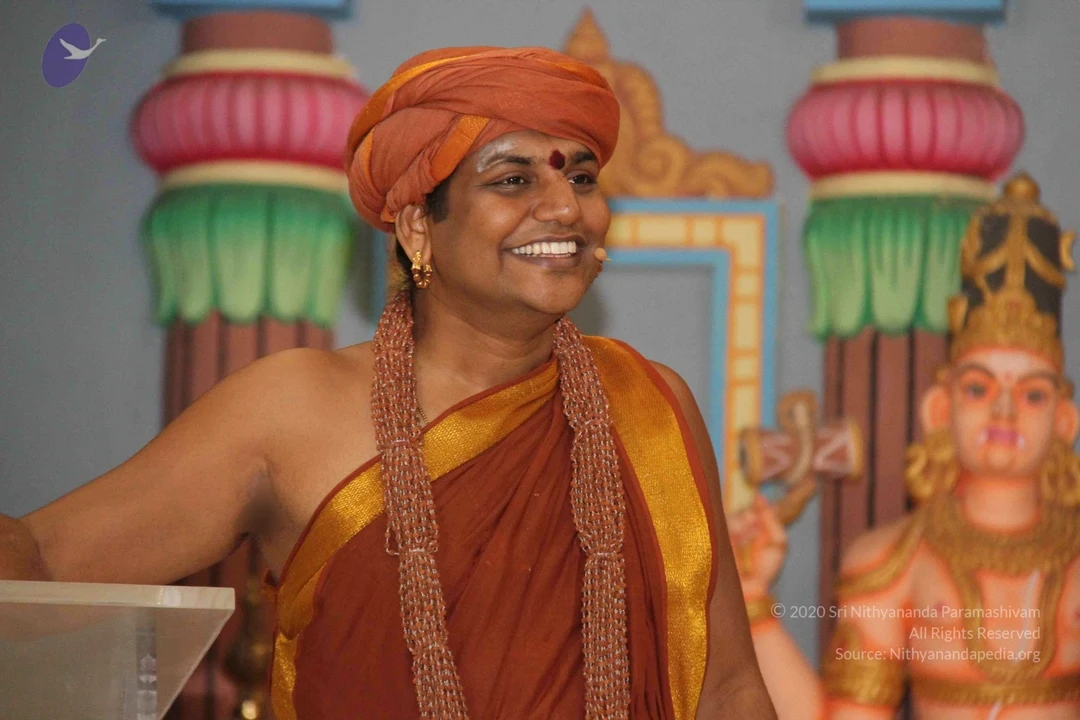
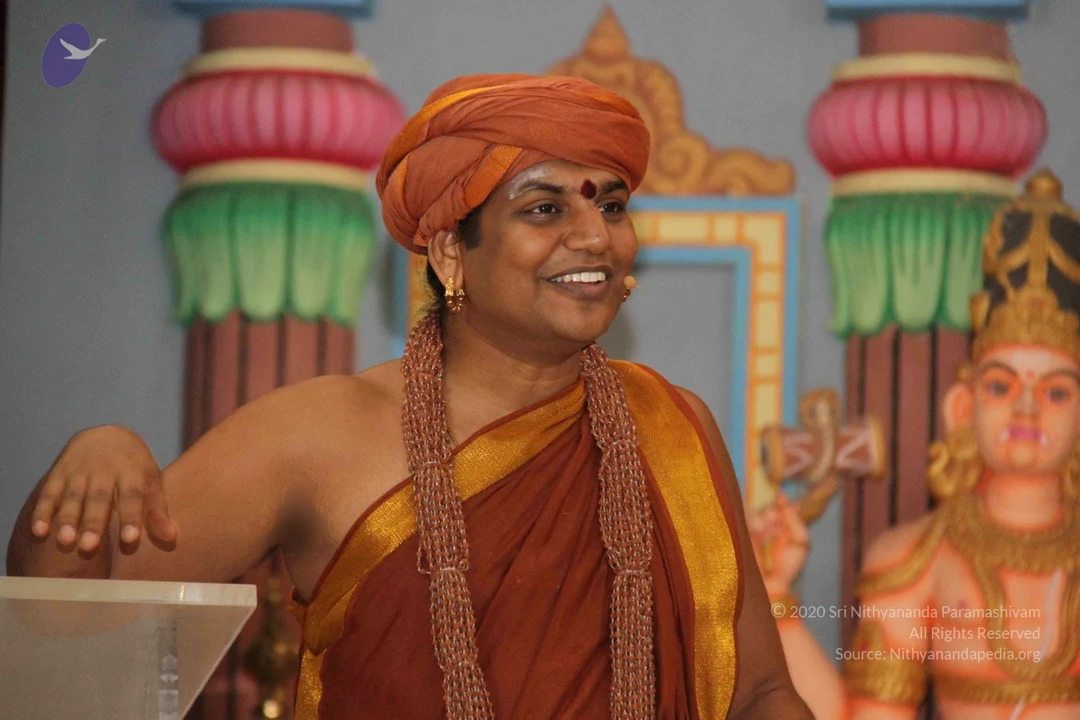
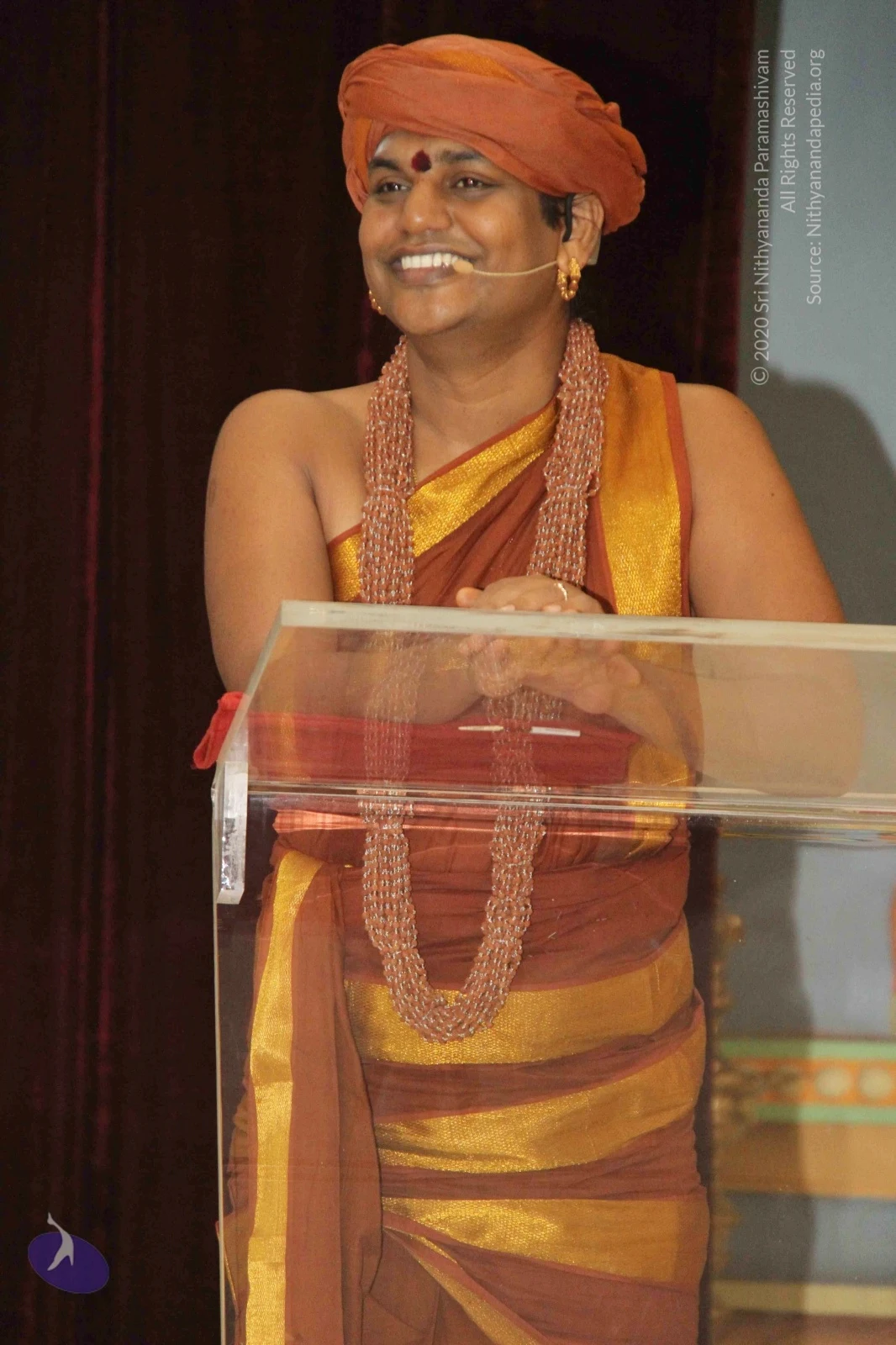
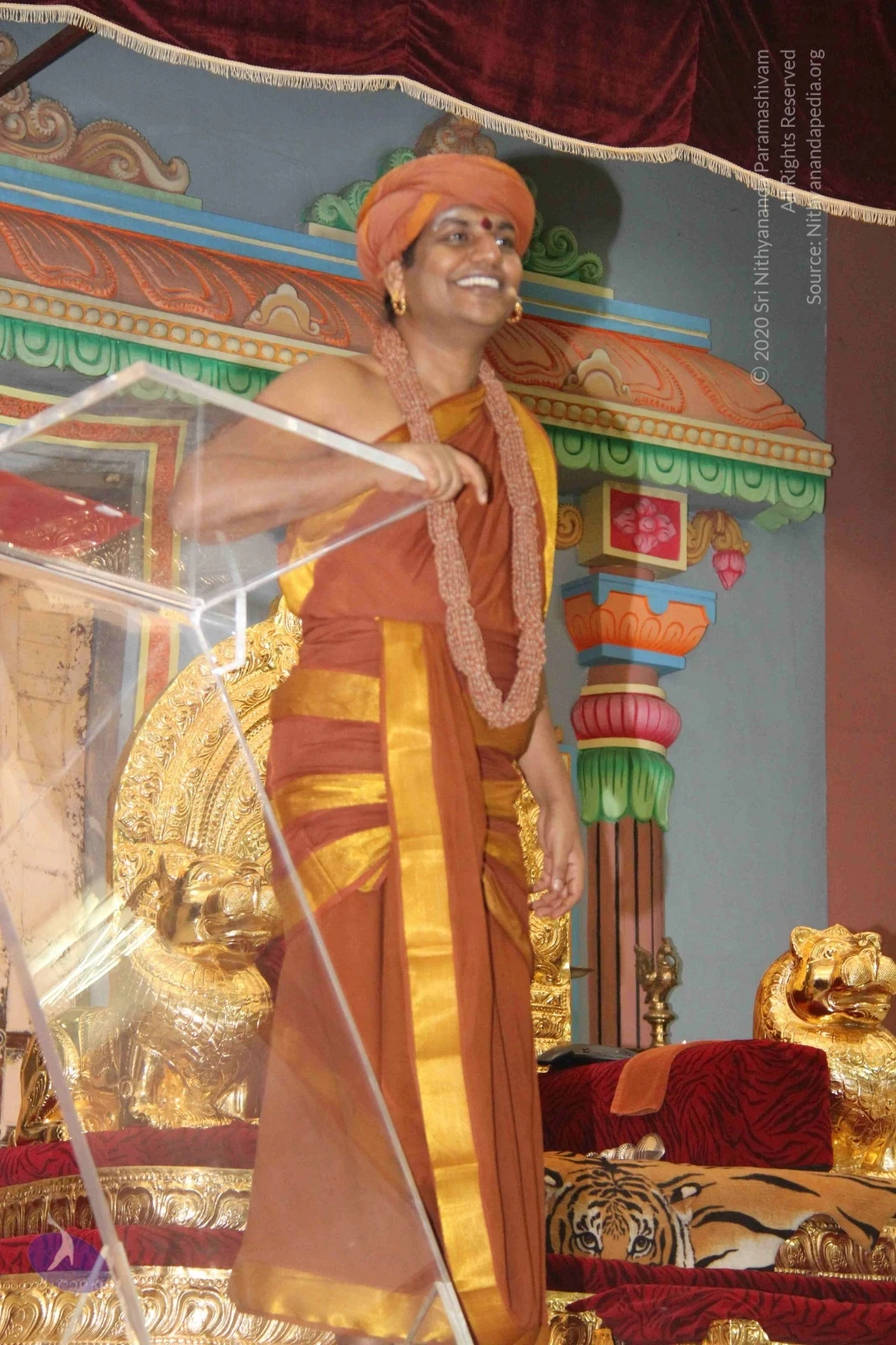
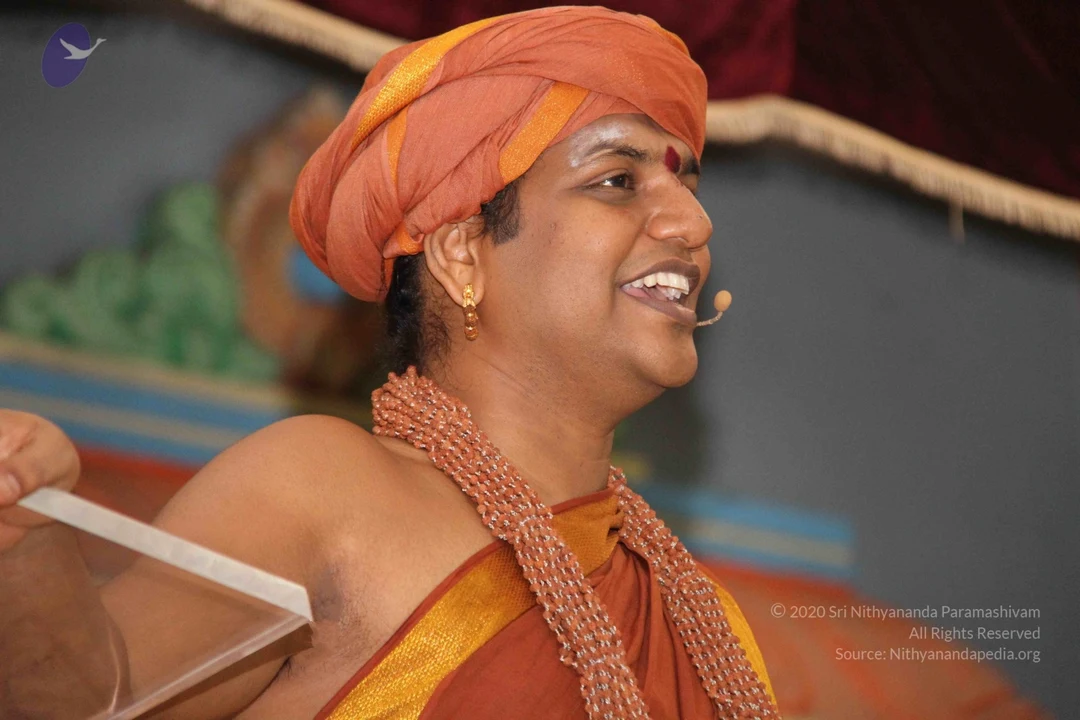
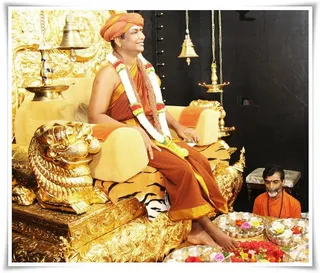
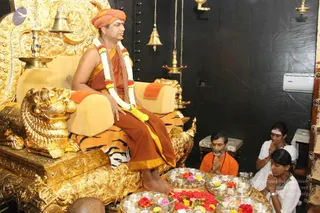
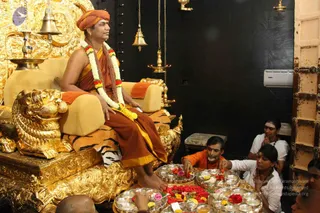
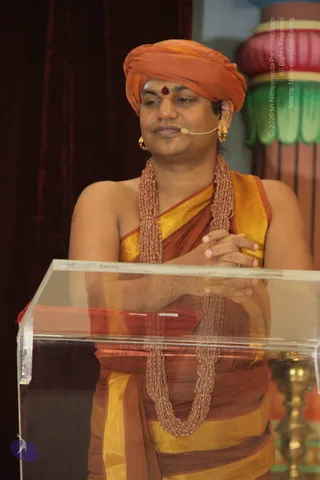
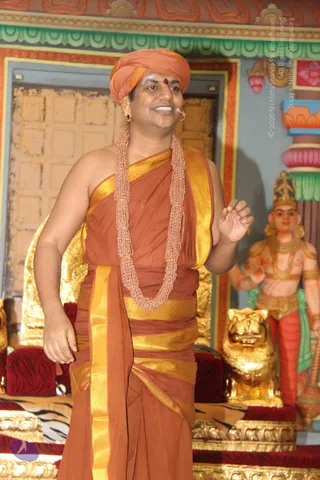
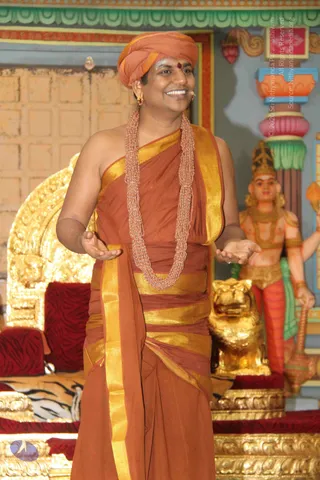
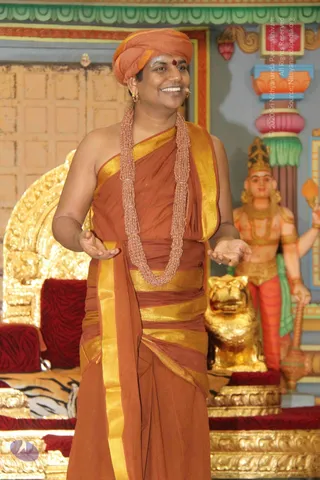
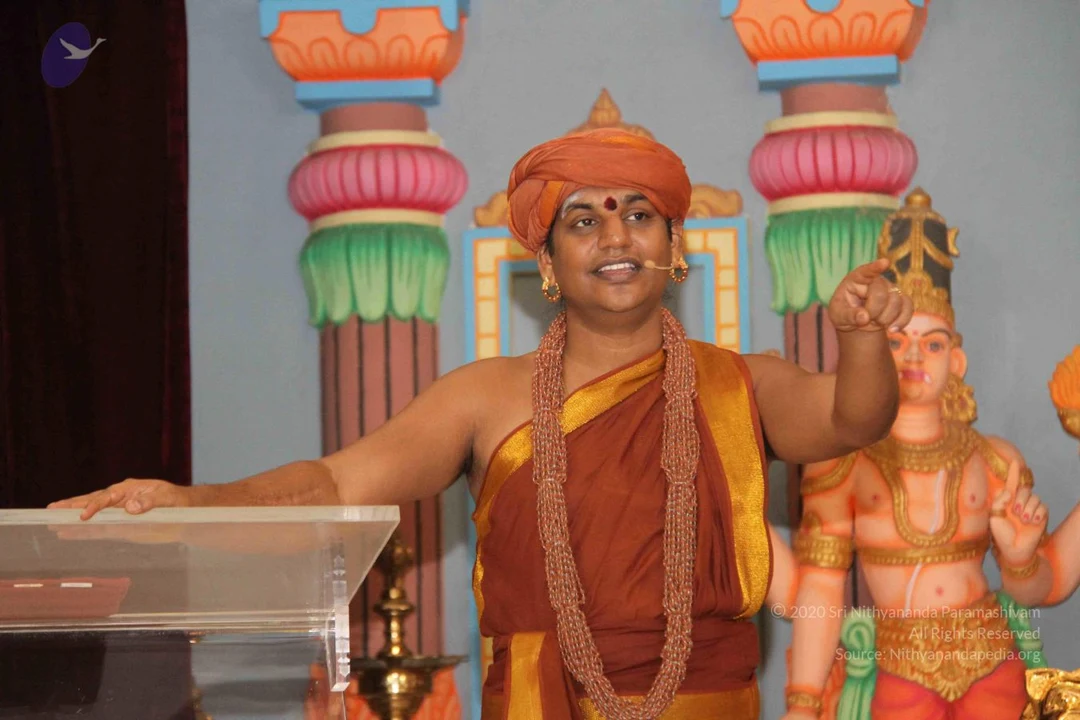
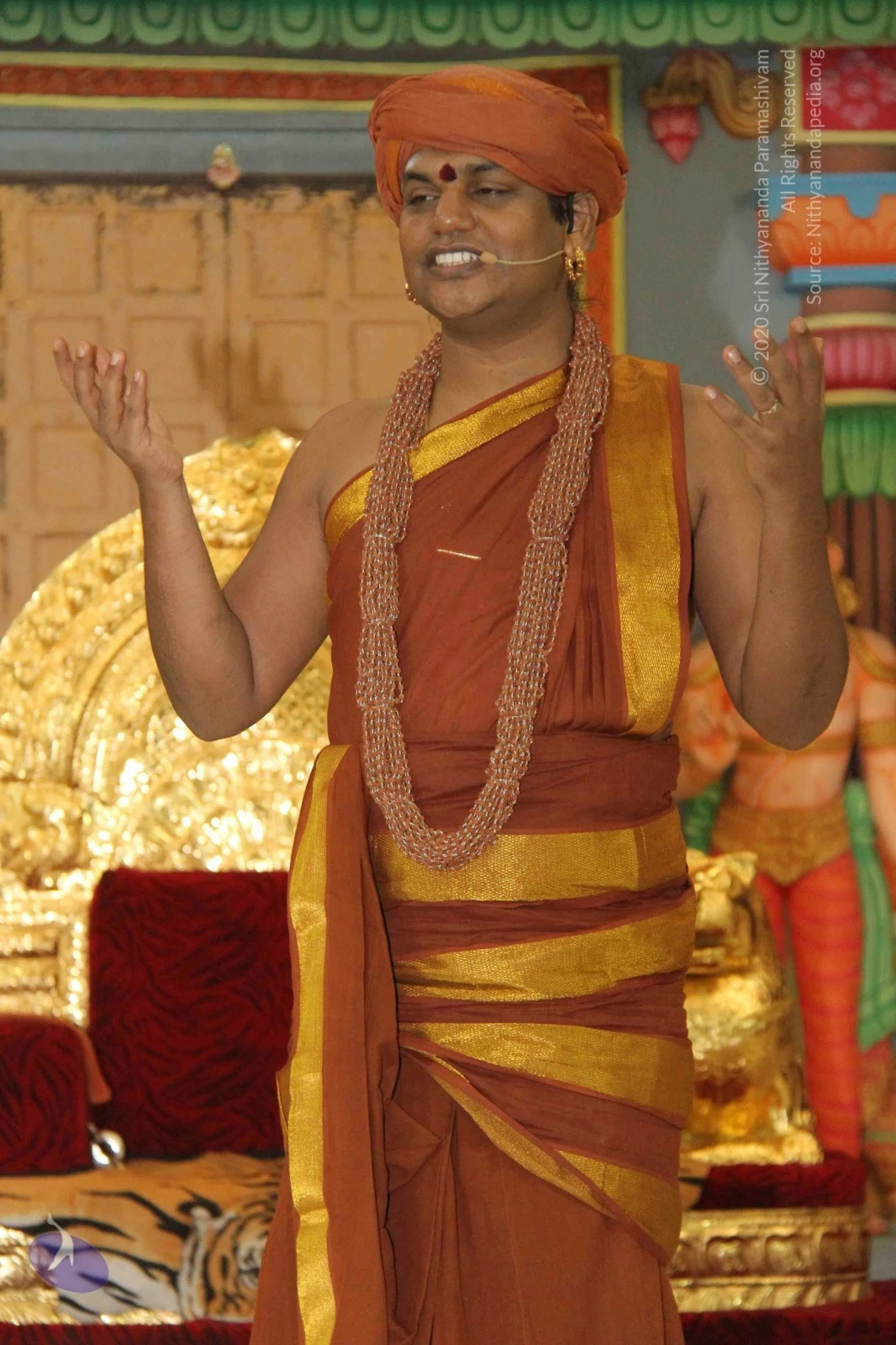
A man in saffron-orange robes and an orange turban stands at a clear acrylic lectern, speaking into a small headset microphone during a discourse. He wears a gold-bordered orange shawl, a long rudraksha mala and a red bindi, and rests his right hand on the lectern. Behind him, a large painted deity murti with a crown and gold necklaces stands beside a pillar with pink and green lotus capitals. Swamiji (probable) appears in person: long swept-back hair under the turban, ornate gold earrings and rudraksha mala, with the saffron robe and turban cues. He is presenting a satsang discourse.A photograph inside a temple-like room with dark slate walls and a carved wooden door. A bald man in orange and saffron robes with a rudraksha mala and a white-and-red garland sits on an ornate golden throne with a lion-head armrest, wearing an orange turban, and appears to be speaking. Before him on the floor, several devotees in red, white and orange clothing perform padapuja, offering flower petals, red roses and small lamps on silver plates. Brass hanging lamps hang from the ceiling and a video camera on a tripod is set up at left. Several people sit cross-legged in the foreground and at the centre, one shaved-headed man in orange kneels beside a woman in a red blouse.A close photograph of a man speaking at a lectern with a clear acrylic front, wearing an orange and saffron turban with a red bindi on his forehead, gold hoop earrings, a clip-on headset microphone, and a layered rudraksha-style bead necklace over bare shoulders with an orange-and-gold shawl. Behind him is a colourful painted temple-style wall with blue, red and green decorative bands. He appears to be giving a talk or discourse to an audience.

September 19 2013

Original wiki page
Contents

Description:

Today Paramahamsa Nithyananda (Swamiji) talked about the benefits of living the 4 Tattvas. He explained that our suffering is the fight between the Frozen You and the natural Flow of Life. The 4 Tattvas are the only settlement in that war...the cease fire agreement and the ongoing peace agreements. Integrity is the pranayama that balances the whole body and gives courage to your thinking.Integrity frees you from the fear of thinking and frees you to create a space in which you can iron out your thinking and think through to the logical conclusion on any issue. When you bring authenticity to your actions you become active. most of us have deep incompletions about being active that are from being suppressed as a child by adults who simply could not handle the natural high activity of a child. Authenticity happens in you when you complete with these in completions about being active. The agni will be awakened in you and your whole body and skin will shine.

Link to Video:

VideoAudio

Transcript:

Nithyanandeshwara Samaarambhaam Nithyanandeshwari Madhyamaam | Asmadaachaarya Paryanthaam Vande Guru Paramparaam ||

I welcome all of you who are sitting with us all over the world through Nithyananda TV, Lotus News Channel, Sadhana TV, and two-way video-conferencing having Nayana Deeksha.

Cities sitting with us in two-way video-conference having Nayana Deeksha: Hong Kong-Sirkazhi, Devon UK, Port Washington-New York, Singapore-Singapuram, Oman-Sivagangai, Dakota-Columbia, Ohio-Ma Shivananda, East London-UK, San Diego- Pacific Beach, Tiruvanmiyur-Chennai, Dubai-Vaidyanatham, Hyderabad-Gupta Kashi, Toronto-Kailasam, Surrey-British Columbia, Chino Hills-California, Guadeloupe Rameshwaram, Kuala Lumpur-Palani, Houston, Los Angeles, Oklahoma, Seattle, Ohio-Prayag, Charlotte, Varanasi, Houston, Paris Home-Temple, Nithyananda Sacred Arts City, Jorpati-Kathmandu……….!

I welcome all of you with my love and blessings.

Today I will expand on “THE RESULTS AND BENEFITS OF BRINGING THESE FOUR TATTVAS INTO YOUR BEING”, internalizing all the four tattvas, what it can cause to you.

Please understand! Come to the space of listening!

I am defining “suffering”. Suffering is nothing but “the fight between the frozen part of you and the flowing component of life.”

Please listen! Suffering is nothing but the fight between the frozen part of you and the flowing component of life. Life by its very nature is alive, active, flowing. But, your logic by its very nature is frozen, cold, insensitive. And, do you know a very funny thing? Your logic will be insensitive to life, but it will always make you believe life is insensitive to you! Alright! It is the truth. Okay. Part of us is frozen and that fights with life, and so the suffering happens. That fight is the suffering. What is the way to get out of this suffering? What is the way to end the war?

Every war will end only with an agreement, with a settlement, with a pact, settlement-agreement. I tell you, the only settlement-agreement which can end the war in your life are the four principles: Integrity, Authenticity, Responsibility and Enriching.

Please listen! Listen! Listen sincerely! Listen in the space of listening!

When you bring Integrity in your thinking, Authenticity in your actions, Responsibility in your being,Enriching in your life, your frozen inside melts down, starts becoming one with life. It becomes a part of life. Becoming part of life is what I call “Enlightenment”. Just becoming part of life is what I call “Enlightenment”.

Sometimes people tell me, ‘I don’t want spiritual life. I don’t want these four tattvas.’ It is like telling, ‘I don’t want to breathe. I don’t want blood circulation.’ Then what to do? You need to understand that there is no such thing as “spiritual life” and “normal life”. Life is life is a life is a life! Life is a life is a life is a life!

Please listen! When it is frozen and carries lot of suffering in body and mind, you can call that as a normal life. When lot of your frozen components melt down and you are able to flow with life beautifully, I tell you, if you have the frozen part of you only to the level of “boat”, that is okay. The boat can float on the river of life. But when the frozen part becomes one-third of the river, the river itself is blocked in you! Understand, an ice-bar can be floating on the river; nothing wrong. Even if you have a little resistance only to the level of ice-bar, ice-cube, you can float on the river. But, if your resistance is like a frozen river, the river itself is a block!

I have seen, sometimes this huge frozen ice becomes even a barrier for the river to flow; seventy-five percent of the water will be stuck; only ten-twenty-five percent of the water goes beyond that ice-cube,iceberg. If your life is frozen to that level, then even life cannot happen through you. So, the first thing you need is the four tattvas. It is the simple principles like breathing and eating. Mix Integrity with your breathing, Authenticity with your eating, Responsibility with your blood circulation, Enriching with your actions. Understand, all four are directly connected. When you start thinking with Integrity,your breathing will become beautiful and best. That is the best pranayama you can do. Thinking with Integrity is the best pranayama! That is the result of all pranayamas!

What is pranayama? Some part of you does not get enough of oxygen. Your brain needs to get a certain level of oxygen. Your heart needs to get a certain level of oxygen. Your blood circulation needs to carry certain levels of oxygen to all parts of your body. Your body getting proper oxygen supply is the purpose of pranayama. The purpose of pranayama is achieved if your whole body gets enough supply of oxygen.

I have seen some people: only the brain gets oxygen; the heart doesn’t get oxygen. Any other component, any other part of their body doesn’t get oxygen! And same way, some other people: only the heart gets oxygen; their brain has no function! For some people: only their private parts get oxygen, nothing else gets oxygen! These are the different types of people, different types of life. So, pranayama is needed to balance and enrich the whole body with enough prana energy. If you think with Integrity, that will happen! If you think with Integrity, that will happen!

Listen! If you think with Integrity, that will happen!

Integrity will melt down all the blockages you carry in your breathing pattern. I can tell you, the physical result of Integrity is, all your breath-related, the air circulation-related, breathing-related problems will disappear and it will bring a lot of courage in your thinking.

Please understand! Listen, I am making a very important statement. Most of your sufferings are because you are afraid to think about some parts of your life, some components of your life. You are afraid of thinking! You always think, because you are thinking you are getting fear! No! You are actually afraid of thinking! That is why those thoughts may cause fear in you, you think, and then you stop thinking!

Listen! I am giving you an example. You think if you think about ghosts, you will have fear. But I tell you, because you are afraid to think about ghosts and its side-effects and after-effects, you are suffering. It is not that because you think about ghosts you are suffering. Because you are afraid to think about ghosts and its after-effects you are suffering. Fear of thinking! And, you also need to know, thinking about ghosts and its after-effects is not going to bring that effect on you. Thinking about the fire and its after-effects is not going to burn your body! When you have that clarity, you will know how not to be afraid of thinking.

Please listen! When you don’t have any fear of thinking about ghosts and its after-effects, you will never think about ghosts and have fear! Please get it! I am unlocking one of the important self-doubting structures of your being. Please understand! I am giving you the formulae of “life algebra”!

See, sometimes there will be a knot with which you are caught. You do not know where it starts and where it ends and how to unlock it! This is one of the important knots: If you think that when you think about ghosts you are frightened, shaken, so you should not think about ghosts, then you are wrong! You are not getting fear because you think, you are getting fear because you don’t want to think! And when you have the fear because you don’t want to think, that knot will continue to remind you of which you don’t want to think. It is like you don’t want to think about ghosts, then what will you be doing the whole day? You will be thinking you don’t want to think about ghosts! It is like the doctor telling, ‘Don’t remember monkey and drink this medicine!’ Can you ever drink that medicine? No! The moment you want to drink the medicine, the monkey is there in front of you and inside you!

Listen! So, ironing out your inner space and liberating yourself from fear of thinking is Integrity!

Understand, I am defining Integrity. When you practice Integrity, you will be free from fear of thinking!

You can nicely, comfortably sit and you will be able to think, ‘If ghost comes, what will happen? What all will be the possibility? It may just snatch my one hand and eat! And if it doesn’t feel satisfied, it may just pluck my one leg and eat! Then what else?’ If you are able to get to the extreme of any thinking logically without the fear or resistance, I tell you, that flow of thinking will not even happen in you a second time!

Listen! I am giving you one example: If you are afraid of ghost. There are some people who are afraid of disease. There are some people who are afraid of jail. There are some people who are afraid of poverty. About whatever you are afraid of, sit and in a very cool way, comfortable way, know very clearly that just because you are thinking you are not going to have it. Millions of things about which you thought, you did not have them. You always wanted a private jet, did you get it? No! You always wanted this, this, this, this, this; did you get it? No! So, know very clearly, mere thinking is never going to get you the results. Only creating a space is going to get you the results. “Creating the space” means, taking the responsibility along with thinking.

So, sit comfortably and tell yourself clearly, ‘Now I am going to merely allow myself to think to the extreme conclusions, the logical conclusions of any thought-trend about which I am afraid of. If I am afraid of poverty, let me sit and think about the extreme possibility of poverty. If I am afraid of being jail, let me sit and think about the extreme possibility of being in jail. If I am afraid of death, let me sit and think about the extreme possibility of death. If I am afraid of any disease, let me sit and think about the extreme possibility of disease.’

Listen! The fear of thinking does not let you think beyond a certain limit. Then that does not mean that fear is going to make you forget about that subject completely. For example, if you are afraid of a disease and you don’t think logically to the extreme end of the disease, it is not that your inner space will never remember about that disease. Logically you will not think, but unconsciously you will be brooding over it. I tell you, anything which stays in your unconscious as a weight and makes you brood over, bring all of them out and consciously think through to the logical conclusion. With Integrity, fear of thinking will disappear, and once the fear of thinking disappears, thinking cannot cause fear to you!

Please understand, as per the mutual law of Dhamma….. Please listen, the Cosmos functions with a law: Don’t give to others what should not be given to you. Don’t give to others what should not be given to you. If you don’t give to others what should not be given to you, what should not be given to you will not be given to you by others. It is a Cosmic law of life. Listen! Please internalize! When you don’t have fear of thinking, thinking will not give fear to you! It will not have fear of you! Both of you – you and your thinking – come to a war agreement: ‘Till today, we had war. Let us stop the war. Let us come to an agreement. Let us come to “cease fire” today. I will not be afraid of you; you don’t be afraid of me.’ That agreement is what I call as “Integrity”. You not having fear of thinking, and thinking not having fear of you; that agreement is “Integrity”.

Please understand! So the first thing you need to do in your life is, sit and think about all the subjects, dimensions, space and happenings of your life which you are not interested in thinking, about which you are afraid of thinking. If you are afraid of poverty, you have to sit and think, ‘What all can be the logical conclusions and effects of my poverty about which I am afraid, about which I don’t want to think?’ Sit and think, think, think. I am not saying bring that poverty to you. No! I am just saying, think, think, think. In a few days, I tell you, just in a few days – it may not take more than three-four days – your fear of poverty will dissolve! Please listen, whenever you do not have fear of thinking about something, that will not continue to haunt you and sit in your unconsciousness as weight.

Please listen! People who have a matted lock, Shiva jata hairstyle….. Actually, even three-four matted locks is equivalent to the normal person’s thickest hair, because if you open the matted lock and make it into normal hair, it will be ten times more voluminous! Please listen! Understand this example! Actually, two-hundred separate strands of hair whatever area it occupies in your head, when it becomes a single matted lock it will occupy only one-tenth of that space, because it becomes very thick! Same way, brooding over a thickened thought-trend. If you are afraid of poverty and never iron out by logically thinking about it that will sit in you like a knot, like a strand of thick hair. Same way, the part which sits in you which you don’t want to think about, but which continues to sit in you and attracts your attention that swallows your energy.

Please listen! If you are afraid of poverty, but don’t want to think about it logically, it is not that you are not going to think about poverty; you will constantly be afraid of poverty and brooding over poverty unconsciously, wasting all your energy, because that is going to be sitting in your lungs, in your heart like a big tumor; in your unconscious space as a big tumor. Ironing out your thinking and not being afraid of thinking about anything, taking any thinking to the logical conclusion, is “Integrity”!

Please listen! Whenever you want to think about poverty, death, jail, you are always afraid that if you think about all that, it may come in your life (as reality). But, whenever you want to think about richness, getting your desires fulfilled, you always have the fear, ‘even if I think about it, I will not get it.’ See the funny way your brain functions! All the things you want, you always think you are not going to get them. All the things you don’t want, you always think even by thinking you will get it. See, all the things you want in your life, you always think you won’t get them even if you work for it! But all the things you don’t want in your life, you always think you will get them even if you just think about them!

Life is not that unfair with you! Whatever happens in your life happens only after you think and TAKE RESPONSIBILITY for it. The ghost will happen in your life if you take the responsibility of inviting it. Poverty will happen in your life only when you take the responsibility of inviting it.

Please listen! Anything, anything happens only when you take the responsibility of inviting it, making it happen. You should know very clearly, you should know very clearly, you should see your own hypocrisy. Which you don’t want in your life, you feel even if you think about it, it will come! Which you always want in your life, you think even if you work for it, it will not come! What a funny belief space we create about life and then go on blaming life! If you create this kind of space, how will the life respond to you? Ironing out your thinking to the logical flow needs to be done as the first step in your life.

First thing you need to do today, sit and list out all the zones you are afraid of. If you are afraid of disease, first, disease; then next, death; third, jail; fourth, poverty; fifth, losing all the relationships; sixth,living your life in loneliness, seventh, living the life of being unattended; eighth, living the life without having any attention! Whatever you are afraid of – there are some people who have the fear of living life losing their mental balance, being mad – whatever fear you have, write it down and logically, sit and think about it. When you lose fear of thinking, thinking loses fear of you! When both of you lose fear of each other, you live happily, blissfully, married together forever! You live happily ever after! Having eternal romance with your thinking is “Integrity”!

Integrity takes away the fear component in your thinking. You can think about anything. You will take responsibility for the right thing. You will think about anything! You will take responsibility for the right thing. You will not have this perverted faith about you and your own life. Please understand, the “perverted faith” is: Whatever you don’t want, you are always afraid that even if you think about it, it will happen in you! Whatever you want, you are afraid that even if you take responsibility, it will not be given to you! It is the perverted reception to life!

30 min

Take responsibility, it will not be given to you. It is the perverted reception to life See, it is like you wanted some highly respected honoured guest to come to your house but the moment they’re entering your house you stand there with your shoes in your hand, your son is standing with a broomstick and another one is standing there with water with cow-dung. How is the guest is going to come into your house and etcetera, etcetera. This is what I call “perverted reception”. Same way, when life enters into you, you are sitting completely abusing, firing, grumbling, grudging. ‘I know, you will give what I don’t want even if I think, I know you won’t give what I want even if I work for it’ Ironing out your thinking is Integrity. Bringing Authenticity in your actions, that is the second component of life. Please listen, whenever you bring Authenticity in your life, in your actions, please listen, whenever you bring Authenticity in your actions, your continuous enmity with actions melts down, your life becomes active. You need to know a very basic thing, life is happening. It is not a noun, it is a verb. Life is a happening. One of the worst thing happened to humanity is watching sports. Sports is supposed to be done by you. Playing is supposed to be done by you.

One well known fool in a village. The neighbour was asking him in the conversation about so many things. The conversation was happening, the neighbour was telling, ‘Have you heard recently one big disease called HIV? It is getting really, really bad; a lot of people are suffering.’ This neighbour said, ‘I spoke to one of my friends how he is protecting himself from it? He told me he completely keeps himself away from all physical contact.’ Kovalu said, ‘That is too bad’. The friend said, ‘I spoke to another one friend. He said he completely protects himself during all physical contact.’ Kovalu ‘That looks a little intelligent.’ Suddenly Kovalu exclaimed, ‘But I have got the best solution.’ The friend was really curious. What better solution can be there other than these two – completely keeping yourself away, or protecting yourself? What else can be the best solution? The friend was surprised and asked Kovalu, ‘What is your solution?’ ‘I hired somebody else to do it!’ Please understand, most of our life goes not being active and you continue to imagine by not being active you can taste life. Whether it is right or wrong, only when you are active, life starts happening in you. Innate incompletions you carry with the quality of being active.

All of us as a child have been controlled by our parents and society and elders when we were active because they can’t handle it, they control. When you jump, scream, scroll or whirl – and I can use all sorts of word – howl, when you do all that, scream, the elders control you because they can’t handle you and unfortunately, you carry that deep incompletion in you - not respected or allowed to be active. So you start hating being active and that becomes a very strong pattern, incompletion in you. Please understand, if you have been suppressed while you were whirling as a child and you still carry the incompletion, you can’t do even simple yoga without back pain. You have to complete with all the situations where you are being controlled for being active, the incompletions you made for being active. A child should not carry any incompletions about being active and because you carry incompletions about being active, you lose Authenticity. Please listen, Authenticity is directly related to food and the fire in your stomach. If you bring Authenticity, the fire in the stomach will become alive again. If the fire in the stomach is alive again, you will become Authentic.

Authenticity is nothing but completing with your incompletions with being active. The incompletions you carry towards being active is inauthenticity. The straight way to bring Authenticity in your life is complete with all the incompletions you have about being active, about being active. Listen, listen, It is most unfortunate thing happens to human being throughout, all over the world, in all countries, all civilizations, in all societies. It is unfortunate the parents are not able to handle the kids being active. They are being controlled and the kids develop incompletion about being active. Kids start developing if they are active, something is wrong, that kind of a pattern. Incompletion becomes so much, if they are active, it is wrong.

I tell you, if you complete the incompletions with being active, first thing that will happen is, you will be surprised, first thing will happen to you, your lust will melt down, because lust is nothing but secretly trying to be active. Because you believe being active is not right, the side-effect of the incompletions with being active is lust. If you complete, if you complete with the incompletions of being active, if you bring Authenticity, the first effect in your life is, it will melt down all the lust. Second, the fire of agni, will become awakened. Your body will become pure, shining. If the body is not shining, I can be one hundred and twenty percent sure that person is not celibate, even if he is a monk. If somebody is a monk, if somebody is a celibate, authentically, the body will be shining. Authenticity, authenticity is nothing but completing with the pattern of being active. Complete all the incompletions you carry in your life because of being active. Bring yourself to the space of being complete with being active. Go back to all the incompletions created in you in your childhood by you and by others.

One thing - others can be only, maximum cause but you only create. Incompletions cannot be created by others in you. You only create. Others may be only a circumstantial cause. If I have to put a little better word, they may be just a circumstance but the incompletion itself is created by you. It is created by you. As long as you carry incompletions about being active, the active lifestyle will bring so much of pain and hatred and suffering in you, you will hate being active and you know funny thing when you are not active naturally the fire in the stomach will be dead. When you are not active, you are taking the responsibility to bring diseases into your body. It is like, when you are not active, when you are not authentic, you give invitation to all the diseases. When they come to you, you say, ‘No, no, no, no I did not call you, what is this you guys are suddenly here? Get out! Get out!’ They say, ‘No once we receive invitation we don’t cancel our booking, we have to visit your house and we have to be there with you for some time. We have to spend some time with you’ Being active, completing all the incompletions with being active is Authenticity. Authenticity is happily marrying being active and happily living ever after. Please listen, being responsible is being complete with your Being. Being “Enriching” is being complete with your life itself. How, how they are connected? Watch tomorrow’s Satsang.

43:25

Photos From The Day:
Stunning Health Recoveries

Participants from different Inner Awakening programs participated in a Health survey before and after the program. The participants were from various backgrounds from across the globe with varied health conditions. Results seen were stunning and consistent for all the Inner Awakening programs. The Chart below shows the % of participants that had 100% health recovery from each Inner Awakening programs.

Photos Of The Day:

PratyakshaPadaPuja

GurukulKids_Instruments

SarvaDarshan_Pics

Temple

NithyaSatsang_Pics

Tags:

Paramahamsa Nithyananda, integrity, authenticity, tattvas, suffering, pranayama

01-Pratyaksha-Padapuja

02-SarvaDarshan

20130919_Photo_1000_IMG_6702_CMP_WM

03-Temple

04-Nithya-Satsang

Photos from this day

View all 186 photos

Photos From The Day:
21 photosSource gallery
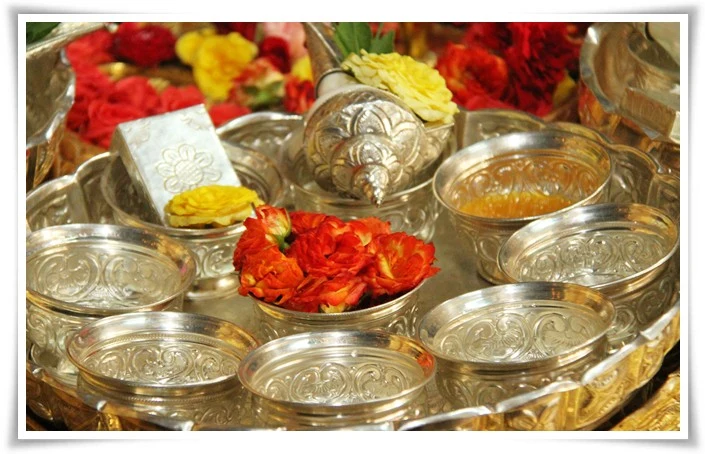
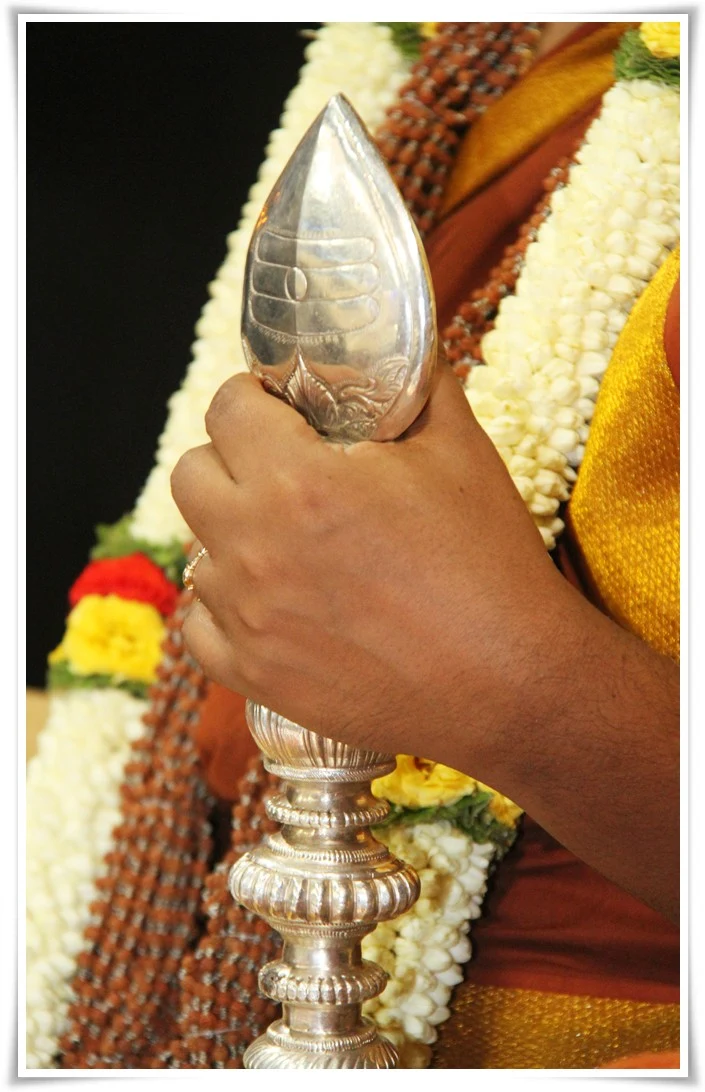
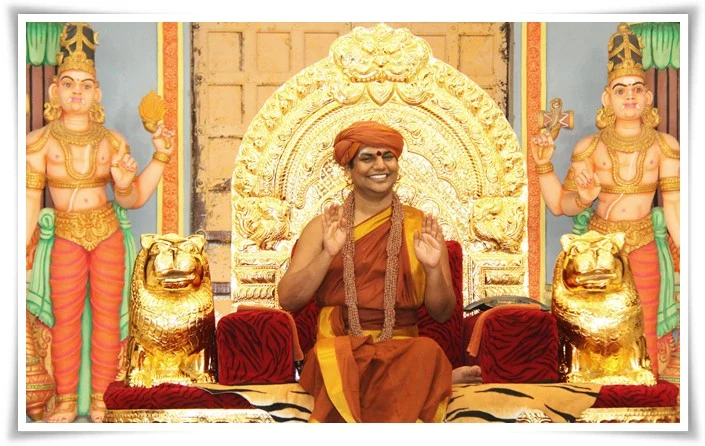
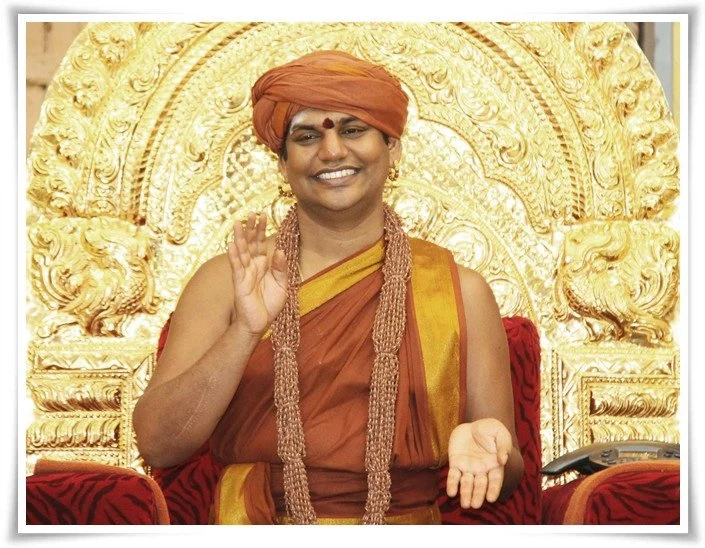
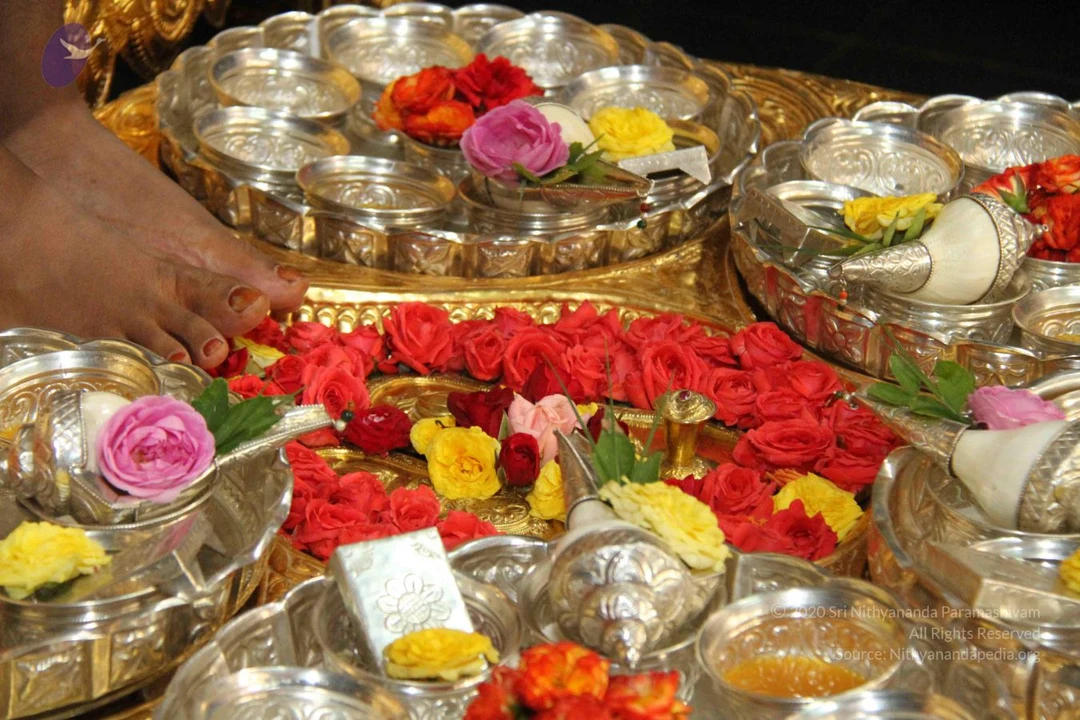
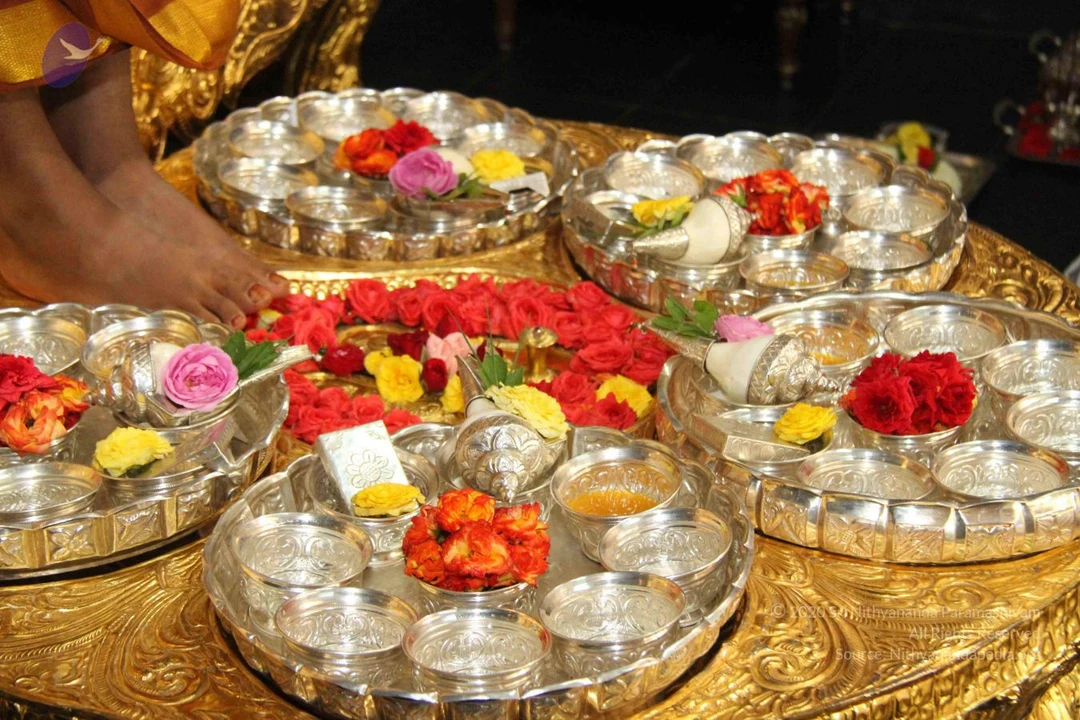
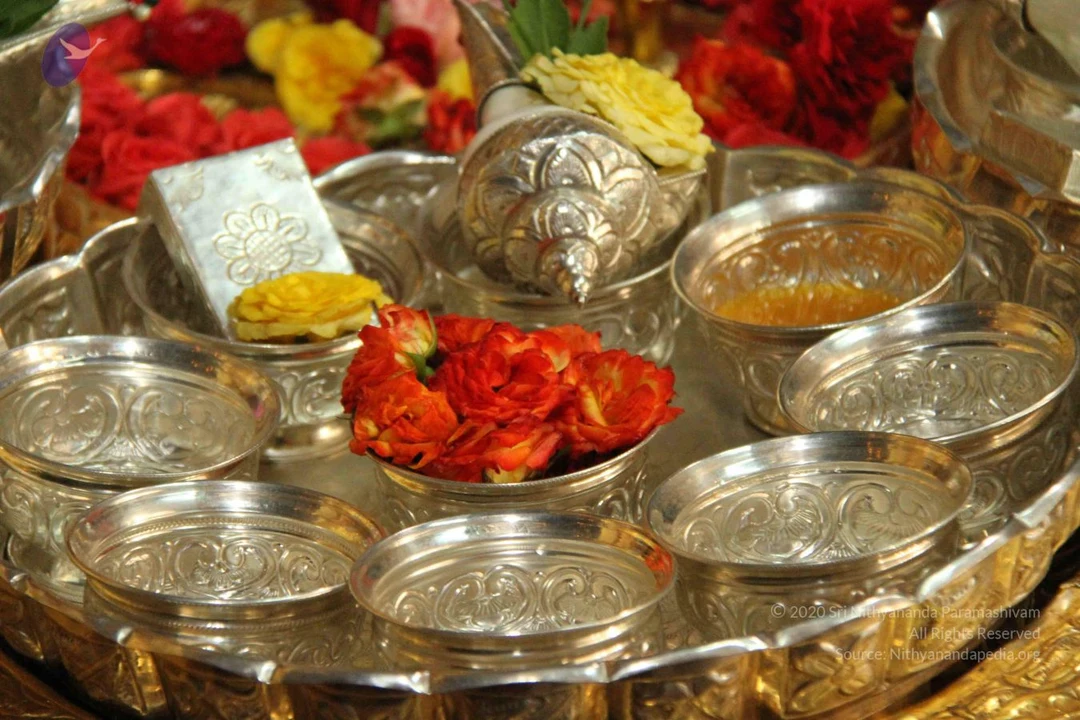
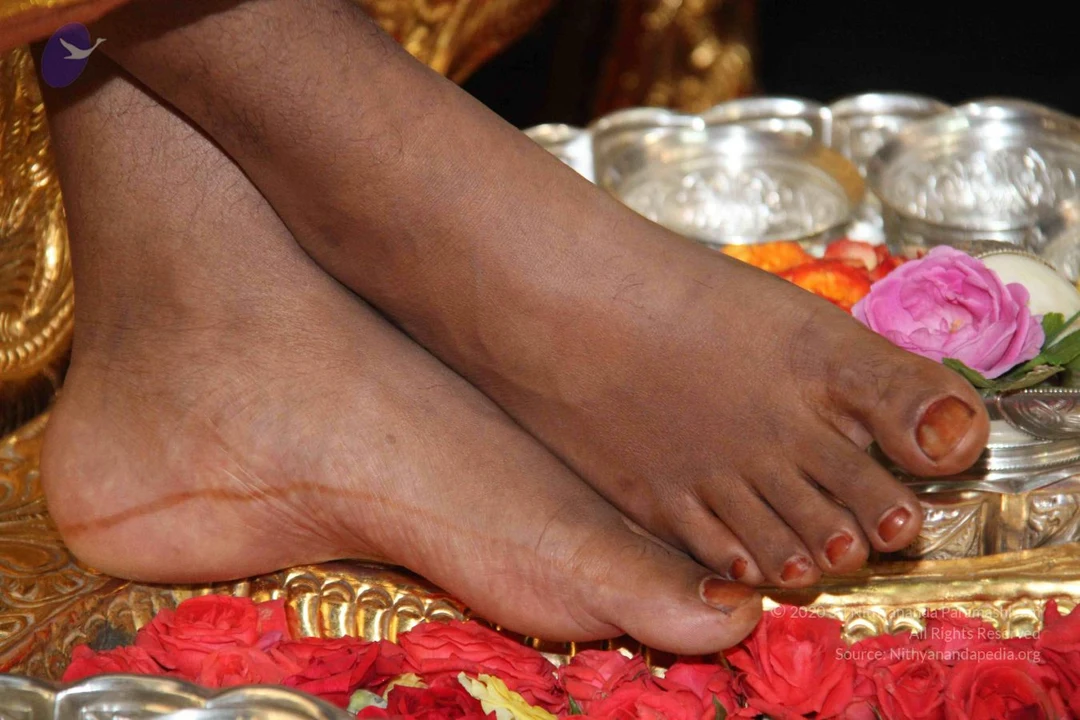
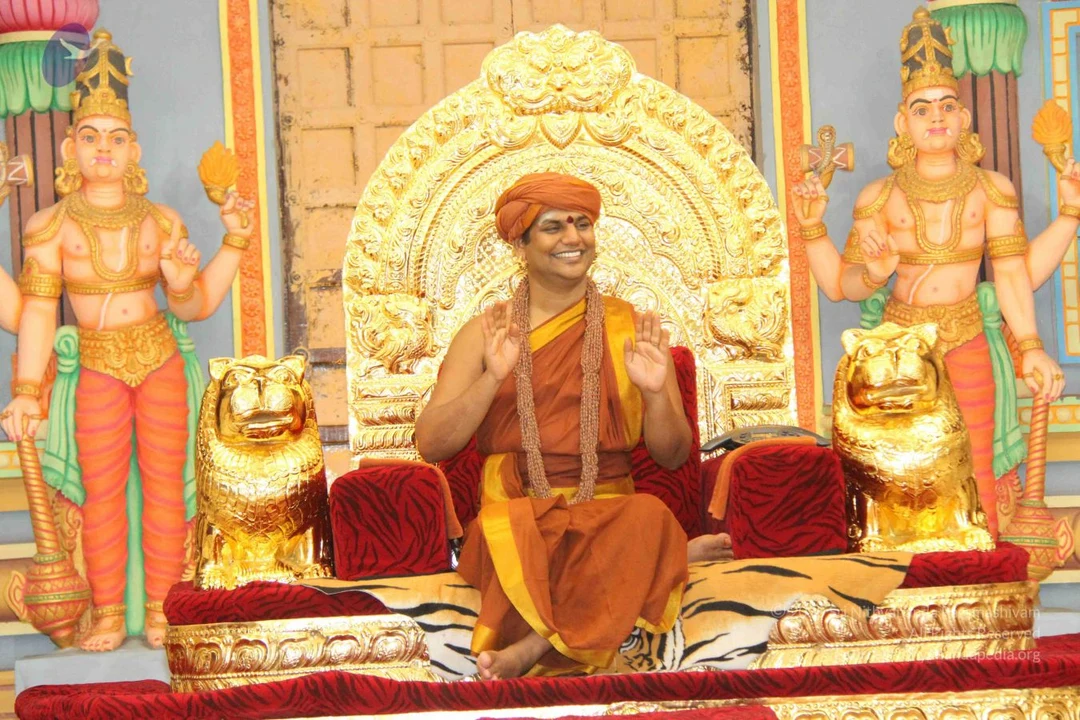
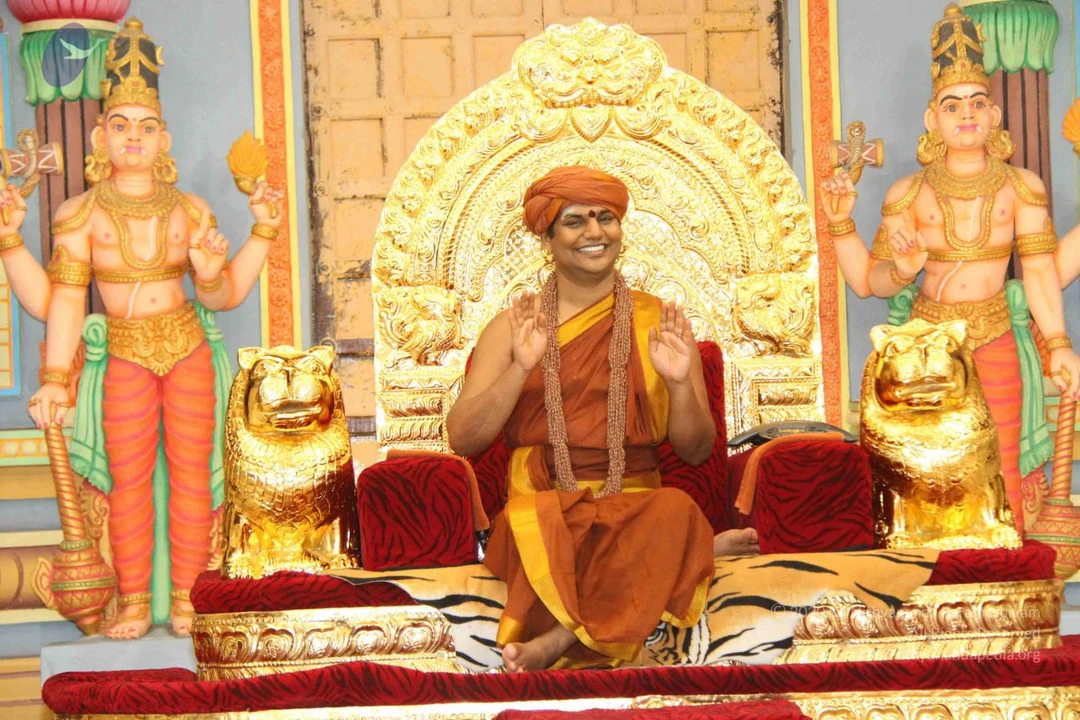
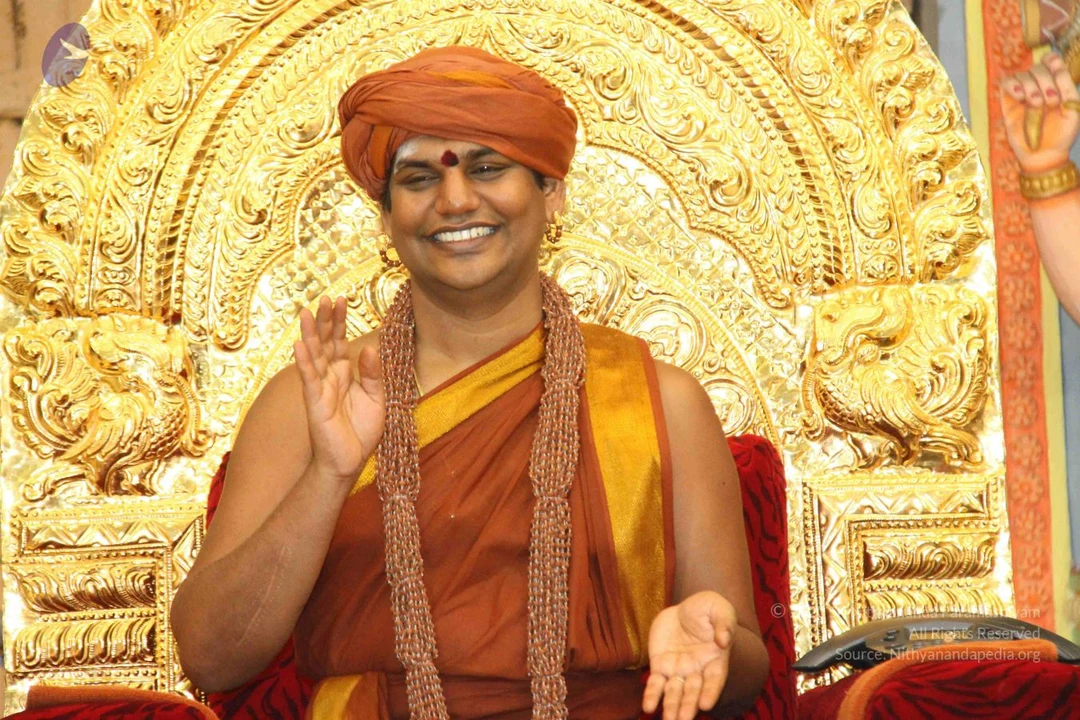
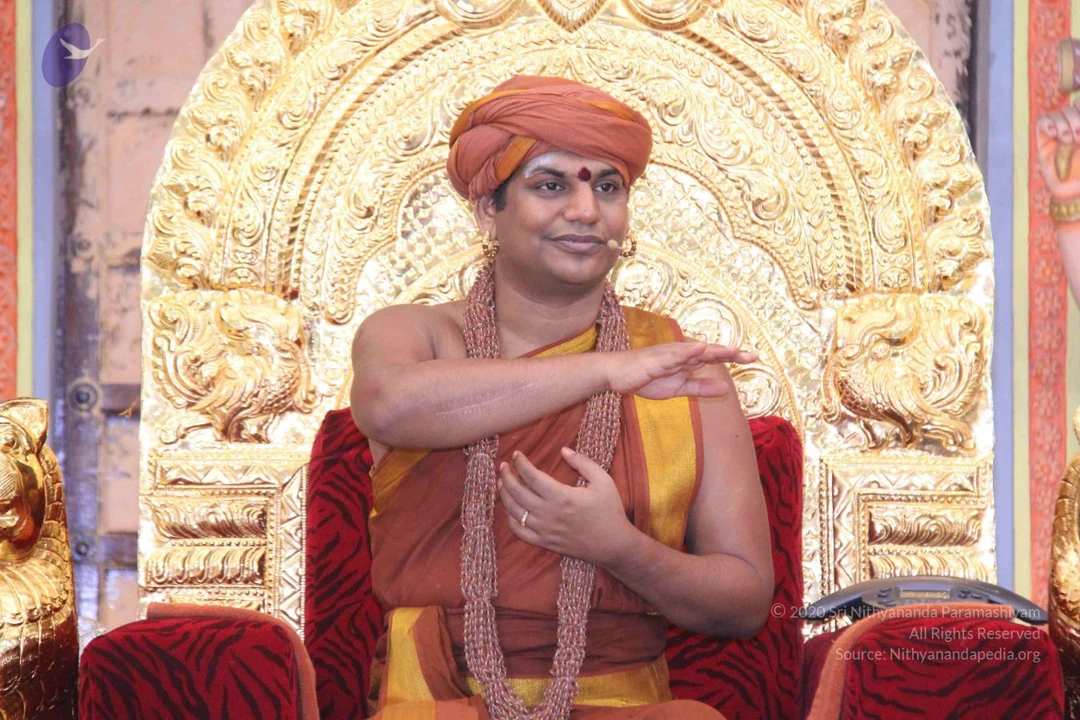
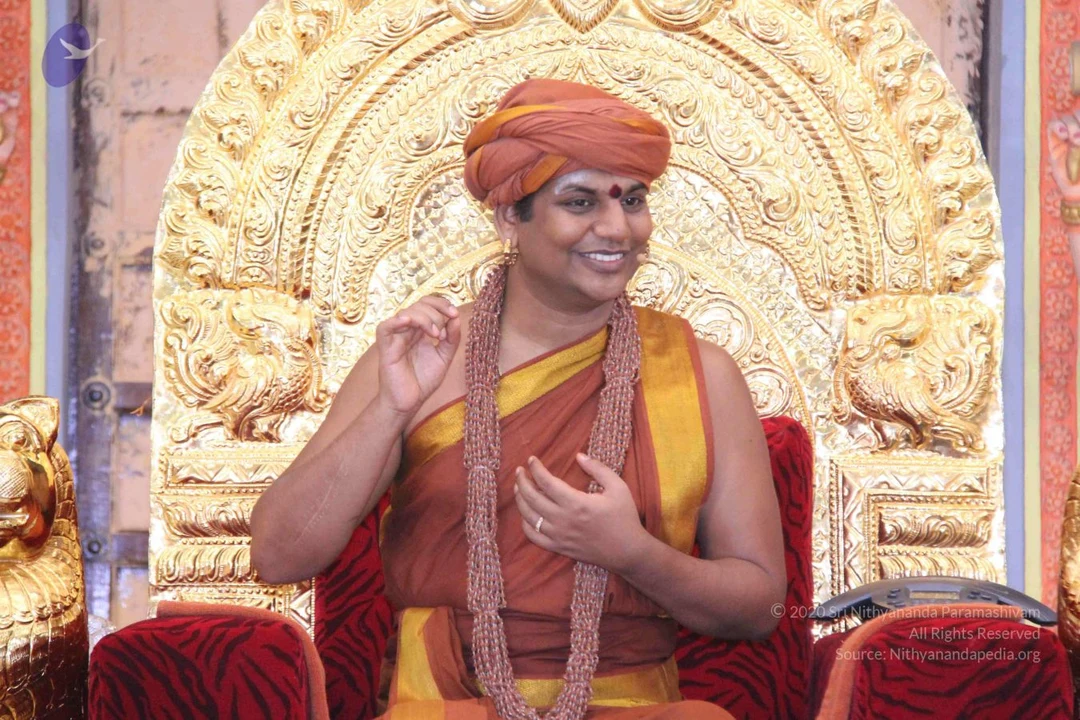
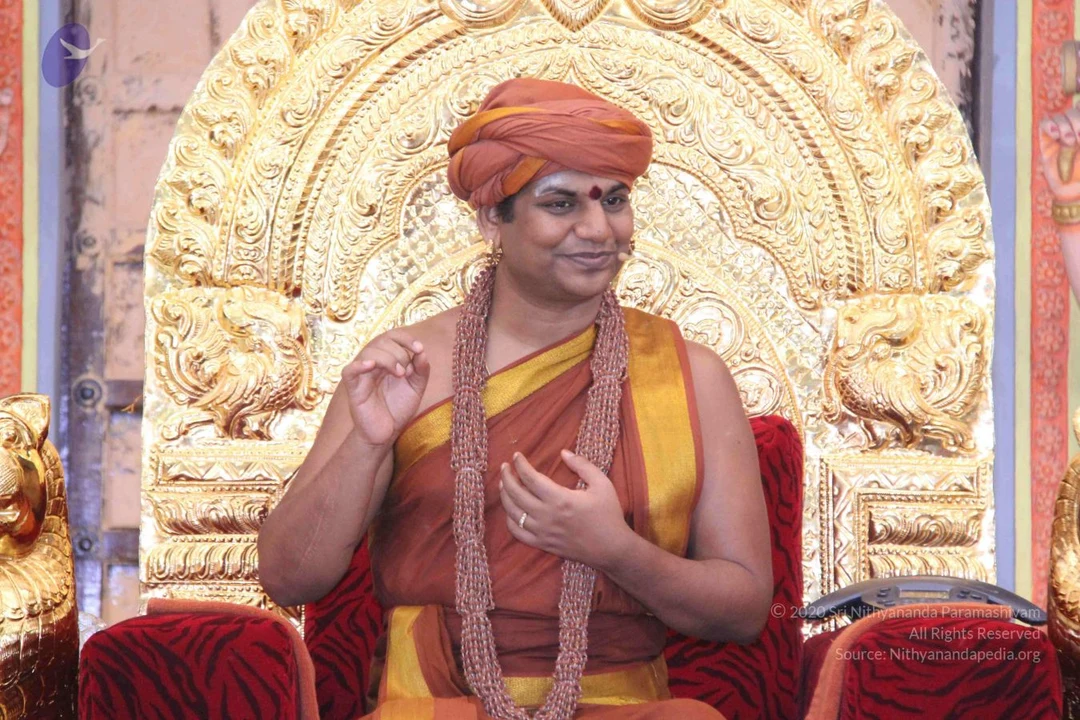
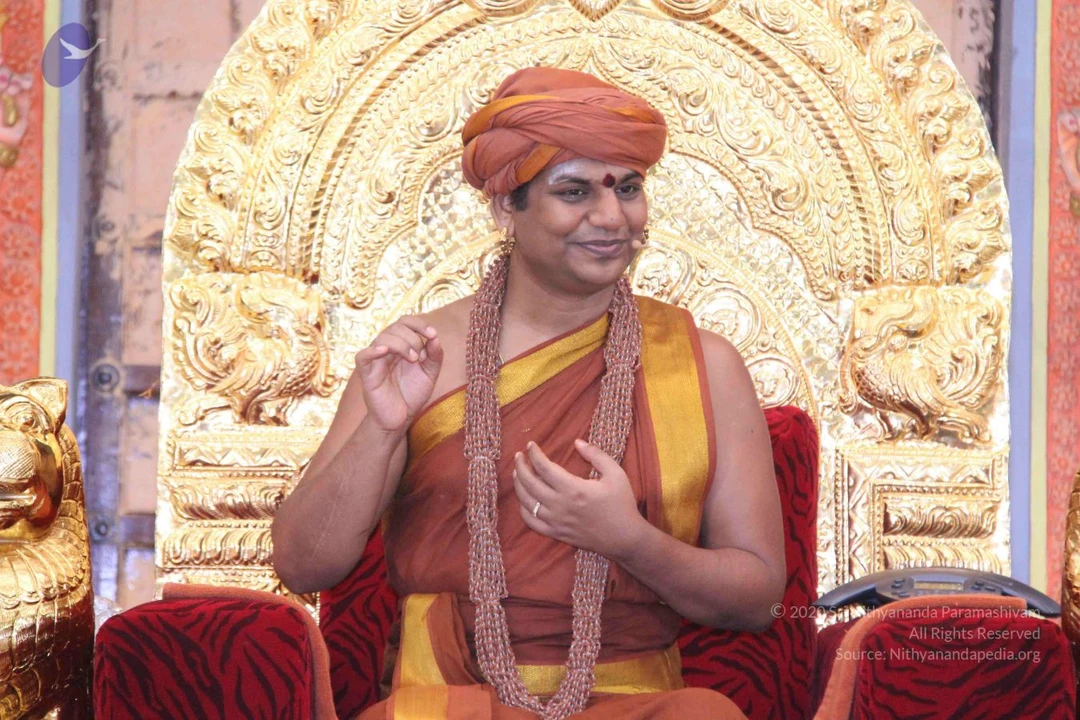
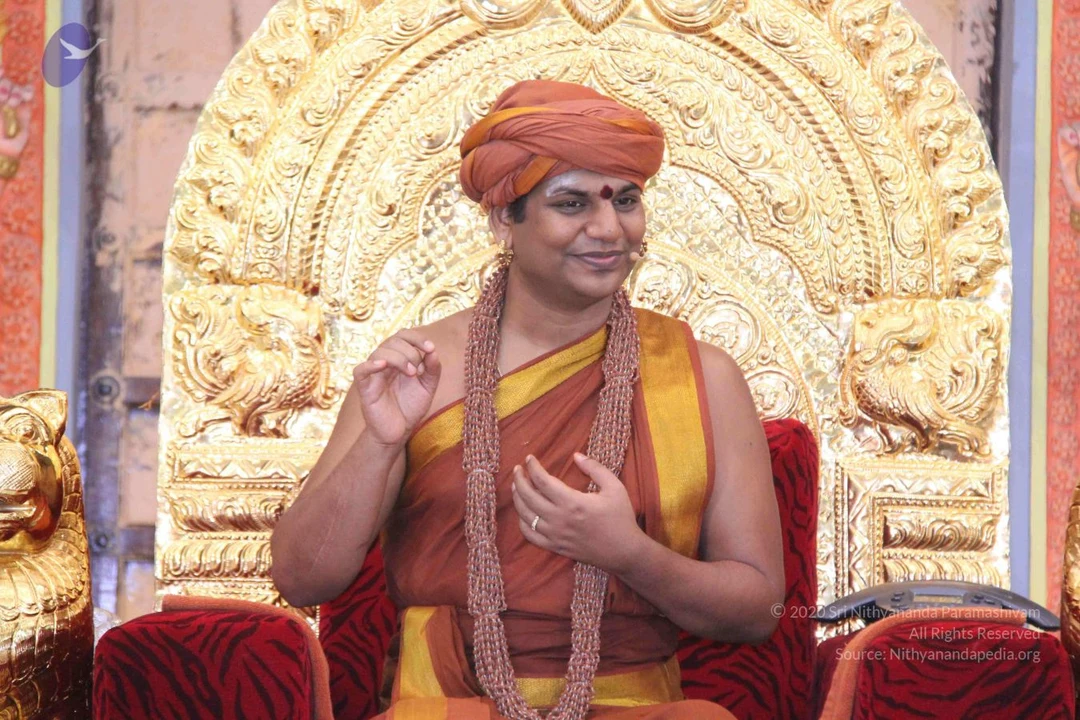
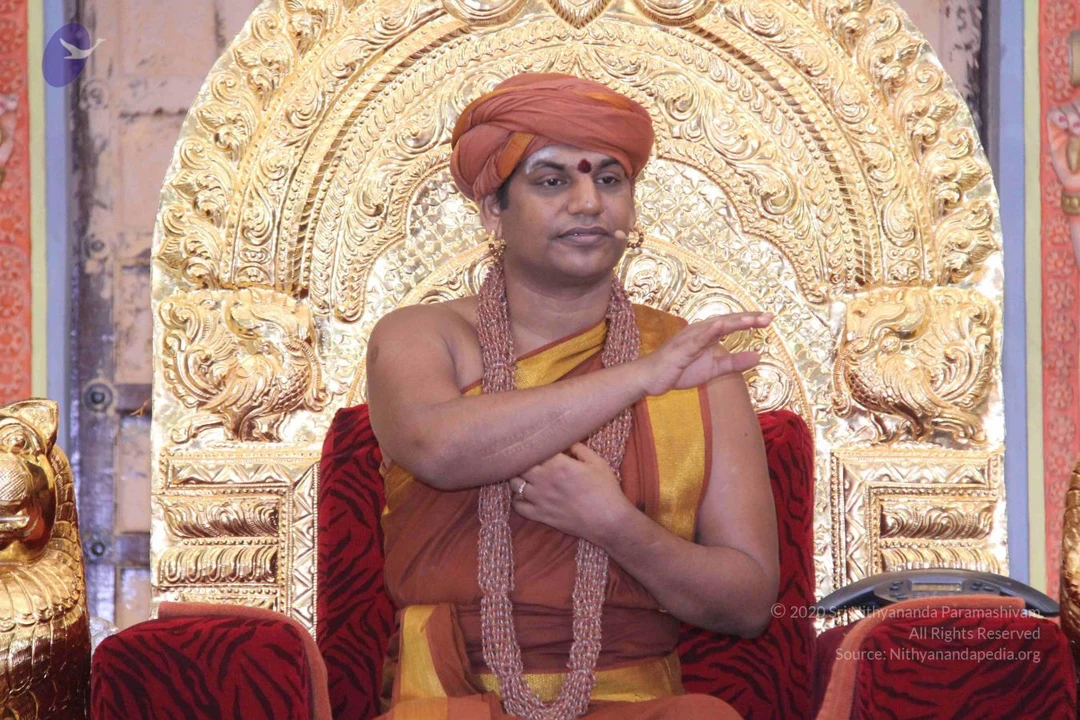
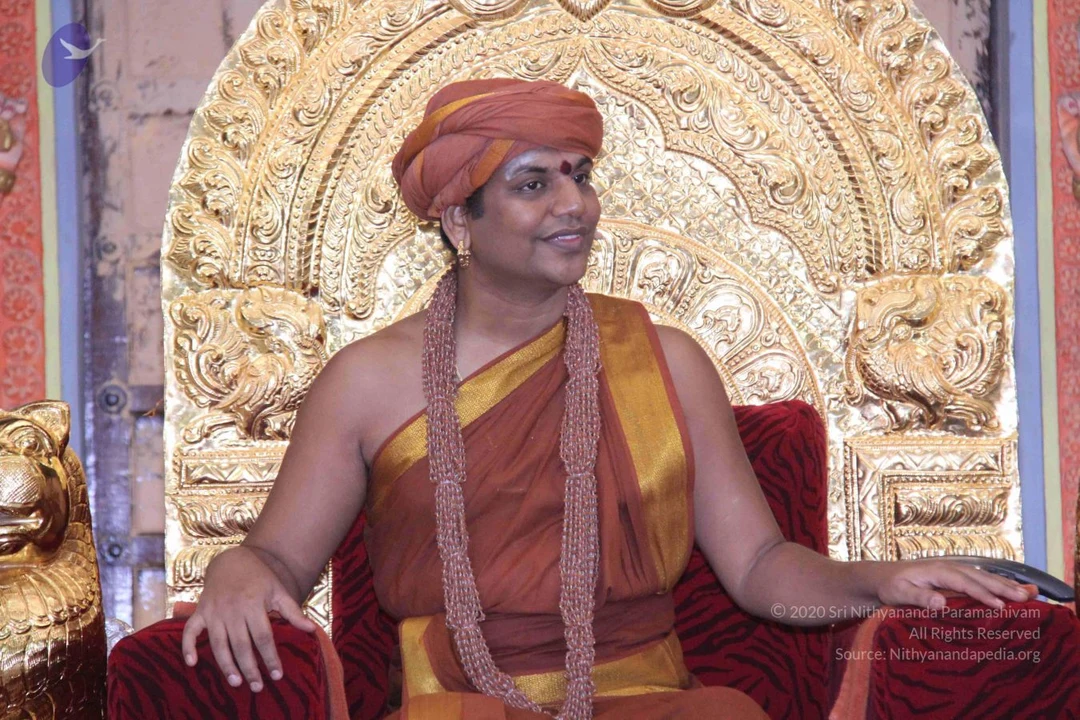
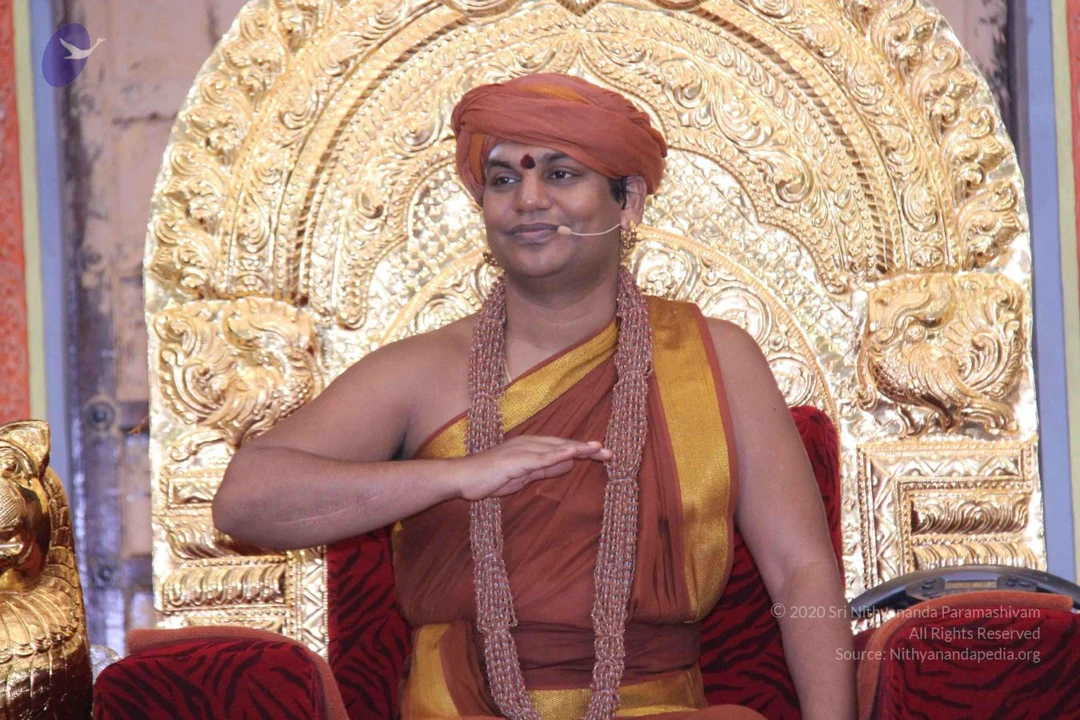
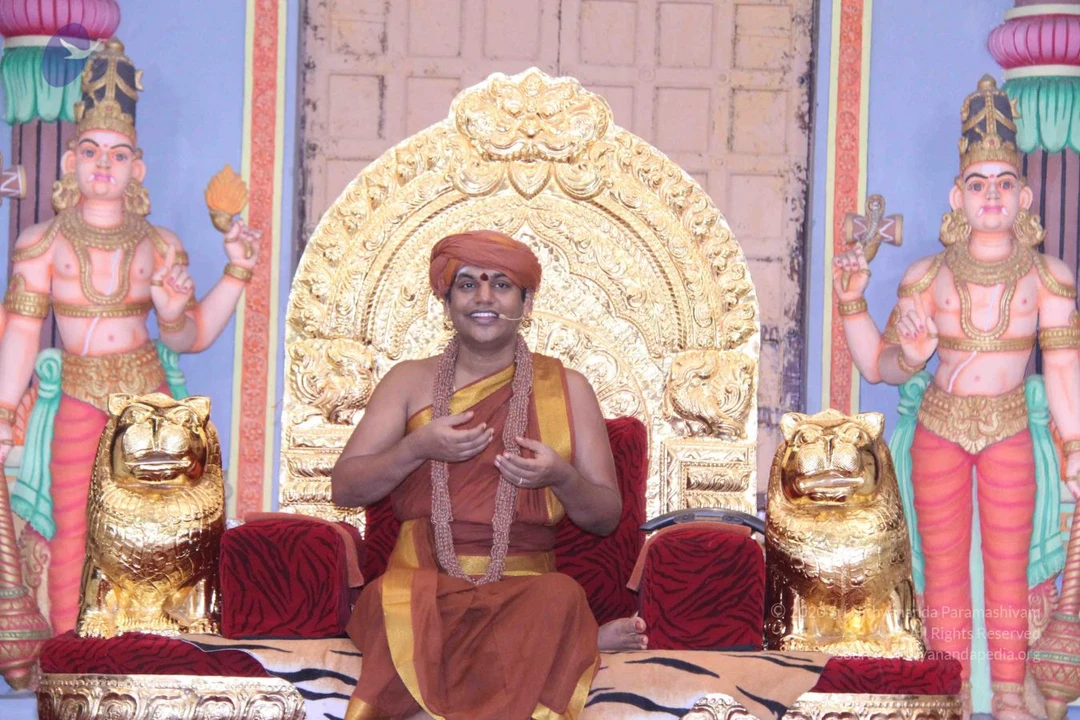
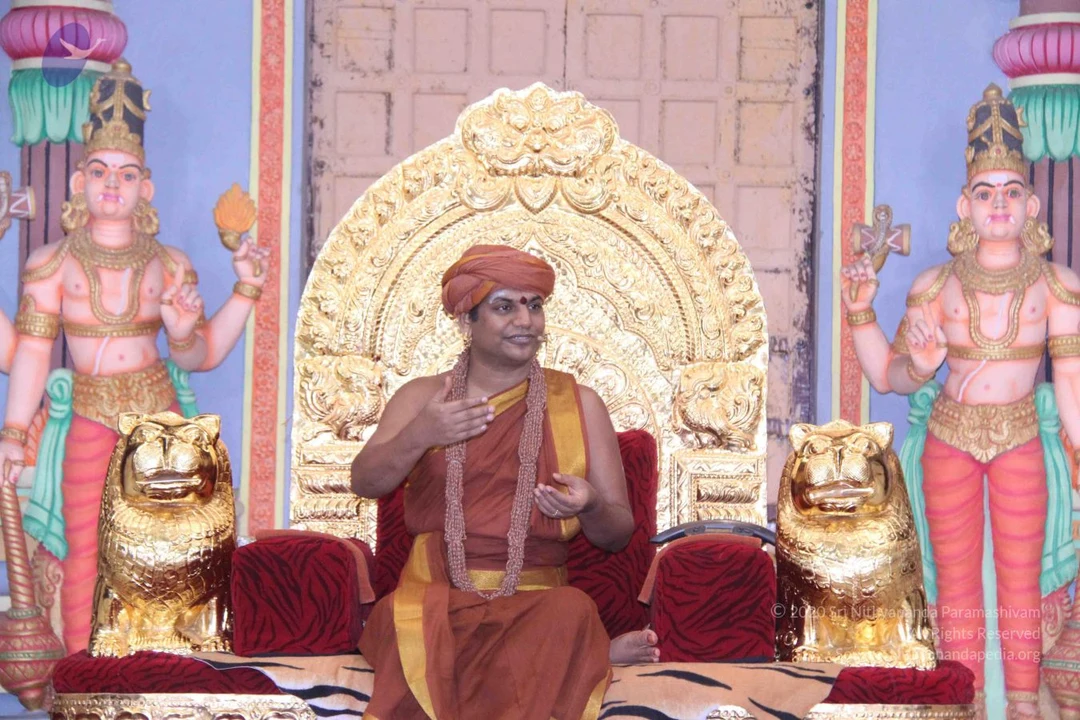
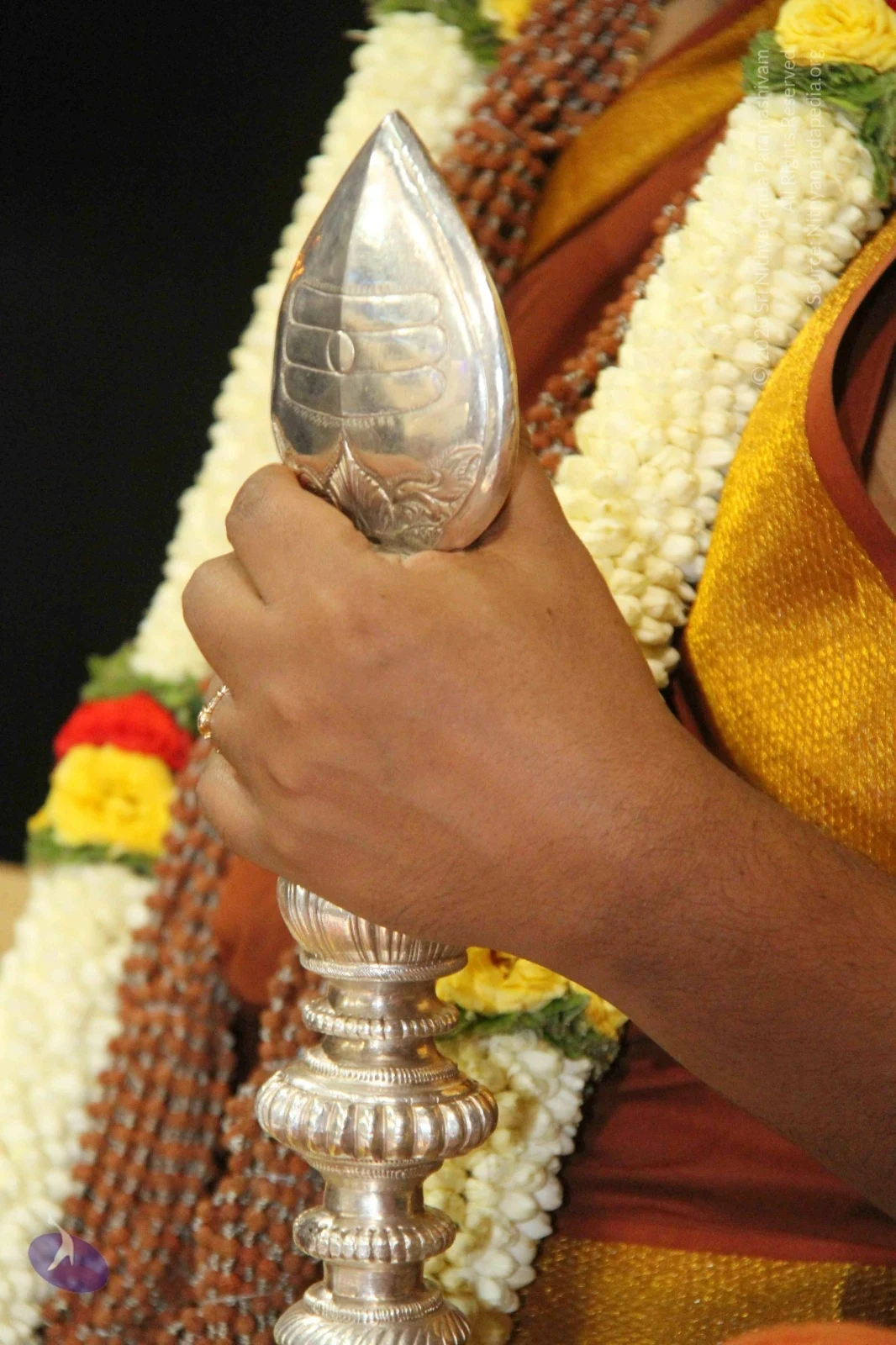
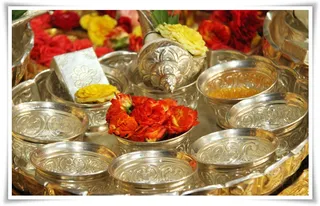
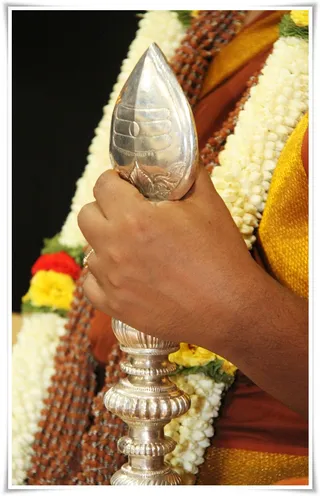
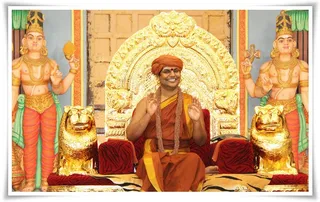
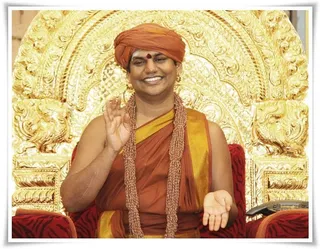
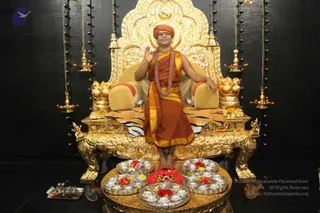
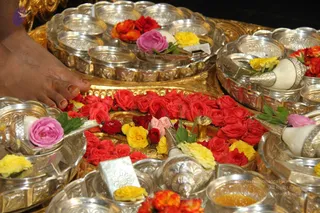
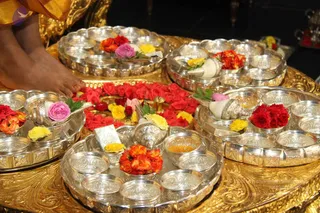
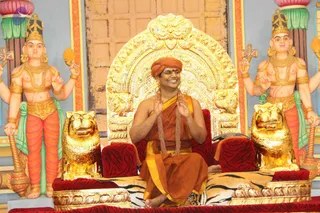
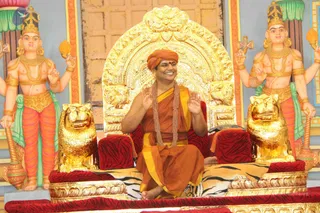
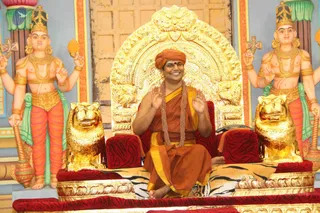
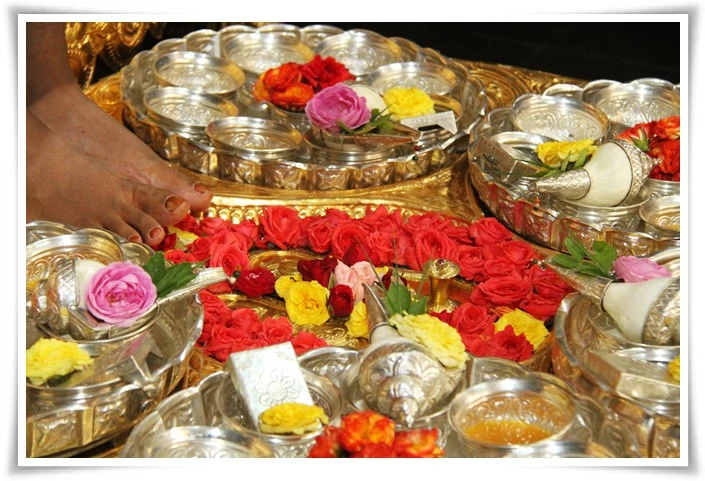
Close-up photograph of bare feet resting on a golden platform during a padapuja ritual. Around the feet are silver offering bowls and trays filled with red roses, yellow marigold-type flowers, pink roses, green leaves, and small white items, with a silver cup and a golden lamp stand visible. The feet appear to be a worshipper's or sannyasi's feet being honoured with flowers and offerings; no full person is visible.A seated figure sits on an ornate gold throne carved with a lion-head armrest and a tiger-striped cushion, dressed in saffron and orange robes with an orange turban and a white and multicolour flower garland, with rudraksha-style beads at the neck. Before him, a shaved-headed man in orange robes sits on the floor beside brass bowls of flower petals, fruit and red blossoms, with brass bells and lamps hanging in the black-walled background. The setting suggests a padapuja-style offering to the seated figure. The seated figure has distinctive saffron robes, orange turban and ornate garland cues, so Swamiji (probable) is shown in person.A photograph of a silver puja tray arranged with ritual items. Several small silver bowls with engraved floral rims hold red and orange flower petals and a yellow-orange liquid, possibly kumkum or haldi. A silver conch-shaped vessel with yellow and red flowers rests at the top, and a small silver box with an engraved lotus-like pattern sits beside a yellow flower. The large silver-and-gold tray is filled with red roses, orange marigold-type blooms and yellow blossoms. No people are visible.Close-up photograph of a hand gripping a polished silver ceremonial staff with a pointed, leaf-shaped top engraved with decorative motifs. The wearer's arm is draped in saffron-orange cloth with a gold-yellow border, and a long garland of white jasmine, yellow and red flowers, and rudraksha beads hangs behind the hand against a dark background. Only a hand and arm are visible, so no full person can be seen and no identity can be established from appearance.A photograph of a seated man in saffron-orange robes and an orange turban on a gold ornate throne with a golden arched backrest and red cushions, set on a striped tiger-skin cloth. He wears a long rudraksha-style mala and gold-toned neck adornments, smiles and raises both palms in a blessing gesture. Two gold-painted lion figures sit at the base of the throne. Flanking him on either side are large painted and gilded standing murti figures, each wearing gold crowns, gold necklaces, armbands and red-orange lower garments, one holding a fan-like object. A gold-framed wooden doorway stands behind the throne, with green and red drapery at the upper corners.A smiling man sits on a red upholstered seat in front of an ornate gold-leaf throne with carved lion-like and floral motifs. He wears an orange-red turban with a red bindi, an orange-red shawl over a bare chest with a gold-yellow border, gold earrings, and long rudraksha malas hanging to his waist. His right hand is raised in a blessing gesture and his left palm is open in front of him. A black microphone rests on the armrest at right.

PratyakshaPadaPuja
28 photosSource gallery
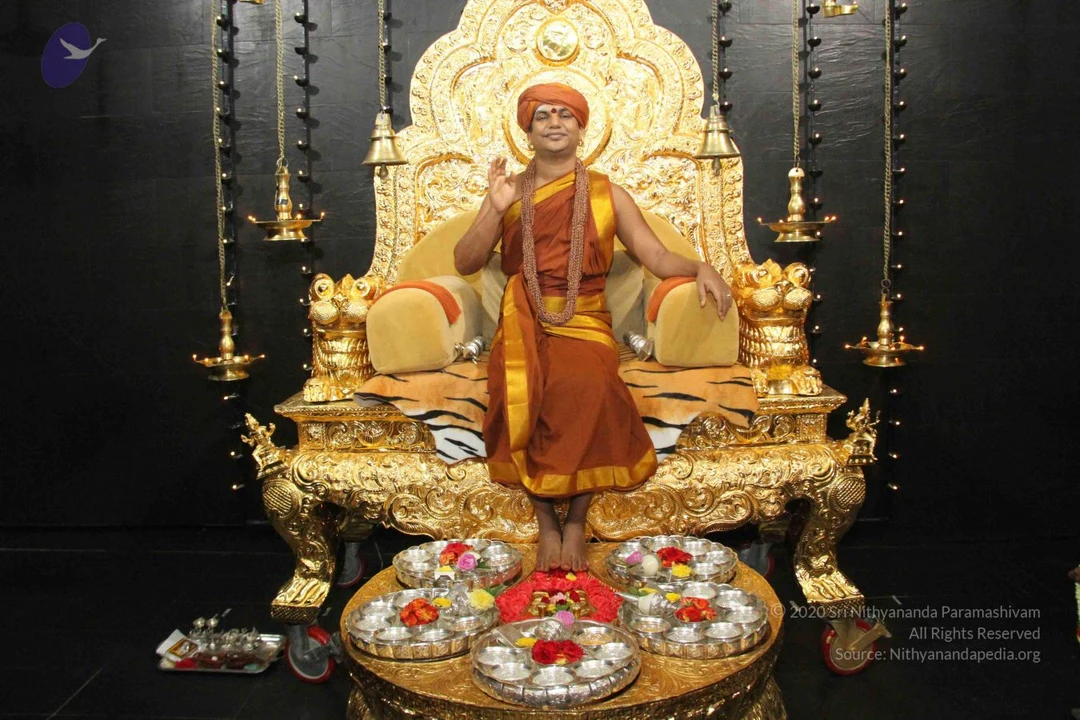
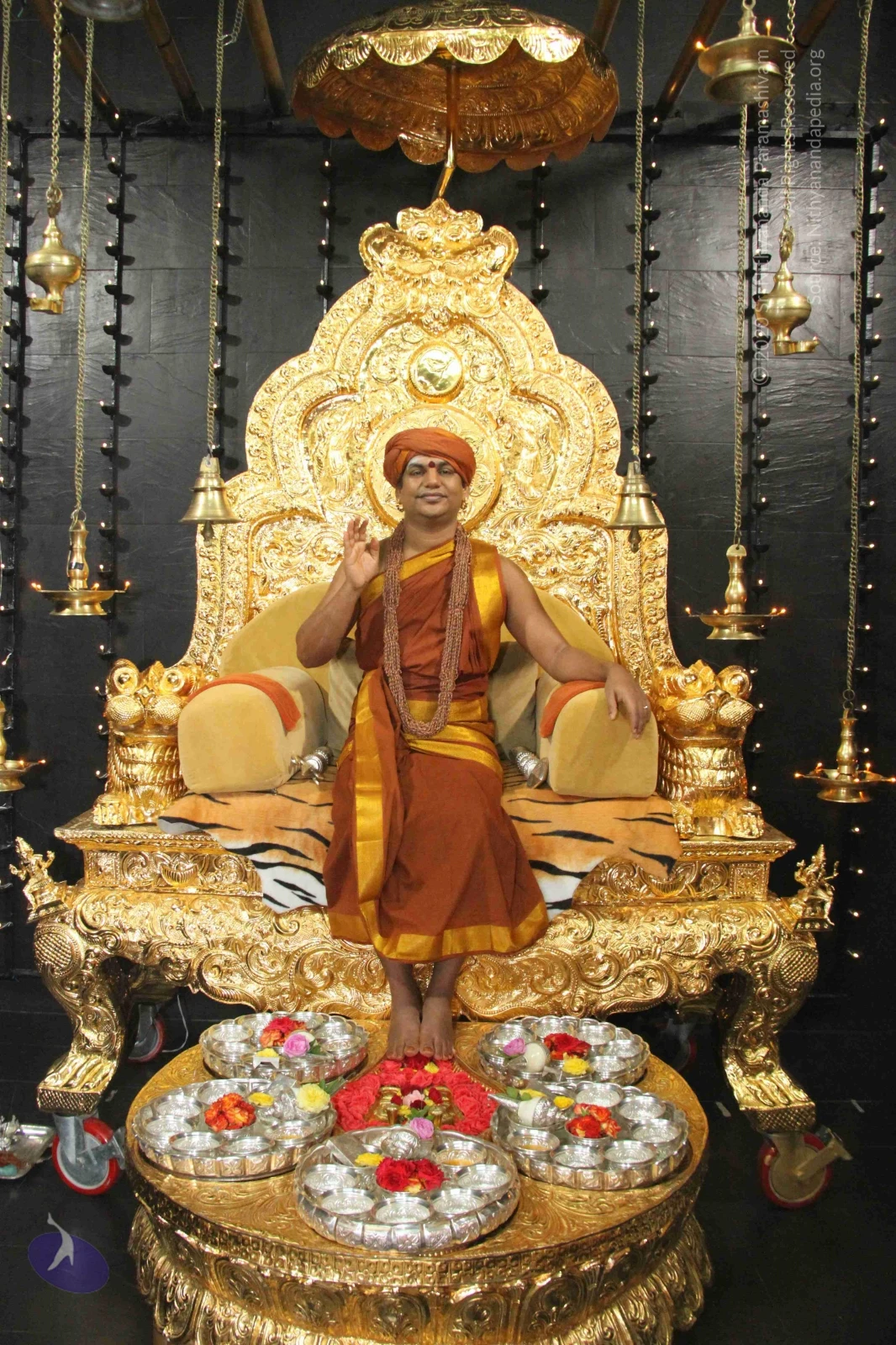
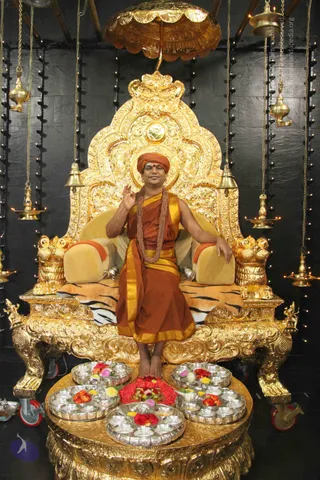
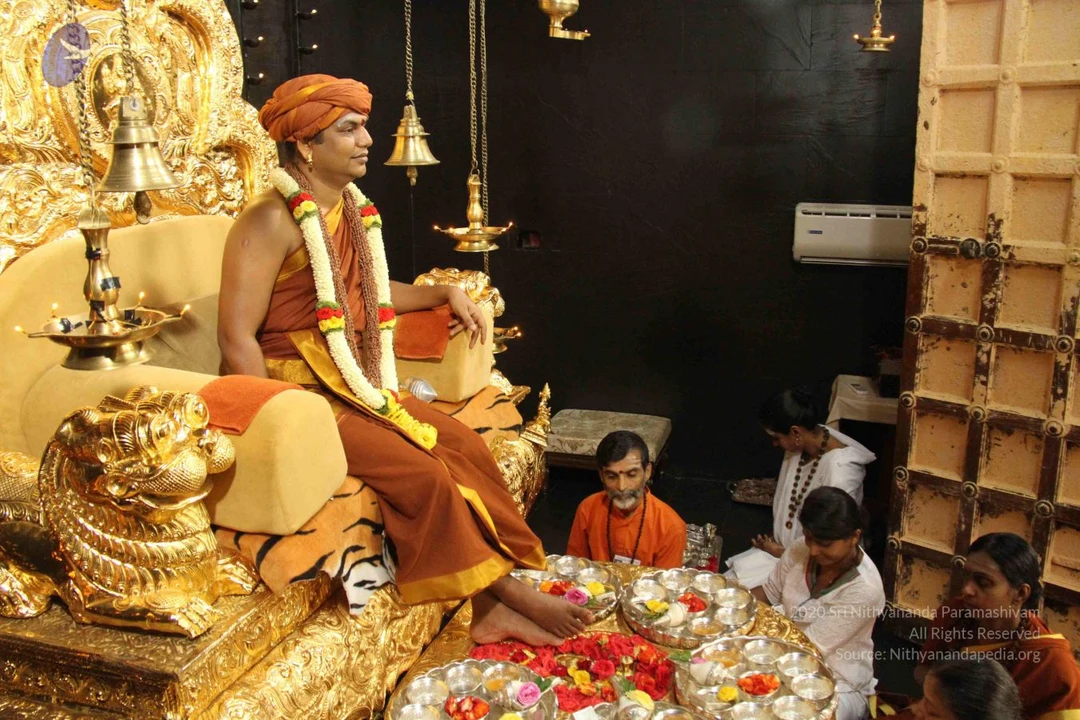
A seated man in an ornate golden throne with lion-shaped armrests and a tiger-striped cushion, wearing an orange-red turban, saffron and gold robes, and a long rudraksha mala. He raises one hand in blessing while his bare feet rest on a gold platform surrounded by silver and steel trays of flowers, fruit and offerings, with brass oil lamps hanging from chains behind him against a black backdrop.Close-up photograph of a puja ritual during a padapuja. A pair of bare feet rests on a gold platform surrounded by silver bowls and vessels filled with red roses, yellow marigolds and pink flowers, with green leaves scattered among them. Silver pouring vessels and a small silver box with a floral design sit near the flowers, and a bowl of golden liquid is visible at the lower edge. The arrangement suggests a foot-worship offering, though the person whose feet they are is not shown in full.Close view of a ritual setup on an ornate gold-toned surface. Bare feet of a person stand at the upper left, their toes resting near a bed of red rose petals. Around them are silver puja trays holding small silver bowls and cups filled with pink, yellow, red and orange flowers, with a silver kalasha-style vessel with a green leaf sprig and a silver bowl of yellow liquid. The scene suggests padapuja or flower offering, though no deity murti or a person is clearly visible.A photograph of a seated figure on an ornate gold throne with carved lion-head armrests and a tiger-skin cushion. The seated figure wears an orange turban, orange and saffron robes, and a white and multicoloured garland, with a rudraksha mala around the neck; he is barefoot and gazes ahead. Brass hanging lamps and bells hang above, and a dark wall with a wall-mounted air conditioner sits behind. In front, a man in an orange robe with hands joined in namaste kneels beside silver trays of marigold and rose petals and offering bowls. Two women in white saris, one with a white forehead mark, also join their palms in prayer at the lower right.A seated man in saffron-orange robes and an orange turban sits on an ornate gold throne with a carved lion-head armrest and a tiger-striped cushion. He wears a long garland of white, red and yellow flowers and a beaded necklace, and his feet are bare. Around him, brass hanging bells and oil lamps hang from chains against a black wall. In front, silver and brass trays hold flowers, fruit and offerings, and a woman in white with a white forehead mark and a woman in a white top with a red bead necklace join their palms in prayer, while a shaven-headed man in orange robes also sits with folded hands.A photograph of a seated man in a saffron-orange turban and saffron robe, with a white and red-yellow flower garland and a rudraksha mala, sitting on an ornate gold throne with a tiger-skin cushion and carved gold lion heads. Before him, a devotee in orange and a woman in white kneel at trays of red and pink flowers, rose petals and brass dishes, performing padapuja. Brass bells and lamps hang from chains on a black wall, with an air conditioner and a carved wooden door at right. A partially visible person stands at the lower edge. Probable Swamiji (saffron turban, saffron robe, rudraksha mala, ornate garland) seated on the throne, receiving padapuja.

GurukulKids_Instruments
2 photosSource gallery
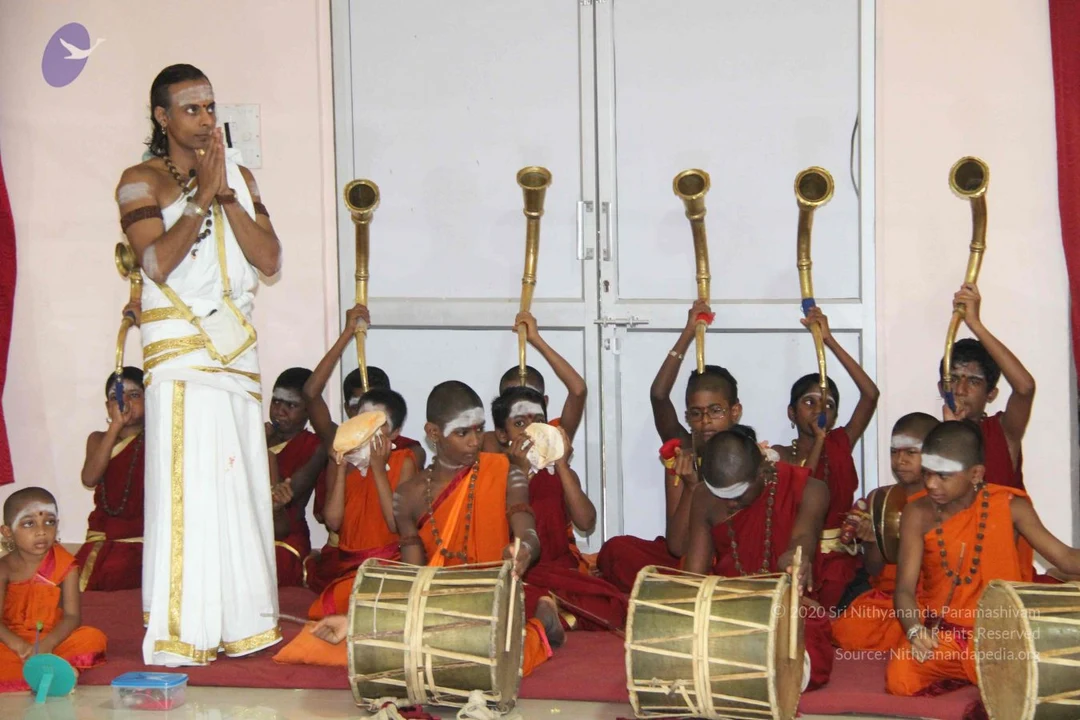
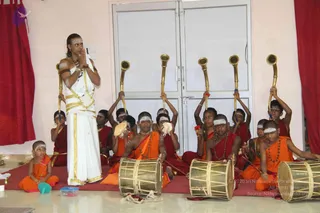
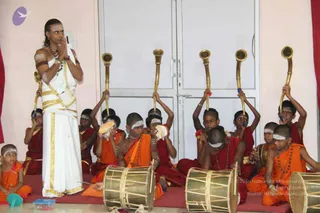
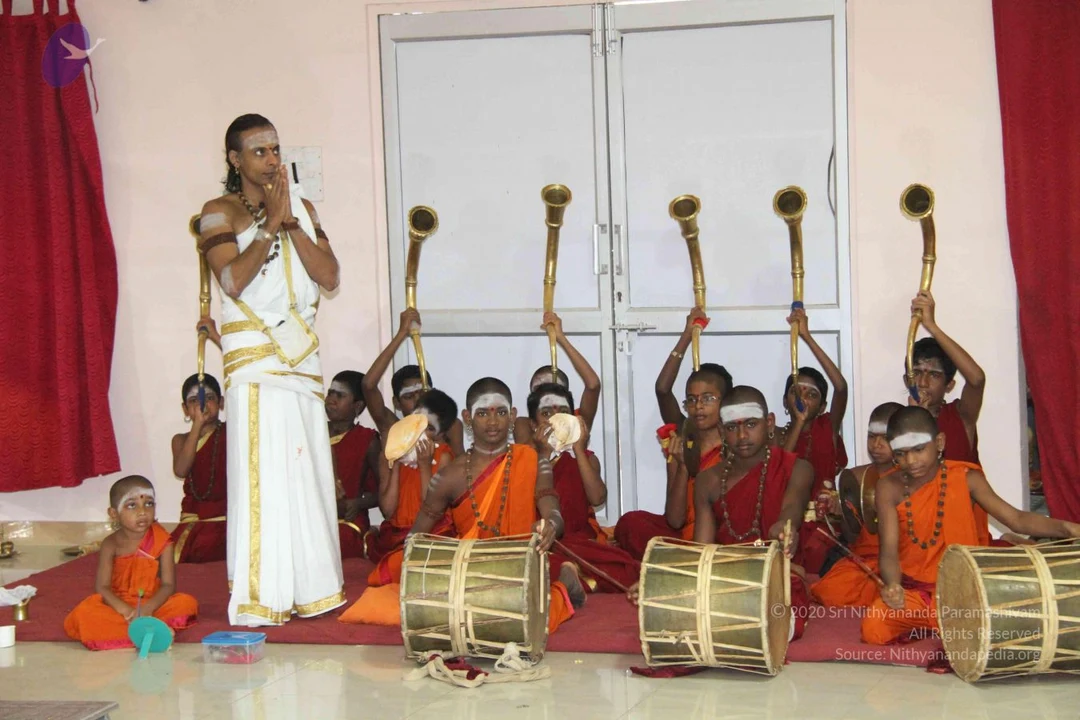
A photograph of a ceremonial music group performing in a room with red curtains and white double doors. A standing man in a white dhoti with gold border and bare upper body, holding his hands in anjali, stands at left beside a row of seated boys wearing orange and maroon robes, rudraksha malas and white forehead markings. Several boys play long brass horns raised overhead, others play large barrel drums and conch shells, and a small boy in orange sits at far left with a green item before him.A photograph of a ceremonial music performance inside a bright room with pink walls and a white double door. A standing man in a white dhoti with gold borders, bare-chested, with white sacred markings on his forehead and arms and a rudraksha mala, holds his palms together in namaskar. Around him, young boys in saffron and orange robes sit on a red mat playing large brass horns raised overhead, bells and hand drums, with white markings on their foreheads. One boy in the foreground plays a drum while others hold cymbals and small instruments. A red curtain frames the left side.

SarvaDarshan_Pics
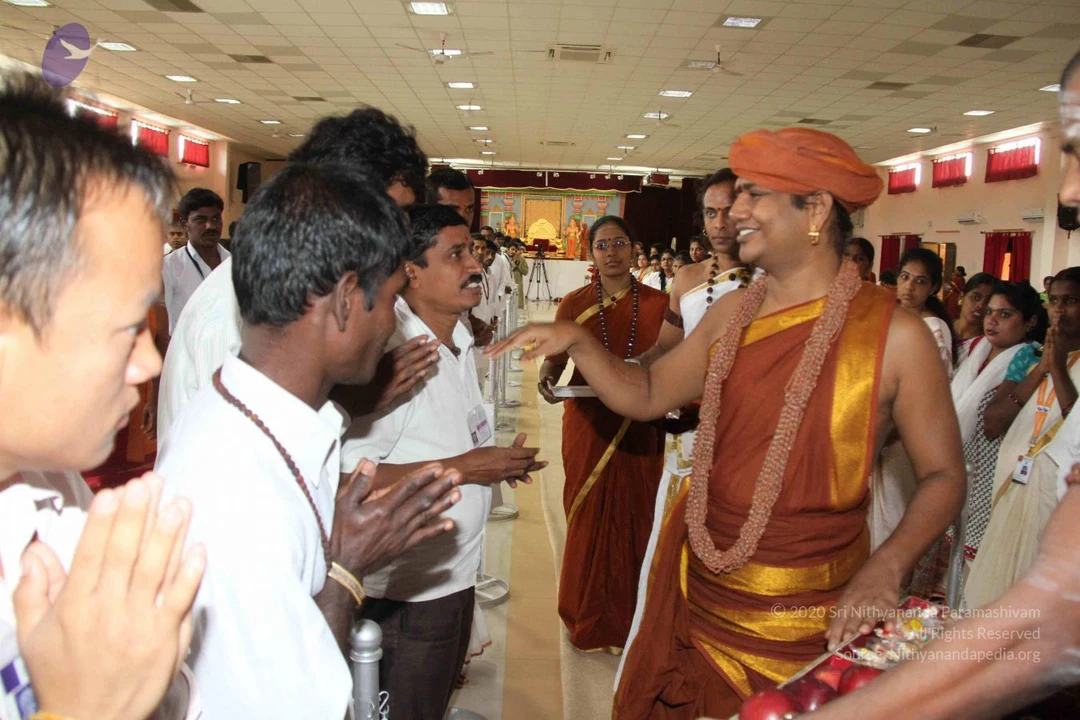
22 photosSource gallery
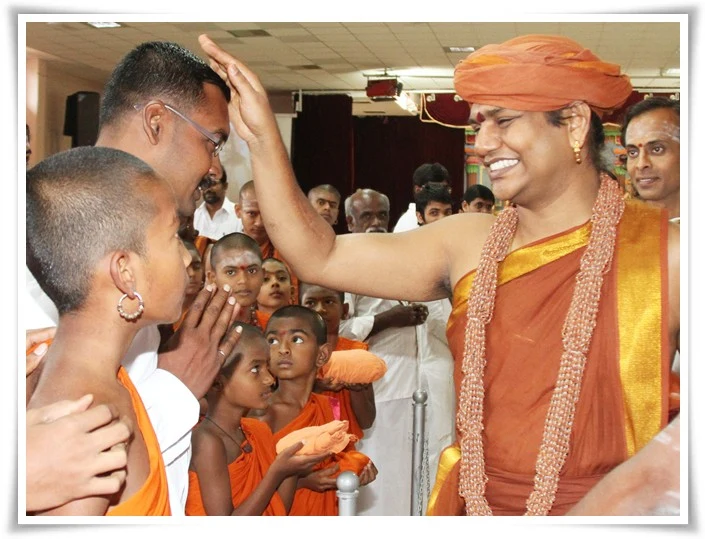
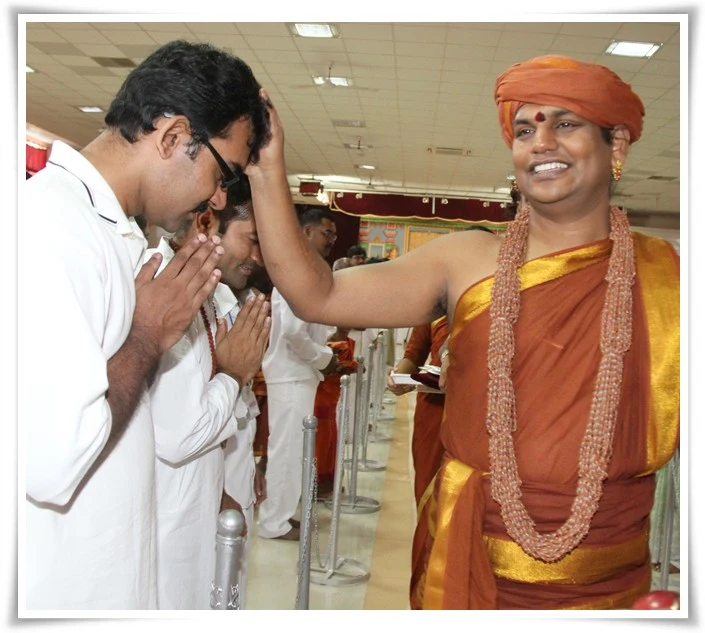
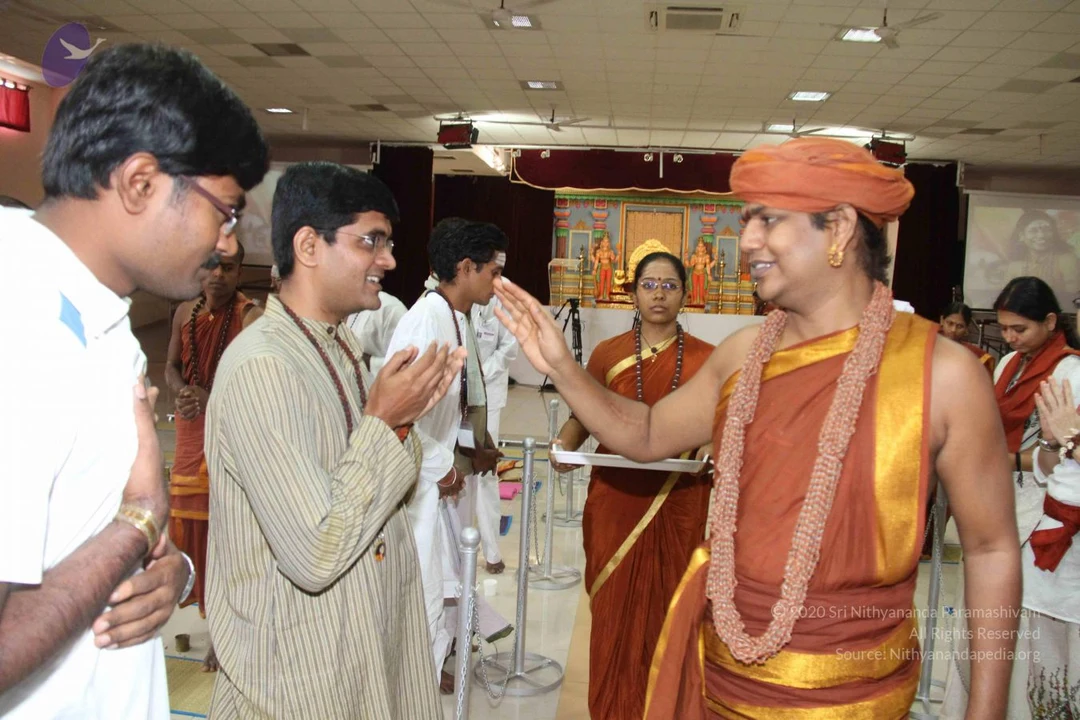
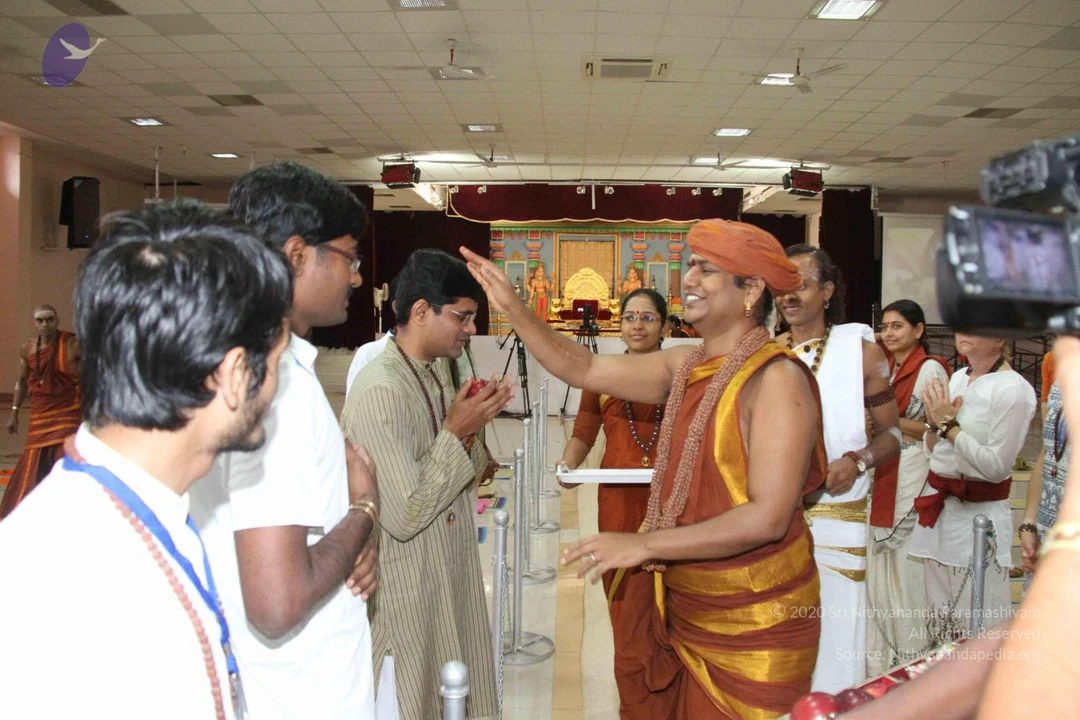
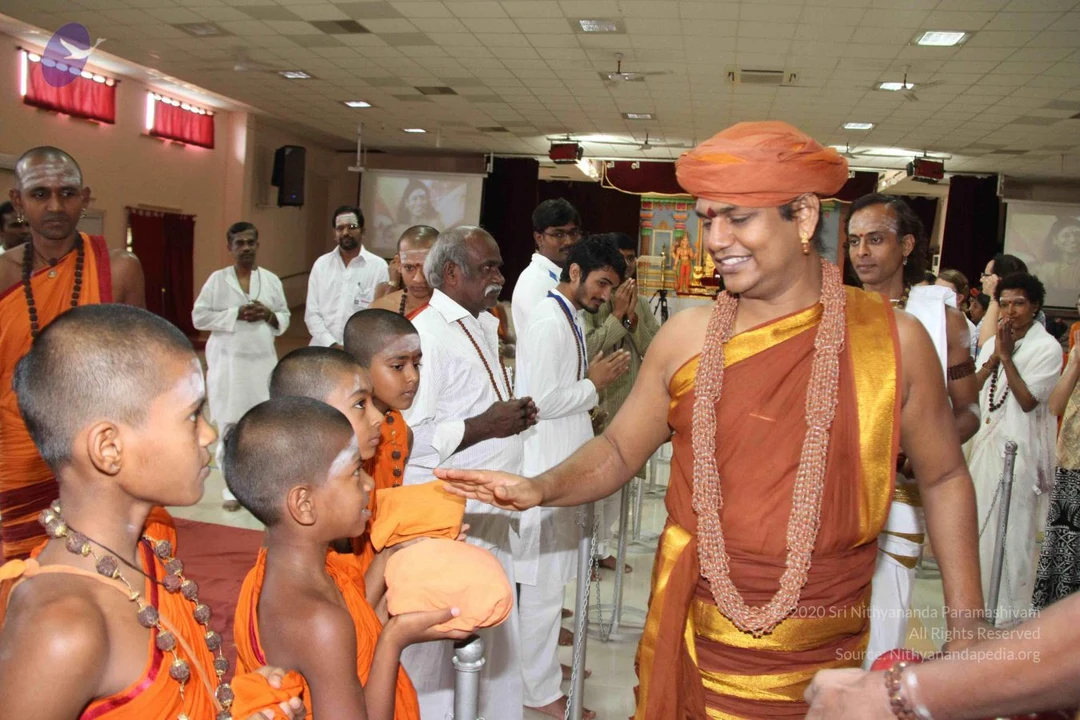
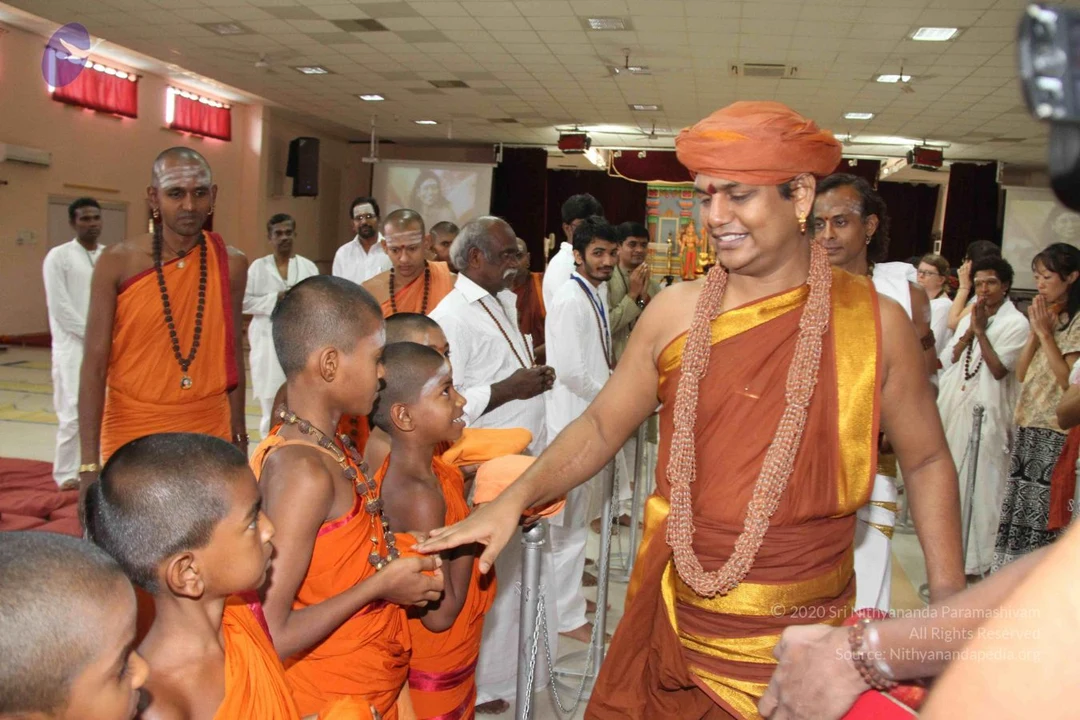
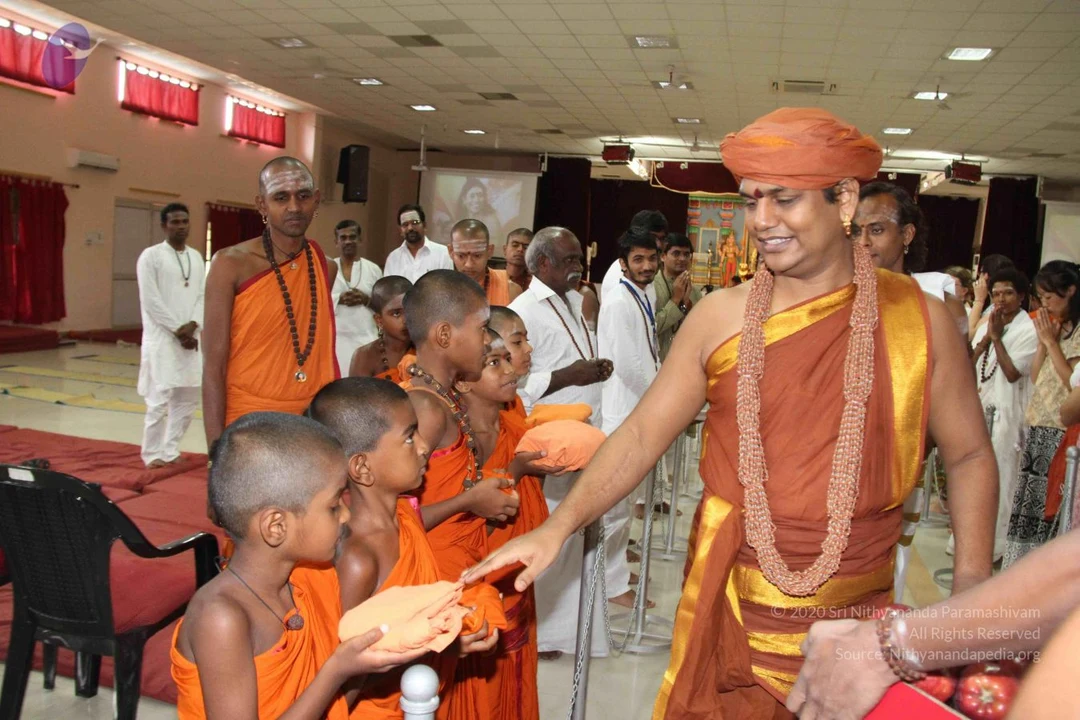
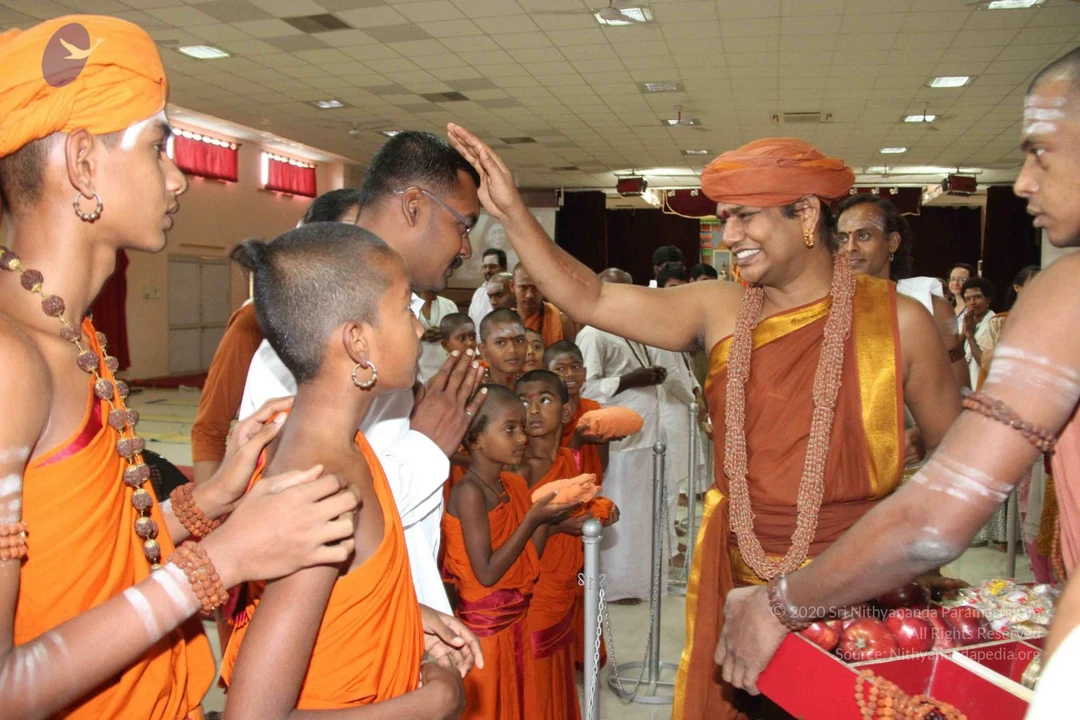
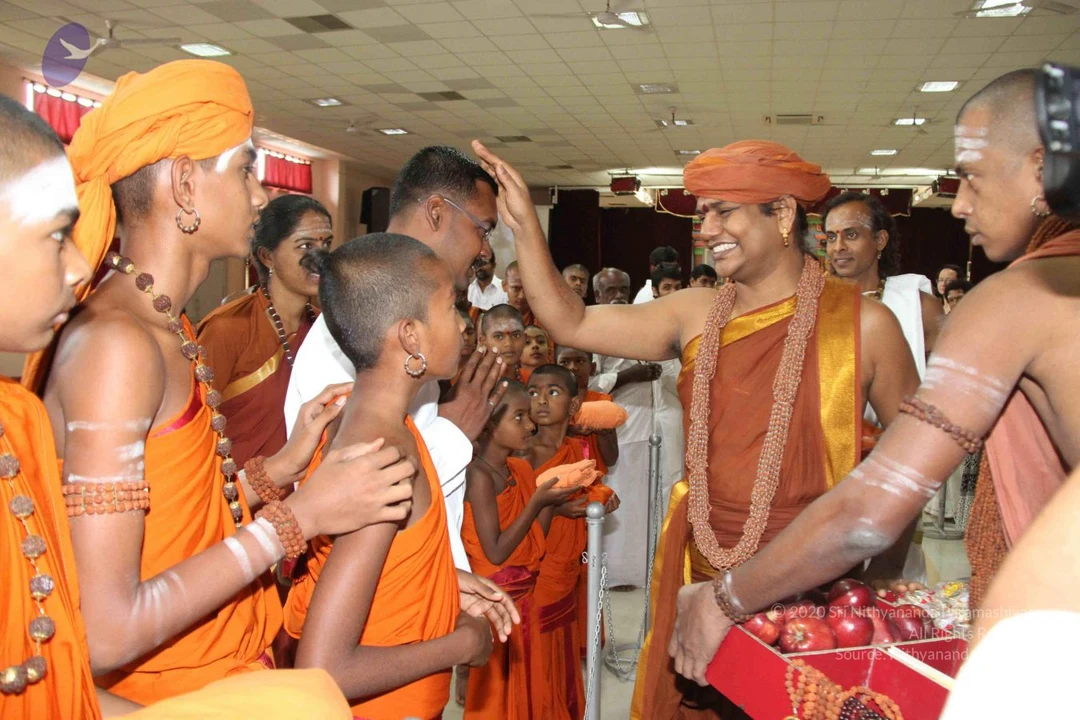
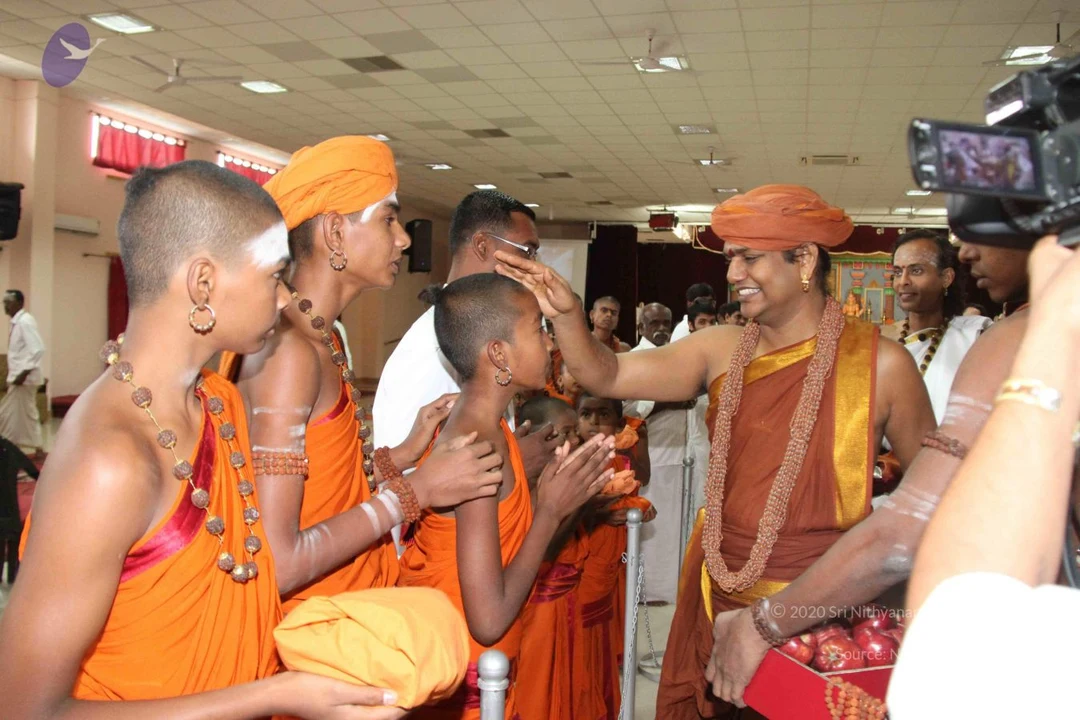
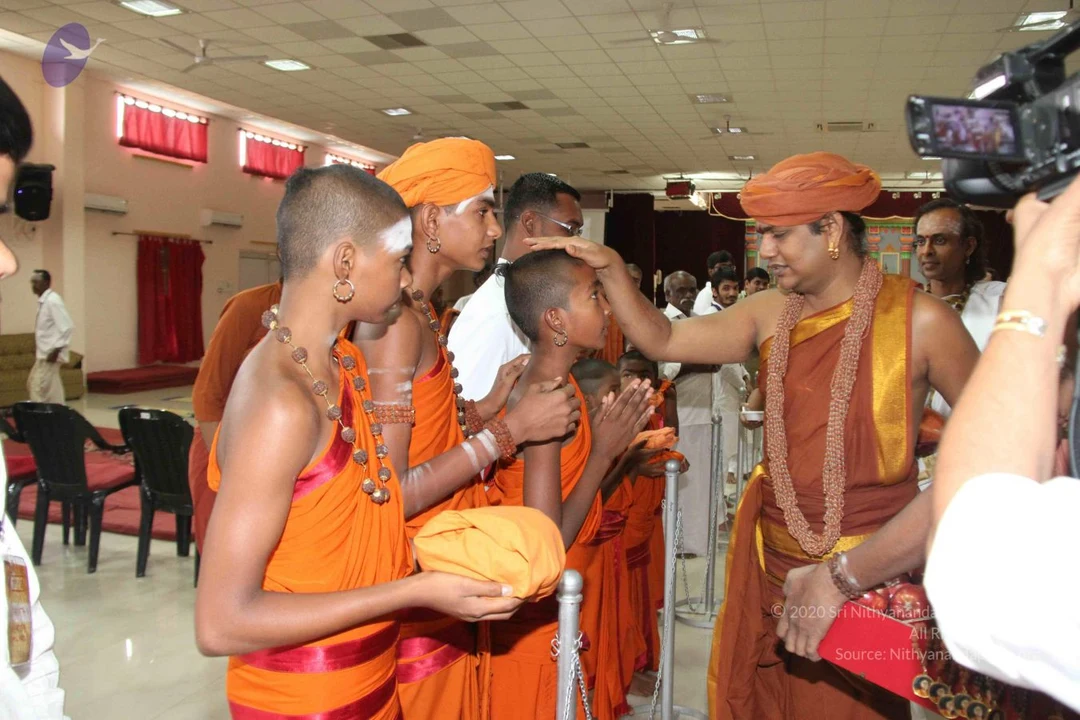
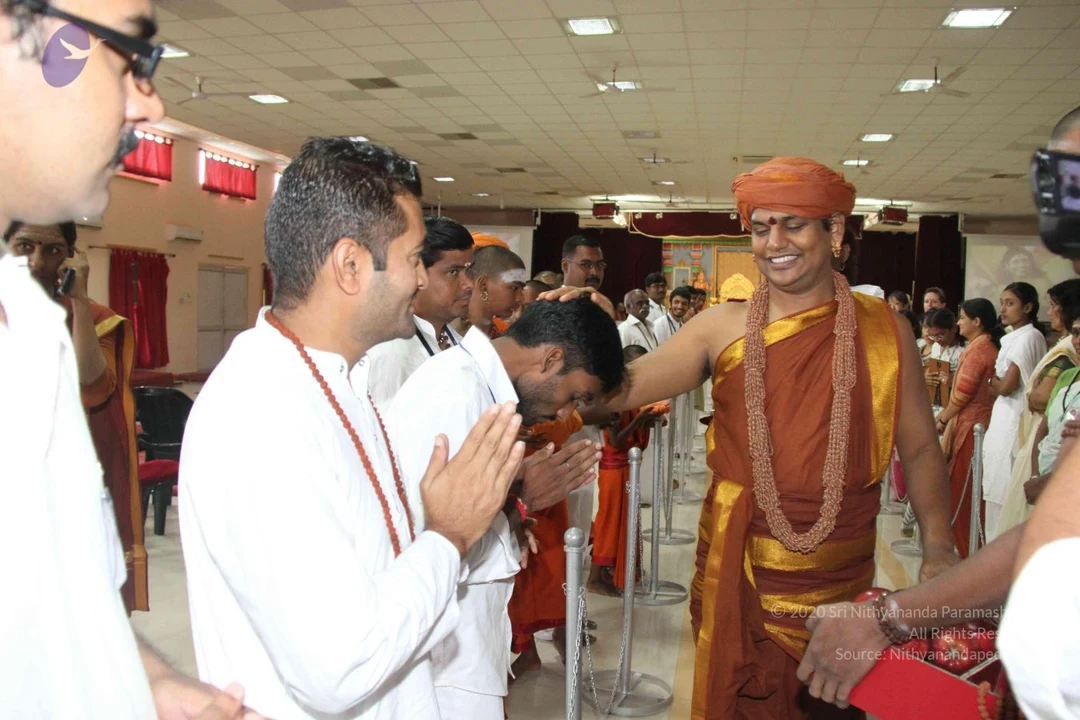
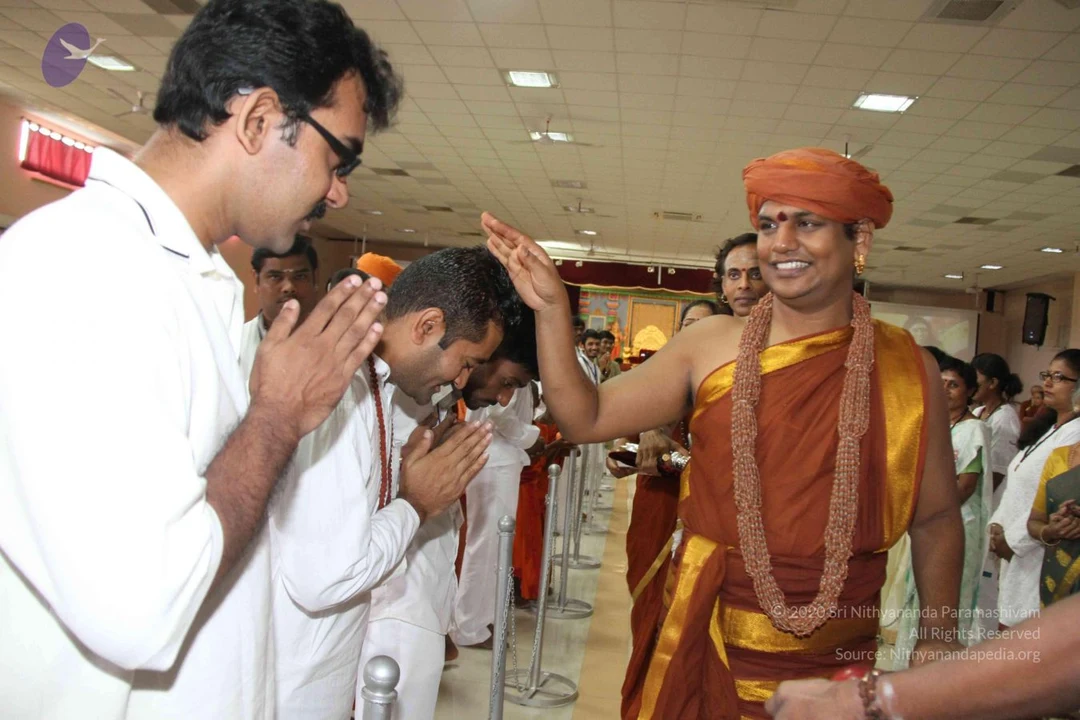
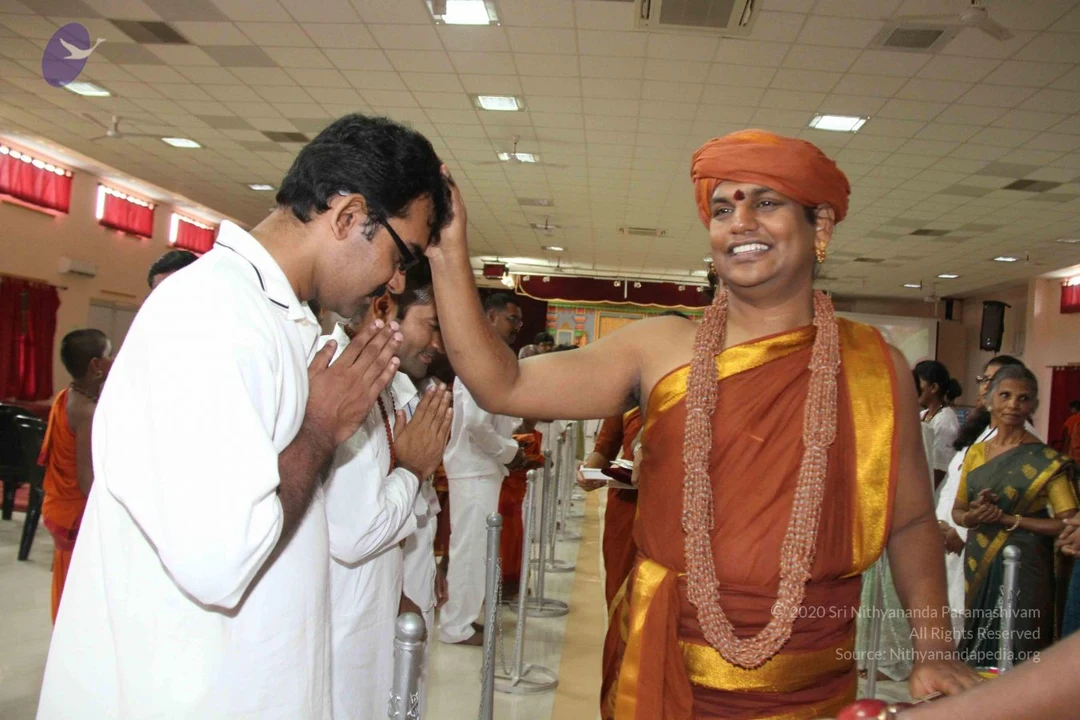
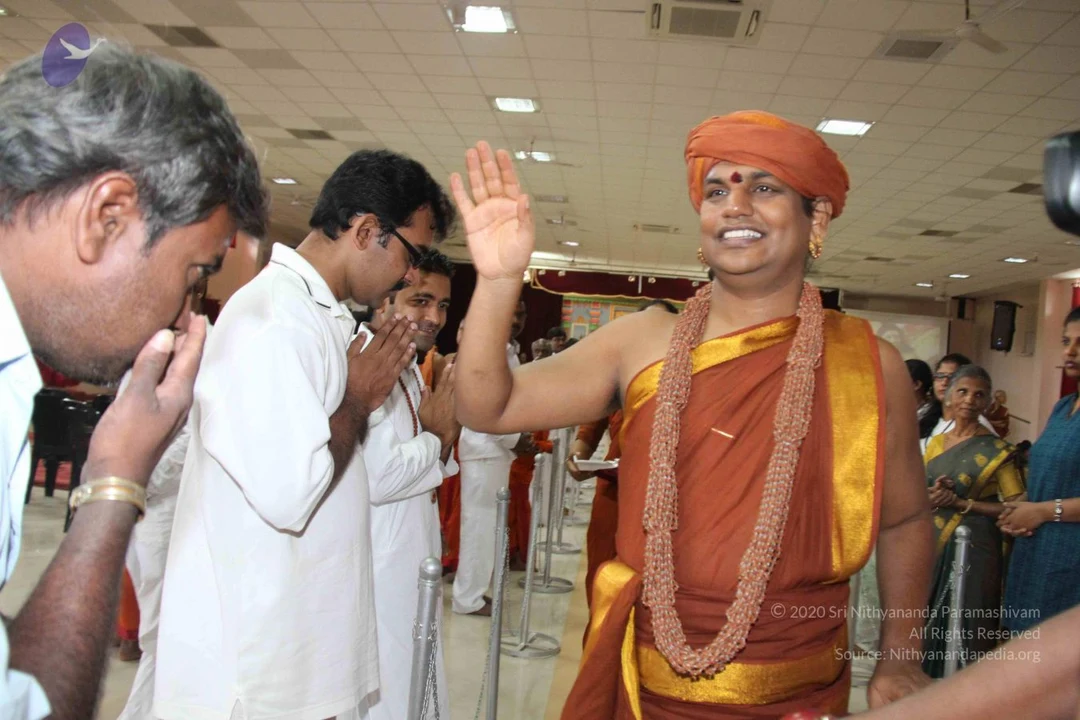
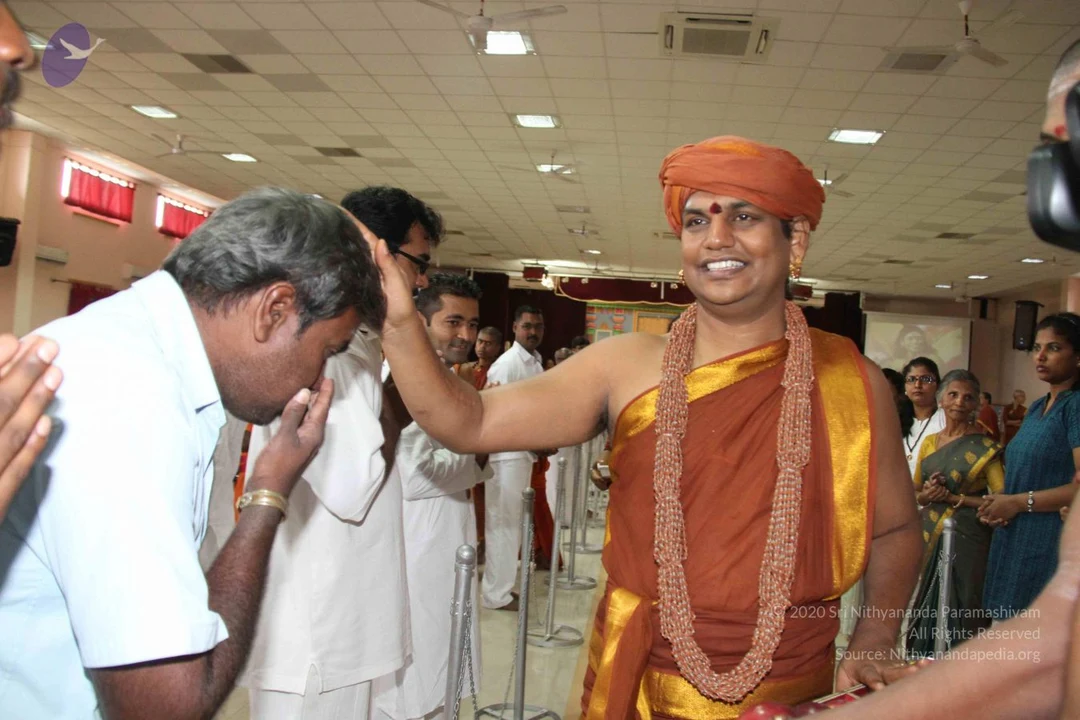
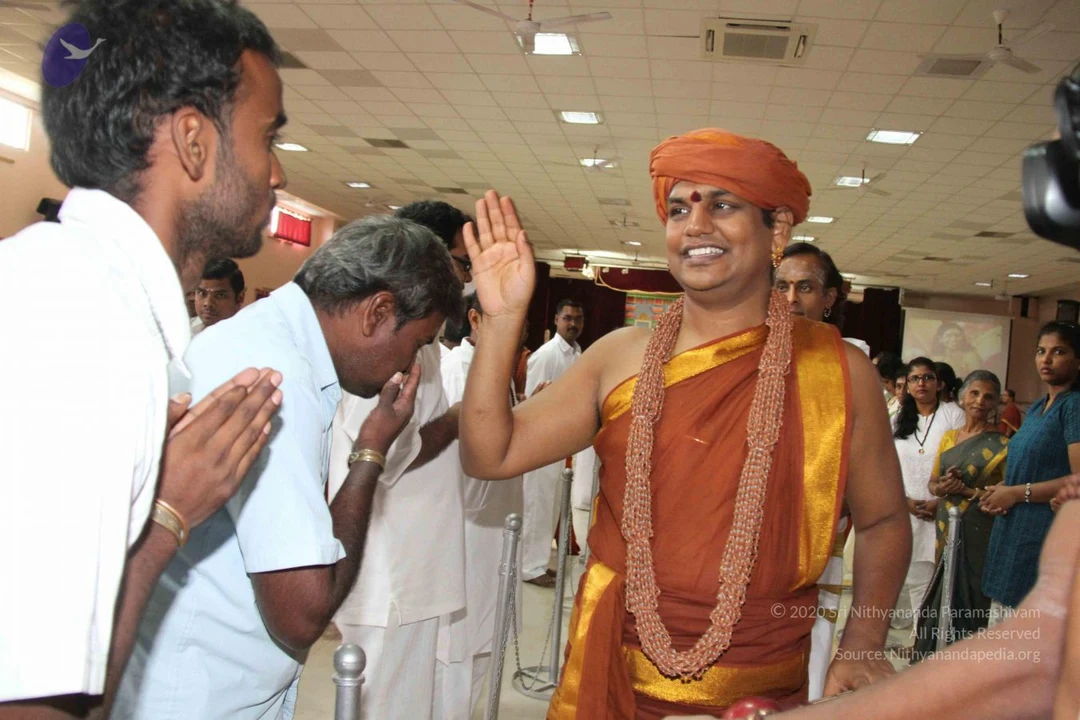
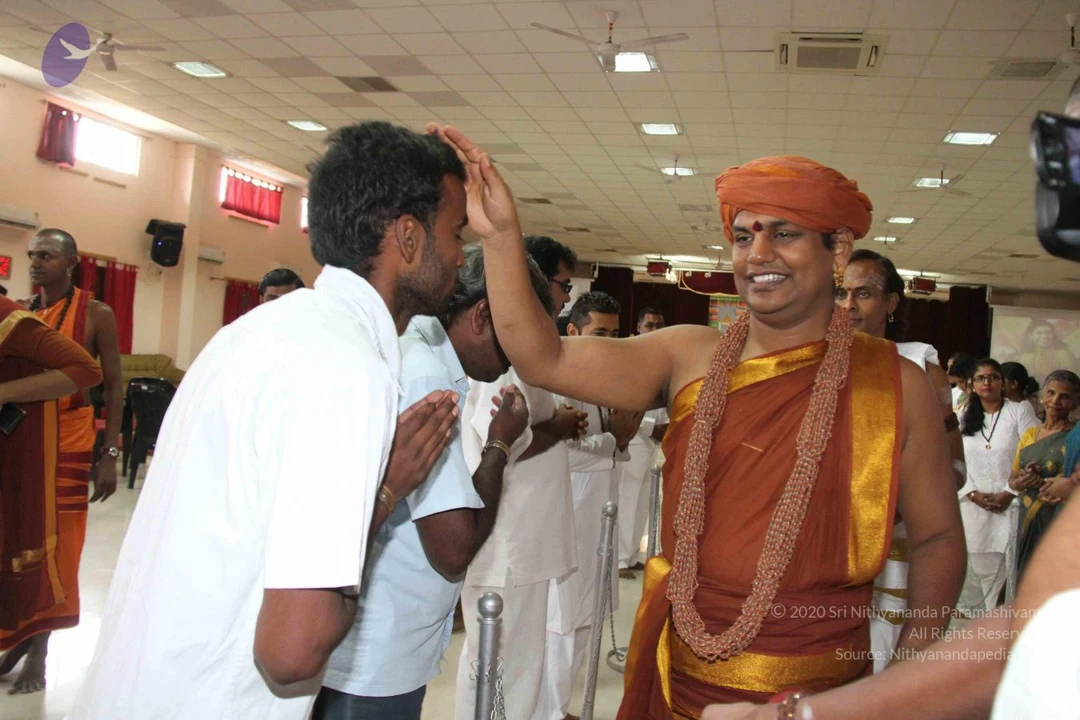
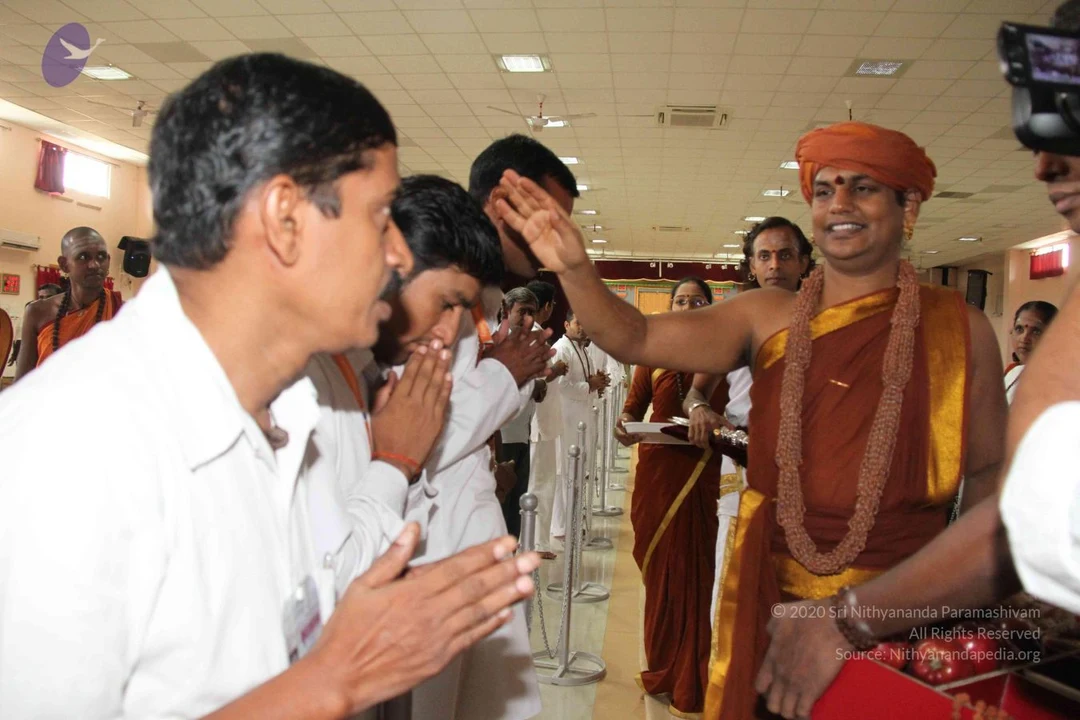
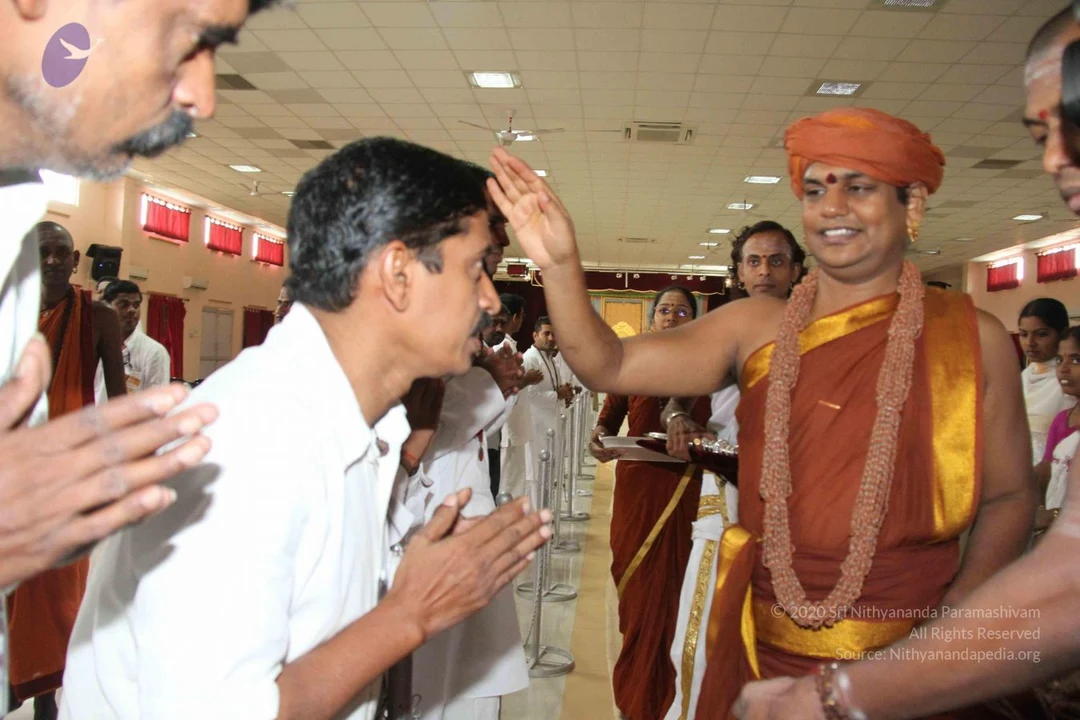
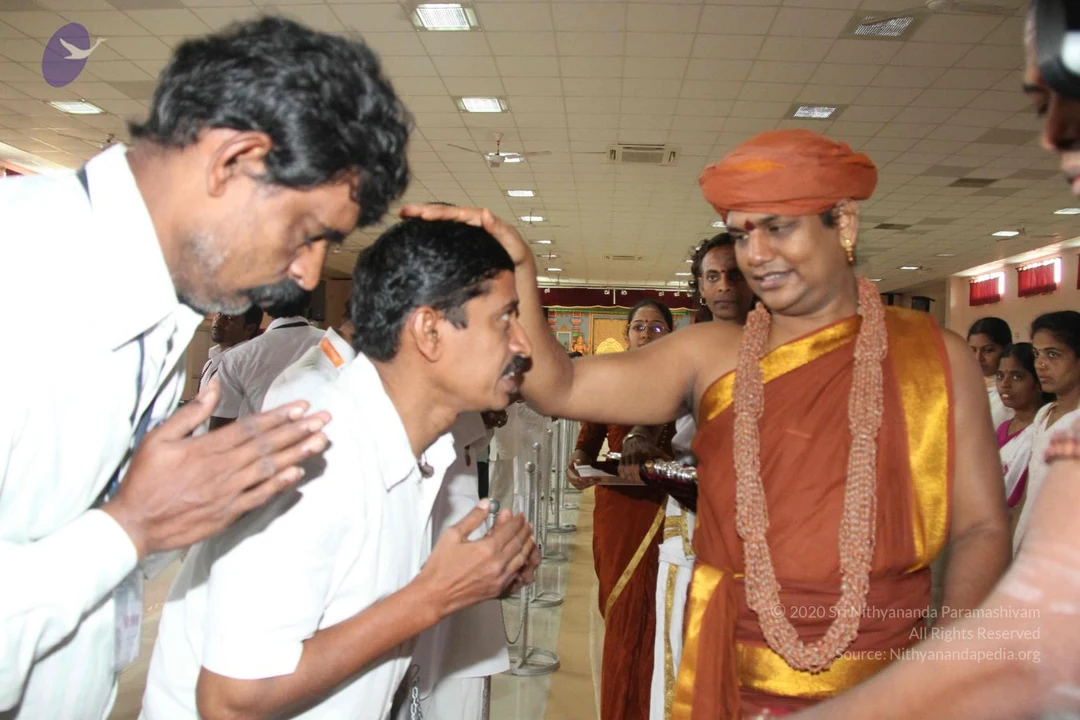
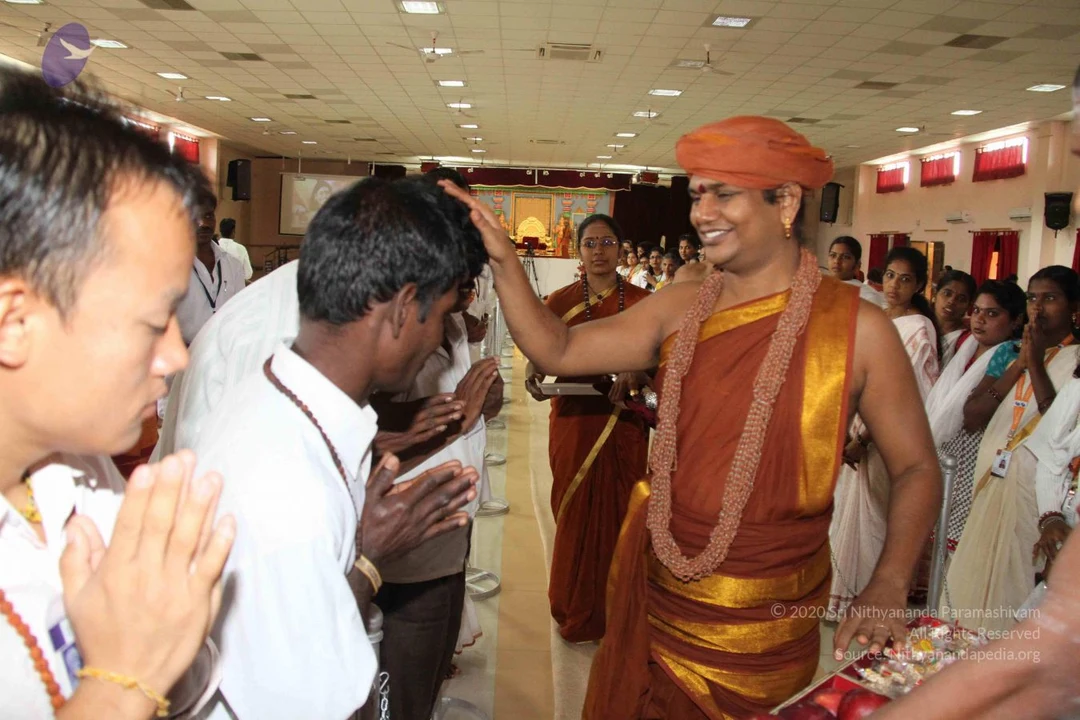
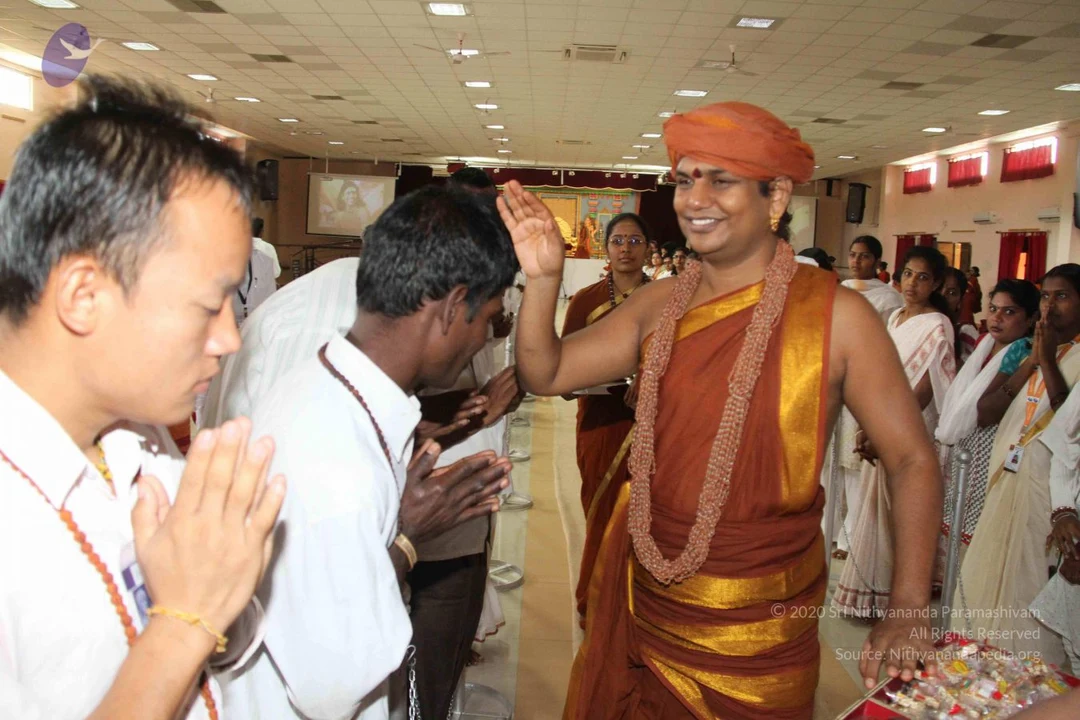
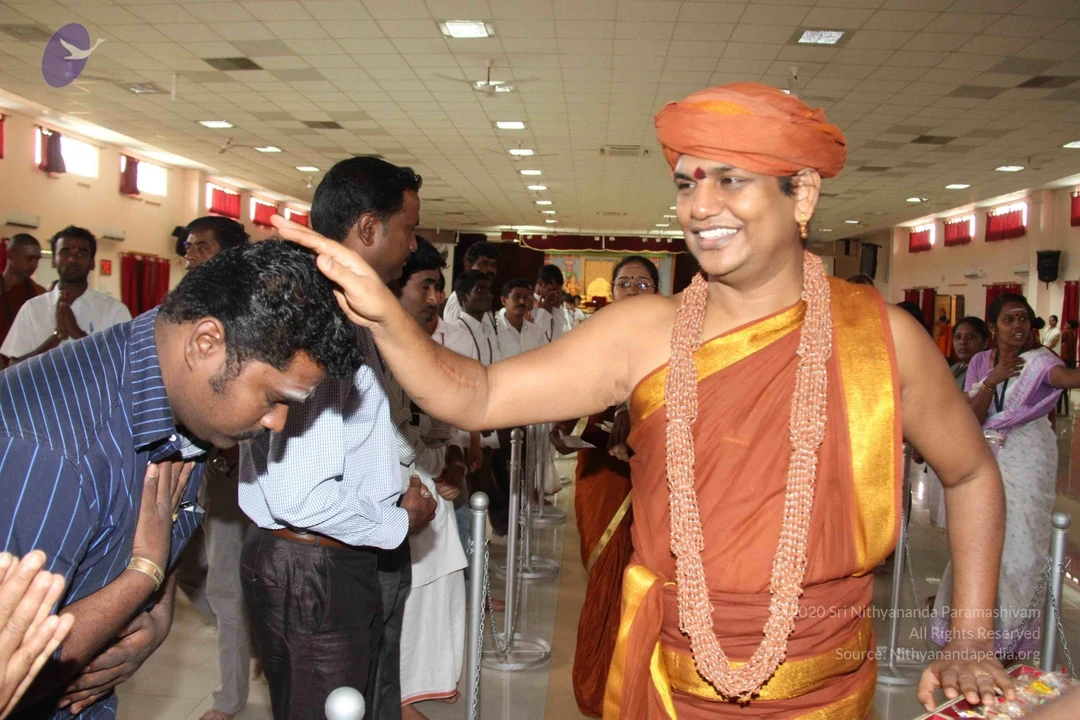
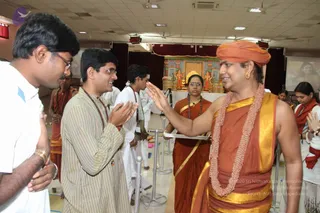
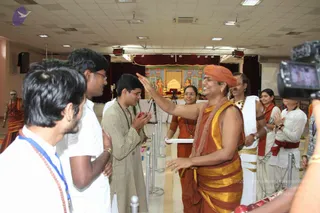
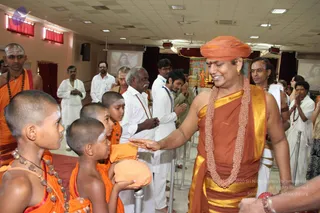
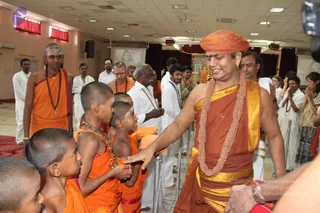
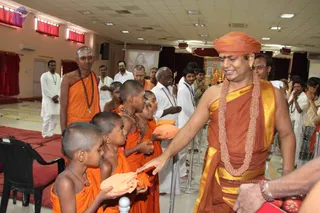
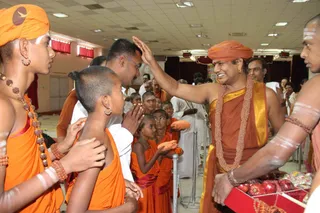
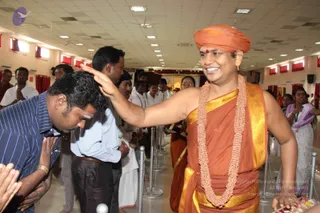
Indoor event hall with a drop ceiling and fluorescent lights. A man in an orange turban, orange and gold sleeveless robe and a long pink-beaded mala raises his hand in a blessing gesture toward a bespectacled man in a striped kurta with folded palms. Two people in white dhotis stand nearby, a woman in an orange saree and rudraksha mala stands behind, and a woman in white and red sits at right. A backdrop shows painted deity figures and a portrait is visible at upper right.Photograph in a large indoor hall with a red curtained stage and a golden decorative backdrop showing deity murtis under an ornate arch. A central man in an orange-saffron top with a rust-orange turban, gold-bordered orange dhoti and a rudraksha mala extends his right hand toward a younger man in a striped cream kurta who stands with palms pressed together. Around them, devotees in white dhotis and kurtas, a woman in a red shawl, and a woman in an orange sari stand near metal crowd-control barriers, while a camera operator films at the right edge. a person is the central figure in the saffron turban and rudraksha mala; the surrounding figures are devotees and attendees.Indoor event hall with a dropped ceiling, red curtains and a projection screen. In the foreground, a bald young boy in orange robes with rudraksha beads and a sandalwood mark is being greeted. A man in a saffron-orange turban and saffron-and-gold robes, with a long rudraksha-style mala of large beads and gold trim, extends his hand toward the children. A probable Swamiji matches the saffron turban, ornate gold-edged clothing and ceremonial beaded necklace, and he smiles while greeting young saffron-robed disciples. Around them, white-clad devotees stand with hands folded in namaste, and a man in white wears a beaded mala. A deity mural and a second screen appear in the background.Indoor hall photo of a figure in an orange turban, rust-orange robe with gold border and a long coral-beaded mala, reaching out to touch the heads of shaven-headed young boys in saffron robes. Behind them, men in white dhotis and devotees with palms pressed together stand along a barrier, and a red-curtained stage and framed picture are visible. The appearance of the central figure matches the a person candidate cues (turban, saffron-orange ornate clothing, mala), but identity is uncertain from appearance alone. A photographer's camera is at the right edge.Indoor hall photo of a man in an orange-brown turban and saffron-and-gold shawl, with a long pink-beaded mala and matching bead necklace, reaching out to touch the outstretched hands of several shaven-headed young boys in orange robes who hold small folded cloths. Behind them stand men in white dhotis and orange clothing, with a seated elderly man in white and a woman in a patterned top at right. Red curtains, red floor cushions, a projector screen and a small altar with deity murti are visible in the background.Indoor photo of a blessing moment in an ashram hall with a white ceiling and fluorescent lights. A man in a saffron-orange turban, orange-and-gold shawl over bare shoulders, and a long beaded rudraksha-style mala with a small gold earring smiles while raising his right hand in blessing toward a shaven-headed boy in orange robes. Several young boys in orange robes stand in a line holding small orange cloths, and one boy at left wears a rudraksha mala with sandalwood-paste marks on his forehead and arms. Behind them a man in white clothing and others stand near a metal stanchion, and a red-lined tray of fruit and flowers sits at right. The central man has distinctive long swept-back hair and ornate clothing, a person candidate receiving devotees, but the appearance is not conclusive enough to confirm.

Temple
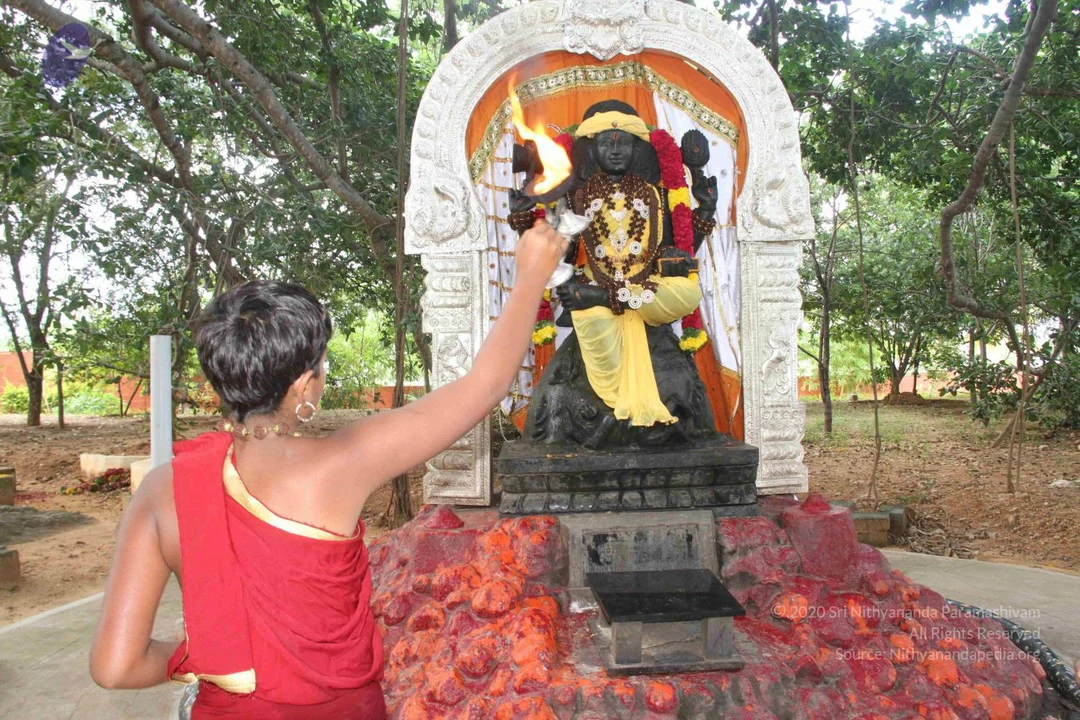
23 photosSource gallery
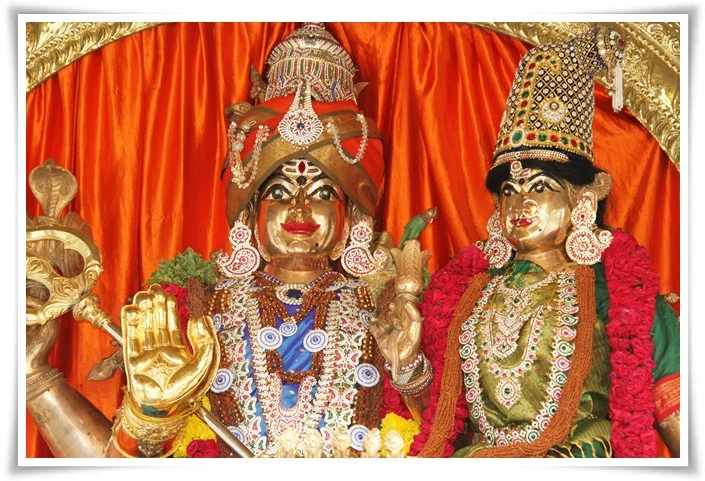
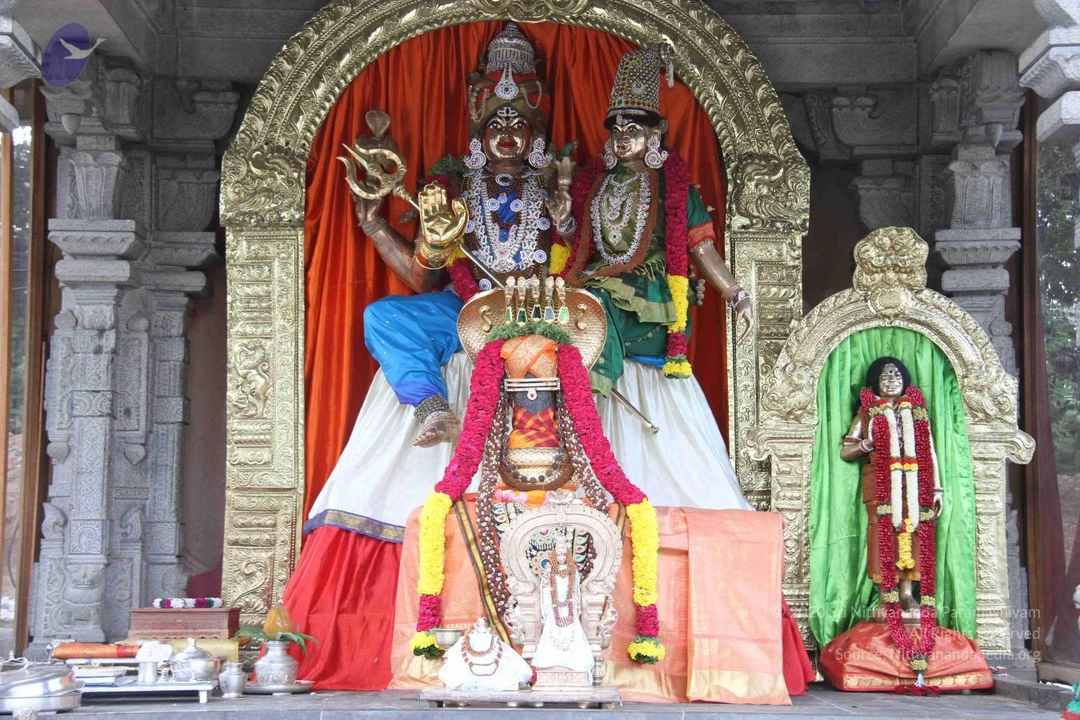
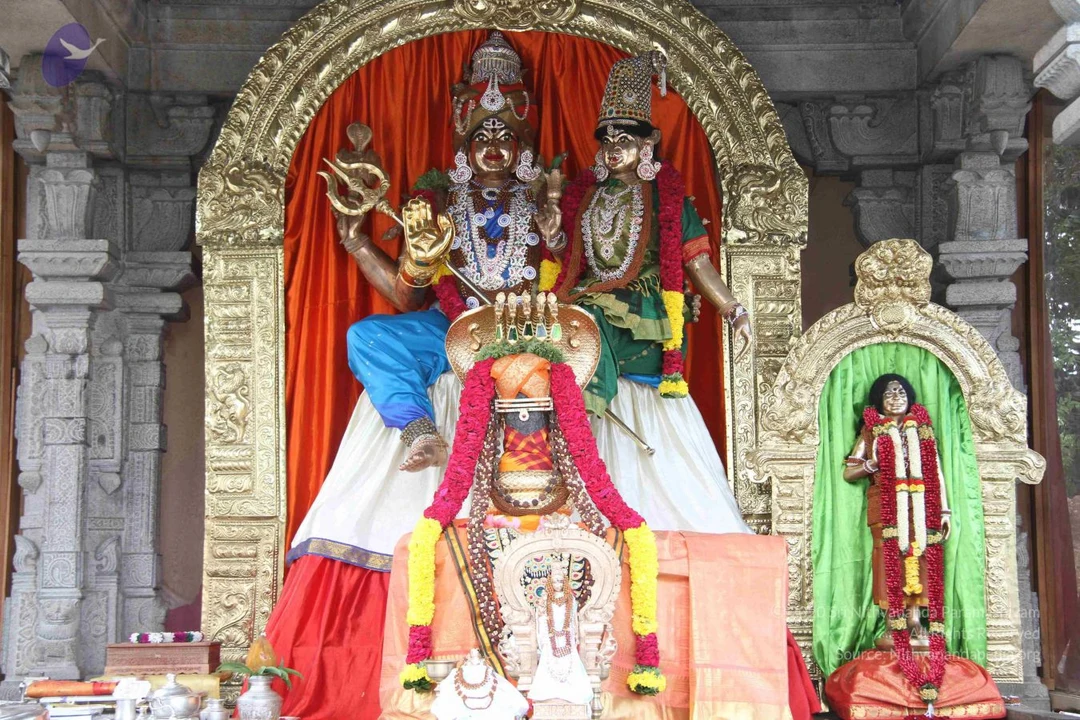
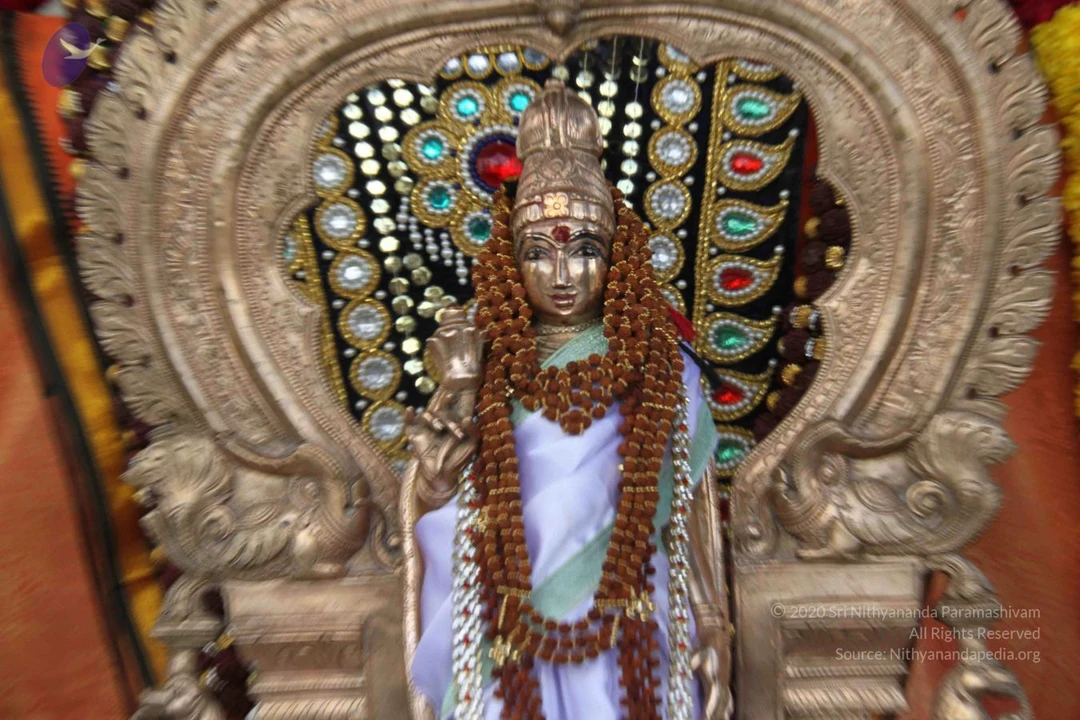
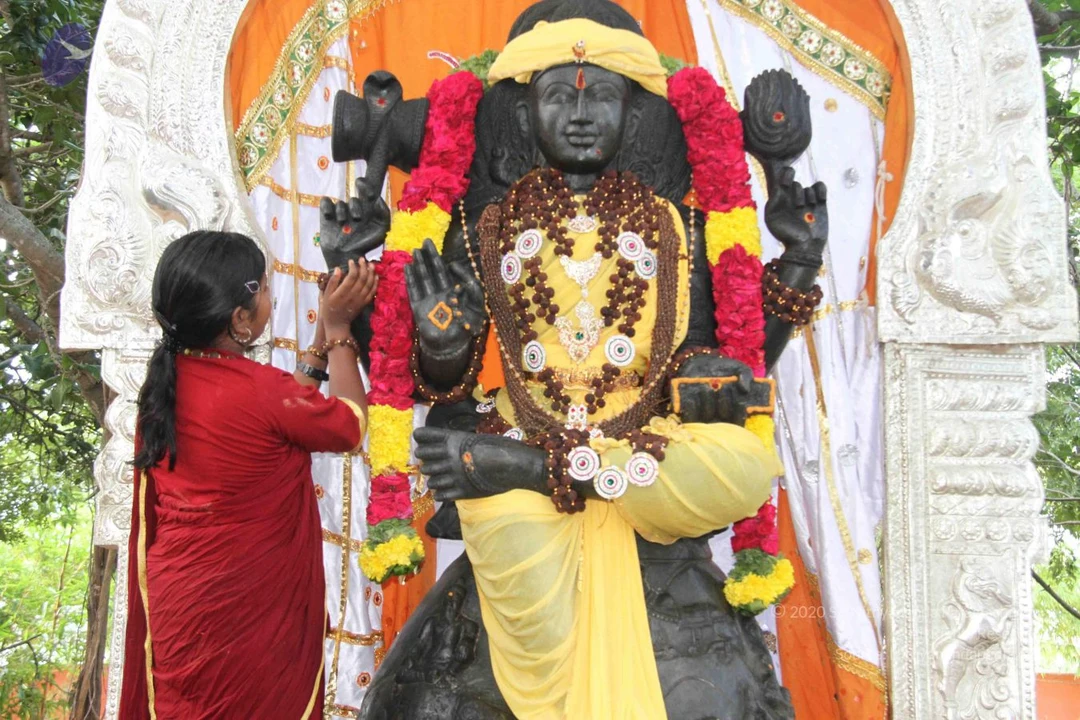
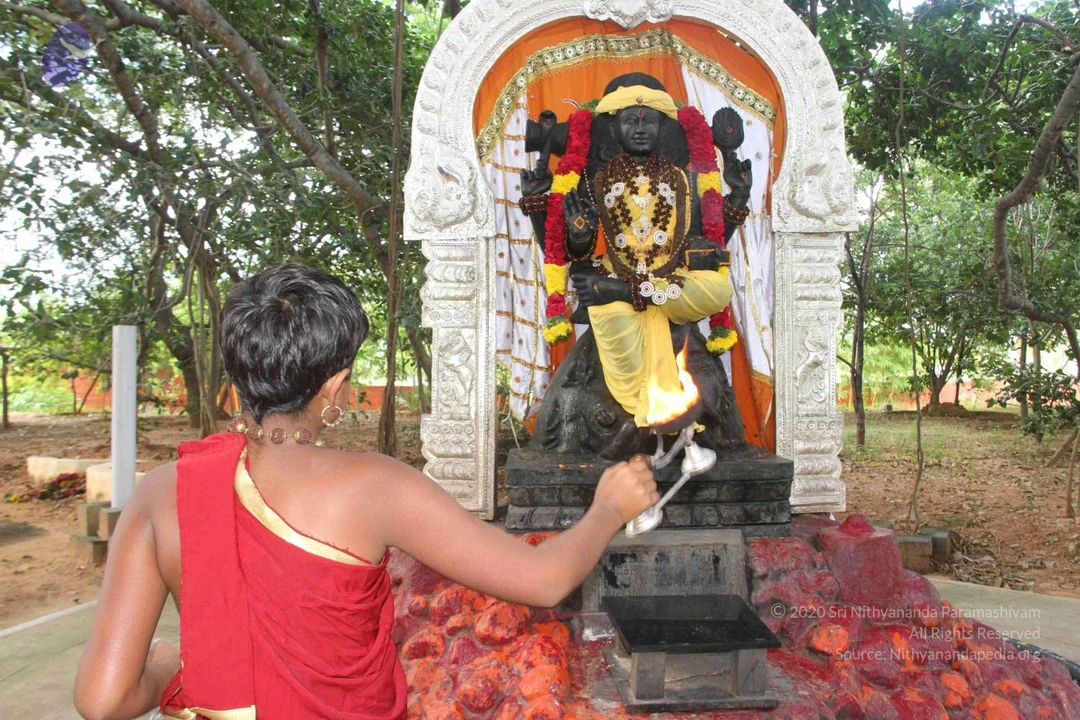
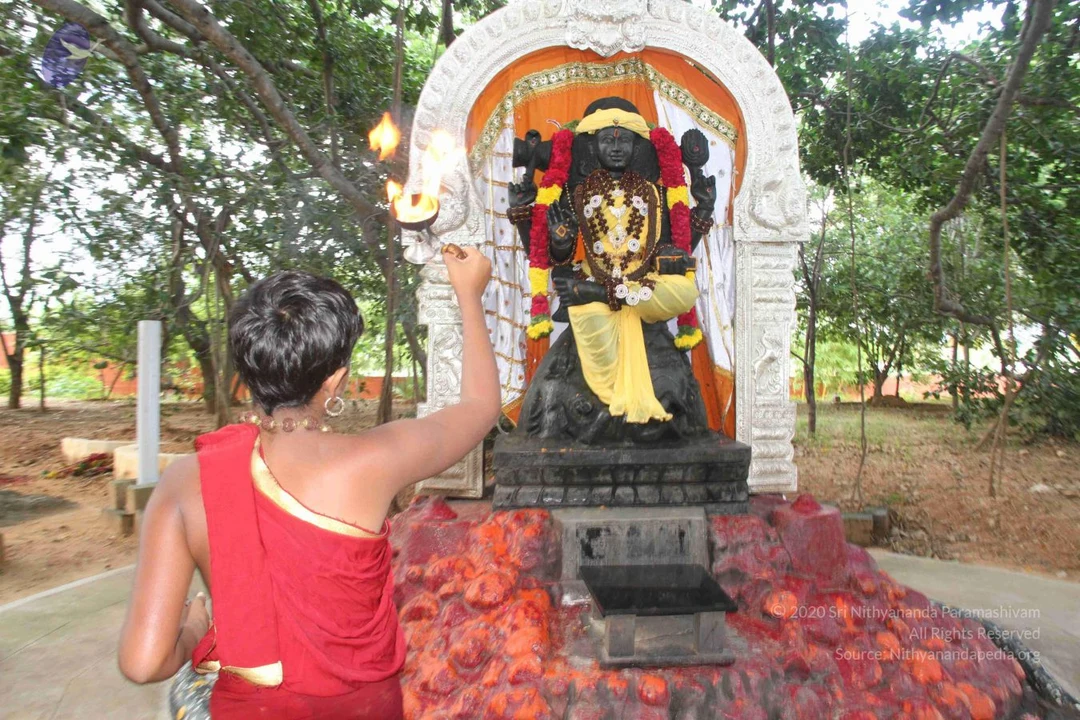
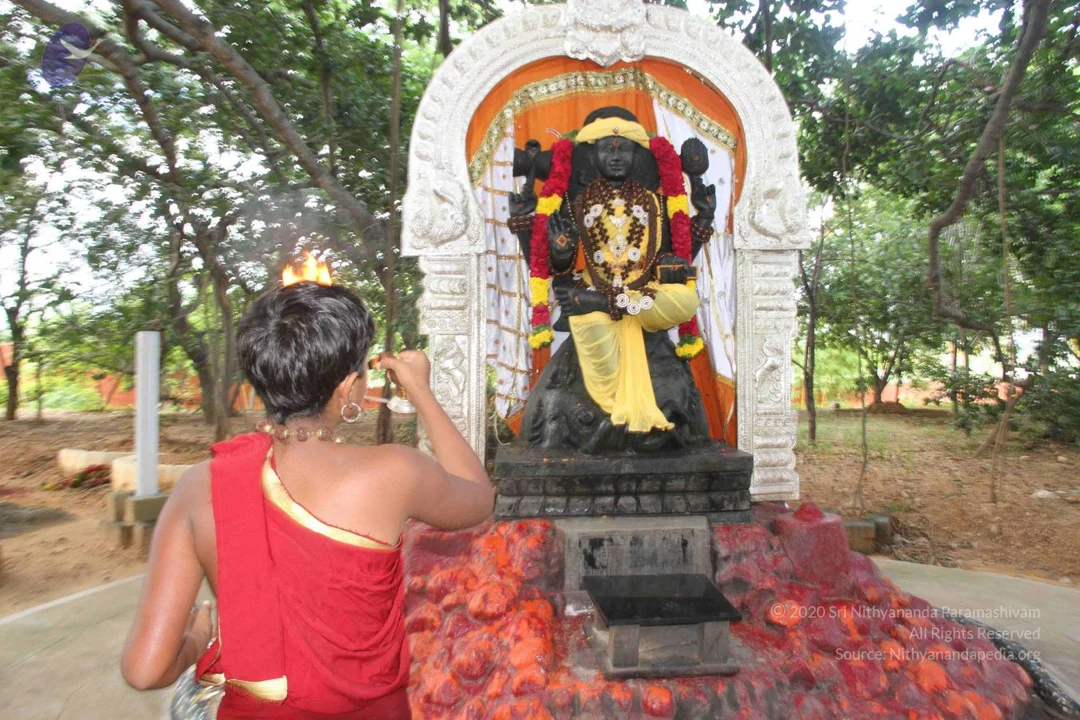
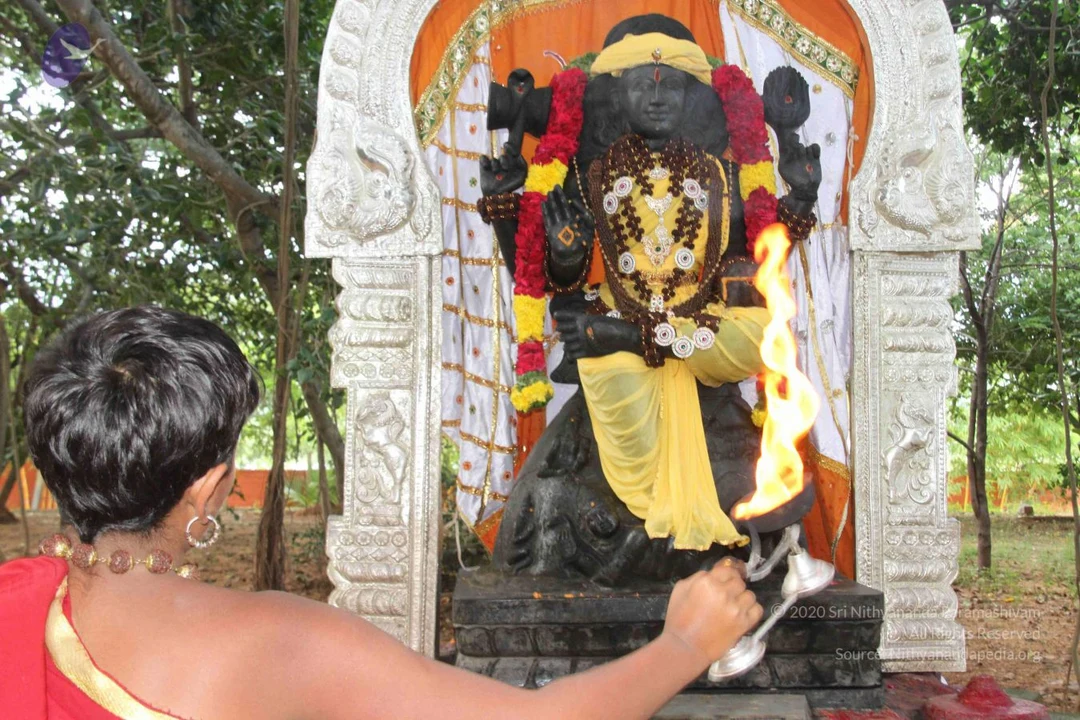
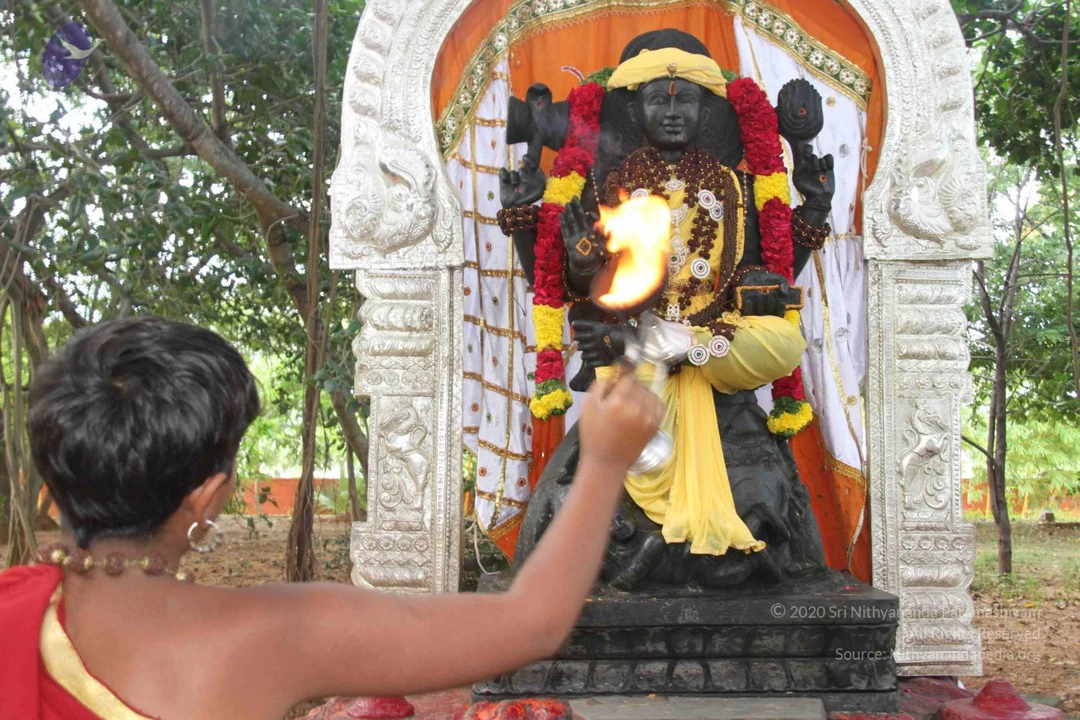
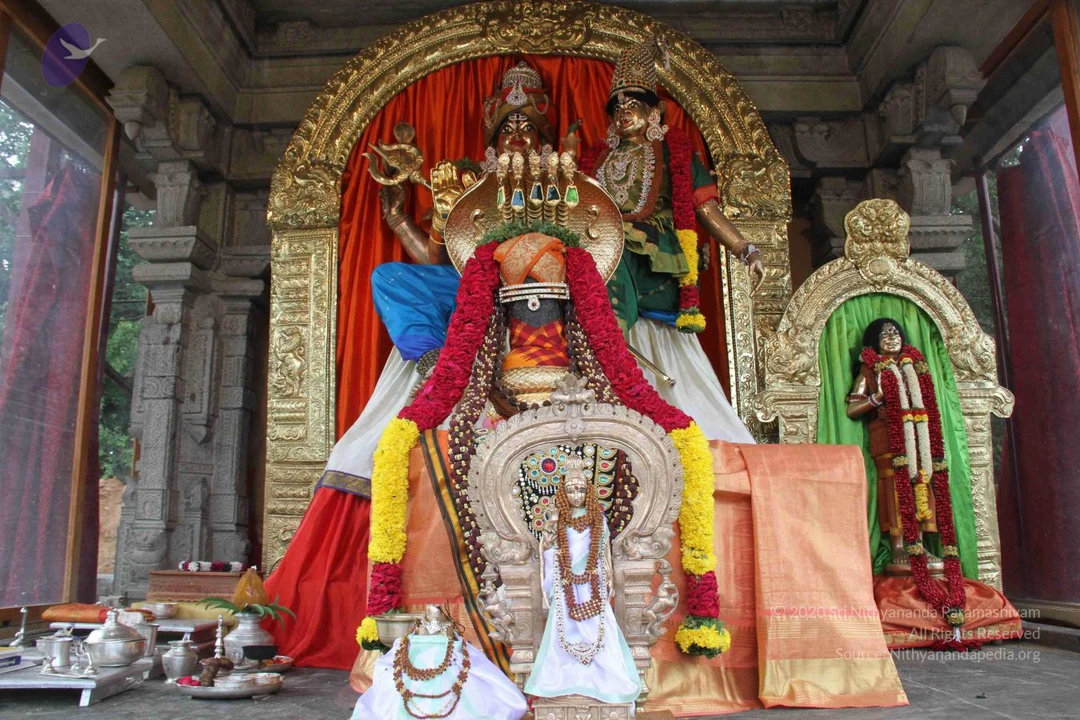
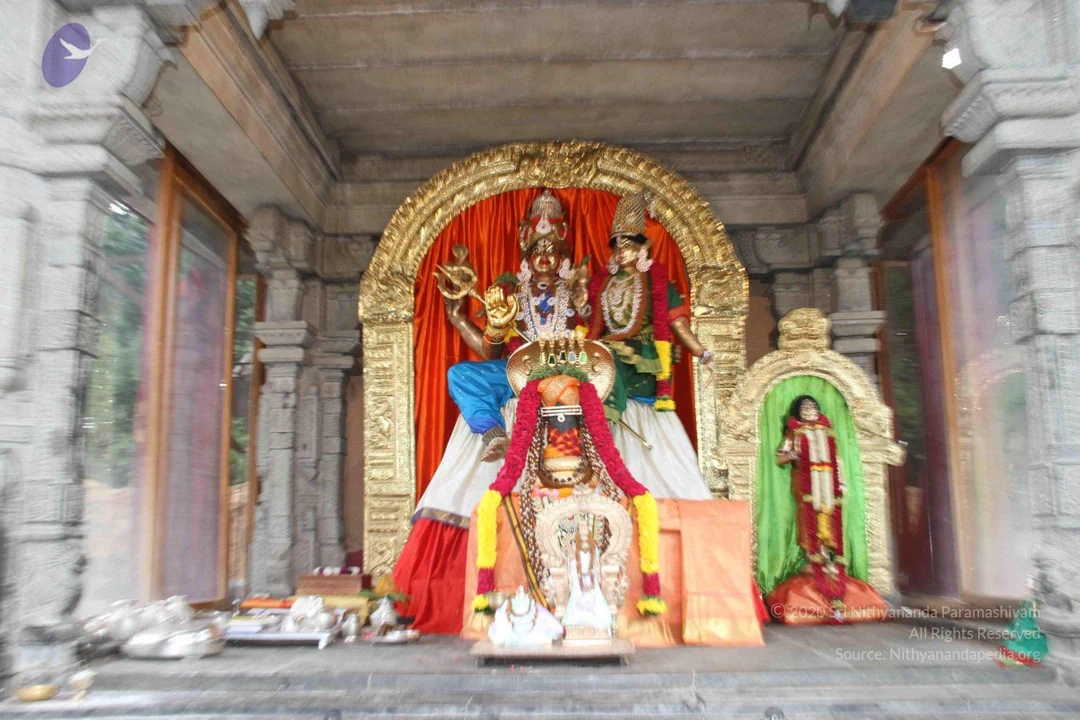
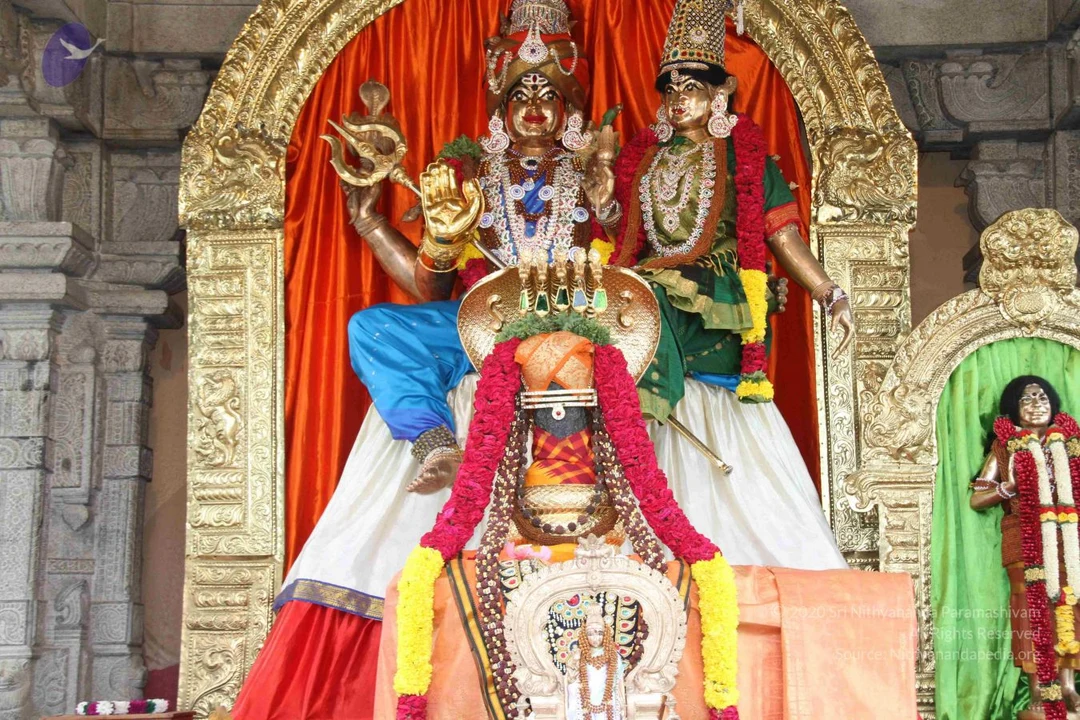
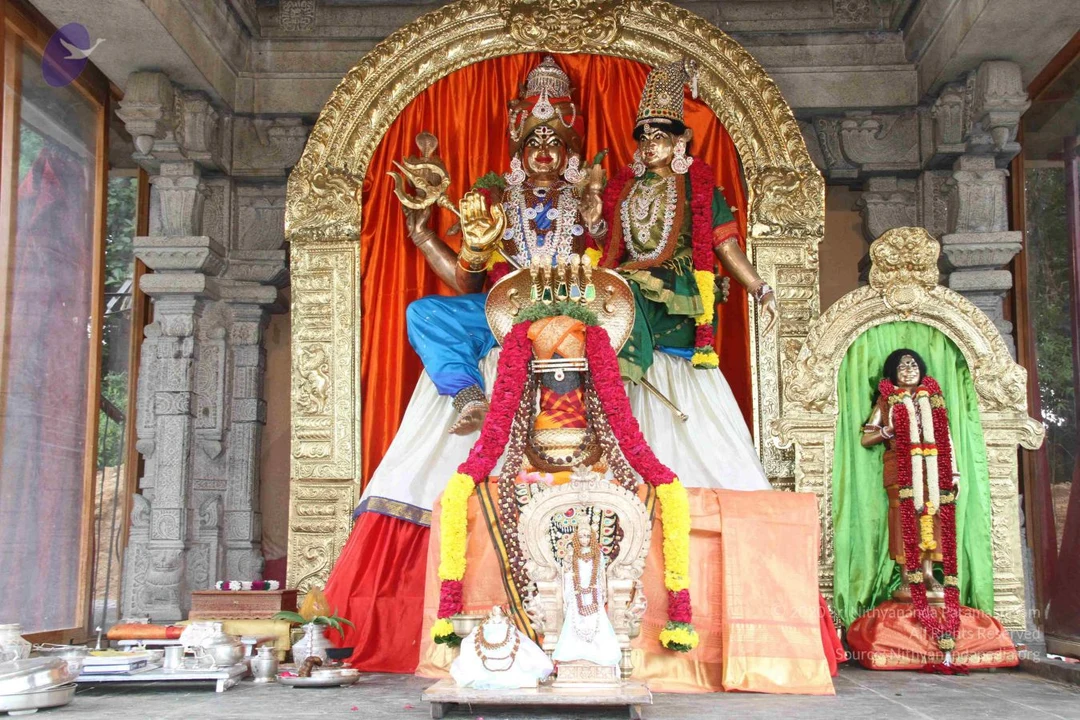
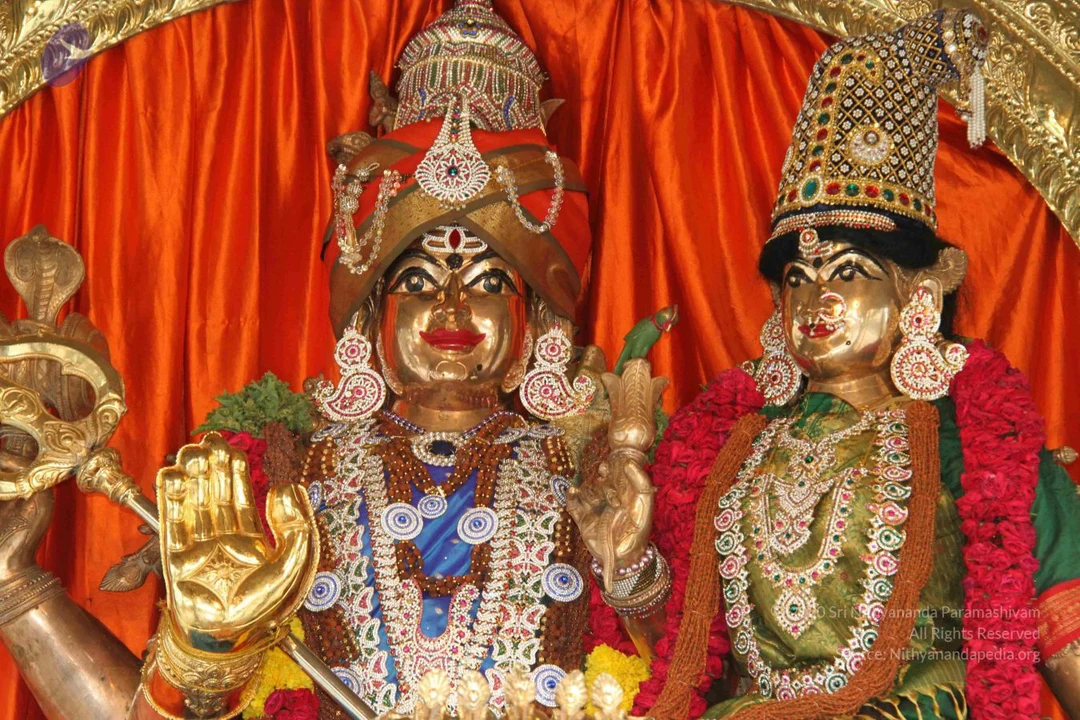
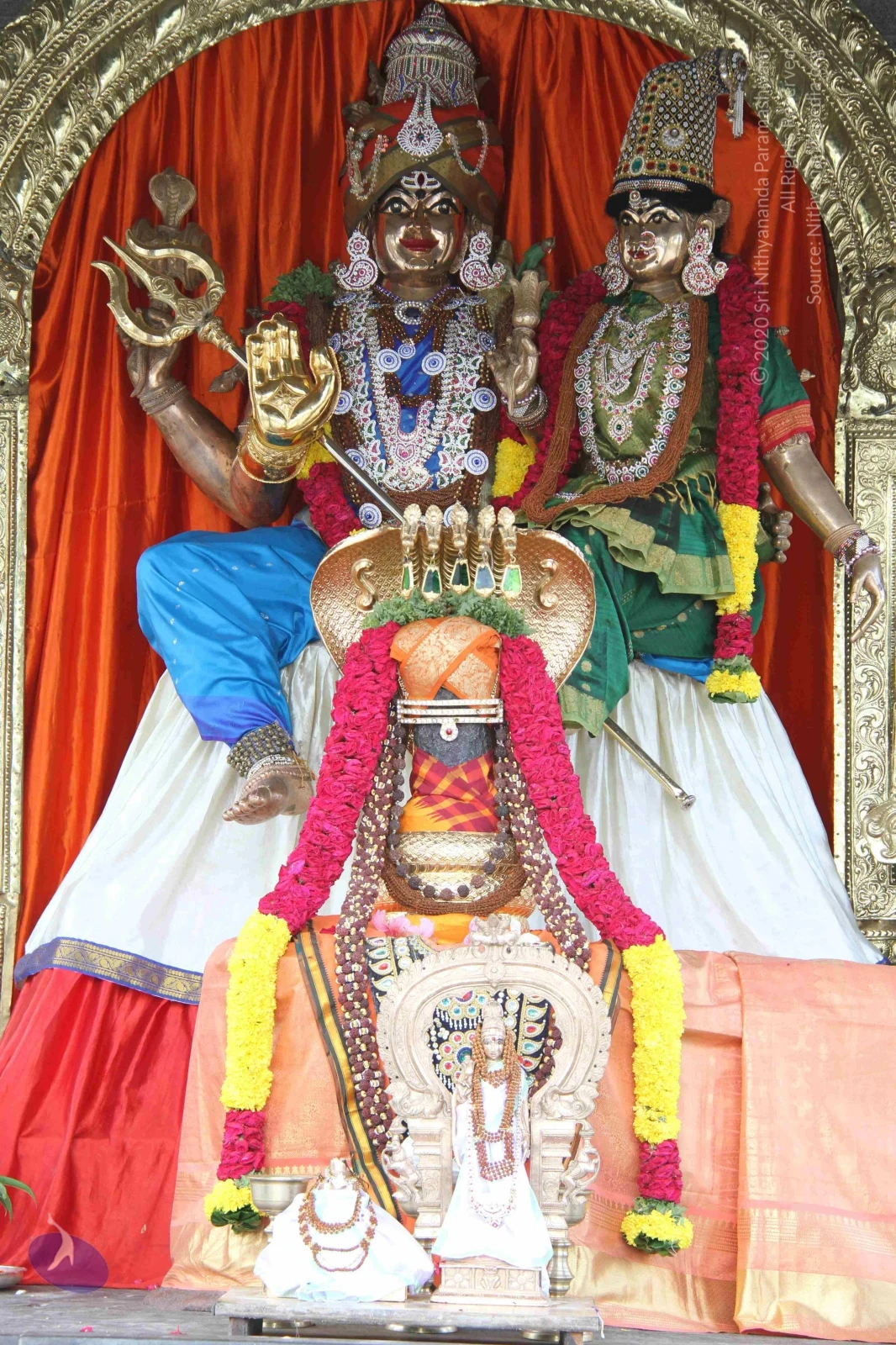
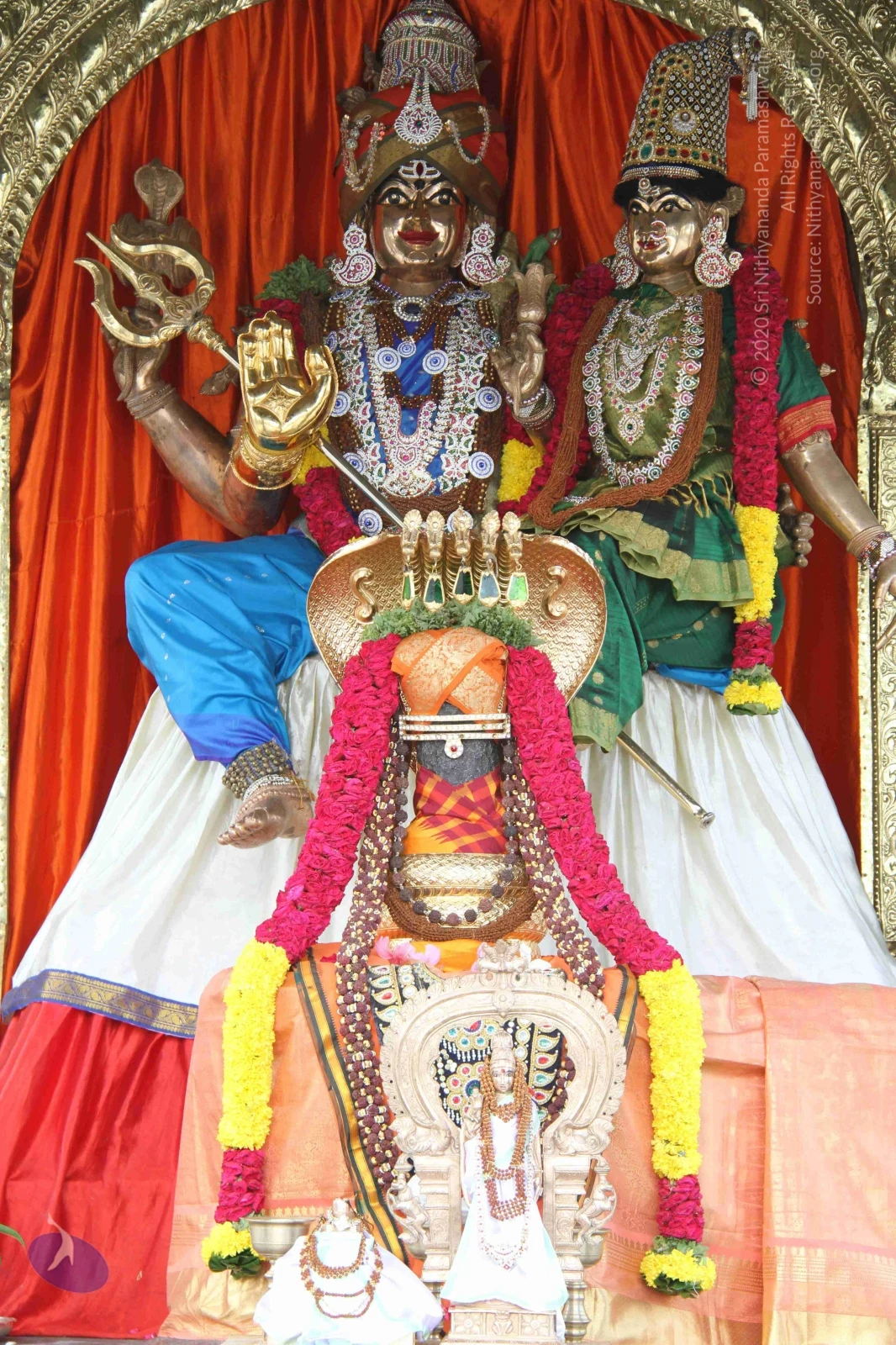
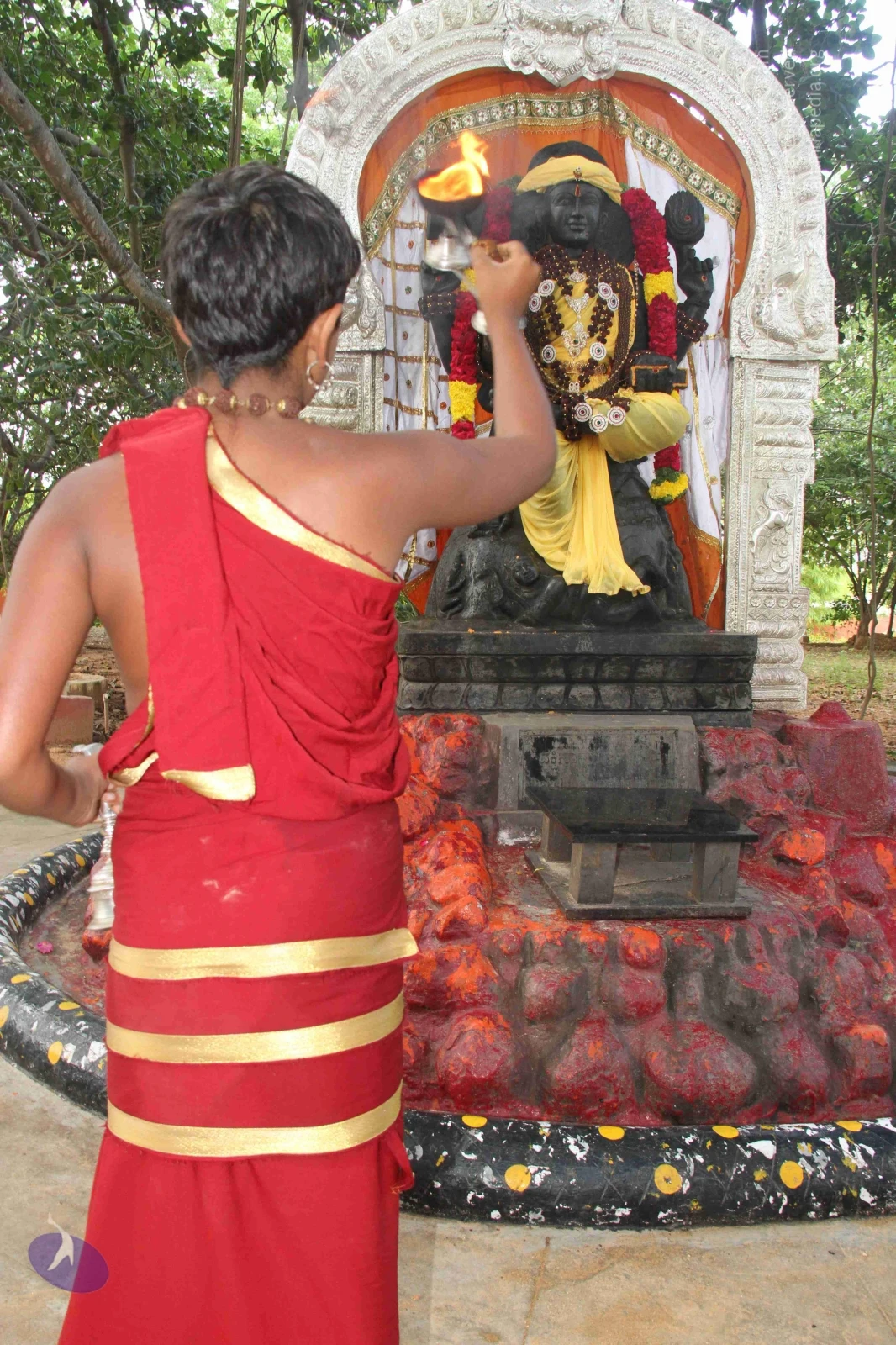
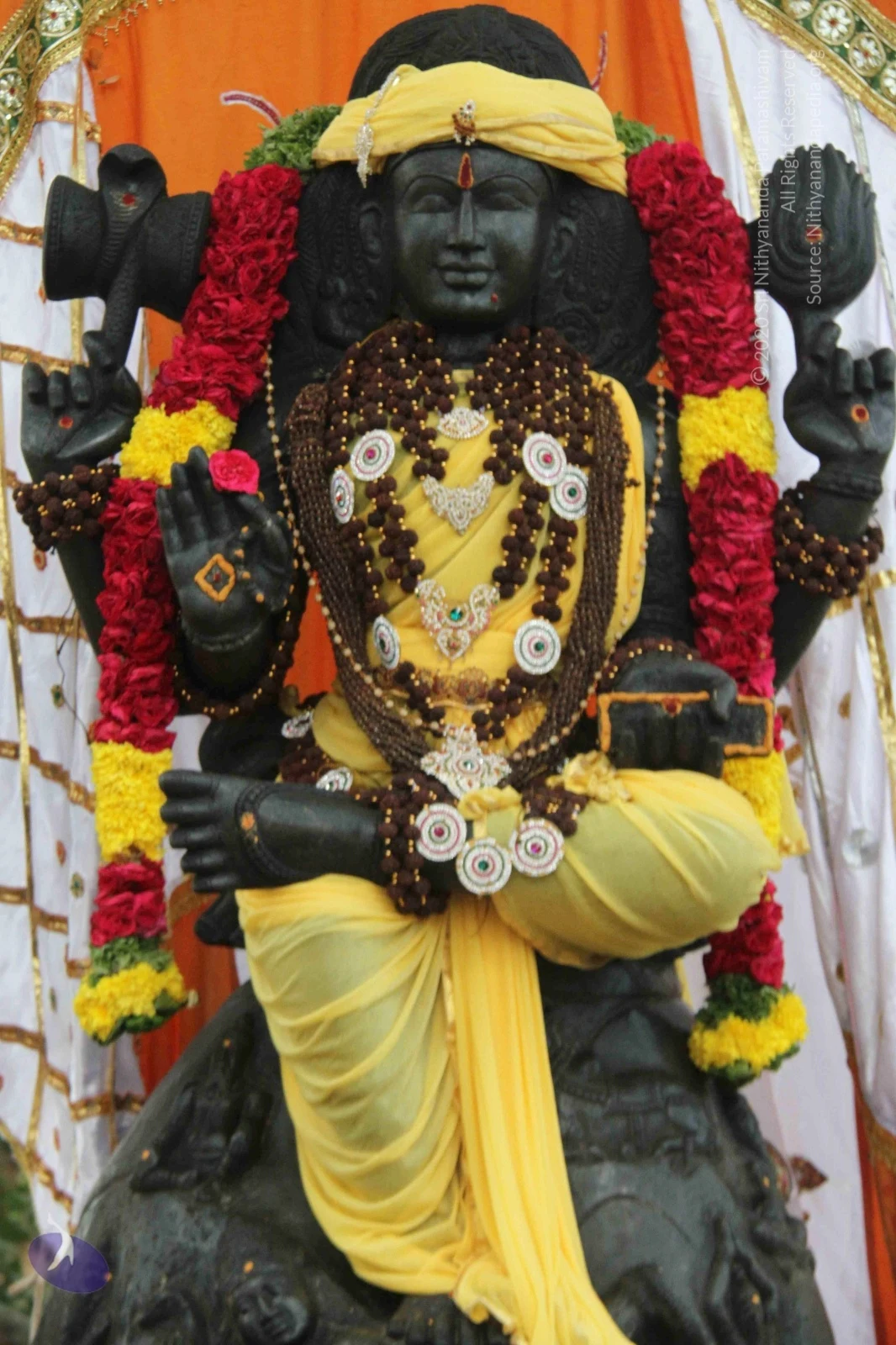
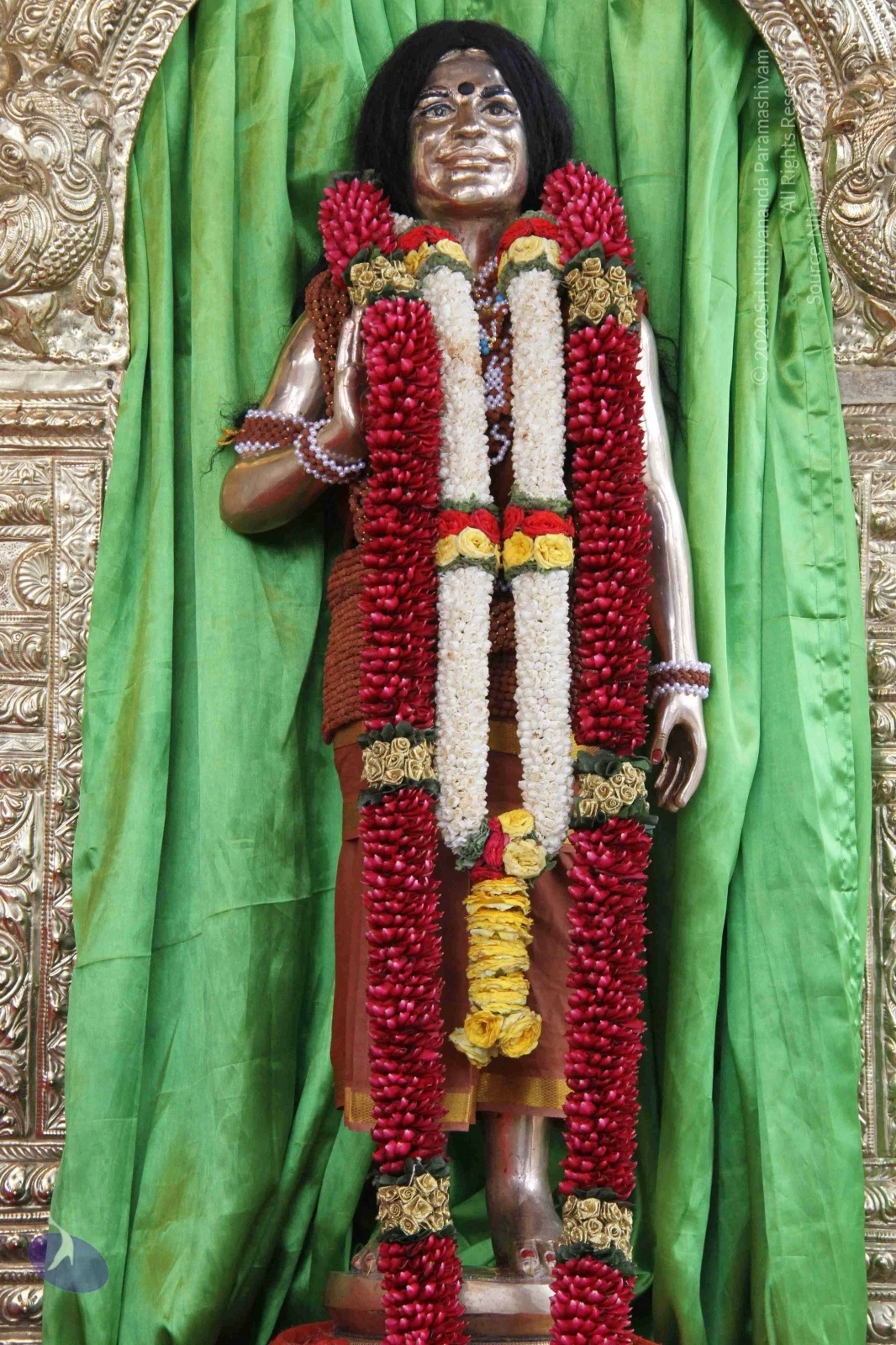
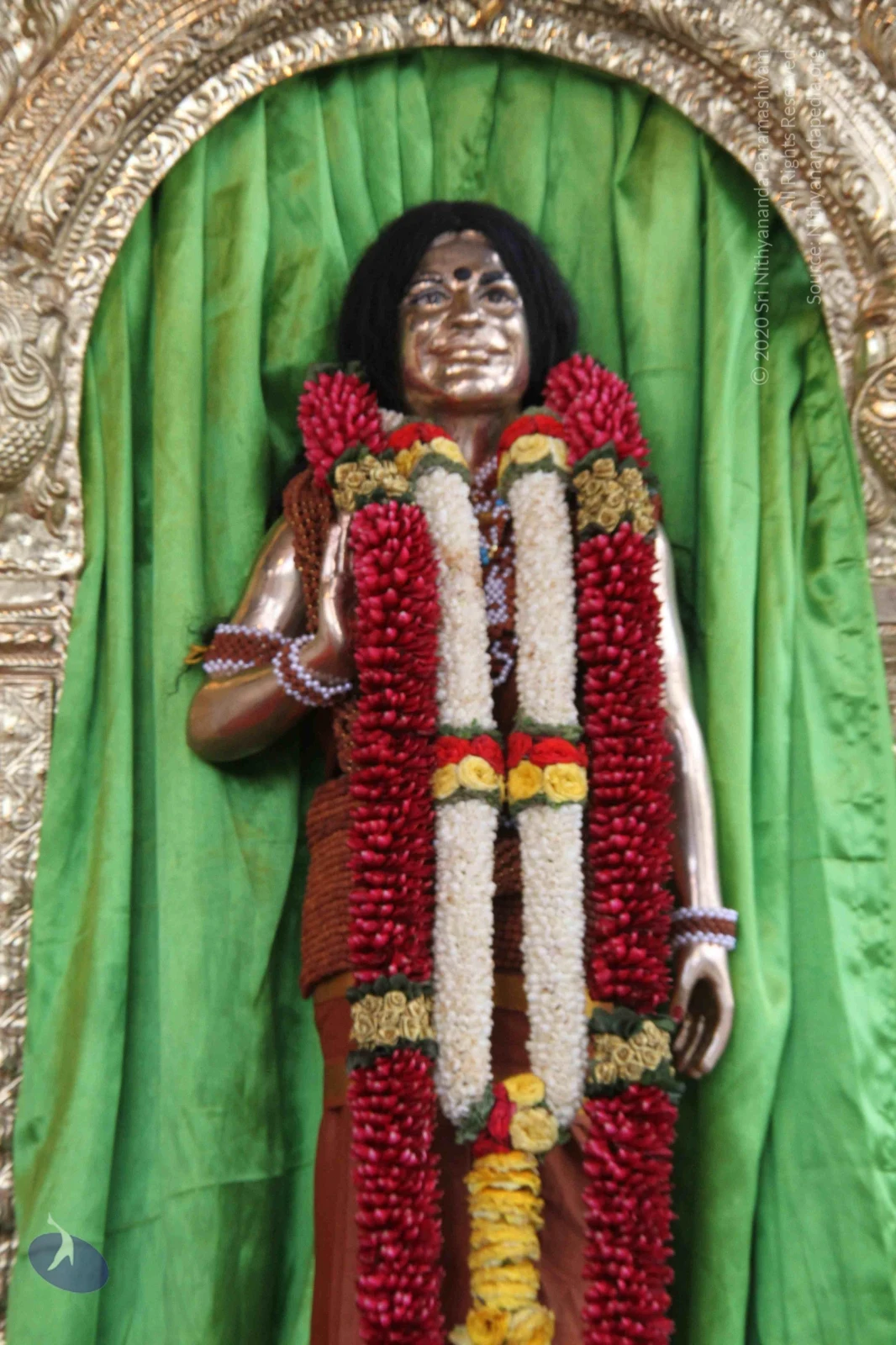
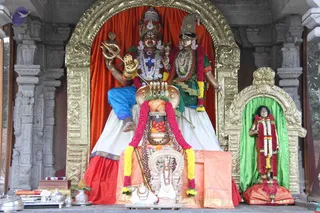
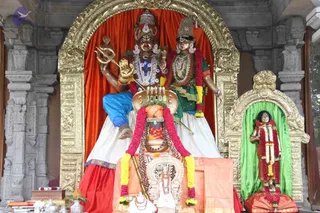
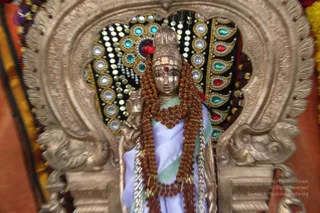
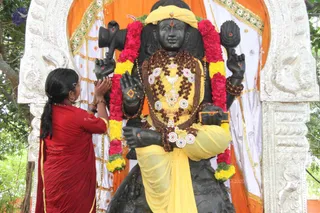
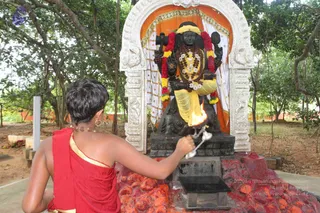
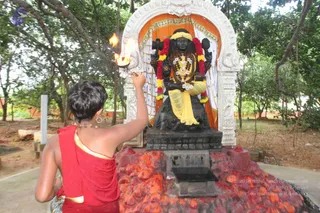
A photograph of a temple shrine featuring a large pair of gilded deity murtis seated on a raised platform before an orange-red drape within an ornate gold-framed arch. The two central figures are shown with tridents, rudraksha malas and ornate jewellery, one wearing a blue lower garment and the other in green and white, with a central orange-and-gold conical ritual form adorned with pink and yellow marigold garlands. To the right, a smaller standing murti in a green-curtained niche is garlanded in red and white flowers.A temple shrine with large painted statues of a deity couple, the male figure holding a trident and a small hand drum, in blue and white dhoti-like lower garments and decorated with pearl-and-bead necklaces, and the female figure in a green and red blouse with a flowing skirt, both draped with pink and yellow flower garlands. Ornate golden arches and a red-orange curtain frame the central pair. In front stands a tall decorated linga covered with red and yellow garlands, with a silver peetha and brass vessels, lamps and fruit offerings arranged on the platform. To the right, a smaller statue in a green niche wears a red and white garland. Ritual puja setting; no living people visible.A close photograph of a bronze-toned murti of a deity standing within an ornate golden arched shrine niche decorated with mirror work, red and green gem-like inlays, and carved peacock-like motifs at the base. The figure wears a tall crown, a red and gold tilak mark on the forehead, layered rudraksha malas of brown beads, and a white and light green dhoti-style garment. One hand holds a ritual object near the chest. Marigold garlands in yellow and red frame the upper corners of the shrine against an orange cloth backdrop. No physical people are visible.A woman in a red sari stands at left with her palms pressed together in prayer before a large black stone murti of a deity. The murti wears a yellow dhoti and yellow head-cloth, a thick brown rudraksha mala across the chest, and multiple garlands of red and yellow flowers. Its raised hands hold a trident-like staff and a drum, with a silver arch and orange-and-white draped backdrop behind. The setting appears to be an outdoor shrine with green foliage at left.A photograph of a devotee seen from behind, in a red garment with gold border, performing aarti with a lamp before a black stone deity murti seated on a bull-like mount. The murti wears a yellow cloth, a yellow headpiece, a garland of red and yellow flowers, and layered beaded ornaments, and holds ritual implements in several hands. The shrine has an ornate white arch backed by orange and white drapery, set on a red-painted pedestal in an open outdoor garden with trees behind. A small black offering stand sits in front.A photograph of an outdoor shrine under trees. A person with short dark hair, wearing a red top with a gold-edged cloth, stands at left with their back to the camera and raises a lit oil lamp toward a black stone deity murti. The murti wears red and yellow flower garlands, a rudraksha-style bead necklace, a yellow dhoti and a yellow headpiece. Its arched white niche is draped in orange and white cloth, and the base is covered with red kumkum and marigold-like offerings. Greenery and a small pole are visible in the background.

NithyaSatsang_Pics
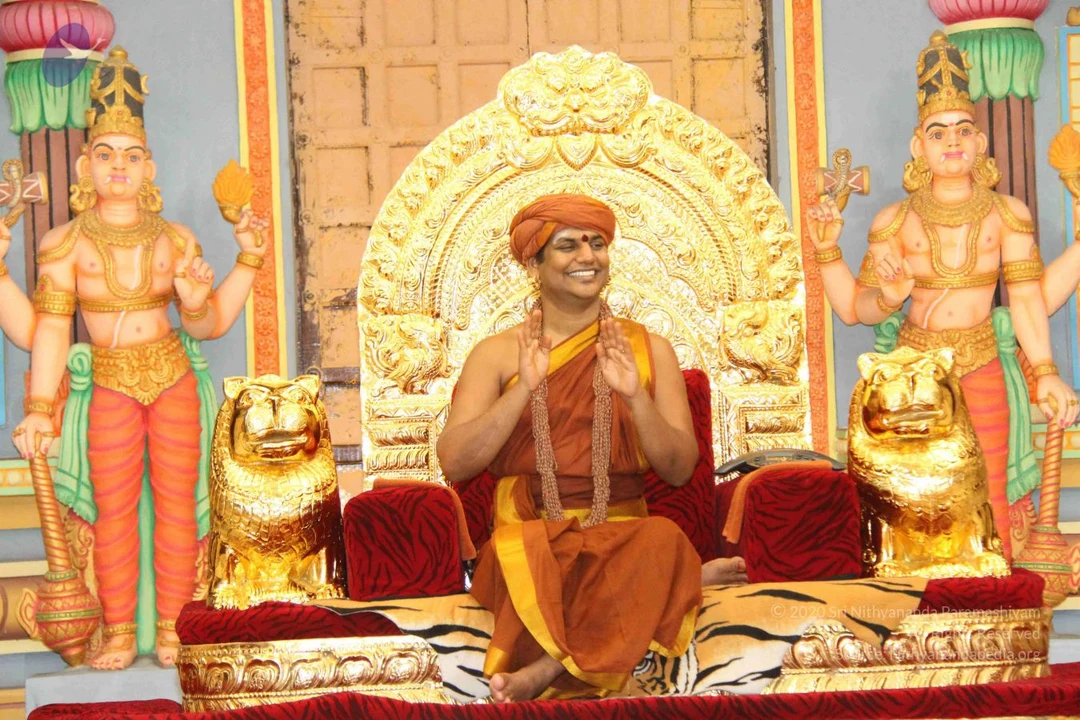
56 photosSource gallery
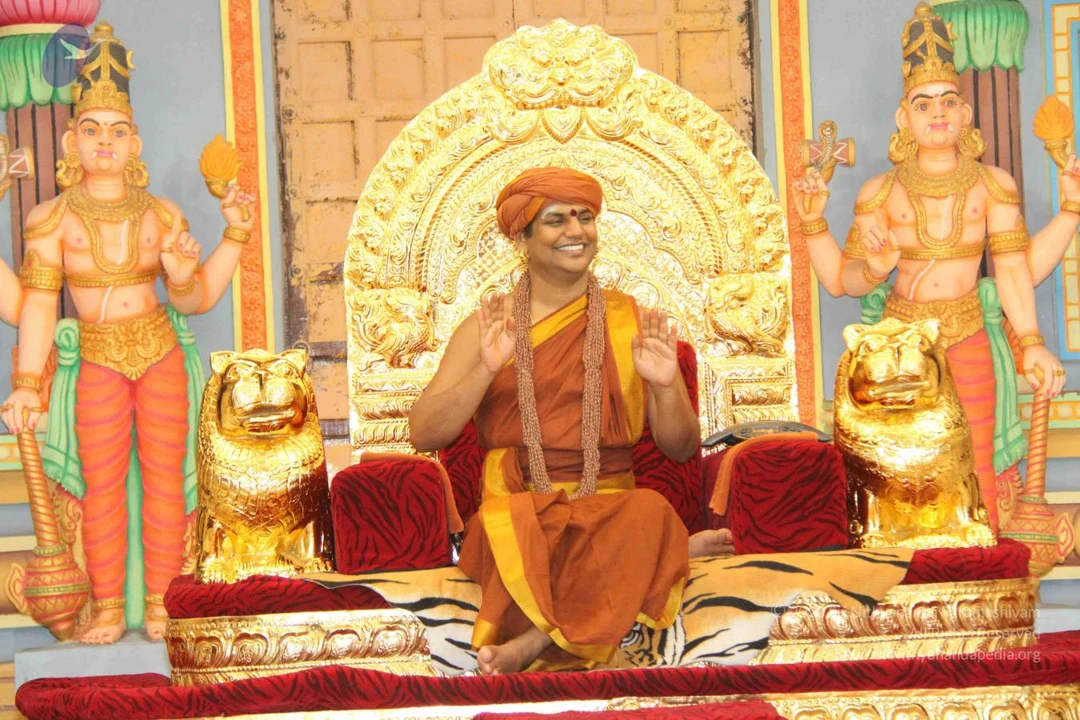
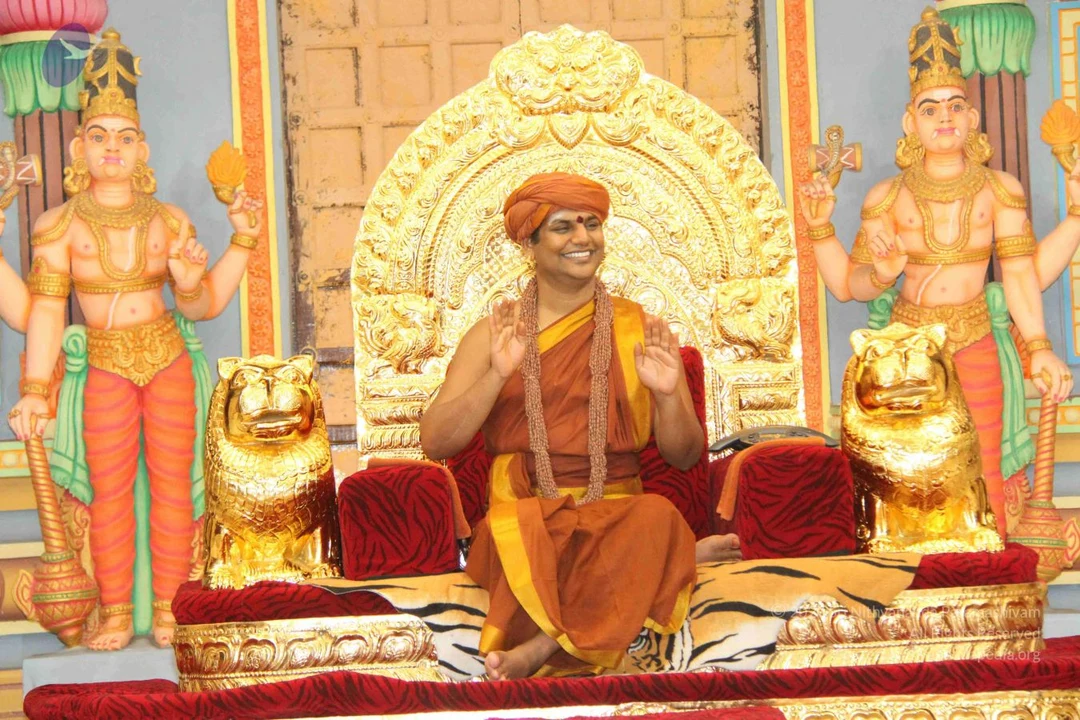
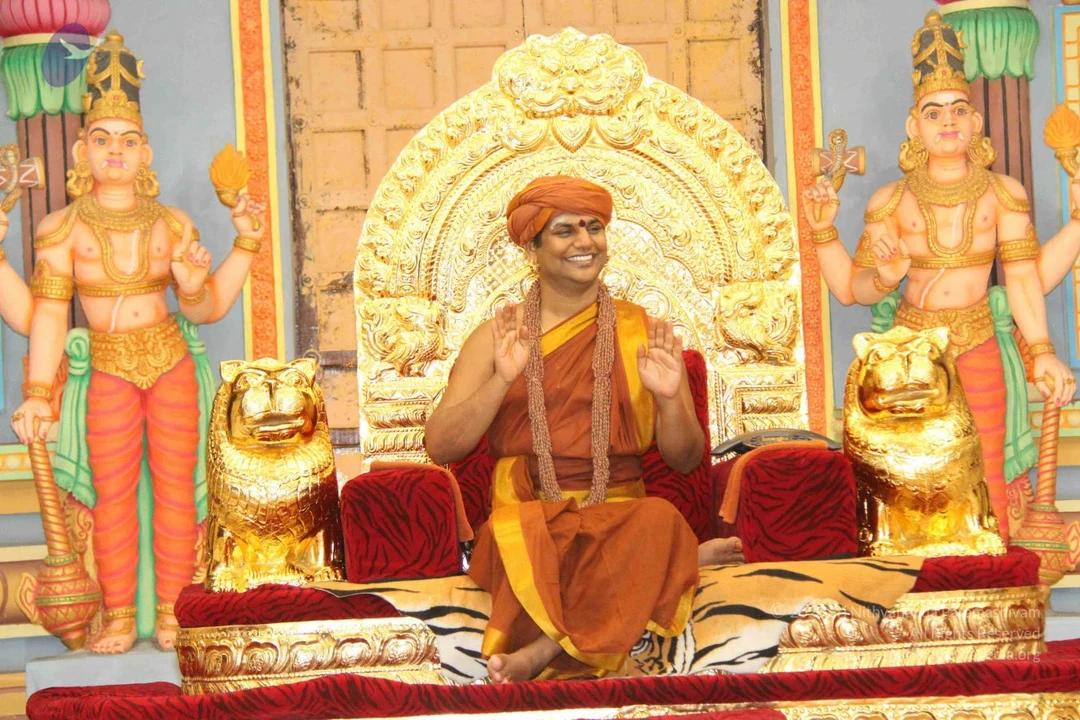
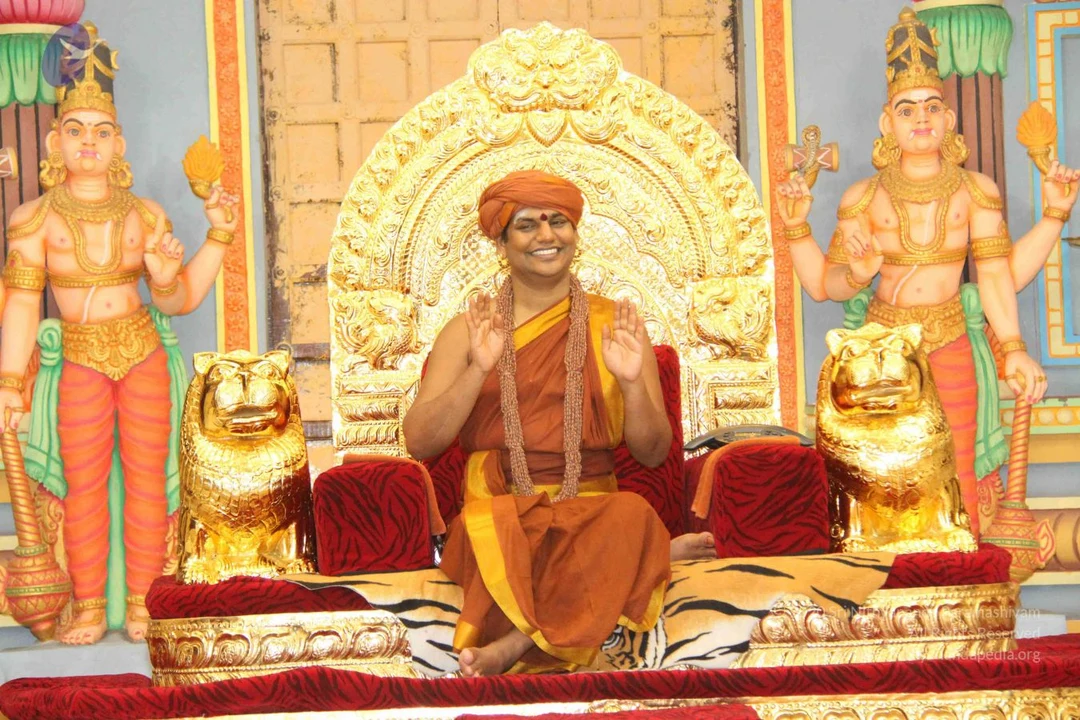
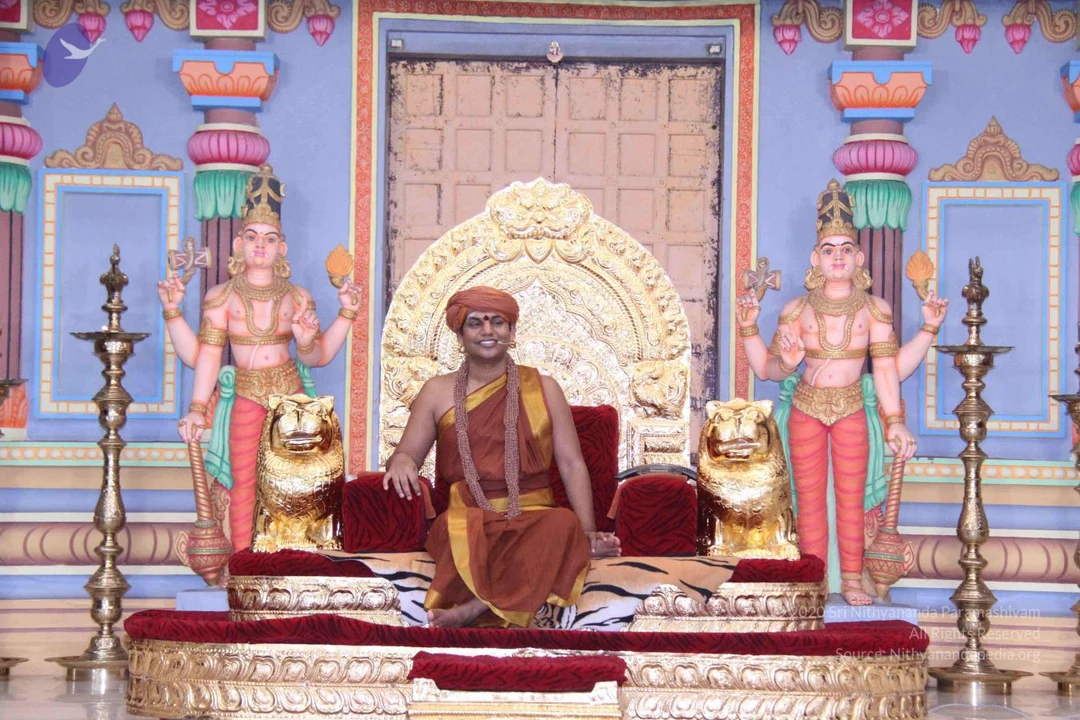
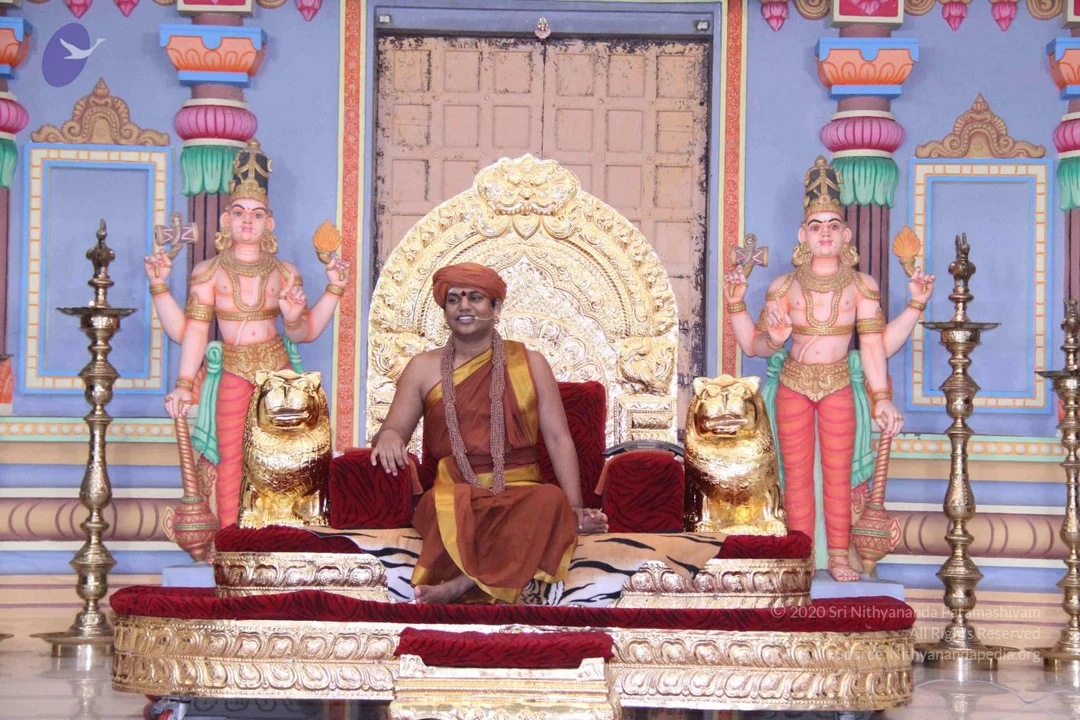
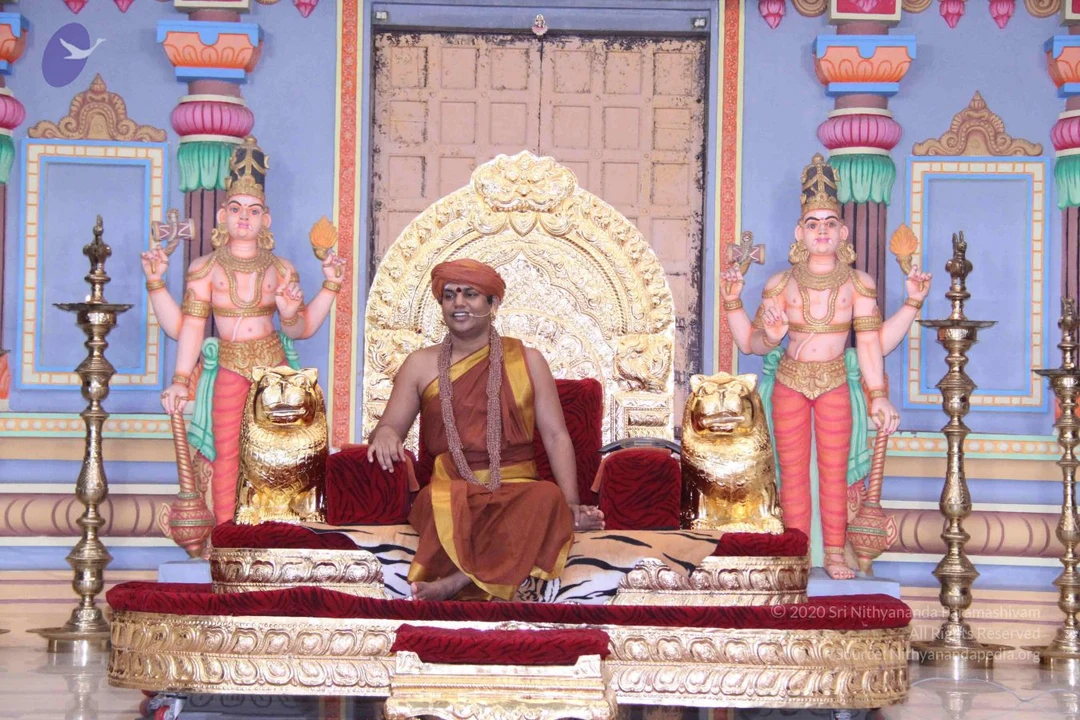
A seated man in a saffron-orange robe and matching orange turban sits on an ornate golden throne with lion-head armrests, draped in a tiger-striped cloth, with red velvet cushions. He smiles with palms pressed together in greeting and wears a beaded rudraksha-style mala and a vibhuti or kumkum mark on his forehead. Two painted standing deity murtis with multiple arms, gold jewellery and green sashes flank the throne against a light blue temple wall with a pink-topped column and an arched wooden door behind.A smiling man in saffron and orange robes with a saffron turban and a rudraksha mala sits cross-legged on an ornate gold throne with red velvet cushions, a tiger-striped cloth draped over the seat and golden lion sculptures at the armrests. His palms are raised in blessing. Two large painted deity statues flank him, with multiple arms, crowns, gold jewellery and bare torsos in red and green. A large gold arch frames the throne behind him. The scene is set in a temple-style hall. A person seated on a throne with saffron cues and a rudraksha mala may be a person.A man seated on an ornate golden throne with lion-carved armrests and red velvet cushions draped with tiger-striped fabric, smiling and raising both palms in a welcoming gesture. He wears an orange-saffron turban, orange and gold robes, and a long beaded rudraksha mala. Two painted, gold-adorned guardian figures with multiple arms stand on either side of the throne, holding ceremonial objects. The backdrop is a carved wooden door and painted pillars. The presentation matches the page's Swamiji reference, with orange robes, turban, mala and a throne, so the person is labelled a probable Swamiji seated in a discourse setting.A photograph of a seated man in an orange-saffron head wrap, orange robe with a yellow-gold border, and a beaded brown mala necklace. He sits on an ornate gold throne with red velvet cushions and a striped tiger-skin cloth, flanked by gold lion-shaped armrests. He smiles and raises both palms in a gesture of greeting. Two large painted multi-armed statues stand on either side, one holding a conch and mace-like objects, wearing gold jewellery and red-orange dhotis. The backdrop is a blue-grey wall with a wooden door. a person is seated at the centre, identified by the saffron head wrap, mala and ceremonial throne cues.A seated man in saffron and orange robes sits on an ornate gold throne with red velvet cushions draped in a striped tiger-skin cloth. He wears a long rudraksha mala around his neck, an orange turban, and has his palms raised in greeting while smiling. Two large gold lion-head armrests flank the throne. Behind him stand two painted, multi-armed deity figures in gold jewelry, one holding a club and the other holding a trident, with green and red sashes. The setting is a temple-like hall with a carved gold arch. Swamiji (probable): the saffron and orange robes, orange turban and long rudraksha mala match the appearance cues, and he sits on the throne with a seated greeting.A seated figure in an orange-red robe with a yellow-gold border sits on an ornate gold throne with a tiger-striped red cushion and gold lion armrests. The person wears an orange turban, a rudraksha mala necklace, and is smiling with both palms raised in greeting. Two large gold-painted standing guardian figures with multiple arms and gold ornaments flank the throne against a pastel blue and yellow wall. A watermarked archive logo and caption text appear at the lower edge. Swamiji (probable): the seated person wears an orange turban, rudraksha mala and saffron robes on a ceremonial throne, consistent with the page's claim.

01-Pratyaksha-Padapuja

4 photosSource gallery
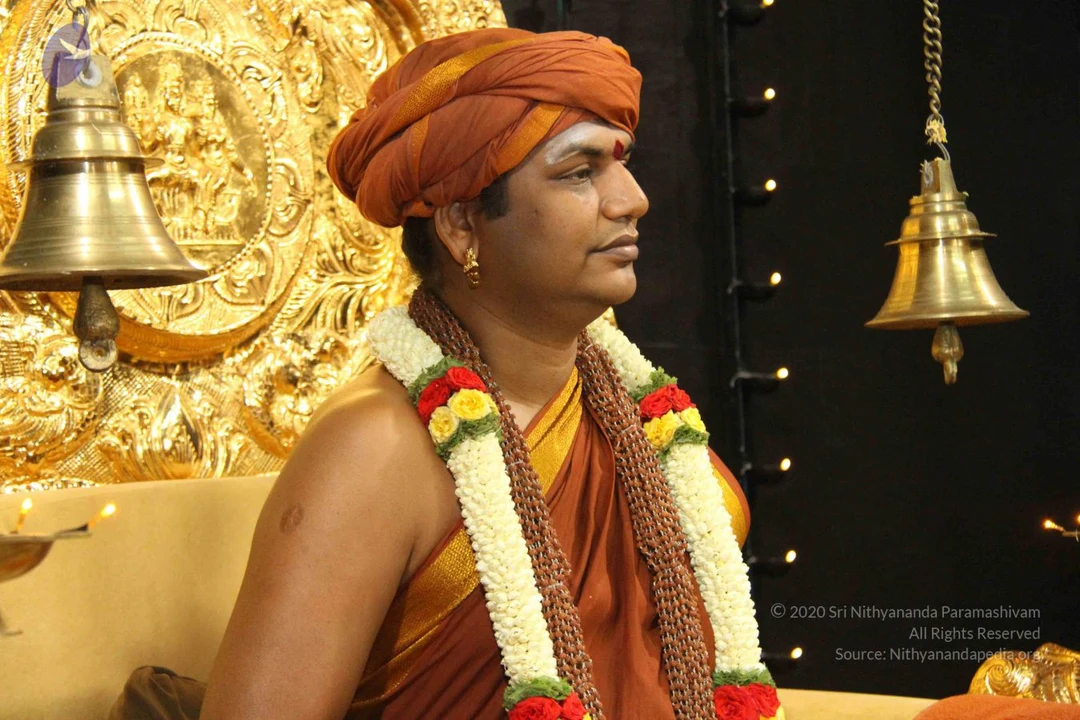
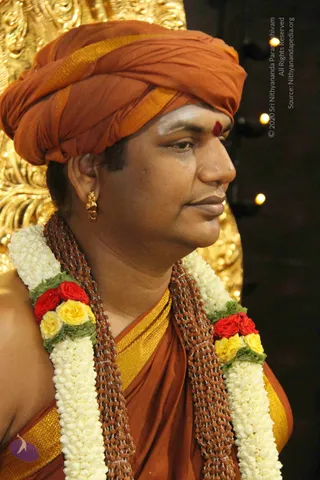
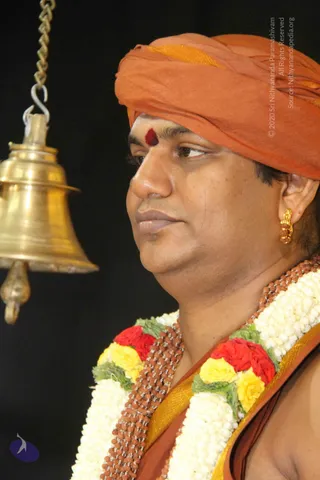
A figure in an orange-red turban and orange-brown robe with gold border sits on an ornate gold throne with a tiger-striped seat cushion and a gold umbrella canopy above. He wears a long rudraksha mala and raises one hand in a blessing gesture while standing barefoot on a round gold platform. Silver trays holding flowers, fruit and offerings surround the platform, with a red flower arrangement at his feet. Hanging brass lamps and dark draped walls frame the scene. Probable Swamiji by visible cues: orange turban, rudraksha mala and ornate golden throne setting, with the figure in an active blessing posture.Close profile photograph of a man in an orange-saffron turban wrapped with a gold-bordered band, with a red tilak mark and white urdhva pundra on his forehead. He wears a gold earring, layered garlands of white jasmine and red and yellow roses, multiple brown rudraksha malas, and an orange garment with gold border. Warm lamp glow and a gilded ornate backdrop surround him.Close-up photograph of a man in a saffron-orange turban with a small red tilak on his forehead, wearing a white and red-yellow flower garland over rudraksha beads and an orange-gold shawl, with gold rudraksha-style earrings. A hanging brass bell with a chain is at the left edge against a black background. Swamiji (probable): the orange turban, rudraksha malas and ceremonial gold earrings match the page's subject, and the man is physically present in the frame.Close-up photograph of a person's right hand gripping a polished silver ceremonial implement with a pointed, leaf-shaped head engraved with a three-lined motif and a flared base. The wearer's arm is draped in gold-bordered orange-red cloth, with a white jasmine garland and red and yellow flower garland strands behind, plus a brown rudraksha mala. Only the hand and arm of a single person are visible, so the a person candidate cannot be confirmed from this frame.

03-Temple

12 photosSource gallery
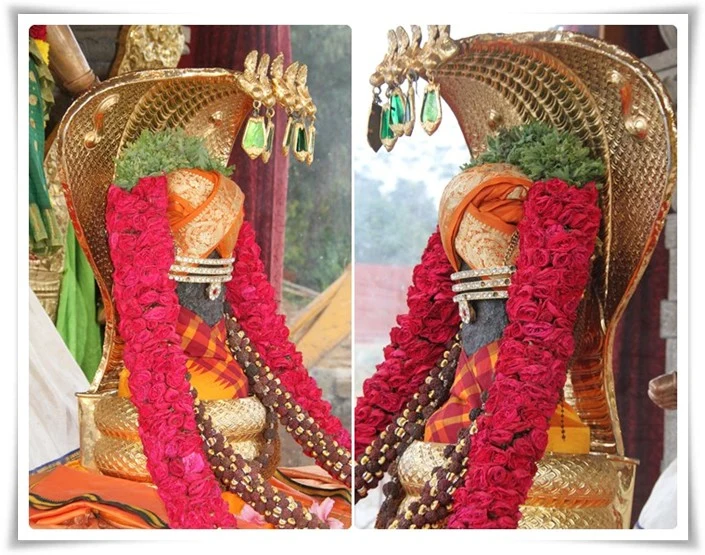
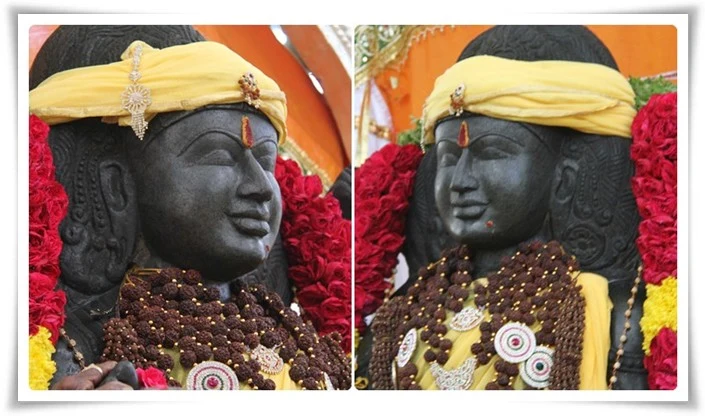
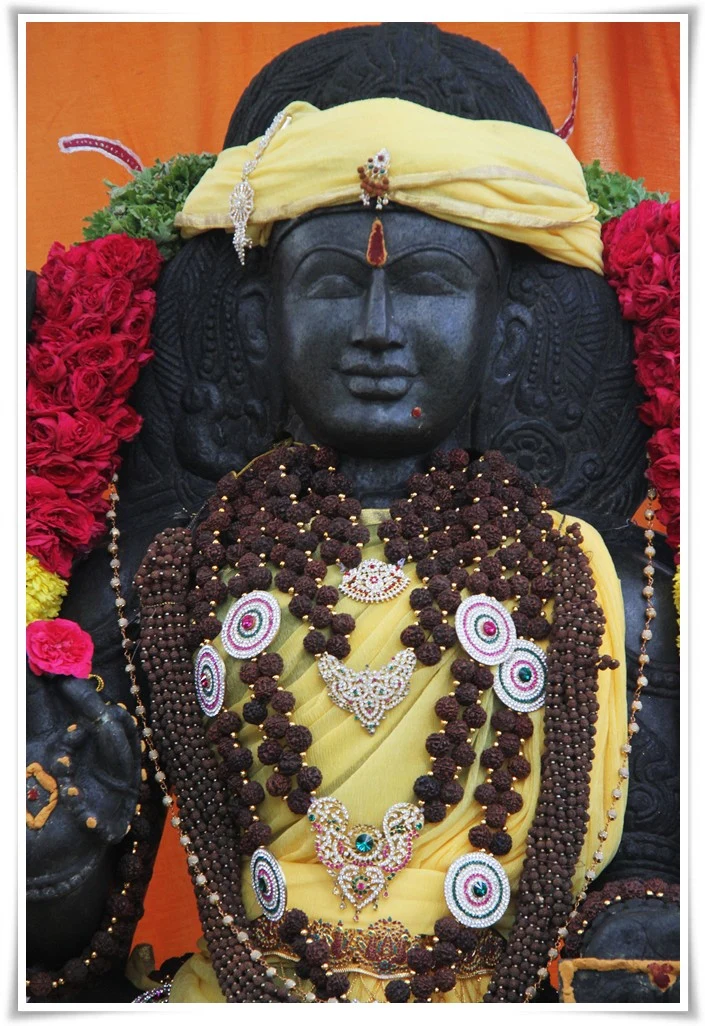
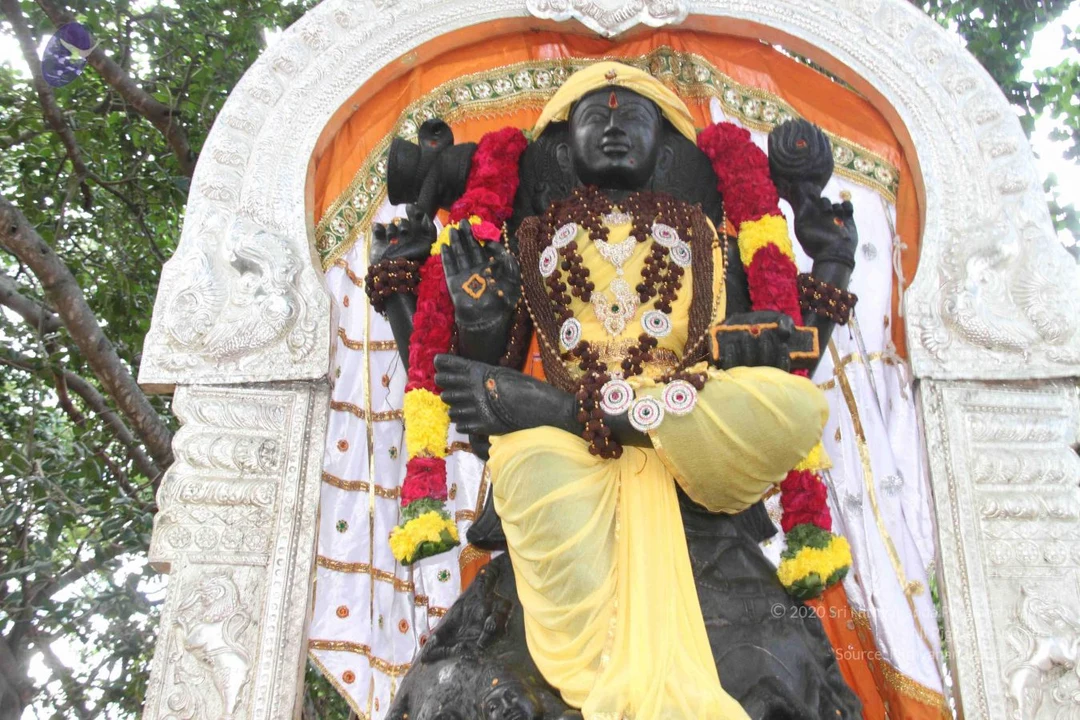
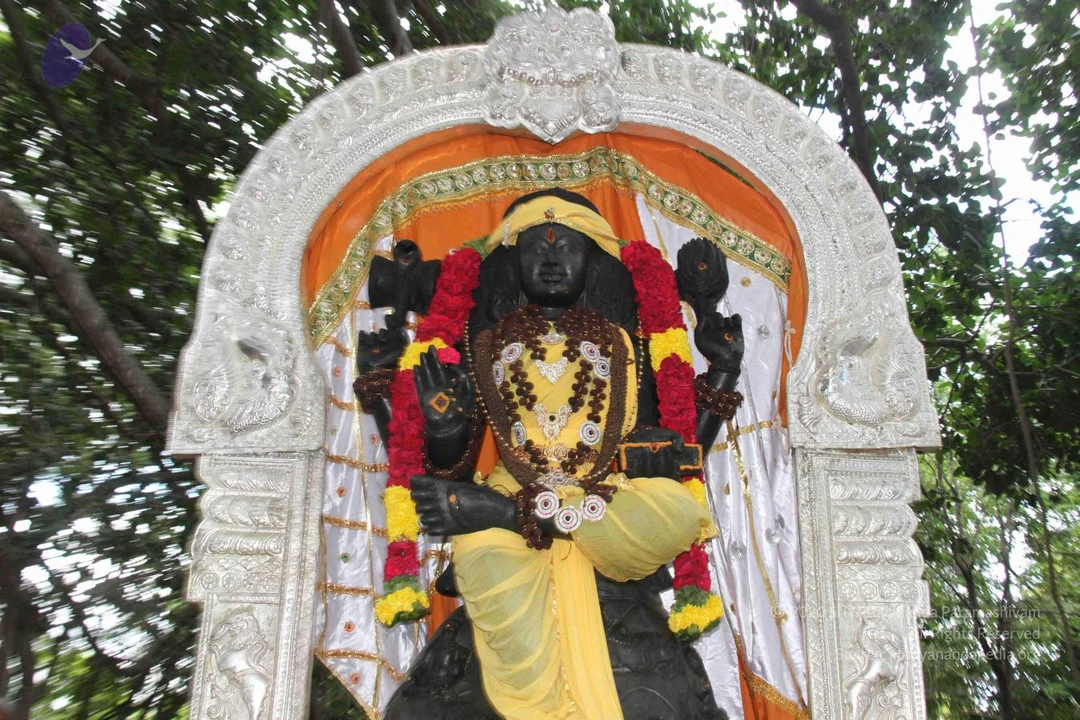
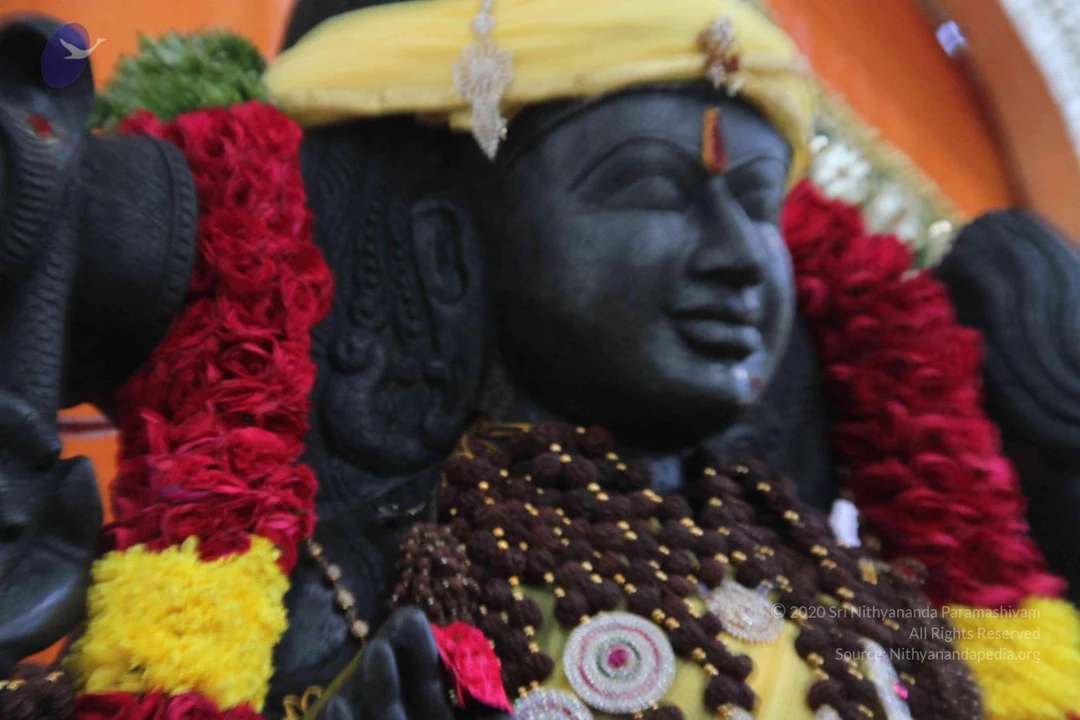
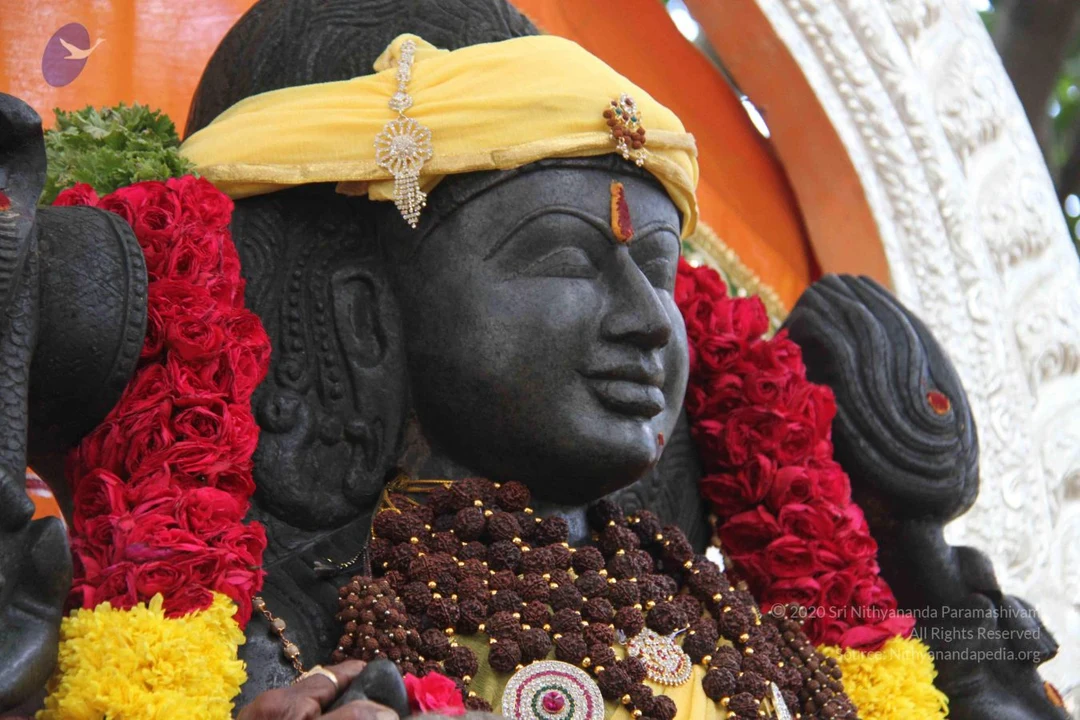
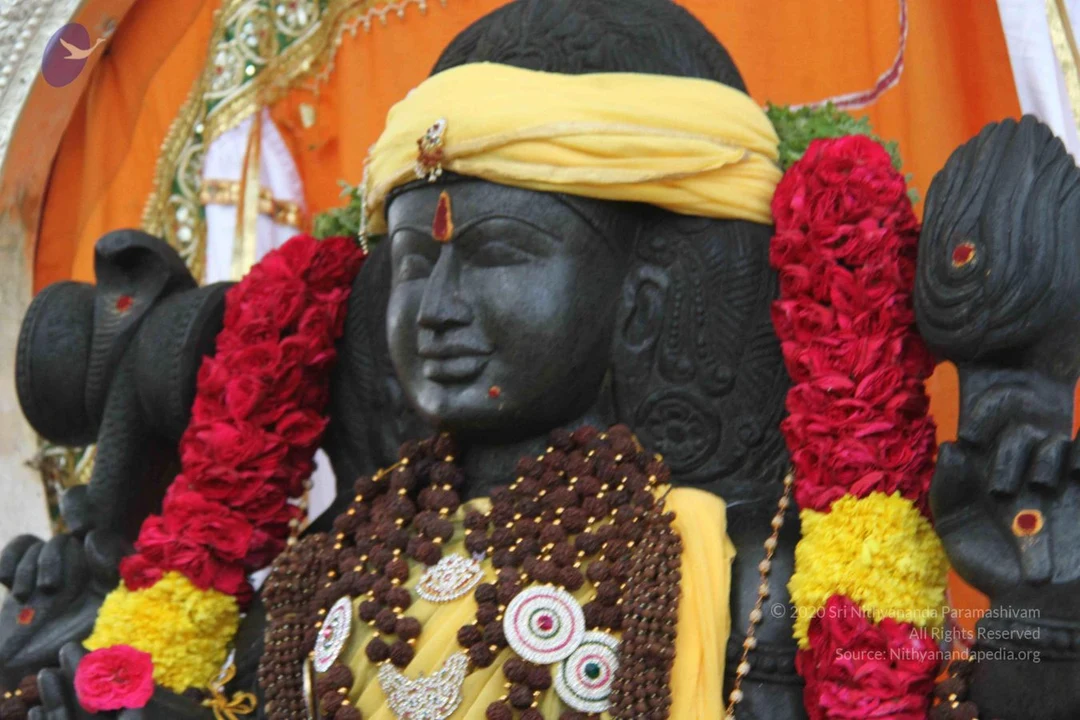
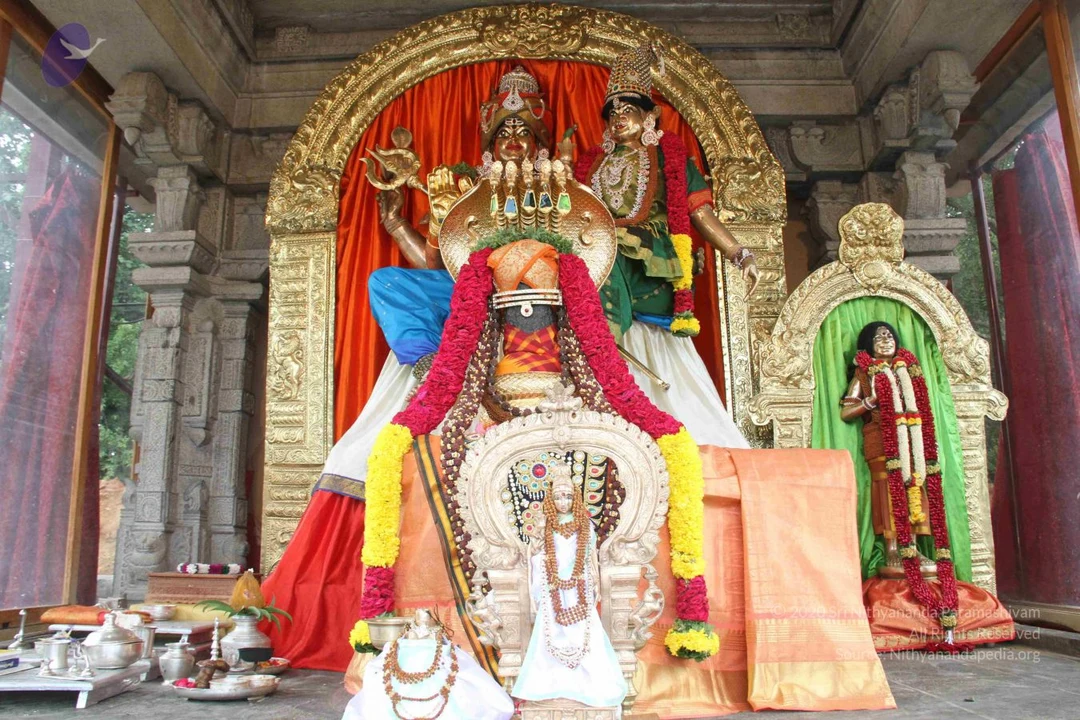
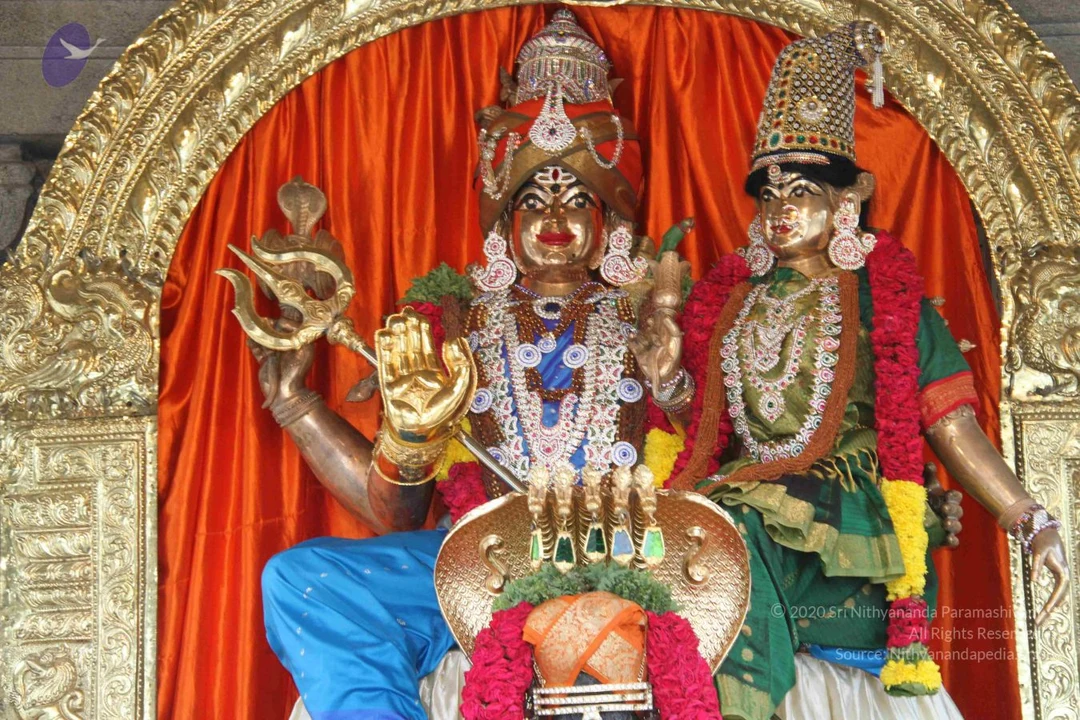
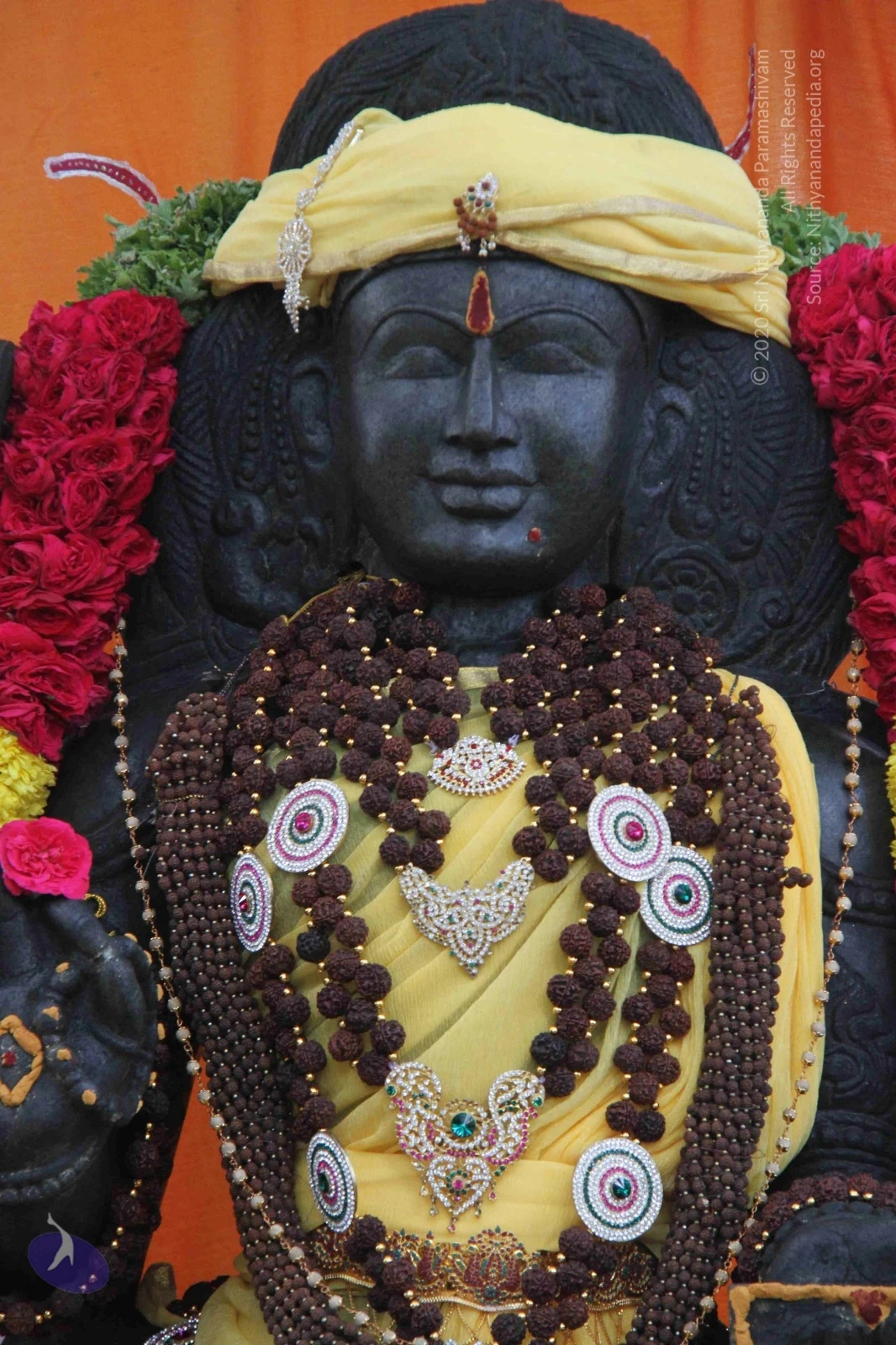
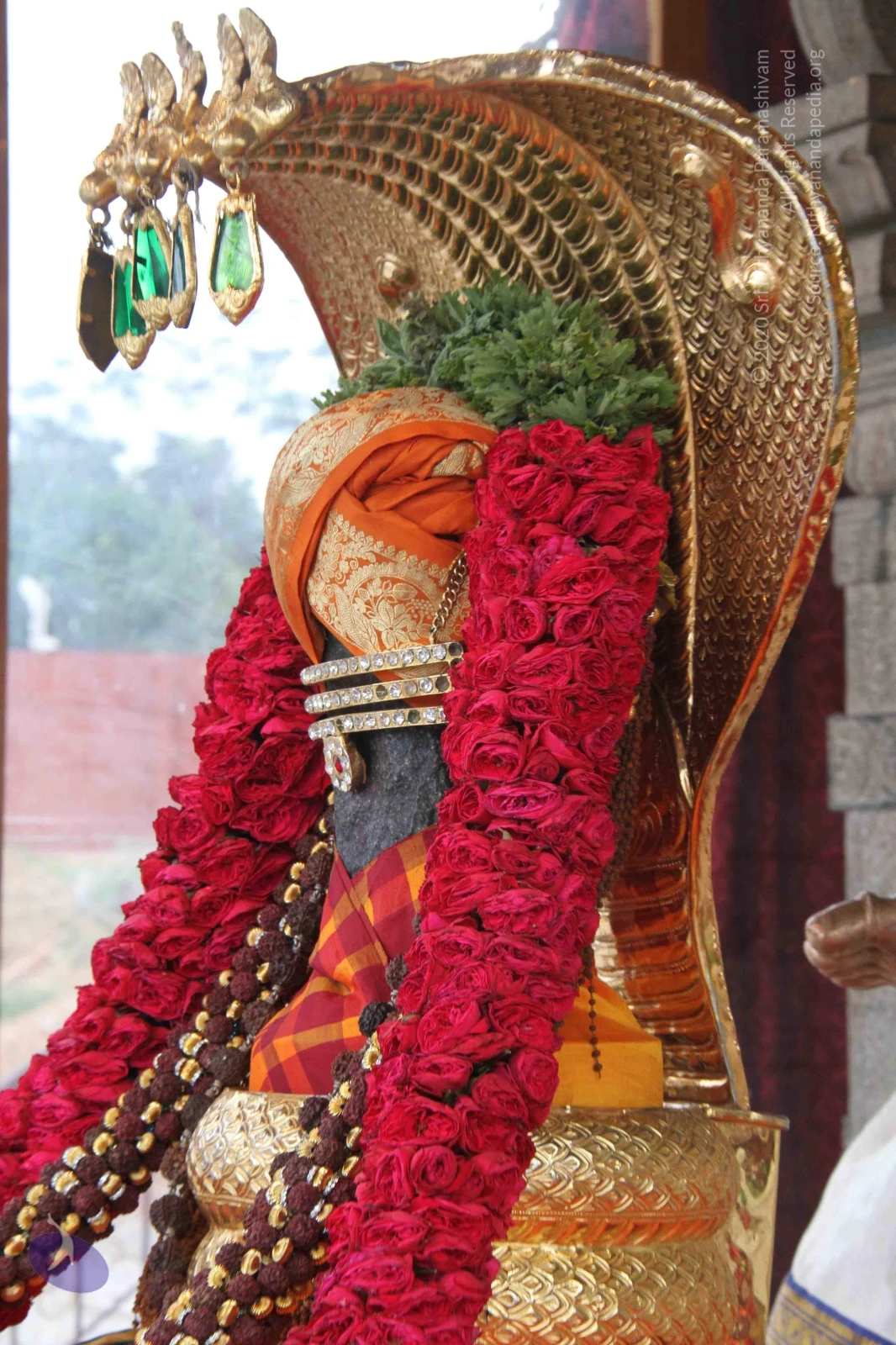
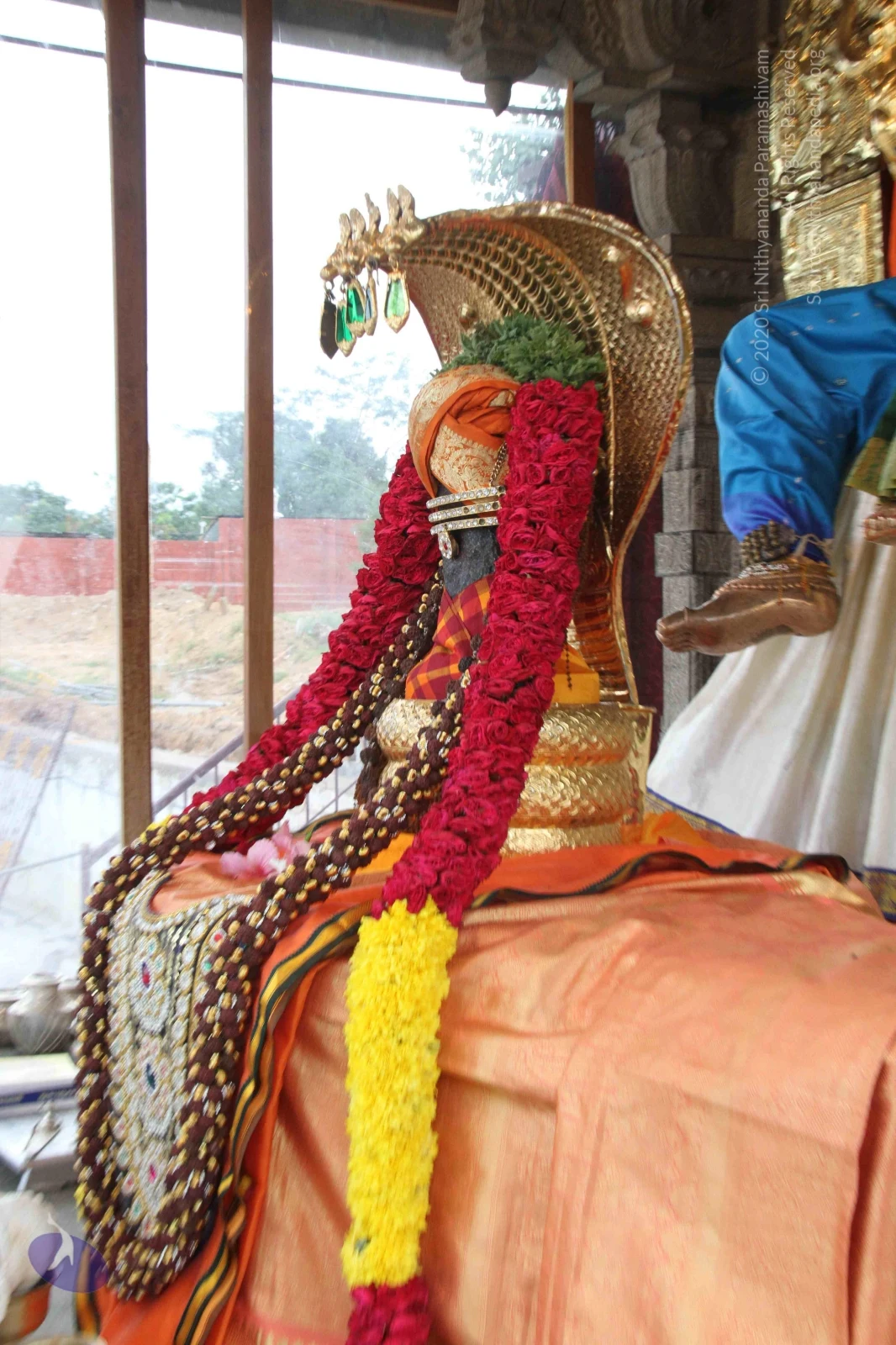
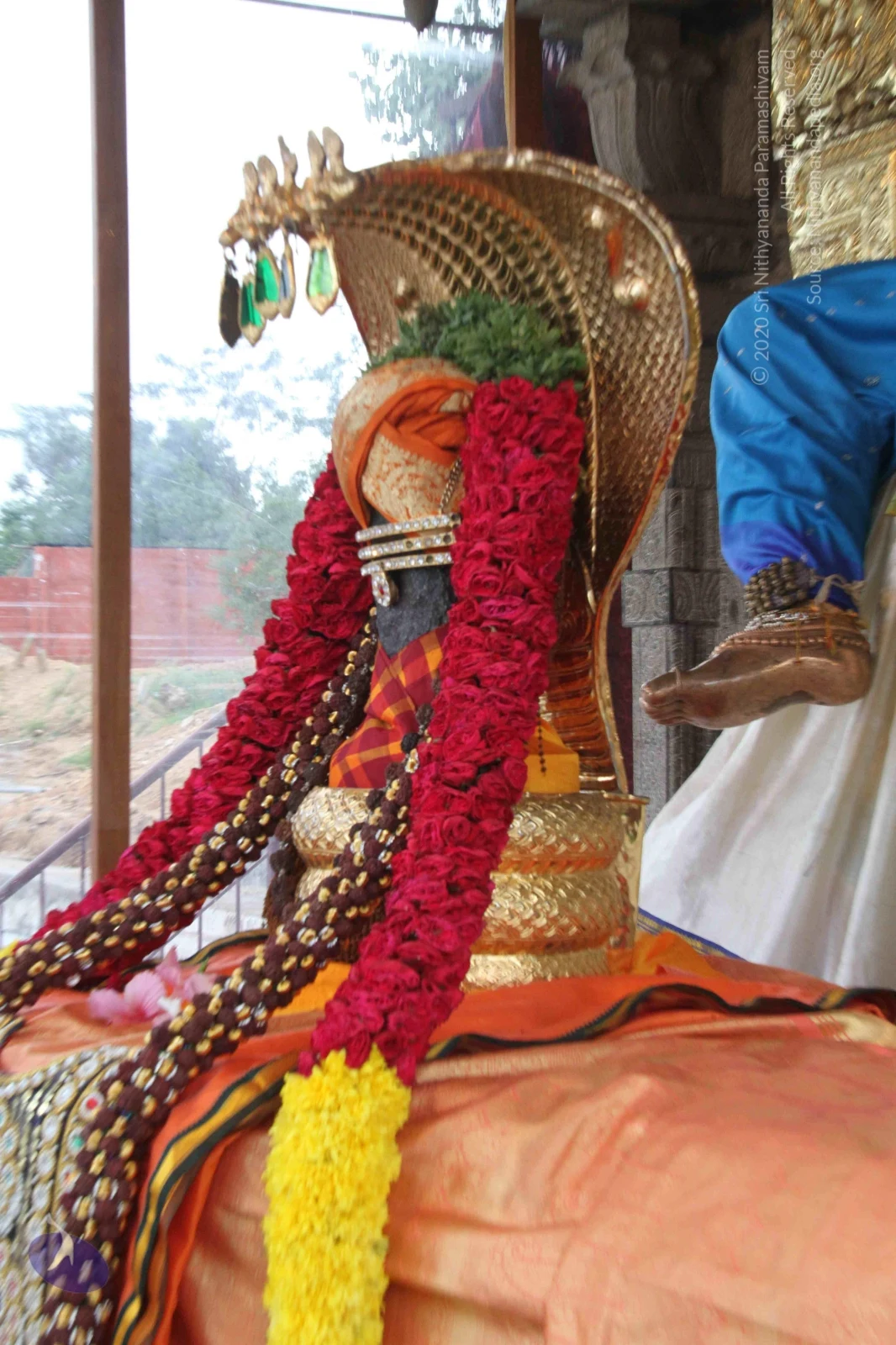
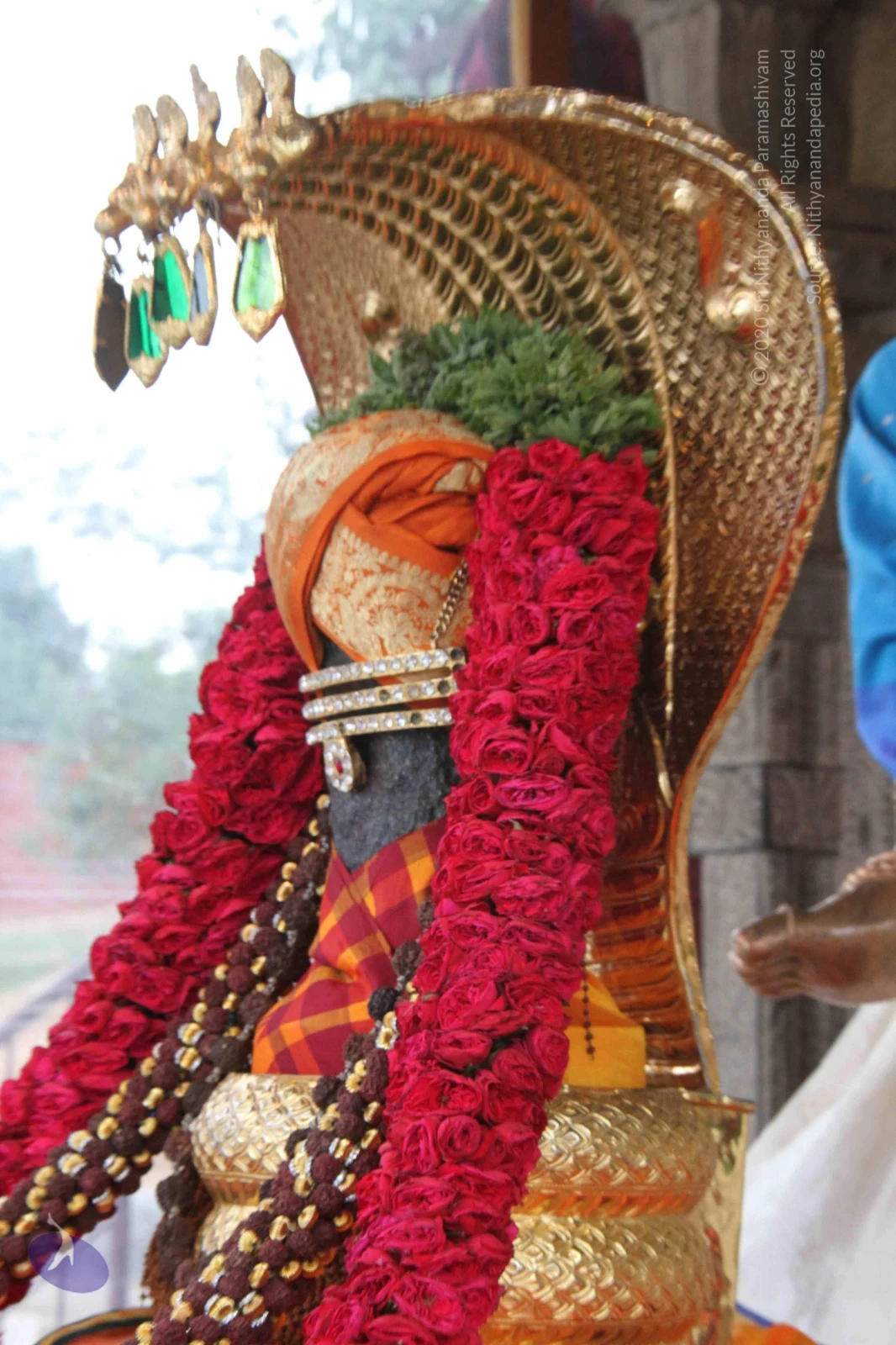
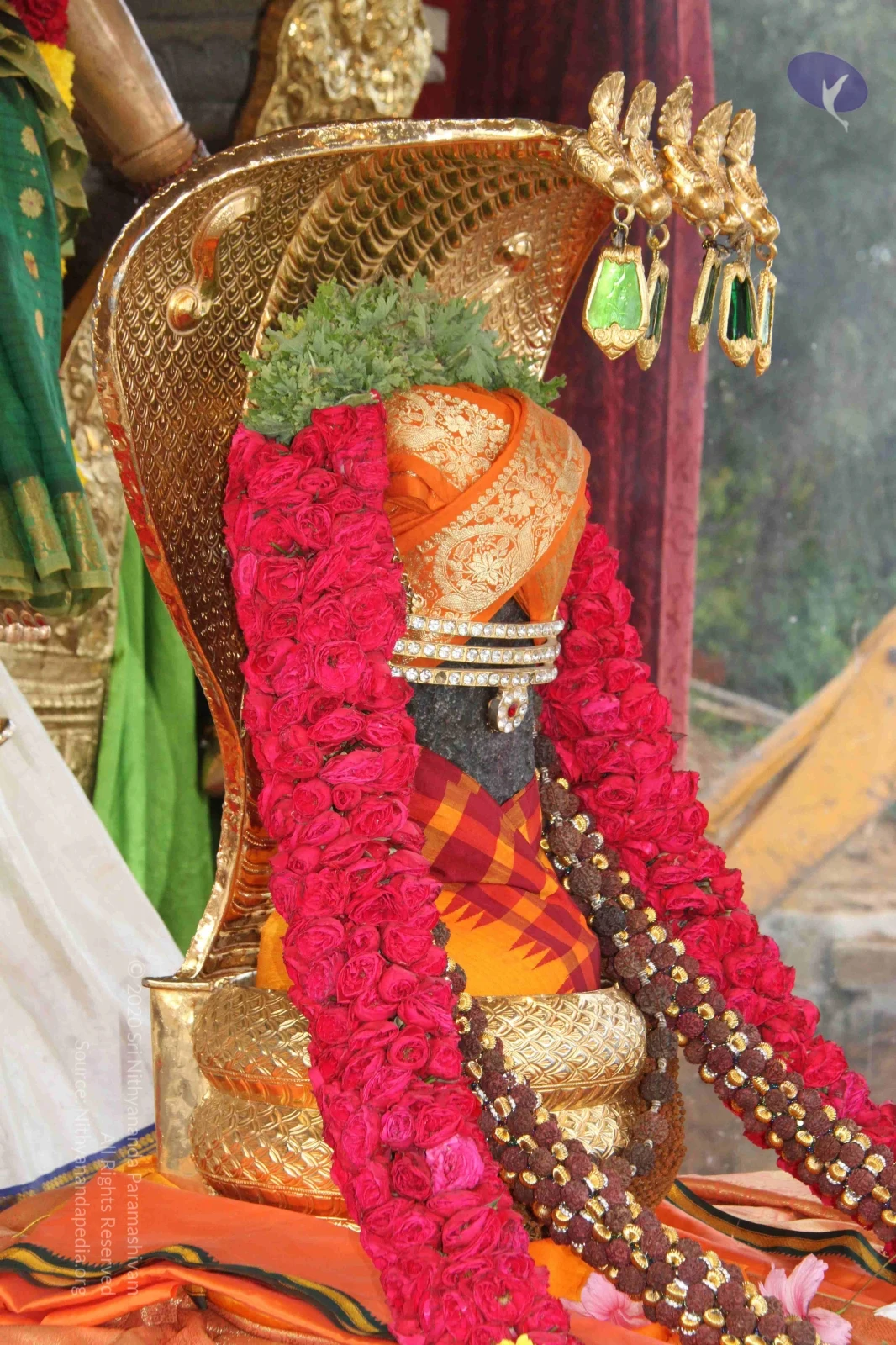
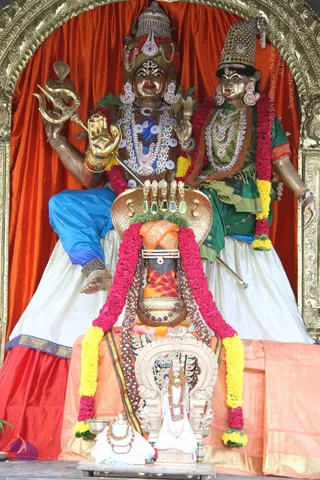
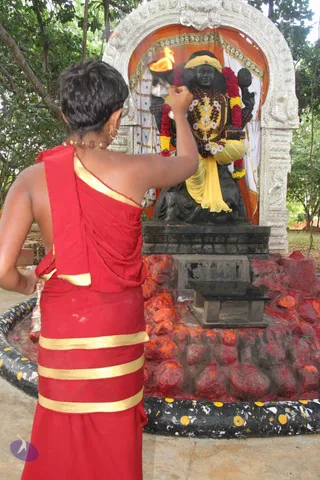
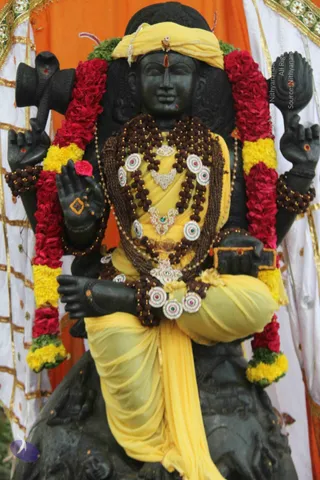
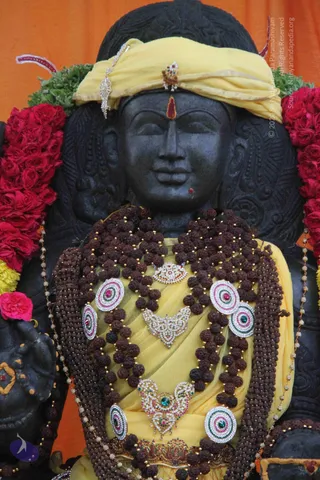
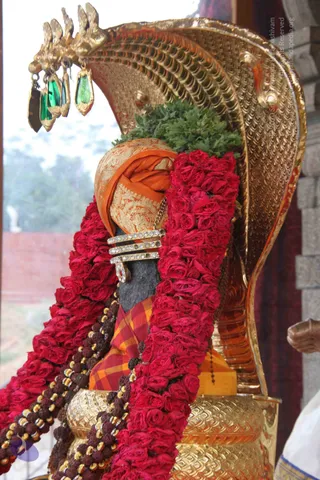
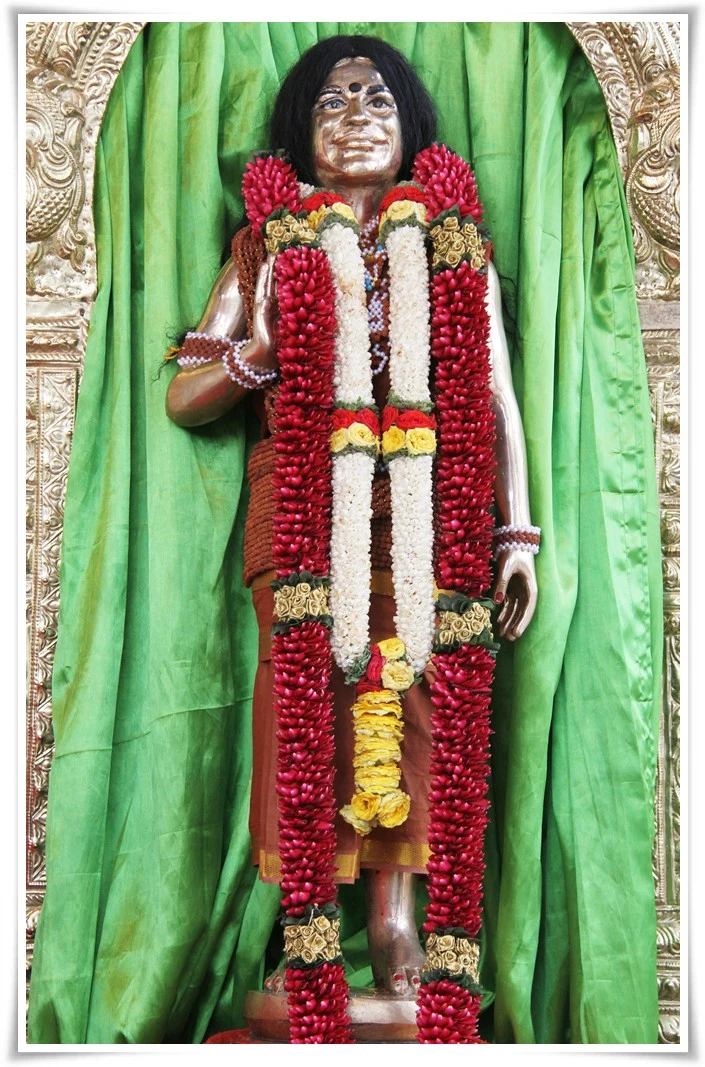
A photograph of a temple shrine featuring a large metal deity murti of a seated couple, a male figure with a trident and a female figure in a green sari-style dress, both adorned with garlands of red and yellow flowers, jewelry and ornate headdresses. In front stands a dark shivalinga-like object wrapped in an orange and red cloth, draped with rudraksha and flower garlands, with a small white figure and offerings on a silver pedestal beneath. The background is an orange curtain framed by a gilded arch. No people are visible.A temple shrine photograph showing a large metallic murti of Shiva and Parvati seated together against a red drape within a gilded arch. The Shiva figure holds a trident and wears a blue dhoti, rudraksha-style beaded necklaces and a crown; the Parvati figure wears a green sari and jewelled ornaments. In front, a black lingam is draped with an orange and red cloth, adorned with pink and yellow flower garlands, rudraksha mala and a horizontal white tripundra mark. Below, a small silver peetha holds a white-clad figure with rudraksha malas, and brass oil lamps stand in the foreground. No physical people are present.A photograph of an outdoor shrine in a garden setting with trees. A person seen from behind, with short dark hair, wears a red garment with gold borders and holds a lit oil lamp (aarti) toward a dark stone deity murti. The murti is adorned with a yellow cloth, red and yellow garlands, a rudraksha-style bead necklace and ornaments, set within a silver-framed arched niche with an orange backdrop. Red-stained stones and a small black stone altar surround the base.A large black stone statue of a four-armed deity murti seated on a dark base, adorned with red and yellow flower garlands, a brown rudraksha bead mala, and silver-and-gold ornaments with circular jewelled pendants. The figure wears a yellow cloth wrap and a yellow head cloth with a red tilak on the forehead. Behind it hang orange and white draped fabrics with gold trim. No physical people are visible; the figure is a sculpture.Close-up photograph of a dark black stone murti, a sculpted figure with a serene face, red bindi and red dot on the forehead, wearing a yellow turban with a jeweled brooch and a yellow draped cloth. The figure is adorned with multiple layers of brown rudraksha malas interspersed with gold beads, along with ornate white and jeweled pendants and circular medallions set with pink, green and white stones. Red and pink roses and green leaves form garlands around the murti against an orange backdrop. No physical people are visible; the figure is a statue, not a living person.Close photograph of a deity murti, a dark stone form, dressed for worship. It wears an orange and gold brocade cloth wrapped around its head, a red-and-yellow checked cloth draped across its body, and thick garlands of red roses that hang over both shoulders. Rudraksha beads strung with gold spacers hang on the left. A gold cobra hood with a green-gemmed ornament arches above it, and green leaves are tucked behind the head. A gold-patterned base with a band of white stones sits below.
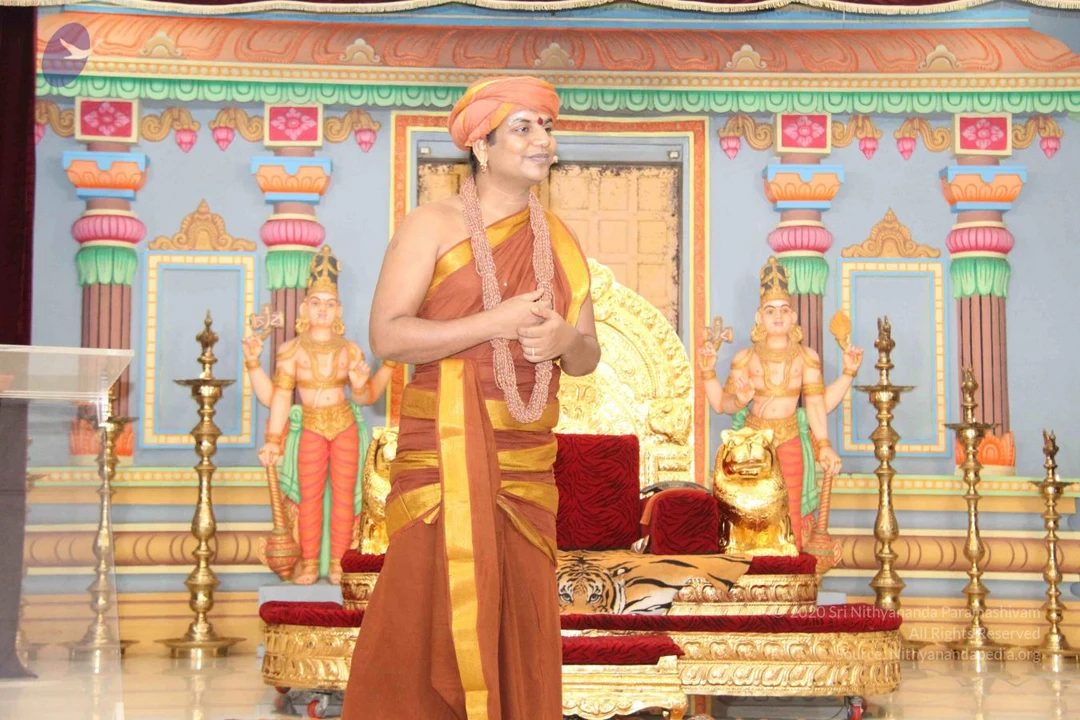
04-Nithya-Satsang
16 photosSource gallery
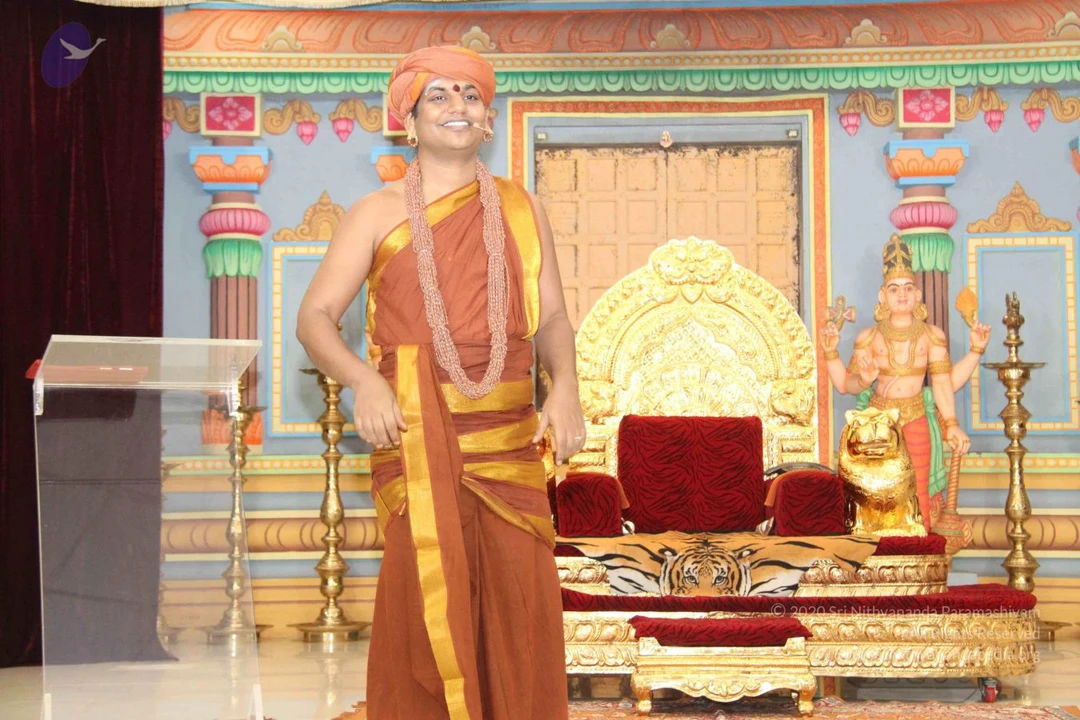
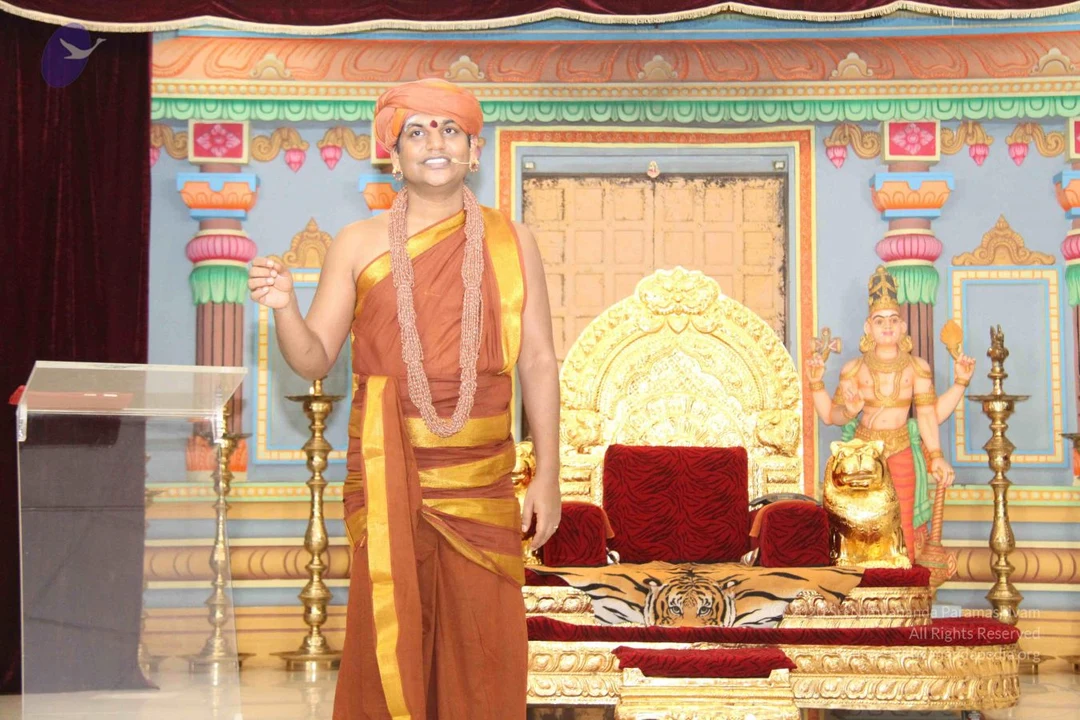
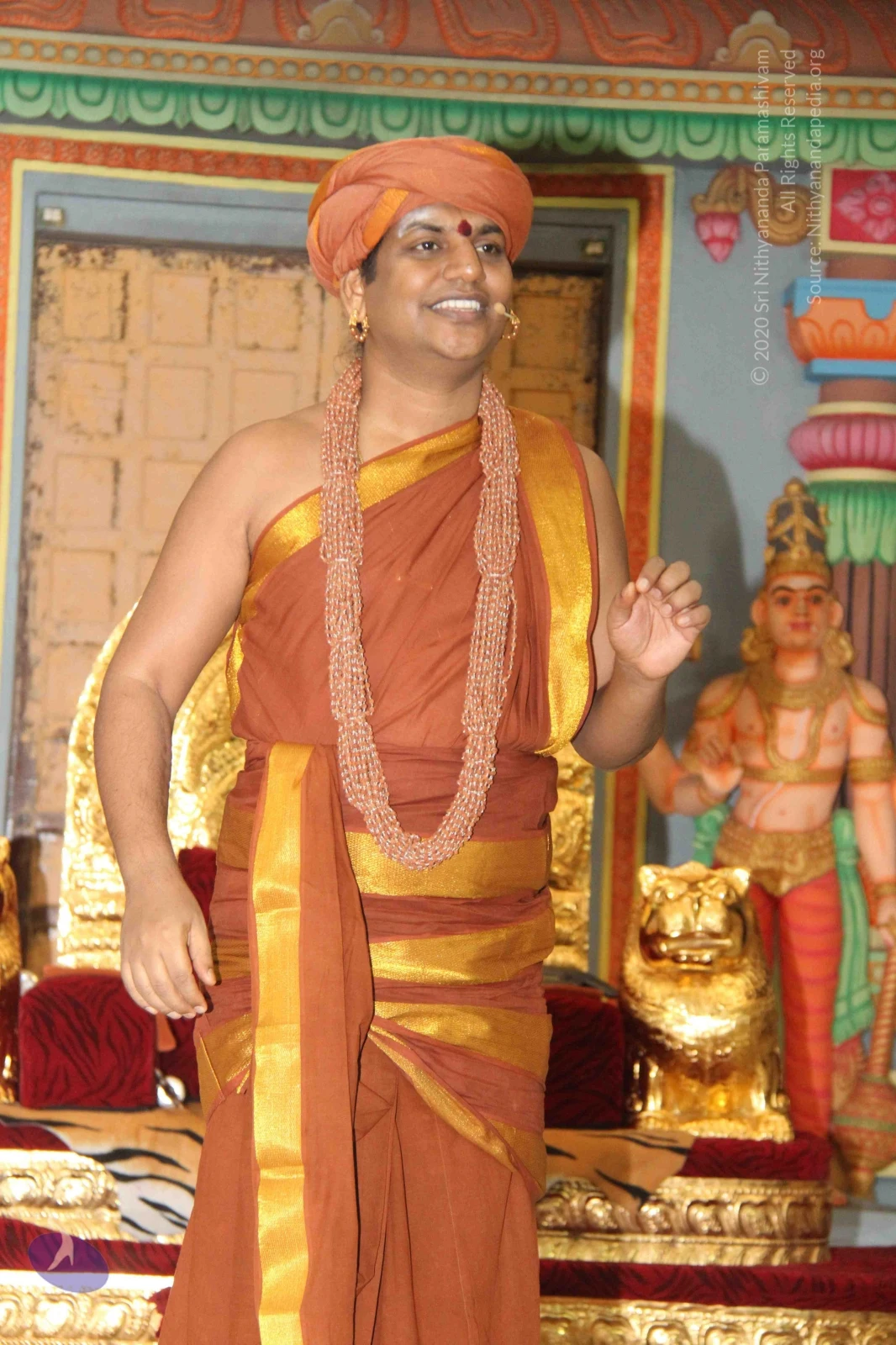
A standing man in an orange-brown turban and matching brown-orange dhoti-style robe with gold borders speaks beside a clear acrylic lectern, wearing a headset microphone and a long rudraksha-style bead mala across his chest. A red bindi marks his forehead. Behind him stands a painted deity murti with four arms, holding a flame in one raised hand and gold ornaments, beside a gold lion-form throne with red velvet cushions and a brass lamp stand. The setting is a stage with decorative pillars in pink, green and blue. The man's appearance matches the Swamiji (probable) cues of orange ornate attire, turban and rudraksha mala, so he is a candidate in person.Photograph of a man speaking at a clear acrylic lectern, wearing an orange-saffron turban with a small red bindi, gold hoop earrings, a small headset microphone, and a bare-shouldered red-brown and gold-bordered garment with multiple strands of reddish-brown beaded mala necklaces. His hands are clasped in front of him. Behind him are a dark red curtain and a decorative pillar with pink and green petal-like tiers. Appearance-based label: a person, in a speaking discourse setting.A man stands behind a clear acrylic lectern at a satsang, hands clasped on the podium. He wears an orange turban, a red bindi, gold drop earrings, a small headset microphone, a multi-strand rudraksha mala, and an orange-and-gold silk garment with a bare shoulder. Behind him are a dark red curtain and a pink-and-green decorative pillar, with a brass lamp at the right edge. Appearance cues are consistent with a person, presenting the discourse, though the face is not used for identification. One person is visible.A man stands on a stage in a saffron-orange turban and an orange-and-gold draped robe with gold borders, wearing a long beaded rudraksha-style mala and a small gold earring with a microphone. He smiles and gestures with one hand while speaking to an audience. Behind him is a painted temple-style backdrop with a gilded lion sculpture and a painted deity figure holding a staff, with red and gold cushioned seating in front. The page indicates a person speaking event; based on the man's saffron turban, long mala and ceremonial gold ornaments, he appears to be a person as the speaker on stage.A smiling man stands on a stage in front of a gilded throne with red velvet cushions and a golden lion figure, with a painted deity statue beside him holding a mace. He wears an orange-red turban with a red tilak on the forehead, an orange-red robe with gold borders wrapped around the body, and a long pink-beaded mala around his neck, and he has small gold earrings. His hands are open in a gesture of speaking. Swamiji (probable) appears in this photo: he is wearing a saffron-orange turban and robe with gold trim, a rudraksha-style mala, and ceremonial adornments on a stage with a throne. The pictured man is the only physical person visible.A smiling man in an orange-red turban and saffron-brown draped robe with gold borders stands with open palms, speaking, wearing a long beaded rudraksha-style necklace, gold earrings and a red bindi on his forehead. Behind him stands a golden ornate throne with red and tiger-striped cushions, a golden lion figure, and a painted deity murti with a crown and raised arm holding a staff. The scene resembles a discourse stage. a person appearance cues: saffron-orange robe and turban with a rudraksha-style mala, though the figure is not confidently identified.

September 19 2013

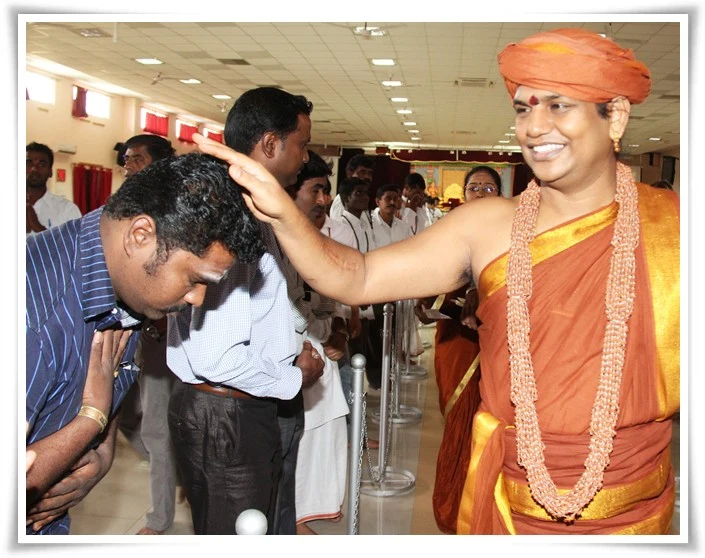
2 photosView all

A photograph of an indoor hall with white ceiling lights and red curtained windows. A person in an orange-saffron turban and orange-and-gold robe with a long pale beaded mala smiles while placing a hand in blessing on the head of a man in a blue striped shirt who bows forward with palms pressed together. Other devotees in white shirts and white dhotis stand behind a metal barrier rail, and women in saffron and pink saris are visible on the right.This is a bar chart graphic titled "IA SEP -2013 Health Recoveries" showing recovery percentages for six conditions. Orange vertical bars show Chronic Headaches at 100%, Cigarettes at 100%, Migraine at 100%, Panic Attacks at 97%, High Blood Pressure at 10%, and Posttraumatic Stress Disorder (PTSD) at 10%. The chart has a white background with category labels along the horizontal axis and no people or a person depicted.