Skip to content
Tuesday

7 May 2013

Dated photos
201
Source pages
1
Media
3
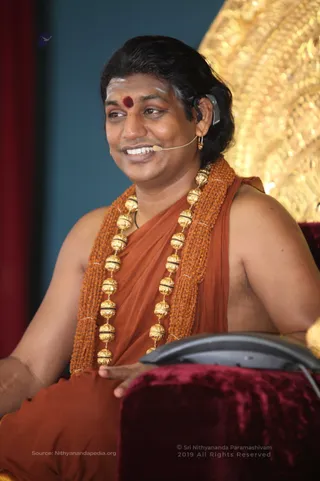
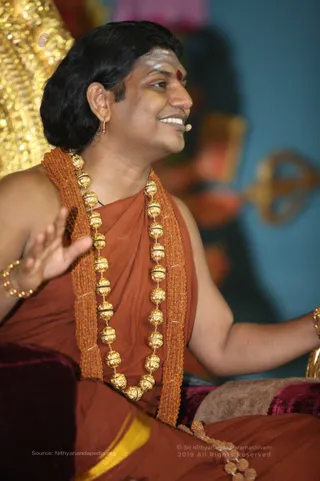
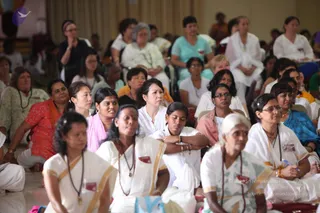
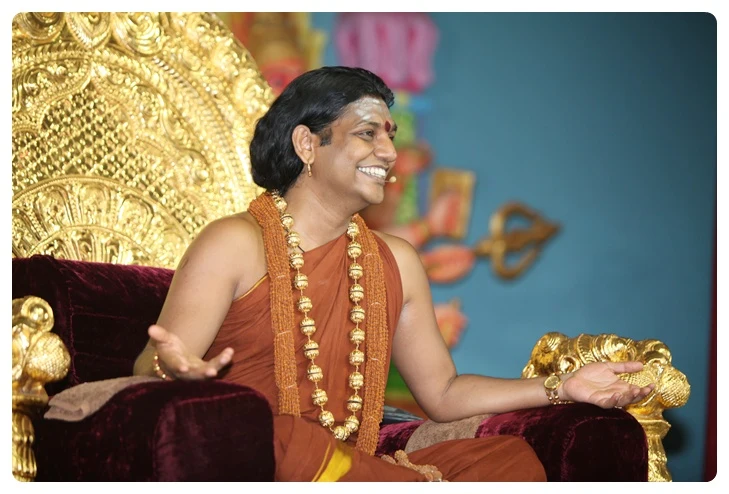
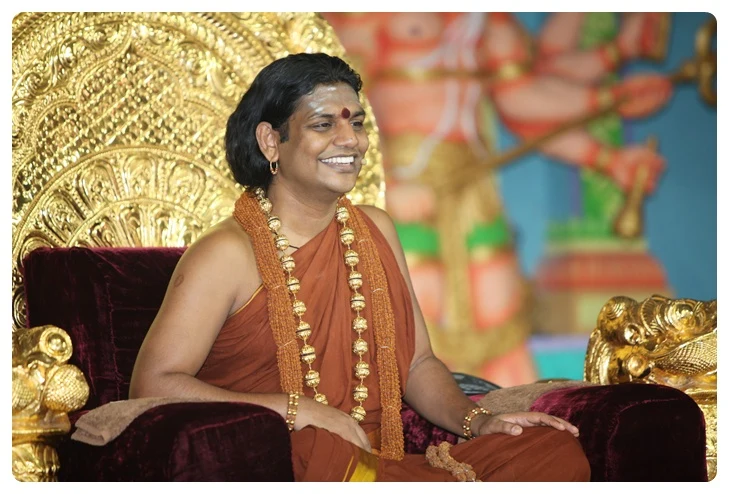
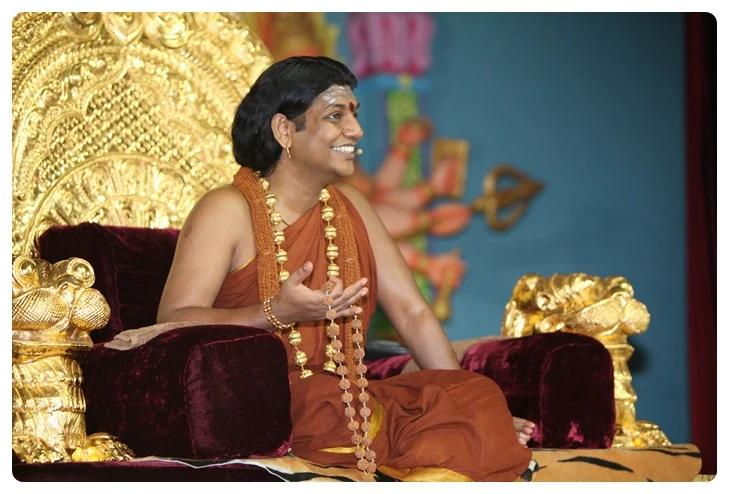
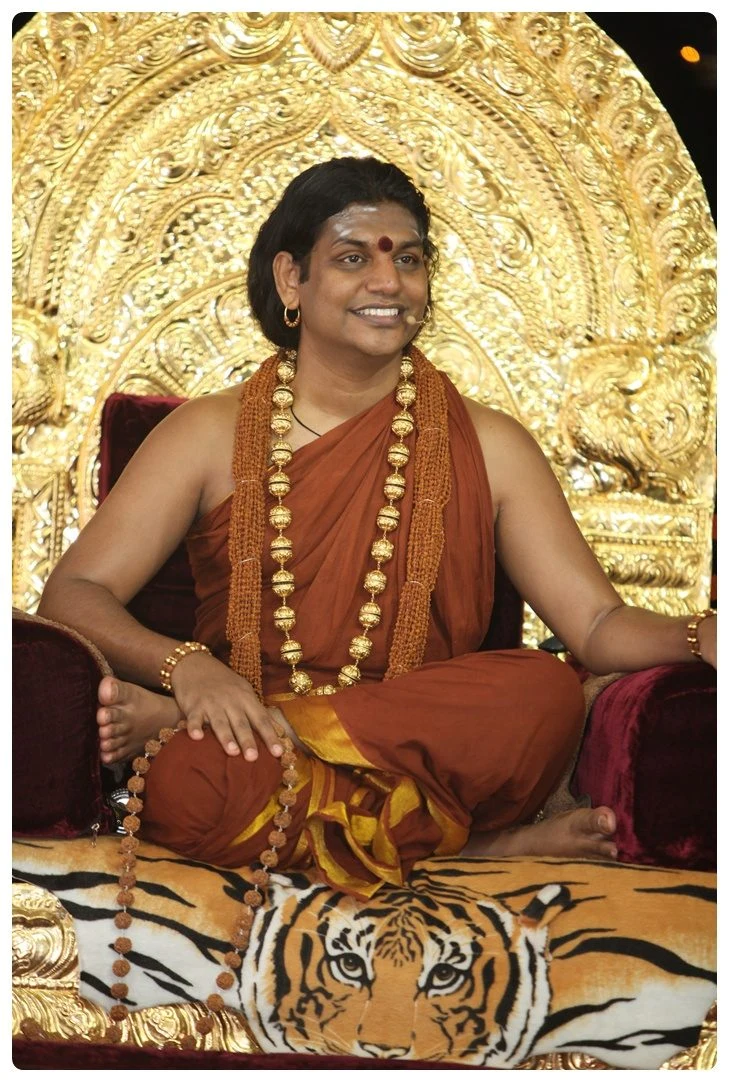
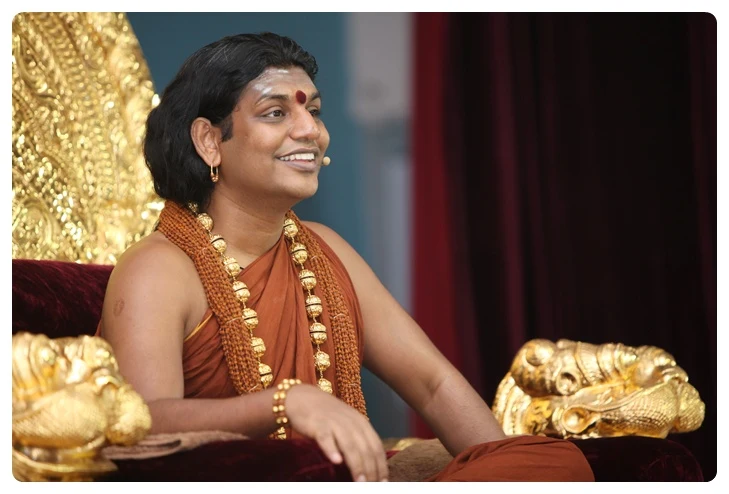
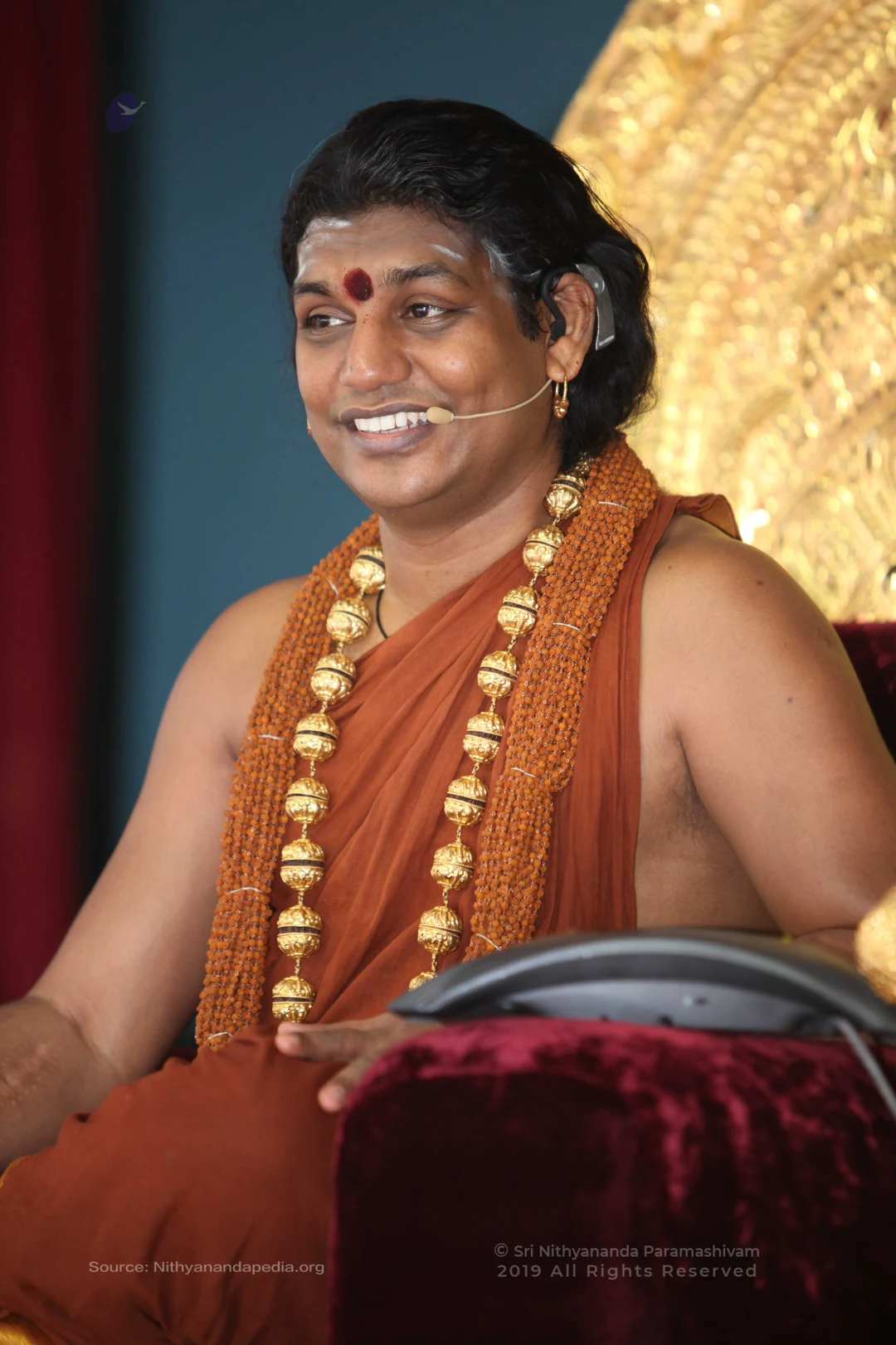
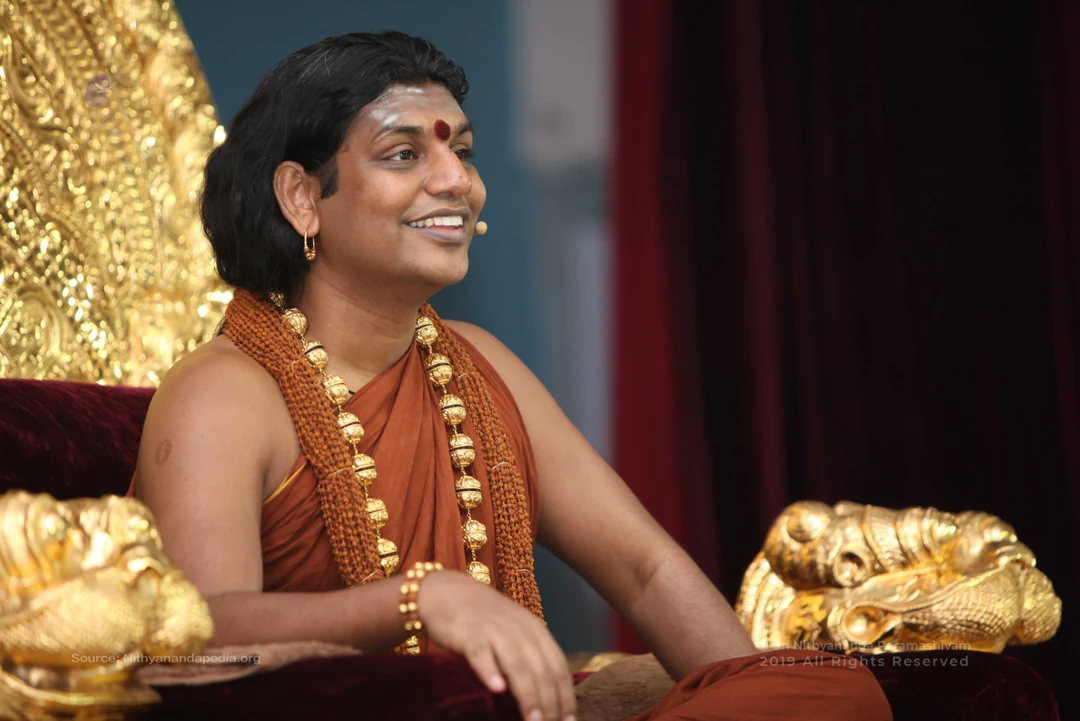
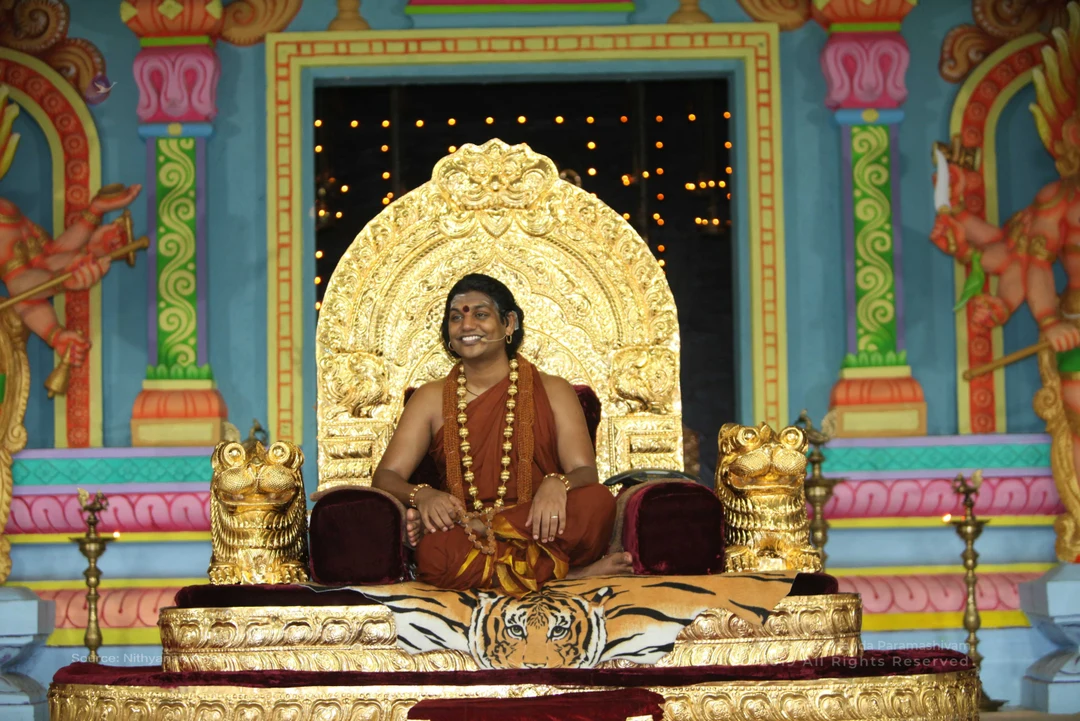
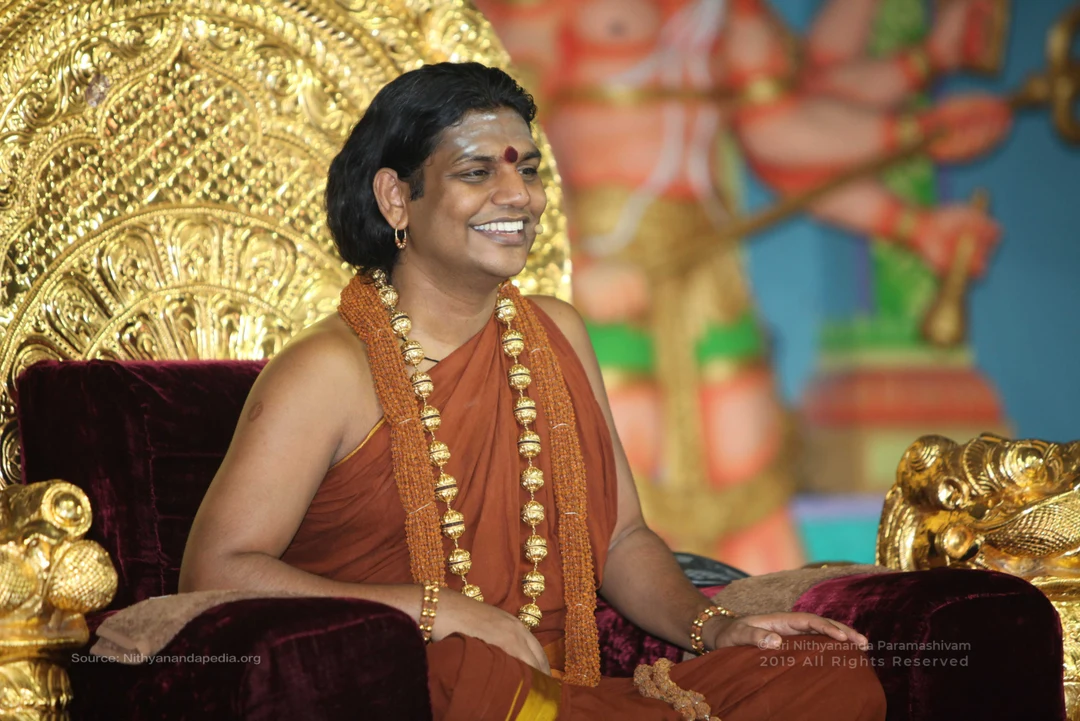
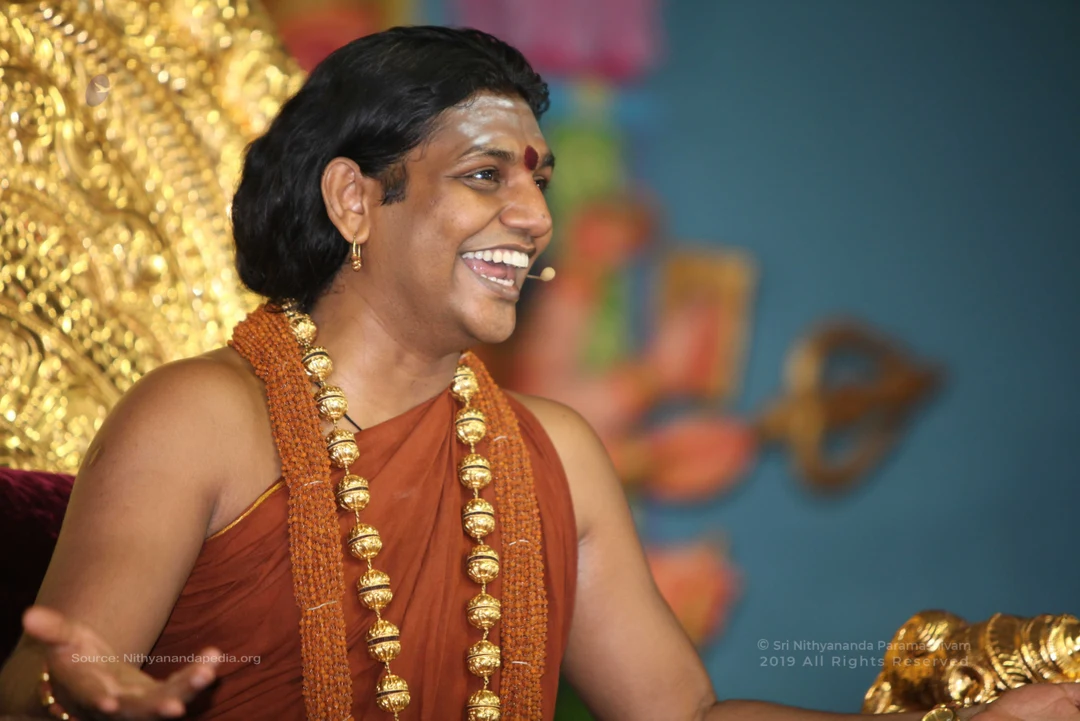
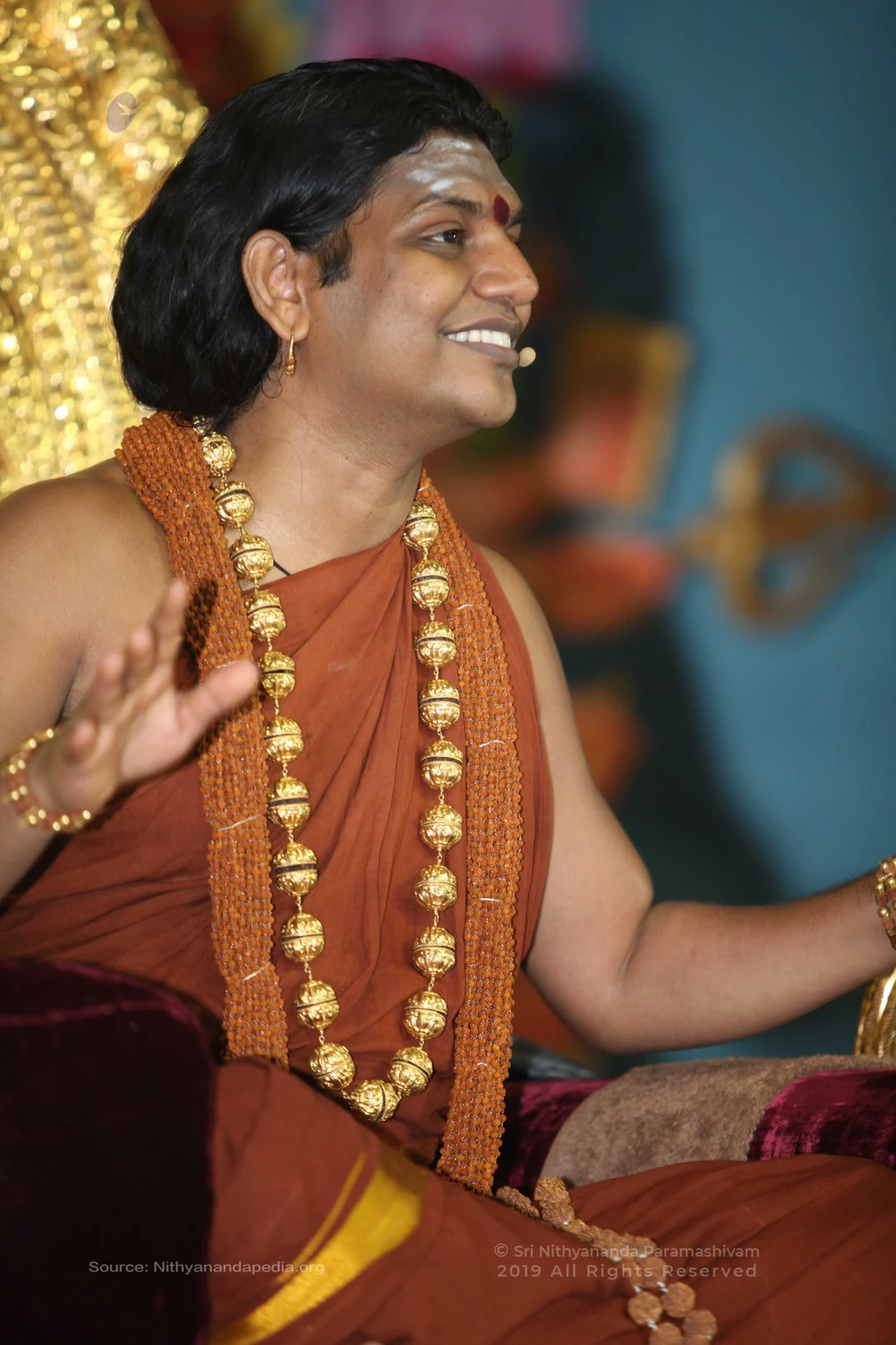
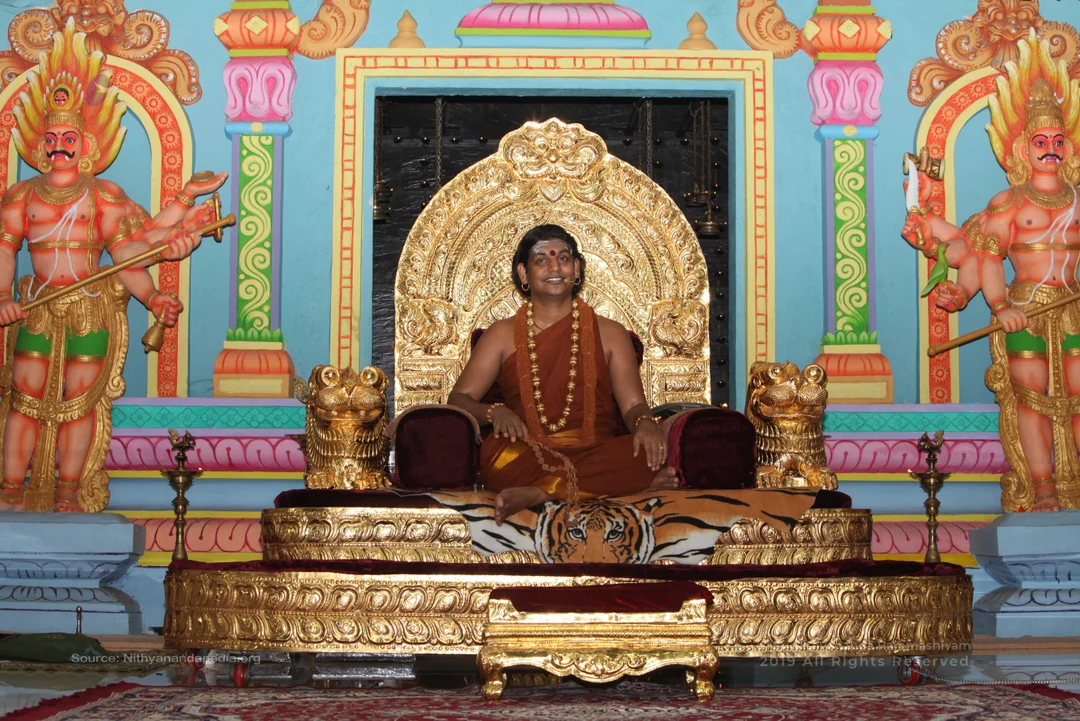
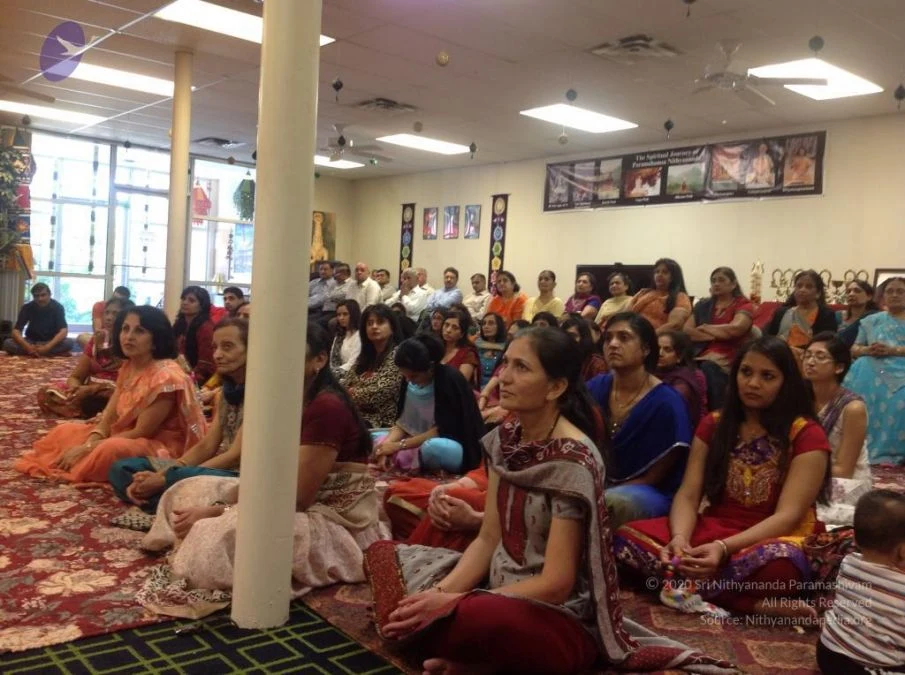
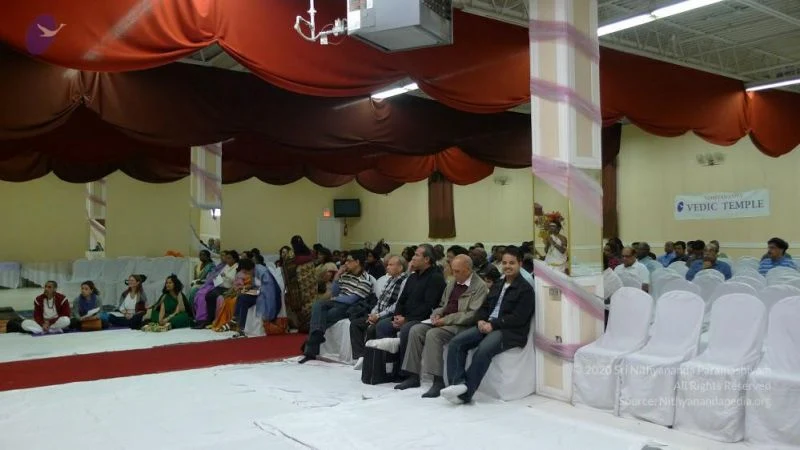
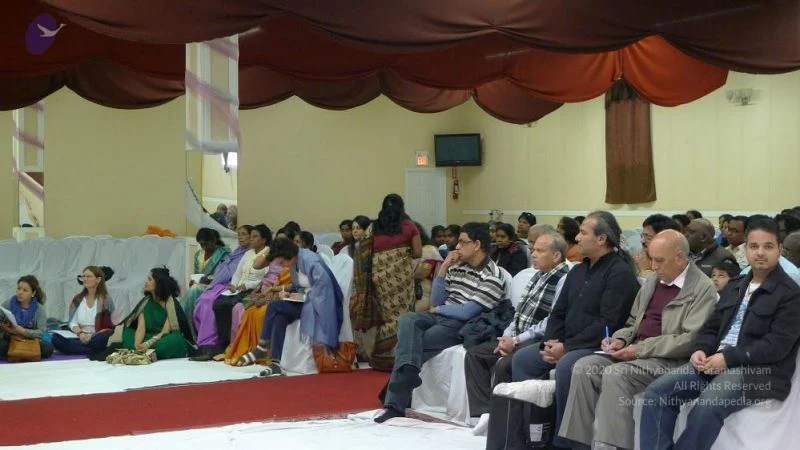
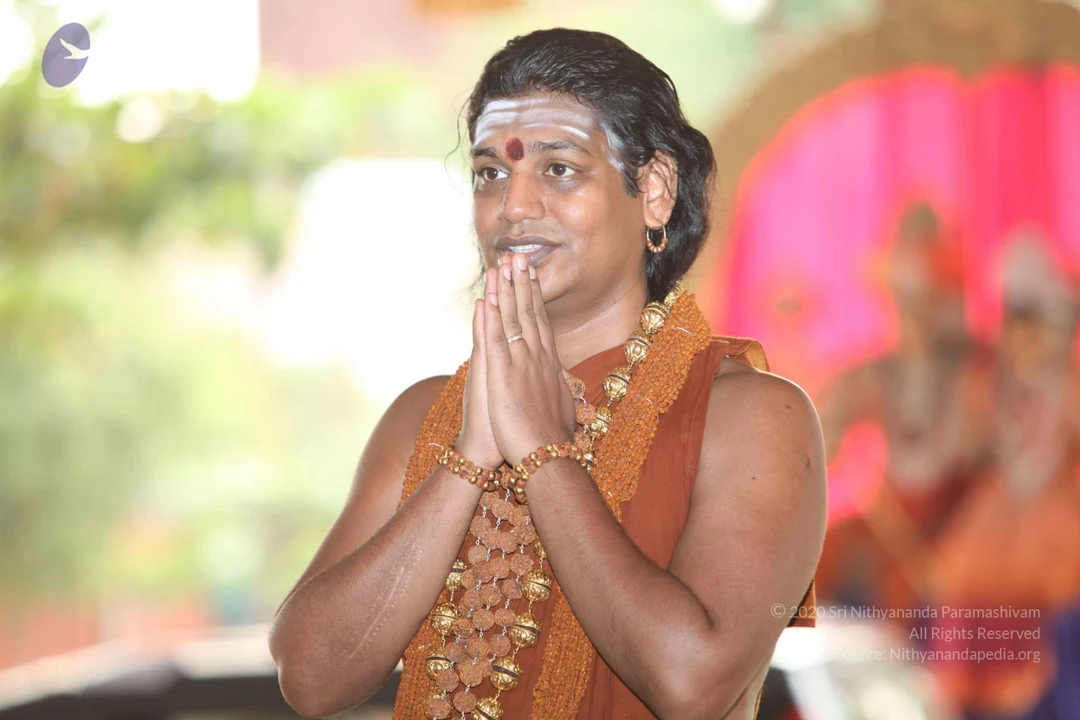
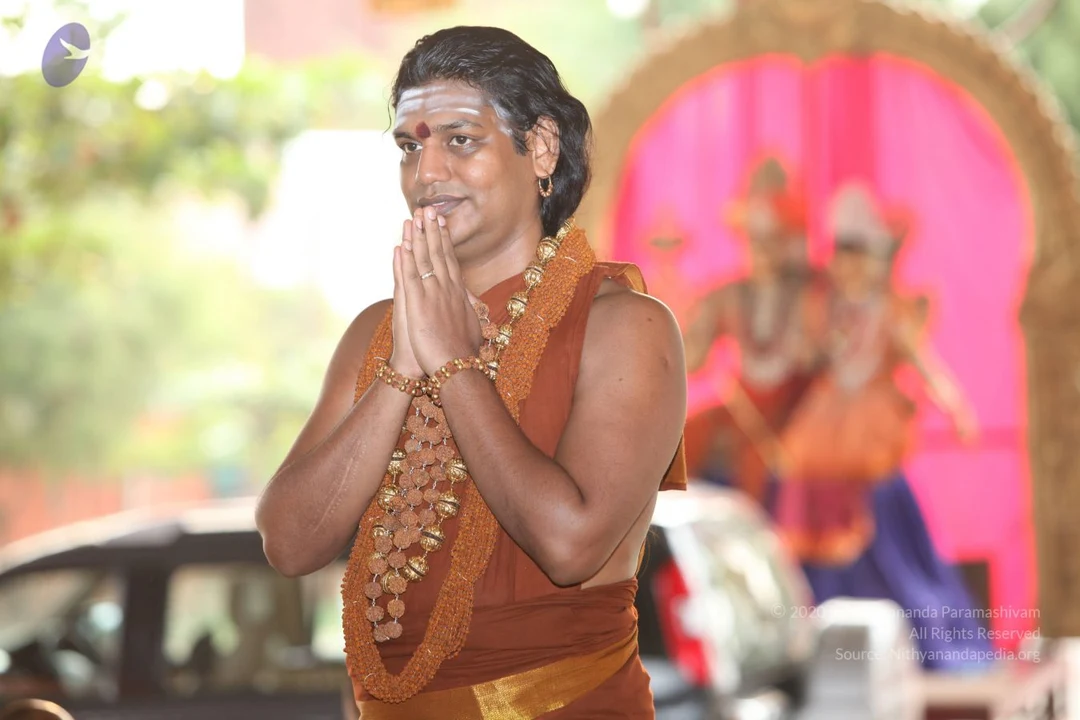
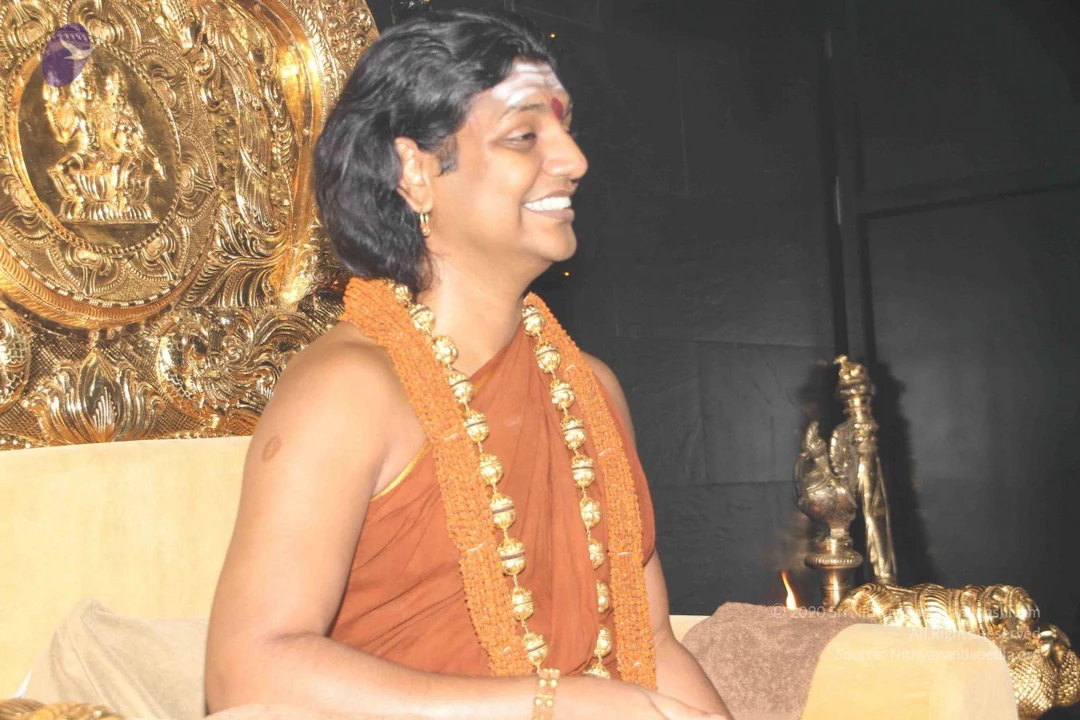
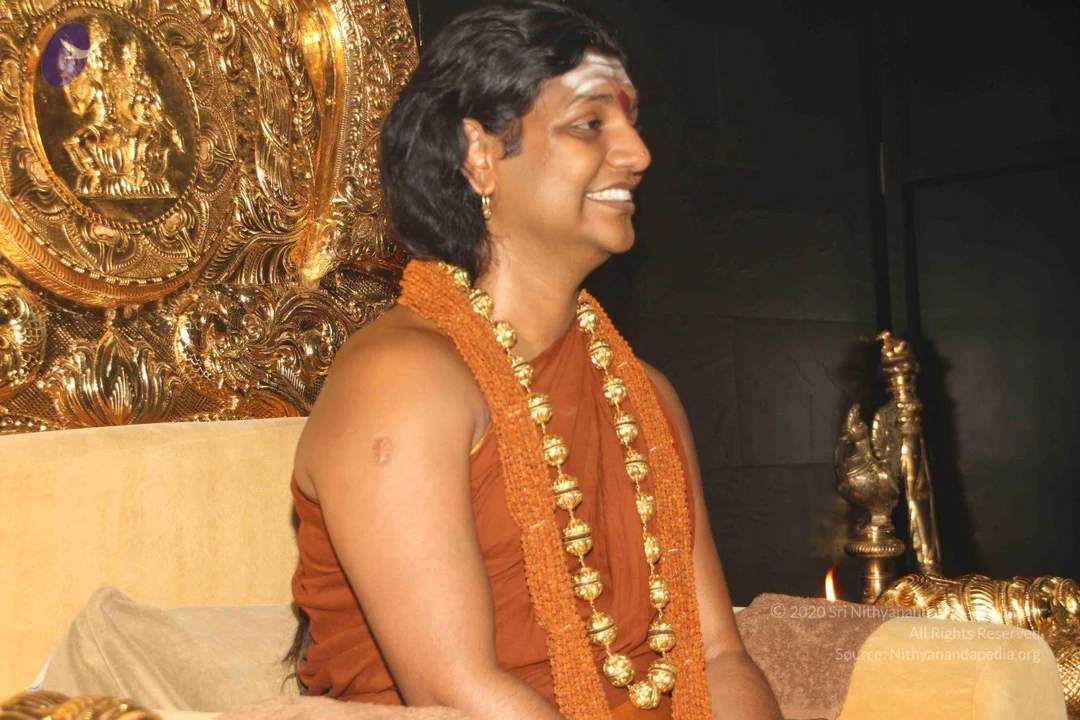
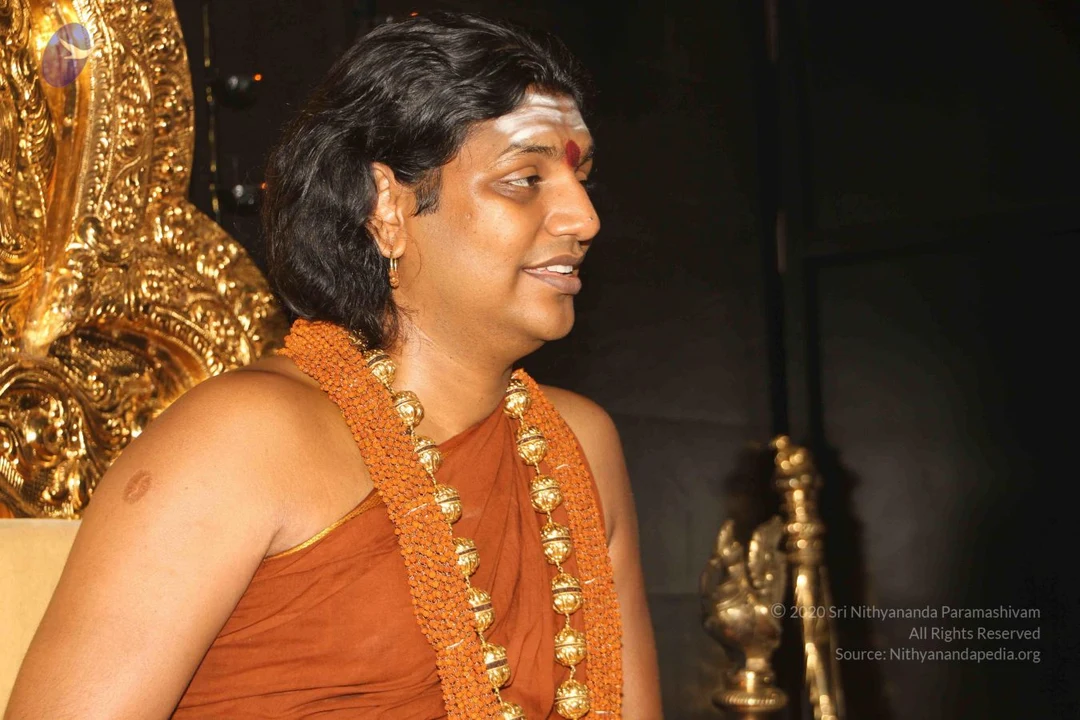
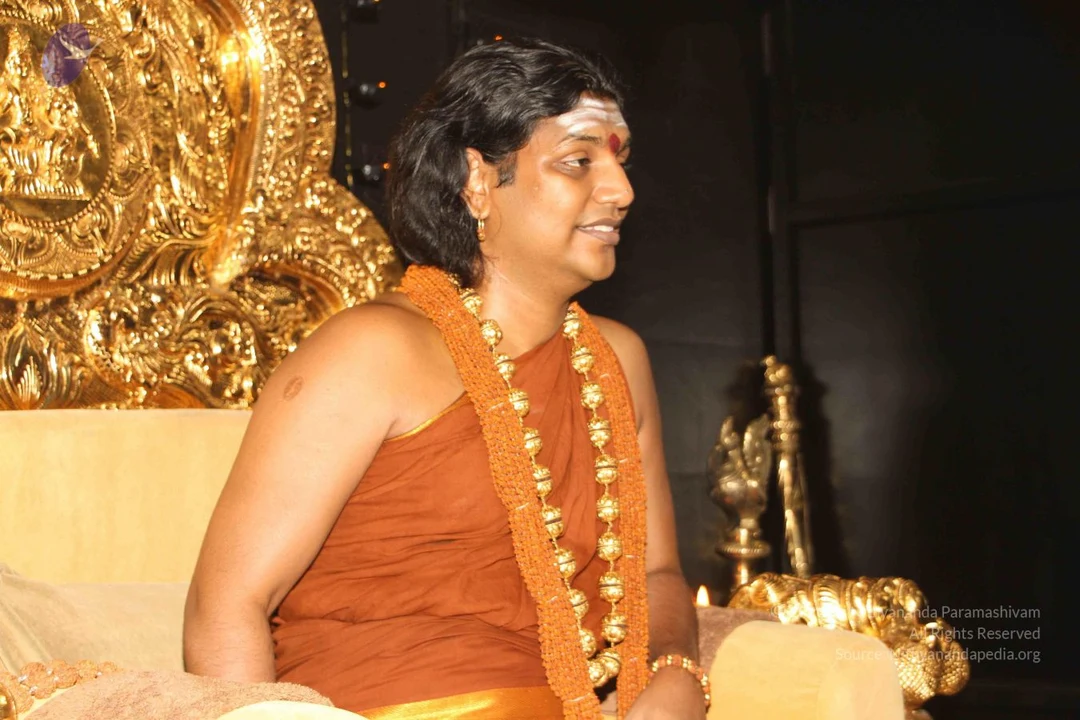
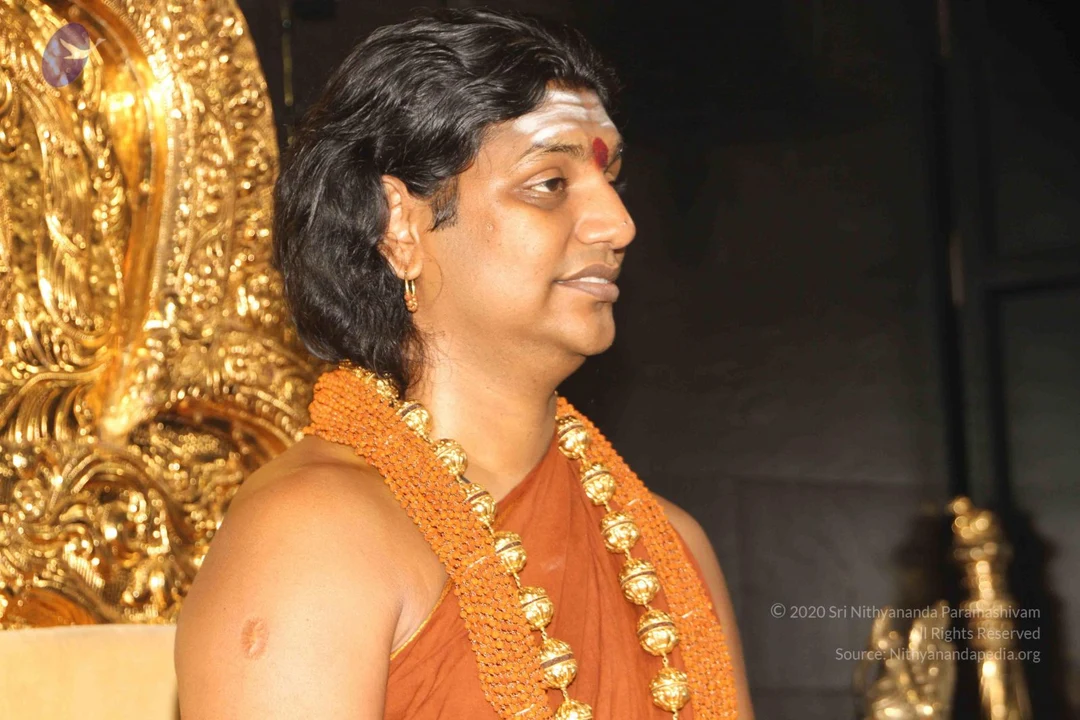
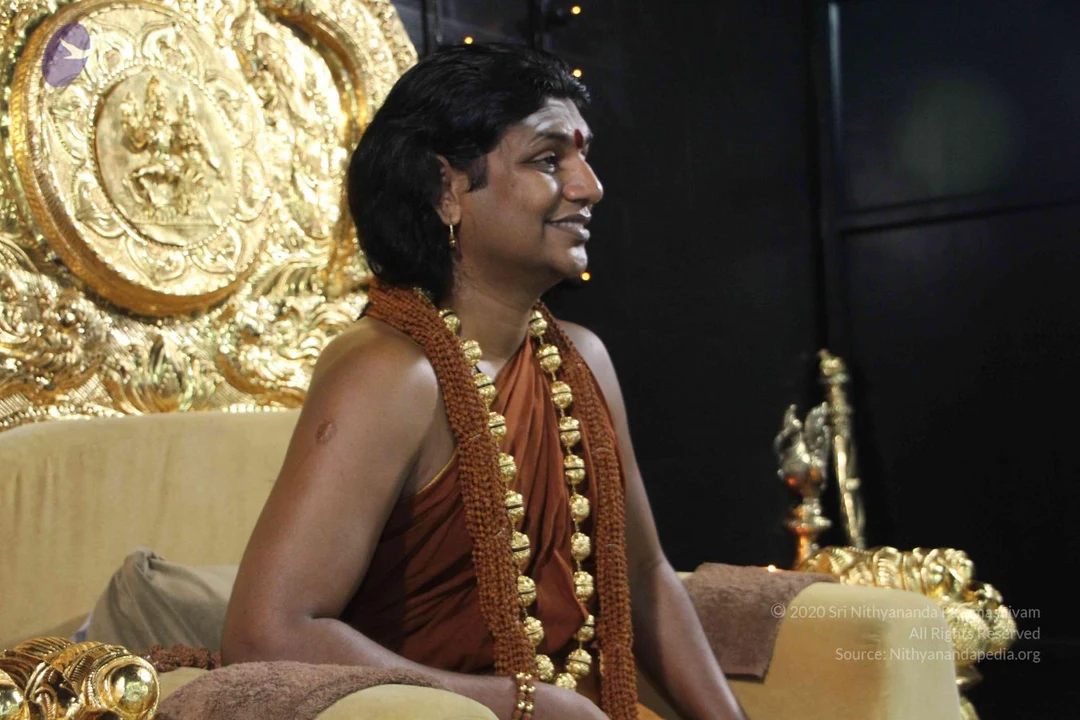
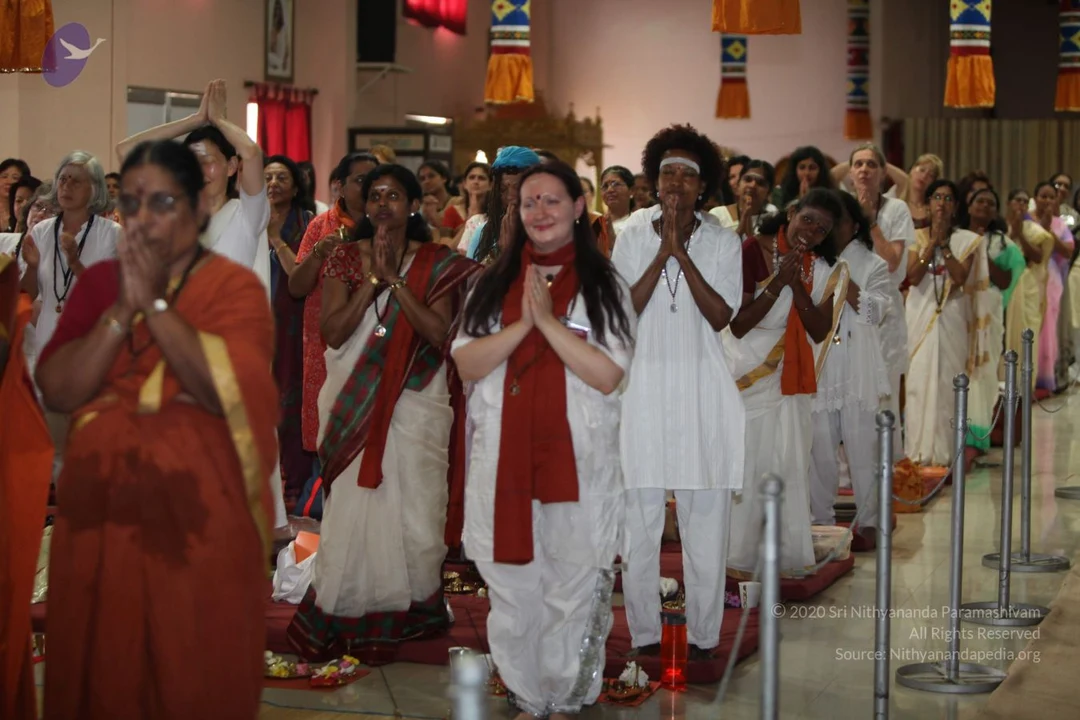
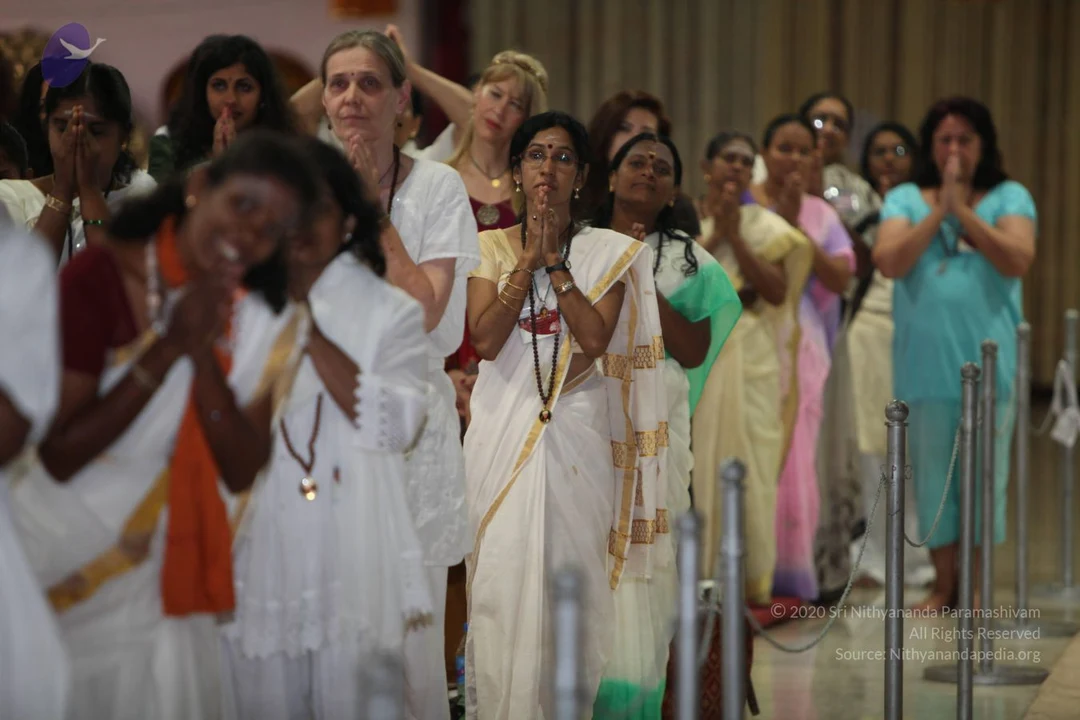
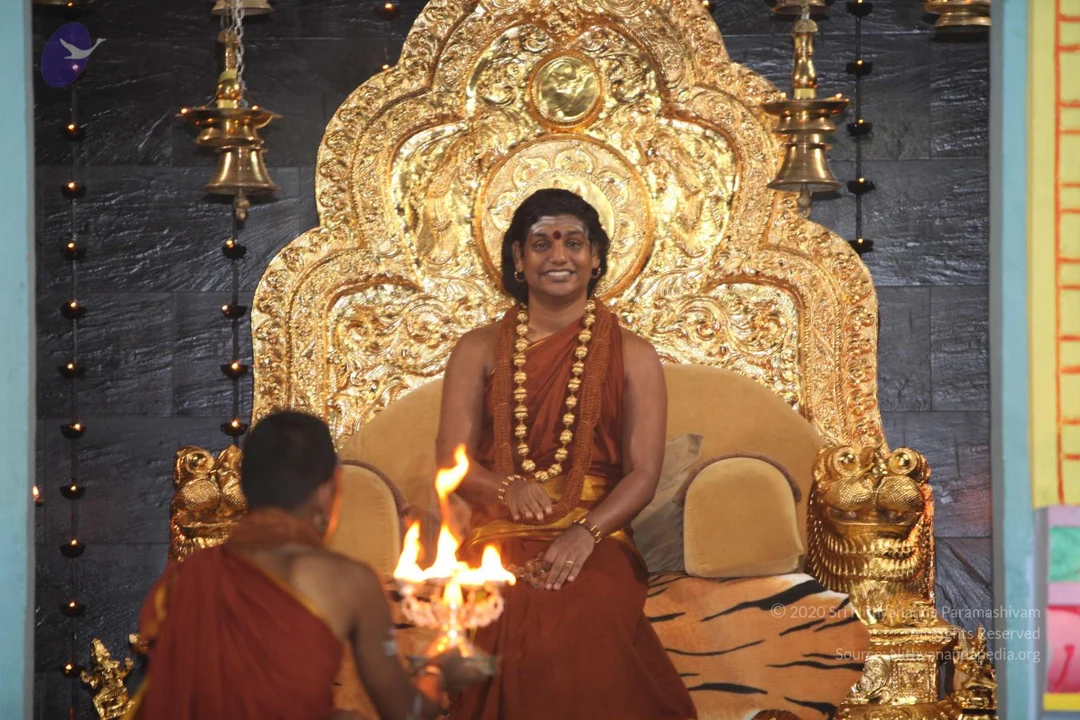
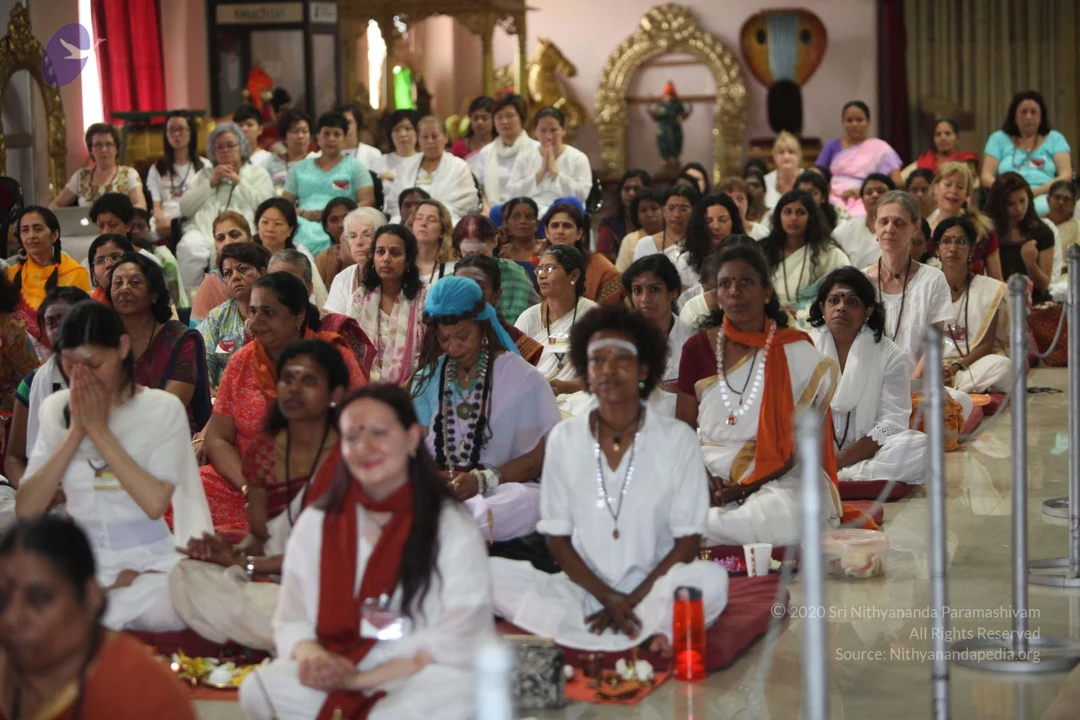
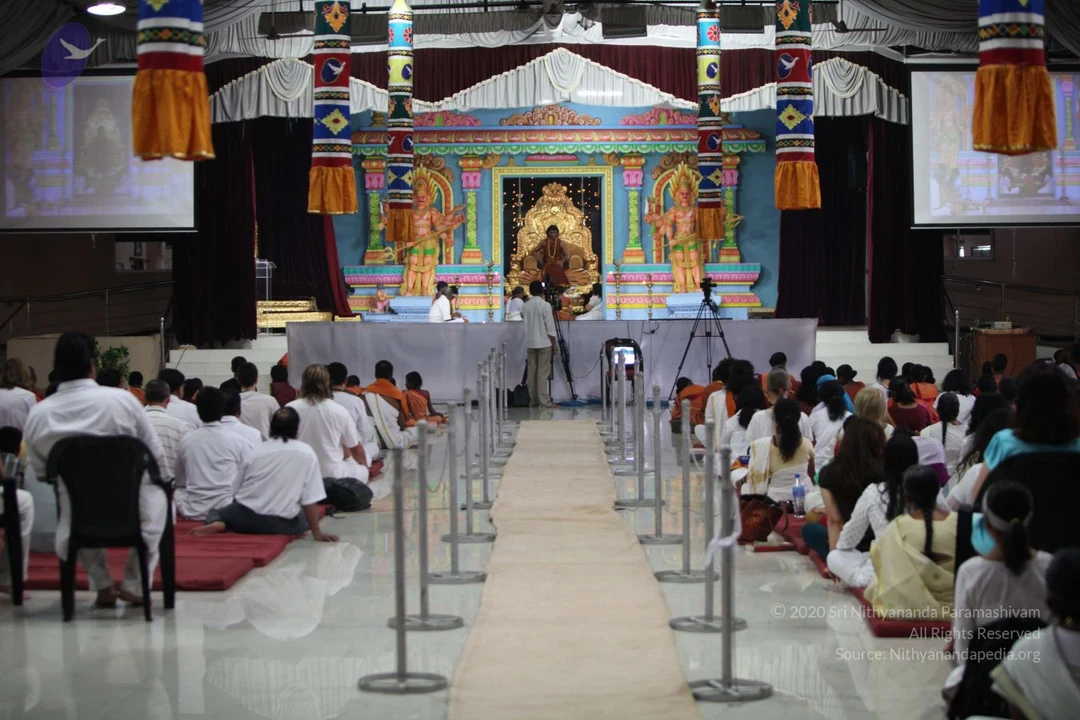
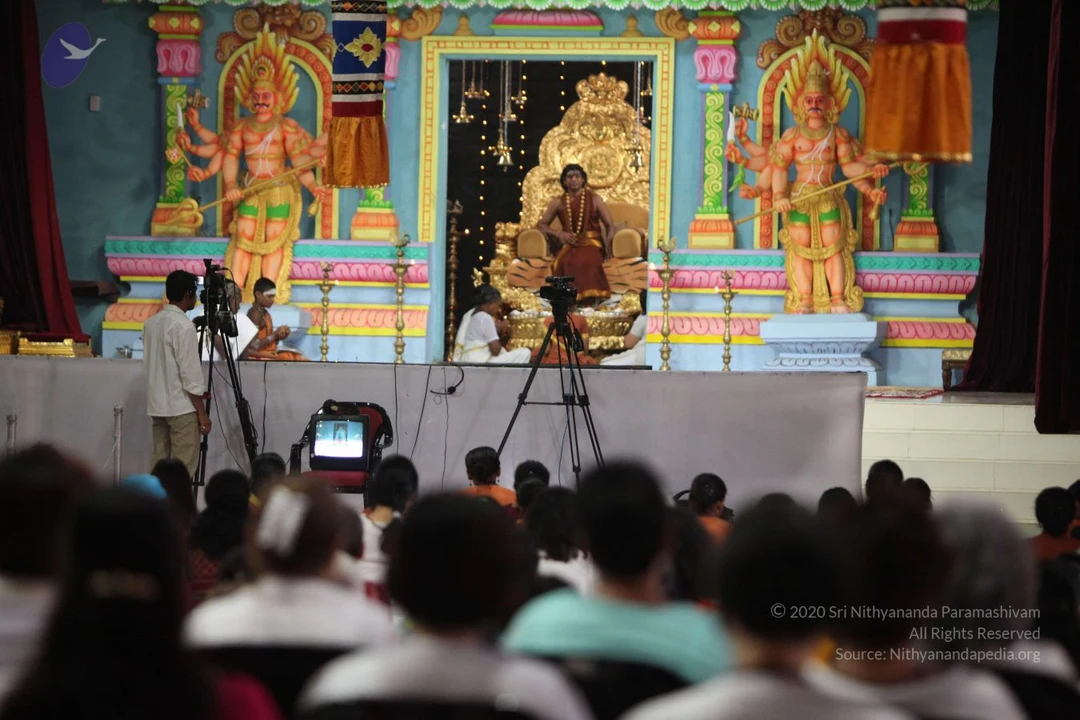
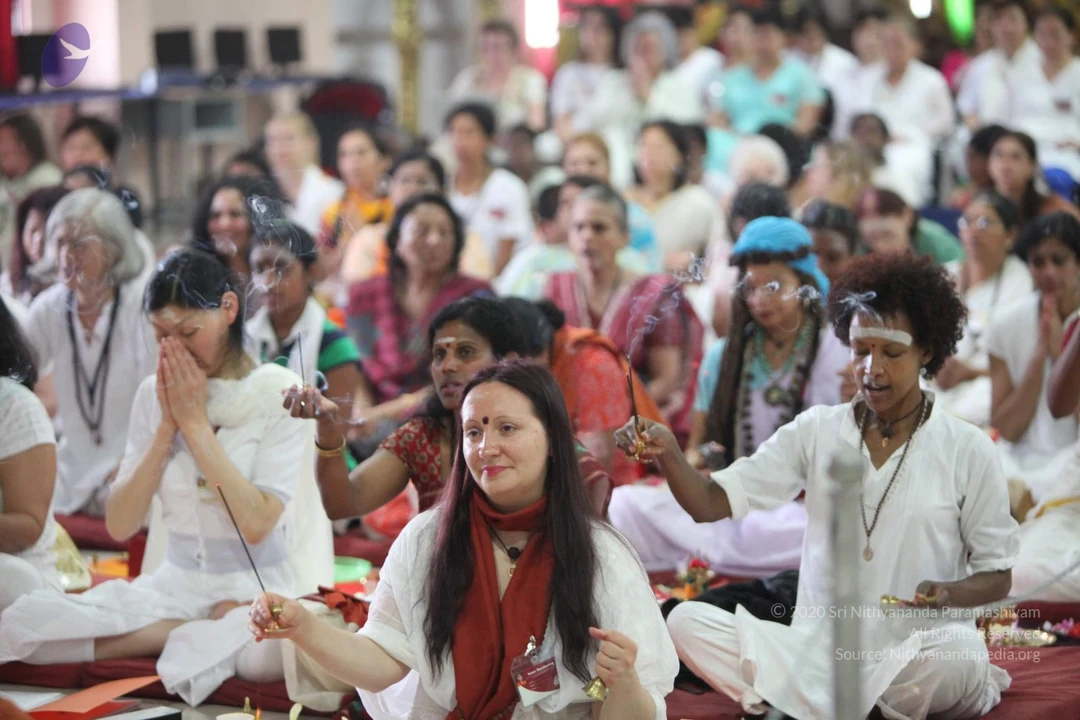
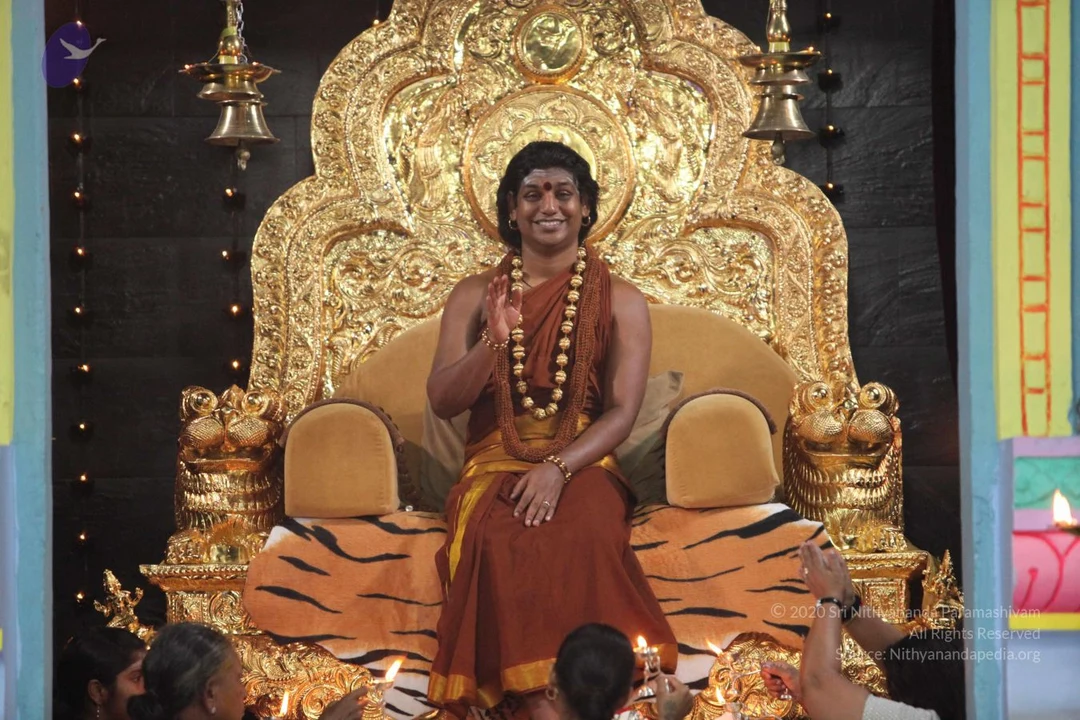
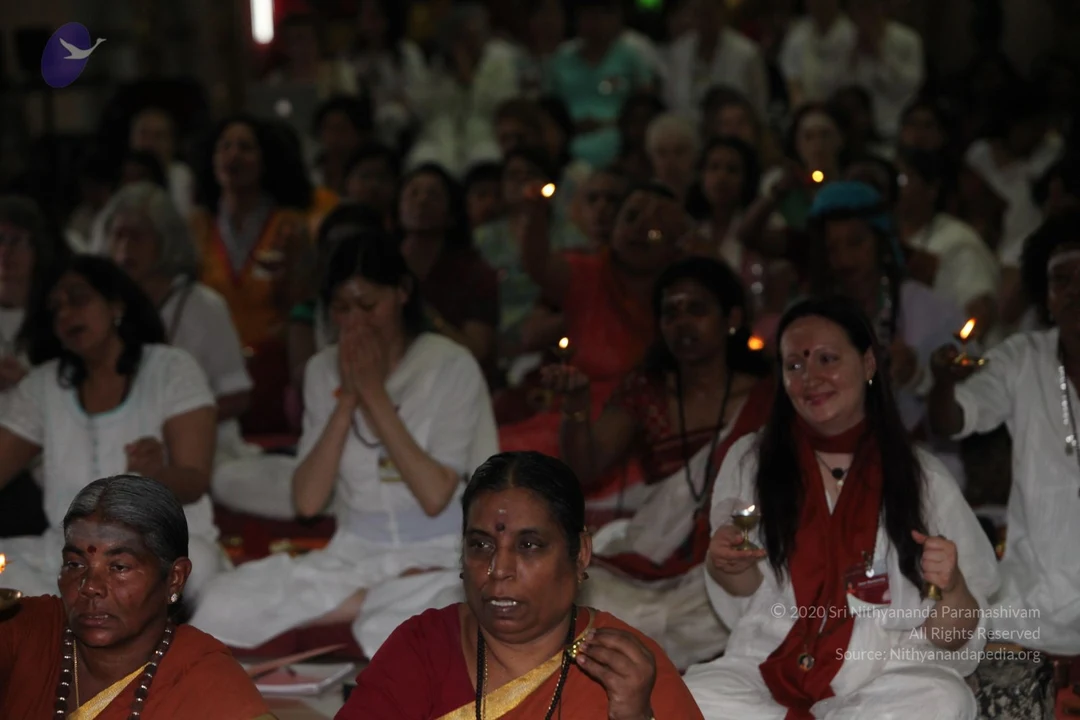
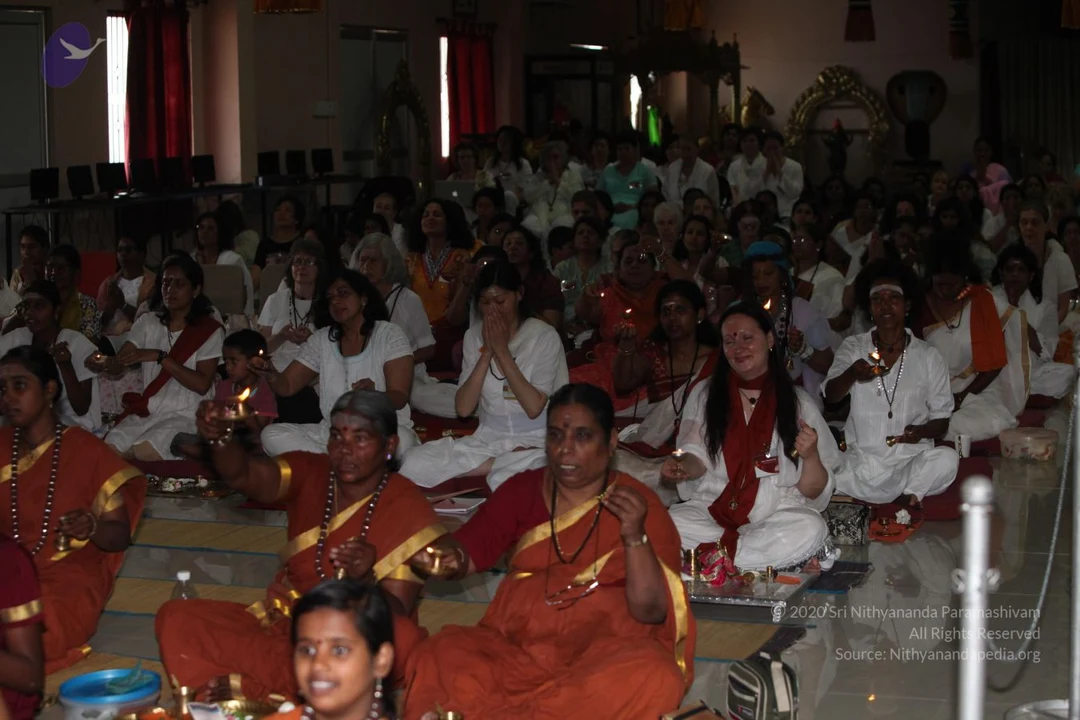
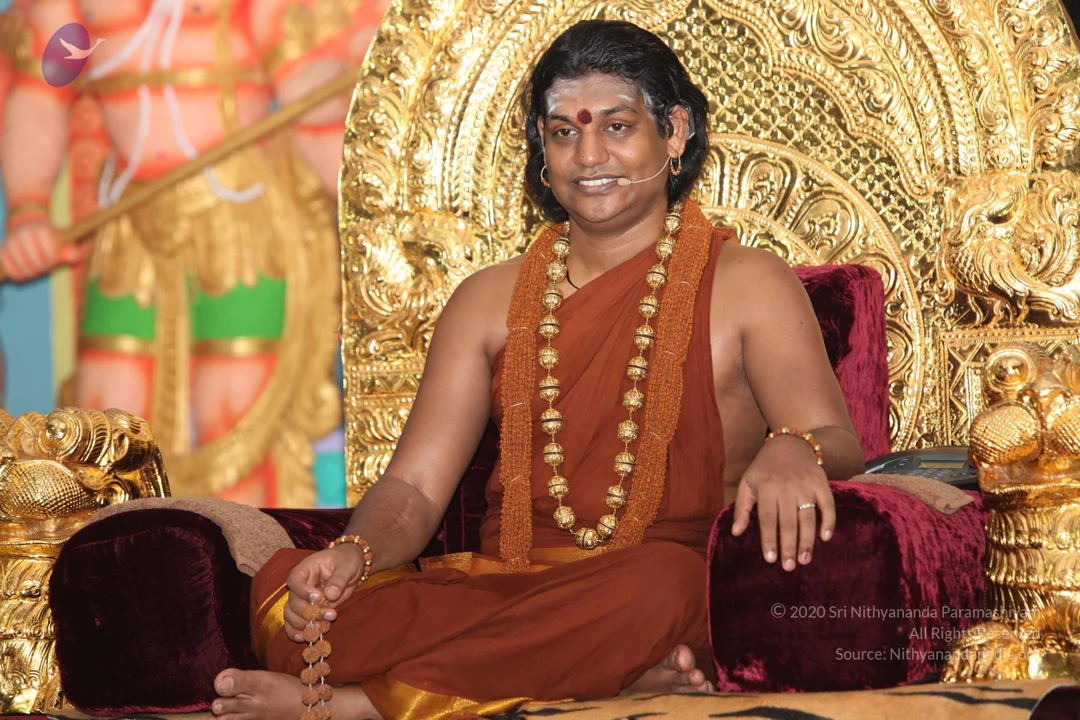
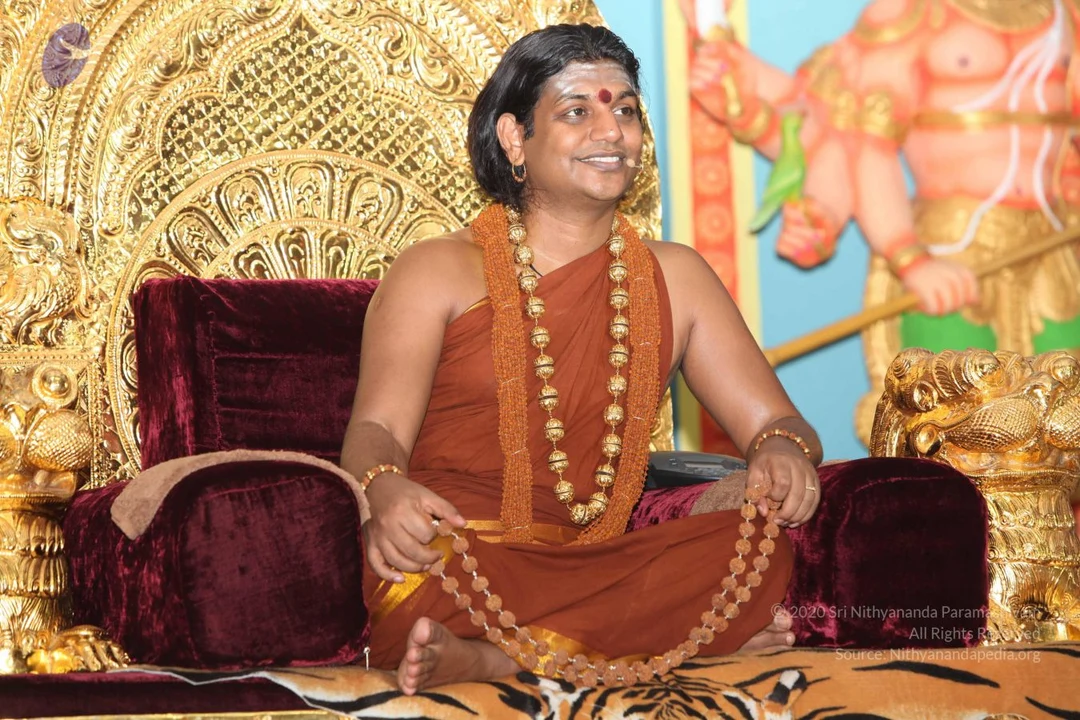
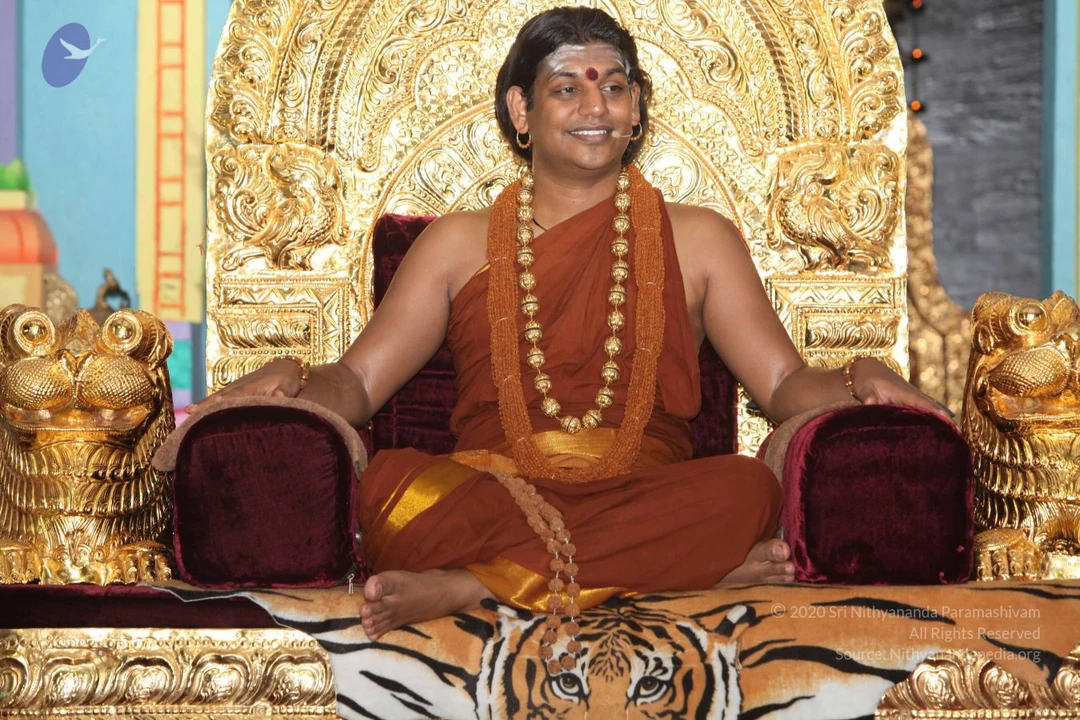
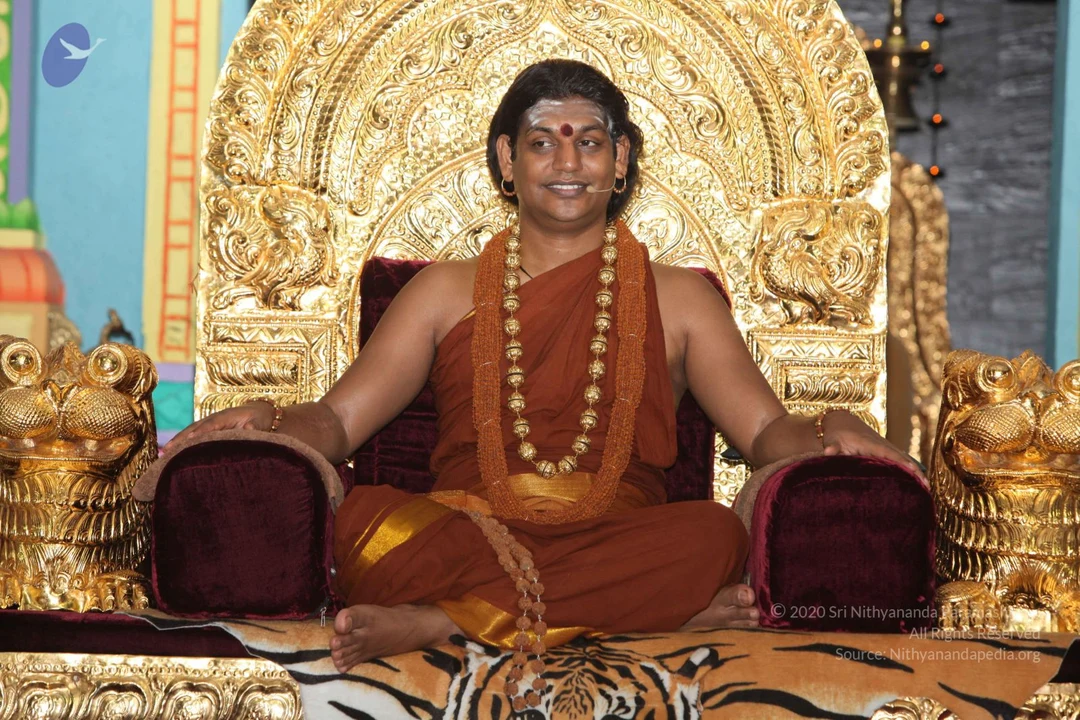
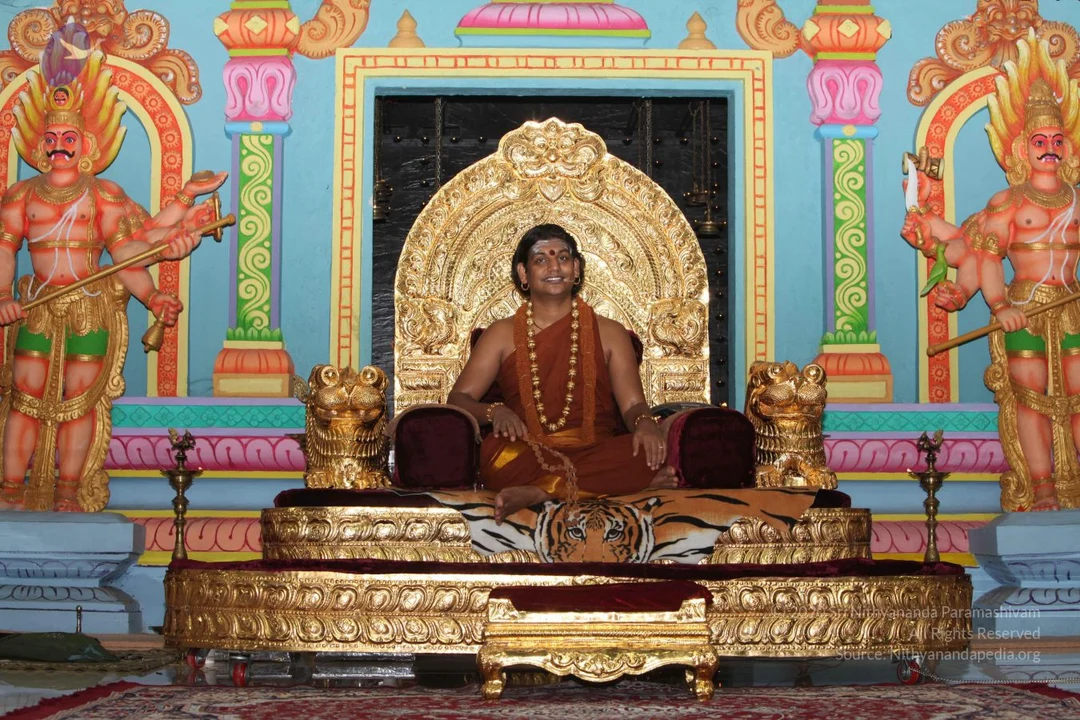
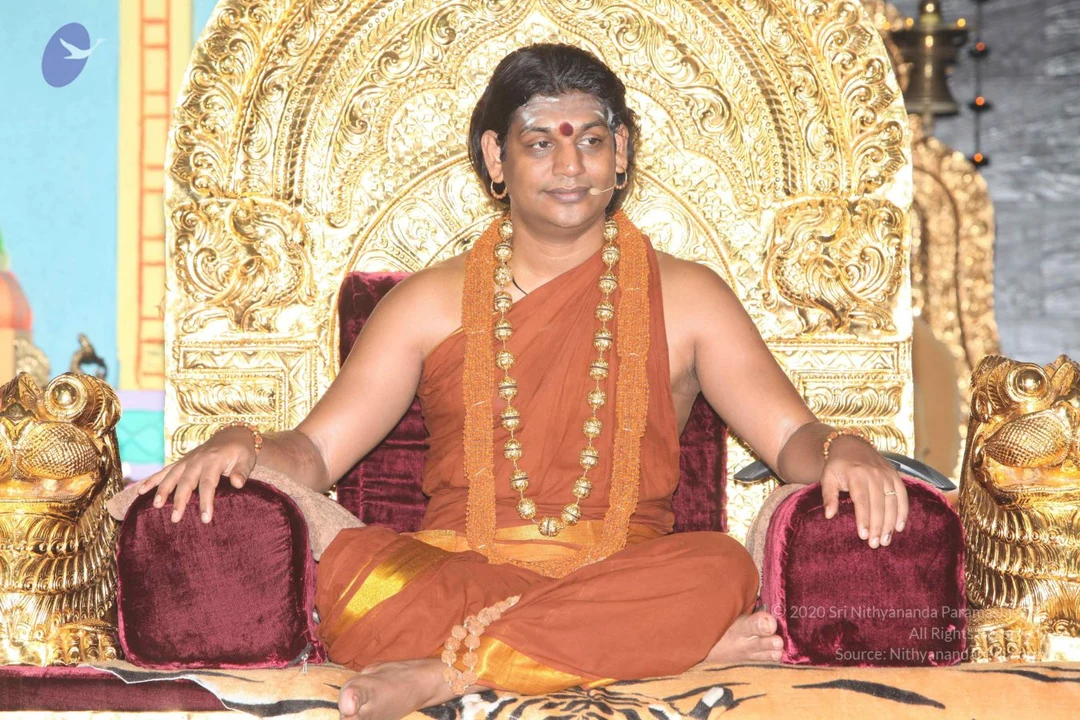
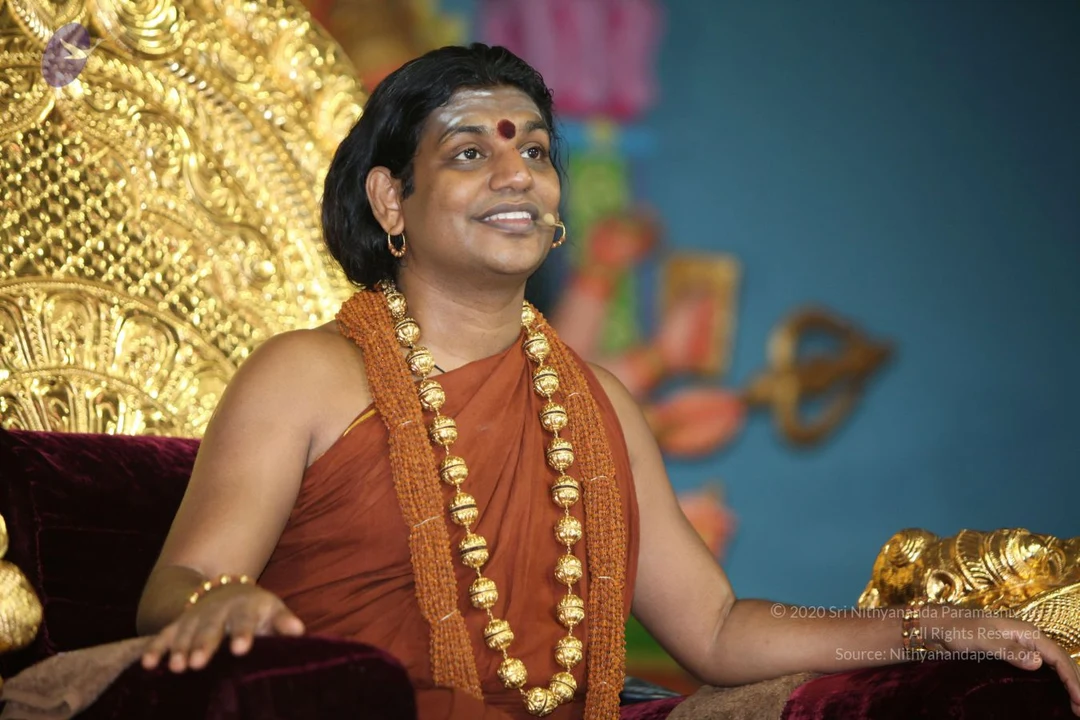
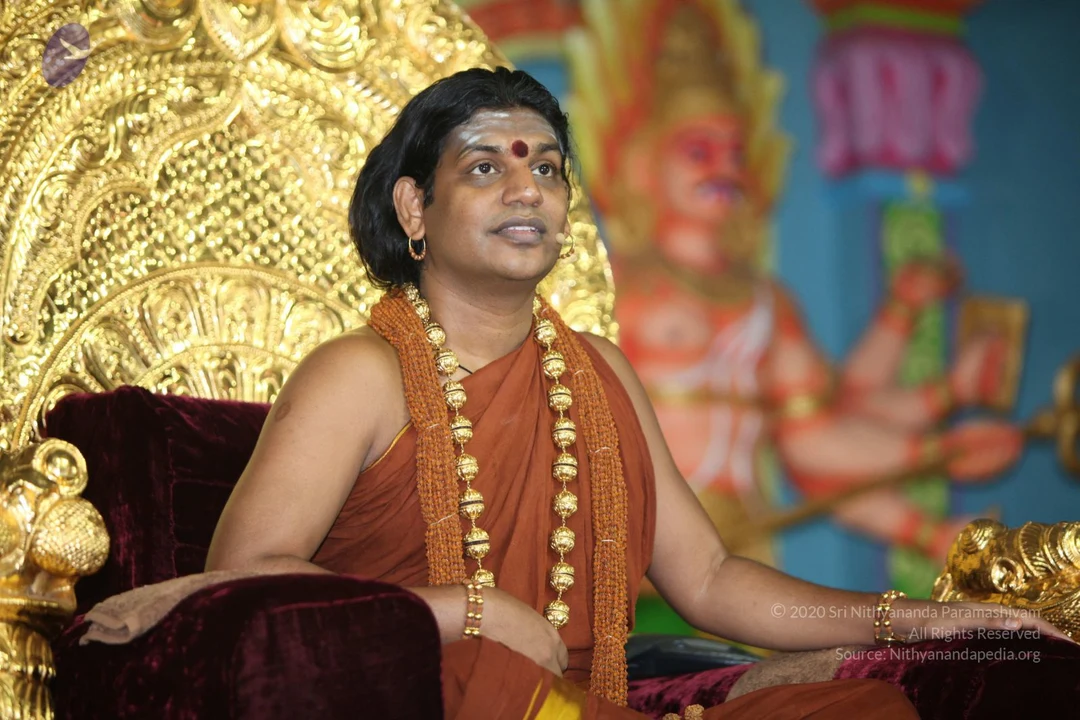
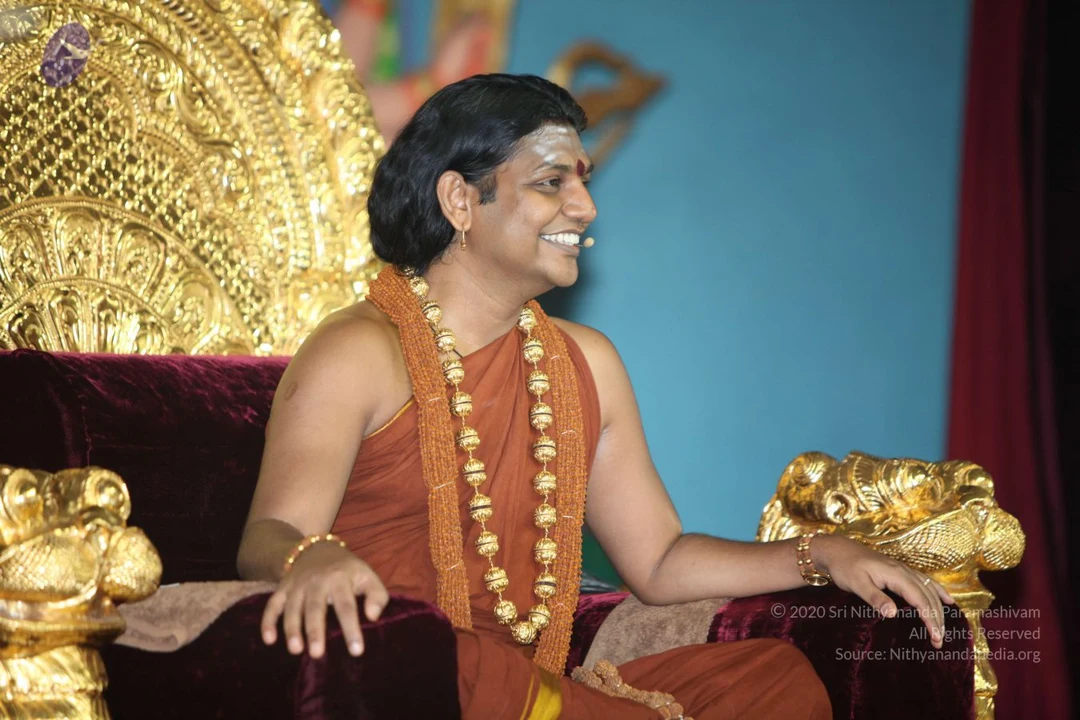
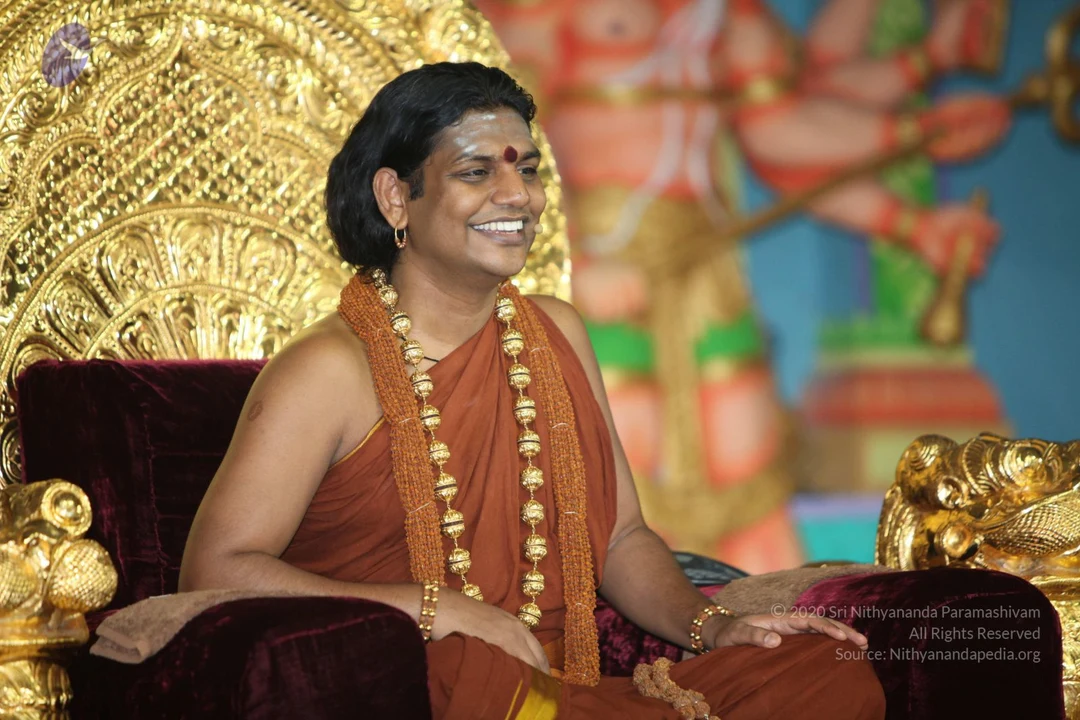
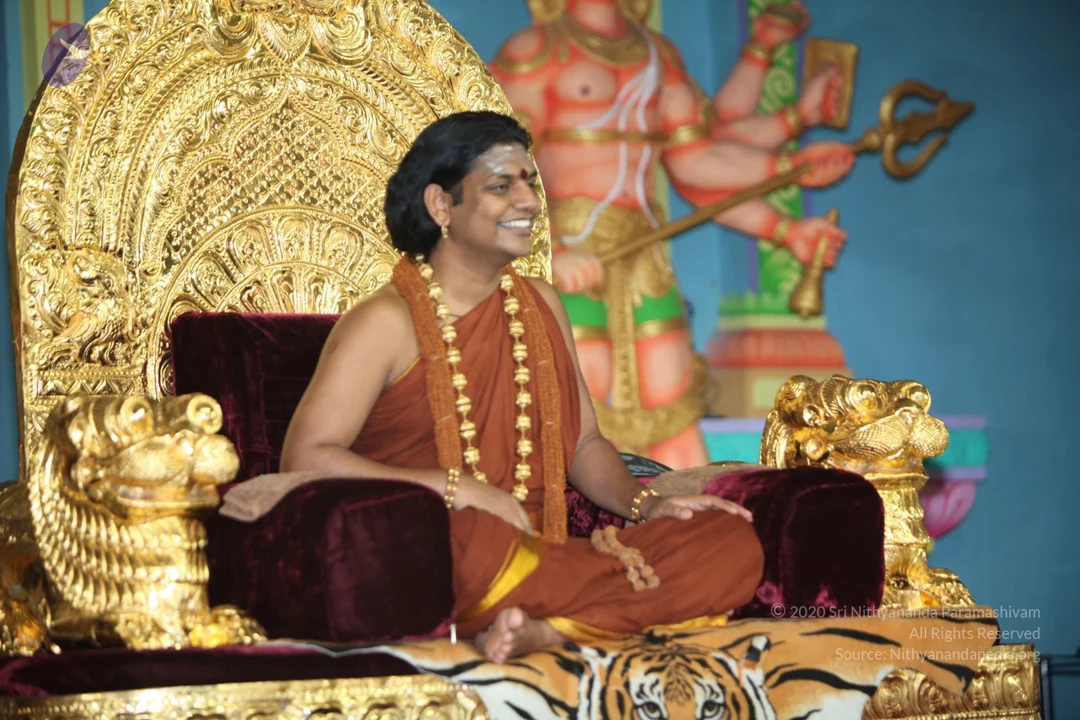
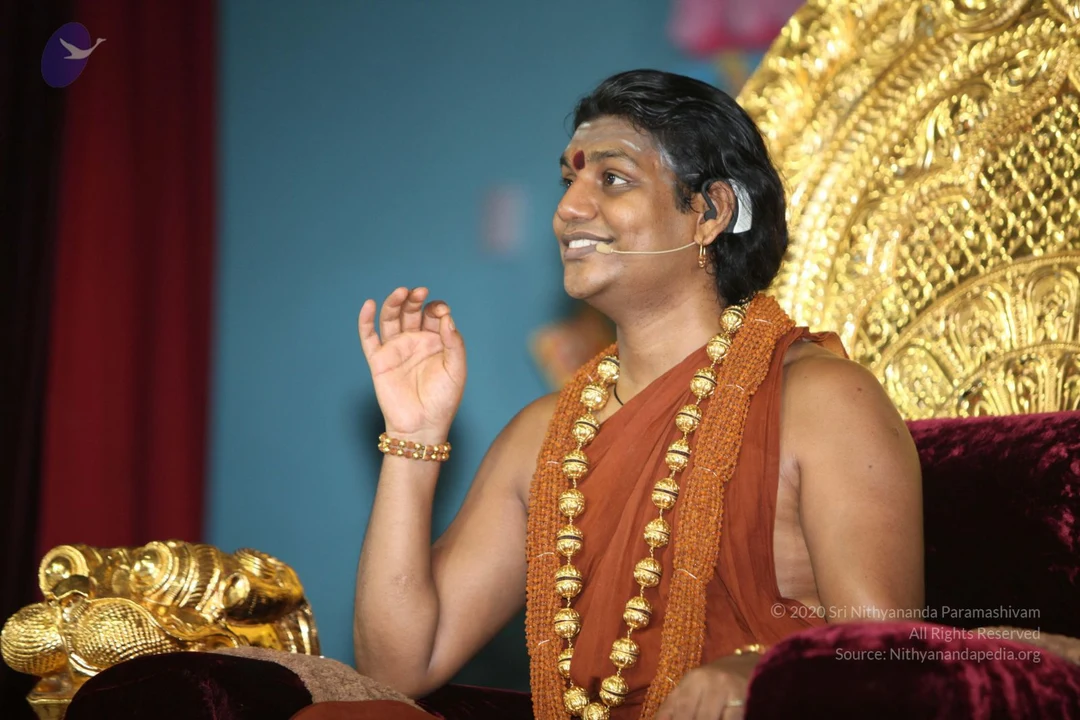
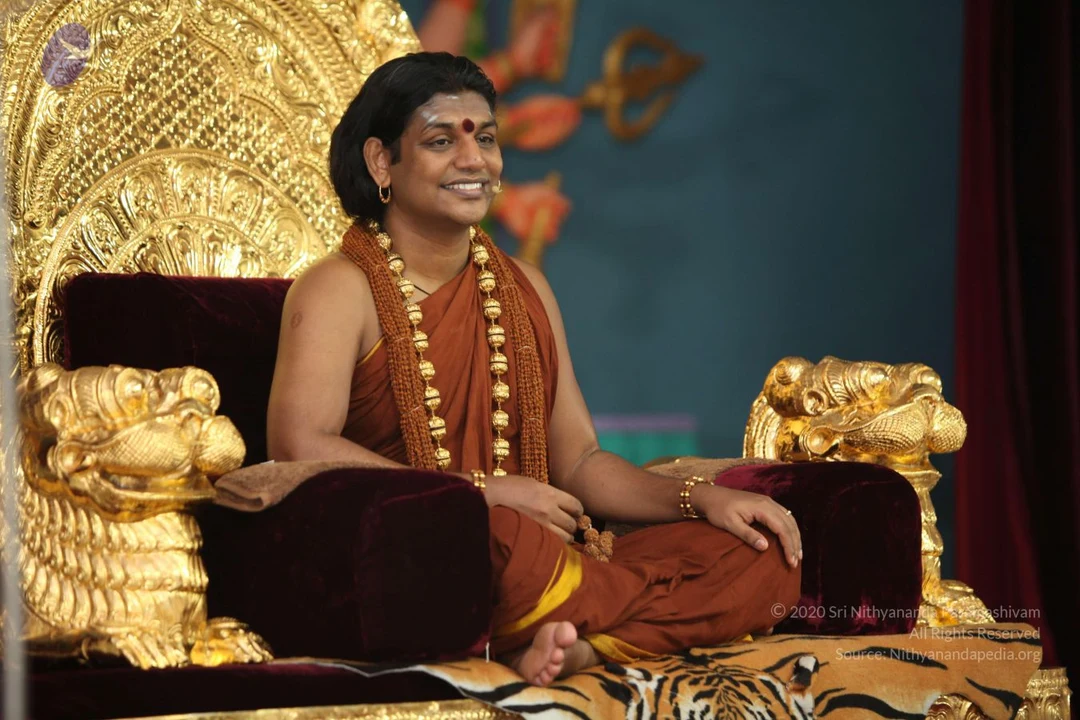
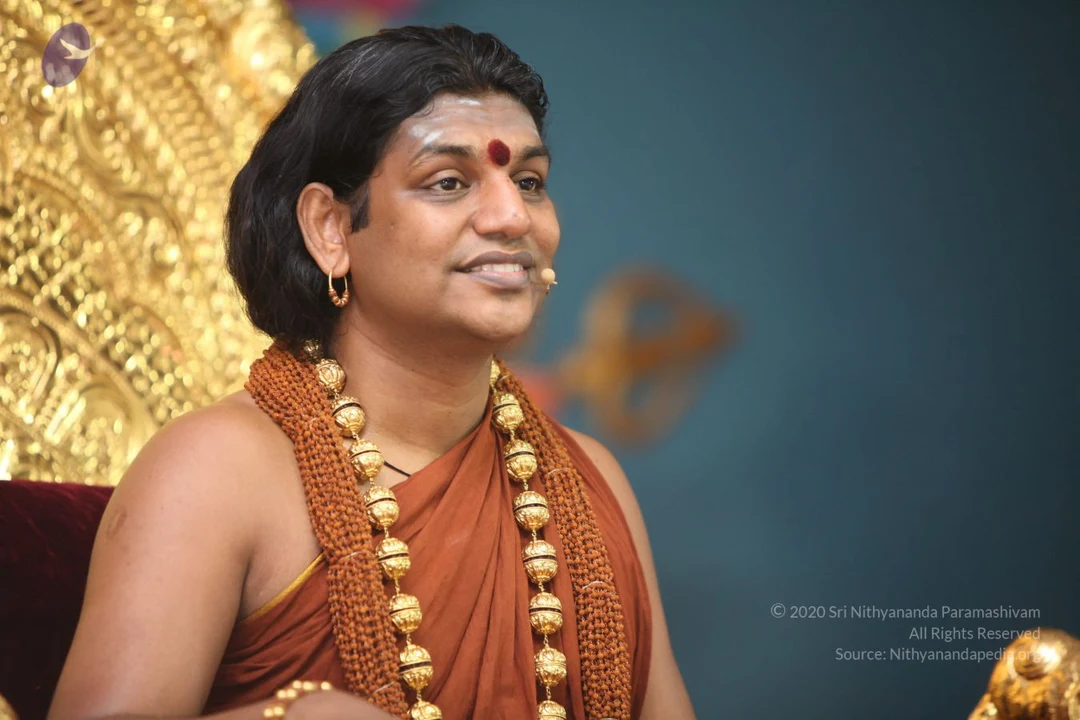
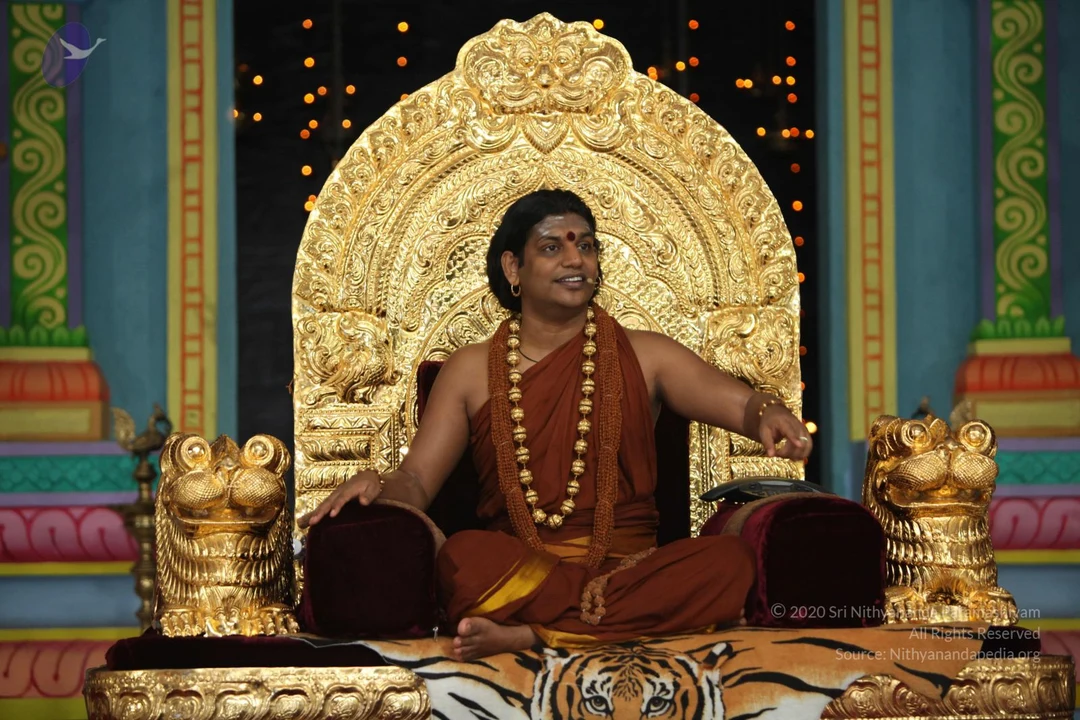
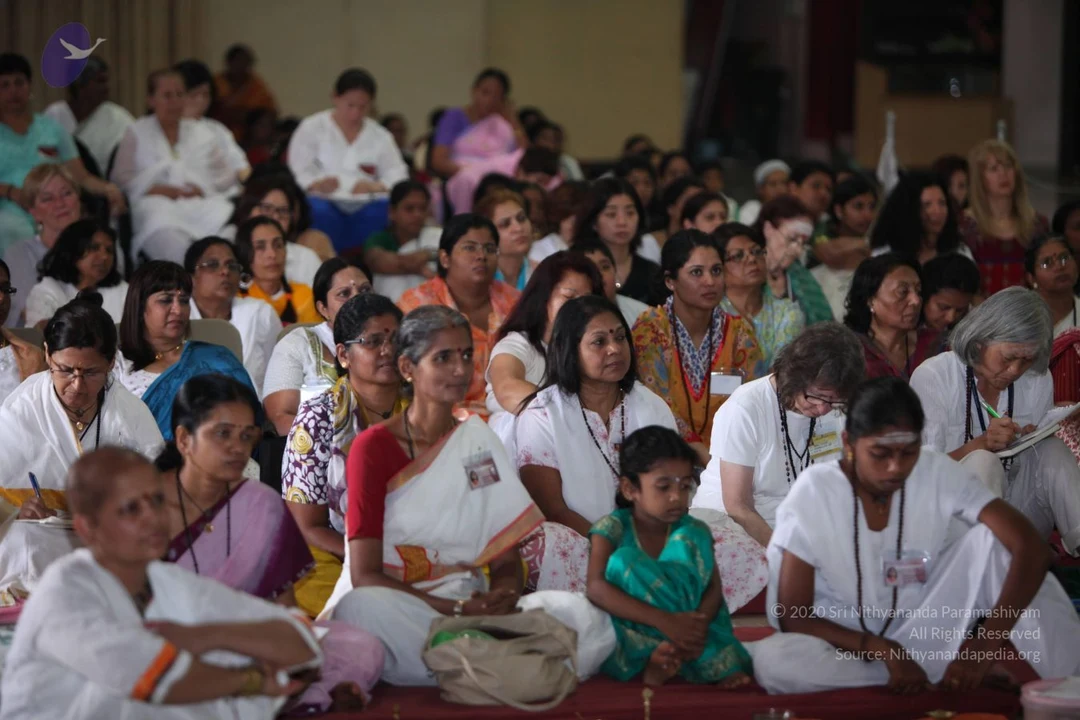
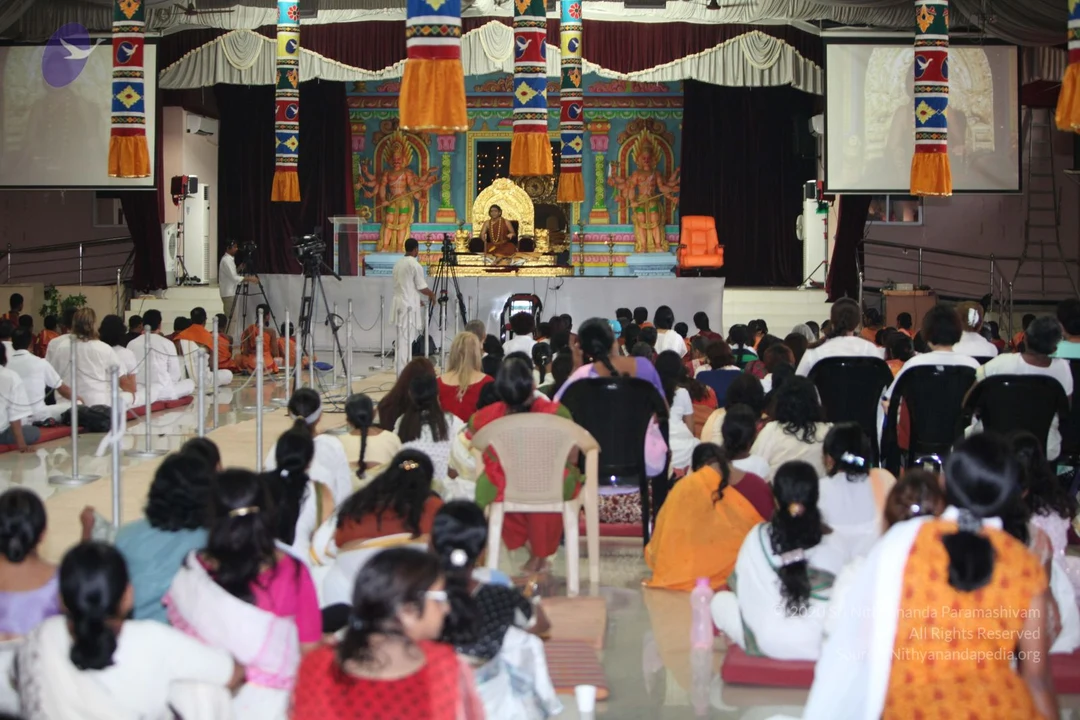
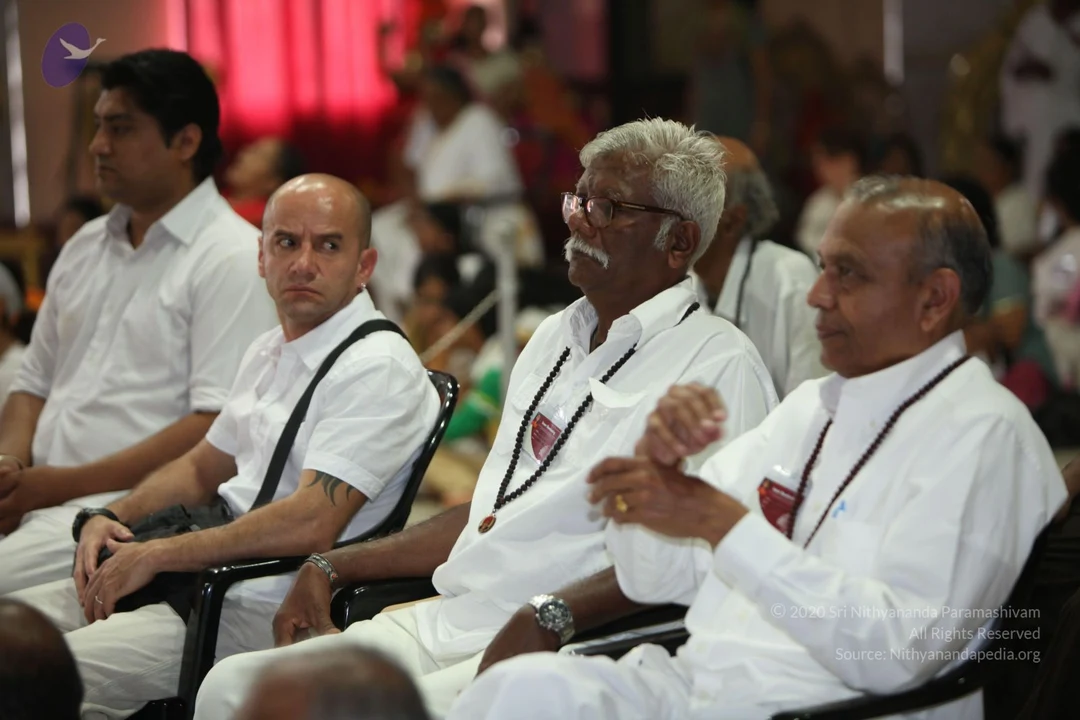
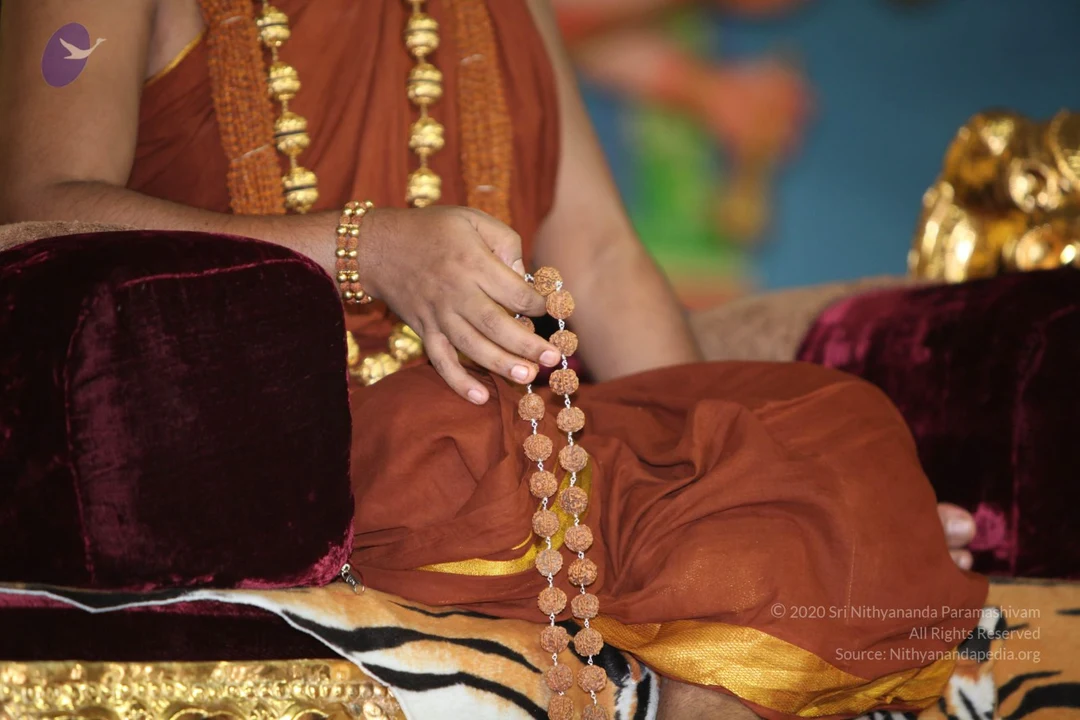
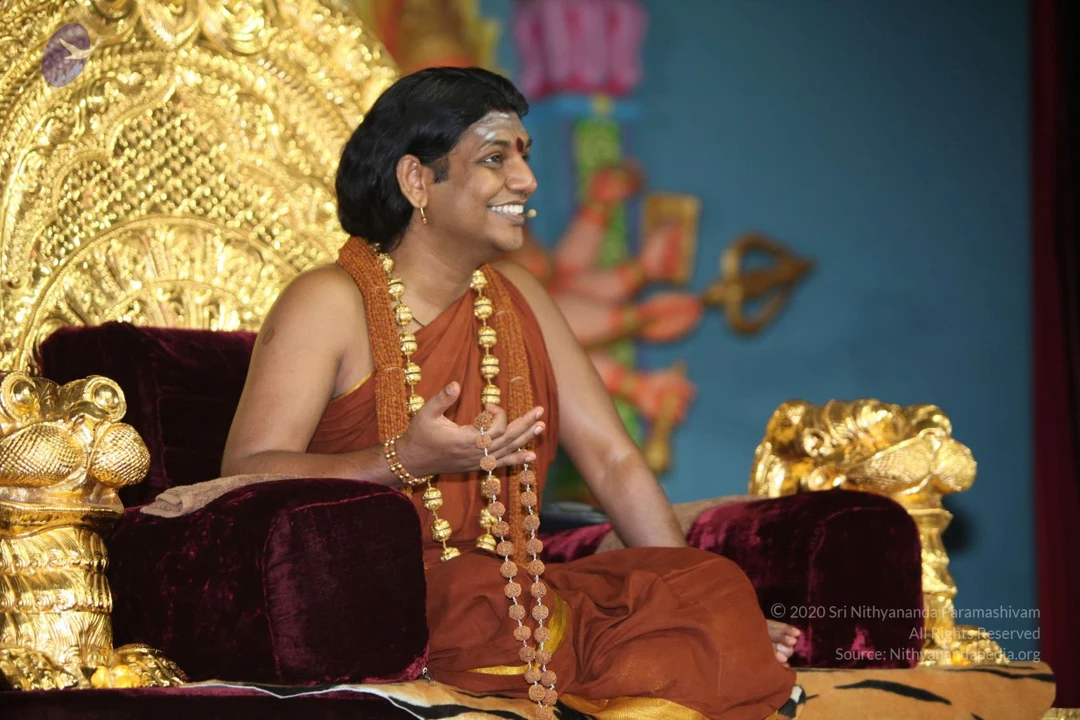
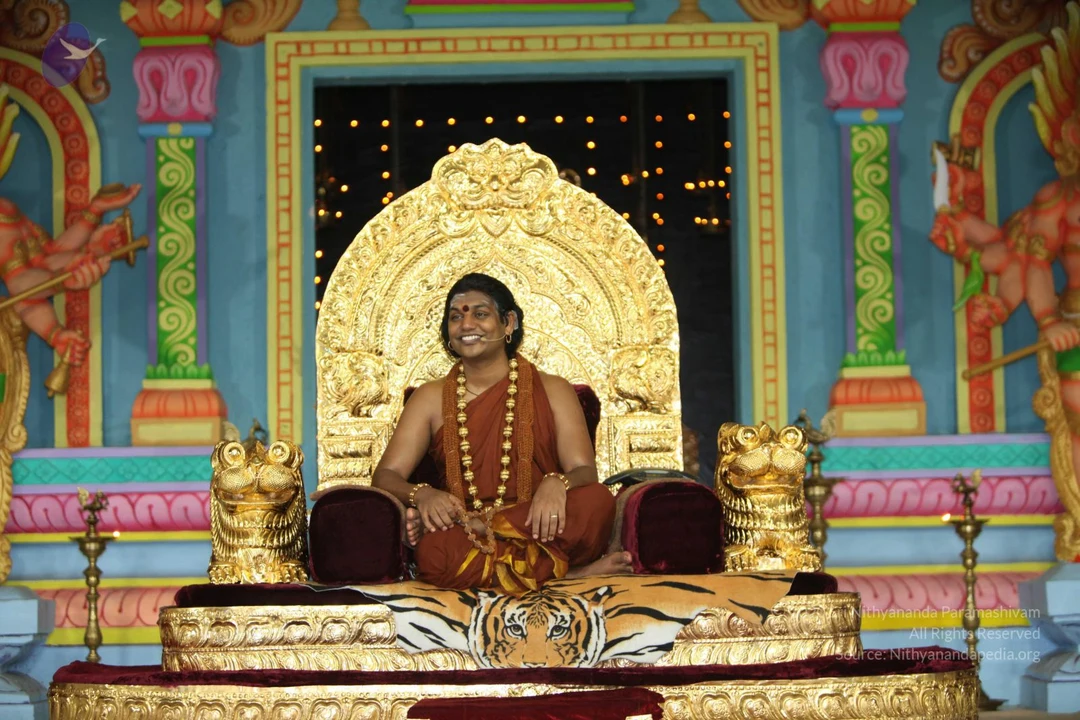
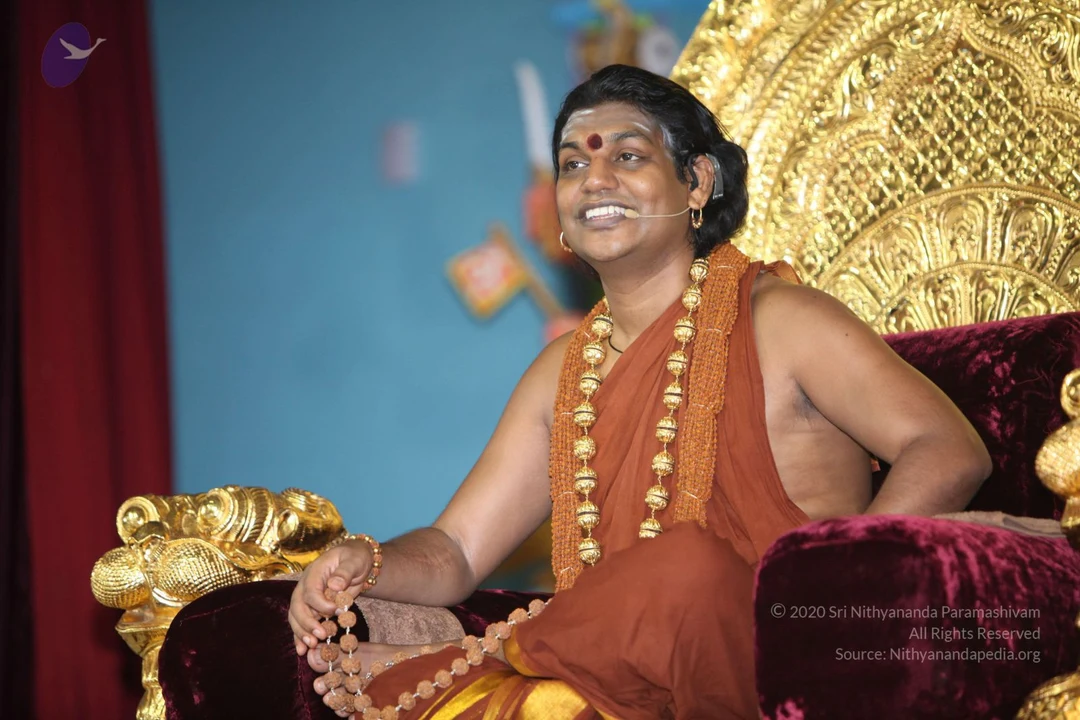
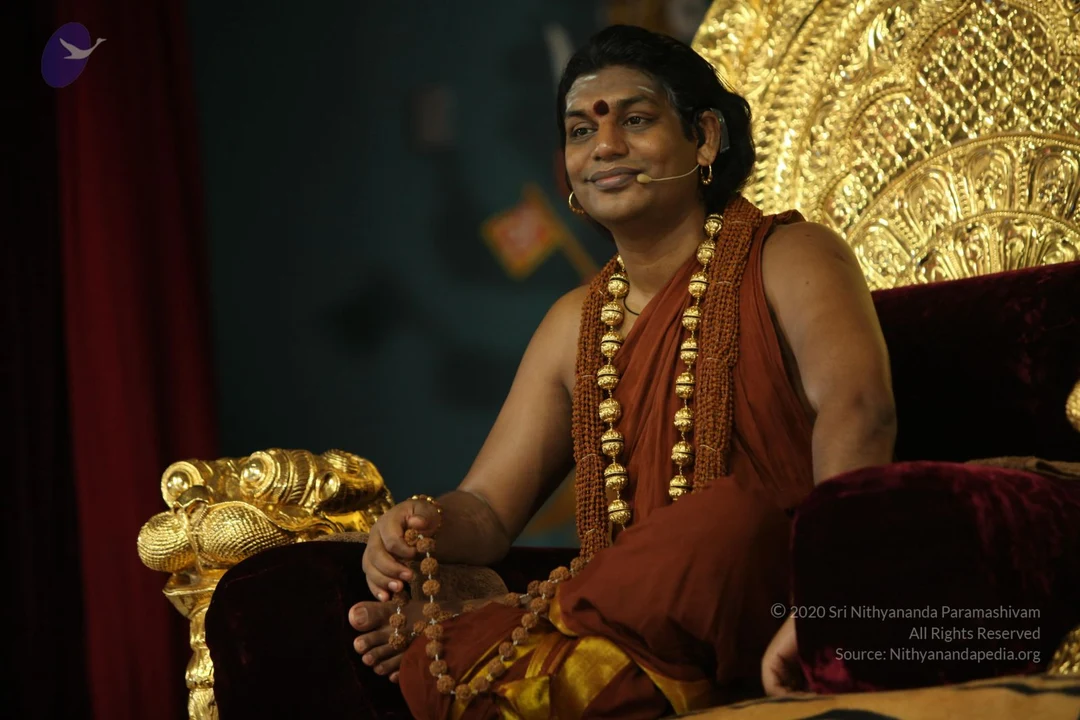
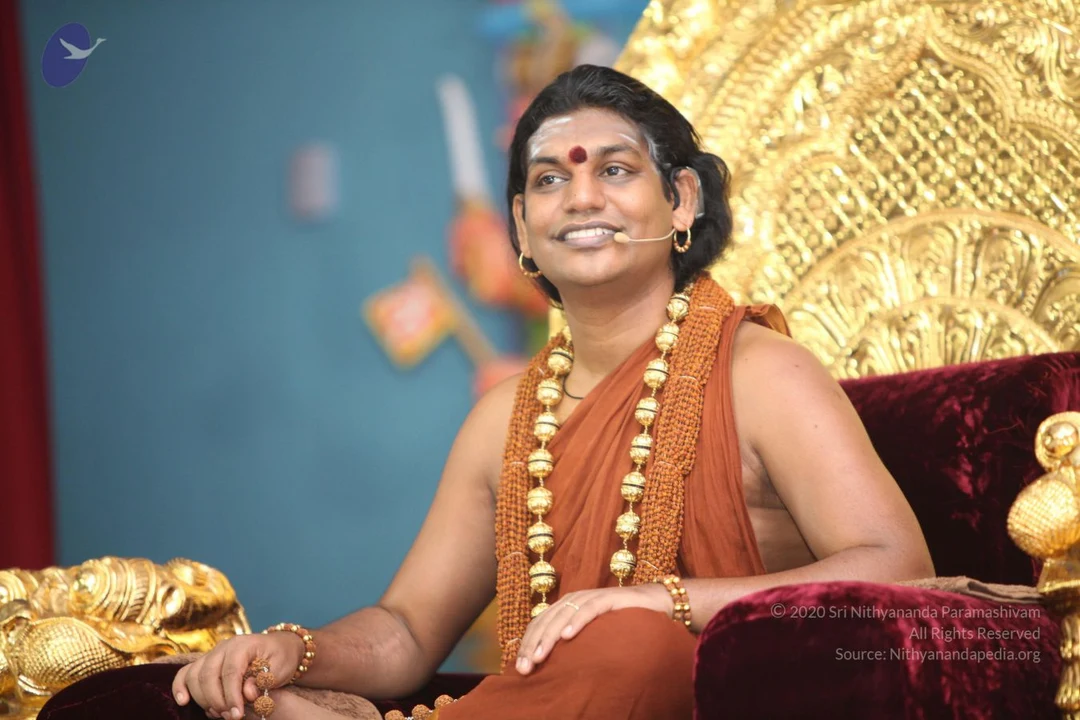
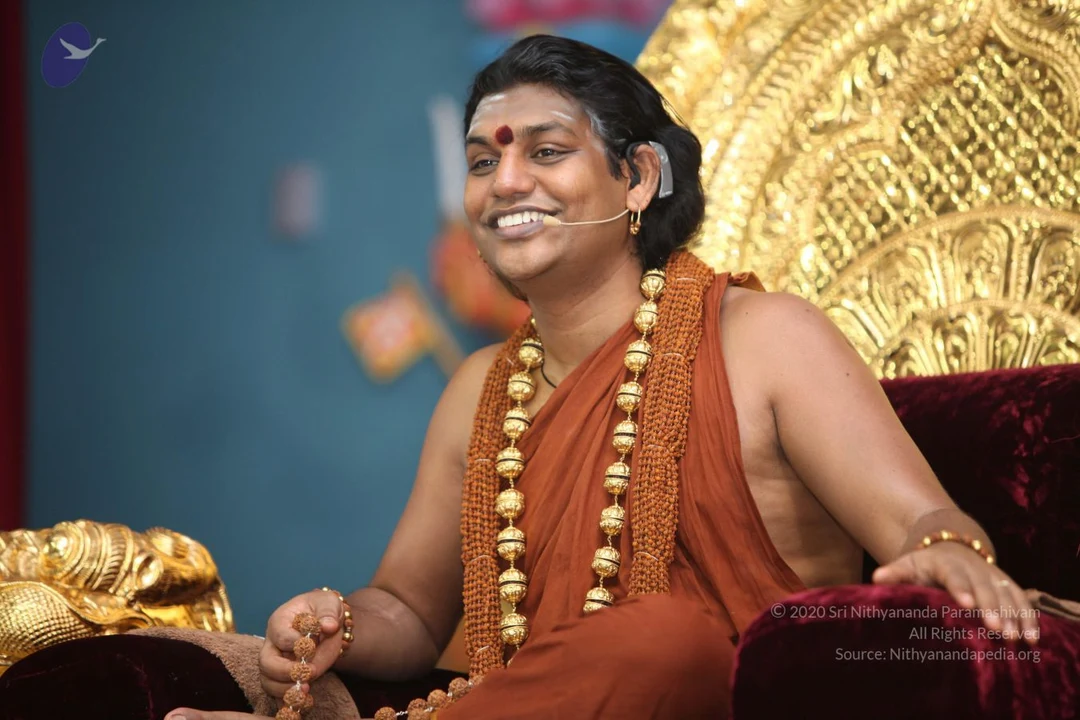
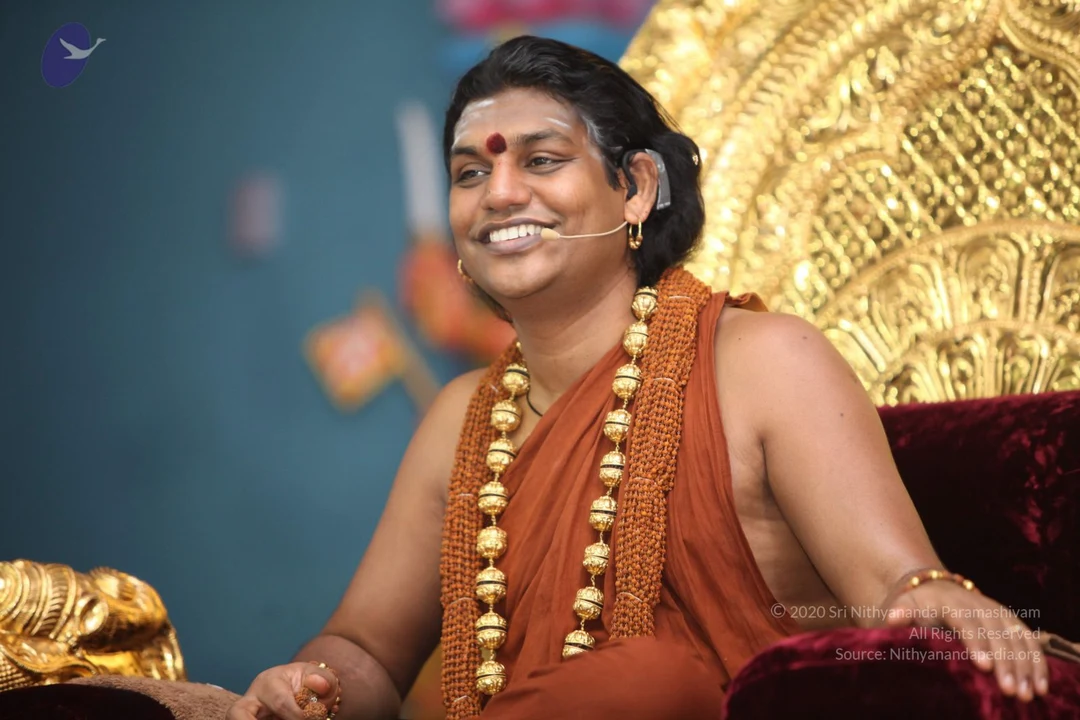
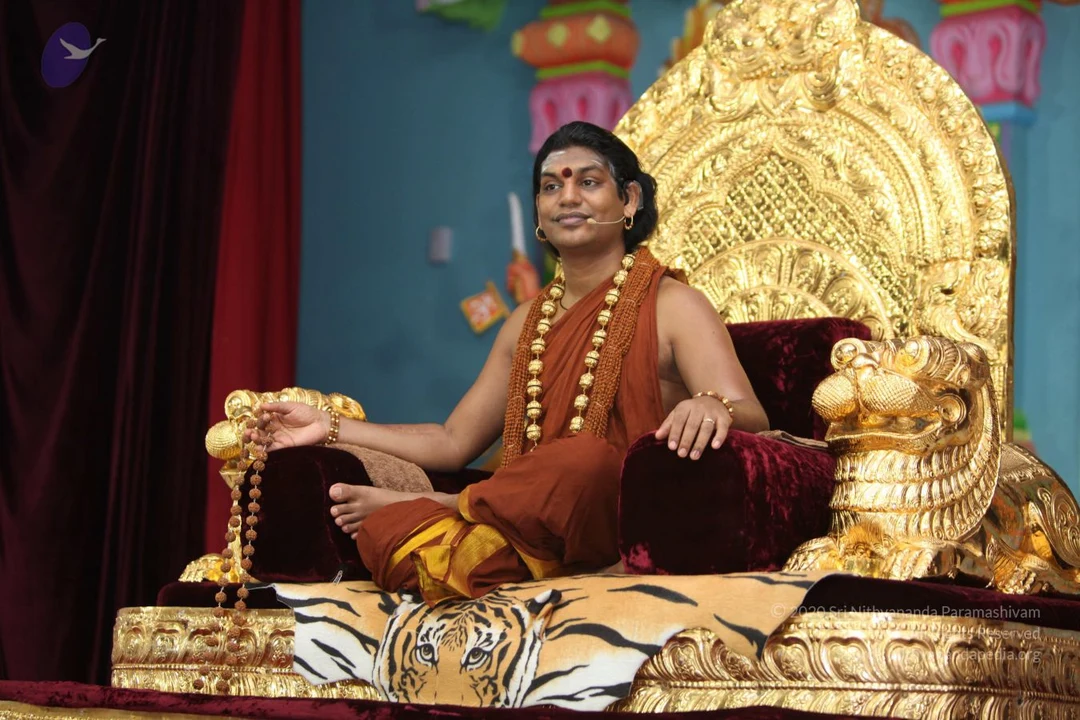
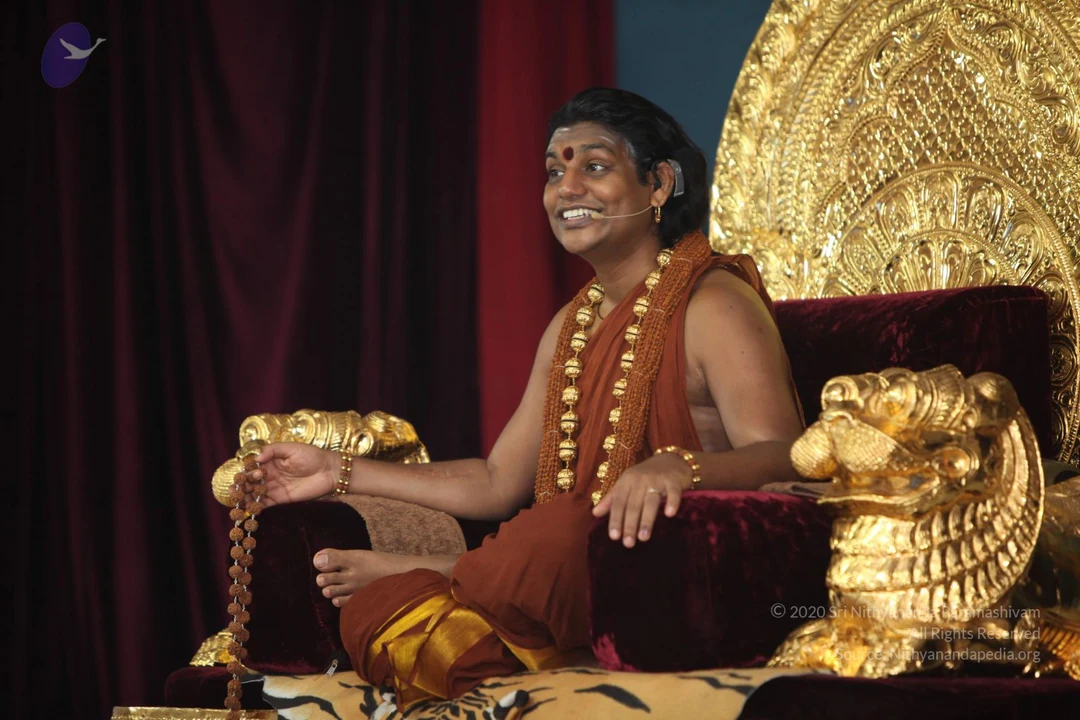
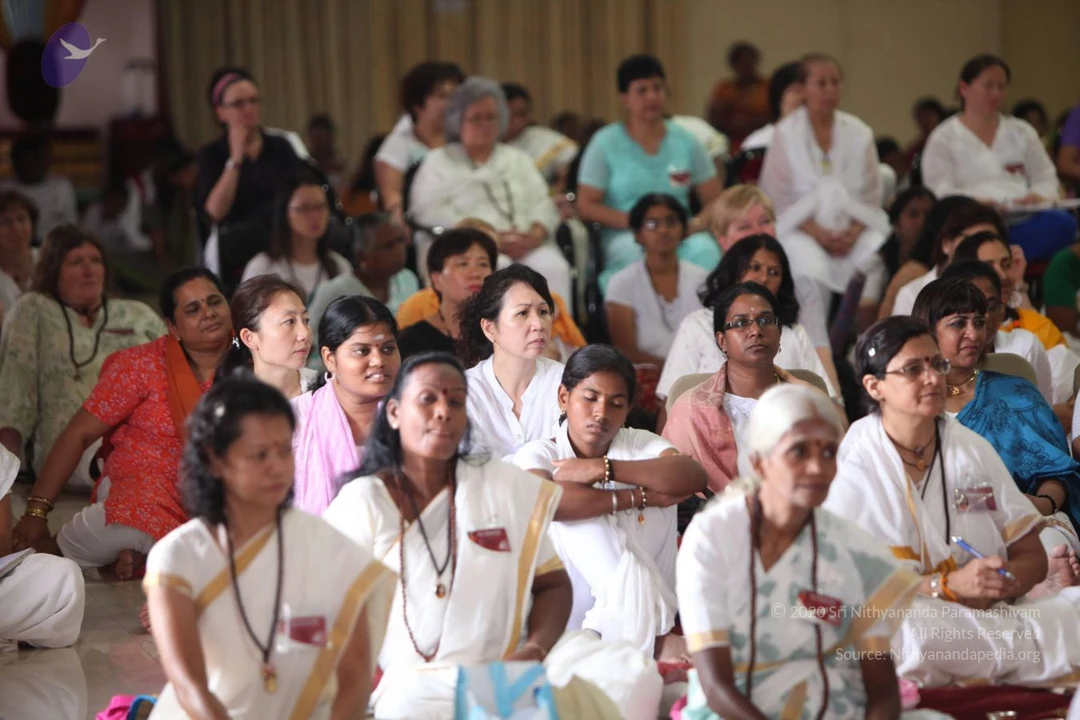
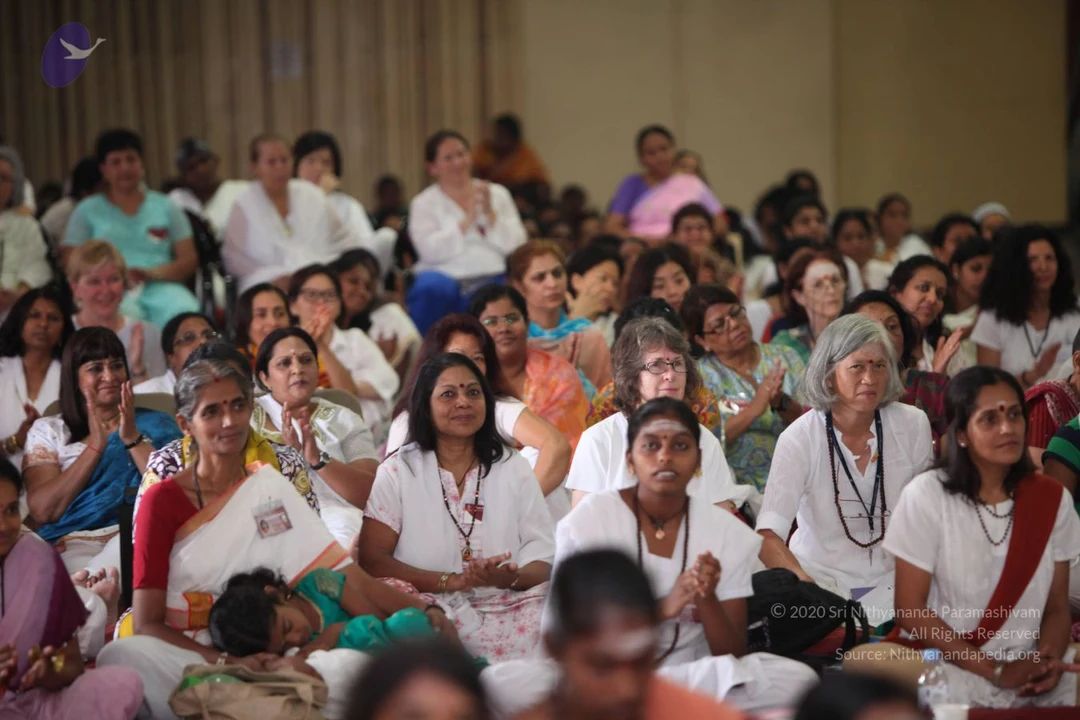
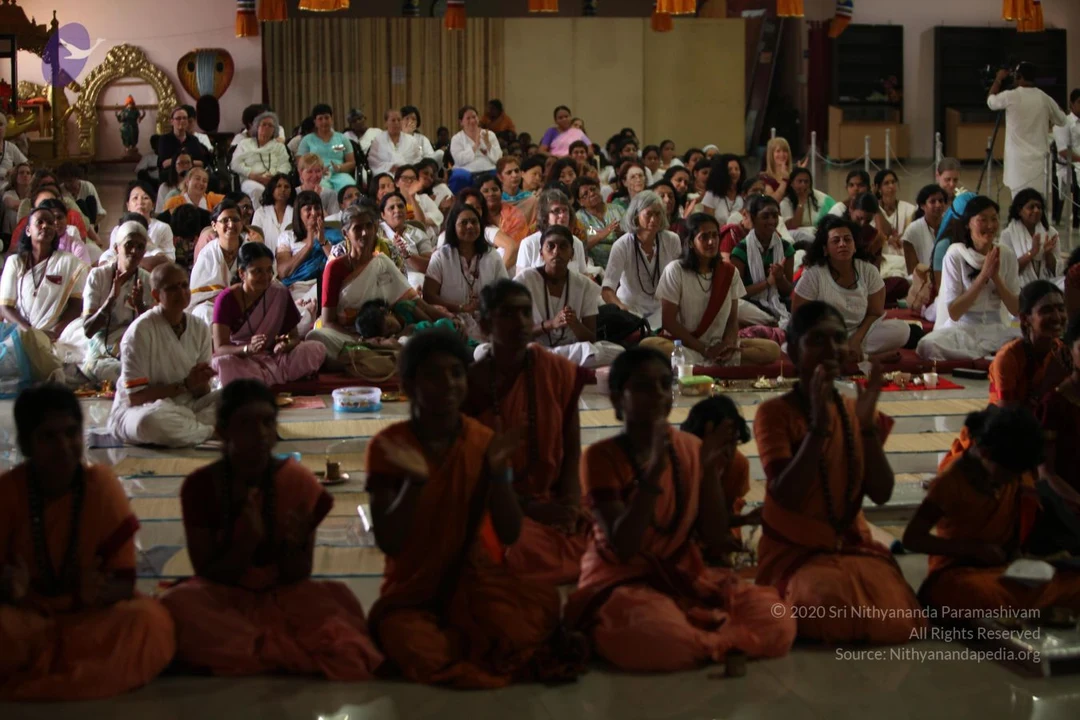
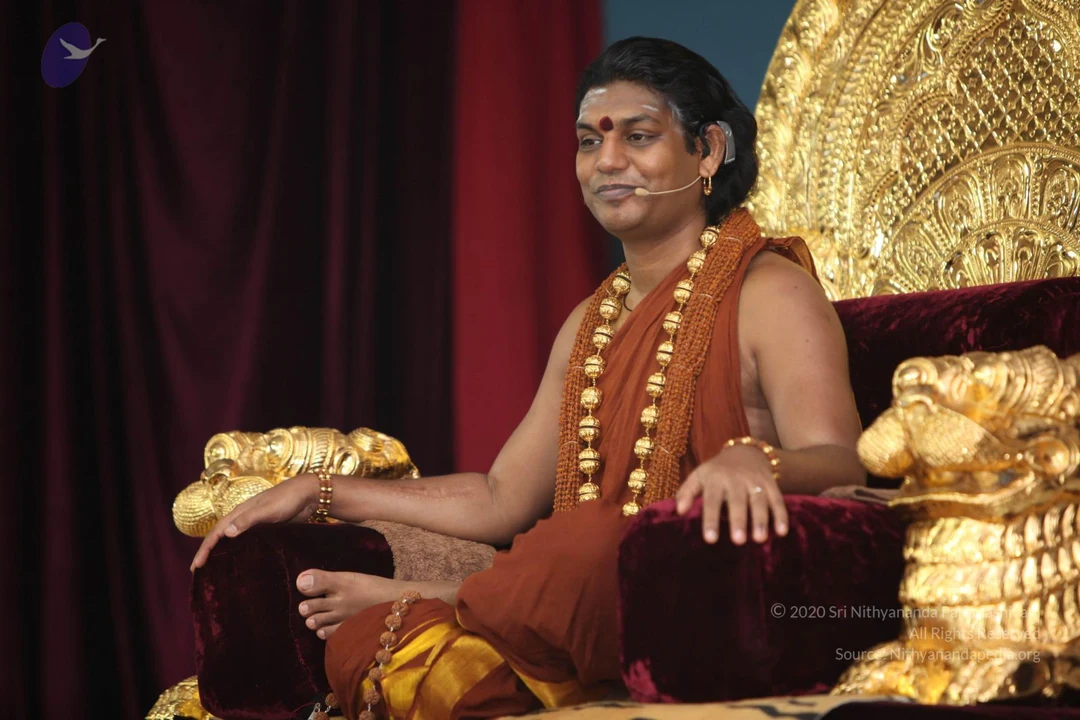
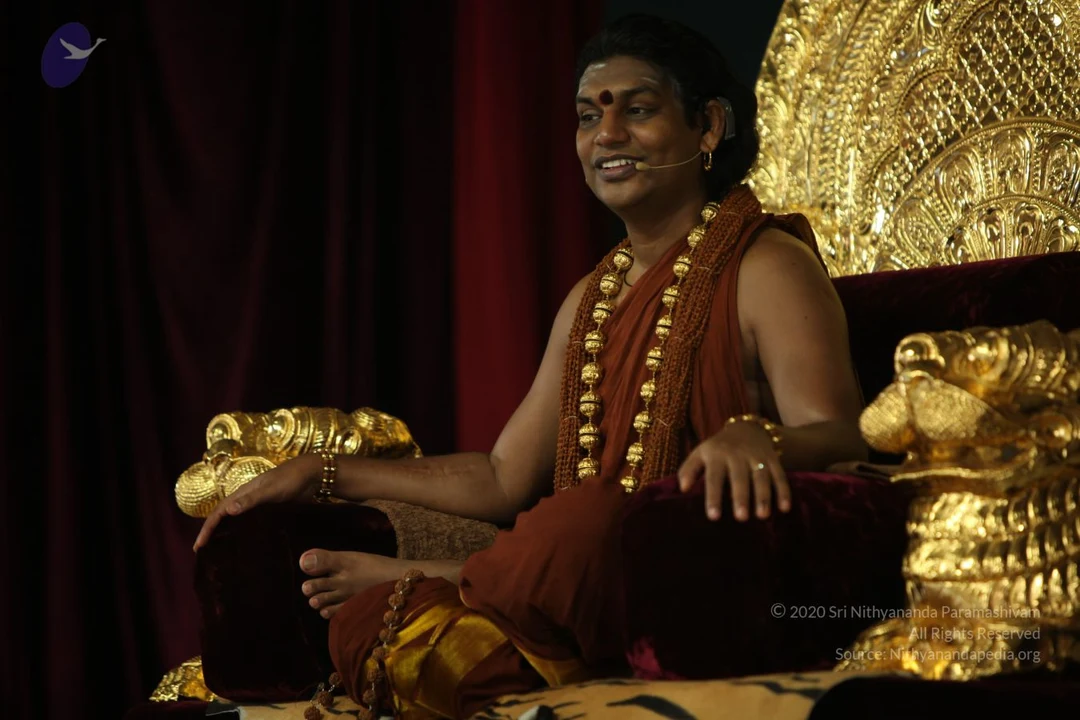
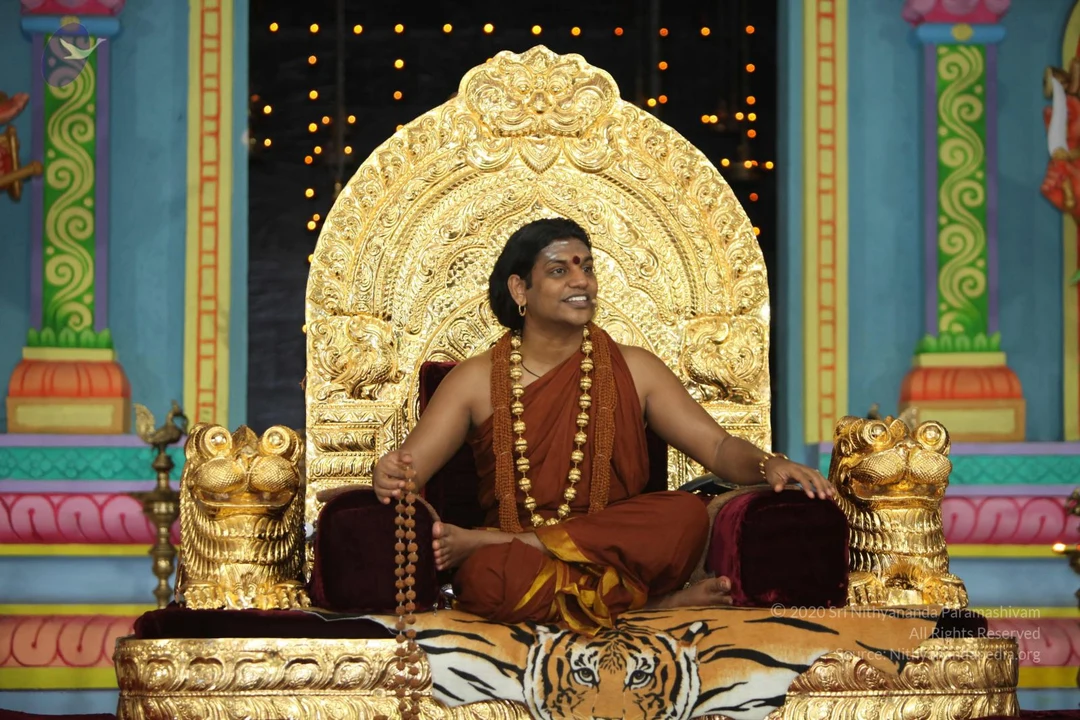
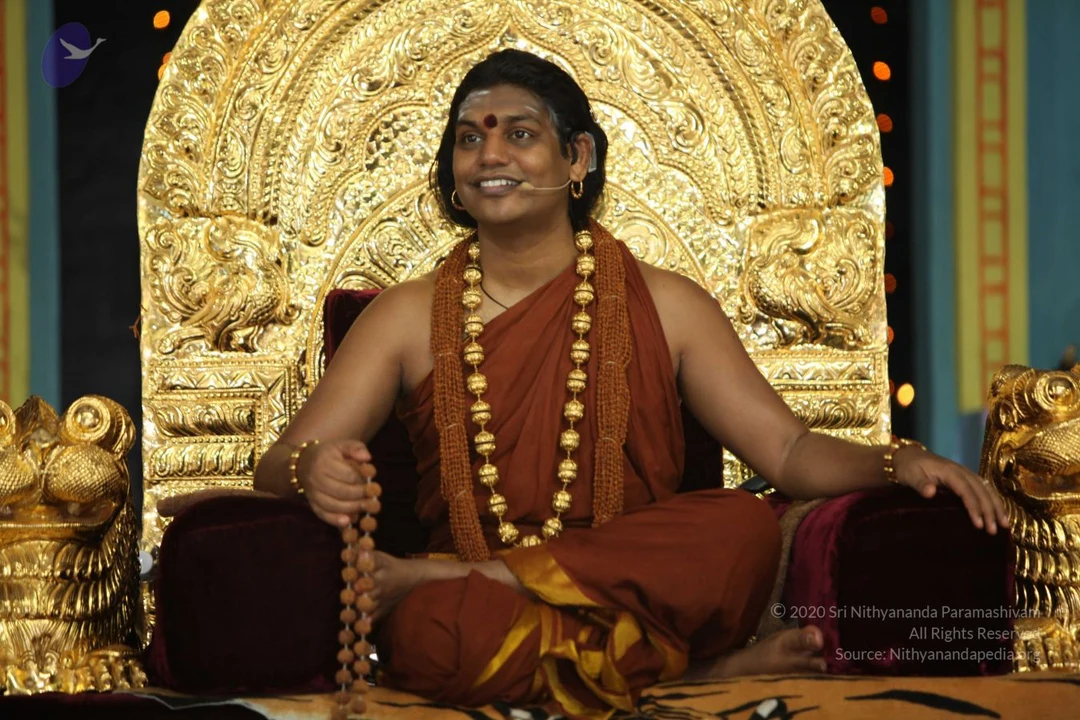
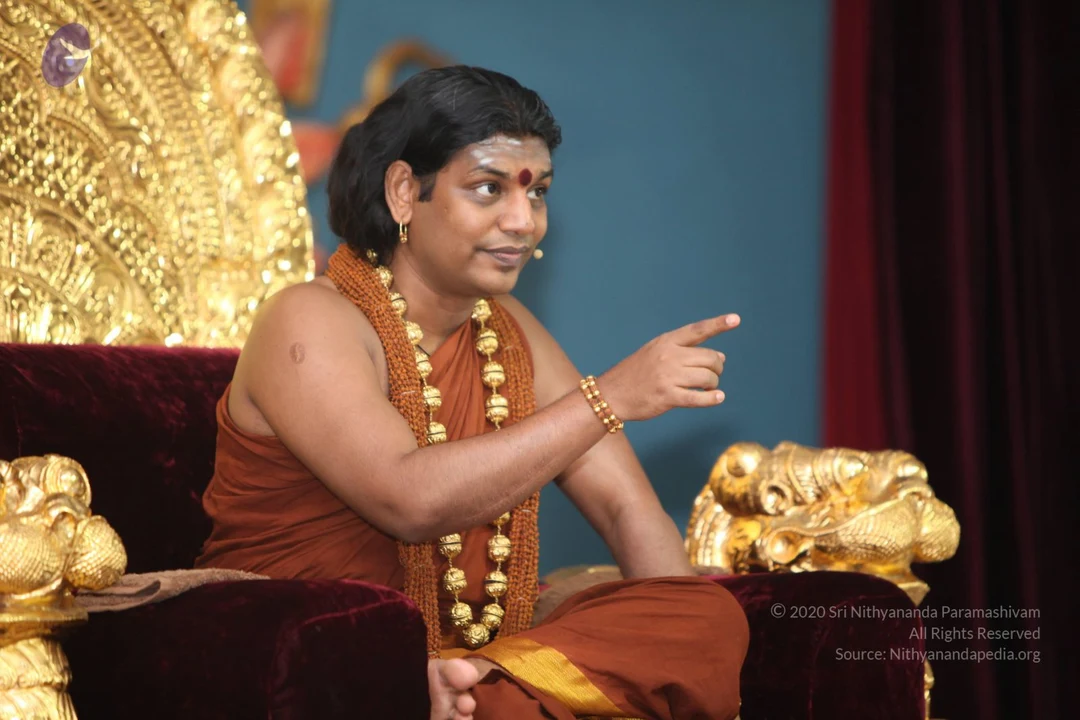
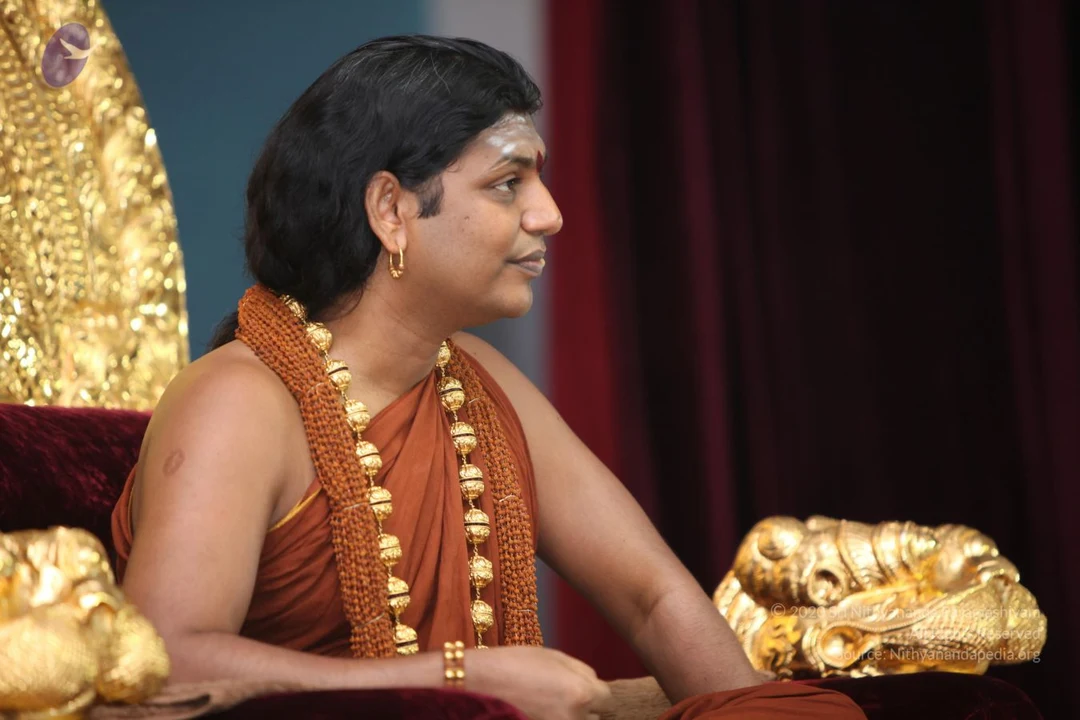
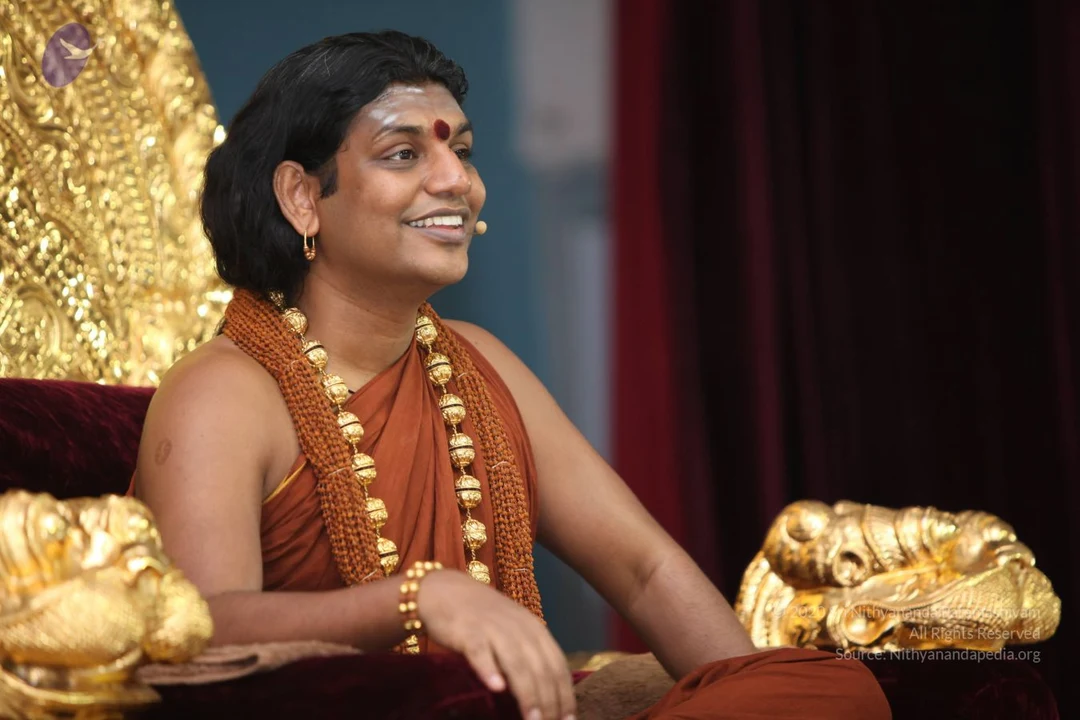
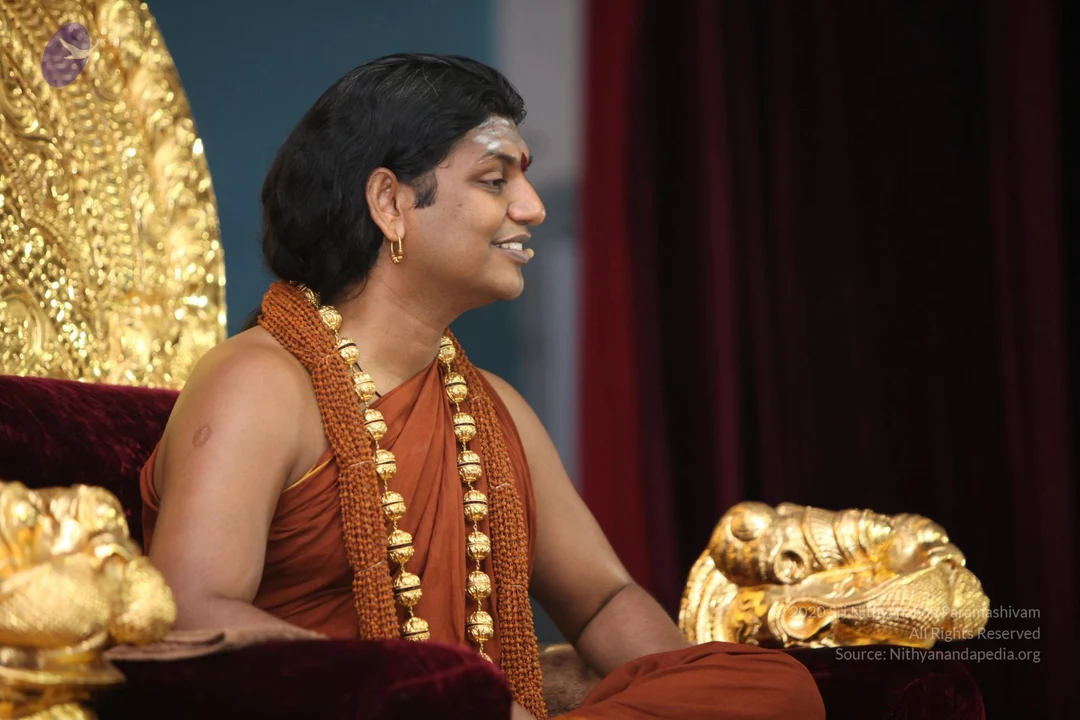
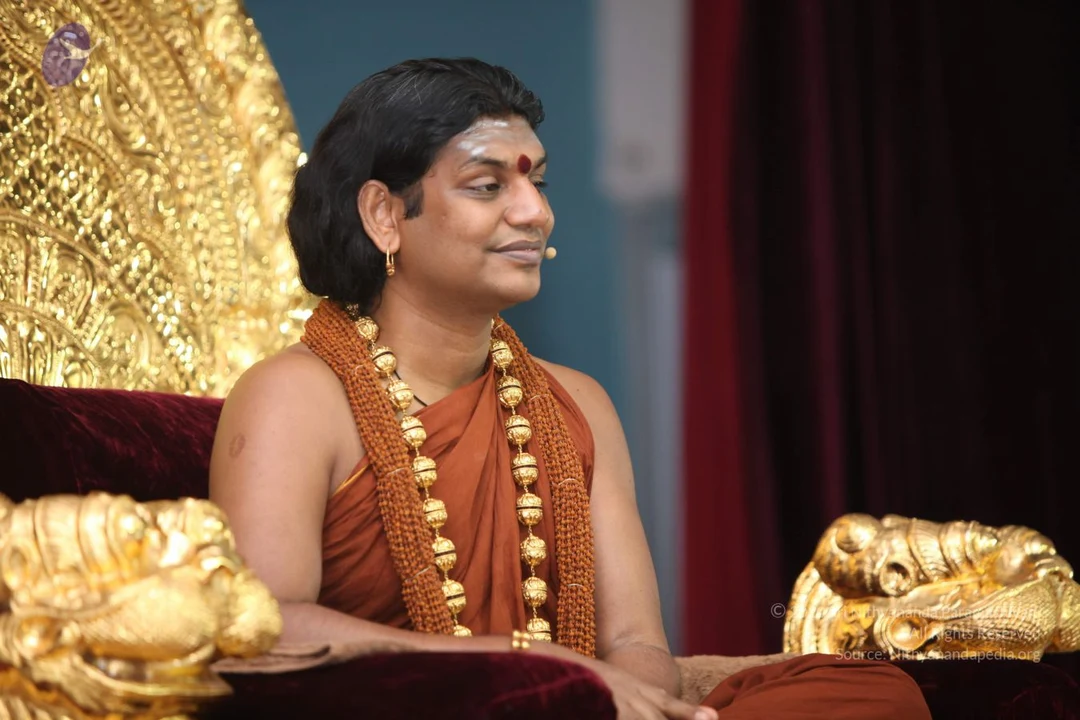
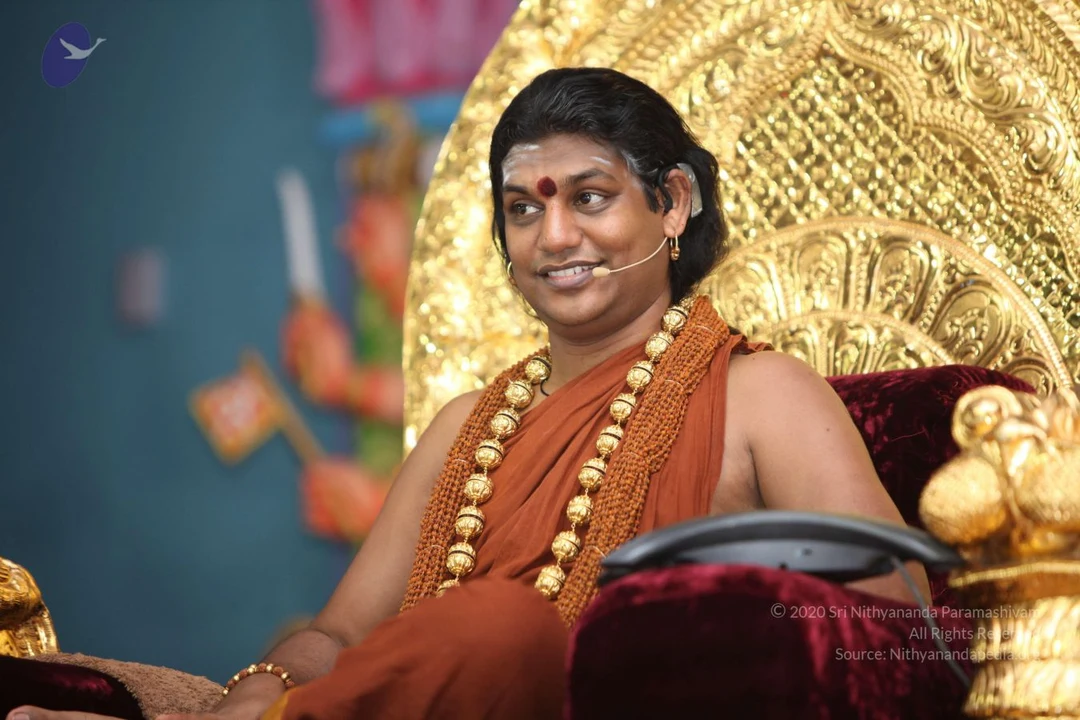
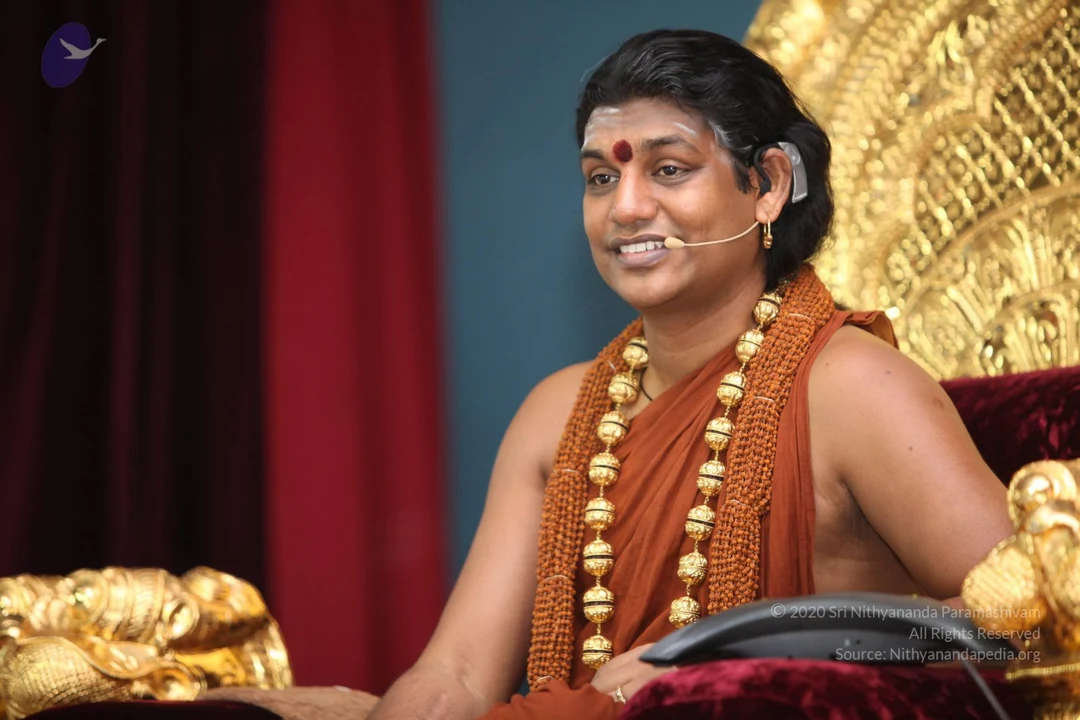
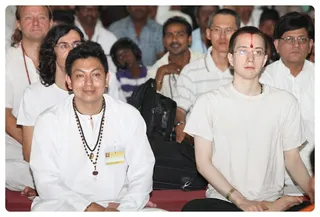
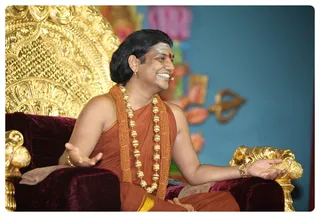
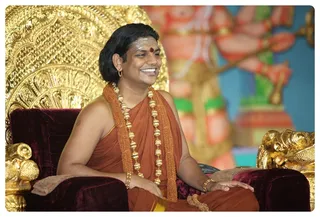
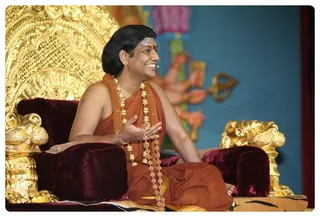
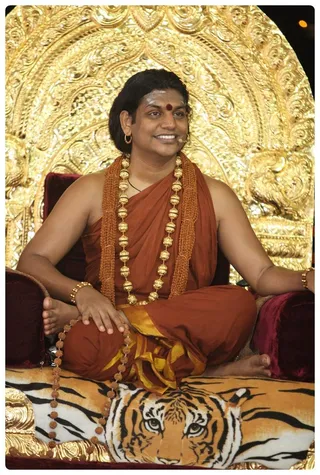
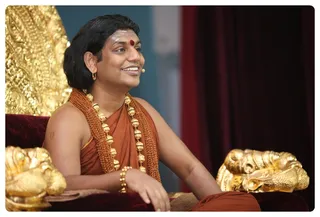
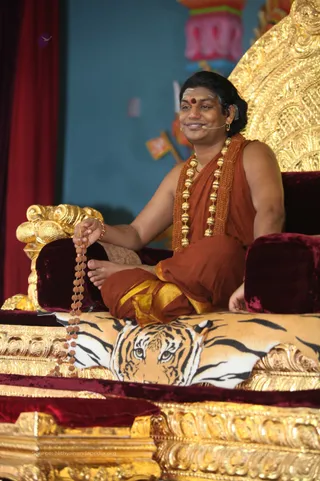
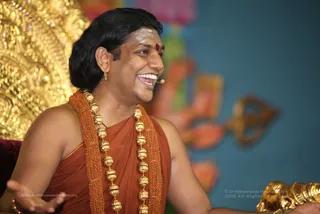
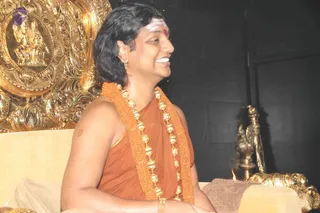
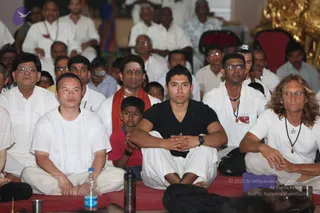
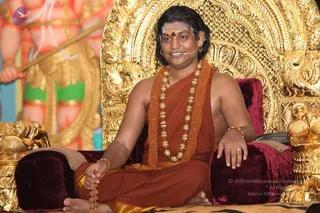
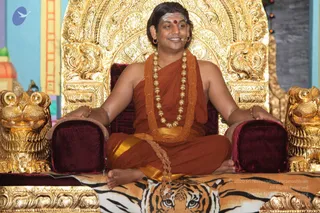
Photo of a smiling man seated on a plush maroon velvet throne in front of a golden ornate backdrop, wearing a headset microphone. He wears a rust-orange sleeveless robe draped over his shoulders and a double strand of rudraksha beads with gold bead spacers, a red bindi on his forehead and white vibhuti lines. Probable Swamiji: the saffron/orange robe, long swept-back hair, rudraksha mala with gold ceremonial beads and a throne setting are consistent with the page's reference to him at a satsang.Close photo of a man seated mid-discourse, smiling and gesturing with his right hand raised. He has long swept-back black hair, a red kumkum dot and white vibhuti lines on his forehead, a small gold earring, and a headset microphone near his mouth. He wears a saffron-orange robe draped over one shoulder, multiple strands of orange rudraksha malas, and a heavy gold necklace of ornate beads, plus orange beaded bracelets. A blurred gold deity murti or ornament is at the left edge, with a blue wall and a red and gold ceremonial object behind him. a person is seated in a satsang setting.A large seated audience attends a satsang in a bright hall with pale walls. Most attendees wear white or cream clothing, several with gold-bordered saris and rudraksha malas around their necks. Women sit cross-legged on the floor in the foreground, one in a white sari with gold border and a rudraksha mala, another in a bright orange top, and a younger woman in white with a pink shawl. Rows of listeners sit behind them, many attentive and some with eyes closed. A woman in the foreground right holds a pen and paper. Some attendees wear name badges. The image shows devotees listening, not the speaker, and no clearly identifiable a person is visible.

May 07 2013

Original wiki page
Contents

Title

Are you Living in Completion or Compulsion?

Description:

In today’s morning satsang, Paramahamsa Nithyananda emphasizes the power of completing our unfinished inner behavioral patterns. He tells us that if we are not living in completion we are living in compulsion, as slaves to our past habits. Nithyananda reminds us that all our patterns are determined only by our words: the words we speak to ourselves and to others. Whatever we speak we automatically accept as truth, and we set out to make our words into reality. Therefore, if we declare with conviction that we are complete – we can be achieve it straightaway! Once we are complete we will immediately know, because we will be inspired to share our uplifting feelings with others. That is the test of our authenticity.

VideoAudio

Transcript:

Today I wanted to make this statement first. This is going to be the subject for the Nithya satsang today. Please listen. With completion starts LIFE. Otherwise you are running out of compulsion.

Either you run the life in compulsion, or completion. With completion, your life starts. With compulsion – No, No! Not only you don’t have life, you constantly reduce the level of your life.

I wanted you to know, human life is not happening in the same frequency in planet earth. How can you compare, how can you say - the man who is in ecstasy enjoying the life, enrich himself and others in a monastery, and the man who is in prison given up on himself and others and the given upon by society, and the man who is in the political power center, who is between so much of patterns and sufferings and suffocations – How can you say all these people are in the same frequency? No! You need to get out of the myth – a very big myth taught to you – Human life happens in same frequency. It’s a LIE. How many of you cognized what I said now? Human life does not happen in same frequency. Every individual’s frequency differs.

/* Hindi 2.48 – 3.12 */

When you are in completion, anything you declare becomes reality. Anything you declare becomes reality. Understand, if you see in south Indian temples, they have a unique method of making arches out of stone. They will just arrange one stone, one stone, one stone one stone. The center stone, they will insert it in such a way – Just because of the pressure of the center stone, the whole arch will stand as it is. How many of you have seen these kind of arches? Without collapsing, the arch will stand.

I tell you, if your declaration is powerful, that is the center key stone that’ll keep your life stand miraculously. When I saw that arch first time, in Tiruvannamalai in one monastery, there is a Mutt called “Ishanya Mutt”. In that Mutt, that arch is there. When I saw that arch first time, I was shocked and I thought it’s a miracle, It is standing. How can a pieces of stone stand together? Then I understood. That key stone, because of its pressure, its holding the whole arch in the shape. Your declaration, out of completion is the key stone holding your life as it is, miraculously.

If miracles are happening in your life continuously, it is the declaration out of completion. One man calls his son and asks – “You should get married”. Son says “Noo! I don’t want to.” “No. I will get you – your wife is Bill Gates’ daughter.” He looks and “OK then, I will get married”. This guy goes to Bill Gates and says – “Give your daughter to my son”. He says “No! No way.” “No, he is the CEO of the world bank.” Then Bill Gates says – “ok then, I’ll give.” The guy goes 3rd meeting, Head of the world bank and says - “Give my son, the CEO job of the world bank.” That guy says – “No No way.” “No, he is the son in law of Bill gates” “Ok then, I will give.”

<swamiji’s laughter>

Understand, the whole thing standing with his declaration. He did it. It may look like a cheating. I don’t think it is cheating. I see very clearly only the power of declaration in his words. I got this story in the facebook. Somebody sent. But the end of the the moral of story is – ‘this is what is business.’ When I read, I said “No! I don’t see any business in it. I see only the power of declaration in it.”

A stone arch stands by the power of the center stone miraculously. Your life can stand miraculously by the power of your declaration out of completion. Today I will give you the exact process of the completion, by continuing my childhood story – I was sitting and waiting for Ganesha to eat, me without eating. Did not eat for 2 and half days. 3rd day evening, I don’t know whether it is, you can call it as a miracle or the power of authenticity. That time I understood as a miracle. Now I’ll call that as a power of authenticity. When you are authentic, and ready to stretch, beyond your perceived capabilities by your mind, Listen, The perceived capabilities of your mind, what your mind feels as your capability, if you can stretch beyond that, the power of authenticity moves the world. The world listens to you.

3rd day evening, I could see very clearly, my mind has raised to the level of bhava samdhi, means the zone where the solid is not solid, liquid is not liquid, where that gap between the solid and the liquid is just overlapping on each other. It is like a – when the ice and water meets and melts, that zone. Neither the formlessness nor the physical form. I know, I am not able to express. I am just managing. You can say the doorstep. Neither you are in nor you are out. Same way, nor in the space of complete formlessness, or in the space of name and form. where the solid is becoming liquid. where the form is becoming formless. That zone. That is what I call Bhava samadhi. The, my inner space got pushed into that bhava samadhi space. I could see Ganesha eating.

When my space got settled, when I opened my eyes, I tell you, I had the prasada. I can declare clearly, I have that tremendous trust and I could see now, the authenticity has flowered into responsibility and decision to enrich. With the power of integrity, I decided to feed Ganesha, With the power of authenticity I took the responsibility of making him eat. After the experience, the joy of enriching, means to share with world has started happening in my system. People can have their own doubts – who knows? Whether Ganesha ate, or Ganesha’s vehicle - mouse ate. Whether the rat ate. If Ganesha eats, he will give the prasada of tremendous trust, love, devotion. I had the prasada. So I can be very sure Ganesha ate.

Now the lessons which you can internalize in your life from this story – The tremendous trust, power. Trust on power of integrity. That’s the first lesson.

Many time, people ask me – “How can I, if I just say I’m complete, How can I be complete?” You can! Because you are nothing but the words you uttered. You are nothing but the bunch of the words you uttered, consciously or unconsciously to you or to others. Unfortunately most of it, 99.99% of it is unconscious. That is where the problem starts. You are nothing but the bunch. Totality of the words you uttered. The words you utter. Many time, you do not recognize the power of the words you utter. You do not recognize the power of the words you utter. You do not recognize, especially the power of the words you utter towards you. Tremendous trust over the power of integrity. You always feel- “I am integrated but still I need to evolve.” Over! When you have these words in you, you will never be complete. You should know – “If I am integrated now, If I declare completion now, I am complete. I am nothing but the words I utter. I am nothing but the words I utter, inside and outside”. The words you utter inside and outside is 100% you. It is not bad news. It is good news. Understand. Because, you CAN change NOW!

15-30 minutes

If you are thinking, ‘Oh, I am just a word, then I have done such a big mess, I have done so much mess, what can I do?’

If you are suffering with the past, it is the bad news for you. If you can understand now you CAN change, it is good news for you! Now you CAN change! Now you CAN change! Because if you can utter the word now and complete, “I drop the past; it has no power over me”, you can be complete now! You might have uttered you are incomplete million times to you in the past, but even uttering once in the present you are complete can finish off all your million declarations in the past, because when the time and space crosses, the declarations you make are alive and powerful! Always time and space crosses in the present moment. In any legal system, the latest order will be the order which will be executed which should be executed. Even in your life, your latest declaration only will be executed. If you declare completion now, you are complete. You may say, ‘No! No! Now I am saying I am complete, but I am not complete.’ Then already you have decided you don’t want to be complete! Don’t you see? DECLARE you are complete! Roar like a lion and stand on completion! I tell you, you are nothing but the words you utter. You are nothing more than the words you utter.

(Hindi)

Understand, the first lesson you need to learn from this story is the ability to trust the power of your Integrity. If you say, “I am free”, you ARE free! If you say you are bound, you ARE bound! If you say you are a liar, you ARE a liar! If you say you are enriching, you ARE enriching! It is just YOU! The words you utter to you and to others is life! What a big relief! It can be a great news for you if you start living it. It can be a good news for you if you start believing it. It can be bad news for you if you start worrying about it. But the words you utter towards you and to others is YOU, YOU, YOU!

If you utter the word, again and again, “I am efficient”, “I am powerful”, you ARE that! If you utter the word “No! I am powerless, I am inefficient”, you ARE that!

(Hindi)

Second truth you need to know, the power of your Authenticity, even in the initial level, it looks like inauthenticity. Stand by it; it will rise and rise to the next, next, next level of Authenticity. In this story, in the beginning, when I started feeding or planning to feed Ganesha, it was inauthentic. It was not authentic. But, even if it is inauthentic, when you are authentic towards your inauthenticity, it will lead to Authenticity. Like, any number, any equation if you multiply with zero, it will become zero. Same way, how much ever your inauthenticity can be authentic, even towards your inauthenticity, it will become authentic. Millions of years of your inauthenticity has no face in front of one inch of your authenticity. Everyone has to die; The people who go to the Yama’s house can never return his millions or billions of years of rule. But Nachiketa’s authenticity has broken the millions of years of rule. So, your Authenticity can break any rule, can break any suffering, can break any inauthenticity you carry.

Third important thing, lesson you need to know: When you take the responsibility, when you decide to become responsible, simply the whole Cosmos listens to you, follows you! With Responsibility even if you sit in one corner, the very space changes the response the way the world responds towards you.

Vivekananda says beautifully, ’In India, even if we want wealth, we sit under a tree and create the space. It happens around us!’

He told these words in the U.S., the country which teaches you that you have to work so hard to accumulate wealth. If you sit with yourself, you may accumulate peace, but not even a piece of bread!

Vivekananda says, ‘No in India, even to accumulate wealth, we just sit and create the space, and it happens!’ Understand!

What else do you think I did in my life? I just sat under the Banyan Tree and created the space. See, the city happening here! Do you know this land when it was donated to me, it was infested with 1,800 snakes! Because there was a snake farm here; before donating this land to us, that owner he moved the snake farm out. When he was welcoming me to this land he told me, ‘Swamiji we moved almost all the snakes. We had 30,000 snakes earlier. We slowly, slowly sold and moved everything out. But during the transition, 1,800 snakes escaped, Swamiji!’

They were extracting venom here. It was a legal snake park. It was running legally as a business, industry. That is the way it was handed over to me. See today, a city has happened! Full-fledged temple, and at least a few hundred people can stay. People from all over the world can watch from here. Please understand, it took two-and-a-half years for us to get a telephone connection! Just a telephone connection! 2005 mid we got the telephone connection! But now, anything I speak sitting here, all over the world people are listening! Just I created the space! It is not only now a spiritual city, it is getting developed. It is the, now this place has become the model, source for multiple spiritual cities happening all over the world! Multiple spiritual cities happening all over the world! Understand! It became inspiration for multiple spiritual cities to happen all over the world! So, when you take responsibility, sit, by creating the space and ready to sacrifice, simply the world moves based on your word! The world moves as you want!

30-40min

The fourth principle, fourth truth you need to learn from this: When Ganesha ate, I saw the tremendous joy, the inspiration to raise myself to the next level, enrich myself and enrich others. It is not that after that I kept quiet. I started creating a group of people, going around and worshipping every Ganesha in the city and village. The first public function I organized is for Ganesh Chathurthi. I think at the age of eight or nine, I gathered all the my classmates & chamchas and disciples, went around and collected donations, called the VIP guests, made all the arrangements, in the Arunachaleshwara Temple. The Ganesha under the Banyan Tree, incidentally the same Banyan Tree; please understand, when I say “same”, I mean even the DNA is same! We did a medical test we did a forensic lab test; we discovered even the DNA is the same! It’s a This Banyan Tree and that Banyan Tree, both are brothers! They both are from the same source, are from the same root. Understand, when I had this experience, it is not that I just sleep with myself, I just kept it with myself. No! Immediately it has made me to enrich others. Understand, any experience you have, if you want to find out whether it is true experience or not, if you are having the inspiration, power to enrich others, it is a true experience, or it is your fantasy, false imagination. Real experience will empower you. How to find out whether my Kundalini is awakened or not? You will take the responsibility and enrich yourself and the world, equivalent to a Peetadheeshwar. Few hundreds will be enriched by you. If that happens, then your Kundalini is awakened; otherwise it is not!

If you live with the pattern of “life is a suffering”, wherever you go, whatever you do, life is suffering. If you understand life is a life is a life – please listen, I am not saying you should create a pattern “life is joy or bliss”. No! I am not saying you should create a pattern or you should not create a pattern. I just wanted to tell you only one thing, if you decide life is a life is a life with Authenticity, you will explode in the highest possible peak experience of life, the highest possible peak experience of life. Keep the life alive by living these four principles. Go on listening. Go on doing the completion.

Now I will give you the exact process of completion:

· Declare with Integrity you are going to be complete. That is the first step.

· Second, any incompletion sitting inside you, sit with the mirror and start talking it out (Swapoornathva). If it is related to somebody else, start talking to that person with the motive of completion, not with the motive of taking revenge or creating a new fight! Don’t go and do that! Then it is like a elephant going to take bath, but puts the mud on its face and comes back more dirty! Sometimes people go to complete with the wife and start talking and pick up a new fight, and come back more depressed, more incomplete! Go and talk to them with the decision to complete.

· And third, third is a very important thing. Whatever you think still it is sitting inside you after Swapoornathva – completion with you and completion with others – complete it through cathartic processes like Glassalolia – talking in tongues – Manipuraka Shuddhi Kriya. Use these types of kriyas, and through catharsis complete it.

These three are the direct processes, direct method to achieve completion.

Complete with these four tattwas. Bring completion within you with these four tattwas.

Understand, bring yourself to completion through all these three methods.

Nithyananda Times

Photos
Inner Awakening

Photos Of The Day:

Seattle

Toronto
Photos Of The Day:

Temple-Visit

Pratyaksha-Pada-Pooja

Pratyaksha-Pada-Pooja

Morning-Satsang

Photos from this day

View all 201 photos

Photos

3 photosSource gallery
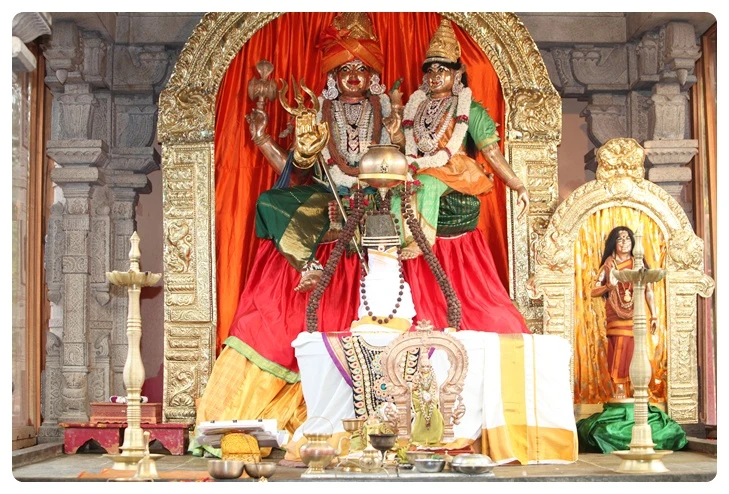
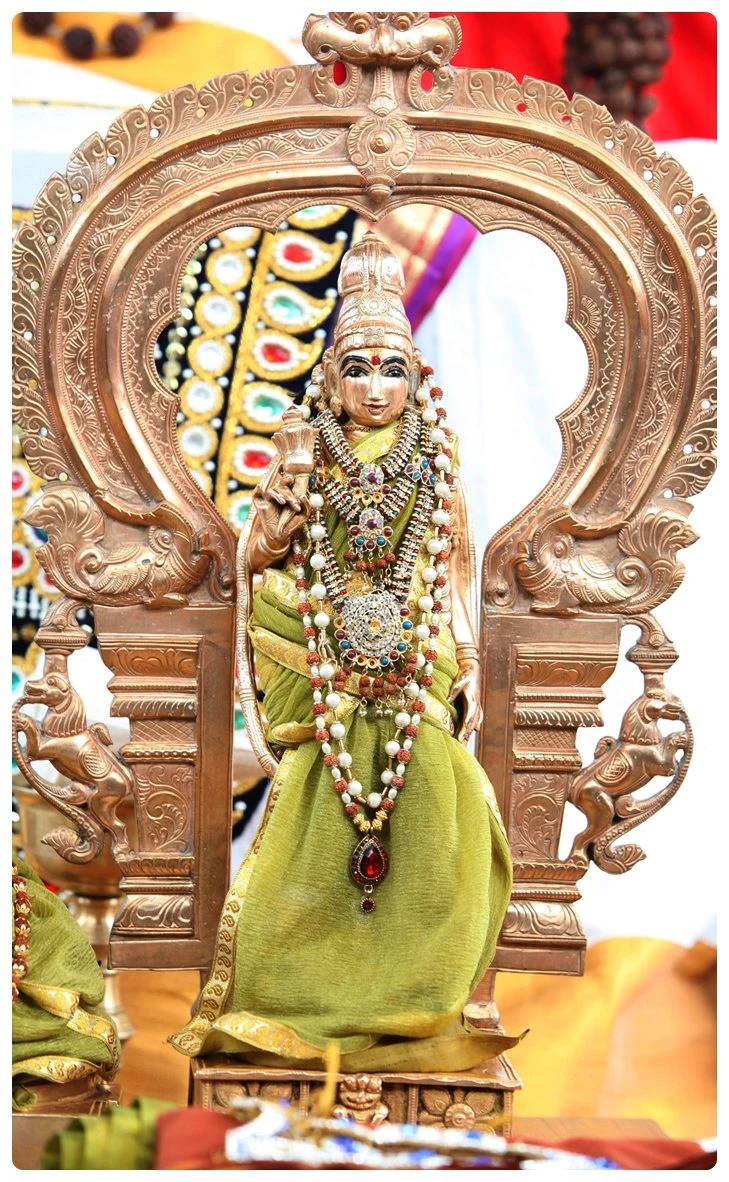
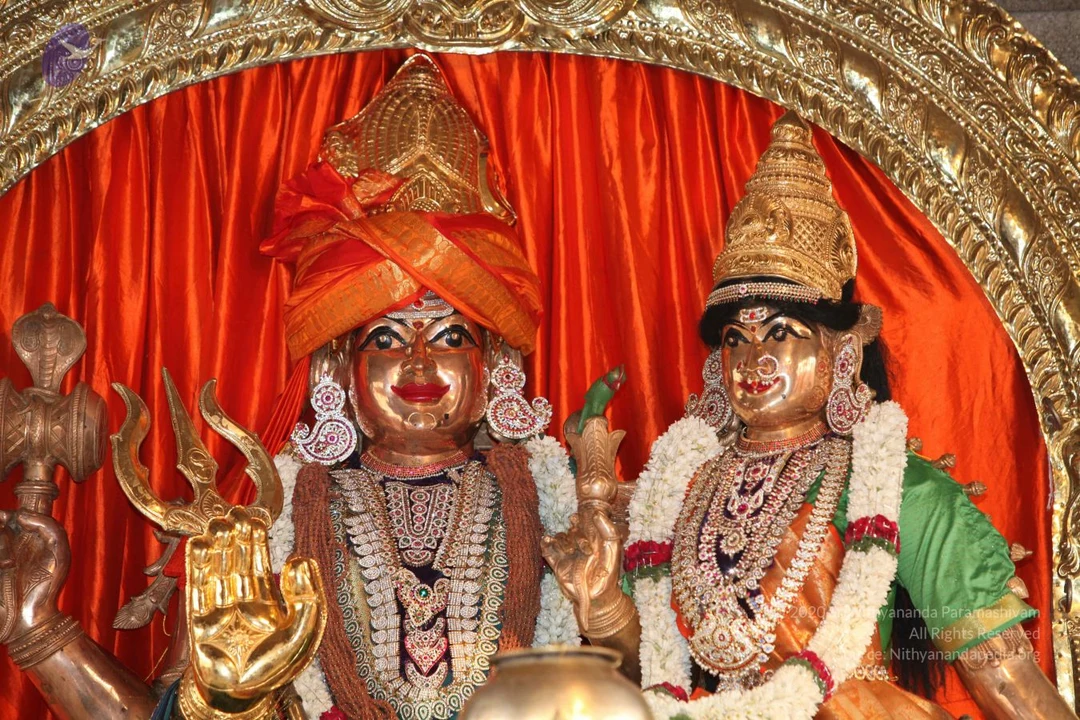
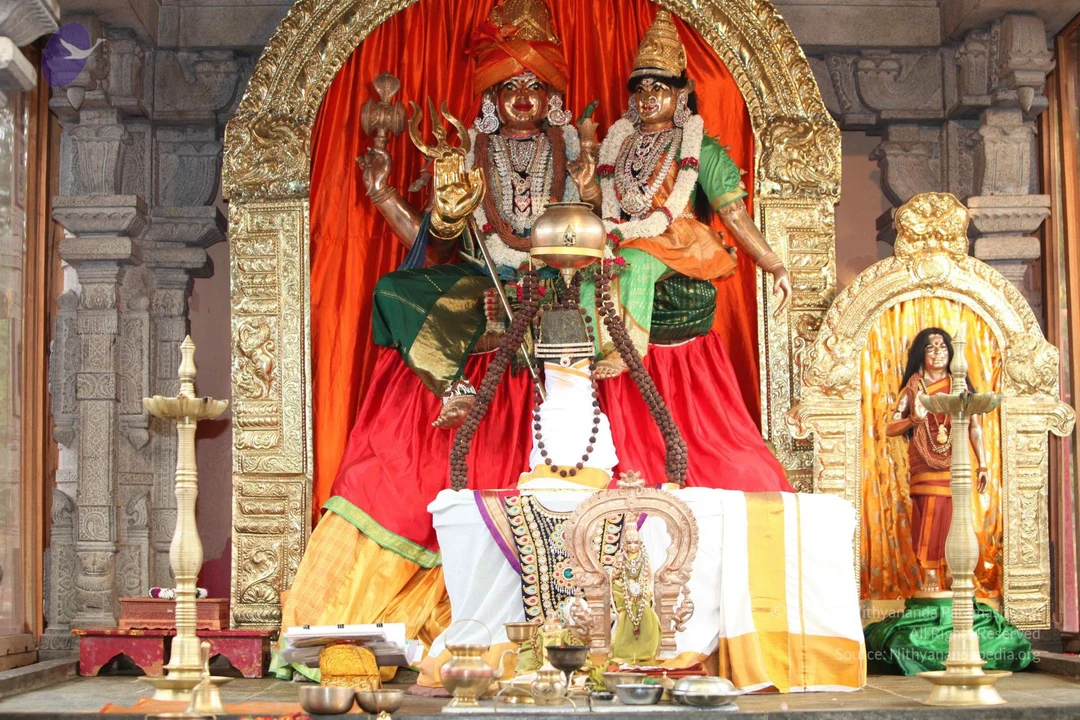
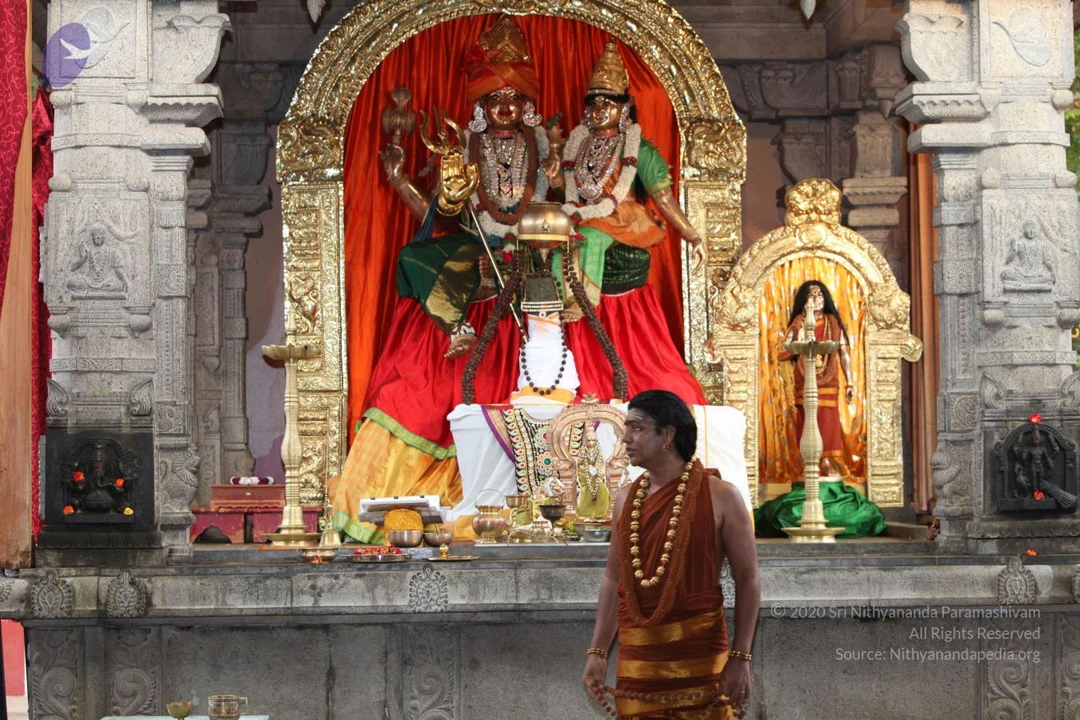
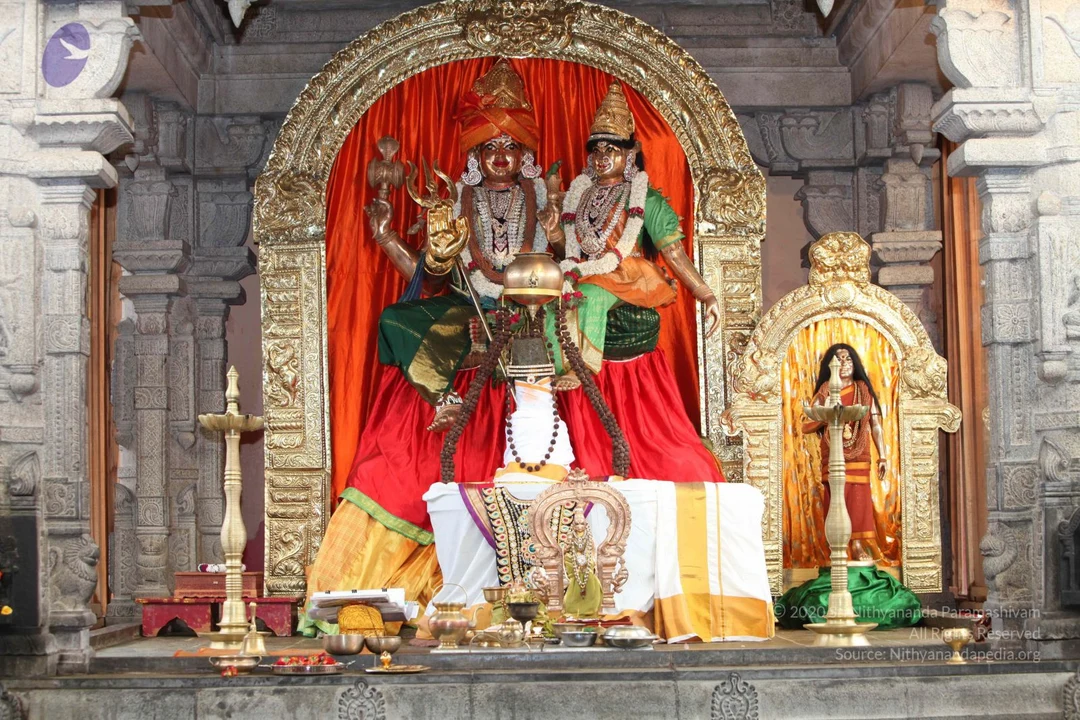
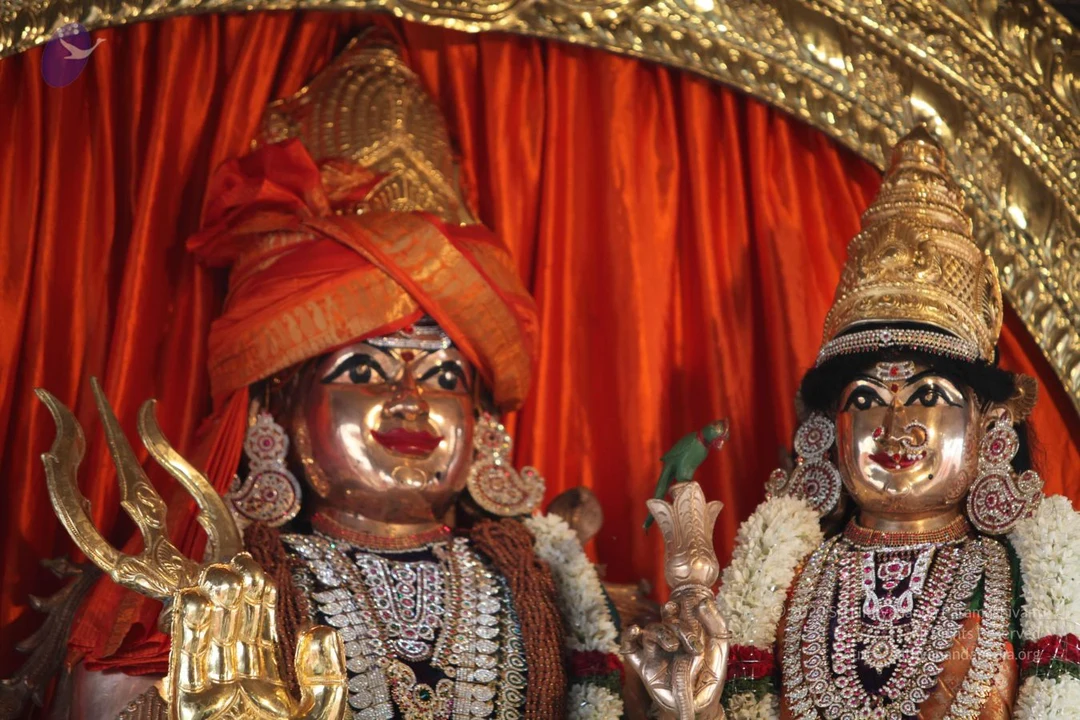
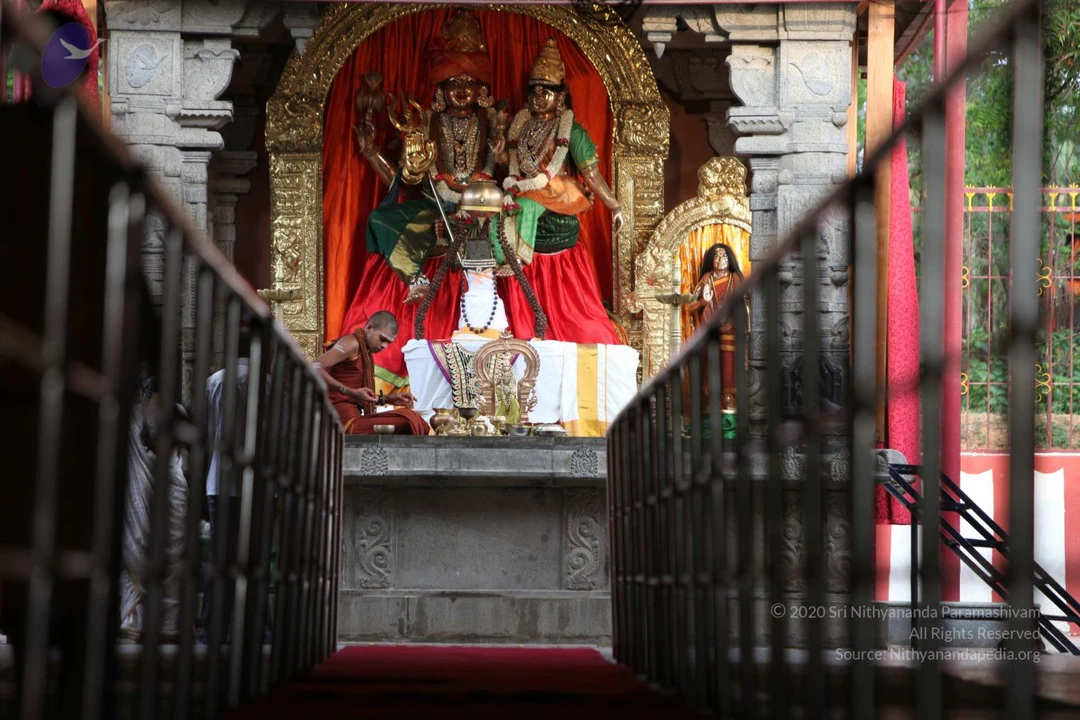
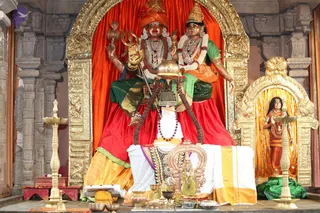
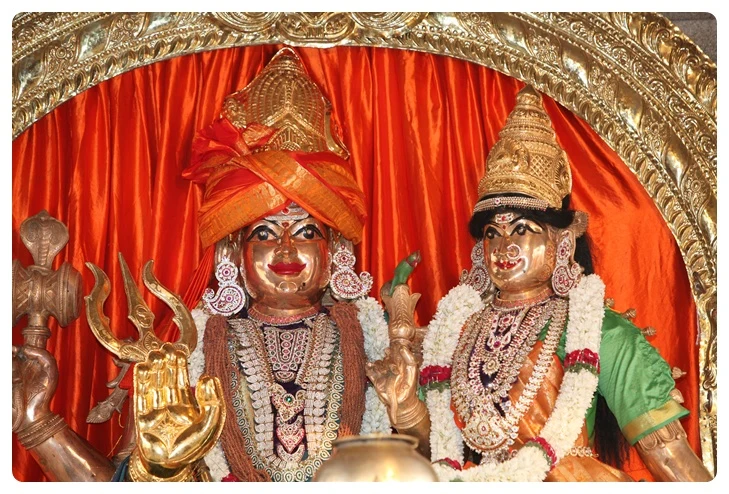
A photograph of two ornate metal deity murtis standing before a bright orange draped backdrop framed by a gilded arch. The figure on the left wears an orange and gold turban, a rudraksha-style white and gold garland, layered gold necklaces and large jhumka earrings, and holds a golden trident (trishula) in his raised hand, with a snake-hood motif visible at the edge. The figure on the right wears a gold crown, a white jasmine garland, layered gold and jewelled necklaces, and a green and gold sari, holding a green parrot-shaped object in her hand. Both murtis have painted faces with kumkum-style forehead marks. No physical people are visible.Photograph of a shrine featuring two large painted sculptural figures seated side by side on a raised platform before a red and orange curtain within an ornate gold arch. The figures wear green, red and orange garments, rudraksha malas, white flower garlands and crowns, one holding a trident-like staff. Between them sits a silver kalasha with a dark bead garland draped over it. In front are brass oil lamps, bowls of offerings, a white cloth with a gold border, and a small deity figure in a niche on the right. No physical people are visible.A gilded bronze deity murti seated within an ornate arched copper-toned throne frame with carved lion and floral motifs. The figure wears a green silk sari with gold border, a tall crown, a cascade of rudraksha and pearl malas, a jewelled pendant and a red stone necklace, and raises one hand holding a small object. Behind it hang a red and gold textile and a decorated embroidered cloth. No physical people are visible.

Photos

3 photosSource gallery
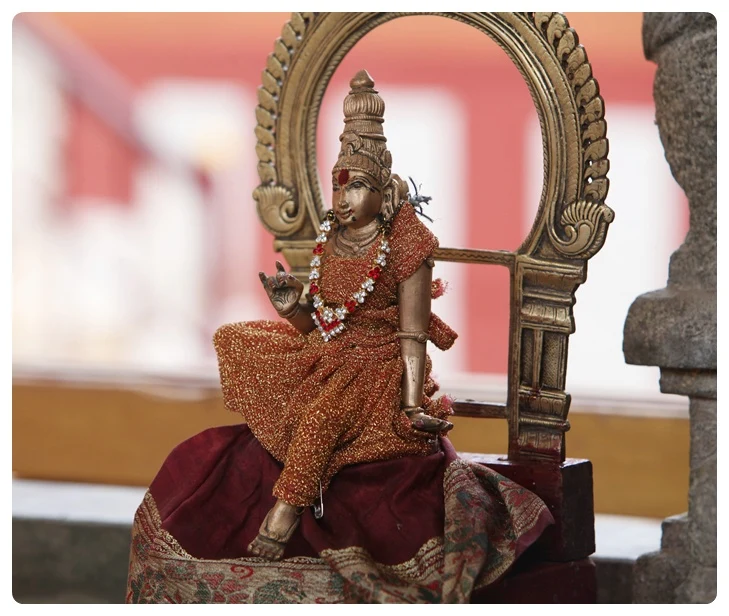
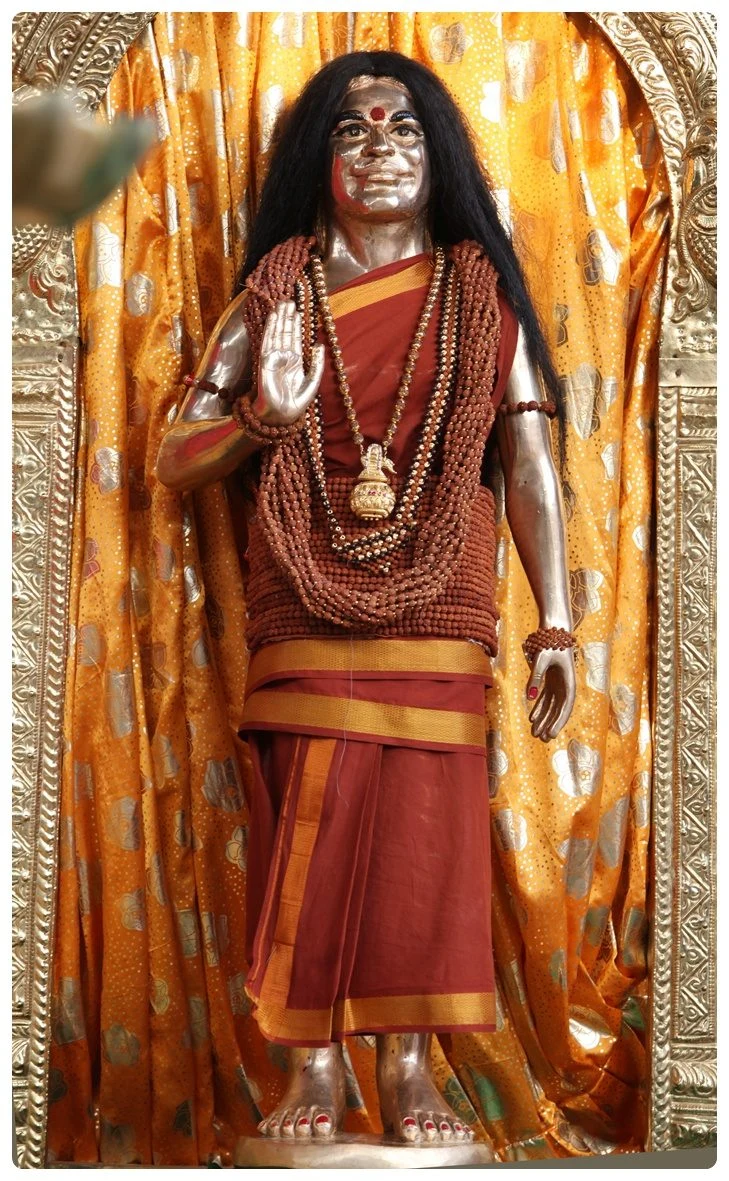
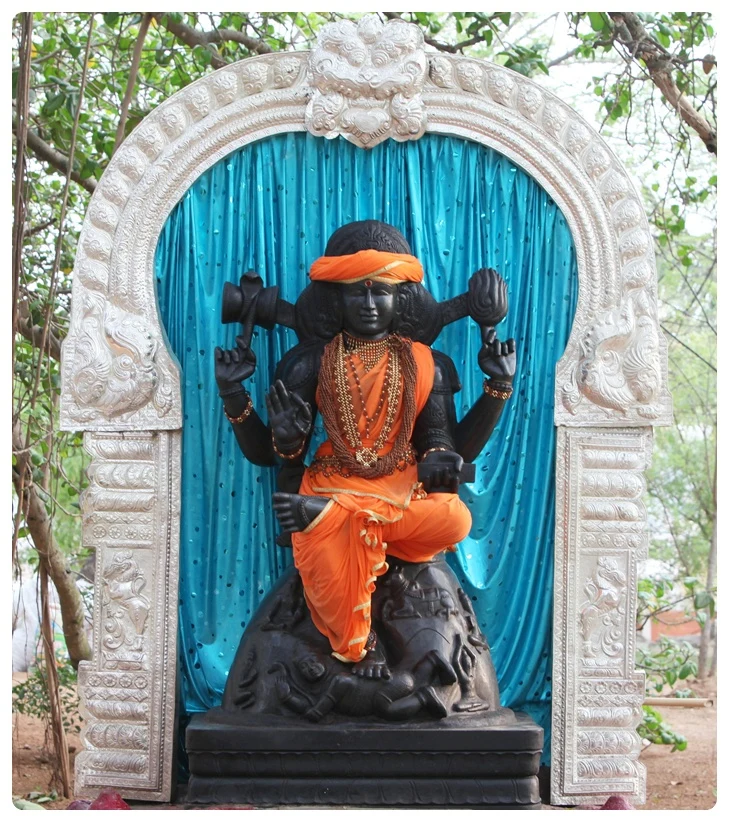
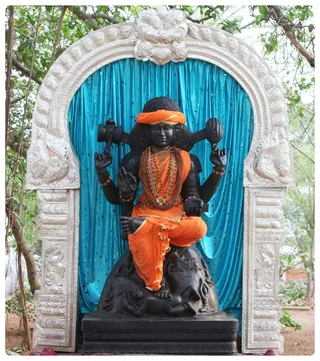
A small bronze metal murti of a seated goddess sits within an ornate golden arched frame on a wooden base, set before a blurred red and white background. She wears a gold crown, a red bindi, a sparkling orange-gold sari with a red and white floral-bordered wrap, and a red and white jewelled necklace. Her right hand is raised in a gesture while her left rests on her lap. No people are visible; the scene is a photograph of a deity murti in a temple setting.A life-size silver-toned statue of a standing male figure with long black hair, a red bindi and a sandalwood-style forehead mark, raising its right hand in a blessing gesture. It wears a red-maroon dhoti with a gold border, a draped rust-red shawl, many layers of rudraksha beads across the chest and shoulders, a long beaded mala with a gold pendant, and red-bordered wrist beads. It stands in front of an arched niche draped with gold and orange silk patterned with flower motifs, framed by ornate gold carved edging. The image is a photograph of the statue, so the figure is a depiction and no living people are present.A black stone statue of a four-armed deity murti stands in an ornate white arched niche framed with carved relief panels, set against a turquoise draped backdrop and surrounded by trees. The figure wears an orange turban, an orange dhoti-style cloth, layered rudraksha-style beaded necklaces and gold bangles, and stands on a dark rock base with a small carved figure beneath. No living people are visible.

Photos

3 photosSource gallery
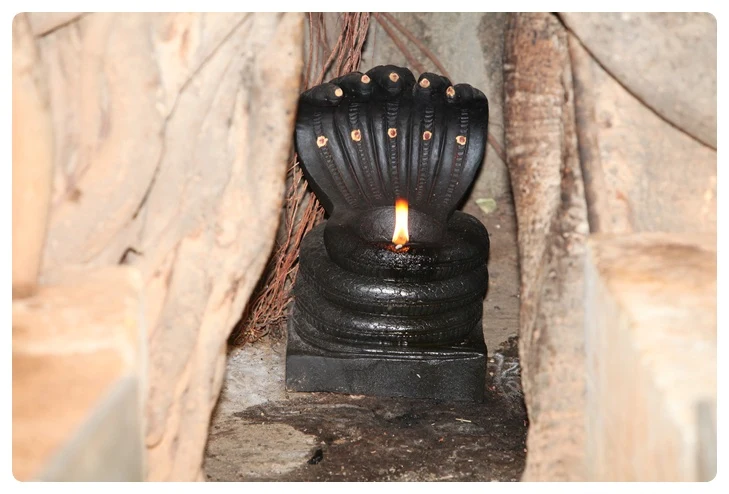
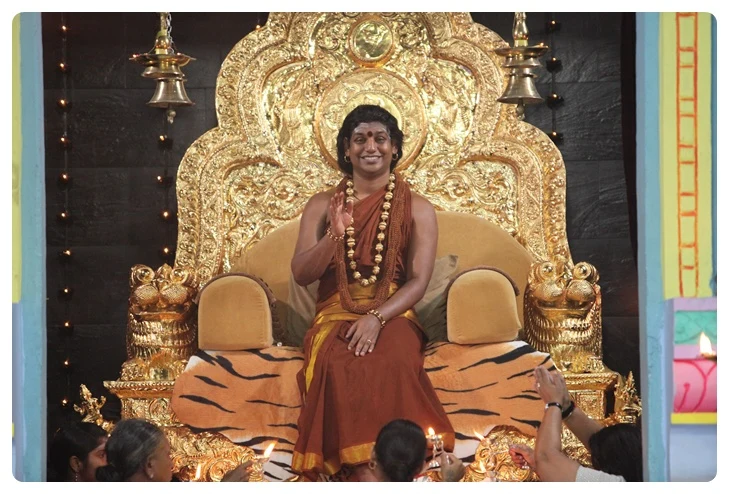
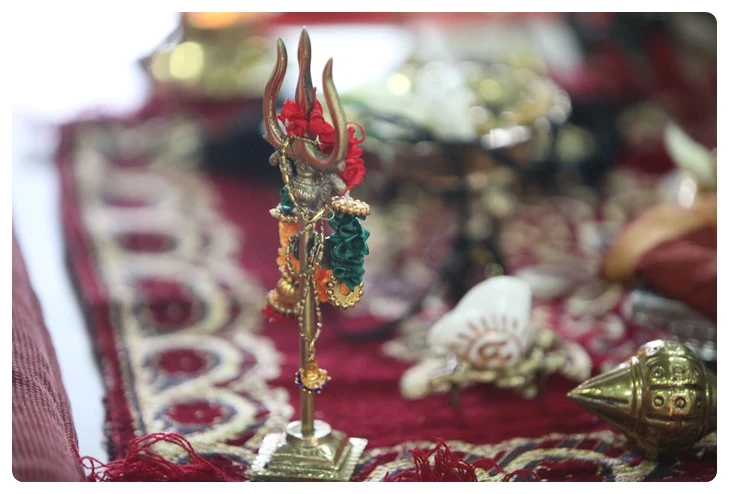
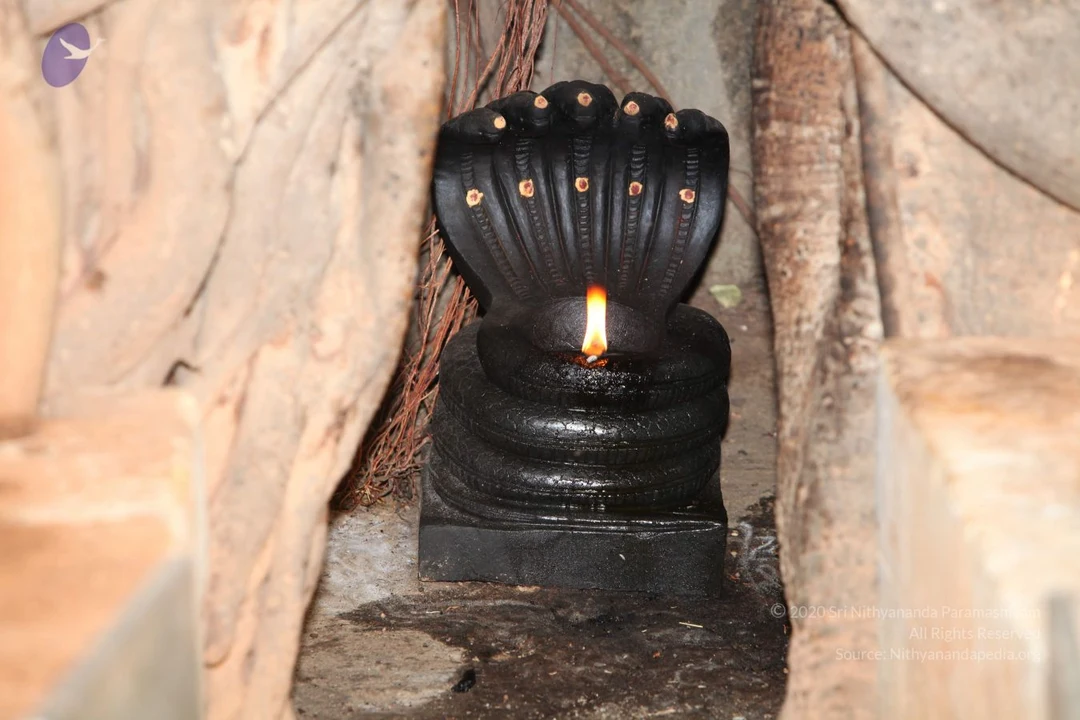
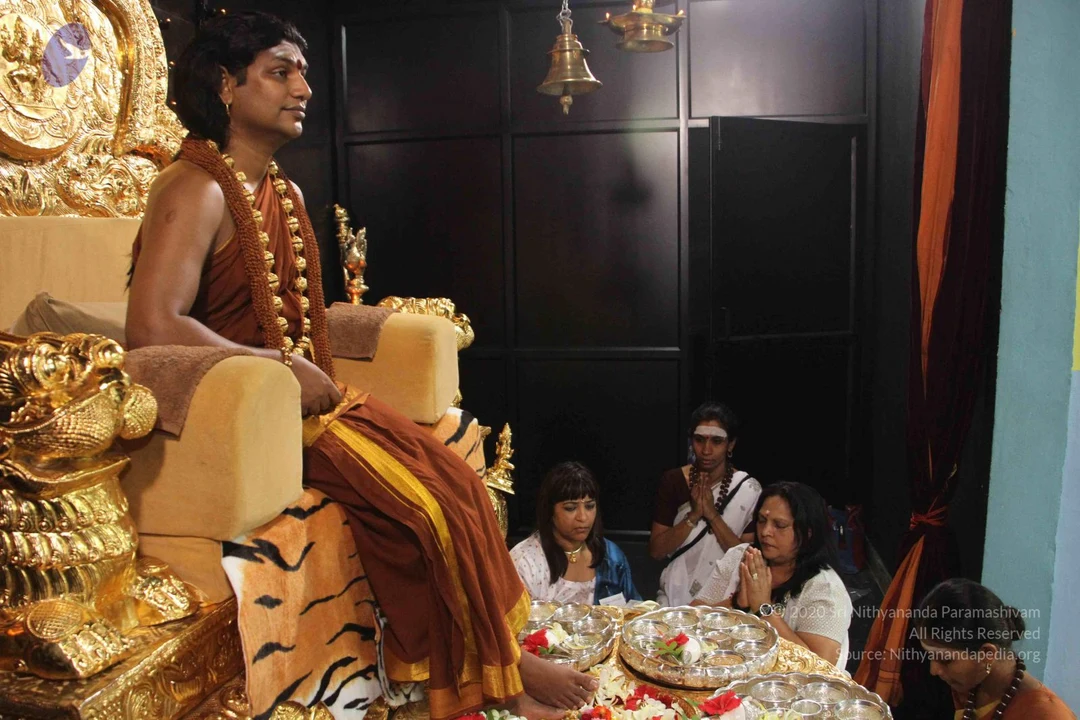
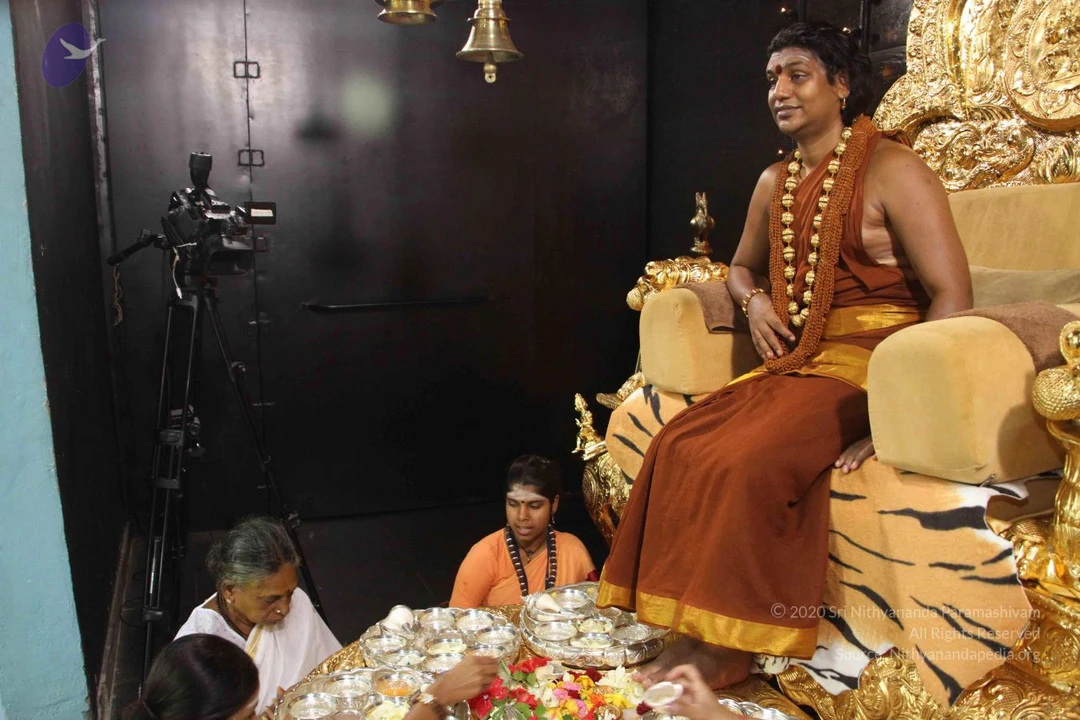
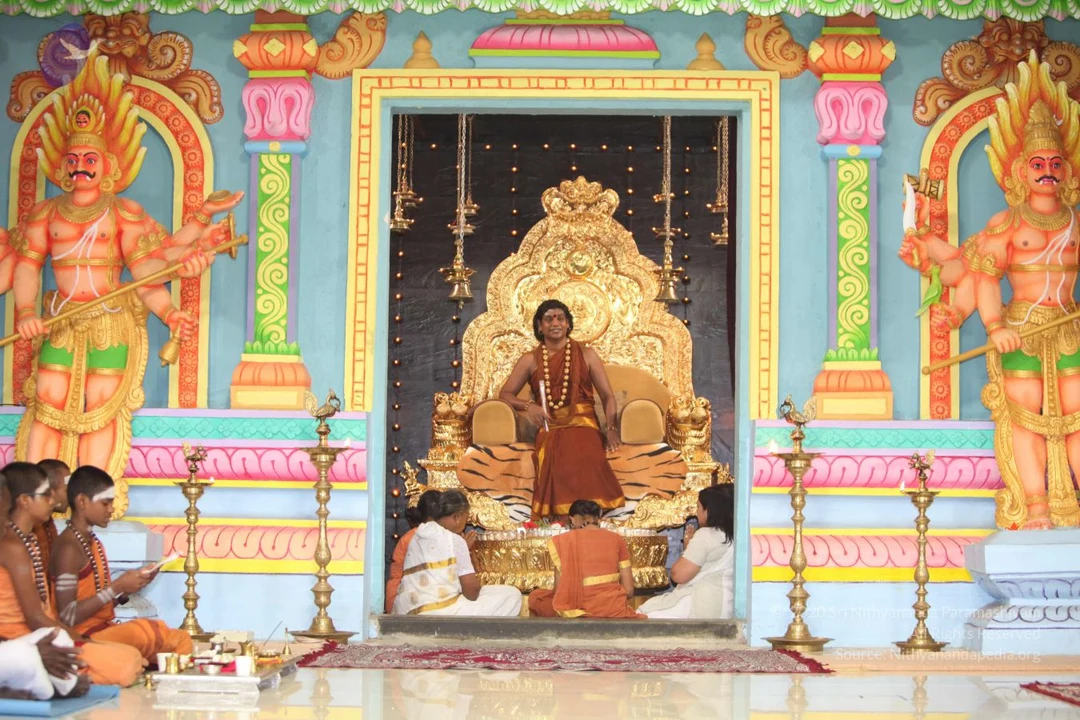
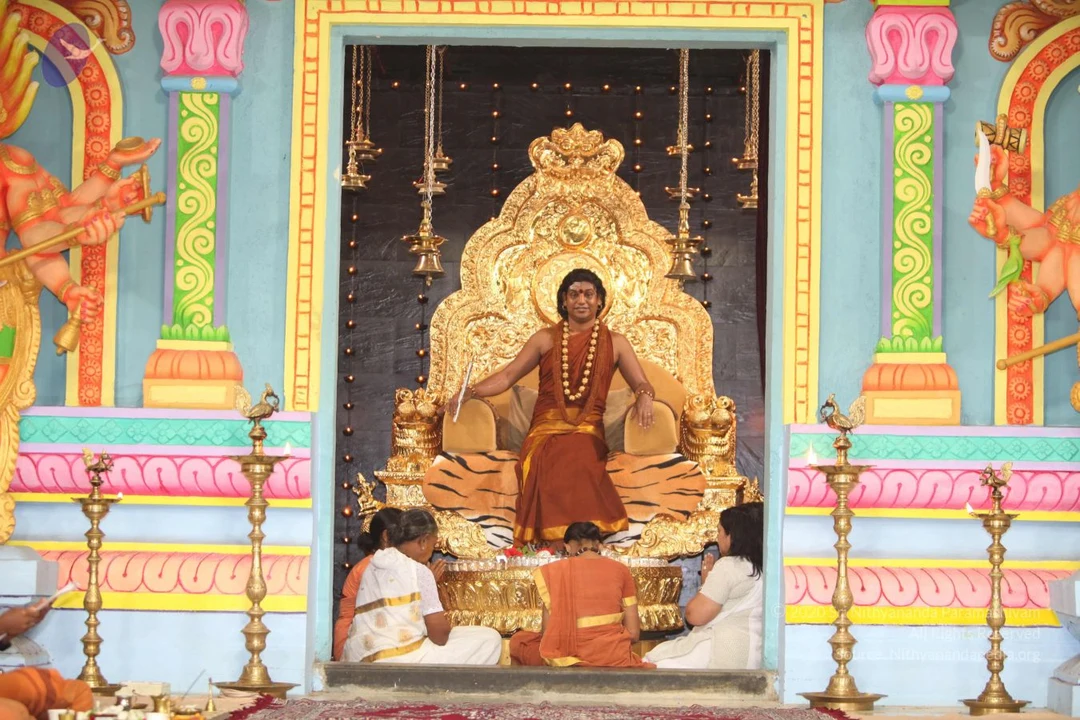
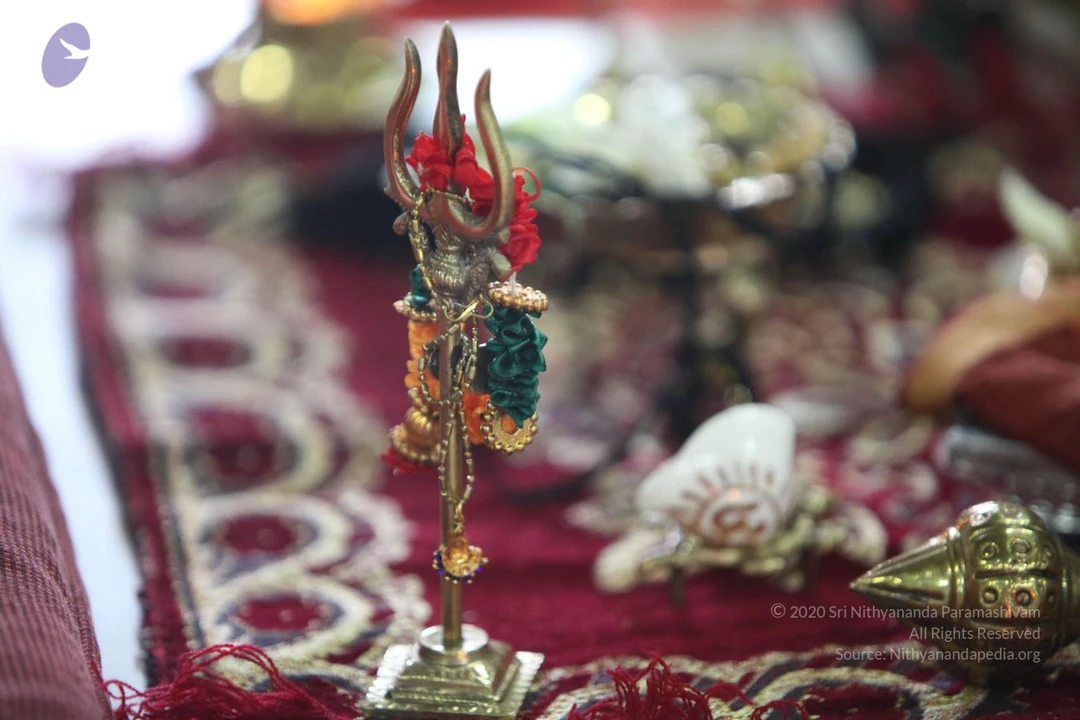
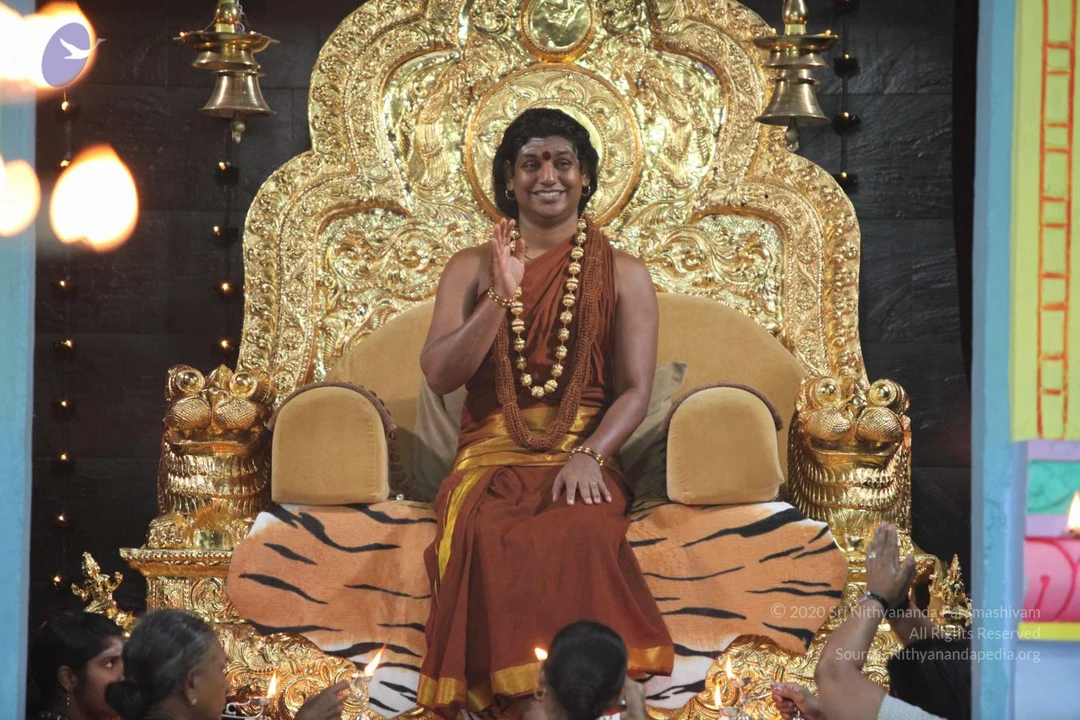
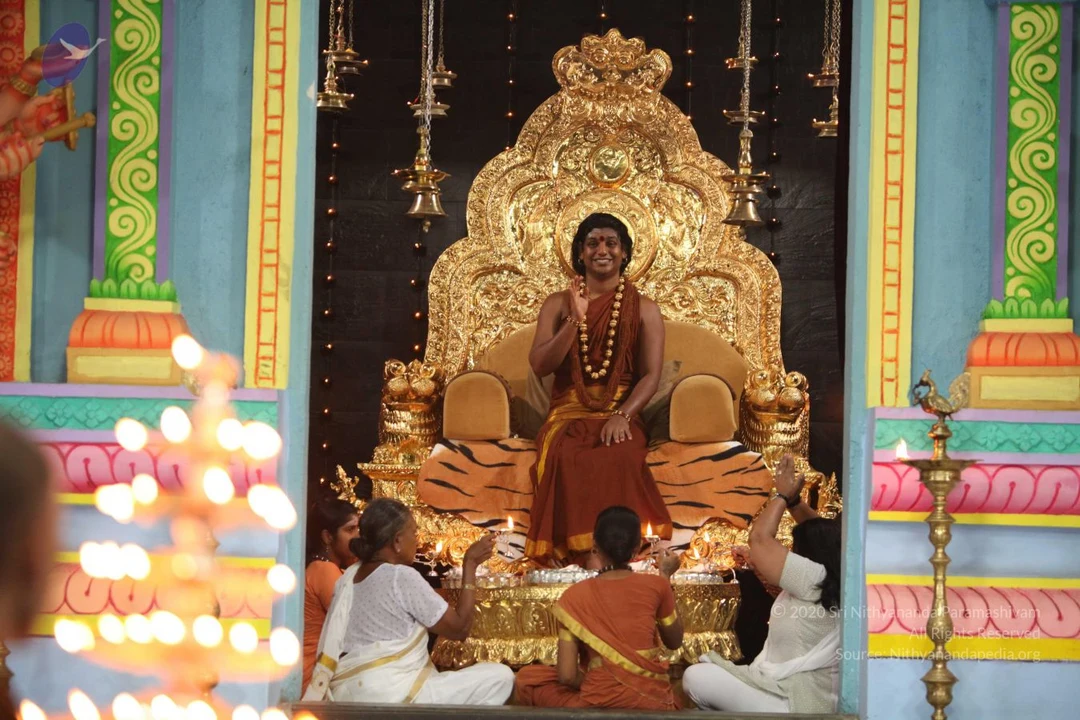
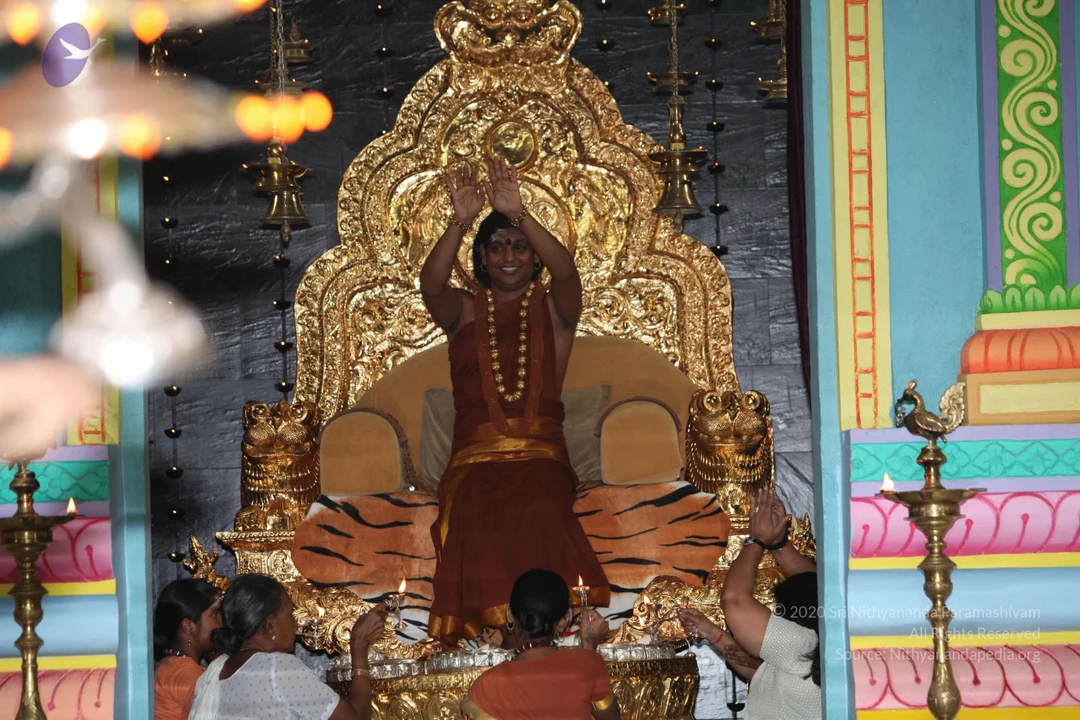
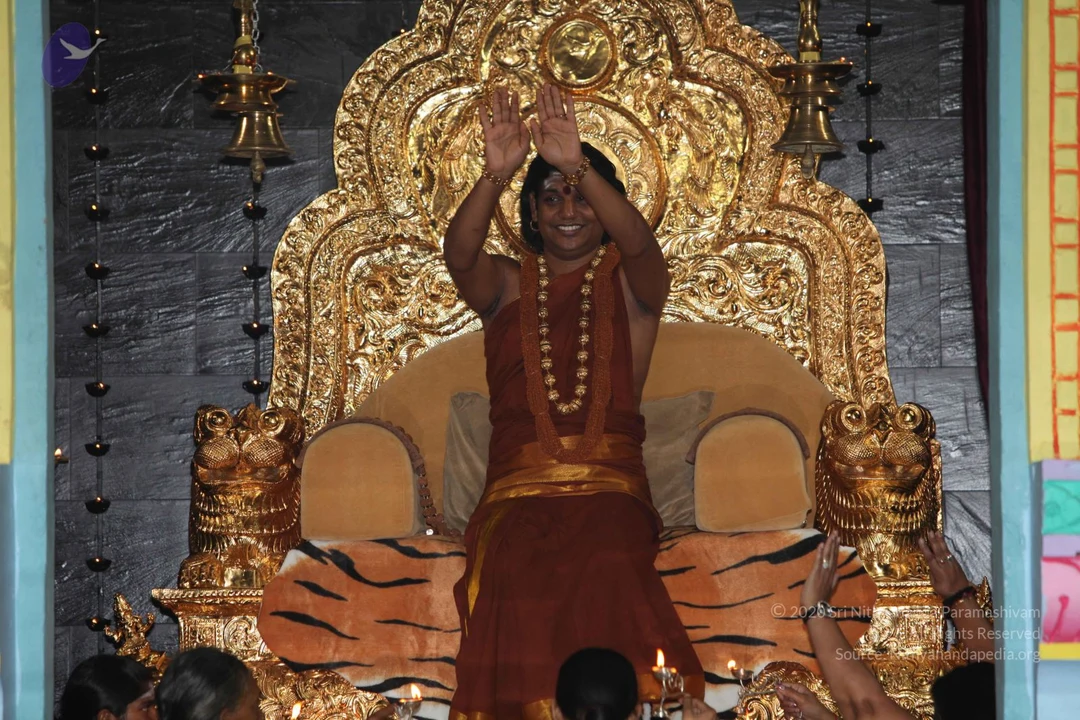
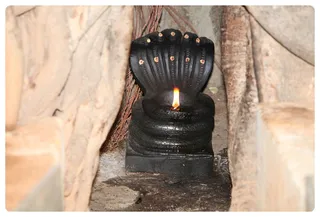
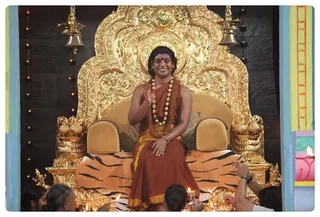
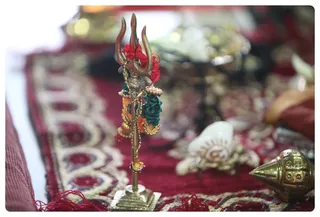
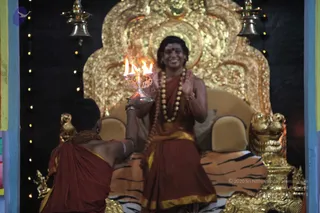
A photograph of a black stone serpent sculpture, a multi-hooded naga with raised cobra hood, coiled on a square base in a rocky niche. A small flame of an oil lamp burns on the coiled body in front of the hood, with reddish dots on the hood. Rough sandstone walls and dried roots surround it. No people are visible.A man in saffron-orange robes and a rudraksha mala with a gold ornamental necklace sits on an ornate gilded throne with lion-head armrests, draped with a tiger-striped cloth, raising one hand in blessing and smiling. a person: the seated figure has a distinctive ceremonial adornment set and saffron dress, consistent with the page's label. Below, women in the foreground hold lit oil lamps and offer flowers near the throne. Behind the throne are brass oil lamps and a gilded backdrop, with a pink lamp and a bright panel at the right edge.Close-up photograph of a small gold trident (trishul) standing on a square metal base, its shaft wrapped with red and green cloth and beaded threads. Behind it, on a red and cream embroidered cloth, sit a white conch shell marked with an orange om symbol and a small brass ritual object. No people are visible; the scene is a ritual altar arrangement with the trident as the main subject.

Photos

2 photosSource gallery
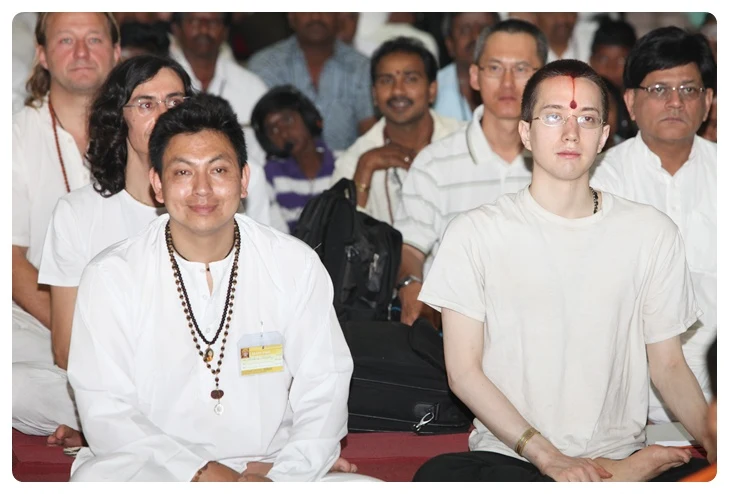
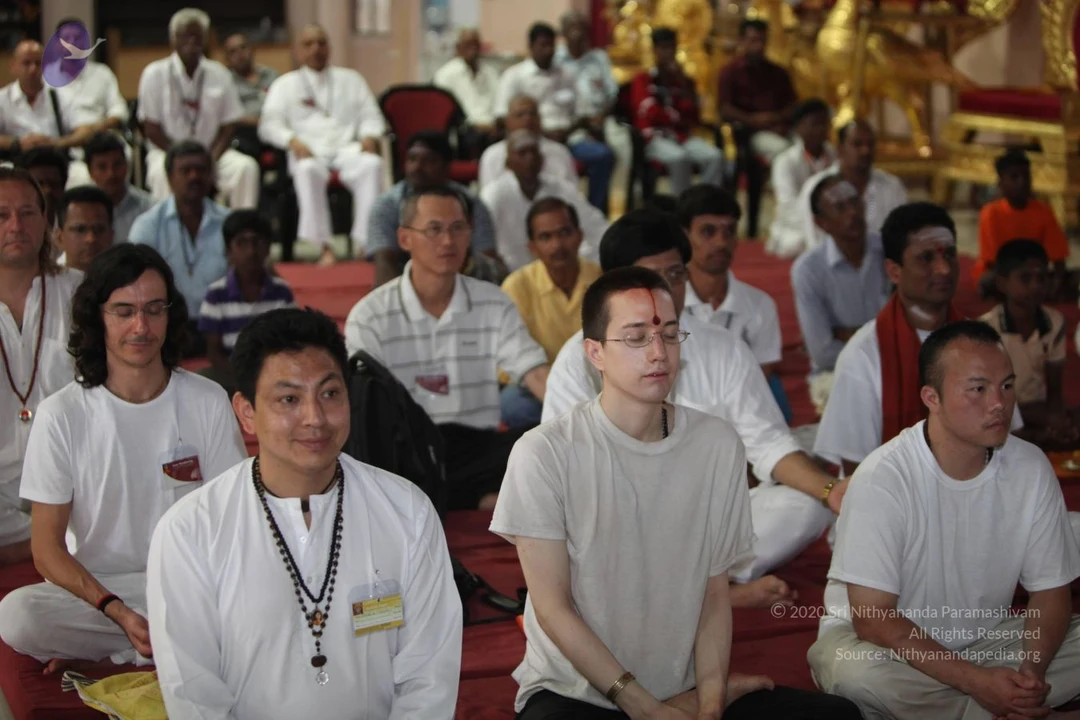
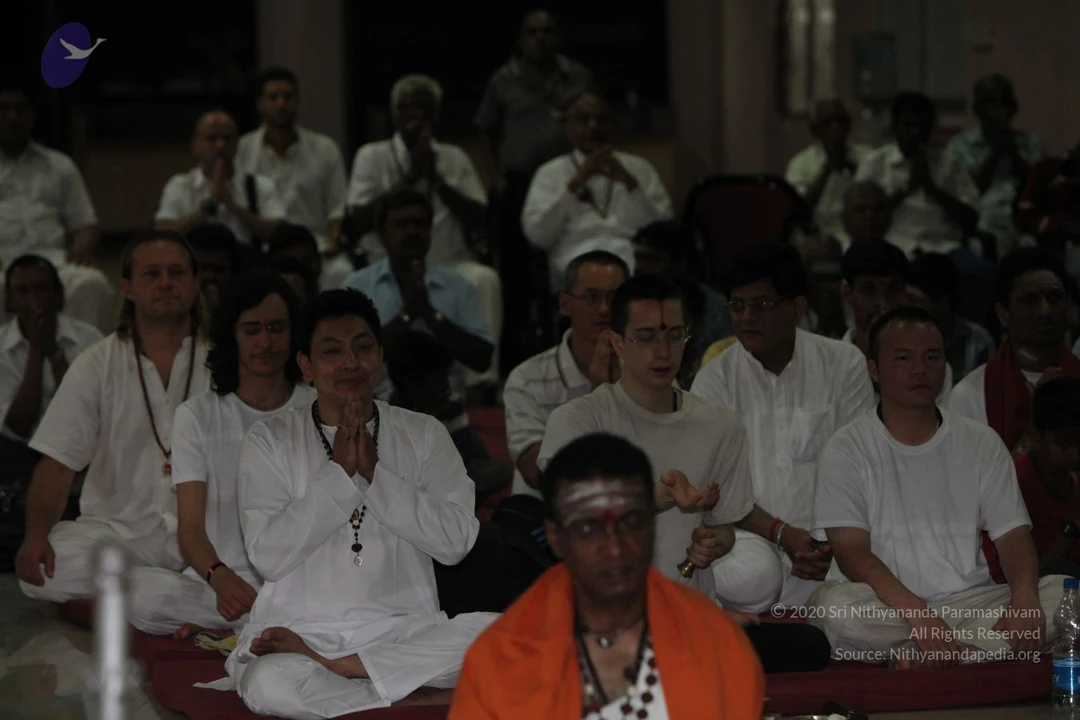
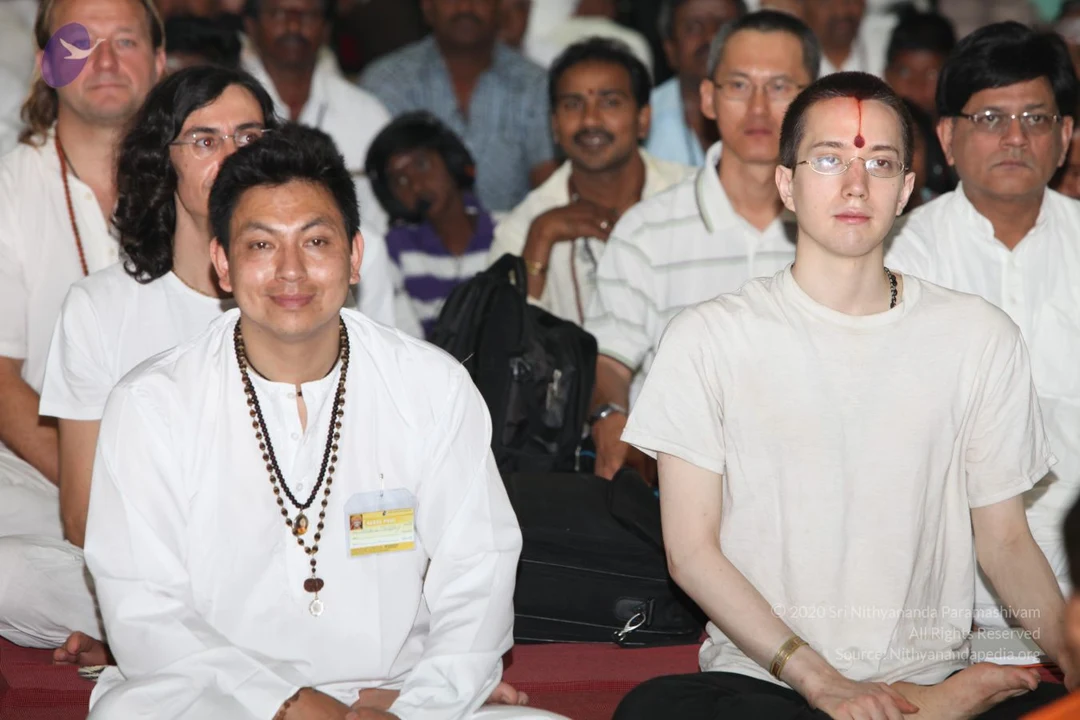
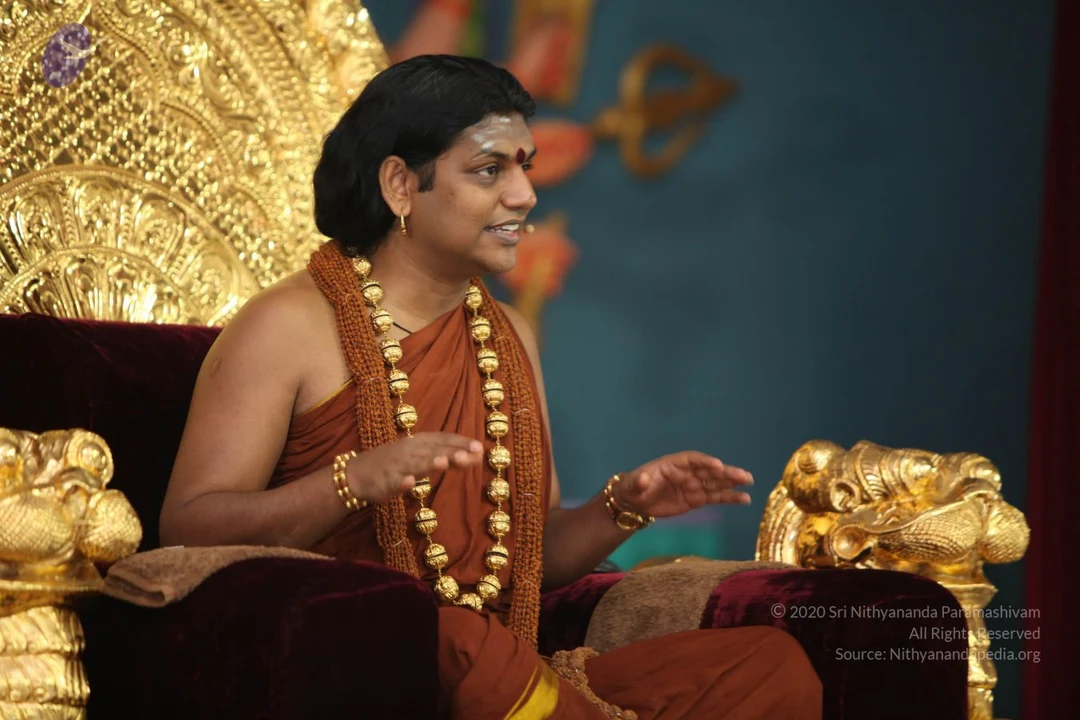
A seated group photo of devotees at a satsang, many in white clothing with rudraksha malas. In the foreground a smiling man in white kurta wears a long rudraksha mala and a name badge, while beside him a young man in a white t-shirt has a red tilak on his forehead and holds his hands together. Behind them a row of audience members sit on red mats, including a man in a striped shirt and another in glasses, with a black backpack resting on the floor. No candidate for a person is clearly visible among those pictured.A smiling man with swept-back dark hair sits on an ornate gold throne with a deep maroon velvet cushion, gesturing with both open hands. He wears an orange-brown saffron-toned robe with a matching shawl, a long necklace of large gold beads, a red bindi on his forehead, and a gold wristwatch. A blue backdrop behind him shows painted decorations of gold and red. Swamiji (probable): the seated figure has long swept-back hair, saffron clothing, ceremonial gold beads and a throne, matching the page's indication that Swamiji was present at this event. No other people are visible.

Photos

3 photosSource gallery
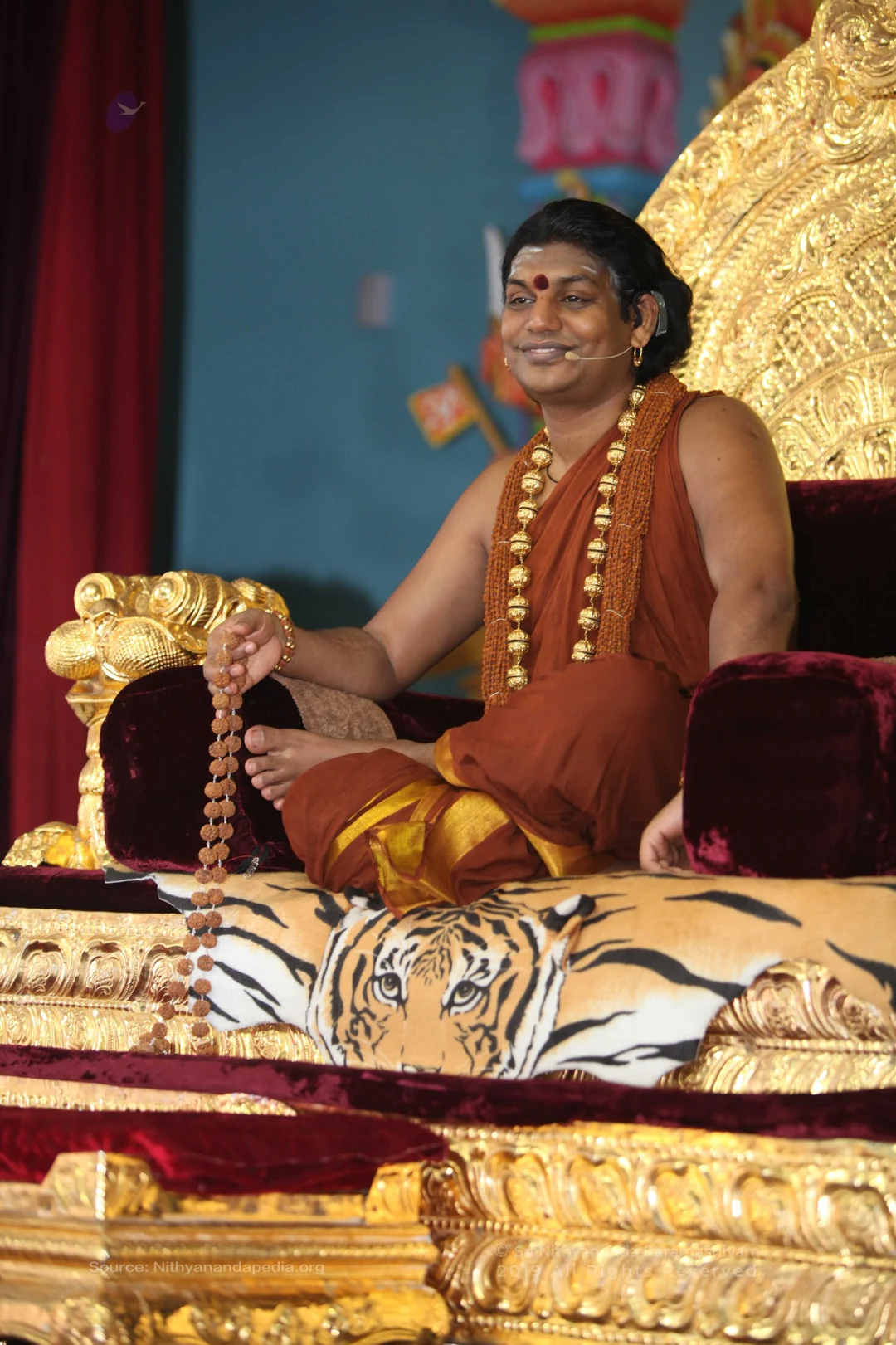
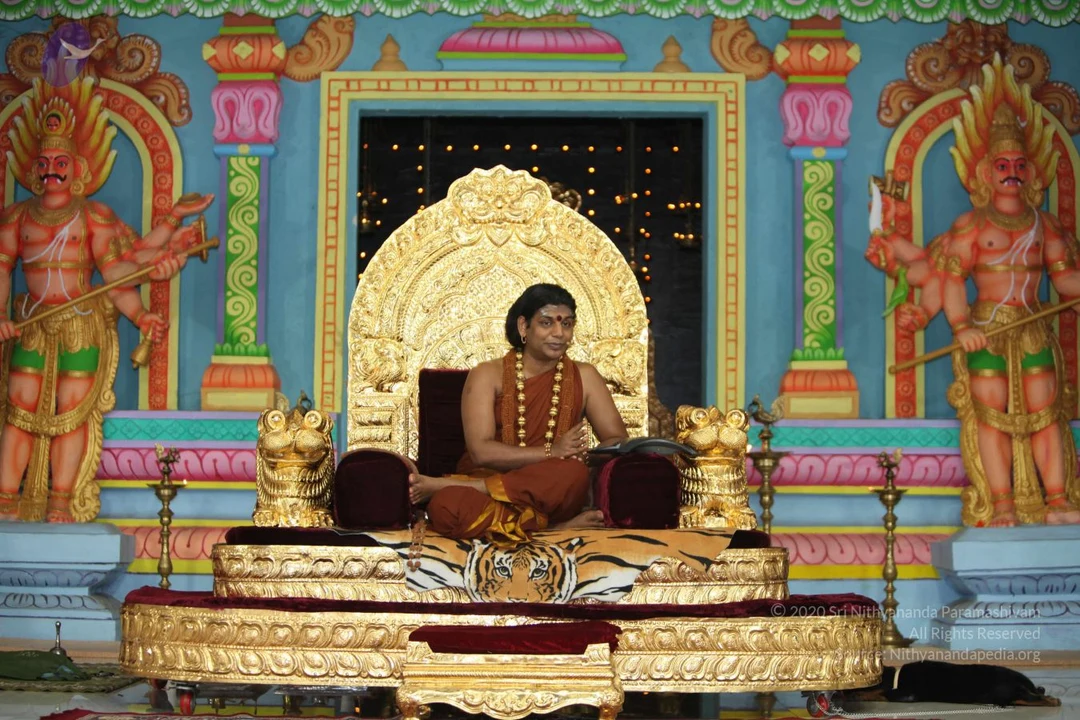
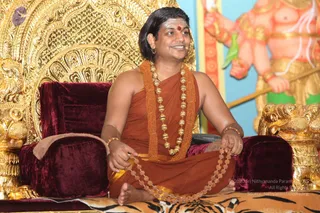
A smiling man with short dark hair and a red bindi sits on an ornate gold-carved throne with plush maroon velvet cushions. He wears a saffron-orange dhoti-style wrap and a long orange beaded mala with large gold beads, plus gold bangles. Behind him, a colourful painted backdrop shows a deity figure holding a weapon. a person is seated in a satsang setting, appearing relaxed and joyful. One person is visible.Photograph of a seated man in a saffron-orange robe with a matching shawl, long swept-back dark hair, a gold ceremonial necklace and rudraksha mala, gesturing with his right hand while smiling during a talk. He sits on a plush maroon velvet seat in front of an ornate gold throne with carved lion-like armrests. Behind him a painted blue backdrop shows a multi-armed deity form holding weapons. Swamiji (probable) is present in the scene, identified by appearance cues of long swept-back hair, saffron robe and gold necklace, seated in a satsang setting.A seated man in orange-saffron robes sits cross-legged on a tiger-print cloth draped over a golden ornate throne with an intricately carved gold backdrop. He wears a long necklace of large gold beads, a rudraksha mala hanging from his lap, gold bangles, a gold earring, and a red bindi on his forehead, smiling while speaking into a headset microphone. The cushioned throne is maroon velvet. The page identifies this as Swamiji; the appearance shows long swept-back hair, saffron clothing, a gold necklace and rudraksha malas, which qualifies as a probable match, so this is Swamiji (probable) in a satsang setting.

Photos

3 photosSource gallery
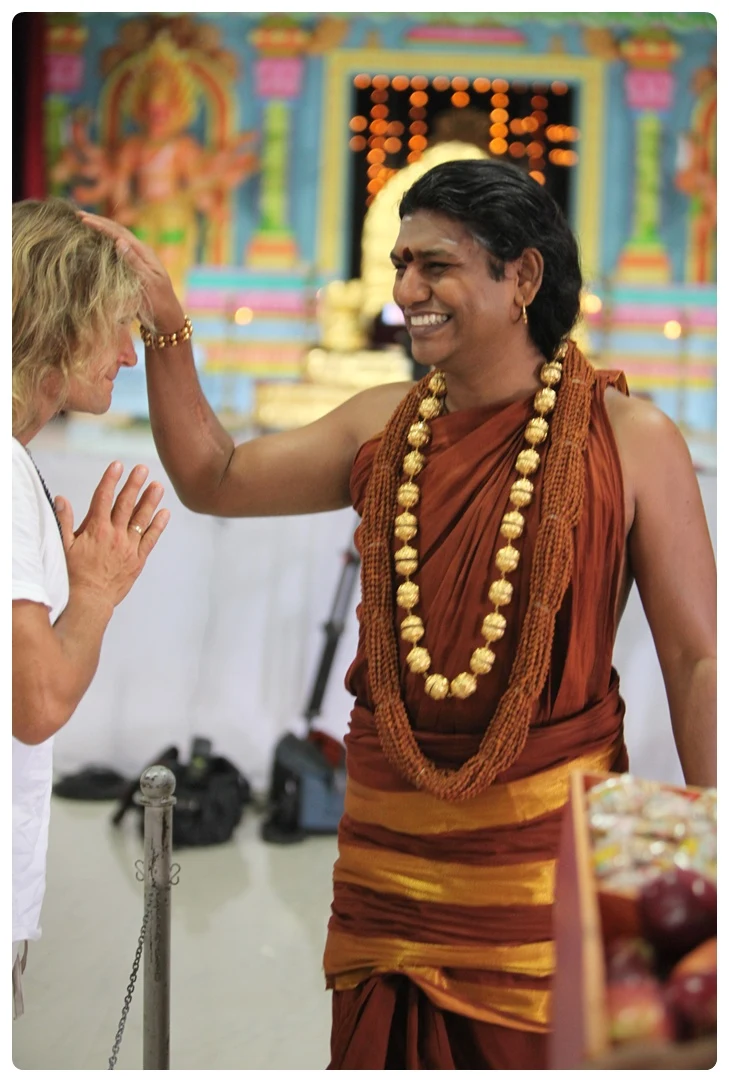
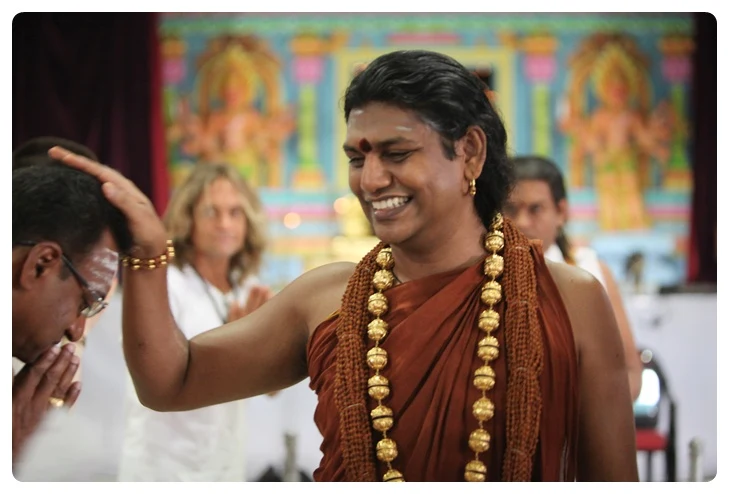
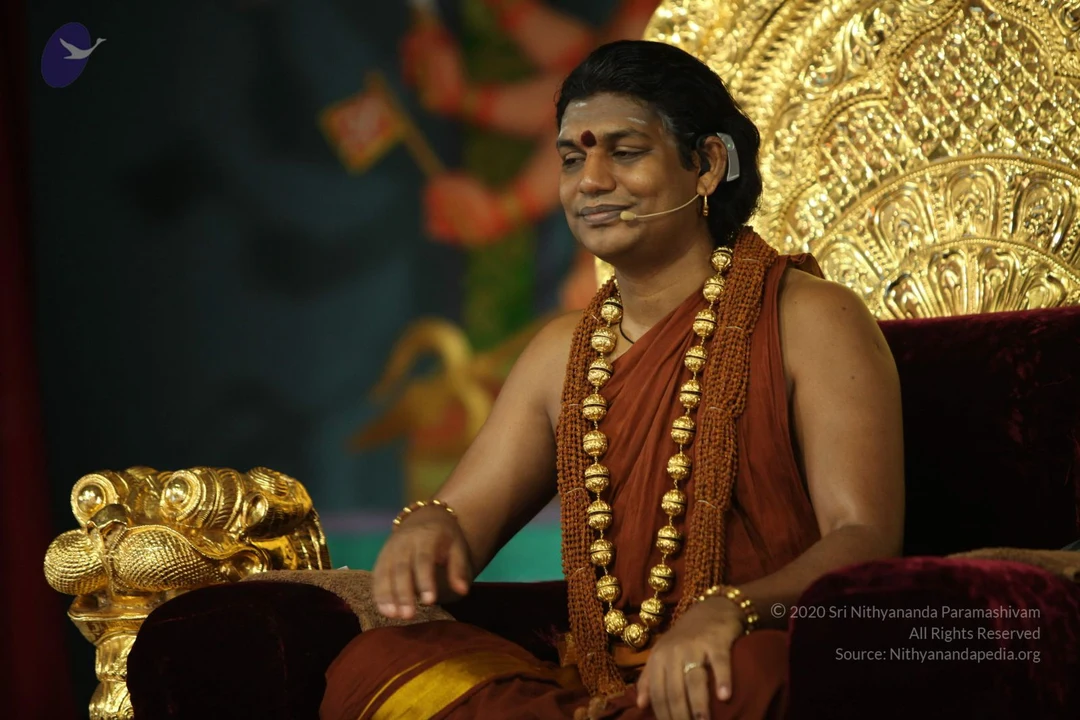
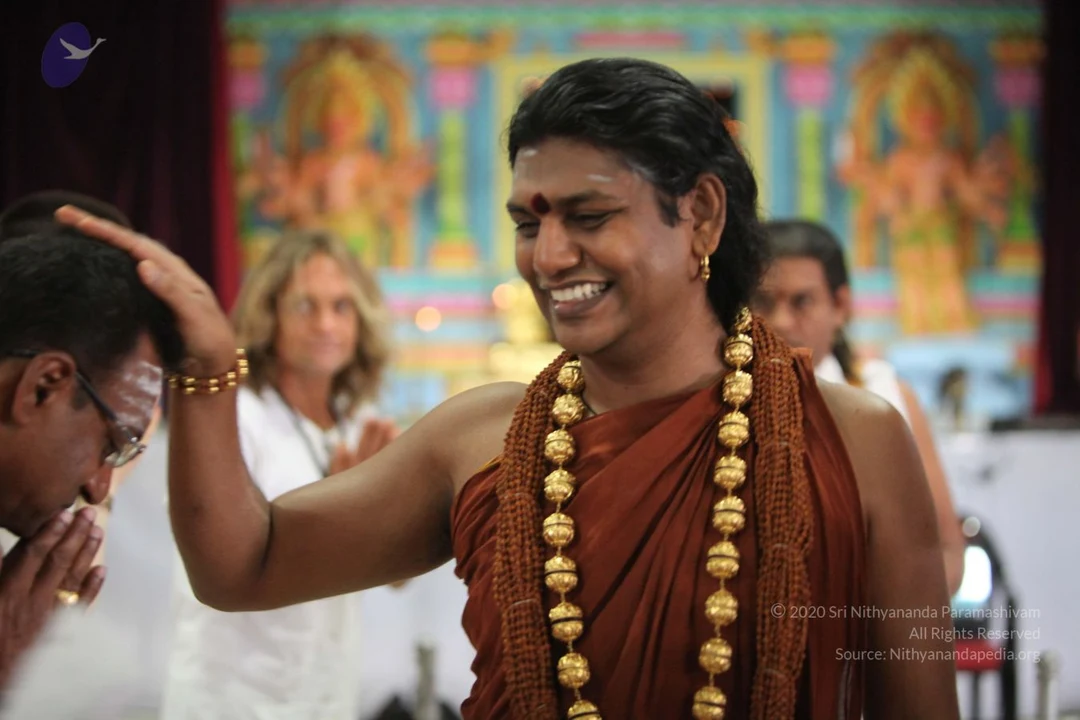
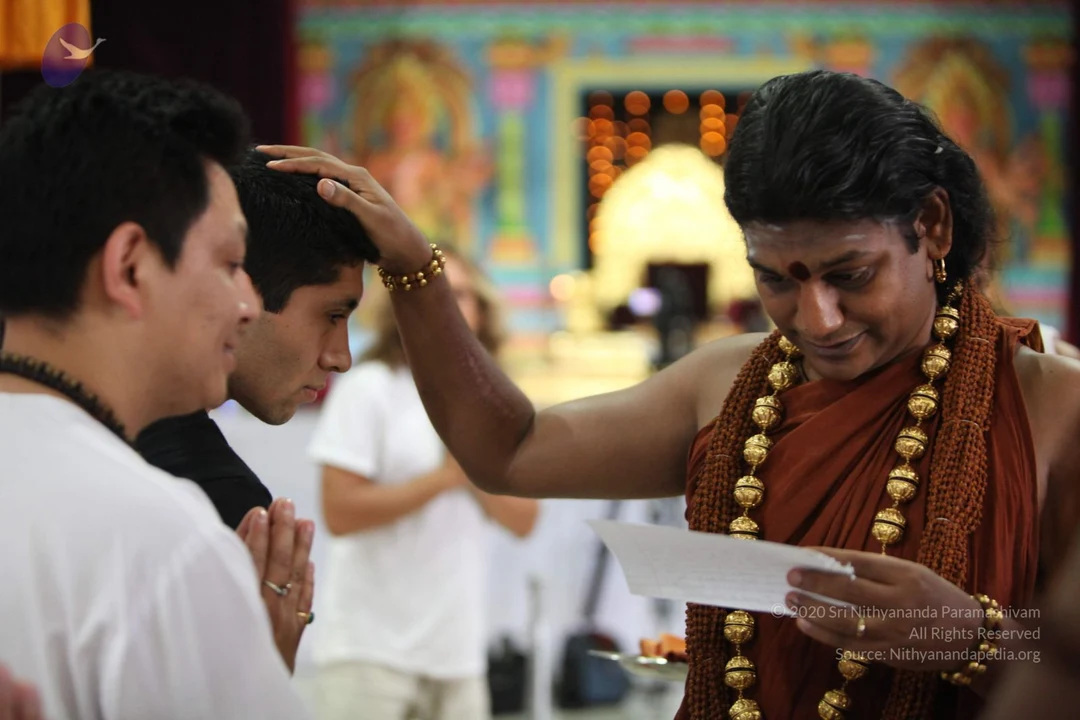
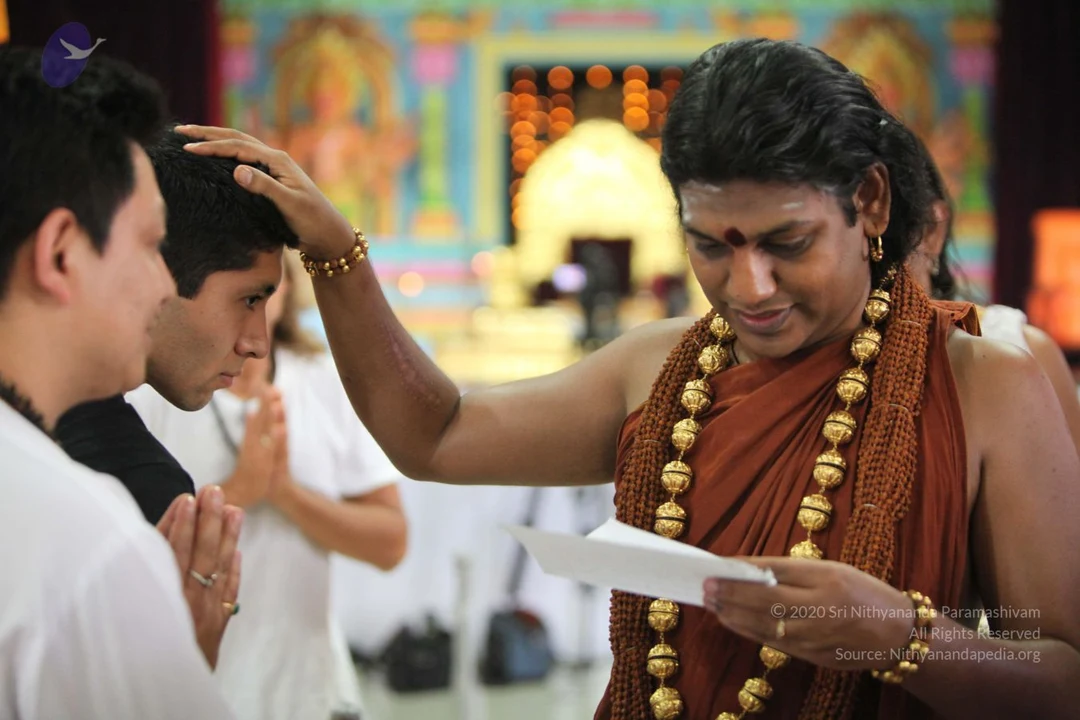
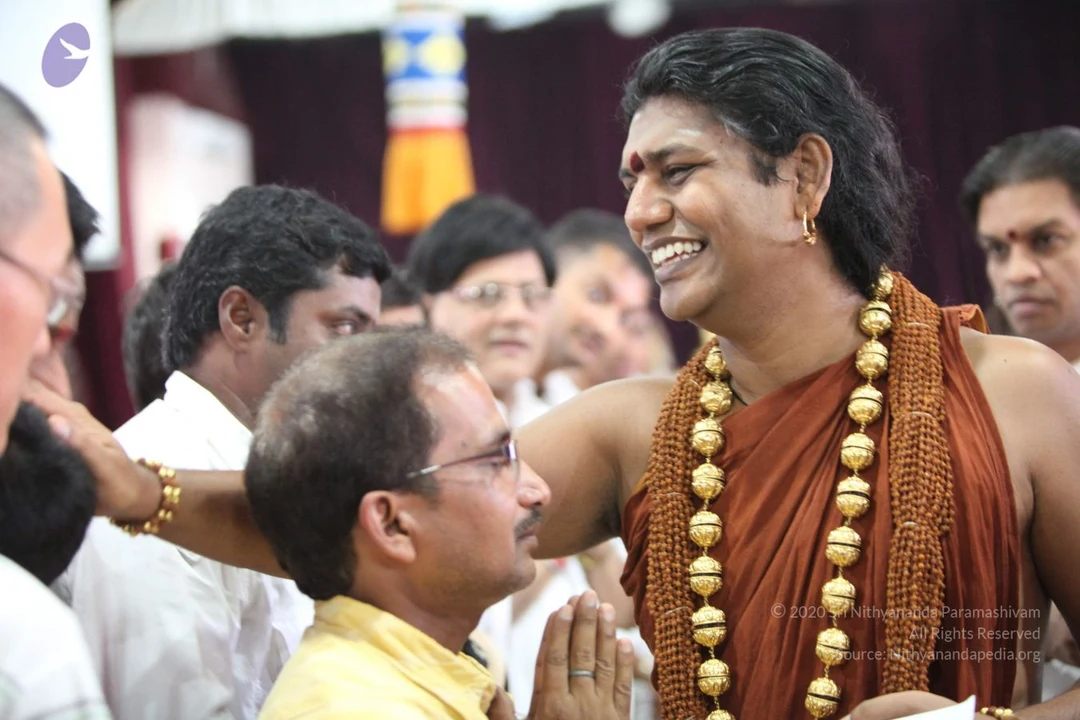
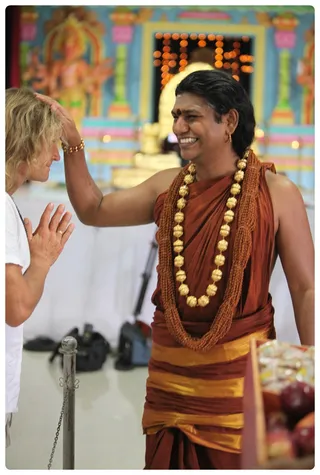
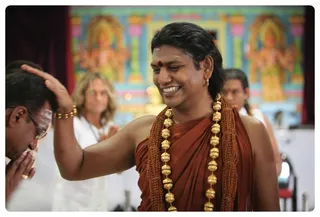
A man seated on a deep red cushioned throne with ornate gold carved armrests shaped like lion or mythical heads, facing right and smiling. He wears a saffron-orange shawl wrapped over one shoulder, a long rudraksha mala with heavy gold bead necklaces, a gold bangle, a red bindi on his forehead, and a small gold earring. A small clip microphone is attached near his face. Behind him stands a deep red curtain and a gold carved throne backrest. Swamiji (probable): the seated man shows long swept-back hair, saffron clothing, rudraksha malas and ceremonial gold necklaces, consistent with the page's Swamiji label, presented as a satsang speaker on a throne.A smiling man in a rust-orange sleeveless robe with a gold-and-saffron sash and a long gold bead necklace stands at right, his right hand raised to touch the crown of a blonde-haired woman in a white top who stands at left with palms pressed together in greeting. He has a red bindi and small gold earring. Behind them is a temple shrine with colourful painted pillars, a golden deity murti, and rows of lit oil lamps. A tray of fruit sits at lower right, and camera bags rest on the floor near a metal stanchion and chain.A smiling man in a rust-orange sannyasi wrap with a thick rudraksha mala and heavy ceremonial gold bead necklace stands in a hall, his right hand raised over the head of a bowing man in glasses with a white vibhuti forehead mark. Behind him a second man in white ritual clothes with long hair stands with hands joined. A colourful temple-style painted backdrop shows multi-armed deity murti figures. Swamiji (probable): the orange wrap, rudraksha mala, gold necklace and long swept-back hair are visible cues, and he is giving blessing to a devotee in a satsang setting.

Photos

5 photosSource gallery
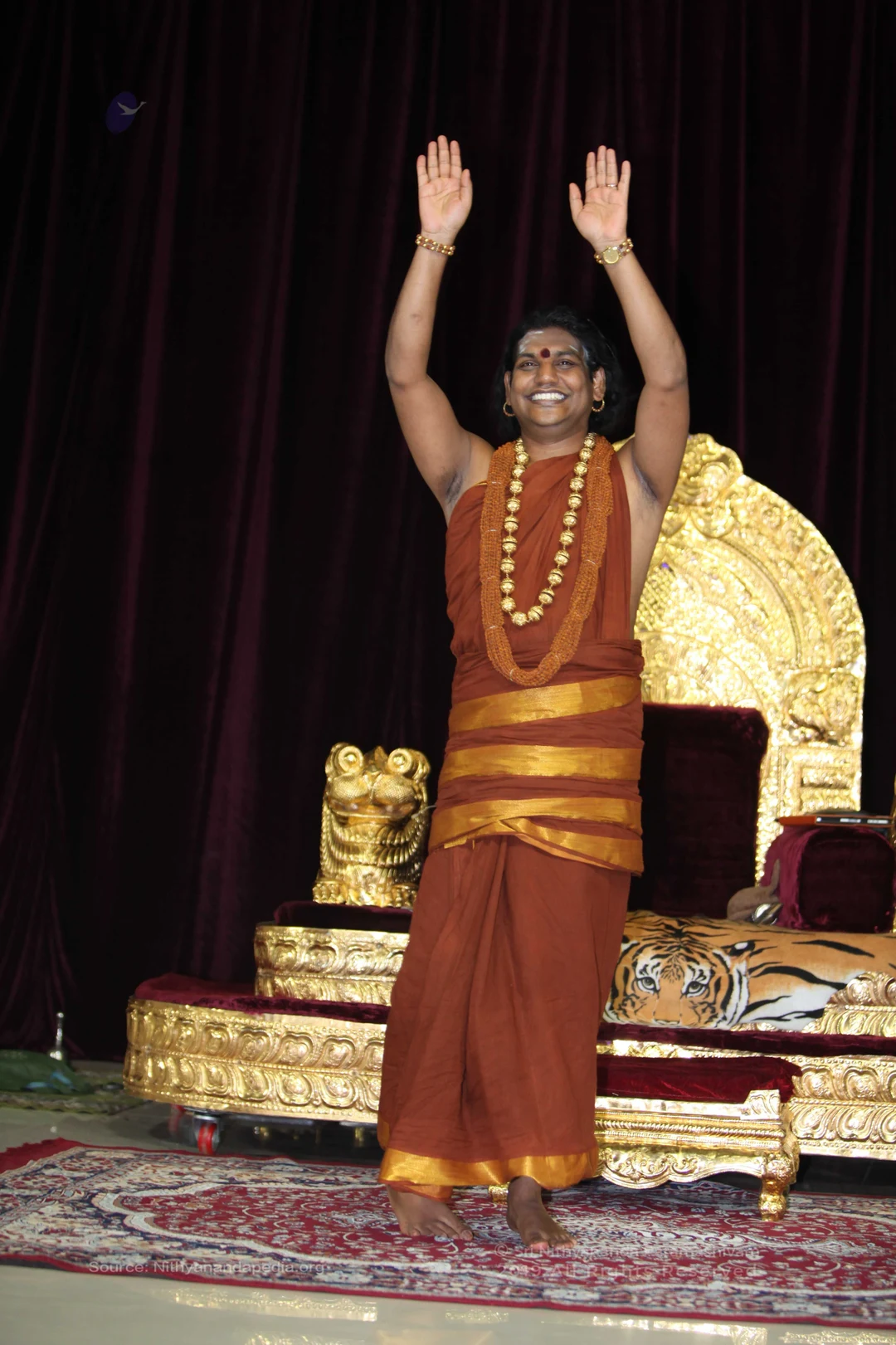
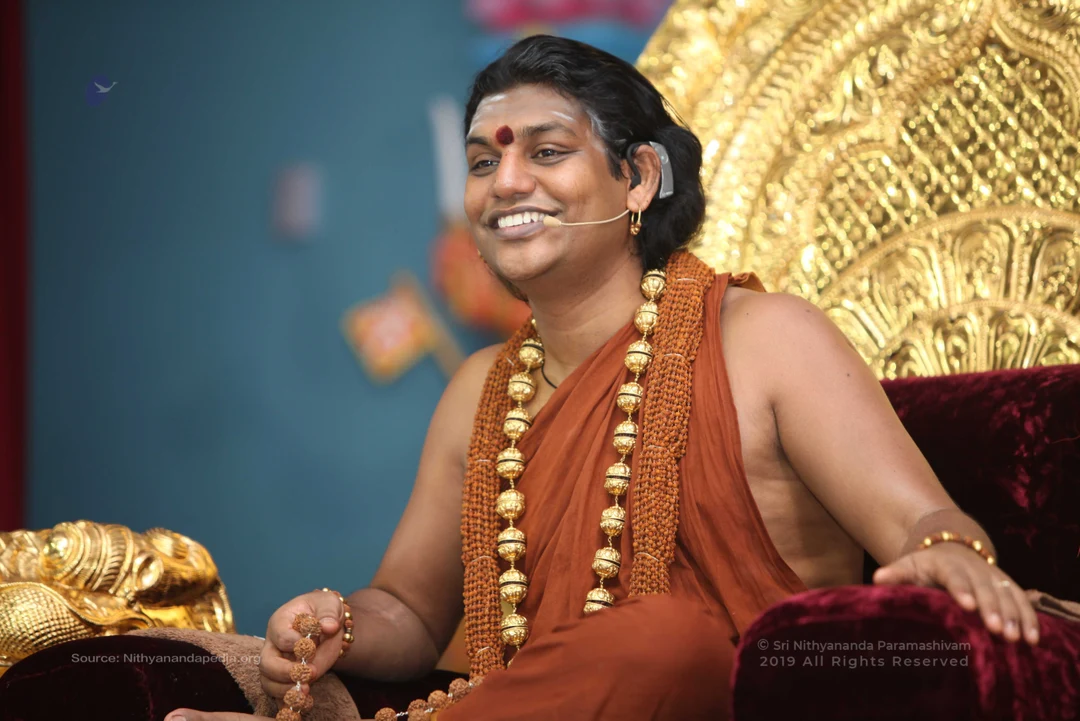
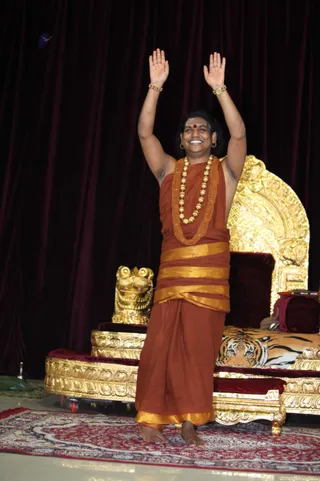
A smiling man in a rust-orange sannyasi wrap with gold-banded sash stands barefoot on a red patterned carpet, arms raised with palms open. He wears a long gold bead necklace over an orange rudraksha-style mala, gold bracelets and hoop earrings, and a red bindi. Behind him stands an ornate gold throne with a carved arch and a gold lion-head armrest, draped with a tiger-print cushion, in front of deep maroon velvet drapes. a person, in ascetic saffron-orange robes with gold necklaces and rudraksha malas, appears on stage, presumably during a satsang.Photo of a smiling man seated on a plush maroon velvet throne in front of a golden ornate backdrop, wearing a headset microphone. He wears a rust-orange sleeveless robe draped over his shoulders and a double strand of rudraksha beads with gold bead spacers, a red bindi on his forehead and white vibhuti lines. Probable Swamiji: the saffron/orange robe, long swept-back hair, rudraksha mala with gold ceremonial beads and a throne setting are consistent with the page's reference to him at a satsang.A man seated cross-legged on an ornate gold throne draped with a tiger-print cloth and maroon velvet cushions, holding a strand of rudraksha beads in his right hand. He wears a rust-orange robe with a gold-bordered dhoti, a braided orange shawl, and heavy gold beaded necklaces, with a red bindi and vibhuti on his forehead and a headset microphone. Behind him are a teal wall, red drapes and a pink and gold decorative banner. The dominant cues are the saffron-orange clothing, rudraksha mala and gold necklaces, consistent with a satsang setting; this is a person seated in a discourse.A smiling man with swept-back long black hair sits on a golden throne in front of a golden carved backdrop and a blue wall with colourful floral decorations. He wears a red-orange saffron-coloured dhoti draped over his shoulder, a red kumkum bindu on his forehead and white vibhuti lines, and a long gold bead necklace with rudraksha malas. A small gold earring and a headset microphone are visible; his left hand gestures in speech while he holds a golden object at lower right. Appearance cues are consistent with a person, seated and speaking at a satsang discourse.Close photo of a man seated mid-discourse, smiling and gesturing with his right hand raised. He has long swept-back black hair, a red kumkum dot and white vibhuti lines on his forehead, a small gold earring, and a headset microphone near his mouth. He wears a saffron-orange robe draped over one shoulder, multiple strands of orange rudraksha malas, and a heavy gold necklace of ornate beads, plus orange beaded bracelets. A blurred gold deity murti or ornament is at the left edge, with a blue wall and a red and gold ceremonial object behind him. a person is seated in a satsang setting.

Inner Awakening

17 photosSource gallery
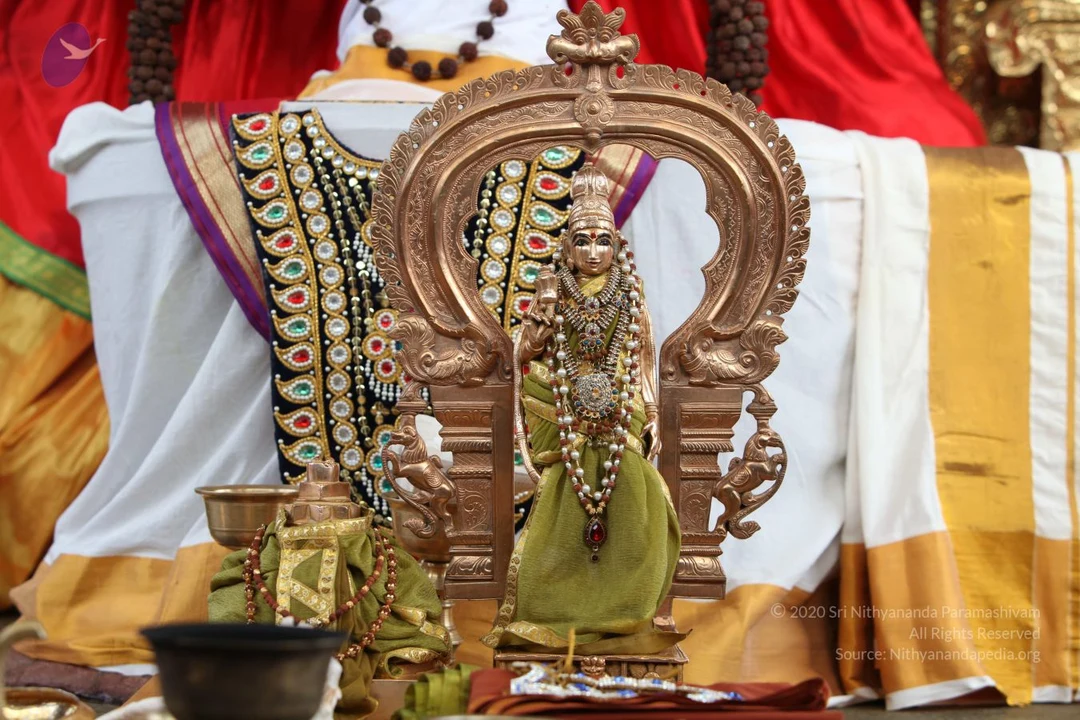
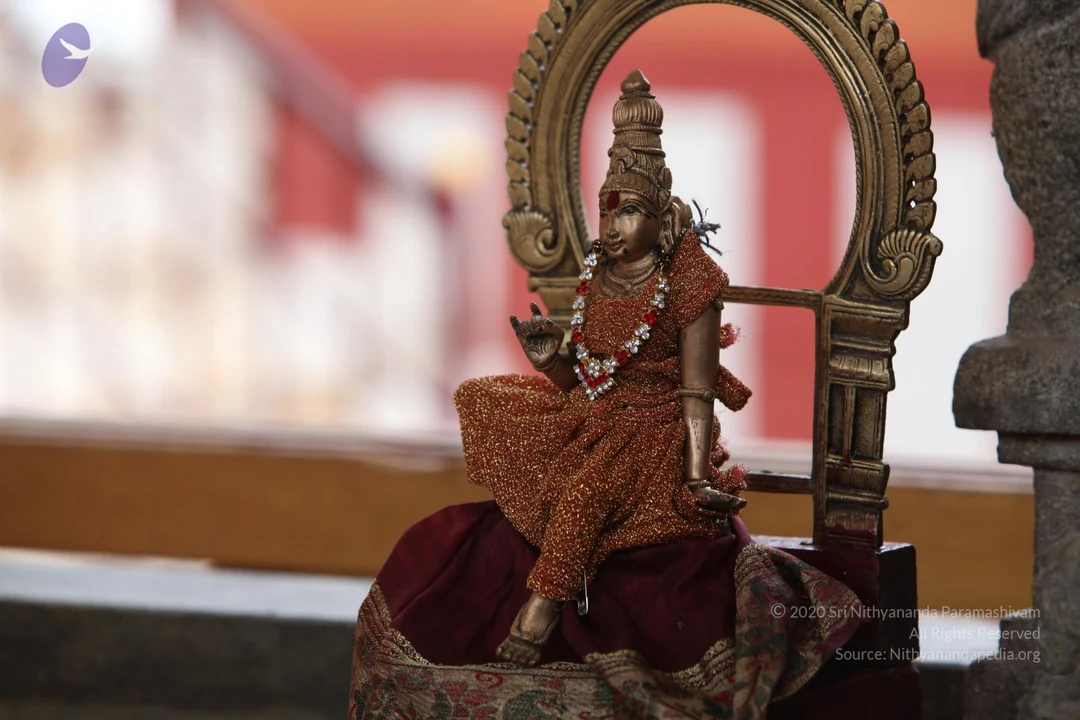
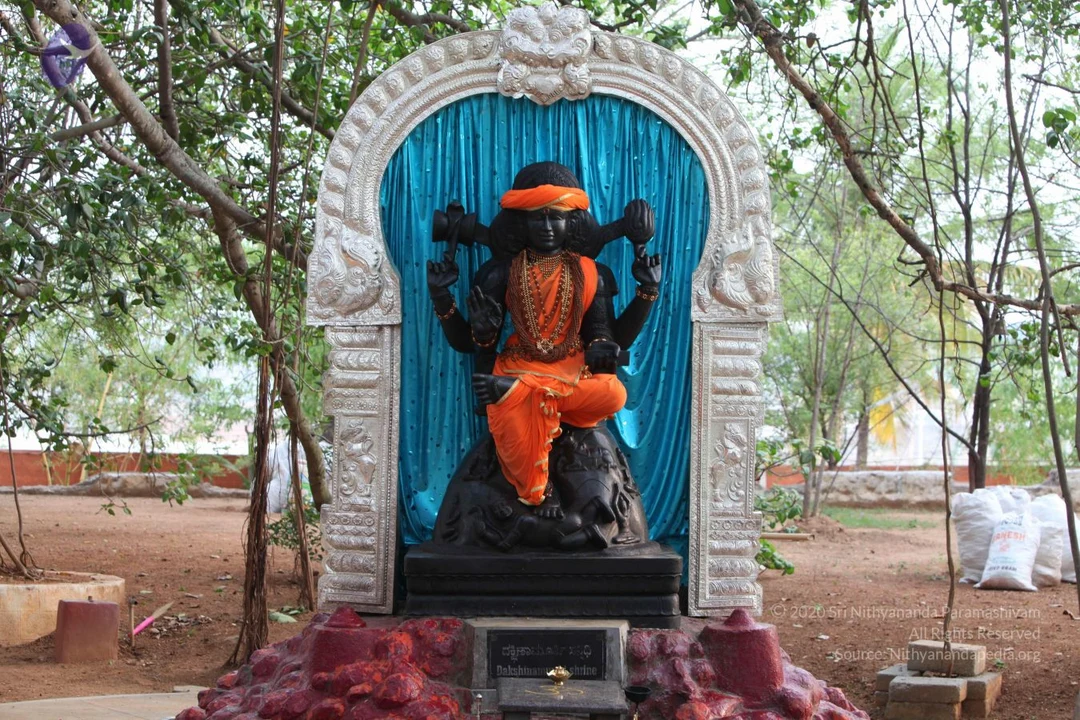
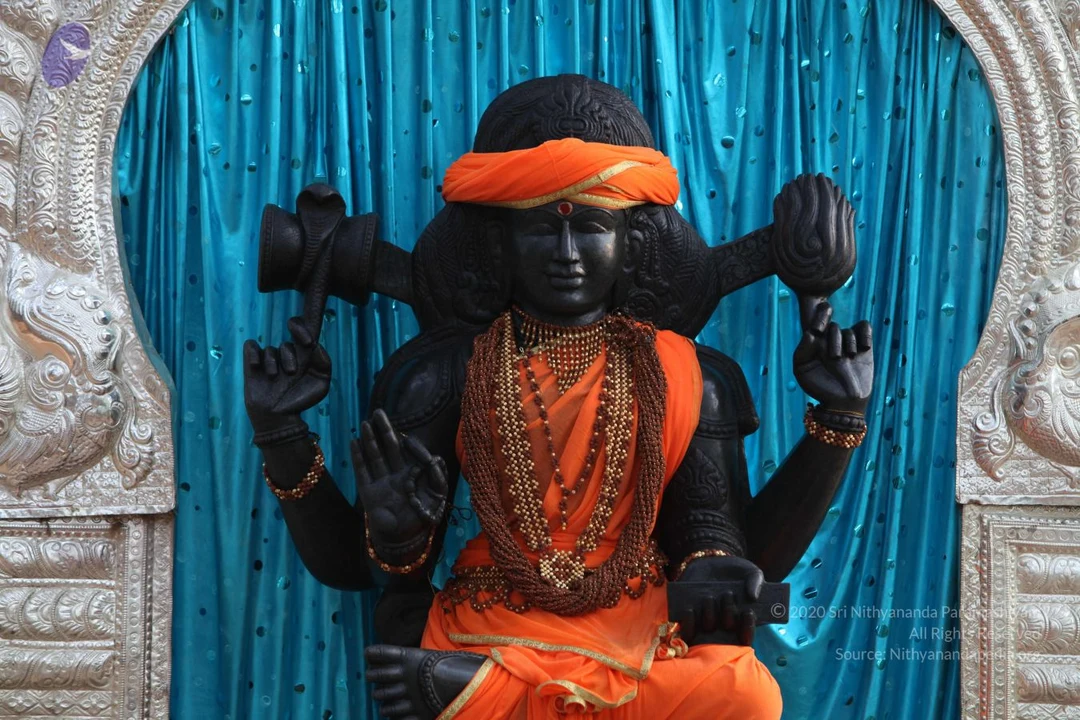
A photograph of two ornate metal deity murtis standing before a bright orange draped backdrop framed by a gilded arch. The figure on the left wears an orange and gold turban, a rudraksha-style white and gold garland, layered gold necklaces and large jhumka earrings, and holds a golden trident (trishula) in his raised hand, with a snake-hood motif visible at the edge. The figure on the right wears a gold crown, a white jasmine garland, layered gold and jewelled necklaces, and a green and gold sari, holding a green parrot-shaped object in her hand. Both murtis have painted faces with kumkum-style forehead marks. No physical people are visible.Photograph of a shrine featuring two large painted sculptural figures seated side by side on a raised platform before a red and orange curtain within an ornate gold arch. The figures wear green, red and orange garments, rudraksha malas, white flower garlands and crowns, one holding a trident-like staff. Between them sits a silver kalasha with a dark bead garland draped over it. In front are brass oil lamps, bowls of offerings, a white cloth with a gold border, and a small deity figure in a niche on the right. No physical people are visible.A gilded bronze deity murti seated within an ornate arched copper-toned throne frame with carved lion and floral motifs. The figure wears a green silk sari with gold border, a tall crown, a cascade of rudraksha and pearl malas, a jewelled pendant and a red stone necklace, and raises one hand holding a small object. Behind it hang a red and gold textile and a decorated embroidered cloth. No physical people are visible.A small bronze metal murti of a seated goddess sits within an ornate golden arched frame on a wooden base, set before a blurred red and white background. She wears a gold crown, a red bindi, a sparkling orange-gold sari with a red and white floral-bordered wrap, and a red and white jewelled necklace. Her right hand is raised in a gesture while her left rests on her lap. No people are visible; the scene is a photograph of a deity murti in a temple setting.A life-size silver-toned statue of a standing male figure with long black hair, a red bindi and a sandalwood-style forehead mark, raising its right hand in a blessing gesture. It wears a red-maroon dhoti with a gold border, a draped rust-red shawl, many layers of rudraksha beads across the chest and shoulders, a long beaded mala with a gold pendant, and red-bordered wrist beads. It stands in front of an arched niche draped with gold and orange silk patterned with flower motifs, framed by ornate gold carved edging. The image is a photograph of the statue, so the figure is a depiction and no living people are present.A black stone statue of a four-armed deity murti stands in an ornate white arched niche framed with carved relief panels, set against a turquoise draped backdrop and surrounded by trees. The figure wears an orange turban, an orange dhoti-style cloth, layered rudraksha-style beaded necklaces and gold bangles, and stands on a dark rock base with a small carved figure beneath. No living people are visible.

Seattle

14 photosSource gallery
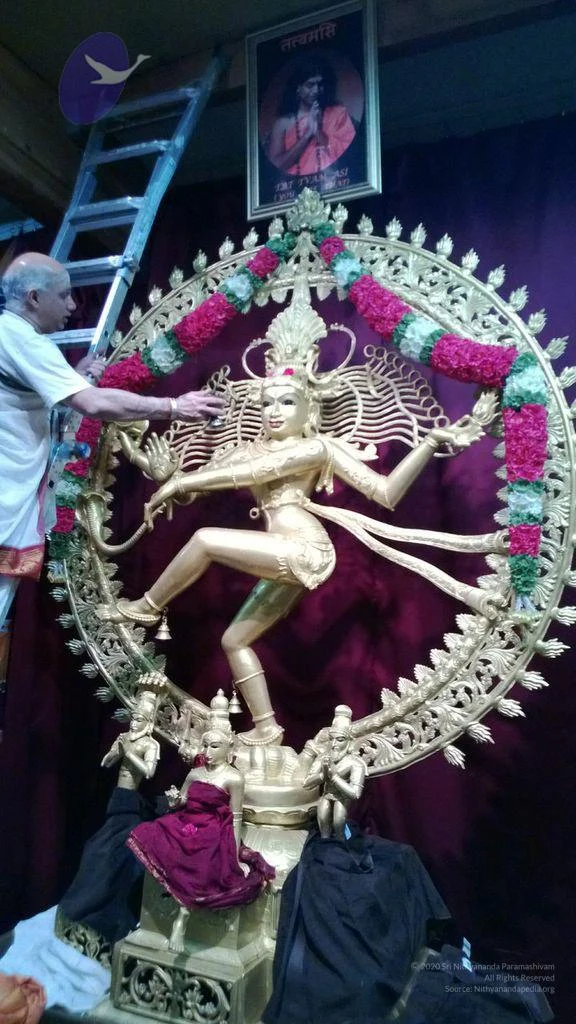
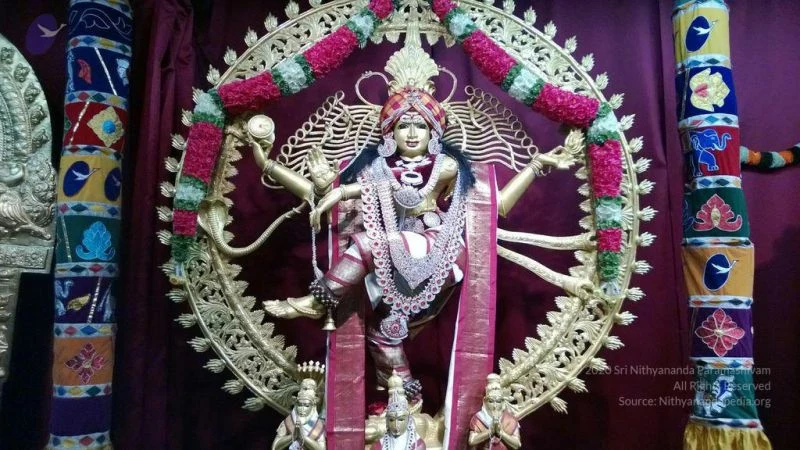
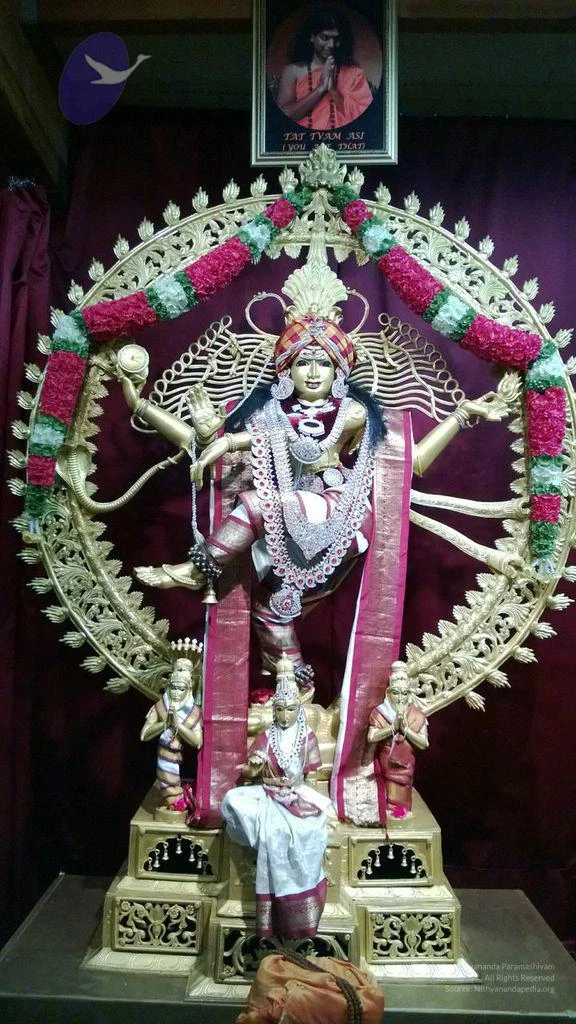
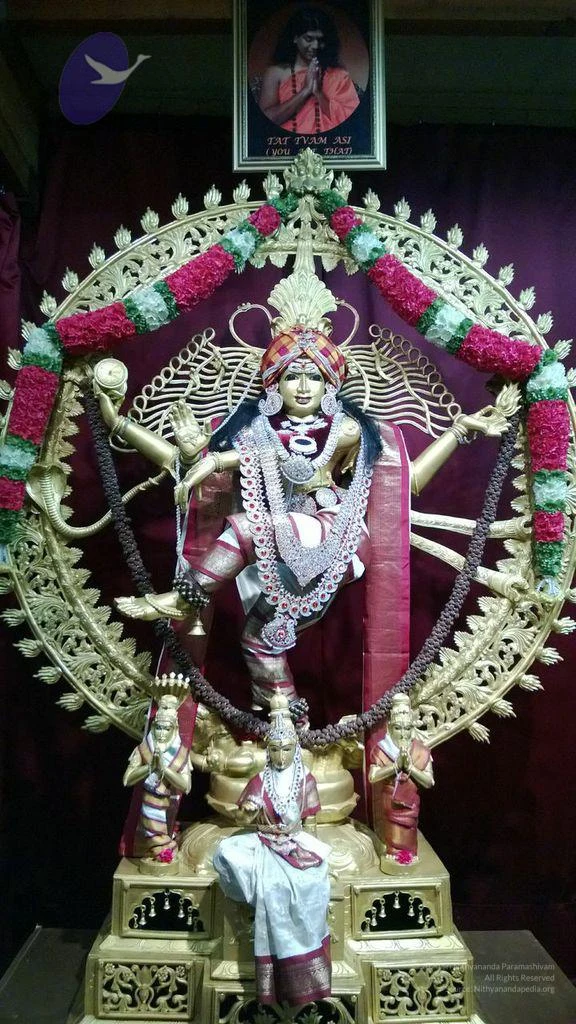
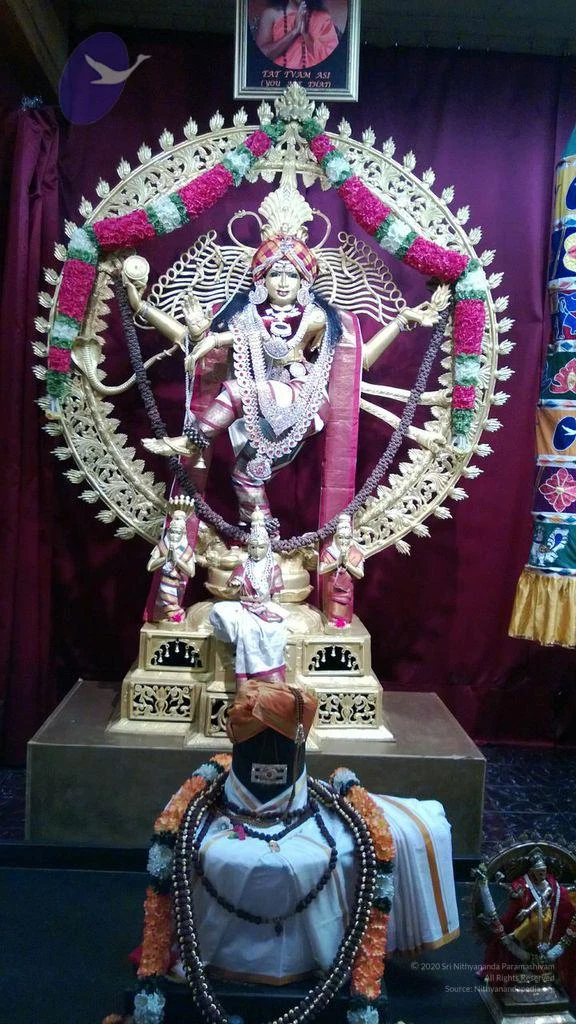
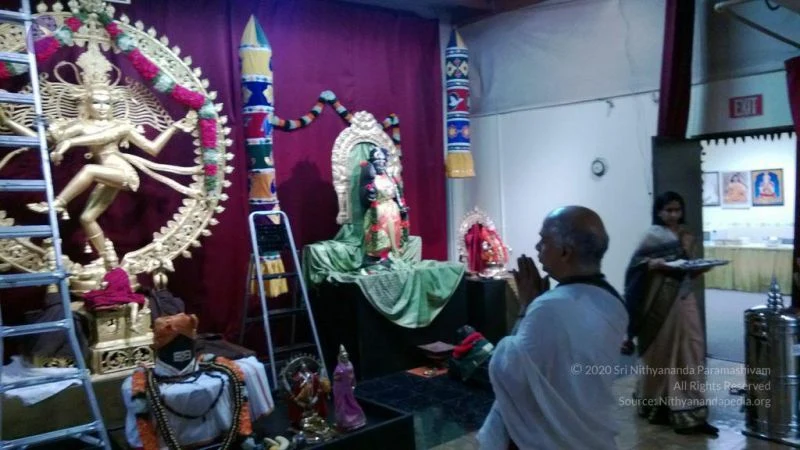
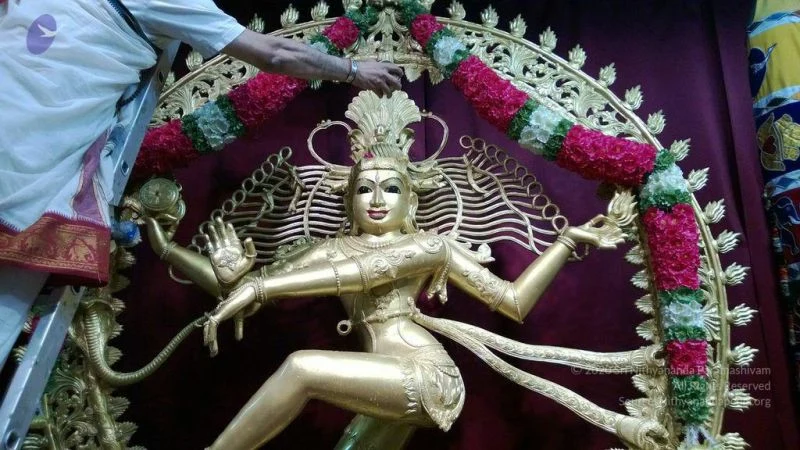
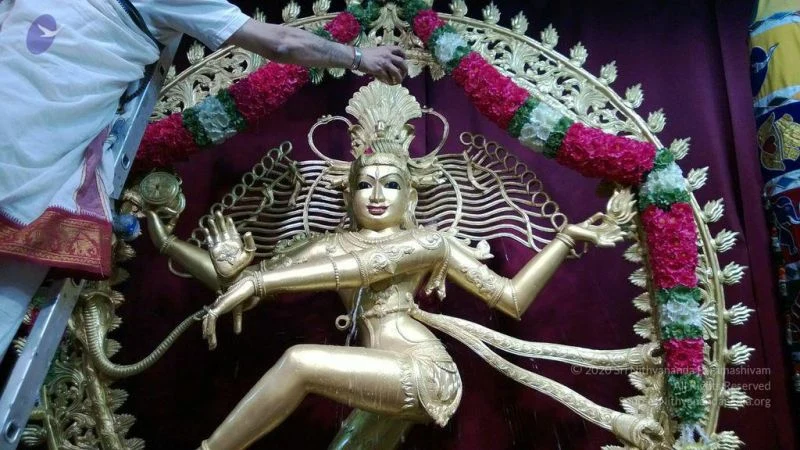
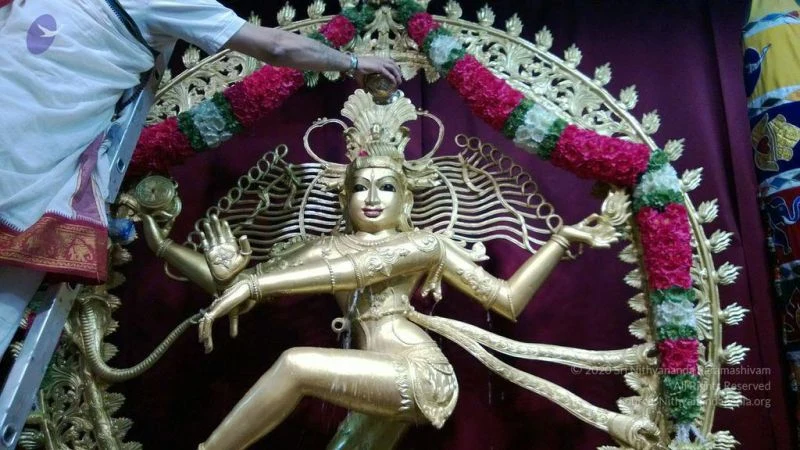
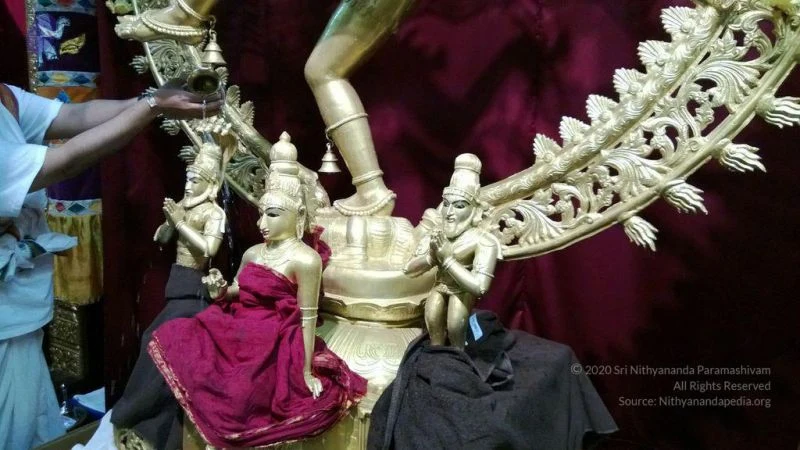
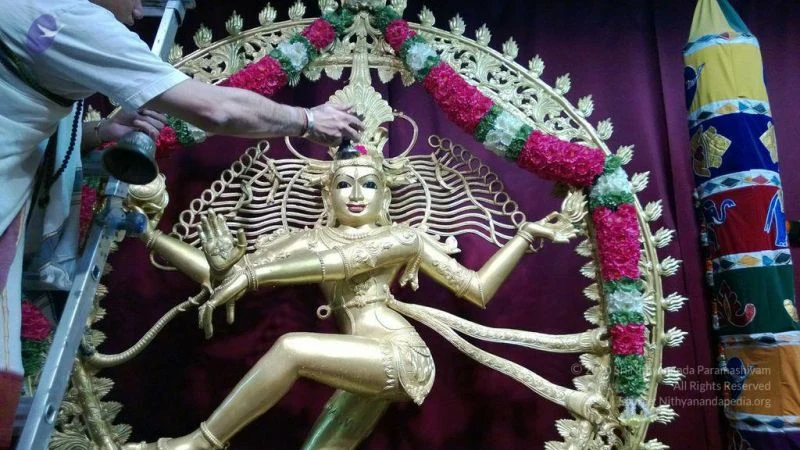
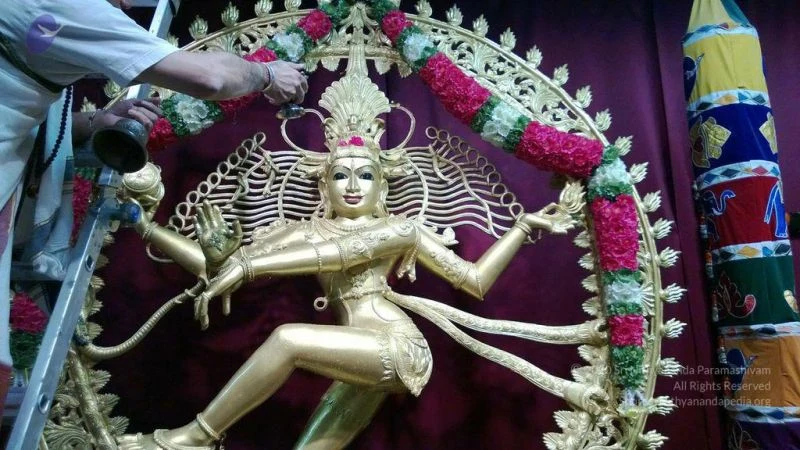
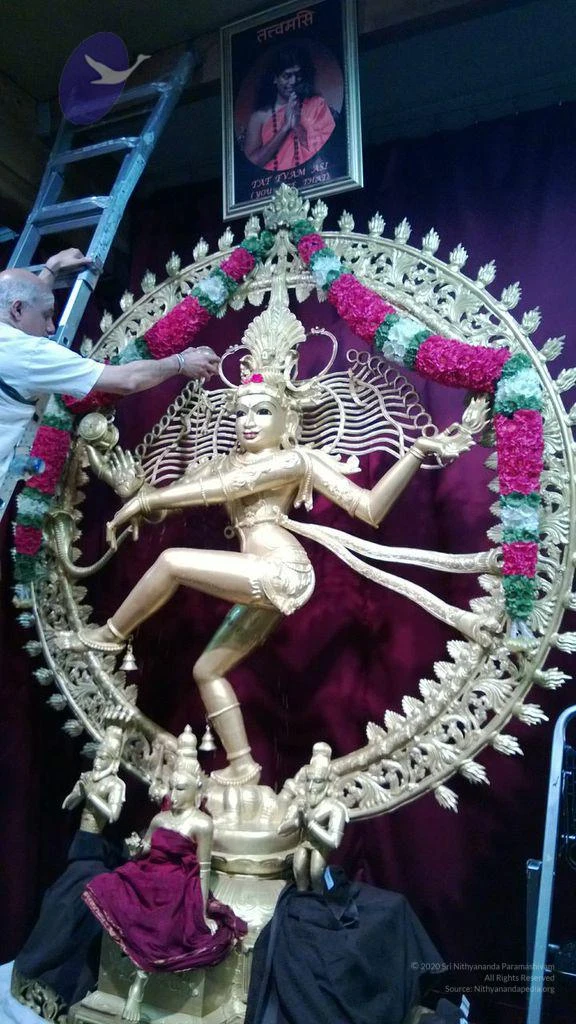
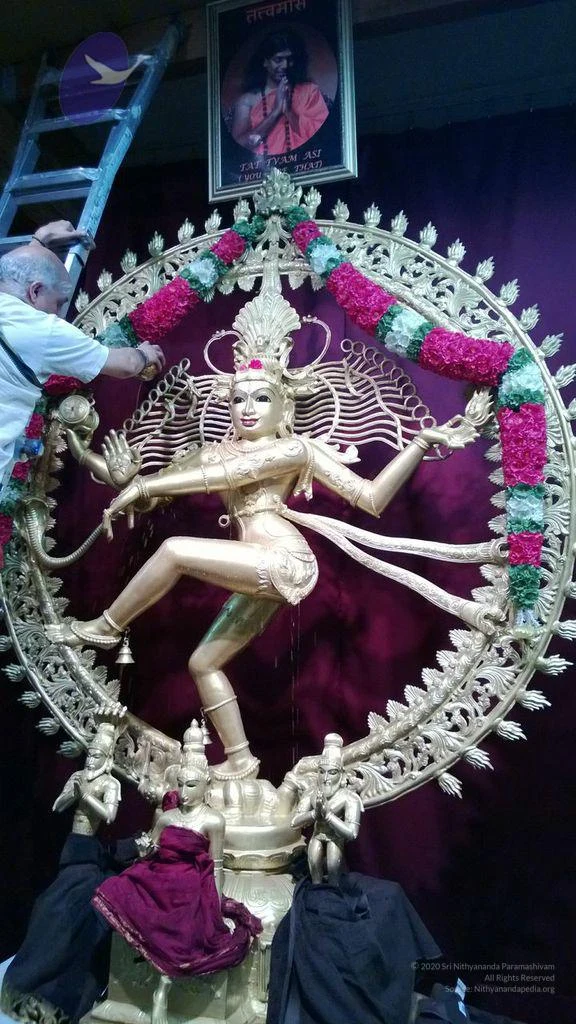
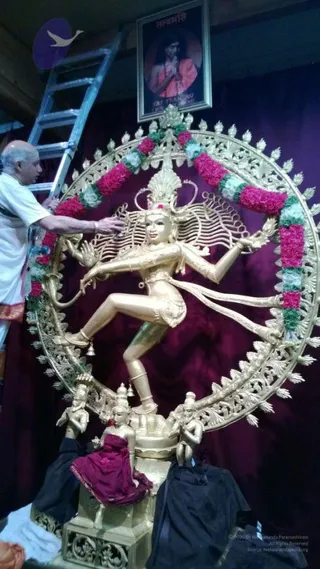
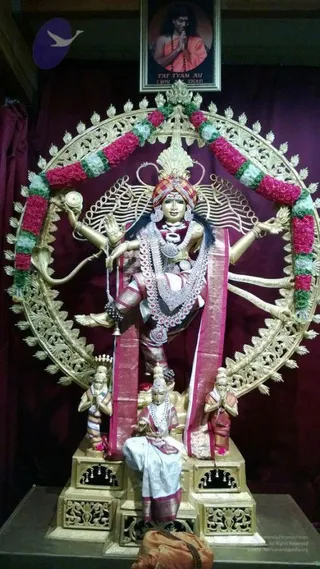
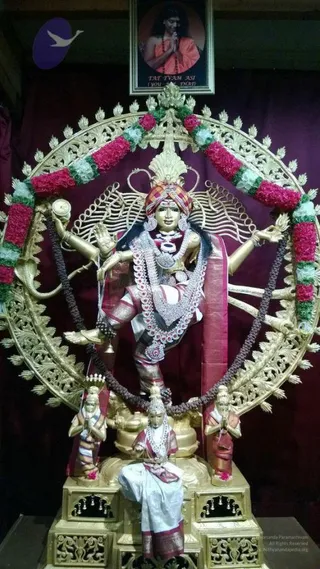
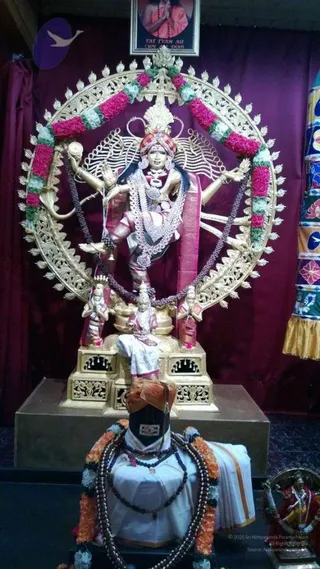
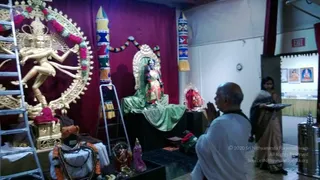
A golden Nataraja statue of Shiva dancing within a flame-like halo ring decorated with pink and white flower garlands, placed on an ornate golden pedestal before a deep purple drape. A bald older man in white clothes with a red border stands at left, one hand resting on the statue, beside a metal stepladder. A framed portrait above labelled Tattvamasi shows a figure in orange robes with a microphone. Dark cloth and a small magenta cloth lie at the base.A photograph of a bronze-gold Nataraja-style deity murti standing on a raised platform before a deep maroon draped backdrop. The figure dances within a golden circular prabhavali arch edged with fresh red and green garlands, holding a drum and other hand implements, with a flame-like crown and layered silver necklaces and garlands. Two smaller seated figures sit below at the base. Vertical pillars wrapped in decorative patterned fabric with lotus and elephant motifs frame the shrine on either side, and a gold ornamental metalwork piece stands at the left edge. The image is a shrine display and contains no physical people.A golden Nataraja-style deity murti stands in a dance pose inside an ornate gilded arch wreathed with pink and white flower garlands. The figure wears a striped red and gold headdress, layered white and silver beaded necklaces, and a red-and-gold cloth draped at the sides. Below, two smaller gold figures with hands folded flank a seated white-robed figure on a gilded pedestal. A framed portrait above labelled "TAT TVAM ASI (YOU ARE THAT)" shows a man in orange with hands pressed together. A purple curtain hangs behind, and an orange cloth lies at the base.A gilded statue of a multi-armed deity murti stands in a dark red draped alcove, dancing within a large ornate golden arched halo decorated with red, pink and white flower garlands. The central figure wears a striped orange-and-red turban, layered silver and jewelled necklaces, and a red-and-gold sash. Two smaller gilded devotee figures with hands folded in anjali flank the base, and a seated white-clad figure sits on the pedestal. Above, a framed portrait shows a robed figure with hands folded in namaste beneath the caption "TAT TVAM ASI (YOU ARE THAT)". Rudraksha beads hang across the halo. The statue is not shown as a living person.A shrine room with a large golden Nataraja-style dancing Shiva murti inside an ornate golden arched halo, decorated with pink, green and white flower garlands and a dark beaded mala. The deity has multiple arms, a crown, pearl necklaces and a pink sash, with small attendant figures on the pedestal. In front stands a seated white-clad figure with an orange turban and rudraksha-style beads and marigold garlands, shown from behind. A framed picture above reads Tat Tvam Asi, and a maroon drape and colourful banner fill the background. No living people are visible.Photograph inside a temple-style hall decorated for worship. A golden Nataraja statue dancing within a flame arch stands at left beside a ladder, with a garlanded stone linga-like form and a seated deity murti draped in green cloth at centre. A man in white ritual clothes with hands joined in anjali stands at right in front of the shrine, while a woman in a brown sari carries a tray. Red drapes, tall striped decorative poles, and framed pictures on the far wall complete the setting.

Toronto
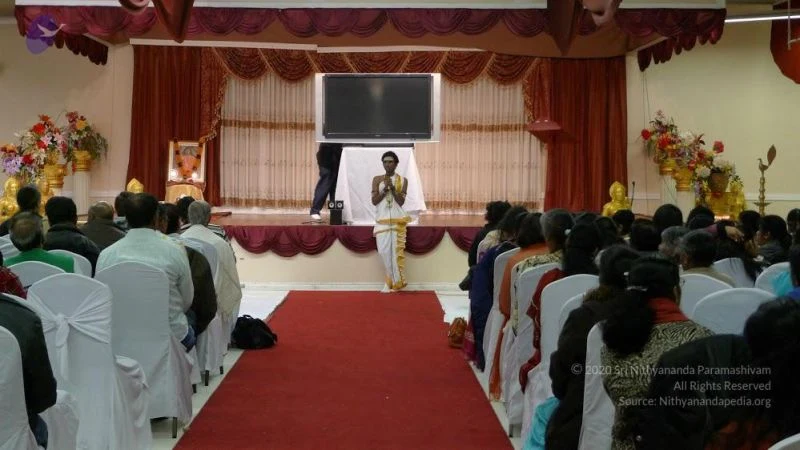
30 photosSource gallery
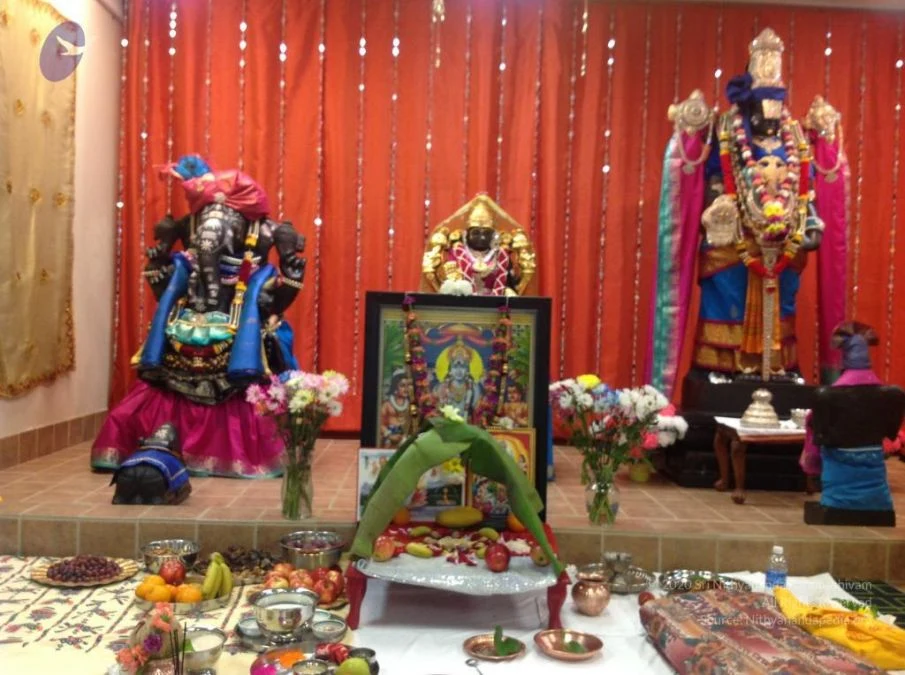
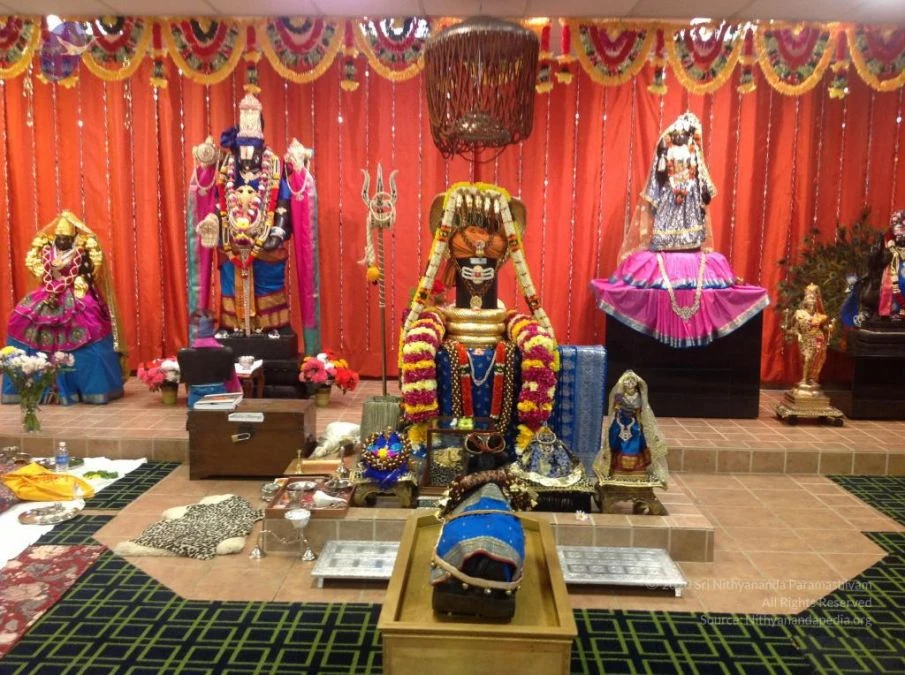
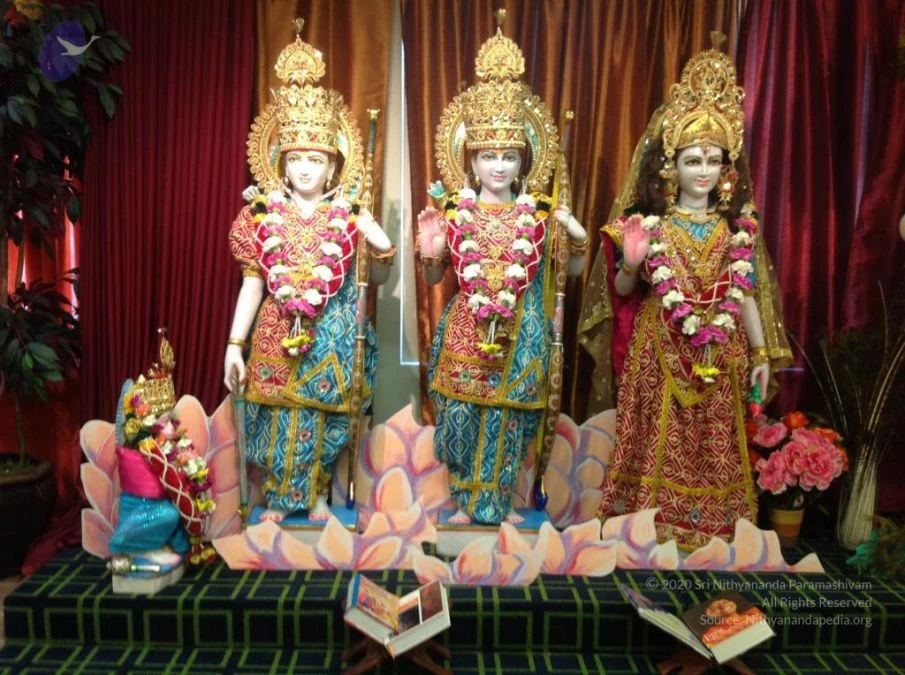
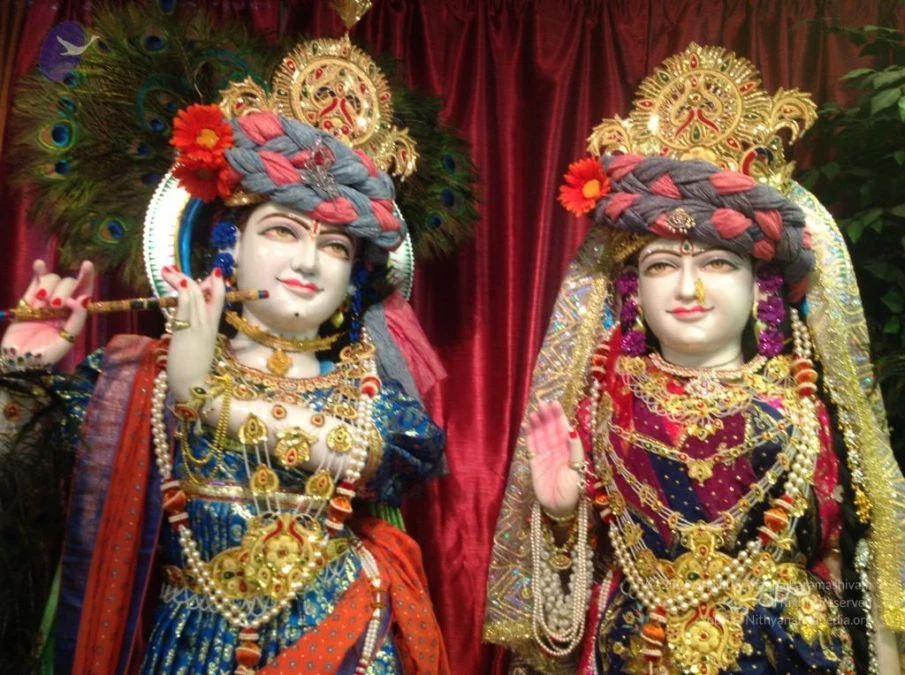
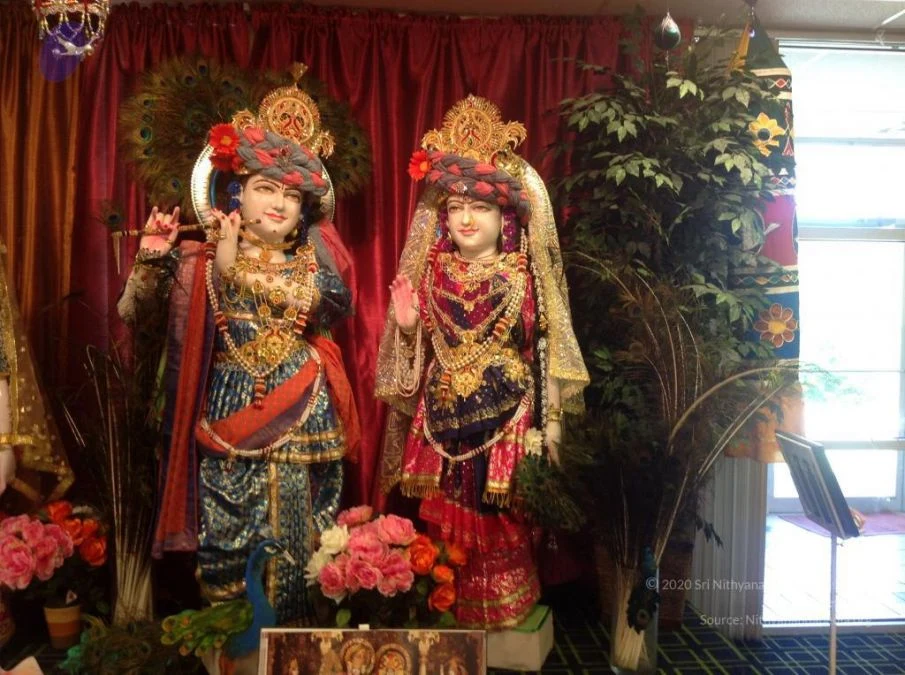
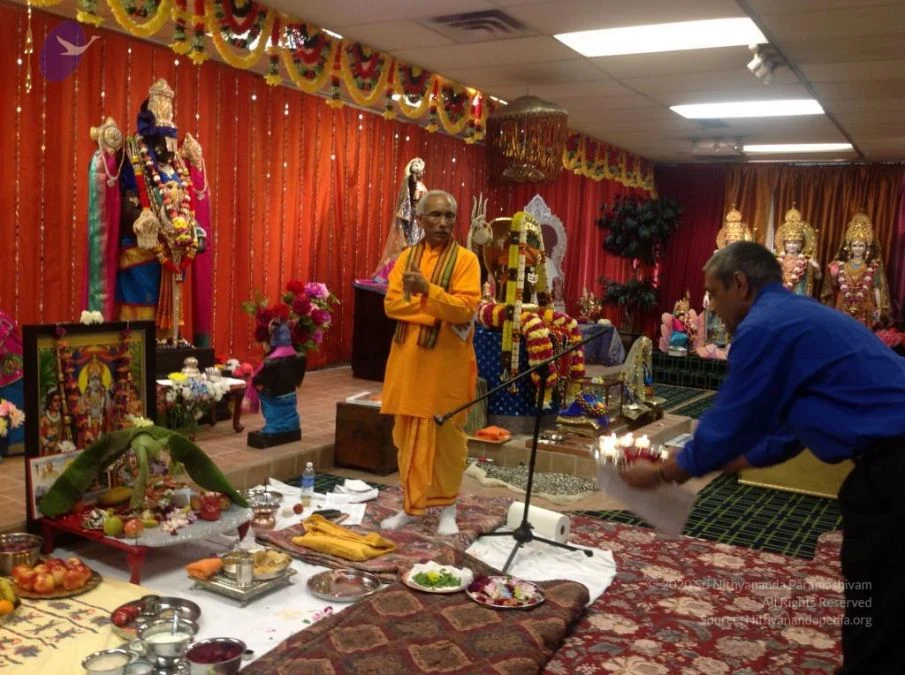
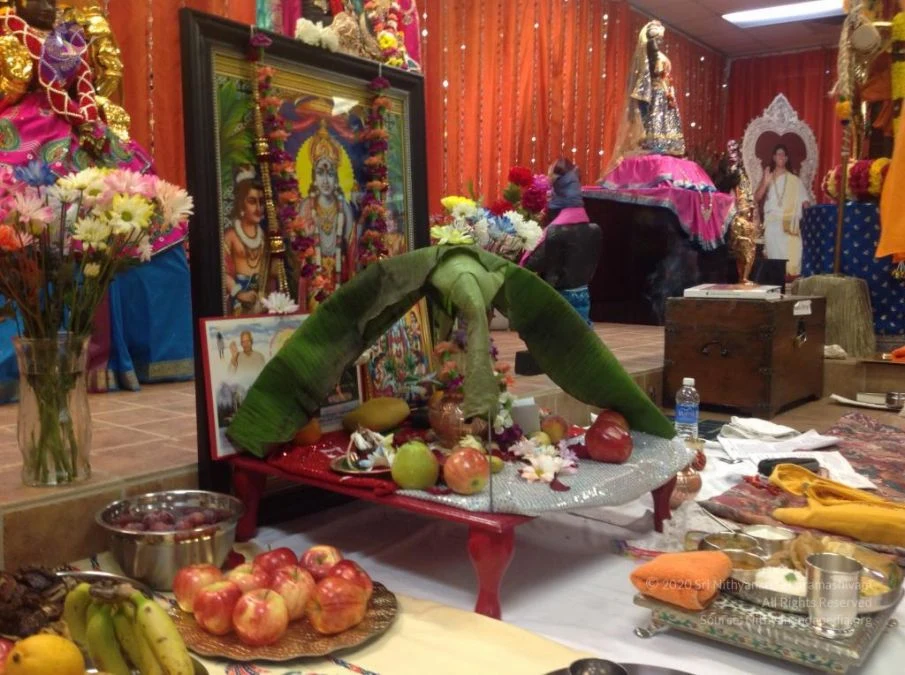
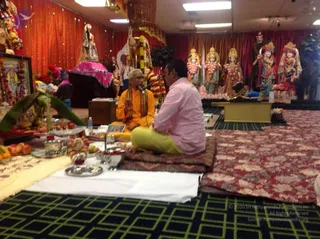
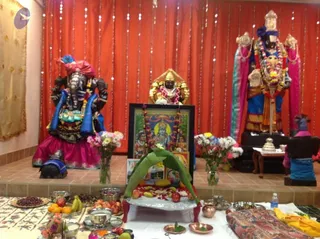
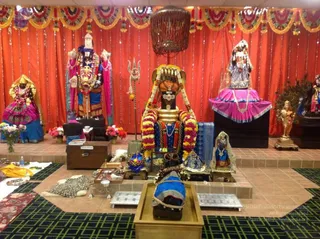
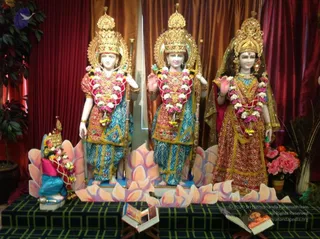
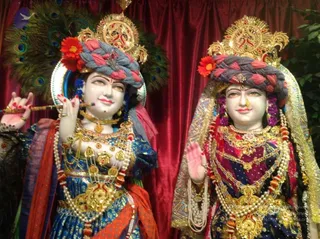
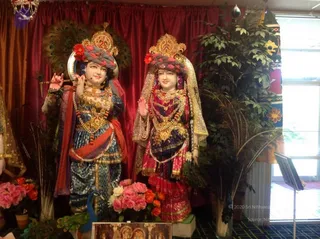
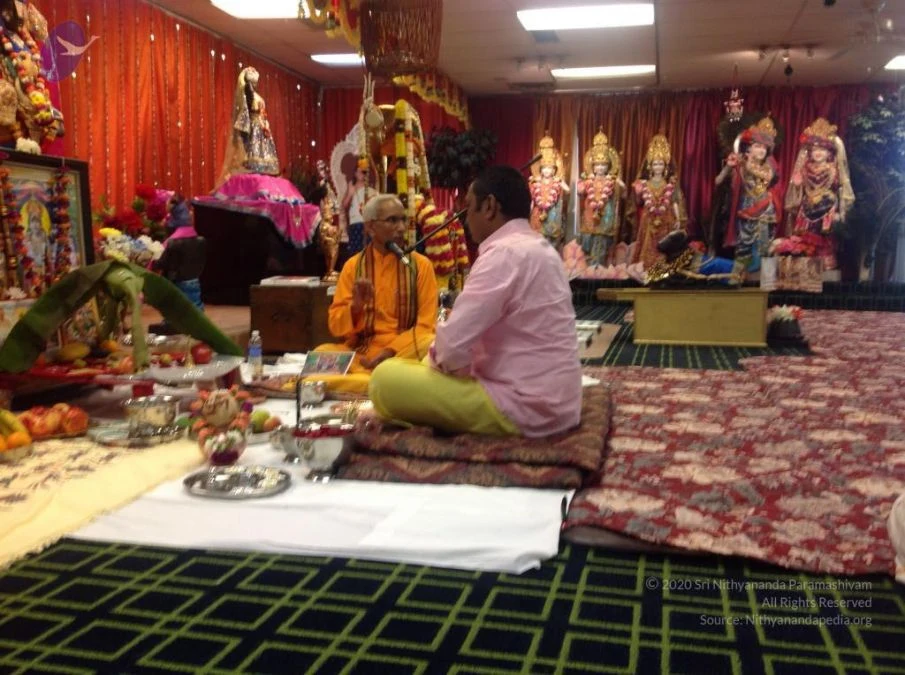
A photograph of a satsang in a temple-like hall with red and orange drapes and a row of colourful deity murtis dressed in garlands along the back wall. A seated man in orange robes with a saffron shawl and a microphone in front of him holds his hand raised in a teaching gesture. Facing him, a second man in a pink shirt and yellow trousers sits cross-legged on a cushion. In front of them lie a green leaf-decorated offering with fruits, a plate, small bowls and brass dishes, and a book. Green-patterned carpet and a red rug cover the floor, and a raised golden seat stands to the right.A photograph of a temple-style altar set against a bright orange draped backdrop with hanging sparkle strands. Two large Ganesha statues flank the scene: a dark grey figure on the left with a blue cloth and pink skirt, and a larger figure on the right in pink and blue garments with a long garland of marigolds and red flowers. A smaller golden deity murti sits at the top centre above a framed devotional print decorated with marigold garlands. White and pink flowers stand in glass vases, and a silver plate holds bananas, apples, pomegranates and other fruit under a green leaf canopy. Brass and steel bowls with oil lamps, fruit baskets and an offering of coconuts and flowers are arranged on a white cloth in the foreground, with a patterned cloth at right. No people are visible.A photograph of a temple shrine room with a central Shiva linga draped in marigold garlands, set on a gold-toned base with a trident leaning beside it. Flanking it are several deity murtis in colourful dresses, including a figure in pink and blue on the left and a figure in a pink skirt and lavender veil on the right. Orange and red drapes with festoon garlands hang behind, and a hanging ornate lamp is visible above. Offerings, flowers and a brass tray sit on the floor, and a blue-cloth-covered object rests in front on a wooden stand. No people are visible.A photograph of a shrine display with three white marble deity murtis standing on lotus-petal bases before red and maroon drapes. The two taller central figures wear gold crowns, flower garlands and patterned red and teal garments; the figure on the right wears a red sari-like gown with a gold veil. A small figure in a teal and pink garment and gold crown sits at the lower left, with floral garlands. Pink flowers, a potted plant and open books in front complete the arrangement. No people are visible.Two white marble murti statues of deities stand side by side before a deep red draped curtain with green foliage at the right. The left figure holds a flute to its lips with one hand, wears a blue and orange garment, a blue and red turban with a red flower, a gold crown and a peacock-feather backdrop. The right figure, in a jewelled blue, pink and gold sari with a gold veil, raises one hand in blessing and wears a matching turban with red flower and a gold crown. Both are adorned with layered gold necklaces, pearl and bead garlands and gold ornaments. Visible deity murti iconography suggests Krishna and Radha.Indoor photo of a decorated altar with two white statues of Radha and Krishna standing side by side before a deep red draped curtain. The figure on the left, Krishna, holds a flute to his lips and wears a peacock-feather crown, a blue and gold garment with a red sash, and layered gold necklaces. The figure on the right, Radha, wears a red and pink embroidered skirt, a sheer gold-trimmed veil over her head, and pearl and bead necklaces. Fresh pink and orange flowers sit in front, potted green plants flank the altar, and a small peacock figure and a framed picture are at the base. No living people are visible.

Temple-Visit

20 photosSource gallery
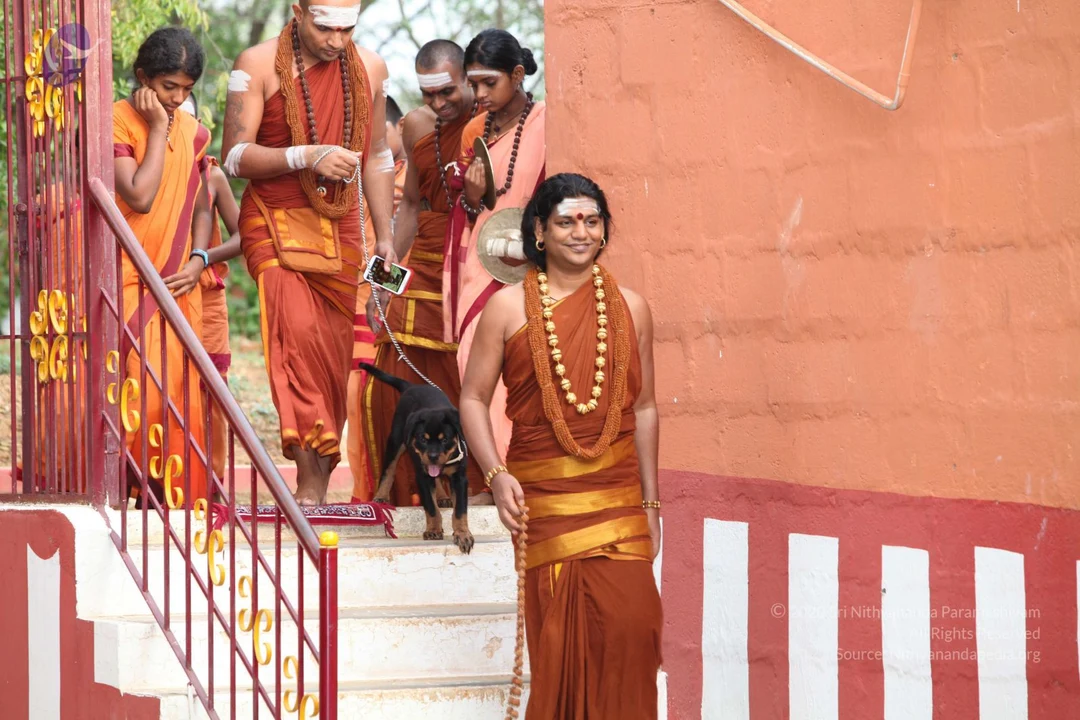
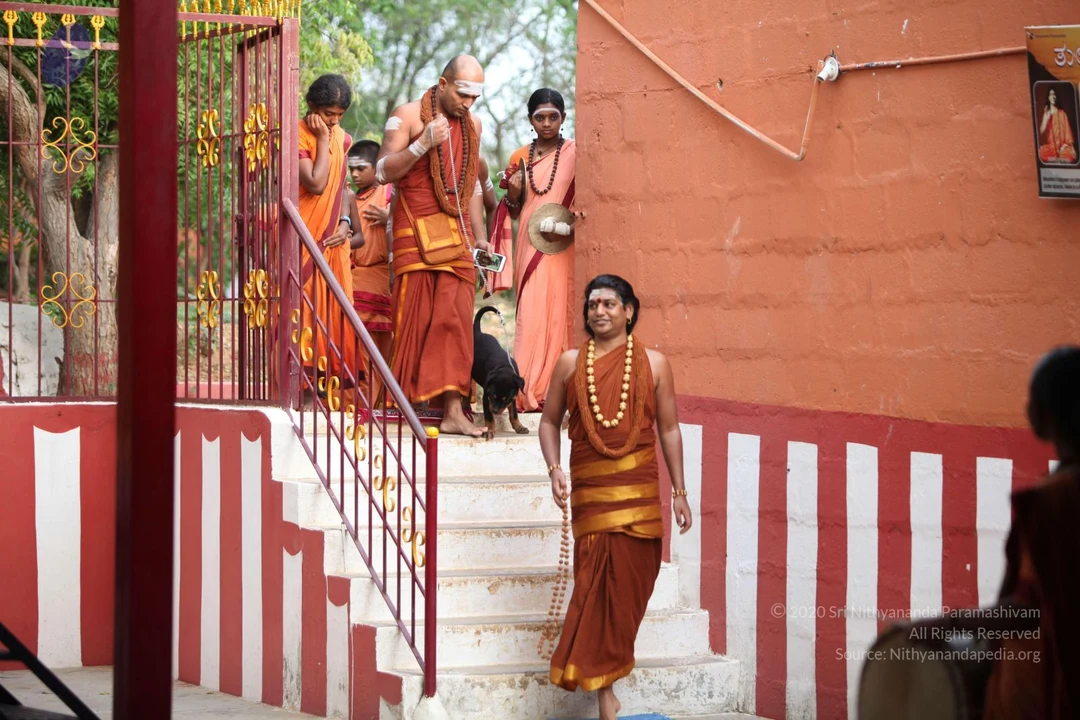
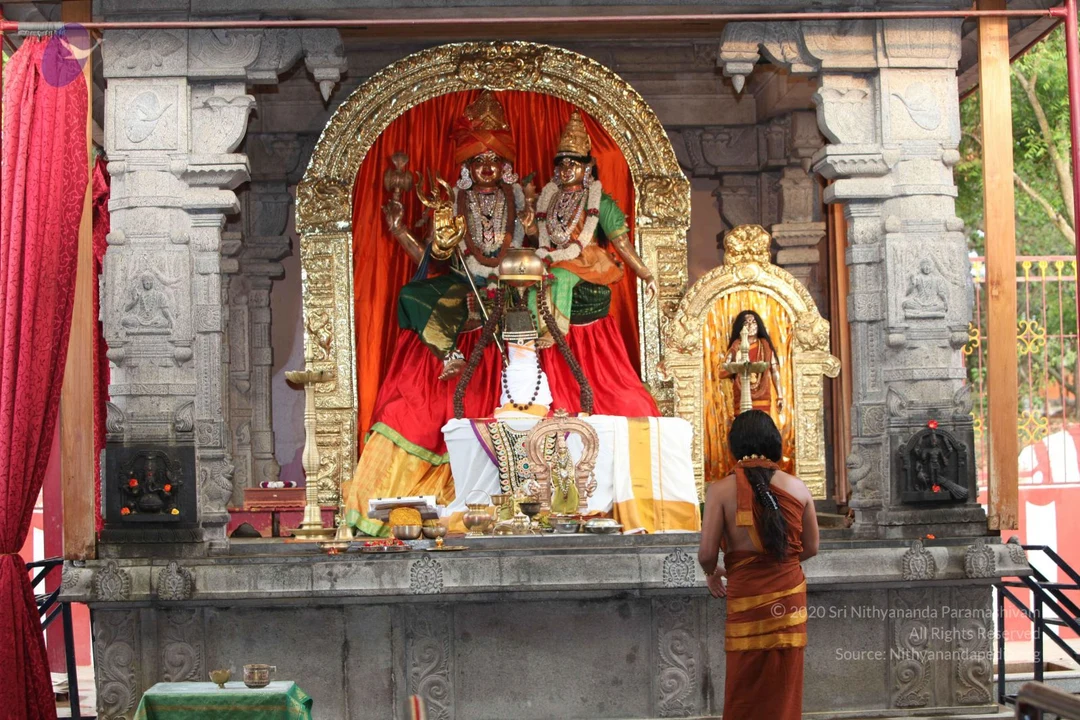
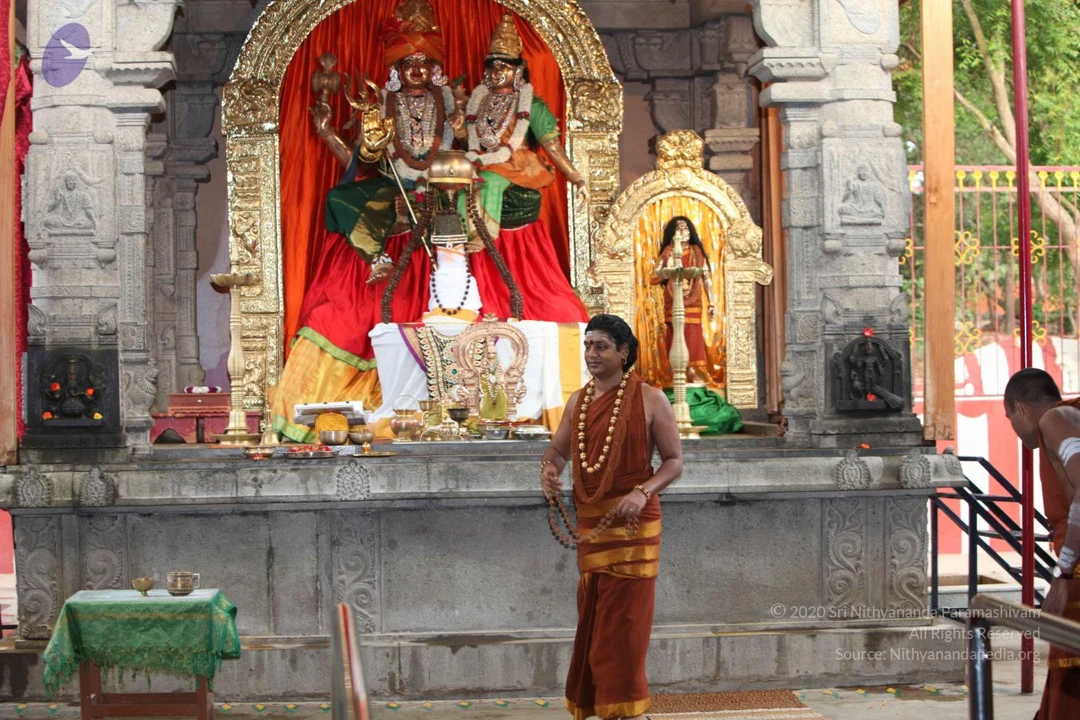
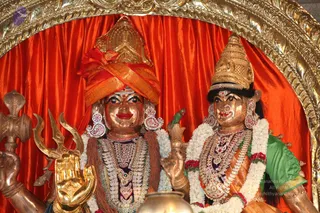
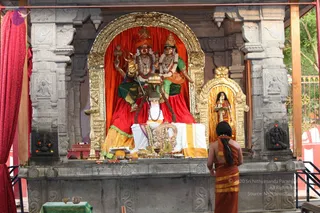
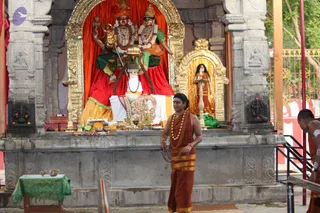
Two golden metal murti statues of a deity pair stand before a rich orange silk backdrop framed by an ornate gold arch. The left figure wears an orange turban-style crown, a golden trident-like weapon rests beside him, and his raised golden hand shows a blessing gesture. Both figures wear layered jewelled necklaces, garlands of white flowers, and red and gold ornaments. The right figure wears a golden crown, a green and orange garment, and holds a small green object. A brass kalasha pot sits in the lower foreground. The scene reads as a temple deity display. Statues only, no physical people present.Photograph of a temple sanctum with two large painted deity murti seated side by side on a red-draped platform in front of a gold-framed arch and red curtain. The figure on the left holds a trident and a damaru-like hand object and wears a red and orange turban, rudraksha malas and a green-and-red garment. The figure on the right wears a gold crown, a green and orange sari-like cloth and a white garland. Between them sits a brass kalasha with a sacred thread and rudraksha beads, set over a white cloth with gold borders. Brass oil lamps stand on either side, with brass bowls and offerings in front. A smaller painted figure of a woman in orange stands in a niche at right. No physical people are visible.A photograph of a group of saffron-robed ashram devotees descending a white-railed staircase beside an orange-and-red painted wall. In the foreground a smiling woman with a long black braid, a red kumkum dot and white vibhuti on her forehead, wears an orange sari, a gold-beaded rudraksha-style necklace and a gold kanthi, holding a long mala. Behind her, a man in orange dhoti with white bandages on his arms and forehead holds a mobile phone on a chain, while a black dog with a lolling tongue walks on the steps. Other devotees in orange and pink clothing, some with rudraksha malas and white forehead markings, follow. Plain red-and-white stripes run along the lower wall.Outdoor photo of a group descending a white concrete staircase beside a red-and-white painted wall with an orange-painted building behind. In the foreground a man in ochre-orange dhoti and shawl with a gold-coloured waist cloth and a large beaded yellow necklace walks toward the camera holding a rudraksha mala, with a bare-chested man in front of him. Behind, a man in orange robes with a white band on his forehead and a crossbody bag, a woman in peach-orange sari, a young boy with tilak, and a black dog on the steps. A small hand-held brass or silver object and a woven fan are visible among the group. A wall poster with an orange background shows a robed figure. A red metal gate with gold scrollwork frames the left side.A photograph of a temple shrine with a granite and gold-framed arch enclosing two large painted deity figures in red and green garments, adorned with white and red garlands and beaded necklaces, one holding a trident and the other a sword or staff. A white-draped altar in front holds brass lamps, a kalasha and offering plates. A standing devotee with a shaved-looking braided back and an orange-and-gold dhoti stands at right, facing the shrine with hands together, in a puja setting. Red curtains frame the left side and a smaller gilded niche with another figure sits at right.A photograph of an outdoor temple shrine with a grey stone base and carved pillars. Behind is a large deity murti pair with red and gold garments, garlands and a trident-like staff, under a golden arch with orange curtains. A smaller golden-framed shrine figure stands to the right. In the foreground a man in saffron-orange dhoti and shawl, with a long rudraksha mala around his neck and a prayer mala in hand, stands before the shrine. Two further figures in orange clothing are partly visible at the right edge. A small green-draped table with brass vessels sits at left.

Pratyaksha-Pada-Pooja
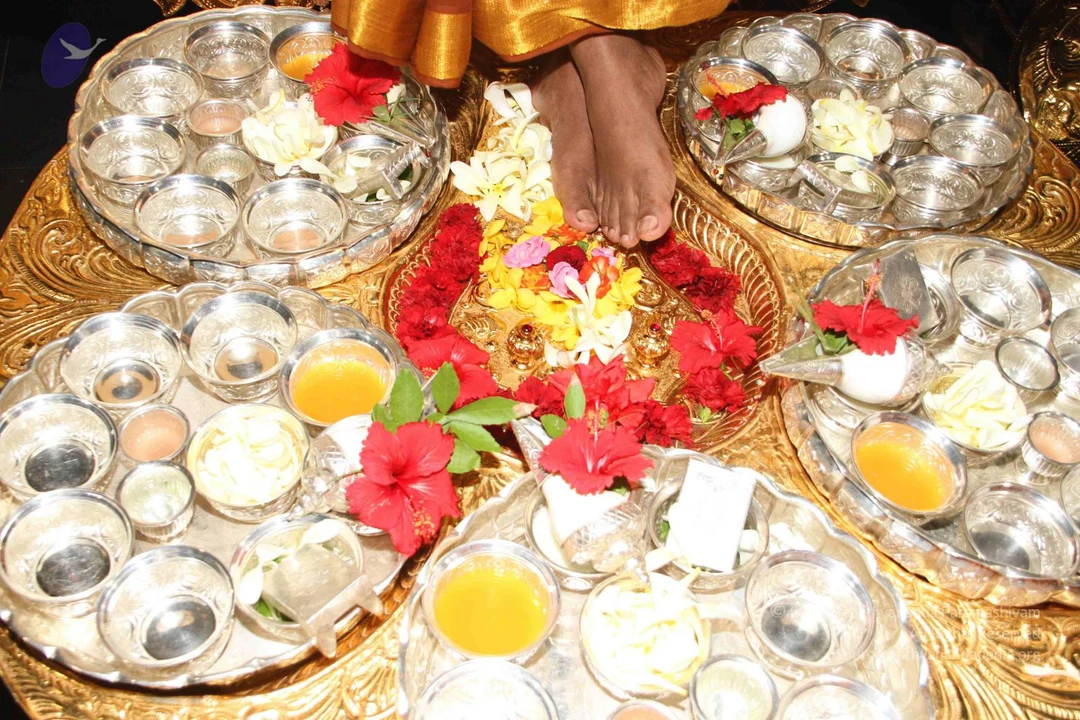
15 photosSource gallery
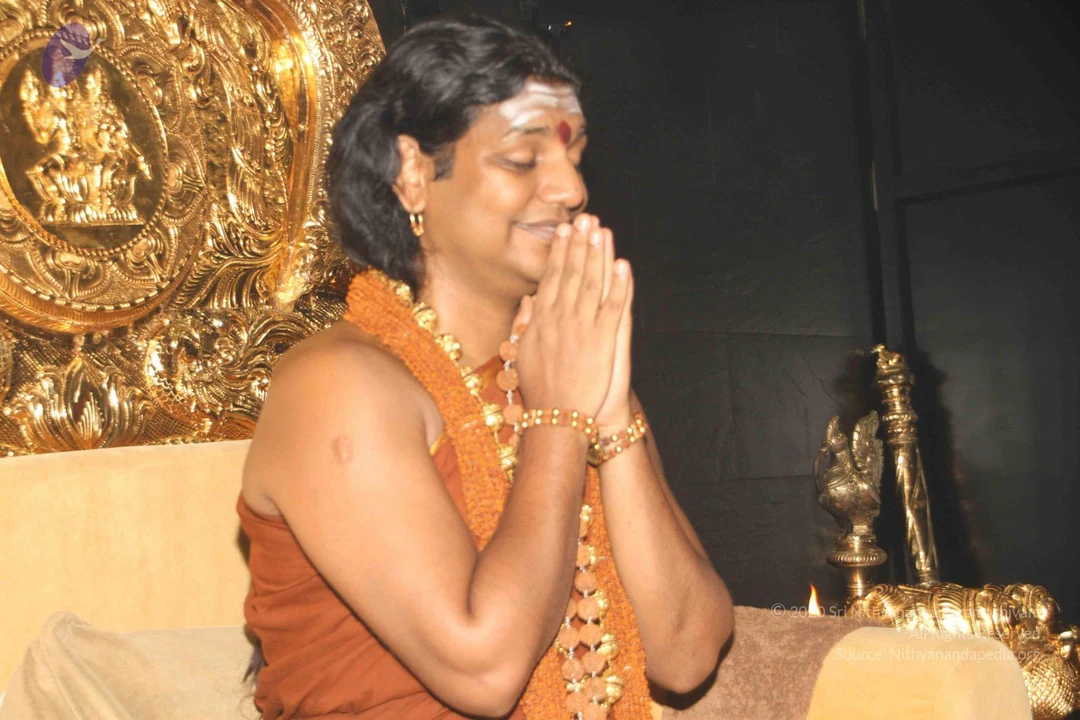
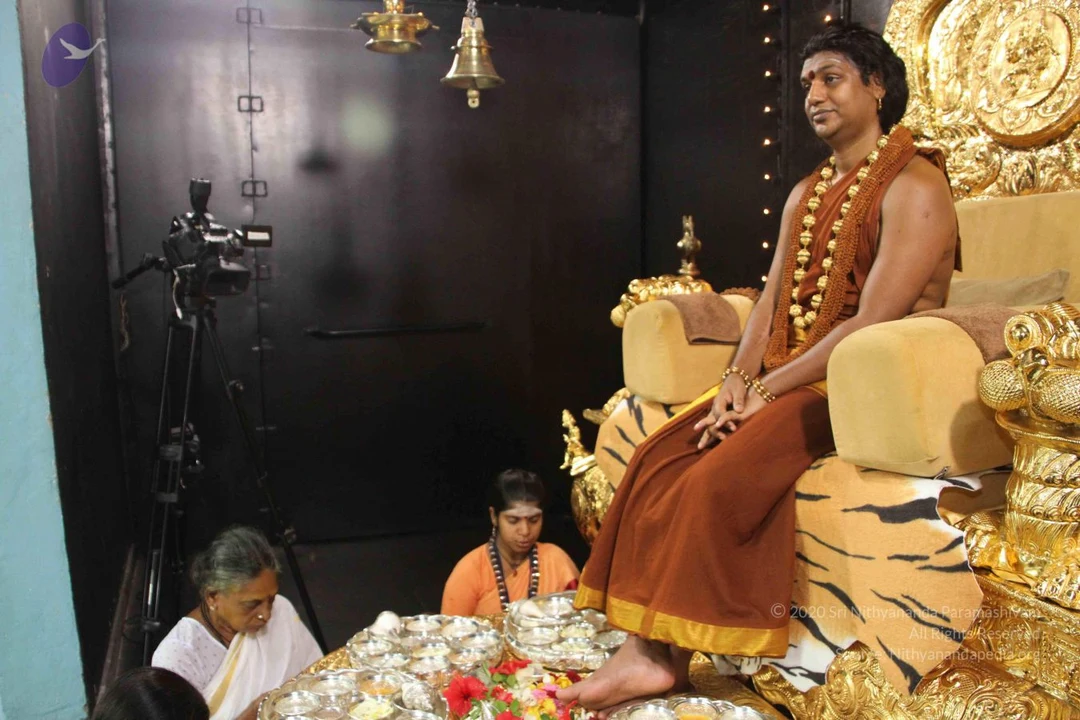
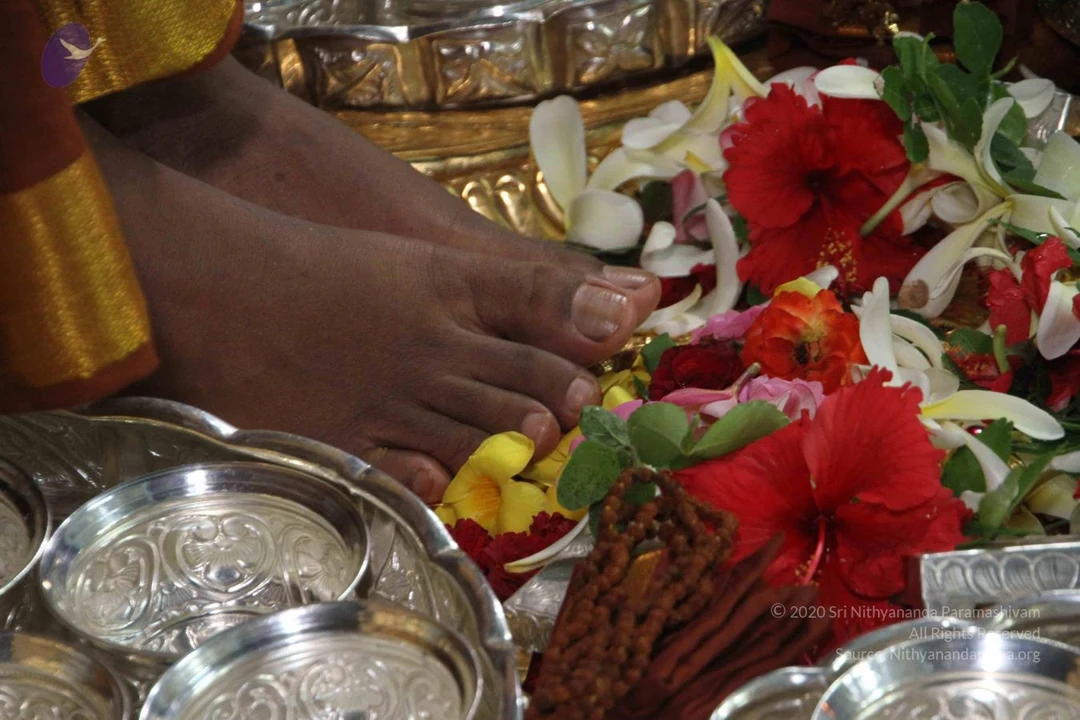
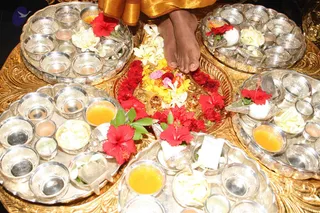
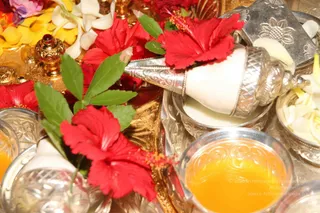
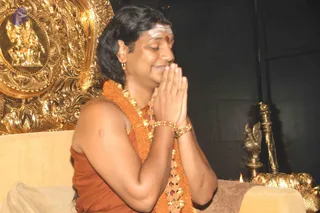
Close-up photograph of a padapuja, a ritual washing of bare feet. Two bare feet stand on a gold-toned plate strewn with yellow and white flowers and red hibiscus, with a small gold deity figure and kumkum at the centre. The wearer's golden-yellow silk garment is visible at the top edge. Around the plate are silver thalis and bowls holding saffron-yellow liquid, white petals, and red hibiscus flowers, plus a silver cup with a hibiscus bloom. Only feet and the garment hem are visible, so no person's face or upper body is shown.Close-up photograph of a puja tray arrangement. A silver-rimmed white conch shell with a silver mouthpiece rests on a silver plate, surrounded by bright red hibiscus flowers with green leaves, white frangipani-style blossoms, and yellow petals. A silver bowl holds golden-yellow liquid. No people are visible.A man seated on a cream cushion with palms pressed together in anjali mudra at his chest, eyes closed and smiling. He wears an orange-saffron shawl draped over his shoulders and bare-shouldered, a rudraksha mala with gold beads, gold bangles and a gold earring, a white vibhuti line on the forehead and a red kumkum bindu. Behind him is an ornate gold repoussé panel with a deity relief, and to the right stand gold ritual objects including a bird-headed finial and a staff. A lit oil lamp glows at the lower right. Swamiji (probable) appears as the in_person candidate: long swept-back hair, saffron shawl, rudraksha mala and ceremonial gold ornaments.A smiling man in a saffron-orange shawl and long swept-back dark hair sits on a cream cushioned seat before an ornate gold-embossed backdrop depicting a deity scene. He wears a thick necklace of gold beads over the orange shawl, a gold earring, a white forehead marking with a red dot, and a bracelet. A brass oil lamp with a small flame and a golden ceremonial ornament stand to the right against a dark wall. Swamiji (probable): long swept-back hair, saffron clothing and ceremonial gold beads mark him as the seated teacher at the satsang.A photograph of a smiling man with shoulder-length dark hair seated on a cream cushioned throne in front of an ornate gold repousse backrest. He wears a saffron-orange wrap over bare shoulders, a long ornate gold necklace of round beads, a small gold earring, and a white and red forehead mark. Beside him stands a gold ceremonial lamp and an oil lamp with a flame.A photograph in profile of a man with swept-back dark hair and a small gold earring, wearing a rust-orange draped garment over one shoulder and a long orange rudraksha mala with gold bead spacers around his neck. He has white vibhuti horizontal lines and a red kumkum dot on his forehead. He is seated before an ornate gold throne with carved details, and a gold ritual object stands at right against a dark background. Appearance-based cues (swept hair, orange robe, rudraksha mala, gold ornaments) match a person, seated in person during a satsang setting.

Pratyaksha-Pada-Pooja
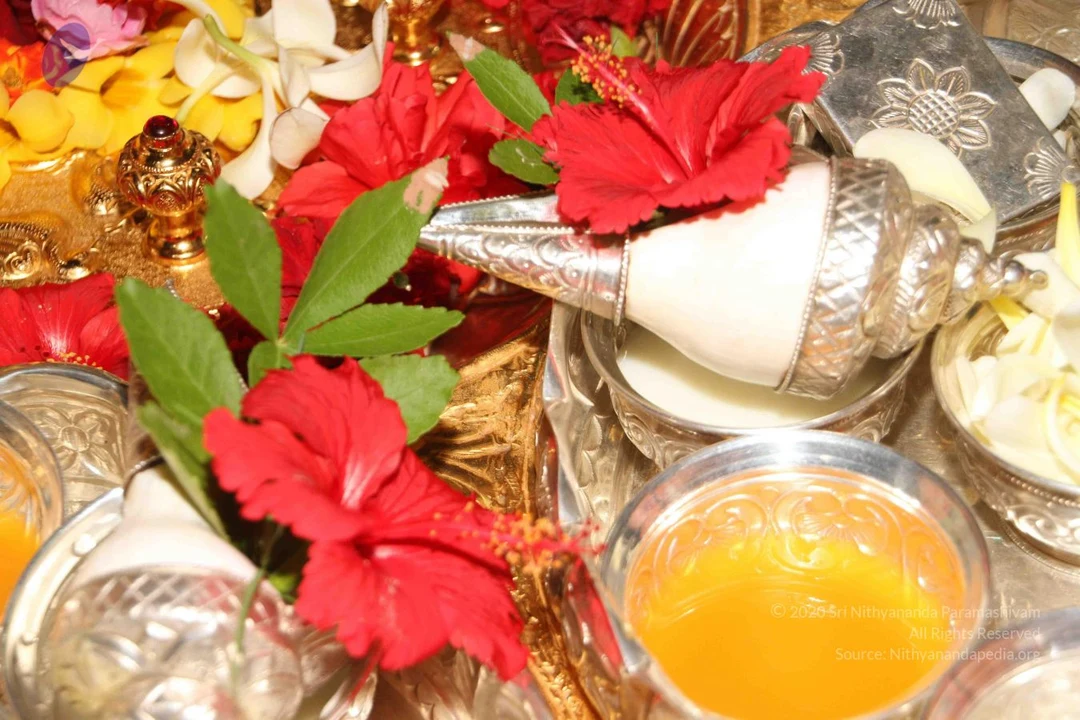
30 photosSource gallery
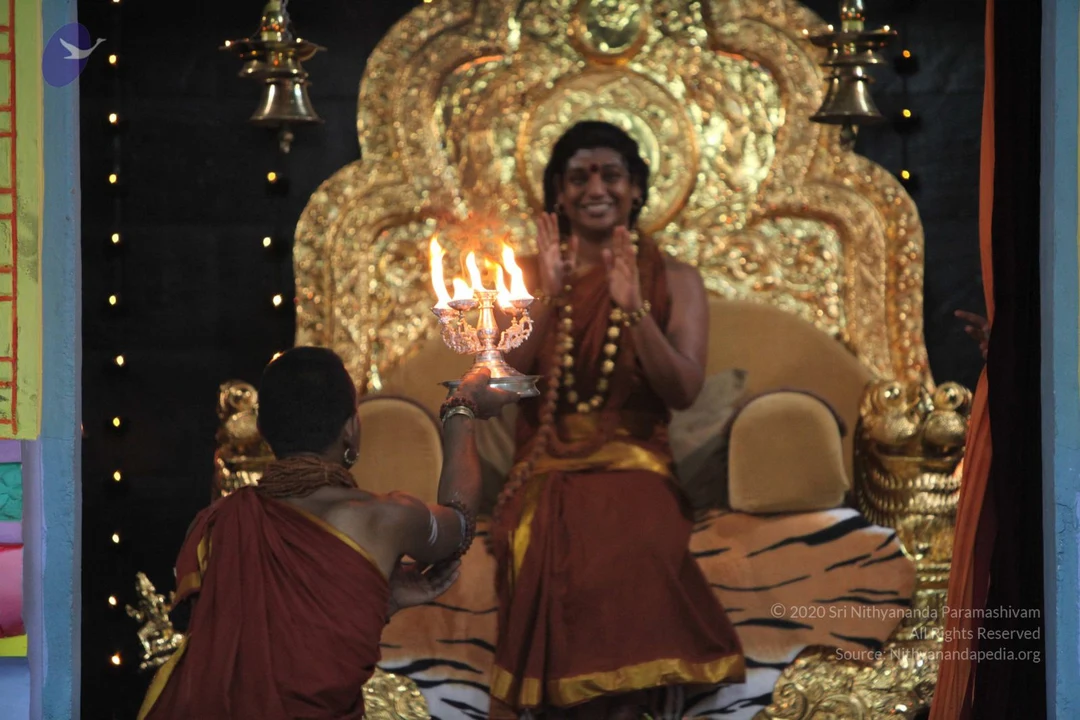
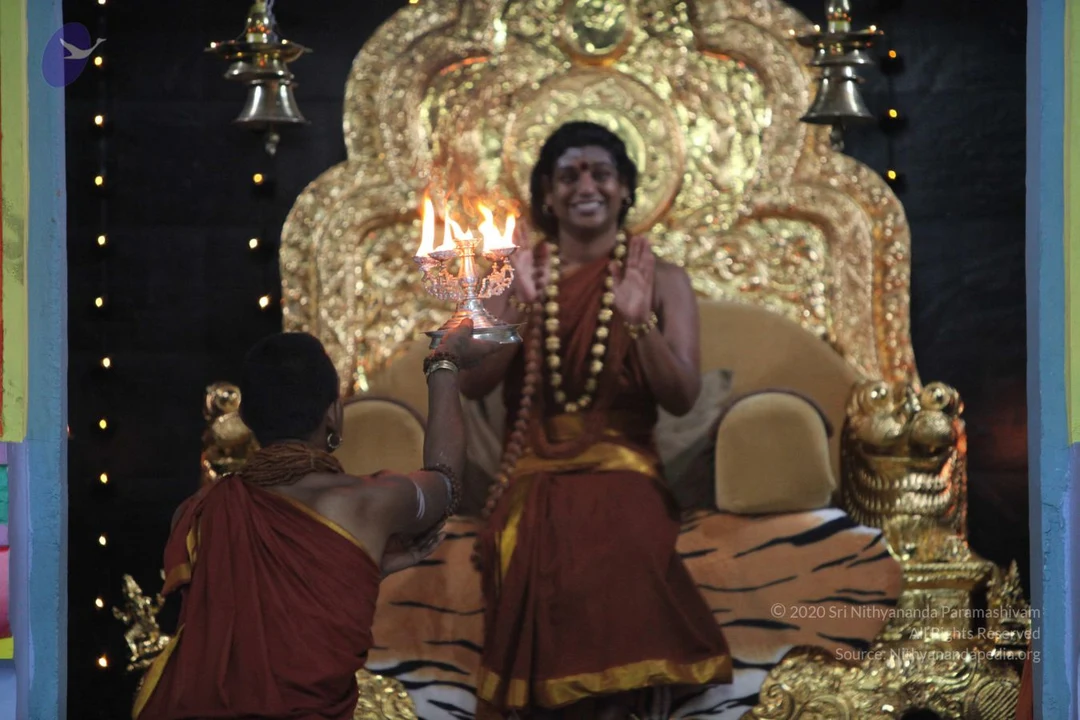
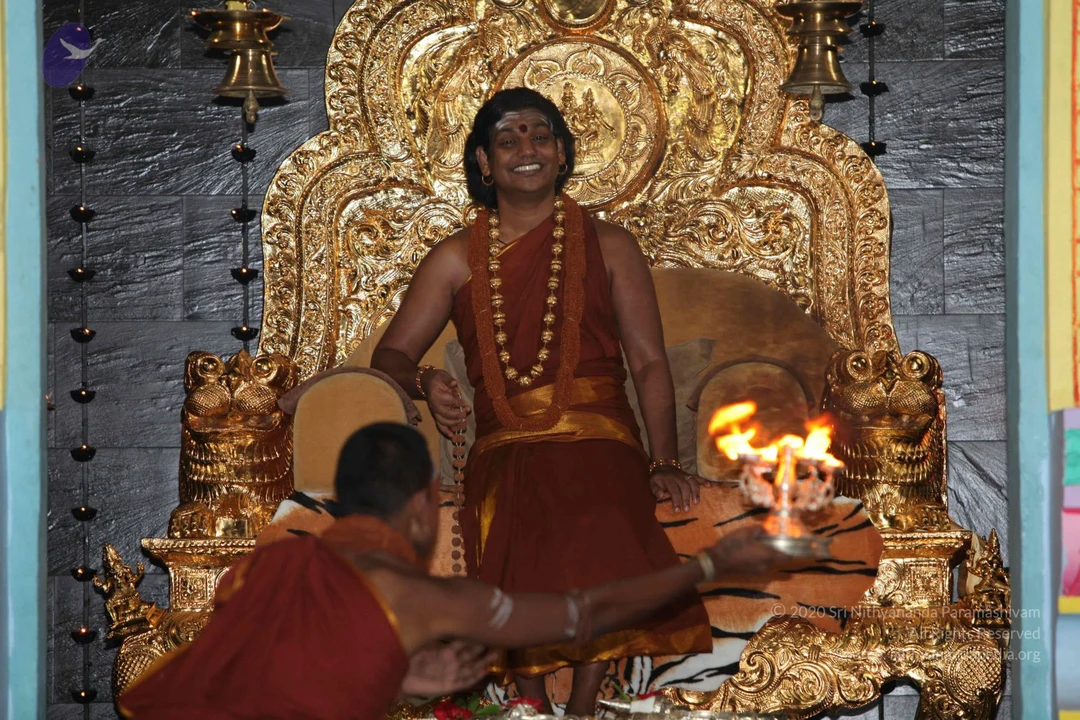
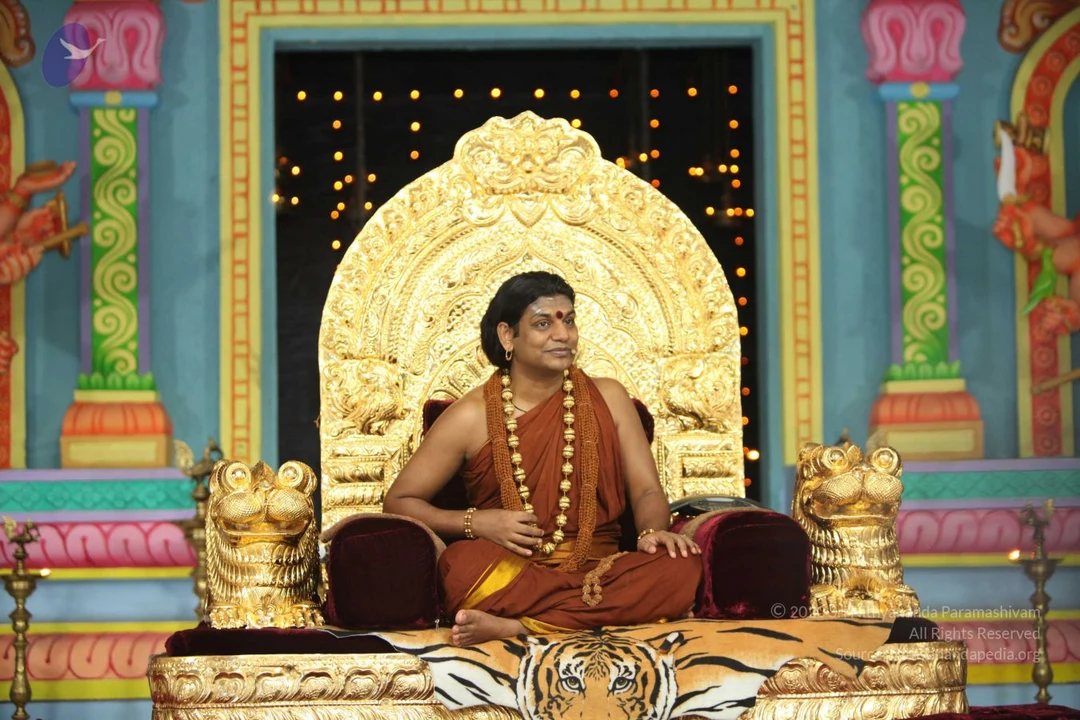
A photograph of a person in an orange-saffron robe with a bare shoulder and white arm bands, bent forward and holding a lit brass aarti lamp with a large open flame and rising smoke before a deep red velvet curtain. Golden peacock-topped brass lamps flank the curtain on pink and yellow painted pedestals, with a pale blue wall behind. The figure's face is turned away, and the gesture reads as an aarti offering at a shrine.A photograph of a temple shrine. In the foreground a man with a shaved head, seen from behind, wears an orange-saffron robe over his shoulder and bare arms, holding a lit multi-flame brass aarti lamp with both hands toward a deep maroon velvet curtain. Smoke rises from the flames. Behind him is a golden deity murti or throne framed by a dark wooden backdrop hung with brass bells and a brass hanging lamp. Golden peacock-topped brass lamp stands flank the painted pink, yellow and green pillars. The priest is performing aarti. No readable name is attributed to the scene, and the appearance is not sufficient to identify a person candidate.A photograph of a seated figure in a saffron-orange robe with a gold border, wearing a rudraksha mala and ornate gold necklaces and bangles, with palms pressed together in namaste and eyes closed, sitting before a large gold ornate throne with a tiger-striped cushion. In the foreground, a devotee in a rust-orange robe with a rudraksha mala and vibhuti marks on the arm holds a lit five-flame brass aarti lamp toward the seated figure. A dark red curtain and a hanging brass bell frame the scene.A seated figure in an ornate gilded throne backdrop, draped with a tiger-skin cushion, presses palms together in namaskar with eyes closed and a smile. The figure wears a rust-orange dhoti with gold border, a red-orange shawl, a tulsi-style mala and gold bangles, with a bindi on the forehead; a person in ceremonial saffron dress with distinctive ornate adornments. In the foreground a bare-chested attendant in a rust-orange cloth holds a brass aarti lamp with a large flame toward him. Hanging brass bells and fairy lights frame the dark backdrop, and an orange curtain sits at the right edge beside a colourful wall panel.A photograph of a ritual aarti inside a temple-like hall. A devotee in a rust-red garment with a bare shoulder and rudraksha mala, seated at lower left, holds up a silver lamp with several flames toward a seated figure. The seated figure wears a rust-red robe with a gold border, a long rudraksha mala and gold necklace, and raises both hands in a smiling gesture of blessing. Behind them stands a large ornate golden throne with a tiger-skin cushion, flanked by gold lion-like carvings, a backdrop of hanging brass bells and string lights, and a curtain at right.A seated man in saffron-orange robes with a long beaded rudraksha mala and a gold necklace sits on an ornate gilded throne with tiger-striped cushioning, hands raised in a gesture of blessing while smiling. In the foreground a devotee in a rust-red garment with a golden border holds up a silver aarti lamp with a burning flame toward him. Brass bells hang from above and gold ornamental figures flank the throne against a dark backdrop.

Morning-Satsang
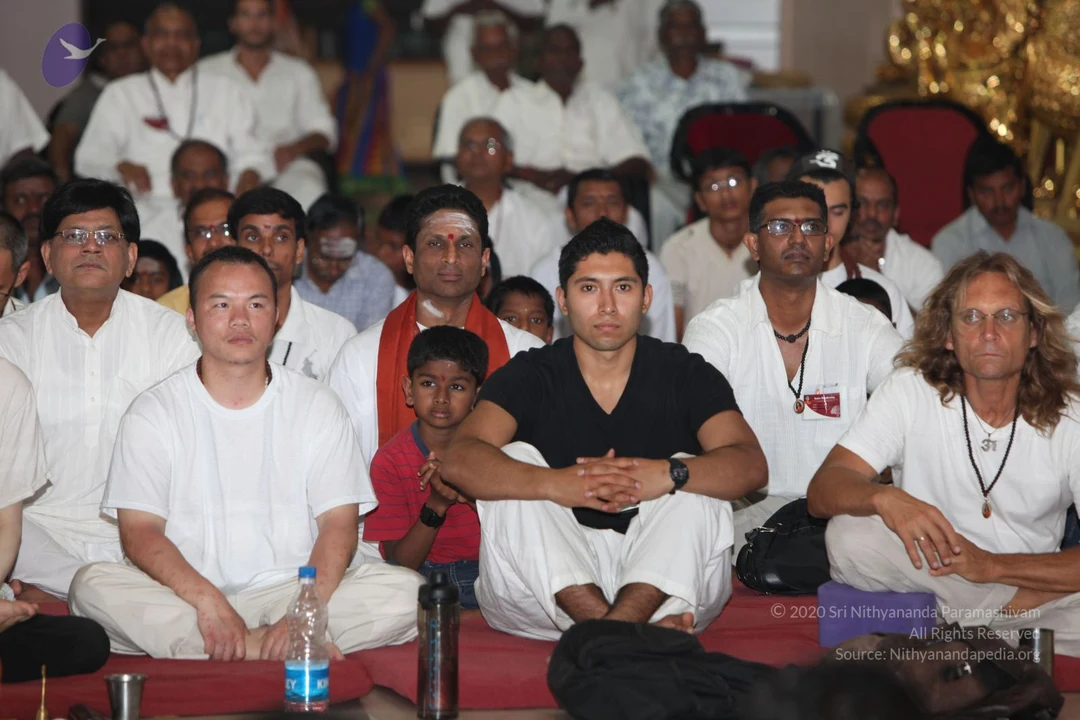
70 photosSource gallery
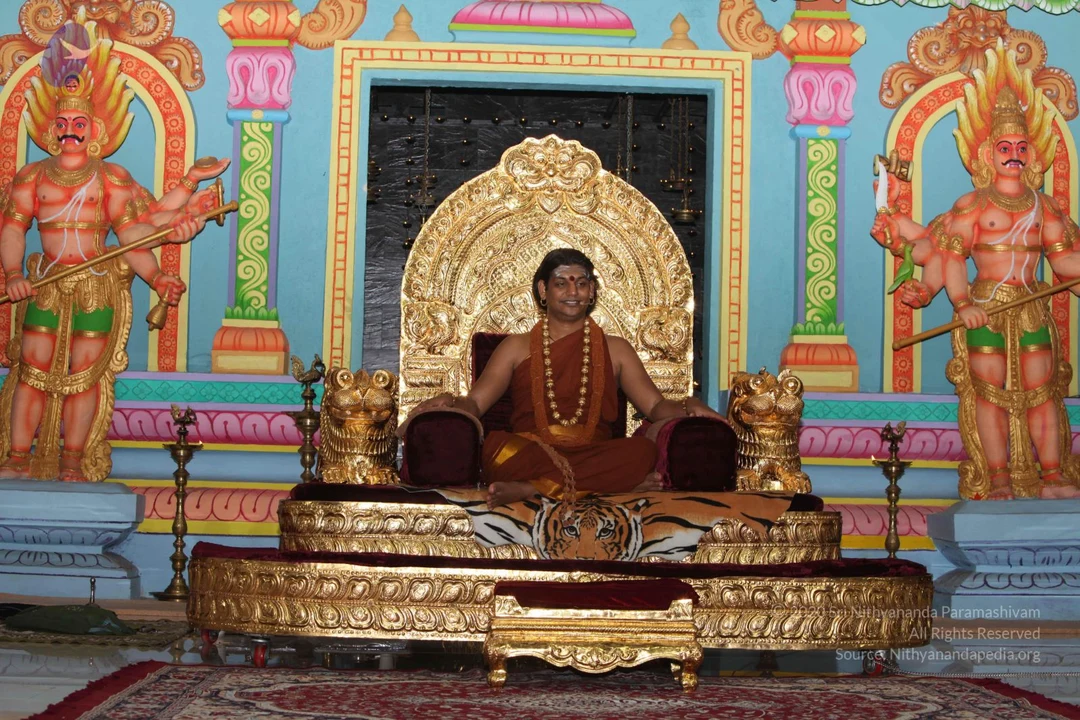
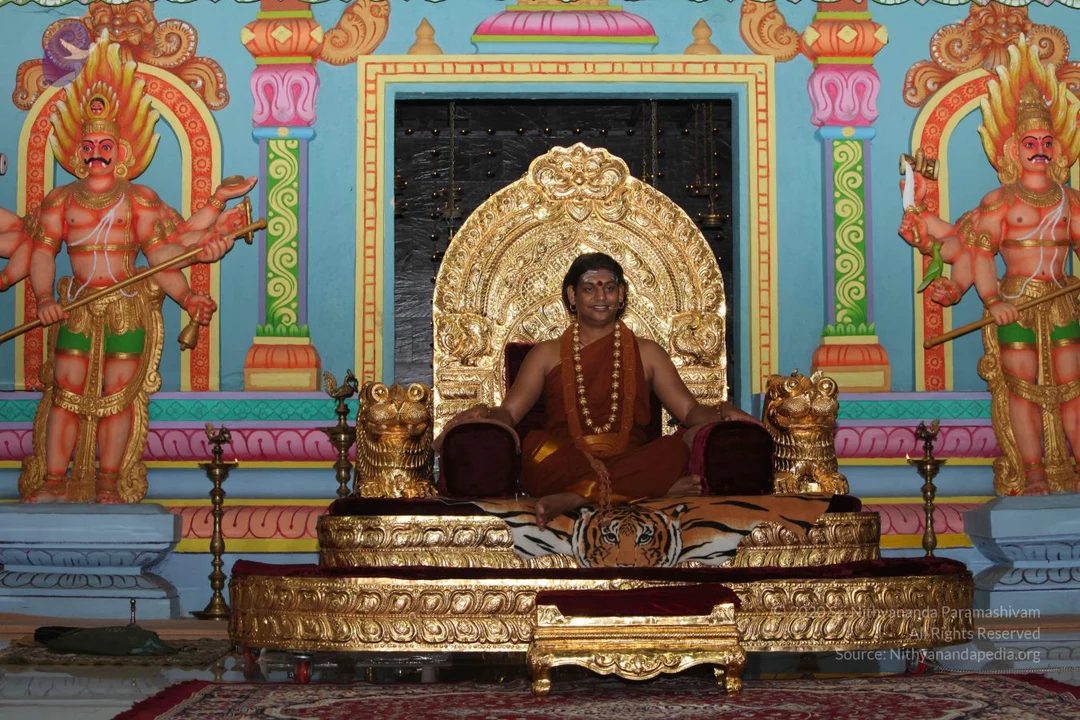
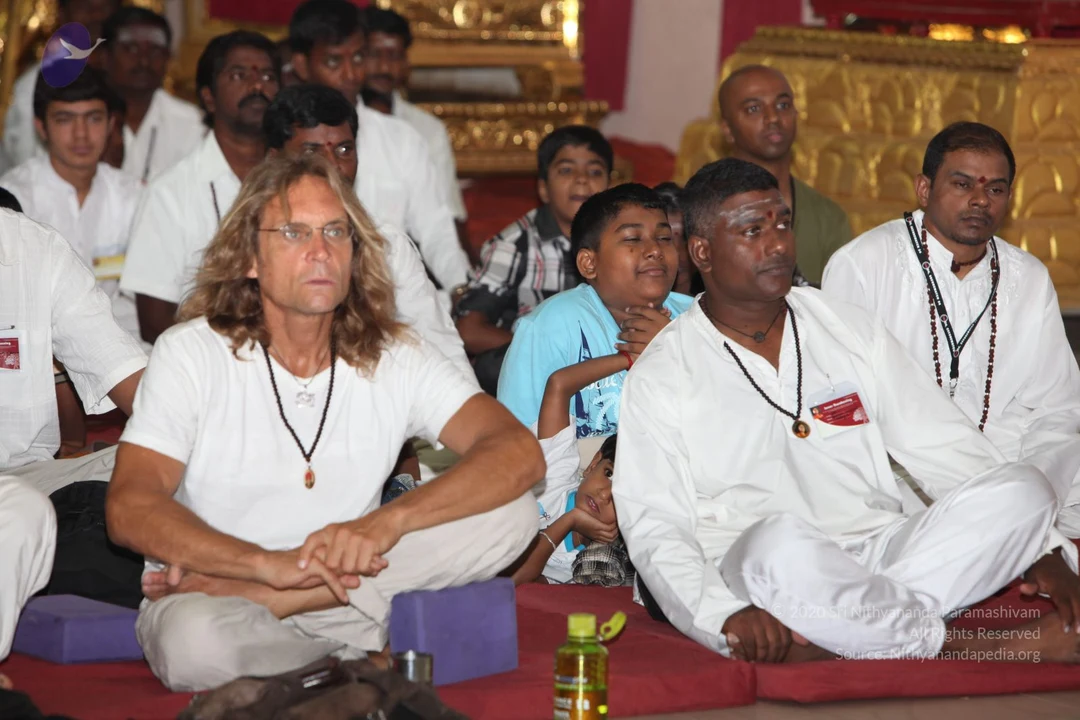
A seated audience at a satsang inside a temple hall. Many men in white kurtas and white shirts sit on red mats, facing forward. In the front row, a young man in a black t-shirt and white pants sits with hands clasped, next to a young man in a white t-shirt and a small boy in a red shirt. Behind them a man with a sandalwood tilak and orange shawl sits, and a long-haired man in white wears a pendant and rudraksha-style beads. Golden deity murti and red chairs are visible at the upper right, and water bottles and steel cups sit on the floor in front. No one in the scene is identified by face; the page's a person flag does not establish any visible presenter.A photograph of a man seated cross-legged on a deep burgundy velvet throne with gold-carved arms and an ornate gilded backrest. He wears an orange-red saffron-toned wrap, a long necklace of gold-toned beads over a rudraksha-style orange mala, and a gold bead bracelet, with a red bindi and white sacred-ash marks on his forehead. A small wired microphone is clipped near his face, and he holds a beaded mala in one hand while smiling and speaking. Behind him is a painted deity figure holding a staff and a gilded throne backdrop. The scene is a stage setting.A seated man in an orange-red dhoti and matching shawl sits cross-legged on an ornate golden throne with plush maroon velvet cushions, a tiger-striped rug beneath him. He wears a red bindi, dark shoulder-length hair, a heavy gold-beaded necklace over an orange rudraksha-style mala, and holds a beaded mala in both hands. He smiles and looks to his left. Behind him a painted deity figure in red and gold holds a club. a person: the long swept hair, orange clothing, rudraksha mala and gold necklace are consistent with a presiding teacher seated on a throne.A man with swept-back dark hair sits cross-legged on an ornate golden throne with carved lion-head arms upholstered in maroon velvet, placed on a tiger-skin rug. He wears a saffron-orange robe with a gold-bordered dhoti, a long orange rudraksha mala and a heavy gold bead necklace, with a red bindi and white tilak on his forehead and gold hoop earrings. He smiles with his hands resting on the armrests, appearing to address an audience during a satsang. Behind him is a gilded arched backdrop with decorative carved foliage. Appearance-based label: a person, seated on a throne with saffron clothing, rudraksha mala and gold ornaments.A seated man in an orange-rust sannyasi robe sits cross-legged on a richly carved golden throne with burgundy velvet armrests and a striped tiger-skin cover, flanked by golden lion-head sculptures. He wears a thick orange-beaded necklace and a ceremonial gold bead necklace, with a red bindi and sandalwood-marked forehead, and a gold-edged dhoti or waist cloth. Both hands rest on the armrests as he smiles and speaks into a headset microphone.A seated man in a saffron-orange robe sits cross-legged on an ornate gold throne with lion-head armrests, draped with a tiger-skin cloth. He wears a long beaded necklace and a rudraksha mala, and his long dark hair is swept back. Two painted guardian figures flank the throne, each holding a staff and wearing gold ornaments and green loincloths, in front of a blue temple backdrop with pink and green columns. Brass oil lamps stand on either side of the throne.