Skip to content
Thursday

19 April 2012

Dated photos
473
Source pages
1
Media
3
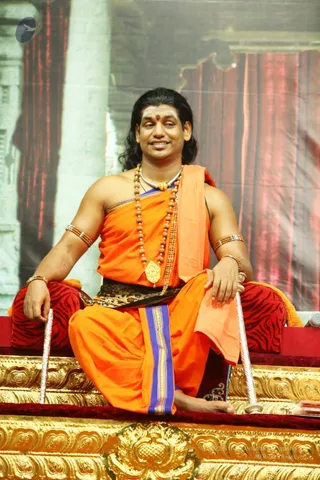
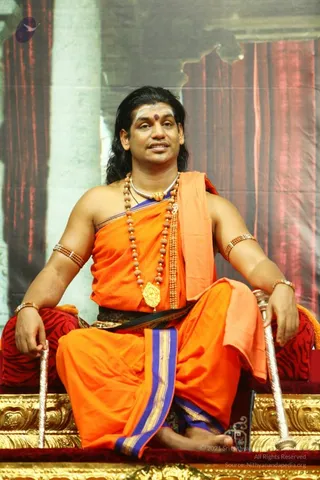
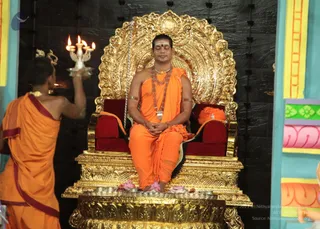
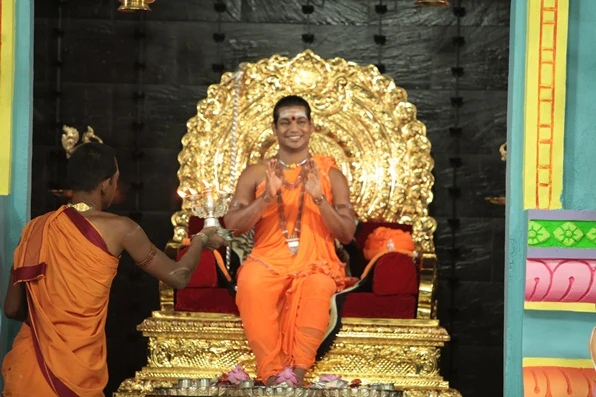
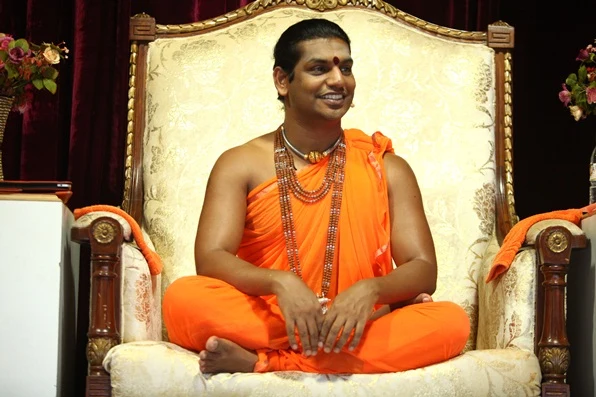
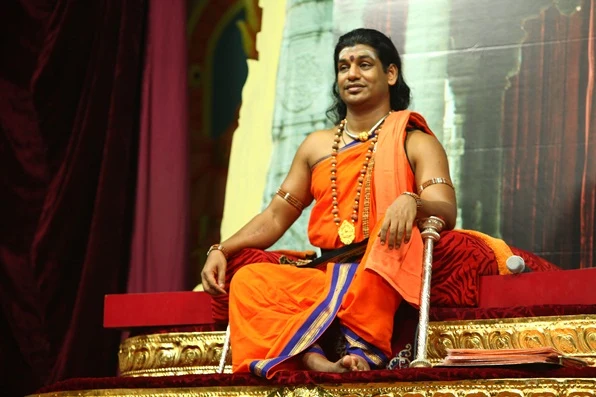
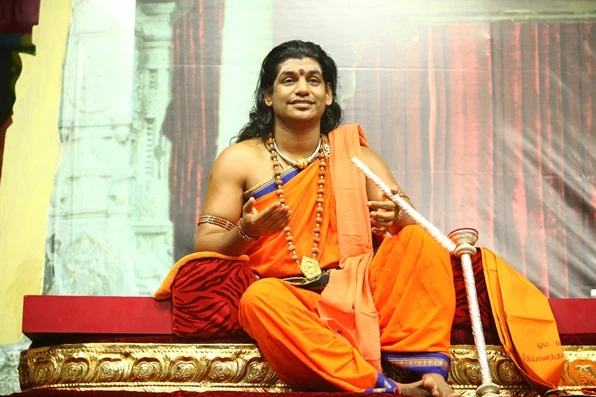
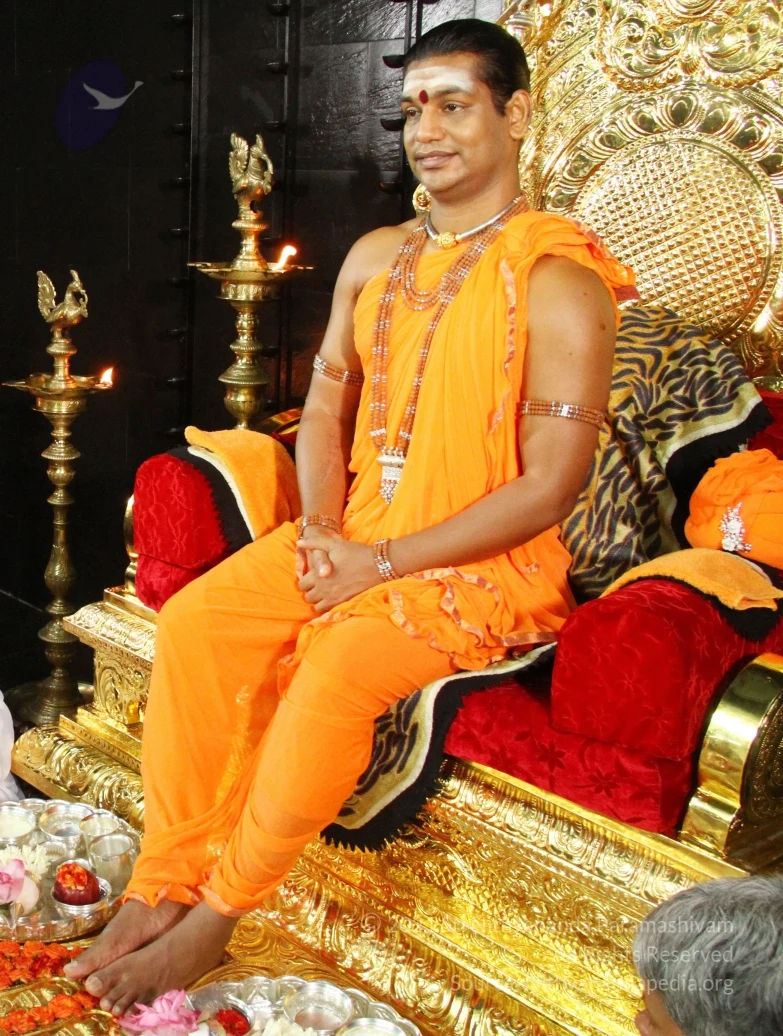
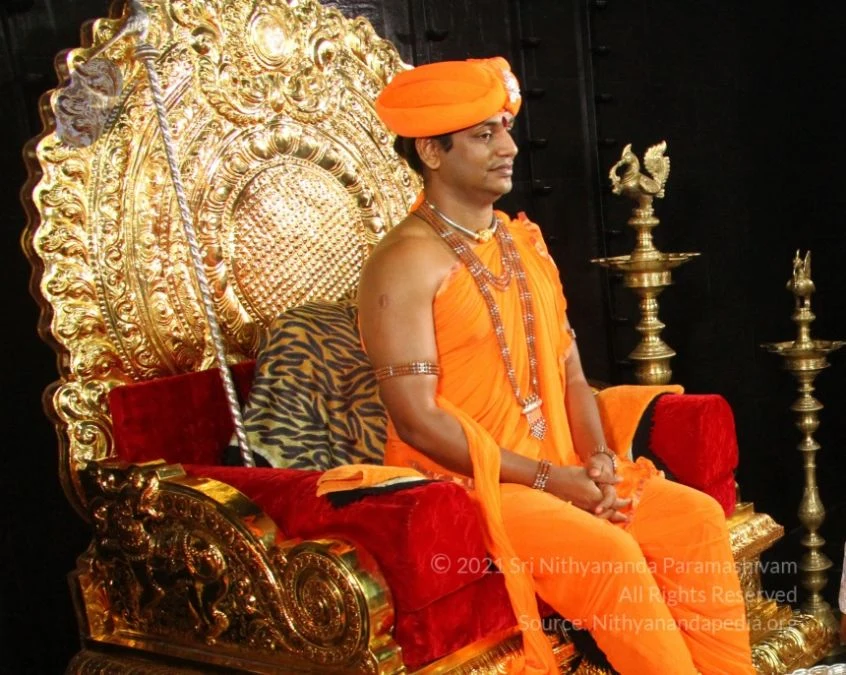
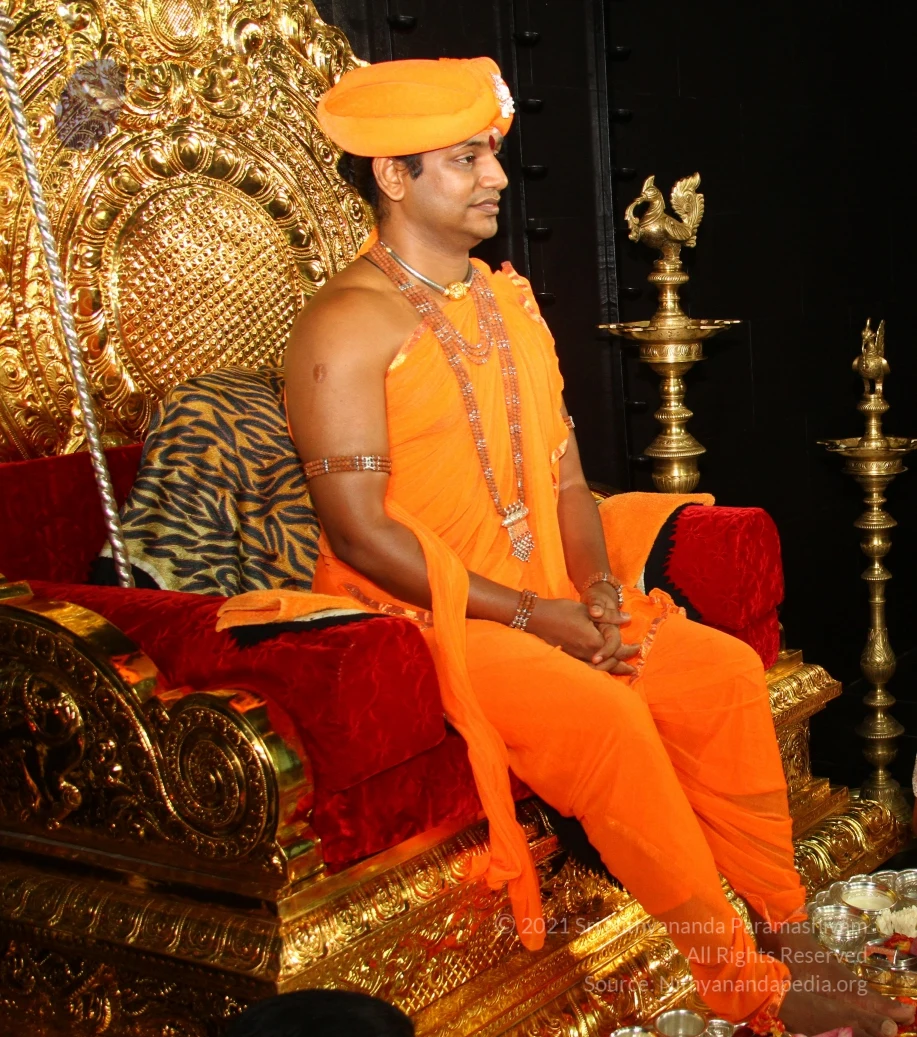
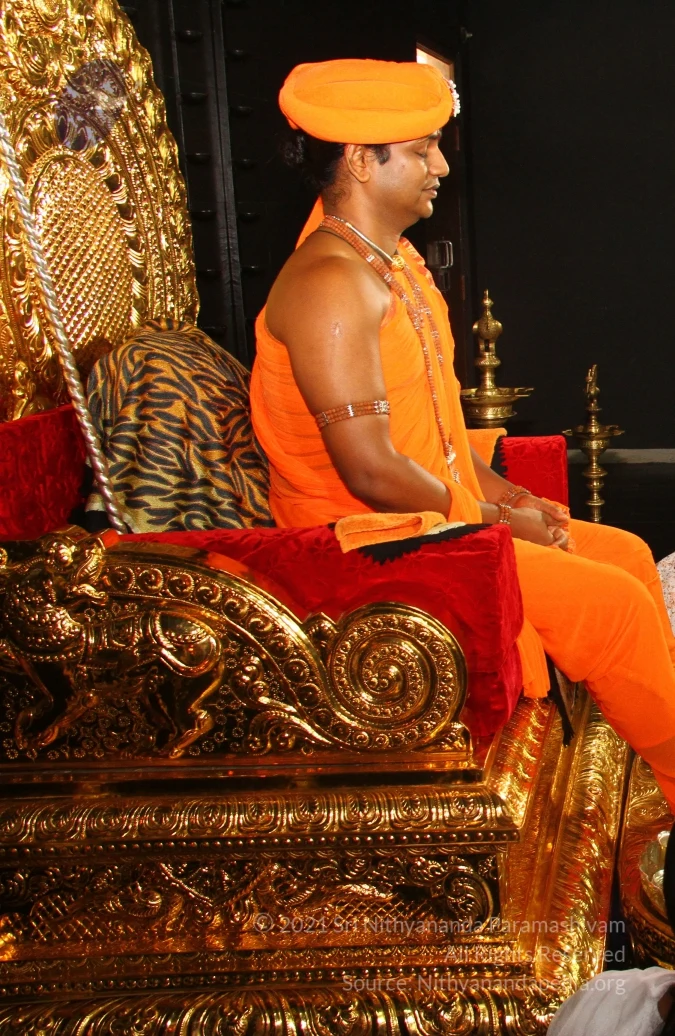
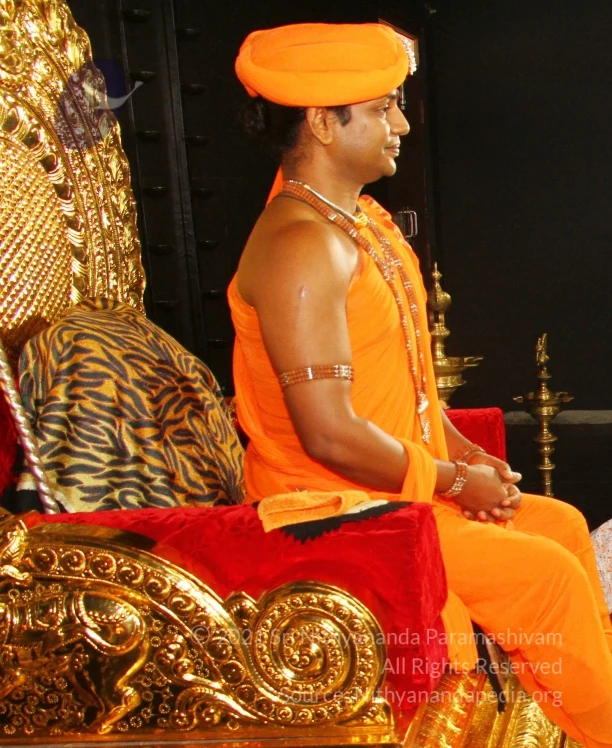
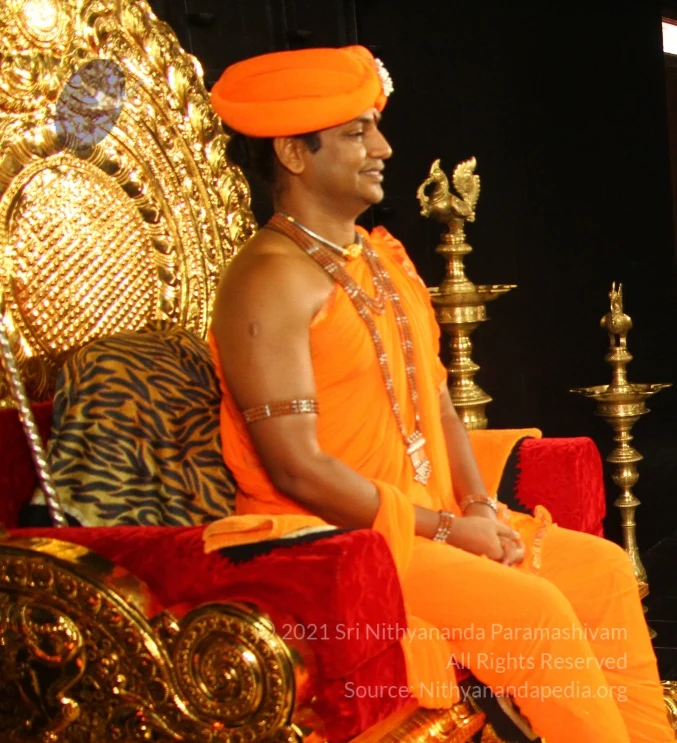
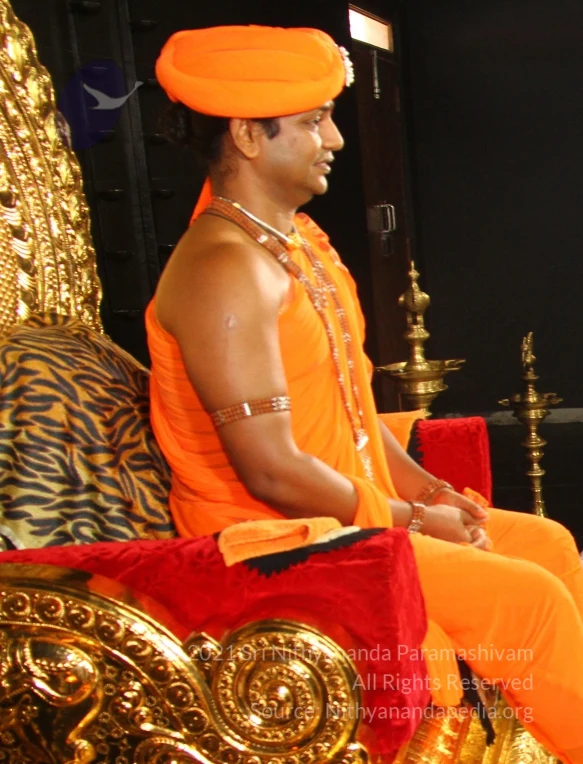
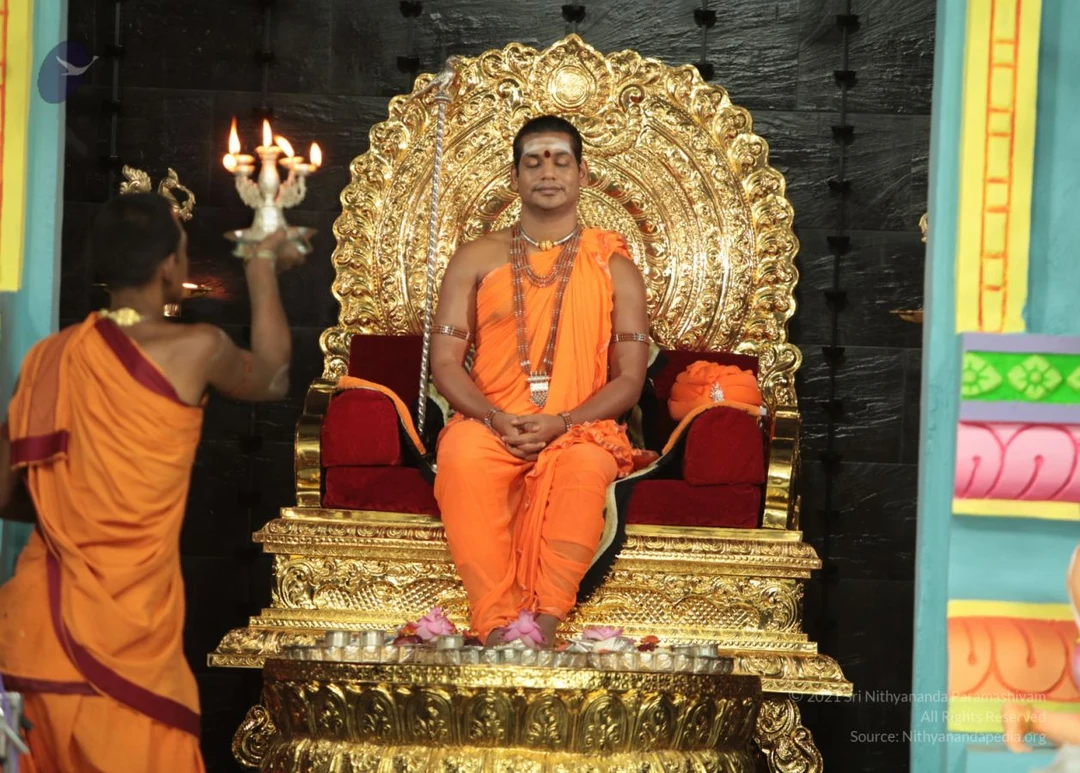
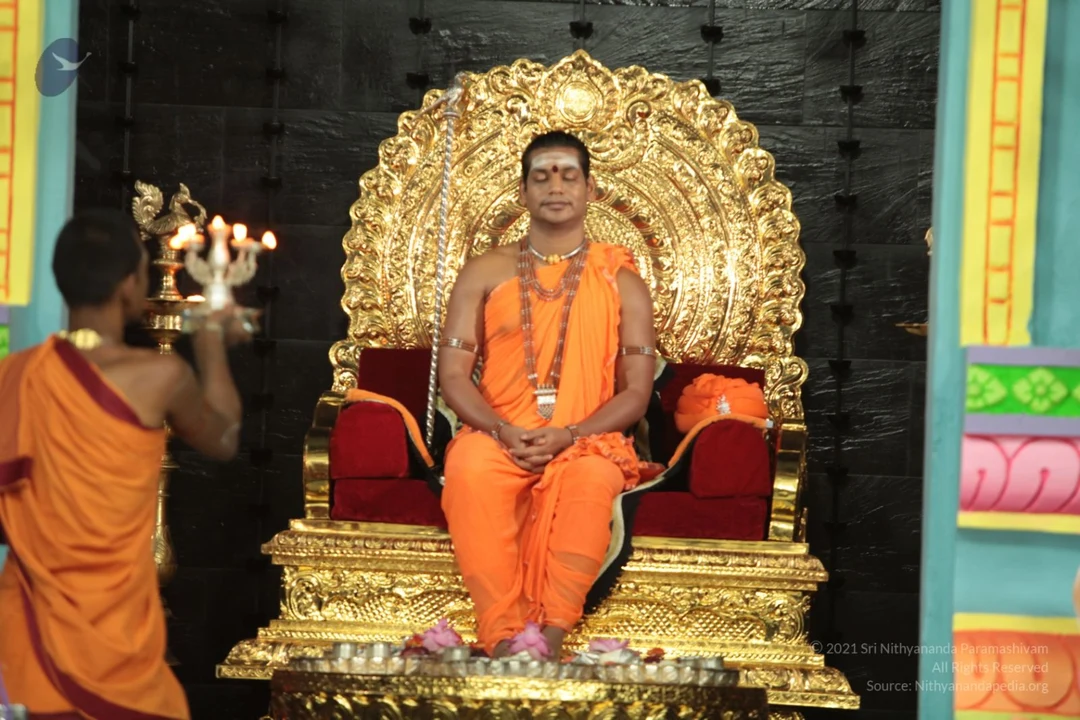
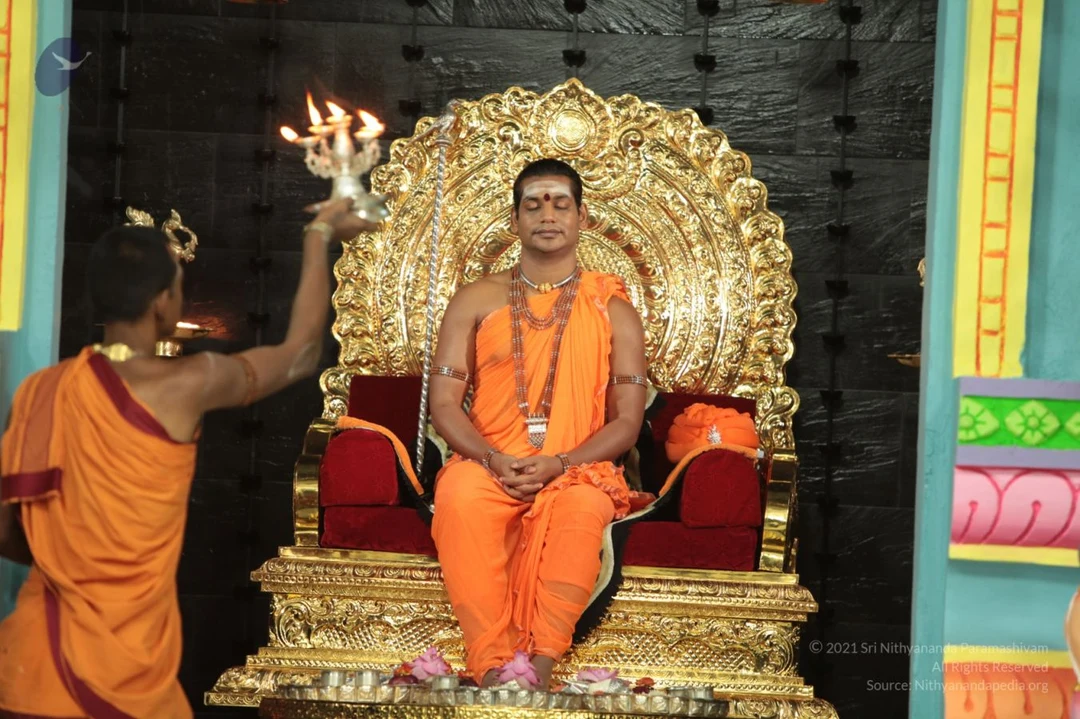
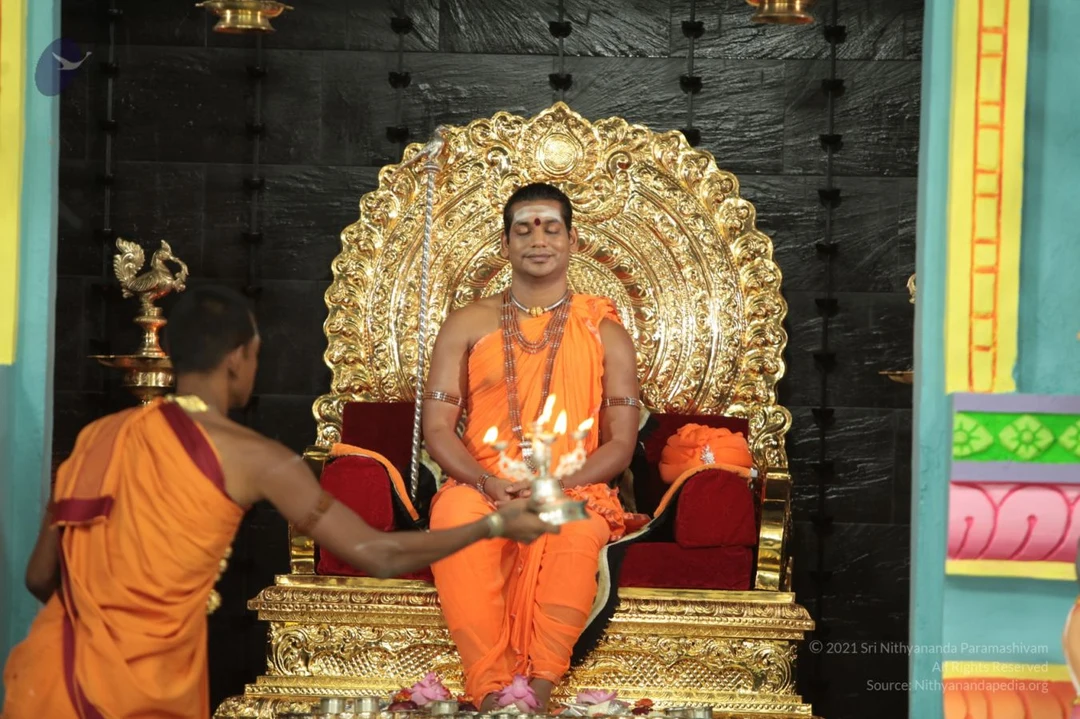
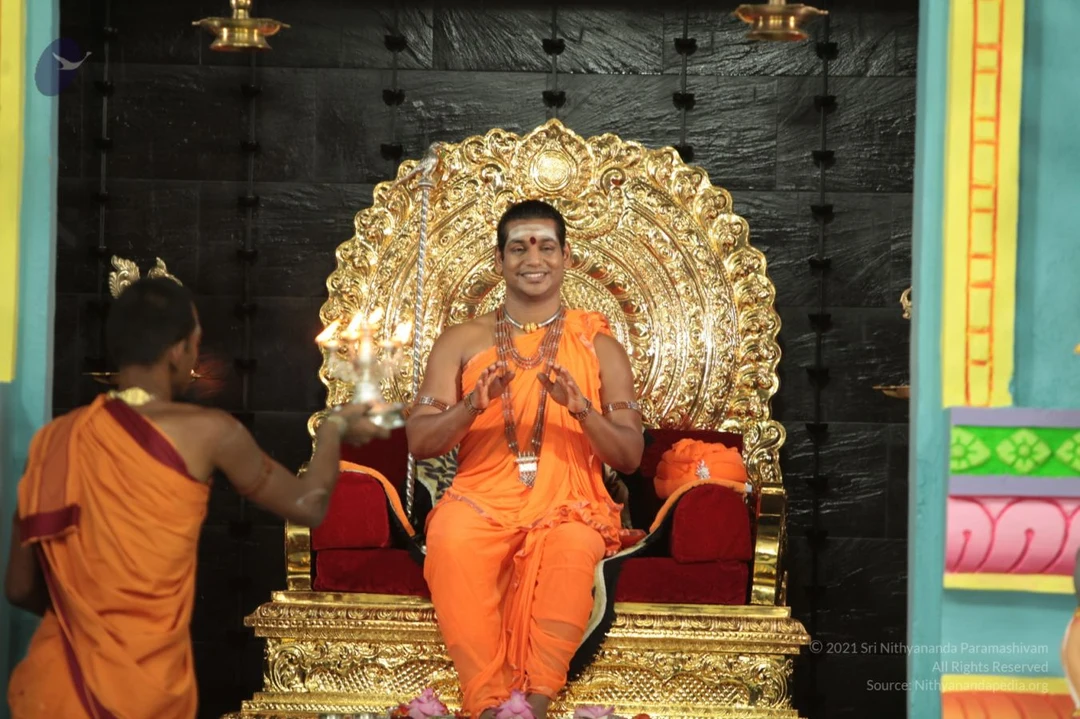
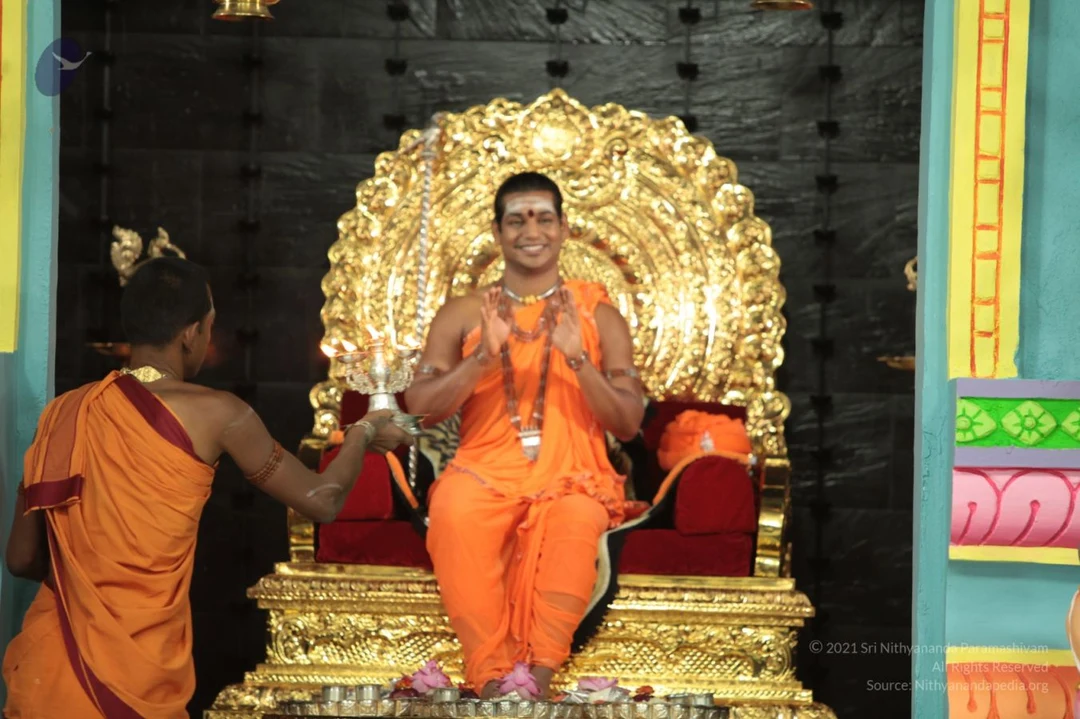
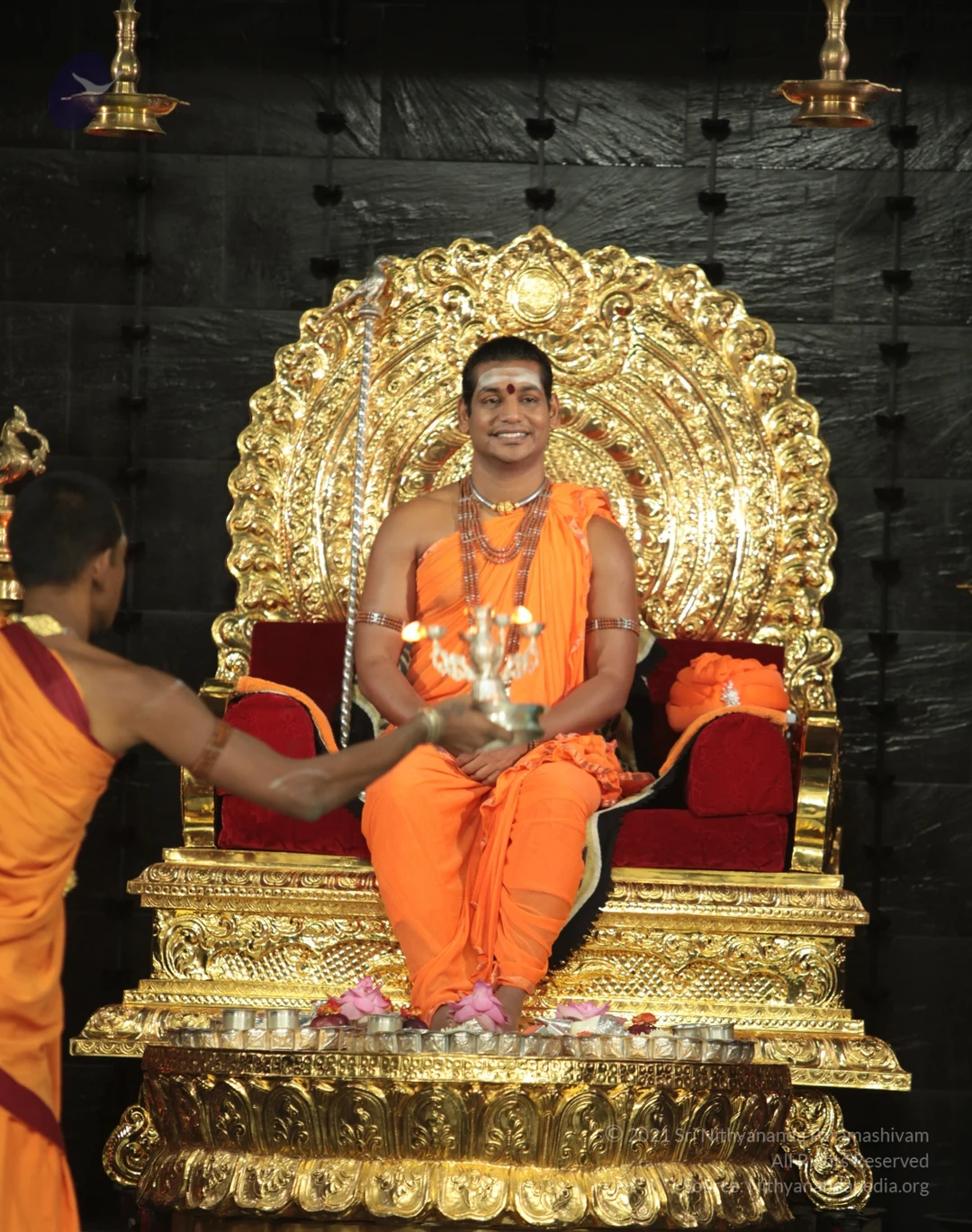
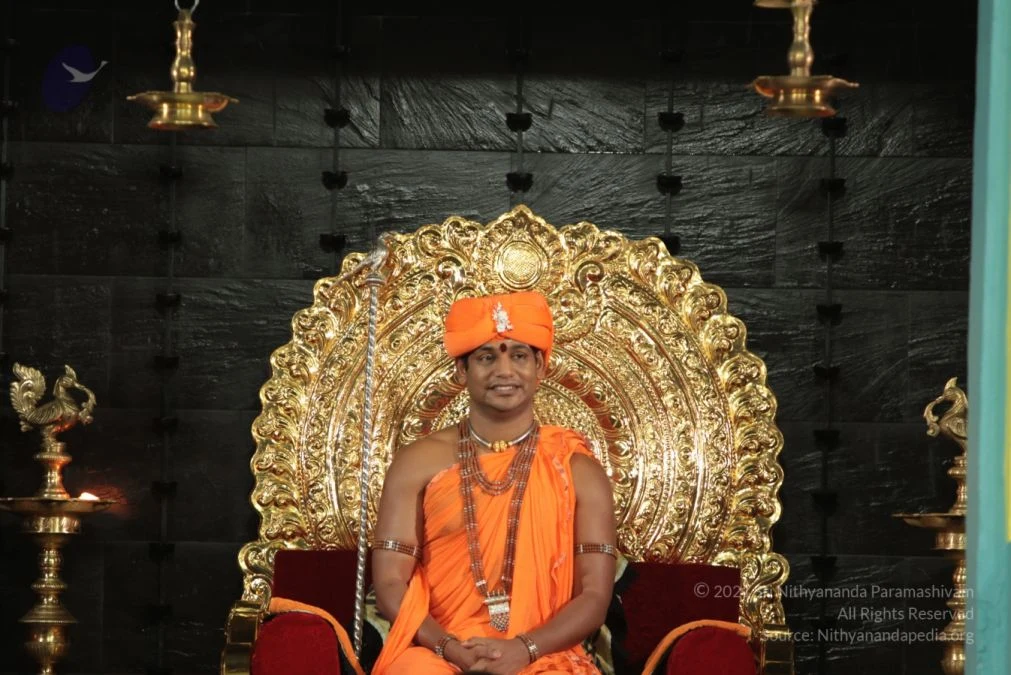
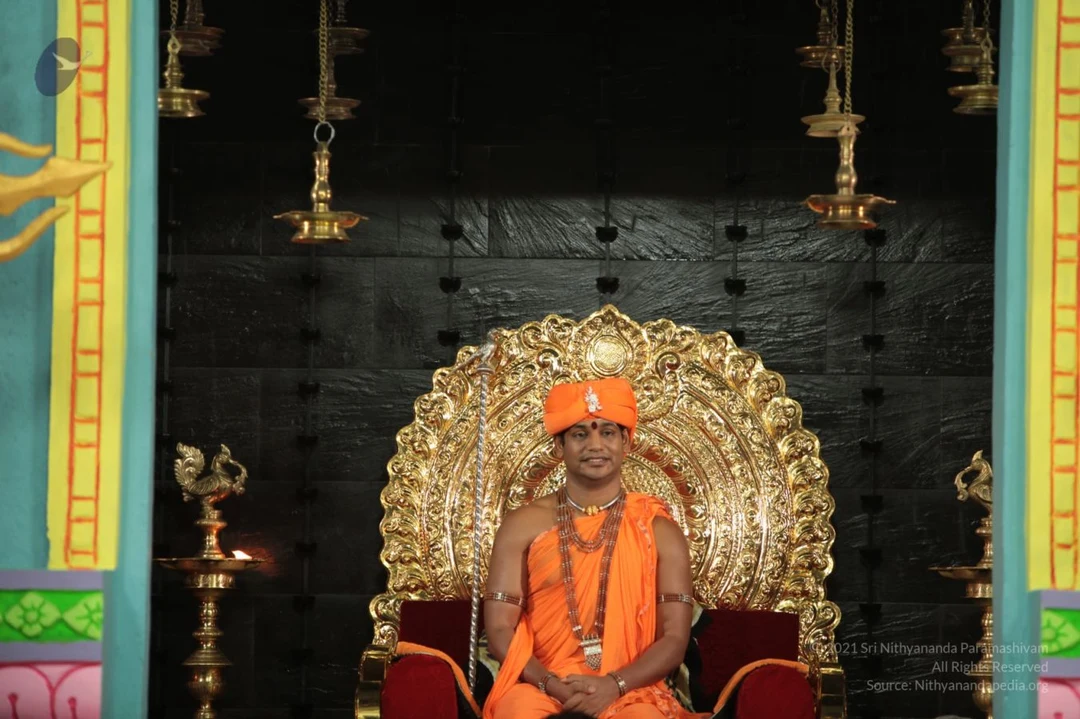
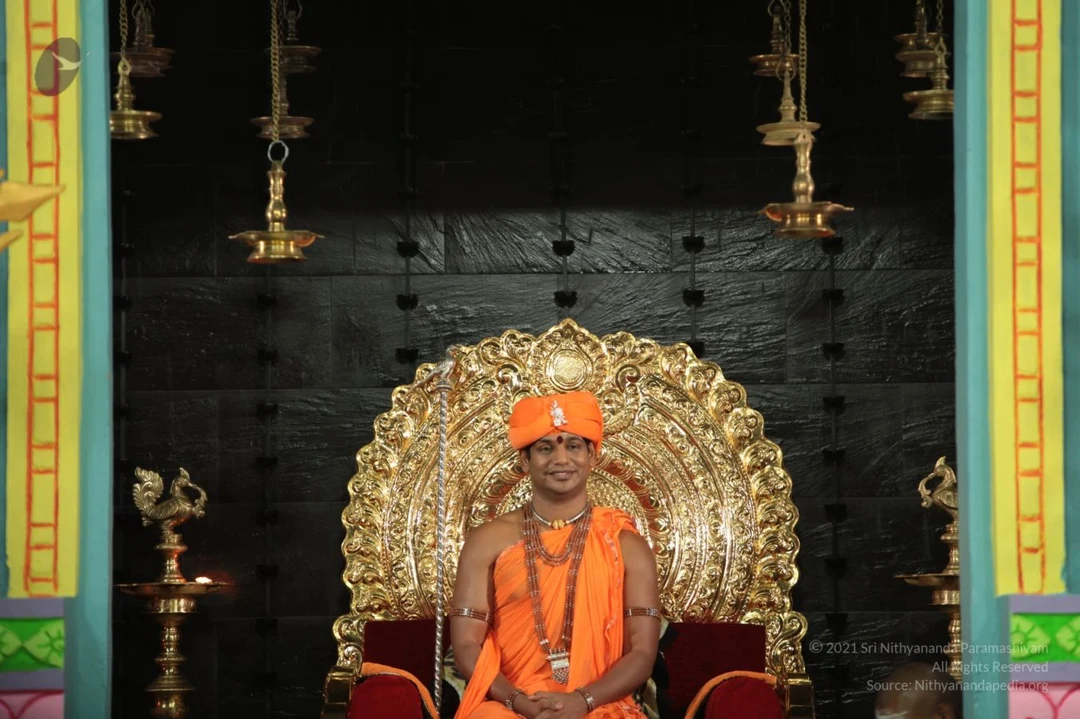
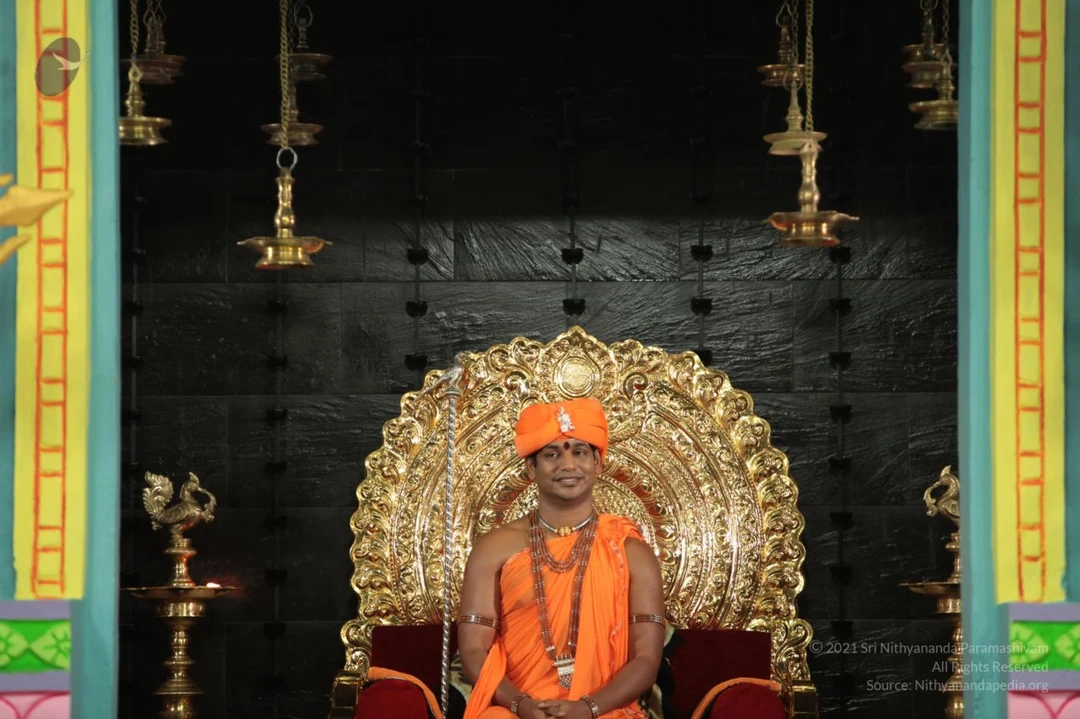
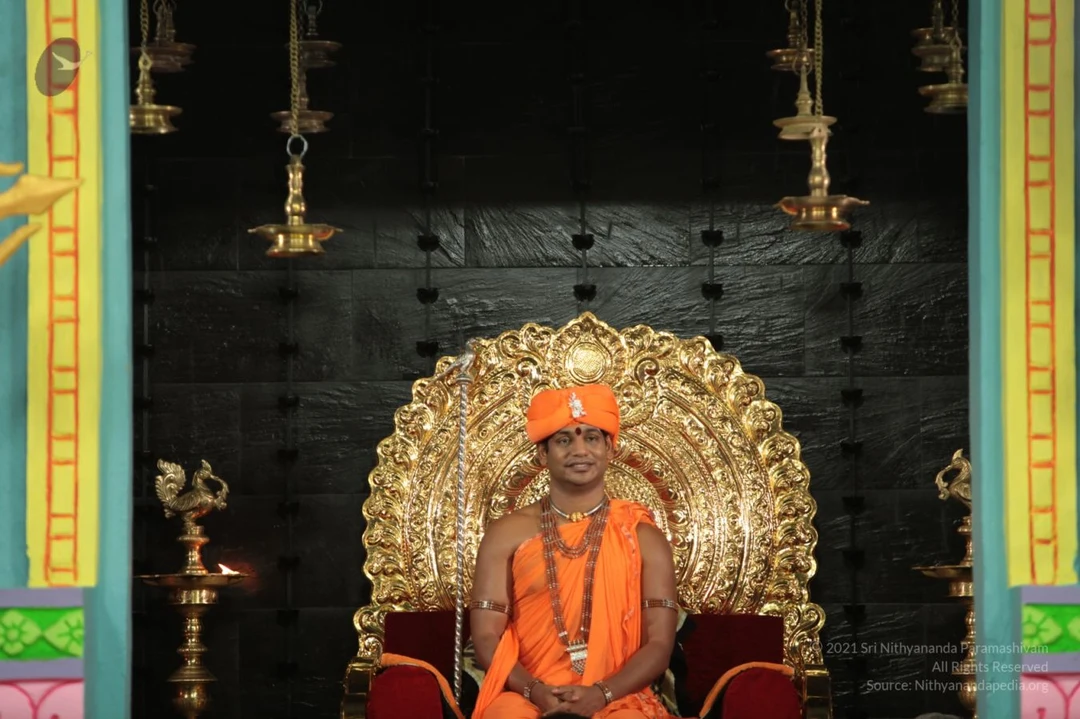
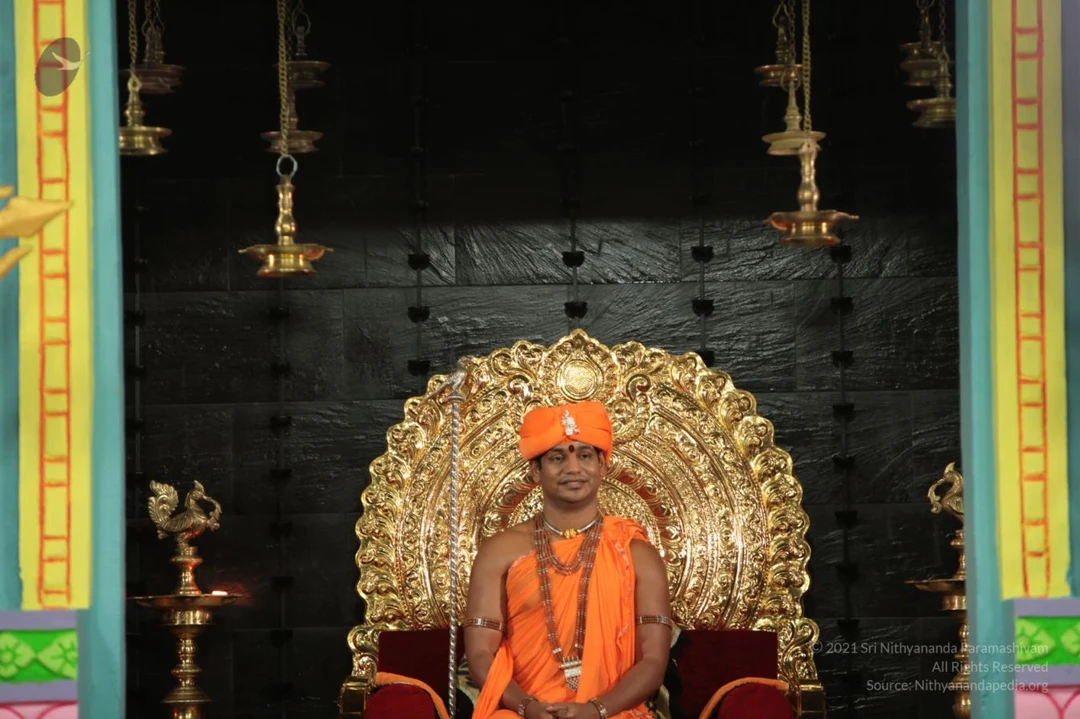
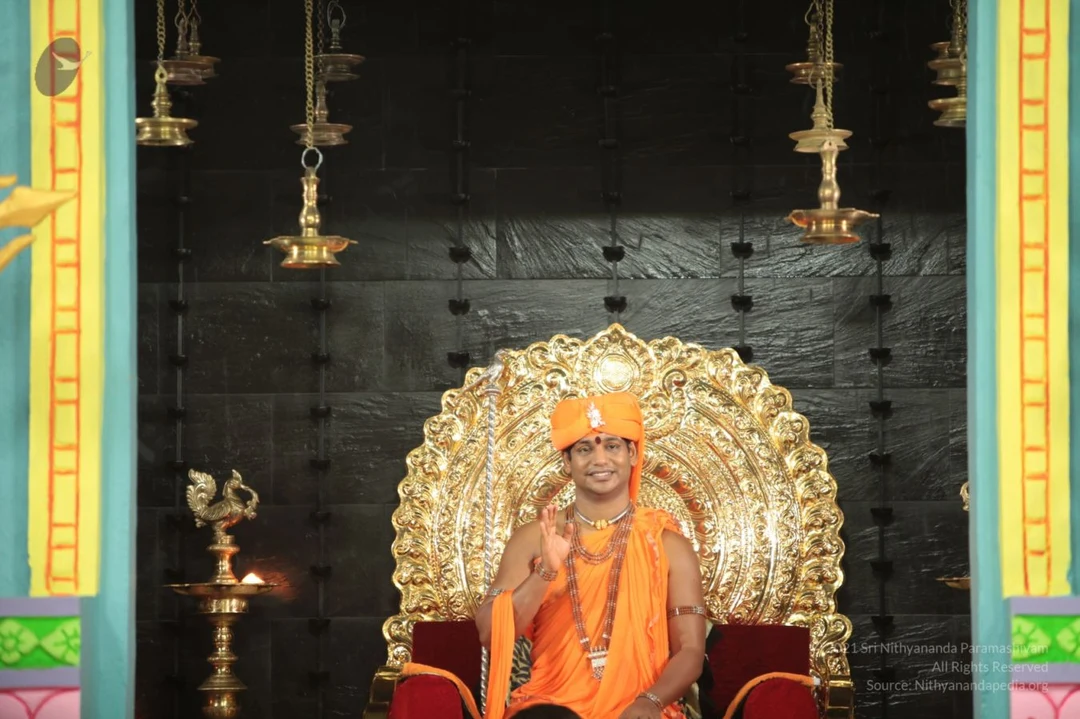
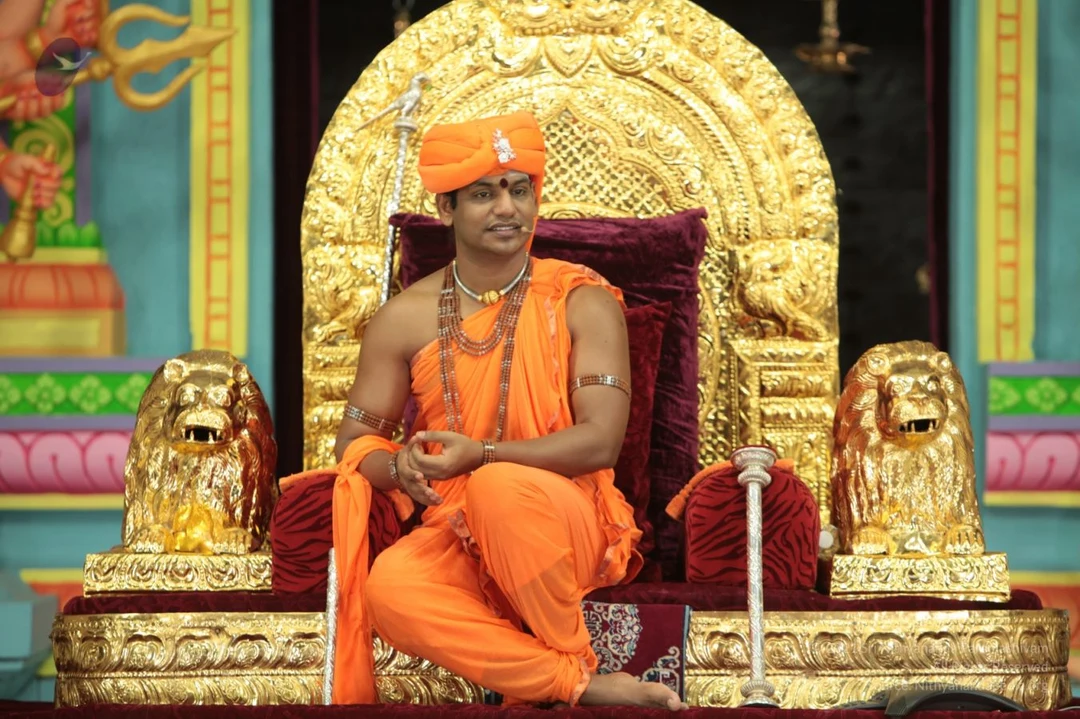
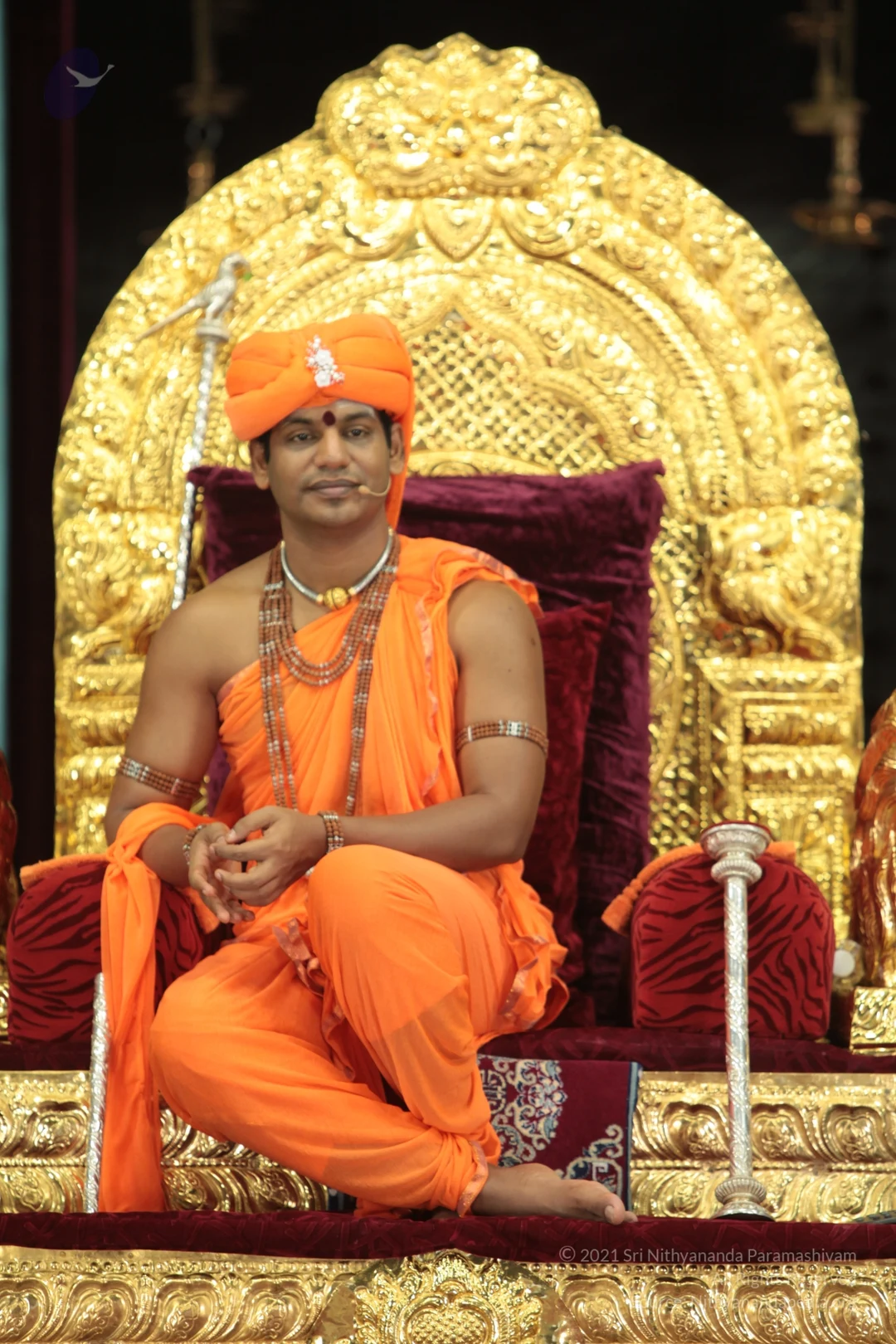
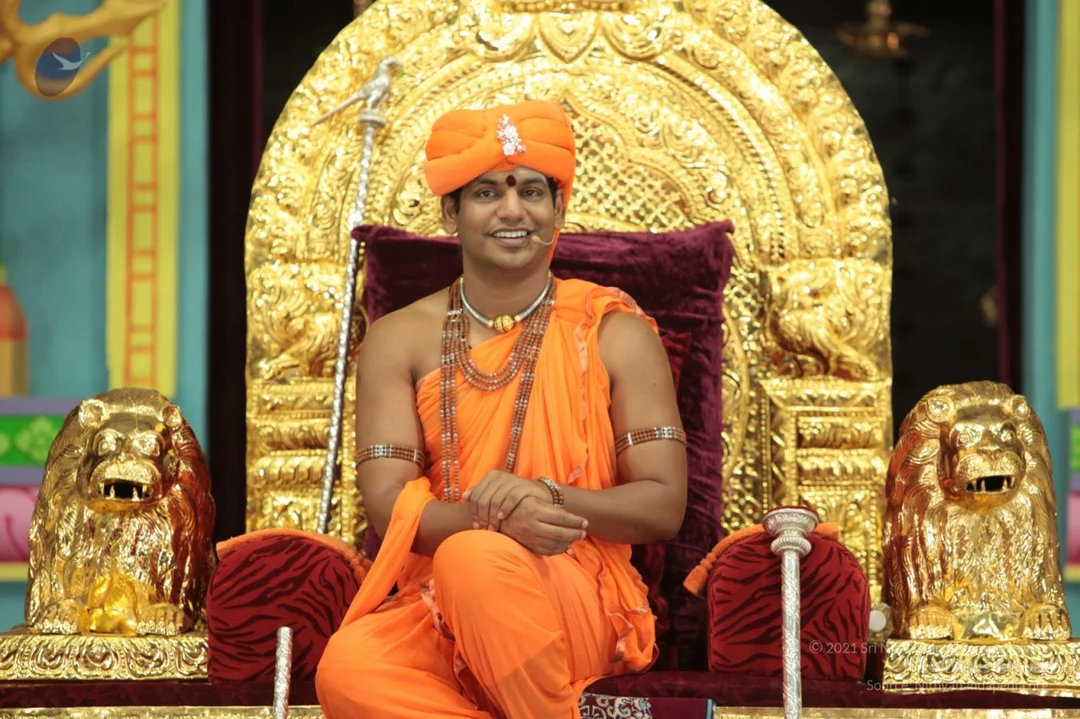
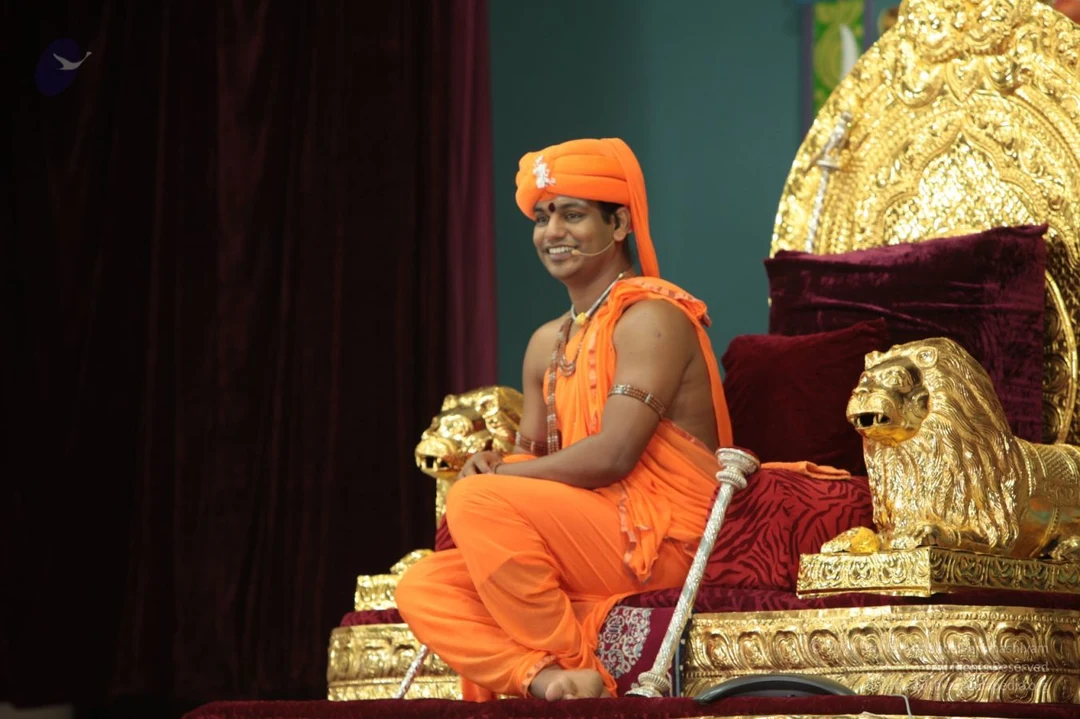
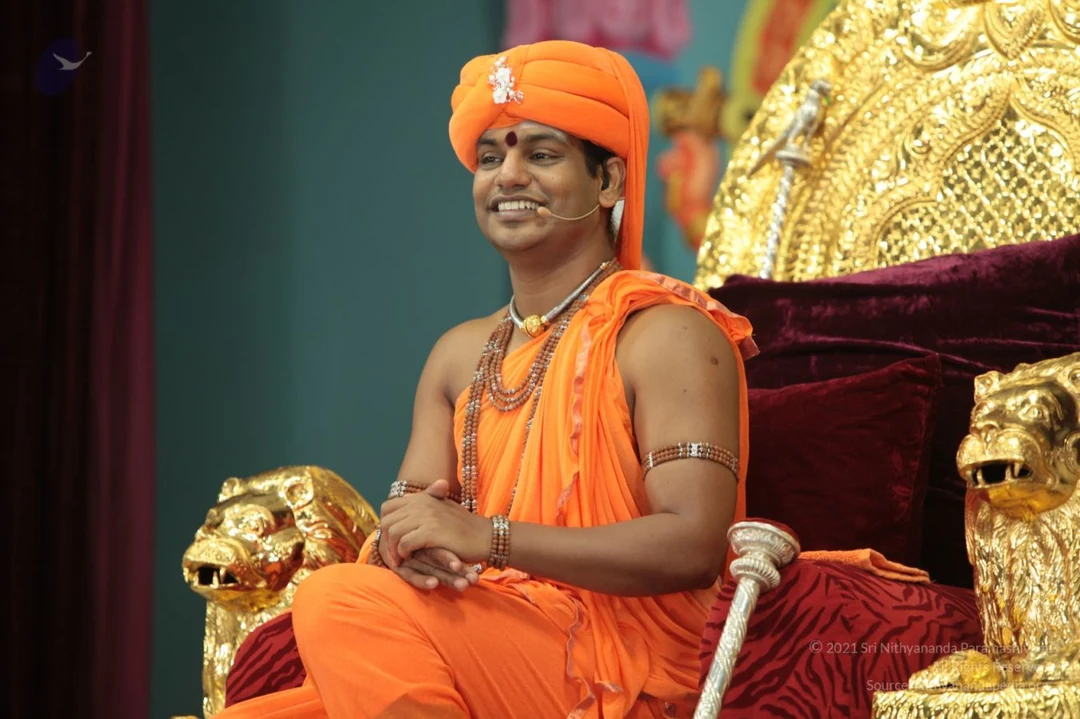
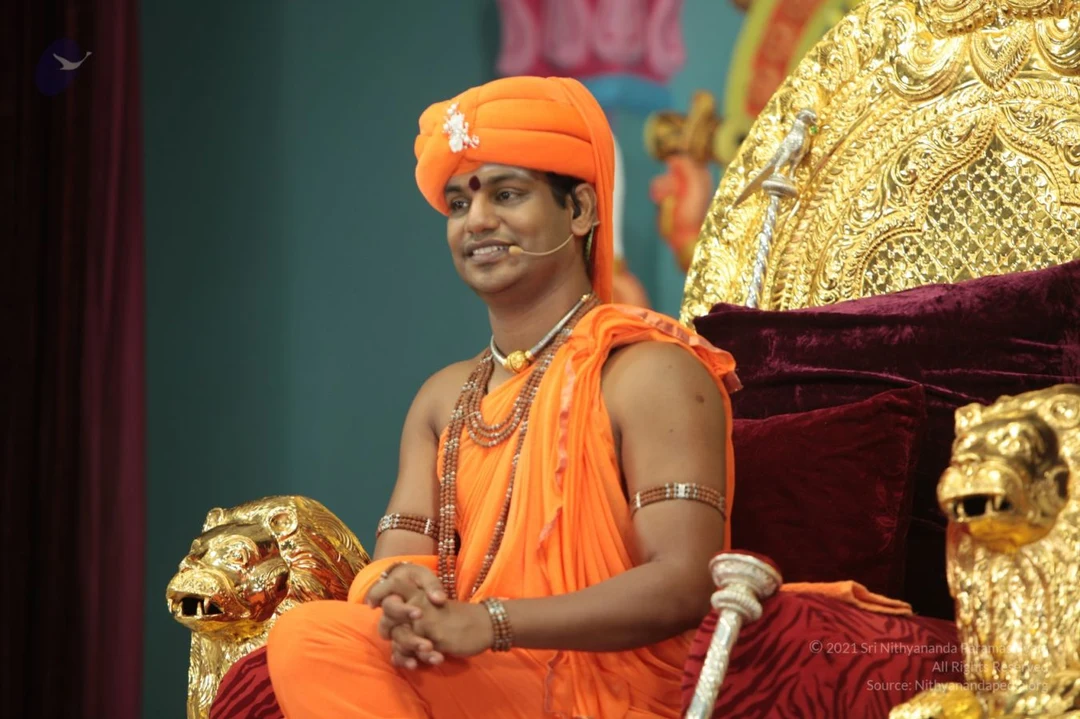
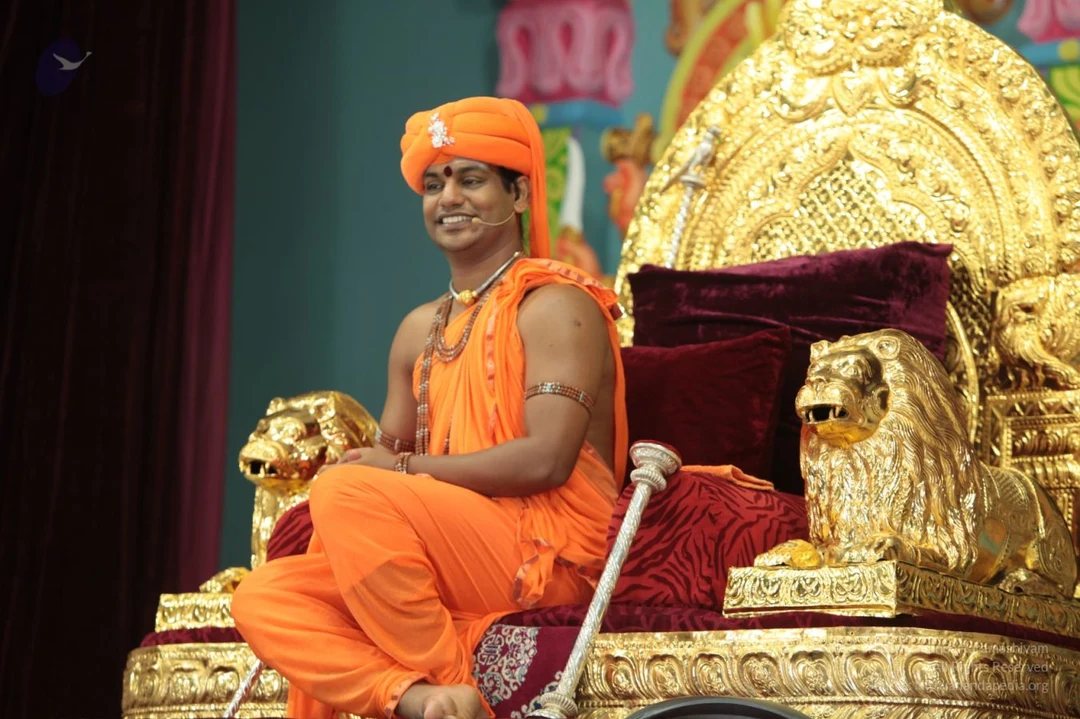
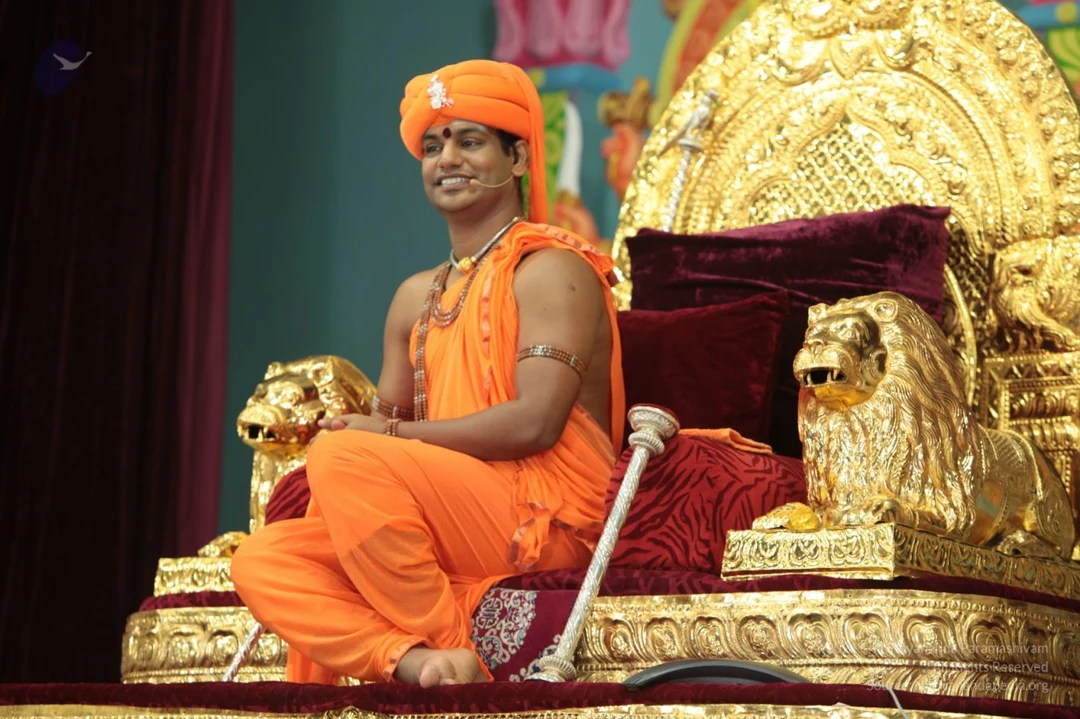
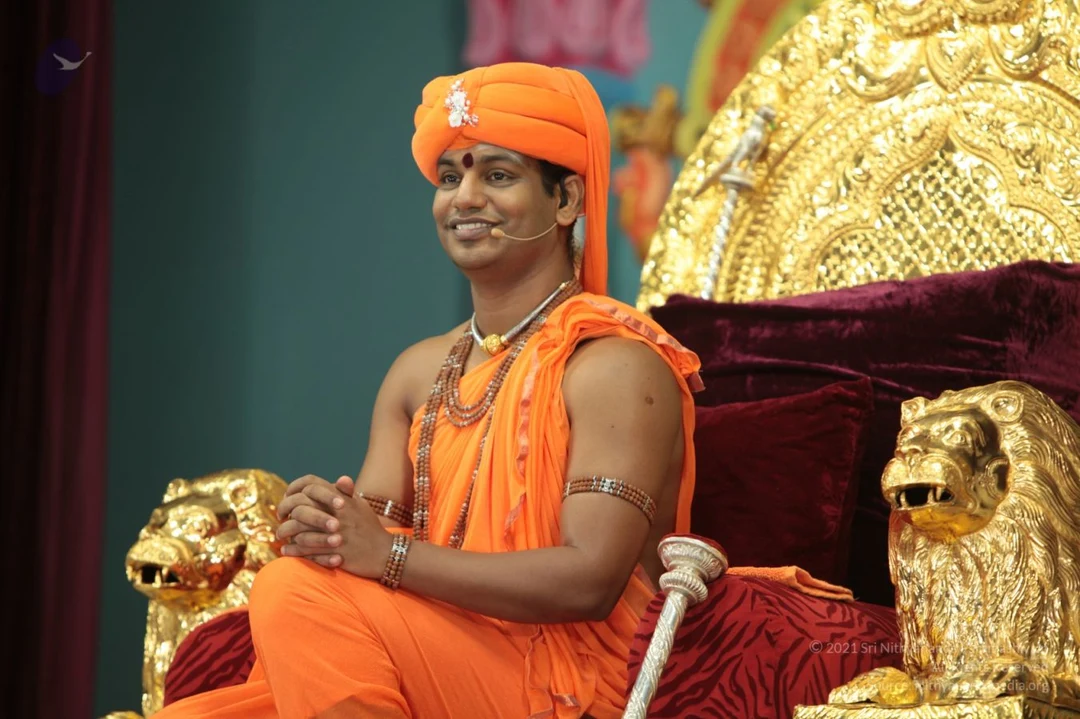
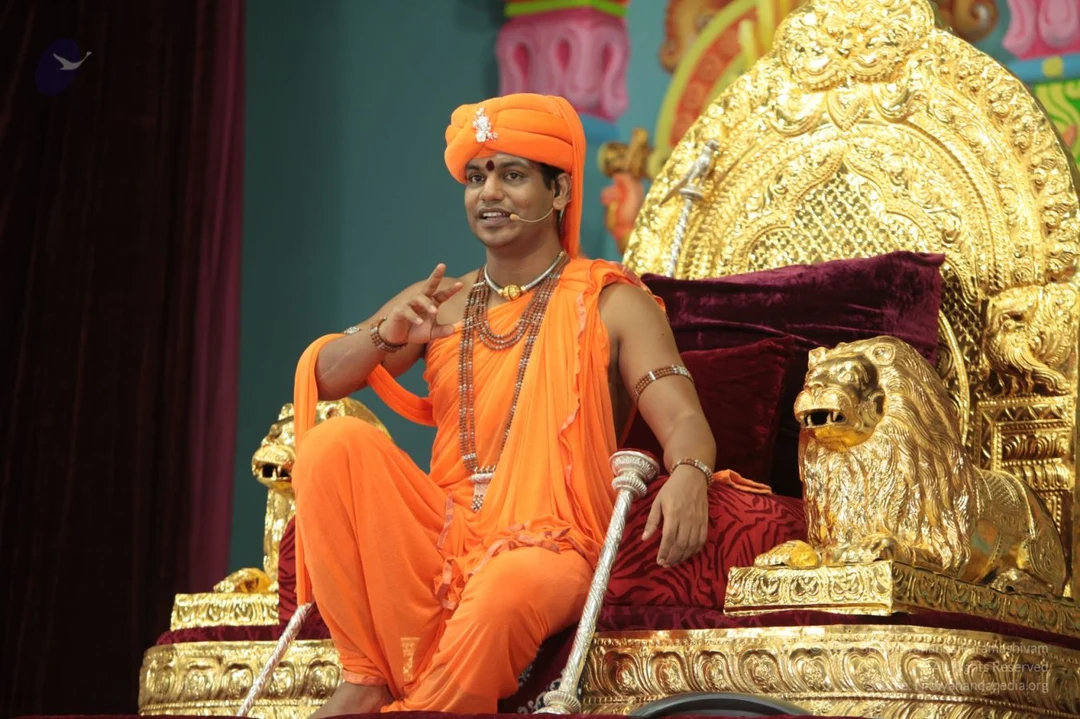
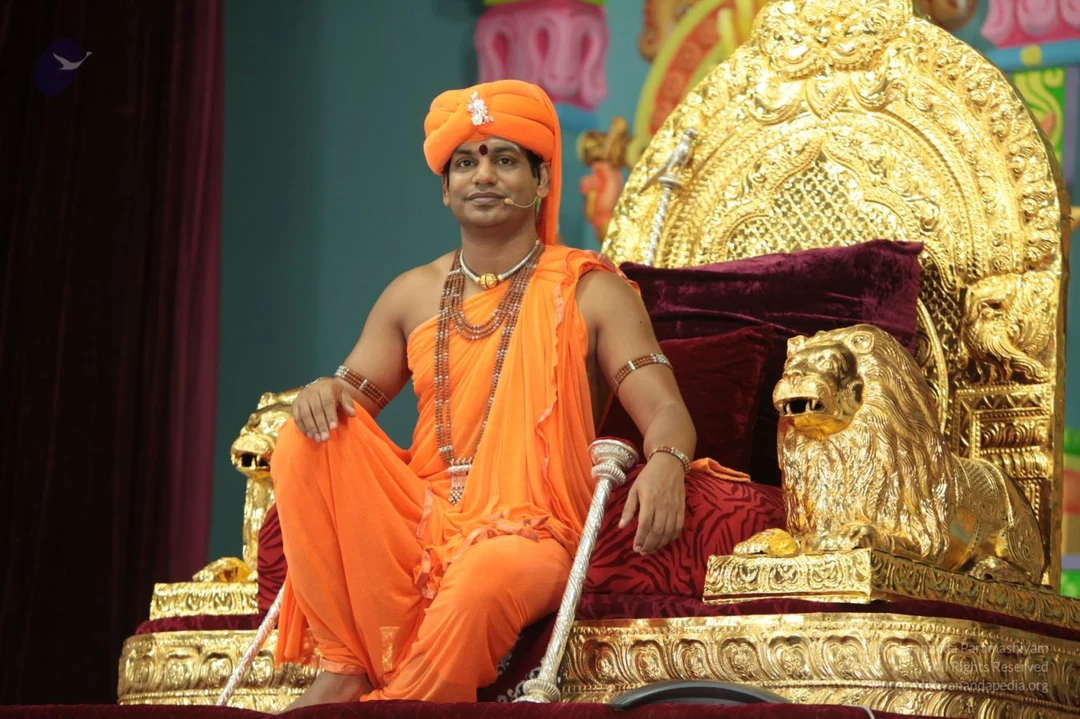
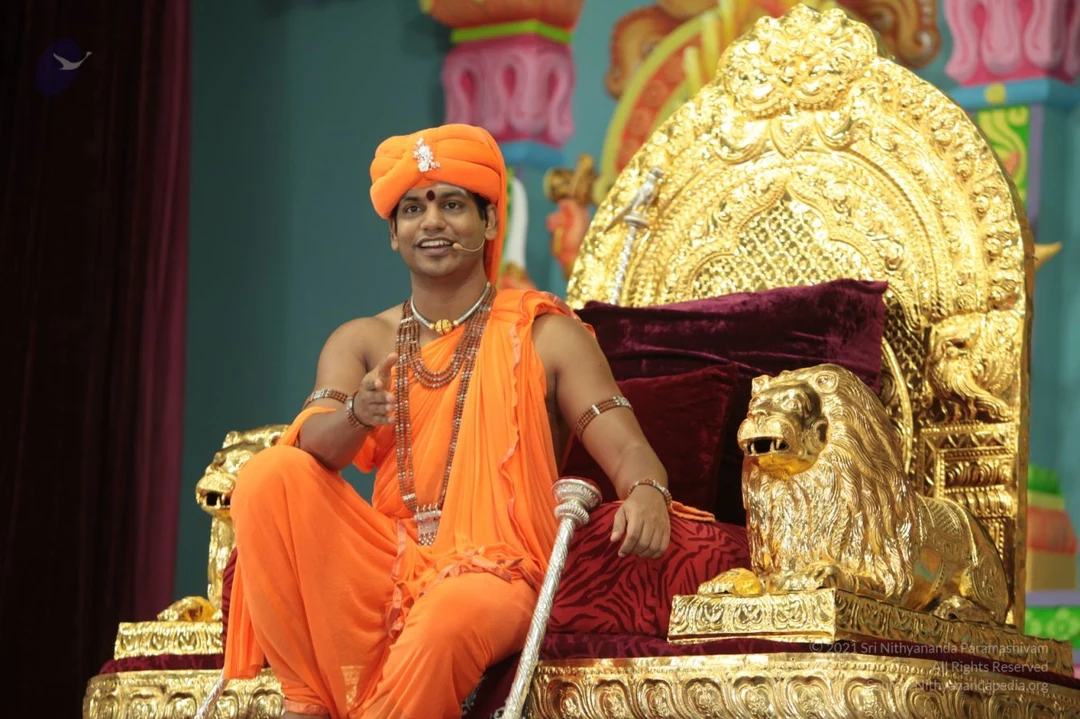
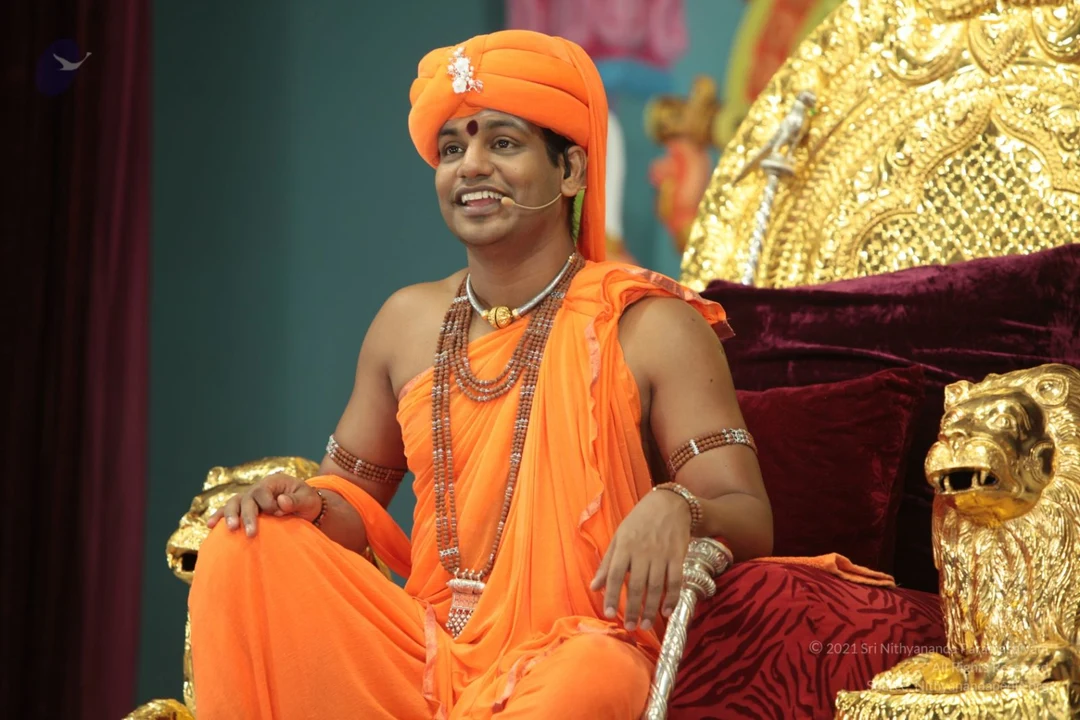
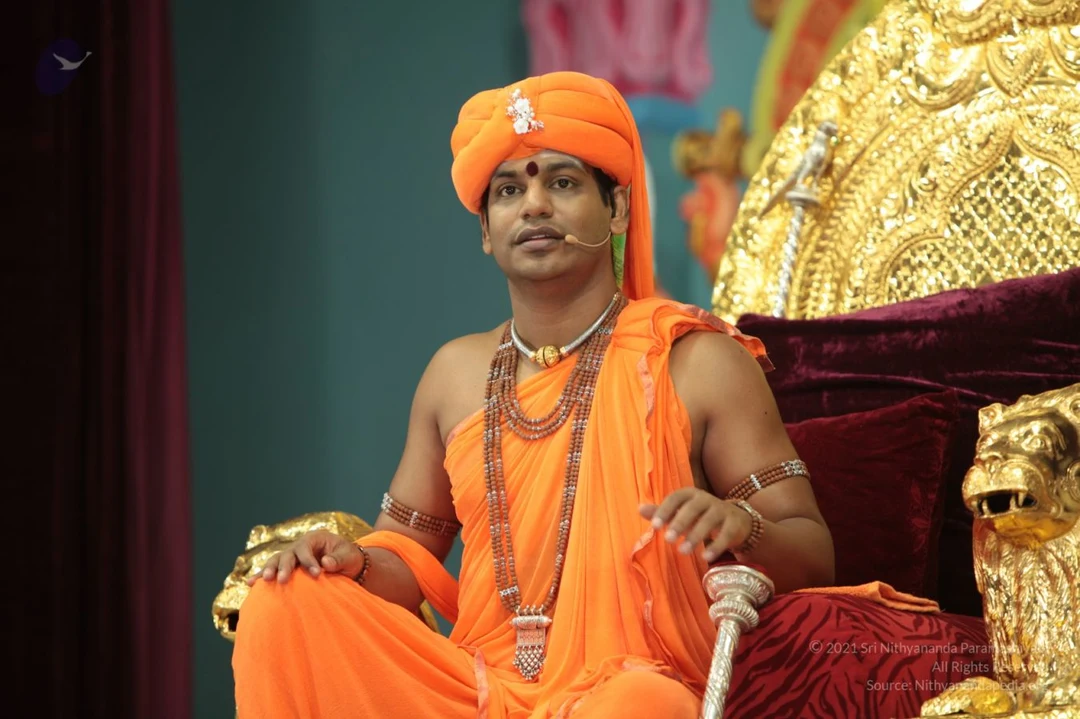
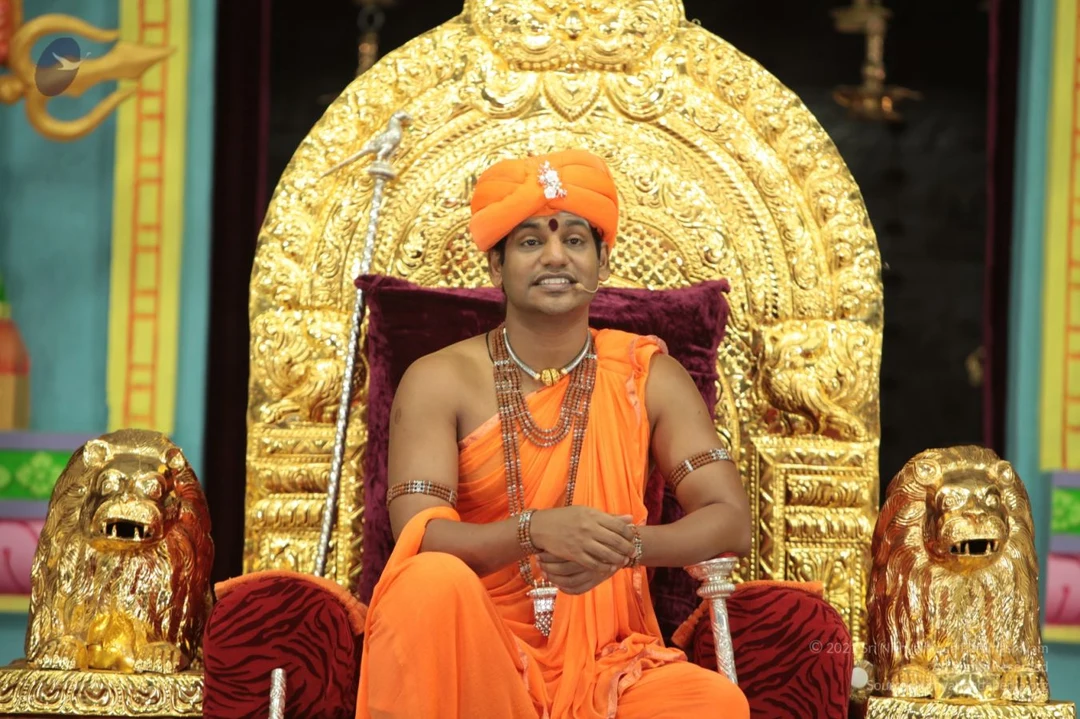
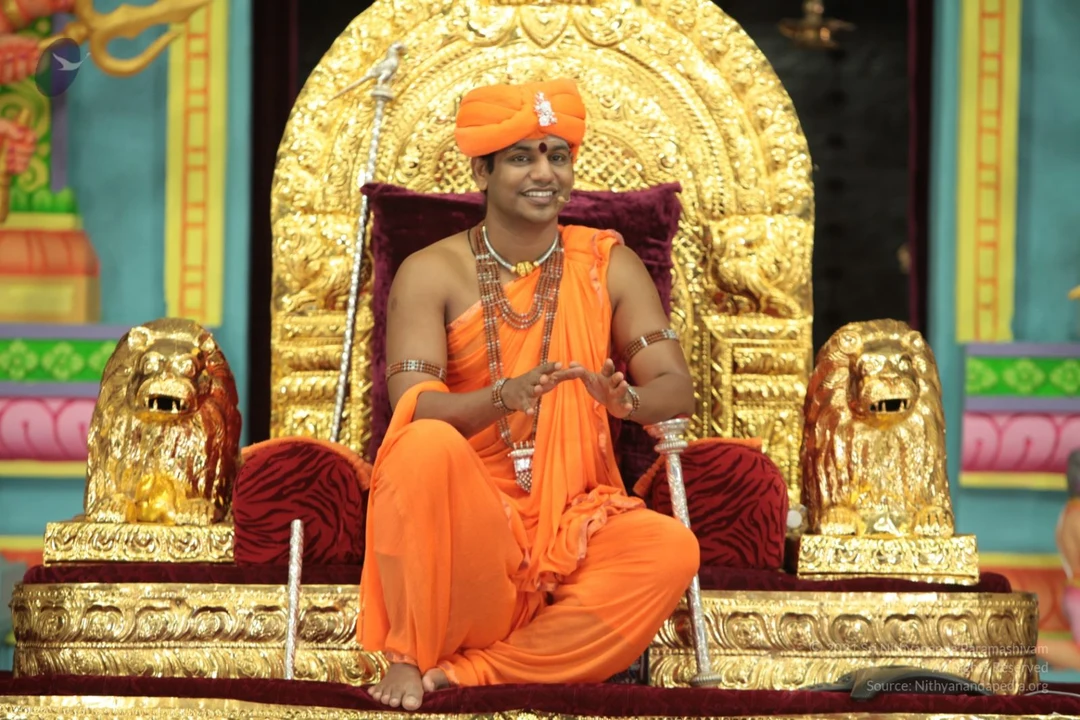
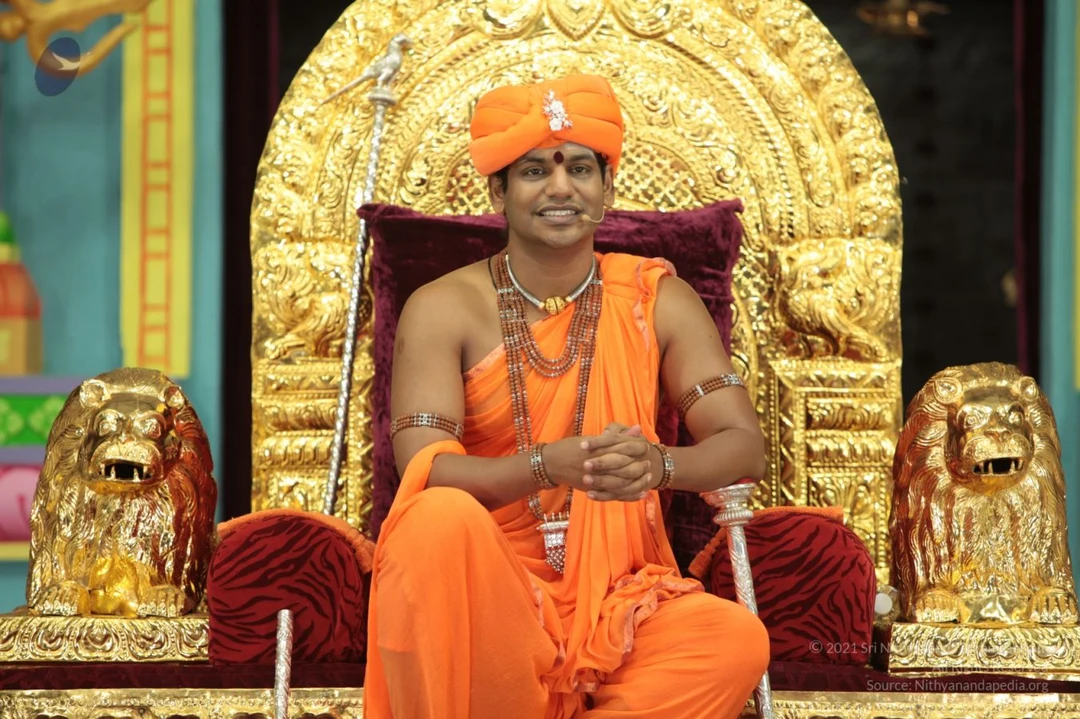
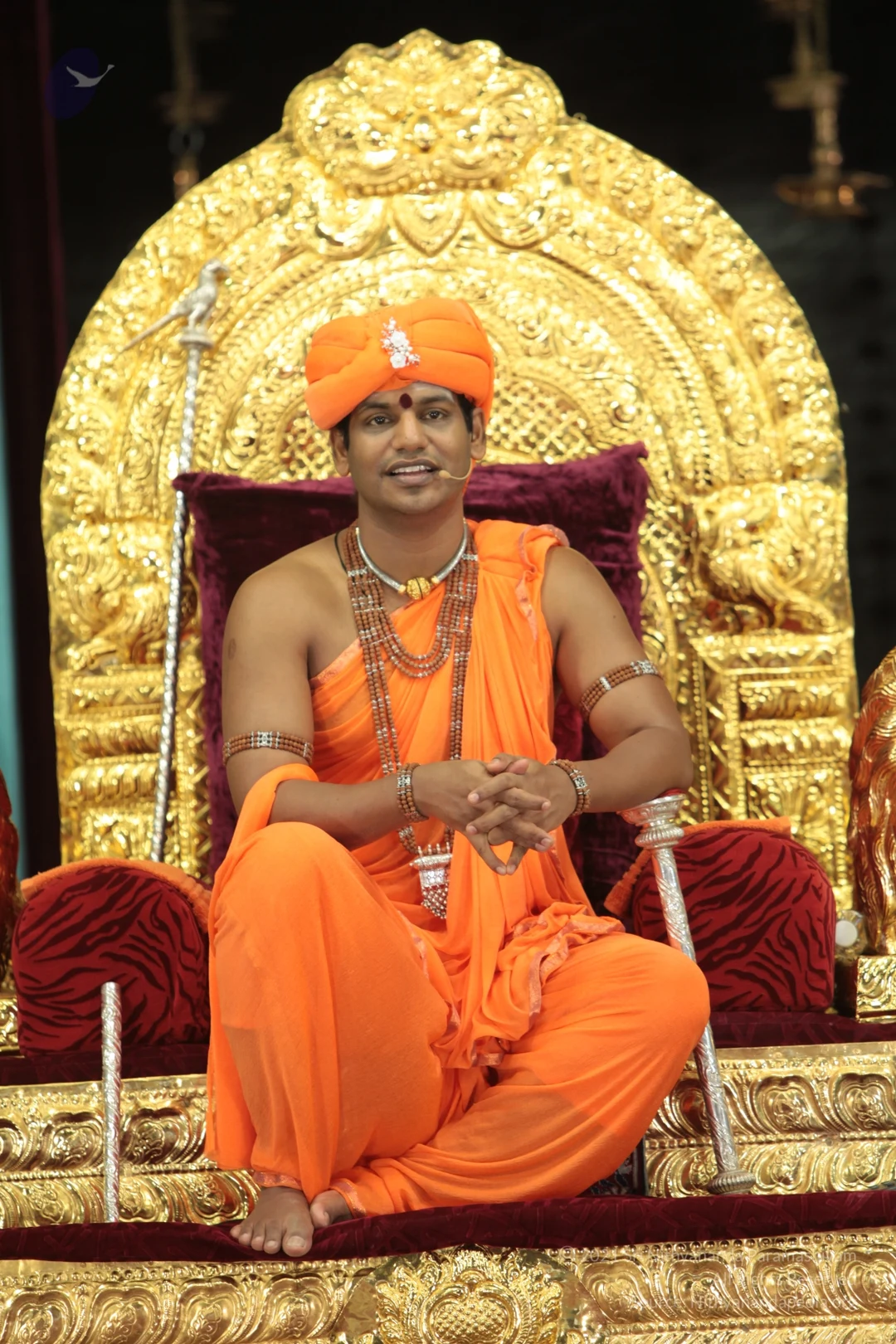
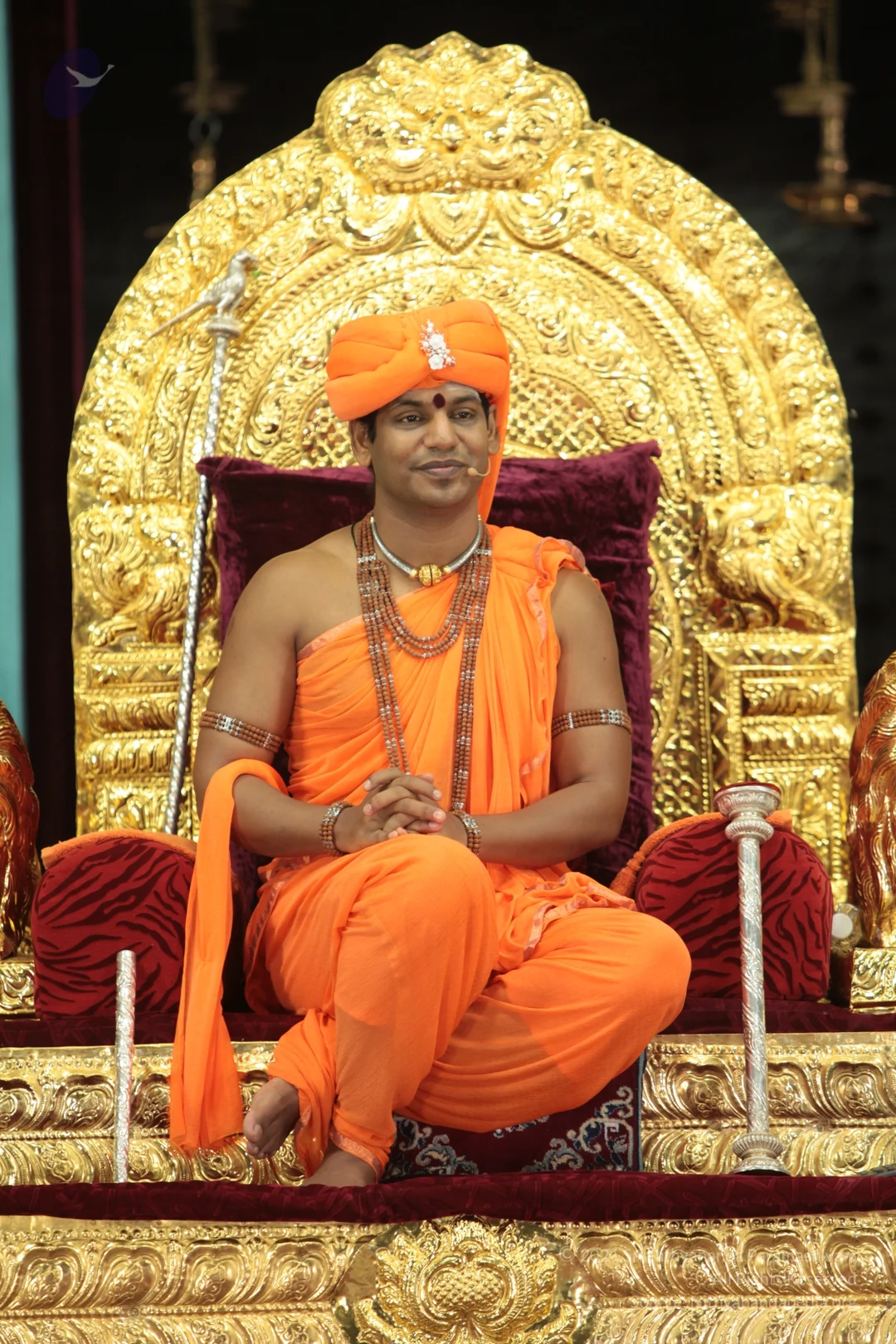
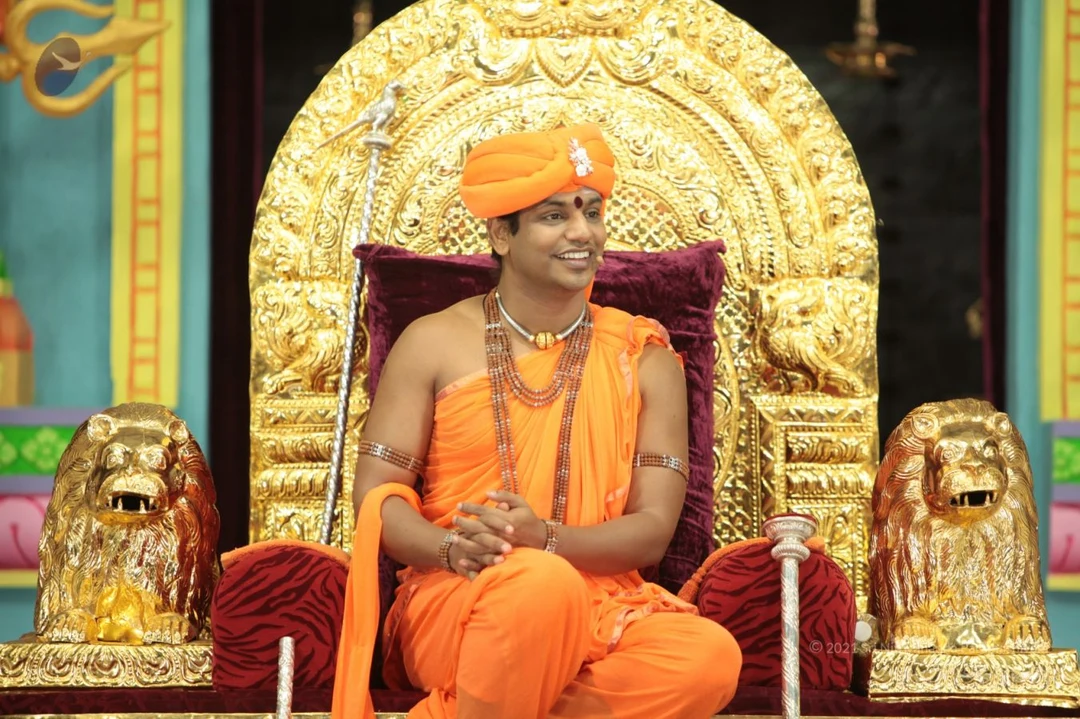
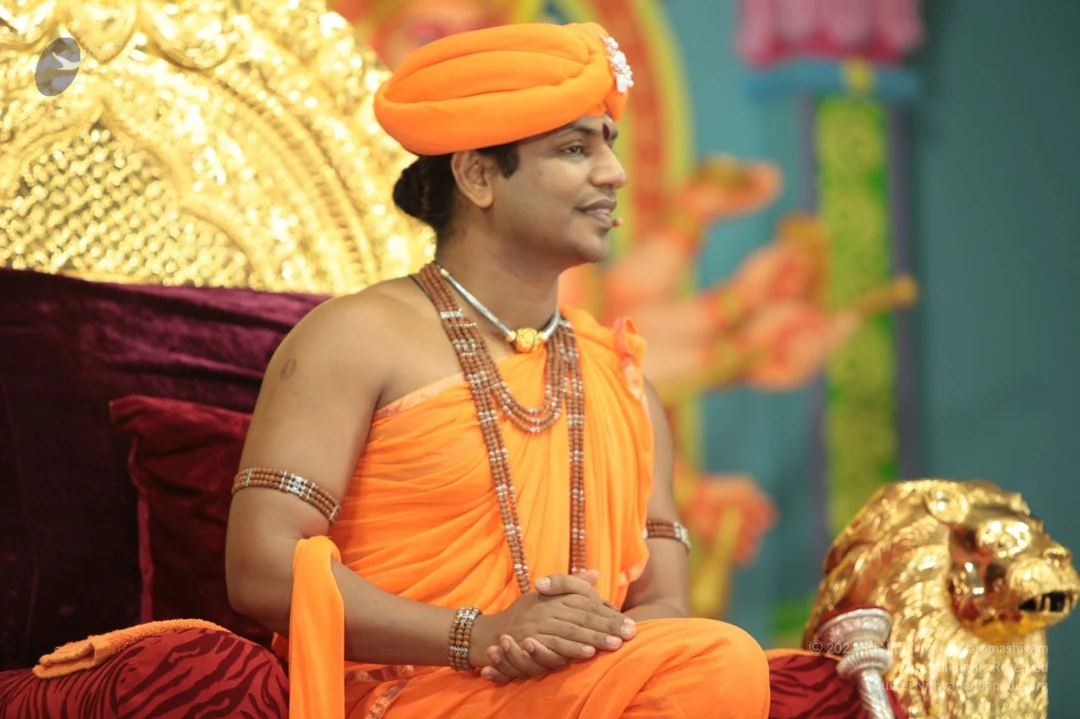
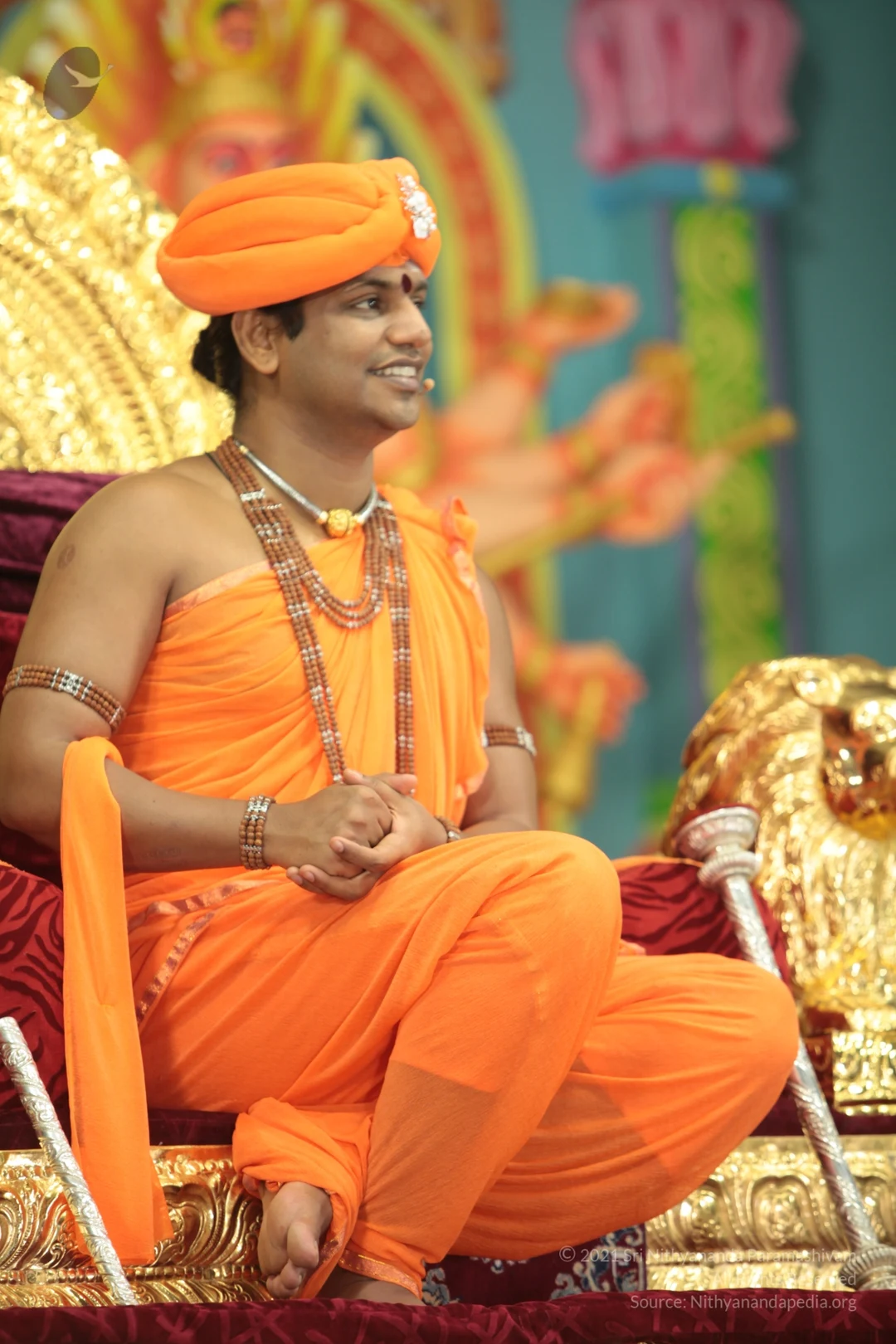
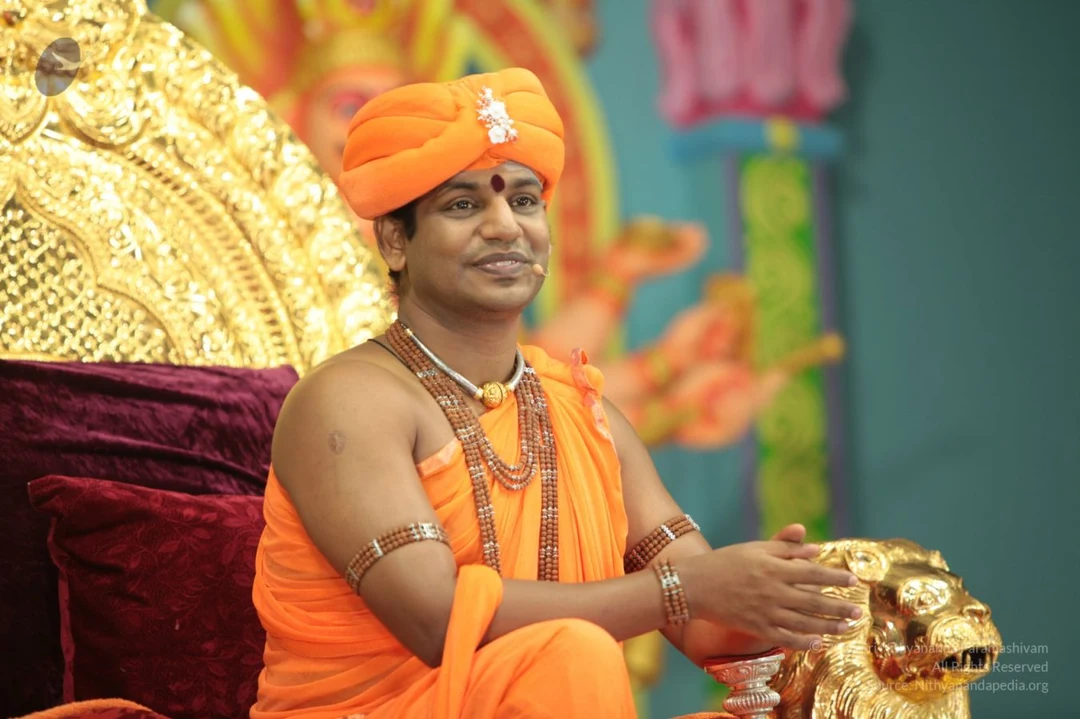
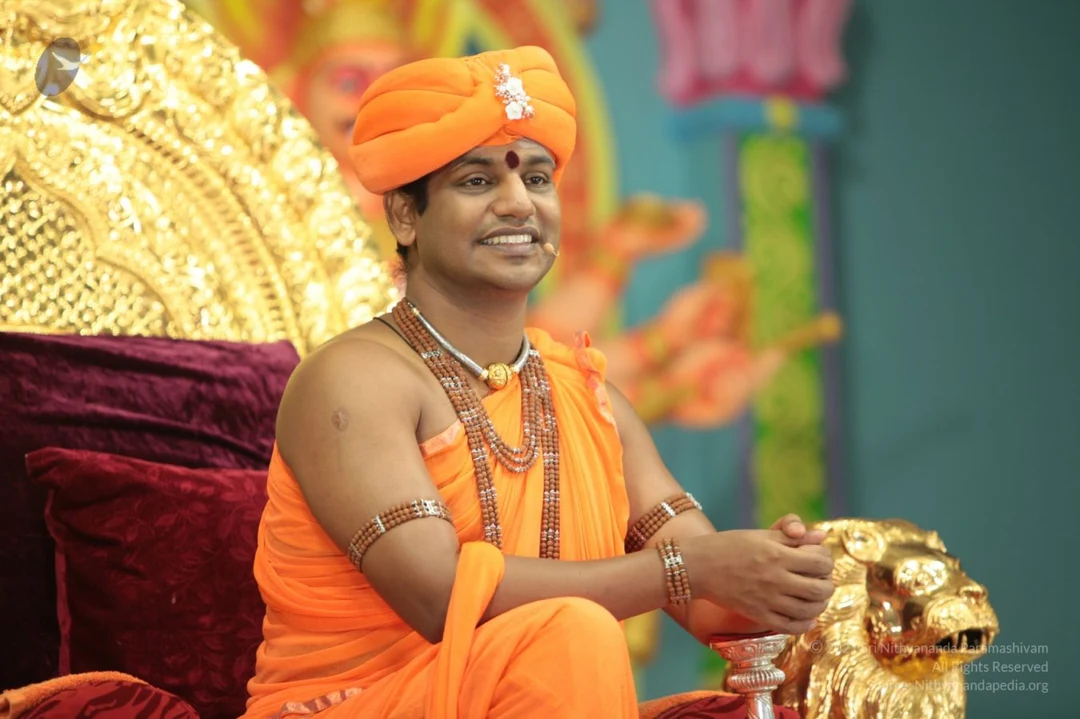
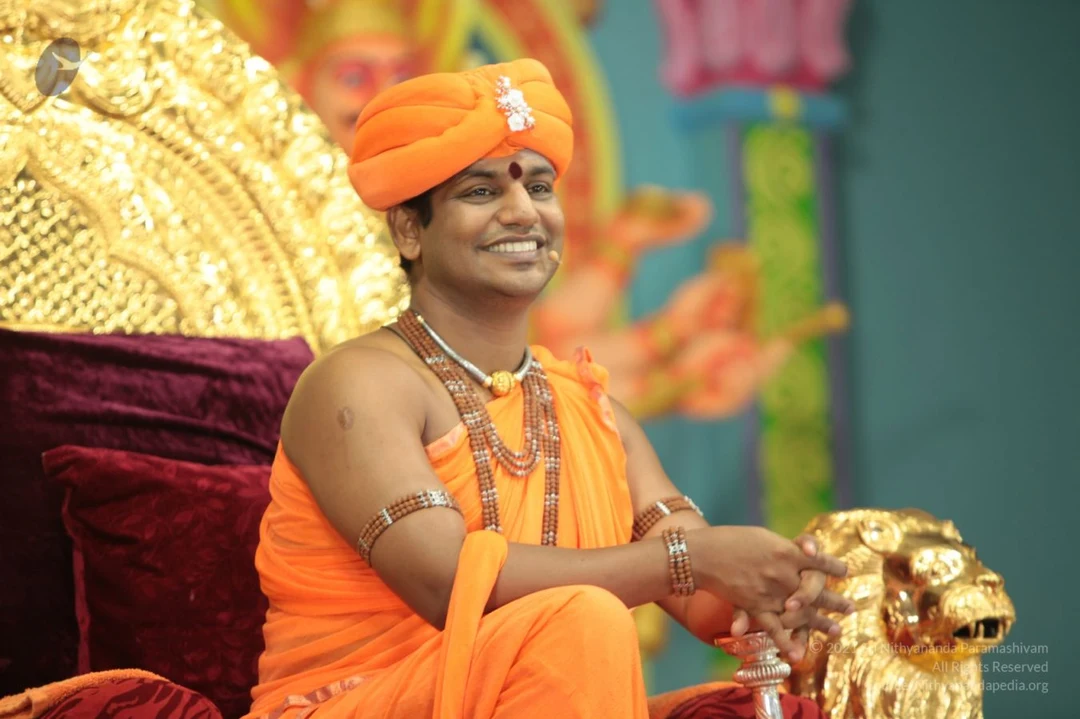
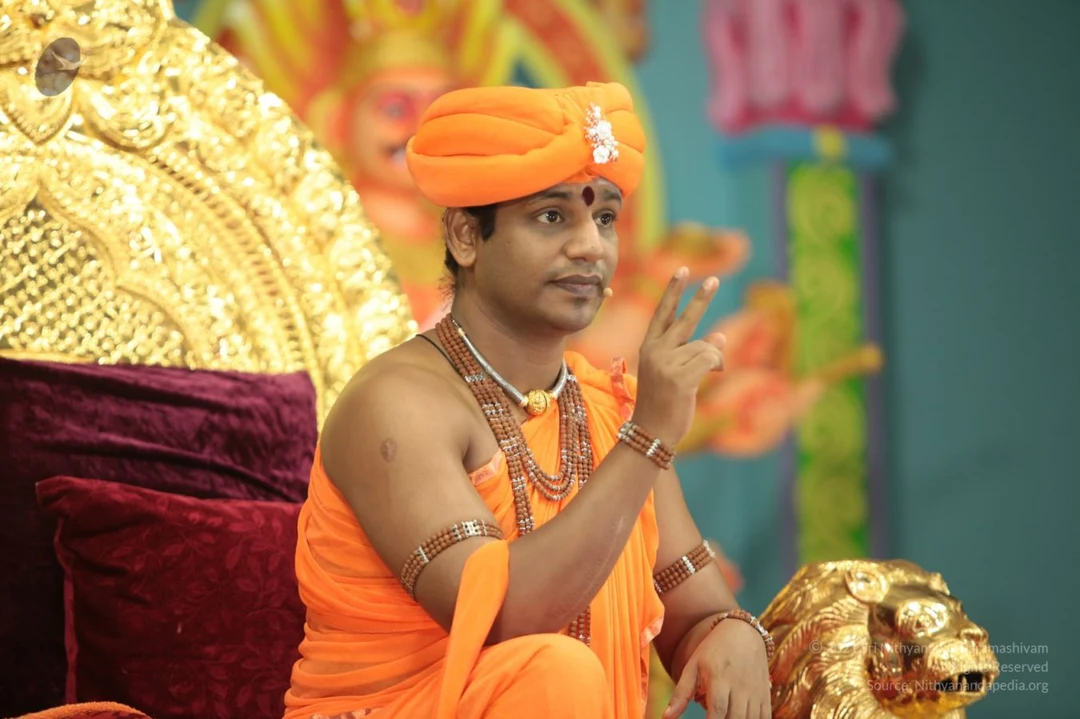
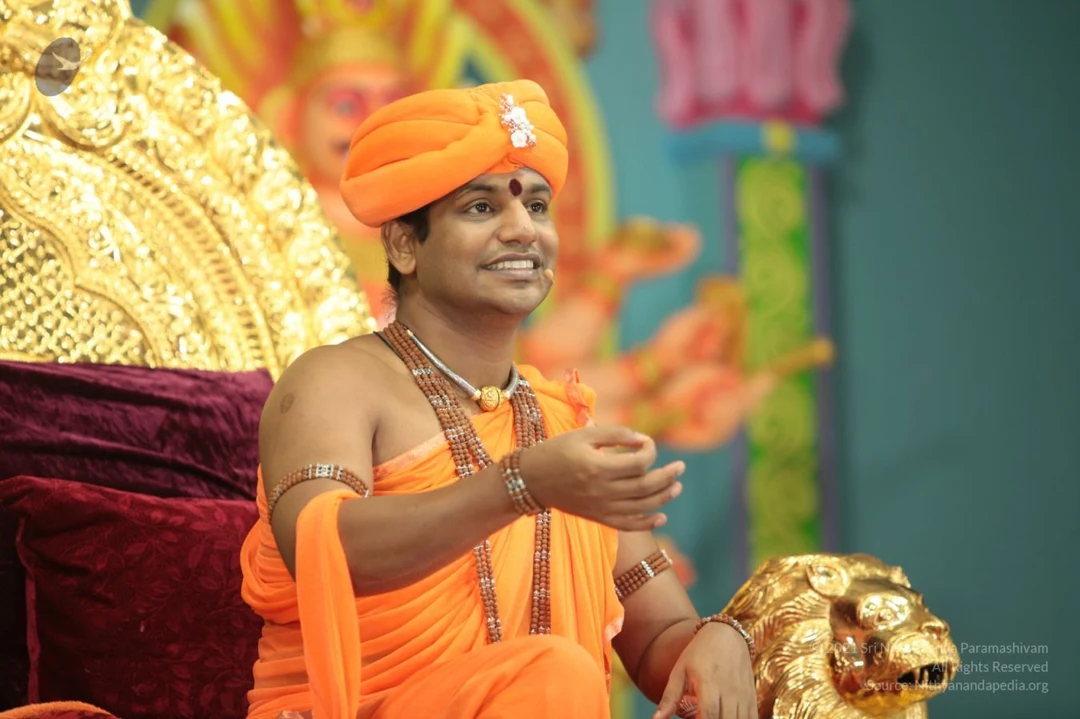
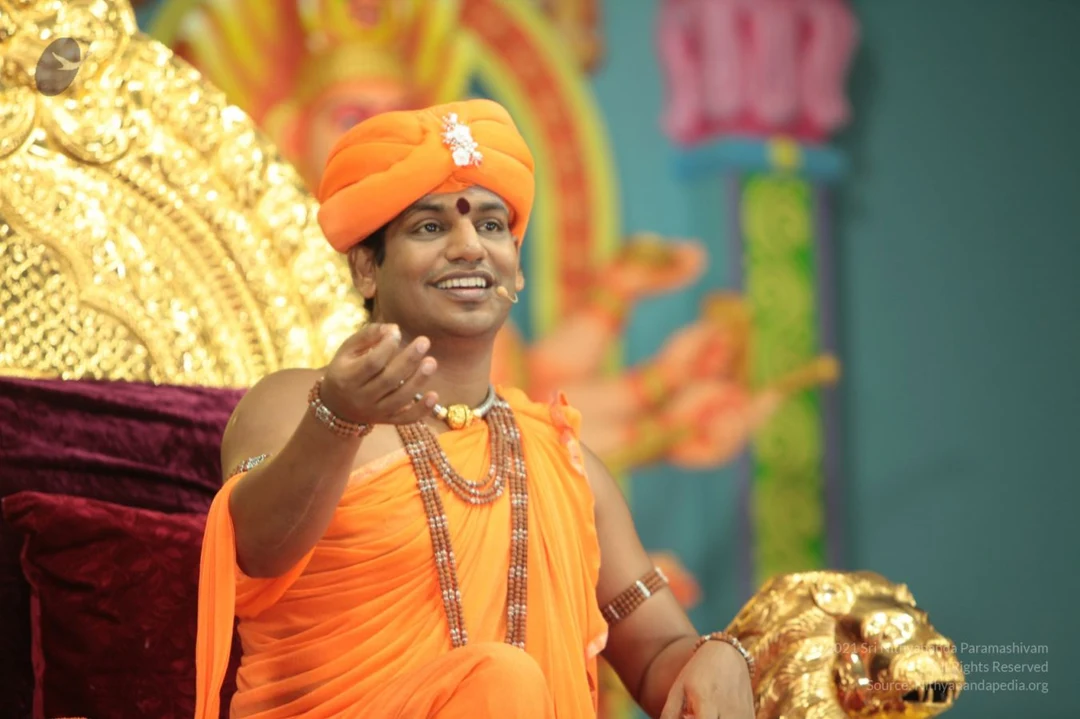
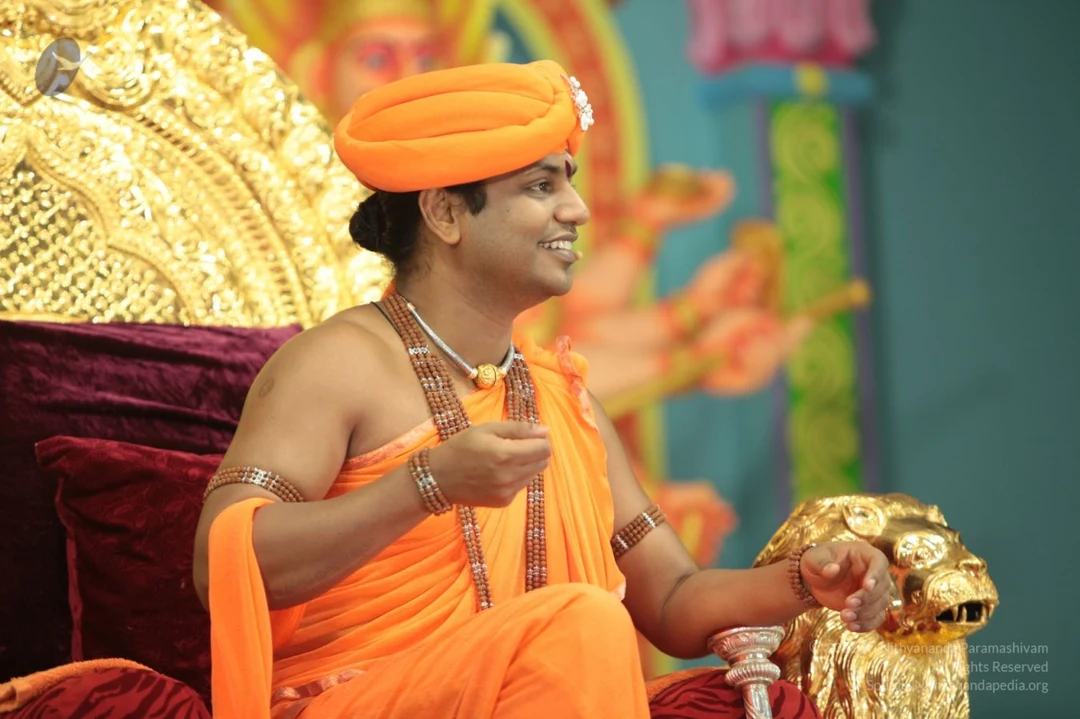
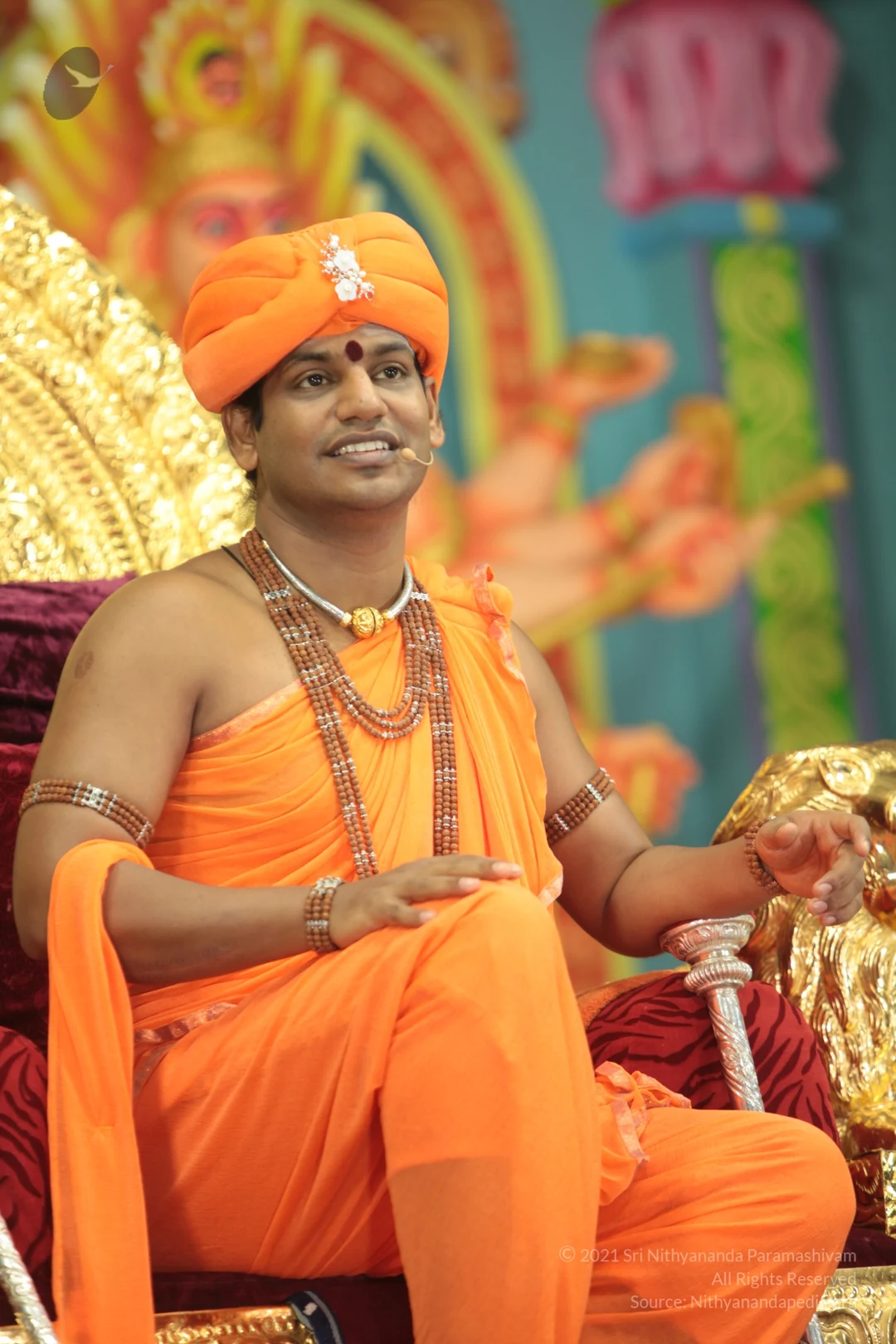
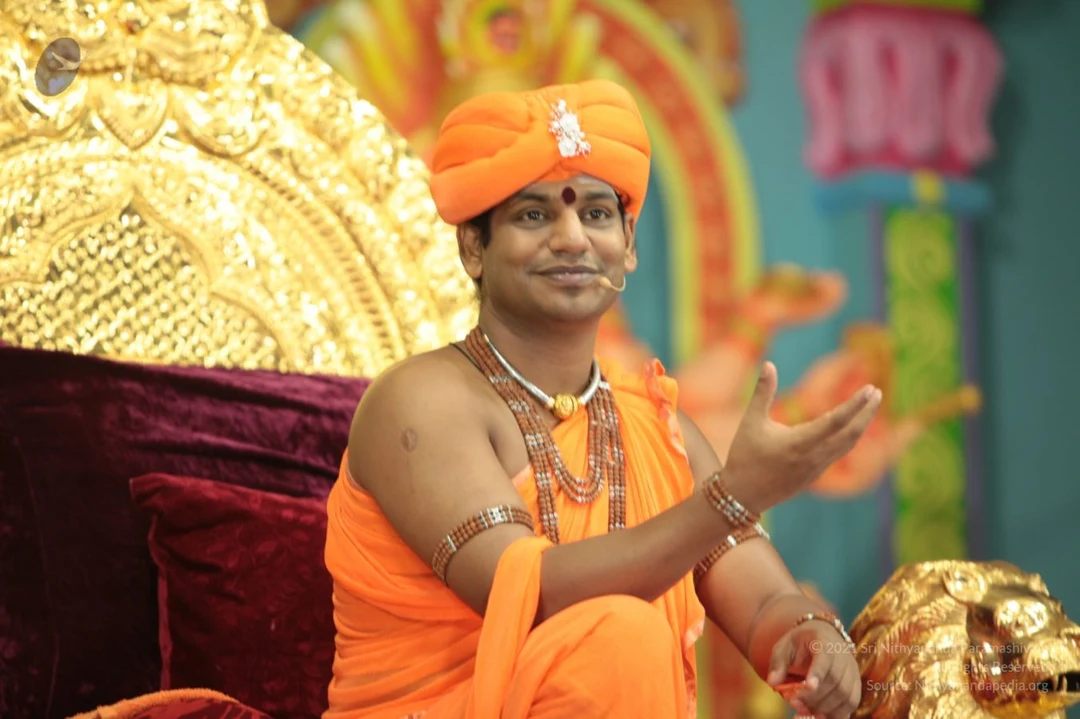
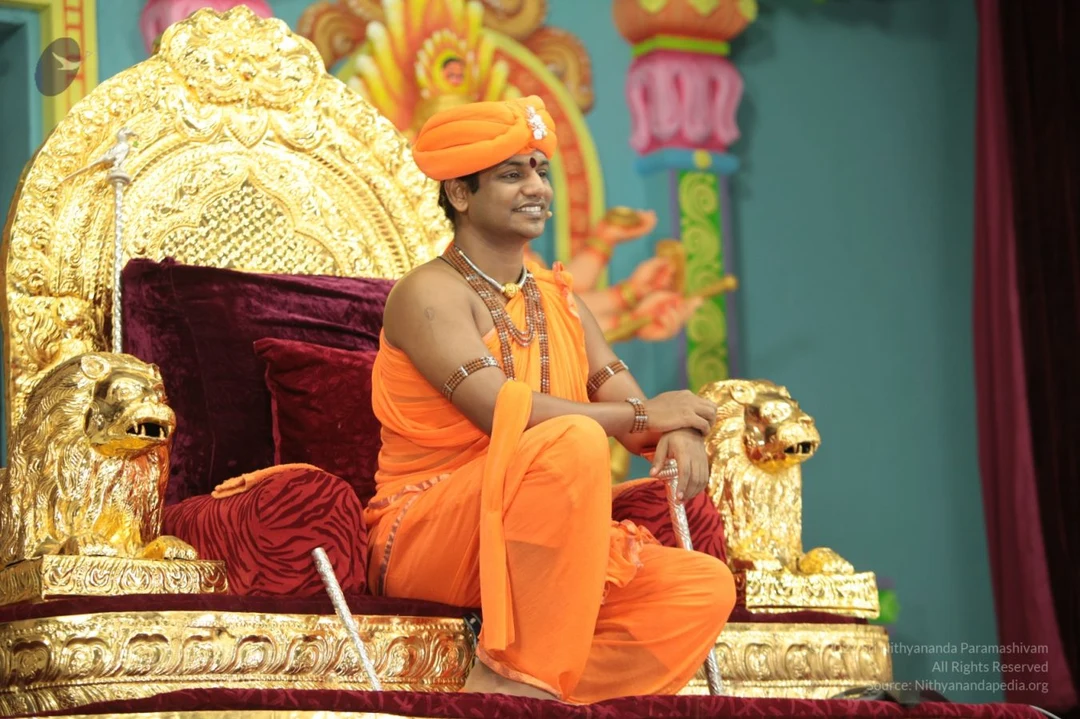
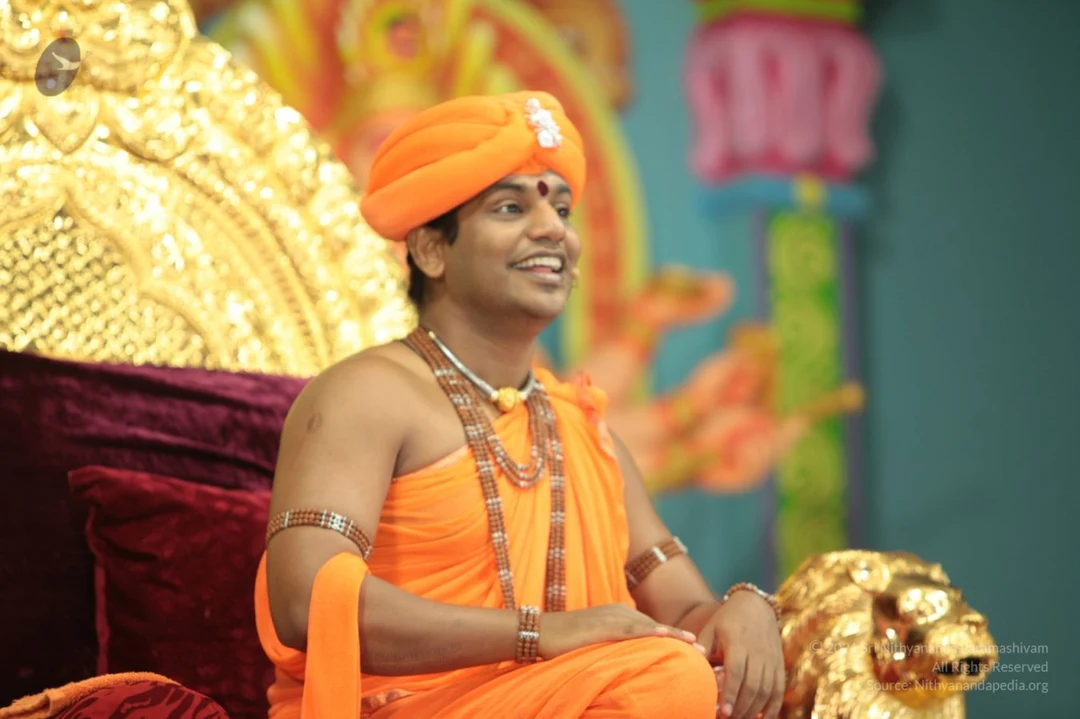
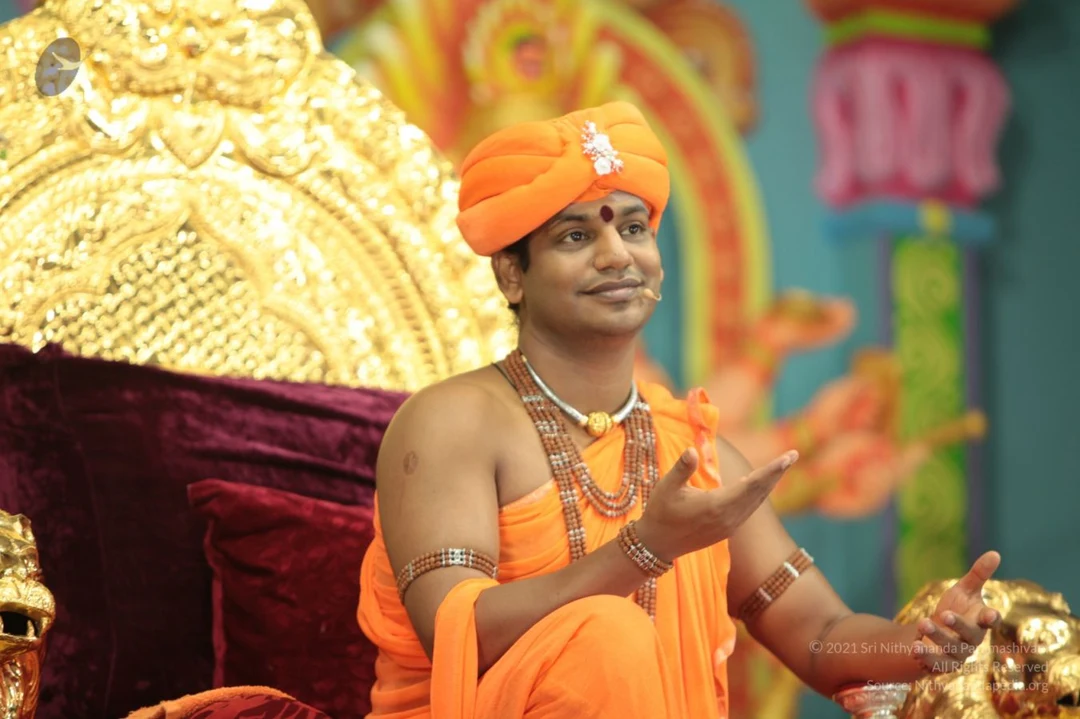
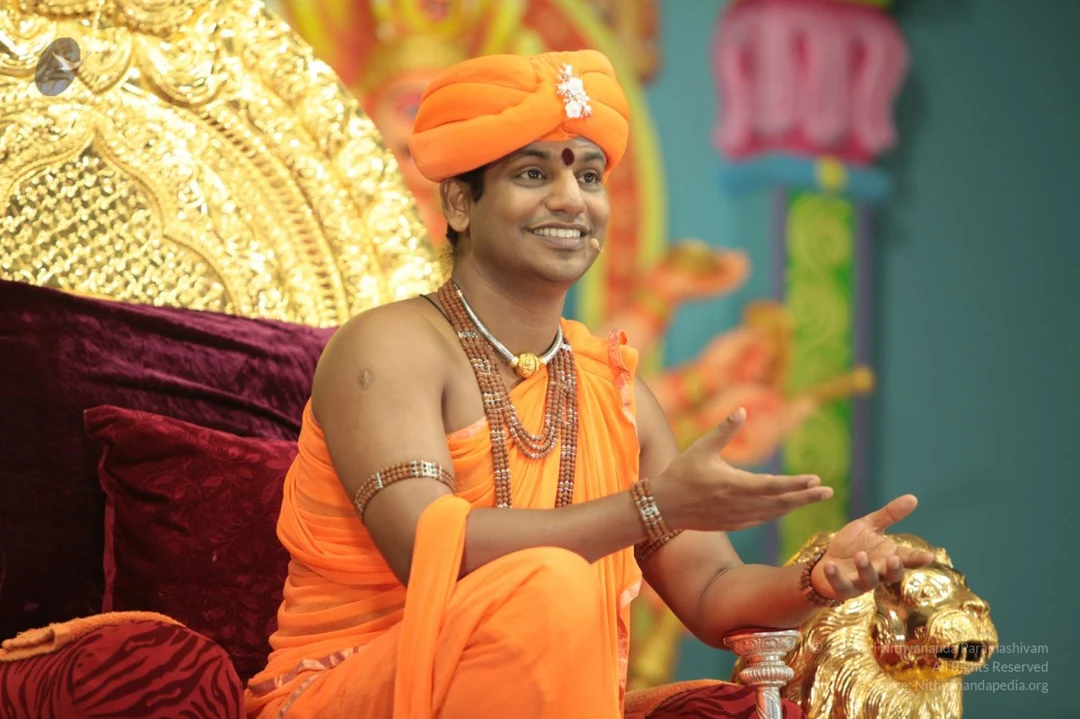
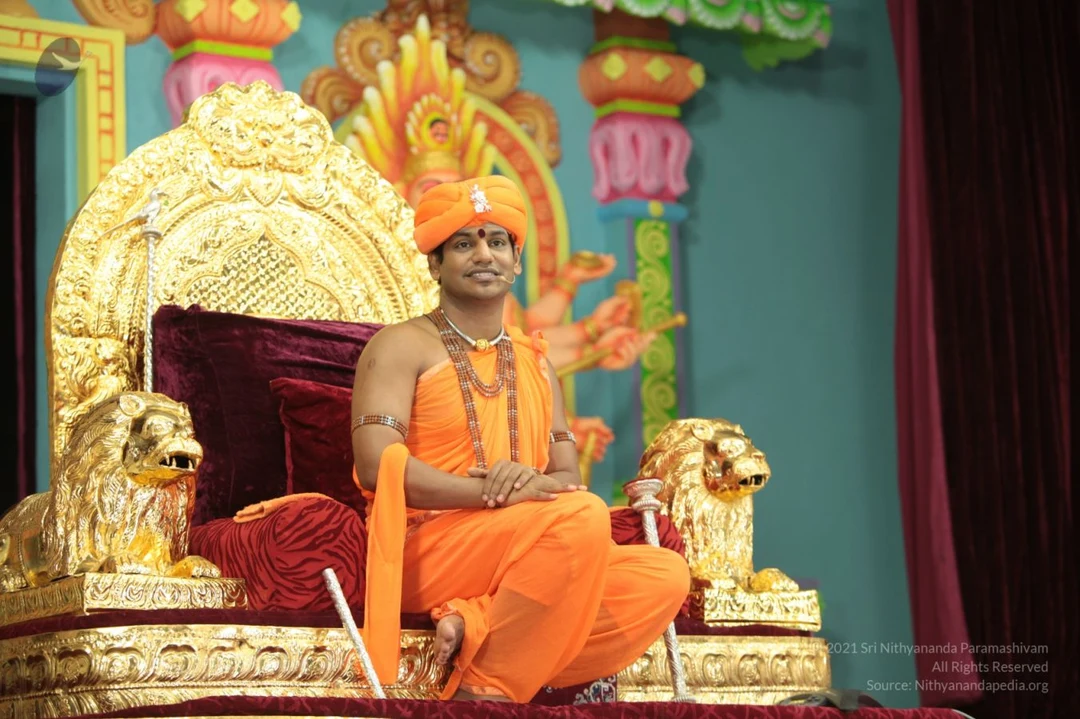
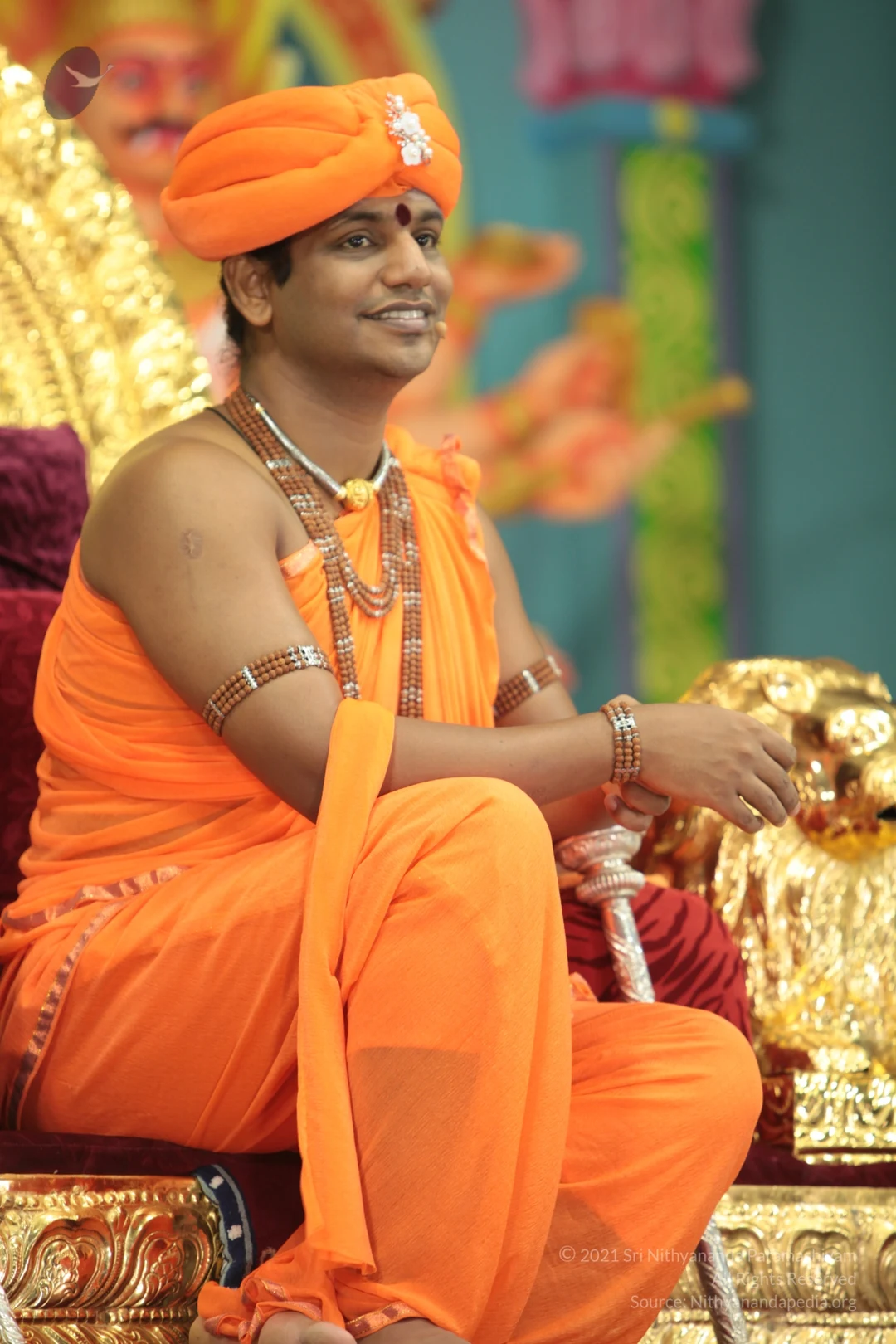
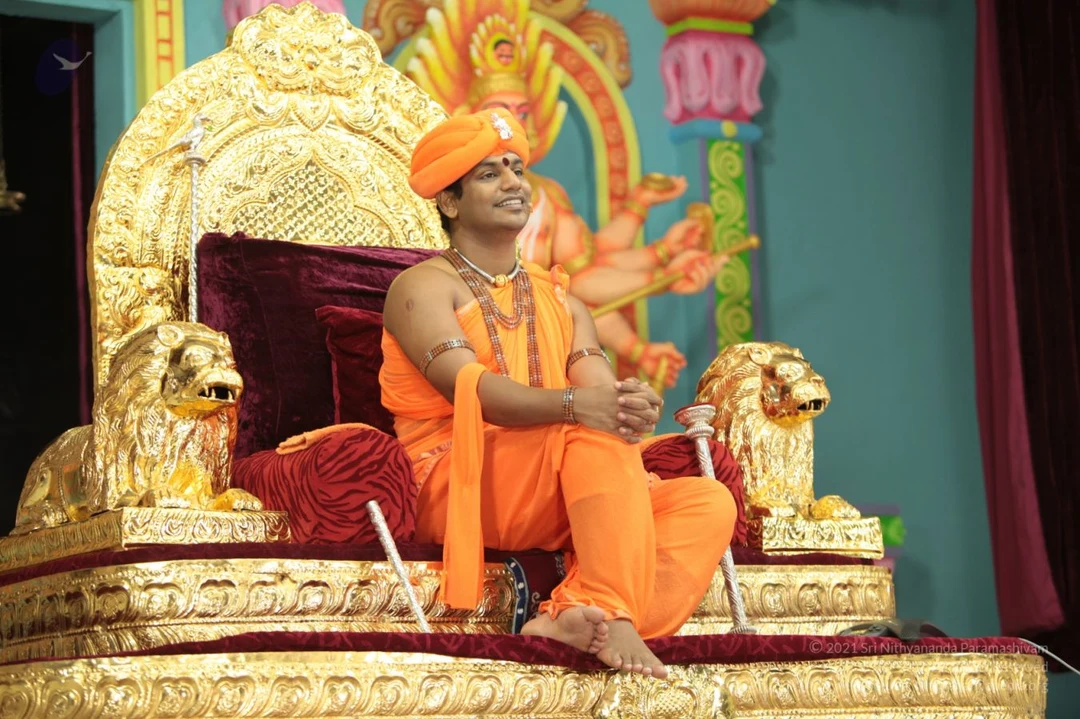
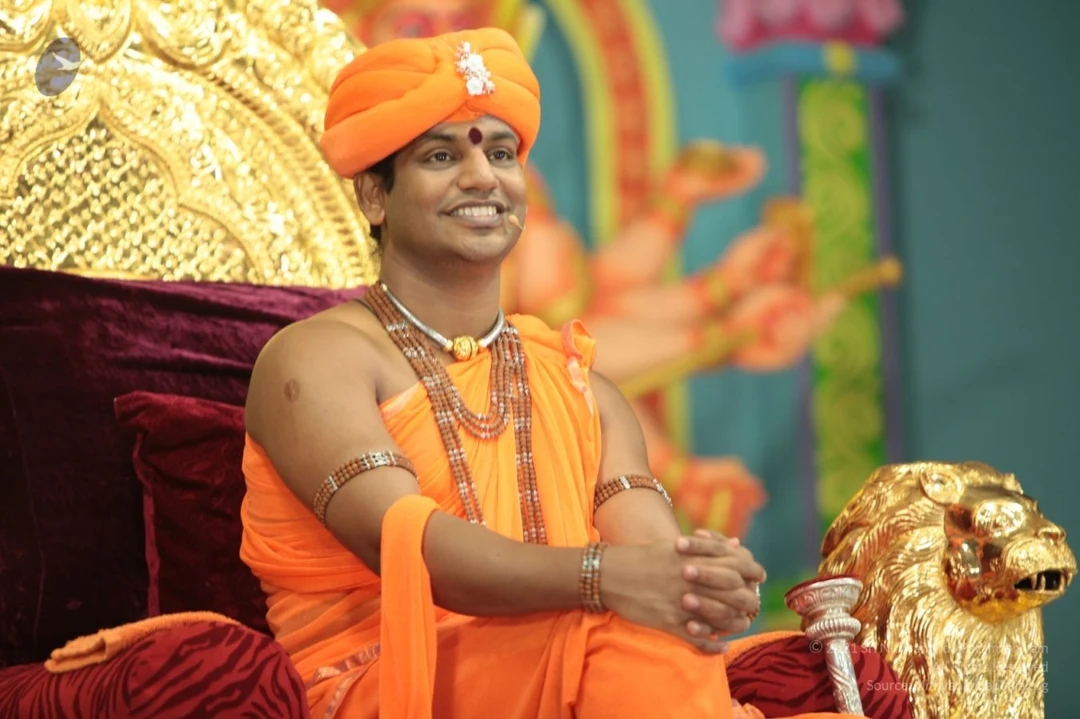
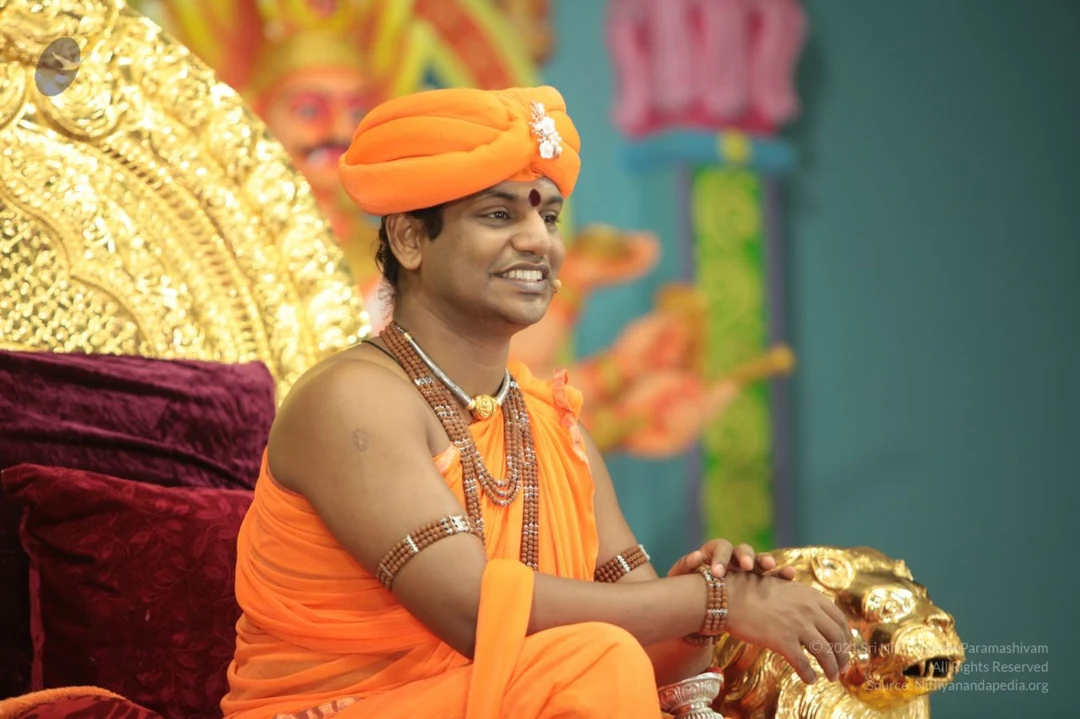
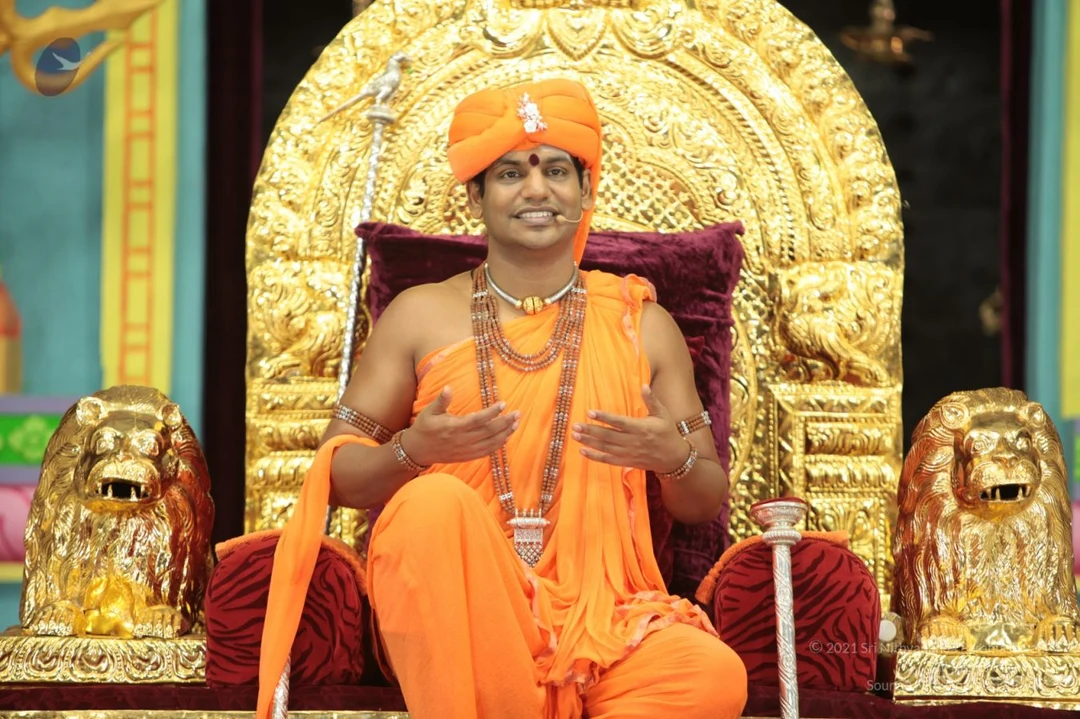
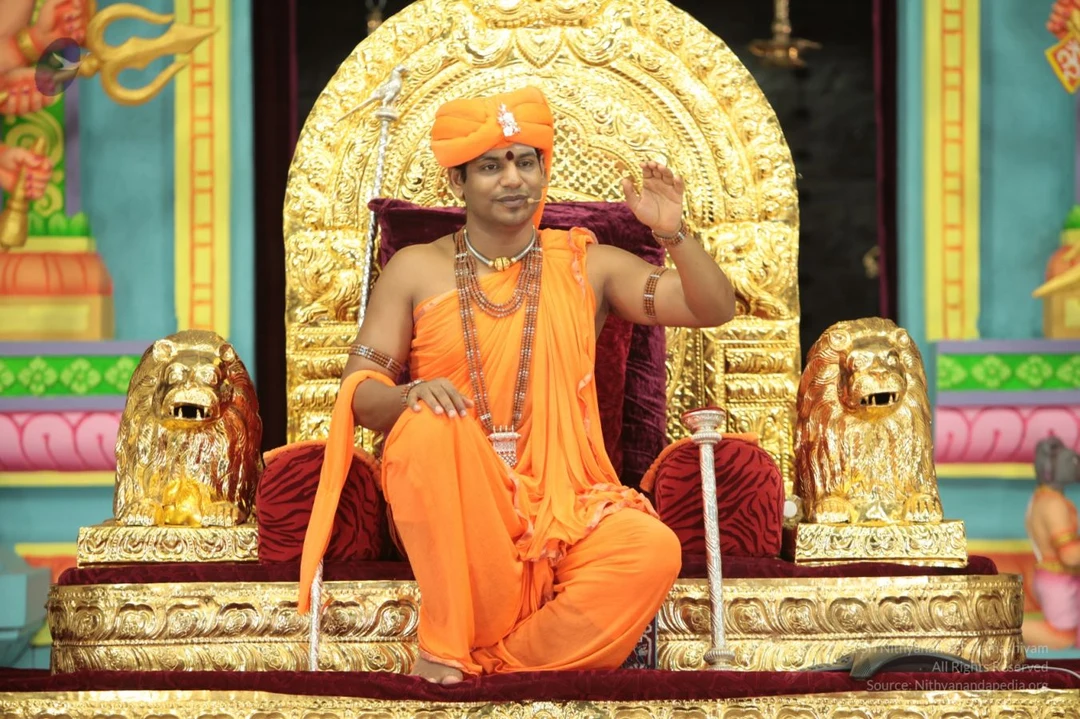
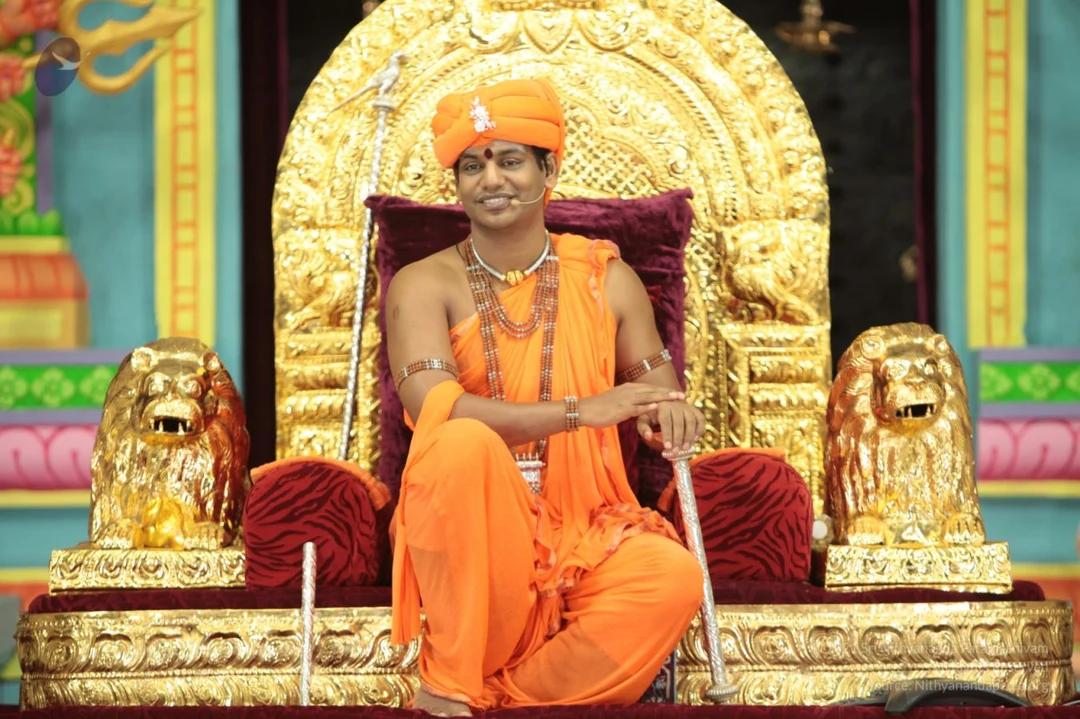
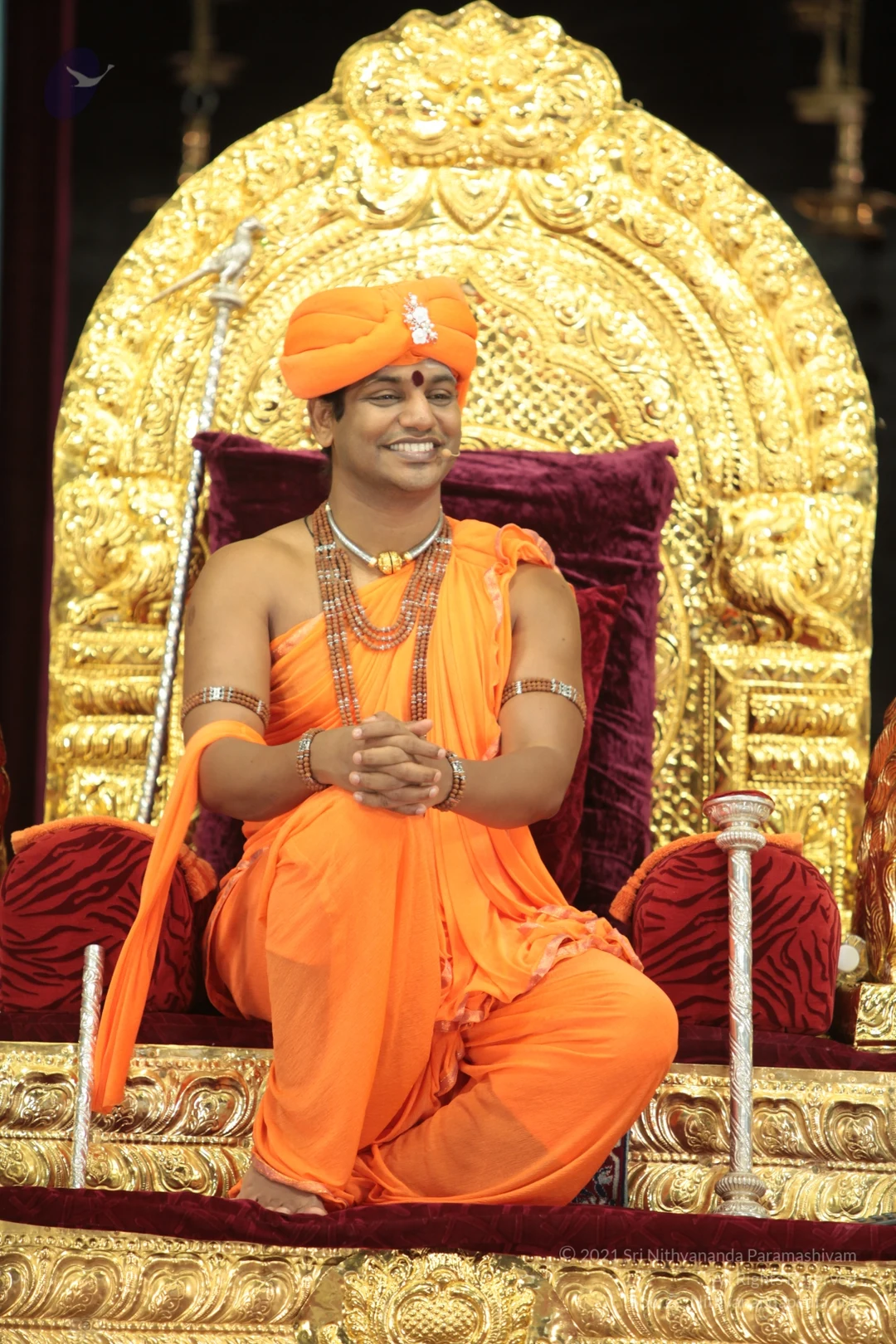
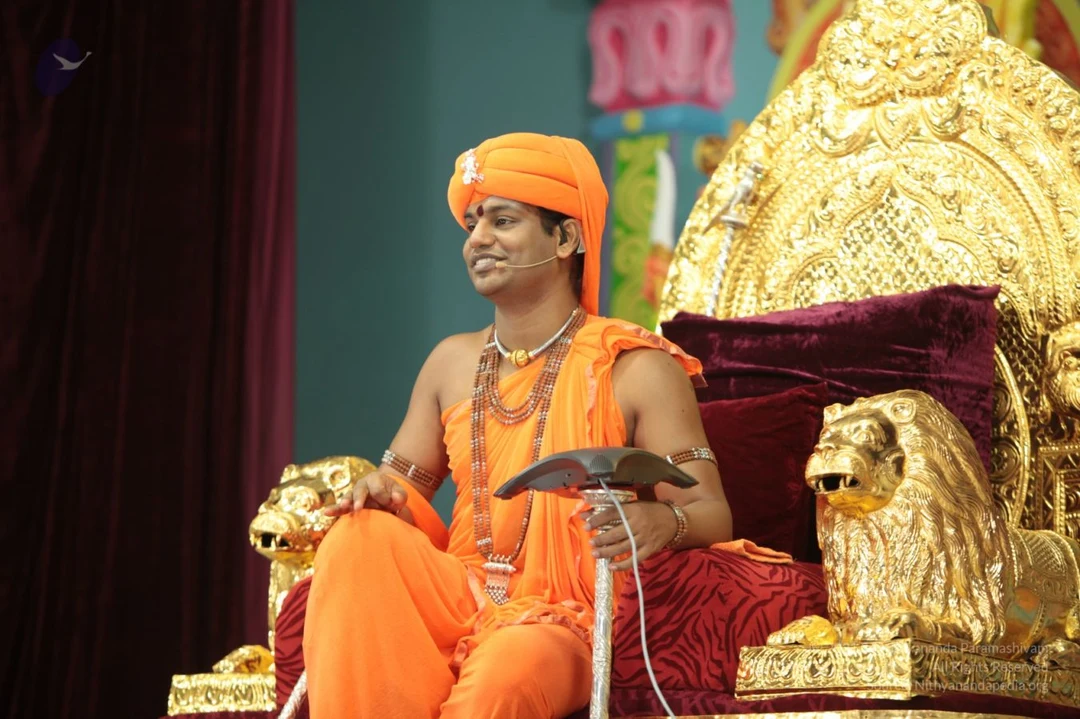
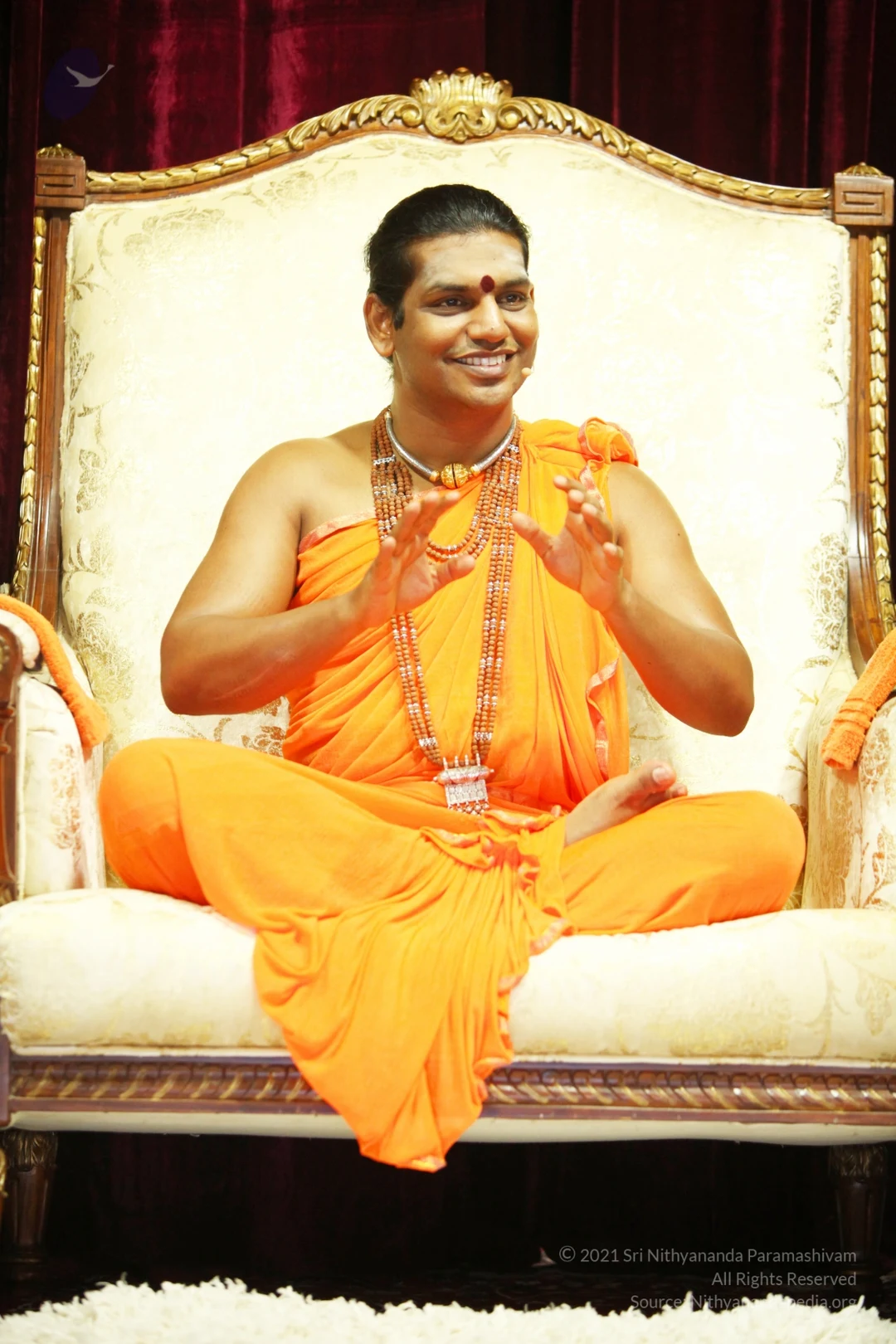
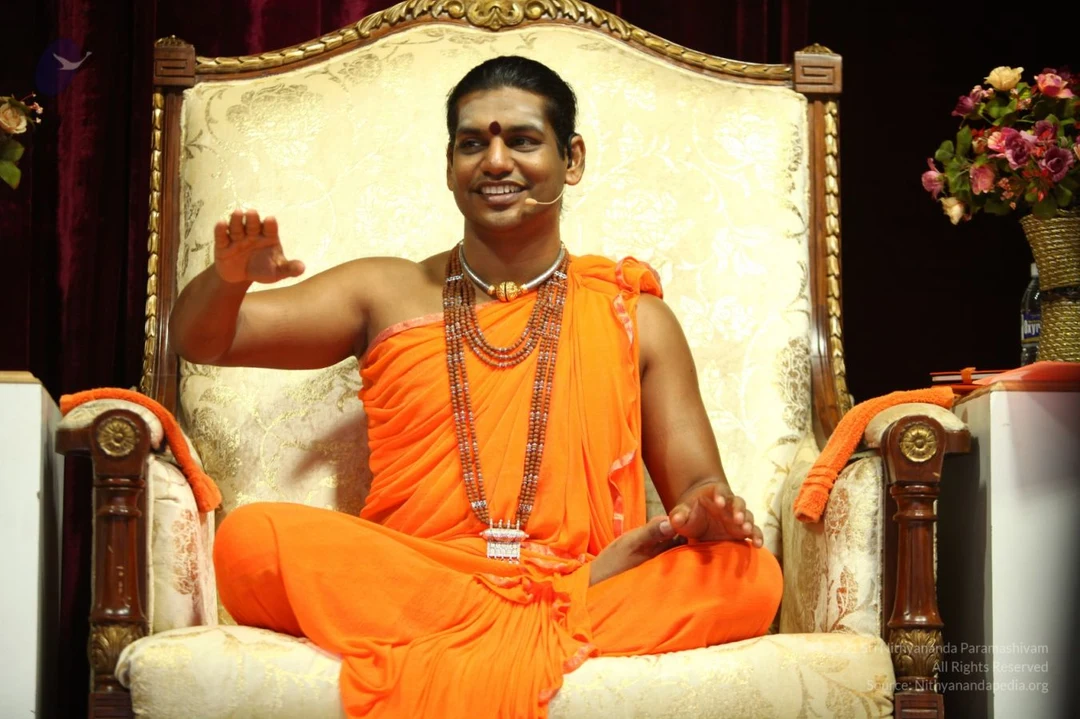
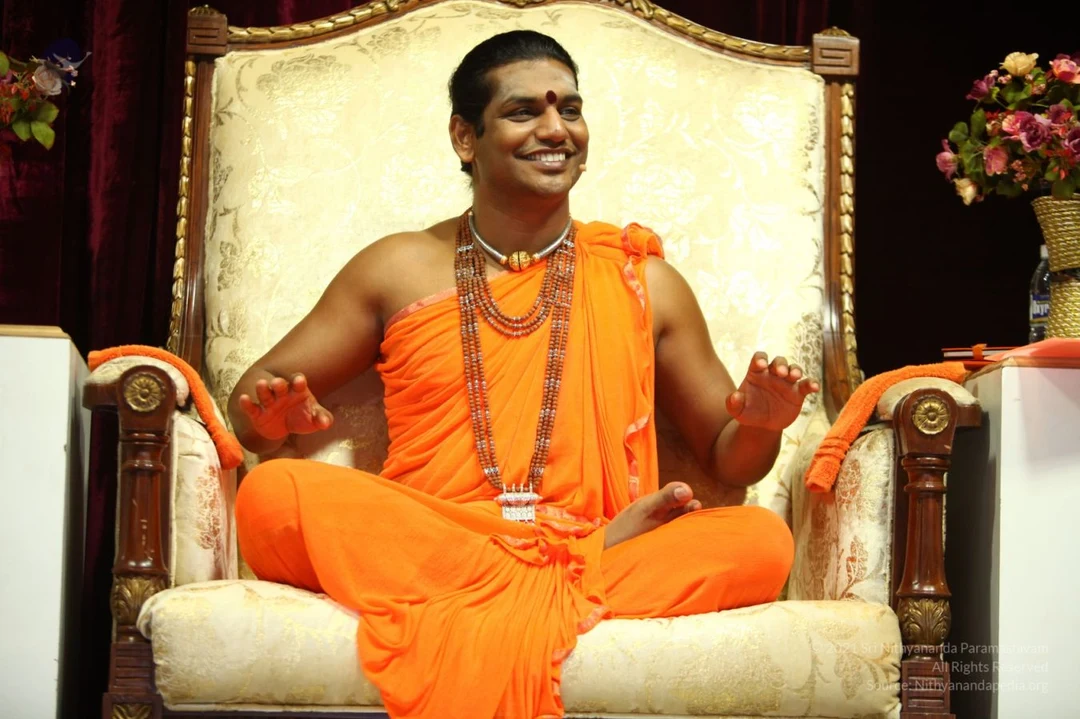
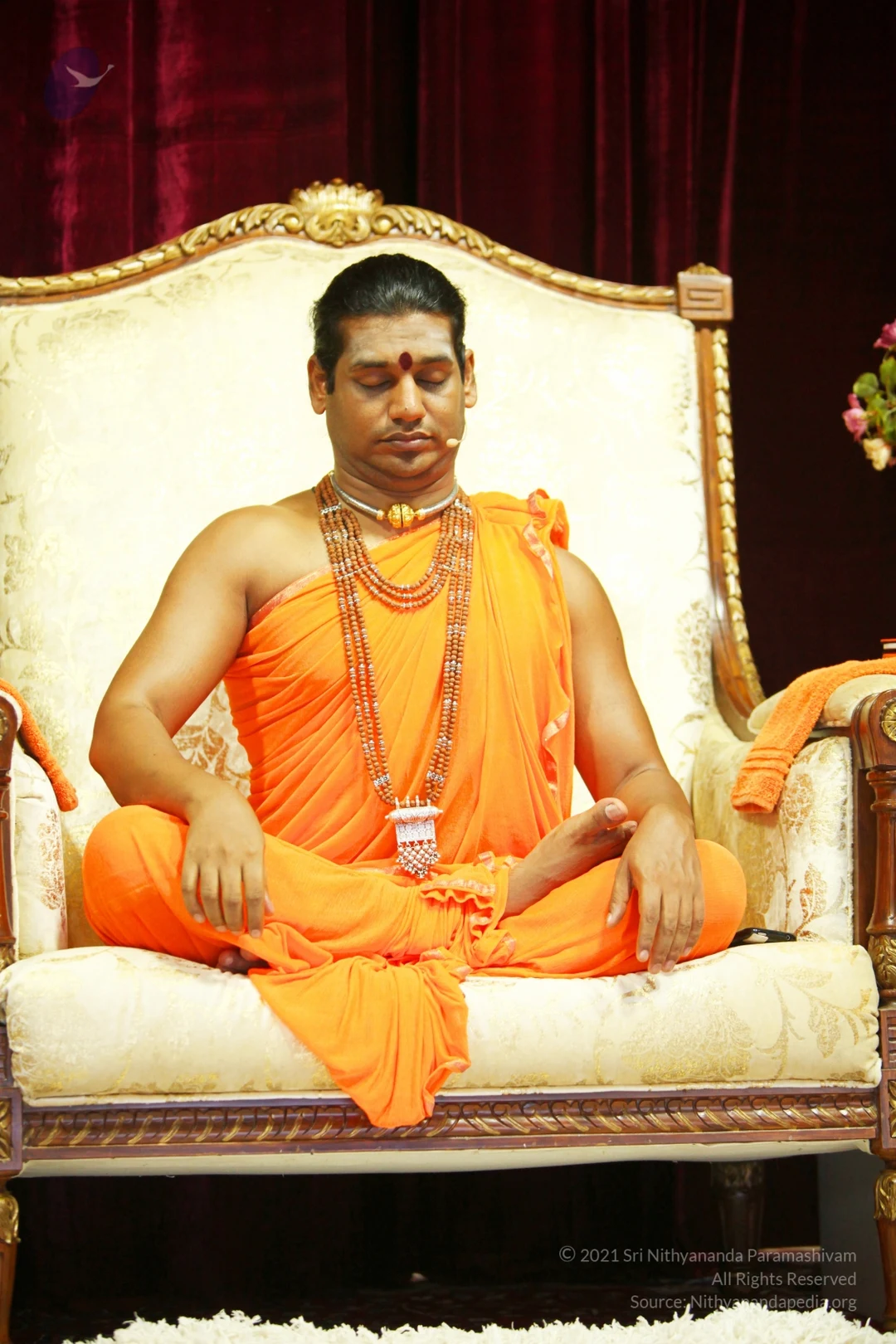
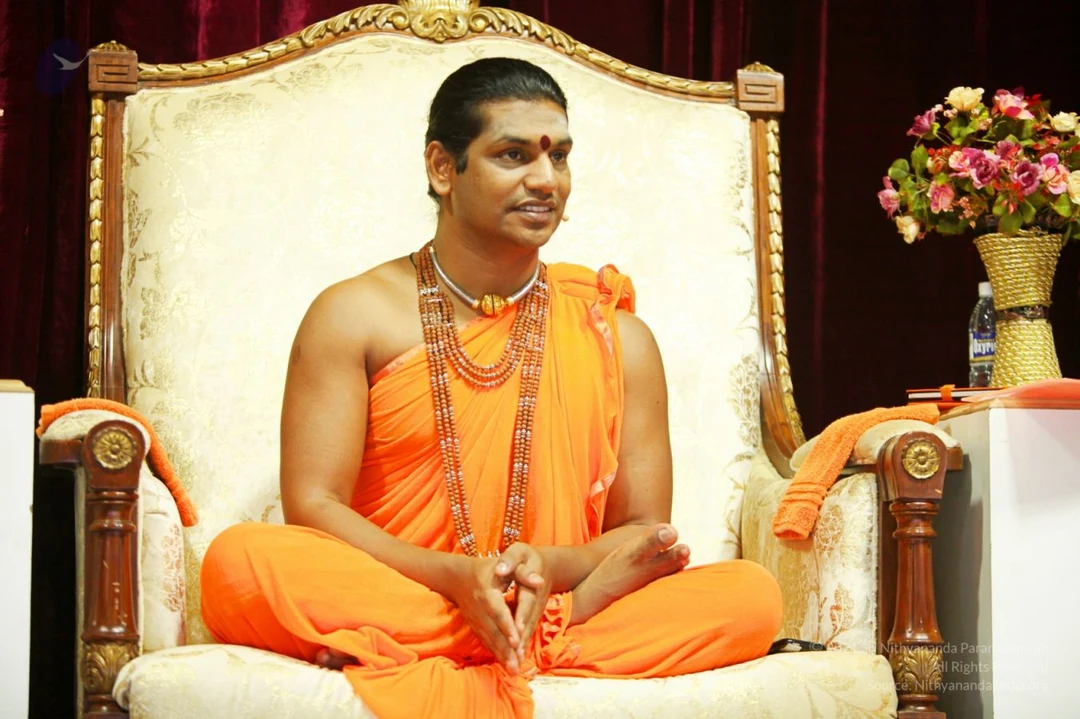
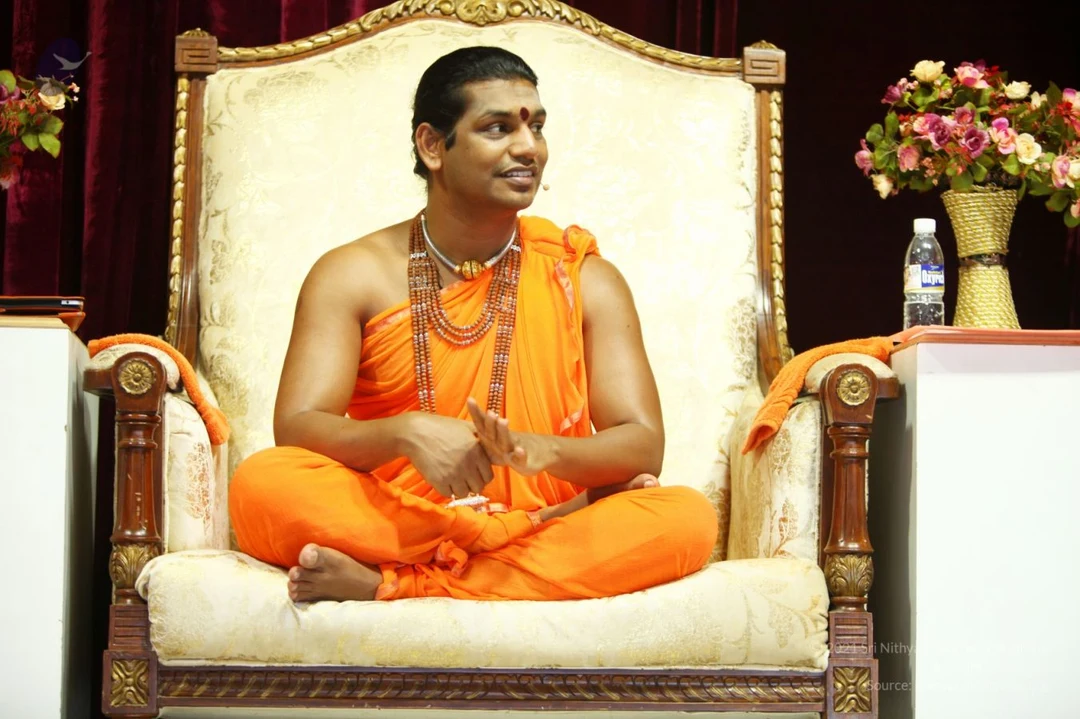
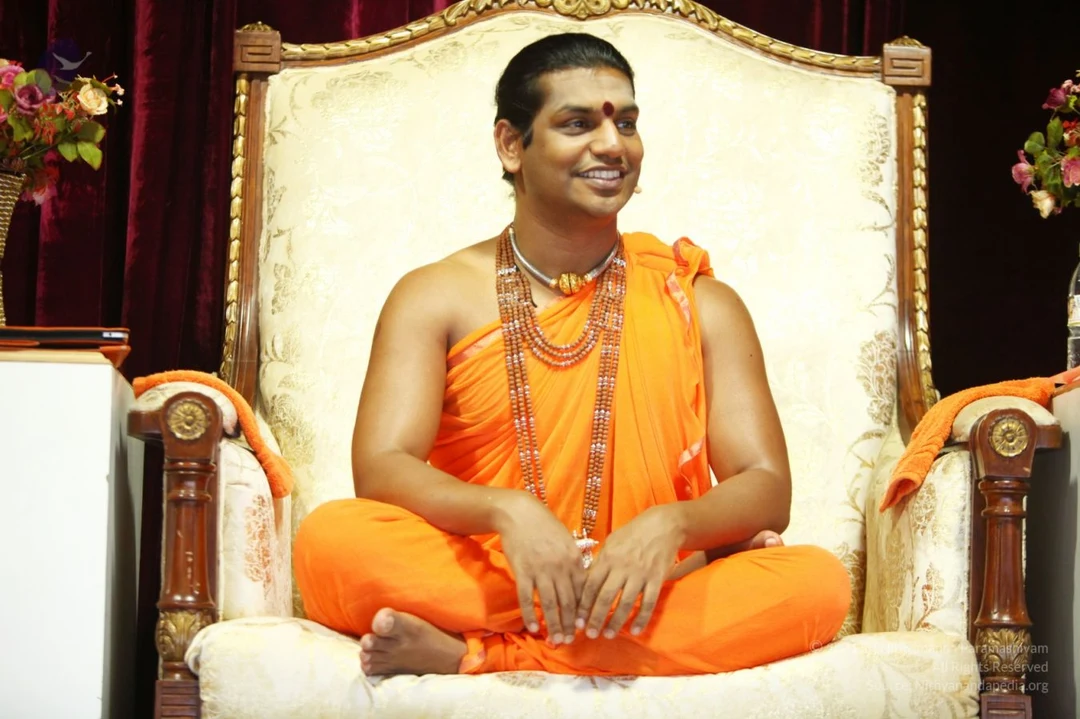
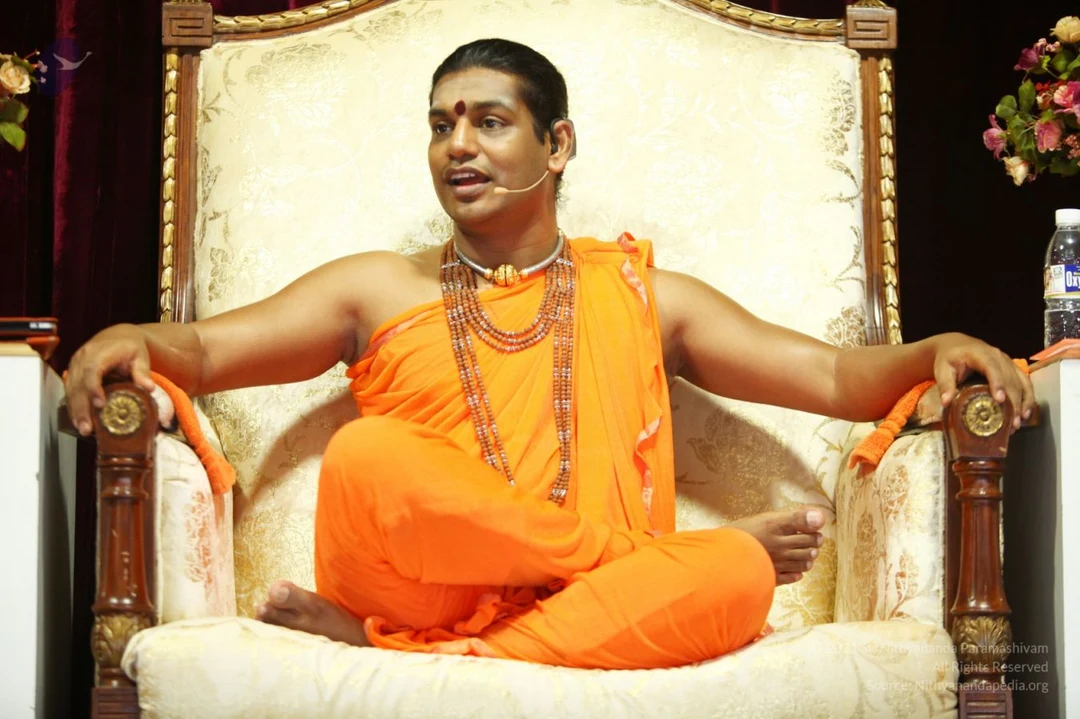
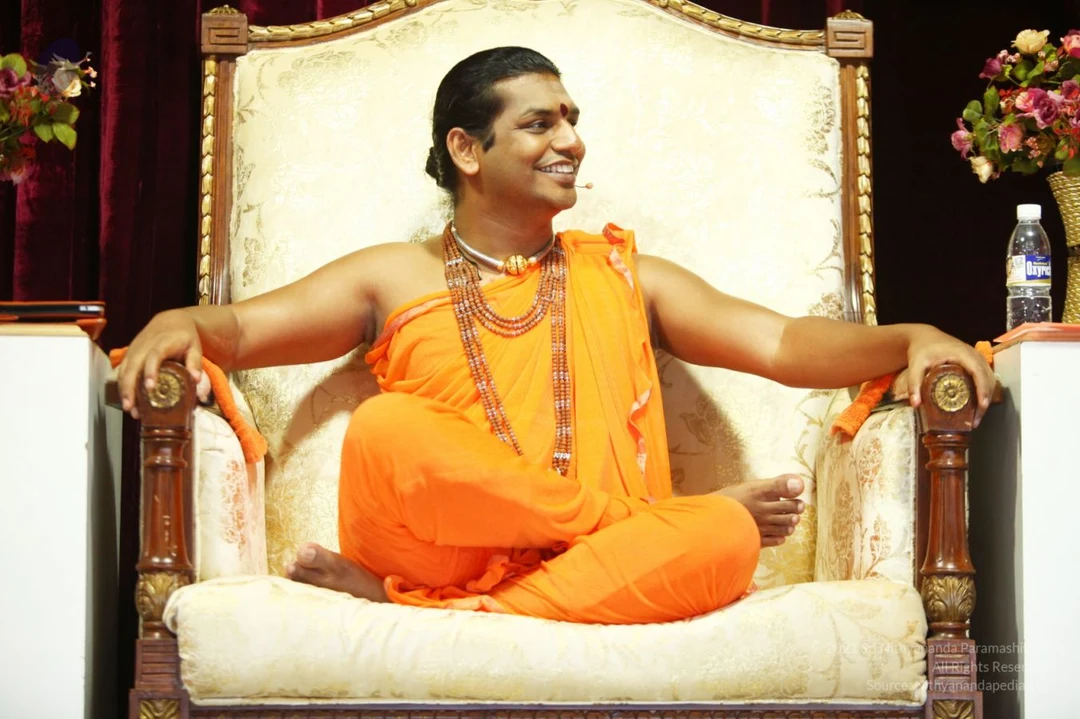
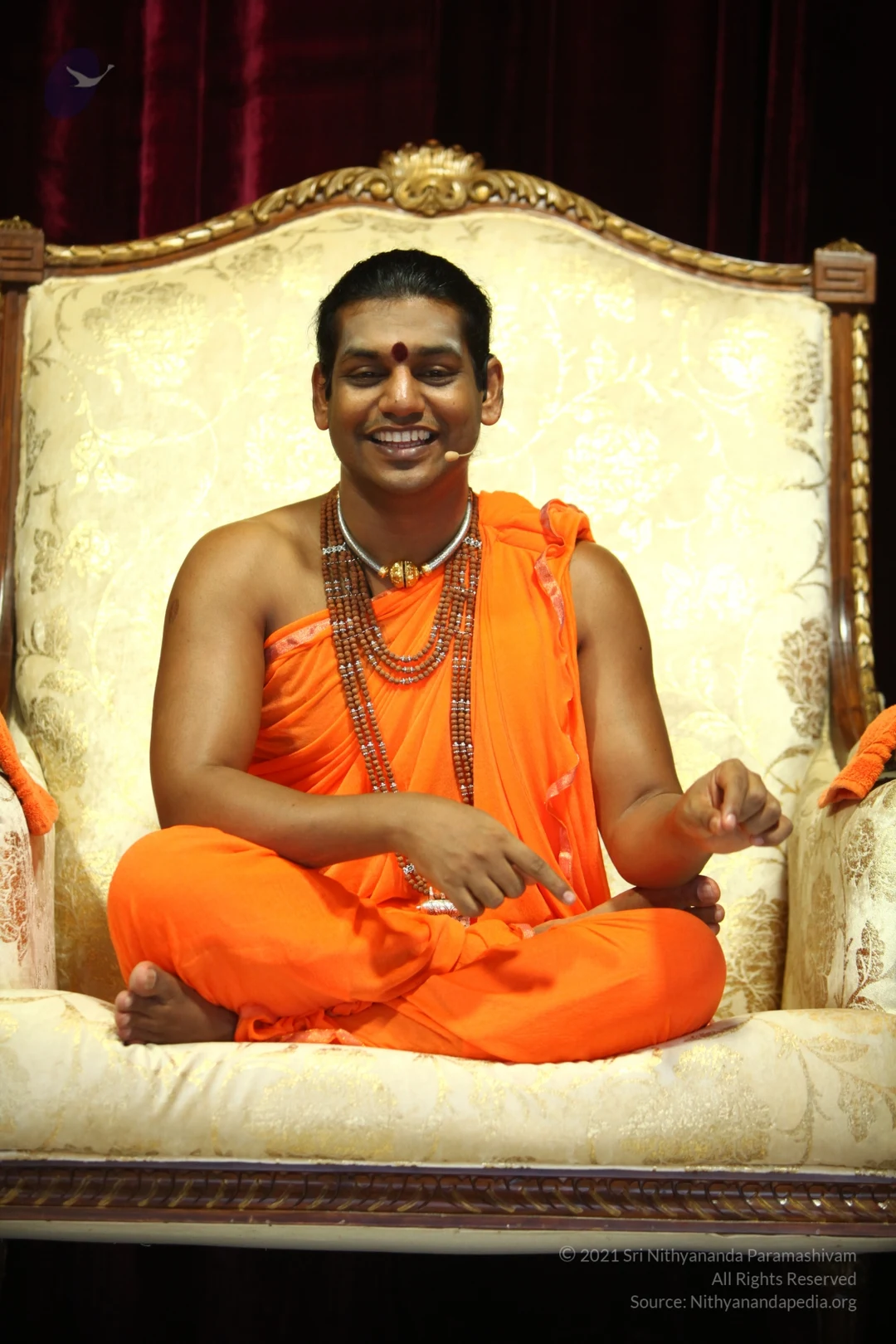
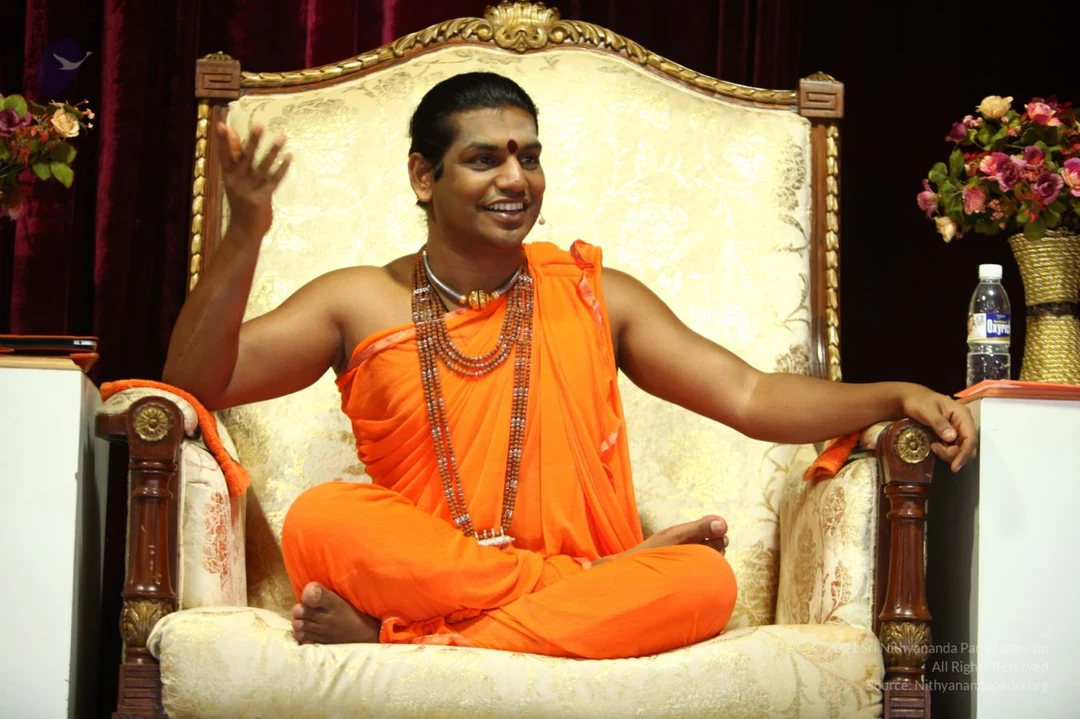
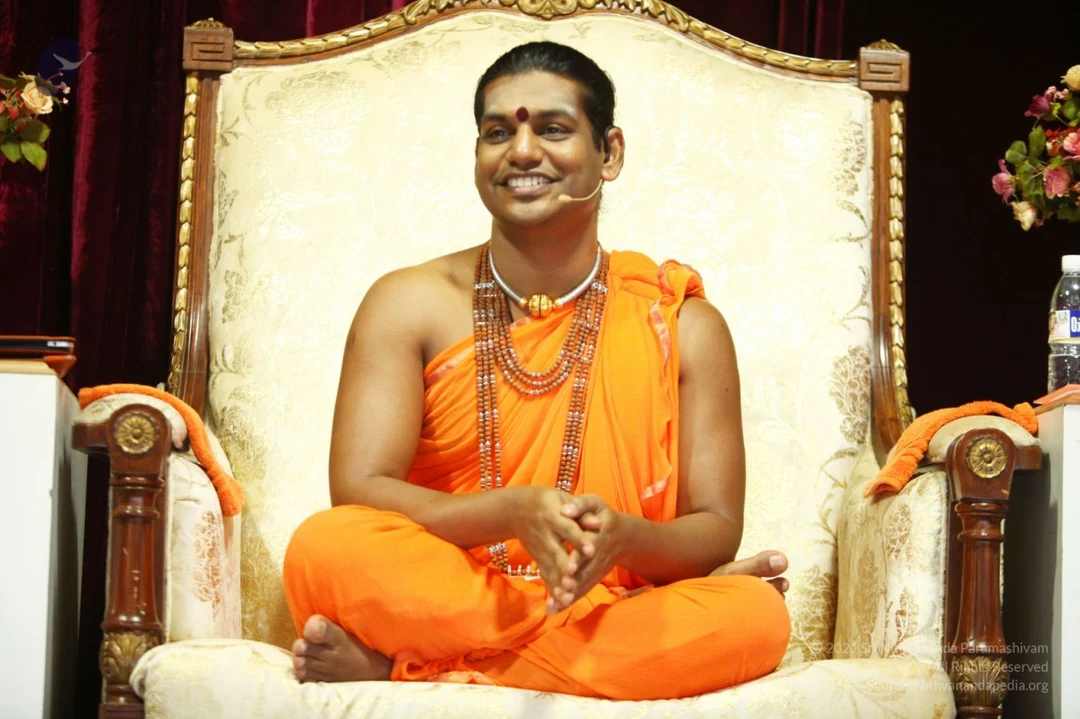
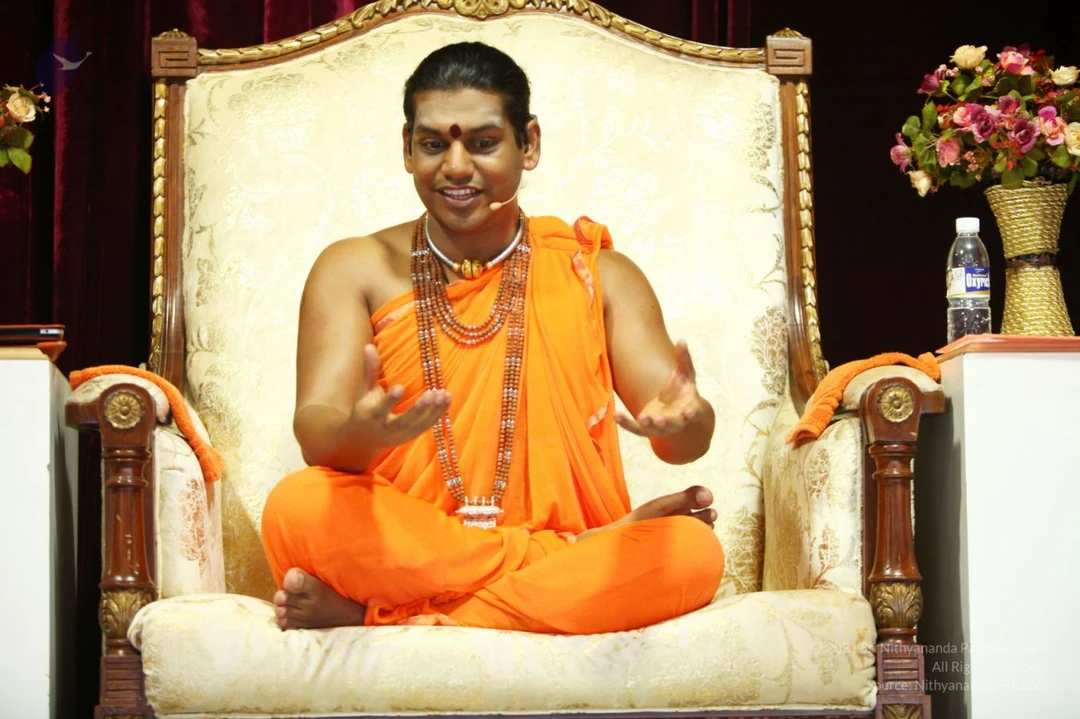
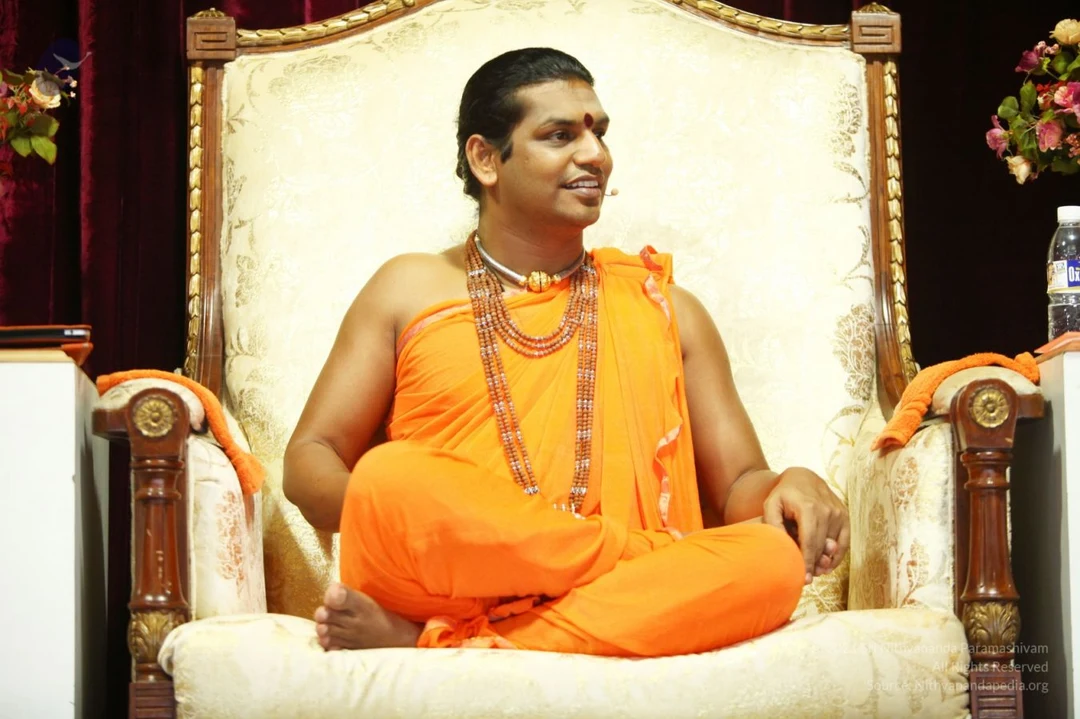
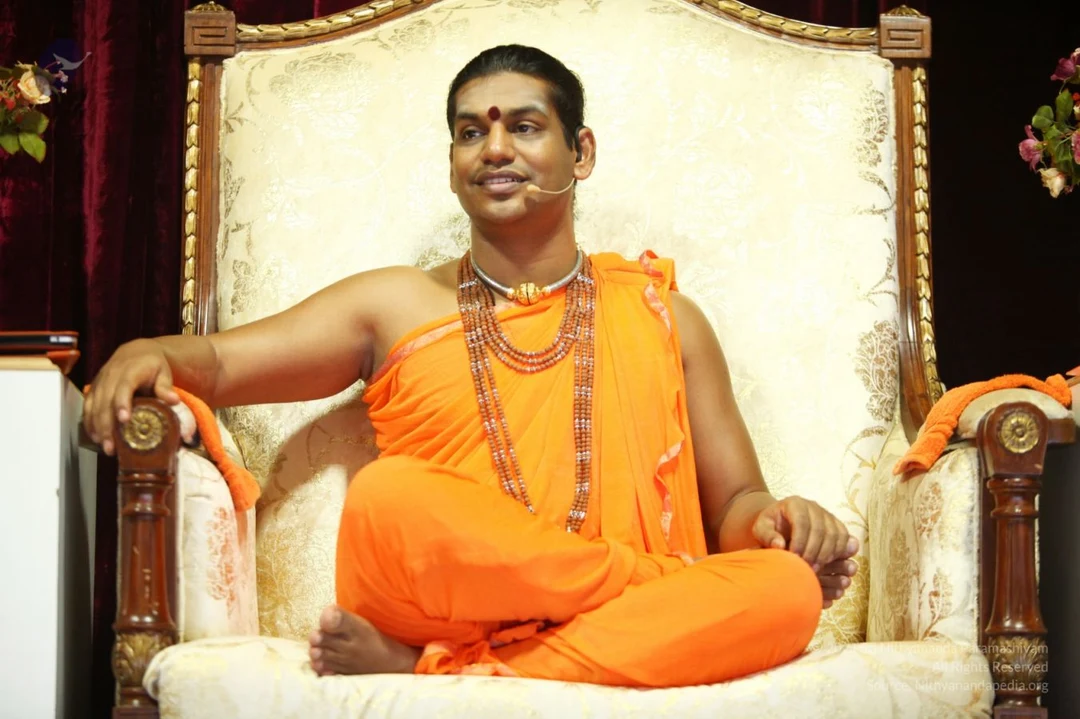
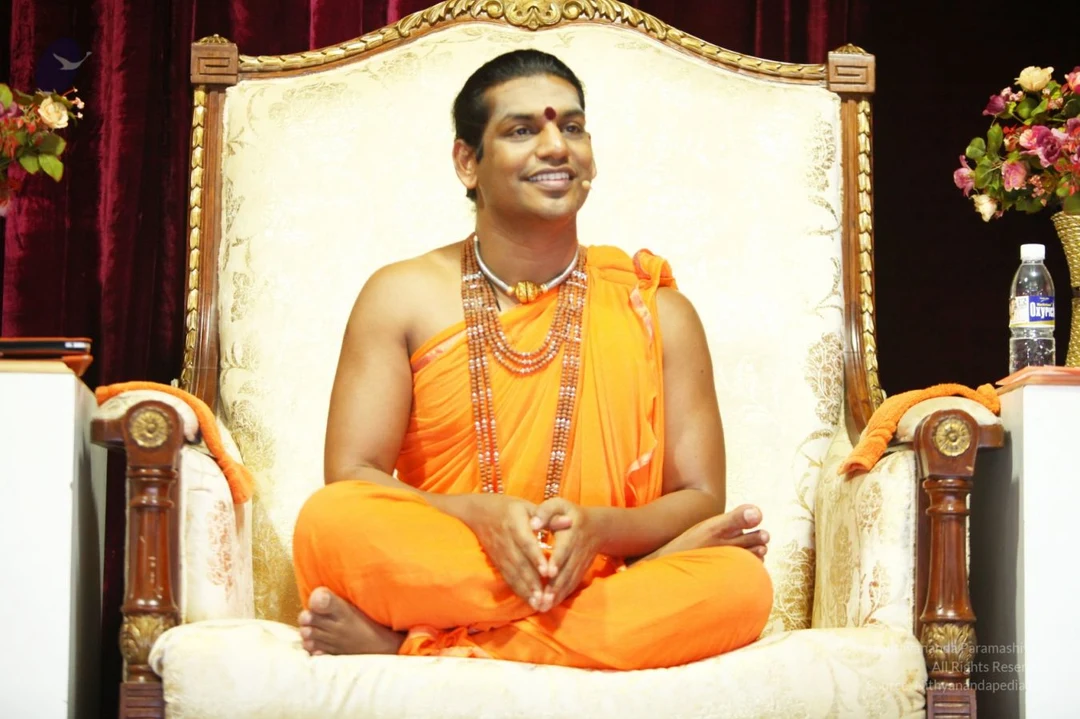
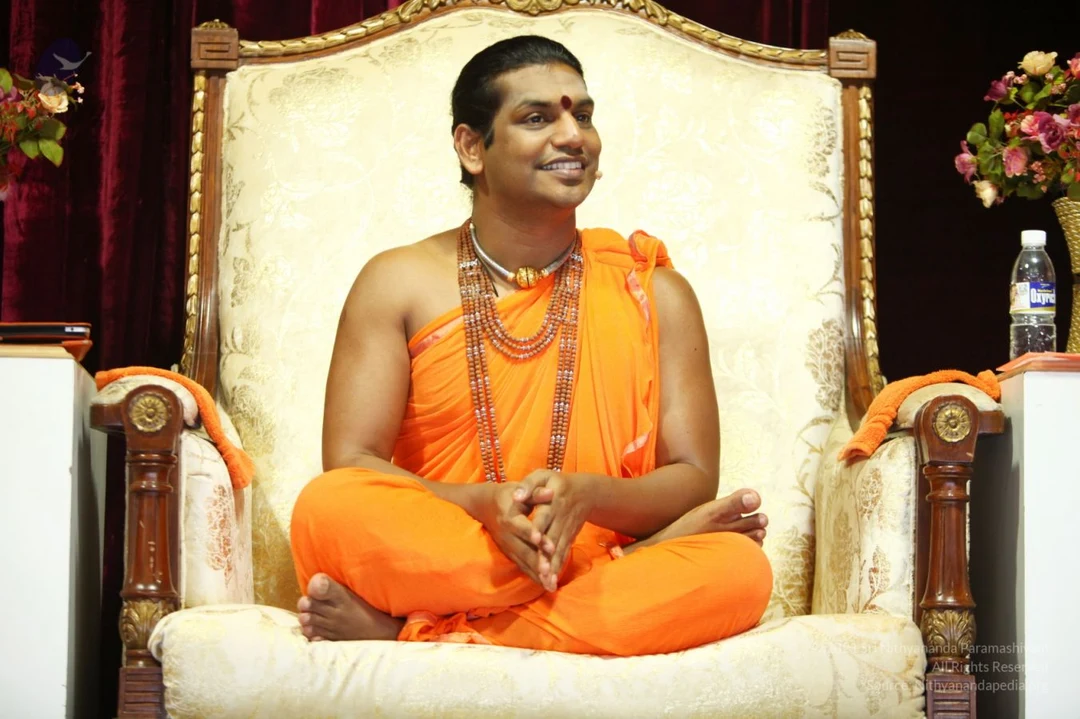
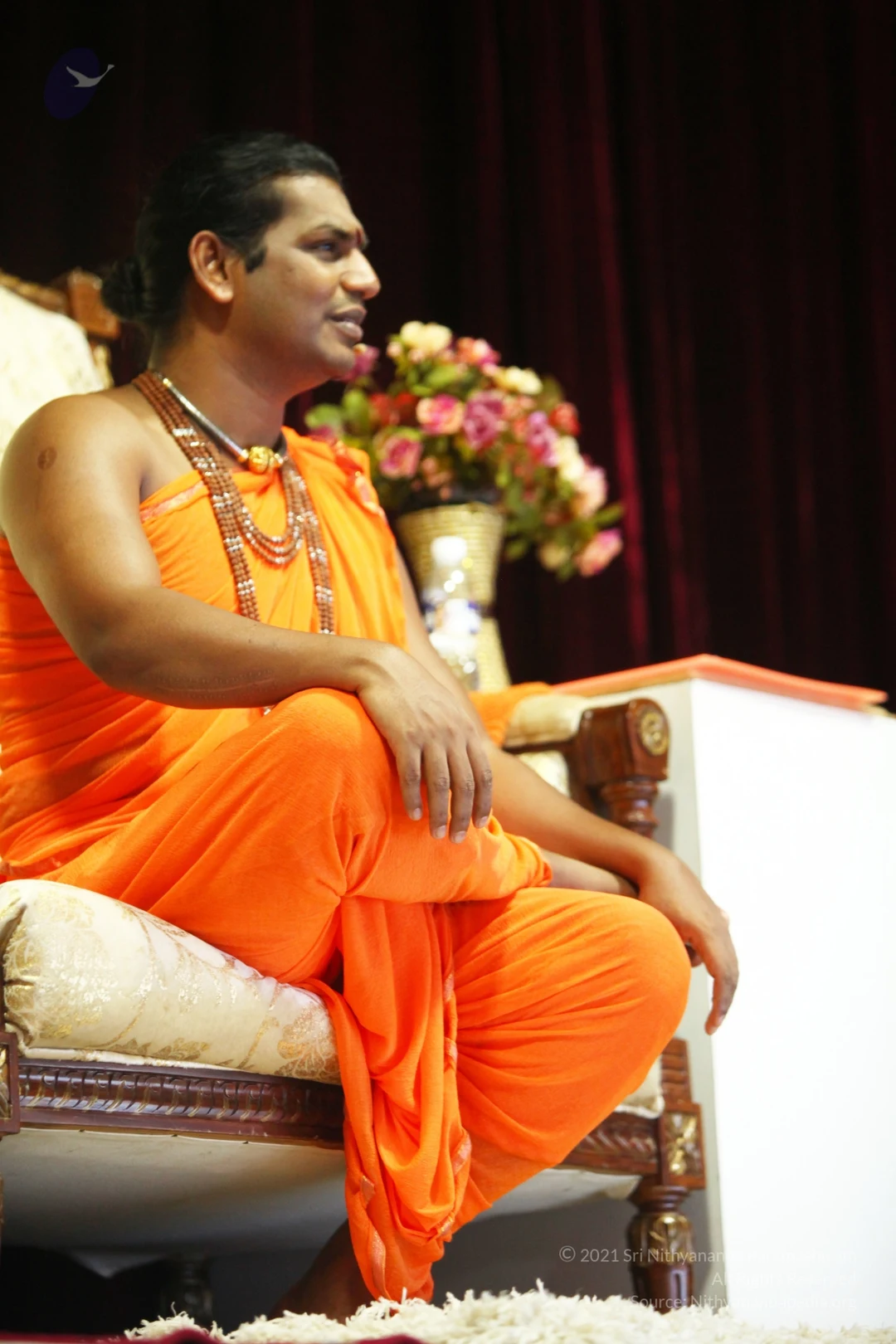
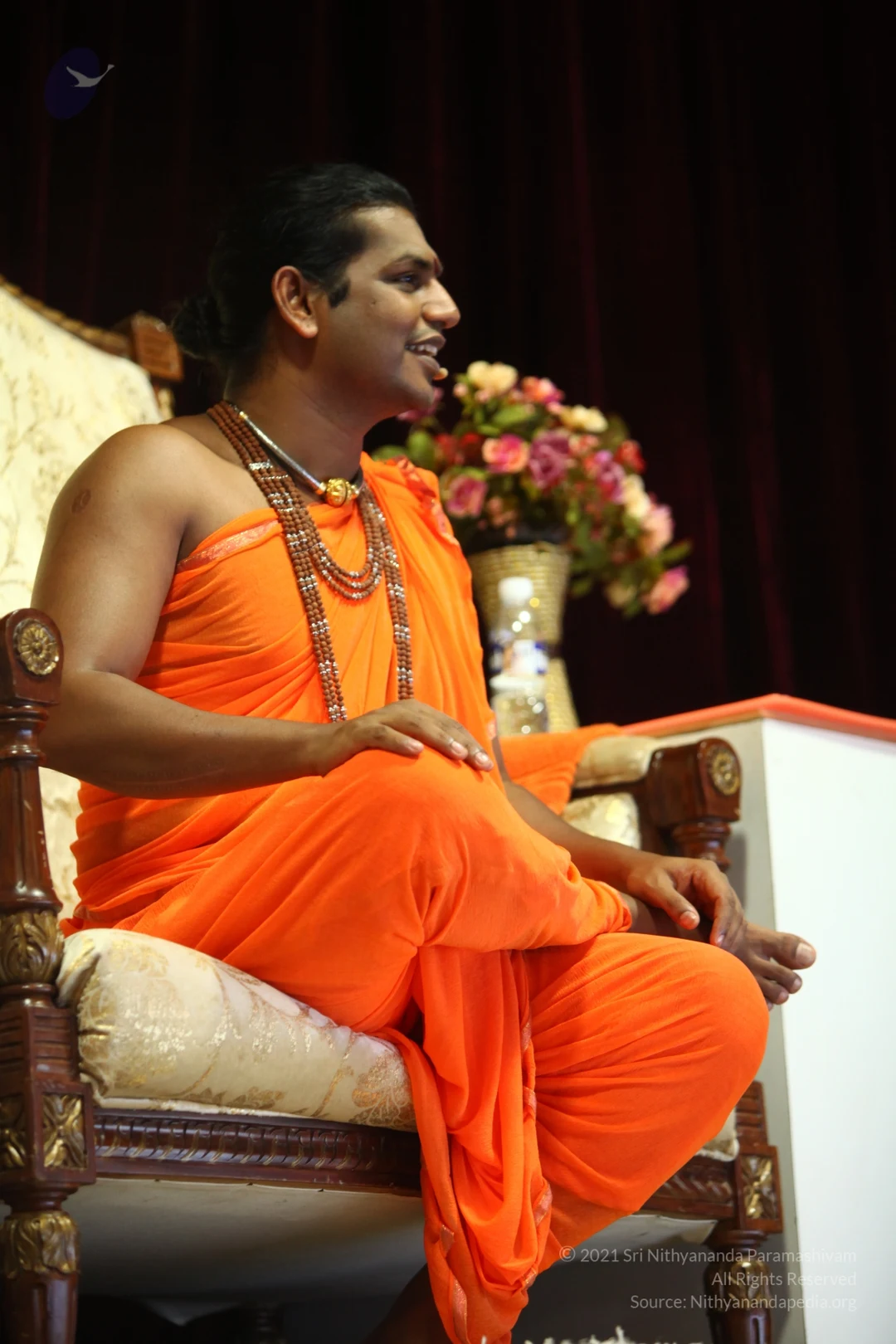
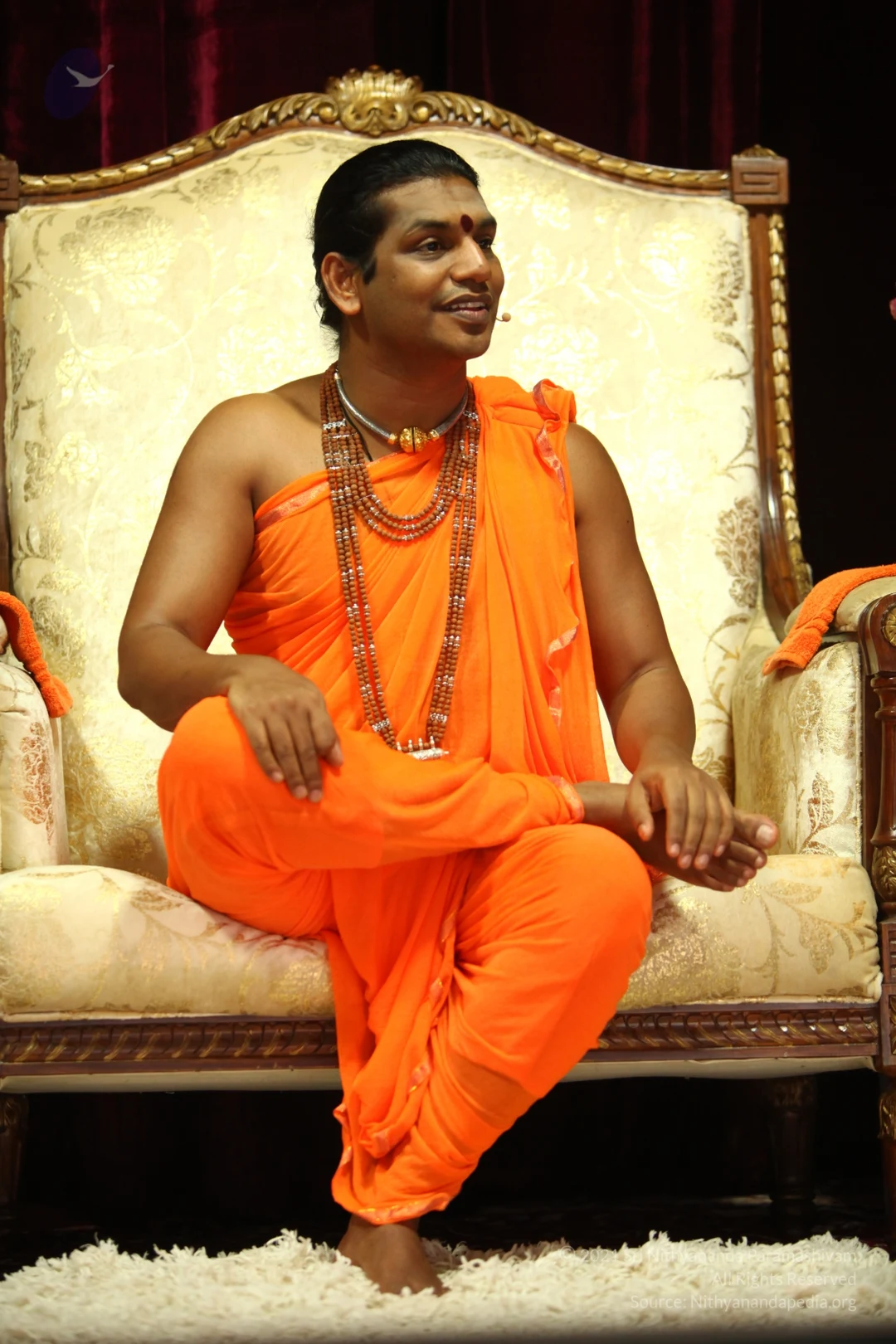
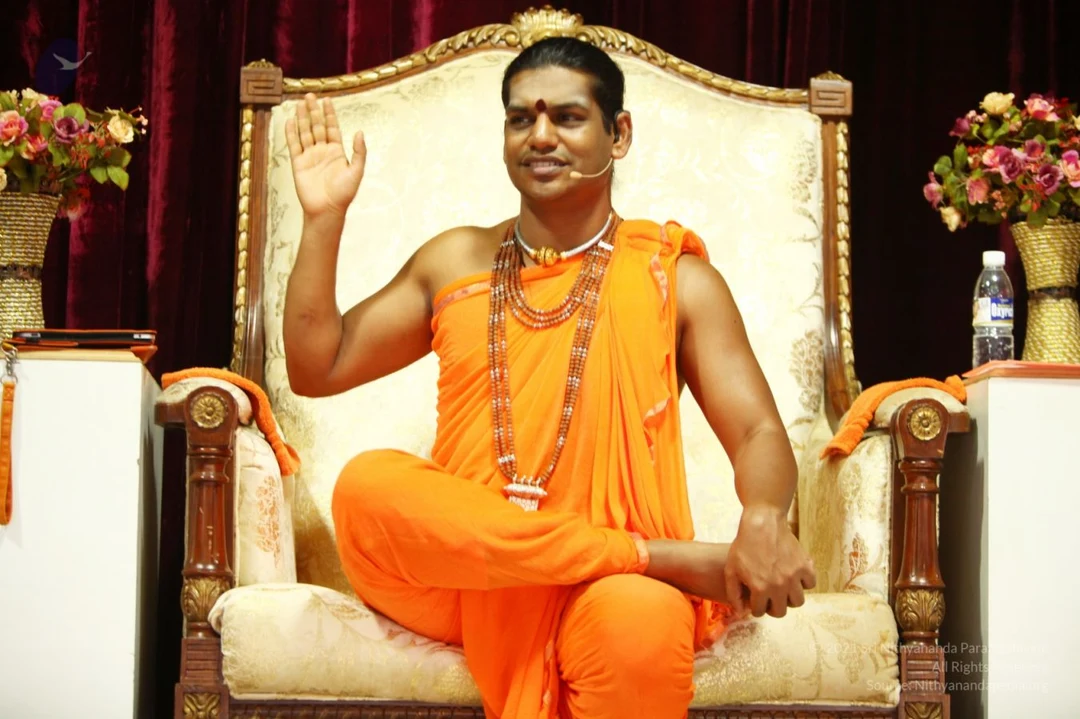
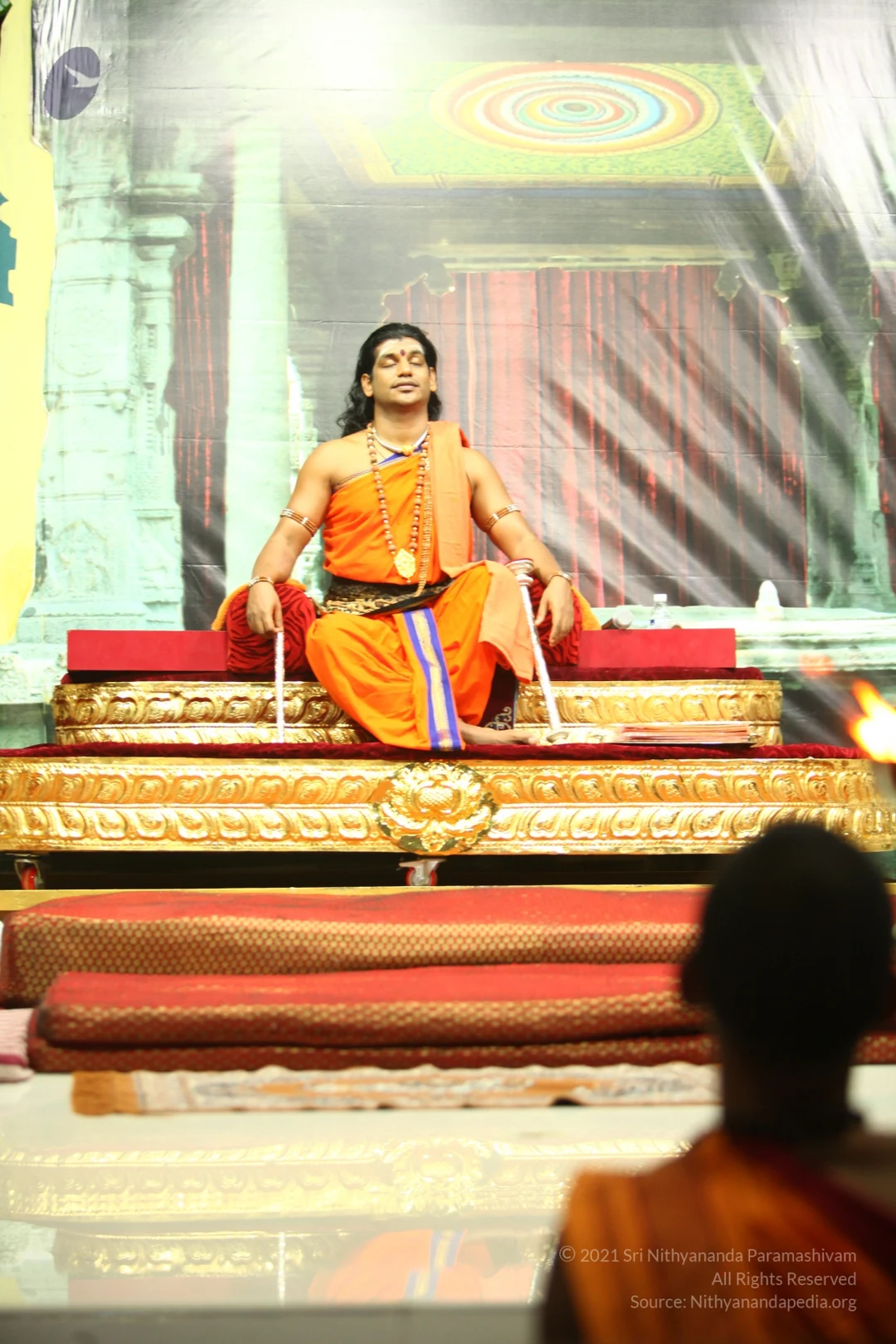
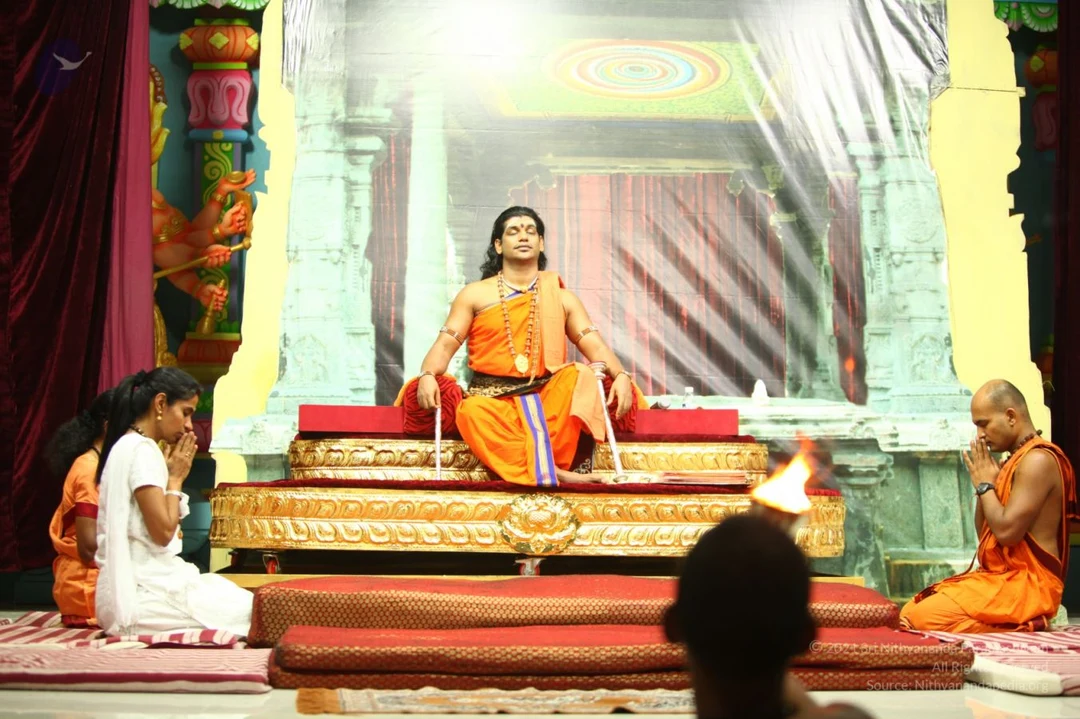
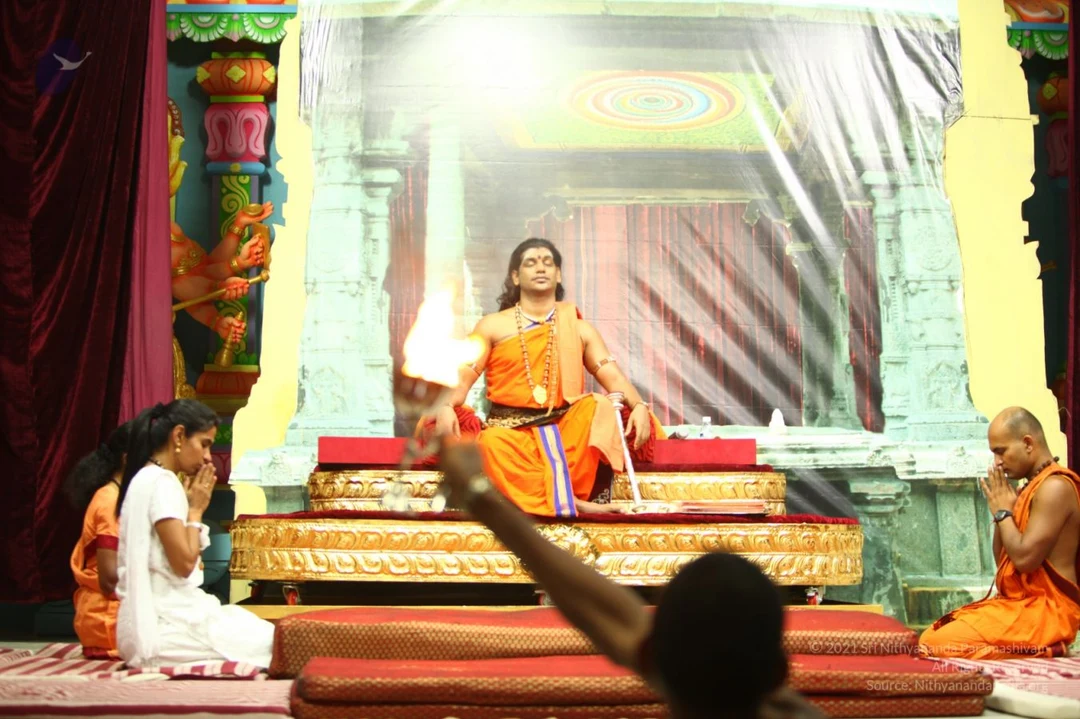
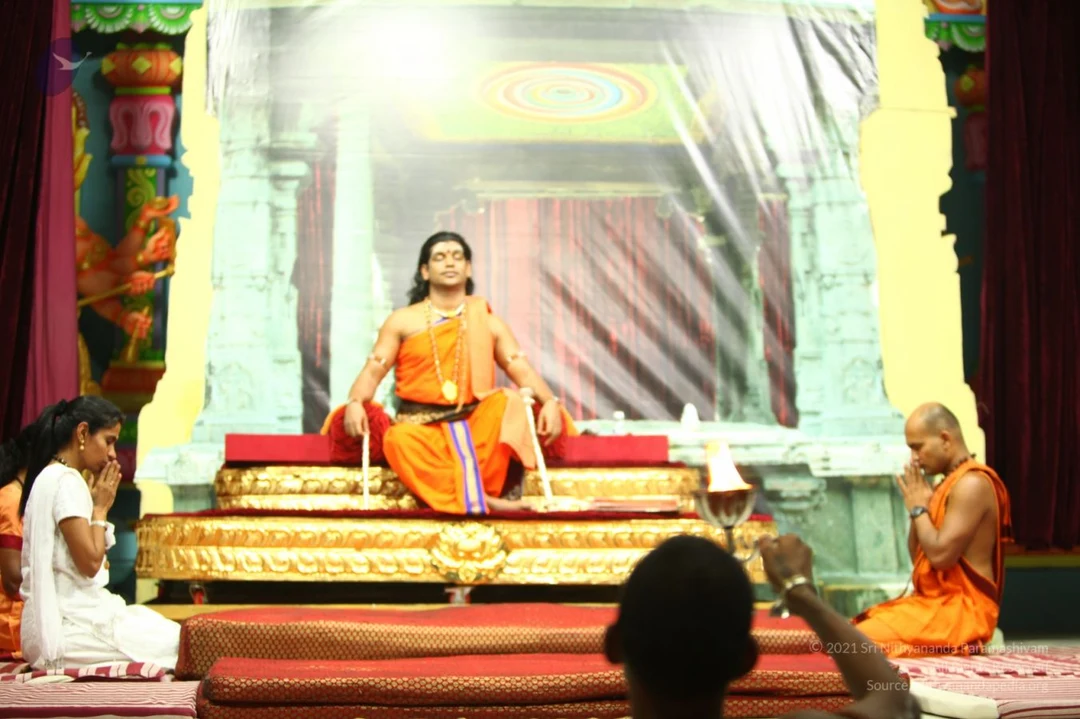
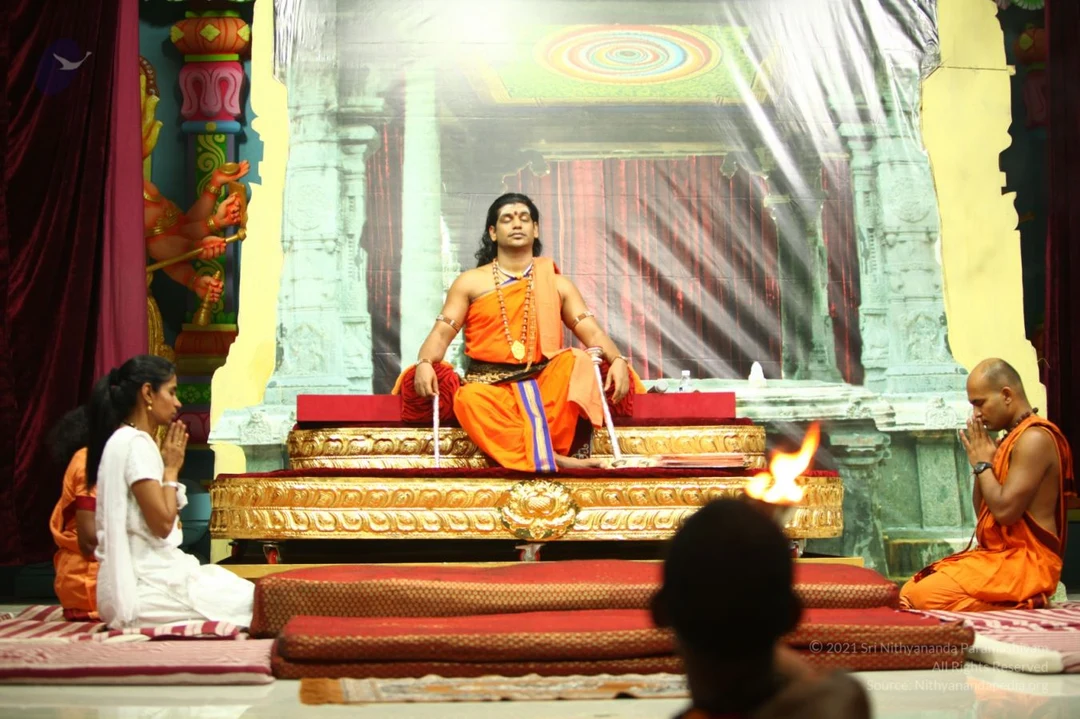
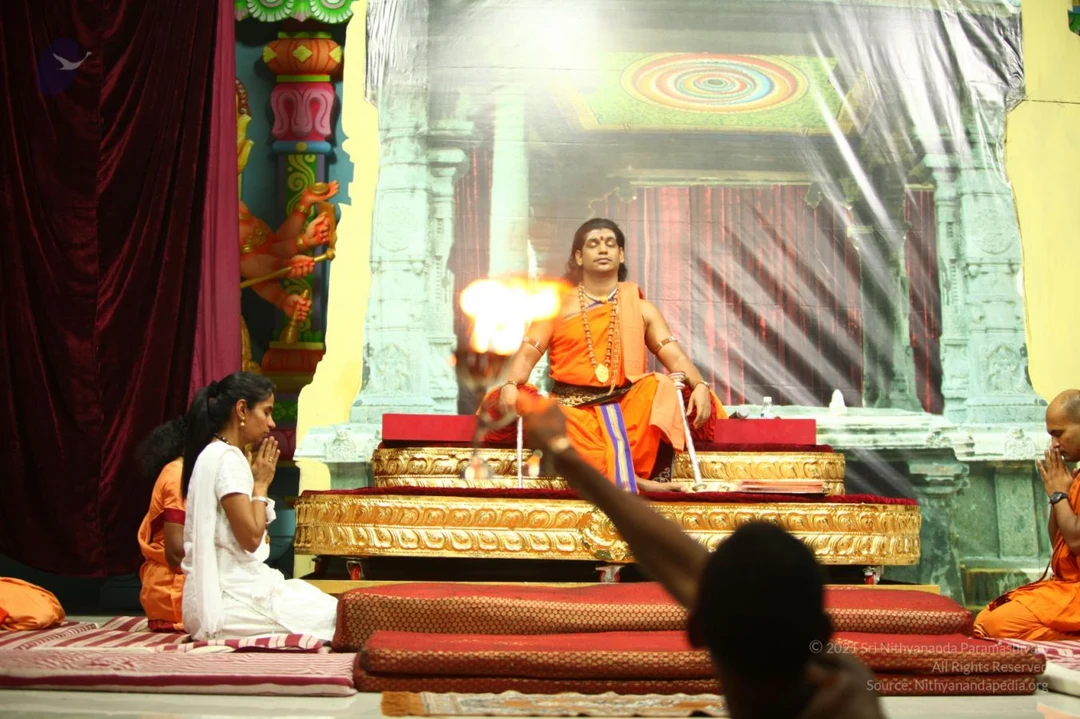
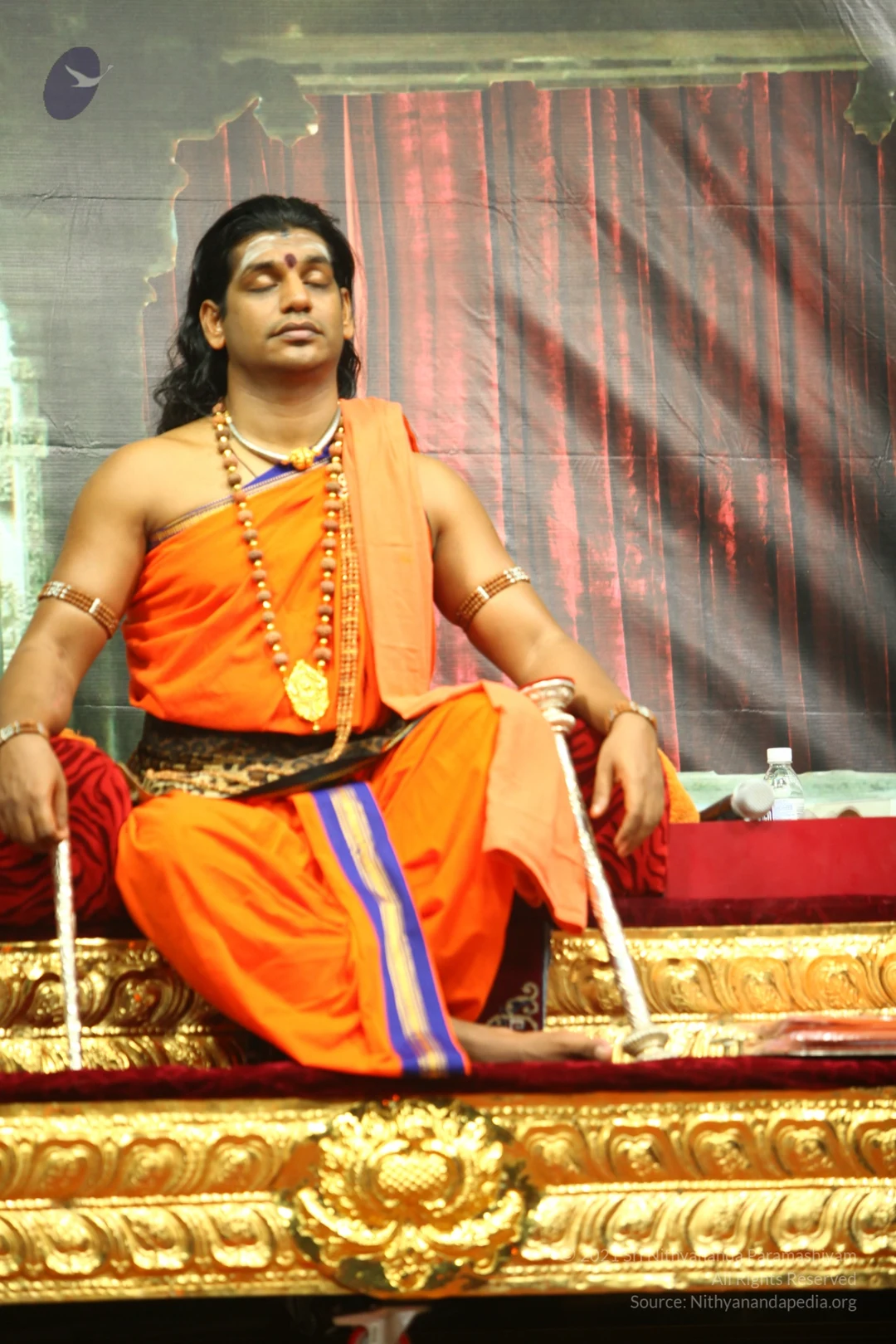
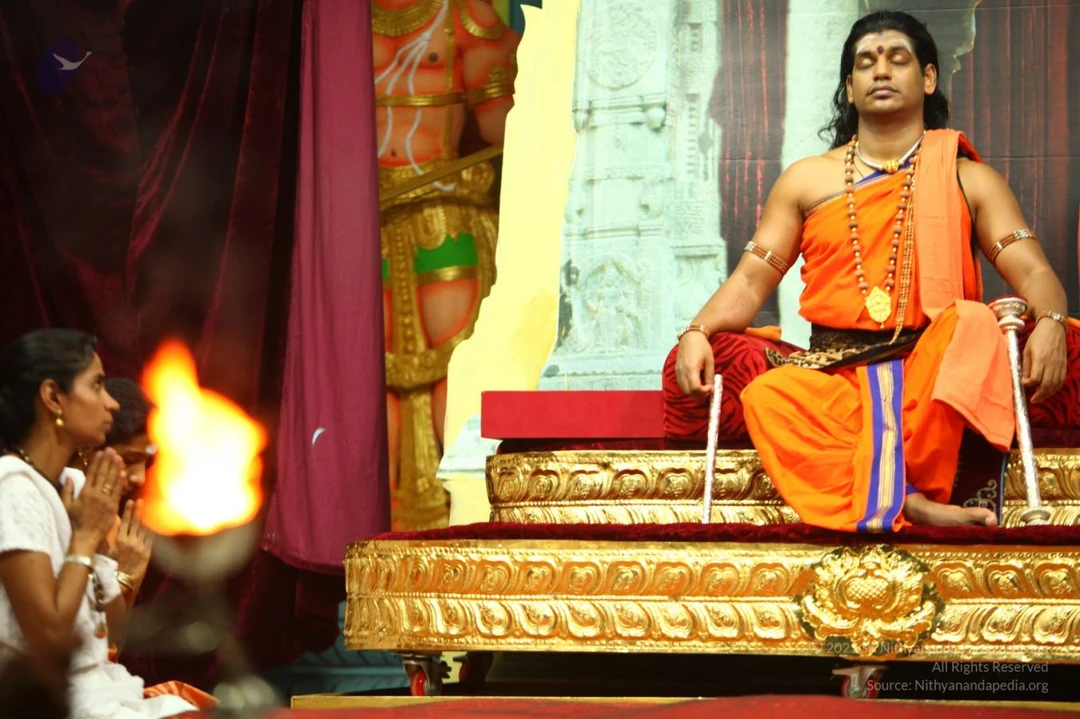
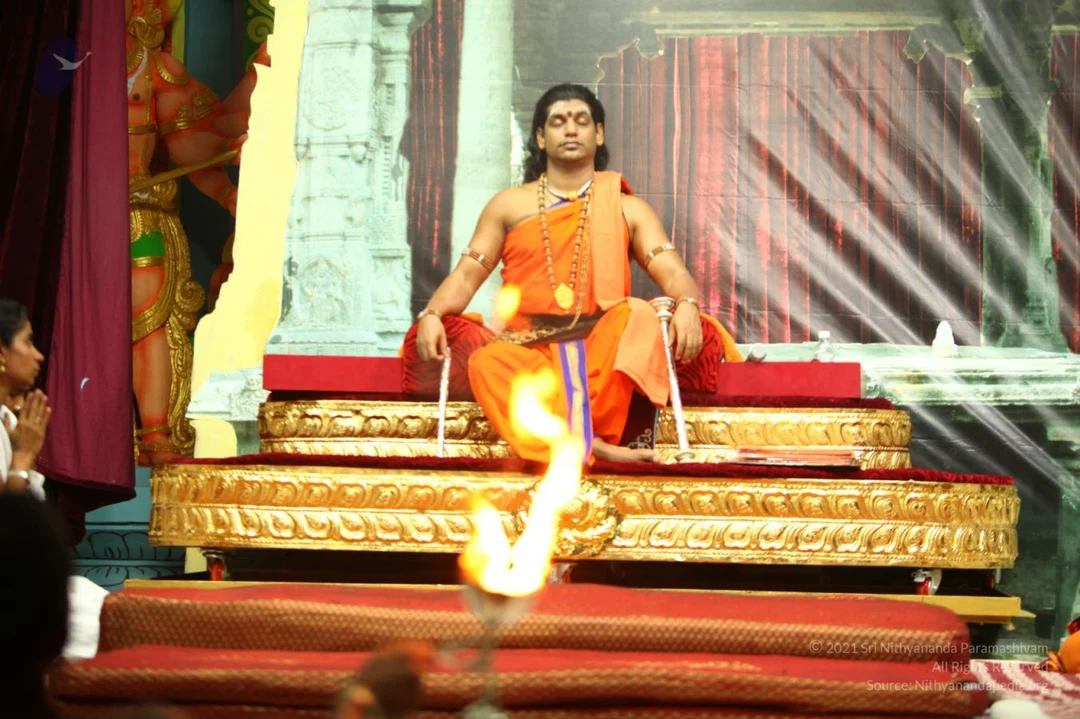
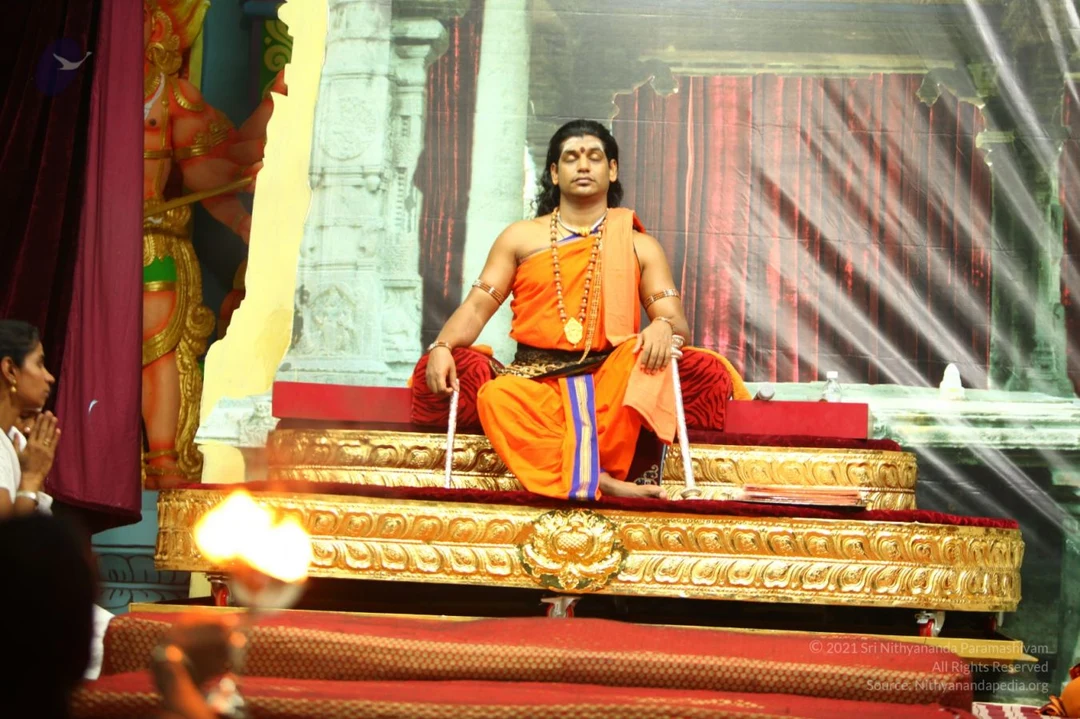
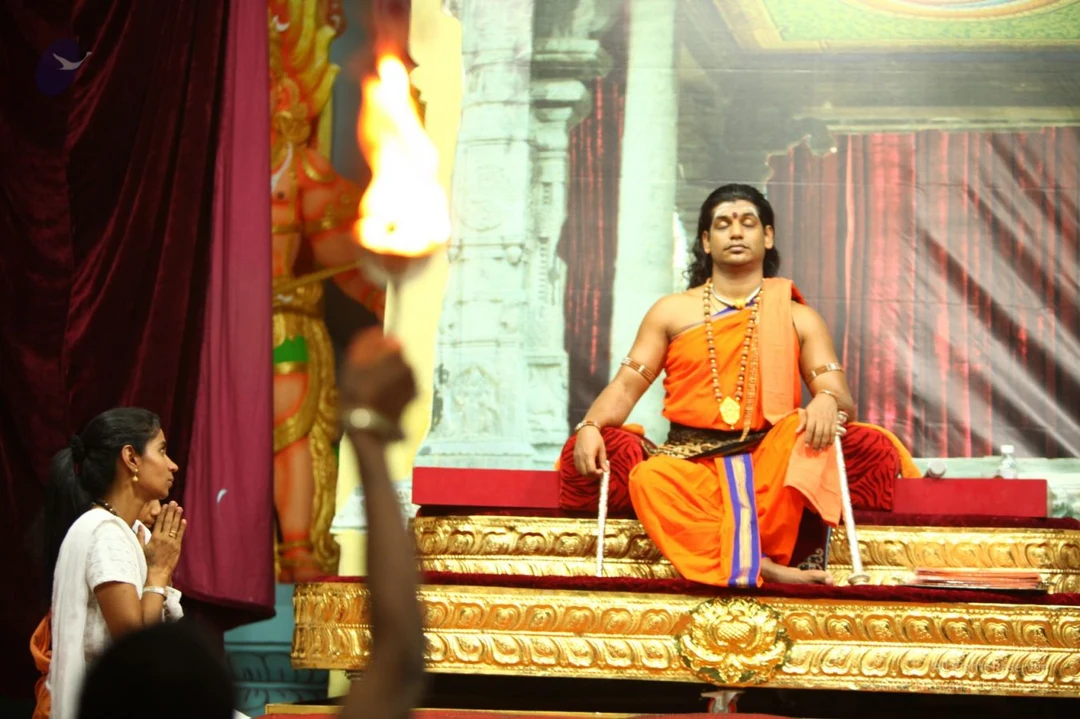
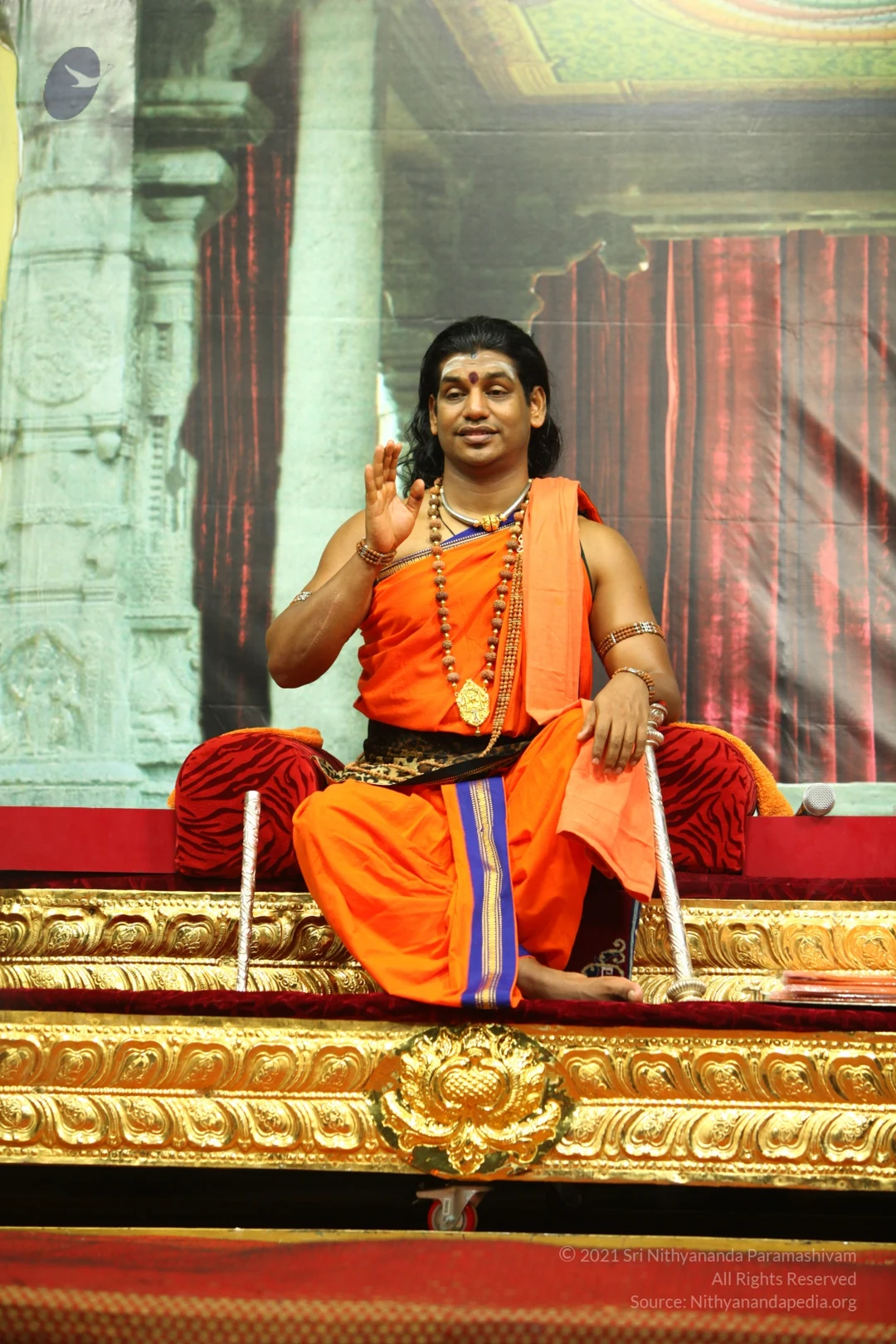
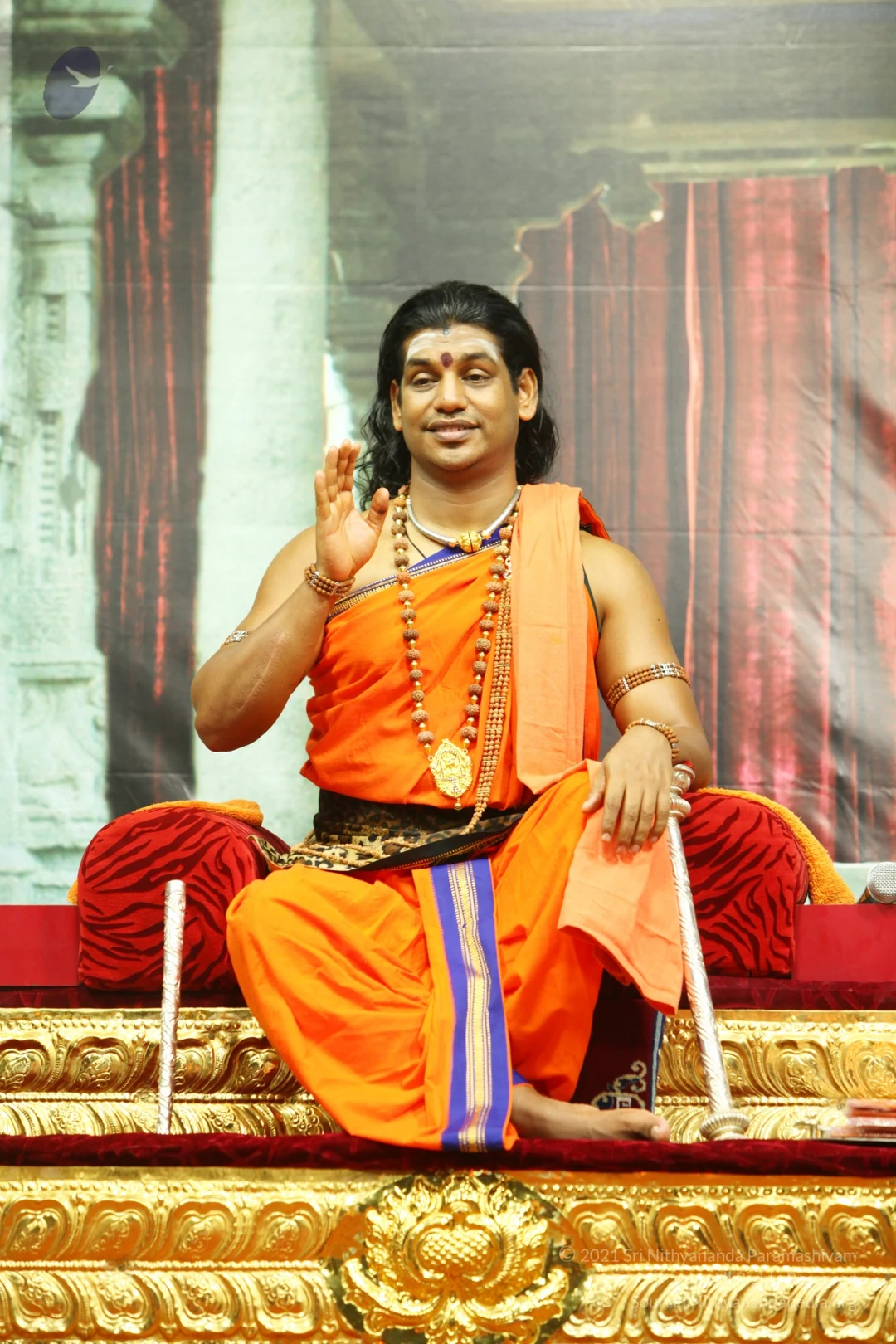
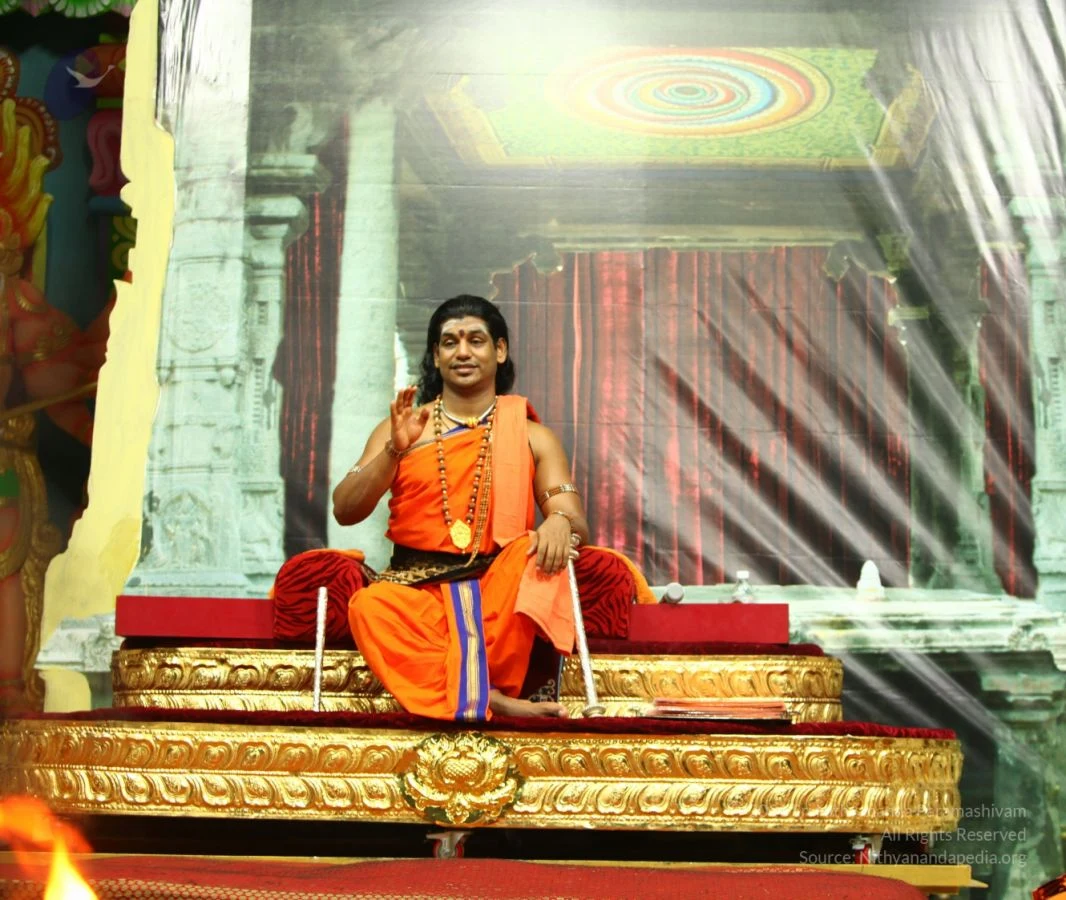
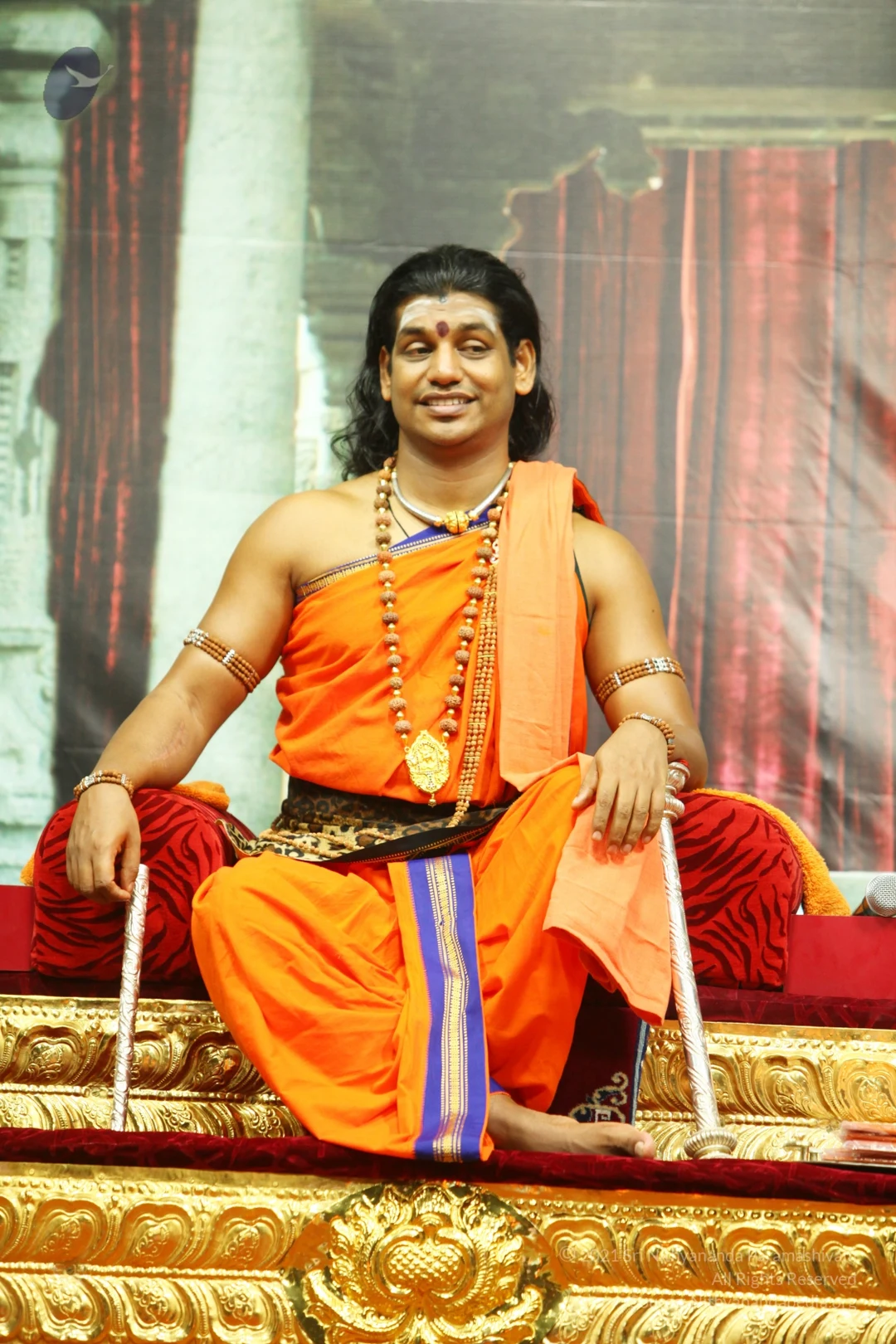
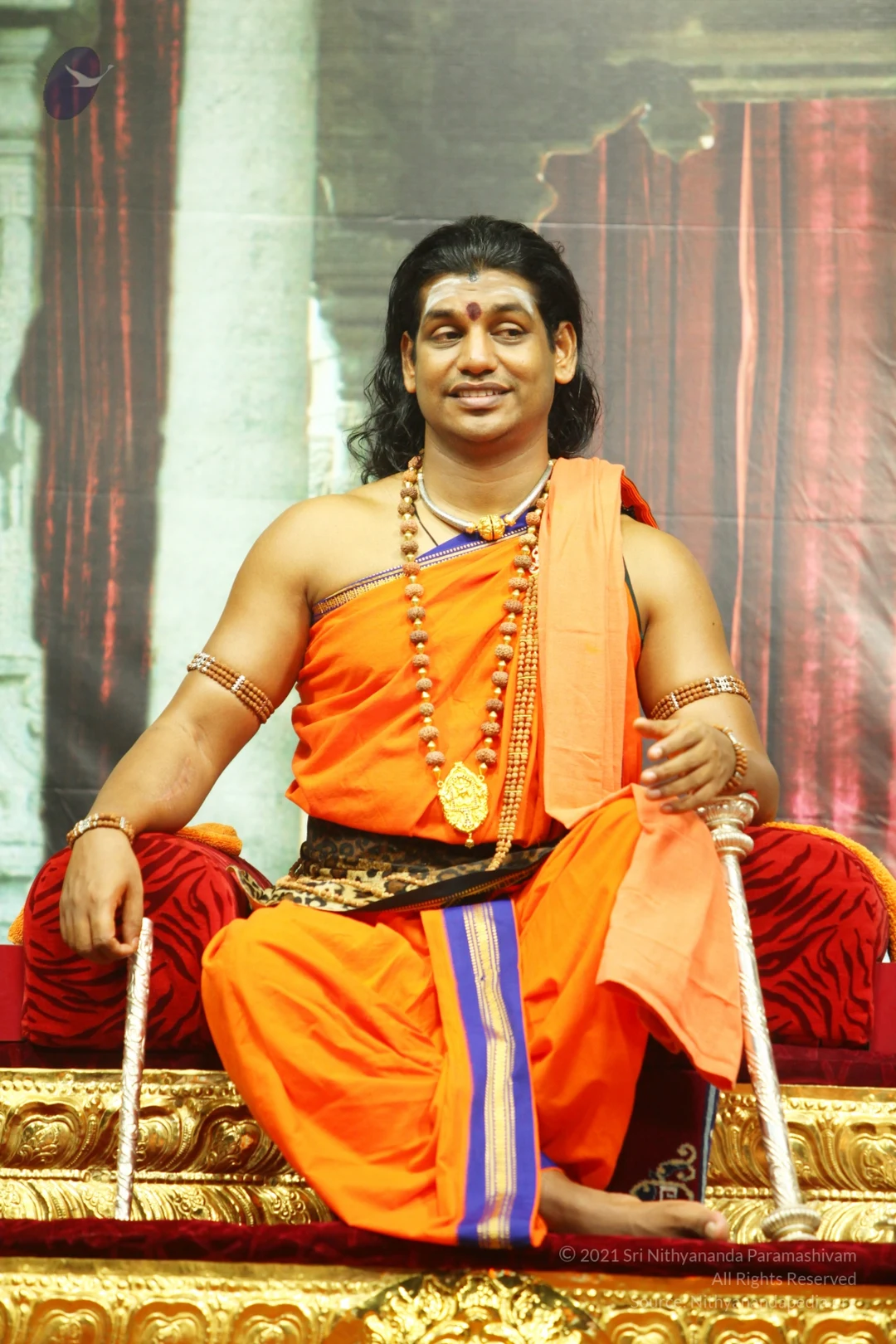
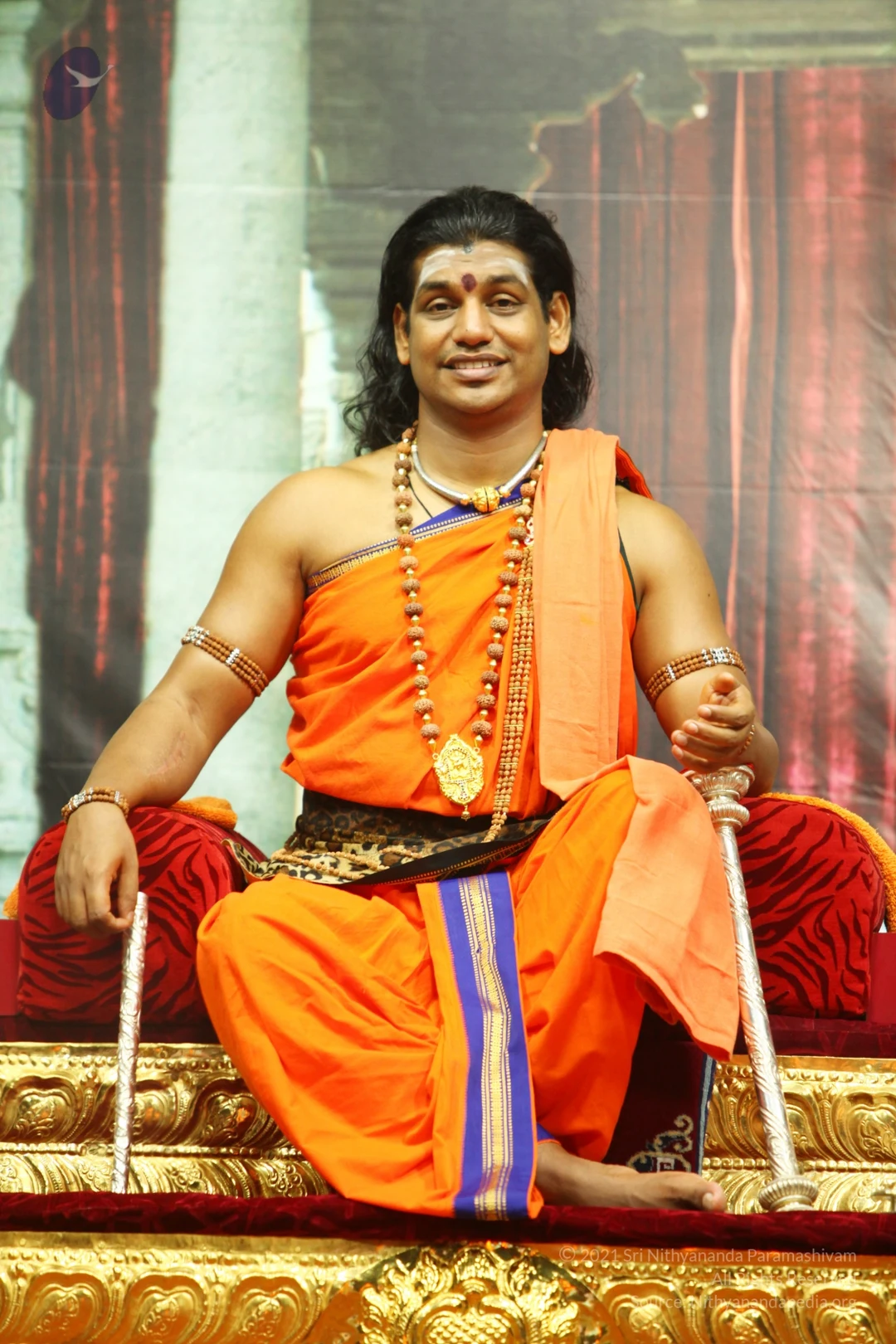
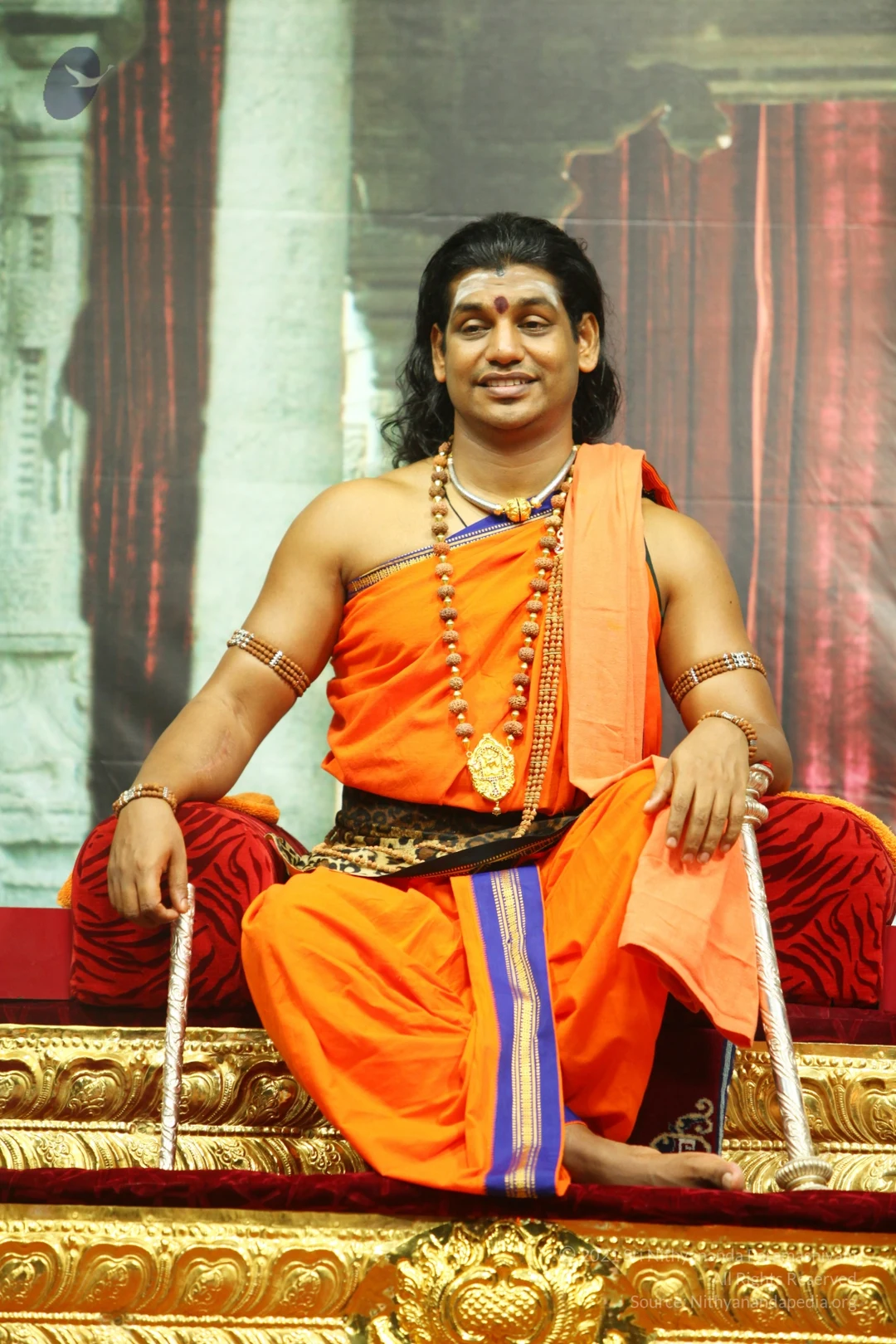
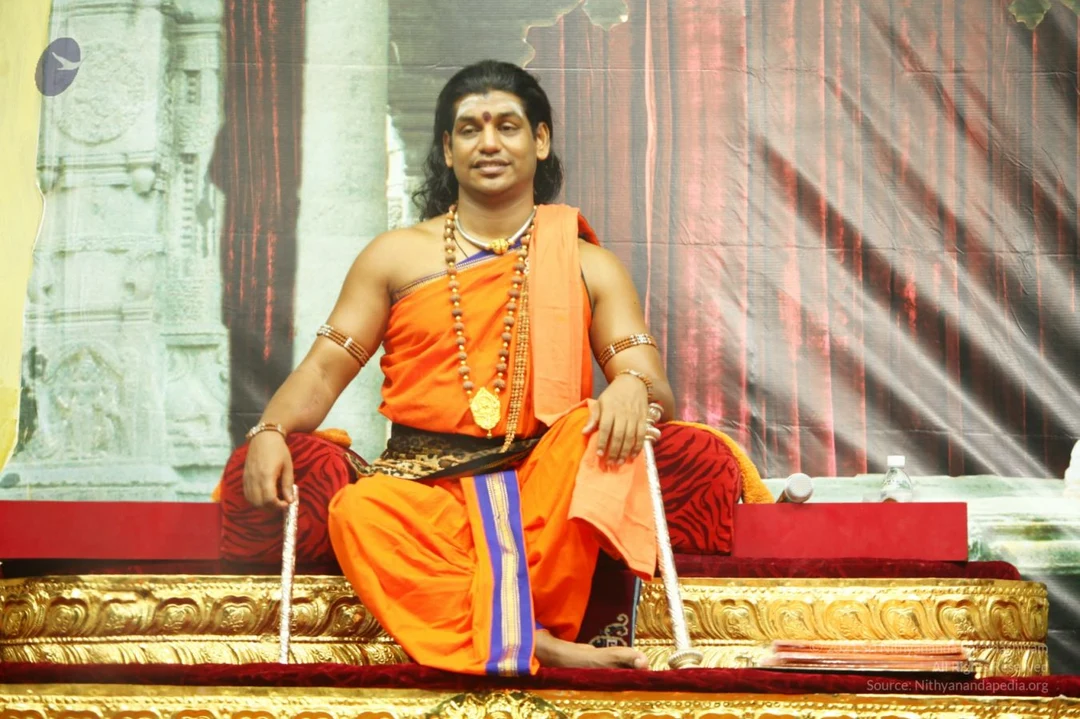
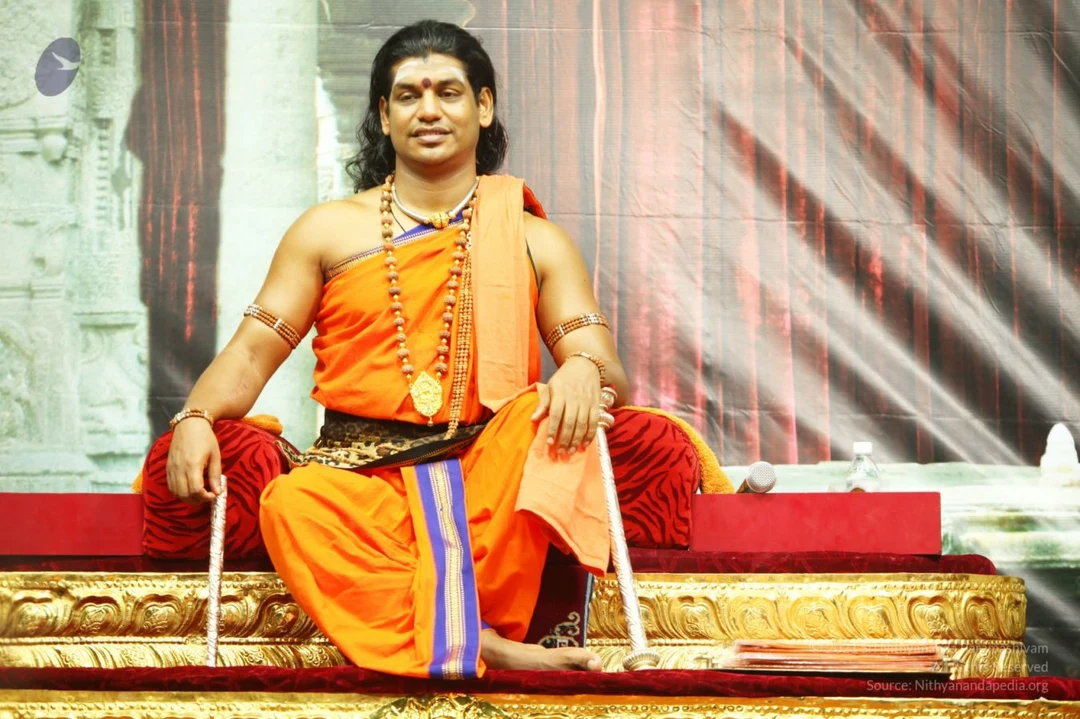
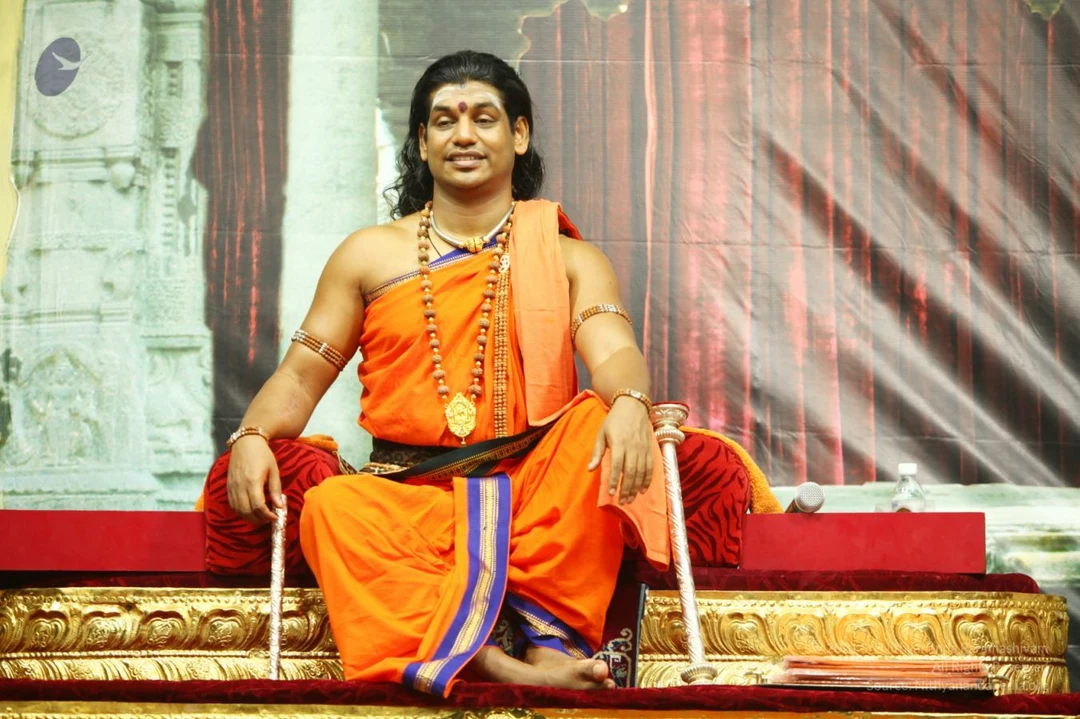
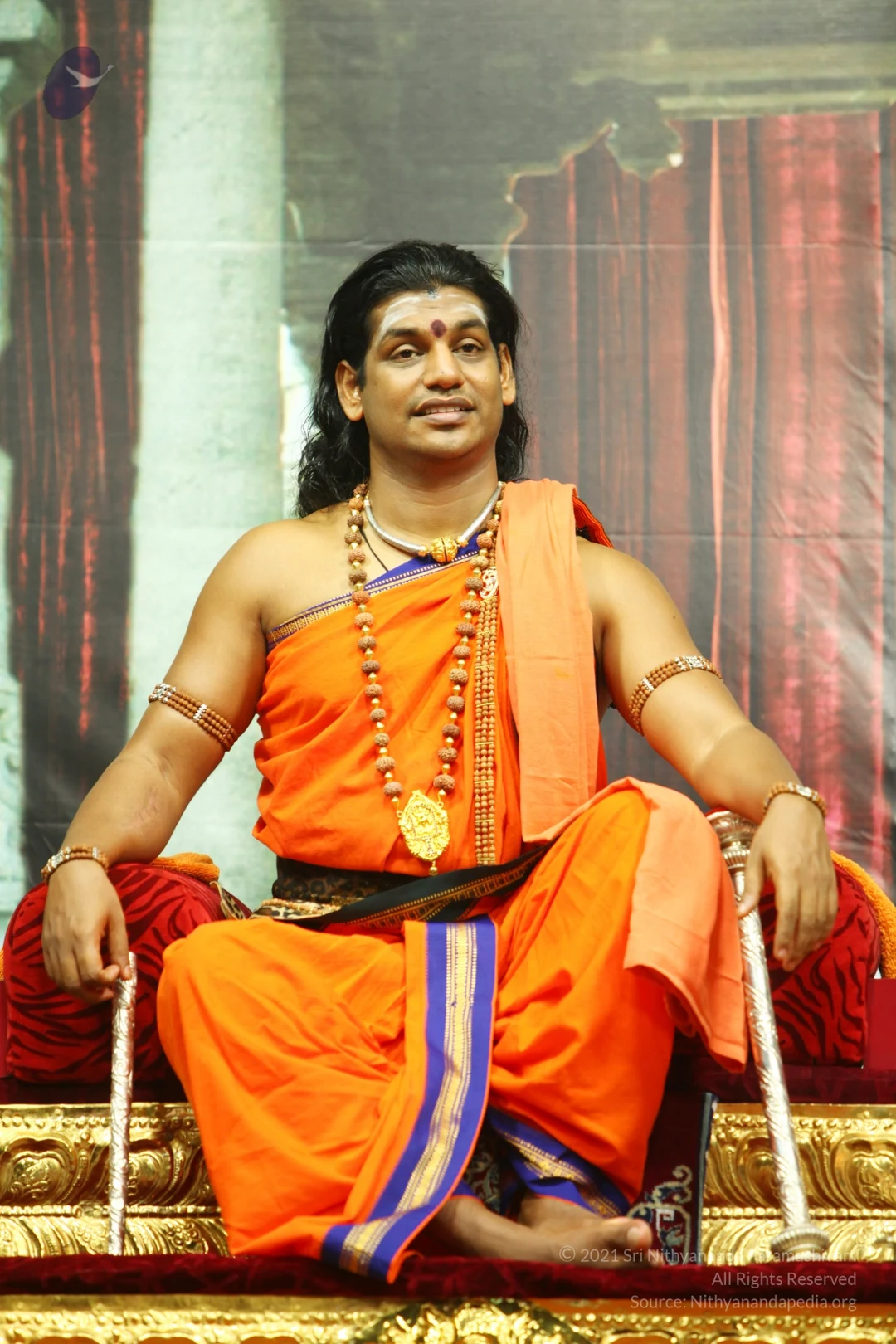
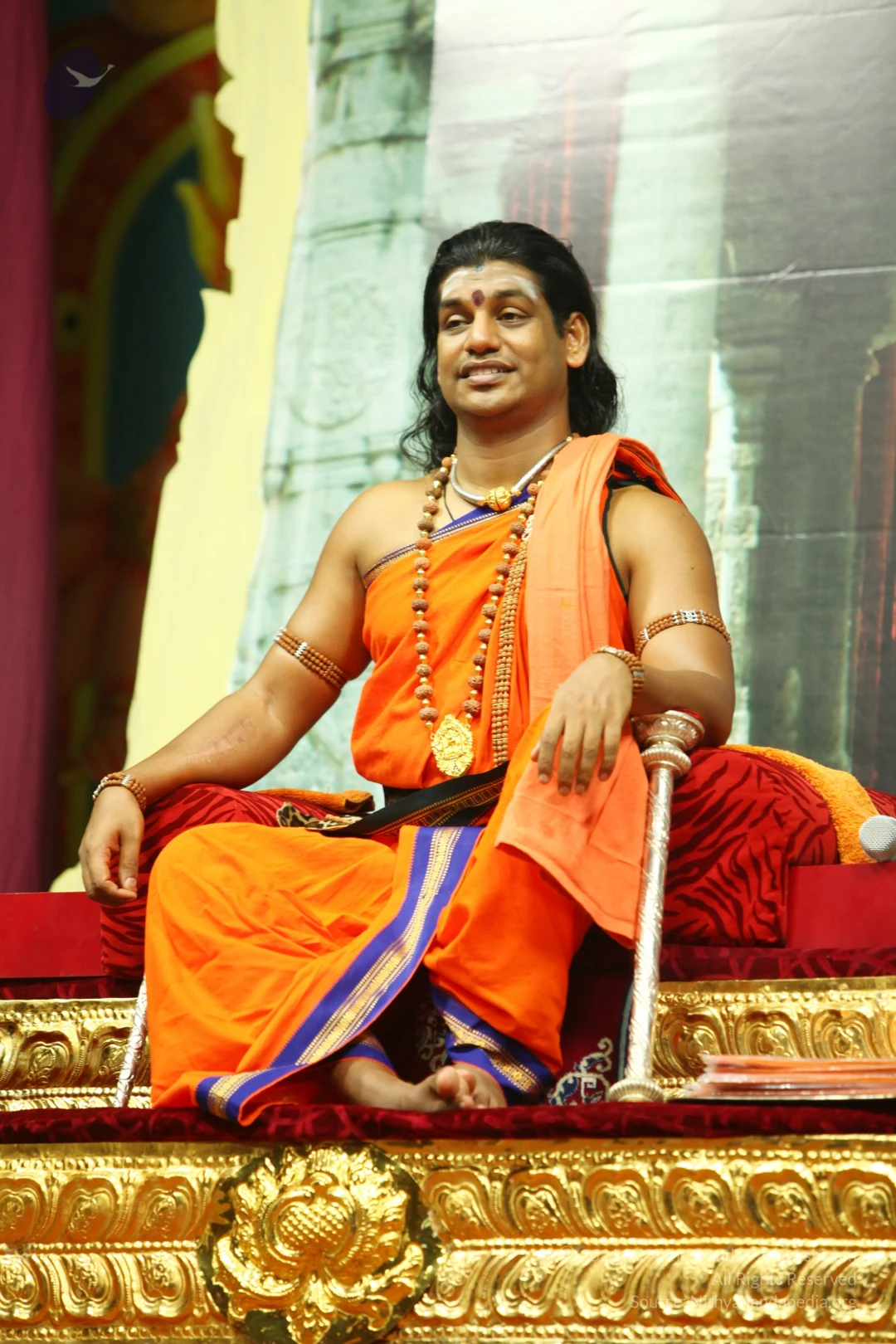
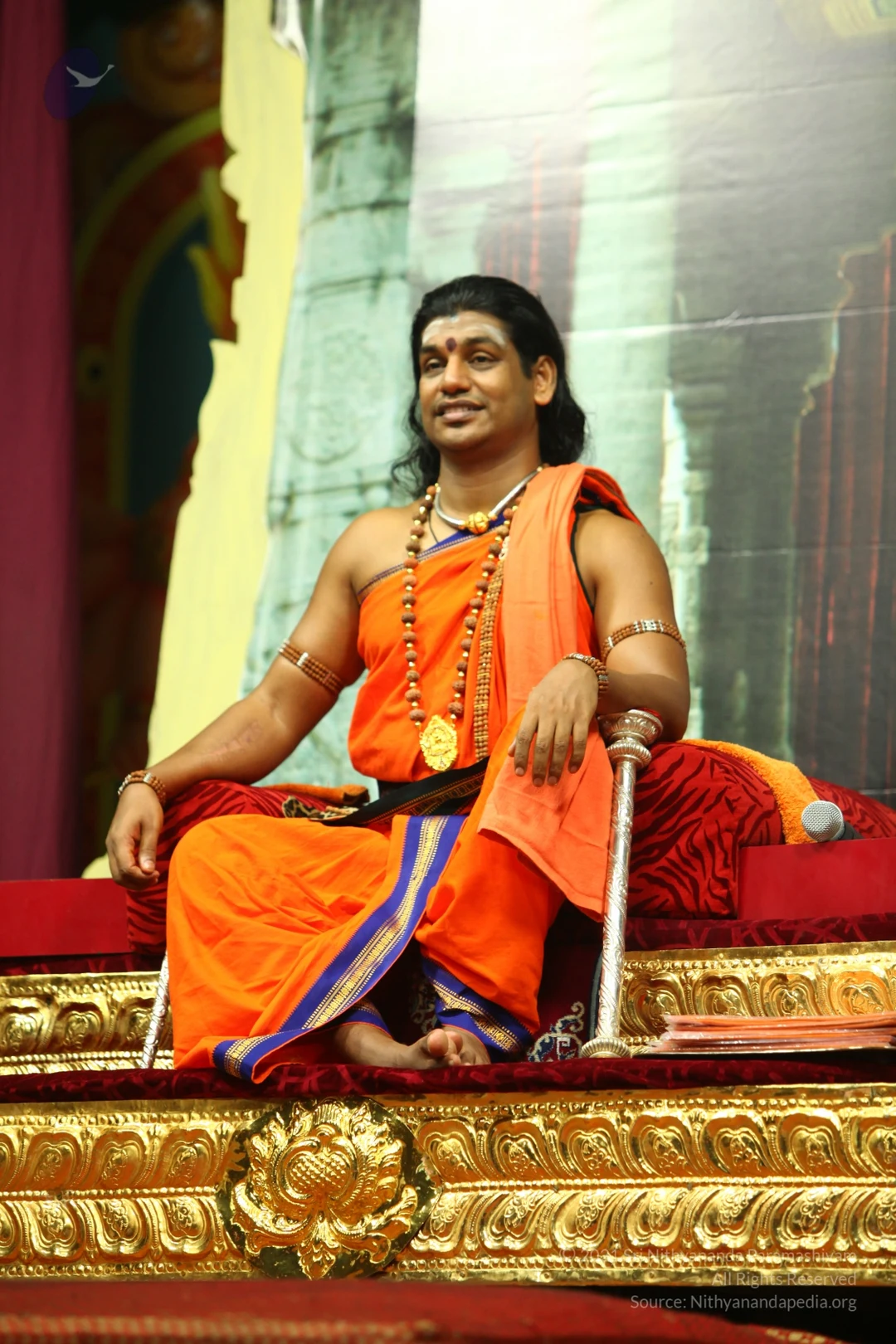
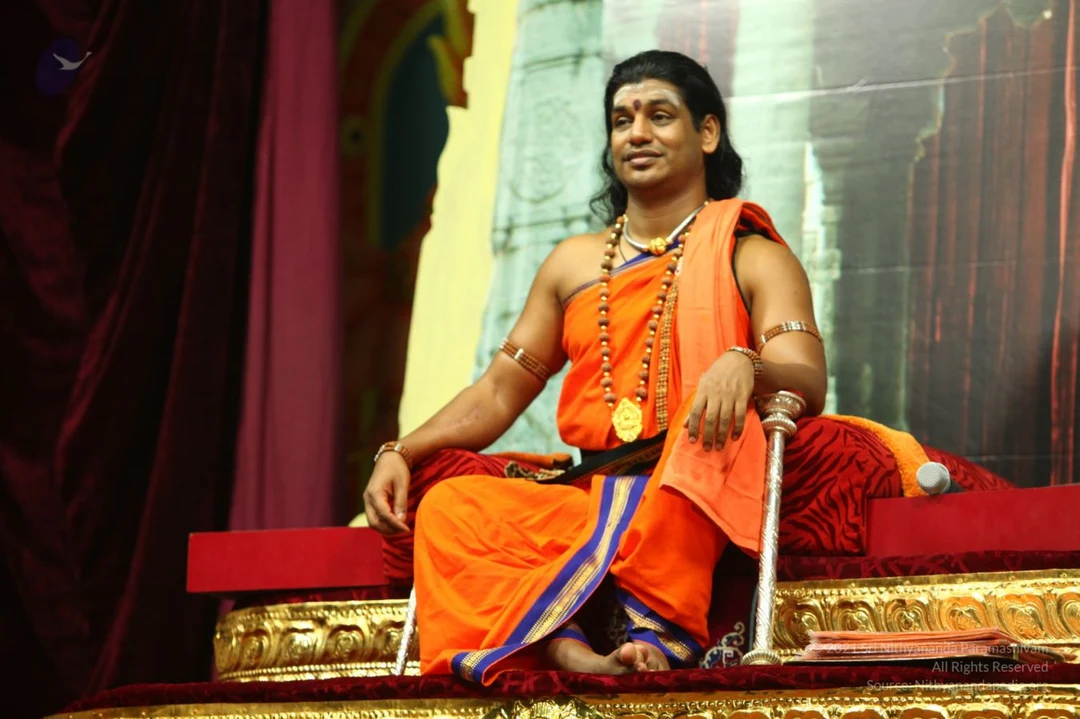
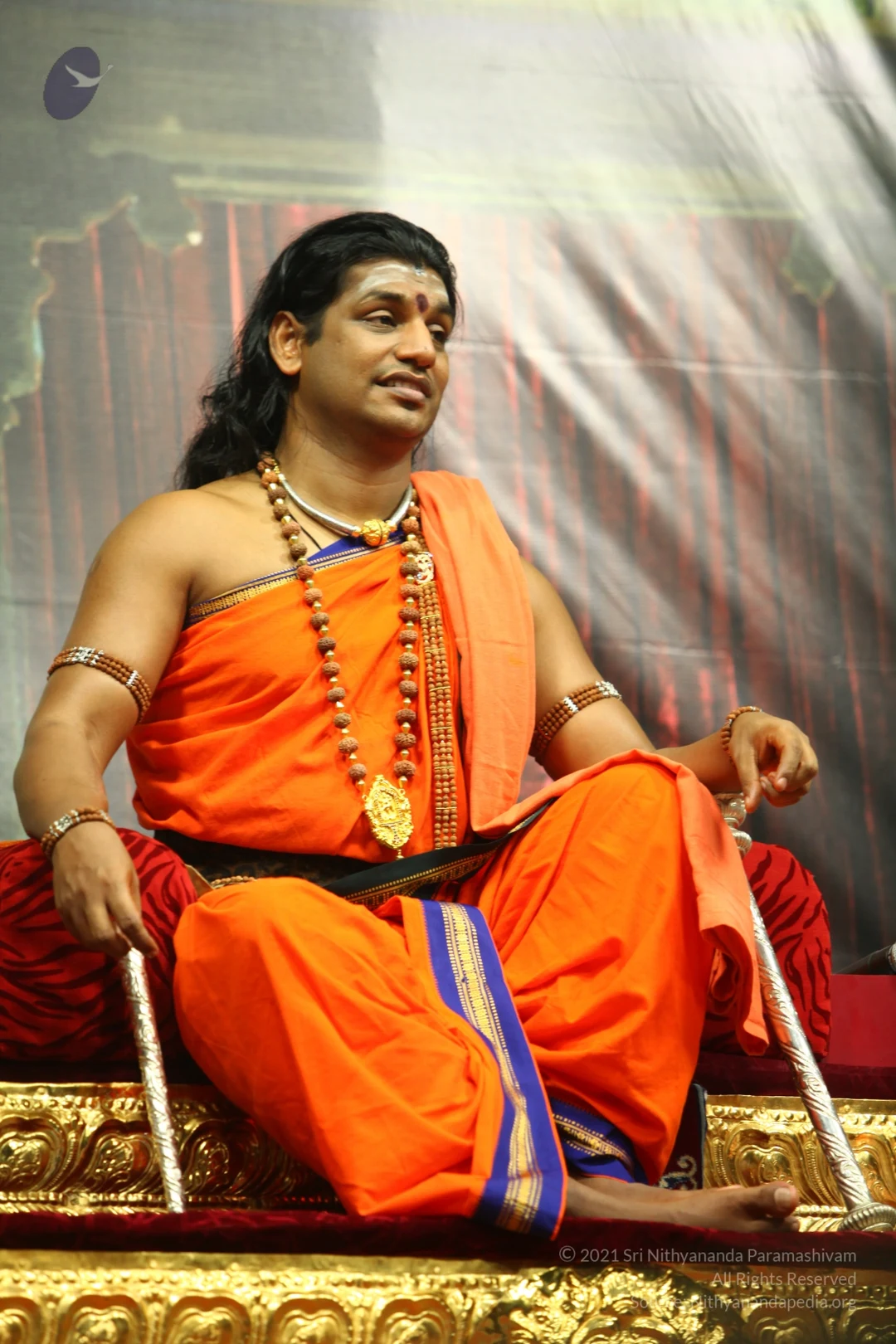
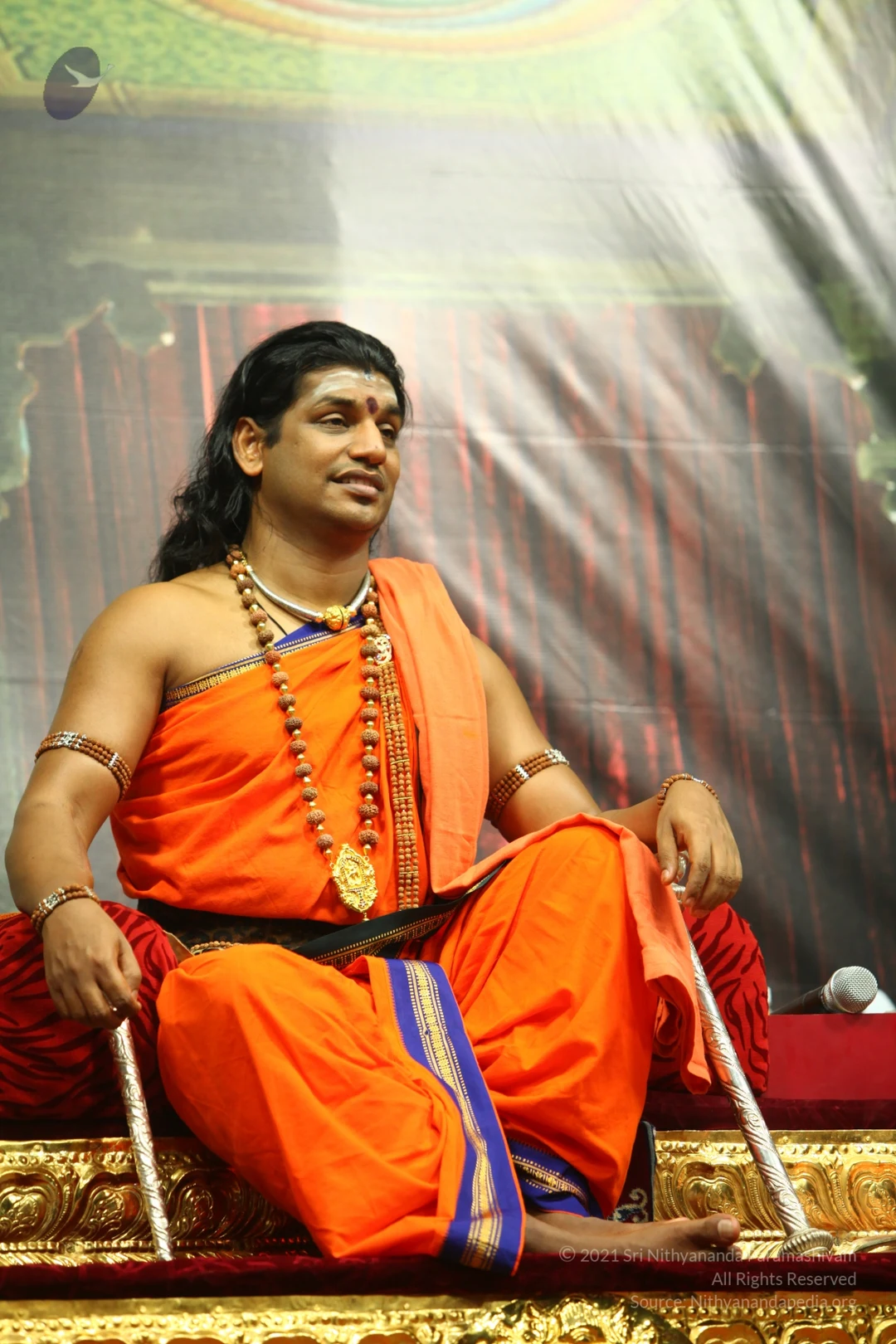
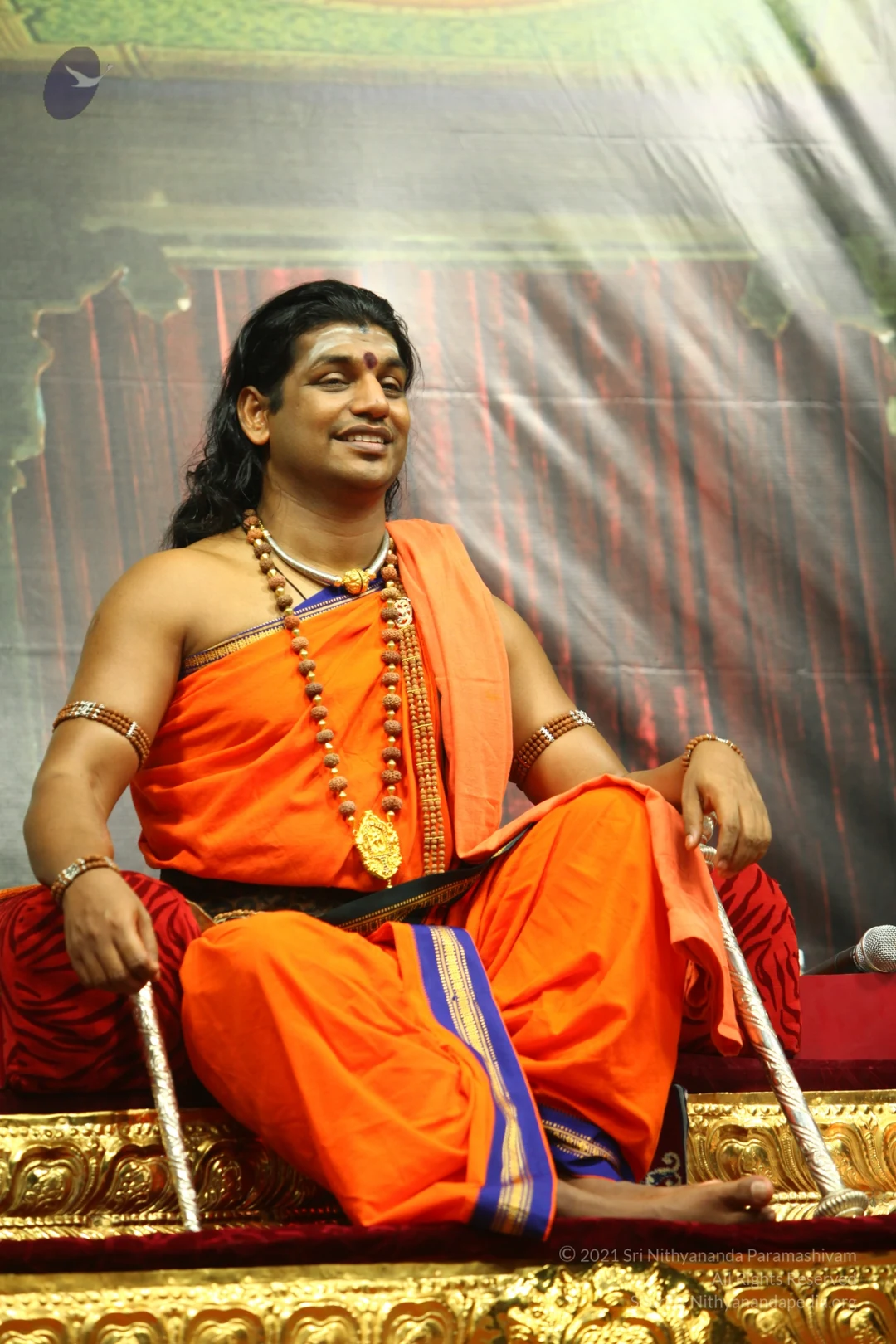
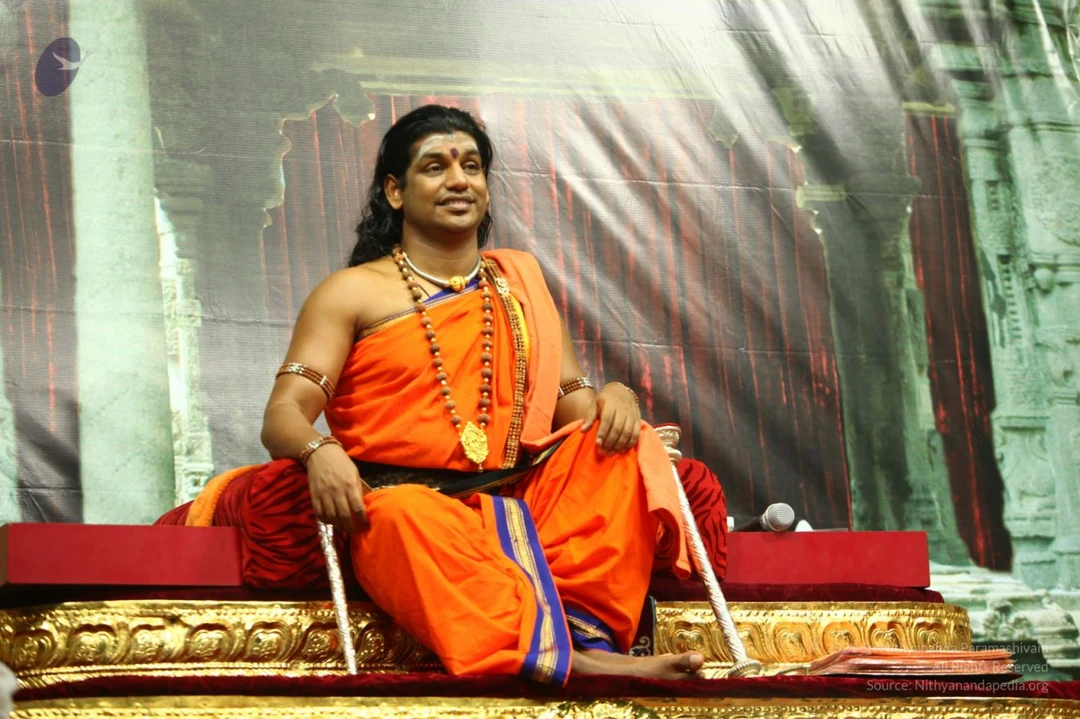
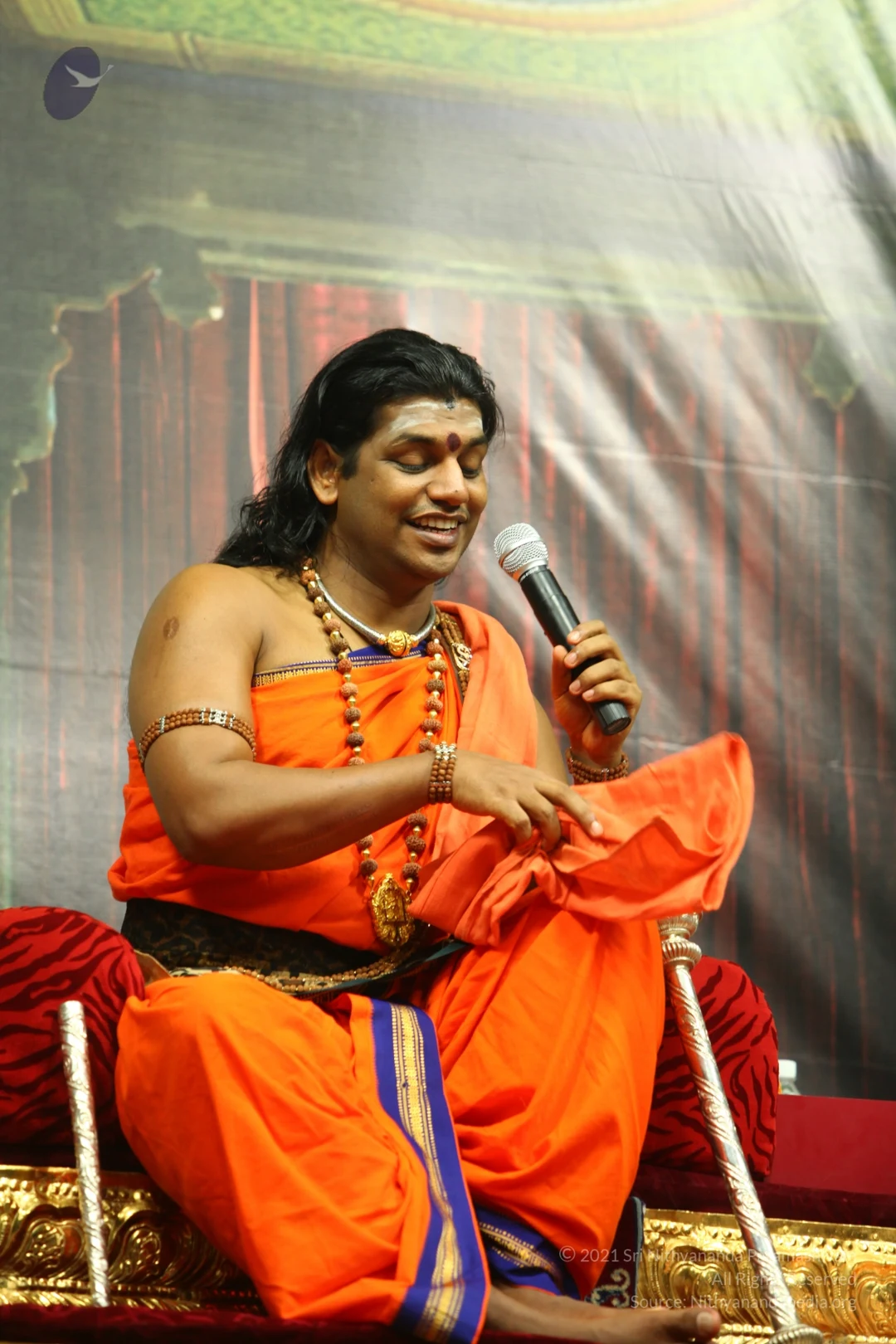
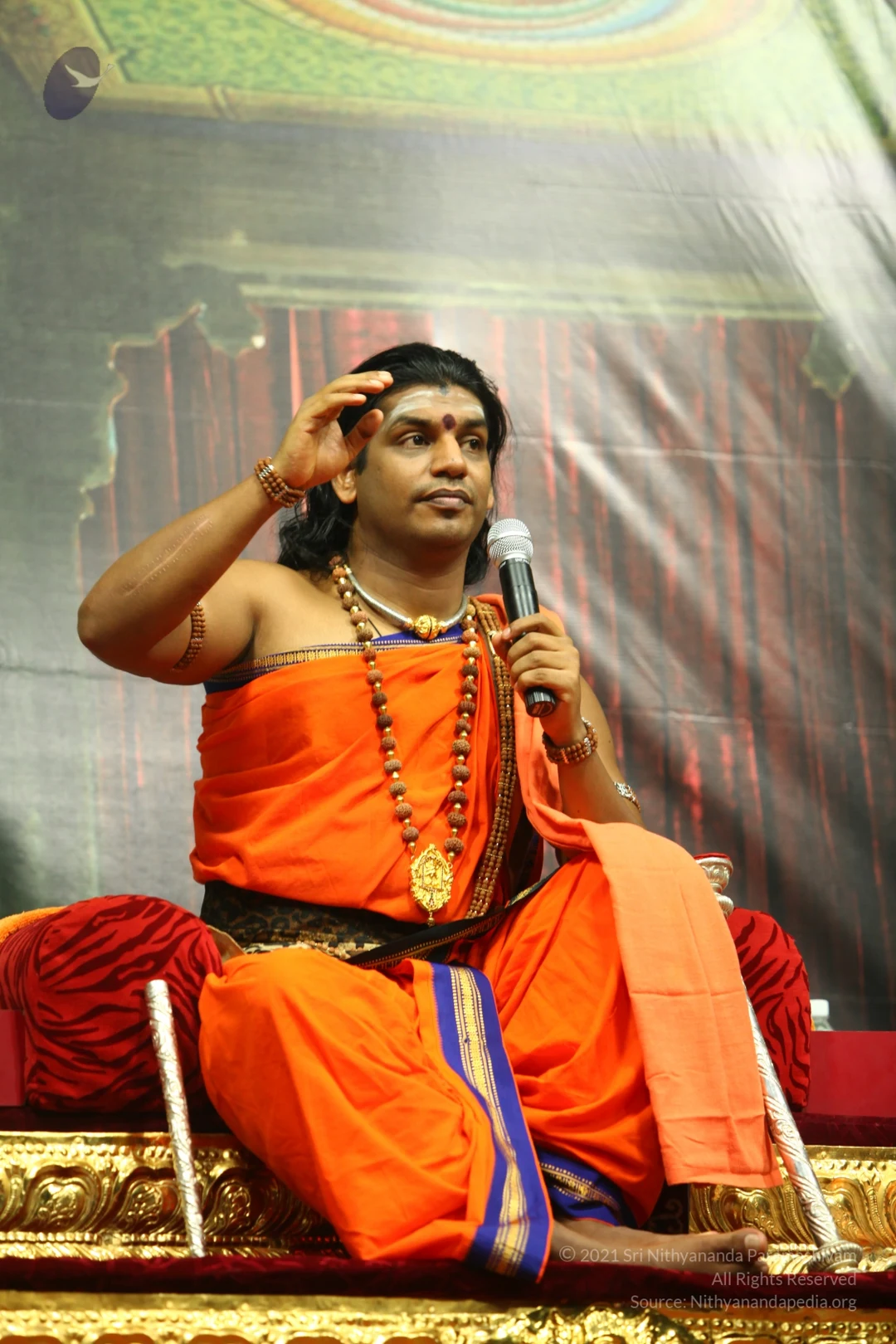
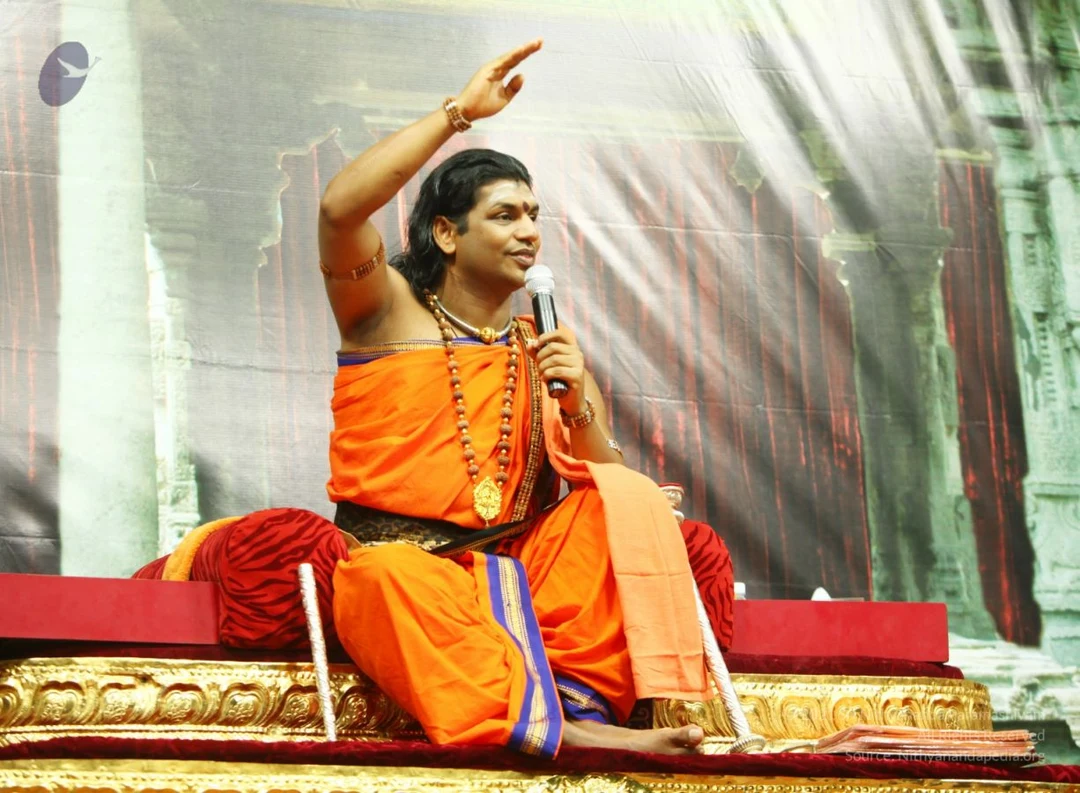
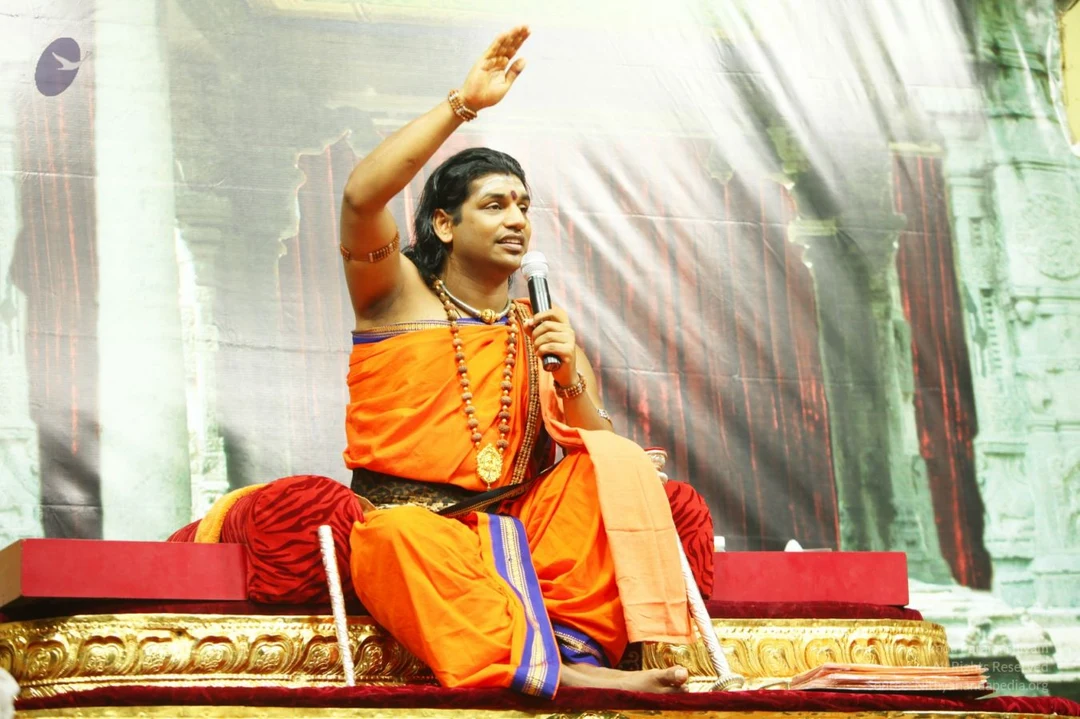
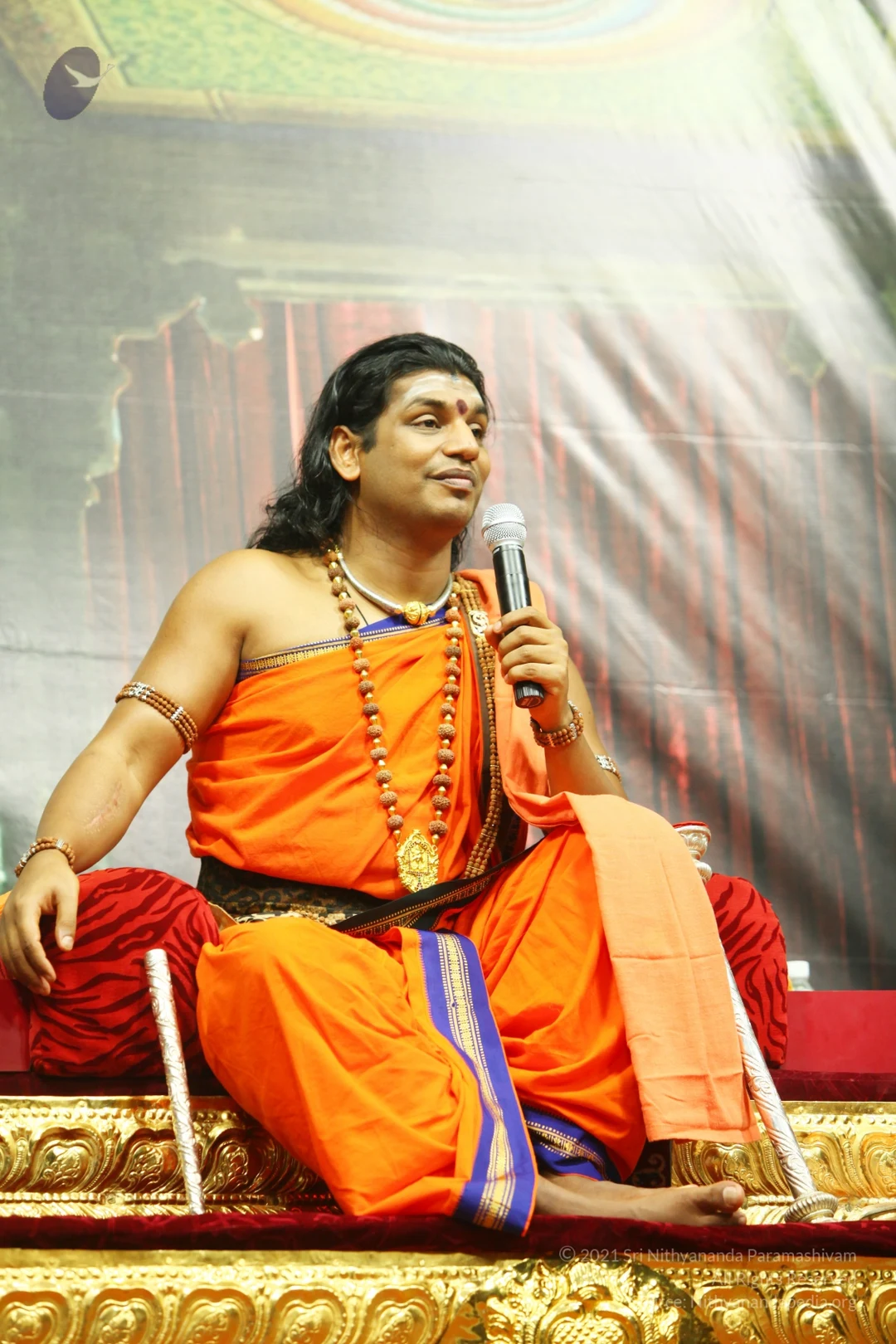
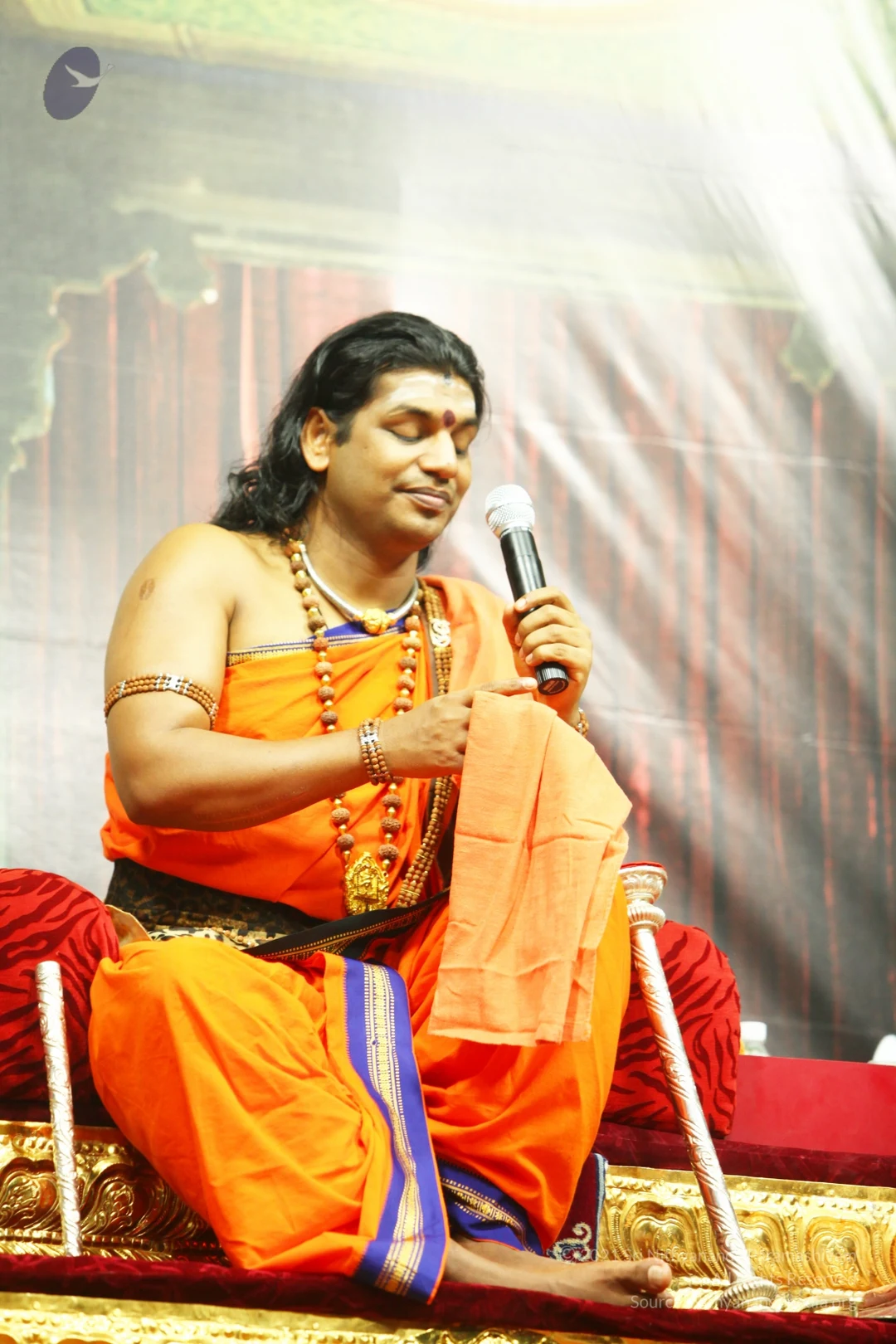
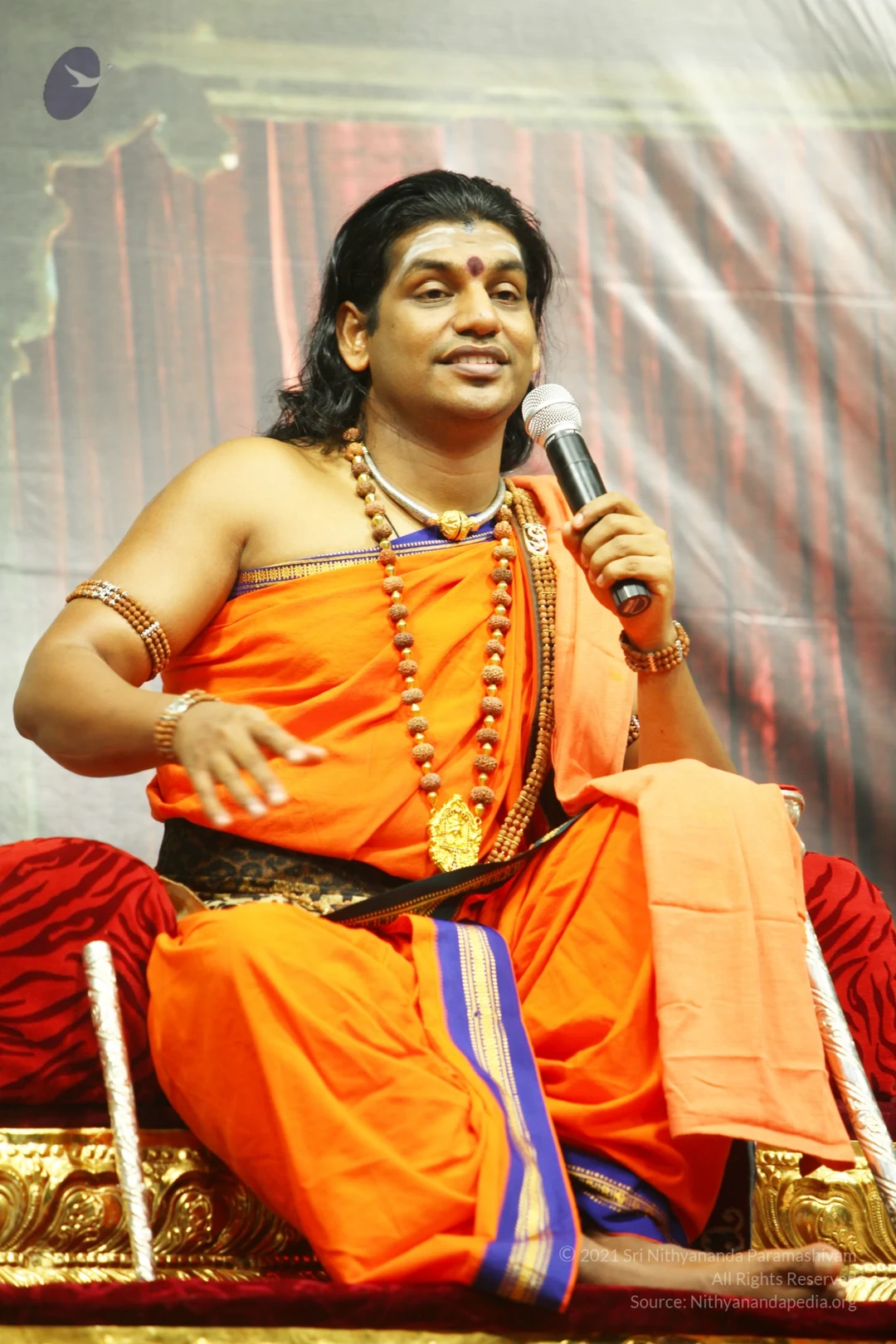
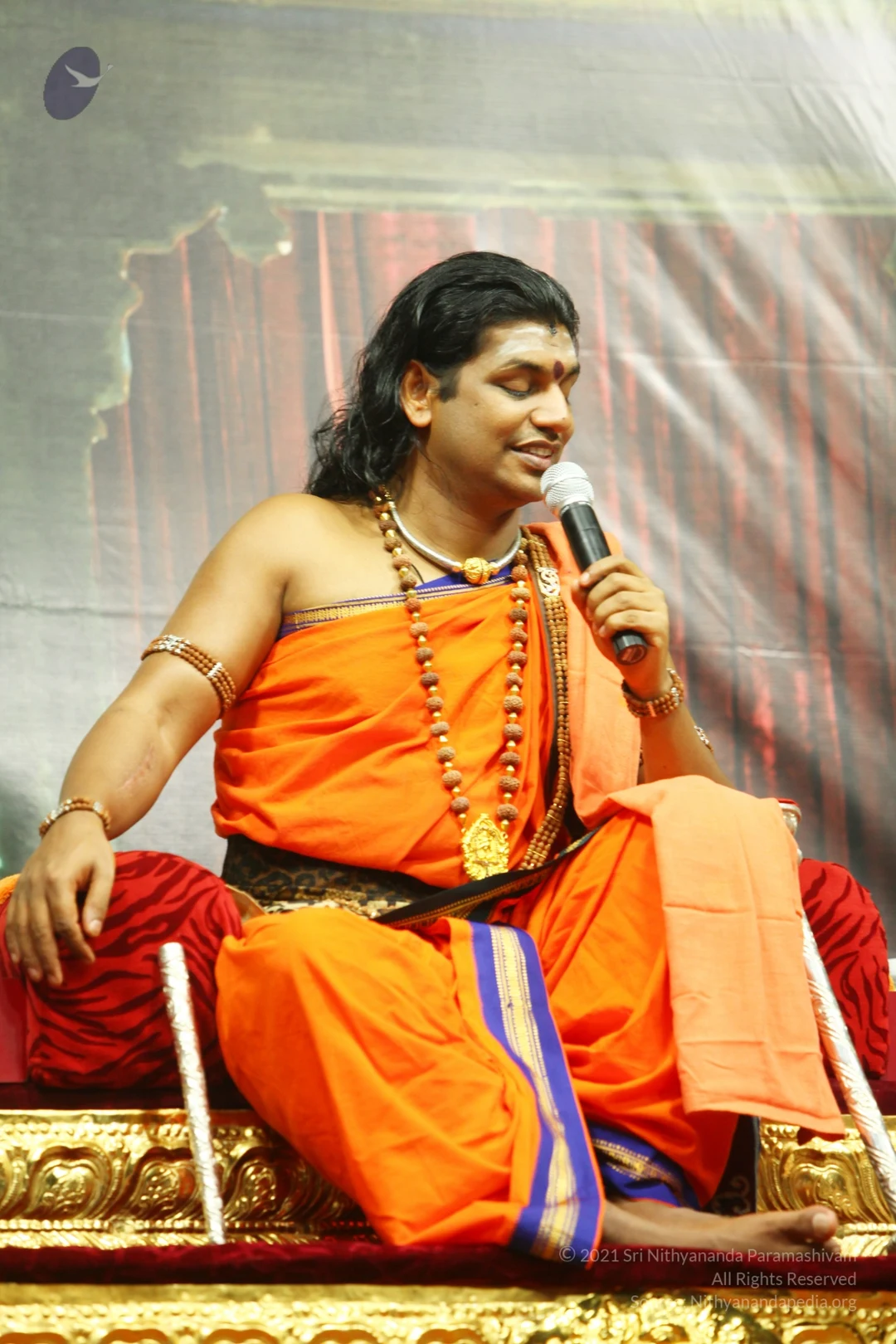
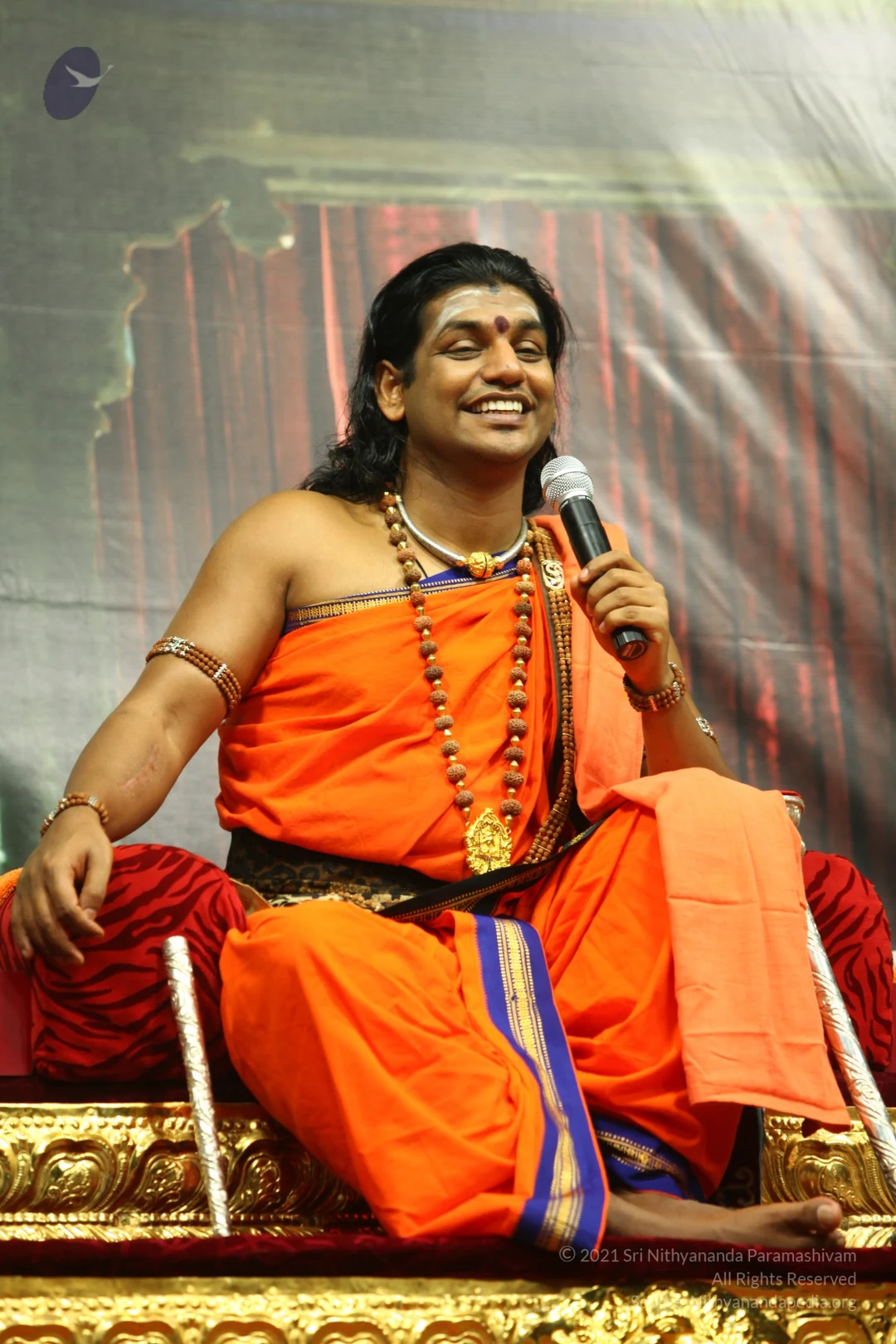
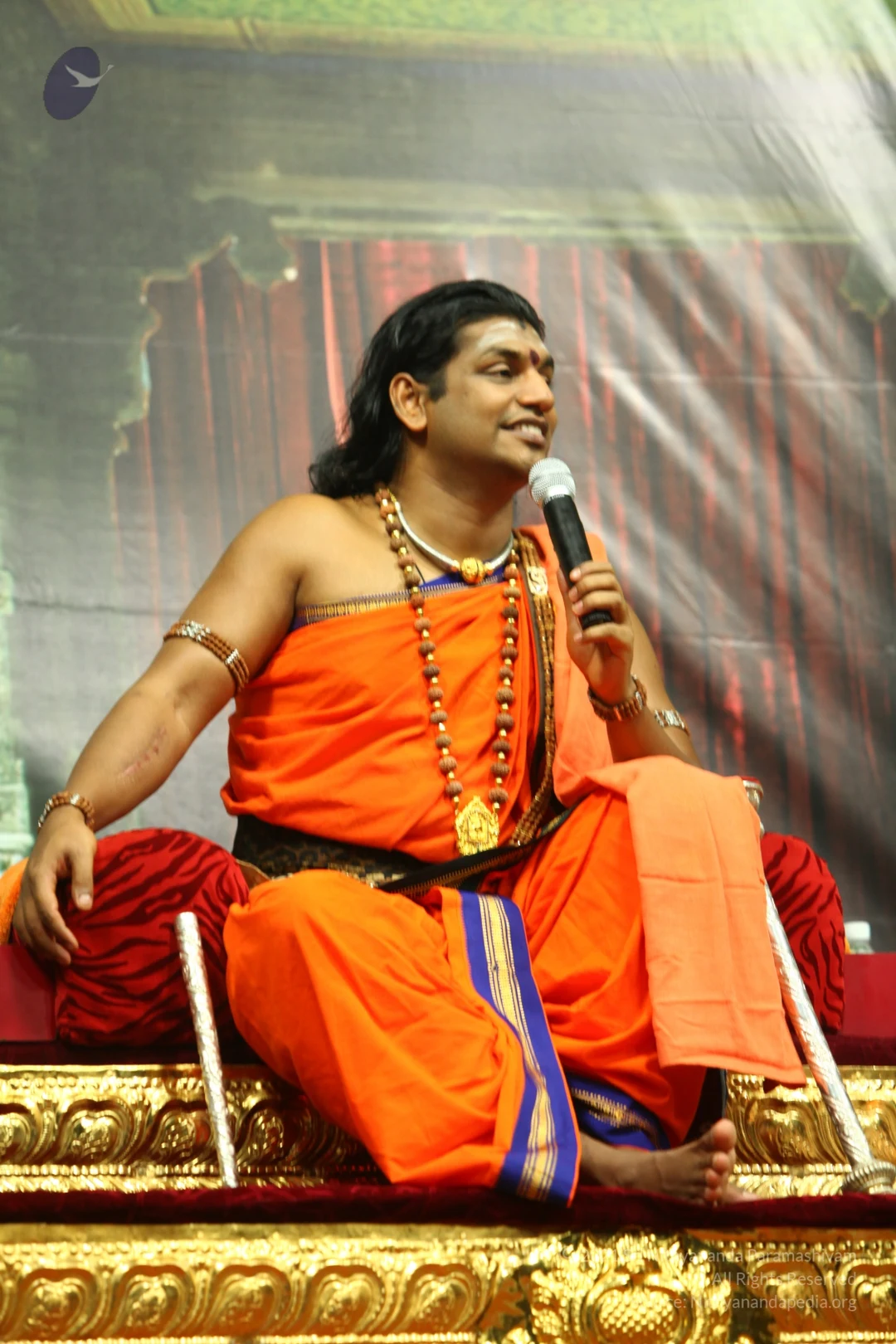
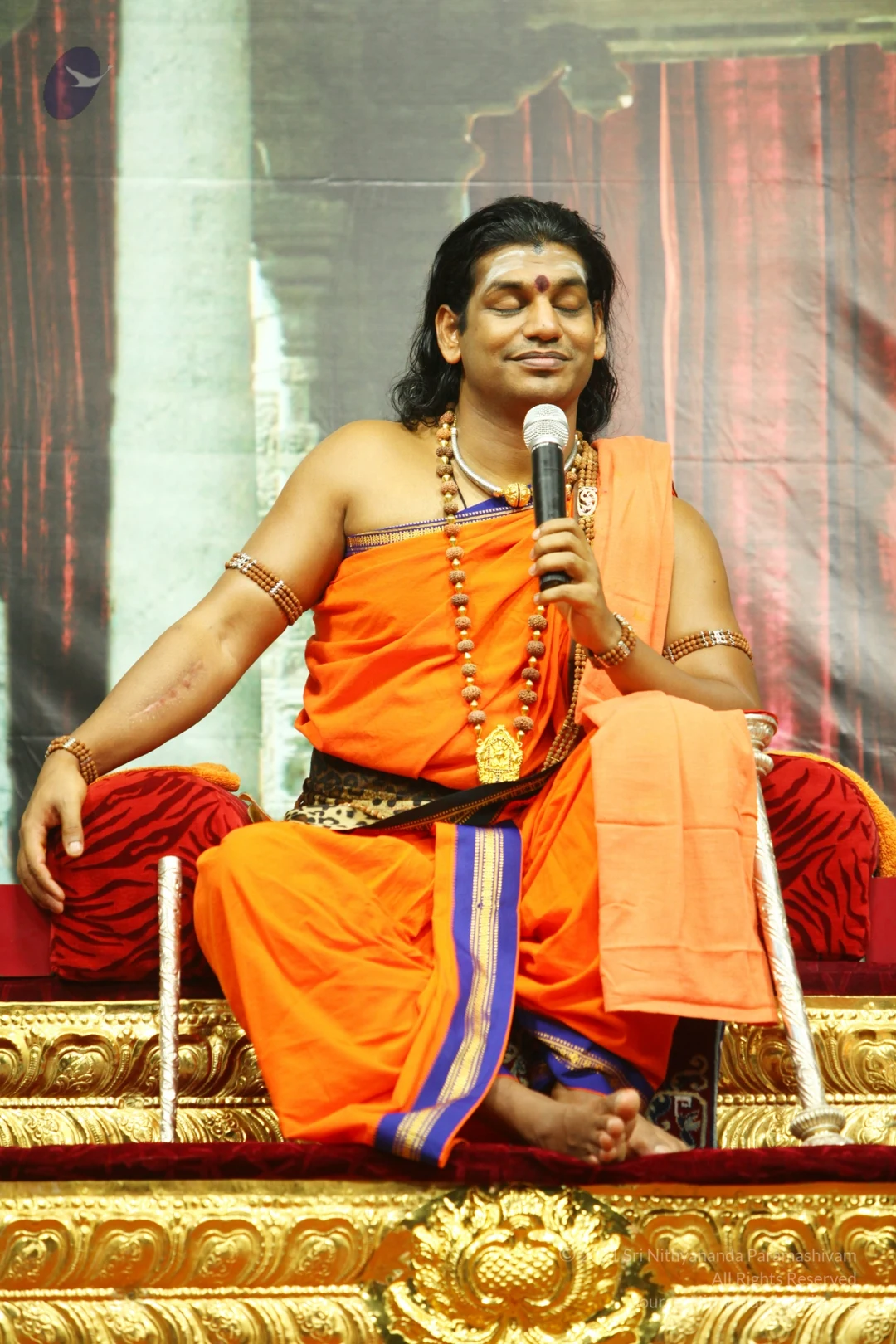
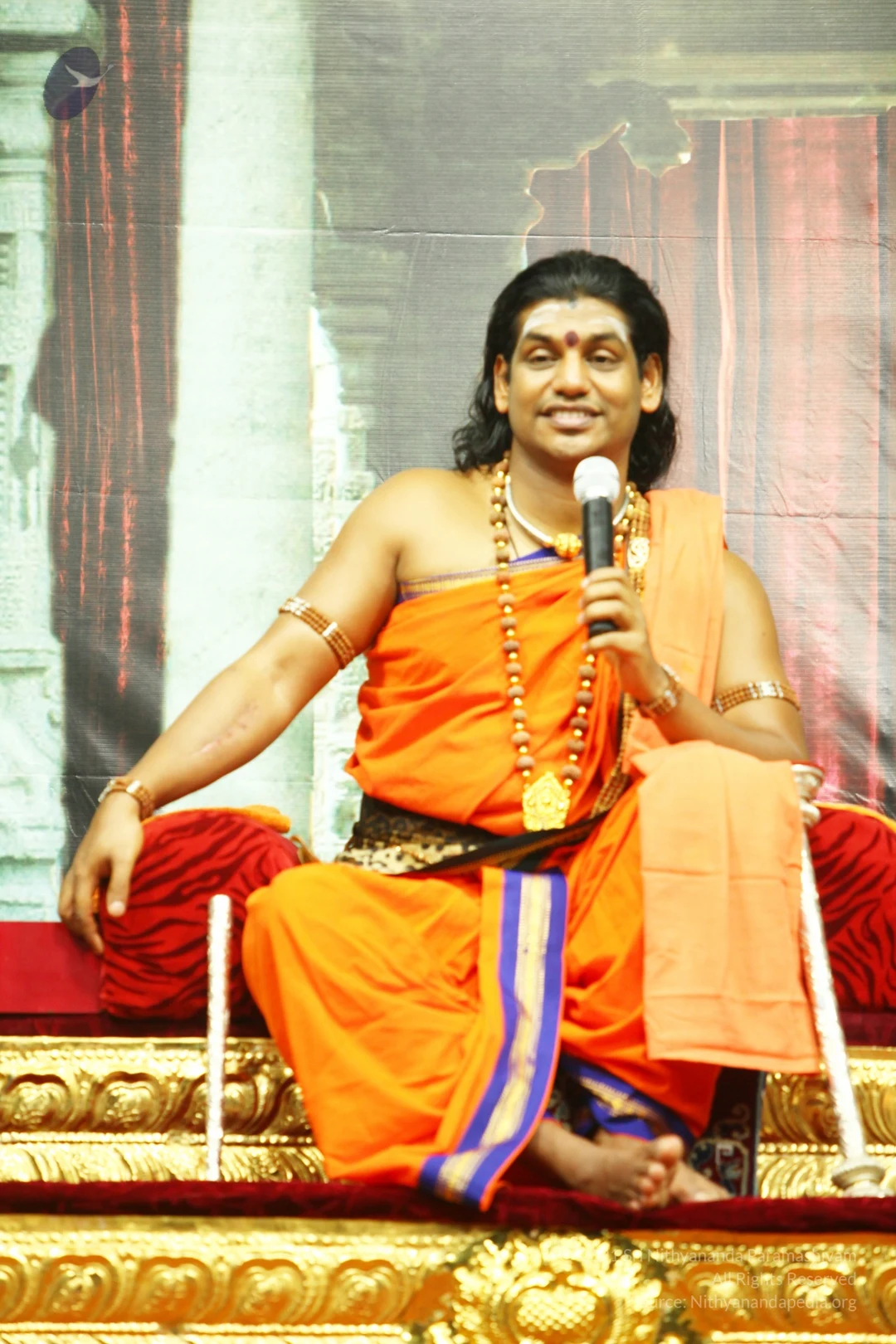
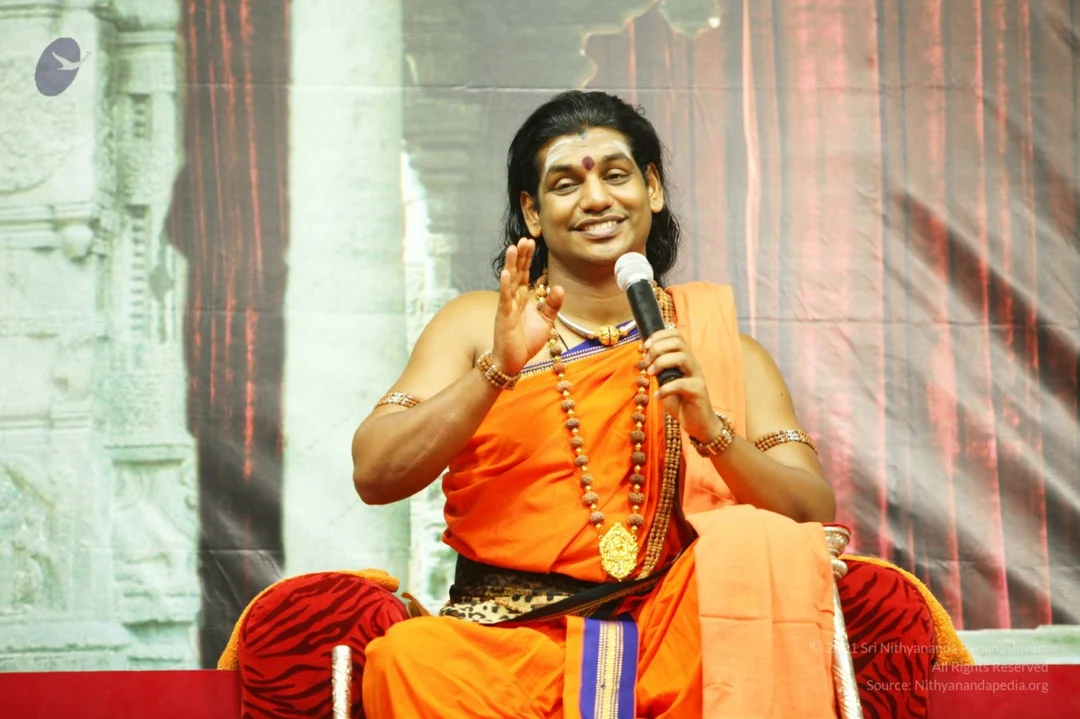
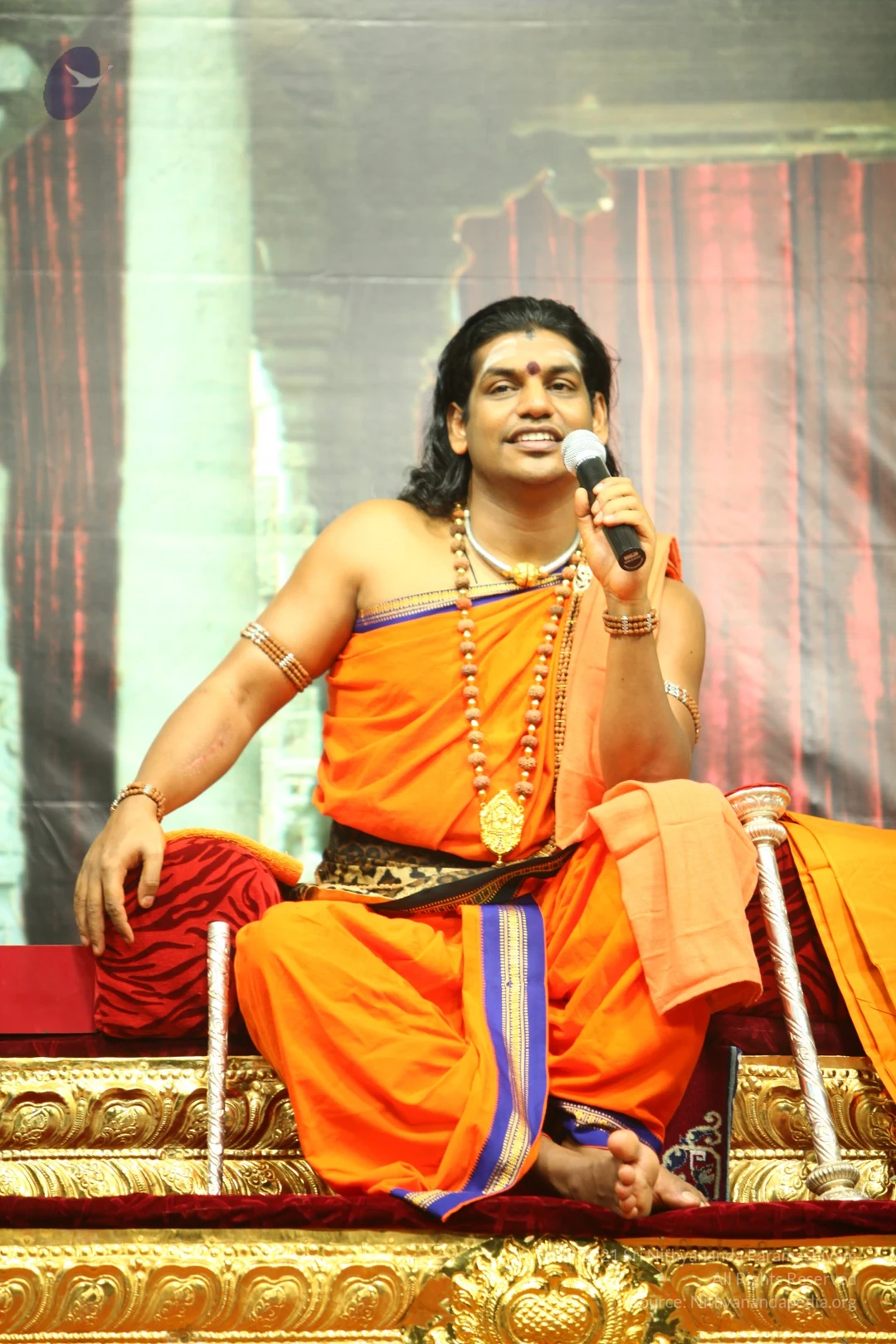
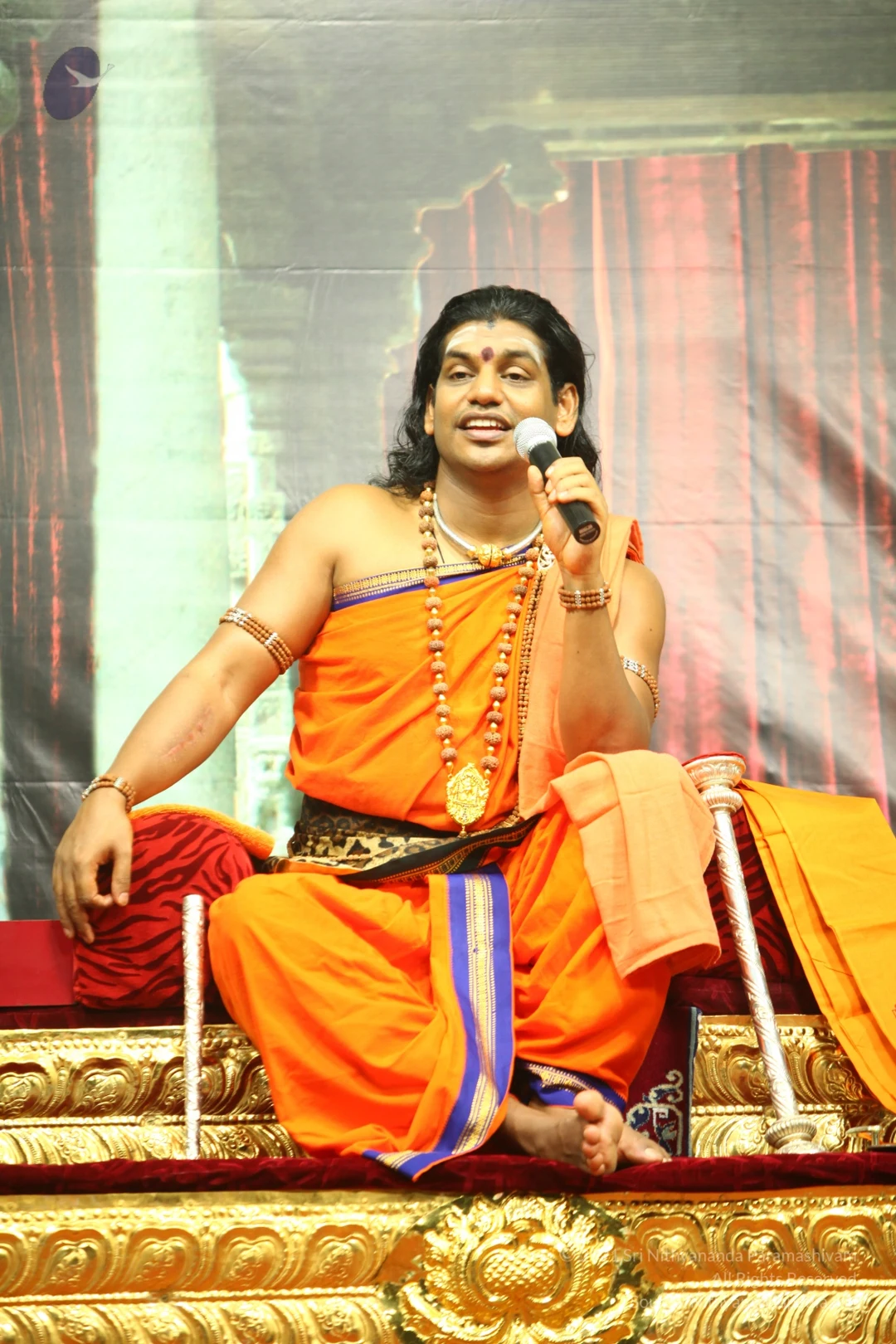
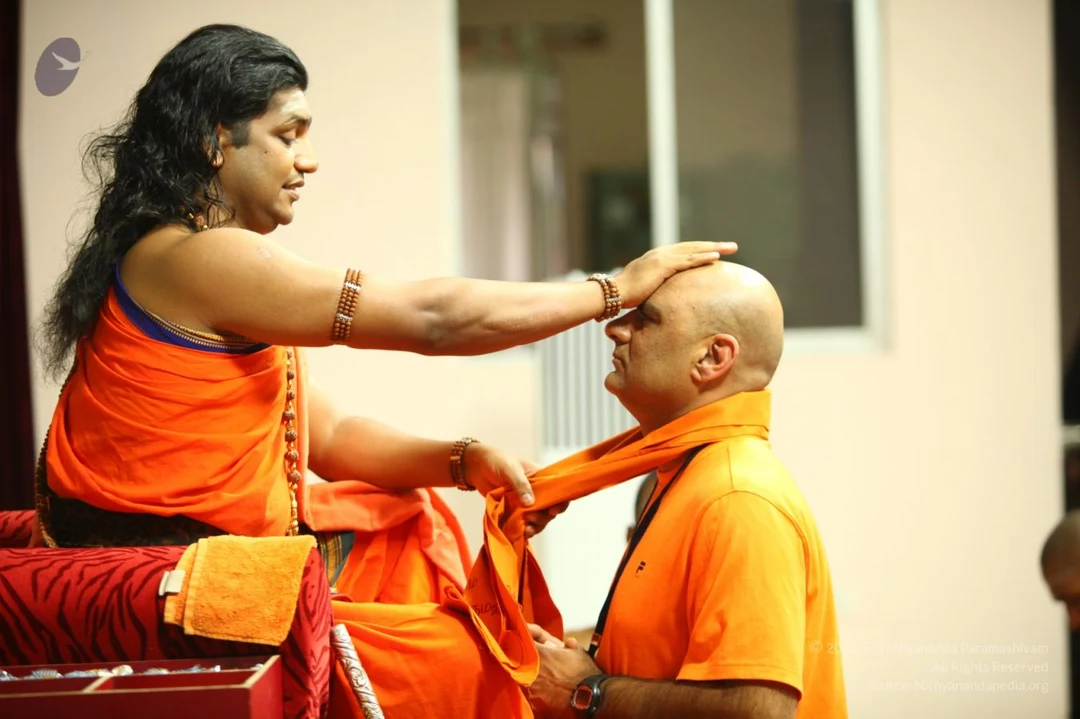
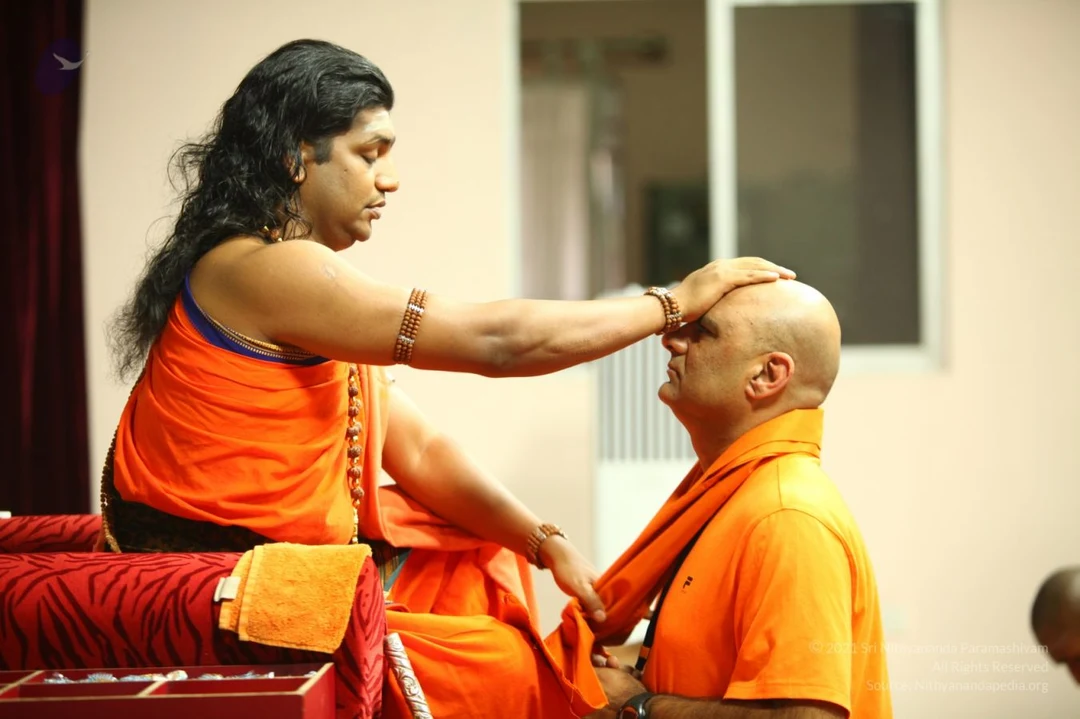
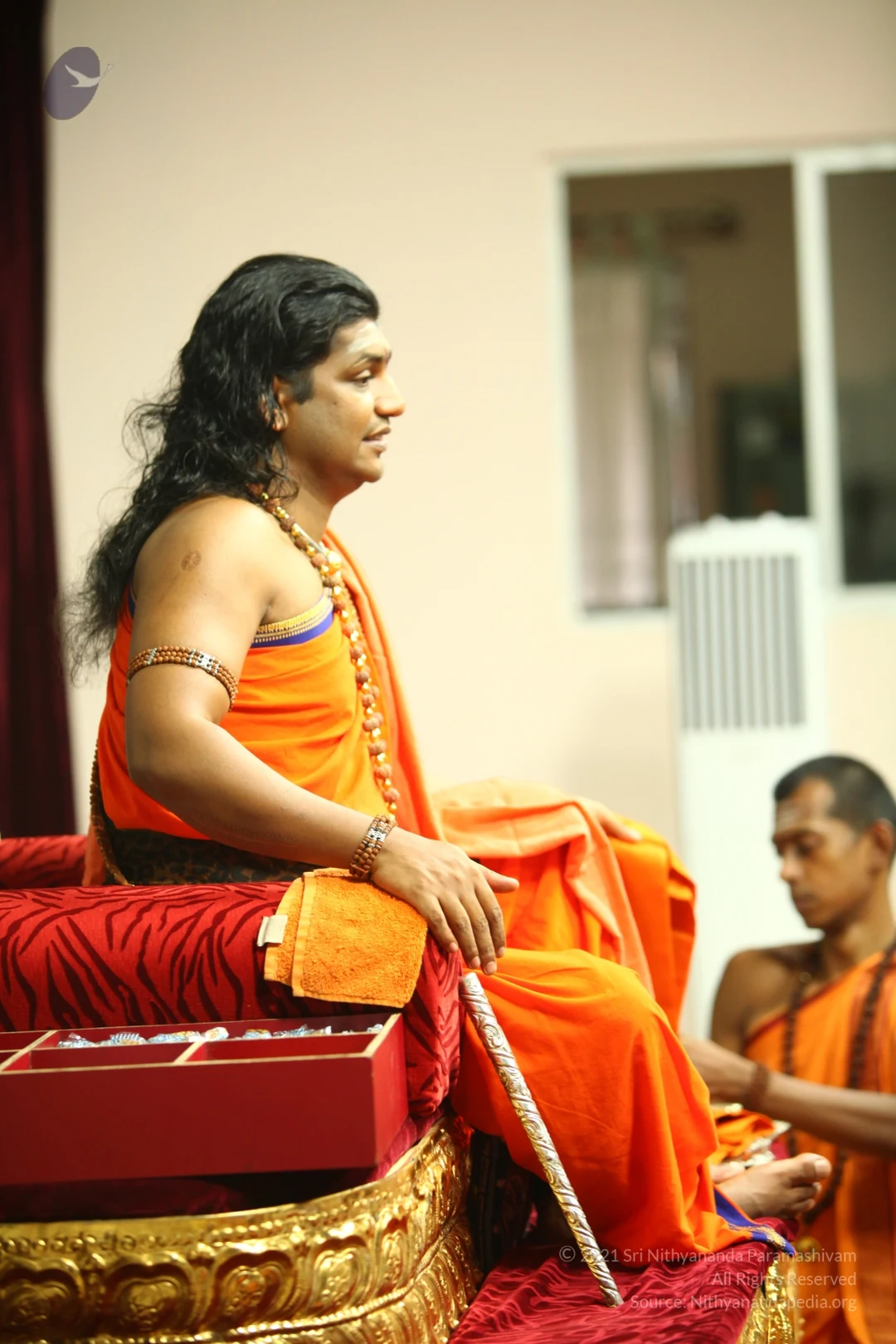
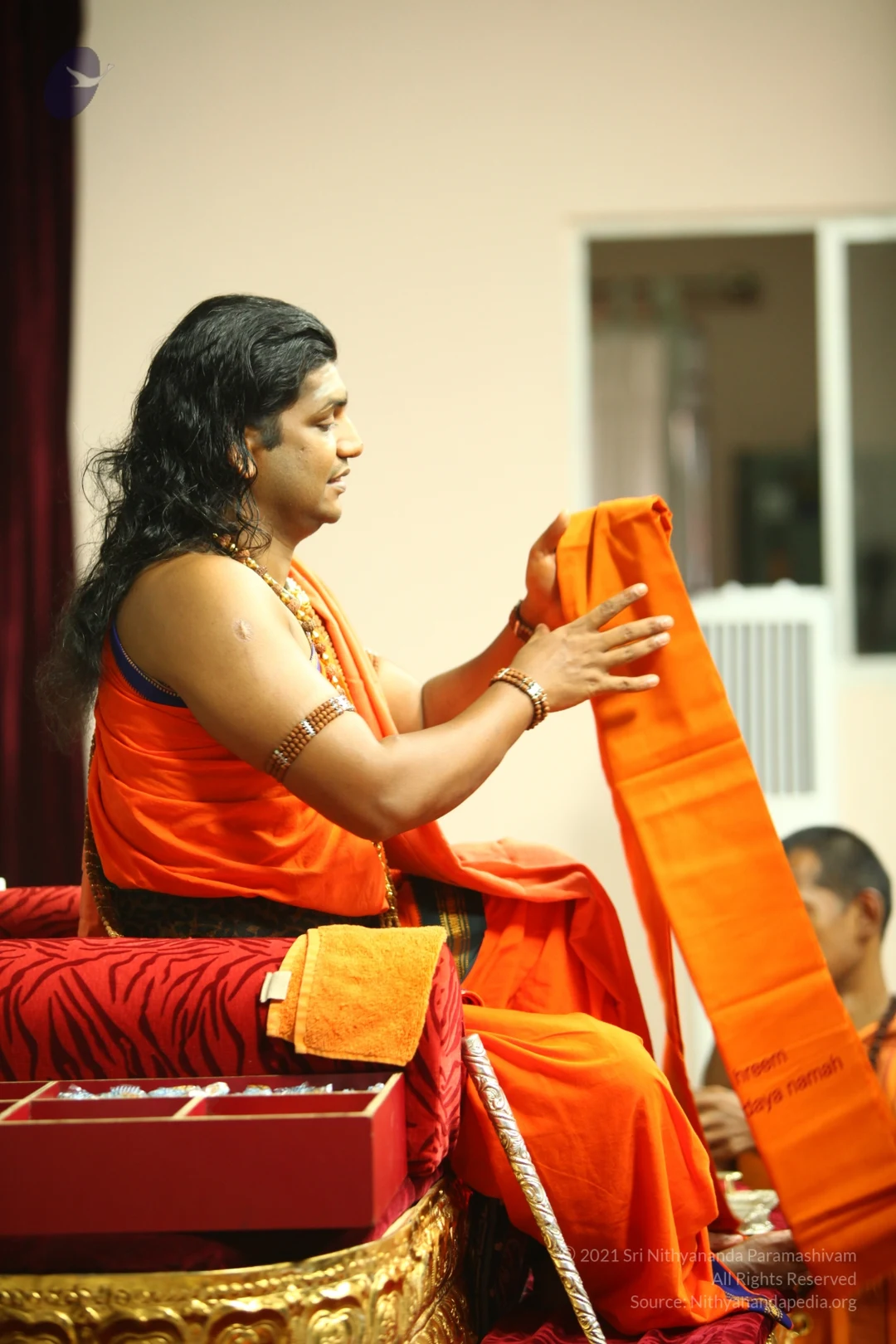
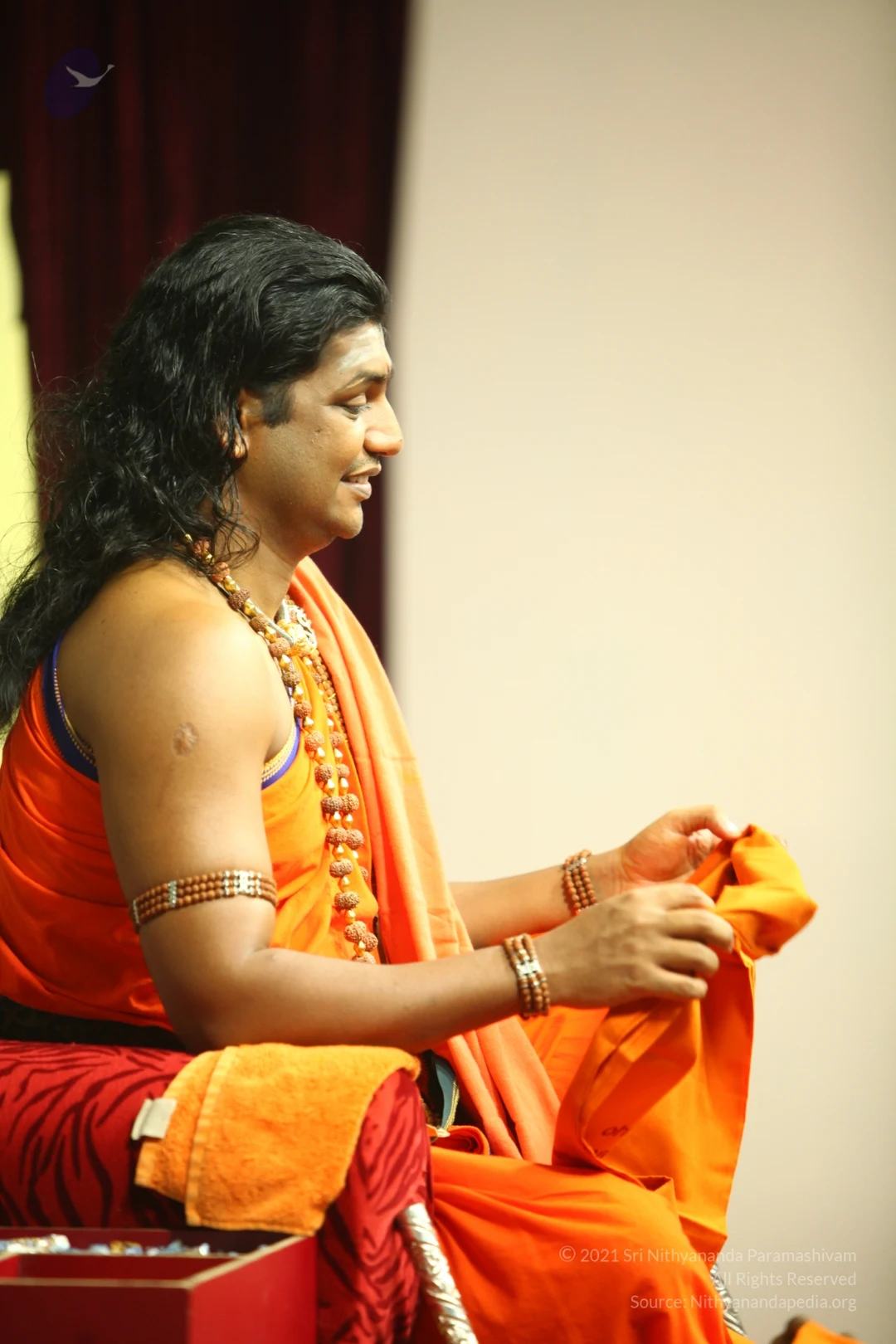
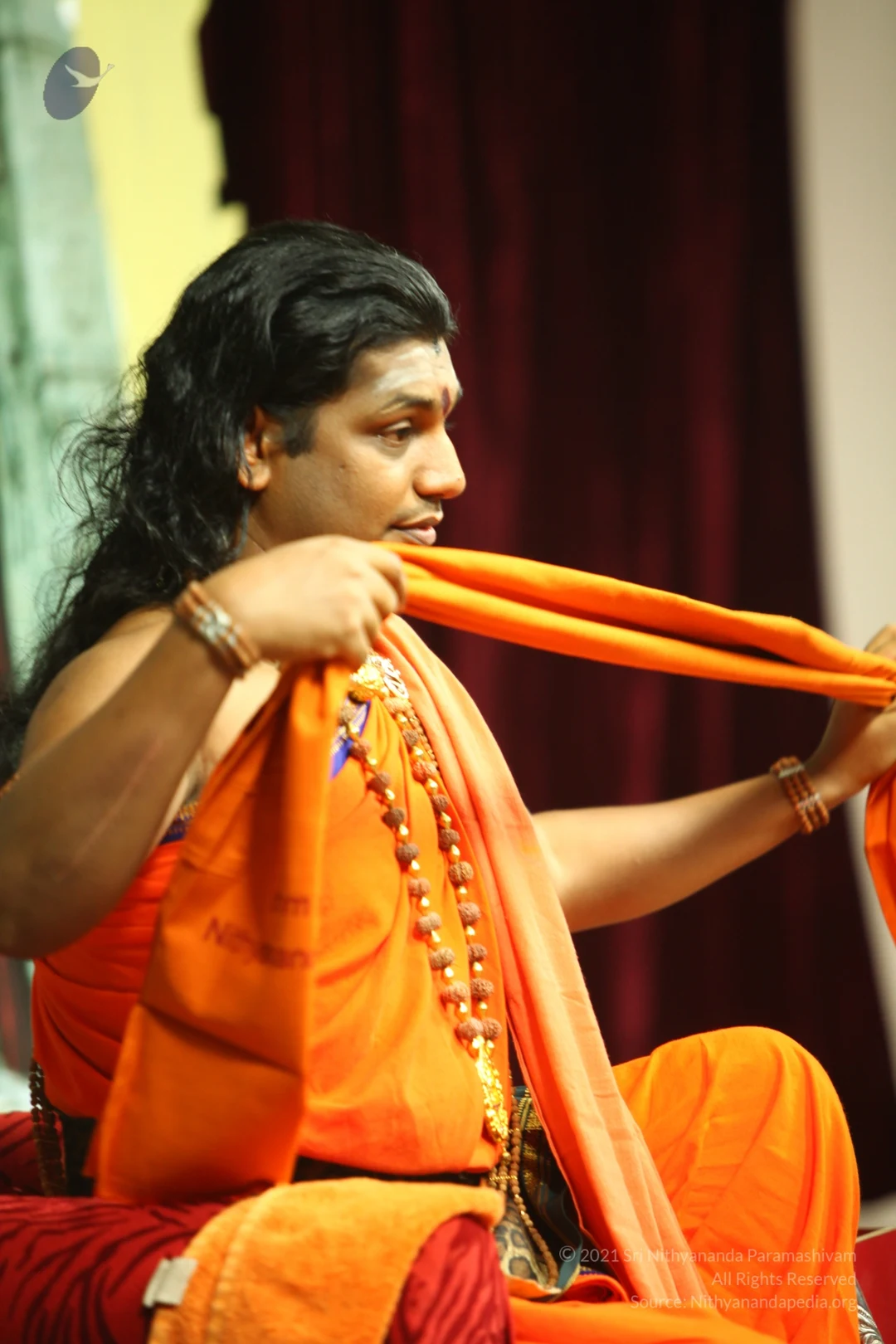
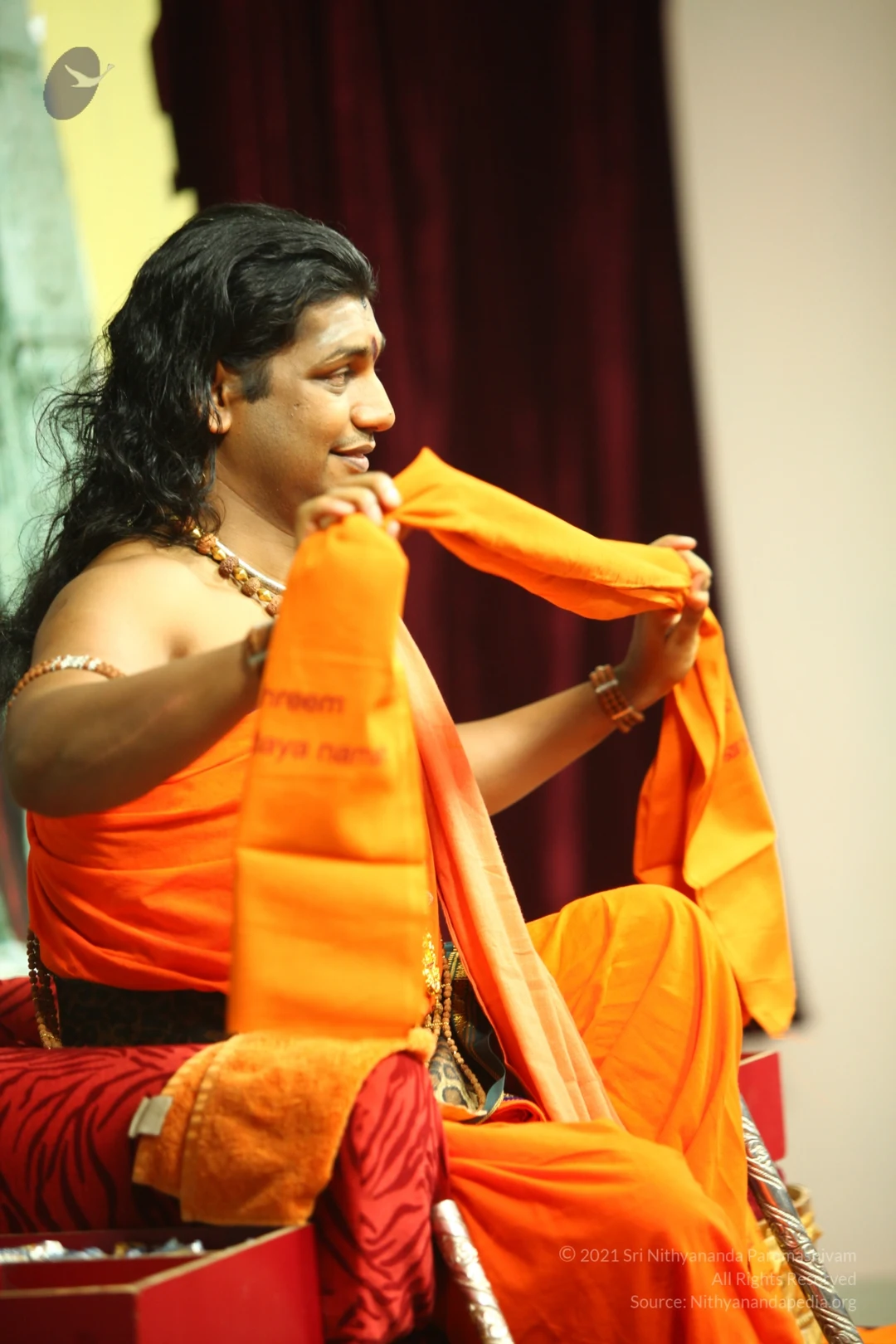
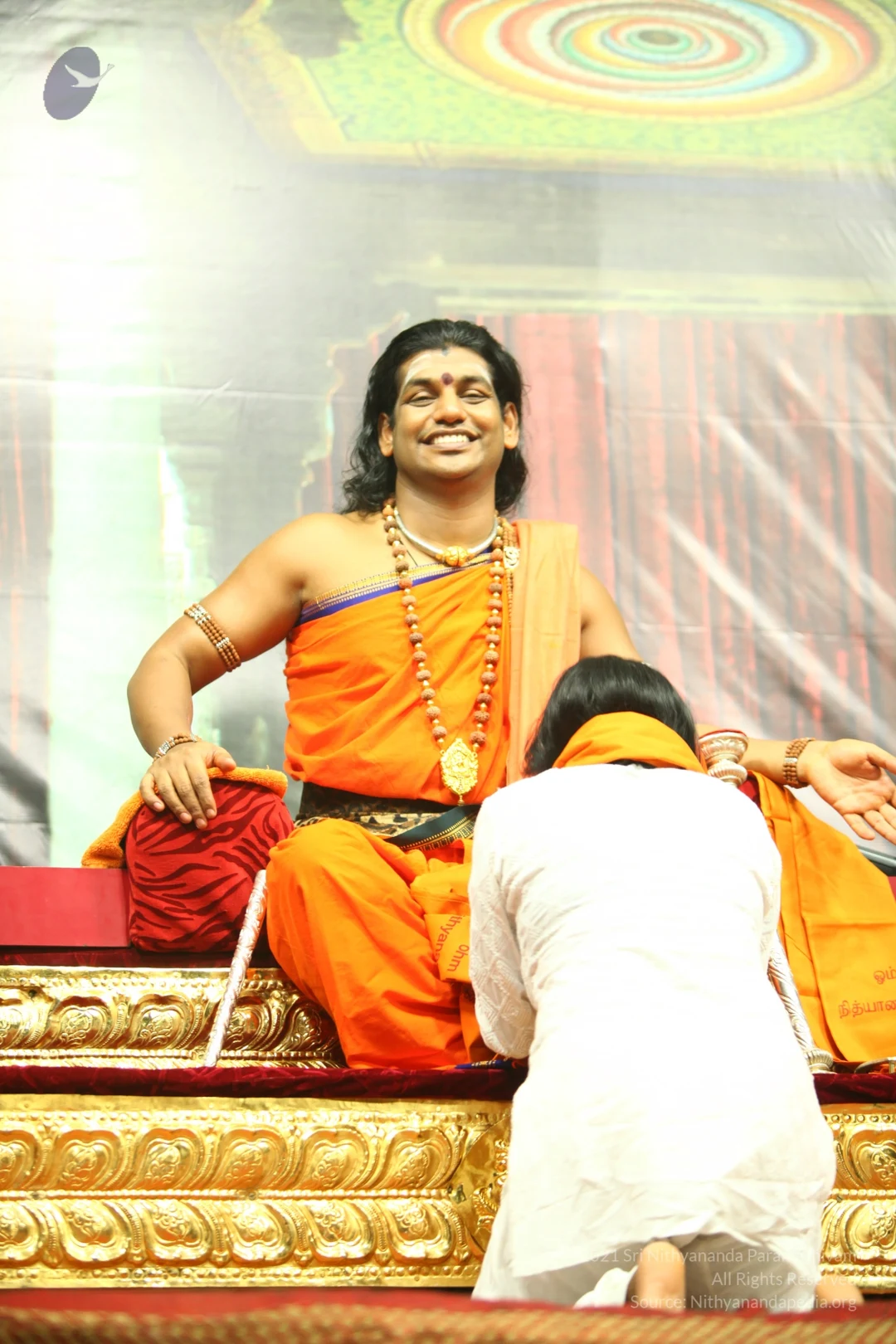
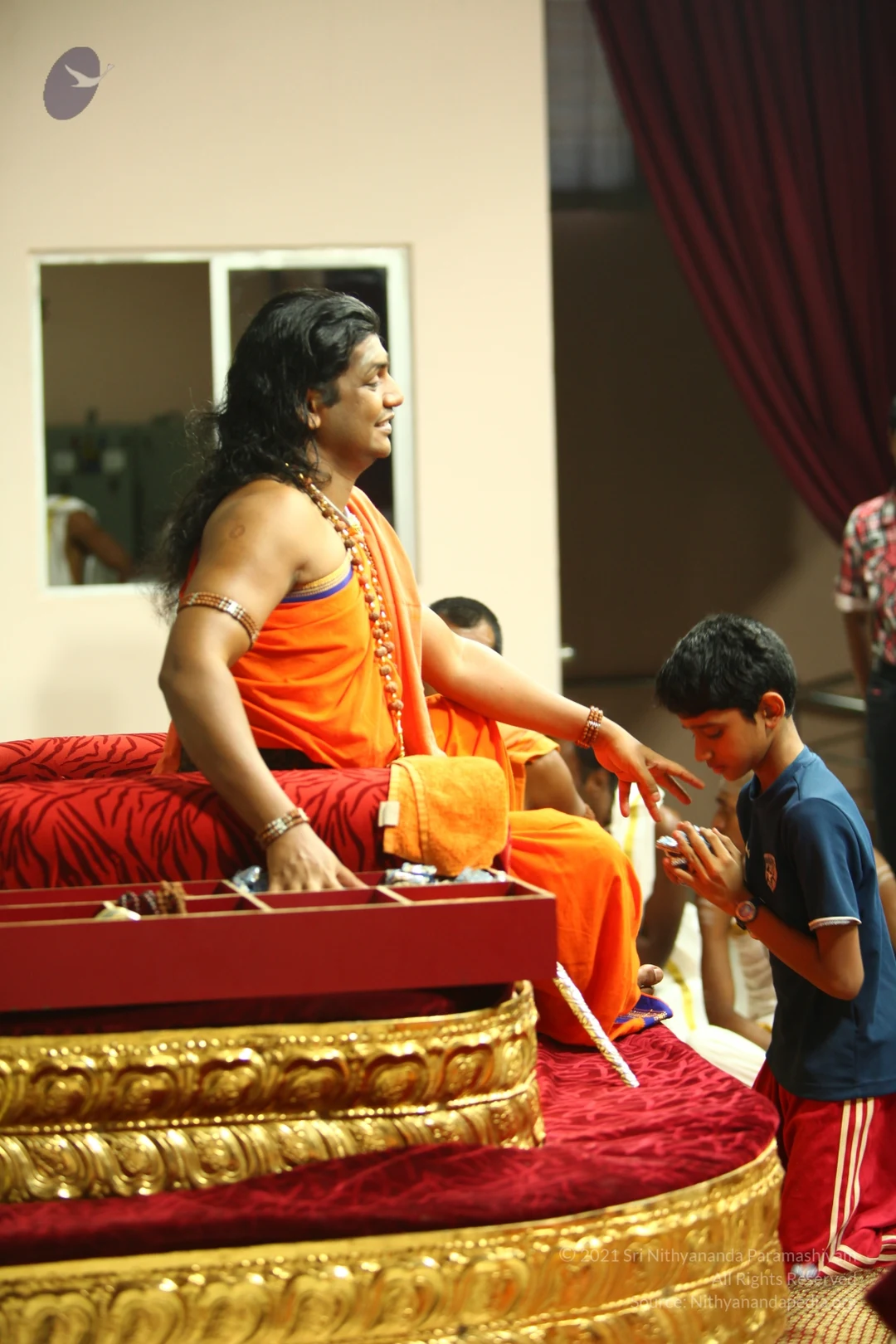
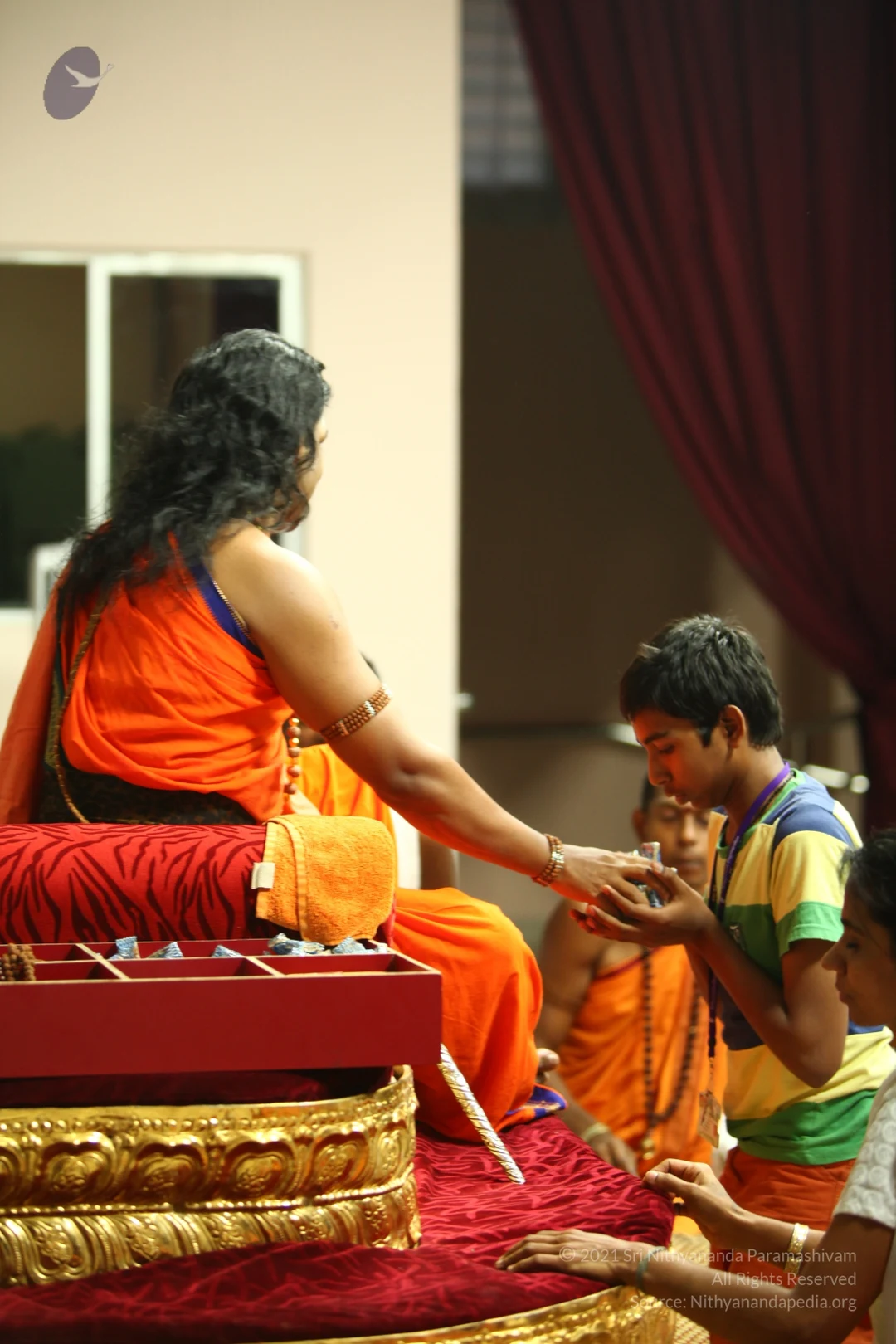
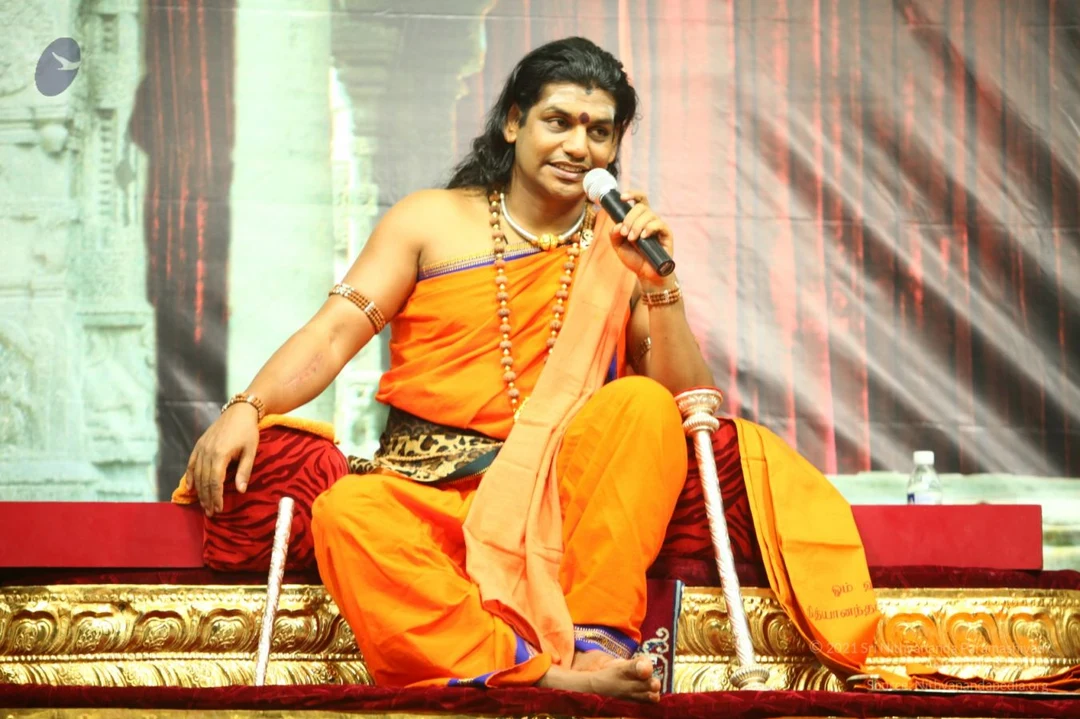
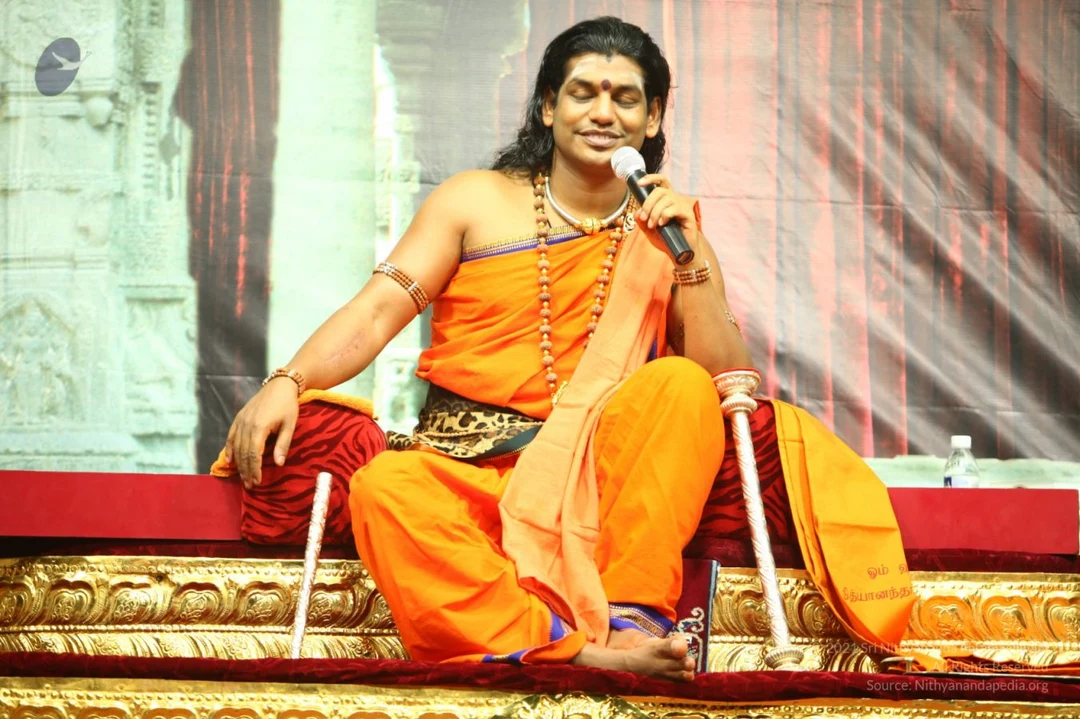
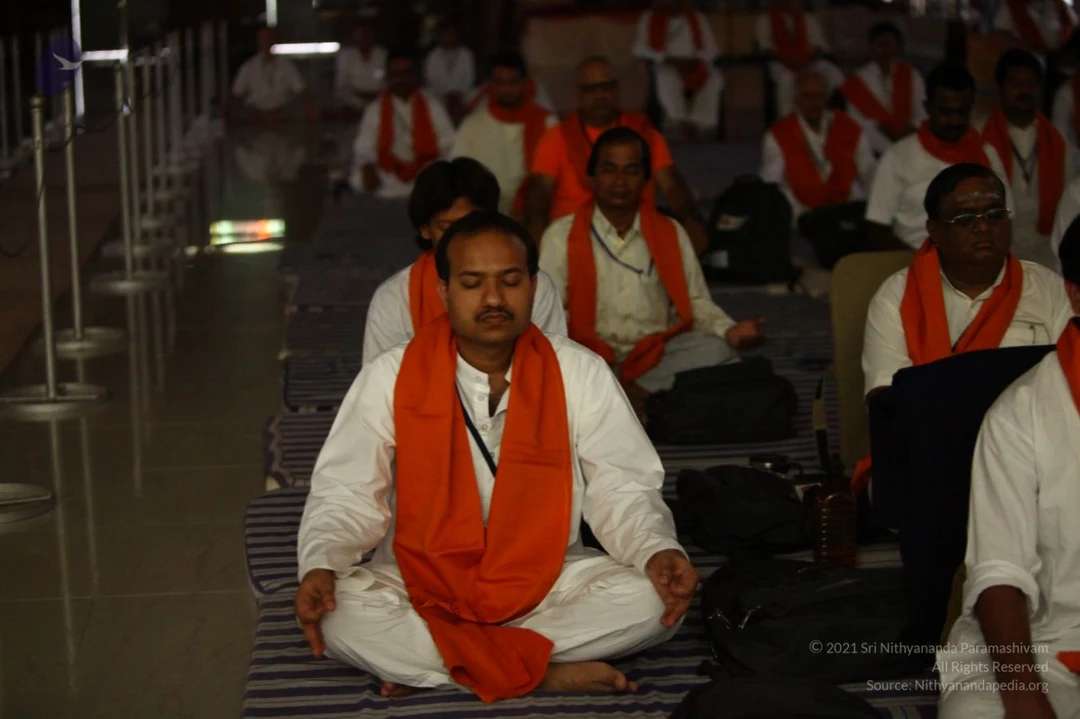
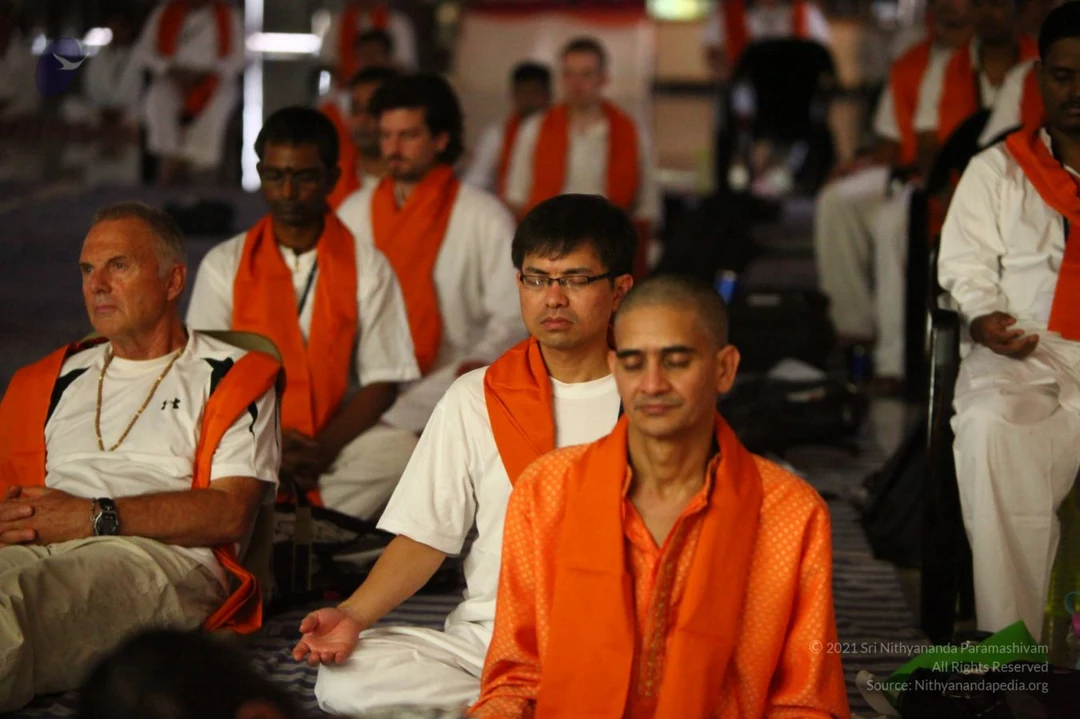
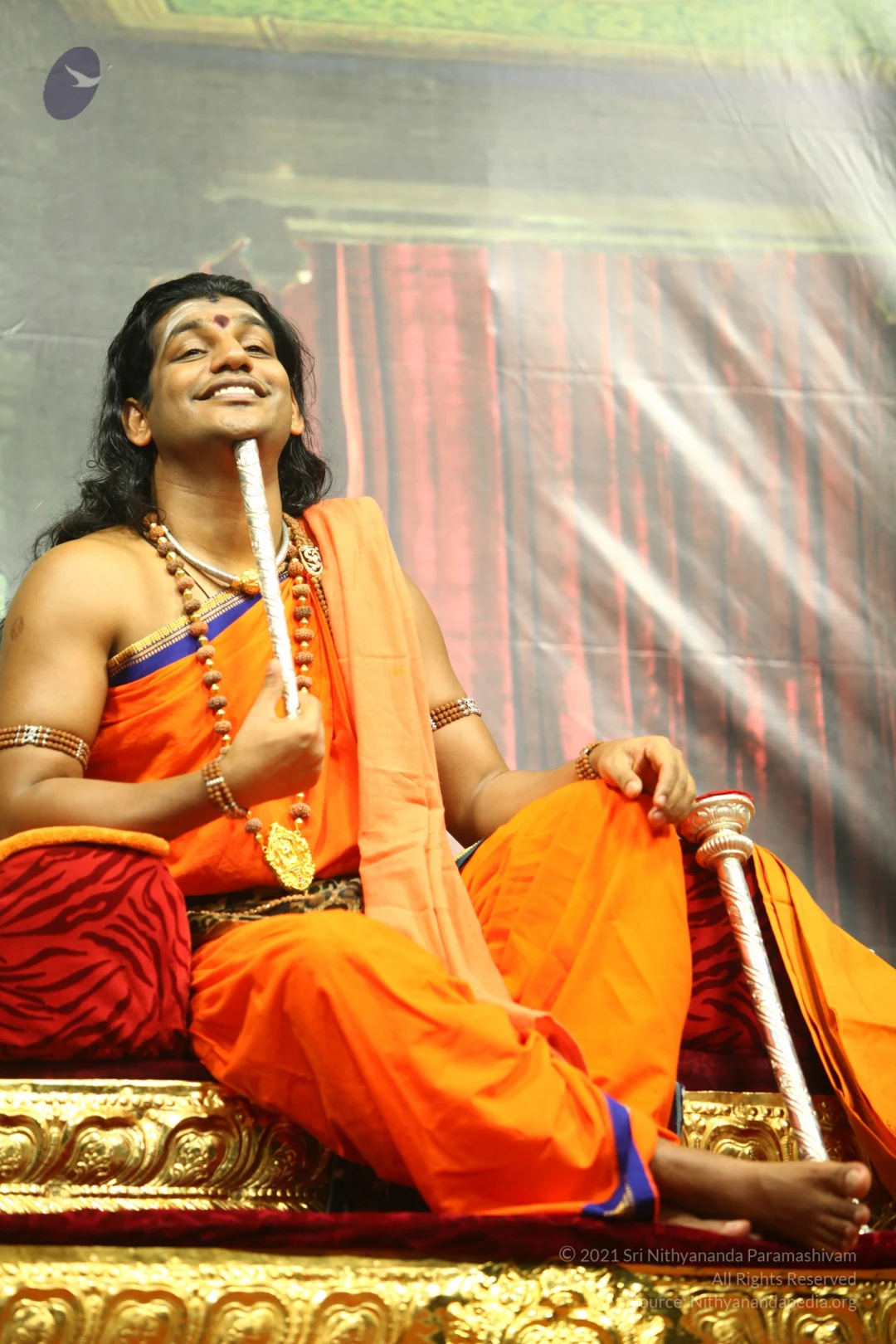
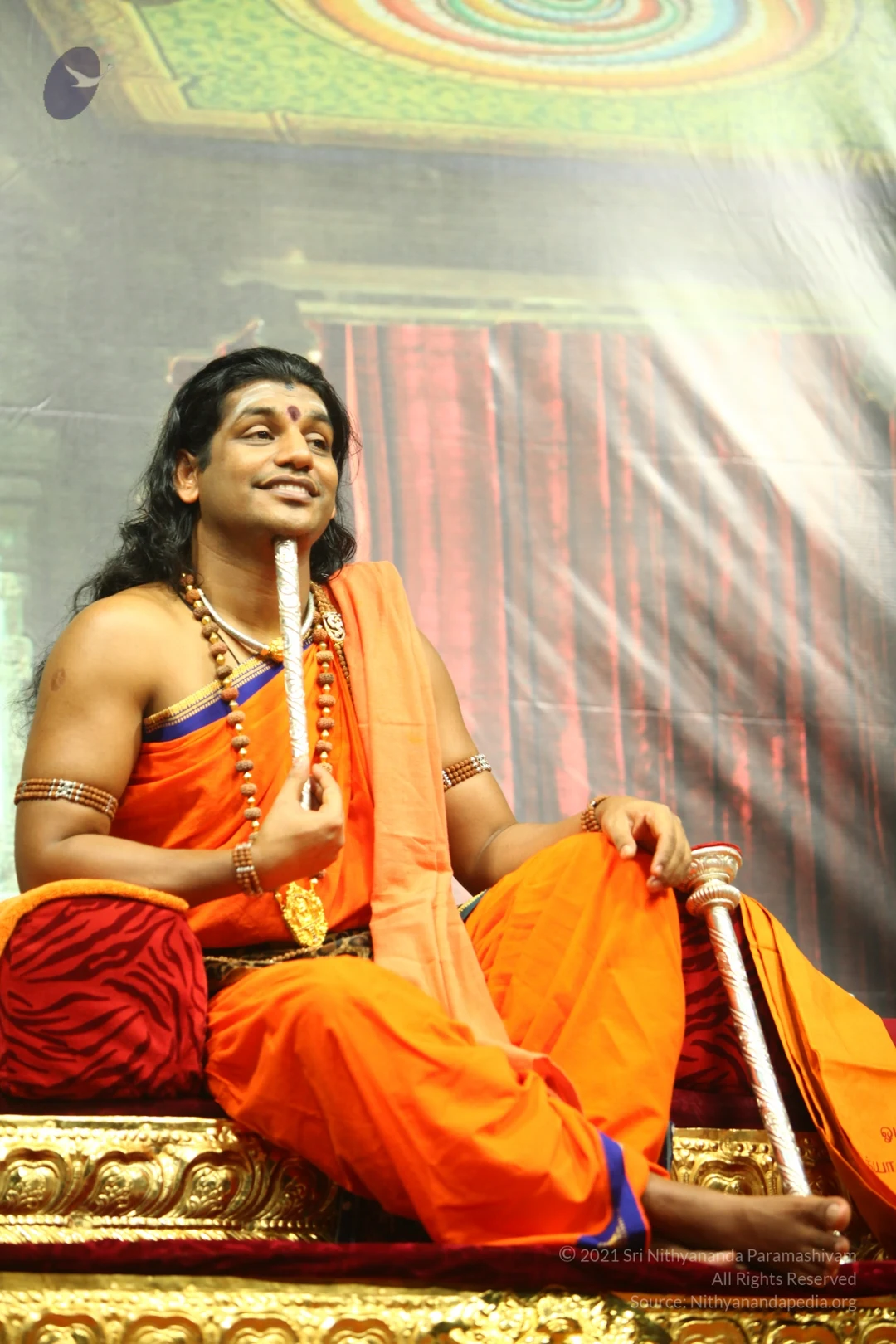
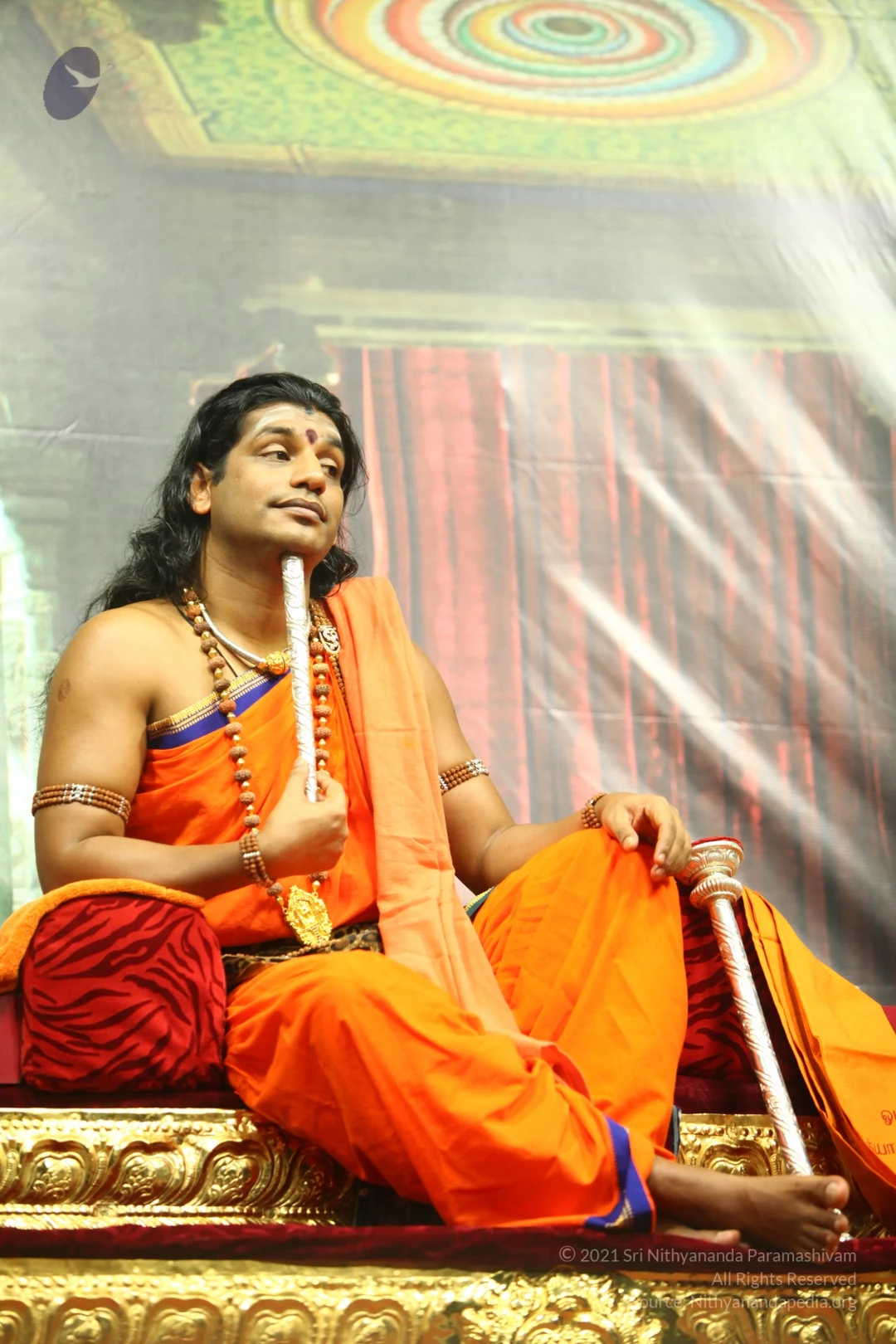
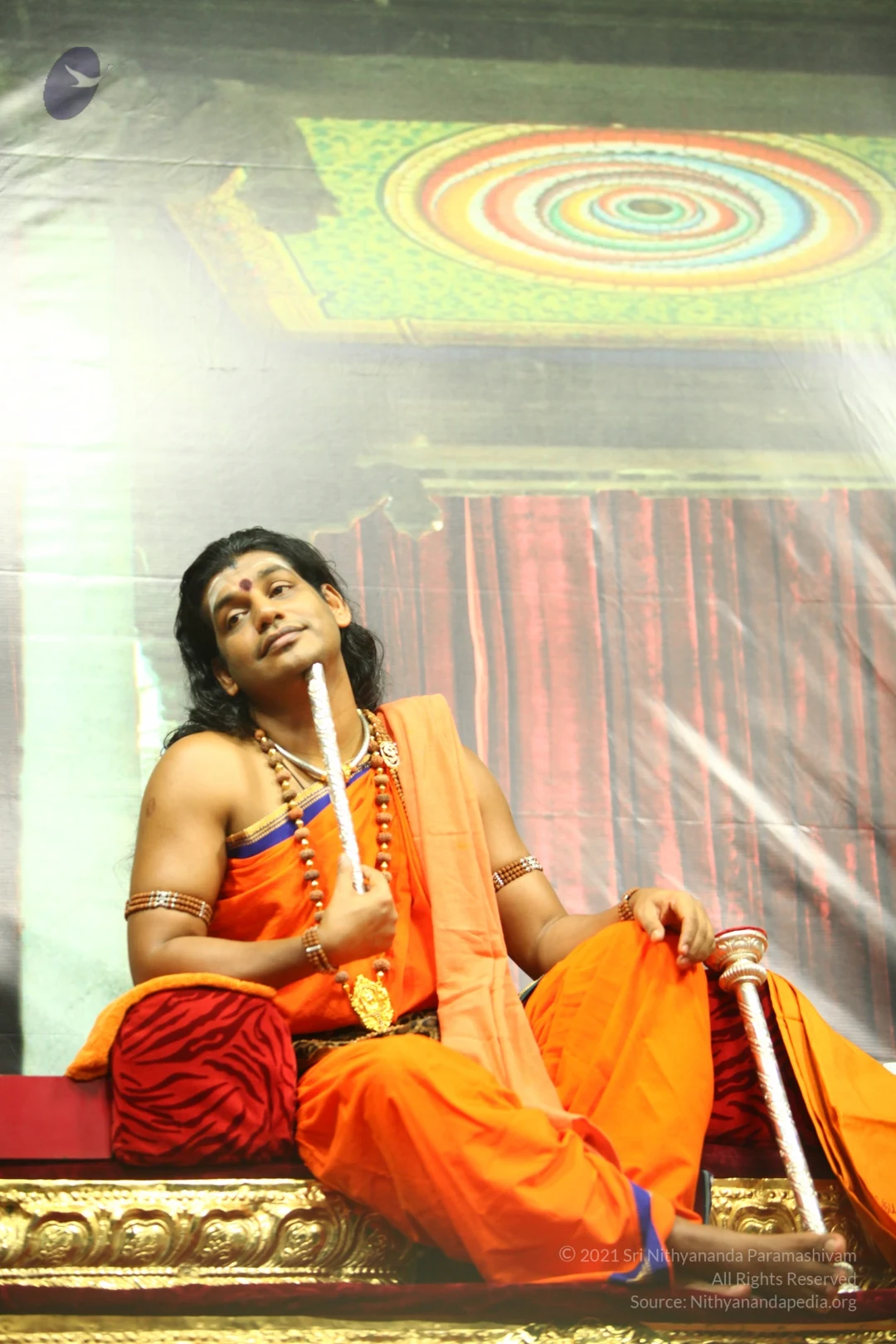
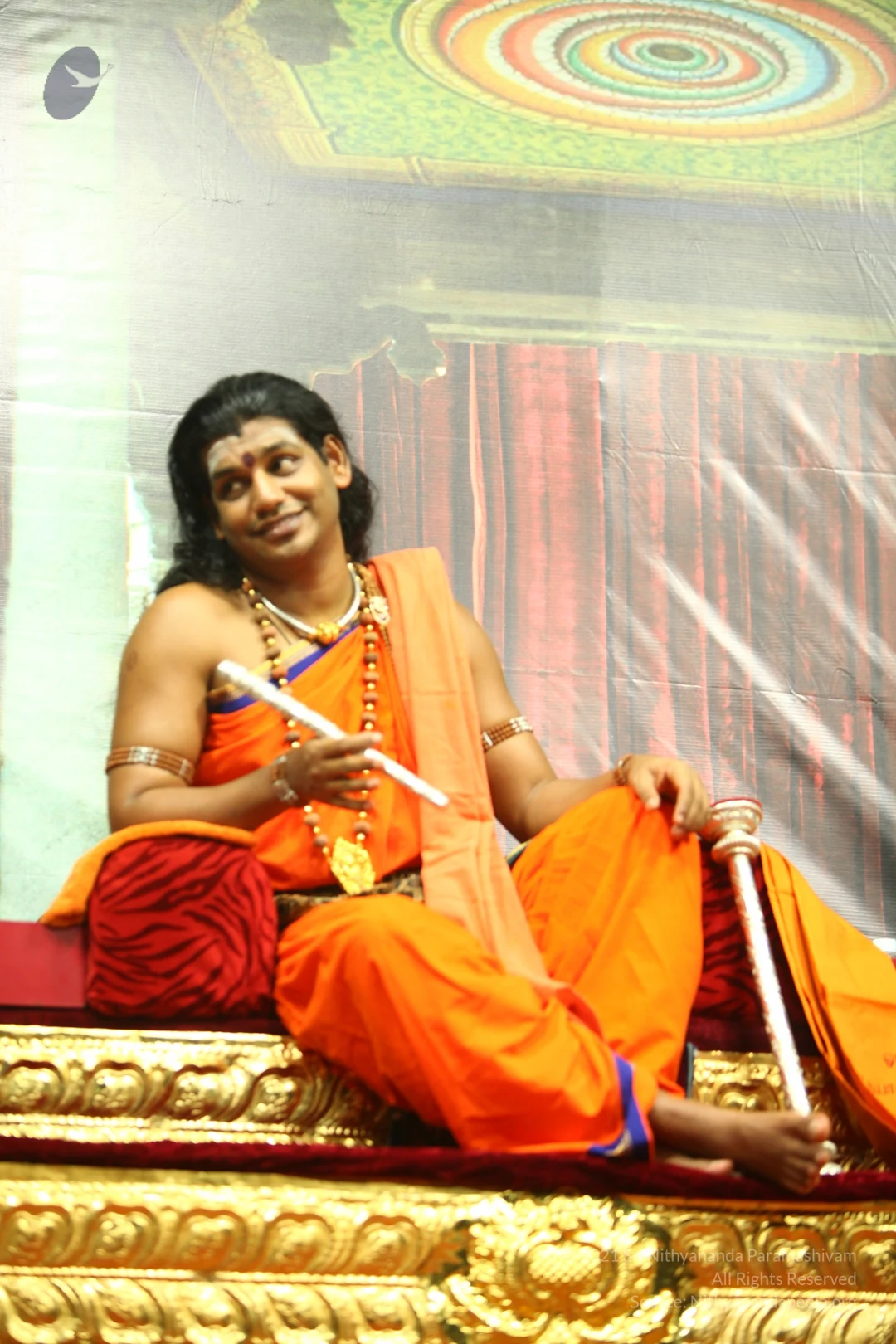
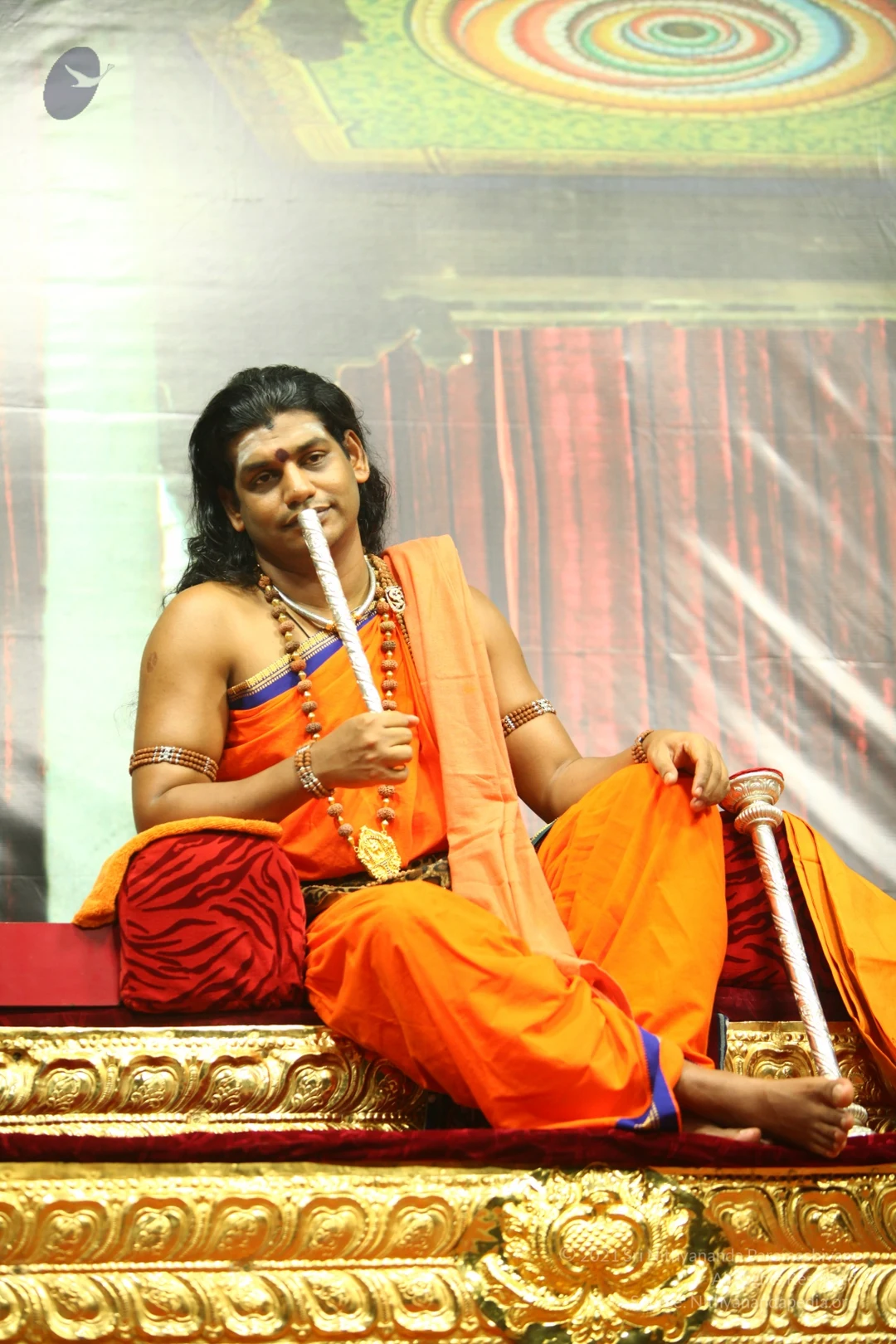
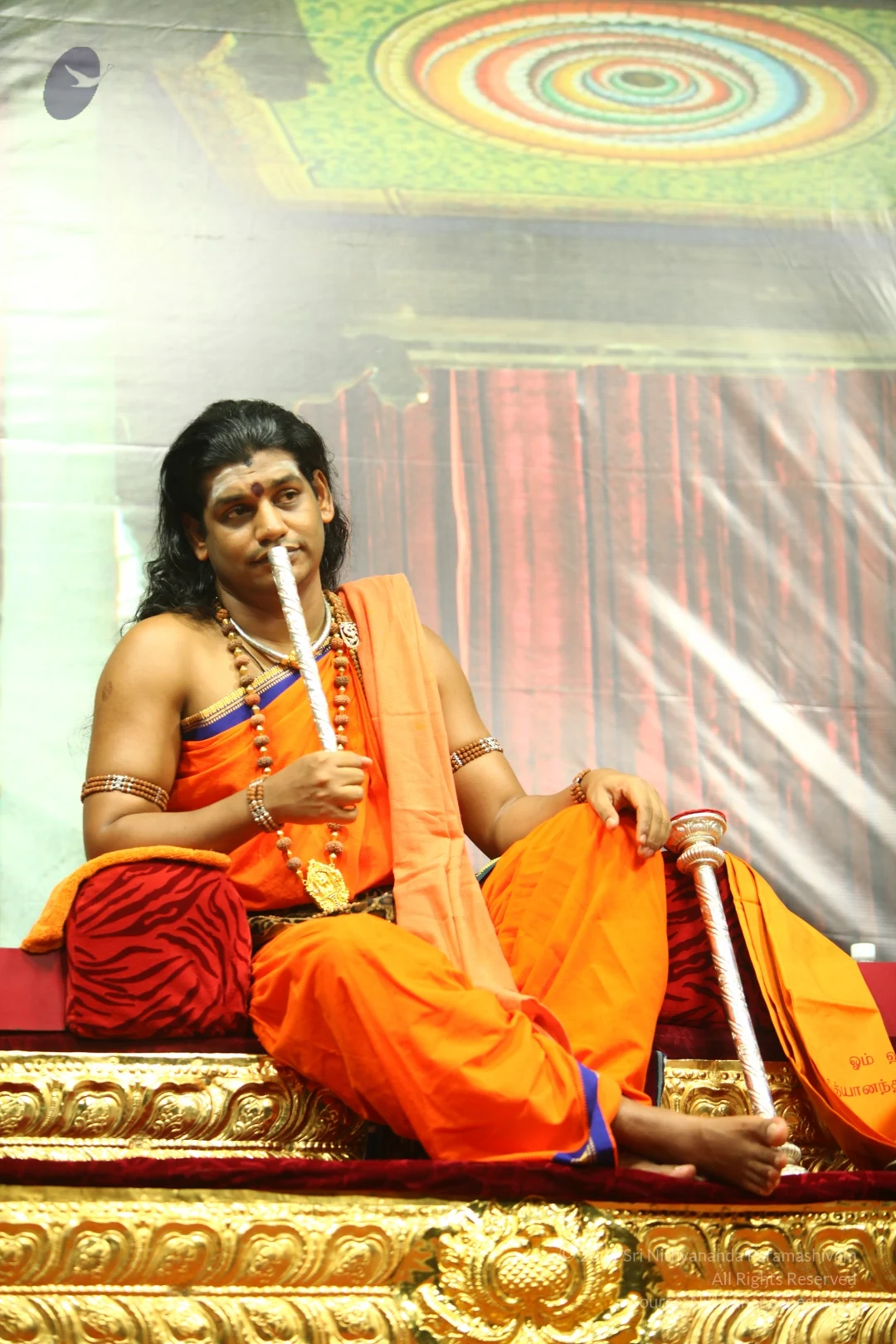
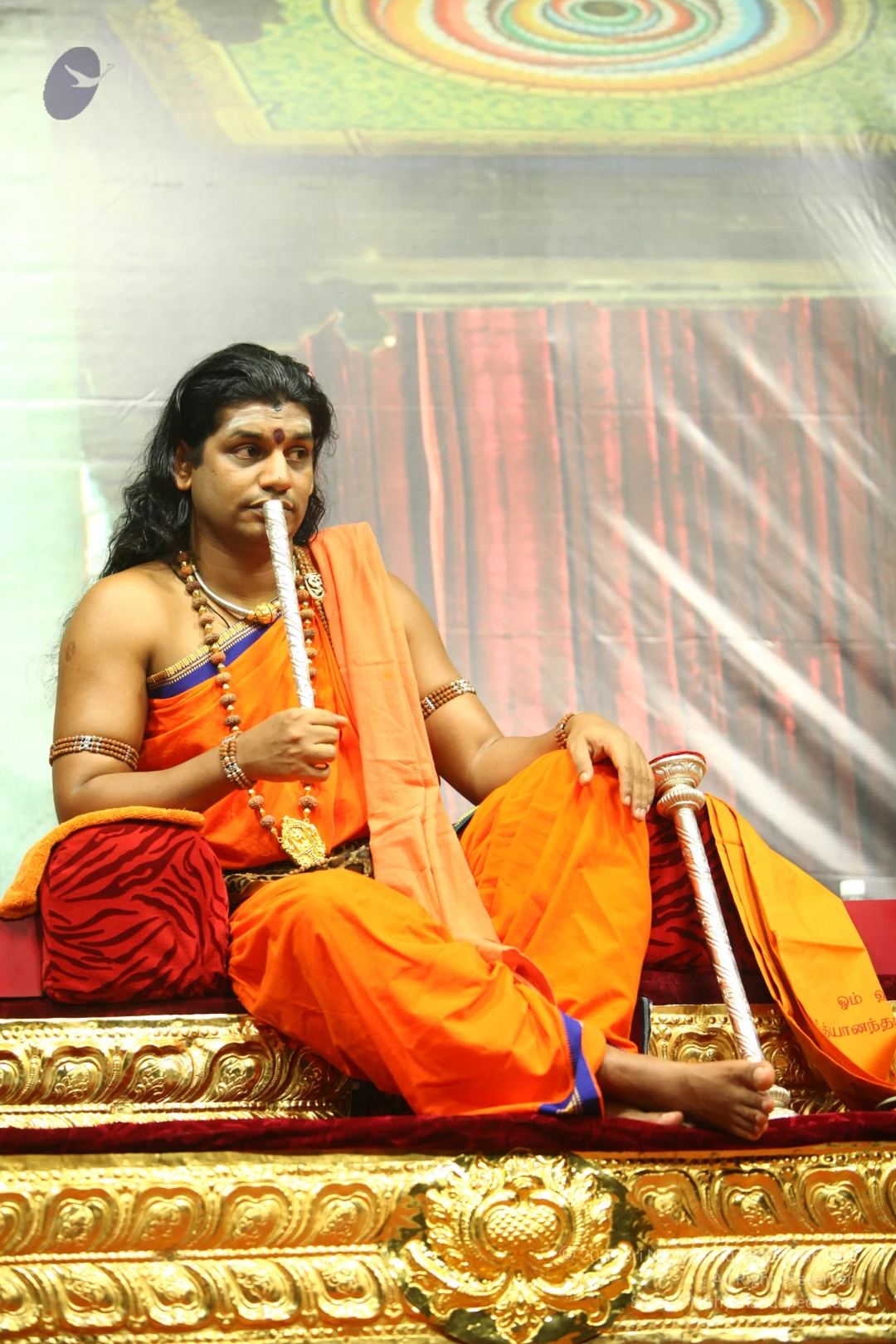
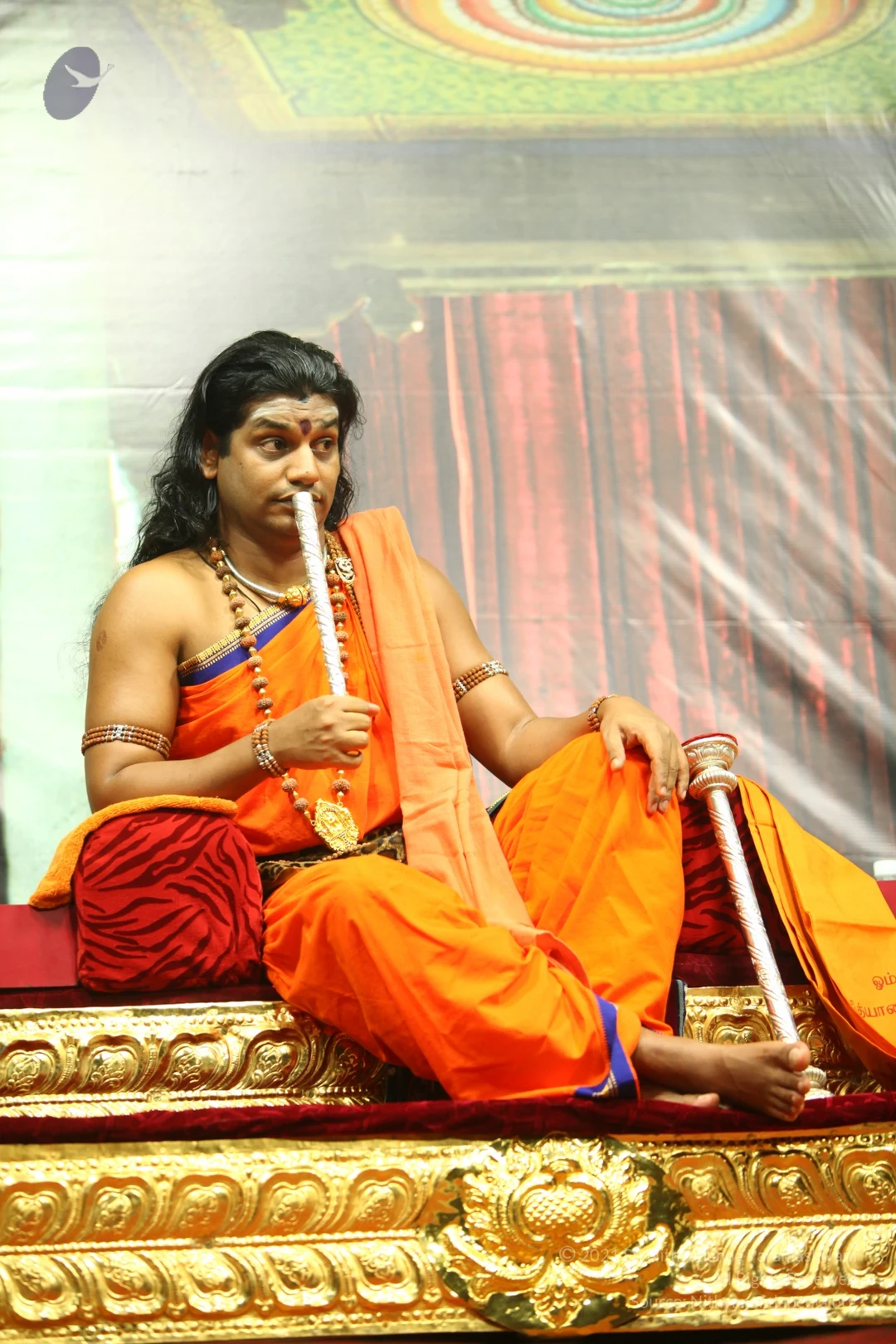
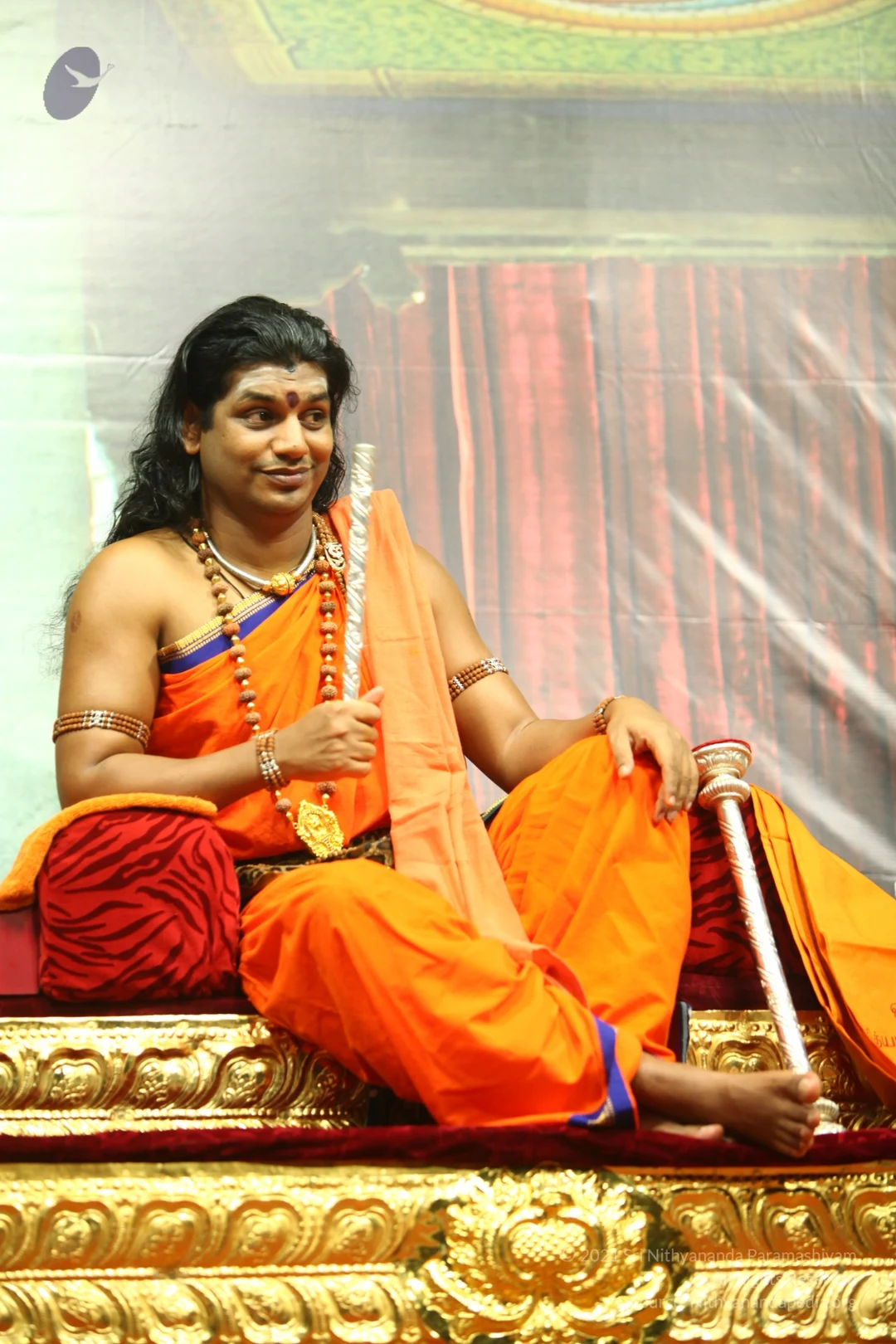
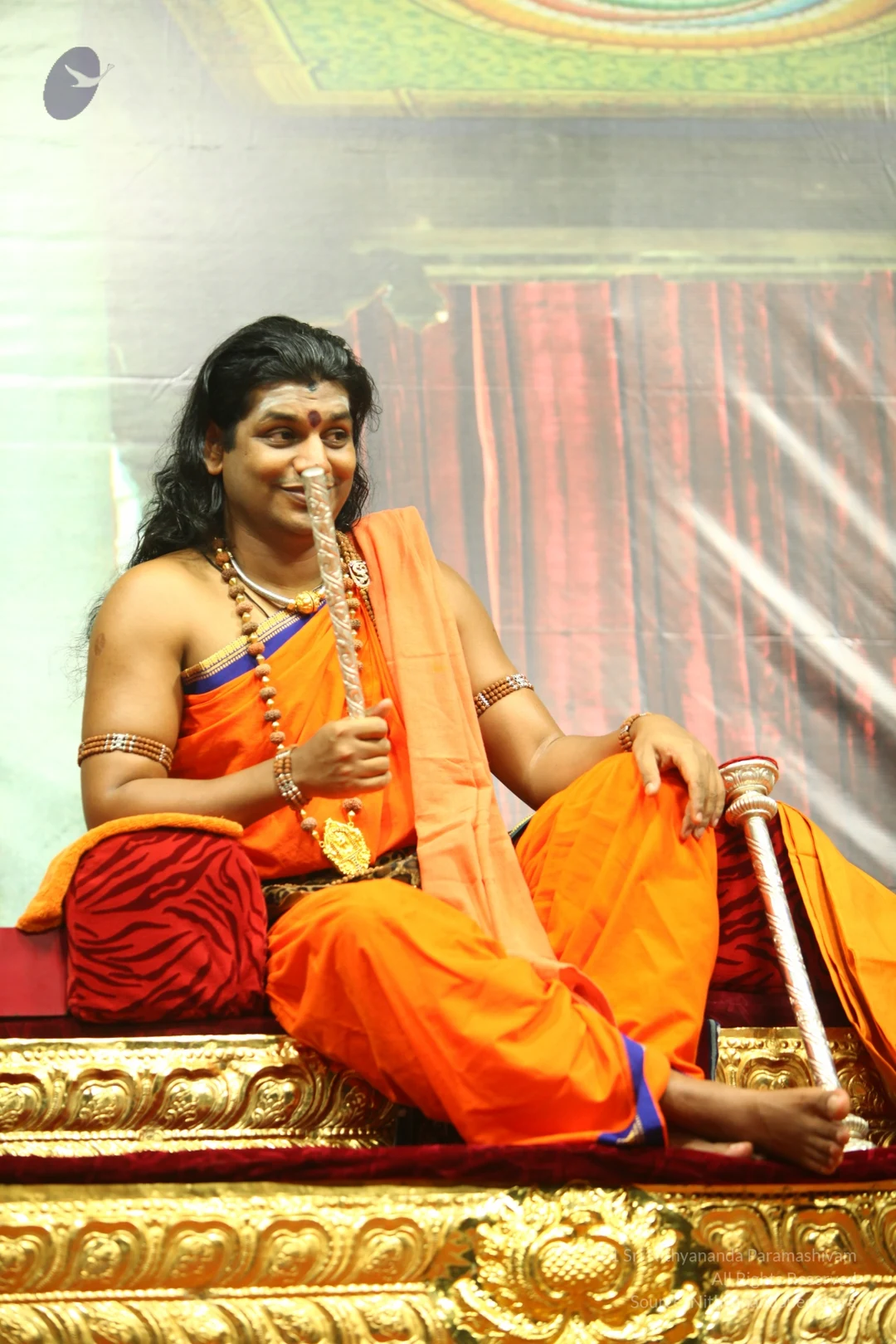
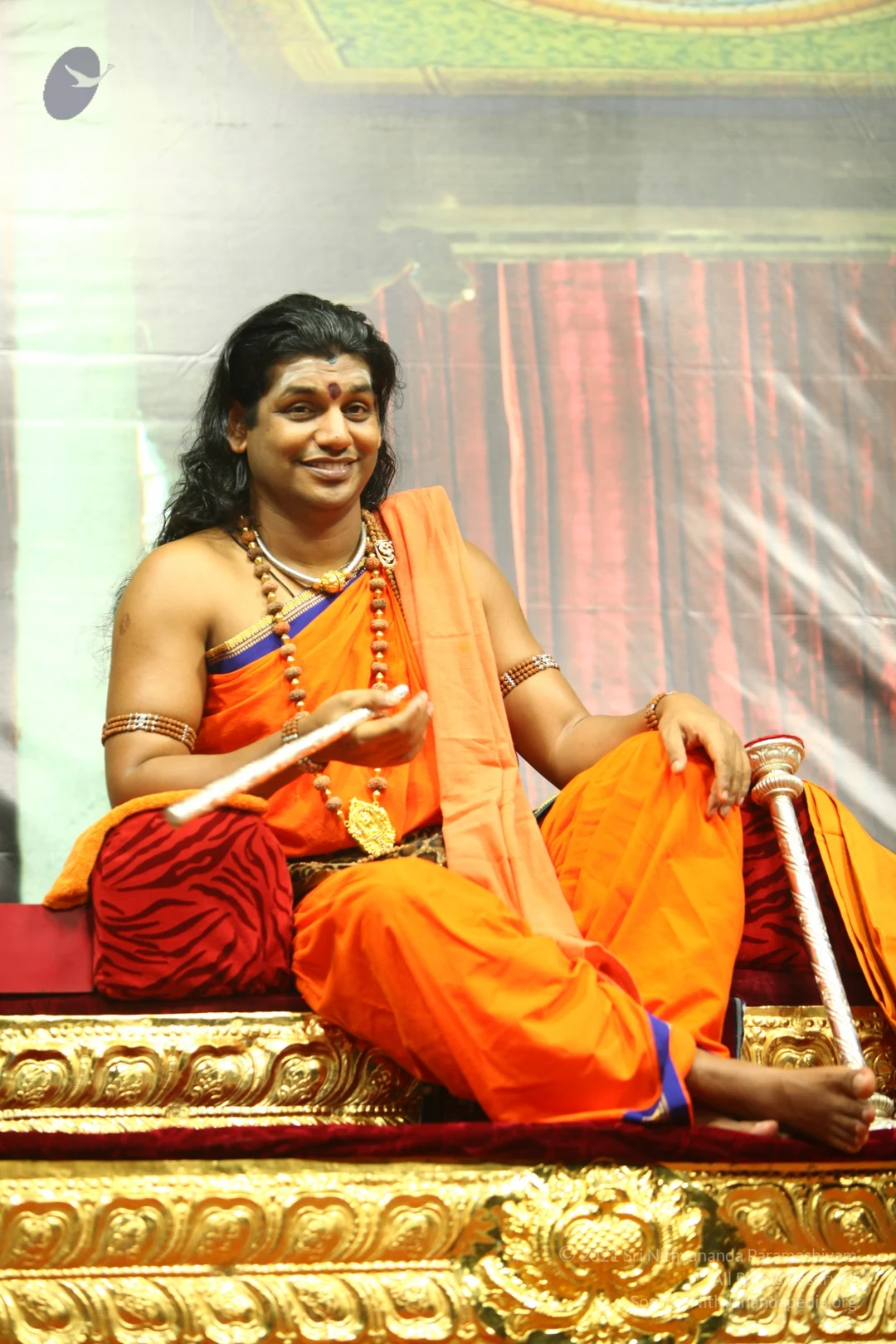
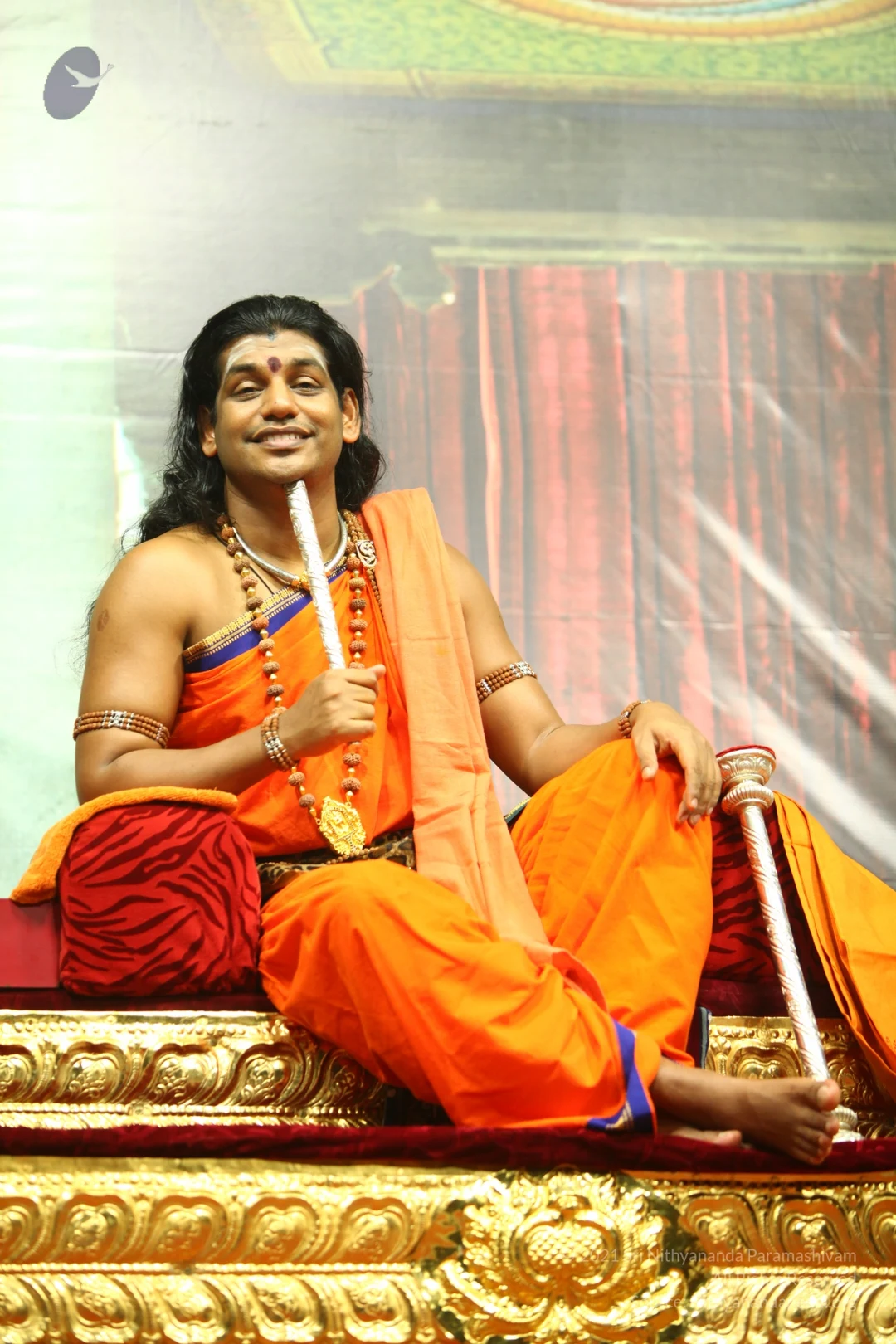
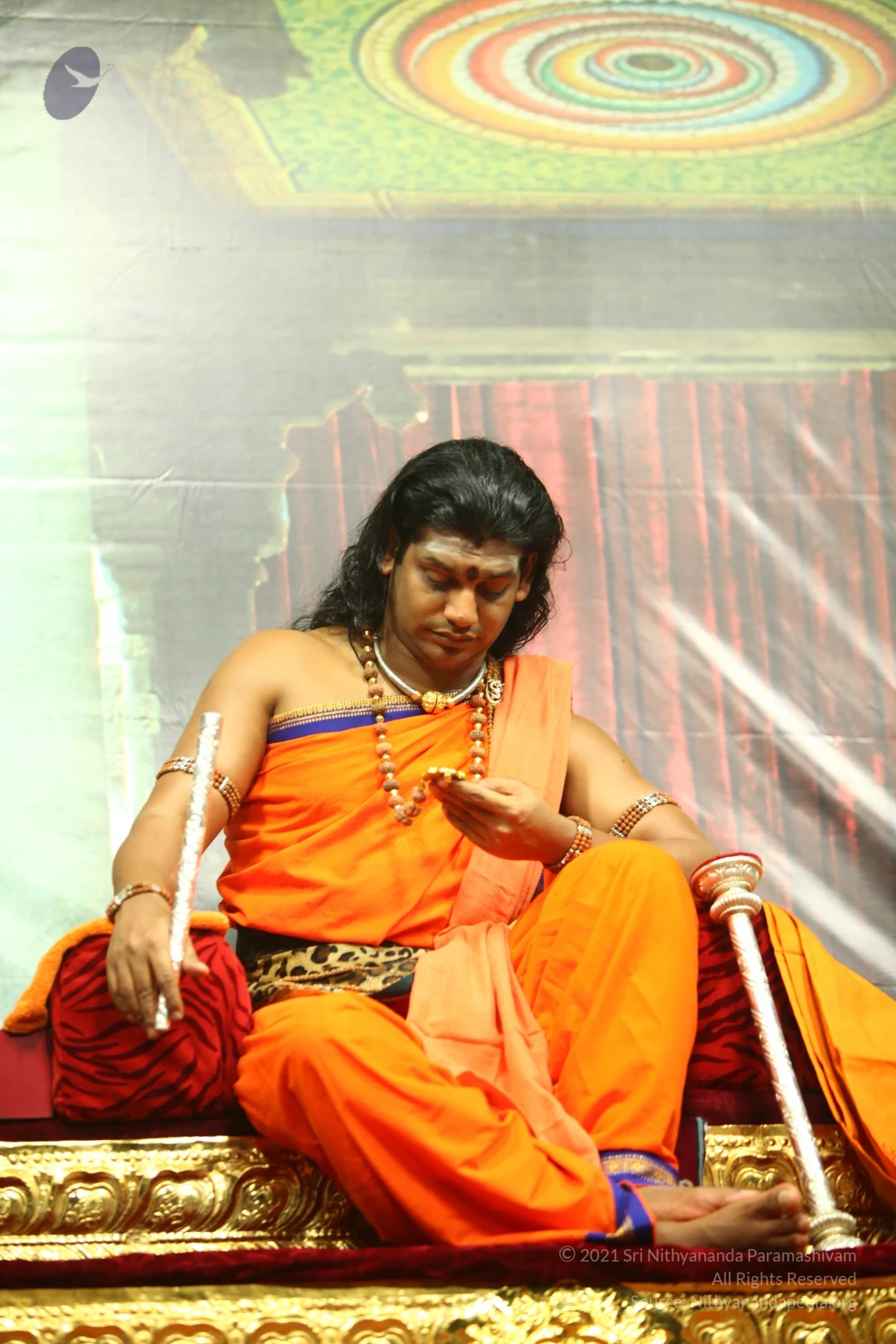
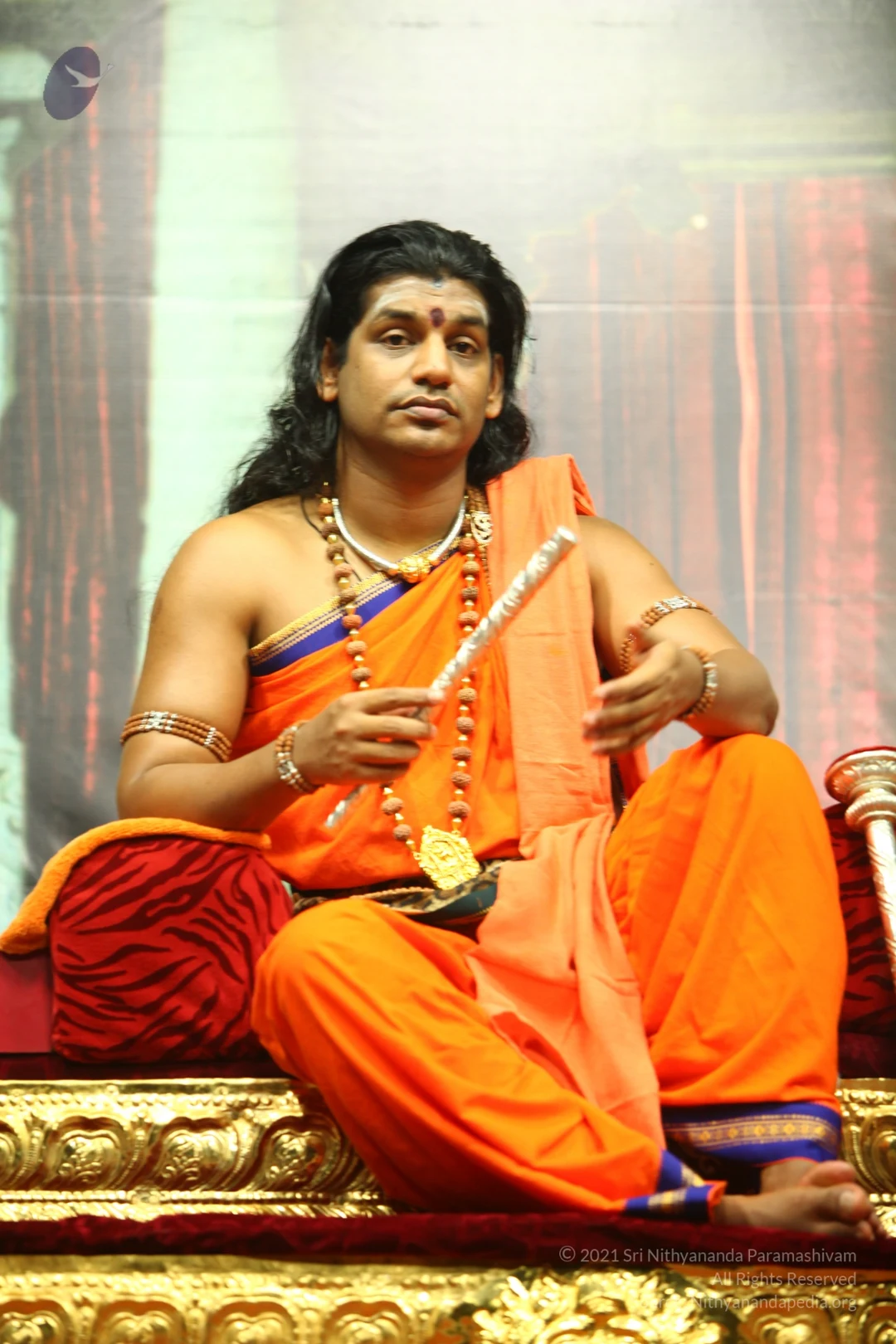
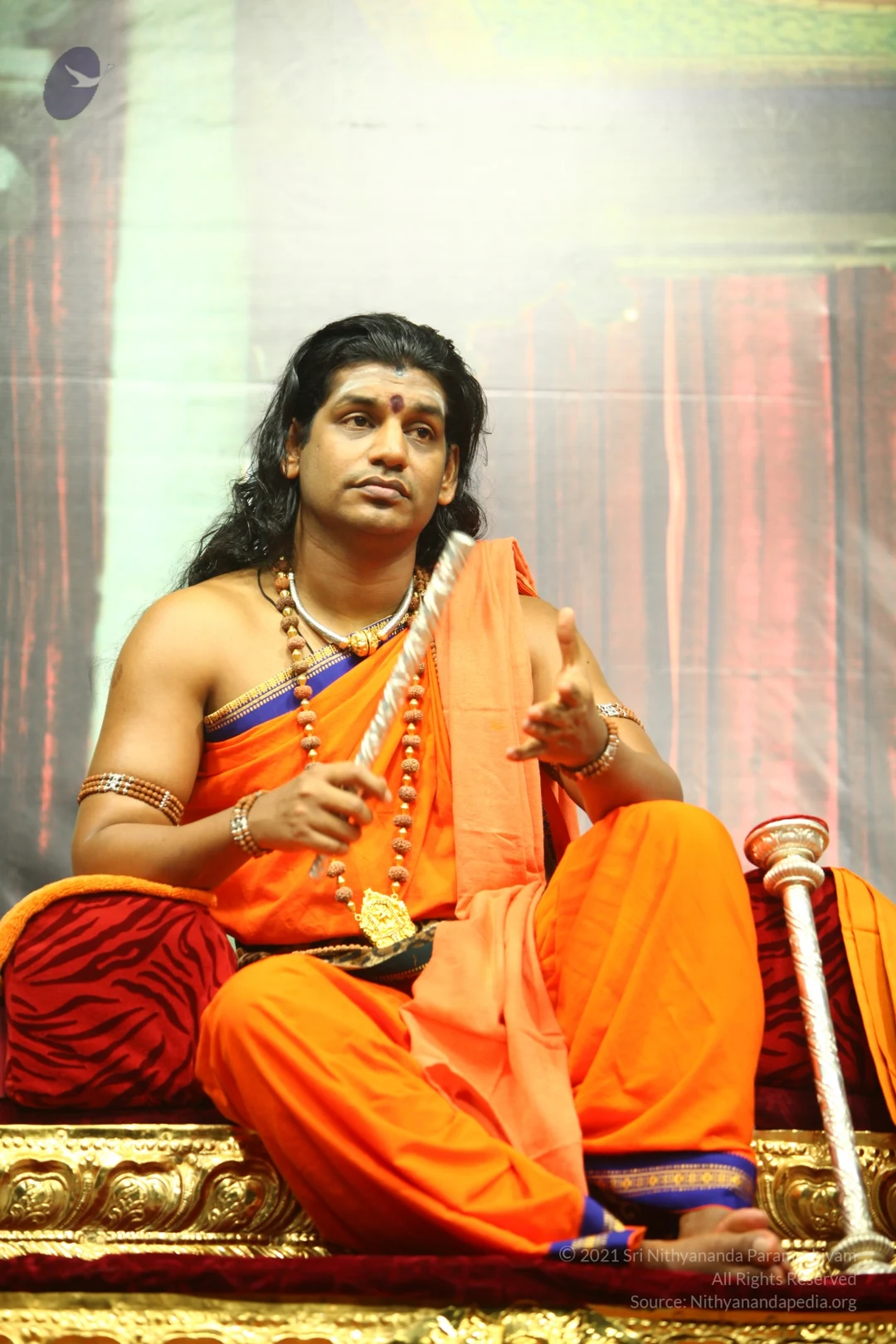
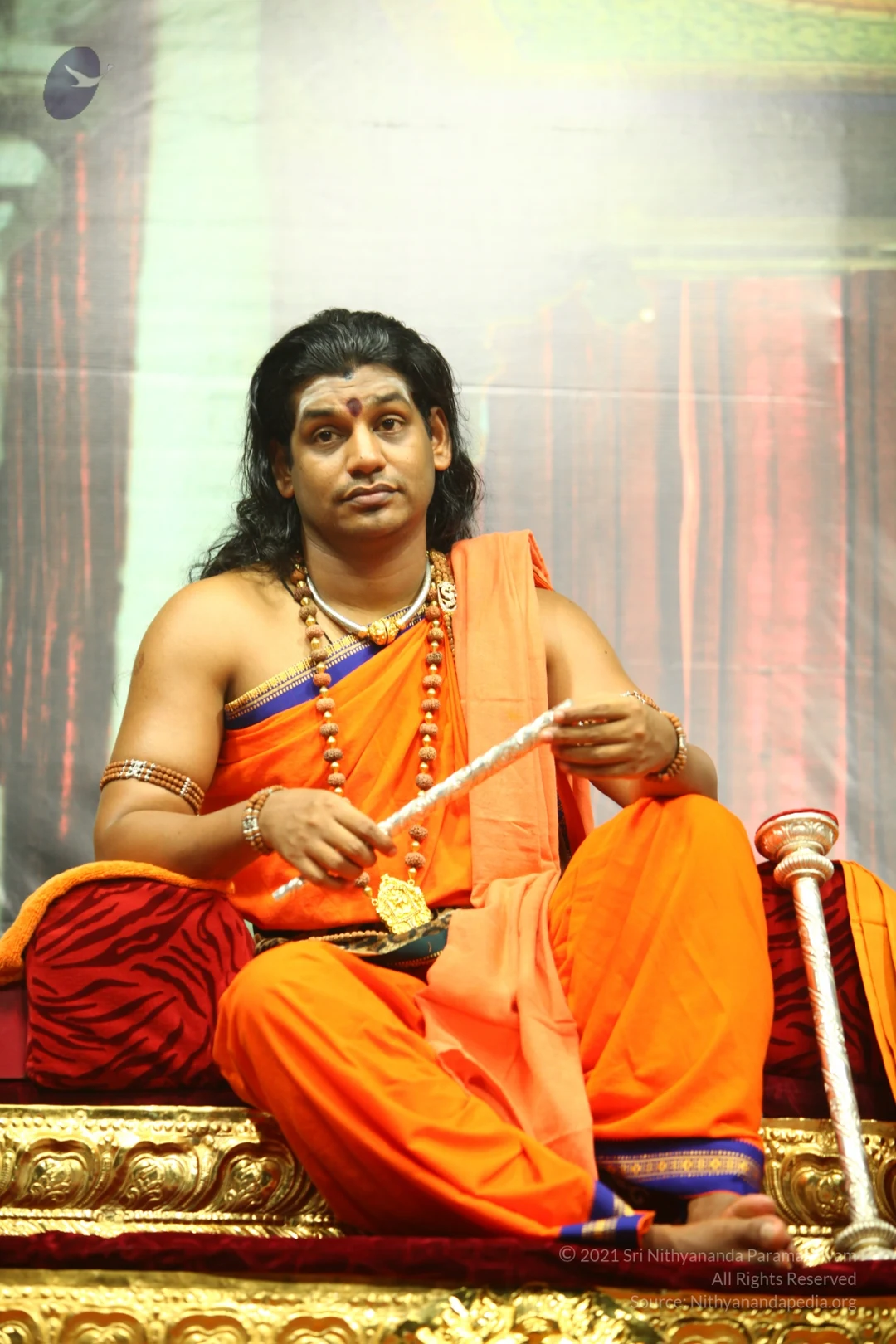
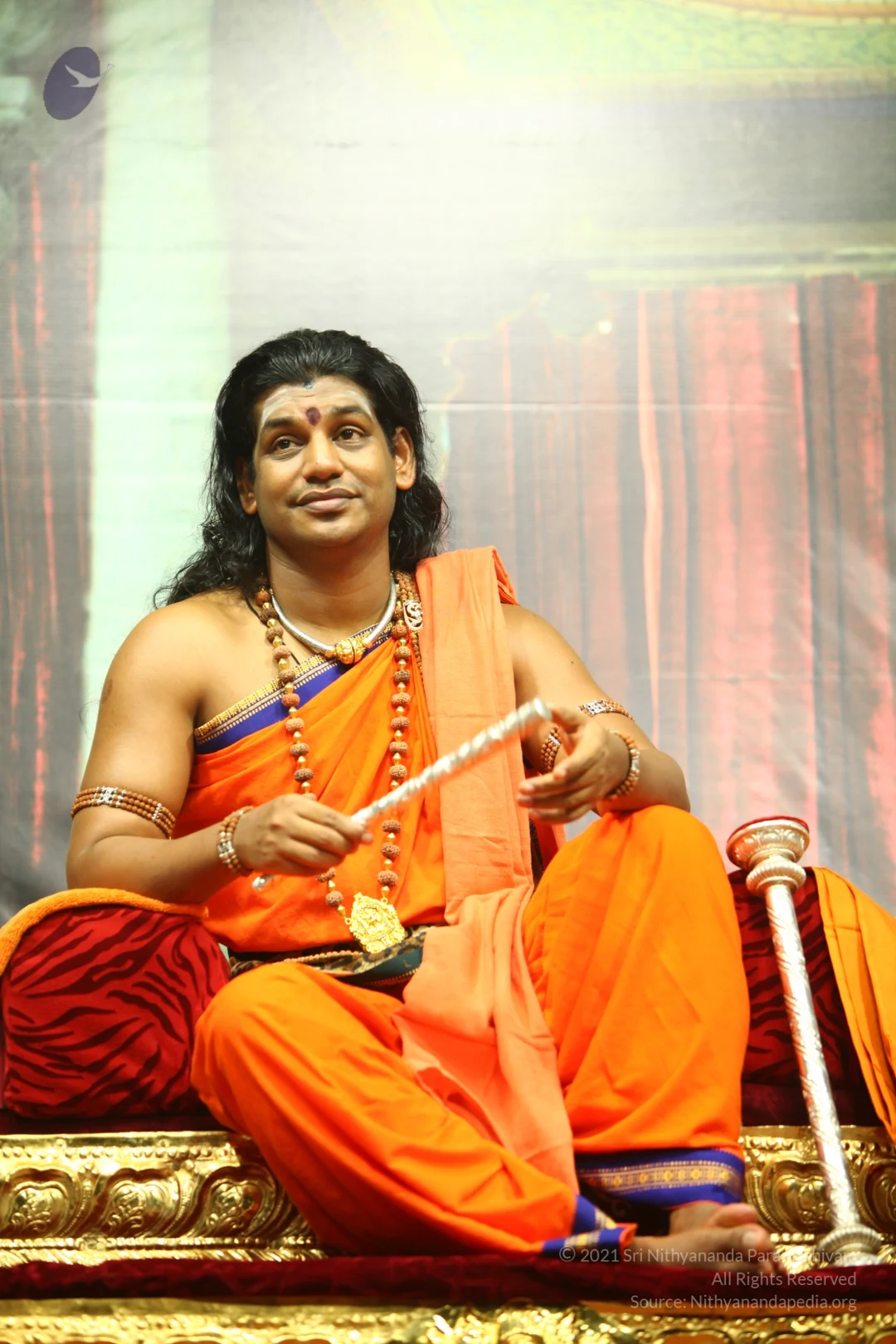
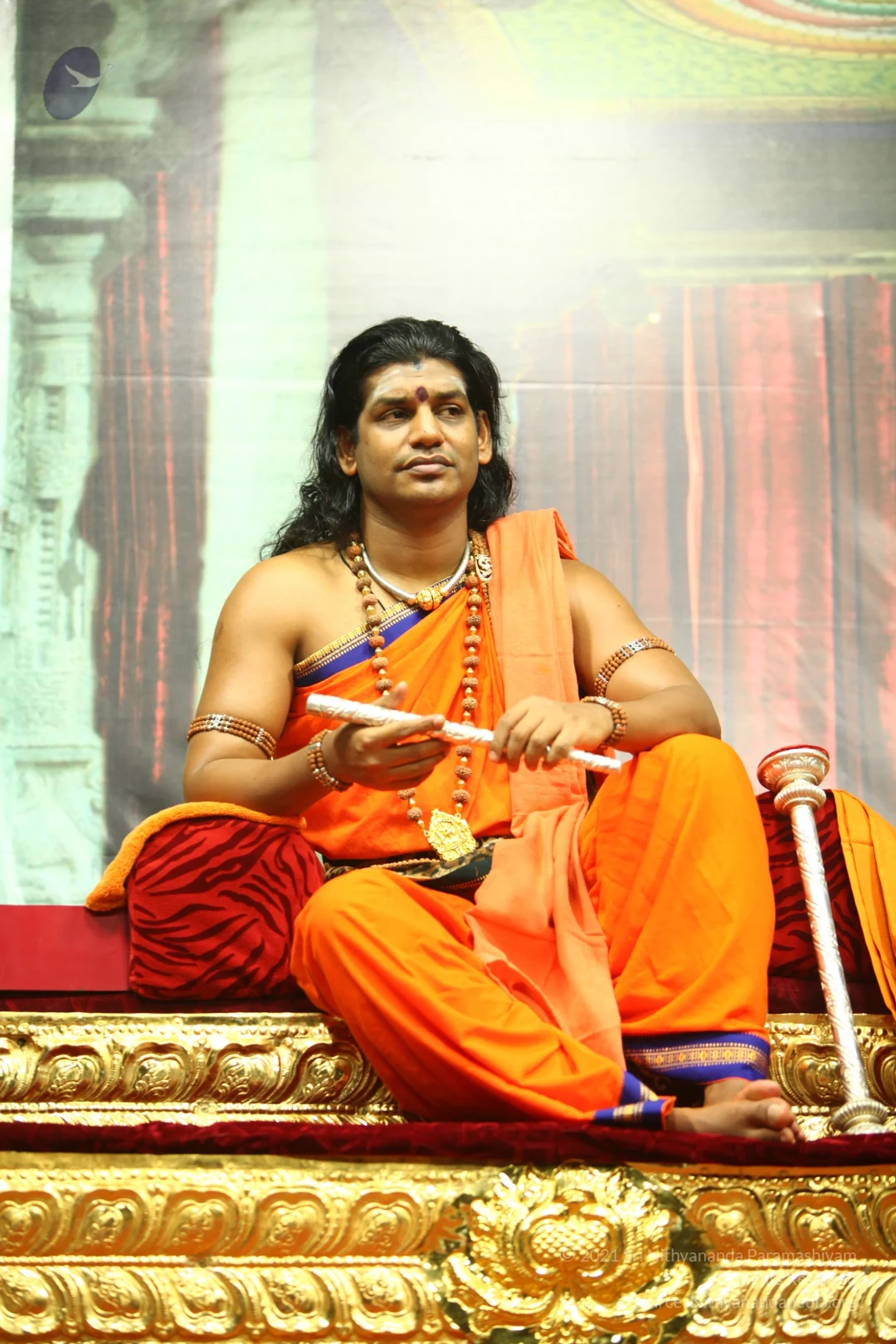
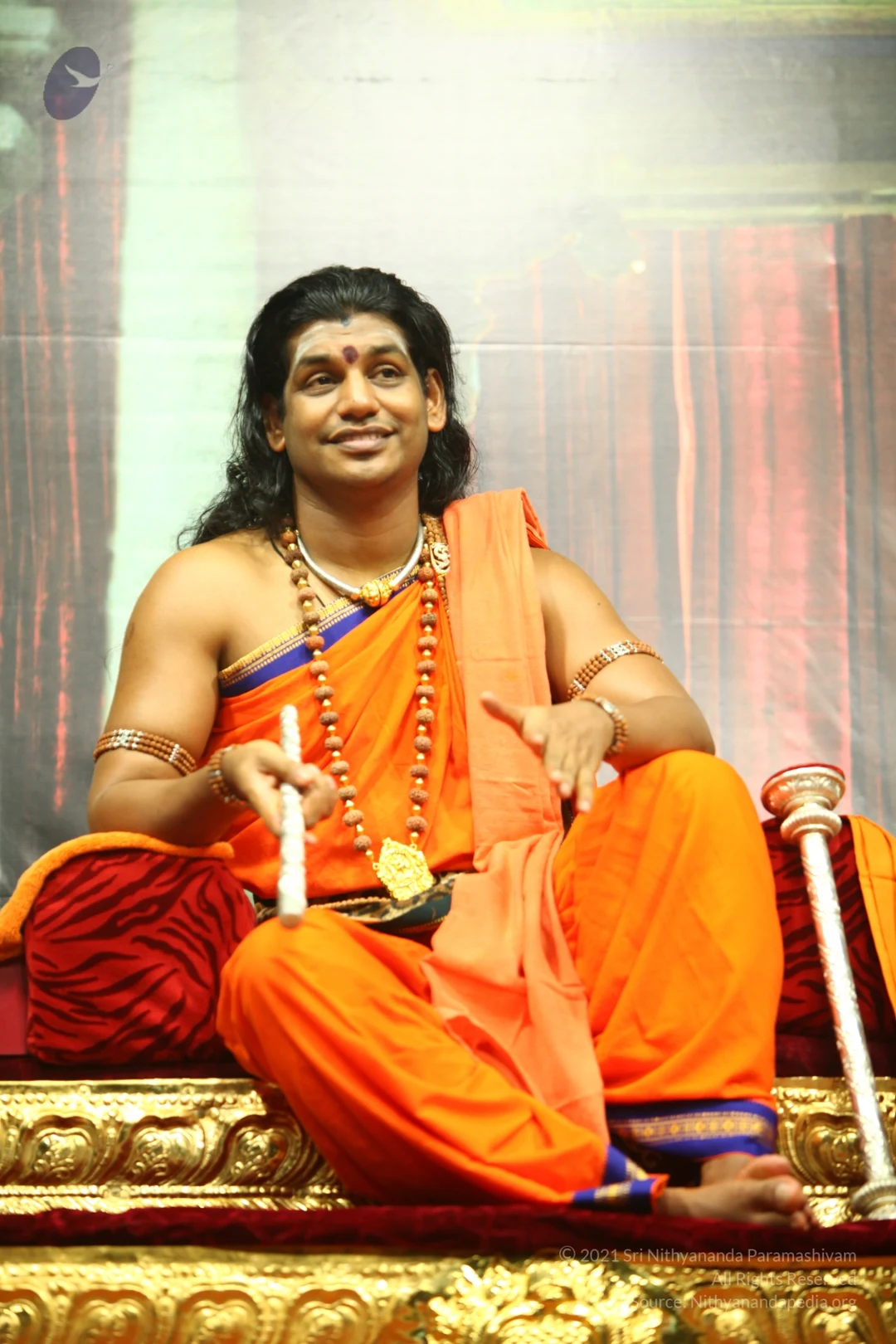
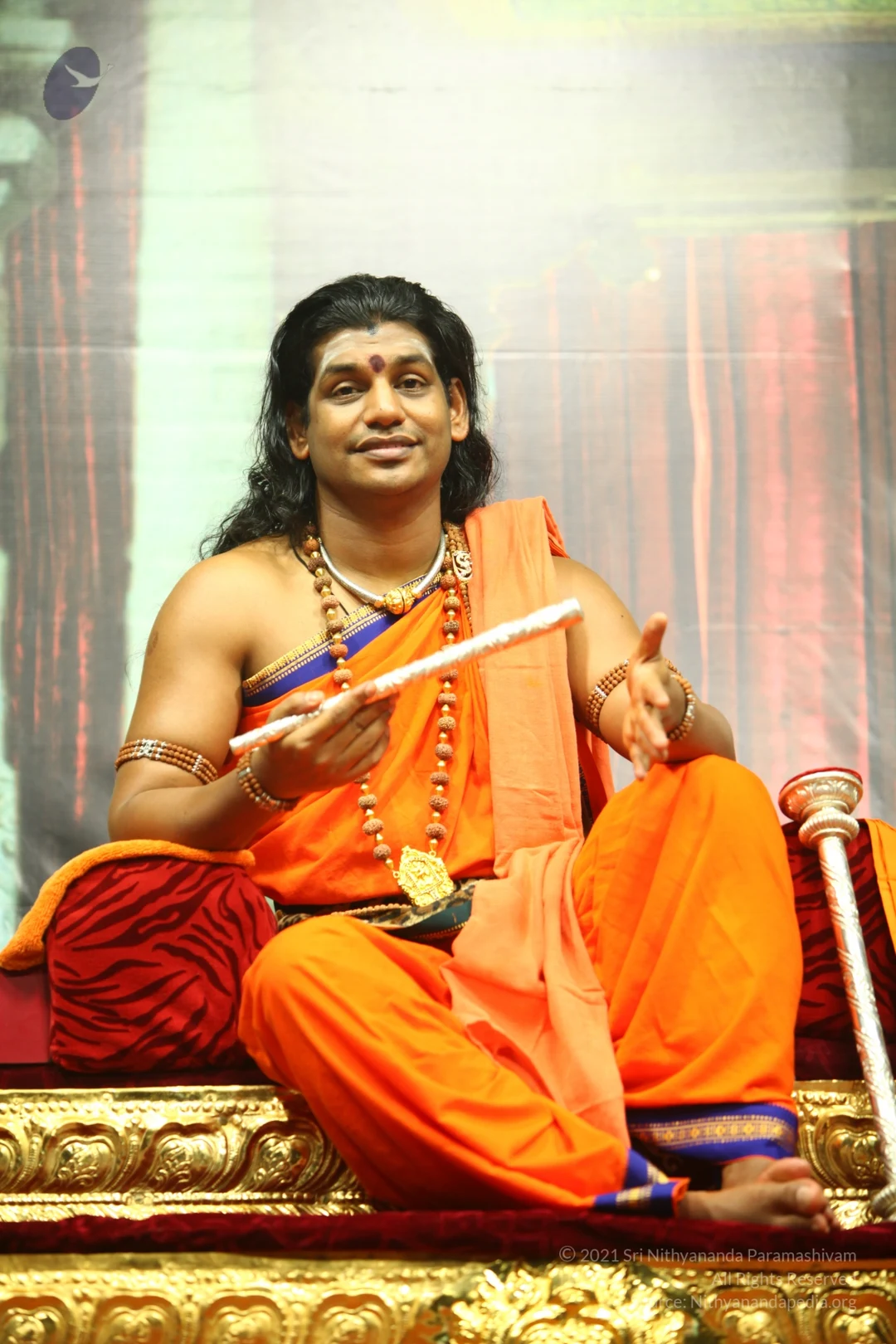
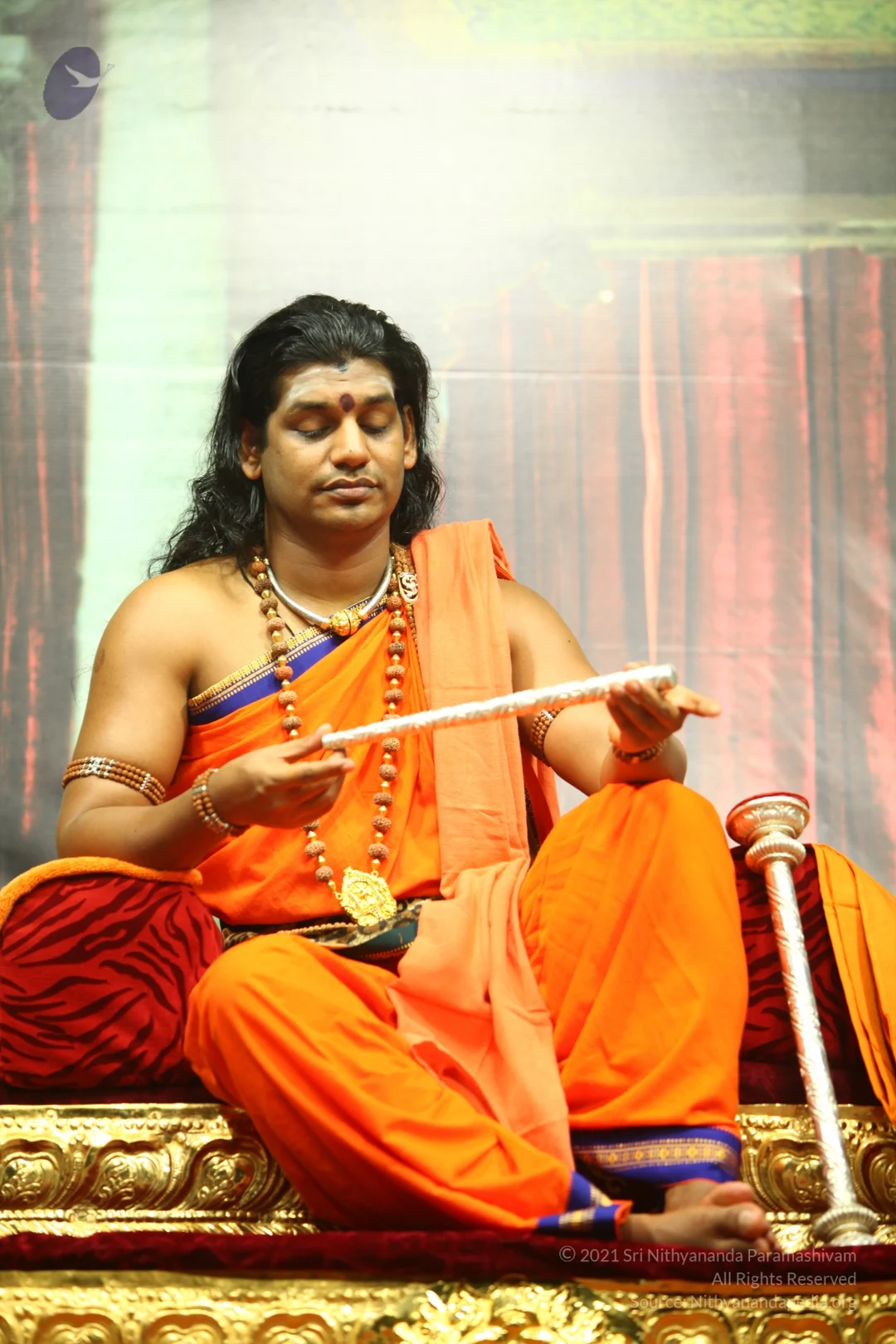
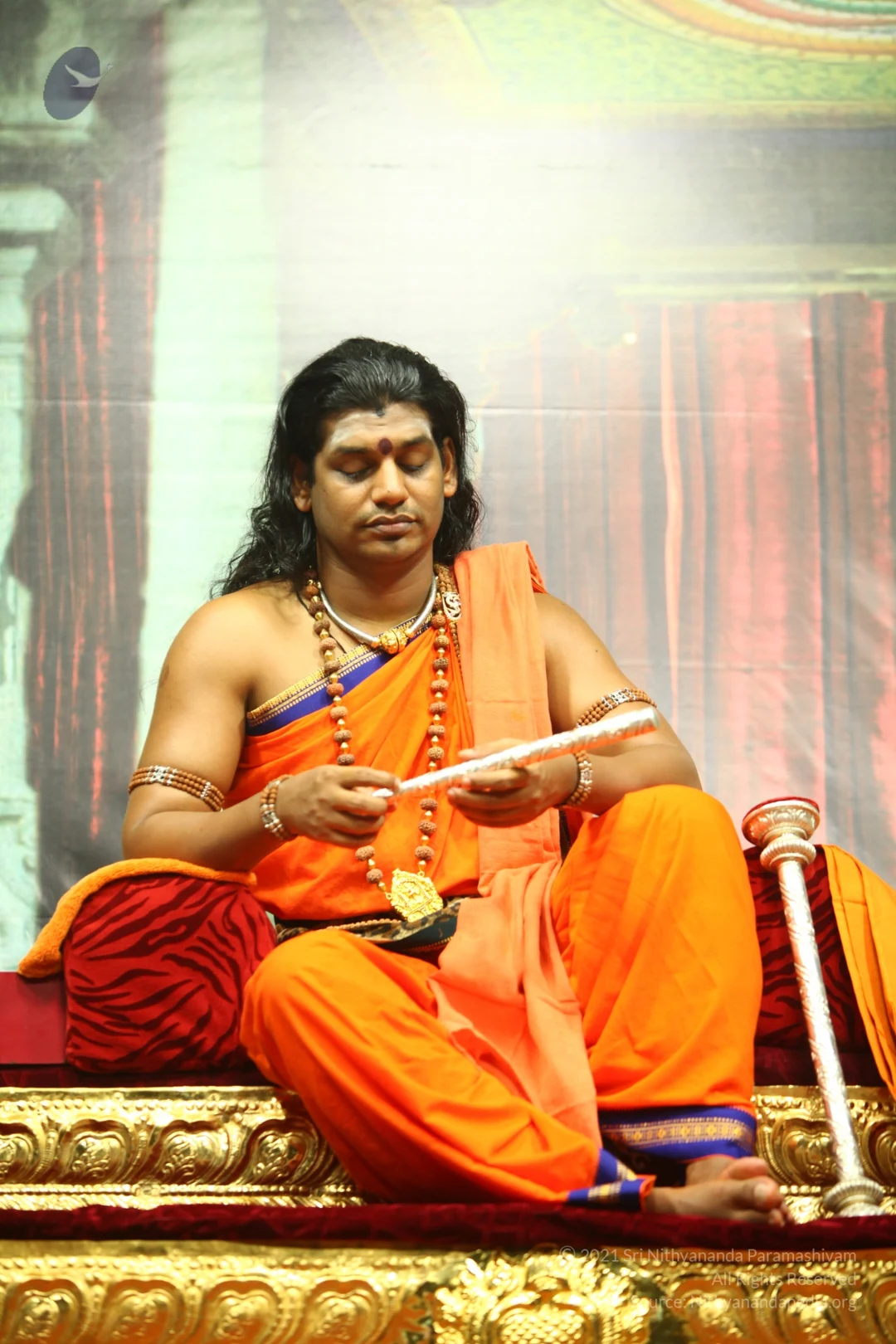
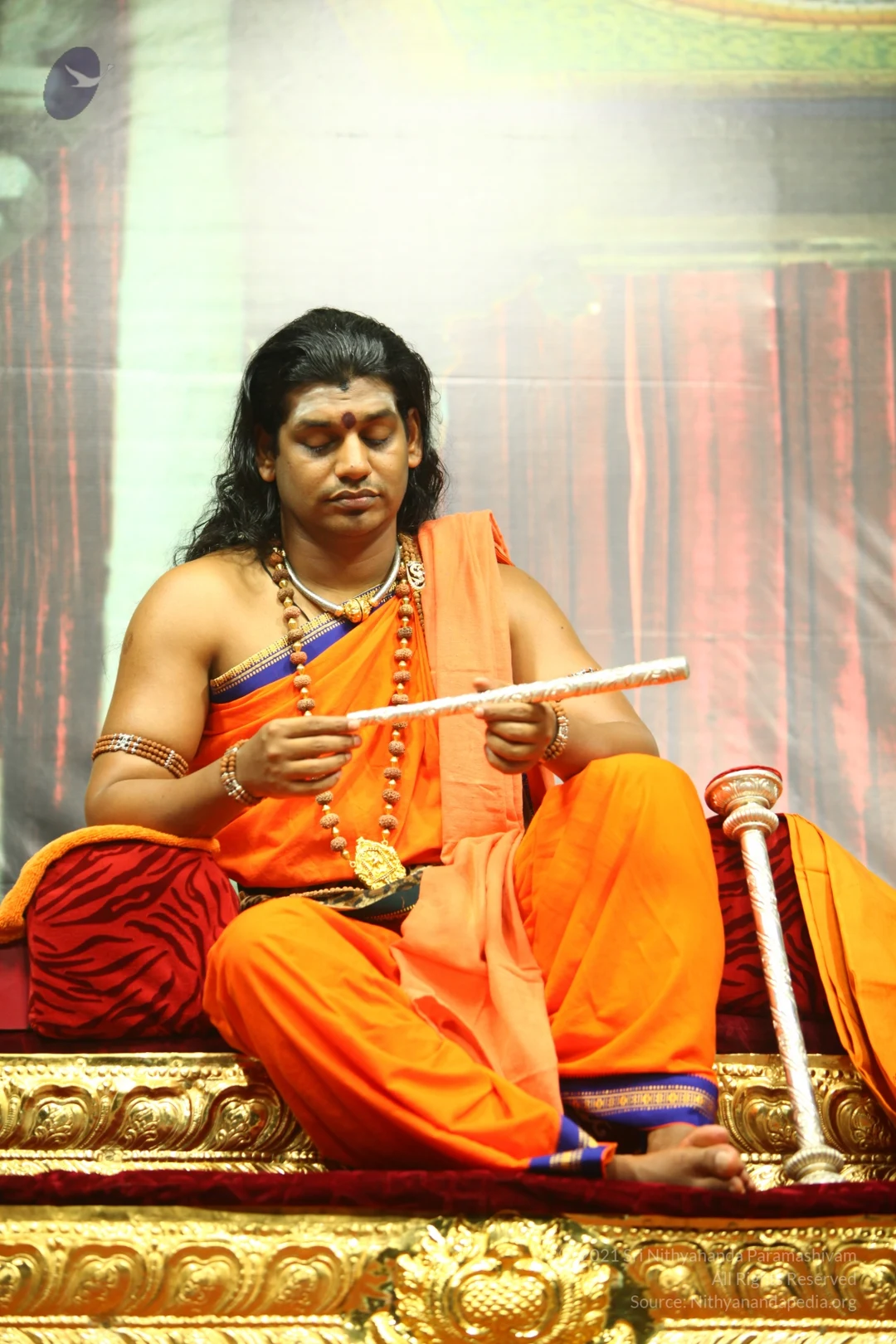
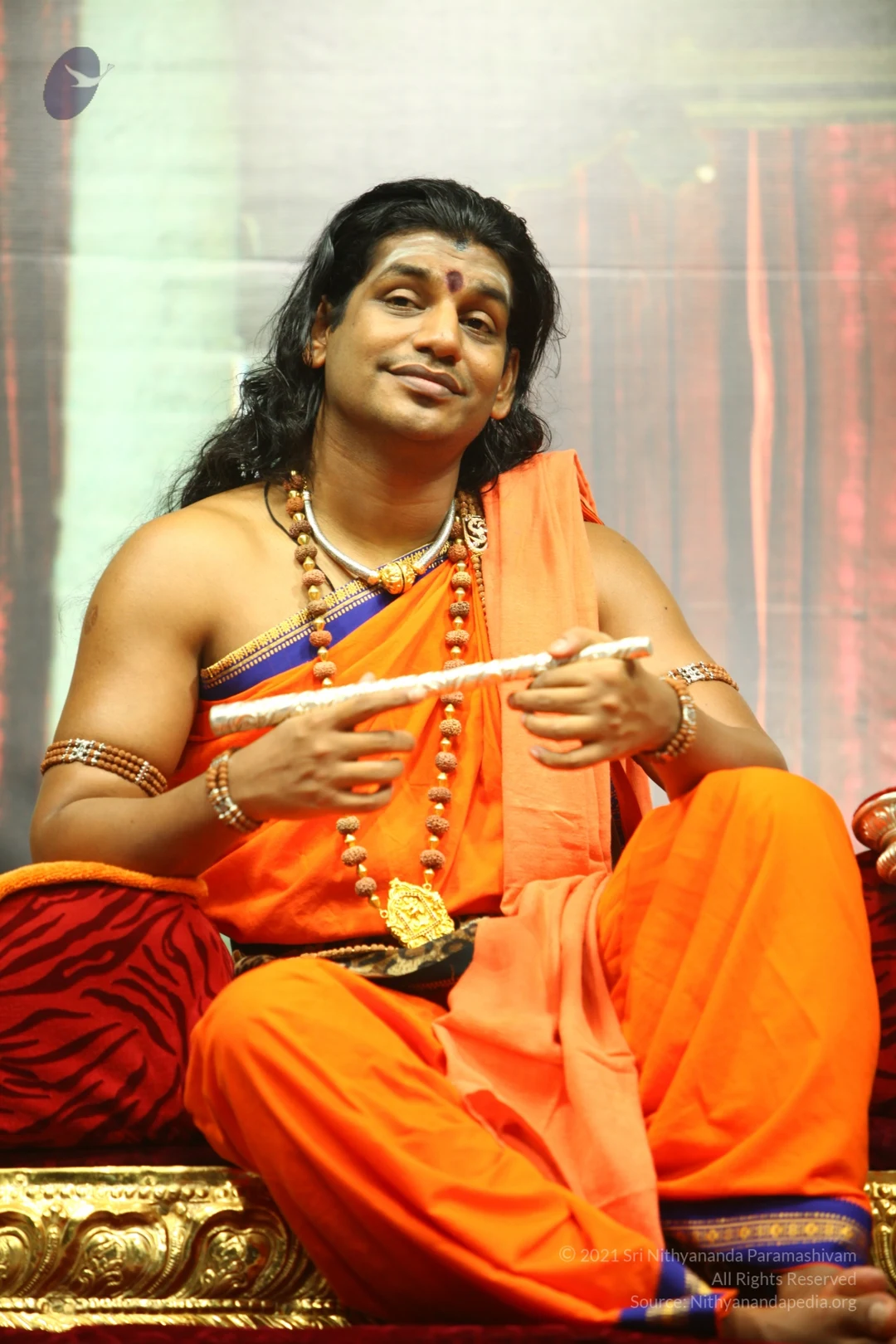
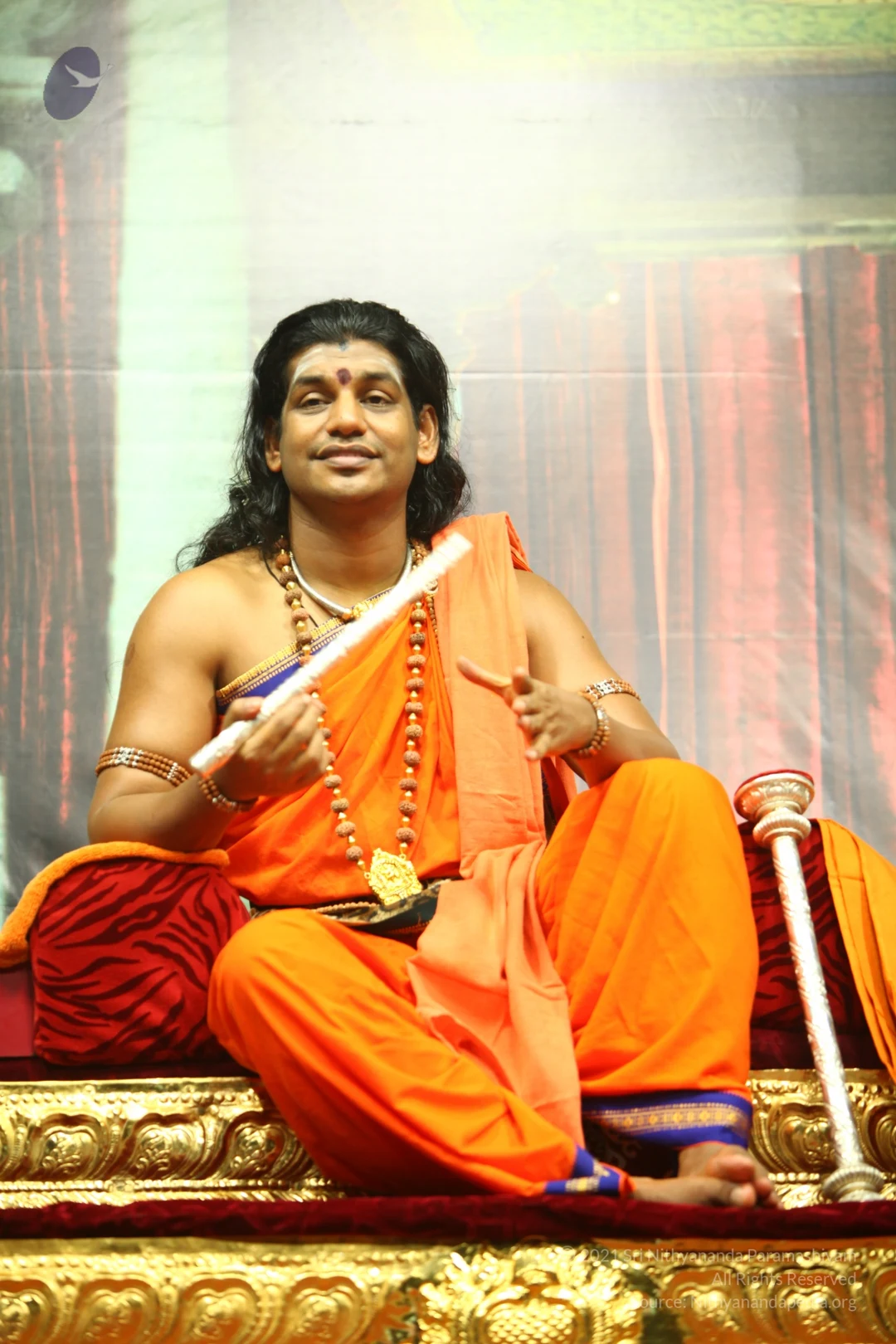
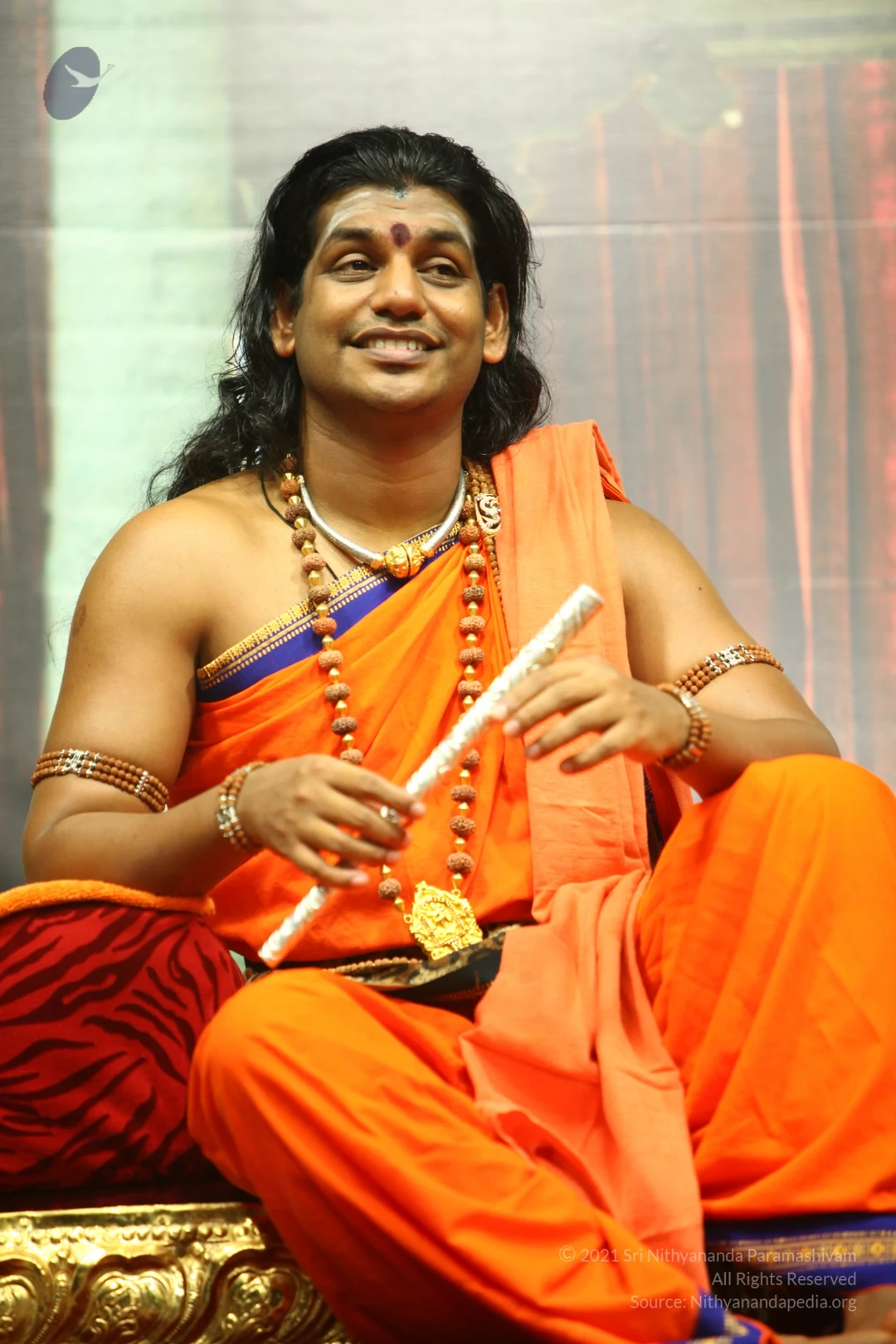
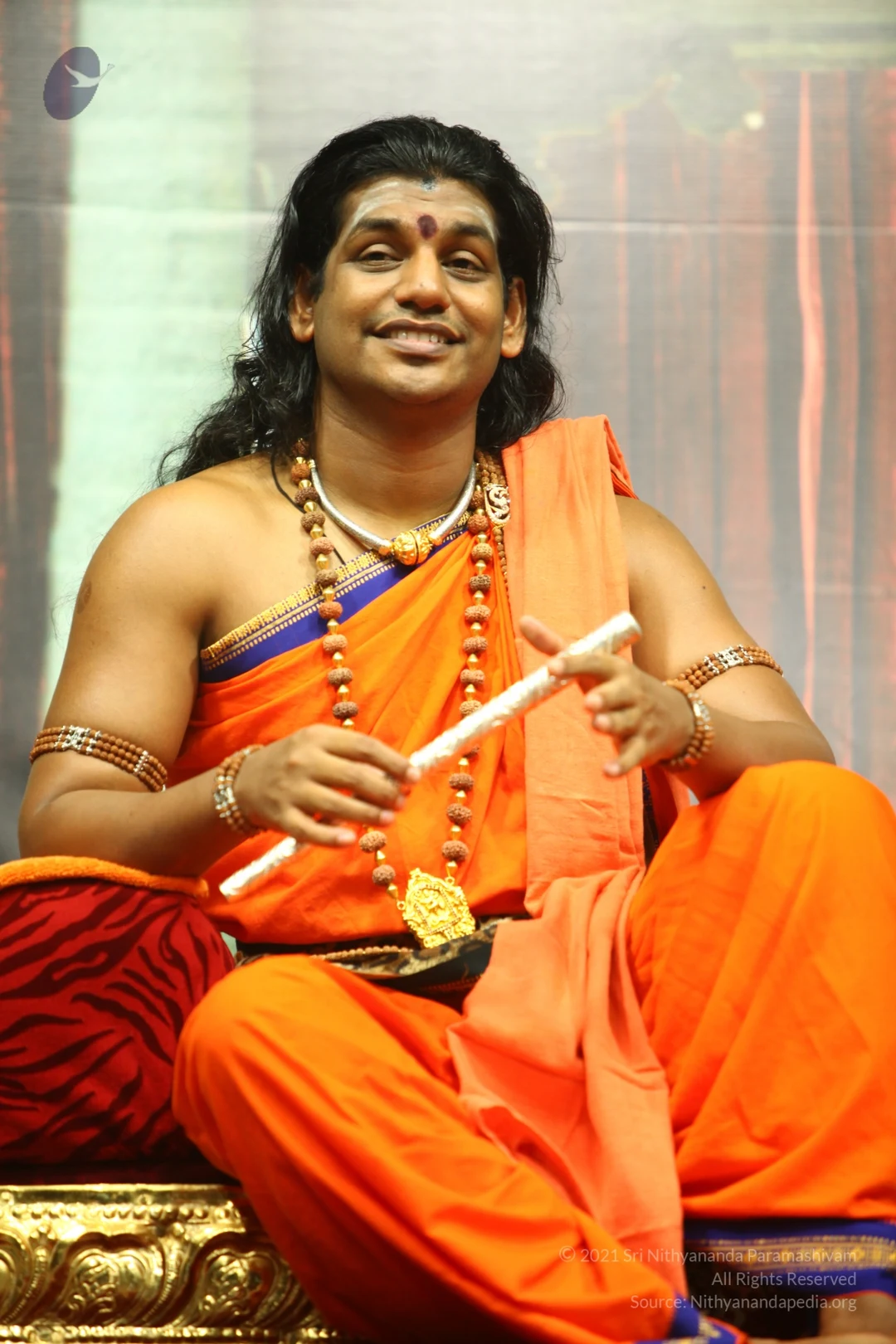
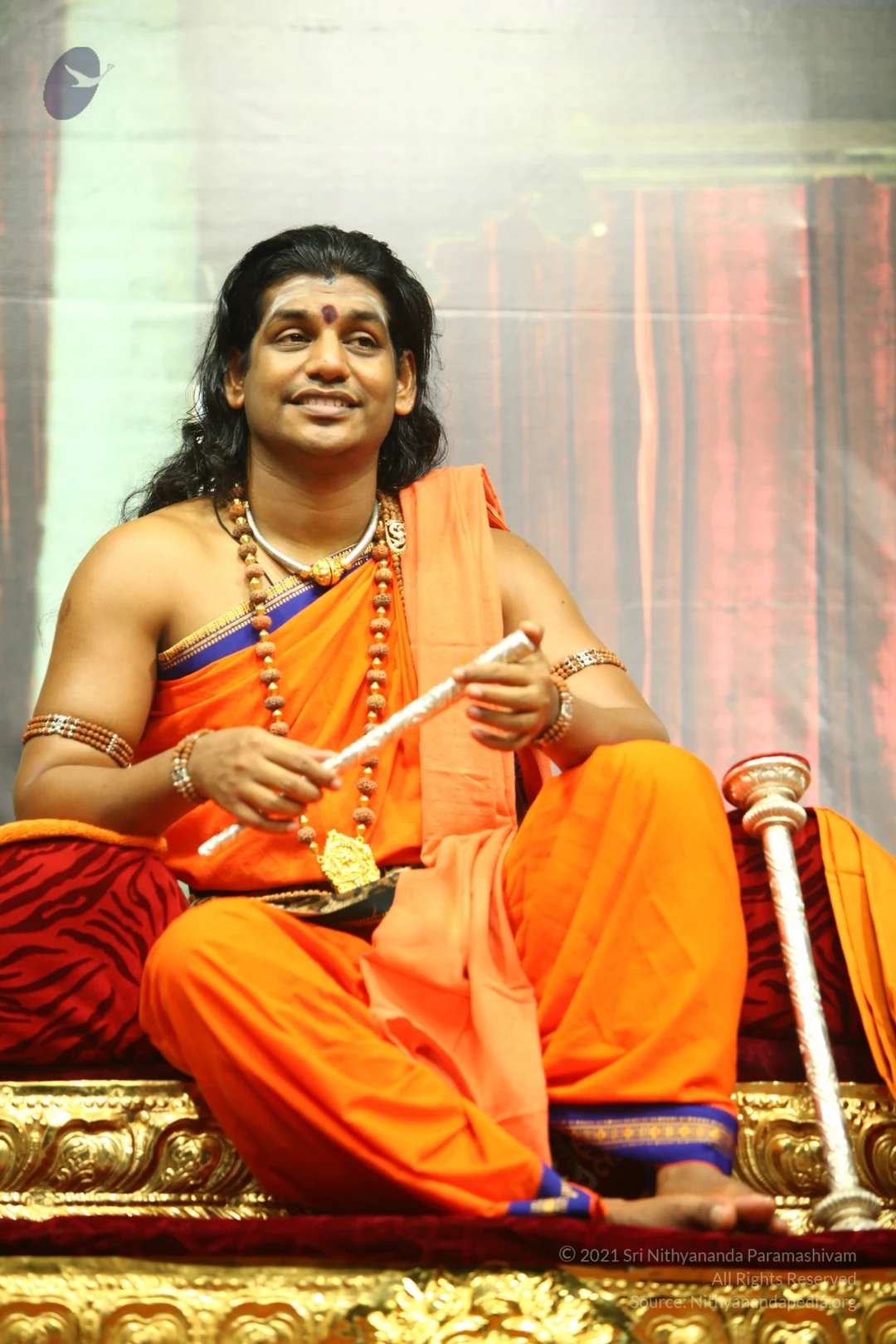
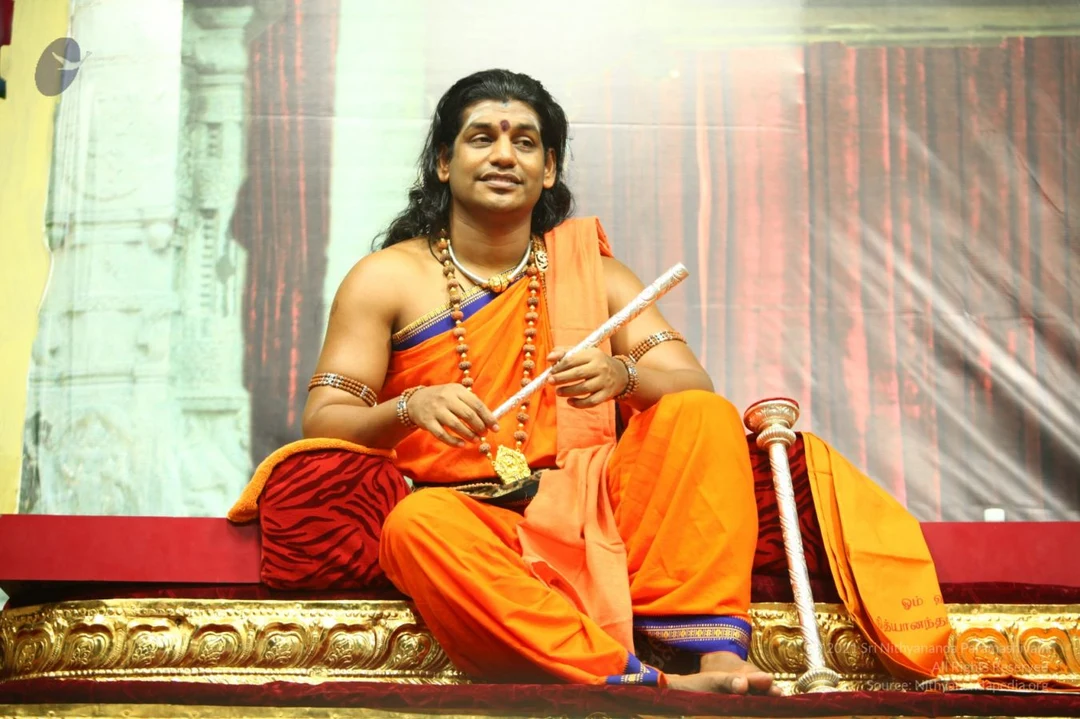
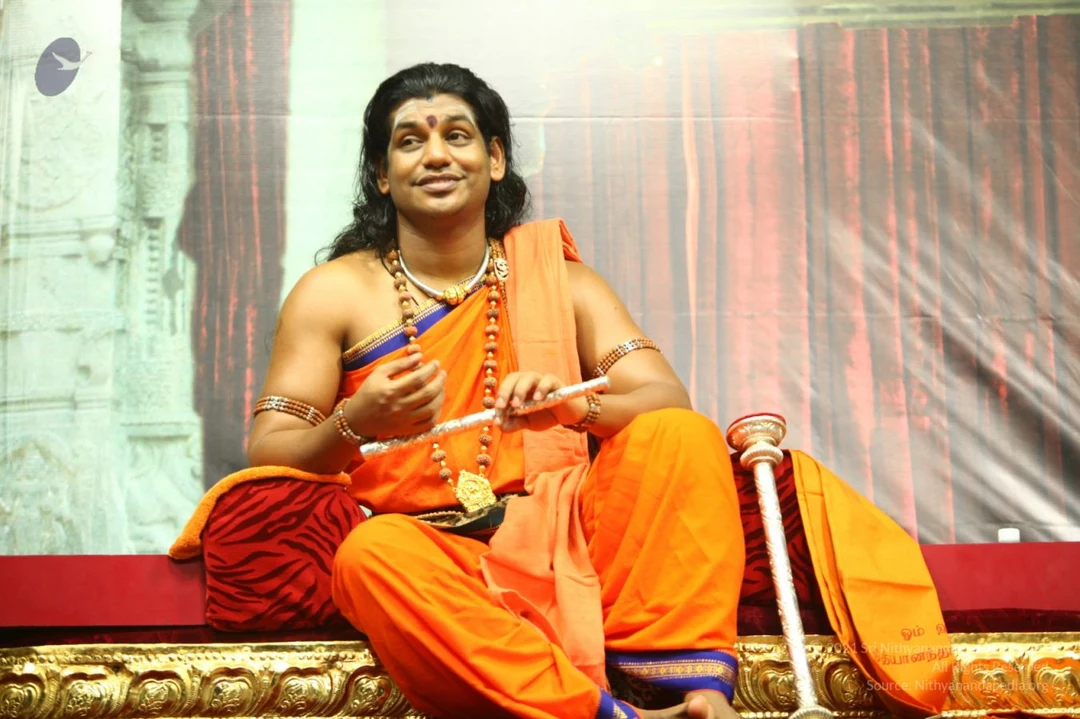
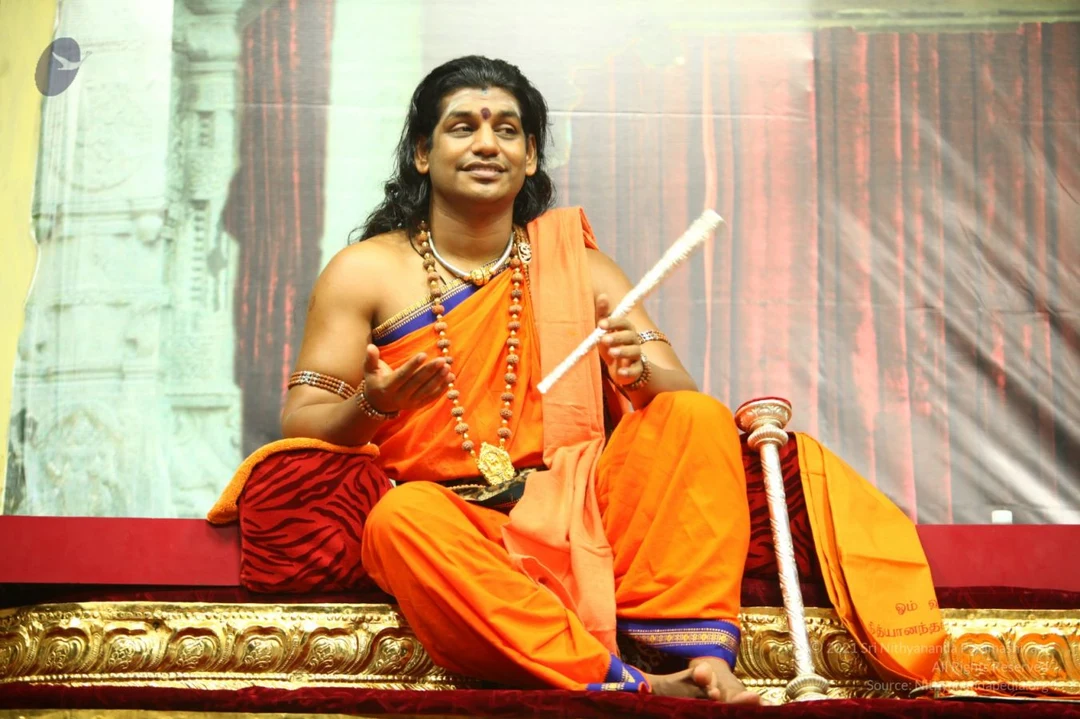
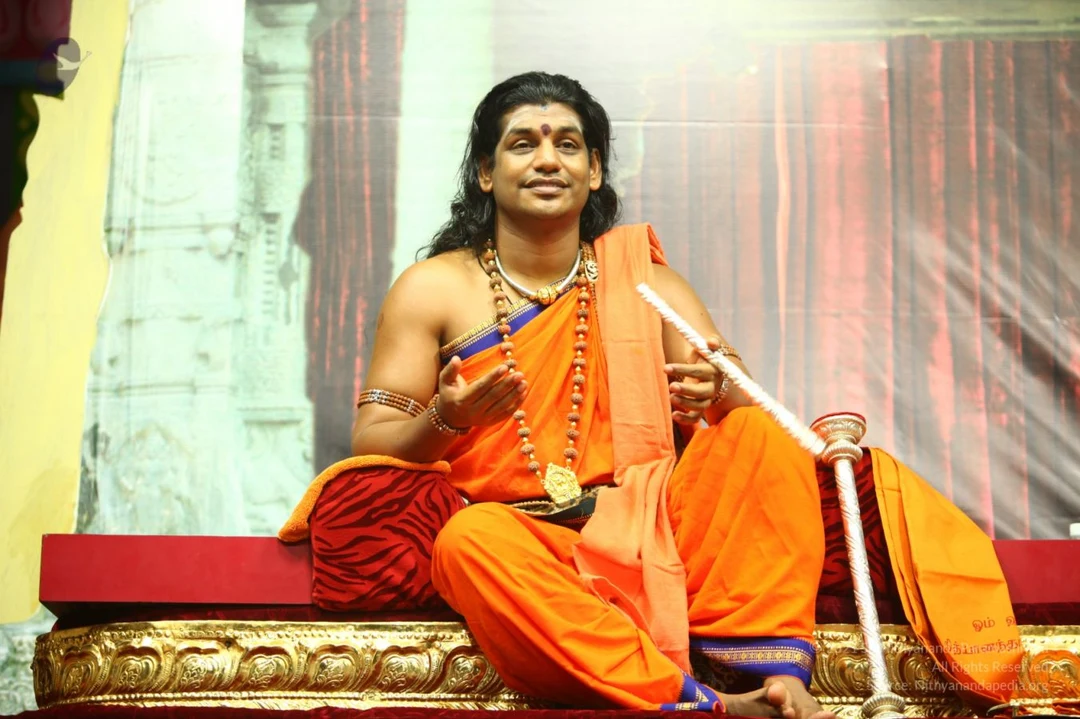
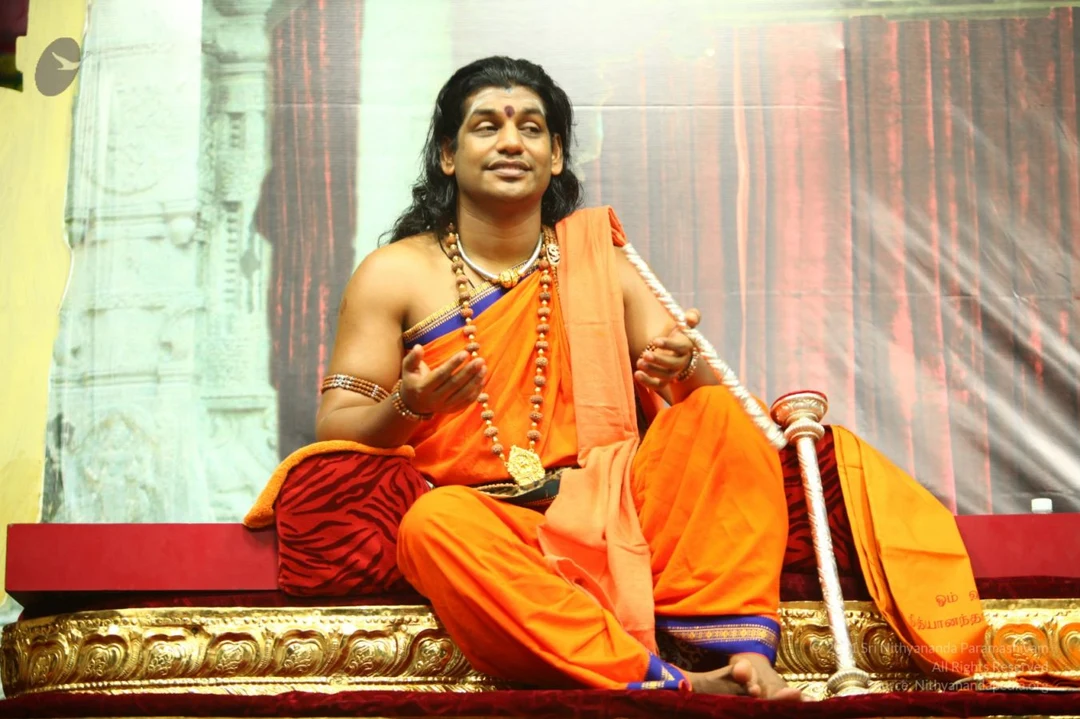
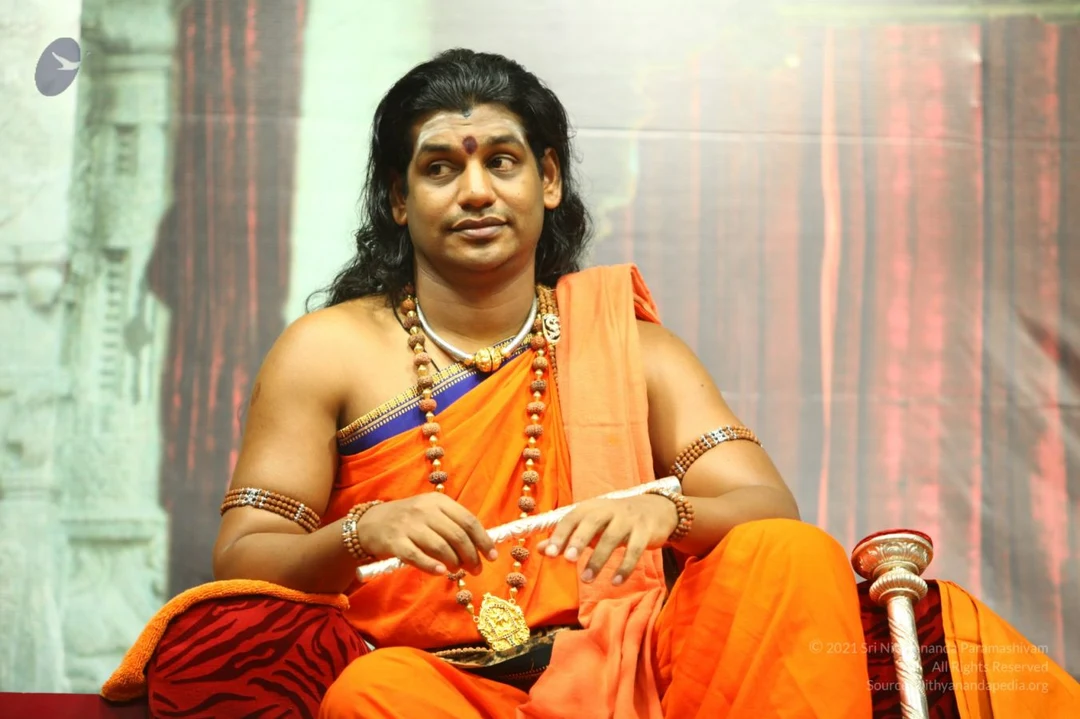
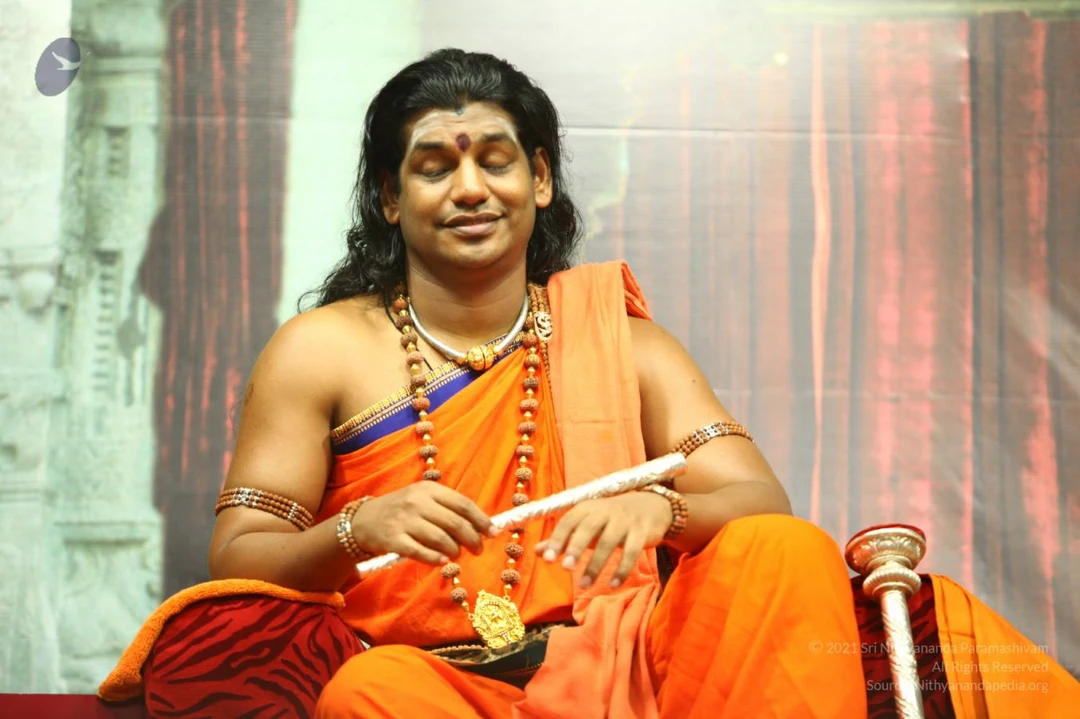
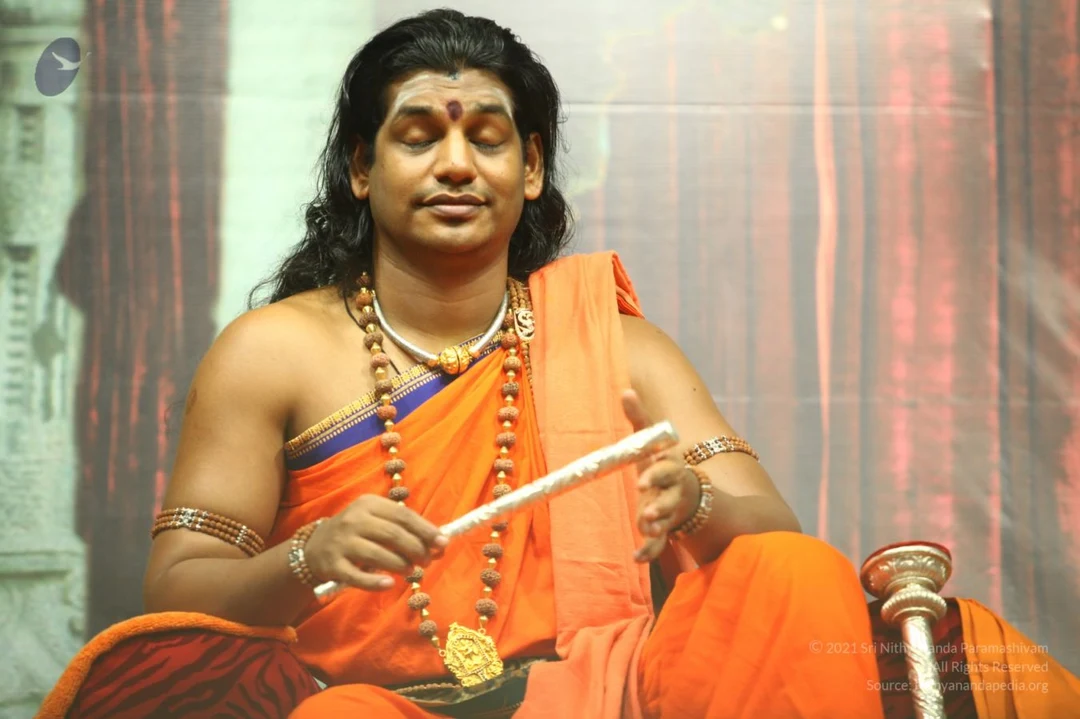
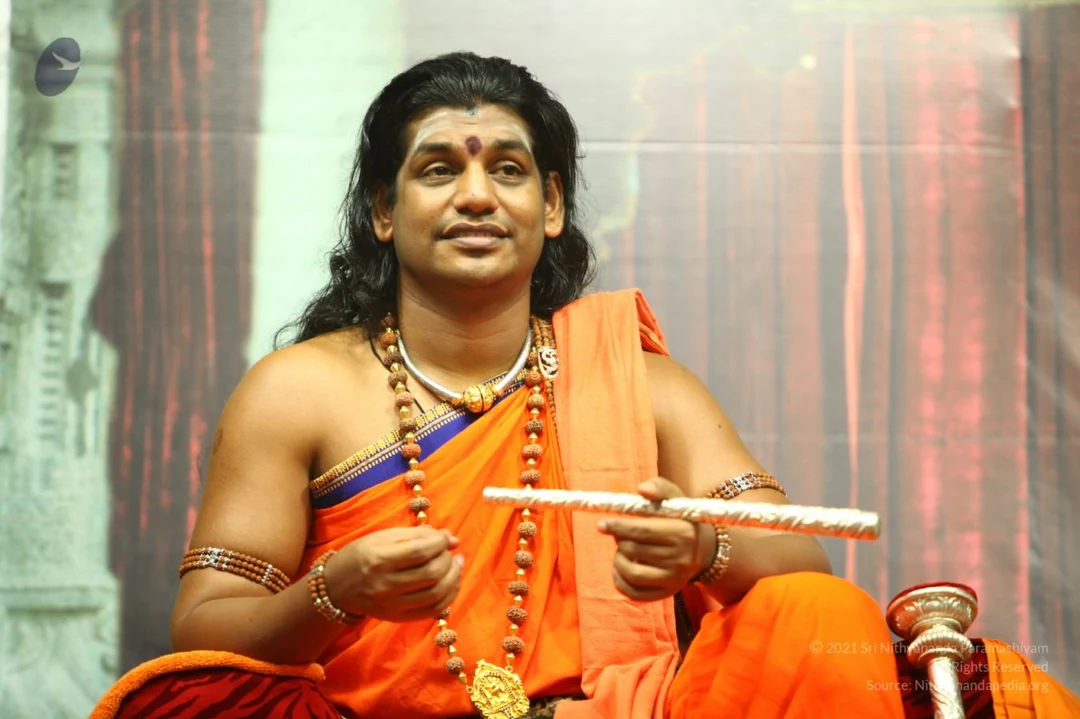
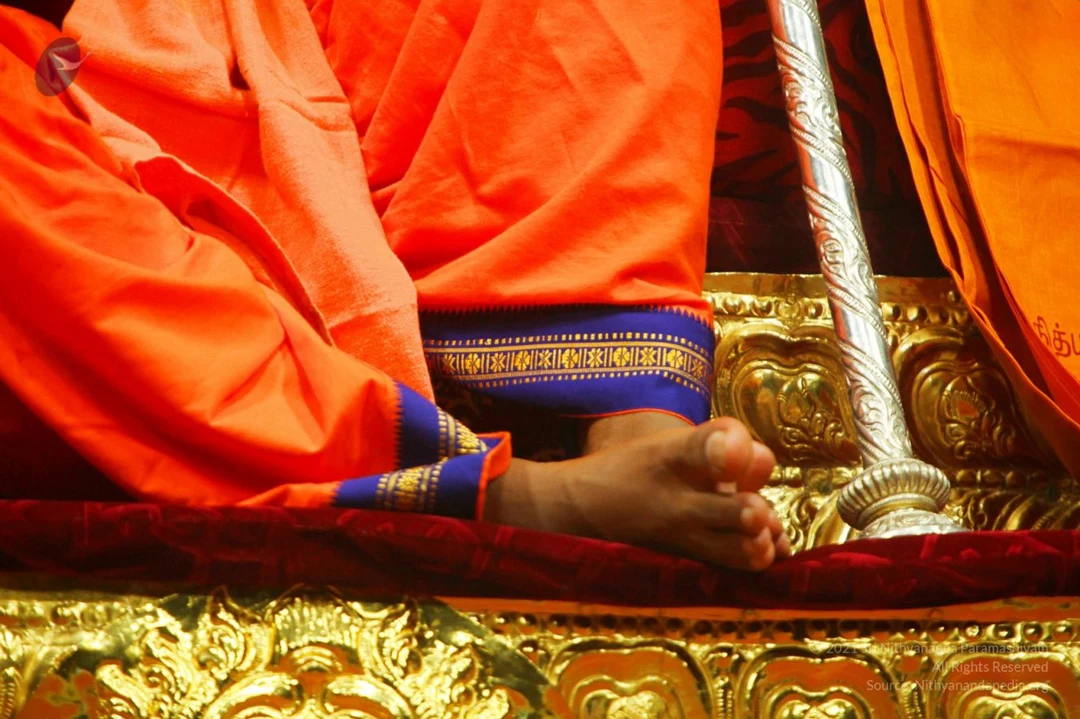
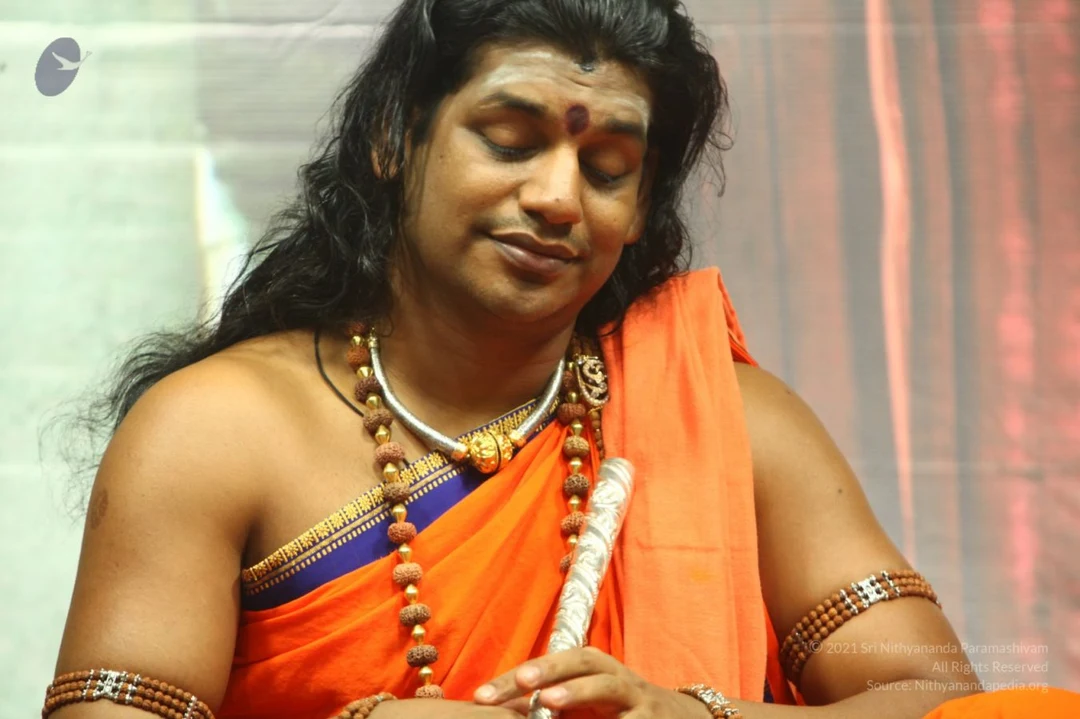
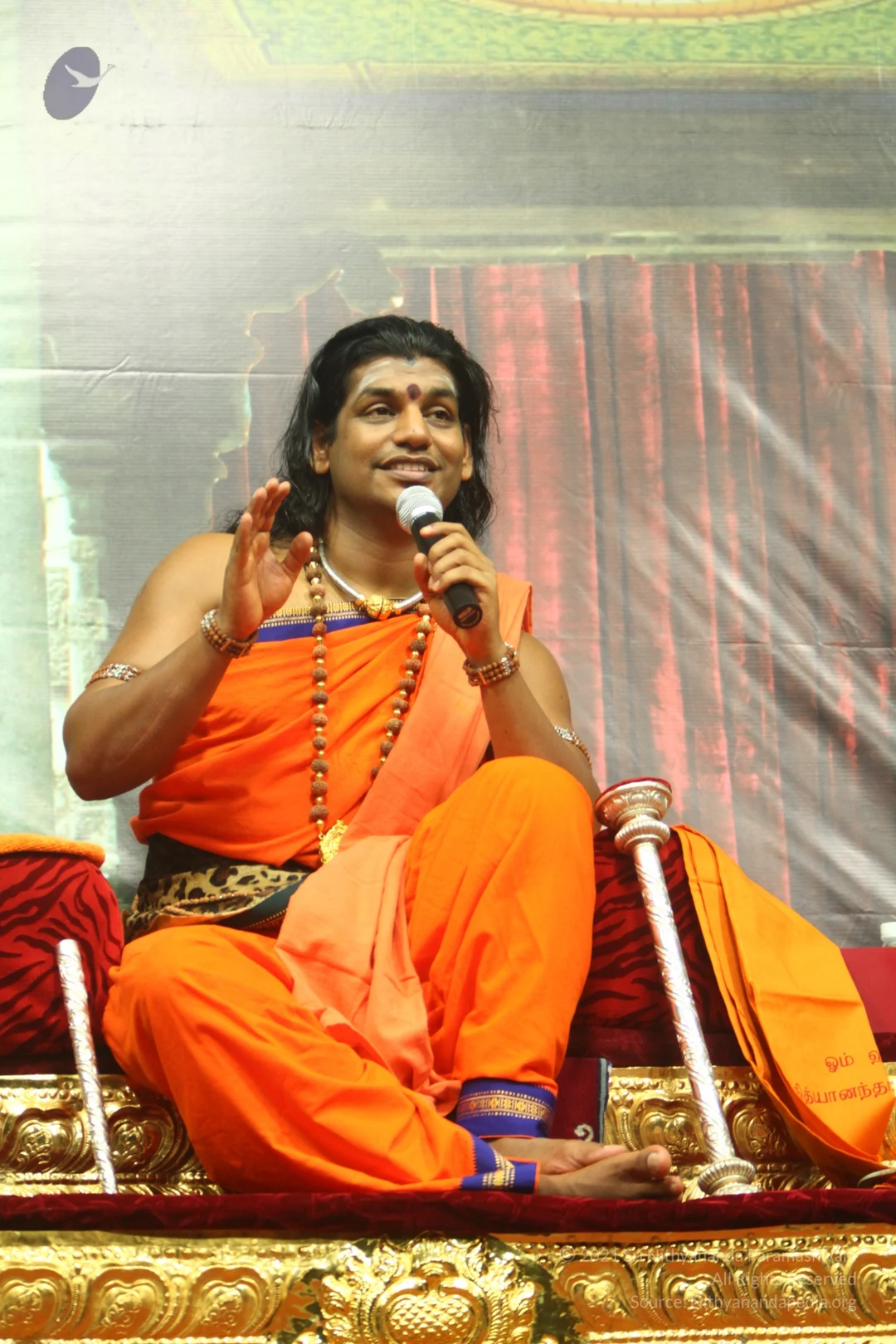
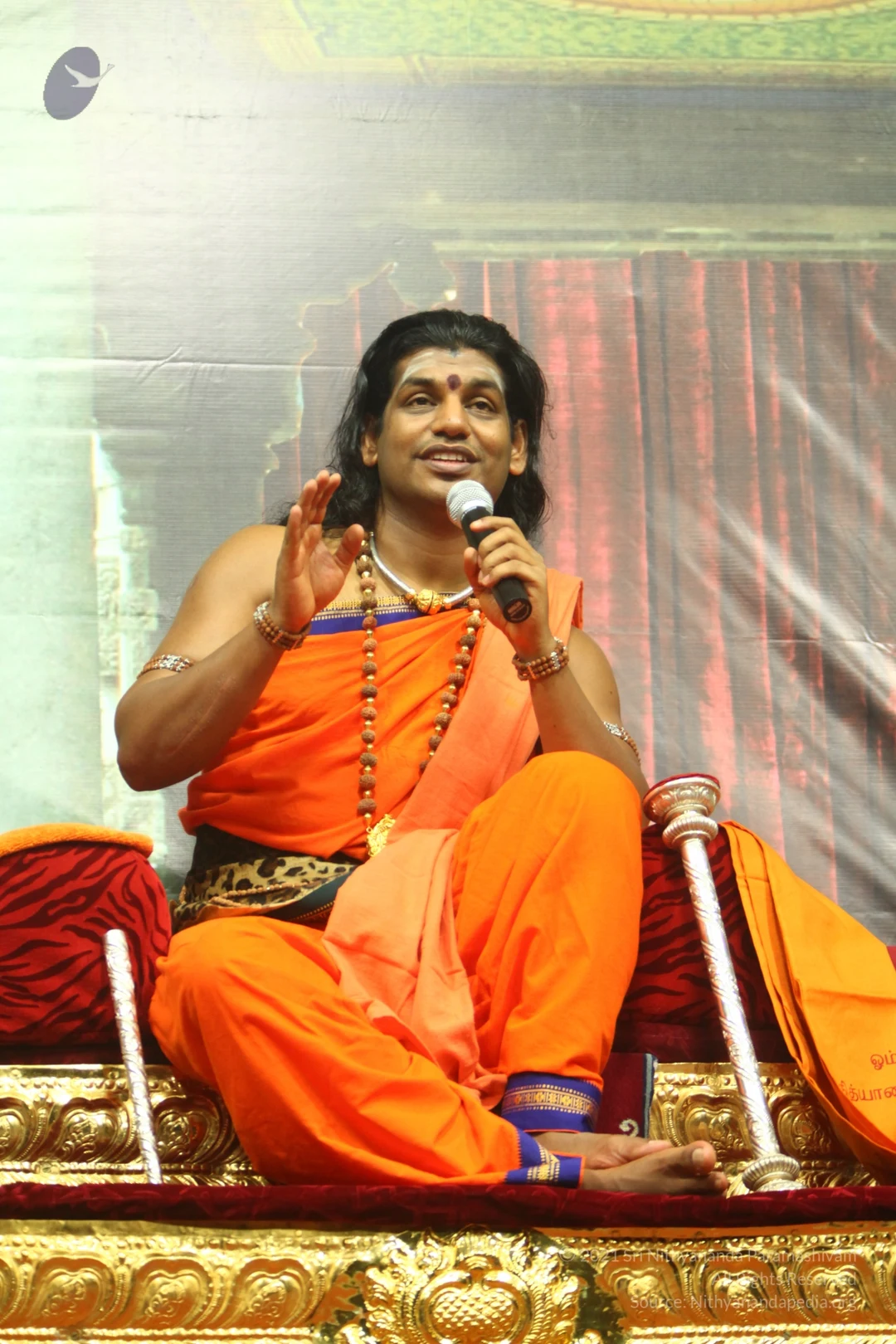
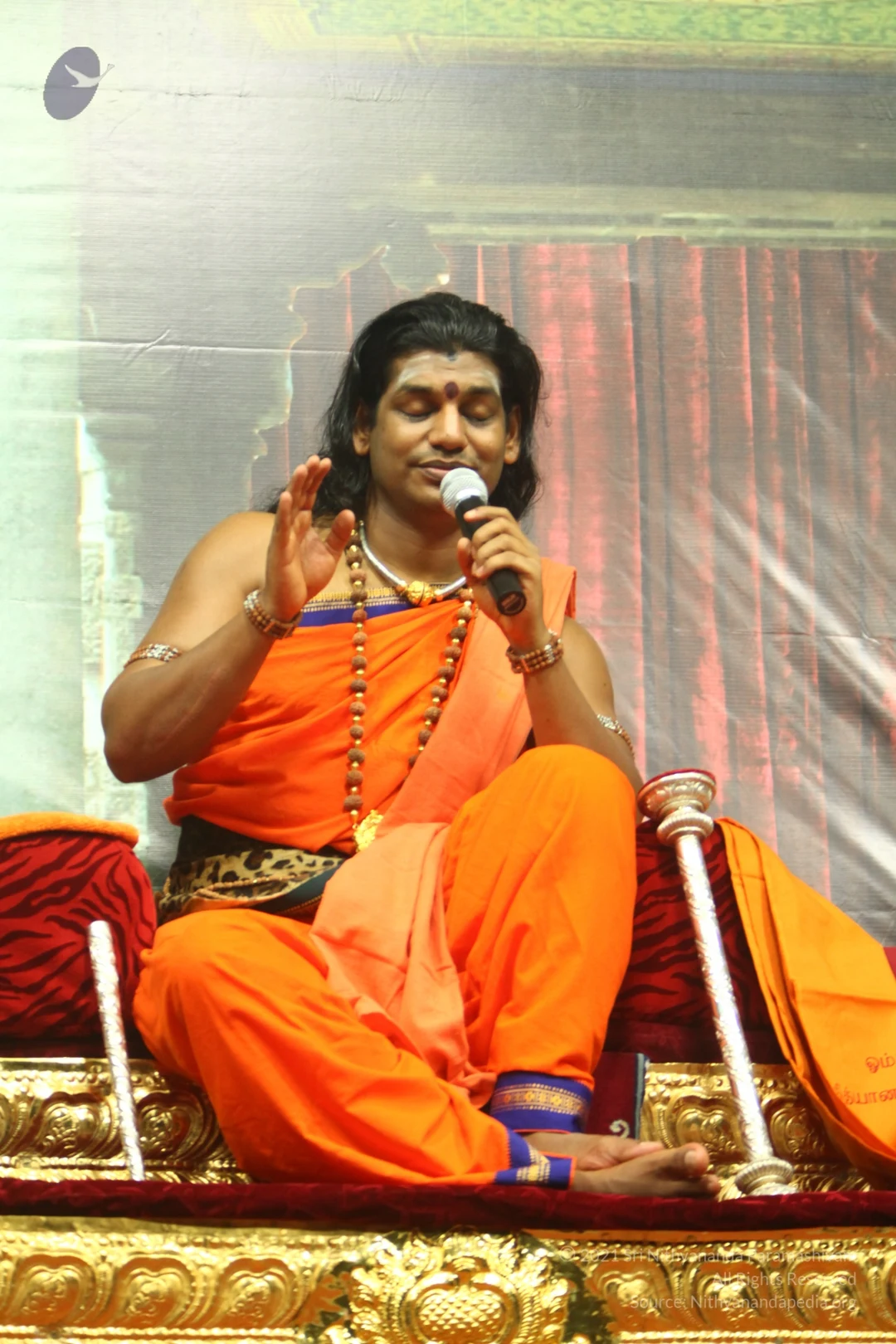
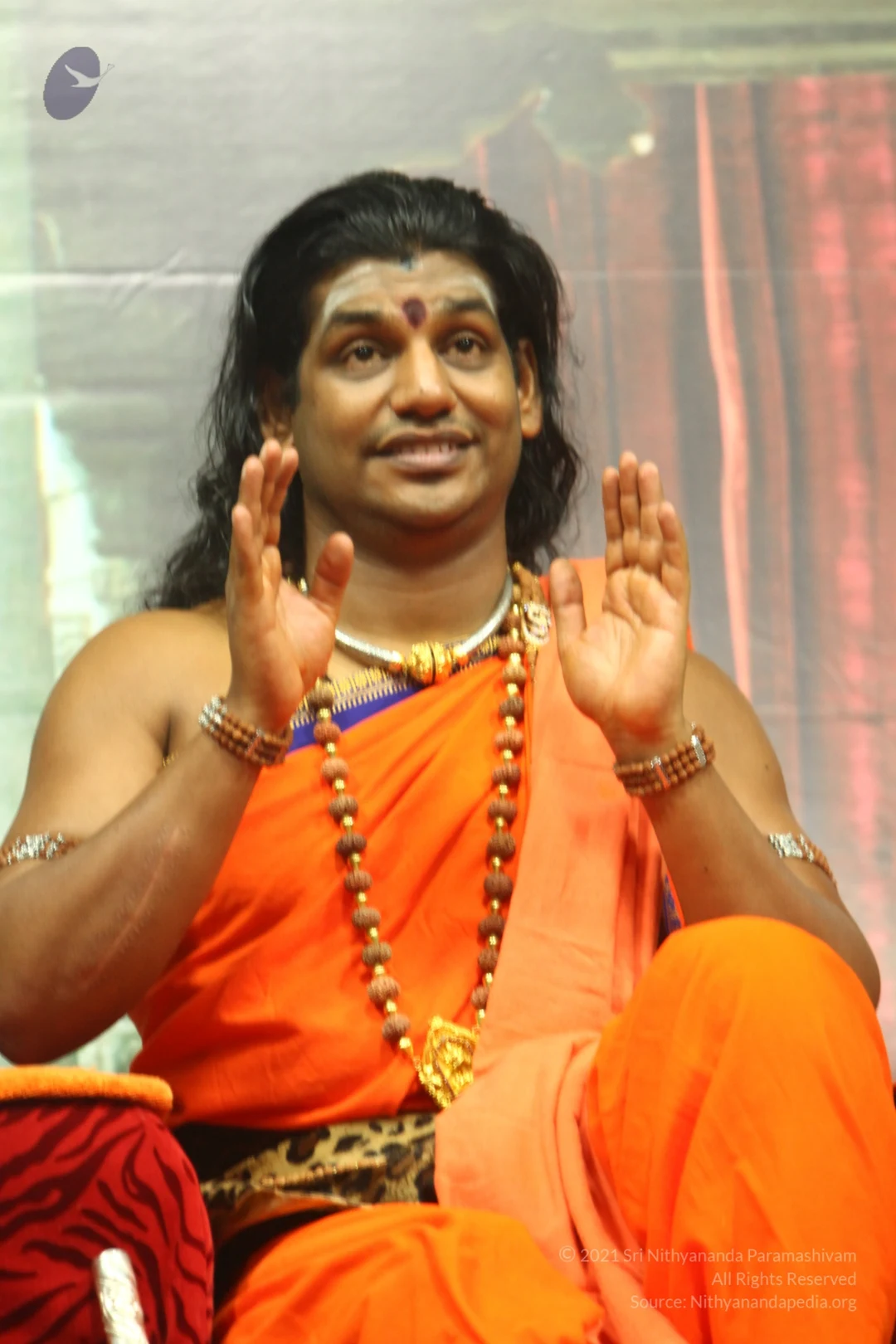
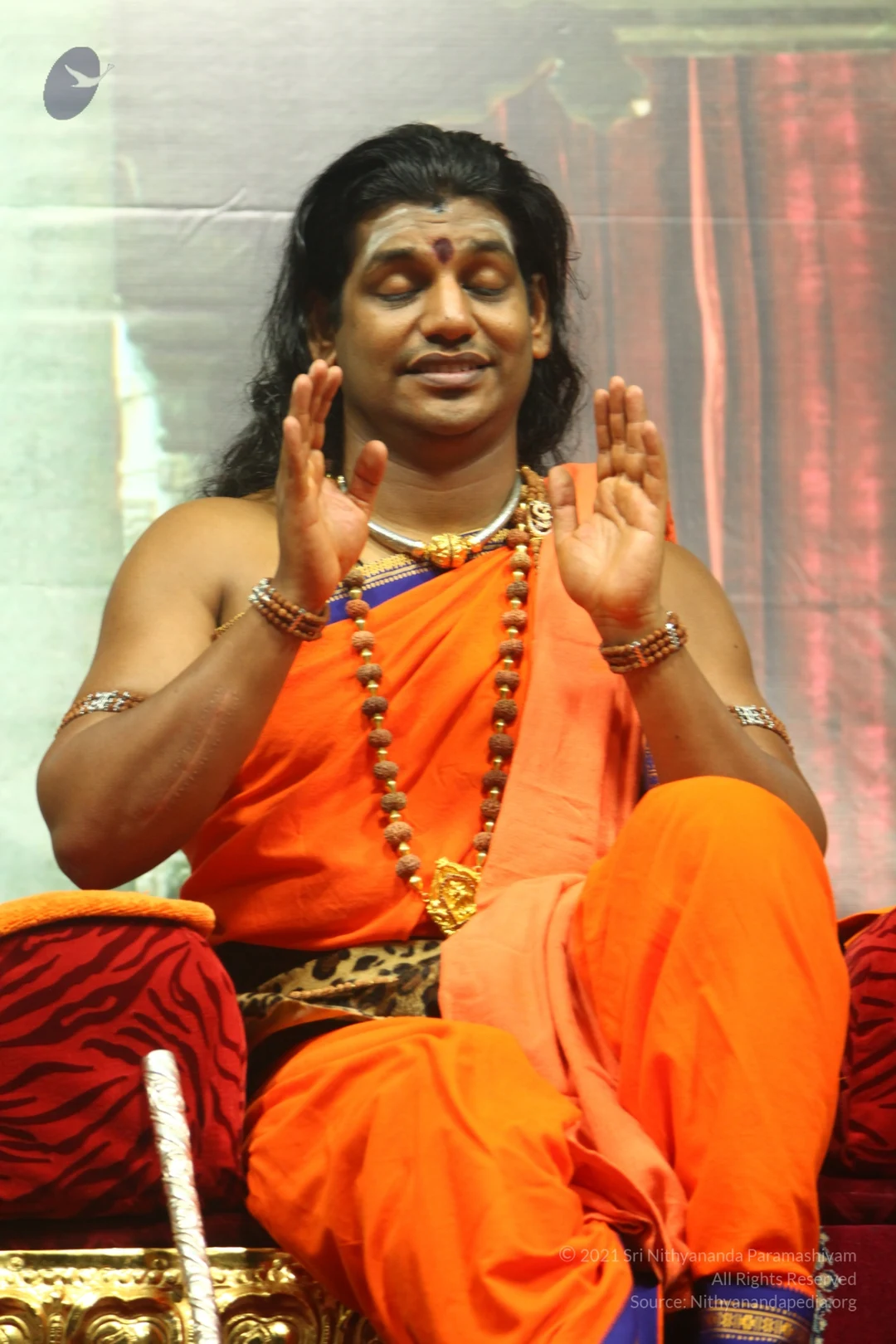
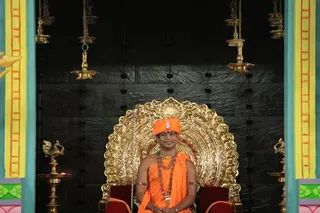
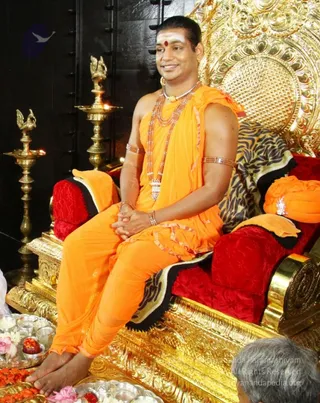
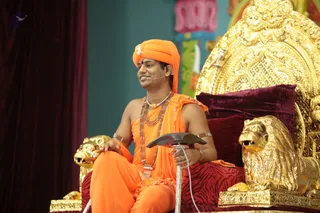
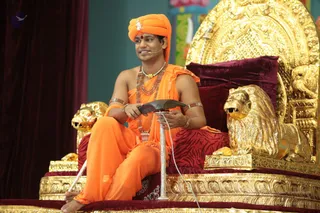
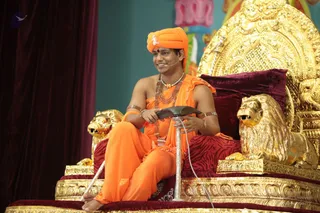
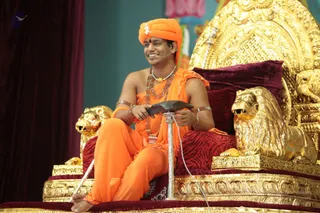
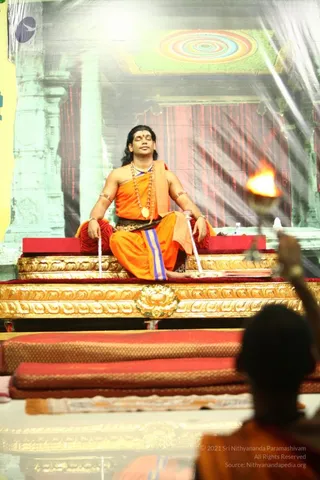
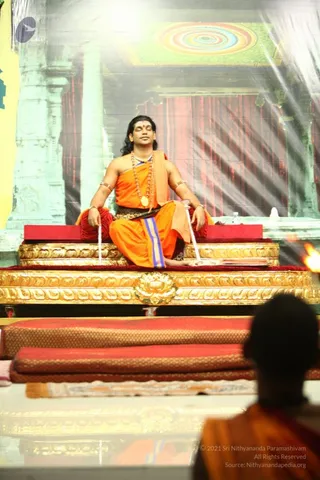
A man with long swept-back dark hair and a red bindi sits on an ornate gold-framed throne with red tiger-striped cushions, smiling. He wears saffron-orange ceremonial robes draped over one shoulder, a blue-and-gold bordered dhoti, multiple rudraksha malas and a large gold pendant, plus beaded arm bands. Behind him hangs a backdrop of carved stone pillars and red draped curtains. A microphone stands at the right edge of the throne.A man with long, swept-back dark hair sits on an ornate gold-and-red throne with silver armrests, against a painted backdrop of red draped curtains and a pale stone pillar. He wears saffron-orange robes with a blue-and-gold bordered dhoti, a wide blue-and-gold sash, multiple rudraksha malas, a ceremonial gold pendant necklace, and silver-beaded armlets. A white and red tilak marks his forehead. a person is the label for this figure, based on the long swept hair, saffron clothing, rudraksha malas and gold necklace.A man seated on an ornate gold throne with red cushions, wearing orange saffron robes, a rudraksha mala and a beaded necklace, with a red tilak on his forehead and eyes closed, hands folded in his lap. Feet rest on a gold base decorated with pink flowers and a row of small oil lamps. In the left foreground a standing attendant in orange robes with a maroon sash holds up a silver lamp with lit flames, and a gold stand is visible at the upper left. The background has dark stone panels framed by turquoise and yellow ornamental borders. a person is seated on the throne, identified by the saffron robes, rudraksha mala and ceremonial necklace cues.

April 19 2012

Original wiki page
Contents

Title:

Q & A: Trust, Devotion, Will, Initiation

Description:

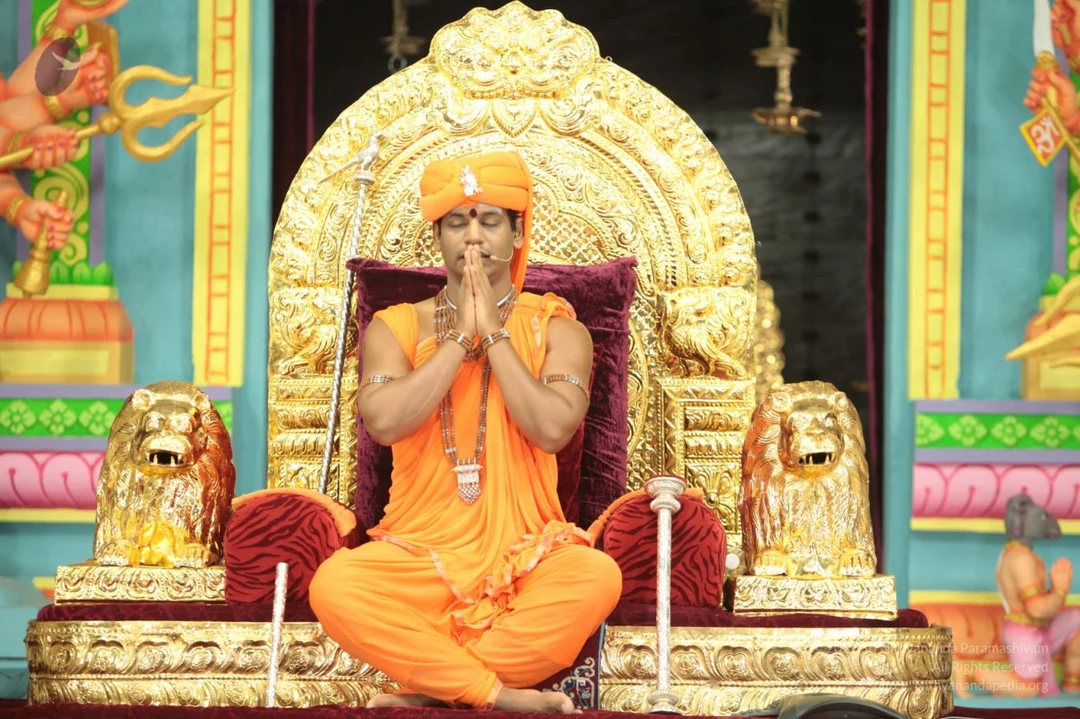
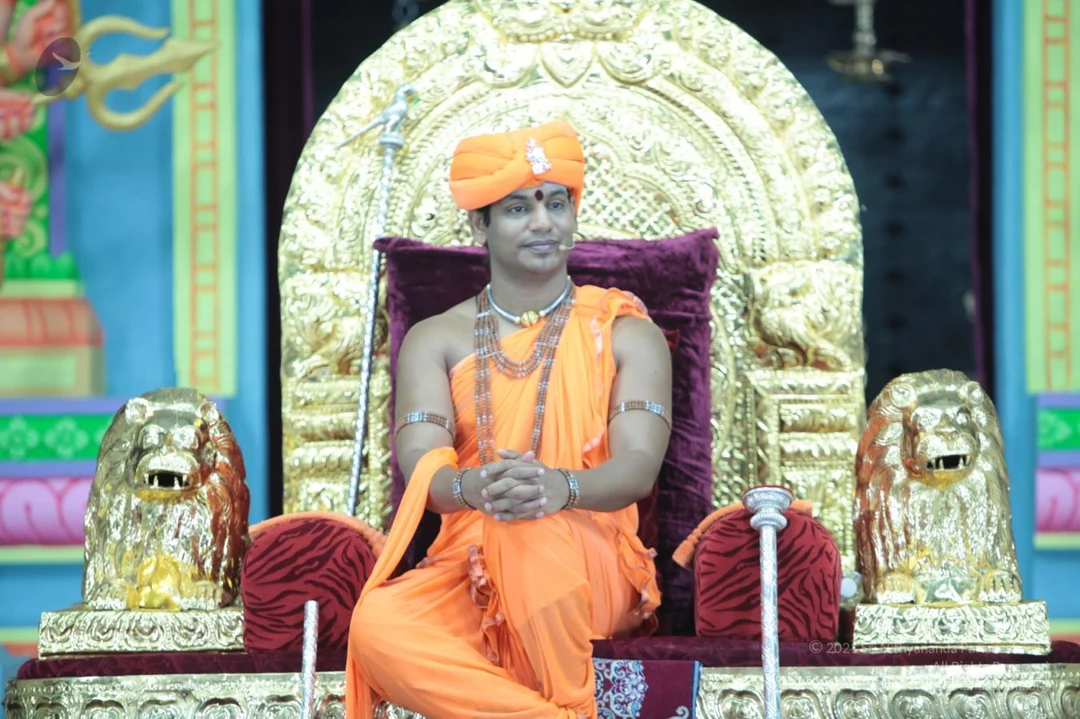
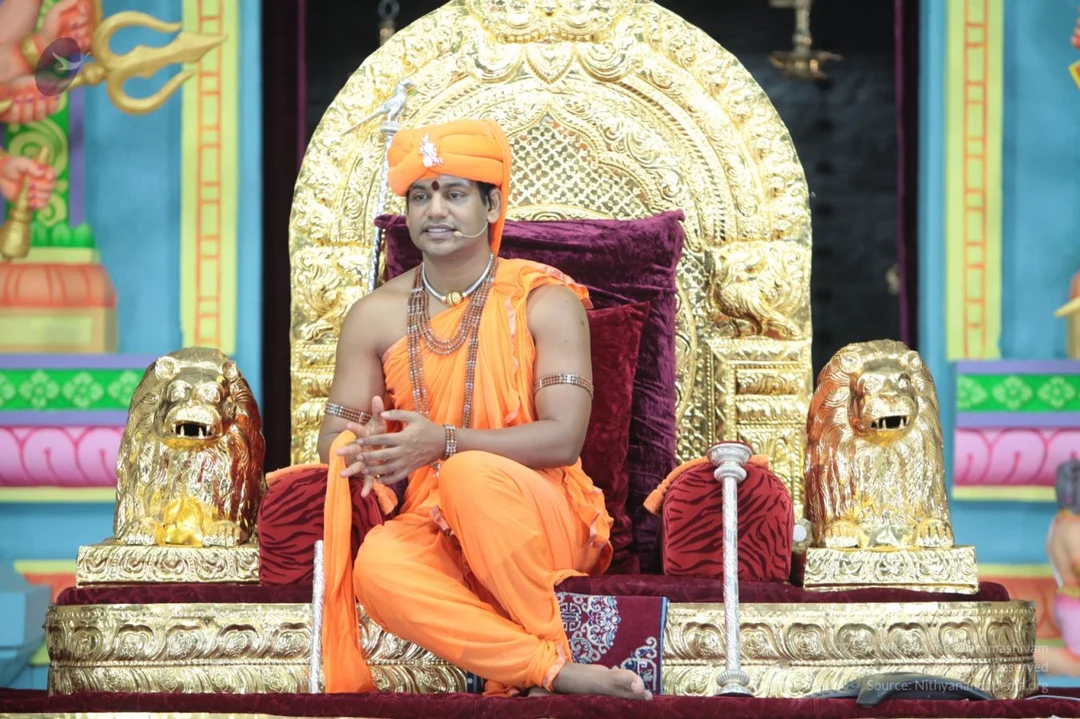
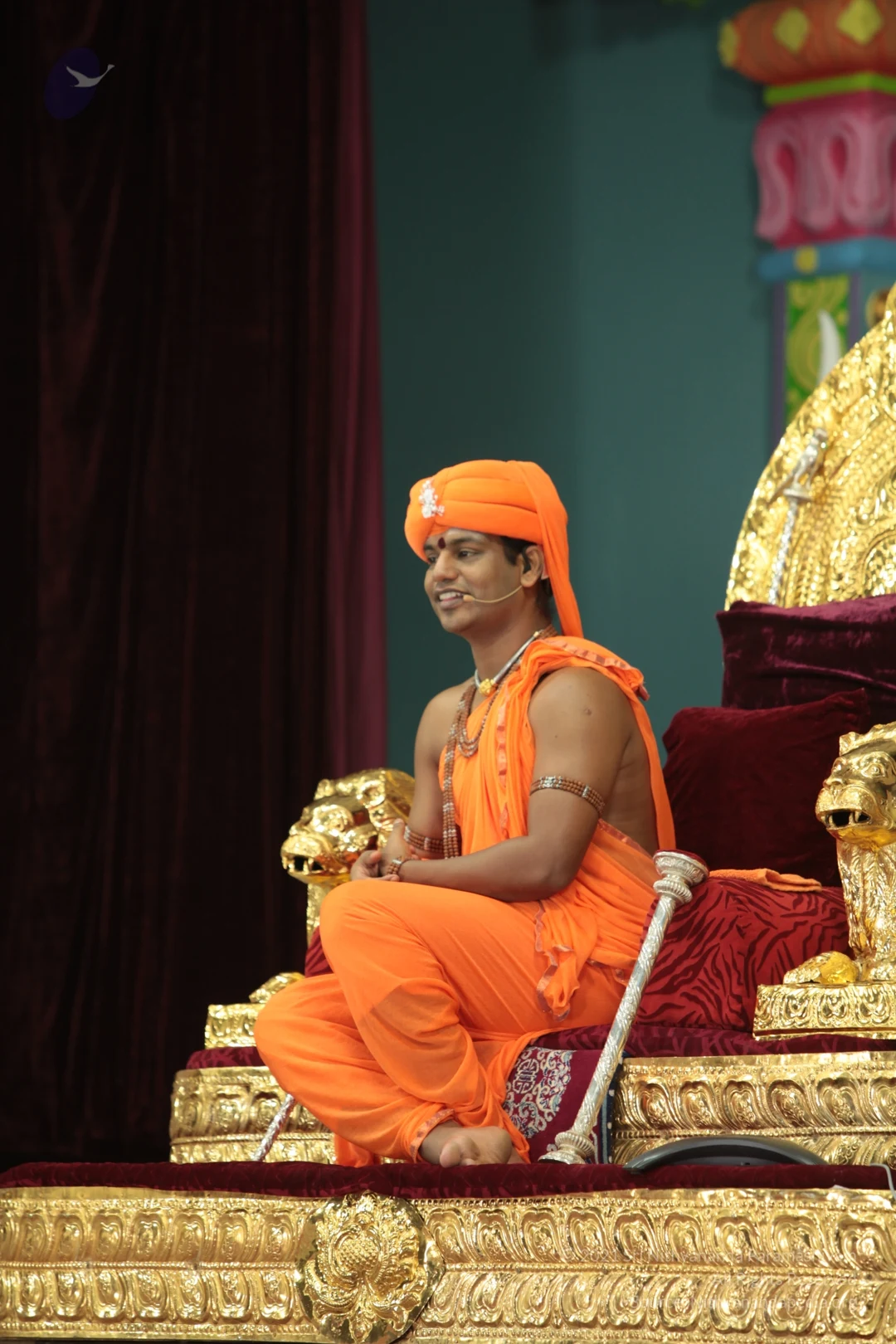
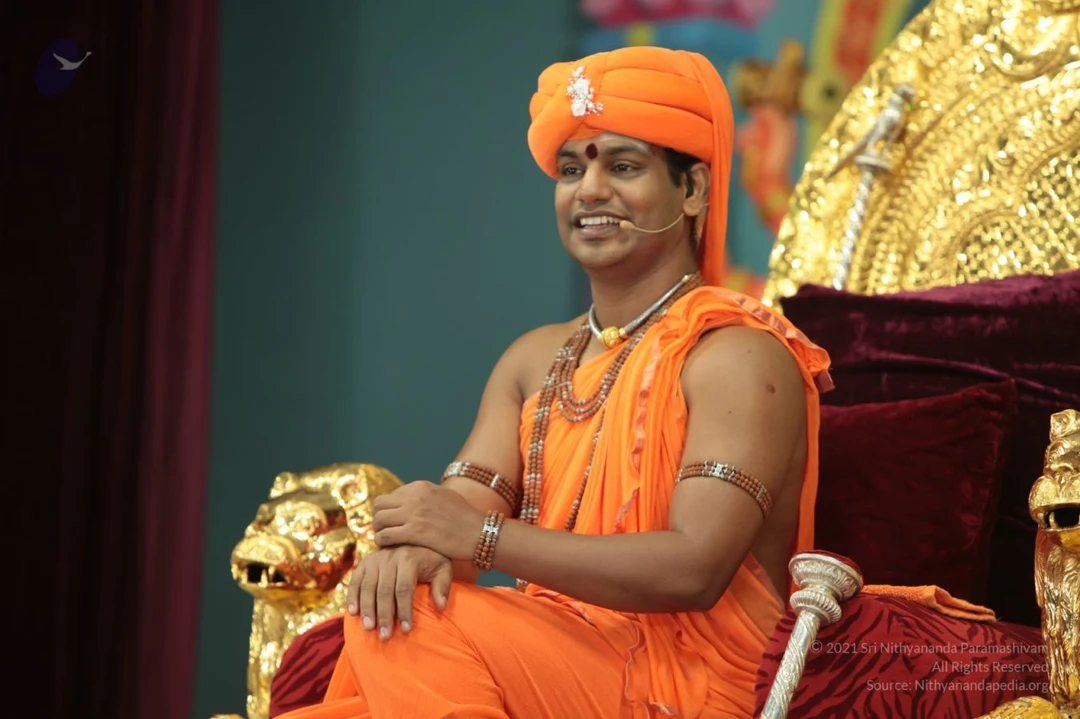
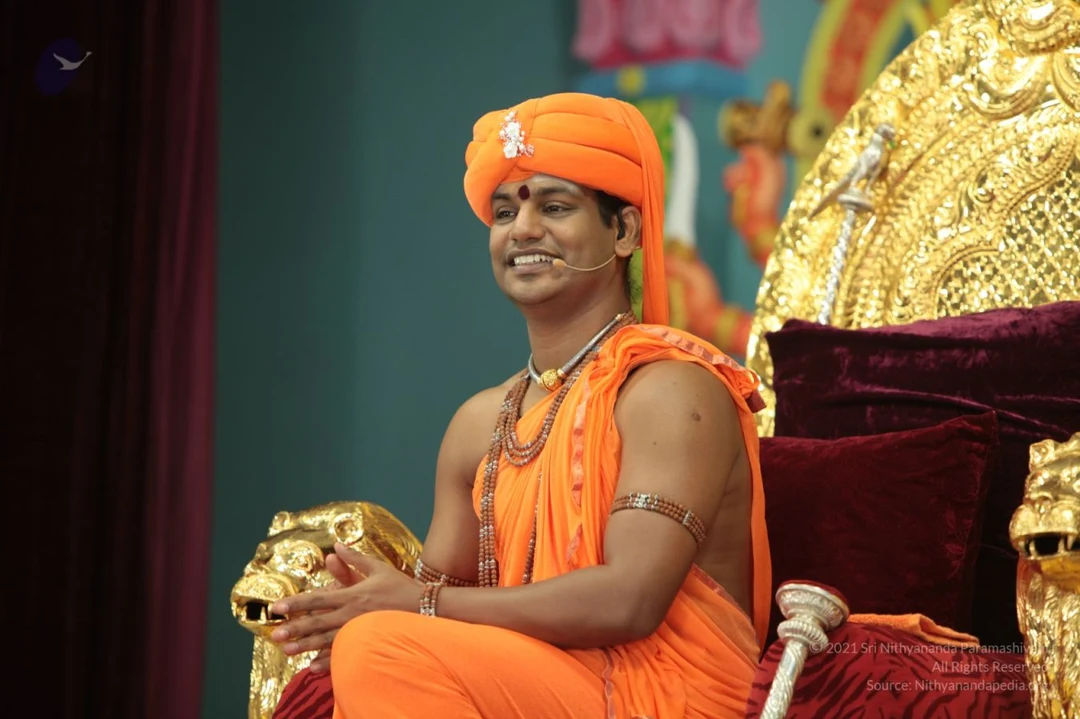
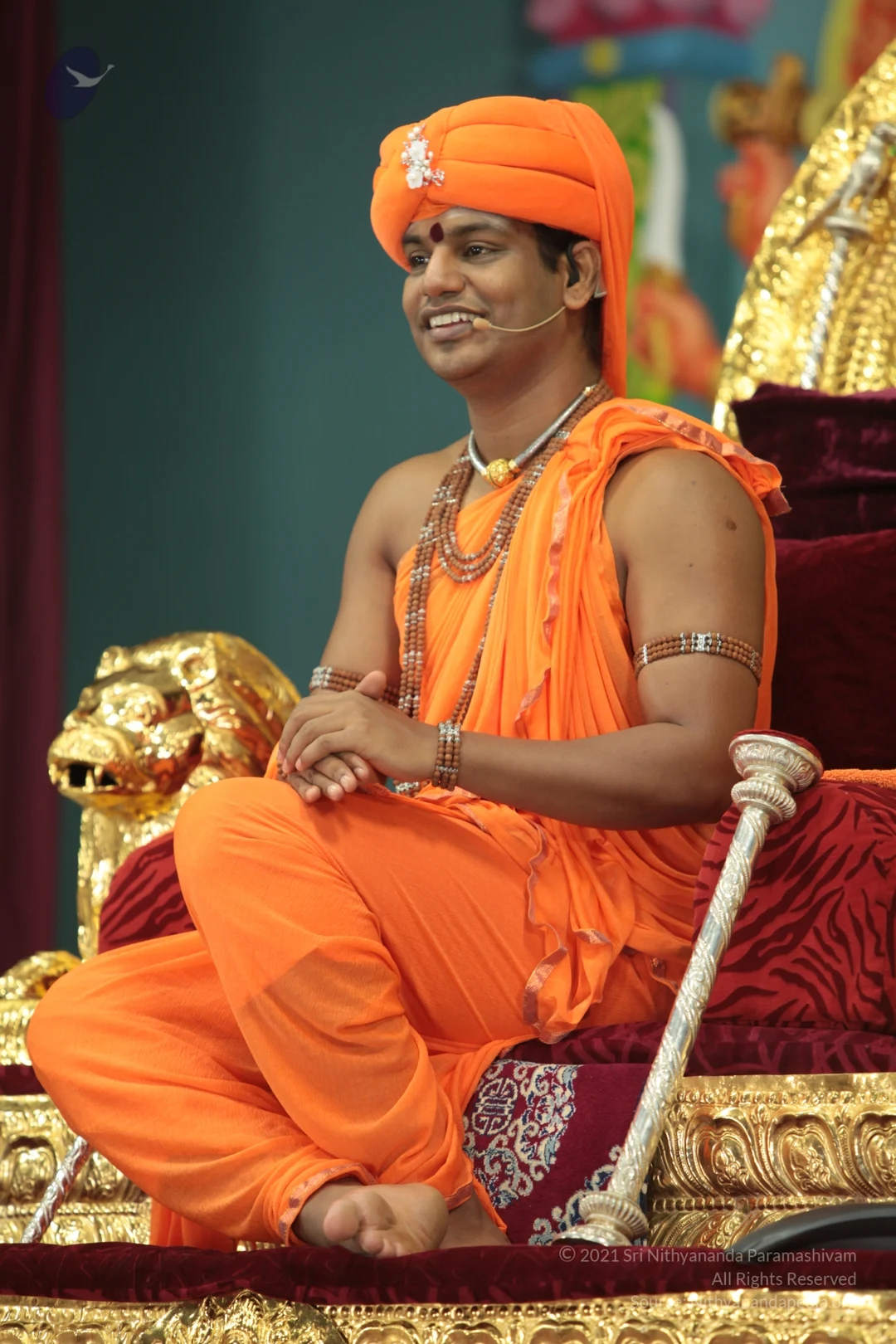
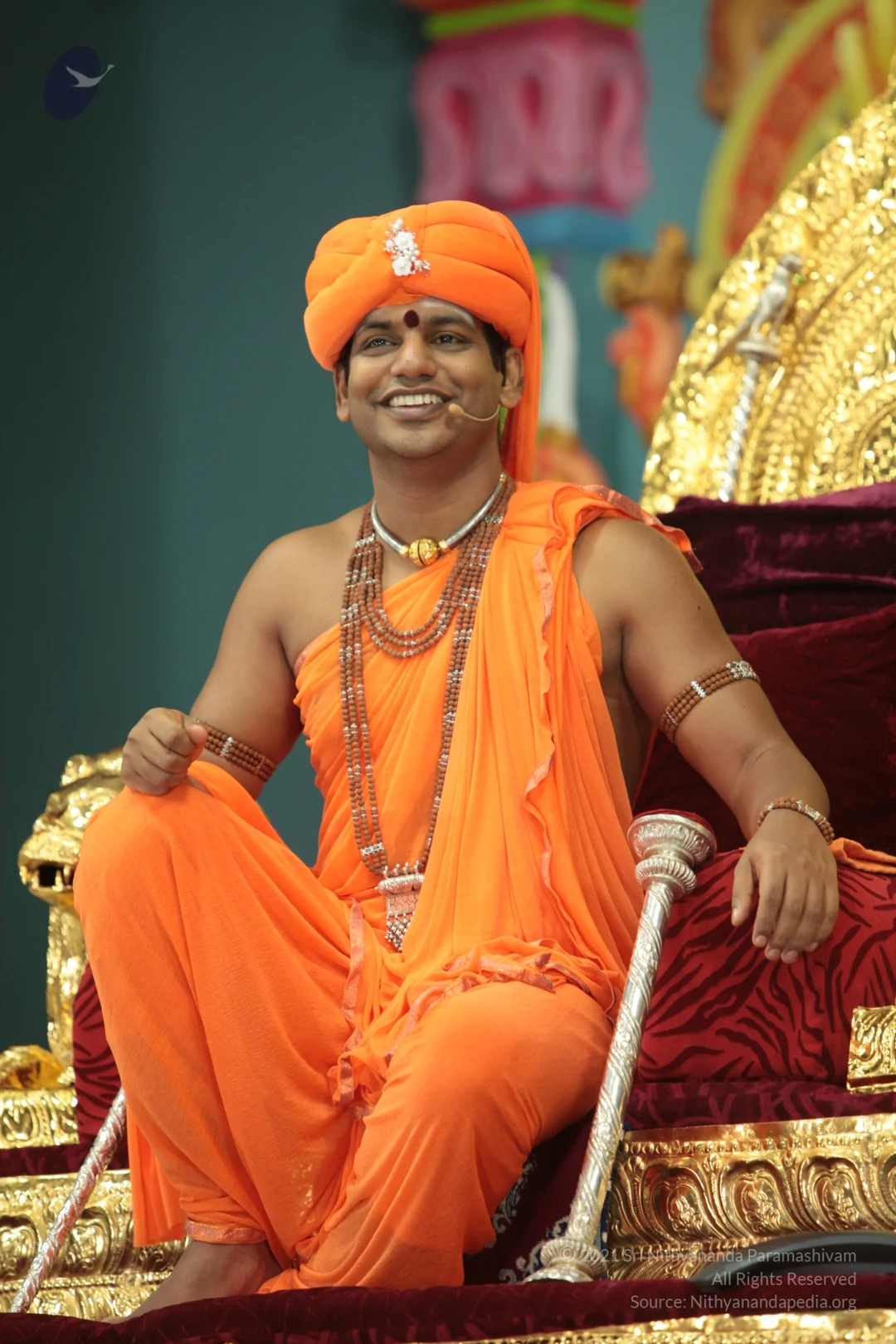
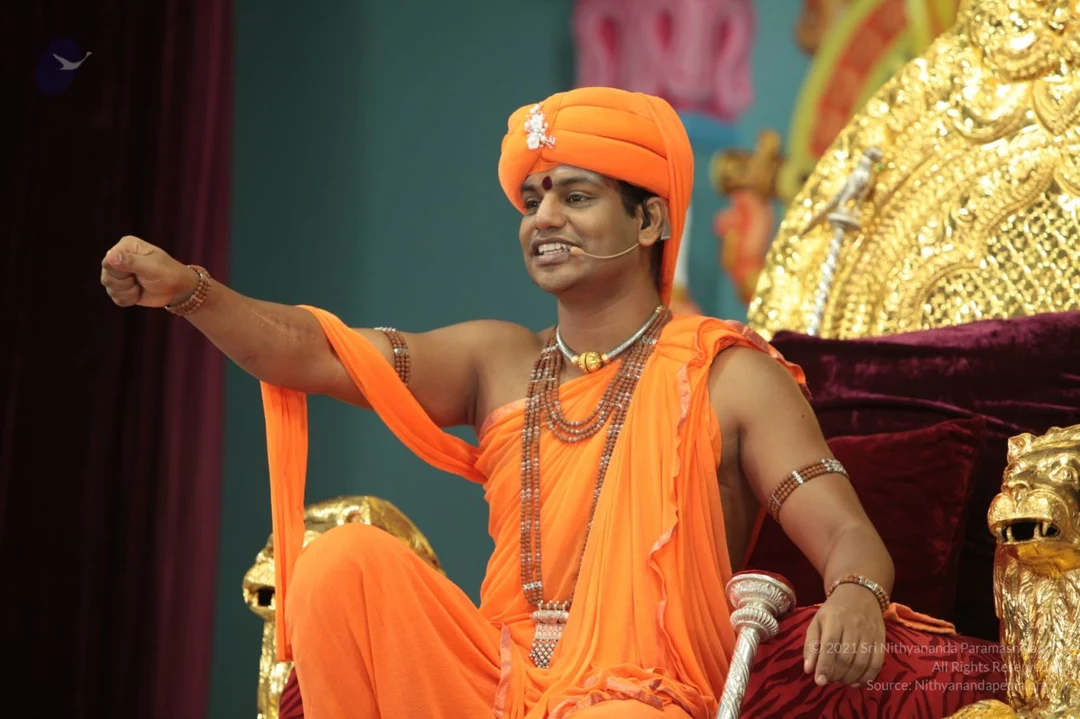
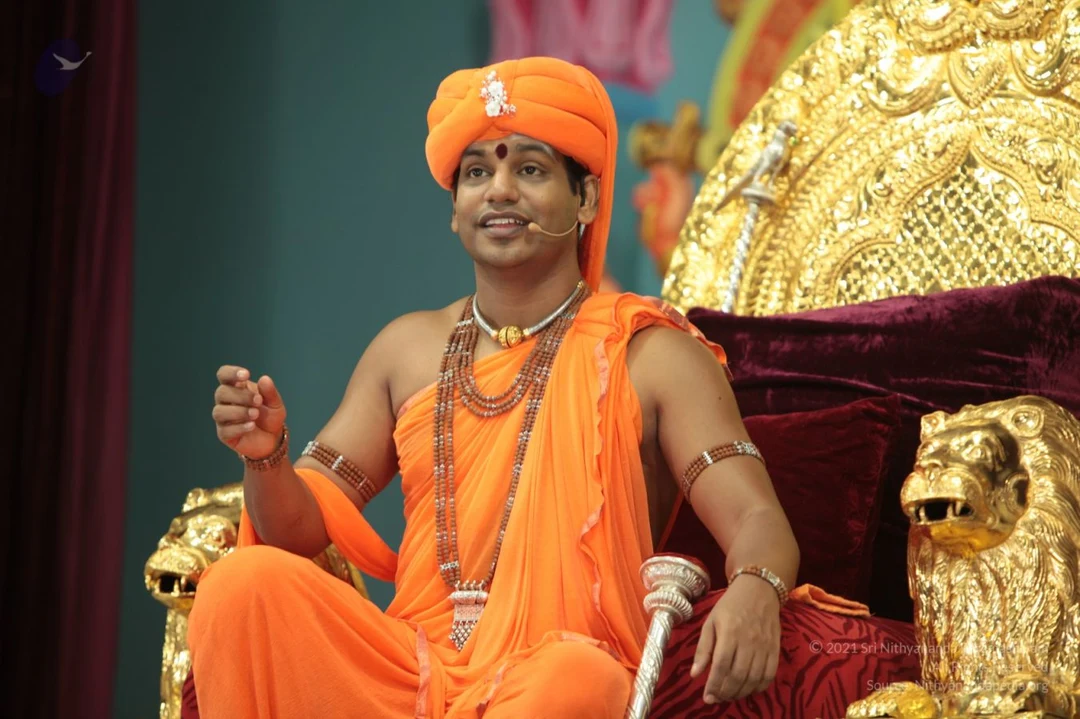
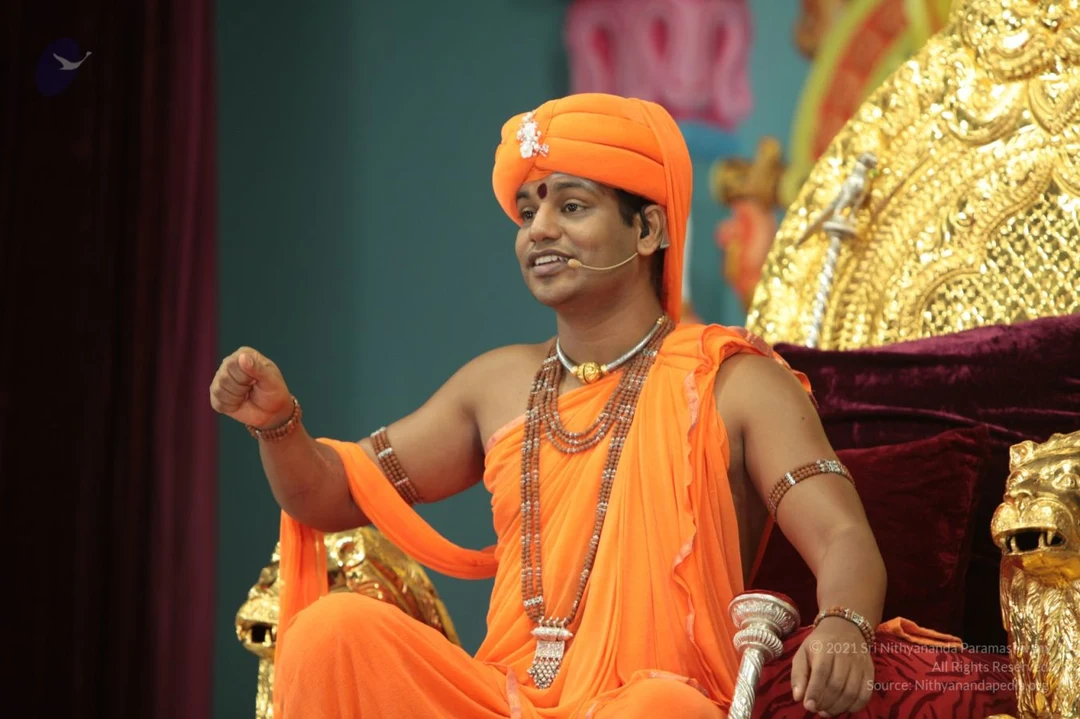
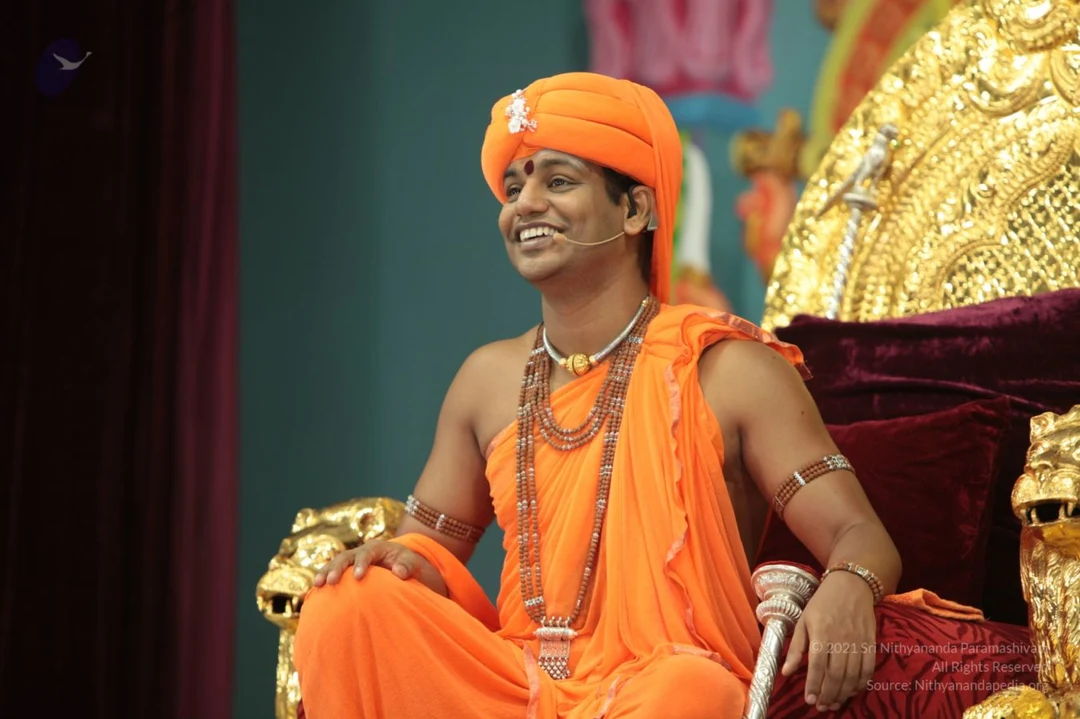
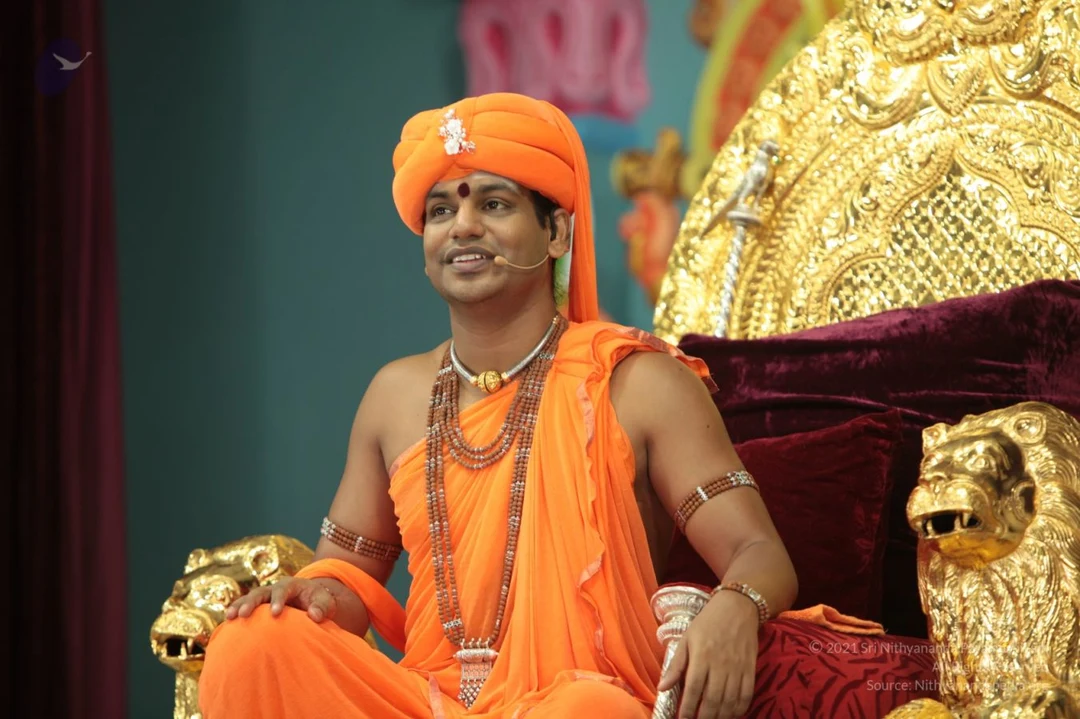
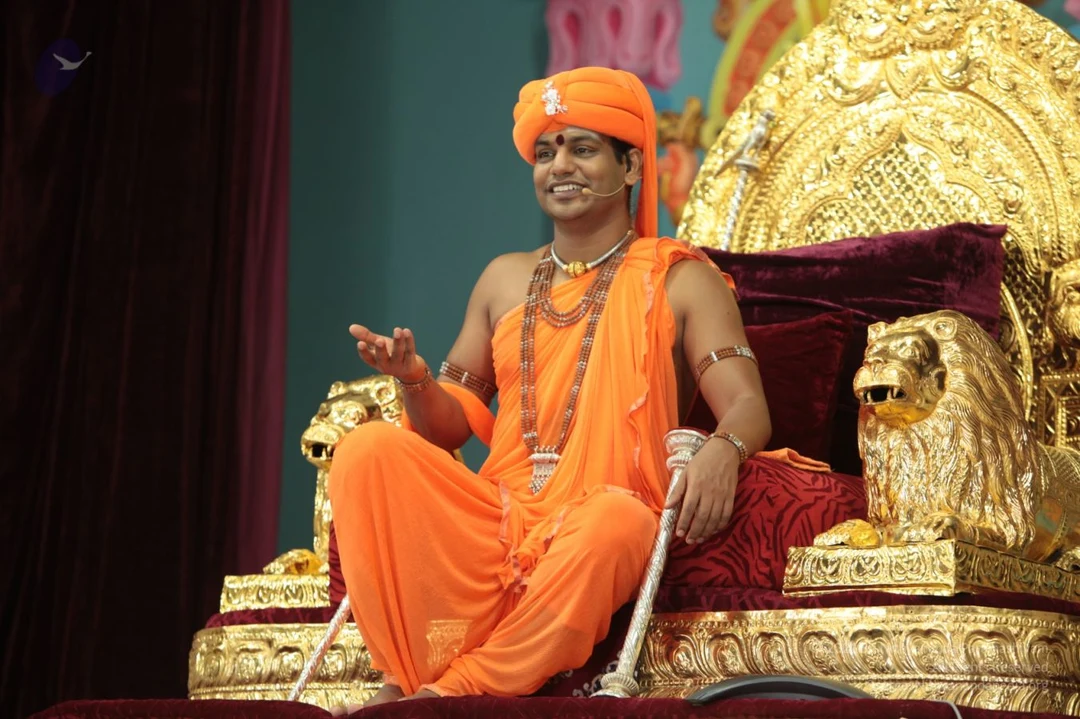
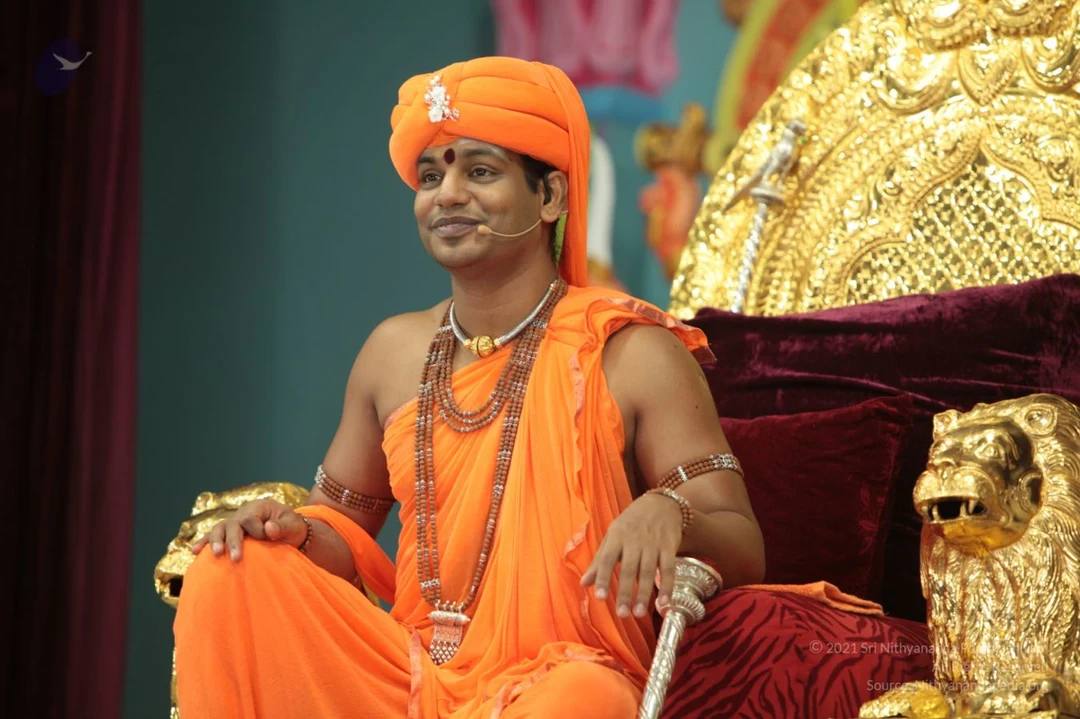
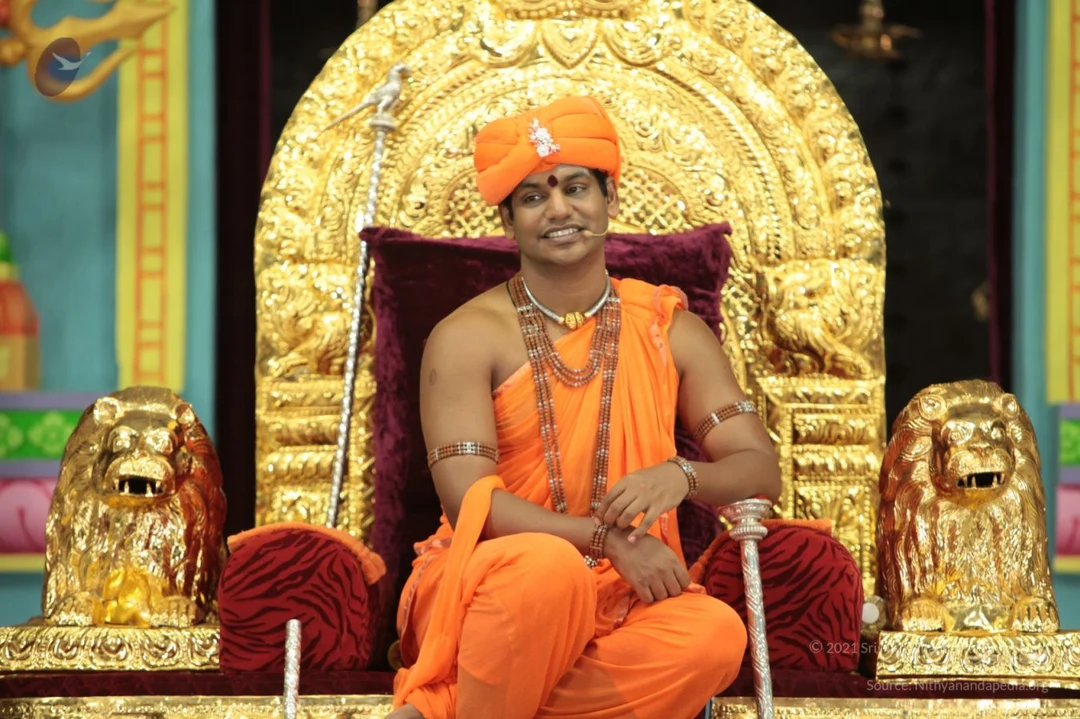
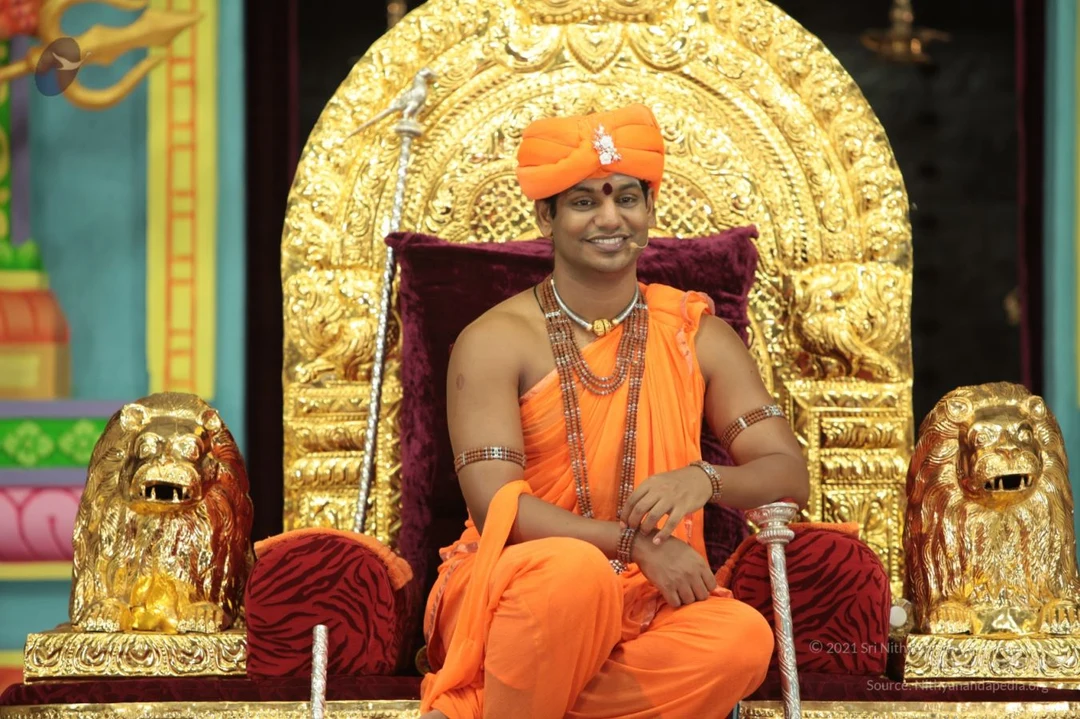
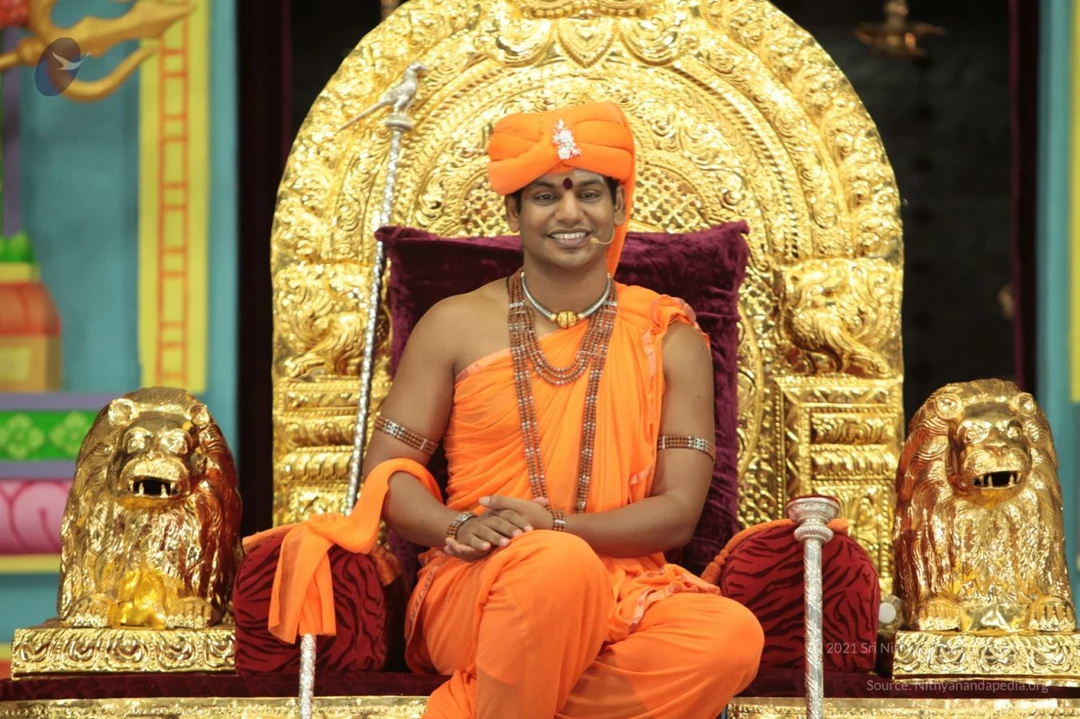
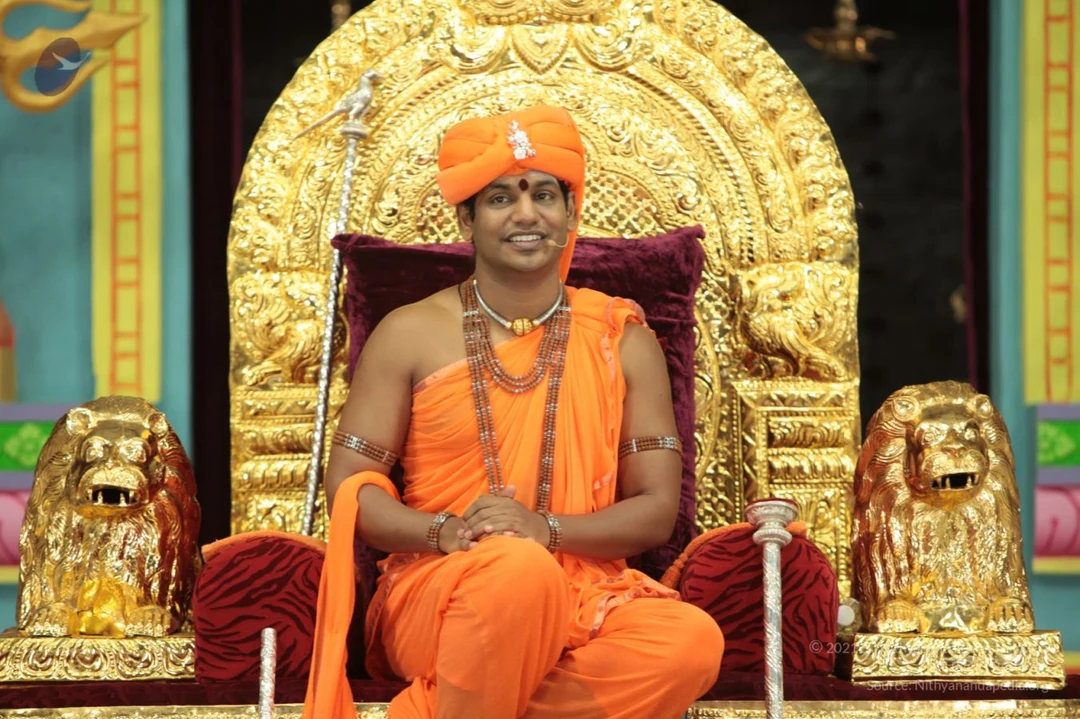
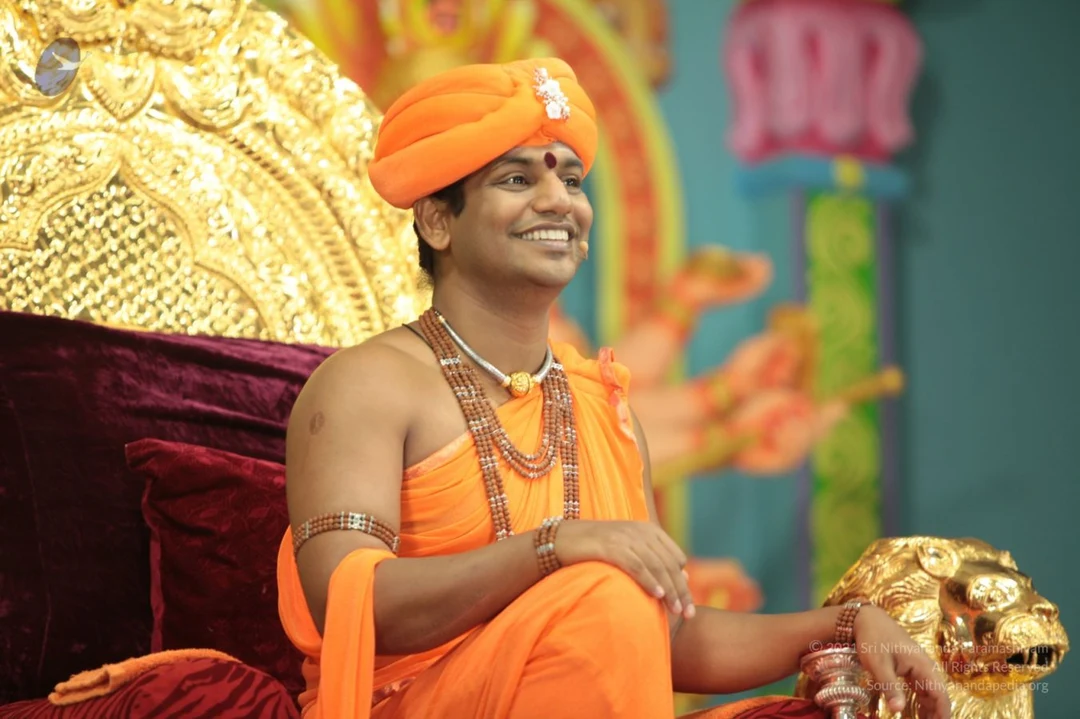
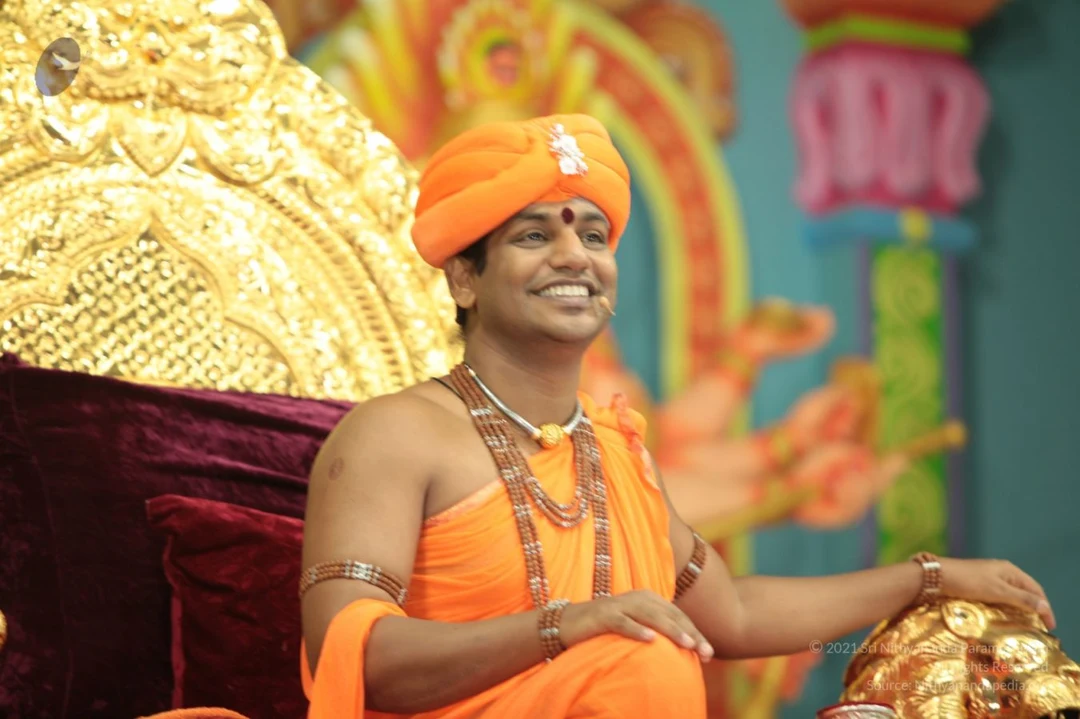
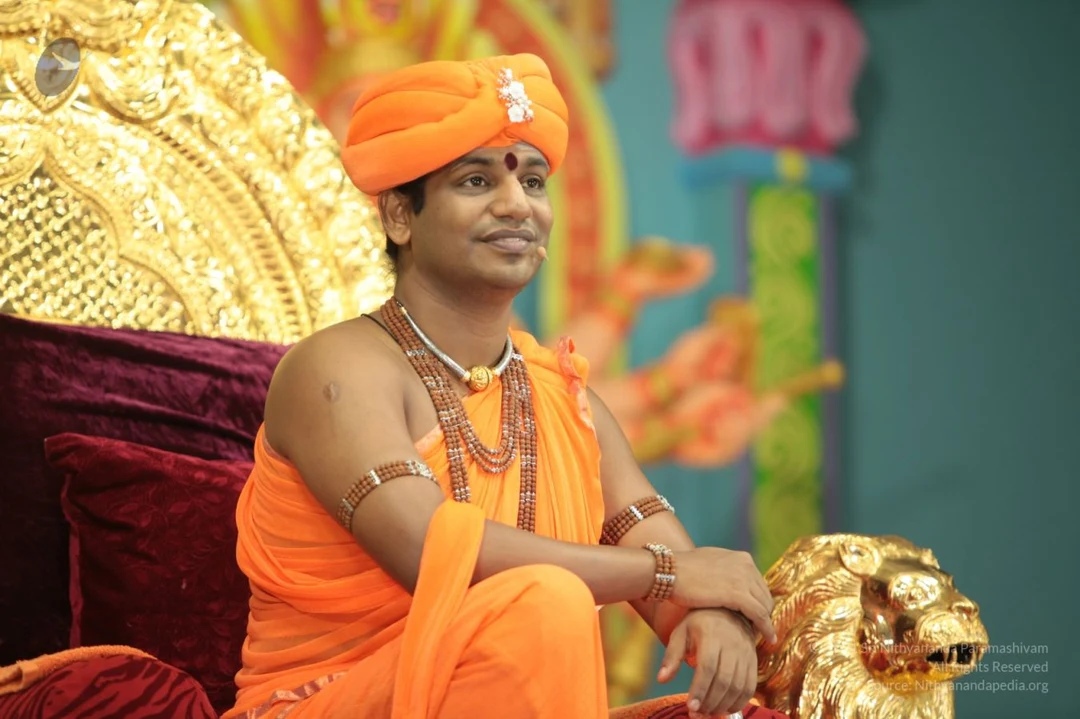
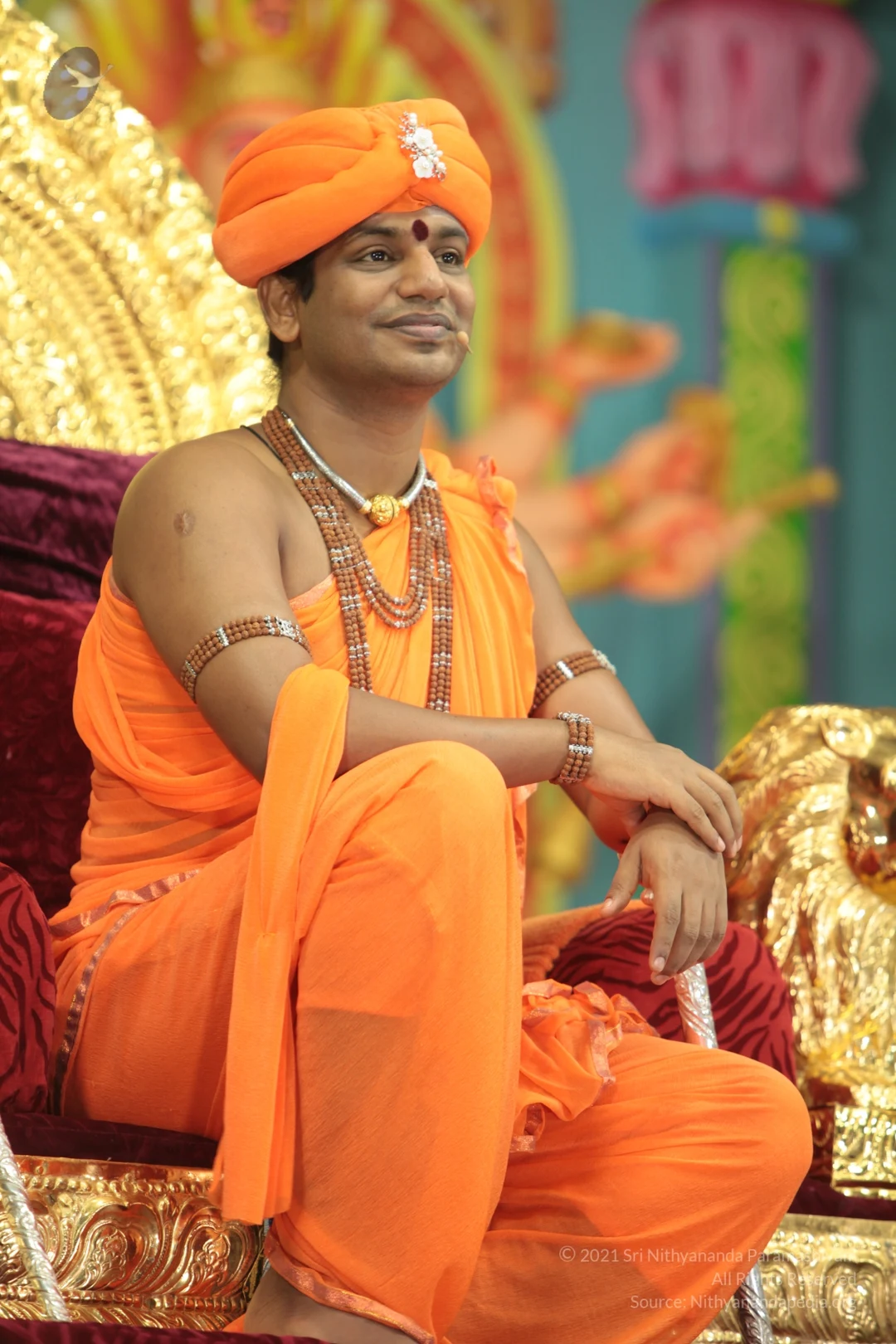
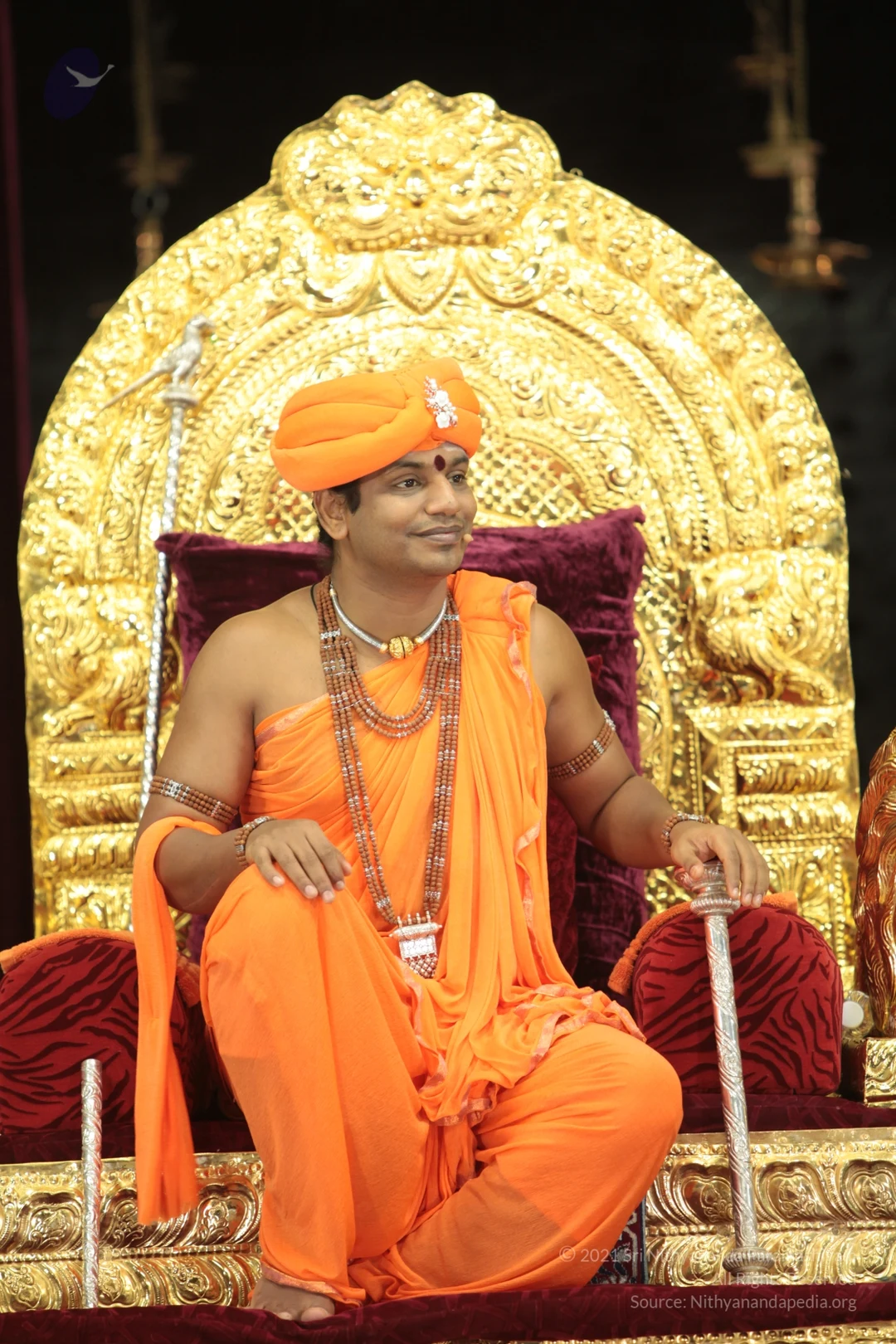
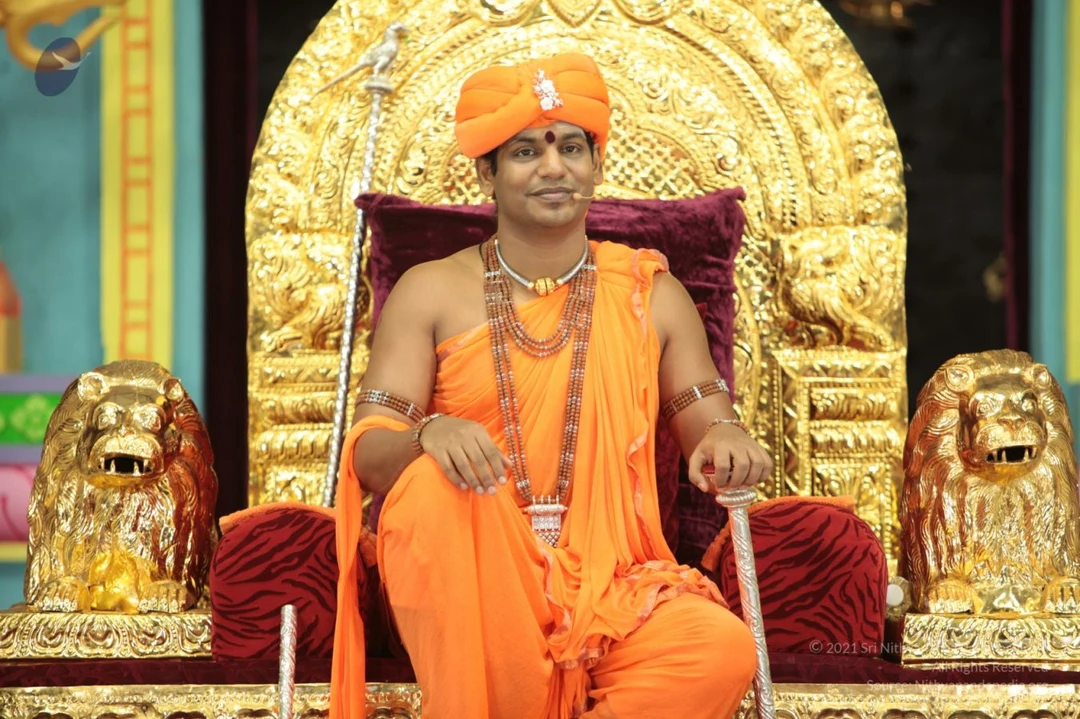
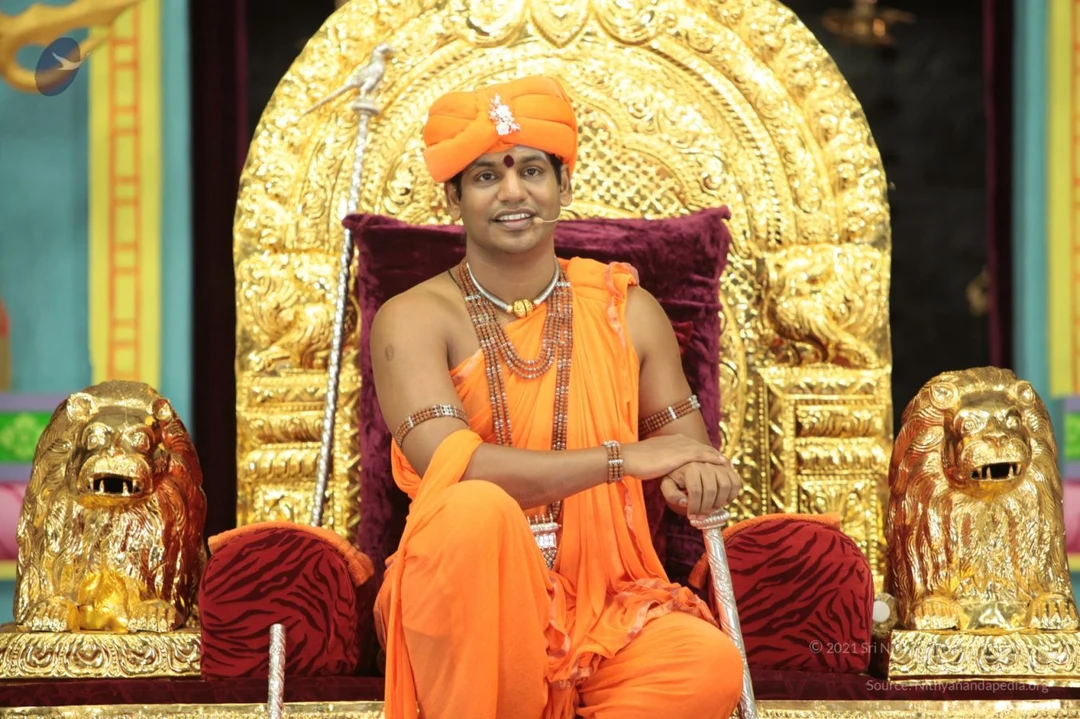
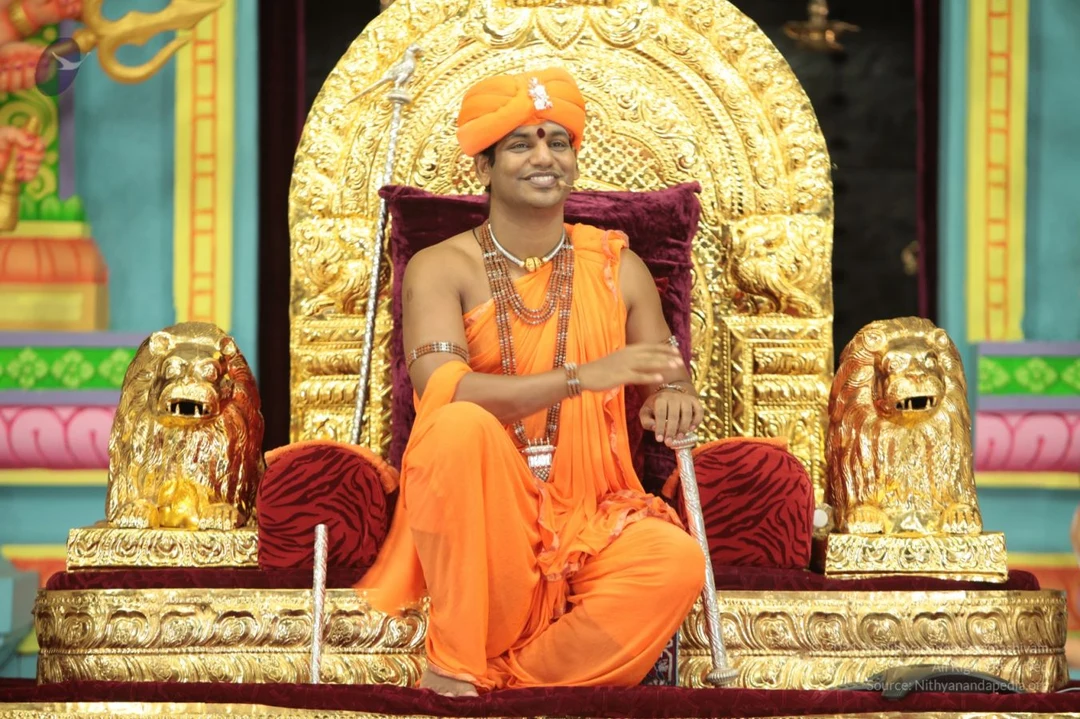
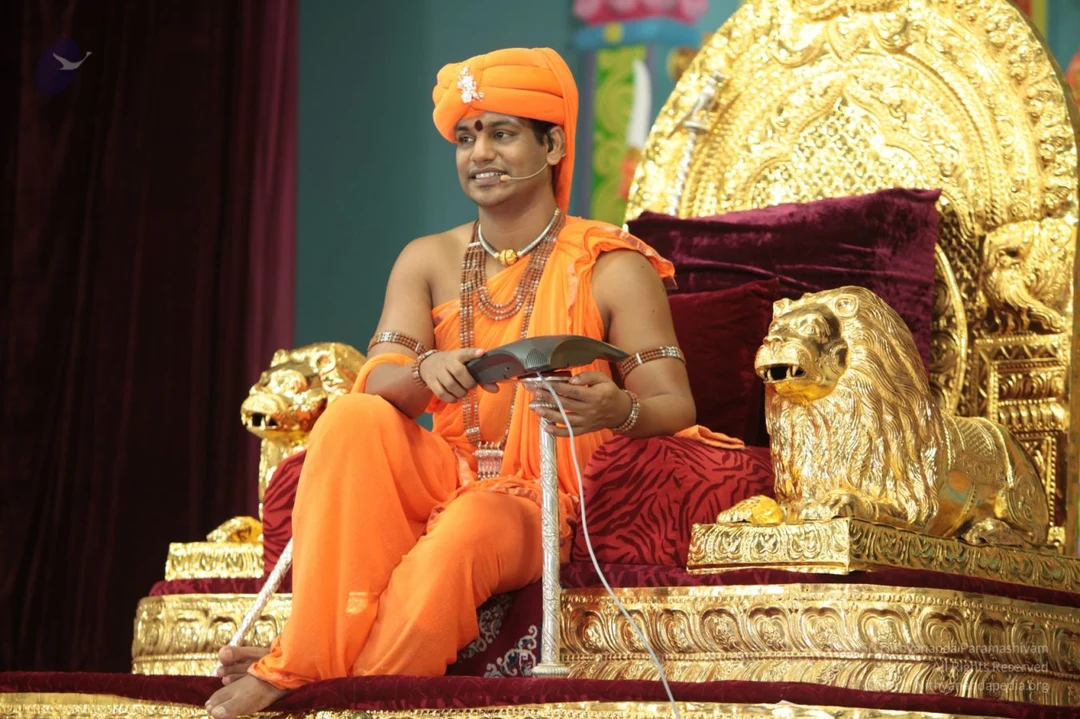
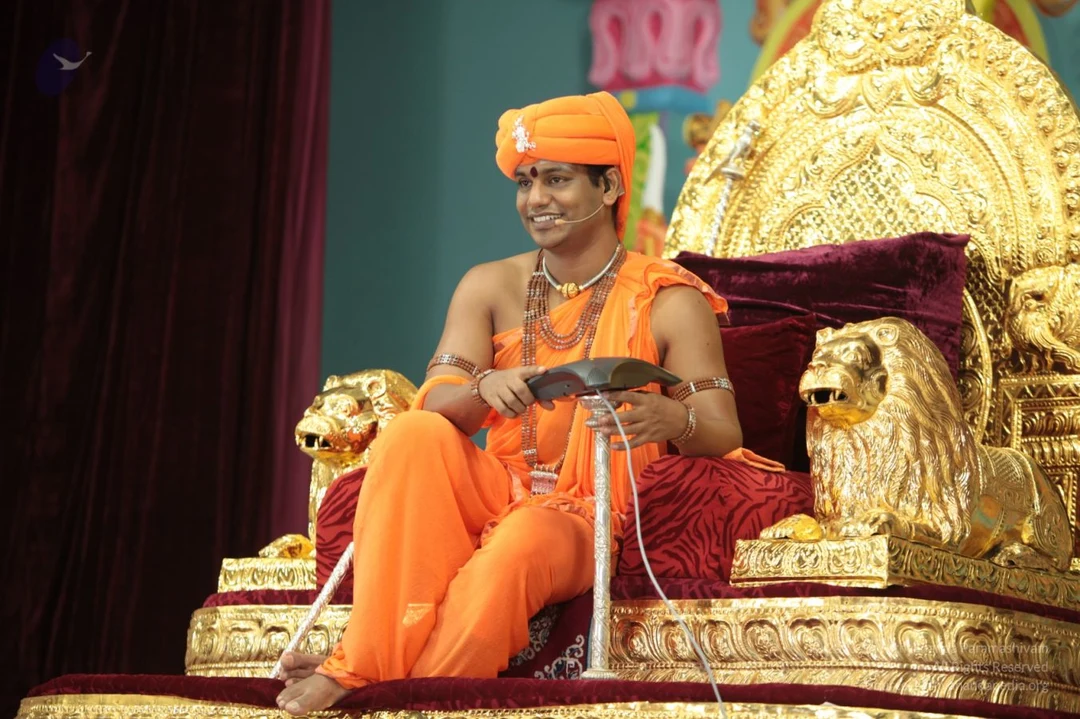
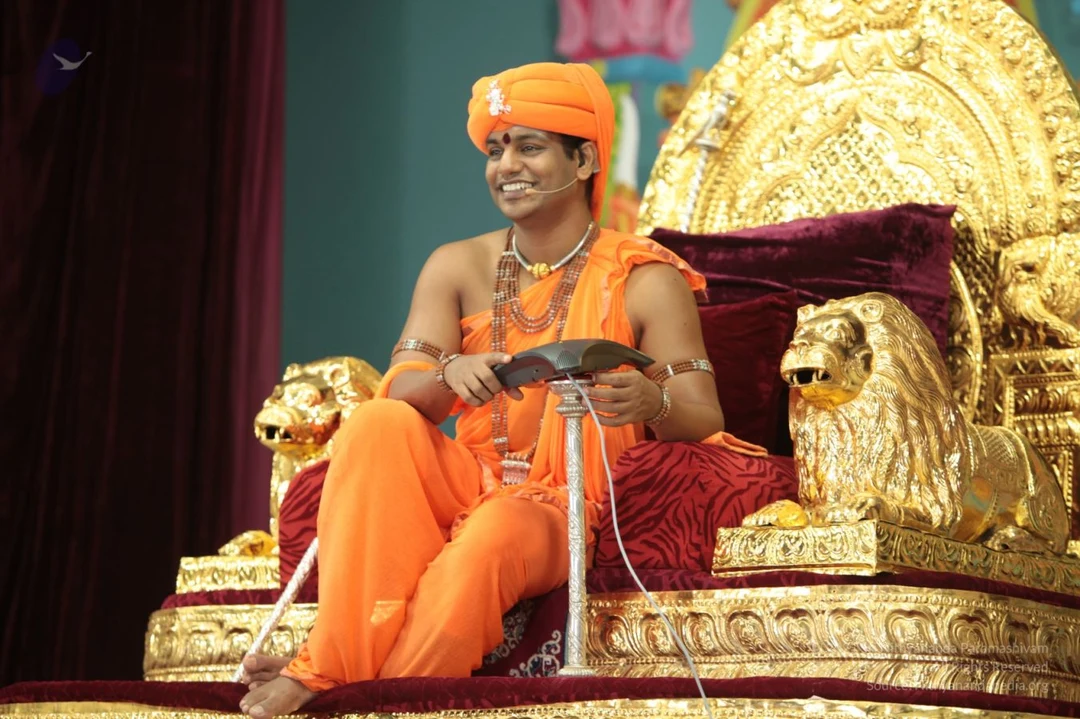
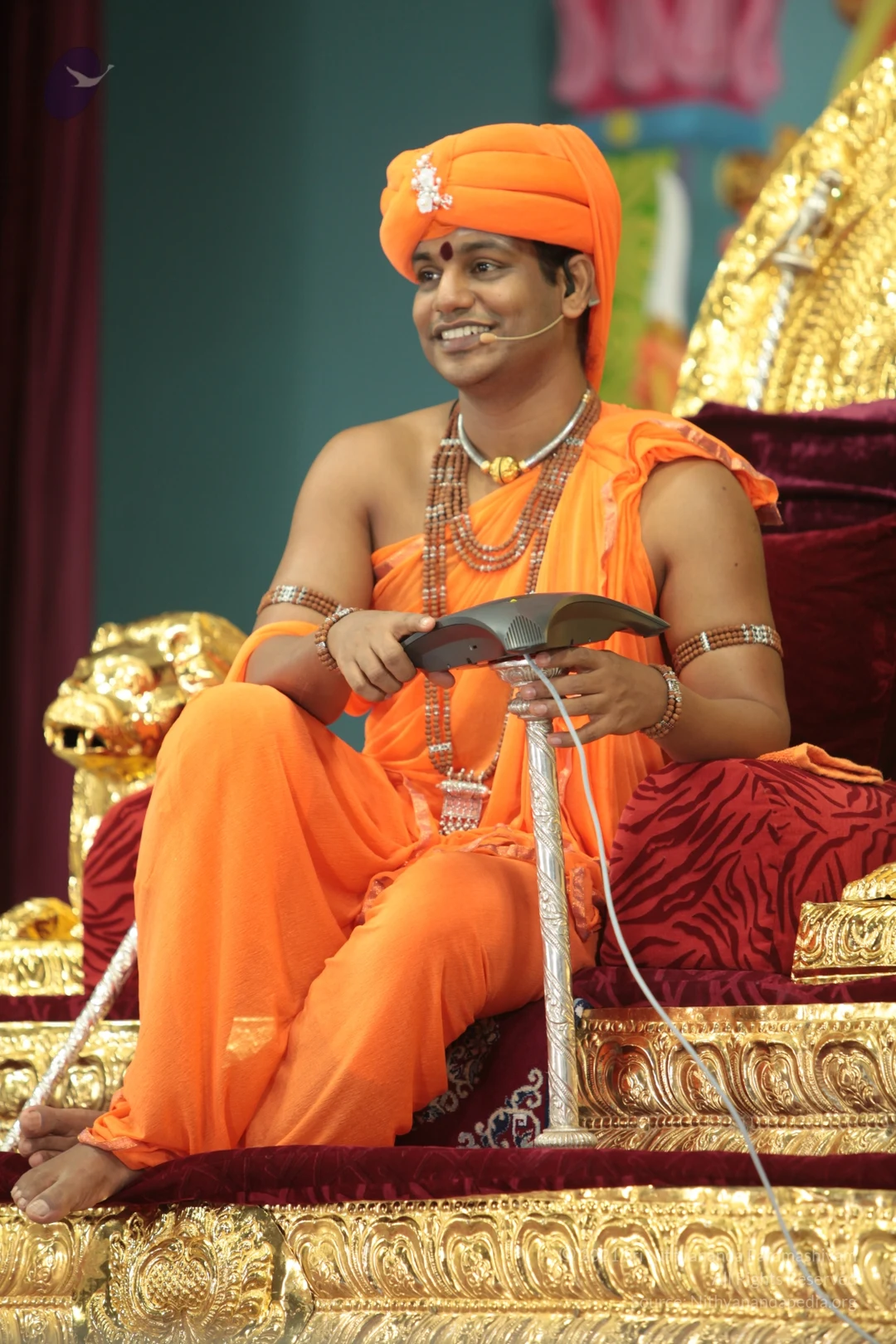
In today’s morning satsang, Paramahamsa Nithyananda (Swamiji) replies to devotees’ questions. The first question concerns why we don’t have ecstatic experiences when we desire to. Paramahamsa responds that even when the wish is strong, if the mind has doubts the experience may not occur. Second, a devotee asks if keeping silence is the best way to expand our inner space. Paramahamsa says that verbal silence is a beginning, but the goal is complete conscious silence. At that point expansion can unfold. A non-Indian devotee asks why there is a custom of touching the guru’s feet. Paramahamsa answers that guru puja is the oldest ritual of the Vedic tradition: it springs from overflowing gratitude and respect. The fourth questioner wants to know whether will is a part of our mind or our being. The reply is that it is neither – it is a bridge hanging between the two. The final question is from a youngster longing to present his parents to Swamiji. Paramahamsa comments that it is ironic that in older days parents brought their children to the guru – and now children are trying to bring the parents. He advises a sincere, loving approach with an open heart.

VideoAudio

Transcript:

Question: Dear Swamiji, you said, “When I want the headache to disappear, I have given more energy for it to stay in me”. In that case why have I not given more energy for spiritual experiences like Samadhi and kundalini energy even though I want it? Rupak Id no. 64

Swamiji: Rupak 64, his question - Dear Swamiji you said when I want the headache to disappear, I have given more energy for it to stay in me. In that case why have I not given more energy for spiritual experiences like Samadhi or kundalini energy even though I want it.

Please understand, wanting it is one, believing it, is possible trusting it, is possible is another one. Let me give you a small story. One guy who was trying his best to get a boon from Shiva. So every morning he will pour water, milk, all kinds of offerings, he will make to Shiva deity he had and do the pooja. Sit in front of the Shiva and chant Namah Shivaya, Namah Shivaya, Namah Shivaya and literally nag Shiva to give that boon. Literally force Shiva to give that boon. Shiva was not responding at all. Finally one day he got fed up and he became angry. The greed, when it is not fulfilled turns as anger. When it turned out as anger he became so angry, he decided to teach a lesson to Shiva.

He brought one Vishnu Moorthy, Vishnu deity and started doing all the pooja to Vishnu. Just to tease Shiva, he will do everything whatever he was doing to Shiva to Vishnu, saying “you are useless God, now I am worshiping real God, who will give me the boon”, he will do, he was doing all the rituals. Finally he put incense stick also. That incense smoke was slowly moving in the wind towards the Shiva deity. He could not tolerate that incense he kept for Vishnu is being smelled by Shiva. He jumped on the deity and caught hold of the nose strongly, closed the nose nostrils. “You should not smell my incense. It is only for Vishnu, How dare this incense comes to your nose, this smell comes to your nose”.

He was so strongly holding the nostril, suddenly, in few seconds, he literally felt he is holding flesh and bones, somebody’s real nostrils, nose. When he opened the eyes he saw Shiva was sitting. He was really sitting. He was there. The moment he saw Shiva he could not control, all his anger pseudo anger everything went away. He fell at the feet of Shiva, and asked him, “please apologize me, please forgive me”. He asked for the apologize, “please forgive me”, then Shiva asked, “oh my son, what do you want tell me?” He asked his boon. Shiva gave him the boon. Suddenly this guy had a doubt. He asked Shiva, “ oh lord, I was praying to you so strongly, doing so much of puja, abishekams, sacred bath, offerings, so many things I was doing, repetition of your name, everything, why did you not appear at that time? When I was holding your nose, you should not smell my incense in anger, you appeared. What is this logic, I am not able to understand”.

Shiva so beautifully says, “Even in your greed you did not have strong trust I am in that deity. You only have to imagine Shiva is there. I am doing, he may accept. In one corner of your mind, “who knows Shiva is sitting in this”. One corner of your mind was always commenting on your action, there was never 100 percent doubtless trust. But in your anger, you did not have one inch of doubt I am there in that deity. When you held your nostril, When you held my noses strongly, even one second you did not have a doubt. Your unconscious mind was not commenting, giving the cricket commentary behind. “Who knows Shiva is in this deity. Who knows he is accepting all your milk. It is going down the drain and you are wasting your money, time, energy”. You did not have any of the doubts when you were holding my nose. You know Shiva is there and you have to take revenge. Whether in anger or whatever, whether right or wrong, those few moments without even having doubt in unconsciousness you know I am there in the deity. I am there in that deity. That strong doubtless authentic trust is the key, that is the bridge, that only makes me appear. When you have that trust, I have no other way I have to appear.

Understand, may be you wanted your kundalini energy to be awakened, Samadhi to happen, but behind your mind, your unconscious is constantly giving commentary. “Aa.. why do you want all this? You think you will get it? People who have done tapas for millions of years did not get it. You think this swami can just like that give you in 10 days”. Behind, the cricket commentary is going on. Wicked commentary is going on. But with the headache, you are very clear. There is no doubt. You will have it. You will ever have it. It will never leave you. Unfortunately, your mind is programmed, designed to believe the negative things strongly than positive things. It is like water flowing down. Your mind always flows towards negative things. Your headache is like a authentic trust. Your Samadhi or kundalini awakening, it is there. It is not there. It is there. It is not there. It is there. It is not there. That’s all. It is there. It is not there. It is there. It is not there. It is not there. No, it is there. It is not there. No, it is there. It is not there. It is there. That is the difference.

Rupak.., contemplate on this story. Why Shiva appeared when he was holding the nose in anger and why he did not appear when he was doing the pooja with all devotion? Contemplate on it. You will understand authentic trust is the essence.

Next Question

Question: The next question is from Preet IA Id card no.28. She is asking, “Swamiji, Is being in silence an effective way to go within? Thank you for your love and blessings”. Preet. Id card no.28

Swamiji: Swamiji, Is being in silence an effective way to go within? Thank you for your love and blessings. Preet number 28. Who?

Is being in silence an effective way to go within?

I don’t know what silence you are asking. Verbal silence may be initial step, but mental silence is the best step. Emotional silence is the ultimate step. Conscious silence is goal itself. Understand, if you are talking just about verbal silence, it’s the first step. Very beautifully our scriptures say, “Yogasya Prathamam Dwaram Vak Nirodaha”. First step in yoga is verbal silence. “Yogasya Prathamam Dwaram Vak Nirodaha”. So verbal silence is only the first step for yoga. Mental silence will be a powerful practice of yoga. Emotional silence is the last step for yoga. Conscious silence is the goal of yoga.

So, which silence you are talking about you should know. Step by step, increase the depth of the silence, that’s all. If you are in the verbal silence move to mental silence also. If you are in mental silence move to emotional silence also. If you are in emotional silence move to conscious silence also. So understand, it is which level of silence you are talking, that plays major role.

Next question.

Question: The next question is from Maggie Point, IA Id. card no.94. What is the reason we do pooja at Guru’s feet? Why do people want to touch Guru’s feet?

Swamiji: Maggie Point. May I know who it is? Yes. What is the reason we do pooja at the Guru’s feet? Why do people want to touch Guru’s feet?

It is an ancient tradition, in the Vedic tradition. When you are showered so much by Guru with his knowledge, experience, love, blessings, everything, when you are showered by him, overflowing gratitude, you don’t know what to do. So, you offer whatever you have at his feet. That is the way tradition of guru pooja started. The Vedic tradition, this is the oldest ritual. Please understand, oldest sacred ritual is guru puja. The moment first disciple was excited, Parvati, Aadi Shakti, is the first disciple. The moment she was excited with the experience of Shiva, experience given by Mahadeva, Shiva, in that extraordinary gratitude, she fell at Mahadeva’s feet and offered whatever she had at his feet. So the first ritual guru puja started.

The first intiation is Shiva sutra, the first sacred ritual is Guru pooja, first Stotra is Guru Gita. The overflowing gratitude, you pour yourself at the feet of the Master, and same way touching Guru’s feet, touching Guru’s feet also. In the ecstasy, you always feel like offering yourself at his feet. There is no logical reason, for why Guru pooja is done, why people touch Guru’s feet. It is emotional feeling connection. For some people, it looks like why should I do it. For some people it is life, they can’t live without it. I know, for millions of my disciples, morning satsang is much more important than eating food. This is bliss dose. Morning sitting in the pada pooja or the morning satsang is the powerful bliss dose. Life, is life itself.

So, please understand, it is the individual’s emotion. I also wanted to tell you one more thing, do all this only if you feel intensely connected to it. Not otherwise. It should not be done as a ritual. As far as yoga is concerned, whether you want it or not it has to be done. Because you are working on body. But when the Guru puja comes, it is in your mind. Your mind itself should feel it. Out of ecstasy and joy, you should be pouring it. There is no logical reason. What is the reason we do poojas at guru’s feet? Why do people wants to touch Guru’s feet? There is no logical reason. Just, that is the way it is. That’s all. That is the way it is.

Next question

Question: Next question is from Rajeev Ramnath, IA, Id. card number 57 is asking, “My dear Swamiji, Is the will, part of the mind or the being? How is it connected to the mind if at all?

Swamiji: My dear Swamiji, Is the will, part of the mind or the being? How is it connected to the mind if at all? Rajeev Ramnath,

It s a very important question. Very subtle question. Understand the answer, I am finishing it in two lines. Will is neither part of mind nor part of being. It is a bridge hanging. How it is connected to mind, just like a grass floating on the ocean, how is the grass or the straw floating on the ocean, connected to ocean, how is the straw floating on the ocean, connected to ocean, it is just floating. There is no controlling mechanism. By pulling the straw you cannot pull the ocean, by moving the straw you cannot move the ocean. There is no logical way, even to move the ocean and move the straw. You can’t even control the straw, by making some movement in the ocean. Your will, it is just floating on your mind. Neither you can use the will to control the mind nor can you use the mind and control the will. That is the most complicated relationship. Very complicated relationship. Then how to use the will, to control the mind? You can only increase the frequency of your being, which reduces the strength of the mind. That Is the only possible, nothing else is possible.

If more part of planet earth becomes land then less part becomes ocean. The oceans influence reduces. The ocean is like a mind. Being is like the land. Mind, sorry, Will is like a straw floating on the ocean. May be I can say bank of the ocean. Touching the land and ocean. It is there. But one thing you need to know, just like how under the water it is only land, same way under your mind it is only being. Understand that truth. It’s a perfect example. Your being is the land of the planet earth. Water, ocean, is the mind. Will is the straw, small piece of grass lying, where the ocean meets the land. With this example you can find answer to all your questions.

Next.

Question: Next question is from Murli Krishna IA Id card number 54. Is asking, “Pranam swamiji, thanks for being in my life. Swamiji, what is the best thing, can I do for older people like my parents? I don’t want them to die without knowing the truth, cosmos, that is you, I don’t want them to take again an unconscious body. Please help me. So that at least they don’t suffer next janma”. Nithyanandam! Murli Krishna IA Id card no.54.

Swamiji: Murali Krishna, his question. Pranam Swamiji, thanks for being in my life. Swamiji, what is the best thing can I do for older people like my parents? I don’t want them to die without knowing the truth, cosmos, that is you, I don’t want them to take again an unconscious body. Please help me so that at least they don’t suffer next janma.

Murali Krishna, It is so unfortunate. In those days the parents and elders used to push their kids towards gurus and spirituality, enlightenment. I have made enlightenment and spirituality as a trend, now youngsters are feeling connected, they are pushing the elders to come. Whether I can be pride and feeling happy about it, that I have made whole thing useful for the youngsters or I have to feel bad that kali is so bad, time is so bad, even old people don’t connect, and youngsters have to force. It’s a weird situation.

He is asking, “What is the best things I can do to older people like my parents?” If you ask about your child, I will tell, come on, bring it to eNgenius. But when you are asking about your older parents, the only way is approach them with the tremendous feeling, how can I contribute and make difference in their life. Take time to explain to them, during death no one else can be with them, support them, other than Guru. It is not story, thousands of my disciples who left the body, have felt the presence intensely very peacefully, beautifully left their body. There are enough of instances and evidences, stories, experiences. Tell them about it. For graceful exit, Inner awakening is compulsory. Make them understand, inspire them, convince them. That is the only way. No other solution other than inspiring, convincing and making them experience.

Next question.

Question: The next question is from Shiva Bhaskaran, IA Id card no.5, is asking, “Pranam Swamiji, The other day in satsang you mentioned that we should expand, experience and explode in every possibility, but not get attached to the object or measure achievements”. My question is, “How would you care about anything if we do not have any small attachment to it? Can you kindly tell me how?” Swamiji, Pranam, Shiva Bhaskaran IA Id card no.5.

Swamiji: Shiva Bhaskaran, Swamiji, you mentioned that we should expand, experience and explode in every possibility, but not get attached to the object or measure achievements. My question is, “How would you care about anything if we do not have any small attachment to it?”

Shiva Bhaskaran, I do not mind, small attachment, I don’t mind having small attachment, but in the name of small attachment you are not going to move out of it. What to do, that is where the problem starts. Small attachment will not even be an attachment, but the moment I grant small attachment is ok, what are you going to do now? You are going to justify all your attachments as small attachments. No, small attachment will not even be known to you. It will be there and it will not even be known to you. Anything known to you disconnect it, unclutch from it. The small attachment which can be there will be there without your knowledge.

Understand, that’s it. So, I am not going to bend for your small attachments. No, not even small attachment is allowed knowingly.. So, you go on unclutching whatever is there knowingly, then unknowingly, whatever need to be there, will be there or it will not be there, you don’t worry about it.

Next question.

Question: The next question is from Divya IA Id card no 85 who is asking, Swamiji, “Would you say something about our duty to our parents, teachers, priest and the master according to the Vedic culture? This kind of knowledge is almost lost in the west. Especially I would like to know about disciple’s duty towards the master again according to Vedic culture”.

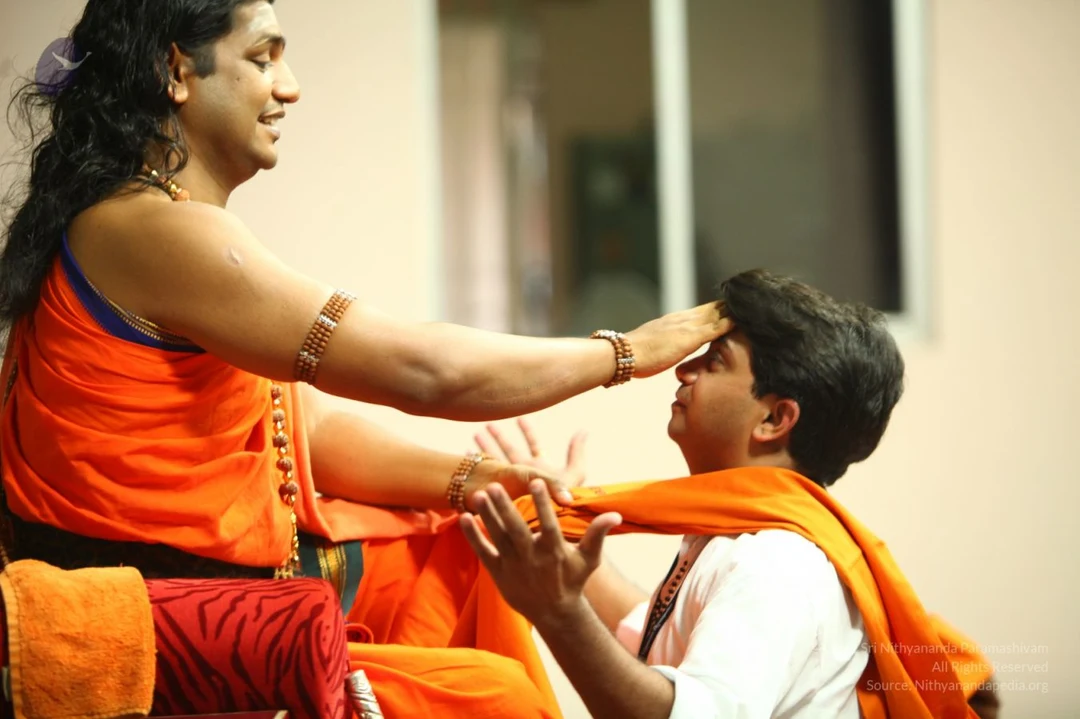
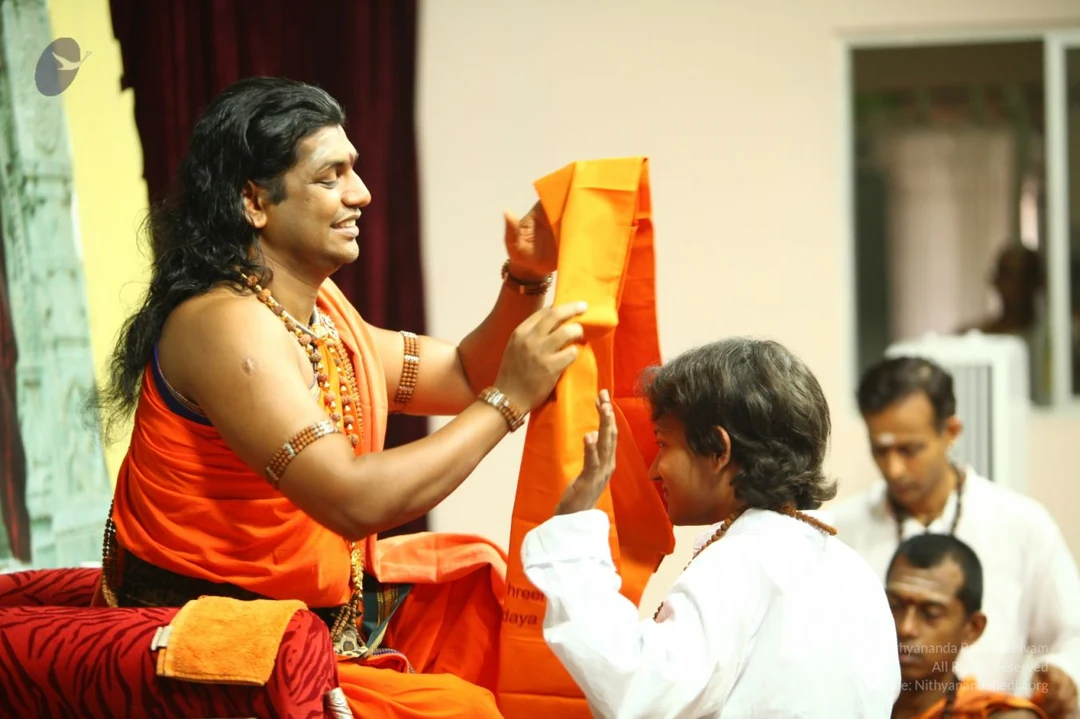
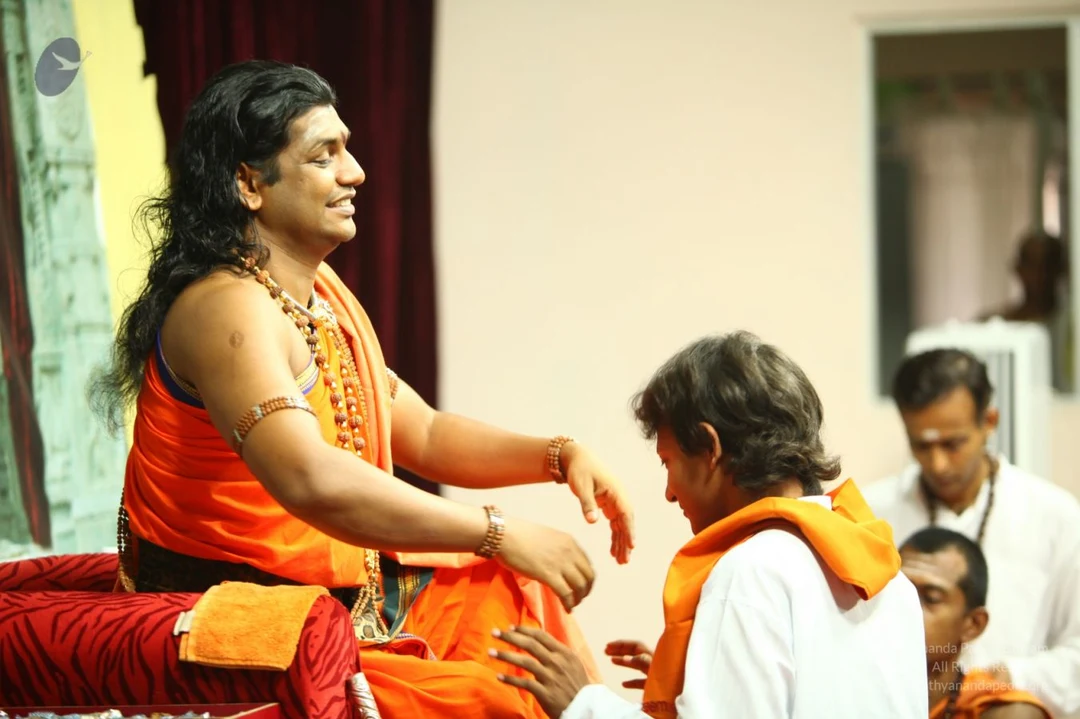
Swamiji: It is a long question an answer needs to be given very elaborately. I will give answer for this tomorrow. Because, I will not be able to complete giving answer to this question, in next few minutes. We have only next few minutes. Today again a long day, initiation. Today all IA participants are going to be officially initiated into unclutching and Nirvikalpa Samadhi.. so first time, you guys, first time, world knows a technology of getting into Nirvikalpa Samadhi which is neurologically verified.

Please understand, the system the technology of Nirvikalpa Samadhi, which I am sharing with you all which you all are experiencing, can be neurologically verified. I can put QEG on your brain. Brain will show exactly what Patanjali says a Nirvikalpa Samadhi. Patanjali says the Nirvikalpa Samadhi, highest awareness and deep rest. You will see today, we will show you, we will demonstrate, when you are in the Nirvikalpa Samadhi, when the kundalini is awakened. When you are in unclutched mood, when the kundalini is awakened, clearly brain shows the highest awareness. What is that? TETA.

Today will explain to you, technically, highest awareness is shown in your brain and no activity, equivalent to coma. Complete silence and highest awareness. Usually, when there is awareness, there will be lot of restless activity, here there is no activity but highest awareness. Jagrat sushupti. What Patanjali calls as Nirvikalpa Samadhi. Please understand, First time the most authentic technology of Nirvikalpa Samadhi best analyzed through the neurological scientific studies is available to the world openly publicly without any restrictions.

My contribution of unclutching to the world. Even I am happy about it. It’s like, when the daughter gets married in a very cultured decent highly evolved wealthy happy people, happy family, how the father feel, wow, now she is in a safe happy place. How he feels happy for her. That is exactly how I feel, when I initiate every person in unclutching. Now I know, he is going to be happy, highest possible conscious plane. I feel happy for you guys, about for your initiation.

I always feel, how exactly initiation, the first Guru pooja would have happened. That is why still that place where the first initiation and the first Guru pooja happened vibrates that energy, I tell you, even now you can touch in the air and feel. When Mahadeva gave the initiation first and Devi did the first Guru pooja, that whole action still is alive in Kailaasa. Any body enters there receives the initiation.

Spot Notes: Thursday, 19 April 2012

“Sadashiva samarambam, Shankaracharya madhyamam asmadacharya paryantam vande Guru paramparam!”

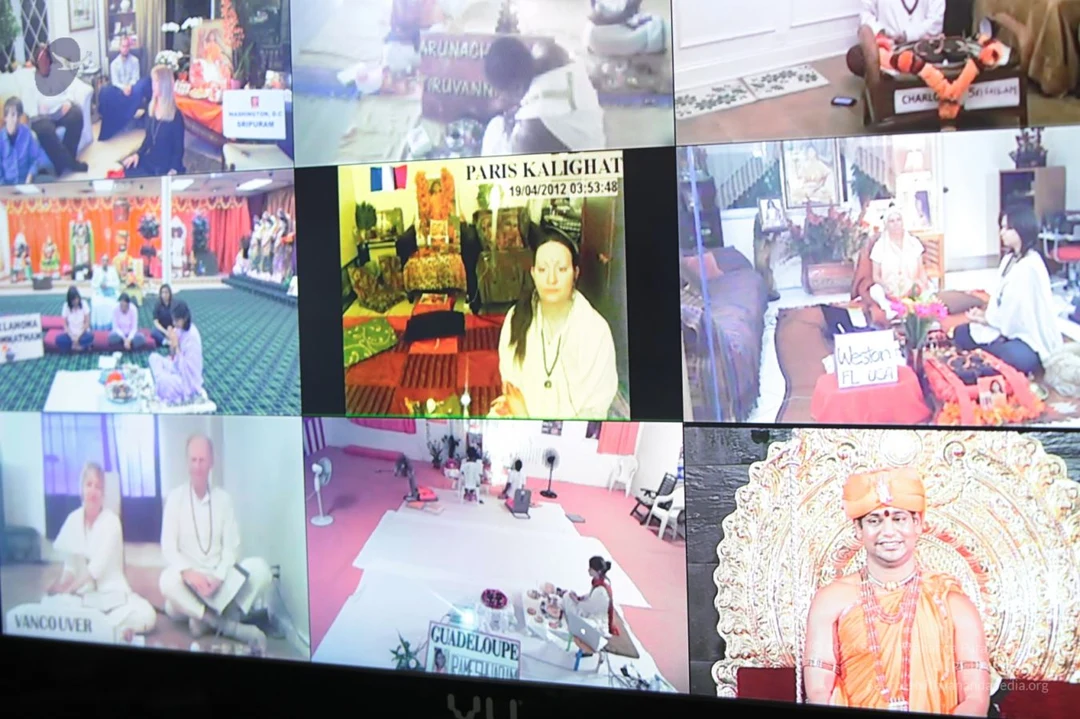
I welcome you all with my love and respects! I welcome all the devotees, disciples, Samajis, Satsangis sitting with around the world at this moment in 874 places through Nithyananda TV, 25 places 2 way Nayana Deeksha, in 231 cities, 27 countries!

Cities sitting with us in 2 way Nayana Deeksha - Ohio Prayag, Ohio Centre, Toronto Kailasam, Kulim Malay, Seattle Chidambaram, Singapore Singapuram, Madhurai Adeenam, Austin, Oman Siva Gangai, Singapore Bhaktimaya, Bangalore Sri Satchit, Washington DC, Vancouver Puri, Oklahoma Somanatham, Paris Kailghat, Weston Florida, Greensboro North Carolina, Tiruvannamalai Arunachala, San Jose Madhurai, Phoenix Kanchipruam.

Megan Bishop Scott’s book Inside the wall. I receive a copy of the book yesterday. Amazing book. It is already available in Amazon. She has written beautifully her experiences, her seeking till she met me. She has very beautifully and very authentically honestly described. I am still going through the book. After finishing the reading, I will give my detailed comments on that book. For now I can tell this book will be more useful to readers than autobiography of a Yogi because so down to earth, honestly authentically presents her seeking. I sincerely want all our viewers to buy and read this book on Amazon. Speaking about her book, I will start a new series on book reviews. May be in a week I will review her book. Still I have not completed the book. But whatever I read I can say this book is more useful to seekers on the path than autobiography of a Yogi! And I also request all the participants and viewers of Nithyananda TV. Every day after your morning Satsang meditate your meditation minutes in the website “www.minutes4peace.org.”

Every moment you sit with - during paada puja time, now which is Upanishad with me, till the Satsang ends if there is Kriya that is also meditation. Till you sit with me Upanishad. Here more Upanishad is happening. So include your pada puja time, watching satsang and Kriya time. Whole morning whatever time you are sitting with me enter all those minutes in the website www. minutes4peace.org website. Let us tell the world how we are contributing to the world to reduce the crime rate.

Let us enter into morning Satsang.

1) Dear Swamiji, you said when i want the headache to disappear, i have given more energy for it to stay in me. IN that case, why have I not given more energy for spiritual experience like Samadhi or Kundalini energy even though I want it? - Rupak, IA No. 64

Please understand wanting it is one. Believing it is possible, trusting it is possible is another one. Let me give you a small story. One guy who was trying his best to get a boon from Shiva. So every day morning he will pour water, milk all kinds of offerings he will pour to Shiva deity and sit and chant namah shivaya and literally nag Shiva to give the boon, literally force Shiva to give the boon. Shiva was not responding. Finally one day he became angry. When the greed not fulfilled it turns as anger. When he became angry. He decided to tease Shiva. He brought a Vishnu deity and started doigna ll the rituals to tease Shiva. Finally he put the incense stick. The incense smoke went to Shiva. He could not tolerate. The incense he kept for Vishnu was going to Shiva. He jumped and caught hold of the nose of the deity of Shiva. He said you should not smell the incense kept for Vishnu. Suddenly in few seconds he felt he was holding somebody’s flesh and nose. When he opened his eyes he was sitting. The moment he saw Shiva his pseudo anger went away, he fell at Shiva’ feet and asked please forgive me. Shiva asked what do you want my son. He asked and Shiva gave him boon. He suddenly had a doubt he asked I was doing so much puja, sacrifice, repetition of your name everything. Why did you not appear then and now when I am angry with you, why are you coming now?

Then Shiva beautifully said - even in your greed, you did not have a strong trust I am in that deity. You only have to imagine that Shiva is there but one corner of your mind is always commenting on your action. There was never 100% doubtless trust. But in your anger, when you held my nostril, my nose strongly even one second you did not have doubt that I was not there. Your mind was not saying even in your unconscious who knows if Shiva is there. You did not know. You know Shiva is there and you have to take revenge. Whether right or wrong those moments without having doubt even in your unconscious you know I am there in the deity. That strong authentic doubtless trust is the key. That is the bridge and makes me appear. When you have that trust, I have no other way. I have to appear.

Understand maybe you wanted your kundalini to awaken, samadhi to happen. But behind you mind - your unconscious is constantly denying all this. Your mind is telling – behind the cricket commentary is going on, wicket commentary is going on – it takes years and years practice, who knows if this swami can do it in 10 days….

But with headache you are sure beyond doubt. Unfortunately, your mind is programmed to believe negative things strongly than positive things. It is like water flows down, your mind flows down towards negativity. Your headache is like authentic trust. Your samadhi and Kundalini Energy is not so strong – it is there, it is not there…that is the difference. Rupak contemplate on this story why Shiva appeared when he was holding the nose in anger and why he did not appear when he was doing puja with all devotion. Contemplate on it you will understand authentic trust is the essence.

2) Swamiji, Is being in silence an effective way to go within? Thank you for your love and blessings! - Preet, ID No. 28

I don’t know what silence you are asking. Verbal silence maybe the initial step. But mental silence is the best step. Emotional silence is the ultimate step. Conscious silence is goal itself. Understand if you are talking about verbal silence it is first step. Very beautifully Upanishad says - “Yogasya pradhamam dwaram vaak nirodaha” – the first step is verbal silence is only the first step for yoga. Mental silence will be a powerful practice for Yoga. Emotional silence is last step of Yoga. Conscious silence is the goal of Yoga. So which silence you are talking about you should know. Step by step increase depth of silence. That’s all. If you are in verbal silence move to mental silence. If you are in mental silence move to emotional silence. If you are in emotional silence move to conscious silence. So understand which level of silence you are talking about - that plays a major role.

3) What is the reason we do Pujas at the Guru's feet? Why do people want to touch the Guru's feet? - Maggie Point, IA No. 94

Maggie Point it is an ancient tradition in the Vedic tradition. When you are showered so much by Guru with his knowledge, experience, love, blessings, everything – when you are showered by him, overflowing gratitude, you don’t know what to do. So you offer whatever you have at his feet. That is the way the tradition of Guru puja stated in Vedic Tradition. The oldest sacred ritual is Guru Puja. The moment the first disciple was excited. Parvathi, Adi Shakti is excited. The moment she was excited with the experience given by Maha Deva Shiva in that extraordinary gratitude she fell at his feet and offered Guru Puja. The first initiation is Shiva Sutra, the first sacred ritual is Guru puja and first stotra is Guru Geeta. The overflowing gratitude you pour yourself at the feet of the master. And same way touching Guru’s feet also in the ecstasy you always feel like offering yourself at his feet. There is no logical reason for why Guru Puja is done, why people touch Guru’s feet. It is emotional feeling connection. For some people they feel why should I do it. For some people it is life. They cannot miss it. I know for millions of my disc morn satsang is much more important than eating food. The morning satsang is a powerful bliss dose. It is life itself! So please understand it is the individual’s emotion. Do all this only if you feel intensely connected to it. Not otherwise. It should not be done as a ritual. See as far as Yoga is concerned, whether you want it or not, do it. Because it is connected to your body. But Guru Puja has to be done by your mind. Your mind itself should feel it and out of ecstasy and joy you should pour it. So there is logical reason just that is the way it is. That’s all!

4) My dear Swamiji, Is the will a part of the mind or the being? How is it connected to the mind if at all? - Rajeev Ramanath, IA No. 57

Rajeev Ramnath – It is a very important question, very subtle question. Understand the answer I am finishing in 2 lines. Will is neither part of the mind nor part of the being. It is a bridge hanging. How is it connected to the mind? Just like a grass floating on the ocean. How is the straw or grass floating on the ocean? It is just floating, by moving or pulling the straw you cannot move the ocean. You cannot even control the straw by making movements in the ocean. Your will is just floating on your mind. Neither you can control the will and move the mind and vice versa. That is a very complicated relationship. Then how to control the mind using the will. You should increase the frequency of your being to reduce the control of the mind. That is the only solution. If more part of the planet becomes land, the ocean part reduces. See ocean is like a mind, being is like a land. Will is like a straw floating on the ocean maybe on the bank of the ocean touching the land and the ocean. But one thing you need to know just like how under the water there is land, under the mind is the being.

Your being is the land on planet earth, ocean water is the mind. Will is the straw - small piece of grass lying where the ocean meets the land. With this example you can get answer to any question.

5) Pranam Swamiji, thanks for being in my life. Swamiji what is the best thing I can do to older people like my parents? I dont want them to die without knowing the truth (cosmos, that’s you) I don’t want them to take again an unconscious body. Please help me so that atleast they don’t suffer next janma. Nithyanandam - Murali Krishna, IA No. 54

Murali Krishna it is so unfortunate in those days the parents and elders used to push their kids towards Gurus and spirituality and enlightenment. I have made spirituality as a trend. Now youngsters are connected and they are pushing elders to come. Whether I have to feel pride that I made the whole thing in a way youngsters are connected or feel bad that the Kali is such that old people have to be forced by youngsters. It is a very weird situation. It is a very weird situation. He is asking what is the best thing I can do to older people like my parents. If you ask about your child I can tell come on bring it to eNgenius. The only way is approach them with tremendous feeling how can I contribute and make a diff in their life and explain them by taking time. During death explain no one can support them other than Guru. It is not story. Thousands of stories, enough of instances and evidences where people have felt my presence and experienced peaceful death. Tel them for graceful exit, IA is compulsory. Make them und, convince them. That is the only way. No other way.

6) Pranam Swamiji

You mentioned that we should expand, experience and explode in every possibility, but not get attached to the object or measure achievement. My question is how would you care about anything if you don’t have any small attachement to it? Could you kindly tell me how, swamiji? Pranam - Siva Bhaskaran, IA No. 05

Shiva Bhaskaran I don’t mind small attachment. I don’t mind you having small attachment but in the name of small attachment you are not going to move out of it what to do? That is where the problem starts. Small attachment will not even be a small attachment. But the moment I grant small attachment. What will you do? You will justify everything as small attachment. Small attachment will be there but will not even be known to you. Anything known to you disconnect from it. not even small attachment is allowed knowingly. So you go on unclutching whatever is there knowingly. Then unknowingly whatever has to happen will happen.

Today all the IA participants are going to be officially initiated into unclutching and Nirvikalpa samadhi. See first time world knows a technique of getting into NS which is neurologically verified. The technology of Nirvikalpa Samadhi that I am sharing with you which can be neruo measured.

Patanjali says about Nirvakalpa Samadhi - highest awareness and deepest restful awareness happening at same time. You will see today when the Nivikalpa Samadh happens in you, unclutching mood happens automatically and Kundalini Energy is awakened, highest awareness will be shown in your brain and no activity equivalent alien to coma. Complete silence and no activity. Jagrath sushupthi is what Patanjali calls as Nirvikalpa Samadhi. Please understand the most authentic technology of Nirvikalpa Samadhi best analysed through the neuro scientific studies available to the world openly, publicly without any restrictions. My contribution of unclutching to the world even I am happy about it  It is like if a daughter is married in a very cultured, decent, wealthy and very happy place how the father will feel how he feels happy for her, that is exactly the feeling I have when I initiate every person in Unclutching consciousness. Now I feel now he will be in the highest potential…

I always feel exactly in Kailaasa how the first initiation and first Guru Puja has happened. That is why that place still vibrates in that place. The first time Mahadeva gave initiation to Devi that whole

1) Srujana from Vizag – 9885535056 – 1st – want 420 out of 450 in 1st year Inter; 2nd want a medical seat in Andhra University, 3rd – both parents are doctors. Please bless they establish a good practice. 4th – please bless that my parents build their own house; 5th – please bless my sister gets a good joy and settles.

2) Bhoopathi Metur – 9442250529

3) Lavan Mattakalappu, Srilanka – 778126453

I bless you all who are sitting with us at this moment around the world in places through 1058 places in Nithyananda TV, in 25 places through 2 way Video conferencing, in 267 cities, in 29 countries! Let you all achieve, experience, live, express, radiate and share and explode the eternal bliss, Nithyananda. Thank you!

Photos From The Day:
Visit to Temple

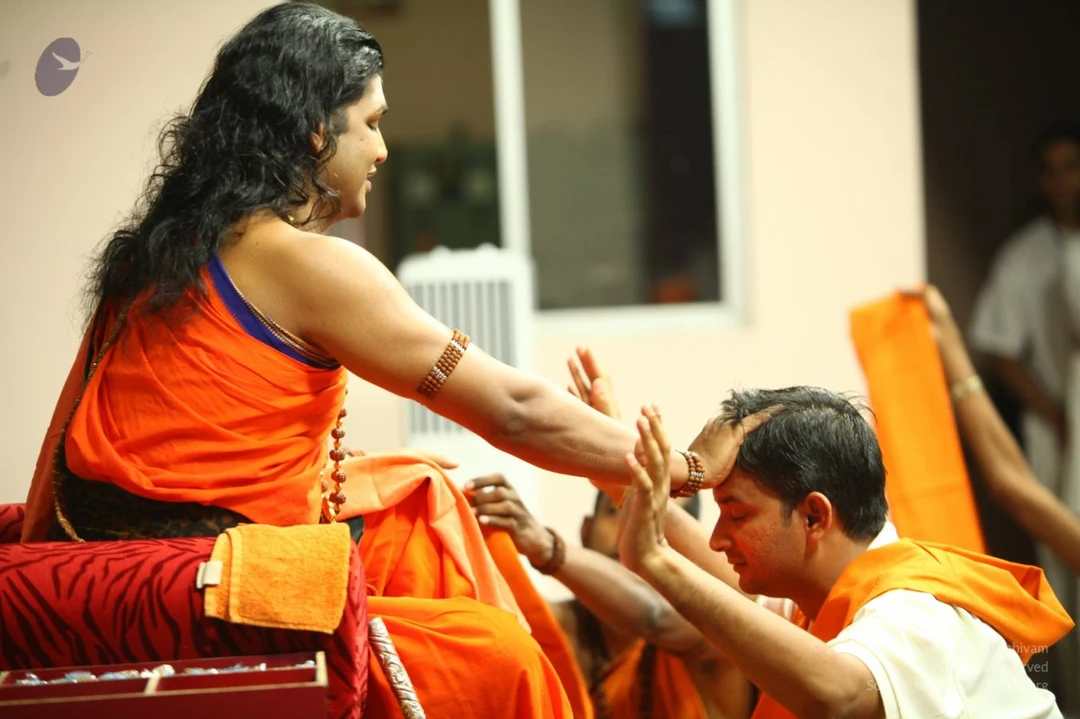
Pratyaksha Paada Pooja

Nithya Satsang

Dial the Avatar

Sarvadarshan

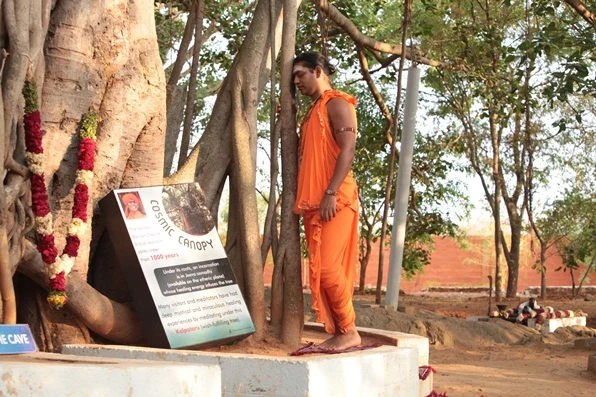
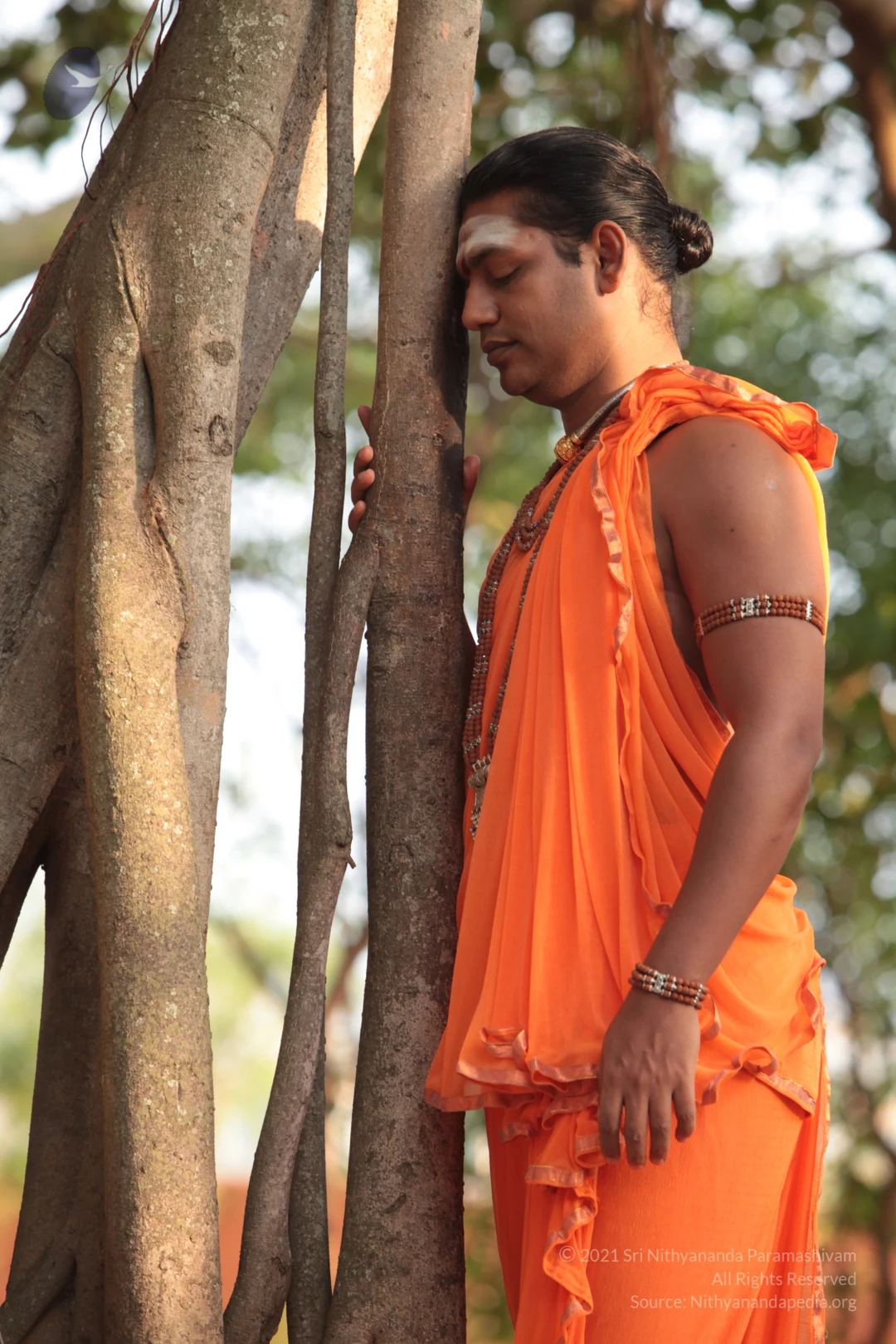
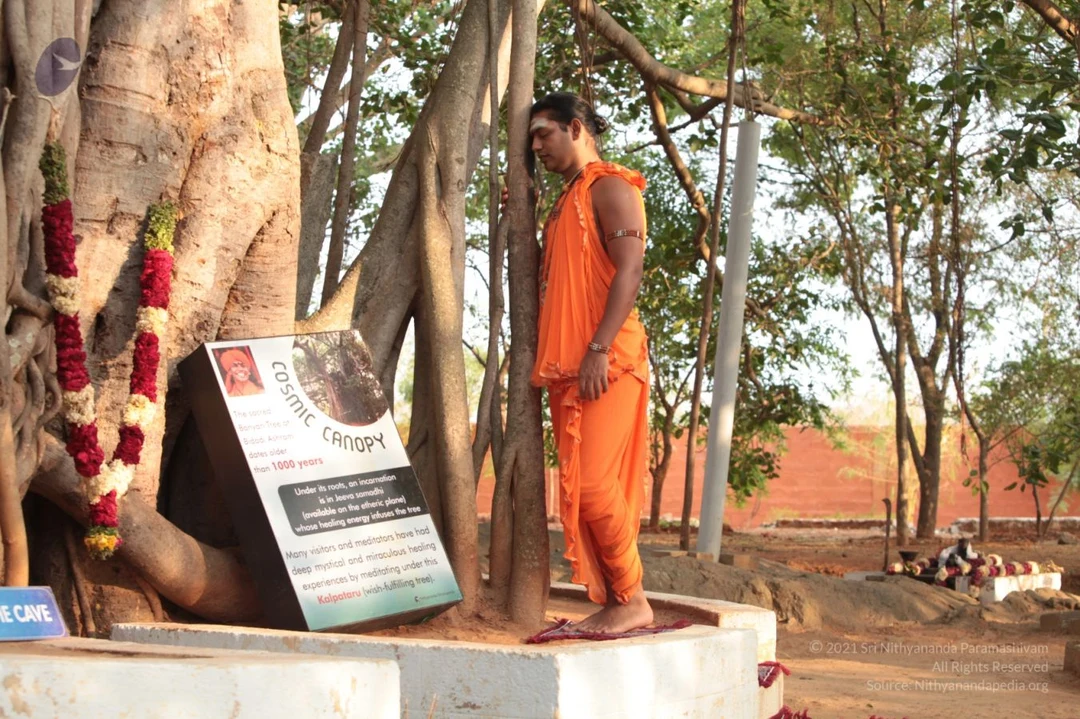
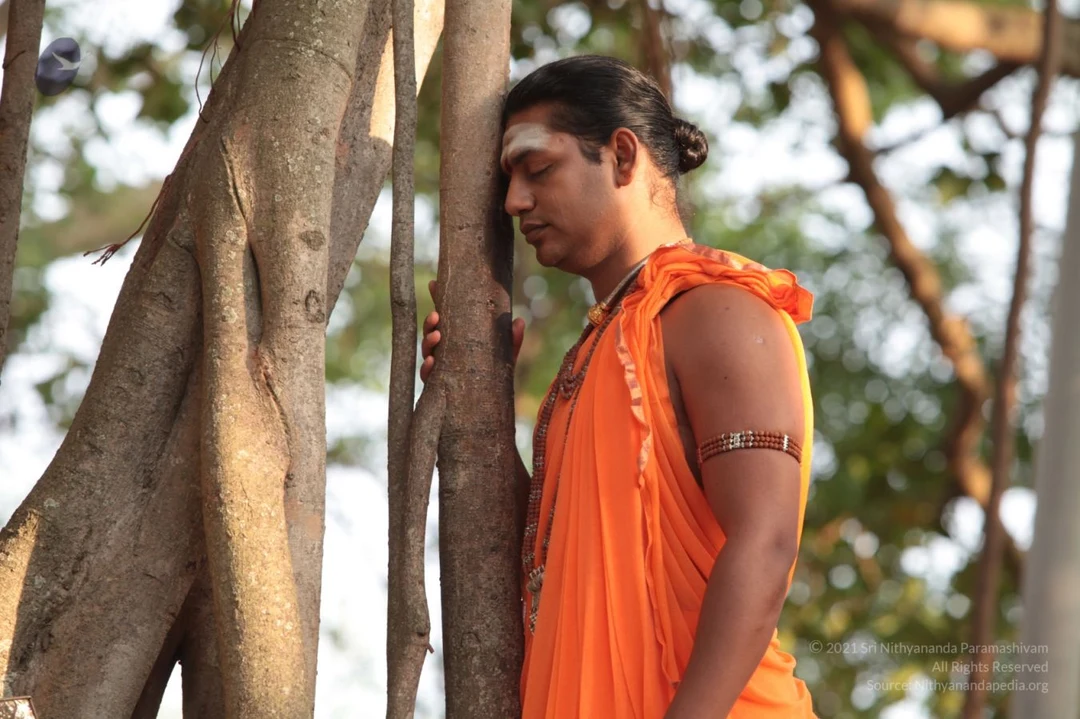
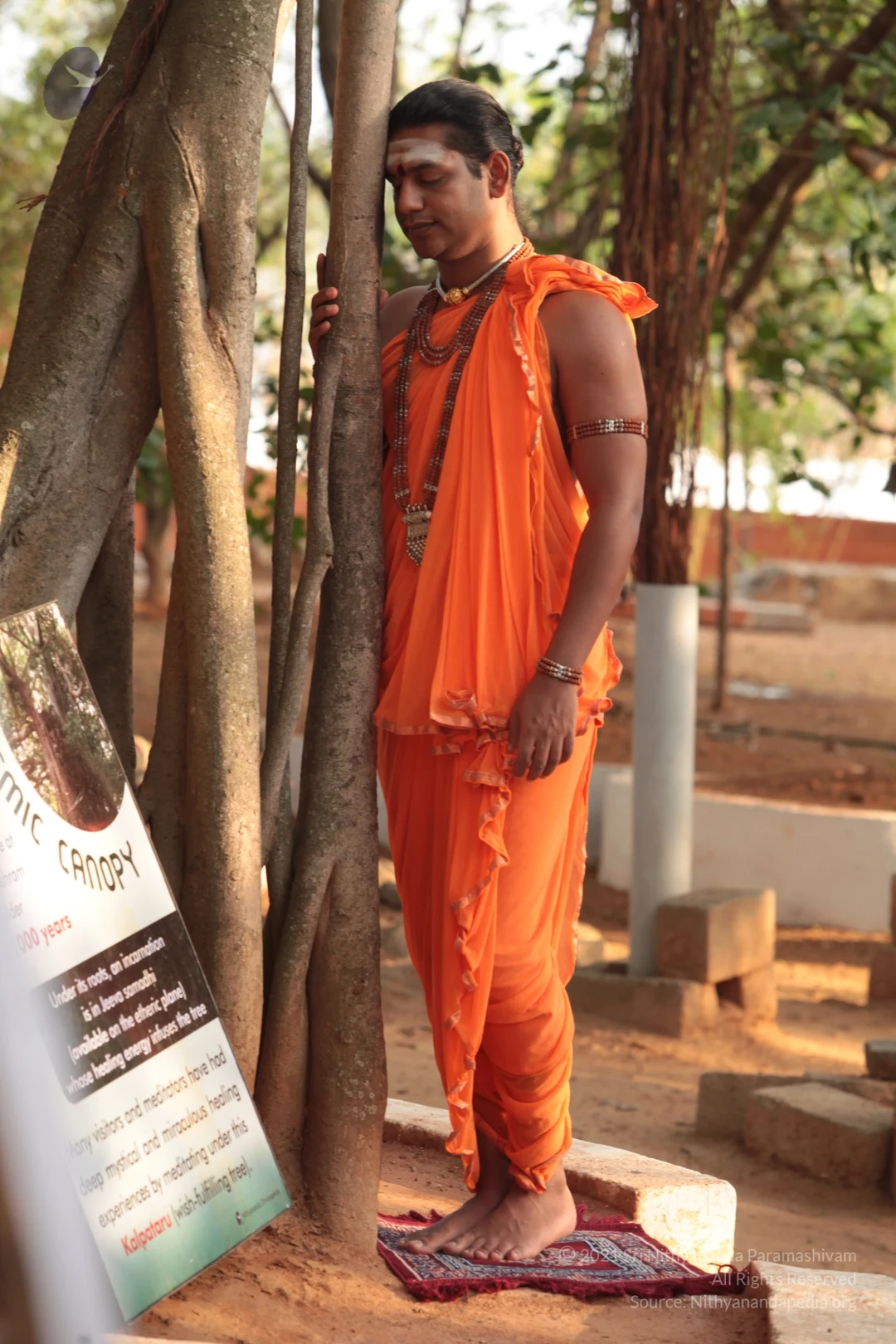
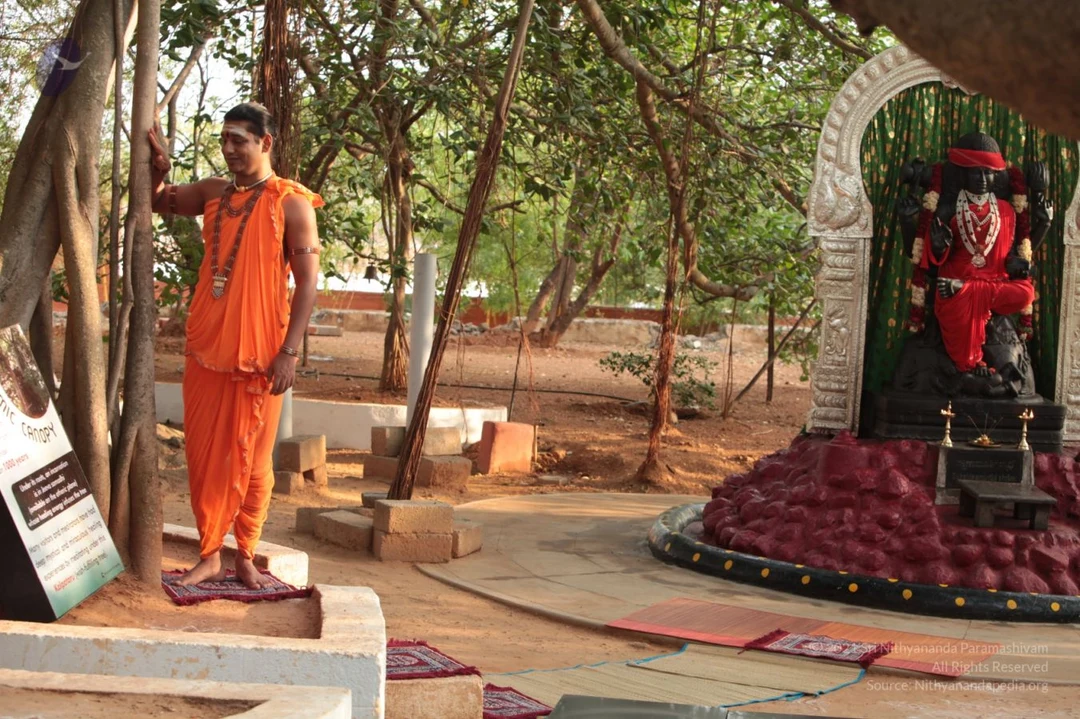
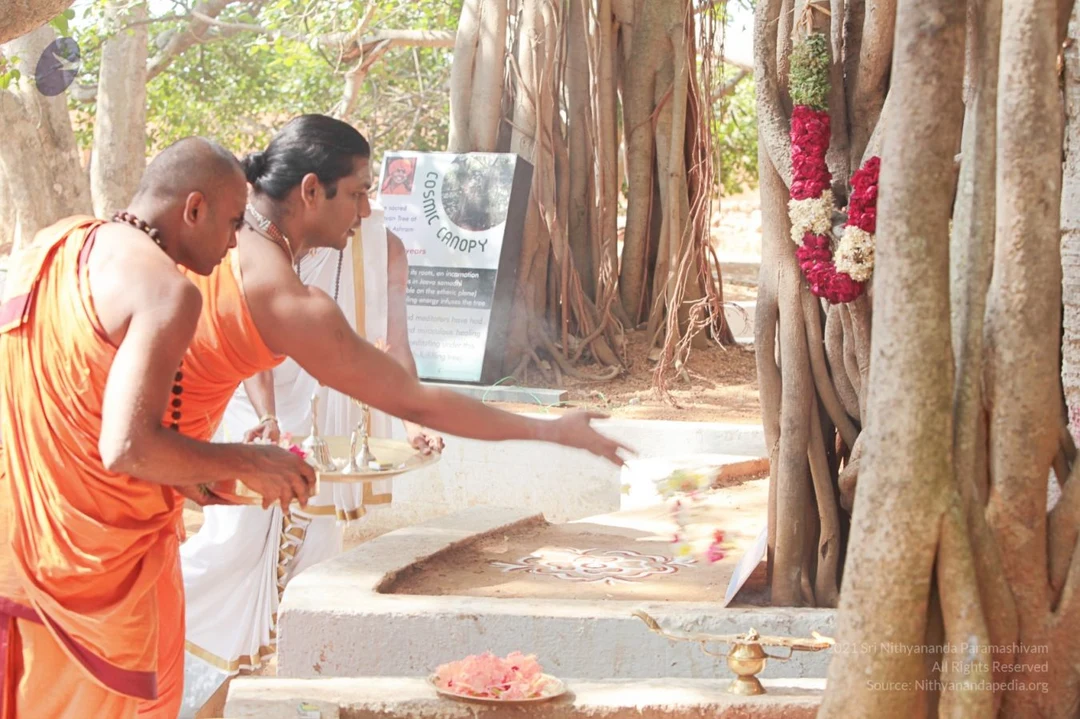
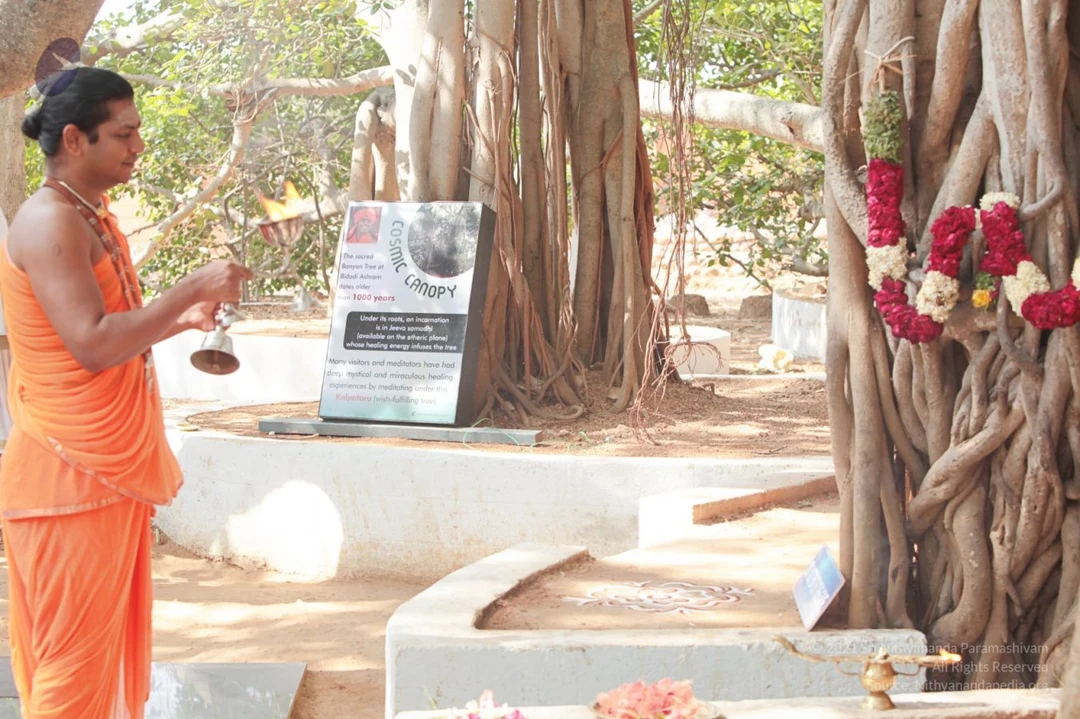
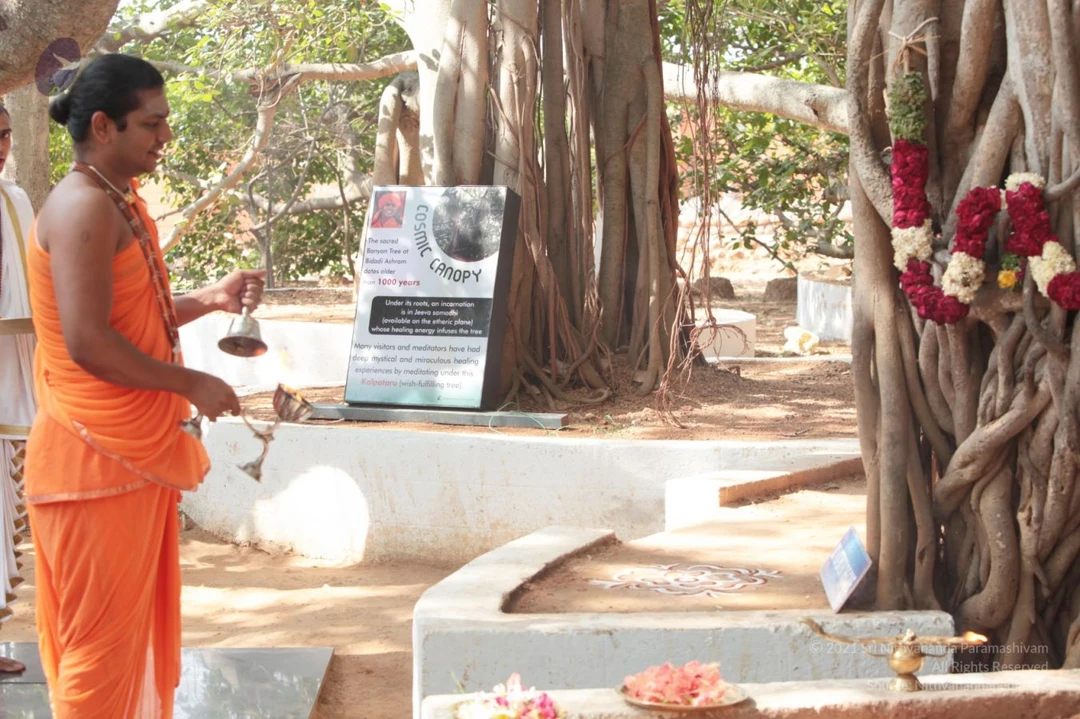
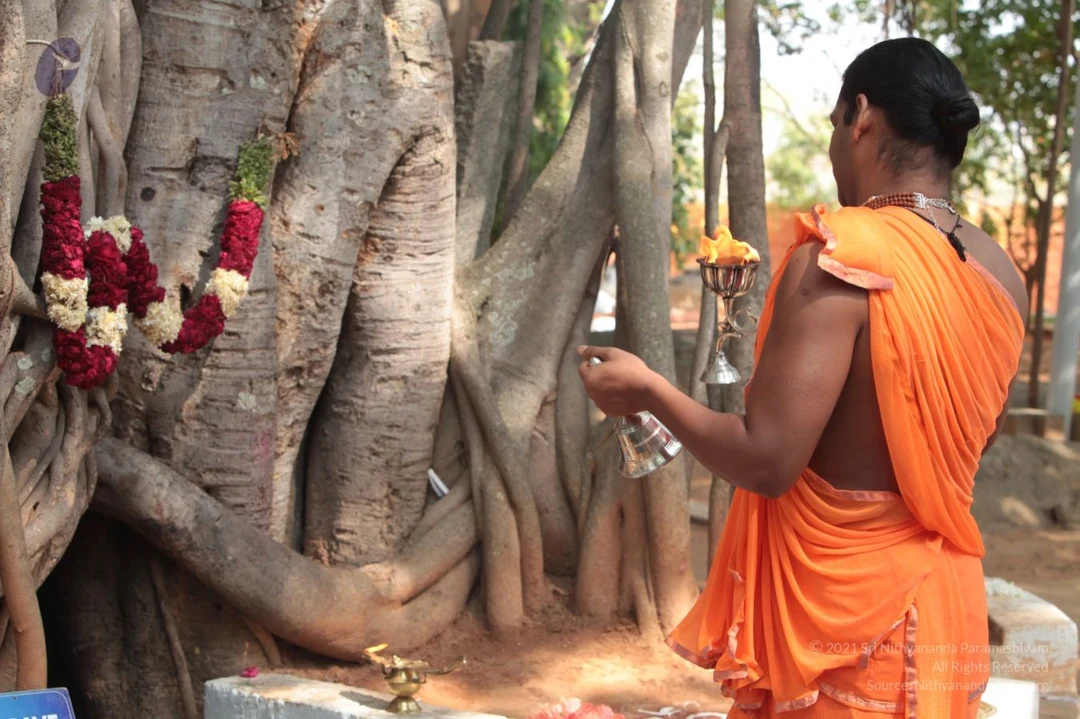
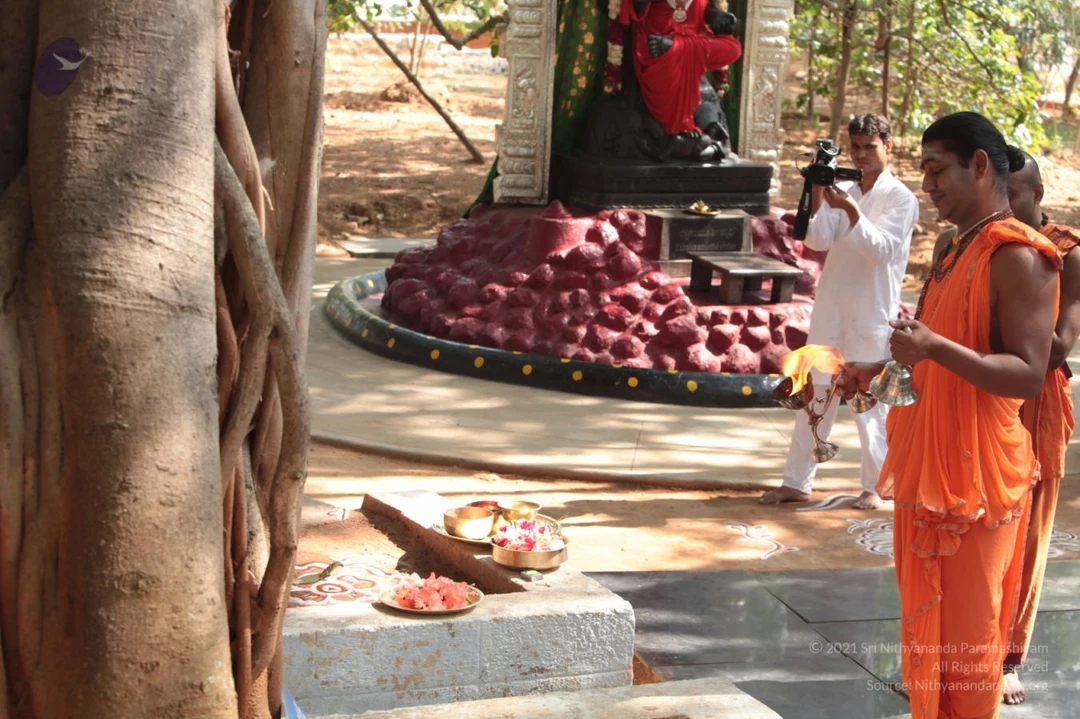
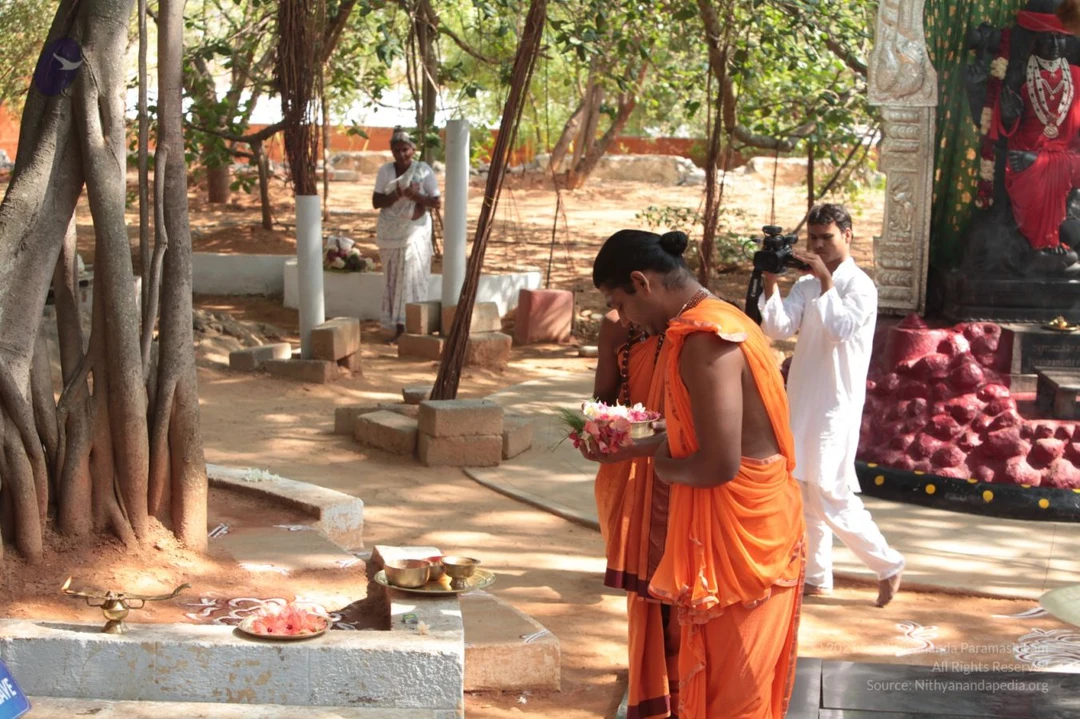
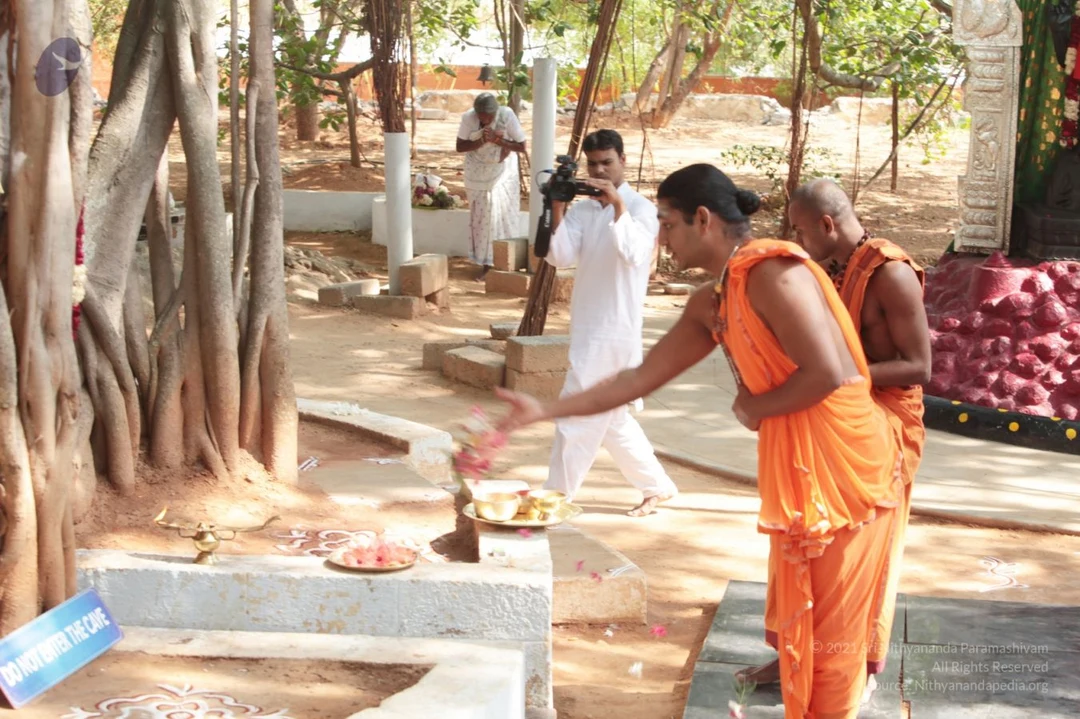
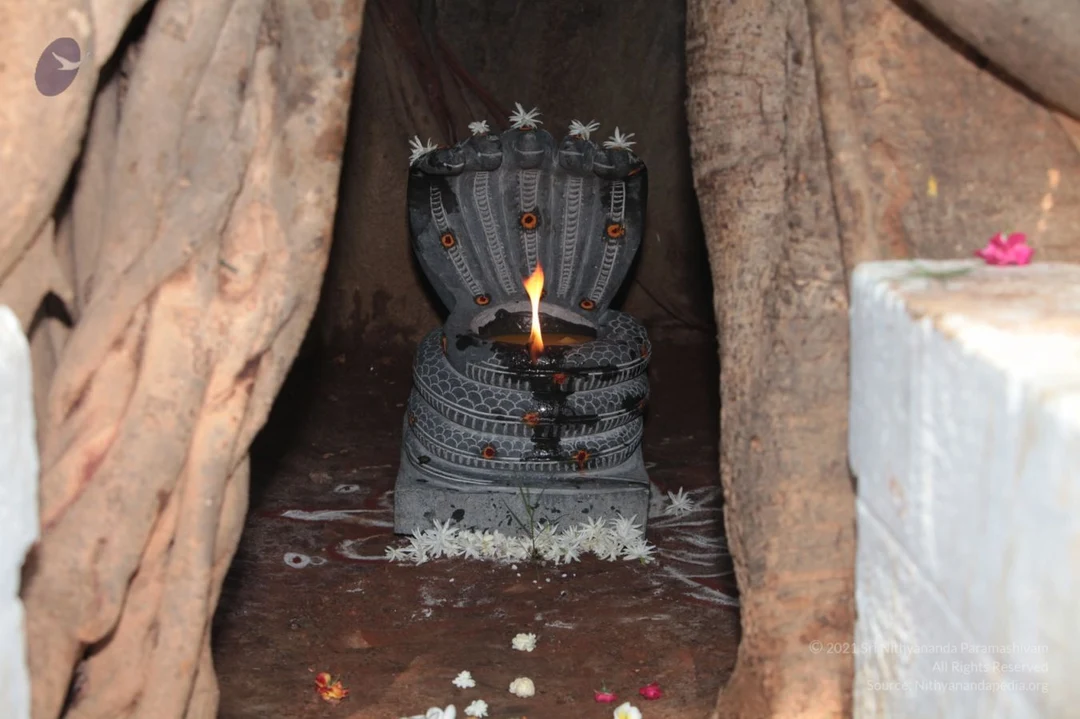
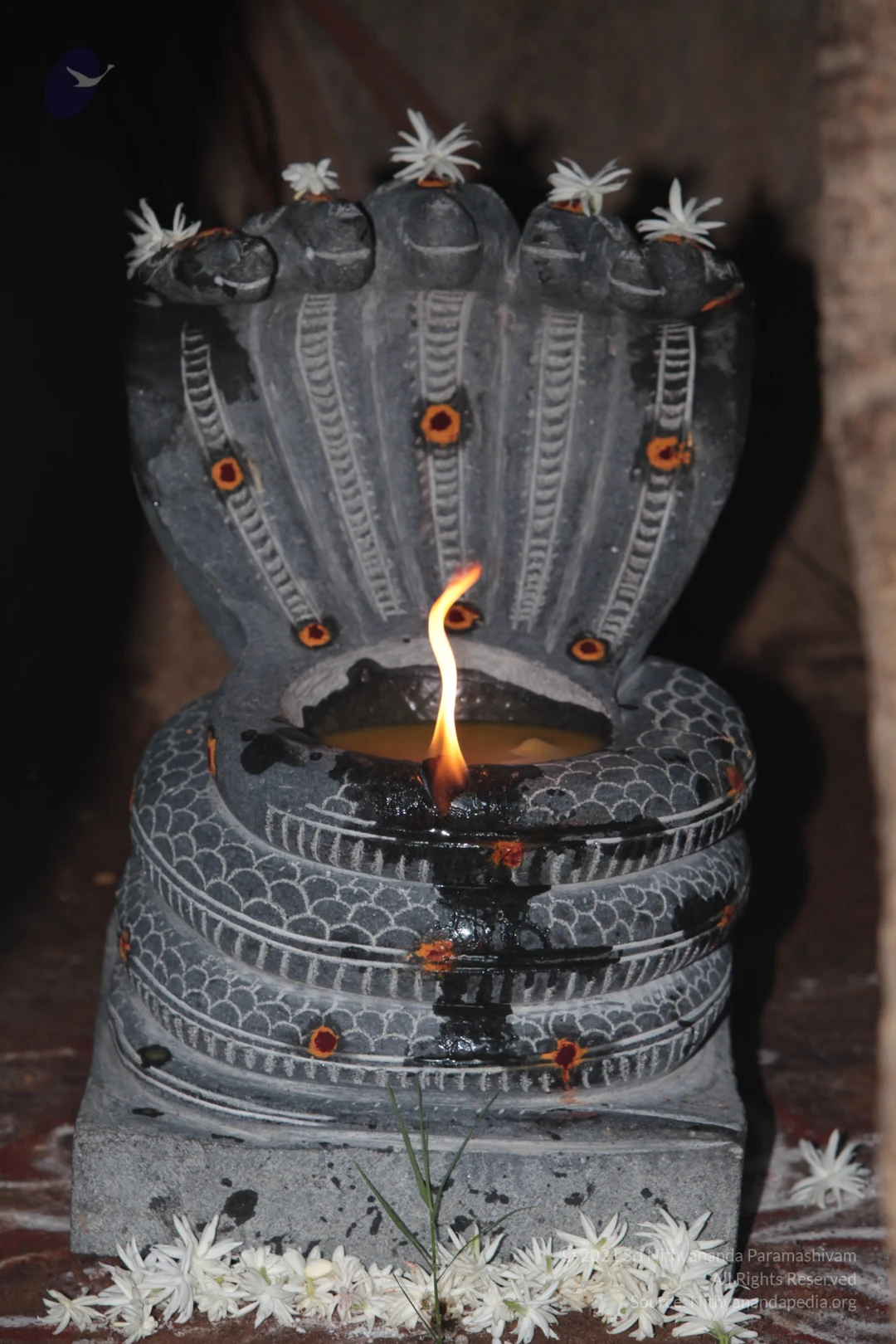
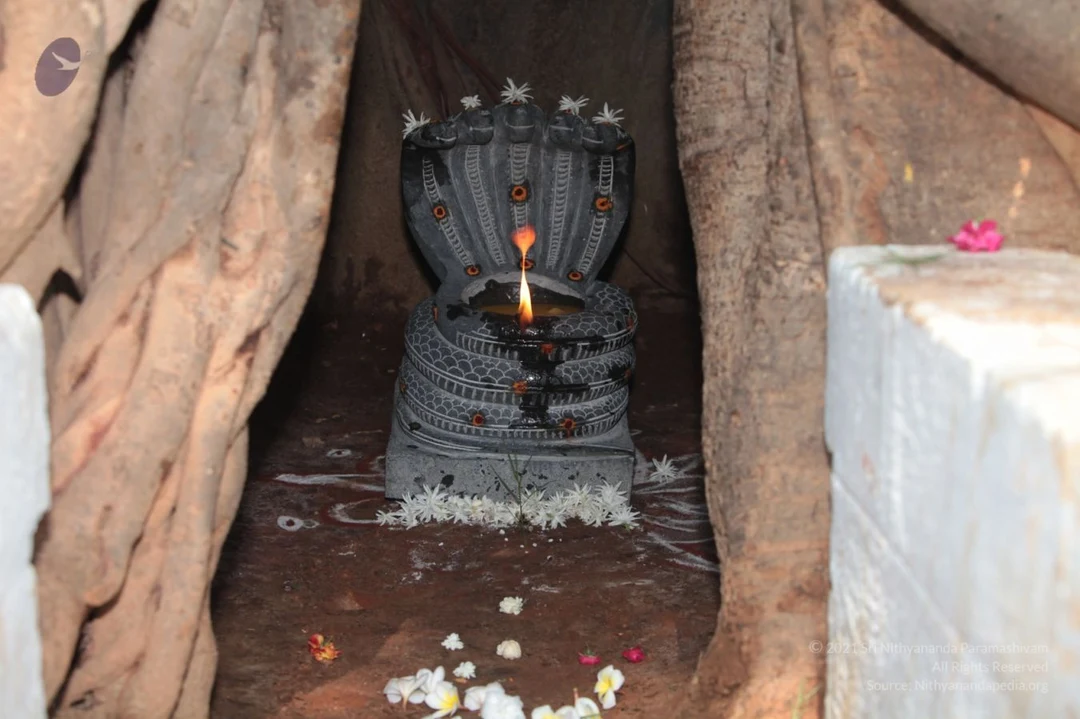
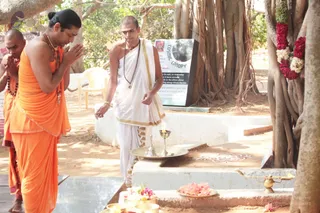
Lighting lamp under Kalpavriksha - Wish Fulfilling tree

Inner Awakening Session =

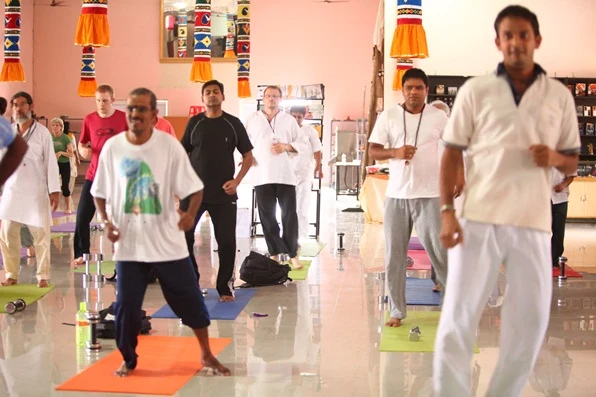
Nithya Yoga Session

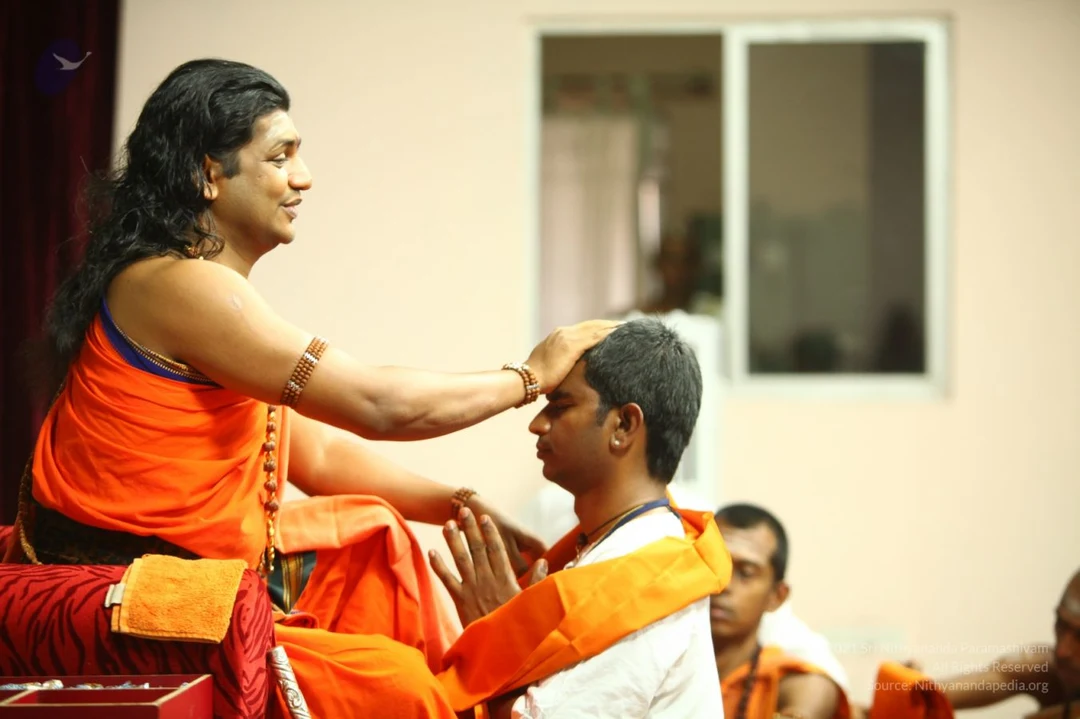
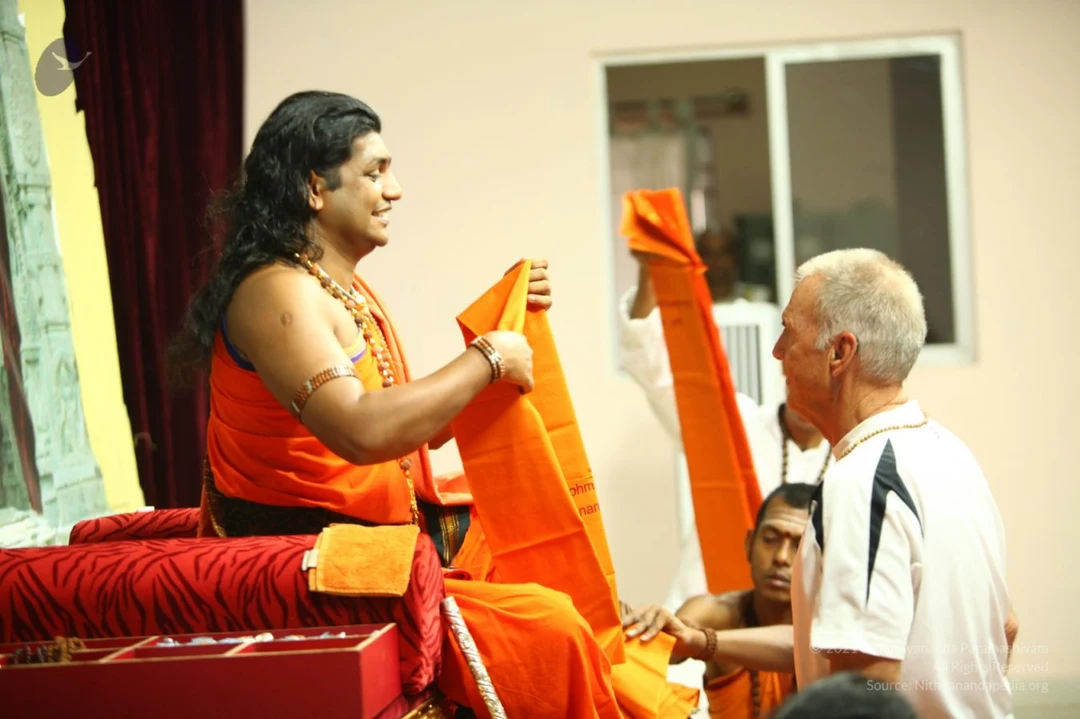
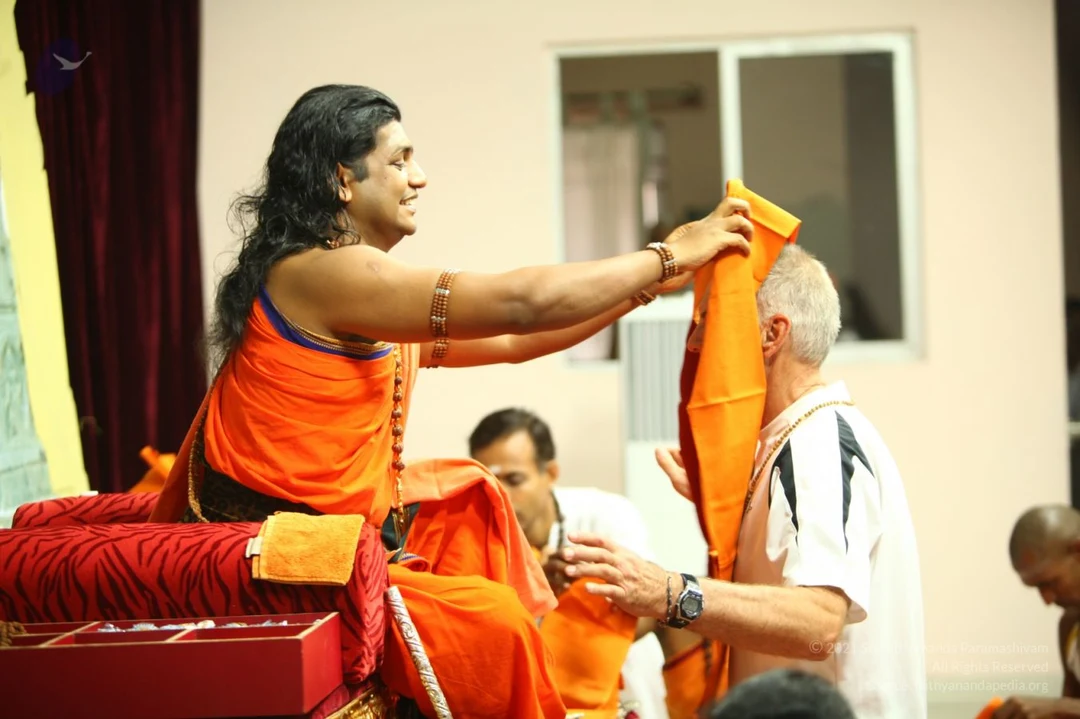
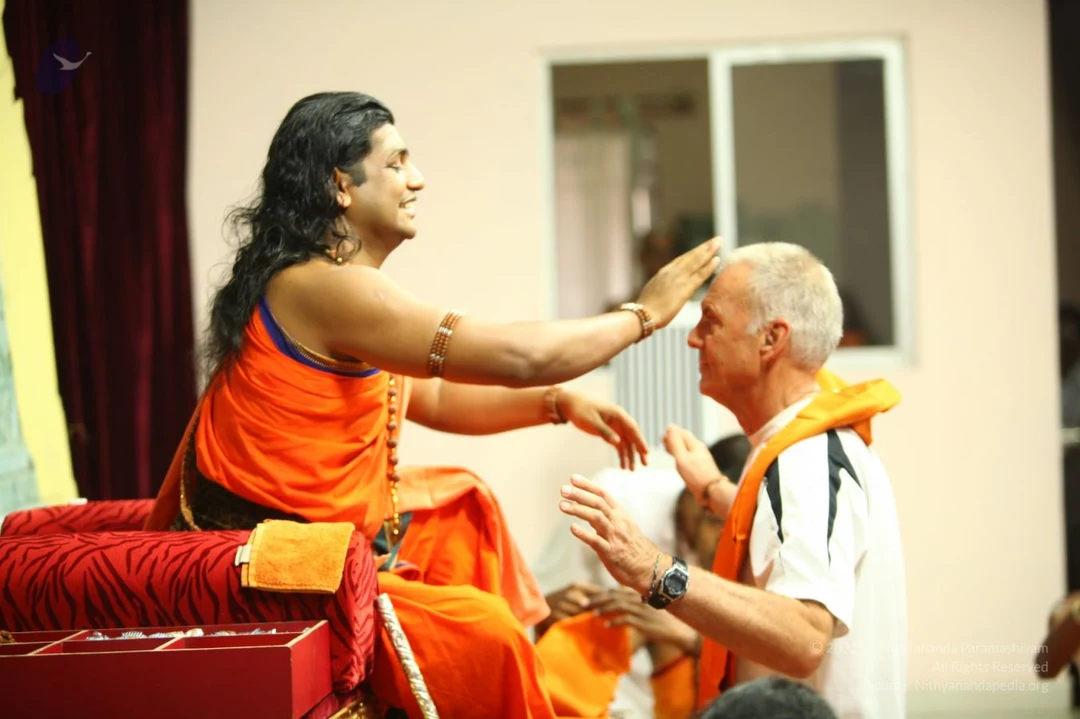
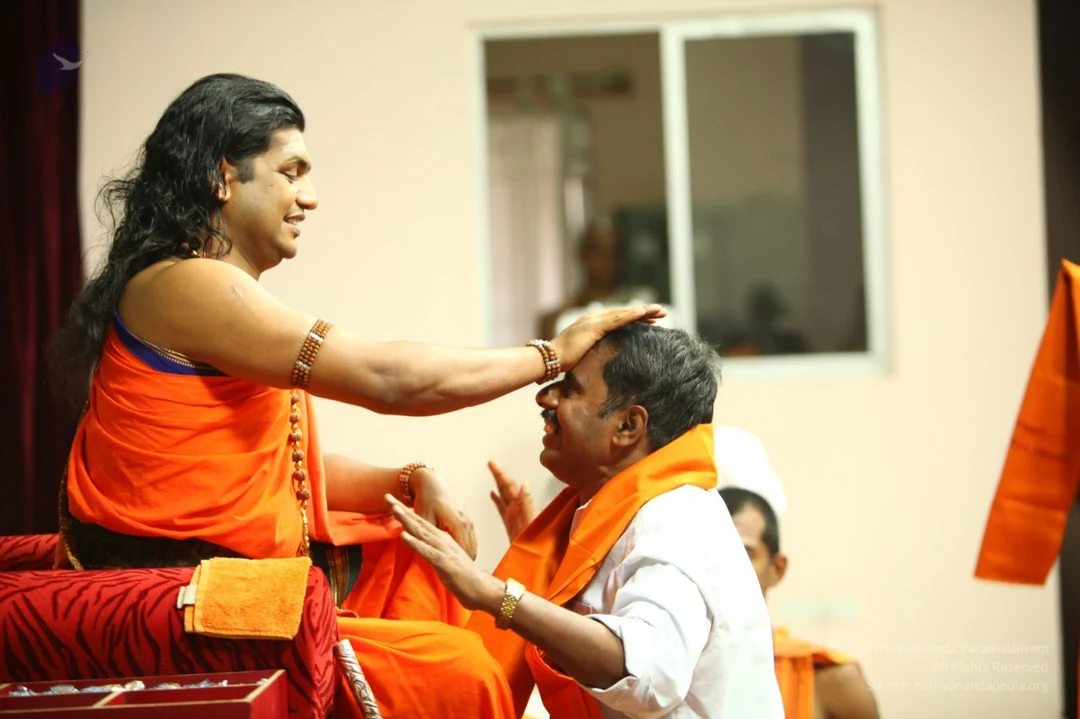
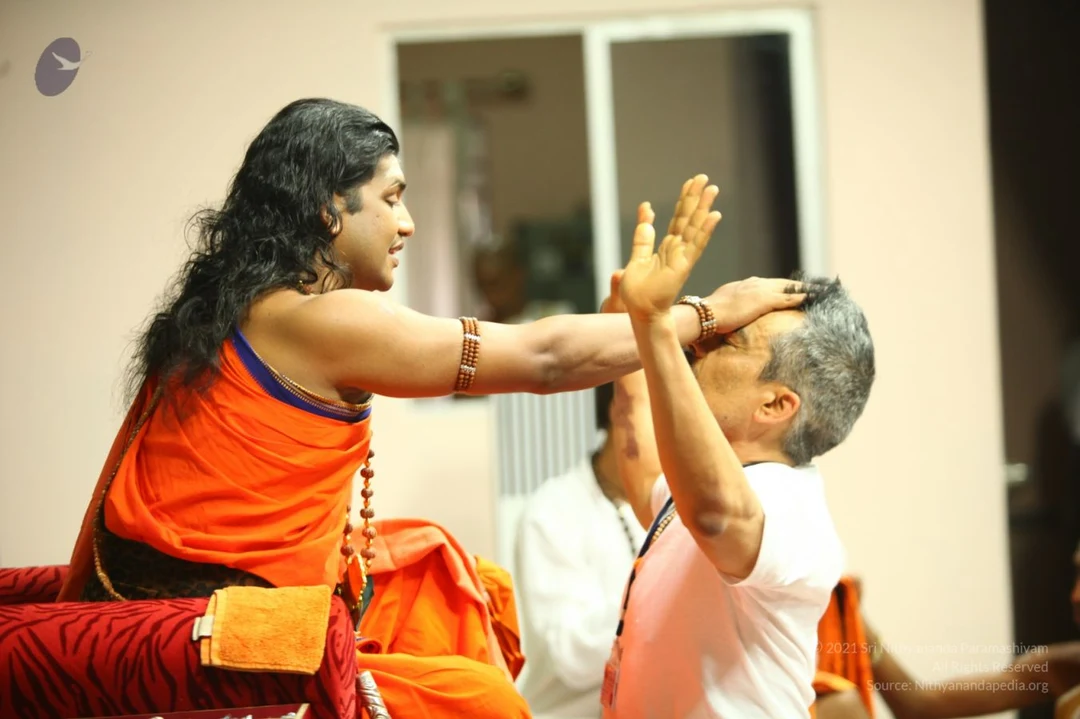
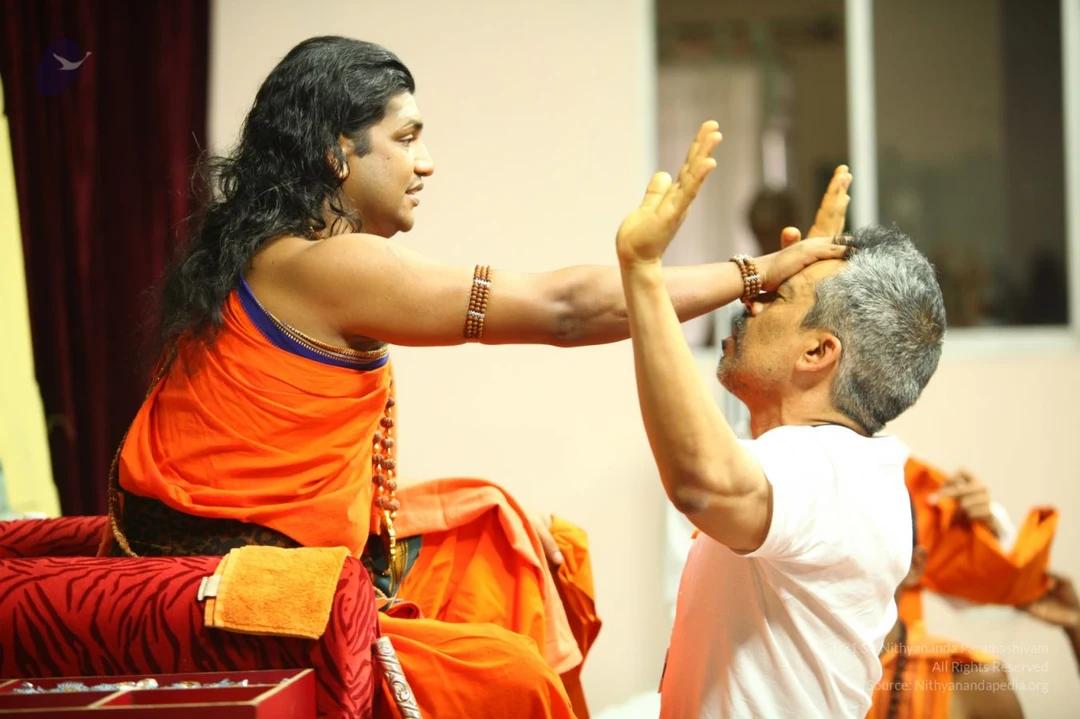
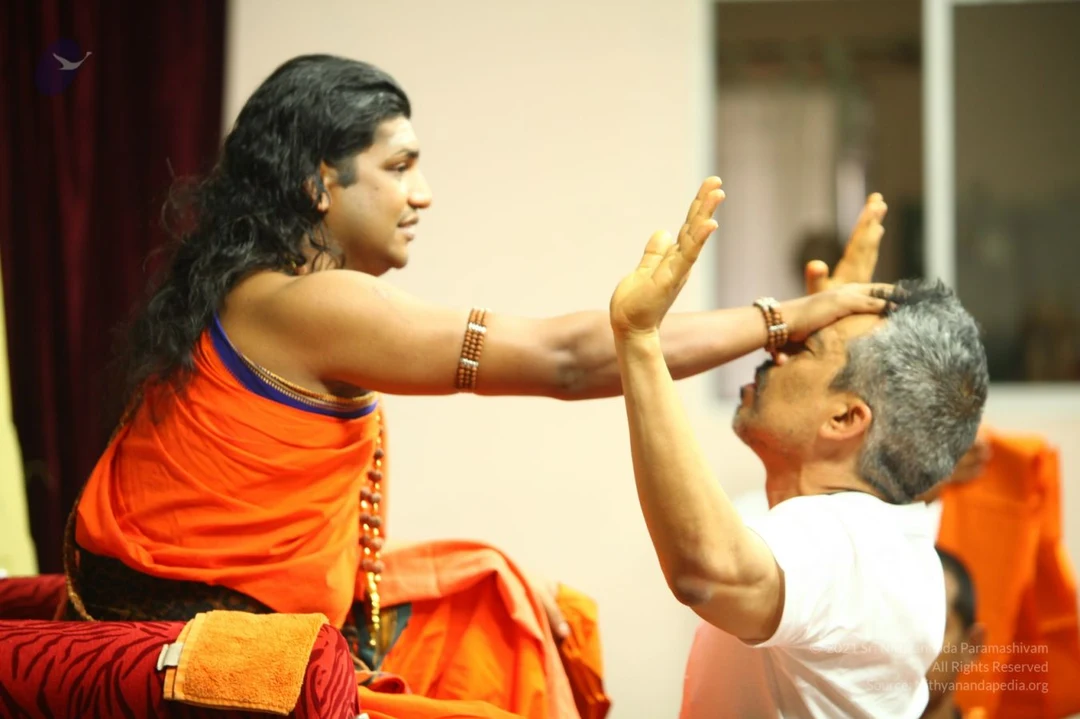
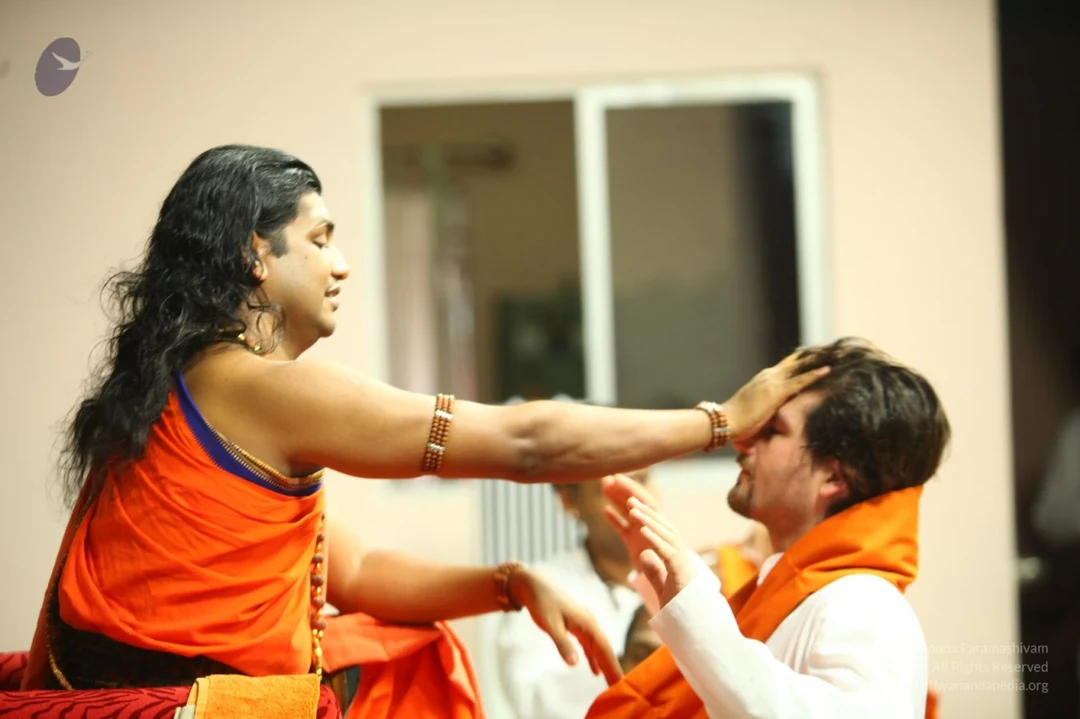
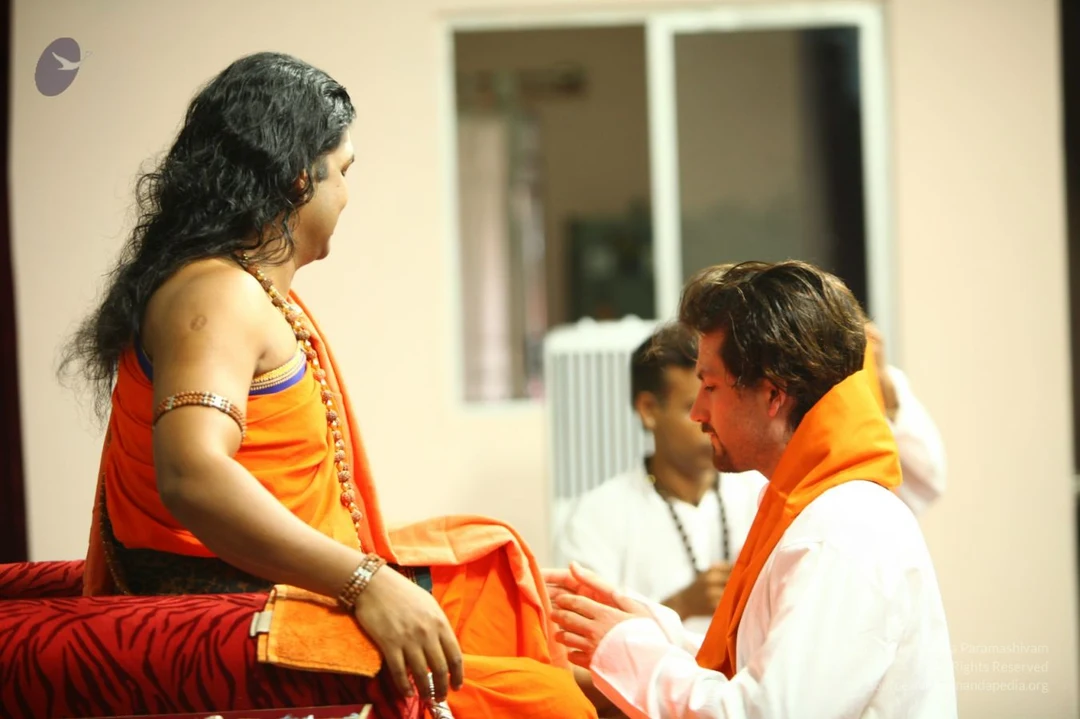
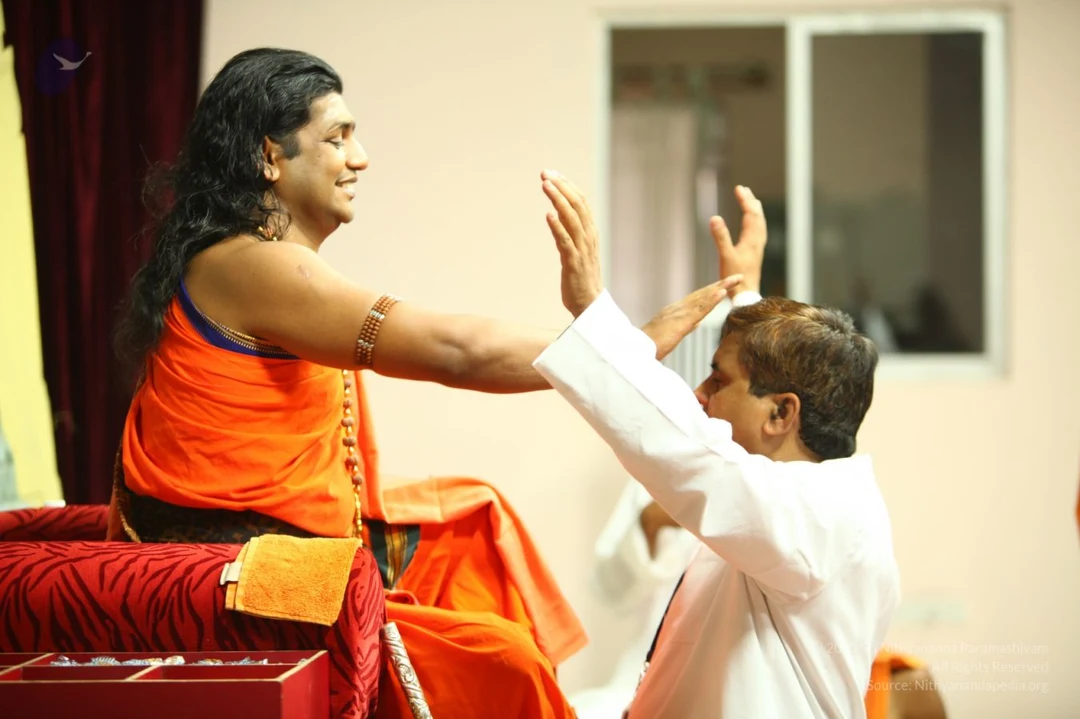
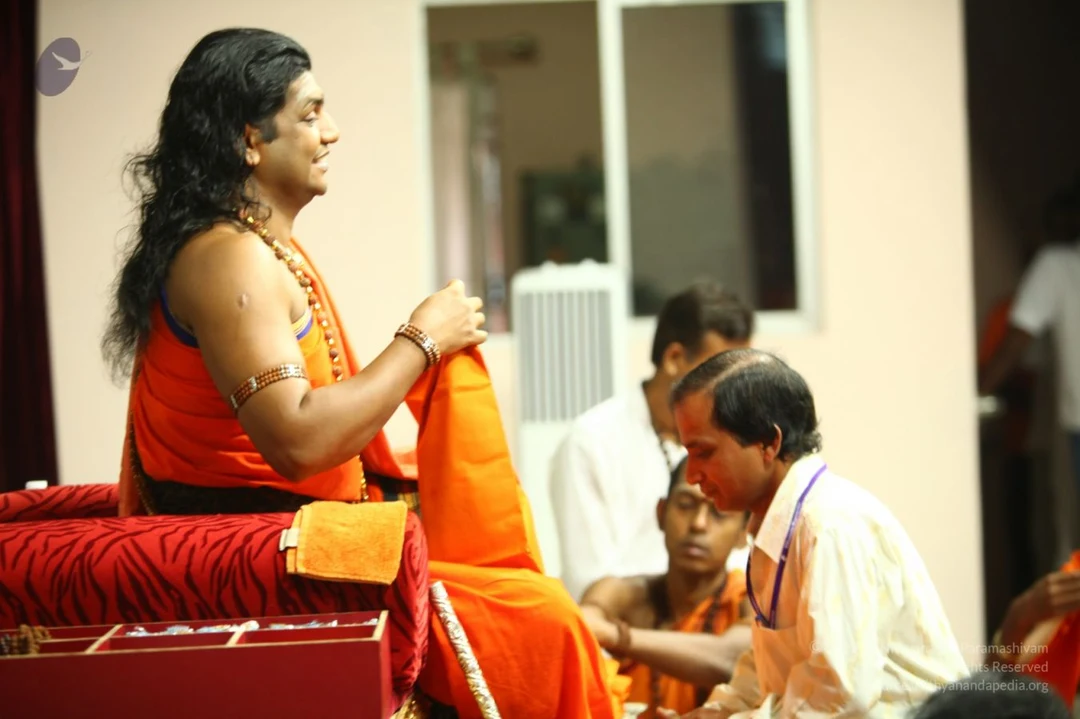
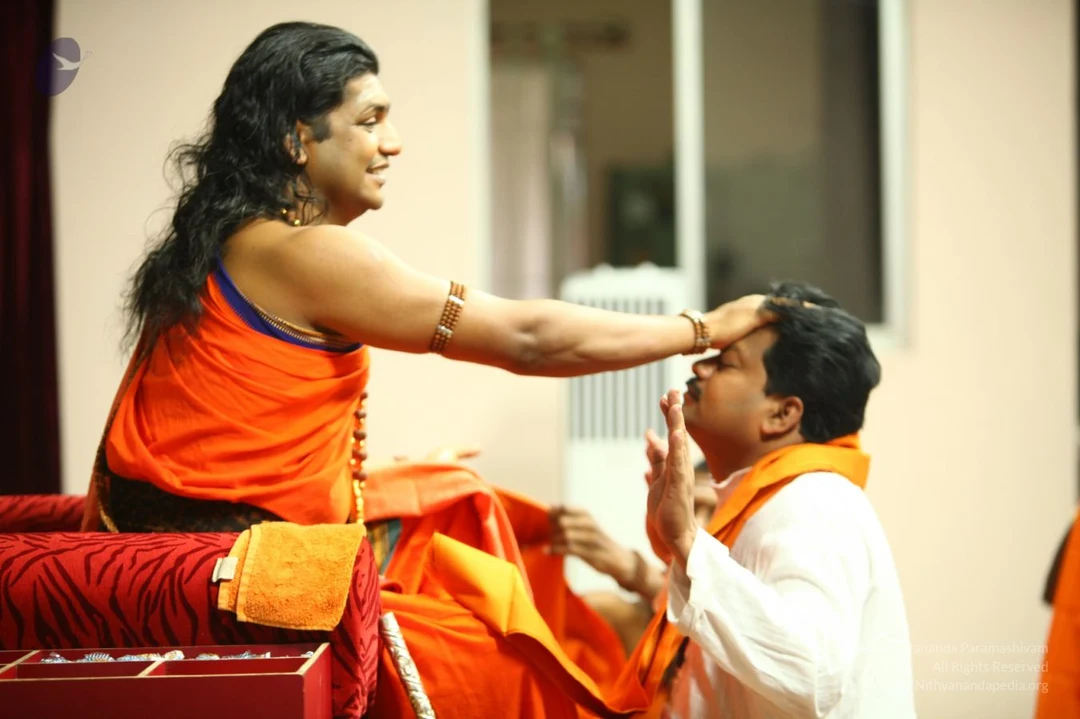
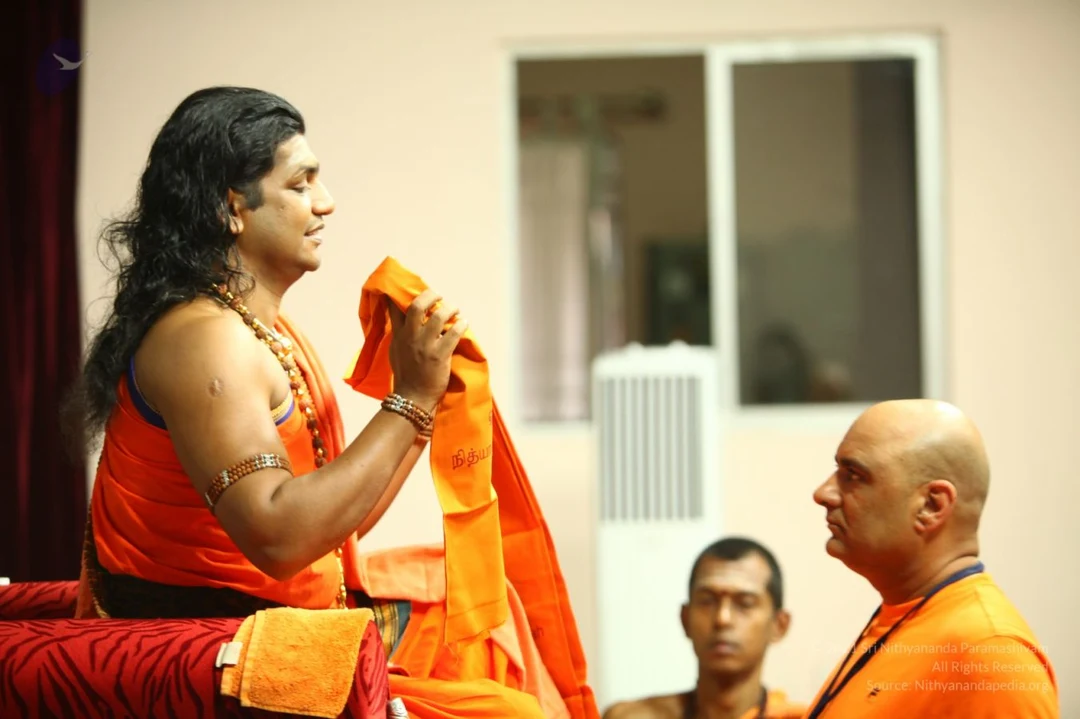
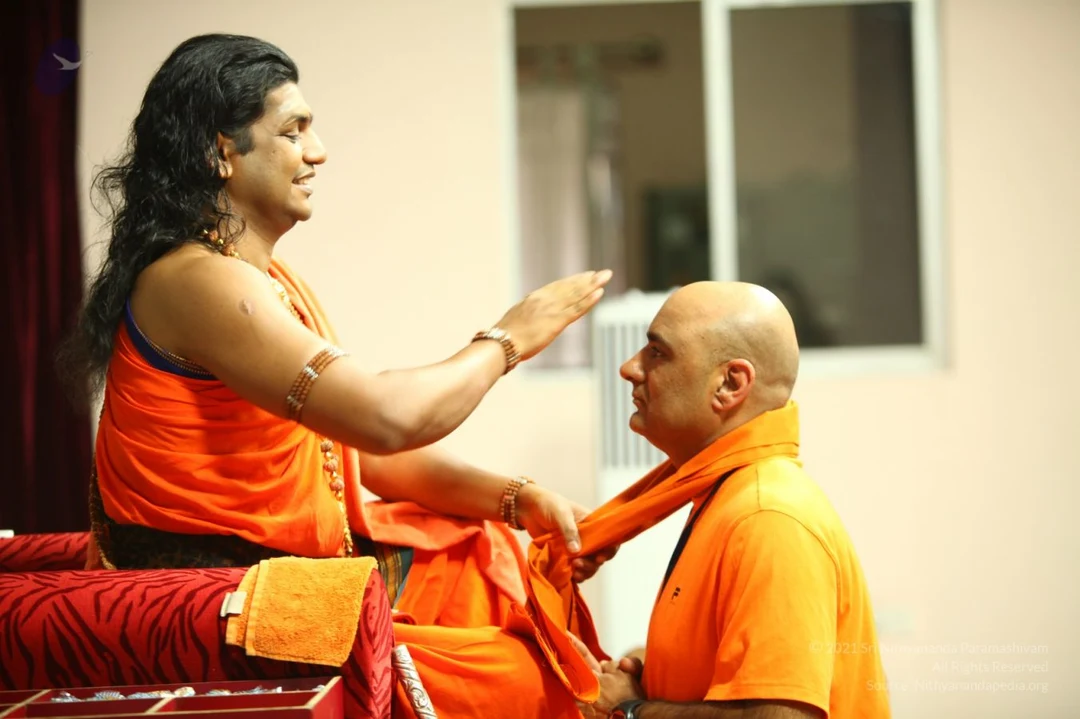
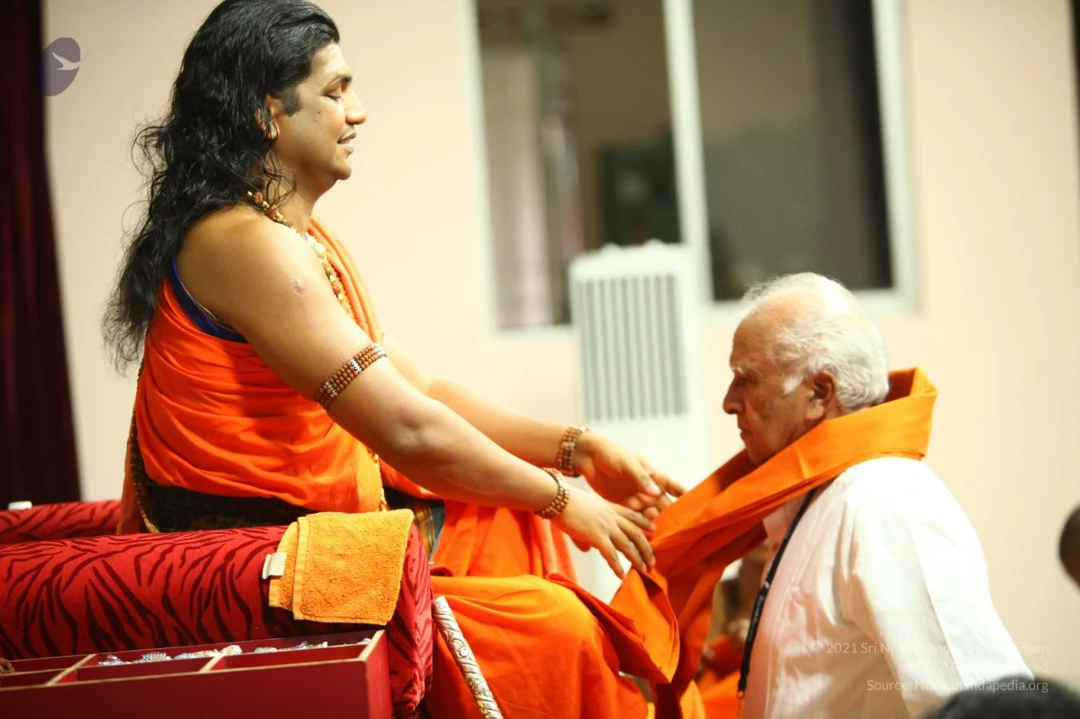
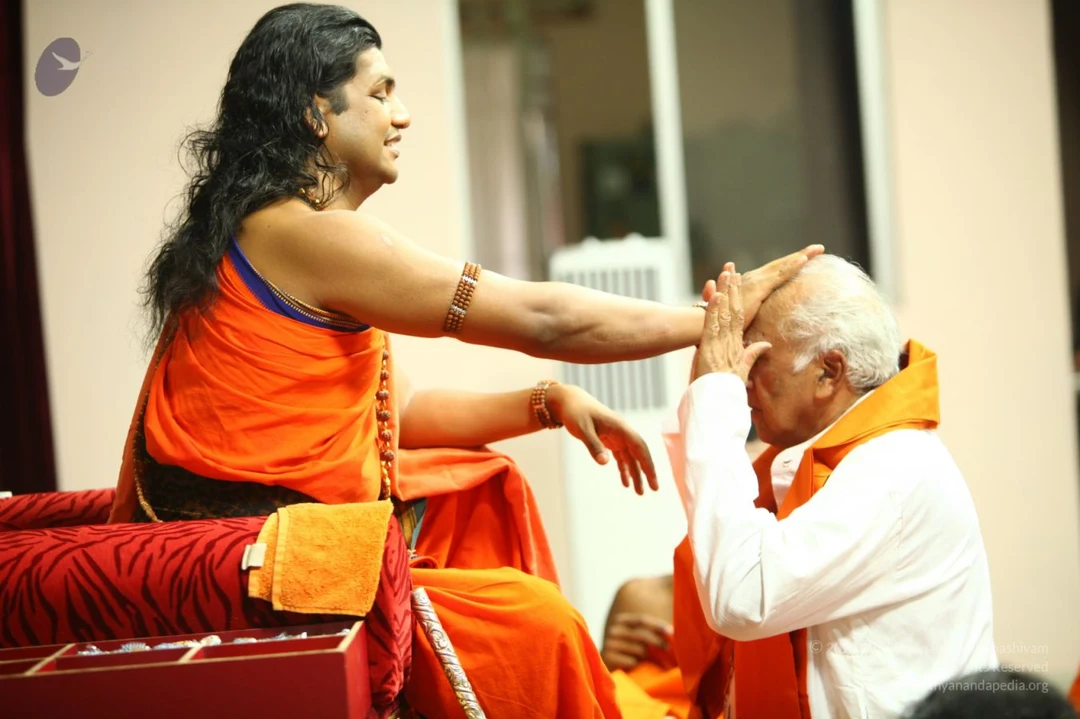
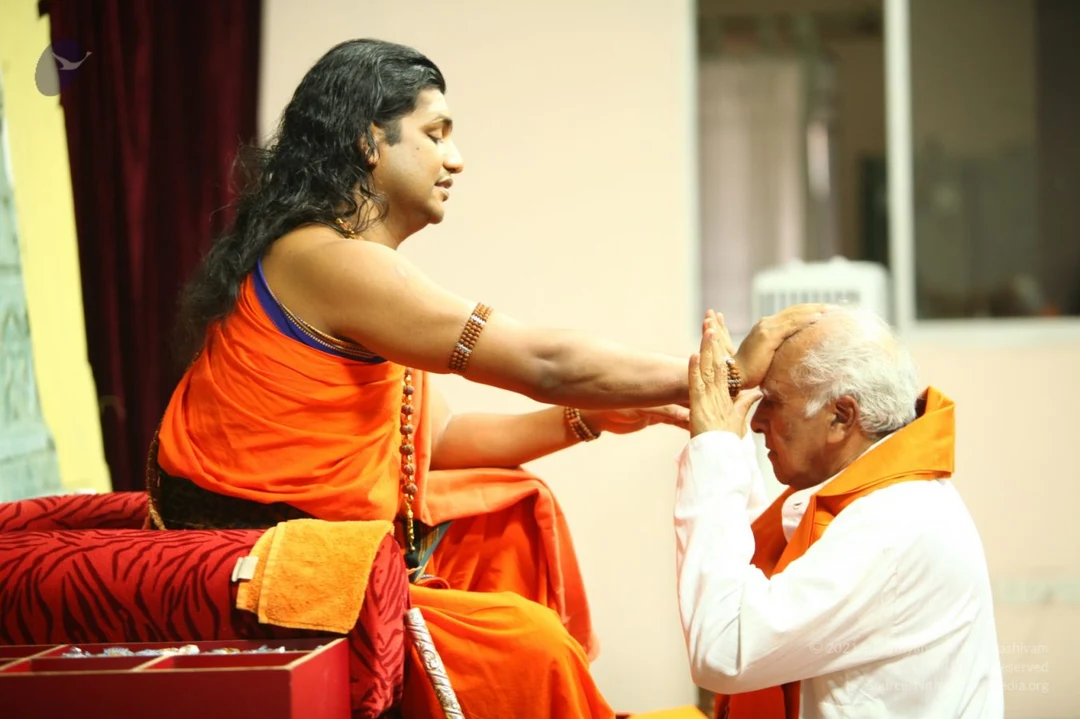
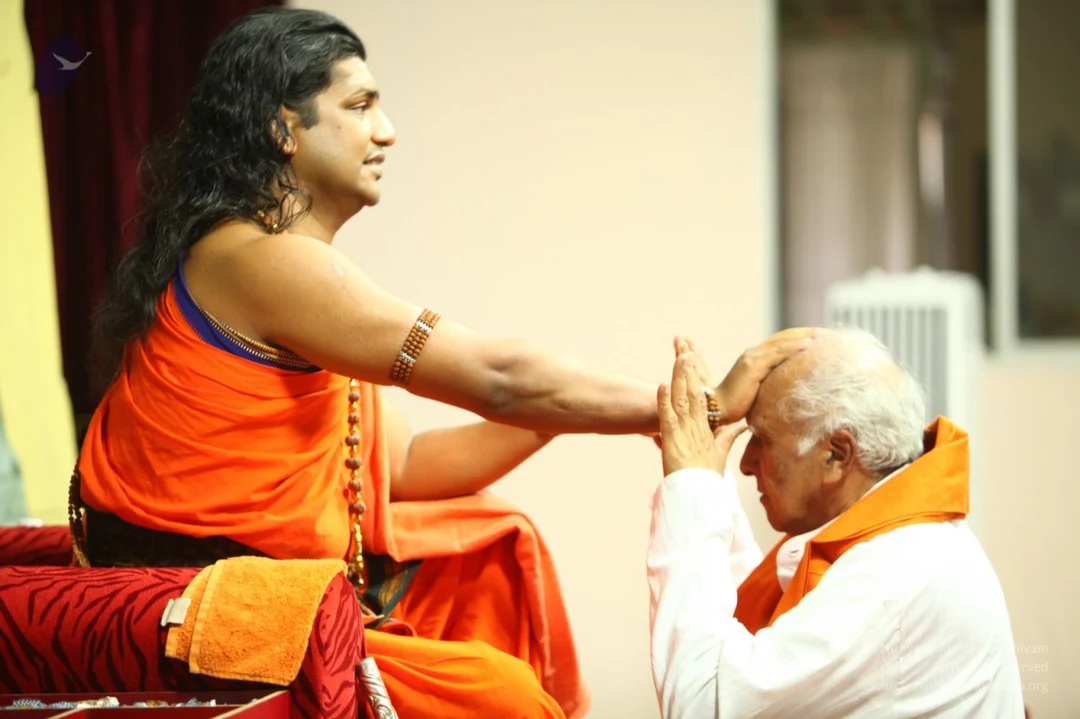
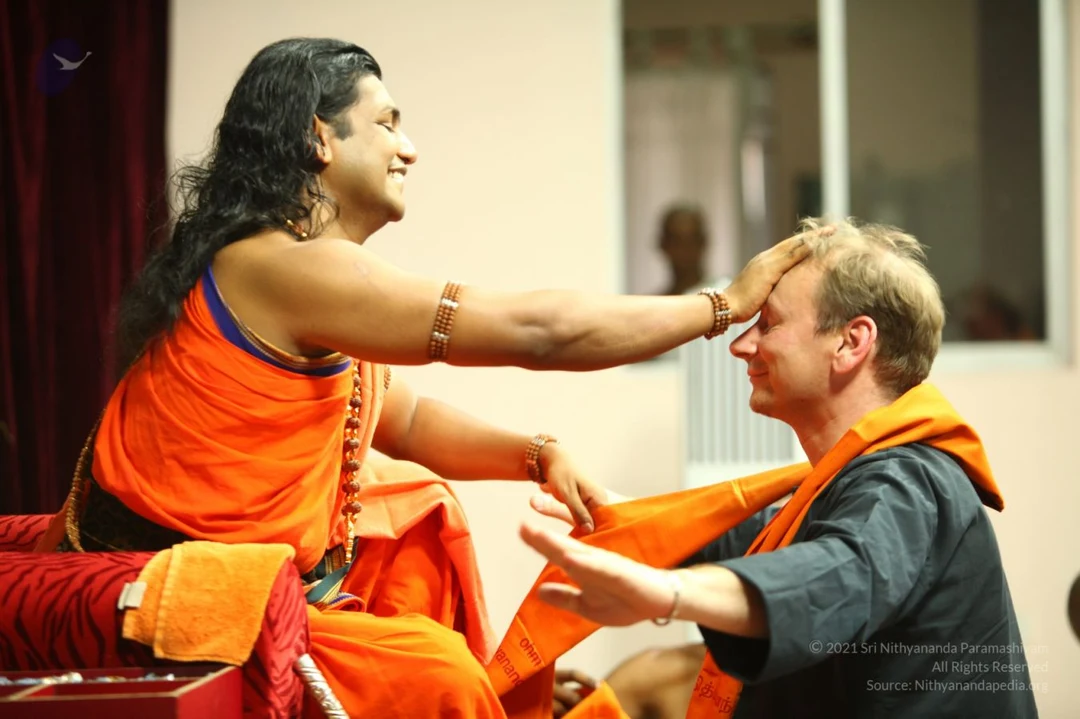
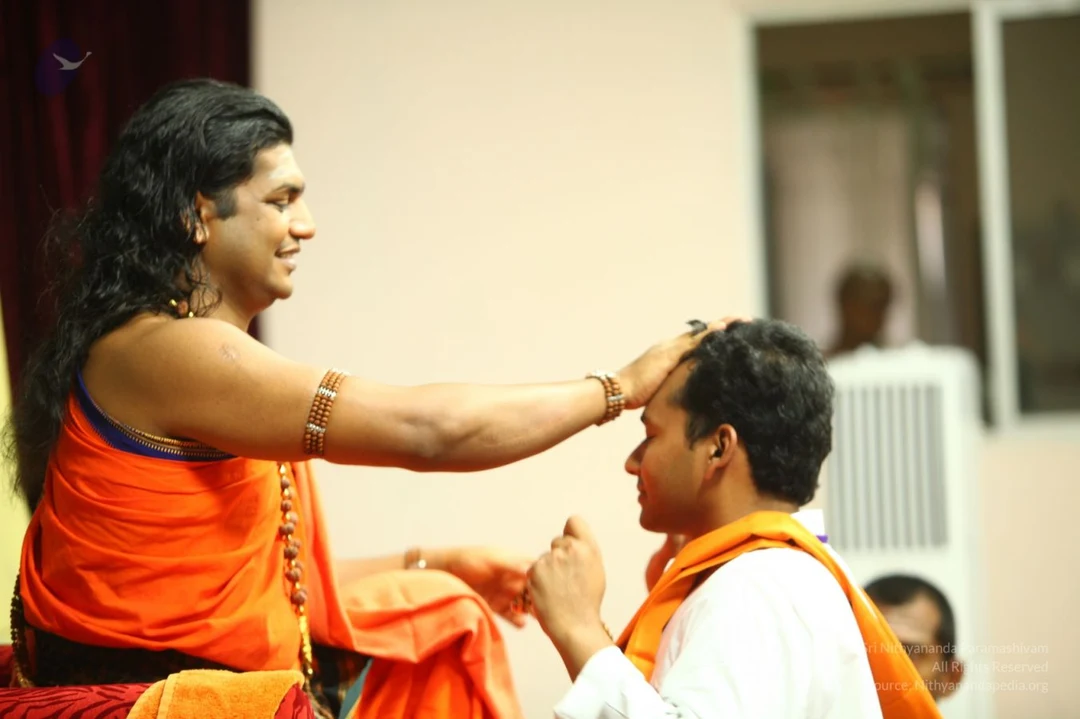
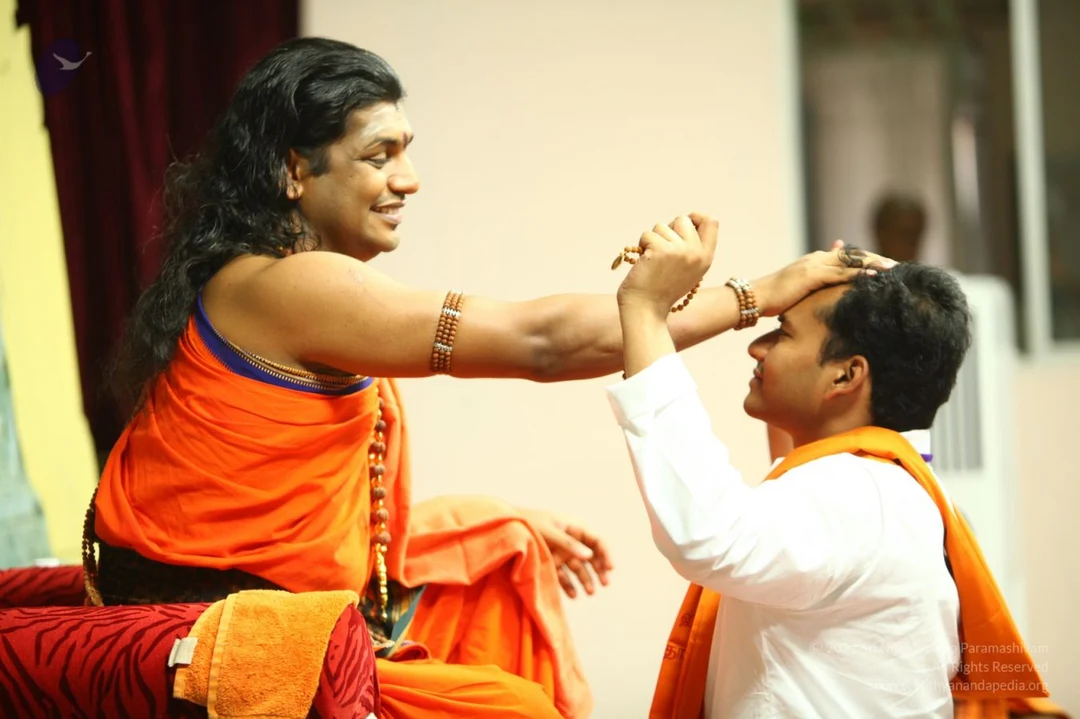
Inner Awakening Darshan to Individual Delegates

Sakshi Pramana:

Sharing from Inner Awakening

Photos from this day

View all 473 photos

Photos From The Day:
10 photosSource gallery
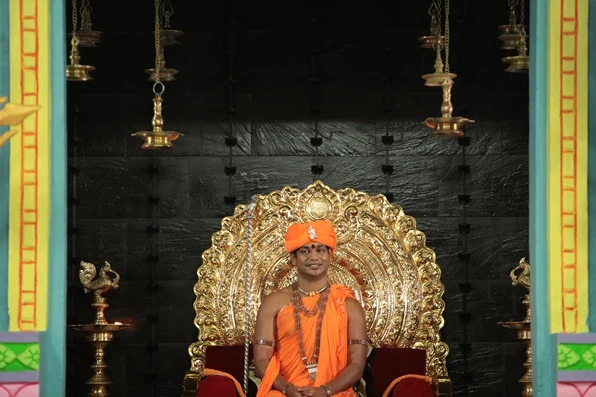
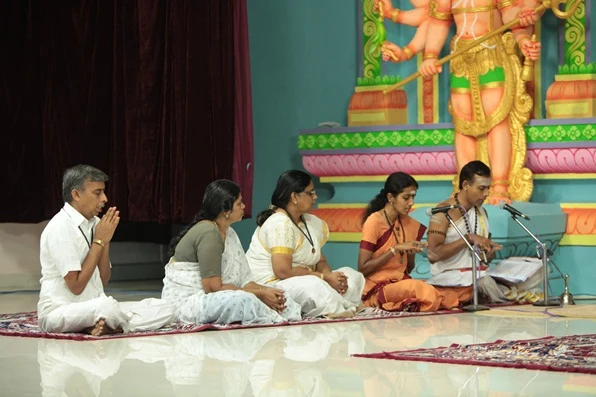
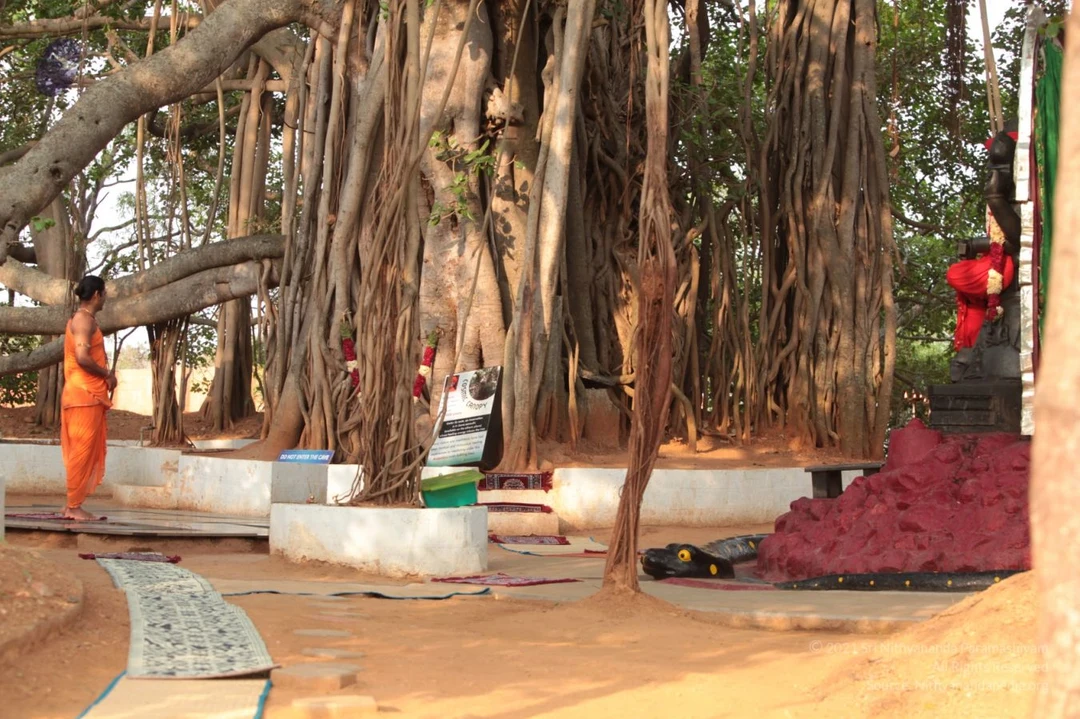
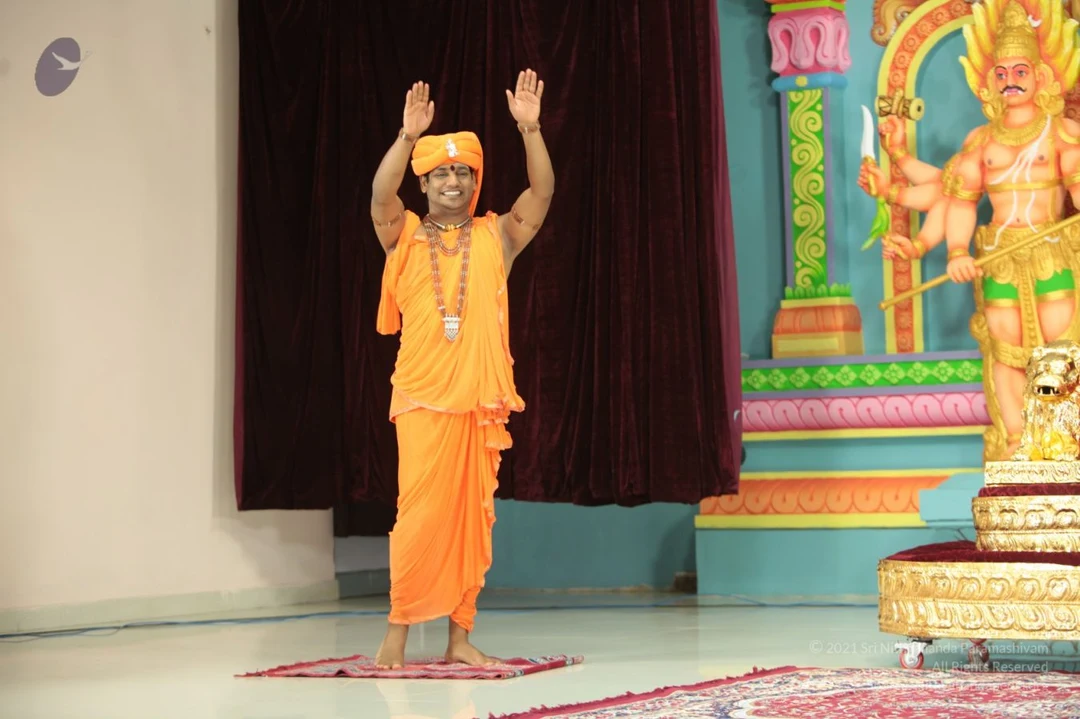
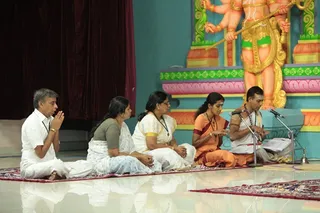
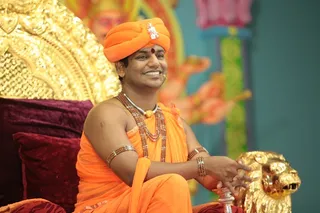
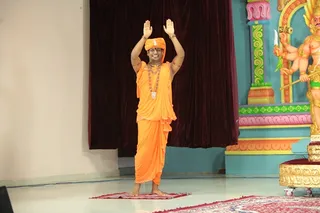
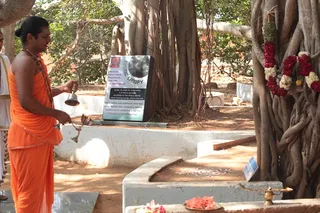
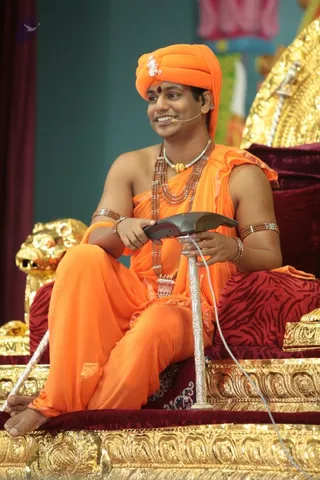
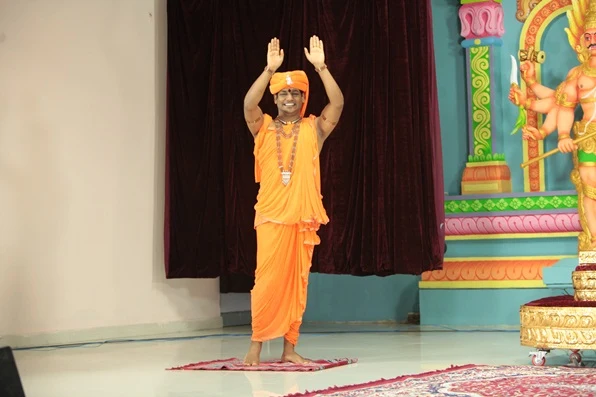
A photograph of an outdoor shrine set among large tree branches. A black stone deity murti with multiple arms sits on a lion-like mount inside a grey carved arched niche, draped in red cloth with a red crown, red garlands and beaded necklaces. A green curtain hangs behind it. A raised mound of red powder or kumkum surrounds the base, with a small black altar holding brass oil lamps in front. No people are visible.A seated figure in orange robes and an orange turban sits on an ornate gold throne with a red cushioned base, set against a dark stone-patterned wall. Hanging brass oil lamps are suspended above and additional brass lamps stand at the sides, with yellow, teal and red painted pillars framing the scene. The figure wears a rudraksha mala with a long ceremonial necklace, bangle-style armbands, and holds a staff or whisk at the side. A pair of brass lamps stands in the foreground on the left. a person appearance is based on the orange turban, orange robes, rudraksha beads and long necklace, seated on a throne; the scene is a satsang-style setting.Five people sit on a red and blue patterned floor rug in front of a stage with a large colourful deity murti of Hanuman holding a gada (mace), painted in orange and gold with green and pink accents. The man on the far left, in white clothes, sits with palms pressed together in anjali mudra. Next to him a woman in a white sari with grey blouse sits with hands folded, then a woman in a white sari with yellow border sits calmly. At the right, a woman in an orange sari wearing a rudraksha mala and a man in a white shirt with a mala sit at a microphone stand with a small brass bell, appearing to speak or chant in a satsang setting.A smiling man in an orange turban and orange robe sits on an ornate golden throne with plush maroon cushions. He wears layered rudraksha malas, bangles on both wrists, and a red bindi on his forehead, with his hands resting together on a golden lion-headed armrest. Behind him a painted backdrop shows a deity figure in red and orange tones. Swamiji (probable): the orange turban, saffron robe, rudraksha malas and ornate ceremonial setting match the page's description of a satsang with Paramahamsa Nithyananda answering devotees' questions.A man in saffron-orange robes and an orange turban stands barefoot on a small patterned rug on a light floor, raising both hands palms-out above his head in a greeting or blessing gesture. He wears a long beaded rudraksha-style mala and a pendant around his neck. Behind him hangs a maroon velvet curtain, and to the right stands a colourful painted figure of a deity holding a sword and a staff, beside a teal and pink ornamental pillar with a gilded base.A photograph of an outdoor shrine beneath a large banyan tree with thick aerial roots. In the foreground, a man with dark hair tied up wears a saffron-orange dhoti and shawl and holds a small bell in his right hand, standing beside a stone platform. Behind him a partly visible white-clad figure stands at the edge of the frame. The banyan trunk is wrapped with red and white flower garlands. A tall black information board with white and red text stands on a concrete base near the tree, and a brass oil lamp and a plate of red and yellow flowers sit on the stone in the lower right. Dry earth and stone slabs surround the scene.

Visit to Temple
28 photosSource gallery
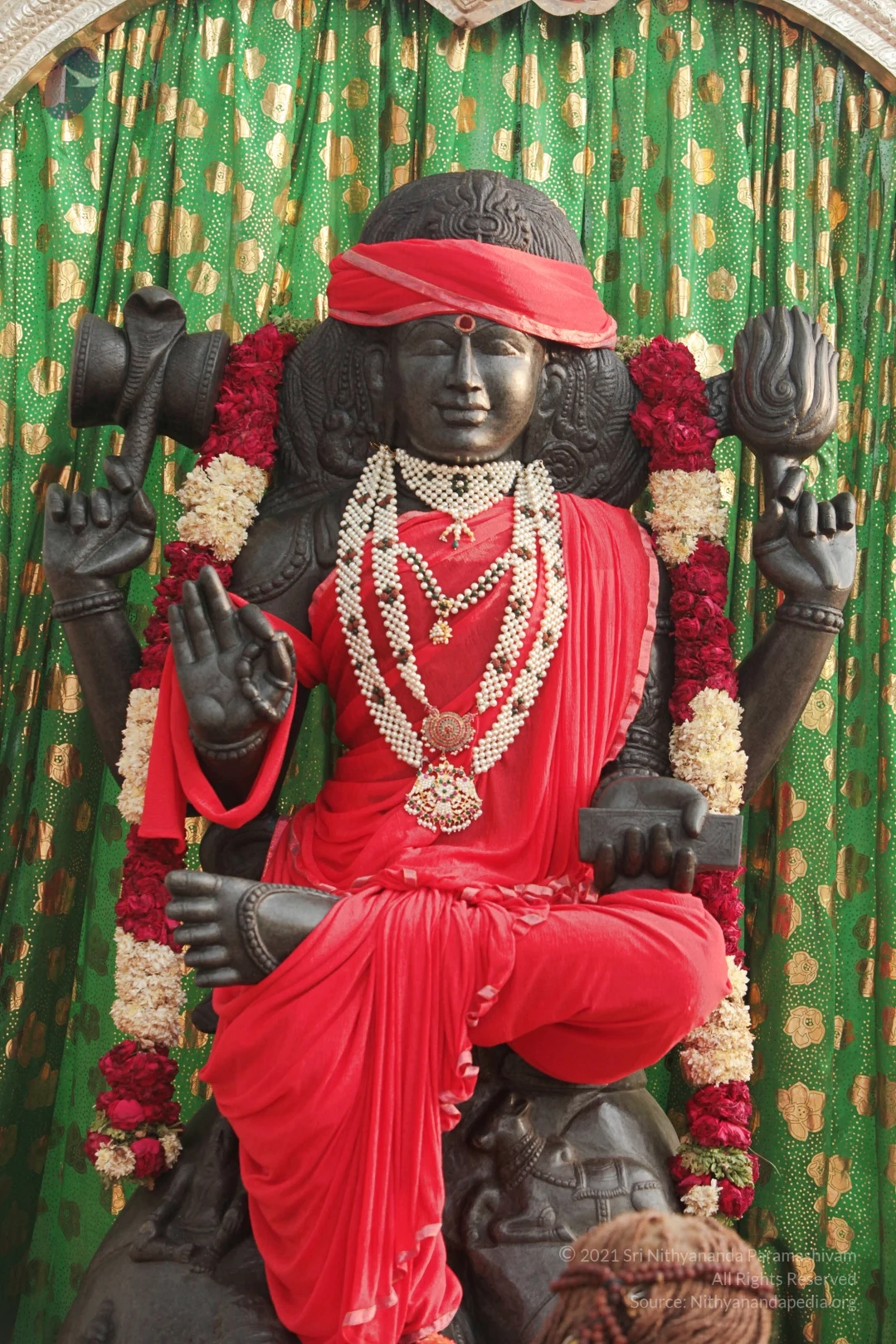
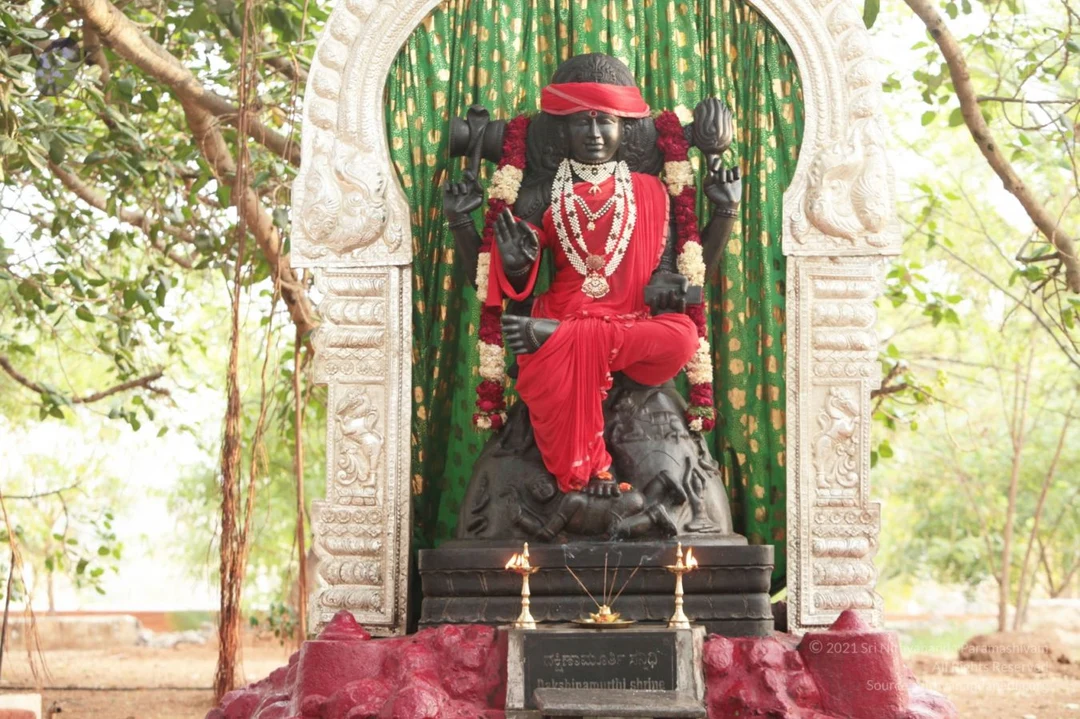
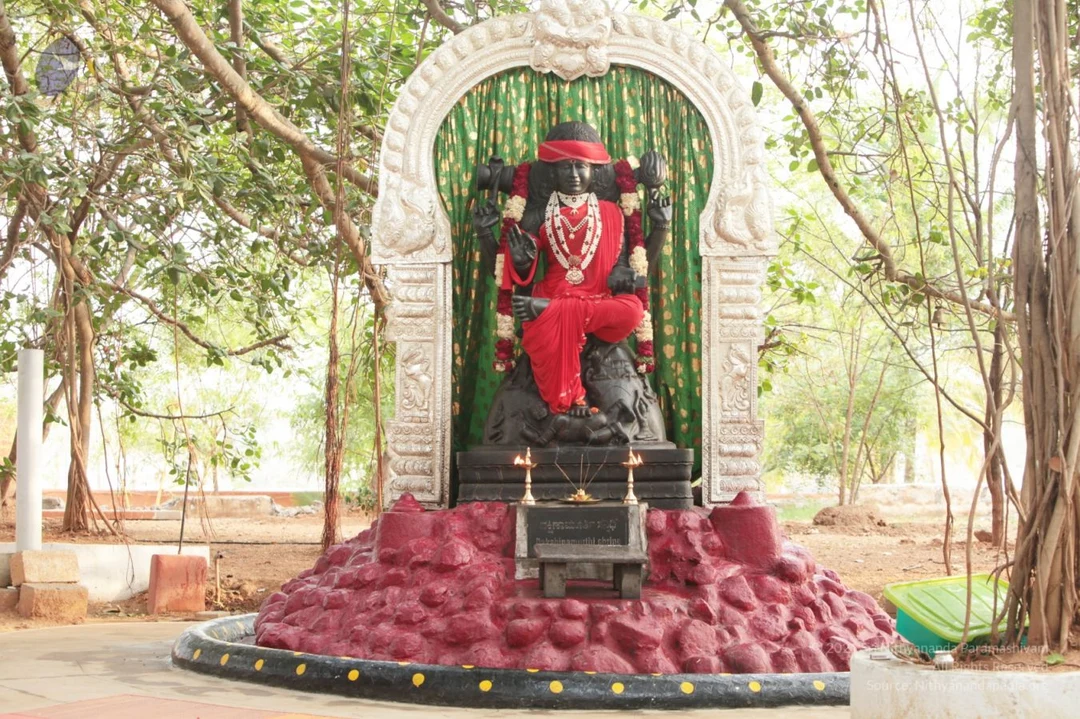
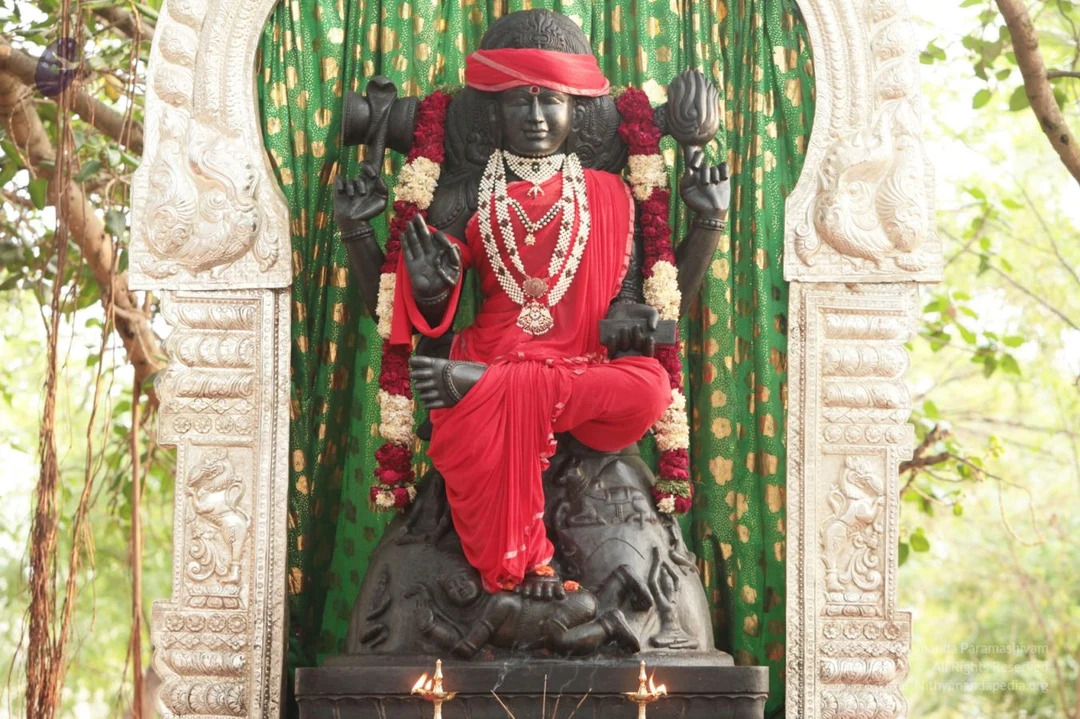
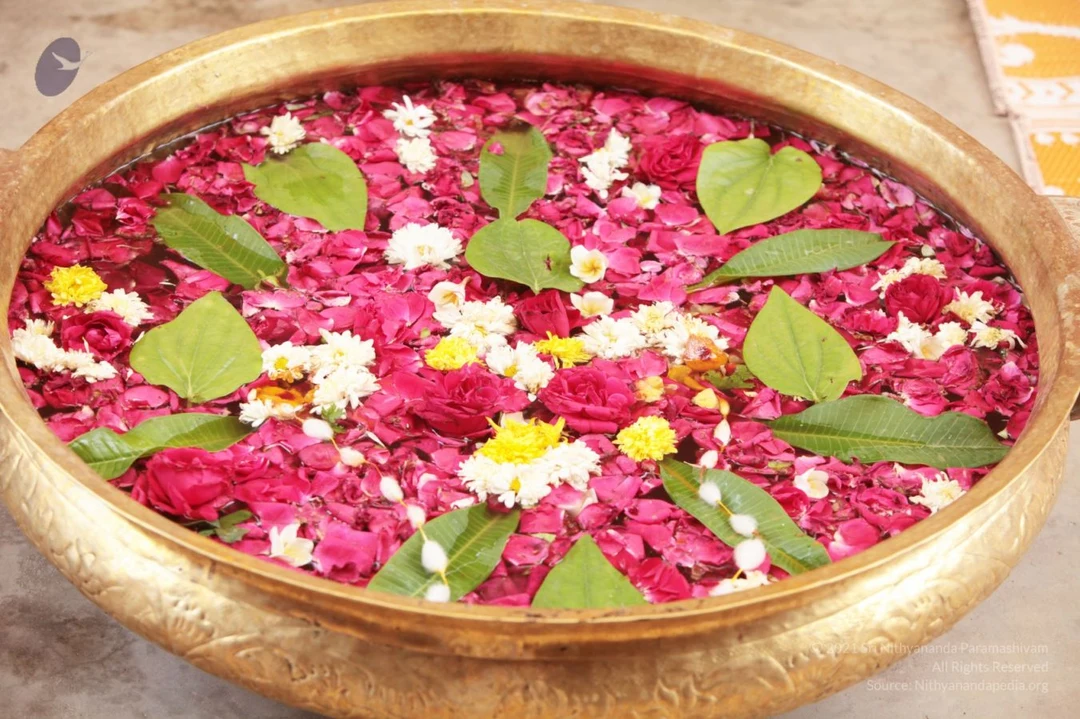
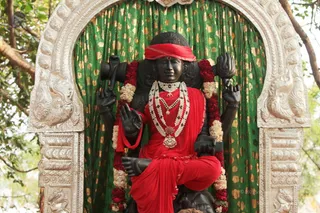
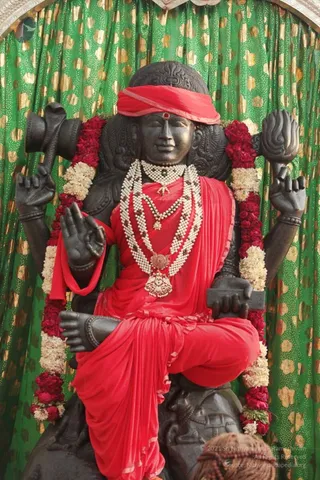
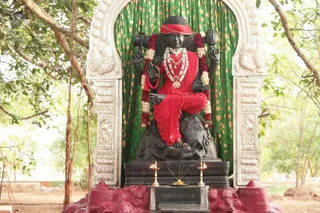
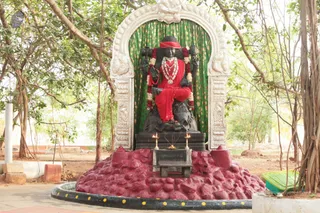
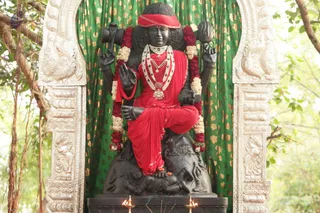
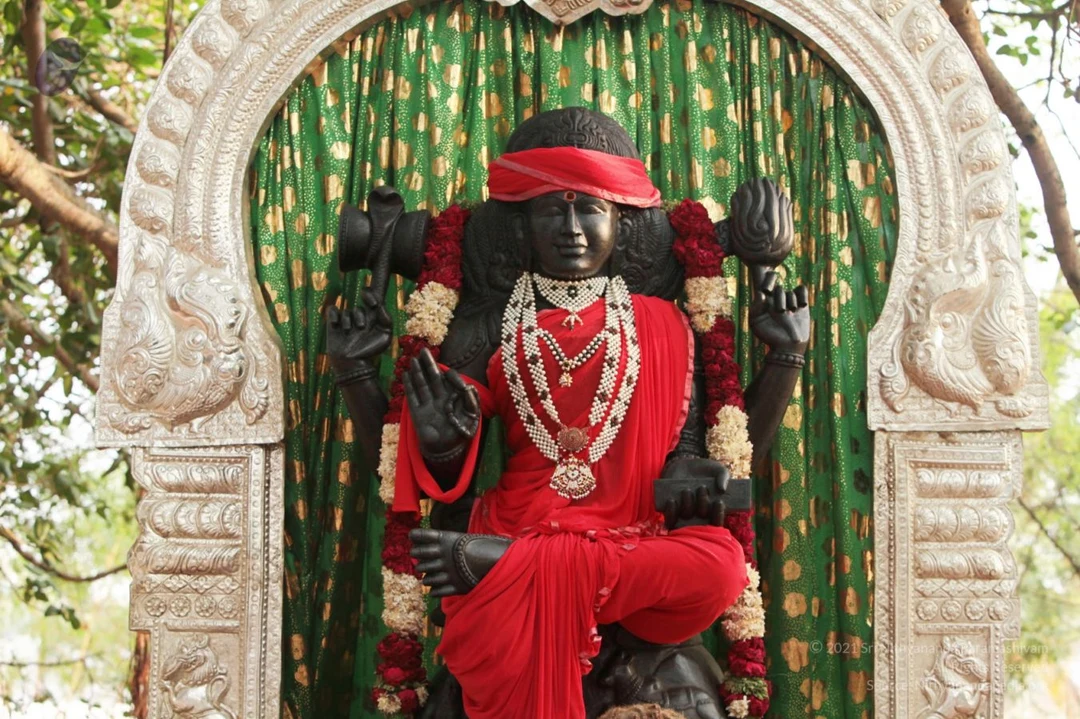
A black stone statue of a four-armed deity seated in a carved white stone arch set against a green and gold cloth backdrop with trees behind. The murti wears a red head-cloth, red dhoti-style drape, and layered white pearl necklaces with a gold pendant, with red and white flower garlands draped over the shoulders. Its hands hold a drum-like object and other attributes.A dark stone or bronze statue of a four-armed deity seated in a lotus-like pose, wearing a red head cloth with a red tilak mark and a red wrap draped over the body. Multiple strands of white pearl-like beads, red and white flower garlands, and a pendant necklace adorn the figure. The statue holds a damaru-like drum and a trident-like implement in its upper hands, with its lower hands in mudra. A green curtain with gold floral print serves as backdrop, and a small bull relief appears below. A devotee's head with rudraksha beads is visible at the bottom edge.A black stone murti of Dakshinamurthi seated in an outdoor shrine beneath trees, dressed in a red cloth with a red head wrap and layered white and red flower garlands. Golden-patterned green curtain backdrop and carved stone arch frame the figure. Two brass oil lamps and incense sticks stand on a dark plinth, with a black stone plaque reading Dakshinamurthi shrine below. No people are visible.A black stone deity murti seated in a white stone arch set against a green cloth backdrop, under trees in an outdoor ashram setting. The figure wears a red dhoti-style cloth, red headband, layered white floral necklaces and a garland of red flowers draped over the shoulders. Two brass oil lamps and an incense holder sit before a dark pedestal on a mound of red-painted rocks with a black and yellow dotted border. No people are visible.A black stone murti of a seated four-armed deity dressed in red cloth with a red head wrap, adorned with white flower and pearl necklaces, red and white garlands, and a pendant. It sits on a dark rock base beneath a green curtain with gold dots, framed by an ornately carved white arch in an outdoor setting with trees. Two oil lamps burn on the platform in front.A large round brass vessel with a wide rim and two side handles holds water covered with pink rose petals, white jasmine-type flowers, yellow marigold-style blossoms and broad green leaves. The vessel sits on a plain grey floor beside a yellow and white patterned cloth. No people are visible; the image shows a floral arrangement in water, a common offering element in temple and puja settings.

Pratyaksha Paada Pooja
56 photosSource gallery
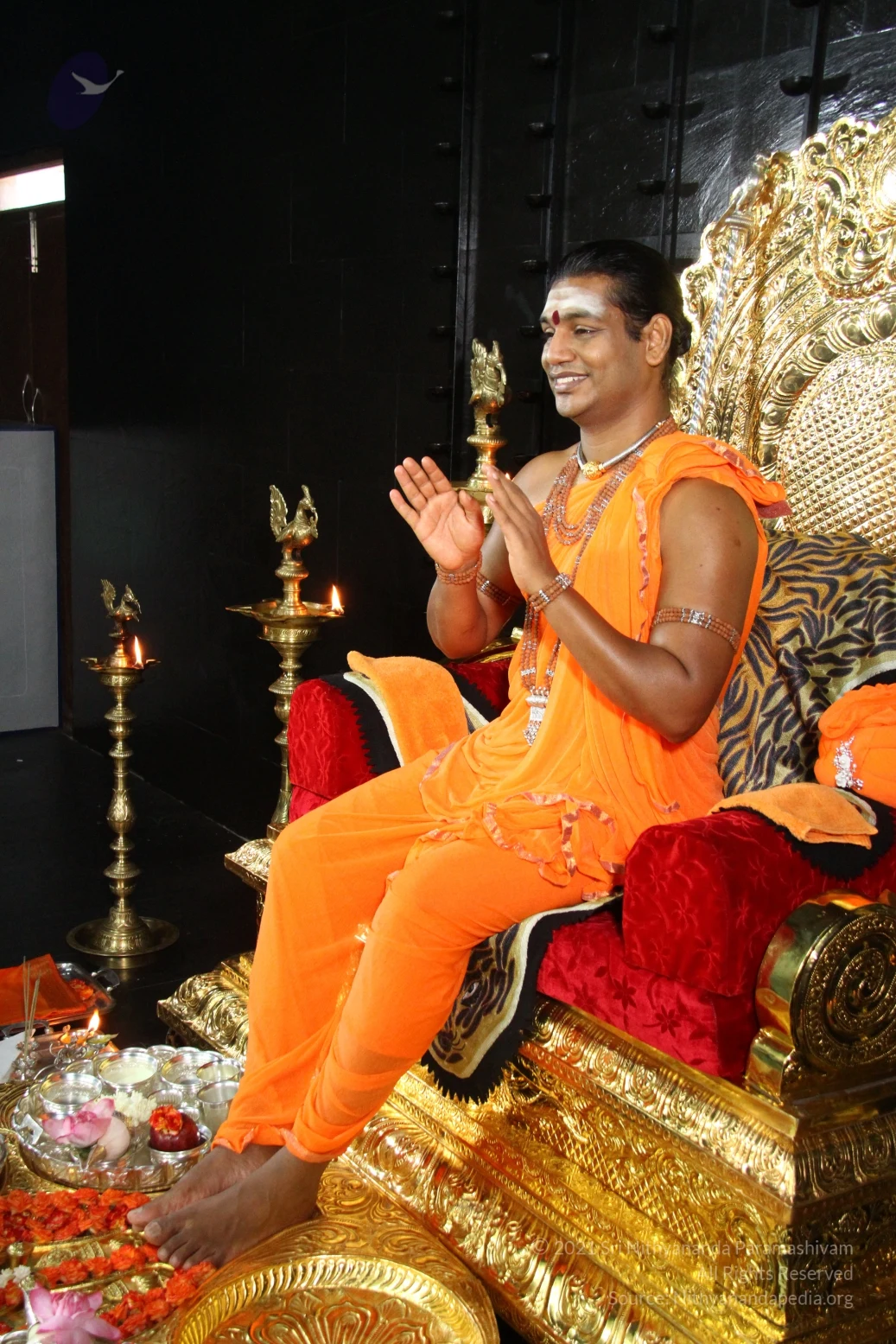
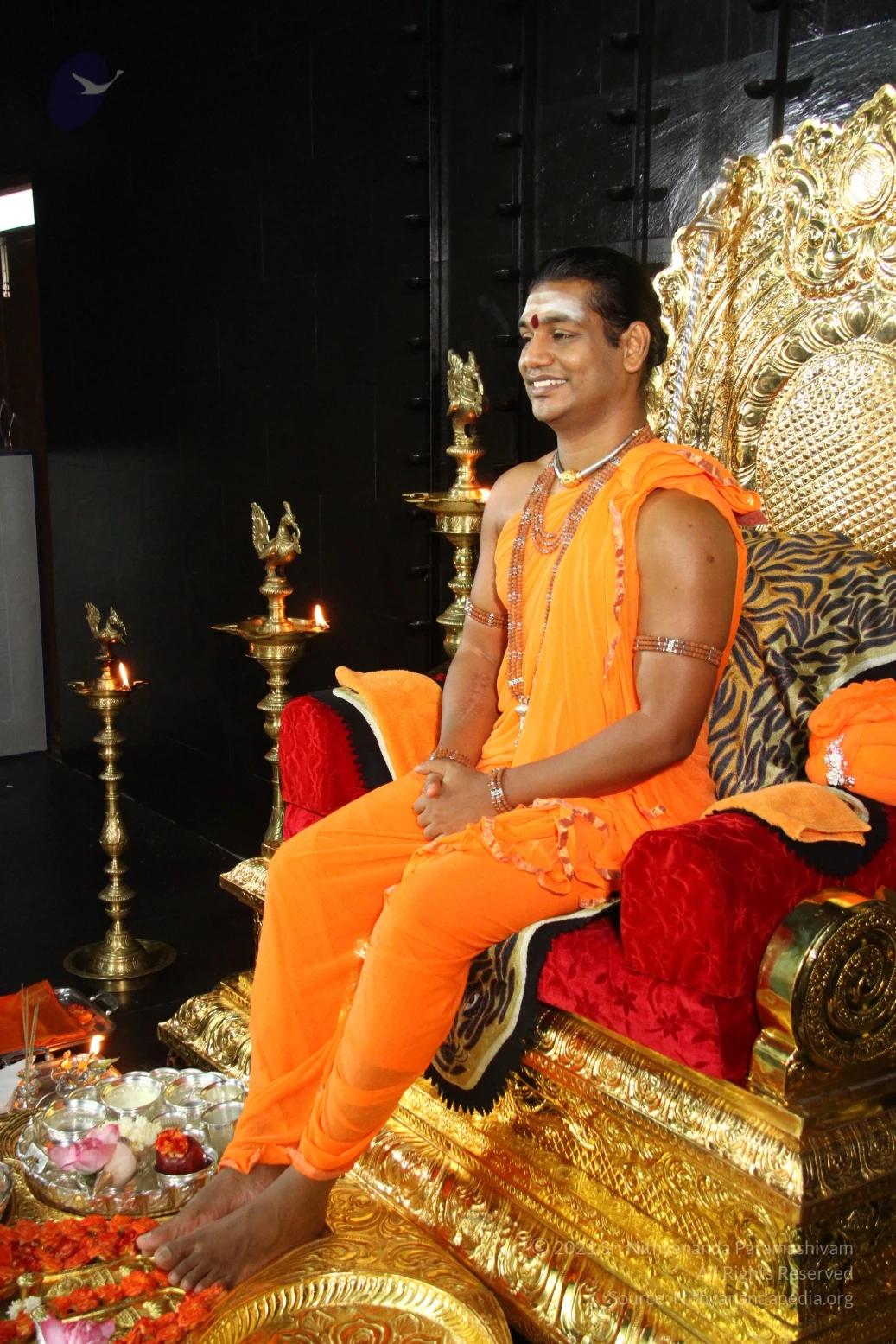
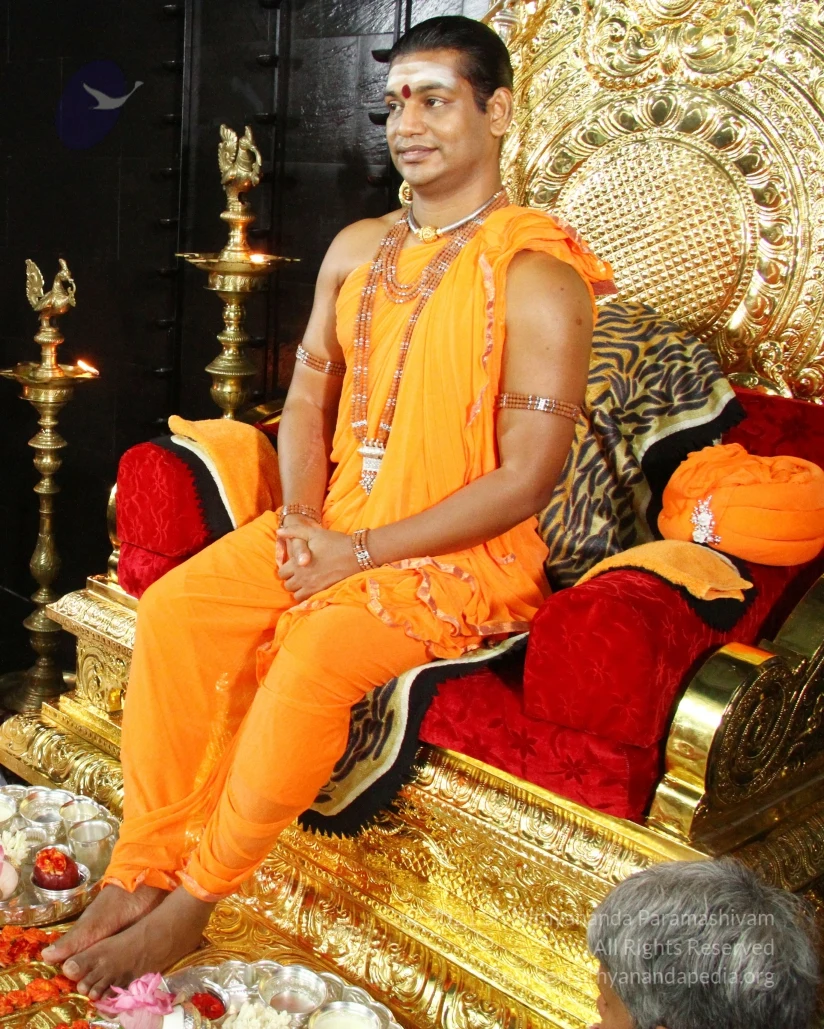
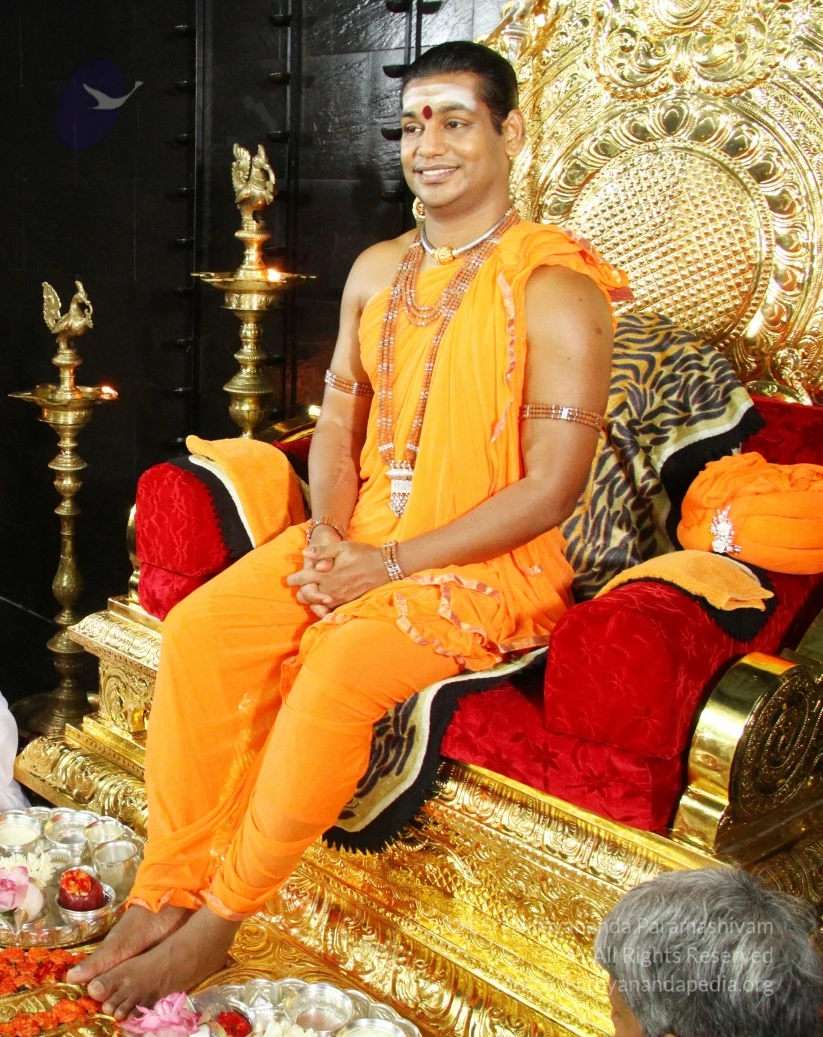
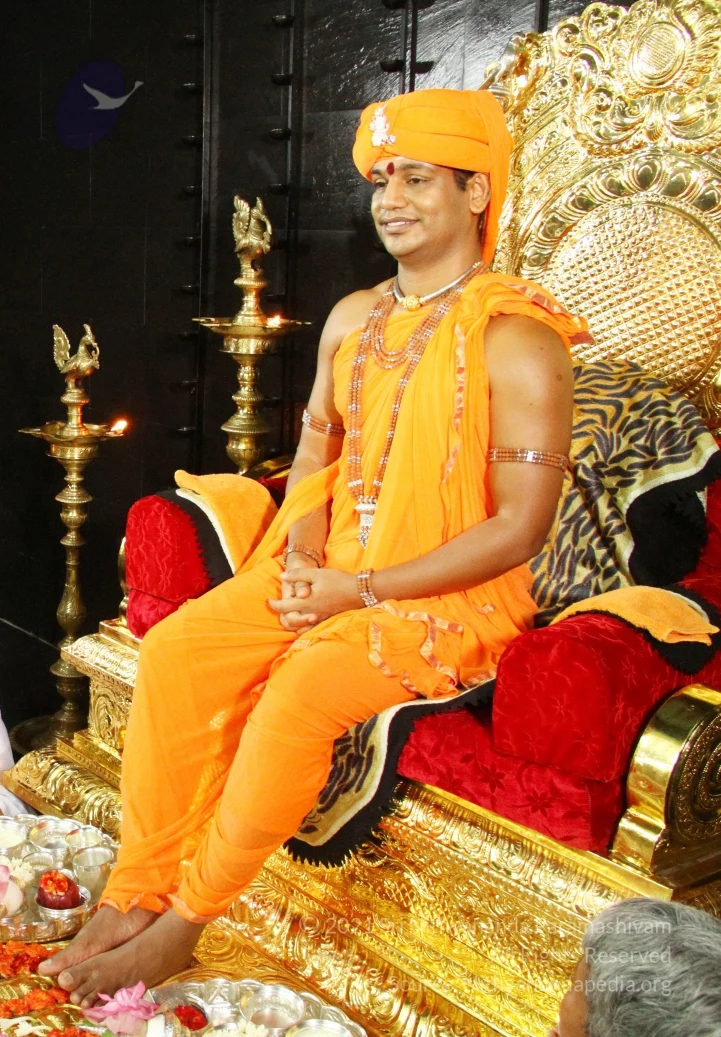
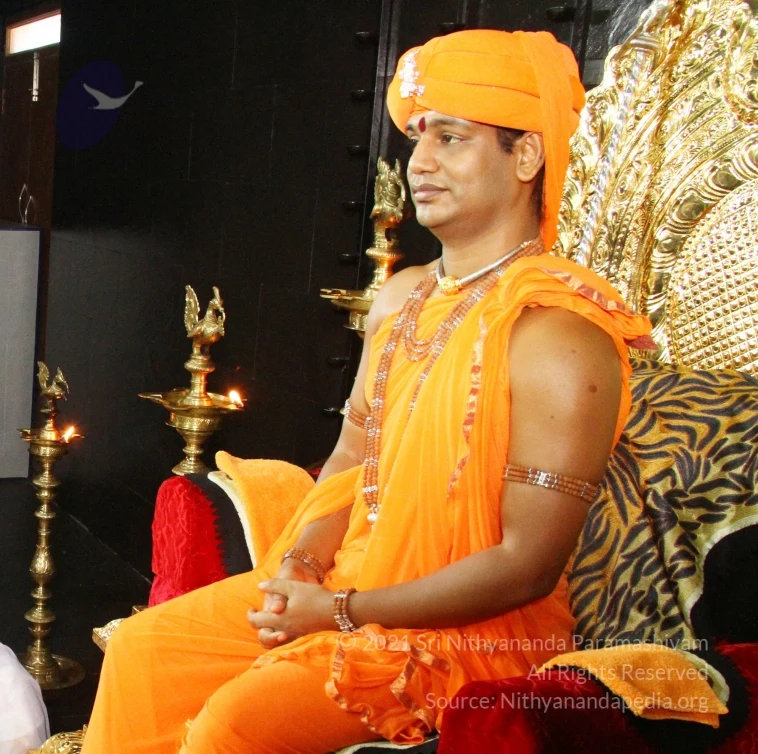
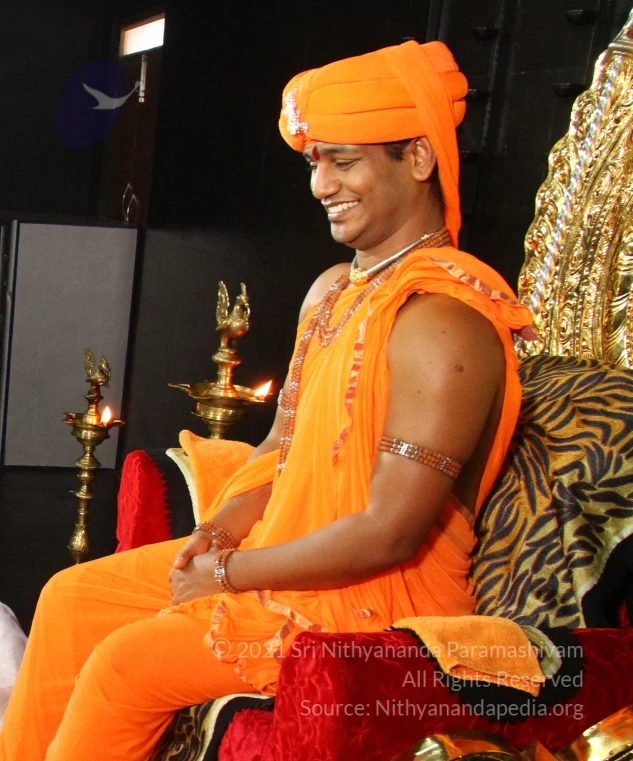
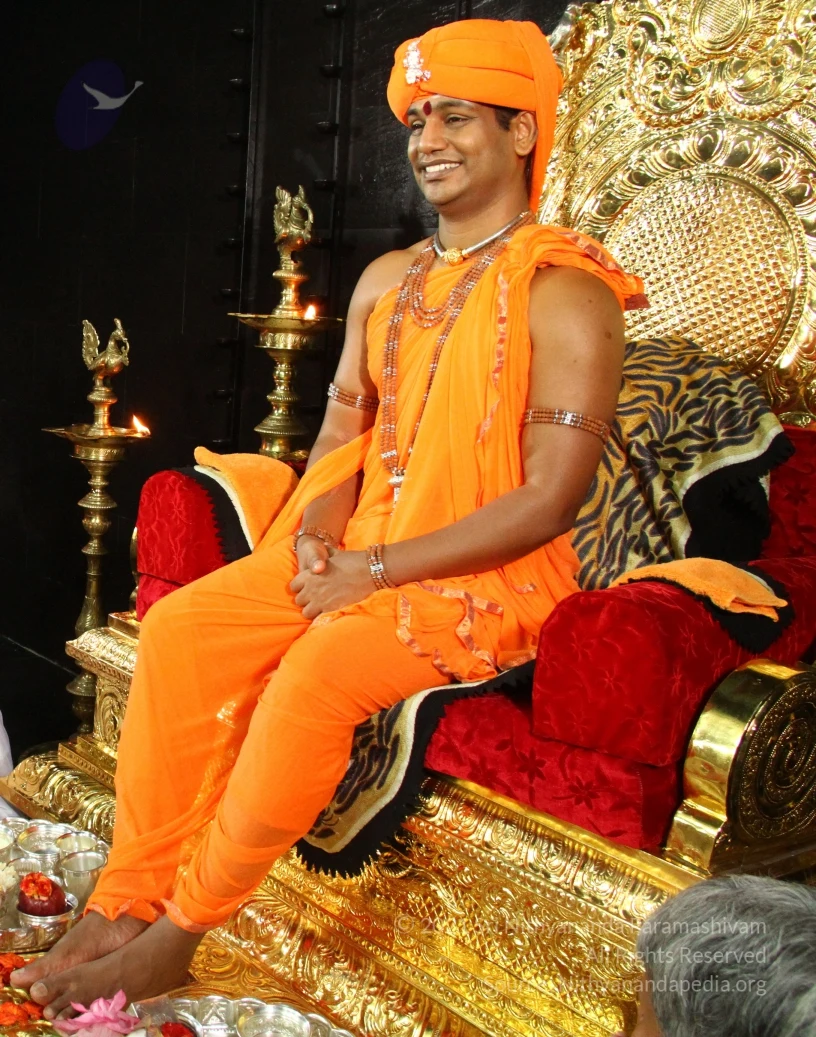
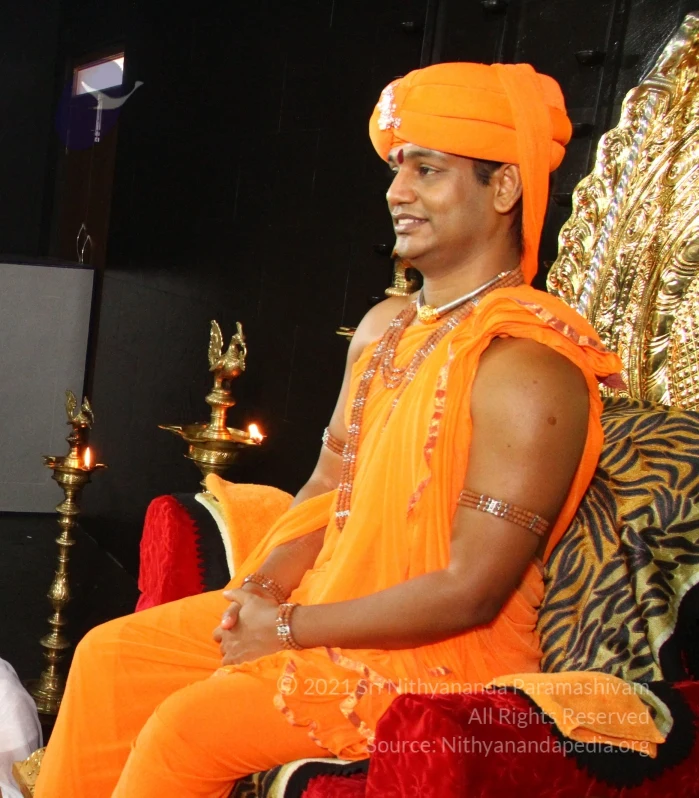
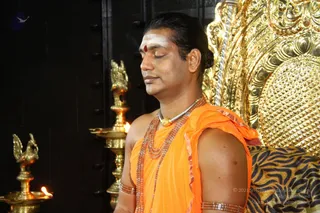
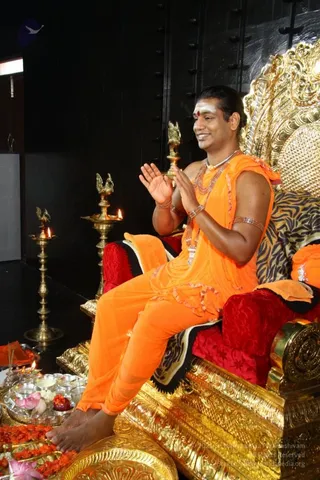
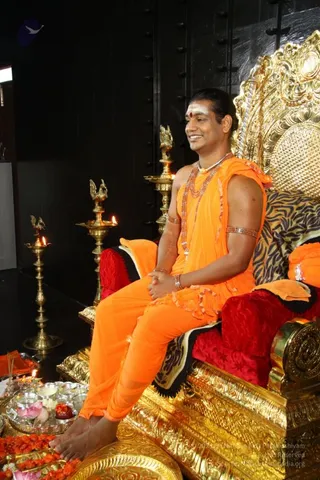
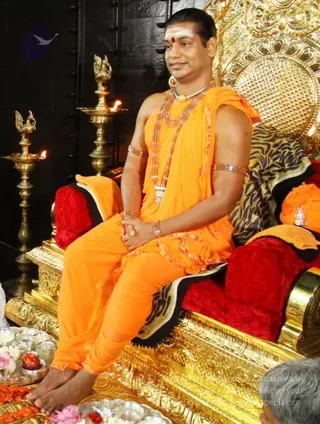
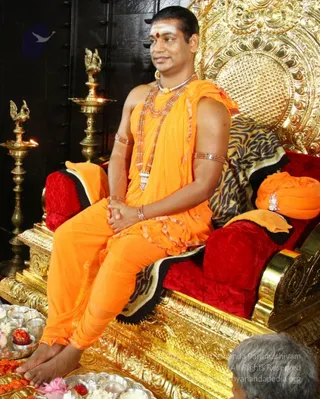
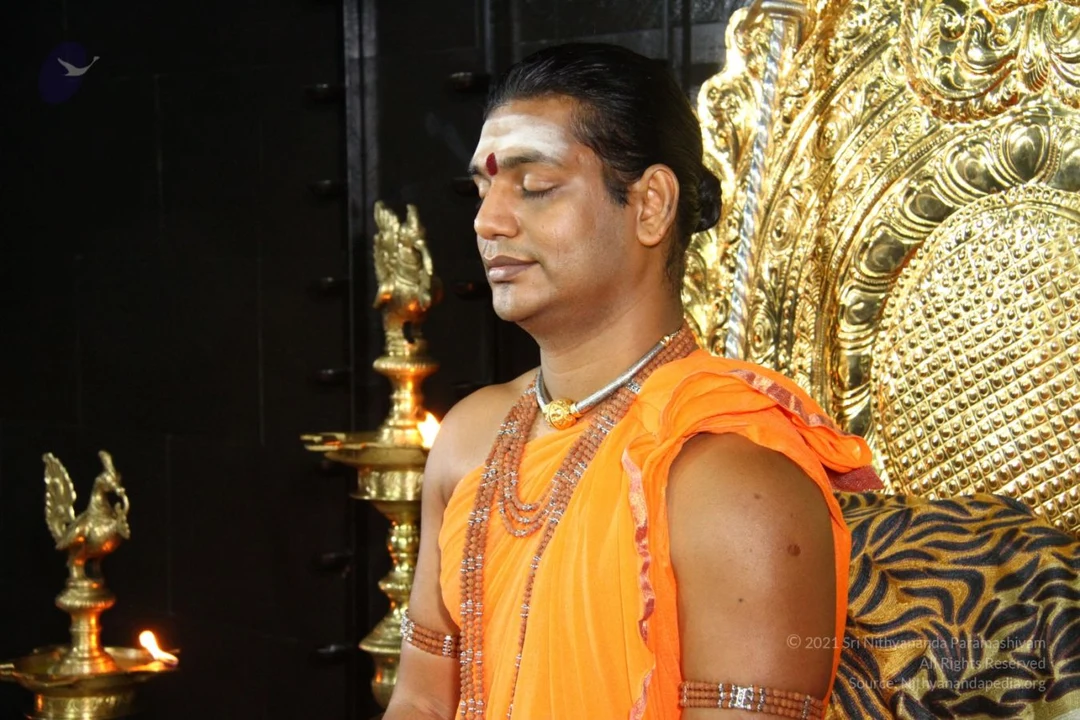
A man with closed eyes sits in meditation before an ornate gold throne-back with carved floral and scrollwork patterns. He wears an orange-saffron shawl over his shoulders, multiple rudraksha malas, a silver necklace with a gold pendant, and silver armlets. A white vertical tilak and red bindi mark his forehead, and his hair is swept back. Two brass oil lamps with flames stand to the left, one with a peacock-shaped stand, and a zebra-patterned cushion lies on the throne. Appearance-based candidate: Swamiji (probable), seated in meditation with the qualifying saffron clothing, rudraksha malas and swept-back hair.A man seated on an ornate gold-and-red throne with a zebra-striped cushion, wearing a saffron-orange robe, orange dhoti-style garments, and layered rudraksha-style beaded necklaces with a gold ornament; he has a red bindi and white tilak, hair swept back, and bangled arms, with palms pressed together in greeting. Two brass oil lamps with lit wicks stand beside the throne, and in front of his bare feet are a brass plate of flowers, fruit, and offerings, along with orange marigold garlands. The dark backdrop has a black panelled wall. a person seated on his peetha, with appearance cues of saffron clothing, rudraksha malas and an ornate throne. Persons visible: one.A man with swept-back dark hair and a red bindi with white tilak sits on an ornate gold throne with red velvet cushions and a tiger-print cloth. He wears a saffron-orange dhoti and shawl with pink trim, multiple beaded rudraksha-style malas, and orange-and-silver armbands, smiling to his left. His bare feet rest on a gold footstool before a tray of flowers and offerings, with brass oil lamps lit in the black-walled background. Strings of orange marigold garlands lie at the foot of the throne. Identity is uncertain from appearance alone, so no name is assigned.A seated man in saffron-orange robes sits on an ornate gold throne with red velvet cushions and a tiger-striped throw. He wears a rudraksha mala, a ceremonial gold necklace, bangles on his arms and a red bindi with white tilak on his forehead. Two brass oil lamps with flames stand beside the throne, and trays of flowers, offering bowls and marigold garlands sit in the foreground. A partially visible head of another person appears at the lower right. Appearance cues are consistent with a person, seated in the honoured position of the satsang.A photograph of a man seated on an ornate gold throne with red velvet cushions and a leopard-print cloth. He wears an orange saffron robe with pink trim, orange dhoti, multiple rudraksha malas, a gold ceremonial necklace and gold armlets, with a white and vertical tilak and red bindi. He sits with hands clasped and feet bare. Before the throne are brass oil lamps with lit flames, silver trays with offerings, marigolds and pink flowers. A partially visible grey-haired person's head appears at the lower right. Appearance-based label: a person, seated in a position of honour.A photograph of a man seated on an ornate gold throne with red velvet cushions and a tiger-striped cloth draped over the backrest. He wears saffron-orange robes with a matching orange shawl draped over one shoulder, multiple rudraksha malas, a gold necklace, bangles on the upper arms and wrists, and a red bindi with white tilak on his forehead. His hands are clasped in his lap and he smiles. Brass oil lamps with lit wicks stand behind him, and in the lower foreground a plate holds offerings including red fruit, flowers and small bowls, with a devotee's grey head at the bottom edge. The image is labelled Nithyananda Paramashivam and , and the candidate is a probable Swamiji in an orange robe with rudraksha malas and gold necklace, seated on a throne
Nithya Satsang
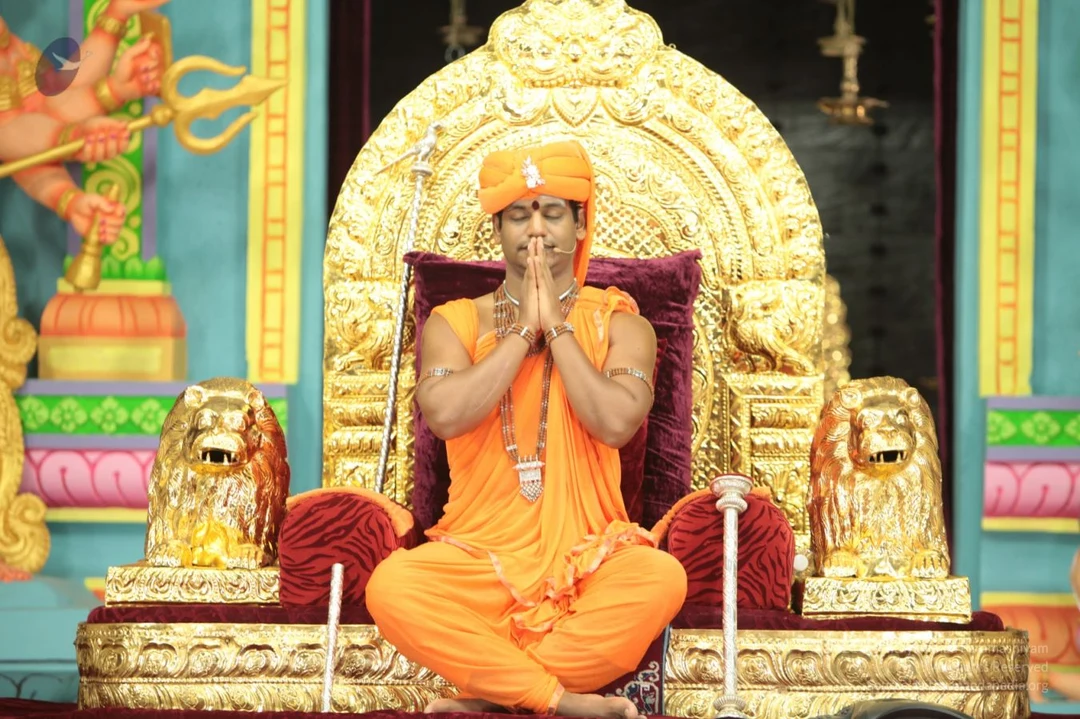
81 photosSource gallery
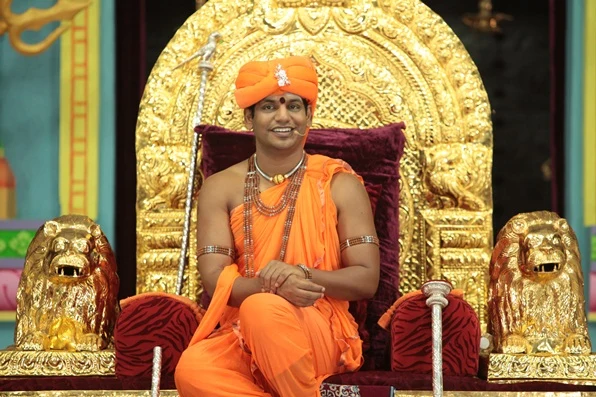
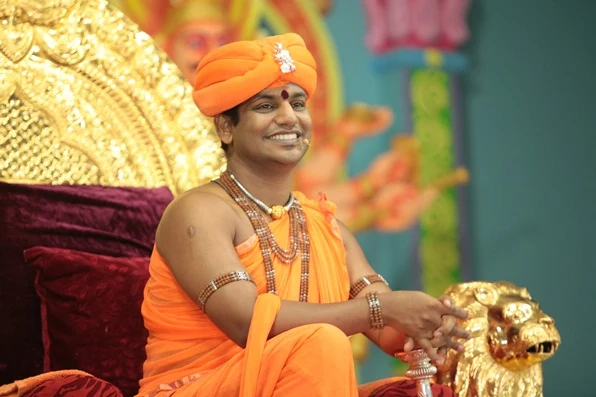
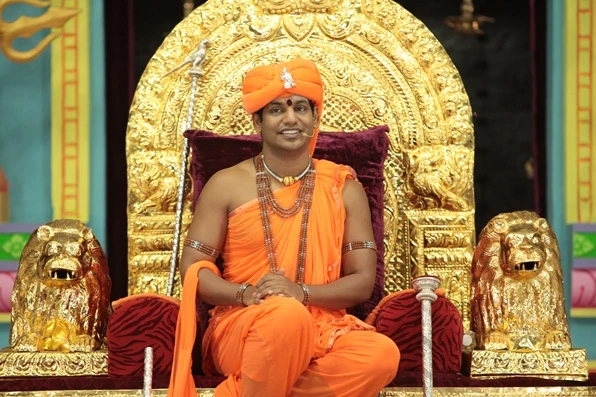
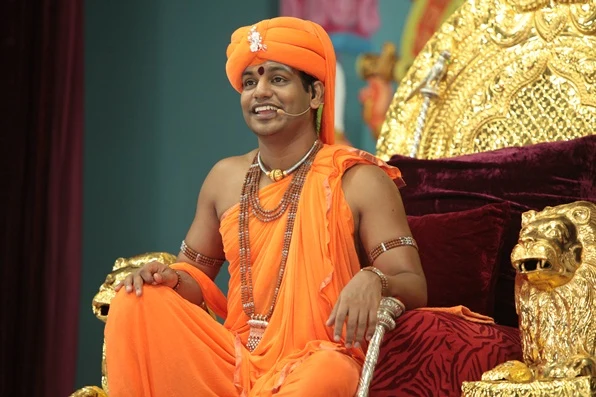
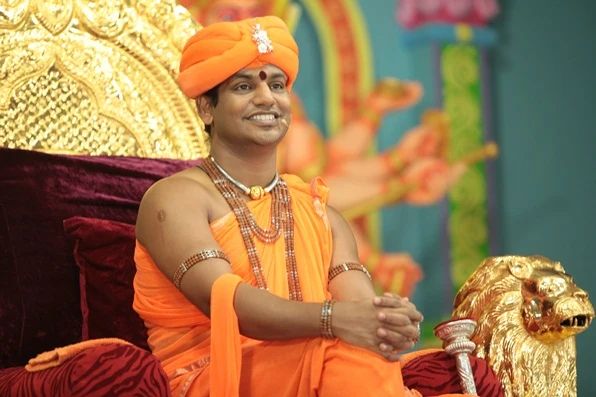
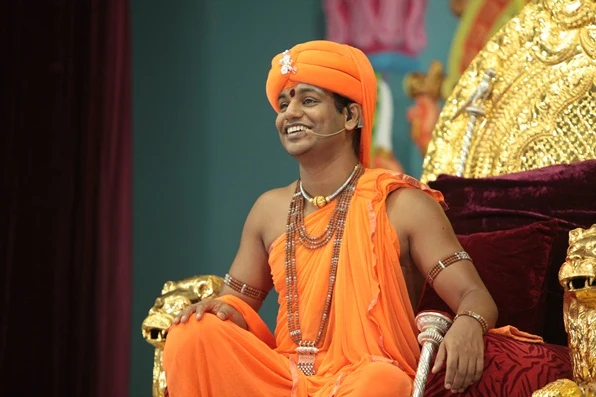
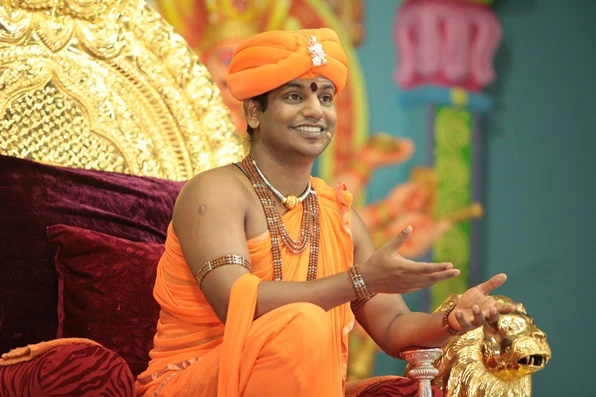
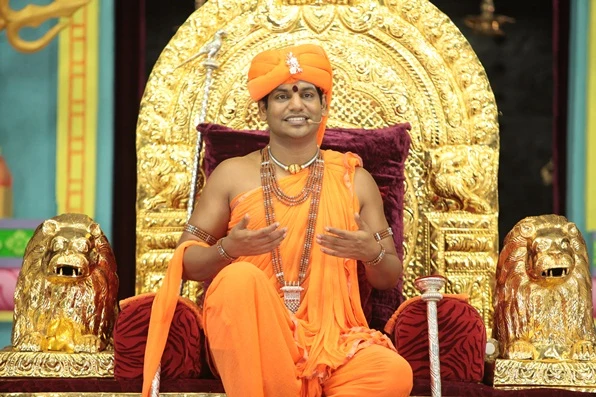
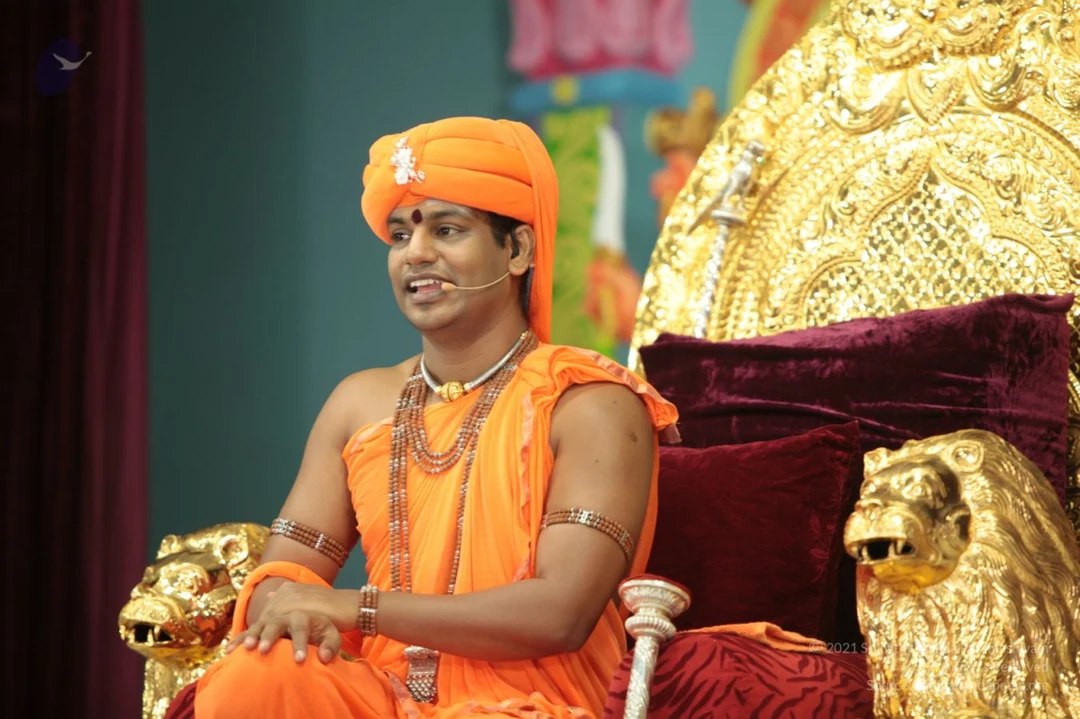
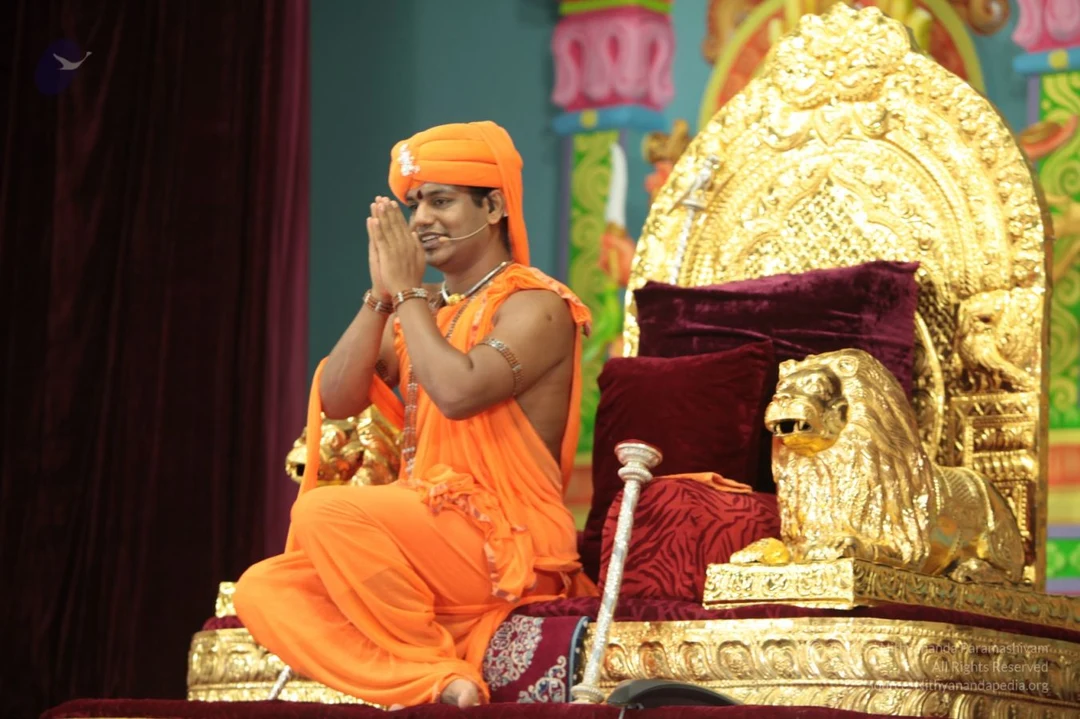
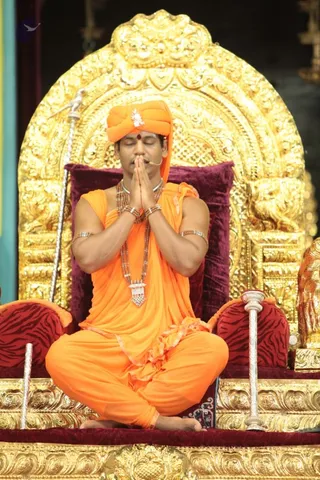
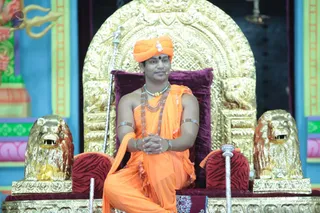
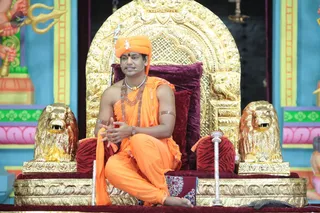
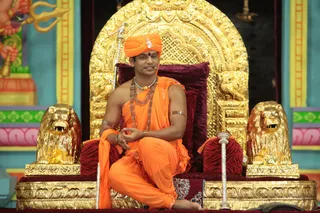
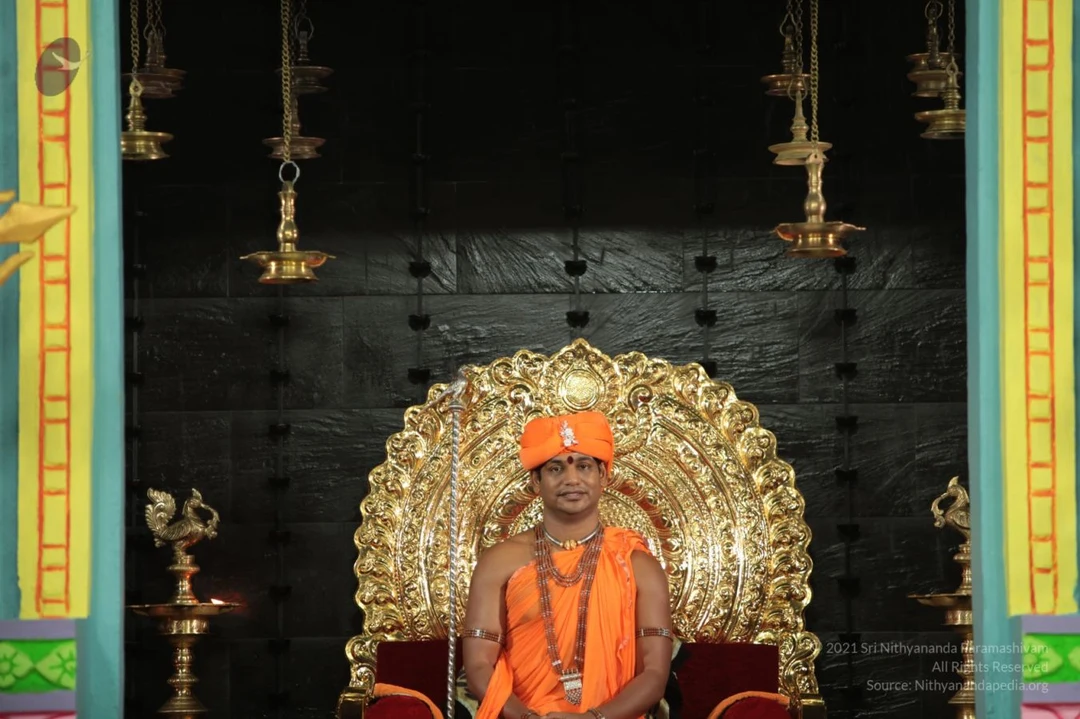
A seated man in saffron-orange robes sits cross-legged on an ornate gilded throne with lion-head armrests and a deep maroon cushion, palms pressed together at his chest with eyes closed. He wears a saffron turban with a small white ornament, a rudraksha-style mala and a ceremonial necklace, and bangles on his wrists. A microphone is clipped near his face. Behind him stand large painted deity figures holding a trident and other attributes against turquoise and pink panels.A seated man in saffron-orange robes and an orange turban sits cross-legged on an ornate gold throne with a deep red cushion, flanked by two golden lion figures. He holds his palms pressed together in a namaste greeting with eyes closed, wearing layered rudraksha-style malas and a silver ceremonial necklace with a pendant, and a small red tilak on his forehead. A microphone is near his mouth. Behind him, painted panels in turquoise, green and pink show a trident and a deity figure, and a small devotee figure with folded hands appears at the lower right. The scene appears to be a satsang stage. Appearance-based cues including orange turban, saffron clothing and malas suggest the Swamiji (probable) presenter seated as the speaker.A seated man in an orange turban with a small white ornament and a red bindi sits cross-legged on an ornate gold throne with a maroon velvet cushion, eyes closed, palms pressed together in anjali mudra. He wears an orange sleeveless top and orange dhoti-style garment, multiple rudraksha malas, silver armlets and bangles, and a small headset microphone. A gilded arch with carved lion figures and a gold lion statue stand behind and beside him. Appearance-based candidate: Swamiji (probable), identified by the orange turban, rudraksha malas, ornate gold regalia and ceremonial throne, seated for satsang.A seated man in saffron-orange robes and an orange turban with a small white emblem sits on an ornate gold throne with a crimson velvet cushion, flanked by two gold lion sculptures and a silver staff. He wears layered beaded necklaces, a rudraksha-style mala, arm bands and bangles, with hands folded in his lap and a red bindi on his forehead. Behind him stand a gilded arched backdrop and blue and green painted panels with a trident motif at upper left. Appearance-based candidate: a person, seated on a throne in saffron robes with a mala and ornamental jewellery; the page indicates a satsang Q&A.A photograph of a seated man in saffron-orange robes and a matching orange turban with a small red tilak on the forehead, speaking into a headset microphone during a satsang. He sits cross-legged on an ornate gold throne with a deep burgundy velvet cushion and gold lion-head armrests, hands clasped in his lap. Behind him are colourful painted panels with gold trident-shaped ornaments. He wears several strands of rudraksha beads and a white pendant necklace, and bangles on his wrists. a person is the central figure, seated as the speaker, with one candidate present in person.A man seated on an ornate gilded throne with carved lion-head armrests and a deep red velvet cushion, centred in a photograph of a satsang stage. He wears a saffron-orange turban with a small white emblem, saffron-orange robes draped over one shoulder, multiple rudraksha malas and a gold-toned pendant necklace, bangled arms and a red bindi. He sits with hands clasped and a ceremonial staff rests beside the throne. Behind him are painted panels in turquoise, pink and green with a golden trident.
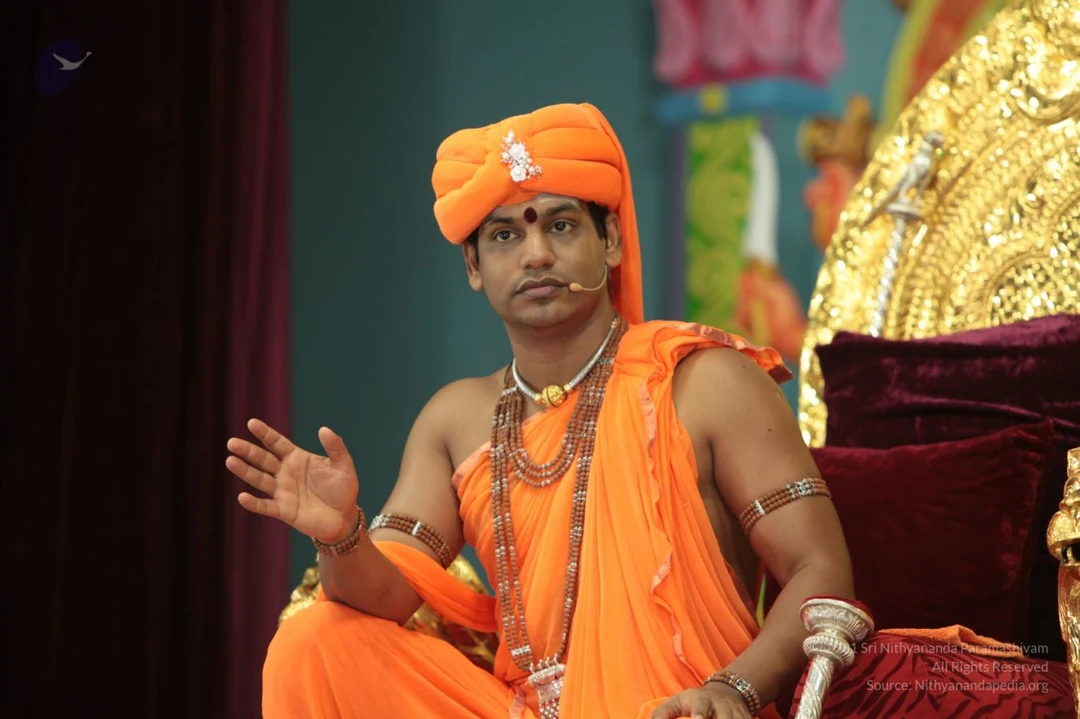
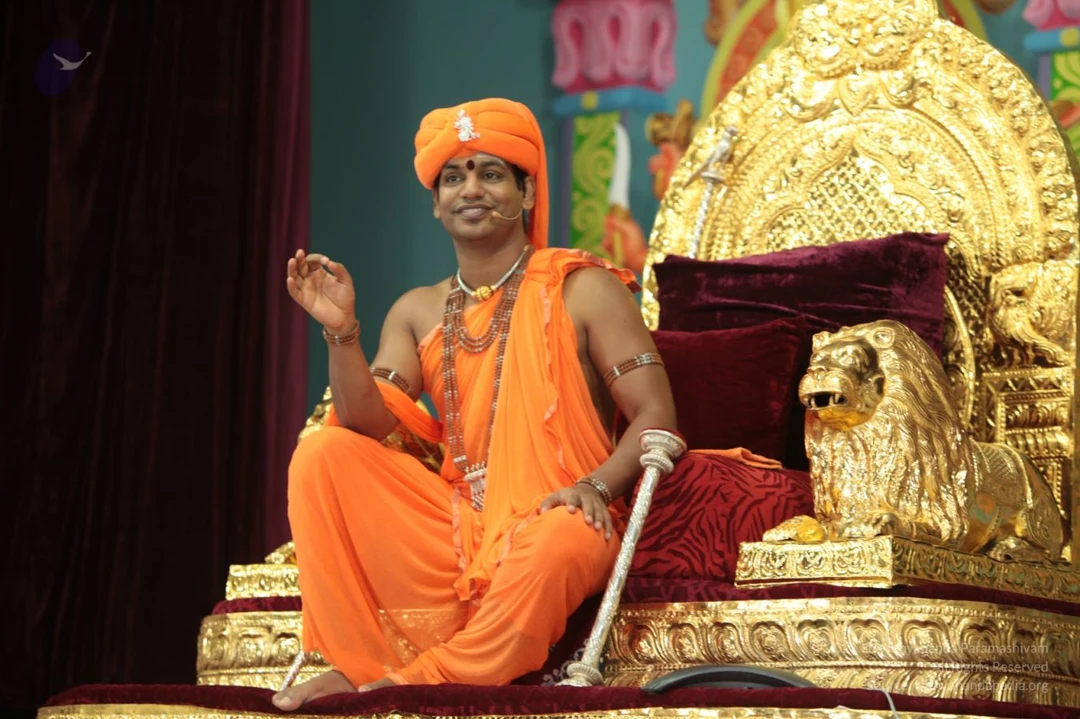
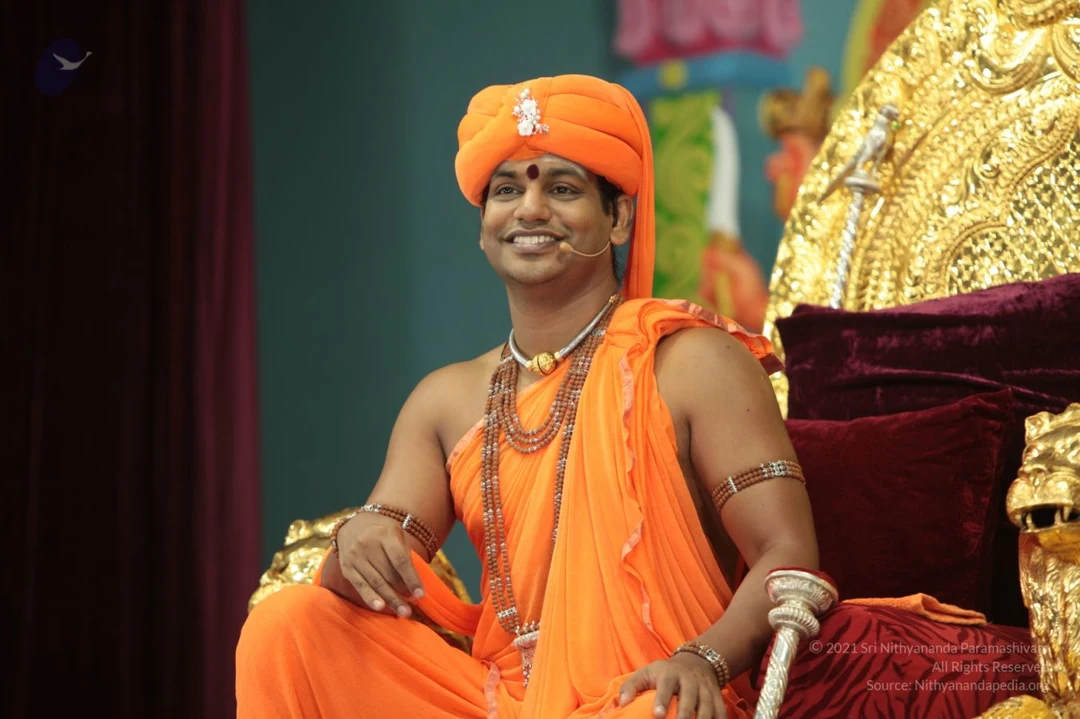
Dial the Avatar

14 photosSource gallery
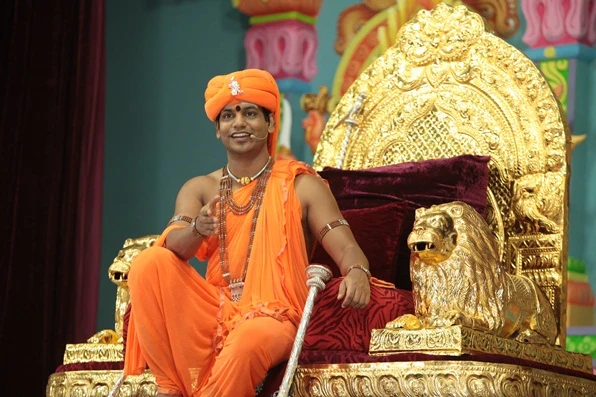
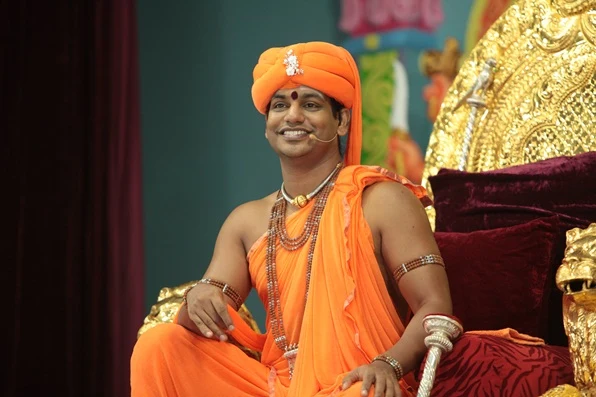
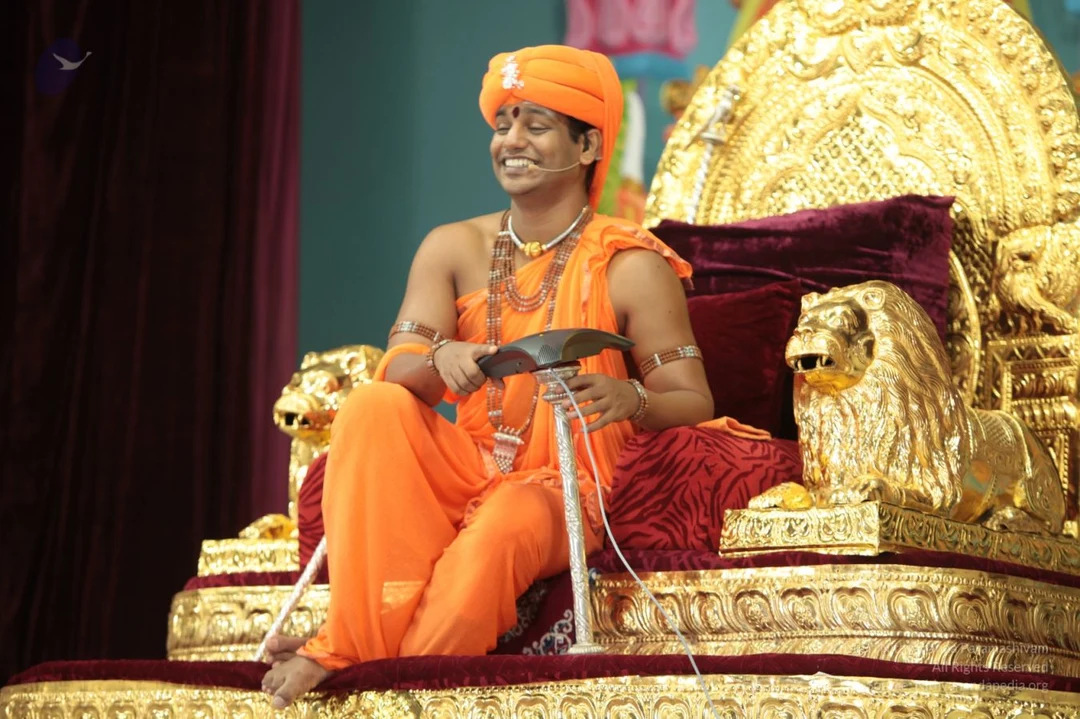
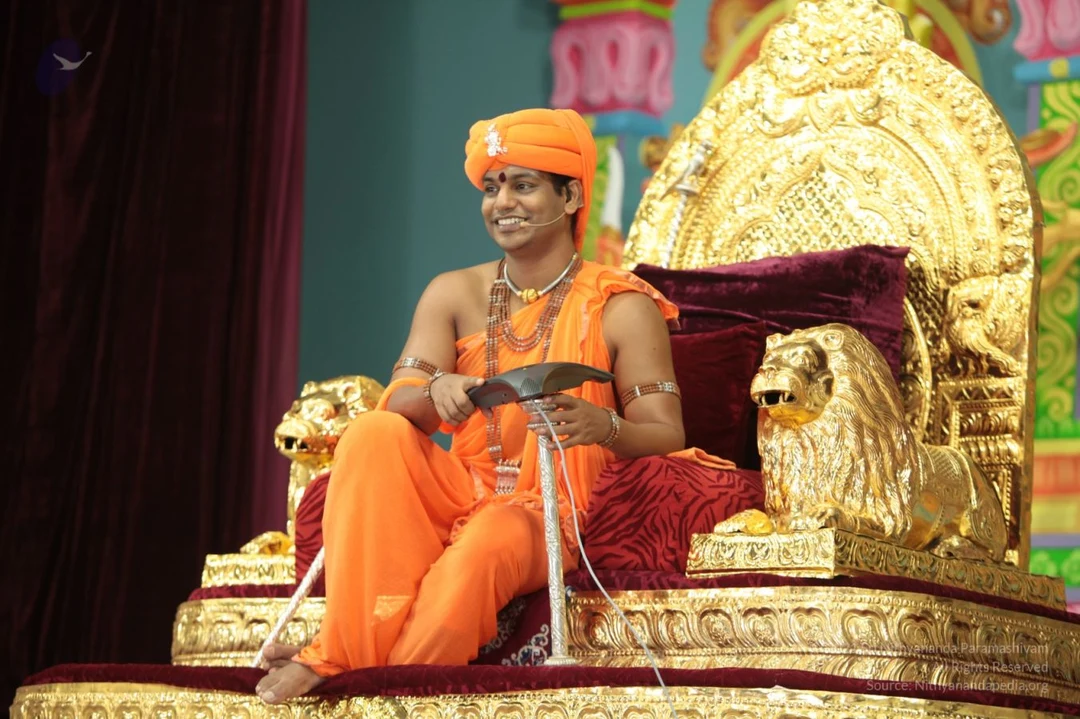
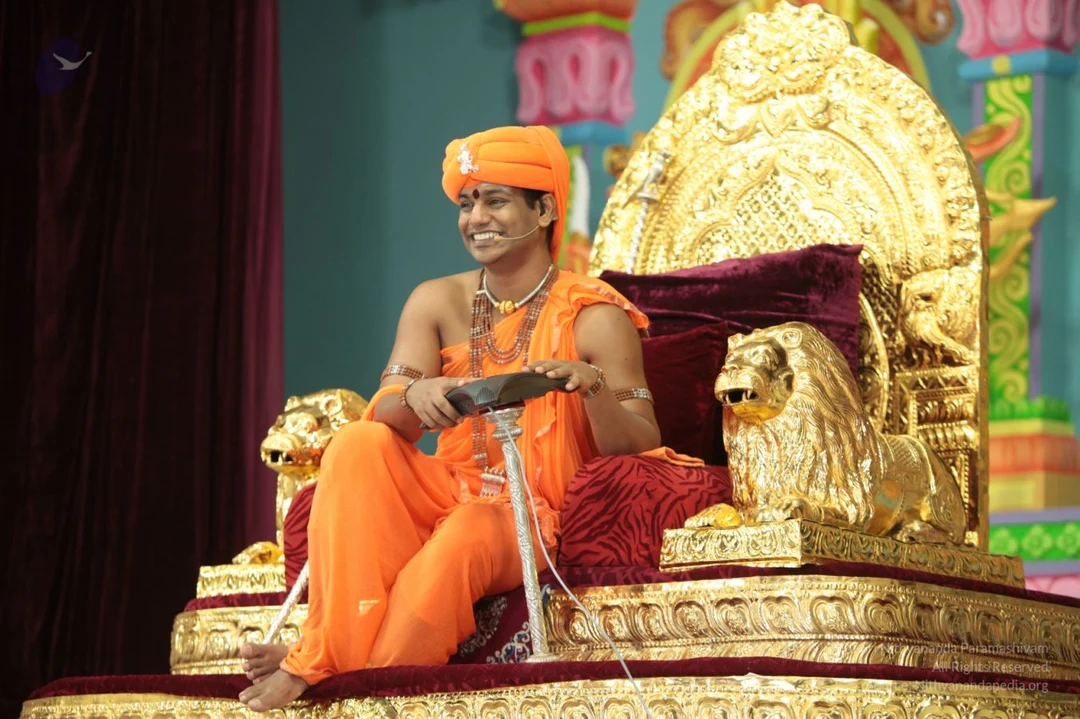
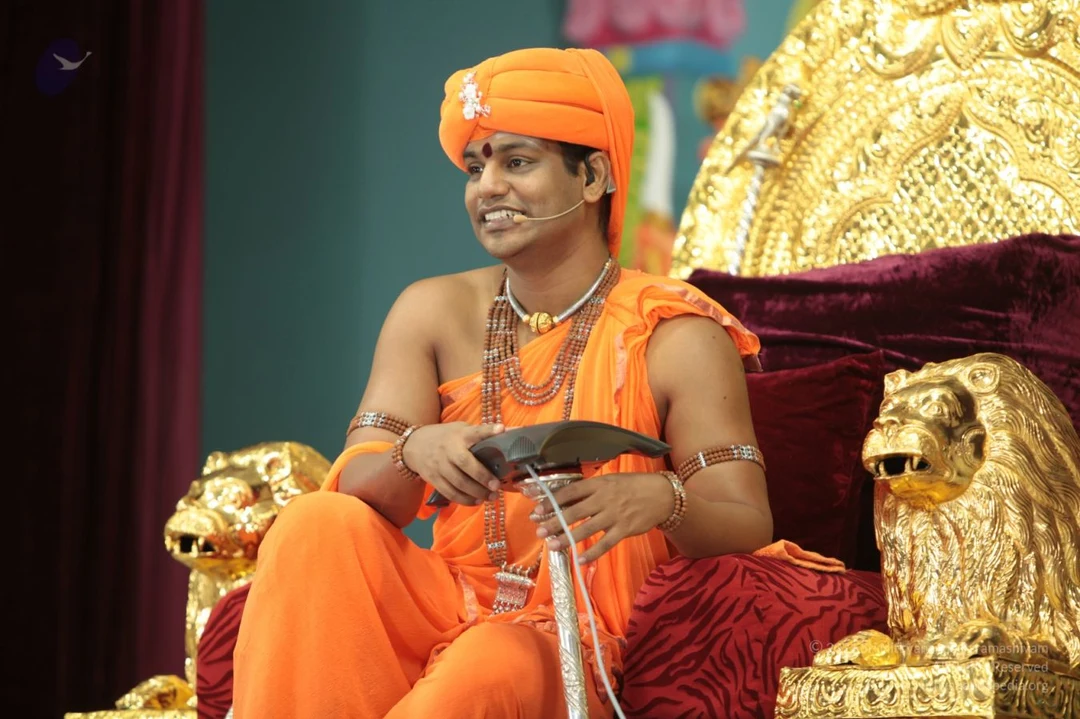
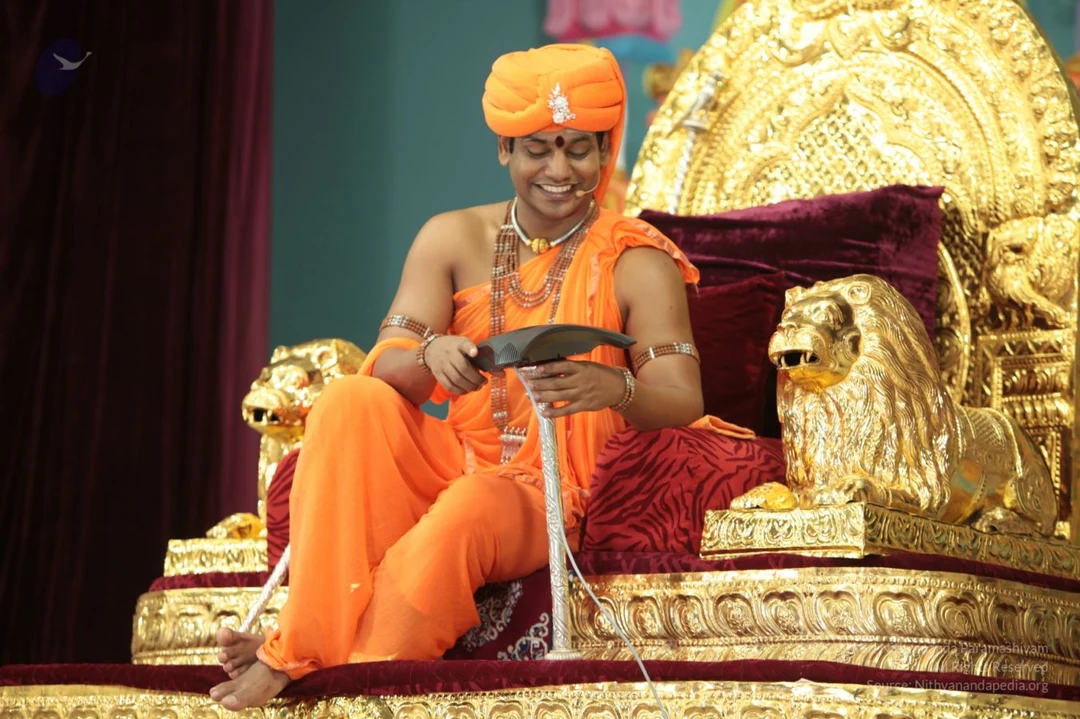
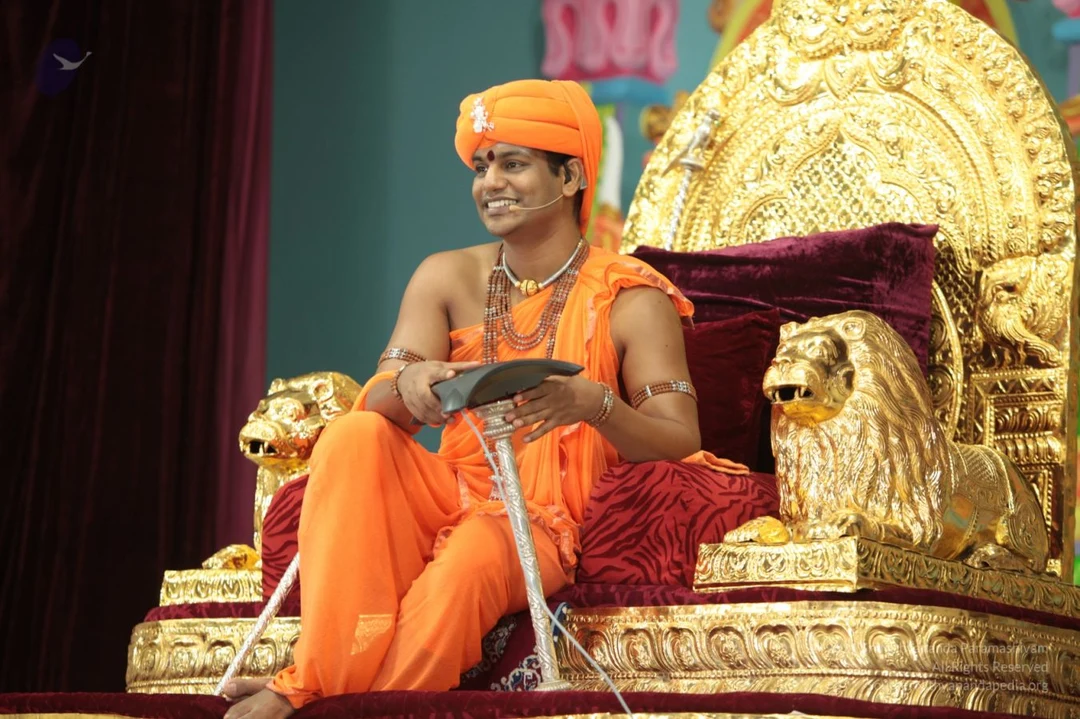
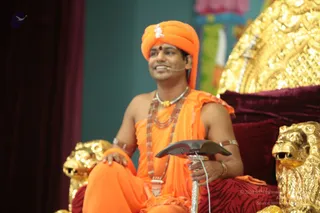
A seated man in an orange turban with a white ornament and red bindi wears an orange shawl over bare shoulders, with a gold necklace, layered rudraksha malas and silver armlets. He sits on a red velvet throne flanked by gold lion heads, smiling, with a lapel microphone clipped to his face and one hand resting on a silver-and-black stand. Behind him a gold-embossed backrest and green and pink hangings fill the background. A faint pedia.org credit appear at lower right. Swamiji (probable) is seated on the throne in saffron cloth, rudraksha malas and turban cuesA smiling man in saffron-orange clothing sits on an ornate golden throne with carved lion-head armrests and a deep red velvet cushion with a red tiger-striped seat. He wears a saffron turban with a small white flower ornament, a saffron shawl, a red beaded rudraksha-style mala, layered ceremonial necklaces, and bangles on his arms, and a headset microphone is at his mouth. He rests one hand on a silver microphone stand. Behind him are maroon velvet drapes and colourful decorative panels. Swamiji (probable): the orange turban, saffron garments, beaded malas and ceremonial gold necklaces on a discourse throne match the page's satsang context.A seated man in saffron-orange robes and an orange turban with a small white floral brooch sits on an ornate gold throne flanked by gold lion sculptures and red velvet cushions. He wears a headset microphone, a beaded rudraksha-style mala, layered necklaces and silver armbands, and holds an open book on a silver stand. A red curtain and teal backdrop frame the stage. Sole visible person.A smiling man in saffron-orange turban and orange robes sits cross-legged on an ornate golden throne flanked by carved golden lion heads and maroon velvet cushions. He wears layered rudraksha malas, a gold pendant necklace and beaded bracelets, and holds a small silver-toned object across his lap. A headset microphone is visible at his ear, with a cable running down the stage. Behind him are a golden tiered backdrop and a teal wall with a maroon curtain at left. Appearance-based cues are consistent with the a person candidate: saffron turban, orange robes, rudraksha malas and ceremonial gold necklace, seated on a throne as the speaker at a satsang.A man seated on an ornate golden throne with lion-head armrests and red velvet cushions, smiling and speaking into a headset microphone while holding a silver-stemmed microphone stand. He wears an orange saffron turban with a small white emblem, an orange sleeveless wrap over orange clothing, rudraksha malas, a gold necklace and gold armbands, with a red bindi on his forehead. Probable Swamiji by visible cues: saffron turban and wrap, rudraksha malas and ceremonial gold ornaments, seated on the throne in a satsang setting.A man seated on an ornate gold-and-red throne on a stage, wearing an orange turban with a white jewelled brooch and a red bindi, orange draped robes bare at the shoulders, multiple strands of rudraksha malas, a ceremonial gold and silver necklace, and rudraksha armbands. He holds a grey handheld microphone on a silver stand and smiles, with a headset microphone at his ear, and a gold lion-head armrest is visible at left. Probable Swamiji (probable) seated as the speaker during satsang; the orange turban, rudraksha malas and ceremonial jewellery are the qualifying cues. One person is visible.
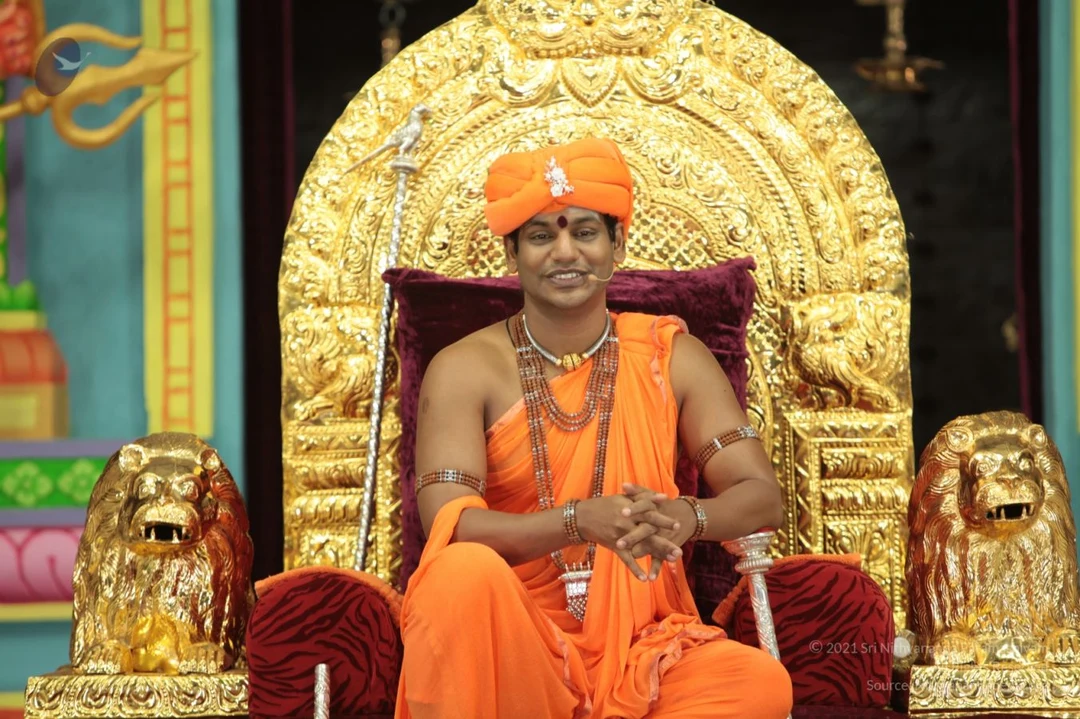
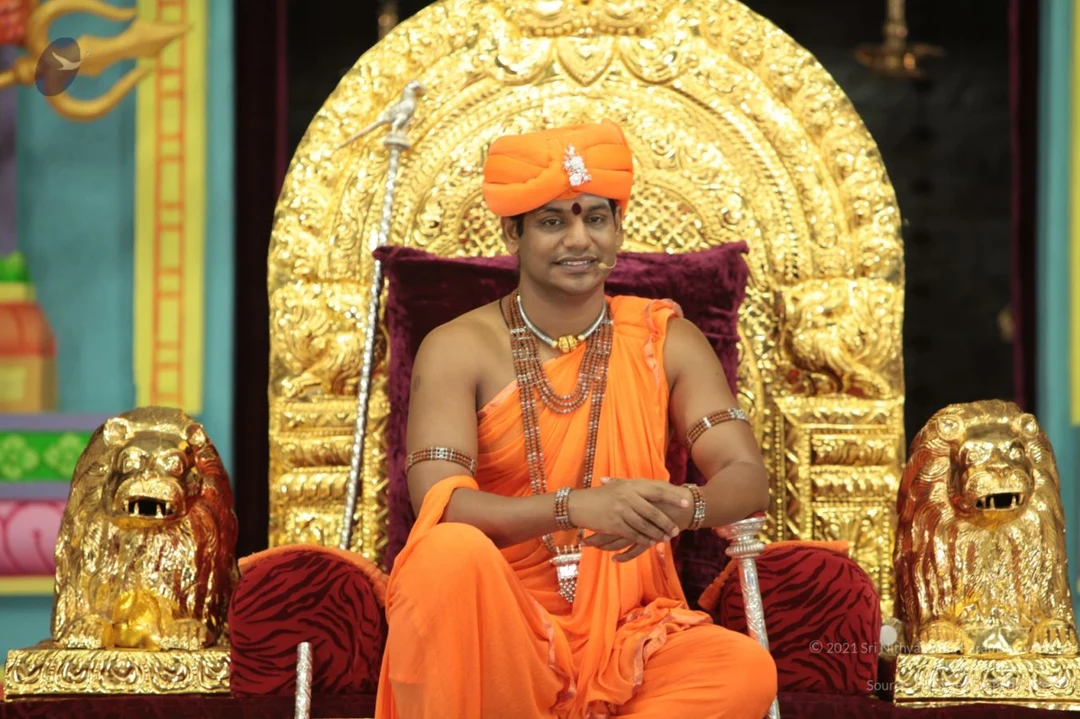
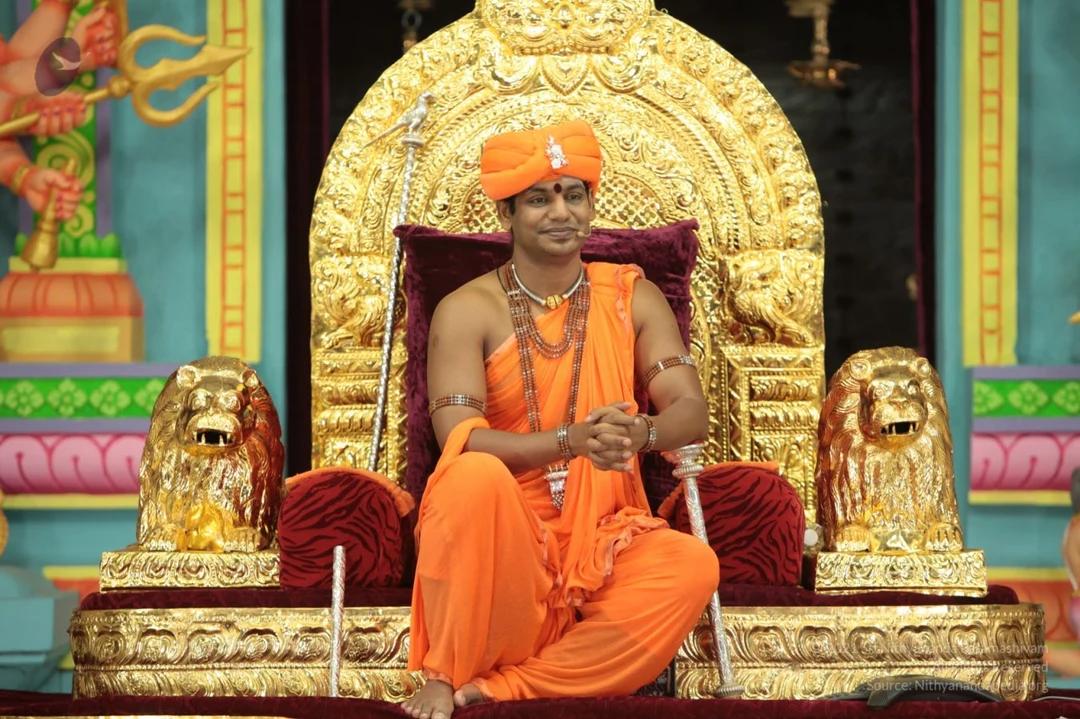
Sarvadarshan

11 photosSource gallery
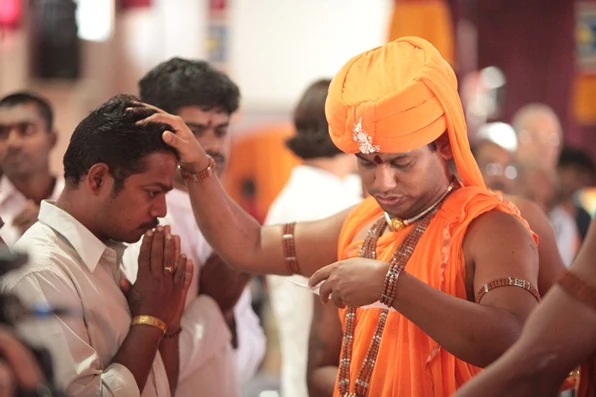
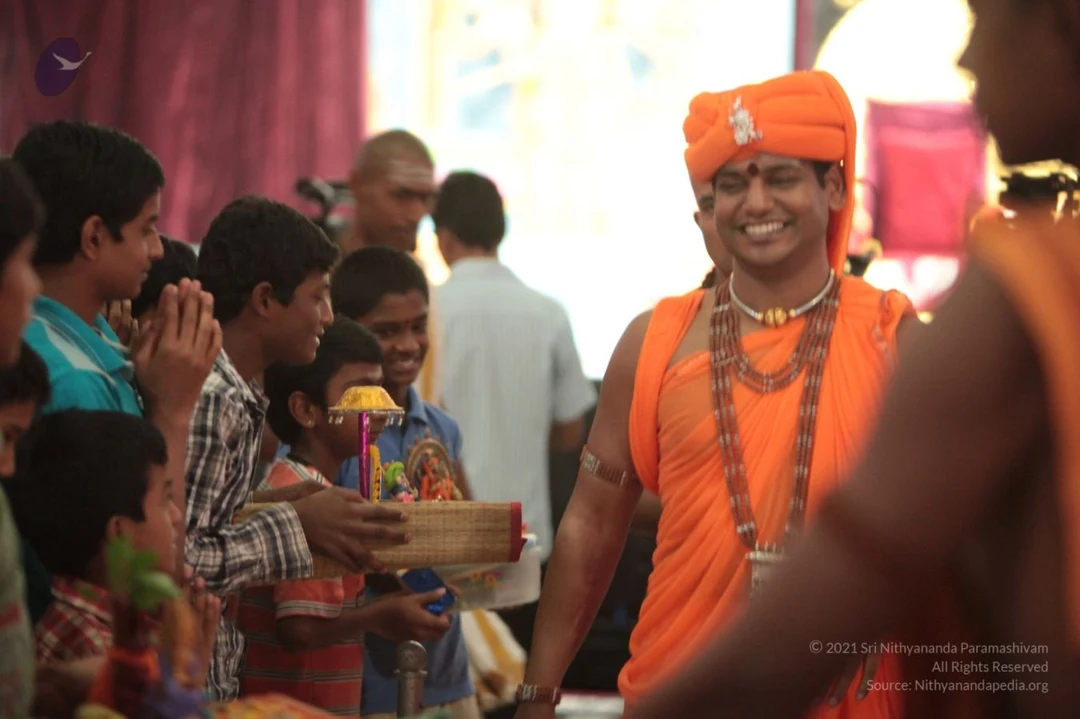
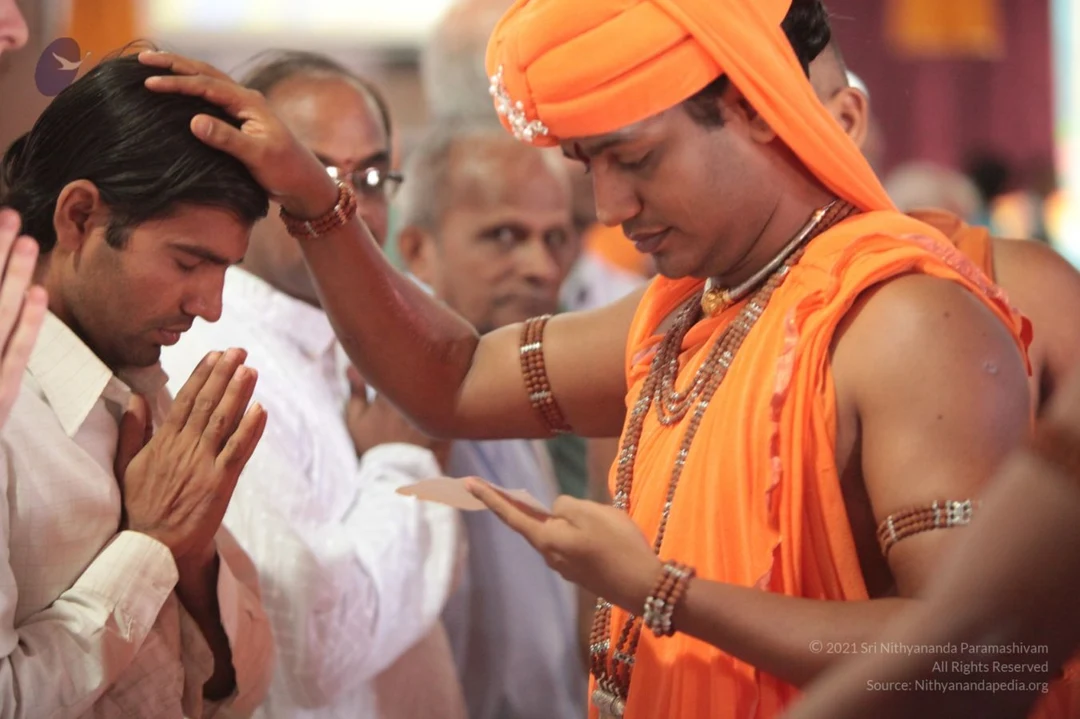
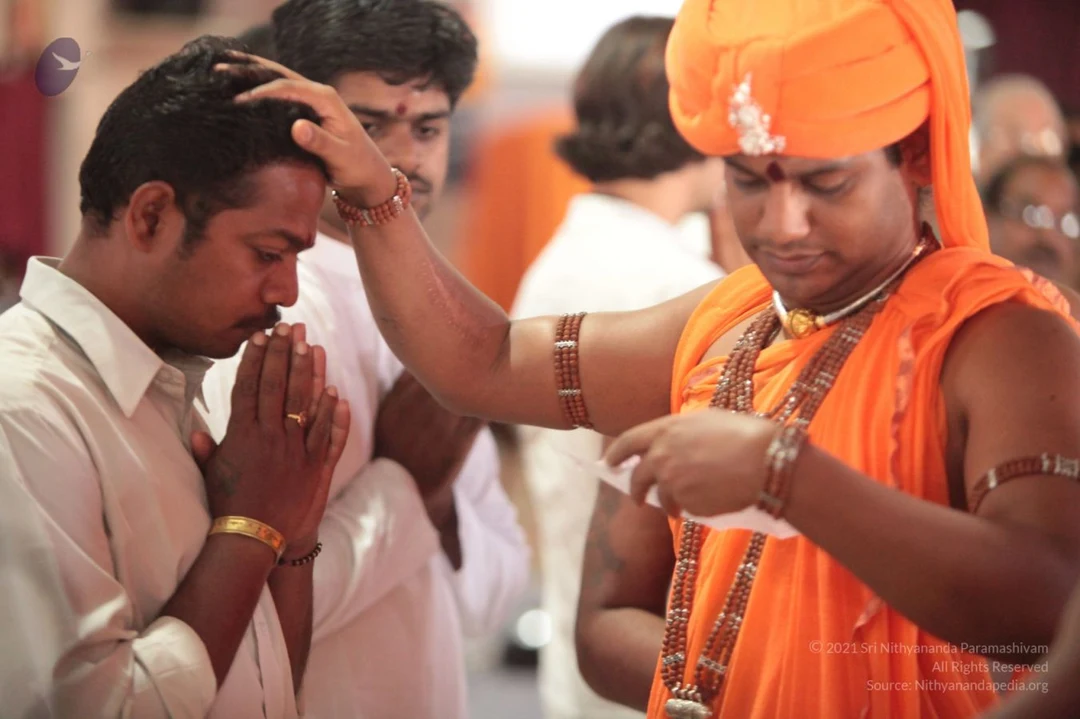
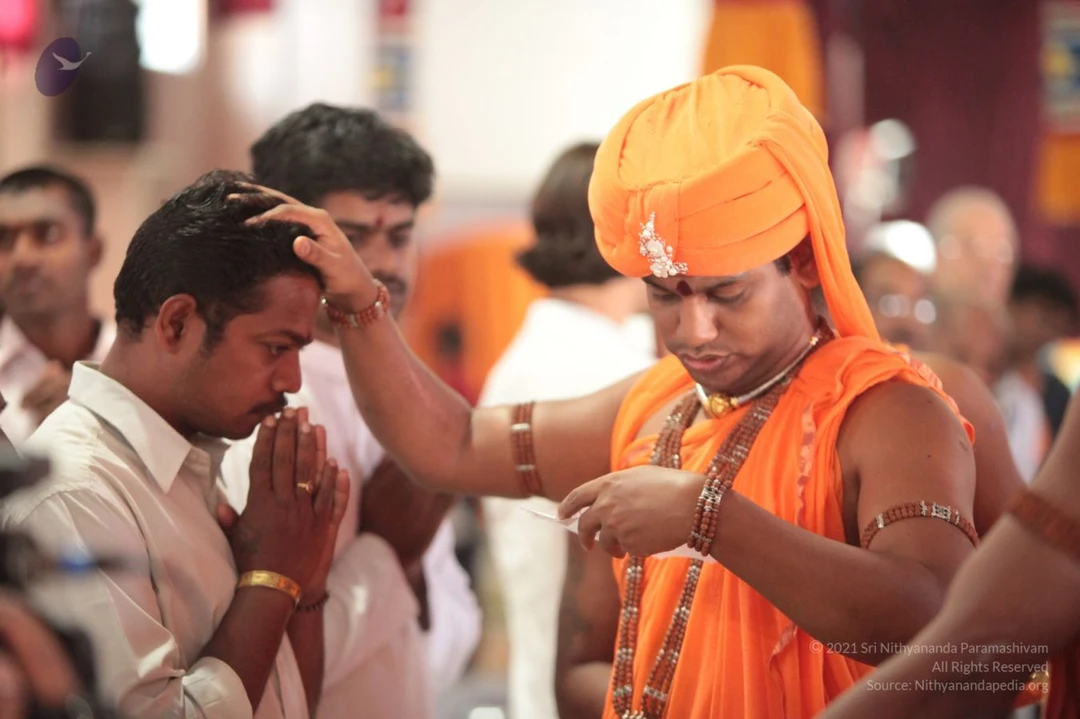
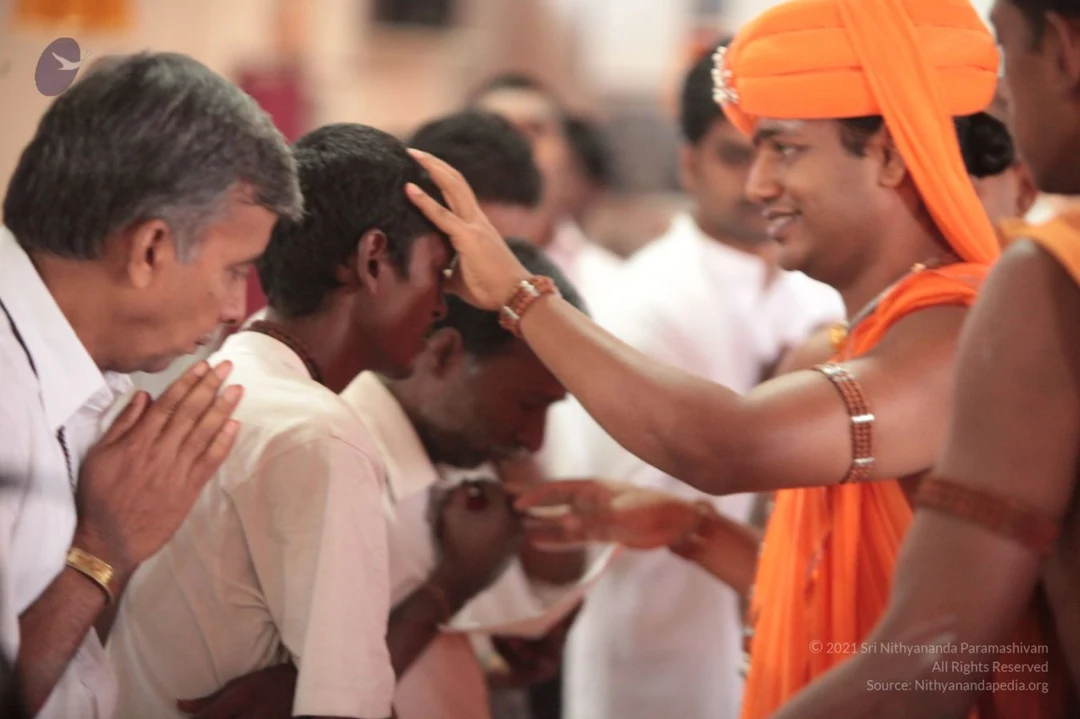
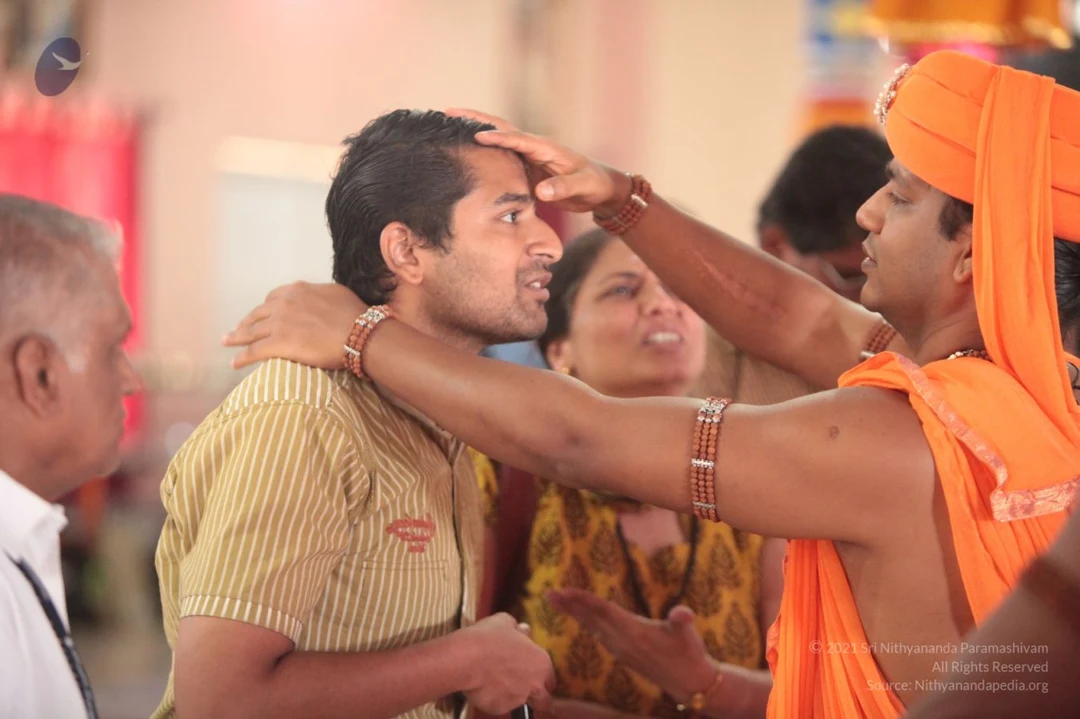
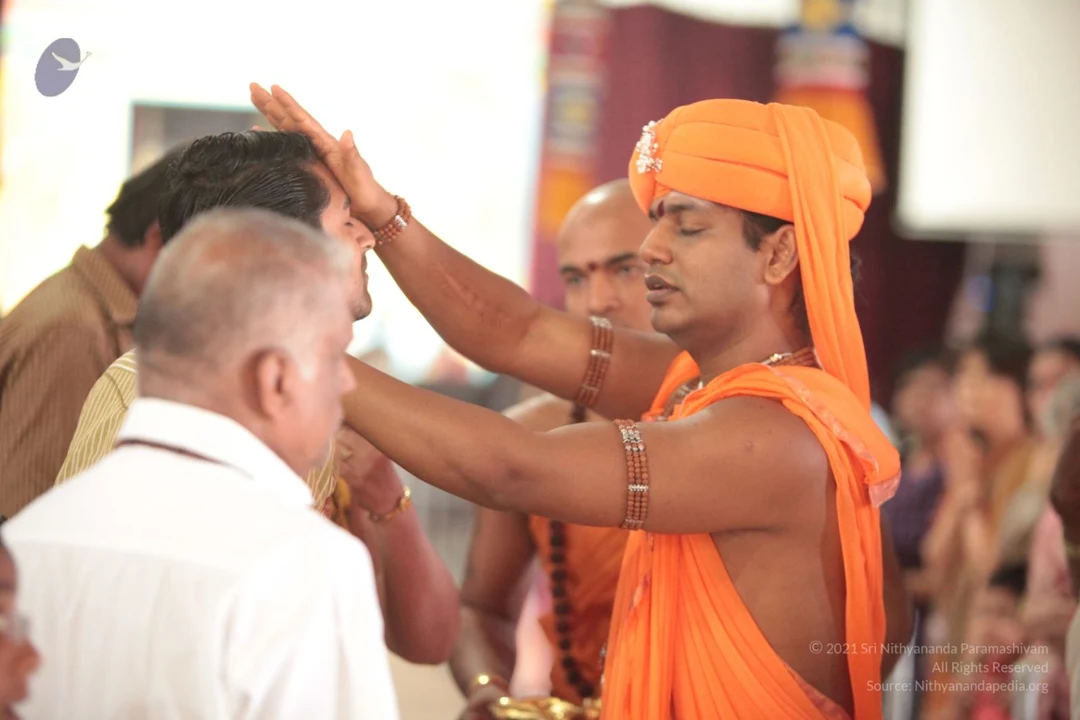
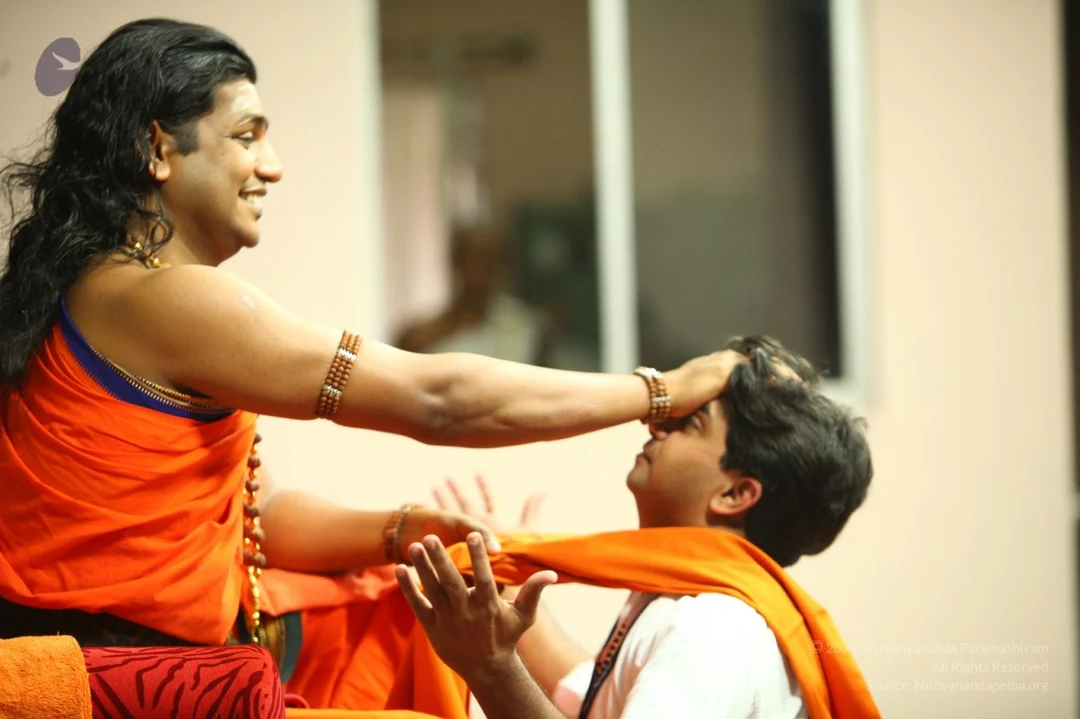
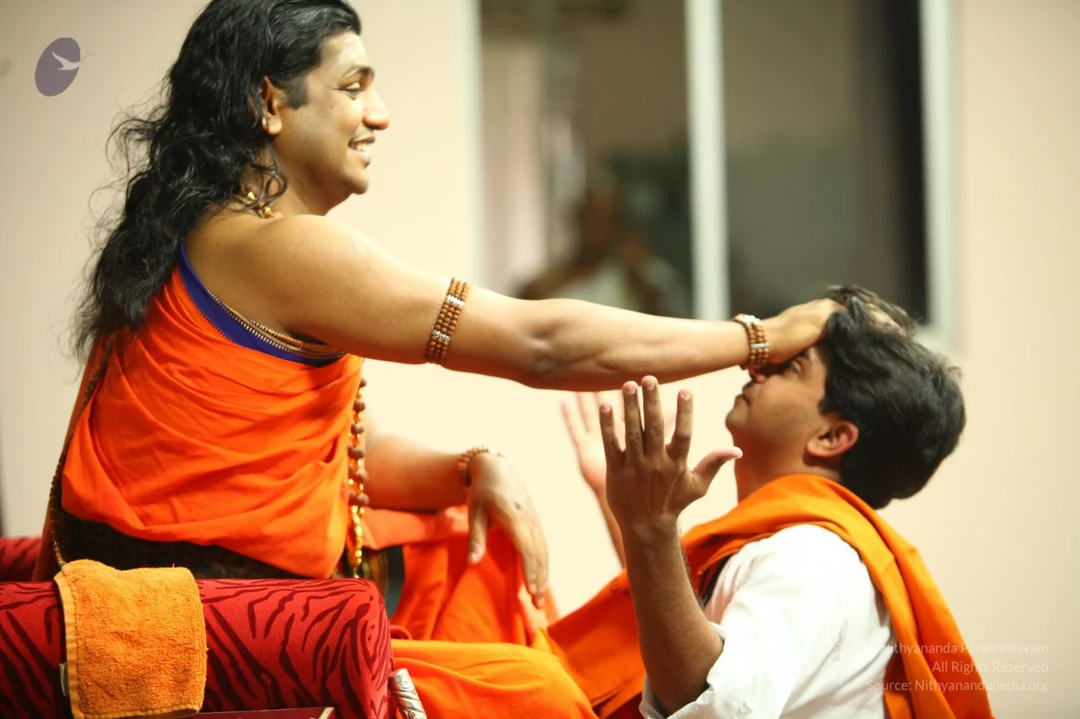
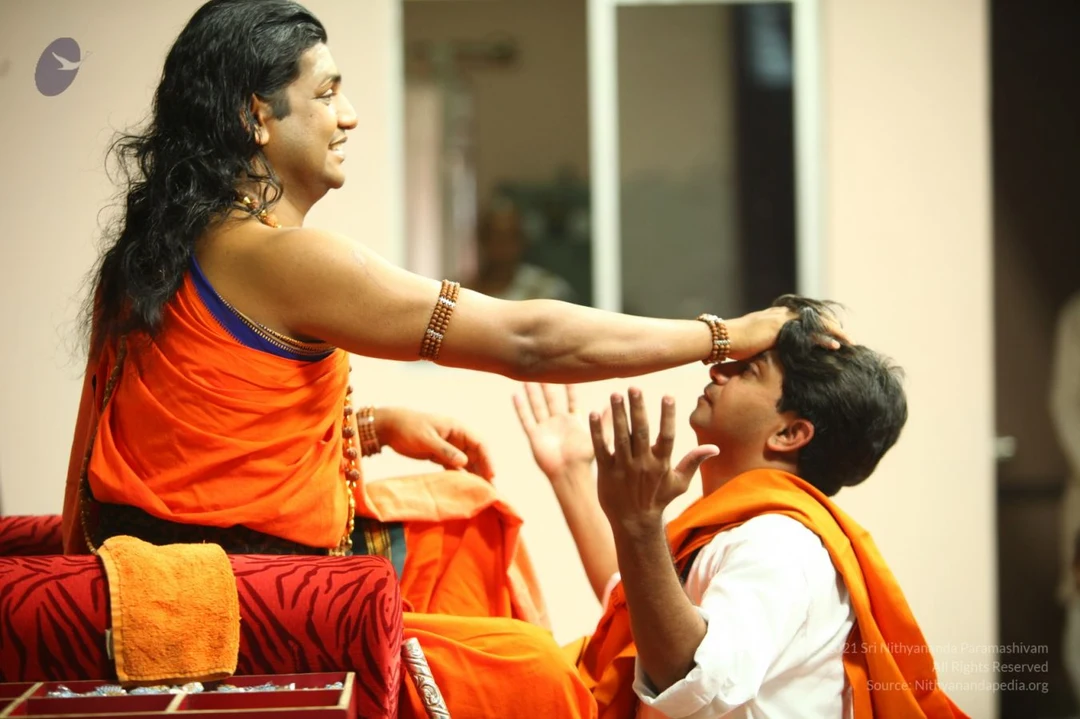
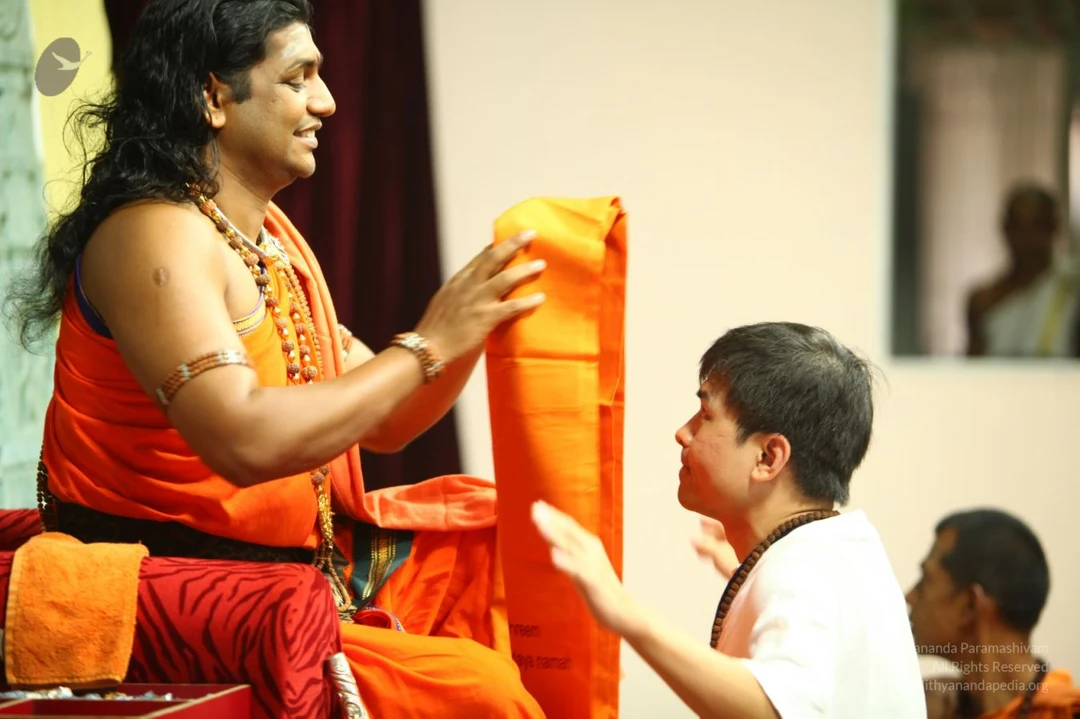
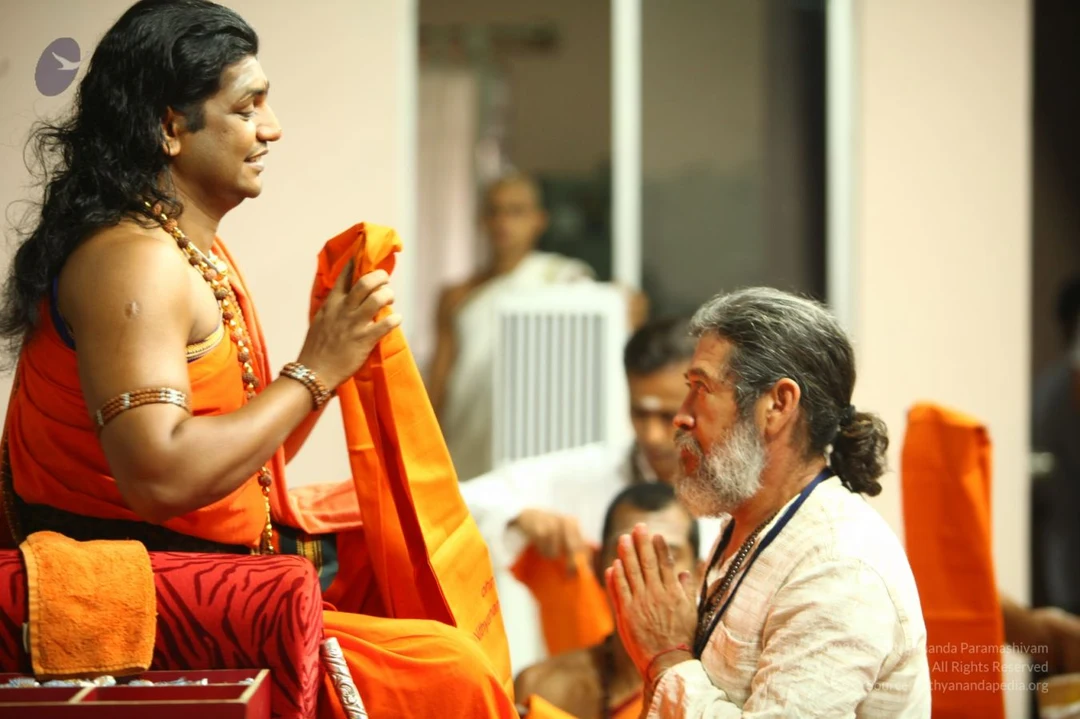
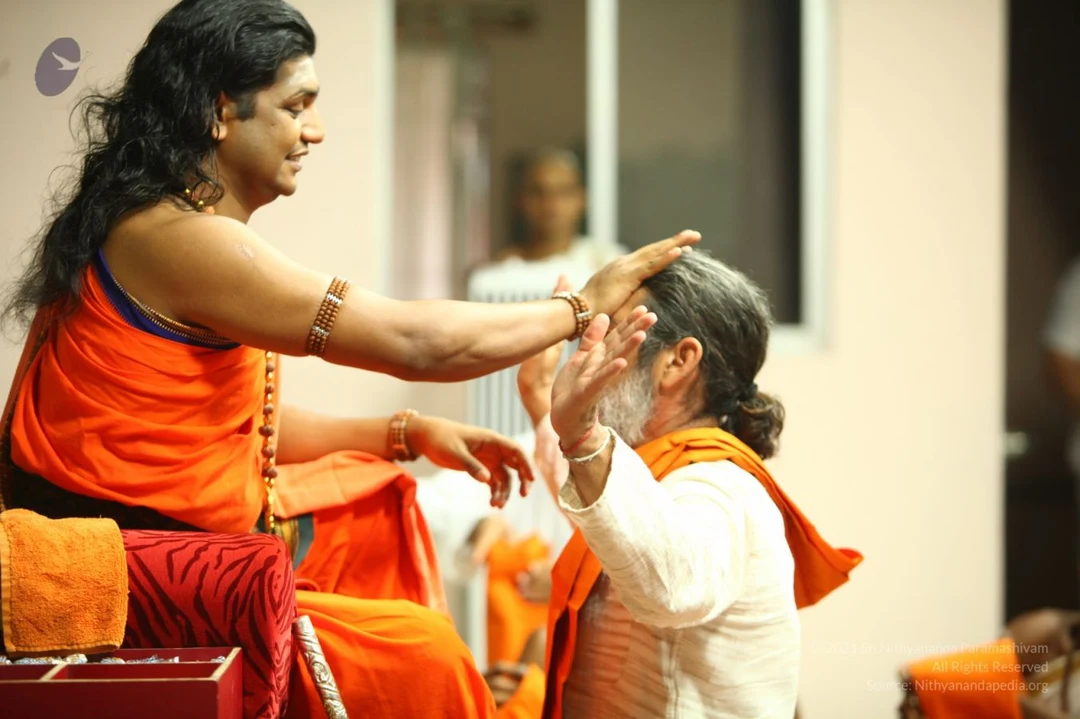
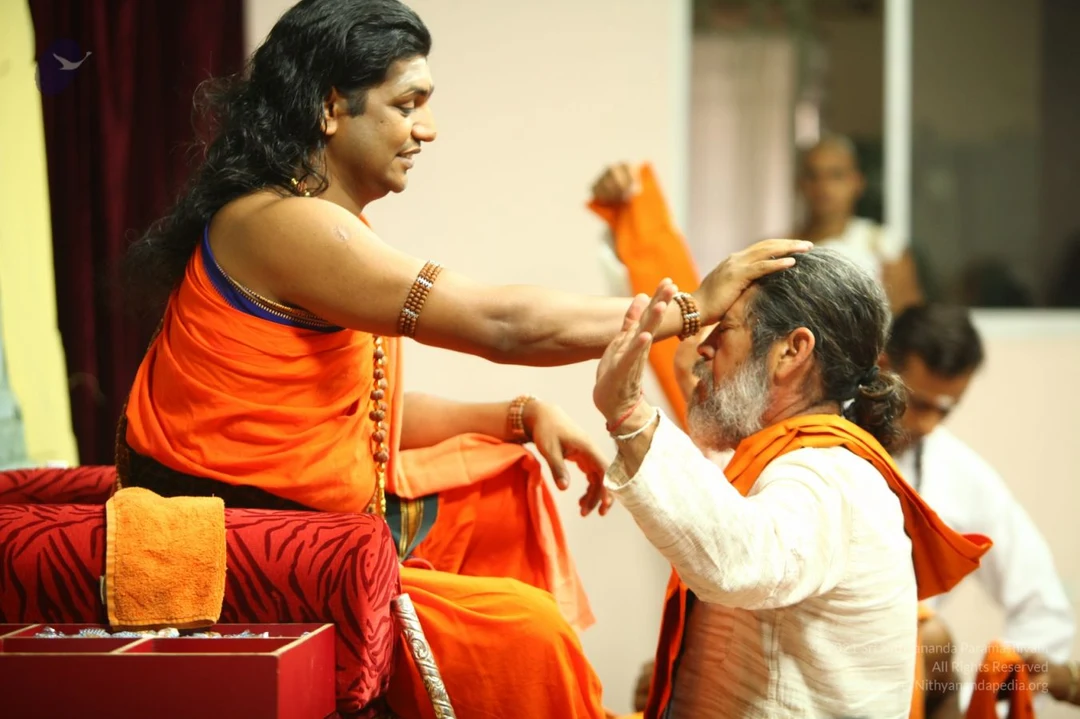
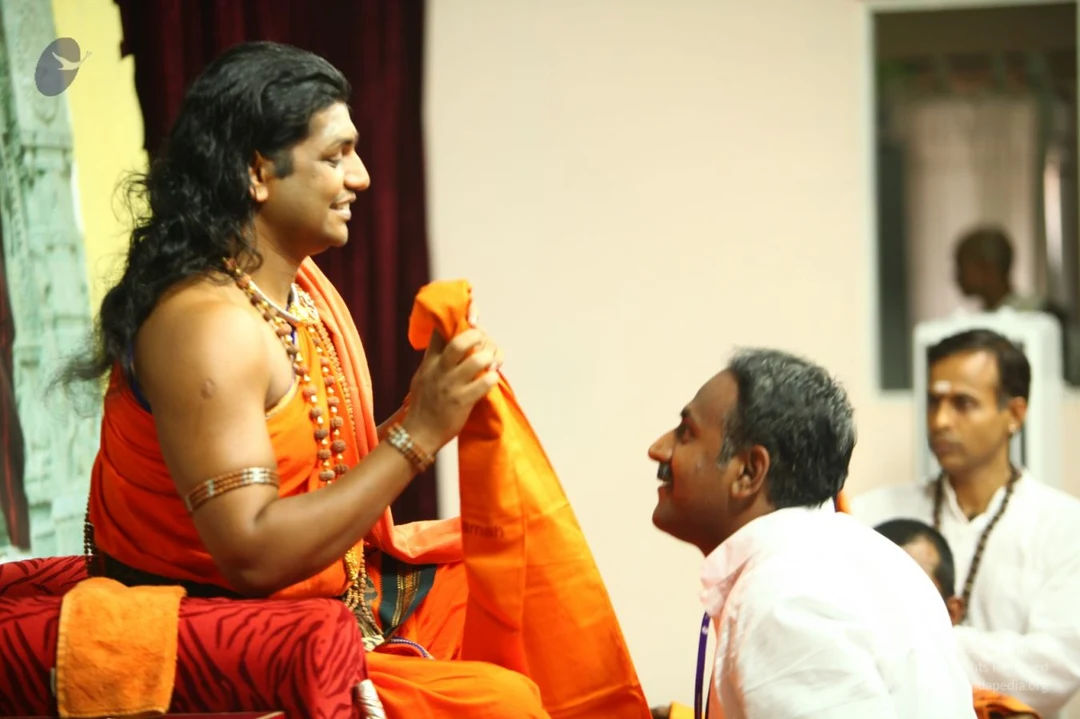
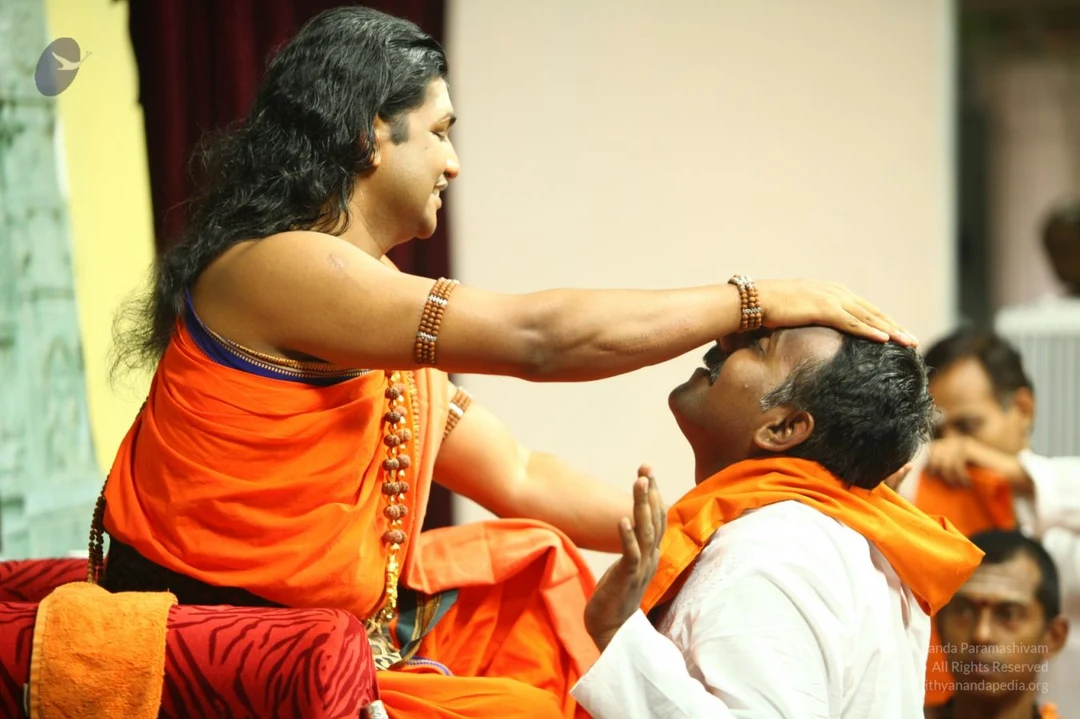
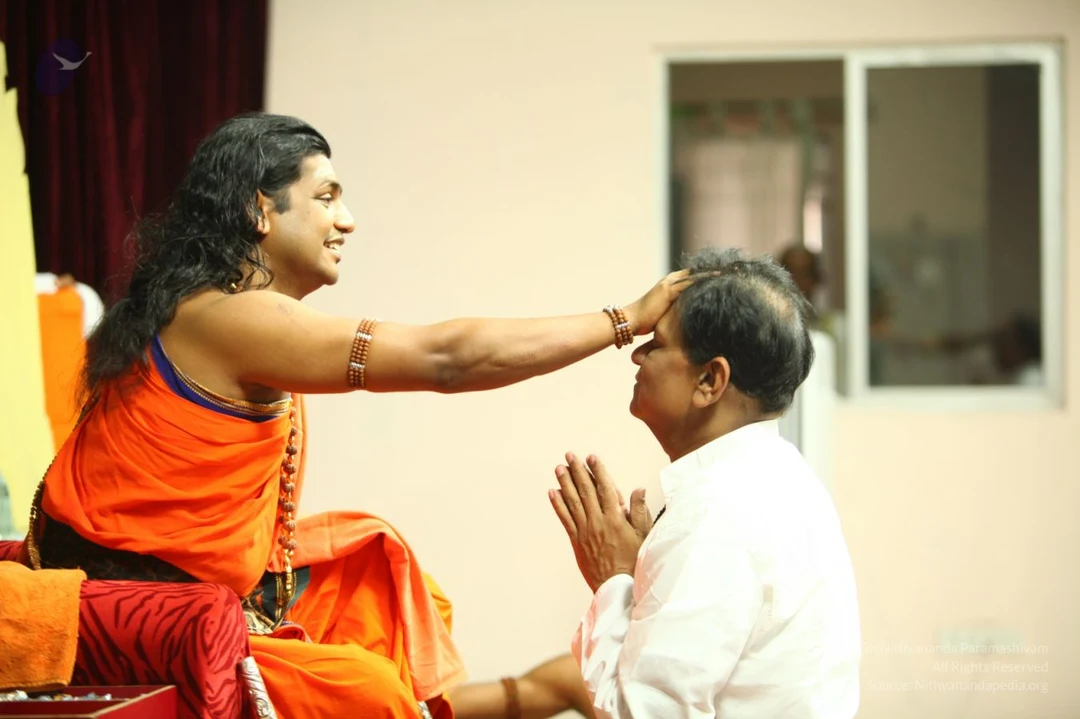
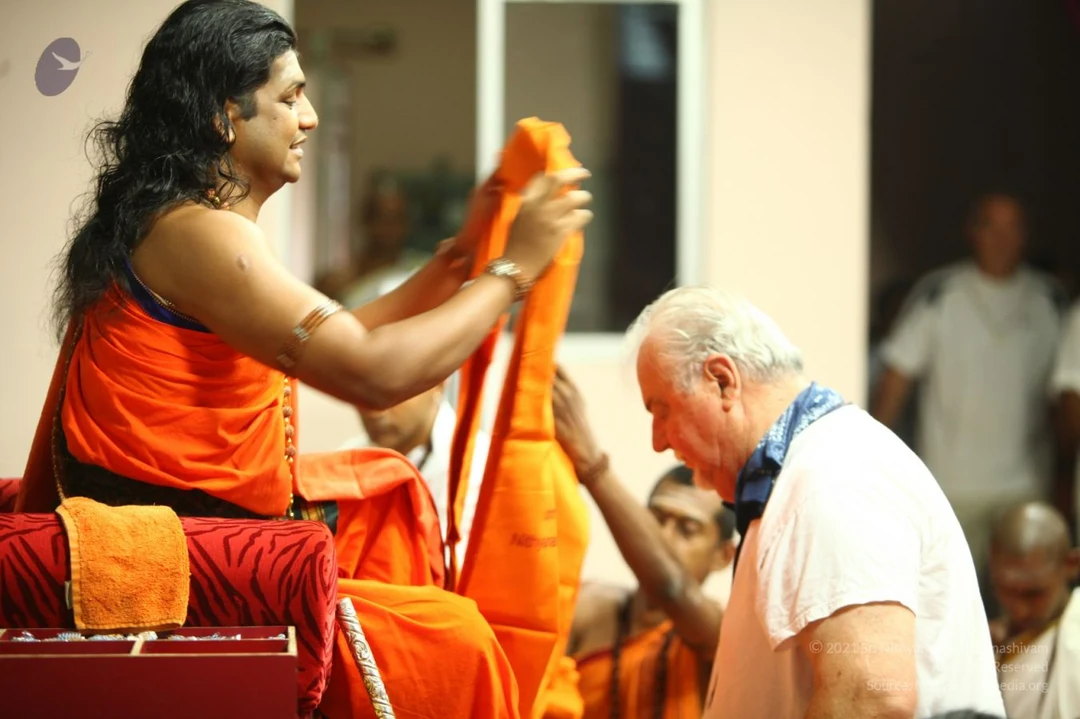
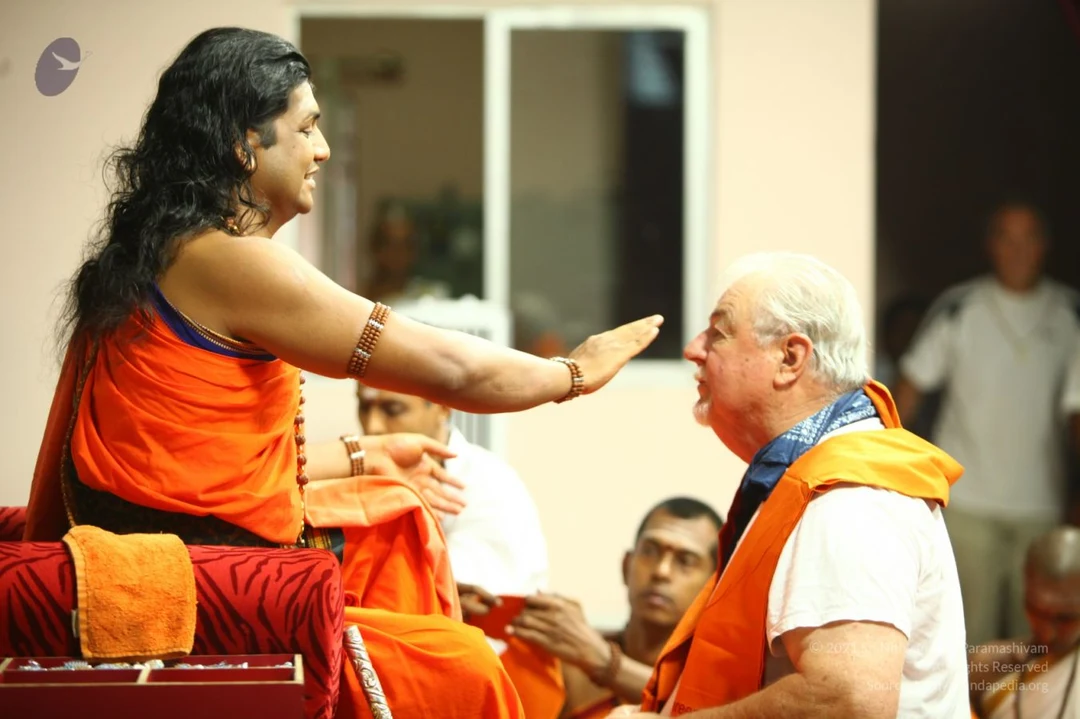
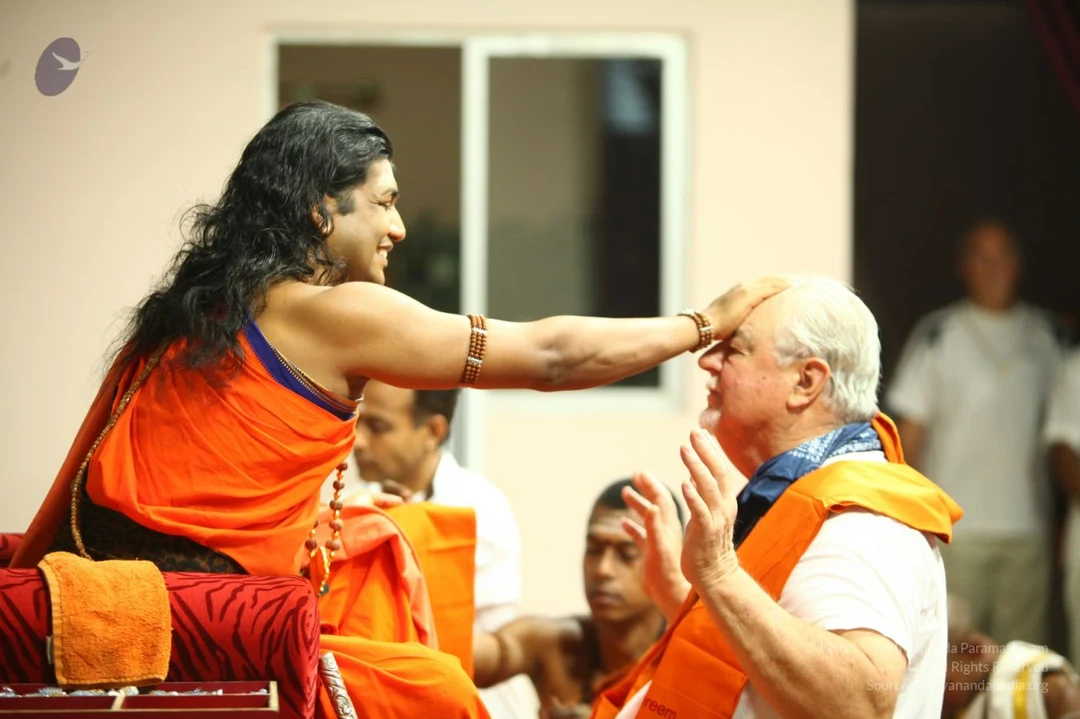
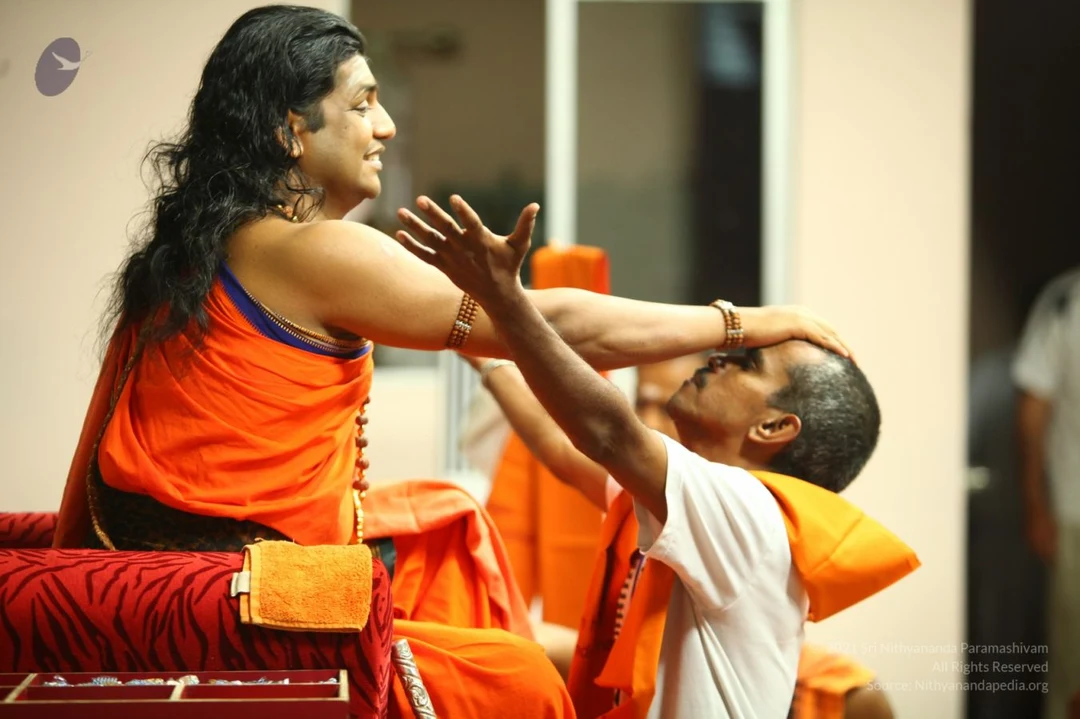
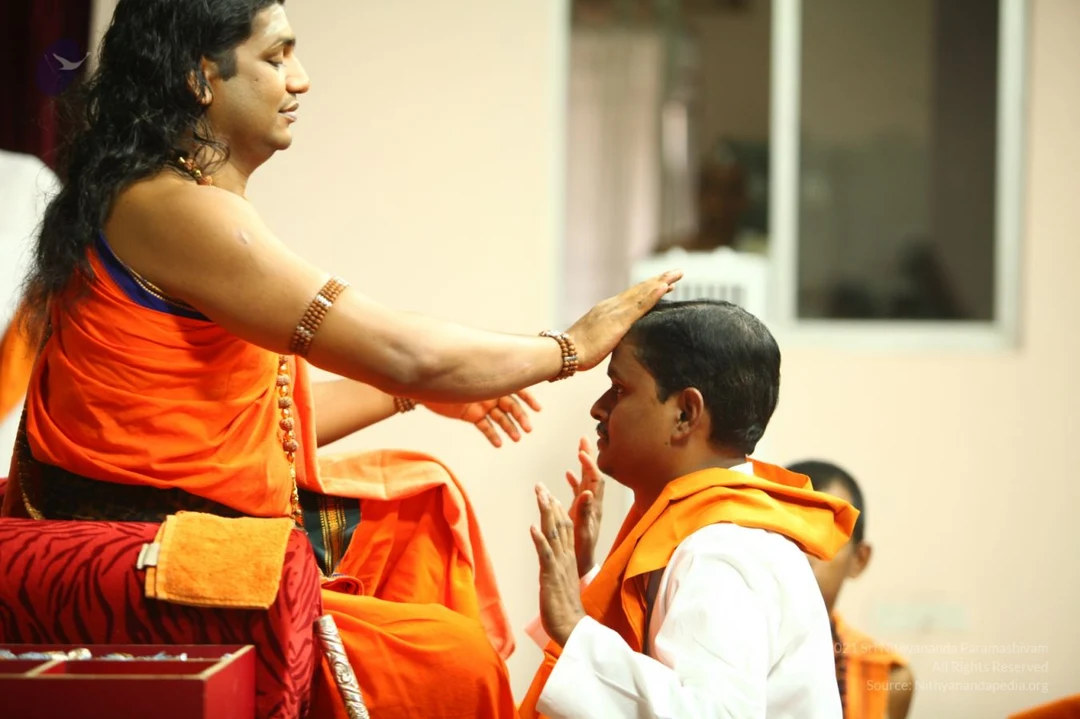
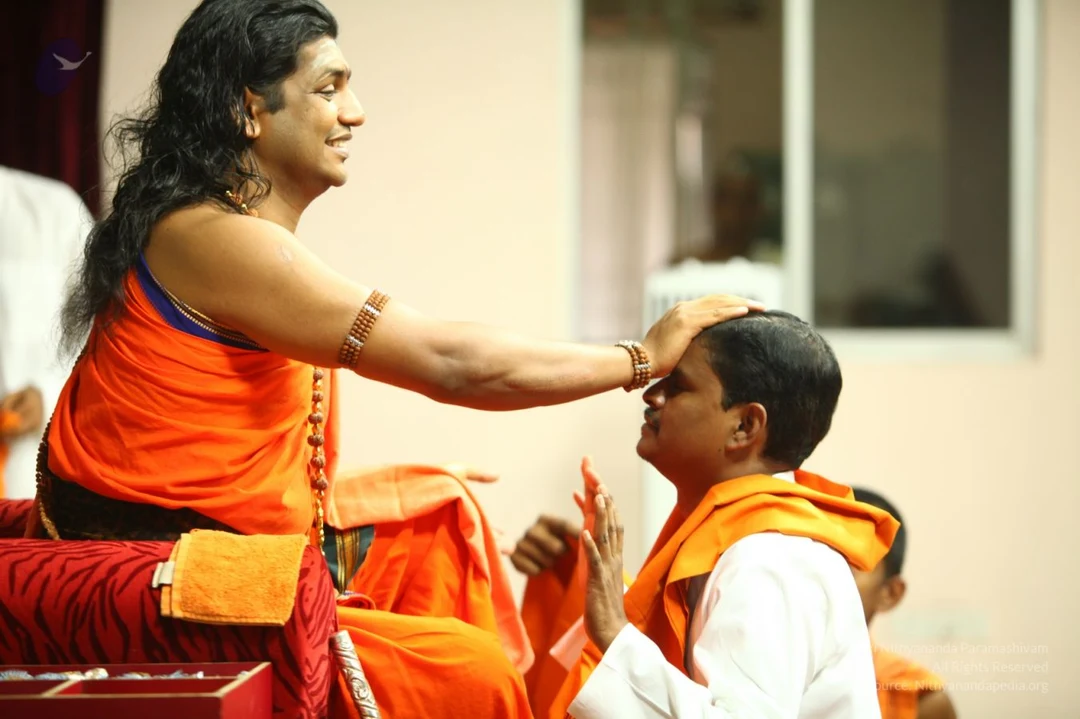
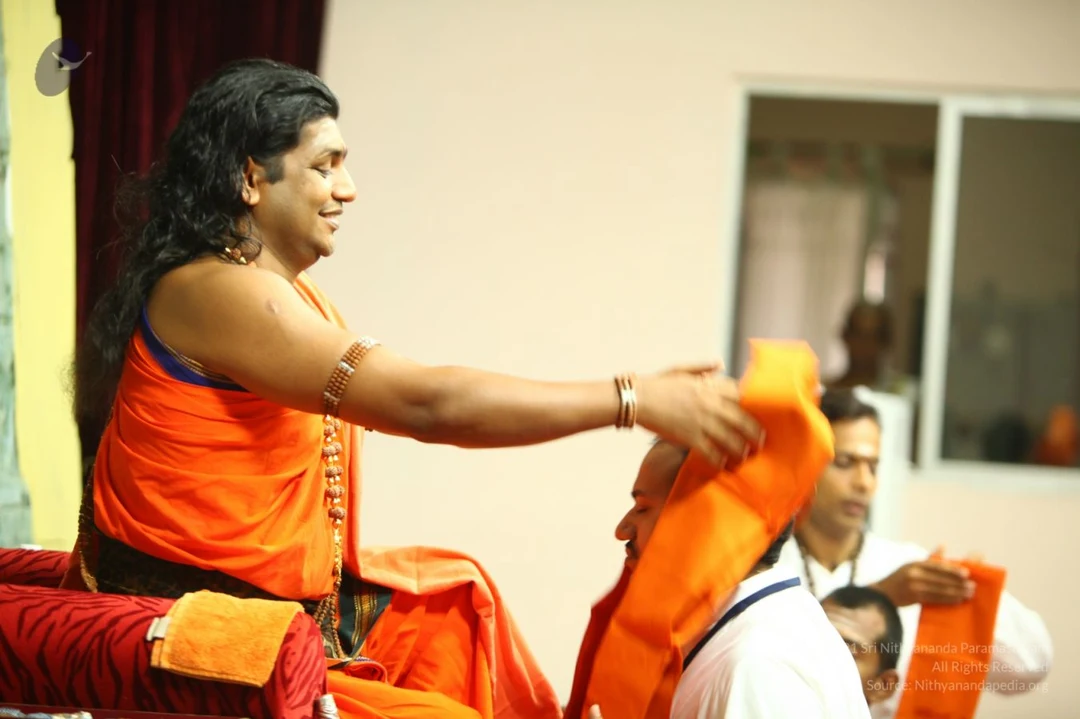
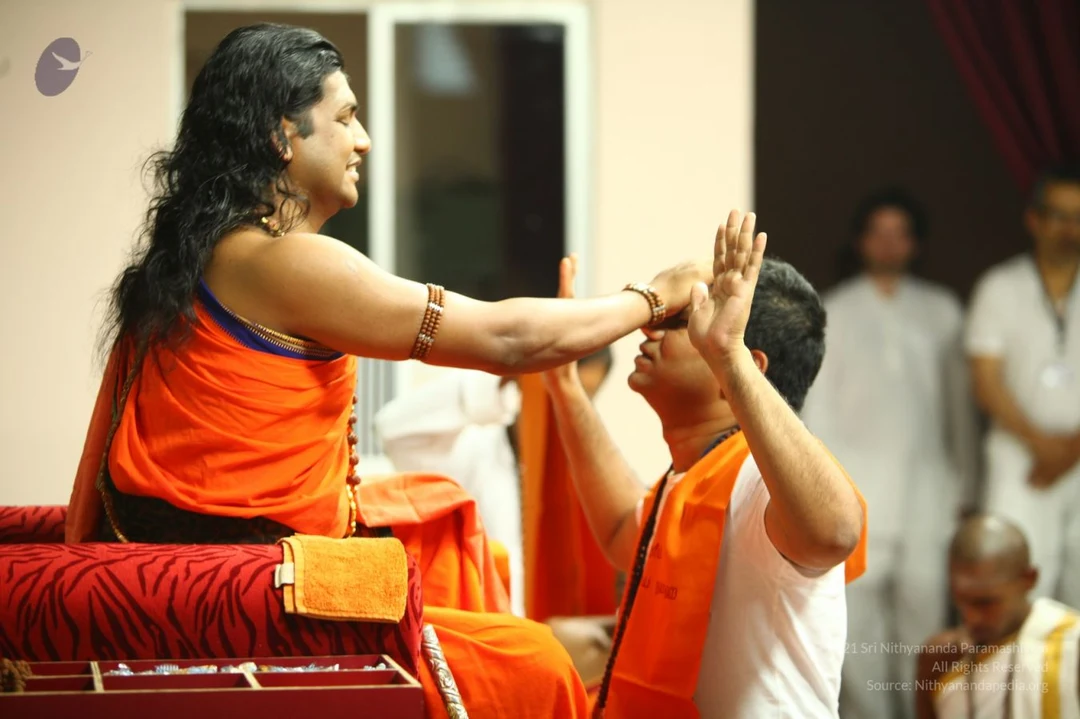
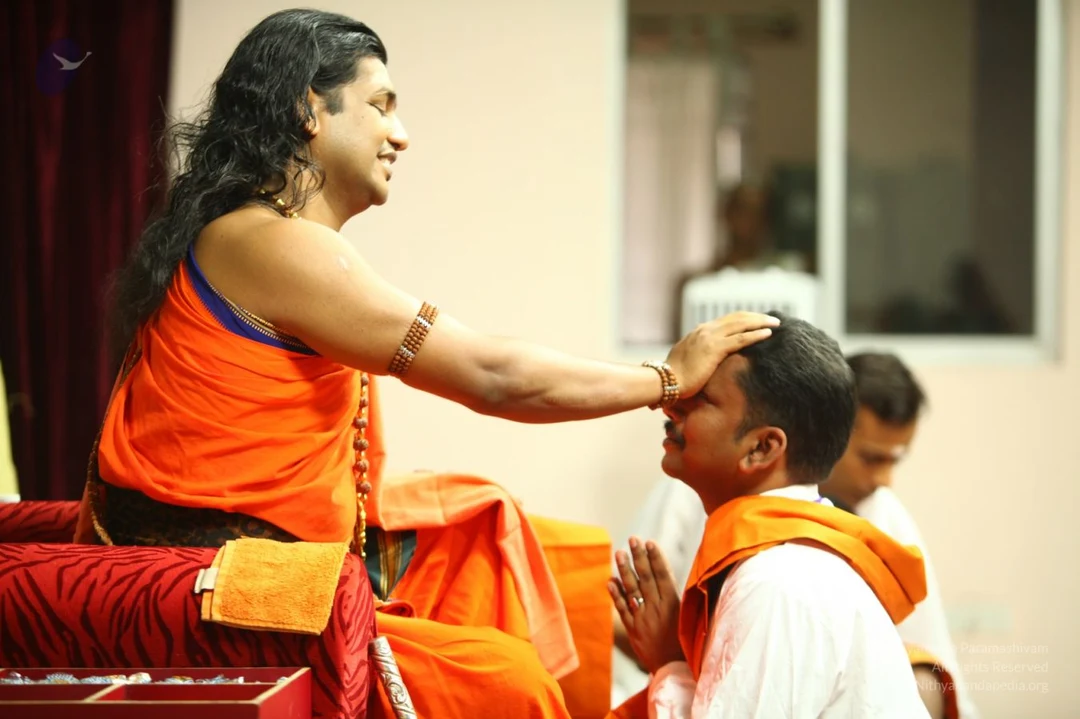
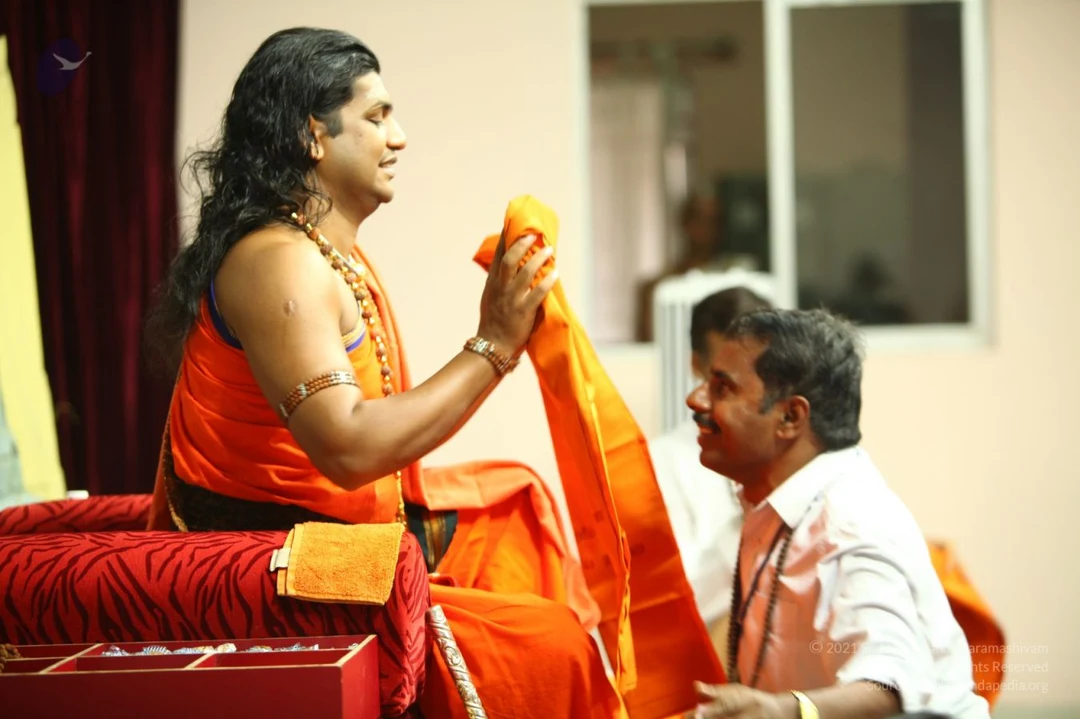
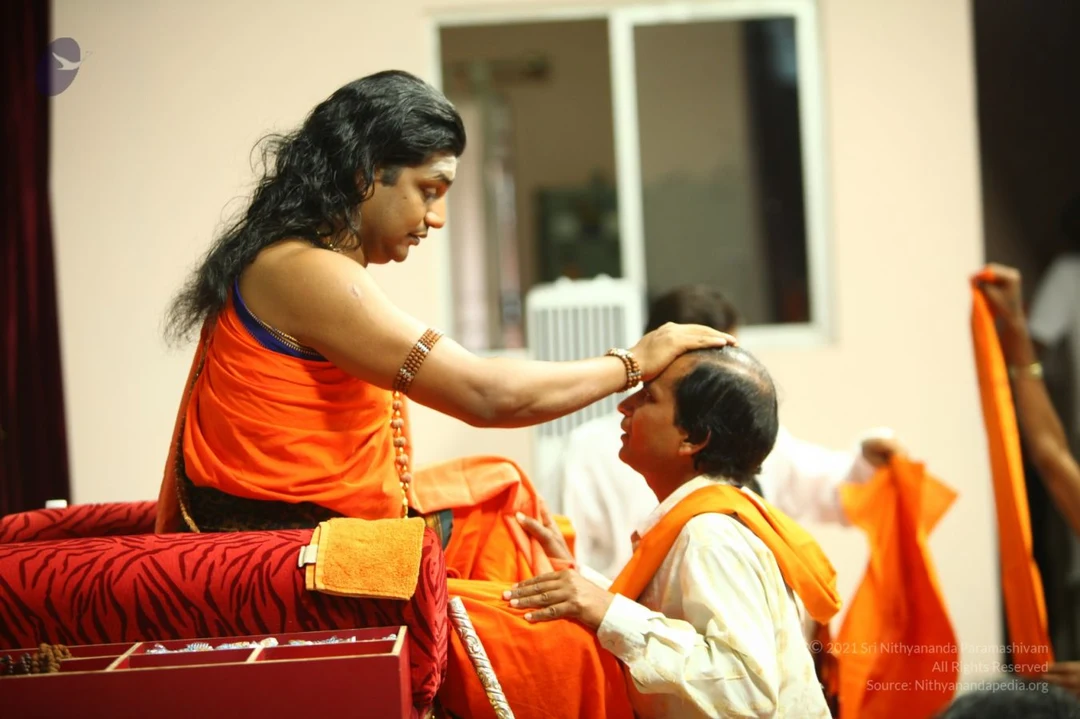
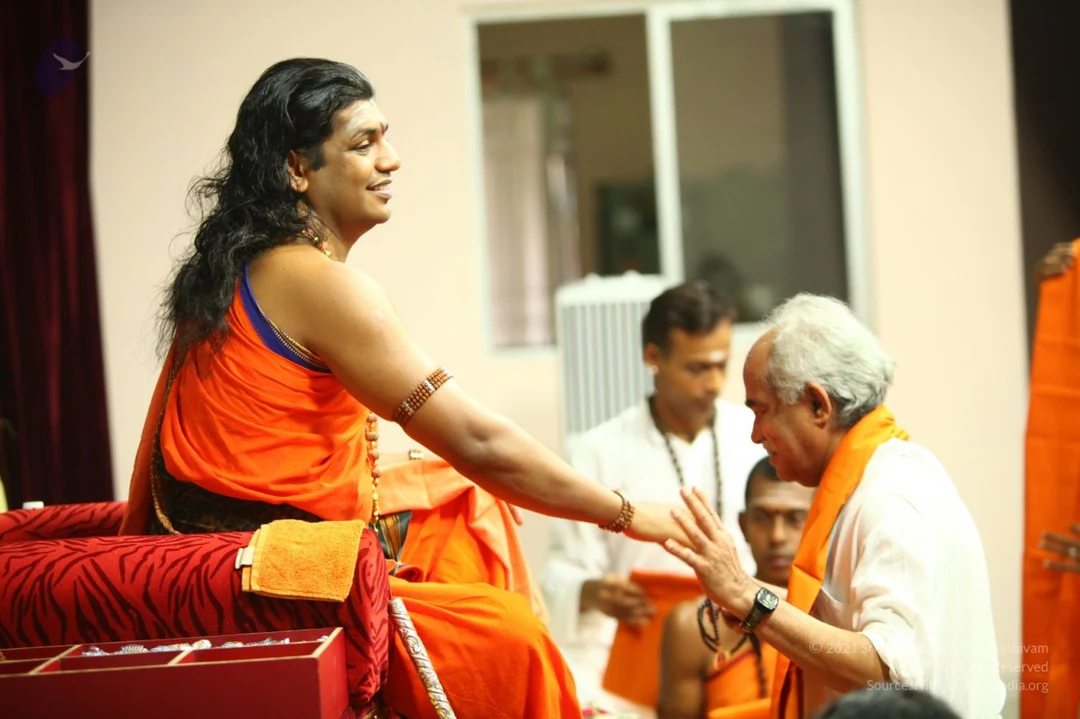
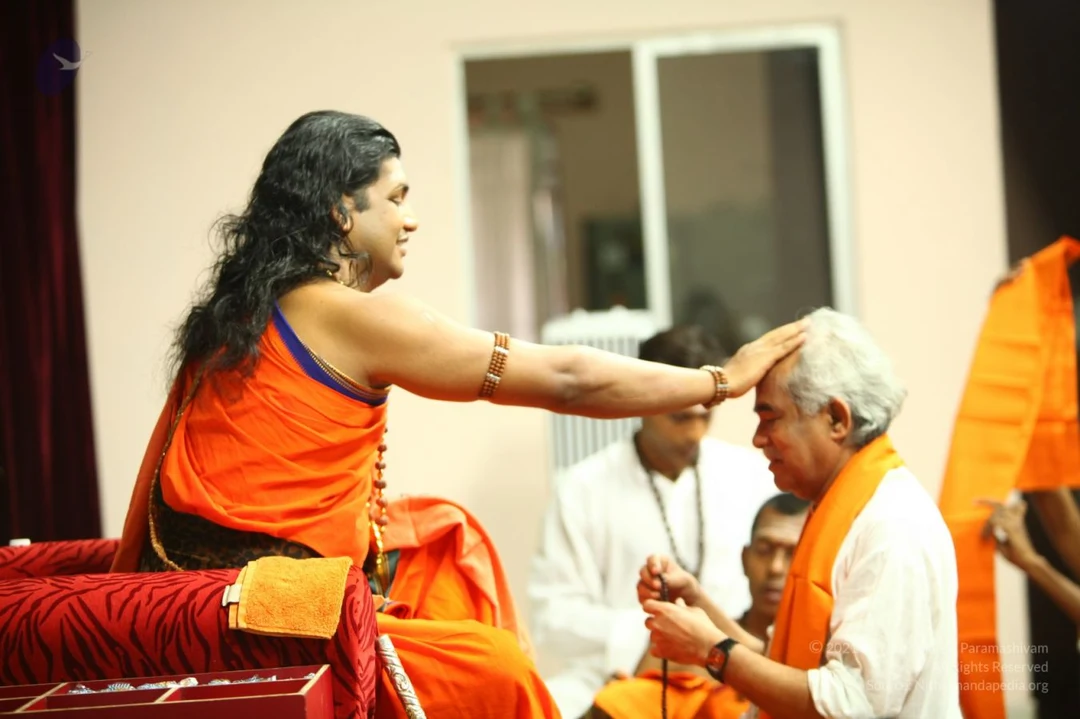
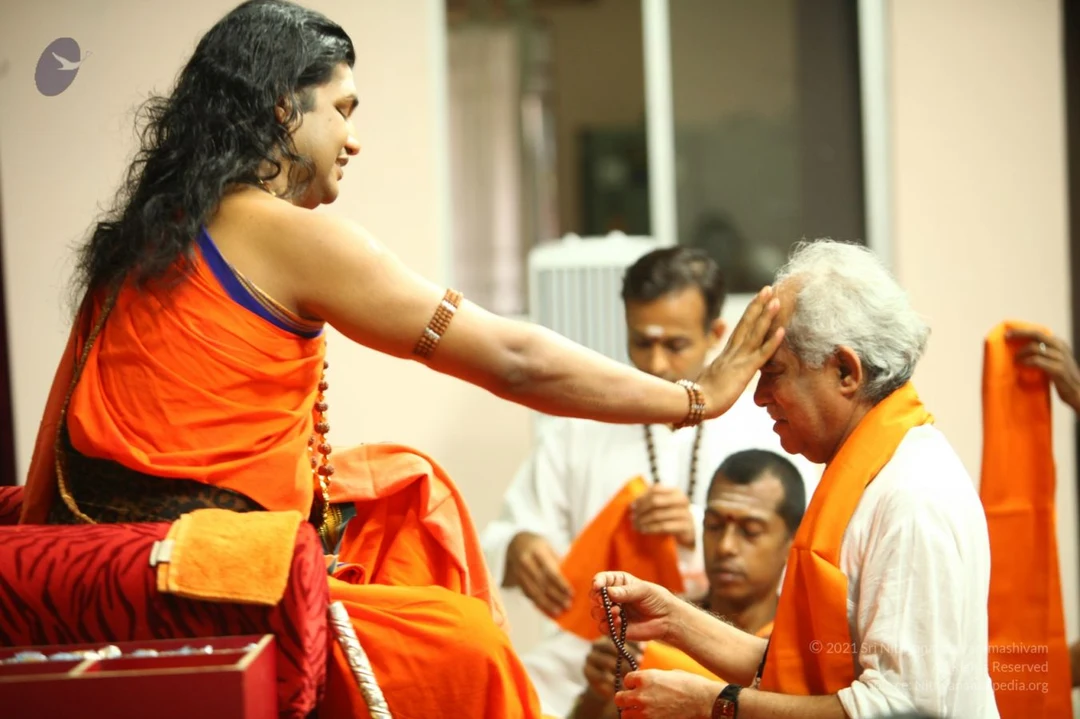
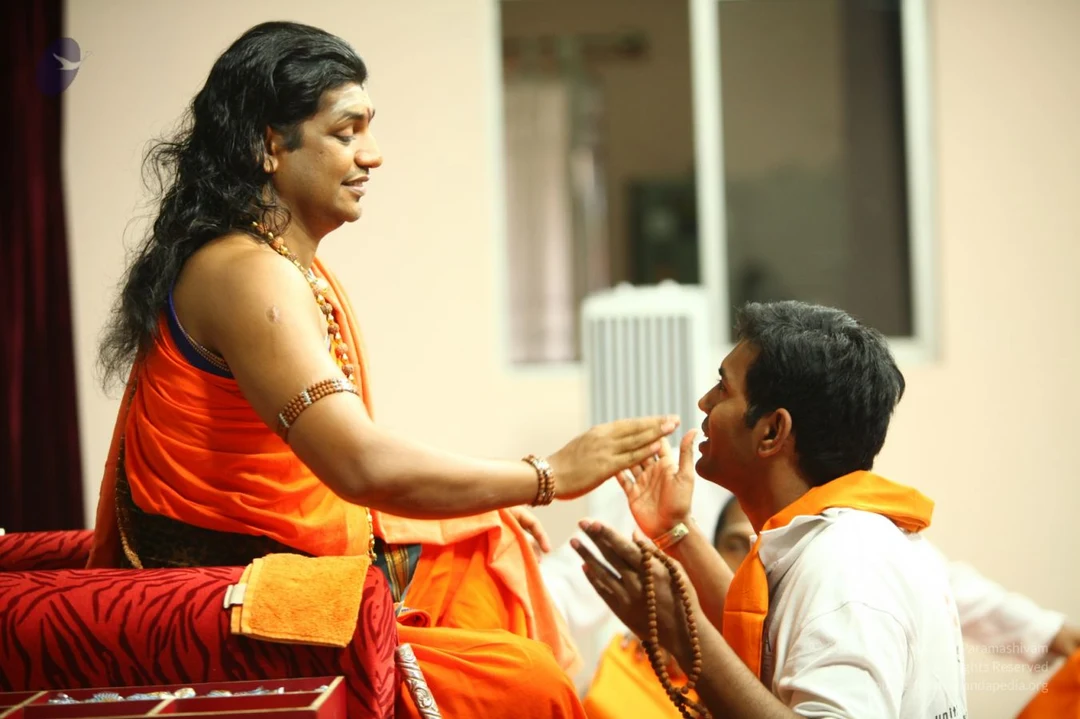
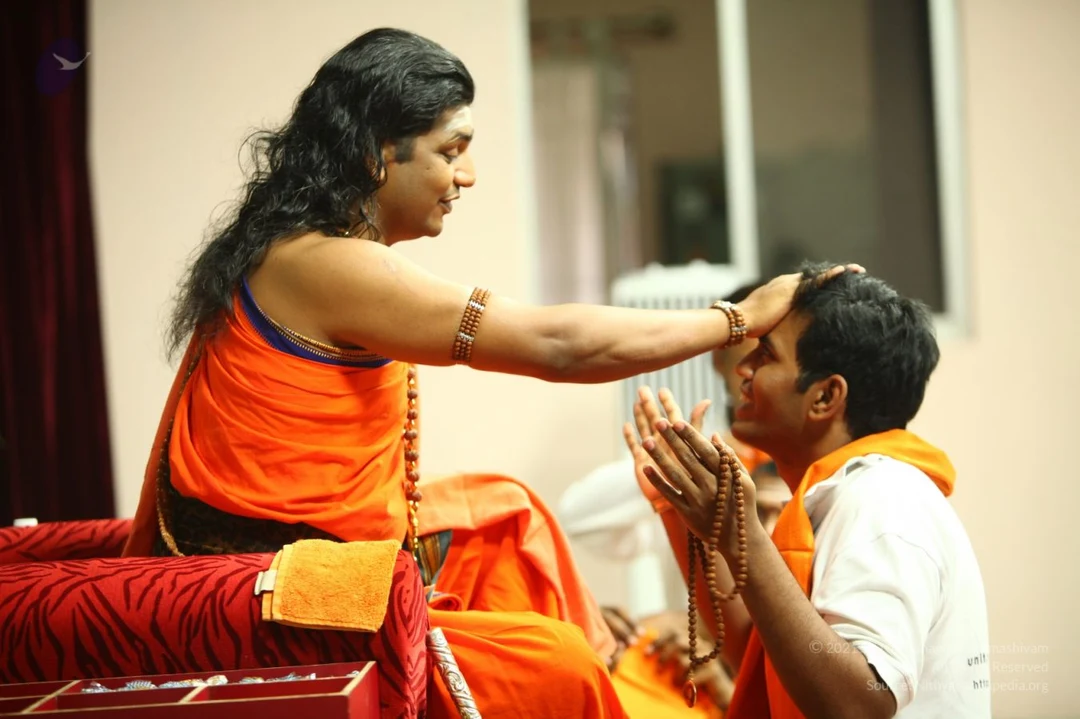
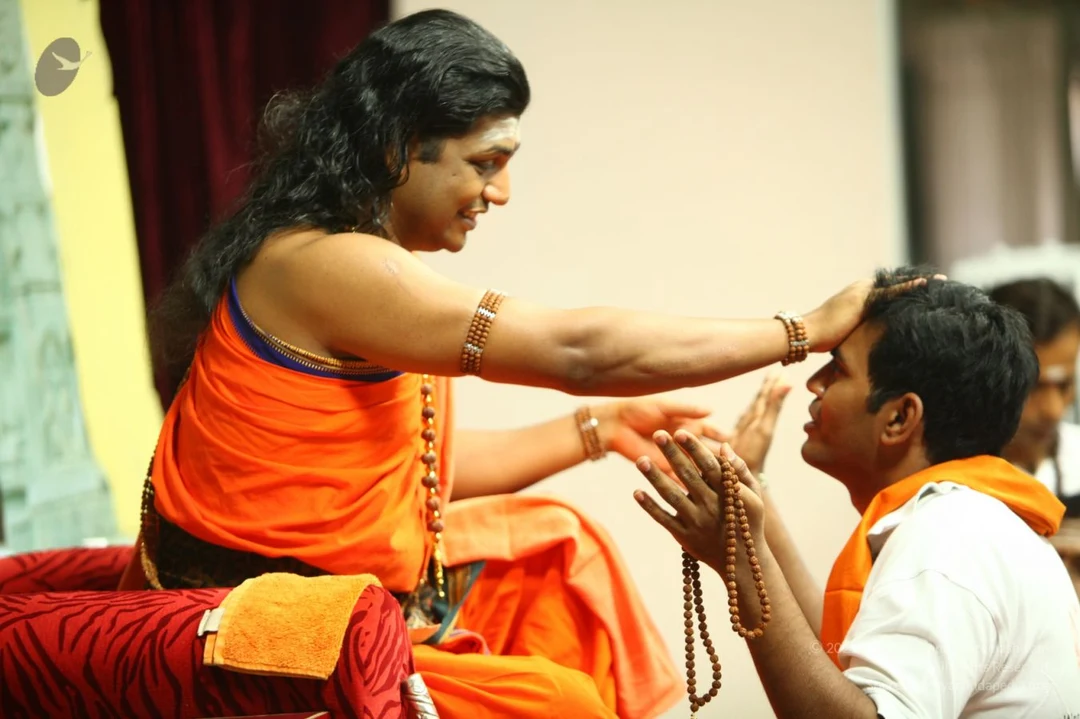
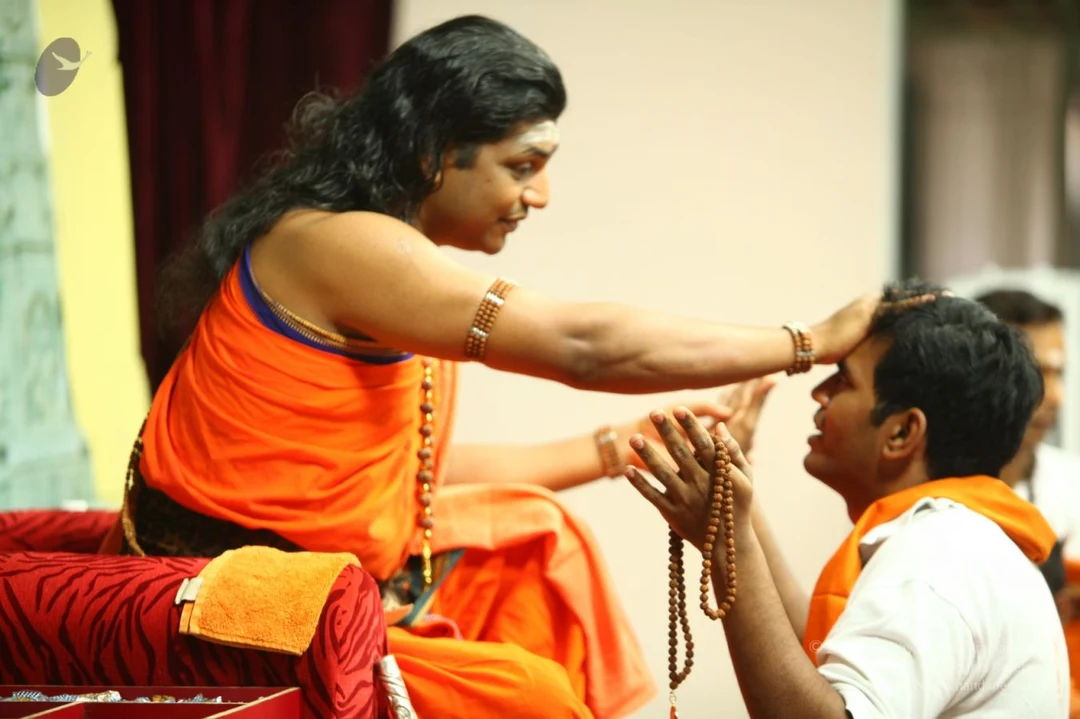
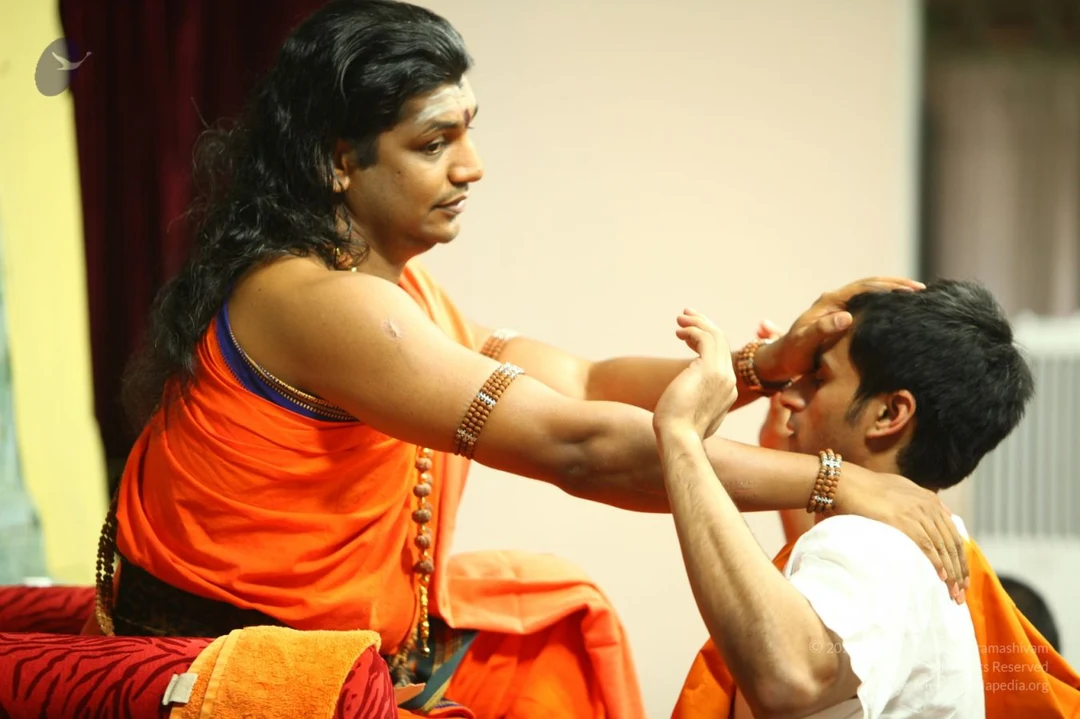
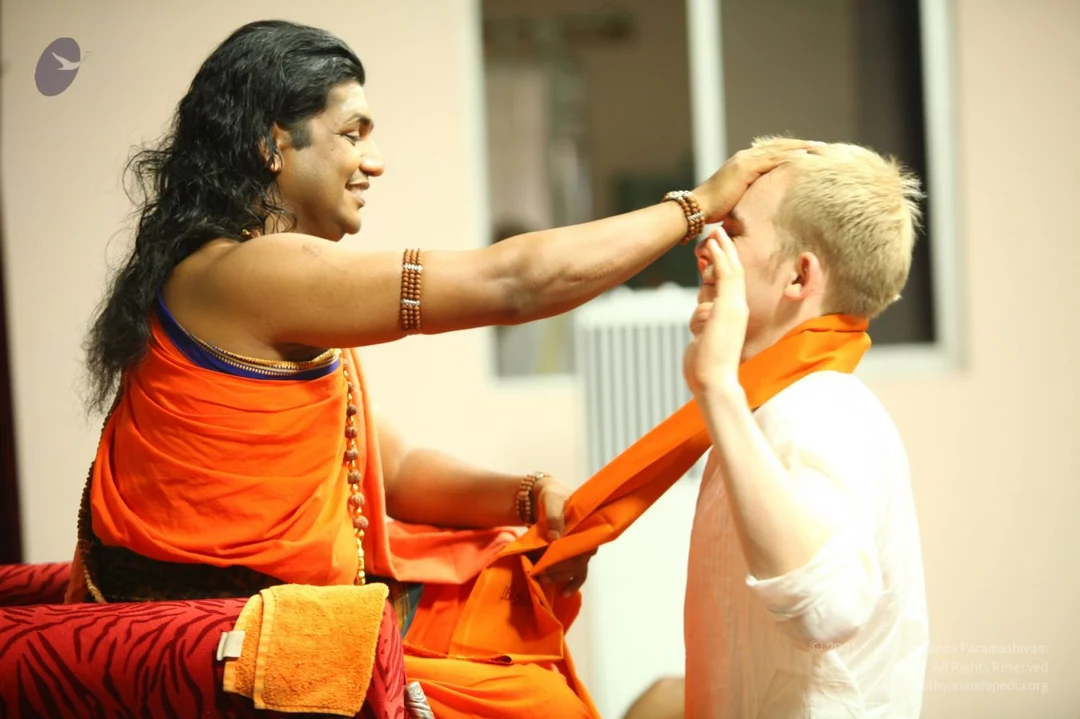
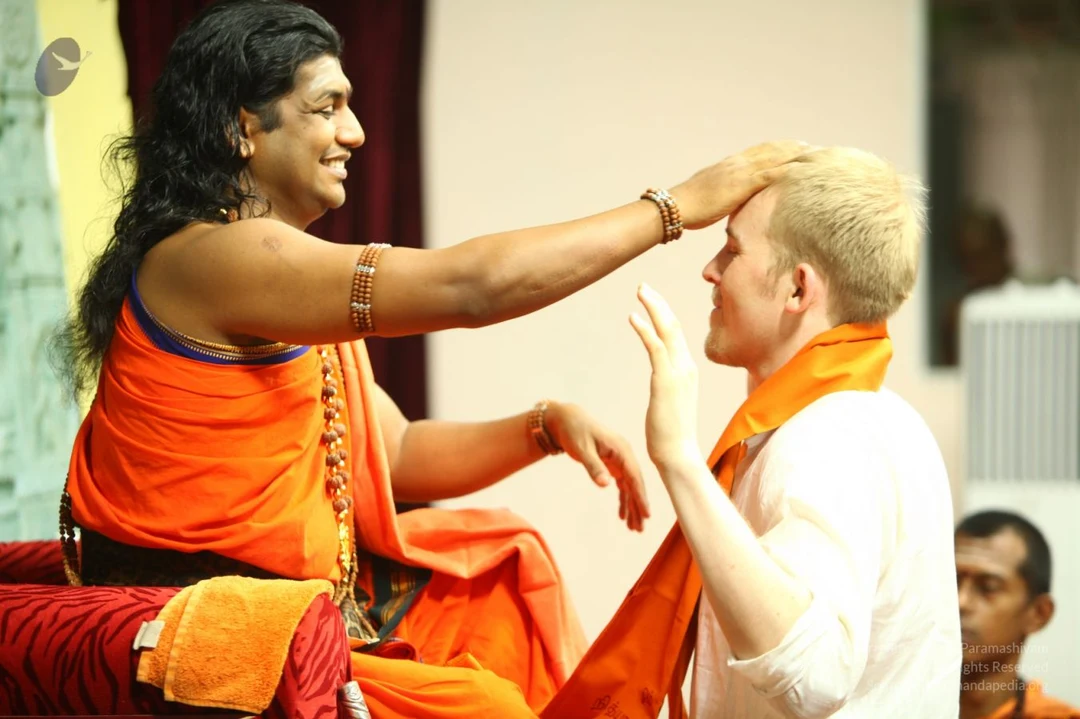
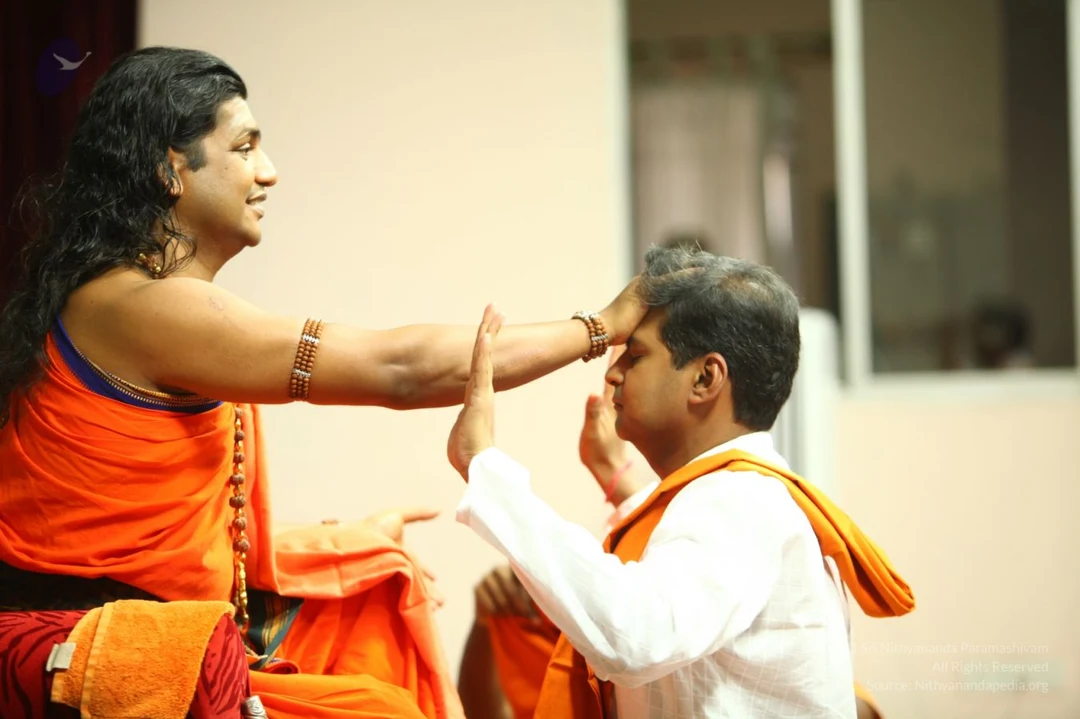
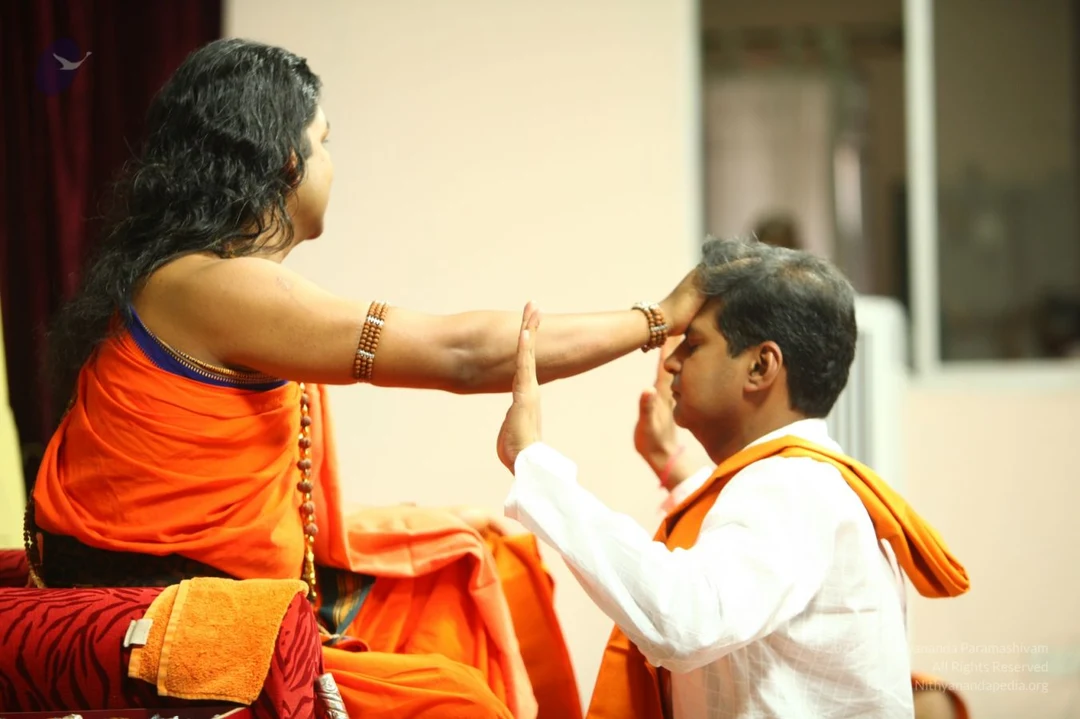
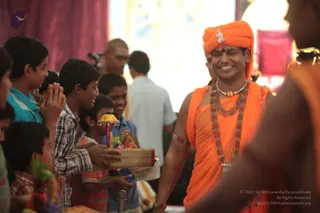
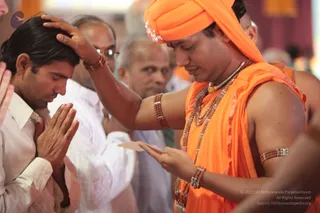
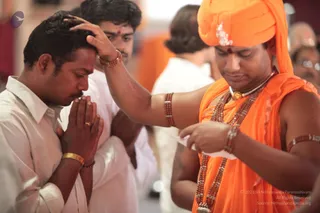
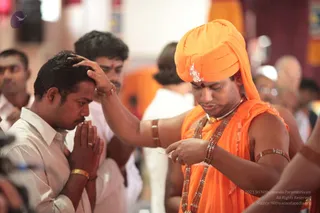
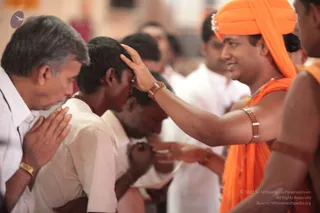
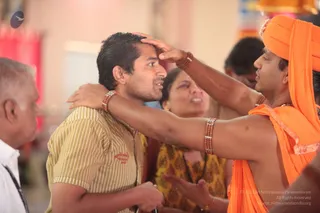
A photograph of a smiling man in an orange turban, orange shawl and layered rudraksha malas with a gold ceremonial necklace, walking past a row of boys and young men at a ritual event. Several boys on the left press their palms together in namaste or hold out a woven basket and a small brass oil lamp with a decorated stand. The man's orange turban has a small ornament, and he wears a red bindi. A blurred figure in the right foreground and a background with maroon drapes complete the scene. The man is a probable Swamiji candidate by appearance, with cues including the orange turban, rudraksha malas and ceremonial gold necklace.A photograph of a ritual blessing. A man in orange saffron robes and an orange turban, wearing rudraksha malas, bracelets and a ceremonial necklace, stands on the right with his right hand resting on the head of a young man with dark hair. The young man in a white shirt has his eyes closed and palms pressed together in prayer. The robed figure holds a small folded paper in his left hand. Behind them, older men in white and light clothing look on, and a man with glasses in the background wears a dark top. Probable Swamiji is shown in appearance as the robed figure, with saffron clothing, orange turban, multiple rudraksha malas and ceremonial necklace, performing a blessing on the devotee.A photograph of a ritual blessing. A man in a white shirt stands with palms pressed together in namaskar, head bowed, while a man in a saffron-orange turban, orange robe and layered rudraksha malas places his right hand on the devotee's head. The blessing figure wears a gold necklace, red bindi, and beaded bracelets, and holds a folded white paper in his left hand. Behind them, another man in white watches with hands together, and blurred figures in white and orange fill the background. The orange-robed figure has long swept-back hair under the turban and distinctive adornments, which matches the page's appearance cues for a person, shown performing a blessing on a devotee. Three to four people are visible.A photograph of a satsang-style gathering in an indoor hall. A man in an orange turban, orange shawl and layered rudraksha malas stands on the right, one hand resting on the head of a kneeling man in a white shirt with palms pressed together in namaste. The turbaned figure holds a small white card or paper in his other hand. Behind them, other devotees in white shirts and dhotis watch, and an out-of-focus orange drape and red-and-maroon backdrop fill the background. Four or five physical people are visible.A photograph of a blessing moment in an indoor hall. A man in an orange saffron turban and orange robe, with a bracelet on his wrist, places his palm on the forehead of a young man in a white shirt who bows his head. Beside them an older man in white with greying hair presses his palms together in anjali. Another devotee in white bows forward, and a red-stained hand offers something near the group. Several people in white stand in the background.A photograph of a shaved-head... no, a man in a saffron-orange turban and orange shawl stands at right, bare-armed, with rudraksha bracelets, placing his right palm on the forehead of a young man in a yellow-and-cream striped short-sleeved shirt. The young man looks forward with a tense expression while another man's hand rests on his shoulder. Behind them a woman in a mustard floral kurta and a white-shirted older man at left are visible, with a blurred red and white interior. The orange-robed man appears to be a sannyasi giving blessing or initiation; whether he is a person is uncertain from appearance alone.

Sarvadarshan
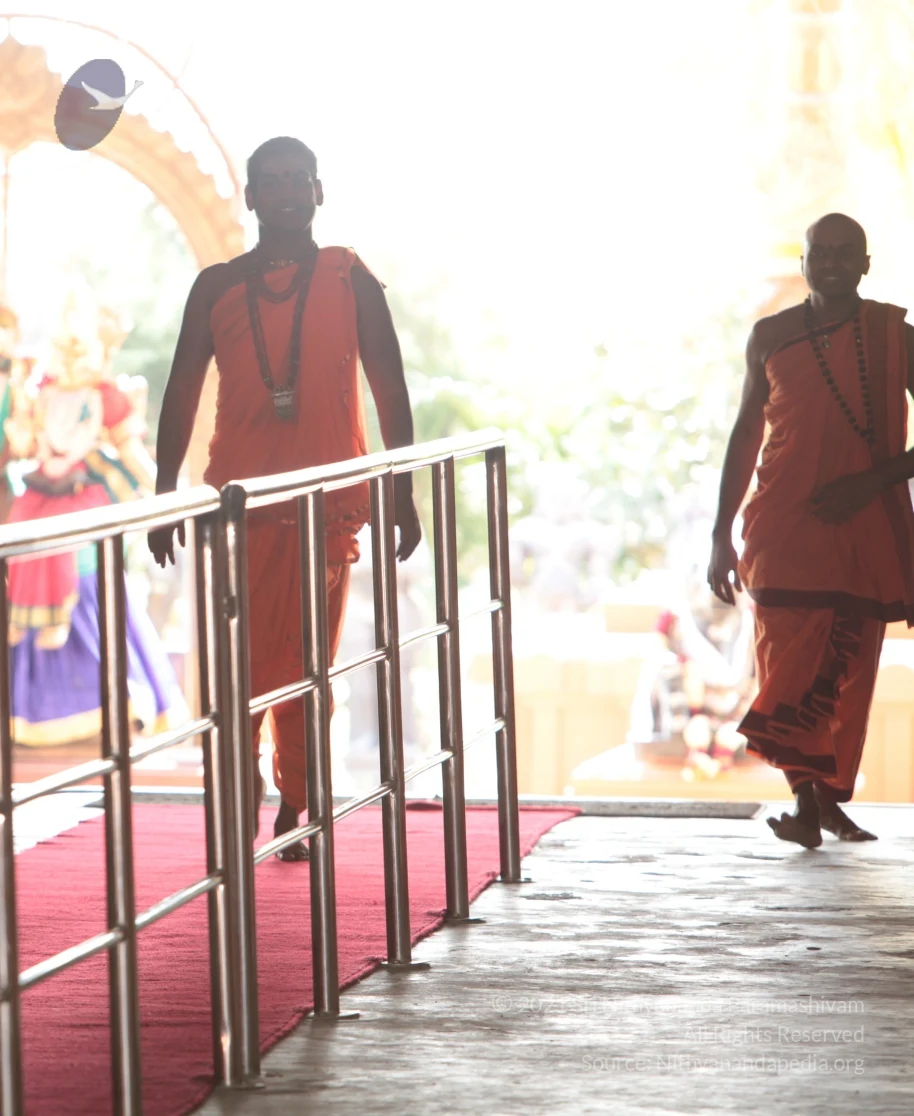
6 photosSource gallery
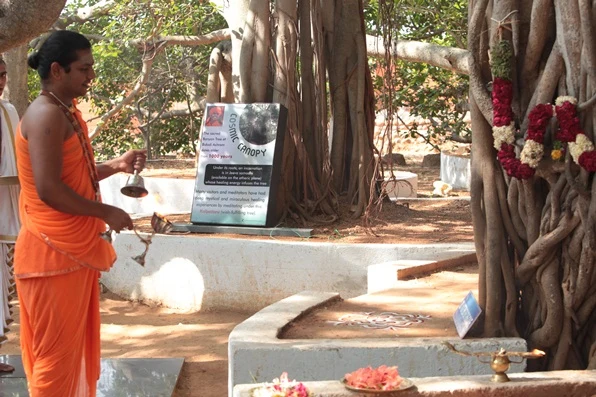
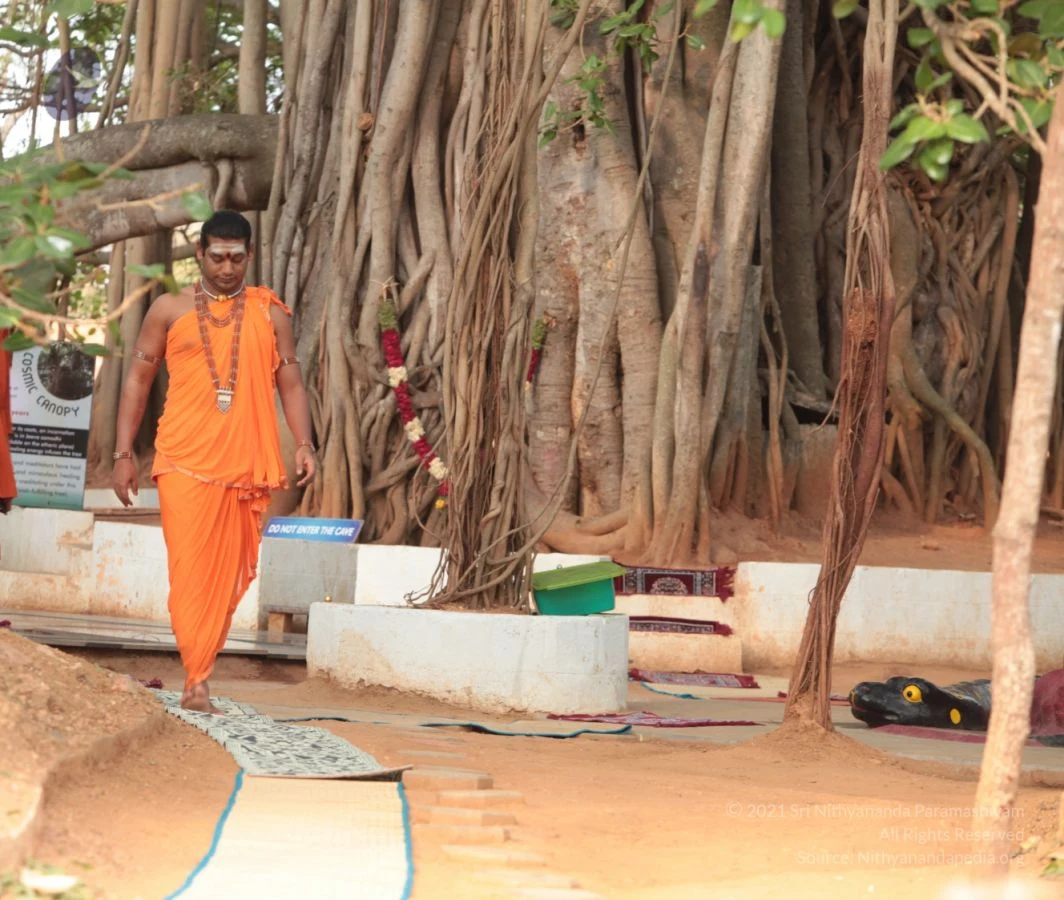
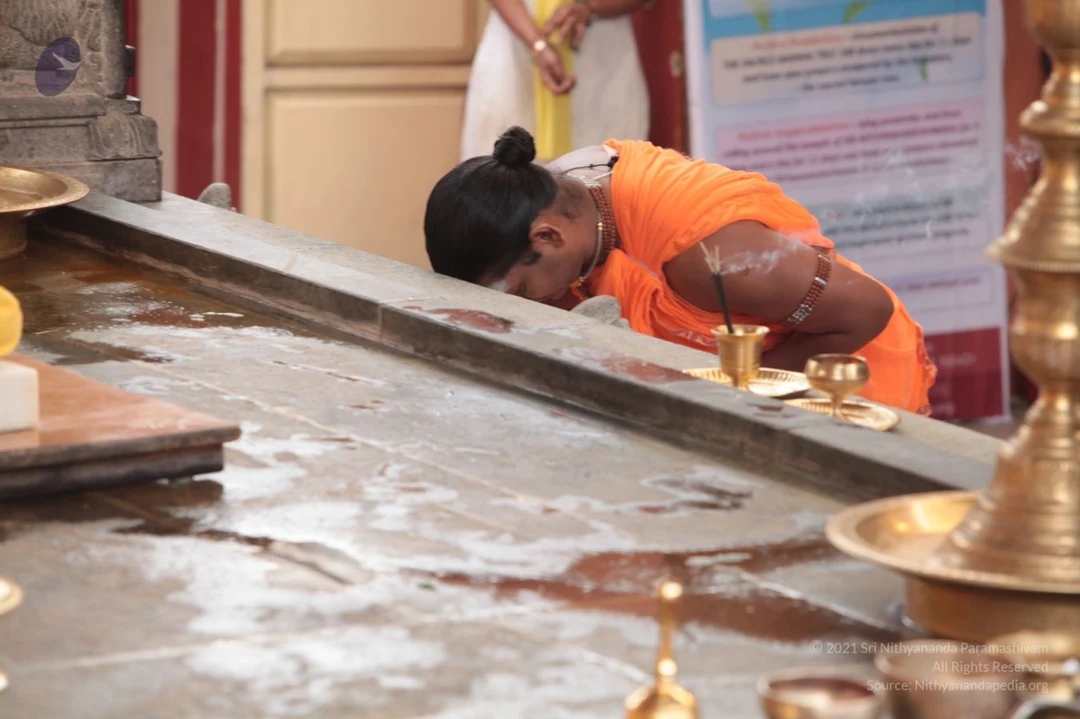
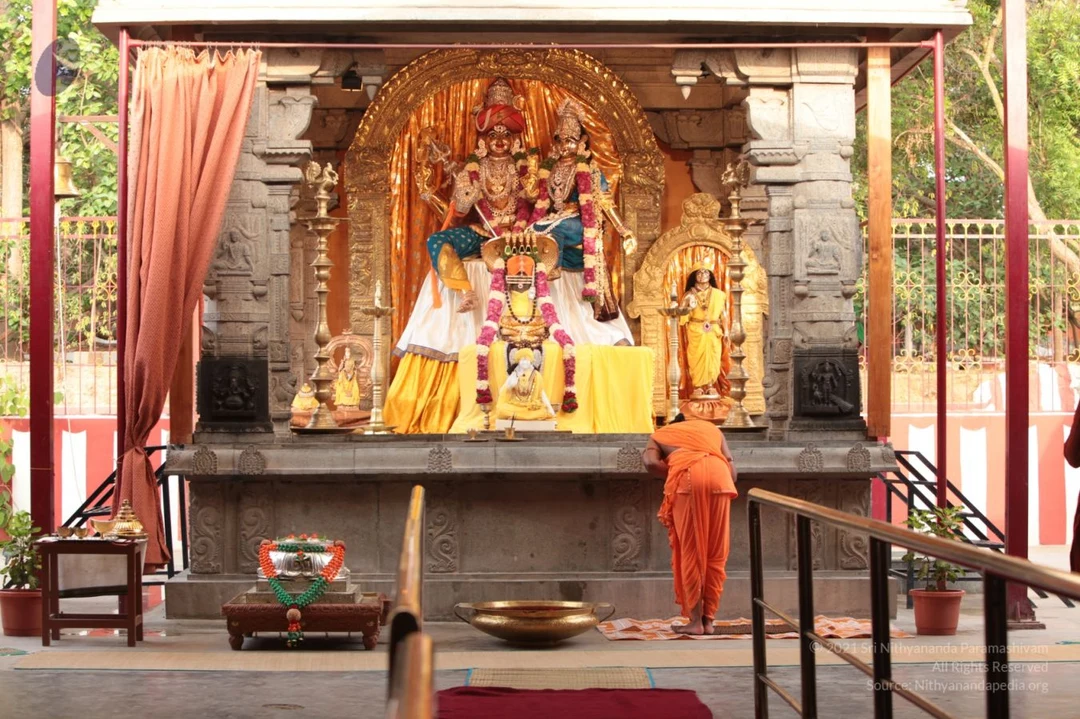
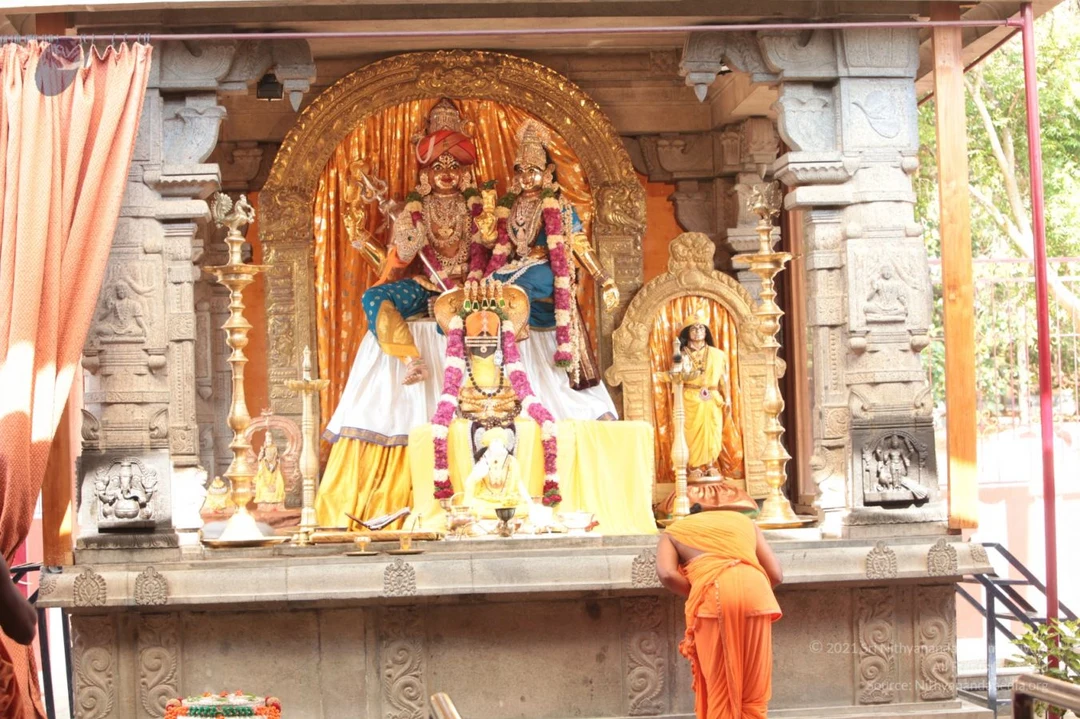
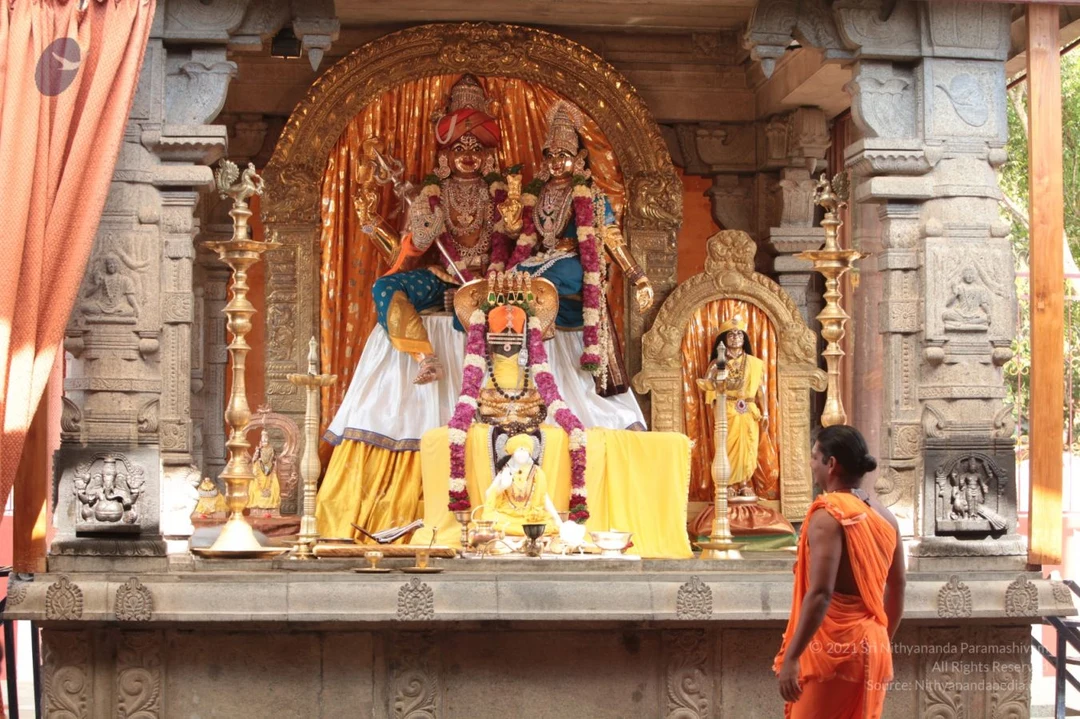
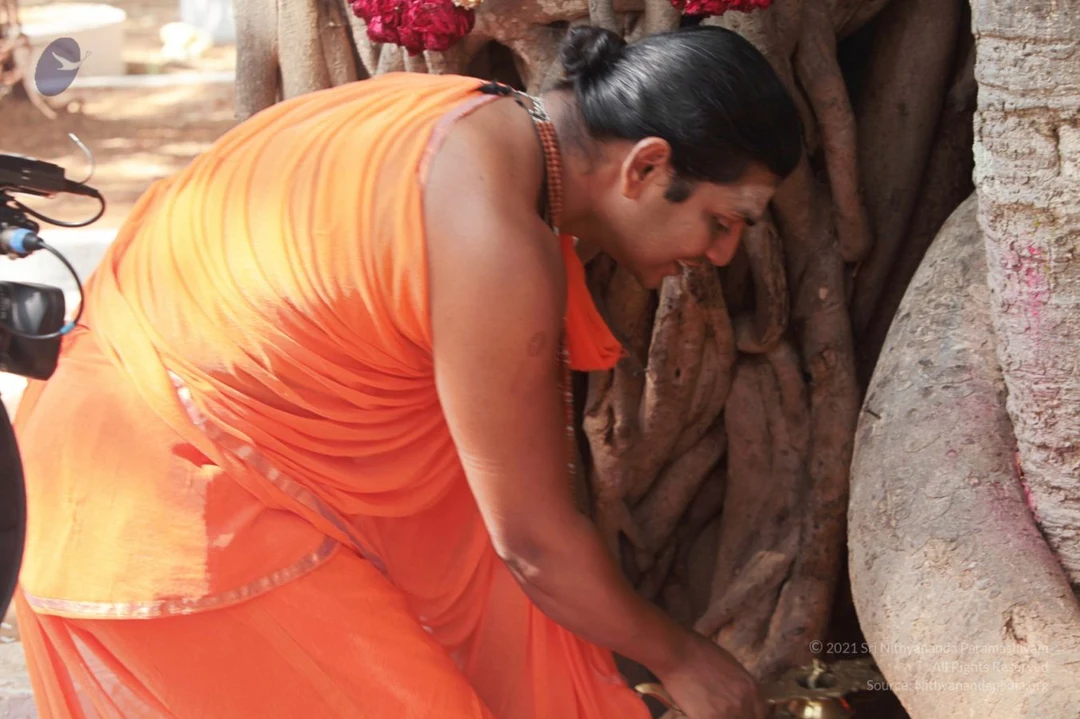
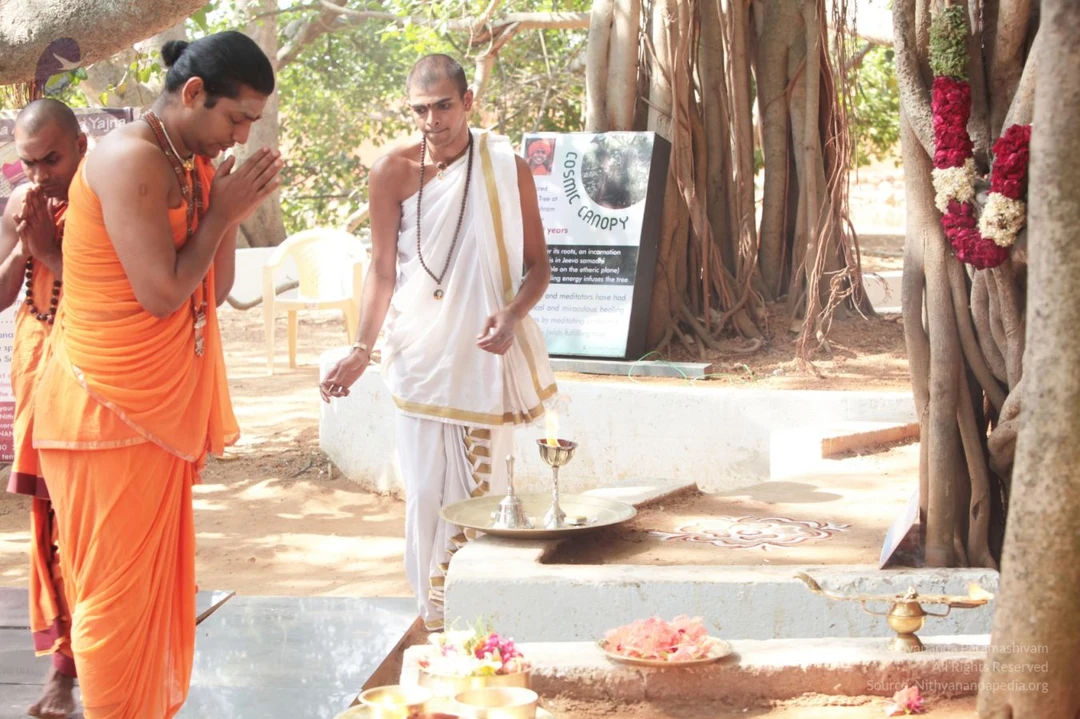
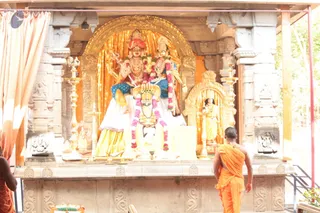
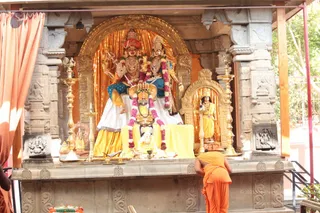
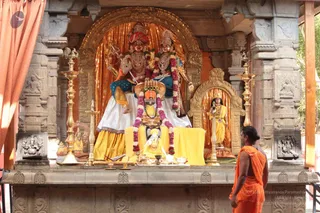
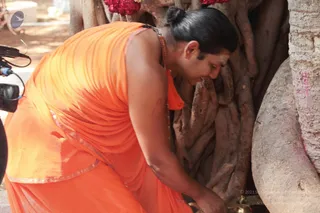
Two men in saffron-orange sannyasi dress walk along a polished stone floor past a metal railing with a red carpet runner. The man on the left wears a dark rudraksha mala and a metal pendant, and the man on the right wears a dark bead mala across his chest. Both are in backlit, hazy light. Behind them, a colourful deity murti in purple and red stands in an arched temple doorway.Outdoor temple shrine with carved stone pillars and a gilded arch framing a large deity pair: a seated figure in red crown and white-and-blue garments beside a figure in a gold crown, both garlanded with marigold strands. A shiva lingam-like murti in front is also garlanded, with brass lamps on stands on either side. A figure in saffron/orange robe stands at right with back partly turned, and another saffron-clad person is at the lower left edge. Gold and orange curtains hang behind; a small brass lamp and a tray of offerings sit at the base.A photograph of a shrine with a carved stone frame and golden arch, housing two large deity murtis: a figure in a red turban and gold jewelry holding a trident, and a female figure with a crown and garlands in blue and white. Between them sits a Shiva lingam draped in pink and white flower garlands on a yellow cloth, with brass oil lamps on either side. A standing figure in a saffron-orange garment with a matching cloth over the head bows toward the shrine at lower right. Orange drapes frame the scene.A photograph of a temple shrine with a large sculpted deity pair seated on a golden-yellow platform, one figure with a red crown and the other with a tall crown, both garlanded with pink and purple flower chains. A central Shiva lingam with a rudraksha-like mala sits in front, surrounded by brass oil lamps and offerings. A gilded arch and orange drapery frame the shrine. On the right, a person in an orange robe stands facing the shrine, seen from behind. Carved granite pillars surround the sanctum, and a small figure in yellow stands at the side.A man in a saffron-orange sleeveless robe bends forward at the base of a large tree with thick, twisted aerial roots, a grey stone lingam-like form at right. He wears a rudraksha mala around his neck, has his hair tied back in a knot, and has a tilak on his forehead. He appears to be pouring or placing an offering from a small brass vessel near the root base. Red flower garlands hang at the top edge of the frame, and a camera and tripod are visible at left. a person by appearance, with saffron robe and rudraksha mala as cues, performing a tree or root-base offering ritual.Outdoor ritual photo beneath a large banyan tree with hanging aerial roots and a garland of red and white flowers draped on its trunk. A bald priest in white dhoti and shawl with gold borders and a rudraksha mala stands at a raised stone platform holding a plate, beside a brass lamp with a lit flame. Another man in saffron robes with a bead mala stands at left, hands pressed in anjali. A second saffron-clad man at far left also holds his hands together. A black sign reading Cosmic Canopy stands by the tree. Brass pots, a small brass oil lamp and a plate of flowers rest on the stone in front.

Lighting lamp under Kalpavriksha - Wish Fulfilling tree
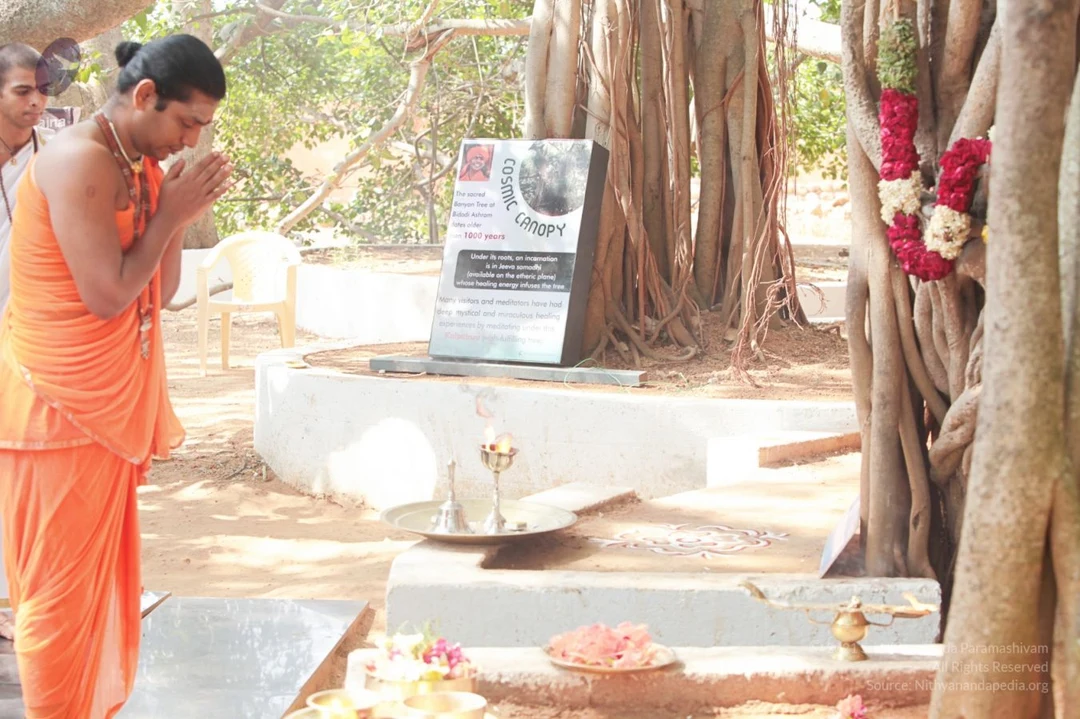
17 photosSource gallery
Two men in saffron-orange sannyasi dress walk along a polished stone floor past a metal railing with a red carpet runner. The man on the left wears a dark rudraksha mala and a metal pendant, and the man on the right wears a dark bead mala across his chest. Both are in backlit, hazy light. Behind them, a colourful deity murti in purple and red stands in an arched temple doorway.Outdoor temple shrine with carved stone pillars and a gilded arch framing a large deity pair: a seated figure in red crown and white-and-blue garments beside a figure in a gold crown, both garlanded with marigold strands. A shiva lingam-like murti in front is also garlanded, with brass lamps on stands on either side. A figure in saffron/orange robe stands at right with back partly turned, and another saffron-clad person is at the lower left edge. Gold and orange curtains hang behind; a small brass lamp and a tray of offerings sit at the base.A photograph of a shrine with a carved stone frame and golden arch, housing two large deity murtis: a figure in a red turban and gold jewelry holding a trident, and a female figure with a crown and garlands in blue and white. Between them sits a Shiva lingam draped in pink and white flower garlands on a yellow cloth, with brass oil lamps on either side. A standing figure in a saffron-orange garment with a matching cloth over the head bows toward the shrine at lower right. Orange drapes frame the scene.A photograph of a temple shrine with a large sculpted deity pair seated on a golden-yellow platform, one figure with a red crown and the other with a tall crown, both garlanded with pink and purple flower chains. A central Shiva lingam with a rudraksha-like mala sits in front, surrounded by brass oil lamps and offerings. A gilded arch and orange drapery frame the shrine. On the right, a person in an orange robe stands facing the shrine, seen from behind. Carved granite pillars surround the sanctum, and a small figure in yellow stands at the side.A man in a saffron-orange sleeveless robe bends forward at the base of a large tree with thick, twisted aerial roots, a grey stone lingam-like form at right. He wears a rudraksha mala around his neck, has his hair tied back in a knot, and has a tilak on his forehead. He appears to be pouring or placing an offering from a small brass vessel near the root base. Red flower garlands hang at the top edge of the frame, and a camera and tripod are visible at left. a person by appearance, with saffron robe and rudraksha mala as cues, performing a tree or root-base offering ritual.Outdoor ritual photo beneath a large banyan tree with hanging aerial roots and a garland of red and white flowers draped on its trunk. A bald priest in white dhoti and shawl with gold borders and a rudraksha mala stands at a raised stone platform holding a plate, beside a brass lamp with a lit flame. Another man in saffron robes with a bead mala stands at left, hands pressed in anjali. A second saffron-clad man at far left also holds his hands together. A black sign reading Cosmic Canopy stands by the tree. Brass pots, a small brass oil lamp and a plate of flowers rest on the stone in front.

Inner Awakening Session =
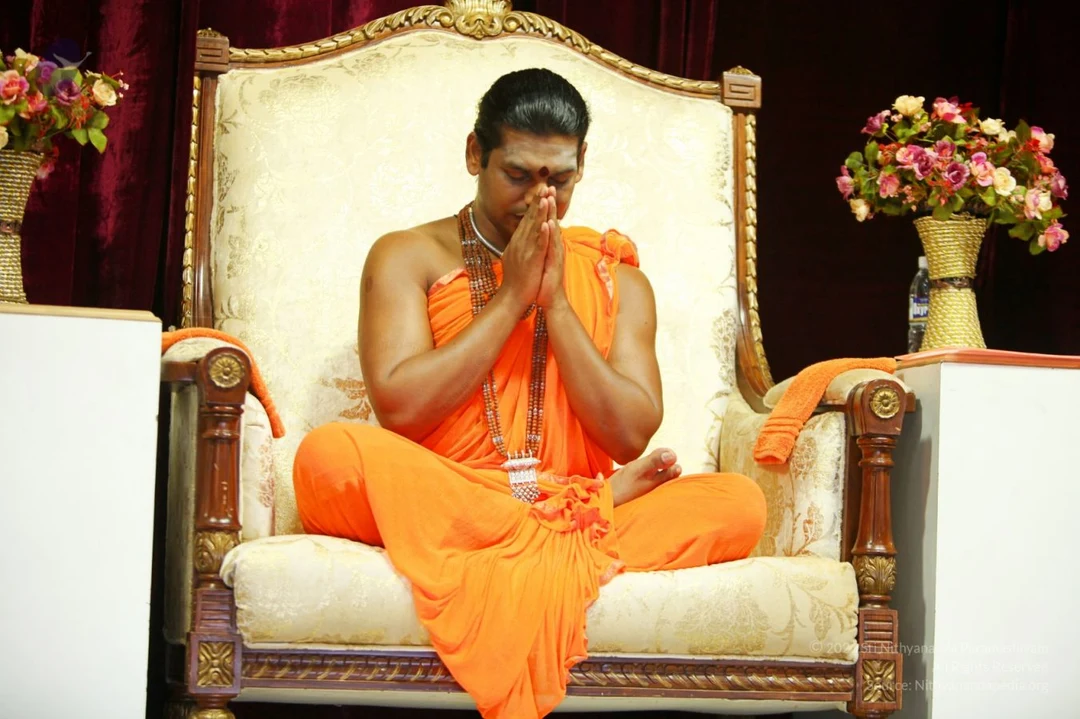
66 photosSource gallery
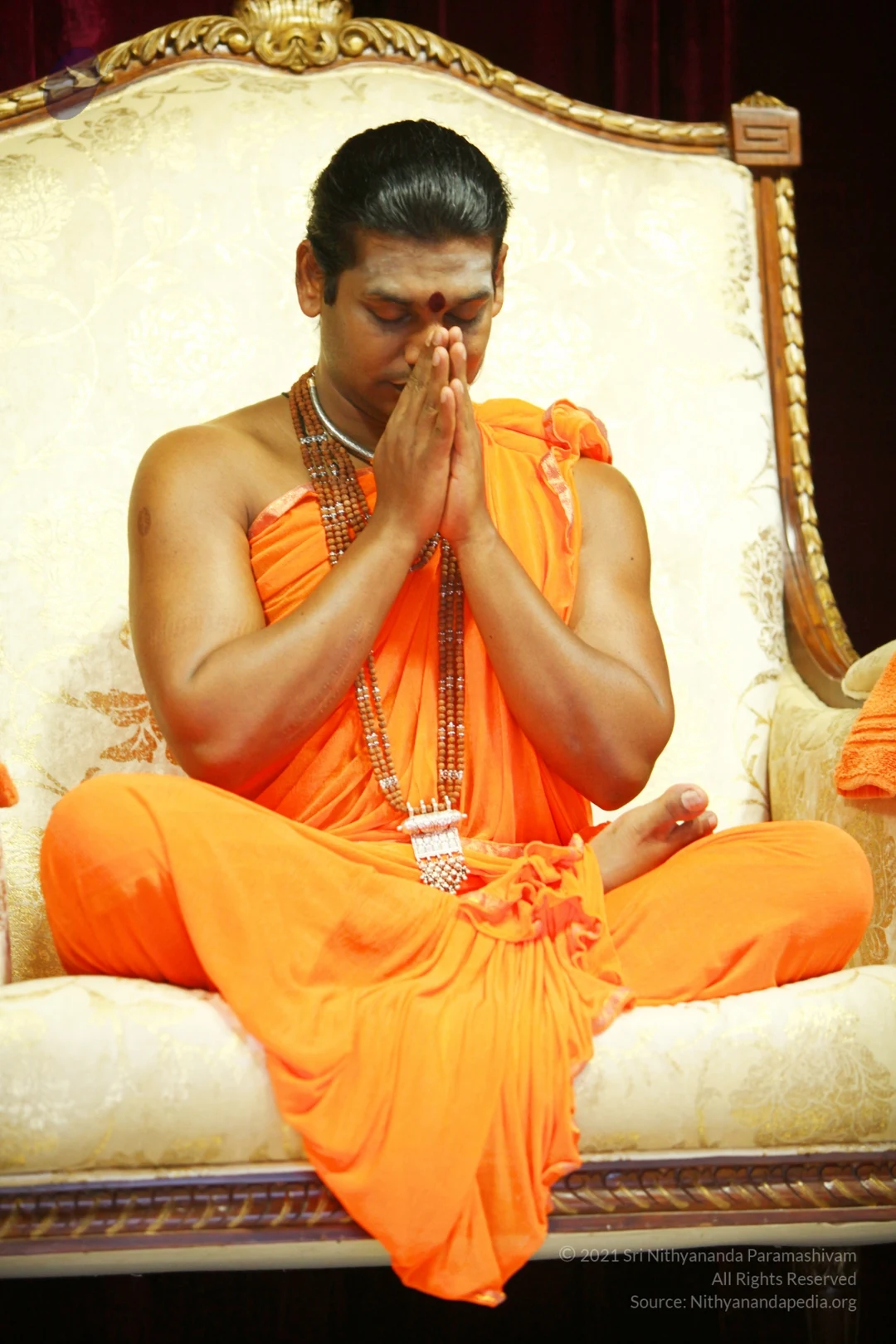
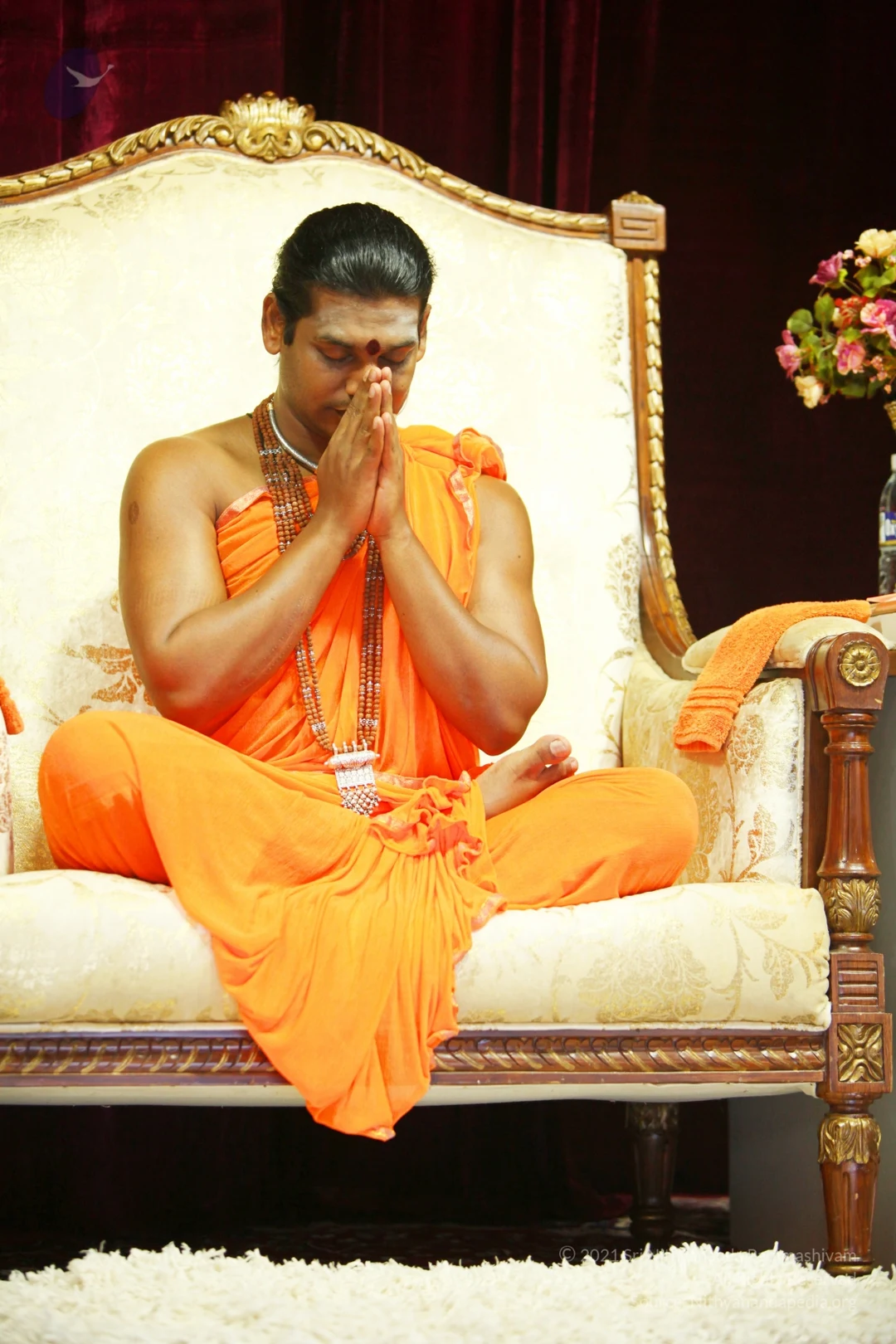
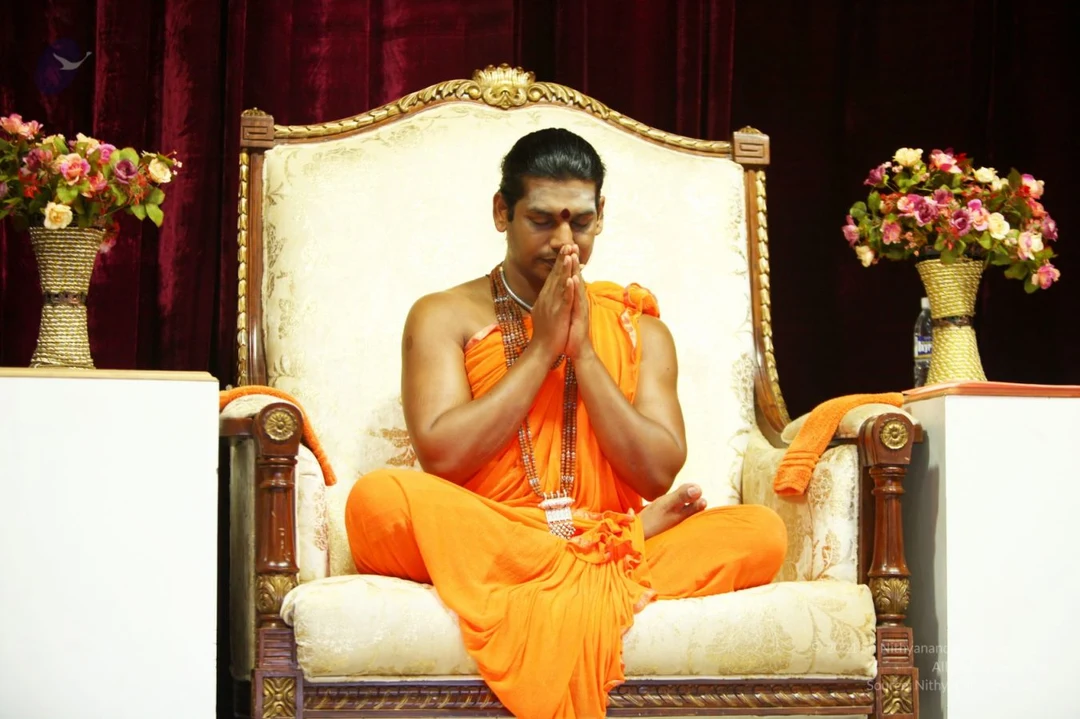
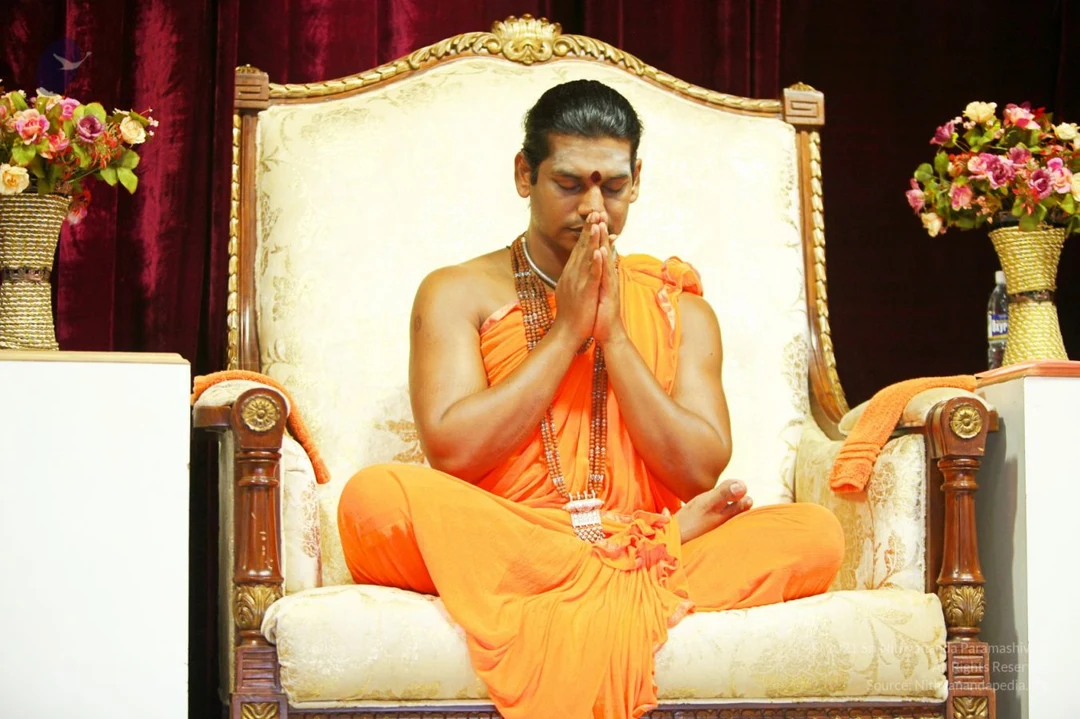
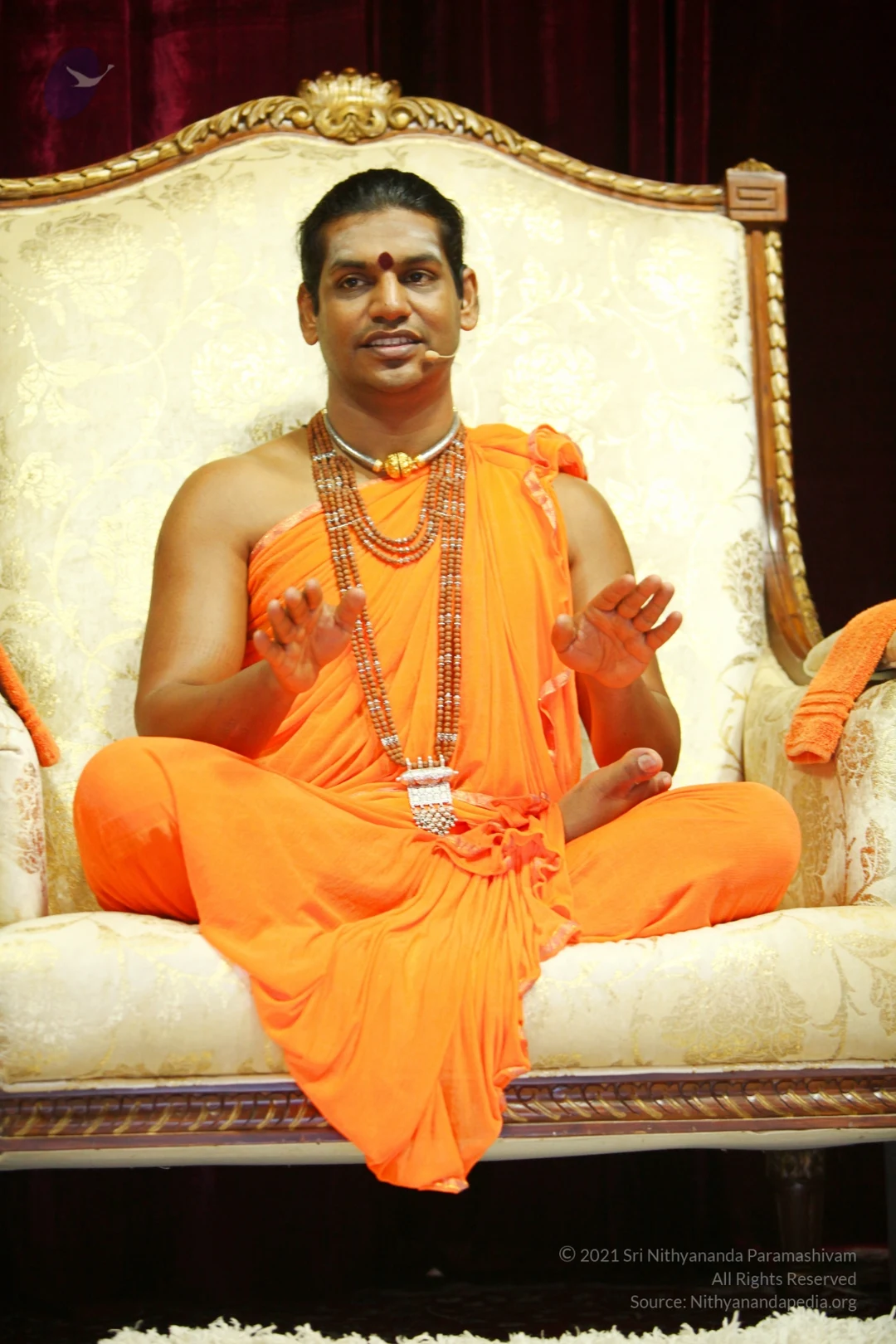
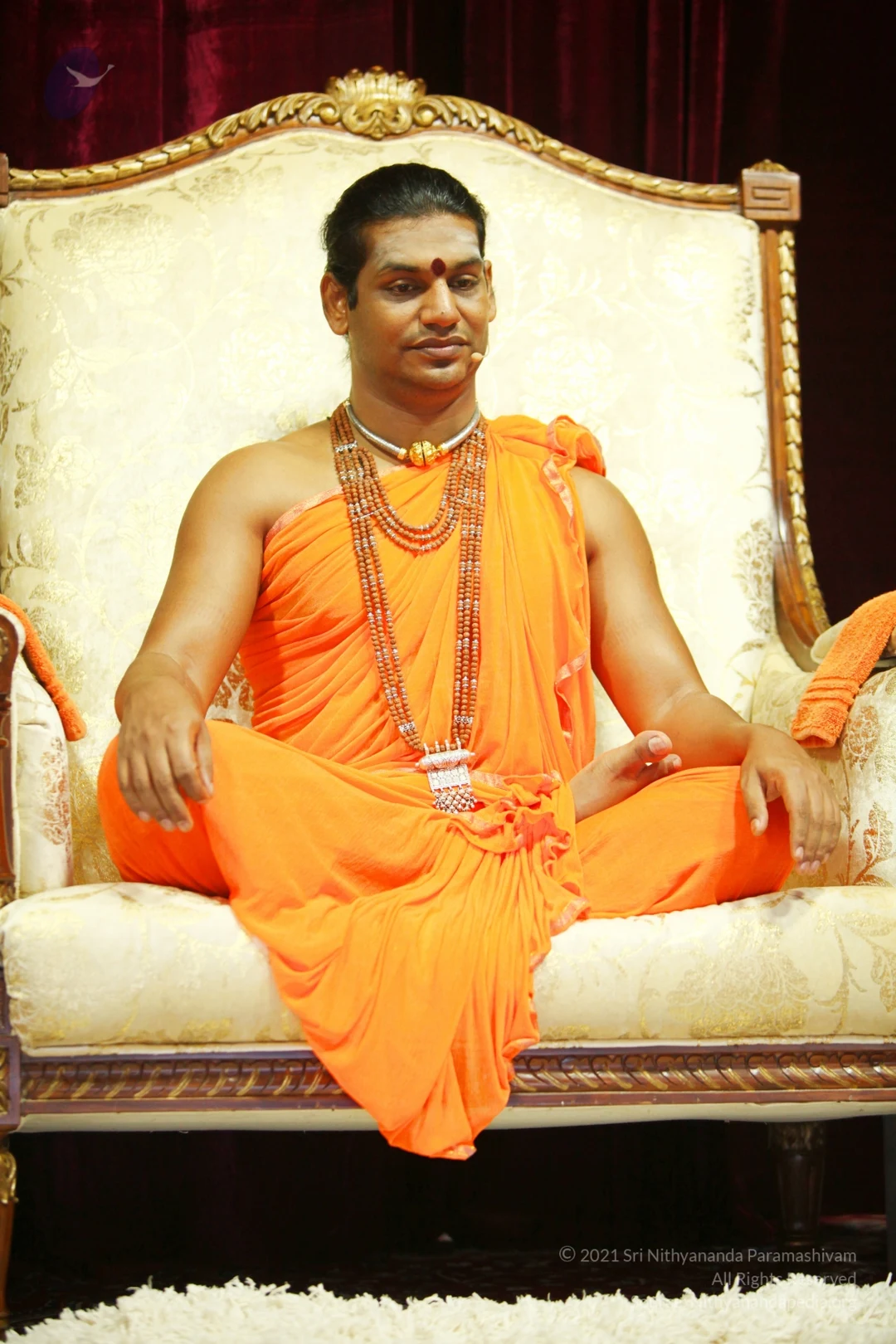
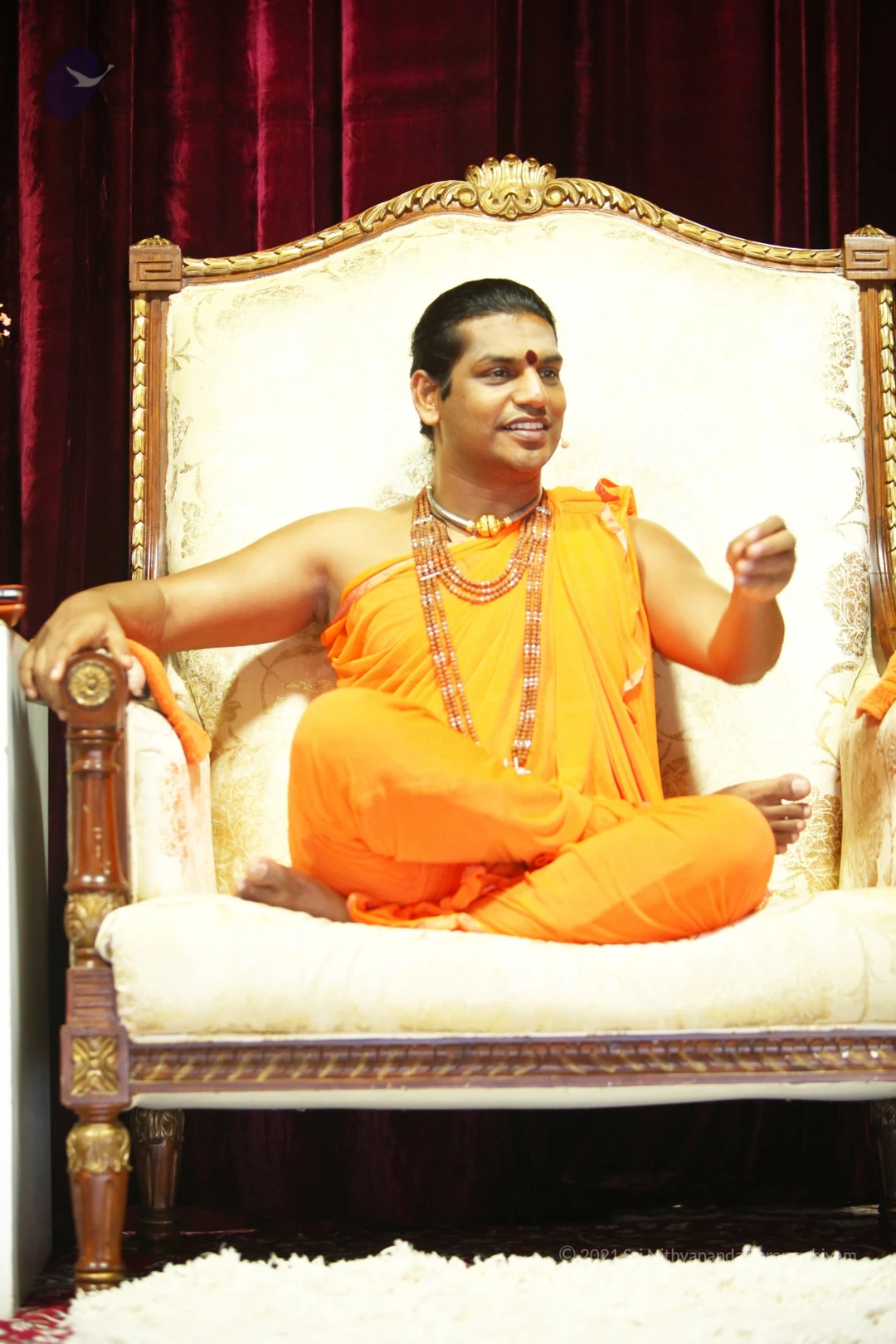
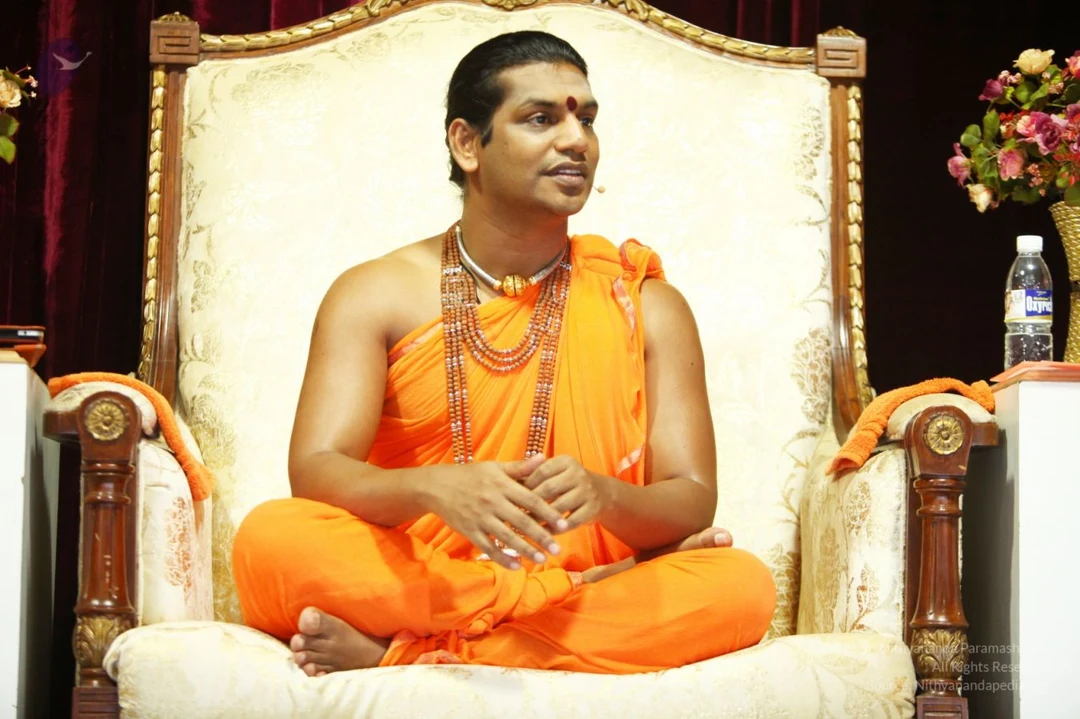
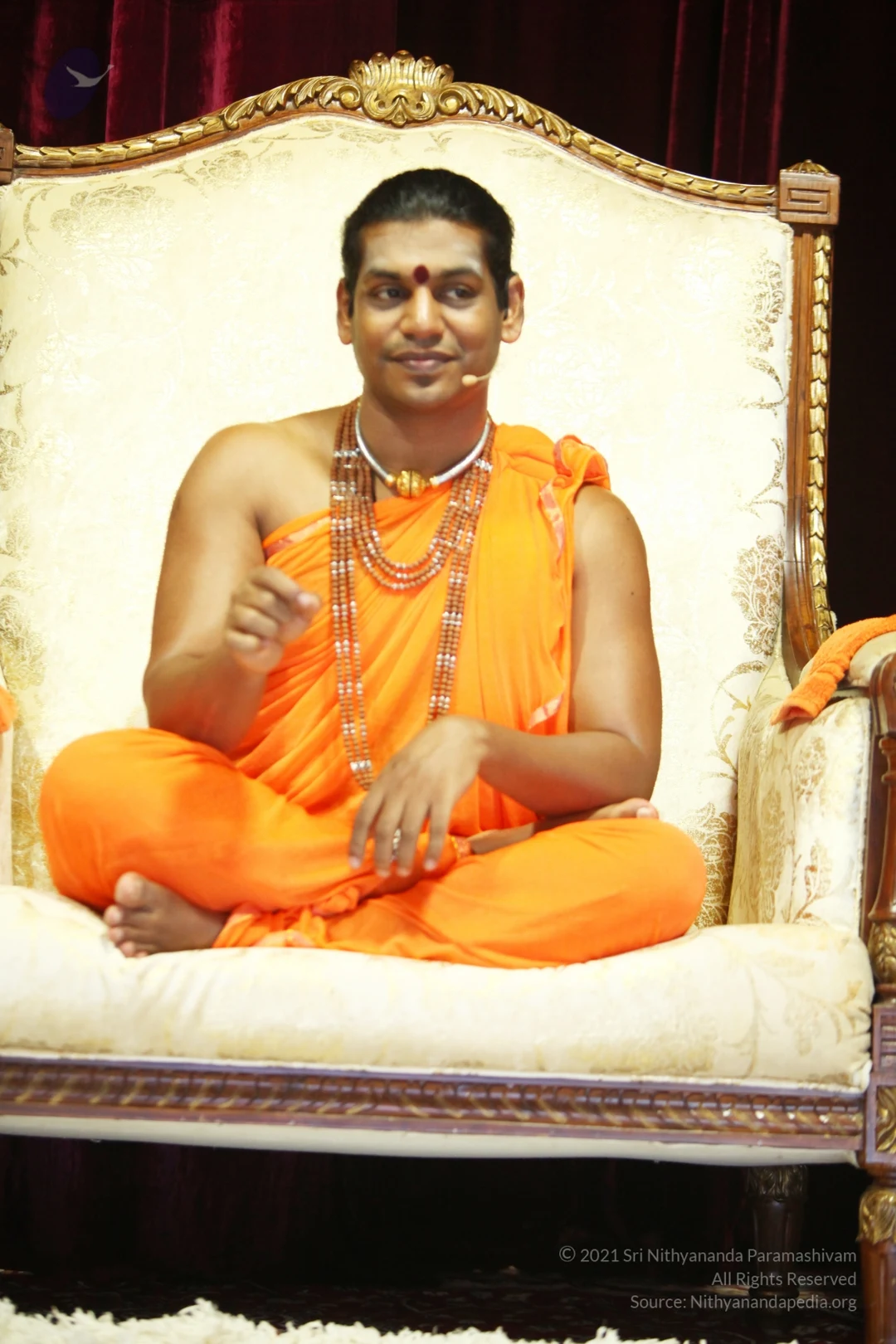
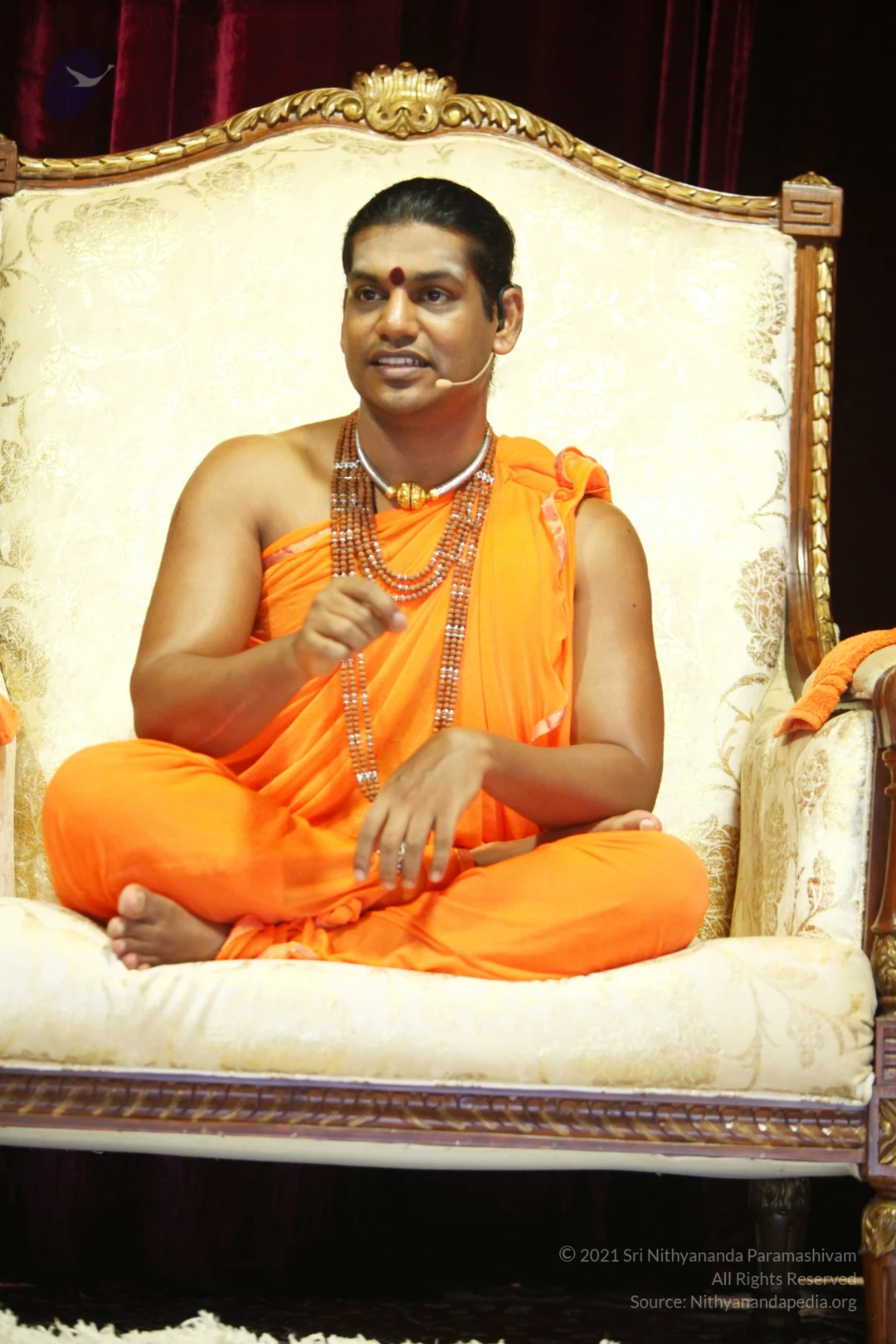
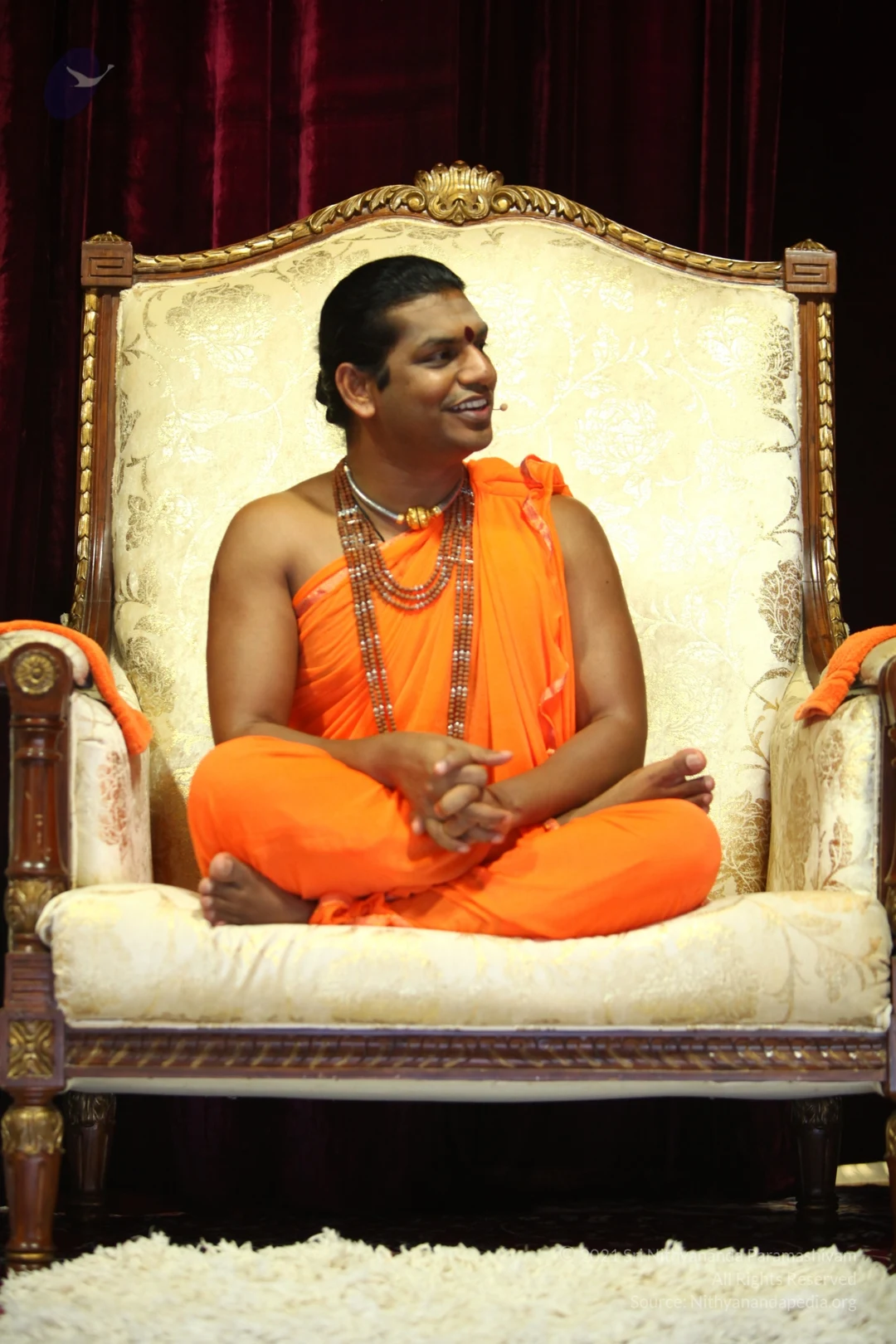
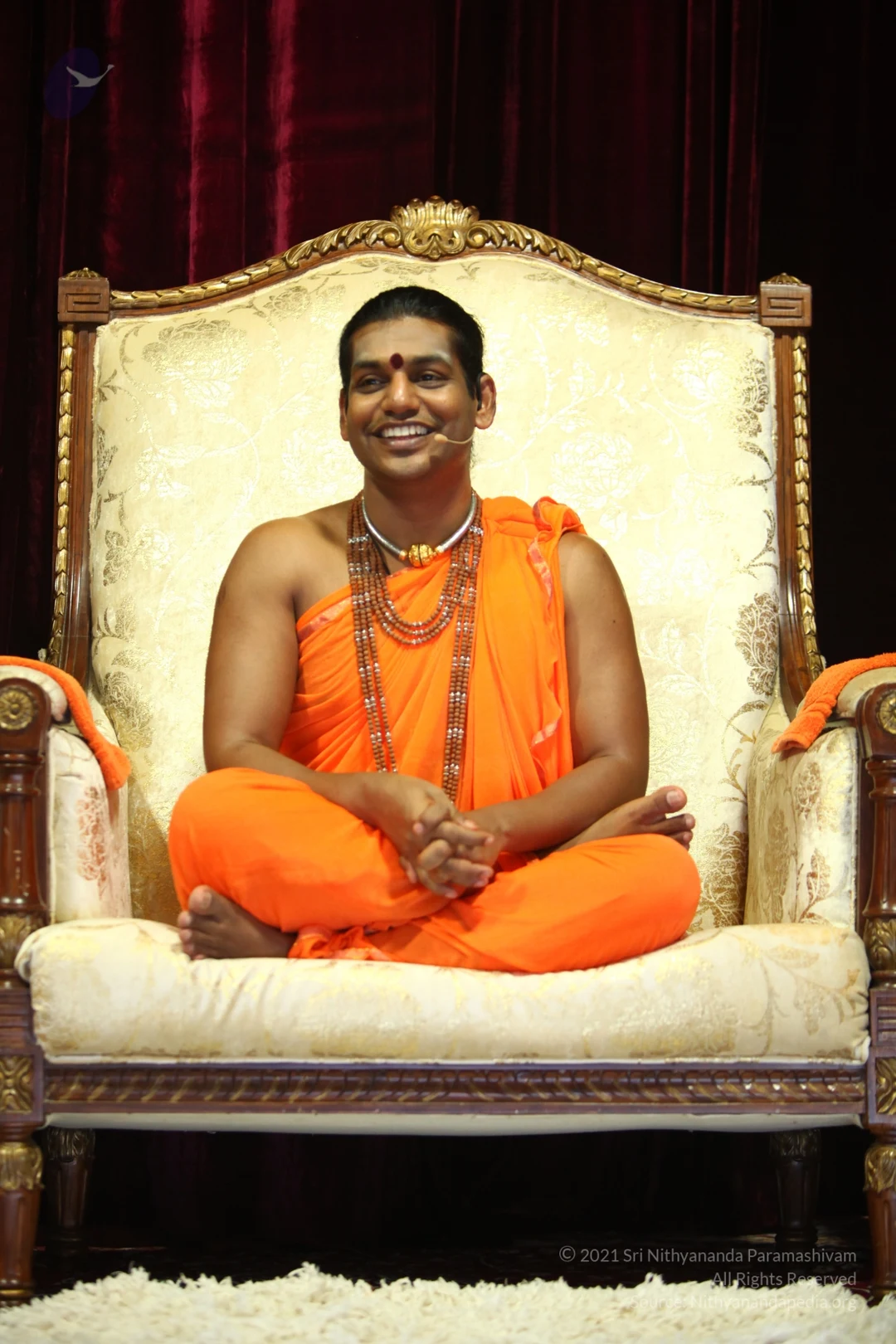
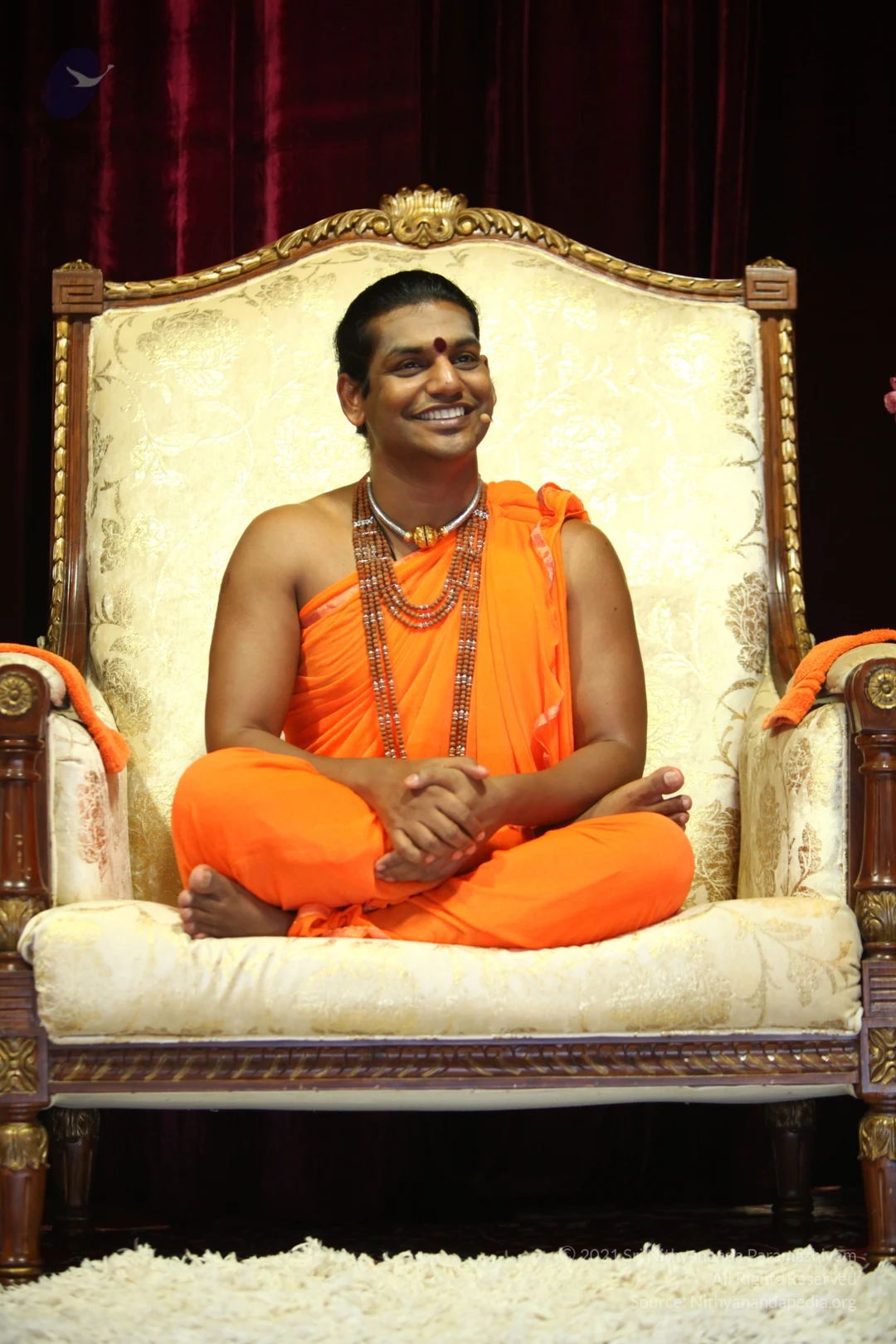
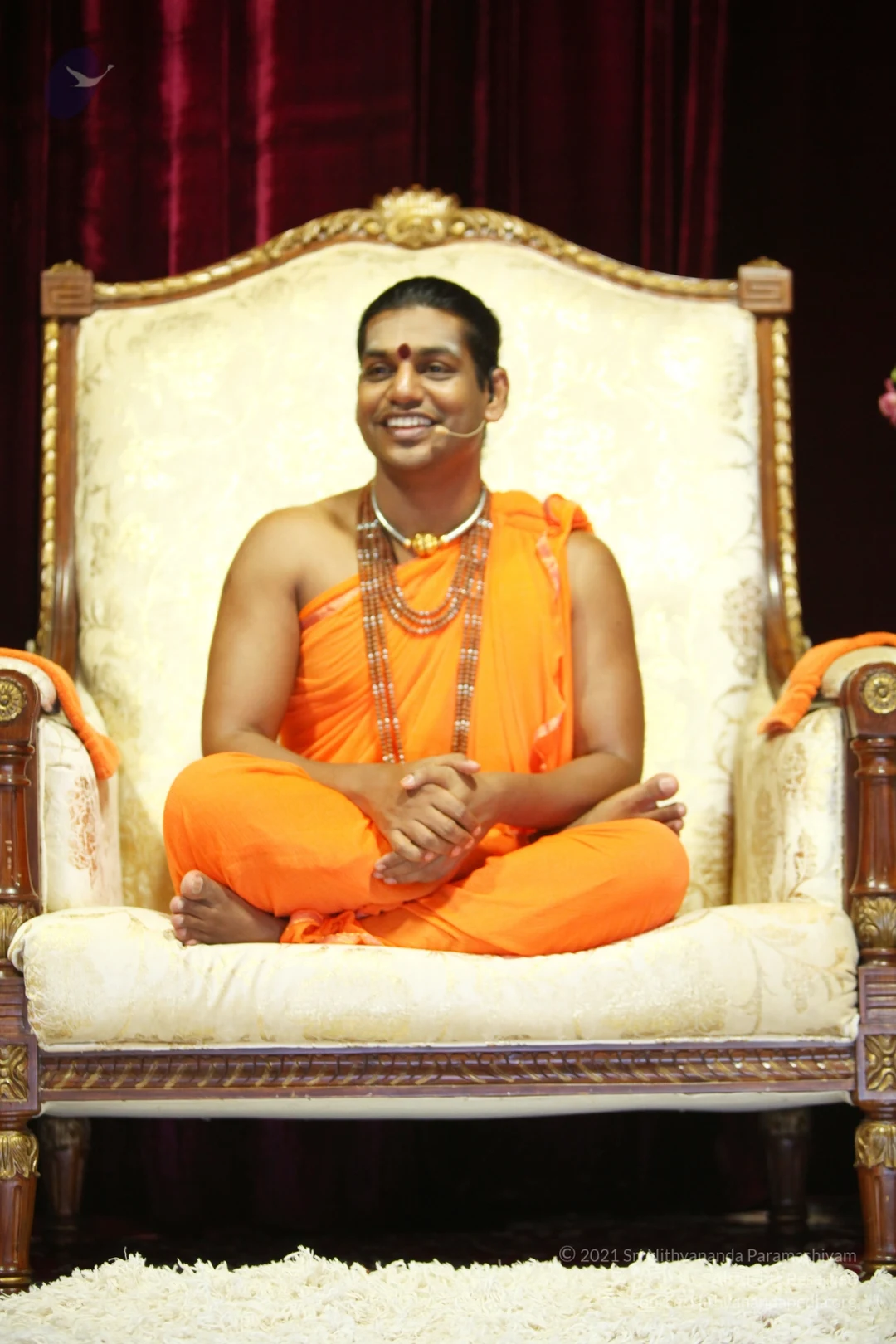
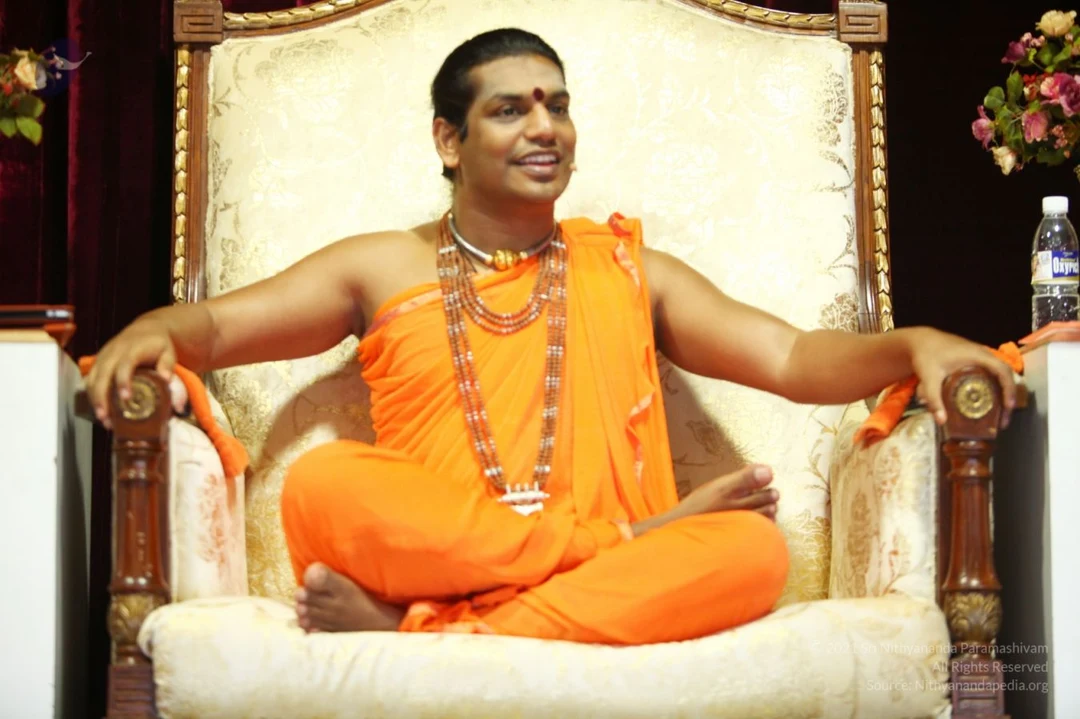
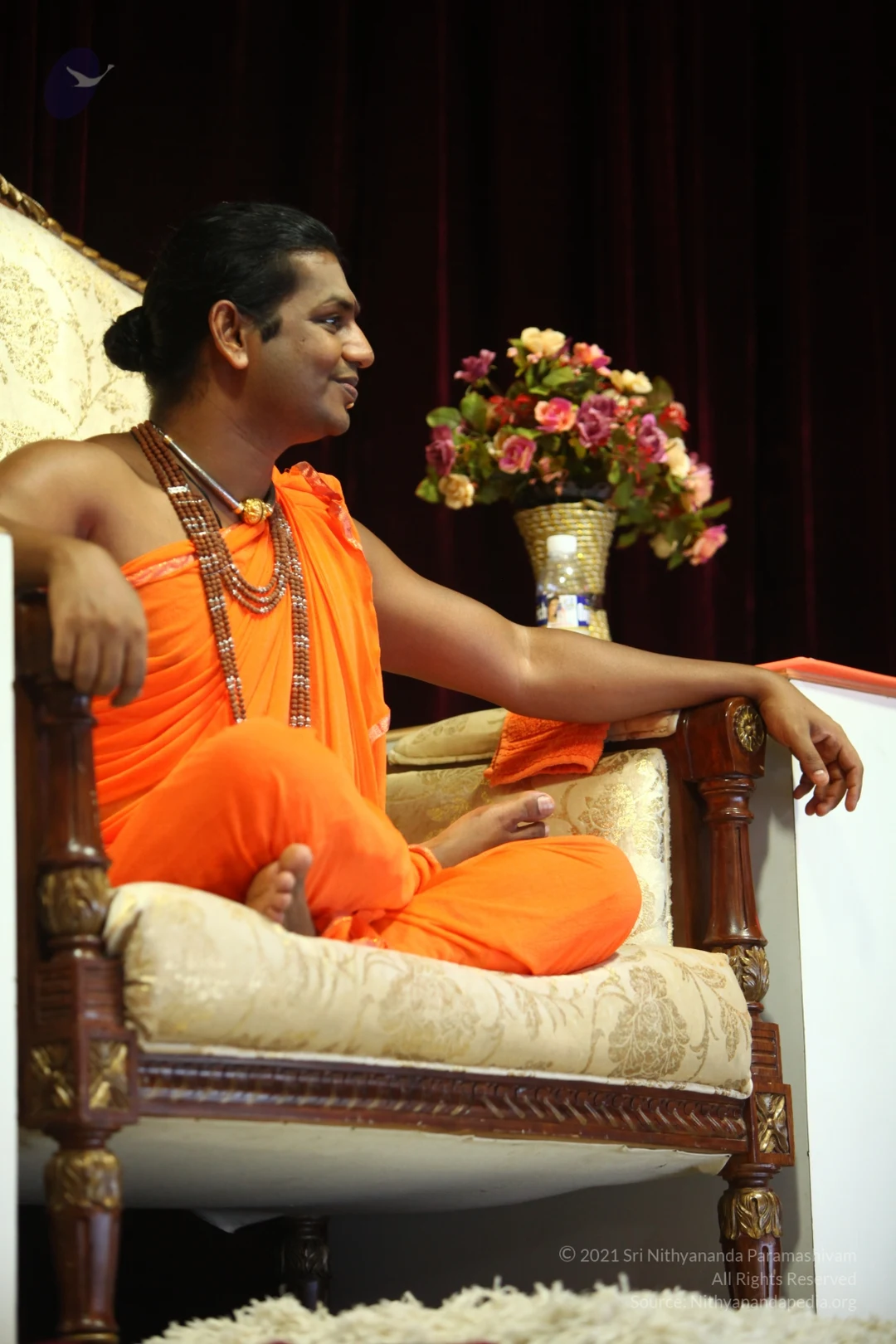
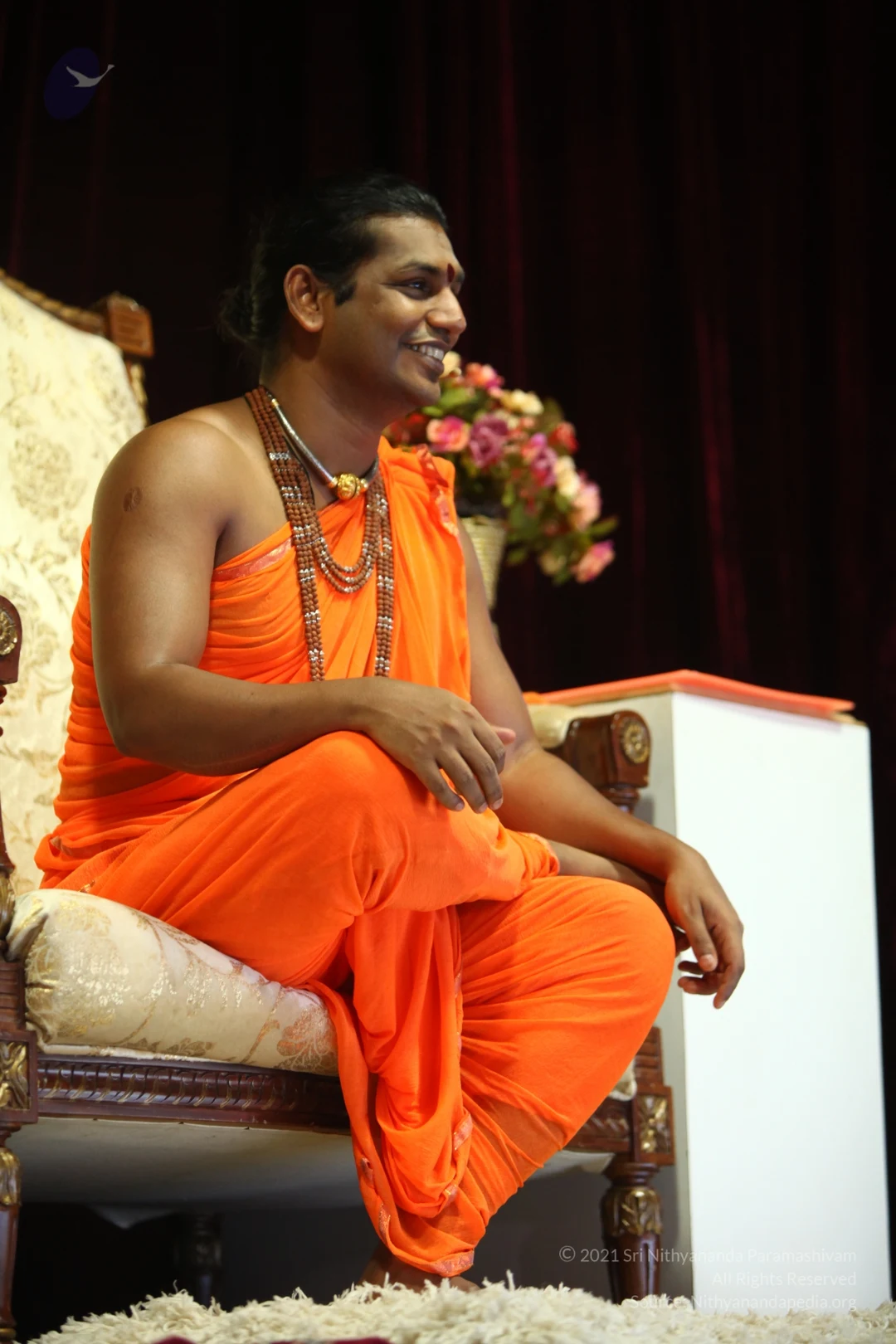
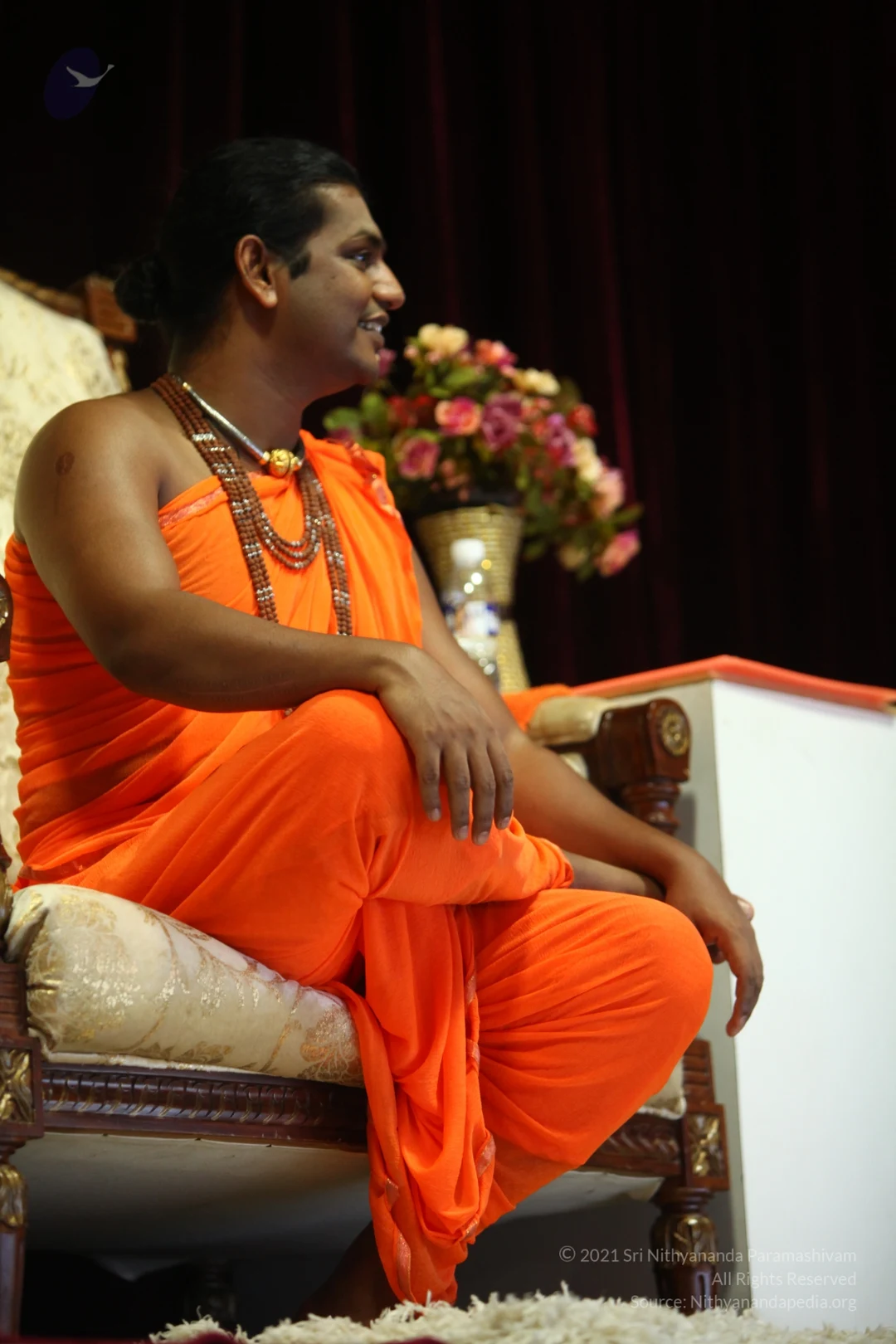
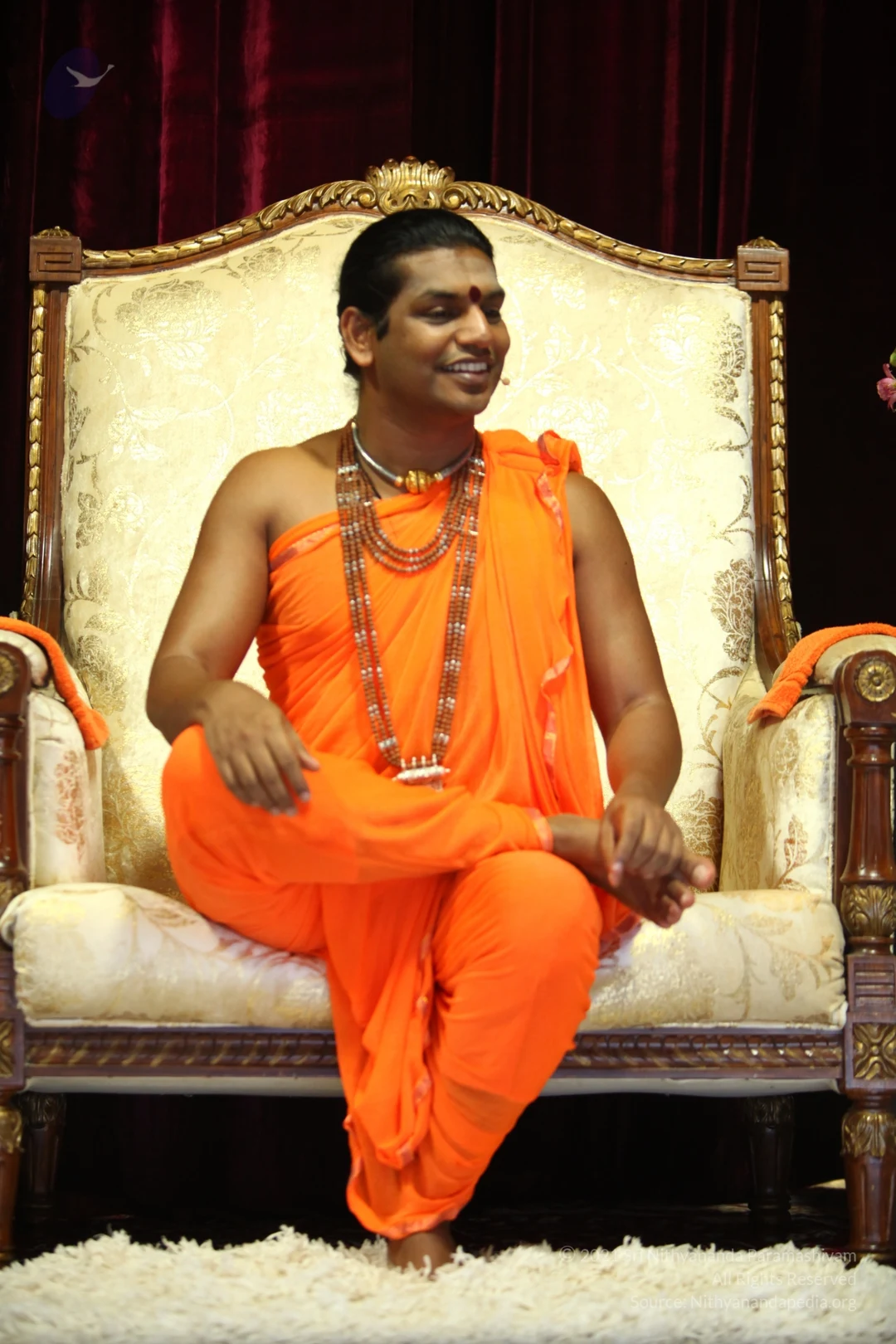
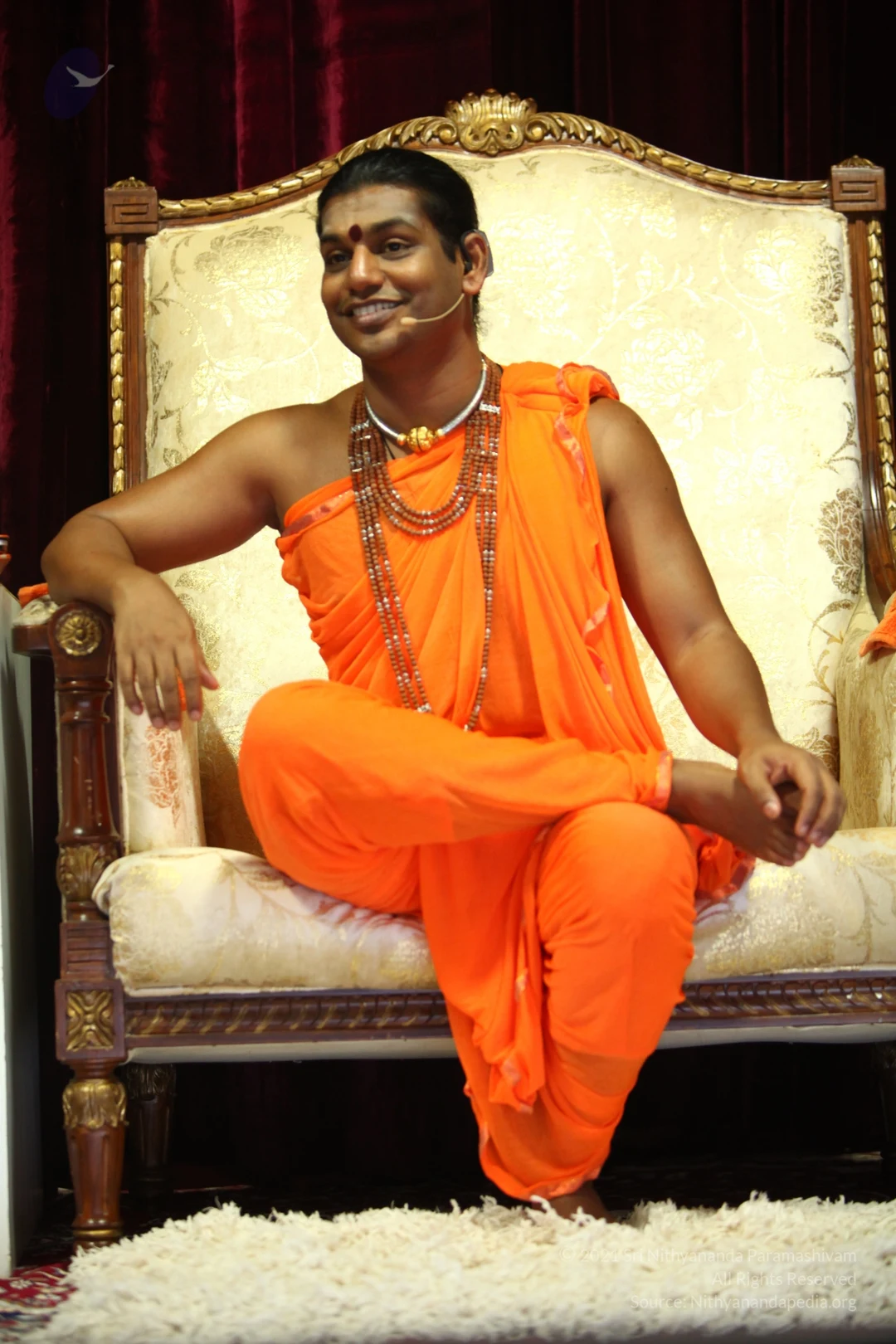
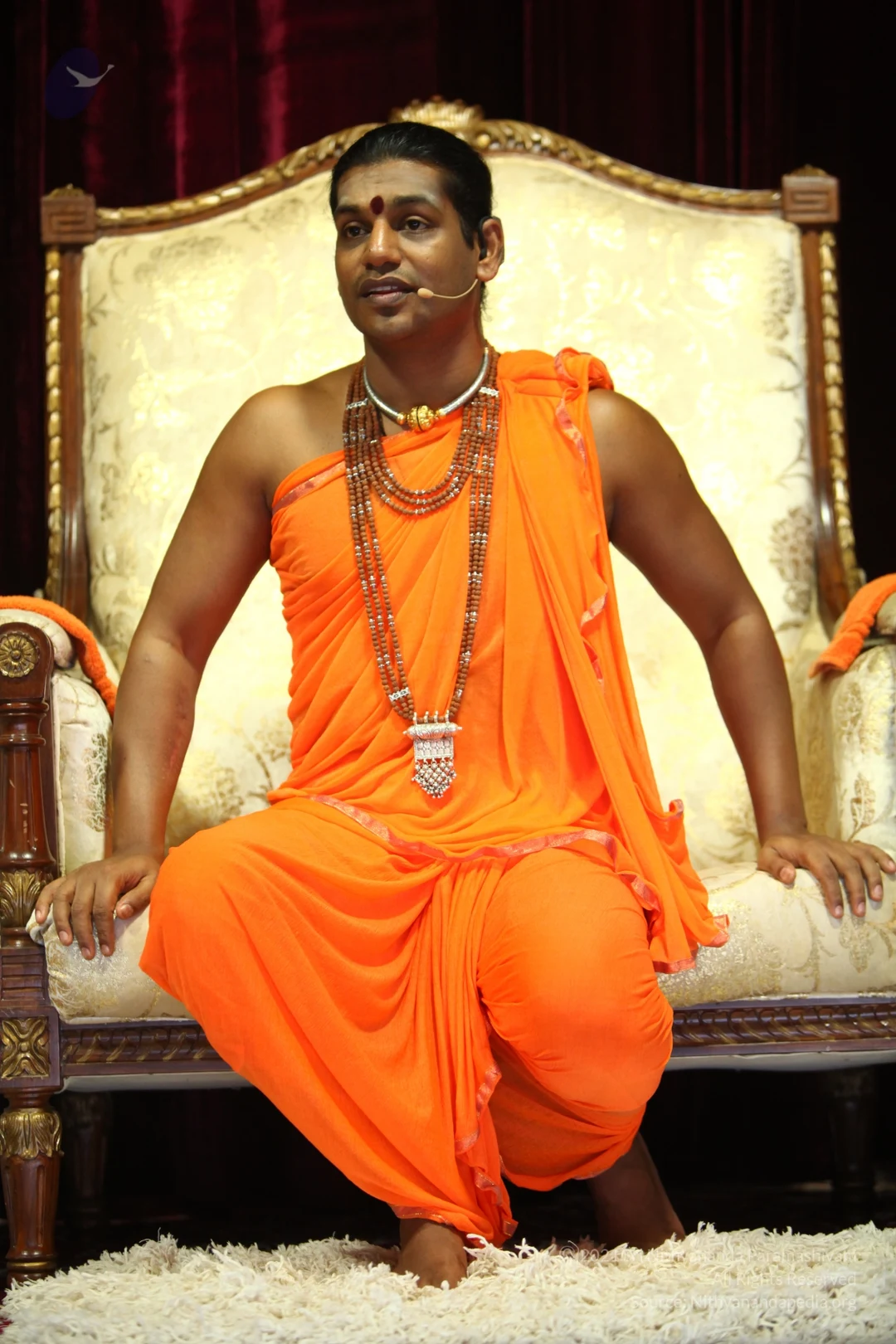
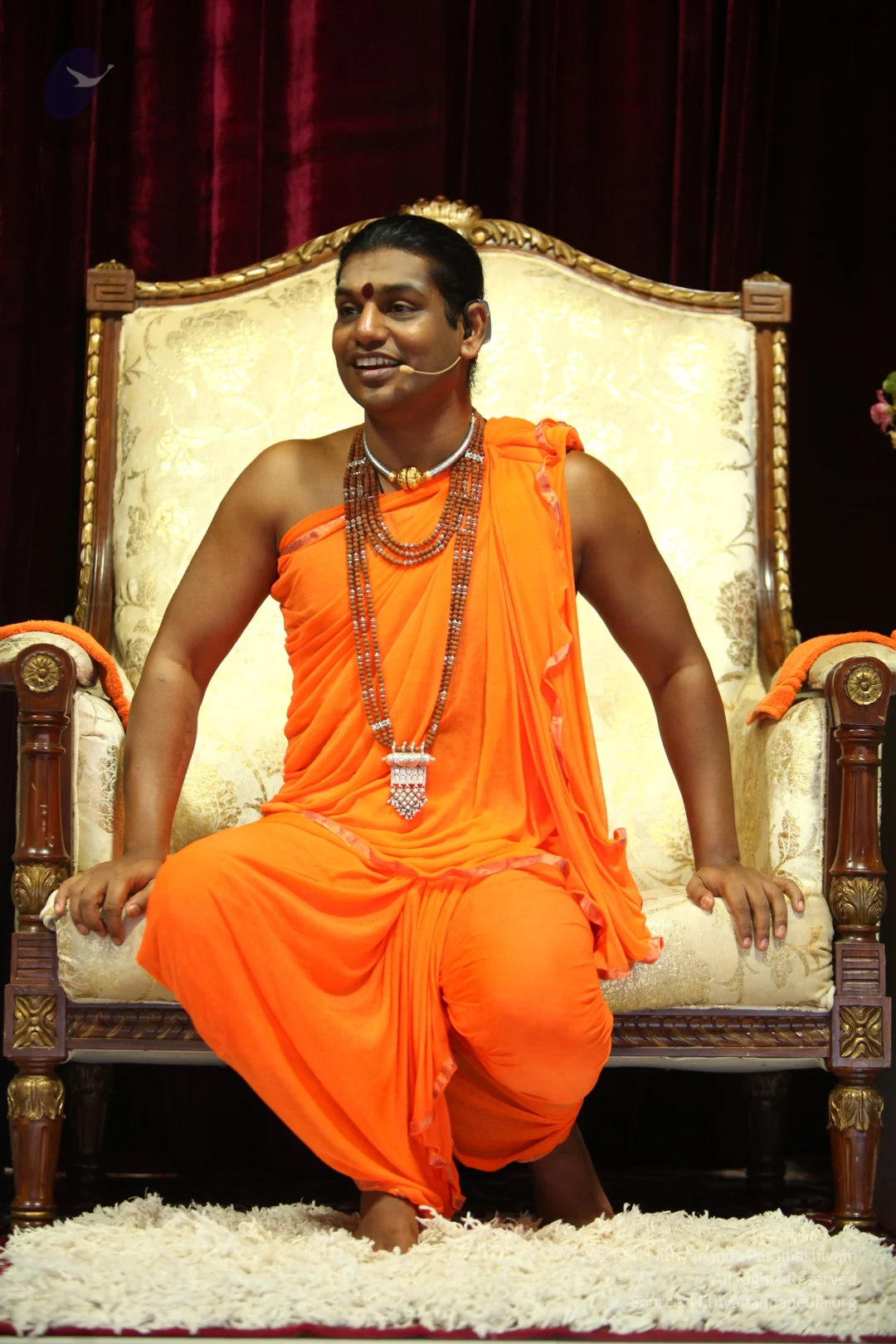
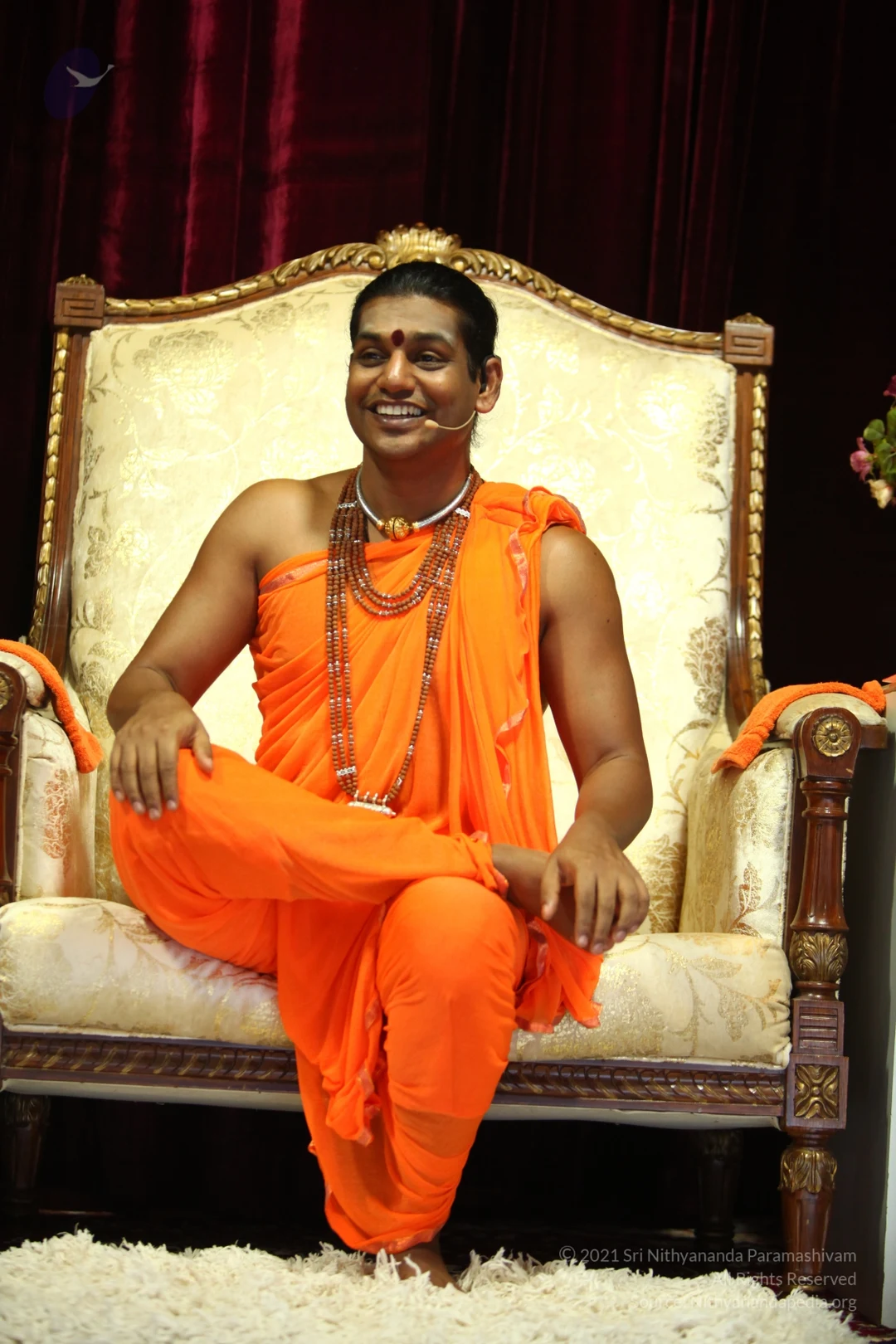
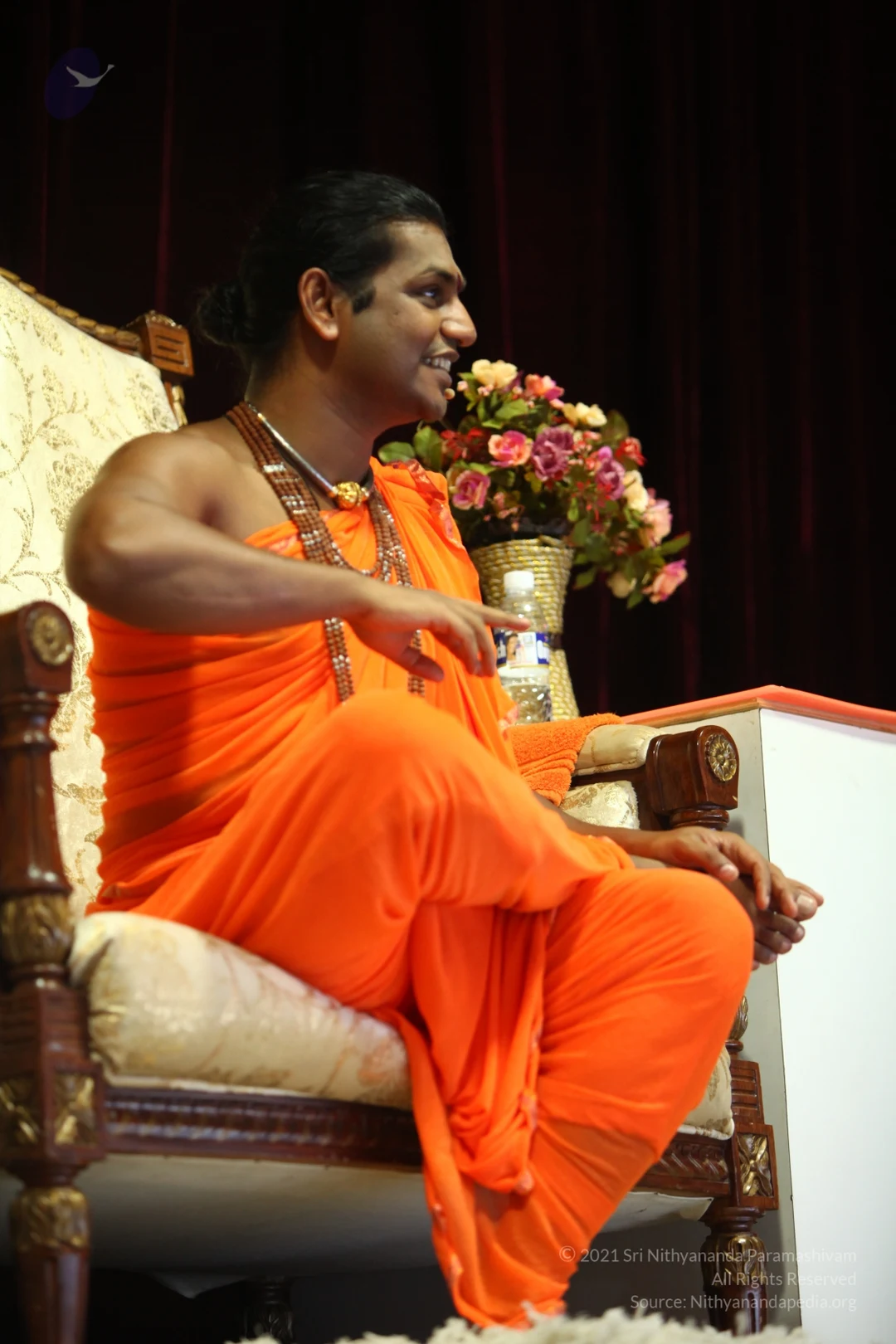
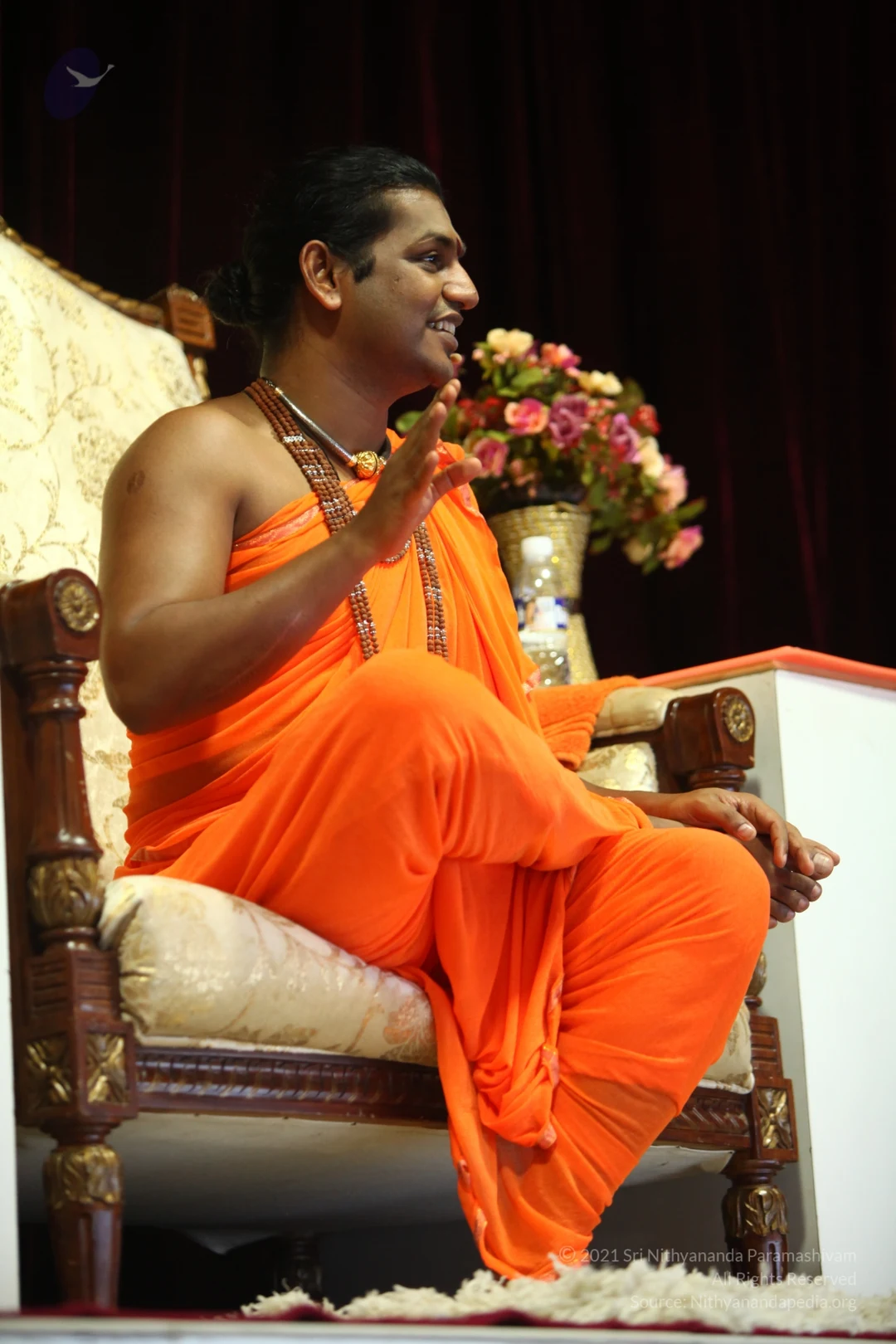
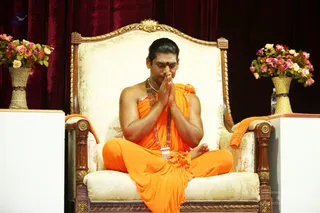
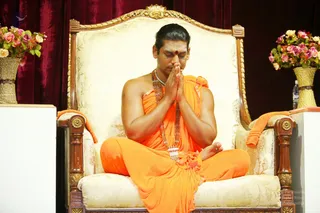
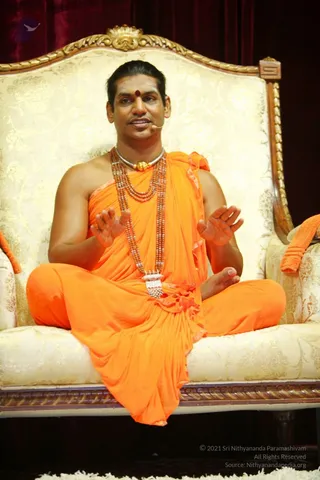
A seated man in an orange saffron garment wrapped over one shoulder and draped as loose orange trousers sits cross-legged on an ornate cream upholstered throne with gilded wooden frame. His palms are pressed together in namaste at his chest, eyes closed, with a red bindi on his forehead. He wears multiple strands of rudraksha beads and a silver ceremonial pendant with a white bead cluster, along with a silver neck ring. An orange cloth lies on the armrest at right. Behind him is dark red drapery.A man sits cross-legged on an ornate cream upholstered armchair with gold-painted carved wooden trim, eyes closed and palms pressed together in anjali mudra at his chest. He wears orange draped garments over bare shoulders, multiple strands of rudraksha beads, a silver pendant necklace and a red bindi. An orange towel rests on the armrest, a vase of pink and orange flowers stands at right, and dark red drapes hang behind. Cream carpet lies at the bottom edge. Appearance-based label: Swamiji (probable), with long swept-back hair, saffron clothing and rudraksha malas as cues.A man sits cross-legged on an ornate cream-and-gold upholstered throne with carved wooden arms. He wears a saffron-orange dhoti and shawl with his bare shoulder exposed, a red bindi on his forehead, and a long rudraksha mala with a white beaded necklace. His hair is slicked back, and he presses his palms together in anjali mudra with eyes lowered in prayer. Orange hand towels drape the armrests, and bouquets of pink and white flowers sit in woven vases on either side against a deep burgundy velvet backdrop. A plastic water bottle is visible at the right edge. The seated figure appears to be a person, identified by the saffron clothing, rudraksha mala and throne setting.A man seated cross-legged on an ornate cream upholstered throne with gold carved wooden arms, palms pressed together in namaskar at his chest and eyes closed. He wears saffron-orange cloth draped over one shoulder, with a rudraksha mala and a white ceremonial beaded necklace, and a red bindi on his forehead. Two orange towels hang over the arms of the throne. Flower arrangements of pink and cream roses in gold woven vases stand on white pedestals at either side, in front of a deep red velvet curtain.A man seated cross-legged on an ornate cream-and-gold upholstered throne with carved wooden arms, palms pressed together in namaste at his chest with eyes closed. He wears saffron-orange cloth draped over his shoulders and body, a rudraksha mala with a silver pendant, and a red bindi on his forehead. Flowers in gold vases with pink and cream blooms stand on either side, and a deep red velvet curtain forms the backdrop. Appearance-based cues of saffron clothing, rudraksha beads and a throne are present, so this is a person in person, leading a satsang or darshan setting.A man with short dark hair and a red bindi sits cross-legged on an ornate cream upholstered armchair with gilded wooden frame, in front of dark red drapery. He wears a flowing saffron-orange robe and multiple strands of rudraksha-style beads with silver spacers, plus a silver and gold necklace and a silver pendant. He has a small headset microphone, smiles and gestures with both open hands while speaking. An orange cloth rests on the chair arm at right. Appearance-based label: a person, seated in a teaching posture giving a discourse. Visible text reads a pedia.org, which is omitted

Nithya Yoga Session
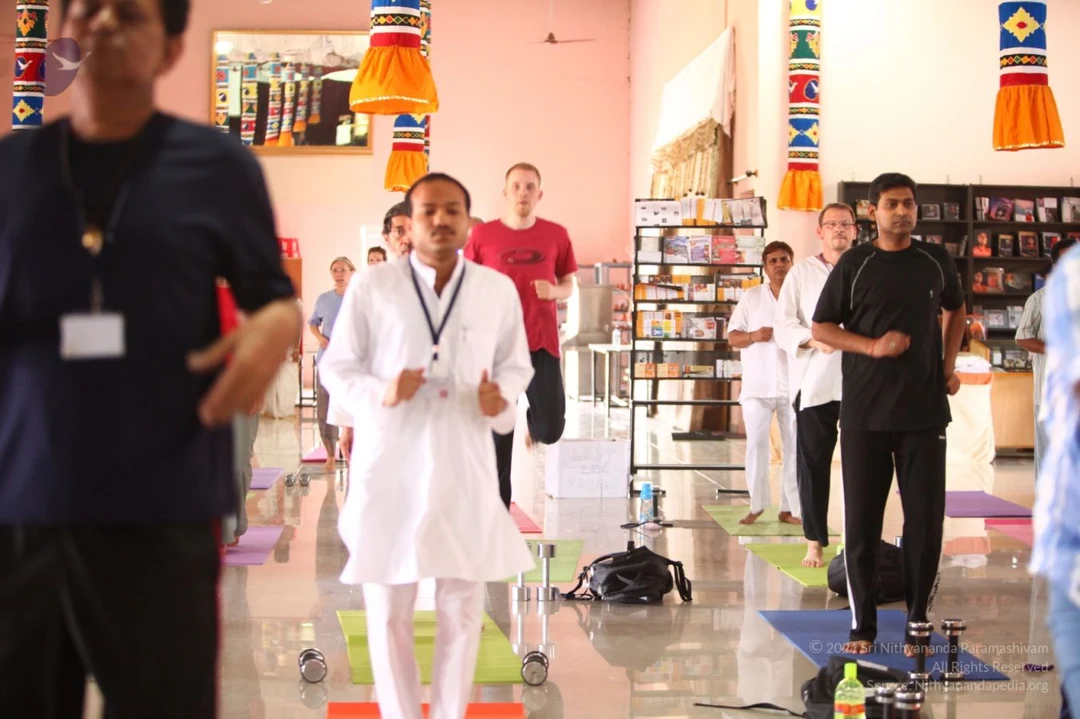
2 photosSource gallery
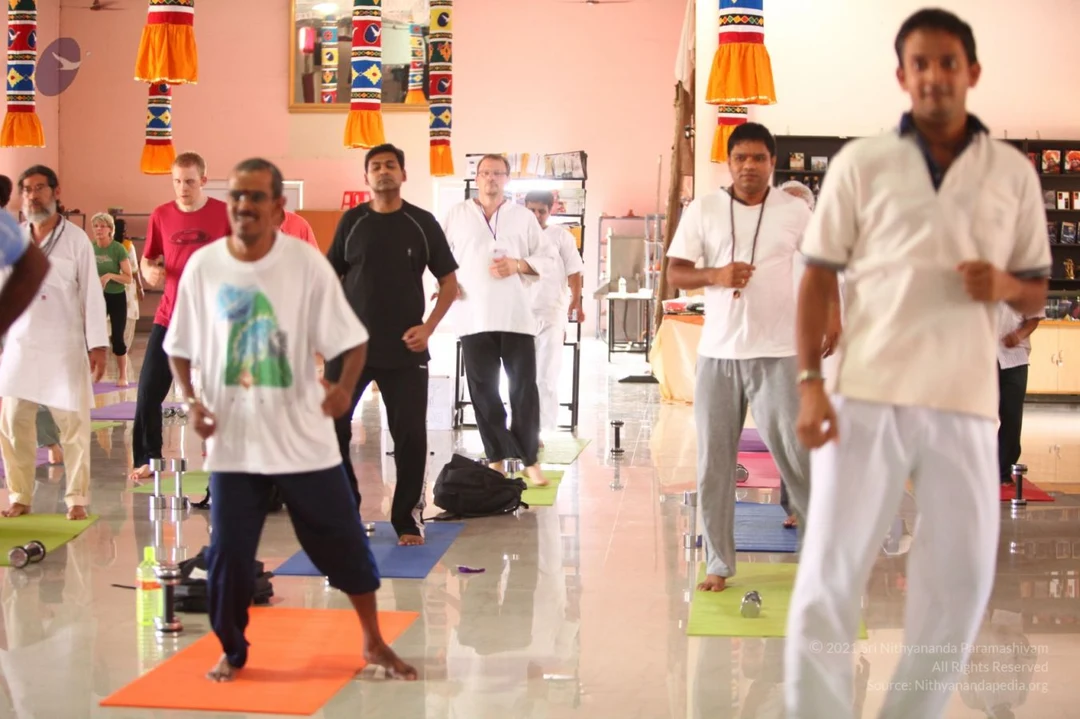
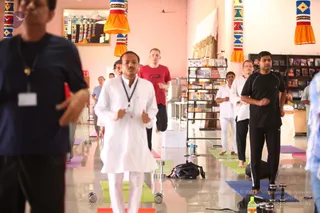
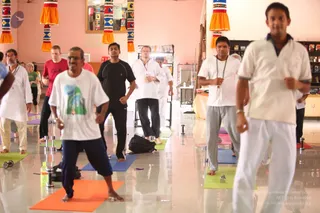
A photograph of a bright, tiled hall where a group of people are doing standing exercises on colourful mats, one of them in a white kurta with a lanyard and badge walking toward the camera. Behind them a young man in a red t-shirt and black trousers, and several people in white or black clothes stand on green and purple mats. Shelves of books and DVDs line the right wall, and a patterned textile hangs with orange tassels from the ceiling. Two dumbbells sit on the floor near a backpack and a water bottle. Several people are visible, including partly cropped figures in the foreground and background.A photograph of a yoga or exercise session in a bright hall with polished tile floors and pink walls. Many participants in white or dark clothing stand on coloured yoga mats, some in mid-motion with feet apart and arms bent. In the foreground a man in a white t-shirt with a green graphic and dark trousers stands on an orange mat, and a man in a white shirt and white trousers stands at the right edge. Behind them people in white kurtas and red, black and grey shirts move in the same routine. Colourful woven hangings with yellow tassels hang from the ceiling, and a bookshelf and display table are visible at the back. No a person candidate is visibly present.

Inner Awakening Darshan to Individual Delegates
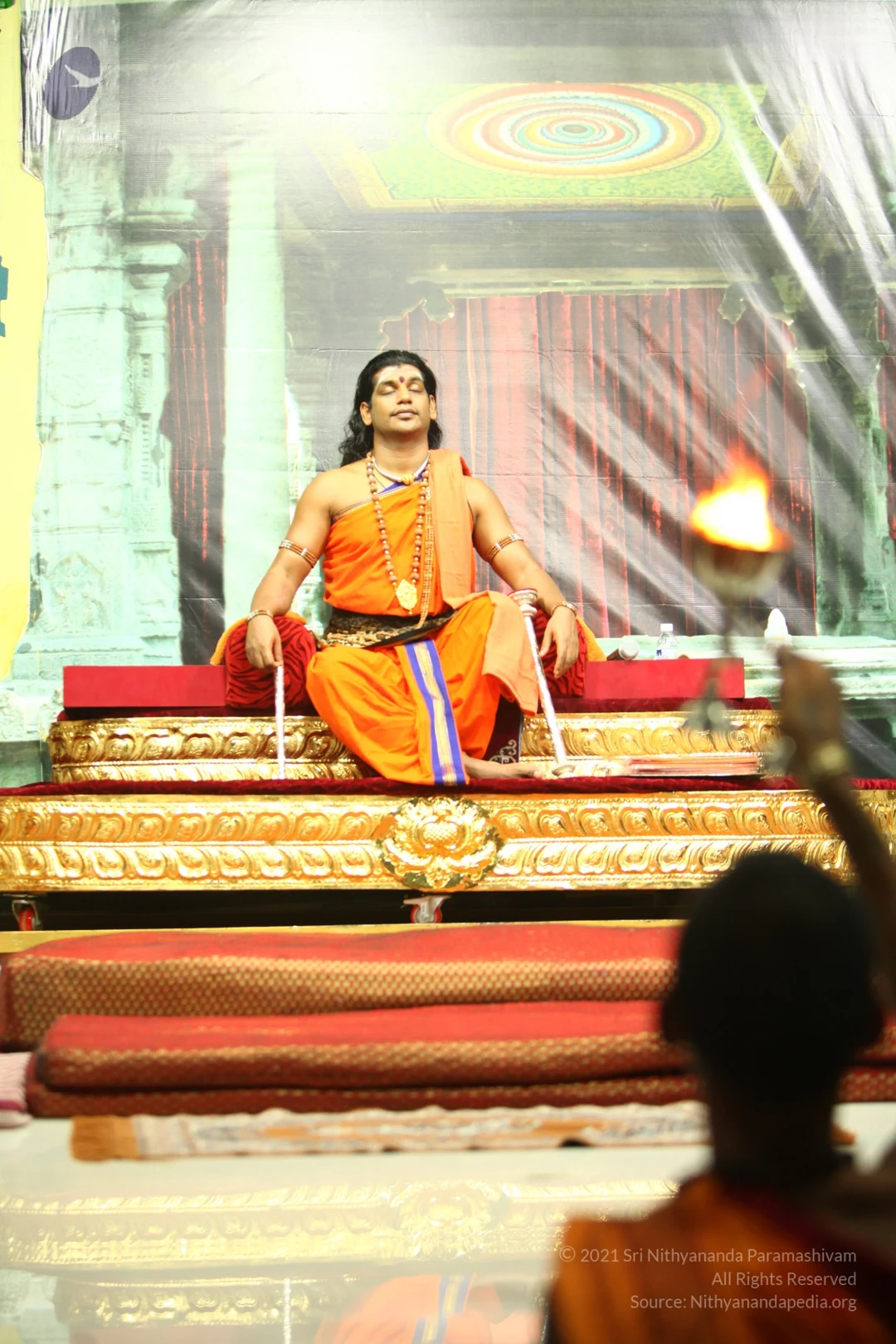
188 photosSource gallery
A photograph of a seated man with long dark hair, eyes closed and a red bindi, wearing orange ochre robes, a rudraksha mala and a gold pendant. He sits cross-legged on an ornate gold and red throne-like peetha with red cushions, holding white rods. Behind him is a painted temple-pillar backdrop with a colourful circular mandala. In the foreground at right, a blurred person in orange raises a flaming oil lamp (aarti) toward the seated figure.A seated man with long dark hair, eyes closed, sits cross-legged on a large gold-trimmed throne draped with red cushions. He wears saffron-orange robes with a blue-and-gold bordered dhoti, a rudraksha mala, a gold pendant, and bangles on his wrists, holding white ceremonial cords. Behind him a painted backdrop shows temple pillars and a circular mandala. A blurred figure in orange in the right foreground faces the stage, and a flame is visible at the right edge. Appearance-based candidate: a person, seated on the throne, identified by long swept hair, saffron robes, rudraksha mala and ceremonial gold ornaments.A photograph of a satsang on a golden throne-like dais draped in red cushions, with a man seated cross-legged in the centre, eyes closed, wearing orange robes, a rudraksha mala and gold bangles, with long dark hair swept back. He sits in a hand-held meditative posture. To the left, a woman in white clothes sits with palms pressed together in prayer, and a figure in orange sits at the far left edge. On the right, a shaven-headed man in orange robes sits with palms joined. A fire flame burns in a lamp in the foreground next to a seated person's head. Behind the throne is a painted backdrop of a temple gateway with a rainbow circular design and a deity figure on a pillar to the left. Probable identity cues: long swept-back hair, orange robes and rudraksha mala on the seated central figure.A photograph of a satsang-style ceremony in a temple-like hall. A man with long swept-back hair, bare-chested under a saffron-orange shawl, a rudraksha mala and gold necklace, seated on a gold-trimmed throne with red cushions. Swamiji (probable): the long swept-back hair, orange shawl and rudraksha mala are the qualifying cues, and he is the central figure on the throne. In the foreground a person's raised arm holds a flame. Kneeling at left, a woman in white clothing has her hands in anjali. At right, a shaved-headed man in orange robes with hands folded sits on a cushion. Another person in orange sits at left edge. Behind is a painted backdrop of a temple gateway with curtains and a decorative pillar carved with a figure.A seated man in orange robes sits cross-legged on a gold-edged throne with red cushions, eyes closed, with a long dark hair, a gold necklace and a beaded mala. Behind him is a large printed backdrop of temple pillars and a painted mandala. On the left a woman in white with palms pressed together sits on red cushions, and on the right a shaved-headed man in orange robes sits with hands folded in namaskar. A brass oil lamp with flame stands near the throne, and a devotee's hand holding an offering is visible in the foreground. The scene suggests a satsang with the seated figure as the central teacher.A seated man in saffron and orange robes sits cross-legged on a gold-and-red ornate peetha throne at the centre of a stage set with painted temple pillars and a curtained backdrop with a light ray. He wears a rudraksha mala, a gold pendant, armlets, and a saffron shawl over his shoulder, with his eyes closed. A woman in white sits on the left with palms joined in namaskar, and a man in saffron on the right also joins his palms in prayer. In the foreground a fire flame burns near a head in silhouette. The large visible crowd is not present, only these people and a partially visible figure at the bottom. Swamiji (probable) is identified by the saffron robes, long swept-back hair, and rudraksha mala beside a gold throne, so the candidate is present in the scene.