Skip to content
Sunday

18 September 2011

Open Yourself to Life

Dated photos
313
Source pages
1
Media
2
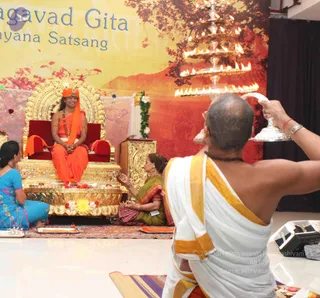
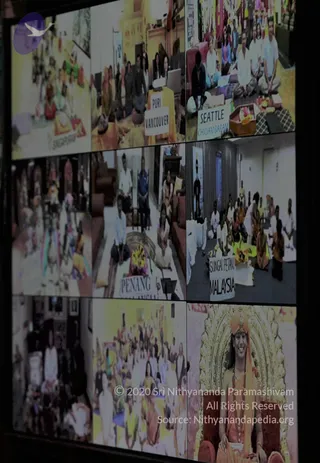
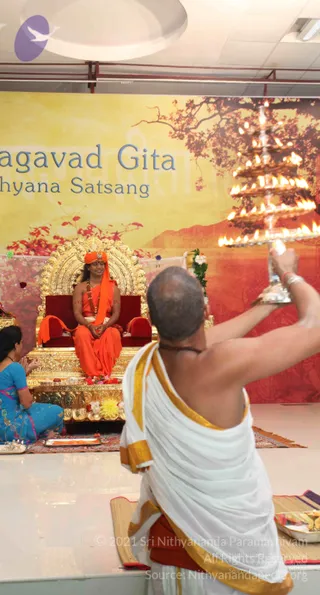
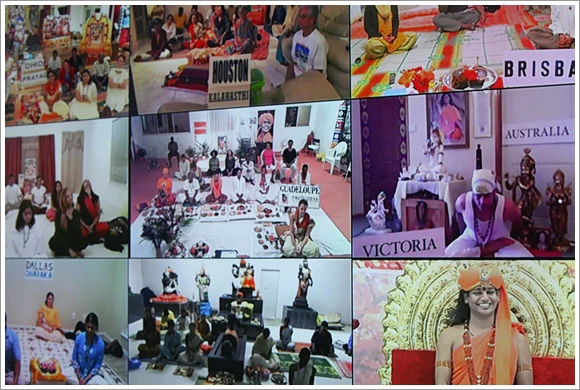
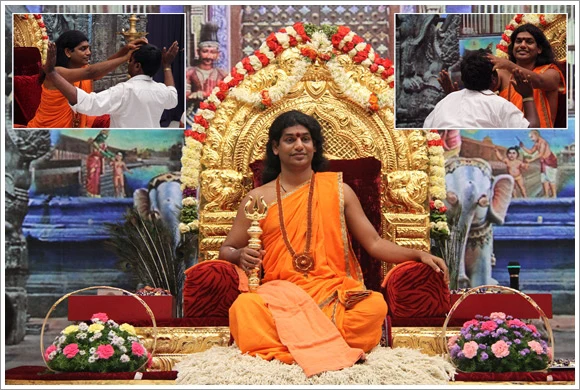
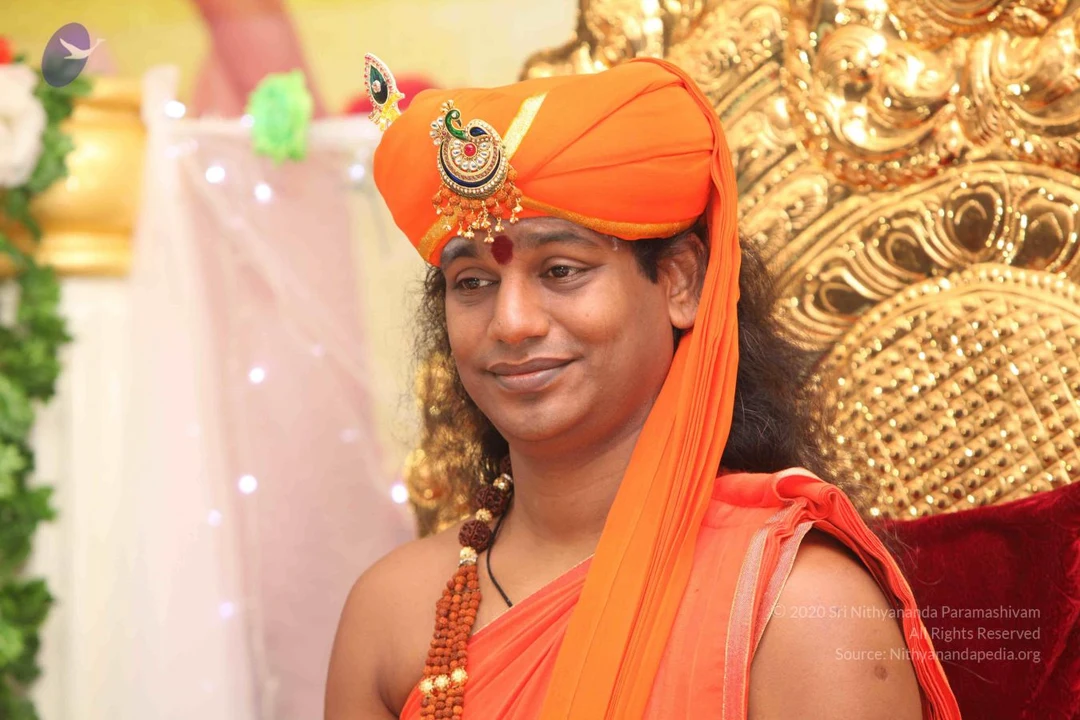
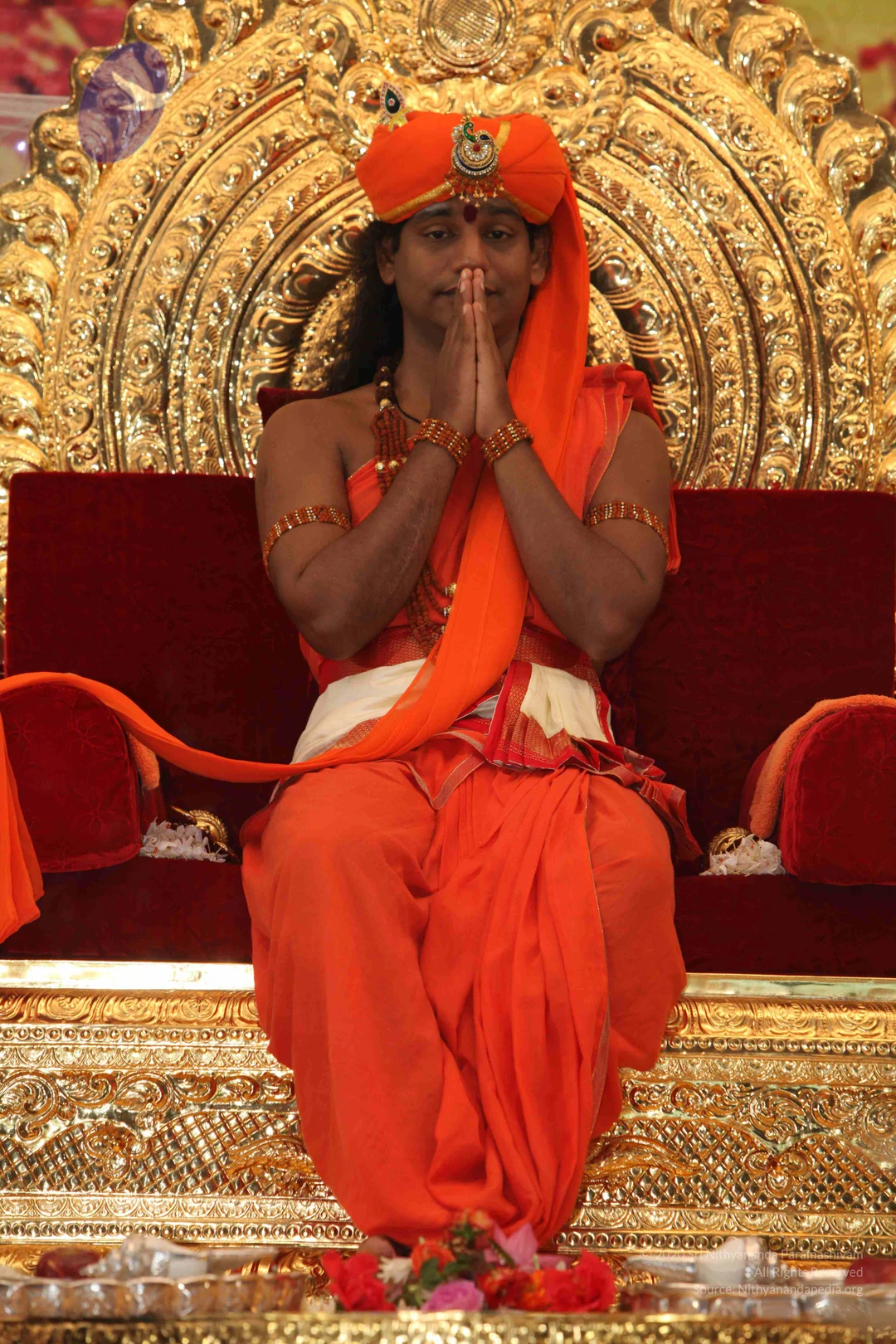
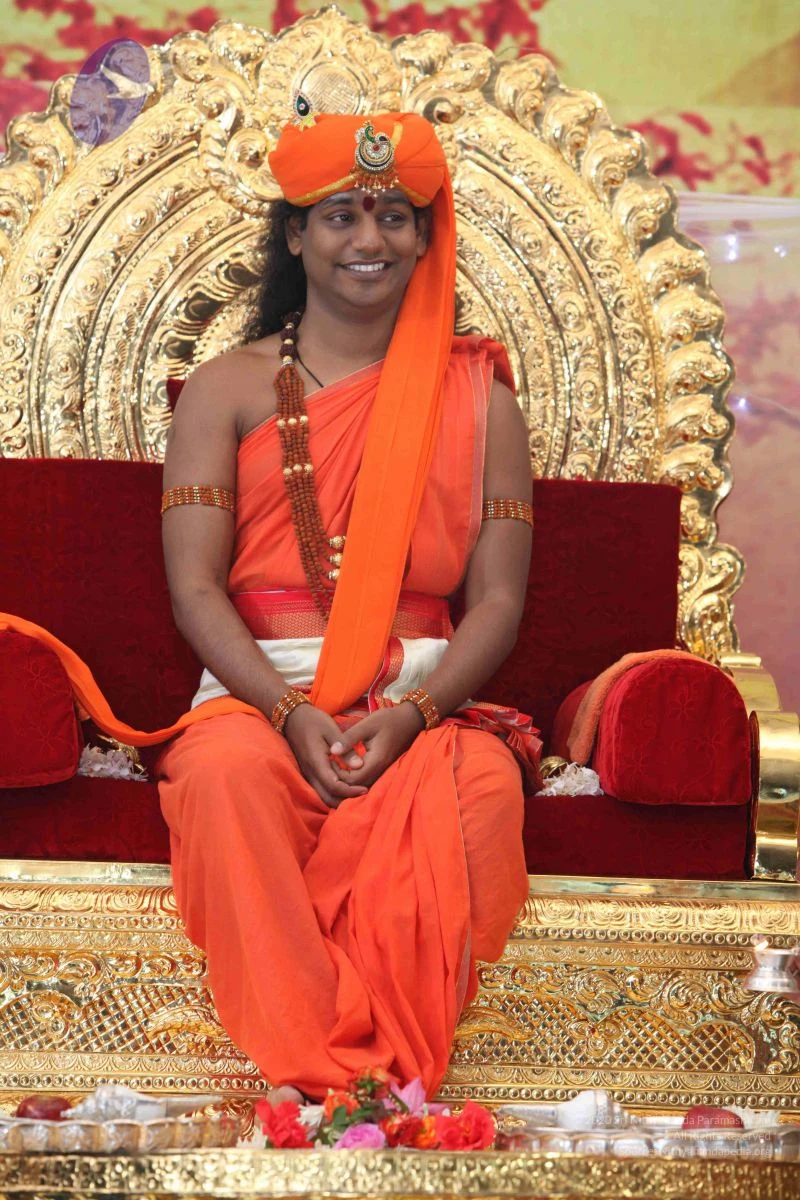
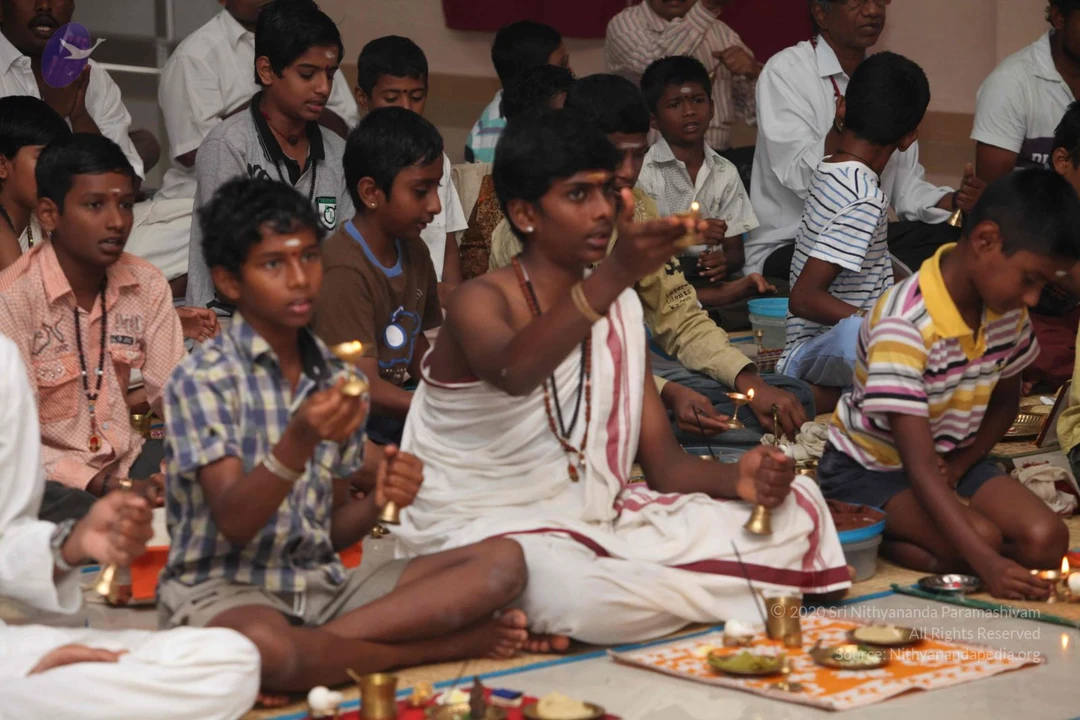
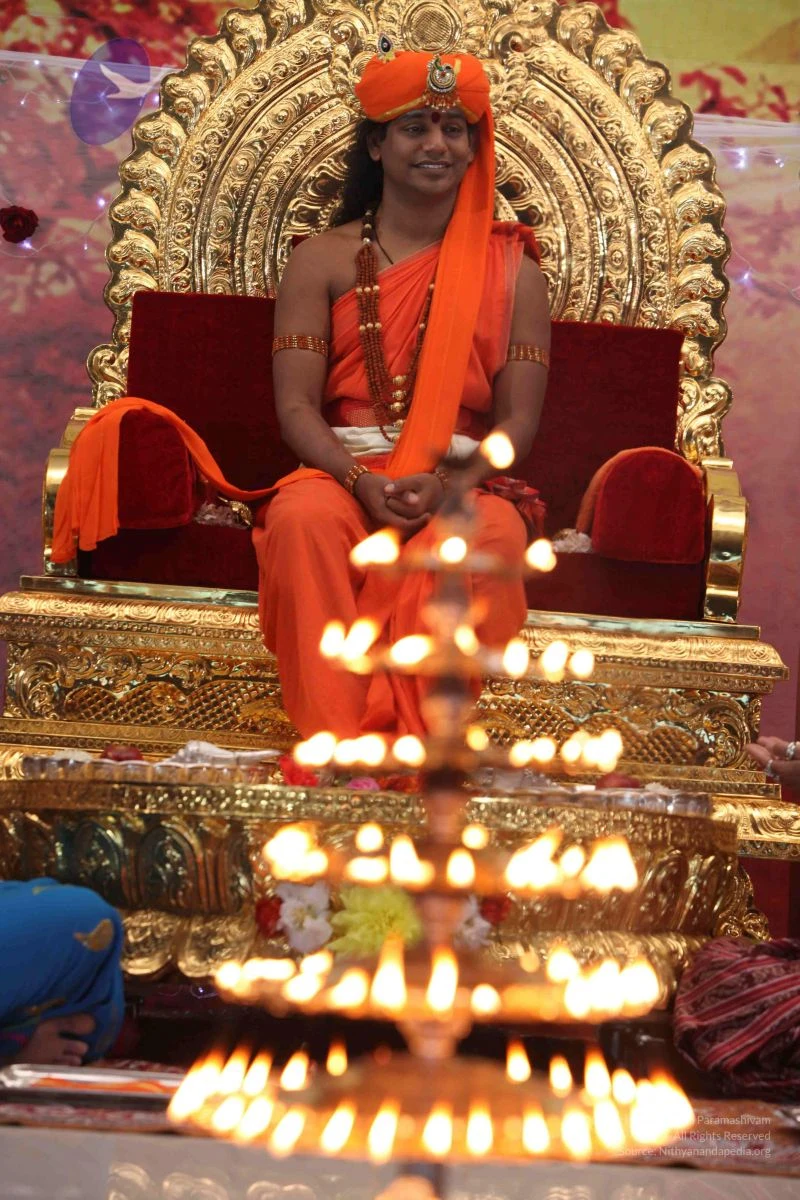
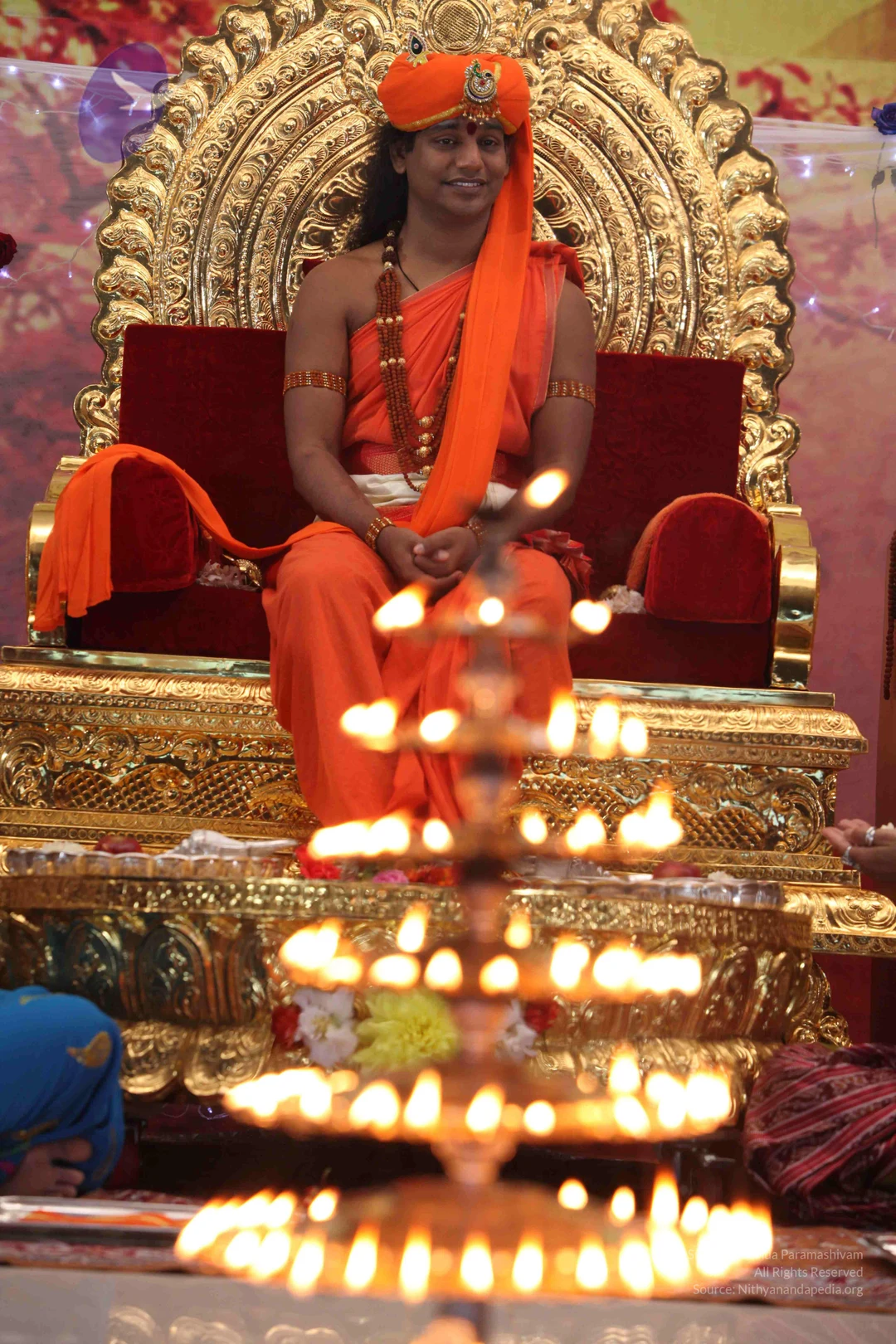
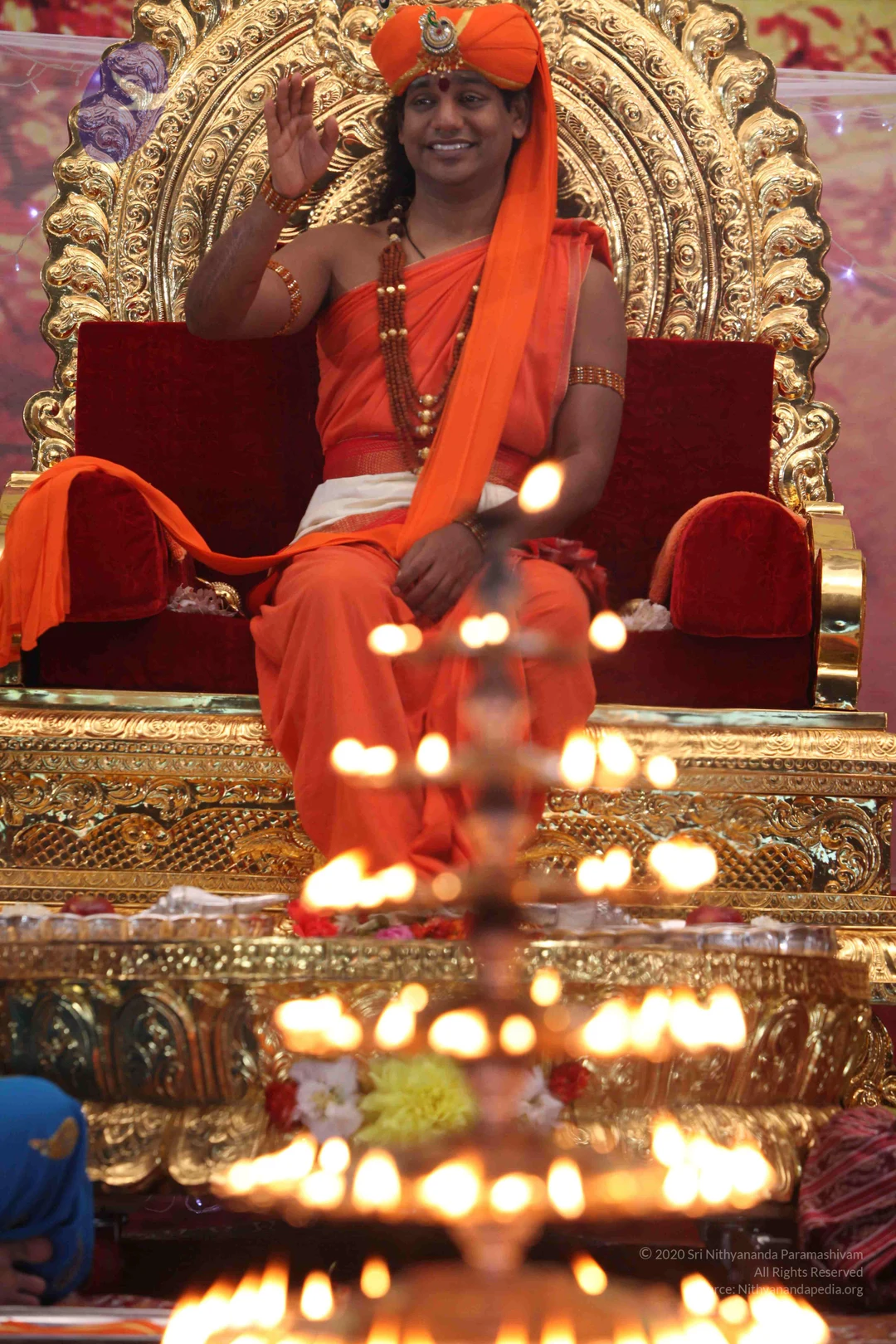
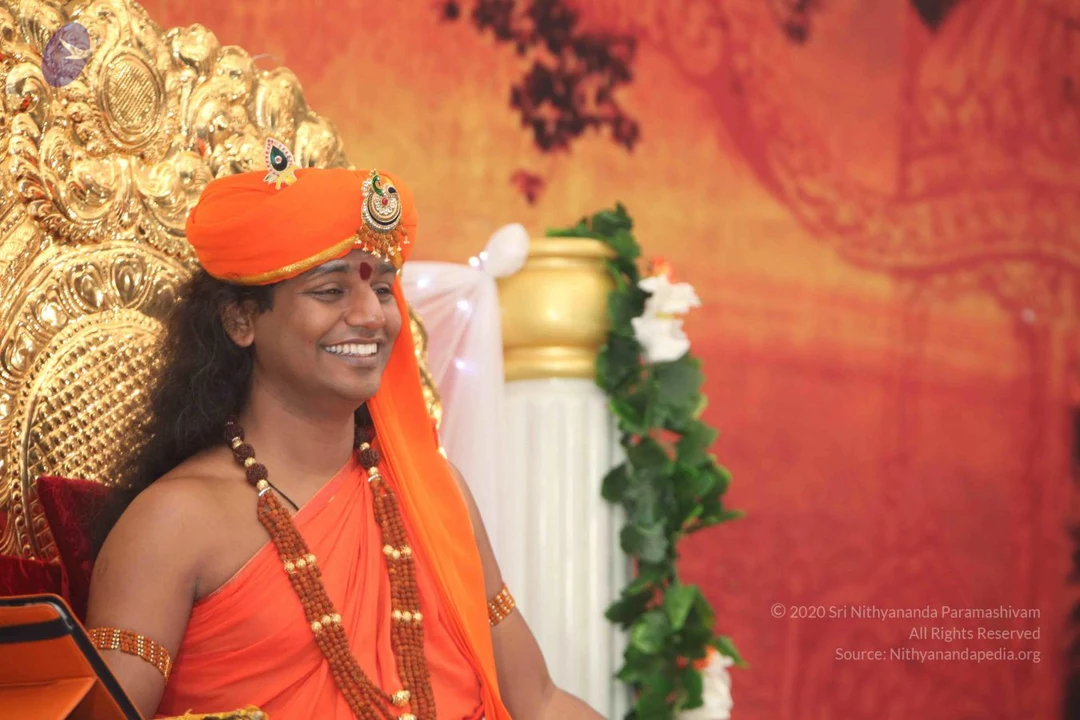
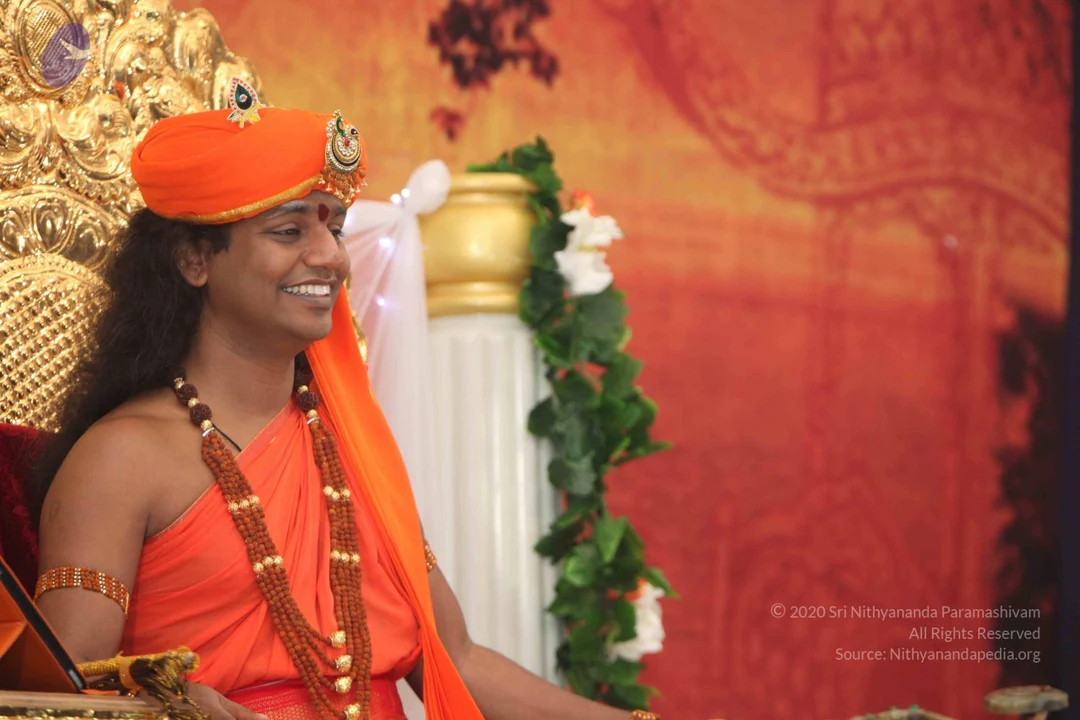
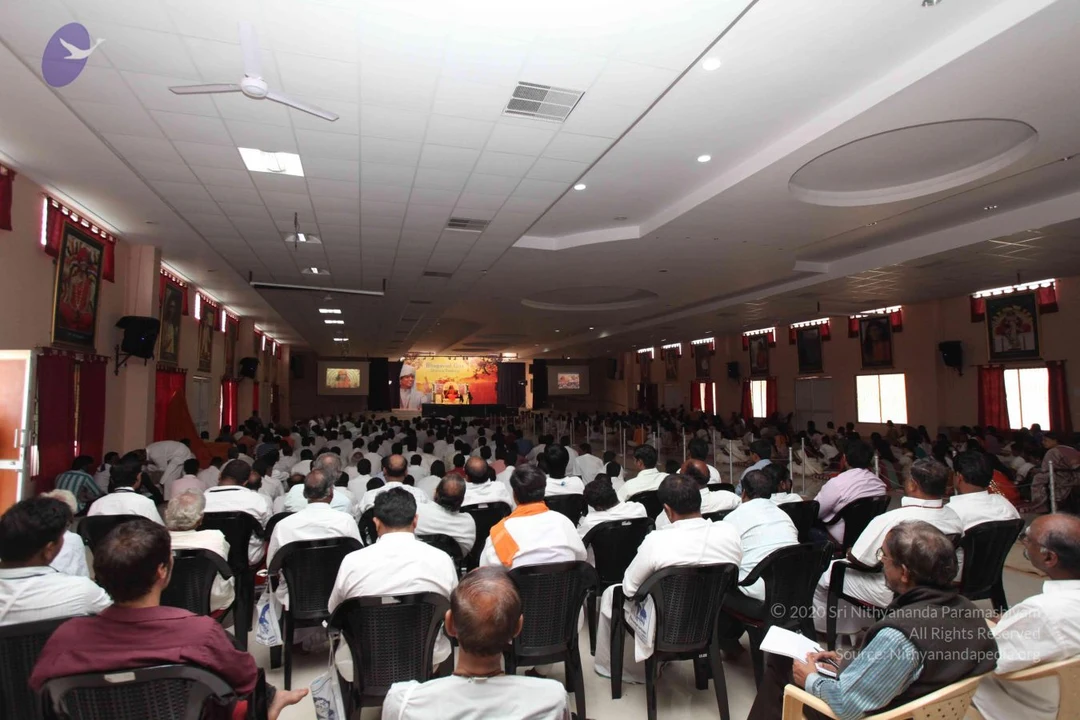
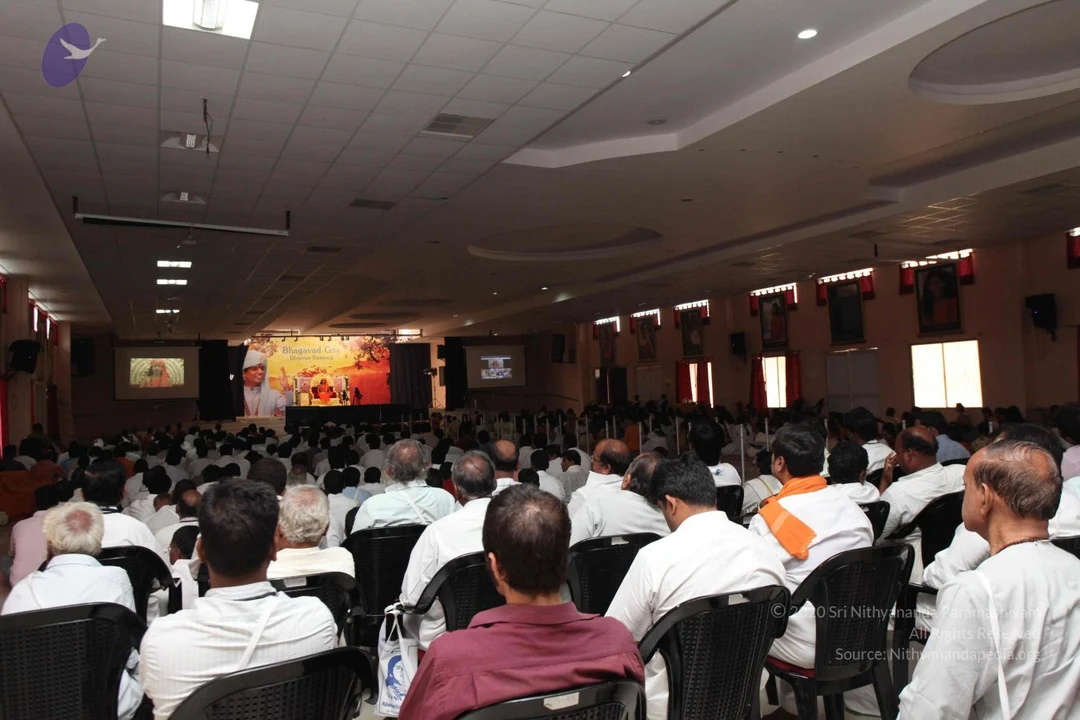
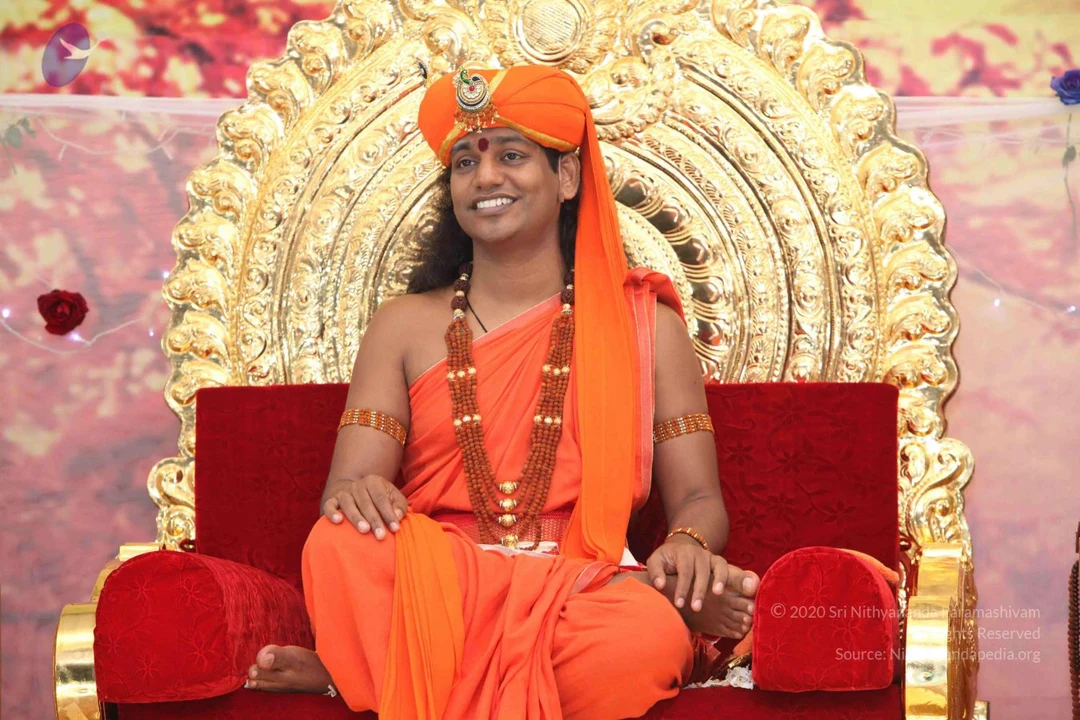
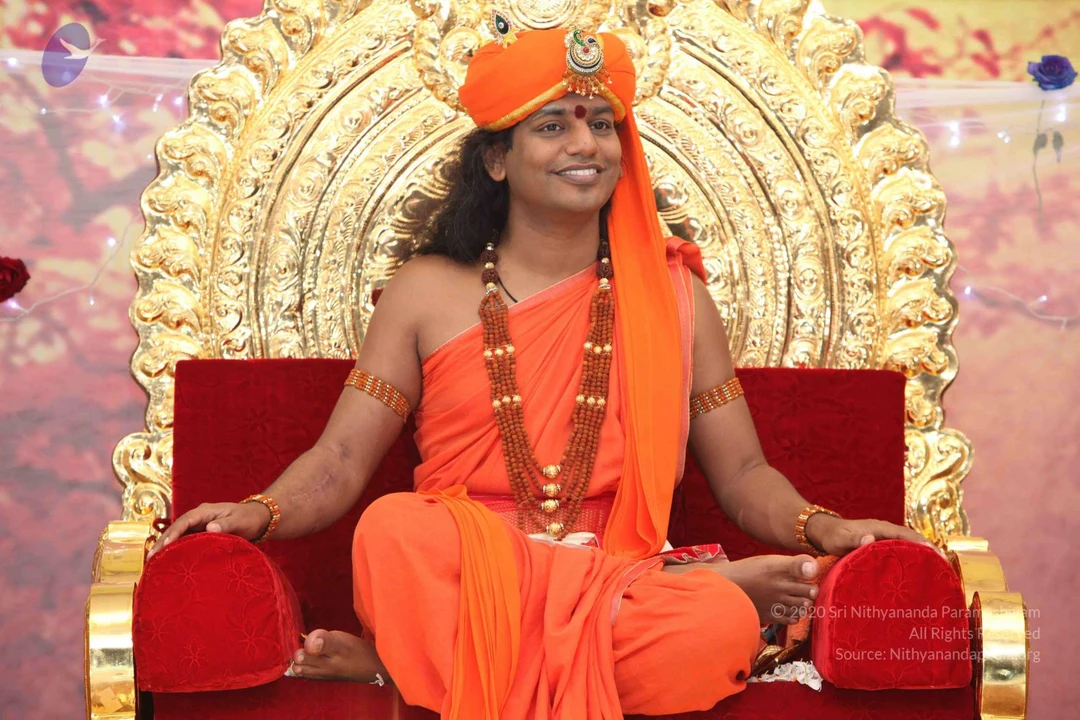
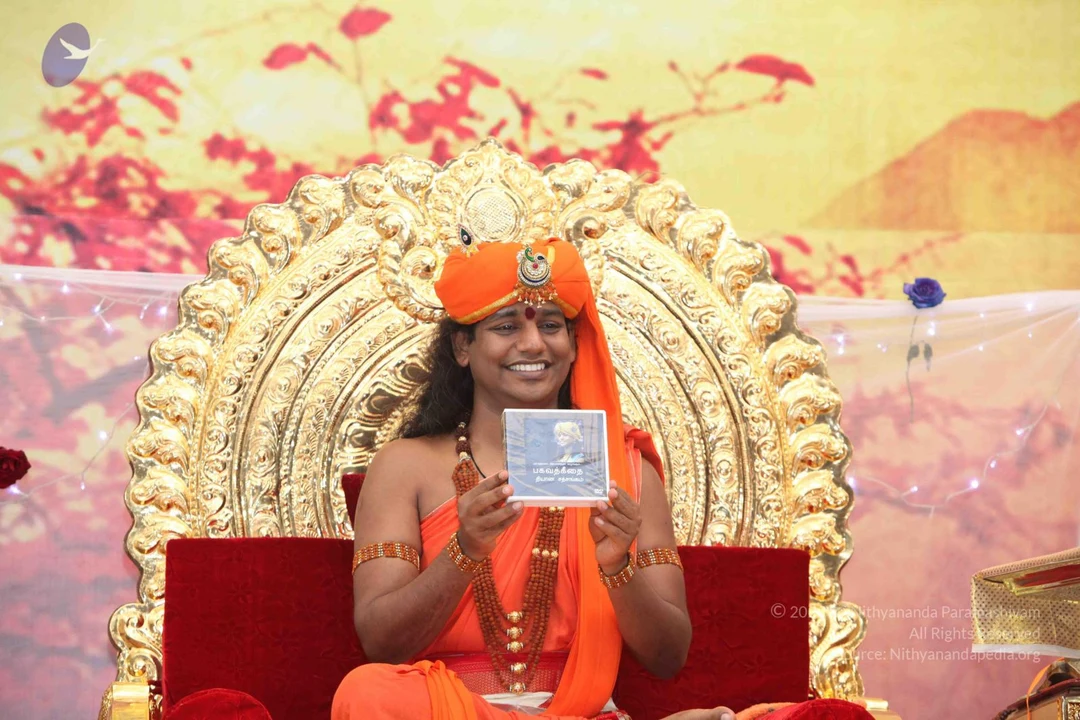
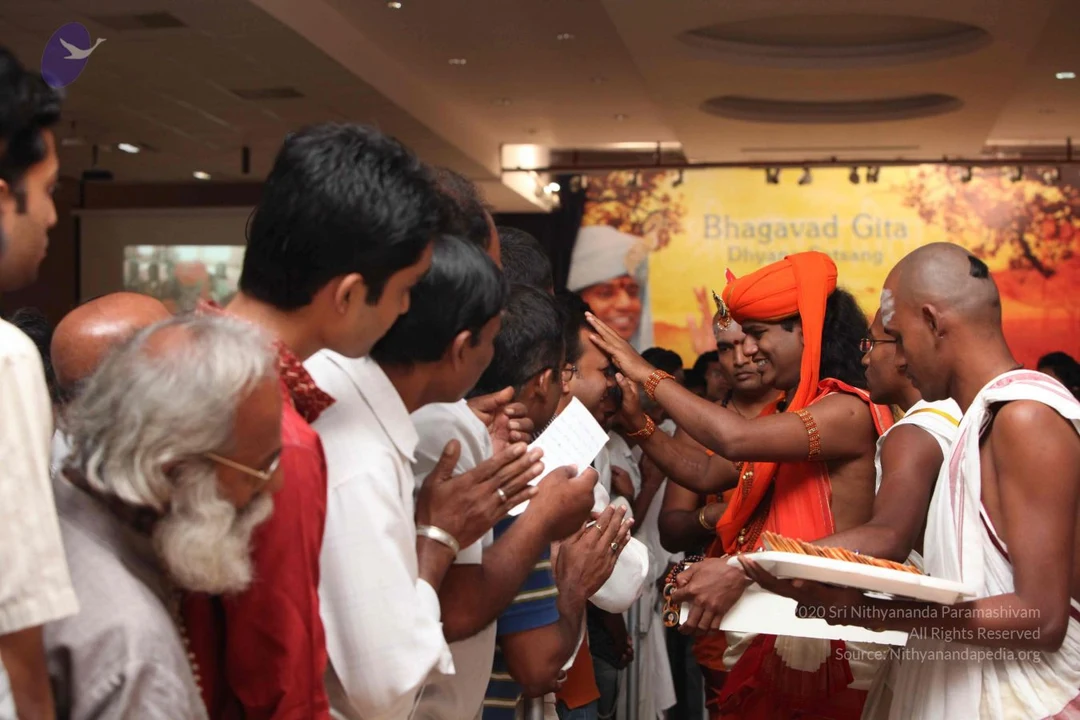
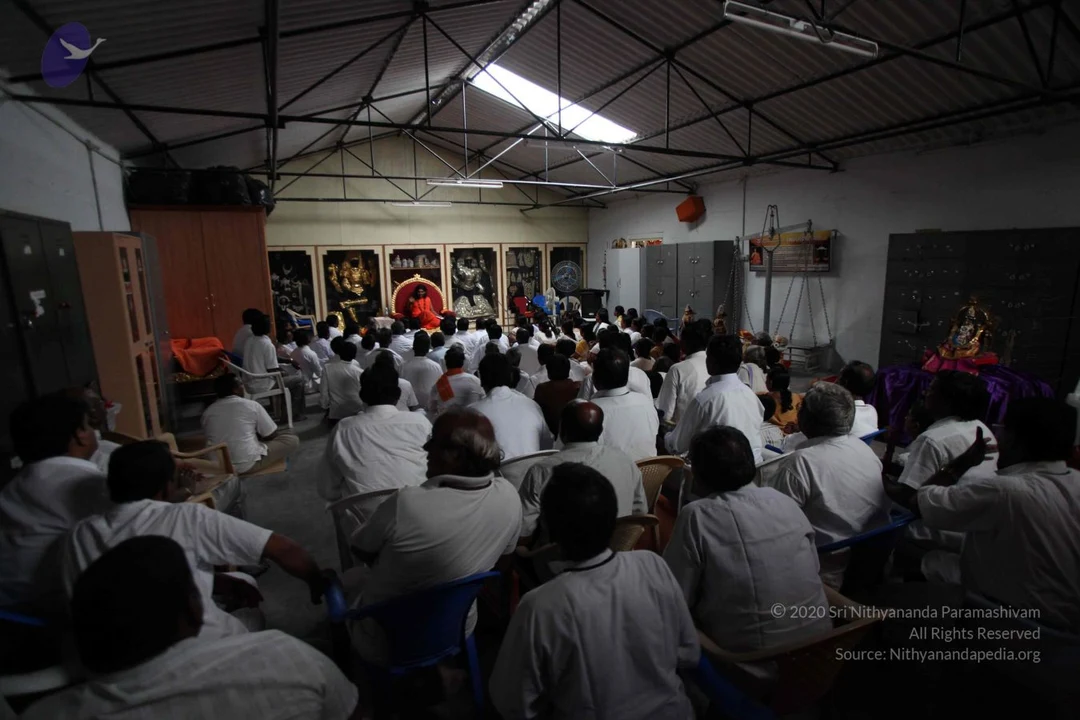
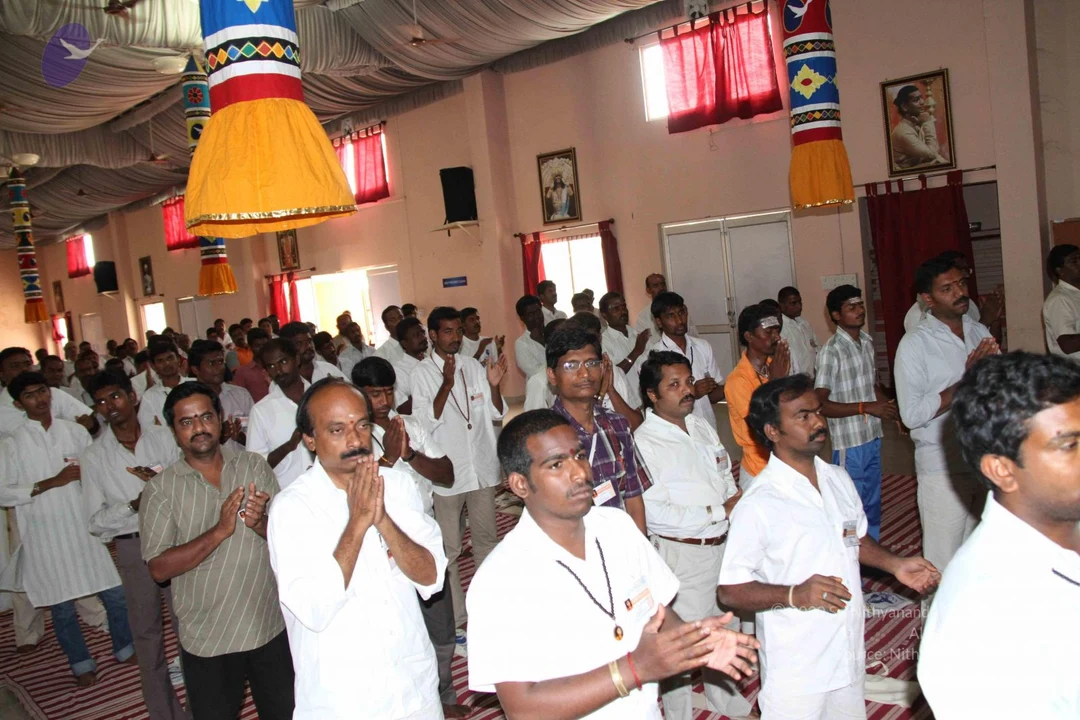
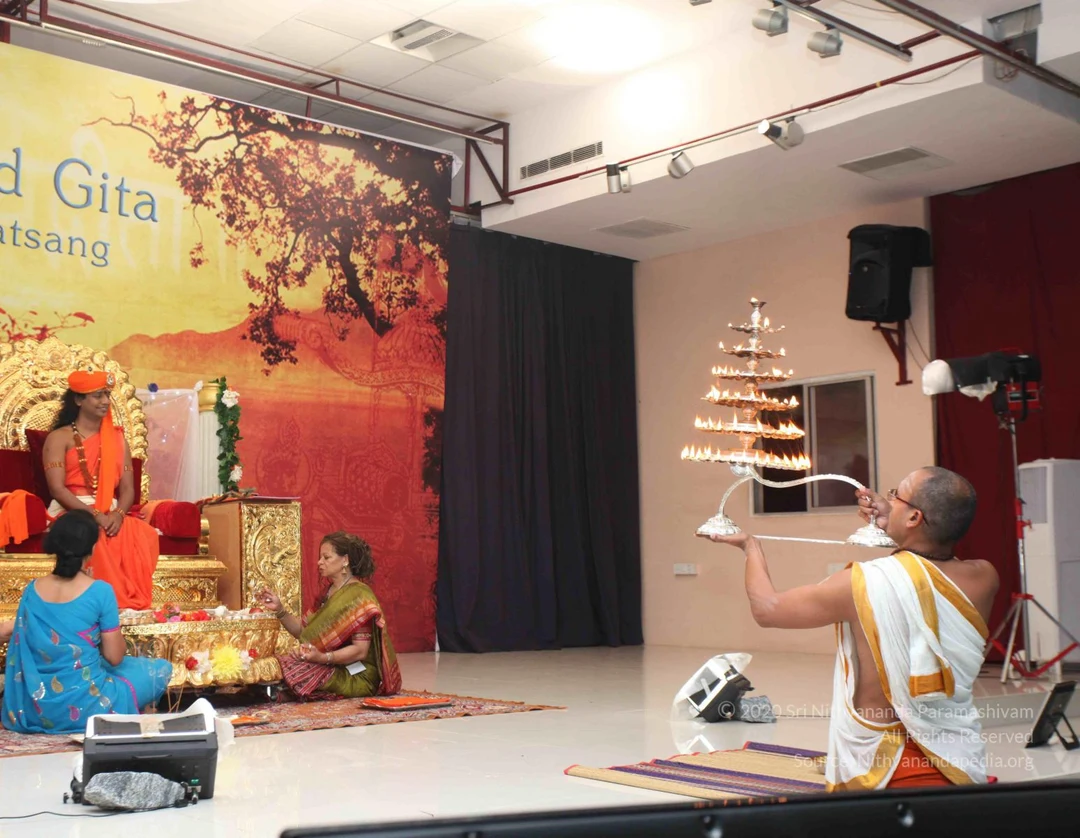
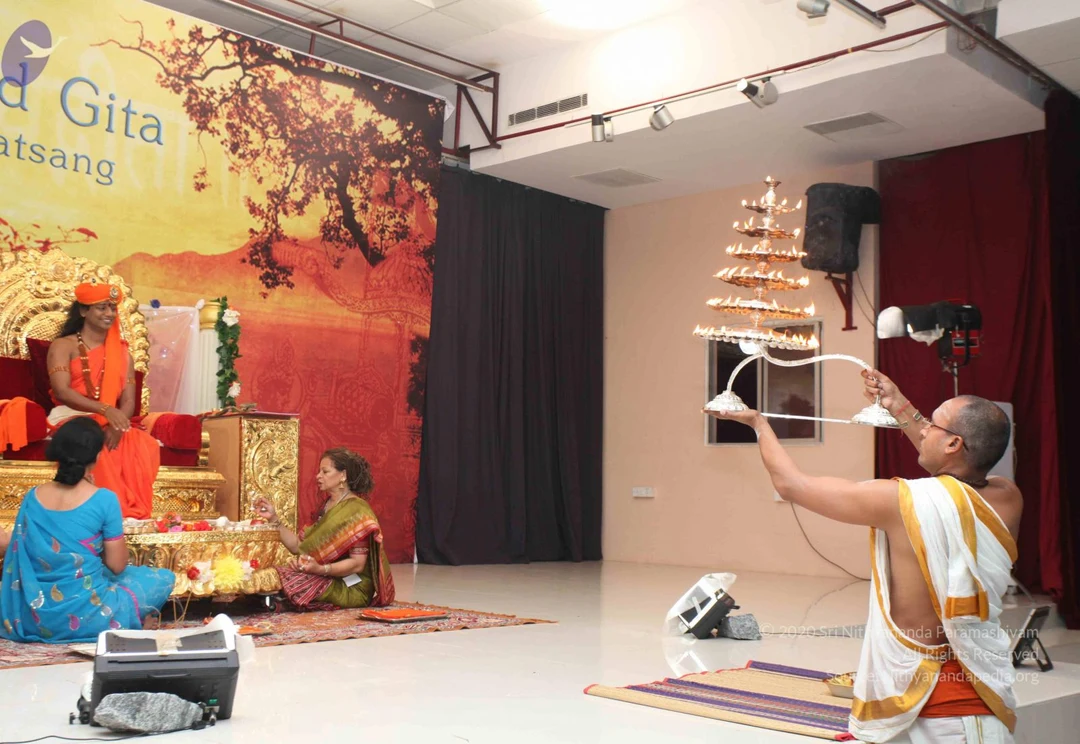
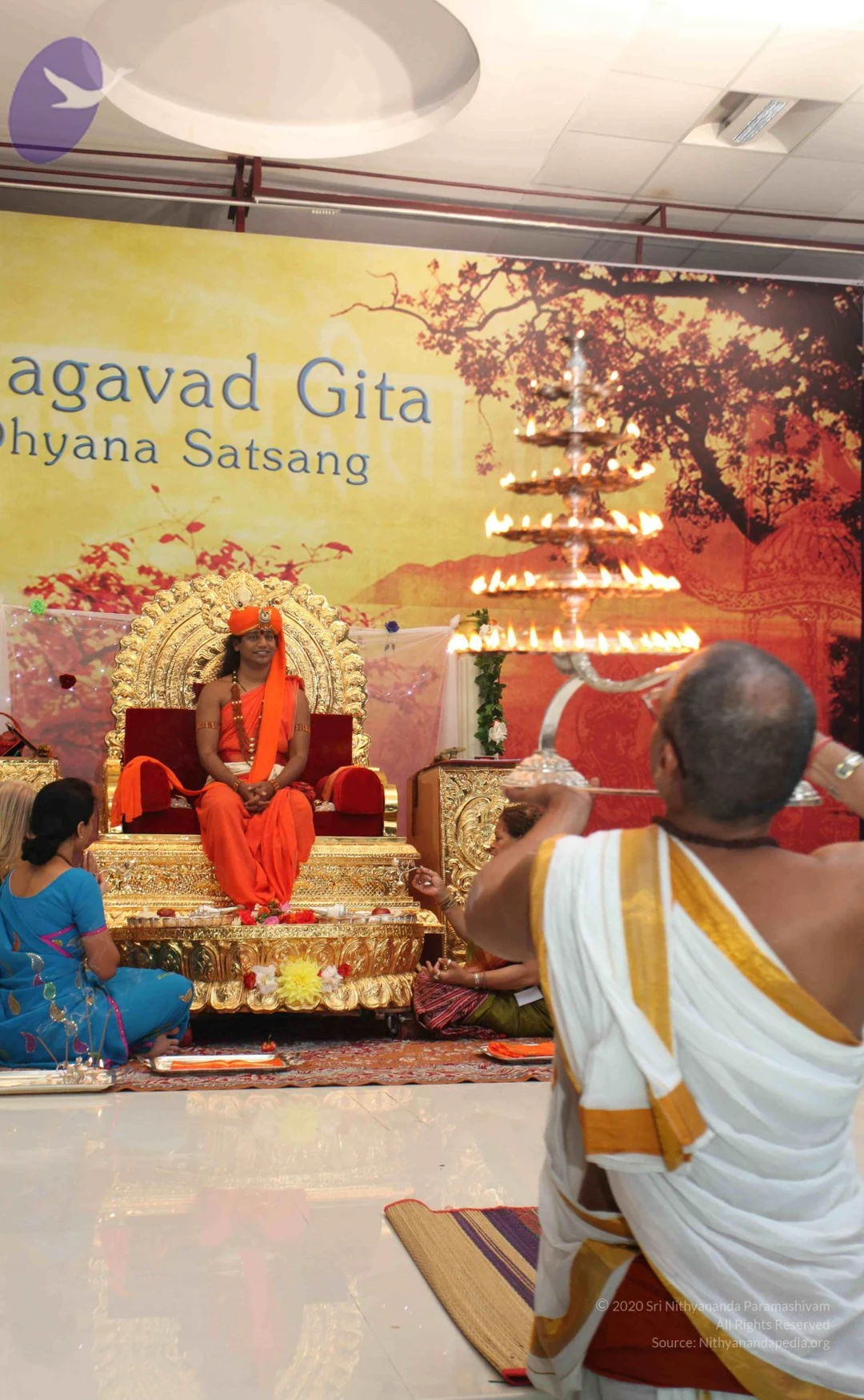
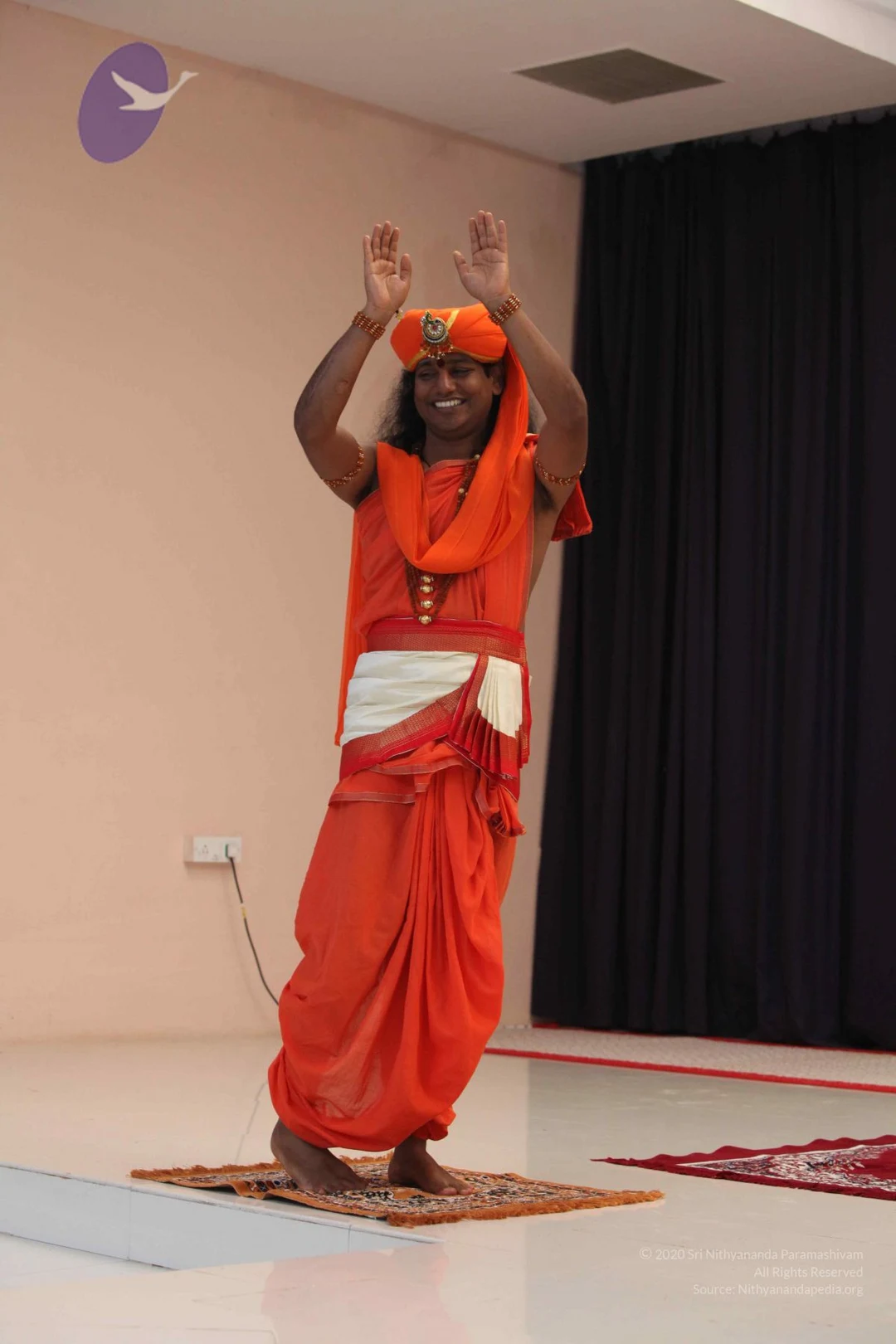
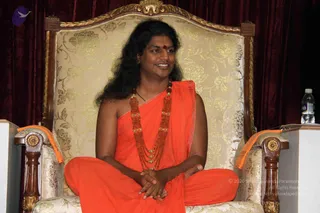
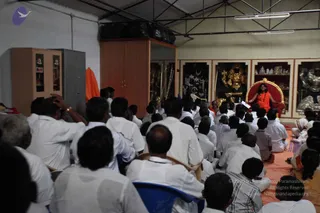
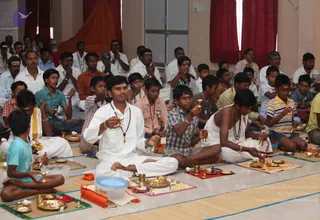
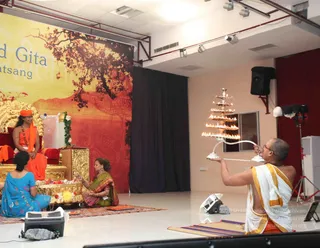
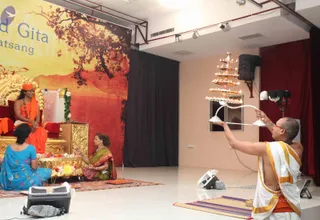
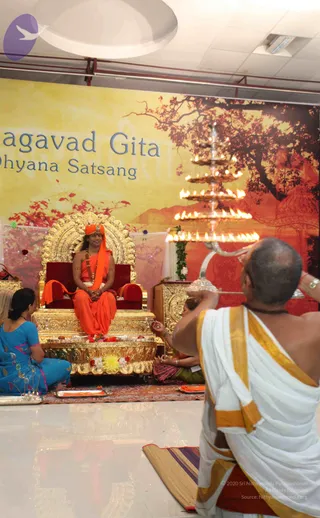
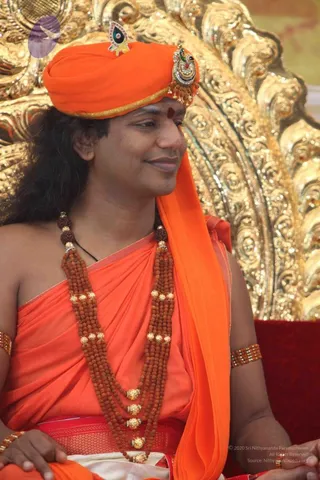
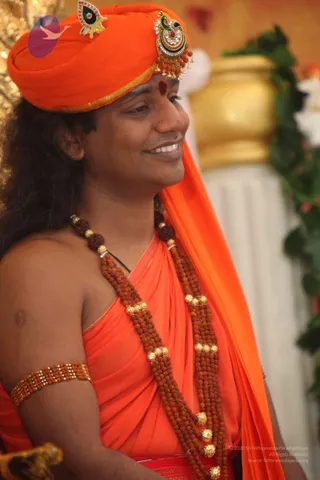
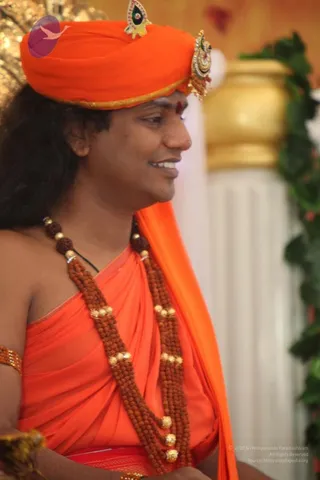
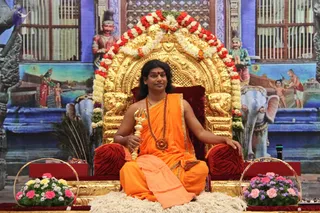
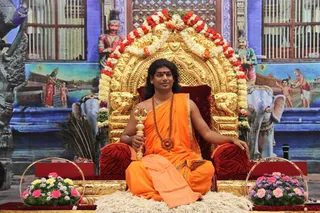
A photograph of a ritual in a satsang hall. A figure in orange robes, with an orange headcloth, a rudraksha mala and gold necklaces, sits on an ornate gold throne with red cushions, hands folded, with a person identification by appearance. A man with a shaved head and white dhoti with gold border holds a silver multi-tier lamp aloft while facing the throne. Two women sit on the floor: one in a turquoise blouse with a floral offering nearby, and one in a green sari with a red border holding a small object. Fresh flowers and marigolds decorate the throne platform. A banner behind reads Bhagavad Gita and Nithyana Satsang, with a lit tiered brass aarti lamp to the right.Photograph of a large video wall of nine screen panels showing live feeds of groups seated during a satsang. Panels are labelled with printed signs reading SINGAPORE, PURI, VANCOUVER, SEATTLE CHIDAMBARAM, PENANG, MALAYSIA and SUNGAI PETANI MALAYSIA. Participants sit on the floor in white and colourful clothing, some with oil lamps, flowers and offerings before them. The bottom-right panel shows a figure seated on an ornate golden throne with a saffron-orange robe, long hair swept back, a crown-like headdress and beaded necklaces, smiling, with an arch behind him. Screen-displayed people are not counted as physical people.A seated figure in saffron-orange robes and an orange head wrap sits on an ornate gold throne with red cushions, hands folded, before a backdrop reading "Bhagavad Gita" and "...hyana Satsang" with an autumn-tree painting. A bald priest in white dhoti and shawl with gold borders, seen from behind, lifts a tiered silver aarti lamp with many lit flames. A woman in a blue sari sits at left with palms pressed together. Flowers and fruit lie before the throne.

September 18 2011

Original wiki page
Contents

Title:

Open Yourself to Life

Link to Video:

VideoAudio

Transcript:

Bhagavad Gita

Open Yourself to Life

DATE: Day 27: Sep 18th 2011

The existence of that which is unreal is not known and the non-existence of that which is existing, real, is also not known, the essential nature of these two is unknown only to the one who sees reality with the divine vision of intuition.

The nonexistent has no being. That which exists never ceases to exist. The truth about both is perceived by those who know the truth. See which can be destroyed can never exist, which exists can never be destroyed. Just know the truth and relax. I have nothing to comment. See if something can be destroyed it doesn’t exists even now because it’s already getting destroyed changing, changing, changing.

See if this building can be destroyed; please be very clear even now this does not exist. This may exist in lower spectrum but in the spectrum of the existence, this does not exist. The only job I need to do now is to make you understand the spectrum of the truth you are experiencing is not the spectrum of reality. Truth evolves, reality is just reality. When the truth gets added to you, slowly you evolve to the level of reality, ultimate reality. If this building can be demolished at some time or it can collapse by itself at some time, then it does not exist even now. If this body can disappear into the nature at some time, this does not exist even now. But the moment I say this all of you think oh! It’s a great truth, truth of advaita Vedanta. Ok. We will understand all this when we are about to die. When we are really giving up this body and what is the use of all this now.

I tell you, please understand Ramakrishna gives a very beautiful example. When the flood happens in the river you do not know the difference between a stone and the tree and the house; everything is covered. Same way when the flood of truth, reality happens in your life all the difference between pain, pleasure, suffering, joy, everything disappears. You live the life beyond karma. When the flood recedes, stone stick out, they stand. Same way when the knowledge comes down, when the reality comes down, your engrams stick out their neck.

I have seen in Indian villages morning the milkman will come with the milk can and he will measure and pour the milk. If you ask half a liter, they will measure the half a liter can and pour. They will have a small can and the tap below. They will open the tap and hold the half a liter can. Once it is about to overflow they will pour. These women, they will hold the big vessel below the tap because when it is overflowing naturally some 20-30 ml will overflow and these women also won’t keep quite. Unless it overflows on the vessel, they will say no, no, no, no, no, no, no, no, pour. Sometime this milkman also, they know what to do and they pour little water and come and do lot of overflowing. Anyhow when it is overflowing they will tell seva, this is seva, this is seva as if they are doing a big service. Anyhow just like the milk overflowing is a seva, if the knowledge overflows in you, all your actions are seva.

Understand when you understand the truth oh God! Whatever is not going to exist is not existing even now. Whatever can be demolished even now it doesn’t exist. Whatever exists can never be destroyed. When you understand this truth may be for half an hour you will feel oh God! How many times I unnecessarily suffered for the things, which is not going to exist. How much I’ve tortured myself. You may feel a big relief. Based on the ability to feel connect with these truth; if you are able to click with these truth you may feel the relief even for some 10-20 days. If you are only able to click intellectually at least for 2-3 days you can feel the relief.

See the ability to click with the truth and continue to experience the truth, continue to take cognizance based on the truth is what I call feeling connection. Bhakti is the ability to convert jnana into lifestyle; vairagya. Bhakti is the ability to convert jnana into vairagya. Feeling connection is the capacity to convert the wisdom into lifestyle.

If you feel connected with this great truth may be for next few hours or few days you will feel elated. Wow! What a truth. Then why did I torture myself? Why did I suffer for so many unnecessary things, unnecessary reason? When you are having that overflowing mood that overflowing feeling ‘Oh God! What a tremendous relief!’ in that overflowing mood, in that overflowing feeling, any action you do is seva. Understand any action done with the overflowing mood of knowledge, enlightenment is seva.

In Karnataka lingayat tradition there is a beautiful saying, "kayakavey kailasa". Work is Kailash. When you work out of the overflowing of knowledge; let me define this overflowing with knowledge. Sometime when you suddenly click with some great understanding you will not even feel like walking, you will feel like a dancing and jumping. Wow, yes! This is what, is the truth. I was struggling so much just for this? I should not forget this. You may even pen down here there, put a poster in your bedroom. After 10 days the same line will not click so much in your heart. That is a big problem. Something which clicks with you and awakens your inspiration makes you feel overflow. Feeling of overflow, experience of overflow, experience of you feeling lot of energy and space, time available to you but you have finished whatever you need to be finished.

Please understand, when you really feel the right clicks with the spiritual truths this is what will happen. Whatever you feel as ambition of your life you will feel it is all done. Either it is all completed or they will all feel meaningless to you; but now you have so much of energy, time, life; everything in front of you.

I felt this at the age of 12 when I had my enlightenment experience. I felt oh God all my ambitions are over then now! I have such a huge life in front of me and bubbling energy, understanding, knowledge, ability to do whatever I want. All this is there but nothing to achieve.

At this mood, at this point, with this mood any action you do is service; even killing somebody. Please understand, of course I am not promoting killing somebody. All I am saying is the ambitionless inner space, the understanding which has elevated you from all doing and having, the being which is elevated to the level beyond all doing and having; anything that being does or has is seva. Anything he has belongs to universe; anything he does is expression of Universe.

Understand when you achieve the state of nothing to achieve, nothing more to be done only then the real aparigraha, real astheya, non-possessive and non-stealing happens to you. Till you achieve the feeling ‘I have done everything’ even if you don’t own, psychologically you will be possessing others property. It is stealing. It is stheya. Psychologically you will be adding too many things to you. Adding things to you can be elated….. you can get elated by adding things to you. It is parigraha, possessing. Real aparigraha - non possessiveness or asteya - non stealing is experienced by you only when you feel everything is done.

Ambitious mind is sick. Only the mind which ambitions are broken by the knowledge either by fulfillment or by realizing the futility; realizing the futility or realizing fulfillment at some way the knowledge makes your being understand the space of non-doing, space of restful awareness. Only then non possessiveness–aparigraha, non stealing–asteya, starts in you. Till then these two are only words.

Photos
Photos Of The Day:

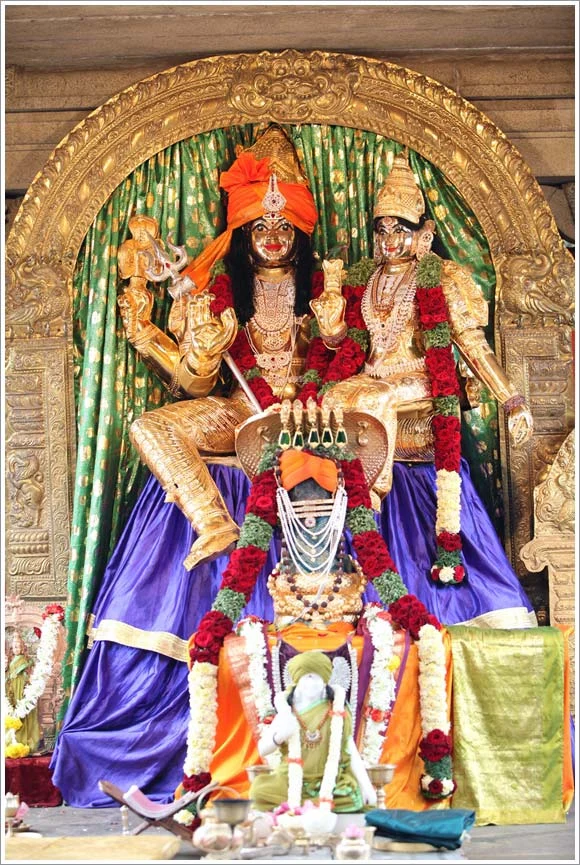
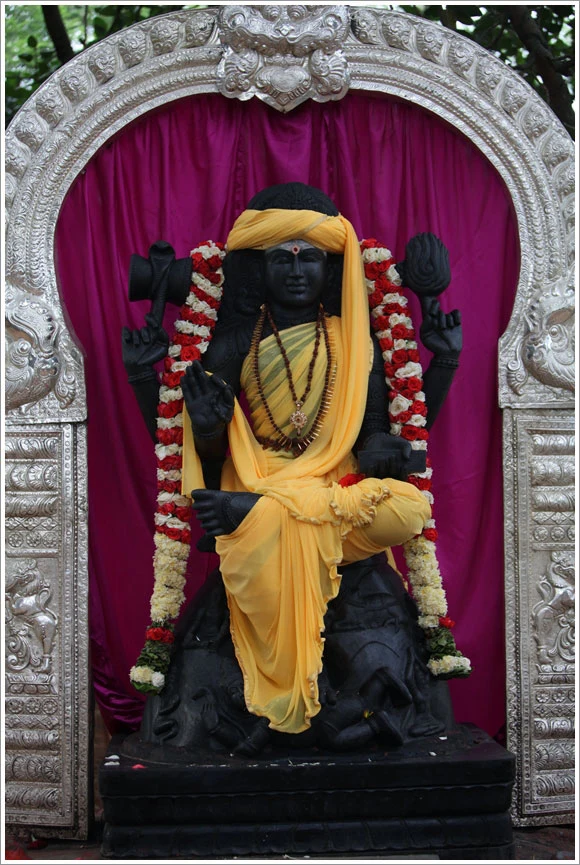
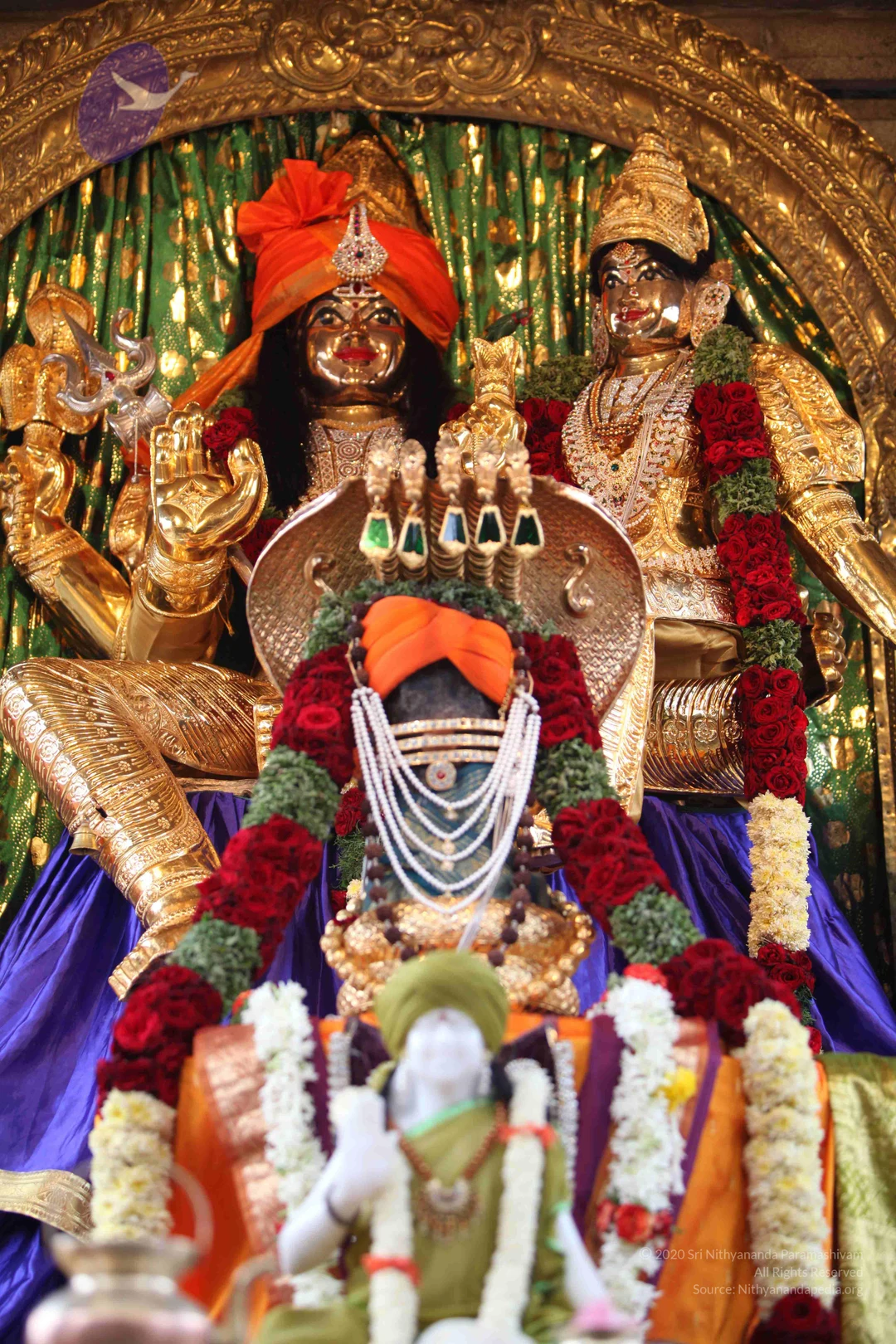
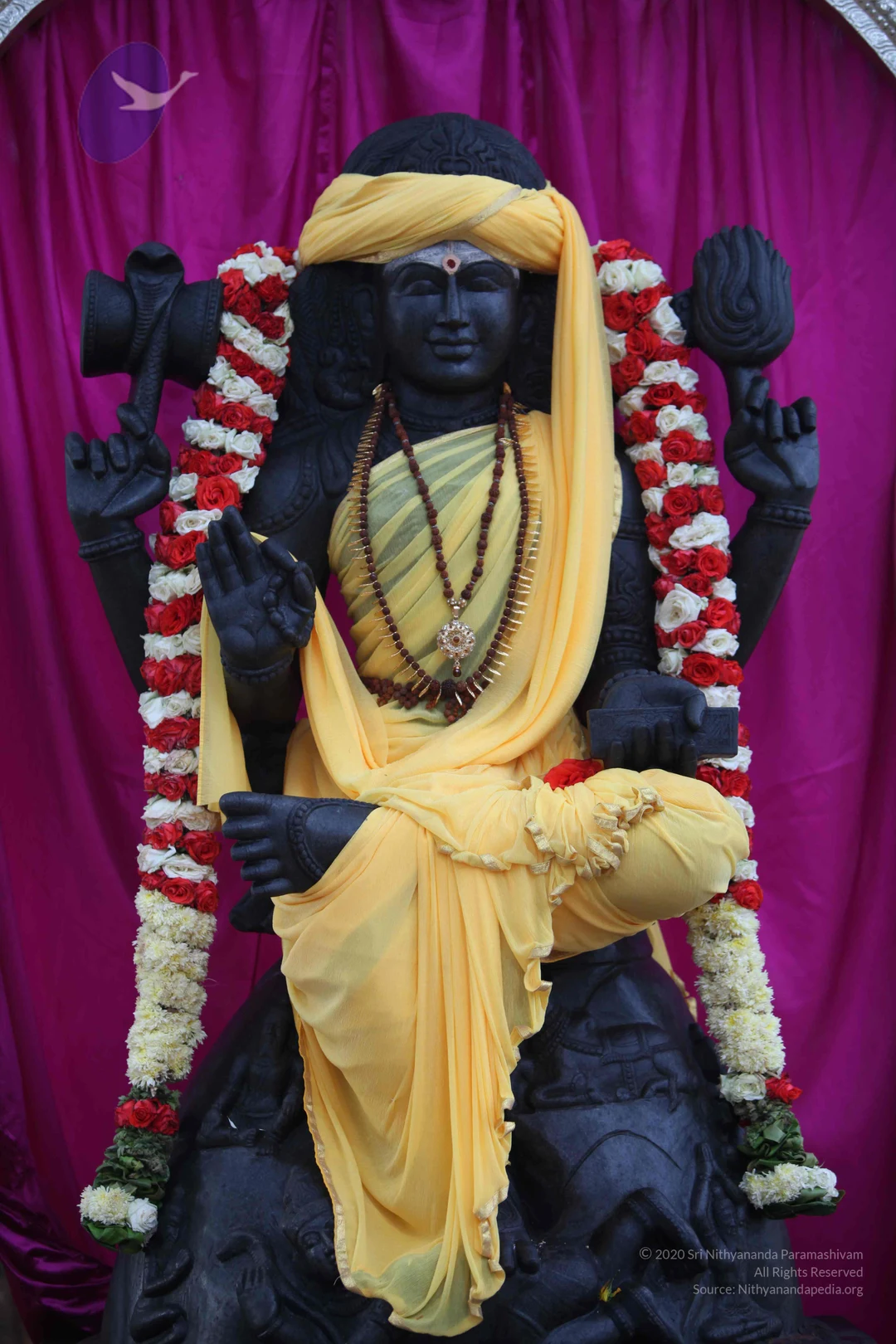
Deity-Darshan
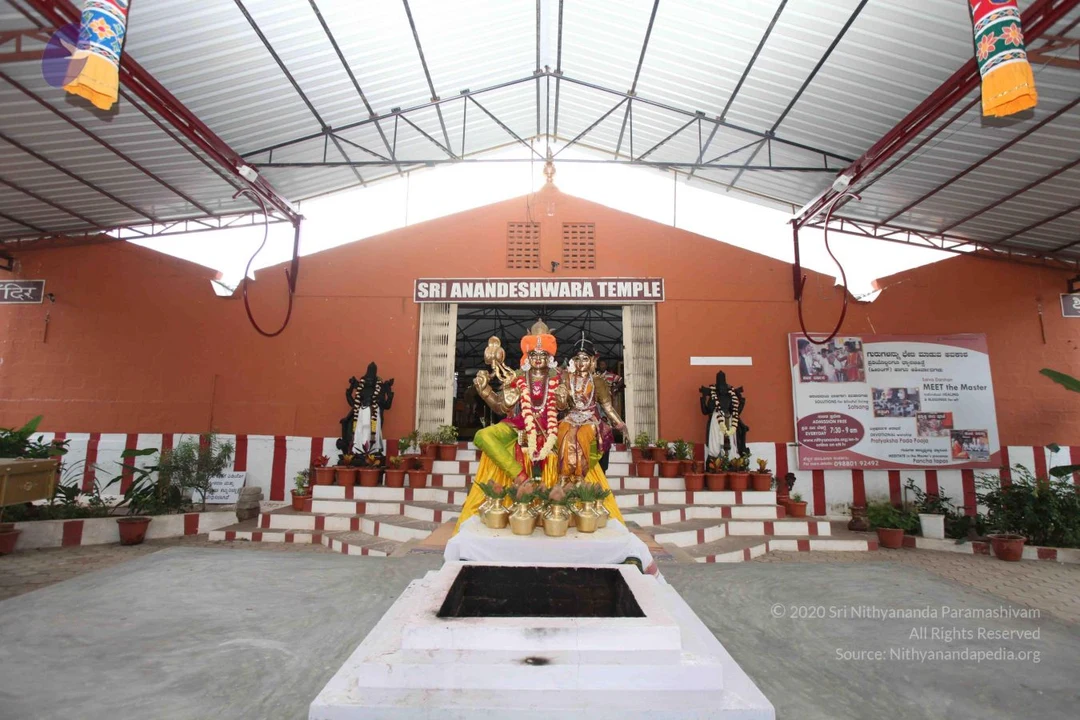
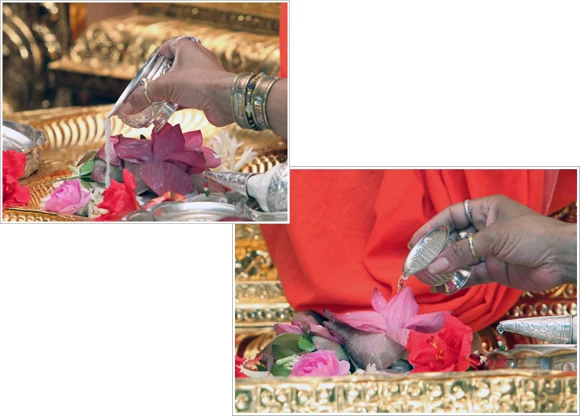
Pratyaksha-Pada-Puja

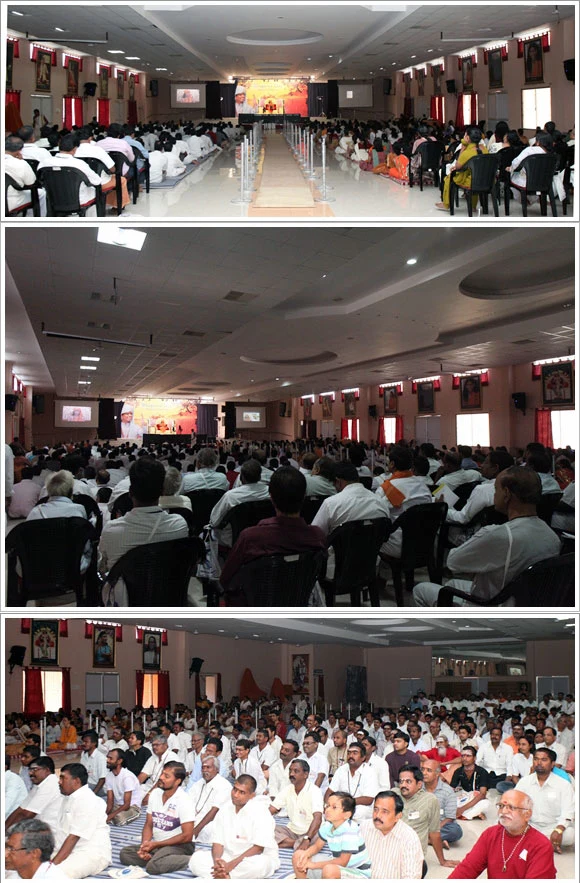
Bhagavad-Gita-Satsang

NSP-Session

Organisers-Meeting

Sarva-Darshan

Medical-Camp

Photos Of The Day:

Deity-Darshan
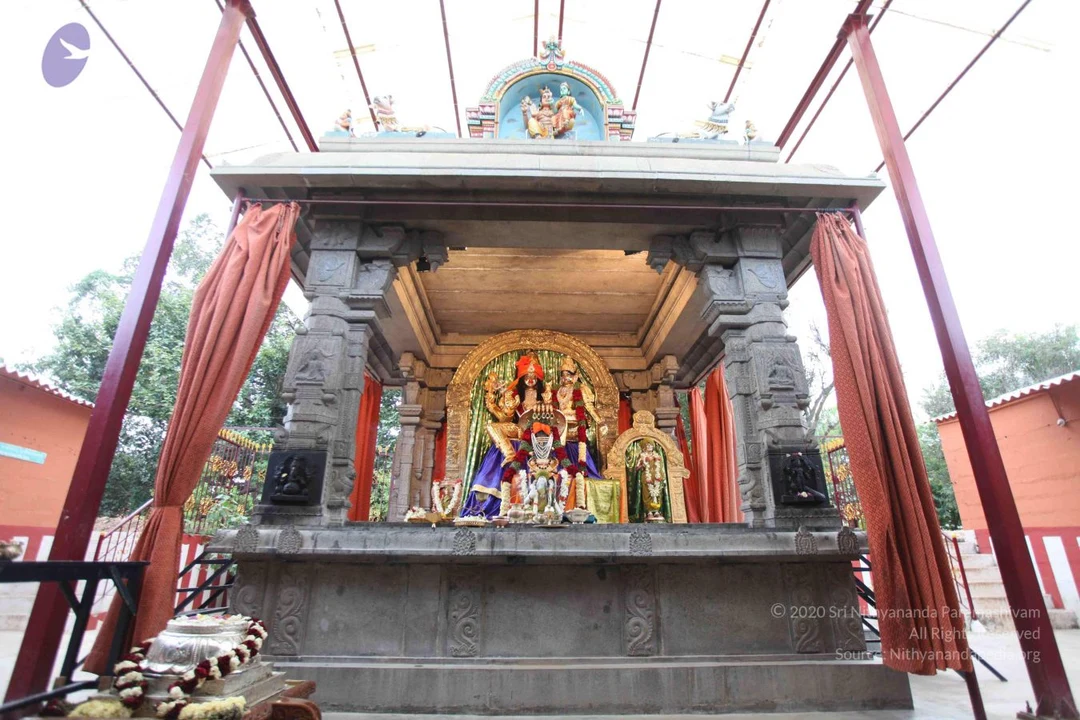
Pratyaksha-Pada-Puja

Bhagavad-Gita-Satsang

NSP-Session

Organisers-Meeting

Sarva-Darshan

02-Pratyaksha-Pada-Puja

03-Bhagavad-Gita-Satsang

IMG_9110_CMP_WM Done

Sub Category: Shiva

Photos from this day

View all 313 photos

Photos

15 photosSource gallery
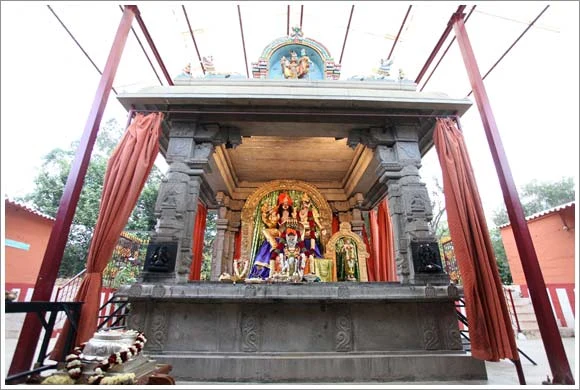
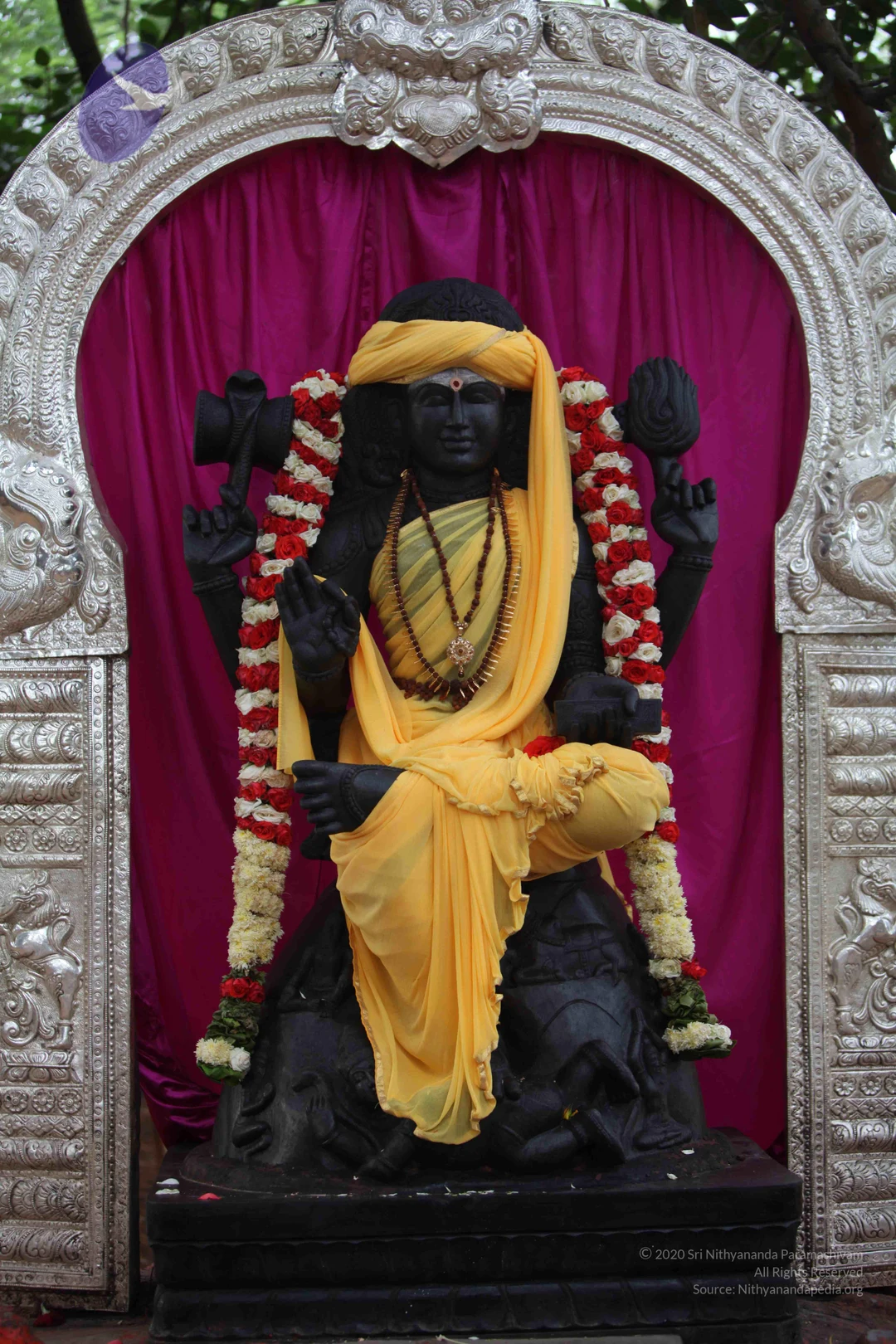
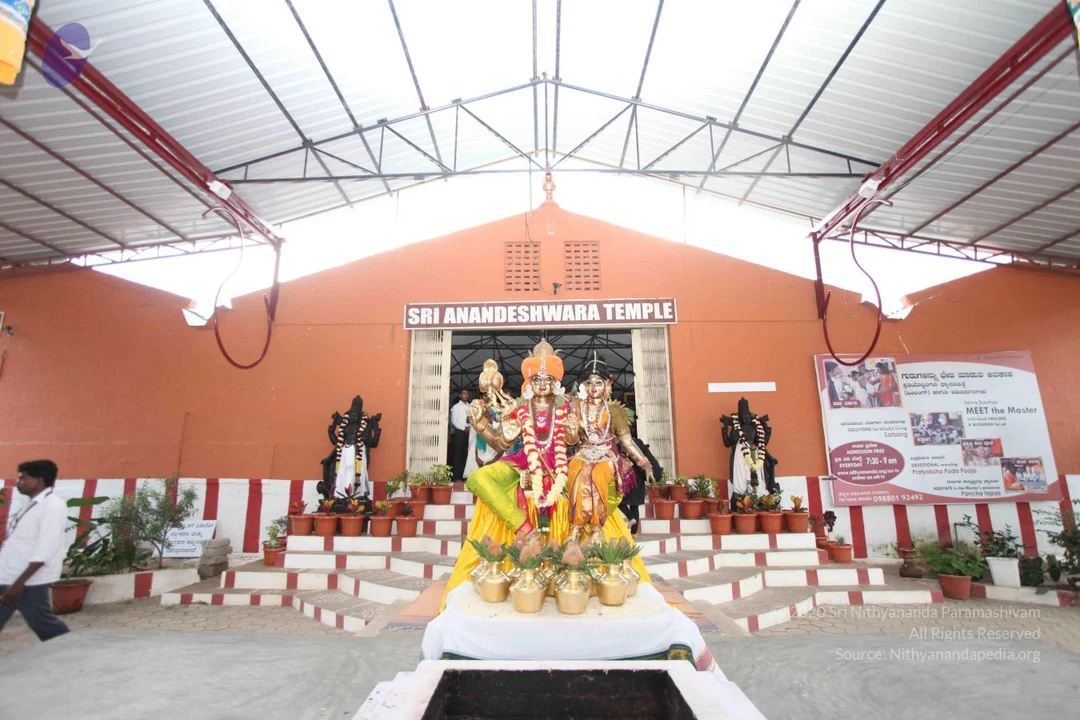
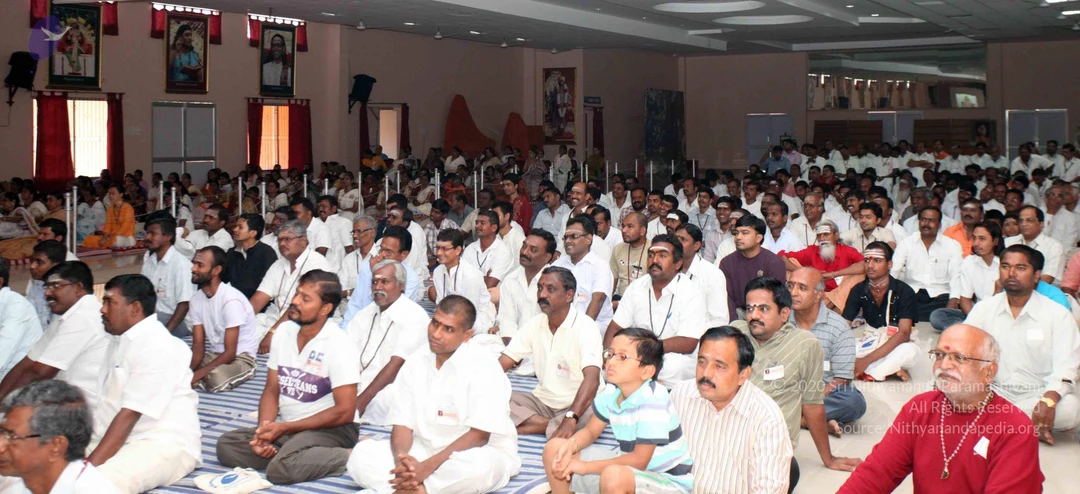
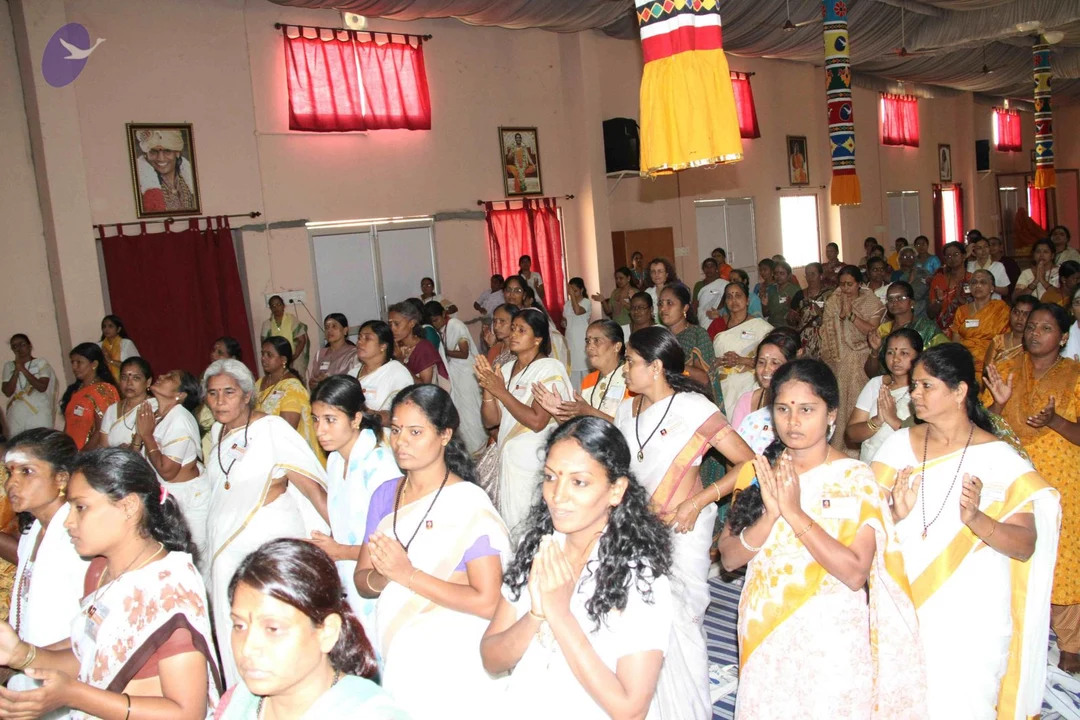
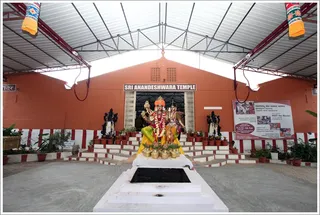
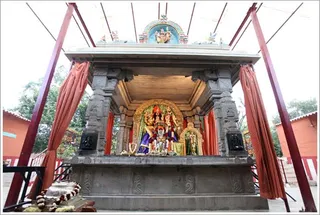
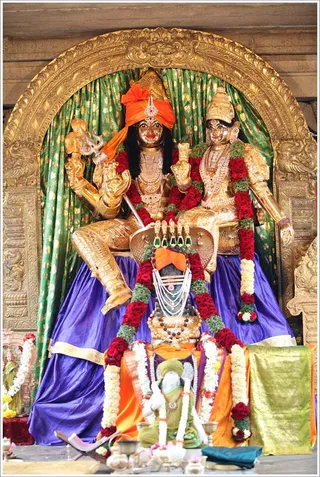
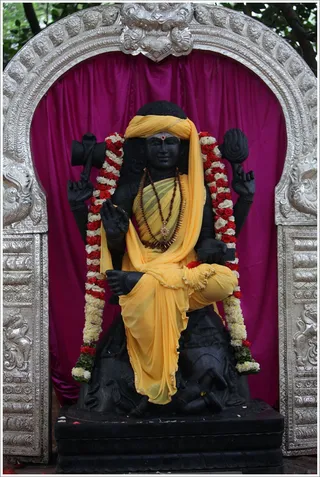
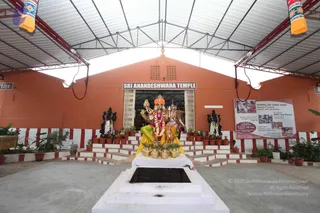
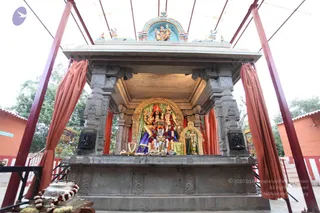
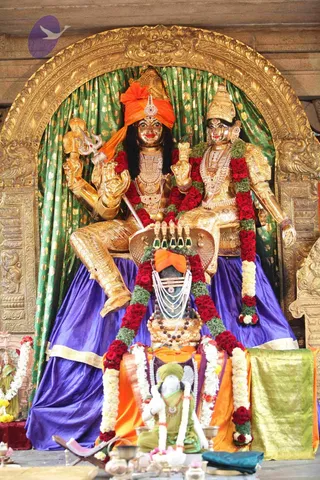
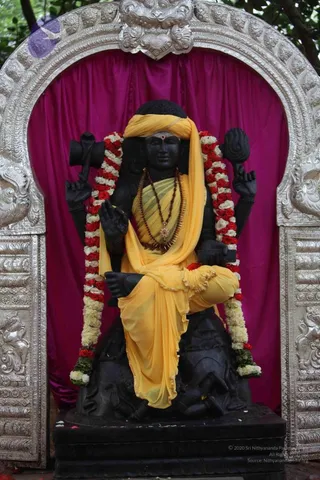
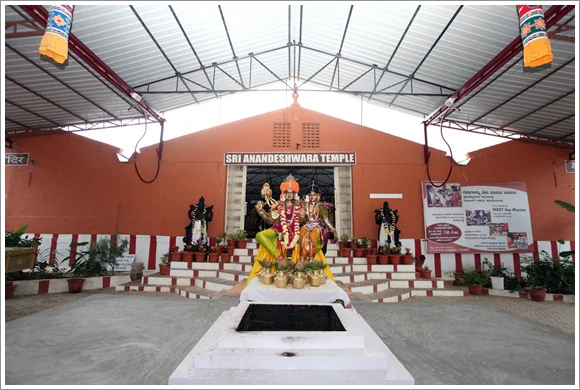
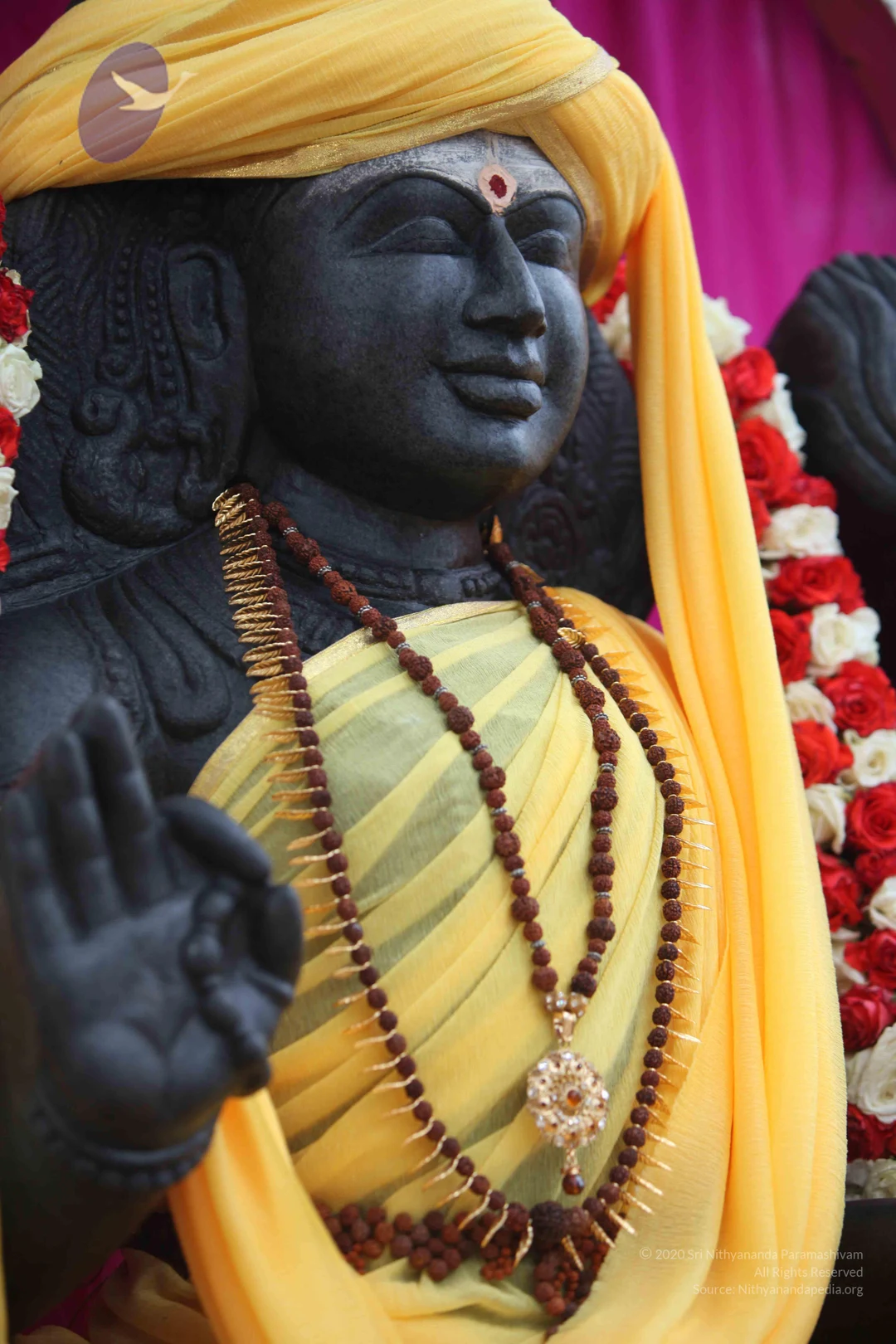
Exterior of a small orange-walled shrine with a sign reading Sri Anandeshwara Temple above its open doorway. In front stands a white raised platform holding a sculpted deity murti with a crown, flanked by two smaller painted figures and potted plants with yellow flowers. A square basin sits in the foreground of the courtyard. A pillared corrugated roof with red-and-yellow banners overhead frames the scene. On the right, a printed banner shows photos and text. No people are visible.An outdoor temple shrine with a dark grey stone structure and carved pillars, framed by red and maroon cloth drapes hung from a red wooden frame. Inside the shrine sits a deity murti decorated with colourful garments and garlands, with lamps and offerings in front. A small painted panel with figures stands above the entrance. No people are visible in the scene.A photograph of a golden deity murti seated on a blue and gold throne-like seat before a green draped backdrop with an ornate gold arched frame. The central figure wears an orange turban, holds a trident and a raised hand gesture, and is decorated with red rose garlands and gold necklaces. A second golden murti with a crown stands beside it. In front, a small figure in orange and green is garlanded with red roses, and brass lamps and offering vessels sit on the floor. No physical people are visible, so the figures are statues and a person is none.A black stone statue of a deity murti seated in a lotus-like pose before a magenta curtain and an ornate silver arch. The figure wears a yellow draped cloth over the shoulders and lower body, a yellow headwrap with a red tilak on the forehead, and a long mala of dark beads with a pendant at the chest. Garlands of red and white flowers hang down both sides, and one raised hand holds a trident-like object while the other hand rests on the knee. Green leaves and foliage appear at the top.Two-panel collage of ritual water pouring over flowers. Top panel: a hand with bangles pours water from a silver vessel over pink and red flowers in a gold-trimmed tray. Bottom panel: a hand in a ring holds a small silver spoon-like vessel pouring water over pink lotus and red rose petals in an ornate gold tray, with a red cloth draped behind. Pictured activity suggests abhishekam offering; no faces visible. The collage contains no physical people beyond the hands.Three stacked photographs of a large seated audience inside a hall at a satsang discourse. Rows of people in white and light-coloured clothes sit on chairs and on a striped mat, with some in orange and saffron garments. Wall portraits are hung in a row along the walls, and red banners hang at the sides. Projection screens show a speaker on a stage lit in warm red and orange, with a figure in orange at the front of the platform. Crowds fill the room from front to back, with the closest rows of seated men in white shirts and dhotis in the foreground.

Deity-Darshan
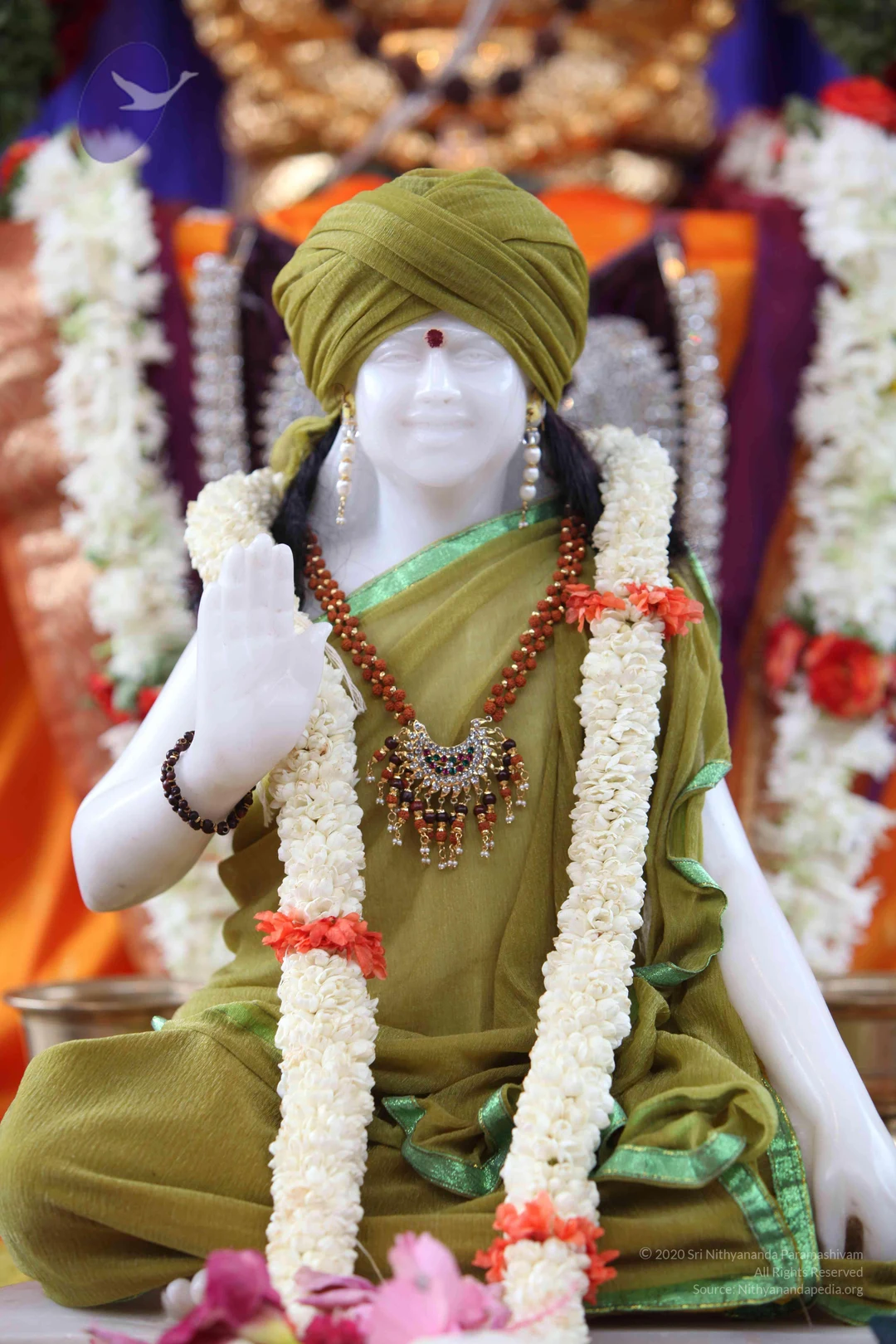
54 photosSource gallery
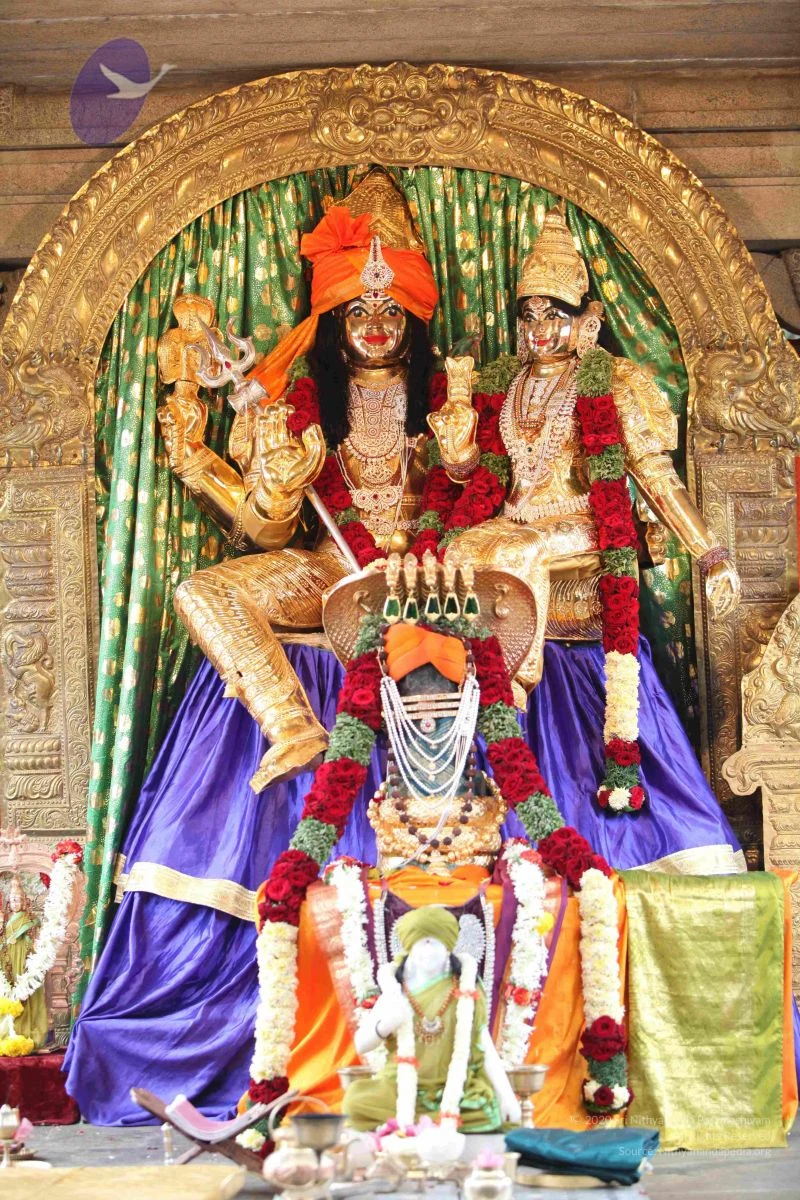
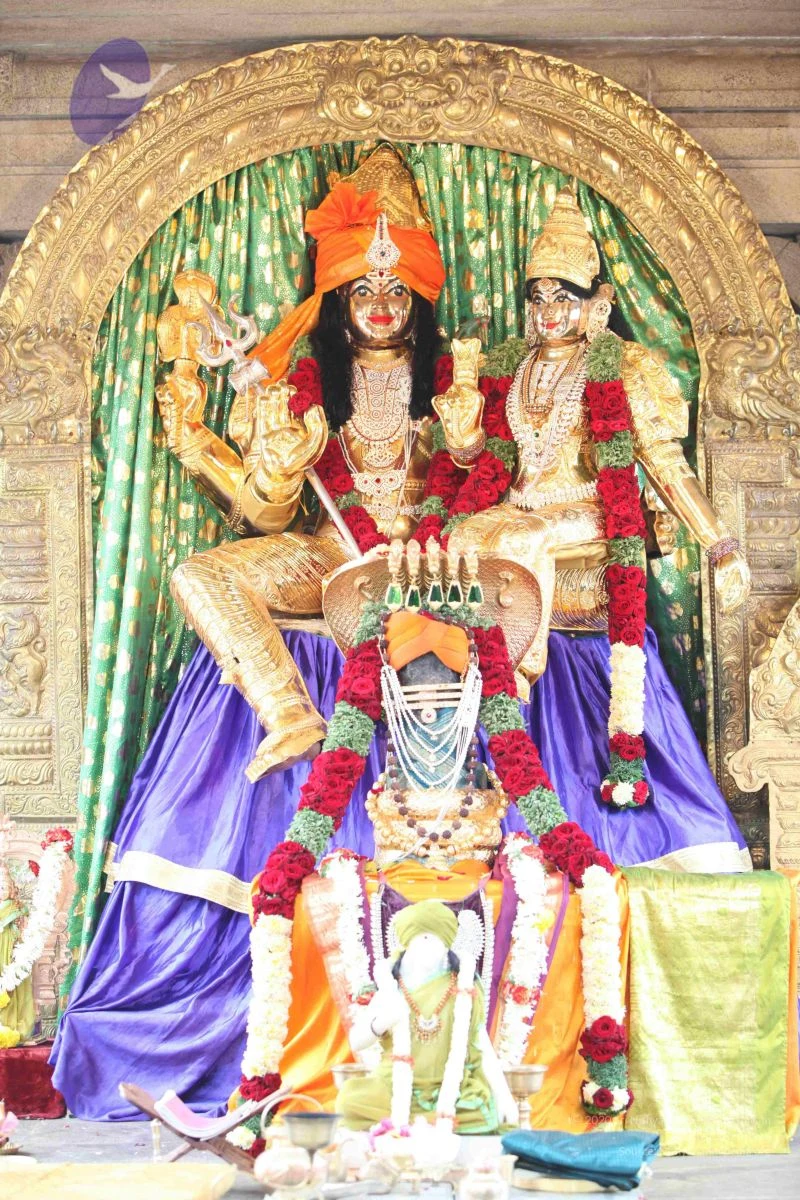
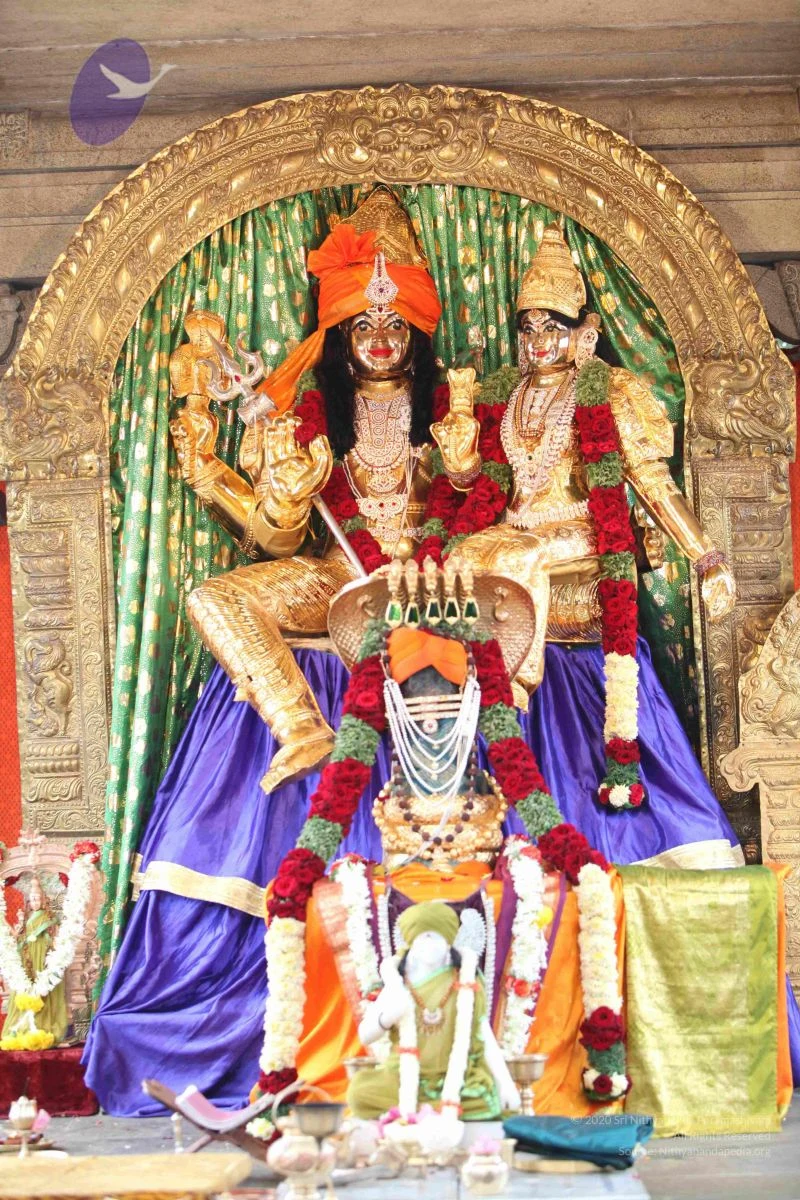
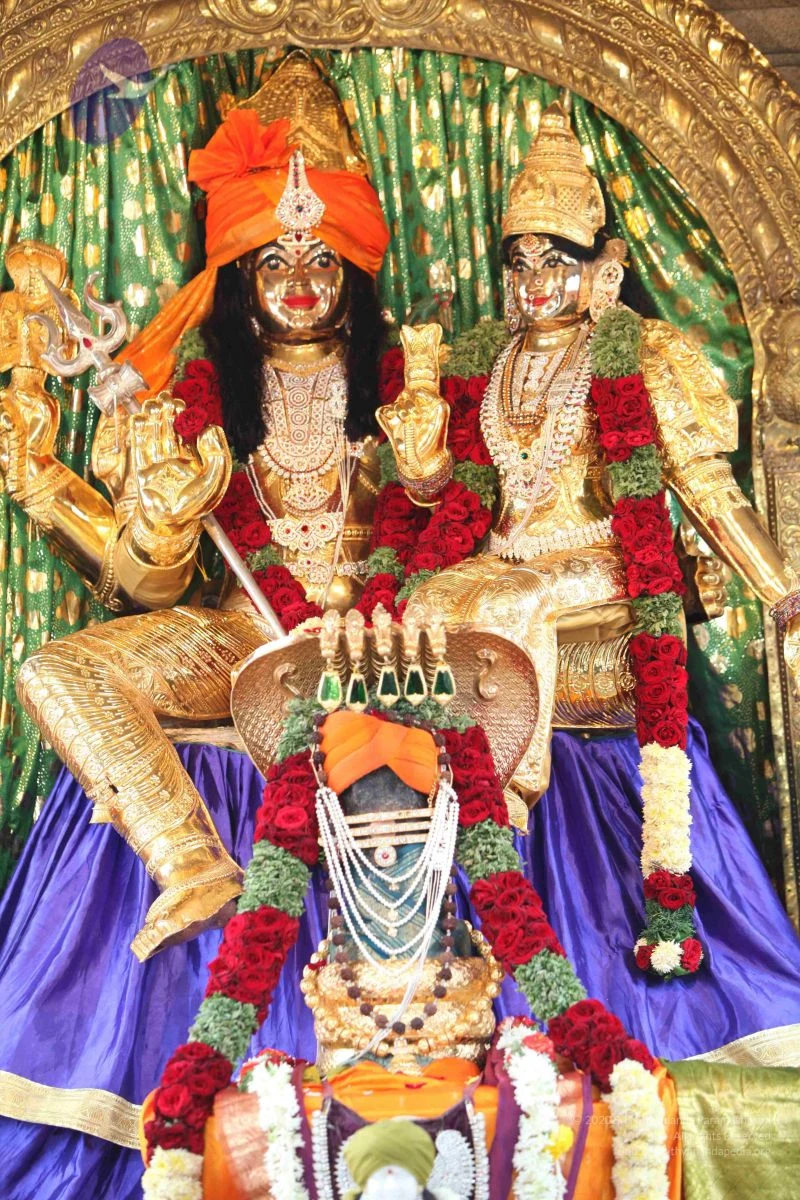
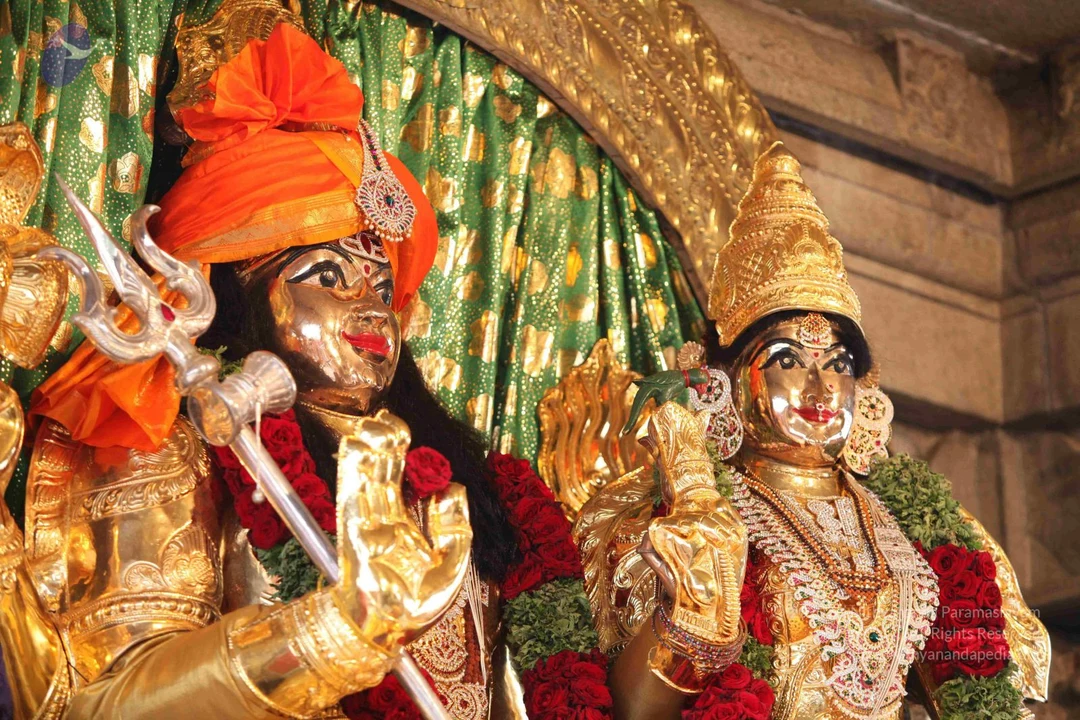
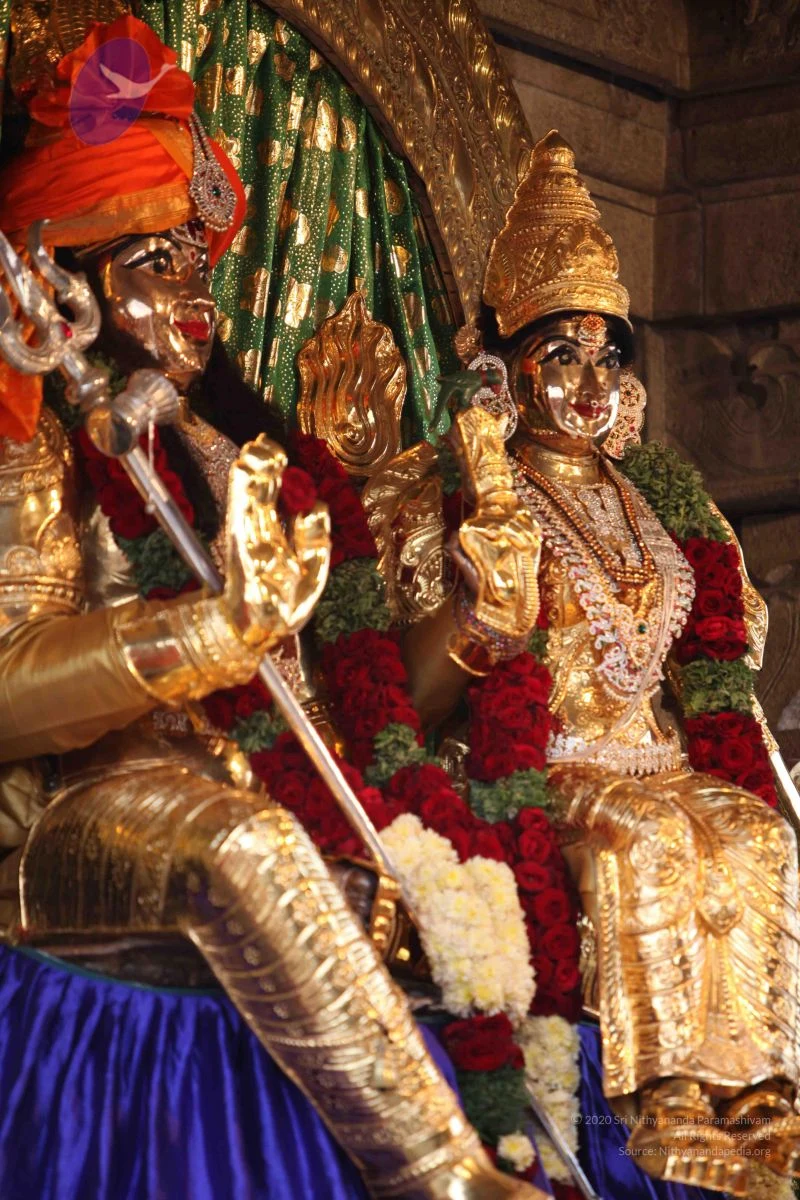
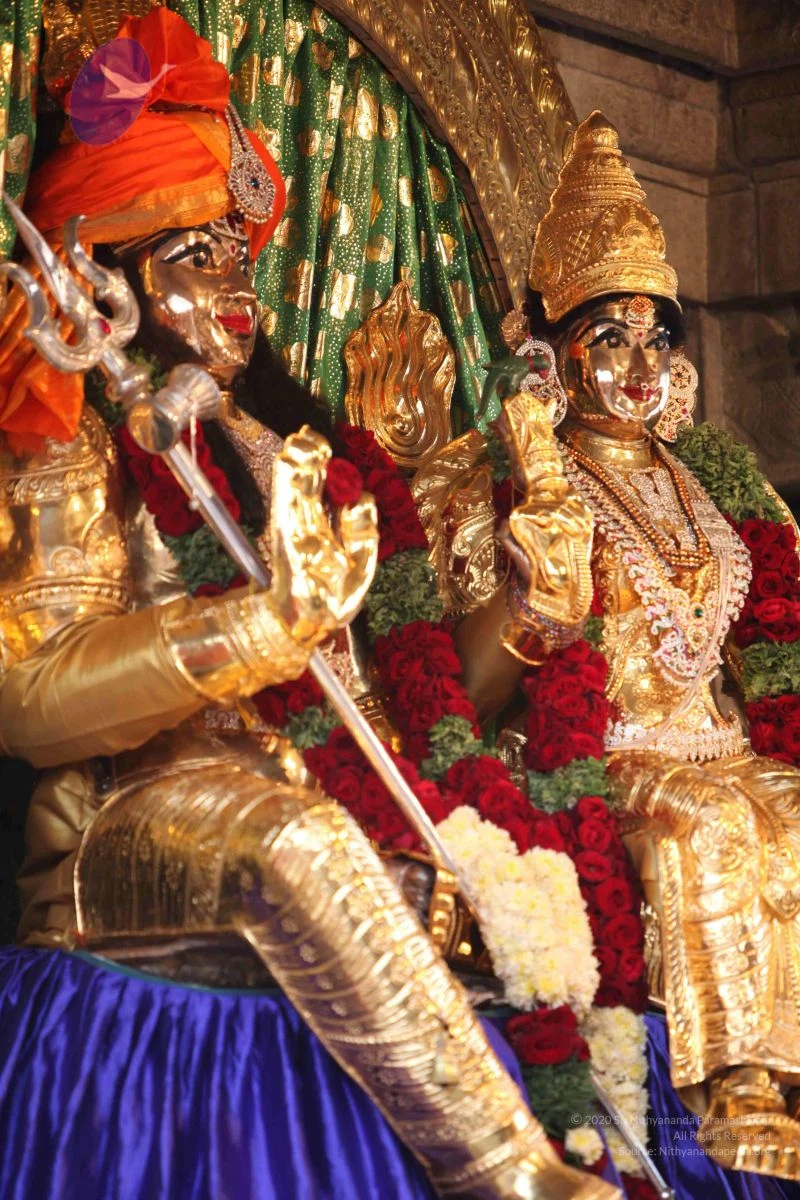
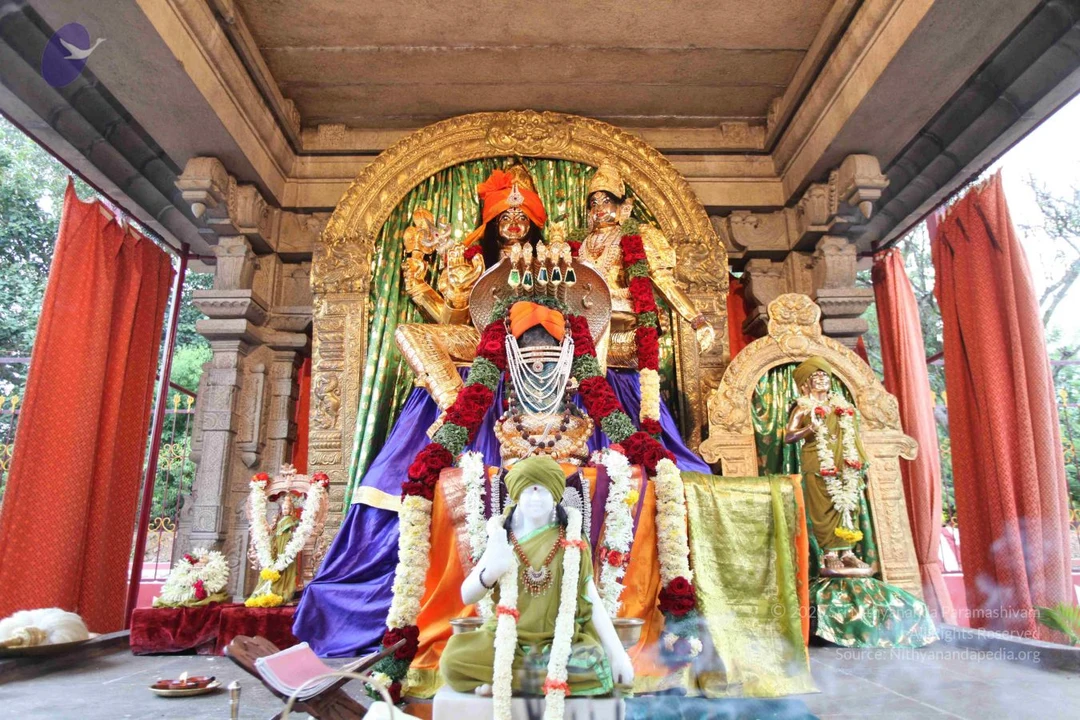
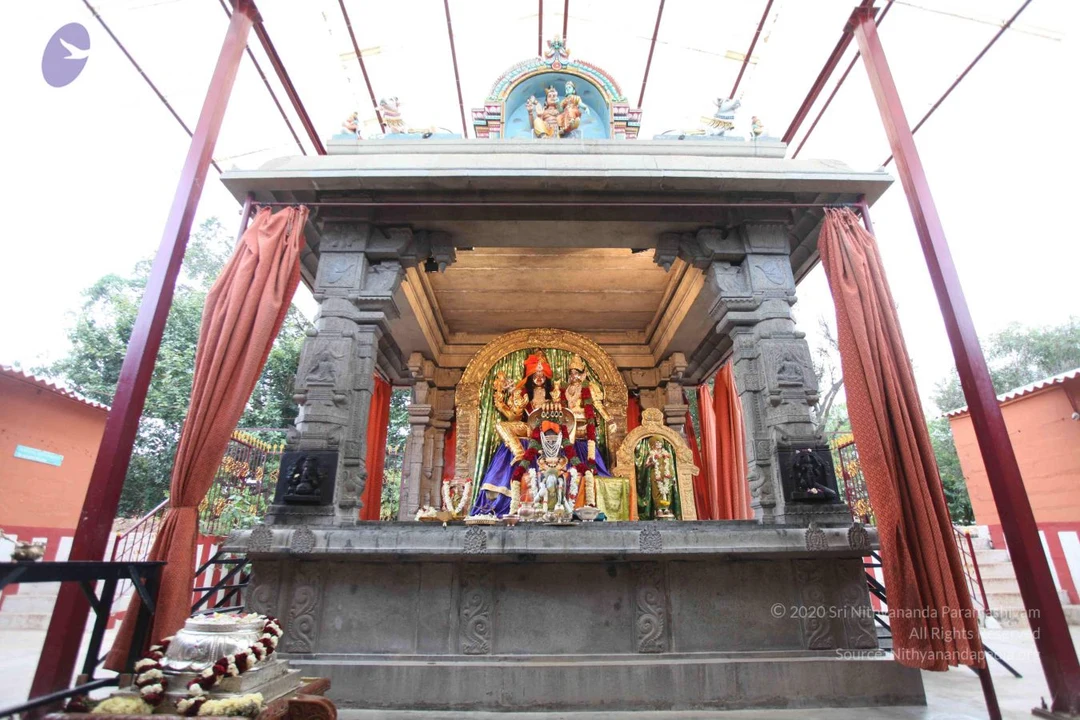
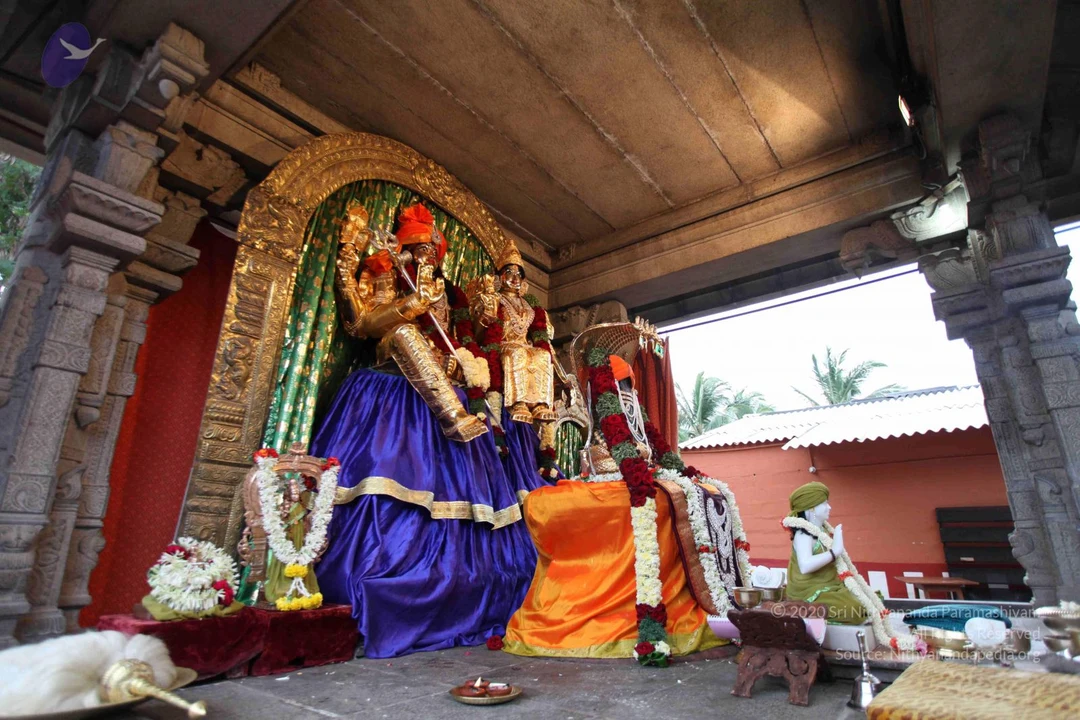
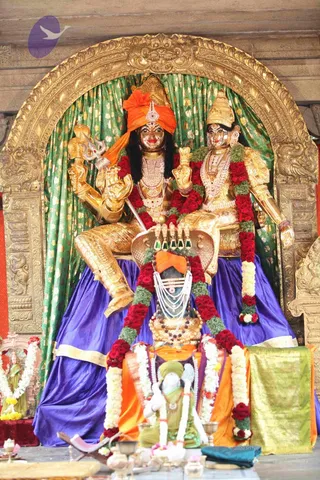
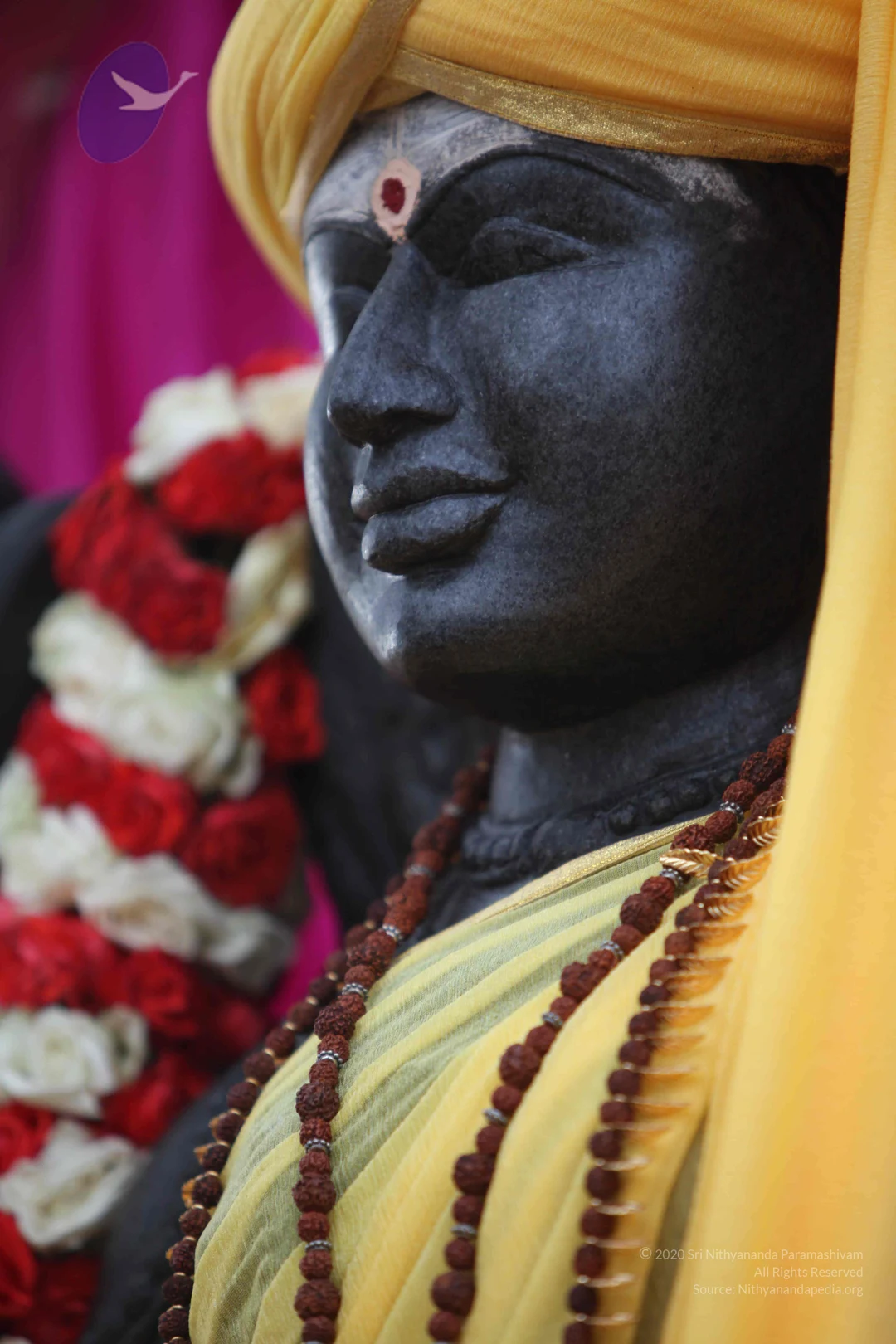
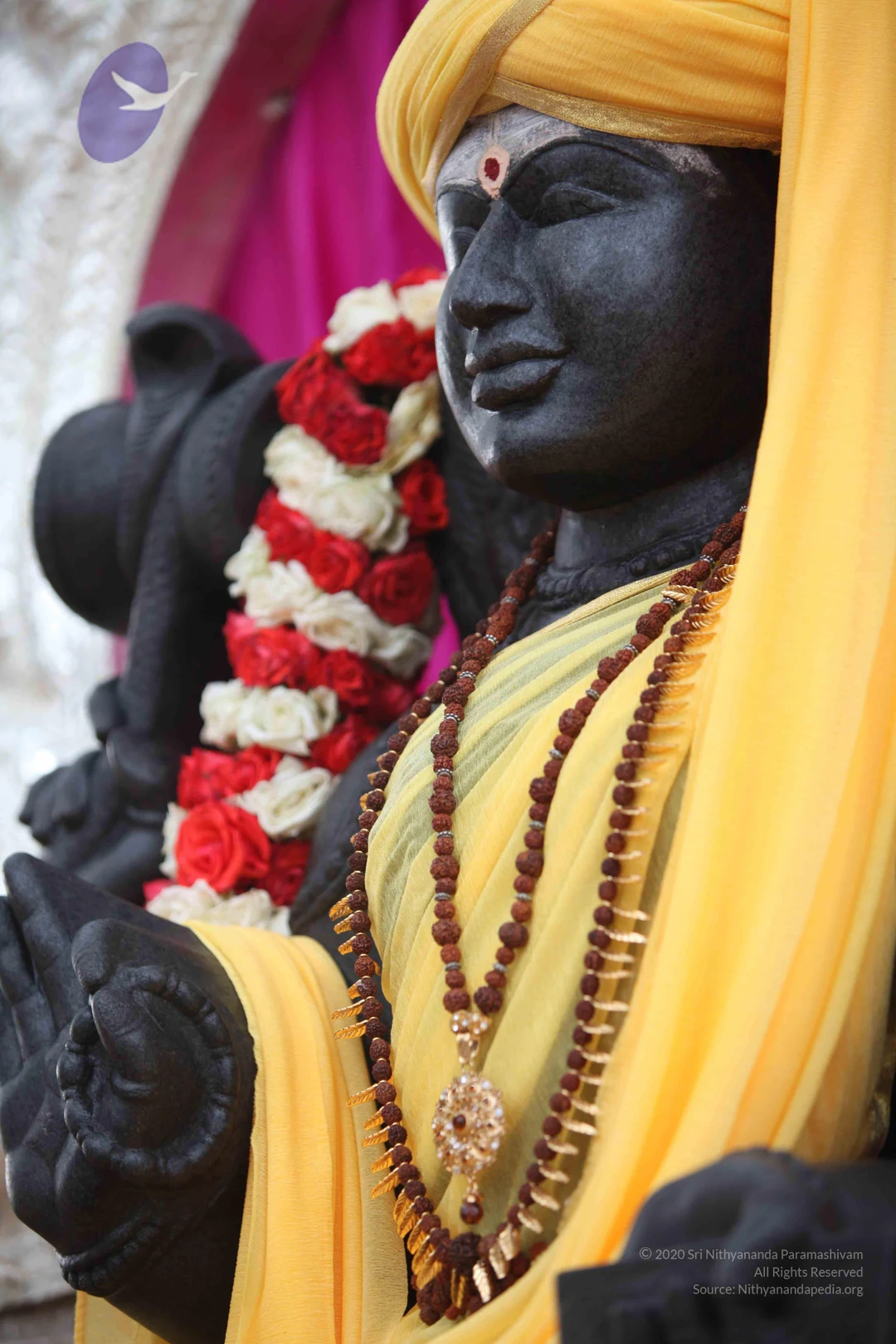
A covered outdoor temple courtyard with a corrugated metal roof and an orange-painted brick wall. Centred on the steps is a pair of deity murtis, a male and female form, dressed in yellow and green silk, garlanded with marigold and red flowers, and wearing a tall orange crown. Brass kalashas and small potted plants line the steps, and a white-tiled square pit sits in the foreground. Two black stone Nandi-like figures flank the entrance. A tall board on the right shows photographs and Kannada text. No people are visible.A photograph of an open-air stone shrine with a grey granite base and pillared canopy supported by red metal poles with orange-red draped curtains. Inside the shrine sits a deity murti decorated with a red crown, a red and gold garment and floral garlands, flanked by smaller figures. Above the shrine is a painted arch with figures on the roof. Marigold garlands and a brass kalasha-like vessel rest at the front base. No people are visible in the scene.Golden murti of a seated deity pair framed by an ornate gilded arch and green gold-dotted backdrop. The seated male figure wears an orange turban, rudraksha-style necklaces, and holds a trident and drum-like object; the female figure beside him wears a gold crown and pearl necklaces. Both hold red and white flower garlands. In front, a smaller figure in green and orange is adorned with pearl necklaces and garlands, surrounded by brass lamps and flower petals on the floor, with purple silk drapery below.A dark stone murti of a four-armed deity seated on a black pedestal, draped in a flowing yellow shawl and wearing a yellow turban with a red bindi on the forehead. Its neck is adorned with a rudraksha mala and a gold pendant, and it is garlanded with red and white roses and white jasmine strands. Behind it stands a magenta cloth backdrop framed by an ornate silver arch with carved floral and animal motifs. A small disc-shaped emblem sits at the top left corner. The statue is a sculpted image, not a living person, so no physical people are present.A golden deity murti of a seated couple under a gilded arch, set before green and gold drapery. The figure on the left has four arms, an orange turban, a trident and a rudraksha-style necklace; the figure on the right wears a gold crown and ornate necklaces. Both sit on a purple skirted base with red and white rose garlands draped over them. In front, a small orange-turbaned figure in green with garlands sits within a bell-shaped metal vessel of offerings. Brass oil lamps and a silver bowl sit at the base, with a purple cloth on the right.Photograph of a gilded murti of Shiva and Parvati seated together on a throne-like raised platform in front of a green curtain with gold dots and an ornate gold arched frame. Shiva has a trident, an orange turban and rudraksha-like garlands; Parvati wears a gold crown and ornate necklaces. Both are draped in red and green rose garlands. Below, a smaller ceremonial figure in an orange cloth and green garment sits draped in garlands, with a silver lamp and offerings in front. A blue skirt drapes the base. Plain temple murti setting with no people visible.

Pratyaksha-Pada-Puja

14 photosSource gallery
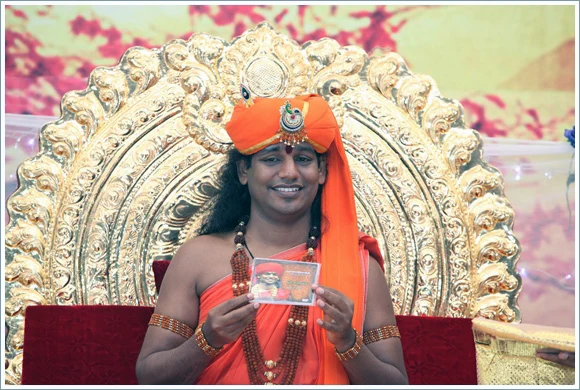
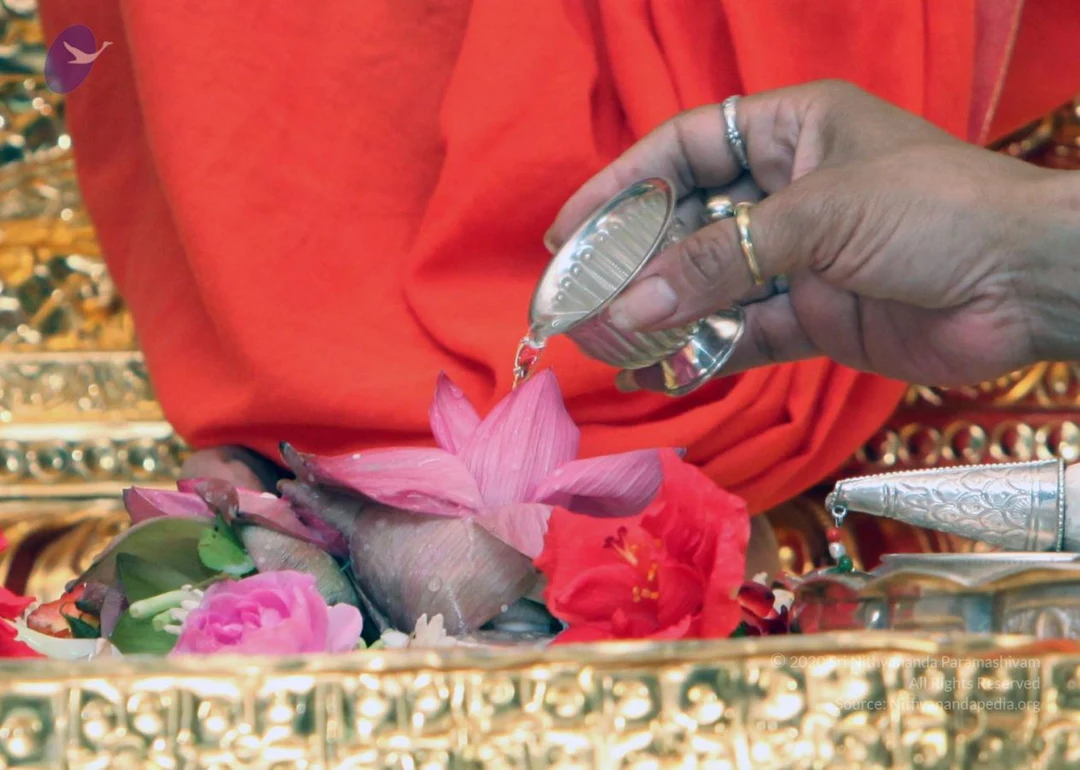
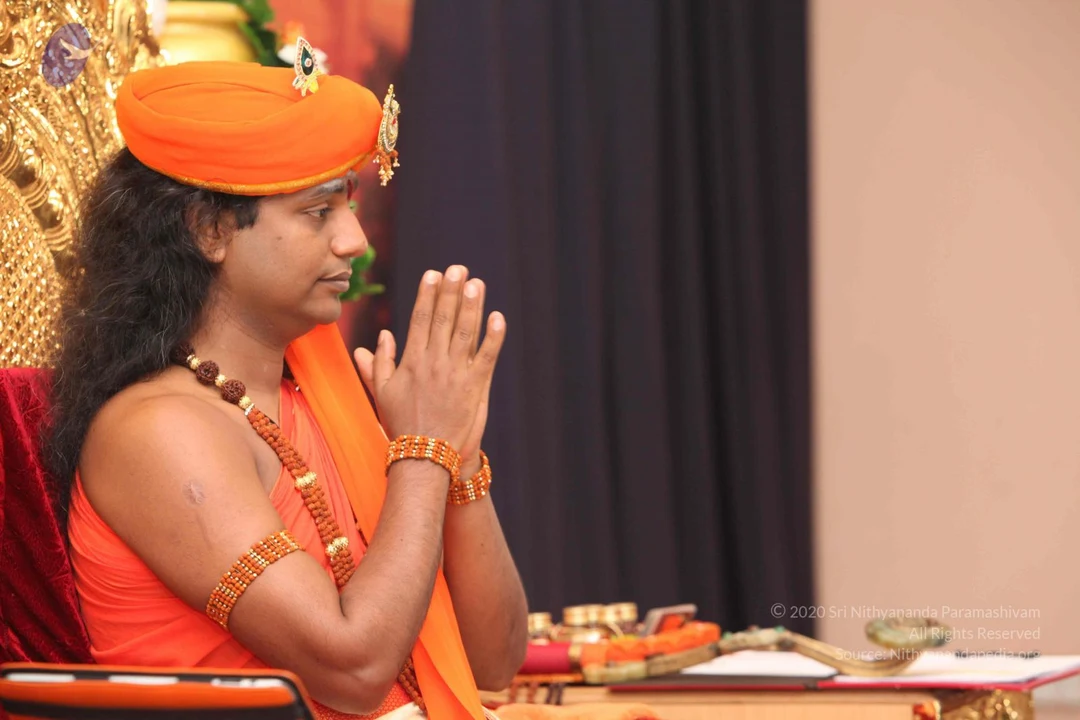
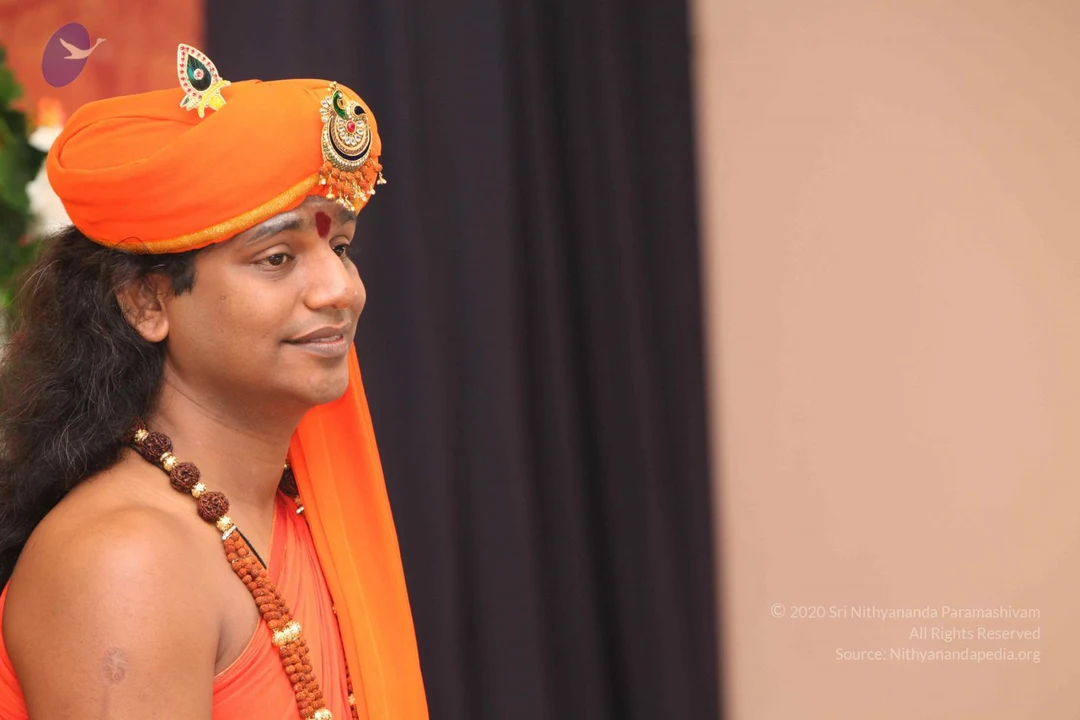
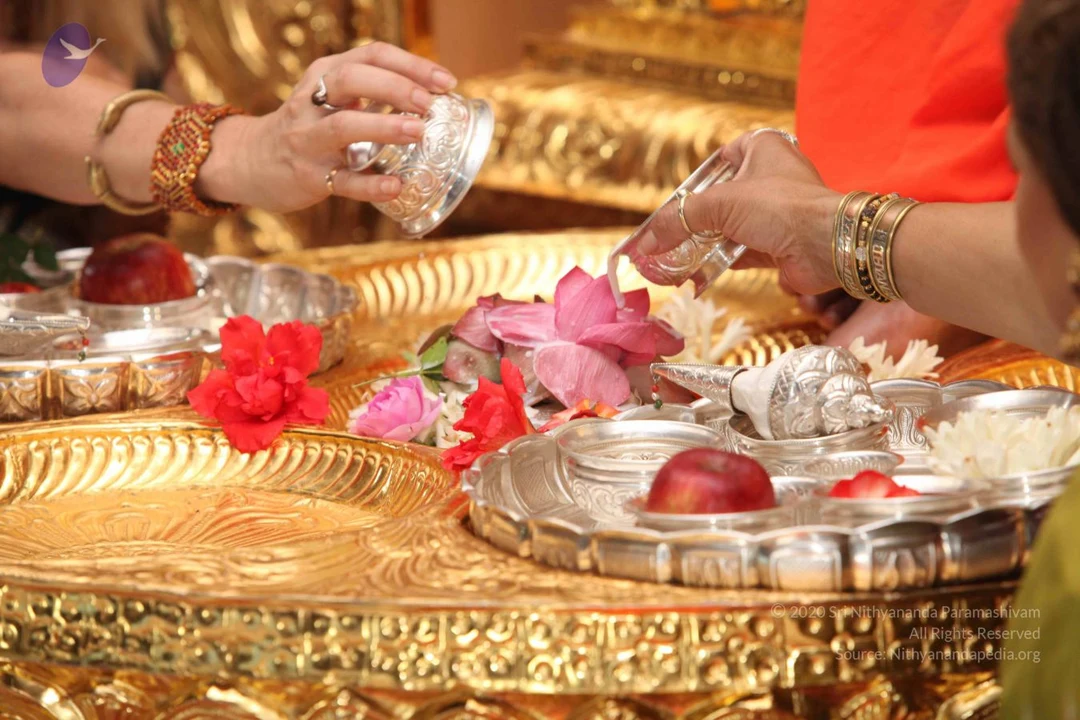
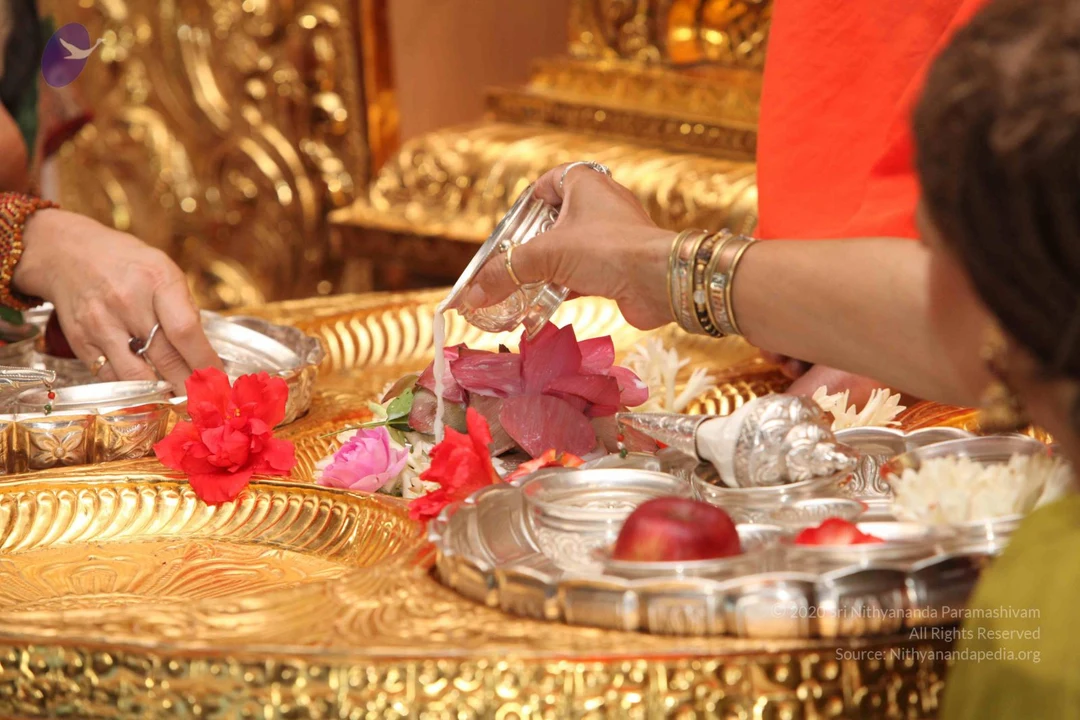
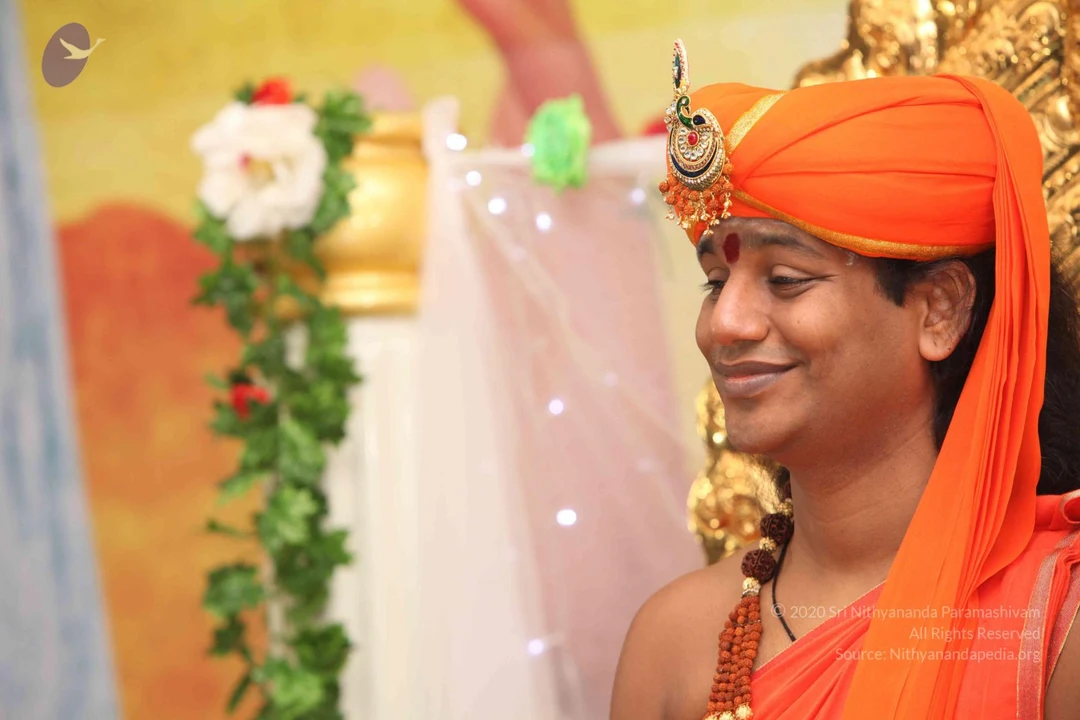
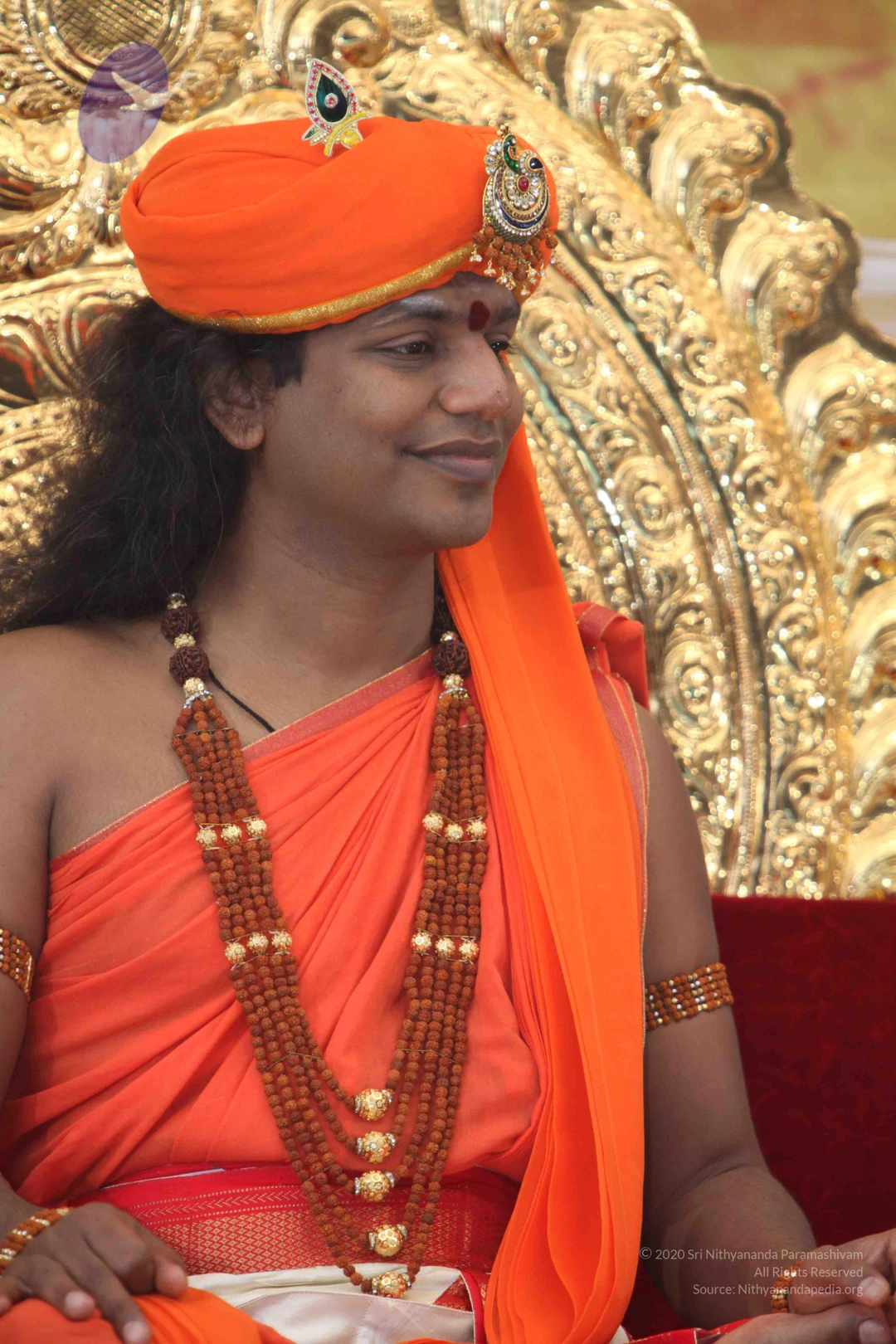
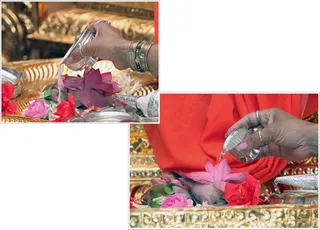
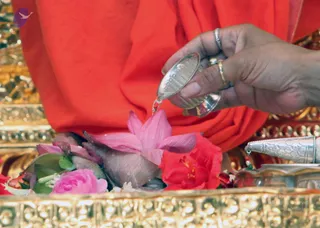
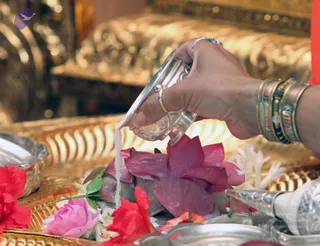
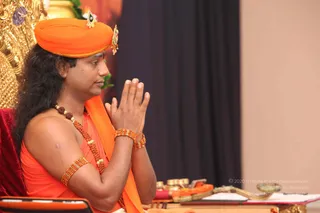
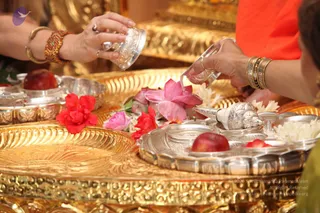
Close-up photo of a hand in a red-orange robe pouring water from a small silver spoon-like vessel over a pink lotus flower on a gold-decorated tray. Pink and red flower petals and green leaves surround the lotus, and a silver cone-shaped object sits at the right edge. The gold tray and orange cloth suggest a puja or abhishekam offering. The hand wears silver rings. No face is visible.A close photograph of a ritual offering: a hand with several bangles and a ring pours a thin white liquid from a silver vessel onto a pink lotus flower on a gold tray. Red roses, a pink rose, white flowers and silver bowls surround the lotus. Blurred gold ornate furniture or throne fittings fill the background.A man seated on an ornate golden throne with a red cushion, hands pressed together in anjali mudra before his chest. He wears a saffron-orange turban with a jeweled ornament, a saffron-orange shawl over a bare-chested orange garment, long dark swept-back hair, a rudraksha mala and ceremonial gold necklaces, and gold bangles on his wrists and upper arm. In front of him on a low table are gold and orange ritual items and a gold-handled object. Dark curtains form the background. Appearance-based label: a person, seated in a teaching or satsang setting.A close side-profile photograph of a man in an orange turban with a jeweled brooch and a red tilak on his forehead. He wears an orange shawl over a saffron garment and a long rudraksha mala with gold beads around his neck. Long dark hair falls past his shoulders. Behind him are a dark curtain, a plain beige wall and some white flowers at the left edge. The a person candidate has a long-haired, saffron-clad, rudraksha-wearing appearance; attribution is uncertain from appearance alone.A close photograph of a man in saffron-orange clothing seated before an ornate golden throne-like backdrop with carved gold relief. He wears a tall orange turban decorated with a jeweled peacock-and-crescent brooch in gold, red and green, a red bindi on his forehead, and a long orange shawl draped over his shoulder. Around his neck hang multiple strands of rudraksha beads and a thin black cord. Behind him are green foliage, a sheer white draped fabric with small lights, and a red cushioned seat. The face is smiling and looking to the side.Close-up photo of a puja offering being prepared on an ornate gold-plated tray. Two women's hands, adorned with gold bangles and a red-and-gold beaded bracelet and rings, hold a silver cup and a small glass vessel over the tray. The tray holds red and pink flowers, white blossoms, two red apples in silver bowls, a silver conch-shaped vessel and a silver container. The arrangement suggests abhishekam or puja offerings. A woman in orange clothing is partly visible at upper right.

Bhagavad-Gita-Satsang

40 photosSource gallery
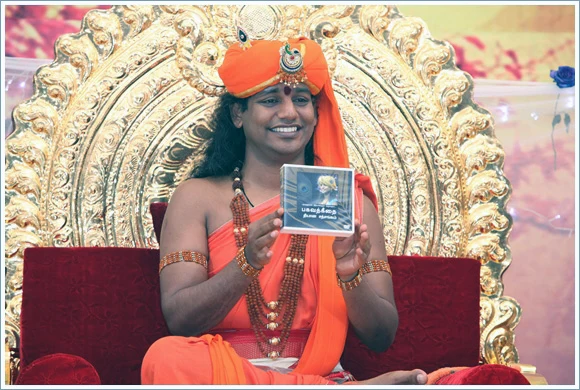
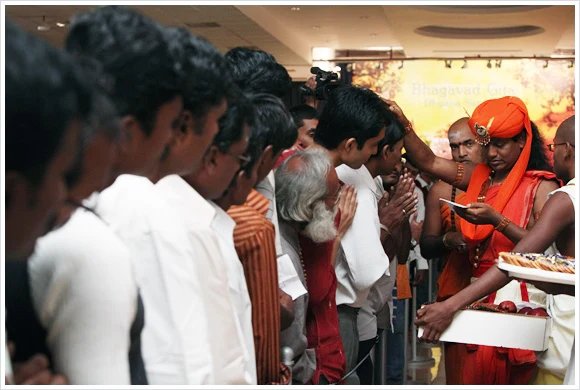
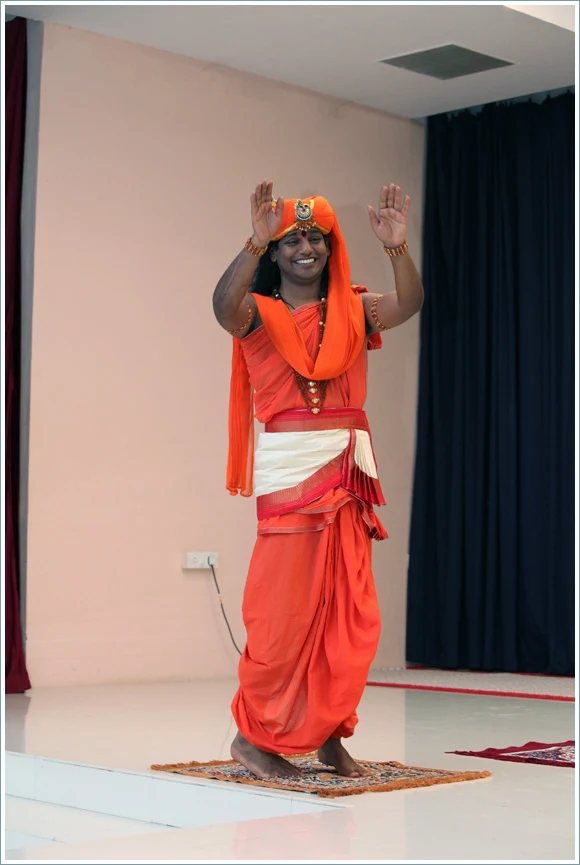
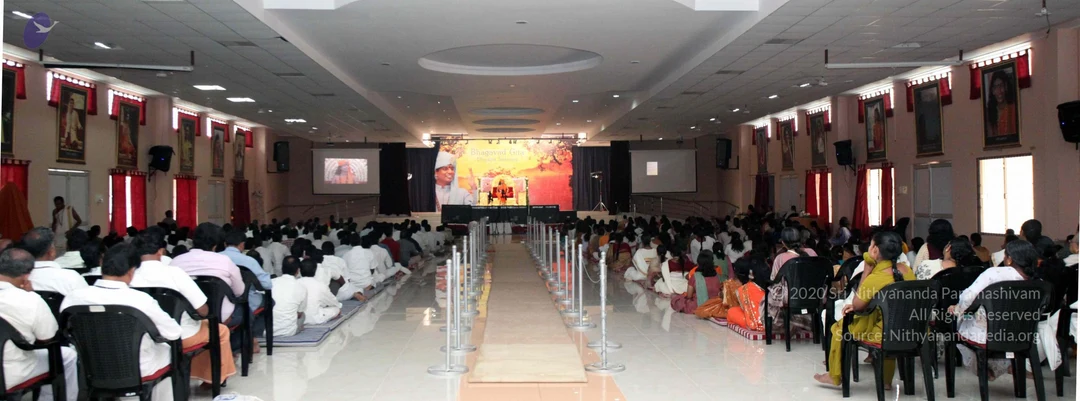
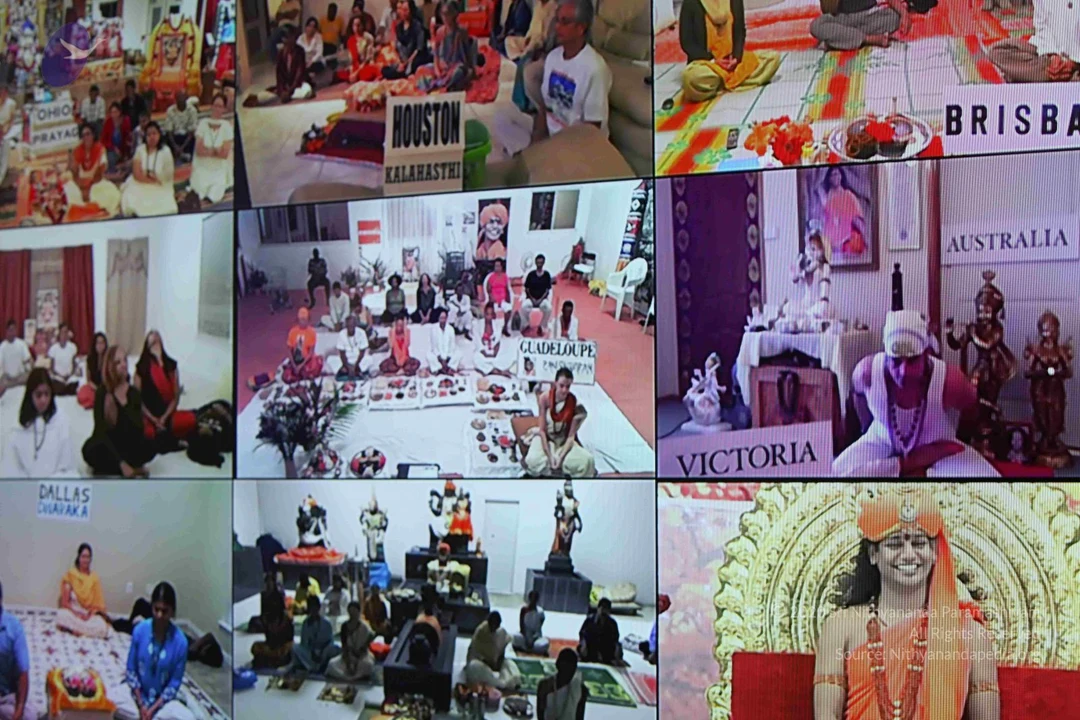
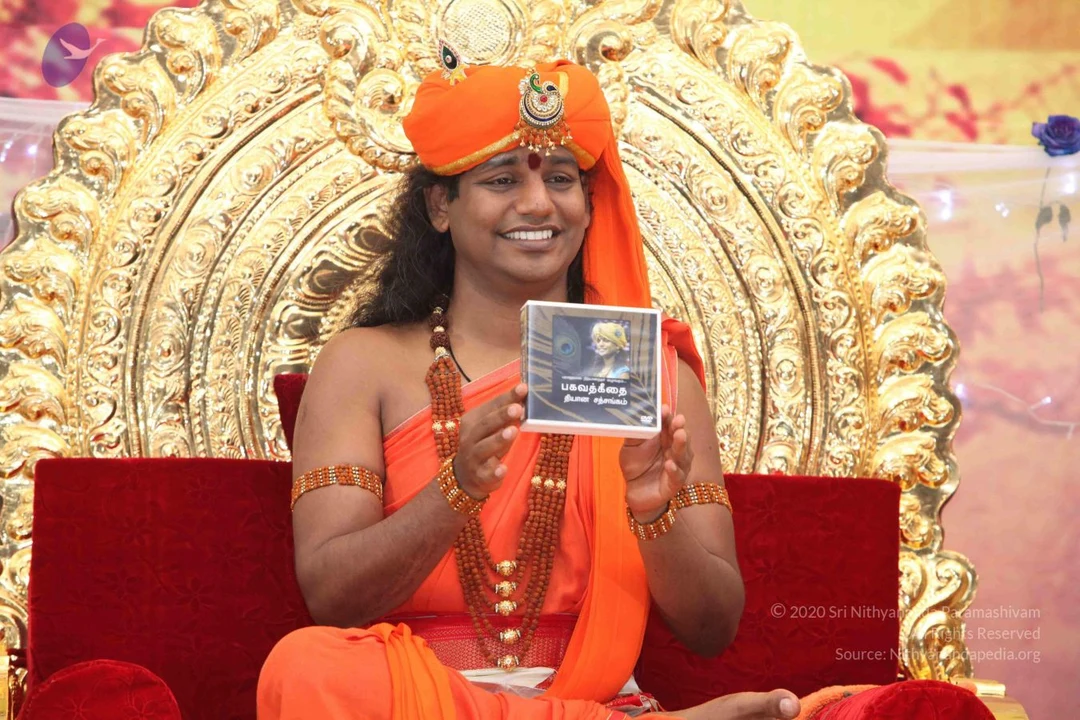
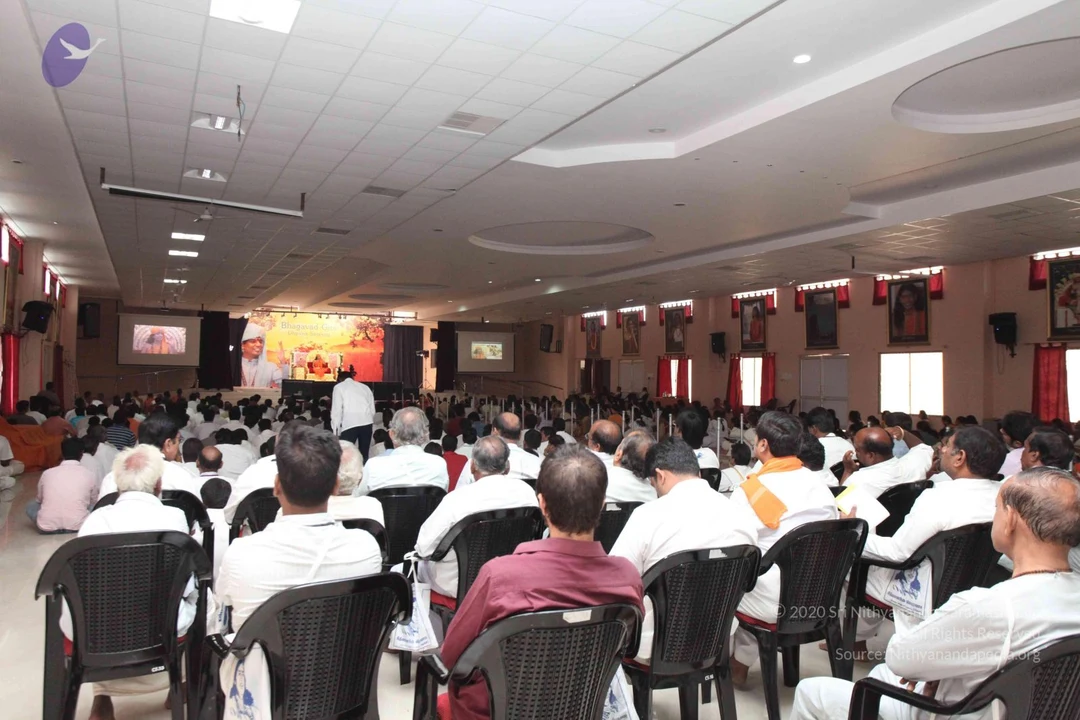
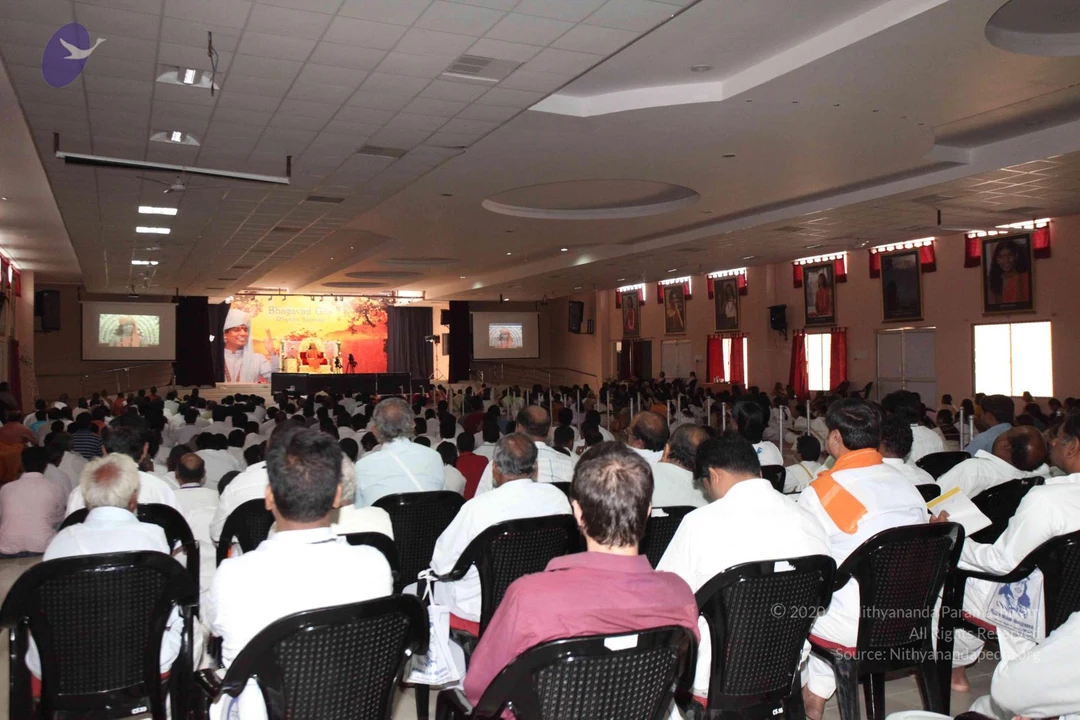
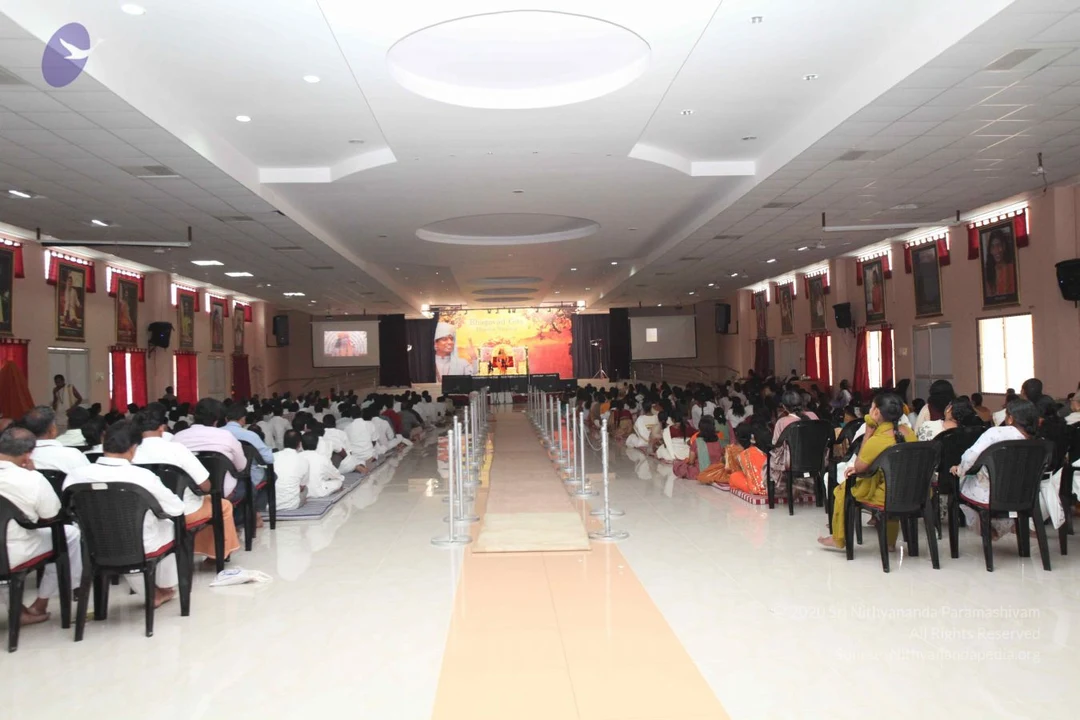
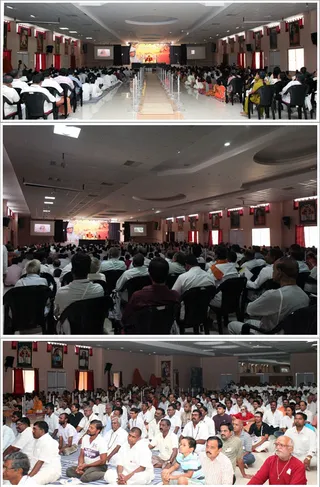
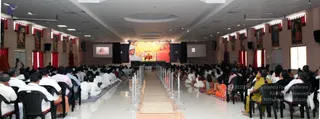
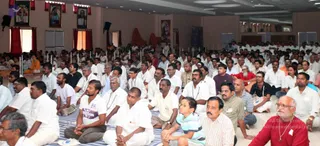
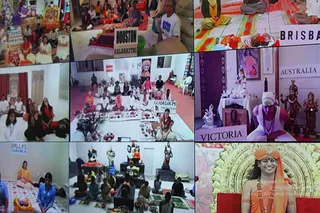
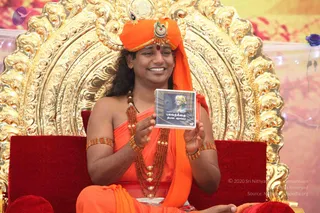
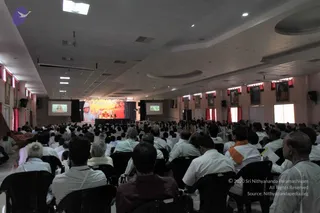
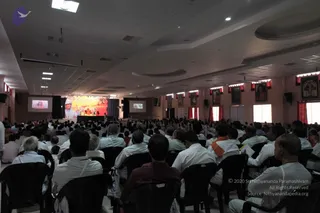
Wide photograph of a large indoor hall filled with seated devotees on white floor and chairs, facing a raised stage at the far end. Men in white dhotis and shirts sit on the left, while women in saffron, orange, yellow and green saris and salwar sit on the right, with a central aisle lined by silver stanchions. On the stage, a figure in white robes and a white head covering stands near a lectern and an orange-red backdrop with golden floral graphics; two projection screens flank the stage. Framed portraits hang along the walls, each with red drapes above.A large seated audience fills a hall during a satsang-style discourse. Most attendees wear white shirts and white dhotis, while others wear checked shirts, a red shirt and a few saffron or maroon garments. Many sit cross-legged on blue-and-white striped mats in rows, with some seated on chairs at the sides. Framed portraits hang on the back wall between red curtains, and a few devotees wear rudraksha or lanyard badges. Some in the front are blurred or partially visible. The crowd appears attentive and seated in quiet rows facing the front of the room.A multi-panel video-conference collage of satsang groups in different locations, each labelled with a printed sign: HOUSTON KALAHASTHI, BRISBANE, GUADELOUPE, VICTORIA, AUSTRALIA, DALLAS CHAVAKA and OHIO PRAYAG. Participants sit on mats and cushions in white, orange and red clothing before deity murtis, kalasha offerings, flowers and fruit plates. In the bottom-right panel a woman in orange and saffron garments with a rudraksha mala sits before a gold ornamental backdrop, presented on screen. The collage is a graphic composed of video stills, not a single physical gathering.A smiling man in orange saffron robes sits cross-legged on a red velvet seat in front of an ornate gold throne with carved floral designs. He wears an orange turban with a gold jewelled brooch, a red tilak on his forehead, layered rudraksha malas, gold armlets and bangles. He holds up a clear DVD case with Tamil text and a blue-toned cover showing a figure, and a pink floral backdrop with a blue flower stands behind him. No other people are visible.A smiling person stands barefoot on a small patterned rug on a white stage, arms raised with palms open beside the head. They wear an orange turban with a gold jewelled ornament, an orange shawl draped over the shoulders, an orange sari-style garment with a red and white border sash, gold bangles on both wrists and a rudraksha mala with gold beads around the neck. Behind is a peach wall with a purple and white logo at upper left, a black curtain at right and a red curtain at left. A second small red rug lies at the right edge.A line of men in white shirts and white mundus stands with hands pressed in anjali mudra, facing a table with silver offering trays and small dishes. A man in an orange-saffron robe with a saffron head wrap stands at the right, holding a small object over the offerings, appearing to lead a puja or aarti. Two older men in white clothes stand among the devotees, and a bright floral backdrop is visible behind. The scene suggests a devotional offering ceremony during satsang.

NSP-Session

46 photosSource gallery
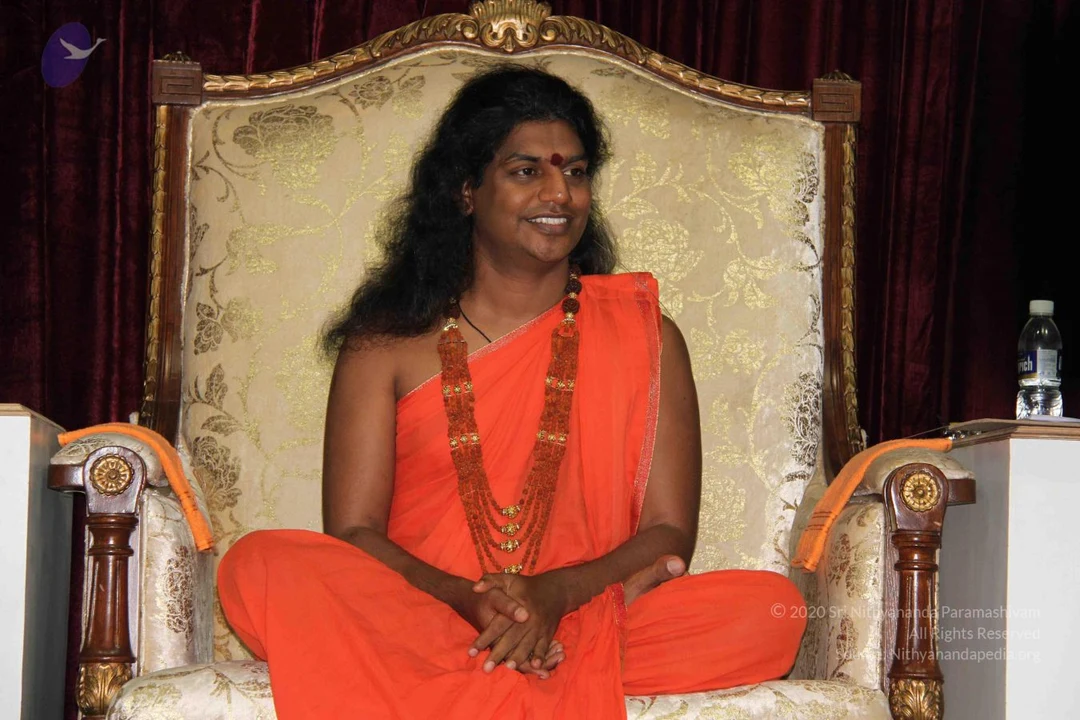
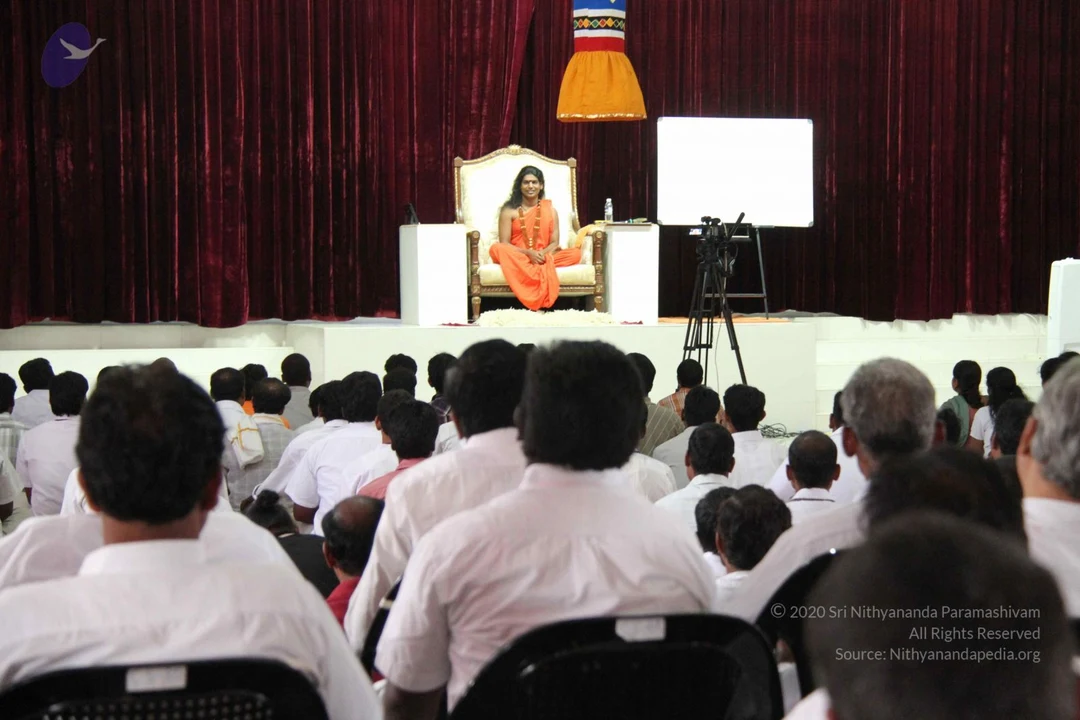
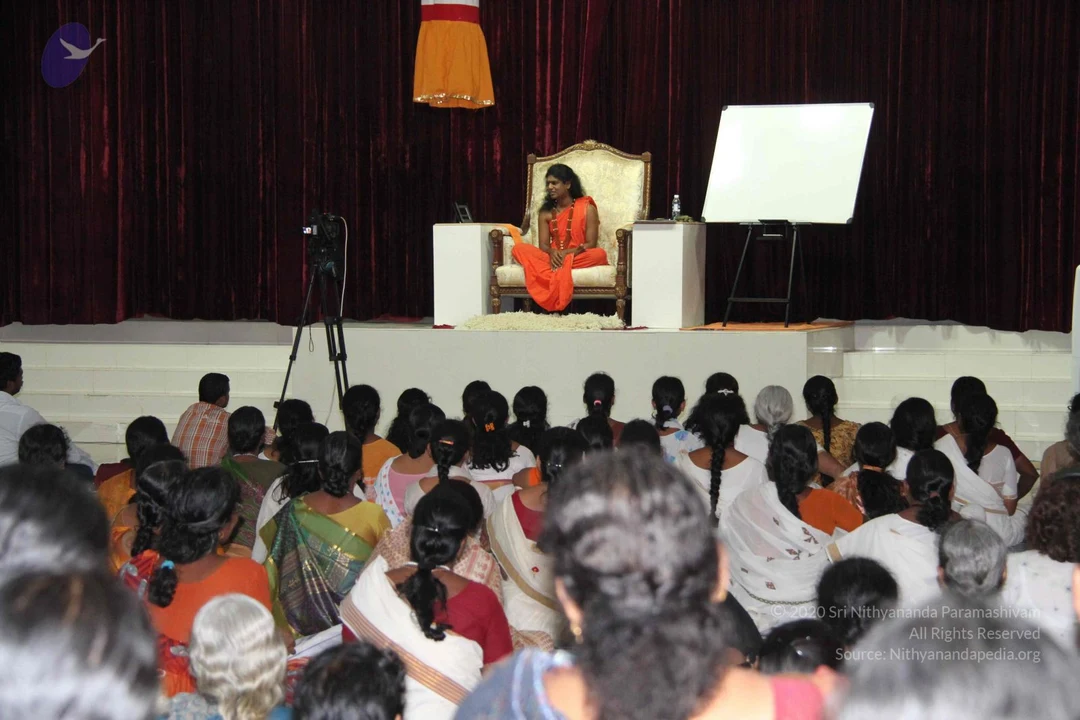
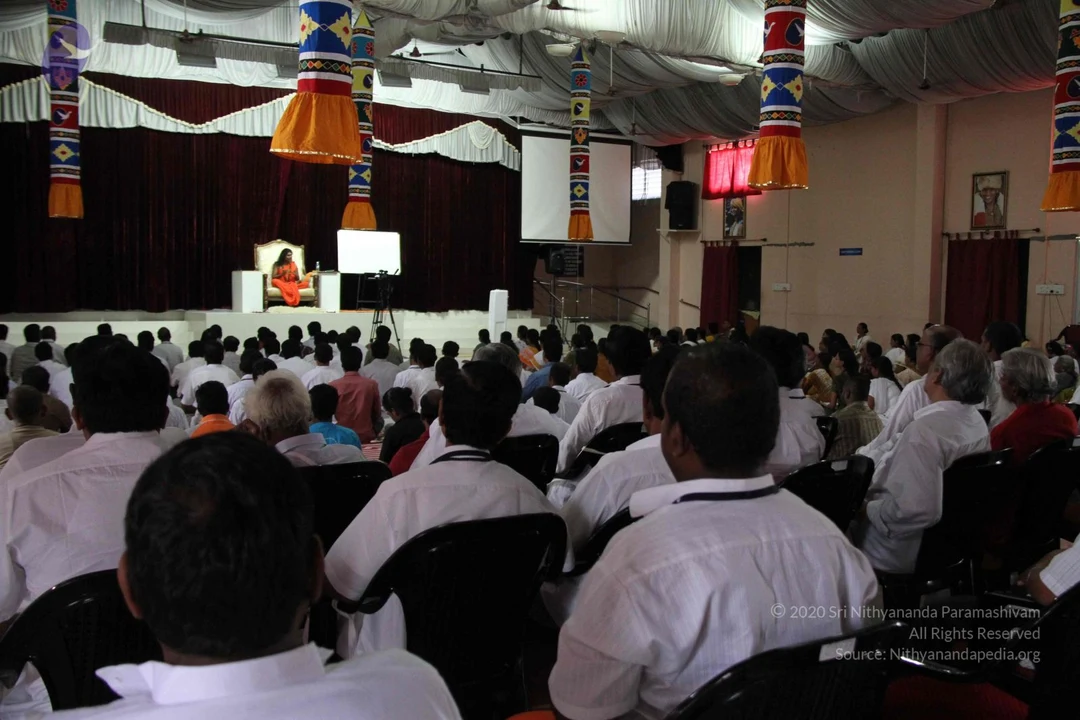
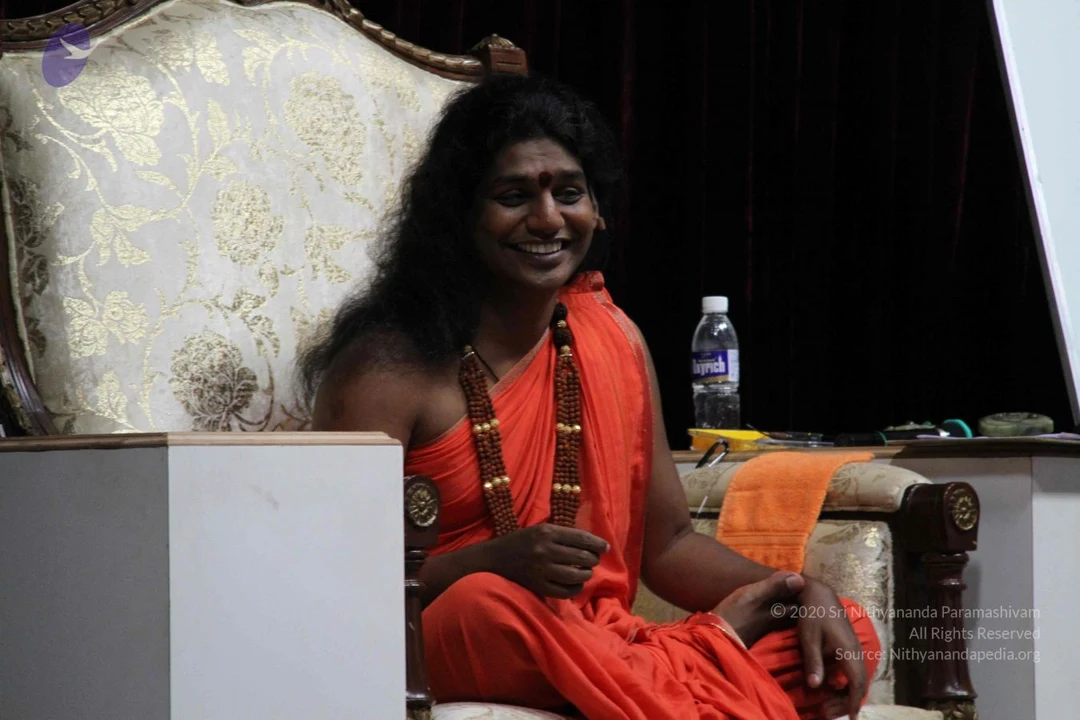
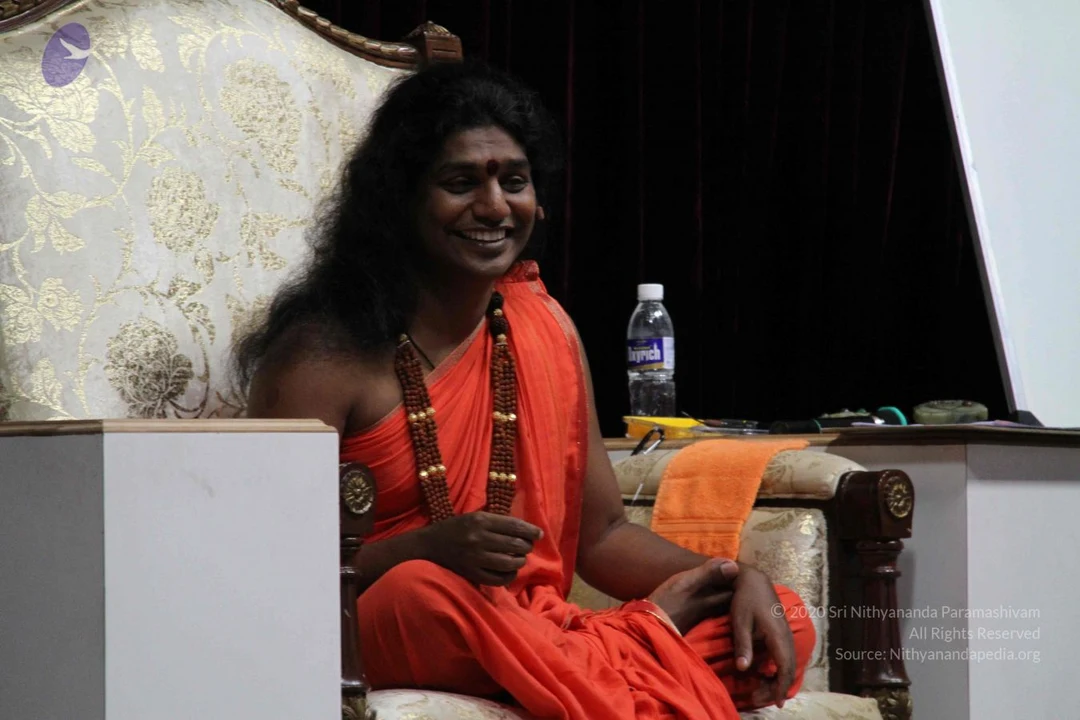
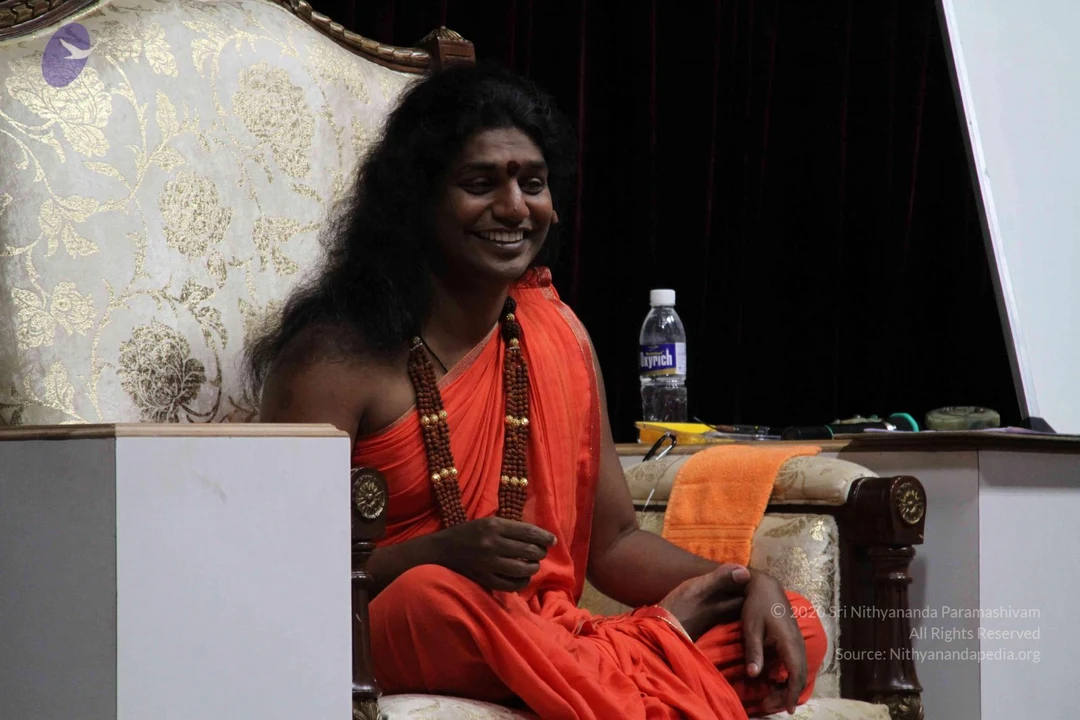
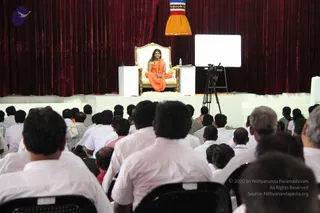
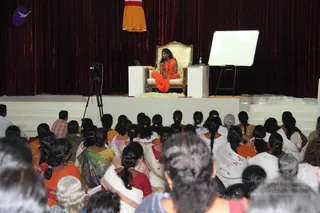
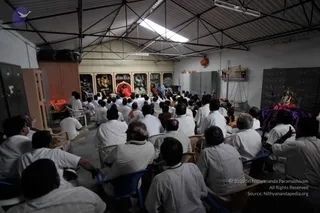
A large indoor discourse hall with a corrugated metal roof and skylight. Dozens of devotees in white clothes sit on plastic chairs facing a raised seat at the far end, where a figure in orange robes sits on a red-and-gold throne. Behind the seat are framed gold-toned deity murti panels. On the right, a golden deity murti sits on a purple-draped table near grey steel lockers. Devotees in white are seated in rows, filling most of the frame.A hall with pale walls and a striped canopy ceiling, decorated with hanging yellow, red and blue ornamental cylinders and red curtains. Many men in white shirts and dhotis stand with palms pressed together in anjali, some wearing rudraksha malas and ID lanyards, while others stand with hands at their sides. A framed portrait of a bearded man and a framed deity image hang on the wall, with a red-and-white patterned mat covering the floor. The scene looks like a satsang or devotional gathering.A large indoor hall with pink walls and red curtains where many women stand with palms pressed together in namaskar, as if in prayer or satsang. Most wear white or cream sarees with coloured borders in yellow, purple and orange, and several wear black beaded mala necklaces; a few have hair pinned back and some wear bindis. A framed portrait of a smiling older man in a white head covering hangs on the left wall beside a smaller framed image, and a tall yellow fabric hanging with red and patterned bands is suspended from the ceiling. Decorative striped poles stand at the right, and a black speaker is mounted high on the wall. Behind the front row, many more people stand in rows toward the back of the room.A seated figure in an ornate cream and gold brocade armchair with carved dark wood arms and a red velvet curtain behind. The person wears an orange-saffron garment draped over the shoulder and a long rudraksha mala with gold beads, a red bindi on the forehead, and has long dark hair. Hands rest folded in the lap in a cross-legged pose. A water bottle sits on a side table at right. The appearance-based label is a person, seated on a throne-like chair in saffron robes with rudraksha and ceremonial beads.A photograph of a discourse hall with an audience seated in white shirts and white clothing on plastic chairs, viewed from behind. On a raised stage before dark red velvet drapes, a person in orange robes and a beaded necklace sits on an ornate gold-and-cream throne. A white projection screen and a video camera on a tripod stand to the right, and a saffron-and-red banner hangs from above. a person: the seated figure wears orange robes and a rudraksha-style necklace on a throne, with long dark hair visible, though the face is small and distant.A photograph of a seated discourse on a raised stage before a dark red curtain. A figure in orange robes with a rudraksha mala sits on an ornate gold-and-cream throne-style chair, with a small framed picture on a side table and a white flip chart beside. A film camera on a tripod faces the stage. A large seated audience fills the foreground, mostly women with braided hair in white saris, orange, green and red garments, viewed from behind. A tall orange and white banner hangs above the stage.

Organisers-Meeting

19 photosSource gallery
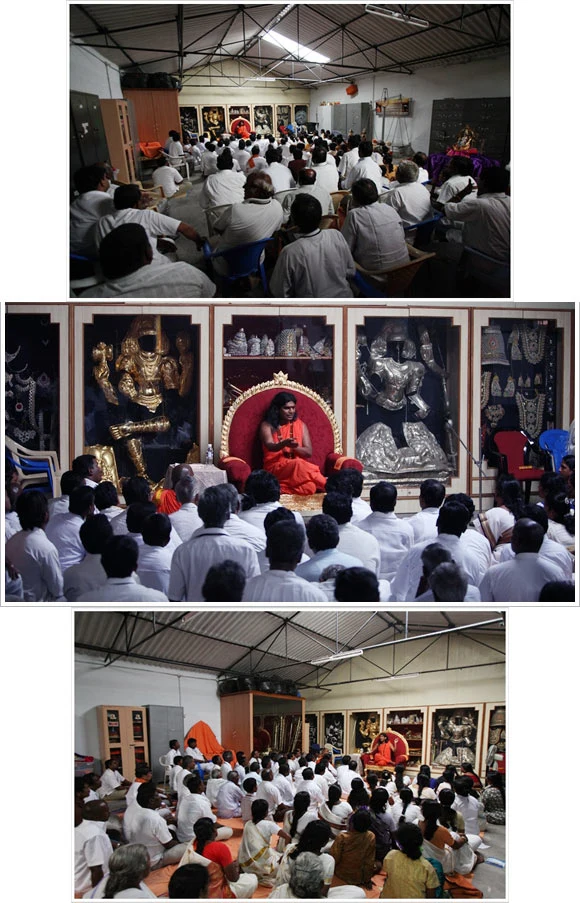
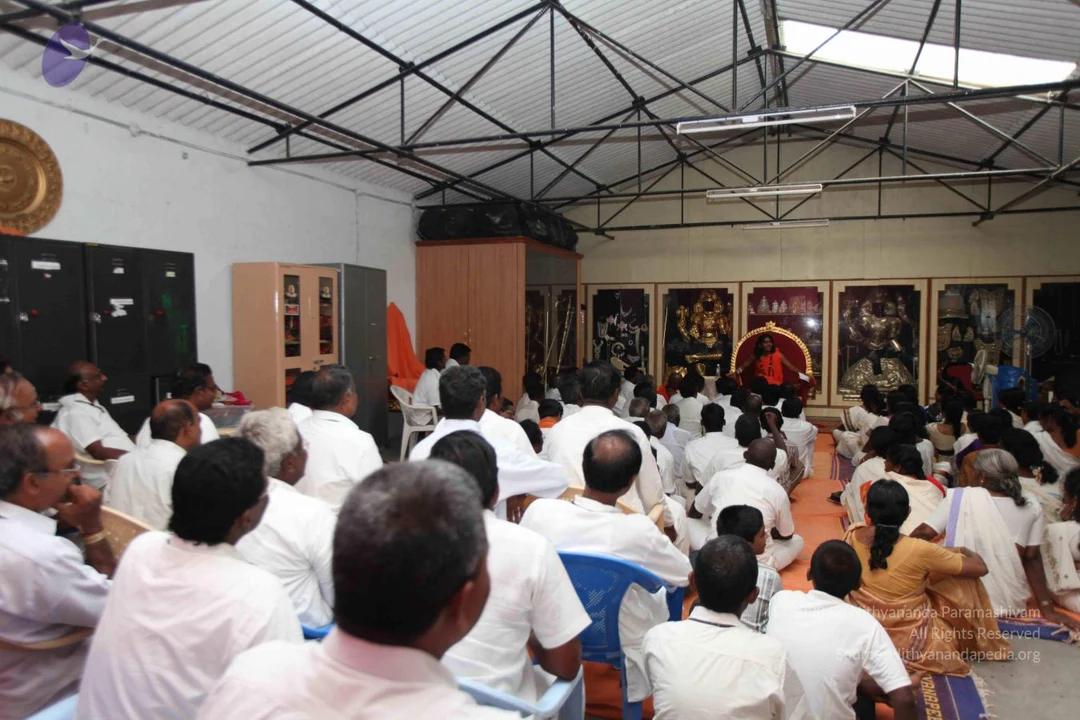
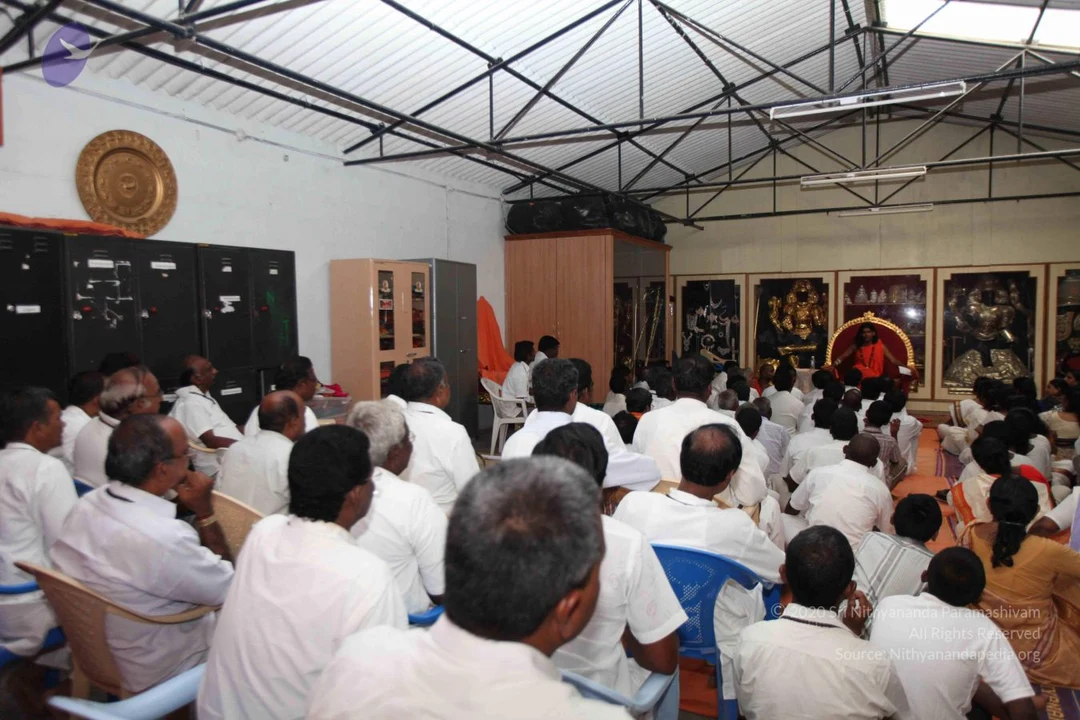
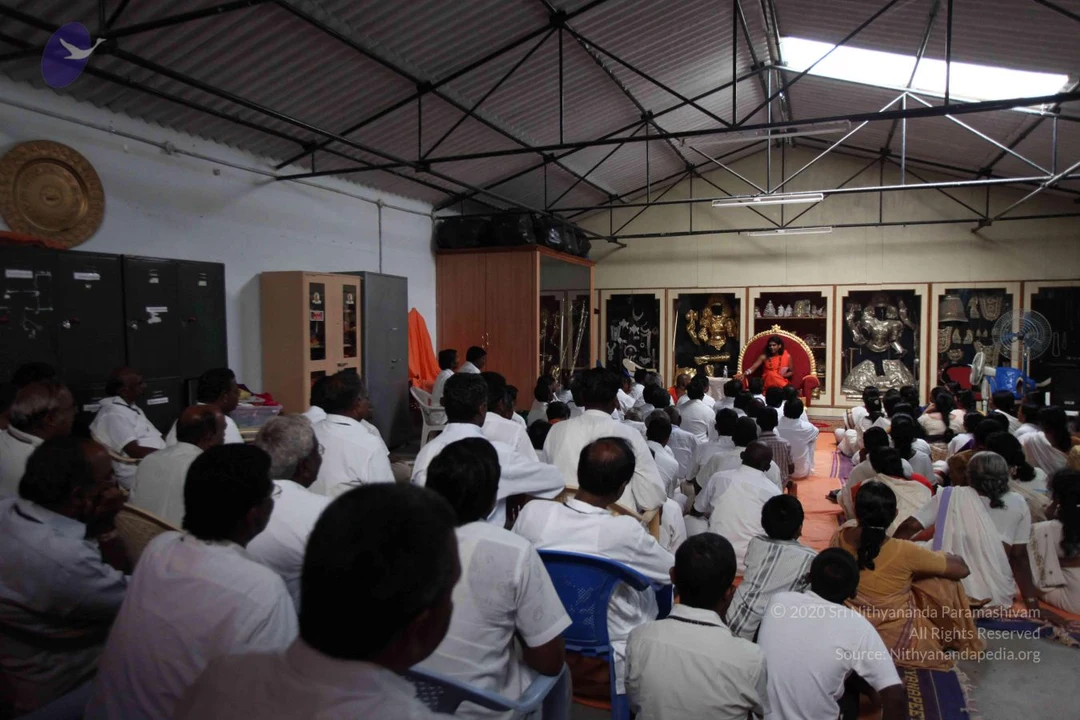
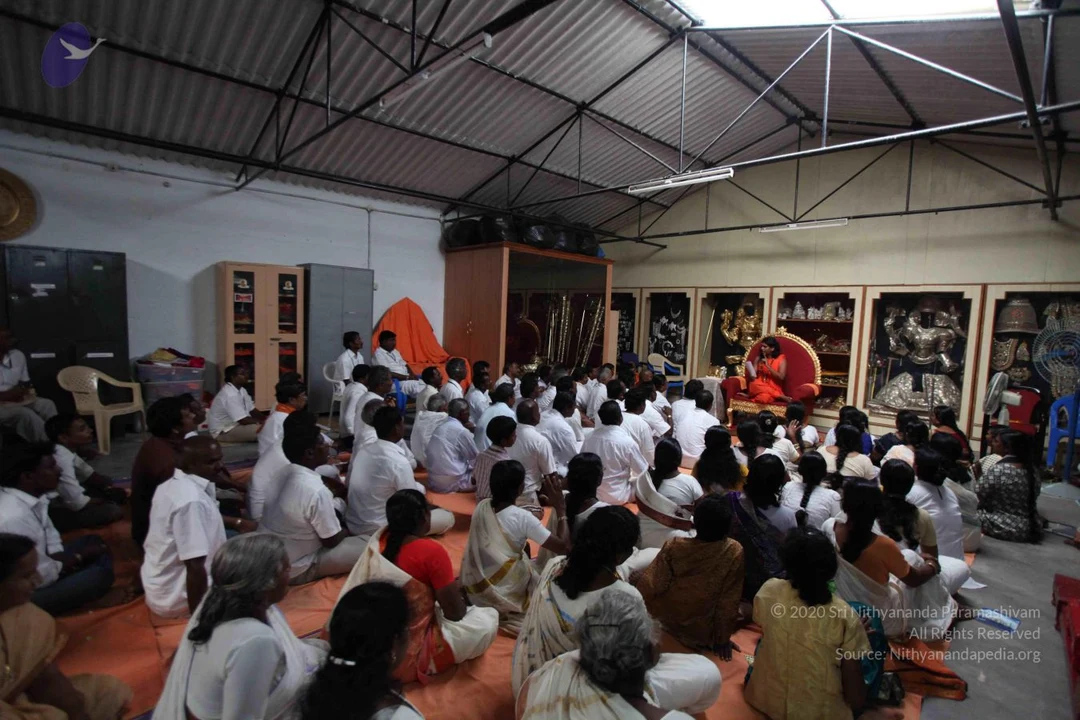
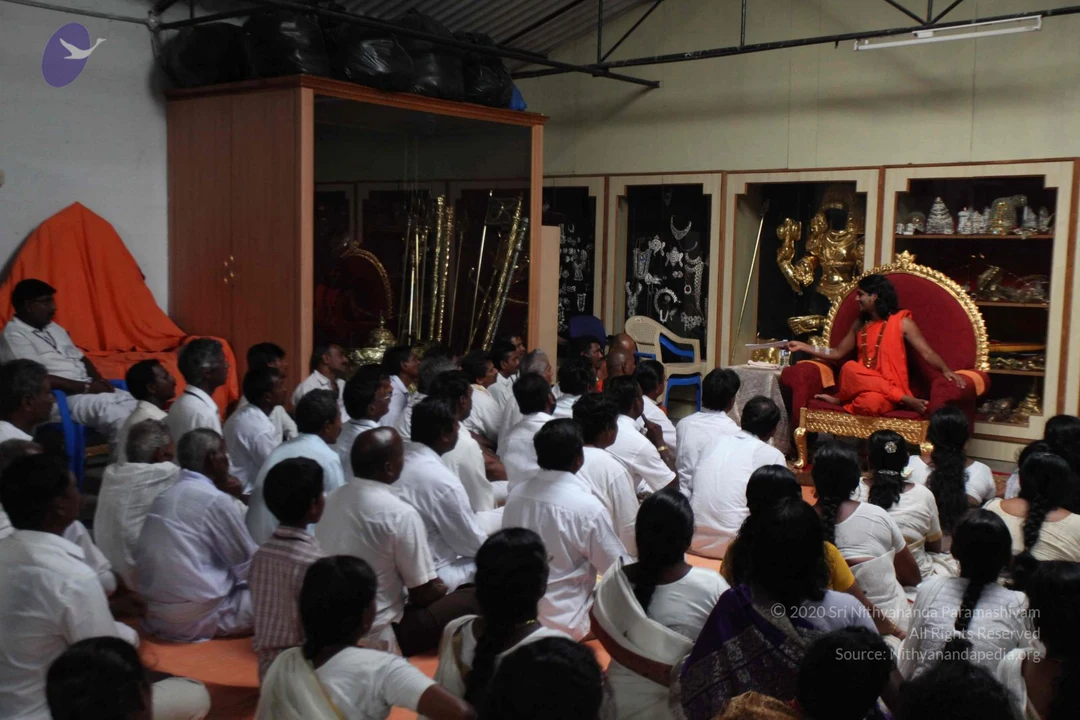
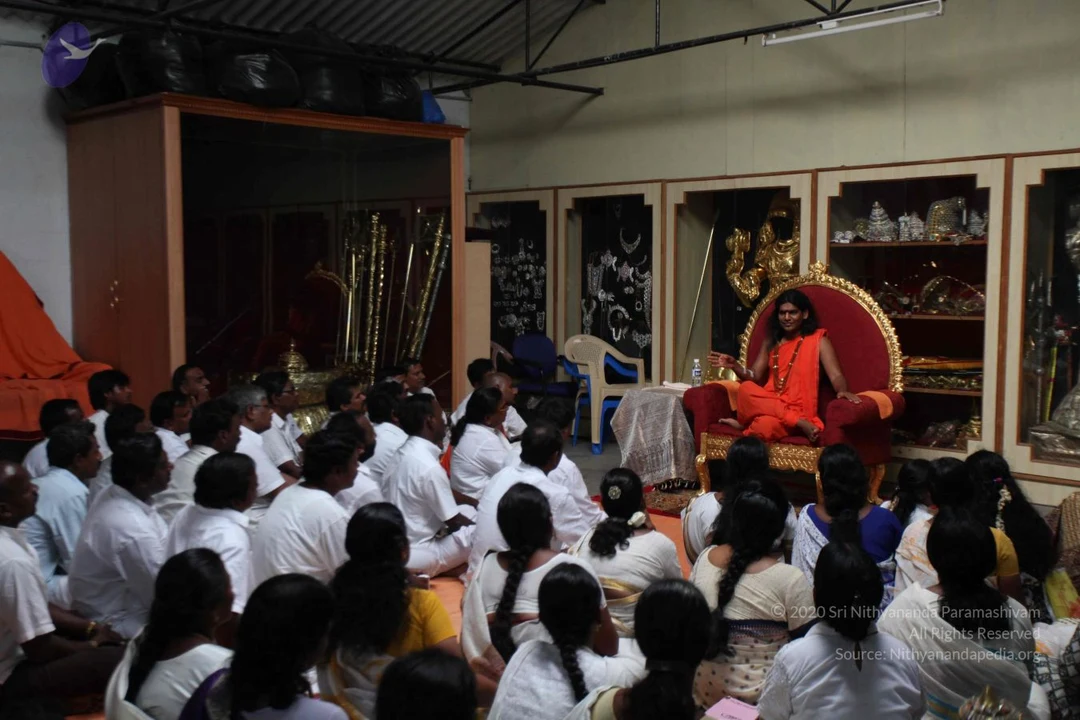
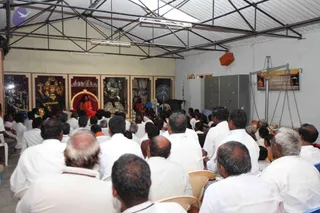
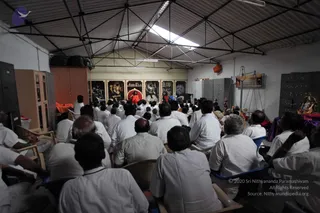
A photograph of a seated discourse in a plain hall with a corrugated metal roof. A figure in orange robes sits on a red and gold throne at the front, backed by framed panels of gold-coloured deity murti and carved figures. A large crowd of mostly men in white clothes sits on white plastic chairs and mats facing the throne, with a few people in orange or red visible. On the right, a wall-mounted banner with a sign and a steel locker unit sit beside a hanging swing-like frame. Fans and fluorescent lights hang overhead.A satsang-style discourse in a plain hall with a corrugated metal roof. A figure in orange clothing sits on a raised red-and-gold throne at the centre, in front of a wall of large gilded and dark deity murtis and framed panels. Dozens of seated devotees in white shirts and white clothes face the dais from the foreground, with a few people in colourful garments at the right edge. A ceiling fan, lockers and a wooden cabinet are visible. The seated figure on the throne has long dark hair and orange robes, a person appearance based on the visible saffron clothing and throne, though the face is not clear enough to confirm. Dozens of listeners fill the room.A large indoor satsang hall with a corrugated metal roof and fluorescent tube lights. Dozens of seated devotees in white dhotis and white shirts fill rows of chairs and mats on the floor, with a few women in white saris and one in a mustard-yellow sari on the right. At the far end, a speaker in a saffron/orange robe sits on a raised red-and-gold throne-style seat before a wall of framed deity murti paintings and a gilded deity statue. A kalasha-like brass item and dark cabinets stand along the left wall, and an orange cloth hangs on a cupboard. The scene is a discourse or talk for devotees.A seated audience of many men in white dhotis and shirts fills white plastic and blue chairs in a hall with a corrugated roof and exposed steel trusses. At the far end, a figure in orange robes sits on a red-cushioned throne in front of framed dark-gold deity murti panels, with a golden ornament on the wall at left. Some listeners wear saffron-coloured shirts, and several women in saris sit at the right edge.A crowded indoor hall with a corrugated metal roof and skylight, where a large audience of men in white dhotis and shirts, and women in white or yellow saris, sit on the floor and on blue plastic chairs facing a raised seat. On a red and gold throne at the far end, a figure in orange robes sits and addresses the gathering. Behind the throne stand glass-fronted display panels holding golden deity murti and ornate figures. A gold ceremonial plate hangs on the left wall, and orange cloth is draped near steel cabinets.Indoor discourse in a hall with a corrugated metal roof and fluorescent lights. A seated figure in an orange robe with a red-orange shawl sits on a red and gold throne at the far right of the room, with a gold-coloured deity murti in a niche behind. A large crowd of mostly men in white shirts and white dhotis sits on the floor and on blue plastic chairs facing the throne, listening attentively. Cabinets with glass fronts, framed photos and a gold statue stand along the walls.

Sarva-Darshan

53 photosSource gallery
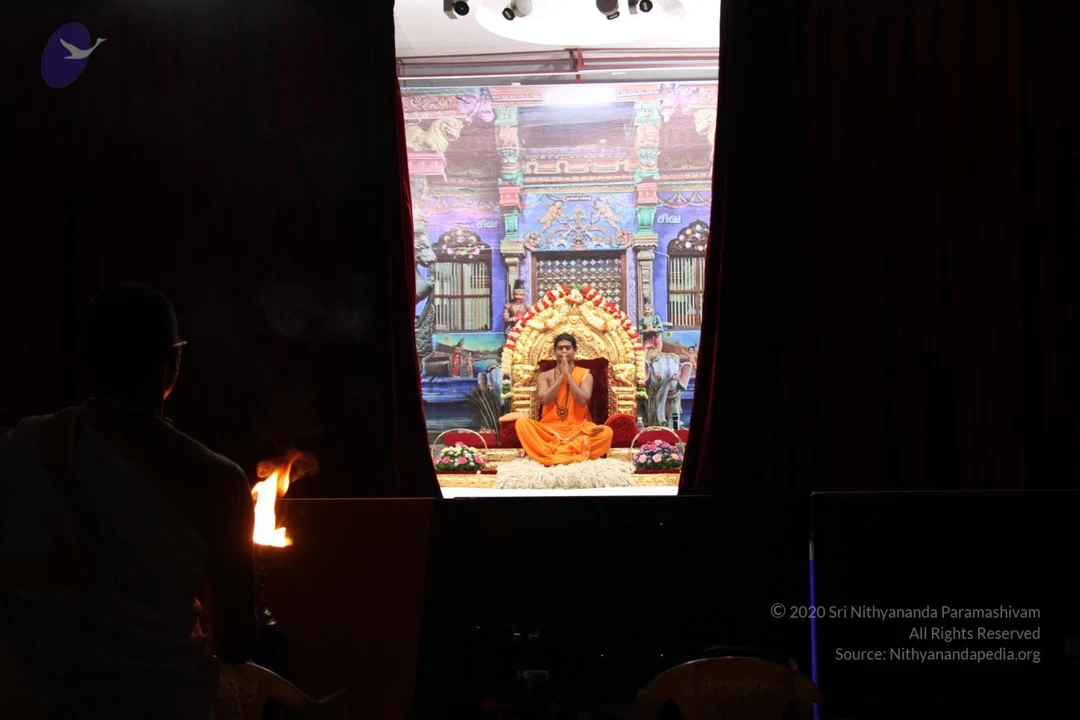
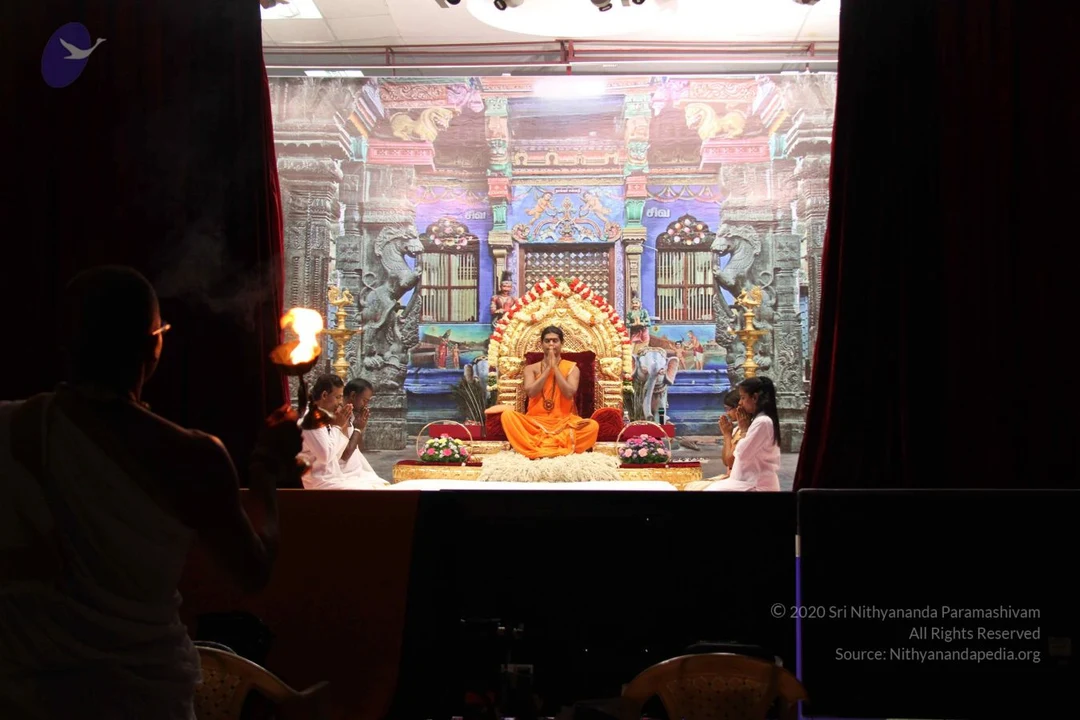
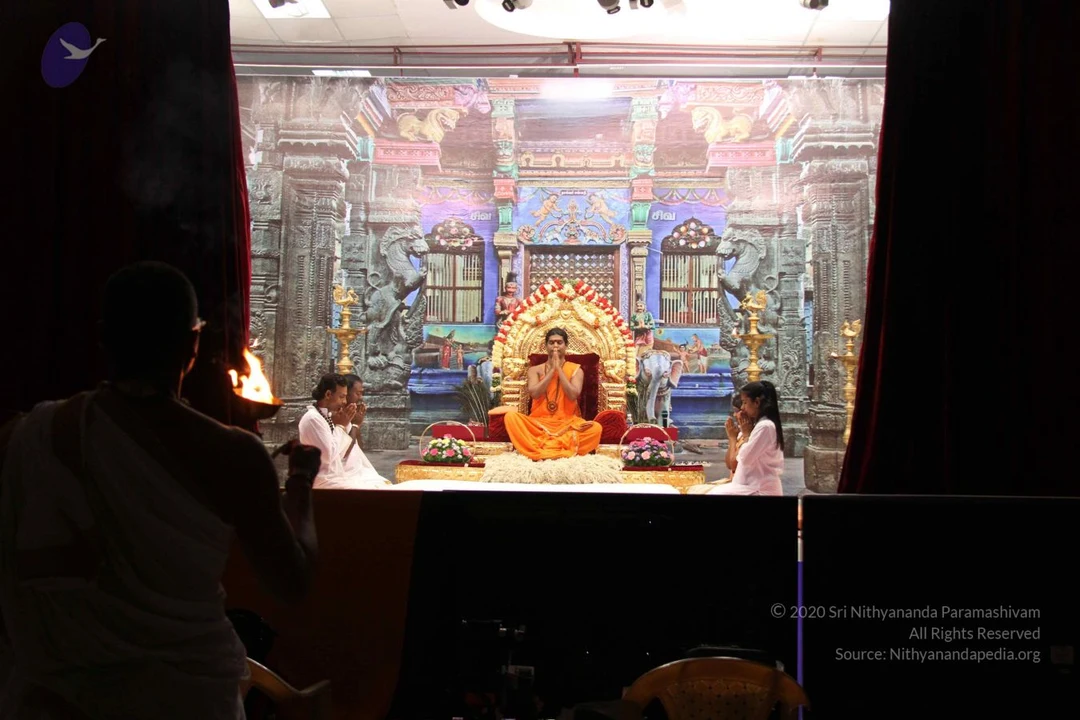
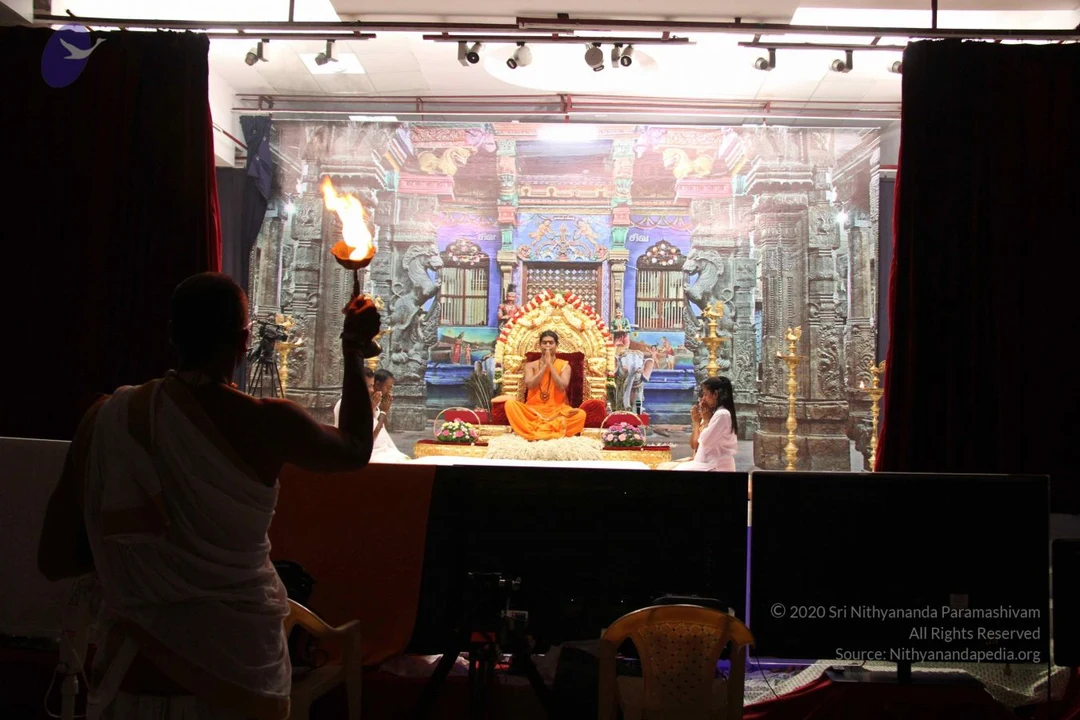
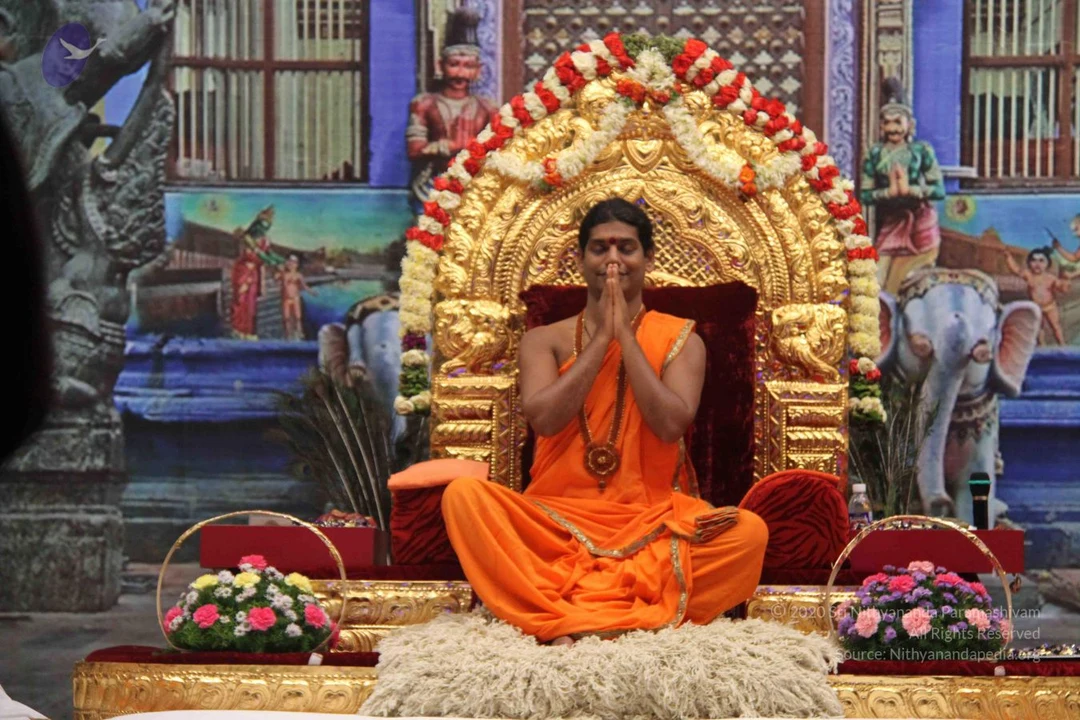
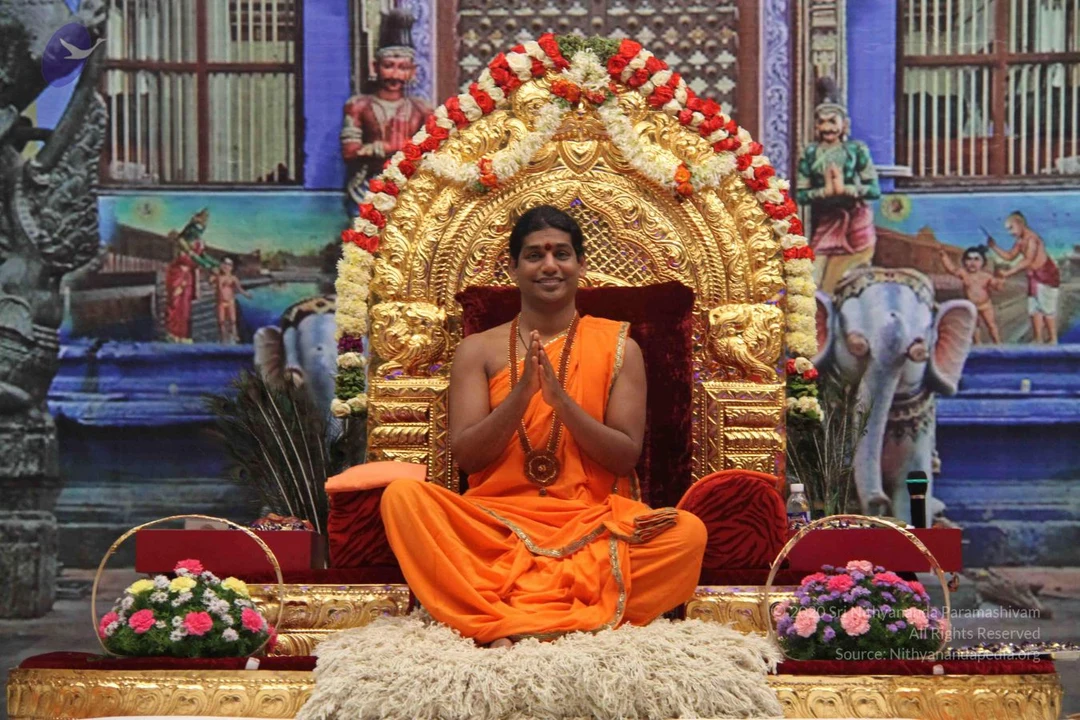
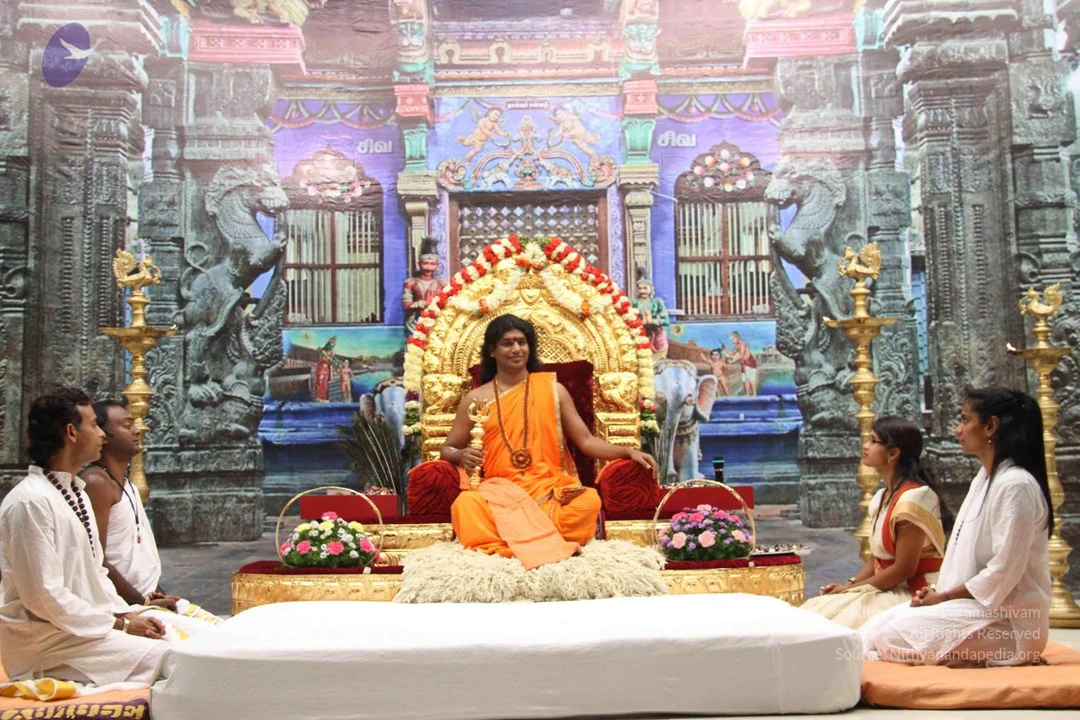
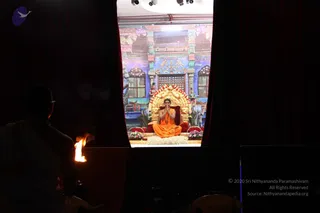
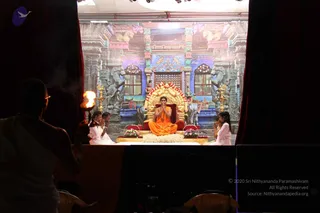
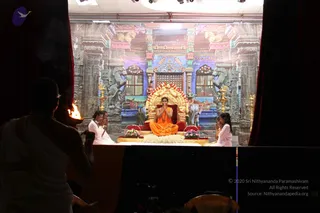
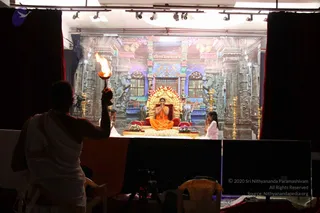
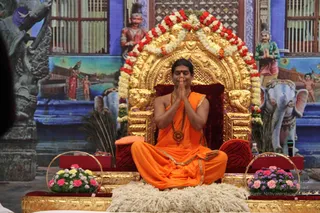
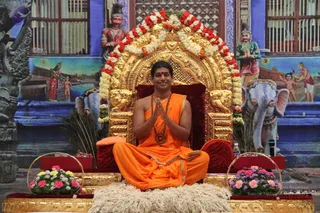
A dim stage framed by dark curtains, with a bright backdrop of painted temple architecture showing carved pillars, lion and elephant figures, and a painted gate. A figure in saffron-orange robes sits cross-legged on an ornate golden throne with a red cushioned seat, hands pressed together in namaste, with a floral garland arch above the throne and flower arrangements on the floor. In the left foreground, a silhouetted person in white holds a lit oil lamp or flame near the stage. The painted backdrop and lighting create a ceremonial satsang setting. The seated figure shows swept-back dark hair, a saffron robe and a beaded necklace, consistent with a person presence on the throne, though the appearance is partly obscured by distance and lighting.A seated figure in an orange-saffron robe sits on an ornate golden throne with red cushions before a large painted temple backdrop showing carved stone pillars, rearing yali-like lion figures and Shiva inscriptions. Hands are pressed together in namaste. Two people in white clothes kneel on either side, and a third figure in white sits at the right edge. In the foreground a silhouetted person holds a lit flame. The setting is a stage-like hall with dark curtains.A photograph of a seated figure in an orange-saffron robe with a rudraksha-style necklace, hands pressed in namaste, on a gold and red ornate throne before a painted temple-style backdrop with carved pillars, rearing horse-headed motifs and a painted elephant. A dark-clad person in the foreground holds a lit oil lamp, and two people in white clothes sit on either side of the stage with hands joined. Red and pink flower arrangements flank the throne, with brass lamps on the stage. The orange-robed figure's appearance is consistent with the a person cues of ornate saffron clothing and a rudraksha necklace, though the page does not mention him at this event.A photograph of a ritual arati performed in a studio set with a large printed backdrop of an ornate stone temple with carved horses, pillars and a central throne. In the foreground a man with a shaved head, wearing white dhoti-style cloth, holds a lit oil lamp flame aloft, seen from behind. A seated figure in orange robes sits in the centre on a gold and red throne with hands folded in prayer, flanked by a second person in white kneeling with hands pressed together. Brass lamps stand on either side, with flower arrangements in front, and a camera on a tripod is visible at left.A seated man in orange saffron robes sits cross-legged on a gilded throne with red velvet cushions, hands pressed together in anjali mudra with eyes closed. He wears a red tilak on his forehead, a beaded rudraksha-style mala and a large ornate gold pendant necklace. The gold throne arch is draped with a garland of red and white flowers, and flower arrangements sit on the platform below. Behind him are painted panels of temple elephants and figures, with a stone sculpture at left and a standing devotee with folded hands at right. A white fur-like cushion lies at his feet, and a microphone stands at right.A man in saffron-orange robes sits cross-legged on an ornate gold throne with a deep red cushion, hands pressed together in namaste and a smile on his face. A red and white flower garland arches over the throne, with a rudraksha-style bead mala and a large pendant around his neck and a red bindi on his forehead. Marigold-and-rose arrangements sit at the base, a white fur-like cushion lies on the dais, and a microphone stands at the side. Behind him, a painted backdrop shows elephants, a woman in red and figures bathing at water's edge, with gilded guardian statues at the sides. The appearance of a candidate matching the a person description is visible, with long swept-back hair, saffron clothing, rudraksha mala and ornate gold throne cues, so the label is probable.

Medical-Camp

9 photosSource gallery
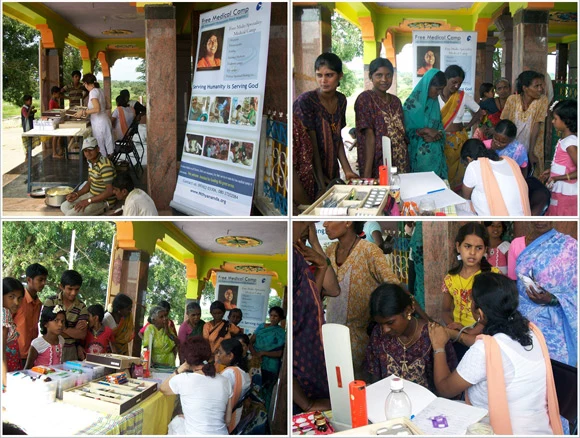
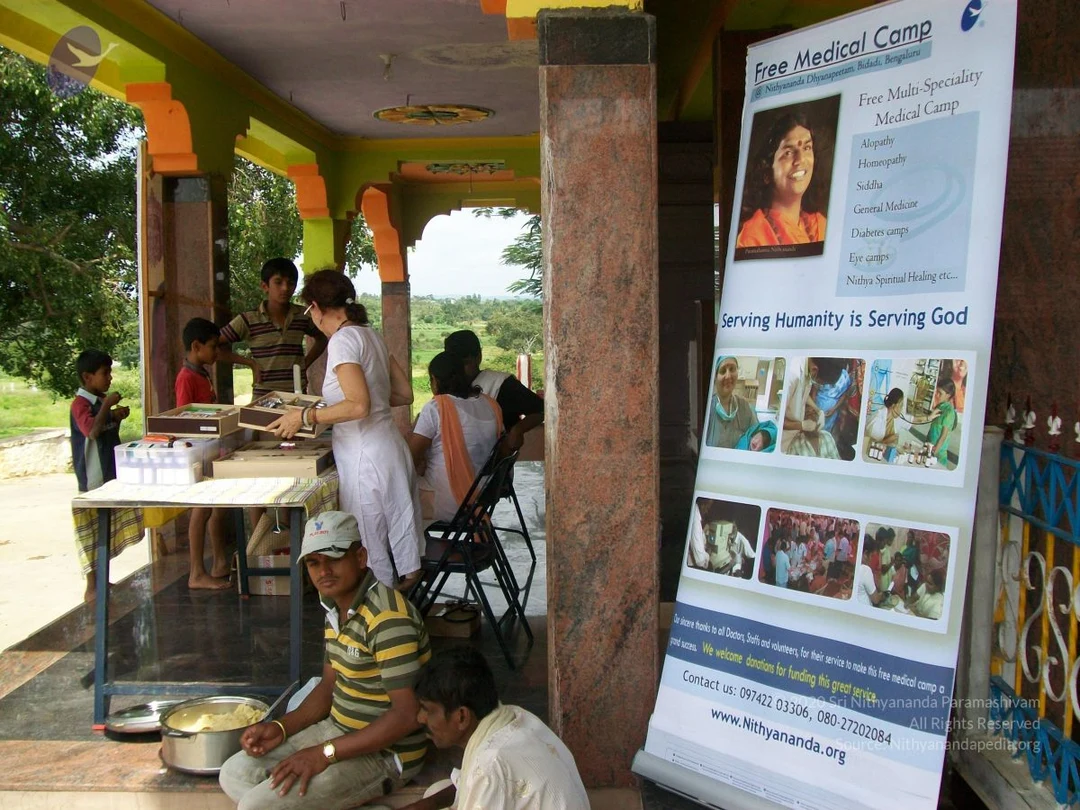
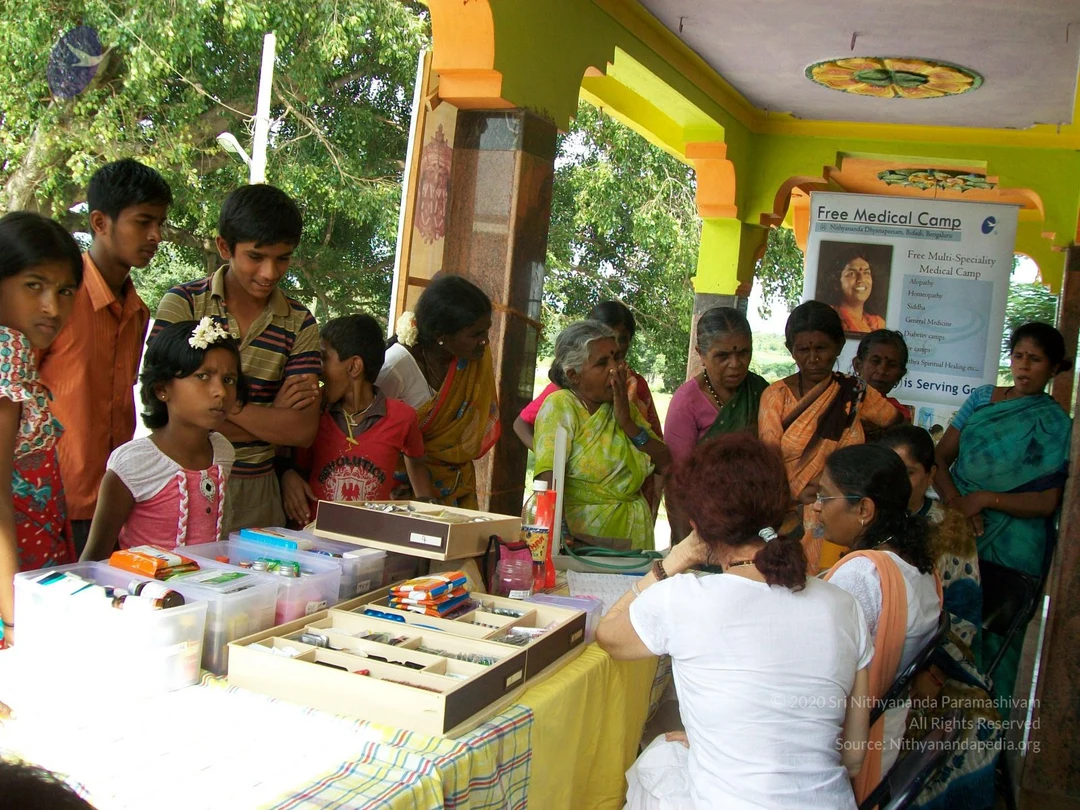
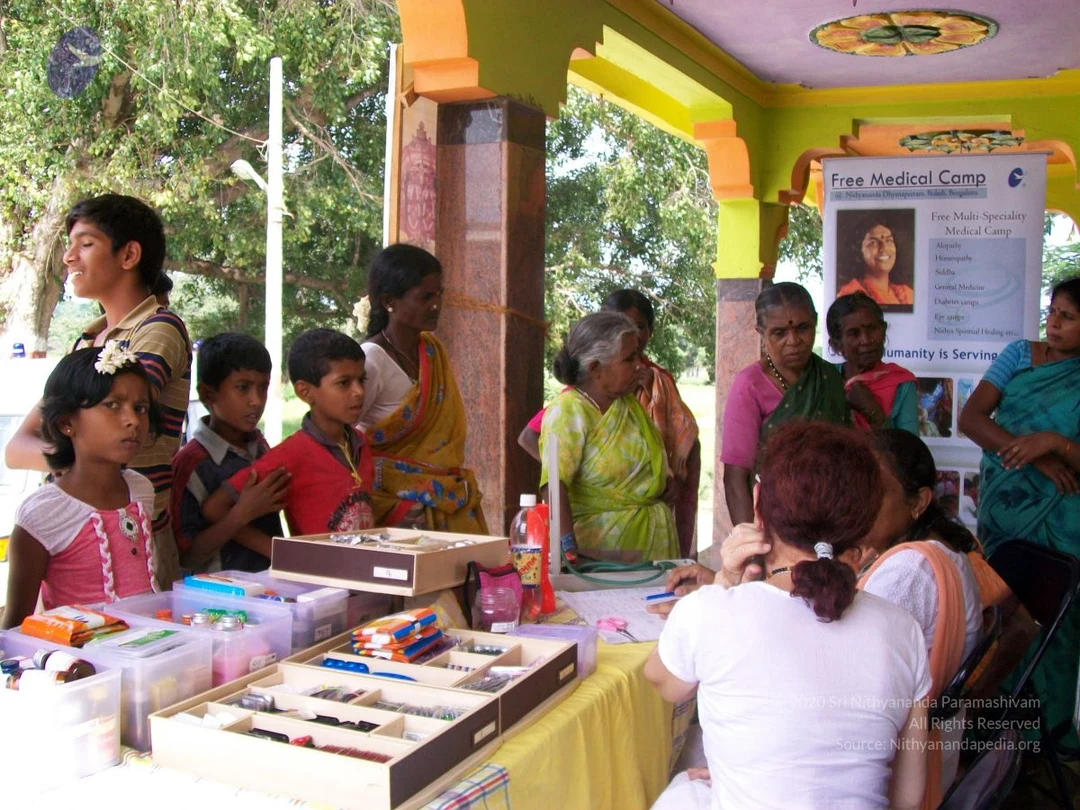
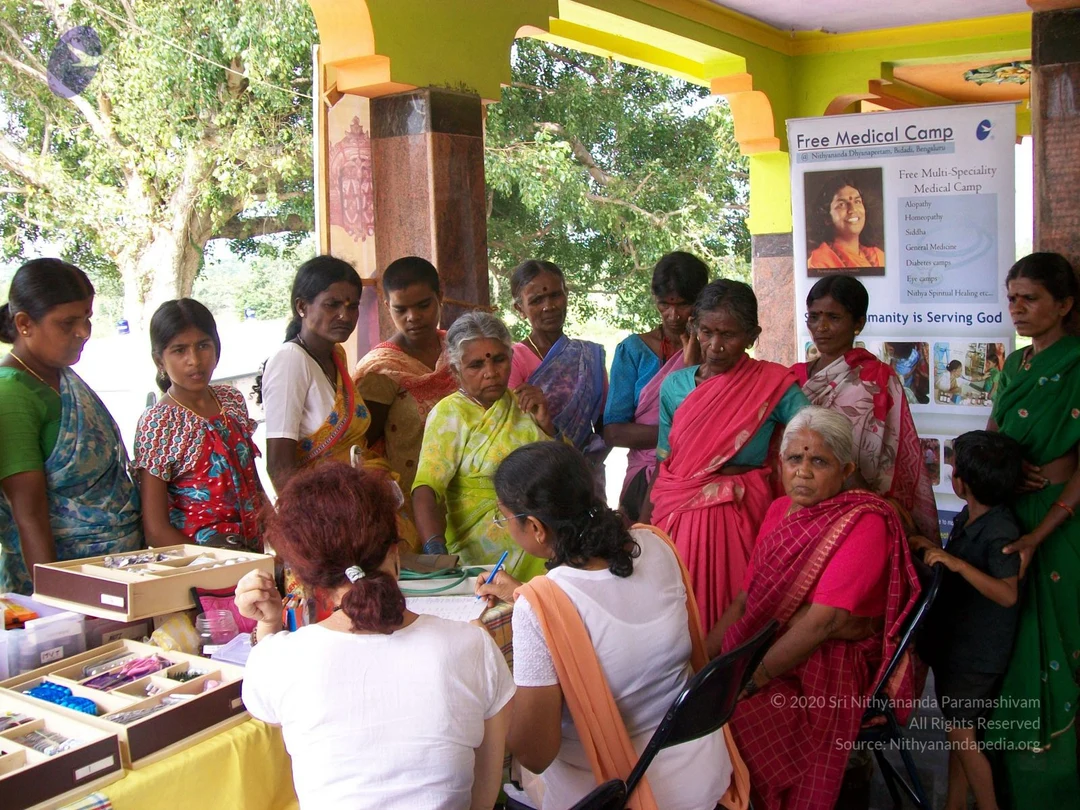
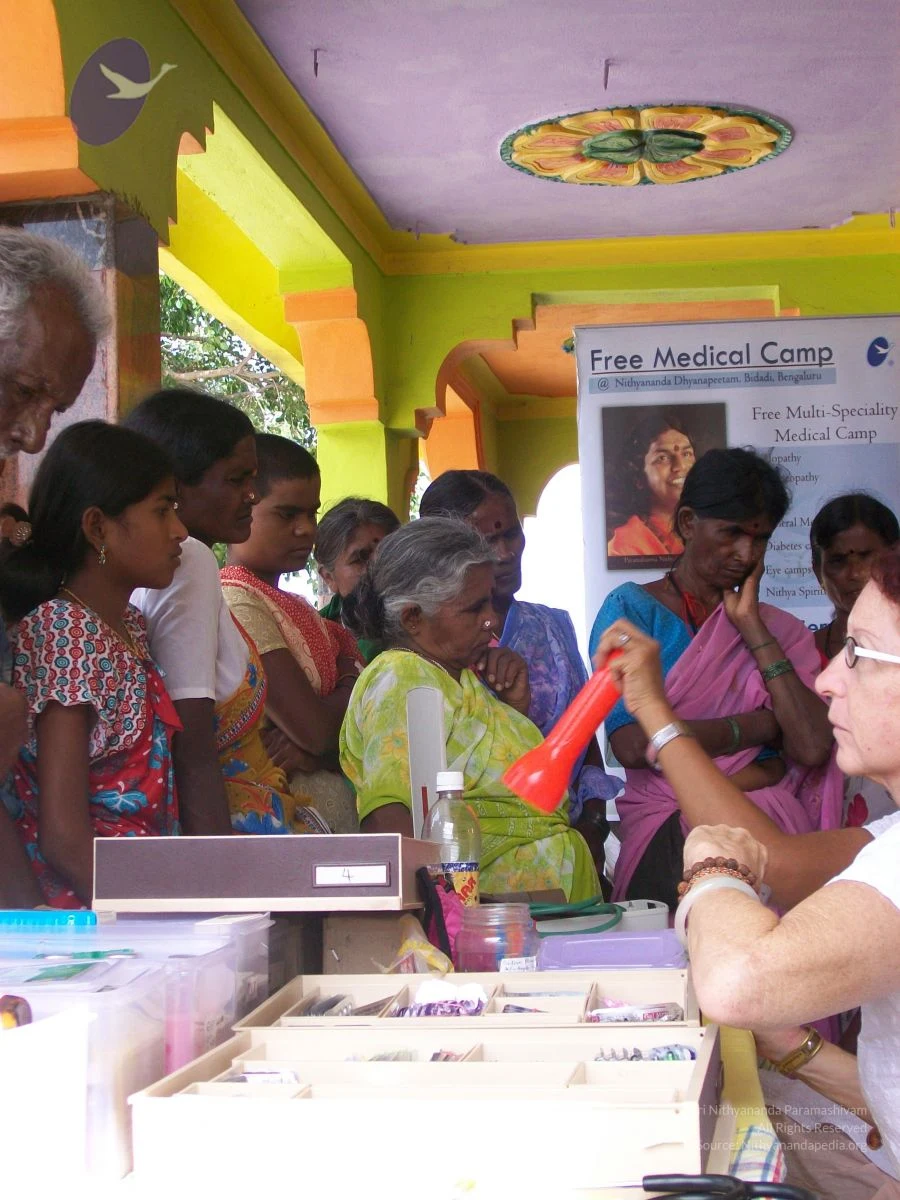
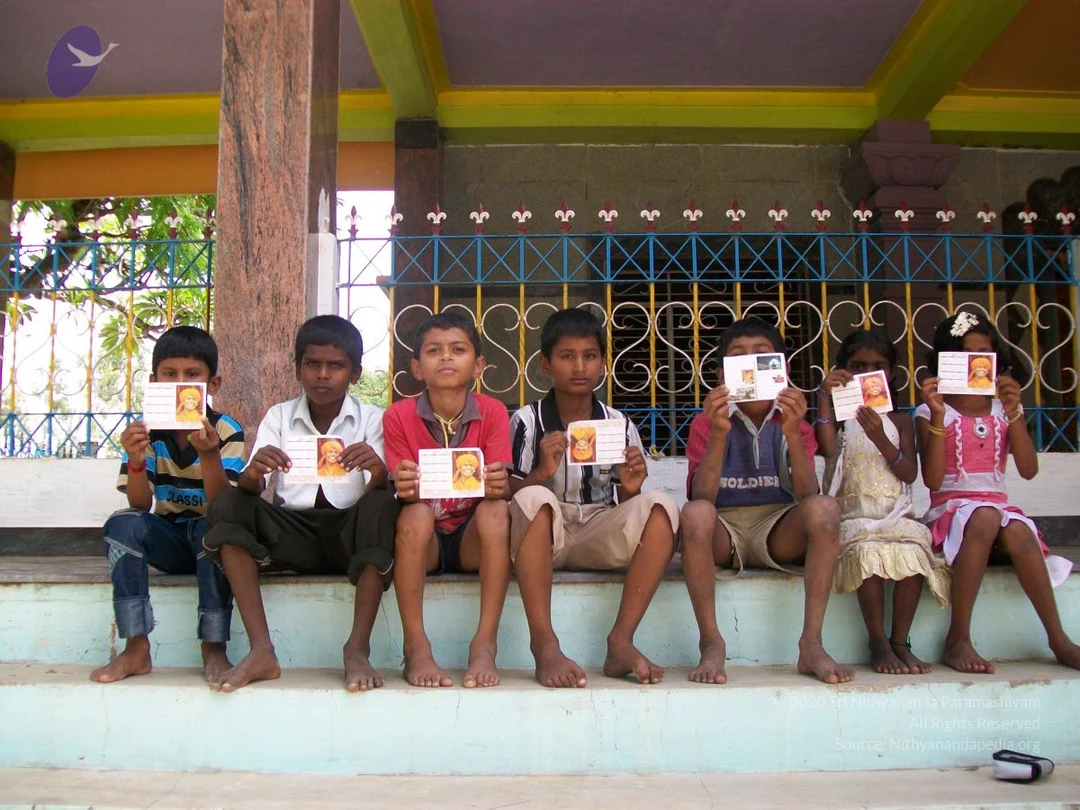
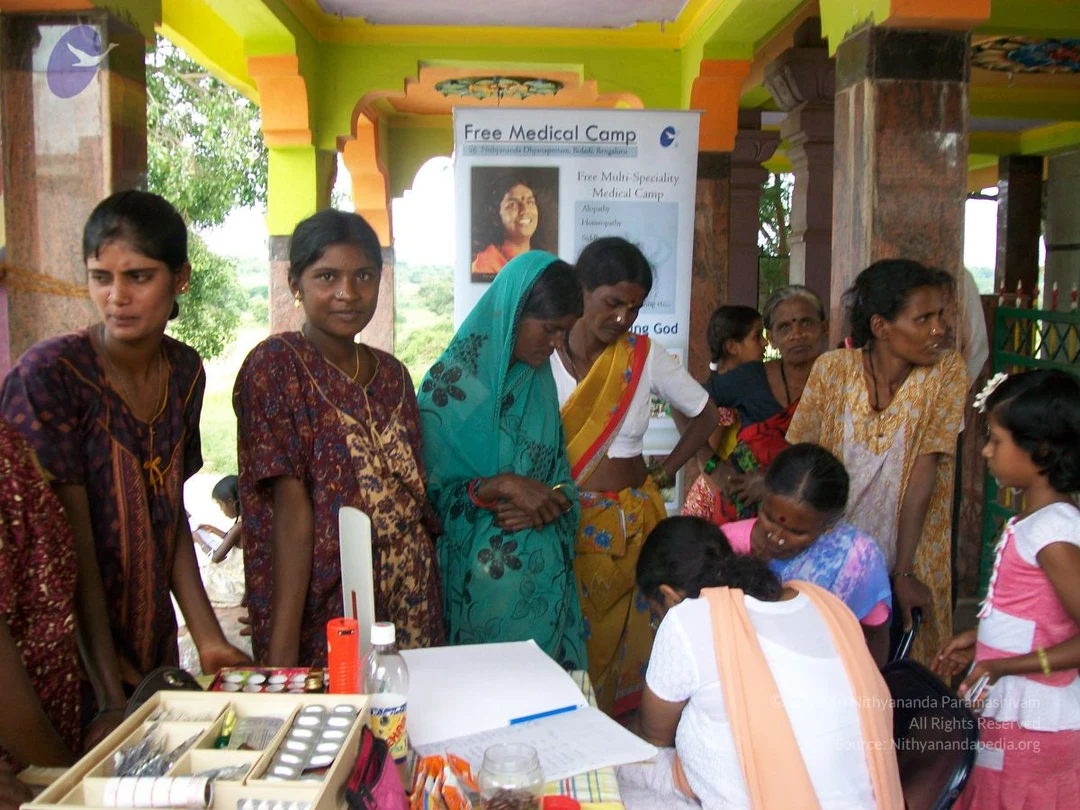
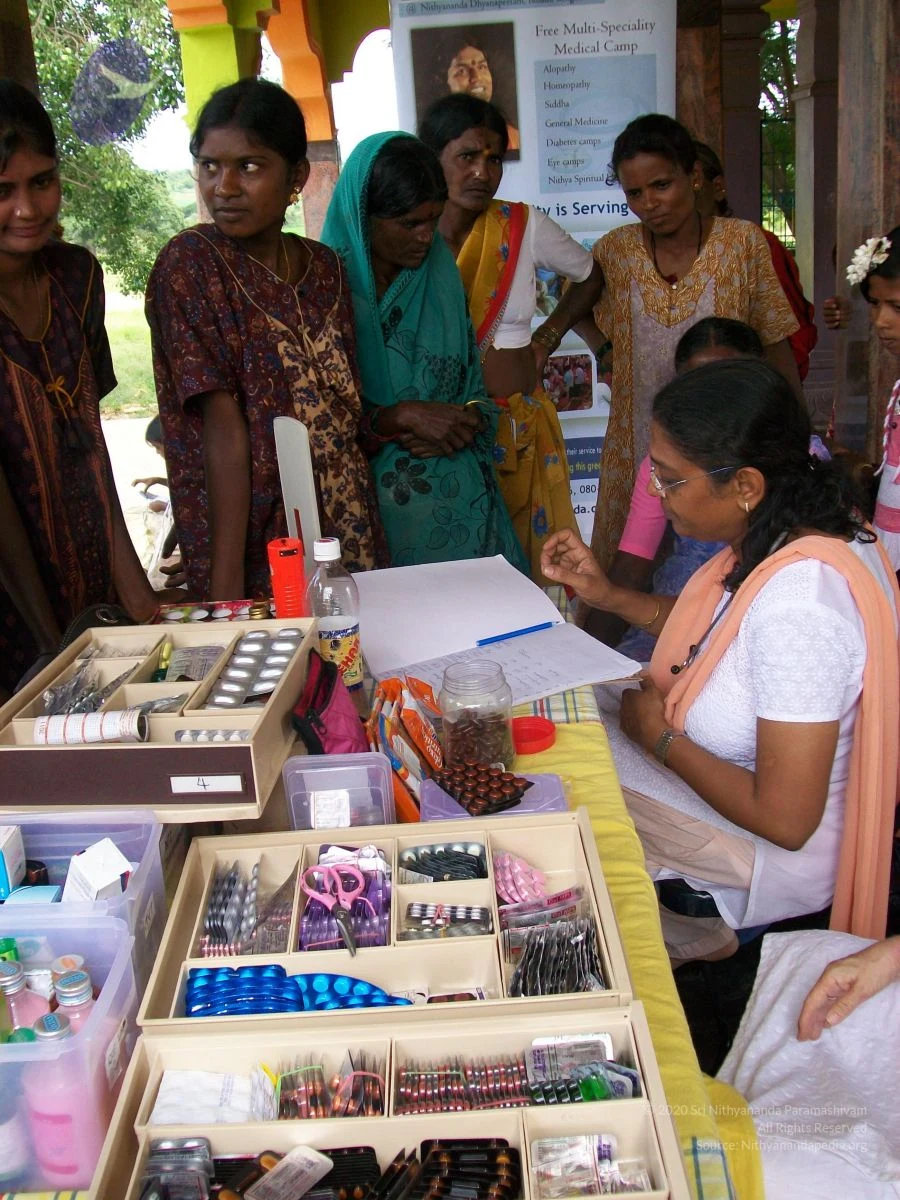
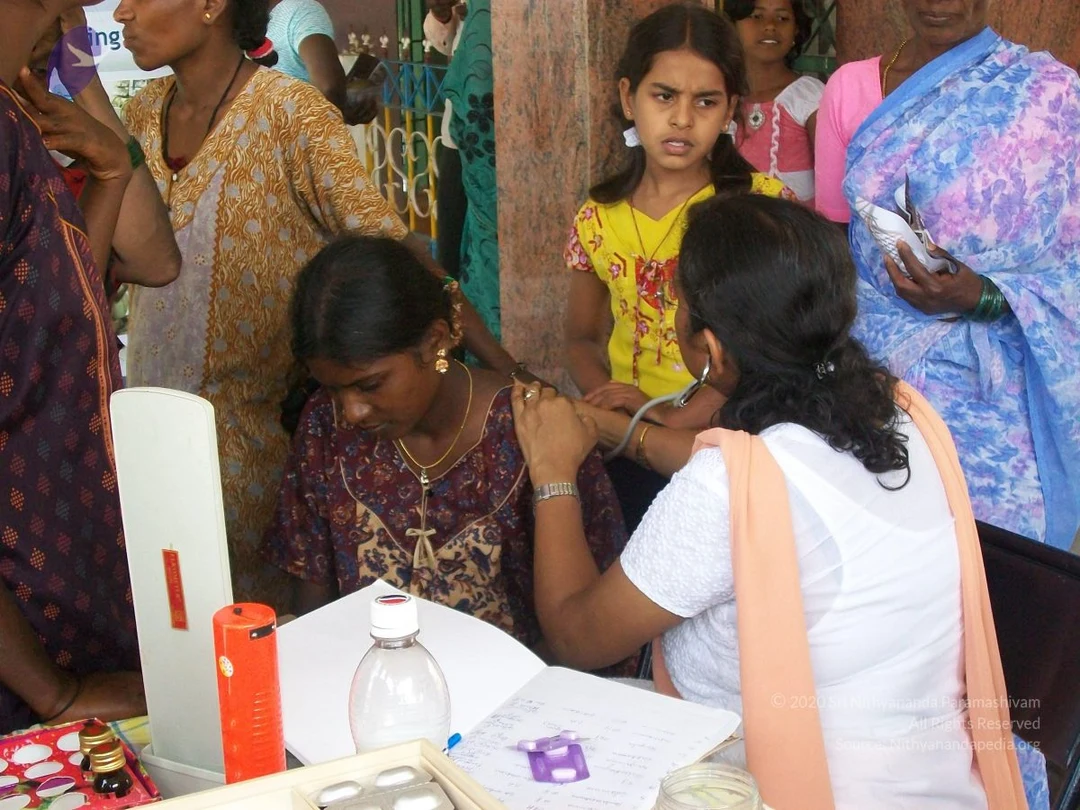
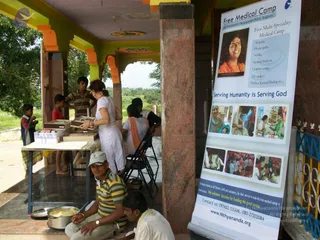
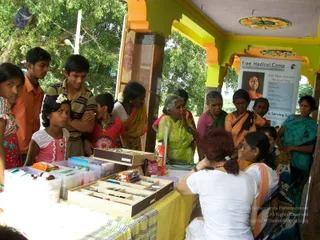
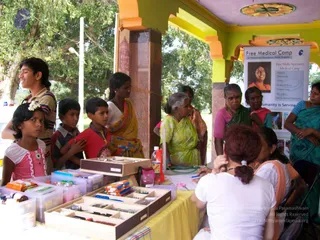
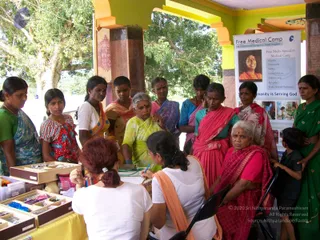
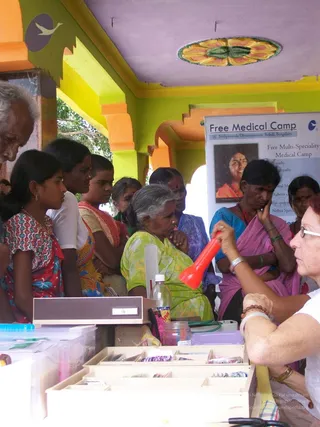
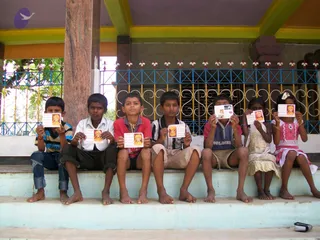
A free medical camp set up in a covered veranda of a temple-style building with orange-and-green painted arches and a red-and-grey stone pillar. A white-kurta-clad woman with light hair stands at a table holding a cardboard box, beside a seated woman in white with an orange shawl. Several boys watch from the left, one in a striped shirt. In the foreground, a man in a striped polo and cap sits beside a steel pot of food, and another man in white sits near him. A tall vertical banner on the right reads Free Medical Camp, listing Alopathy, Homeopathy, Siddha, General Medicine, Diabetes camps, Eye camps and Nithya Spiritual Healing, with photos of doctors treating patients and a portrait of a smiling woman in orange. Trees and fields lie beyond the veranda. Five to six people are visible.A free medical camp held under a yellow-and-green pillared veranda at Nithyananda Dhyanapeetam, Tiruvannamalai area. A banner reads "Free Medical Camp" and "Free Multi-Specialty Medical Camp" listing Allopathy, Homeopathy, Siddha, Dentistry and Ayurveda, with a portrait of a woman. At a table covered in yellow and checked cloth, medicine tins and boxes of pills are laid out. A woman in a white top with reddish hair sits facing the table, while an older woman in a green sari covers her mouth. Several women in saris and a row of school-age children stand watching at the left.A free medical camp under a yellow-and-green pillared pavilion. A banner reads "Free Multi-Speciality Medical Camp" beside a portrait labelled with the Nithyananda Dhyanapeetam name, listing Allopathy, Homeopathy, Siddha, Dental Medicine, Diabetes camps, Eye camps and Nithya Spiritual Healing. Villagers queue at a yellow-covered table where a woman in a white top sits with her back to the camera, with medicine boxes, sachets and small trays of tablets and syringes in front of her. Several women in saris stand in line, including an older woman in a lime-green sari and another in pink, and children in striped and red shirts look on. Leafy trees and a light pole are visible outside the pavilion.A free medical camp under a covered veranda at Nithyananda Dhyanapeetam, Bidadi, with yellow-green pillars and trees behind. A seated woman in a white top and orange-edged shawl writes on a clipboard while a woman in a white top with red-haired bun stands at a table of medical instruments in wooden trays. Around them a group of about ten local women in saris stand watching, including a woman in lime-green sari, another in pink, and an older woman in red-and-black checked sari seated at right. A large banner reads Free Multi-Speciality Medical Camp listing Alopathy, Homeopathy, Siddha, General Medicine and other services, with a portrait of a smiling woman in orange and the slogan Humanity is Serving God. A child stands at far right. No a person candidate is clearly visible.A photograph of a free medical camp under a yellow-green arcaded veranda. A line of women and a girl in bright saris and salwar stand at a wooden table with medicine trays and plastic containers. A woman in a pink sari with a red dot touches her face, and a grey-haired woman in a lime green sari stands at the front. A white-clad, bespectacled Western woman in the foreground holds a red tube-shaped instrument toward the line. A banner reads Free Medical Camp at Nithyananda Dhyanapeetam, Bidadi, Bengaluru, listing homeopathy, allopathy, diabetes and eye camps, beside a portrait of a smiling woman in orange, labelled Paramahamsa Nithyananda, and Swamiji is not identifiable here.Seven children sit in a row on a pale green concrete step in front of a temple-like building with yellow-trimmed roof and an ornate blue and gold iron railing. Each child holds up a small printed card or booklet showing an orange-robed figure with a shaved head, pictured toward the camera; the figure is a printed image, not a physical person. From left: a boy in a striped shirt and jeans, a boy in a white shirt and dark trousers, a boy in a red shirt, a boy in a striped shirt and khaki shorts, a boy in a navy and pink shirt, a girl in a cream dress, and a girl in a pink and white dress with a flower in her hair. Bare feet and a small object rest on the step.

Deity-Darshan
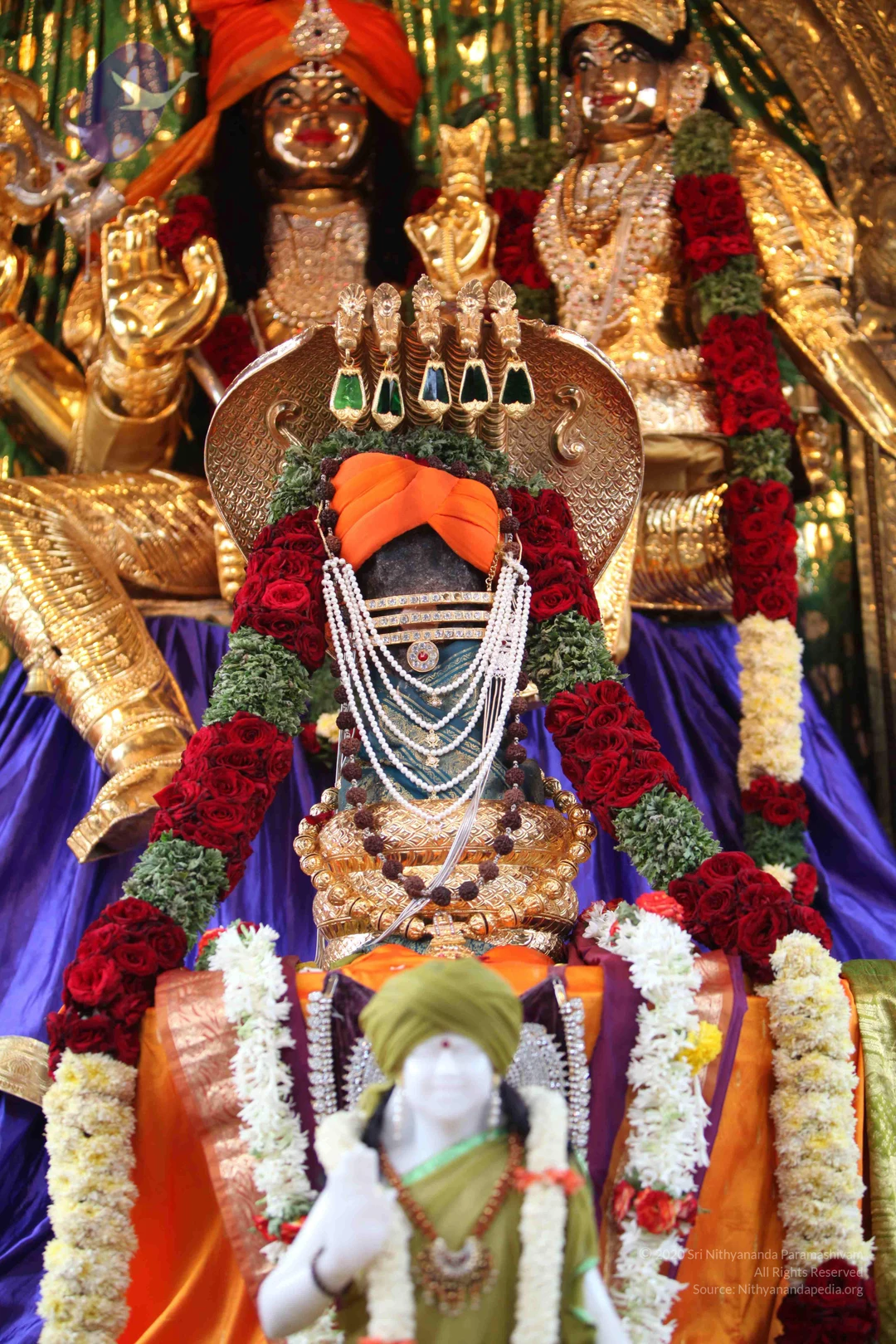
1 photoSource gallery
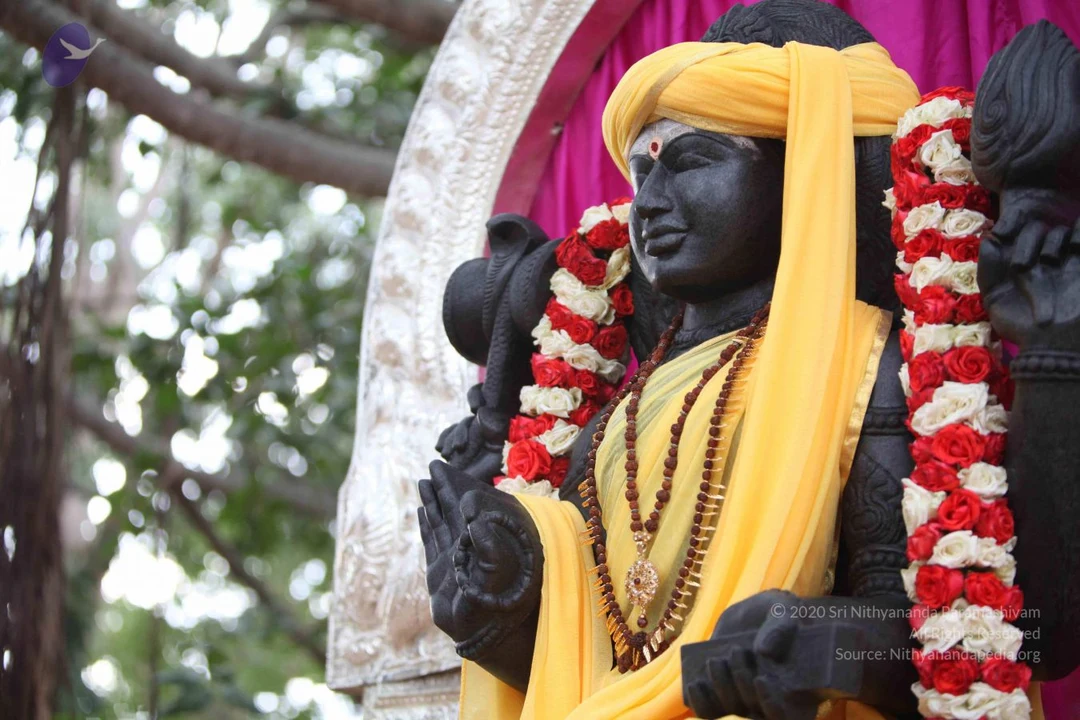
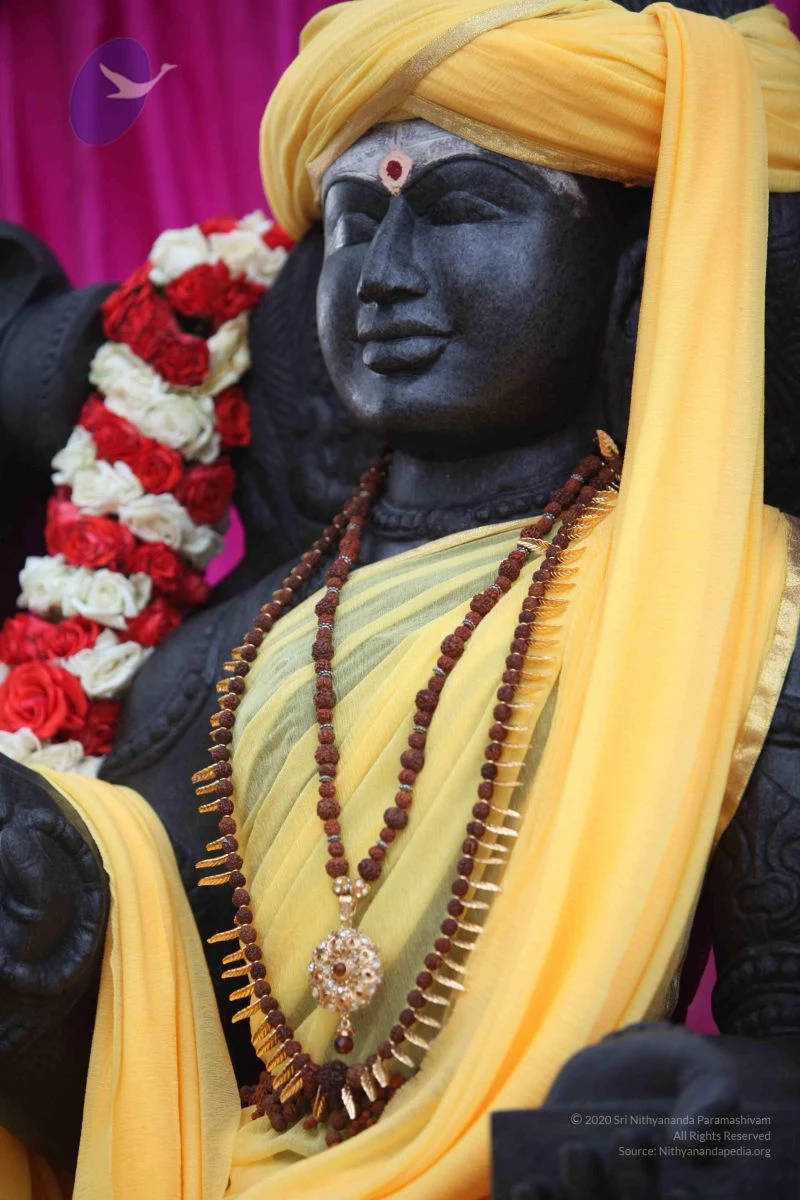
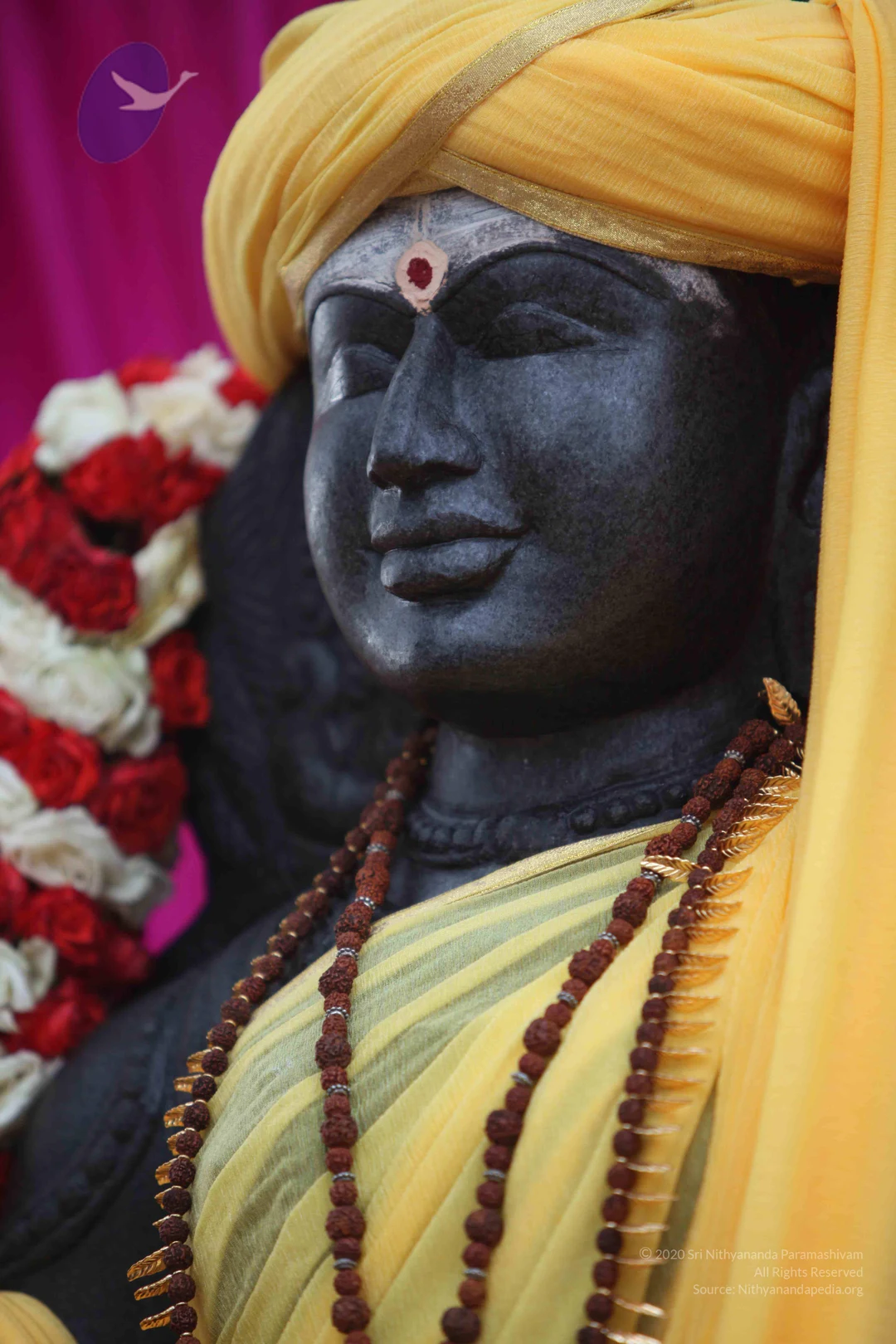
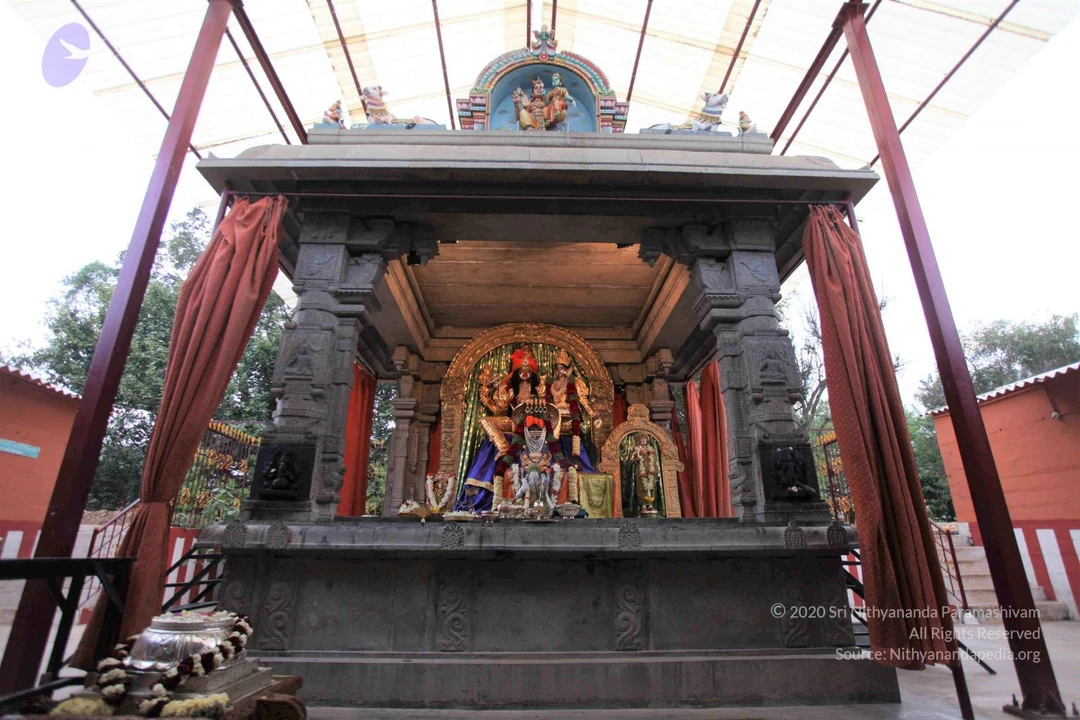
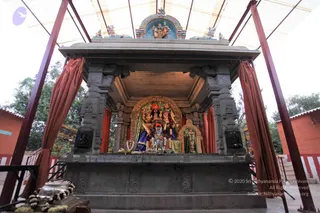
A photograph of an outdoor temple shrine with a dark grey stone structure under a white canvas canopy and red curtains draped on the sides. Inside the shrine sits a deity murti decorated with red and gold garments and a crown, with flower garlands at its base and a golden arch behind it. Above, a painted panel shows two figures seated beside a bull. Silver ritual vessels and flower garlands rest on the stone platform in front, and trees and orange walls surround the courtyard.

Pratyaksha-Pada-Puja

7 photosSource gallery
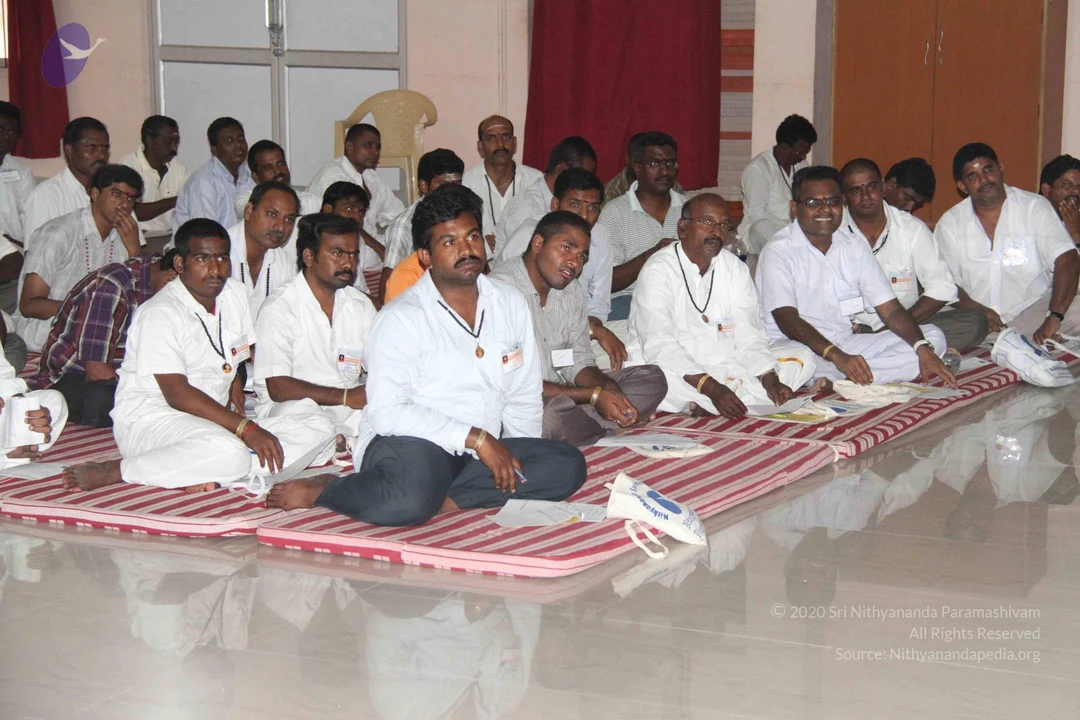
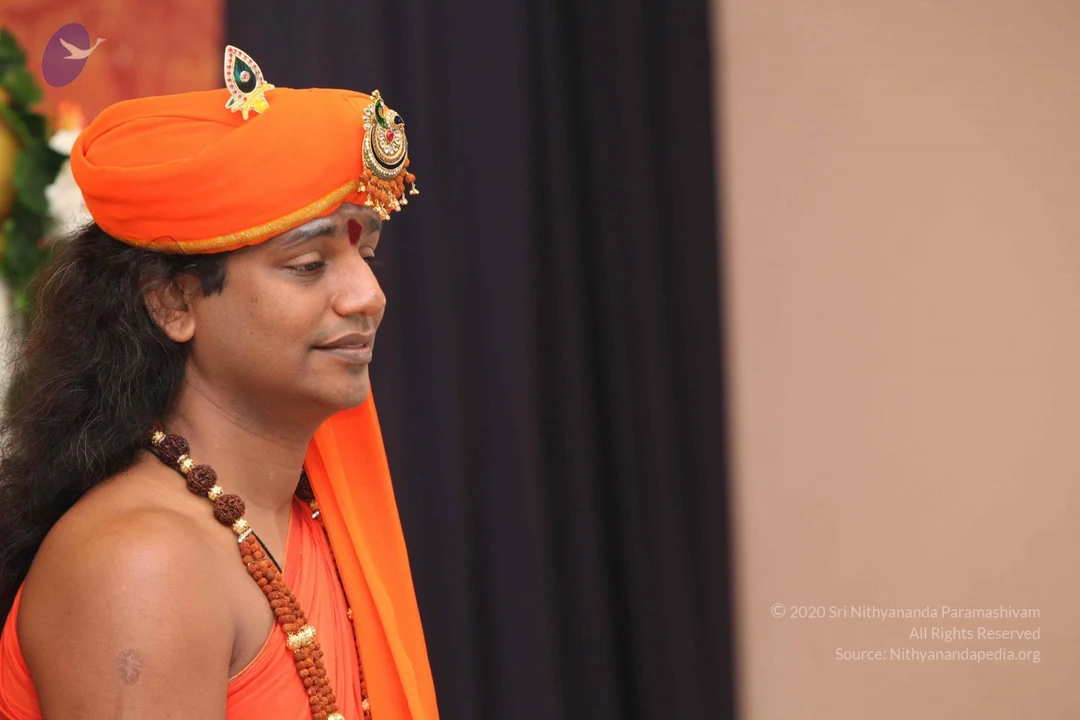
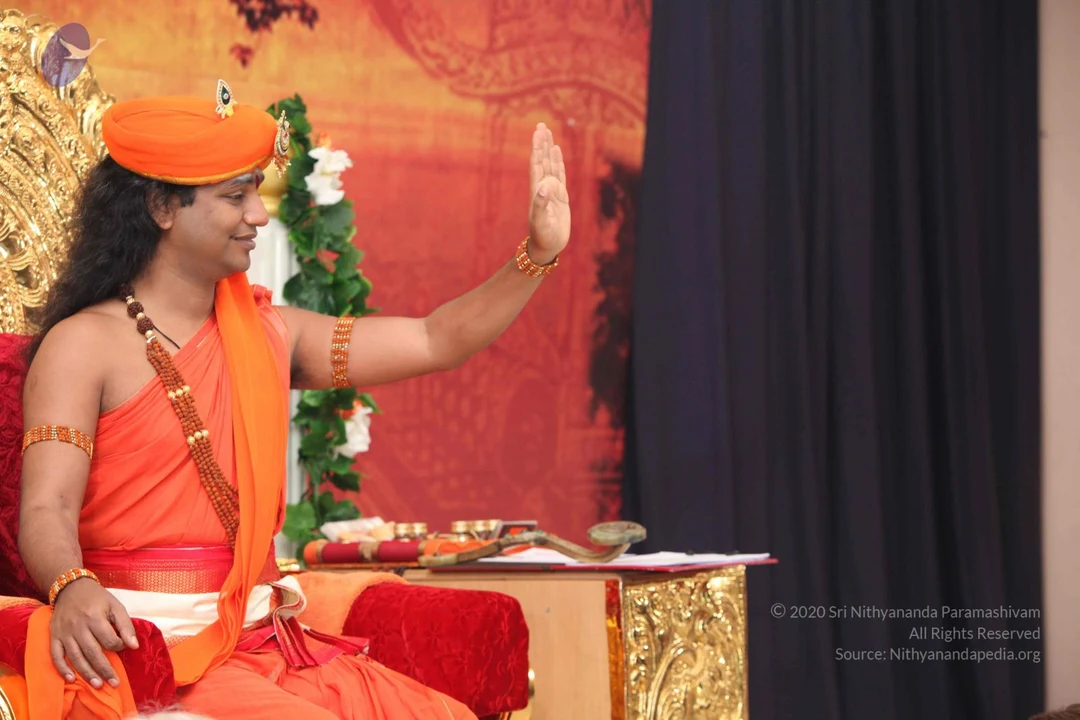
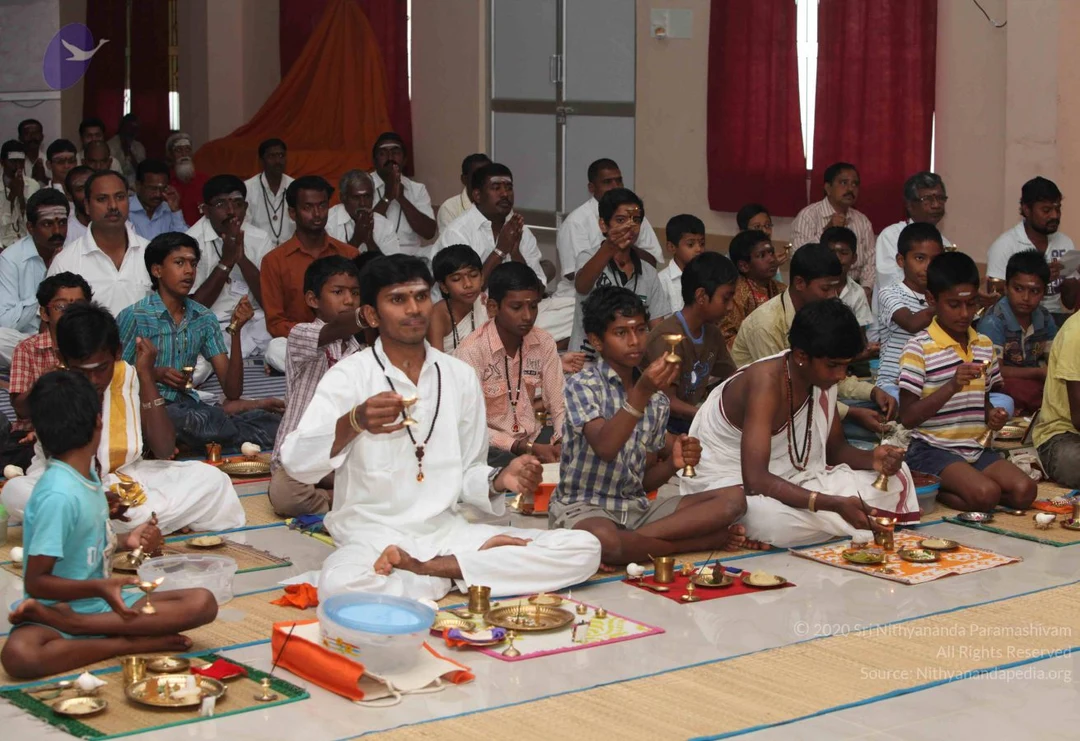
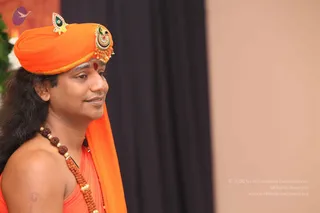
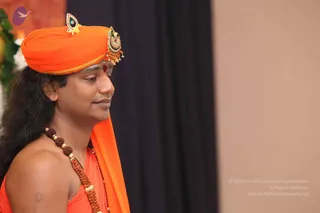
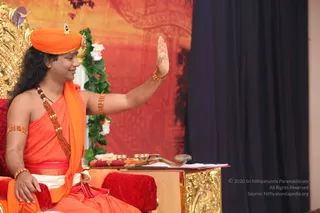
A man in profile wears an orange turban with a gold and jewelled ornament at the front and a red bindi on his forehead. He has long dark hair and a head bowed to one side with a faint smile. He wears an orange cloth draped over one shoulder and a rudraksha mala with gold beads around his neck, and his shoulder is bare. Behind him are dark curtains and a warm wall with a green leafy decoration at the left edge. Appearance matches the a person cues of long hair, orange turban, rudraksha mala and orange clothing, though the page does not say he is at this event.A man seated on an ornate golden throne with red cushioned armrests, raising his right hand in a blessing gesture toward the left. He wears an orange turban with a jewelled ornament, an orange robe and shawl, a rudraksha mala across his chest, and gold bangles on both wrists and upper arm. Behind him hang a red backdrop with gold patterns and a garland of white flowers and green leaves. On the right, a dark navy curtain. A golden table holds a red cloth, papers and ritual items. The figure may be a person, based on the long hair, orange turban, orange robes and rudraksha mala, seated as a teacher on the throne.A seated group ritual in a hall with cream walls, red curtains and an orange cloth backdrop. In the foreground, several young men in white dhotis and bare or white upper garments sit on mats holding small brass oil lamps and cups over brass plates set with offerings. A young man in white with a rudraksha mala at the centre is lifting a lamp. Behind them a large crowd of mostly men and boys in white shirts and everyday clothes sits with hands folded or holding lamps. Small brass vessels, flower petals and a plastic container sit on the floor mats.A stage event with a gold-and-red throne on the left where a figure in an orange robe and orange turban sits, adorned with beaded necklaces. A backdrop reads a partially visible Bhagavad Gita satsang banner showing a large tree. In the foreground, a woman in a blue salwar outfit sits on the left, and a woman in a green and red sari sits beside a gold tray of flowers and offerings. On the right, a bald man in a white dhoti with gold border kneels and raises a tiered silver aarti lamp with many lit oil lamps toward the seated figure. Stage lights and a speaker are visible.A satsang stage with a golden ornate throne at left holding a seated figure in saffron-orange robes, an orange turban, and a rudraksha mala with a gold pendant. A woman in a blue salwar outfit sits on the floor at left, and a woman in a green sari with a red border kneels before a gold table with flowers and offerings. At right, a bald priest in white dhoti with an orange-gold border raises a multi-tiered silver aarti lamp with many lit oil lamps. Behind them hangs a backdrop reading Bhagavad Gita satsang with a painted tree and sunset landscape. Black curtains and a red panel frame the stage.A seated figure on an ornate gold throne with red cushions at a Bhagavad Gita Dhyana Satsang, wearing an orange turban, orange robes and a rudraksha mala, with hands resting in his lap. A man in white dhoti with gold borders stands in the foreground holding a tall silver multi-tiered aarti lamp with burning wicks. A woman in a blue saree sits on the left beside offering trays, and another devotee in a green sari sits near the throne base decorated with red and yellow flowers. Behind is a yellow and red backdrop with a tree and the printed title Bhagavad Gita Dhyana Satsang. The seated figure has distinctive orange turban, ornate necklace and long hair cues, so this is a person appearance.

Bhagavad-Gita-Satsang

28 photosSource gallery
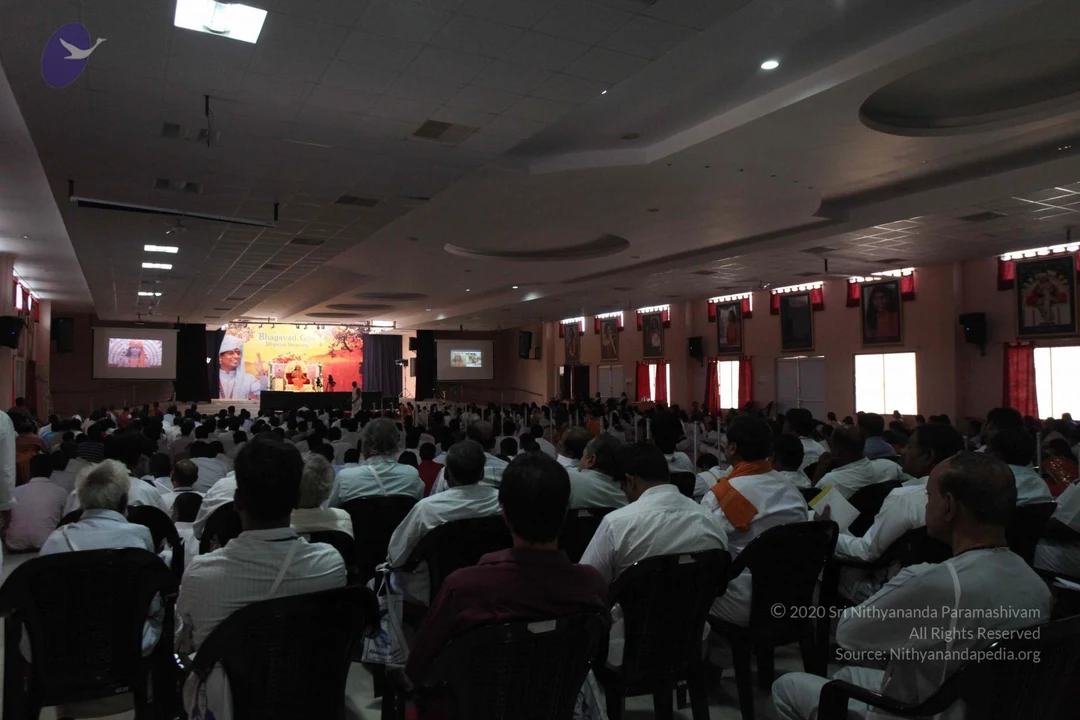
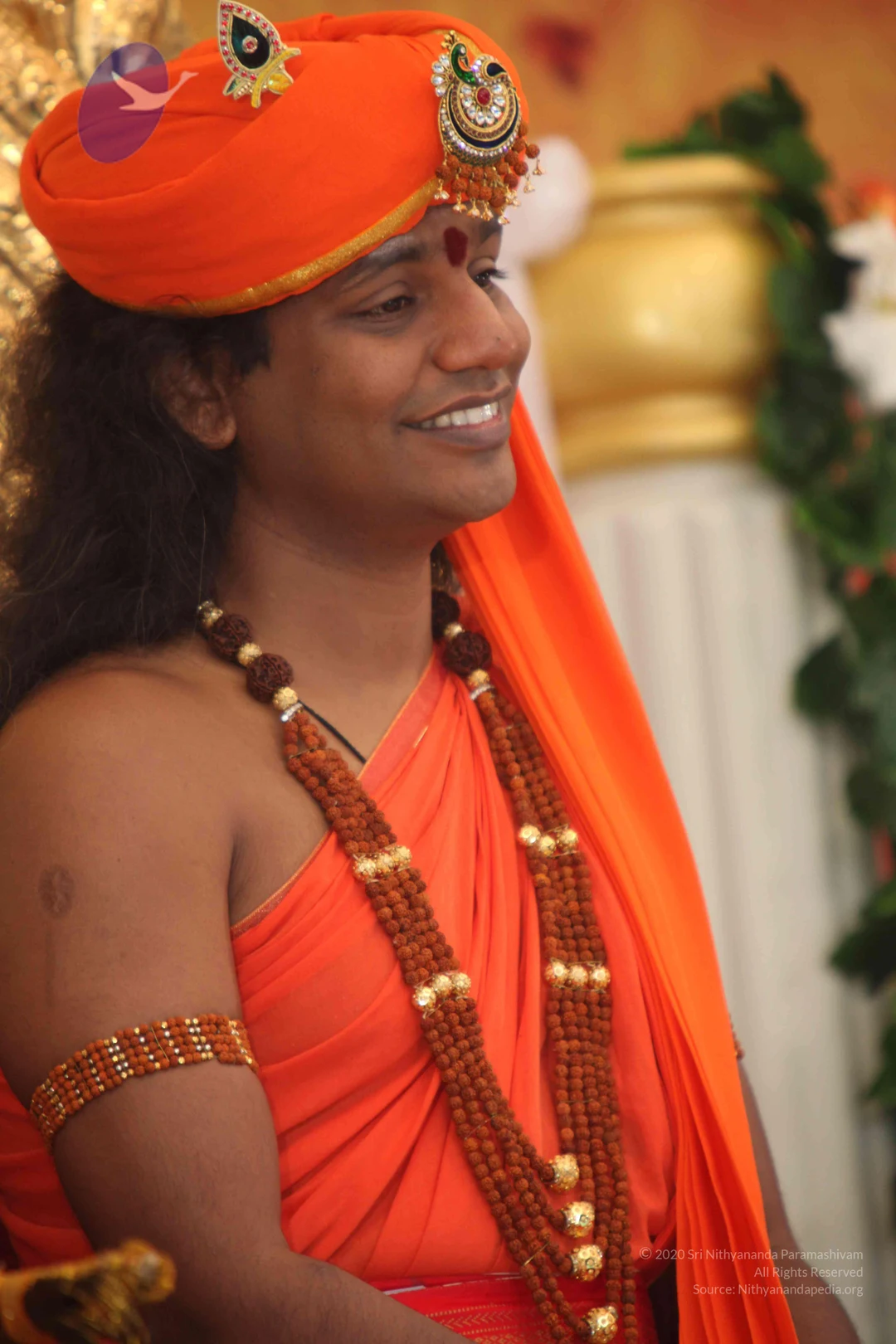
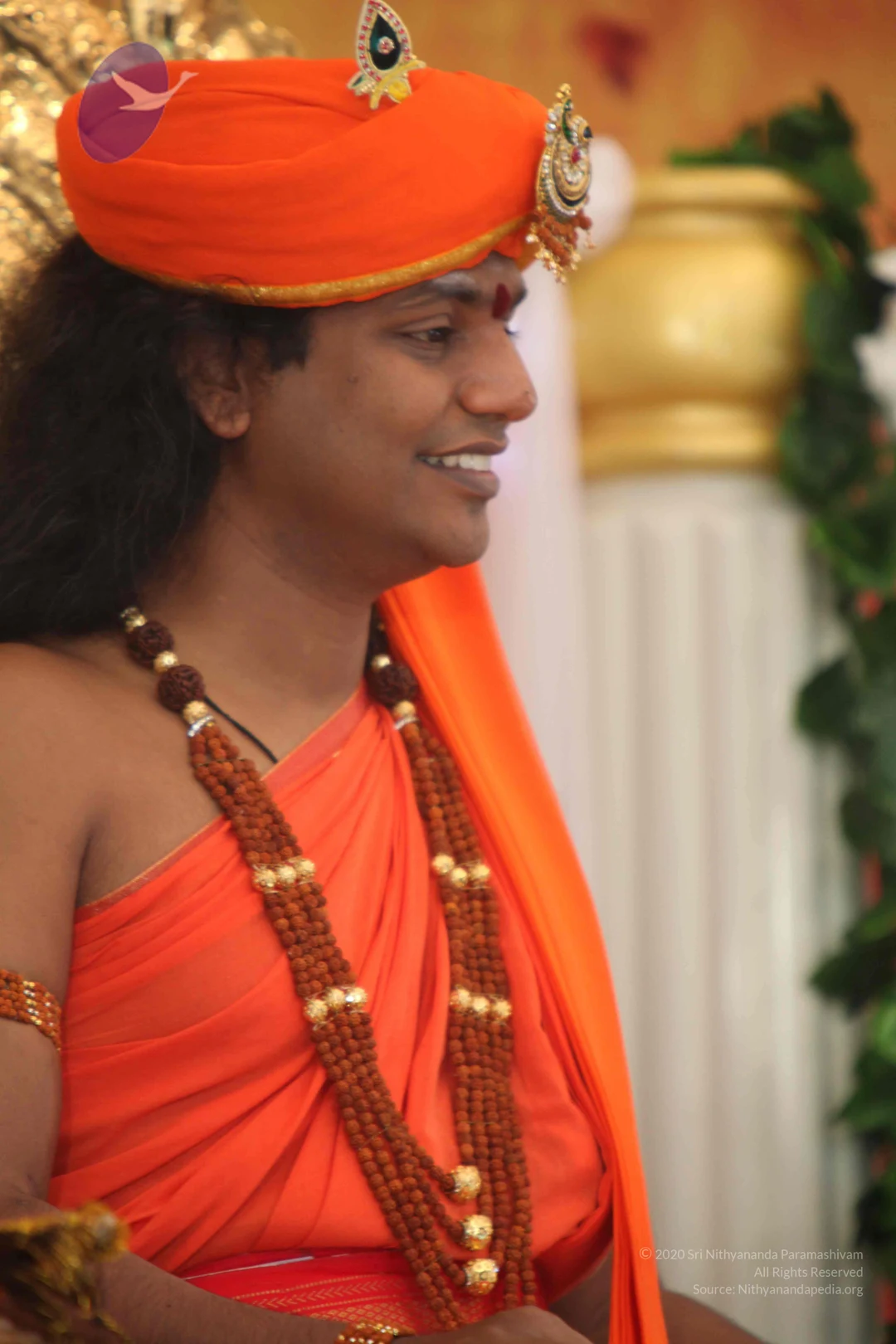
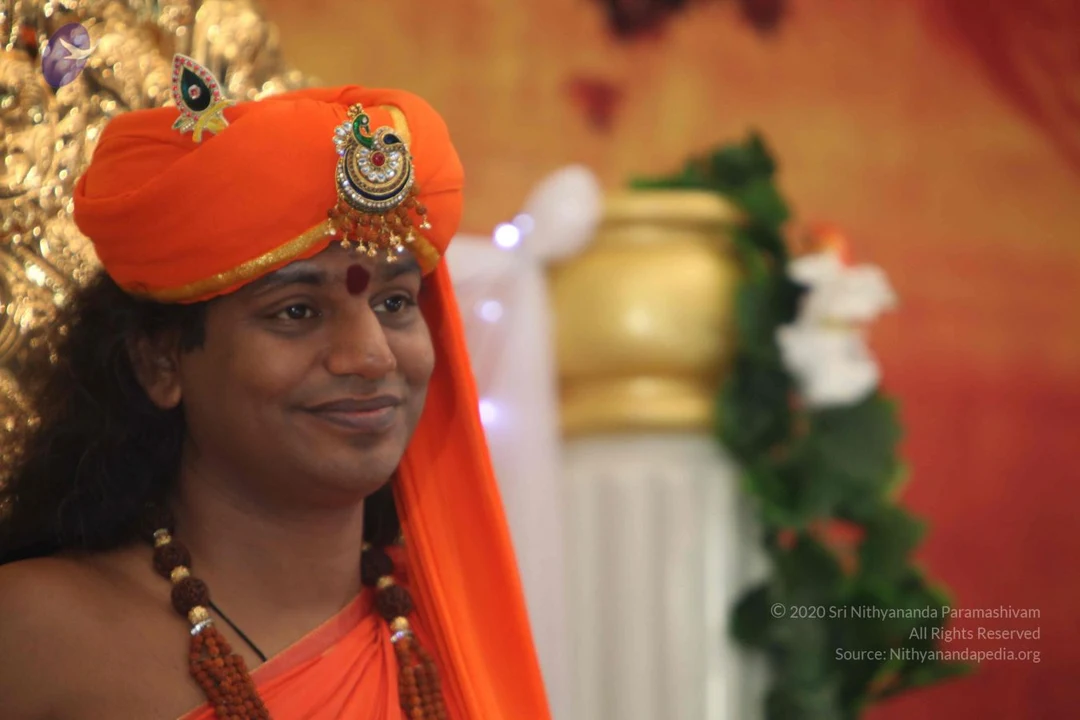
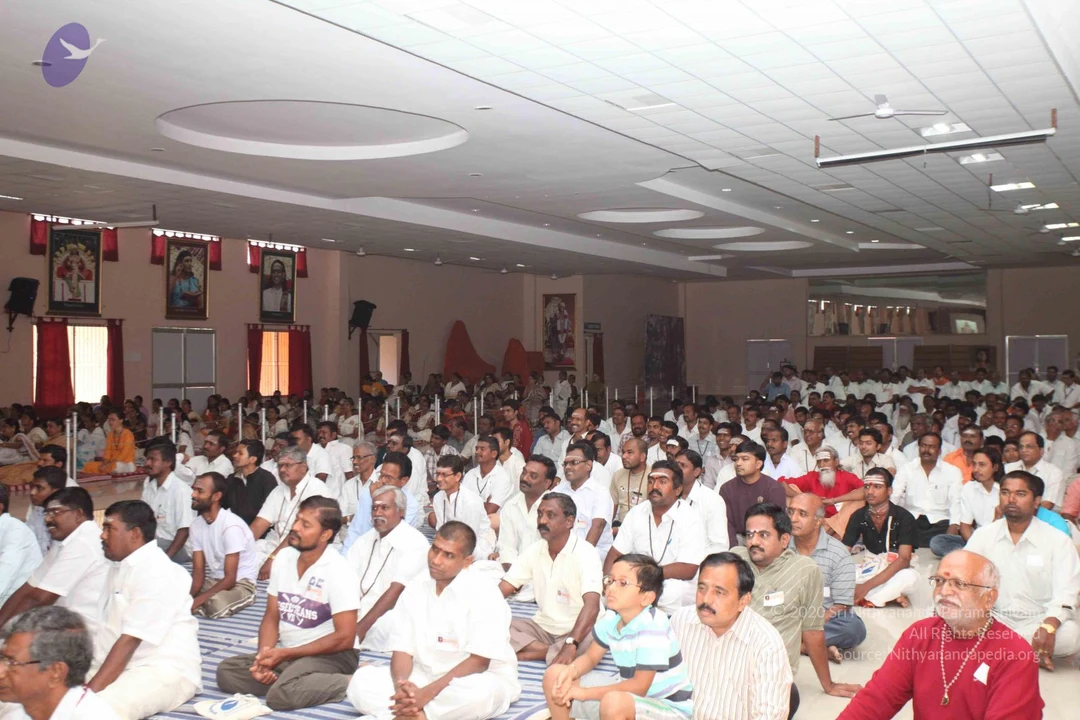
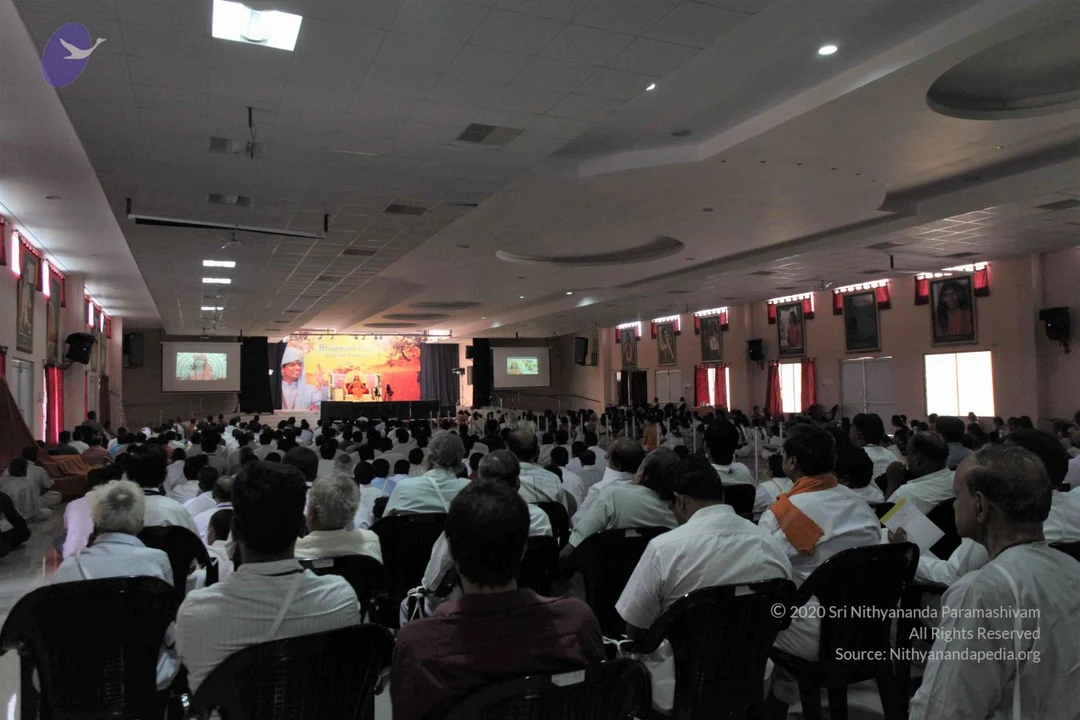
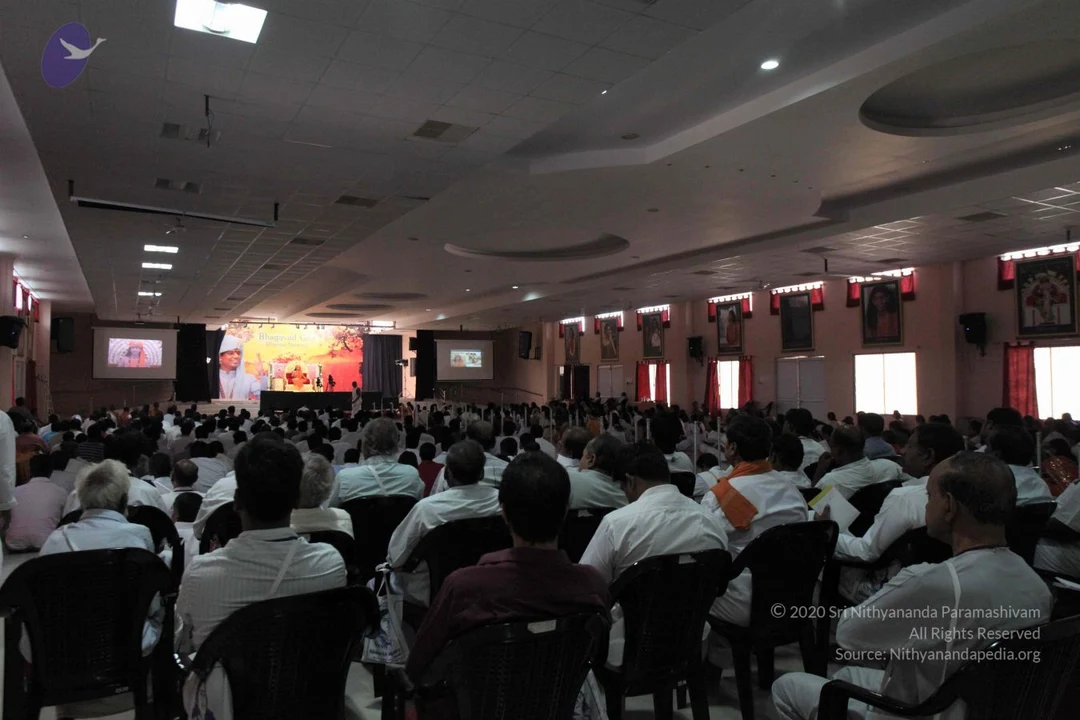
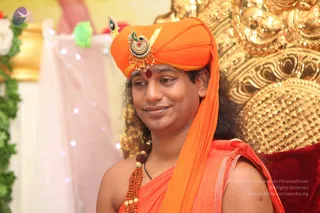
Close-up photograph of a smiling man seated before an ornate gold throne with carved scrollwork. He wears a bright orange turban with a jewelled ornament and a gold-and-green pendant at the side, a red tilak on his forehead, and long dark hair falling behind. His orange shawl drapes over one shoulder and a long orange end falls down his chest. He wears multiple strands of rudraksha beads with gold spacer beads, rudraksha armlets, and a red-bordered garment at the waist. Both hands rest in his lap. a person, seated in the role of the speaker at a discourse, with the throne behind him.A smiling man in profile wears an orange turban decorated with a jewelled gold ornament and a red and green enamelled brooch. He has a red tilak on his forehead and wears an orange shawl draped over one shoulder and an orange garment, along with multiple strands of rudraksha beads with gold spacers and a rudraksha armband. Behind him are a gold-coloured pot, white draping and green foliage with white flowers.Close side-profile photograph of a smiling man in an orange turban decorated with a gold and jewelled brooch and a feather-like ornament at the front. He wears an orange draped robe over the shoulder, multiple strands of rudraksha beads with gold spacers across the chest, and a red tilak on his forehead. Behind him are a gold urn-shaped pillar, white columns and green leafy garland decoration. The visible cues of an orange turban, rudraksha malas and ornate clothing match the page's a person context, so the appearance-based label is probable, but the page indicates no a person at this event and the figure is seen in profile only.Close portrait photo of a man in an orange turban decorated with a jewelled gold ornament and a green-and-red emblem, a red tilak on his forehead. He wears an orange shawl draped over one shoulder and strings of rudraksha beads around his neck. He smiles and looks to the side against a warm orange backdrop, with a gold urn-shaped column, white drapery and green foliage with white flowers behind him.A large hall filled with rows of seated audience members in white shirts and dhotis, viewed from the back of the room. On the stage at the far end, a robed speaker in white stands at a podium, with seated figures in orange beside him, under a banner with a saffron and red backdrop. Two projection screens flank the stage, and framed portraits hang along the side walls with red drapes. Several attendees wear orange shawls or stoles.A large hall filled with seated audience members in white clothing, seen from the back, facing a stage at the far end. On the stage a presenter in white robes and a white head covering stands near a backdrop reading a banner with a painted floral scene. Two large screens flank the stage showing live video. Framed portraits hang along the side walls above red drapes, and ceiling lights and speakers are visible. Attendees sit on black plastic chairs, some in saffron shawls.

NSP-Session

4 photosSource gallery
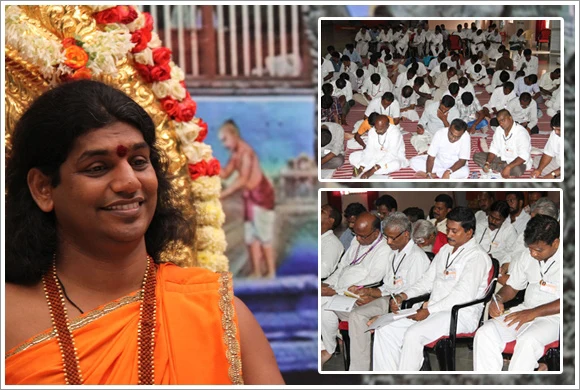
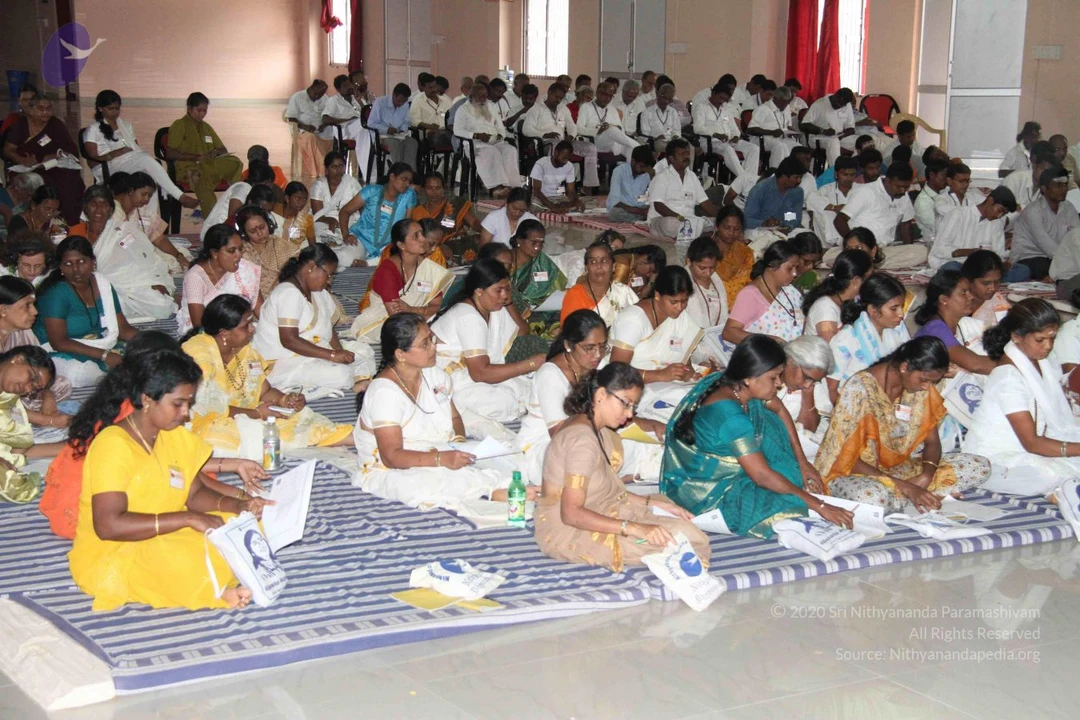
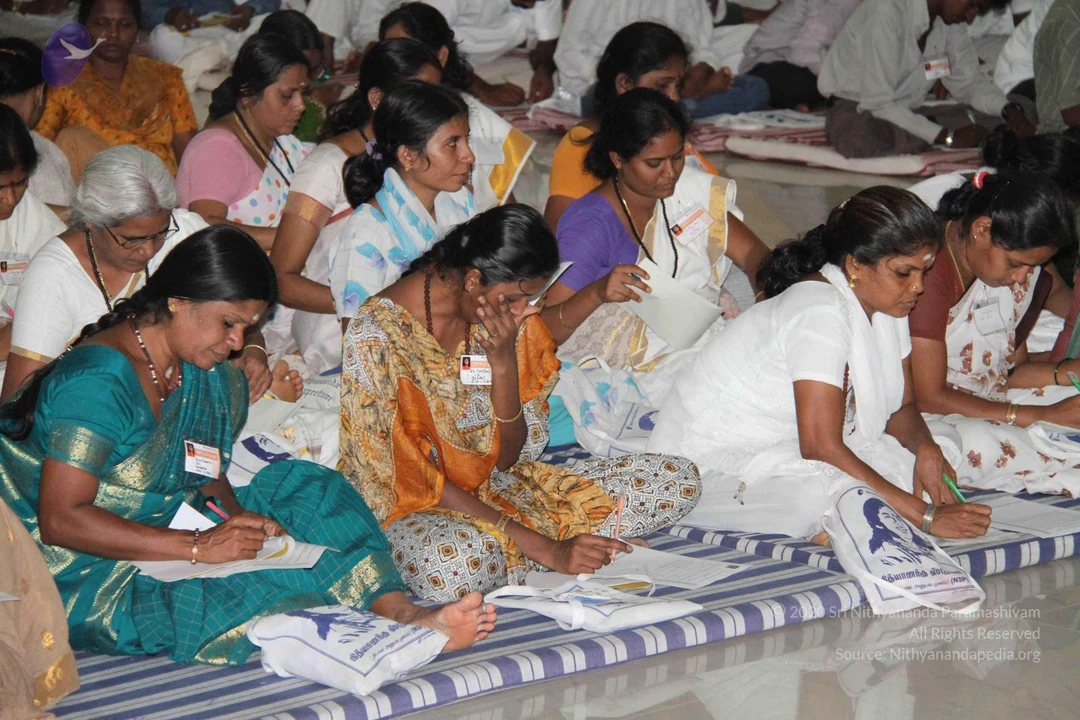
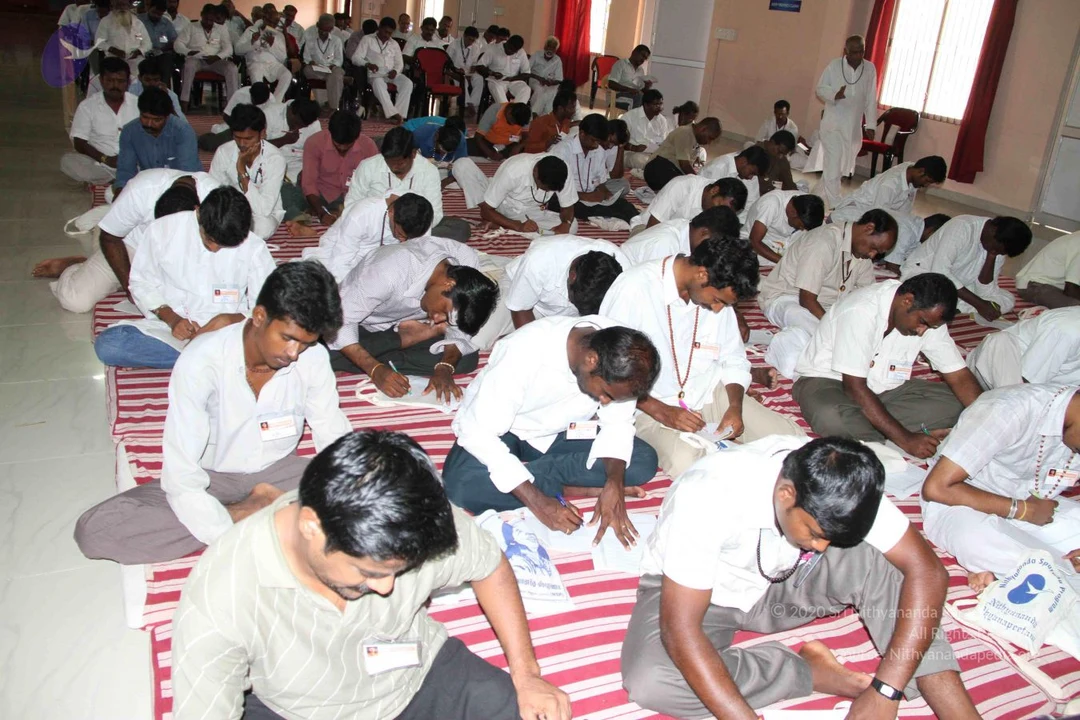
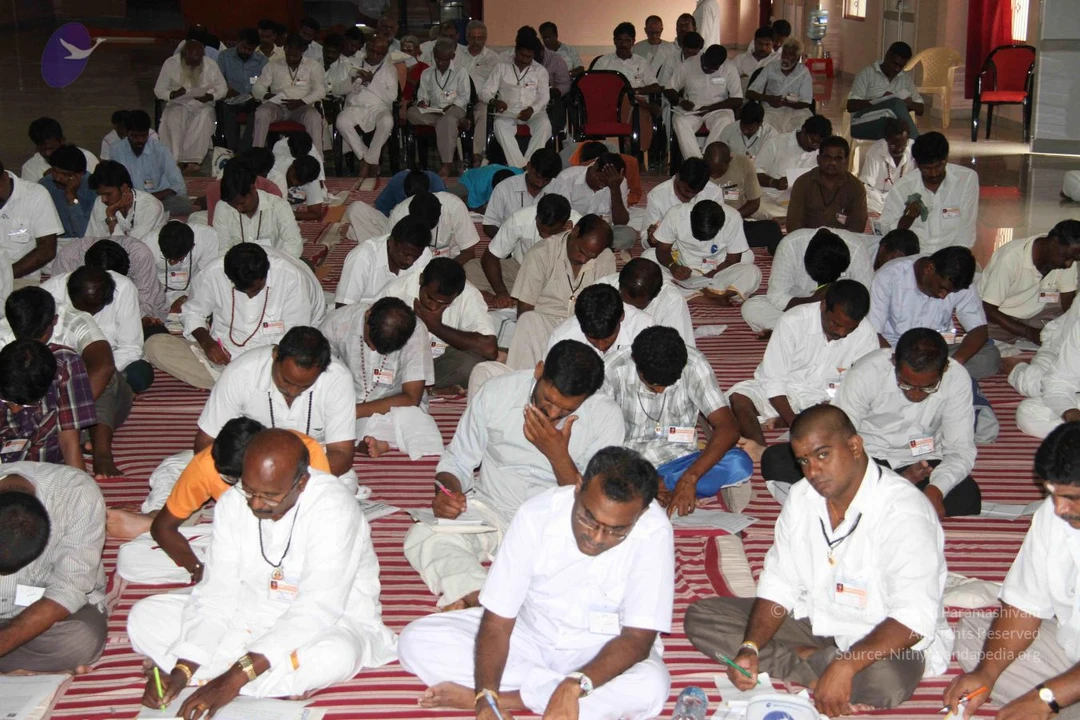
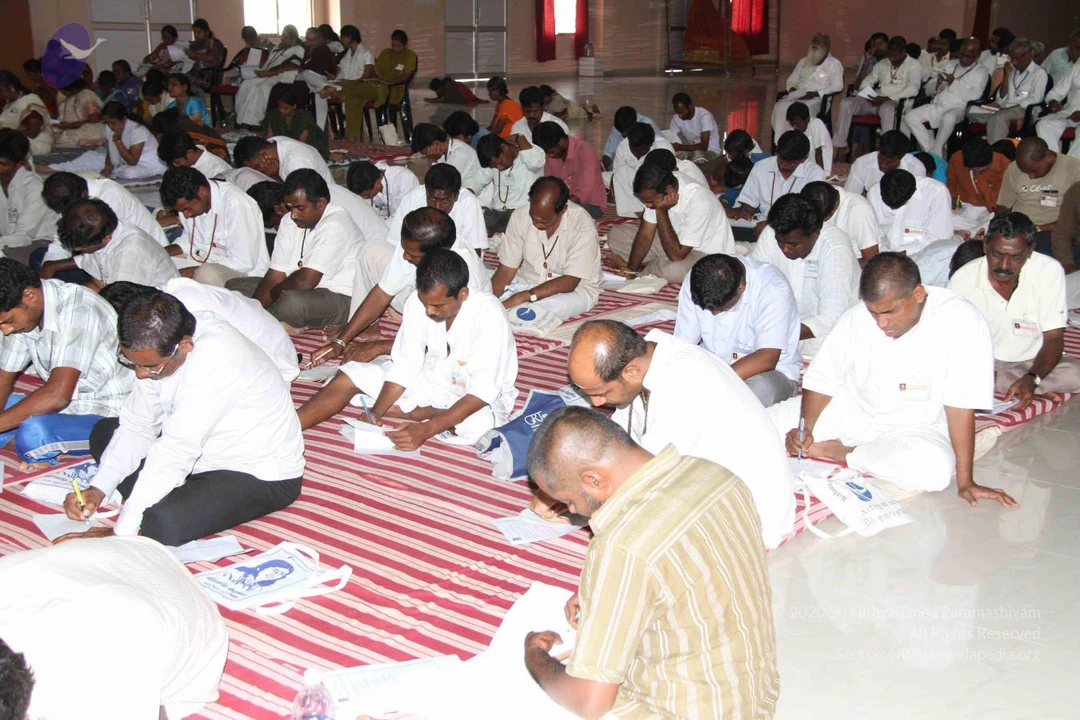
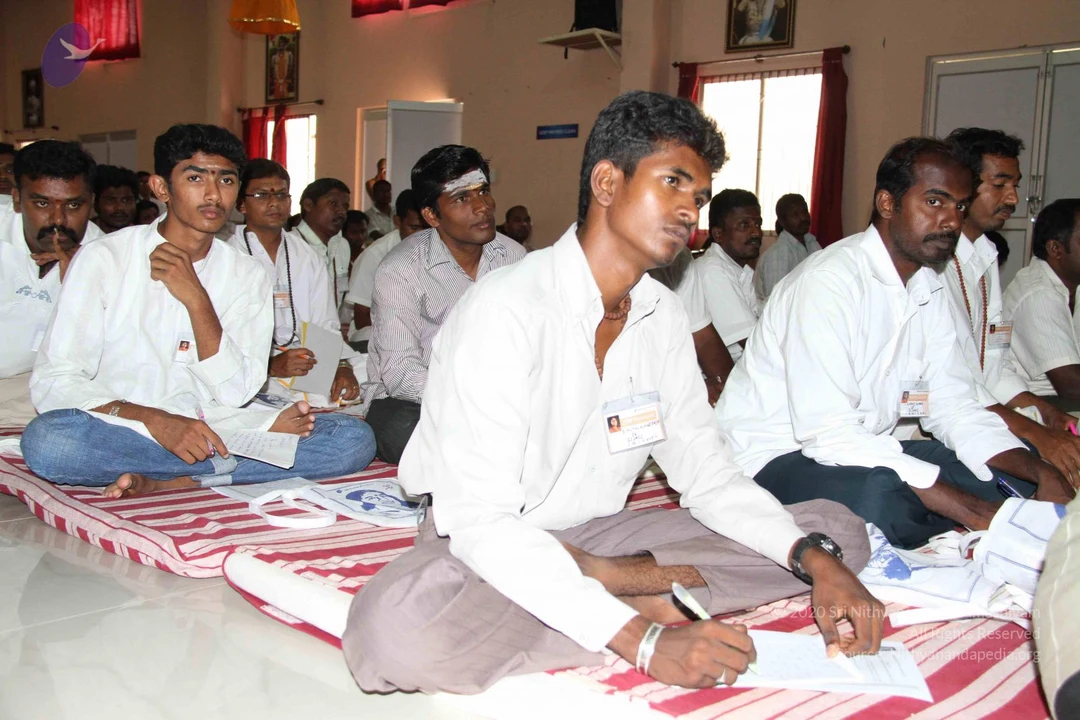
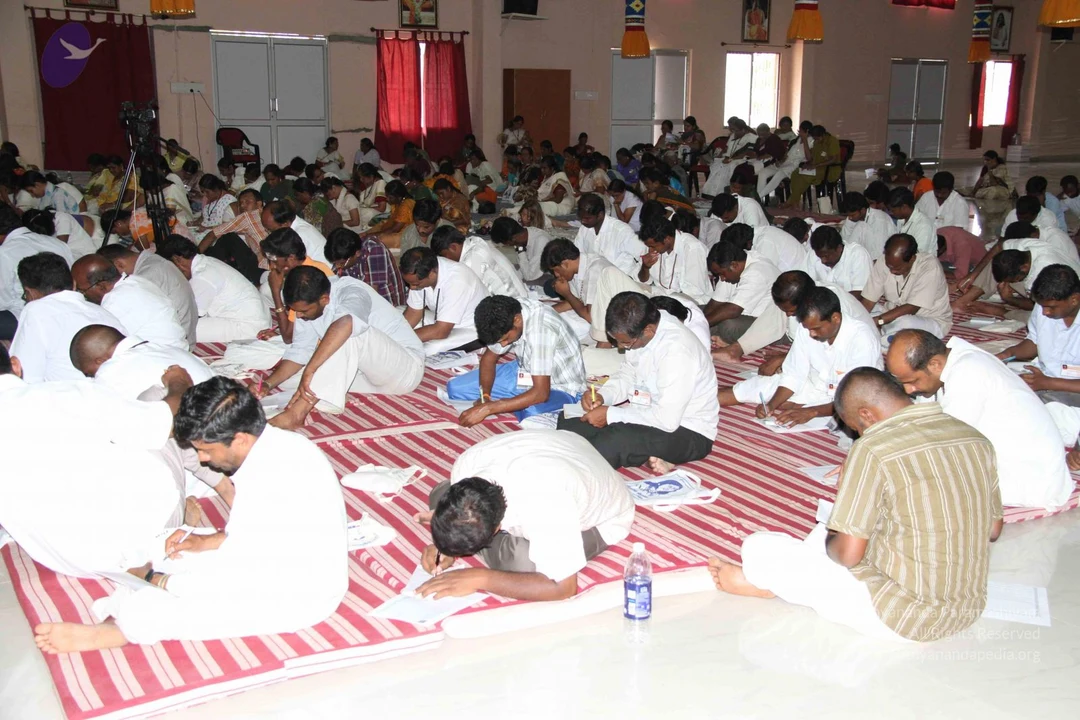
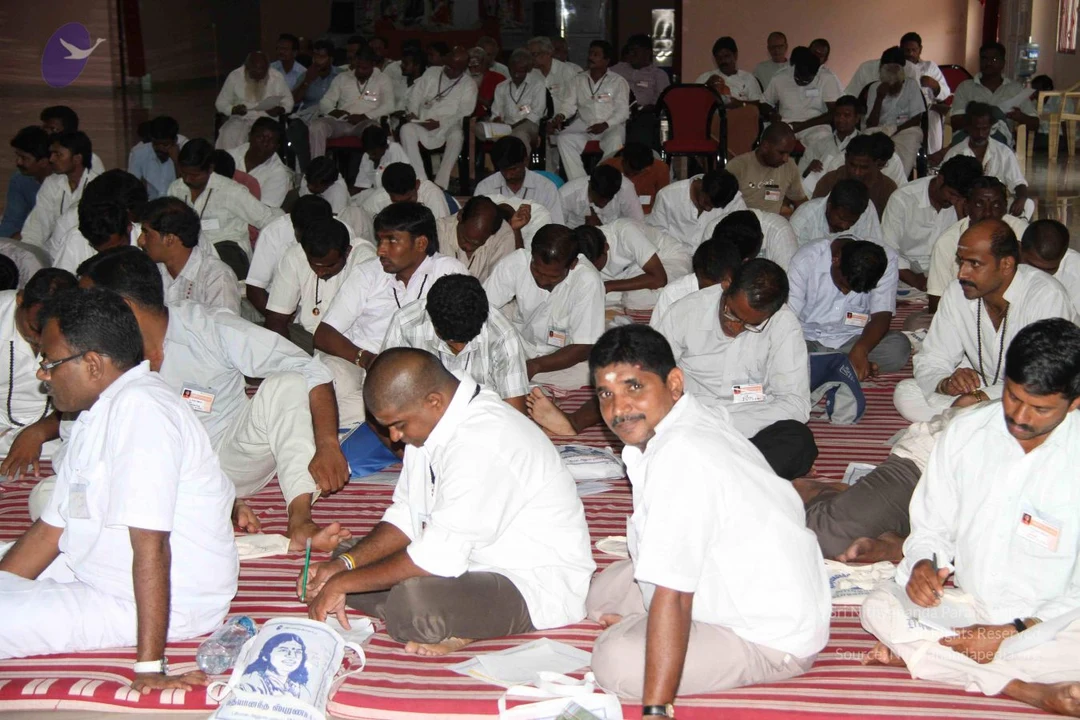
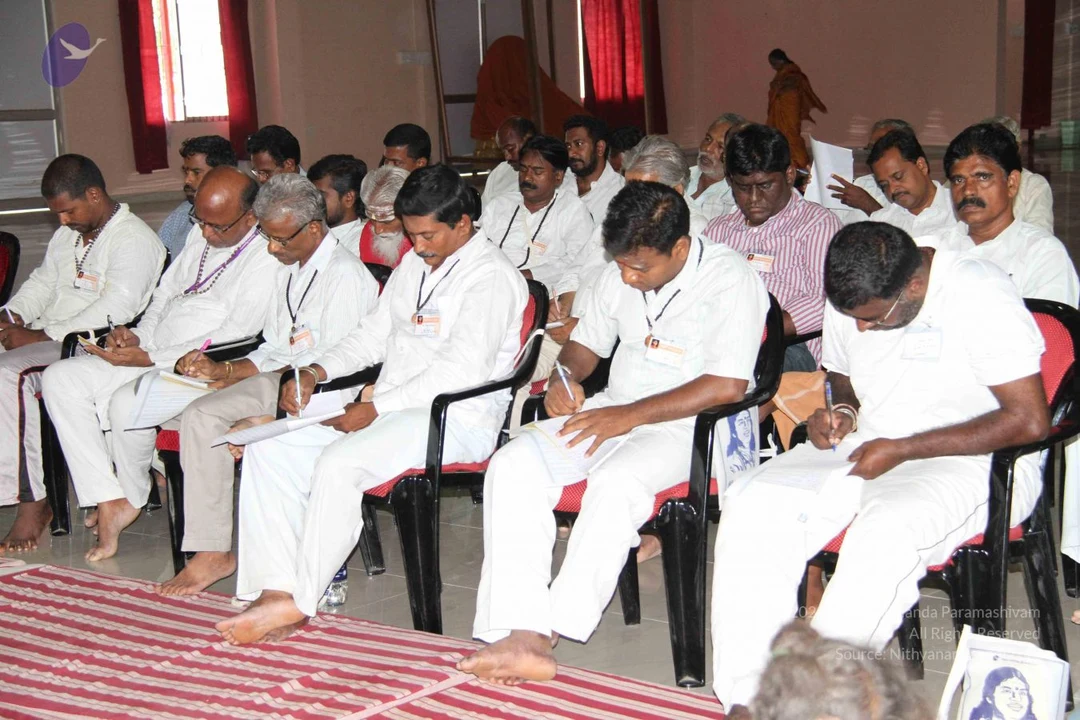
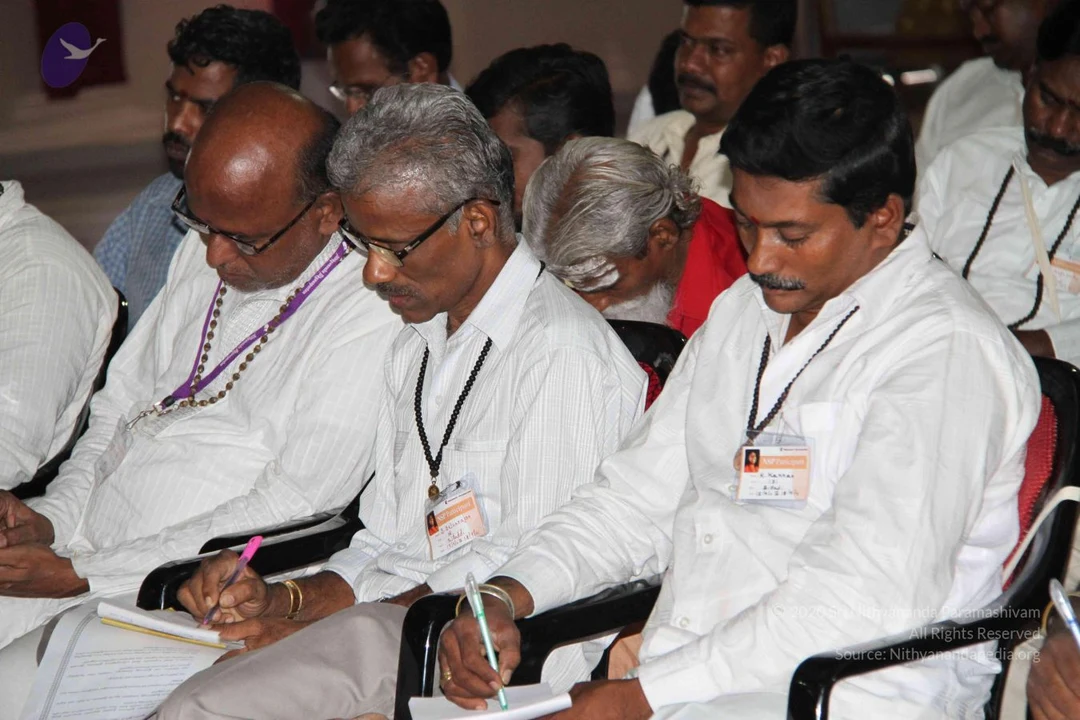
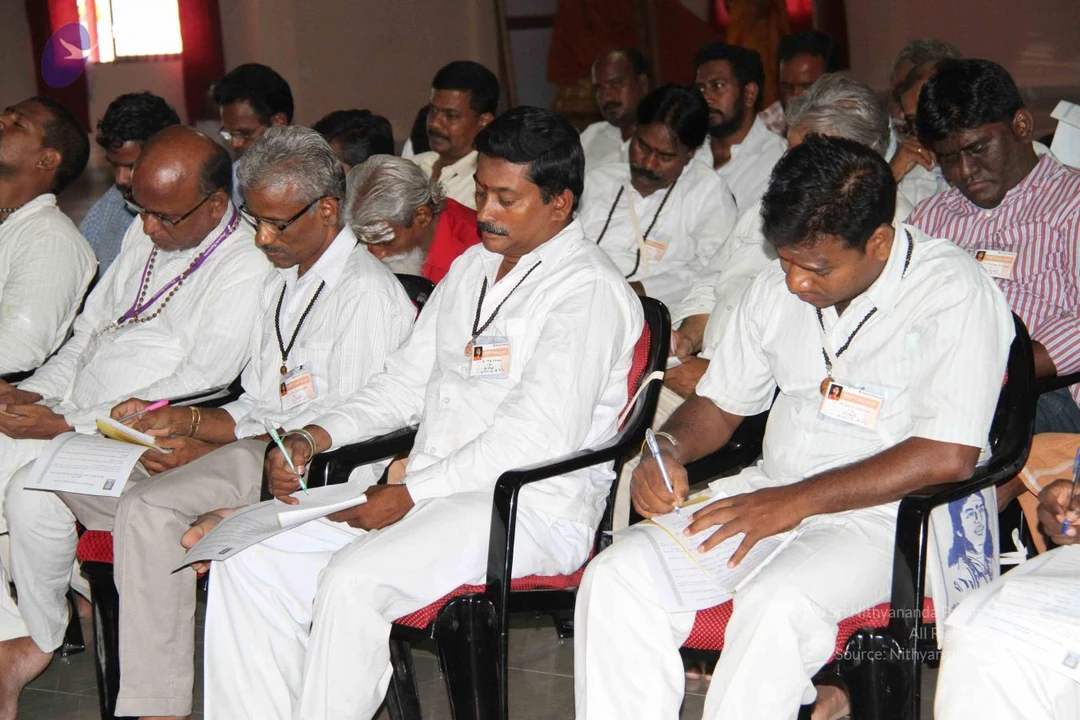
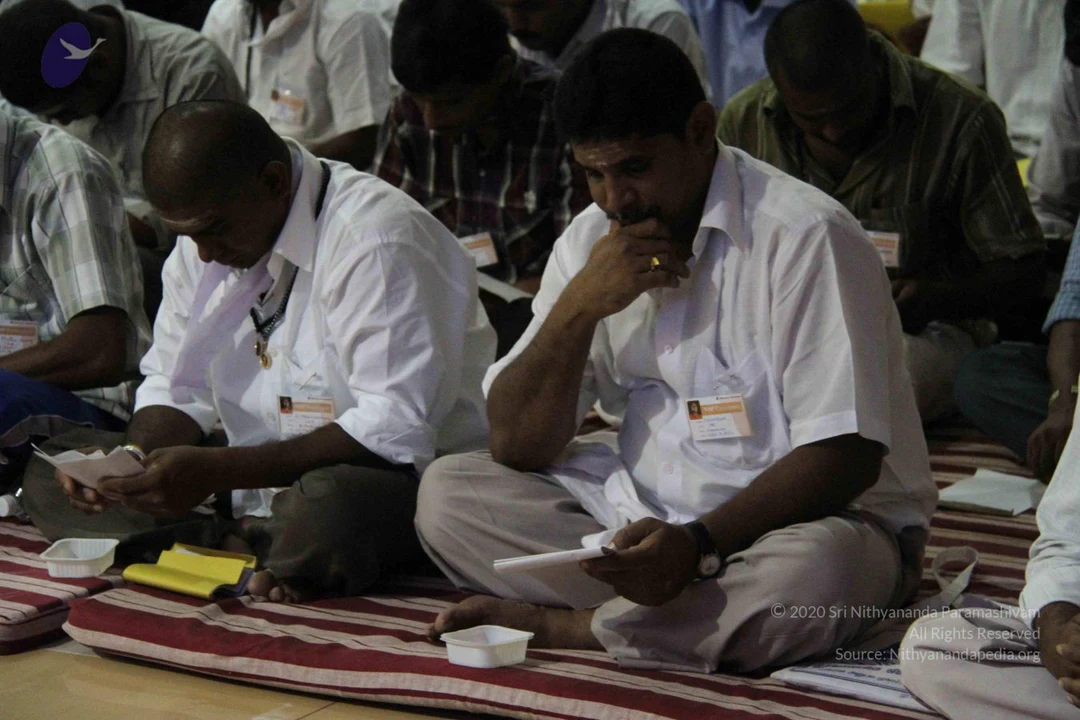
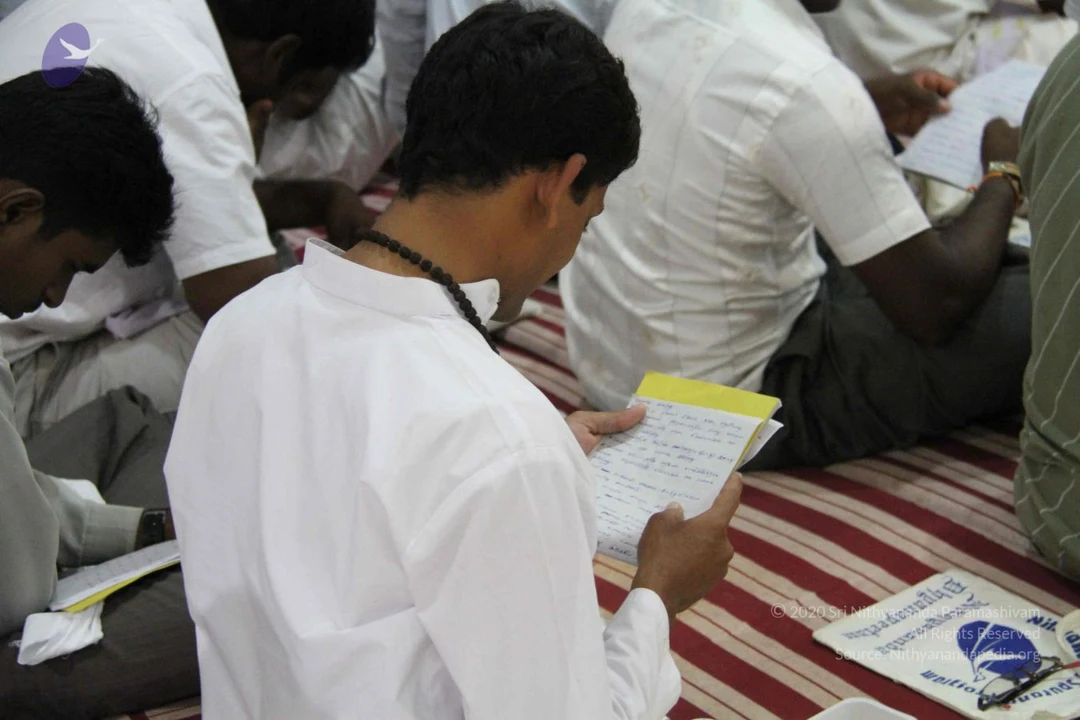
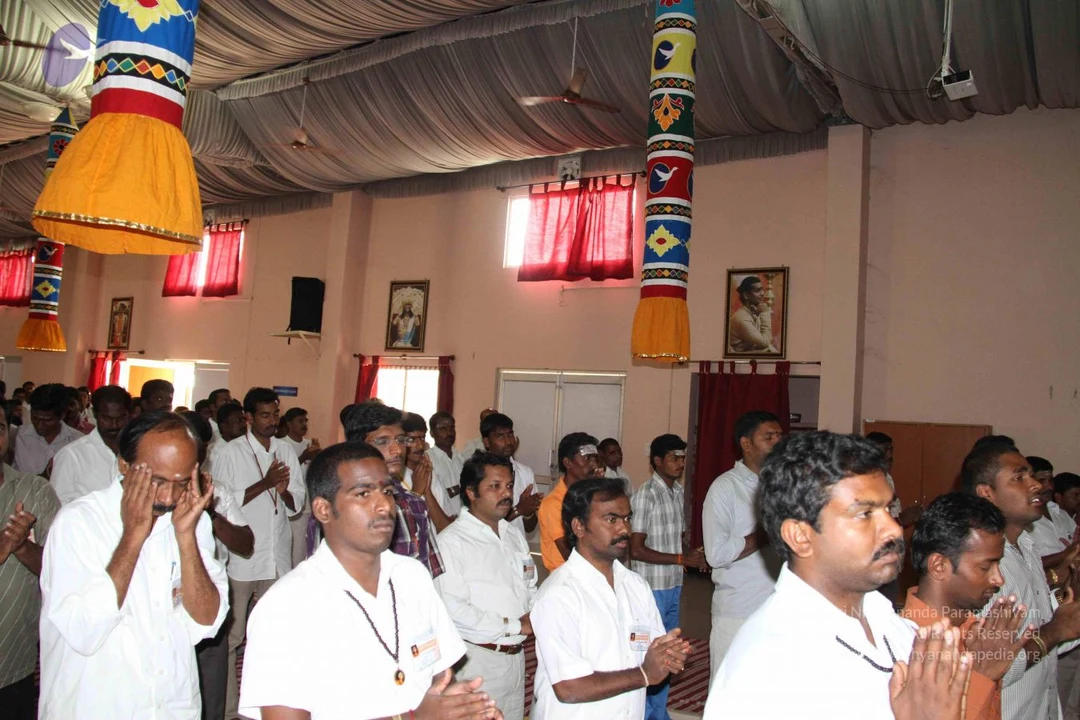
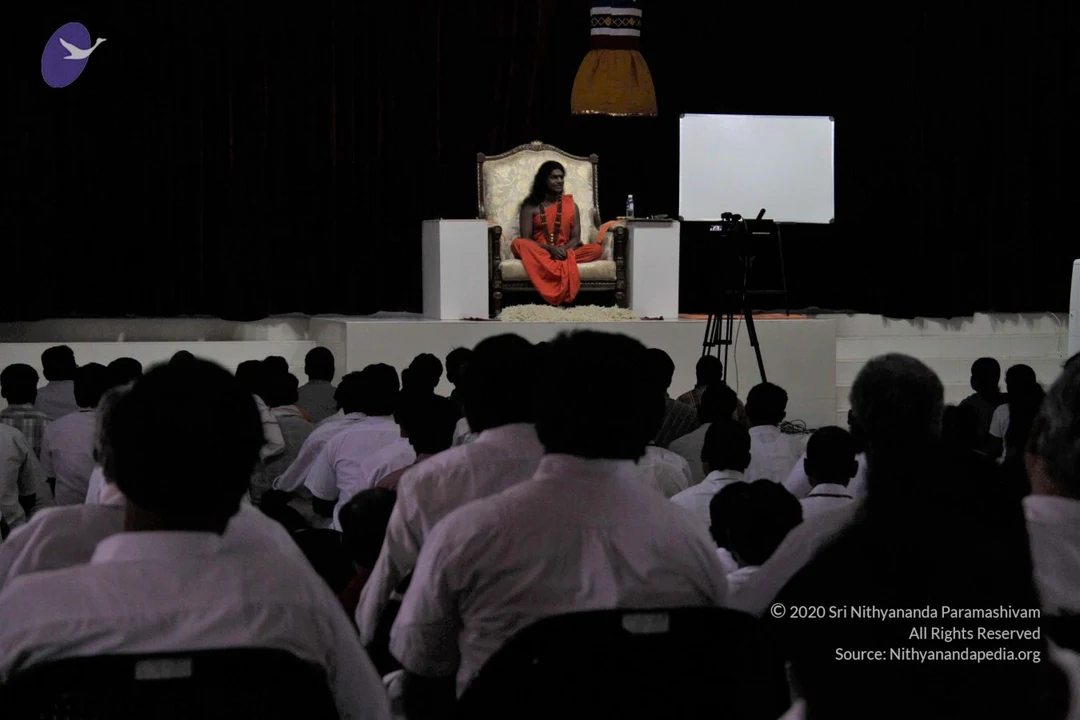
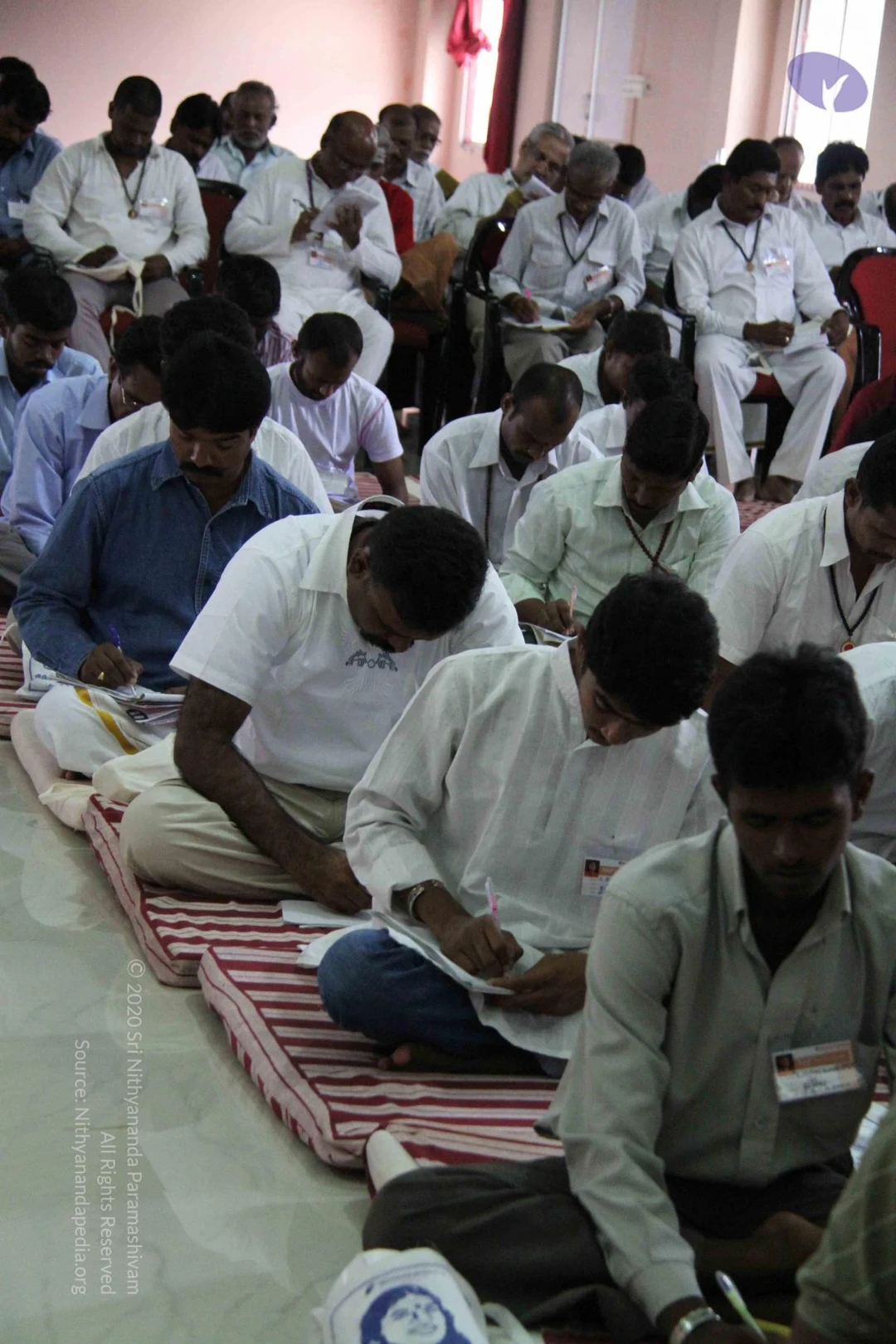
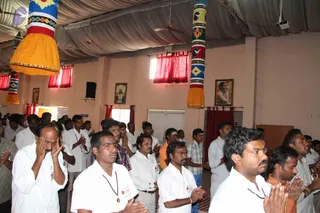
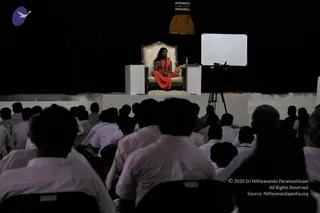
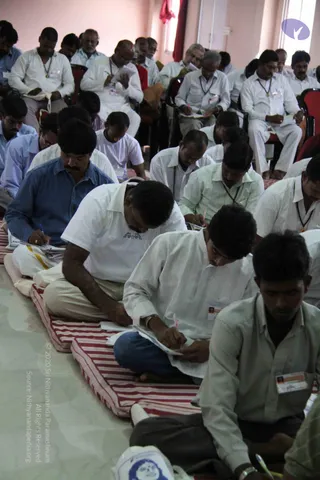
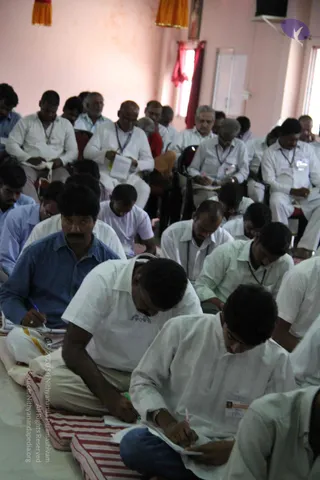
A photograph of men standing in a hall with a white ceiling canopy and hanging decorative cloth columns in yellow, red, green and blue with geometric patterns and bird motifs. Many men in white shirts and trousers stand with palms pressed together in prayer or folded hands, some with eyes closed and one with hands raised to the forehead. Several wear rudraksha-style beaded necklaces and a few wear checked shirts. Framed portraits hang on the pale pink walls, and red curtains hang at the windows. The scene looks like a satsang or group prayer session.A photograph of a discourse hall with a seated figure on a raised white stage. A person in an orange-red robe with a flowing shawl and a long-haired appearance sits cross-legged on an ornate cream and gold armchair throne, with a water bottle on a small white side table and a whiteboard behind. Dark curtains frame the stage, and a dark banner hangs above. Rows of seated audience members in white shirts and white clothing face the stage from the foreground, their heads and backs visible. A camera on a tripod is set to one side. The speaker appears to be a person, identified by long hair, saffron-orange robes and a throne-seated position with an audience before him, though the face is not clearly distinguishable at this distance.Men seated on the floor of a hall, writing notes on loose paper with pens. Most wear white shirts and white dhotis or trousers; some wear dark or light blue shirts. Several have dark rudraksha-style cords around their necks and identity badges clipped to their shirts. Striped red-and-white floor mats are arranged in rows, with plain walls, pink-tinted paint and a red curtain at the top of the frame. One man in a blue shirt and another in a grey-green shirt lean forward over their notes in the foreground. The scene looks like a seated discourse or study session.A photograph of a seated group of men in white shirts and white dhotis writing in notebooks during a class or discourse in a plain pink-walled hall. Some sit on the floor on striped mats, others on chairs at the back. Several wear lanyards with name badges. A small framed picture hangs high on the wall, and orange curtains are visible at the top. One man in a blue shirt sits cross-legged, writing with a pen. The gathering appears to be a study session with participants taking notes.

Organisers-Meeting

10 photosSource gallery
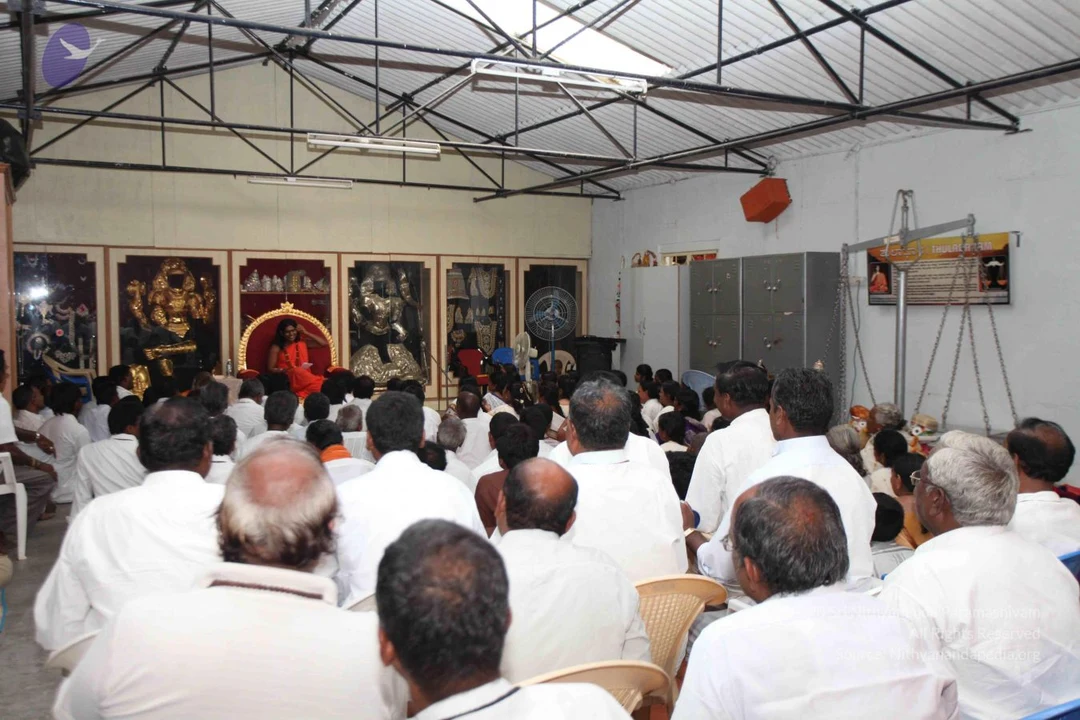
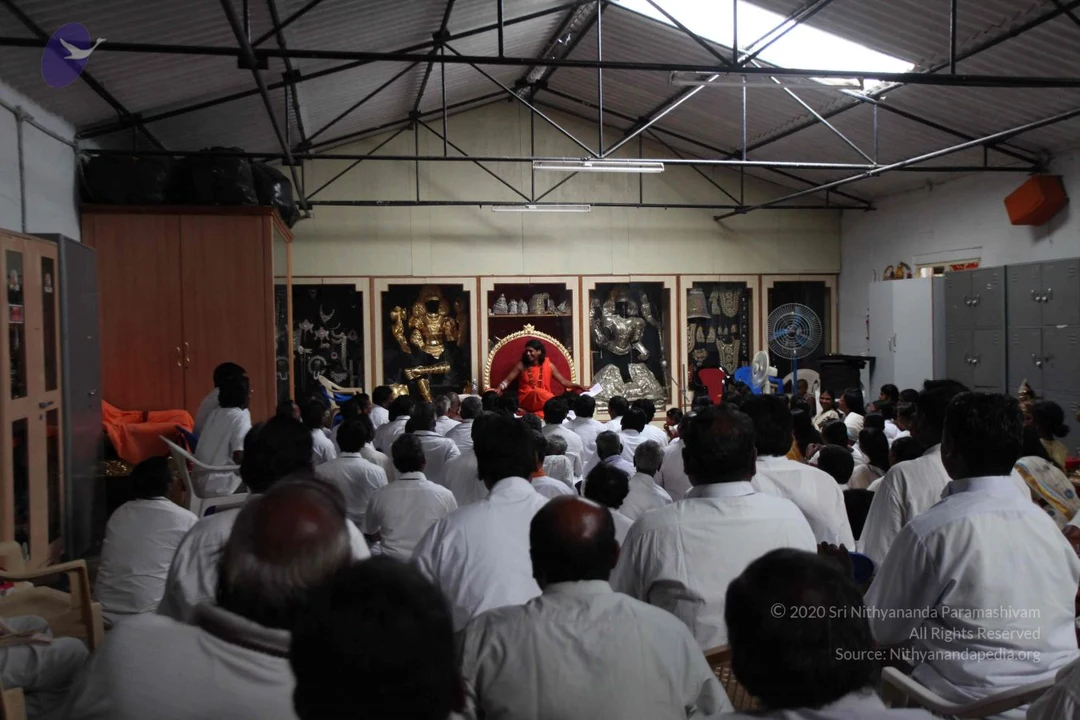
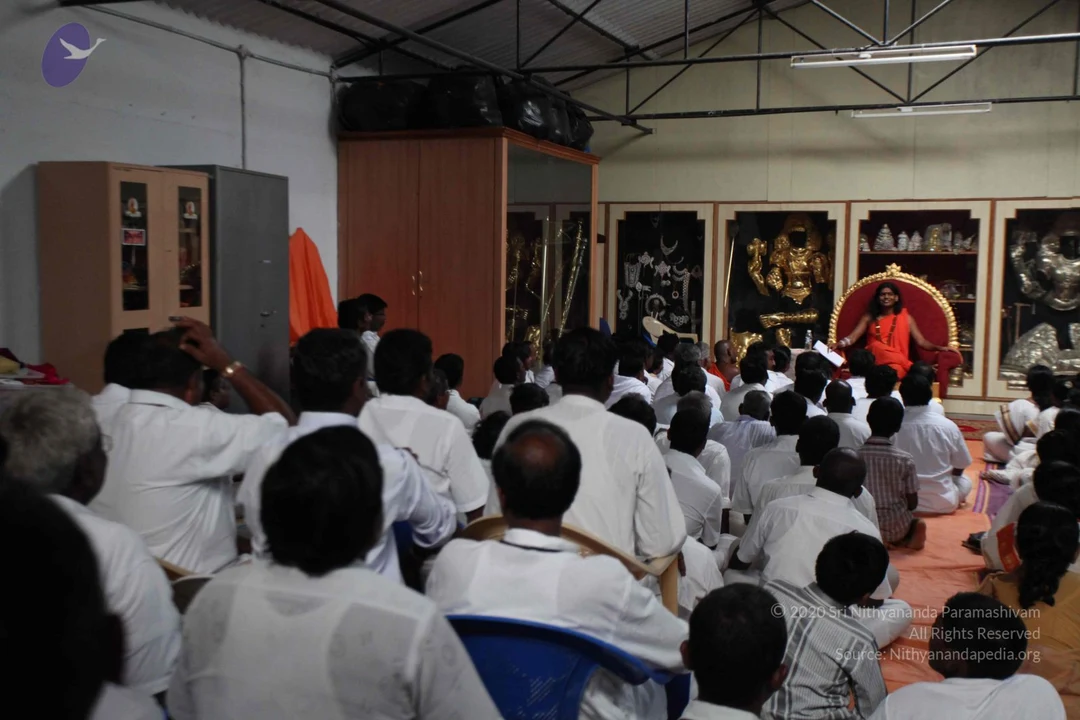
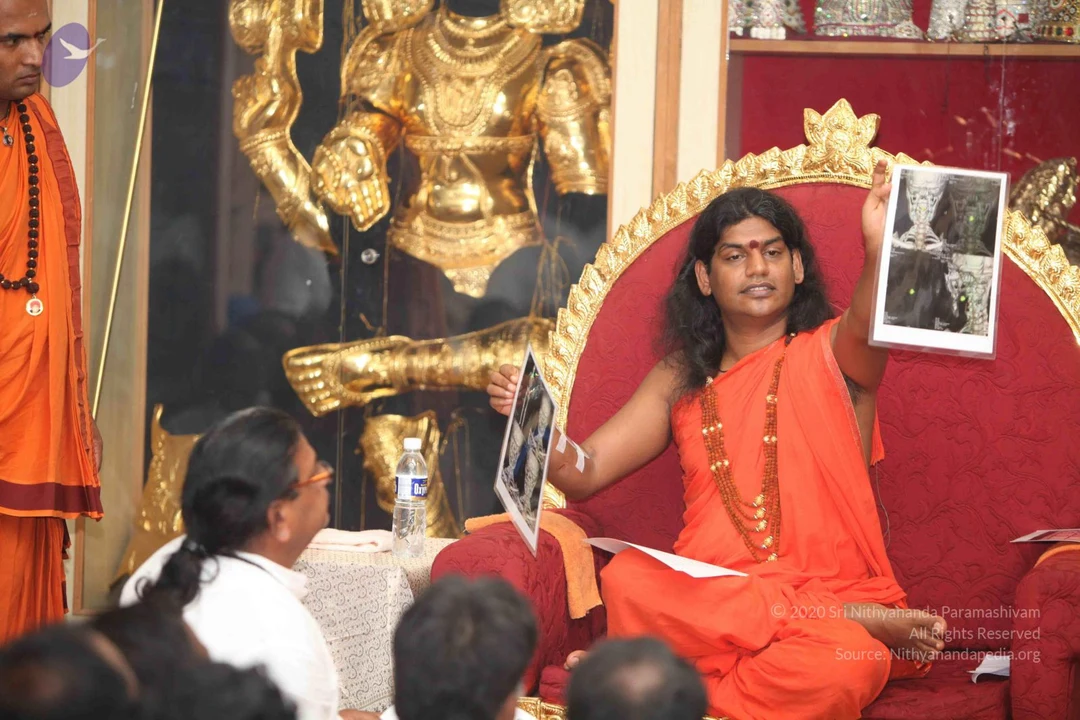
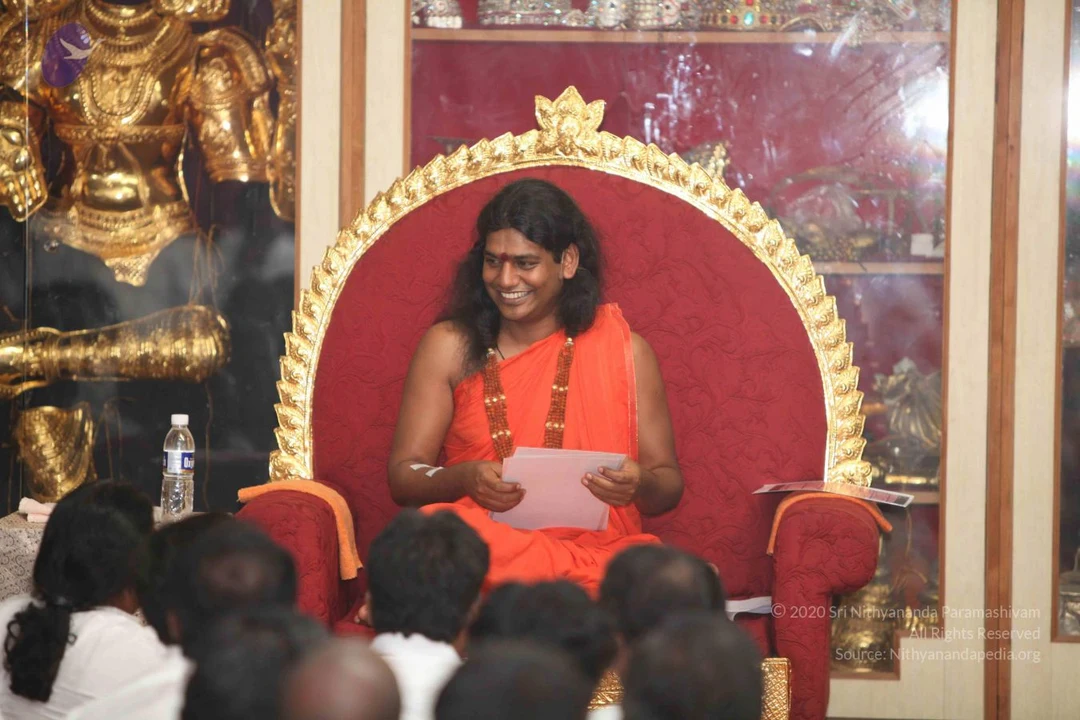
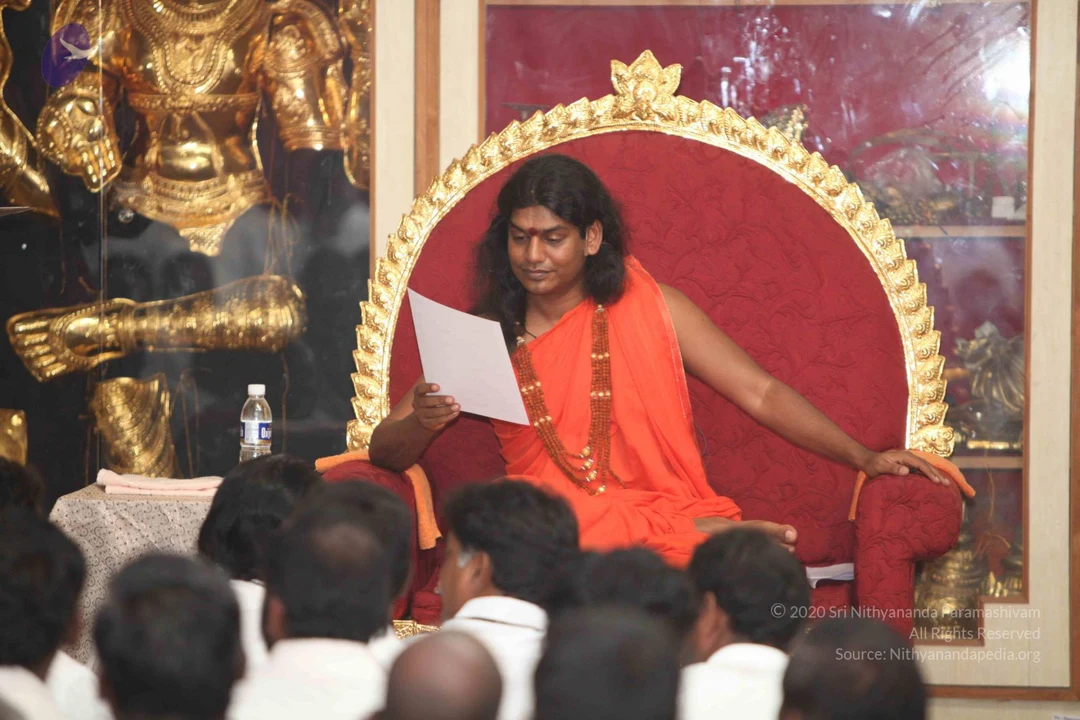
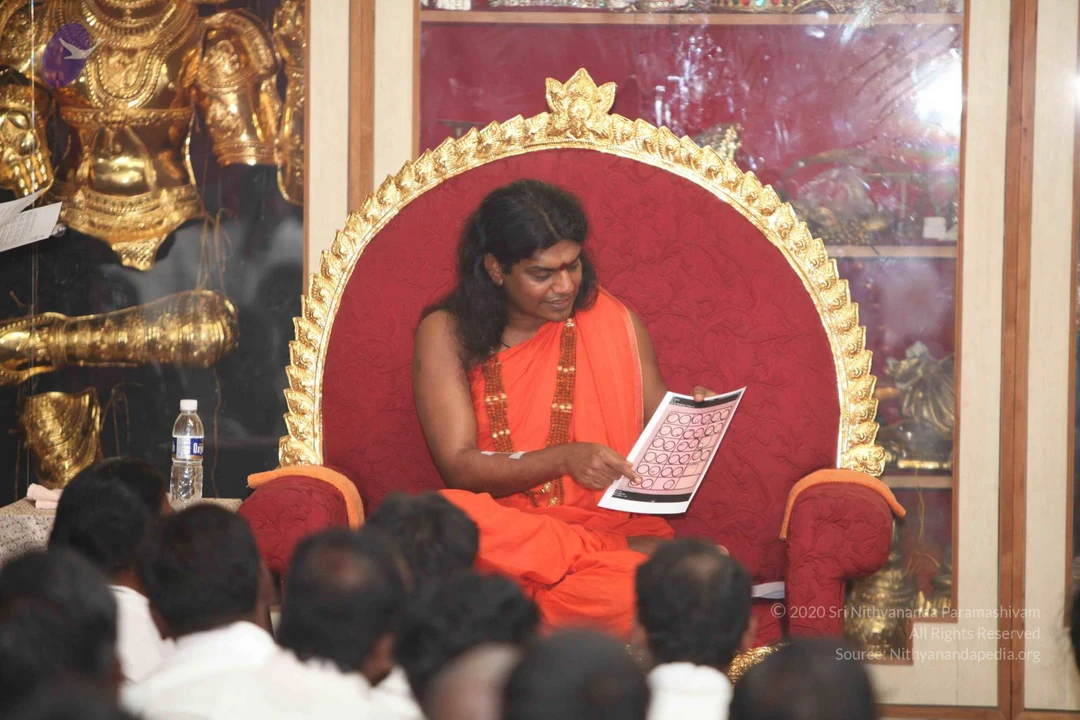
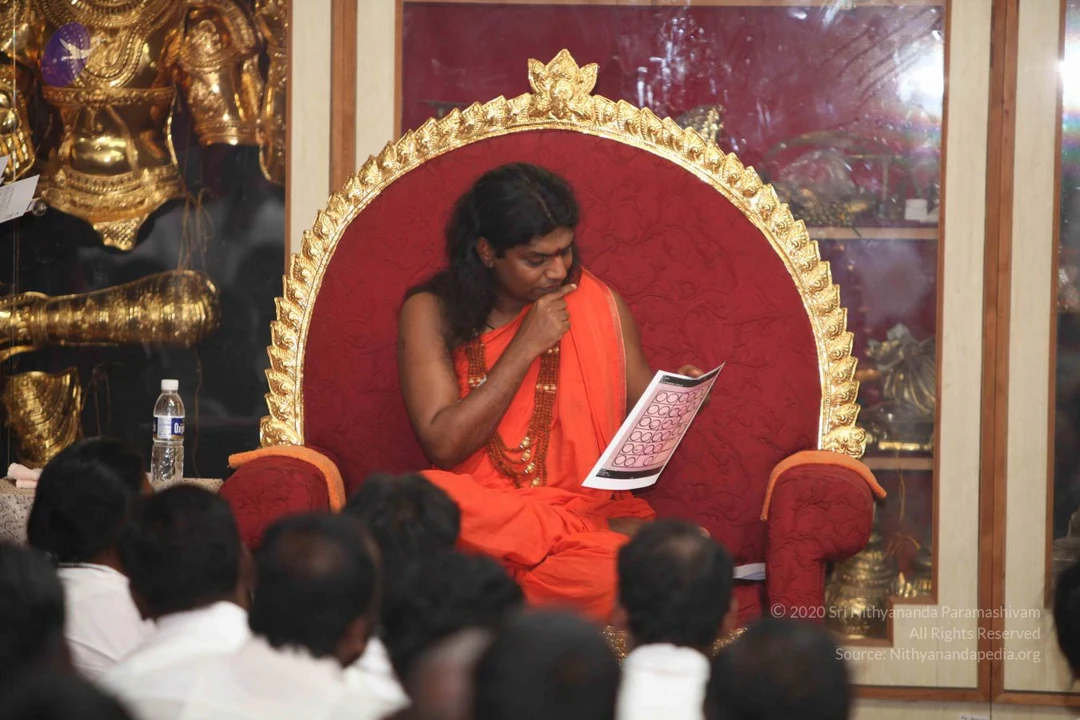
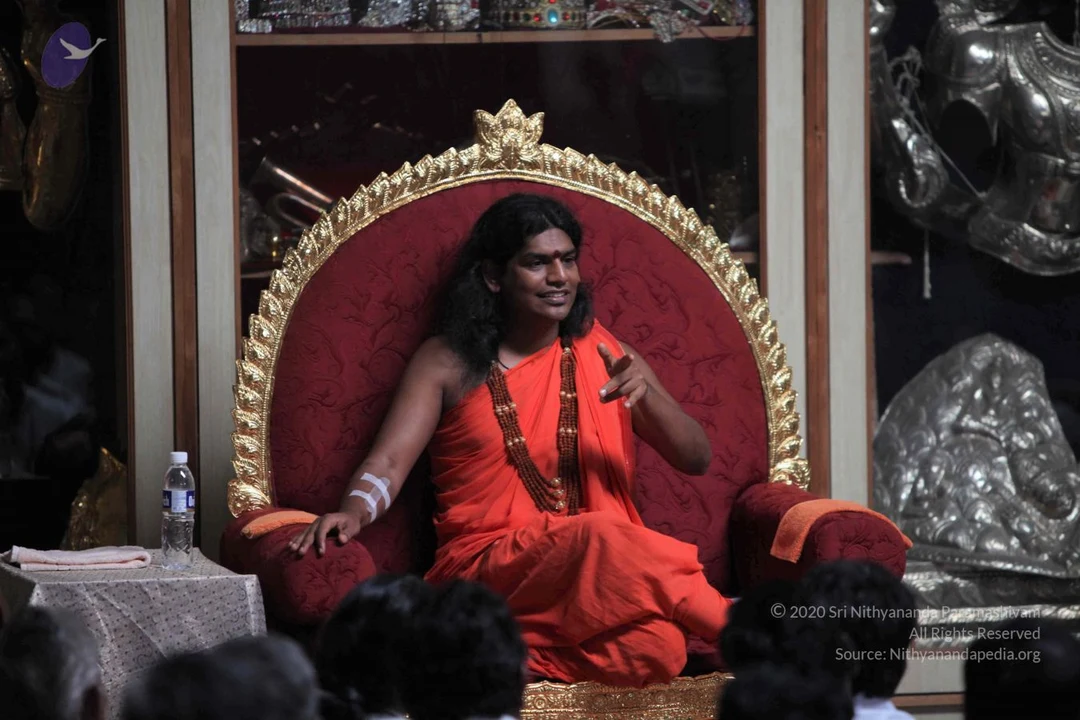
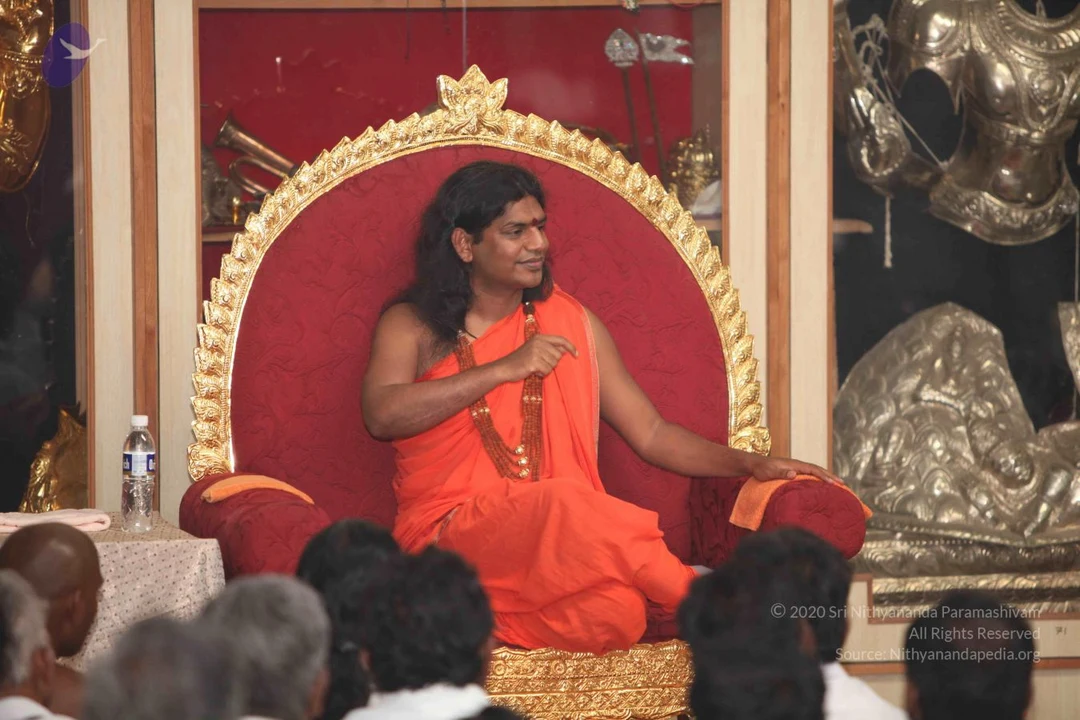
A discourse hall with a metal-framed roof and white walls, filled with many seated devotees in white clothes on white plastic chairs, viewed from behind. At the front, a seated figure in orange robes sits on a red-cushioned throne before a row of framed gold and dark deity images. To the right, a small deity murti rests on a purple cloth. Metal cabinets and a hanging balance-scale display line the side walls.A large indoor satsang hall under a corrugated metal roof with exposed steel trusses and a skylight. Dozens of people in white clothes sit facing the front on plastic chairs and mats, seen from behind. At the front, a single figure in an orange-red robe stands before a wall of framed deity murti and altar images, with a red-cushioned seat nearby. Shelves, grey lockers, a hanging picture and a small framed deity image line the side walls. The scene reads as a discourse or satsang session.A seated discourse in a hall with a metal roof and exposed trusses. A person in saffron-orange robes sits on a red and gold throne at the centre front, flanked by large framed gold and silver deity murti panels. A crowd of devotees in white clothes sits on the floor facing the throne, with a few in orange and others in dark clothing. A cabinet stands at the left and a pedestal fan at the right.A photograph of a seated teacher in saffron-orange robes with long dark hair and a rudraksha mala, sitting on an ornate red and gold throne in front of glass display cases holding gilded and silver deity ornaments, crowns and jewellery. He gestures with both hands while speaking into a microphone on a stand. Rows of seated devotees in white clothes face him, and a small table with a water bottle stands beside the throne. The display cases hold gold and silver murti parts and temple jewellery.A man with long, swept-back dark hair sits on an ornate red throne with gold trim and a gilded crown-shaped top, wearing an orange-red wrap, a rudraksha mala and a ceremonial gold necklace, with white tape on his right forearm. He gestures with one hand while speaking to a seated audience whose heads are visible in the lower foreground. Behind him are glass display cabinets holding silver and brass ritual objects, and a water bottle and folded towels sit on a draped table at left.A photograph of a discourse hall where a seated man in an orange saffron robe and a long orange-red rudraksha mala sits on a red upholstered throne with gold leaf trim and an ornate gold base. He has long swept-back dark hair and gestures with one hand while resting the other on the armrest. Behind him are glass display cabinets holding gold and brass ceremonial items, a gold cape-like armour piece, and a brass horn. In the foreground, audience members are seen from behind and the side, including a bald man on the left, and a water bottle sits on a draped table at left.

Sarva-Darshan
23 photosSource gallery
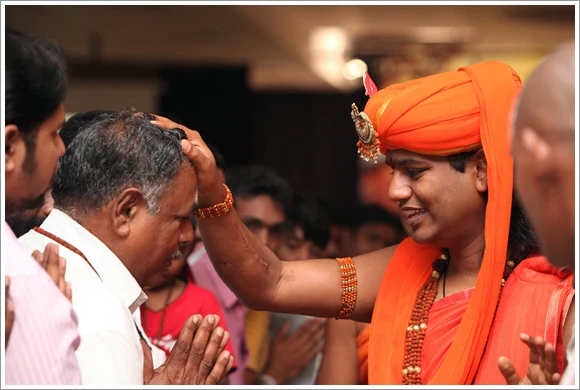
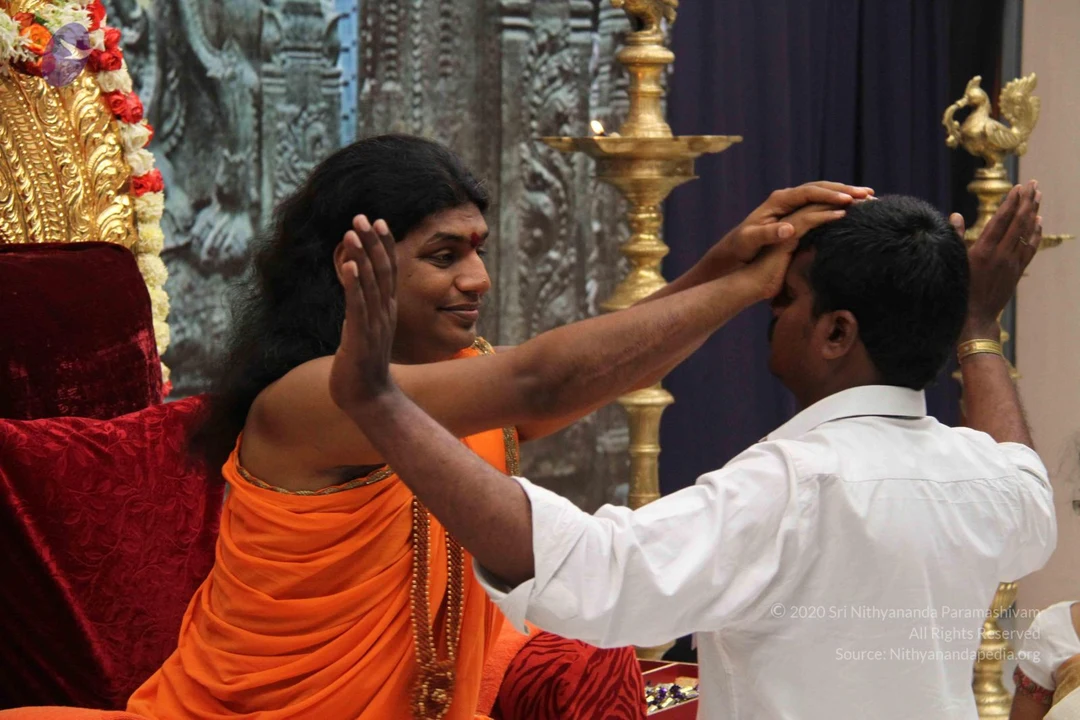
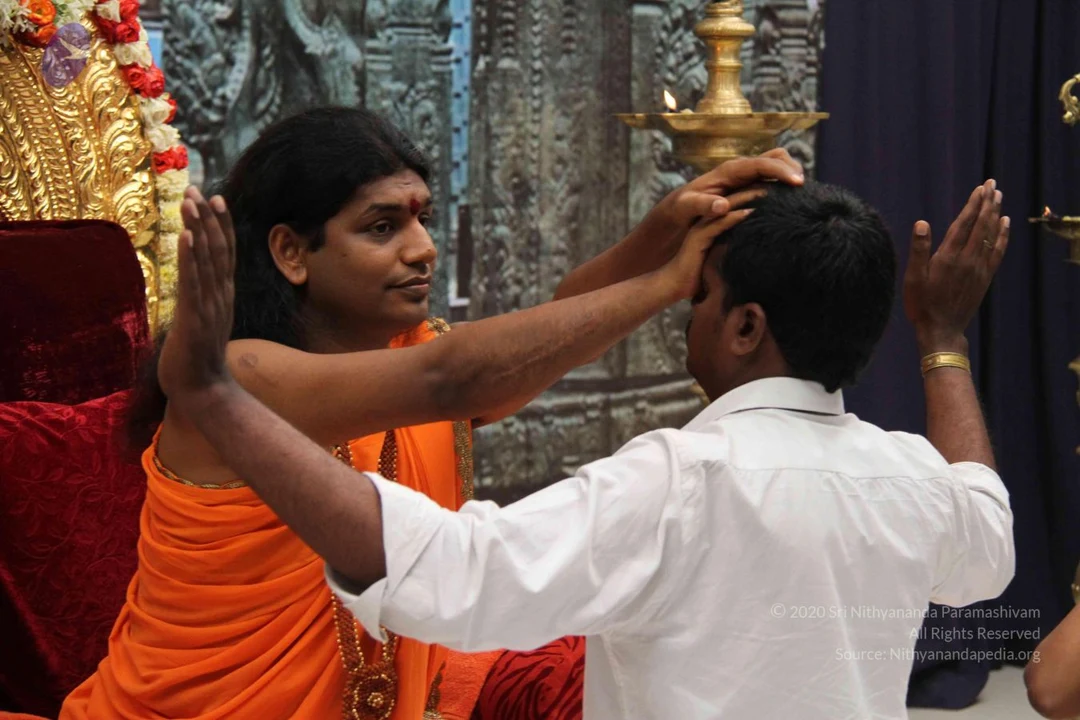
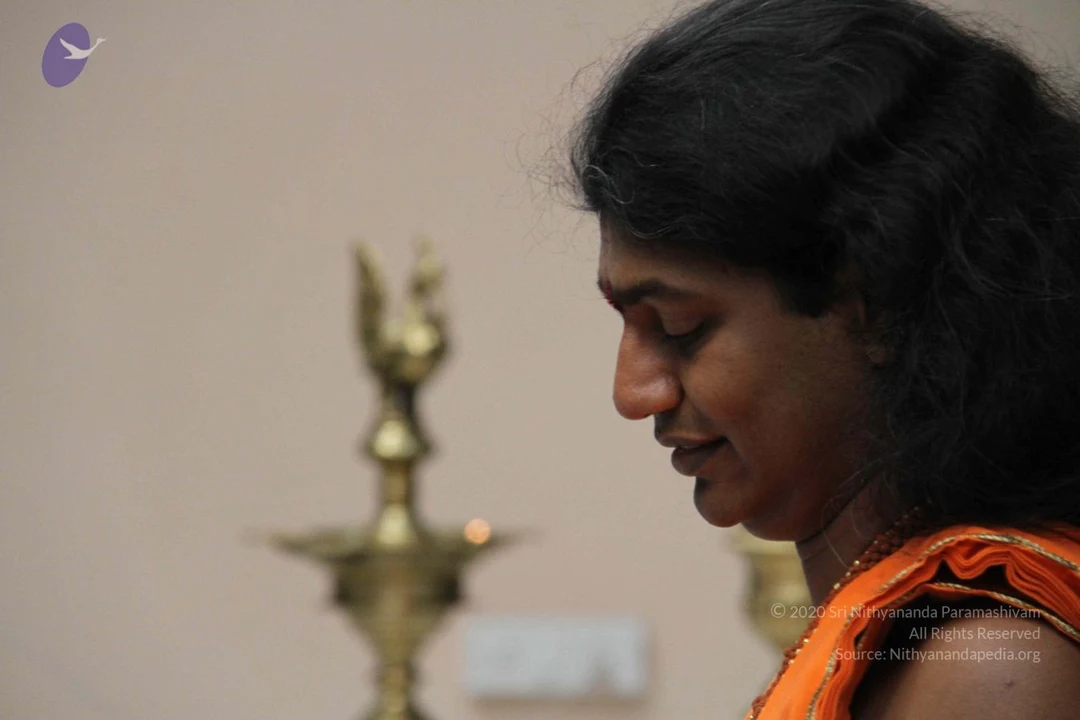
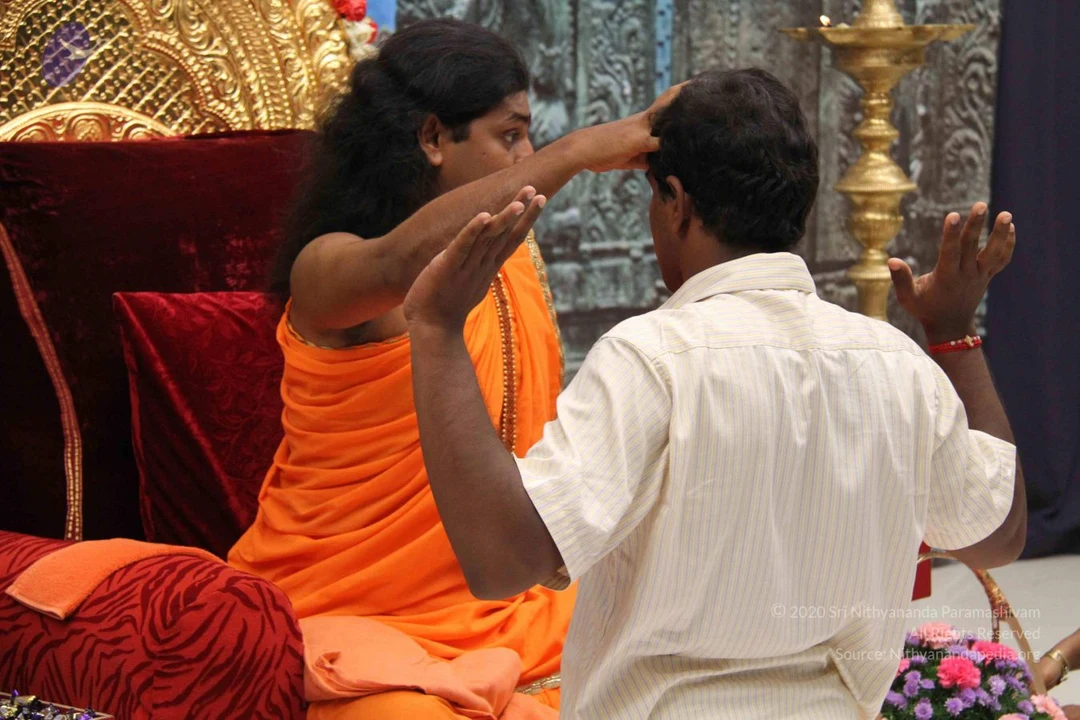
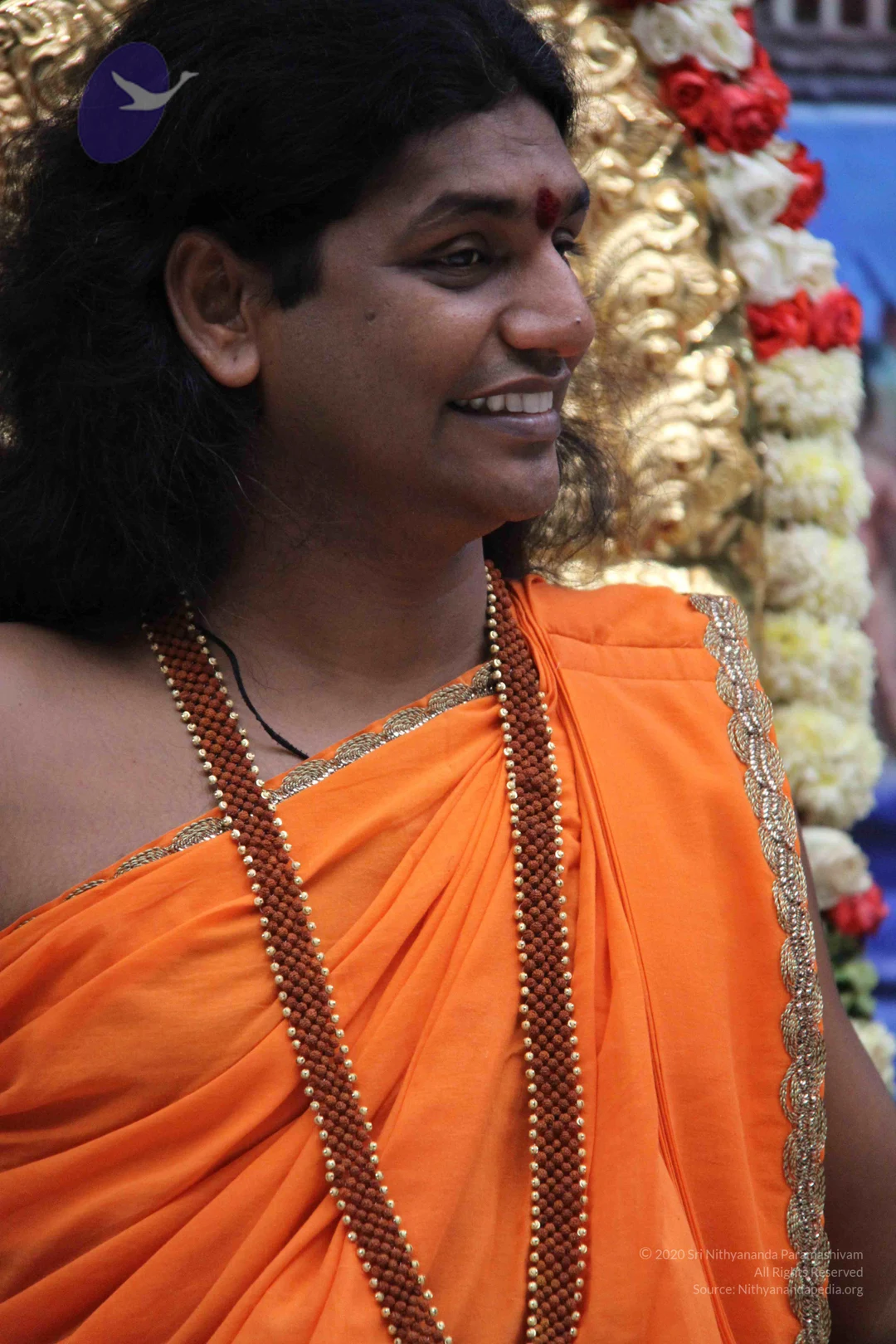
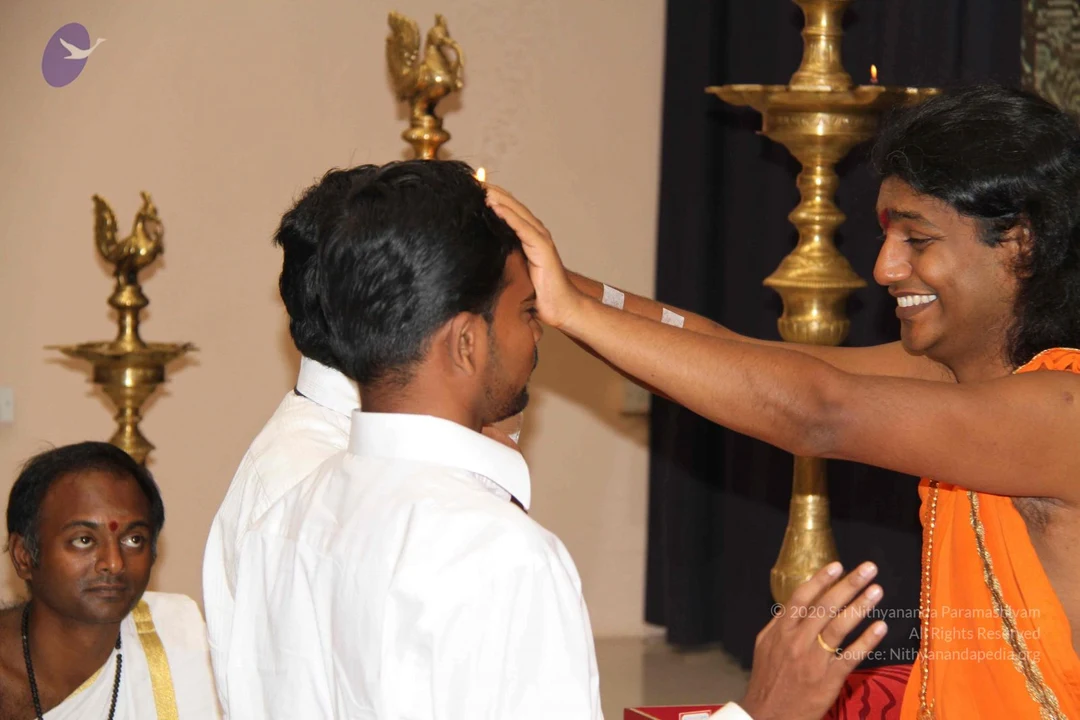
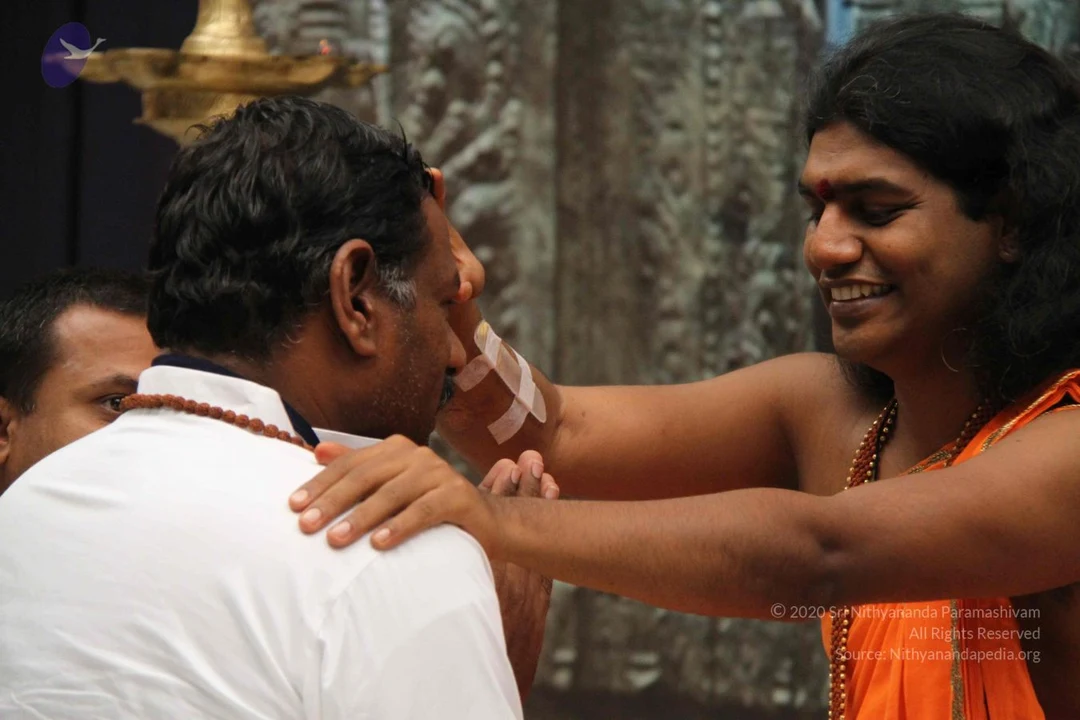
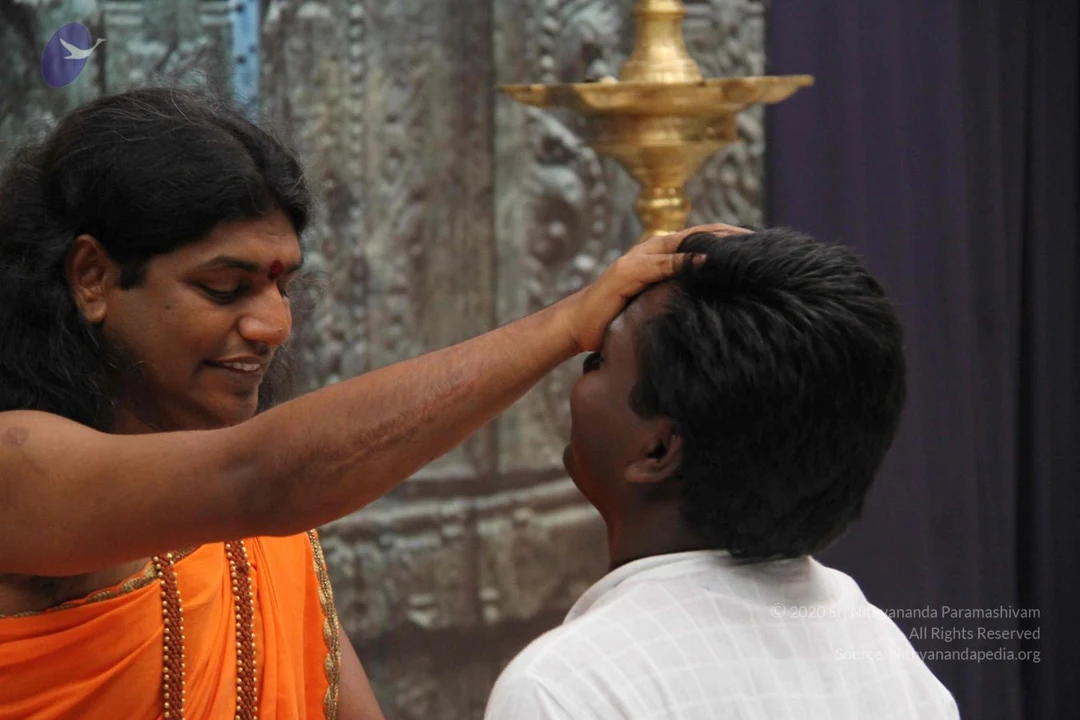
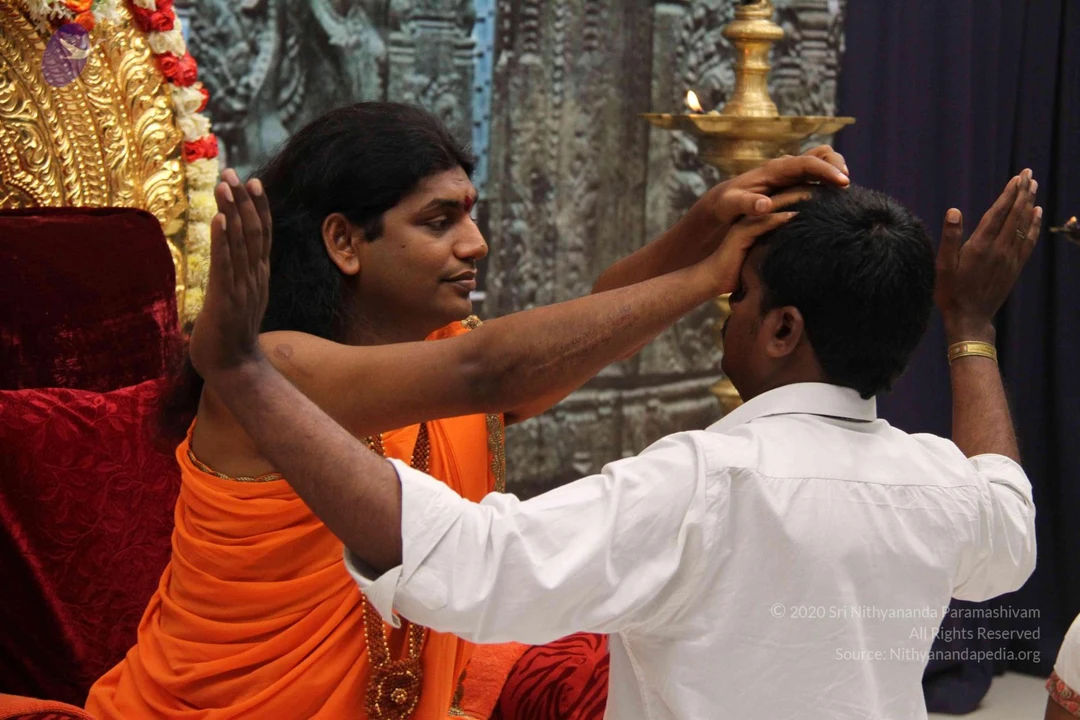
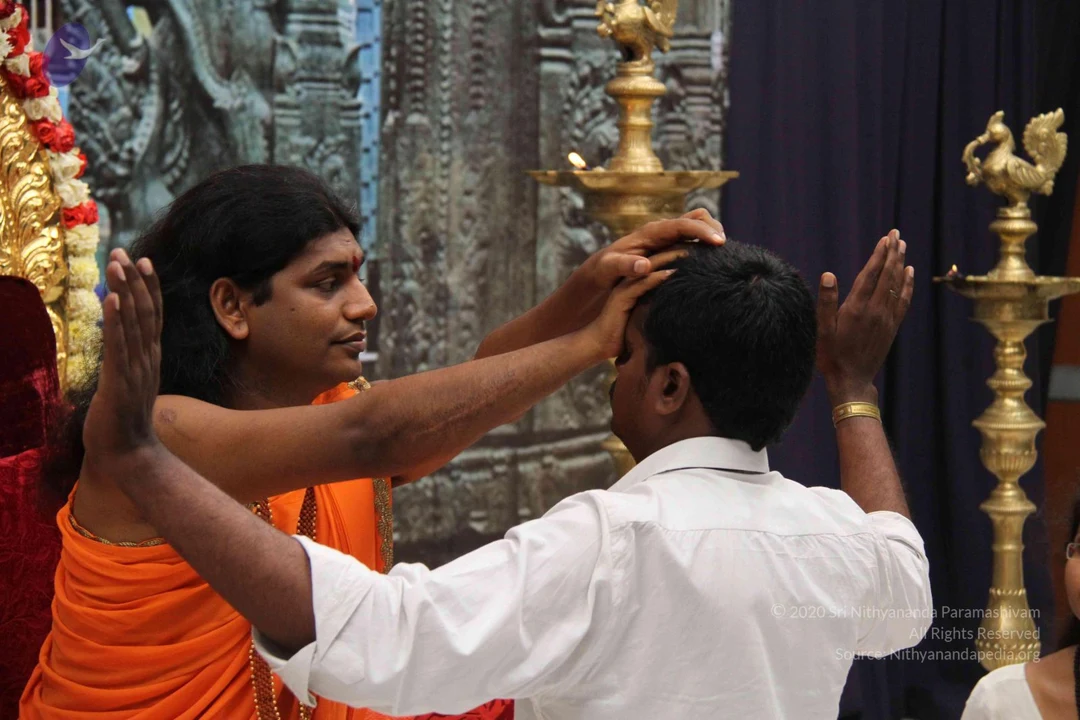
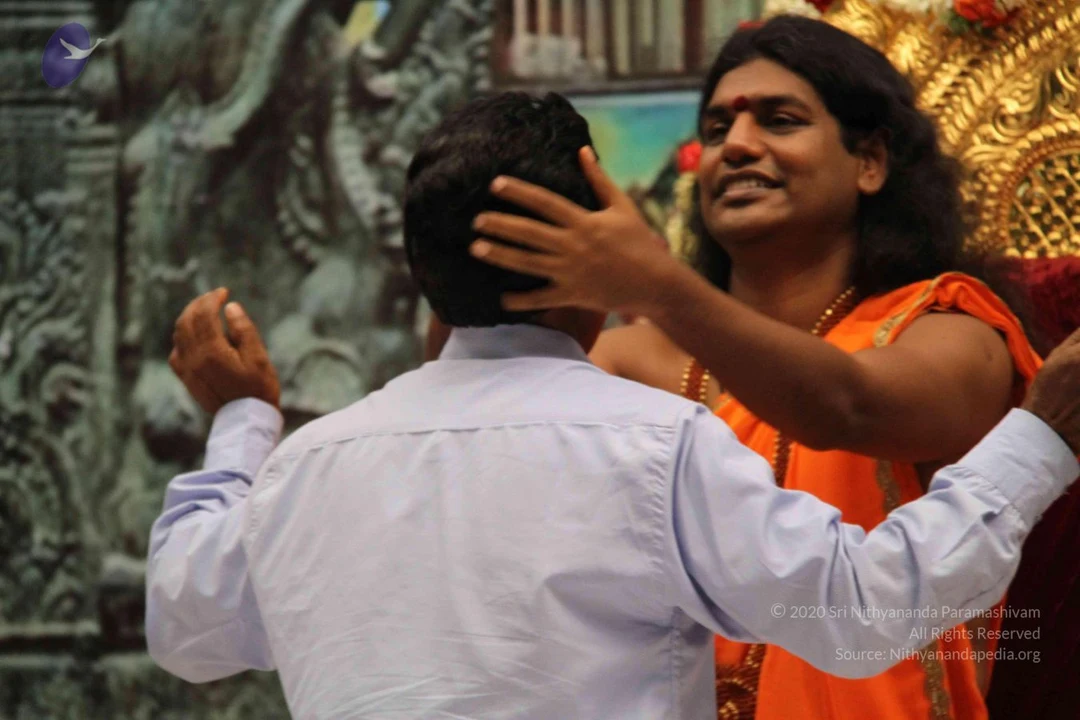
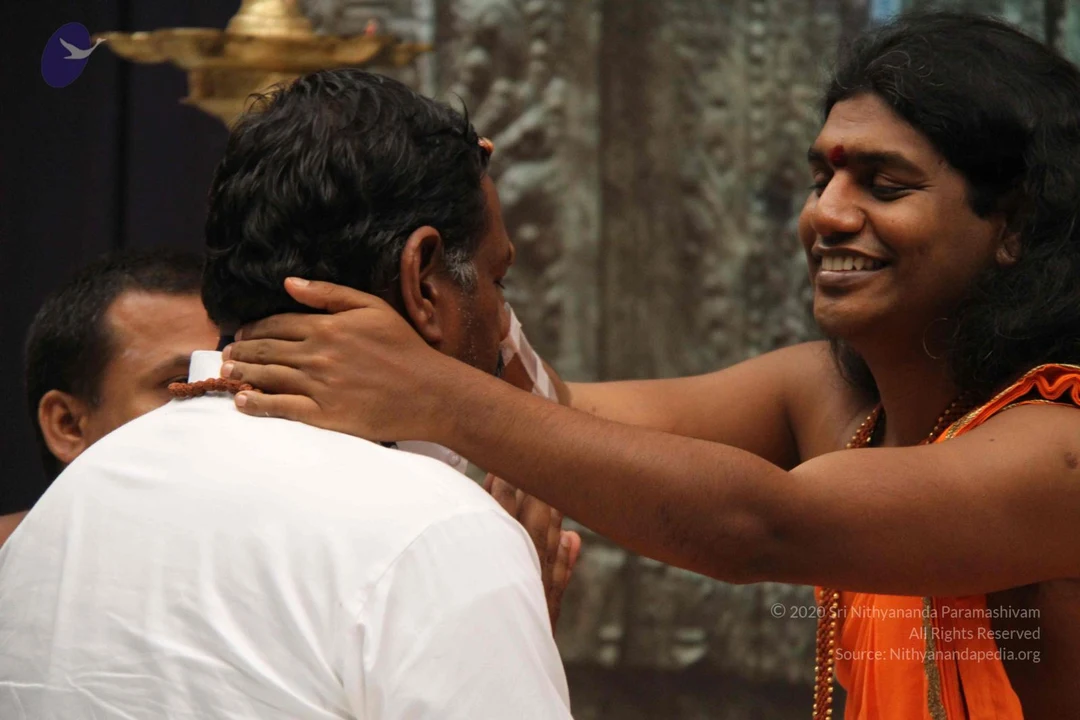
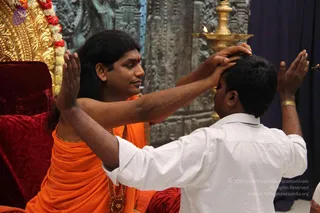
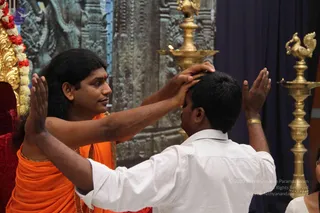
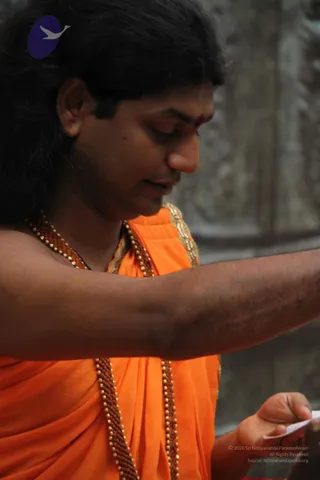
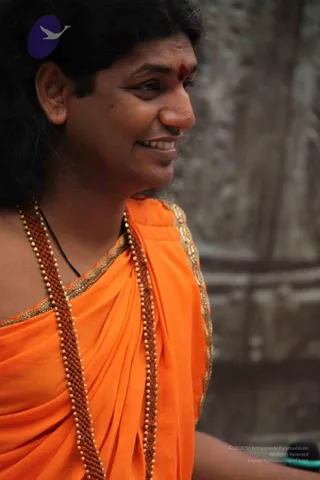
A man with long swept-back hair sits cross-legged on a gold ornate throne with a red velvet seat and tiger-striped cushions, framed by a red, white and pink flower garland arch. He wears an orange saffron robe, a shawl draped over his lap, and a large rudraksha mala with a gold pendant, and holds a golden trident-like staff. Behind him are painted temple-style panels with elephants and figures, and flower arrangements sit at his feet with a white fur rug below.A seated man in saffron-orange robes sits on an ornate gold throne with red velvet cushions, its arch decorated with red, orange and white flower garlands. He wears a rudraksha mala and a gold pendant necklace, holds a gold trident-tipped staff in his left hand, and rests his right hand on the armrest. Two baskets of pink and yellow flowers flank the throne on a white fur-like rug. Behind him, a painted backdrop shows temple-style figures, an elephant, and a mural of people. a person is seated, with the long swept-back hair, saffron clothing, rudraksha mala and gold necklace presentation cues. A microphone stands at the right edge.A photograph of a seated figure in a saffron-orange shawl and orange dhoti with a gold-toned necklace, long dark hair swept back, and a red bindi on the forehead. He reaches forward with both hands to press the crown of the head of a man in a white shirt, whose hands are raised in an anjali gesture. Behind them stands a stone-carved wall with ornate figures, a golden lamp with a lit flame, and a golden throne with red and white garlands on the left. The ceremony appears to be a blessing or head-touching moment in a temple-like setting, with a deep red cushion in the foreground.A photograph of a figure in saffron-orange robes with long dark swept-back hair, a red bindi, and gold necklaces, placing both hands on the crown of a man's head as a blessing. The recipient wears a white collared shirt, gold bracelet and raises his palms in devotion. Behind them stands an ornate carved stone wall with a gold kalasha-style oil lamp and a golden peacock-topped lamp stand, with a red floral garland at left.Close photograph of a man with long, swept-back dark hair and a red tilak on his forehead, wearing a saffron-orange shawl edged with gold trim and layered rudraksha-style beaded necklaces with gold beads. He looks down and extends his right arm forward, holding a small white paper slip in his hand at the lower right. The background is a blurred grey stone wall.Close-up photo of a smiling man with long dark hair and a small red tilak on his forehead, wearing a bright orange shawl edged with gold trim. Two strands of rudraksha beads with gold spacers hang across the shawl, and a thin black cord is visible at his neck. The background is a blurred grey stone wall.
September 18 2011

4 photosView all
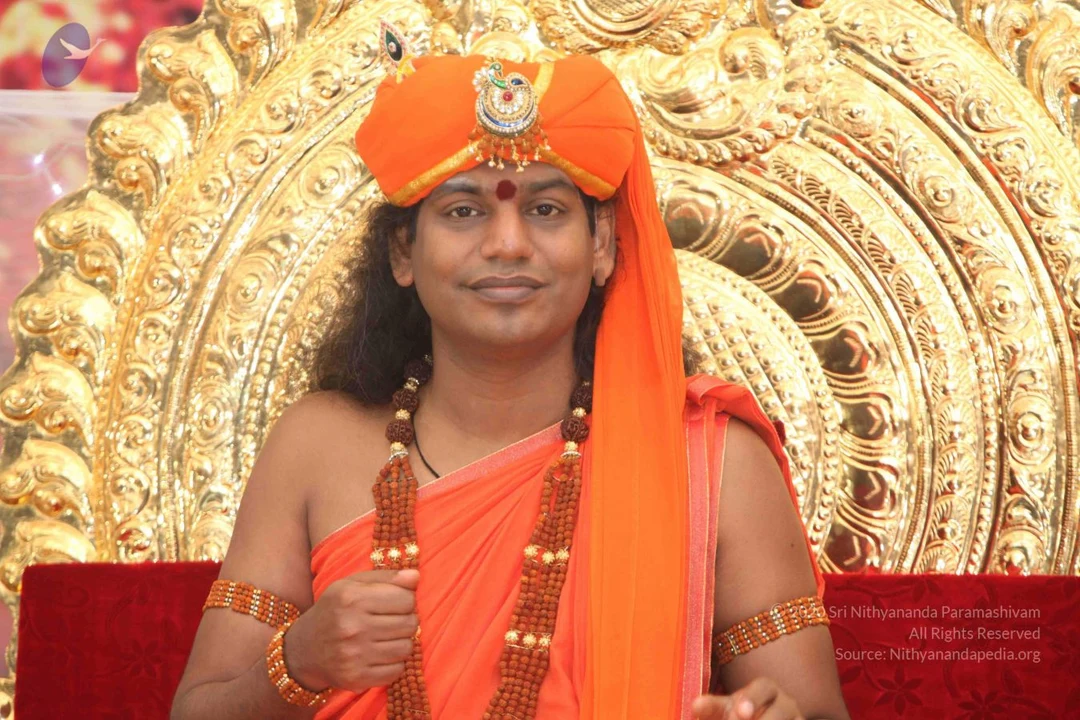
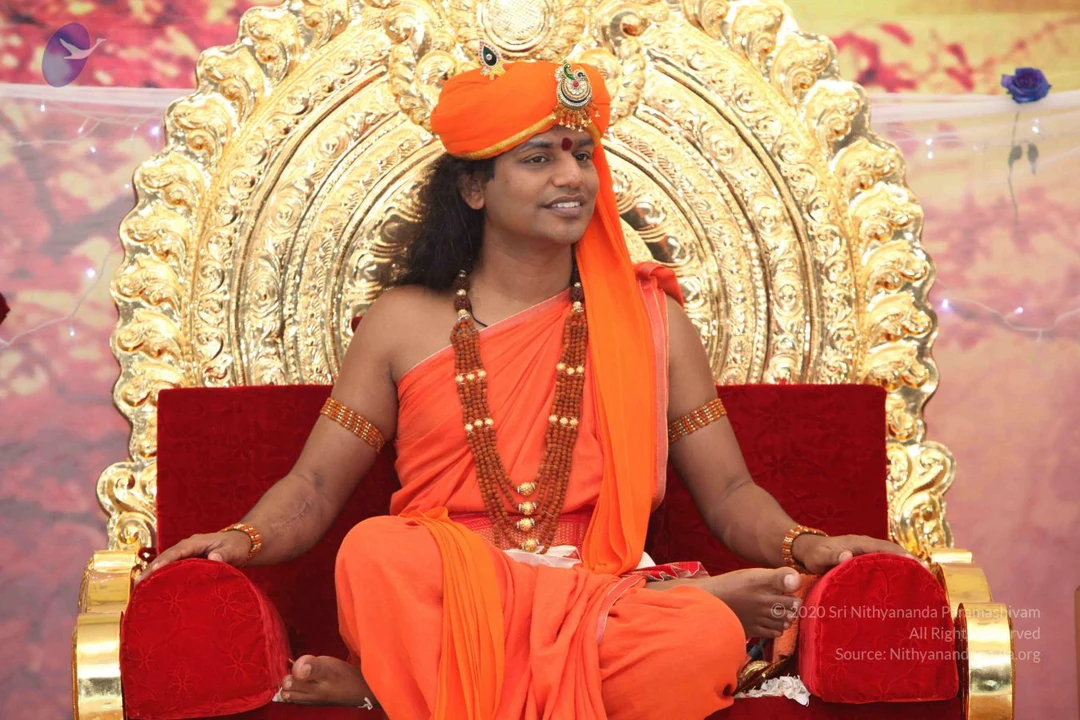
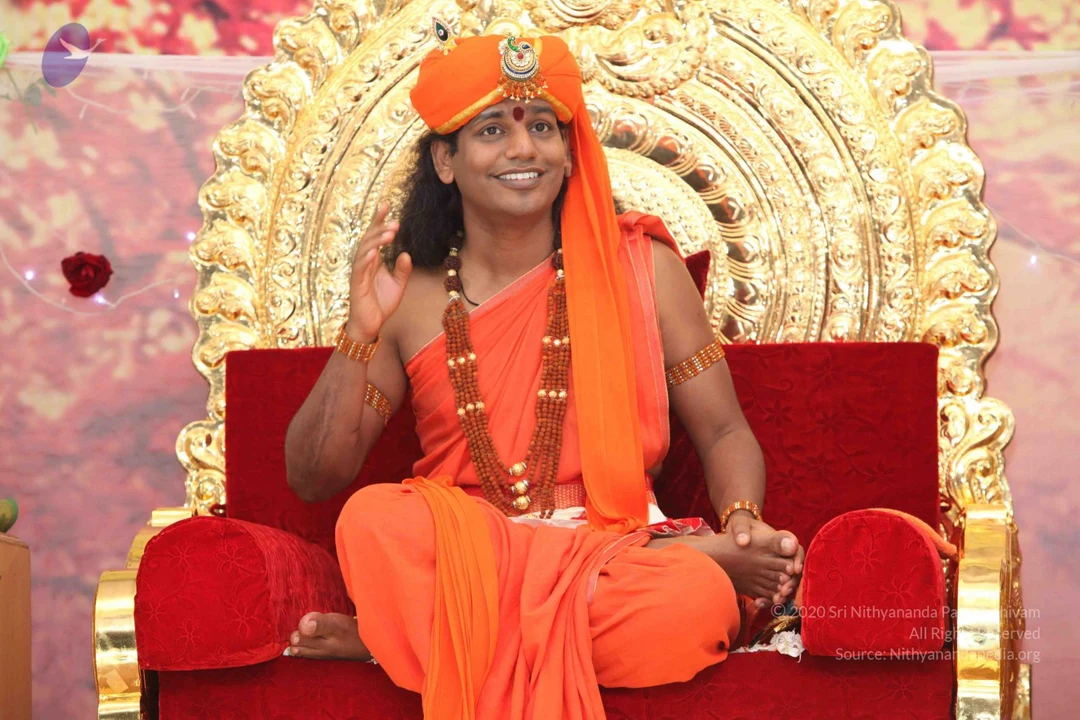
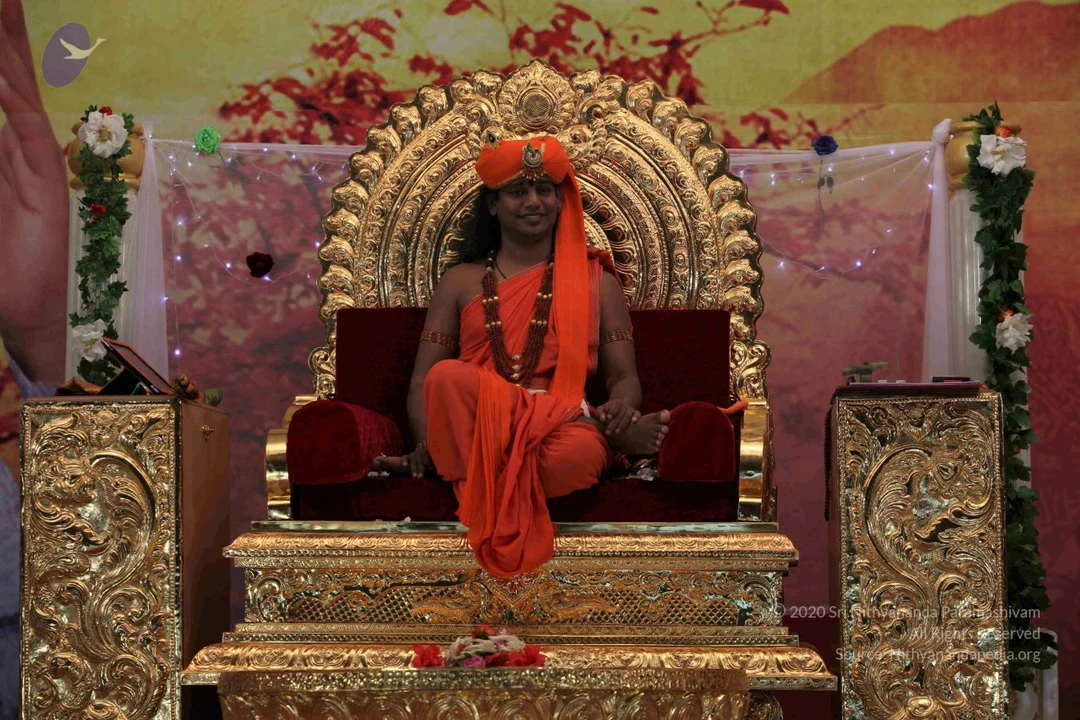
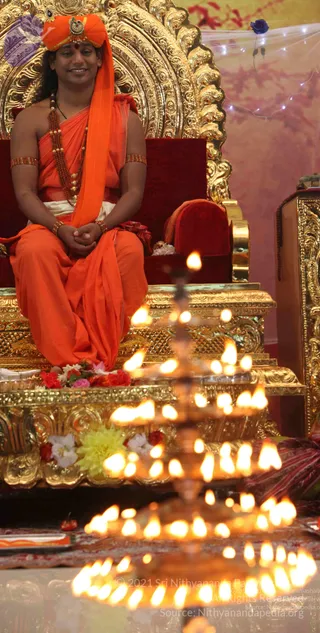
A photograph of a ritual in a satsang hall. A figure in orange robes, with an orange headcloth, a rudraksha mala and gold necklaces, sits on an ornate gold throne with red cushions, hands folded, with a person identification by appearance. A man with a shaved head and white dhoti with gold border holds a silver multi-tier lamp aloft while facing the throne. Two women sit on the floor: one in a turquoise blouse with a floral offering nearby, and one in a green sari with a red border holding a small object. Fresh flowers and marigolds decorate the throne platform. A banner behind reads Bhagavad Gita and Nithyana Satsang, with a lit tiered brass aarti lamp to the right.Photograph of a large video wall of nine screen panels showing live feeds of groups seated during a satsang. Panels are labelled with printed signs reading SINGAPORE, PURI, VANCOUVER, SEATTLE CHIDAMBARAM, PENANG, MALAYSIA and SUNGAI PETANI MALAYSIA. Participants sit on the floor in white and colourful clothing, some with oil lamps, flowers and offerings before them. The bottom-right panel shows a figure seated on an ornate golden throne with a saffron-orange robe, long hair swept back, a crown-like headdress and beaded necklaces, smiling, with an arch behind him. Screen-displayed people are not counted as physical people.A seated figure in saffron-orange robes and an orange head wrap sits on an ornate gold throne with red cushions, hands folded, before a backdrop reading "Bhagavad Gita" and "...hyana Satsang" with an autumn-tree painting. A bald priest in white dhoti and shawl with gold borders, seen from behind, lifts a tiered silver aarti lamp with many lit flames. A woman in a blue sari sits at left with palms pressed together. Flowers and fruit lie before the throne.A seated man in an orange turban with a jewelled brooch, orange robes and a draped orange shawl sits on an ornate gold throne with red velvet cushions. He wears rudraksha beads, a gold necklace, gold armbands and bangles, and rests his hands together in his lap. In front of the throne, a tiered brass oil lamp with many lit flames is blurred in the foreground, and red and yellow flowers lie at the base of the throne. Behind him hang a pink backdrop with fairy lights and a blue flower.