Skip to content
Wednesday

18 September 2024

Bhikshadana Darshan: Karma and Past Lives

Dated photos
96
Source pages
1
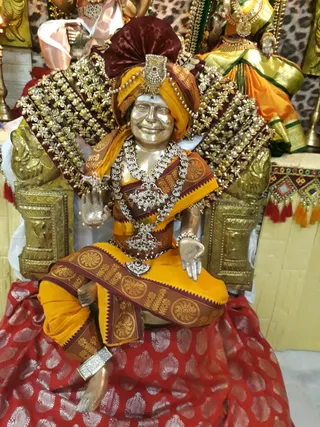
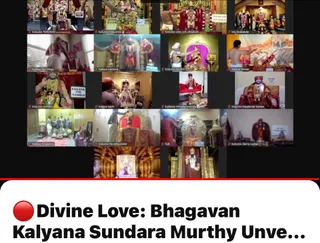
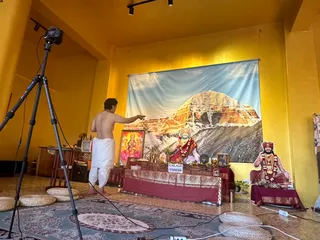
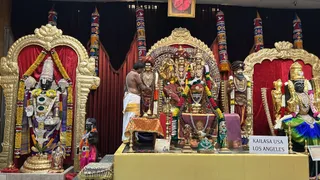
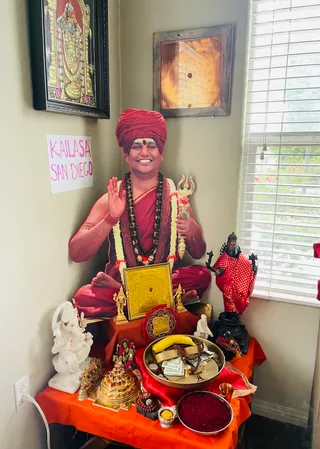
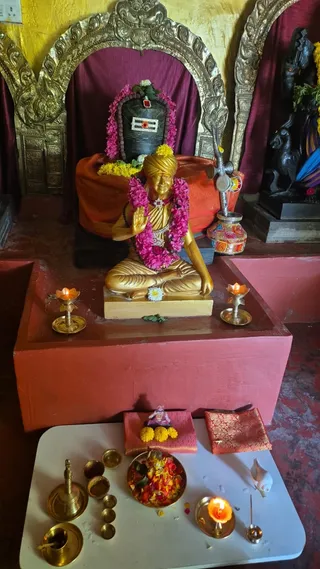
A metallic statue of a seated figure in a golden-yellow and maroon turban with a jeweled brooch, wearing a yellow and maroon draped garment with gold border, an ornate silver-stone garland and layered jeweled necklaces. The statue sits on a gold-carved throne with a sunburst-embellished backrest, draped in red silver-brocade cloth. Behind it stand other decorated deity figures in orange and gold silk with gold jewelry and a leopard-print backdrop. This is a photograph of a murti statue, with no people physically present.A screenshot of a video conference grid showing many small tiles of different KAILASA temples and centres, each labelled with a place name such as Toronto, Malaysia, Los Angeles, San Diego, Madurai, Salem, Taiwan, Gambia, Kashi, Whyalla Australia, Equatorial Guinea, Singapore, Rajapalayam, NJB and Sierra Leone. Tiles show deity murti and altars decorated with garlands, drapes and oil lamps, with some priests in white dhotis and bare-chested devotees performing abhishekam or puja. A red-and-white headline bar reads 'Divine Love: Bhagavan Kalyana Sundara Murthy Unve...' at the bottom.A shirtless man in white dhoti stands at a shrine in a yellow-walled room, arm extended holding a small object toward an altar. On the altar, a large backdrop photo shows a snowy mountain peak with a seated figure in red and saffron robes and garlands in front. A framed image of a goddess in red and gold sits to the left. A cardboard-like cutout figure in red and saffron with a red turban and rudraksha garland sits on a small table to the right; its appearance is consistent with a probable Swamiji depiction. A tripod-mounted camera stands at left, and woven mats lie on a patterned rug. A sign on the altar reads KAILASA TAIWAN.

September 18 2024

Original wiki page
Contents

In this satsang, THE SPH discusses karma, past lives and first-person experience.

Event details

Date: 18 September 2024

Title

Bhikshadana Darshan: Karma and Past Lives

Transcript

As the ultimate manifestation of Paramaśiva's Bhikshadana Murthy, Sardulahara Murthy, Gajasamhara Murthy, Bhujanga Lalitha Murthy I bless you all with Paramadvaita.
All the Paramashivoham Program Level 1 Participants I bless you all into experiencing a breakthrough in Karma.
All the Paramashivoham program, level two participants, I bless you all into becoming free from all the bad karmas accumulated in the past lives.
Paramashivoham program level 3 participants I bless you all into Apyaayana Deeksha. All the participants who brought the sacred thread, you can tie it on your wrist. I bless and initiate you all to enrich and cause others reality, the power of causing. I bless you all and free you all from all karmas from the past birth and past
All of you listen intensely. This is the direct message from Paramashiva. In this manifestation, some of the most beautiful thing, Paramashiva revealed it to me experientially. I am sharing it with you all. Listen to these great truths.
Number one, past birth, Satya, the truths related to past birth is parama Satya. They are not given as a technique or a methodology to keep the society's morality or to keep the social structure intact or to keep human beings under control or to keep the human beings without stepping their limits, without going beyond their limits. limits? No. The truth about the past birth is Parama Satya. Truths about the karma is Parama Satya. That's the first truth.
Second, neither truths about the past birth nor the truths about the karma is restricting or constraining or controlling. Listen to this. Internalize it.
Understand. You are combination of chit Jada as you- you exist as you. Till you achieve paramamukthi, Paramadvaita you are a chit Jada granthi. You are a knot of chit Jada Granthi. In Agama, very beautifully Bhagavan Paramashiva declares these great truths, I will give you some of the most simple understandings straight for you to realize it.
You are neither just an evolution from monkeys alone nor you are a descended being from Maha Kailasa with a complete enlightenment and super consciousness. No. You are a mixture of both.
Jada evolved from monkey as per Darwin’s theory. Chit reflecting from Kailasa as per Avatar Satya. Listen.
Your Jada, the body you are carrying has evolved from animal. The consciousness you are carrying has descended from Kailasa. As of now, you are a Chit Jada Granthi. So, what you evolved as your body from animal, all those past knowledge, expertise, everything you mastered from being an amoeba, fish, tortoise, Varaha Pig step by step. That is what Vishnu demonstrates as Dasavataras, step by step how you evolved your body. Throughout your evolution, you mastered so many amazing things. You develop so many different competence, possibilities. All of that is inside you. You are a treasure of so many possibilities, competence and powers. That is what exactly meant by the truth: You are the totality of your past karmas. Then, Vedas and Agamas declare you are the totality of your past karmas. Don't think they are cursing you, dumping you. Don't think they are restricting you. Don't think they are disgracing you. Don't think they are trying to depress you. Don't think they are trying to give you some low image about yourself. No.
When Vedas and Agamas declare, when Paramashiva declares you are the totality of your past, do not develop the next statement, do not come to the conclusion, all your sufferings, pains are because of your past karmas. No. Instead. Come to the enlightenment. All my past. Throughout my past, all the competence I learnt, all the expertise I developed, all the possibilities I got, all the powers I got, all of them are inside me. Come on. I am a treasure house of the whole past, the whole expertise and competence, powers, possibilities. When Paramashiva utters the word you are the totality of your past karma, it is not to depress you but to liberate you.
When Paramashiva says you are the totality of your past karmas all the births you took, all the expertise you developed, all the competence you built, all the knowledge you gained, all the wisdom you mastered, all the possibilities you built, all the powers you gained everything is inside you, you just need to awaken it. Manifest it. Start exploring it. Start celebrating it. Start enjoying it.
Always come to the right conclusion which Paramashiva is trying to give you.
If you are celebrating your depression, if you are celebrating your pain, if you are so deluded with the idea your life is a pain and suffering and torture, you will always come to the delusive conclusions.
Whenever I tell my disciples “Eh, you are not building competence, you are planning for the worst failure, intelligent disciples immediately come to the conclusion, Aye I have to awaken and build the competence Bhagavan is saying and stop planning for failure. But the people who celebrate depression OK Swamiji OK I can't think I can never believe or I can't imagine I will be able to stand up for your expectation so I am leaving you! Coming to the wrong conclusion, without knowing what is the real conclusion I want you to come when I utter those words is what I call celebrating depression, celebrating ego, celebrating evilness, celebrating delusion.
When Paramashiva says you are the totality of your past karmas. He is not dumping you in eternal hell. He is not just banishing you into the eternal hell. The conclusion He wants you to come is you are a treasure house of possibilities, powers, competence, wisdom, knowledge, energy, all which you developed spending so much of your time. All the time you spent taking multiple bodies to evolve this human body is not wasted. That is what Paramashiva means when He says you are the totality of your past. He is not asking you to come to the conclusion. Oh. You are doomed, to eternal hell. No. Don't celebrate your depression. Delusion. Ego. Evilness. And always come to the wrong conclusion. What is the conclusion He wants you to come by uttering certain truths? Know the context and come to that same conclusion. That is what is receiving the letter and spirit both.
Again, don't try to tell me, Swamiji, I received only letter from you always. The spirit I get only from bar. No, I didn't mean that spirit.
When Paramashiva explains certain truth, learn not just letter spirit also. Actually if you see Agamas if you read multiple Agamas same principle you will see different definitions. You may think how to come to right conclusion because Bhagavan is giving different definitions Bhagavan himself answers read the last Agama Sarvajnanaottara Agama which He gave to His own extension, Subramanya. See Subramanya is not just son of Paramashiva, He is also the seed bank of Paramashiva. If He needs something He takes it back from Subramanya, that is what is meant by the story Subramanya gave the meaning context of Pranava to Shiva. He is just telling Paramashiva is telling the world hey listen even when I want something I take from my seed bank. So, trust Subramanya and take anything from him.
Like, when I say, I wanted to tell some truths very strongly. I tell you, read from this book. Even I get from this book only whenever I wanted to remember or see. Same way Paramashiva tells all of us. Eh Subramanya is my seed bank. To Subramanian he gave Sarvajnanaottara Agama and he says, any confusion, contradiction, conflict you find within Agamas, you want to find the spirit with which Paramashiva delivered the Agama to understand the letter and spirit. He says, read Sarvajnanaottara Agama from that spirit and context understand the letter and spirit of Paramaśiva's words.
Listen when He speaks about the past births and karma, Paramaśiva's intention is to liberate you, empower you, excite you, energize you, not depress you or make you feel you are abandoned, banished, something low about yourself. No. Understand this truth. You will feel excited to internalize the principles of past birth and karma and all the Paramasatya's Paramashiva reveals through this past birth and karmas and also is such a ultimate compassionate being. Listen. Parama Karuna Murthy. You should understand every teaching of Paramashiva with the truth He is Paramashanta. He's Parama Karuna Avatara. He's always auspicious Parama Mangala. Even when you feel he is crushing you, be clear, He is moulding you. Even when you feel He is crushing you, be clear, He is moulding you. He is making you into a different metal.
Do you think He gave me the responsibility of KAILASA project, straight-away? He has beaten me black and blue and He tested whether I made myself out of metal which will stand. He himself gave all the blessings. He himself only trained. He himself is only manifesting. Even then He just tests. It's like even though I myself made this jewellery before wearing it for satsang I just try to pull it and test whether it stands, whether it will be proper throughout the satsang. Same way, even though He himself manifested, he himself made himself, he tests it properly. So there is no failure when the whole manifestation starts happening. So understand, always understand His actions with the great truth of His Paramashanta Swaroopa, His Paramamangala Swaroopa, His Paramakaruna Swaroopa, He is Arunachaleshwara Karunamurthy.
From that context, understand all His teachings. Whether you read Upanishads, whether you read Agamas if you find conflicts, contradictions, complications within the Paramaśiva's teachings you will find a lot if you did not find you have not read it. Be very clear you will find a lot. So, what is the scale with which you should start understanding? First thing, every time when He opens his mouth to reveal teachings, He is only here to empower you, enlighten you, liberate you. He is a Paramakaruna Murthy. Paramashanta Swaroopa. He is not interested in putting you in hell. He is not interested in abandoning you in eternal hell. He is not interested in torturing you. He is not even interested in making you do some unnecessary tapas. No. He is very precise. Paramakaruna Murthy. Ultimate compassion. He is Paramashanta Swaroopa. He is Parama Mangala Swaroopa. From this context, start seeing the past birth, Satya, the truths of the past birth, truths of Karma, truths of the Papa and Punya. truths of multiple births and deaths. He is absolutely in the mood of liberating.
Eh listen especially when He gave Agama. See He has five -Sadashiva has five faces Tatpurusha, Ishana, Agora, Vamadeva Satyojata five faces. Four Vedas He gave from four phases which does creation, sustenance, rejuvenation, pulling out of delusion. But all the Agamas He gave only through the phase of Ishana which is specifically for liberation. Which is focused on liberation. From that phase only He gave the Agamas. So the context of Agamas is liberation. The context of Agamas is liberation, not binding you, not suffocating you, not giving you suffering, not putting you in guilt, nothing. Of course, sometimes while you are contemplating, thinking, while He is working with your life, you may feel, oh God, no, no, no, no, no. It is unbearable you. No He is not pressurizing you. He is moulding you. He is raising the quality of the metal out of which your core is formed.
When He has beaten me left and right even though He Himself is manifesting, I said I know one thing it is always good, maybe you are making me as a different metal to put more compassion, grace, energy and responsibility, your work. Maybe to empower. He is doing His work. Because some load can be kept on iron. But some load can be kept only on diamond so he may be beating left right center and making me diamond so he can put different level load.
I tell you life is liberating Paramashiva is liberating especially when you are directly initiated and protected by me -be assured life is liberating Everyone initiated be assured you are on the path towards liberation Paramadvaita. There is nothing torture in your life. Nothing is a torture. If you feel anything is a torture just take the USK book and read few pages or go to Nithyananda Truth website and read the persecution which I went through. All your idea your life is torture will disappear.
Past birth. Ideas of past birth. Satyas related to past birth- karma, punya, paapa, all is only to give you liberation. The whole Agamas Paramashiva revealed from the face called Ishana. Liberating face. Anugraha Mukha. The face in charge of Anugraha. Liberation. He gave Agamas. Vedas are pure science. Agamas are applied science. And understand from this context see the karma theory. I should not use the word theory, the Satyas related to karma and Satyas related to karma and Satyas related to past birth, Satyas related to the future. I can help you to map each of these great truths
Actually I wanted all of you to know one secret. Really this is most important secret which I have not revealed. See my acharya and Guru who taught me the fundamentals of Siddhandta and Vedanta. His name is Vidwan A Panduranganar. He is my Purva ashram grandfather also, means elder of my family and my acharya guru for the basic Tamil, Tamil literature, Shaiva Siddhanta and Vedanta in Tamil. He used to teach me I still remember see he will sit and teach me the Devaram and Thiruvasagam. It's easier whenever I see him I feel overflowing with gratitude because he gave me the whole Shastra Pramana. If he was absent in my life, I would have become some new age guru. Just with Anubhuti, atma pramana, I would have just become some new age guru. If you are all listening to Shastra pramana and apta pramana along with my atma pramana, he is sole responsible. Vidwan A Panduranganar he is sole responsible. I tell you exactly how he will do. In Tiruvannamalai temple there is a Gopuram, Mallala Maharaja Gopuram. In that Gopuram, inside the Gopuram one side there used to be a shop selling all the Prasadams actually that owner shop owner's son was my classmate we both studied together. Opposite side of that shop, a small room will be there. That's like a olden day studio where the mic set and full set up for chanting the Devaram and Thiruvasagam for singing Devaram and Thiruvasagam full setup, top of the tower, Vallala Maharaja Gopuram, used to be a loudspeaker. My guru acharya everyday will come to temple, open that room key of that room will be with him only he will open that room very sincerely morning and evening he will come. Around one hour he will chant, sing the Devaram Thiruvasagam with the traditional pun. Means the traditional music. He will sing, I will have to sit with him and whenever he has some throat itching I have to pour milk for him and give sometimes coffee also- there will be a kamandalu used for puja so I used to pour and give for him help him so I used to sit that room was called Shiva Shiva Olimandavam. I am putting all these details in history, let it be there I do not know now whether still that room exists or still that loud speaker and all is there, still that system is there or not, I don't know but in those days it was there, if you lived in Tiruvannamalai like during seventies and eighties you will know you will understand what I am talking. Every morning and evening the recital will be there which will be done by him in a very traditional musical way without missing that pun and all the details. So, after singing, he will do class like a teaching. That will not be relayed in the mic. Only the singing will be relayed in the loudspeaker. The class will not be relayed in the loudspeaker. That class if people come for example if 10 people come to attend he will do the class in Deepadarsana Mandapam in Tiruvannamalai. If only five people are coming for the class he will go and sit in front of the Amman Sanidhi the dvajasthamba Mandapam, in front of Amman sanidhi there is a dvajasthampam in front there is a Mandapam in that in front of that Mandapam he will sit and teach. If some 30-40 people come then you will go to the Kalyanasundaranar Sannidhi and sit and teach. Many time nobody will come only he and me will be there, so he will sit in that same room that Siva Siva Oli Mandapam and teach. He has a unique way of teaching. While he is teaching me the Devaram and Thiruvasagam meaning, he will not just teach me the meaning, he will give so many philosophical inputs from Shaivasiddhanta Shastras. He will give references, inputs along with teaching the Devaram Thiruvasagam. He will make me understand the whole Shaivasiddhanta Shastras and whole Vedanta Shastras. But how can the whole Shaiva Siddhanta Shastras are fourteen books- It's called Siddhanta Satyaram Padinaang. And Vedanta Shastras are sixteen books as per the Koilur Math. Koilur Math had a syllabus. Vedanta Paadam. It is 16 books. For Saiva Siddhanta, Thiruvavadurga Aadheenam had a syllabus. It is called Siddhanta Paadam, Saiva Siddhanta Sathirangal, that is the 14 books of Shaiva Siddhanta and 16 books of Vedanta only then he will be able to quote from those books and give me the philosophical understanding how to do? it becomes a very complex process. You can project it. He has done an amazing work. Each Vedanta Shastra just in 3 page he has written essence. Each Vedanta Shastra that 16 book just 3 page, 4 page is written the essence, like Geeta Sarath Talat in that Vedanta Shastra, Koilur Matti, syllabus, Vedanta Paadam, 16 books are there, Geeta Sarath Talat, that whole book essence, he will write in 3 page. Same way the siddhanta shastras essence of each book he will write in 3 page or less than 5 page. He will first make me read that 3 page and 5 page just 3 page about each book It is too easy. It's only fourteen book Siddhanta Siddhartha Shastras and sixteen book Vedanta Shastras. So it's only three page three page about each book I can easily read.
Once this is the Gopuram Mallala Maharaja Gopuram. In this Gopuram only the two sides. One side the shop and the other side Shiva Shiva Olimandavam used to be there and used to take classes for me. See whenever I narrate the incident I wanted to put the whole place time, date every detail possible so that it is recorded in history, so this is the Gopuram the Vallala Maharaja Gopuram that is the deity is Vallala Maharaja's deity the king who built this Gopuram from his date even We are seeing so listen He will make me read That three page about each book Which becomes very easy for me? then When he is teaching me. Those. Devaram Thiruvasagam. Whenever he is coming to certain truth. He wants to refer either Vedanta Pata. Or the Siddhanta Shastra. He will just take out that three page. And explain the truth to me and make me read that 3 page of that book once so easily smoothly class will flow within some 1 month he has given me the basics of 14 Vedanta 14 Shaiva Siddhanta shastras siddhanta Sathirangal padinaangum Vedanta padam padinaaru workbooks he has given me the basic then it is so easy for me to understand the Devaram Thiruvasagam classes he takes and then later on he made me read the original full books the whole 14 siddhanta shastras and whole 16 Vedanta Shastras, Vedanta Pada and actually these Siddhanta Shastras even though it is a 14 book with Bhaashyam and Mabhaashyam, Mabhadiam, Vadiam and Mabhadiam with all that it's almost like a 200 books. But because he has given me the context and set the basic thought current. See, what each book is trying to convey, the thought current he has conveyed. For example, Sivajnana Bodham he has conveyed the thought current within three pages to me and then every time during the Devaram Thiruvasagam classes whenever he wants to explain certain points to me he will make me read that Sivajnana Bodham's essence He will make me read that Shivanyanabodham's essence, that got so deeply into my system. After that when I started reading the Shivajnanabodham directly or the Bhaashyam, Bhaadiyam directly or the Mahabhaadiyam, it is so easy. It was so easy to grasp it. I just have to come back with few doubts and questions. He will underline and answer me, that’s all. I wanted to tell you not only am I grateful and indebted to my grandfather, my acharya Vidwan A Panduranganar, I am grateful also to his son, means my grandfather's son, A. Panduranganar son. He preserved, protected all these books, manuscripts, everything so beautifully and handed over everything to Kailasa when we made this huge nation. He gifted everything to me and said, Swamiji, Appa has told me clearly, his father, means my grandfather, his father told me clearly that only with you it will all be protected and spread to the whole world, please have it. I want all of you to know and be grateful to my Acharya Panduranganar and his son for giving us the whole great knowledge treasure of all the notes he did to teach me to train me.
Listen now I will come to the point the way he taught me it is a unique style -it It is almost like a, he has put so much of knowledge, so many different thought currents into my head in a very short span of time. And made me master to read the books on my own see today I won't say I am a great pandit or anything but any Tamil book the ancient Sangha literature or the ancient spiritual literatures Sanatana Hindu Dharma literatures, whether it is Sangayalakyengal or the Devaram Thiruvasagam or the Siddhanta Shastras or Vedanta Shastras, anything in Tamil, I can read on my own and understand without any commentary. Same way, any Sanskrit book, whether Upanishads or the Brahma Sutra or Bhagavad Gita or any of the Sanskrit books, Agamas, I can read on my own and understand without any need for Bashya. These two was gifted to me directly by my grandfather Sri A. Panduranganar. he is the reason for this. He has taught me how to go into a book read the book and make the gist without missing important truths important keywords the key concepts.
Actually with that same understanding and education maybe last 25 years when I started writing books on my own, I developed manuals, gist, notes everything. Only when I was reading books, I found English word called library surveying, means going to a library, picking up a book, reading it and coming up with the essence before even I know this word this methodology was taught to me by my Guru I adopted the same principle and made this gist for so many books. Now that knowledge sheets only I fed it into AI that is why when many people who are trying to make AI for themselves are complaining publicly that their AI is getting deluded, our AI never getting into delusion; because the methodology was proper. The foundation was proper, the fundamental was proper.
See many people in the social media they are coming and complaining and go and see who are trying to make their own AI they say when we feed all our books and all their lectures their AI gets delusional and gives completely wrong answers but we feed atleast 100,000 hours of my satsangs, books, the gist, my notes, everything, our AI does not only doesn't get into delusion, it answers precisely just like how I will answer because this methodology was given to me by my acharya, my guru. It's such powerful methodology. I should say for whole Nithyananda AI, if you are benefited by Nithyananda AI, you should be grateful to Vidwan A Panduranganar and his son. Vidwan A Panduranganar for giving me this knowledge and his son for giving me all his notes. All the notes, manuscripts, all the hard work you can see. My grandfather, he lived quite a long from 1916 to 2009. He lived from 1916 to 2009. He lived maybe first 20 years. He might have been studying. From his 20th year till he left the body, whatever the knowledge work he did, the whole thing his son gifted it to me. Saying, Swamiji, this all belongs to you. Please take it. Father told me, long before, this all should be given to you. Only you will take it and share it with the whole world. Please have it, Swamiji. And you should all know that my Acharya wrote more than 150 books. Some are translation, some are his own original work, some are compilation at various level but more than 150 books he wrote and he published more than 250 books even published others books and he has done amazing work. I tell you the thought trend he gave me helped me to develop this Nithyananda AI Ask Nithyananda. The Nithyananda AI.
How he will give me the gist, the context and spirit of each book in 3 page; Paramashiva has given the whole context and spirit of the Agama, Up agama, Agama Ang and Agamanta in Sarvajnanaottara Agama. See Agama, Up agama, Agama Anga, Agamanta. This four put together is only it should be called as Agama because only if you read Agamanta literatures you will understand the Agama. So this four, all four, the context and spirit to understand all these four is given in Sarvajnanaottara Agama just like my guru Panduranganar gave me every book the whole context and spirit he will write in three page and give. My uncle means Panduranganar son his name is Ambalavanan I wanted to put his name on record so we will all be grateful this whole Nithyananda AI, I built it from the knowledge current which was gifted to me, taught to me by my Guru.
I want all of you to know, see, sometimes even my own disciples or people who appreciate me, who want to praise me, try to say I am a Swayambhu. No the great work, tapas, hard work my gurus have done on me will be hidden. No. I wanted all of you to know. I am the success of my Guru's tapas on me. I am not Swayambhu. Whether Shastra pramana or apta pramana, they gave it to me. And even atma pramana, Arunagiri Yogeshwara gave it to me and even Atma Pramana Arunagiri Yogeshwara gave it to me. Shastra Pramana, Apta Pramana, Atma Pramana, even how to present all these three properly to people everything was given to me by my Guru Parampara I tell you he will make me sit next to him and take classes. If he wants to make me speak about some subject suddenly he will say oh I'm having throat problem itching you speak you know this subject now I already taught you to speak then I will start speaking. Same way if he wants to make me sing some verses in the traditional way, he will suddenly say I am having throat glitch, you please sing. I will have to sing. If I was not singing properly, then he will switch off my mic and he himself will sing but he will never allow people to discourage me he will make sure the audience whether 10 people or 5 people because in those days the temple is not like overcrowded or with so much people like now only few people will come and attend so you will make sure those audience only encourage me, he protected kept me in ecosystem encouraged, made me grow even the way I teach, He made sure I am successful, Only after QC passed, quality control passed, he attained the Shivapuram, Shivapadam. Among my gurus and acharyas, he is the last one to leave the body. Till 2009 he lived. And all of you should know, till 2009, I will call him and talk to him and ask for the doubts, clarifications and references. Till he left the body, he will guide me. I will ask him. He will give the references. Aye, this here, this there. Read here, read there and he will tell the references this here, this there read here, read there and he will tell from his memory and he will give some references I wanted to tell you how he gave just three page context and spirit of each book Paramashiva has given context and spirit of each book Paramashiva has given context and spirit of the whole Agama literature in Sarvajnanaottara Agama. Essence of that Sarvajnanaottara Agama is Paramashiva is Paramakaruna Murthy Parama Shanta Swaroopi Parama Mangala Swaroopi, Paramamangala Swaroopi, all his teachings are always towards liberation. Have this context and read, understand all the great principles.
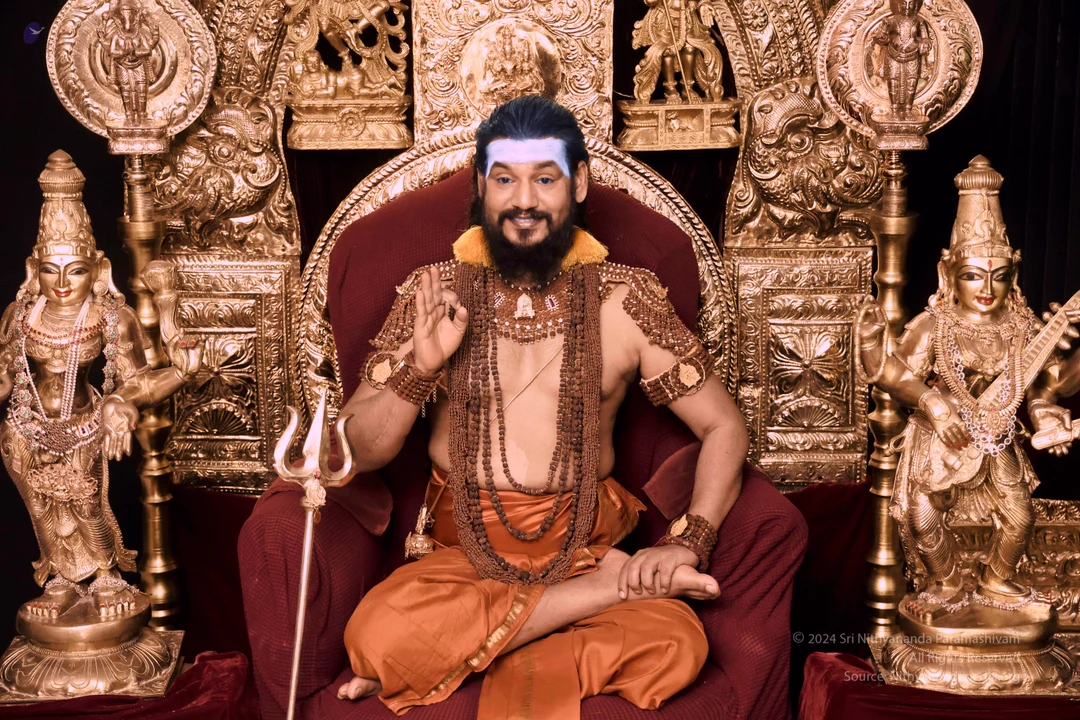
I am just overflowing with my deep love and devotion and gratitude to my Guru, Vidwan A Panduranganar and his son Ambalavan blessings to all of you. Try to listen to this satsang one or two more times you will understand a lot. I have a photograph of my uncle also just to put it on record you can all see this photograph also my acharya Vidwan A. Panduranganar and his son Ambalavan yes blessings Be Blissful.
======
Verified Ma Mahavidya 21 Sep 2024

Photos
Photos from this day

View all 96 photos

KAILASA Adikailasa AK On 17/9/2024

1 photoView all
A metallic statue of a seated figure in a golden-yellow and maroon turban with a jeweled brooch, wearing a yellow and maroon draped garment with gold border, an ornate silver-stone garland and layered jeweled necklaces. The statue sits on a gold-carved throne with a sunburst-embellished backrest, draped in red silver-brocade cloth. Behind it stand other decorated deity figures in orange and gold silk with gold jewelry and a leopard-print backdrop. This is a photograph of a murti statue, with no people physically present.

KAILASA Chinese-World On 17/9/2024

2 photosView all
A screenshot of a video conference grid showing many small tiles of different KAILASA temples and centres, each labelled with a place name such as Toronto, Malaysia, Los Angeles, San Diego, Madurai, Salem, Taiwan, Gambia, Kashi, Whyalla Australia, Equatorial Guinea, Singapore, Rajapalayam, NJB and Sierra Leone. Tiles show deity murti and altars decorated with garlands, drapes and oil lamps, with some priests in white dhotis and bare-chested devotees performing abhishekam or puja. A red-and-white headline bar reads 'Divine Love: Bhagavan Kalyana Sundara Murthy Unve...' at the bottom.A shirtless man in white dhoti stands at a shrine in a yellow-walled room, arm extended holding a small object toward an altar. On the altar, a large backdrop photo shows a snowy mountain peak with a seated figure in red and saffron robes and garlands in front. A framed image of a goddess in red and gold sits to the left. A cardboard-like cutout figure in red and saffron with a red turban and rudraksha garland sits on a small table to the right; its appearance is consistent with a probable Swamiji depiction. A tripod-mounted camera stands at left, and woven mats lie on a patterned rug. A sign on the altar reads KAILASA TAIWAN.

KAILASA HOUSTON, USA On 18/9/2024

2 photosView all
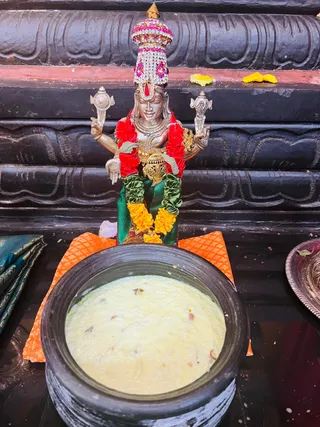
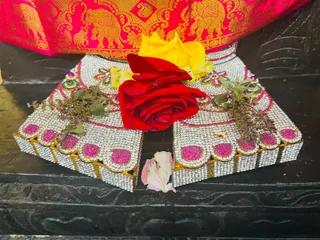
A photograph of a ritual offering setup. In the centre stands a small bronze deity murti with four arms, wearing a jewelled crown with red and pink stones, a red flower garland, a green-and-gold garland and a green silk cloth; it stands on an orange patterned cloth behind a dark clay pot filled with a creamy white pudding garnished with nuts. A folded green-and-gold silk cloth lies at the left edge and a silver plate with a leaf at the right edge. Yellow flower petals sit on the dark carved stone ledge behind. No people are visible.Close-up photograph of a pair of ornate silver-white jeweled footwear, a padukas-style sandal pair for a deity, encrusted with clear stones and edged with pink and green gemstone accents and gold trim. A red rose and a yellow rose rest on top, with sprigs of tulsi leaves and a dried petal in front. Above them hangs a pink silk cloth with a gold woven elephant border. The dark carved stone base beneath suggests a temple altar. No people are visible.

KAILASA KASHI On 17/9/2024

1 photoView all
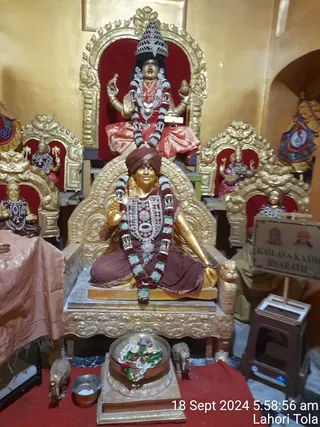
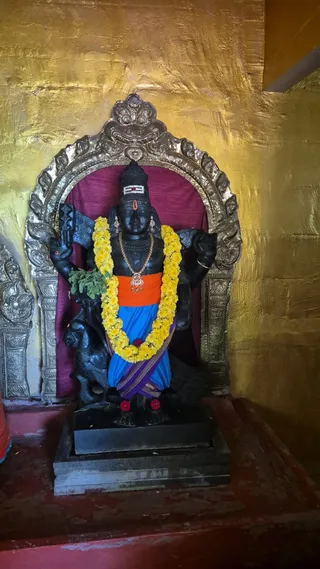
A photograph of a shrine interior with a golden-framed throne-style seat at the centre holding a golden statue of a seated figure in a maroon turban and maroon robe, draped with a rudraksha-style silver necklace, beaded garland of white and red flowers and green leaves. Behind it a larger seated deity murti with four arms, dressed in red, adorned with silver crown and garlands, sits on a higher golden throne. Smaller golden-framed seats on either side hold additional seated figures. In front stands a brass bowl with flowers and offerings, flanked by small brass elephant figurines, on a red cloth. A wooden board reads KAILASA KASHI BHARATH. No living people are visible.

KAILASA KUALA LUMPUR, MALAYSIA On 18/9/2024

1 photoView all
This is a screenshot of a Zoom video call with three women in separate tiles. Top left, a smiling older woman with short grey hair and round glasses presses her palms together in anjali mudra, wearing a dark blue top in front of a patterned curtain. Top right, a woman with long dark hair in a black top speaks to the camera, labelled Ma Turiyajnana. Bottom centre, a woman with long dark hair and a red bindi wears a black top with a dark pendant, labelled Ma Govindaroopinianan da. The Windows taskbar shows the time 5:35 AM, 9/18/2024, and temperature 25°C Cloudy.

KAILASA LOS ANGELES, USA On 18/9/2024

10 photosView all
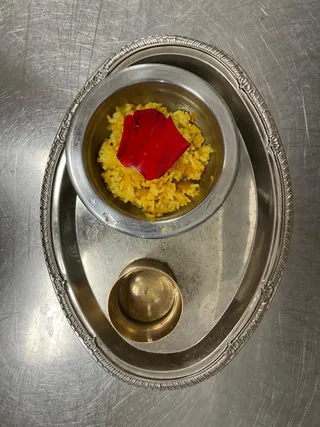
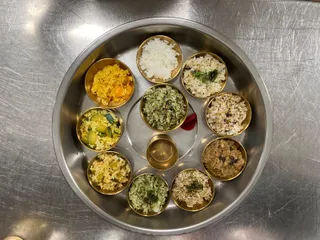
Overhead photo of a ritual offering on a polished silver oval tray. A steel bowl holds yellow turmeric-coloured rice topped with a single red flower petal. Beside it sits a small brass cup with a domed lid. No people are visible.Overhead photo of a round stainless steel thali tray on a reflective stainless steel surface. Ten small brass bowls ring the tray, holding rice preparations in yellow, white, green and brown tones, including lemon-type rice, plain white rice, green herb rice, sliced vegetable rice and tamarind-style rice. A small brass cup sits at the centre beside a red leaf or cloth. No people are visible.A photograph of a temple shrine with gold arched niches framing deity murtis draped in marigold garlands. At center, a priest with a bare upper body and white dhoti stands at a low yellow platform, pouring from a brass vessel over a central murti seated on a throne. Behind them, several murtis wear crowns, rudraksha-style necklaces and garlands, and a bearded sage-like statue in a dark patterned shawl stands to the right. Red velvet drapes hang behind, with striped kalasha-like banners above. Brass oil lamps and offerings sit on a table, and a sign on the platform reads KAILASA USA LOS ANGELES.A photograph of a temple altar display with a central deity murti of Shiva lingam decorated with garlands of yellow, red and white flowers, flanked by a goddess figure and two standing male statues dressed in brown and rust-coloured garments with rudraksha malas, turbans and white flower garlands. Brass oil lamps stand on the altar platform, a small green-clad figure and decorative pot sit in front, and red and blue draped curtains with painted pillars frame the scene. Printed placards sit at the base of the altar. No living people are visible.Photograph of a temple shrine stage with a central deity murti group framed by a gold arch, adorned with garlands of orange and yellow flowers and gold necklaces. A shirtless man in white dhoti with bare upper body stands at left centre with palms pressed together in namaste, facing the shrine. Flanking shrines hold deity murtis with crowns and garlands; a statue at right wears a green and blue sari-style garment. Red velvet curtains, striped decorative poles and brass oil lamps surround the altar. A framed portrait hangs above with the Sanskrit words 'tat tvam asi'. A bearded statue in orange turban and rudraksha-style garlands stands at centre right. Brass lamps and offerings sit on a low table in front.A photograph inside a temple shrine showing several decorated deity murtis on a raised yellow platform. A bare-chested priest in a white dhoti with a gold border stands at the centre, attending to the figures. Behind them are ornate gold arches draped in red curtains, garlanded with yellow and orange flowers, with tall painted pillars above. On the left stands a dark-stone deity with a tall white crown and a gold-framed base; on the right a figure in a green and blue sari-like garment. A brass lamp and an ornate brass kalasha-style vessel sit on a table draped in orange and red cloth. A sign on the platform reads KAILASA USA LOS ANGELES. No devotees are visible.

KAILASA OHIO, USA On 18/9/2024

1 photoView all
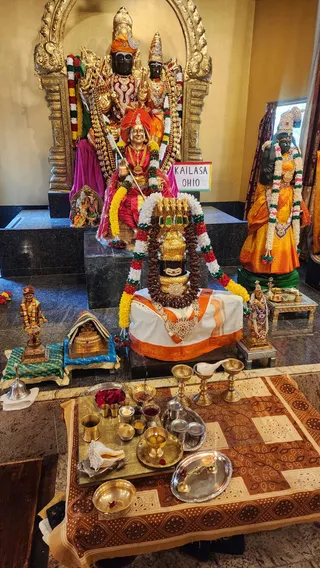
Interior shrine photograph showing a golden-framed altar with deity murtis garlanded with white, red and green flower strands. In the centre, a seated golden statue in red and orange robes with a red turban and rudraksha mala raises one hand, and a sign reading KAILASA OHIO stands beside it. Behind are dark-faced deity figures with a trident, one in orange sari to the right. A large Shiva lingam wrapped in rudraksha beads and a white-and-orange cloth sits before it, with a gold kalasha on top. Brass puja vessels, a conch shell, a bell, a plate of red flowers, lamps and kumkum-filled bowls are arranged on a patterned cloth in the foreground. No people are visible.

KAILASA PONDICHERRY On 18/9/2024

1 photoView all
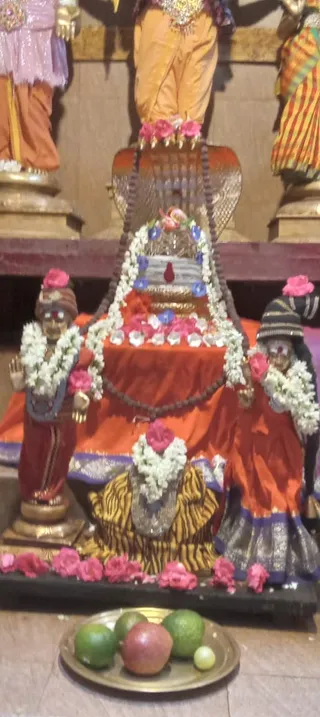
A photograph of a shrine altar with a Shiva lingam set on a yoni base, draped in an orange cloth and garlanded with white jasmine and pink flowers. A cobra hood of metal stands behind the lingam, with a rudraksha mala hanging across the altar. Two standing devotional figures flank the lingam, one in red and gold with a turban and one in orange and purple, both wearing white flower garlands. A striped tiger-skin style cloth lies below, with pink flowers scattered on the platform. In front sits a brass plate holding green lemons or limes and a red fruit. Taller painted deity figures in pink and orange robes stand in the background. No living people are visible.

KAILASA SAN DIEGO, USA On 18/9/2024

3 photosView all
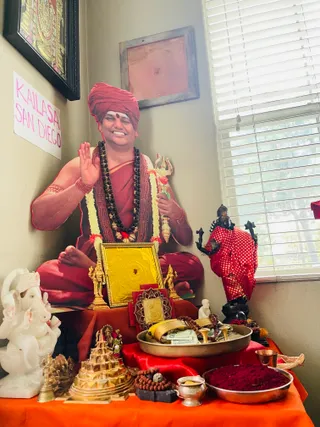
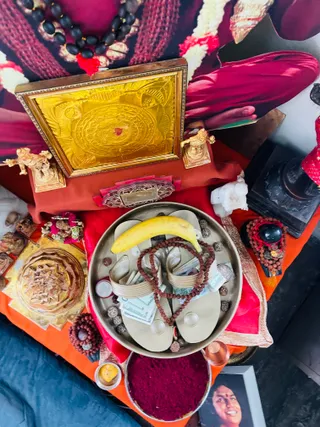
A puja altar in a room corner with a life-size cutout figure seated cross-legged, wearing a red turban, red robes, rudraksha malas and white flower garlands, raising one hand in greeting and holding a trident. The cutout is a printed depiction, not a physical person, and no one is present. In front stands a gold framed yantra, a gold pyramid sri yantra, a white marble Ganesha, a dark bronze Shiva figure in red polka-dot cloth, a brass tray with rudraksha malas and money, a bowl of red kumkum and a rudraksha mala on a dark stand. A handwritten pink sign reading KAILASA SAN DIEGO hangs on the wall beside a framed deity painting. Orange and red cloths cover the table.Overhead photo of a home altar arranged for puja. A gilded square plate engraved with a yantra-like pattern sits on a red cloth at the top centre, with a red mark at its middle. A large brass tray in the foreground holds a yellow banana, a pair of golden sandals, rudraksha beads, a rudraksha mala, folded banknotes and small coins. A bowl of red kumkum powder and a small dish of yellow turmeric paste sit below. Left of the tray is a gold-toned sri yantra plate, and to the right stands a dark stone linga wrapped with a rudraksha mala. Brass figurines and a white stone figure surround the altar. Behind is a printed backdrop of a seated figure in red robes wearing a black rudraksha mala. In the lower right corner a framed printed portrait shows a smiling woman with a red bindi. No people are physically present in the scene.A small home shrine set in a corner beside a window with white blinds. Central to the scene is a life-size cutout of a seated figure in red robes and a red turban, with a bindi, rudraksha malas and a flower garland, raising one hand in blessing and holding a trident; the cutout is a depiction, not a physical person. A handwritten paper sign reads "KAILASA SAN DIEGO". Before the cutout stands a golden square yantra plate, and below it a brass tray holds a banana, loose money, rudraksha beads and small ritual vessels, with a bowl of red kumkum and a white marble Ganesha on the left. A framed gold-toned temple deity print hangs above, along with a copper yantra panel. A black figure in a red patterned cloth stands at right. The shrine is arranged on an orange cloth with a gold kalasha-type object.

KAILASA SINGAPORE On 17/9/2024

2 photosView all
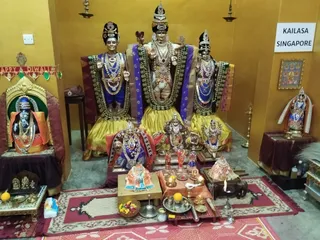
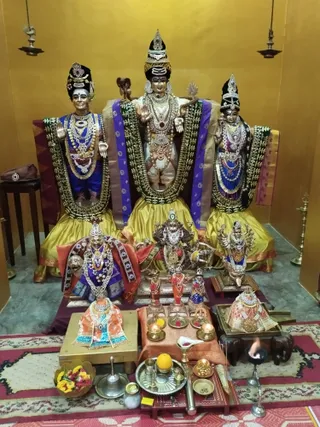
A photograph of a shrine room with three large decorated deity murtis seated on a raised platform, each adorned with gold and jewelled necklaces, green garlands and yellow silk skirts; the central figure is crowned and bears a trident-like staff. Smaller murtis and ritual objects surround the base, including brass oil lamps, a silver thali with offerings, a kalasha-like vessel, a tray of flowers and fruit, and red and patterned rugs on the floor. To the left a small shrine holds a seated figure in orange and gold, and a framed painting hangs on the right wall beside a sign reading KAILASA SINGAPORE. A red banner with the partial words HAPPY DIWALI hangs at upper left. No people are visible.A shrine display of deity murtis in a gold-painted room, photographed head-on. Three larger seated figures stand at the back, the centre one wearing a tall crown, layered jewelled necklaces, and holding a trident-like staff, flanked by figures in dark crowns and blue and gold garments with green-and-gold garlands. In front are smaller murtis dressed in orange, purple and blue silk, many draped with pearl and bead ornaments, with a central multi-armed deity murti. Brass oil lamps hang from the wall, and in the foreground are a brass plate with a fruit, a bell, a bowl of flowers, an incense stick and a small oil flame, consistent with puja offerings. No people are visible.

KAILASA SRIPURAM On 17/9/2024

6 photosView all
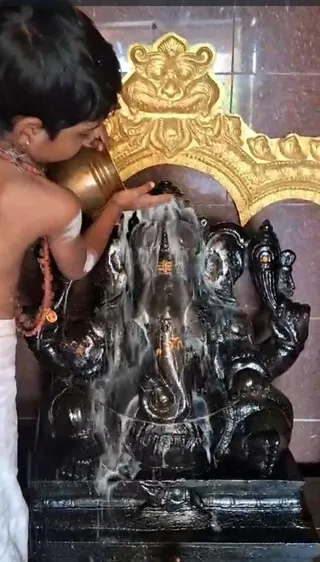
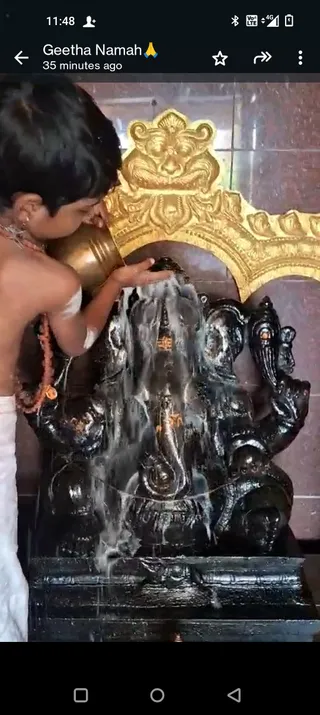
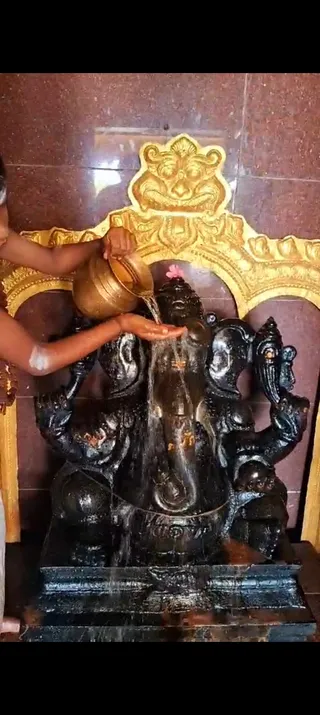
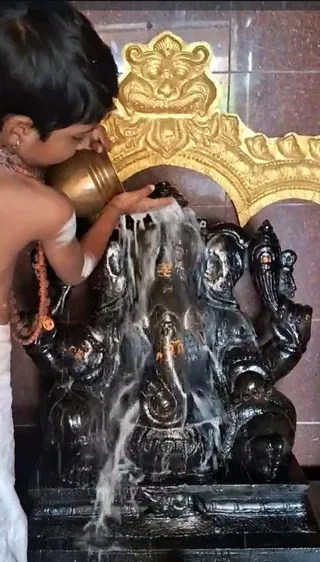
A photograph of an abhishekam being performed on a large black stone murti of Lord Ganesha. A bare-chested priest in a white dhoti with a white upper-cloth and a rudraksha mala stands at left, pouring water from a brass pot over the dark image, which streams down its face and trunk. A gilded arch with ornate floral carving frames the deity against a reddish-brown tiled wall. Only the priest is physically present, and he is shown from the side with his face turned toward the pot.A screenshot of a messaging app showing a shirtless priest in a white dhoti and rudraksha mala pouring water from a brass pot over a black stone Ganesha murti during abhishekam. The murti is adorned with orange kumkum marks and sits beneath an ornate gold arch with a carved kirtimukha motif. Water streams down the dark stone figure. The priest's face is turned away and hidden by the pot. Status bar shows the time and a message header reading Geetha Namah.A screenshot of a phone messaging app, with status bar and chat header reading Geetha Namah and '35 minutes ago', showing a black stone Ganesha murti being bathed in an abhishekam. A person's hands, one holding a brass pot, pour water over the deity's head and trunk, with water running down the dark stone. Orange vermilion marks and an om symbol appear on the forehead and trunk. Behind the murti is an ornate gold-toned arch. No visible person's face is shown, and no one is identified.A photograph of an abhishekam being performed on a large black stone Ganesha murti. A bare-chested person in a white dhoti with an orange rudraksha mala pours water from a brass pot over the dark image, which has orange-marked forehead tilak. Water streams down over the murti onto a black stone base. A gilded arched frame with ornate floral carving stands behind it against a maroon granite wall. The screen shows a messaging app header reading Geetha Namah with a time stamp of 31 minutes ago, and a phone interface is visible at the top and bottom.A dark stone murti of Lord Ganesha, the elephant-headed deity, receives abhishekam as water is poured over it. A priest's arm enters from the left holding a copper pot that pours water over the head, while his other palm catches the flow. The black stone figure has multiple arms and bears orange-yellow tilak marks on the forehead and trunk, with a pink flower placed atop the head. The murti sits within an ornate gold-colored arch set against a reddish-brown granite wall. Water runs down the statue onto a dark stone base. No people are fully visible beyond the priest's arm.A bare-chested priest in a white dhoti pours water from a brass kalasha over a black stone Ganesha murti during an abhishekam. Water cascades down the dark polished sculpture, which has an elephant head, a tilak mark and a gold-trimmed arch behind it. The priest wears an orange rudraksha mala and white sacred ash on his shoulder, and his face is turned downward toward the deity.

KAILASA SRIPURAM On 18/9/2024

8 photosView all
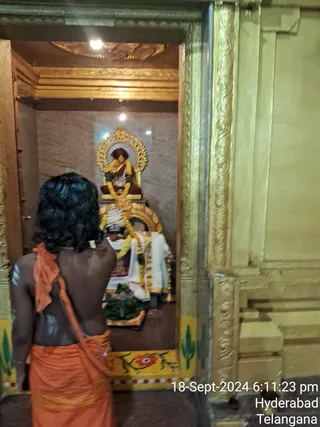
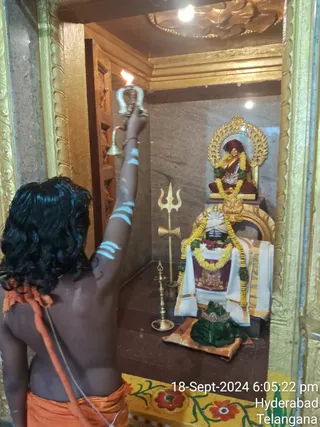
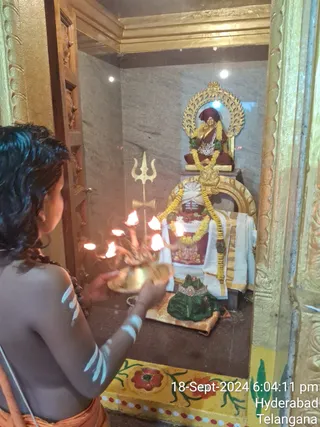
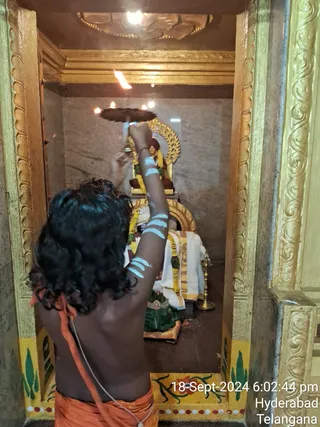
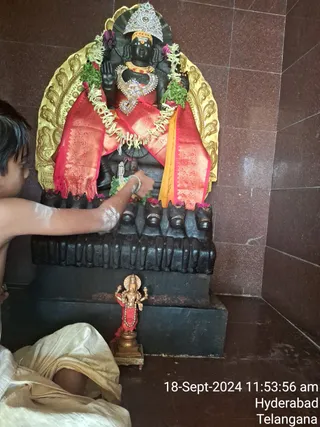
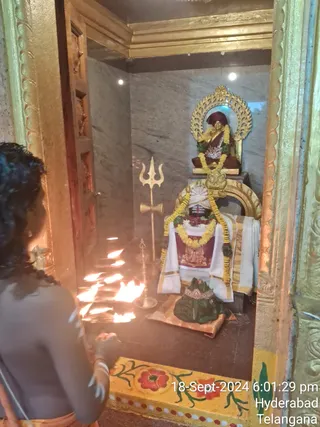
A photograph taken inside a gold-decorated shrine niche in a temple. A bare-backed priest with long dark wavy hair and an orange cloth draped over one shoulder and waist stands with his back to the camera, facing a deity murti or sacred image set in a gilded arch. The image is adorned with yellow and white flower garlands, and a white cloth with gold border drapes the lower figure. Green leaves and a small brass plate sit on a stone ledge in front. Gilded floral carvings frame the doorway and walls, and a timestamp reads 18-Sept-2024 6:11:23 pm, Hyderabad, Telangana.A photograph inside a gold-trimmed shrine niche. A bare-chested priest with long dark wavy hair and white stripe markings on his upper arm, wearing an orange cloth over his shoulder and an orange dhoti, raises a lit oil lamp with one hand toward a shrine. Behind him stands a brass trident and a brass oil lamp on a stand. The shrine holds a seated figure in a gold arched halo with yellow marigold garlands, a deity murti dressed in white and gold-bordered cloth with garlands and a yantra-type image, and a green cloth with a crown. The timestamp reads 18-Sept-2024 6:05:22 pm Hyderabad Telangana.A photograph inside a gold-trimmed shrine doorway showing a priest seen from behind, bare-backed, with white sacred ash stripes on his shoulders and an orange cloth at his waist, holding a brass aarti plate with several lit oil lamps toward a shrine. Inside, a seated figure in a gold arch is garlanded with yellow marigolds, and a central deity murti draped in white and gold-bordered cloth is decorated with flower garlands. A gold trident stands at left and a green-cloth-covered object sits below. The scene suggests an aarti or puja. A timestamp reads 18-Sept-2024 6:04:11 pm, Hyderabad, Telangana.A photograph inside a gilded temple shrine niche. A bare-chested priest with long dark hair and white ash stripes on his arms faces away from the camera, raising a flaming oil lamp aarti plate toward a deity murti adorned with yellow and white marigold garlands and a white cloth. An orange cloth is wrapped around his waist and a sacred thread crosses his shoulder. Brass oil lamps and a lit wick flame glow on the ceiling and in front of the shrine, with a small brass lamp stand to the right. The timestamp reads 18-Sept-2024 6:02:44 pm, Hyderabad, Telangana.A photograph inside a temple shrine showing a dark stone deity murti seated on a black pedestal carved with multiple snake or serpent hoods. The murti wears a silver crown, a large jewelled necklace, garlands of white flowers and green leaves, and a red and gold silk shawl. A small gold-coloured figure stands at its base. On the left, a young boy in white dhoti and bare upper body applies white paste to the deity with his hand, while a gold-framed arch surrounds the murti against a red-brown tiled wall. A timestamp in the corner reads 18-Sept-2024 11:53:56 am, Hyderabad, Telangana.A photograph taken inside a shrine room with gold-painted doorframes and a grey stone-panelled back wall. A bare-backed person with dark hair and white ash marks on the back and arms stands at left, holding a lit lamp near a row of flickering oil lamps on the floor. At the back, a gold-framed arch holds a seated golden figure wrapped in maroon cloth and garlanded with yellow marigolds. In front, a Shiva lingam with a tripundra-marked white cover and a maroon cloth sits on a gold arched base draped with white and gold-bordered cloth and yellow flower garlands. A brass trident stands to the left, a brass lamp stand is in front, and a green cloth-covered object with a gold crown rests on a saffron cloth below. A timestamp reads 18-Sept-2024 6:01:29 pm, Hyderabad, Telangana.

KAILASA ST. LOUIS, USA On 18/9/2024

1 photoView all
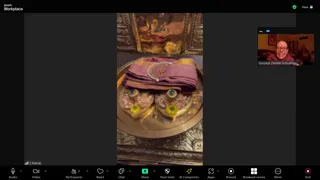
A screenshot of a Zoom video call with a vertical photo shared in the main frame. The shared photo shows a brass tray on an ornate carved wooden surface, holding a folded magenta silk cloth with gold border and a pearl-and-stone decorated piece, flanked by two decorated items with yellow flowers. Behind the tray is a gilded framed picture. In the top-right corner, a smiling woman with glasses and a pink top is shown as a video participant labelled Gurukul-Debbie Schuehler, with a room visible behind her. The bottom bar shows Zoom controls and the participant count of 2.

KAILASA Salem On 17/9/2024

10 photosView all
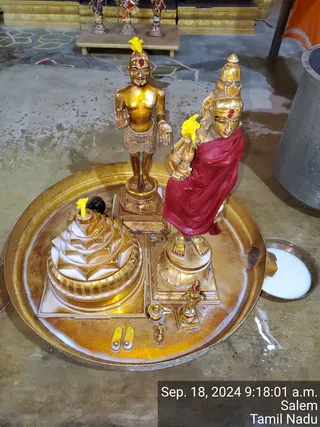
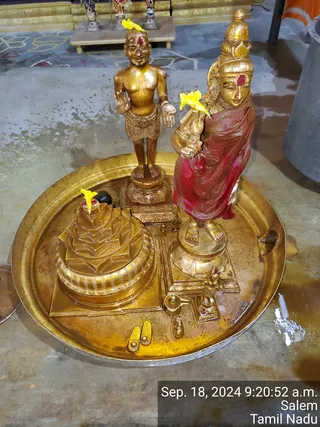
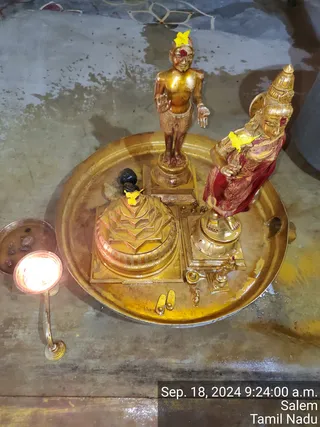
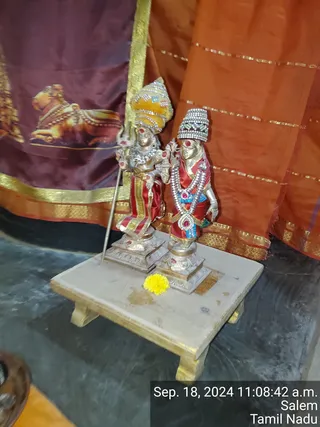
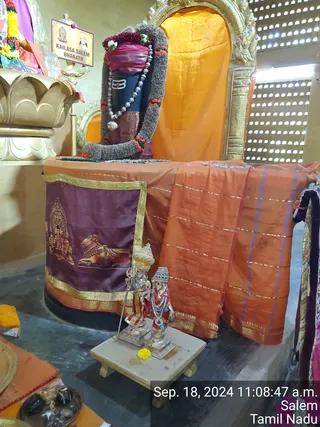
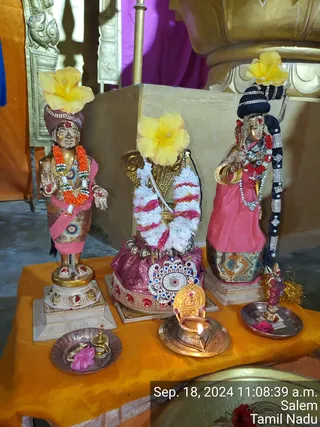
A photograph of a gilded ritual arrangement on a large round brass tray placed on a concrete floor. Centre left is a golden stepped sri yantra-style meru or shivalinga base with a yellow flower on top and a dark stone object behind it. Centre right is a golden standing deity murti draped in a red cloth, holding a yellow flower, with a gold crown and a kumkum mark on its forehead. Beside it stands a smaller golden figure with a red mark on its forehead and a yellow flower on its head, with raised hands and a loincloth. Small gold items on the tray include a lamp, a pair of golden footwear and a bell-shaped ornament, and a copper bowl holds white milk. Milk and water flow over the tray. Gilded figures stand in the background, and an orange cloth hangs at the upper right. Timestamp in the corner reads Sep. 18, 2024 9:18:01 a.m., Salem, Tamil Nadu.Photo of a gilded ritual arrangement on a round brass tray on a concrete floor. A golden shivalinga with a layered yantra-style base and a black stone top sits on the left, decorated with a yellow flower. Beside it stands a gilded deity murti of a goddess in a red draped sari with a crown, holding a yellow flower, and a smaller gilded standing figure of a male deity with a red tilak. Small brass items, a ghee lamp or vessel and paired brass pieces lie on the tray, which is wet with water. A timestamp overlay reads Sep. 18, 2024 9:20:52 a.m., Salem, Tamil Nadu. No people are visible.Overhead photo of a gilded brass puja tray on a grey floor. At the centre stands a golden standing figure of a sage-like deity murti with a red tilak on the forehead and a yellow flower garland, its hands in a blessing gesture. To the right sits a golden seated female deity murti in a red-and-gold sari with a tall crown and yellow flower garland. In front is a stepped golden shrivechakra-style yantra and a dark stone lingam with a flower. A small oil lamp burns at the left, beside a brass bowl holding offerings, and small brass ritual items and a pair of brass sandals lie on the tray. A timestamp caption reads Sep. 18, 2024 9:24:00 a.m. Salem Tamil Nadu.A photograph of two metal deity murtis standing on a low wooden platform in a room with a wall hanging. The murti on the left holds a trident and wears a tall yellow headdress decorated with silver and jewel accents, with a red and gold garment. The murti on the right wears a silver-and-jewelled crown, a red garment and a multi-strand garland with red and green stones. A yellow flower lies on the platform in front of them. Behind them hang a maroon cloth with a golden bull motif and an orange cloth edged with gold. A timestamp in the corner reads Sep. 18, 2024 11:08:42 a.m. Salem Tamil Nadu.A photograph inside a temple shrine showing a tall black Shiva lingam decorated with a silver-and-white tripundra mark, a maroon-pink cloth wrapped at its top, a garland of marigolds and flowers, and a thick grey garland encircling it. The lingam sits on a platform draped with orange and maroon cloths, one maroon panel bearing printed images of a temple gopuram and a seated Nandi bull, edged with gold borders. In front are two small metal figurines of standing deities in red and white garments with jeweled headdresses and necklaces, placed on a small wooden stool with a yellow marigold petal. A gold-framed arch with an orange backdrop stands behind, and a sign reading KAILASA SALEM BHARATH hangs at the upper left. Fruit and offerings sit on a tray at the lower left. A timestamp reads Sep. 18, 2024 11:08:47 a.m. Salem Tamil Nadu. No people are visible.Photograph of three small golden statues on an orange cloth at a temple altar, decorated for worship. The left statue is a standing male figure in a maroon turban and saffron-orange garland with a pink dhoti-style wrap, its right hand raised in blessing. The centre figure is a deity murti draped in a white and magenta garland, with a yellow hibiscus flower on top and a jewelled crown-like ornament at its base. The right statue is a female figure in a pink sari with silver jewellery, bangles and a long beaded braid, also with a yellow hibiscus. Brass plates hold pink flowers and a lit oil lamp stands in front, with a golden kalasha-style lamp. A timestamp reads Sep. 18, 2024 11:08:39 a.m. Salem Tamil Nadu. No people are visible.

KAILASA Sierra Leone On 16/9/2024

3 photosView all
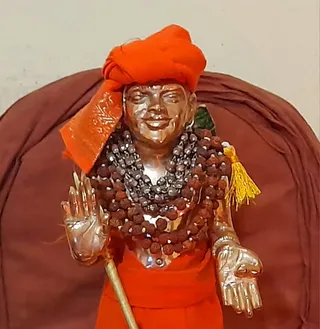
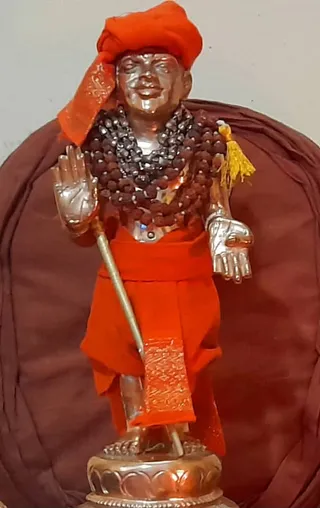
A small silver-toned statue of a smiling male figure in an orange turban and orange draped garment, wearing layered rudraksha malas and a silver bead necklace, with a yellow tassel at the shoulder. One hand is raised in blessing and the other rests open, and a gold-coloured staff or trident-like rod rises at the lower left. The statue sits in front of a deep maroon cushioned backdrop, a deity murti displayed in a ritual setting.Close-up photo of a brass ritual plate offering. In the foreground a ripe banana with dark spotted skin lies across the bottom edge. Beside it a brass bowl holds a pale yellow-orange block of jaggery. Behind, a larger brass bowl is filled with whole reddish-brown nuts, some with pale kernels showing. A small shallow brass cup of liquid sits at the upper left, and a red and gold patterned cloth lies at the top. No people are visible.A small silver-toned statue of a standing male figure on a metal pedestal, set against a draped maroon-brown cloth backdrop. The figure wears an orange-saffron turban, an orange wrap and dhoti-style lower garment, and multiple dark rudraksha mala necklaces with a yellow tassel at the side. The right hand is raised in a blessing gesture and the left hand holds a thin staff. The statue is a depiction of a sannyasi figure, not a living person, and no readable text is visible.

KAILASA TIRUVANNAMALAI SRI NITHYANANDA JANMABHUMI On 16/9/2024

3 photosView all
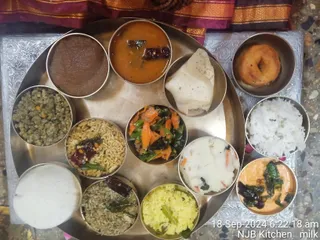
A blurry indoor photo of a food service counter in a kitchen. Two men in white dhotis and grey caps stand at the left, one reaching over steel trays and containers on a wooden counter. Another man in a white shirt stands at the right beside a dark pot. Ceiling lights line a long hall behind them, with more people faintly visible in the distance. A timestamp in the lower right reads 18-Sep-2024 3:06:42 am.A blurry, dimly lit photograph of a crowded kitchen serving line. Several men in white and cream shirts stand close together over steel serving trays and containers on a wooden counter, with bright ceiling lights overhead. Partially visible people in the background and on the right side appear to be helping with food service. A framed picture hangs on the right wall. The bottom-right corner carries a timestamp and kitchen label.A photograph of a round stainless steel thali platter filled with a vegetarian South Indian meal arranged in many small bowls. Visible dishes include a dark brown chutney, a thin orange sambar with curry leaves and dried red chilies, a crisp round vada, a folded flat dosa or pancake, plain white rice, a tempered rice dish with dried chilies, a stir-fried carrot and greens poriyal, a sweet yellow kesari-style dish, a white yogurt or curd dish with carrot, a green lentil dish, and a peach-coloured gravy with greens. A maroon and gold silk cloth with a rudraksha mala lies at the top edge, and the plate rests on a silver tray over a speckled floor. No people are visible.

KAILASA TIRUVANNAMALAI SRI NITHYANANDA JANMABHUMI On 17/9/2024

16 photosView all
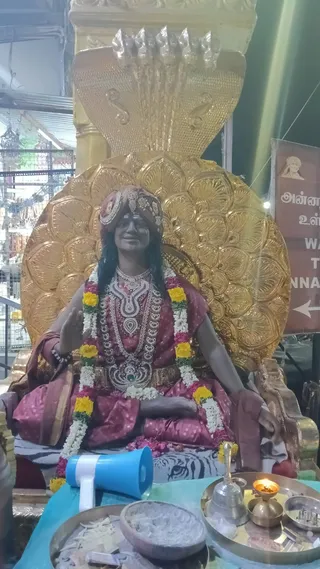
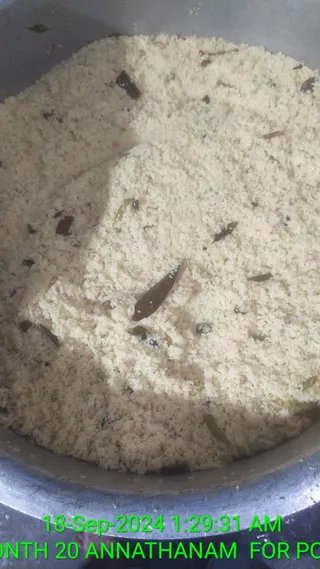
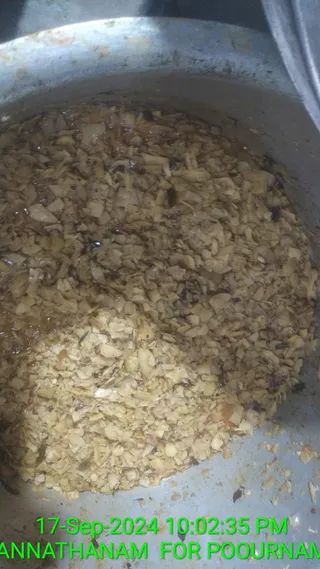
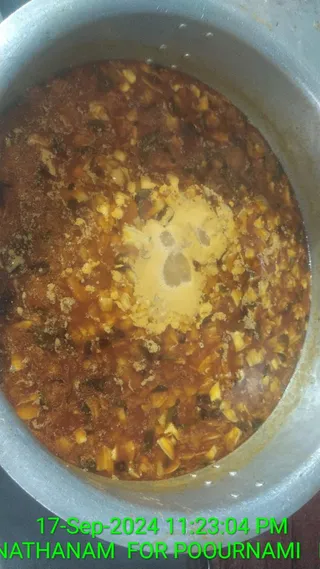
A photograph taken from above of a large round metal tray or basin heaped with pale golden-brown, crisp, puffed flaky snack pieces, possibly puffed rice or fried wafers. The tray sits on a grey tiled floor with a red-handled object at the lower left edge. No people are visible. A green timestamp overlay reads 17-Sep-2024 8:25:22 PM along the bottom, with partially cut-off caption text reading ONTH 2024 ANNATHANAM FOR.A seated life-size statue of a saint in a pink ceremonial garment with gold border and a pink turban with jewelled ornament, wearing layered silver and diamond-style necklaces and a green stone pendant, with multicoloured flower garlands across the shoulders. The figure raises one hand in blessing and rests the other in the lap, seated on a tiger-striped cloth before a golden cobra hood canopy. In front stand a silver bell, a small brass lamp with a lit flame, a brass plate of vibhuti or kumkum, and a silver tray. A red sign in Tamil reading 'Annadhanam' and 'Wait' points to the side. No living people are visible.A close-up photograph of round, golden-brown cakes cooking on a flat black griddle, arranged in rows across the frame with small specks of oil scattered around them. No people are visible. A green timestamp overlay reads 18-Sep-2024 12:58:56 AM, and a green caption along the bottom edge reads about annathanam for poournami in the month of the 2024 cycle.A close overhead photo of a large stainless steel pot filled with cooked, pale grain-based food. Green timestamp overlay in the lower area. No people are visible; the view is focused on the food in the vessel on a stove.Close-up photograph of a large metal cooking vessel containing a cooked mixture of finely chopped pale pieces, possibly vegetables or fried dough, with darker bits and a glossy brown liquid. No people are visible. A green timestamp and partial text overlay appear along the bottom edge of the image.A photograph taken from above of a large aluminium cooking pot filled with a reddish-brown cooked preparation containing pieces of chopped vegetable, green herb fragments and a pale yellowish powdered garnish heaped in the centre. The pot sits on a dark surface. A green timestamp overlay appears along the bottom edge of the frame.

KAILASA TRINIDAD & TOBAGO On 18/9/2024

10 photosView all
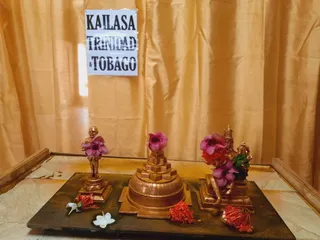
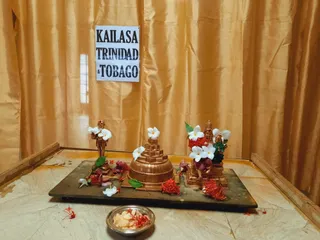
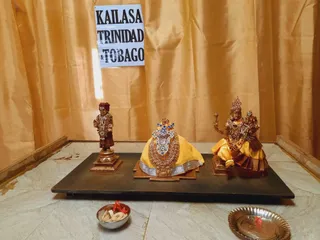
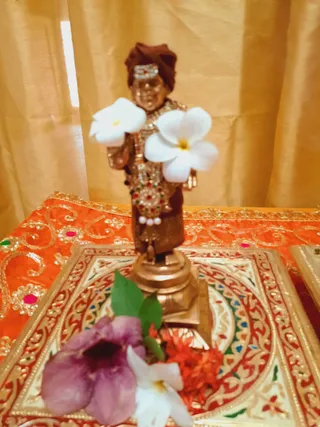
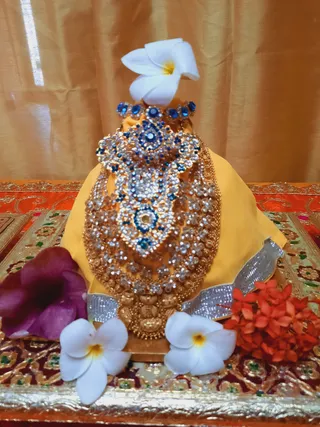
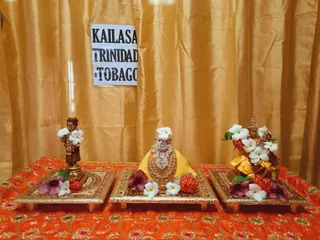
A photograph of a small shrine set on a dark wooden tray against a gold silk curtain on a marble floor. A printed white paper sign taped to the curtain reads KAILASA TRINIDAD & TOBAGO. In the centre stands a tiered copper-toned shivalinga-style peetha with a stepped base, topped with a pink hibiscus flower. To the left is a small copper-toned statue of a standing male figure with a pink flower draped over his shoulder. To the right is a copper-toned deity murti seated in a crowned form beside a smaller figure, decorated with pink and orange flowers and a green cloth. Scattered red and white flowers lie on the tray in front. No people are visible.A small shrine set against gold silk drapes. A paper sign reading KAILASA TRINIDAD & TOBAGO is taped to the drapery. On a dark wooden board sit copper-toned deity murtis and a tiered copper shivalinga-like structure, decorated with white plumeria flowers, red ixora blossoms and green leaves. A small steel bowl holds white offerings with red flowers scattered nearby. No people are visible.A photograph of an altar set up against gold silk drapes, with a white paper sign reading KAILASA TRINIDAD & TOBAGO taped to the fabric. On a dark wooden platform stand three statues: on the left a small standing figure of a male guru-like form with a bronze finish, garlanded with beads and holding one hand raised; in the centre a seated deity form draped in a yellow cloth and heavily adorned with jewelled necklaces, blue stones and a crown; on the right a seated four-armed goddess in yellow silk and gold jewellery holding a lamp-like object. A small metal bowl of sliced banana and a brass plate with a red cloth sit on the floor in front. No people are visible.A small gold-toned metal deity murti stands on a pedestal on an ornate orange and gold altar cloth with a red and white decorated mat in front. The figure wears a dark brown headwrap with a jewelled band, layered necklaces with red and green stones and white beads, and holds white plumeria flowers. Fresh green leaves, a purple flower, and orange blossoms are scattered at its base. Gold curtains hang in the background. No people are visible.A photograph of a deity murti or Shiva lingam draped in a saffron-yellow cloth and covered with an elaborate ornament of gold and silver-toned stones with blue accents, layered with a jeweled necklace and a blue-stone crown band. White plumeria flowers rest on top and at the base, with a dark magenta flower and red ixora blossoms placed on an ornate gold-and-red embroidered cloth. Behind is a draped gold curtain. No people are visible.Photograph of a shrine display set up against a gold satin curtain. A white paper sign with bold black letters reads KAILASA TRINIDAD & TOBAGO. Three deity murtis stand on gold-edged wooden platforms draped in an orange and gold embroidered cloth. The left murti is a small standing figure with a flower garland; the centre murti is a decorated image in a yellow cloth with a heavy jewelled ornamental necklace and a white plumeria flower on its head; the right murti is a figure in yellow and gold garments wearing a crown, with plumeria flowers and red blossoms. Purple and white flowers and orange blossoms are arranged around the bases. No people are visible.

KAILASA Toronto On 18/9/2024

10 photosView all
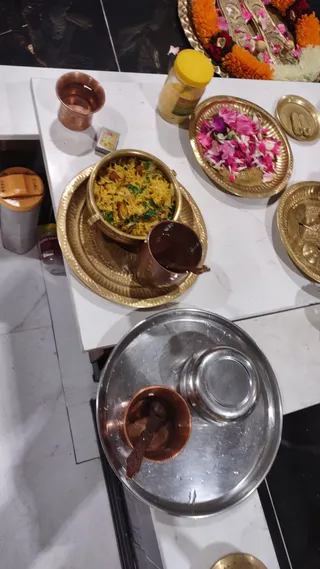
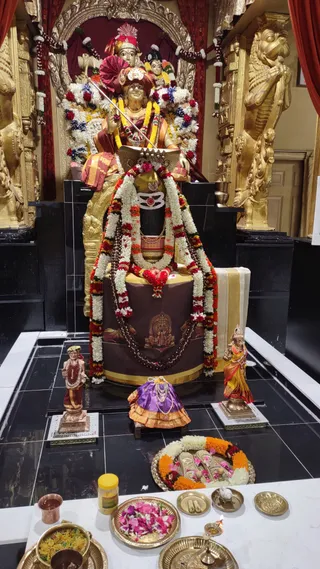
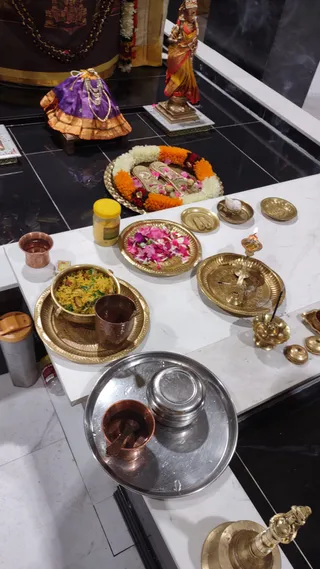
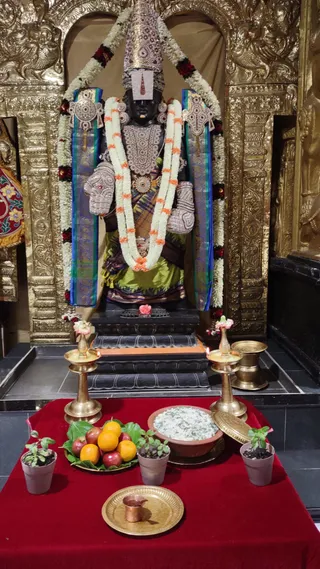
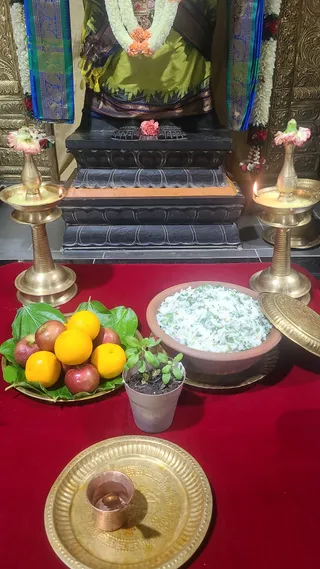
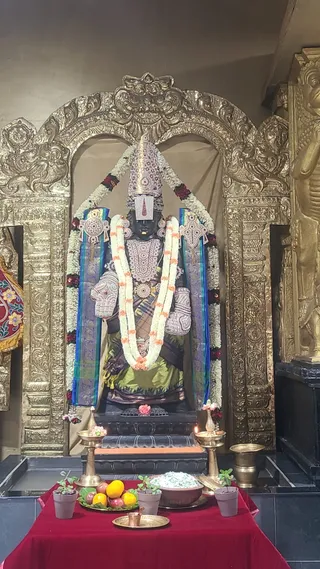
Overhead photo of a white marble table set for ritual offering. A brass pot holds yellow rice with green herbs and bits of vegetable, set on a brass tray beside a copper tumbler with a dark liquid. A brass plate is heaped with pink and magenta flower petals, with a small brass lamp or bell on a tray at right. Garlands of orange marigolds and white flowers lie at the top edge near a golden deity murti or ornament. A copper cup of water, a yellow-capped glass jar, a stainless steel plate with a copper bowl and a spoon, and a small brass tray sit nearby. No people are visible.A photograph of a temple shrine with no people visible. At centre stands a dark Shivalinga draped in layers of white, orange and red flower garlands, with a brown cloth wrap bearing a painted figure and a silver-and-red trident-like ornament on top. Behind it, a golden seated deity murti holds a long staff and wears a red turban and gold jewellery, flanked by gold lion-like pillars and red curtains. On the black marble floor stand two small brass figurines, a man in red and a woman in a yellow-orange sari, and a purple cloth with a golden band. In the foreground are brass plates holding pink petals, a bowl of yellow food, a lit oil lamp, and a flower-wreathed plate with footwear-shaped offerings.Overhead photo of a puja setup on a white marble ledge in a temple shrine. A brass plate holds a pair of ornate brass padukas (sandals) garlanded with white and orange marigolds and scattered with pink petals. Nearby are a brass plate of pink rose petals, a brass bowl of yellow rice dish with copper tumblers, a brass aarti lamp with a lit wick, a brass incense holder with a stick, and small brass dishes. A brass pillar-like lamp stands in the lower corner. In the background a standing gold-and-red saree-clad deity murti and a purple and gold-bordered cloth-draped figure are displayed near a dark draped backdrop. No people are visible.A photograph of a dark stone deity murti standing in a gilded shrine niche, adorned with a tall jeweled golden crown, a white and orange flower garland, a blue-and-gold silk shawl, and silver ornaments. Before the murti, on a red velvet cloth, are two brass oil lamps with lit flames, a brass plate of apples, oranges and betel leaves, a clay bowl of rice, three potted green plants, and a small brass cup on a tray. No people are visible.Ritual offering table covered with a red cloth in front of a black stone deity pedestal. A seated deity murti wears a green and black sari-like garment with a white and orange flower garland. Two brass oil lamps with lit wicks flank the altar, each topped with a pink flower. On the table are a brass plate of oranges, red apples and green leaves, a clay bowl of cooked rice with herbs, a potted tulsi plant, and a brass plate holding a small copper cup. No people are visible.A dark stone deity murti of a standing Vishnu-form figure stands in a temple shrine framed by an ornate gilded arch with carved floral and bird motifs. The murti wears a tall jeweled crown, a white urdhva pundra tilak on its forehead, a white floral garland with orange accents, and a green and blue patterned silk dhoti with a blue-bordered shawl. Brass oil lamps with lit flames stand on either side of the altar, and a red velvet-covered table holds a brass plate of fruit, a bowl of white rice, small potted plants and a brass kalasha. No people are visible.

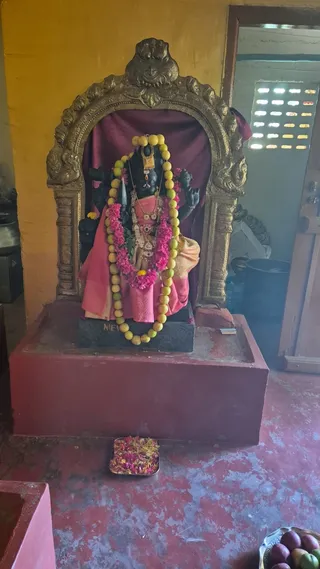
KAILASA UTTARAHALLI On 17/9/2024

5 photosView all
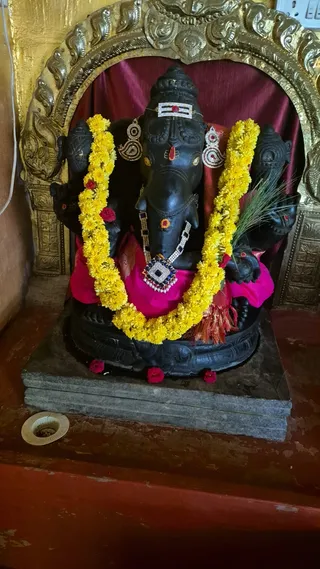
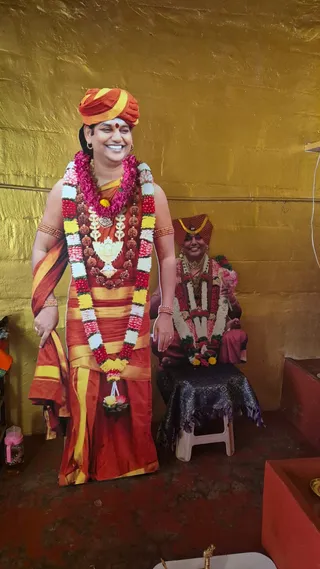
A photograph of a black stone Ganesha murti seated in a gilded arched niche with a deep red cloth backdrop. The deity wears a yellow marigold garland draped across the chest, a pearl and ruby tilak band on the forehead, red kumkum, jewelled earrings and a multi-stone necklace, and holds a green leaf sprig in one hand. Pink cloth covers the seat, with scattered red flowers on the stone base. No people are visible.A shrine photographed indoors with a golden seated statue of a figure in an orange-and-gold turban, draped in pink flower garlands, raising one hand in blessing with legs crossed. Behind it stands a dark Shiva lingam with a horizontal white-and-red tilak marking and pink flower garland, set against ornate gold arches and maroon drapes. A brass kalasha with a coconut sits to the right, and a dark stone deity murti with a bull figure stands at the far right. In front, brass oil lamps, a brass bell, a conch shell, a plate of petals and a lit ghee lamp are arranged on a white tray, with incense and red cloth offerings nearby. Puja items appear arranged for worship; no people are visible.A dark stone deity murti is seated inside an ornate brass arched shrine niche against a maroon cloth backdrop. The murti wears a pink silk dhoti-style garment, gold jewellery, a pearl necklace and a long garland of yellow citrus-like fruit beads and pink flowers. A small brass tray of rose petals sits on the red floor in front, with a tray of fruit at the lower right corner. The shrine sits on a red-painted raised platform in a yellow-walled room. No people are visible.A black stone murti of a four-armed deity stands in a niche framed by an ornate silver arch against a gold-painted wall. The figure wears a yellow marigold garland, a gold chain with a pendant, an orange waist sash and a blue and purple dhoti, with a tall crown bearing white and red markings and a red tilak on the forehead. One hand holds a green leaf sprig and a small animal figure stands at the base beside the murti. A magenta cloth backs the niche and red flowers lie at the feet on a dark stone pedestal. No people are visible.A photograph of a gold-painted temple room with a large standing cutout figure in front, wearing an orange-and-yellow turban with a red bindi, orange-red and yellow draped robes, rudraksha mala, and layered garlands of pink, red, white and yellow flowers. Beside it, a seated cutout figure in a maroon-and-gold headdress and rust-coloured garments holds a pink flower and wears flower garlands, seated on a purple brocade-covered plastic stool. A small brass figure and a red platform sit at the lower right. Cutouts are not physical people. a person appears as the standing cutout, depicted via the orange-saffron robes, rudraksha mala and ceremonial garlands.