Skip to content
Friday

29 November 2013

Your Failures are not you.

Dated photos
203
Source pages
1
Media
2
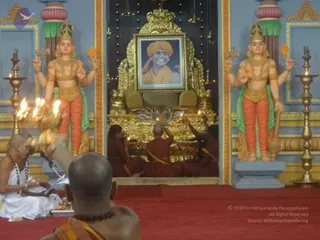
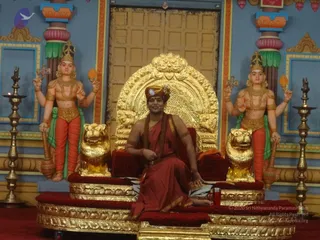
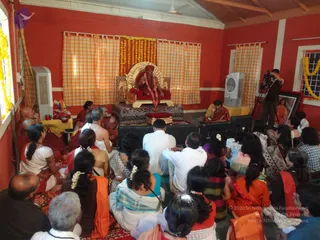
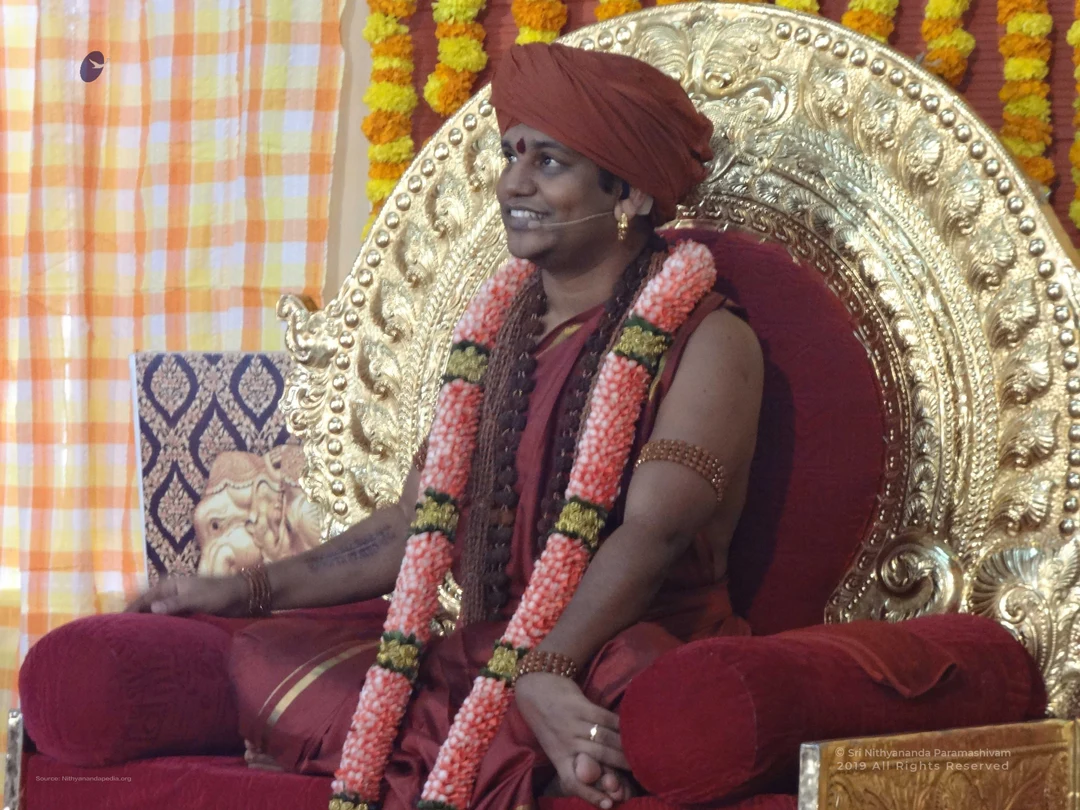
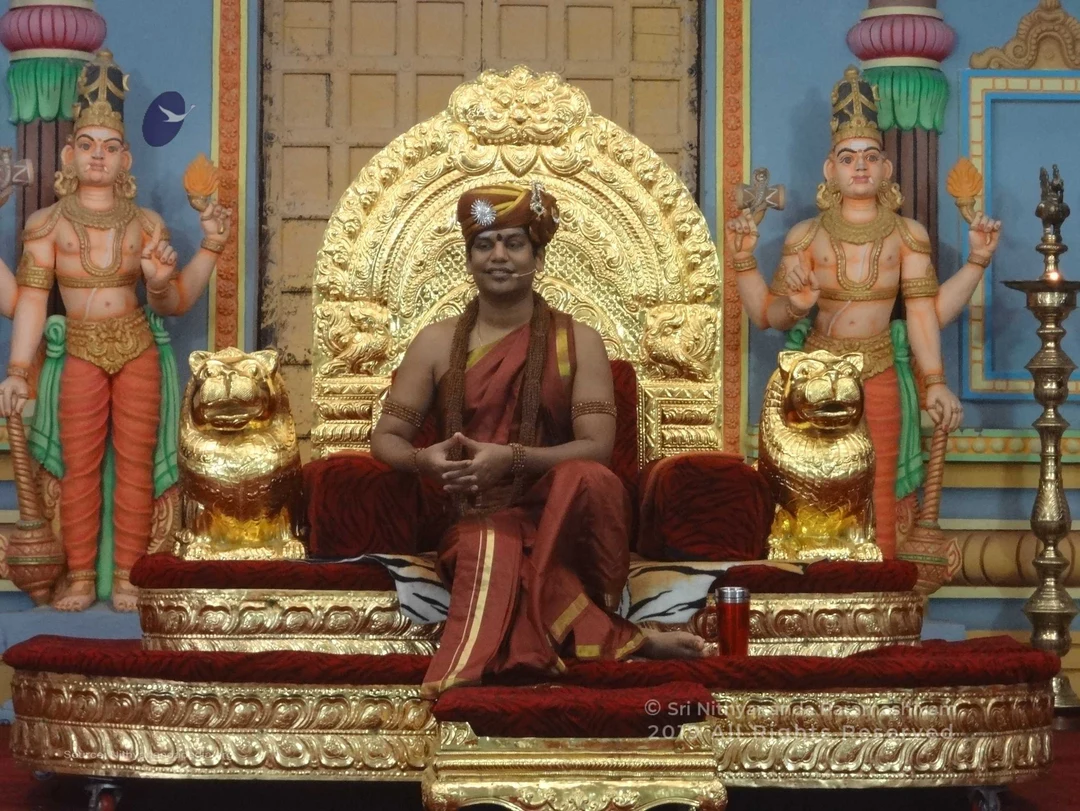
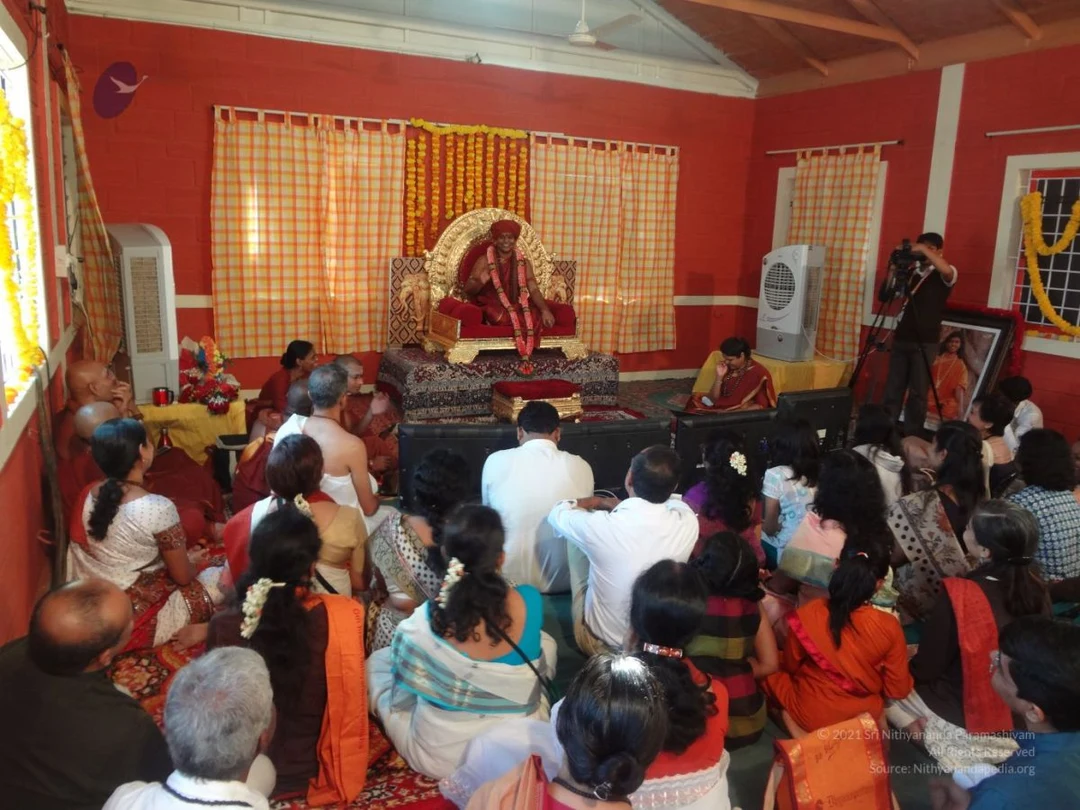
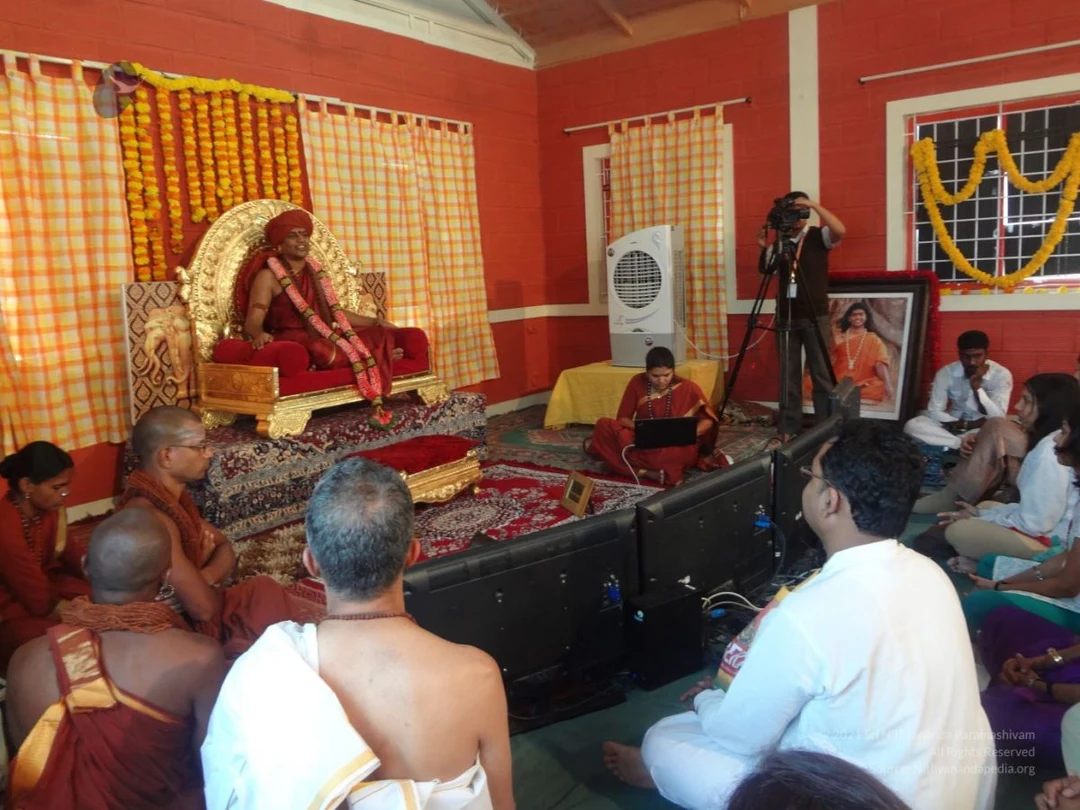
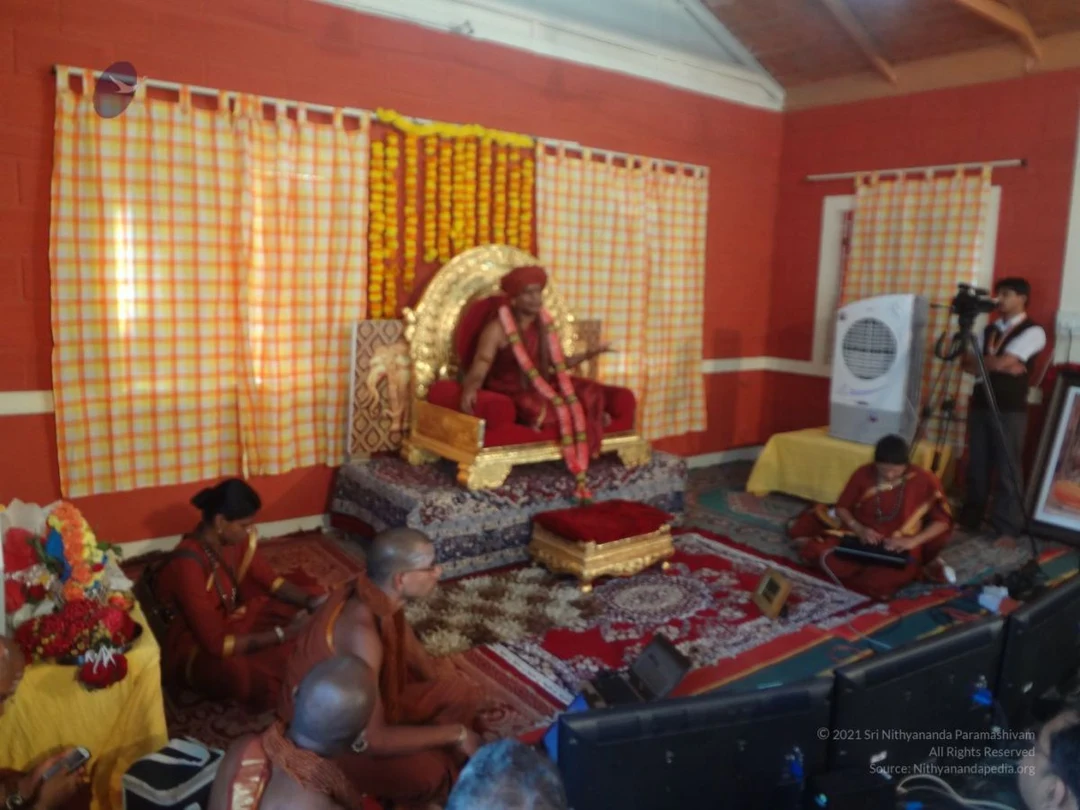
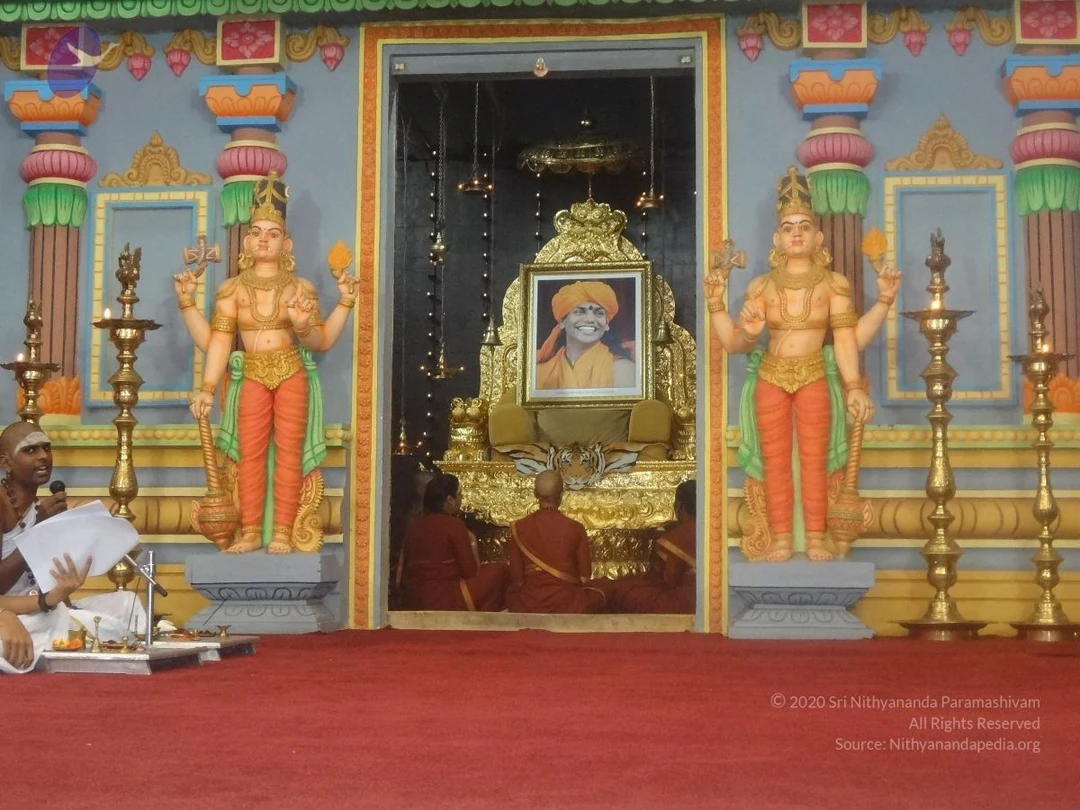
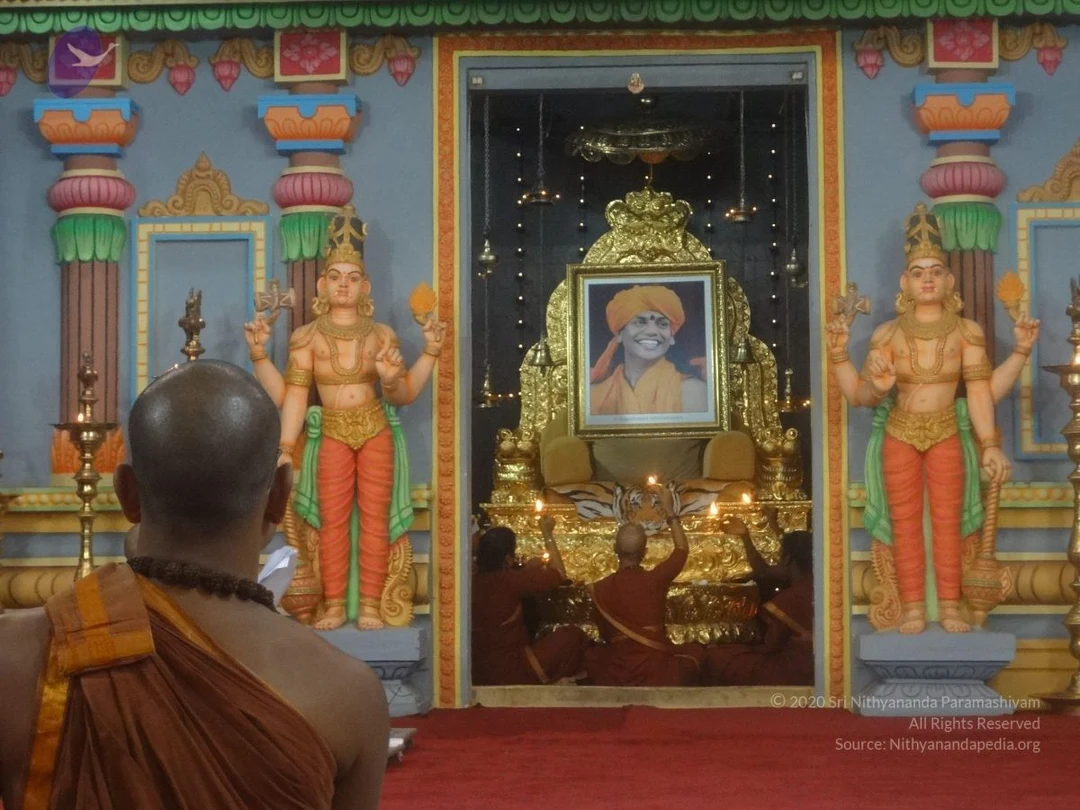
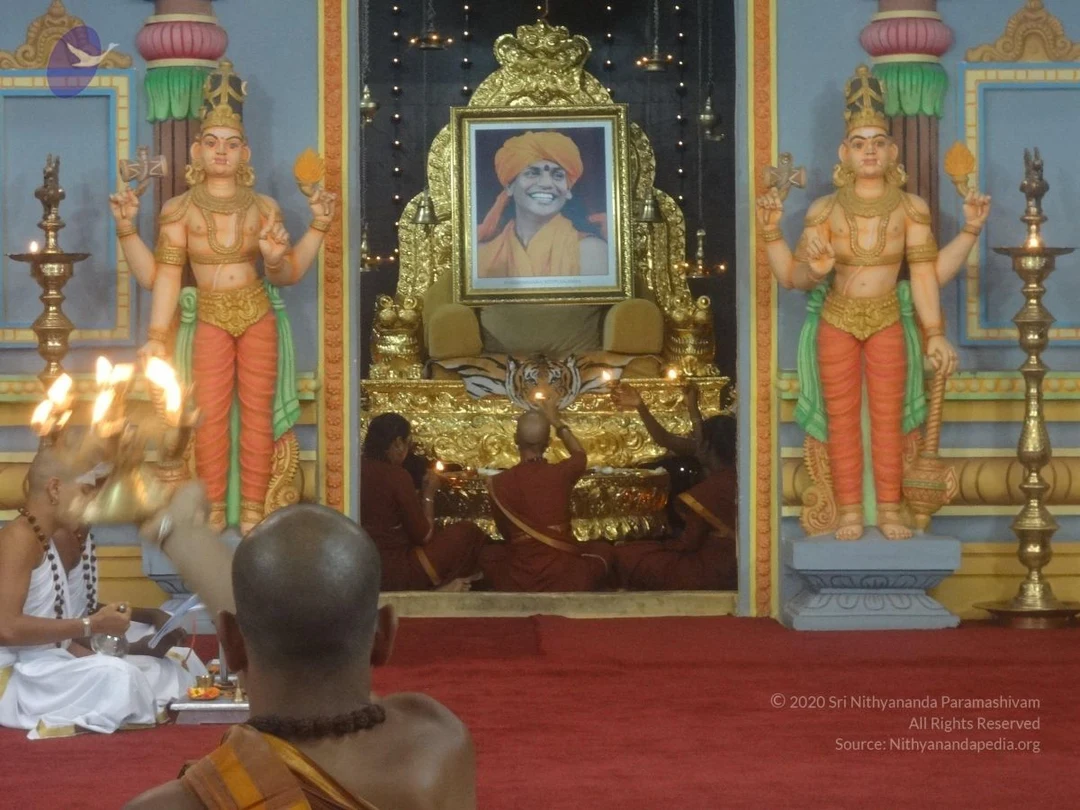
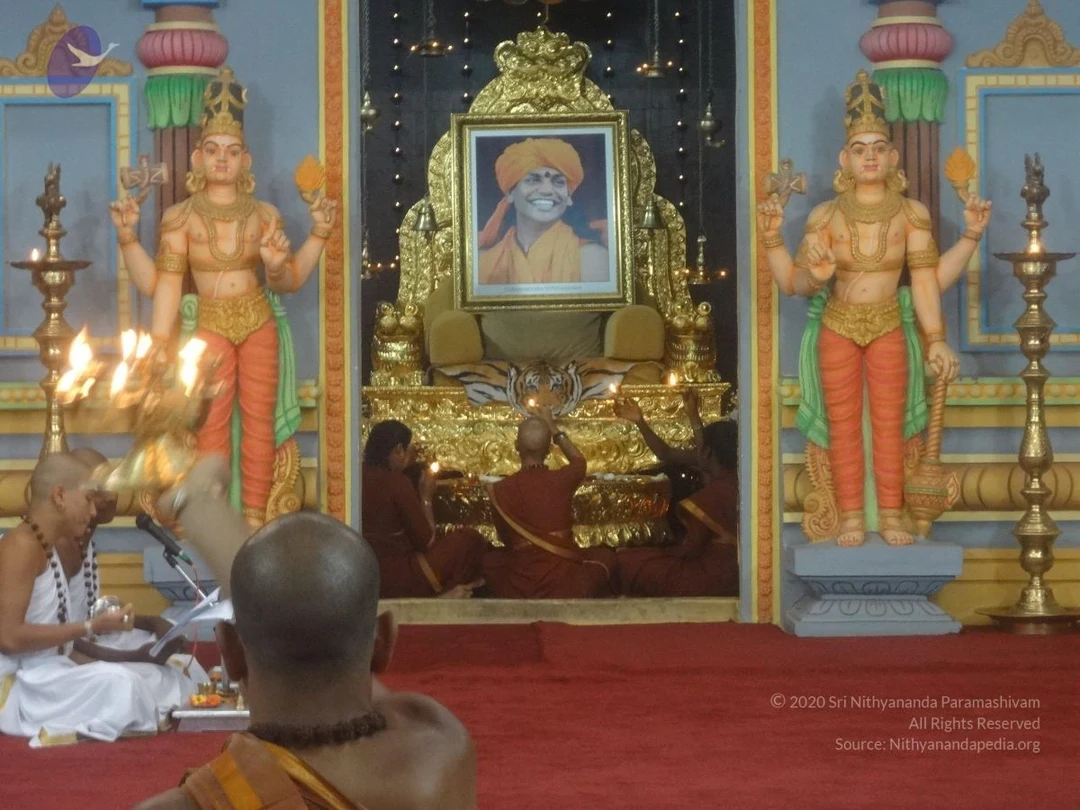
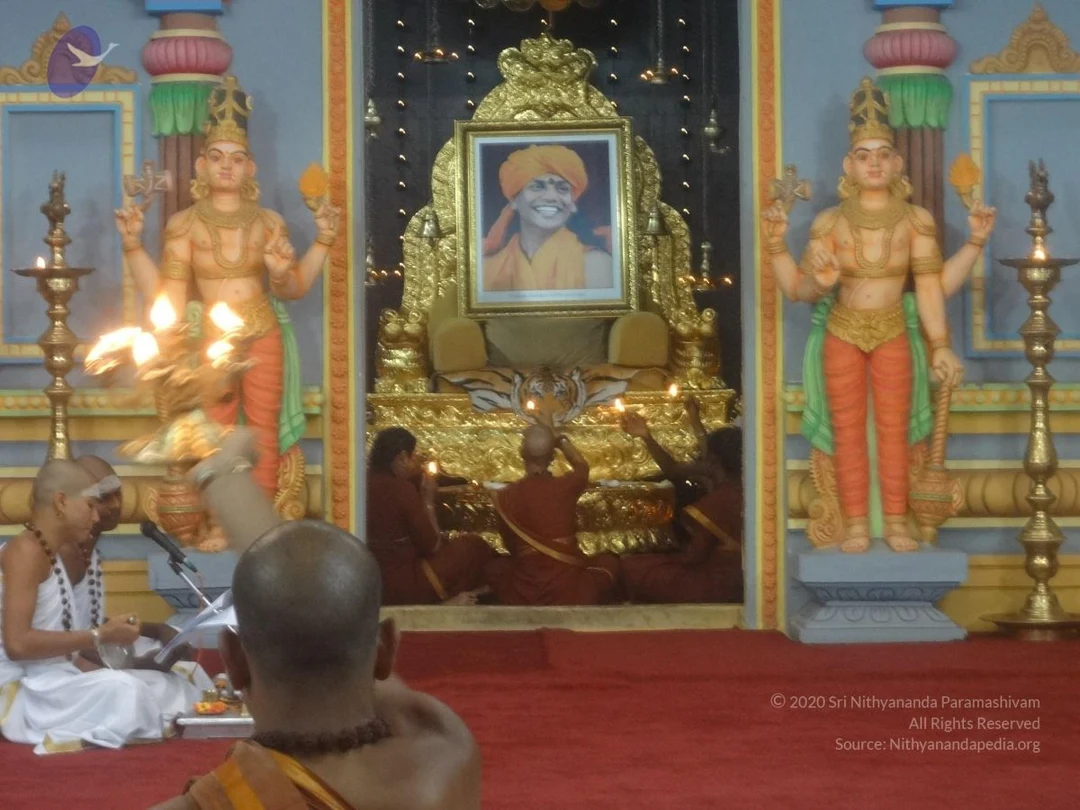
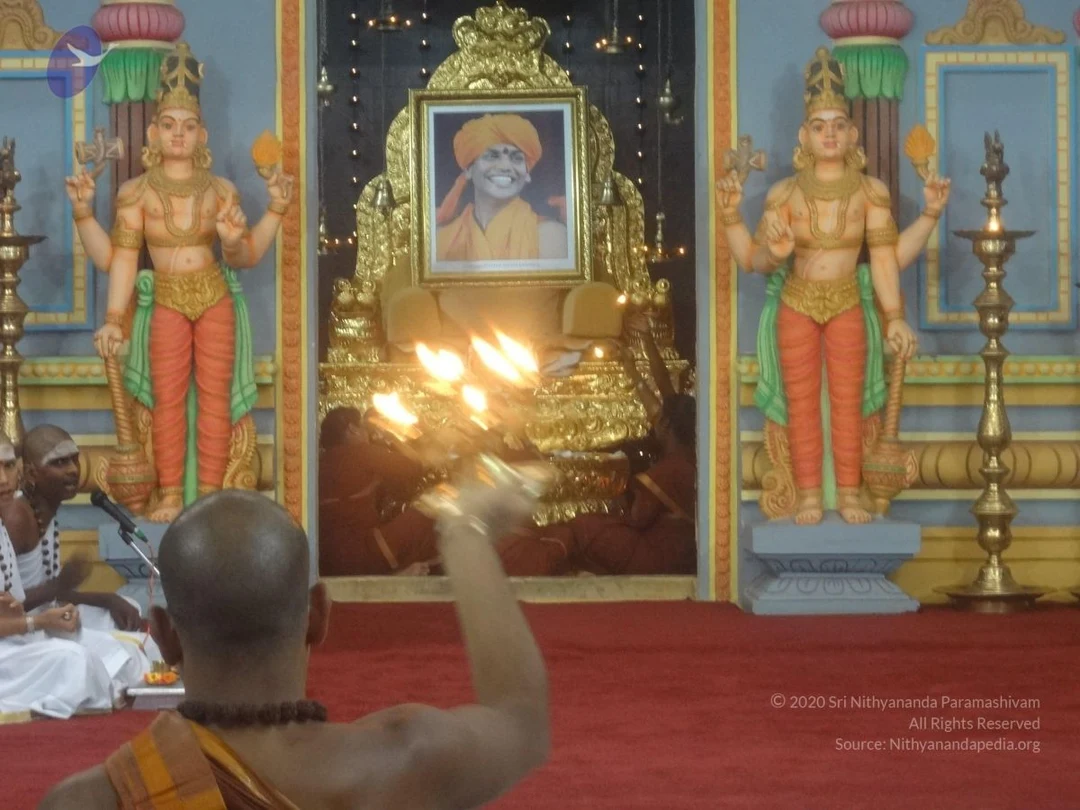
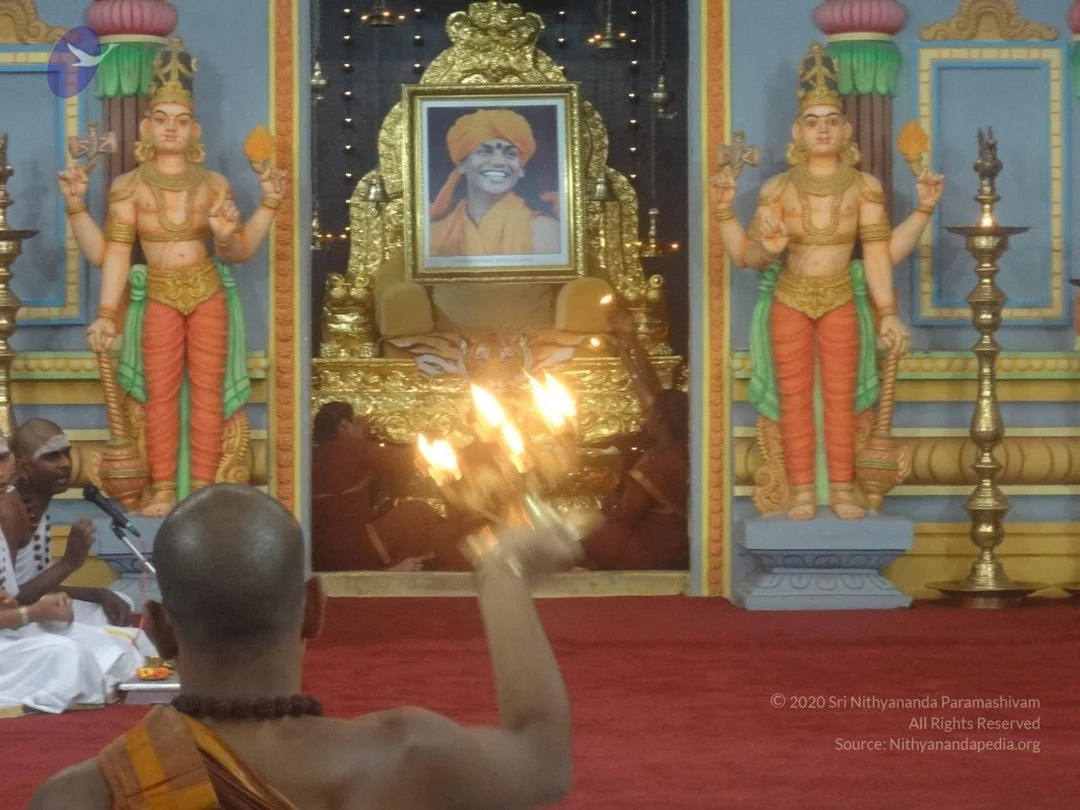
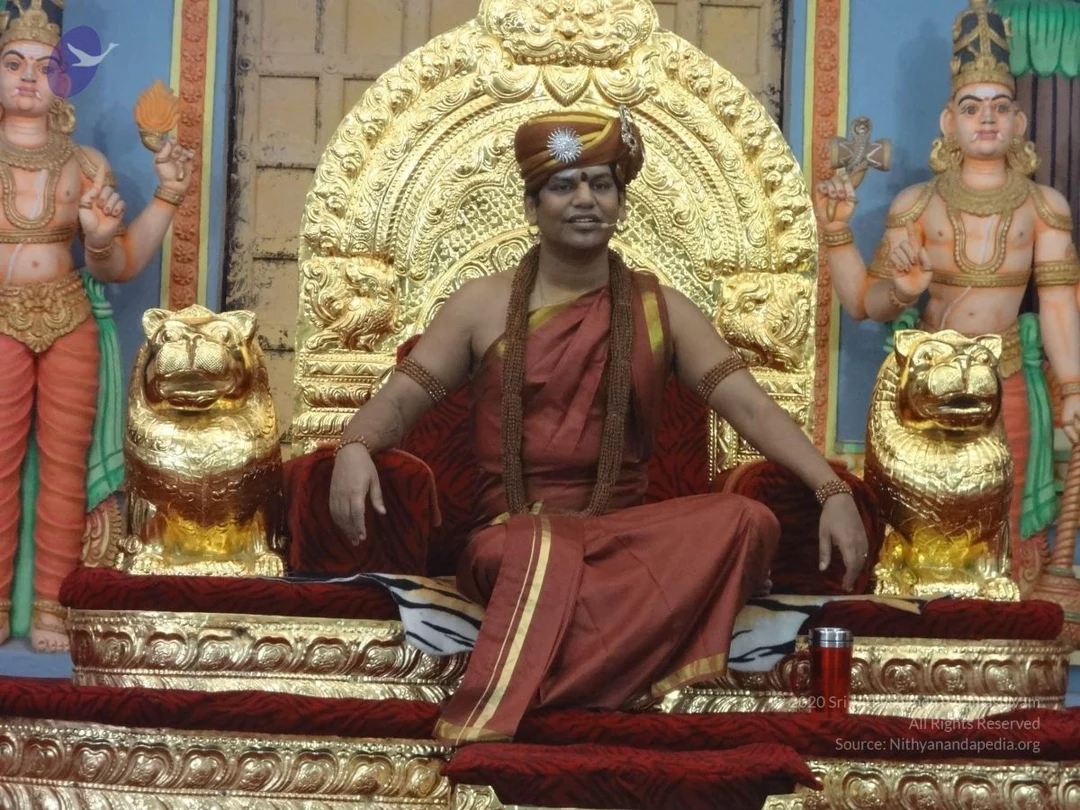
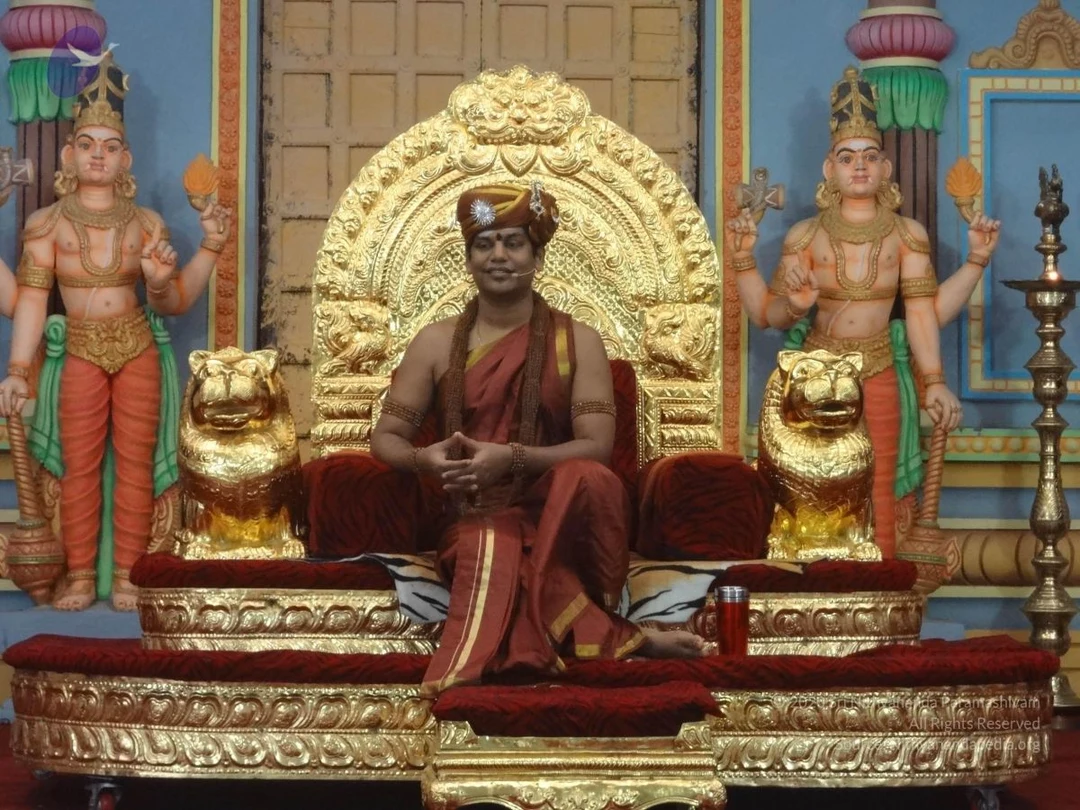
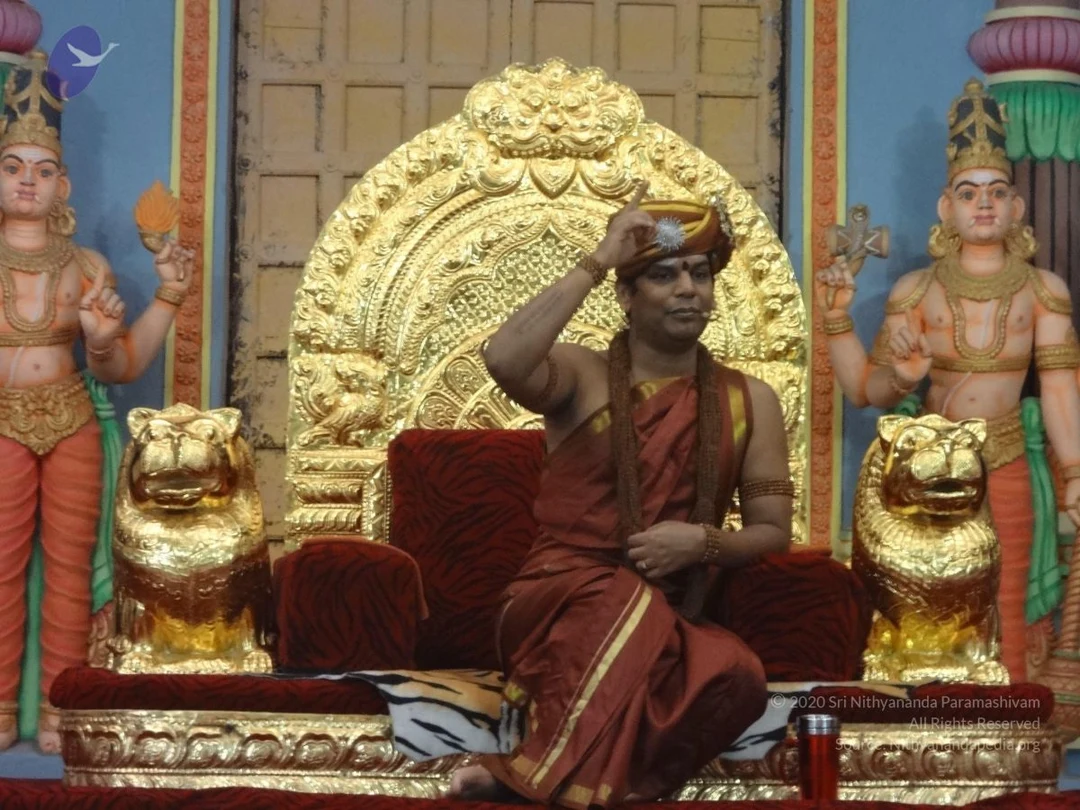
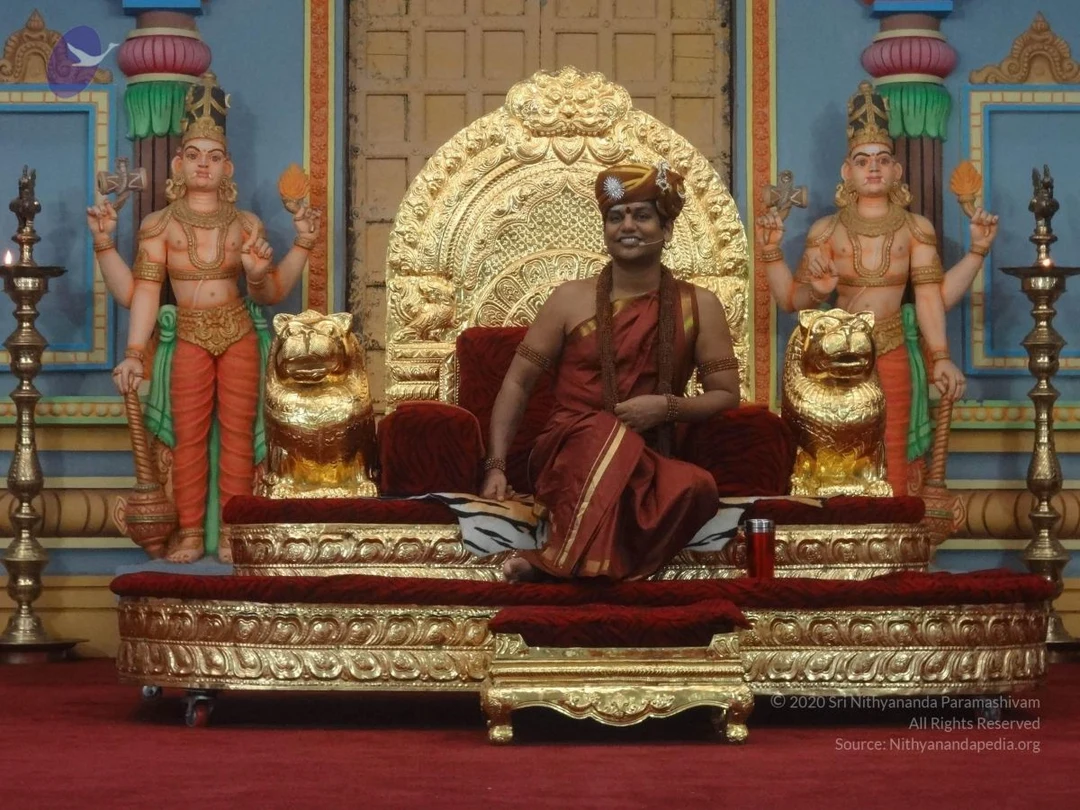
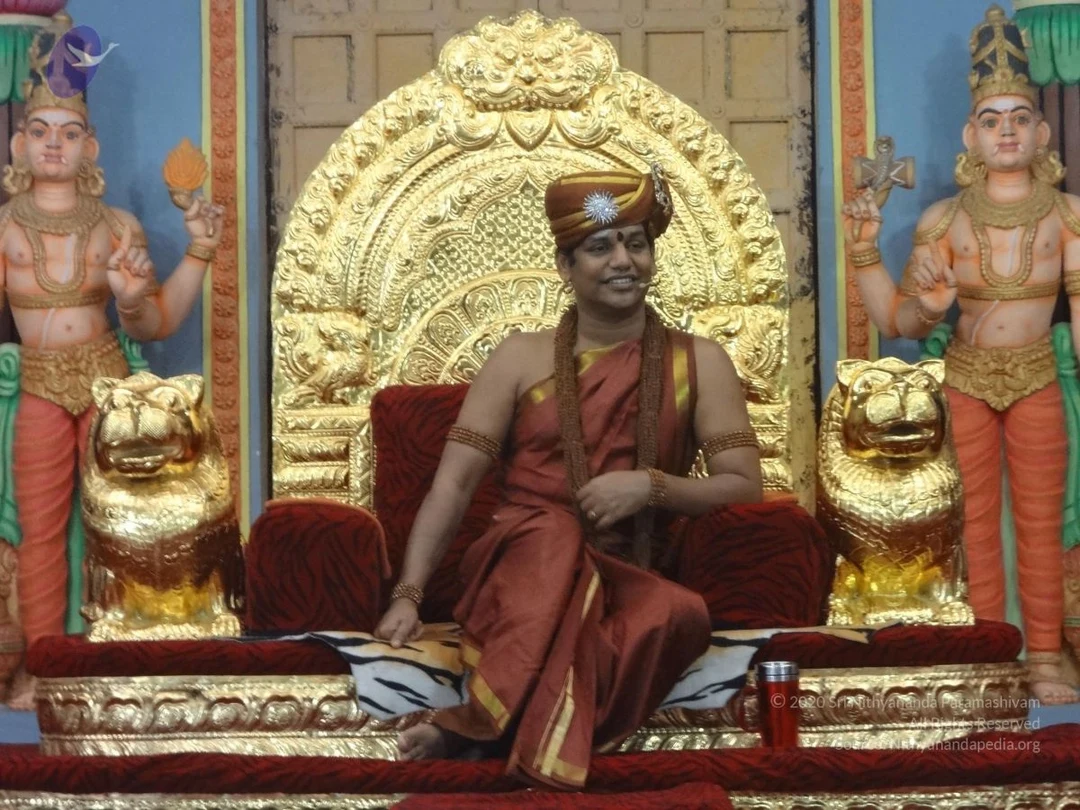
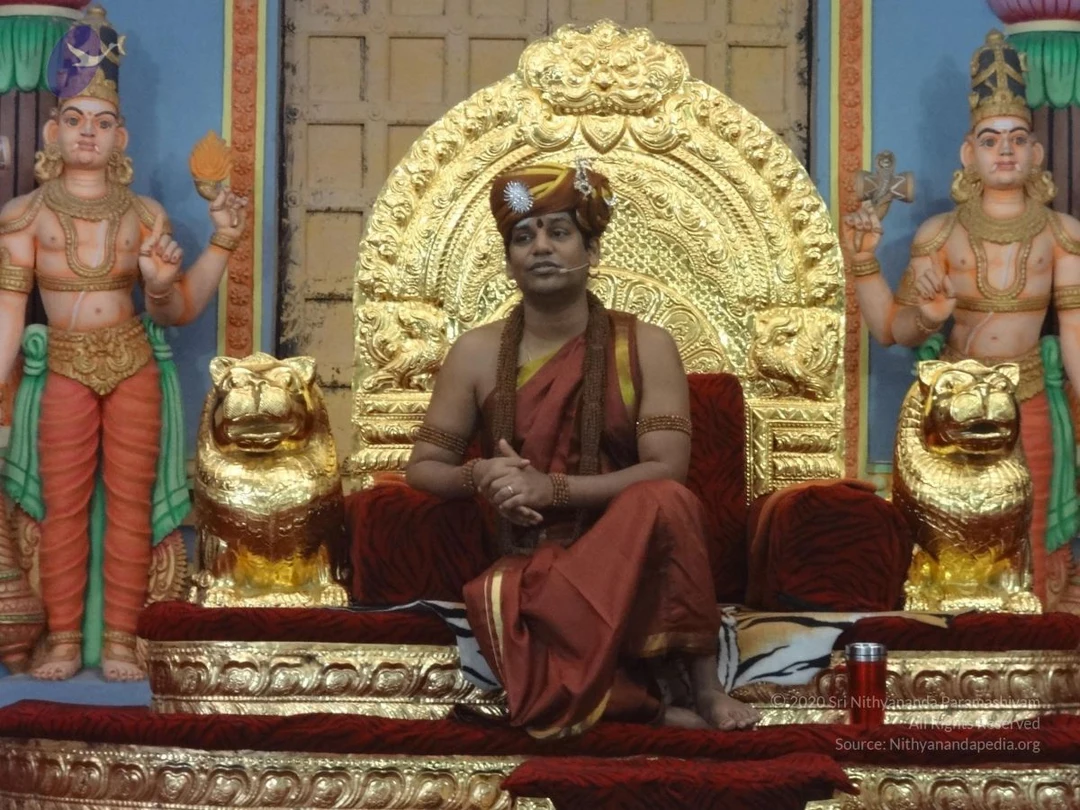
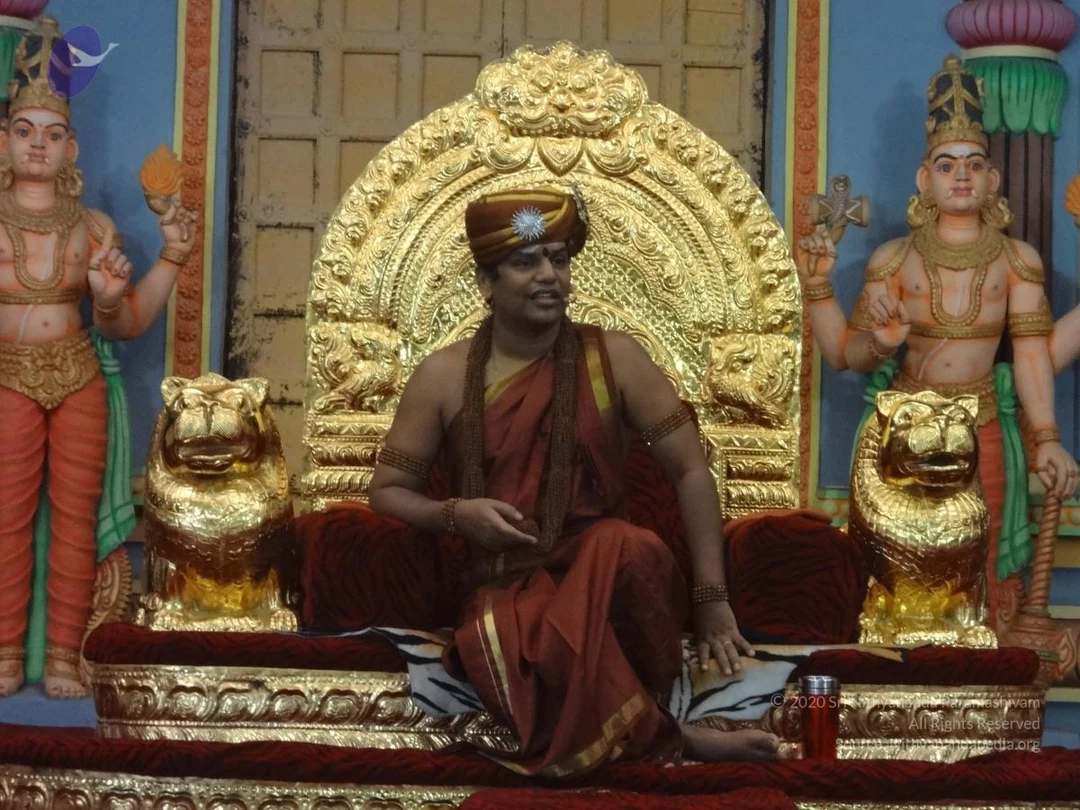
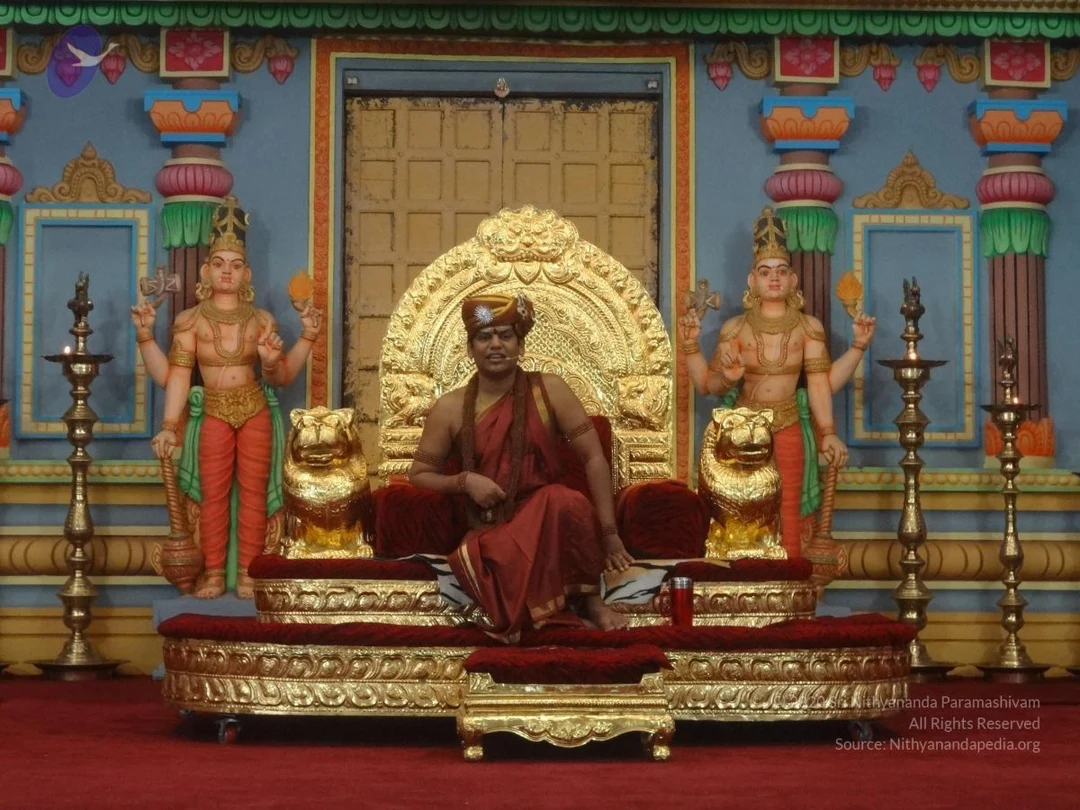
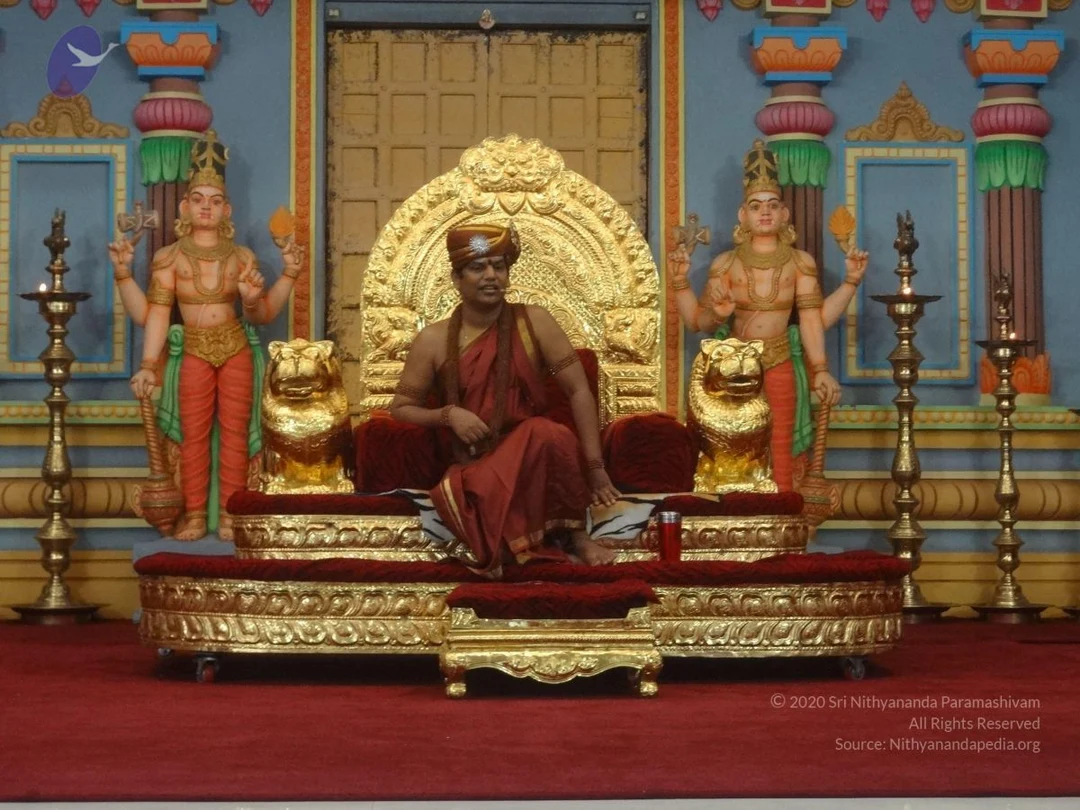
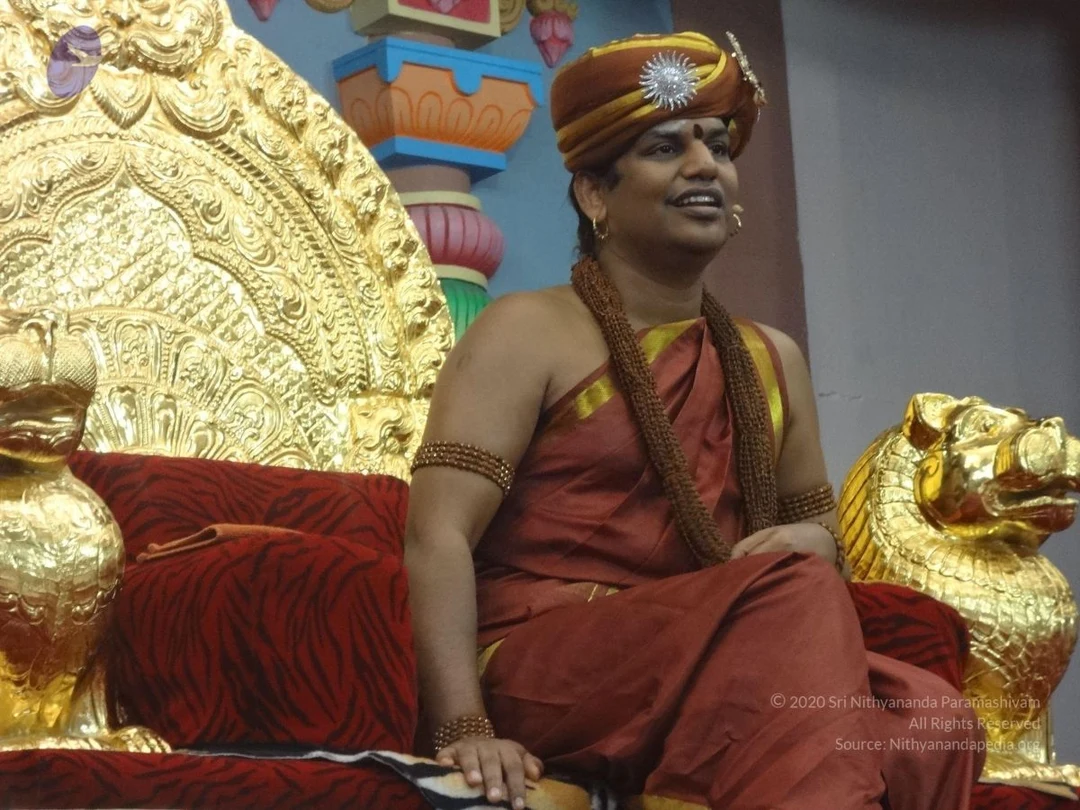
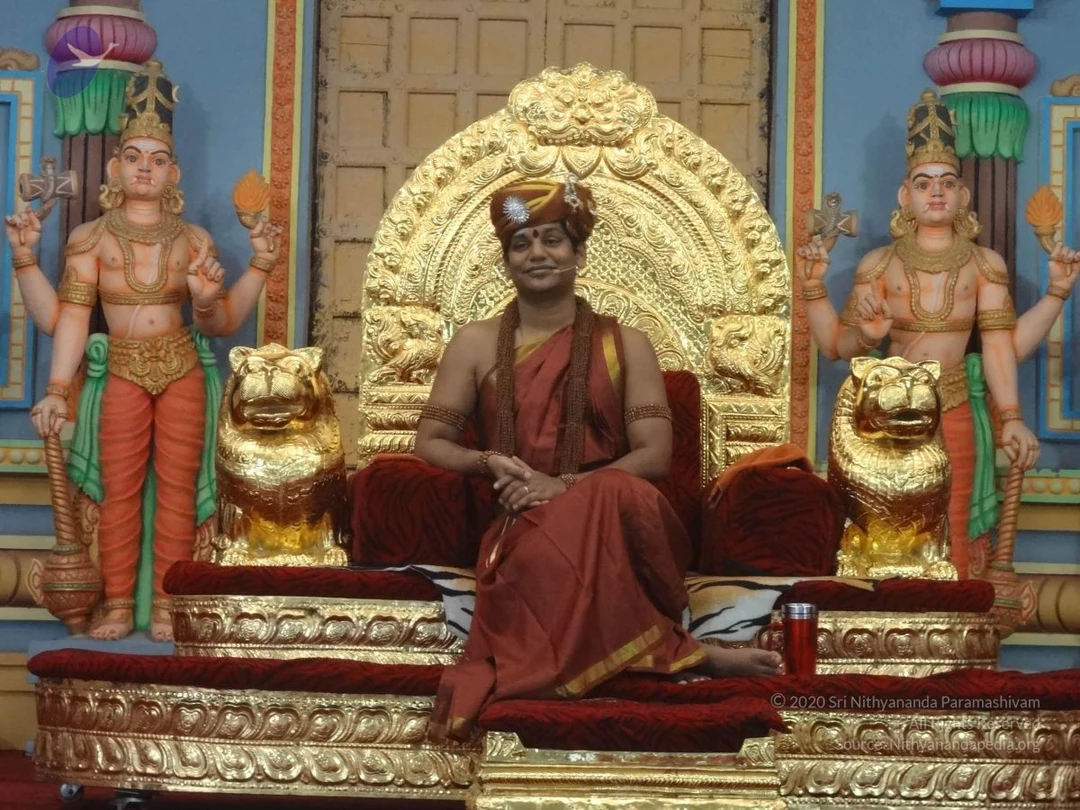
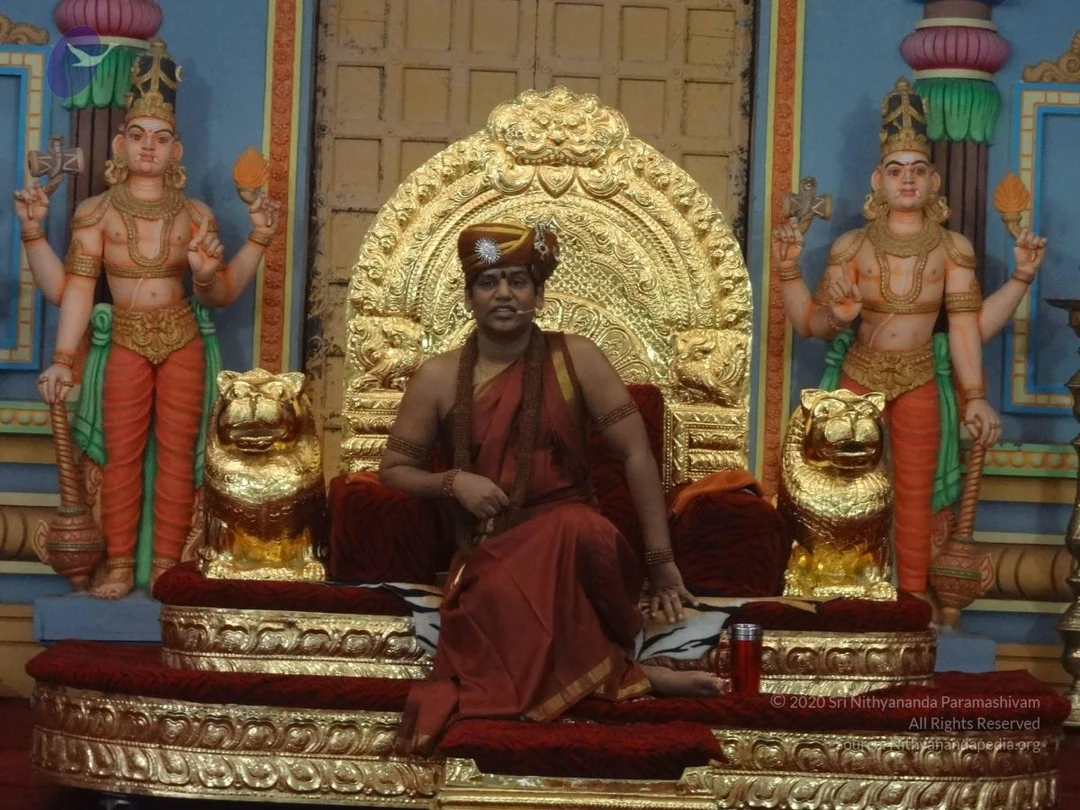
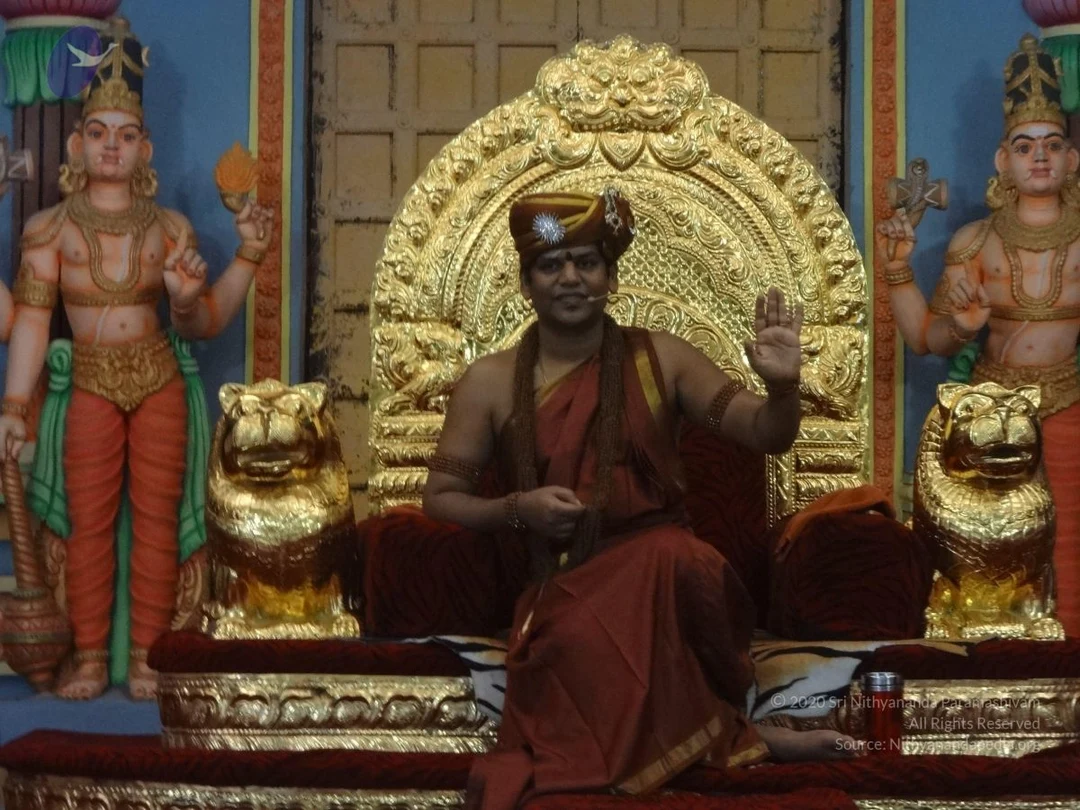
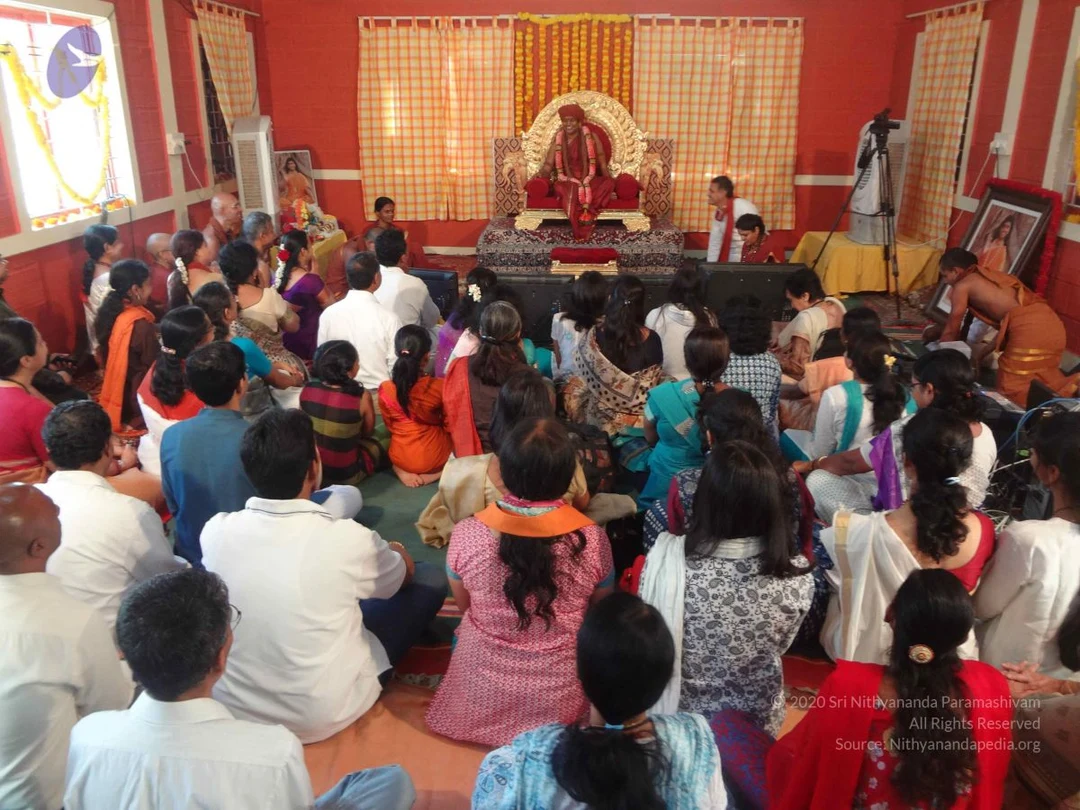
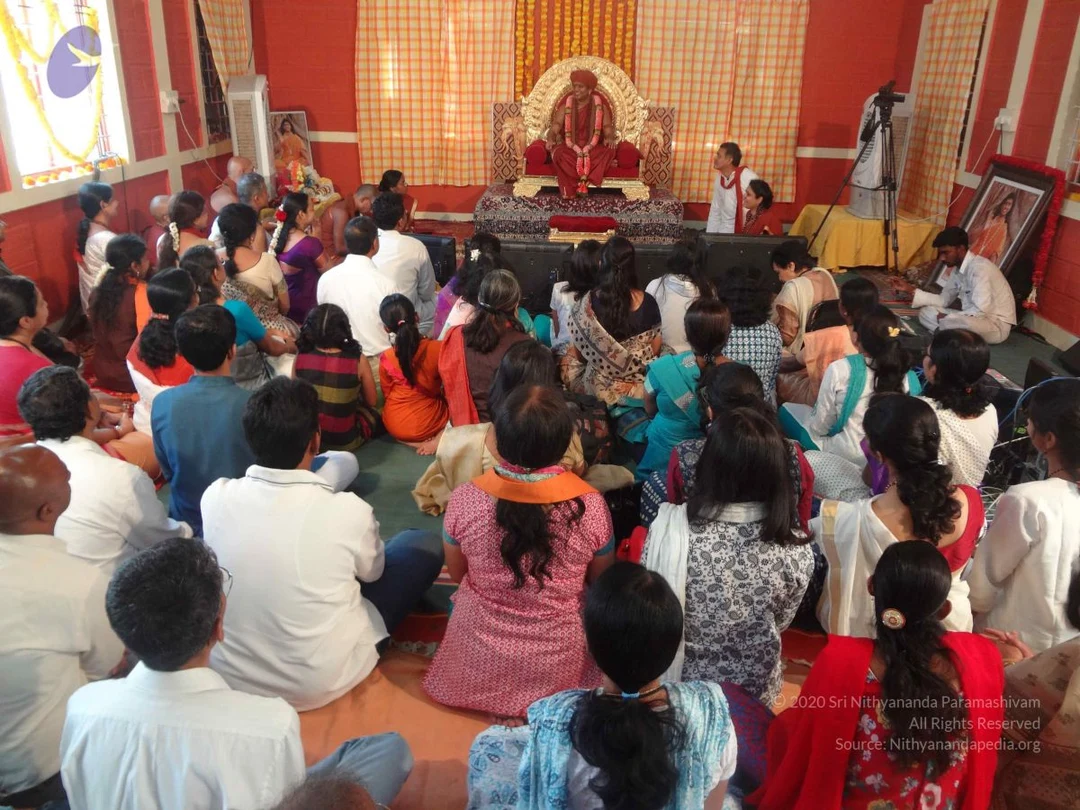
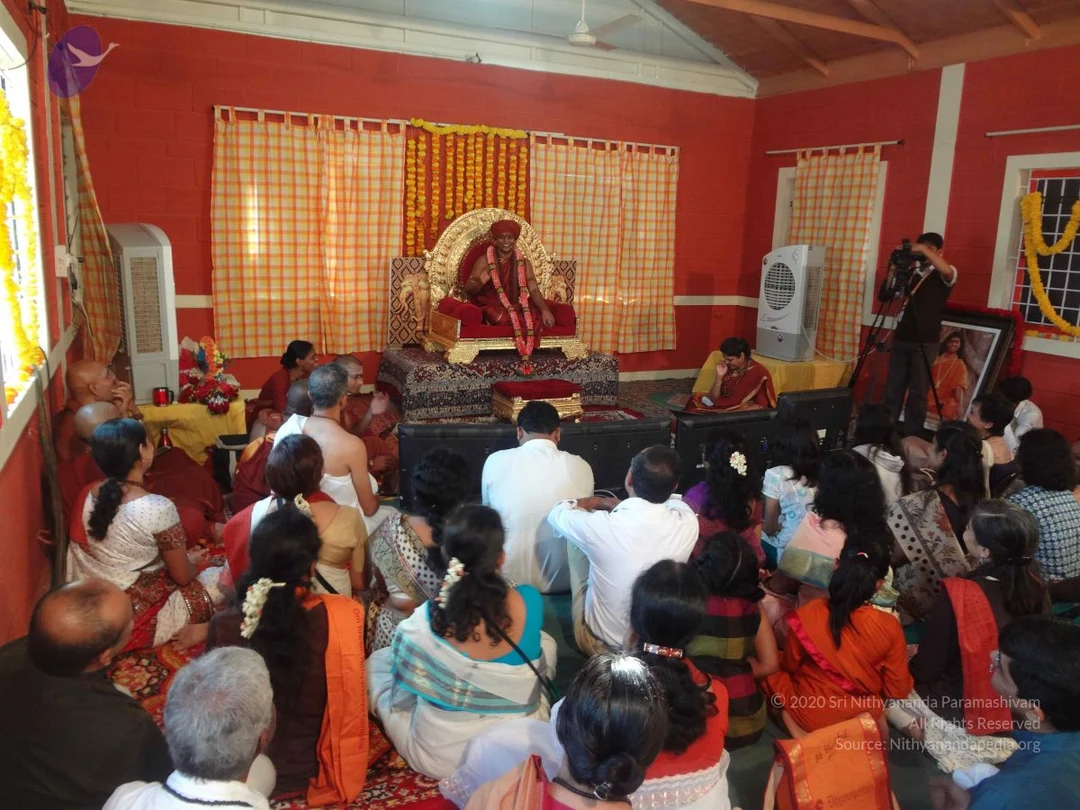
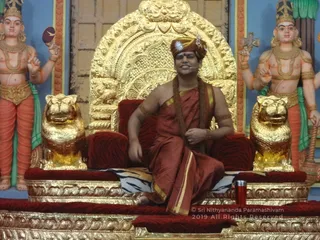
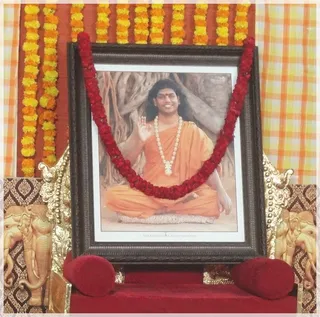
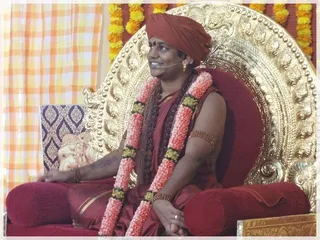
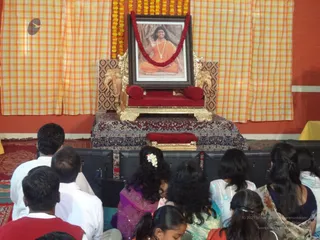
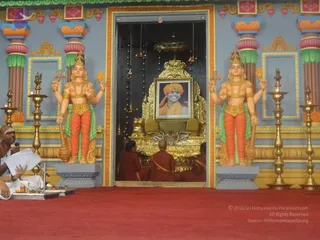
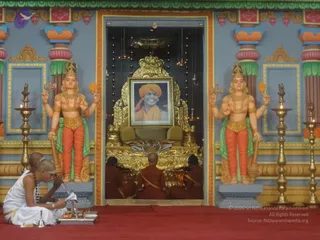
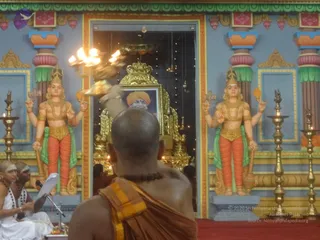
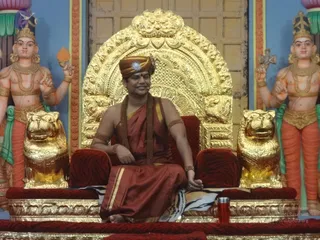
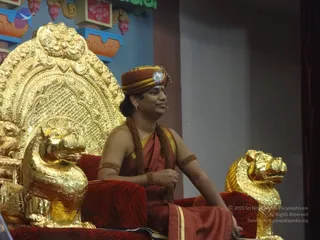
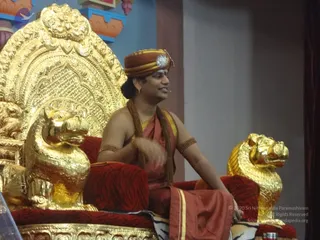
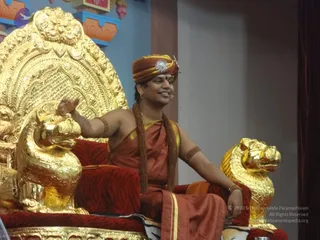
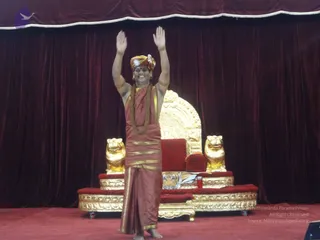
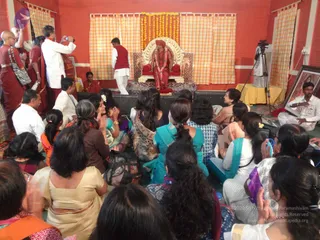
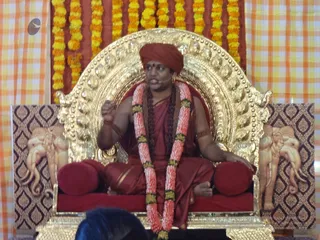
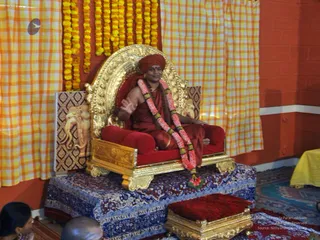
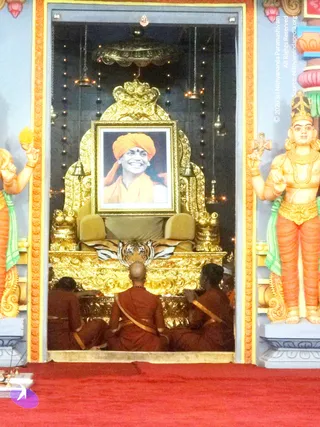
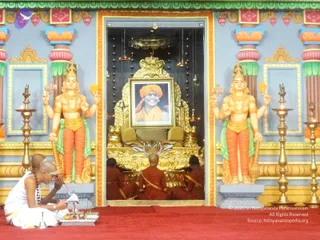
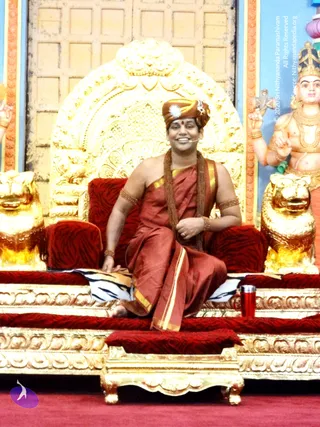
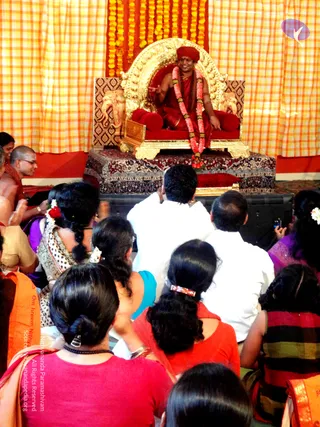
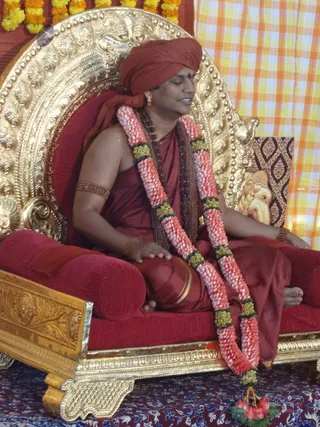
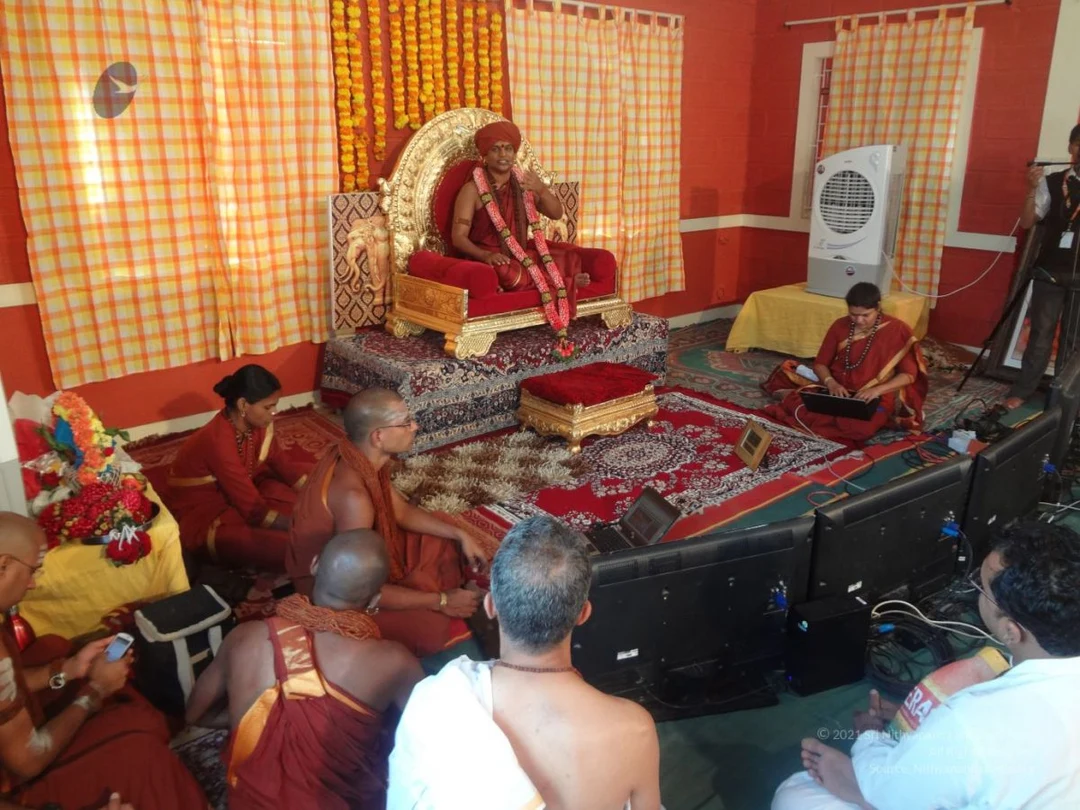
Photograph inside a temple hall with a red carpet. A gilded throne with a tiger-skin cushion sits centre-back beneath a framed portrait of a smiling figure in an orange turban and saffron robes, labelled with a caption. Two large painted dvarapala-style guardian statues with four arms, gold jewellery and green and orange lower garments flank the throne. Several saffron-robed monks sit before the throne offering lit lamps and flowers. In the foreground, a shaven-headed man with rudraksha malas faces away, holding a brass lamp with a bright flame; a white-clad priest with rudraksha beads sits to the left beside a small puja tray. Brass standing lamps stand on both sides.A seated man in a red-maroon saffron-toned robe and a red-and-gold turban sits on an ornate gold-and-red-cushioned throne (peetha) flanked by two golden lion figures. Two painted deity murti statues with four arms, orange-red dhotis and gold ornaments stand on either side, holding ritual objects. Brass standing lamps (oil lamps) frame the throne, and a red candle or glass sits on the platform. The blue and pink painted temple-hall backdrop has a gold-leaf wooden door behind. The man is the only physical person visible. Appearance is consistent with a person candidate in a seated teaching posture, though the face and presentation are not distinctive enough to confirm.A photograph of a satsang hall with red-painted walls, orange and yellow checked curtains and marigold garlands draped on the windows and around a central seat. A figure in a red and saffron robe, wearing a red turban and a long marigold garland, sits on a gold-framed throne with a red cushion and a patterned mat. Seated devotees fill the floor in front: women in saffron, teal and white saris, men in white shirts, and several shaved-headed monks in orange robes sit cross-legged. A woman in a red sari sits to the right of the throne near a cameraman filming on a tripod. Two portable air coolers stand on either side of the room, and a framed portrait sits near the camera.

November 29 2013

Original wiki page
Contents

Title:

Your Failures are not you.

Description:

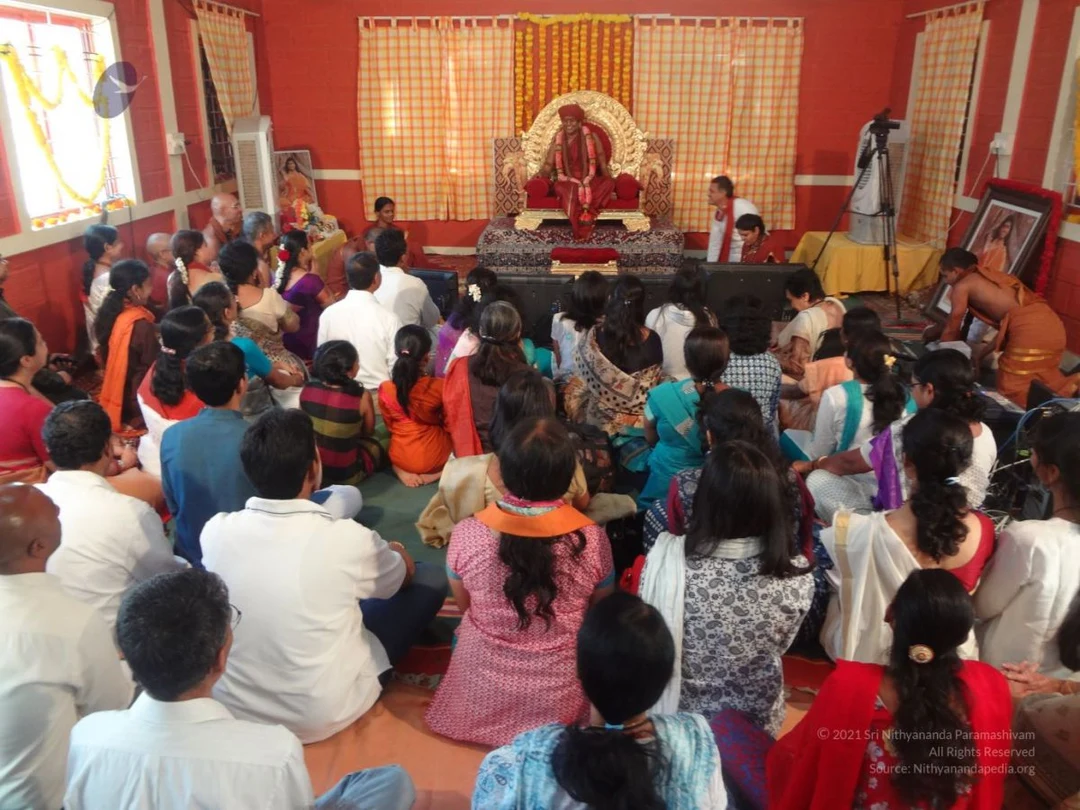
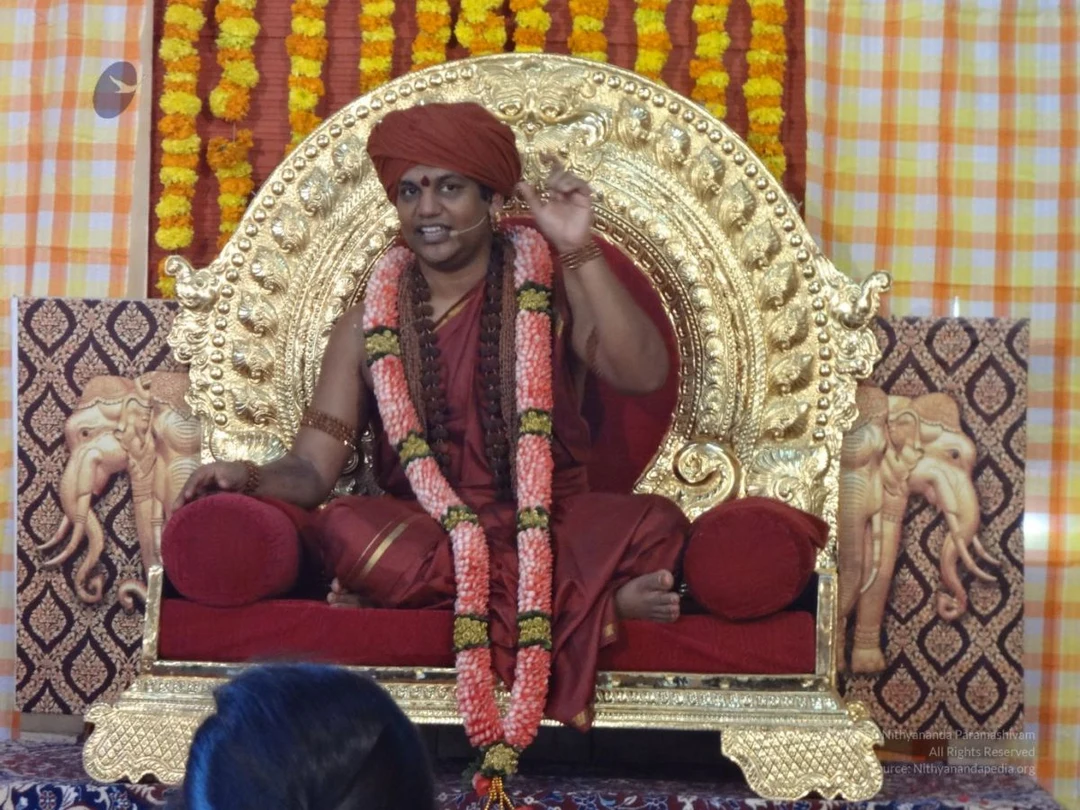
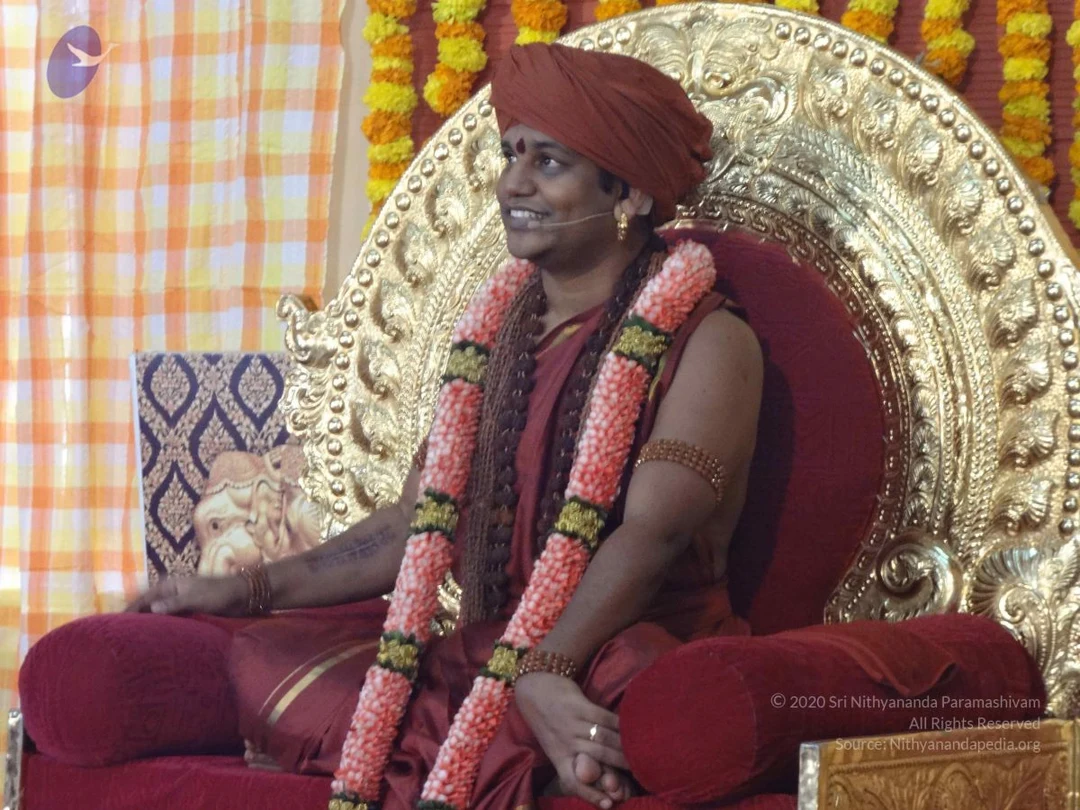
In today’s morning satsang Paramahamsa Nithyananda brought us to the powerful understanding that whatever we think about our self is psychodrama. He went on to explain that always considering the interests of the stake holders as first priority in any action is living in gratitude and living in gratitude is enriching, There should be no personal acceptance or resistance, no fearing or favoring then in success or failure no decision will fail you, you will be operating from the space of completion.

Link to Video:

VideoAudio

Transcript:

Nithyanandeshwara Samaarambhaam Nithyanandeshwari Madhyamaam | Asmadaachaarya Paryanthaam Vande Guru Paramparaam ||

Today I’ll expand on “THE SPACE OF GRATITUDE”. First of all, get back to your Mamakara you carry, the idea of “I” you carry. See, the idea of “I” you carry is surely not the truth; but that is the truth as and now. It is not THE truth, but it is the truth as and now. See, the patterns you carry, the ideas you carry about “I”, what I am. So many ideas you’ll be carrying, some are factual some are comparative, some are existential, some are illusive, some are delusive, some are illusive. Different times you carry different kind of Mamakara. The Mamakara you carry, if you just understand these two things like,’ what I am carrying as my Mamakara it is neither the truth at the same time that is the truth as and now.’

When this understanding comes inside you, when this understanding happens inside you, you will understand one truth: The whole thing, the whole thing is psychodrama. The idea that you are man, you are woman, you are son, daughter, even the idea you are my disciple, everything is psychodrama.

Please understand, because you are sitting there, you are sitting there; because I am sitting here, I am sitting here; because you behave the way you behave, because the way I behave the way I behave. Please understand, because you are sitting there, you are sitting there; because I am sitting here, I am sitting here; because the way you behave the way you behave, because the way I behave, behave the way I behave. There is no reason why you should be disciple, why I should be Guru; there is no reason why you should be listening, why I should be talking; there is no reason why you should be there, why I should be here. Please understand, when you understand the whole thing is a psychodrama because – please listen, come to the space of listening, it is a very, very important sacred secret – when you understand the Mamakara you carry, the identity you carry is neither the truth, but at this moment it is truth, then you will understand every time the Mamakara rides, as long as the action exists the Mamakara rides and Mamakara exists; without Mamakara there is no action. This will give you the clarity everything, whether you think you are a good person or a bad person, sometime good person and sometime bad person, sometime sick person and sometime healthy person, sometime having love and friendliness and sometime not having it, sometime joyful and sometime filled with hatred, sometime intelligent and sometime dull, so many things you will be thinking about you, sometime you will think you are intelligent and sometime you will think you are dull, whatever you think is just psychodrama.

Sometimes you will appreciate your own ideas; sometimes you will say ‘What a fool I am’. So, whether you appreciate your own ideas or you think what a fool you are, everything is just psychodrama, please understand. But you are afraid to see the truth t everything is psychodrama, because you are afraid that the whole thing will collapse! It is literally like if suddenly this building suddenly starts melting like a wax, how you will feel? You will feel so insecure. That is exactly the way, because suddenly everything, everything inside you and around you will start melting down if you feel the whole thing is psychodrama.

Every day I am not able to come to devotee’s house and maybe, both the team, if both of you guys sit together and work, you will be able to come up to some conclusion some, how to use my time more better that’s all.

See, I want you all to understand these few things. When you look at the thoughts without acceptance and without resistance, you will realize the whole thing is a psychodrama. If you realize your eating pattern and sleeping patterns don’t have any power over you, that itself is a realization that both these patterns are also psychodrama. For example, put yourself in the situation where I am. Like, ‘come on its only one hour work extra let me wake up one hour early and be here.’ What all resistance you will have, tell me? How many of you will think you will surely have the resistance related to your personal life – either food or sleep? Raise your hand. That is where you do not realize that is your lifestyle and thinking. See anything which comes from your Mamakara is a psychodrama. What I am talking is one of the highest truths of Advaitha. I know I am introducing a too big principle, but this cognition can liberate you from the restrictive mentality. See in this whole what happened inside me, I neither decided for nor decided against, but I am very clear I do not have any reason to stop it and I do not have any reason to make it. Now I am only going to ask the others’ convenience. I tell you, this is the best space to exist. In every situation of life if you see others’ convenience, you are Enriching, you are living Gratitude.

So, these two days, the Thanksgiving Weekend, internalize just these two idea, just these two idea. Anyway, tomorrow there is satsang. We made the whole travel such a way that I won’t miss satsang. Tomorrow there will be satsang. I will continue to expand deeper just these two idea.

The first idea: Anything comes inside you, whether the ideas that you are good, you are great, or the ideas you are a fool, you are wrong, or the ideas you are sick, you are healthy, anything – like today I gave you one small example of what was happening inside me when I was travelling – anything, do not accept, do not resist. Start looking at the whole thing without acceptance or resistance from your patterns from your side. I tell you, suddenly you will realize everything is psychodrama, everything is psychodrama!

I can give you one more example. Sometime you will see in your life your friends, family, neighbours failing in business. You start building little fear, ‘Who knows, I may also fail! Who knows, this may happen to me!’ But you console yourself, ‘No, no, no, not for me, I am.....’ Or you see some families collapsing, divorce or untoward incidents like accident or a death. You start building a space. Or even the positive angle – somebody gets lottery or successfully achieves something. You start building either greed for that success, or the resistance, fear for the failure. But, actually, when that happens in your life unexpected, whether that negative thing or positive thing, suddenly you will see the both does not have that big an impact as you were imagining. See, before that failure happens, you mother so much fear, like a hen mothering the egg, ‘Oh, if that happens over, better let me have poison in the reserve, or a rope to hang myself.’ Or, ‘If this happens, if success happens, you know I will just take the vehicle and go around Bangalore and declare my victory! In the vehicle itself I will have music and dance!’ When that becomes actually both impacts does not happen that much on your system which you imagined. How many of you have seen this experience in your life? So, do you understand, you go on building psychodrama? Neither your failures are that big failure, nor your successes is that big a success. It is the psychodrama that you create over the success or failure that has an impact on you, not the actual happening.

Now, I am coming to break the next psychodrama. The moment I said I am going to start giving everyday satsang in the Bangalore, the claps and the faces lit up, everything! No, but understand, after two months what will happen? ‘Swamiji comes every day what is there? On weekend we can go and have darshan. And it will be nice if the Centre is nearby my house and the centre is 20 minutes’ drive.’ Now how many of you are very honest that this is going to be your conversation inside after two months? The truth, you understand? But I am not resisting this kind of slackness that may happen in you. I am not resisting it understand and, same way I am not supporting it, I am not saying, ‘all right,’ I am not encouraging it, this mental setup.

You all know great seeker, Paul Brunton. A very honest, integrated westerner towards the spirituality and Hindu tradition. Paul Brunton, a great devotee of Ramana Maharshi and Kanchi Paramacharya, after his third visit to Ramana Adheenam. - He visited many time. His first visit only he records in a book, ‘Secret Search in India’, or something related to this kind of a title. One of a very honest seeker, third visit he goes and asks Bhagawan, ‘Bhagawan I don’t want to go back to West. I just wanted to stay back and live here. This Arunachala is so heavenly!’ Bhagawan just laughs at him and says, he was actually spending a few private moments with Paul Brunton, no devotees, he was alone walking and very few devotees get the opportunity to carry the water pot when Bhagawan goes to clean Himself. I think you understand in Indian system there was no toilet in those days. I don’t know whether the idea of toilet was even introduced in India at that time so they only use the open space in some forest bushes. Some devotee will carry the water pot for Bhagawan to clean Himself. So when Bhagawan was walking, Paul Brunton was carrying the water pot and Paul Brunton said, ‘it’s heavenly I wanted to stay back.’ Bhagawan turned and smiled. ‘Stay here for a two, three days all these ideas will come alright.’ No you cannot imagine Bhagawan says, ‘This hill is not separate from me! I am this hill and this hill is me!’ And who did not leave the breathing space of the hill, from the moment he into entered the breathing space not once he left the boundary of the hill. He can make this comment! It’s almost like a, the unexpected shocks from the masters. It is like a, there are some shockers in some great masters’ lives which you will never expect they uttered or which you don’t want to believe they uttered.

Once, one guy goes to Ramakrishna and... If you read Ramakrishna’s biography, you know his name is Girish Chandra Bose drunkard, womanizer, everything, what not. He goes to Bhagawan and asks, Ramakrishna, ‘Bhagawan how can I save myself from all these Karmas? Should I give up all this? Don’t think I’ll be able to give up drinking and womanising.’ Ramakrishna just smiles at him and says, ‘before drinking remember Kali and offer it and drink. Before you womanise and understand that is also act of life and do it.’ No you can never imagine Ramakrishna telling this and I am very clear I am not saying yes or no about it. I do not want one more controversy. No you will never expect a person like Ramakrishna takes this so lightly and says, ‘ah it’s ok just....’ One guy goes to Osho and asks, ‘Bhagawan I am little flirty type, what to do?’ Suddenly Osho says, ‘decide to be celibate from this moment, control yourself.’ Which you will never expect from Osho.

The masters do give shocks so I can say that this statement of Ramana Maharishi’s, a shocker one. I tell you honestly; when I read that I tell you I was shocked! I said,’ how can you tell?’ Because I always felt that I am Arunachala so it’s a ....’ How dare you tell that about Arunachala?’ But what he said if you see from the ultimate truth it is truth, it is truth. Whether it is idea that Arunachala is heaven or idea it is hell, it is the ideas makes the psychodrama the reality is neither hell, neither heaven.

Understanding the reality is neither for nor against, understanding this whole thing is psychodrama, gives you the clarity, gives you the experience. I tell you, that experience gives you the clarity to make any decision based on others. Today exactly what happened in me, idea, one idea comes. He said, Mokshapriyan sent a message, ‘Many devotees have gathered and many we are expecting’, and immediately the idea, ‘Oh, God, what a nice thing all these guys will see me and surely they’ll be happy and they can at least get one blessing and touch.’ Then the next idea, ‘What stops this happening every day? Nothing because I don’t have a problem of waking up one hour early and being here is only one hour drive, nothing else. And after all we have a property in Bangalore it’s not that we don’t have a property. We have a property around 10,000 square feet or something. Two properties we have. One is a flat so you can’t go there but another one is a property, land so even if we construct it and start doing it thousands will have darshan every day. What stops it?’ So, from my side there is no resistance and there is no acceptance. I am neither jumping into it, saying that ‘Wow! Yes, yes, yes, it will be great! ’ So, neither am I supporting nor resisting. Then I thought, ‘Alright, let us ask the people who are involved, their convenience.’ So, the decision is now going to be taken based on the others’ convenience.

I tell you, taking the decisions always asking others’ convenience is “living in gratitude”. That is the definition of “living in gratitude”. That is the meaning of “Enriching”. All actions, without involving your acceptance or resistance is “Enriching”. That is the definition of “Gratitude”. In every small decision, neither your resistance nor your acceptance should be participating. Understand, this I am giving you as a very small example but you may have to apply it in your life in every situation. Say very clearly to yourself, ‘In every decision I will not allow my resistance or my acceptance, my fear or my favouritism to be the decision-making authority. I will always see to it the interested parties.’ You see any decision, not only you are the interested party, there will be some other people interested party. ‘So, I will always put that as the first priority’ is “Enriching”.

25:03

I think I have given a most practical, most straightforward, most powerful definition of “Enriching”.

And, after two months, anyhow now, because it’s a new idea, all of you will jump on it. One will say, ‘I will put up the pillar for the building’, ‘I will put the roof for the building’, ‘and I will put the speaker for the building.’ It is a new idea so everyone will naturally jump on it. And, after six months, if it is the same people who come and sit in Bidadi Adheenam, I have no problem, because, I have not favored it. I neither resisted it nor favored it. So, I’ll only see the stakeholders’ interests, who are all the stakeholders, their interests. Because it is based on the stakeholders’ interest, neither I fear nor do I favor. I have no problem whether it takes off or fails. It can take off. It can take off. Suddenly thousands of people will start attending the satsang in Bangalore every day! It may take off! And I am holding the space for it to take off. So, I’m taking the responsibility for it to take off. There is every possibility. Because, Bangalore is an English-speaking city, there is every possibility that thousands may start pouring in, and thousands may get the benefit. Then naturally, the decision will continue to be executed, because the stakeholders’ want it. The stakeholders’ want it. Then, even if there is an Inner Awakening in Bangalore, even if there is an Inner Awakening in the ashram, there is no “for” or “against” from my side.

See, actually, I have done a post-mortem report of what happens in me. I have opened it and presented it to all of you, for you to learn the lesson from this; how without fearing or favouring, decisions can be made in your life. So, whether it is a success or failure, you will not be affected. This way you will not become tired. I tell you, I have made thousands of decisions. Many have become successful and many have failed. It is not that all my decisions have become successful. Many succeeded, many failed. But, never any decision could fail me! Because, it was always based on the stakeholders’ interests. It was always based on “Life is for others”. It was always based on ‘decision of Enriching’. If more are getting enriched, say “Yes” to it. If the stakeholders’ are not interested, leave it. I tell you, this is the best form of existence. This is what Ramana Maharshi calls as “Aham Spurana”. Ramakrishna calls it “The space of devotee – surrender”. Osho calls it “The empty boat in the river”. I call it as “Ananda Gandha”. All these different titles – what Ramakrishna calls “Space of a devotee – surrender”, what Ramana Maharshi calls “Aham Spurana”, what Osho calls “Empty boat in the river” or the “leaf floating in the breeze”, but I call it “Ananda Gandha”, “Operating from the Space of Completion” – all these are one and the same!

Always tell yourself, ‘I will not vote neither for nor against the happenings. I’ll put the stakeholders’ interest as the first priority. In every decision, at least a few people will be involved. It is not that only you will be involved. So, I will put the stakeholders’ interest as first priority and I‘ll see to it that I will throw myself into the decision completely without fear or favour.’ Without fearing or favouring! This is the definition of “Enriching”.

Please understand, as I was telling, sometimes masters give a shock. As I said, Ramakrishna telling Girish Chandra Ghosh, ‘eh, it‘s okay, do whatever you want, just remember me and if you can’t it’s ok, now tell me and give me the GP and I’ll remember you!’, it is a shock! Same way, Osho telling, ‘No! Be a celibate. Control yourself completely’, it is a shock! And Ramana Maharshi telling, ‘Be here for two days, all these ideas that it is heaven will settle down’. About Arunachala! It is almost like me telling somebody, ‘Completion is useless. Don’t bother. Staring at the mirror is nothing but the preparation to do facial tomorrow, that’s all. If you’re staring at the mirror every night, you’ll only be thinking, ‘tomorrow I have to clean my eyebrows, I have to do threading, and I have to do facial, I have to clean my face’. You’ll be planning only that. ‘Completion is useless, leave it.’ It’ll be a shocker!

Please understand, I am not making this statement, be very clear! HAHAHAHAHAHA...! But, if I tell this, it is equivalent to Ramana Maharshi saying, ‘ah, it’s ok be here and in two days, everything will become alright.’ So understand, masters making give shocking statements. Here what I am saying, it may be a little bit shocking for you, but this is The truth! This is the truth! When I make a statement, ‘Why you should sit there? Why I should sit here?’ there is no reason actually. May be one word I can say, I have understood it is psychodrama, you have not understood it is psychodrama, that’s all! Because you have not understood, you are getting punished and made to sit there. Because I have understood, I am sitting here, that’s all! It is like a punishment, why you are not understanding!

So, no decision should be made with your direct fear or favour involvement. I think this is the most powerful, precise definition I have given on “Enriching” and “Gratitude”. Please understand, gratitude comes from the depth of your personality. It is not the smile you carry in your lips, many times for social reasons. No! Gratitude is the emotion which comes from the depths of your being with the tremendous understanding that life is psychodrama.

As I said, let all your decisions not be interrupted by fear or favour of your patterns. Neither acceptance nor resistance! Put the other stakeholders’ interest in the front…… and one more thing, even when you put the other stakeholders’ interests, don’t choose which stakeholder’s interest you’ll give first priority! Now I cannot say, ‘I’ll give the ashramites’ decision as the first priority’. Then, that means I am choosing them! Then again my fear or favouritism has entered!

All decisions: see both sides’ interests; whichever side’s interest is more integrated, favour that. Which interest is more authentic, favour that. That’s all. Functioning out of Gratitude!

Now, in this situation the ashramites are the stakeholders and the Bangalore Sangha are the stakeholders; just see who is going to be more integrated to their decision, more authentic to their decision; more responsible in their decision and more enriching with their decision, say yes to it, that’s all. Clear? So even in this, you have no right to favour or fear! Neither directly nor indirectly will you favour or fear.

Sometimes I’ll do this drama in the ashram. If somebody needs to be disciplined, I won’t tell directly, I’ll call another one Brahmachari or Swami and say, ‘hey, you go and ask this fellow all these questions’, and this fellow to whom I’m telling; see I’ll tell A to go and ask B all these questions and this A will be thinking, ‘Why is Swamiji telling me to go and ask him all these questions?’ Because, A also needs these lessons! I’m training “A” by making him ask “B” the same questions about which he also needs to be trained. And, this fool will be thinking he has to train B and he will go and do the job. And, when he comes back, B would have asked A the same questions and both would have understood that both of them need this training!

I bless you all. Let you all radiate with Integrity, Authenticity, Responsibility and Enriching, with eternal bliss, Nithyananda! Thank you!

Photos
Tags:

Paramahamsa Nithyananda, psychodrama, gratitude, enriching, acceptance, resistance, space, completion

Photos Of The Day:

House-Visit
Photos Of The Day:

Paduka-Puja

Satsang

Sarva-Darshan

Sacred-Arts

House-Visits

01-Receiving-Swamiji-In-Bali

01-House-Visit

01-Paduka-Puja

02-Satsang

04-Sacred-Arts

05-House-Visit

01-House-Visit

20131129_Photo_1000_20131129_DSC04708-3801

Photos from this day

View all 203 photos

Photos

7 photosSource gallery
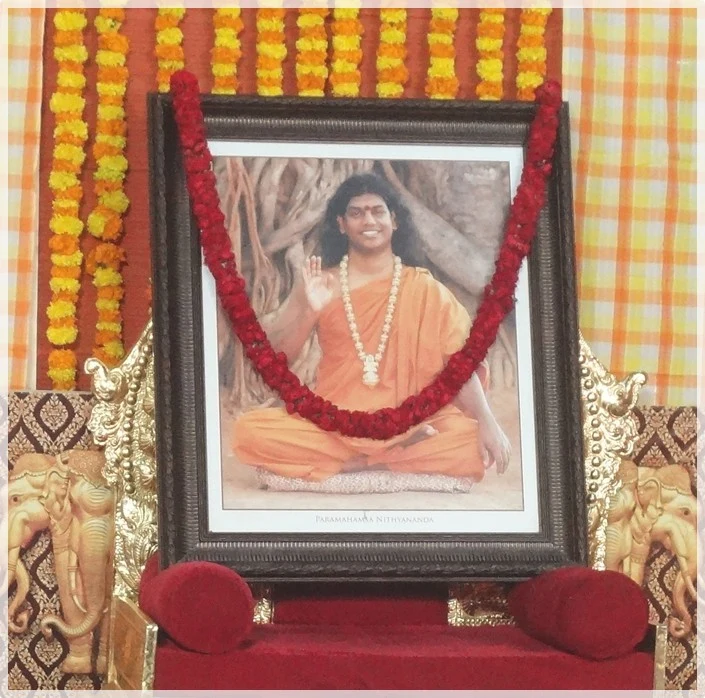
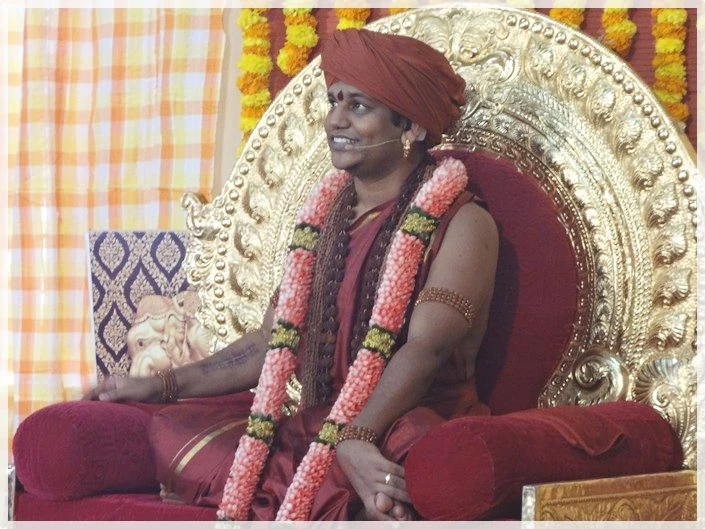
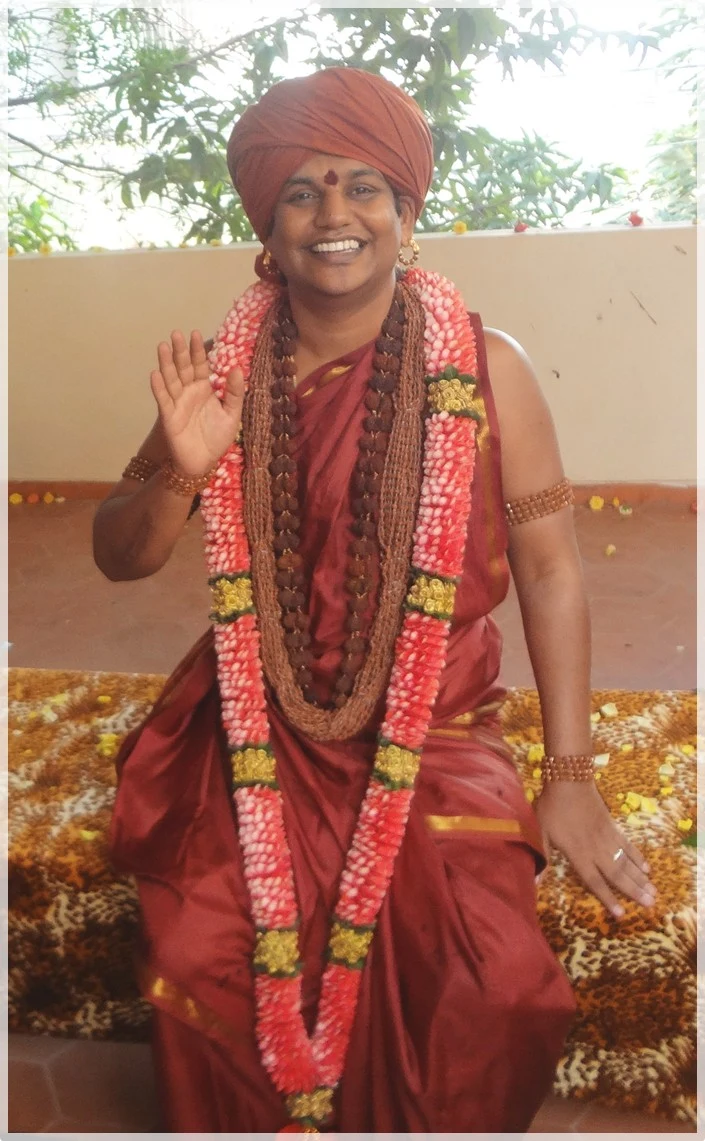
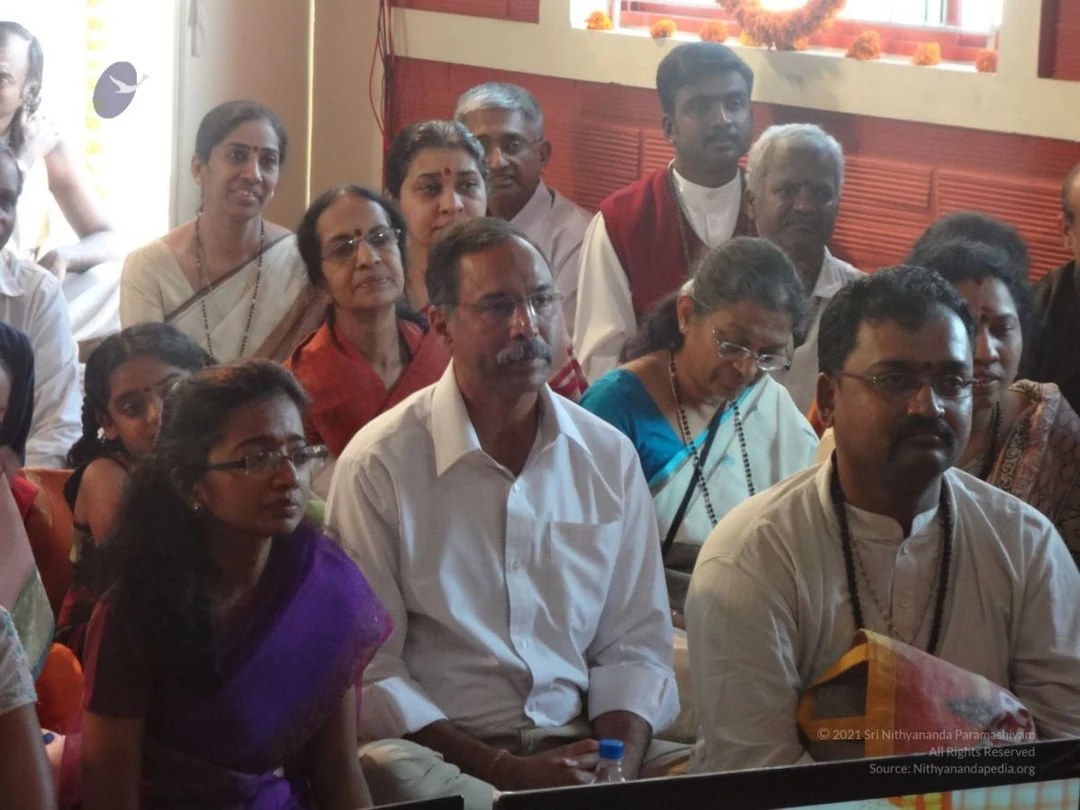
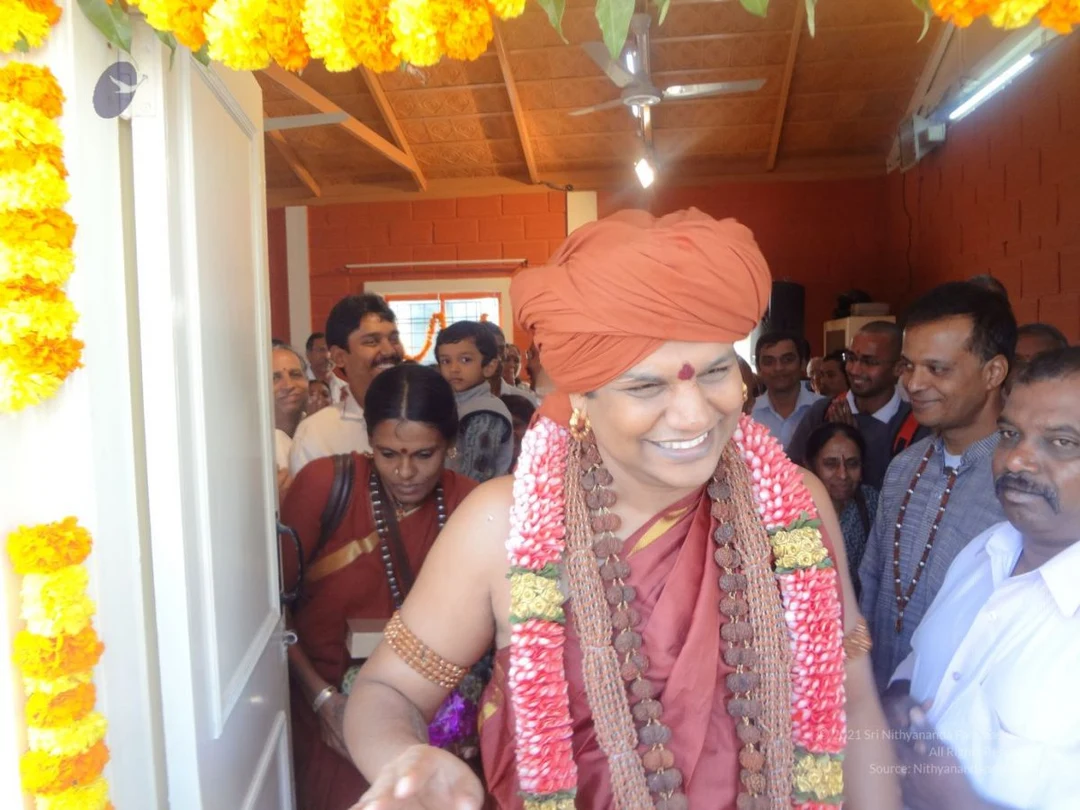
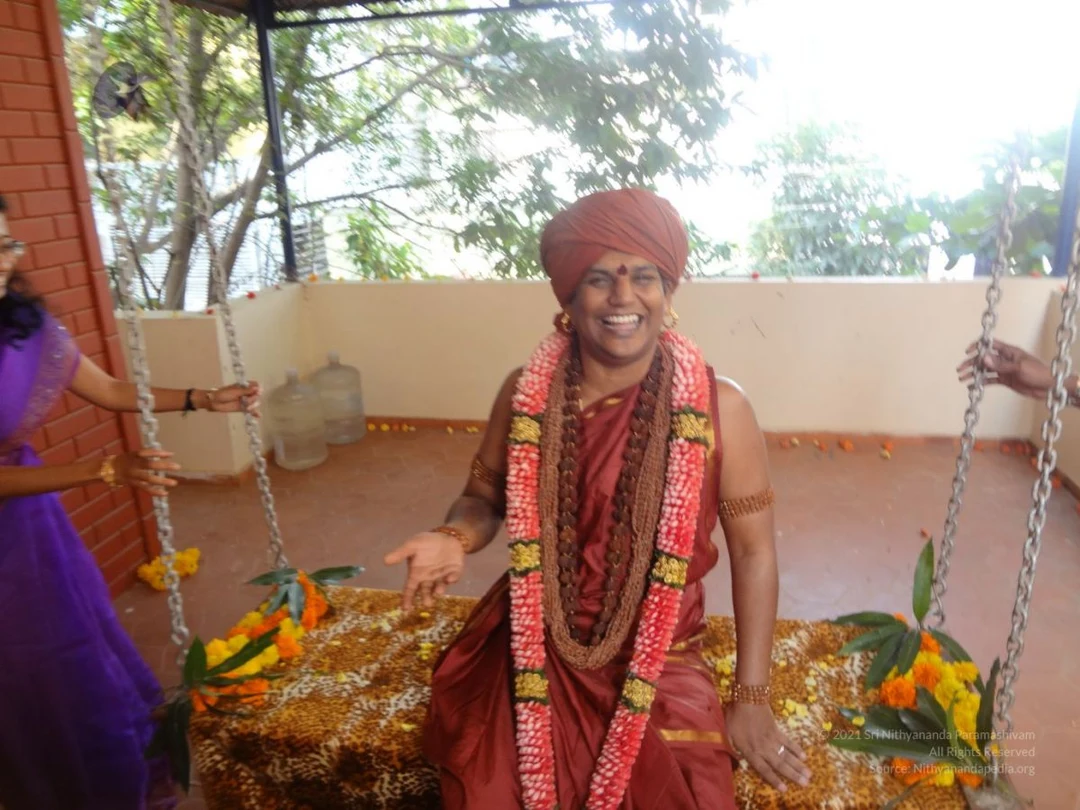
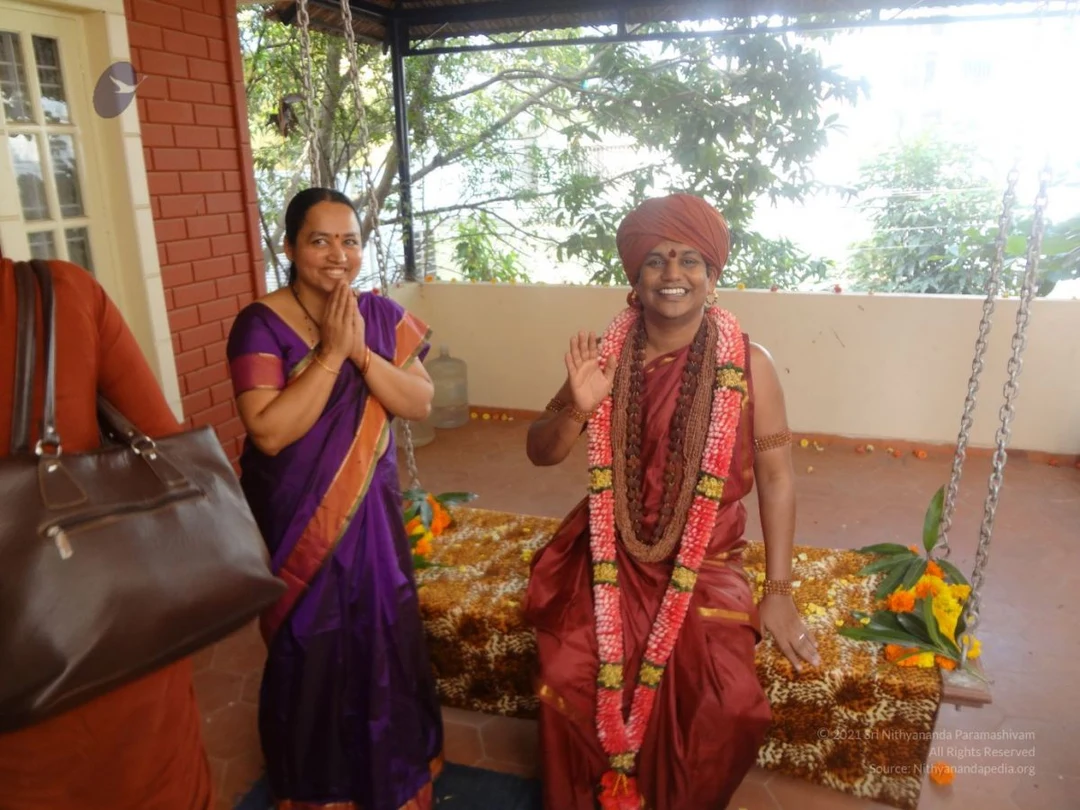
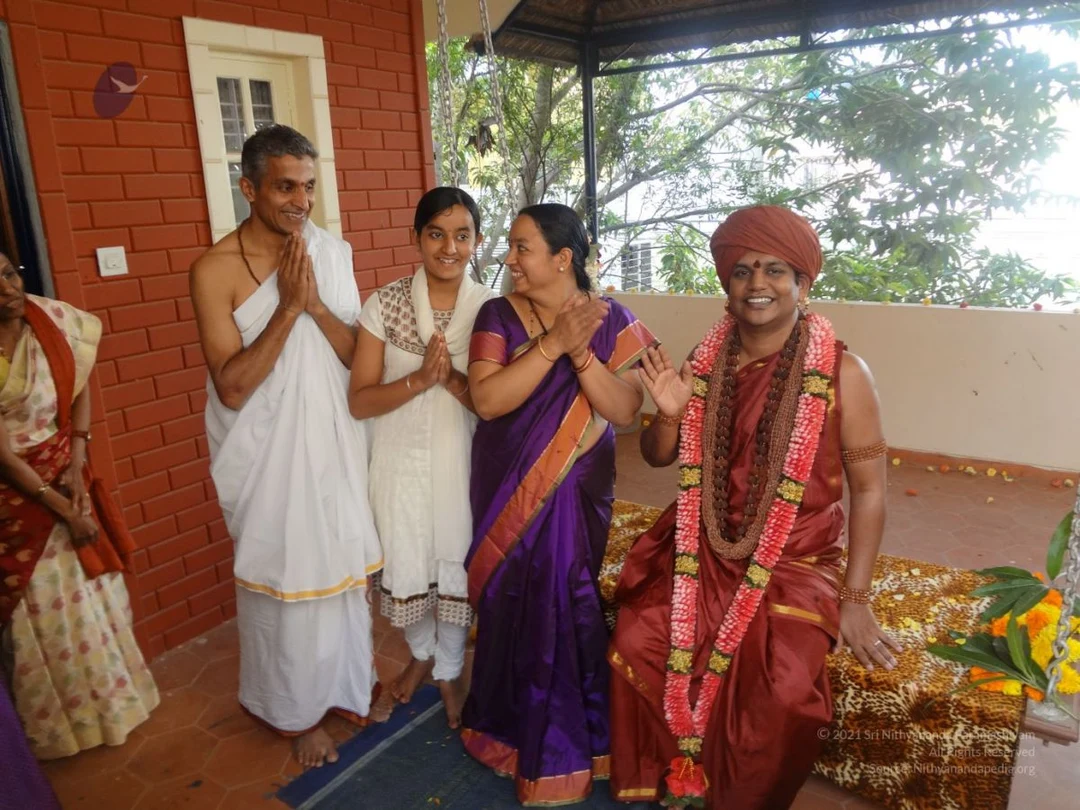
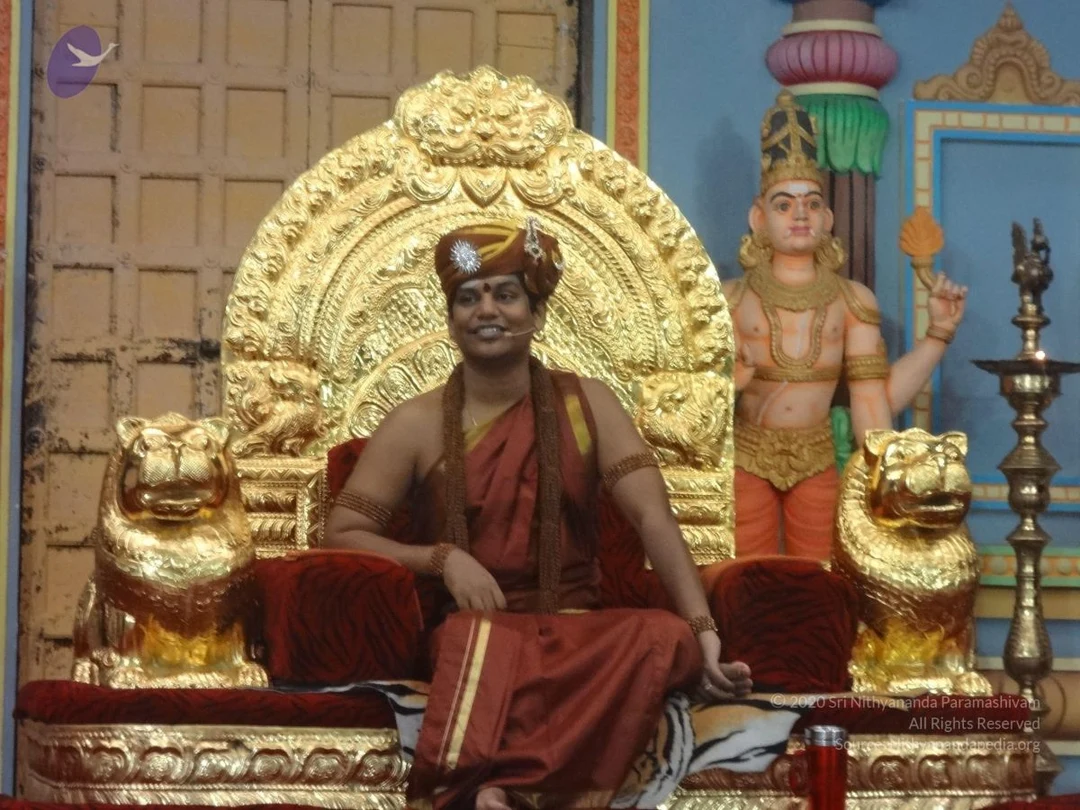
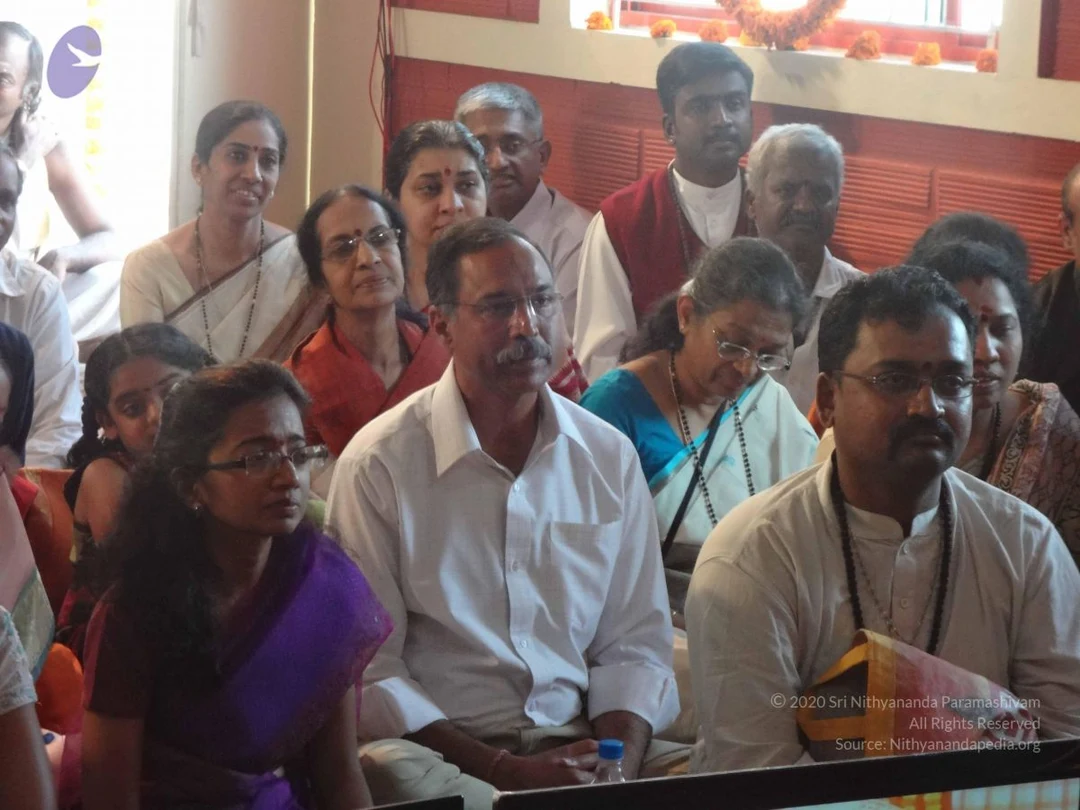
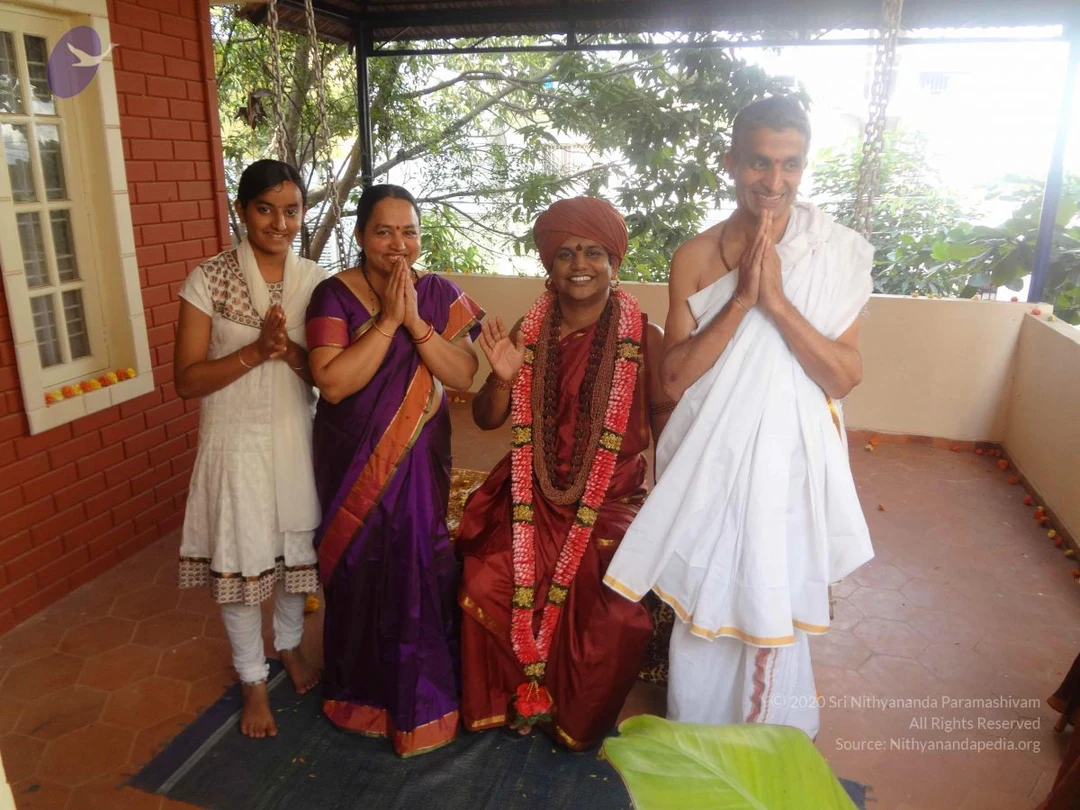
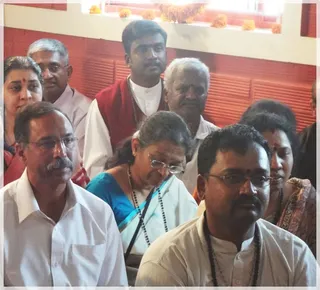
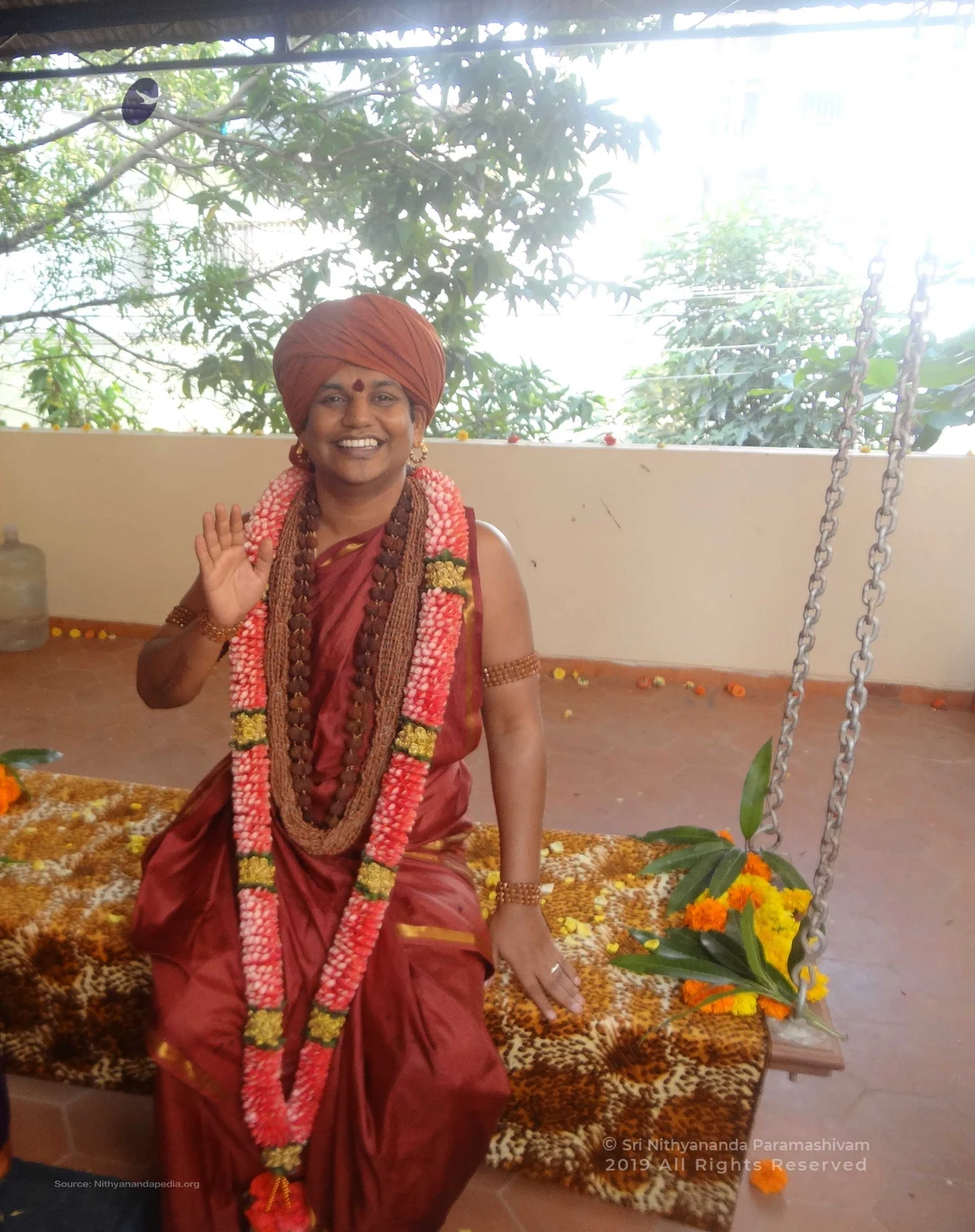
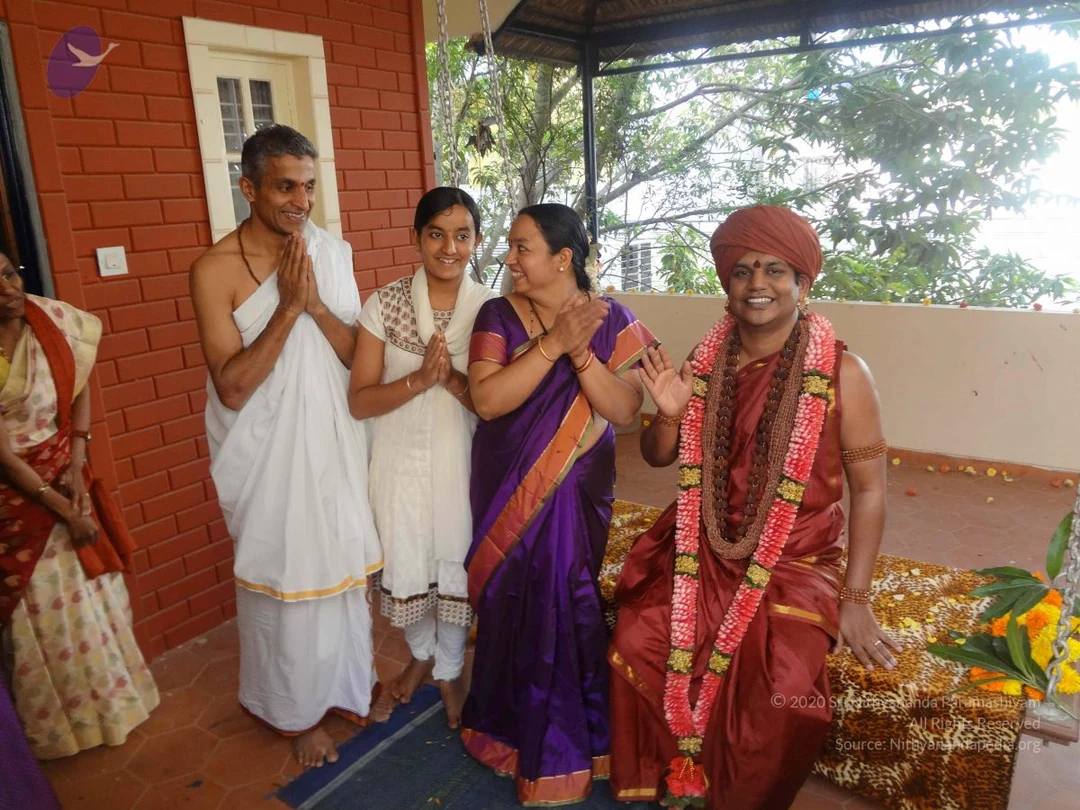
A smiling person in a maroon-red turban and maroon-red draped robe sits on a leopard-print cushioned seat beside a swing with metal chains. A pink and white flower garland with gold-toned bead accents hangs across the chest, over brown rudraksha-style beads, and gold bangles and armlets are worn. The right hand is raised in a wave and the left rests on the cushion. Marigold petals and orange marigold flowers and green leaves are scattered on the tiled floor and on the swing, with a plastered wall and trees behind. A red bindi is visible on the forehead. The appearance matches the Swamiji candidate by several cues: a turban, saffron-red ornate clothing, rudraksha beads and a ceremonial garland, so this is a probable in-person presence.A seated man in a maroon-red robe with gold border and a red-and-gold turban with a silver ornament sits on an ornate gold throne with red velvet cushions, flanked by two gold lion sculptures and two painted deity statues with raised arms and gold jewellery. He wears a long rudraksha mala and gold armbands, and a small microphone is visible at his mouth. A red cup sits on the lower dais. Swamiji (probable): the seated man wears a maroon robe, a turban and a long rudraksha mala on a throne, which fits the page's cues for the Nithyananda Paramashivam candidate.A framed photograph of a seated man in orange robes with a white flower necklace and a red bindi, raising one hand in blessing before a tree trunk backdrop. The framed portrait is placed on a gold-and-red throne with carved elephant side panels, a red cushion, and red garlands draped across the frame, with marigold garlands and orange-and-yellow checked cloth behind. The printed caption on the photo reads Paramahamsa Nithyananda. The portrait is a printed depiction and no physical people are present.Top-down view of a ritual setup on a red cloth with black and white striped borders. A silver plate holds red-and-orange flowers, a small silver deity figure, and a small silver bowl. Another silver bowl holds water or liquid. A green tray at left holds more red-orange flowers and a silver lamp with a lotus-shaped base. Silver coins sit at the bottom edge. No people are visible.A man seated on an ornate gold throne with a red cushioned backrest, wearing a maroon turban, a maroon robe, rudraksha beads, gold bangles and a pink and green flower garland. He sits with hands resting near a plump cushion, smiling, with a small headset microphone on his cheek. Behind him are marigold garlands and a patterned orange and yellow cloth backdrop, with a ganesha-like figure on a cushion at left. Swamiji (probable): the seated figure matches the candidate profile through the maroon and saffron-toned robes, rudraksha malas, ornate gold throne and turban, and is in person at the satsang.A photograph of a seated audience at a satsang, viewed from the front. In the foreground a man in a white shirt and glasses with a moustache sits on the left, and a man in a cream kurta with a rudraksha mala and glasses sits in the centre-bottom. A woman in a light blue sari with a black beaded mala and glasses sits centre. Behind them a standing man wears a red vest over a white shirt with a mala, and an older man in white stands behind. A woman with a red bindi and an older man in a grey shirt stand at the left edge, and a woman with a bindi sits at the right. Red wall panels and marigold garlands decorate the background. No a person candidate is visible.

House-Visit
35 photosSource gallery
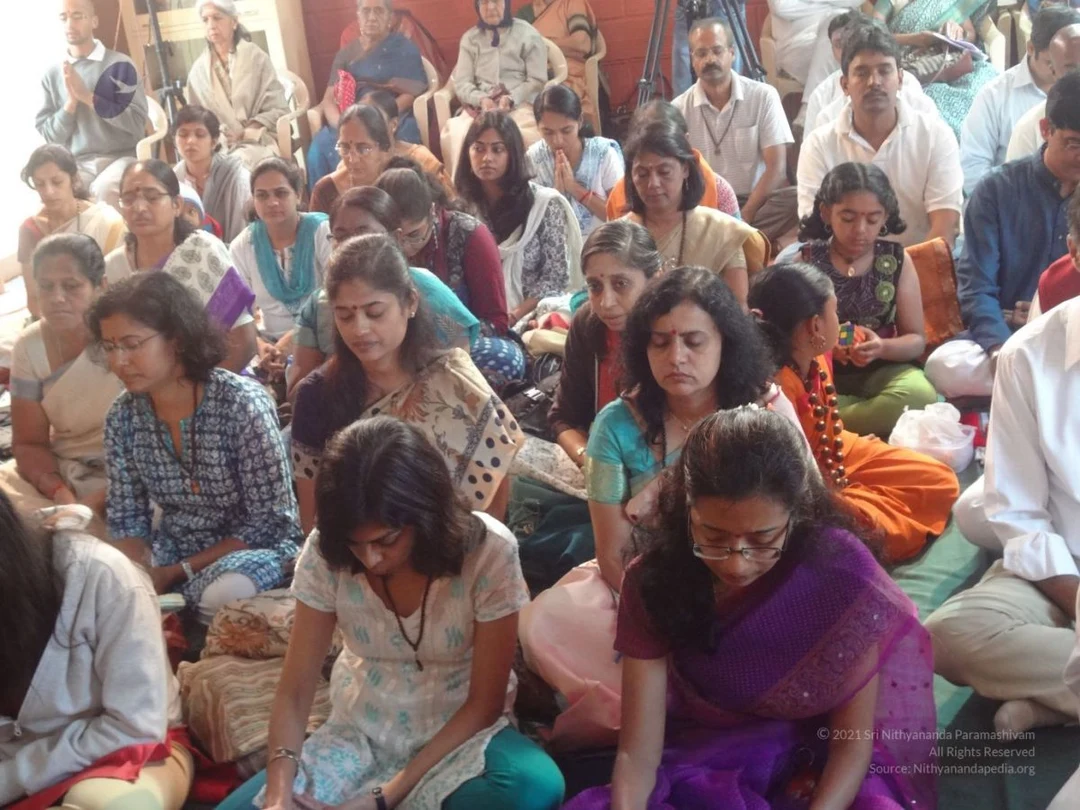
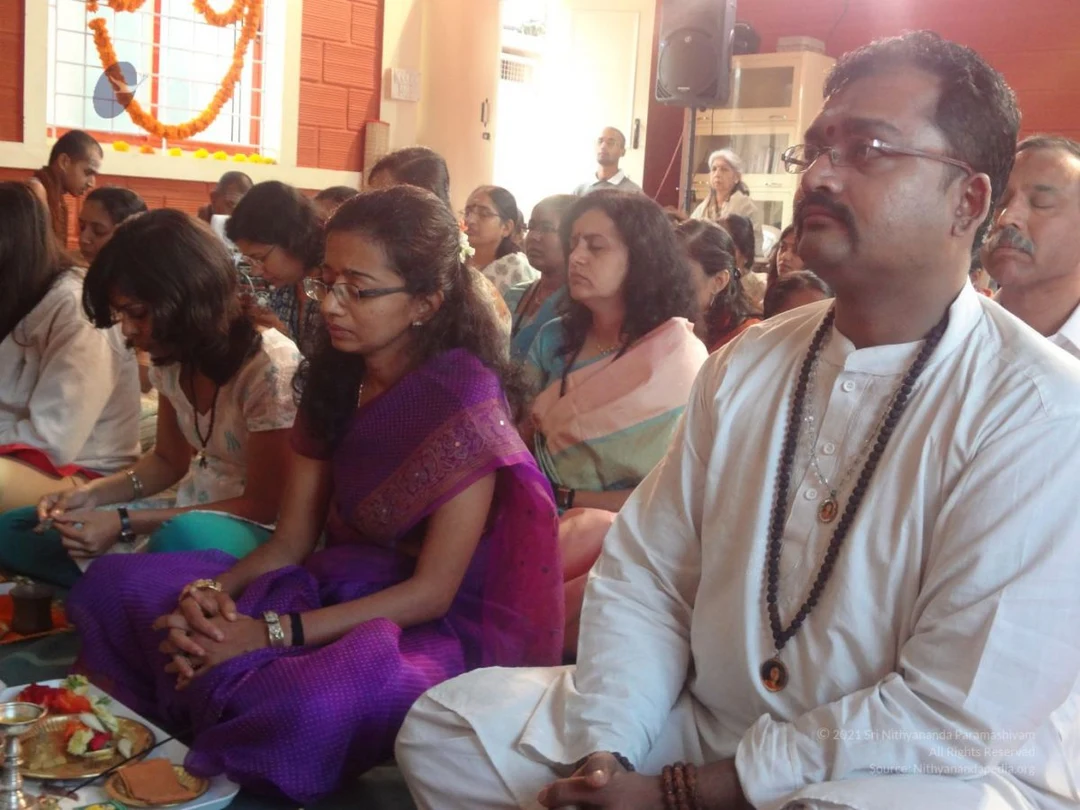
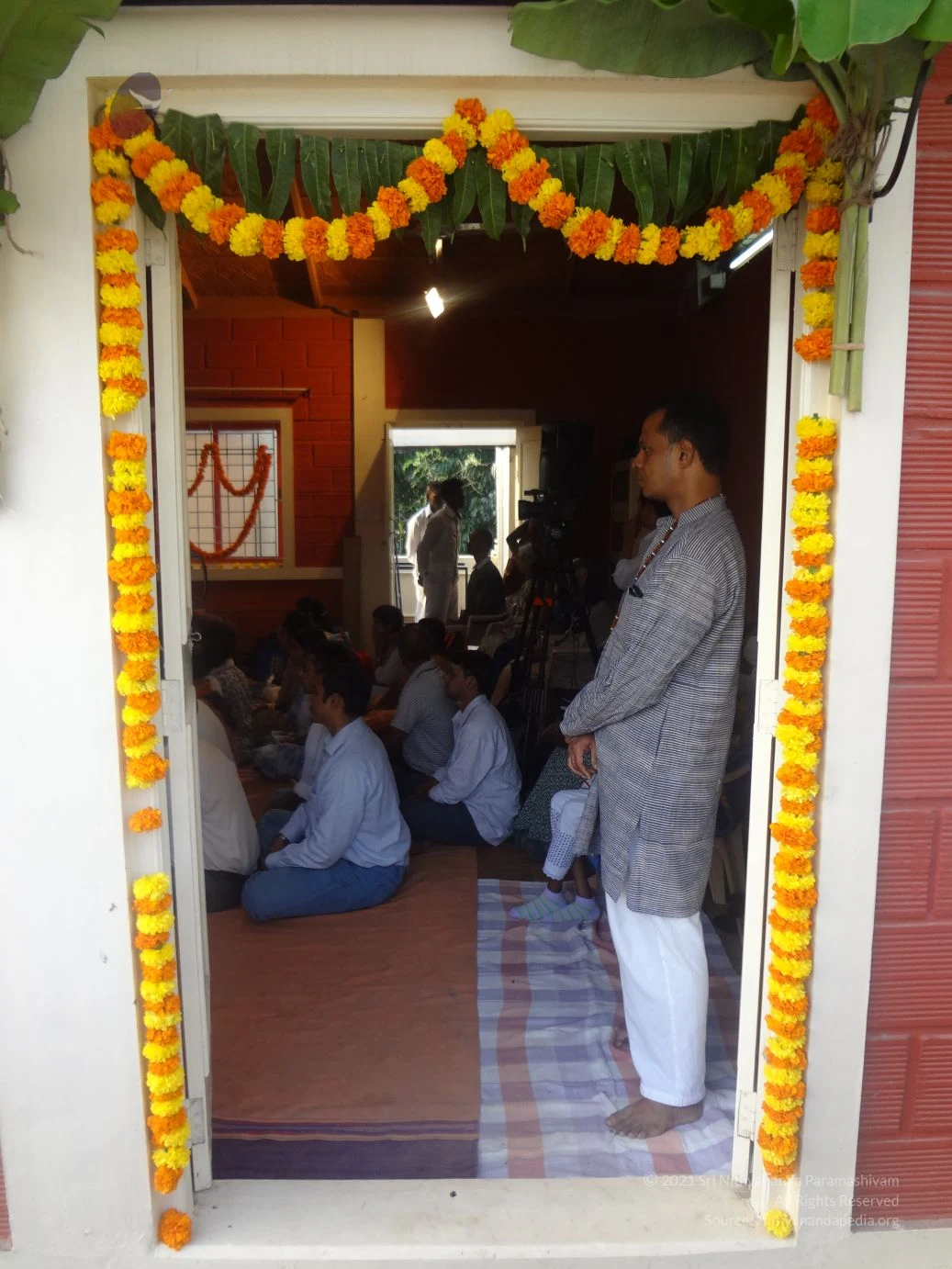
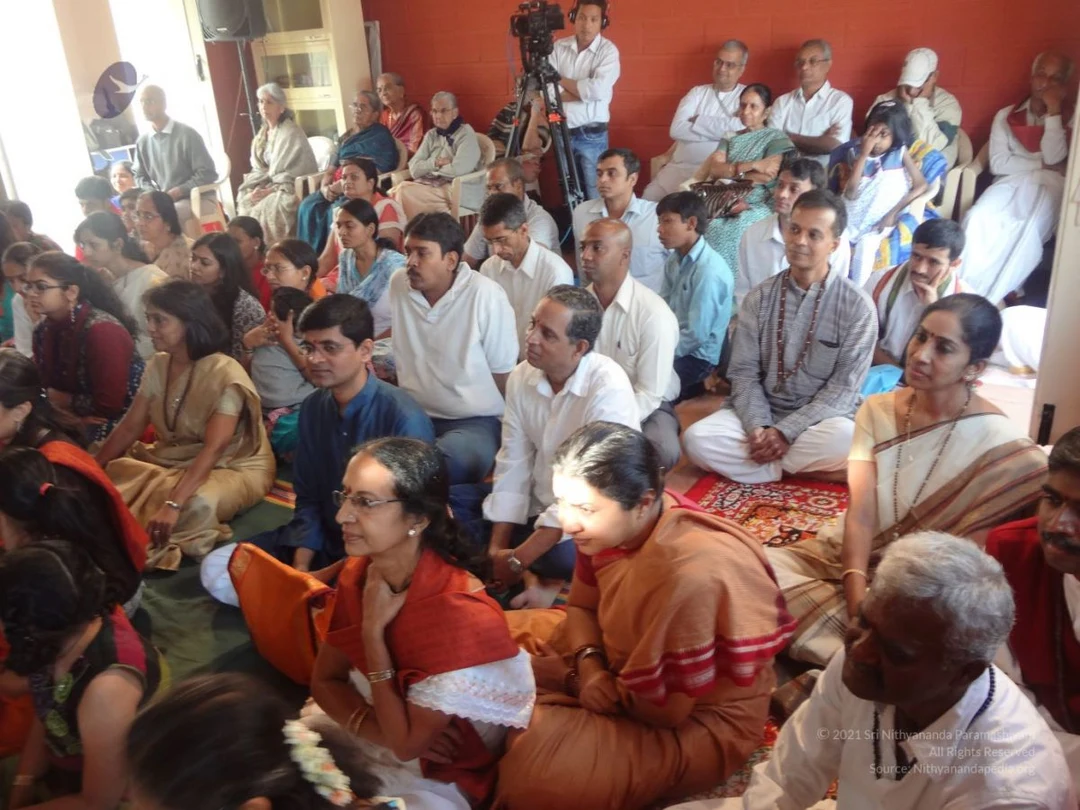
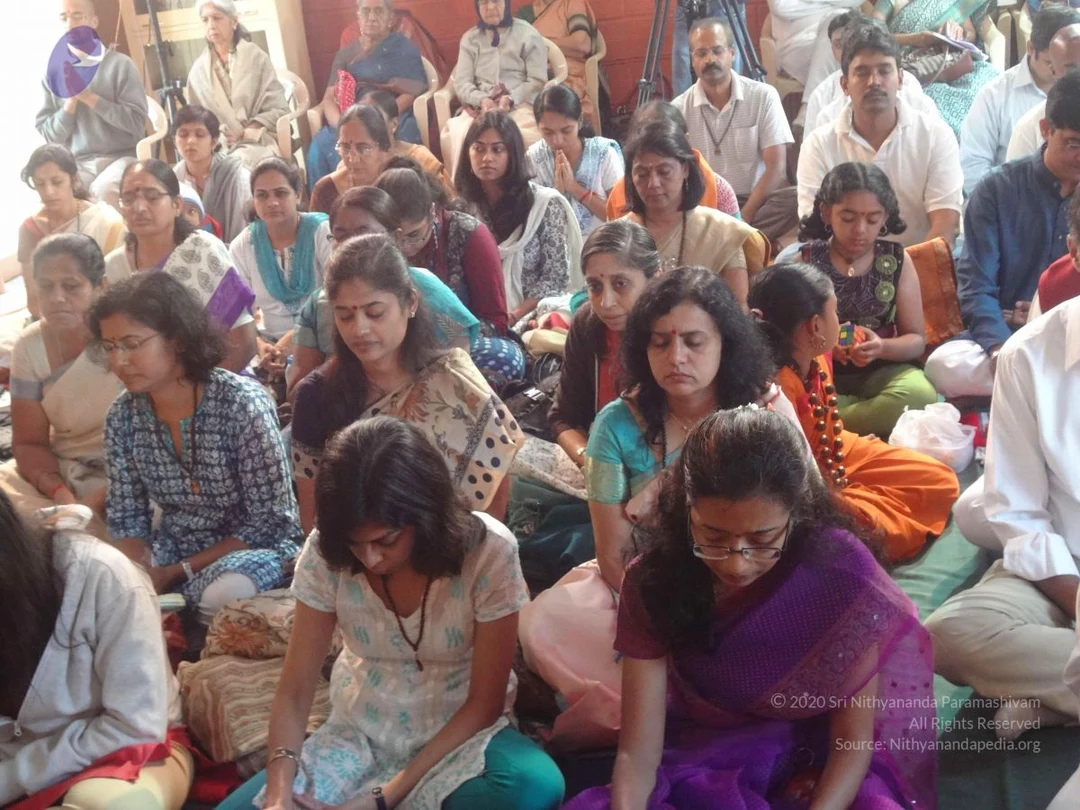
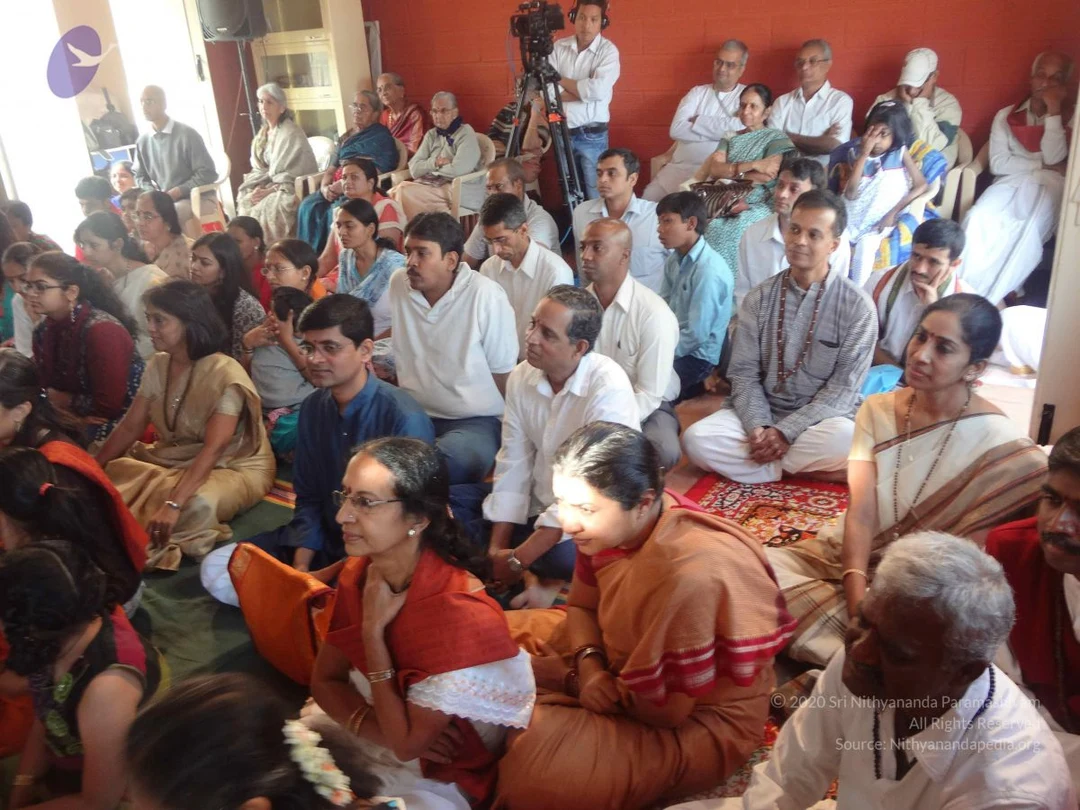
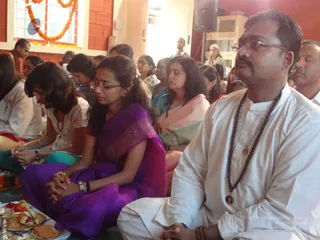
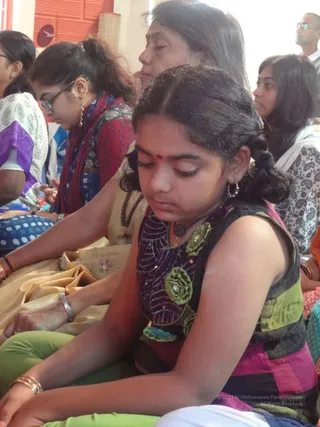
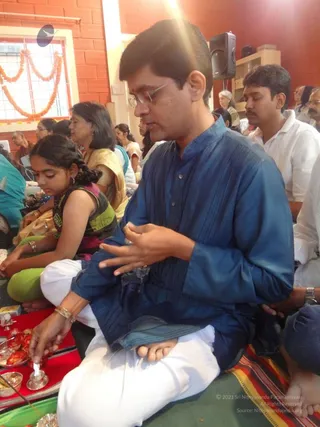
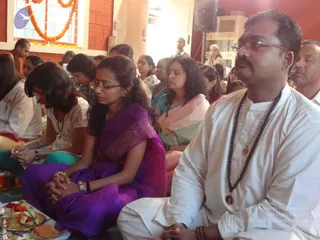
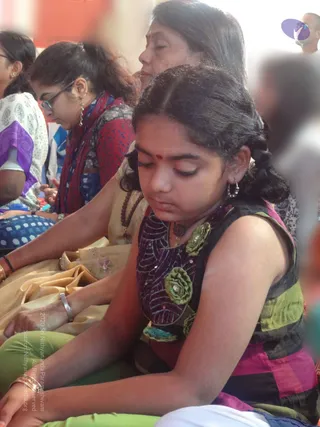
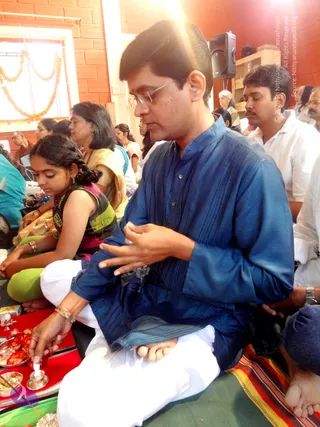
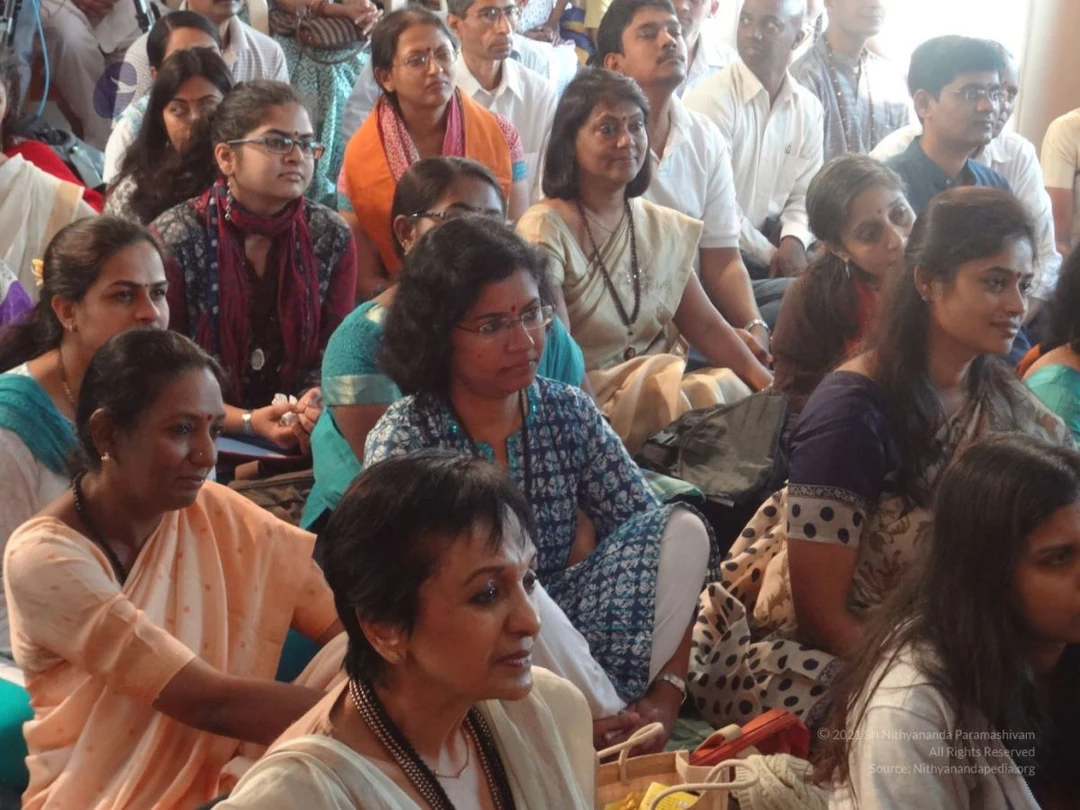
A seated group of devotees sits cross-legged in a bright hall with orange and yellow marigold garlands hung along the wall and window. In the foreground a man in a white kurta wears a rudraksha mala and a pendant, with eyes closed and hands folded. Beside him a woman in a purple saree and bangles sits with hands clasped in prayer, and an older woman in a teal and peach sari sits next to her. Behind them many others sit in meditation or satsang, some in white. A gold thali with fruit and flowers and a brass lamp sit on the floor at lower left. A speaker and cabinet stand at the upper right. A large group, but only a few can be clearly seen.Photograph of a seated congregation at a satsang. In the foreground a young girl with a long braid, a red bindi and hoop earrings sits with eyes lowered, wearing a purple and black sleeveless top with green rosette appliqués and a green salwar. Behind her, several women in patterned saris and salwar kameez sit with eyes closed or lowered; one woman in a red and blue printed shawl wears dangling earrings, and a man in sunglasses stands at the upper right. Bangles and a rudraksha-style mala are visible. The warm light comes through a red-framed doorway.A seated man in a dark blue kurta over white dhoti sits cross-legged on a green mat, wearing glasses, with his hands gesturing as he speaks. In front of him on a red cloth is a silver tray with a small silver oil lamp holding a lit wick, a steel bowl and red flower offerings. Behind him, devotees sit in rows in a room with orange brick walls and a marigold garland across a window. A girl in a green and pink dress and a woman in a cream saree with a gold border are nearby, and a man in a white shirt sits at right beside a black speaker. Roughly ten to twenty people are visible.

Paduka-Puja

18 photosSource gallery
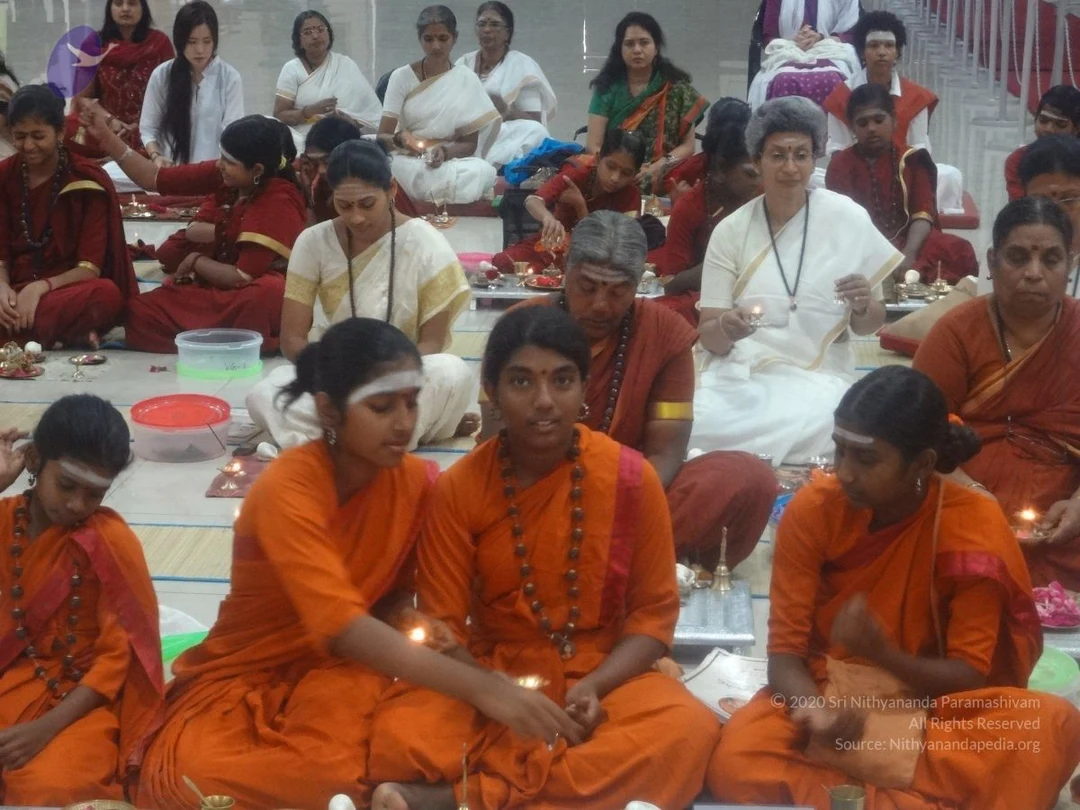
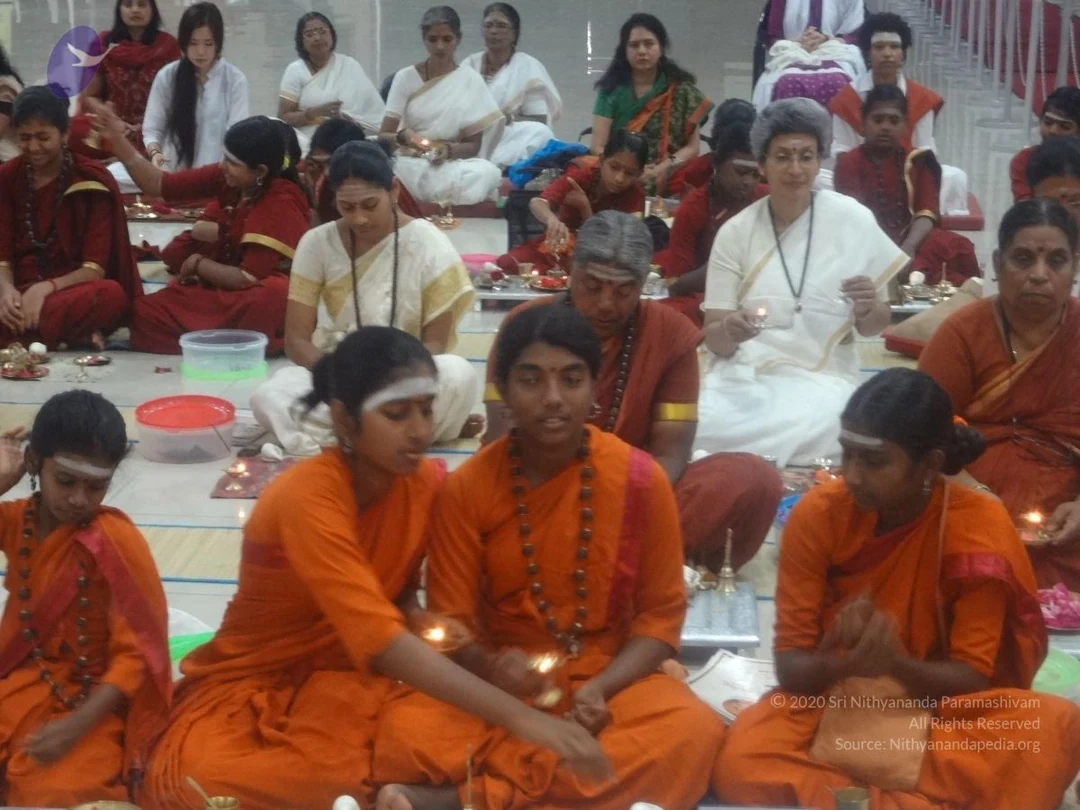
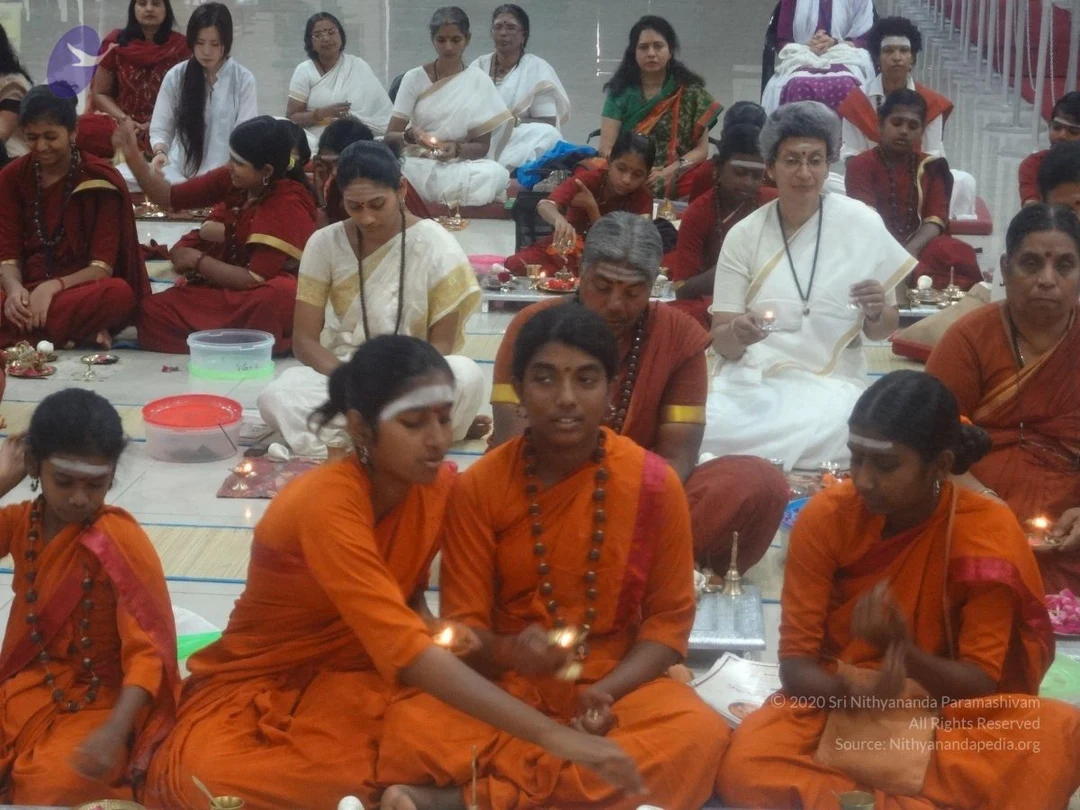
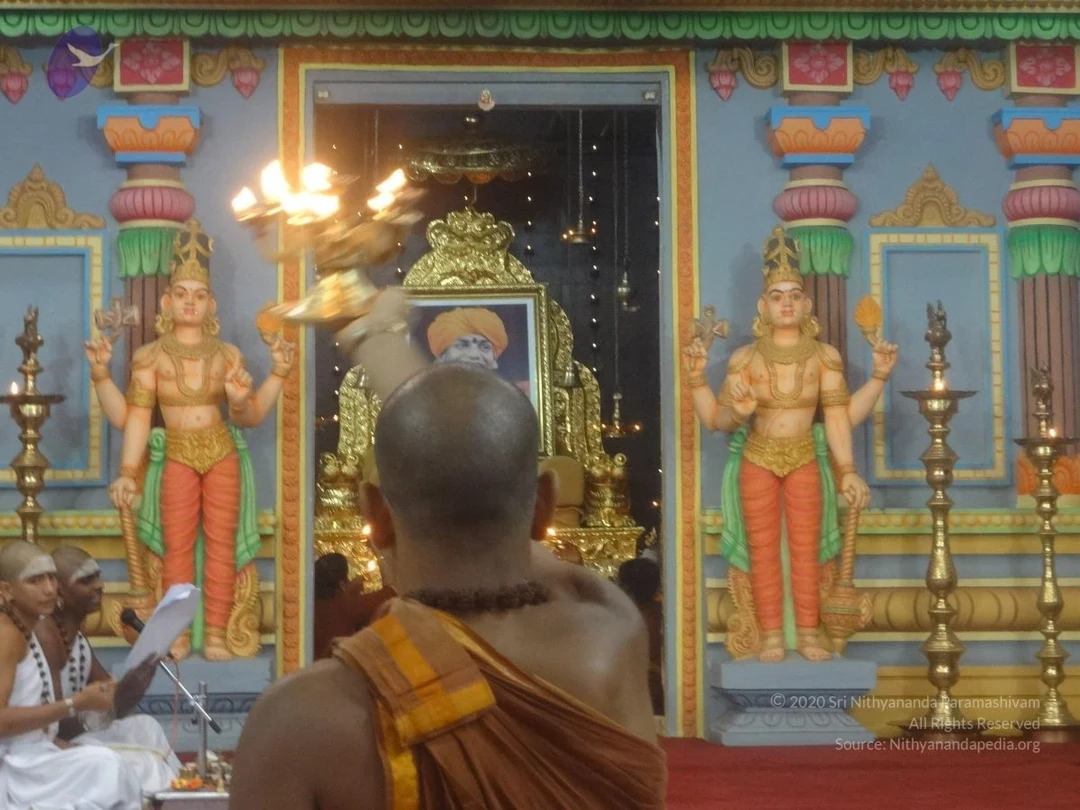
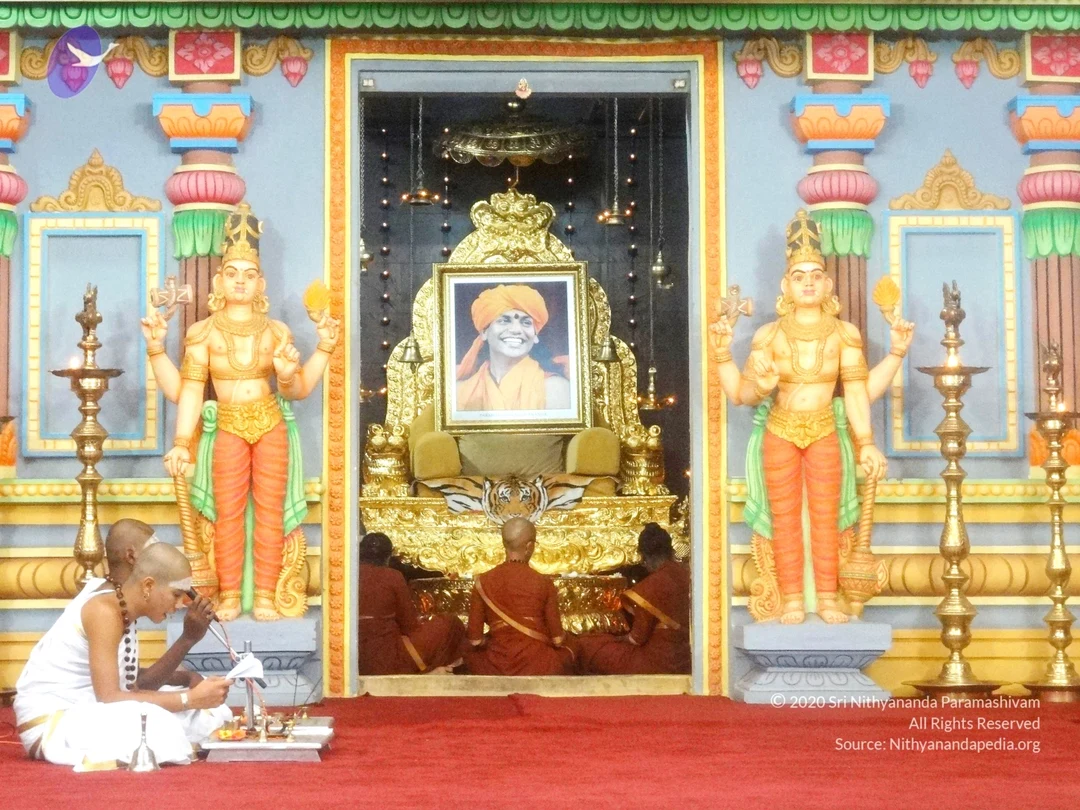
A photograph of a temple-style hall with painted blue and orange walls. Two large painted statues of four-armed deities with crowns stand flanking a central doorway. Inside the doorway, a gilded golden throne with a tiger motif holds a framed portrait of a smiling man in an orange-yellow turban and orange clothing. Brass oil lamps stand on both sides. Several people in saffron-orange robes sit before the throne, and at the left a man in white dhoti with a shaved head and tilak speaks into a microphone while holding papers at a small table with offerings. The red carpet covers the floor.A seated group of devotees performs a lamp-lit ritual in a hall with a pale floor. Several young women in orange robes with rudraksha malas sit cross-legged, some holding small lamps, one reaching toward a brass tray. Older women in white saris with gold borders and a man in orange with a turban-like cloth sit nearby, some with small oil lamps and brass vessels. A red container and brass items lie on the floor, with a pink flower offering at right. Background devotees in red and green saris look on. No identifiable a person figure is clearly visible.

Satsang

32 photosSource gallery
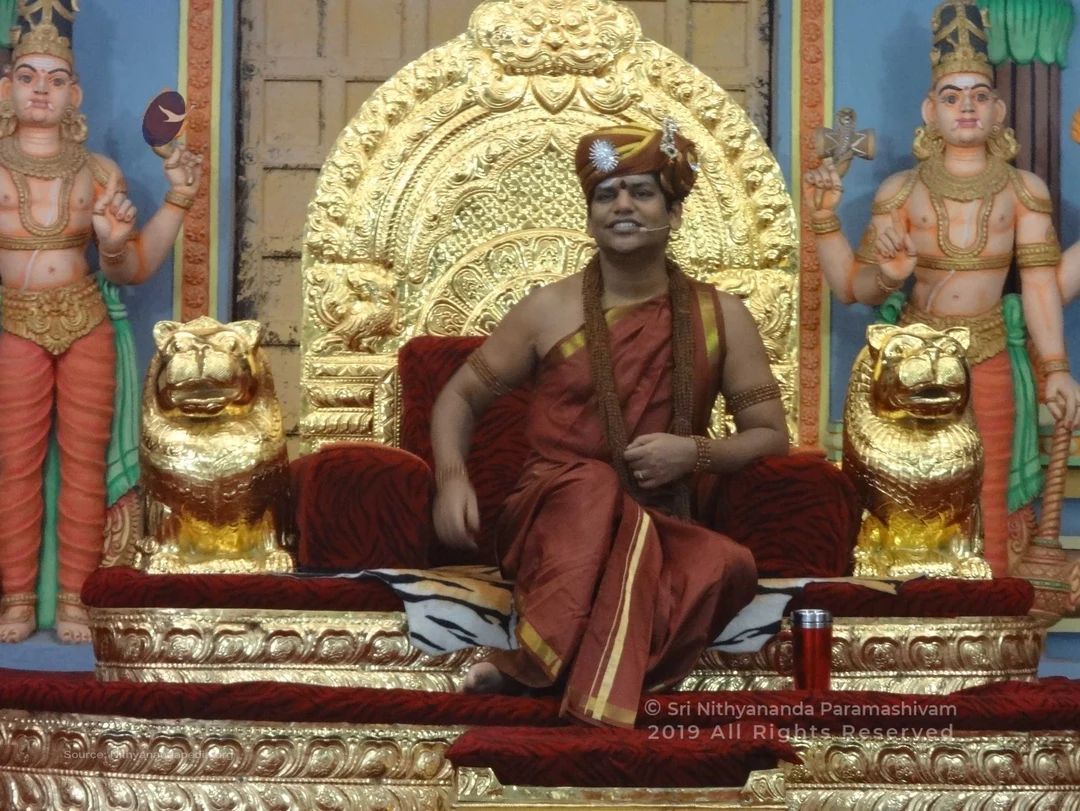
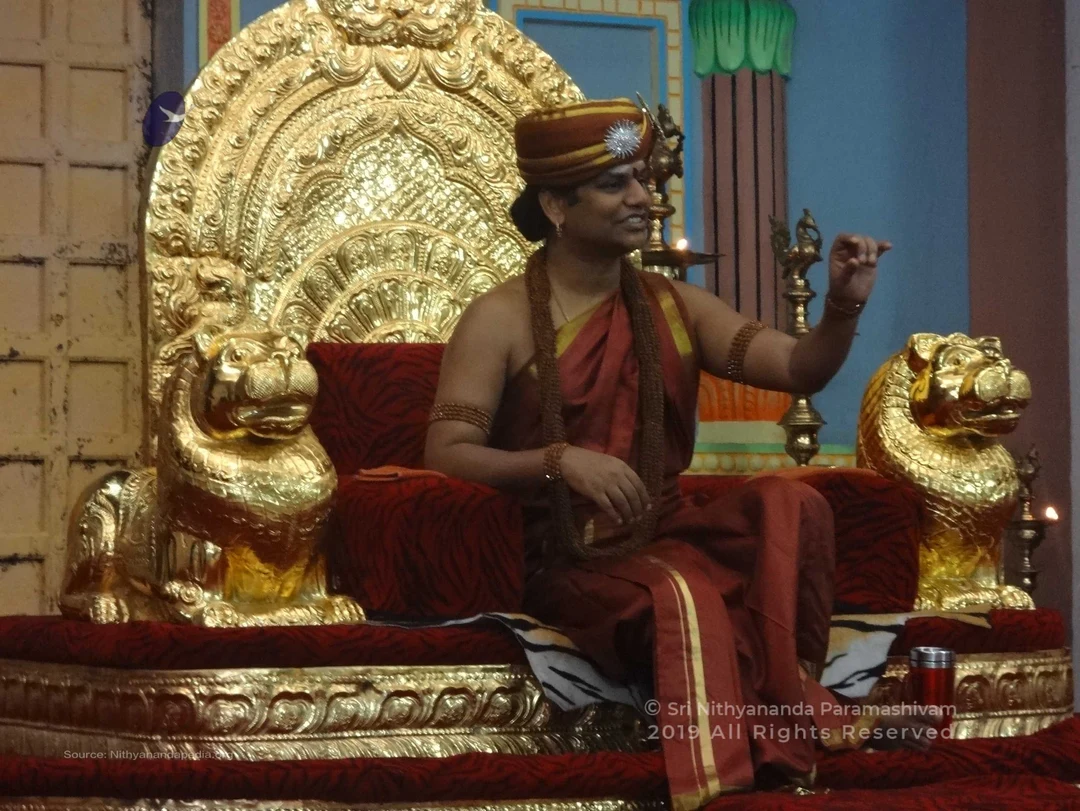
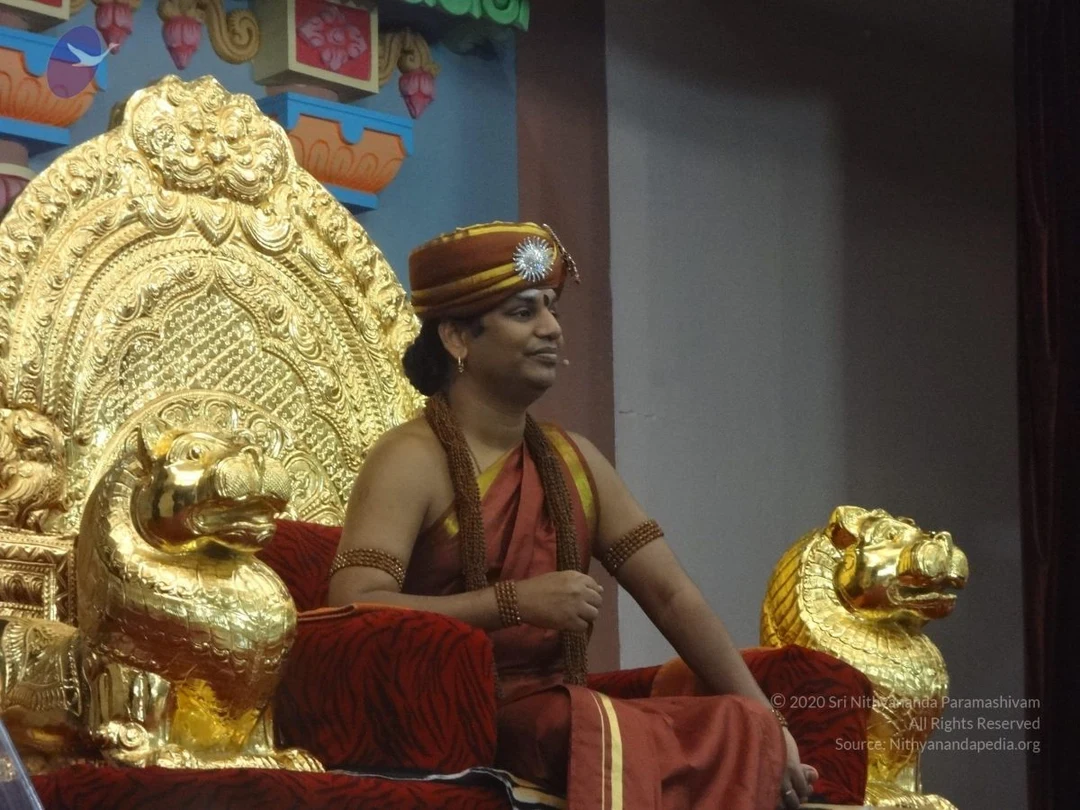
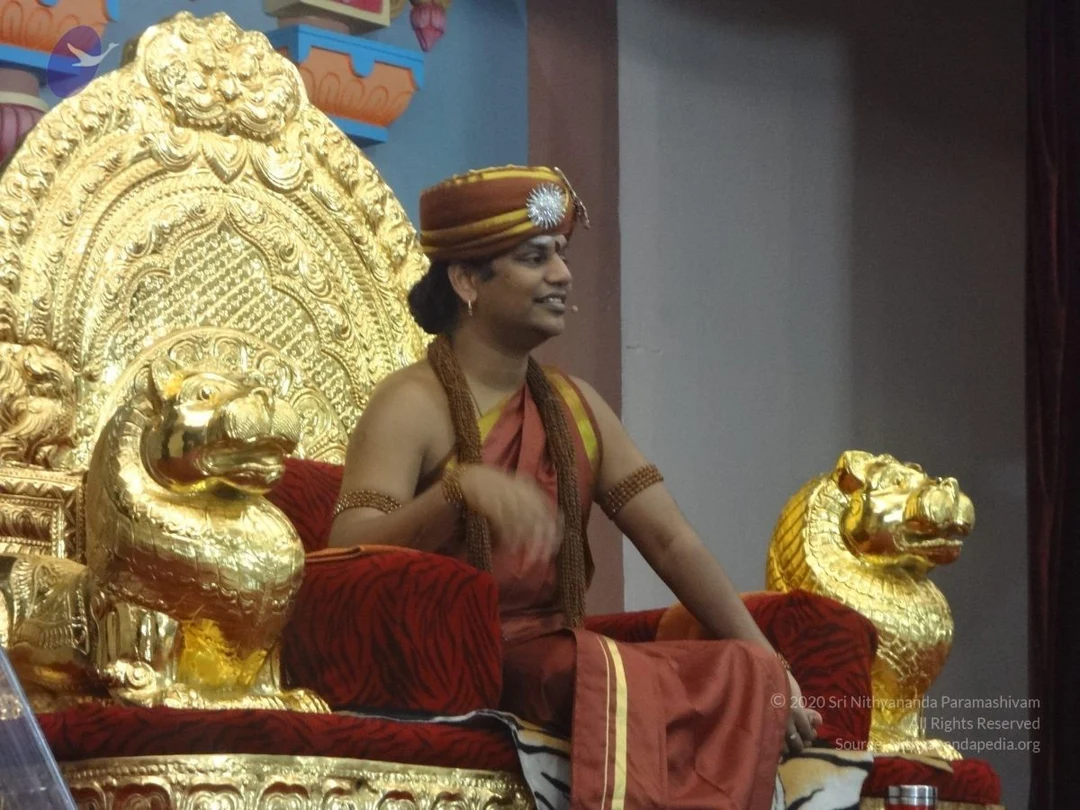
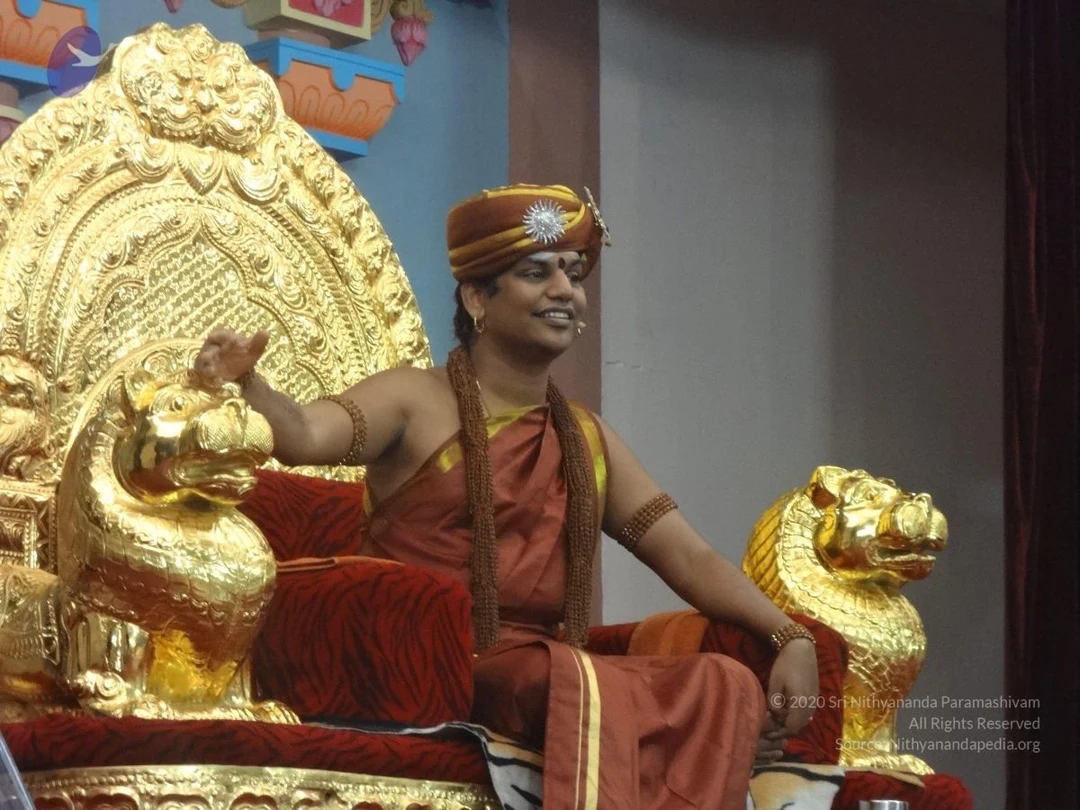
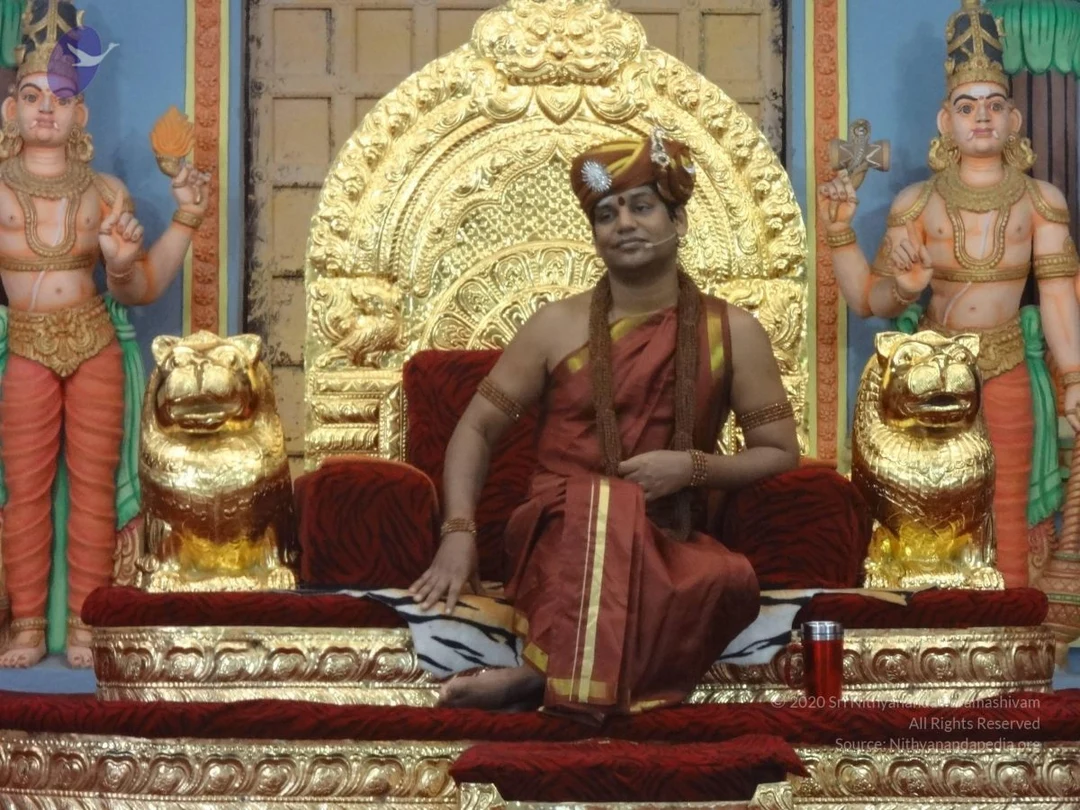
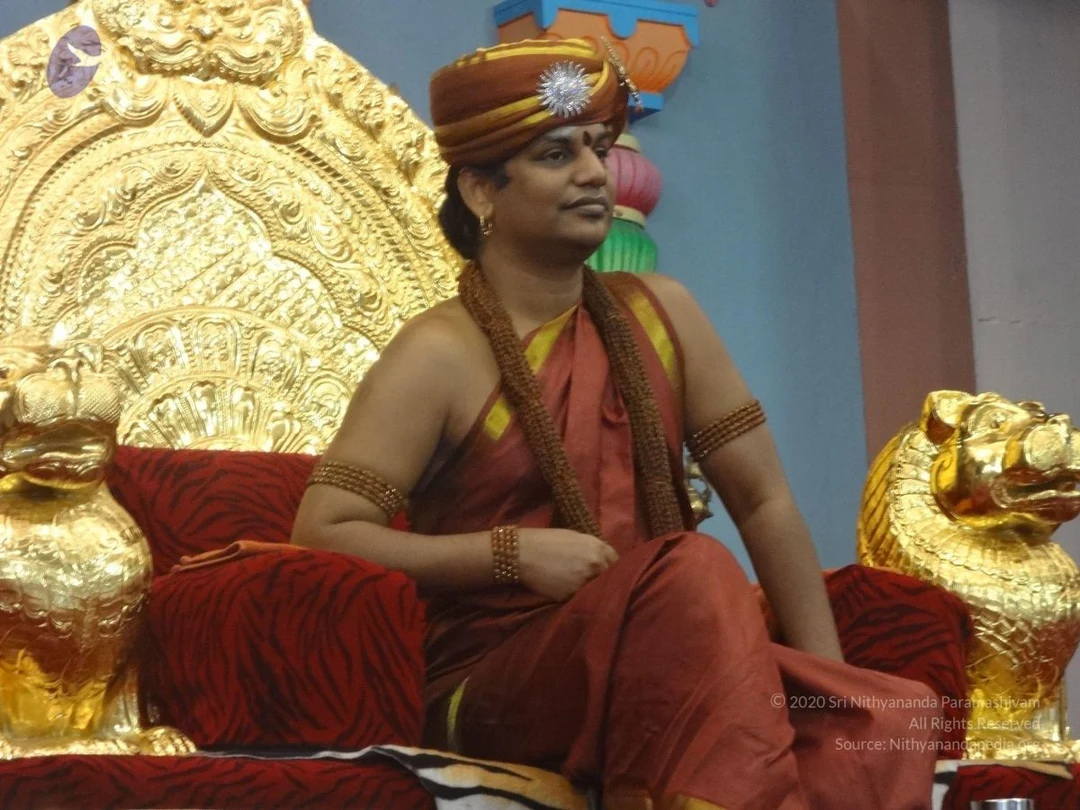
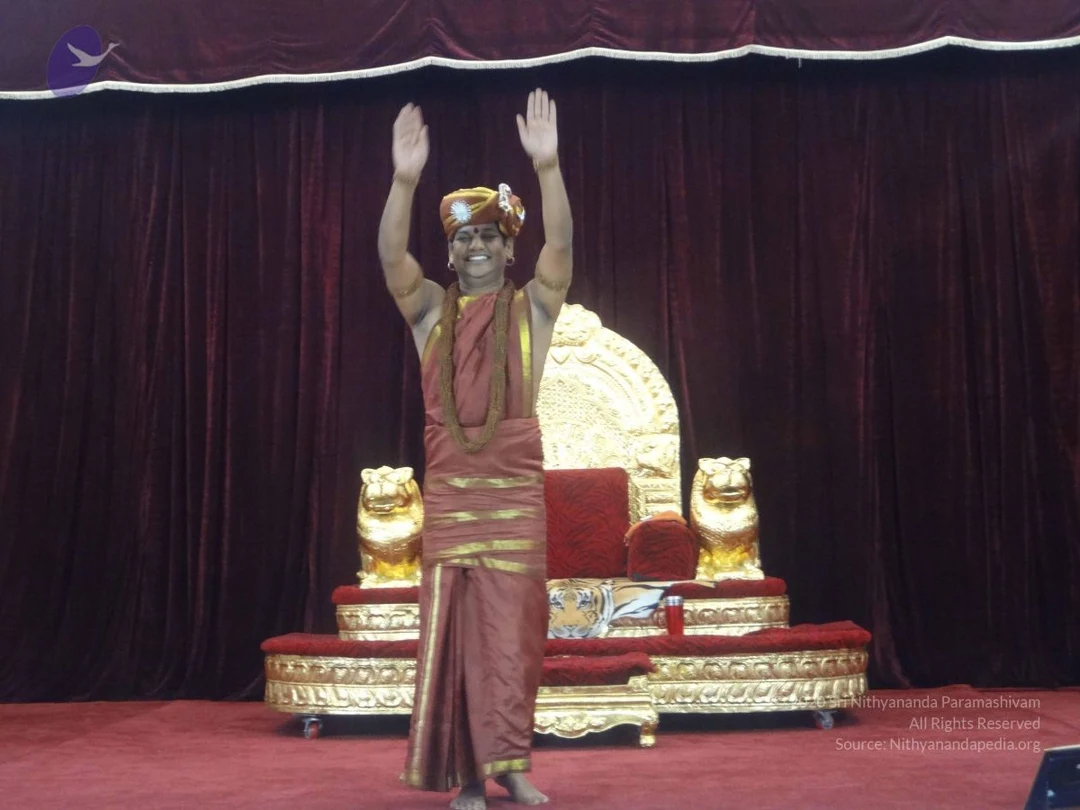
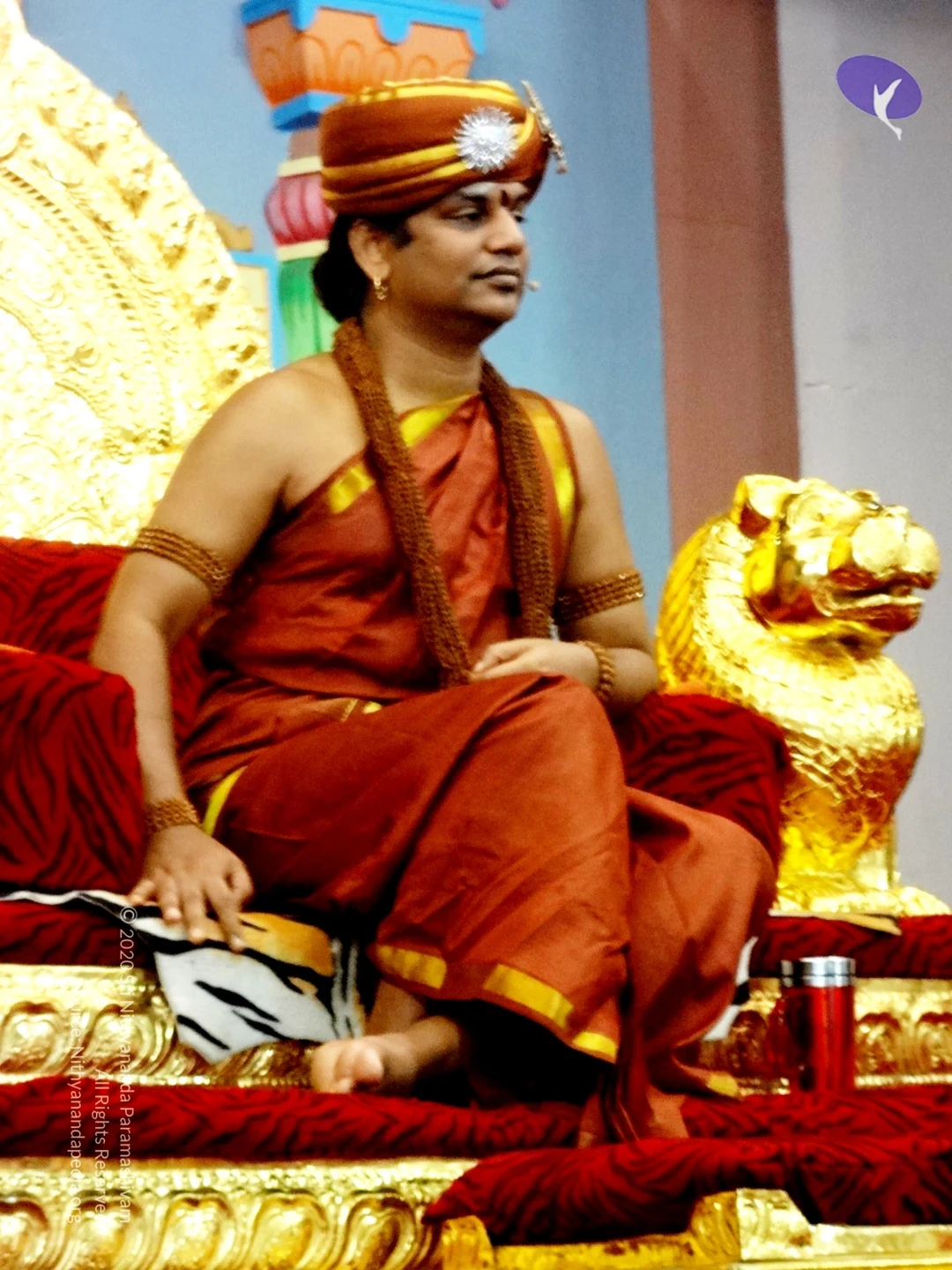
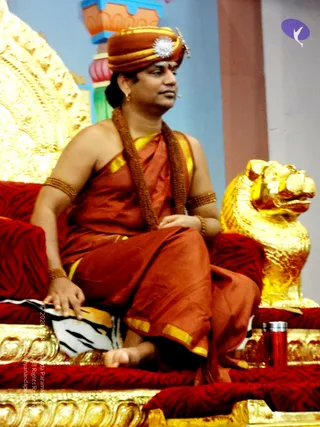
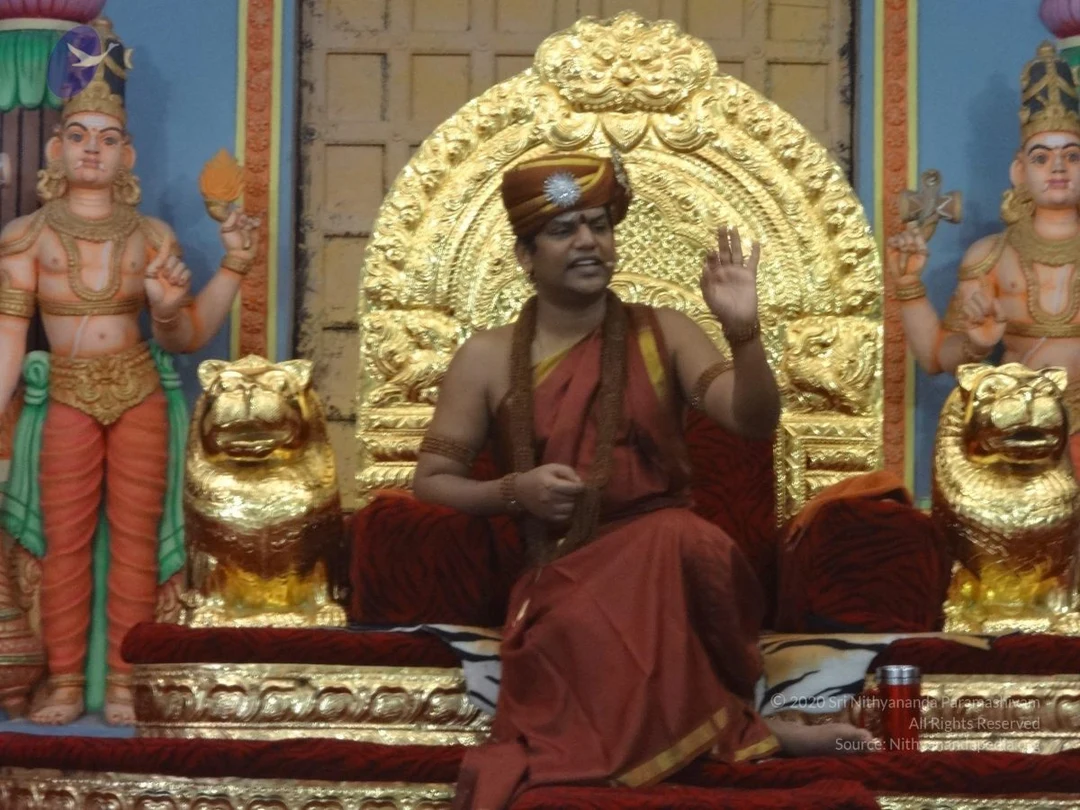
A man seated cross-legged on an ornate golden throne with lion-head armrests and red velvet cushions, draped with a tiger-striped cloth. He wears a maroon-red saffron-toned robe with gold edging, a matching turban with a silver sun-like brooch, rudraksha mala beads around his neck and gold bangles on his arms, and smiles while looking to his right. Flanking him are two painted deity murti statues with gold jewellery and orange dhotis, one holding a flame. A red cup sits at the base of the throne. a person seated in a satsang-style setting, identified only by appearance cues.A man seated on an ornate gold throne with carved lion-head armrests and red cushions, wearing a red-orange turban with a silver circular ornament, a saffron-red garment with gold border, layered rudraksha-style beaded necklaces, and gold bangles on the arms. He sits in a relaxed pose, looking to the side, against a colourful painted temple-style backdrop. a person seated on the peetha, based on the throne and distinctive saffron attire with ornate adornments.

Sarva-Darshan

6 photosSource gallery
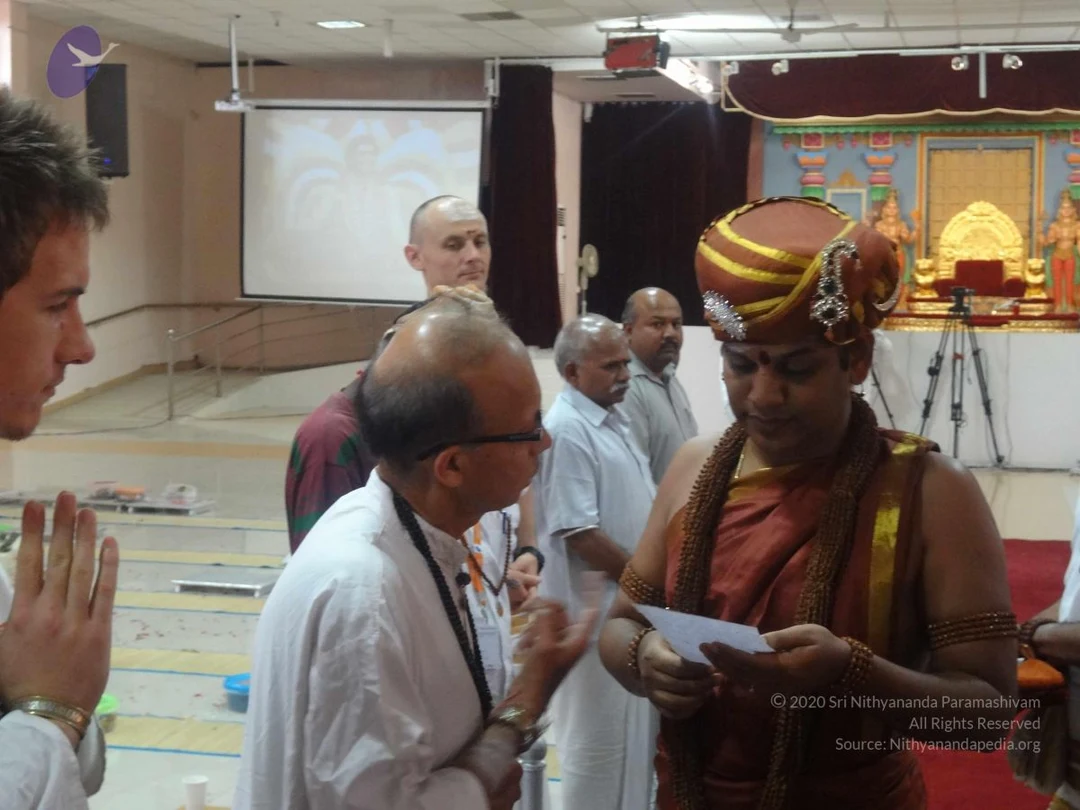
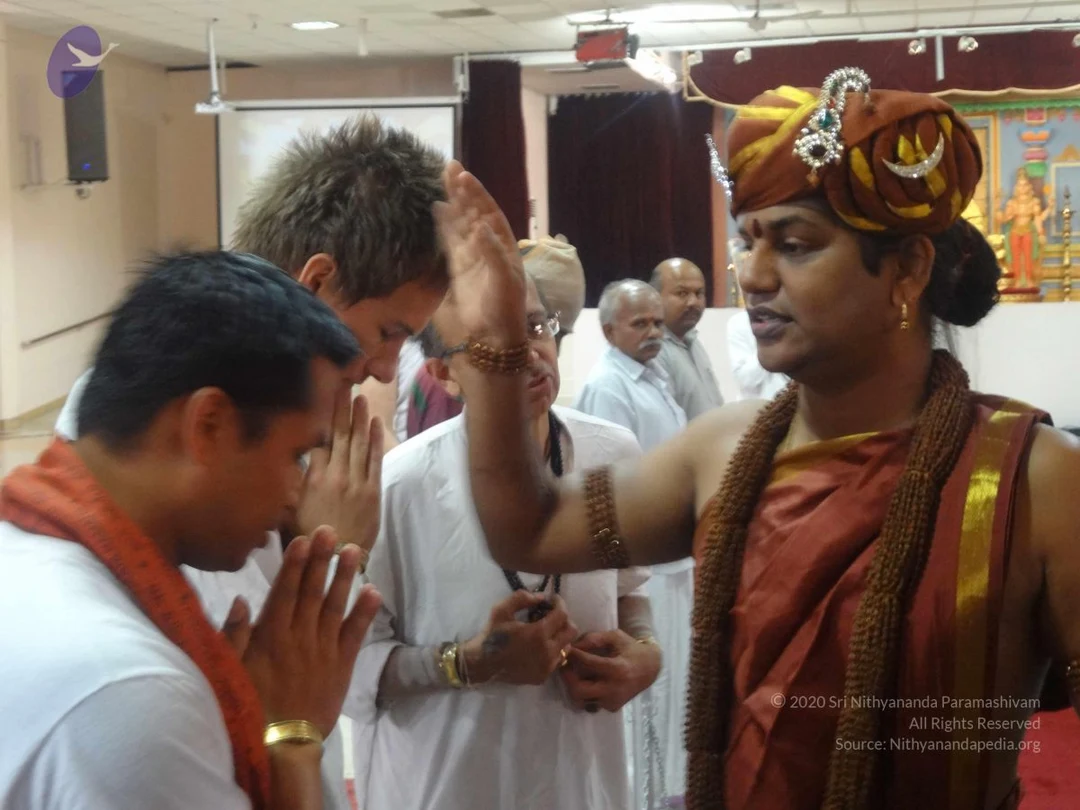
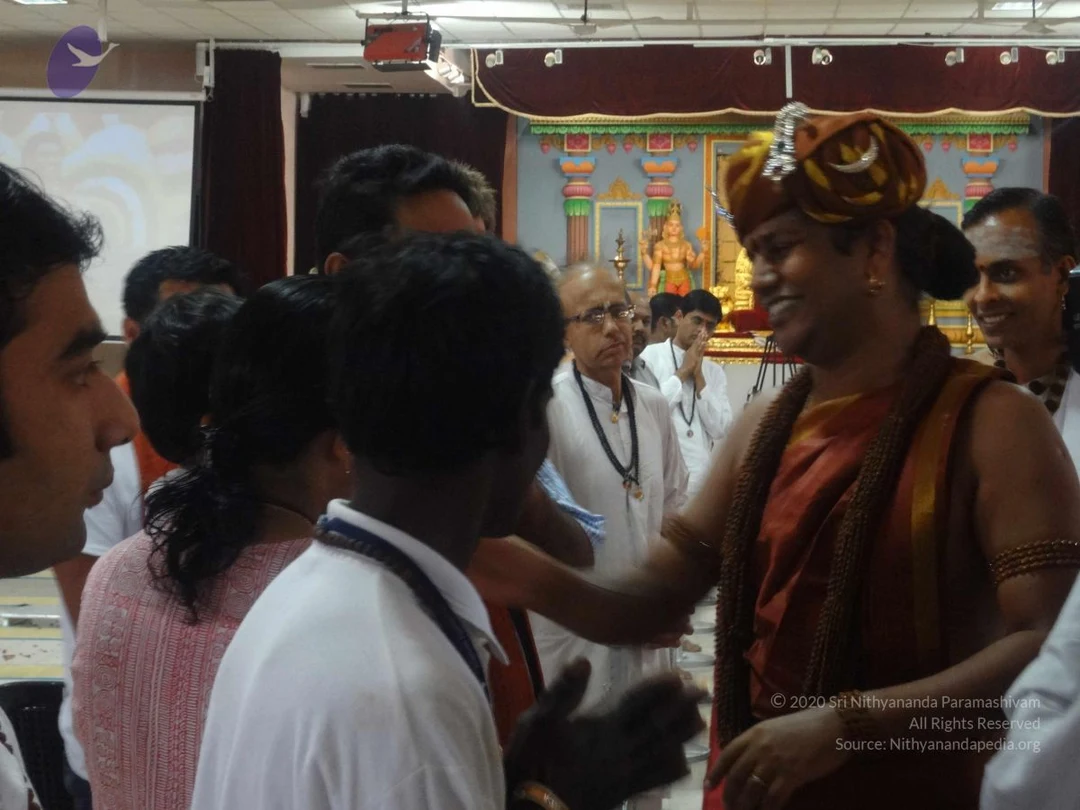
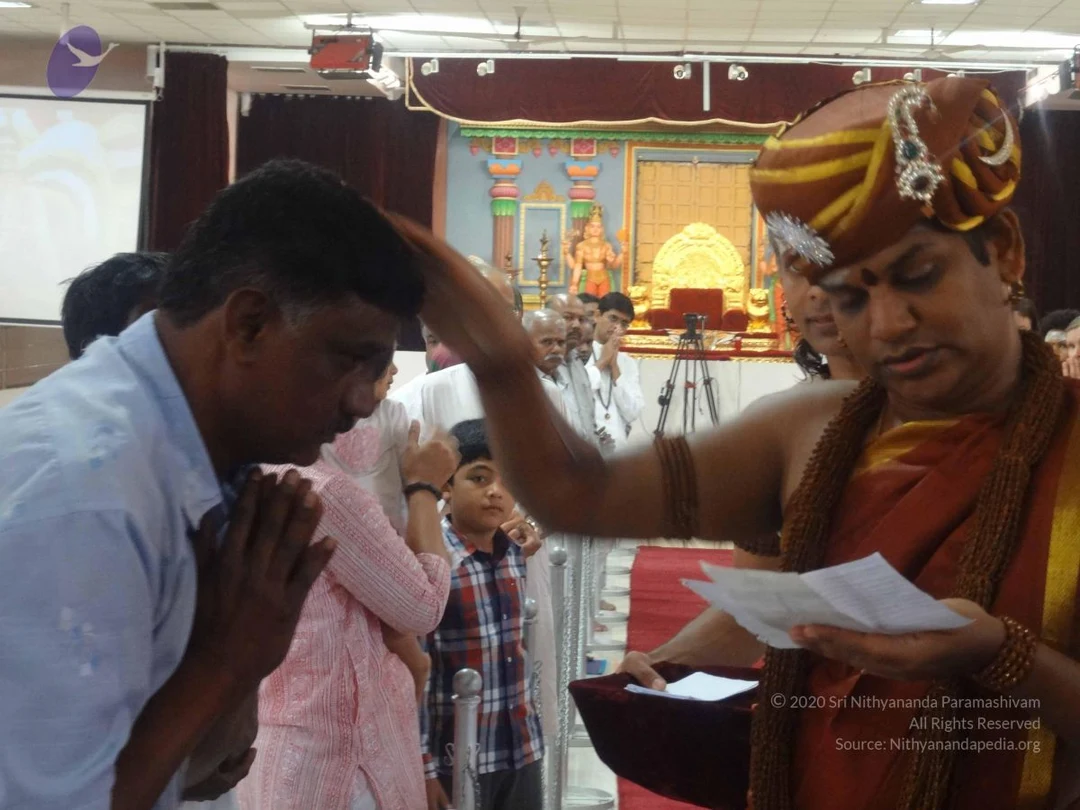
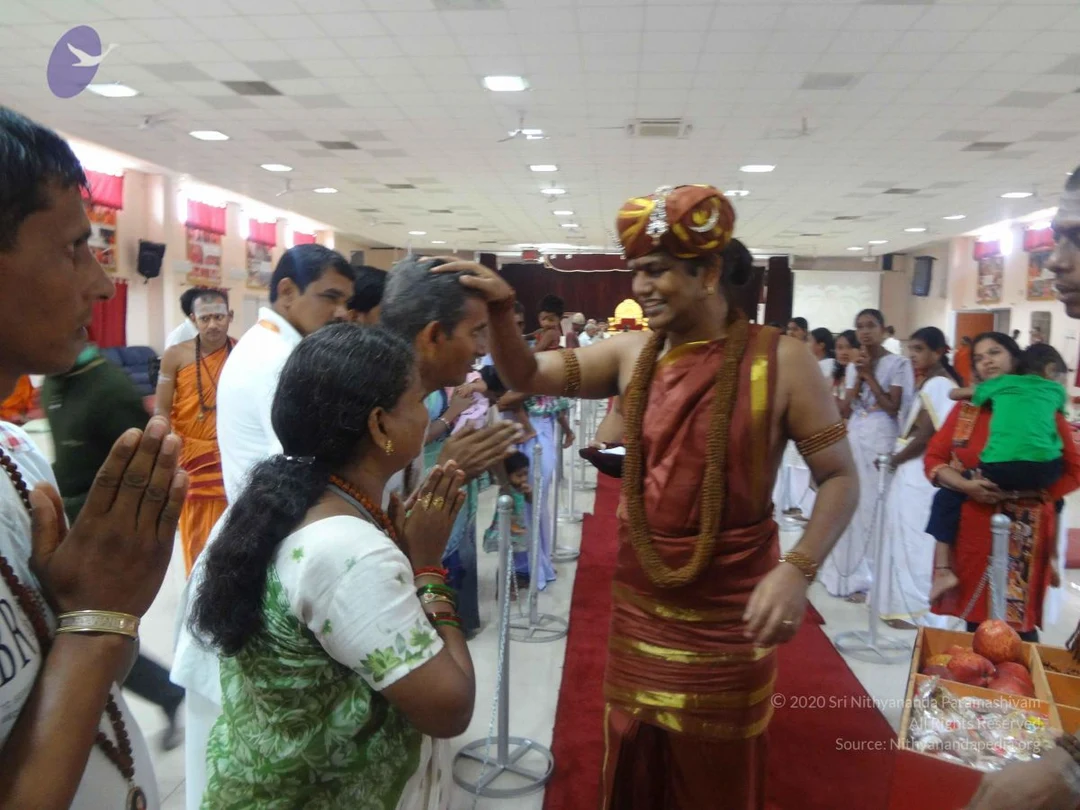
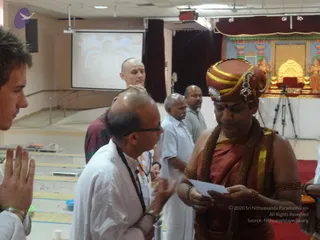
Indoor hall photo of a man in an orange-red turban with gold trim and a jeweled ornament, wearing an orange-red shawl with gold border, multiple rudraksha-style beaded malas and gold armbands, reading a small white card held in both hands. Probable Swamiji (probable) is shown standing at center-right with the distinctive turban, beaded malas and ornate gold-bordered orange clothing. A bald man in white kurta with a dark mala faces him at left, hands raised in greeting, while a young man with folded hands stands at far left. Other men in white and grey shirts stand behind. Behind them is a gold and red throne-style seat under an ornate arch with painted deity figures, and a projector screen shows a faint image. Gold-trimmed decorations and a tripod camera appear at right.A photograph inside an indoor hall with a red curtain and a deity murti in a painted niche behind. A figure in a saffron-orange turban with a crescent ornament, a rust-orange shawl and bare arms, smiling and reaching out to shake hands with a crowd. Around them stand people in white kurtas and white clothing, one wearing a rudraksha-style bead mala, and a man in glasses with a white shirt and mala. A shawl or wrap and ornamental bangles are visible.A photograph inside a hall with a red and gold backdrop and a golden throne-like seat with a deity image above it. A man in a red-orange robe with a layered gold-and-saffron turban, bead necklaces and dark kohl-lined eyes holds a sheaf of papers and places his hand on the head of a man in a light blue shirt who stands with palms pressed together in prayer. Behind them a woman in pink and a boy in a checked shirt watch, and several men in white stand by a camera on a tripod, with a table holding offerings and an oil lamp in the foreground. The robed figure is an appearance-based probable Swamiji with turban, bead malas and saffron clothing, shown in the act of giving blessing to a devotee.A photograph inside a bright hall with a red carpet runner and metal stanchions. A central figure in a rust-red turban with a crest ornament, rust-red robes and a long beaded rudraksha-style mala stands with one hand raised, placing it on the head of a grey-haired man with folded hands. Nearby, a woman in a white and green blouse with red bead necklaces joins her palms in greeting, and a man in white stands at left with hands folded. Other people in white and orange robes stand in the background, and a woman in red holds a small child in green. A wooden tray of fruit, including pomegranates, sits at lower right. Wall banners in red and white line the room.

Sacred-Arts

38 photosSource gallery
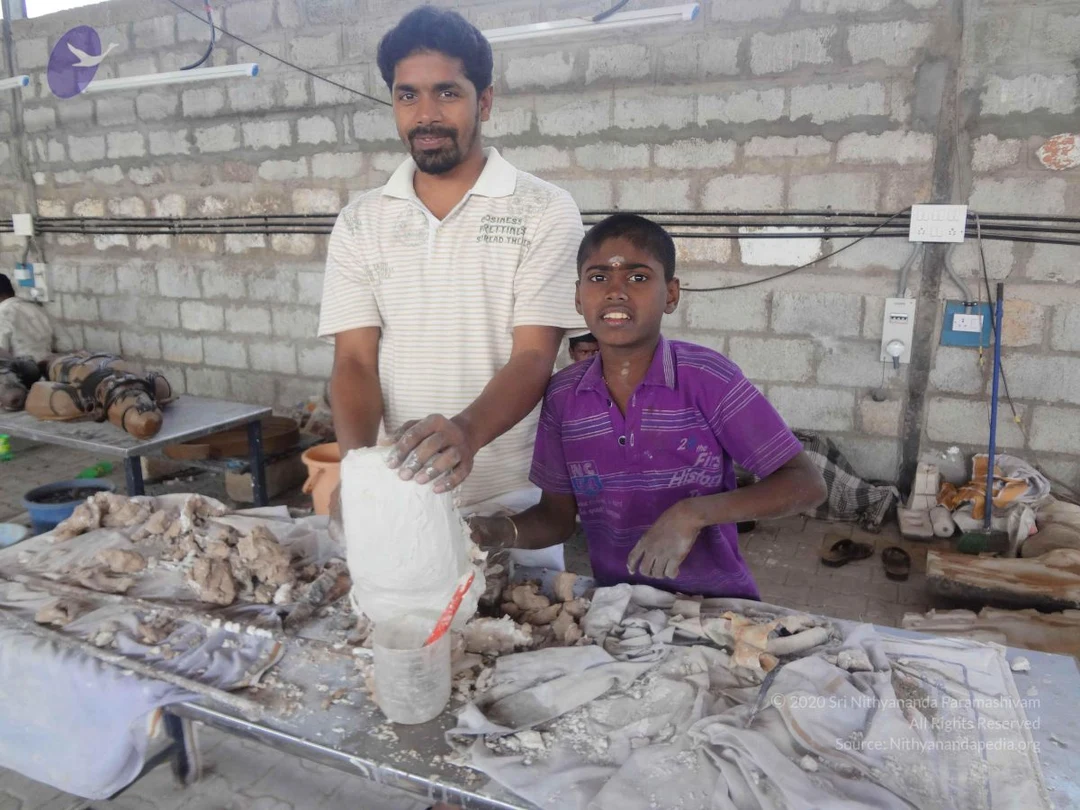
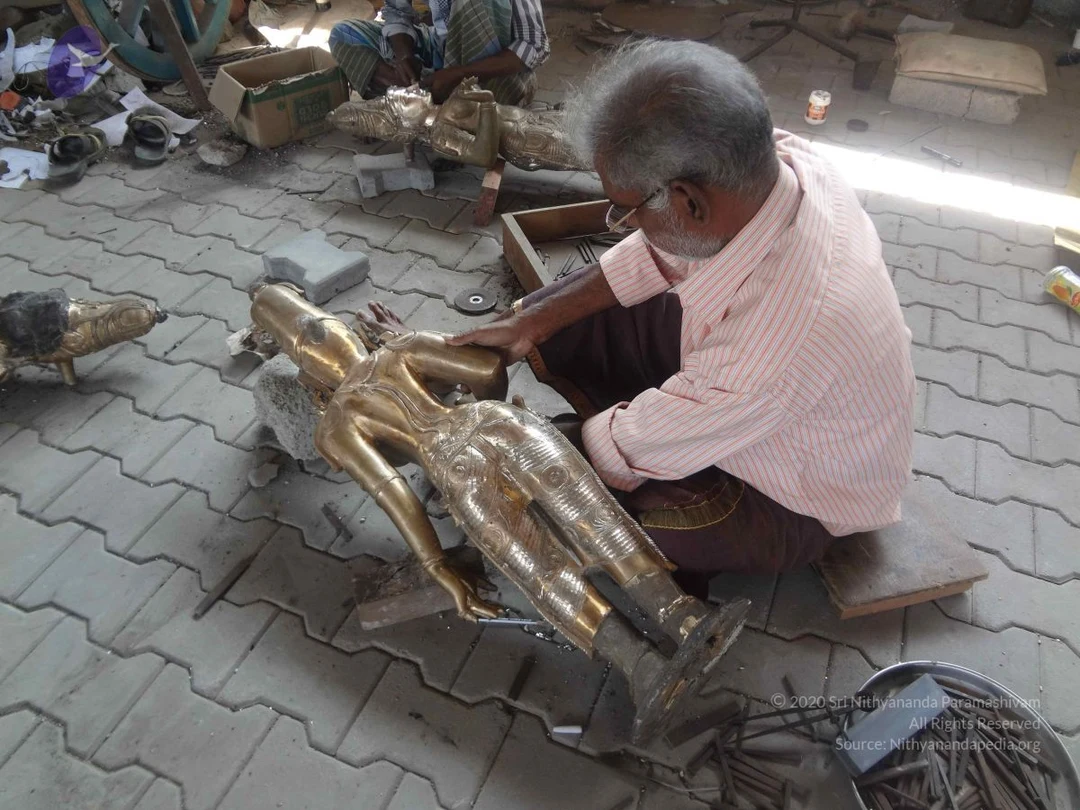
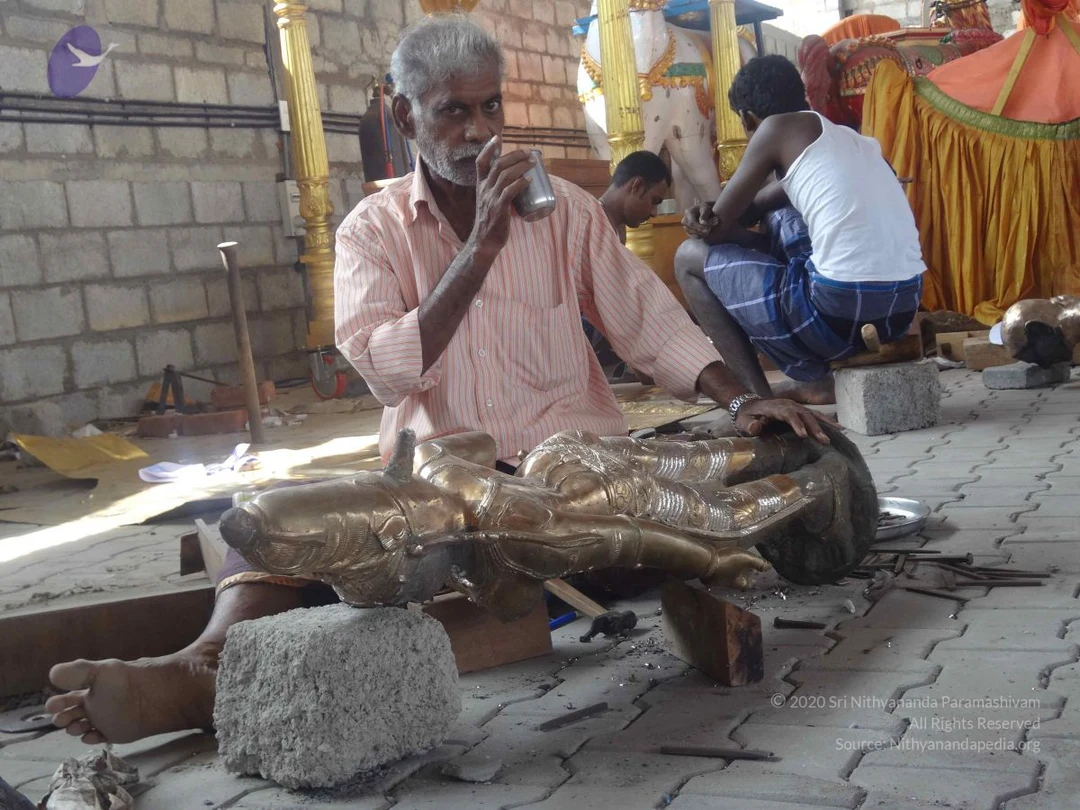
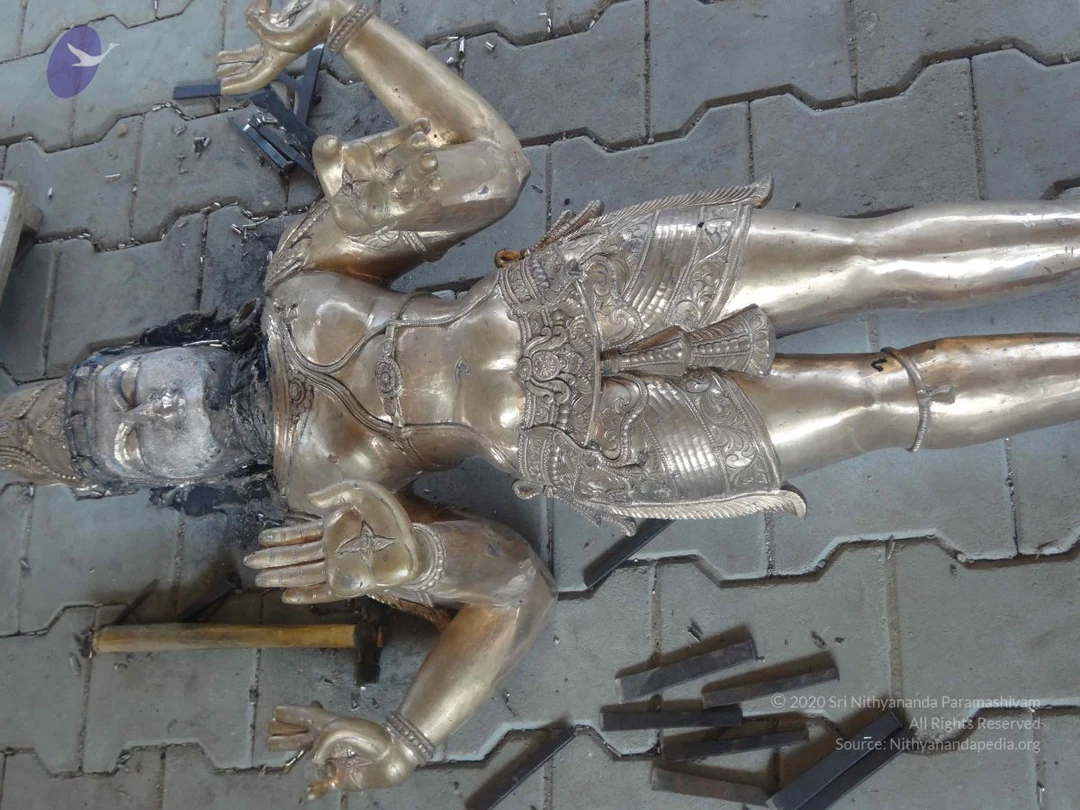
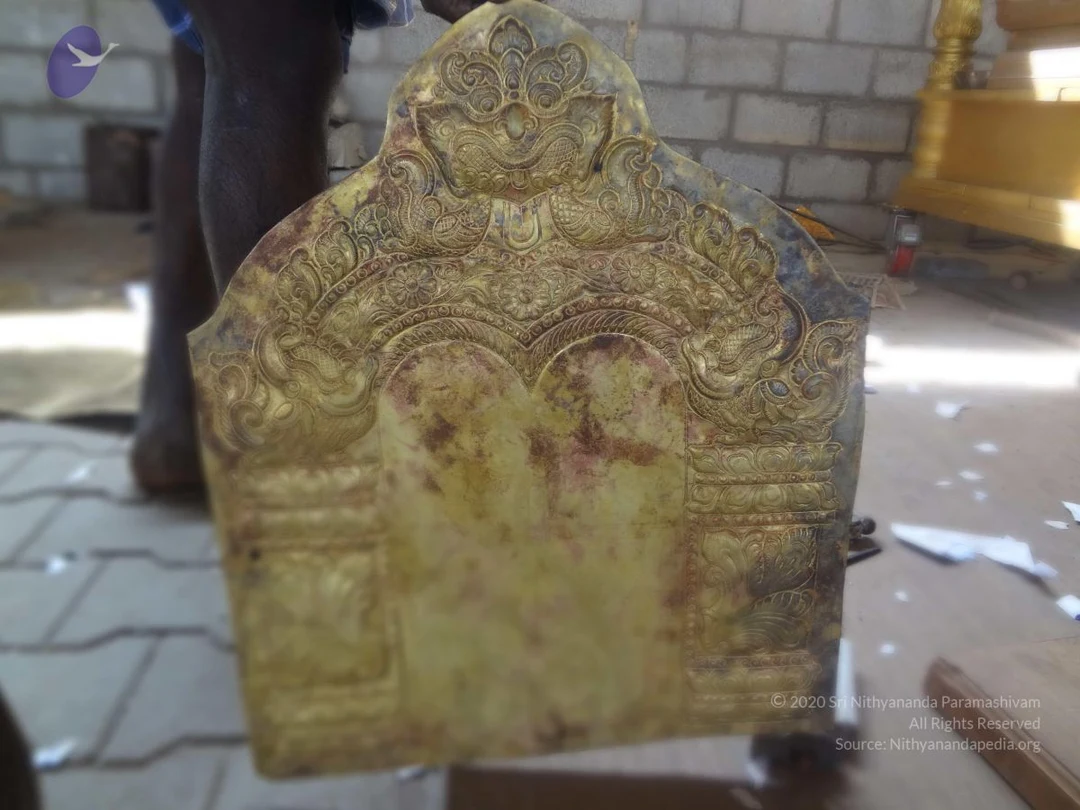
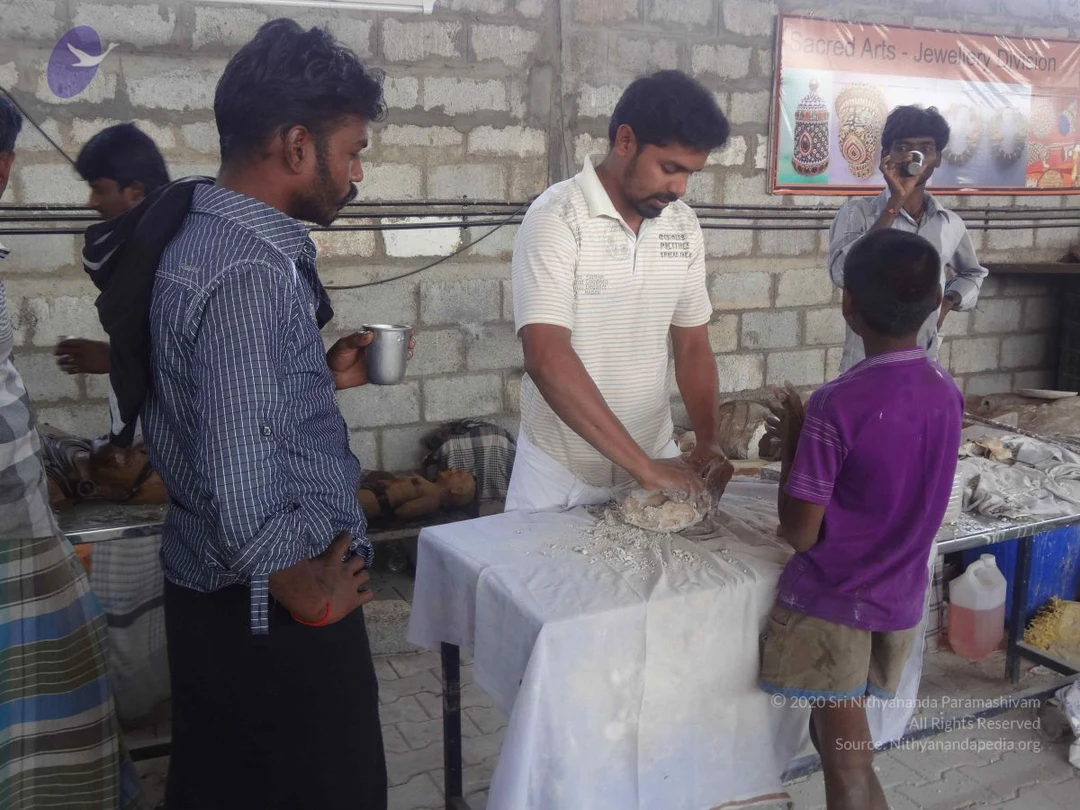
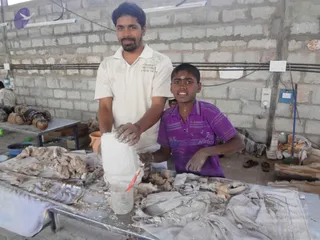
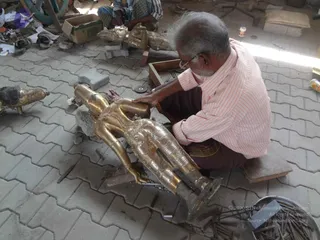
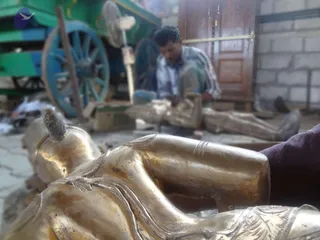
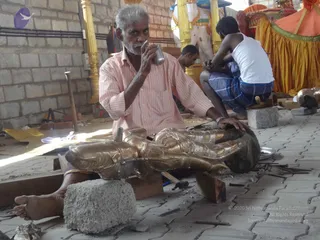
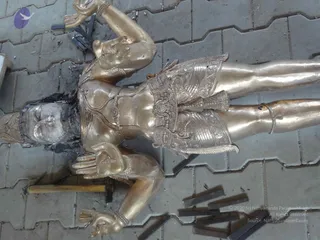
A photo of two young men standing behind a metal worktable in a plain concrete-block workshop. The taller man in a white-and-beige striped polo shirt presses his hands into a large white plaster or clay mass, while a boy in a purple striped polo with a small white mark on his forehead stands beside him, also working with his hands. The table holds broken pieces of pale plaster or clay and pale cloth, and behind them are shelves with more molded forms and a wall with electrical fittings. Wall-mounted lights and a blue fuse box are visible.A photograph of an elderly man with grey hair and glasses, wearing a pink-and-white striped shirt and a dark maroon lungi, crouched on a paved floor in a workshop. He is polishing or finishing a large golden-bronze sculpted figure. Nearby, another partly finished golden figure, a bronze torso and a small sculpted head rest on the pavers, and a second worker in a checked lungi sits in the background. Scattered tools, nails, a cardboard box, a pot of metal pieces and loose sandals lie around the floor.Close-up photograph of a polished gold-toned metal statue in the foreground, showing a reclining or seated figure with an ornate embossed floral and scroll-patterned garment or shawl across the torso. Behind it, a blurred man in a striped white-and-blue shirt and green cloth works seated among other metal pieces and wooden materials, beside a teal-painted wooden cart wheel and a wooden door in a block wall. The statue appears to be a deity murti under craftsmanship. No recognizable identity of any person is established.A close-up photo of large gold-coloured metal sculptures lying on a concrete floor in a workshop. In the foreground, a polished golden figure with ornate engraved armbands and a jewelled sash is in focus, its head and upper torso blurred. Behind it, a man in a striped collared shirt and green-patterned lungi crouches and works on another golden figure. To the left stands a green-painted wooden cart with blue-spoked wheels, and a stack of cardboard boxes and scattered debris lies nearby, beside a wooden door and a grey block wall.A photograph of a workshop where an older man with grey hair and a white beard, wearing a pink-and-white striped shirt, sits on the ground holding a small metal cup to his mouth while resting his hand on a partly finished golden-bronze deity figure with ornate armour and jewellery. Behind him a younger man in a white vest and checked lungi sits working beside a yellow and orange draped structure and a golden pillar, with another worker in the background.A large gilded metal deity murti lies flat on a grey paved surface, shown from above and partly rotated. The figure has multiple arms, an ornate crown, a jewelled belt and waist ornaments, and a bangle on the wrist. Several short iron rods or bars are scattered around it, and a wooden stick lies beside the head. The statue appears to be undergoing fabrication or repair. No people are visible.

House-Visits

30 photosSource gallery
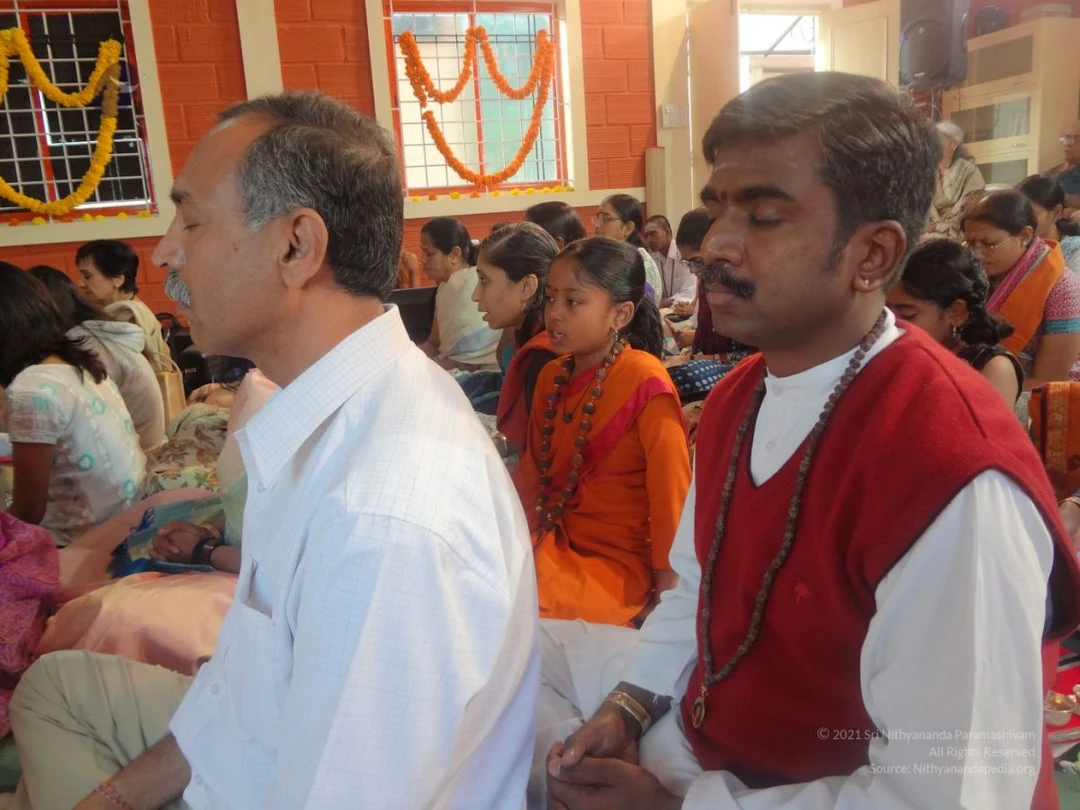
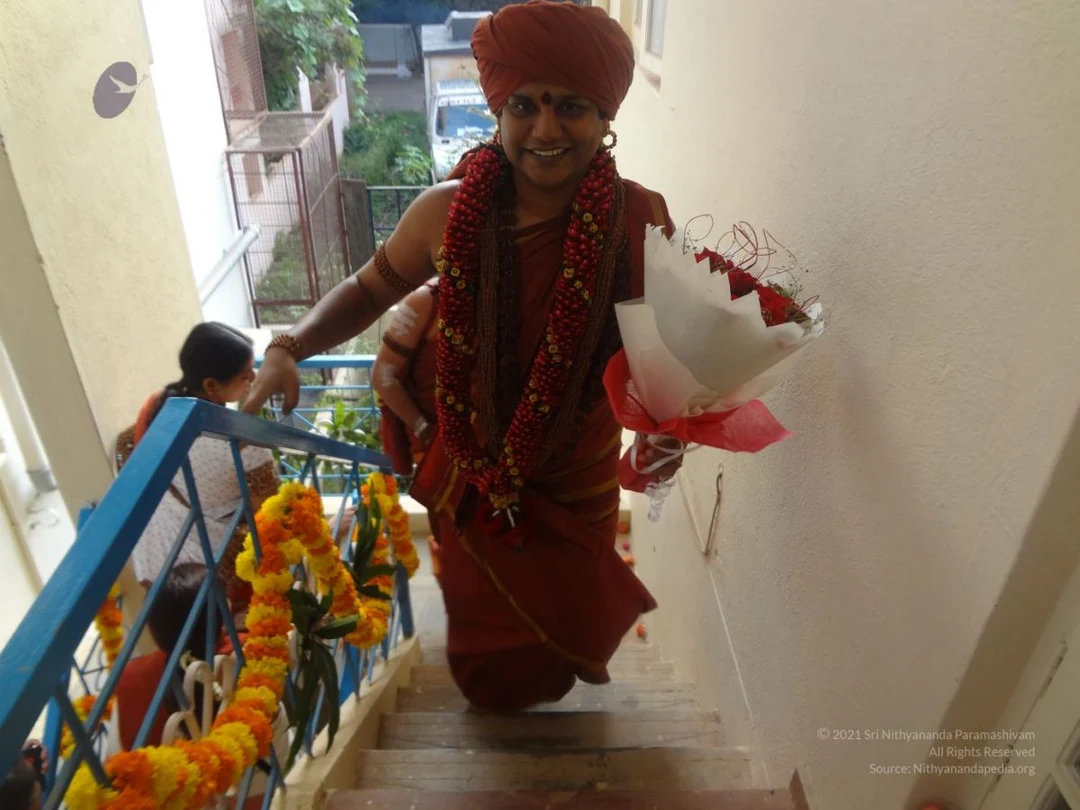
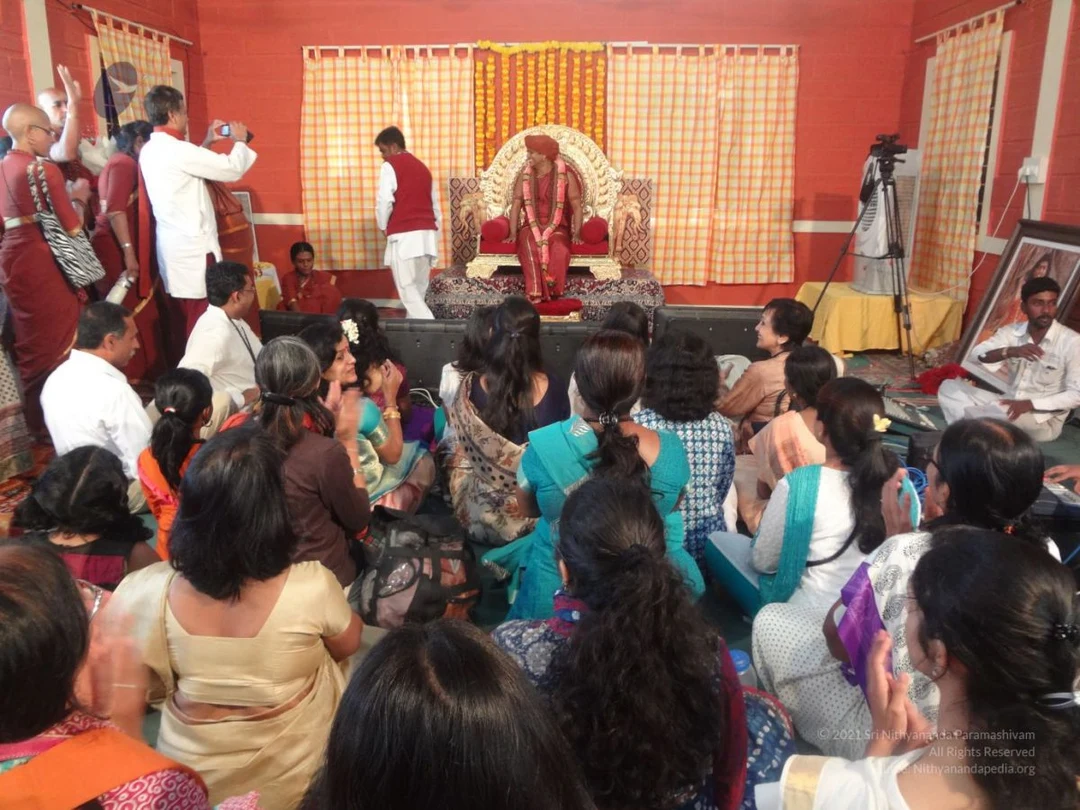
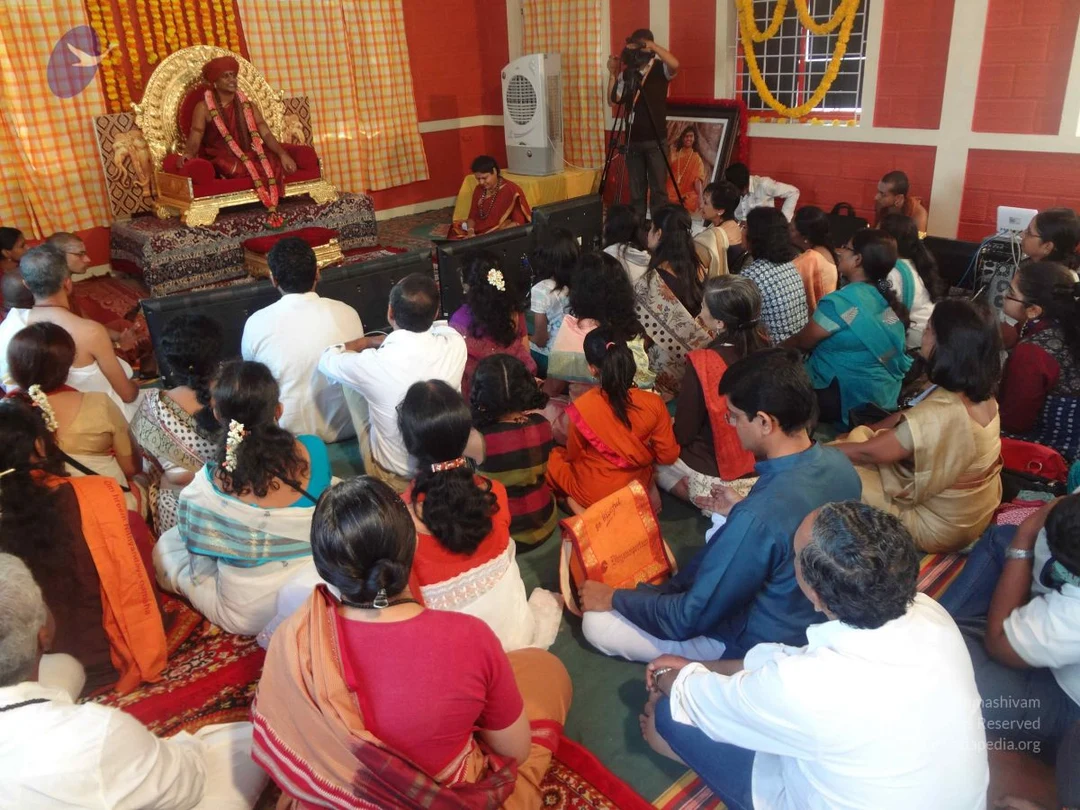
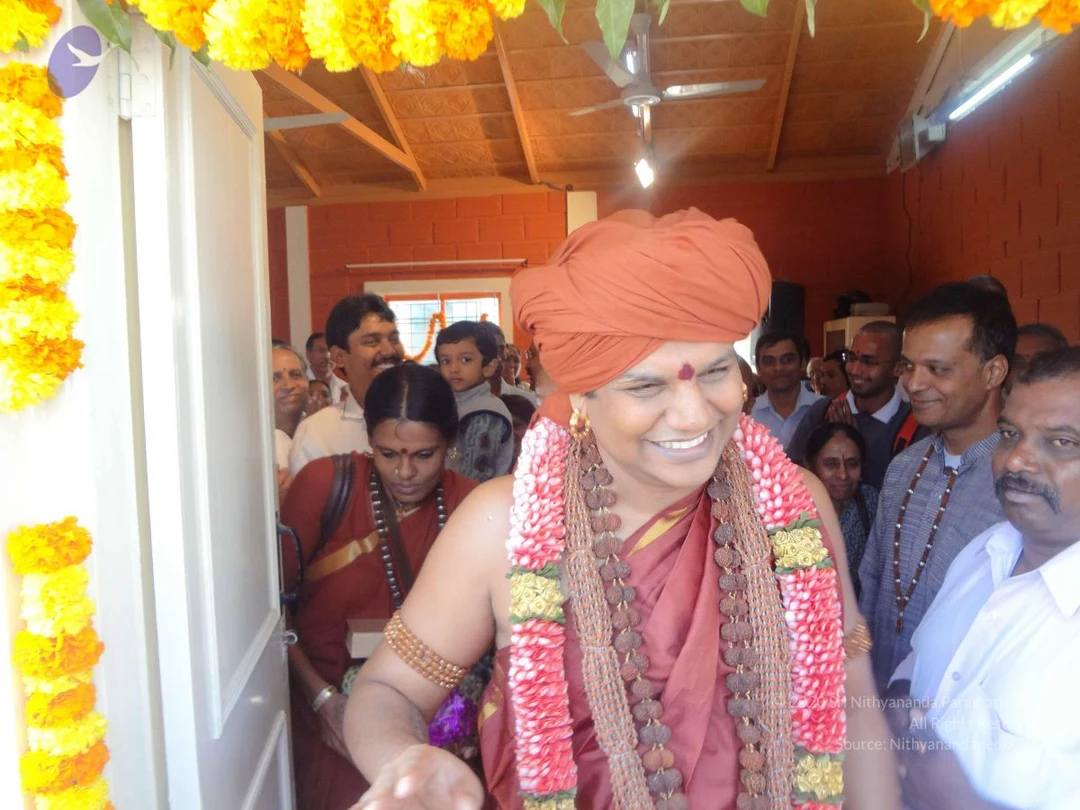
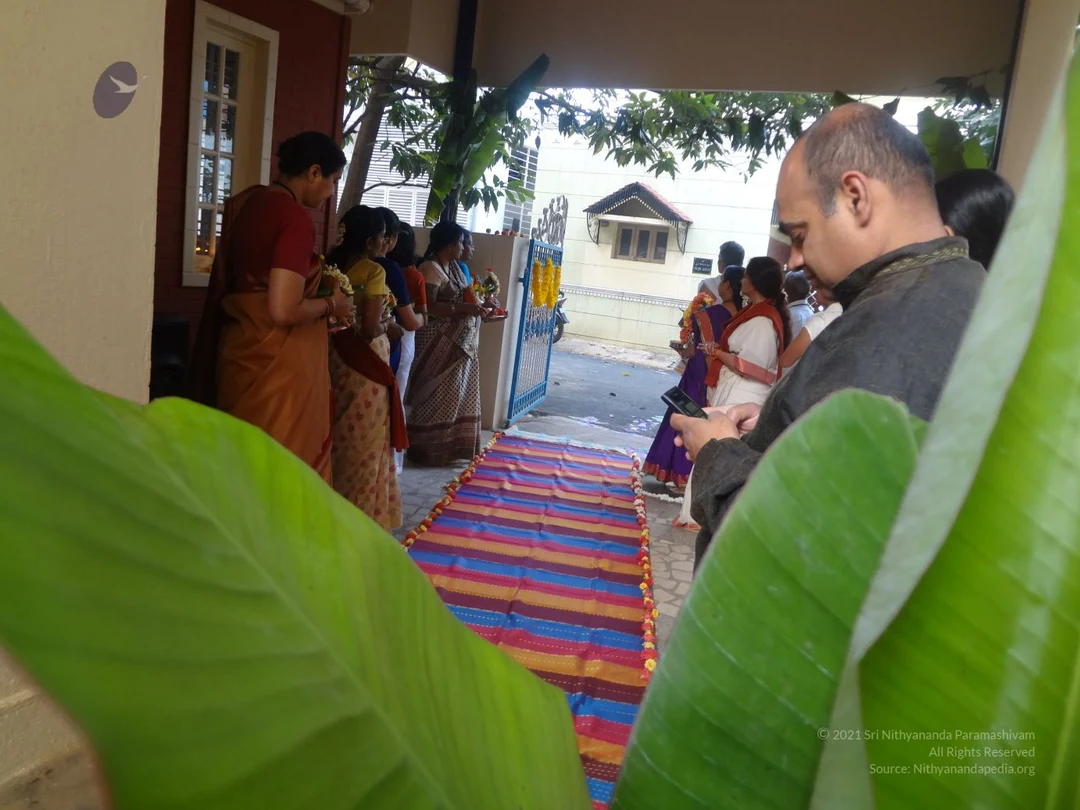
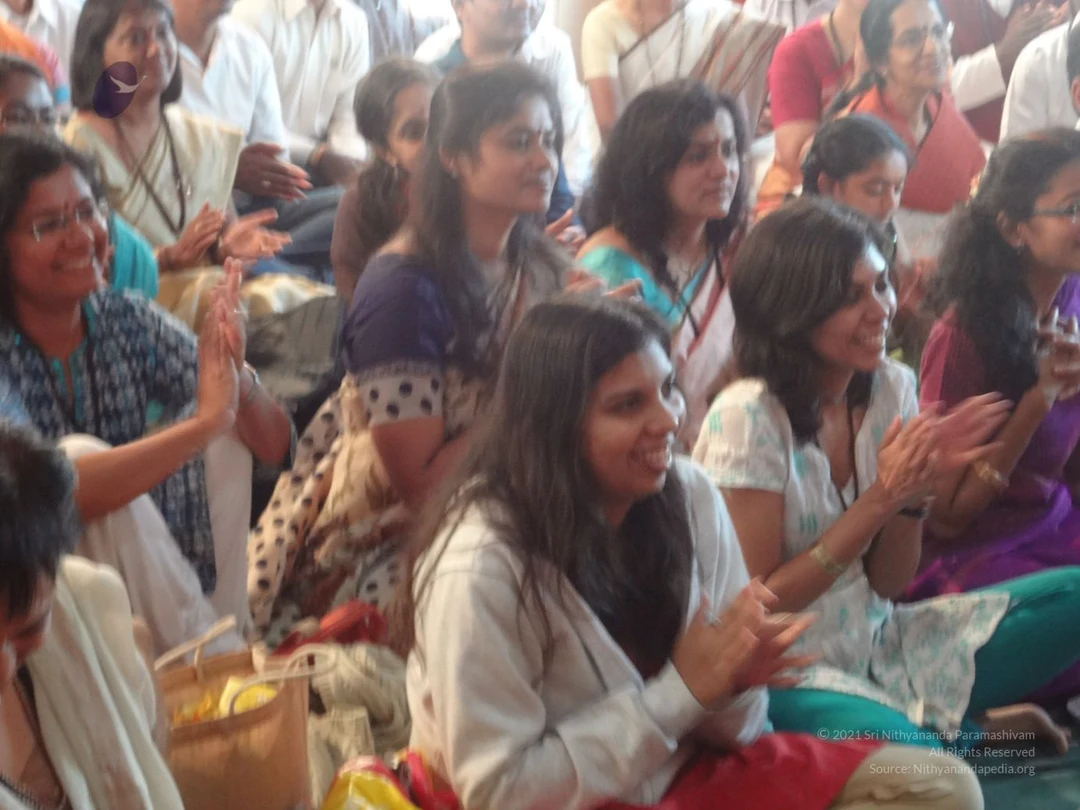
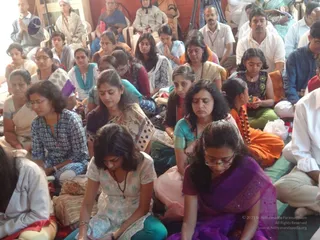
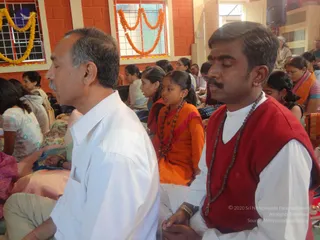
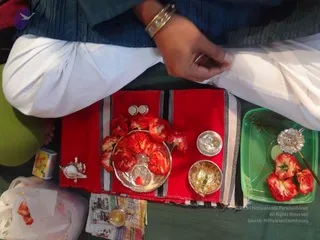
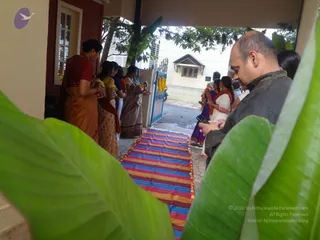
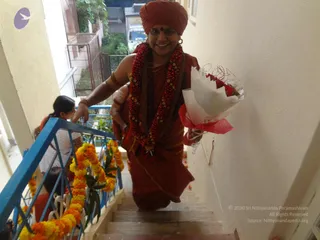
A seated group of devotees, mostly women and some men, sits with eyes closed in a bright room with orange marigold garlands along the top of a window and a wall speaker. In the foreground, a man in white kurta with a rudraksha mala and a small pendant sits with hands folded. Beside him, a woman in a purple sari with folded hands sits near a brass plate holding fruit and offerings. Another woman in a pink and teal sari sits nearby. The scene appears to be a meditation or satsang gathering.Seated devotees sit in a satsang hall with orange-brick walls and barred windows decorated with marigold garlands. In the foreground, a grey-haired man in a white checked shirt sits with eyes closed. Beside him, a man in a red sleeveless vest over white clothes wears a rudraksha mala and sits with eyes closed and hands clasped. Next to them, a girl in an orange kurta with rudraksha beads listens attentively. Other women in saris and salwar kameez sit in rows behind, some wearing glasses, and a speaker is mounted high on the wall.Overhead photo of a seated person in white trousers and a blue striped top, wearing several gold bangles, with one hand resting on the knee beside a worship arrangement on a red cloth with black and white stripes. On the cloth sits a silver plate heaped with red-and-orange roses, two small silver cups, a silver bowl with gold-coloured items, and a silver incense or lamp stand. A green plastic tray holds more roses and a silver flower-shaped holder. Other objects include a small silver pitcher, a matchbox, a folded newspaper and a plastic bag of roses.A photograph taken from behind large green leaves at an ashram entrance. A striped red, blue, yellow and orange cloth runway is laid on the paved path, edged with marigold garlands. On the left, several women in saris stand in a row holding brass plates and flowers, a woman in a deep orange sari at the front. On the right, a bald man in a dark grey kurta looks down at a mobile phone in his hands. Further back, more women in saris, including one in a purple sari and one in a red-bordered white sari, stand near a blue gate with hanging yellow marigold garlands. A white building with a small roof and a red-brick wall frame the scene. No figure in this image is identified as a person.A photograph taken from above of a man ascending a staircase with a blue metal railing and cream walls. He wears a rust-red turban with a red tilak on his forehead, a red-orange robe and a dense necklace of red beads and marigold garland, and holds a wrapped bouquet of red and white flowers in his right hand, smiling toward the camera. Marigold garlands drape the railing and steps. A woman in a white patterned top stands further back on the landing, and a white vehicle is visible through the window. A person whose appearance is uncertain. a person candidate with turban, robe and bead mala cues; identity unconfirmed.A photograph of a devotional gathering in a red-walled room with yellow and orange checked curtains and a marigold garland across the top. A seated figure in a red and gold robe with a red turban and beaded garland sits on an ornate gold-framed throne with red cushions, a central focal point. Around him, a crowd of women in salwar kameez and saris, many with hair in plaits or buns, sit on the floor facing the throne and some clap. Men in white kurta and a man in a maroon vest move near the front, one holding a camera. A tripod-mounted video camera stands at right beside a framed portrait.

01-Receiving-Swamiji-In-Bali

7 photosSource gallery
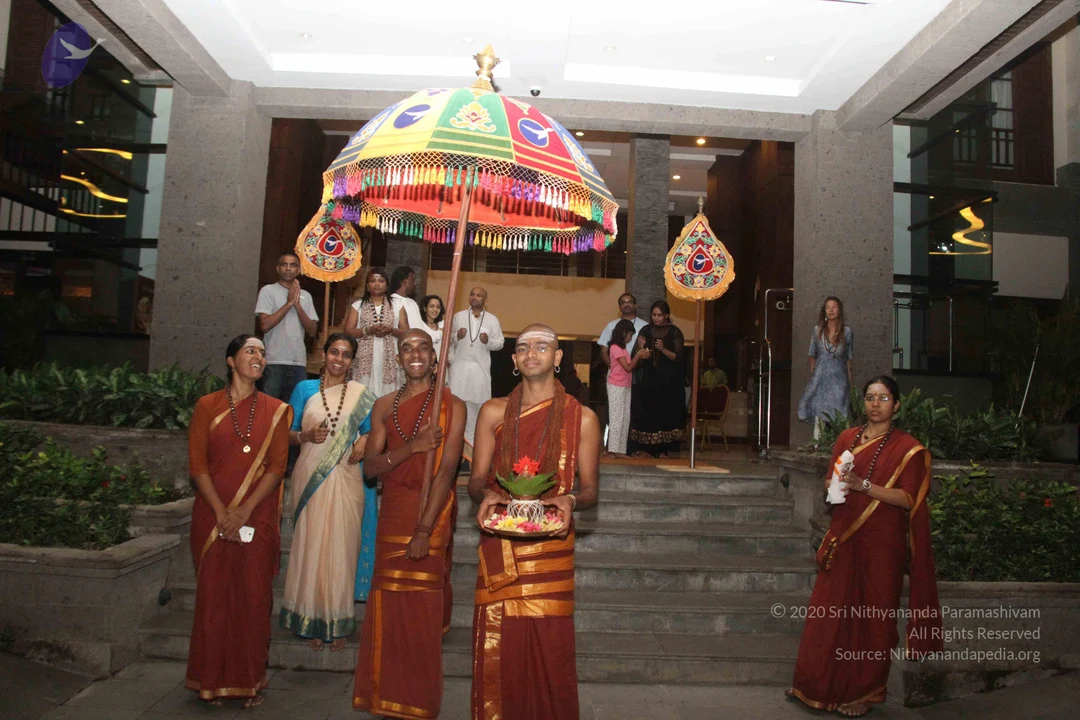
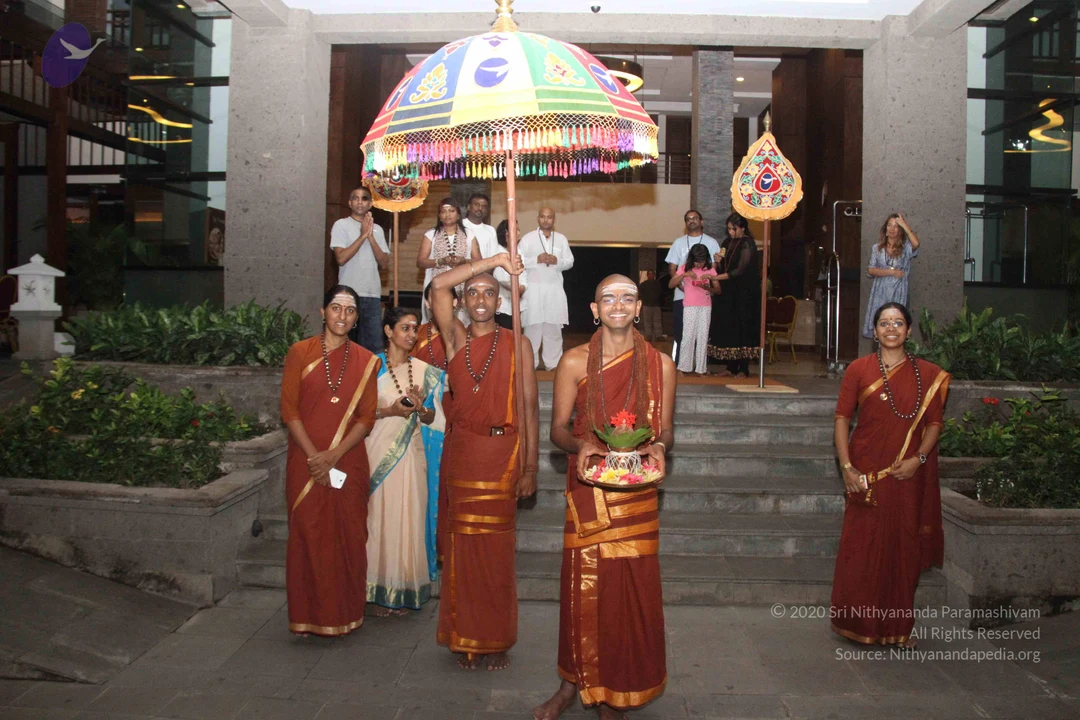
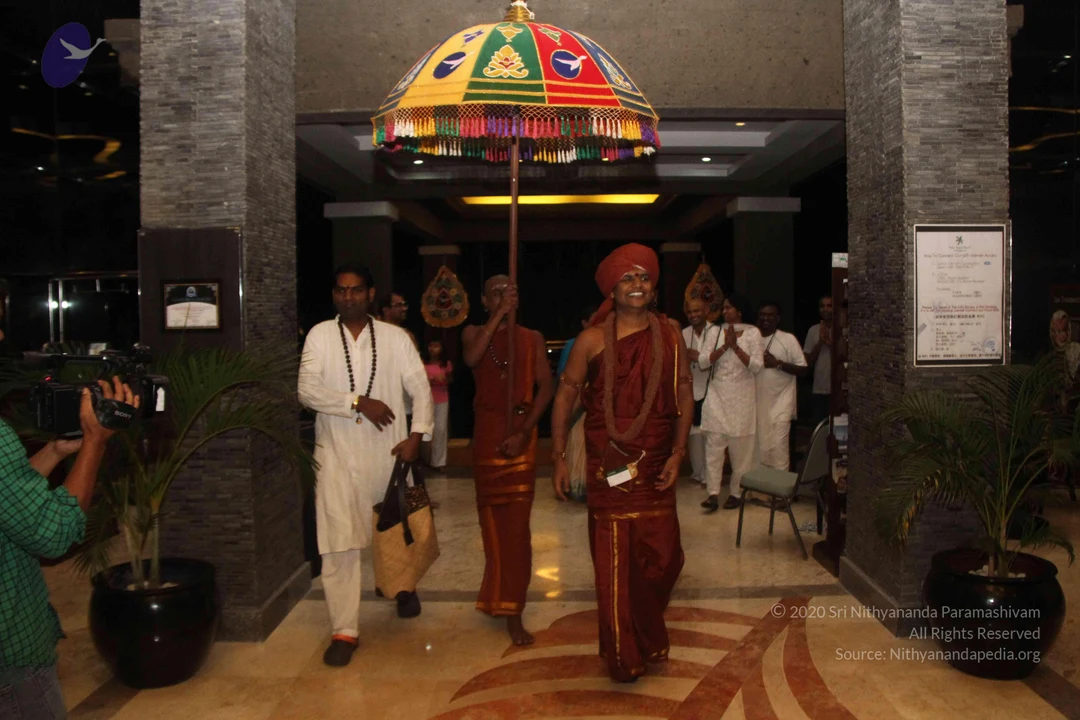
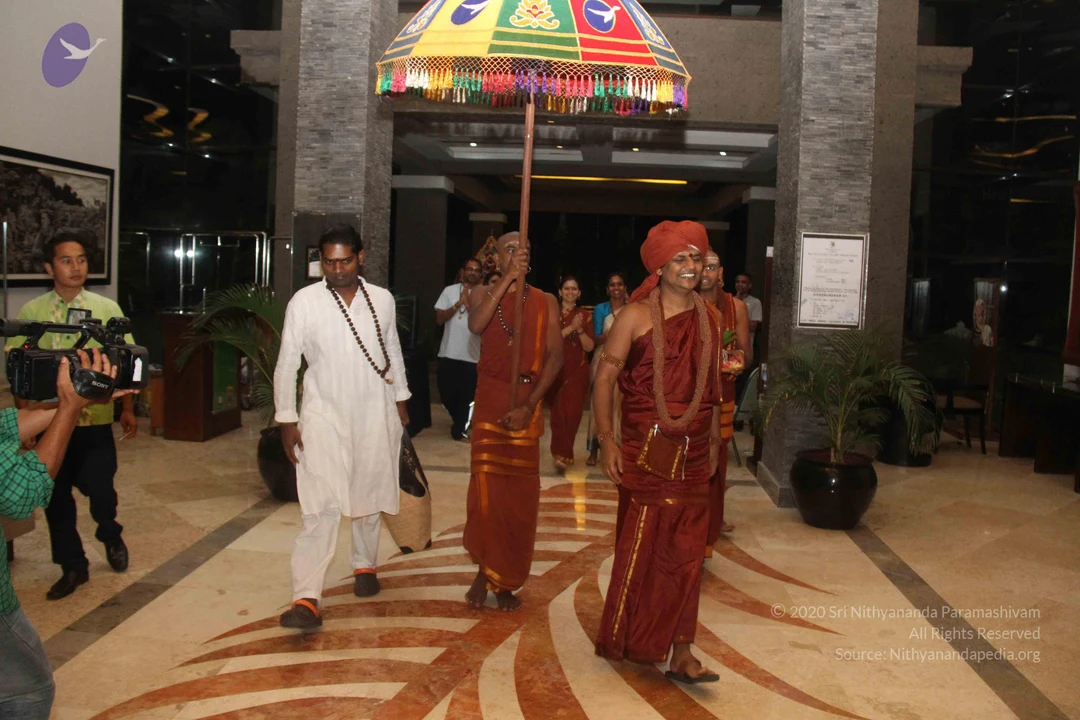
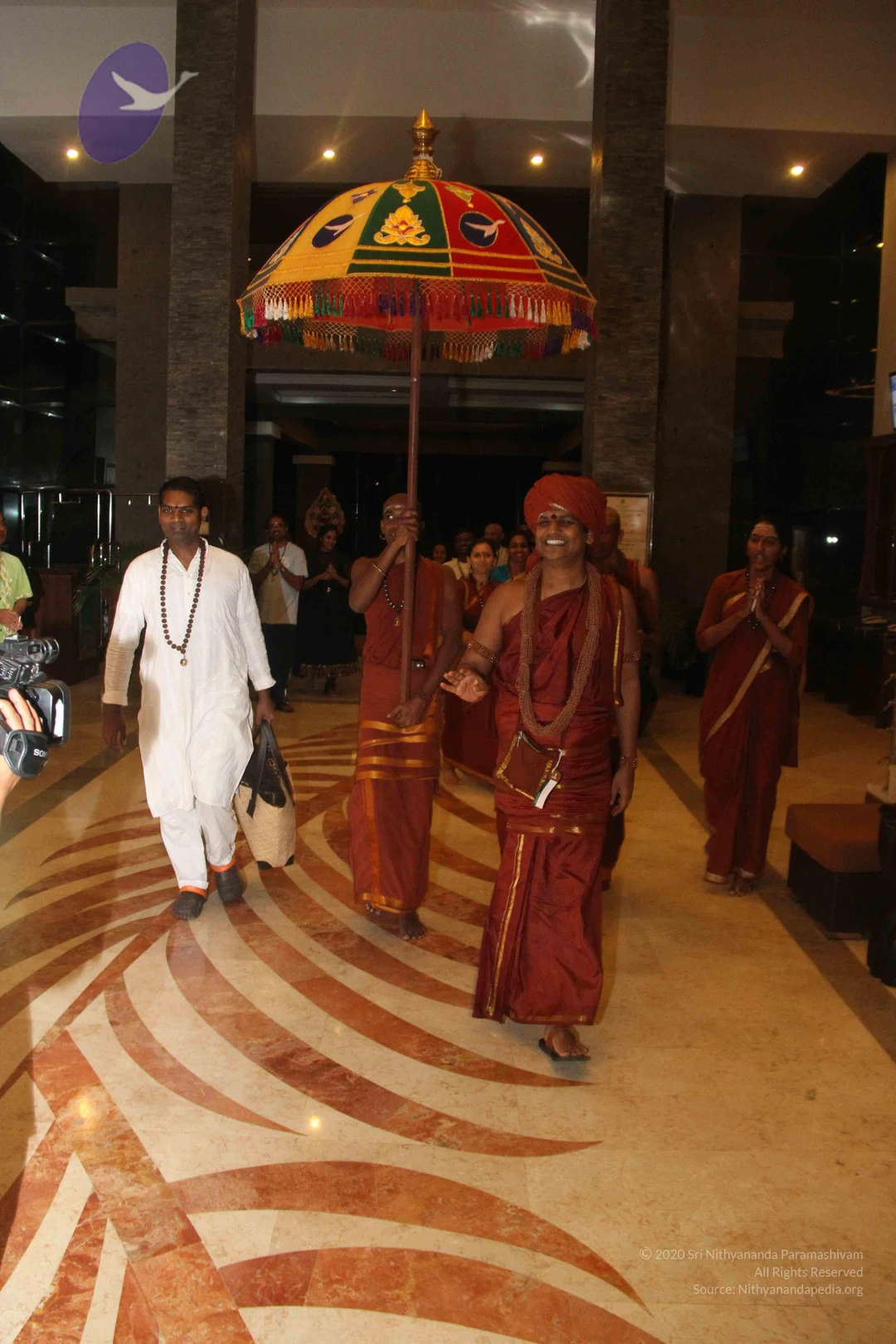
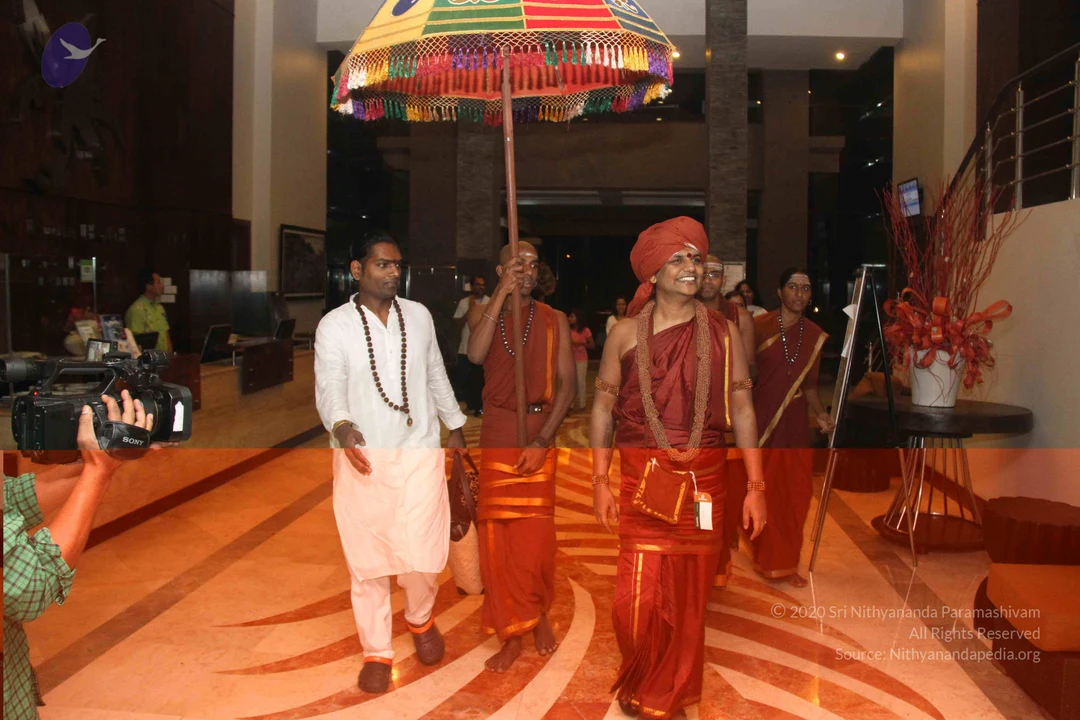
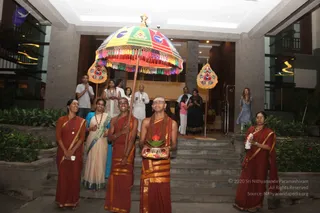
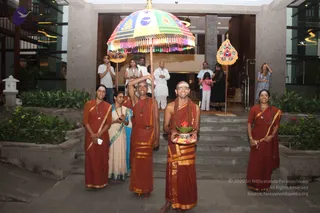
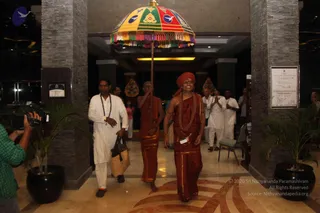
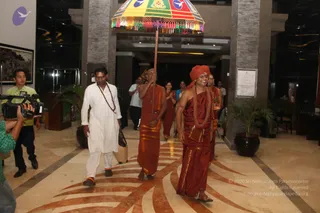
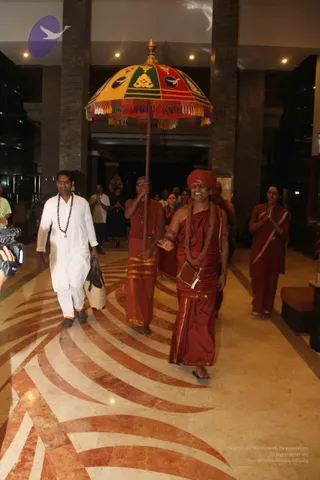
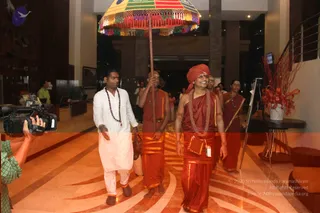
Outdoor entrance procession at a building with stone steps and columns. A colourful multi-panel umbrella with fringed tassels, including a decorated canopy and a golden finial, is held over a group in orange-red robes. A young man in an orange dhoti with a gold border holds the umbrella pole, and a man in an orange-gold dhoti carries a brass plate of flowers and offerings. Women in rust-red saris with rudraksha malas stand on either side, one in a cream sari with a blue border. Behind them, people in white and other clothes stand with hands folded in greeting. Decorated fan-shaped banners hang on either side.A reception procession at the entrance of a modern hotel lobby with stone steps. Several devotees in deep red-orange sarongs and shawls with gold borders walk forward. A bald priest in the centre, with a white tilak on his forehead, rudraksha mala and red garland, holds a decorated brass plate of flowers and offerings. Behind him a man in a red sarong holds a large colourful ceremonial parasol with tassels. Women in red saris and a woman in cream and blue sari stand nearby, and onlookers in casual clothes watch from the background.Indoor photo of a procession entering a hotel lobby with dark stone-clad pillars and marble floor. A central figure in a maroon-red dhoti and shawl, with a red turban and a white-beaded mala, walks beneath a large multicoloured ceremonial parasol with tassels, held aloft by a bald attendant in orange-saffron robes. A man in white kurta and a rudraksha mala carries a woven bag beside them. Behind, several men in white kurtas and dhotis stand with palms joined, and a cameraman in a green shirt films at left. Potted palms and a framed plaque are visible. a person appearance is an uncertain candidate at the front of the procession; the cues are a red turban and a maroon robe, but the face is not clearly visible enough to confirm.Indoor photo of a procession moving across a polished marble hall at night. A man in white kurta and white dhoti with a rudraksha mala walks at left. Several saffron-robed sannyasis follow, one carrying a tall pole that holds a large multicolored canopy with tassels and emblems. The lead robed figure in front wears an orange turban, a thick rudraksha mala, gold armlets and a saffron dhoti, and smiles. Palms in dark pots line the hall and a cameraman films at left. About nine people are visible.A procession moves across a polished marble hotel lobby with curved reddish-cream inlay patterns. At the front, a smiling man in a red-orange turban and matching orange-red robe, with a beaded rudraksha-style garland, walks barefoot beside a man in white kurta-pajama carrying a woven bag. Two attendants in orange-red robes hold a large multicoloured parasol with fringed edges and a golden finial, shielding the central figure. Behind them, women in red-orange saris and a man in a white shirt press palms together in greeting, and a cameraman with a video camera is at the left edge. Pillars and recessed ceiling lights frame the scene.A procession crosses a polished, patterned hotel lobby at night. A central figure in a red-orange turban, red-orange robe with a thick beaded necklace and bangles walks smiling beneath a large multicoloured umbrella with tasselled fringe on a long pole. Two saffron-robed attendants follow, one holding the umbrella, and a woman in a saffron sari with a rudraksha mala walks at right. A man in white kurta and dhoti with a rudraksha mala and a bag walks at left, while a cameraman films with a Sony camera. A red floral arrangement and a framed easel stand at right. Appearance-based label: a person, central figure with turban and ornate beaded necklace, carried under umbrella in procession.

01-House-Visit
7 photosSource gallery
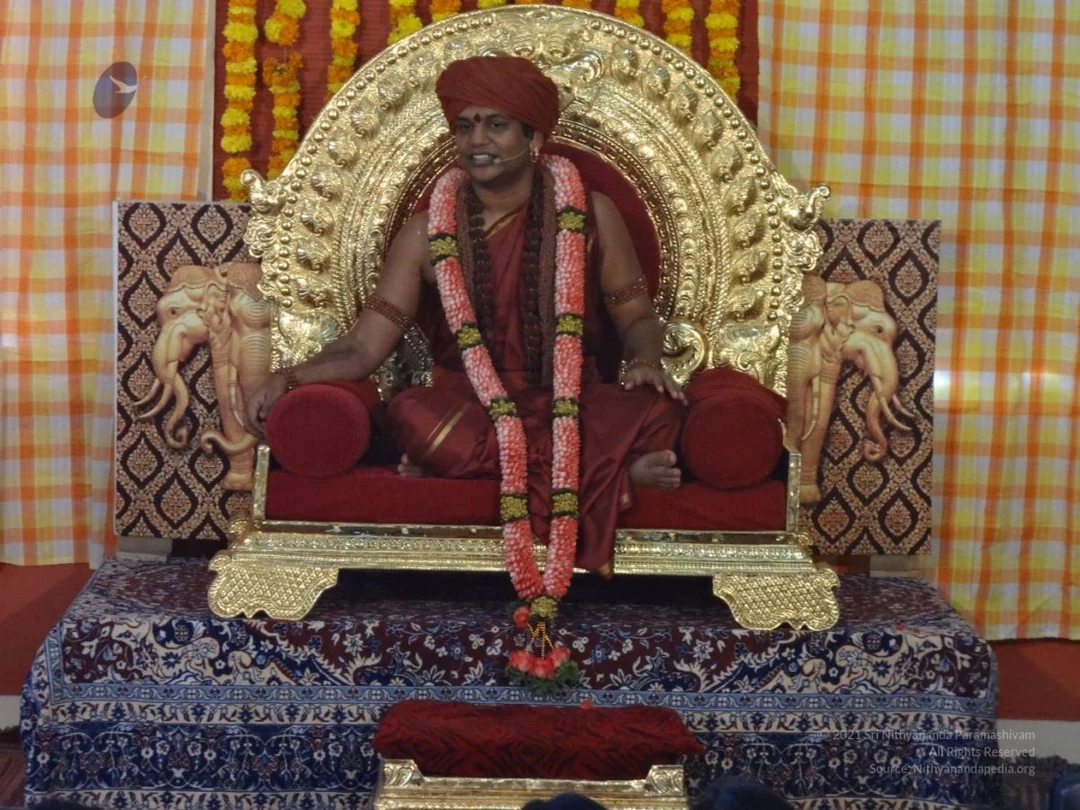
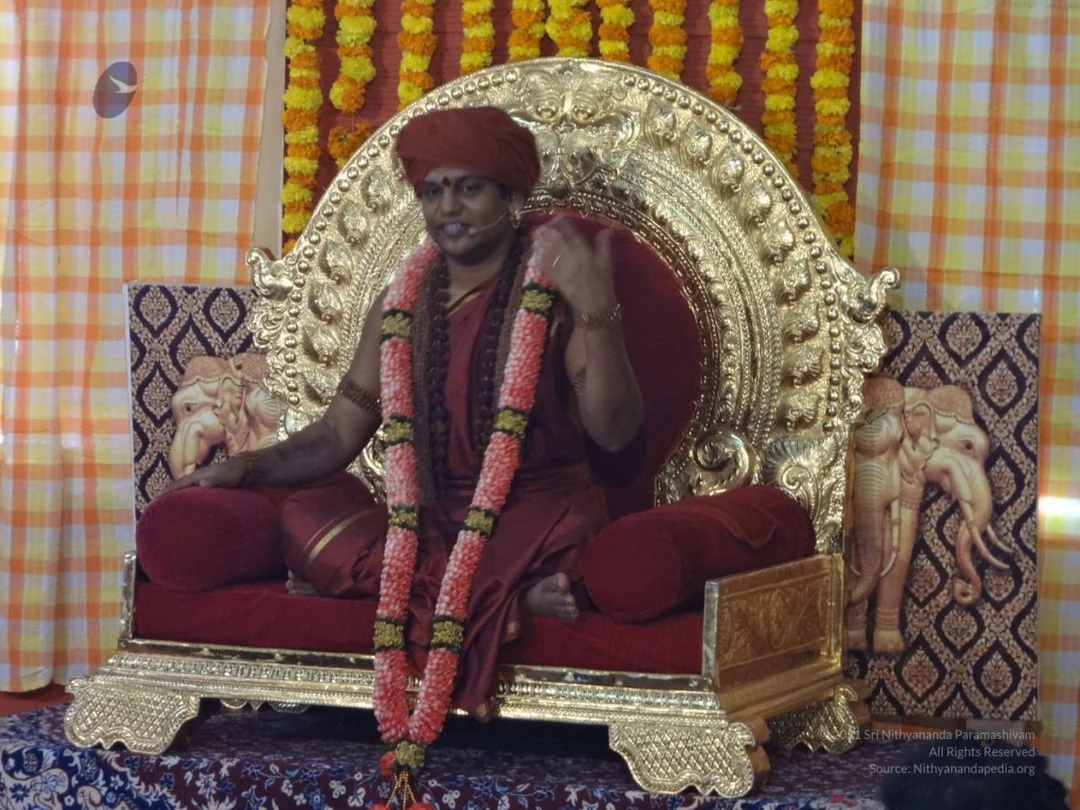
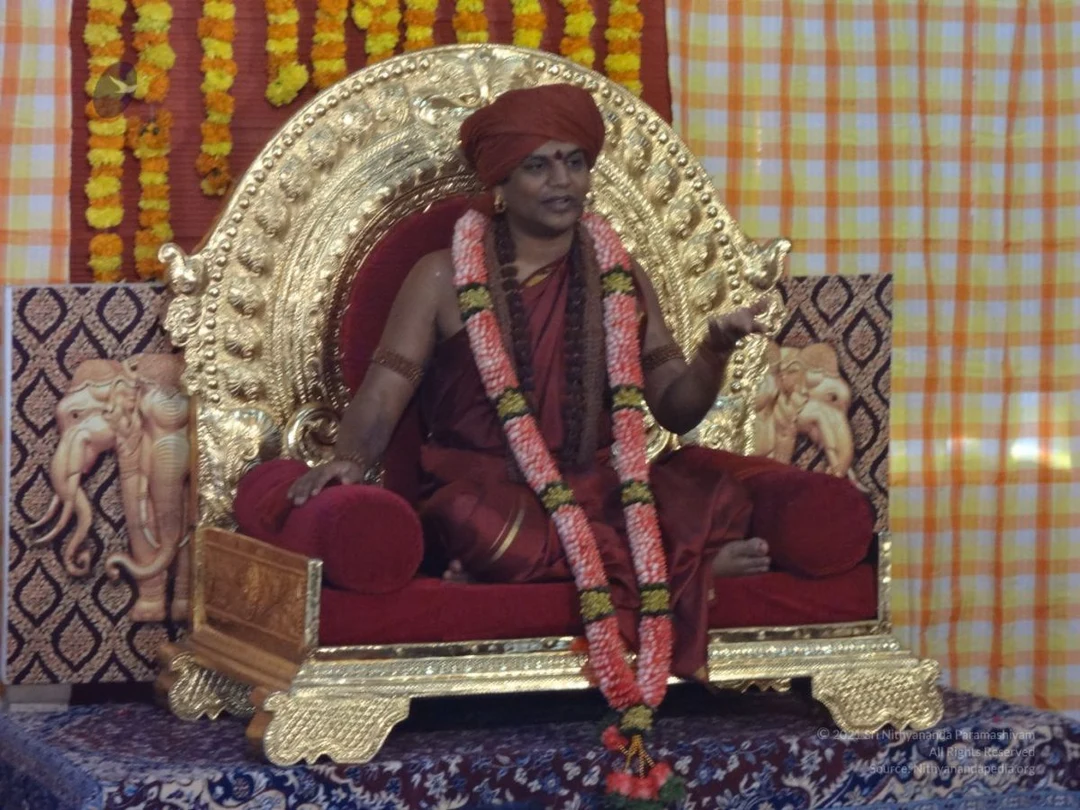
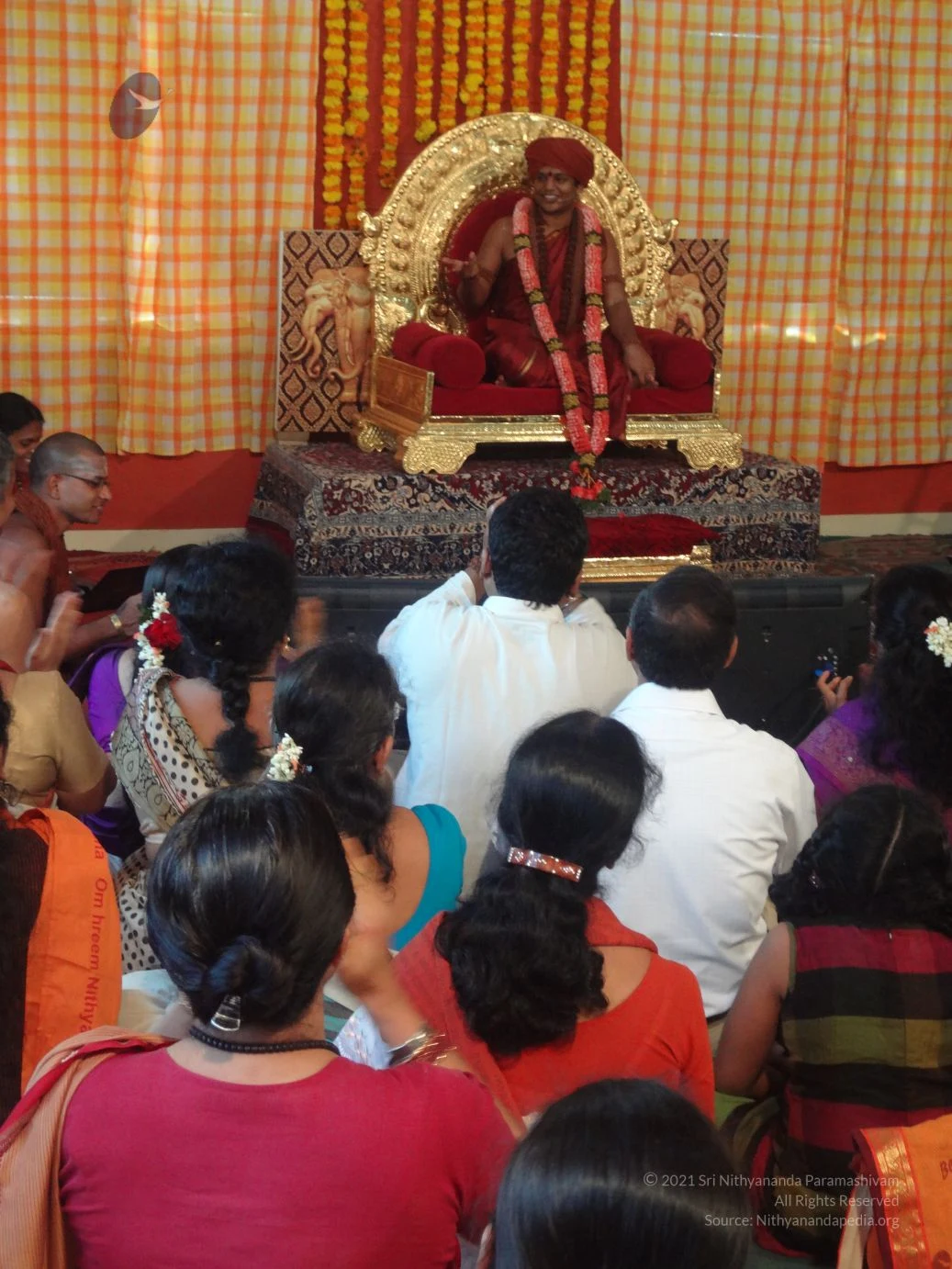
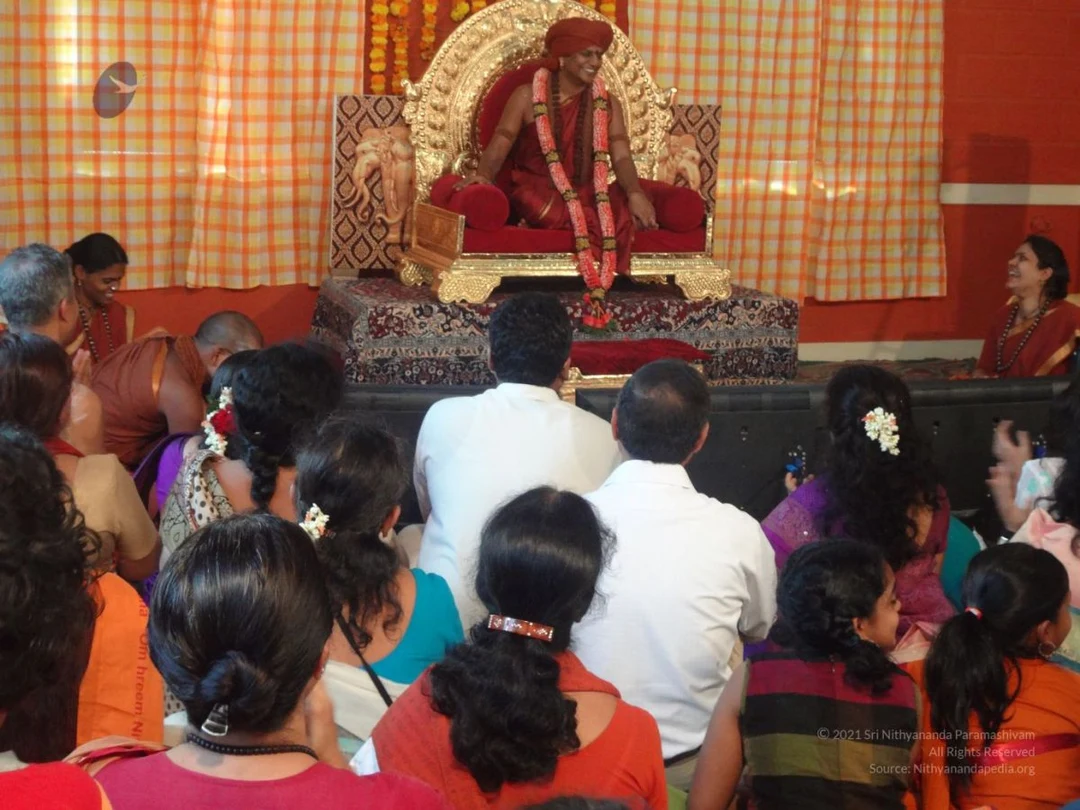
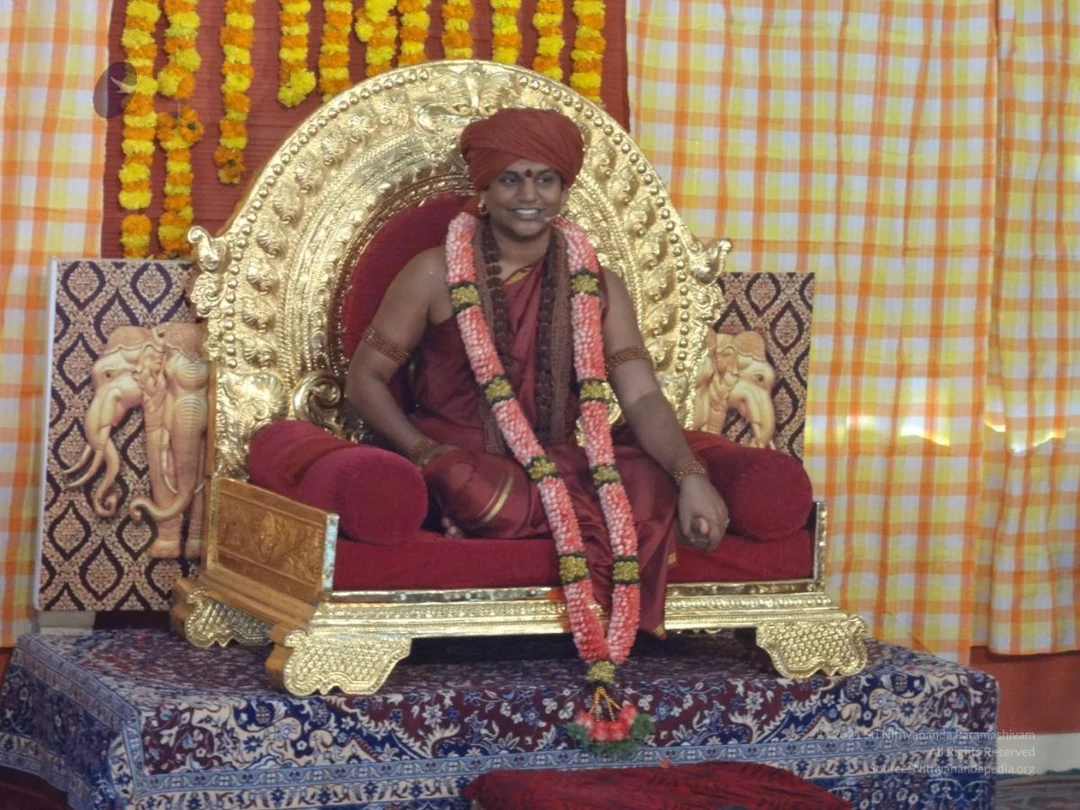
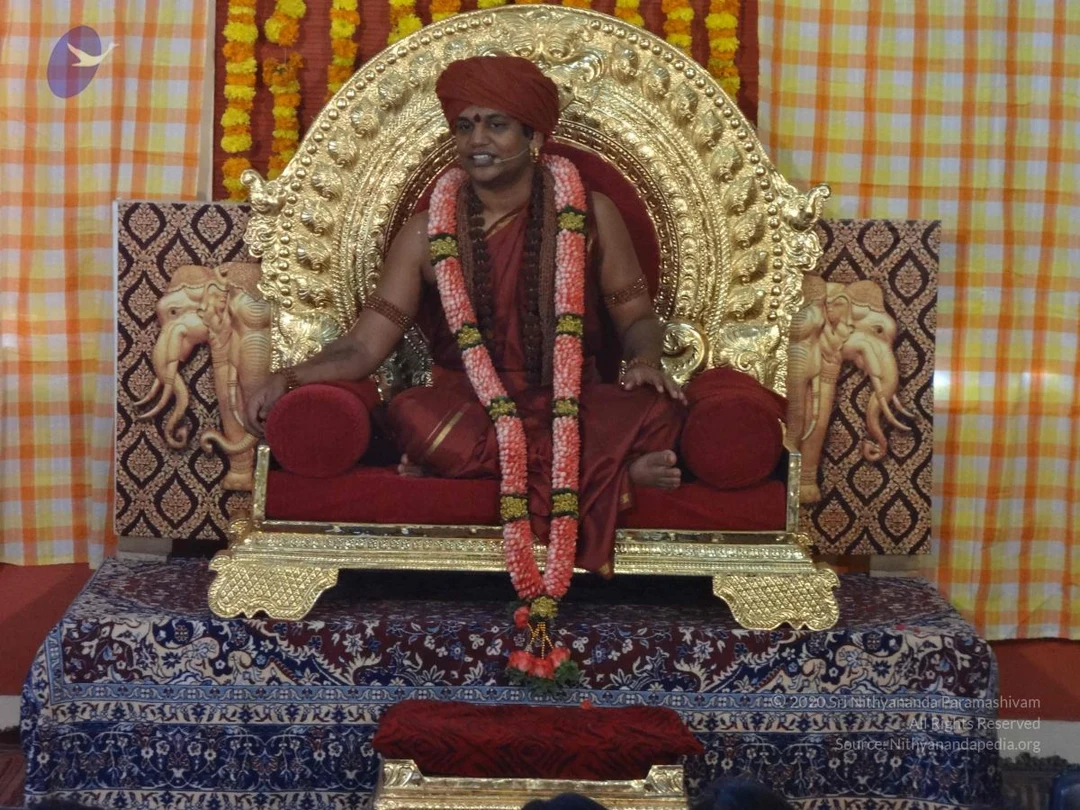
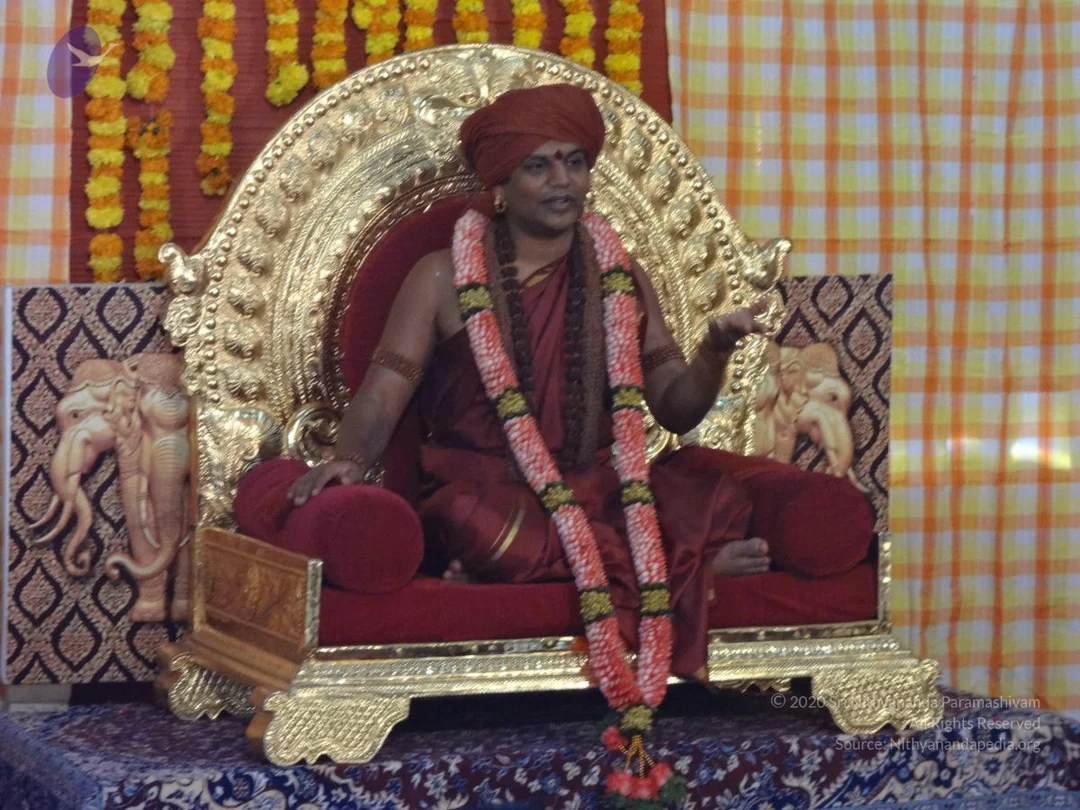
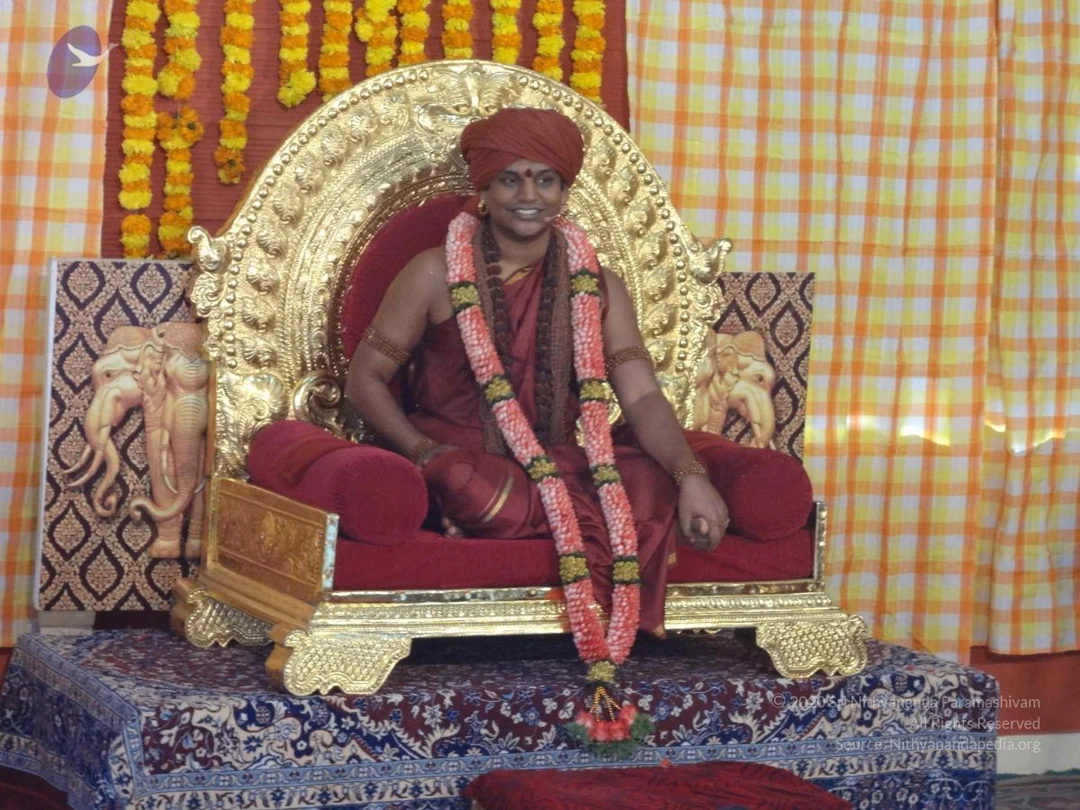
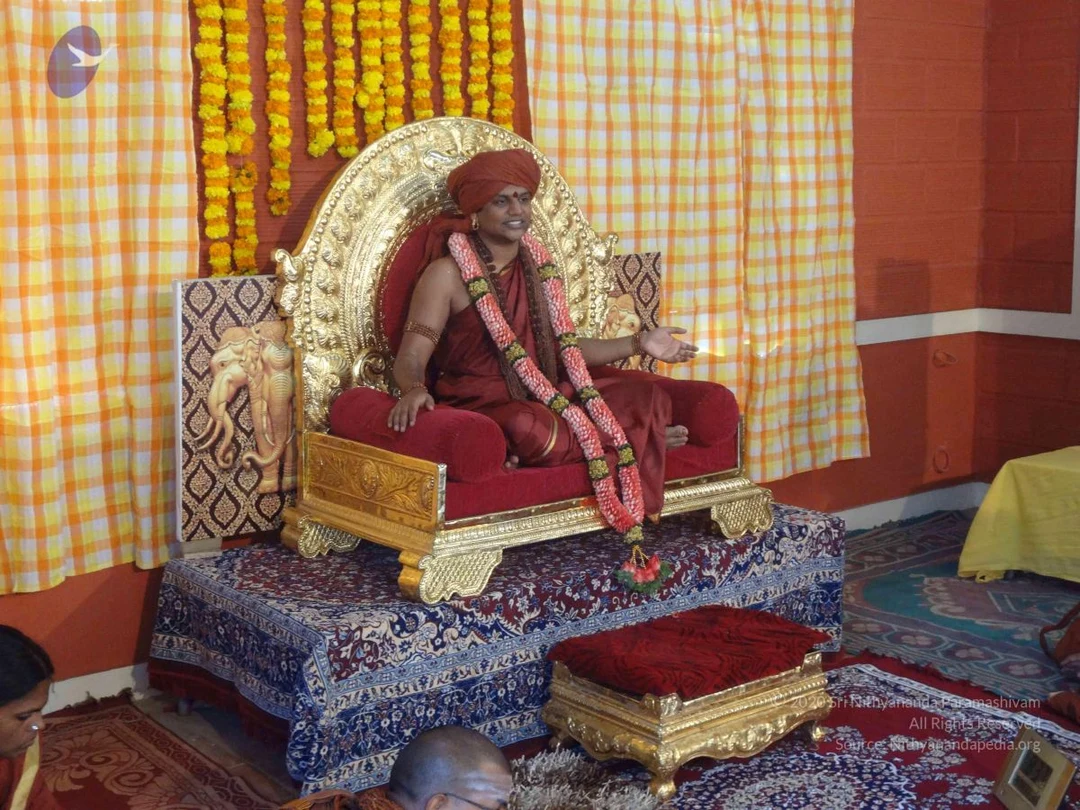
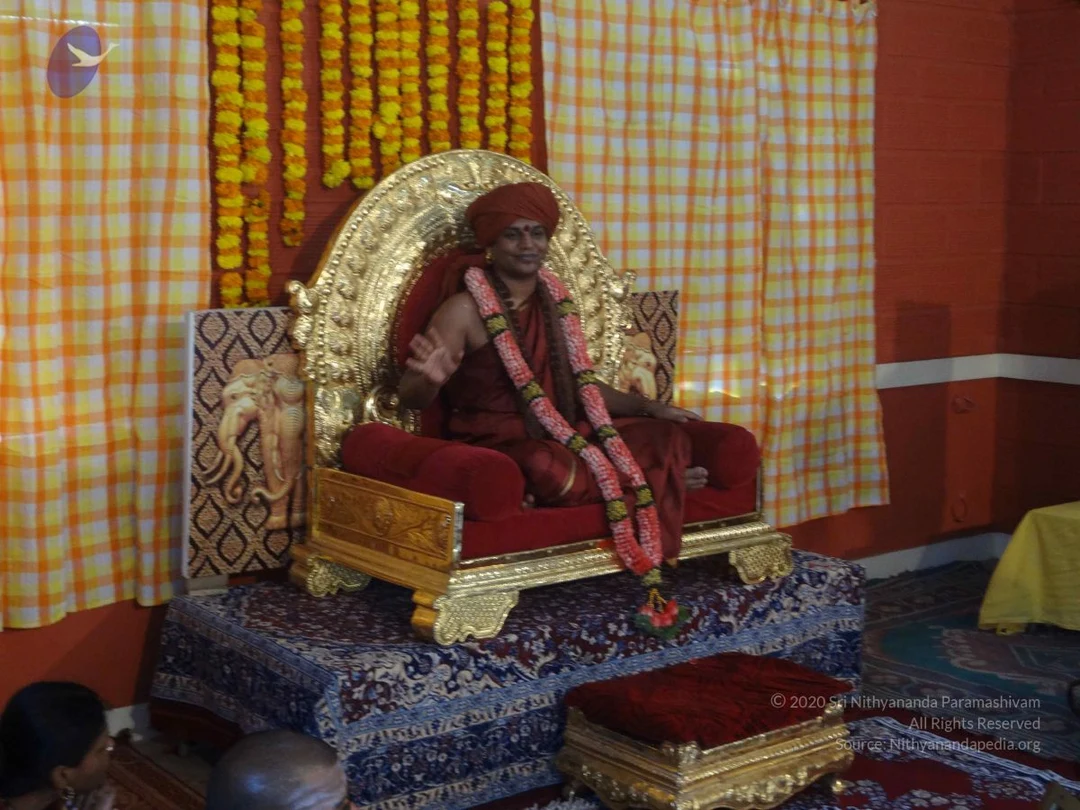
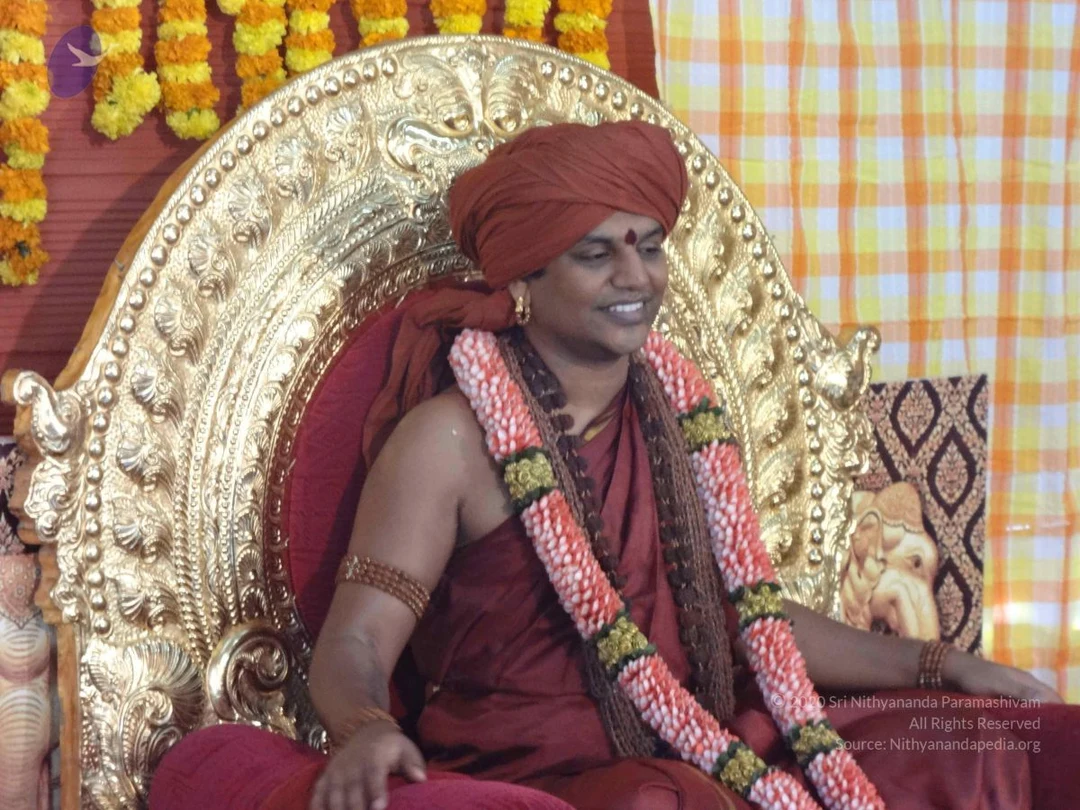
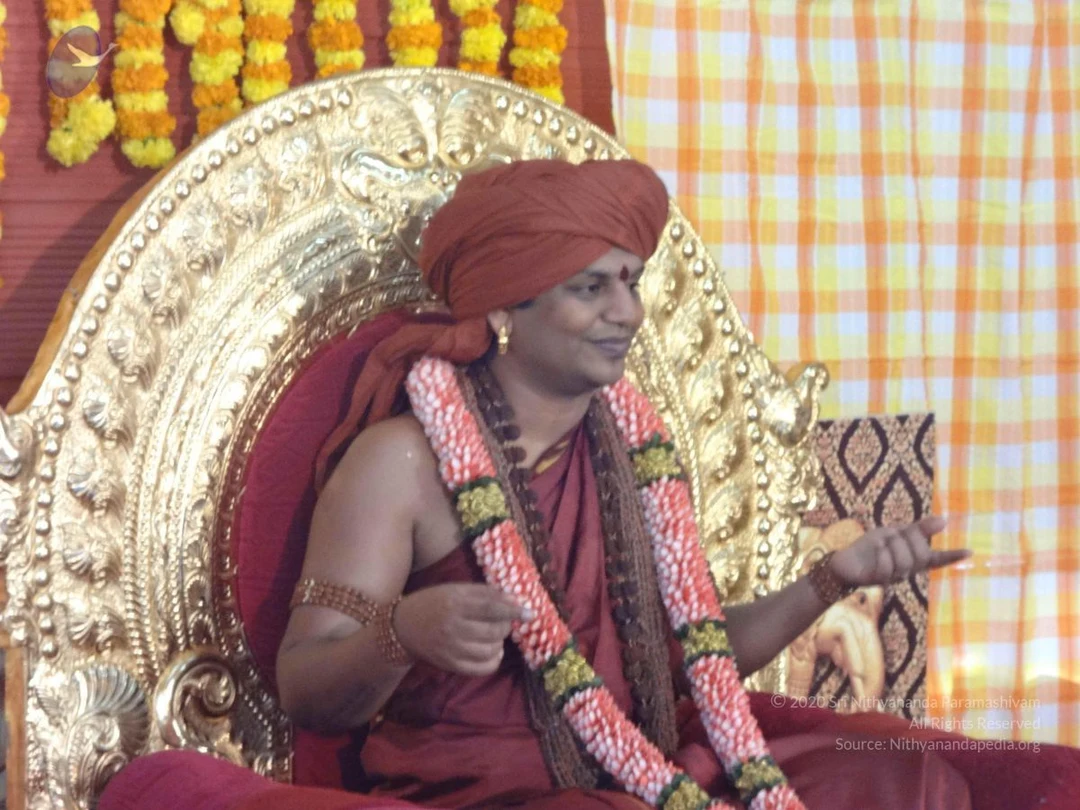
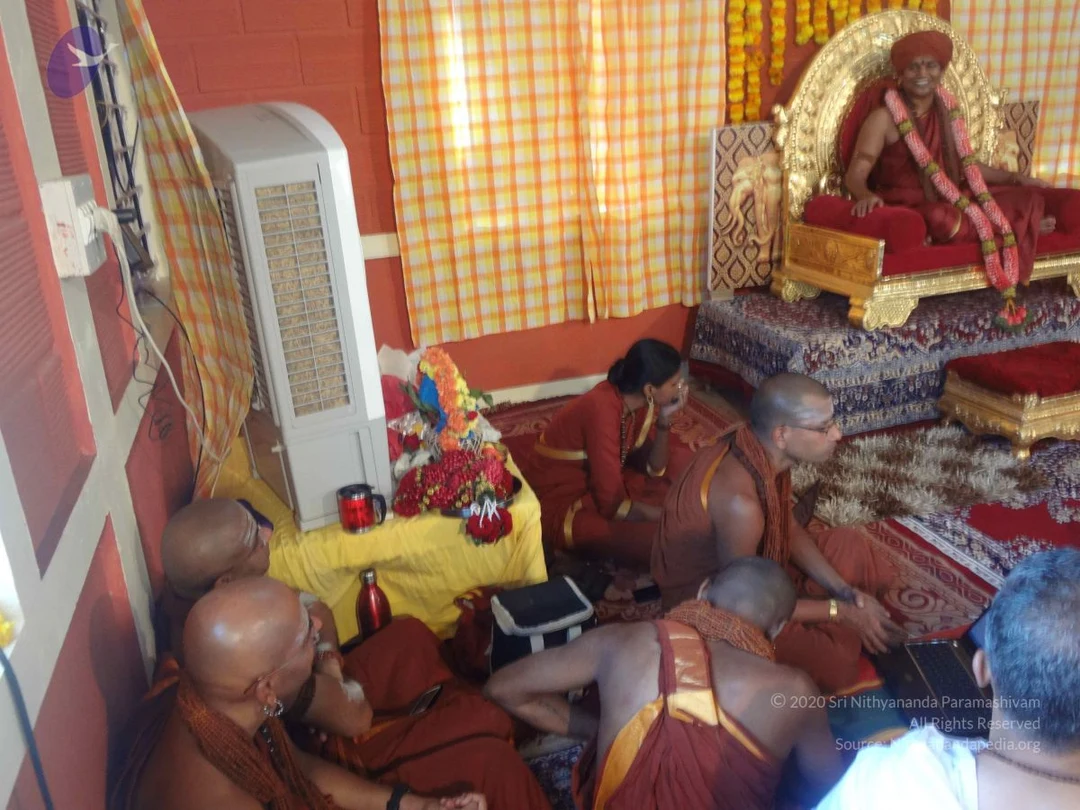
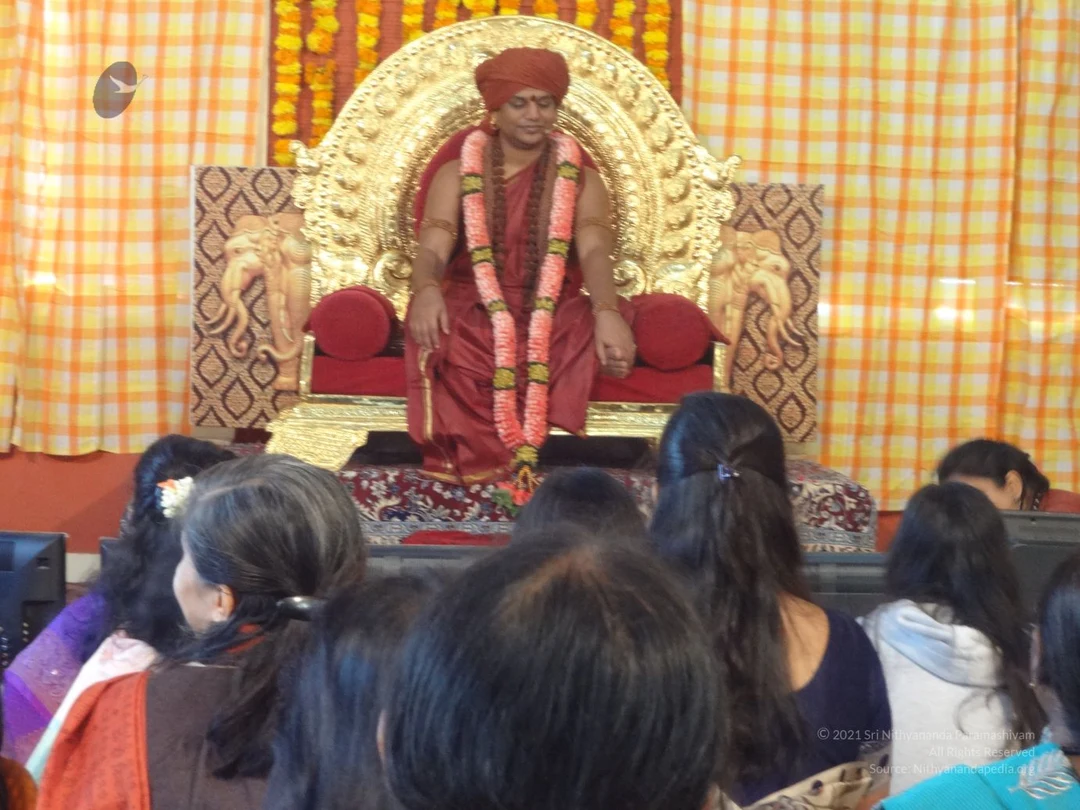
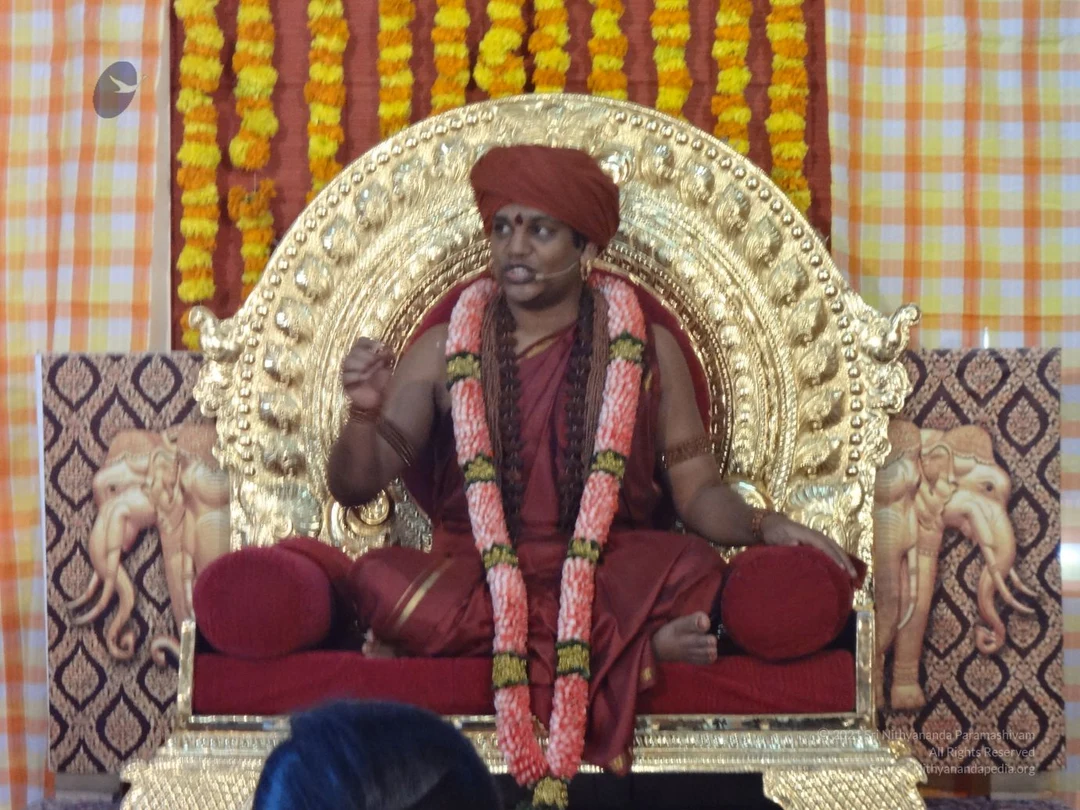
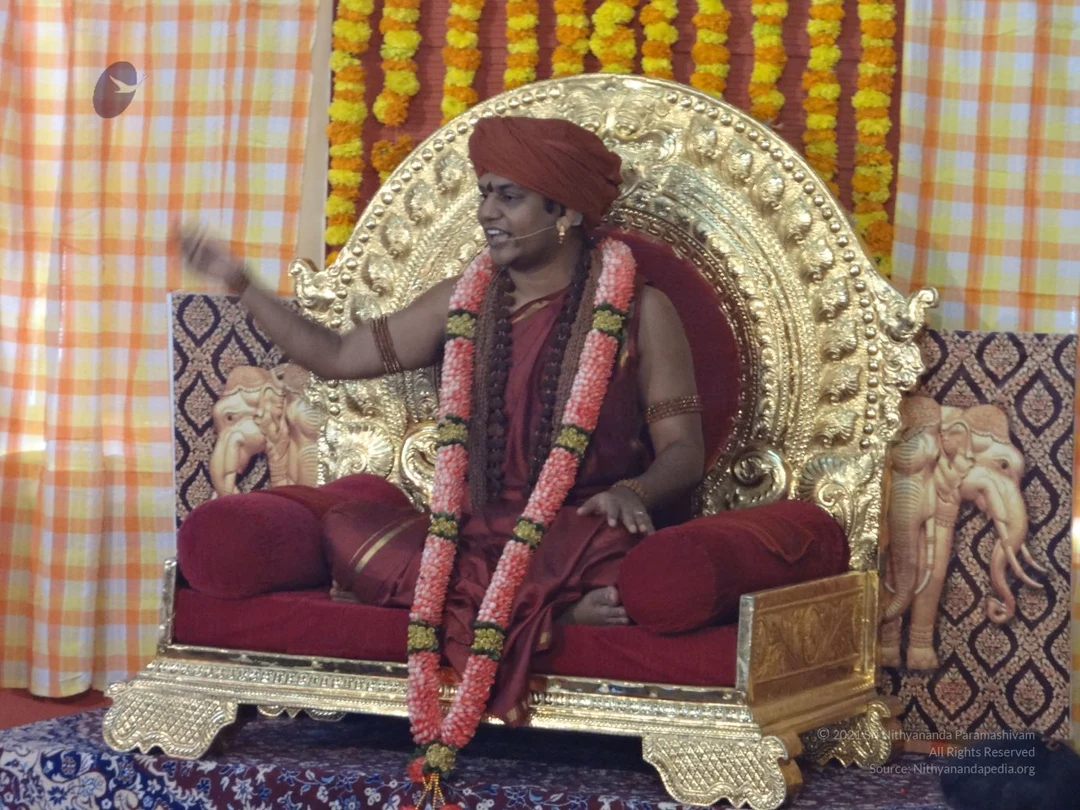
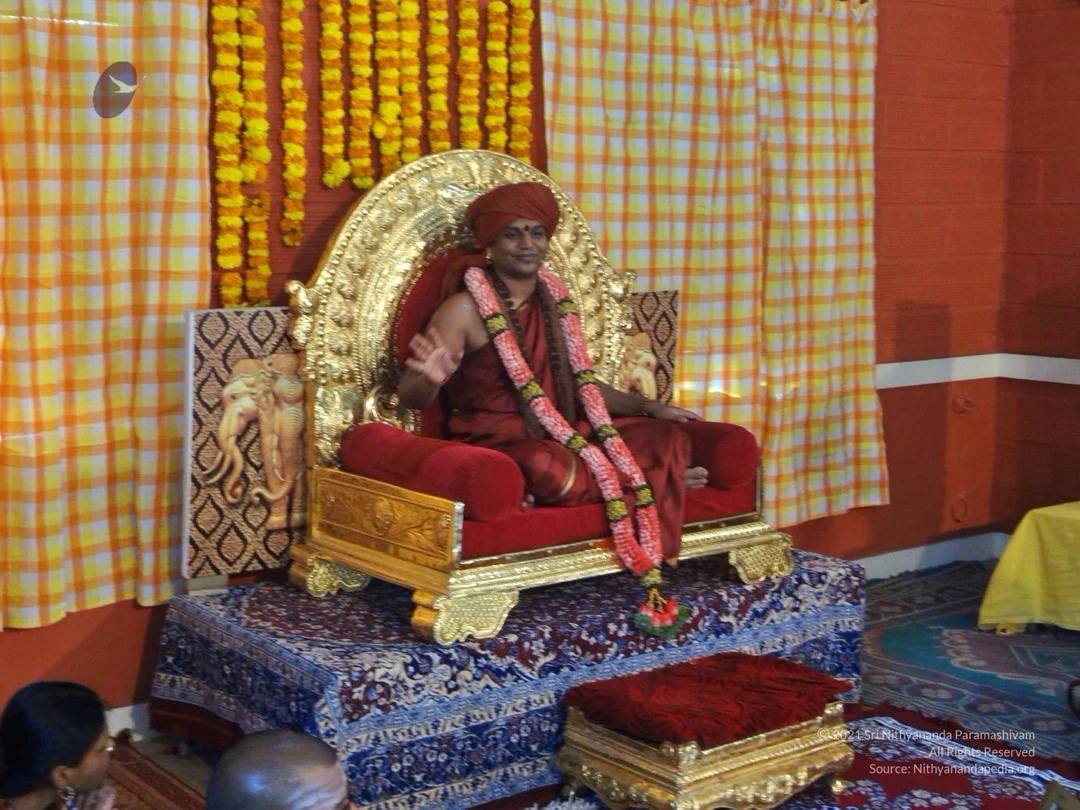
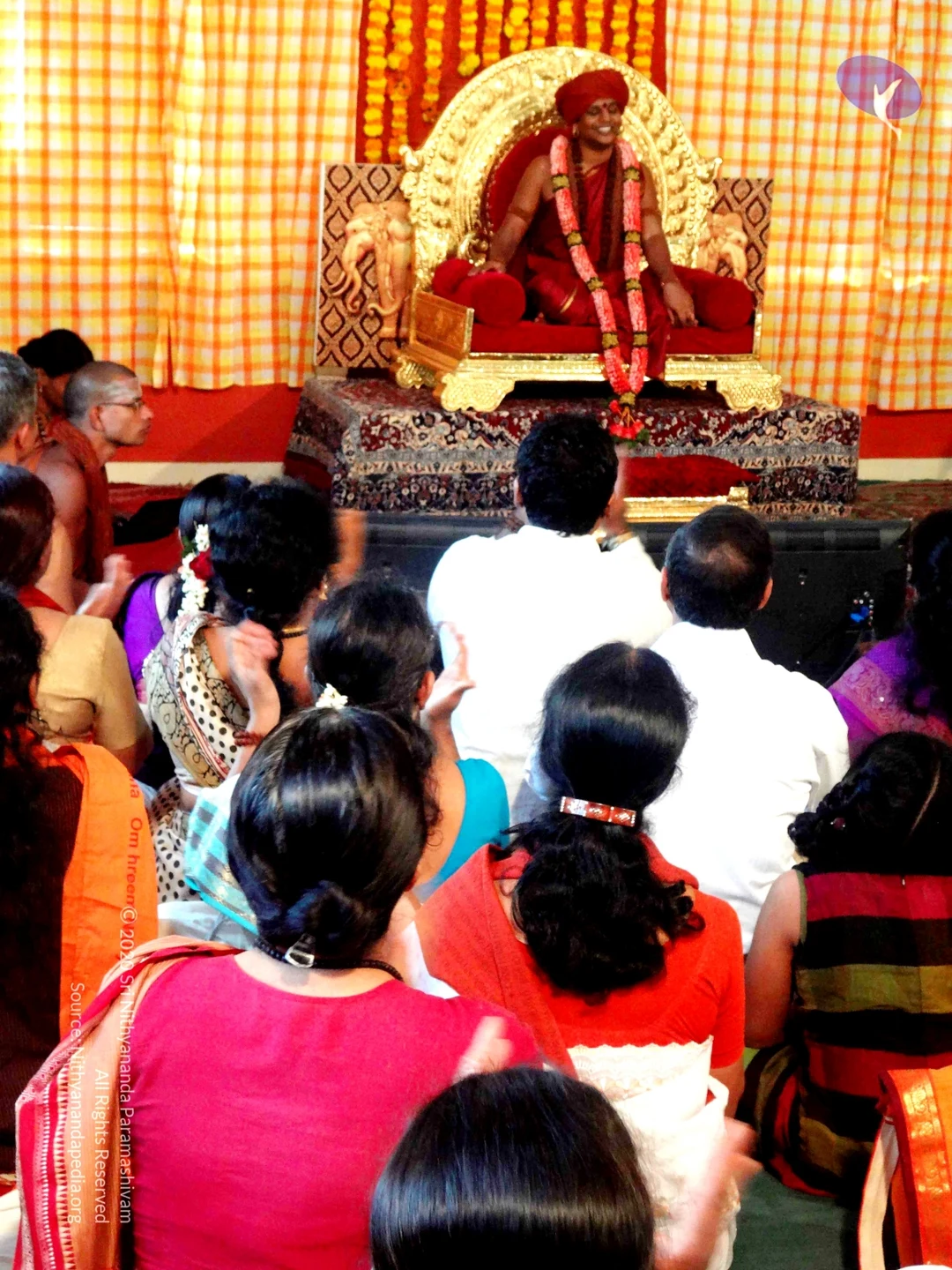
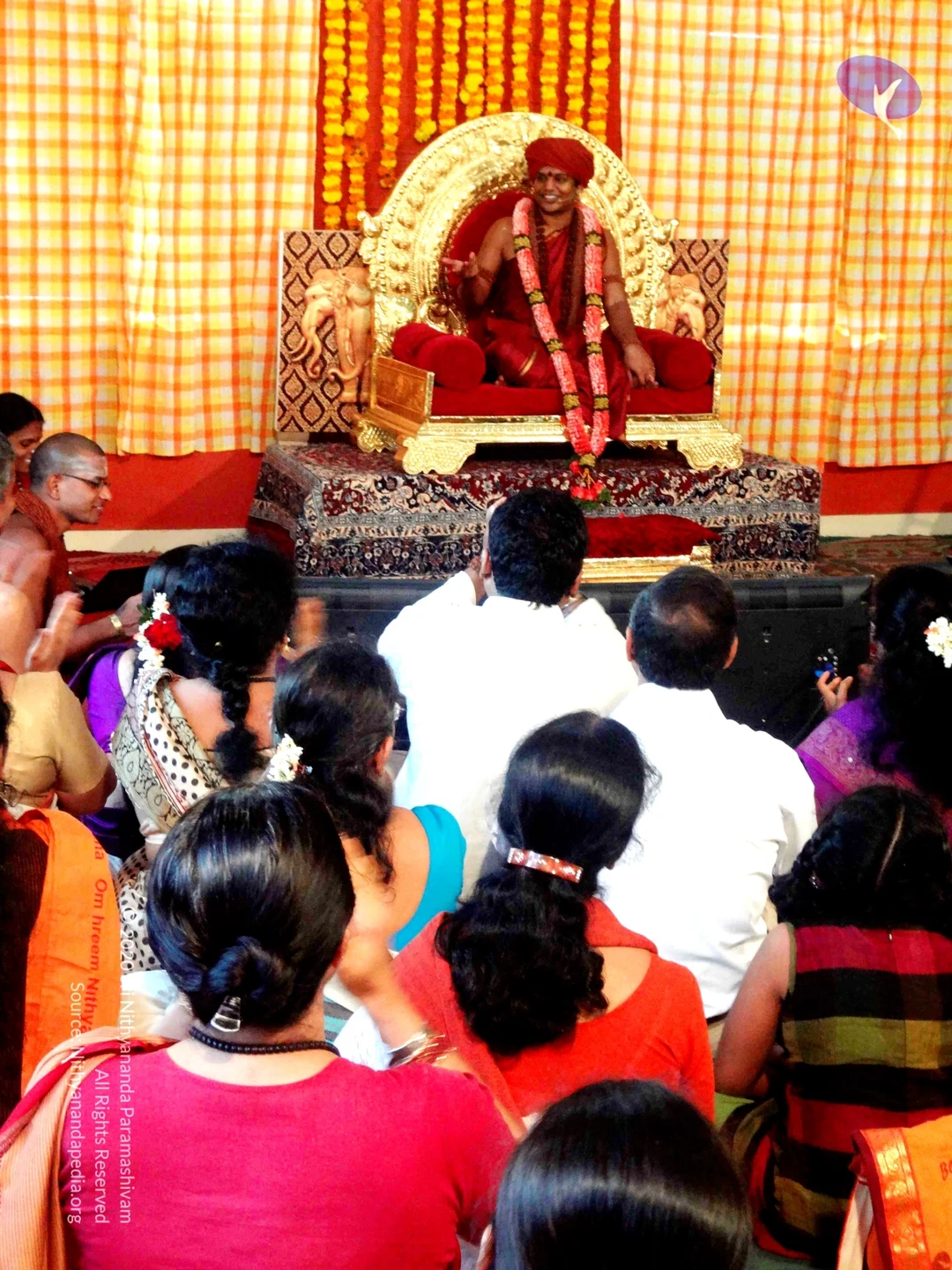
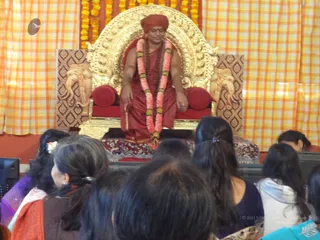
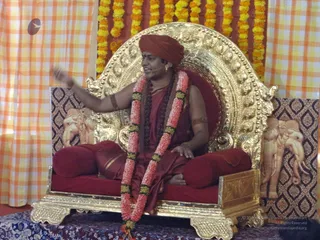
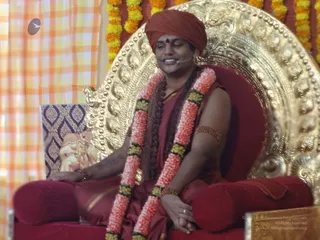
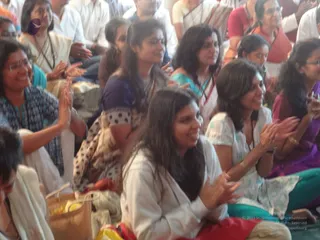
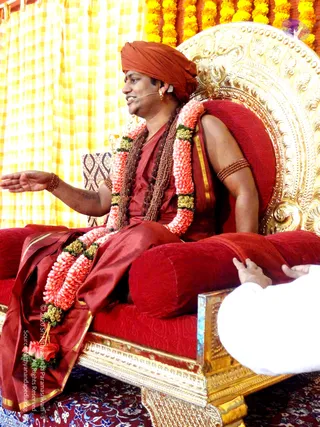
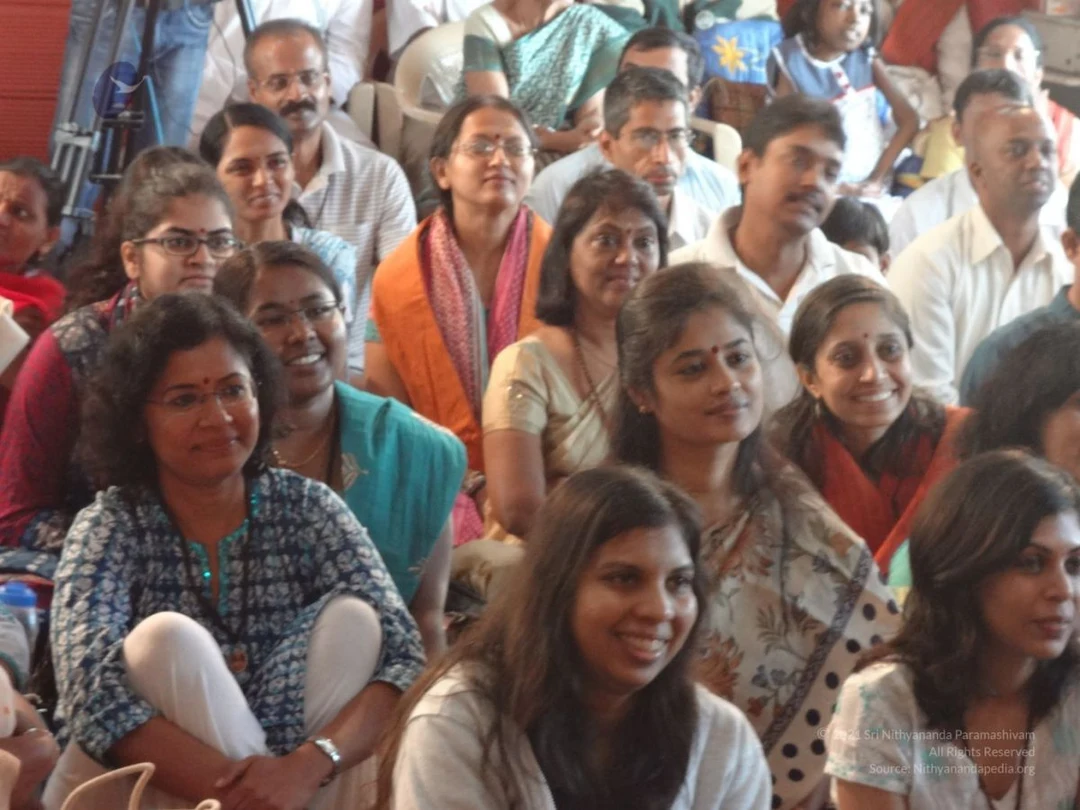
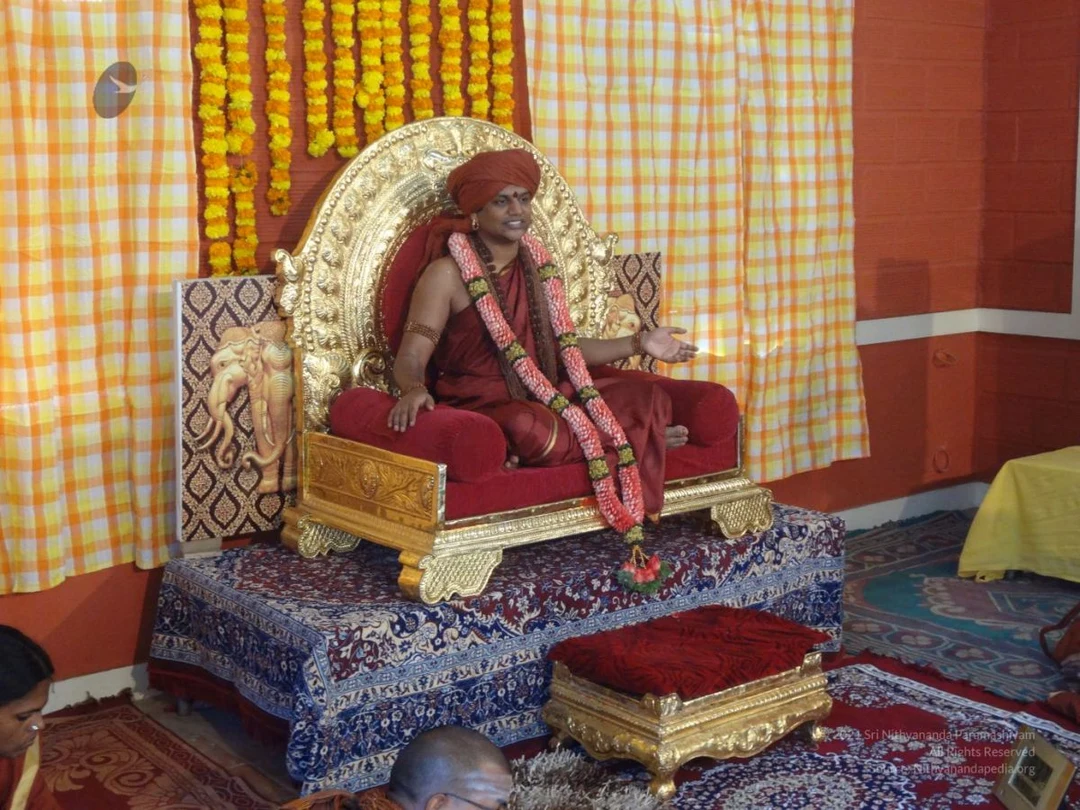
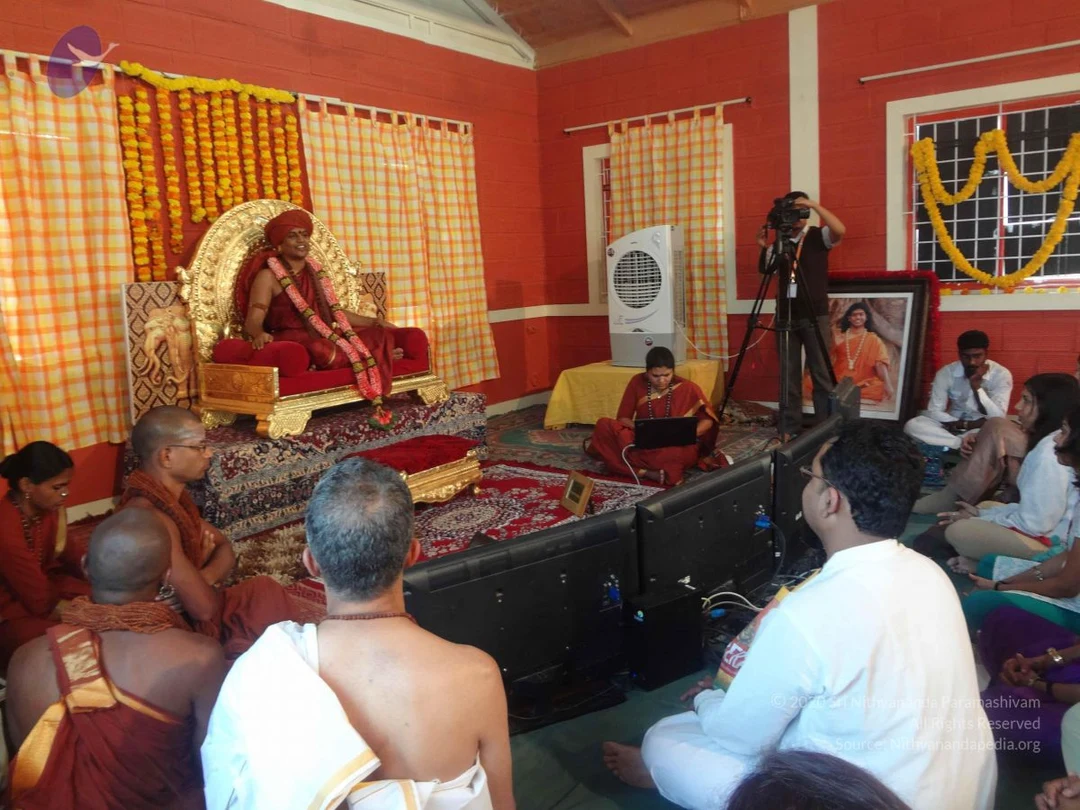
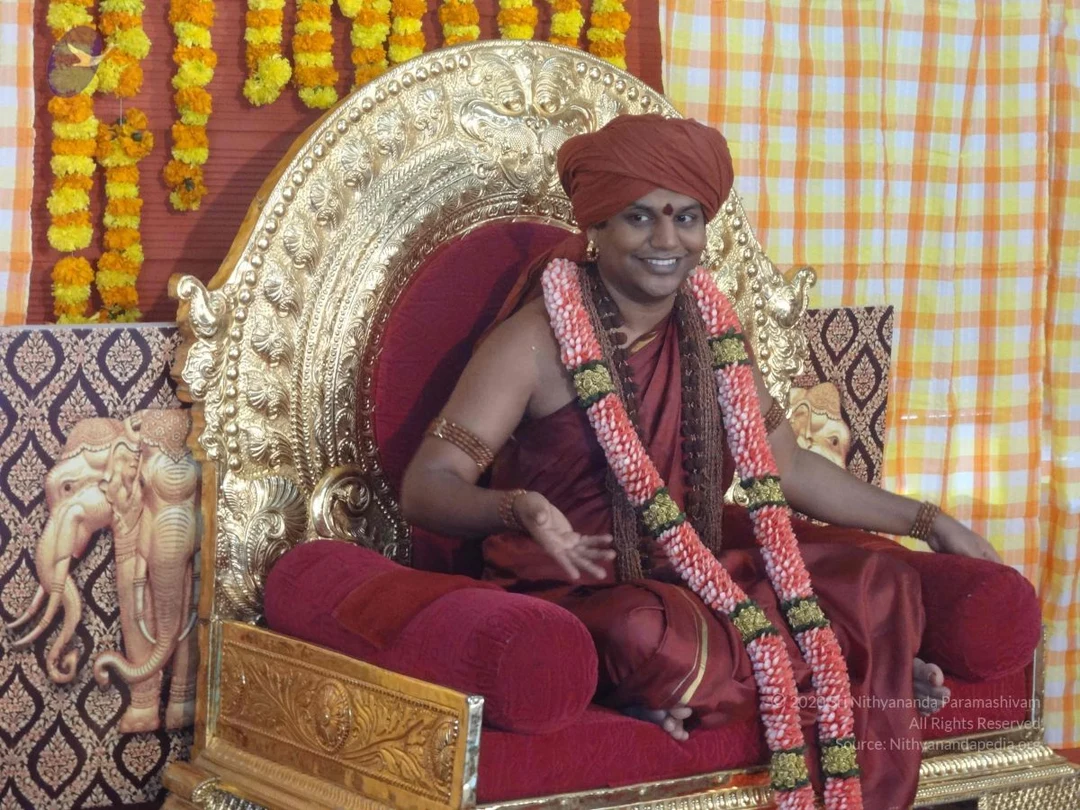
A photograph of a seated man in a red-maroon robe and matching turban, wearing a long pink and white flower garland with green accents and rudraksha beads, seated on an ornate gold throne carved with elephants and red cushions. He sits with hands resting on his lap in front of a yellow and orange checked backdrop decorated with marigold garlands. Several devotees with dark hair sit in the foreground facing the throne, some in saris and one in a dark top, listening in what appears to be a satsang setting. The man's appearance, with turban, rudraksha, and ornate ceremonial clothing, is consistent with the page's reference to Swamiji, so this is a probable identification from appearance cues.A seated man in a maroon turban and maroon robes sits on an ornate gold throne with red cushions, a pink and white flower garland with yellow marigold accents draped over his shoulders. He gestures with his right hand while speaking, a small microphone visible near his face. Behind him hang marigold garlands and orange-and-yellow checked drapes, with carved elephant motifs on the throne's side panels. A dark-haired head of an audience member is partly visible in the lower foreground. Swamiji (probable): the seated speaker wears a turban, maroon robes and a flower garland on a gold throne, a satsang-style discourse setting.A man seated on an ornate gilded throne with a deep red cushion and carved elephant-head side panels gestures with his raised right hand while speaking. He wears a maroon-red turban, a red-orange robe, a large rudraksha mala and a long garland of pink and white flowers with green leaves draped over his shoulders. A small microphone is visible near his ear. Behind him hang marigold garlands and an orange and yellow checked backdrop. The setting suggests a satsang discourse. The image is a photograph of a seated speaker on a dais, with the appearance-based identity of the seated figure left unconfirmed.A man in a rust-red turban and matching saffron-red robe sits on an ornate gold throne with red cushions, beaded rudraksha mala and multiple garlands of pink and white flowers with yellow marigolds draped around his neck. He has a red bindi, a bead bracelet and gold armband, and smiles while speaking, with a small clip microphone on his ear. Behind him are marigold garlands and an orange and yellow checked backdrop, with a cushion printed with an elephant-headed deity beside him. Swamiji (probable): the saffron-red turban and robes, rudraksha mala and ceremonial garlands match the page's claim, and he is seated on a throne as a discourse speaker. Setting appears to be a satsang stage.A photograph of a seated crowd at a satsang gathering, mostly women and some men in white and cream clothing, clapping their hands. In the foreground a woman with long dark hair in a white top and green trousers smiles and claps, beside a woman in a white printed kurta with gold bangles. Behind them women in saris and salwar outfits in purple, teal, pink and blue sit close together, and a woman at right wears a purple top with glasses. A woven bag sits at lower left. No speaker is clearly visible in the frame.A seated man in red-orange robes and a matching red turban sits on an ornate gold throne with a carved arched back and red velvet cushions, a fresh garland of pink and white flowers draped over his shoulders and chest. He gestures with one raised hand while speaking. The throne rests on a blue and red patterned cloth-covered dais, and a small gold-trimmed red cushioned stool sits in front. Behind him, marigold garlands hang on a yellow and white checked curtain against a red wall. Two partially visible people sit at the lower left, one with dark hair and one bald. A yellow-draped table appears at the right. Overlaid in the lower right corner is a

01-Paduka-Puja

6 photosSource gallery
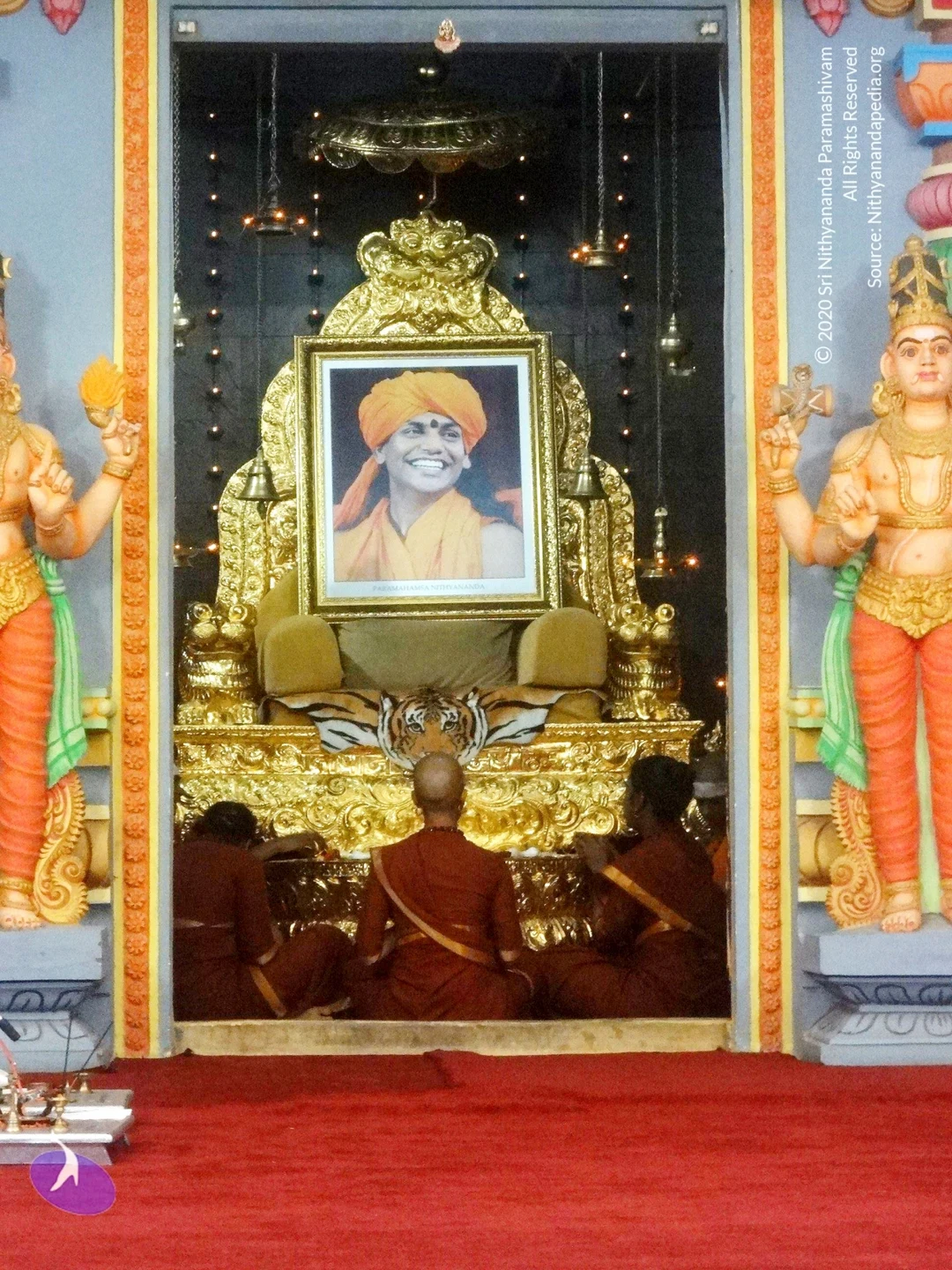
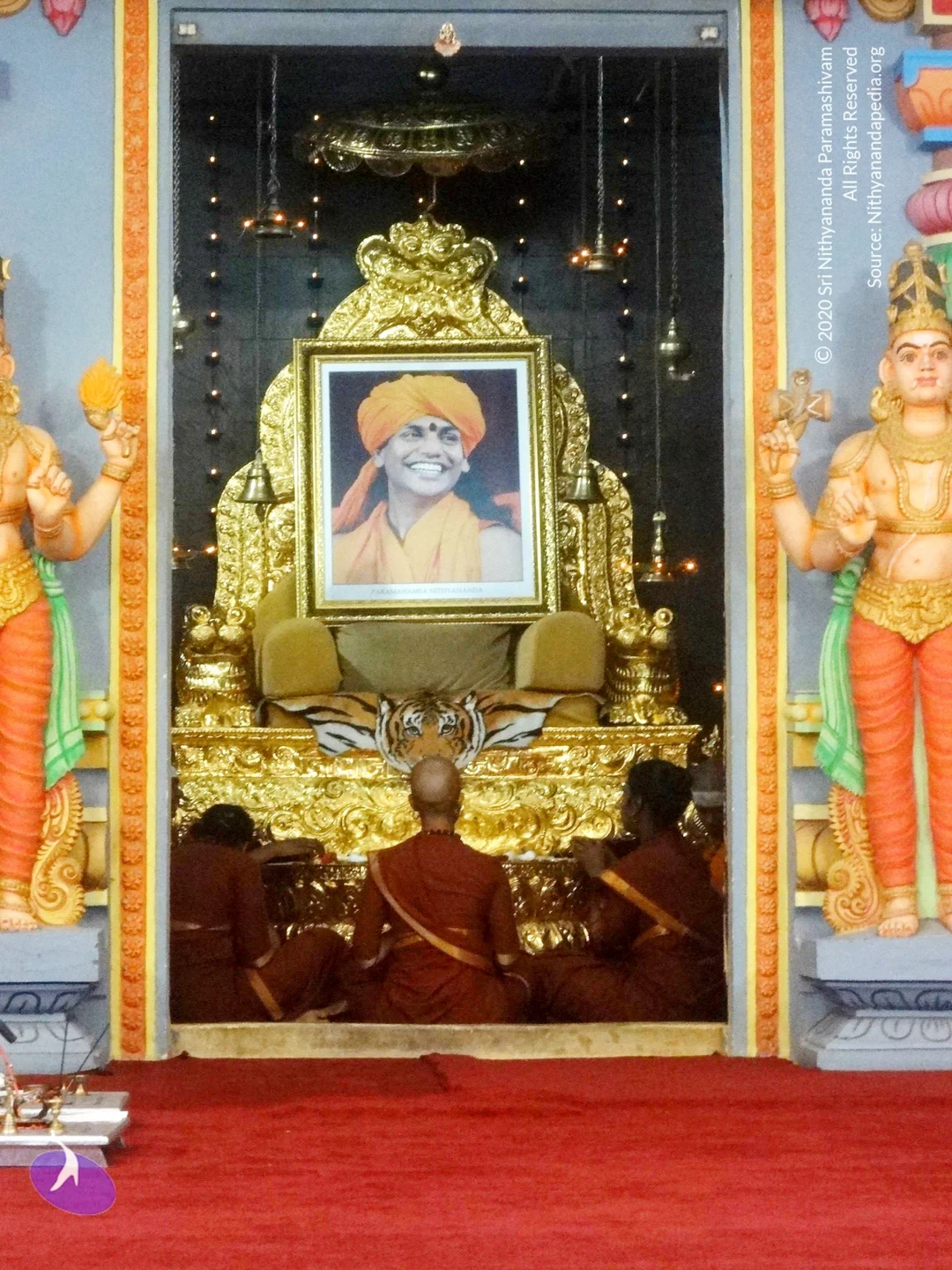
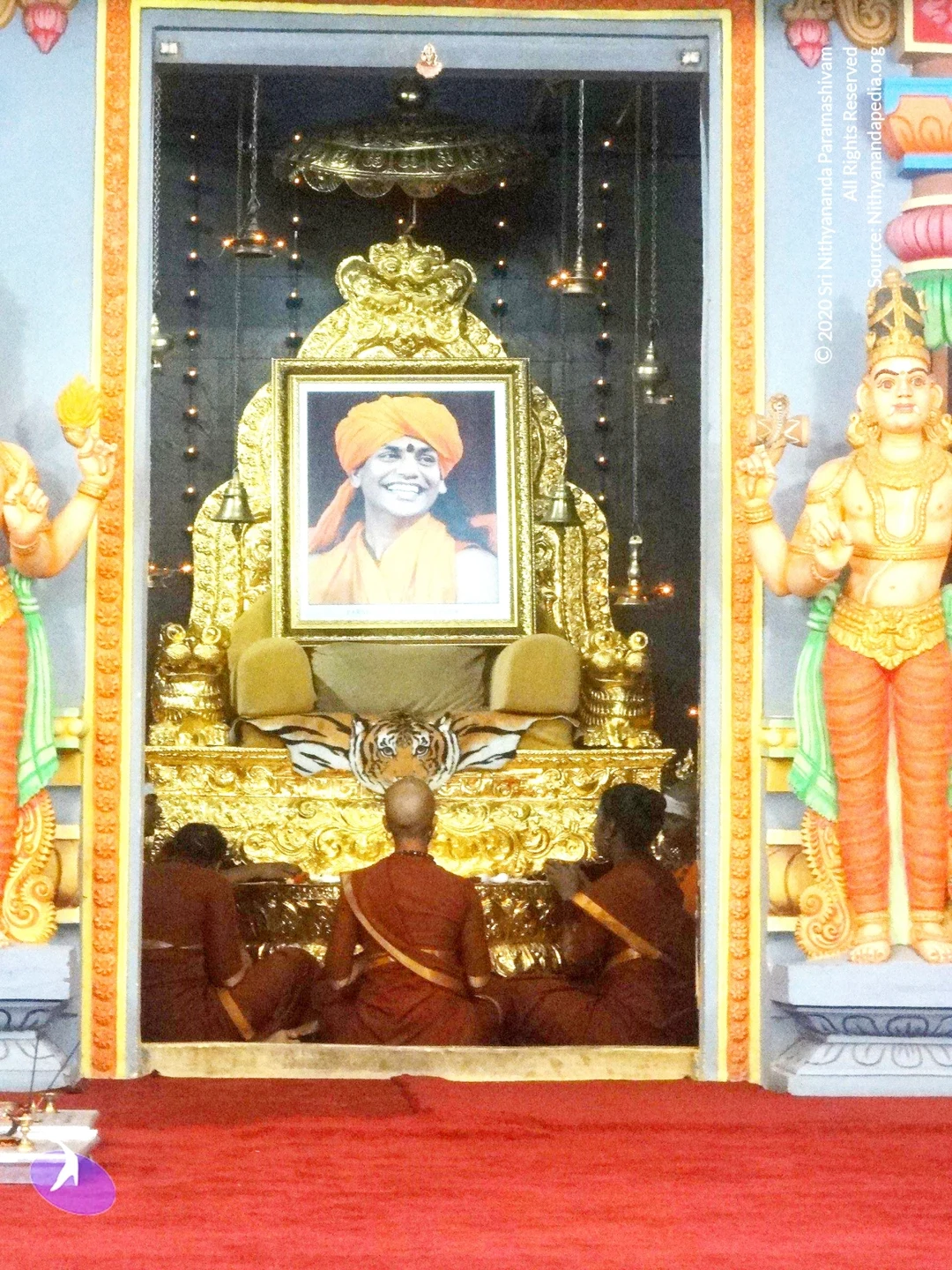
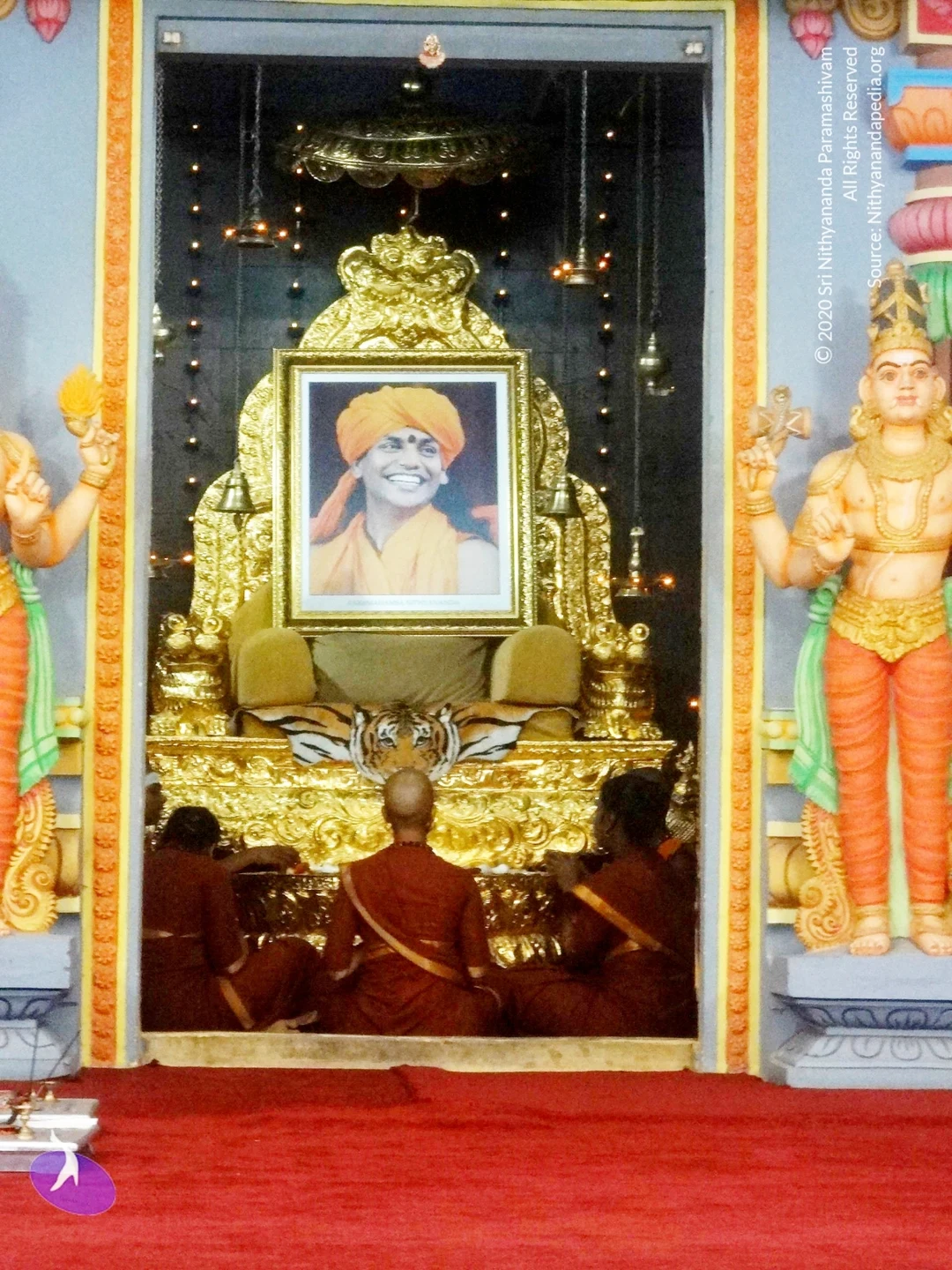
Photograph of a golden ornate throne niche in a temple, flanked by two painted statues of deities with four arms and golden crowns. On the throne sits a framed portrait labelled "PARAMAHAMSA NITHYANANDA", showing a smiling man in an orange turban with a bindi, draped in orange cloth, with a tiger skin draped across the golden seat below. Three seated devotees in orange-brown robes with saffron sashes face the shrine with their backs to the camera, one with a shaved head, in front of a red carpet. Hanging lamps and beaded strings decorate the dark niche above.A golden ornate throne stands in a shrine alcove with a large framed portrait on its back, showing a smiling man in an orange turban and yellow shawl. A striped tiger skin is draped over the seat cushions. Three seated monks in orange-brown robes face the throne with their backs to the camera, hands folded in worship. Two large painted deity guardian statues in orange dhotis flank the doorway, and hanging oil lamps and bells decorate the alcove.A photograph of a gilded throne in a temple shrine, draped with a tiger-skin cloth, holding a framed portrait of a smiling man in an orange turban and yellow shawl, with a printed caption at the base of the frame. Three devotees in rust-orange robes sit with their backs to the camera before the throne, one shaved-headed in the centre. Painted dvarapala guardian figures in orange dhoti and green sashes stand on either side of the doorway, and small oil lamps hang from the ceiling. The floor is covered in red carpet.Photograph of a golden ornate throne alcove set into a painted temple wall, with a framed portrait on the throne showing a smiling man in an orange turban and orange robe with a red bindi. A golden tiger-skin cover lies on the throne seat, and hanging brass lamps and beaded strings surround the alcove. Four devotees in orange-brown robes sit with their backs to the camera on a red carpet in front of the throne, one bald devotee in the centre. Painted standing guardian figures in orange dhotis and gold jewellery flank the alcove, one holding a flame. The portrait is a printed depiction, not a physical person on the throne.Devotees in maroon robes kneel in prayer before a golden throne with a tiger-skin cover, on which stands a framed portrait of a smiling man wearing an orange turban and orange shawl with a red tilak. The portrait is labelled with a printed caption at its base. Oil lamps hang on strings around the shrine, and two painted deity statues in orange and green dhotis flank the doorway on a red carpet. A bald priest in the centre faces the throne with his hands joined, and two other devotees kneel beside him.A temple-style shrine hall with a golden ornate throne at the centre, behind which hangs a framed portrait of a smiling man with an orange turban and orange robes, labelled only by the decorative frame. On the throne-platform sit several saffron-robed monks in orange, and a shaved-headed priest in white clothes sits on the red carpet at lower left performing a puja with a small brass lamp and offerings. Two tall painted deity murti flank the doorway, multi-armed figures in orange and green dhotis with gold ornaments. Brass oil lamps stand on both sides, and a red carpet covers the floor.

02-Satsang

2 photosSource gallery
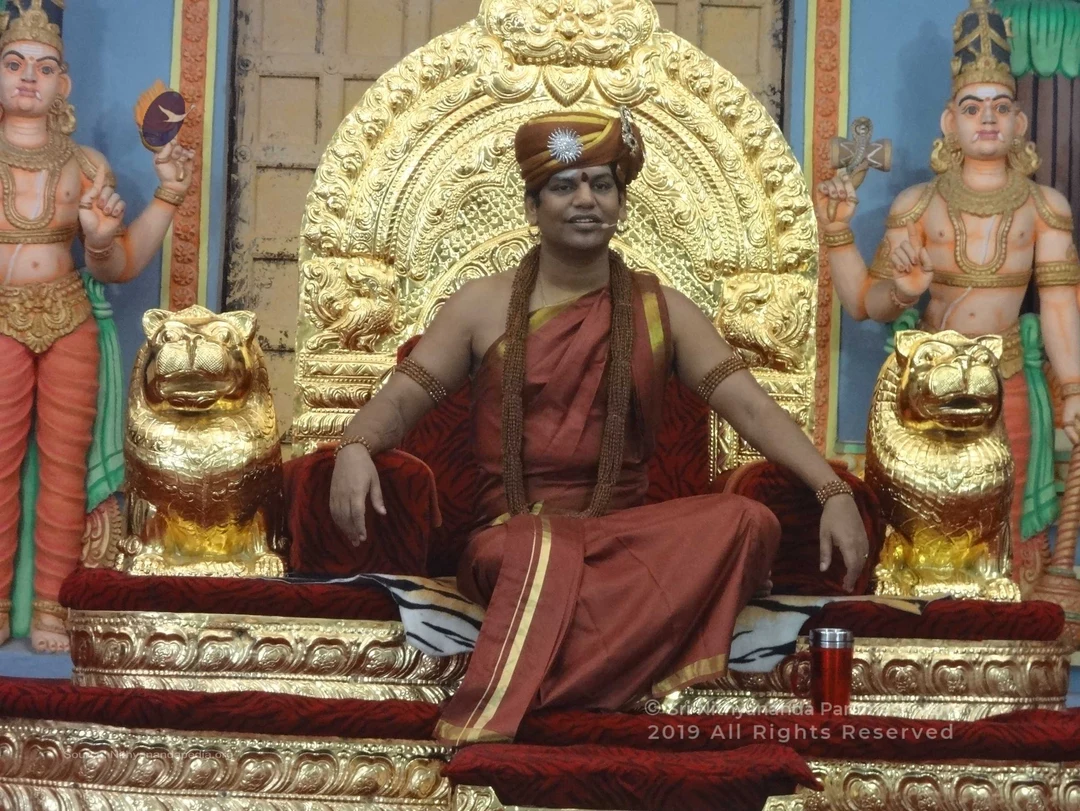
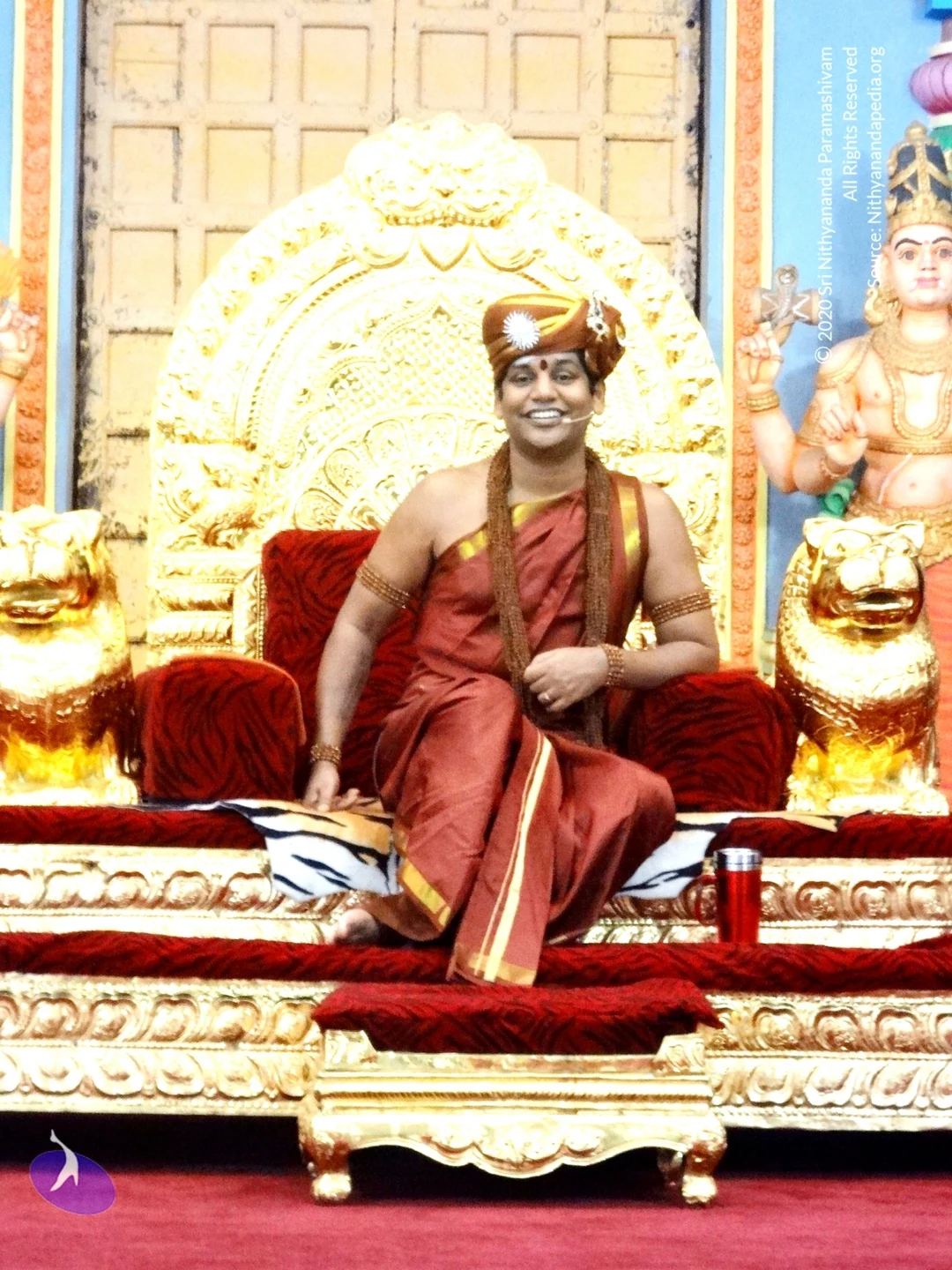
A smiling man sits on an ornate gilded throne with red velvet cushions and gold lion armrests, in front of a carved golden backdrop and a multi-armed deity murti at the right edge. He wears a rust-red turban with a silver emblem, a red-and-gold draped garment over one shoulder, a long brown rudraksha mala, gold bangles and a small red bindi. He has a headset microphone and rests one hand on the throne. A red flask sits on the platform. The setting suggests a satsang seat, and the man's appearance is consistent with the page's a person label, though not conclusively.A seated man on an ornate golden throne with red velvet cushions and a golden lion-shaped armrest. He wears a saffron-orange turban with a silver brooch, an orange-red shawl bordered in gold, a brown rudraksha mala across his chest, and matching beaded bangles on both arms. A zebra-striped cloth lies on the throne beside him, with a steel water bottle nearby. Behind him are blue and pink painted temple-style pillars. Based on his saffron and ornate clothing, his turban and rudraksha mala, the appearance matches the Swamiji (probable) profile, seated in a teaching role on a throne at a satsang.

04-Sacred-Arts

8 photosSource gallery
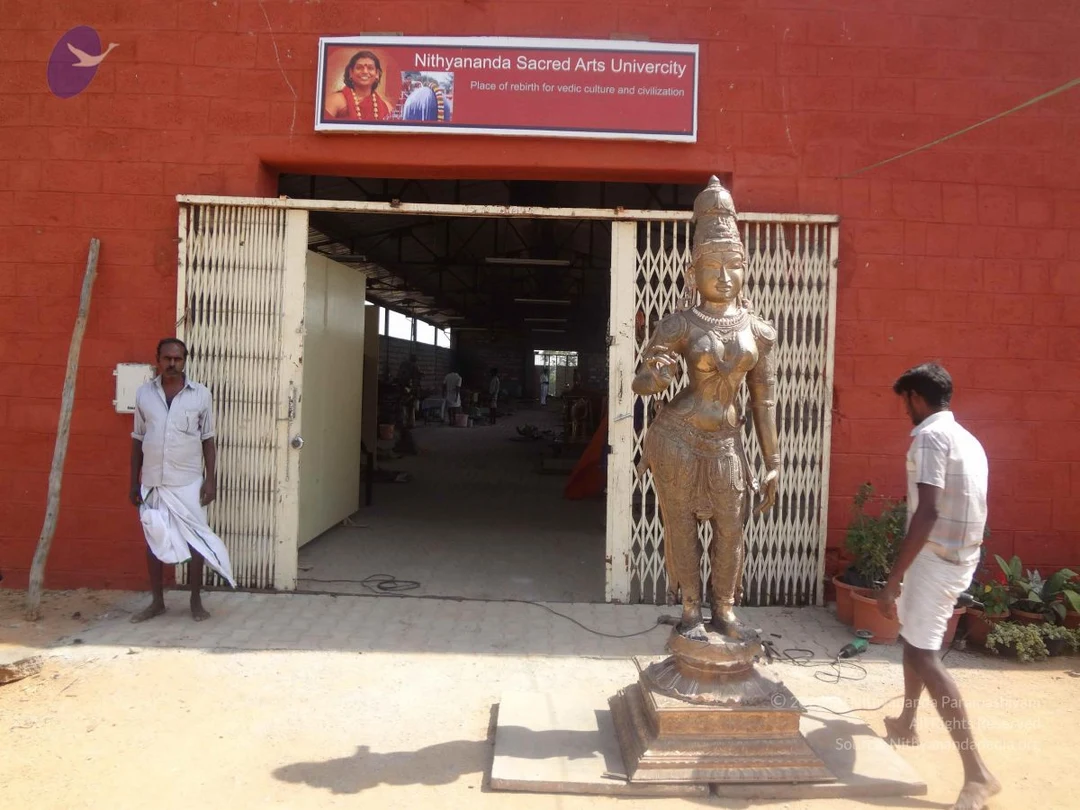
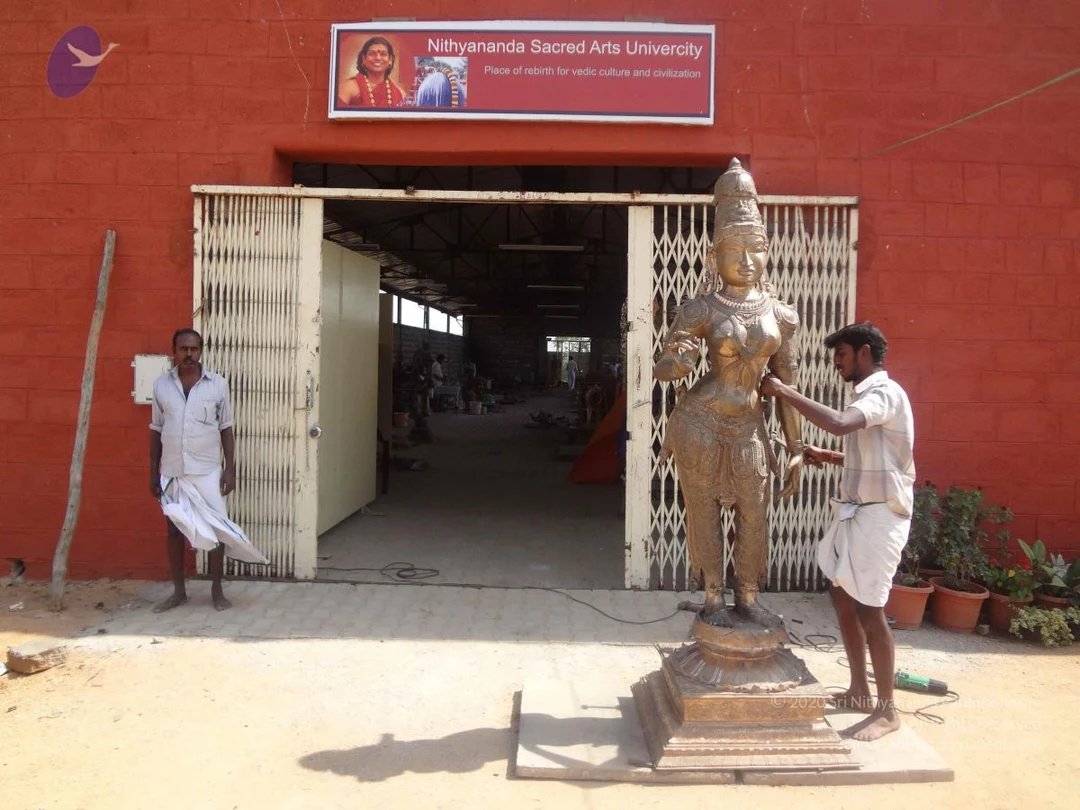
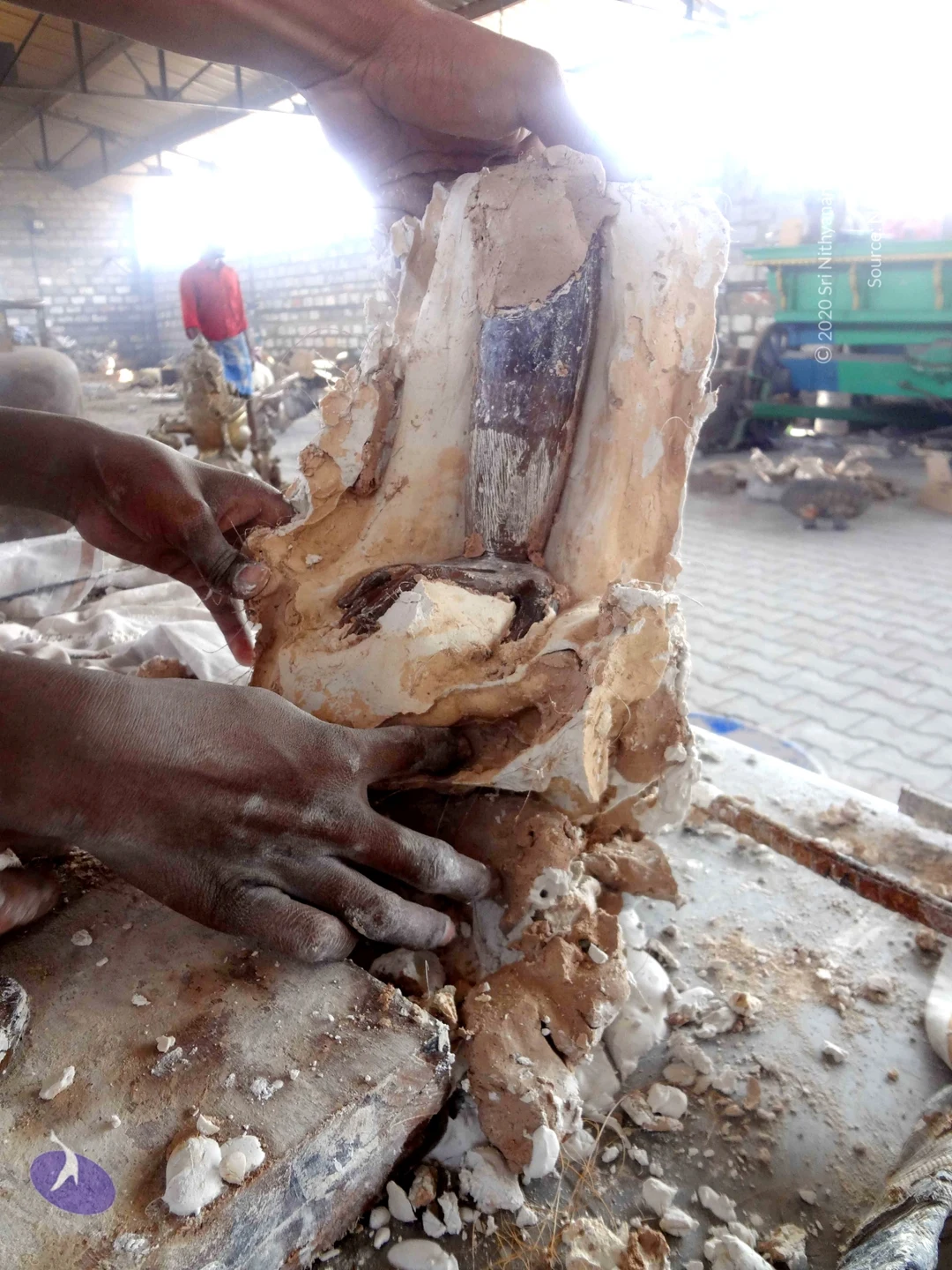
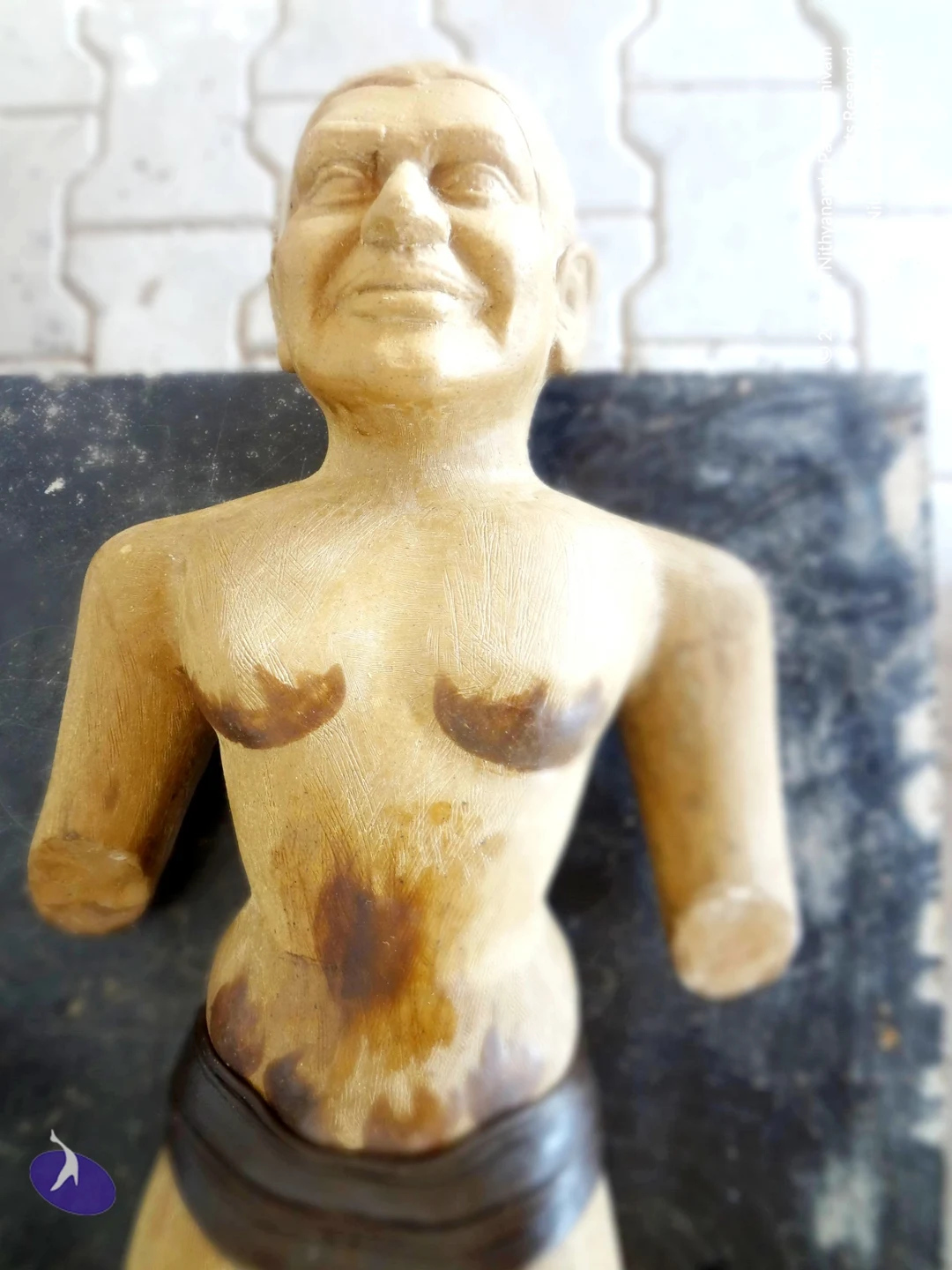
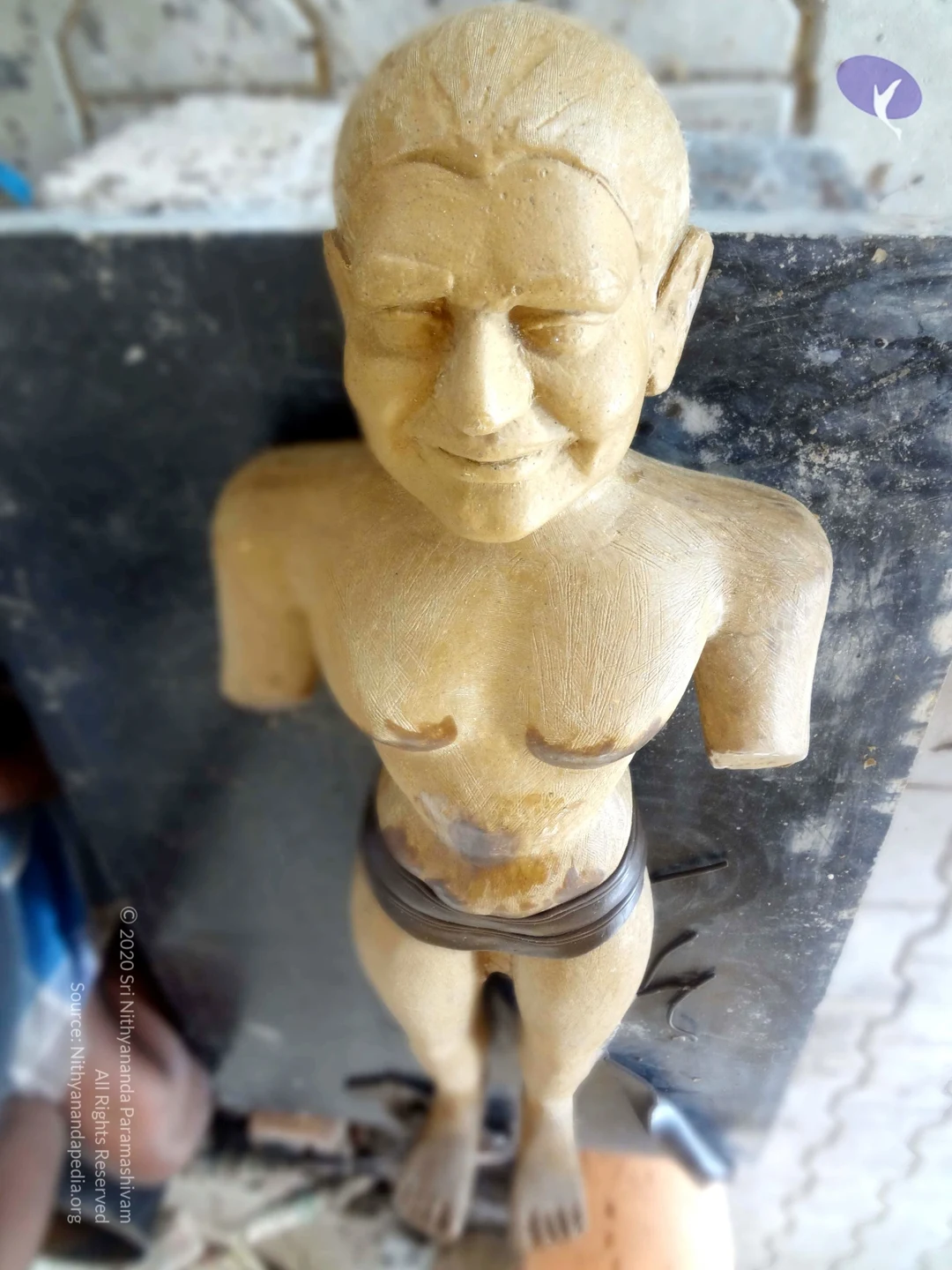
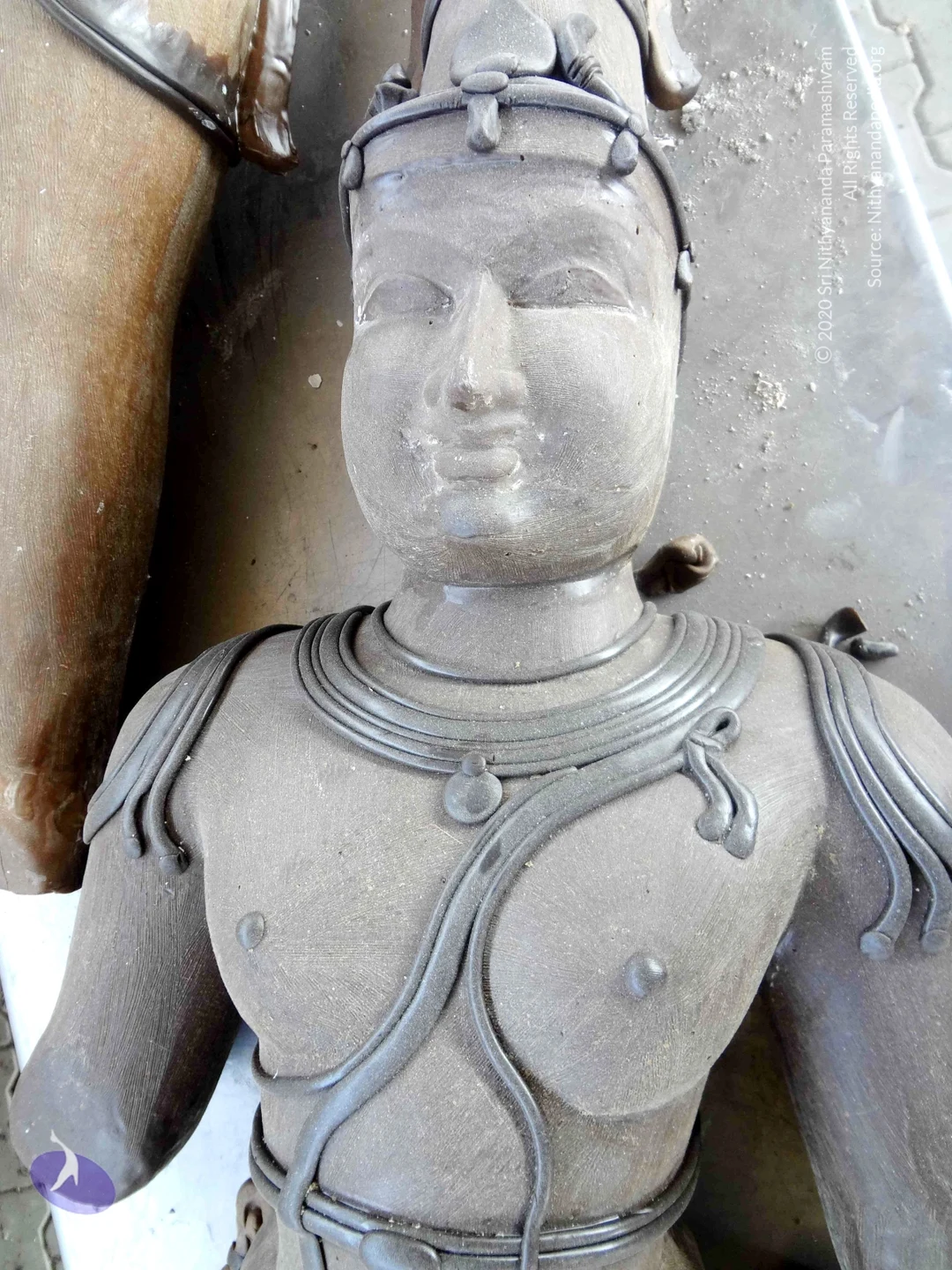
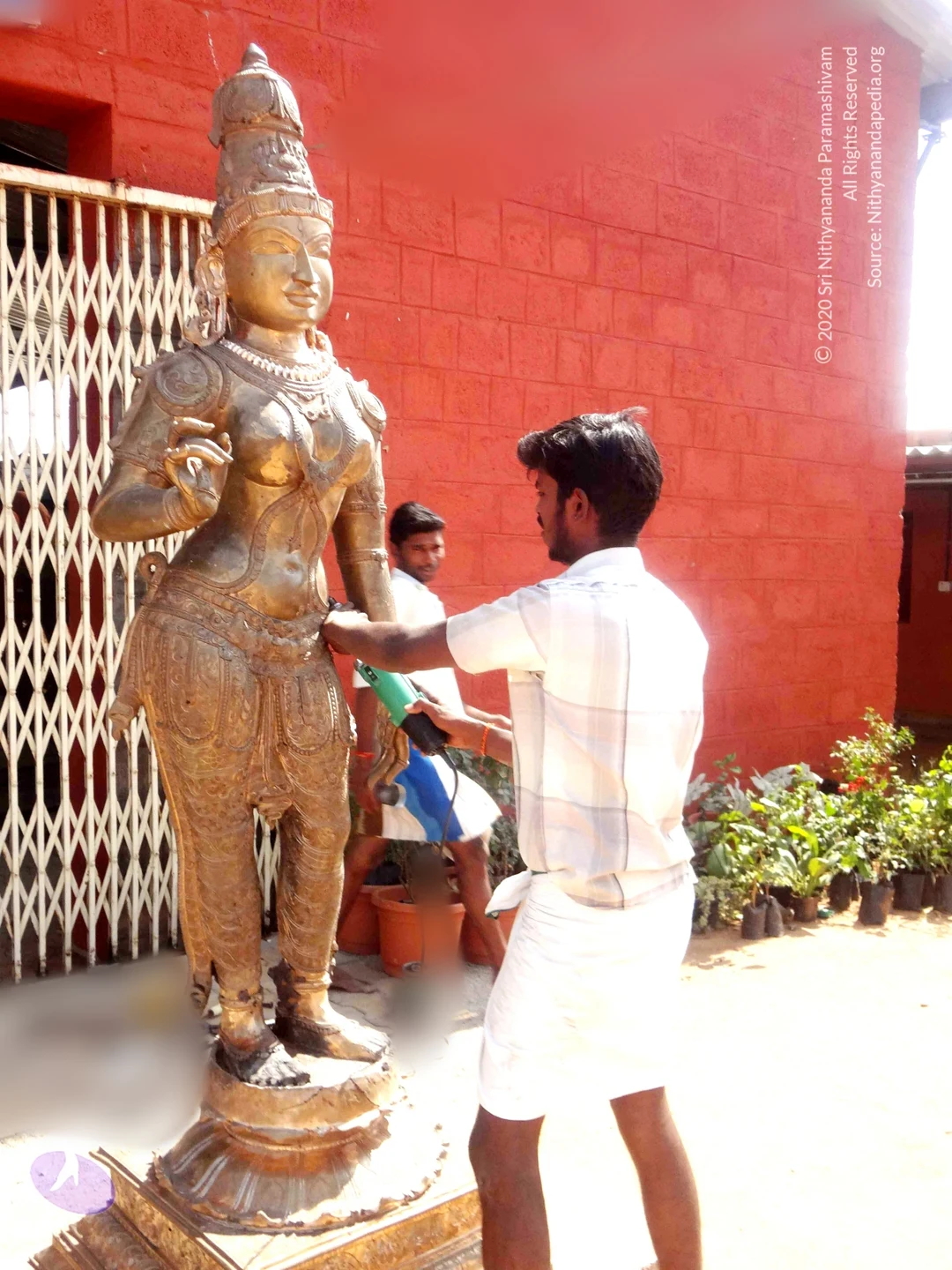
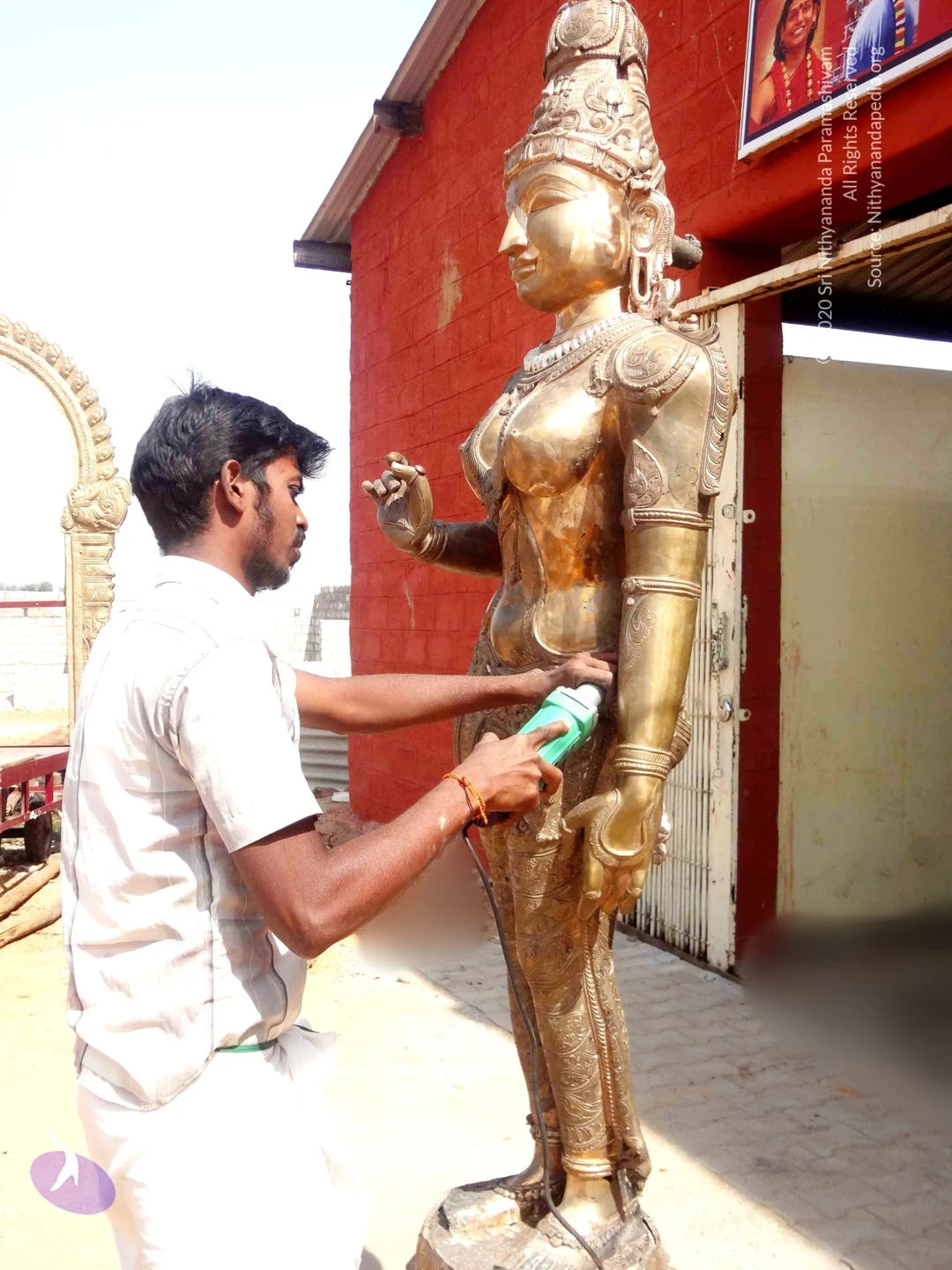
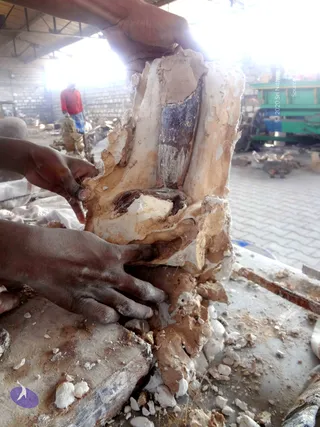
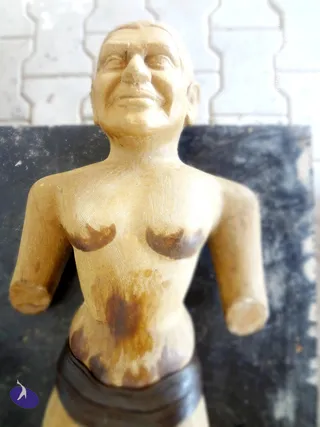
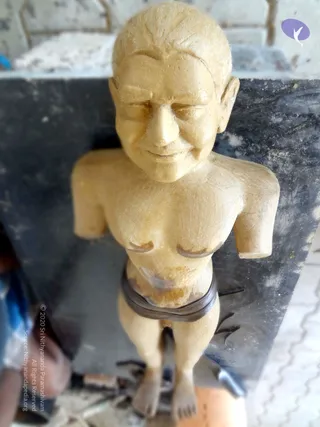
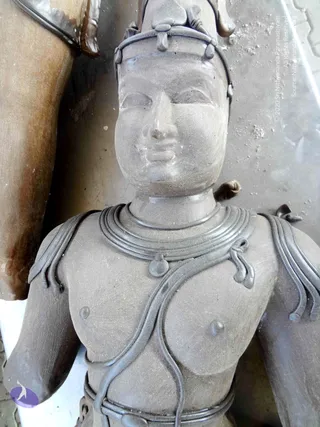
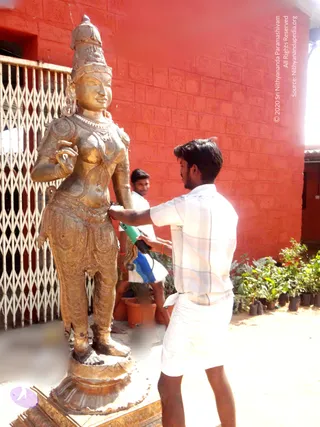
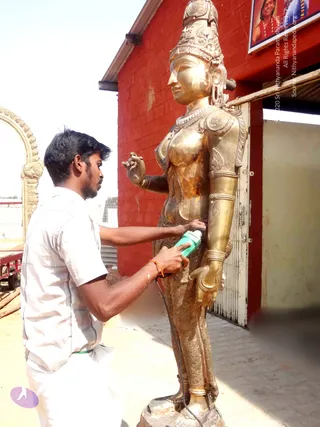
A workshop photograph of a sculptor's hands breaking away plaster and clay from a large unfinished statue, exposing a dark inner core and cream-white plaster. Dust and fragments of plaster lie scattered on a worn metal workbench. In the background a man in a red shirt stands among other statues and a green machine under a corrugated roof. No recognizable a person candidate is visible; only workers and statue-making materials appear, and the statue's form is not clear enough to name a deity.Close-up photograph of a carved wooden or clay figure bust with a smooth, pale tan finish and dark brown stained patches on the chest and abdomen. The figure has a shaved head, a plain face with heavy-lidded eyes and a slight smile, and stubby truncated arms with no hands. A dark brown band encircles the waist above a plain lower section. The figure stands against a dark slate-grey surface with a white patterned tile wall behind it. No people are present and no ritual activity is visible.A photograph of an unfinished, pale tan sculpted figure standing upright on a dark workbench in a workshop. The statue has a smooth, carved face with closed eyes and a faint smile, a bald rounded head, bare shoulders and torso, and a dark brown waist band. Its arms are truncated at the upper arms and the feet are roughly shaped. Rough chisel marks are visible across the body, and workshop debris and a blurred figure at the left edge surround it. No living person is clearly the subject; the figure is a statue, not a person.Close-up photograph of an unpainted grey-brown clay or plaster sculpture of a deity figure, showing a face with downcast eyes, a tiered crown with teardrop ornaments, layered ribbed necklaces, and sash-like shoulder bands across a bare chest. Traces of dust and chalky residue cover the surface, and a large brownish limb or drapery is visible at the upper left against a grey workshop background. No living people are present. The image shows a statue in an unfinished state.A photograph of a large gilded bronze standing deity murti with an ornate tall crown, earrings, necklace and jewelled arm ornaments, being polished outdoors against a red brick wall. A young man in a white shirt and white dhoti works on the statue's torso with a green and blue power tool, while another man in white stands behind near potted plants and a metal folding gate. The sunlit courtyard has rows of potted saplings at right.A man in a white shirt and white dhoti works on a tall gold-coloured metal statue of a female deity standing outdoors beside a red brick building. The statue wears an ornate tall crown, a layered necklace, armlets, bangles and an embellished lower garment, and its raised hand holds a small object. The man grips a green-handled power tool. He wears a red-orange thread on his wrist. A framed portrait hangs on the red wall above, and a golden arch is visible at left. No a person candidate is visible.

05-House-Visit
6 photosSource gallery
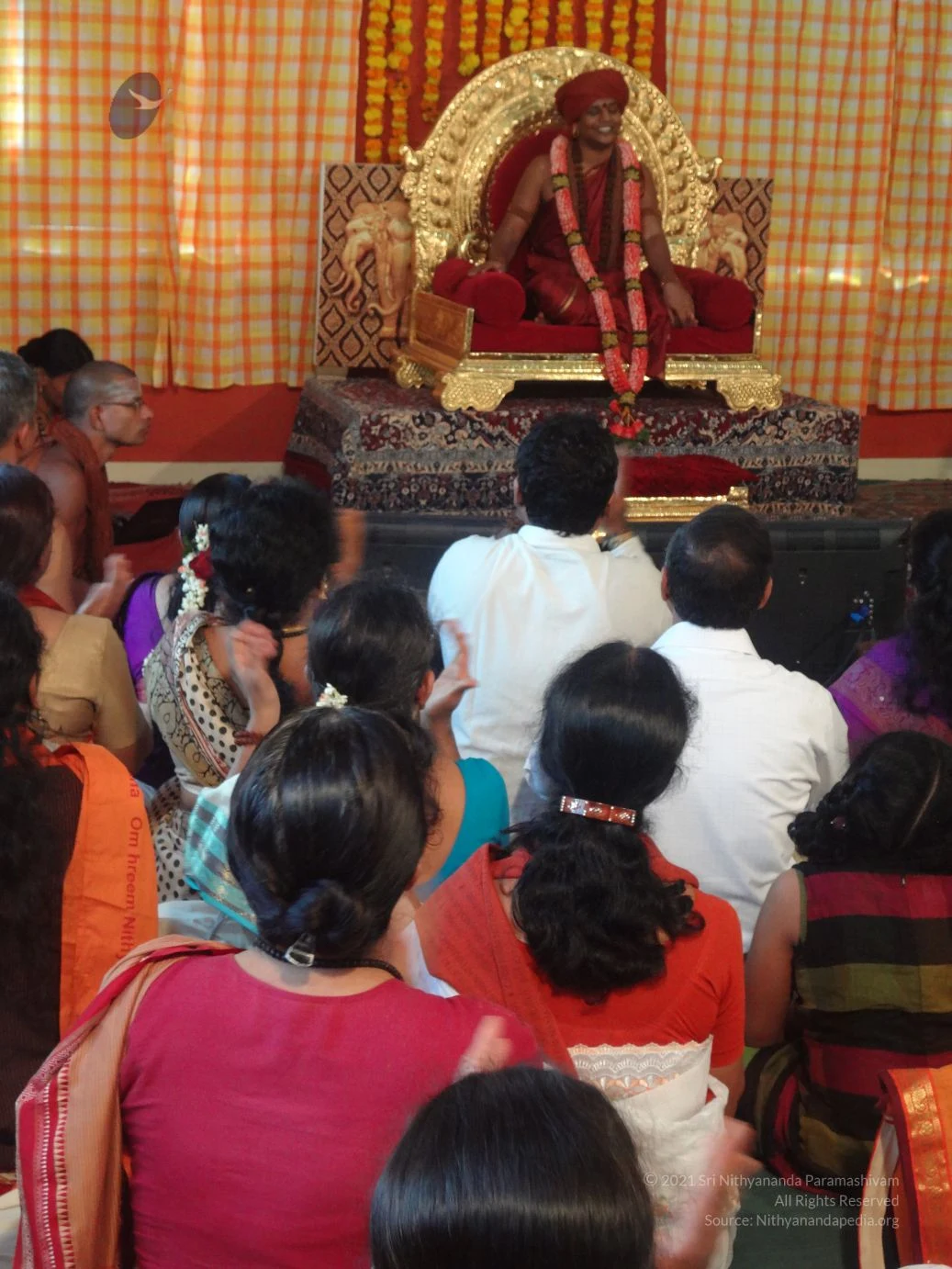
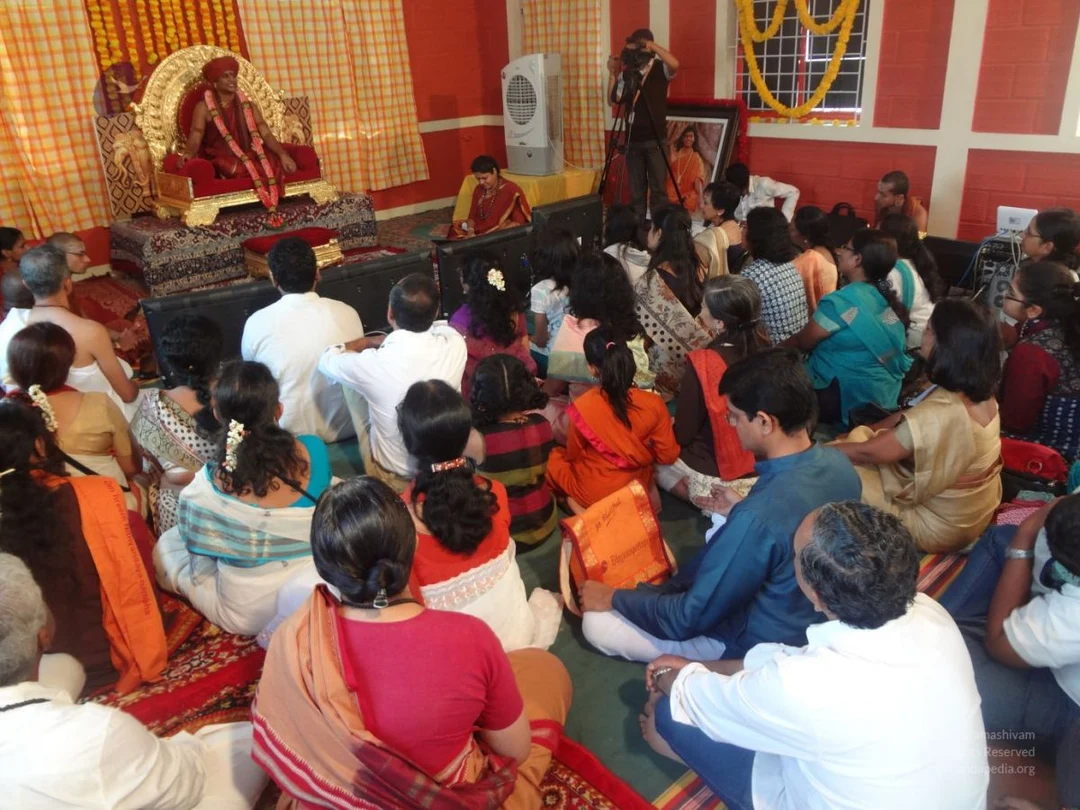
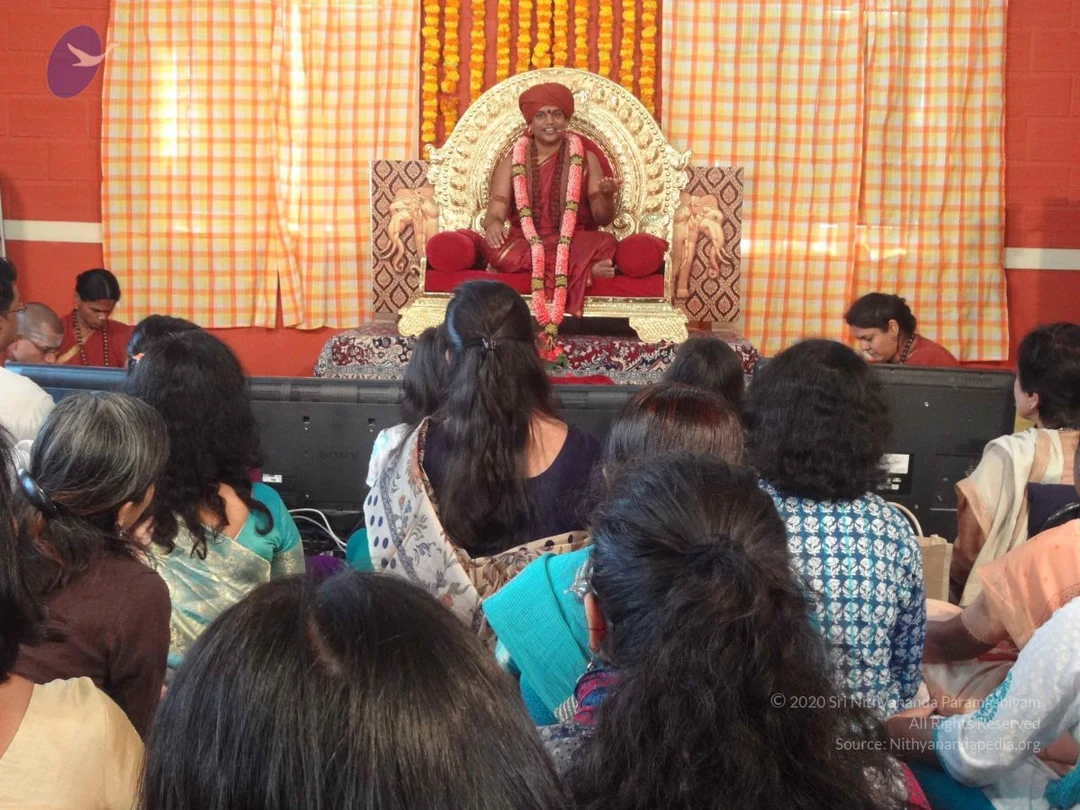
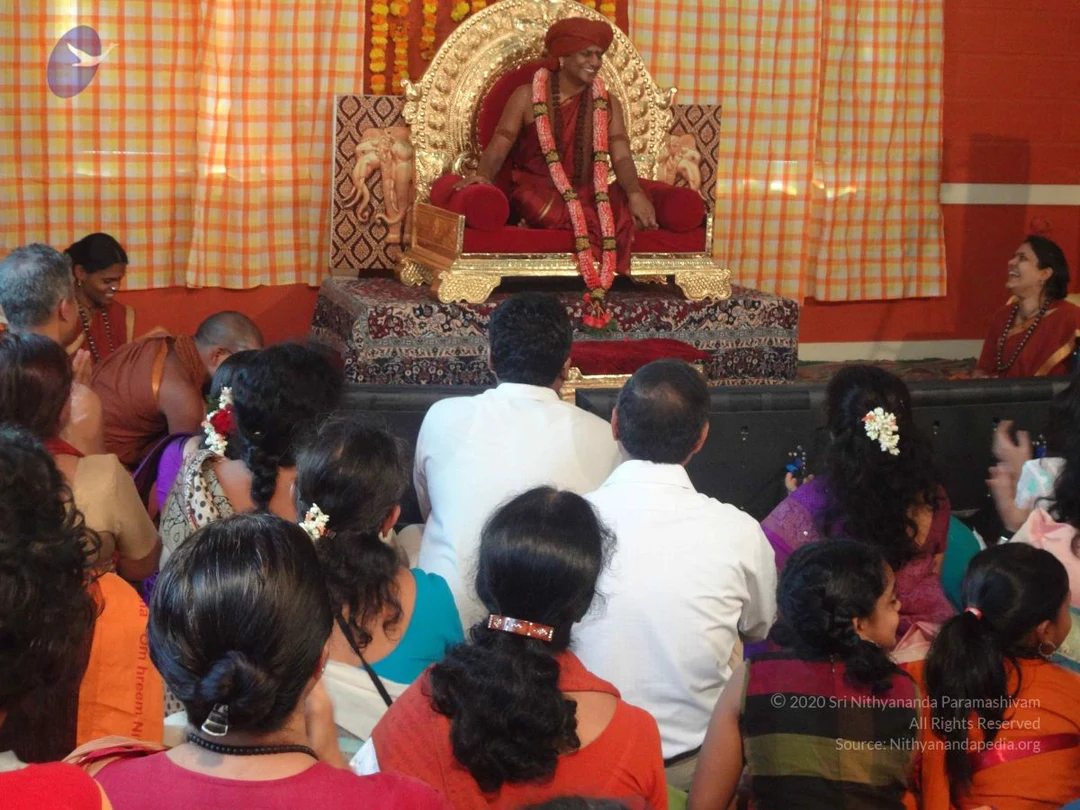
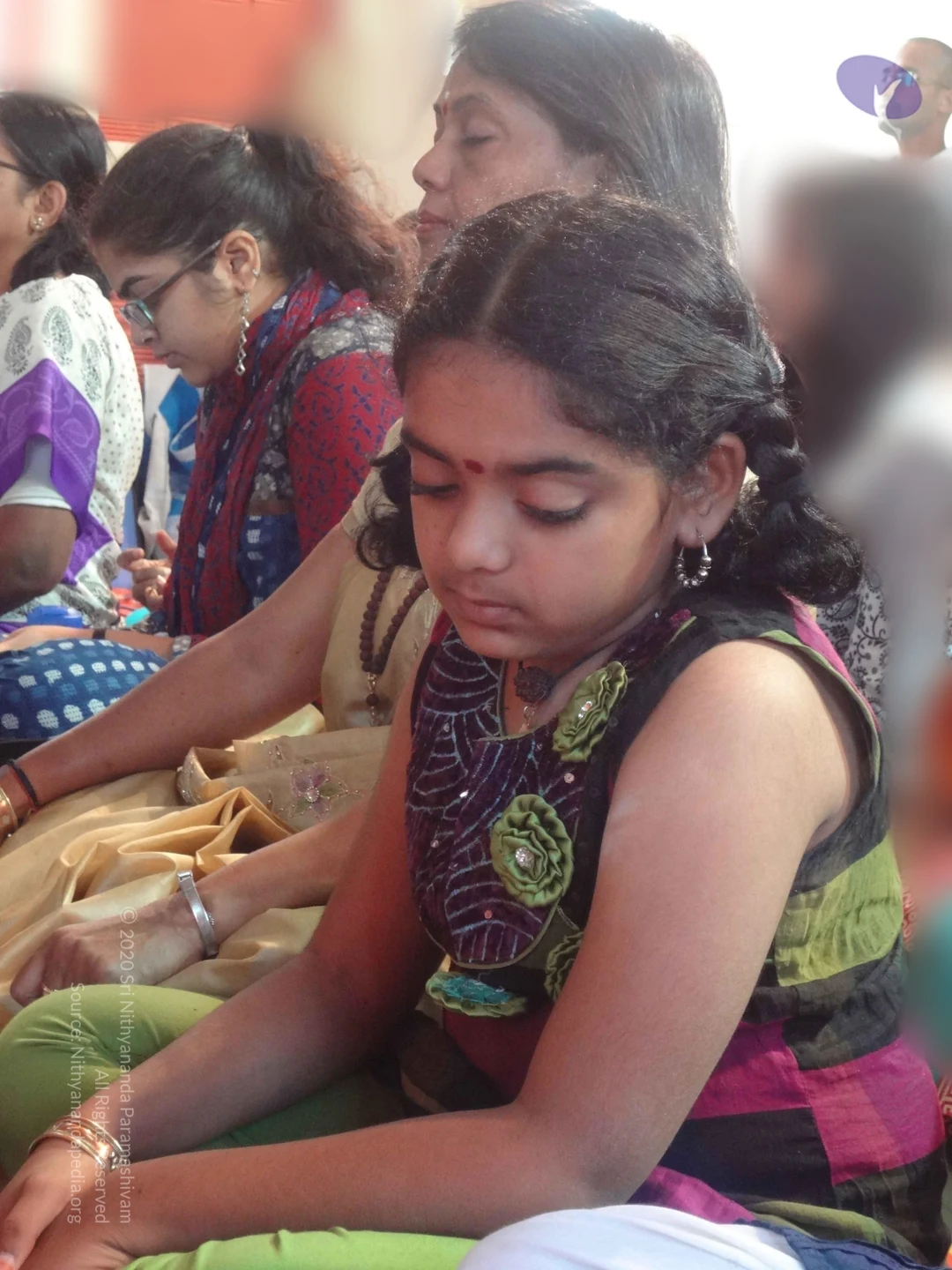
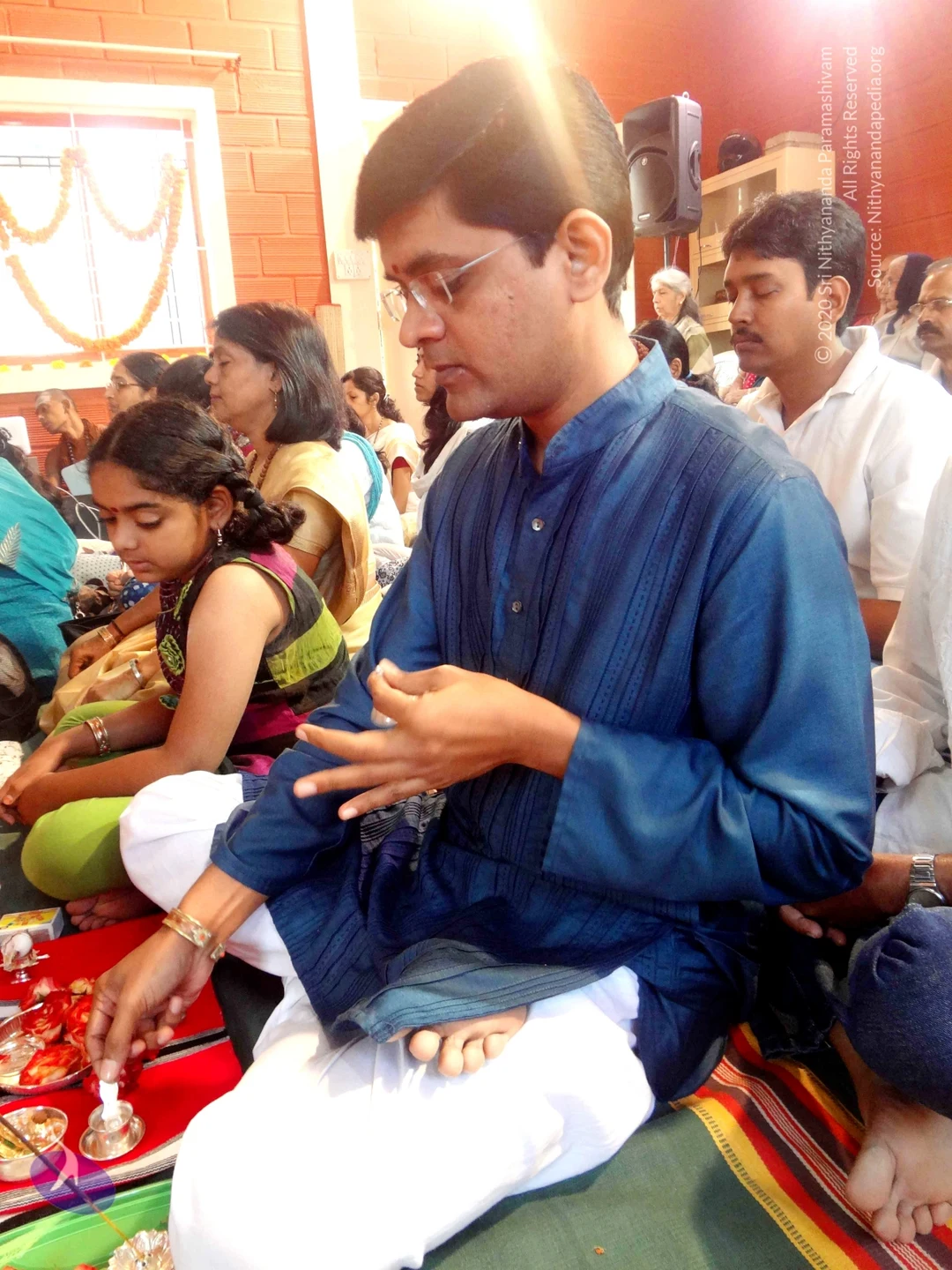
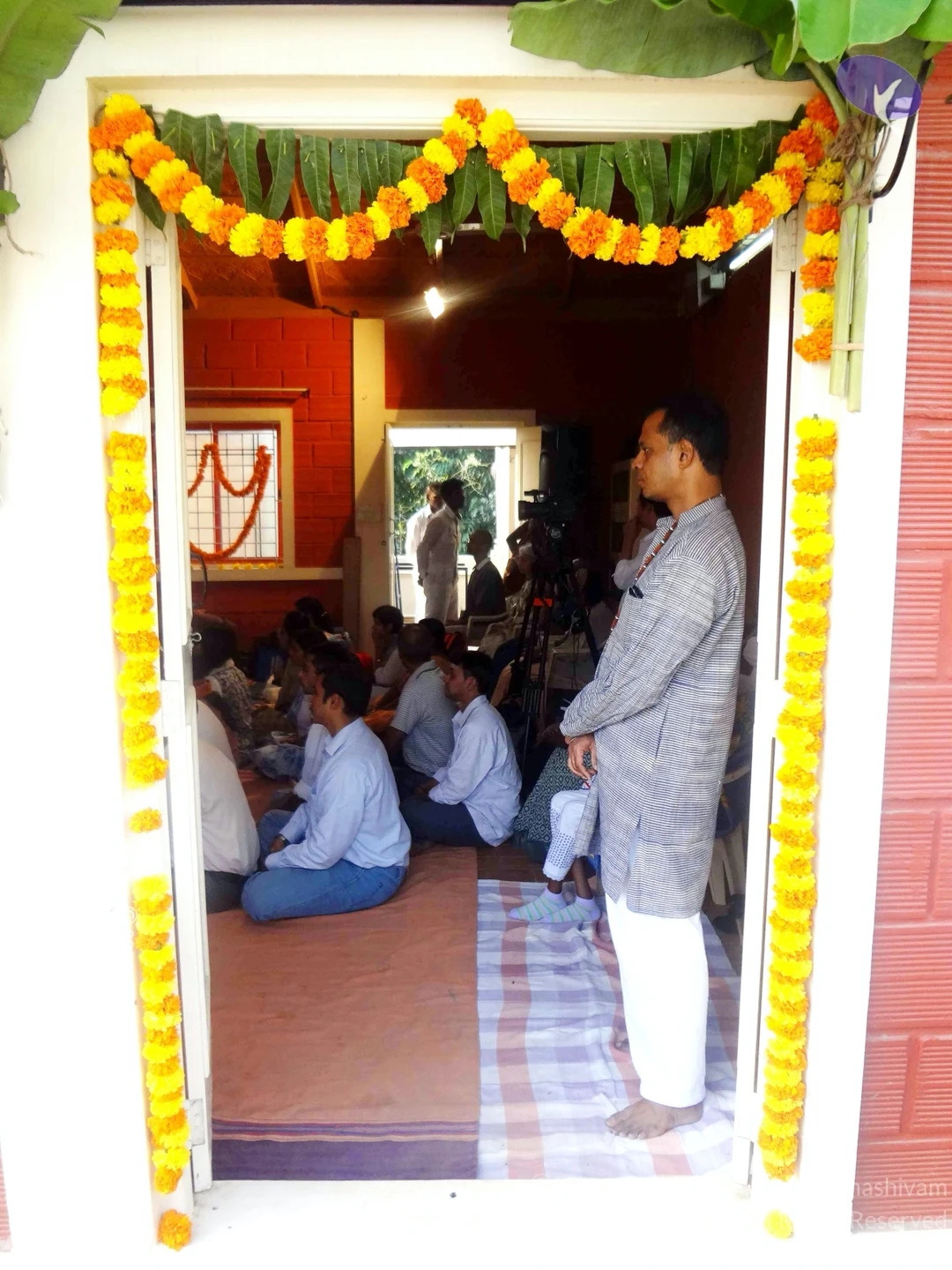
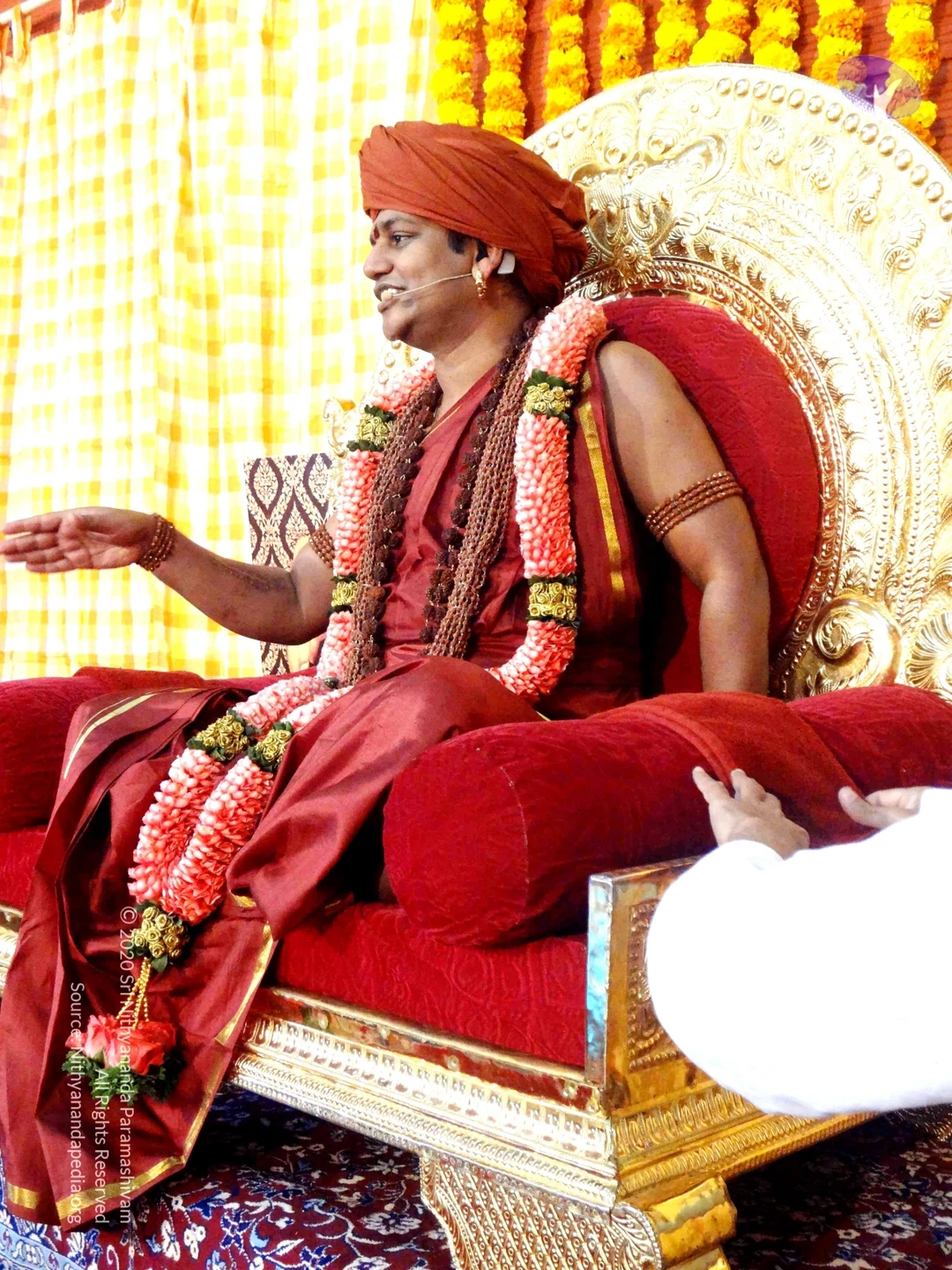
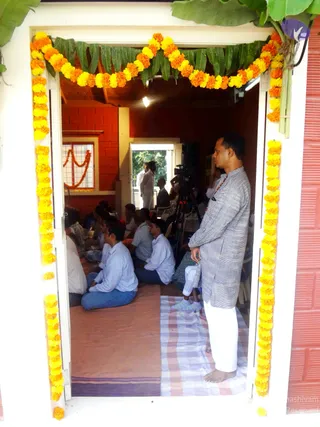
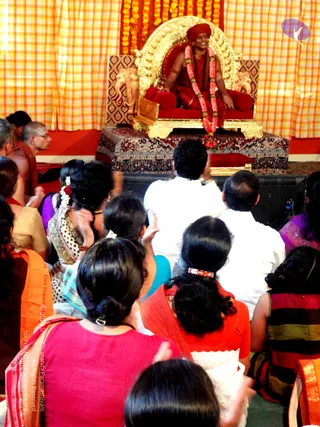
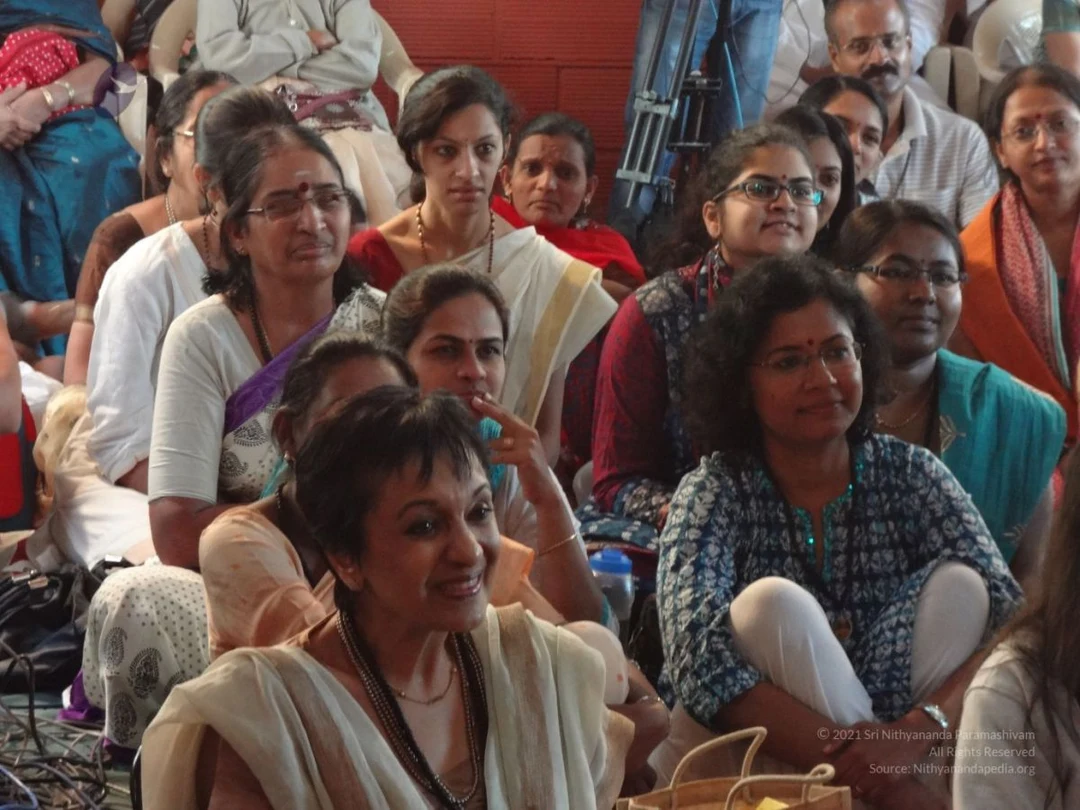
A young girl with a braided hairstyle, red bindi, hoop earrings and a purple and black sleeveless top with green rosette appliqués sits with eyes closed, seemingly in meditation. Behind her, several women sit close together in a seated gathering; one older woman with a red bindi has her eyes closed, and another woman in red and blue patterned scarf wears glasses. A woman in white and purple patterned clothing sits at left, and a rudraksha-style mala is visible on a woman in gold clothing. Light is bright and the background is blurred.A seated man in a dark blue kurta over white dhoti, wearing rimless glasses and a red bindi, performs a ritual with his right hand over a small brass oil lamp (deepam) lit on a red cloth. Behind him, a girl in a green and magenta blouse with a braid and bangles sits with her eyes lowered, and a woman in a cream sari with gold border sits near her. Rows of seated devotees, several in white clothes with closed eyes, fill the room. Marigold garlands hang from a window at left, and a speaker sits on a wooden shelf at right. A brass plate with offerings and a bowl are visible at lower left.A photograph taken from a doorway of a room decorated with yellow and orange marigold garlands and mango leaf festoons across the top of the frame. Seated devotees in light shirts and trousers sit on a pink mat and a checked cloth inside the room, facing forward. A man in a grey striped kurta and white dhoti stands barefoot at the right of the doorway, hands clasped. A video camera on a tripod is set up beside him, and a few standing people are visible in the background near an open window with greenery outside. No person in the scene is identified as a person.A man in a rust-red turban and matching red-maroon silk robe sits on an ornate gold throne with red cushions, gesturing with his right hand while speaking into a headset microphone. He wears a long garland of pink and white flowers with gold-coloured bead accents, multiple rudraksha malas, and a beaded armband. Behind him hangs a yellow checked cloth and a row of marigold garlands. A white-clad person's arm is visible at the lower right edge of the frame. The gold throne's carved backrest and the patterned rug complete the setting of a formal satsang seat.A photograph of a satsang seated before a gilded throne with carved elephant side panels, draped in red cushions and orange-yellow checked curtains with a marigold garland above. A figure in a red turban and red robe sits on the throne, smiling, wearing a pink and white flower garland and a rudraksha mala, with a probable Swamiji appearance. Seated devotees face the throne from behind: several women in saris and salwar, a man in white, and a woman in a red sari, many clapping. A bald man in orange robes sits at the left edge. The scene is a seated audience with clapping and a dais.A satsang scene photographed from behind a seated audience toward a golden throne (peetha) on a raised platform draped with an ornate patterned cloth. A man seated on the throne wears a red turban, red robes and a red-and-pink flower garland, gesturing with one hand as he speaks; carved golden elephant figures flank the throne and the backdrop is orange-yellow checked fabric hung with marigold garlands. In front, rows of devotees sit on the floor: several women with hair in braids or buns, one in a red top, one in an orange sari, and men in white shirts. Another person in white robes and a shaved head sits at the left edge. The image shows a teaching session in progress.
November 29 2013

1 photoView all
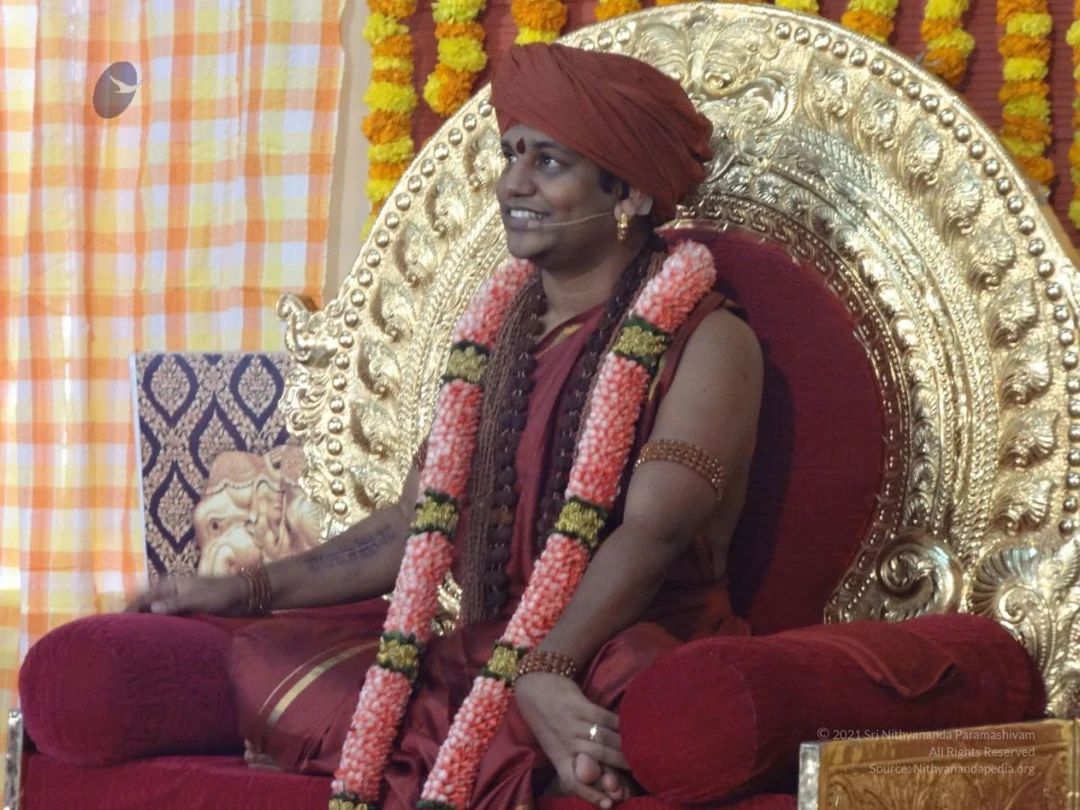
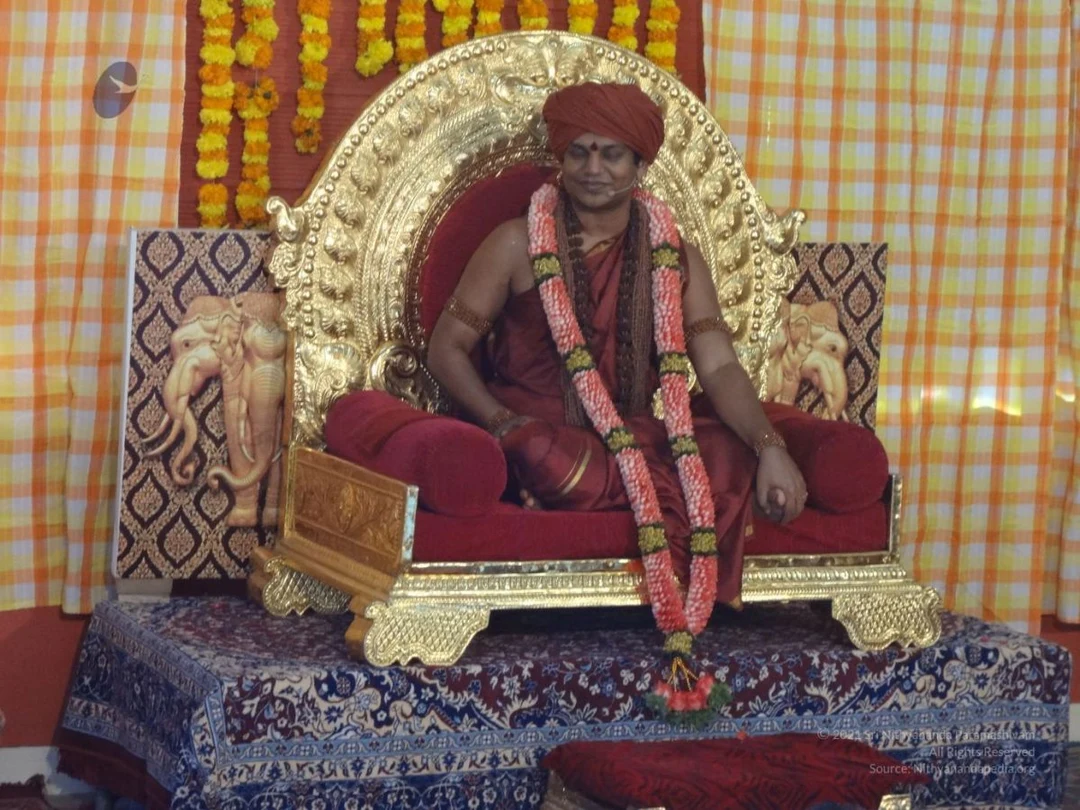
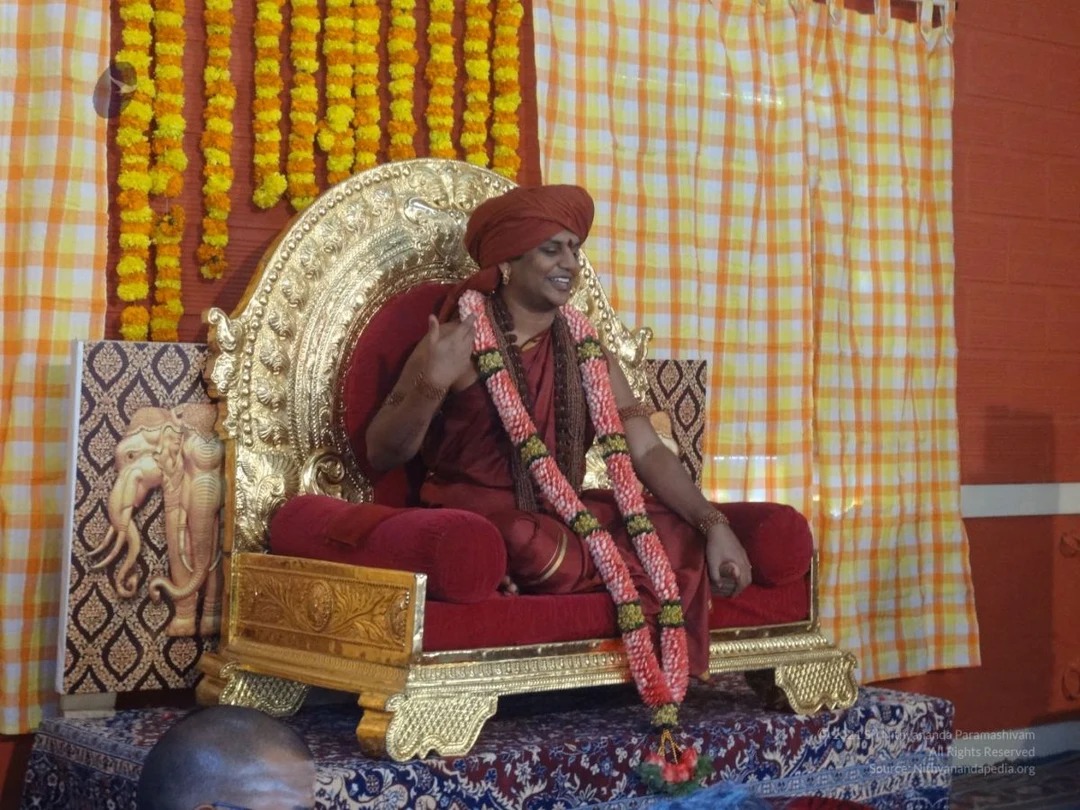
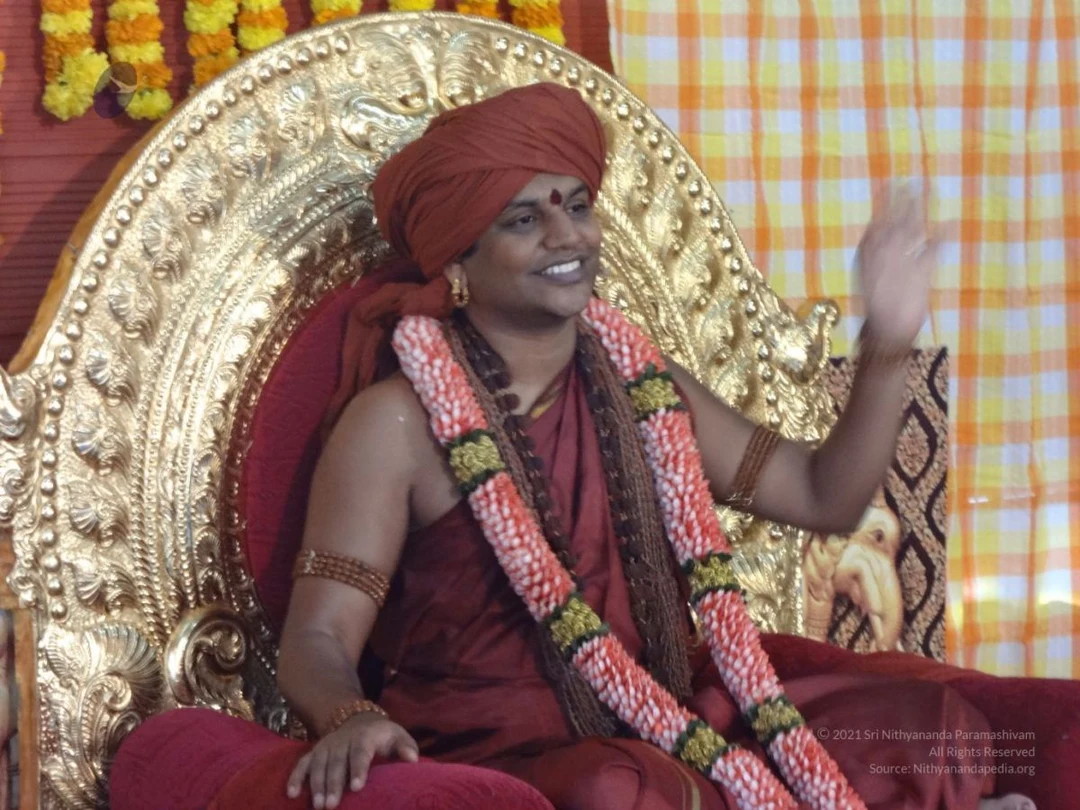
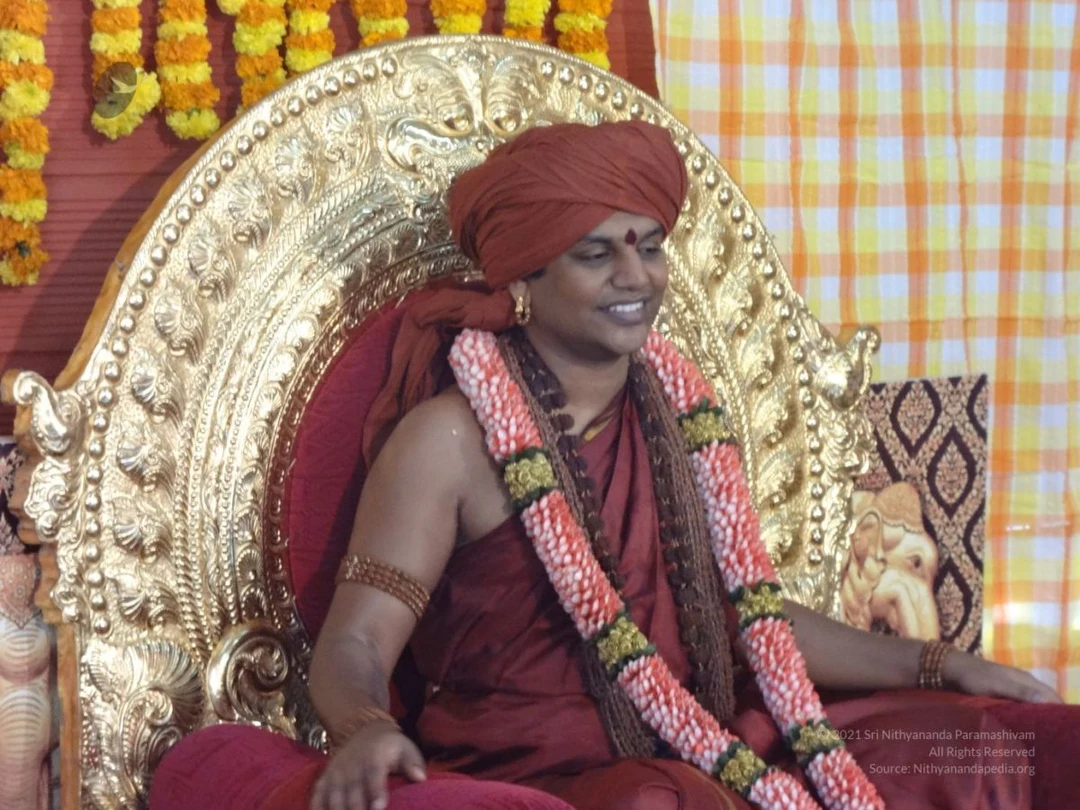
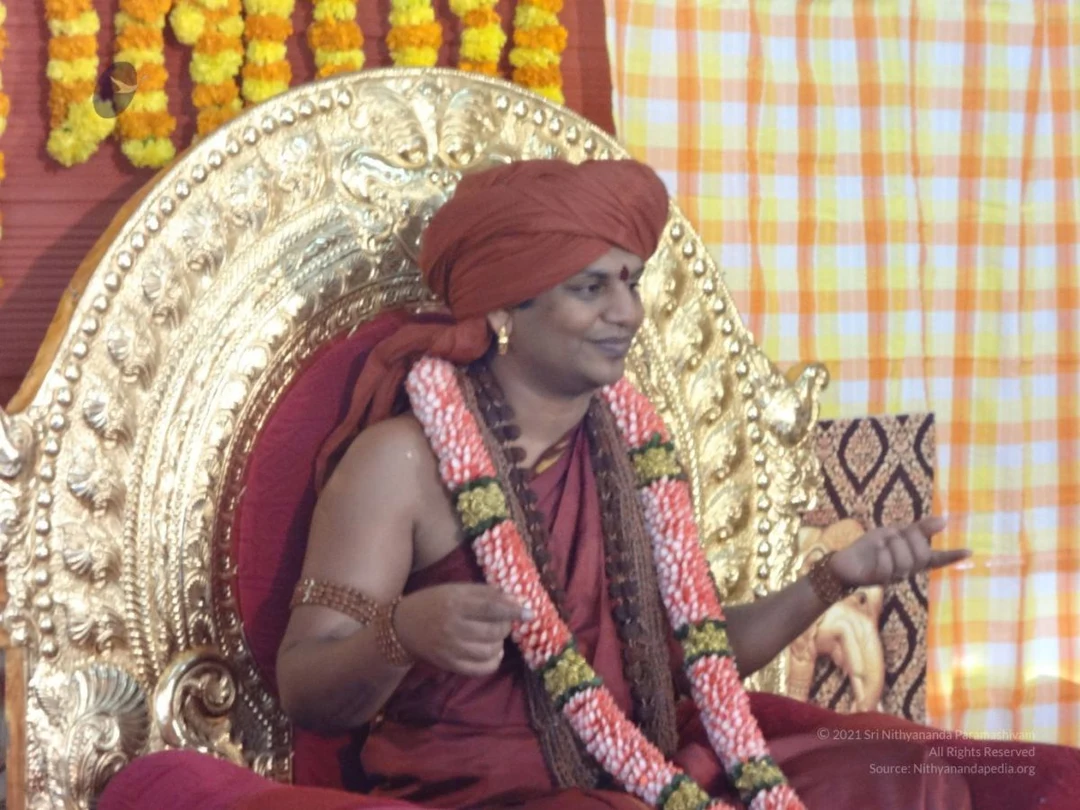
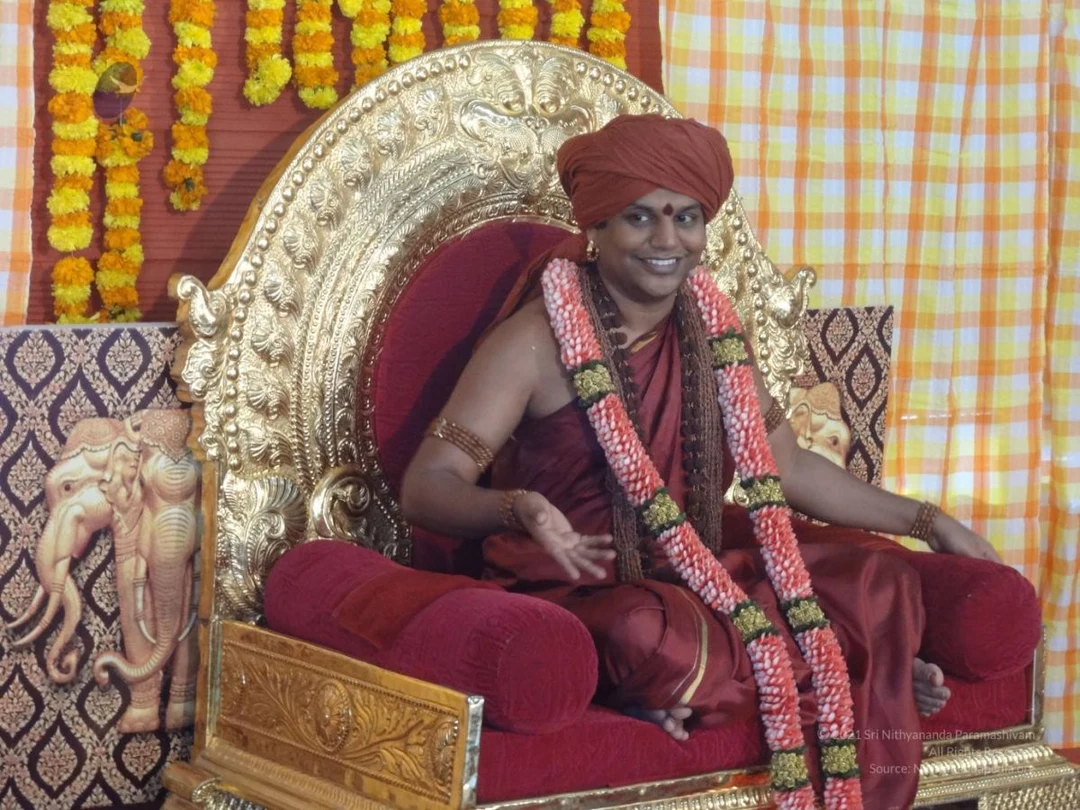
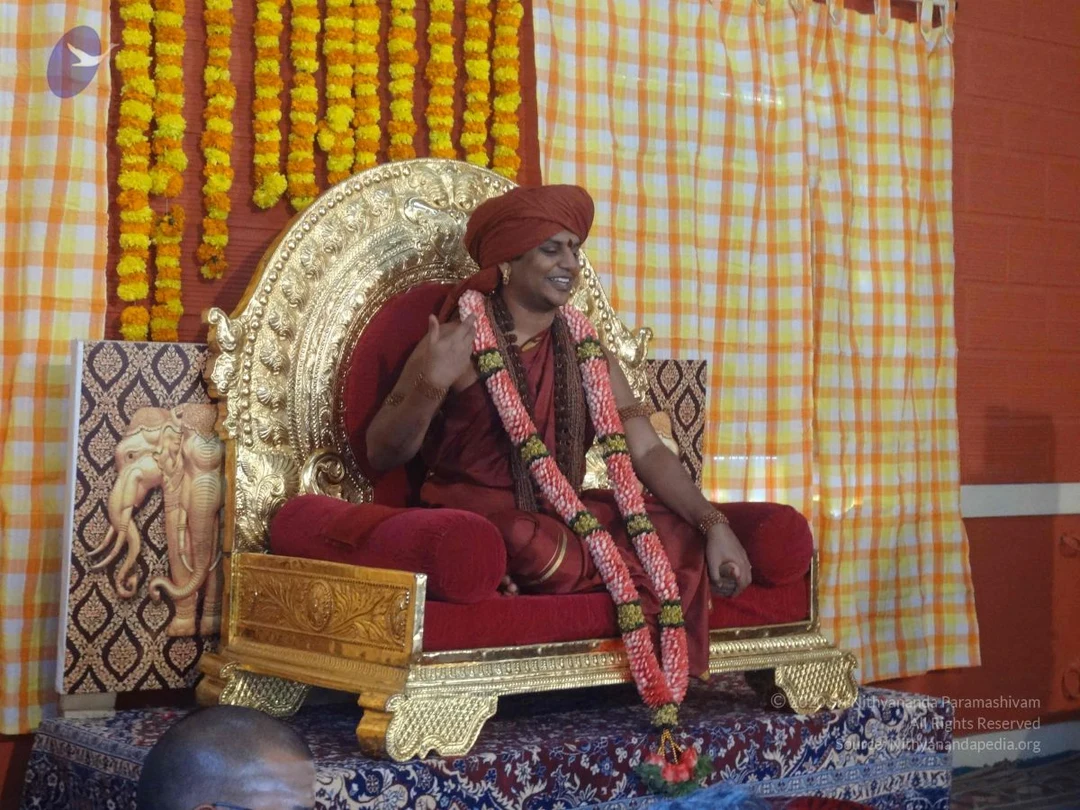
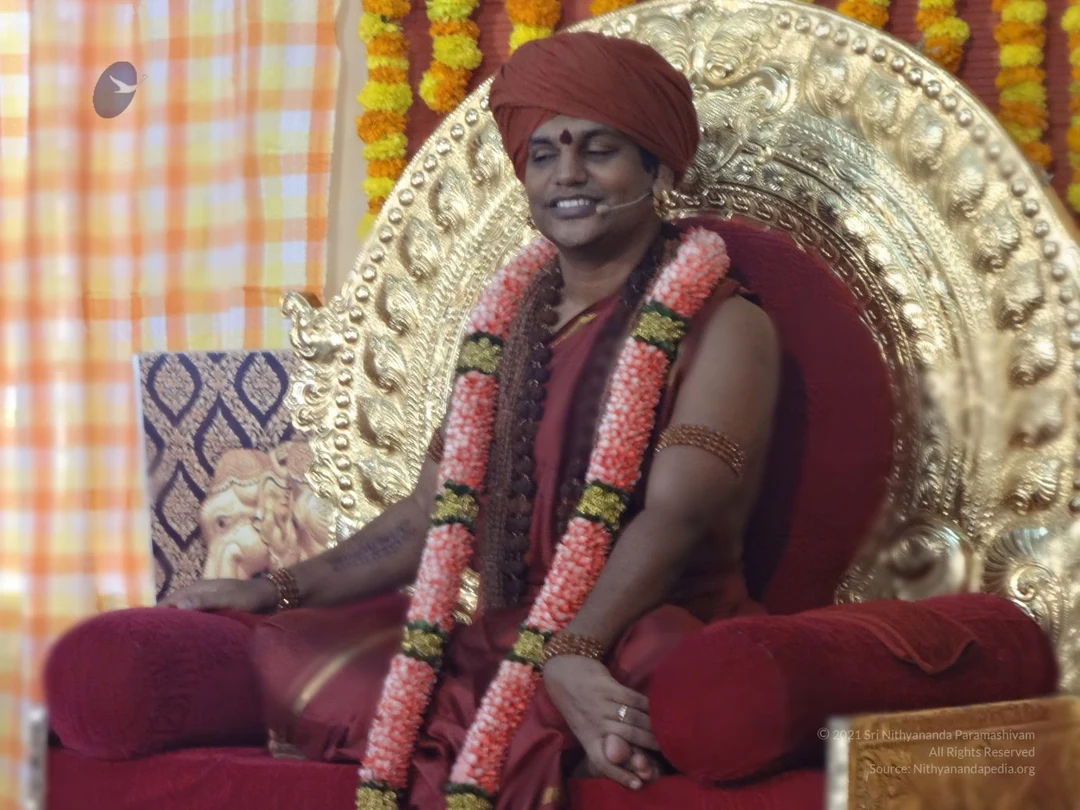
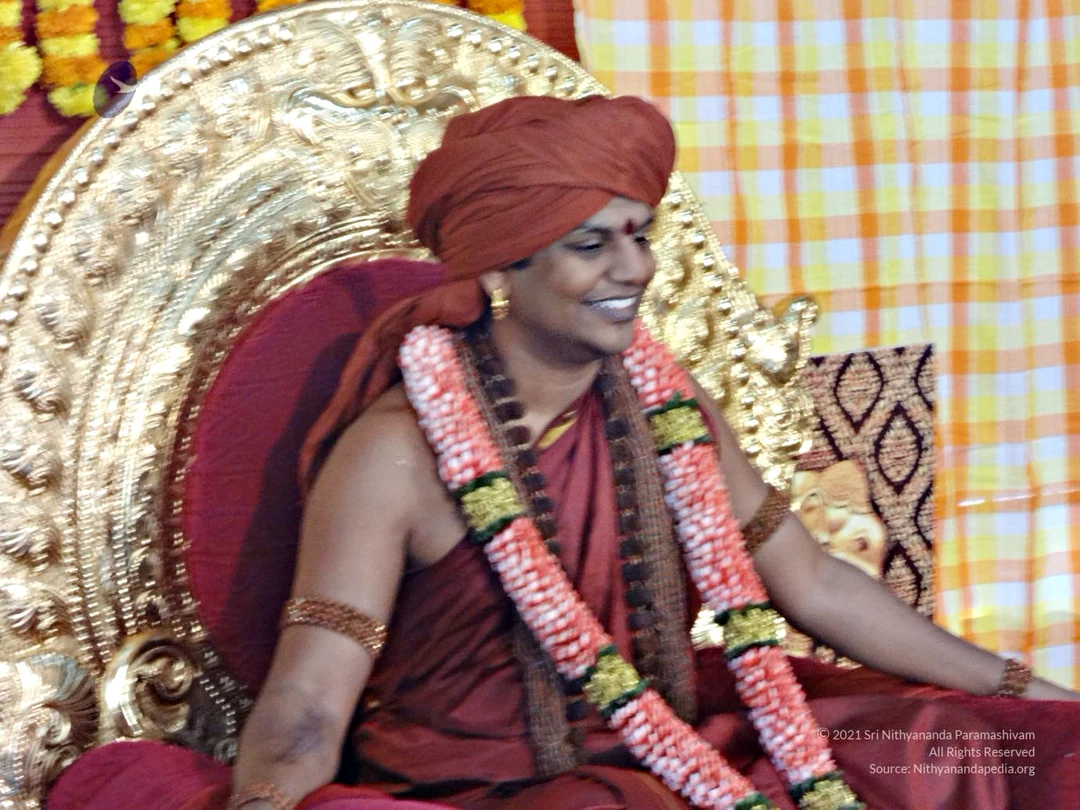
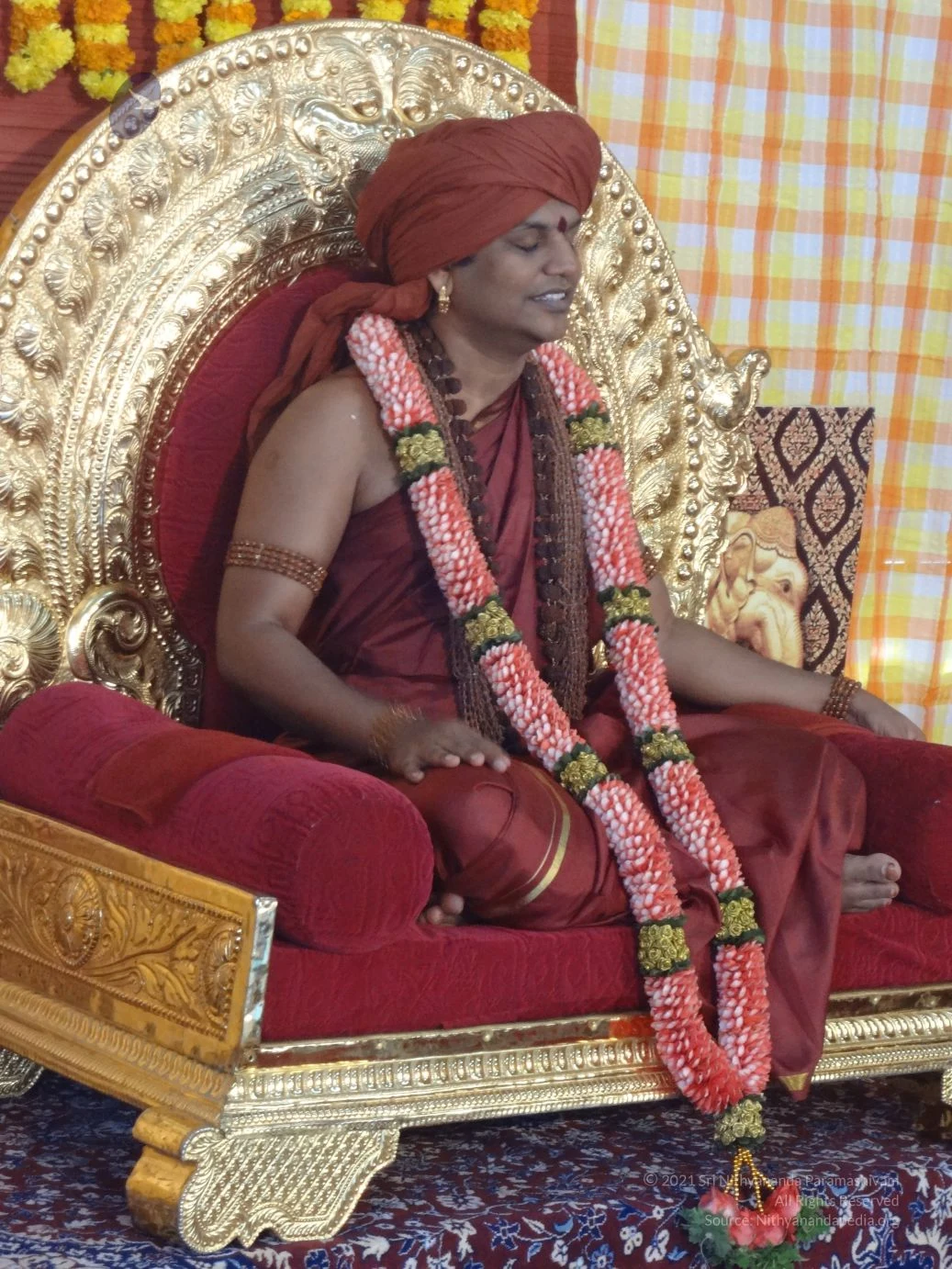
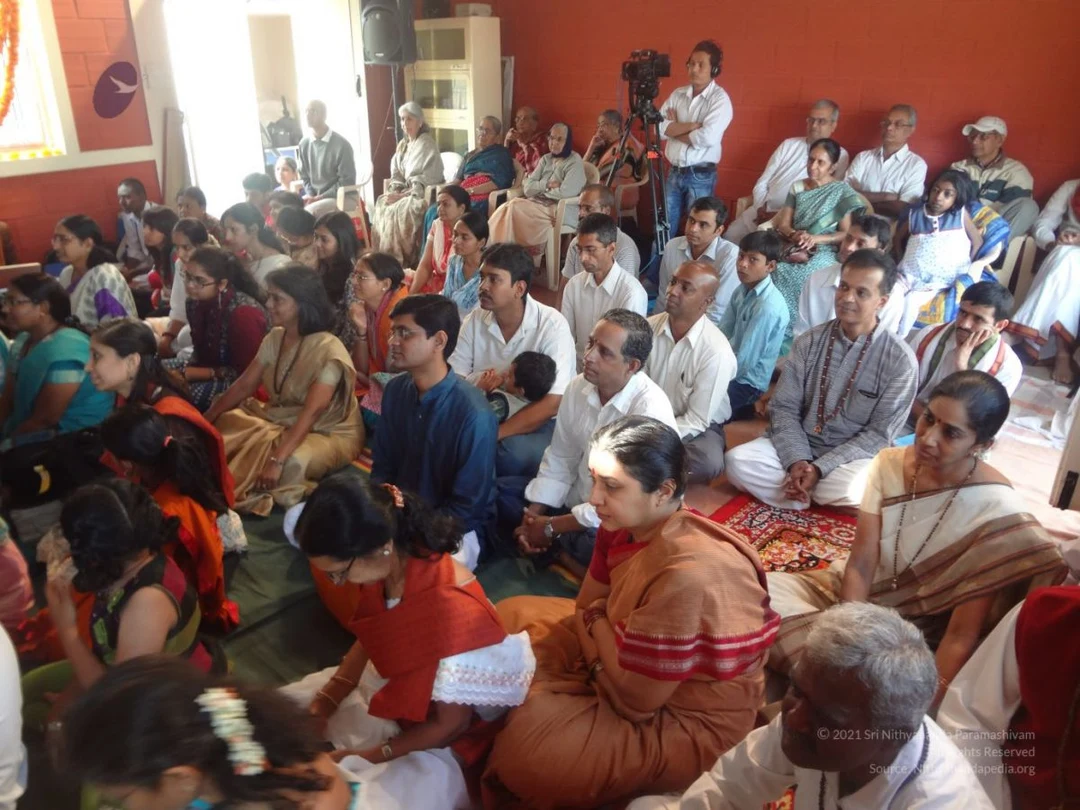
A person seated cross-legged on an ornate gold-and-red throne with a red velvet cushion, wearing a maroon turban, maroon robe and a bare right shoulder, with rudraksha beads and a thick pink-and-yellow flower garland draped across the chest. The seated figure has eyes closed and appears mid-discourse, with a red bindi on the forehead and a gold earring. Behind is a gold-and-orange checked backdrop, a marigold garland overhead, and a carved elephant-headed deity image on a patterned panel to the right. Appearance cues include the turban, rudraksha and ceremonial garland, so the seated figure is an appearance-based probable Swamiji (probable) seated in a teaching position on a throne.