Skip to content
Sunday

8 September 2013

Dated photos
85
Source pages
1
Media
2
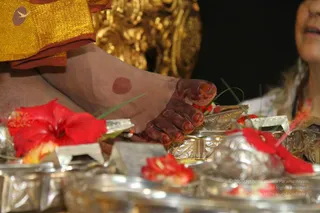
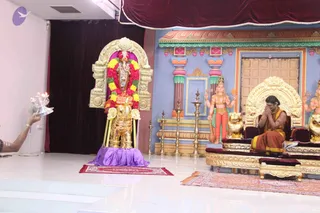
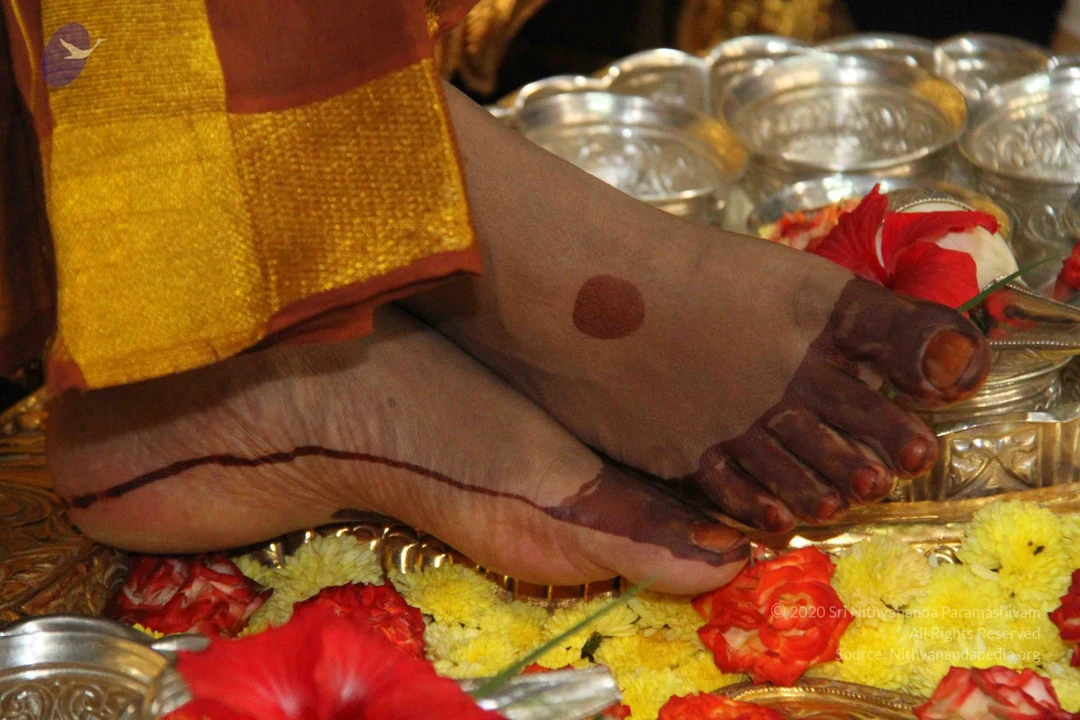
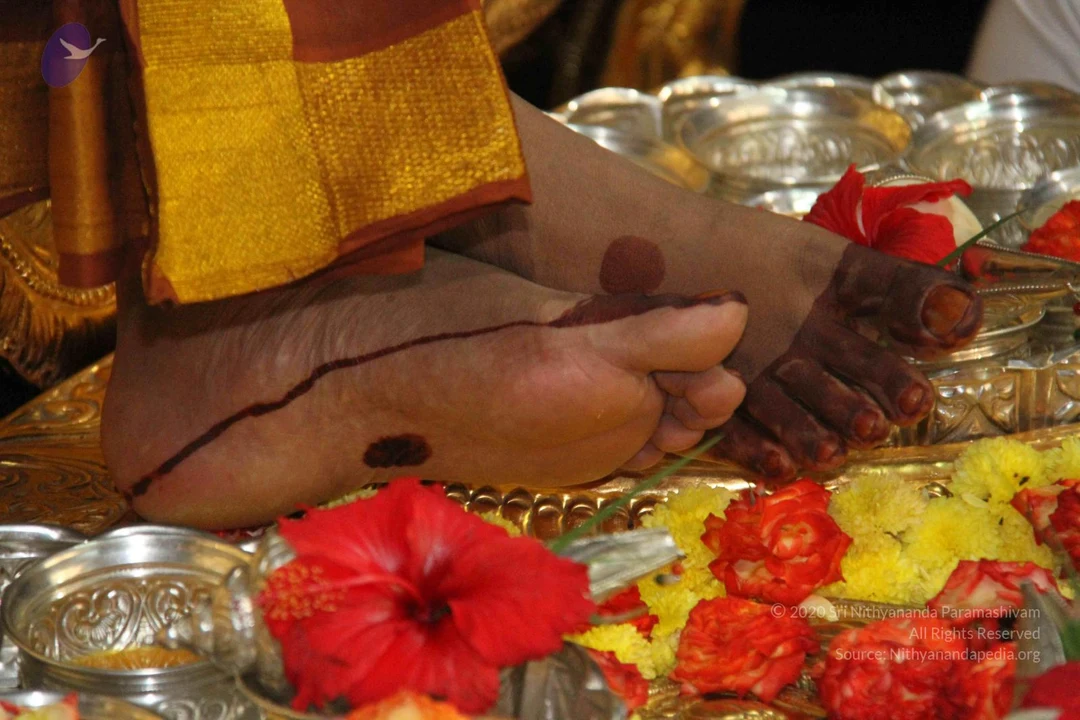
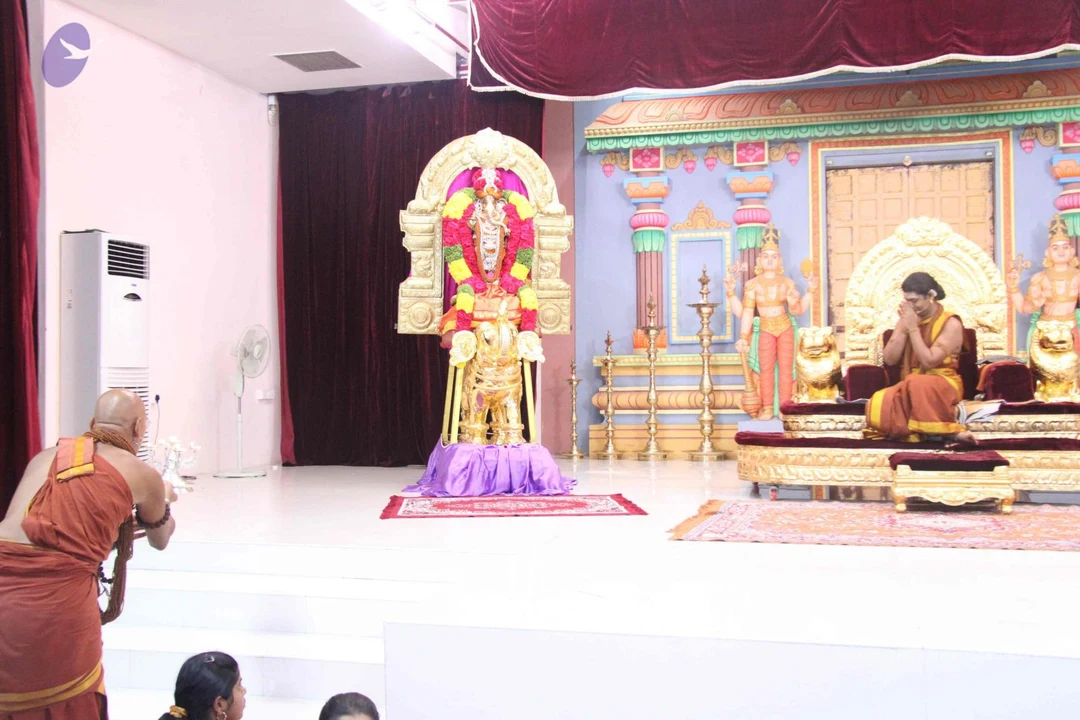
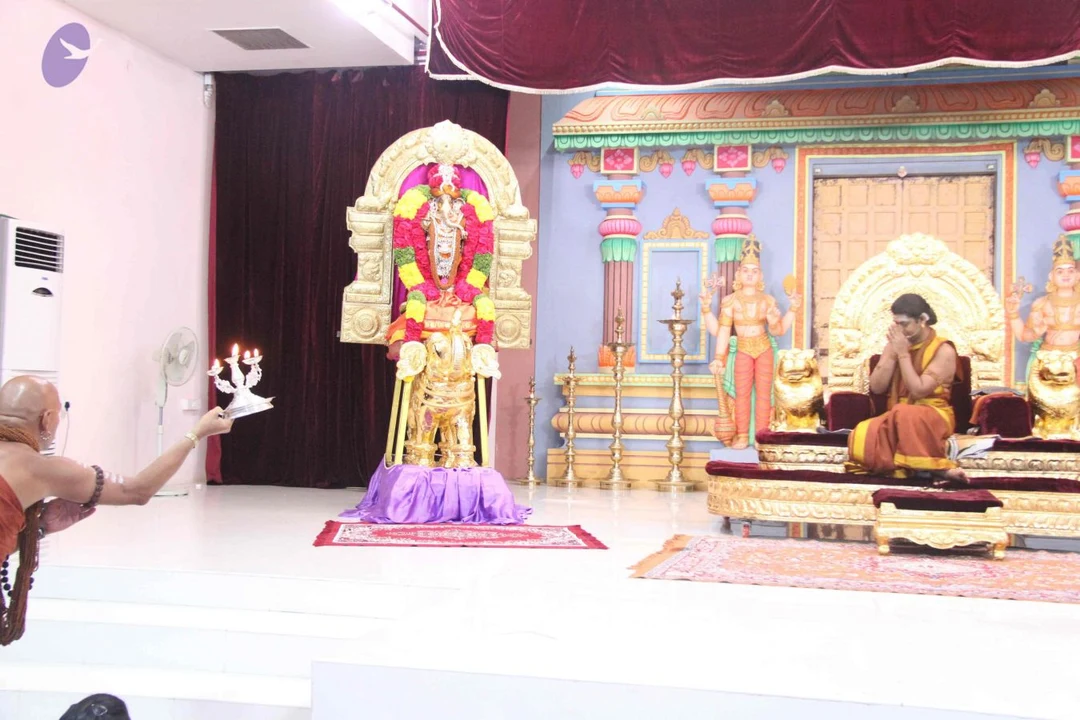
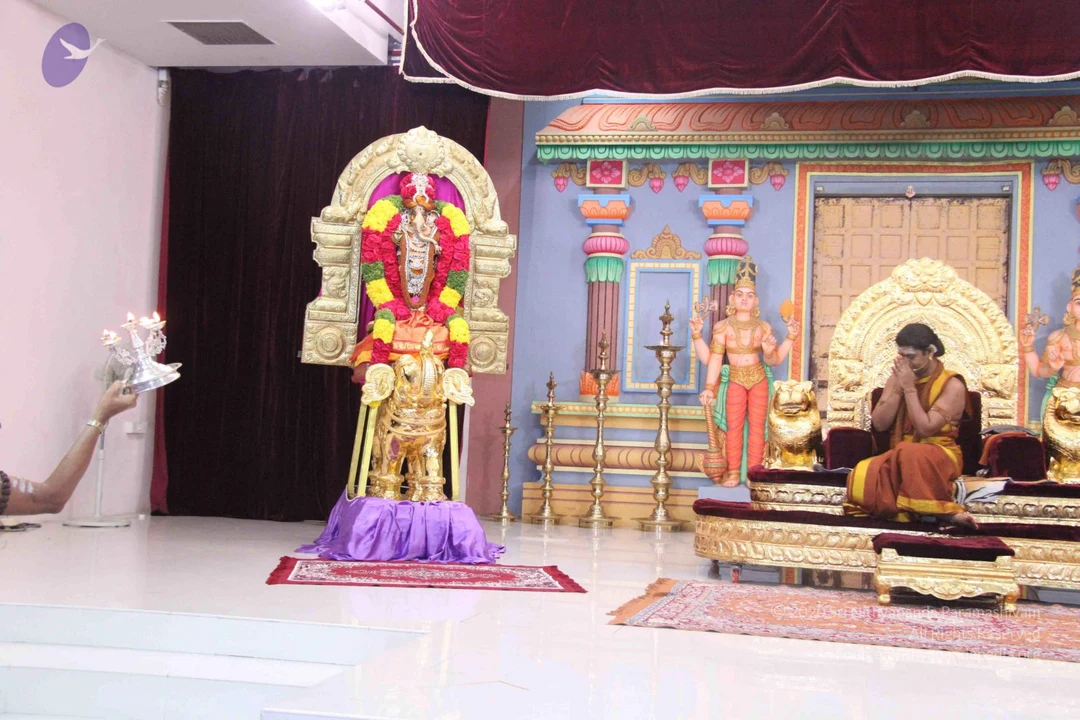
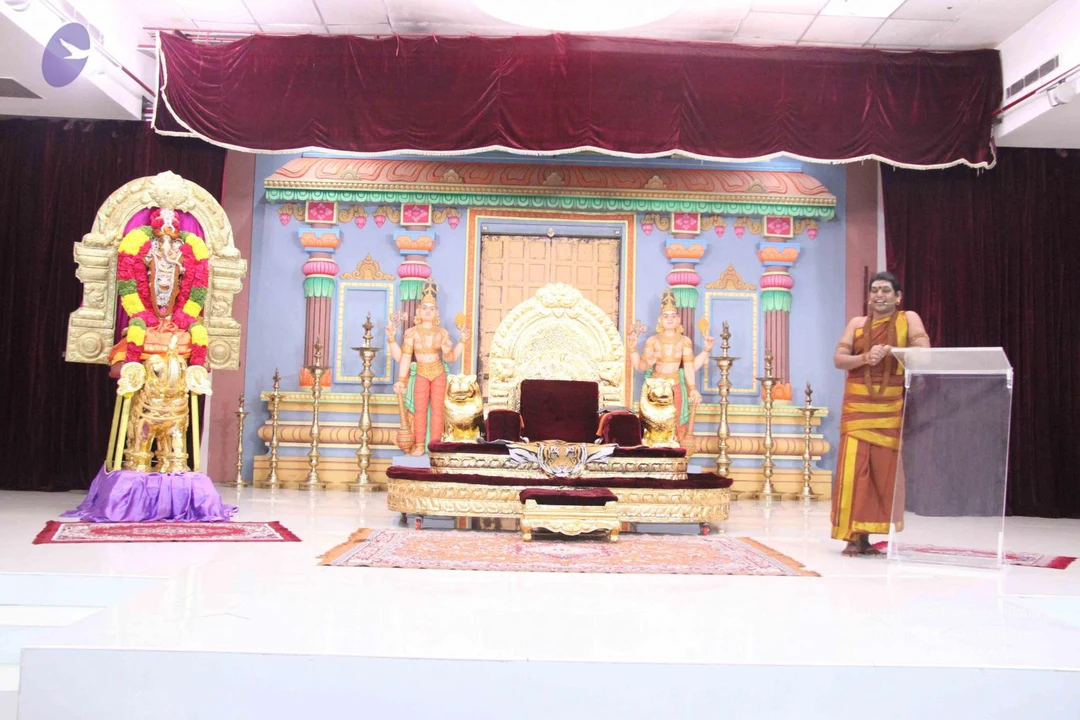
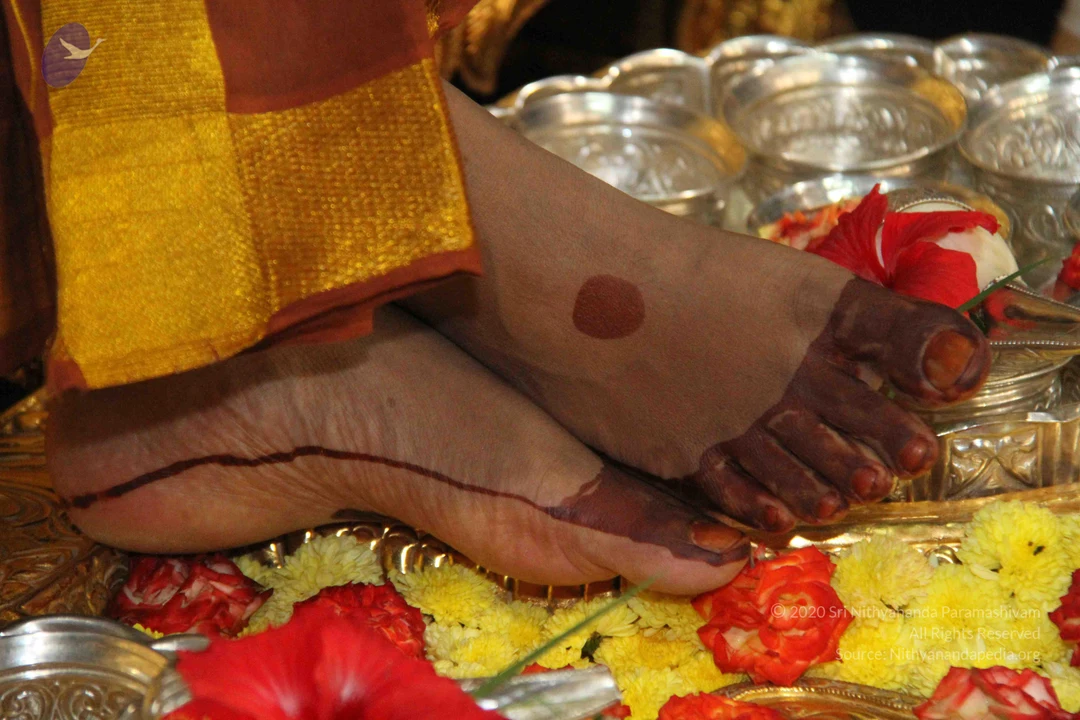
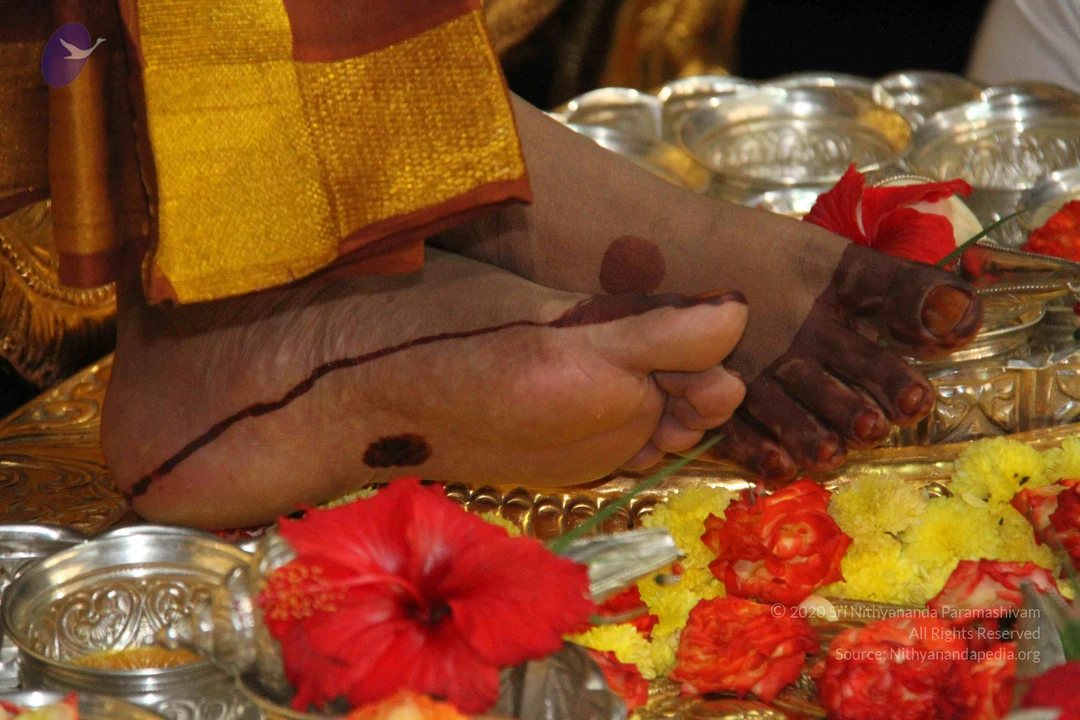
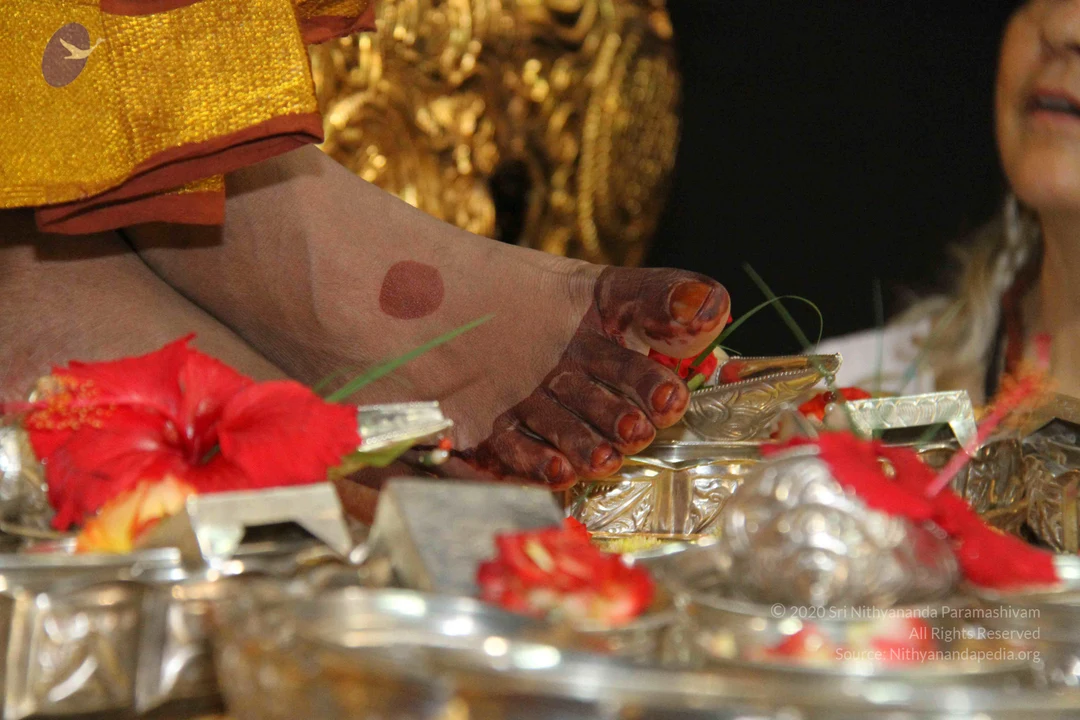
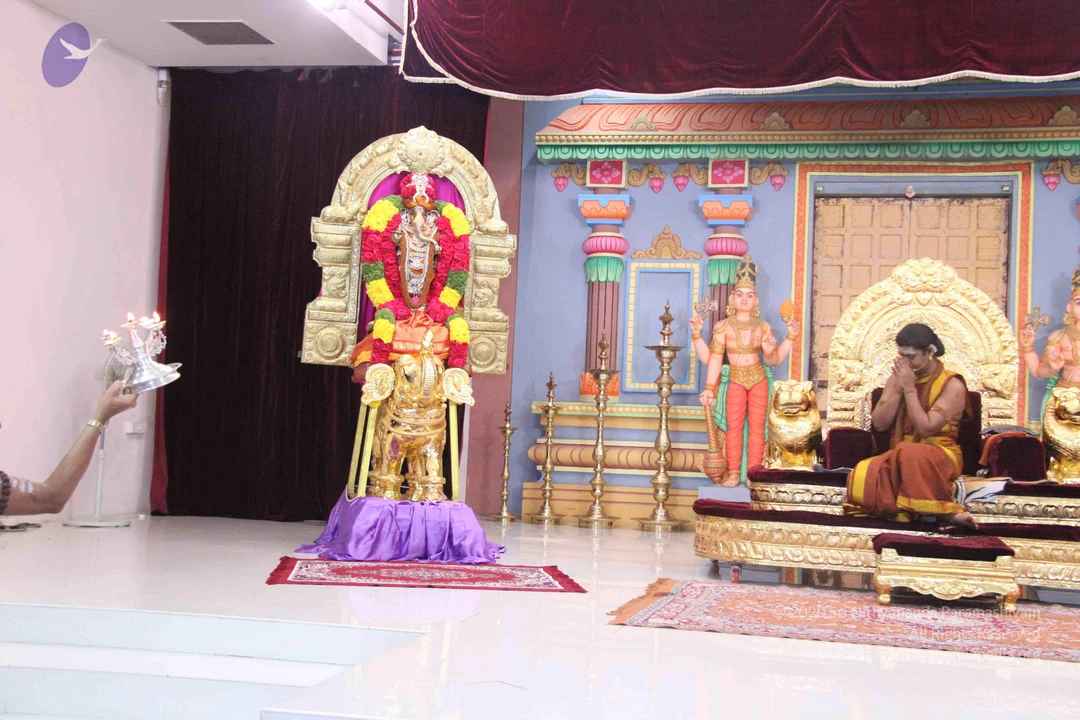
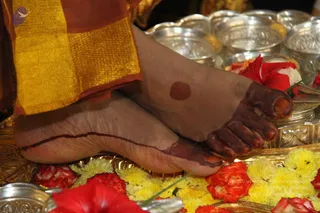
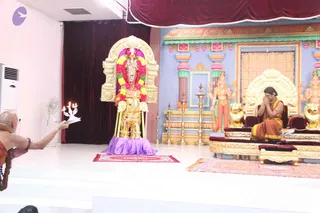
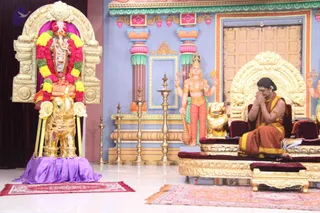
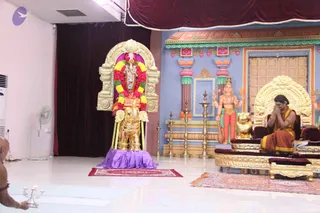
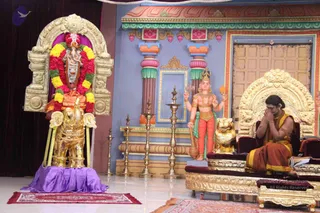
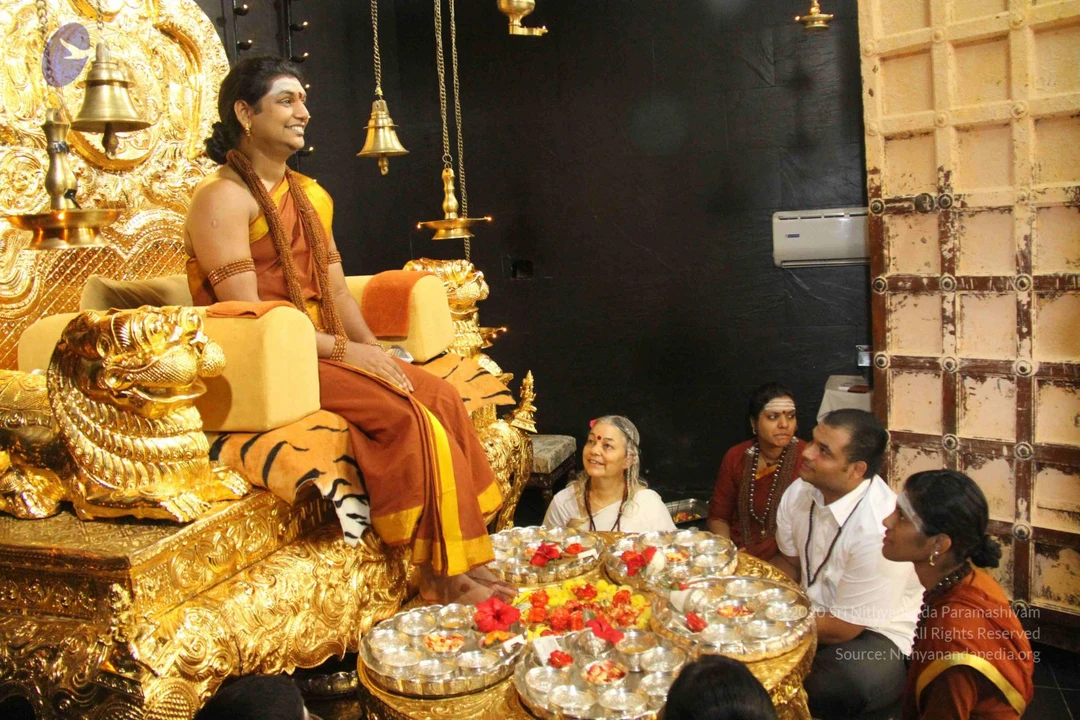
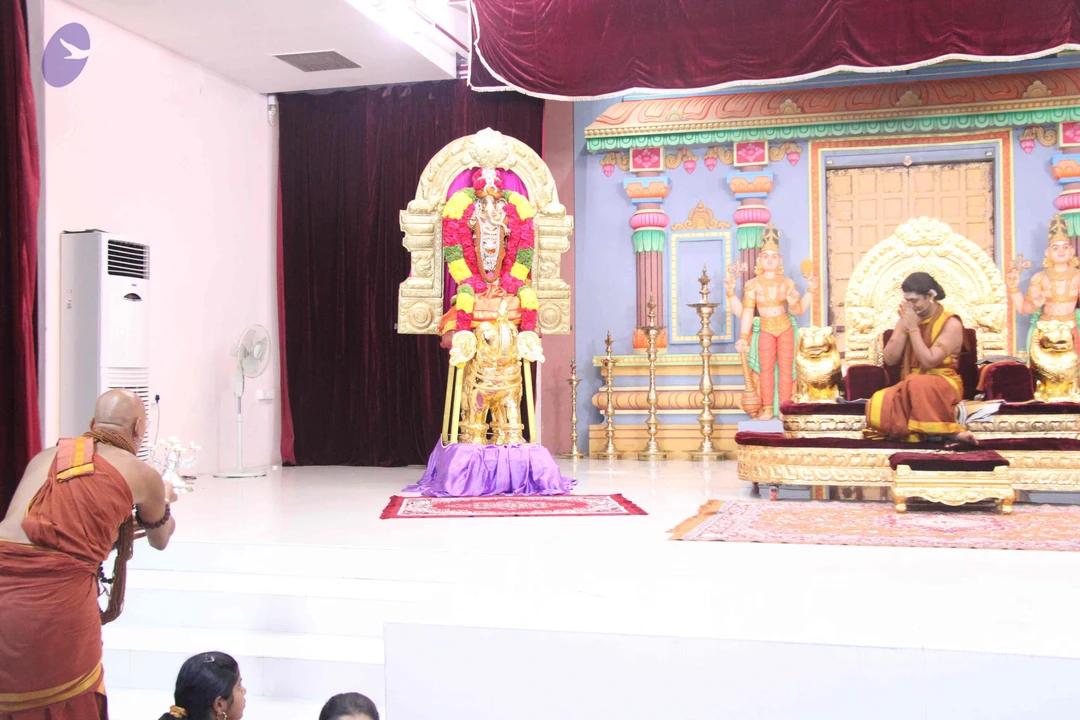
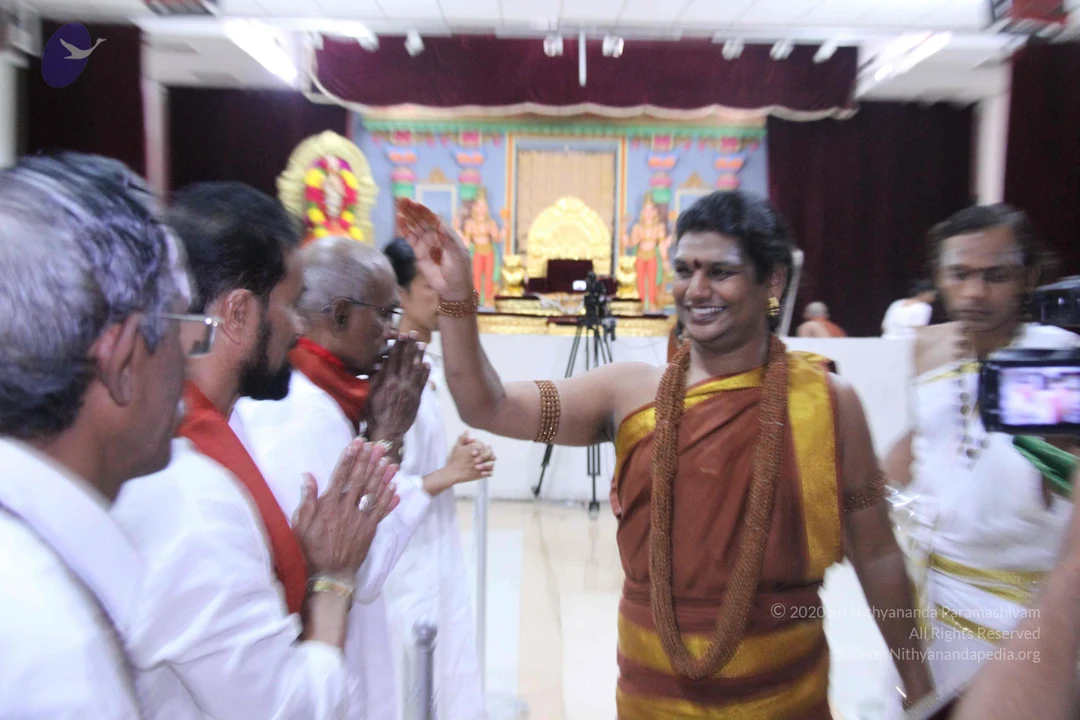
Close-up photograph of a person's bare feet during a padapuja-style ritual. The feet, with a round red kumkum mark on the ankle, rest on a silver tray decorated with red hibiscus flowers and green grass blades. A silver plate and a small silver vessel sit among the flowers. Above, a gold-embroidered yellow and maroon garment is visible, and a golden deity murti or ornament glows in the background. A partly visible woman with light hair stands at the right edge. Only the feet and a sliver of the garment belong to the main figure; the face is not shown.A photograph inside a hall with a polished floor and a stage backdrop painted with figures and a golden arch. In the foreground, a smiling person in an orange-brown robe with a gold border and a long rudraksha mala raises a hand, palm open, showing a red mark on the palm. Beside him, a young man in a beige t-shirt with a white cloth over his arm stands with hands folded in greeting. Behind them, a man in a grey shirt and white cloth and another person in white stand near low stanchions, and a woman in an orange sari is visible further back. Floor cloths and small offerings lie on the floor, and a red-cloth table is at the lower left.A stage with a blue and gold temple backdrop and a red velvet curtain above. On the left, a golden deity murti of Ganesha sits on a golden vehicle draped with a purple cloth, garlanded with red, yellow and green flowers. A hand holds a silver lamp toward the deity from the left edge. At right, a seated man in an orange-and-saffron dhoti and shawl sits on a gold-trimmed throne with hands pressed together in namaskar, head bowed. Brass lamps stand between them, and a standing deity murti in orange and green dress with raised hands is beside the throne. The setting suggests an arati or puja before a Ganesha murti.

September 08 2013

Original wiki page
Contents

Description:

Today swamiji encouraged us to enrich our communities with Spiritual Truth to awaken ourselves and bring about a breakthrough in our spiritual growth. He said that every day the youth from all cities and Spiritual Embassies should sing and dance and chant the names of the Lord. In addition they should take up the cleaning of some temple,waterbody school or park. This all should be done to celebrate the happening of an Incarnation in your life. This December 27 Swamiji will Initiate people to go for one year parivrajika to all the Jyotir Lingas and Shakti Peeths of India. All these activities are to conquer the demon of incompletion and bring a new energy to live the 4 tattvas into your life.

Link to Video:

VideoAudio

Transcript:

Nithyanandeshwara Samaarambhaam Nithyanandeshwari Madhyamaam | Asmath Aachaarya Paryanthaam Vandhey Guru Paramparaam ||

I welcome all of you with my love and blessings.

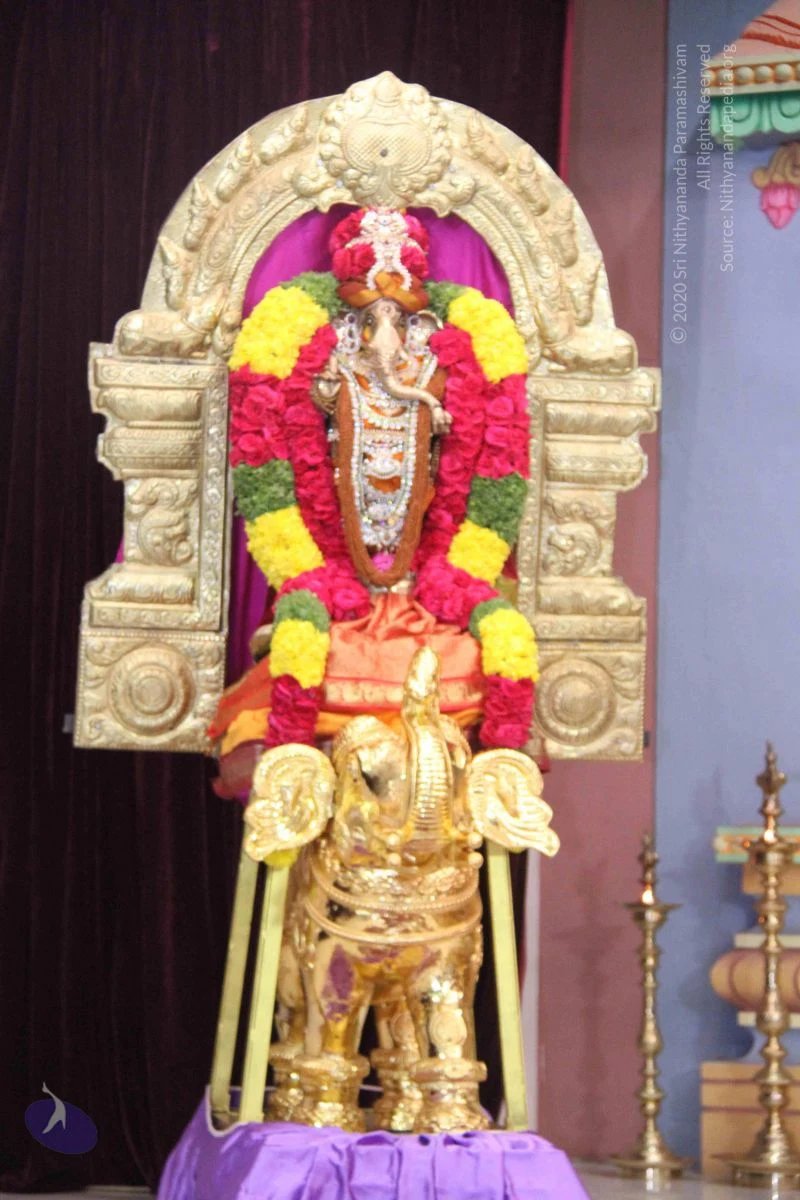
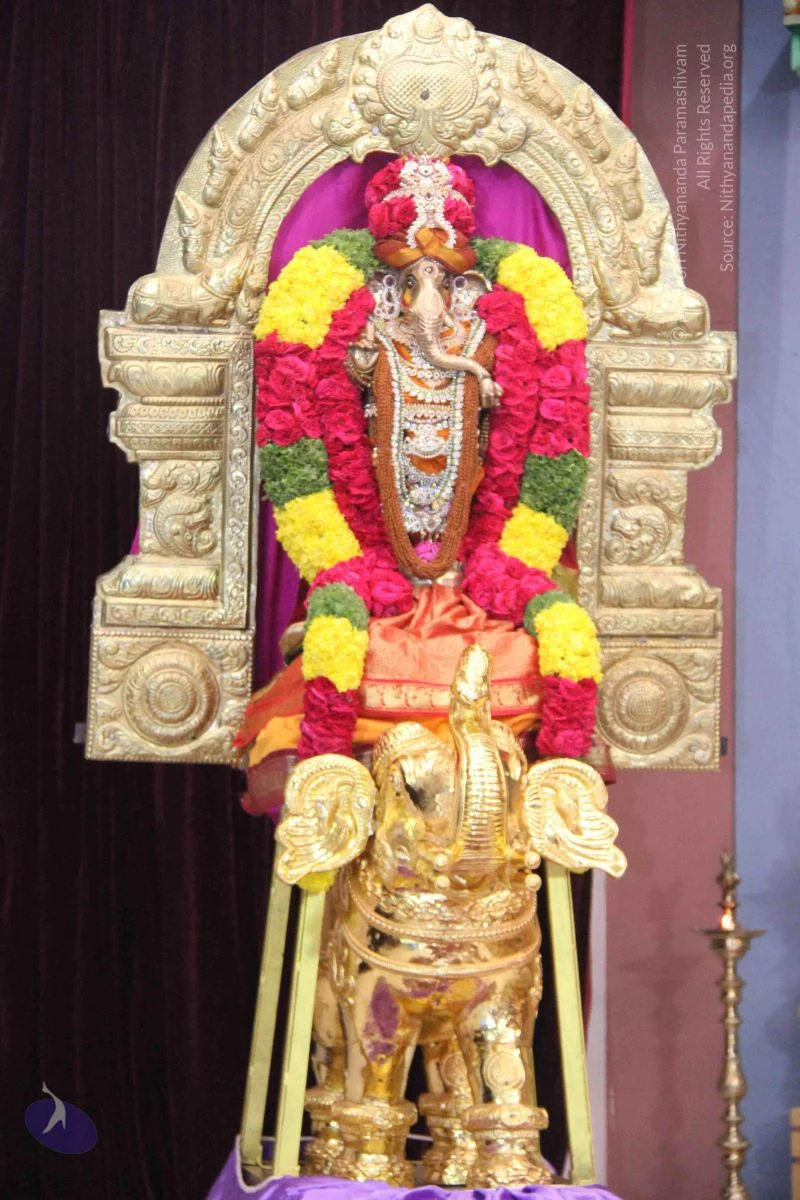
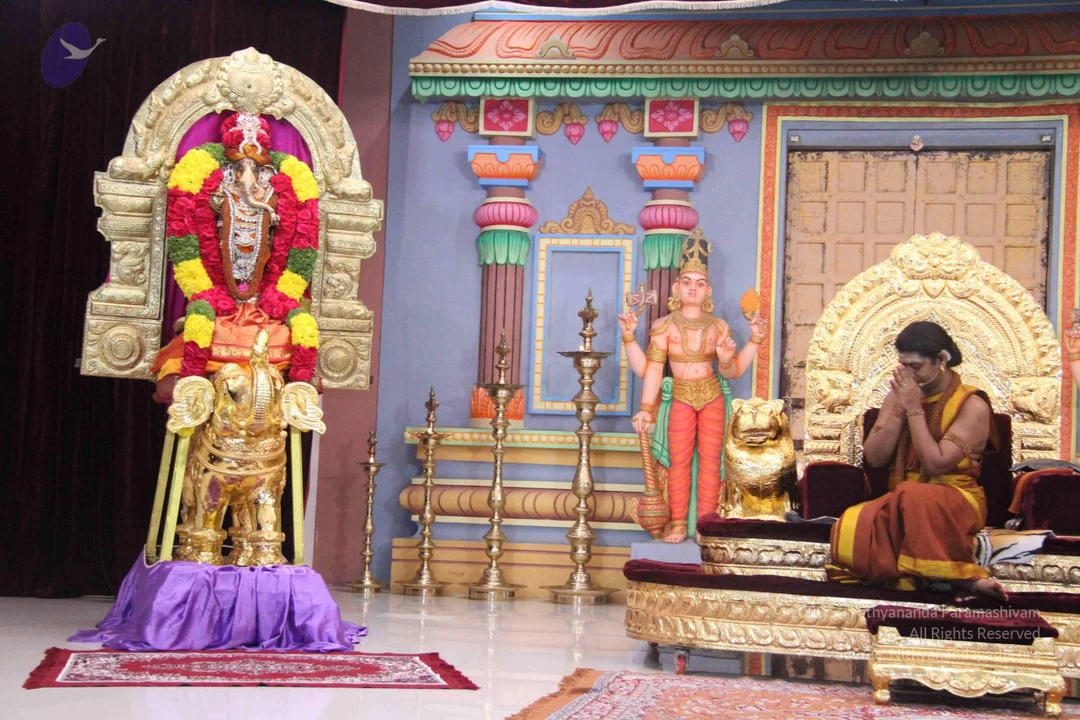
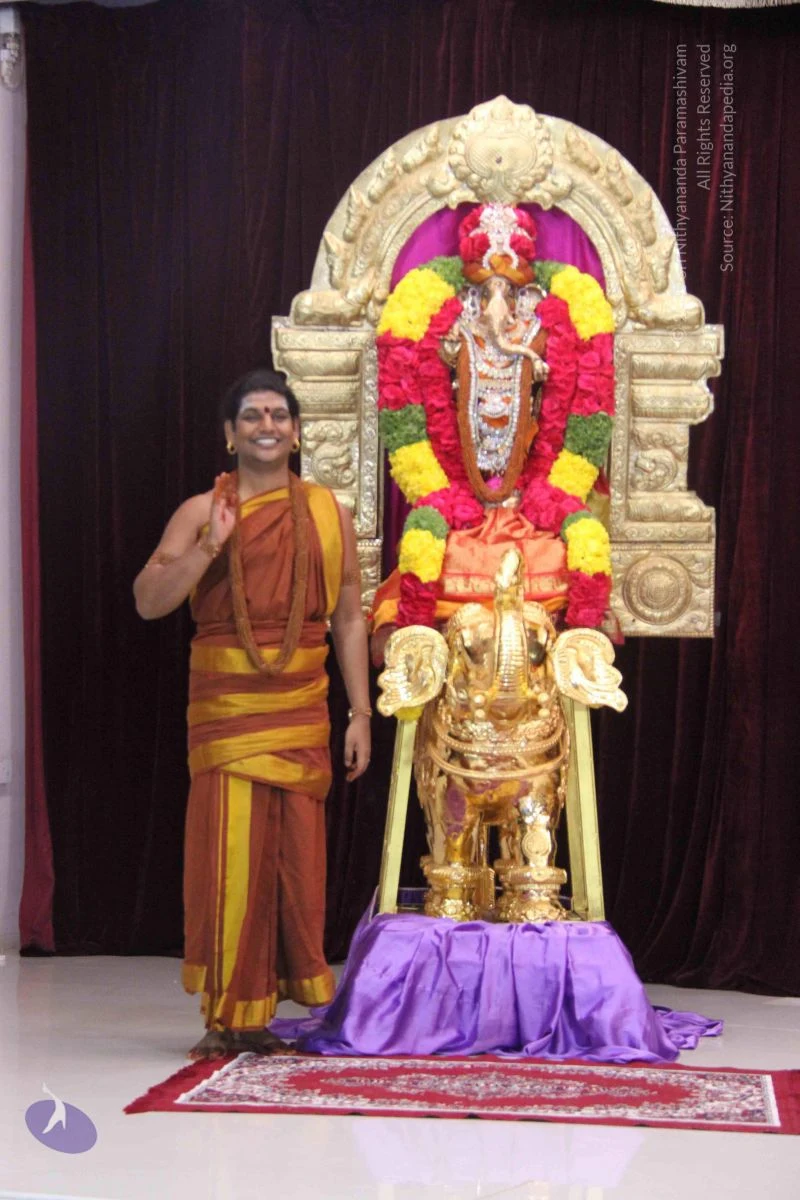
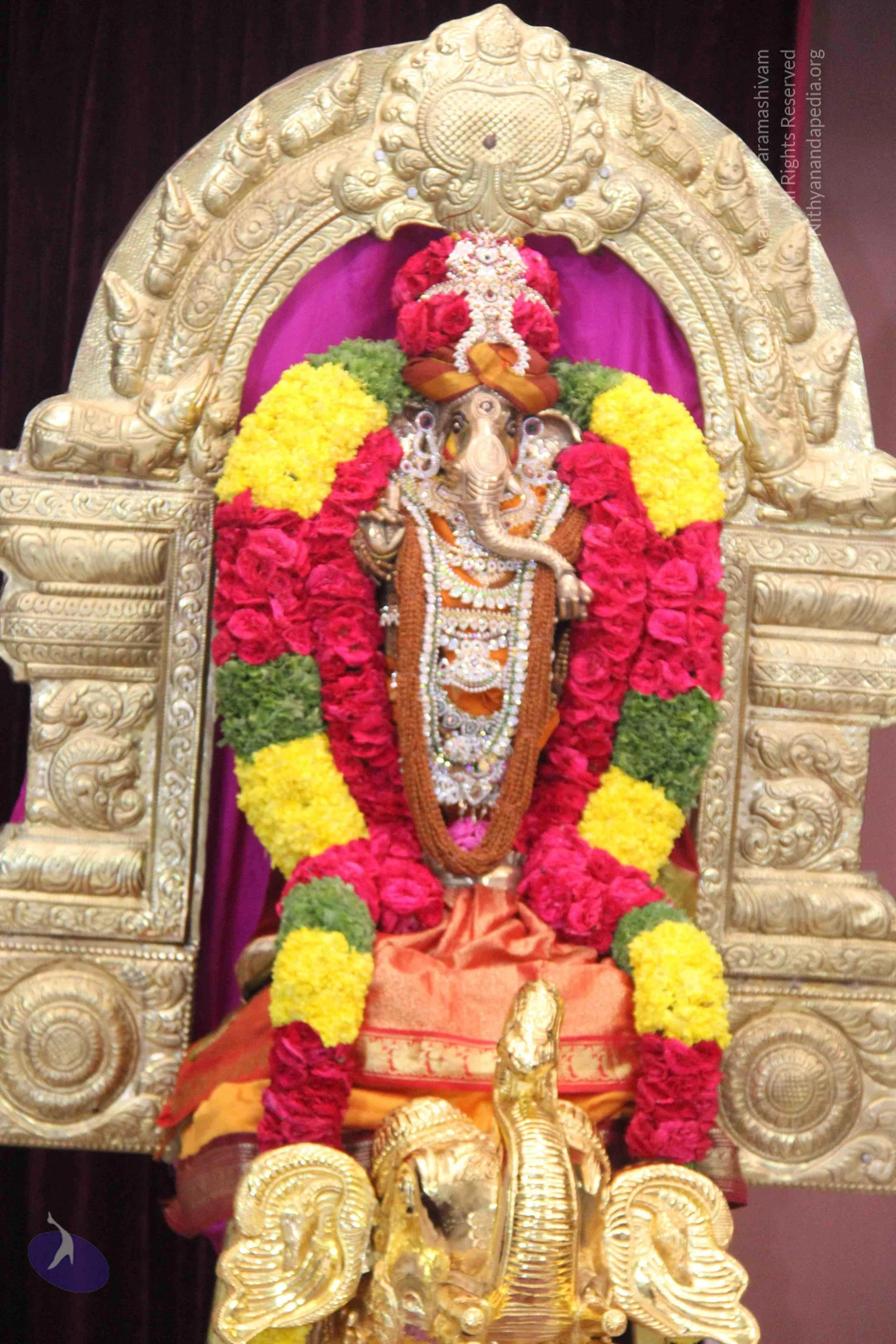
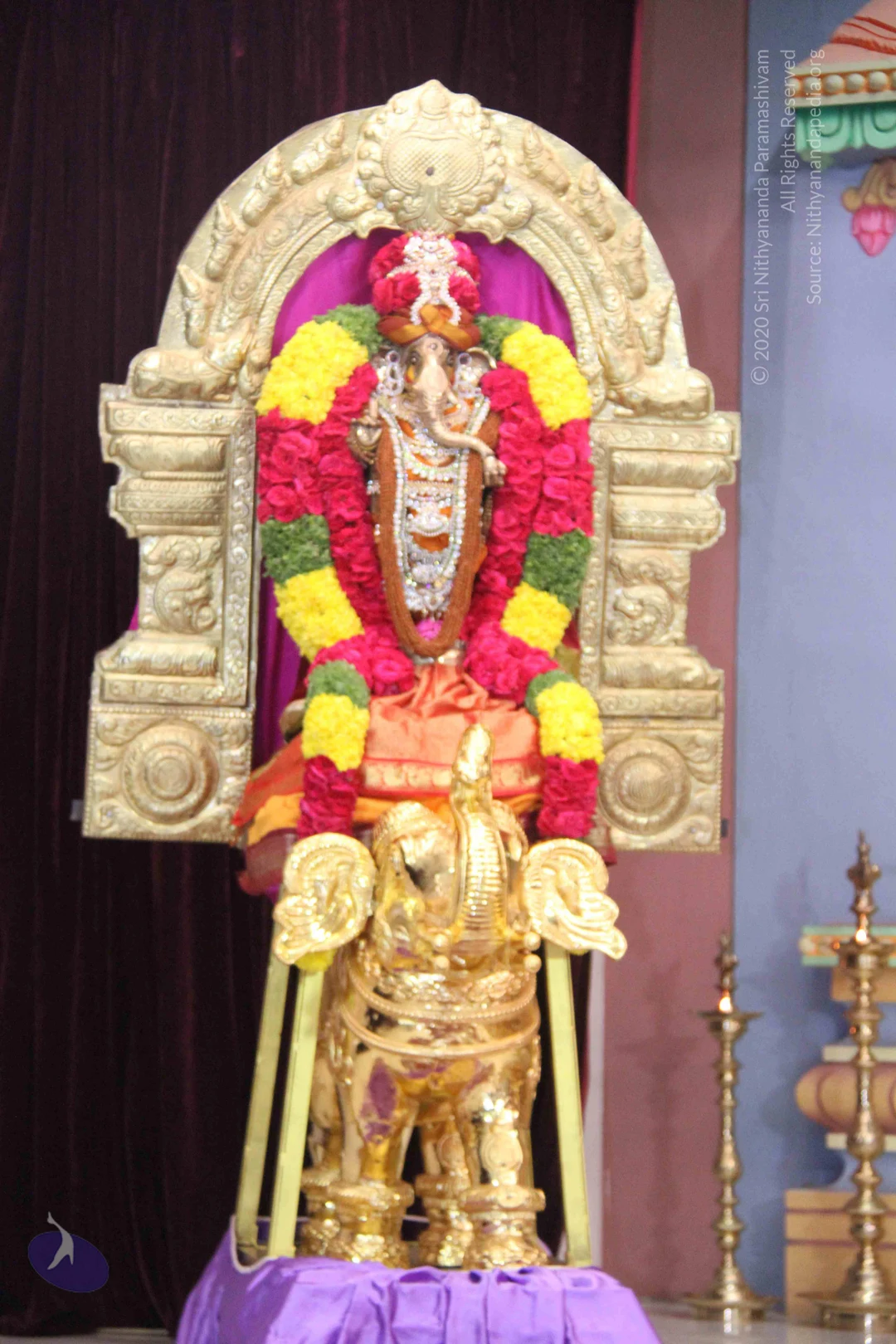
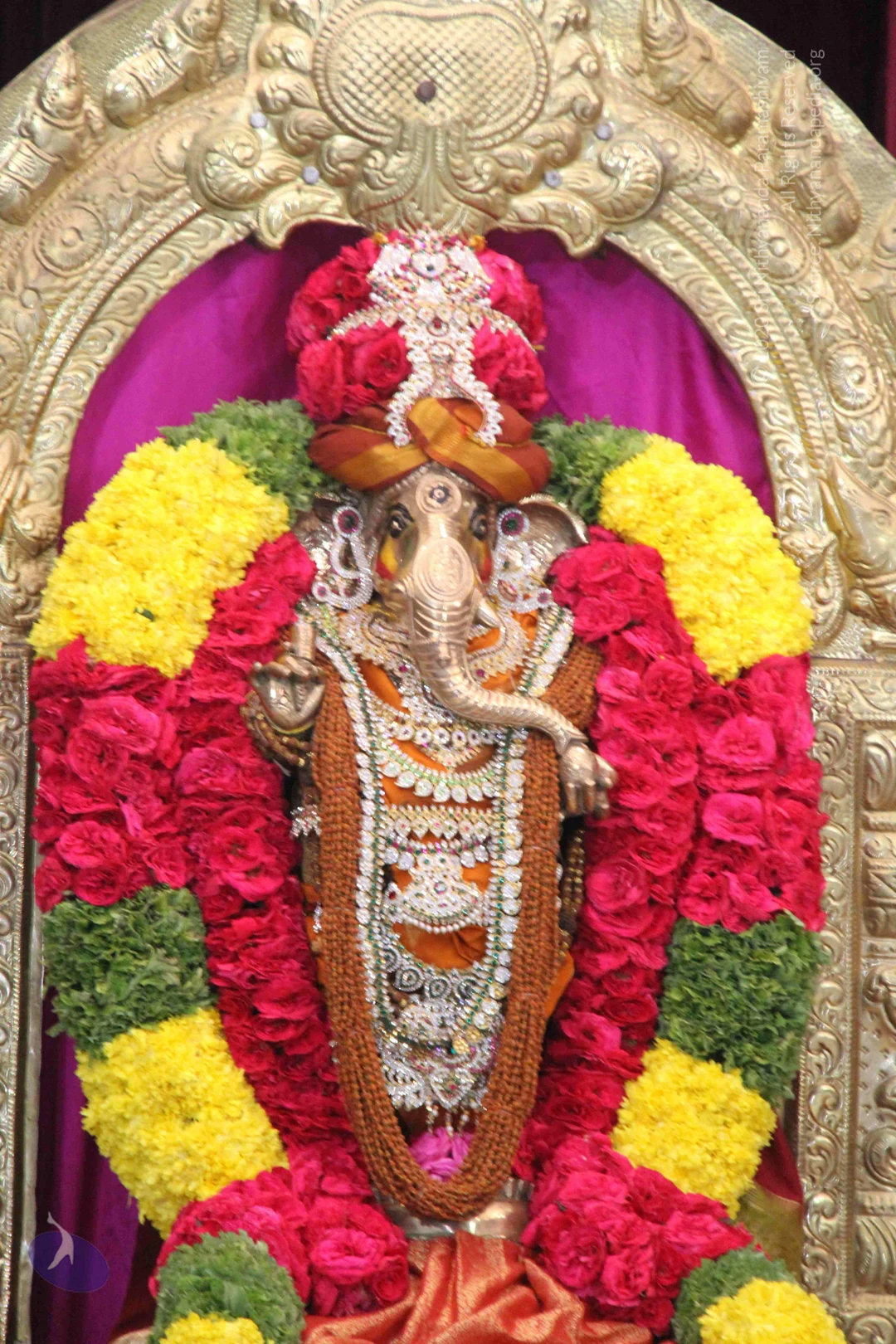
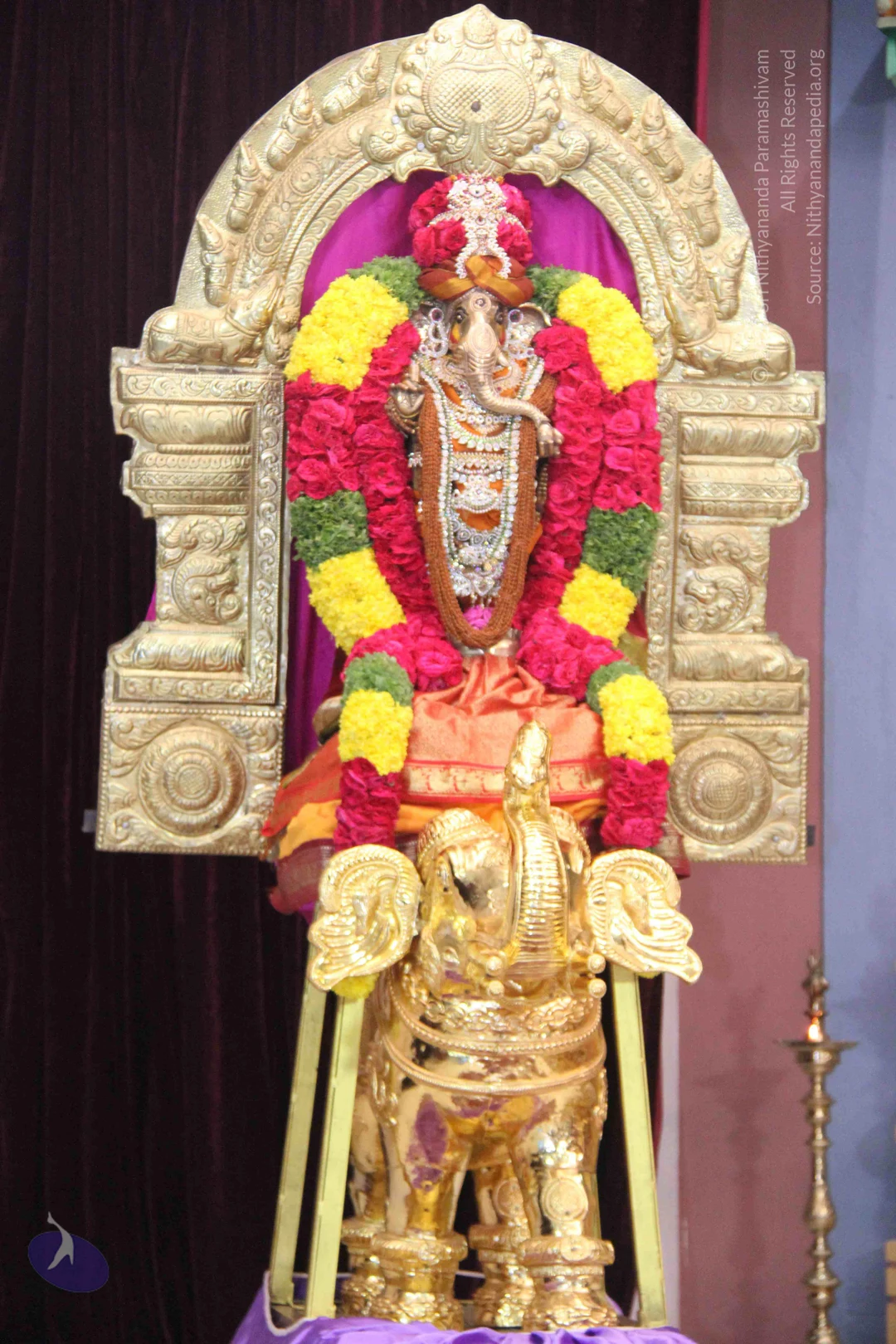
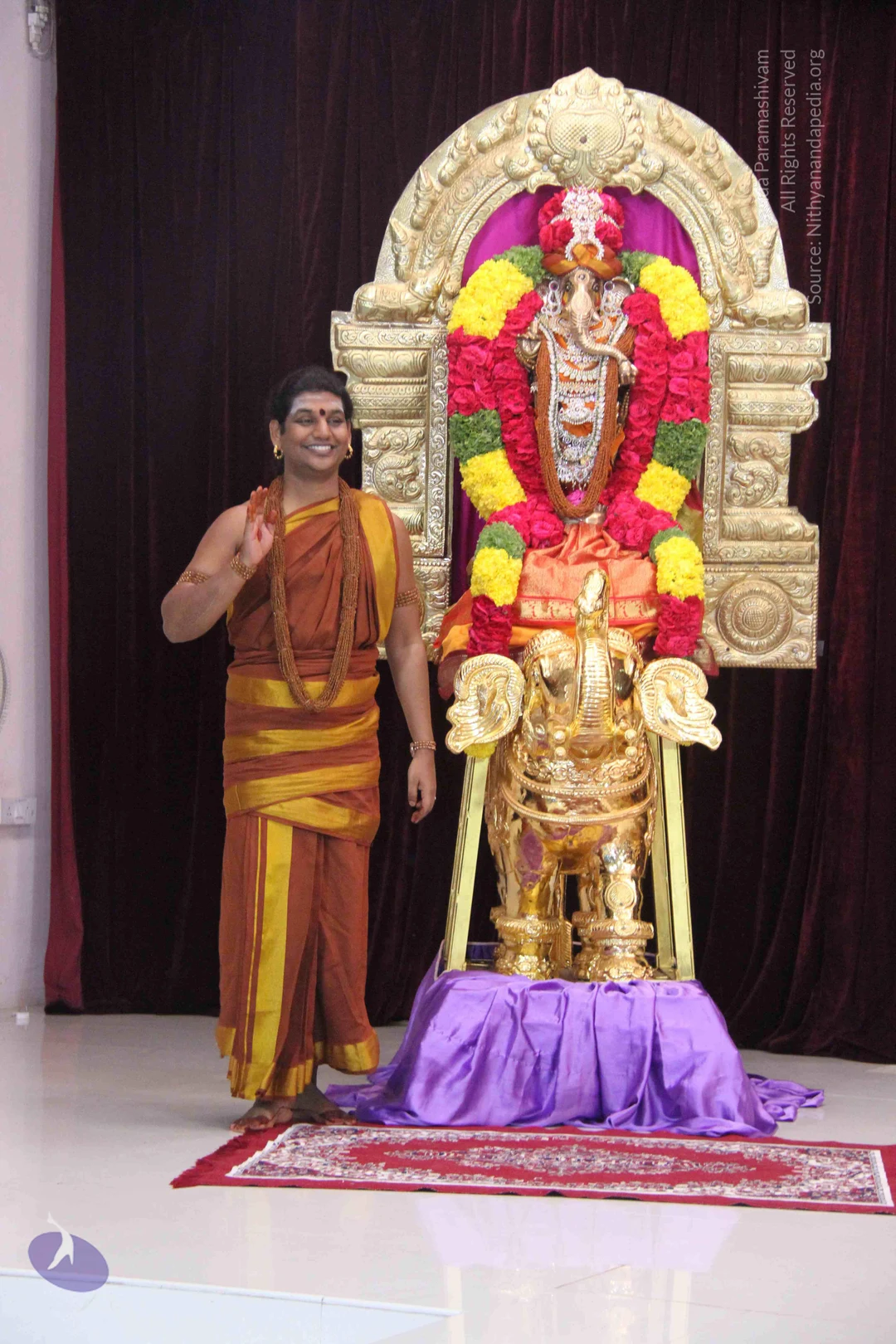
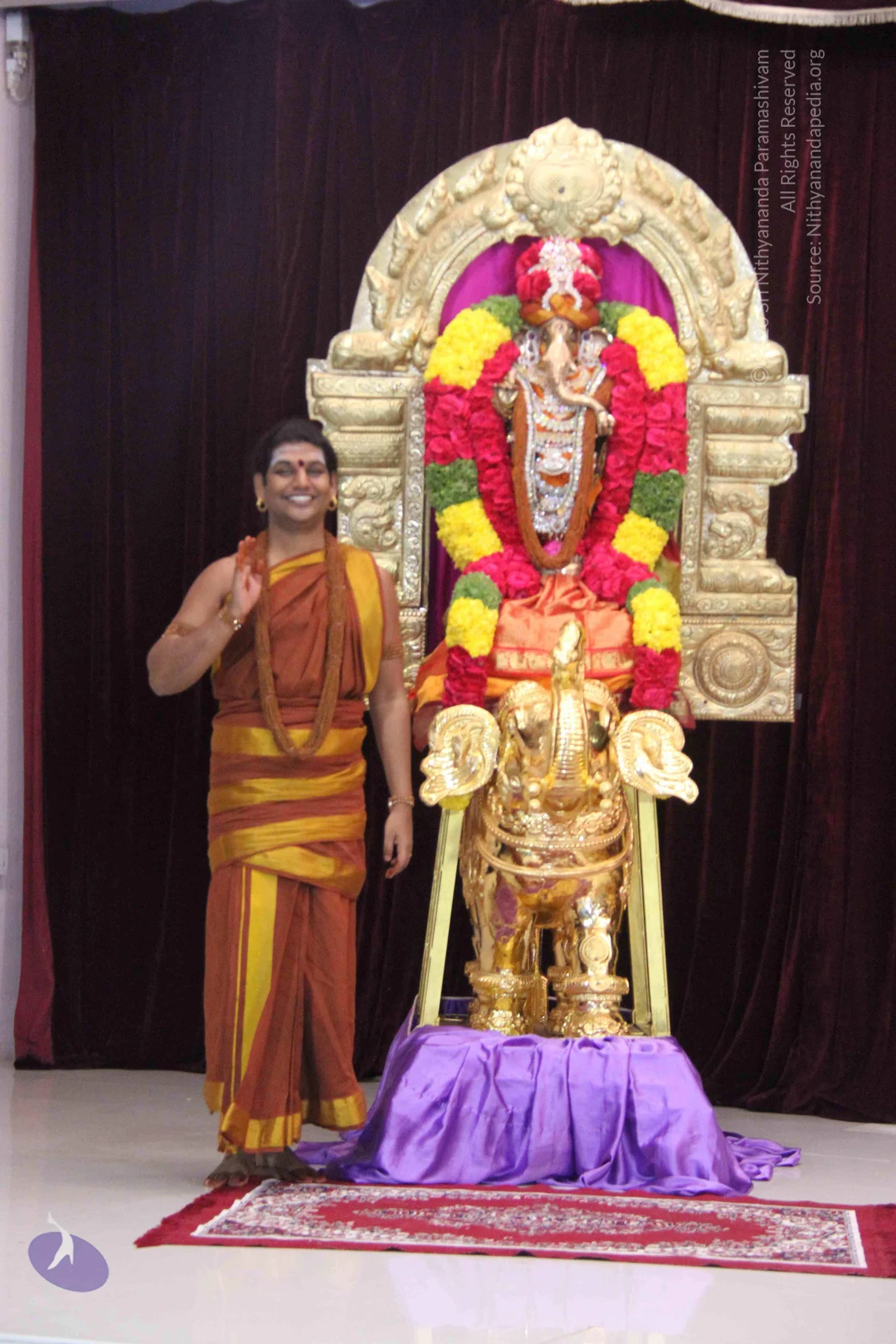
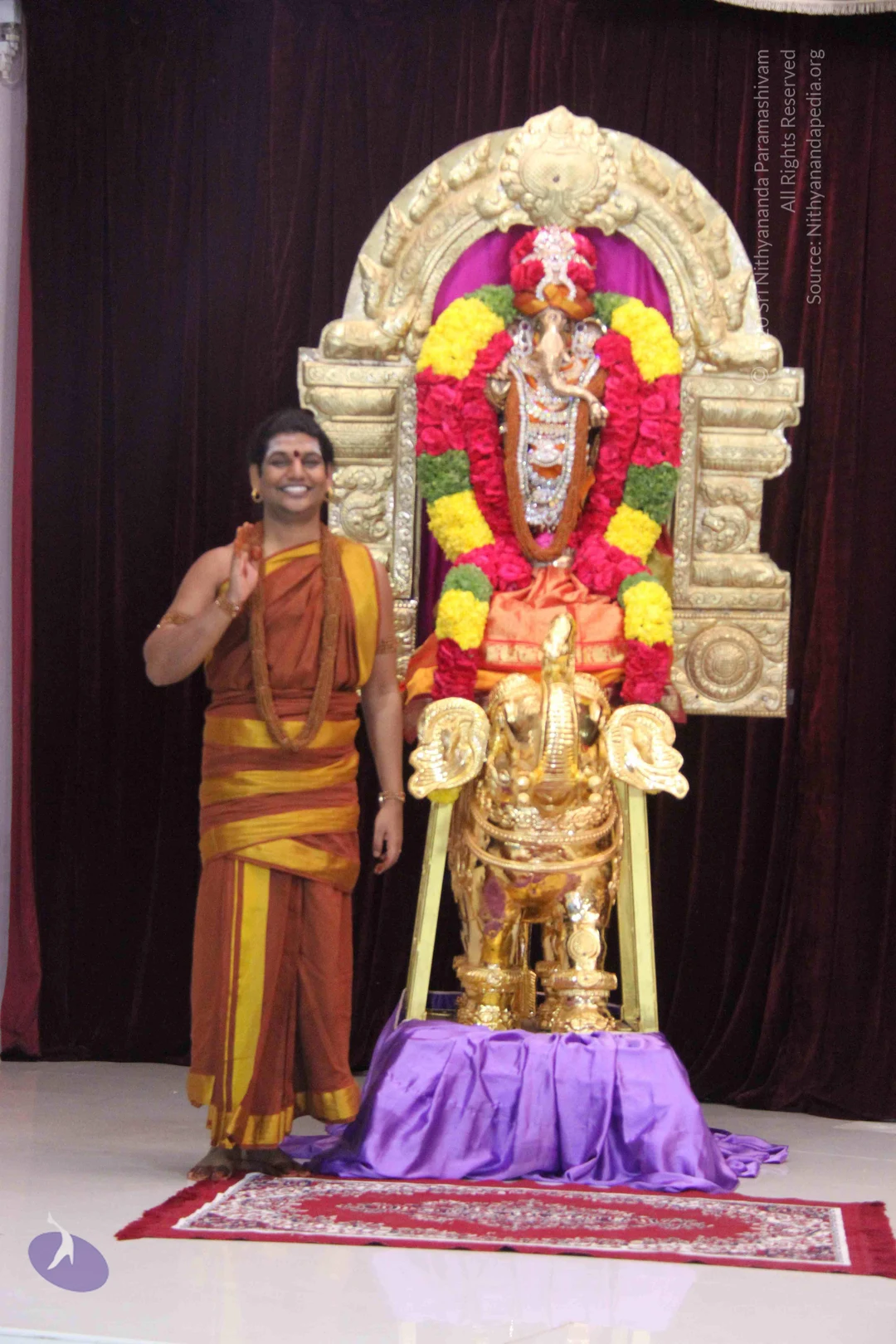
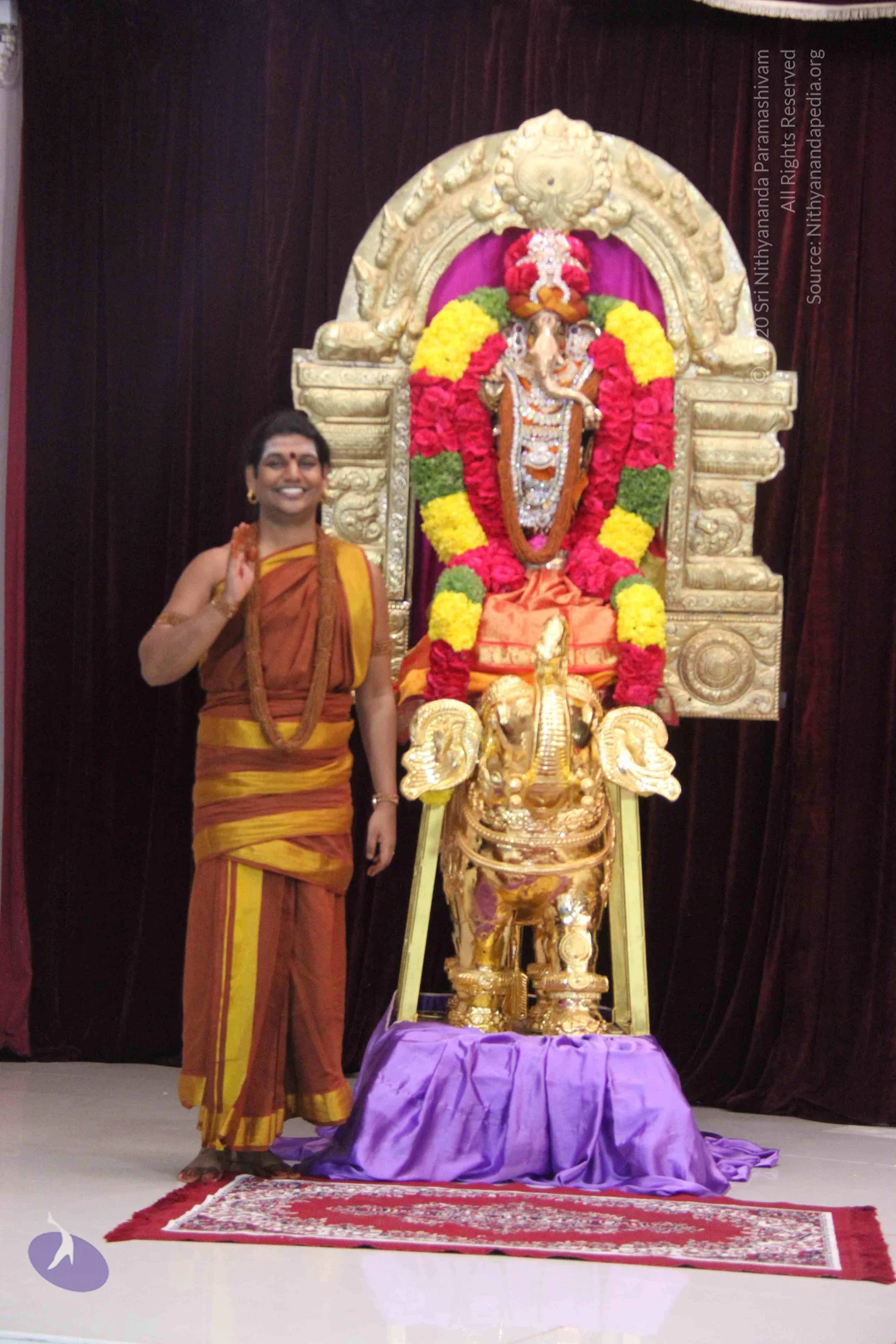
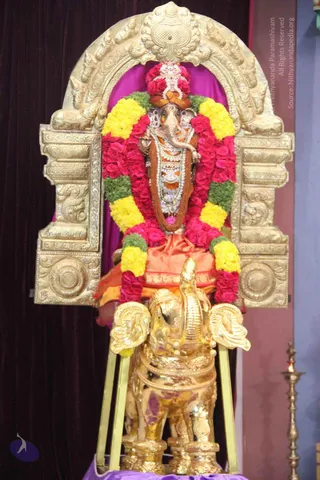
Today, as a part of the Ganesha Brahmotsavam, Ganapati is gracing us on the Golden Elephant Vehicle. Ninth day of Ganesha Brahmotsavam. Tomorrow we have Ganesh Chaturthi.

Let us move to the Nithya Satsang.

Today, I will expand on “ENRICHING”.

Life of a Shiva bhakta should be centered on enriching like Shiva.

Please listen! Come to the space of listening!

Mahadeva is embodiment of Enriching, continuously, continuously enriching the world, supporting the world, carrying the space for the world to exist, rejuvenating the world.

As I described earlier, Ganapathi is embodiment of Completion with all impossibilities or the ideas of impossible. Ganapathi stands for Completion with all the “vignas” (obstacles). Brahma stands for Creation just through the Saraswathi who resides in his tongue, the power of Saraswathi. I bow down to that Saraswathi who resides in my tongue.

Saraswathi is embodiment of the Knowledge. Brahma is embodiment of creating through the Knowledge. And Vishnu is the embodiment of sustaining a vast, beautiful, powerful space in which everything is happening. Vishnu means “all-pervasiveness”. Vishwa is the all-pervasiveness embodiment where everything happens. Mahadeva, Mahadeva, Shiva is the embodiment of Enriching.

Please understand, whenever you are stuck, you want to proceed further in your life, take up enriching as a lifestyle, you will have a breakthrough! I really tell you! If you are stuck in your business, if you are stuck in your career, if you are stuck in your health, if you are stuck in your relationships, understand, I am giving you the solution. Just decide to gather a few youth in your village, in your town, clean the common places like the road, or a temple, or a school, or a water body. I tell you, I am talking with logic, Integrity, Authenticity, Responsibility, you will have a breakthrough! Please understand, I am responsible for what I am uttering.

Just gather a few people, inspire them, clean the water body of your village; you will have health! I am not talking in the language of middle-class morality. No! I am not talking in the language of middle-class values. Don’t think. I am not talking like a service organization’s head. No! I am talking spiritual truth, spiritual technique. Please understand, when a service organization says, ‘Gather, Serve, Clean, Help’, their context is different. When I say, ‘Gather few youth, clean the common places like a road, temple, school, water body’, I mean different context. When you take up this kind of work, the amount of enriching supposed to happen within you, outside you, unleashes a new Kundalini energy in you, new thinking in you, new awakening in you, new space in you, I tell you, you will have a breakthrough! Anyway, wherever you want breakthrough in your life, gather as a group, enrich yourself and others through some action.

Why Jnanasambandhar, Sri Krishna Chaitanya, all of them were able to do so much? Why do you think Jnanasambandhar and Chaitanya were all able to enrich so many millions of people? They taught the science of helping yourself and others. Jnanasambandhar, in his biography it is clearly recorded, 16,000 lay-disciples and 10,000 sannyasis walked with him! Can you imagine? 16,000 lay-disciples, 10,000 sannyasis! Means, 26,000 people together walking with him, living with him! Is it a joke? Just 1,600 people, the amount of problems they create, amount of torture they give to each other and to the Sangha! HAHAHAHAHA…! 16,000! How did he inspire, how did he handle?

I tell you, this enriching people in every village about the spiritual truths, especially Jnanasambandhar’s method of “aadi paadi Annamalai kai thozha oadi pom nammadhu ullai vinaigaley”. Means, “Sing and dance, worshipping Arunachaleshwara. All the incompletions in your inner space will disappear! All the incompletions in your inner space will disappear!” I can tell you, it is such powerful process, Jnanasambandhar and Chaitanya, the way they spread this! Each village, people gathering, enriching each other and themselves, and doing some collective activities, organizing and enriching like Jnanasambandhar, with powerful miracles, expressing, radiating the power and energy of Mahadeva; and volunteering, working like Thirunavukkarasar; living blissfully like Sundarar; and the devotion, commitment like Manickavasagar, the stability like Manickavasagar. All these happen in you just by enriching.

Please understand, all the viewers, I request all of you, just gather few youth in your local village, conduct kirtans, sankirtans – means, singing and dancing the name of the Lord – and take up some common enriching projects like cleaning up the local temple, cleaning up the local water body, cleaning up the local school. Understand, it will revolutionize, it will revolutionize the whole world. It will revolutionize your world. When I say “whole world”, I mean “your world”. Suddenly it will change the energy of your being, ability of your being. The way you think, the way you live, the way you talk, the way you behave will be infused with so much of responsibility. Everywhere I want Dhyanapeetam volunteers, organizers to do this. Start enriching people in your area, conduct kirtans, sankirtanam, singing and dancing in the name of the Lord, singing the name of the Lord, celebrating his presence in your life, celebrating the happening of an incarnation in your life. Understand, when an incarnation happens in your space, when an incarnation happens in your space, you become incarnation. When you know the “why” of the incarnation is the “why” of you, you become incarnation. The “why” of the incarnation is the “why” of you, you become incarnation!

15:00

The biggest crime, incompletion, demon, devil, a human-being can have is withdrawal symptom. Means, ‘Why should I participate in the life? I can just exist. I never wanted a power post.’ Not wanting power and post out of incompletion is nothing but suicidal. Listen, not wanting power and post due to incompletions is nothing but suicidal. This suicidal tendency, suicide is of different levels. One, the physical suicide by drinking poison or hanging yourself or by putting yourself on the, in front of a running train, or getting married, once for all you die. These are all the immediate suicide methods. There are some other psychological suicide methods where you just withdraw due to your intense hatred towards some person or a system or life itself. This is the most powerful demon, destruction in the life. I tell you it is rooted in self-doubt, rooted in self doubt. Completing with the incompletion of the withdrawal is Ganesha. Completing from the withdrawal, completing from the withdrawal symptoms which is established, which is rooted in the incompletion of self-doubt is Ganesha.

19:56 Hindi to 22:47

Understand I really wanted this to start happening everywhere all over the world get ready from Vijaya Dashami we will start this. From Vijaya Dashami to Jayanthi we will have this period, period , ‘Season of Enriching’. The month in which I am born, Margazhi, all over India still the practice is there; morning, people will get down into the road, whether Vaishnavites or Shaivites or Shakthites. All traditions they get down into the road early morning, sing and dance in the name of the Lord, enrich, awaken everyone. We will celebrate this season as “Awakening Season”. The month I am born, Margazhi, Krishna says in the Gita, “Maasaanaam Maargaseershoham”, lot of, lot of beautiful things like I can’t call it as coincidence because he says, “Maasaanaam Maargaseershoham” “Siddhaanaam Kapilo Munihi” – our Akhada “Among the trees I am the Banyan Tree”.

Understand, that Margazhi month is the brahmamurhurta for devatas because for devatas, one year, human year, is one day,that’s a brahmamuhurta a season for awakening, waking up. The time devatas wake up, we should also awaken ourselves, we should also get ready to wake up. “Maasaanaam Maargaseershoham”. So from Vijaya Dashami to Margaseersha, Chitra Nakshatra, till my Jayanthi, we will have this Awakening Rithu, Awakening Season. Please understand whoever wants to take up this lifestyle which I am requesting everyone should take up, all the Spiritual Embassies, all the visitors, all the viewers who want to take up this in your village, in your town, please send an email. We will support you with whatever is required for this program. Send email to [email protected]. I wanted at least in 1008 places this enriching to happen where some of you take up the responsibility of gathering the local people morning kirtan, and enriching each other and enriching the area you are living in by conducting some common activity. Enrich for the better world. Enrich for the better world. In your area clean up a common place, water body, a school, or a temple. In every village start doing this. Do the sankirtana.Every morning go round the local village in your area doing the kirtana. I tell you it will bring new energy out of you, new inspiration out of you. You will have a breakthrough, you will have breakthrough. Whether you are stuck in relationships or psychologically in some incompletions or health or incompletions related to career and profession do this, do this enriching. I am talking to you as a spiritual master. I tell you, when you gather and start working so much of new energy is released in you.

30:00

And I am also coming up with the next project: “Be in India as a Back-packer for one year!” Be in India as a back-packer for one year. I wanted to revive this lifestyle of “parivrajaka”. Even now, Mahanirvani Akhada, our Akhada, we do it. Every Kumbh Mela we initiate thousands of youngsters into sannyas and let them go round the country and enrich the world. When they come back for the next Kumbh Mela, means after two-and-a-half to three years, then they become part of the Akhada, they take responsibility like Kothari, Thanedar, Mahant, Shri Mahant, all these responsibilities they take up.

I also wanted, O, India, O, Indian Youth, take up – and I call people from all over the world – all practicing Hindus, take up at least this one year, be a back-packer in India, travelling to all the twelve Jyotirlingas and Shakthi Peethas. I tell you, it will do so much of enriching, so much of enriching! I have done this in my life. So I sincerely recommend, all the youth should take up this at least for one year. You can even go as a group, four - five people, nothing wrong. It does’nt need to be just one person or two persons. Go as a group. Do like Pada Yatra. It is possible. You can do as Pada Yatra, or travelling, anything. But spend a year, at least one year, as a back-packer in India. I really feel even my sannyasis should go at least for an year. Only then they will have the new energy of enriching. See, when you are stuck and unable to get out, you should take up this kind of a new activity to awaken the space of enriching in you.

I know, Vivekananda wanted an organization for sadhus so that they will collectively do lot of good for society. One side, Mahanirvani Akhada wants sadhus to reach out, enrich, so that they keep themselves alive and they go on enriching society. On the other side, organizations created by Vivekananda, masters like Vivekananda say, ‘No, let them all stay together in one place and contribute to society as an organisation.’ I think, both should be mixed in the right proportion for the modern day. If you are just staying in one place, campus, forever, you are stuck, and bored, tired. If you are continuously only wandering, you are also wasting your life eternally in restlessness. So, once in a while, going around, Pada Yatra, Yatra, that should be the right proportion and the right way of living.

O, Youth of India, practicing Hindus all over the world, I give you a clarion call. Live at least one year as a back-packer in India, travelling to all over, to all the Jyotir Lingas and all the Shakthi Peethas. And I also commit to revive this lifestyle of Parivrajaka, give the taste of this Parivrajaka lifestyle to the next generation youth. I will create a website and helpline. I will establish a website and a helpline. Whenever you really need help related to health reason or any other help, we will see to it that you receive that help, people reach out to you. Through my organization and the Sangha, through our devotees, we will support you during your Parivrajaka, providing the basic facilities for you to go around and enrich.

Each sannyasi should take up these three as a commitment:

• One, being Acharya, ability to enrich everyone with the great truths of Vedic tradition.

• And being a Parivrajaka, who has traversed the length and breadth of the country.

• And being a Paramahamsa, remaining in the highest space untouched by any incompletion or impurities, being always in the space of Completion.

So, from Vijaya Dashami to My Jayanthi, we will be having Awakening Season, Awakening Rithu, where in each village, the local devotees, disciples will gather, enrich people, do kirtans, and conduct the satsanghs enriching everyone with the four tattwas and helping the local community for the better world, cleaning the temples, schools, water bodies.

And from my Jayanthi Day till next Jayanthi, one full year, I will also initiate people for Parivrajaka – be a back-packer for one year. Whoever wants to be initiated, please be here on my Jayanthi Day, 27th December of this year. I am very sincere, authentic, I wanted to initiate at least 1008 people into Parivrajaka and come back next Jayanthi to become part of the Sangha, after being polished, shining like a diamond. Just like Mahanirvani Akhada, just like our Akhada, we should encourage, help, awaken people to do this Parivrajaka, be a back-packer for one year in India, travelling the length and breadth of India, going to all the Jyotir Lingas and Shakthi Peethas.

I tell you, you will not be stuck up. You will not be stuck in your life. These kind of activities awaken so much of Kundalini in you, intelligence in you, it brings a new energy to live the morality in you, new energy to live the four tattvas in you. So, this Vijaya Dashami, October 13th to 27th December, we will have Awakening Rithu, the Season of Awakening.

With this, I give clarion call to all the Youth of India and practicing Hindus all over the world, prepare yourself for the one year Parivrajaka Yatra to taste the Vedic Tradition, spirituality. Please understand, the Indian elitist, Indian elite is completely disconnected from Bharat, India. The Indian elite lives in such a disconnected, rootless space. That is why they constantly threaten the mainstream Hinduism, they constantly deny, destroy, depress anything related to mainstream Hinduism, and they do not want to spare, leave, even a little bit of anything related to Hinduism. Because they live rootless, they become ruthless! Understand, it is our responsibility to show the Indian elite their roots and tell them, ‘Don’t be ruthless!’

With this, I will move to the next segment of the morning satsangh – Nirahara Samyama – after a break.

SMALL BREAK…………………

Today is the 18th Nirahara Samyama, 2nd level, 4th day. With this, I will move to the next segment of the morning satsangh – Nirahara Samyama.

HINDI………….

With this, I will move to the next segment of the morning satsang – Nirahara Samyama. All the participants, please sit straight. Close your eyes. Inhale through both the nostrils and the mouth simultaneously. Hold as long as you can. Exhale through both the nostrils. With this cognize you have become Bidadi Kalpavriksha. Do this for the next twenty-one minutes.

I bless you all! Let you all experience the Kundalini awakening and live health, bliss and enlightenment by creating the energy required directly from the space! Namah Shivaya!

Let you all achieve, Experience, Live, Express, Radiate, Share & Explode in Eternal Bliss, Nithyanandam.

Photos Of The Day:

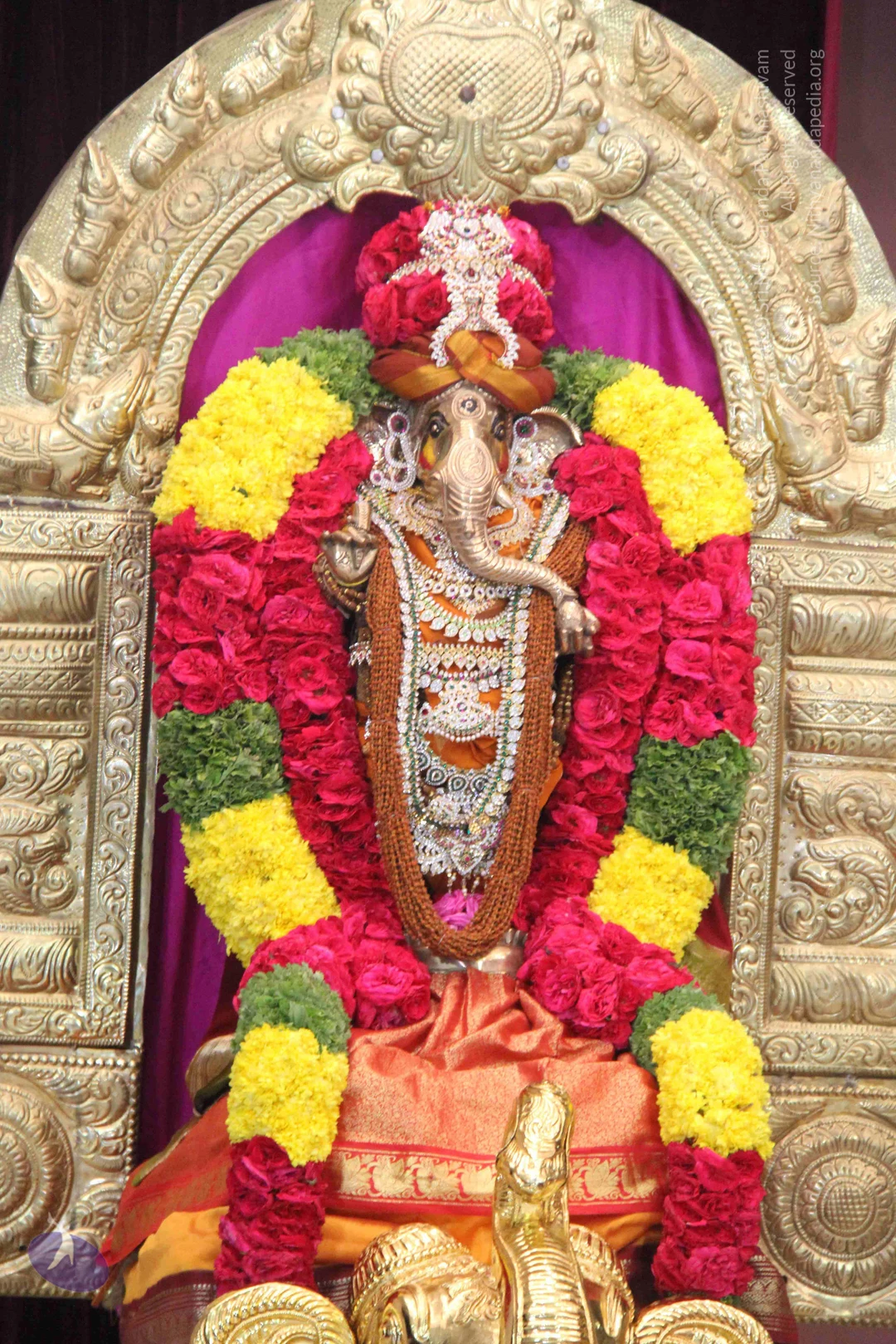
Ganesha-alankar
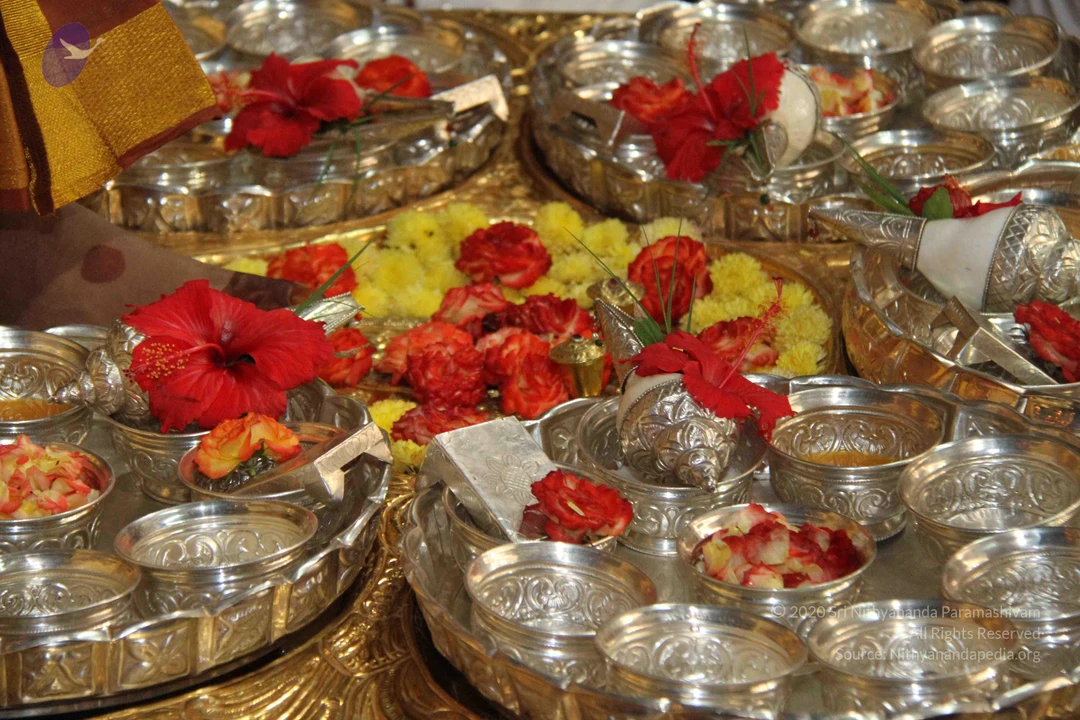
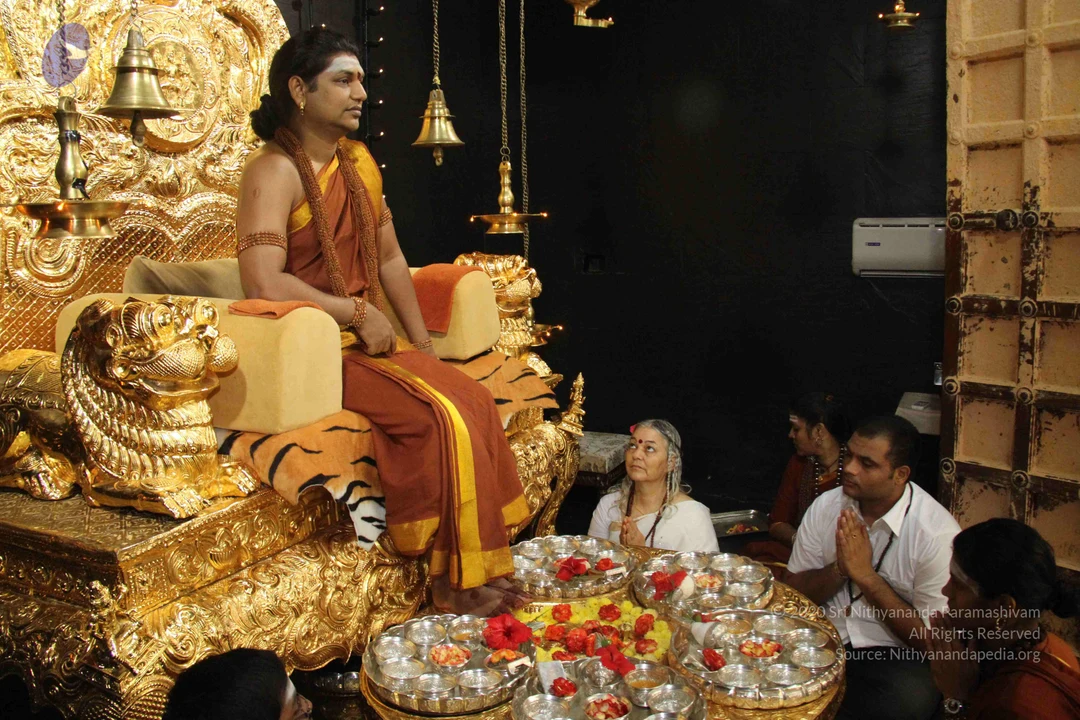
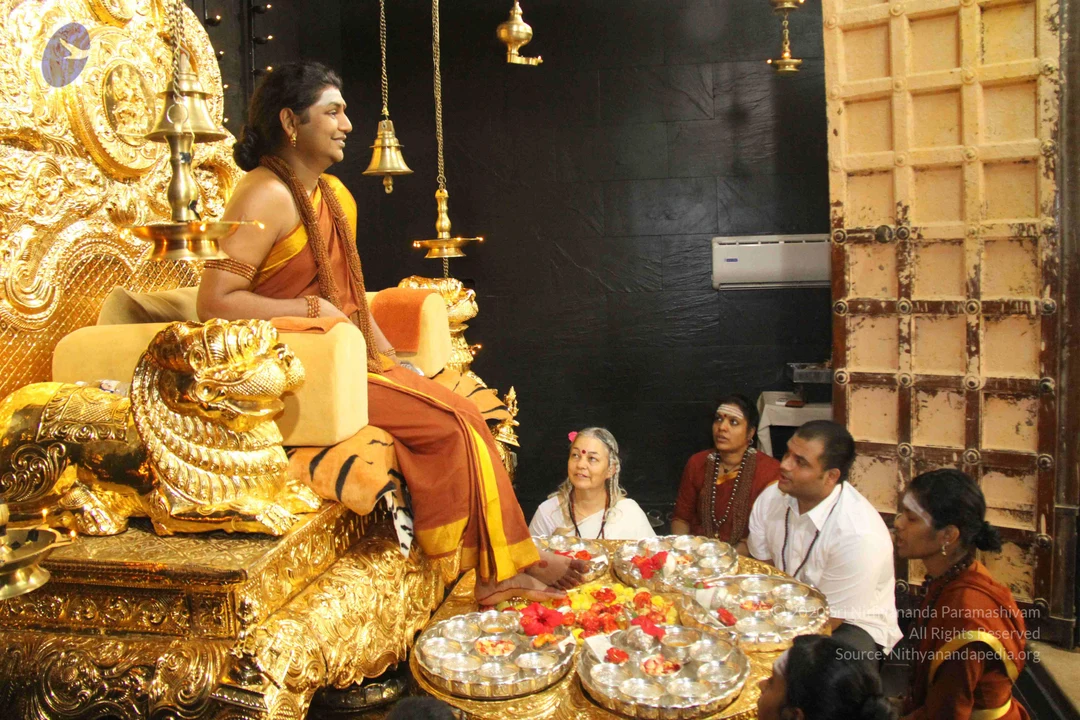
pratyaksha-pada-puja
deity-aarti

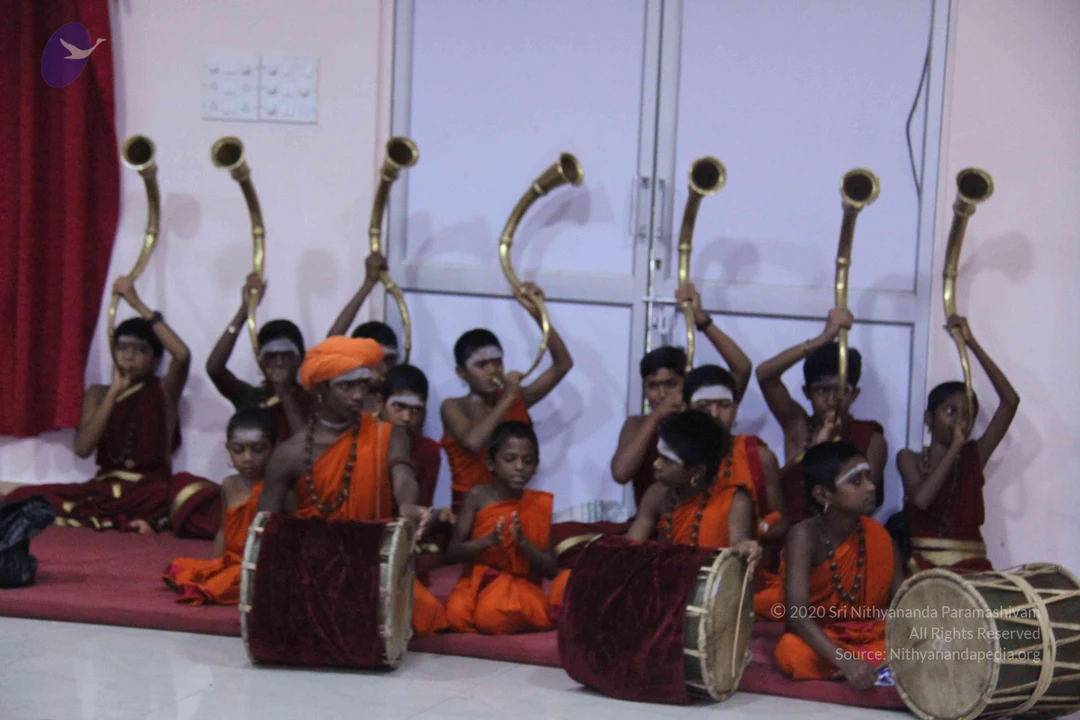
gurukul-instruments

nithya-satsang

sarva-darshan

HDH-deities-final-blessing

Tags:

Paramahamsa Nithyananda, incarnation, parivrajaka, incompletion, ganesha, tattvas, chant

0_Ganesha_Alankar

1-pratyaksha-pada-puja

2-Nithya-Satsang

3-Sarva-Darshan

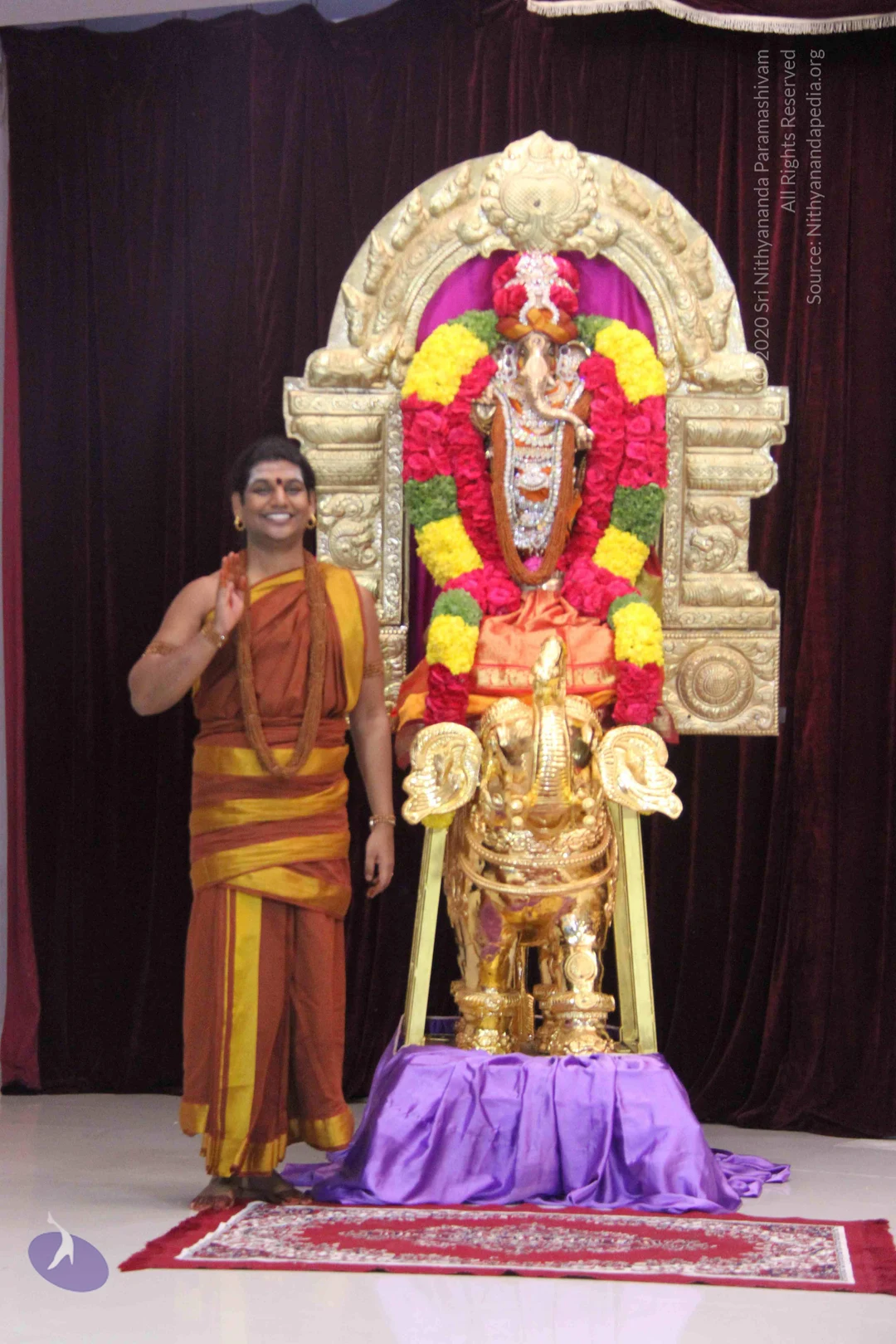
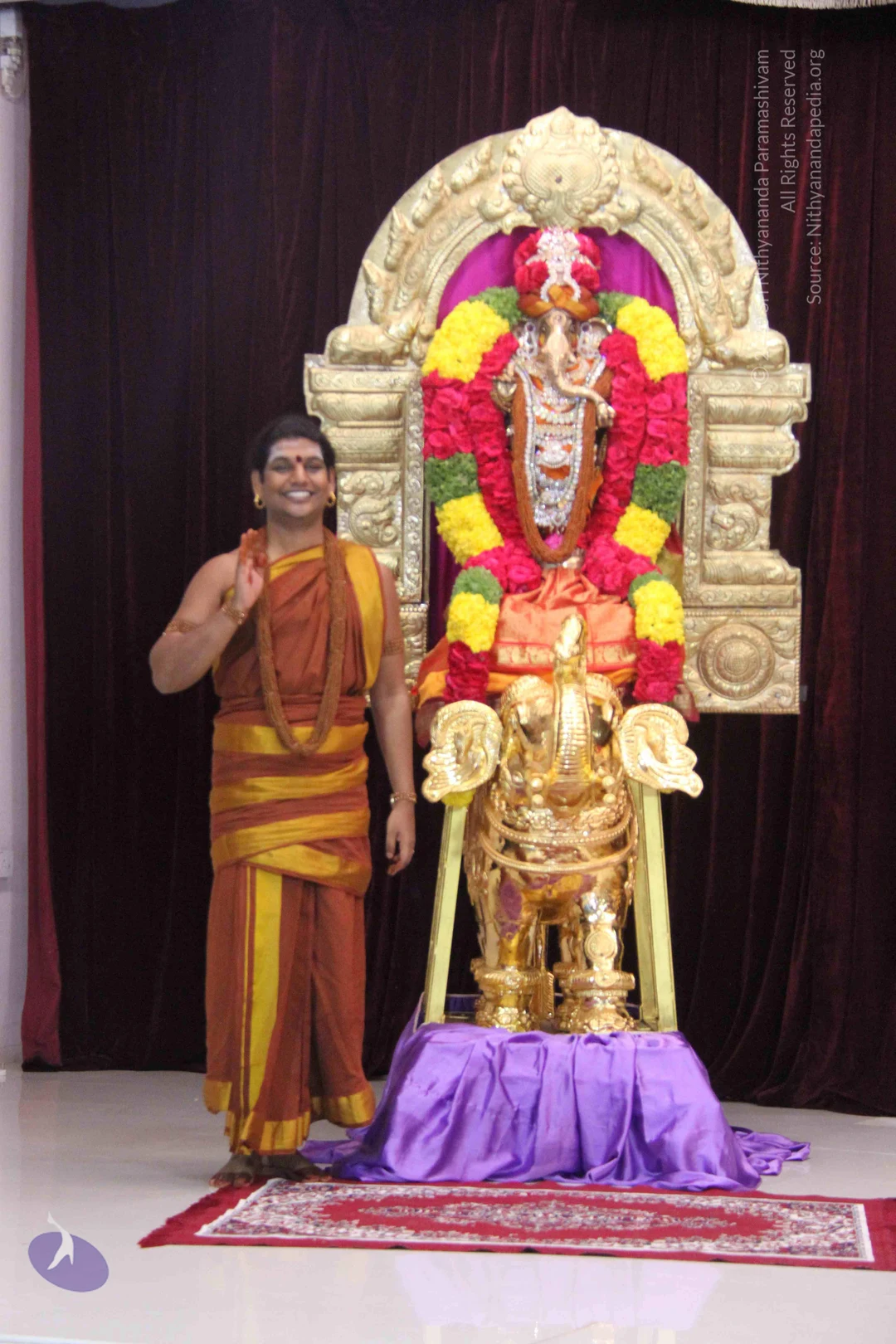
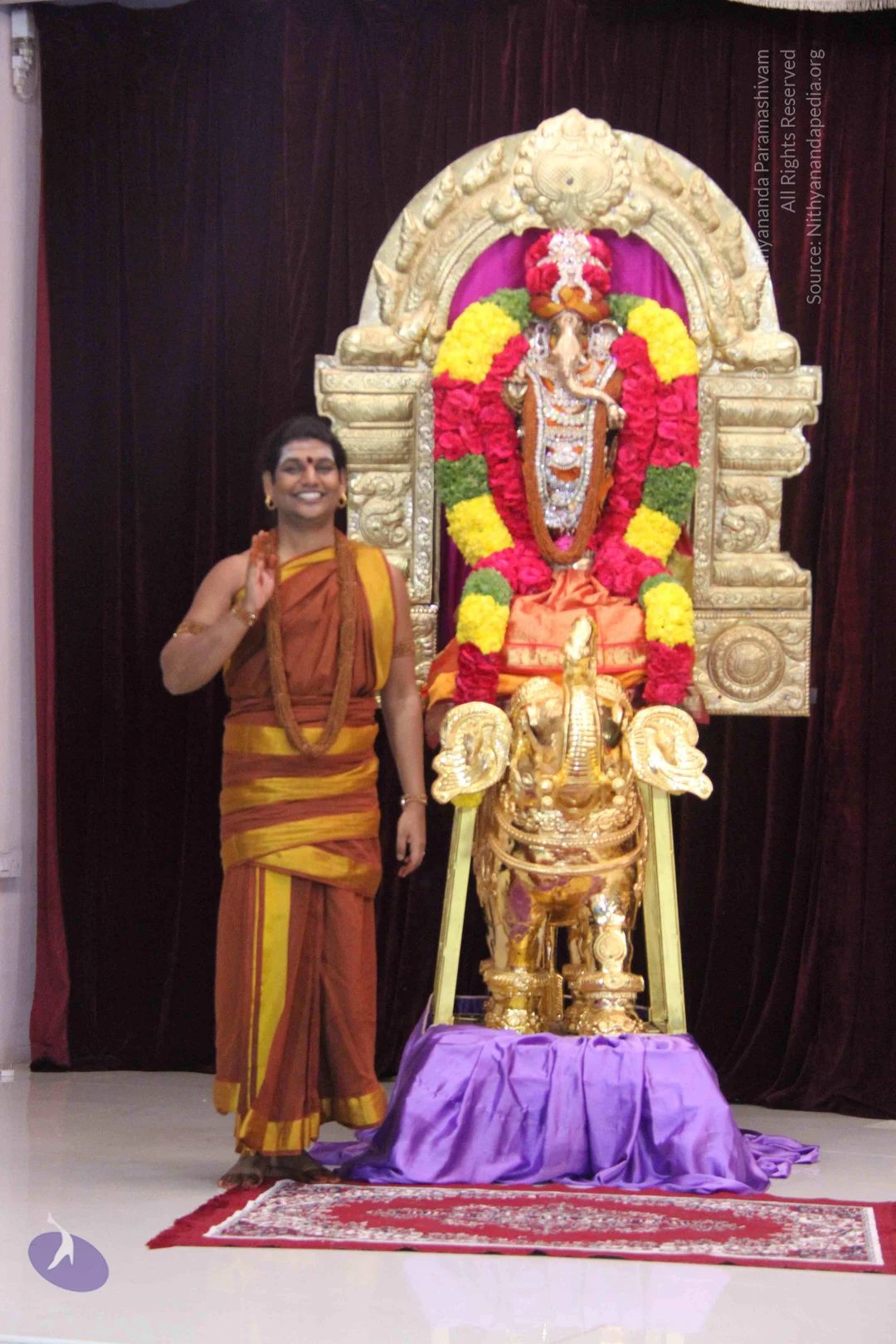
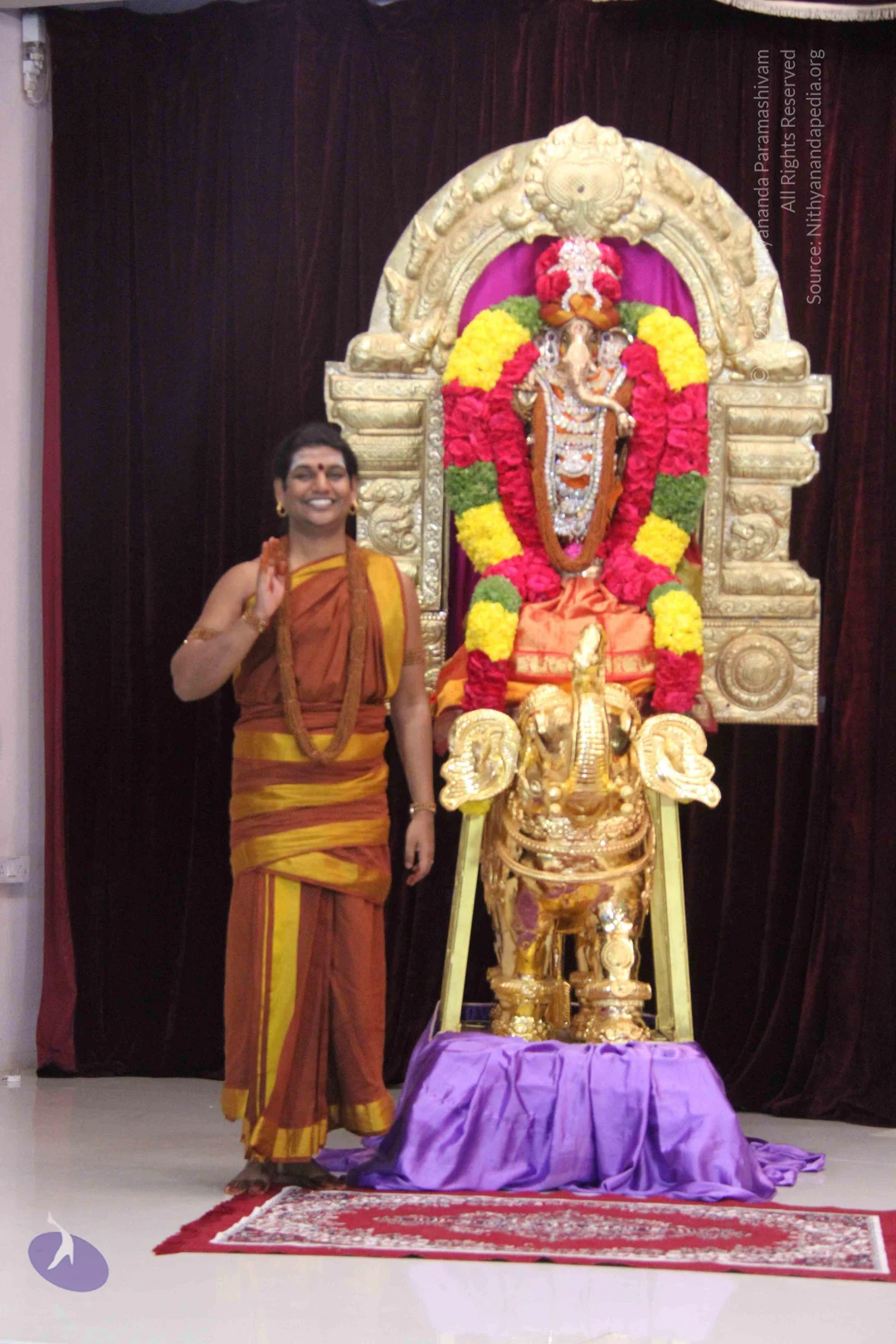
4_Satsang-Final-Blessing

Photos from this day

View all 85 photos

Ganesha-alankar

5 photosSource gallery
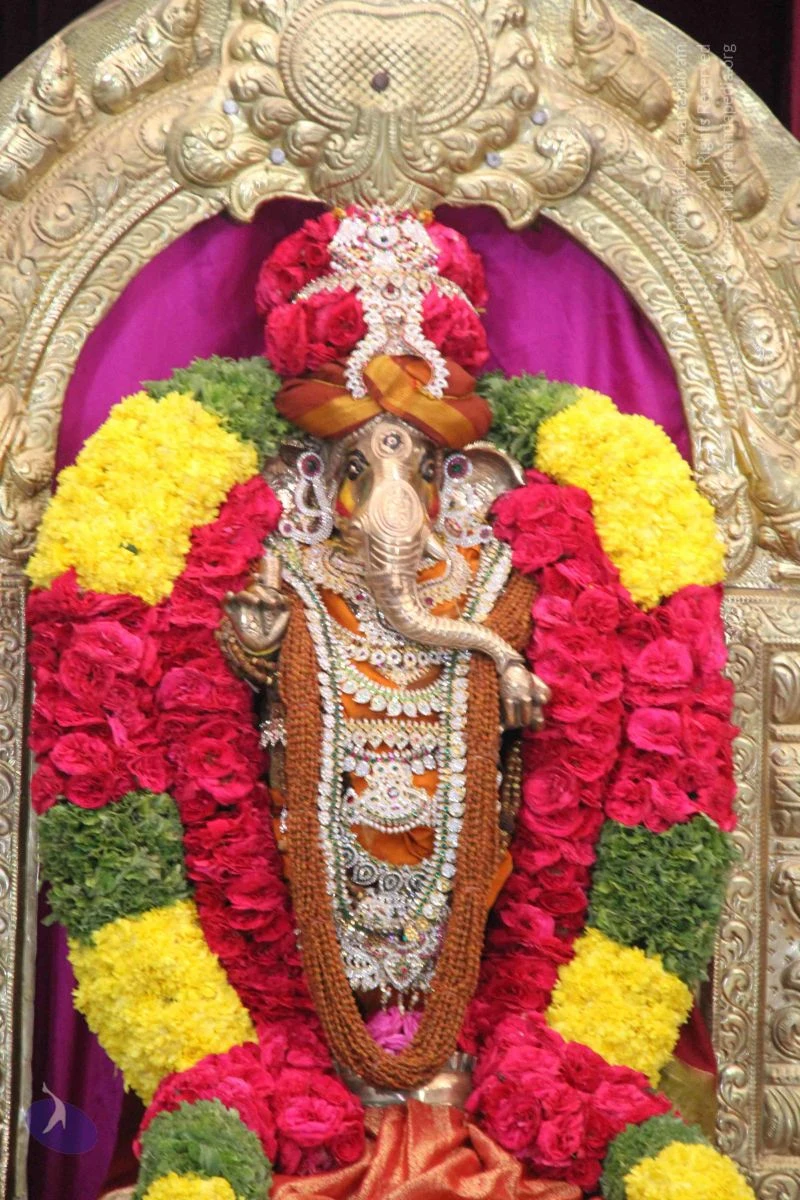
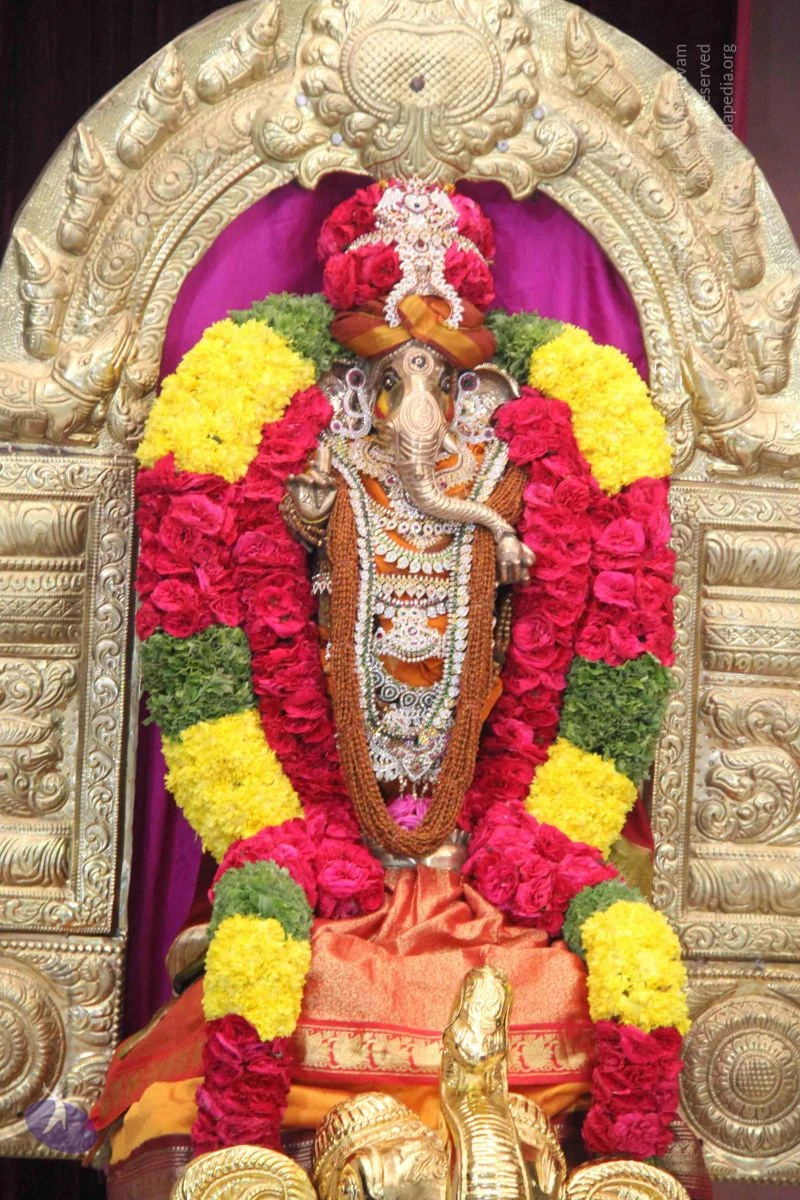
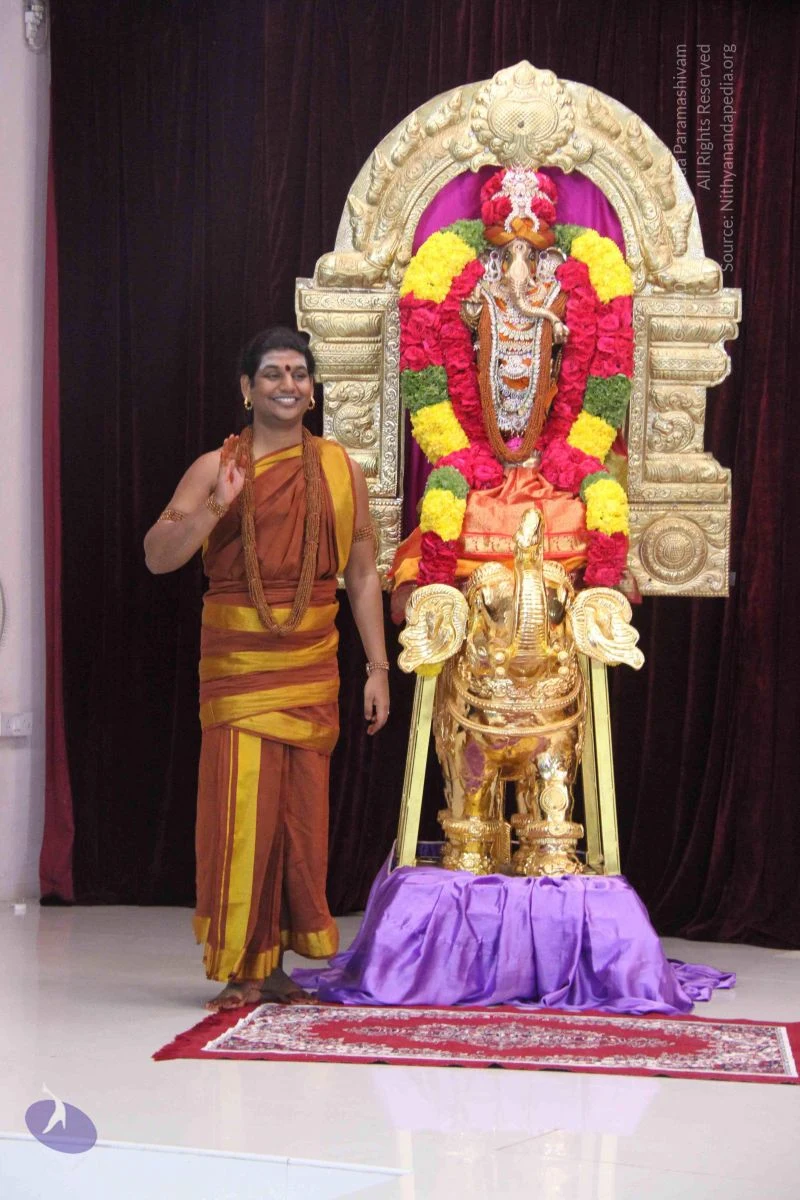
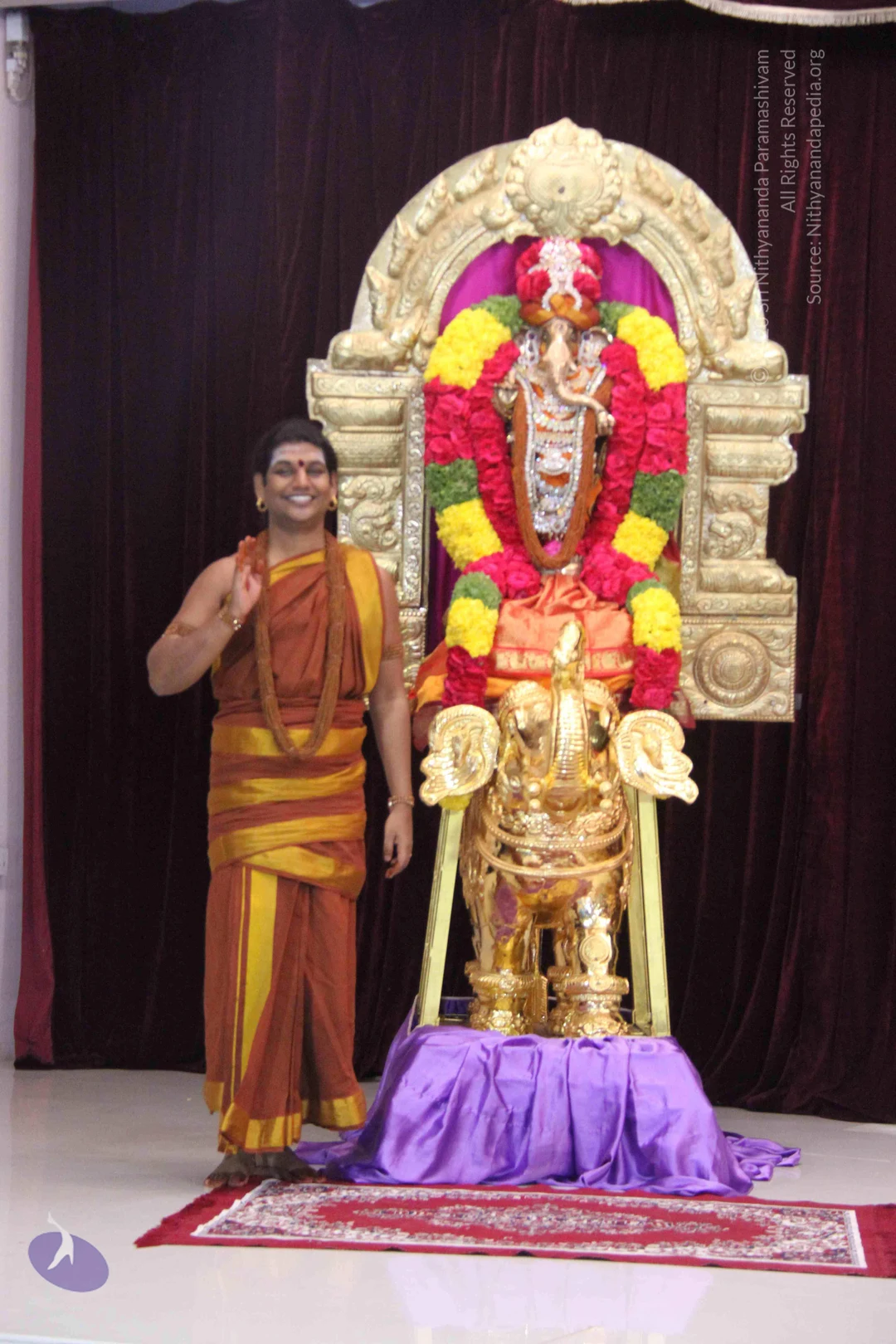
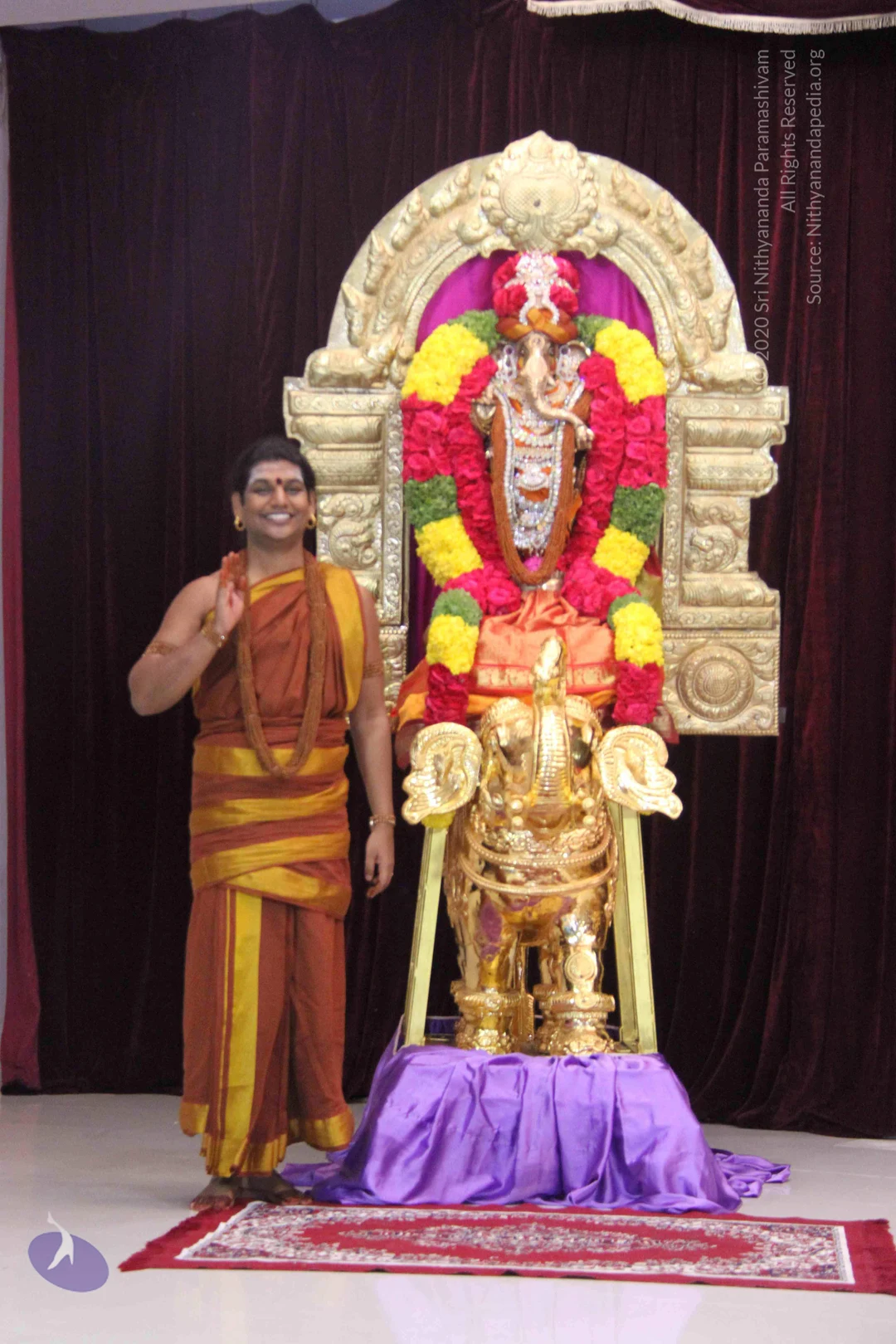
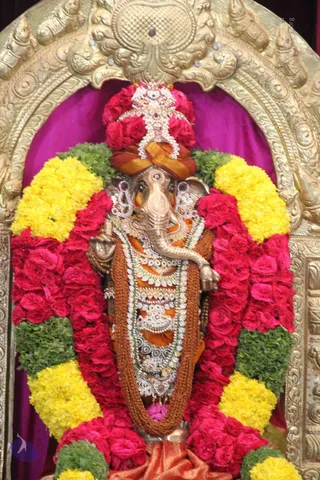
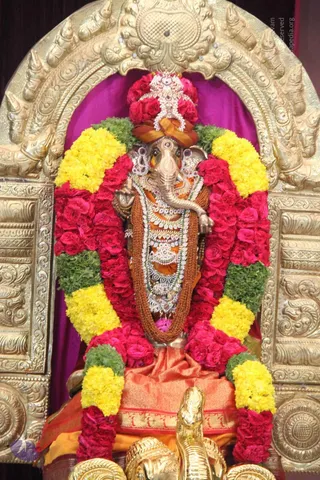
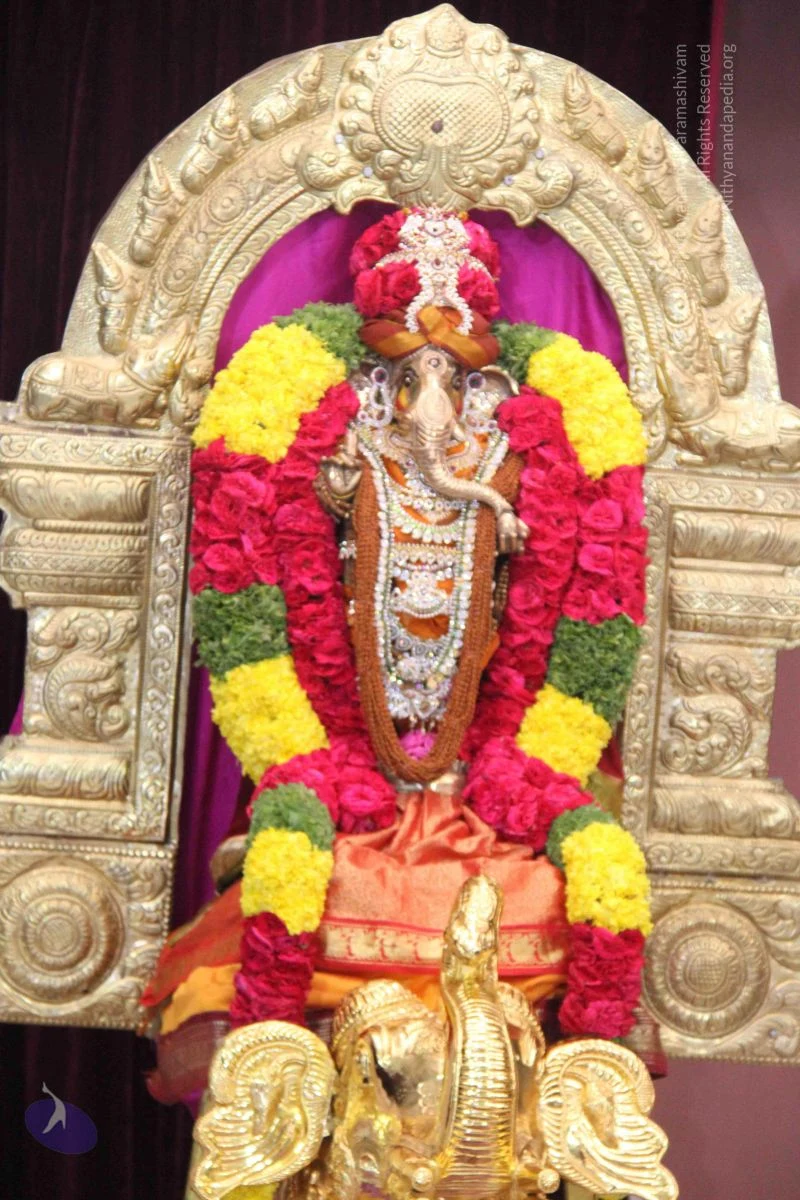
A deity murti of Ganesha, the elephant-headed god, sits in a gilded arched shrine niche against a magenta backdrop. He wears a red and orange turban-style crown with white ornaments, a ceremonial necklace of white and gold beads, and an orange-red silk garment. He is draped in a thick garland of red roses alternating with yellow marigolds and green leaves. A golden vehicle with a rearing figure sits in the foreground. Gilded carved arch and pillars frame the figure.A photograph of a Ganesha murti seated on a golden elephant vehicle set before a gilded arched shrine niche with a deep purple backdrop. The Ganesha figure wears an orange and red turban, a white and silver necklace, and is draped in heavy garlands of pink roses, yellow marigolds and green leaves. The golden elephant vehicle rests on a purple cloth on a stand. Brass oil lamps stand at the right edge against a blue and pink wall. No people are visible.A photograph of a Ganesha murti, the elephant-headed deity, decorated for a festival. The metal murti wears a red-and-gold turban and an elaborate silver-and-gem necklace over an orange garment. It is framed by thick garlands of red roses, yellow marigolds and green leaves, set in a gold ornate arch against a magenta cloth backdrop. No people are visible.A photograph of a Ganesha murti (deity idol) seated in an ornate golden shrine arch with carved elephant motifs. The murti wears a red and gold turban-style crown, a silver and jewelled necklace, and an orange-gold cloth, and has a raised trunk. It is garlanded with a thick band of red roses, yellow marigolds and green leaves, with a golden elephant-shaped figure at the base. A magenta backdrop frames the shrine. No people are visible.A decorated murti of Ganesha stands within an ornate gold arched shrine backdrop, draped with a dark purple curtain. The deity wears a saffron-orange turban, a rudraksha-like mala, a silver-and-jewel necklace and a garland of red roses, green leaves and yellow marigolds. Below him a gold vehicle shaped like an elephant, with a raised trunk, sits on a stand. A brass oil lamp stands at the right edge beside a purple cloth. No people are visible.

pratyaksha-pada-puja
21 photosSource gallery
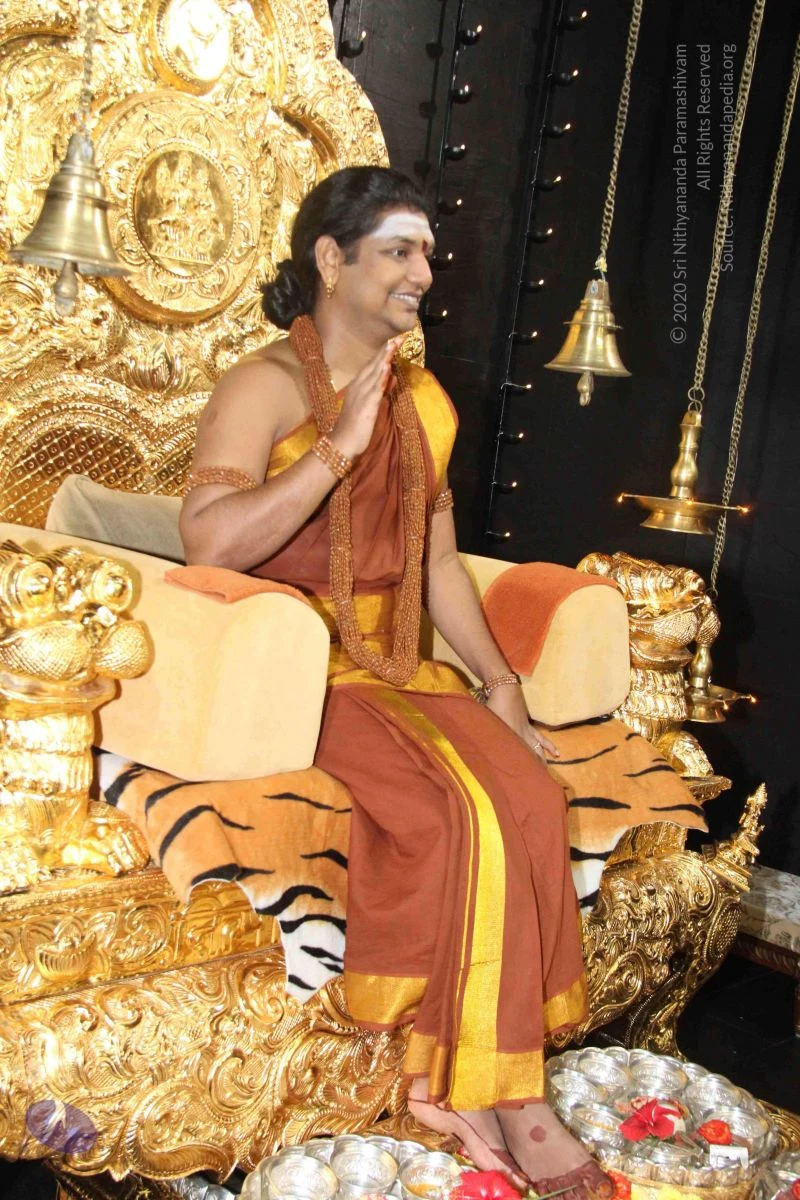
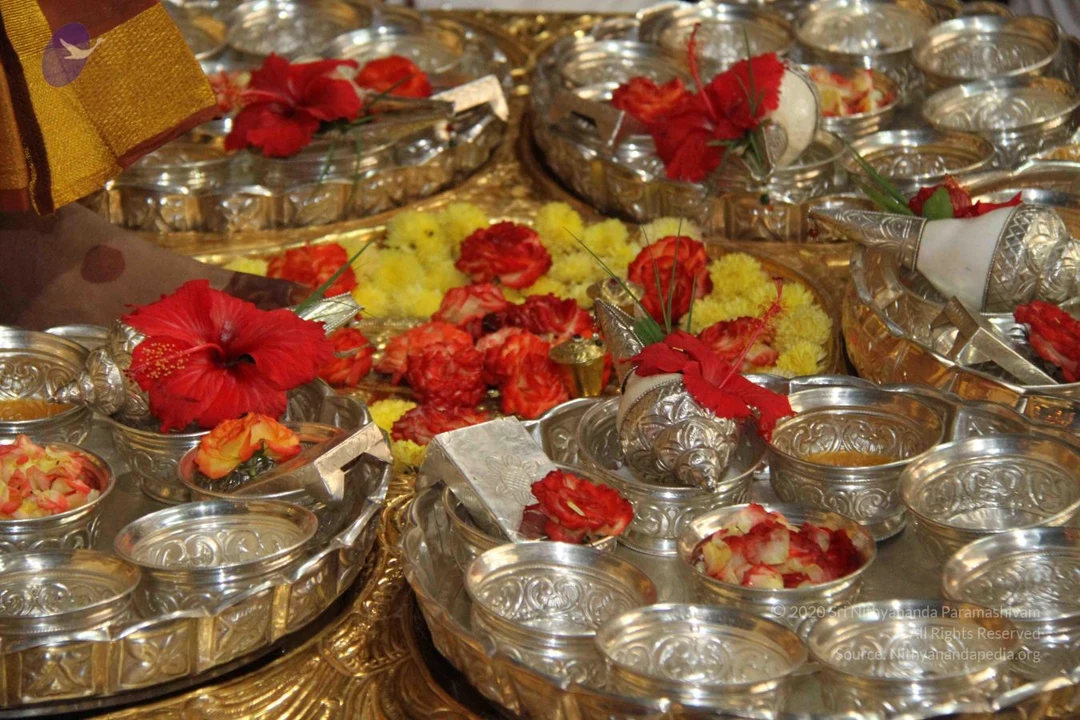
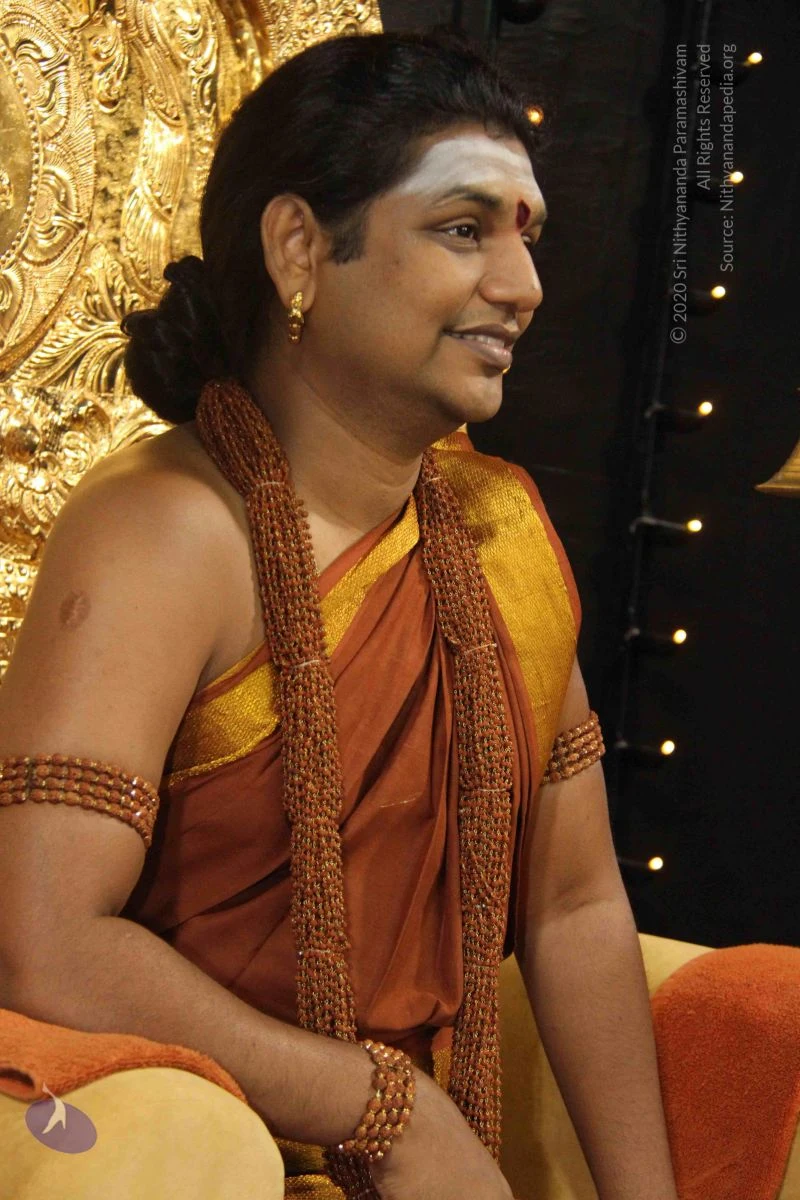
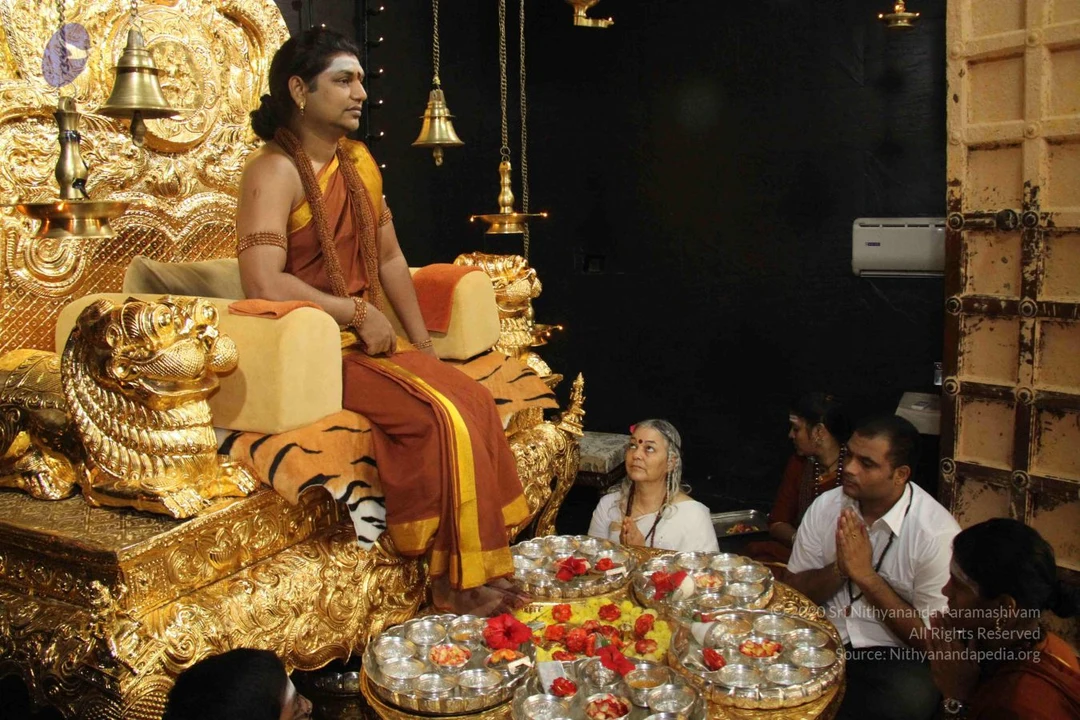
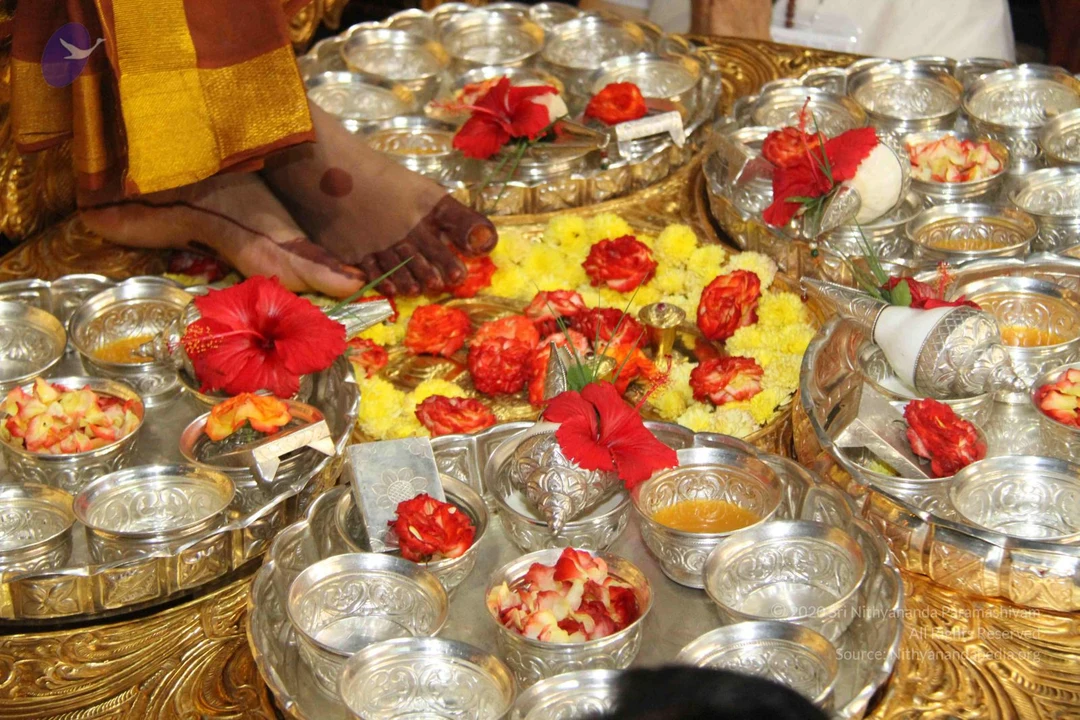
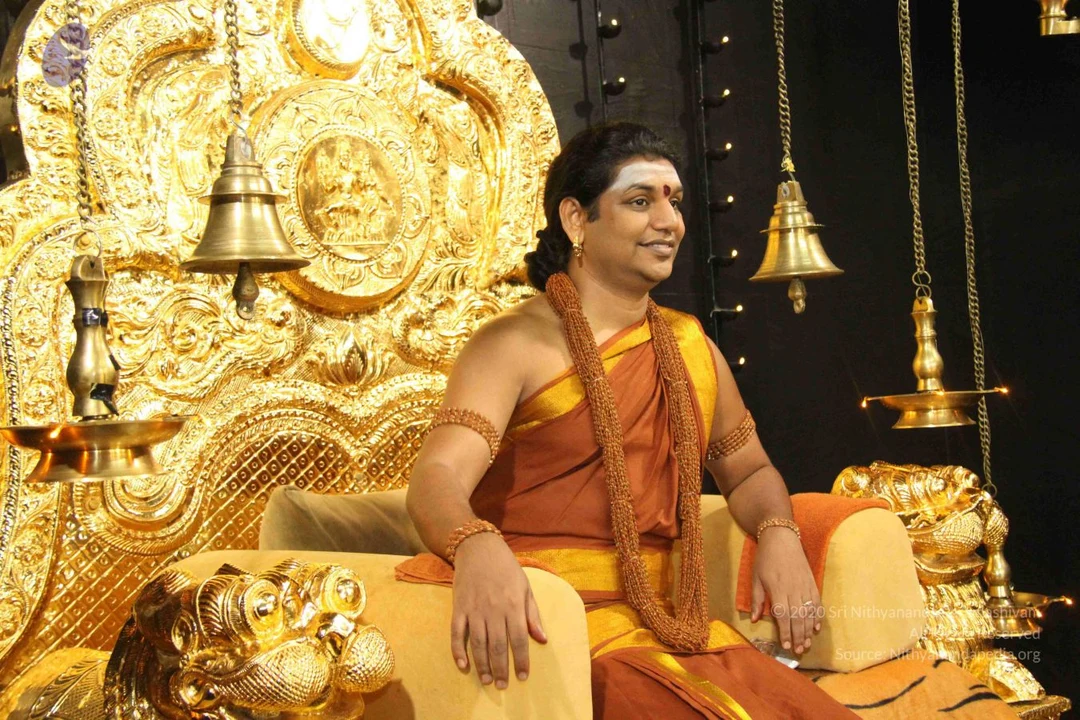
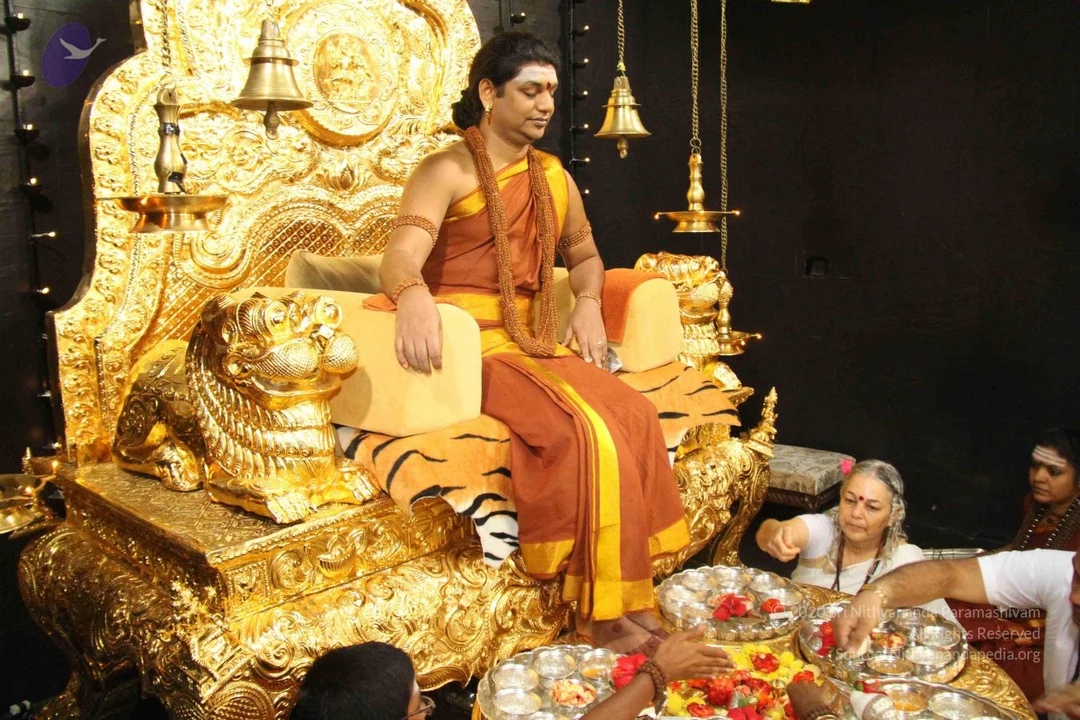
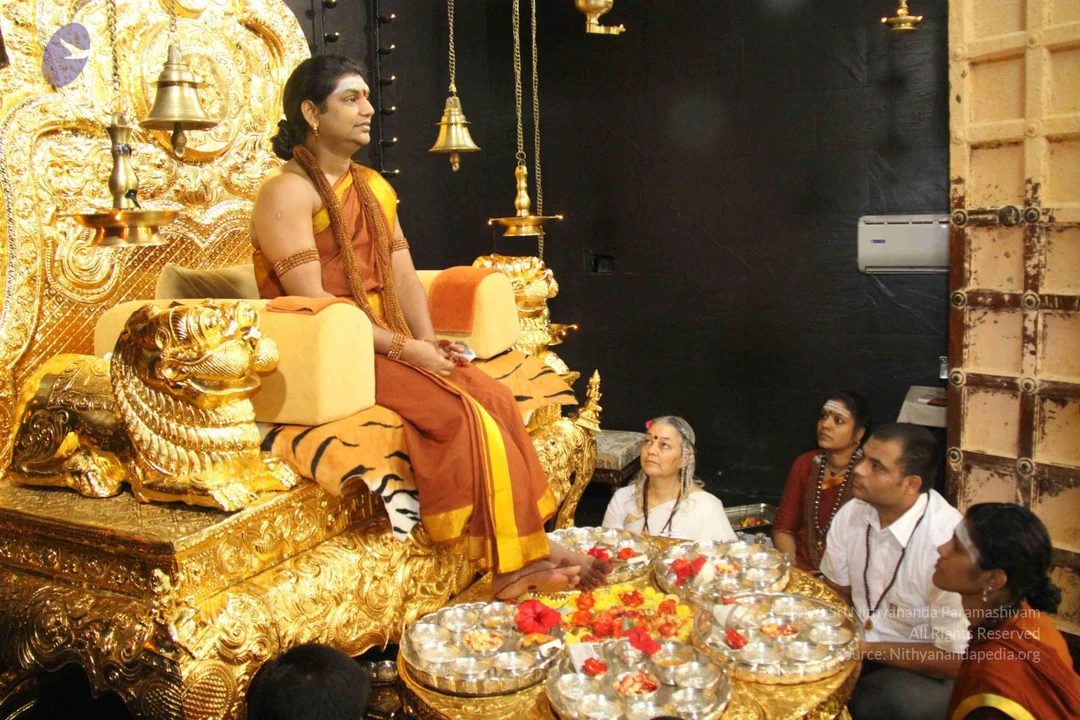
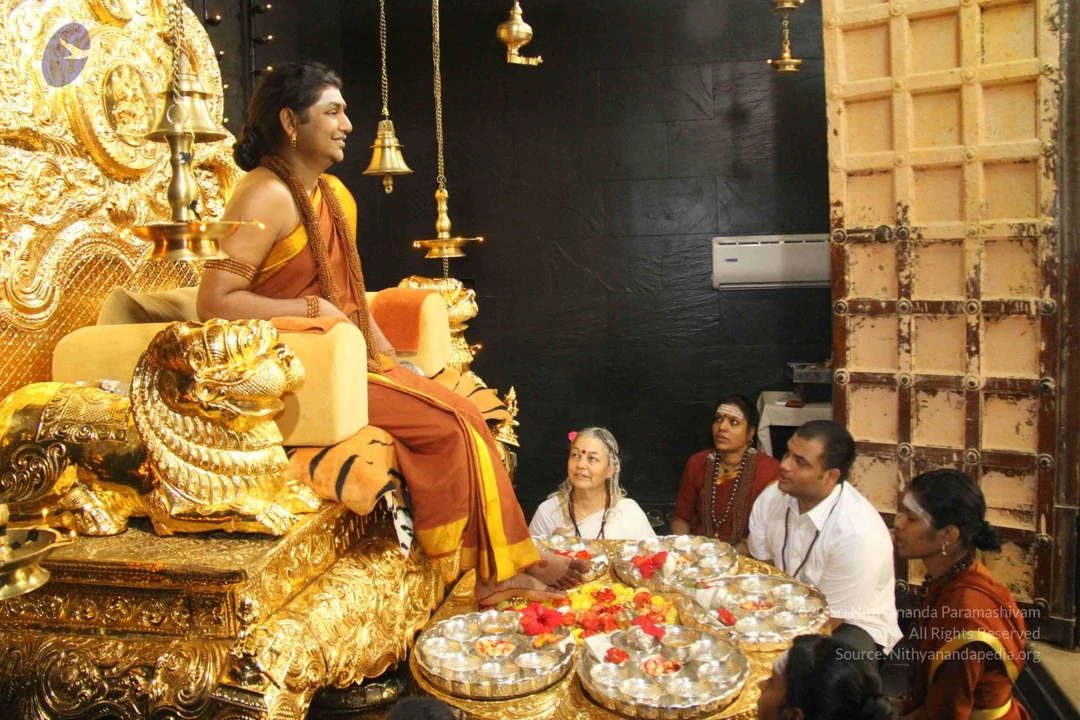
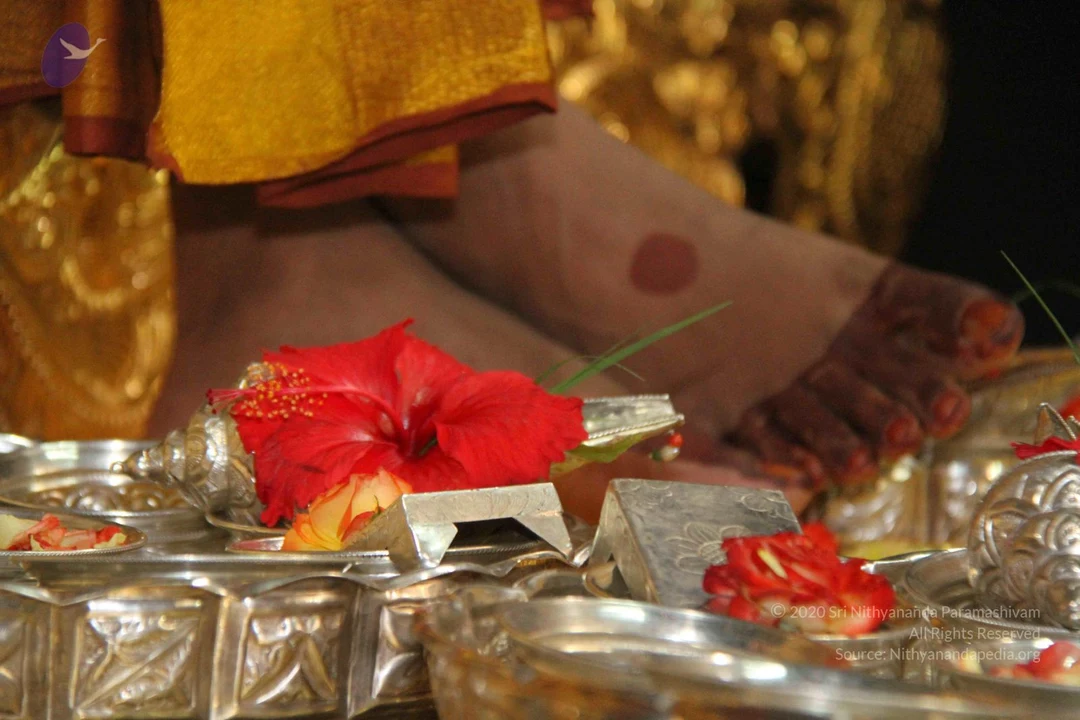
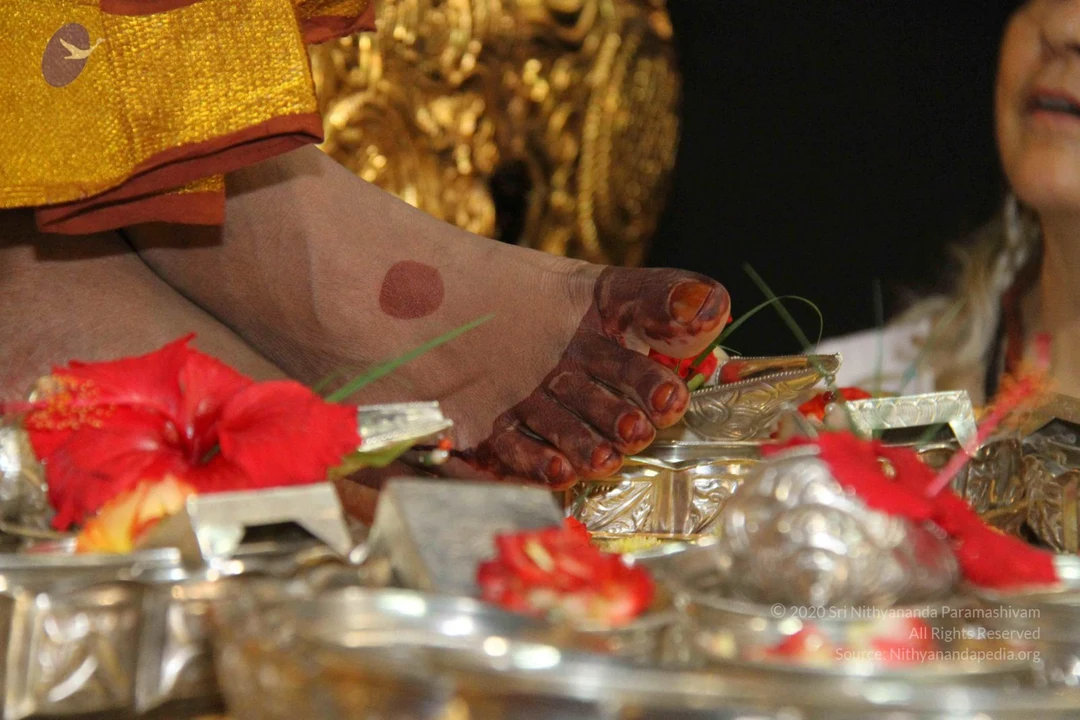
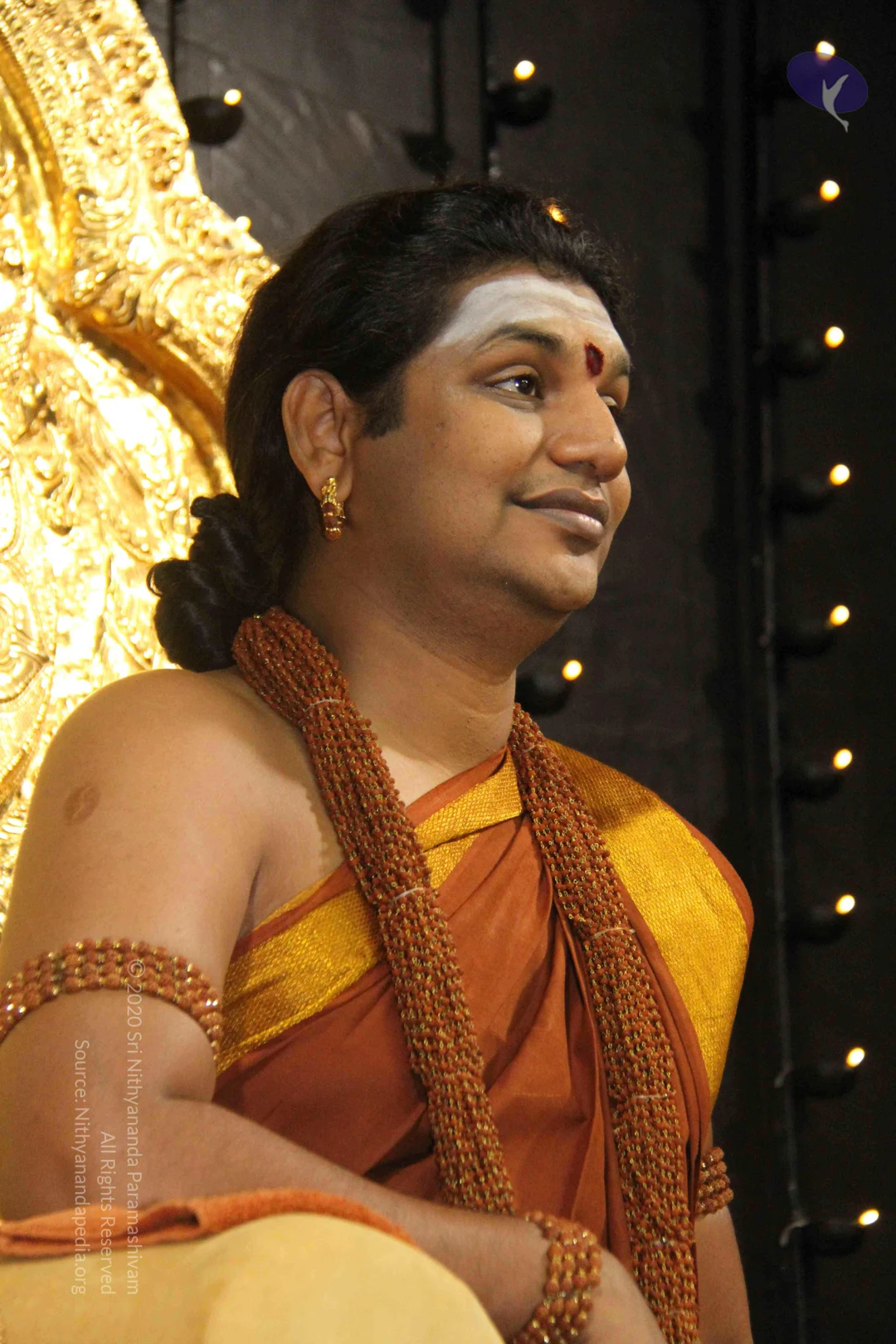
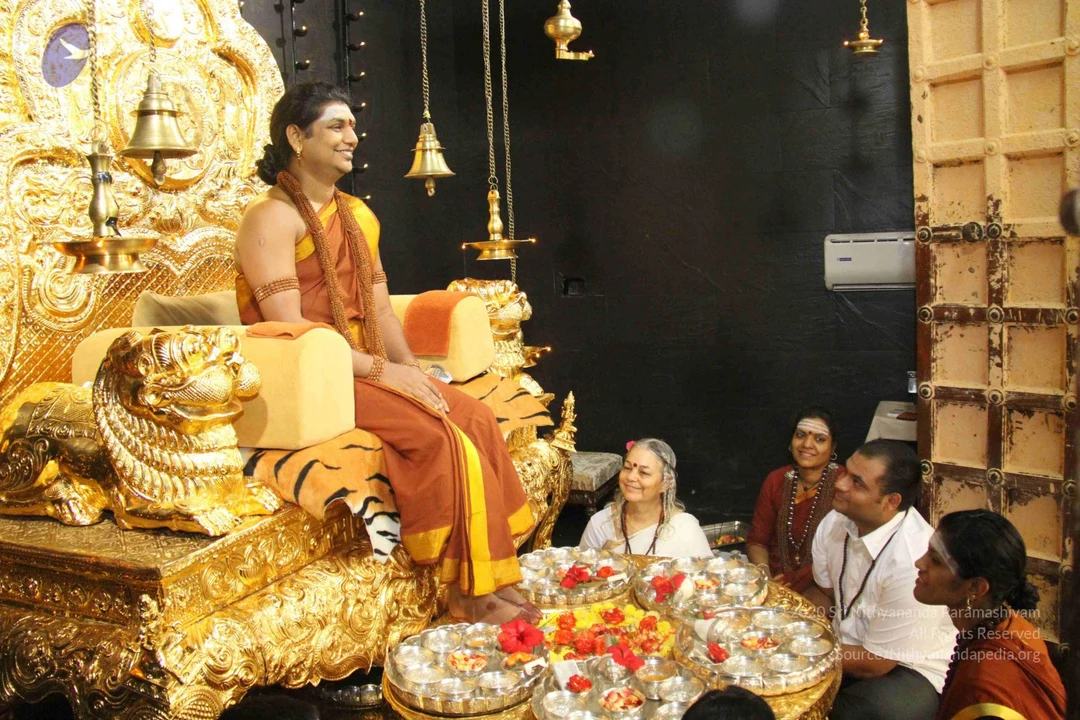
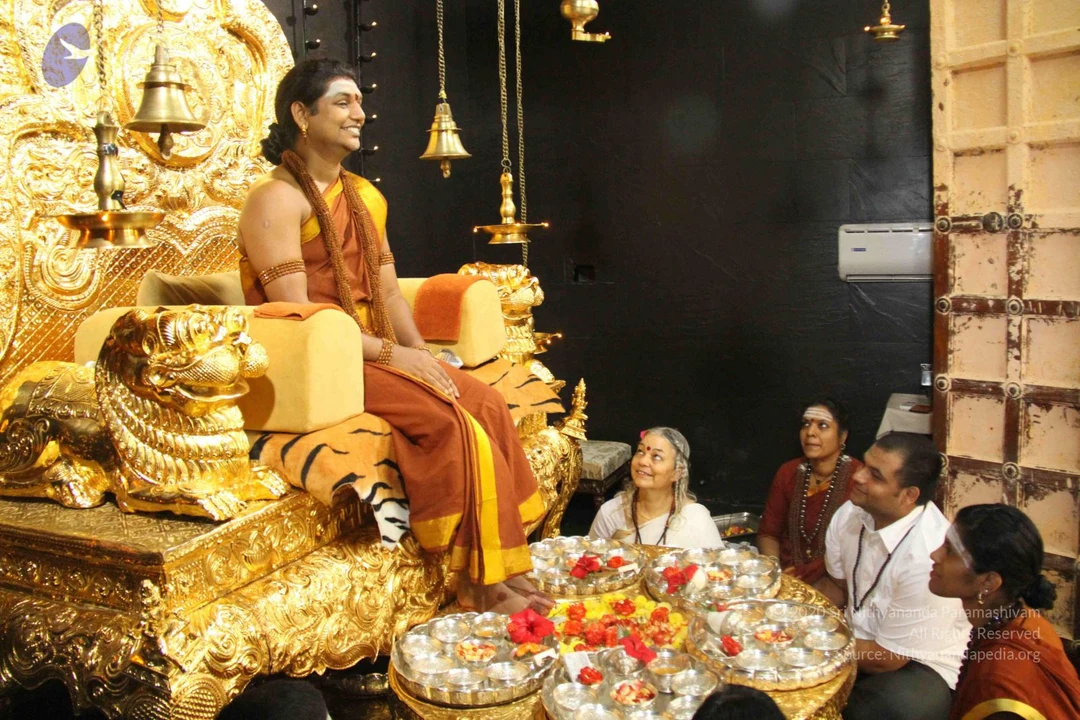
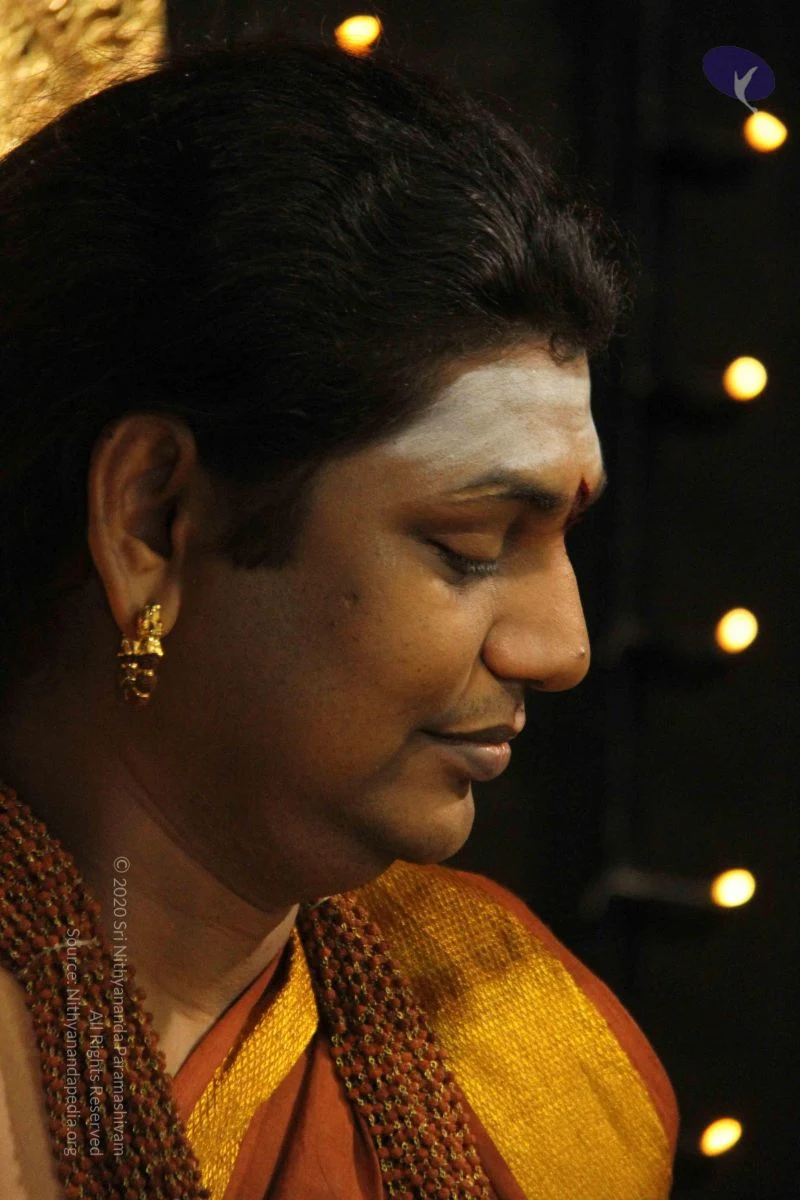
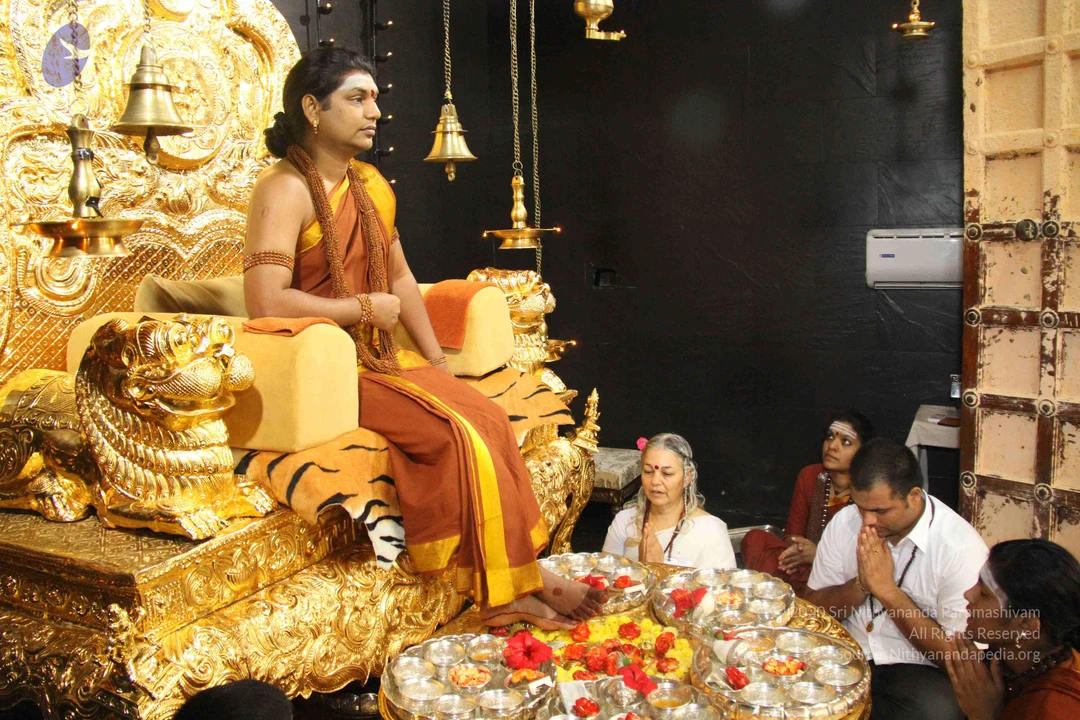
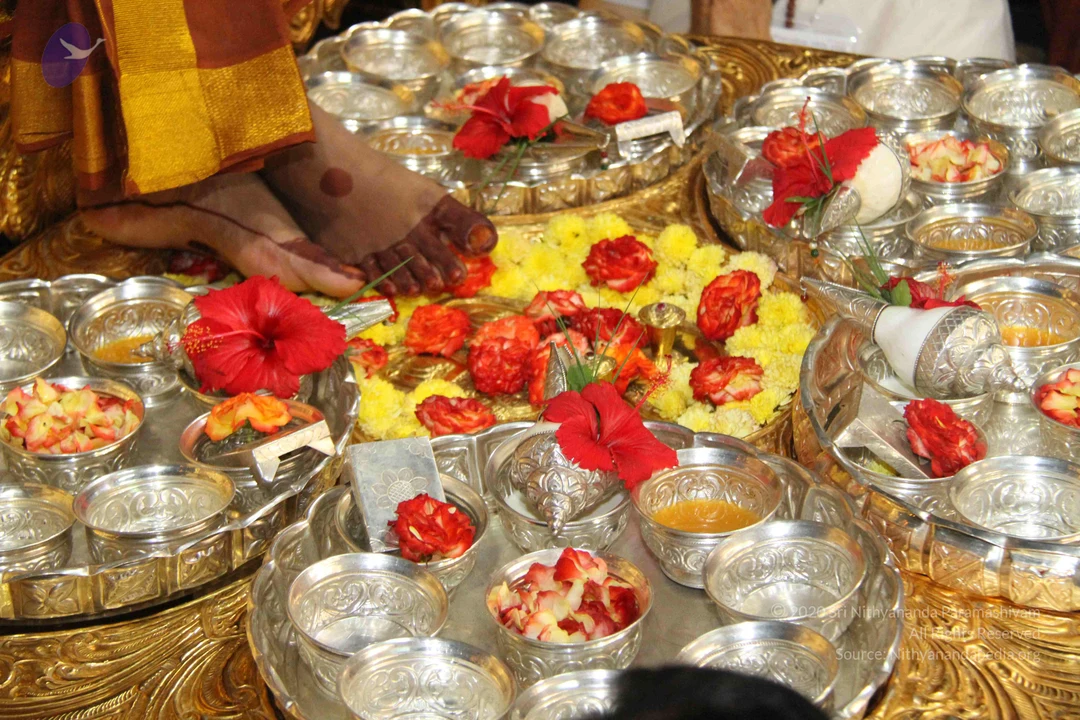
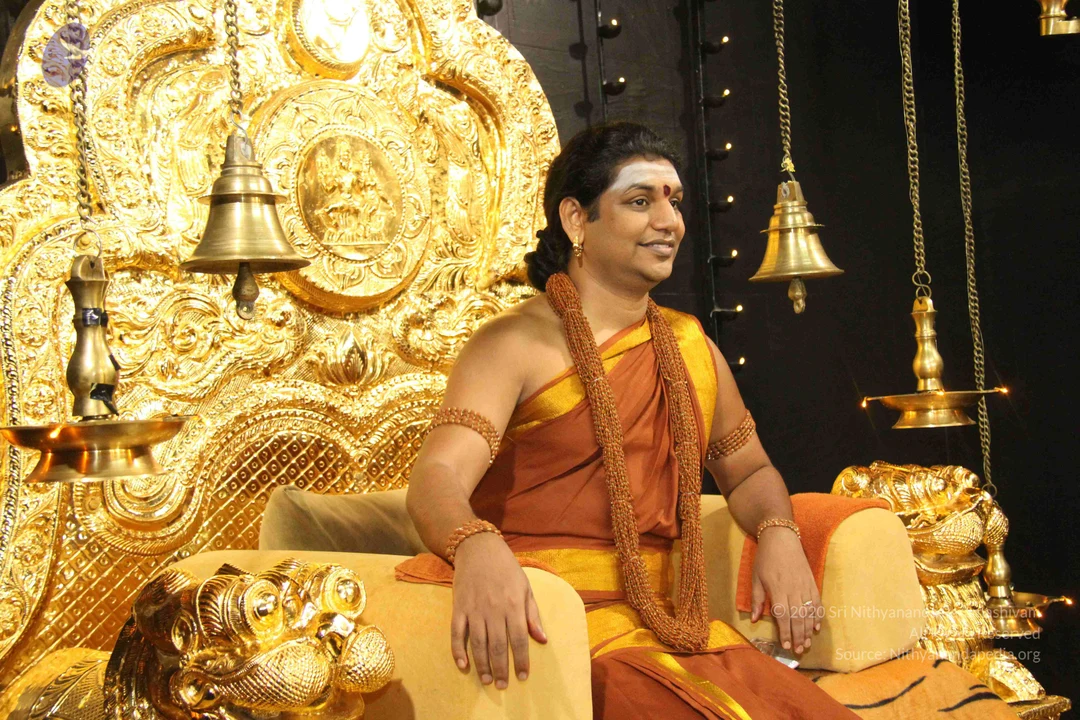
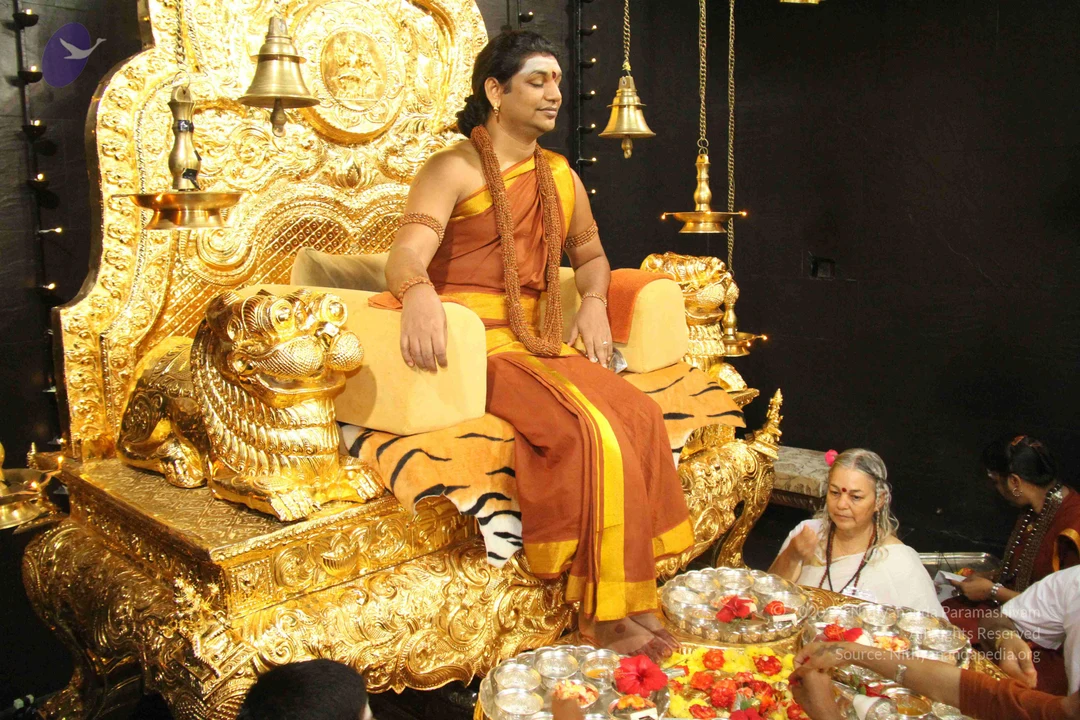
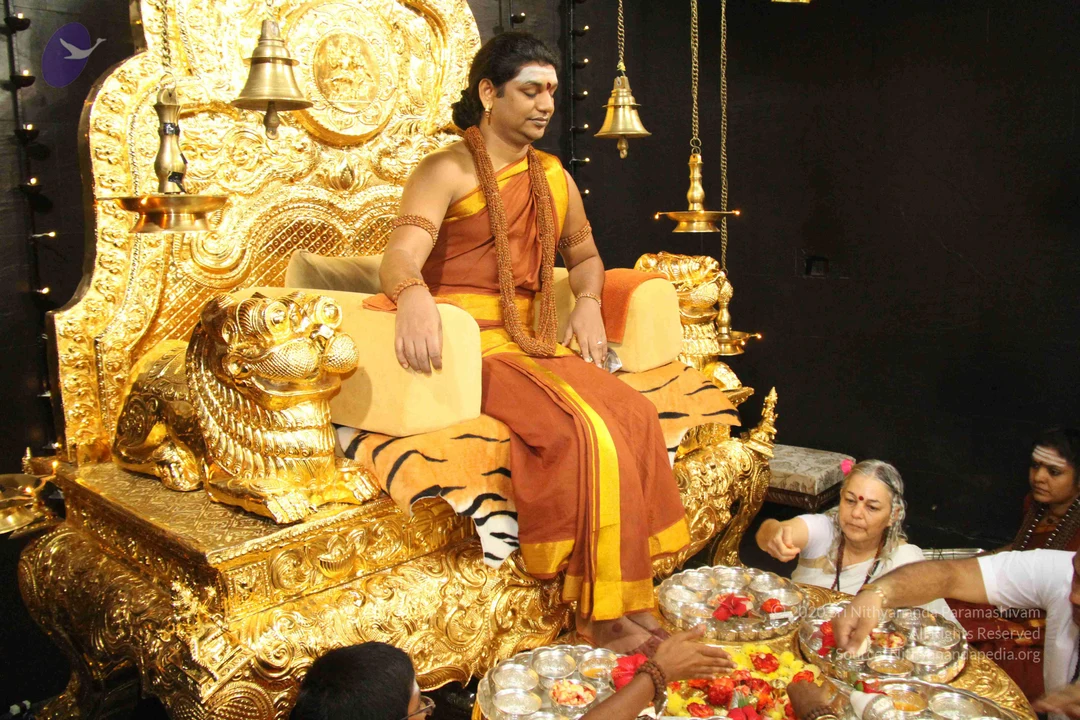
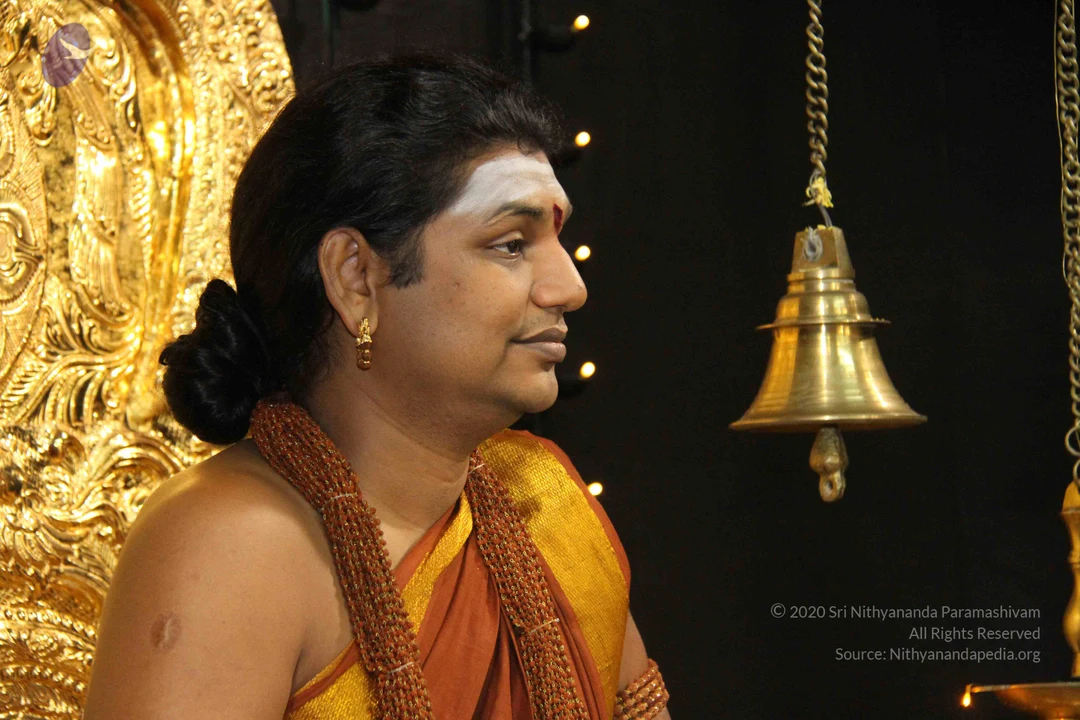
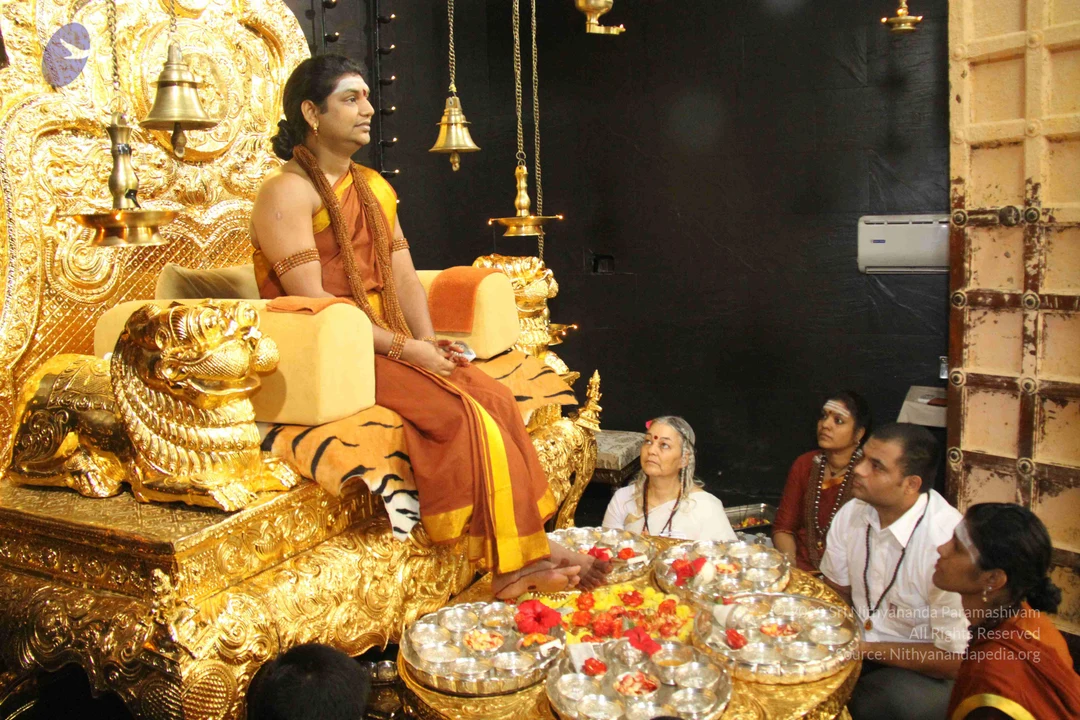
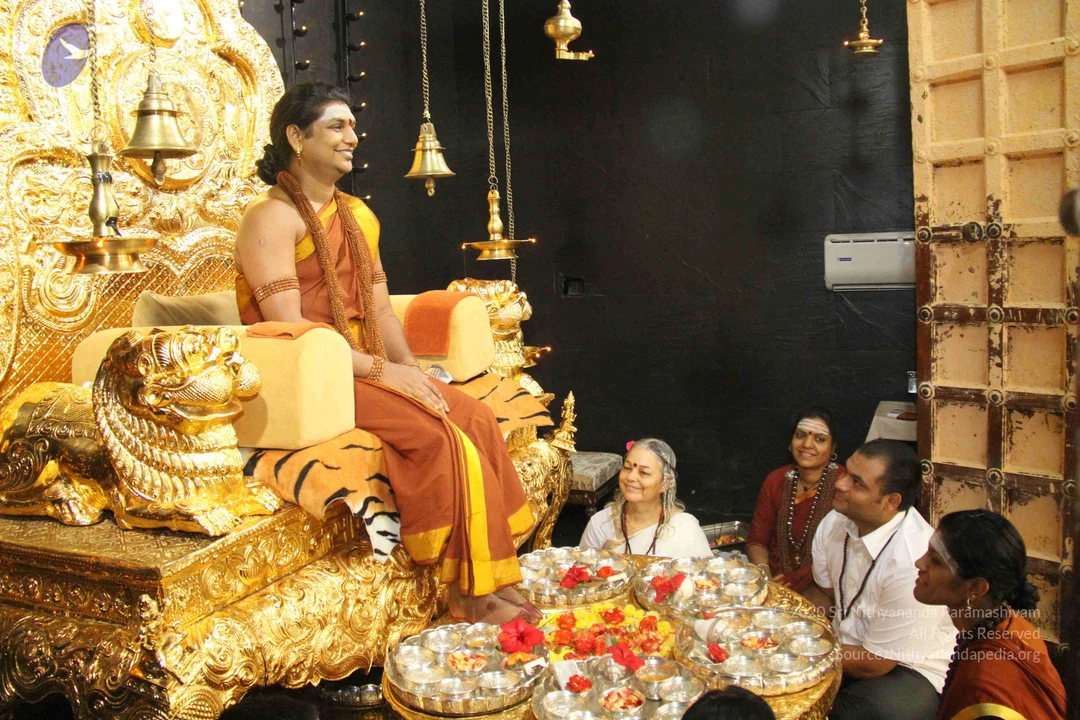
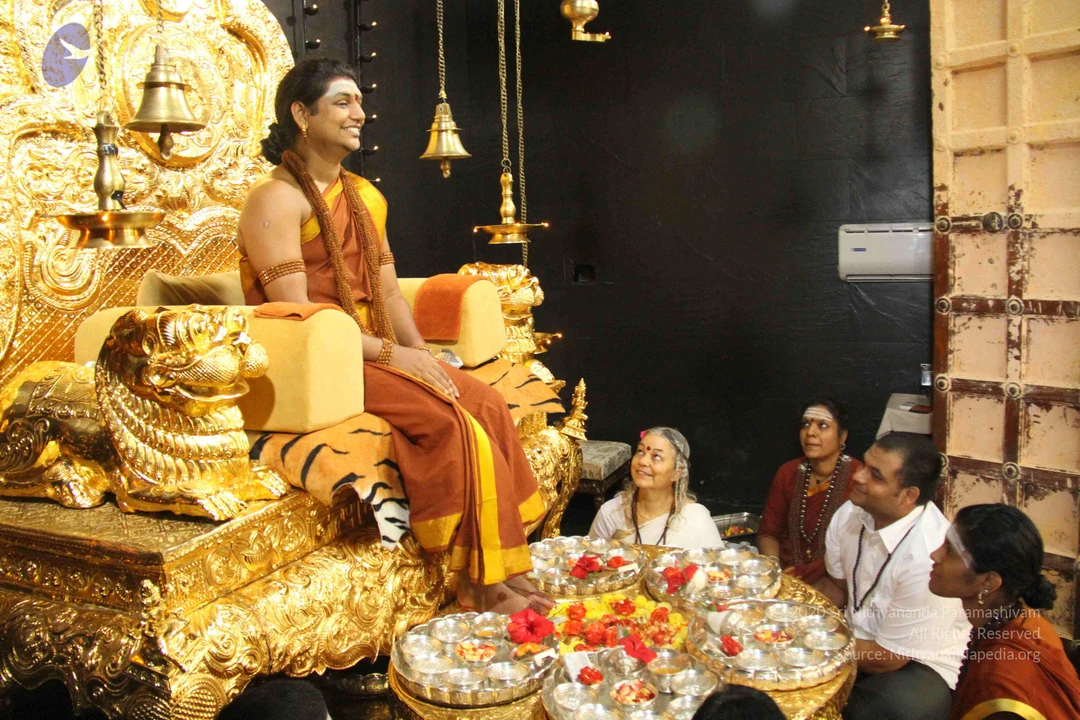
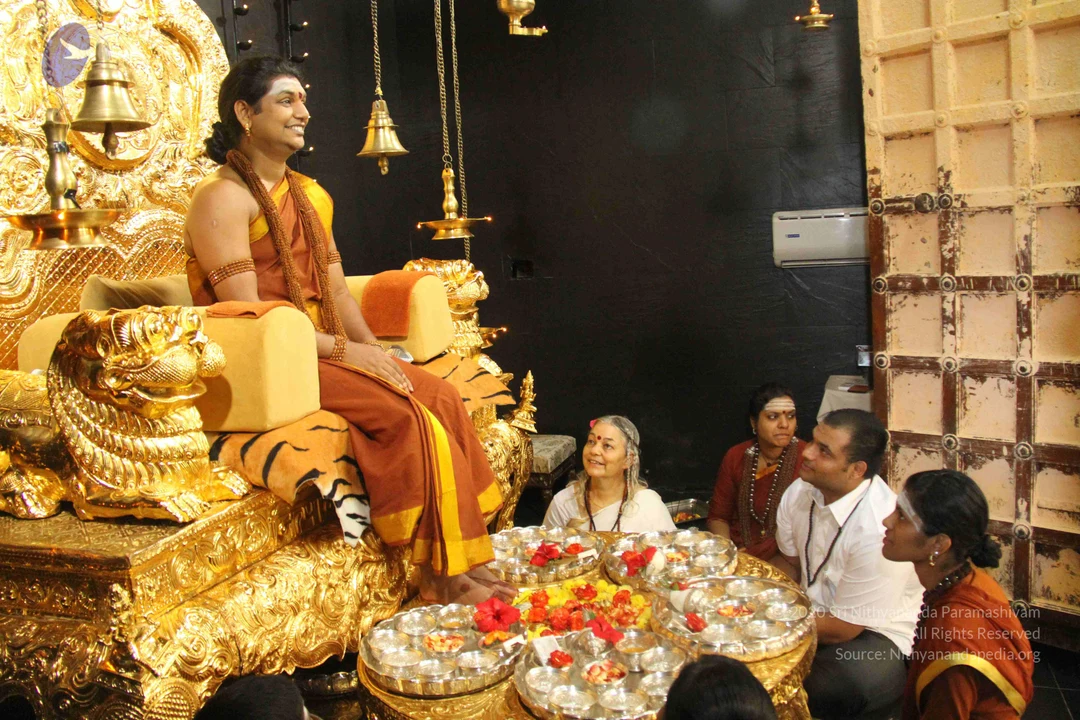
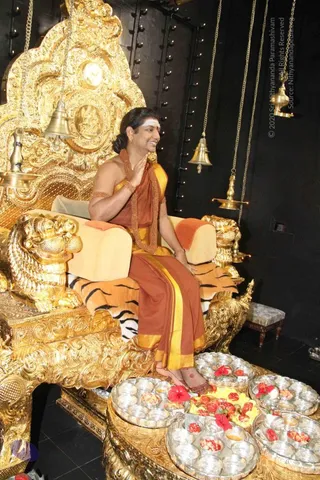
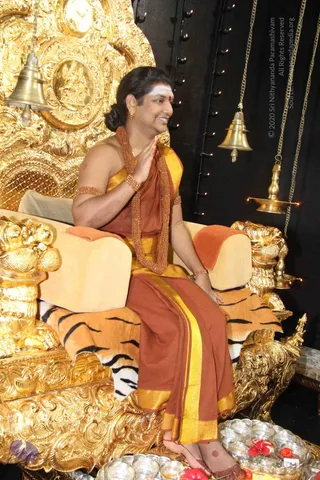
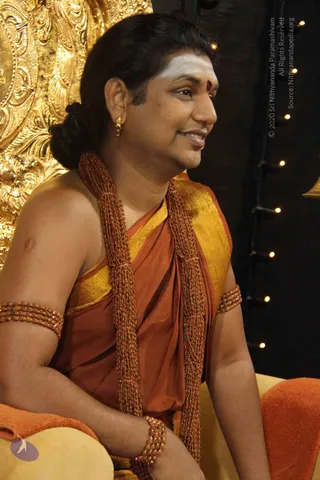
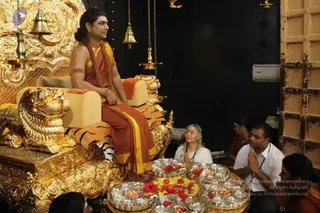
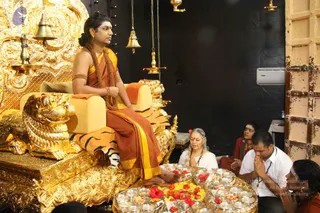
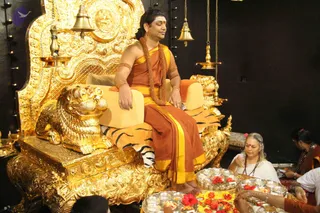
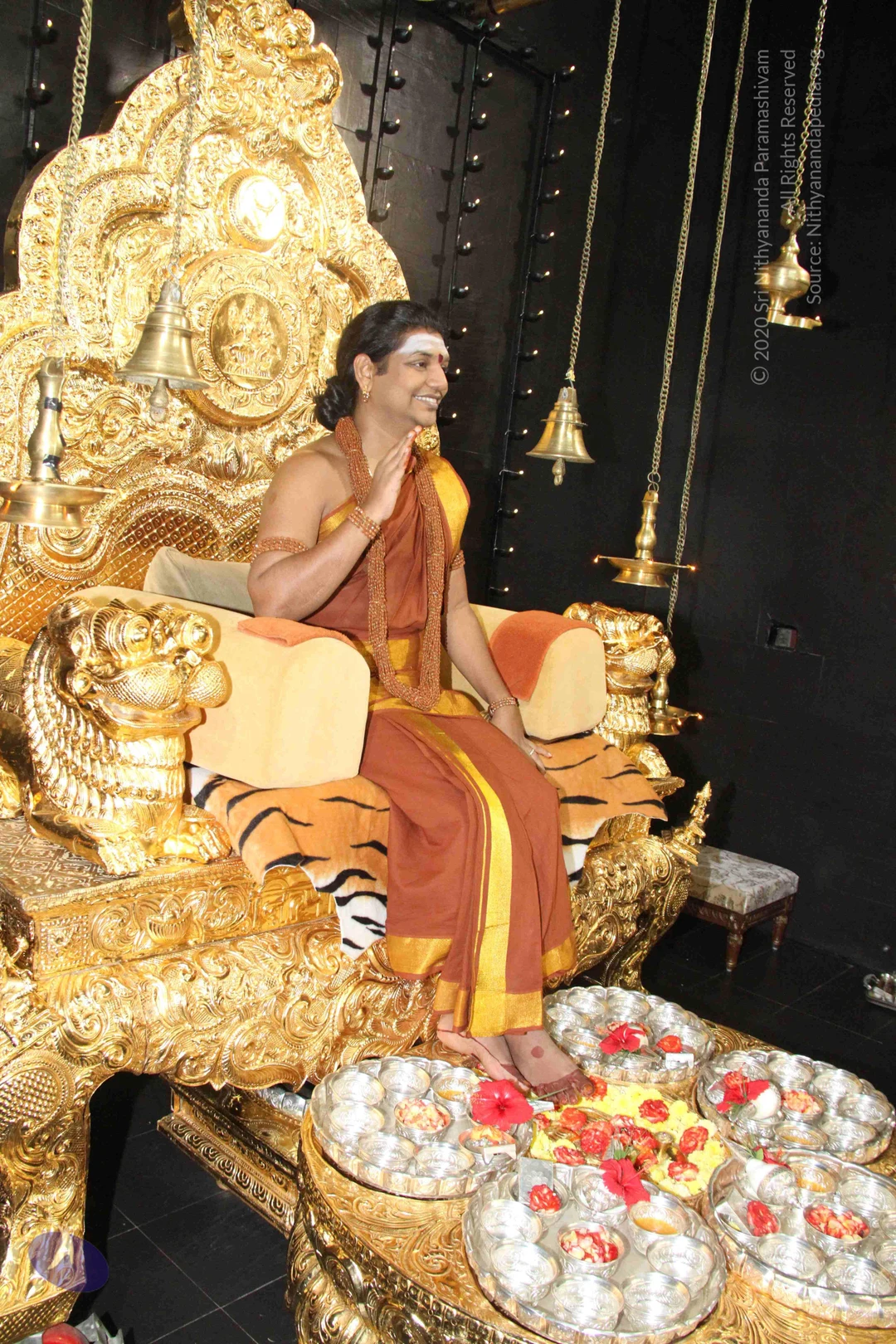
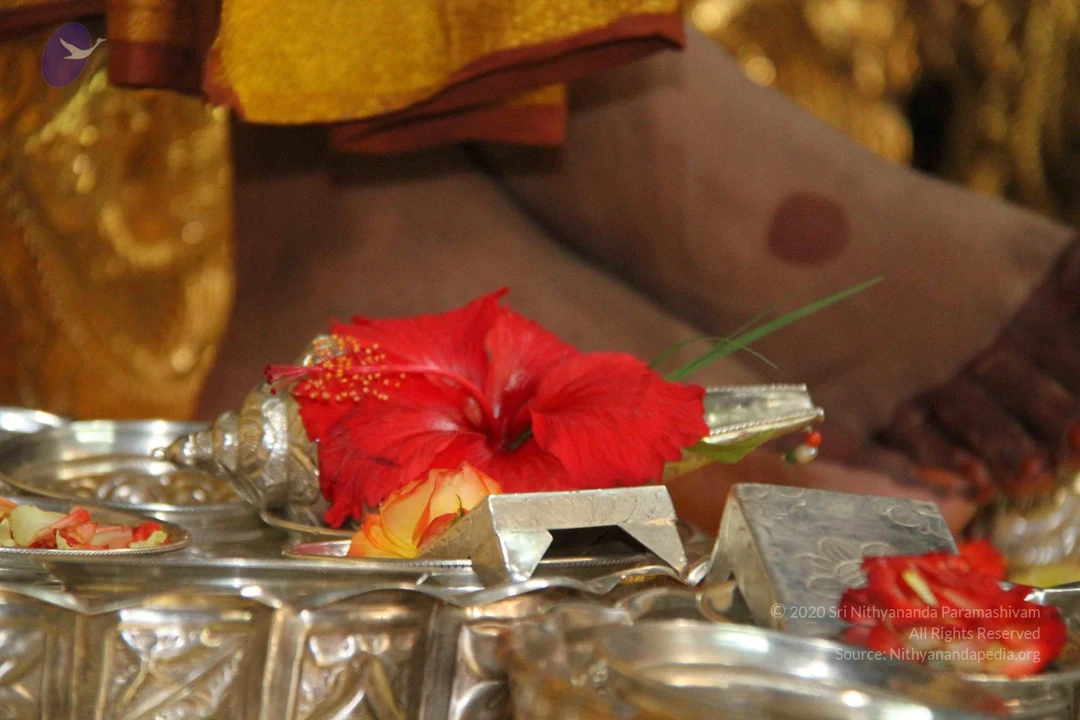
A seated man in an ornate gold throne with carved lion-head armrests and a tiger-skin cushion, wearing a rust-orange dhoti and shawl with gold borders, multiple rudraksha mala necklaces and bead bracelets, a white vibhuti line and red mark on his forehead, raising one hand in blessing. Silver trays with red flowers, sweets and offerings sit at his feet, and brass oil lamps and bells hang from the black wall behind.A man with long dark hair tied back sits on an ornate gold throne with carved golden panels and a tiger-striped cushion, smiling with palms pressed together in greeting. He wears a rust-brown and gold-bordered robe draped over one shoulder, a long rudraksha mala with ceremonial gold ornaments, gold armlets and bangles, and a white vibhuti line with red kumkum on his forehead. Brass bells hang from chains on the right, a brass oil lamp stands nearby, and silver plates of offerings with red flowers lie at his feet. a person is seated on the throne, identified by a compatible presentation of long swept hair, saffron-brown ceremonial robe, rudraksha mala and gold ornaments.Close view of a ritual offering setup on a gold-toned tray. Many small ornate silver bowls and dishes are filled with red hibiscus flowers, yellow marigolds, red rose petals and other red blooms, with green blades of grass scattered among them. A silver spouted vessel and silver handled implements sit among the offerings. A golden yellow cloth edge is visible at the upper left. No people are visible, only the offering arrangement used in temple worship.A photograph of a man seated in profile against an ornate gold throne with a dark backdrop and small string lights. He has swept-back dark hair in a bun, a white-and-red forehead mark, a gold earring, and wears an orange-brown garment with gold border, draped over one shoulder, with rudraksha mala necklaces across his chest and arm bands. The appearance matches the a person cues of rudraksha malas, saffron-orange clothing and a ceremonial seat; the page indicates this is a person event, and he is seated in person.A photograph of a seated man on an ornate gold throne carved with lion heads, wearing an orange-and-saffron robe with a gold border, a rudraksha mala draped across his chest, bangles on his wrists, and a white tilak on his forehead. He sits with hands resting on the armrests, gazing to the side. Before him on the floor, a woman in white with a red bindi sits with hands folded, and a man in a white shirt with a lanyard holds his palms together in namaste. Brass trays of flowers, red blossoms, lamps and kumkum-marked offerings are arranged on a yellow cloth at the front. Hanging brass bells and oil lamps hang above, and a black backdrop and a carved wooden door are behind.Close-up photograph of a pair of bare feet resting on a golden tray decorated with yellow and red flowers, including red hibiscus and marigold-type blooms. The feet bear a red-brown painted line along the arch and a round red dot on the top of one foot, typical of a padapuja ritual where feet are honoured. Behind them are rows of polished silver bowls. A gold-bordered orange-red silk garment edge is visible at the upper left. No face is shown, so no person can be identified.

deity-aarti

7 photosSource gallery
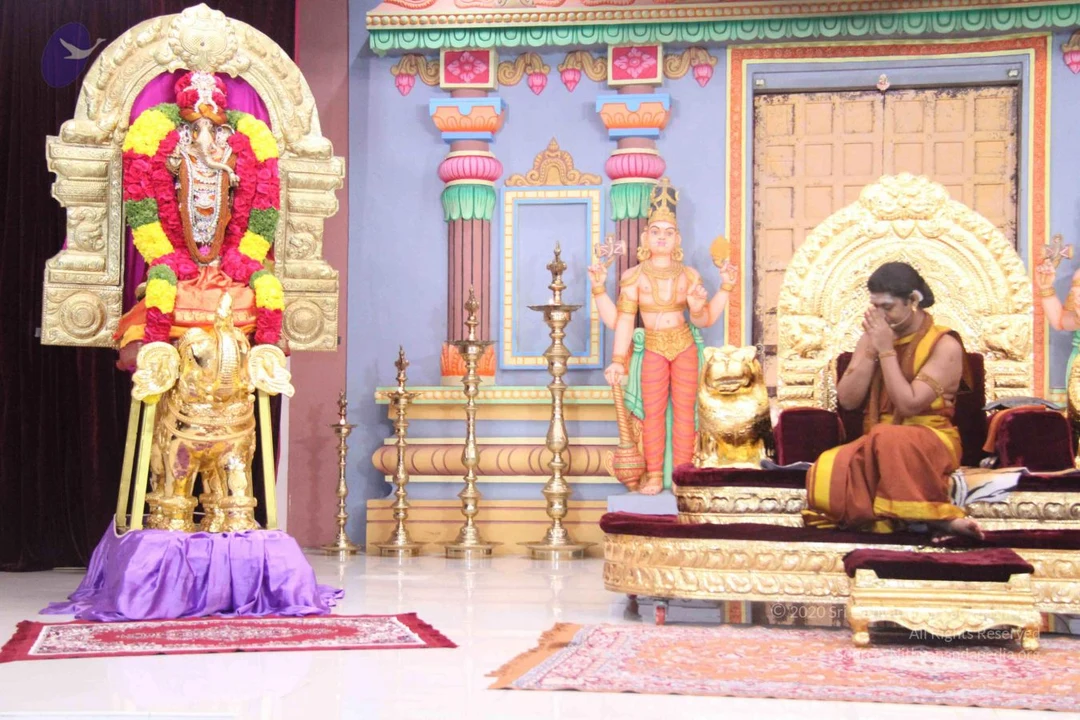
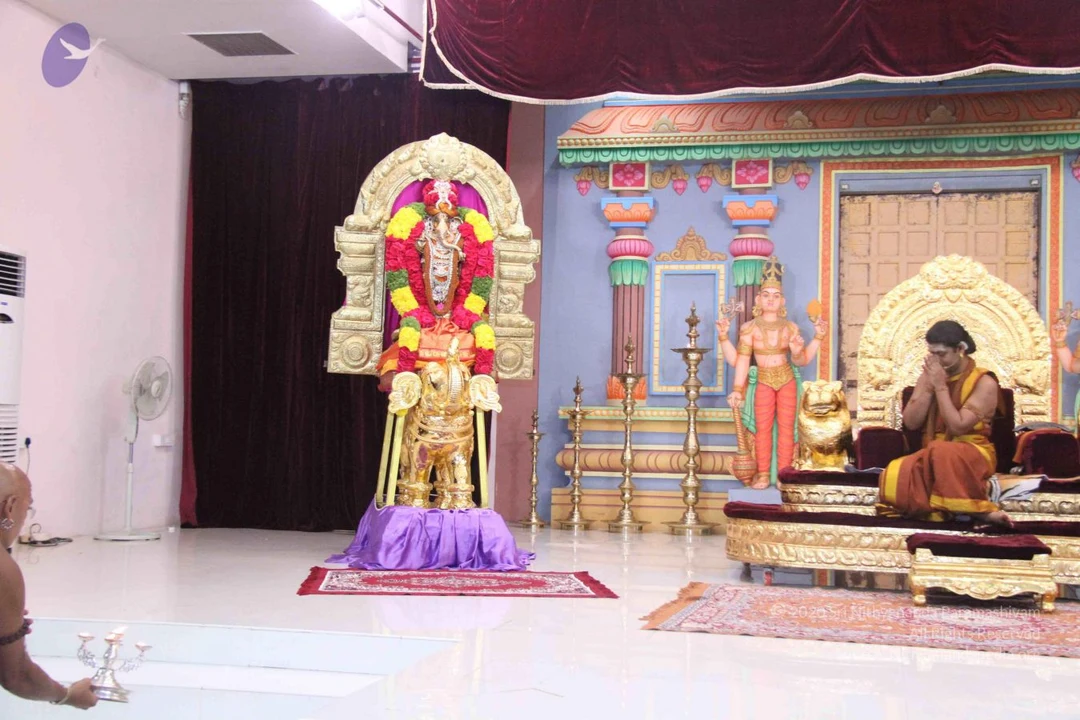
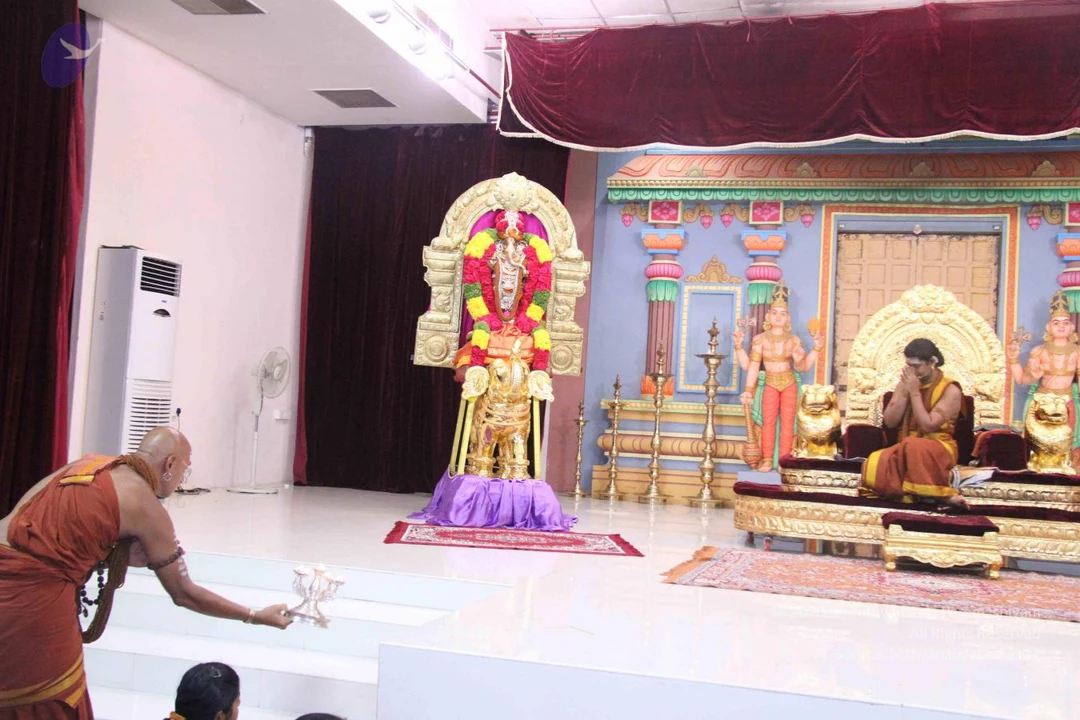
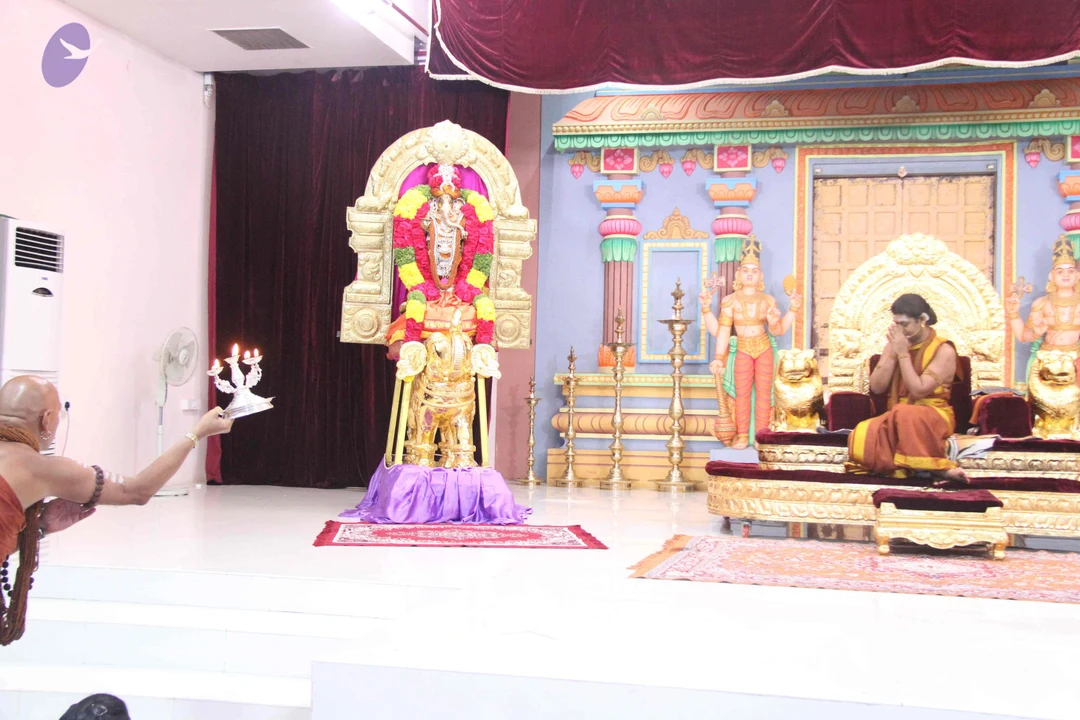
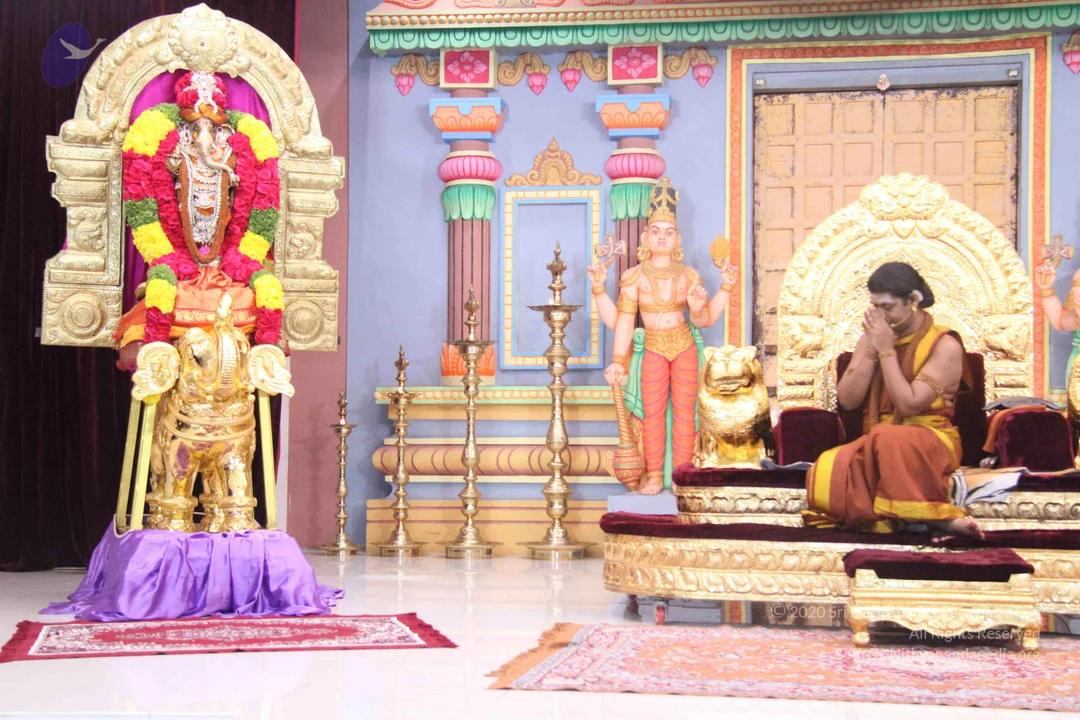
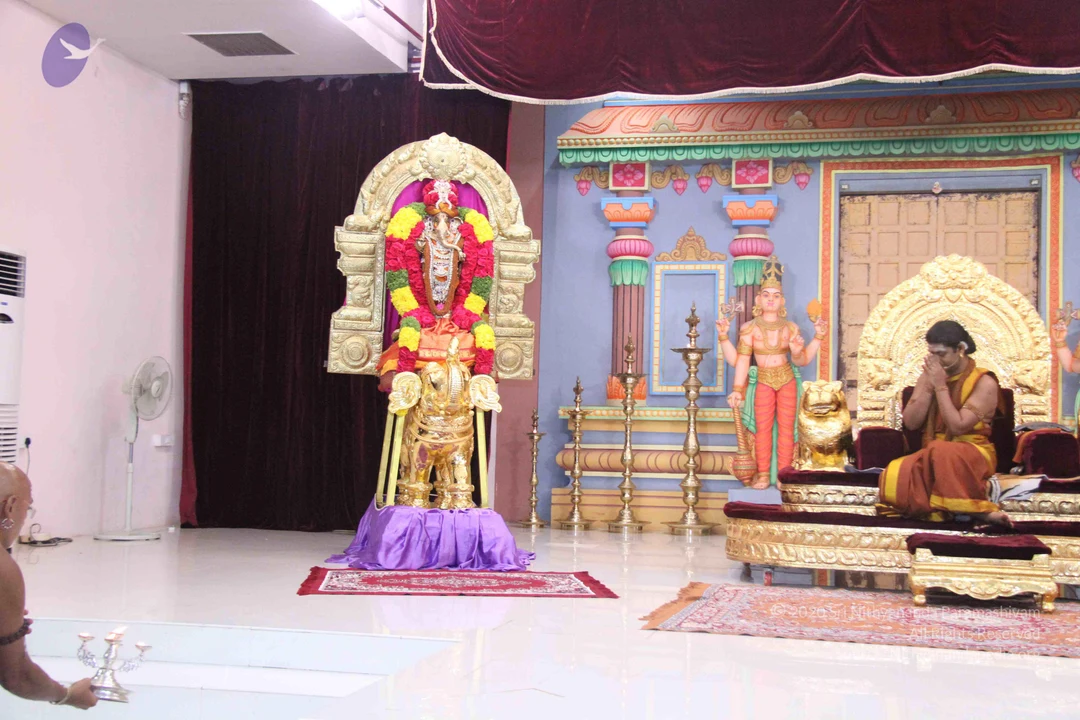
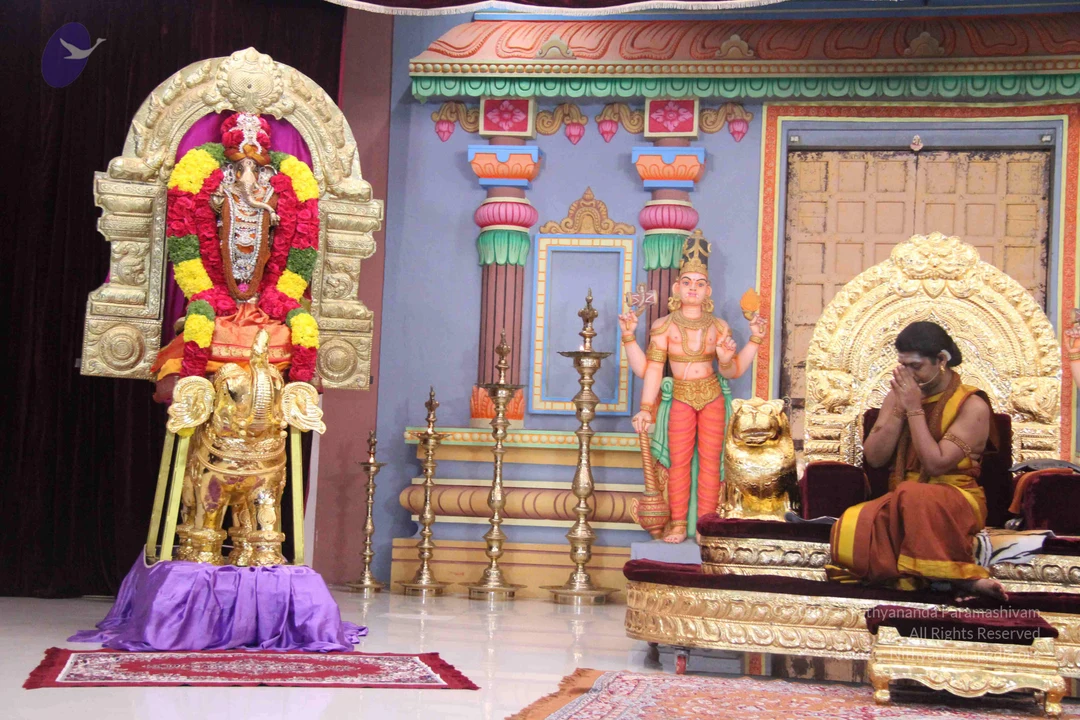
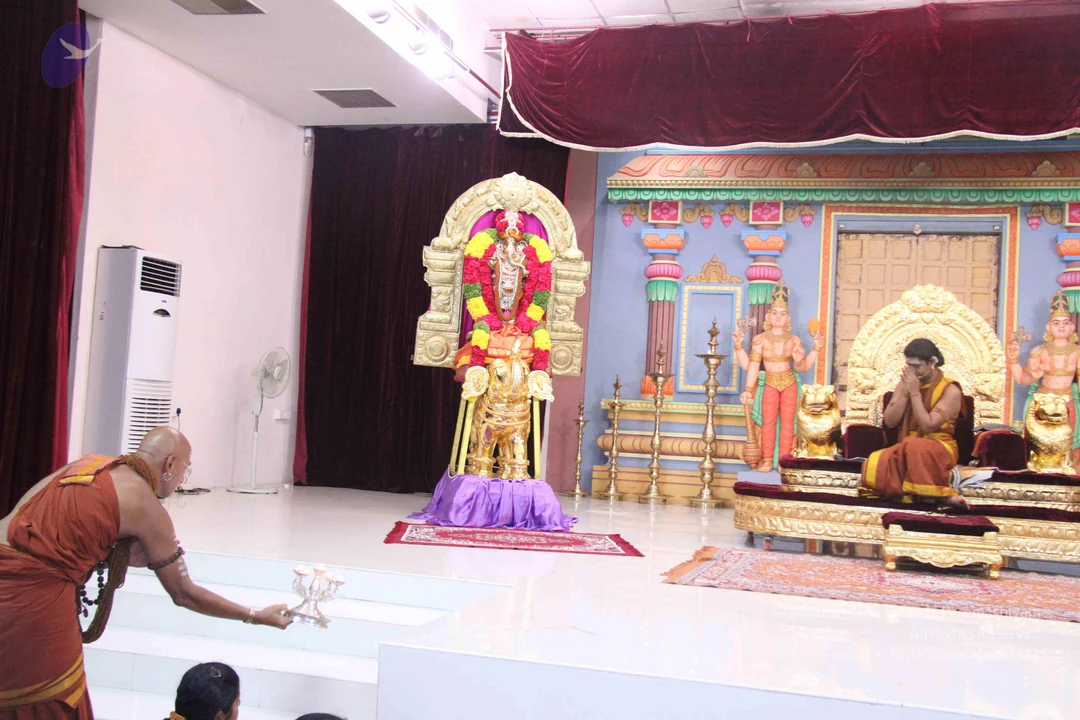
A photograph of a temple-style stage hall. In the centre stands a golden elephant-vehicle deity murti draped with garlands of red, orange and yellow flowers, set on a purple cloth with a small rug before it. To the right, a seated man in saffron-orange robes sits with palms pressed together on an ornate golden throne with red cushions, flanked by painted pillars and lion-shaped armrests. A standing figure in ornate golden-orange dress and crown stands beside the throne. At left, a bald man in orange robes with a rudraksha-style mala stands with hands folded toward the deity. Brass lamp stands, a ceiling-mounted air conditioner and a fan decorate the scene. Two people are partly visible at the bottom edge.A stage set for a ritual in a hall with a blue and pink painted backdrop and a maroon curtain. On the left, a bald priest in orange robes and beaded necklaces holds up a silver five-flame aarti lamp toward the centre. In the centre, a golden elephant-vehicle deity murti of Ganesha stands on a purple cloth, decorated with a red and yellow flower garland. To the right, a seated figure in orange and gold clothing sits with palms pressed together on an ornate golden throne with red cushions. Flanking him are standing deity statues with golden lion-mounted thrones, and brass lamps stand on the floor. Red and patterned rugs cover the stage.A stage set in a temple-style hall shows a golden Ganesha murti on a golden elephant vehicle, draped in red, yellow and green flower garlands, on a purple cloth base. Beside it, a seated man with a shaved head wears an orange and yellow robe, his hands pressed together in prayer, on a golden throne with maroon cushions. Behind him stands a painted deity figure holding a trident-like staff and a lotus-style object, with a gold lion sculpture at the throne base. Brass oil lamps stand in a row on the floor, and the backdrop has pink pillars and a golden doorway.Interior of a temple-style hall showing a golden Ganesha murti seated on a golden elephant vehicle, decorated with a garland of red, yellow and green flowers and a purple cloth below. To the right, a seated man in an orange-and-yellow robe sits on an ornate golden throne with hands folded in prayer, beside a painted deity statue in orange and green. A priest in white at the lower left holds a silver lamp stand. Brass oil lamps stand along the stage, and a painted backdrop with pink columns frames the scene.A stage at a temple-style hall shows a golden elephant-vehicle carrying a Ganesha murti decorated with red, yellow and green garlands, set on a purple cloth at left. A painted backdrop of columns and a standing four-armed figure in orange and gold dhoti stands at centre beside brass oil lamps. At right, a seated figure in orange and saffron robes with gold bangles sits on an ornate gold throne with hands folded in namaskar, with the upper figure's face and head partly visible. The scene reflects a Ganesha Brahmotsavam satsang setting.A stage with a blue and gold temple backdrop and a red velvet curtain above. On the left, a golden deity murti of Ganesha sits on a golden vehicle draped with a purple cloth, garlanded with red, yellow and green flowers. A hand holds a silver lamp toward the deity from the left edge. At right, a seated man in an orange-and-saffron dhoti and shawl sits on a gold-trimmed throne with hands pressed together in namaskar, head bowed. Brass lamps stand between them, and a standing deity murti in orange and green dress with raised hands is beside the throne. The setting suggests an arati or puja before a Ganesha murti.

gurukul-instruments

3 photosSource gallery
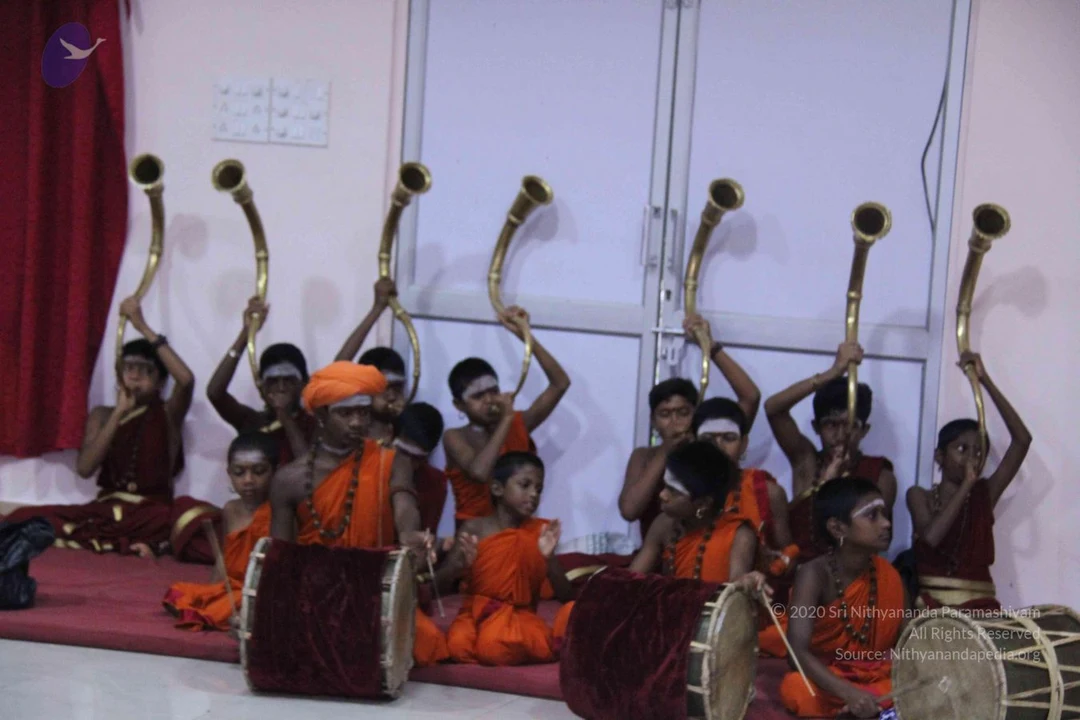
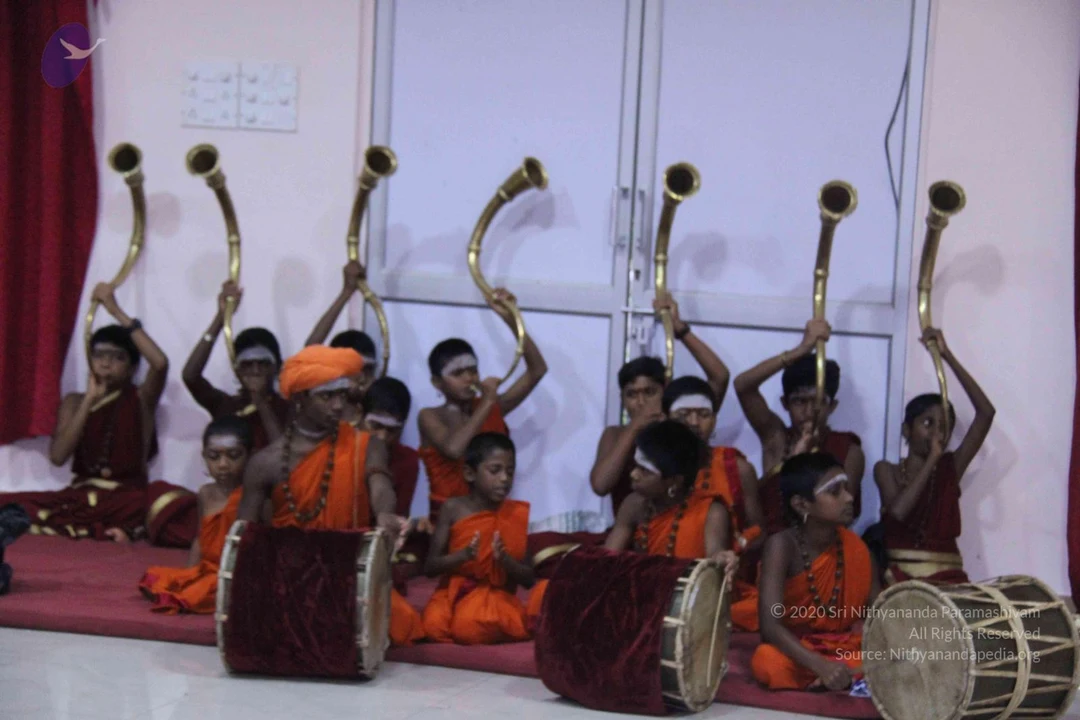
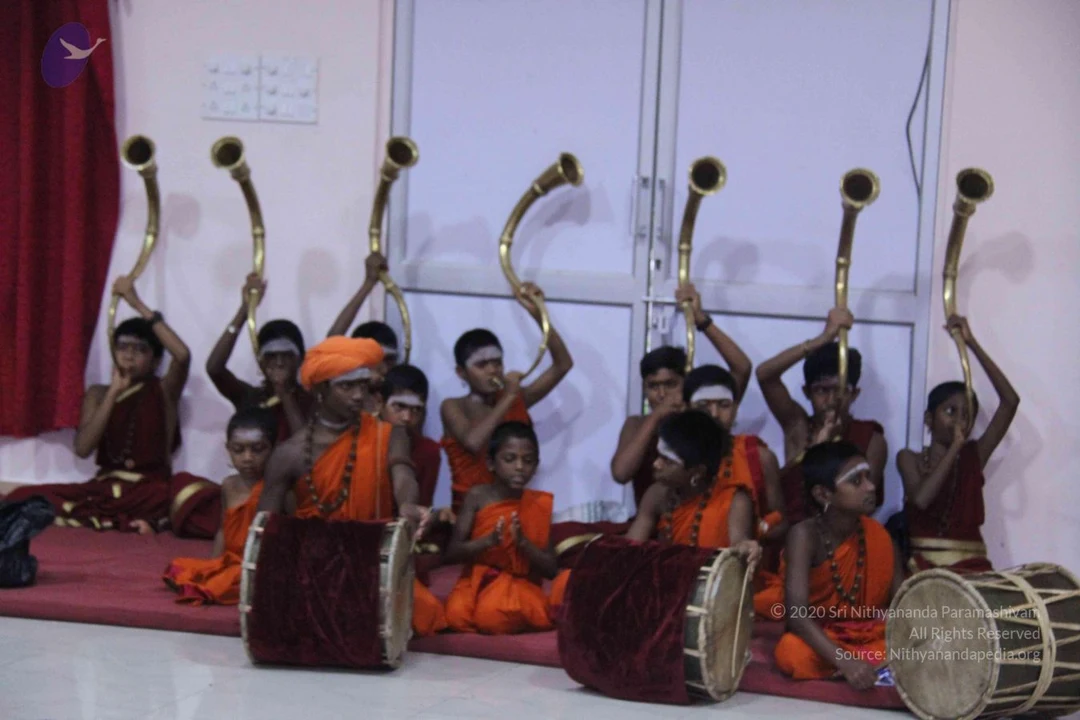
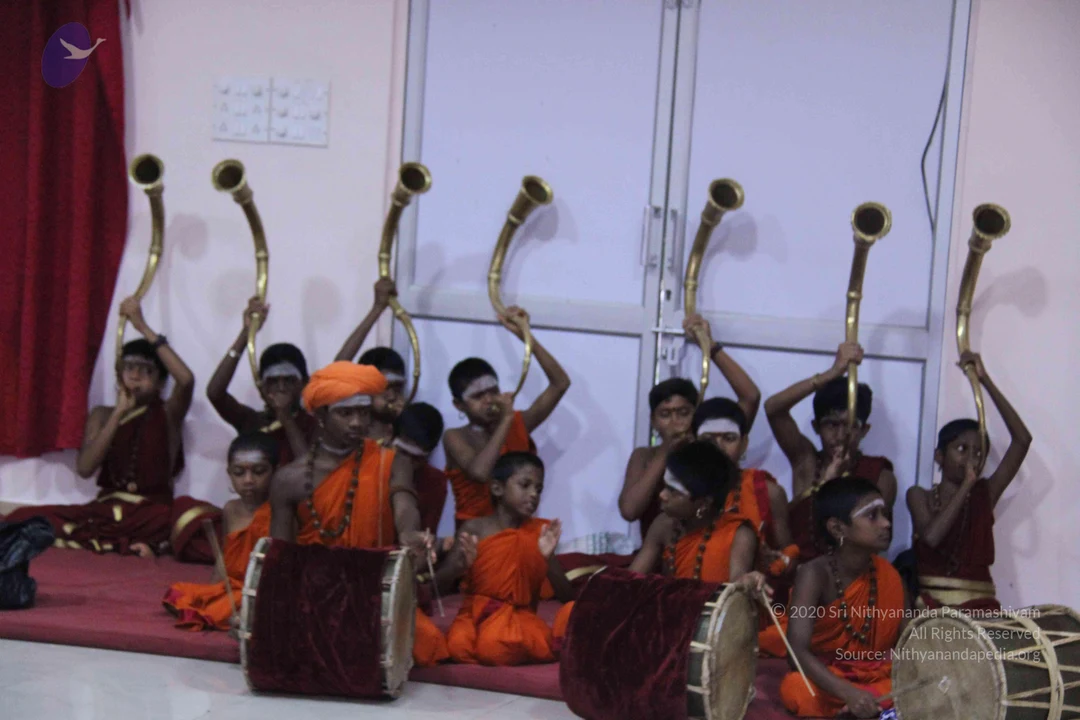
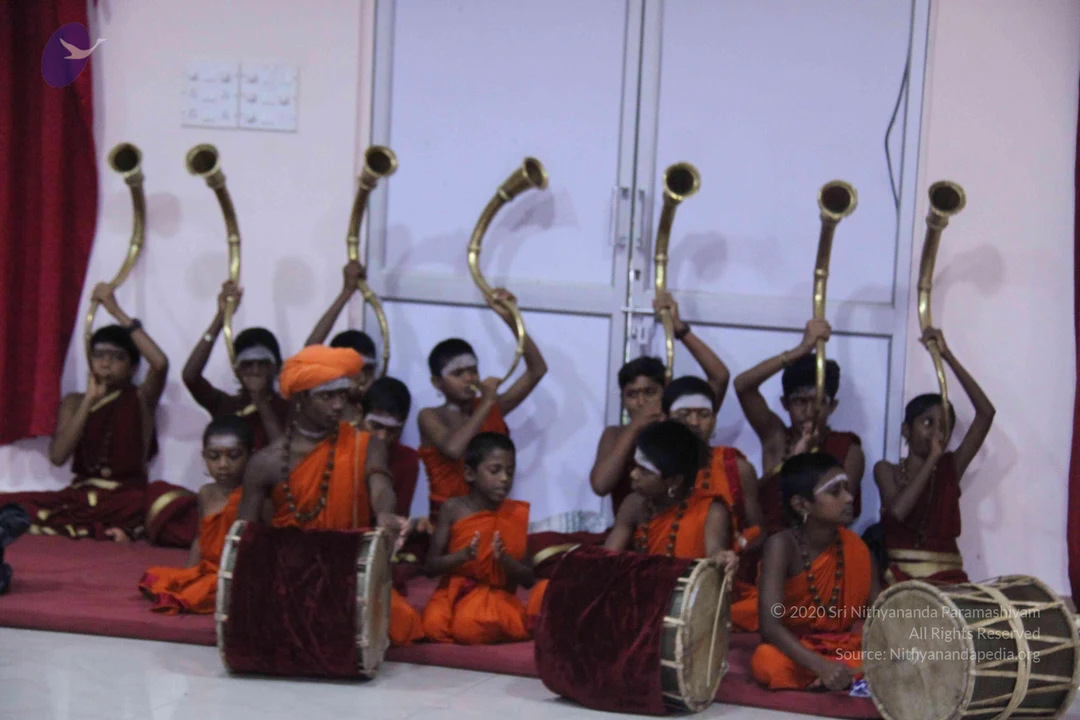
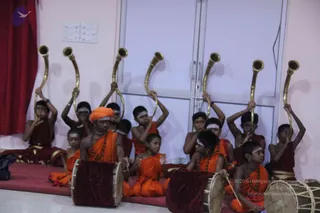
A group of young boys in saffron-orange robes perform a ceremonial music ensemble indoors before a red curtain and white wall. Several boys raise long curved brass horns high while playing, and others sit on a red cloth playing large drums with wooden sticks. Many wear white forehead markings, rudraksha malas and beaded necklaces. A boy in a bright orange turban plays a drum in the foreground, and the setting is a simple hall with a glass door behind the performers.A photograph of a seated group of young boys and girls performing a ceremonial brass horn and drum ensemble in front of a white wall, red curtain and glass doors. Most wear saffron-orange cloth with rudraksha malas and white forehead markings, and some wear red garments. A boy in the foreground with an orange turban plays a dark red-draped drum, while several children raise long curved brass horns overhead or play them to their lips. A small drum with a dark red cover and another large drum sit on the red mat in the lower right. The photo is taken at a distance on a low, crowded stage.A photograph of a group of boys performing on a stage with a red carpet and red curtain at left. Around a dozen boys sit on the floor in saffron-orange and maroon robes with rudraksha malas and white forehead markings. Several boys raise long curved brass horns, and a boy in front in an orange turban and orange robe plays a large barrel drum with a red velvet covering. Other boys in orange clothing sit with hands together in prayer or play the drums beside them. A white wall and glass doors form the backdrop.

nithya-satsang

23 photosSource gallery
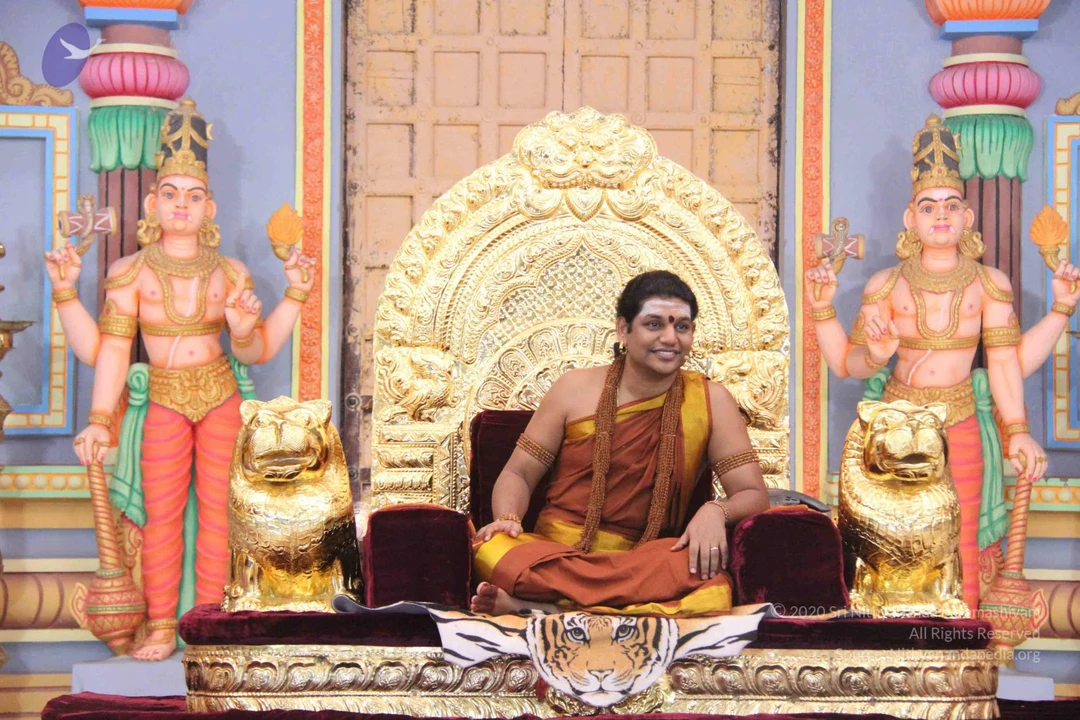
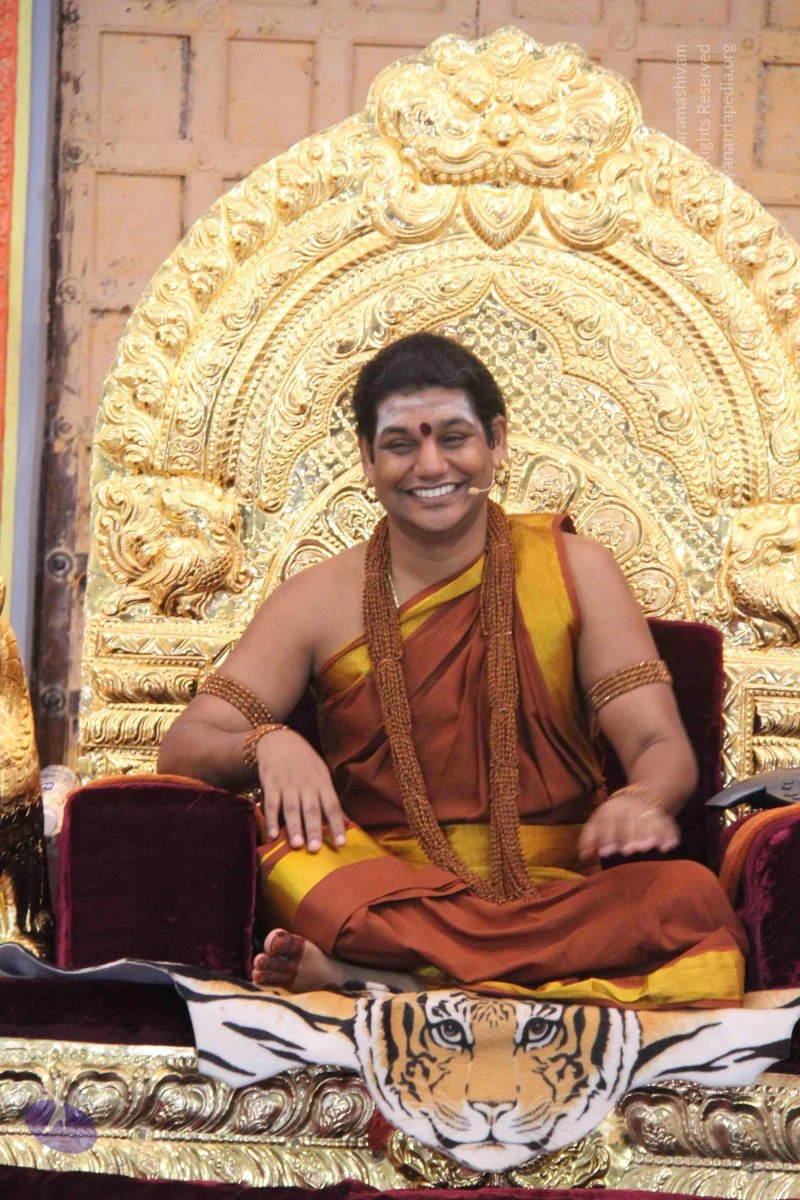
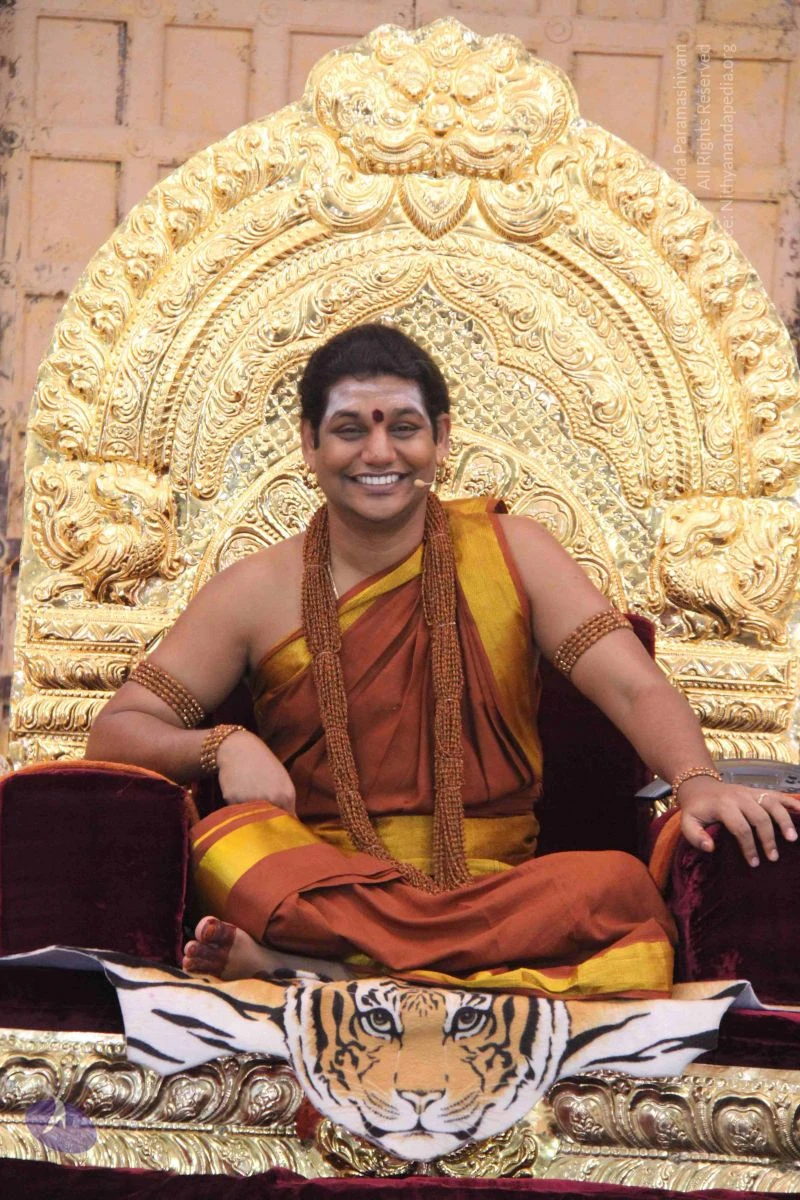
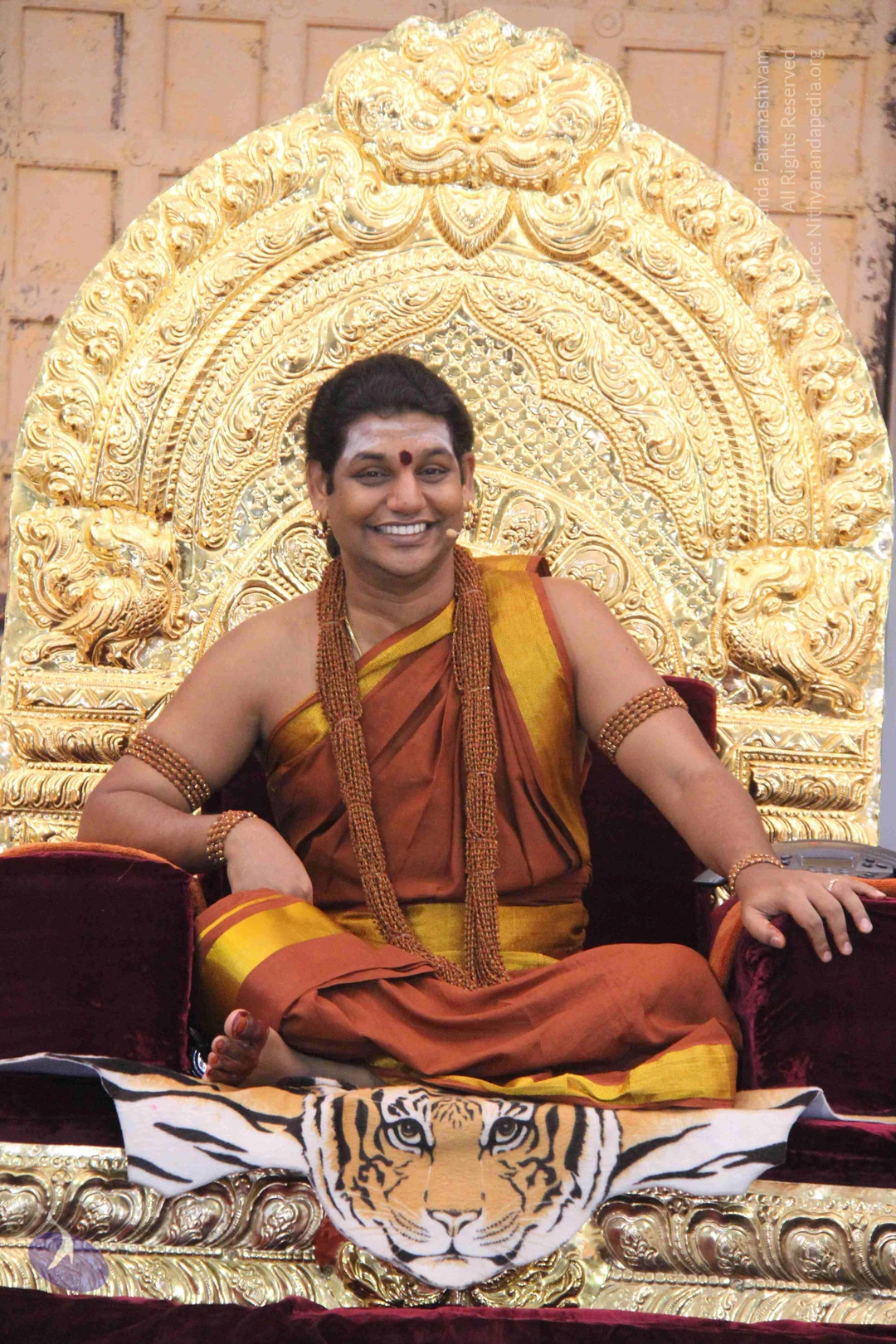
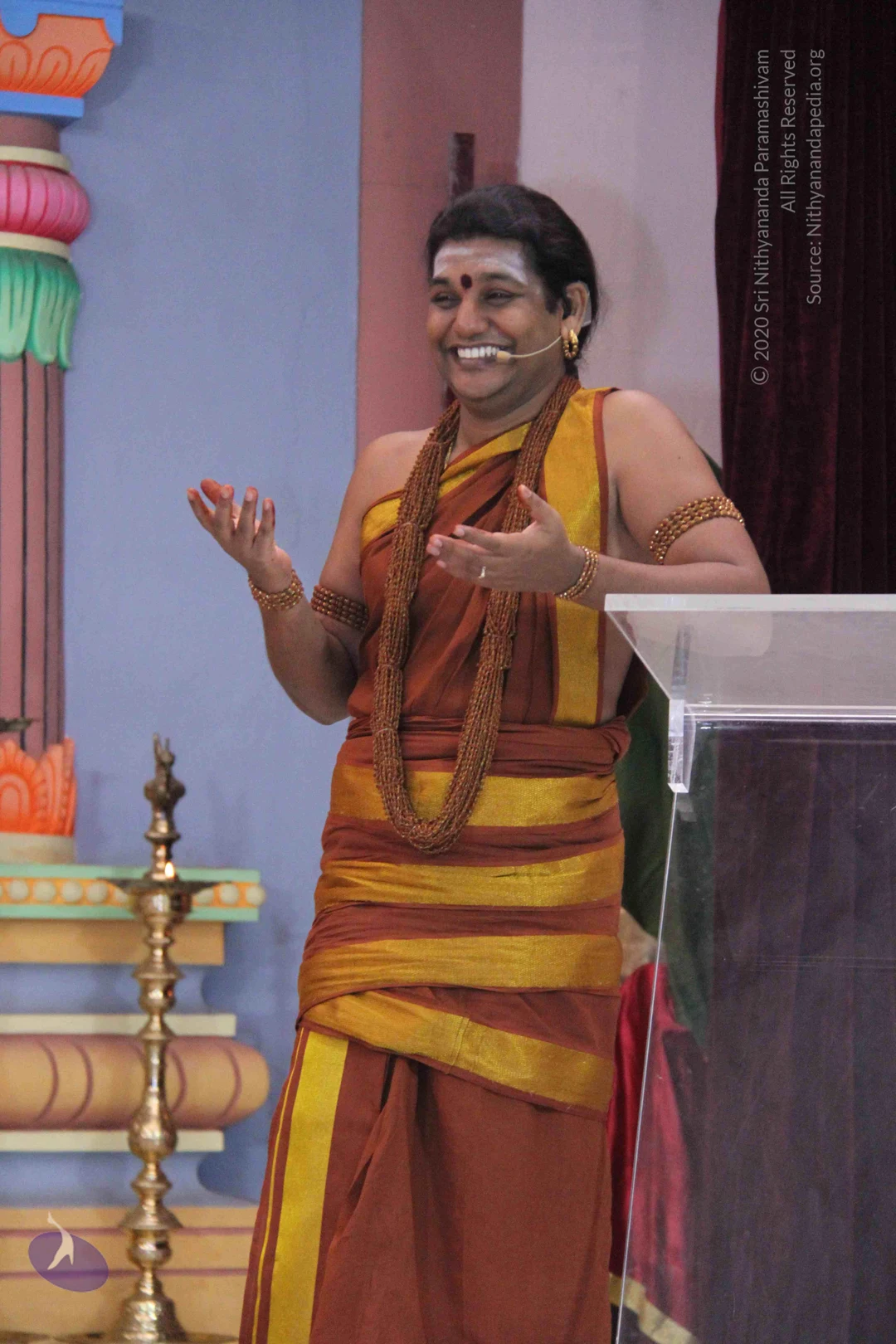
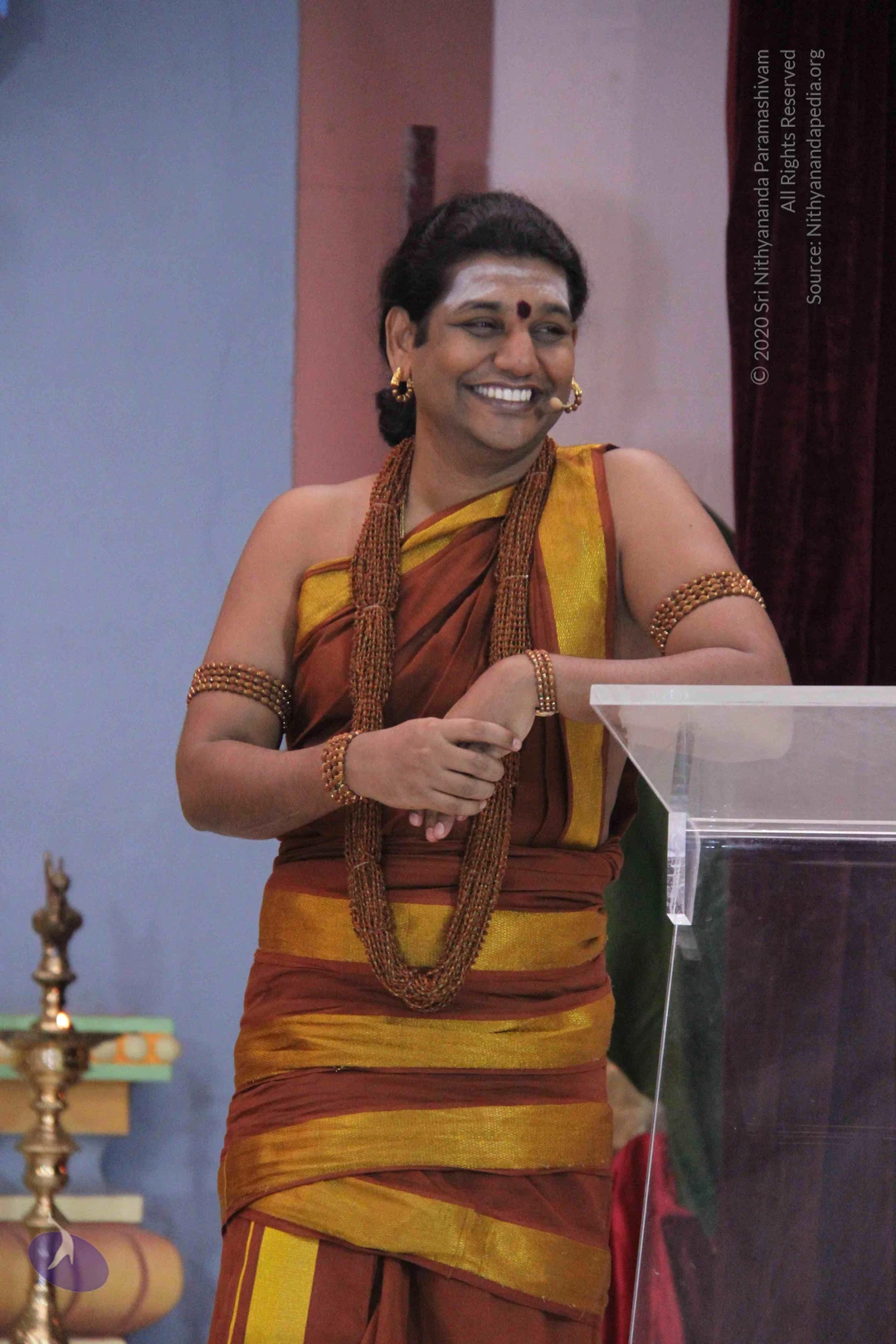
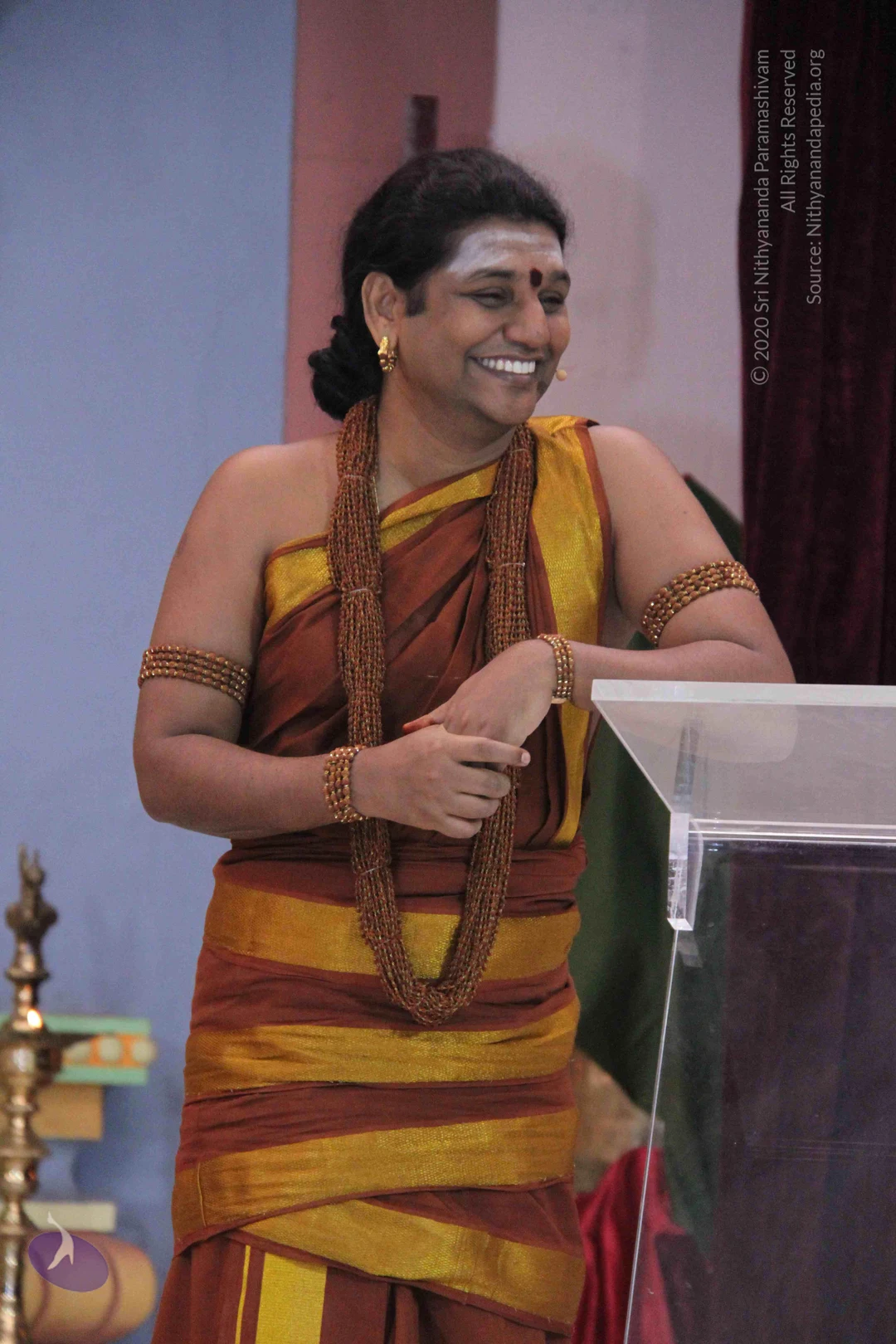
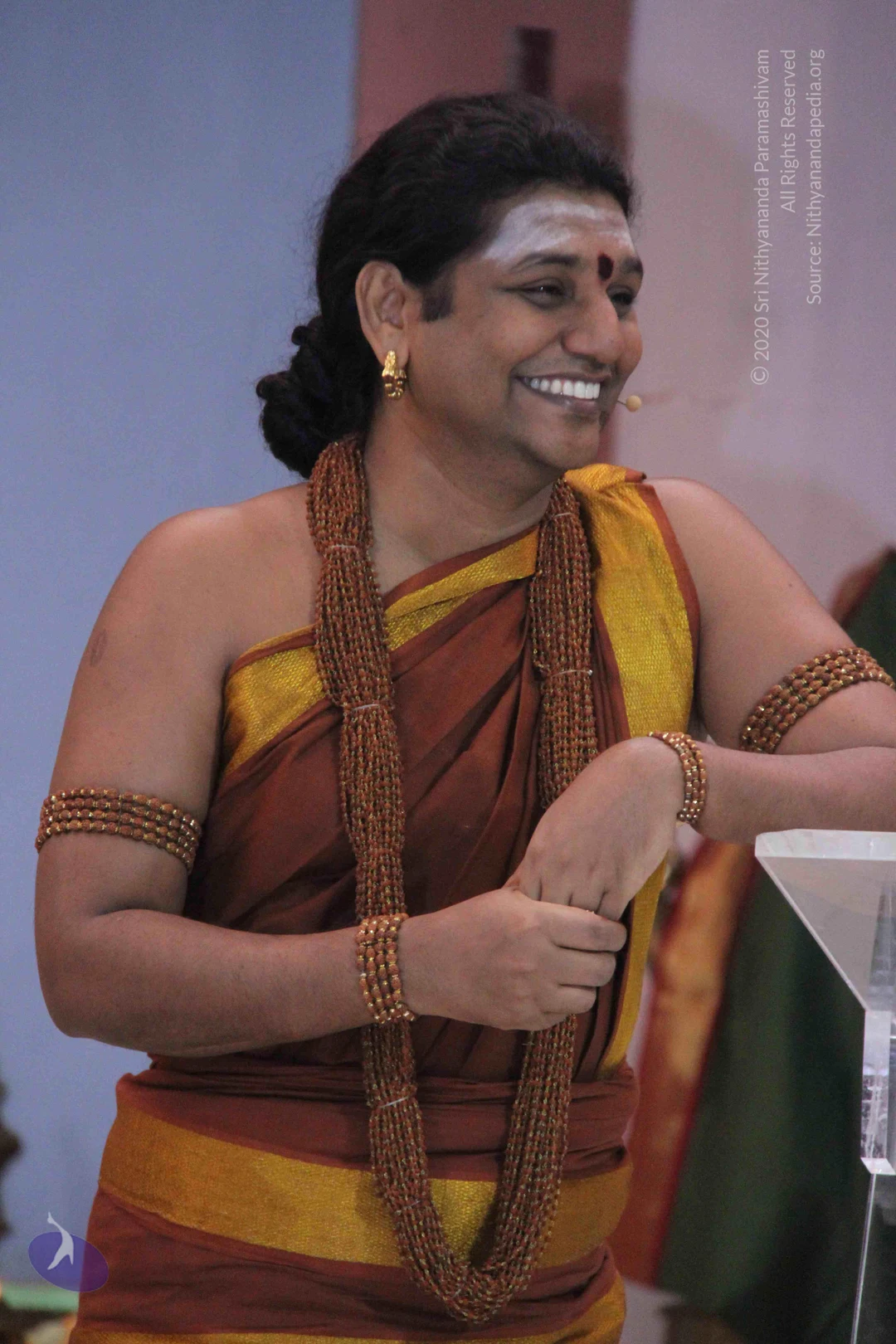
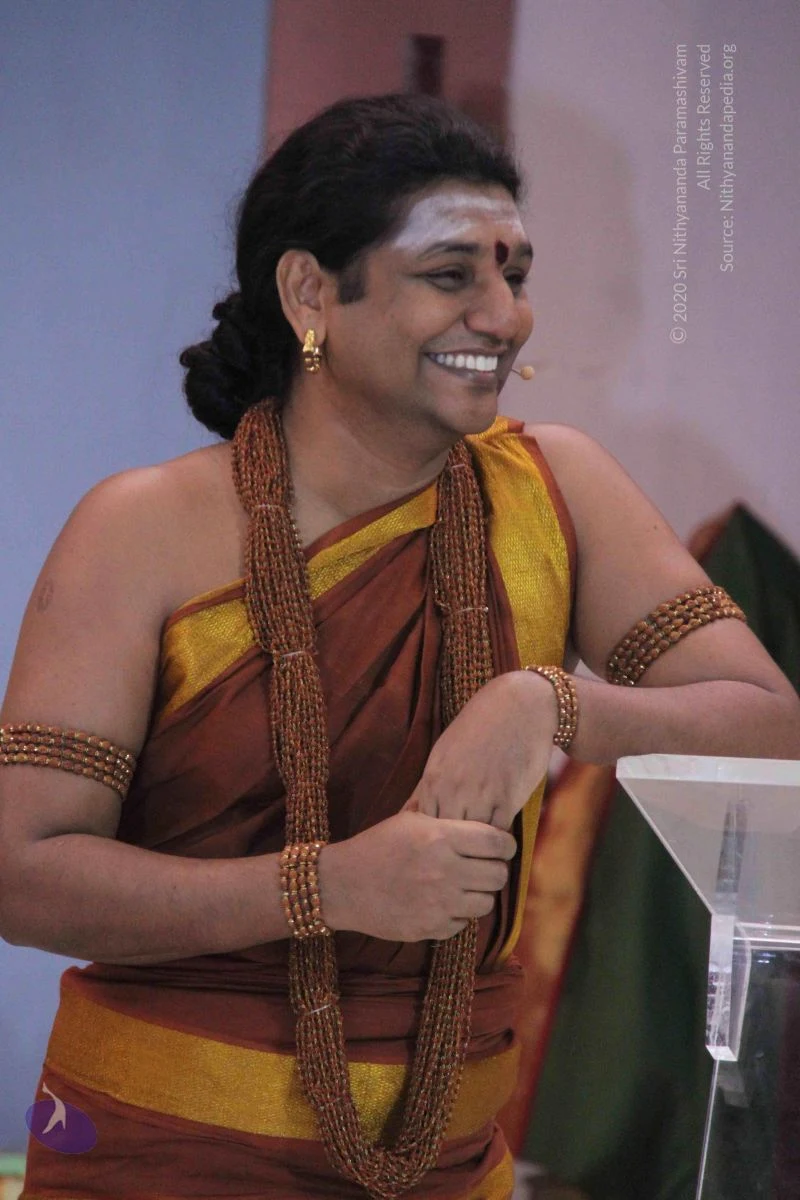
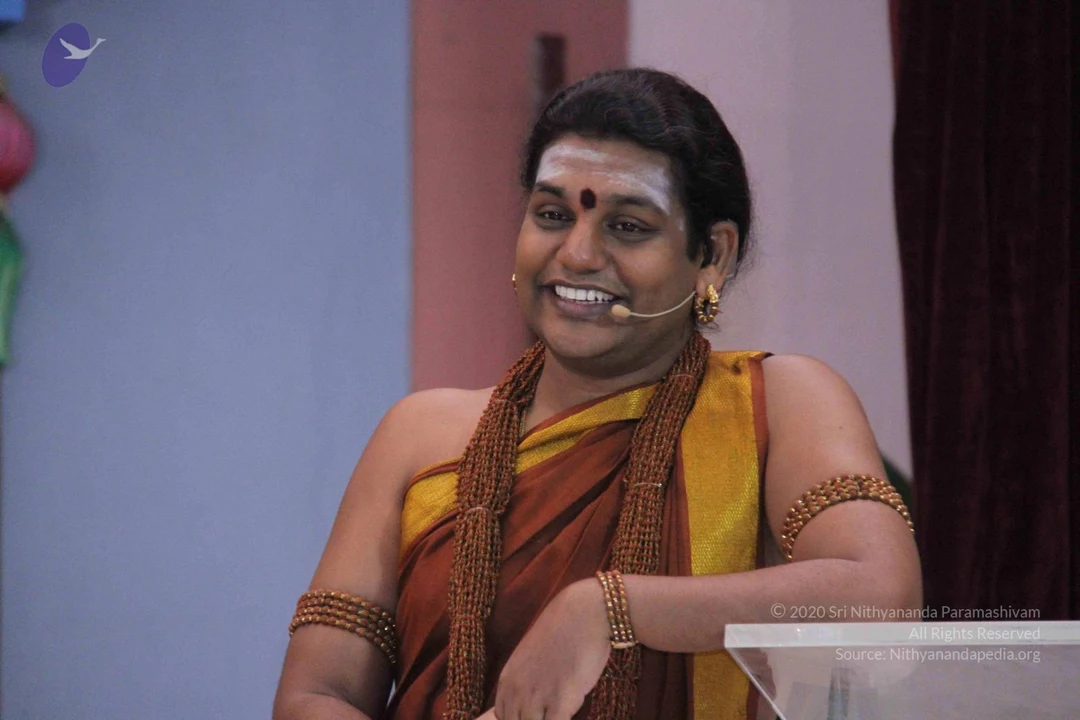
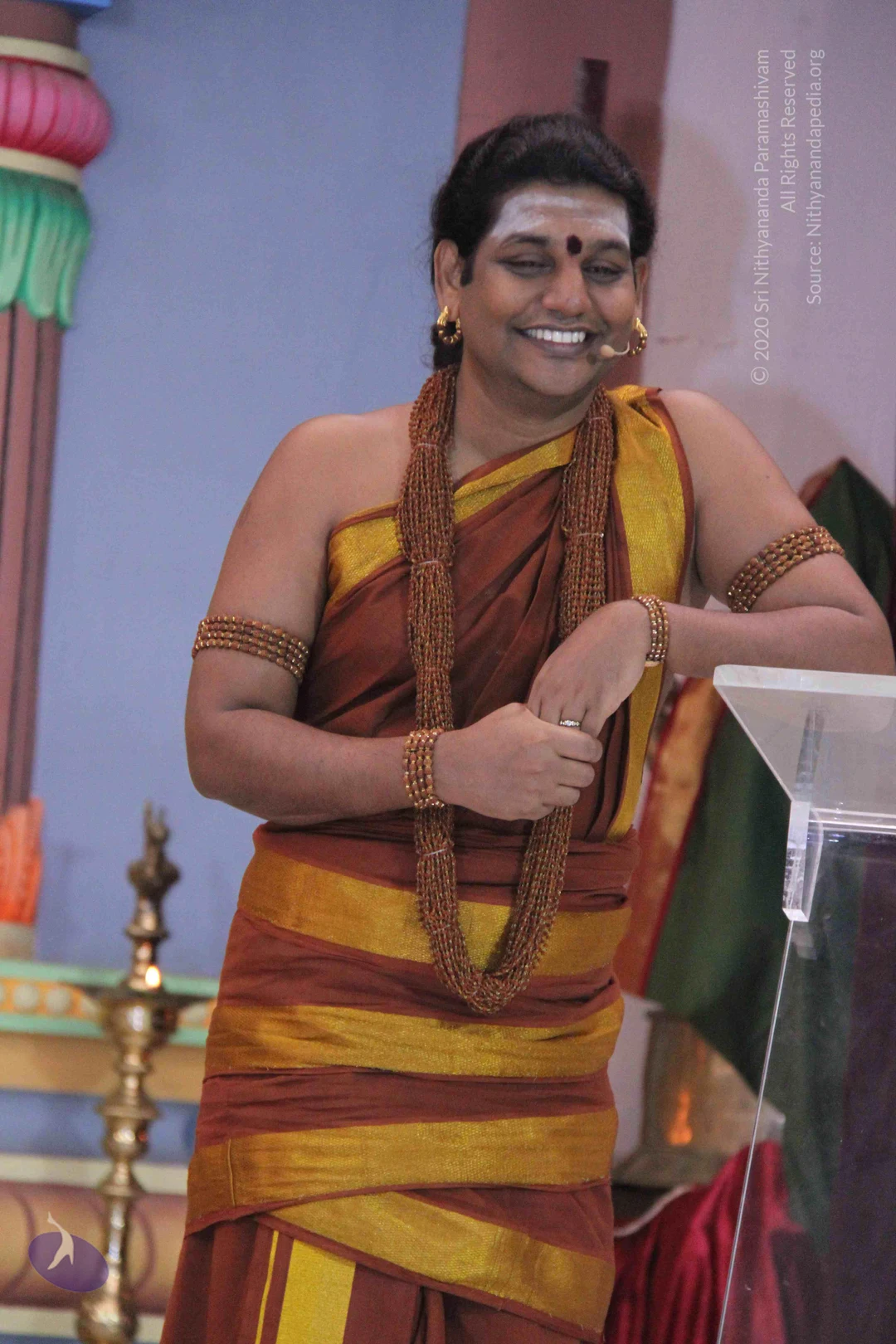
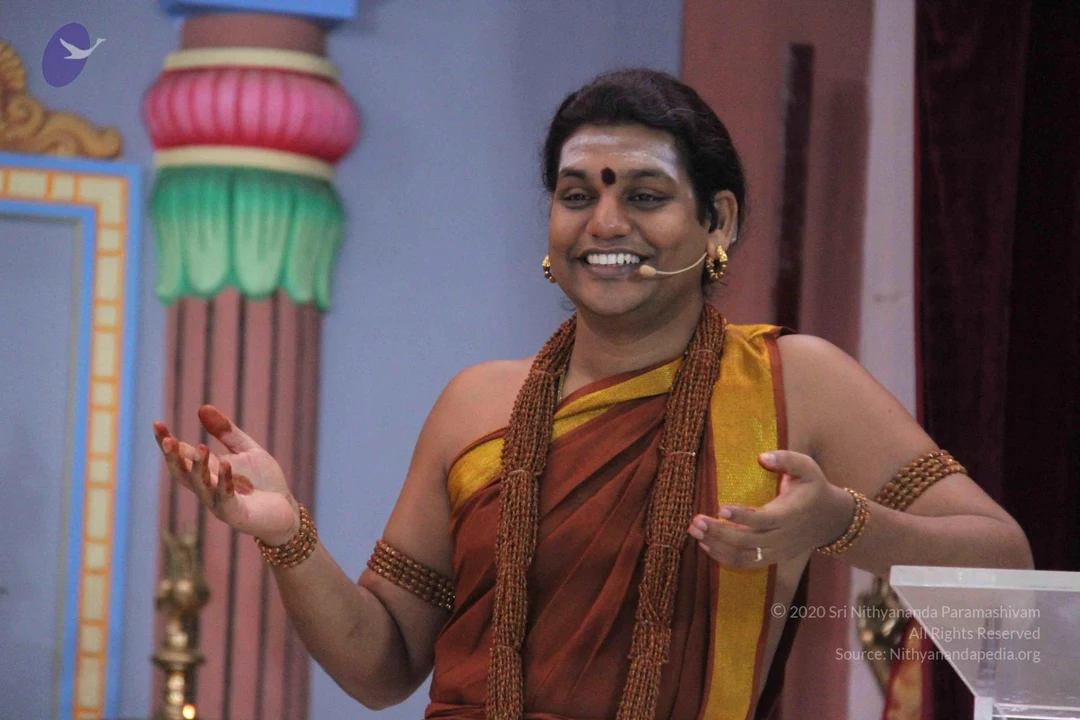
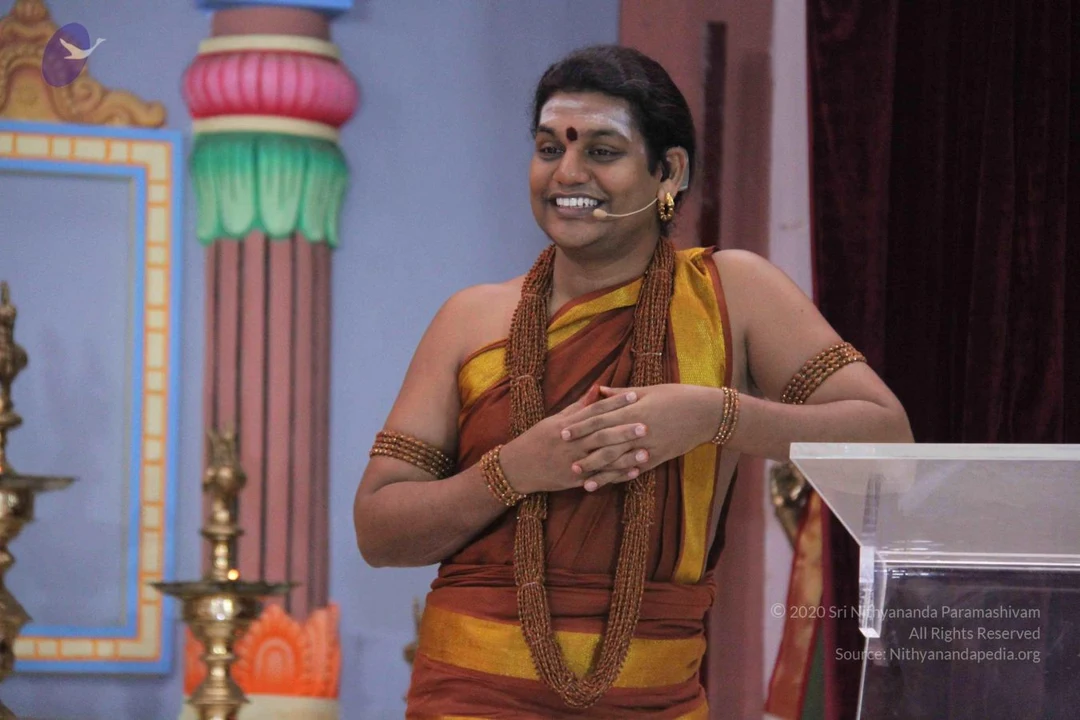
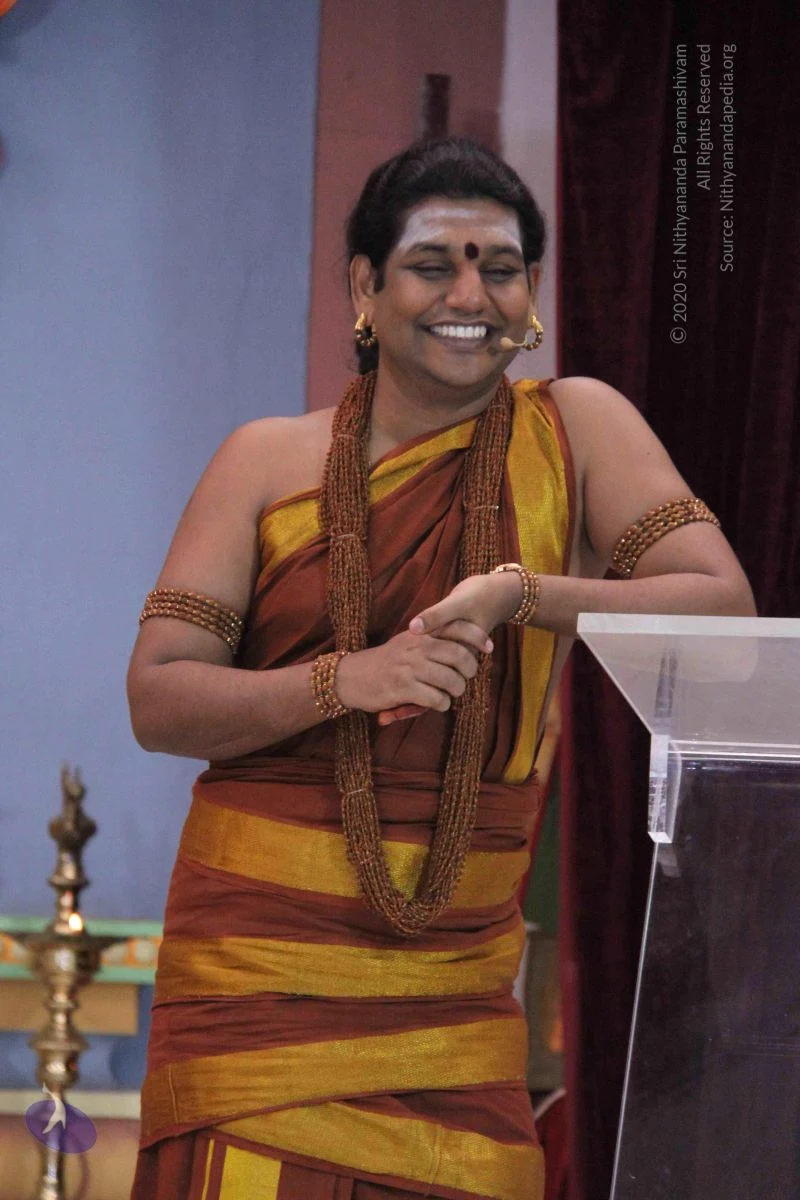
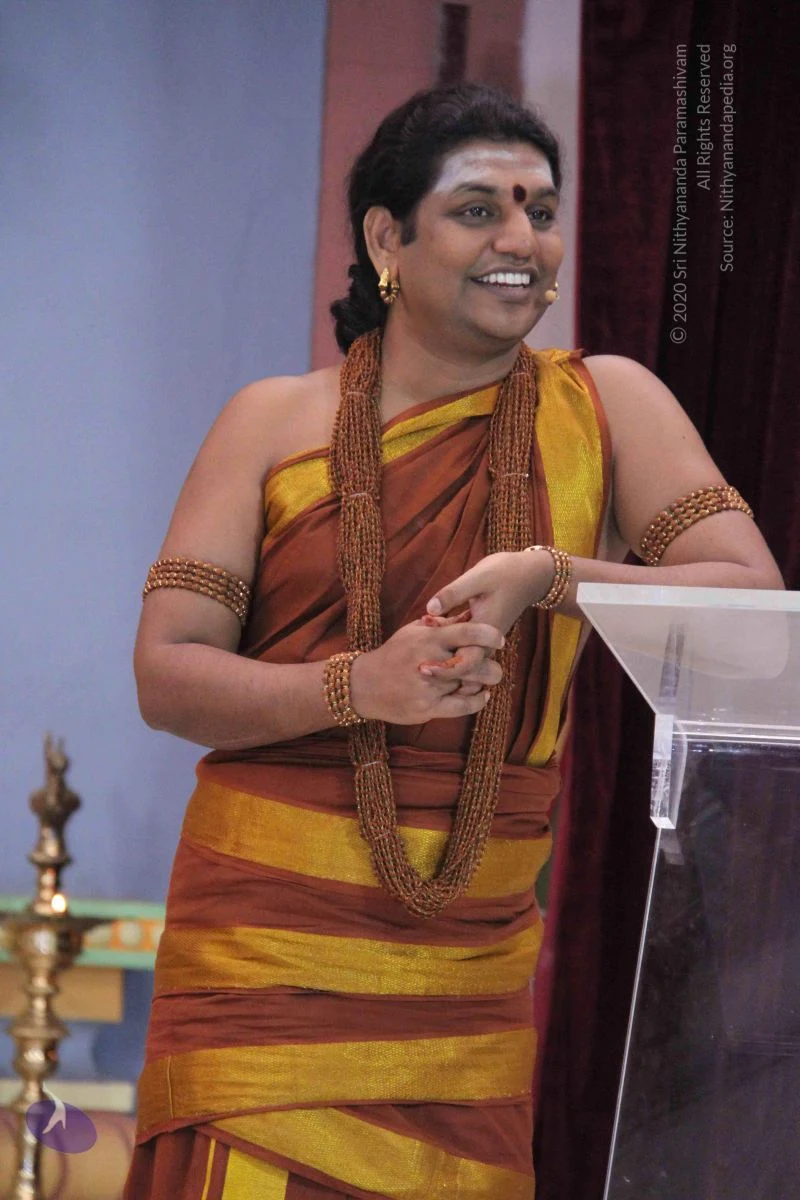
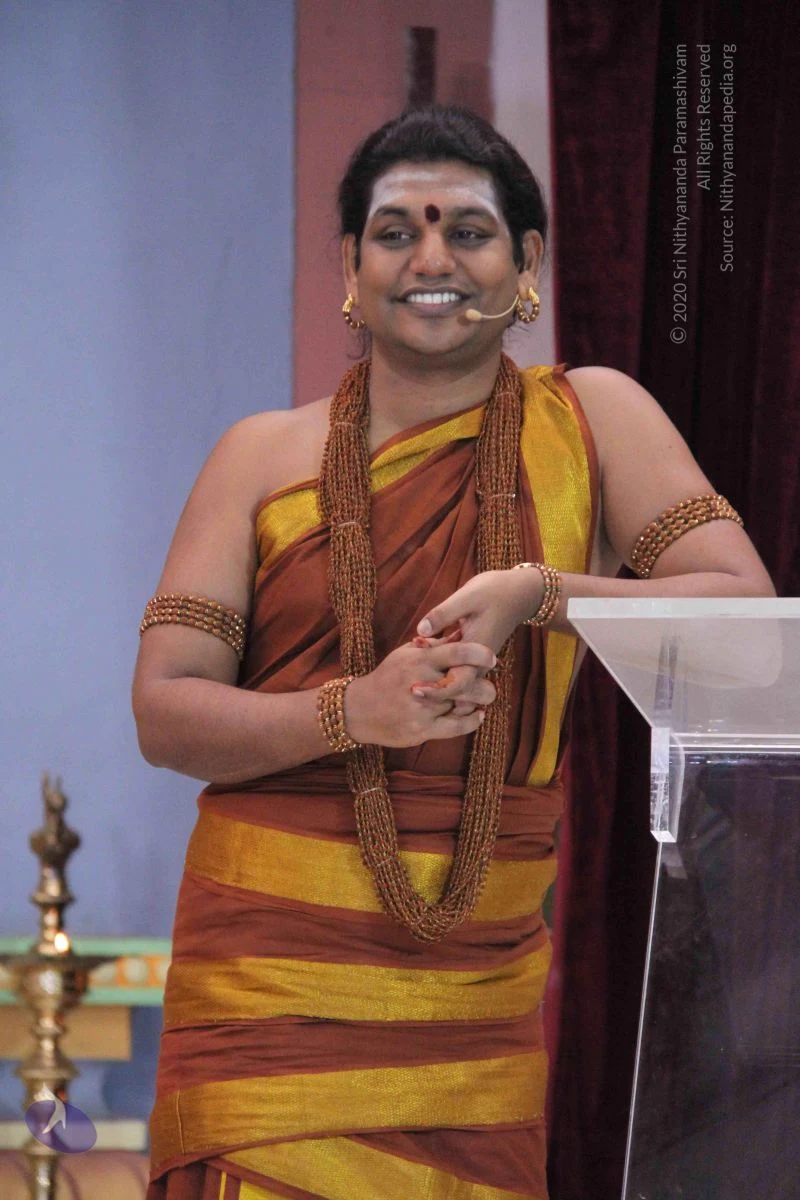
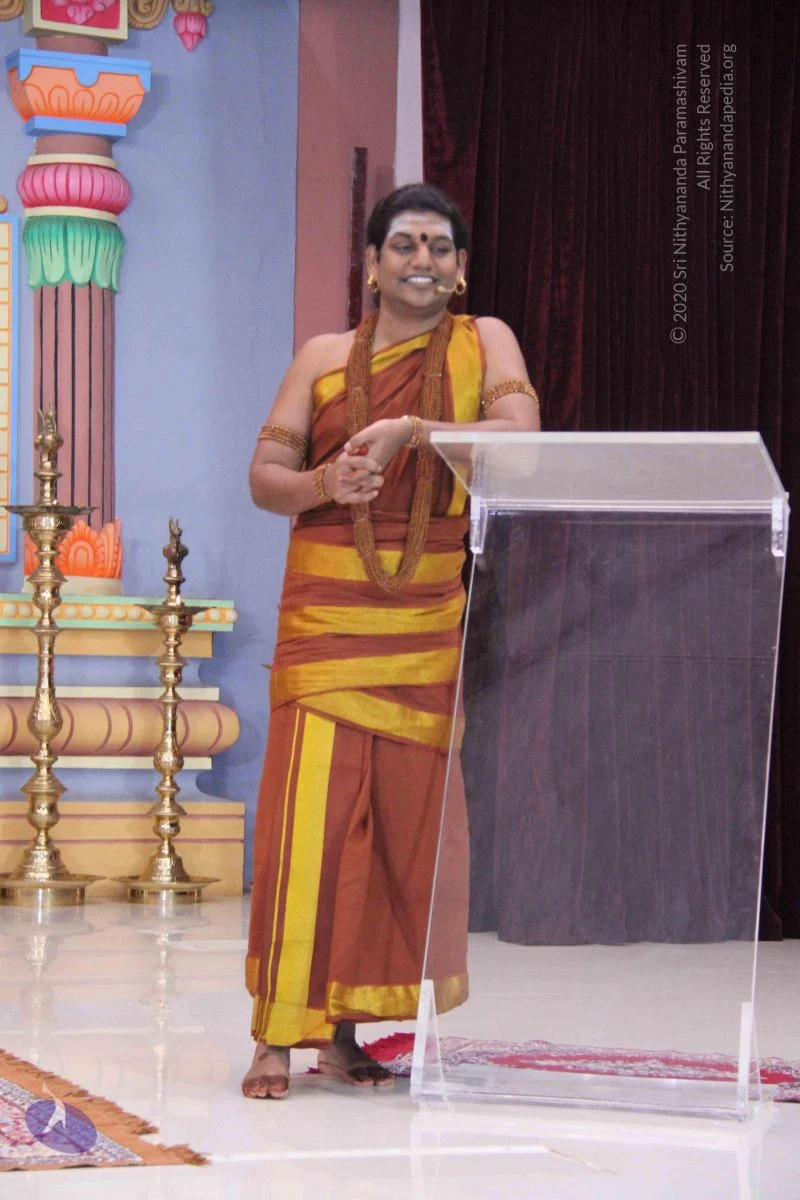
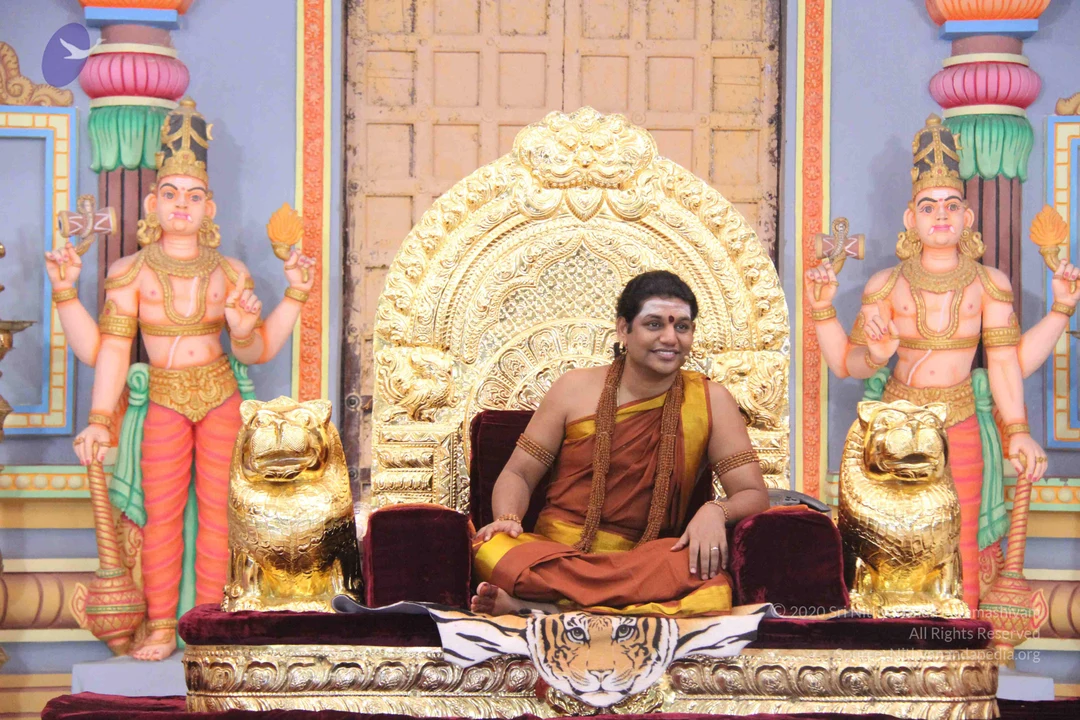
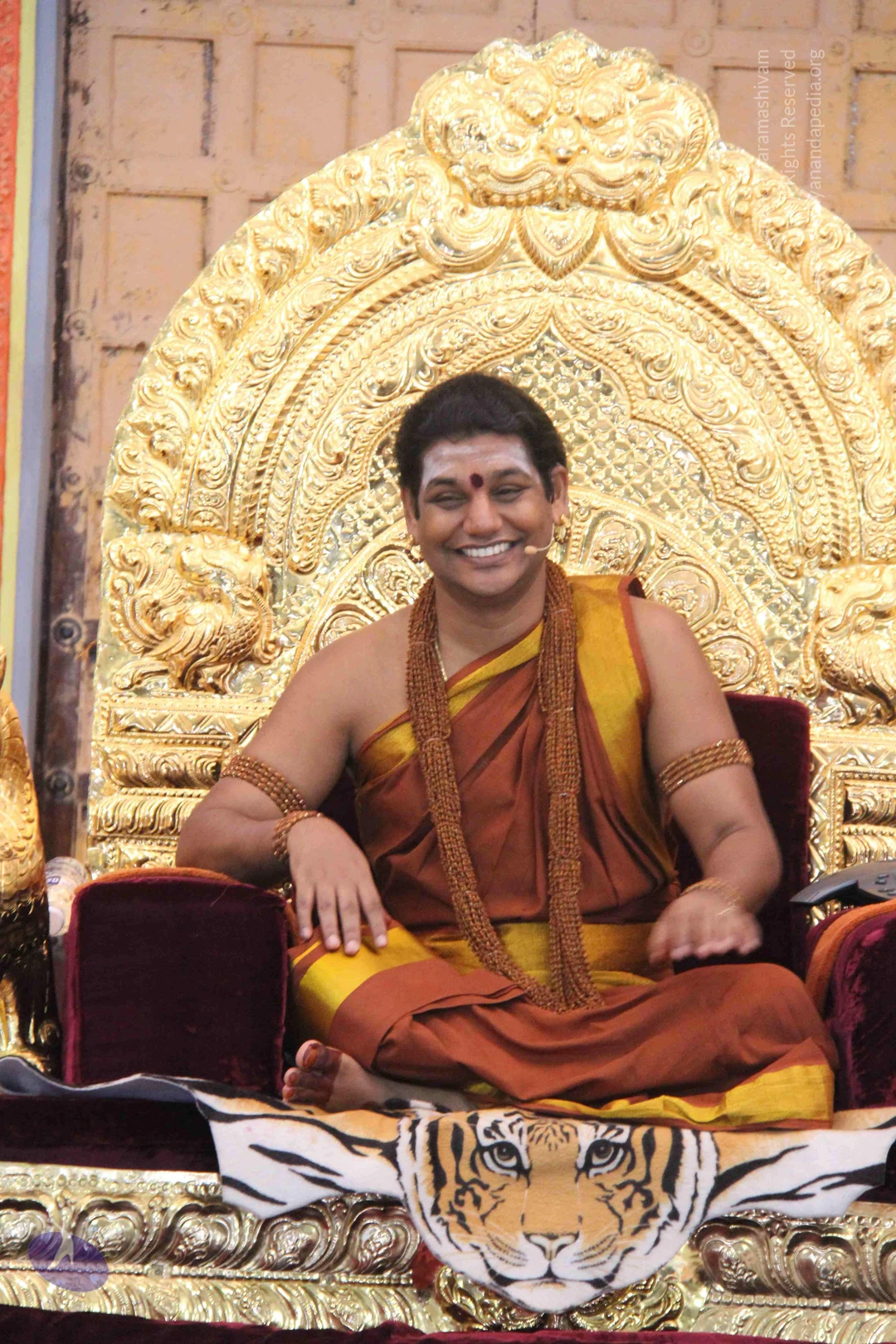
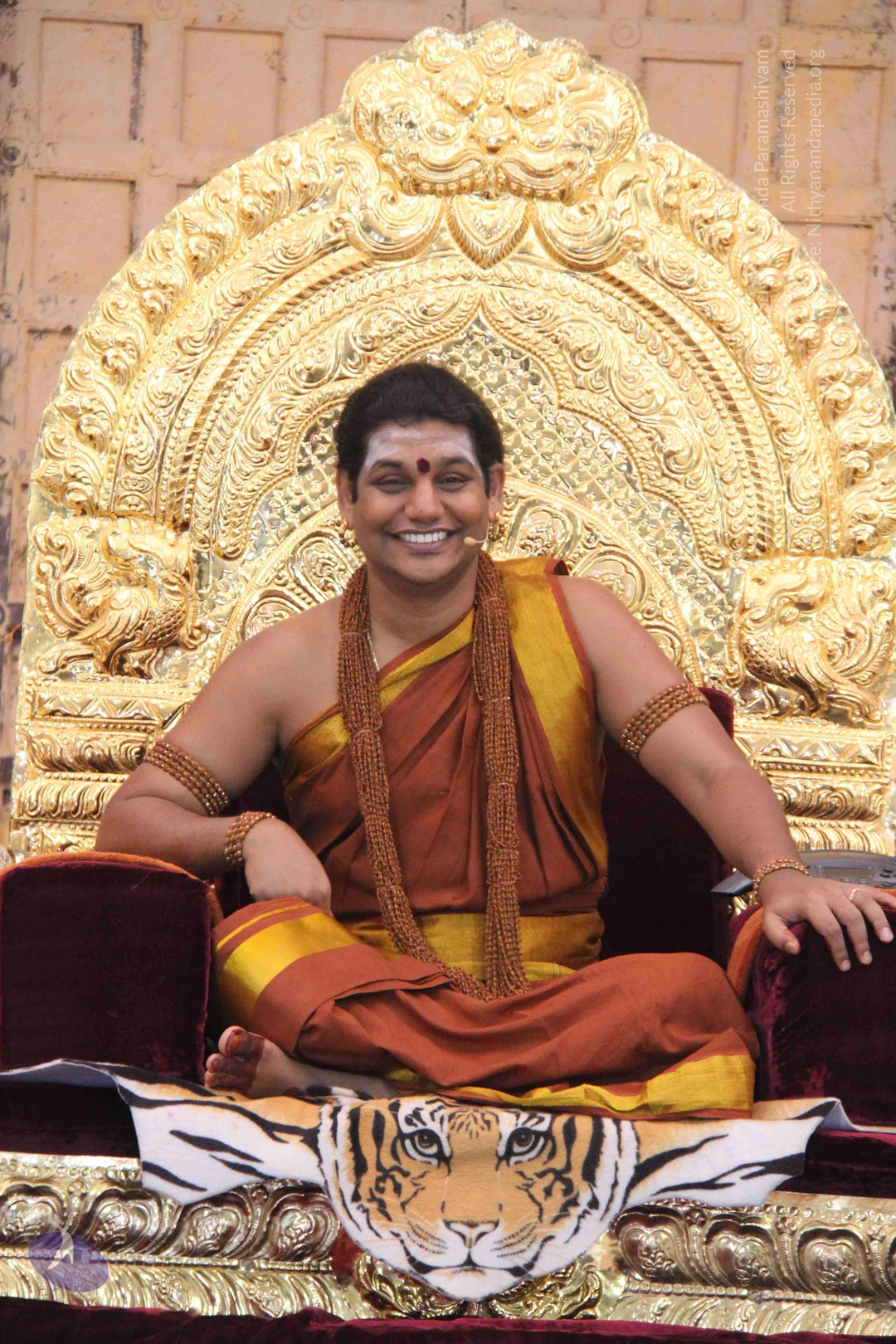
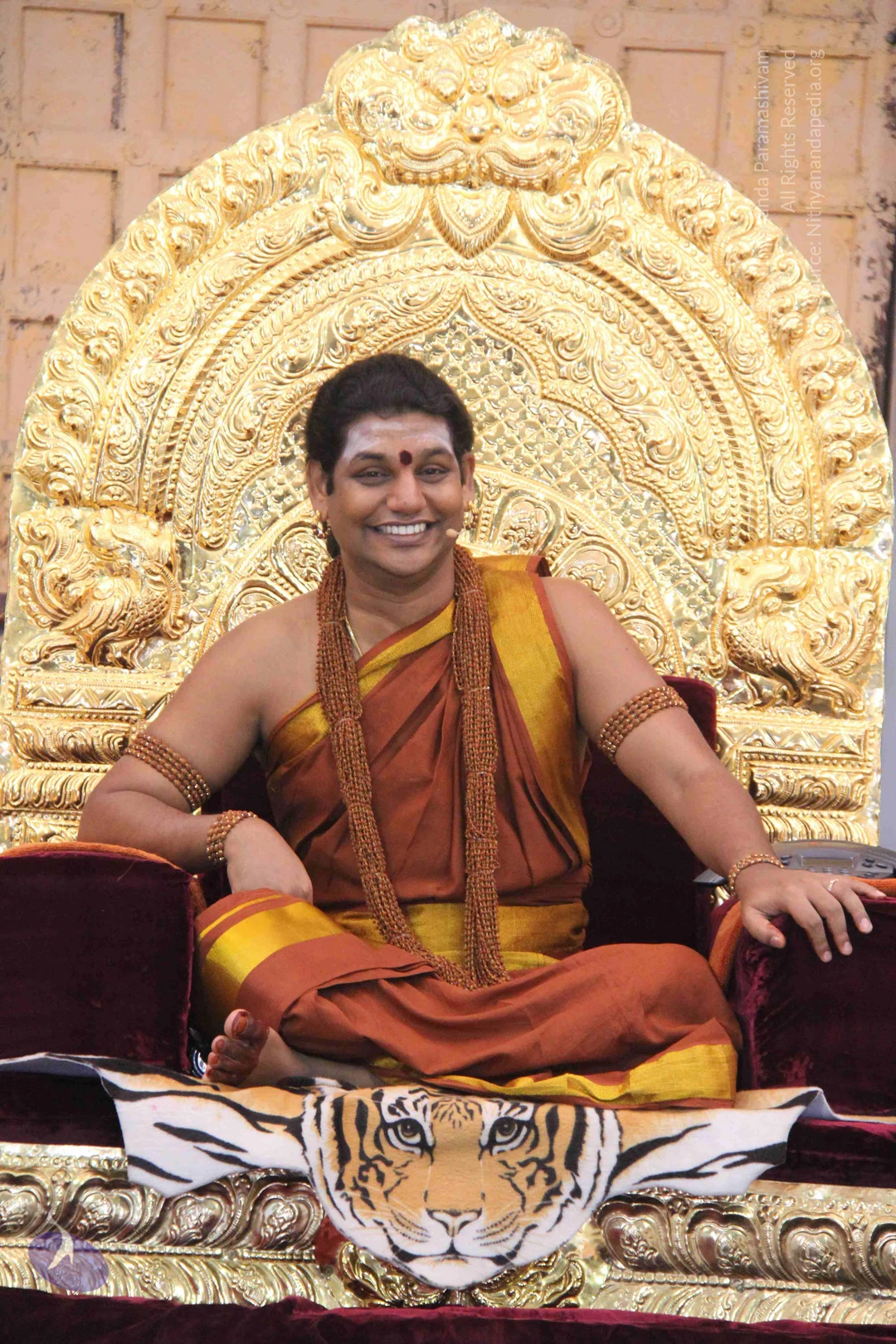
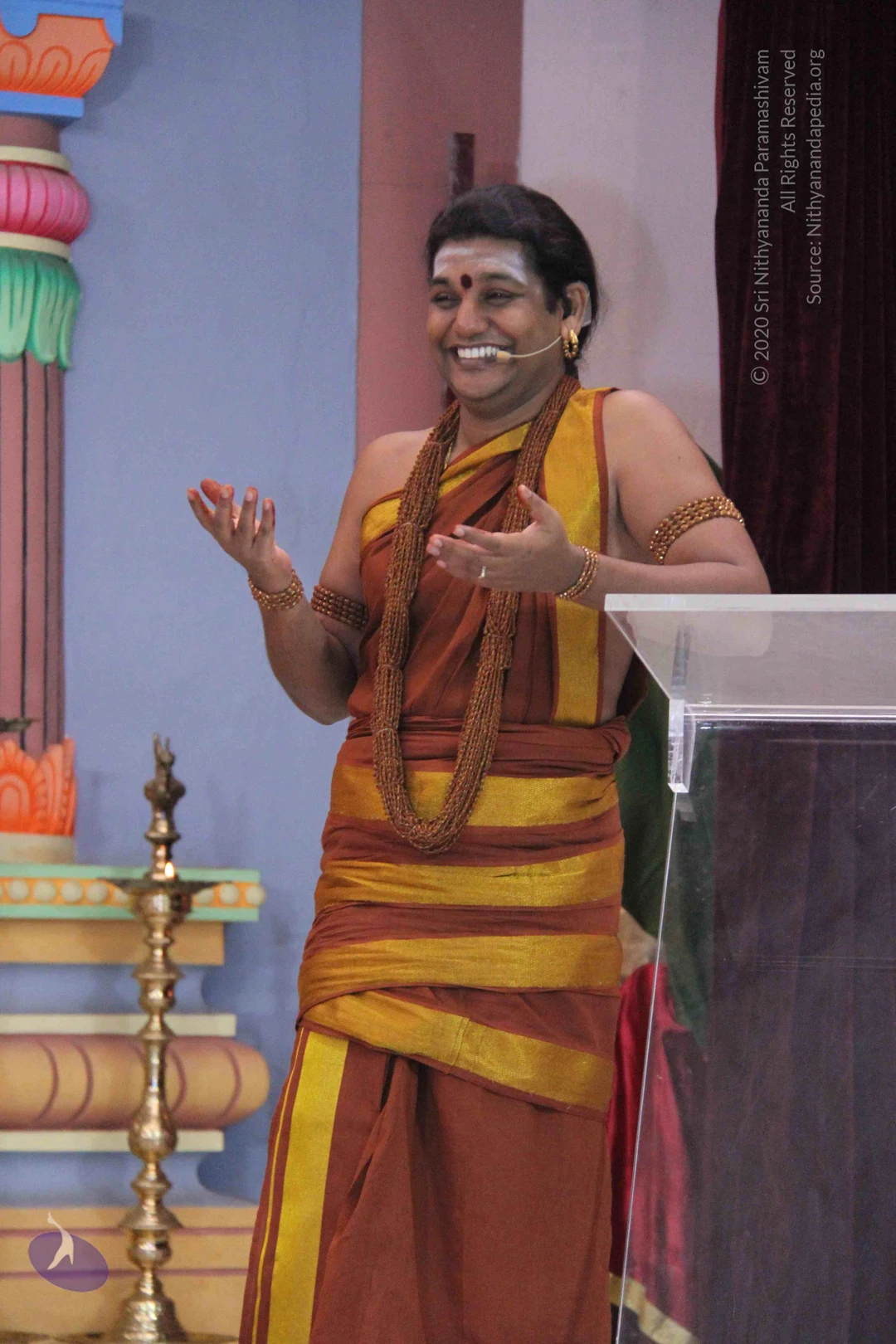
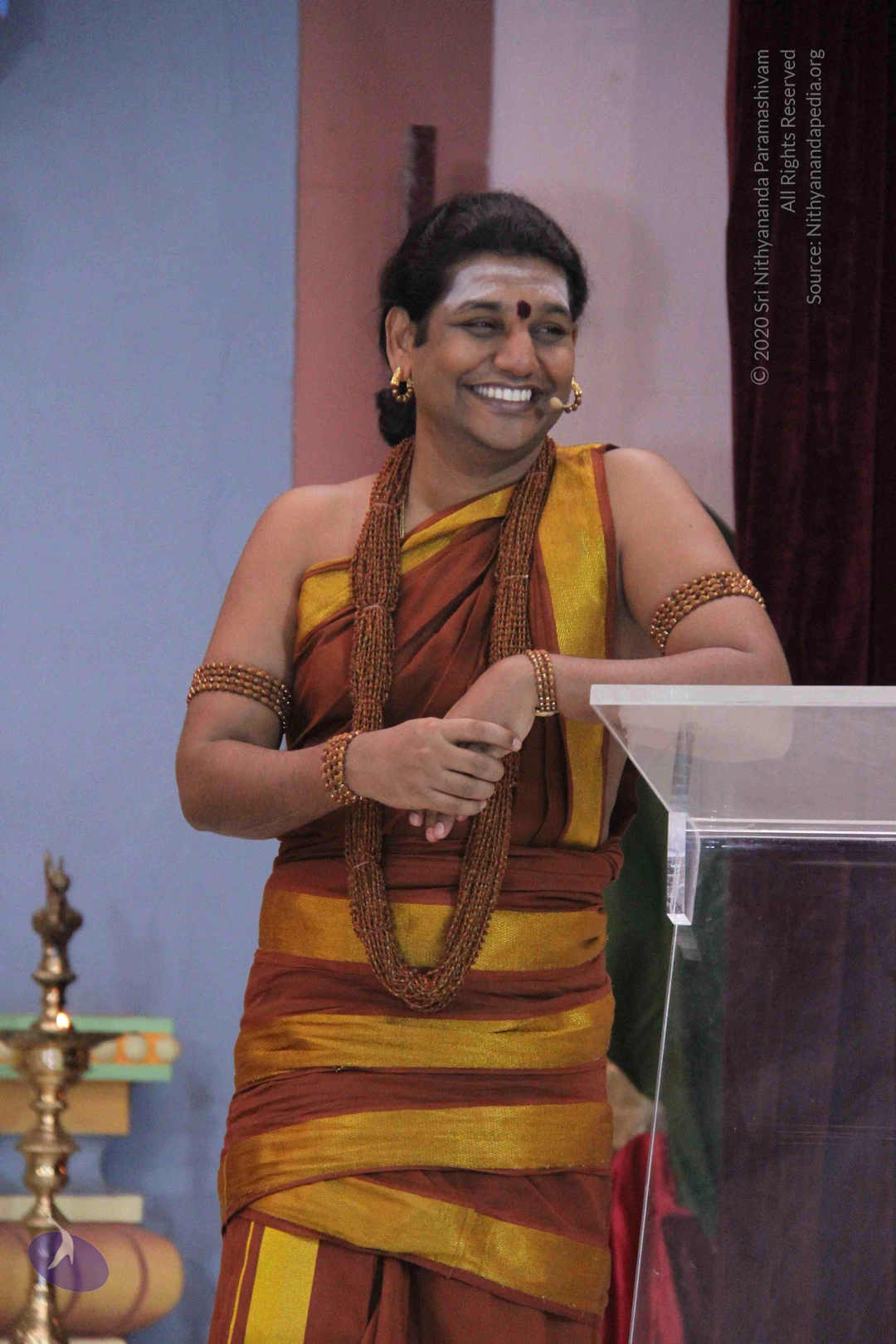
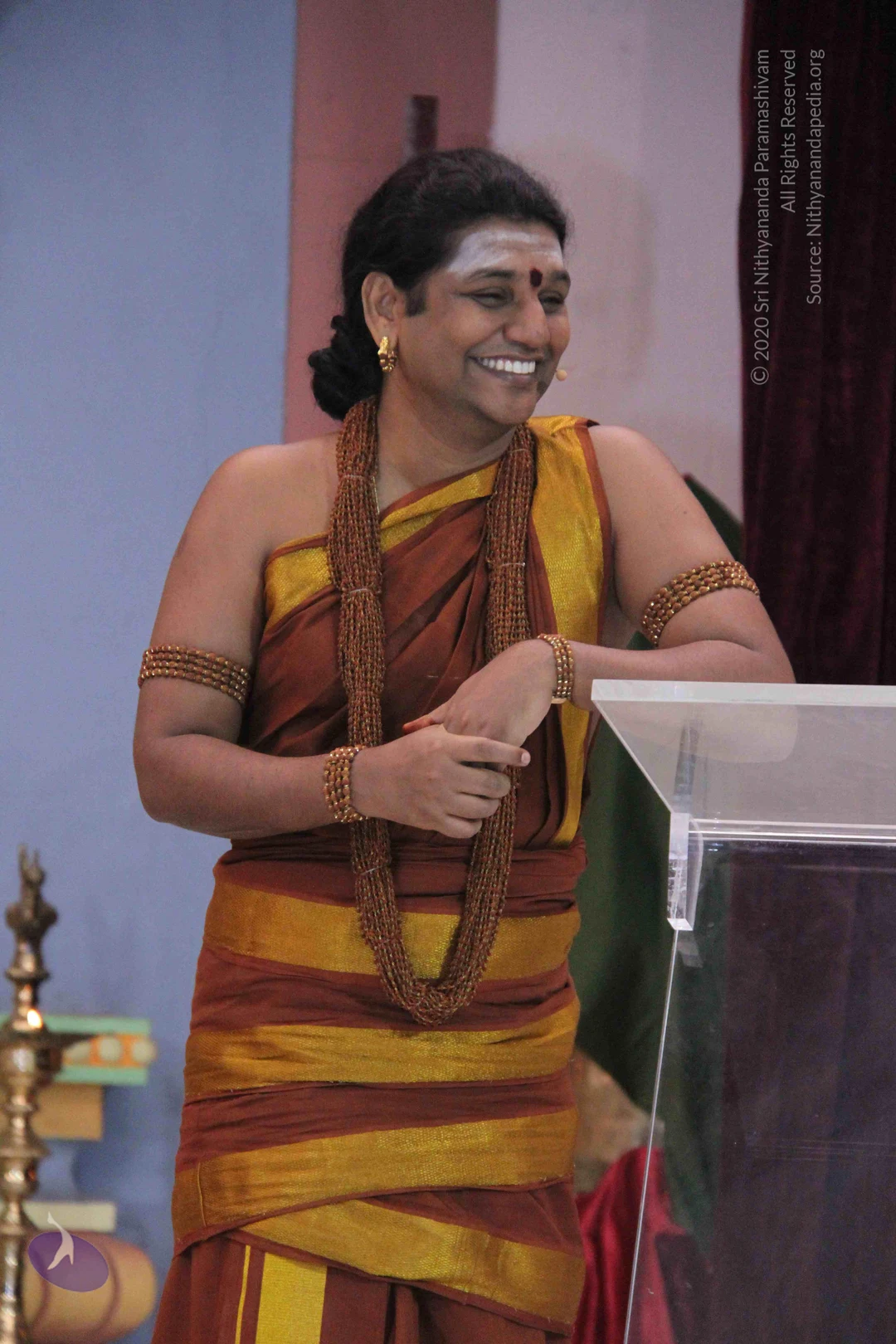
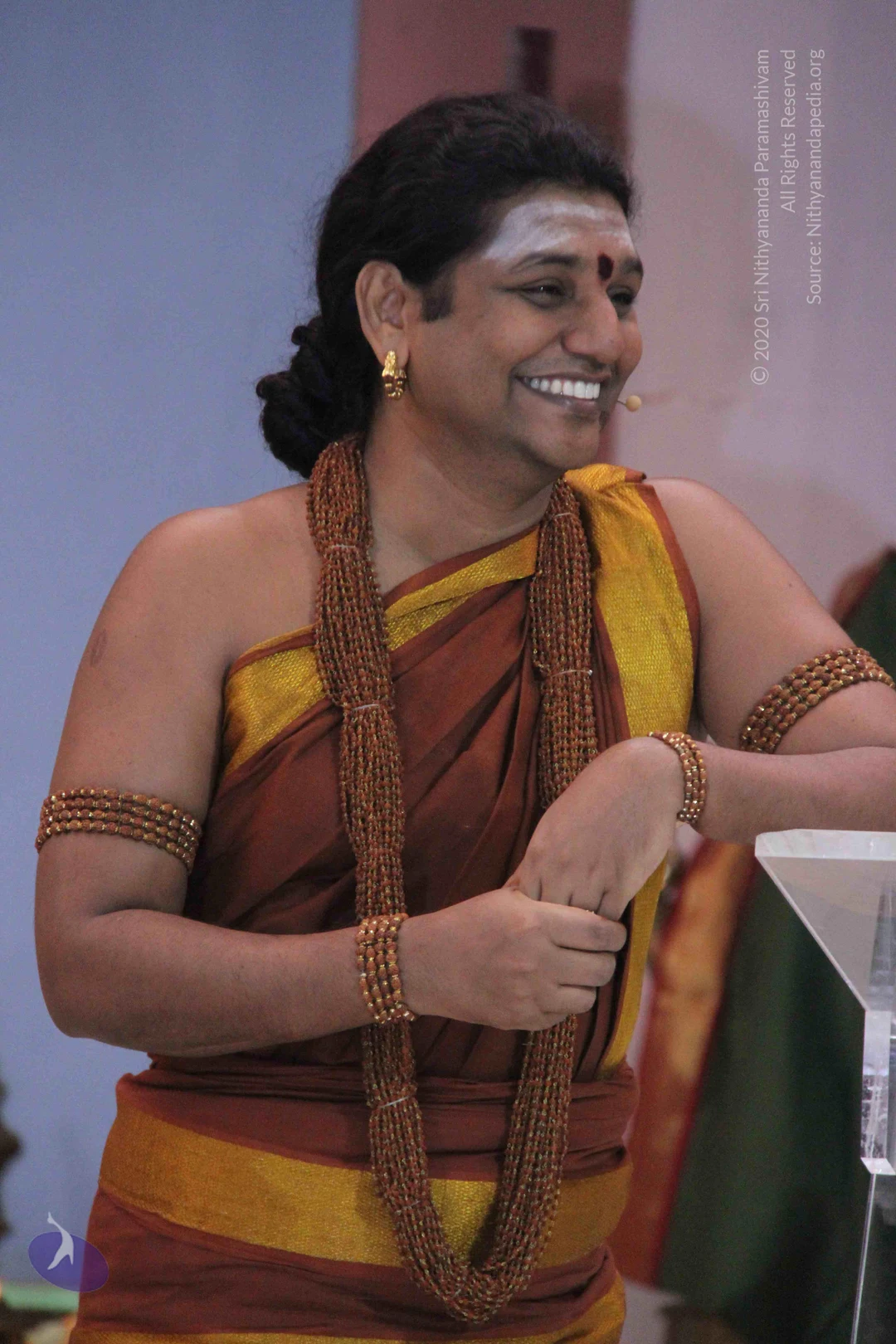
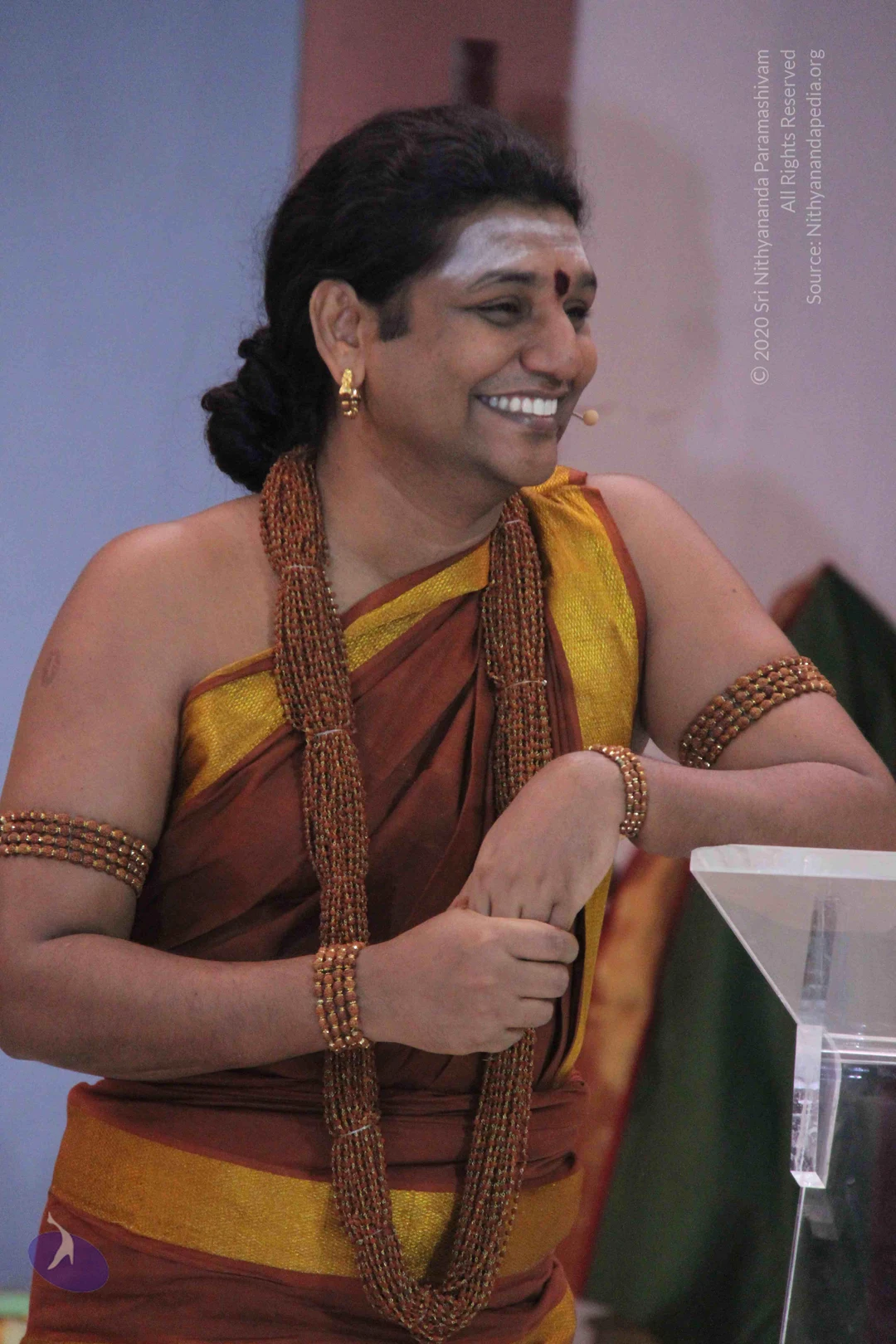
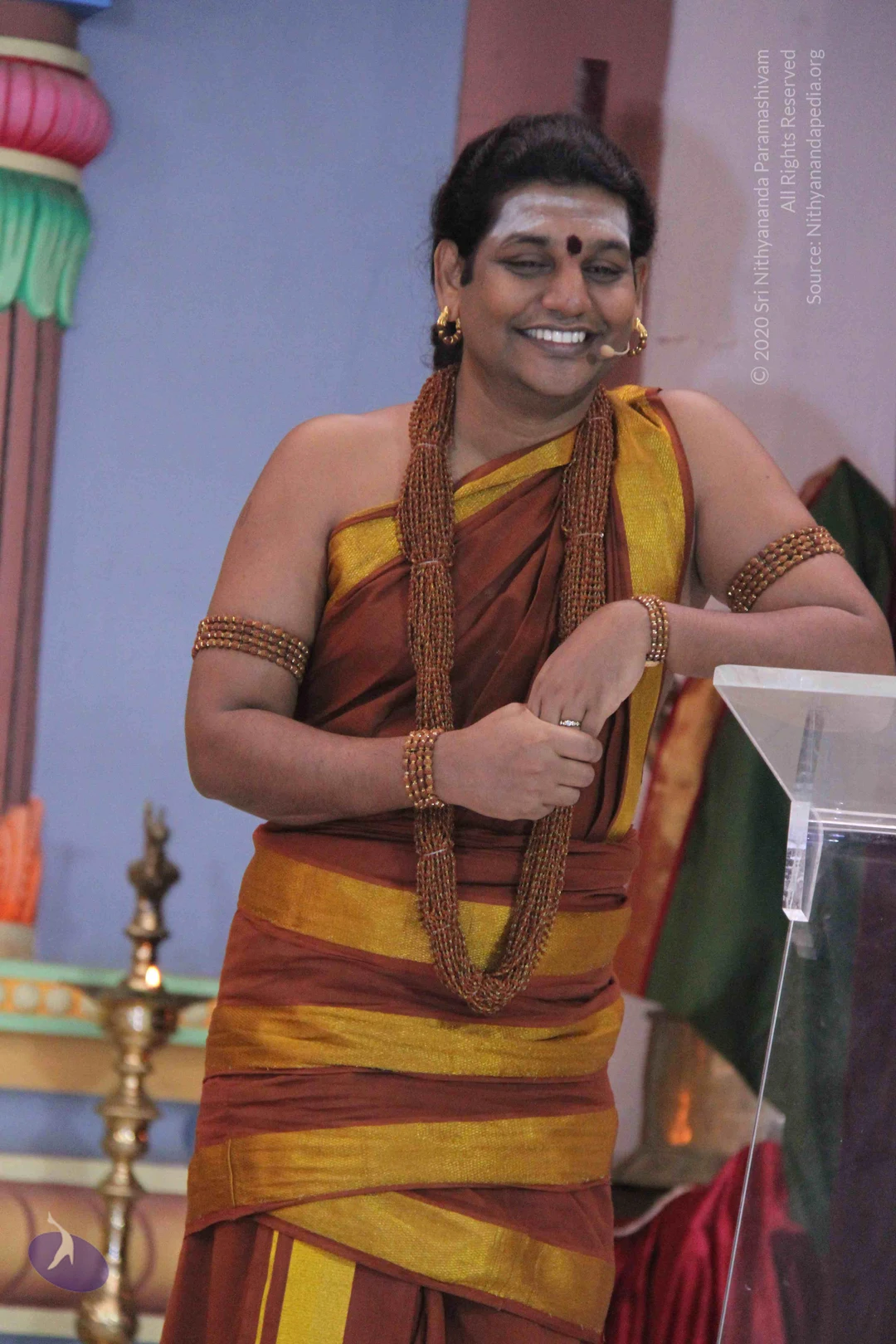
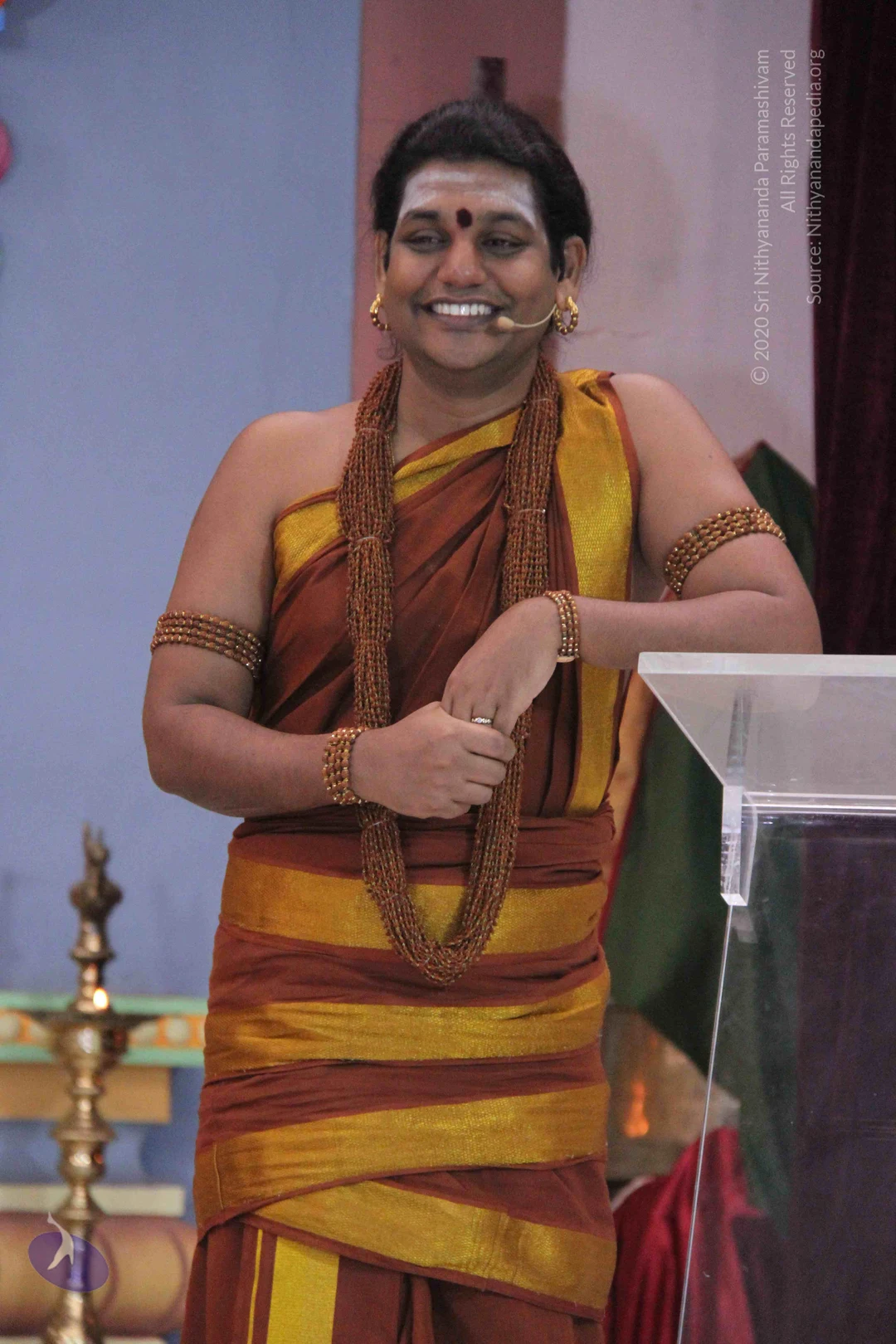
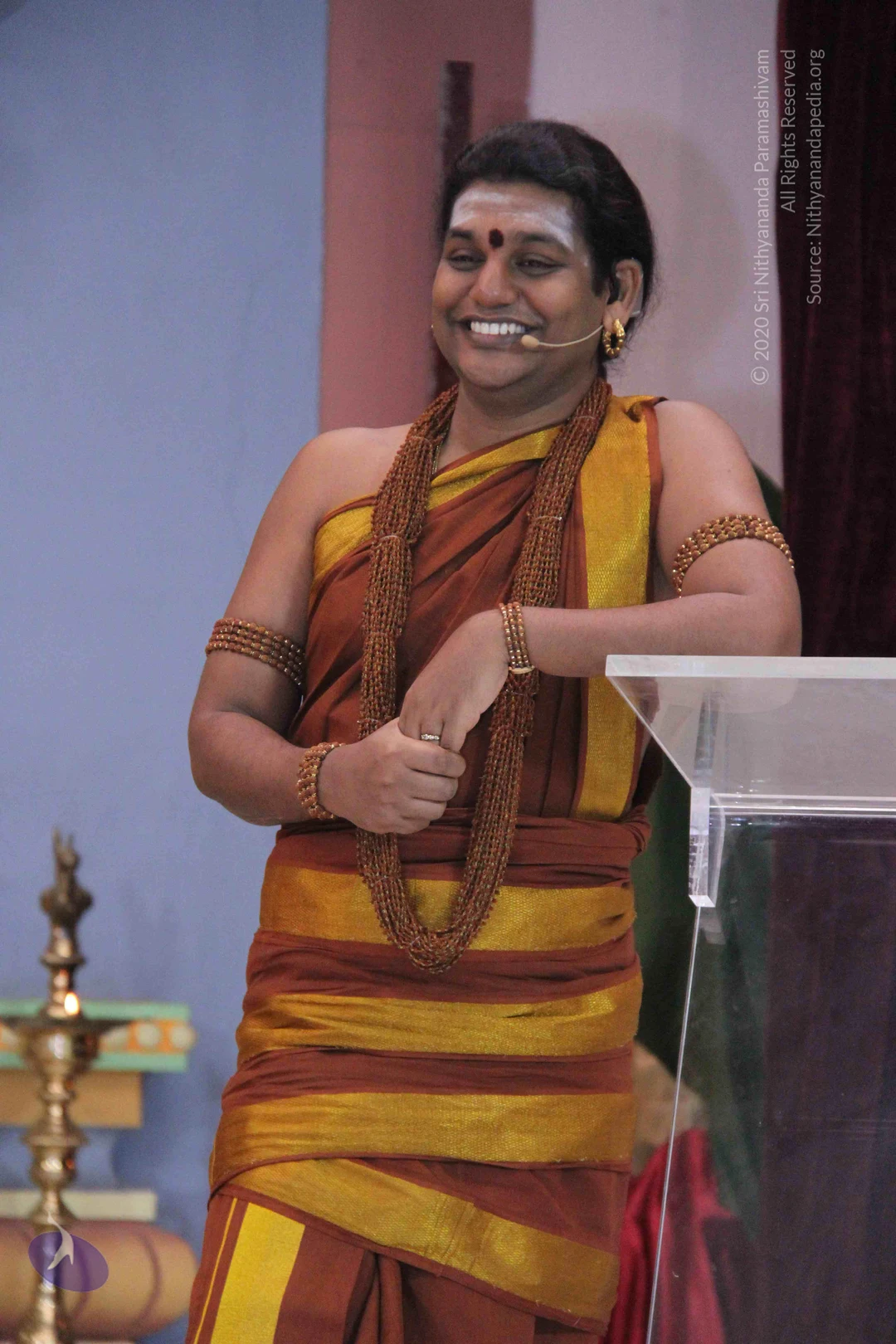
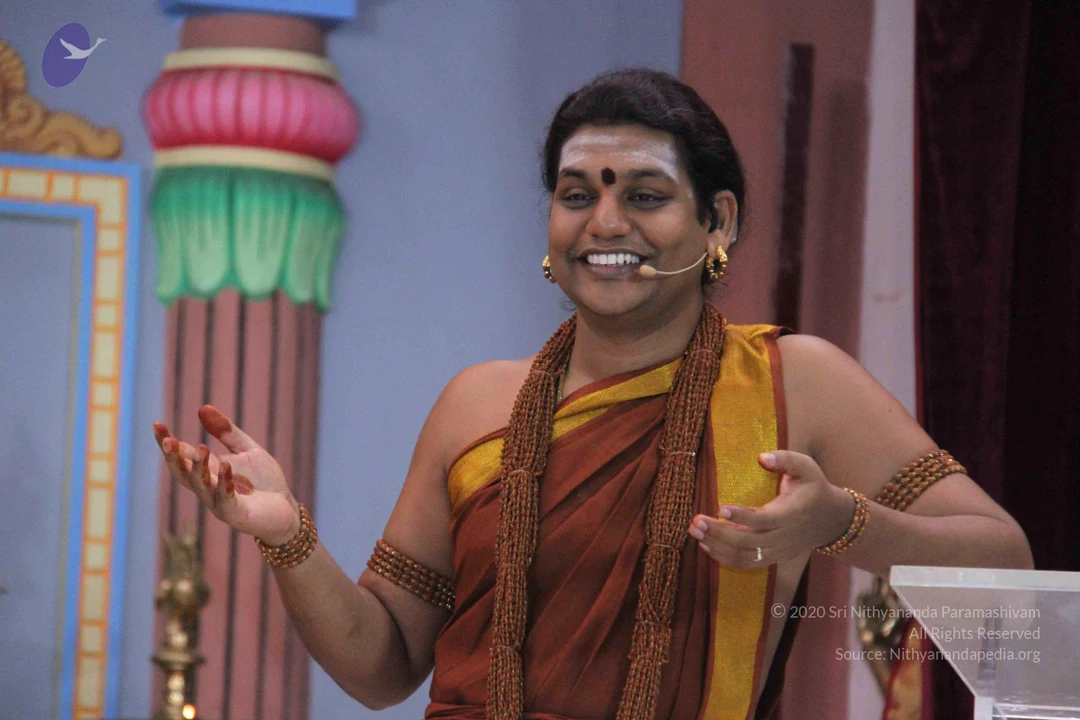
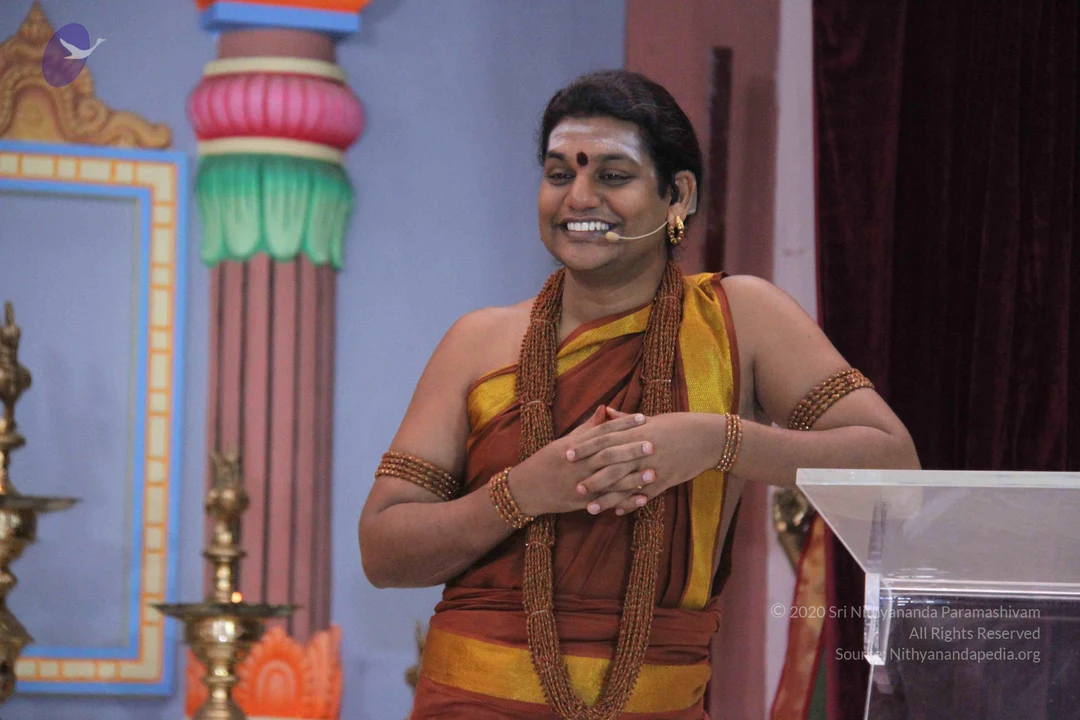
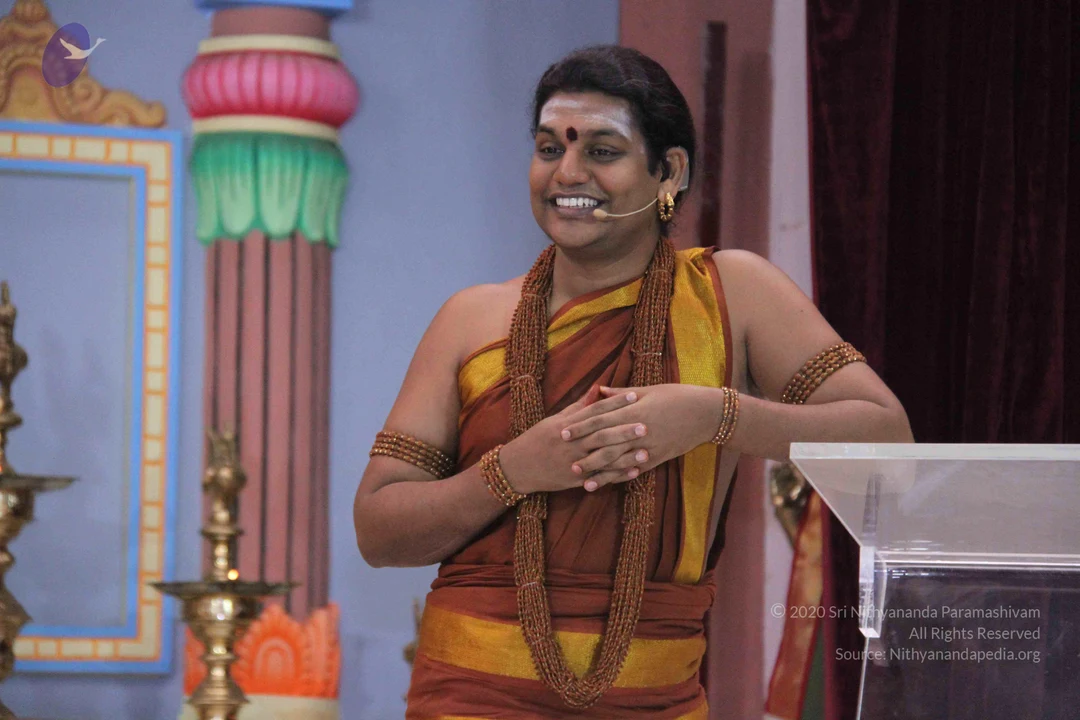
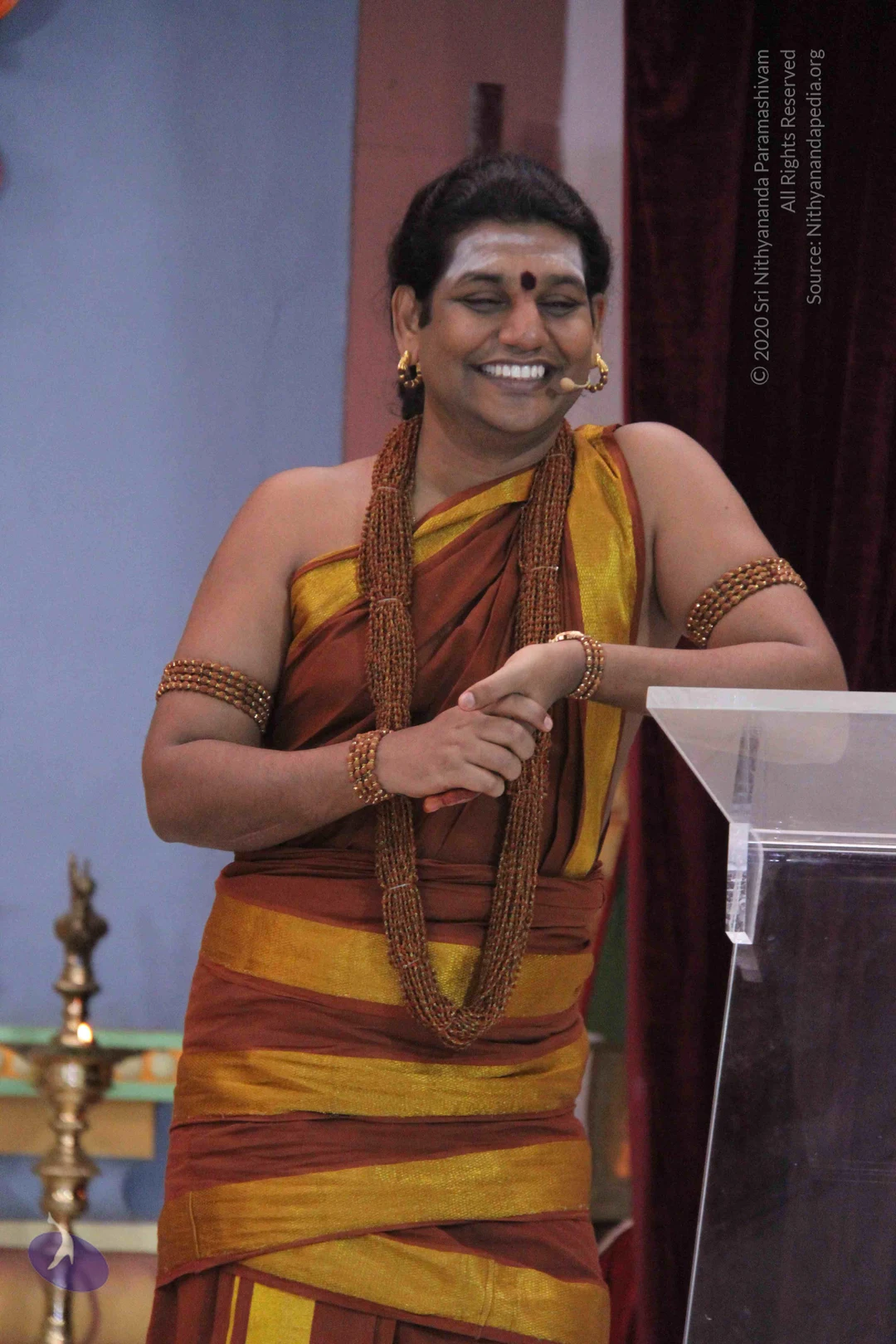
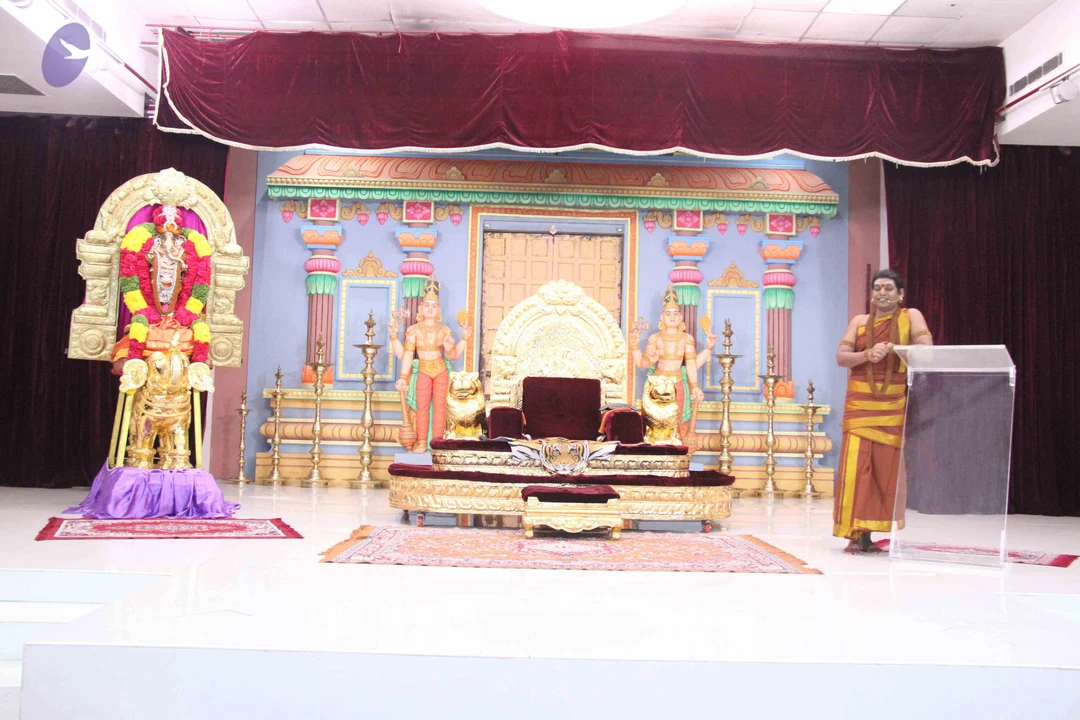
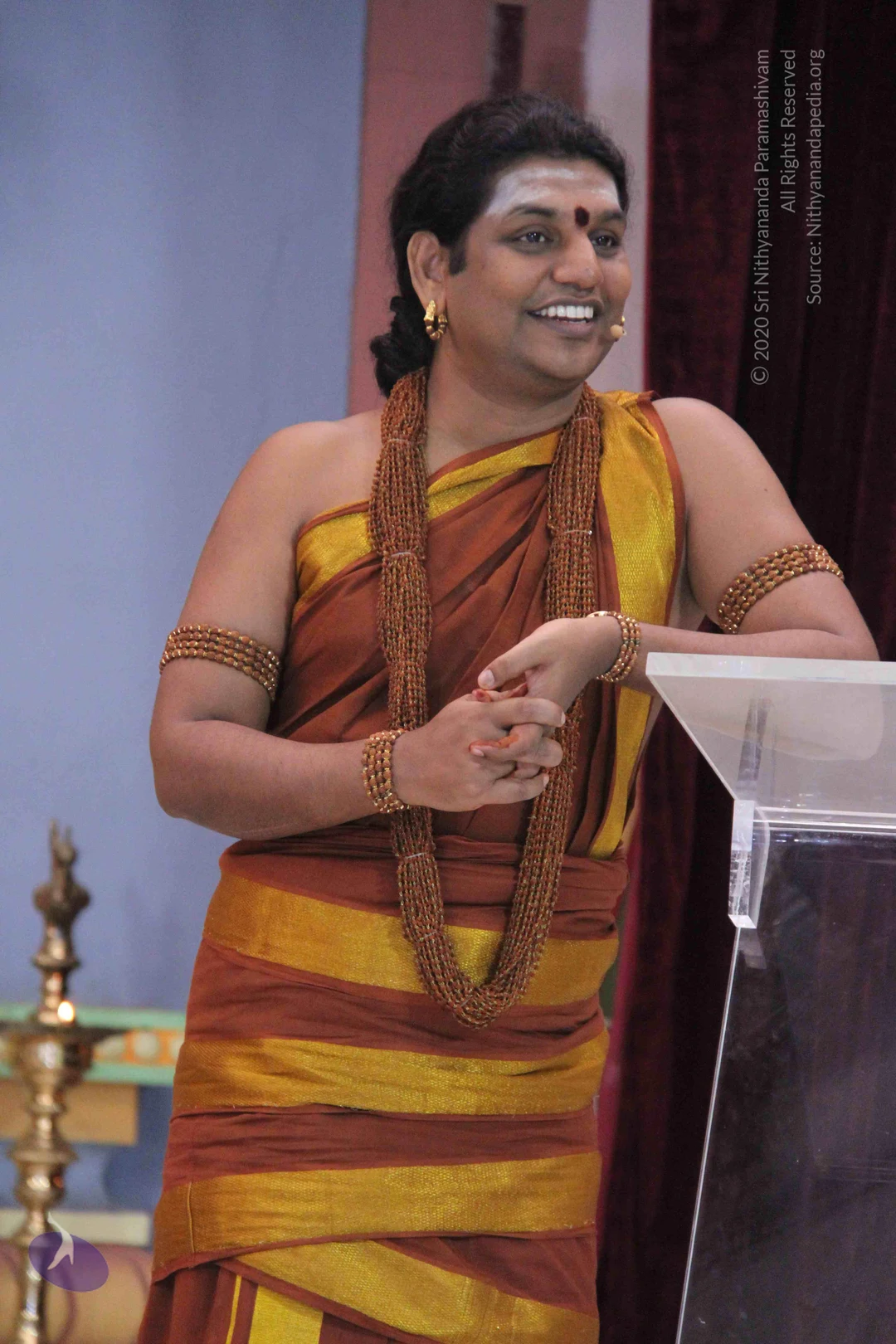
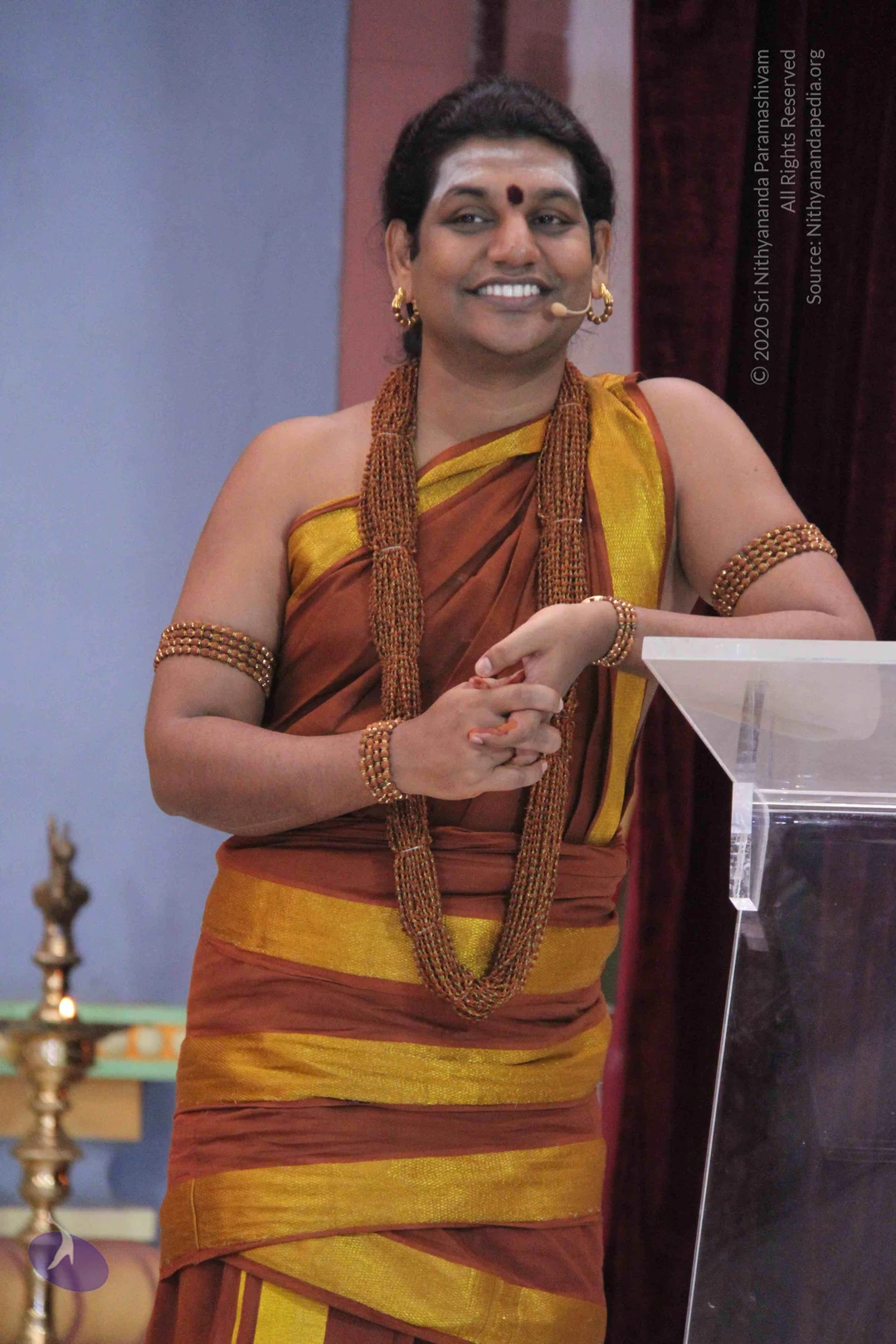
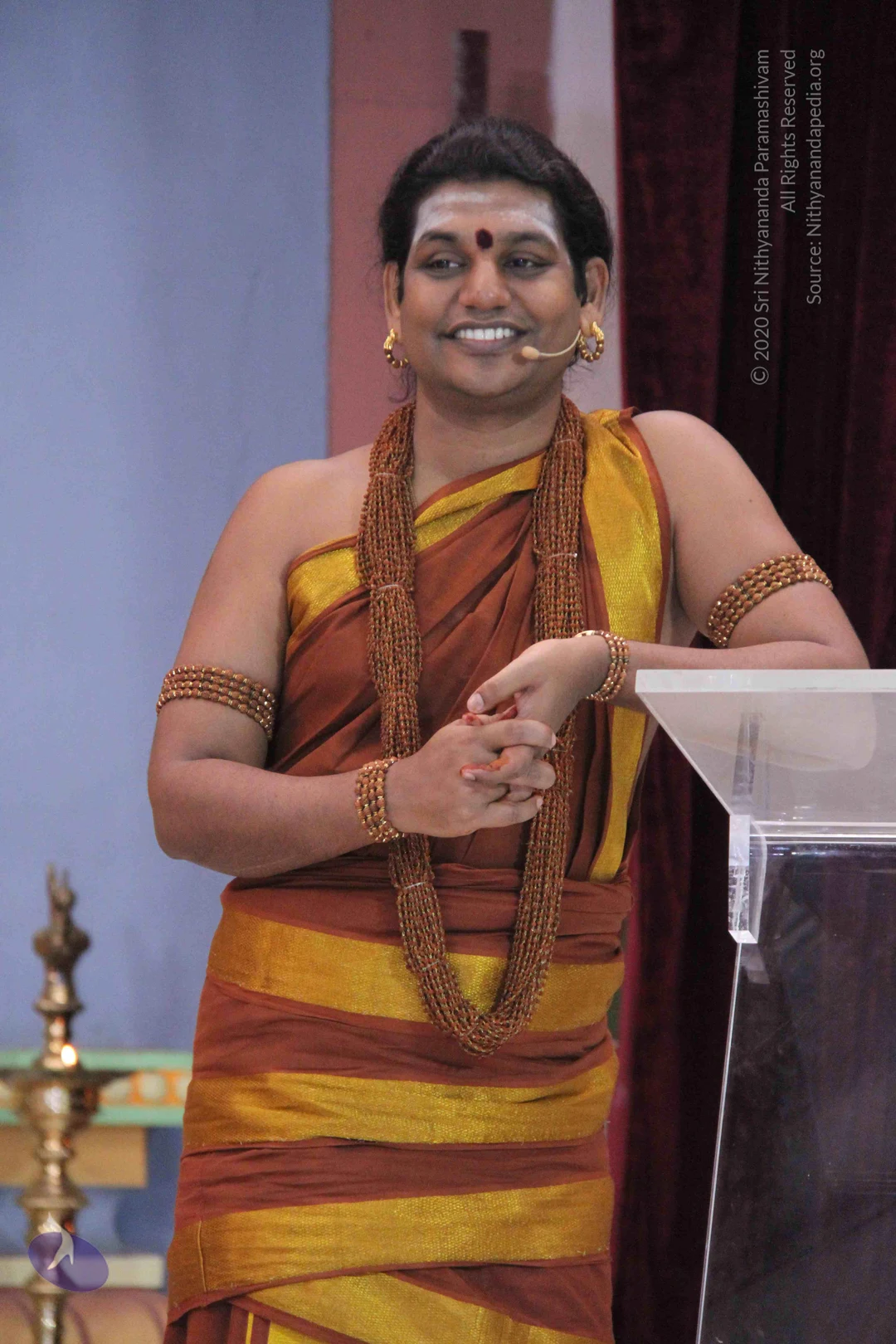
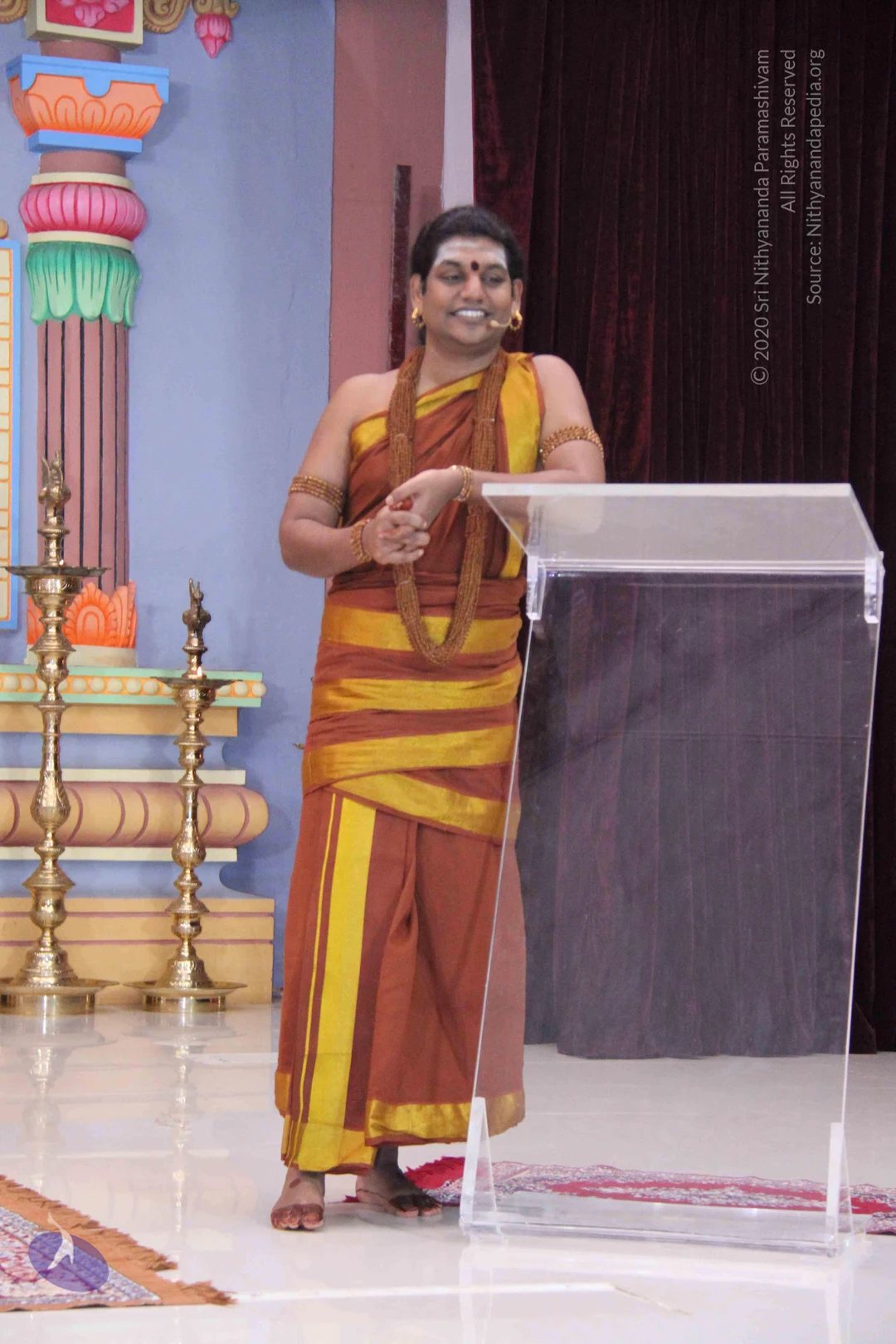
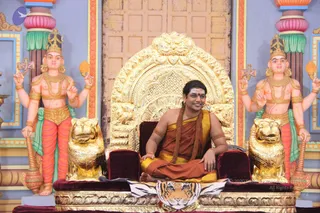
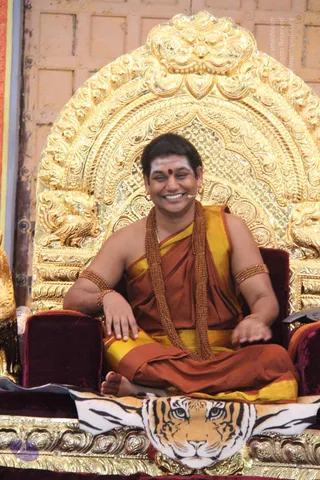
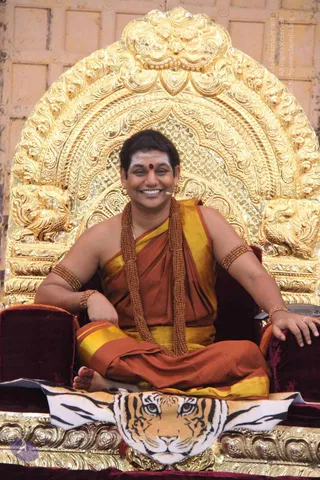
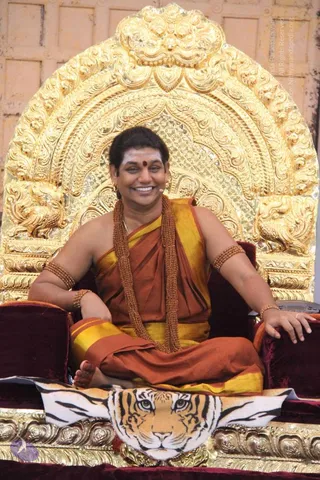
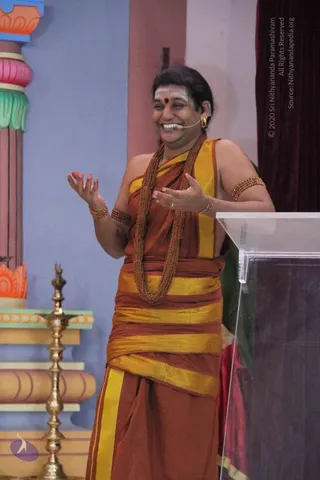
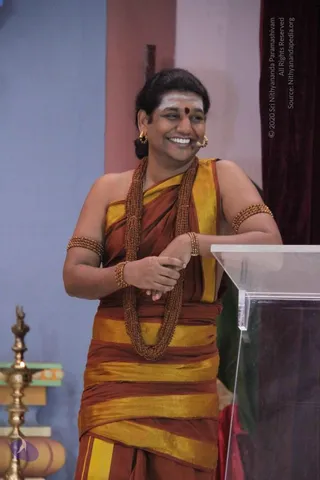
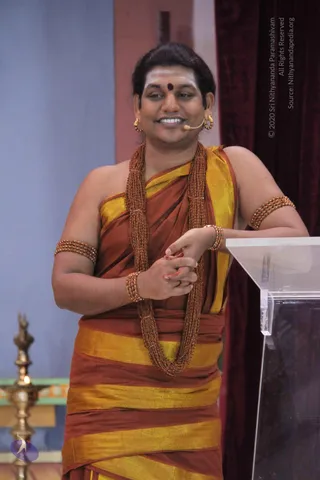
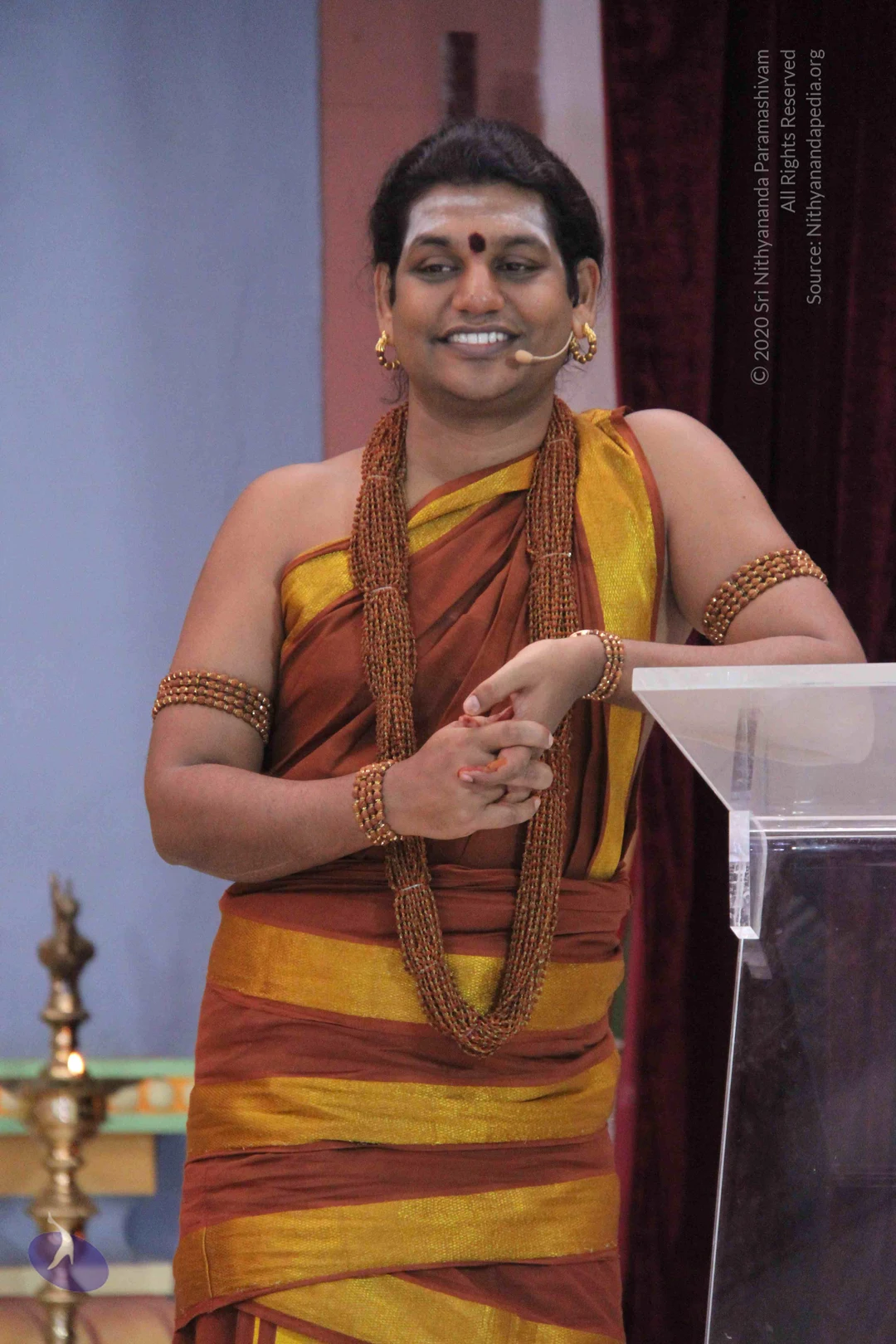
A seated man in a saffron-orange robe with a golden-yellow border sits cross-legged on an ornate gilded throne with a carved arched back, flanked by two golden lion figures. He wears long rudraksha-style beaded malas and ceremonial gold ornaments and bangles, and has a warm smile. Beneath him lies a tiger-skin cloth. Two tall painted deity statues with multiple arms, gold crowns and gold jewellery stand on either side, holding ritual objects. Behind is a carved wooden door in a colourful temple hall with pink lotus pillars.A seated man smiles broadly on an ornate golden throne with carved lion heads and a gilded arch behind him. He wears a saffron-orange robe with a gold-bordered cloth, a long rudraksha mala draped over his shoulders, gold armbands, and a red bindi on his forehead, with a small microphone near his face. A striped tiger-skin rug lies across the front of the throne. a person is seated centrally on the throne, appearing to address a satsang. Gold-embellished dais decor and a wooden door frame surround him.A smiling man with short dark hair and a red bindi sits cross-legged on a richly carved golden throne with an ornate arched back. He wears an orange-red saffron-toned robe with a yellow-gold border, multiple rudraksha malas hanging to his waist, and gold bangles on his arms. A tiger-face rug covers the throne's base. The background shows a pale wooden paneled wall. a person: the figure wears a rudraksha mala, saffron-orange robe and sits enthroned, with the page noting the event involved him.A smiling man sits cross-legged on an ornate gold-carved throne with a large arched backrest and lion-like side carvings. He wears a rust-orange robe with gold borders, a long rudraksha mala draped to his waist, and gold-coloured armbands. A red bindi marks his forehead and a small microphone is attached near his face. A tiger-face rug lies over the throne's base, and a patterned wall stands behind him. Appearance-based candidate Swamiji (probable): long swept-back hair, orange robe, rudraksha mala and ornate gold seating, seated in a satsang-style dais setting.A smiling man in rust-brown and gold-bordered ceremonial dress stands beside a clear acrylic lectern, gesturing with both hands during a talk. He wears a multi-strand gold-toned rudraksha-style mala, gold bangles and armlets, a gold earring, a white vibhuti marking with a red kumkum dot, and a small clip-on microphone. Behind him are a painted pillar in pink, green and orange and a brass oil lamp on a decorated stand.A photograph of a smiling man standing at a clear acrylic podium during a satsang discourse. He wears a rust-brown garment with broad gold-bordered folds, a gold-bordered sash, layered rudraksha-style beaded necklaces, beaded armlets and bracelets, gold hoop earrings and a headset microphone. A white tripundra and red bindi mark his forehead. Behind him stands a brass oil lamp with a lit flame, and blue and pink wall panels frame the stage.

sarva-darshan

6 photosSource gallery
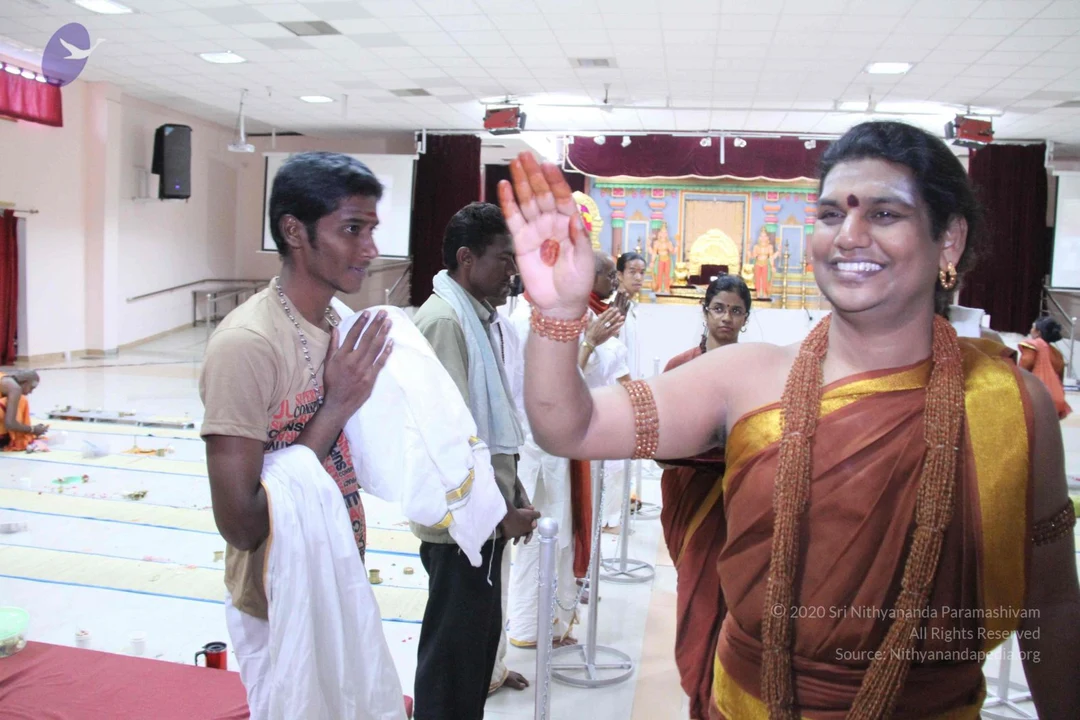
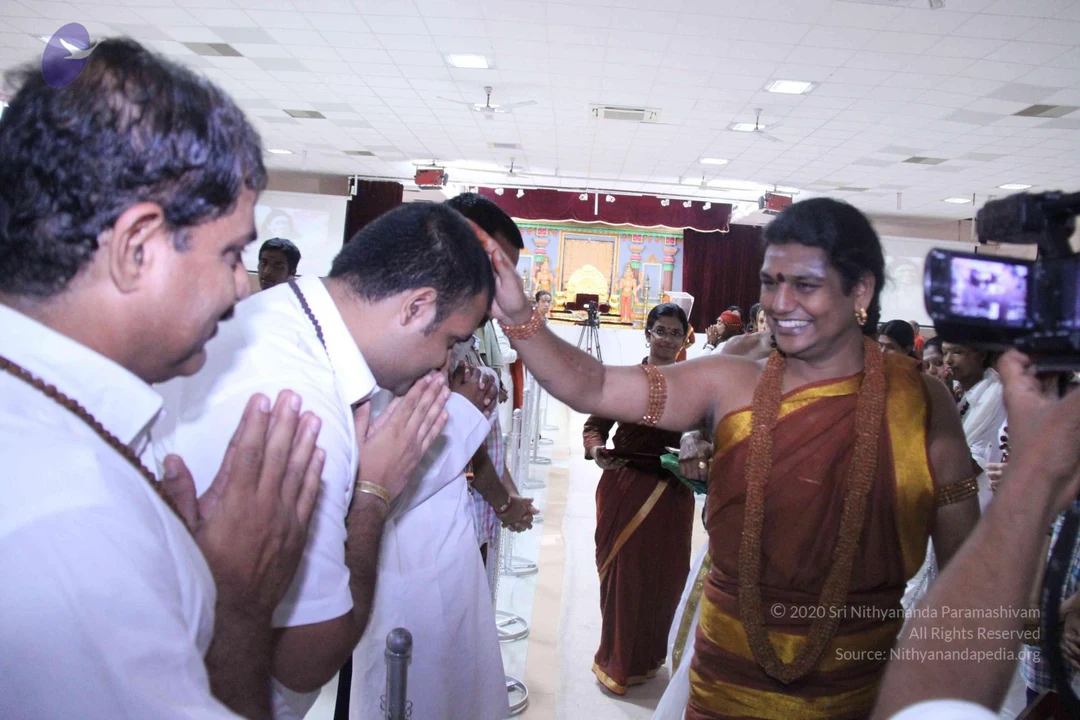
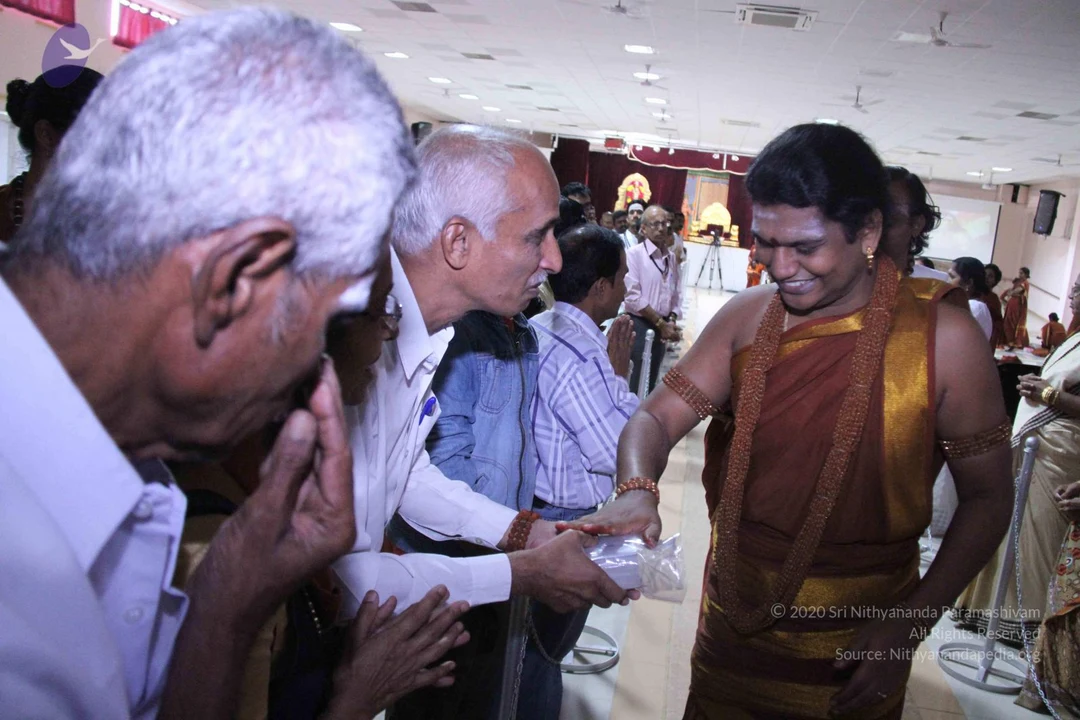
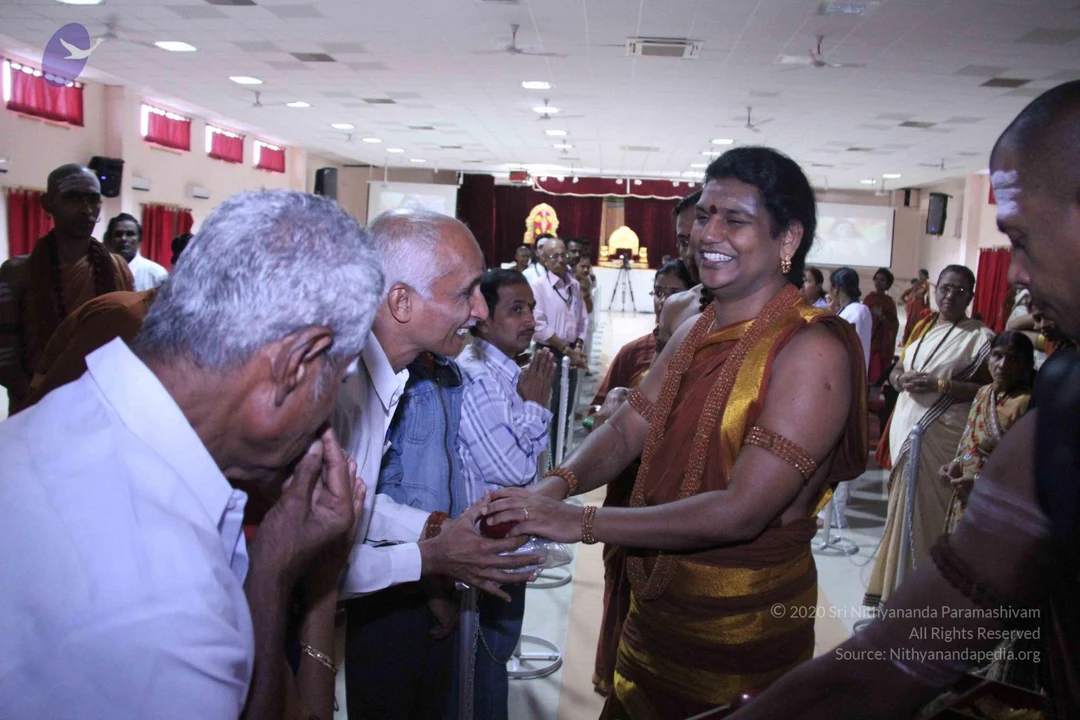
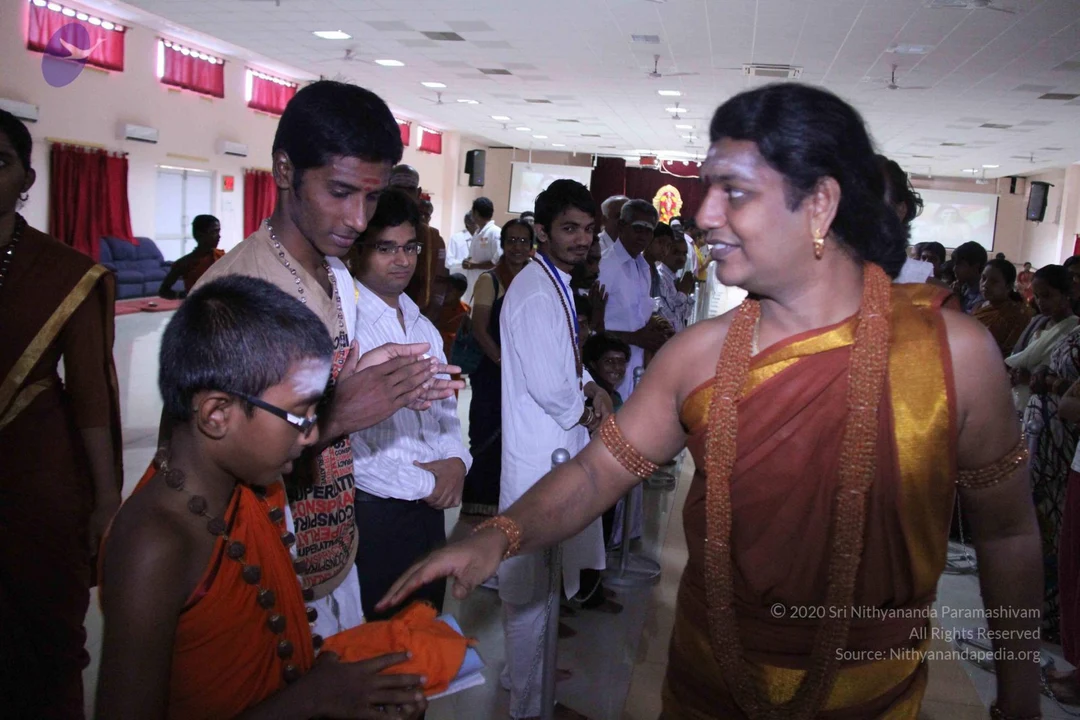
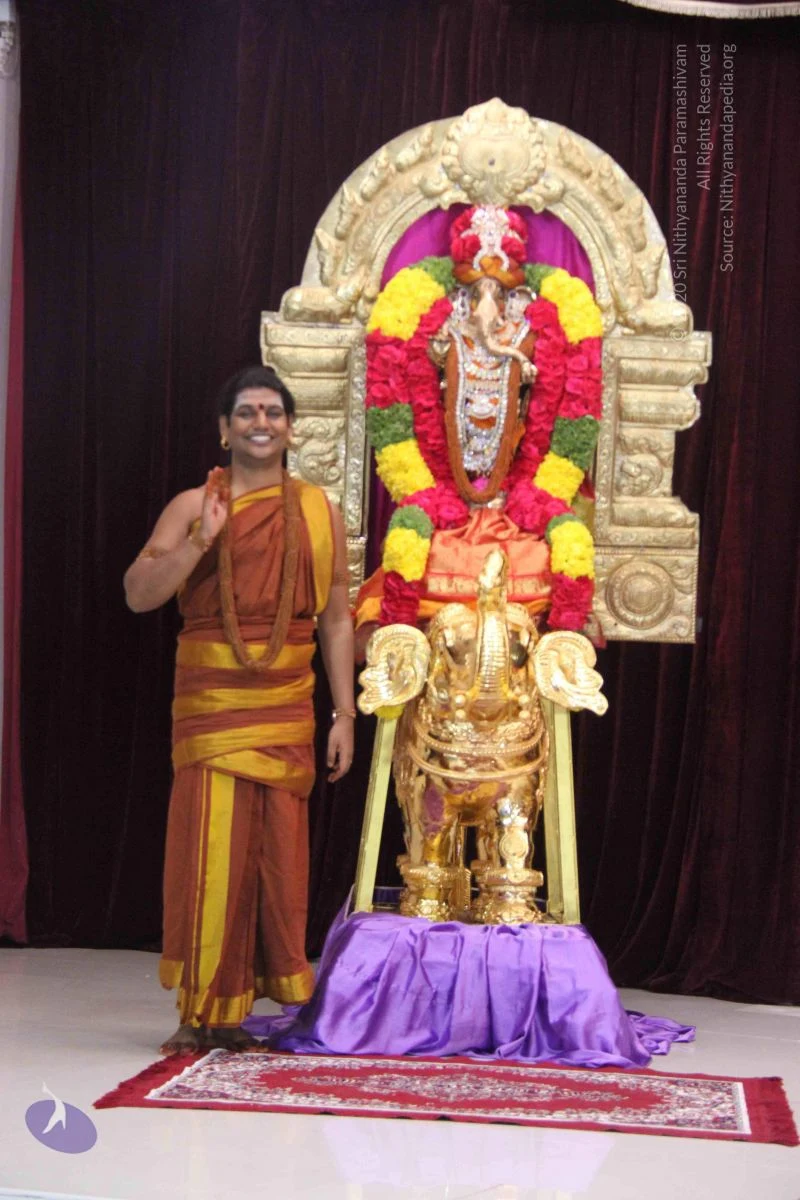
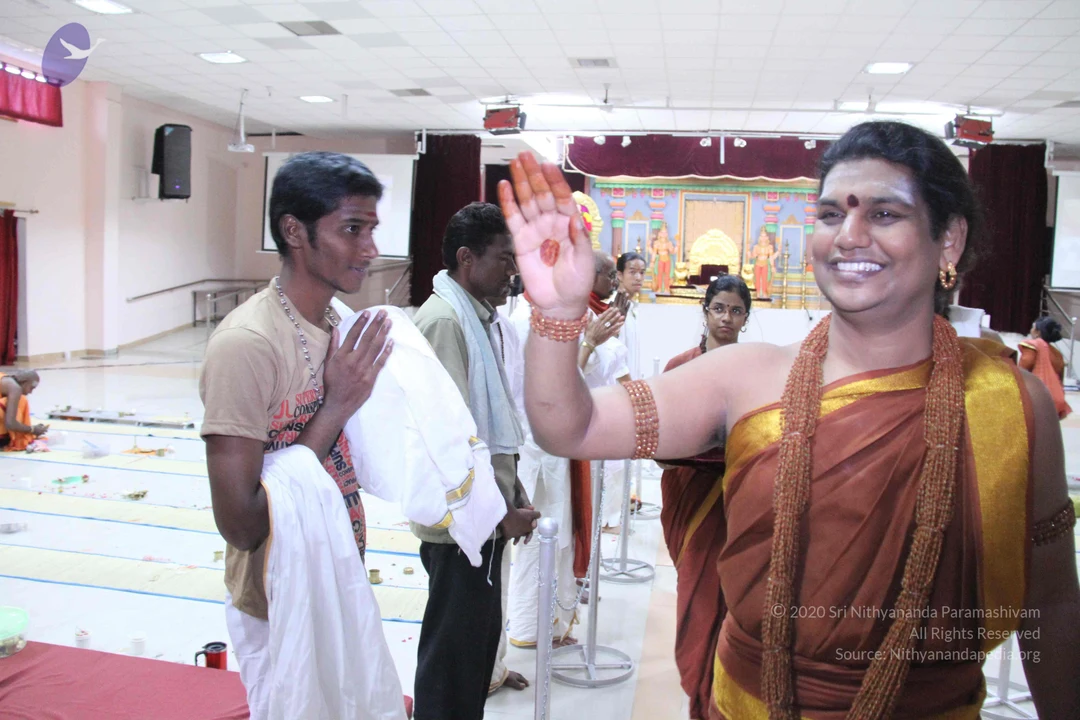
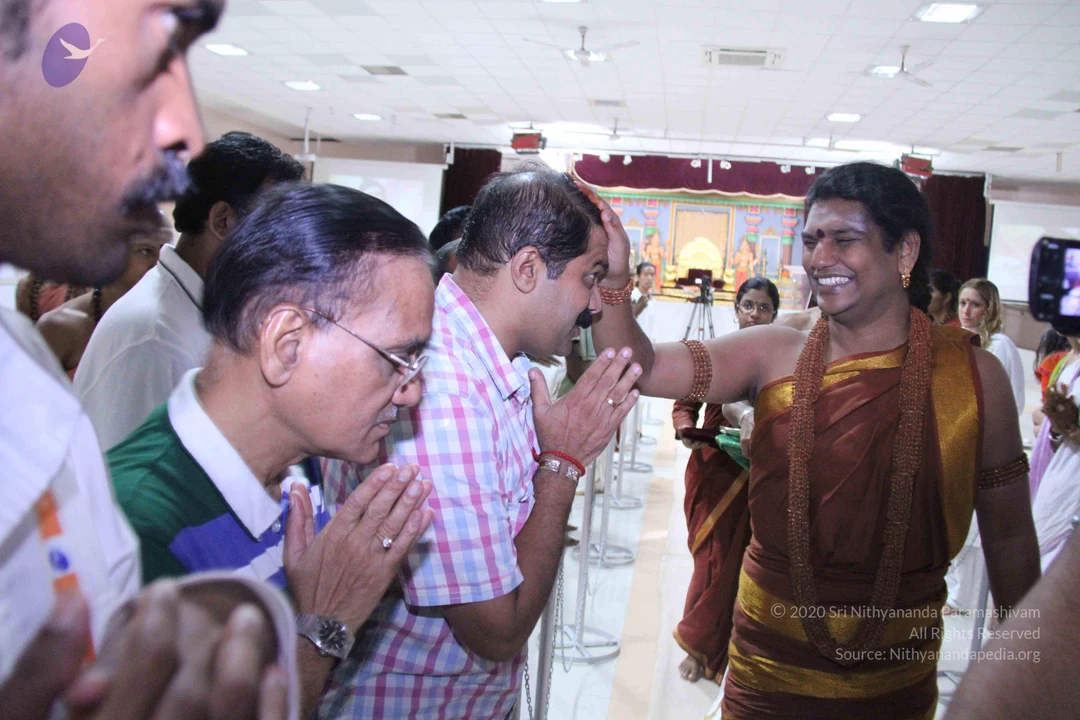
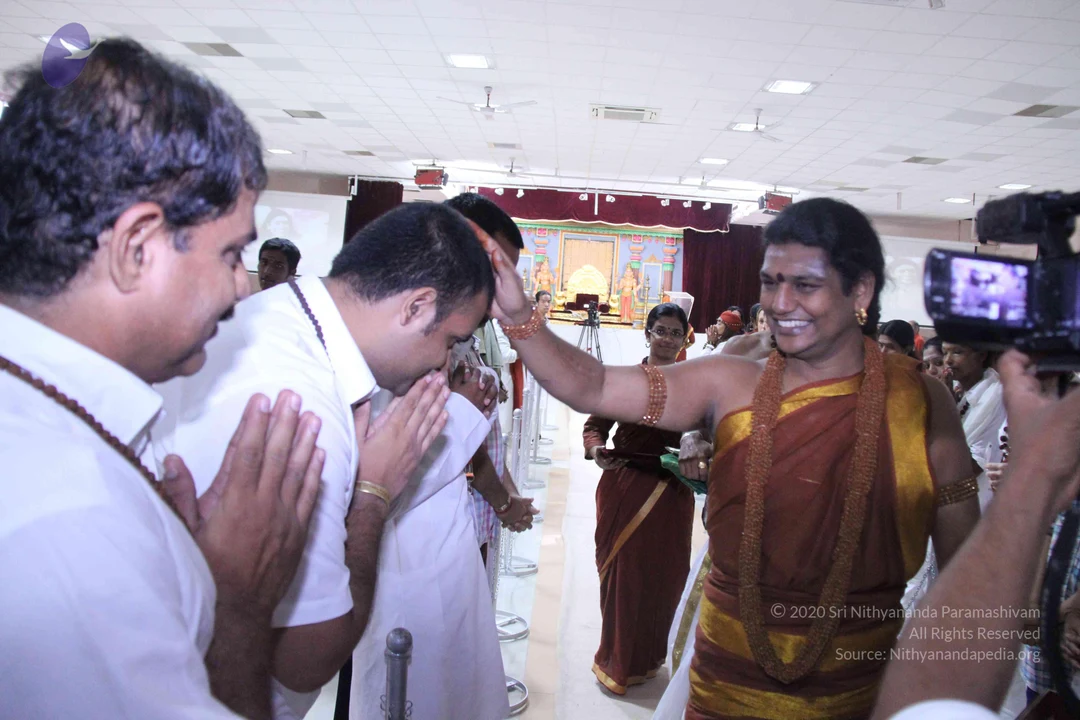
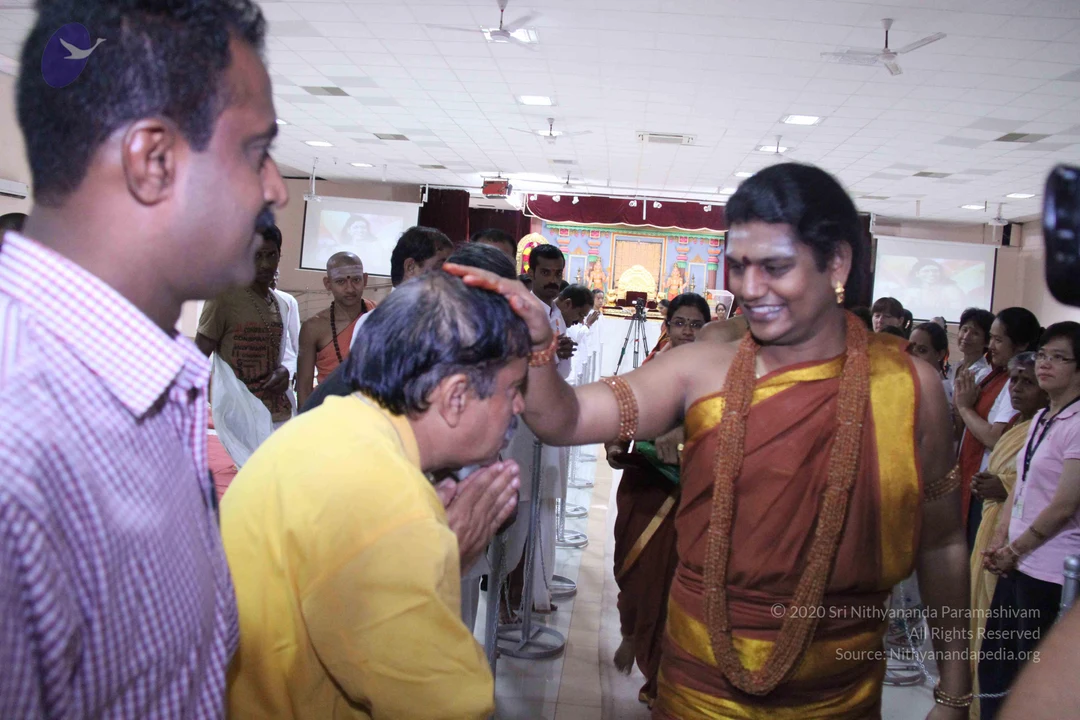
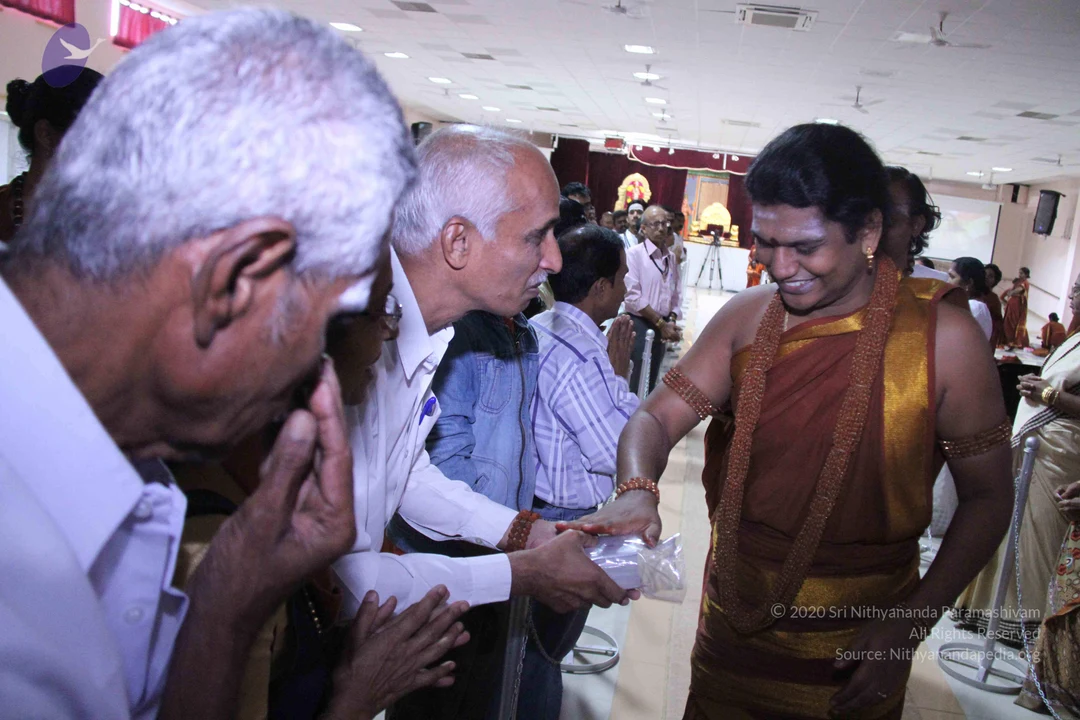
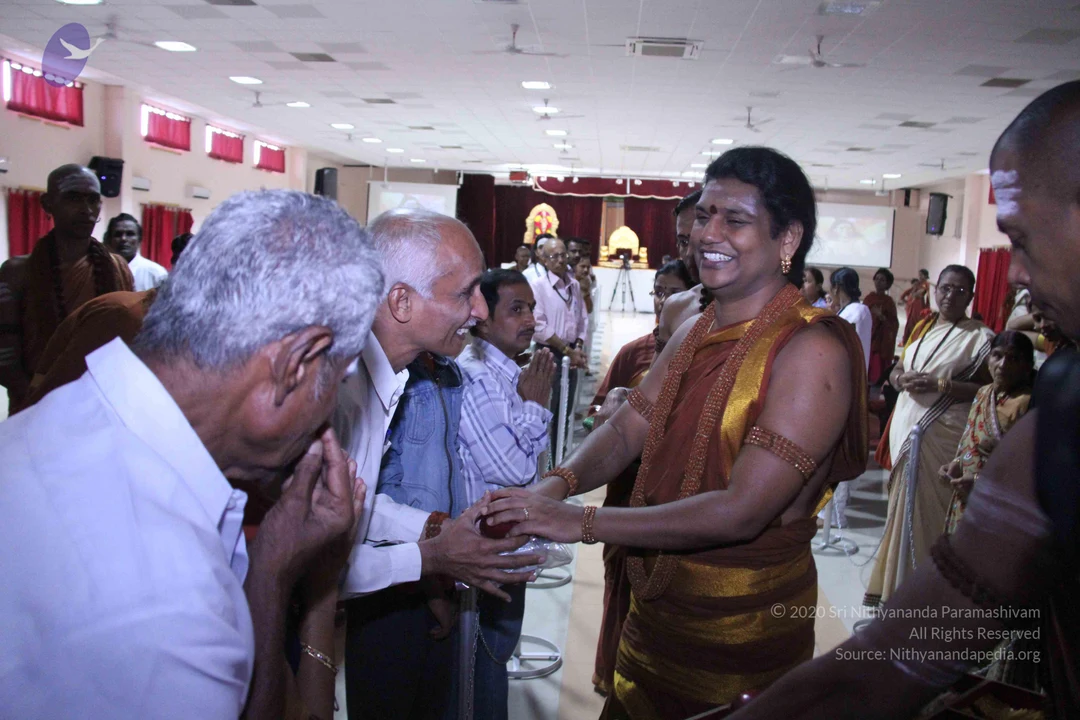
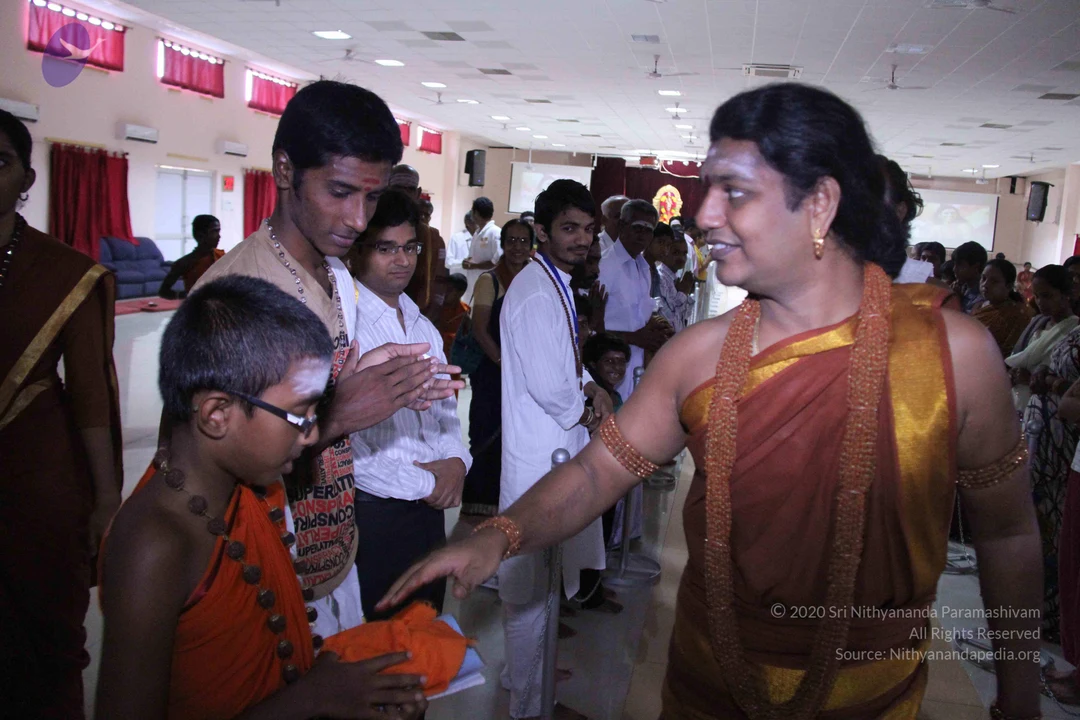
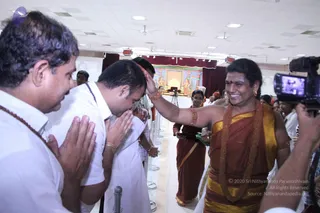
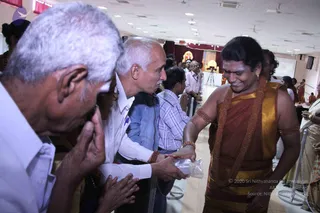
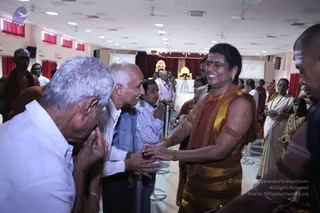
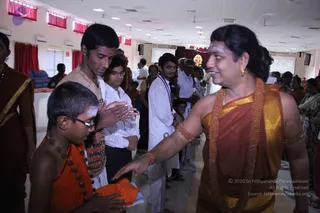
A photograph inside a hall with a polished floor and a stage backdrop painted with figures and a golden arch. In the foreground, a smiling person in an orange-brown robe with a gold border and a long rudraksha mala raises a hand, palm open, showing a red mark on the palm. Beside him, a young man in a beige t-shirt with a white cloth over his arm stands with hands folded in greeting. Behind them, a man in a grey shirt and white cloth and another person in white stand near low stanchions, and a woman in an orange sari is visible further back. Floor cloths and small offerings lie on the floor, and a red-cloth table is at the lower left.Photograph inside a hall with white ceiling tiles and a red draped stage backdrop, where a framed golden image of deities is visible. A person in a long-haired, saffron-orange and gold-bordered cloth with rudraksha-style beaded necklace and bangles stands at right, raising a hand over the head of a man in white shirt and white dhoti who bows with palms joined. Another person in white stands to the left with palms pressed together and a rudraksha mala. A woman in a maroon sari stands behind, and a video camera is in the foreground at right. Swamiji (probable) is the figure in saffron-orange cloth with long hair and gold necklace, shown blessing a devotee, and is the in-person candidate.Indoor photograph of a satsang hall with white ceiling fans and fluorescent lights. In the centre, a bare-chested figure with long swept-back dark hair, rudraksha-style beaded mala, a gold-coloured necklace, and a rust-orange and gold wrap is smiling and placing a hand on the head of a kneeling man in a yellow shirt with folded hands. Nearby, a man in a checked shirt stands at left, and a row of white-robed attendants and saffron-robed monks stands behind. Women in pink and saffron saris and kurtas watch at right. A decorated altar with a golden canopy and deity images appears in the background, with projection screens on the walls.A photograph of an indoor hall where a figure in saffron-orange robes with a gold-bordered shawl and a rudraksha mala draped over the chest stands at right, smiling as he receives a small clear plastic packet from an elderly man with white hair and a white shirt. Several older men and a man in a blue denim jacket lean in with palms pressed together in greeting. Behind them, a man in a pink-striped shirt and others stand near a stage with a red curtain, a gold-lit shrine and a mounted screen. A woman in a cream sari with gold jewellery stands at far right. Visible physical people number roughly six to eight.Indoor satsang hall with white ceiling fans, red curtains and a golden deity shrine at the far end. A smiling person with short dark hair, gold bangles and a red bindi wears an orange-brown robe with a gold-bordered shawl and a beaded rudraksha-style mala, and is handing a small red object to a white-haired elderly man in a white shirt who bows with folded hands. Another man in a blue-grey jacket and a few devotees in white and cream saris stand nearby. Several people in saffron robes and women in white saris are visible in the background. The person in orange has no crown, turban or long swept-back hair visible, so the appearance is inconclusive.A photograph of an indoor hall with red curtains and ceiling fans, where a long-haired man in an orange-brown robe with a gold border and a heavy orange bead necklace extends his hand to greet a young boy in an orange robe with rudraksha beads and white sacred ash on his forehead. Behind them, a young man in a beige shirt with a lanyard and several men and women in white and saffron stand watching, and a large screen and projector are visible on the wall. The man in the orange robe is an appearance-based probable Swamiji, identified by his long swept-back hair, ornate gold and orange beaded necklaces and saffron ceremonial clothing, present in person as the greeter.

HDH-deities-final-blessing

14 photosSource gallery
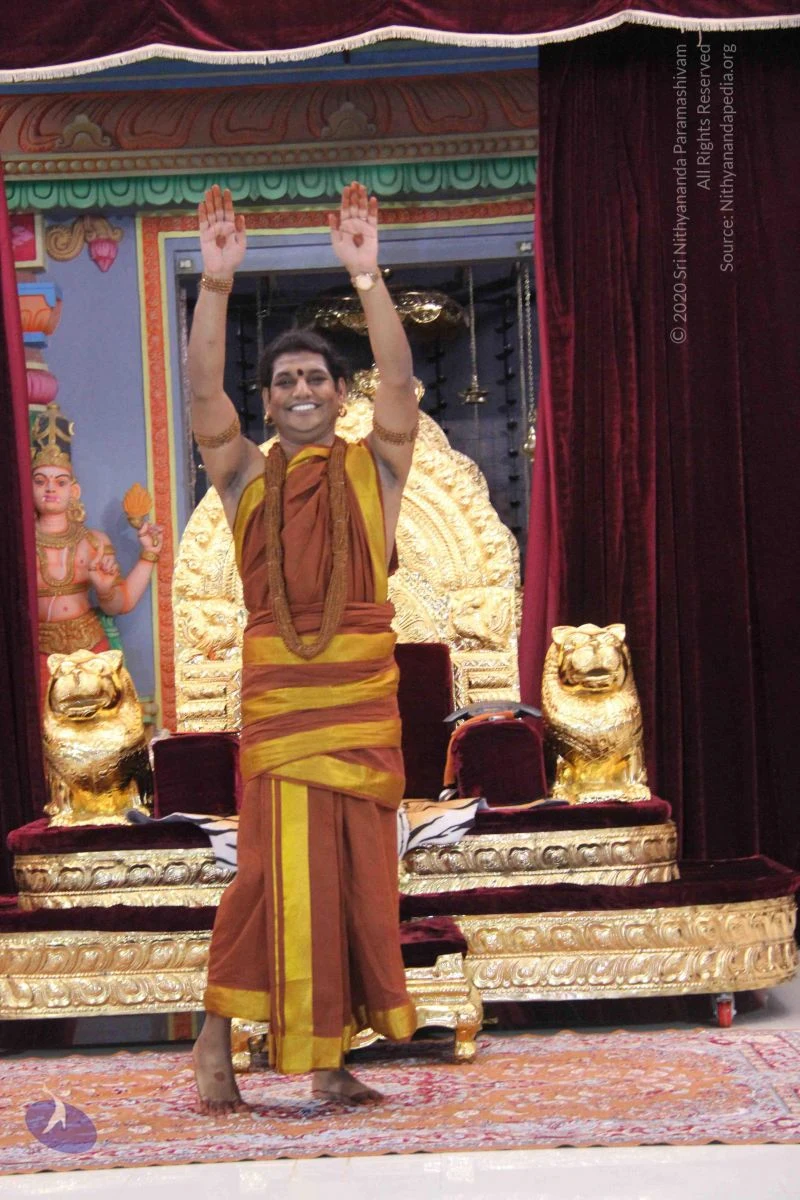
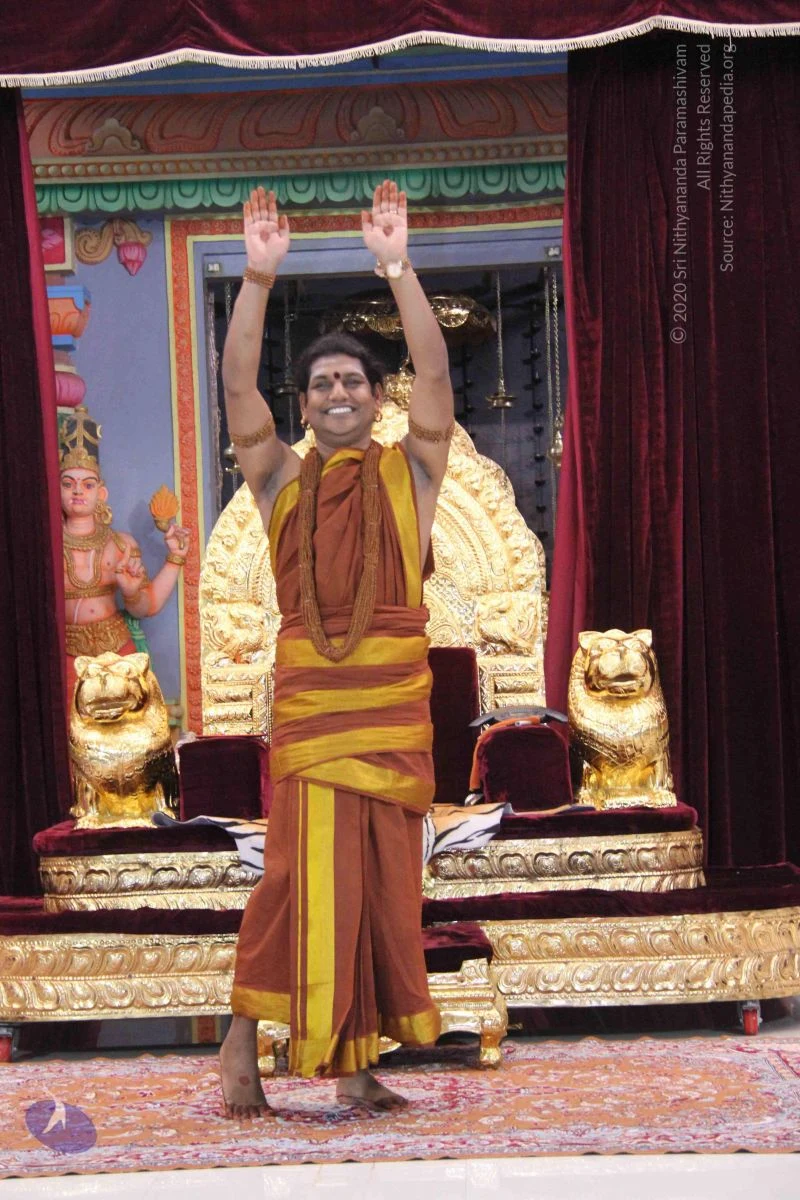
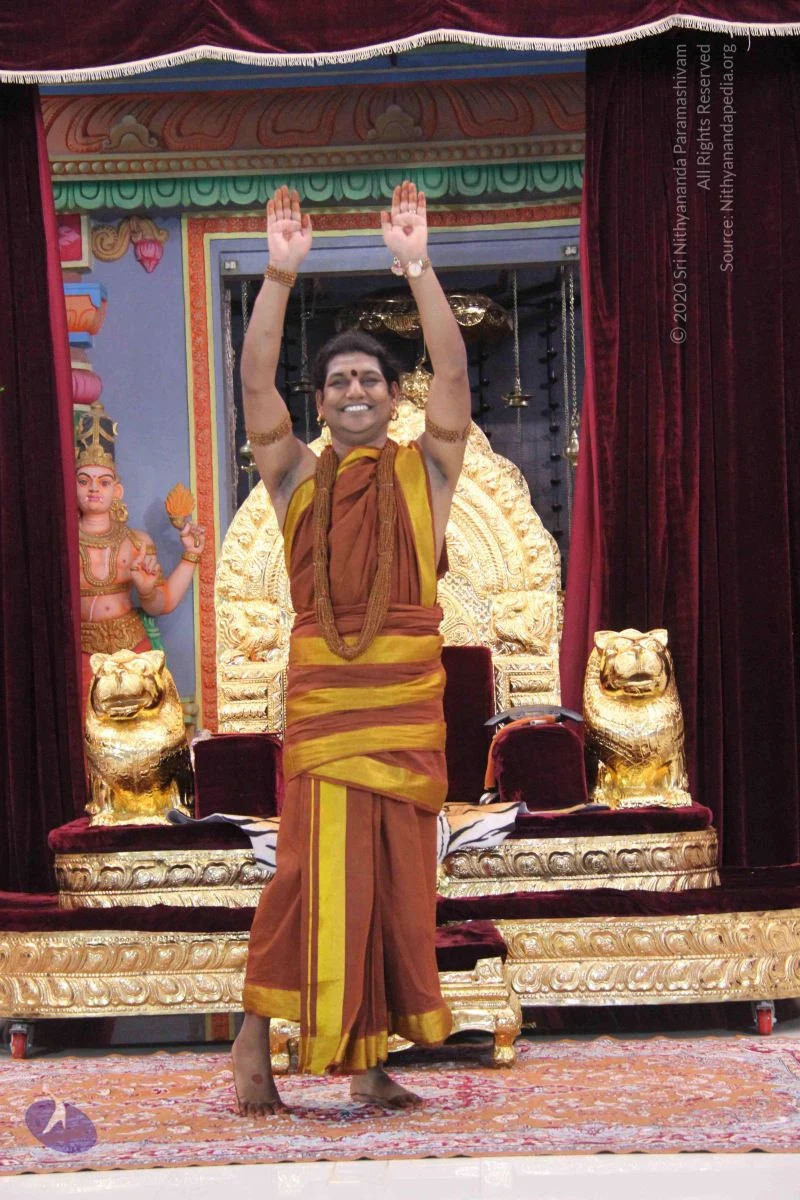
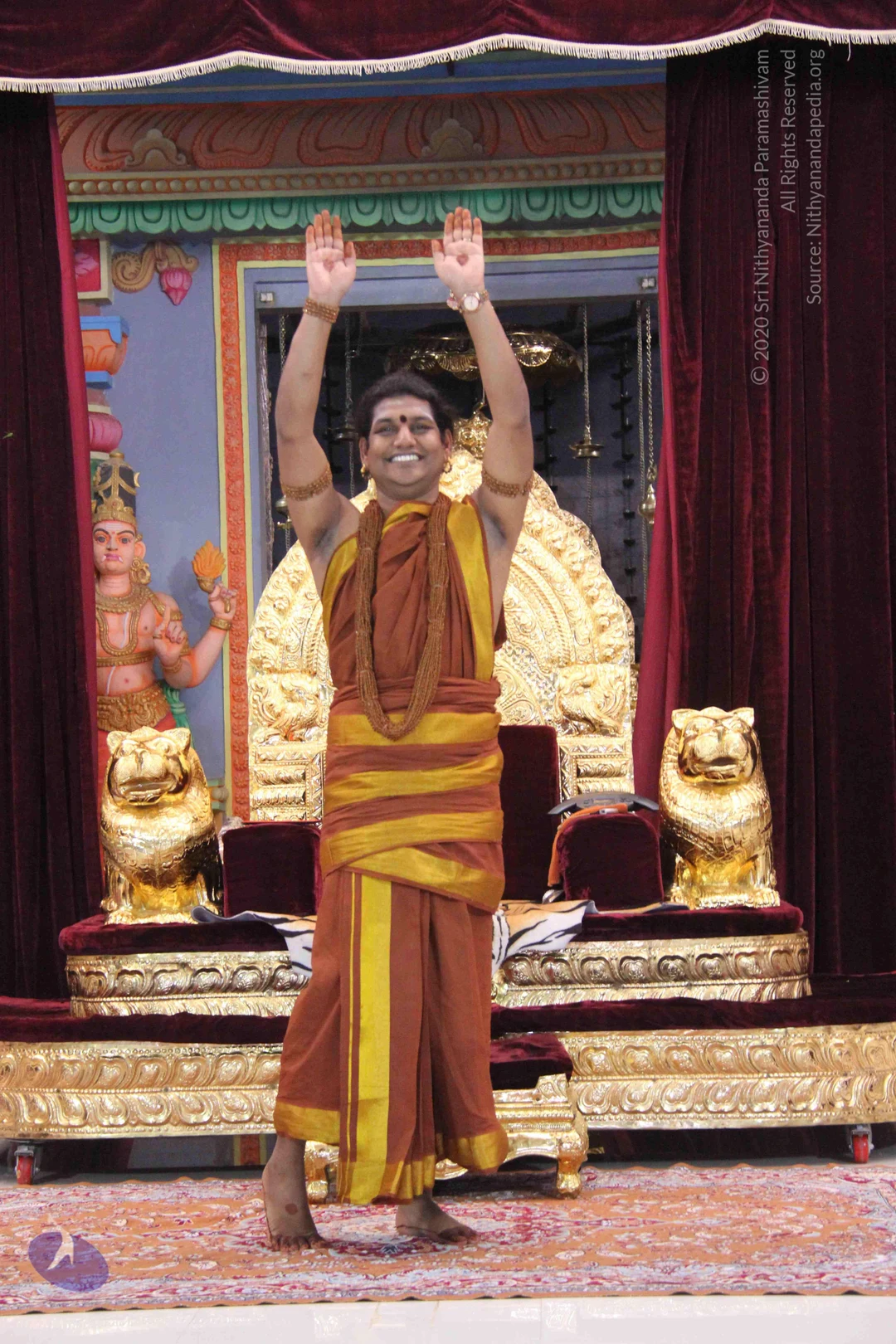
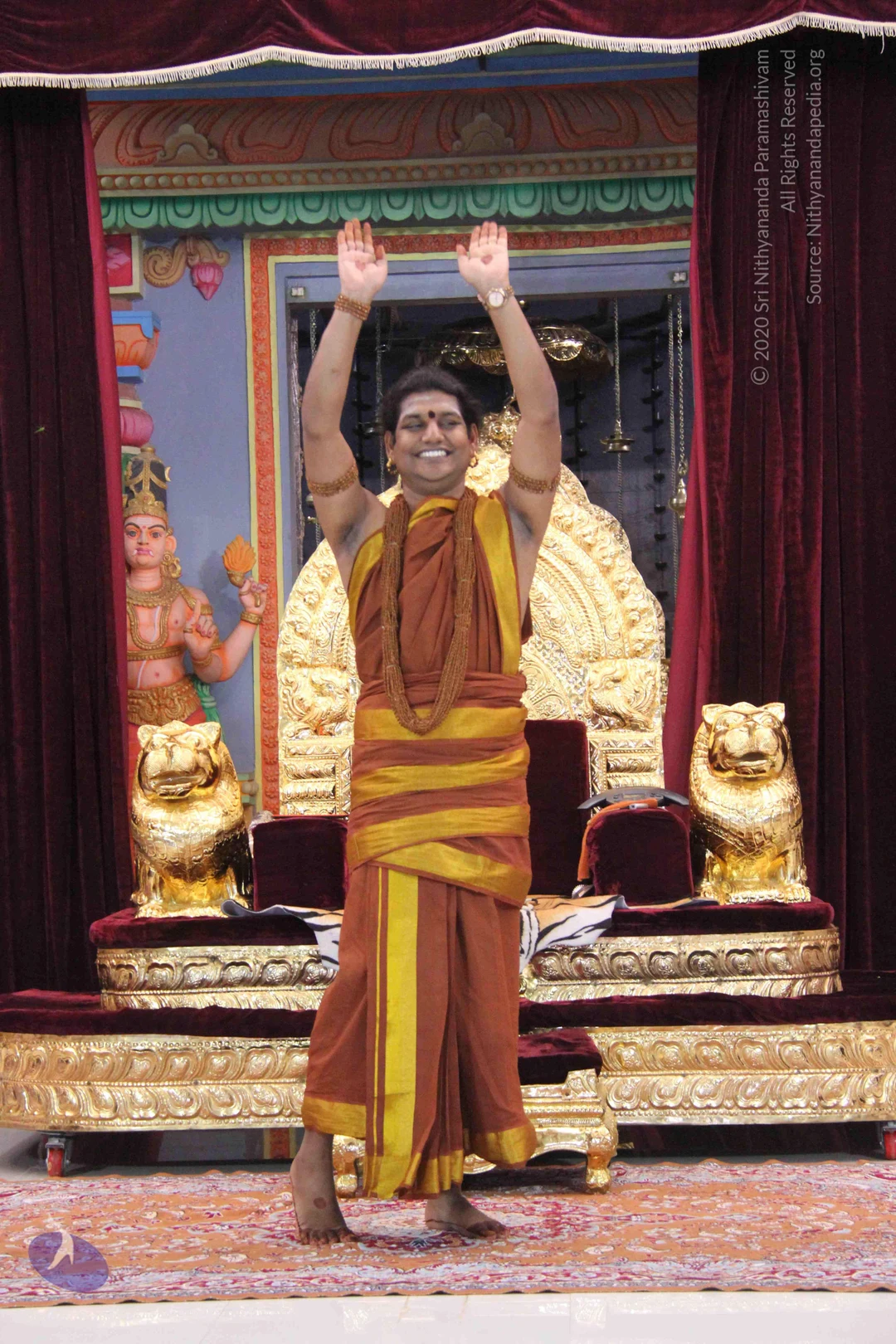
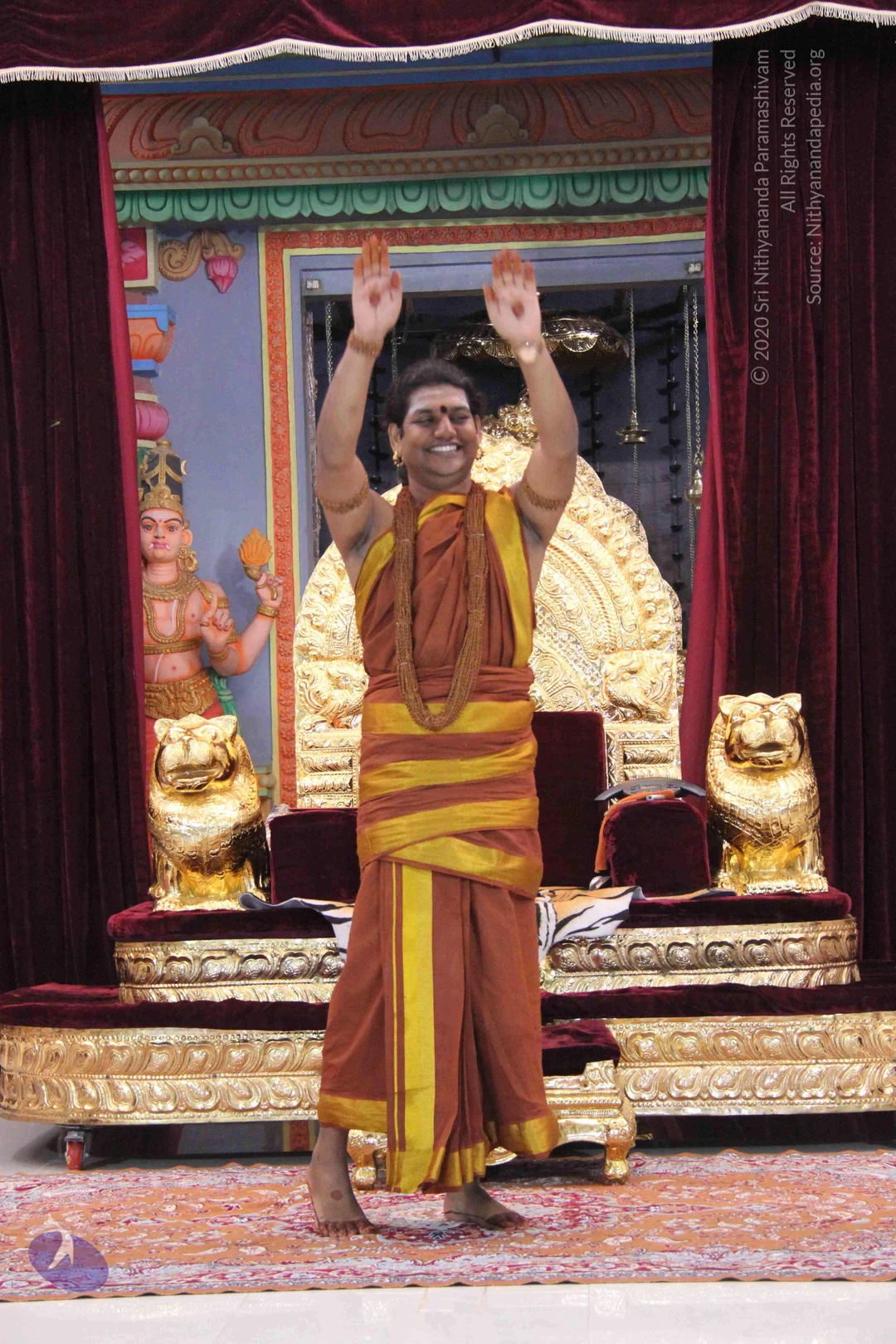
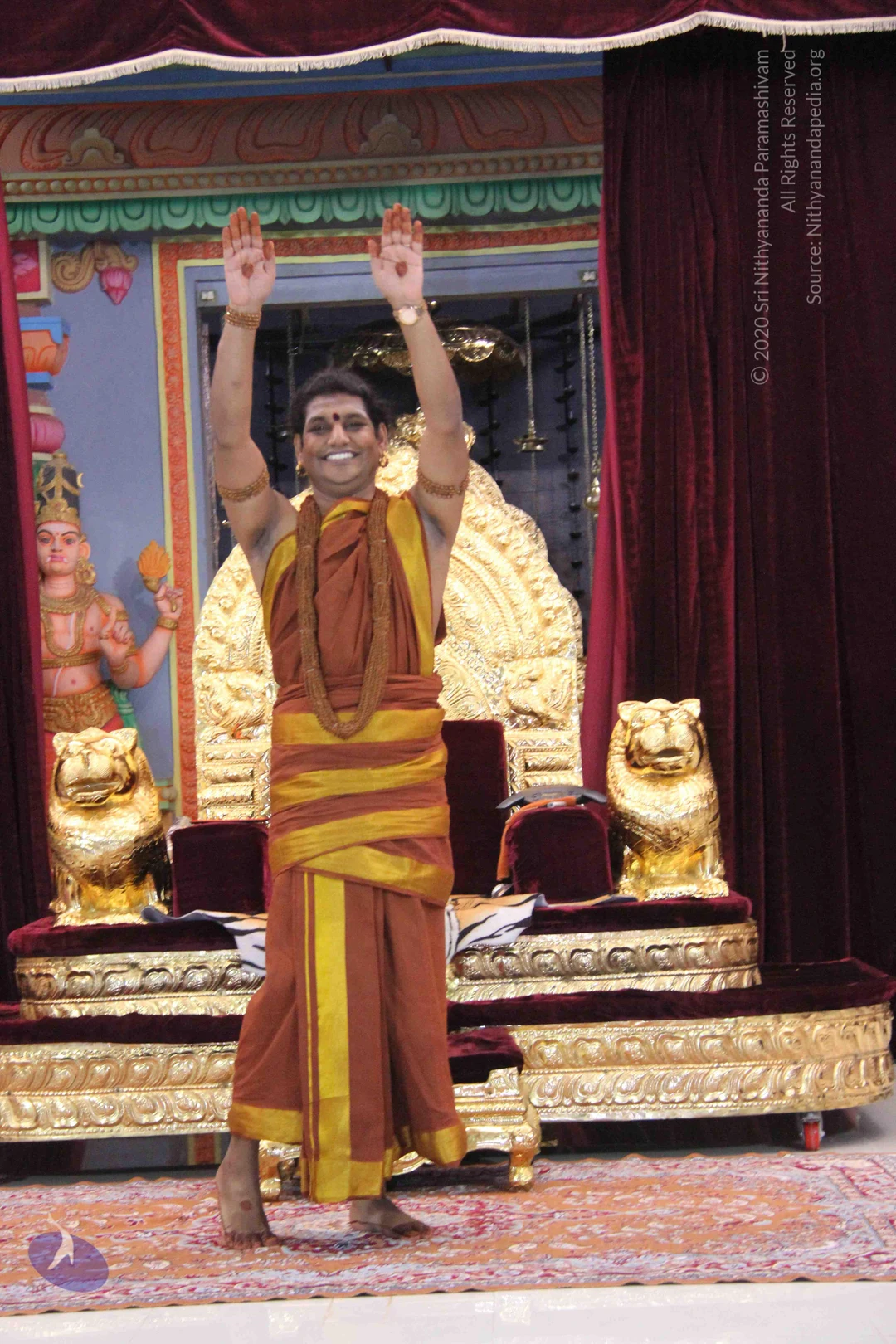
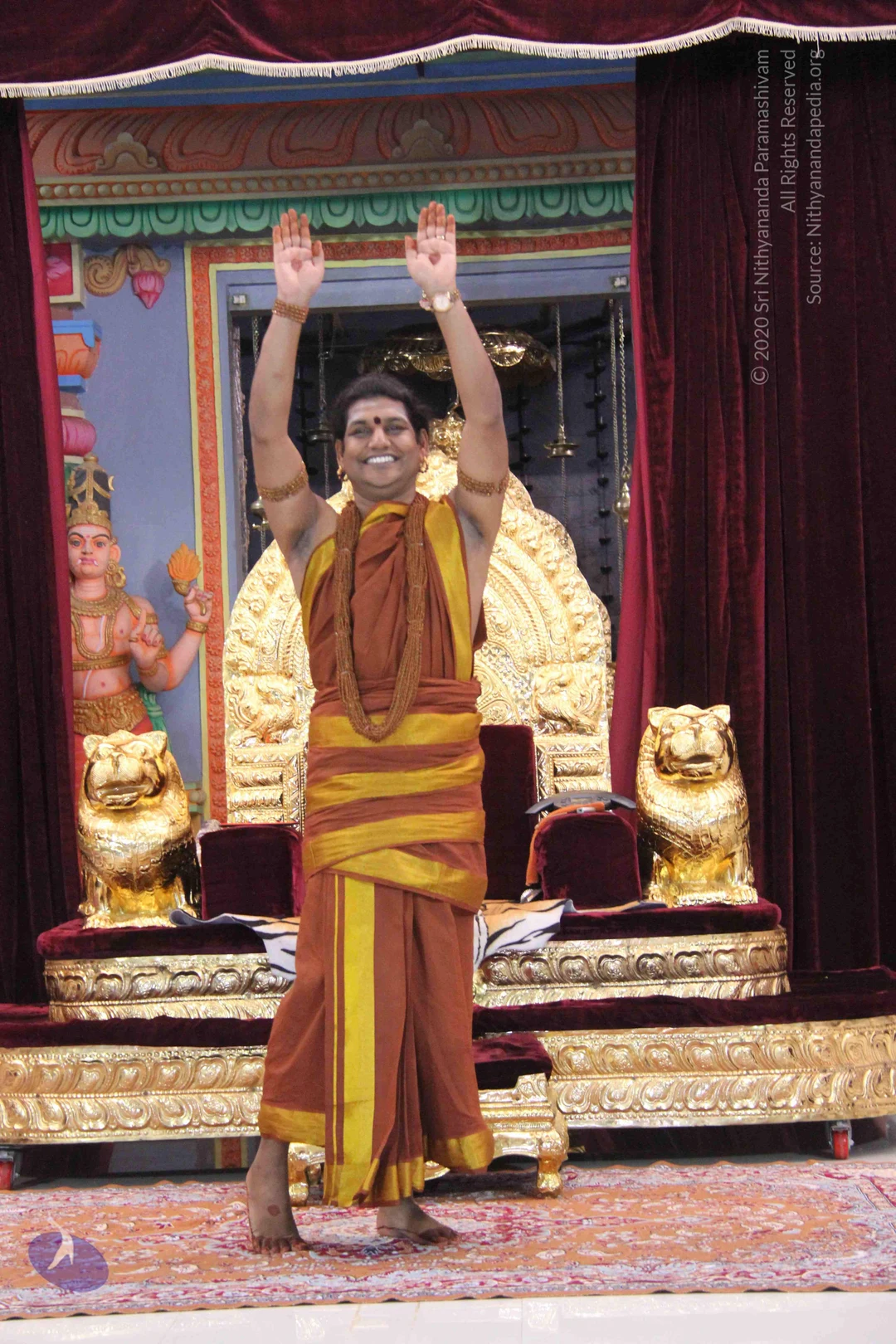
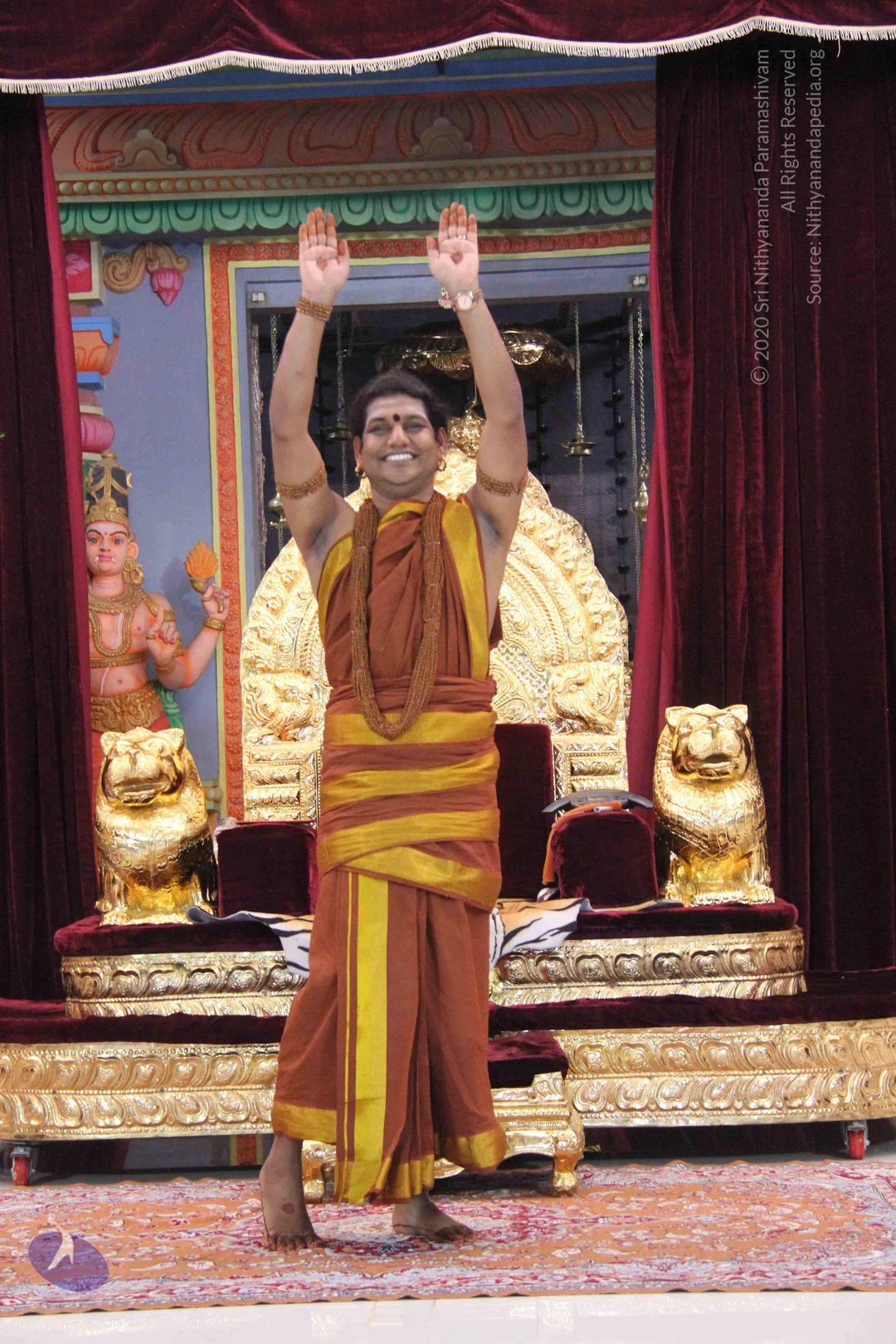
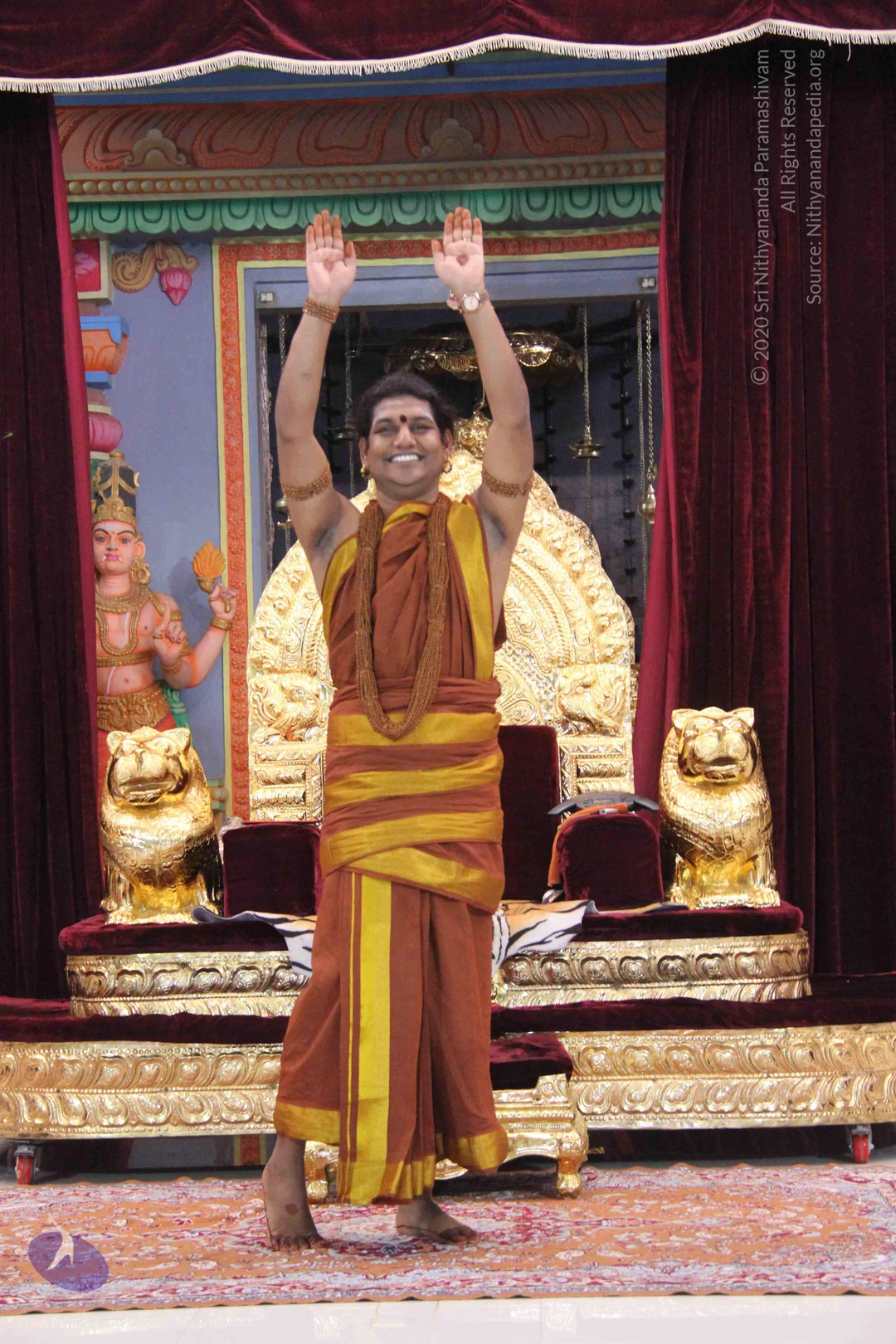
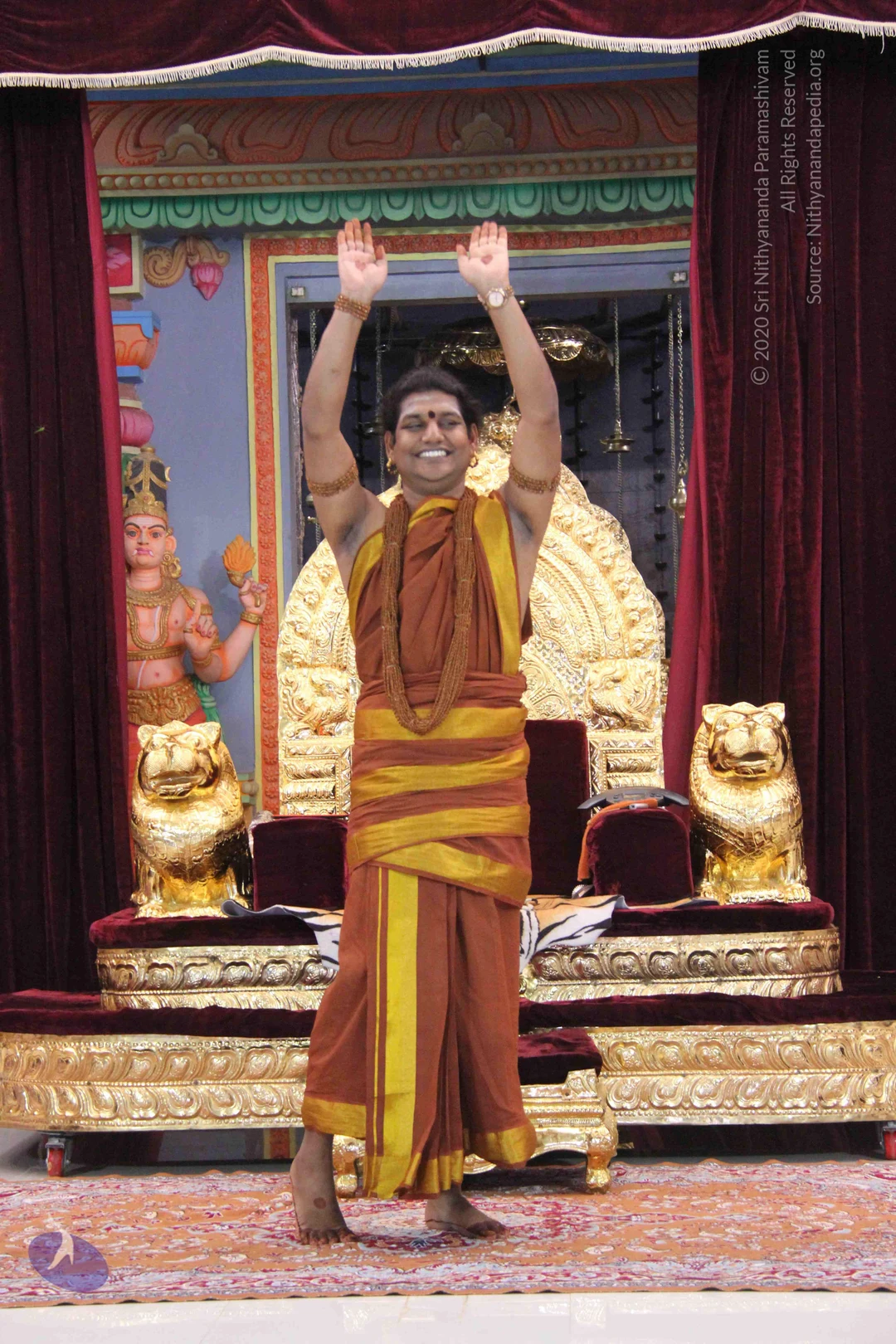
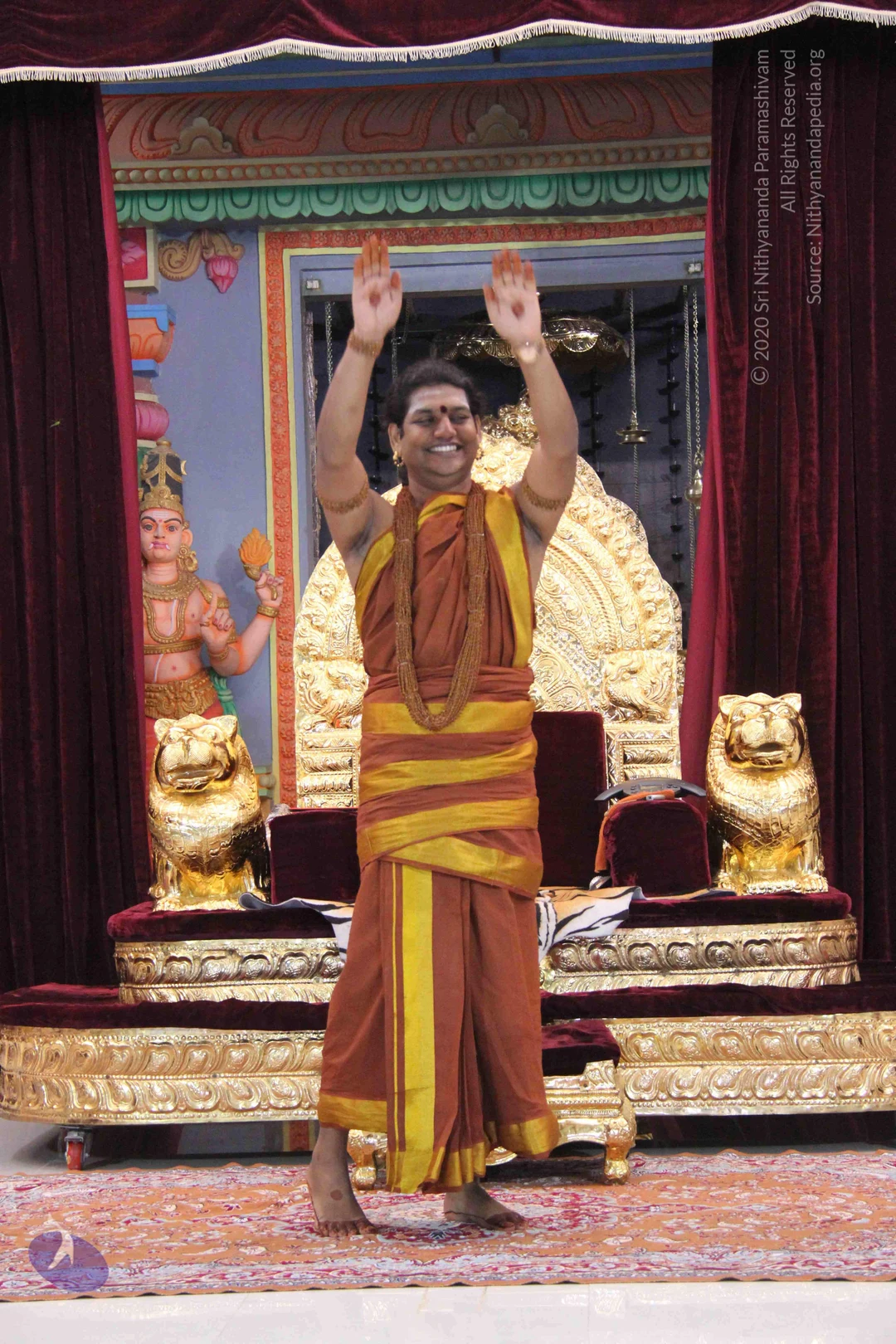
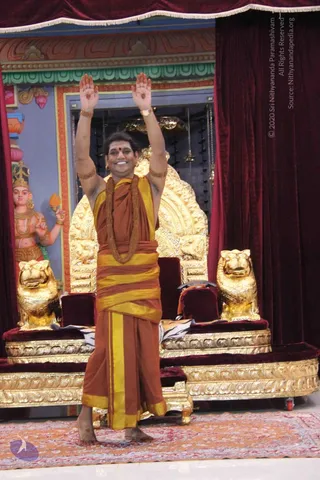
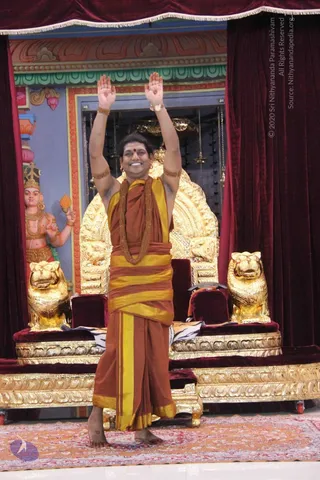
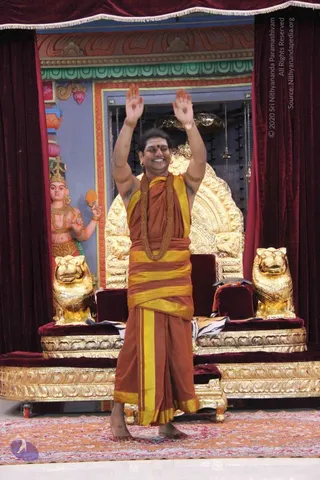
A man stands barefoot on a carpeted stage with both arms raised and palms open, smiling. He wears a saffron-orange garment with yellow-gold borders wrapped over one shoulder and waist, a rudraksha mala necklace, and gold bangles. Behind him are a golden throne with carved lion figures, deep red velvet drapery, and a painted pillar with a deity murti holding a lamp. The stage setting suggests a satsang or darshan event.A smiling man in an ochre and gold-bordered saffron dhoti and shawl, with a rudraksha mala around his neck and a red bindi, stands barefoot on a patterned carpet with both arms raised, palms open, before a gilded throne flanked by golden lion figures. Behind him are deep red velvet curtains and an ornate painted backdrop with a painted deity figure holding a flame. The setting suggests a satsang stage. Appearance-based cues of a rudraksha mala, saffron-and-gold clothing and a throne setting suggest a person as the person on stage.A photograph of a man standing barefoot on a rug on a stage, arms raised high with palms open, smiling. He wears a rust-orange and gold-bordered draped garment, a long gold-beaded necklace, gold armlets and a wristwatch, and has a red bindi on his forehead. Behind him stands a golden throne flanked by two golden lion figures, with red velvet curtains and a gilded deity murti holding a lamp on the left. a person: the man has a compatible presentation with the saffron-orange draped garment, a gold necklace and gold armlets, and the page says Swamiji is at this event, but the appearance cues are not distinctive enough to confirm.A smiling man with raised palms stands barefoot on a patterned red carpet before a golden throne backed by red velvet curtains. He wears a rust-brown and gold-bordered robe wrapped around his torso, a rudraksha mala necklace, bangles and a red bindi. Behind him is a gilded throne flanked by golden lion figures and a tiger-skin cushion. To the left stands a painted deity murti holding a flame, and hanging lamps are visible above.A smiling man in a rust-orange and yellow-bordered dhoti and shawl, with a long rudraksha mala draped over his chest, stands barefoot on a patterned rug with both arms raised overhead. Behind him is an ornate gold throne flanked by two golden lion figures, with red velvet drapes and a painted deity murti on the left holding a flame. The stage setting suggests a satsang. a person is shown with the rudraksha mala and orange-yellow garments, in a standing, celebratory pose.A man in a rust-orange and gold-bordered dhoti and shawl, with a long rudraksha-style mala around his neck, stands barefoot on a patterned rug with both arms raised and palms open, smiling. Behind him is a gilded throne flanked by two golden lion figures, with maroon velvet curtains and a painted deity statue with a flame in its hand. The scene suggests an ashram stage or satsang setting. The man appears to be a person by appearance cues: saffron-orange ornate clothing and a rudraksha mala, with the page indicating his presence at the event.

1-pratyaksha-pada-puja
2 photosSource gallery
A photograph of a seated man in an orange and saffron robe with a gold-bordered shawl and a long rudraksha mala on his chest, sitting on an ornate gold throne carved with lion heads and draped with a striped tiger-print cloth. Behind him hang brass bells and a lamp on chains against a black wall. In front, a brass tray holds a yellow flower arrangement, red hibiscus blooms and small brass lamps. Three devotees kneel at the tray: a woman in white with grey hair and folded hands, a man in a white shirt with palms pressed together, and a woman in a dark red sari. Swamiji (probable): the seated man has long swept-back hair, a rudraksha mala and saffron-orange robes on a throne, so he is labelled as the probable candidate. The scene reads as a pratyaksha pada puja with devotees offering worship at the feet.A photograph of a man seated on an ornate gold throne carved with lions and draped with a striped tiger-skin cushion. He wears an orange-brown robe with a gold border, a rudraksha mala necklace, gold bangles and a tilak on his forehead, with eyes lowered. Hanging brass oil lamps and bells frame the throne. In the foreground, a woman in white with a rudraksha mala sits beside silver plates of offerings with red flowers and fruit. A second woman in orange-red sari is partially visible at right, and a hand reaches in at the lower edge.

2-Nithya-Satsang
2 photosSource gallery
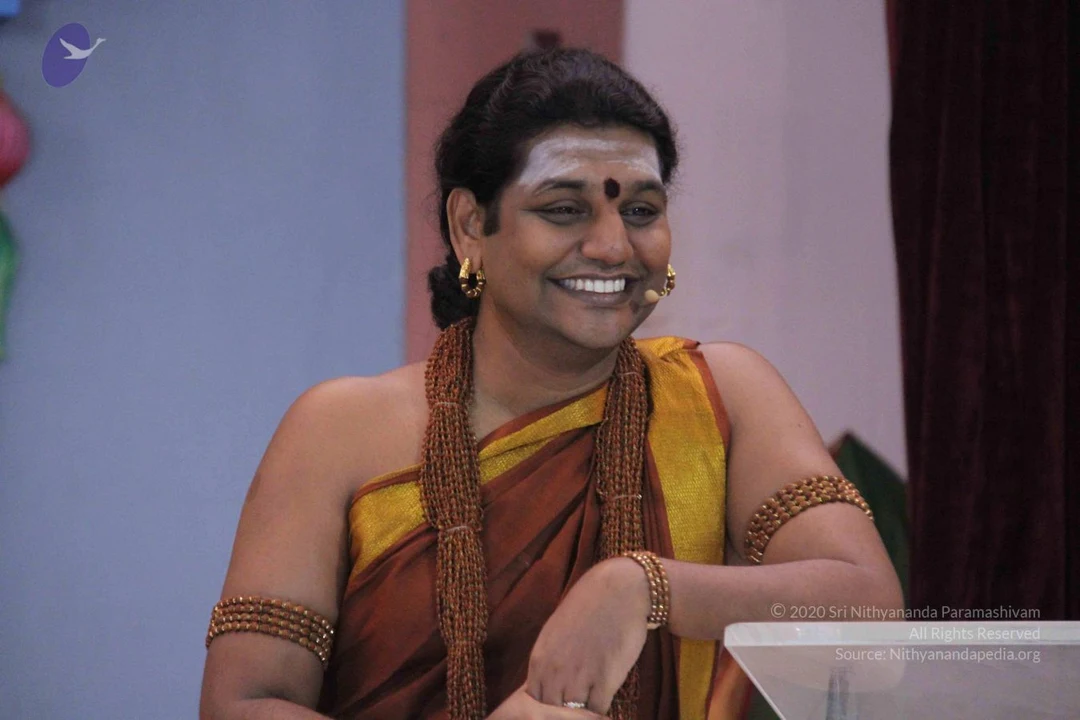
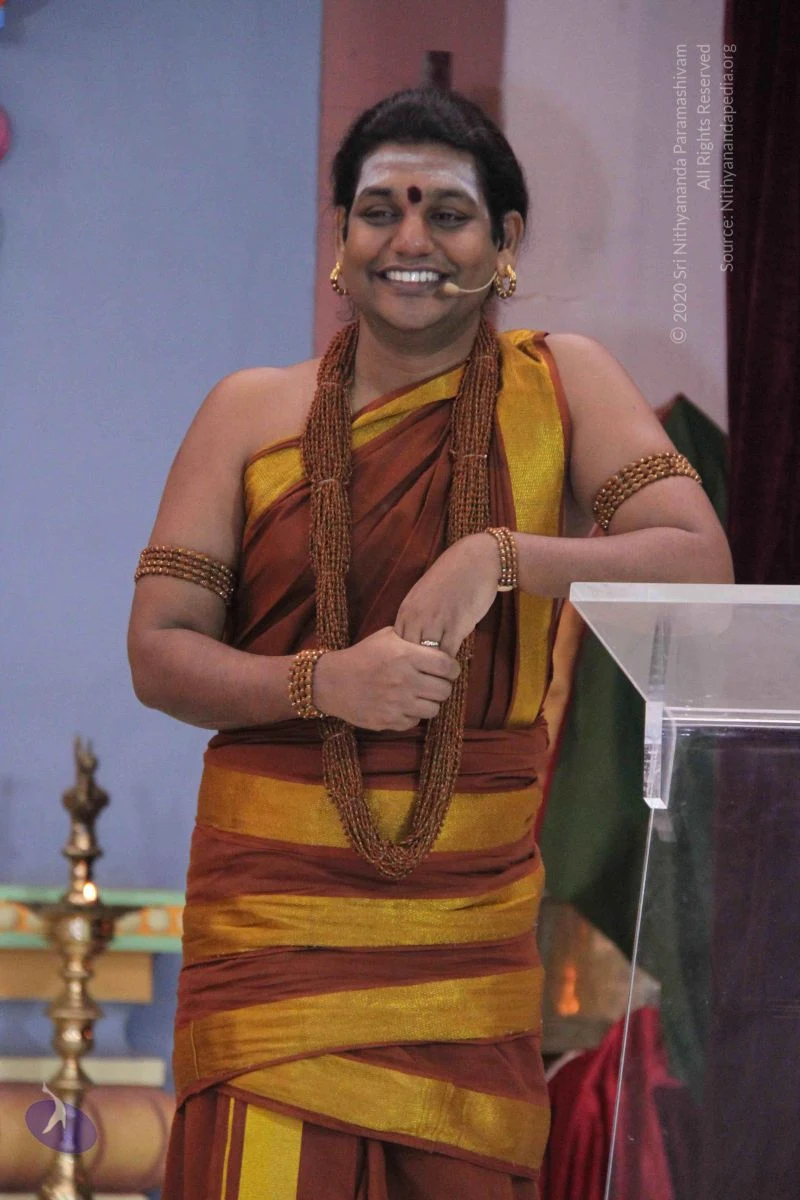
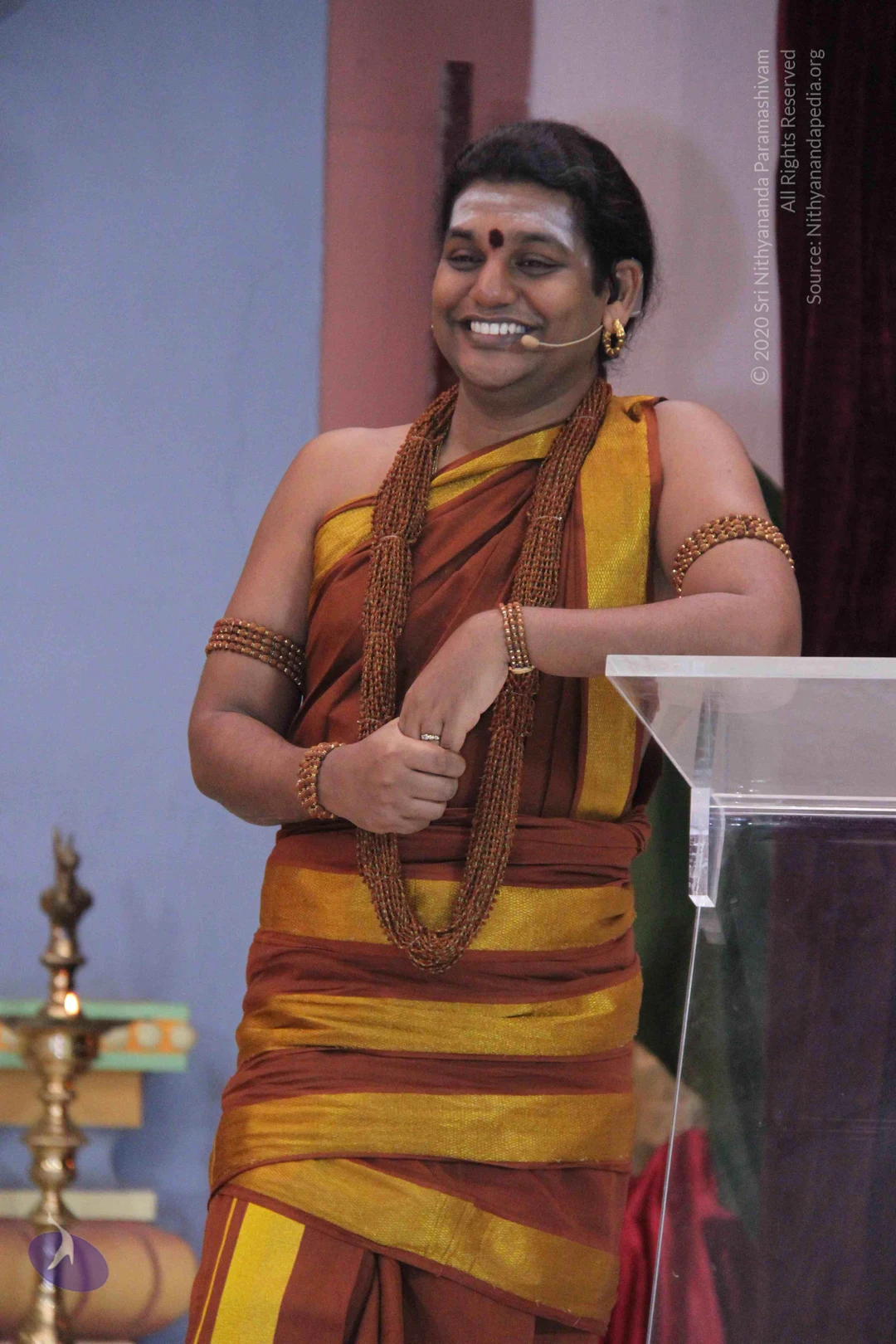
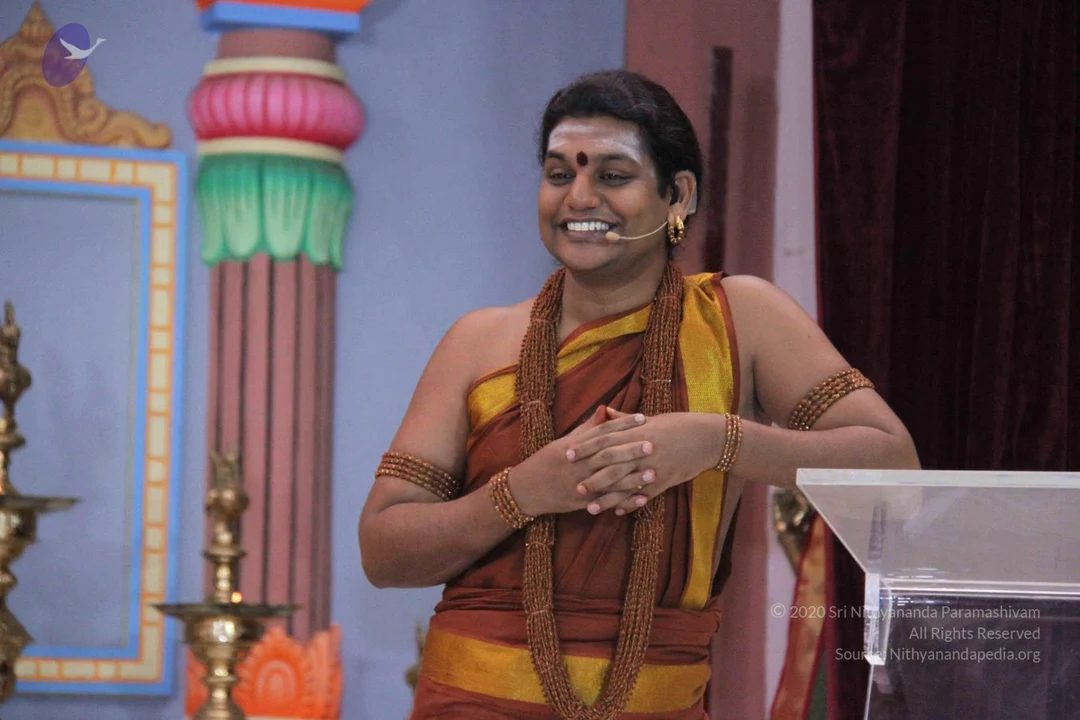
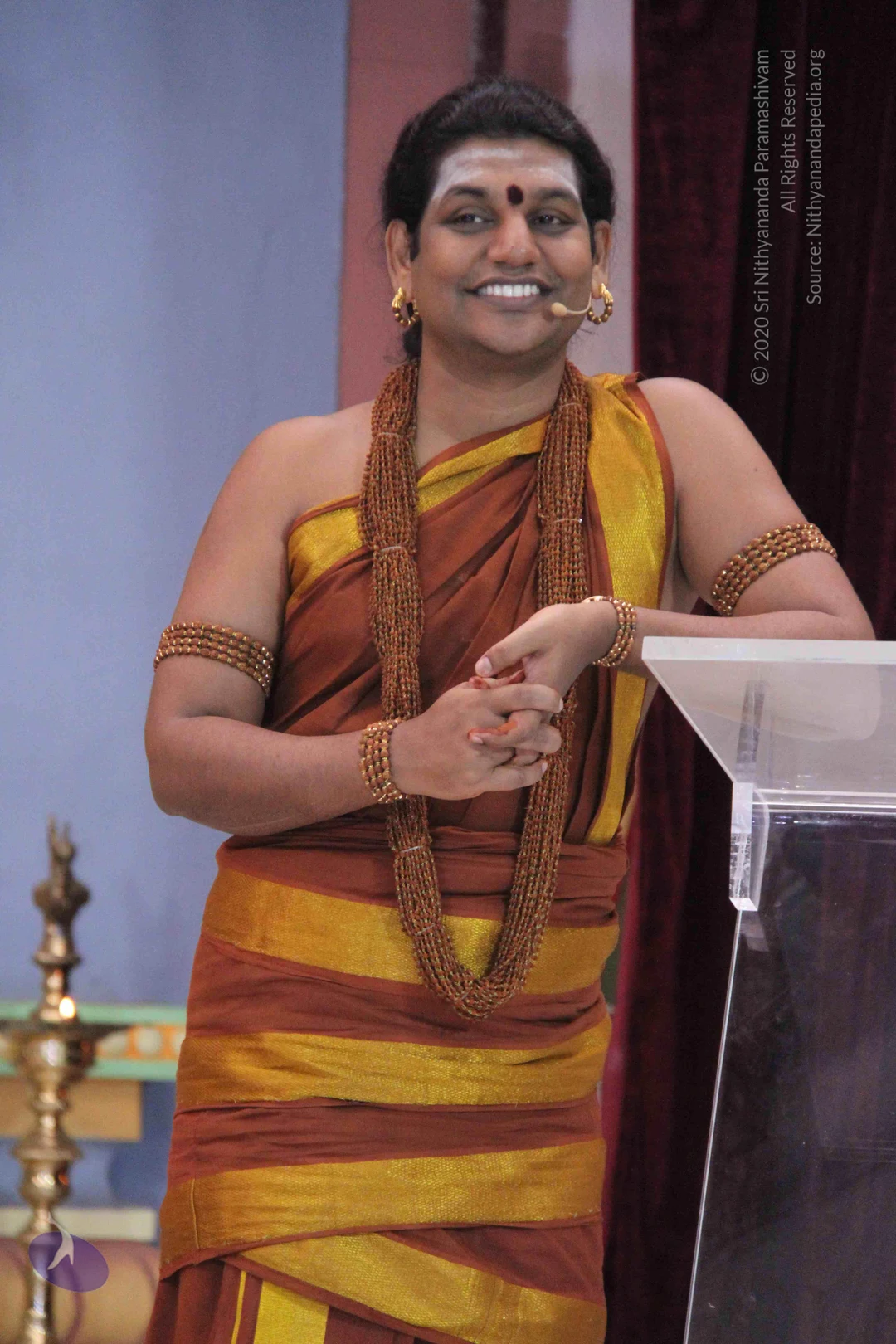
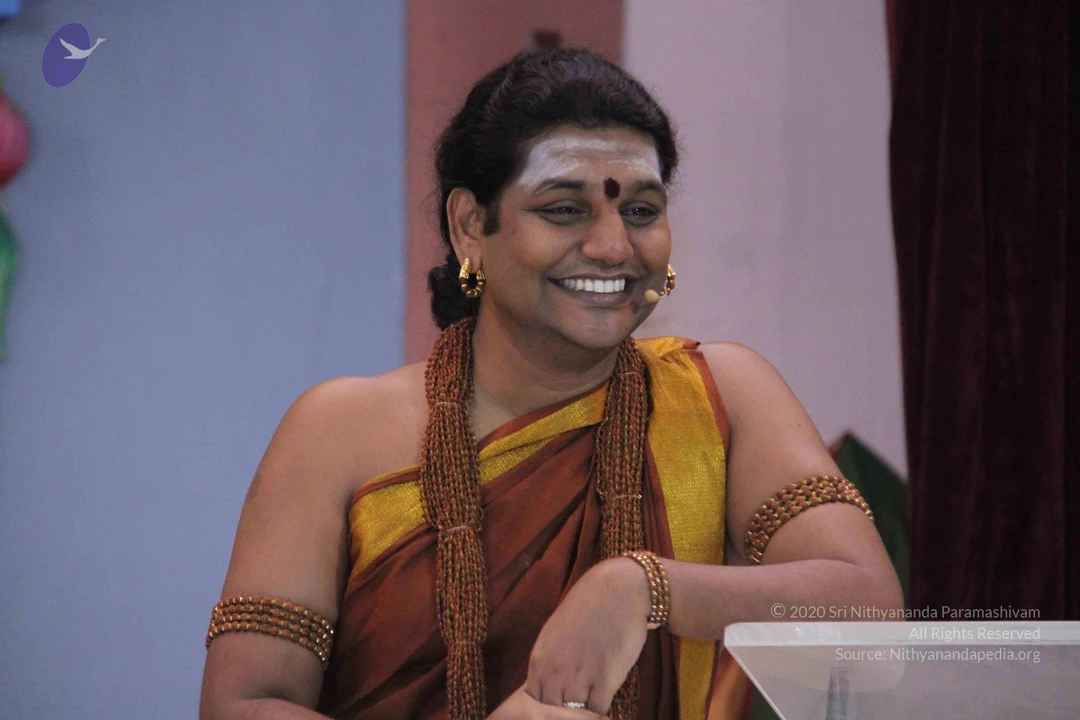
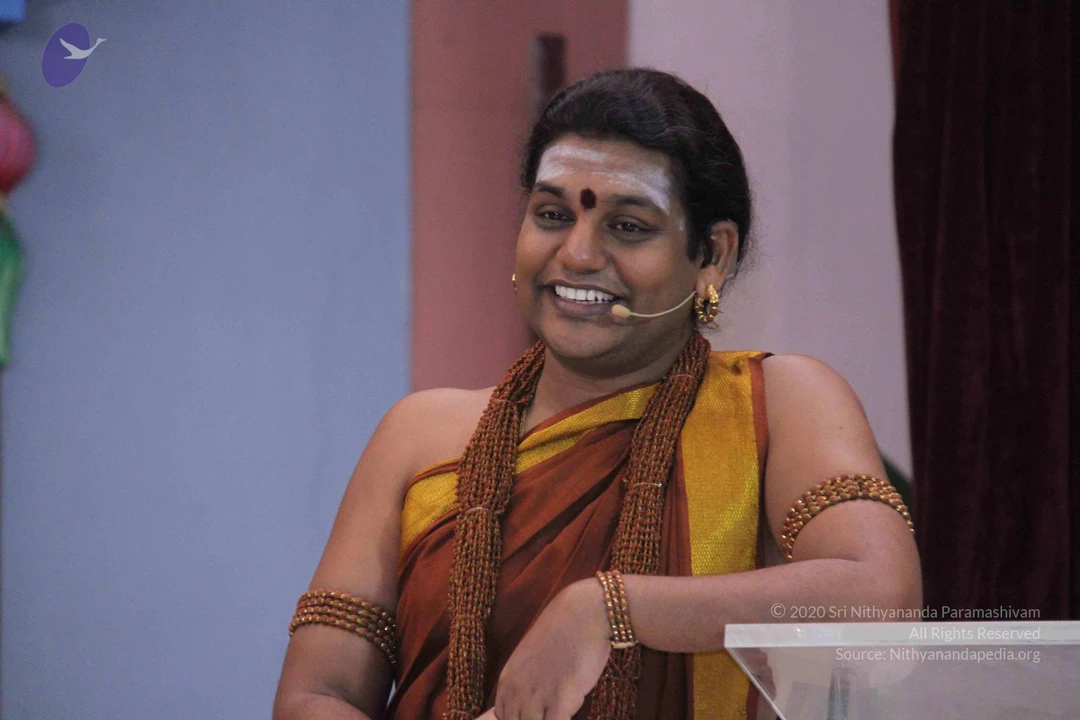
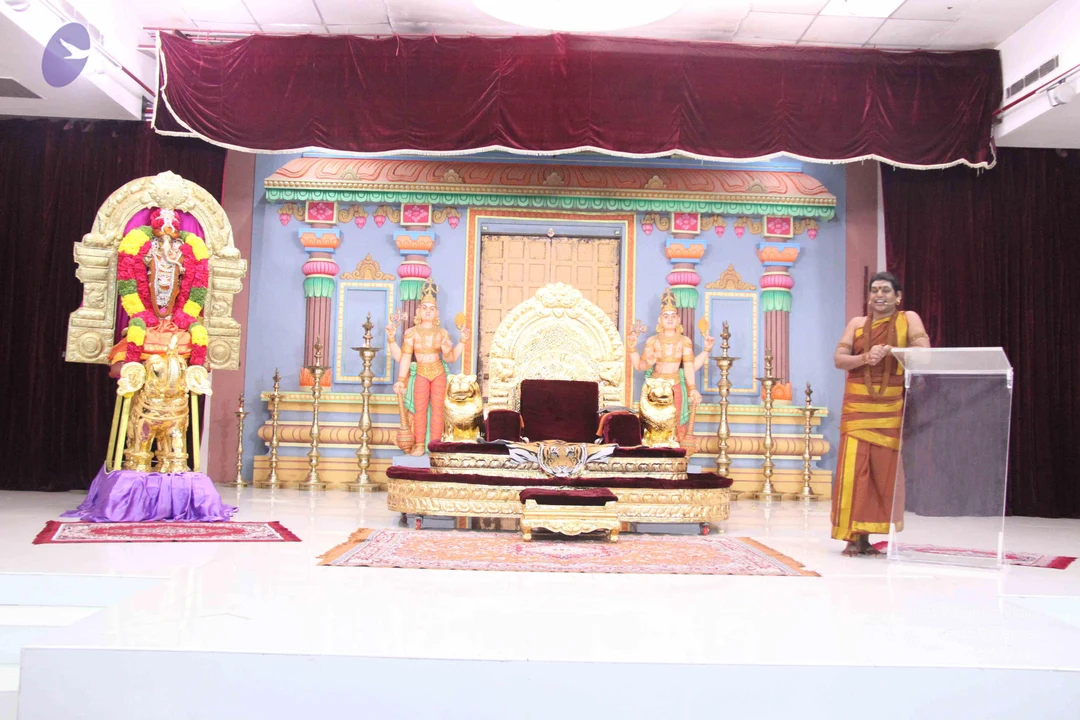
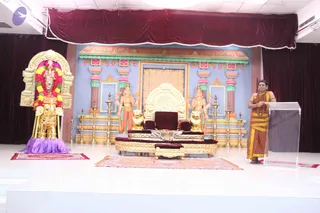
Photograph of a satsang stage set up with a golden throne with red cushions flanked by two gold-coloured standing deity statues holding objects, and a gold Ganesha murti on a purple cloth at left decorated with a red and yellow garland. A man in an orange-and-saffron dhoti and shawl stands at a clear acrylic lectern on the right, hands together, speaking. Brass lamp stands line the platform, with a red velvet valance above and a blue-and-pink painted backdrop with ornate pillars. One person is visible.A person stands at a clear acrylic lectern during a satsang, smiling with hands clasped at waist level. The person wears a rust-brown dhoti and shawl with gold borders, a multi-strand rudraksha mala across the chest, matching beaded armlets and bracelets, gold hoop earrings, and a headset microphone. A brass oil lamp with a lit flame stands at left against a blue wall, with a dark red velvet curtain behind. a person appearance-based label: the person has the rudraksha malas and ornate saffron-gold dress of the description, but the cues are not conclusive, so presence is uncertain.
3-Sarva-Darshan
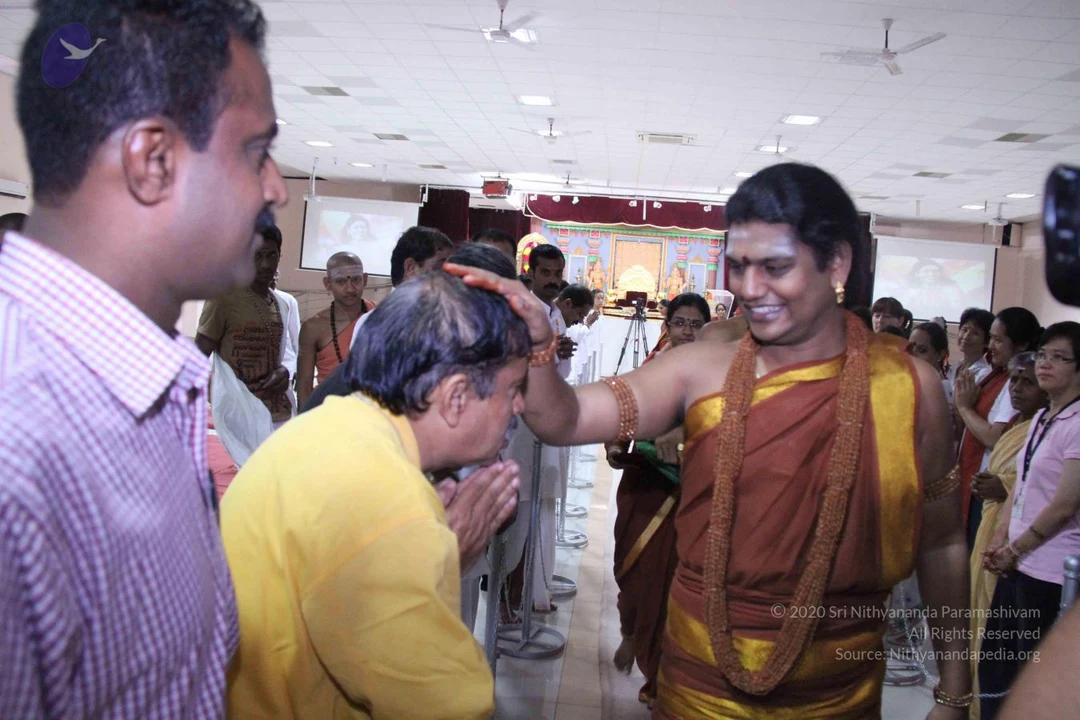
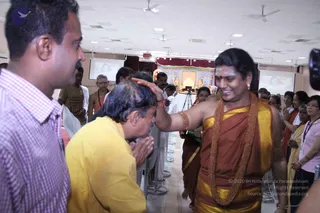
2 photosSource gallery
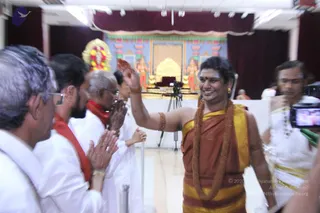
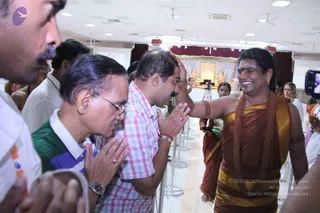
A photograph of a smiling man in an orange-brown ochre wrap with gold borders and a long rudraksha-style bead necklace, raising one hand in greeting as he walks past a line of people with palms pressed together in namaste. Several men in white dhotis and shirts, some with red shawls, stand on the left. Behind them an altar is decorated with colourful festoons, a large golden seated throne with a mirrored backdrop, and two gilded deity figures. A camera operator stands at the right edge, and a tripod is visible in the background. The man in ochre is presented as Swamiji (probable) based on his saffron-orange clothing, long bead necklace and swept-back hair, and the page indicates he was present at this event.A photograph in a hall with white ceiling fans and a maroon-and-gold stage backdrop. On the right, a smiling figure with long dark hair wears a rust-brown robe with a gold border, a long rudraksha-style mala and gold-toned bangles, and extends an arm to touch the forehead of a man in a pink-and-white checked shirt with his hands folded in namaste. Beside him, a man in glasses and a green-and-white polo shirt stands with palms joined in prayer. Other attendees in white and orange clothing stand in the background. The figure's appearance matches the ceremonial cues described for a person, giving a blessing to devotees. Visible people: about five.