Skip to content
Friday

16 August 2013

Dated photos
137
Source pages
1
Media
4
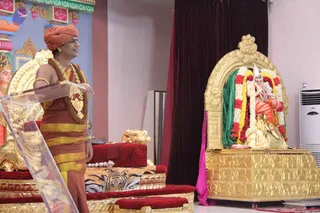
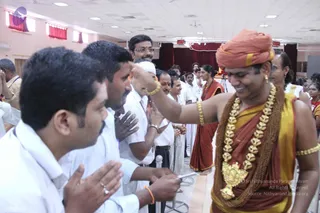
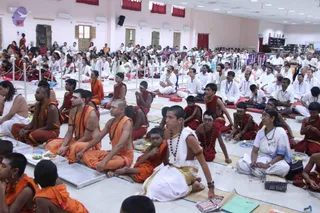
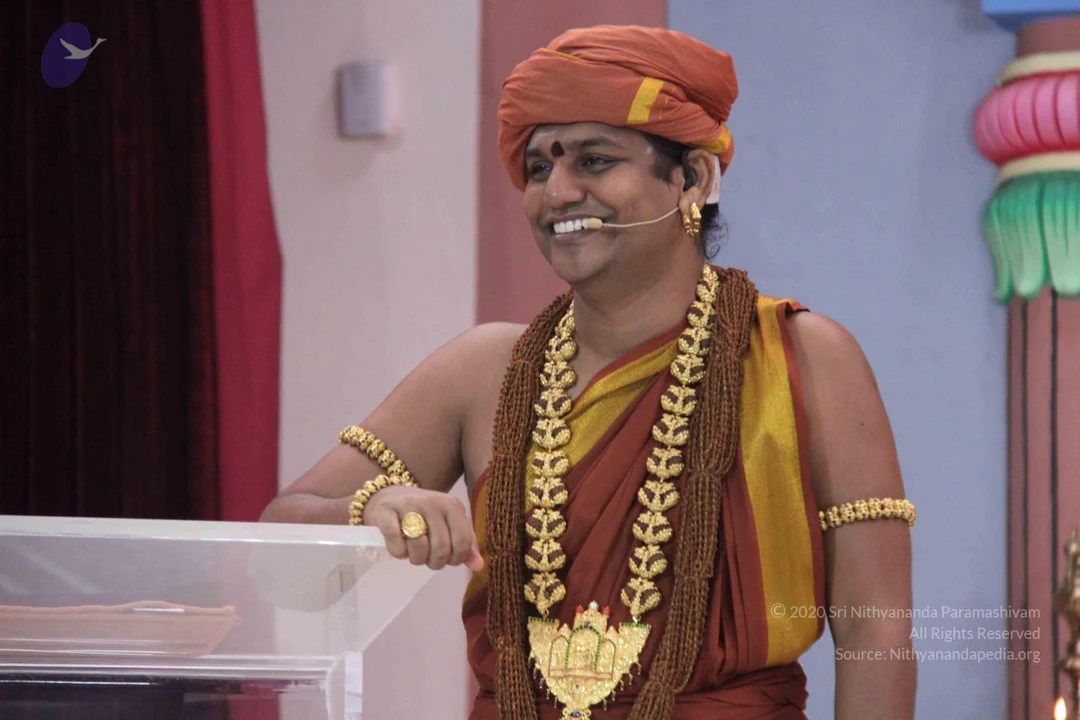
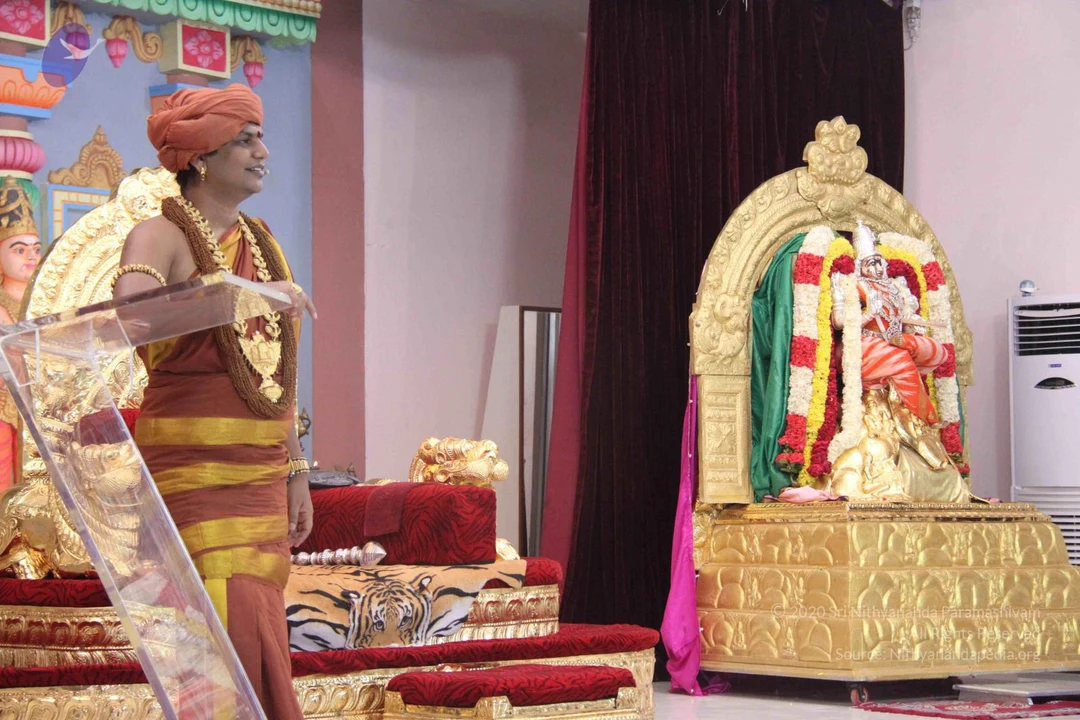
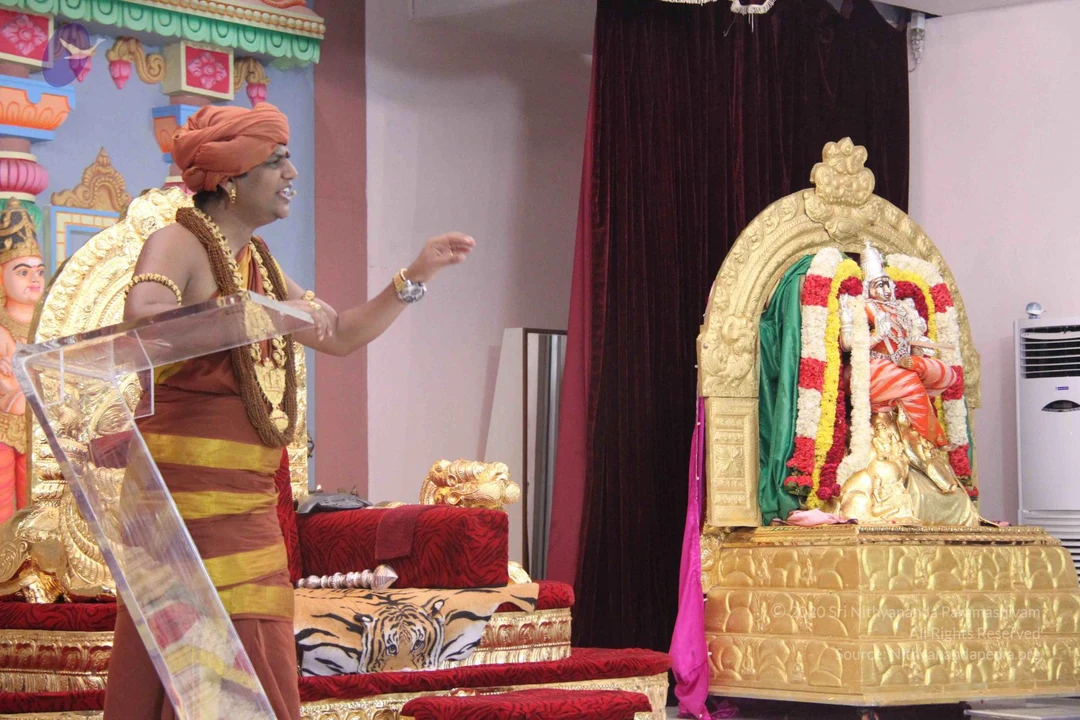
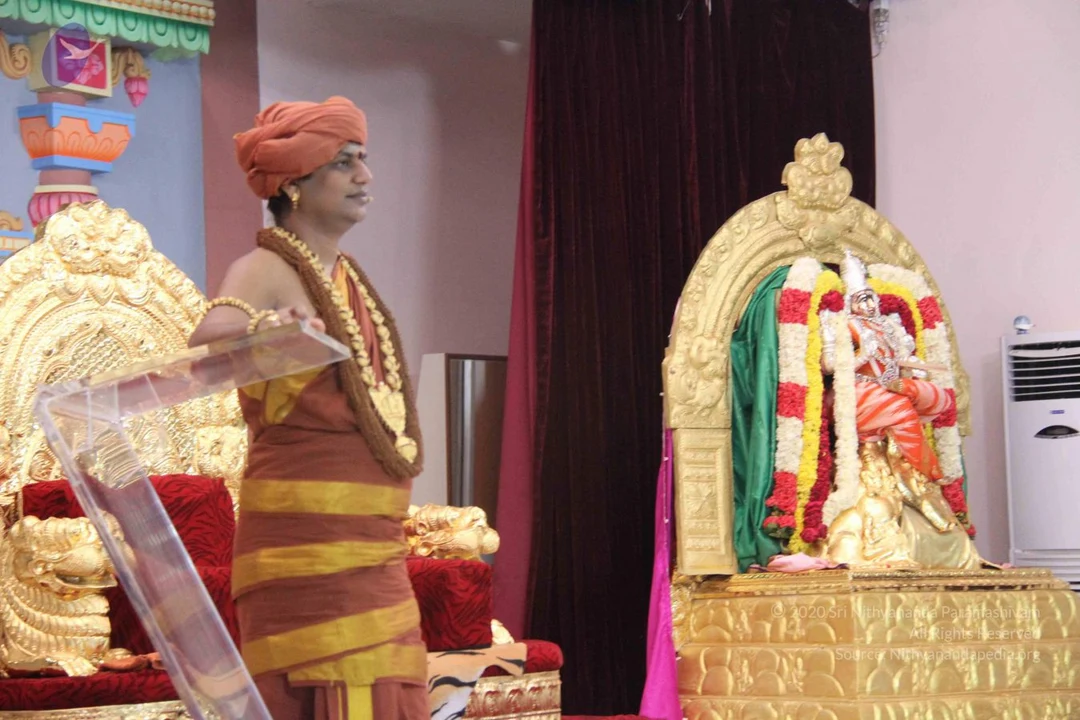
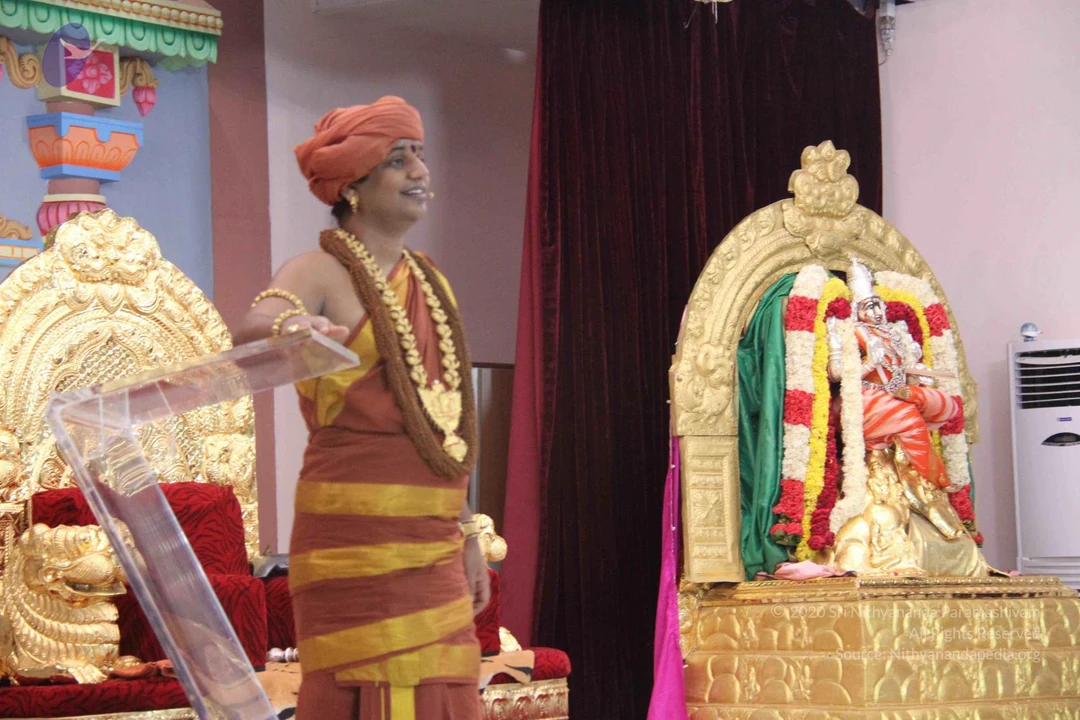
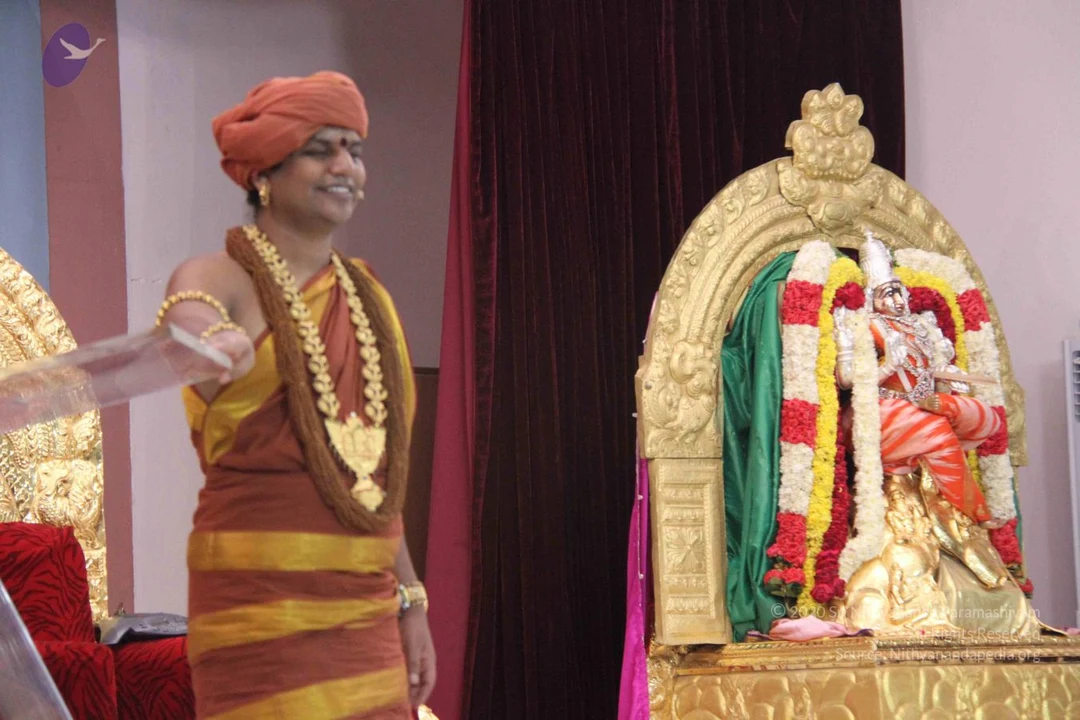
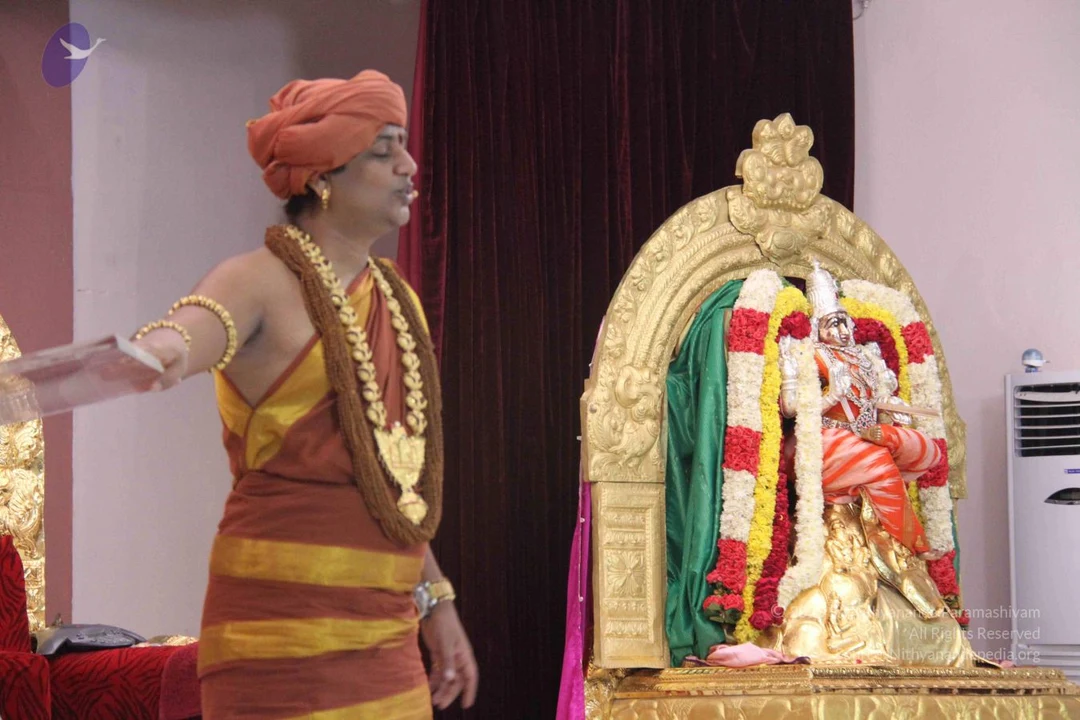
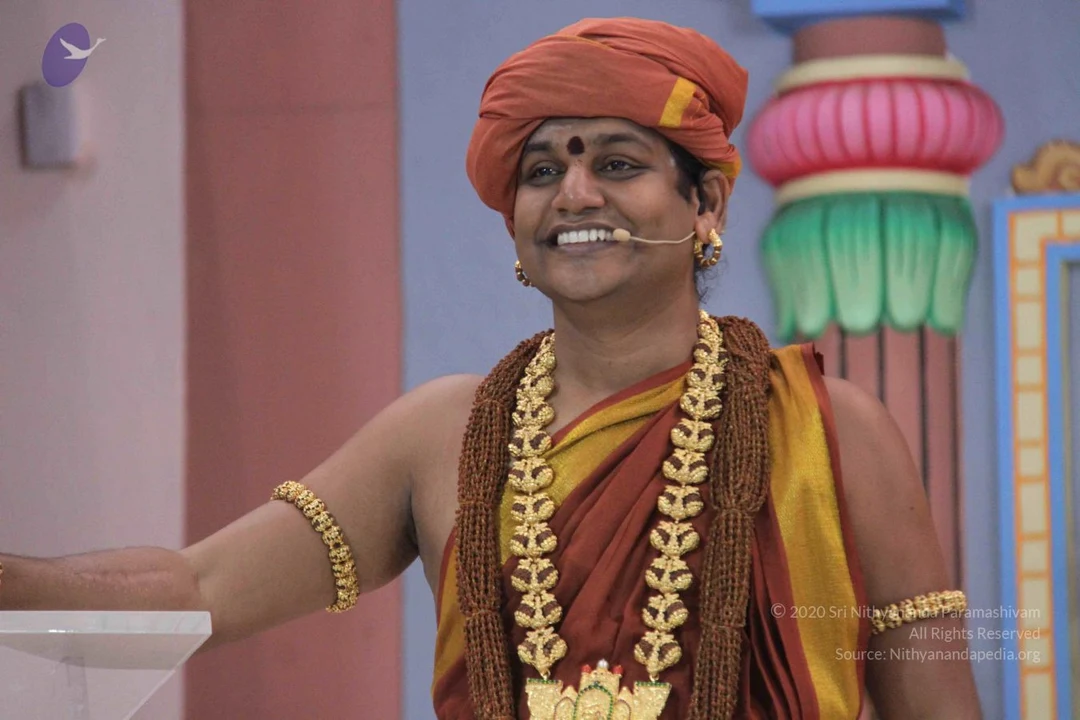
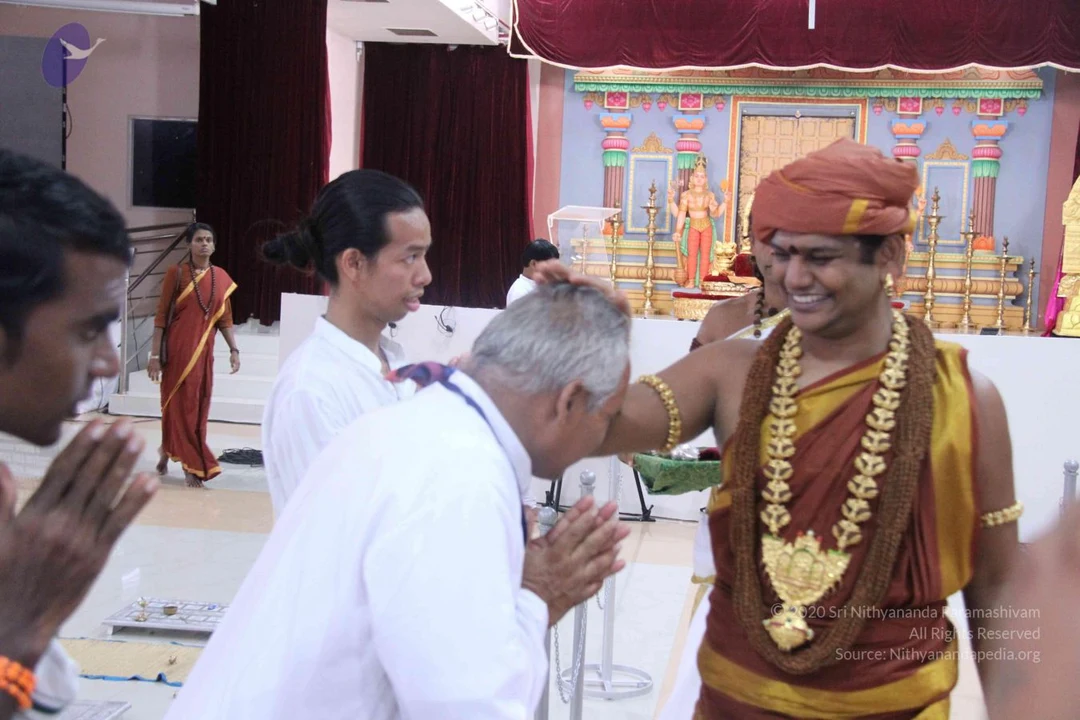
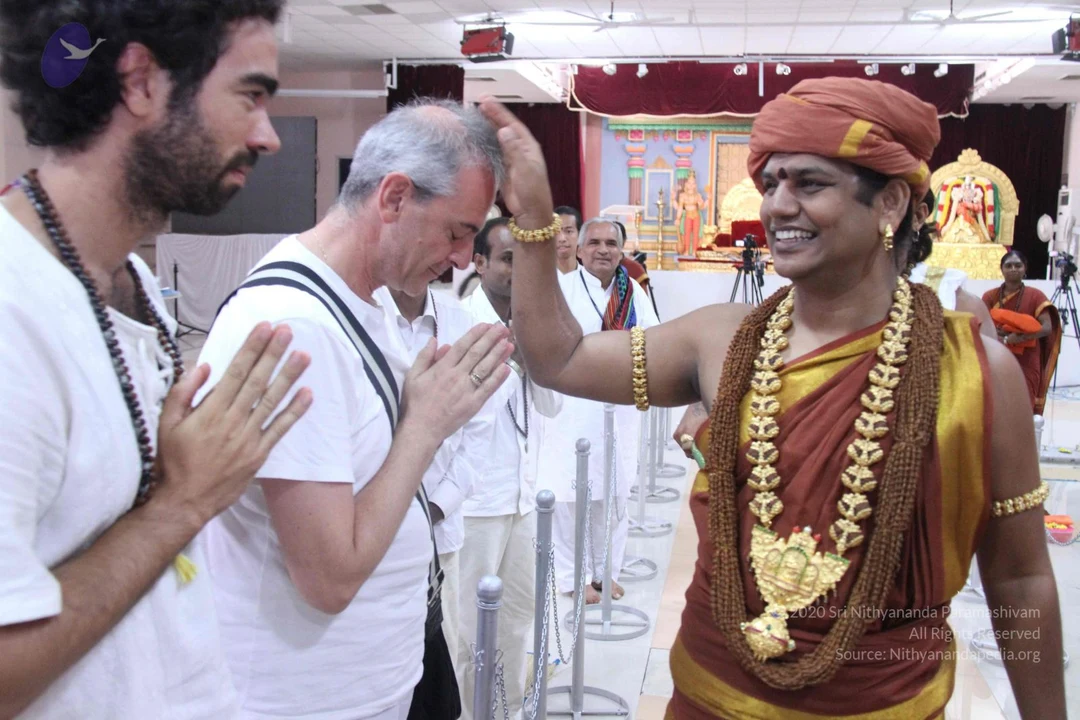
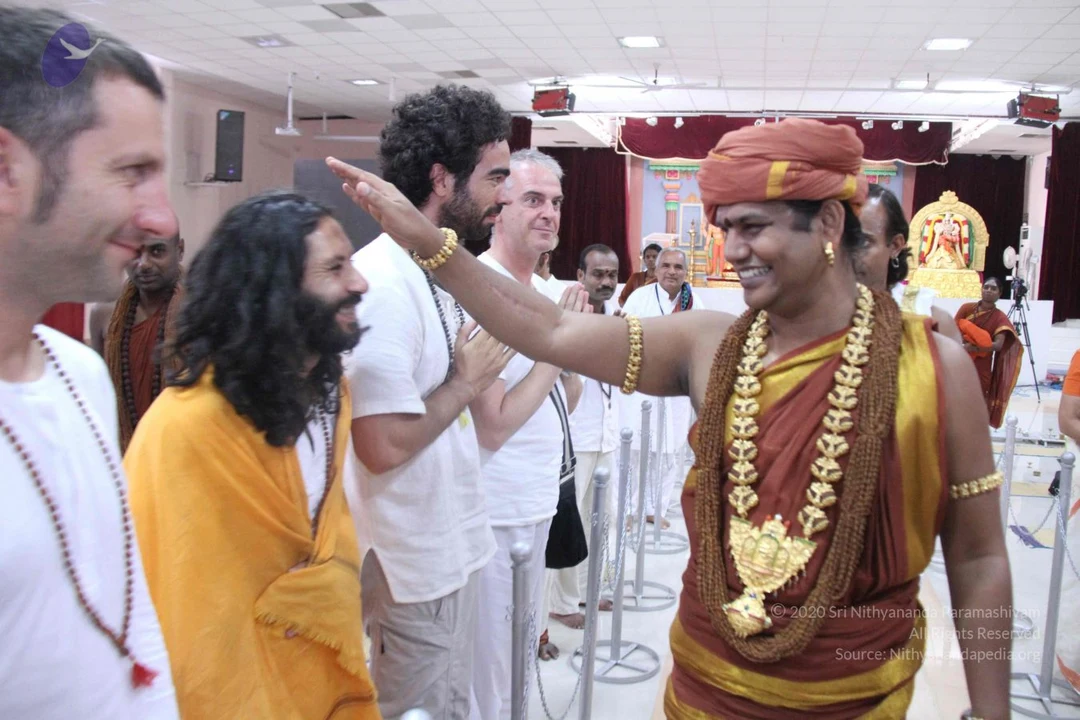
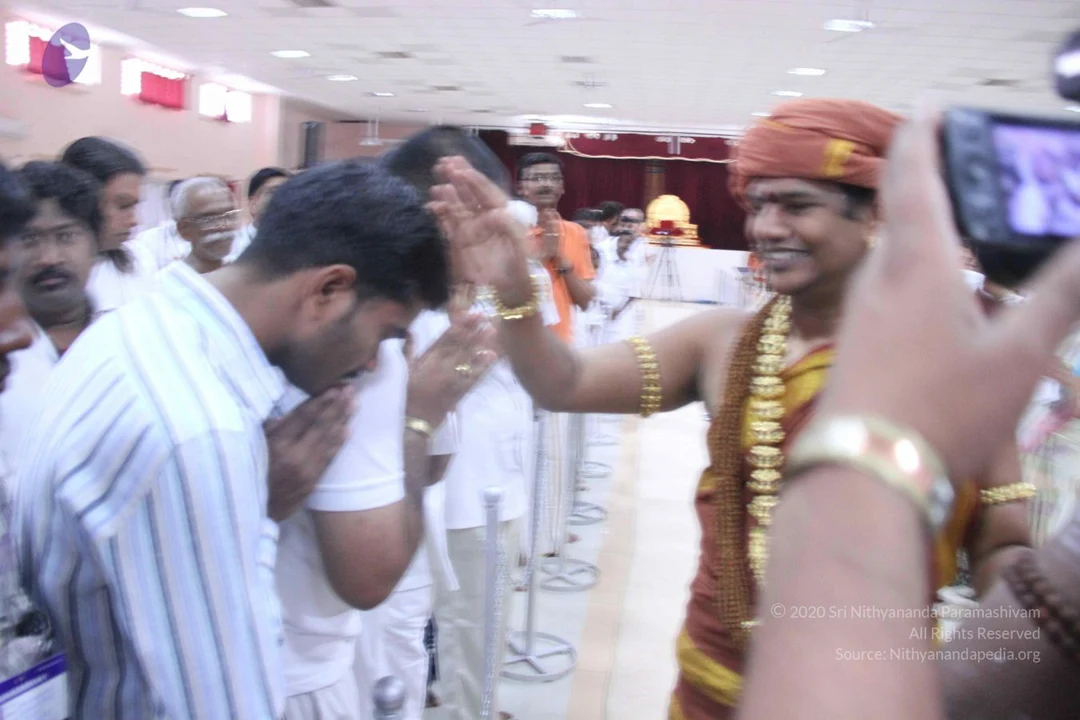
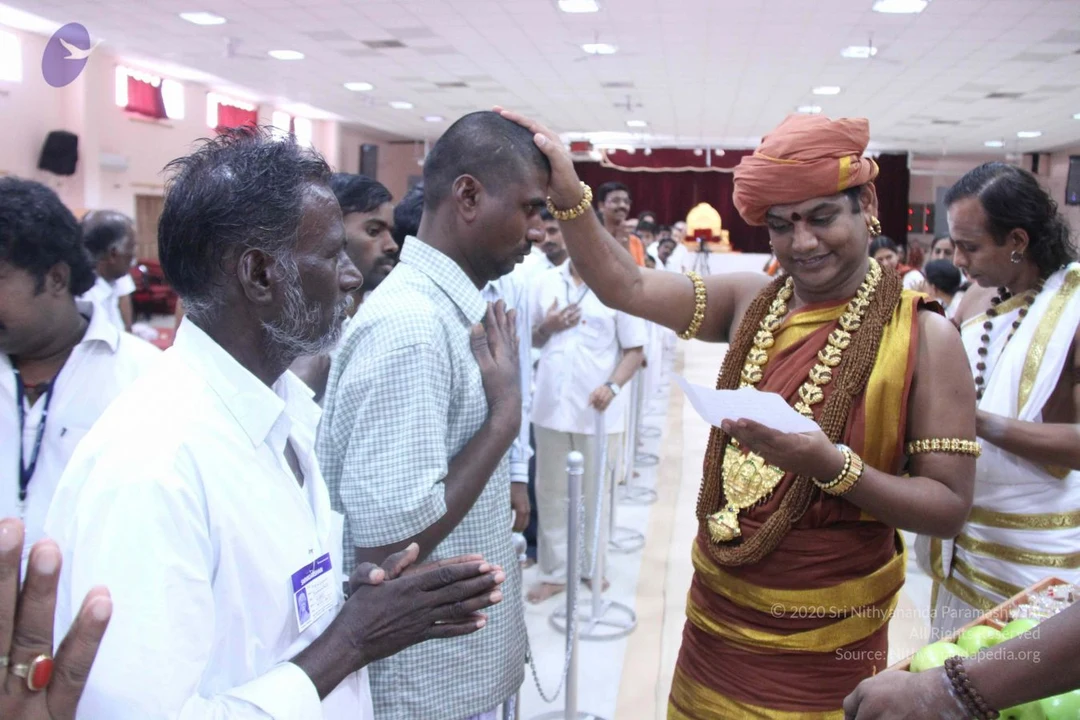
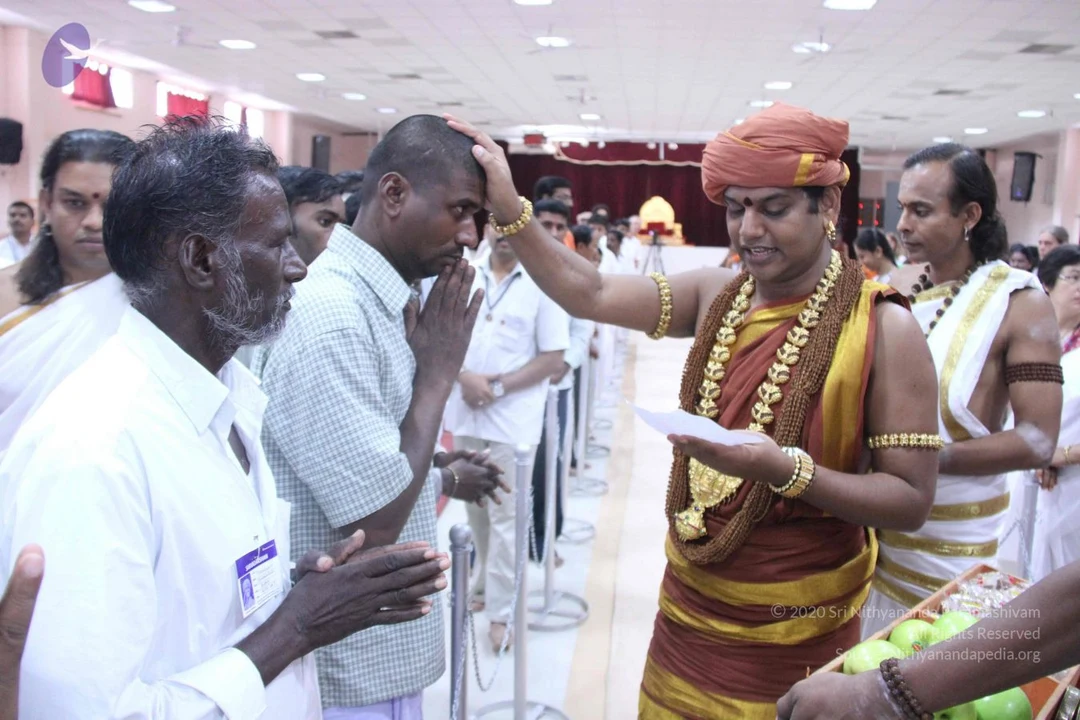
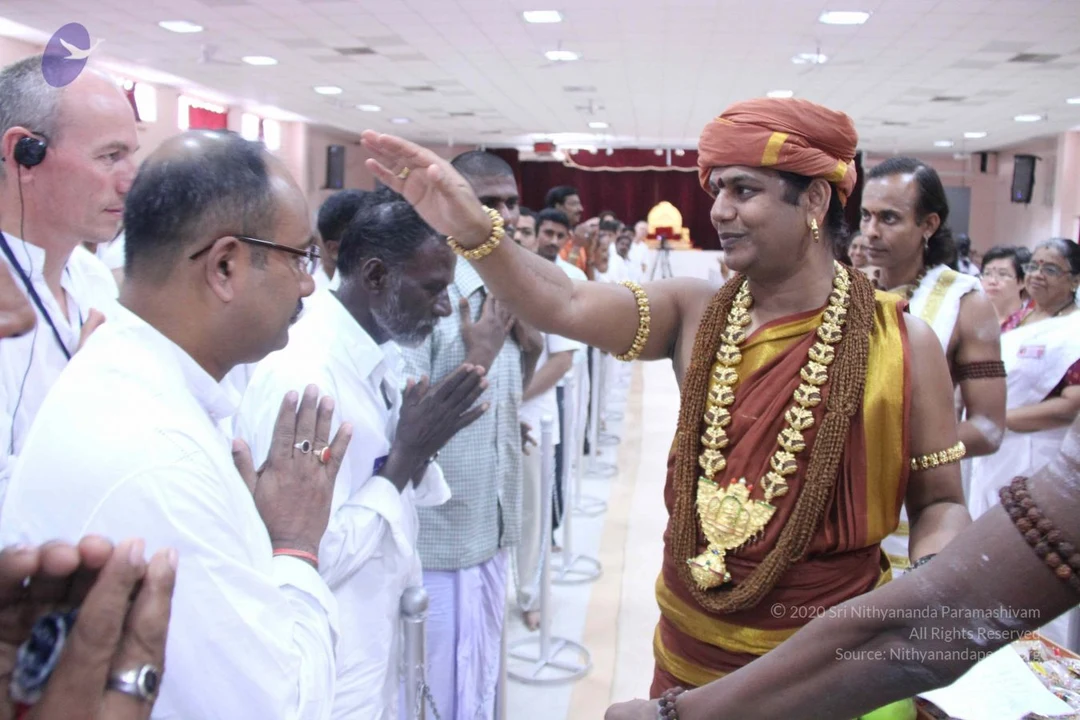
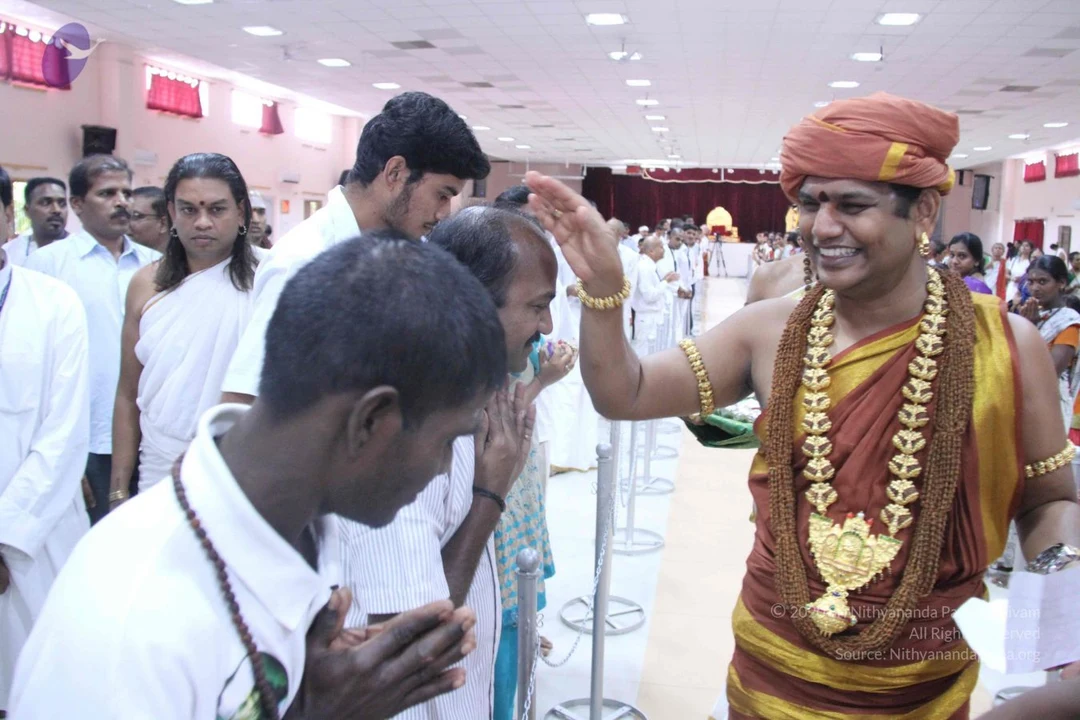
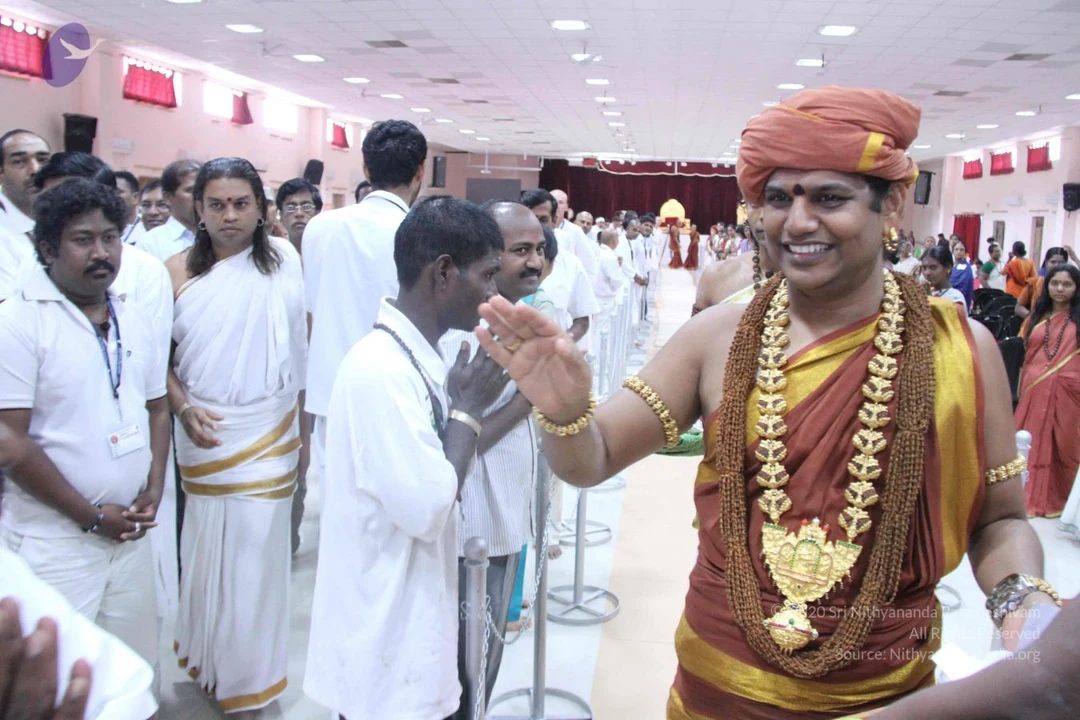
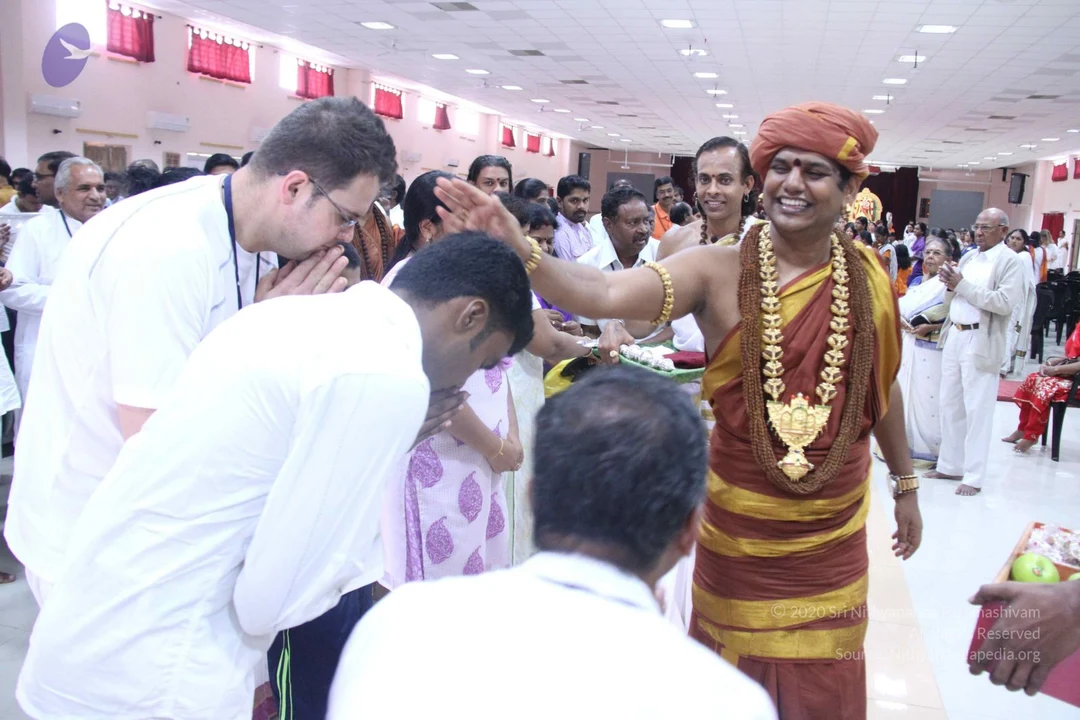
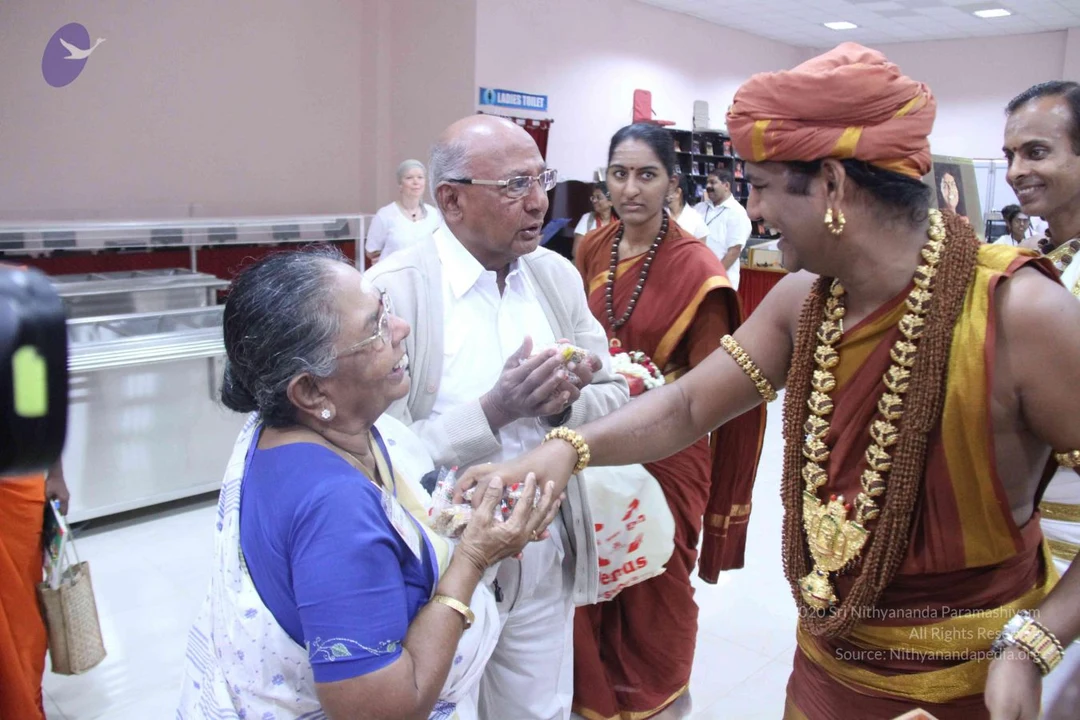
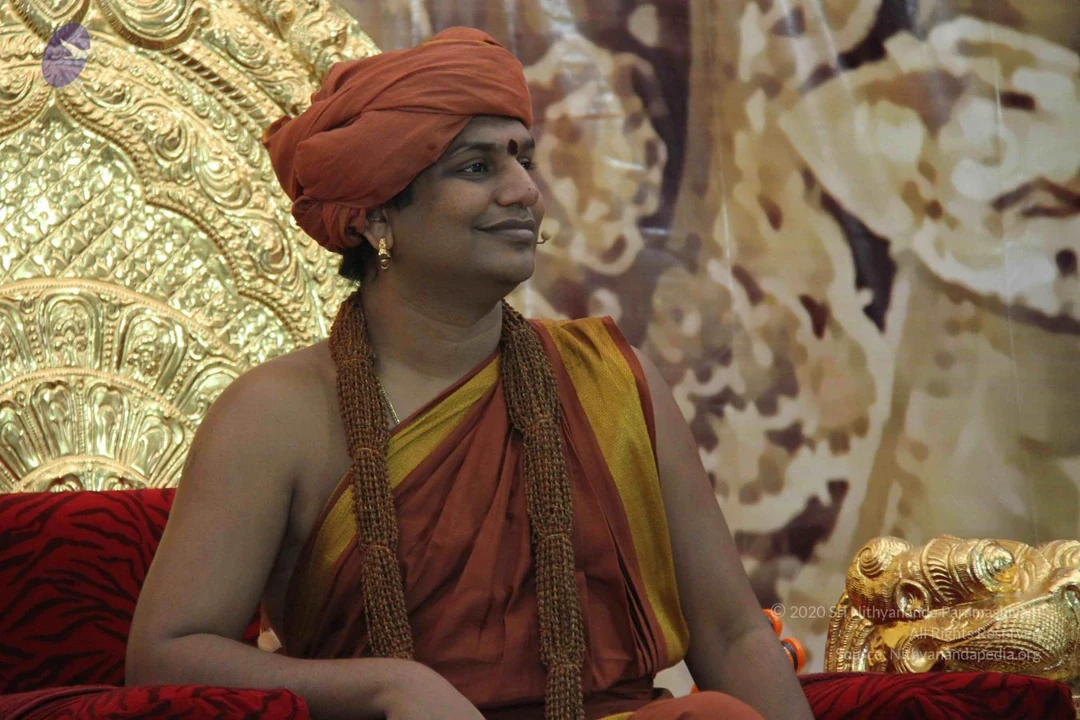
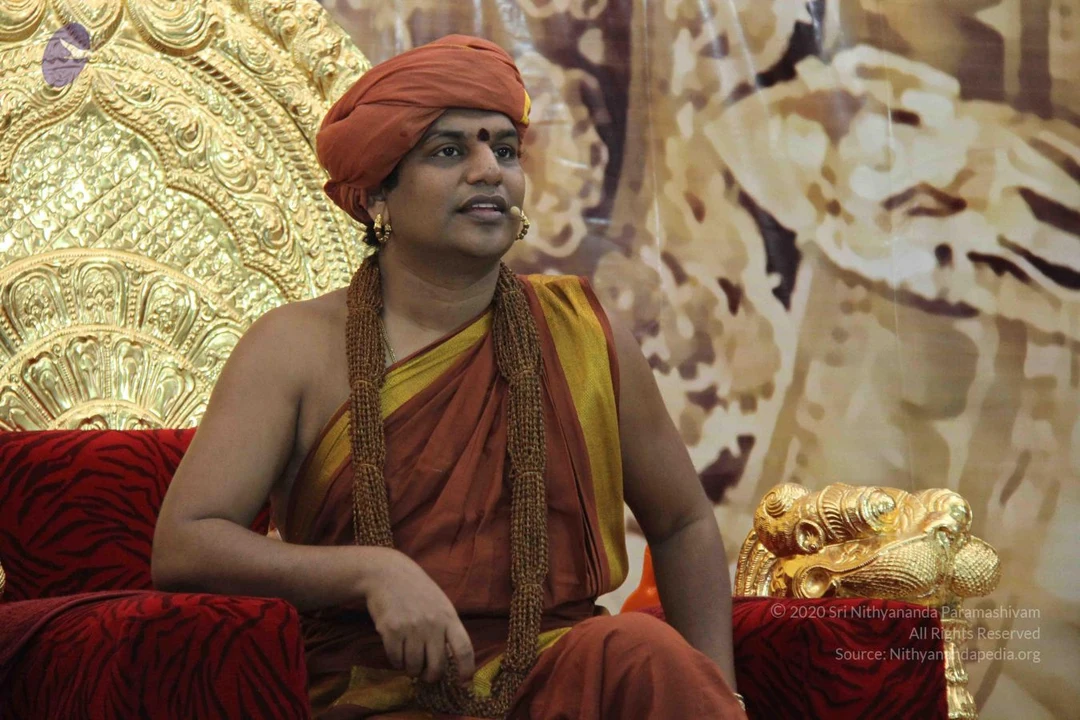
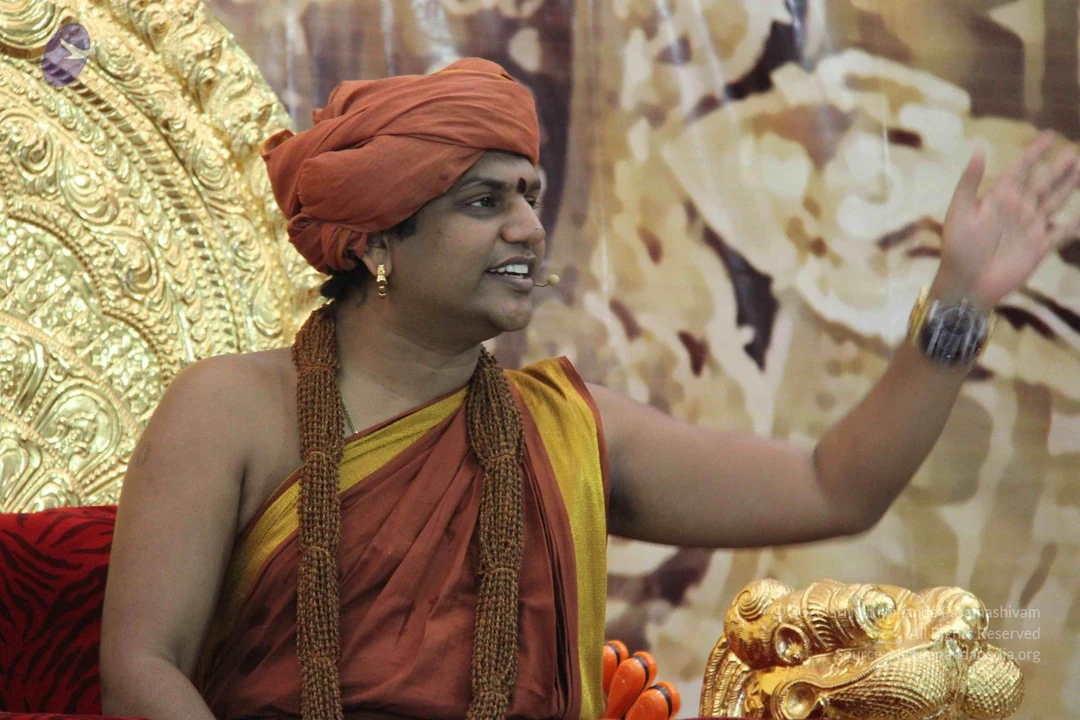
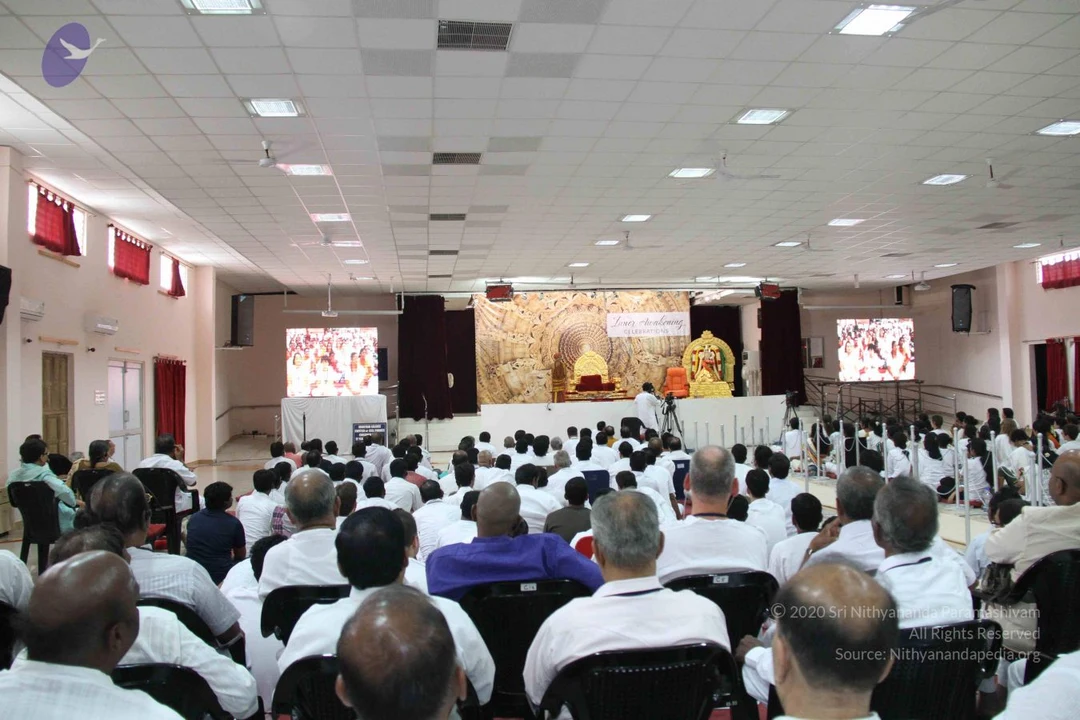
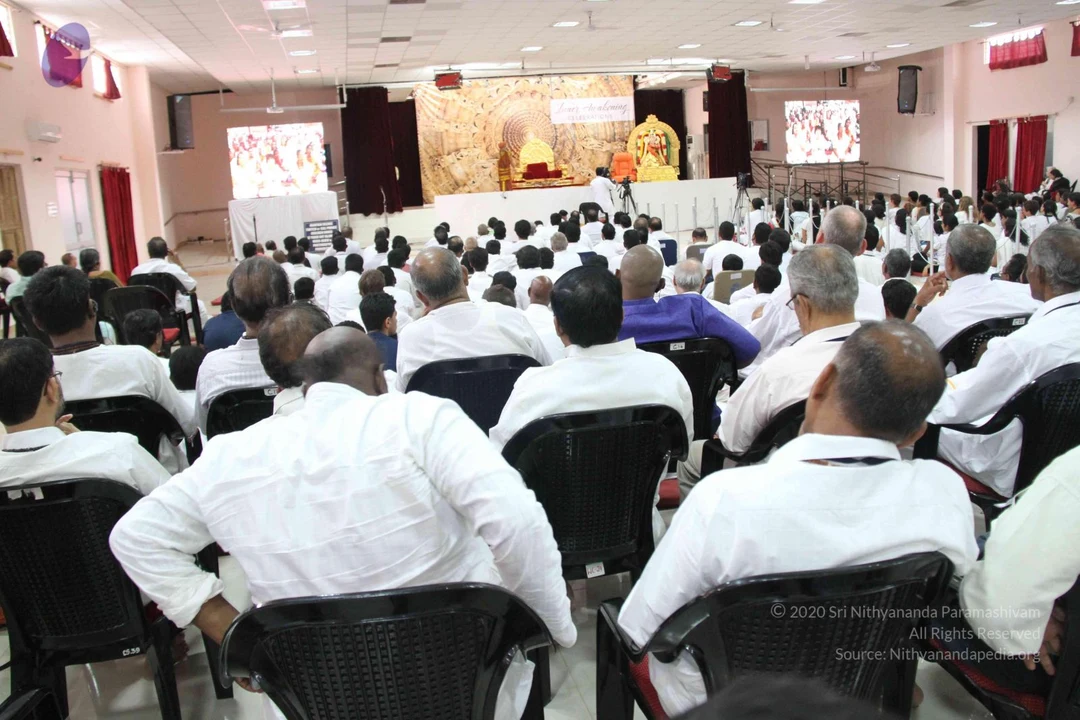
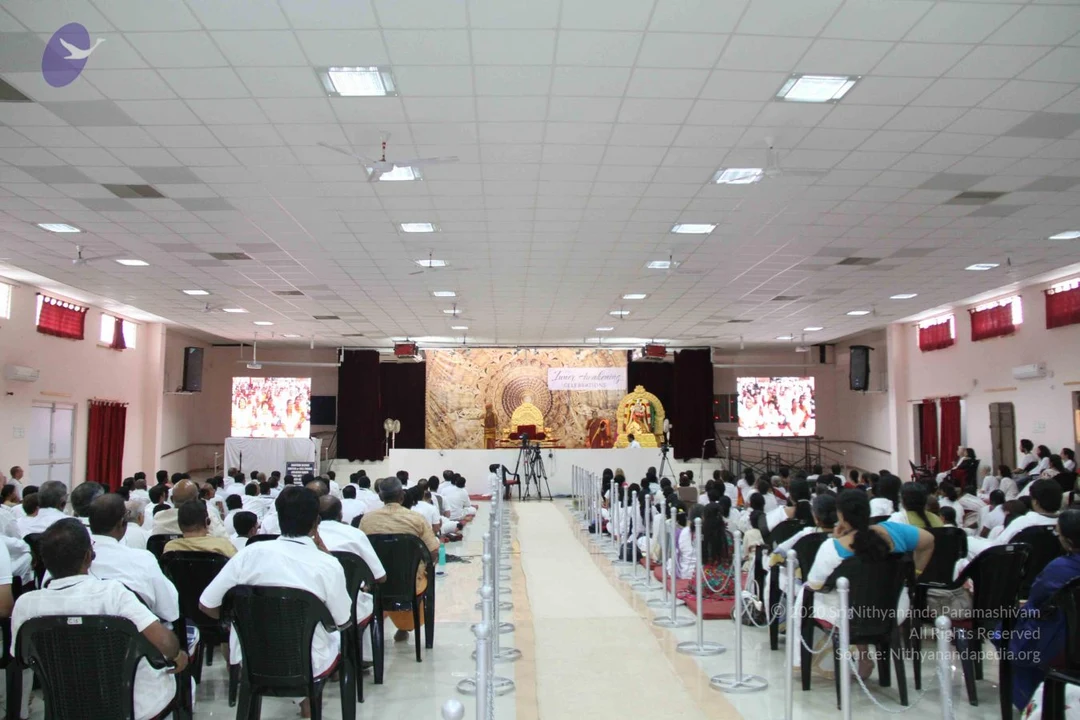
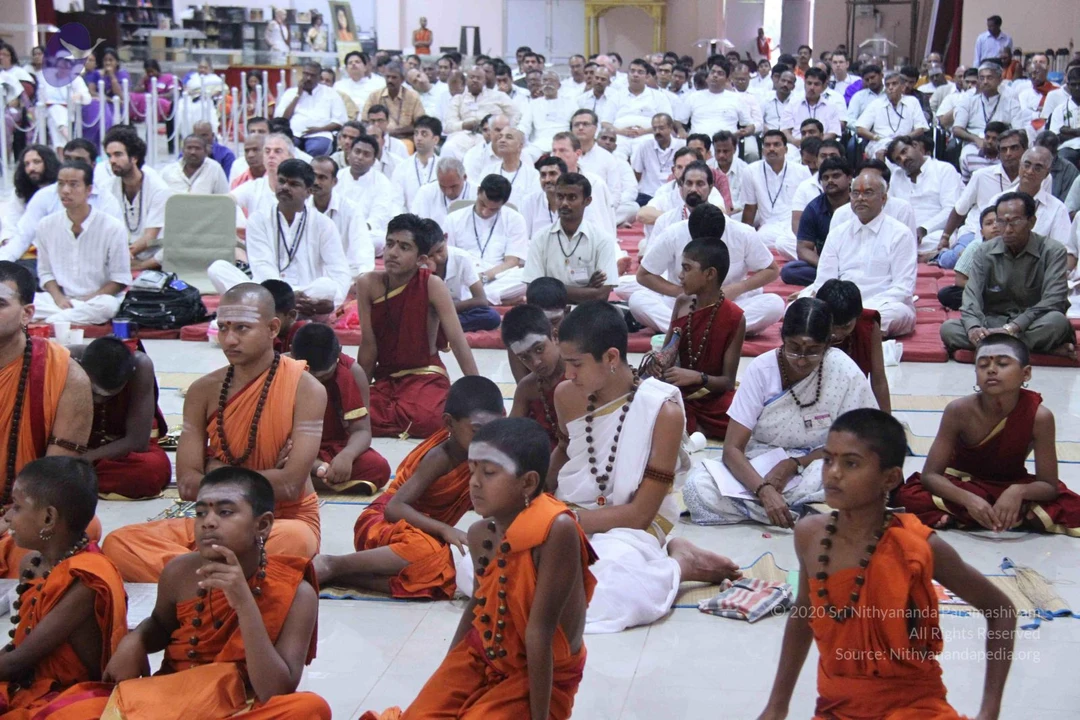
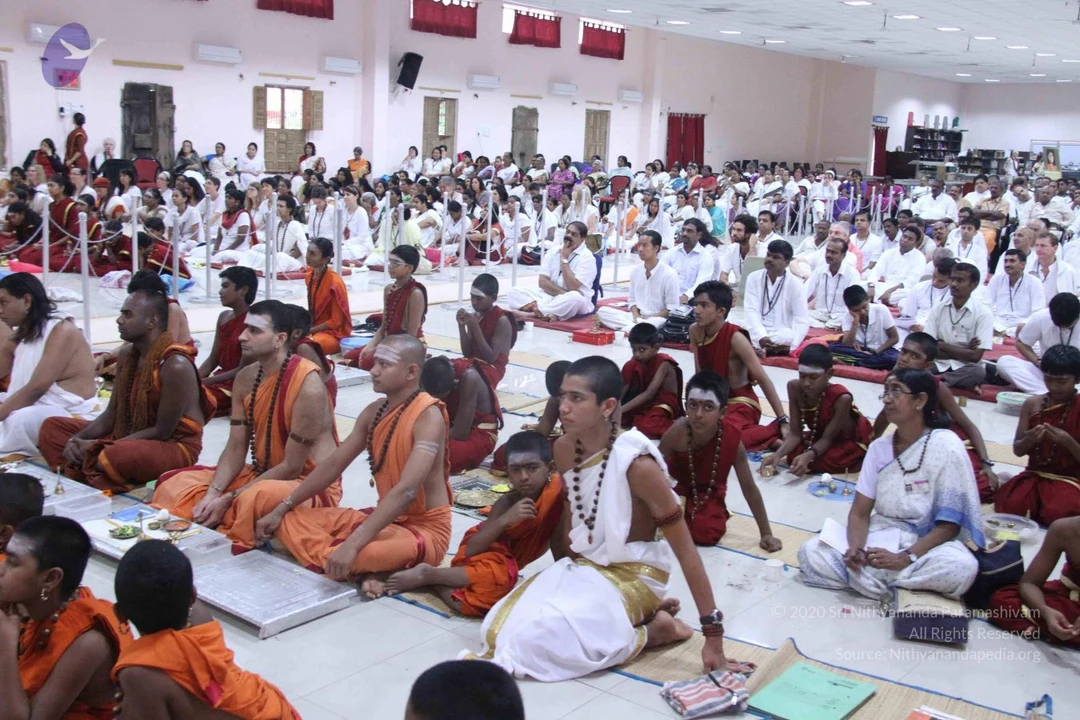
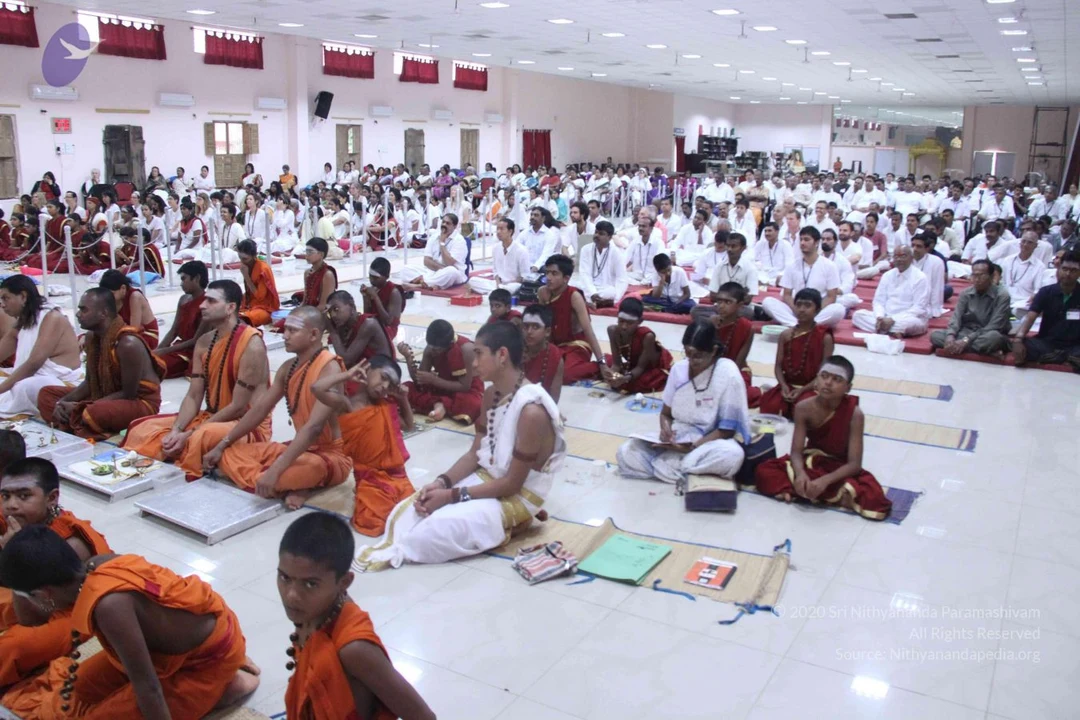
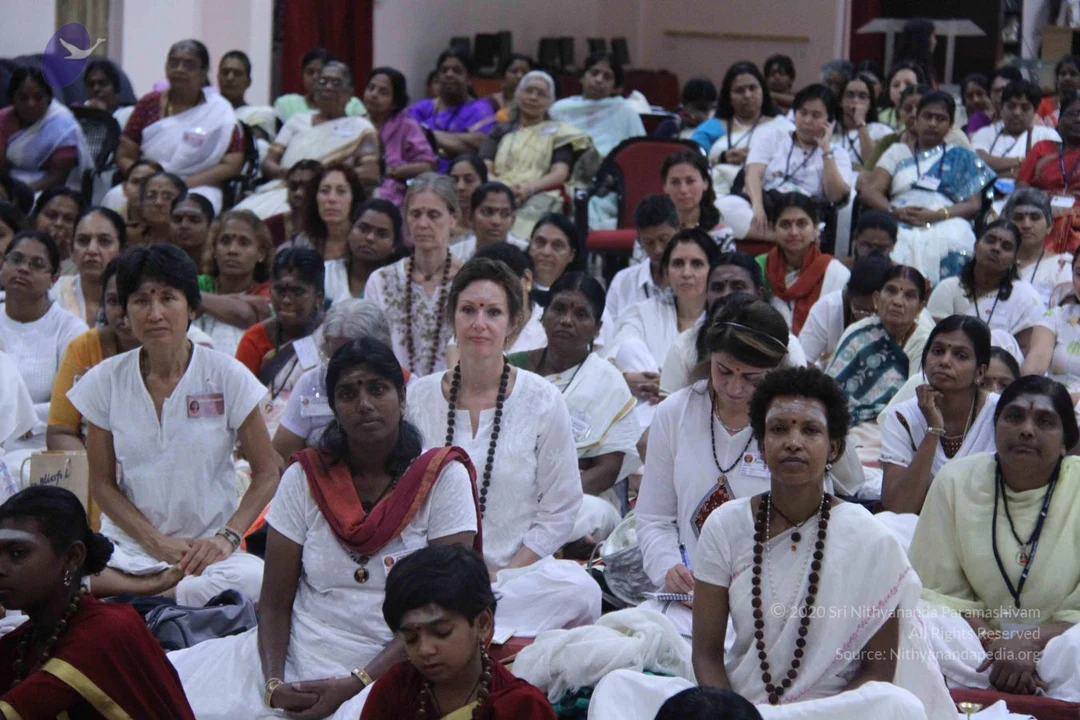
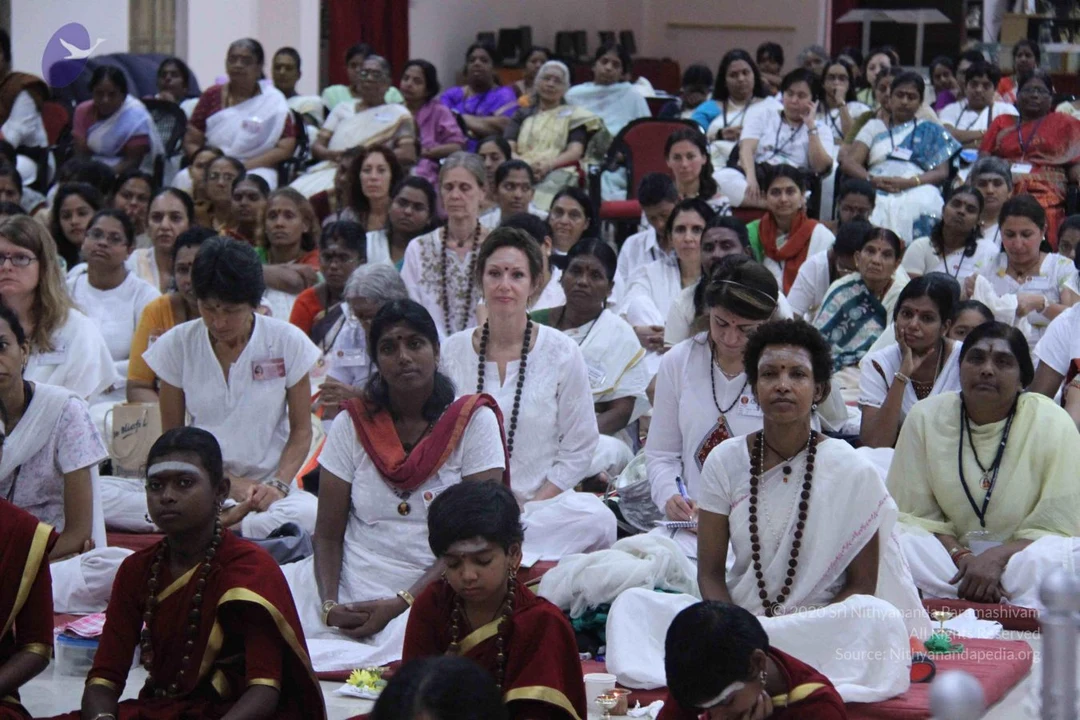
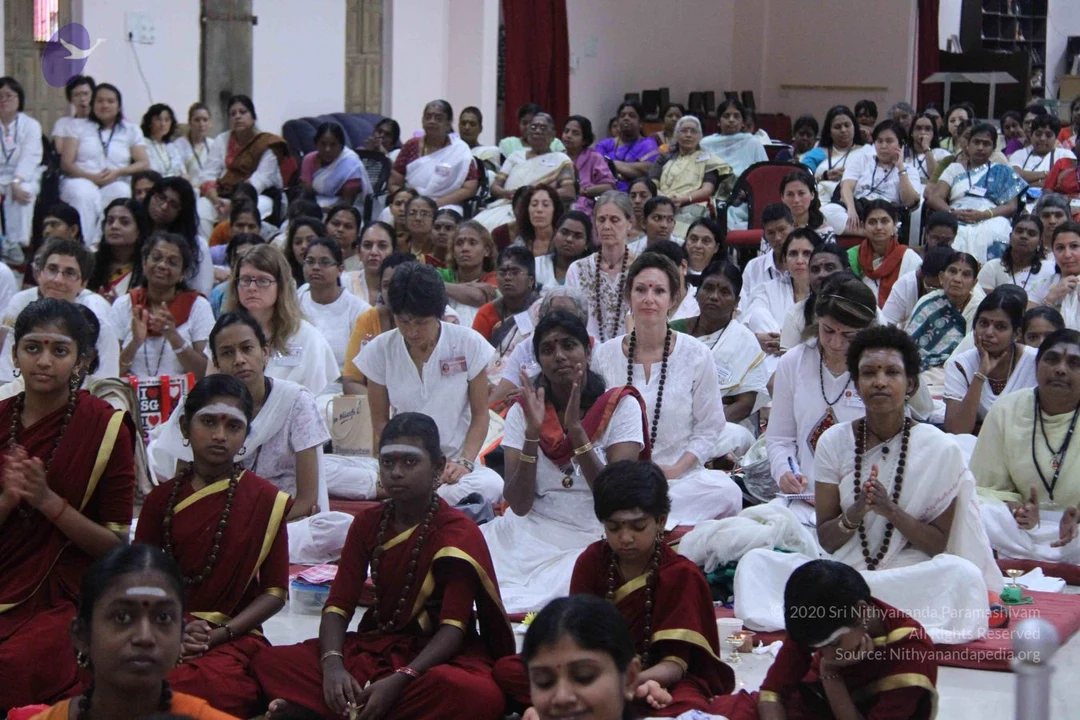
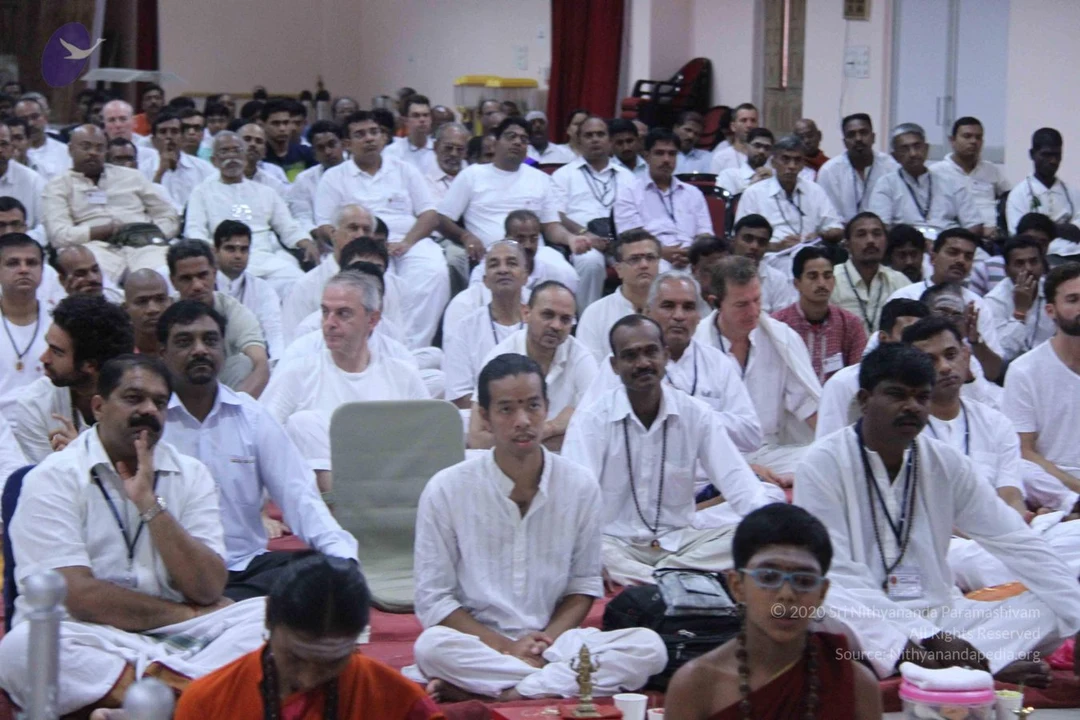
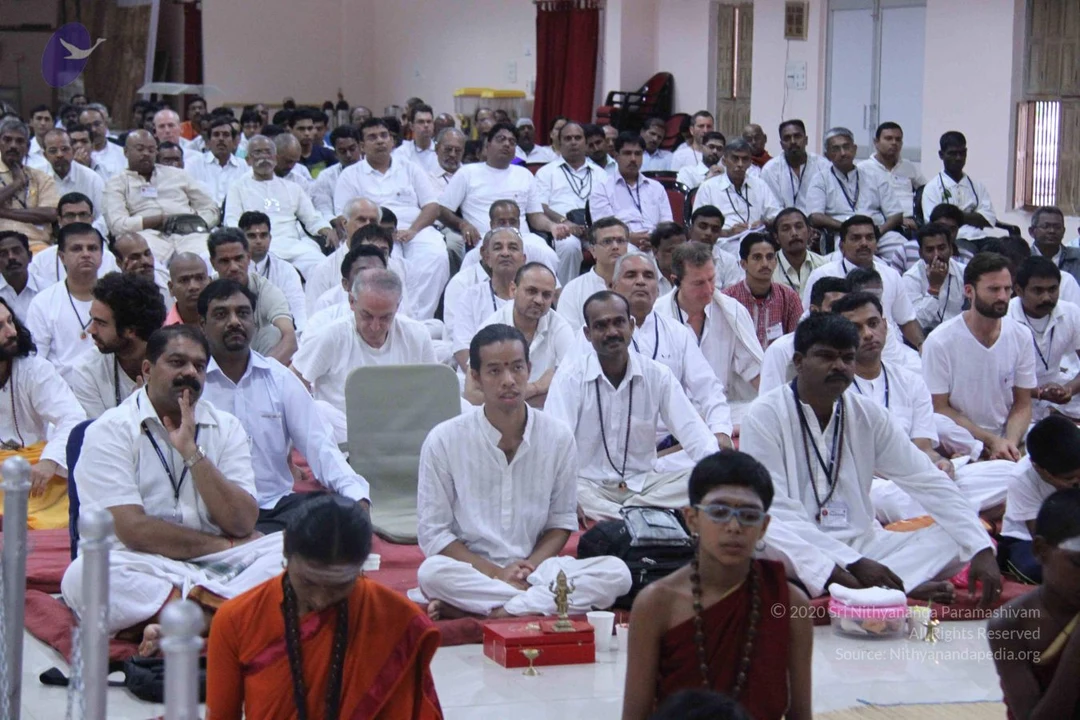
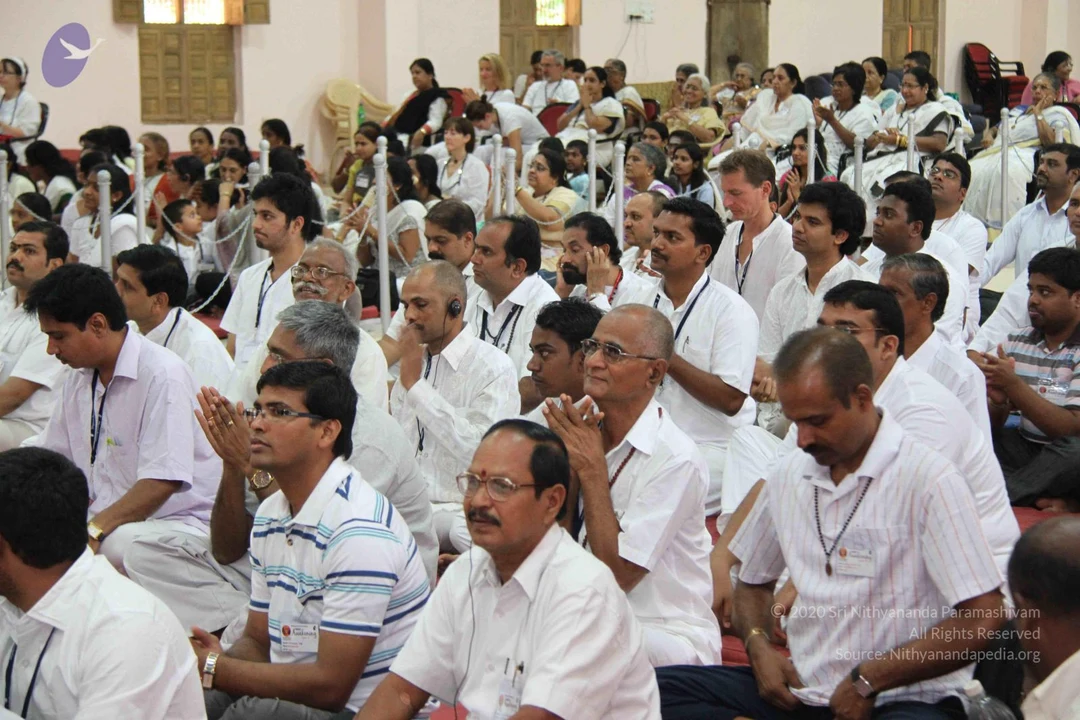
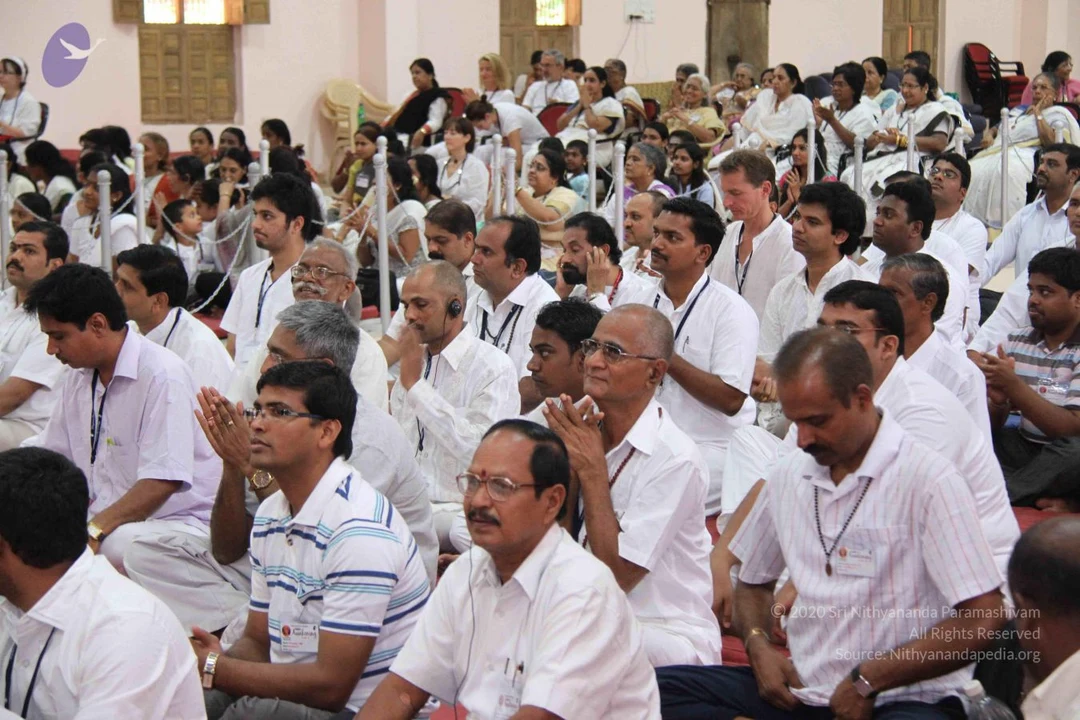
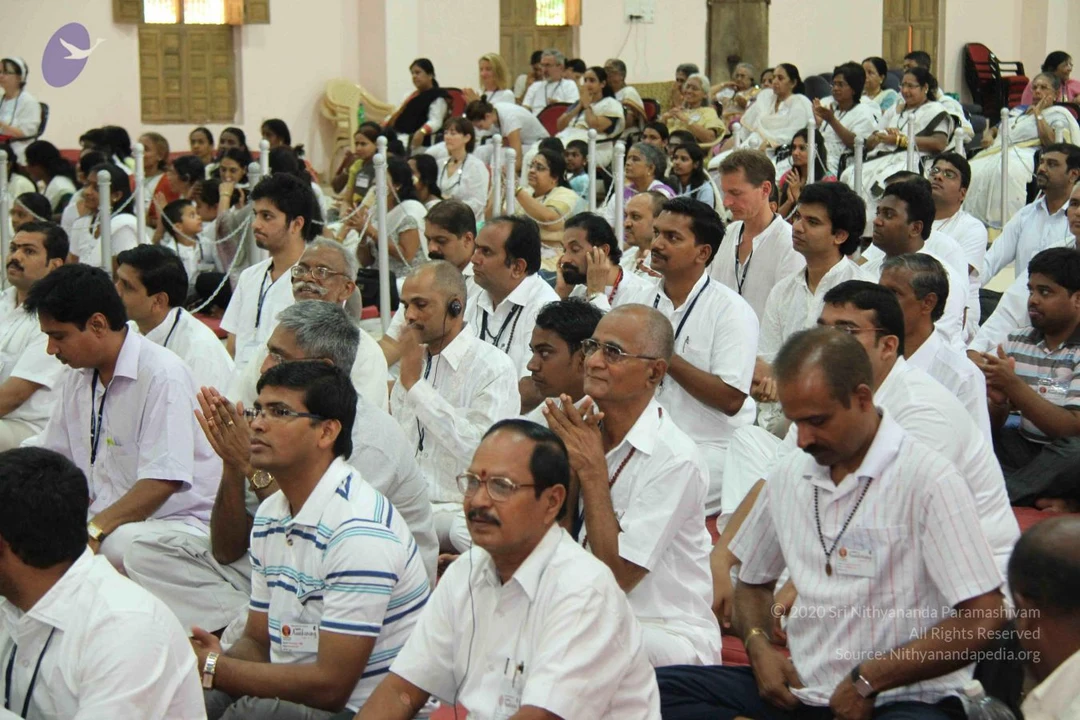
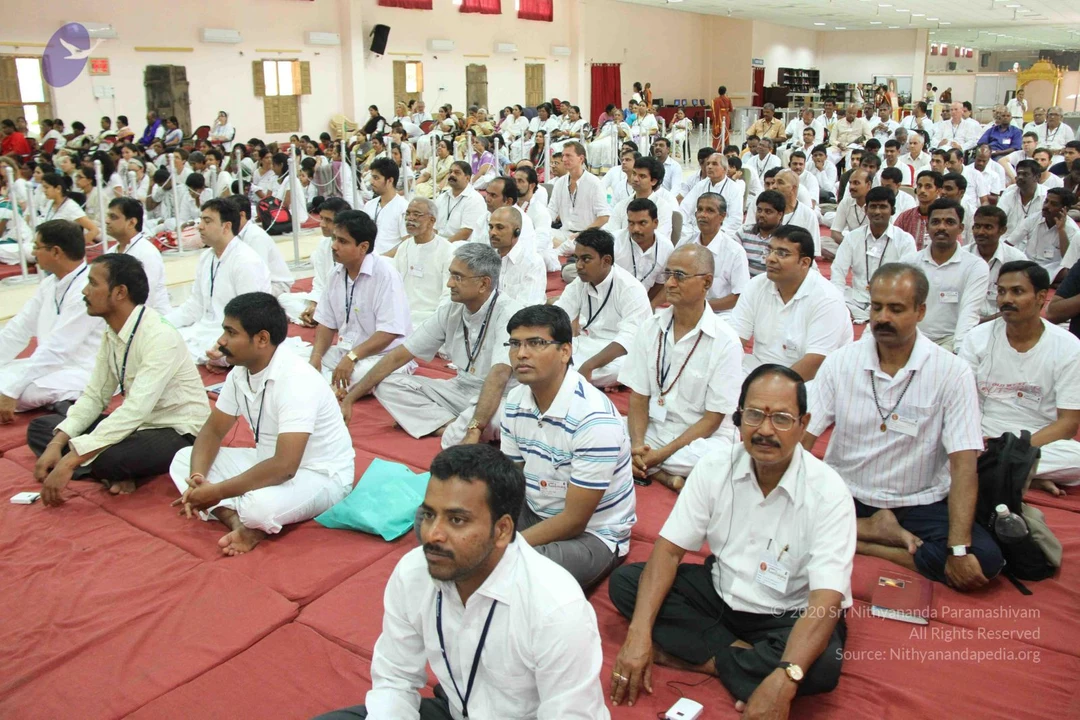
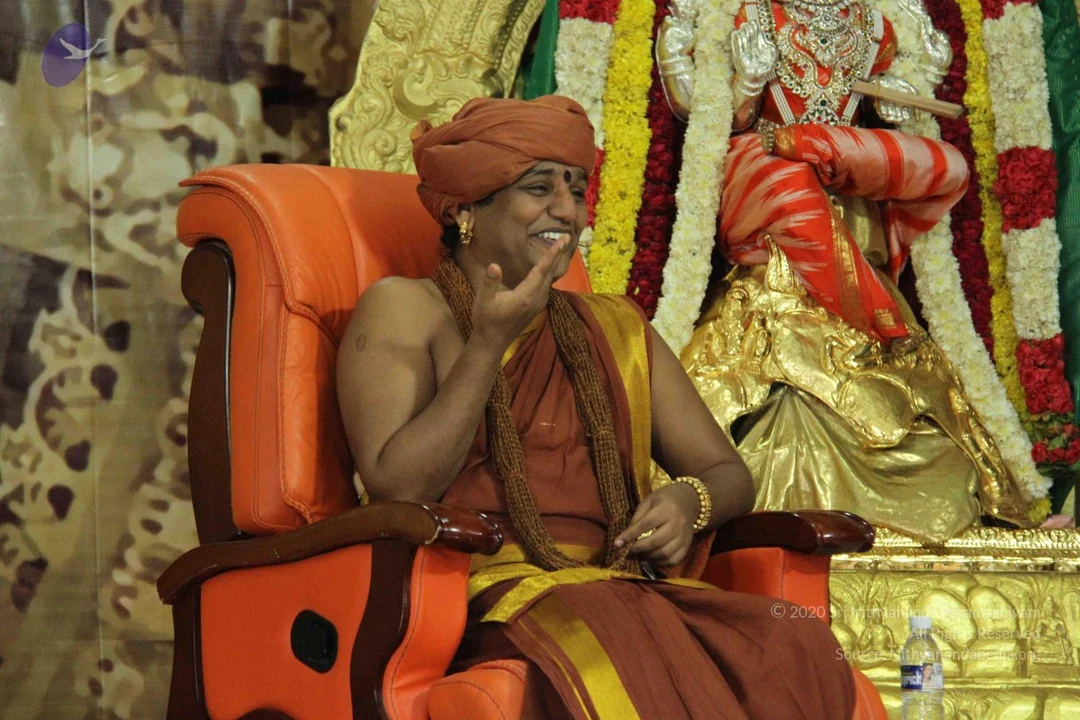
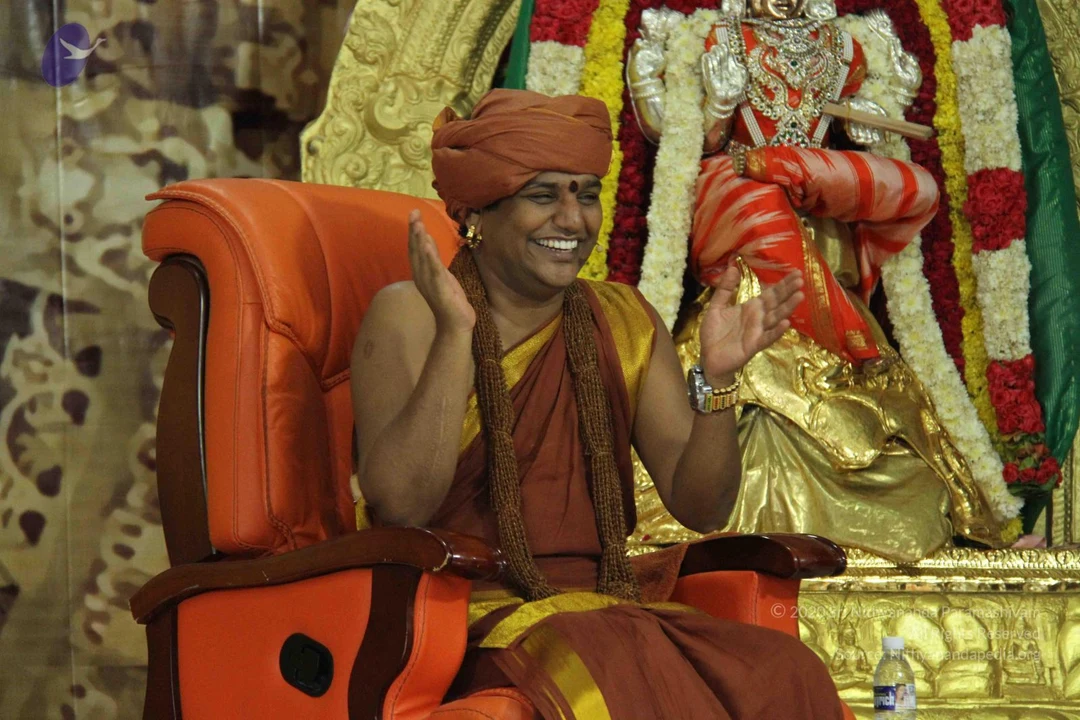
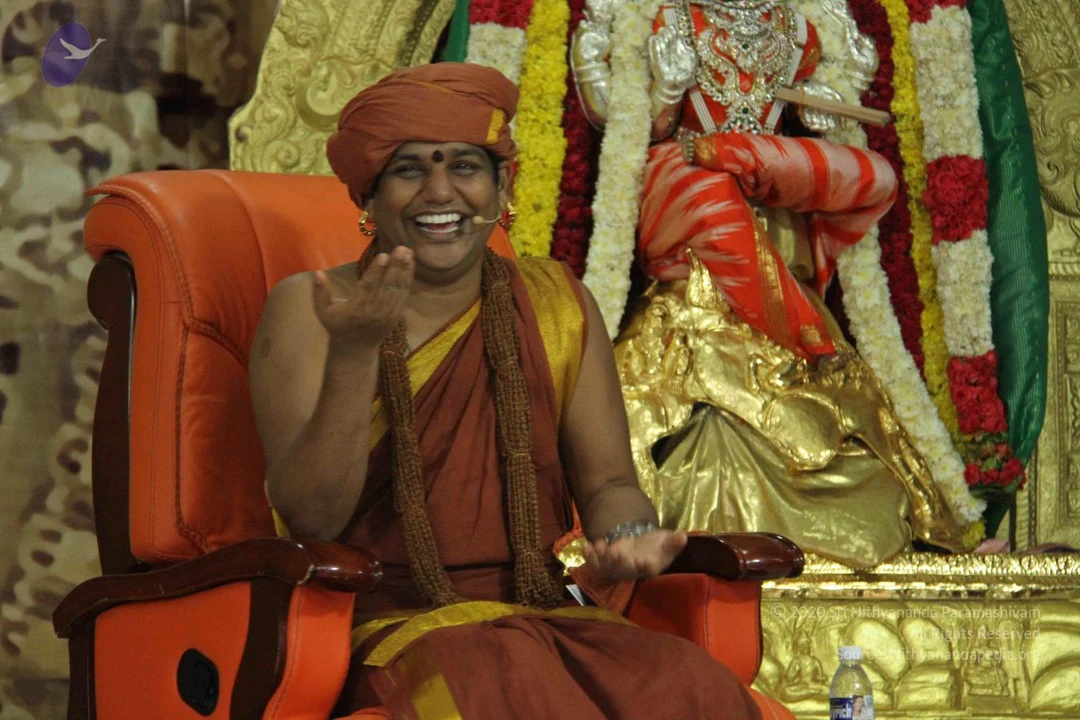
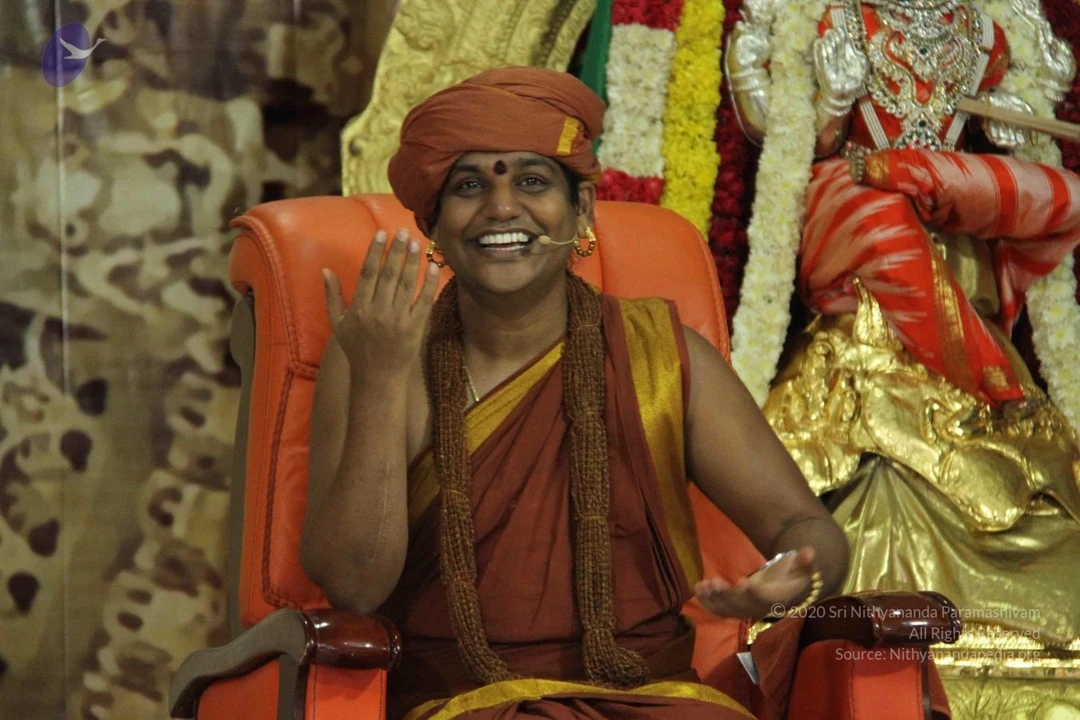
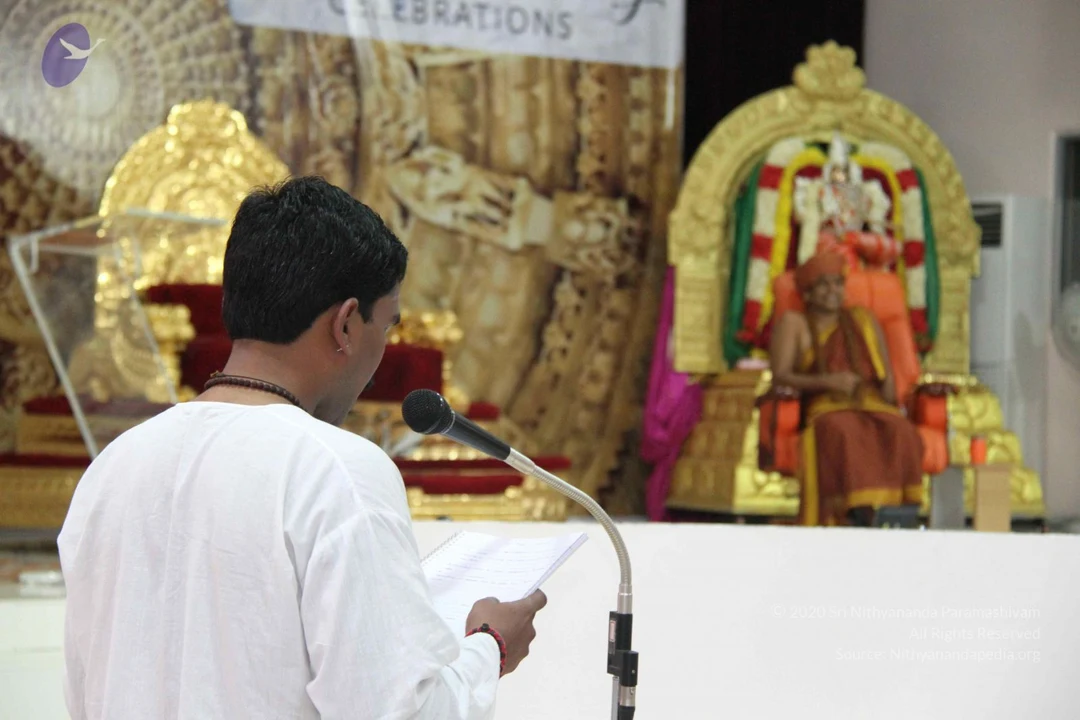
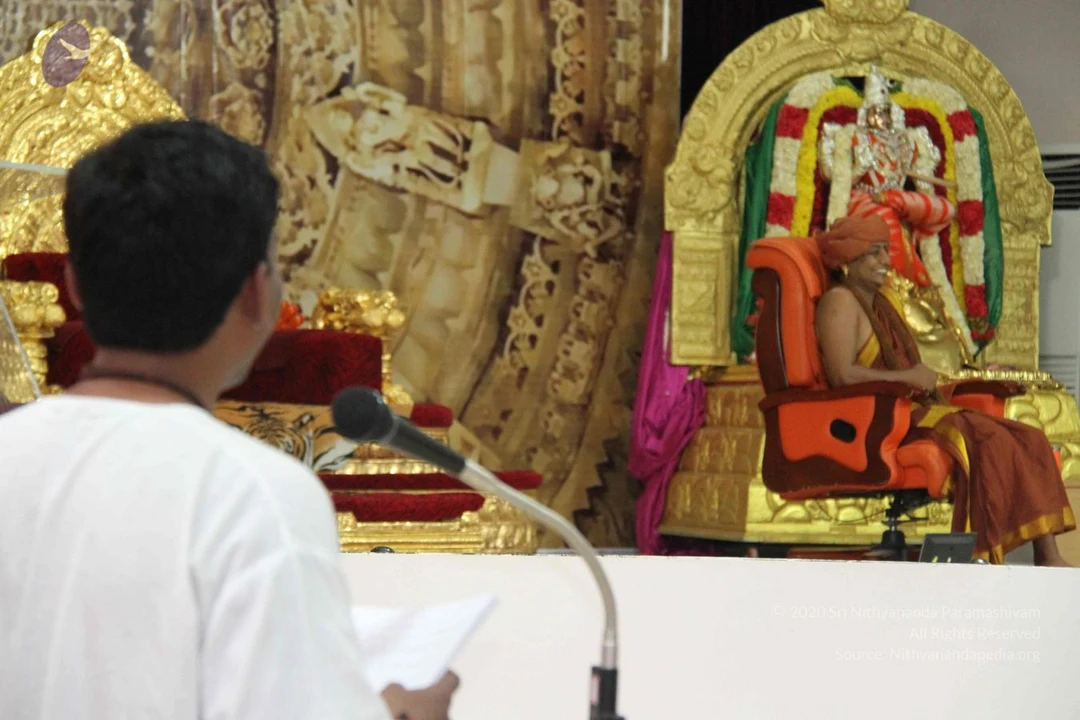
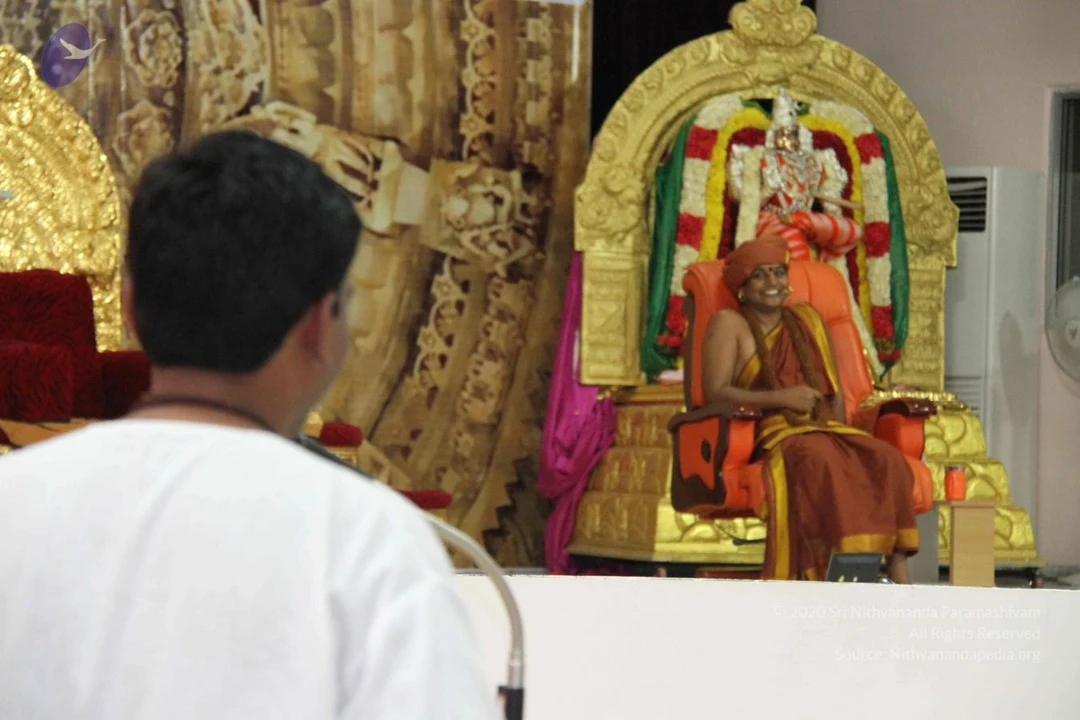
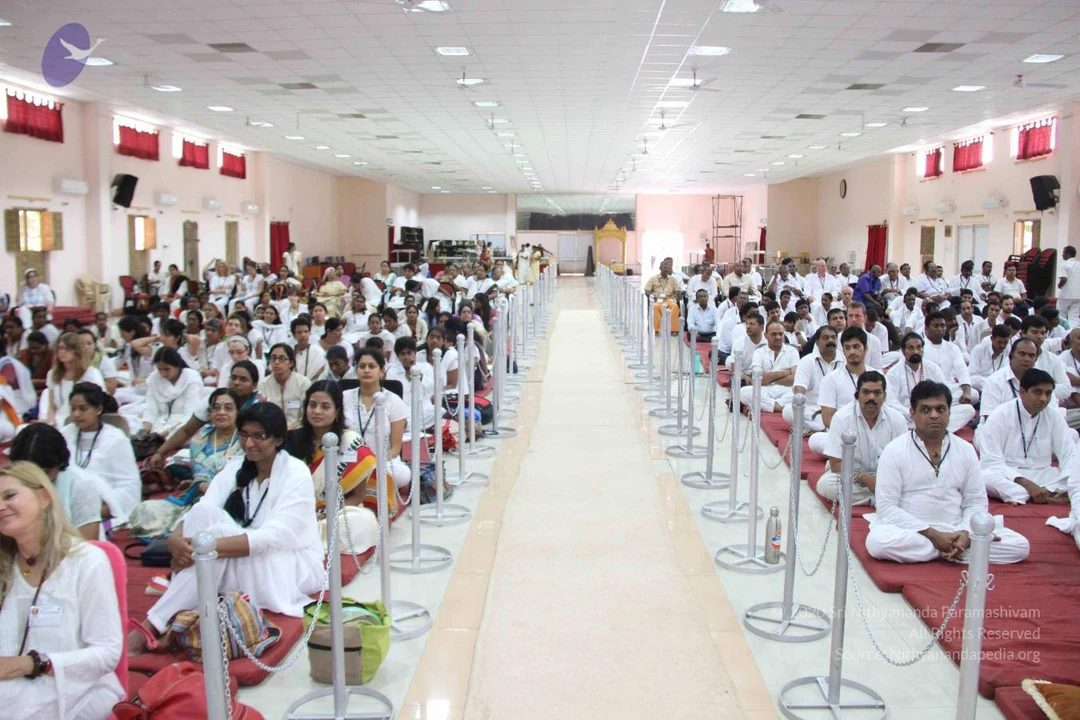
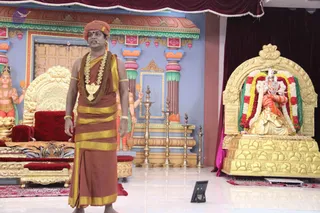
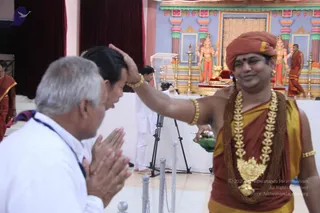
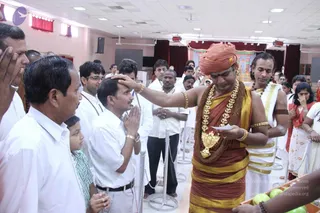
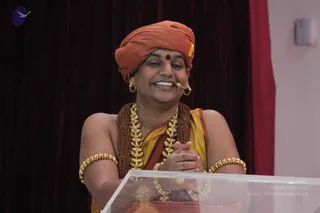
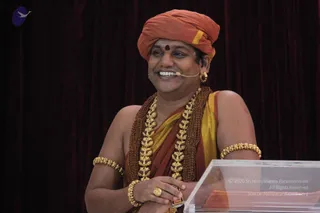
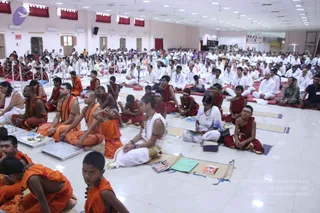
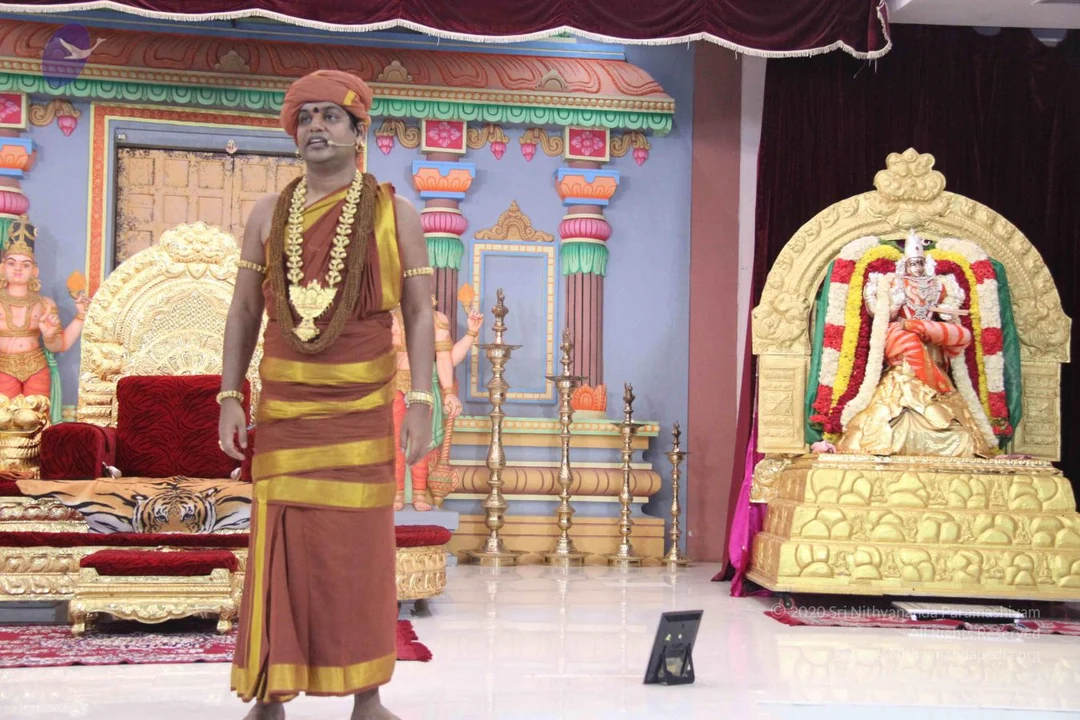
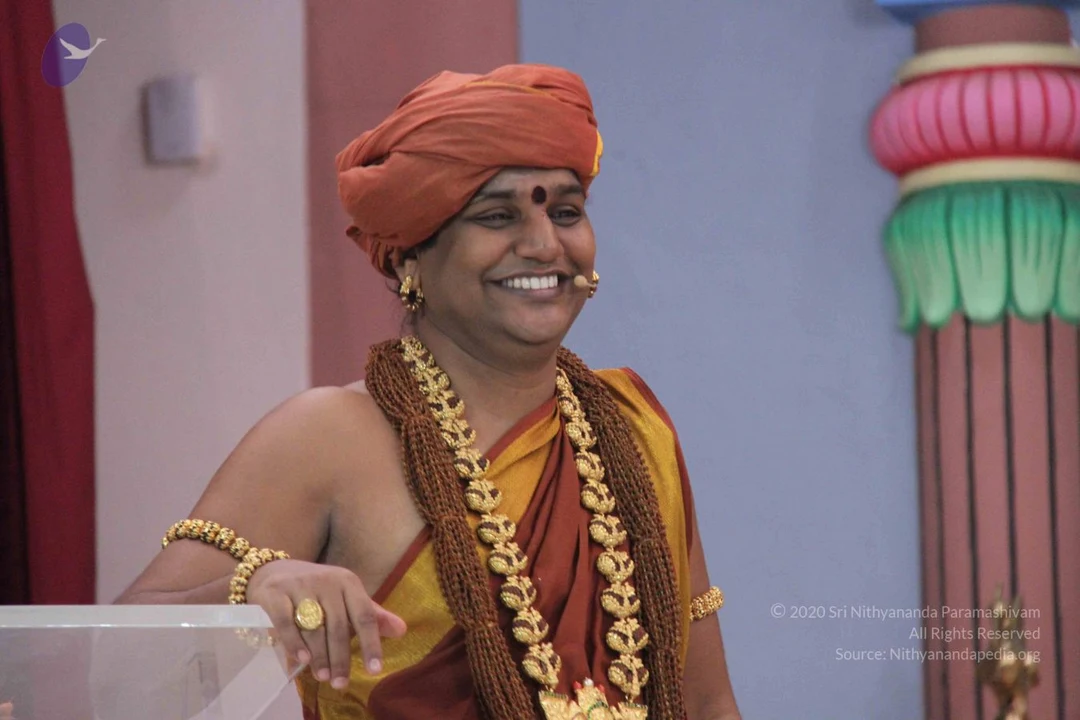
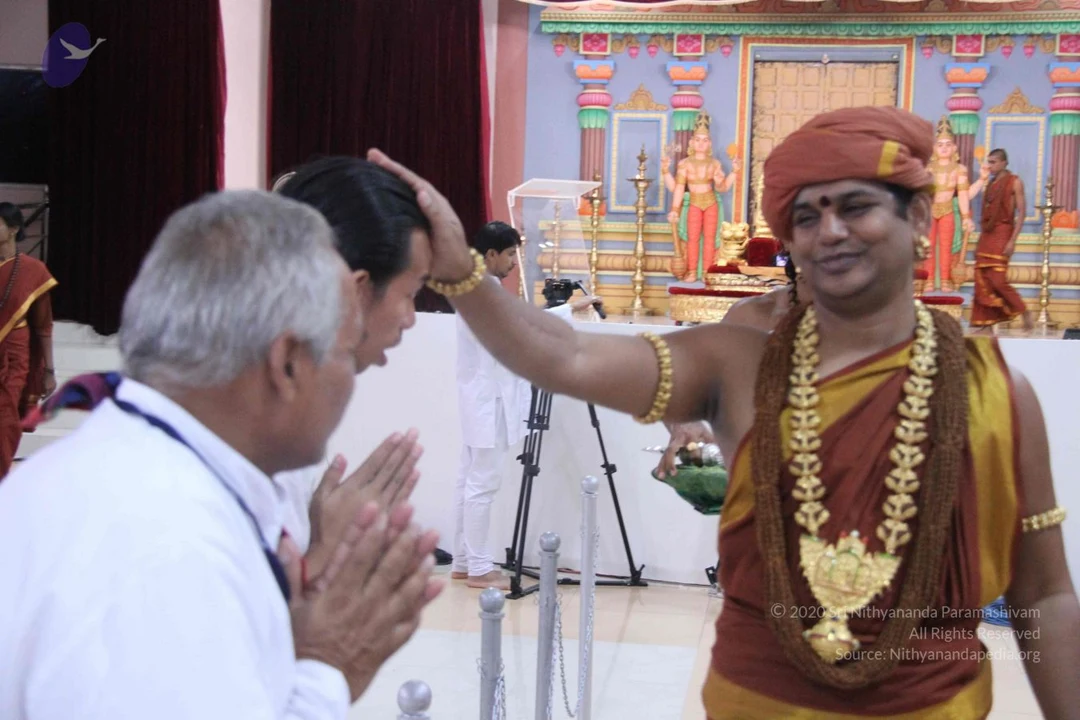
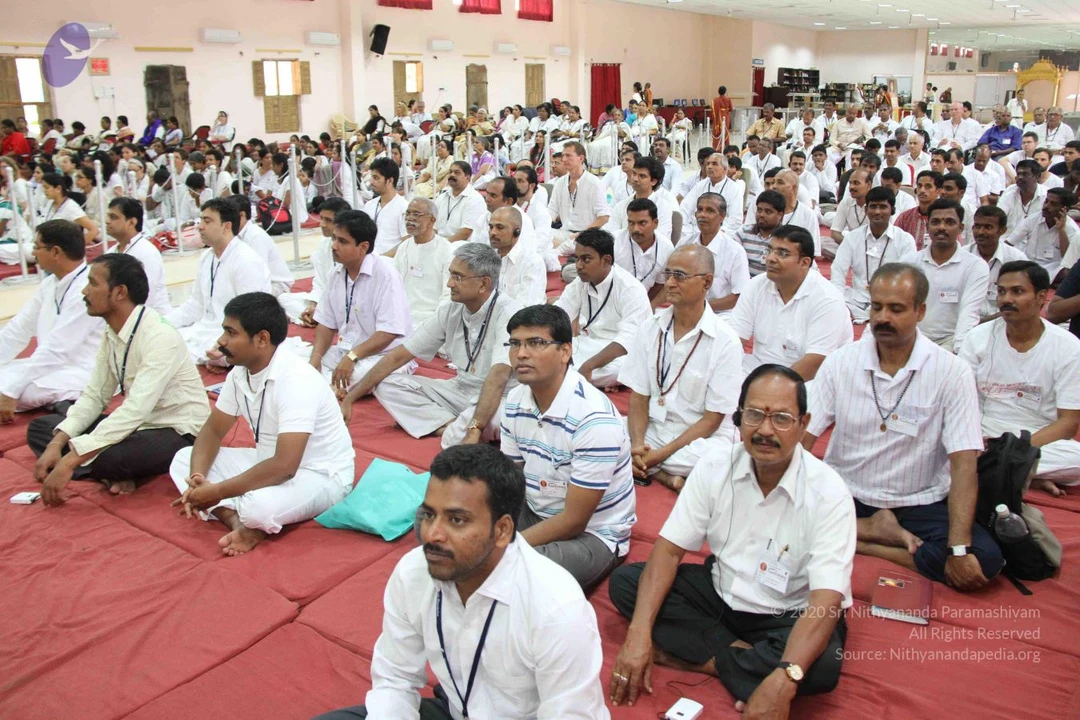
A photograph of a satsang hall. A man in saffron-orange clothing with an orange turban, a long beaded mala and a gold necklace stands at a clear acrylic lectern on the left, facing right and speaking. Behind him is a red velvet and gold-trimmed seat draped with a tiger-print cloth. On the right, a golden arch frames a seated deity murti of Shiva dressed in orange and draped with red and white flower garlands and a green cloth, set on a gold pedestal. A pink curtain hangs beside it, and a white air conditioner unit is at the far right. A painted colourful temple backdrop with a partly visible figure appears at the left edge.A photograph inside a hall with pink walls, red curtains and a ceiling fan. In the foreground, a smiling person in an orange turban, saffron-orange and gold dhoti-style cloth and a heavy gold necklace of bead and leaf pendants raises a hand to touch the forehead of a man in white with a folded-palm greeting. Other devotees in white shirts and mundus stand with hands folded, one holding a small object, and a woman in a red sari stands in the background near a stage area. The scene reads as a blessing or greeting moment.A large hall with pink walls and red curtains holds a seated congregation on white floor mats. In the foreground, shaved-headed young boys in saffron and orange robes with rudraksha malas sit cross-legged, some with white and orange forehead markings. A man in white ritual clothes with a gold-bordered dhoti sits near a low stone-topped seat, and a woman in a white sari with a rudraksha mala sits at right. Rows of devotees in white and orange garments fill the hall, some sitting on mats and others holding books and notebooks. A man in white with a microphone sits toward the centre, and ceiling air-conditioners and a wall-mounted speaker are visible.

August 16 2013

Original wiki page
Contents

Title

Life begins with listening

Description:

In today's satsang, Swamiji describes the importance of listening. He gives the definition of right listening as, "allowing the words to enter in your inner space automatically, letting them cognize without you constantly interfering with your incompletions".

VideoAudio

Transcript:

Nithyanandeshwara Samaarambhaam Nithyanandeshwari Madhyamaam | Asmath Aachaarya Paryanthaam Vandhey Guru Paramparaam ||

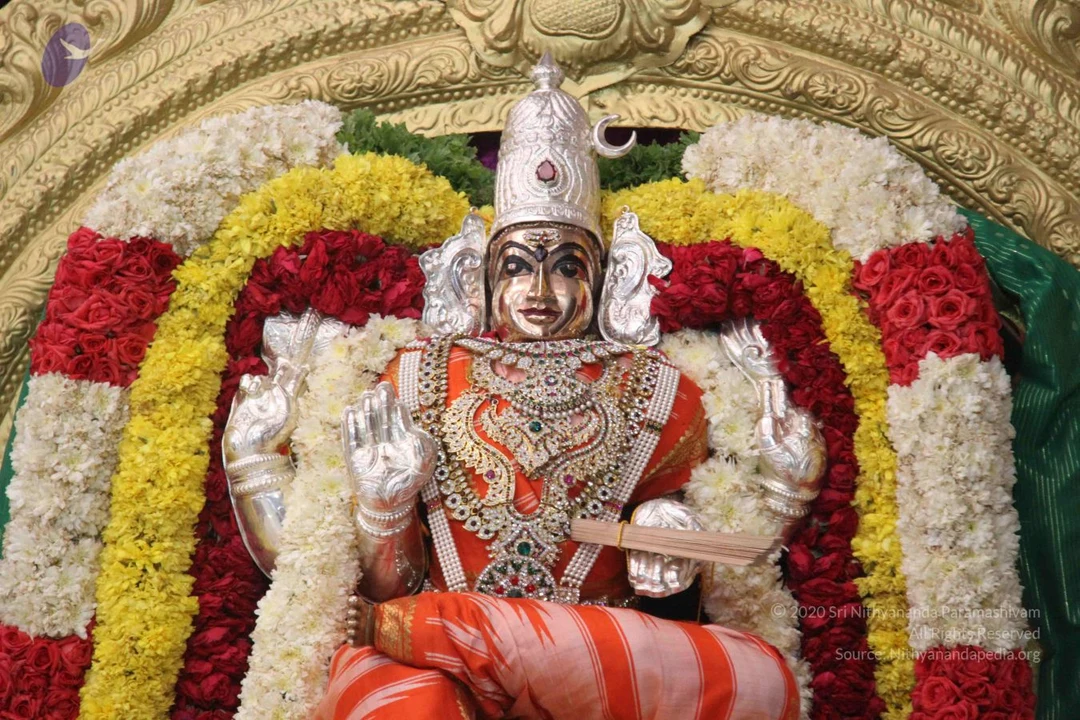
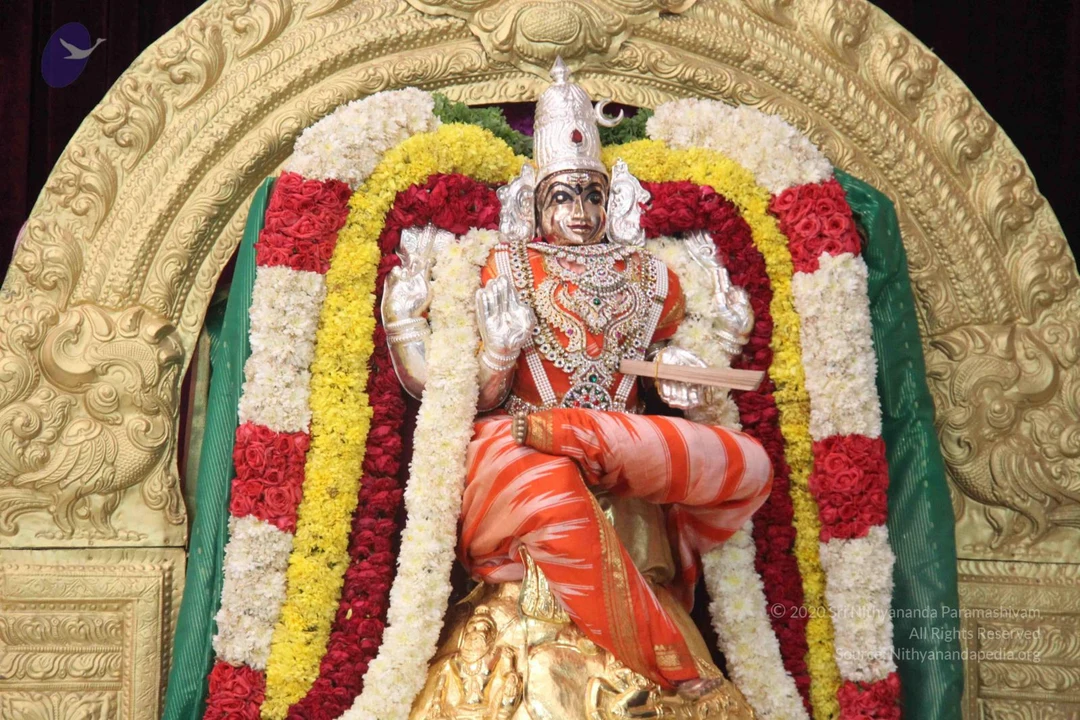
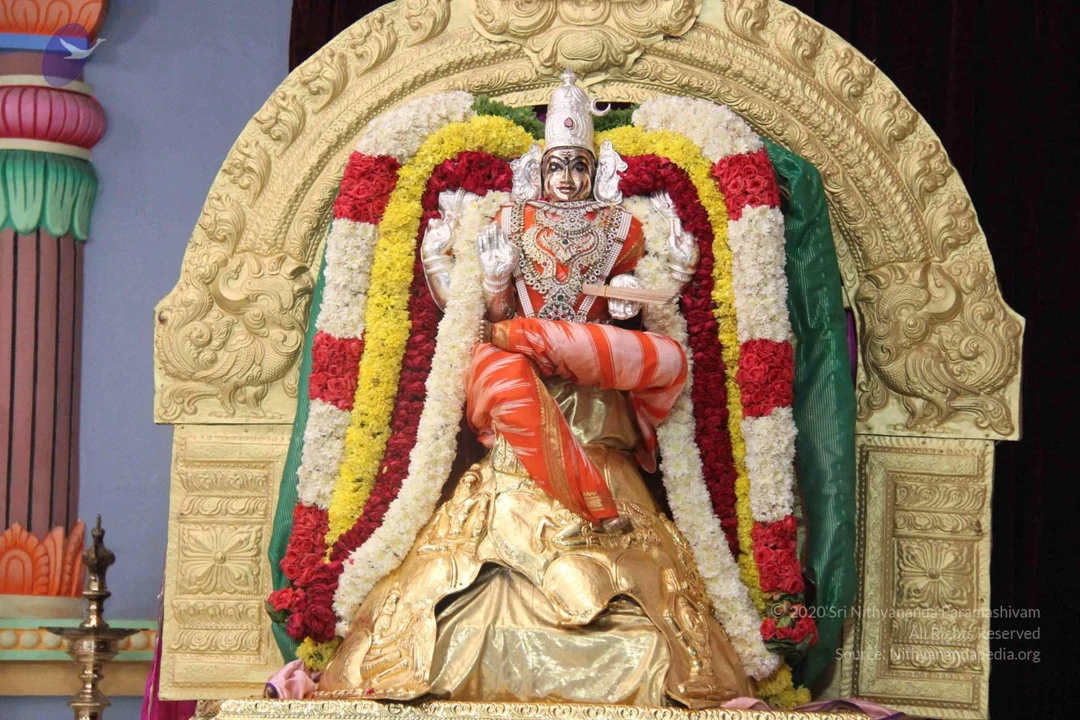
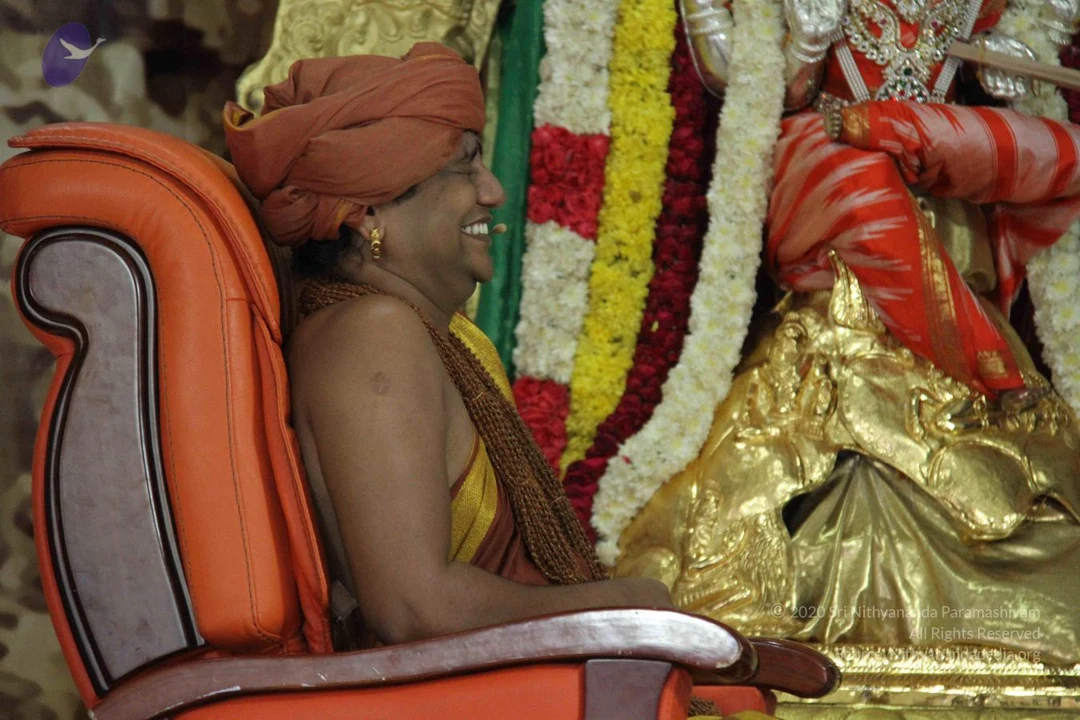
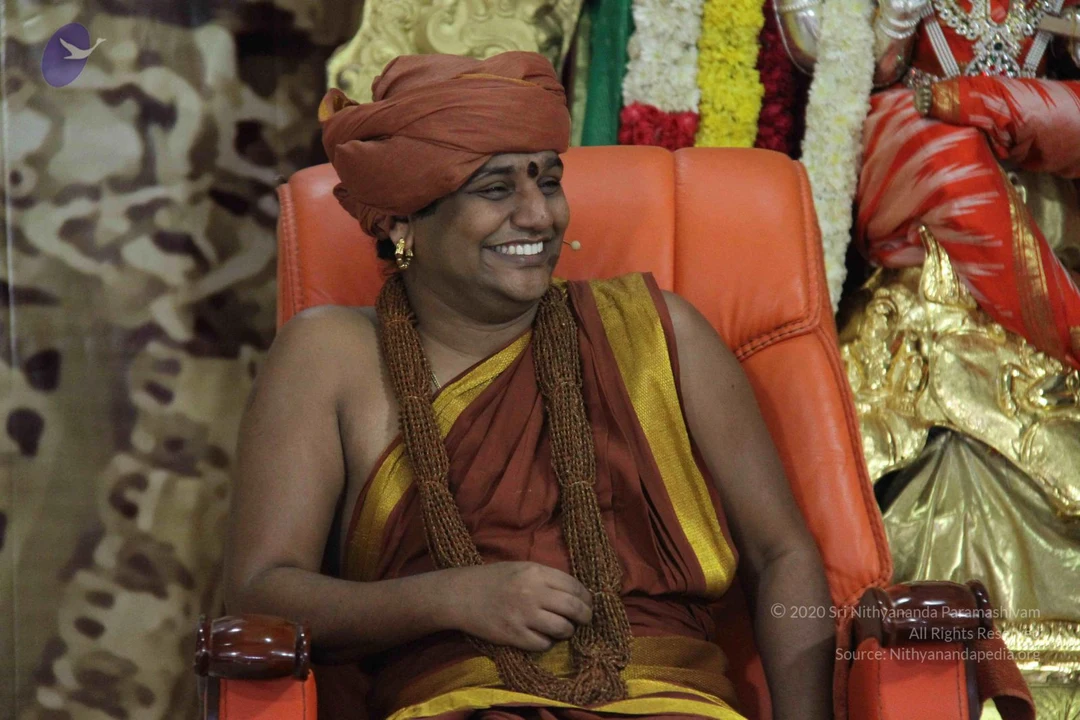
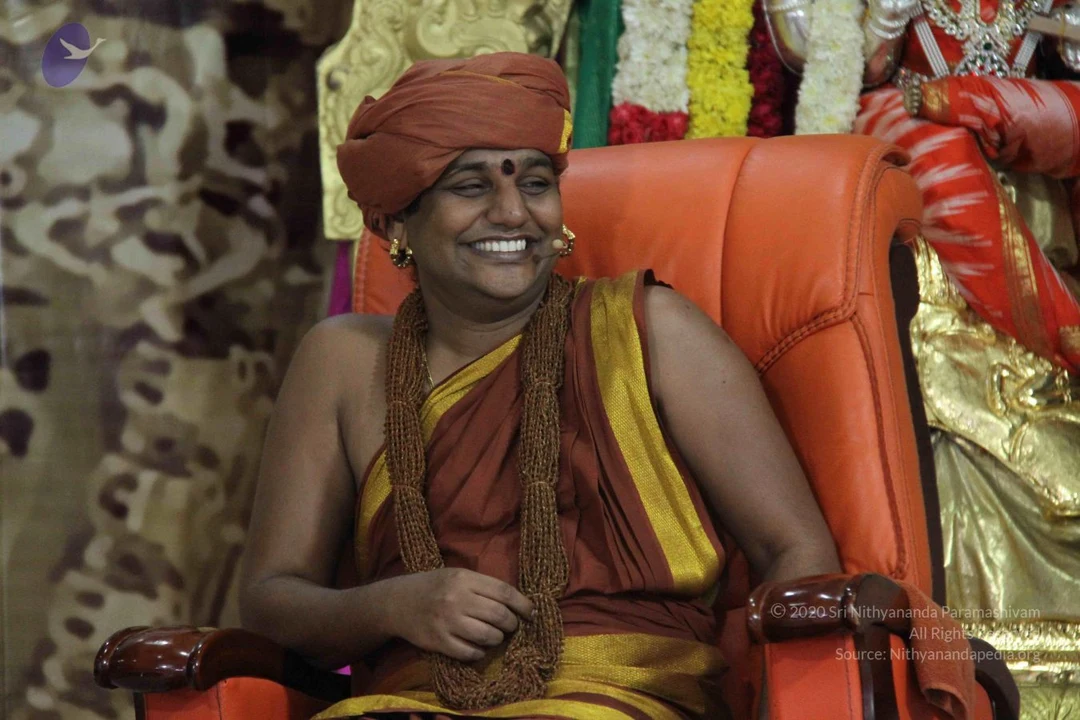
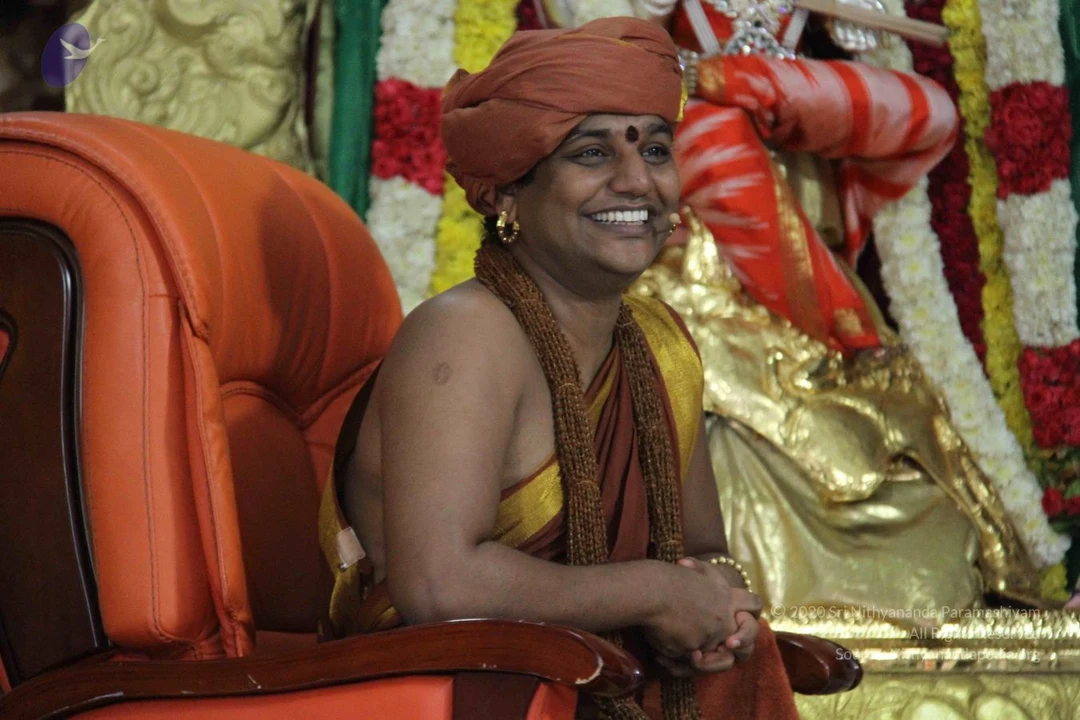
I welcome all of you with my love and blessings. Mahadeva is gracing us in the leela of giving meaning to Vedas. Sundareshwara, Nithyanandeshwara, today gracing us in the form of Adi Guru Dakshinamurthy by giving the meaning of four Vedas to all the four disciples of him , who are sons of Lord Brahma. Sanaka, Sanatana, Sanandana and Sanatkumara, these four sons of Lord Brahma are initiated by Mahadeva, and Mahadeva himself teaches the science of enlightenment. Today Mahadeva is gracing us in this form. As per the Madurai tradition, a child also will be decorated, representing Mahadeva. Today Mahageetananda is playing the role of Mahadeva with all this. - (‘Hey smile! Smile widely‘) - With this, we will enter into today’s satsang. Today’s subject for Nithya Satsang is Listening and Enriching.

Please listen, please come to the space of listening. Listening, listening is such powerful, such an important experience and such a beautiful spiritual practice available free of cost. Please understand it’s available continuously.

Listening, listening can do so much to your being. Please come to the space of listening only then I can even teach about listening to you all. Even to learn about listening please come to the space of listening. Please understand the definition of listening. Definition of right listening means, “allowing the words to enter in your inner space automatically, letting them cognize without you constantly interfering with your incompletions”, is listening. Please understand, you have a natural system, natural flow of your being. Your being is not static. The word being actually is a verb it’s not noun. Your being is naturally programmed to imbibe, cognize, internalise. So understand, allowing the words to enter into your being naturally cognition, allowing the natural cognition process without you interfering with your incompletions is listening. For example whenever you allow your incompletions to wake up, your incompletions to interfere, your thinking process, the cognition process, listening stops. Even now if you allow your incompletions like restlessness. May be various reasons – before coming, you would have had a fight with somebody or still you are carrying some depressive thought or feeling tired, bored – any incompletions you bring with you during the listening and allow the incompletions to disturb your cognition process, listening does not happen. Your inner being, your inner space is programmed to think without knowing you are thinking. Please listen, to think without knowing you are thinking, to cognize without knowing you are cognizing. To cognize without knowing you are cognizing, to think without knowing you are thinking. Please listen intently. When your belt fits, belly is forgotten; shoe fits, leg is forgotten; chain fits, neck is forgotten; ring fits, finger is forgotten. Only when there is a fitting problem, that area is remembered.

You remember your knees only when there is pain; you remember your back only when there is a pain. If your back is smooth you forget it. If your belly is smooth you forget it. Listen. Actually when there is no incompletion in your thinking, your thinking is forgotten. When there is no pain in your knee, your knee is forgotten. When there is no pain in your back, your back is forgotten. When there is no pain in your neck, your neck is forgotten. When there is no incompletion in your thinking, your thinking is forgotten. When Patanjali says “Yogaha Chitta Vritti Nirodaha” – “Yoga is Cessation of Mind”, he does not mean you will fall in a coma. I don’t have mind, but I am not in a coma. I don’t have any chitta vritti, any time I can fix QEG machine in my brain and show you. Last time we did some research during the materialization process. Forty minutes I sat with that QEG machine, not even a moment there was any graph it is just simple straight line and I am sitting, talking, moving, rolling, laughing, doing everything and doctors are actually shocked. They thought there was something wrong with the machine. So they changed a second machine and then they changed a third machine. All the three machines are showing the same straight line. I said, ‘problem is not in the machine and problem is not there anywhere. This is the way my brain functions ’ They said, ‘medically we can’t understand because there’s no, the whole, whole science about the brain is beaten to pieces now because any thought shows a alternation in the wave pattern.’ They said ‘ any’. See even if you want to sit up you have to have a thought and I am materialising actually, the materialising is going on. The person who is receiving, her brain is also connected in QEG. My brain is also connected. And there other were few mediums whose Kundalini I was awakening, their brains are also connected. So, any action you need to have at least one alternation in the wave pattern. They were shocked whole forty minutes, I think totally forty minutes we did one session. The whole forty minutes I’m drinking water, they asked me to lie down on the cot, I was lying down, then I sat up, I was laughing, talking throughout, not a single wave and they discovered one more thing. Whenever the person who is receiving is materializing something, their brain also goes to the same pattern of my brain.They said that there is perfect entrainment with my brain. Please understand, when Patanjali says “Yogaha Chitta Vritti Nirodaha” – “Yoga is Cessation of Mind”, he does not mean Yoga is falling in coma. He means, “Yoga is, thinking without any incompeltions”. It’s not that I don’t have thoughts but I don’t have thoughts as you understand. What is the source of your thoughts, what is the source of my thoughts, is totally different. Your thoughts, for example if your thoughts are fuelled by petrol or diesel or crude oil or kerosene, my thoughts are fuelled by solar energy. The energy is totally different. When the fuel is different, the action, reaction, wear and tear, the possibility for rejuvenation, renewation, everything is different. Please understand, listening means “cognizing without any interference of incompletions”. I am defining listening. Listening means, “cognizing without any interference of incompletions”. While you are listening, tell all the incompletions, ‘Be out, I’ll talk to you later on. I’ll attend to you later on.’ Just like you switch off the cell-phone tell your inner space, ‘I’ll attend to all your questions, queries, worries, thinking, the subjects to which your attention is attracted’. Please understand, the subjects towards which your attention is attracted is nothing but the past incompletions. And one more beautiful thing you need to know. I have one good news and bad news for you guys. The good news is, listening lead to more completion, completion leads to more listening and more completion leads to more listening and more listening leads to more completion, more completion leads to more completion. That’s the good news I had. Bad news is incompletion leads to more incompletion, incompletion leads to poor listening and poor listening leads to more poor incompletion, more incompletion leads to more poor listening, more poor lestening leads to more incompletion .

I have good news and bad news, both. Understand, listening means, “internalizing without the interference of incompletions”. One day, unfortunately when I was browsing through the channels. I got stuck in this Lok Sabha TV. These politicians are such even in the screen when they come you can’t move them. No, I was pressing my remote channel is not changing and unfortunately I was forced to see a few minutes. I don’t want to say anything further about it. I felt only one thing if at all just this one lesson of listening could have been there so much can be done I tell you, so much can be done. Everyone thinks by not listening you disrespect that person you show your protest you show your anger. Please understand by not listening you are not taking revenge on him, you are actually, abusing you. People forget that by not listening the person who is speaking is not going to be affected, you are going to be affected. In the Lok Sabha, the whole country is going to be affected. Please understand, the first year of marriage man speaks and woman listens. The second year, woman speaks and the man listens. The third year, they both speak and neighbors listen!When you both speak and neighbors listen the relationship ends. Listening, I tell you, when you listen without incompletions inside many time the other person will not be able to agitate you. I tell you in any argument, in any conversation, please understand, I am giving you a master key.

In the primitive times when we were tribes, cannibals, the ability to handle the weapon is going to decide your victory. In the modern-day the ability to hold the conversation is going to decide your victory in relationships, business, conversations, or your career, in everything. How many of you cognize what I am saying? Please understand in the primitive periods, actually in the history, they divide the history in many ways: Stone Age, Bronze Age, Modern Age, Industrial Age, IT Age. No, I am dividing only two way.One Weapon Age and Words Age, that’s all. Shastra, the Age of Shastra, Weapon and the Age of Shaastra, knowledge, over. Now the ability to hold the conversation only is going to decide whether you are going to be successful in your job, in your career, in your relationships, in your life, everything. So, I am giving you the master key for success. In any conversation the first person who gets agitated loses the game. If somebody is able to agitate you, you lost the game. This fool Zakir Naik, I was seeing many of his arguments, debates. I really wanted to have a debate with him, public debate. I am trying to find. No all he does is agitate the other person and he wins the game. Come on let me see.He is nothing he is minus. This fool goes on abusing Gita, Upanishads, everything. Of course, I cannot go that low, stoop so low. I cannot criticize Quran or Bible, no. I cannot eat the same dash dash he eats. That is not possible but I can handle him. No I can’t eat what he eats, but I can give what he eats.That is different. He just agitates the other person and claims victory. I was studying some of his debate shows. No stuff, zero stuff. He is not even capable of playing with words. He catches very weak, foolish Gurus and Gurujis and tries to win over them and thinks he is establishing his supremacy. Please understand, you need to understand, in any conversation, the moment you are agitated, you lost the game, you lost the game. Any conversation, do not allow agitation, do not allow incompletions to interfere your cognizing process. Without incompletions if you internalize for the internalizing process even your brain does not need to work. That is what I proved through the QEG. I was not in coma, I was cognizing everything. My eyes are open I know where things are. Not only was I able to see everything which you can see, I was able to see things which you can’t see, but my brain did not show a single wave, pattern. Understand, continuously listening without allowing incompletions to interfere your cognition itself leads to completion and the space of enlightenment.

29.35 Hindi

32:17

Listening, with listening begins life. When you start the cognition process internally without incompletions, life starts in you. Only then relationships starts in you. Only then living starts in you. Only then anything good will start happening in you. Please listen, if you start cognizing without incompletions even your health will become better because the agitation caused by the incompletions during listening leads to blood-pressure, diabetes and all other degradation of the body which is the root cause of all the diseases and disorders. Stress is nothing but incompletions, the interference of the incompletions during your listening. If you bring listening, even your boss cannot agitate you, even your spouse cannot agitate you. I know people can believe boss cannot agitate you but people can’t believe spouse can’t agitate you. It is said that husband is head of the family but remember the wife is neck of the family. The neck can turn the head exactly the way she wants.

34:26 Hindi

35:41

Life starts with listening, happens with listening, continues to exist with listening, ends when listening stops. Mahadeva is continuously teaching the meaning of the Vedas but only who listens, listens. He started, I think when the Universe started and he is continuing still now. Who listens, listens. Please listen, when the incompletions in you is not allowed to interfere with your cognition listening happens. Listening, listening, listening. With listening starts life. So all the six program participants, the Inner Awakening, The Samyama, Nirahara Samyama 16th batch, Nirahara Samyama 17th batch, eN-Genius, I request all the program participants, understand this one truth, listening, your program starts the moment you start listening.Your program does not start the moment I start speaking your program starts the moment you start listening. Understand, for some people program starts now, for some people program may start tomorrow, for some people it may start after five days, for some people it may start twenty-first day, for some people it may not even. So the program starting is in your hands. As far as I am concerned program started. I request all of you to come to the space of listening, listening. I tell you, it is with listening, the whole program starts.Have right listening.

In an old Catholic school after the twelfth grade examinations, there was a farewell meeting happening. Few nuns are sitting and talking to the kids who are leaving the school, twelfth grade kids. The Mother Superior asks one girl, ‘What are you going to become in future?’ ‘Doctor!’She was very happy, encouraged her. She gifted her a telescope and sent her. Next girl comes. The Mother Superior asks her, ‘What are you going to become?’ ‘Engineer.’ Mother Superior is very happy she gives a scale and blesses her and sends.Next girl comes. ‘What are you going to become?’ She shouts, ‘Lawyer!’Mother Superior was very happy. She gives a lawyer’s coat as a gift and sends her.The next girl comes.Mother Superior asks her, ‘What are you going to become?’She says, ‘Prostitute!’ Mother Superior faints and falls. They sprinkle water on her somehow Mother Superior she regains. ‘Tell me, tell me, what did you tell?’ ‘Prostitute.’ Again she faints. Again they sprinkle the water and she wakes up. She asks , ‘Tell me clearly, what do you want to become?’Third time, this girl screams, ‘Prostitute!’ She says, ‘Oh!’ sighing a big relief, ‘I thought you were going to become a Protestant!’ Too much of incompletions during the listening. Don’t bring your incompletions, interfering during your listening. If you have not laughed, you have not got that thing, ask the people who laughed. When there is so much incompletion in listening if you have not laughed, there is incompletion in your listening. Quick! Catch it! And I tell you, even if you miss the joke, don’t miss the laughter. So understand with listening starts the life.Essence of today’s satsang is, Listening. With listening starts the program and with this I’ll move to the next segment of the morning satsang – Nirahara Samyama. All the 17th batch Nirahara Samyama participants who are starting the Nirahara Samyama today, please log in and register at http://nithyananda.org/events. 42:58 Hindi

43: 28

This program, you don’t need to pay anything for it.

43:32 Hindi

43:38

You don’t need to pay anything but you may have to enrich, you may have to enroll yourself.

43:48 Hindi

43:57

Please sit straight.

44:01 Hindi

44:04

Please sit straight, close your eyes cognize you have become Kalpavriksha, Bidadi Kalpavriksha. Inhale through both the nostrils and the mouth simultaneously, hold as long as you can. Exhale through both nostrils as slowly as you can. Do this for next twenty-one minutes. Even if you are not doing Nirahara Samyama, please do this Kriya. With Integrity, Authenticity, Responsibility and Enriching, I bless you all. Let you all experience Kundalini awakening, and let you all create the energy directly from space, live health, bliss and enlightenment. Namah Shivaya!

Let you all achieve, experience live, express, radiate share and explode in eternal bliss, Nithyananda.

Title:

Life Starts With Listening

VideoAudio

Photos Of The Day:

Niithya_Satsang
Kalpatharu Dharshan

Inner Awakening in Bidadi

Photos Of The Day:

Alankar-Deity-Dakshinamurthy

Nithya-Satsang

Sarva-Darshan

IA

Photos from this day

View all 137 photos

Niithya_Satsang
24 photosSource gallery
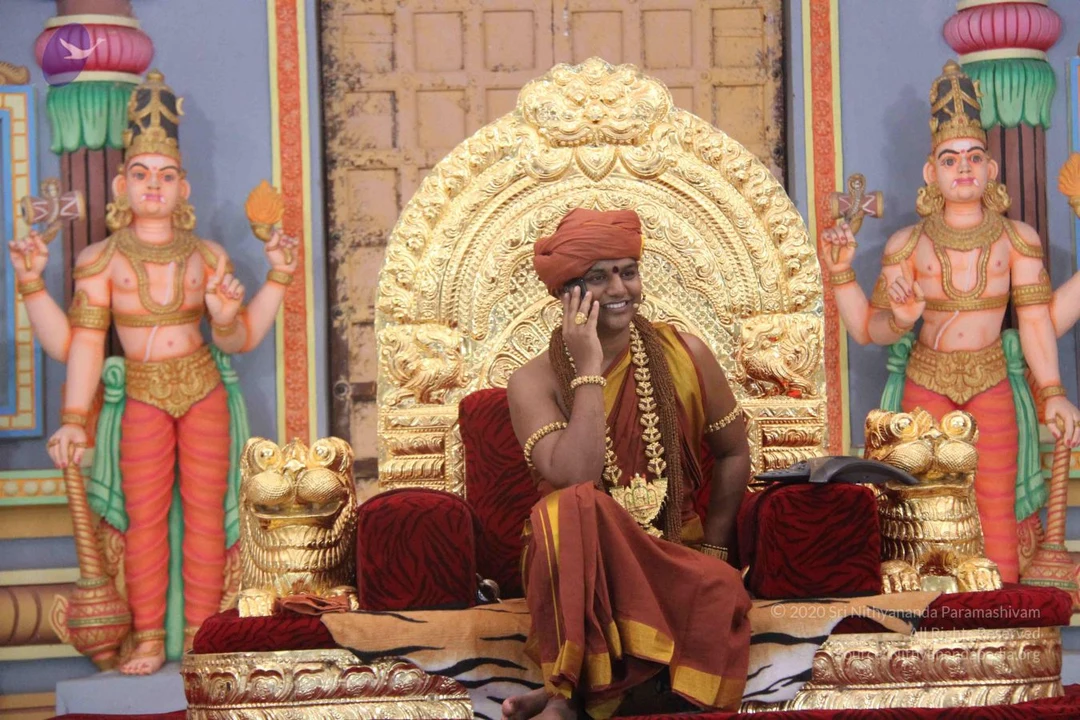
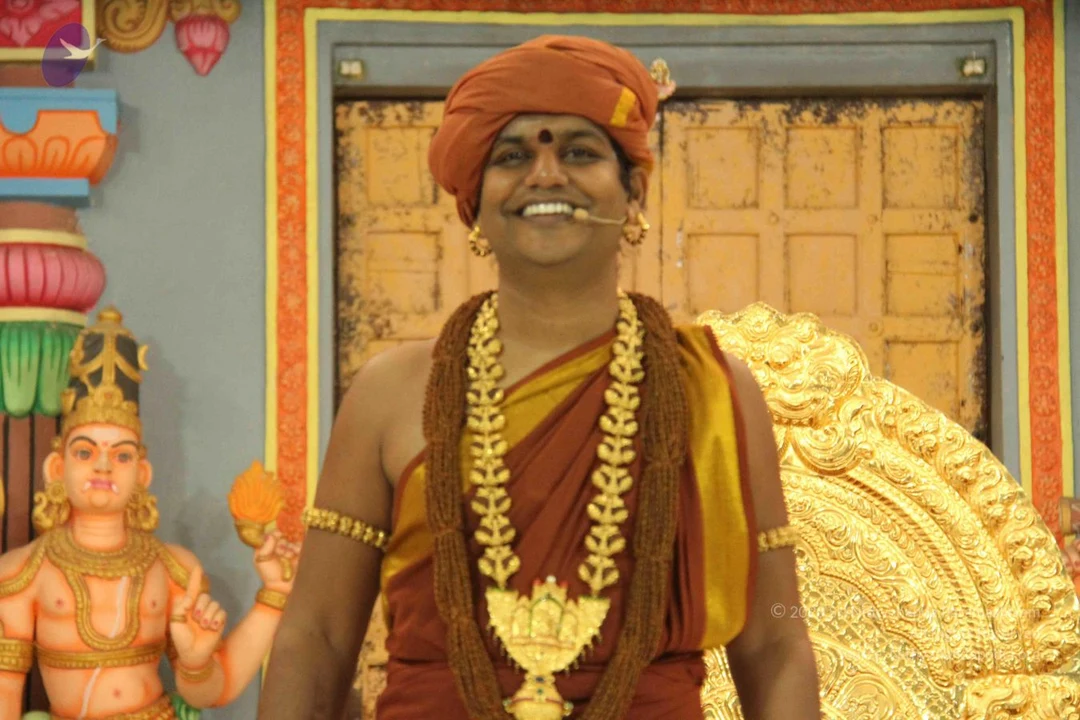
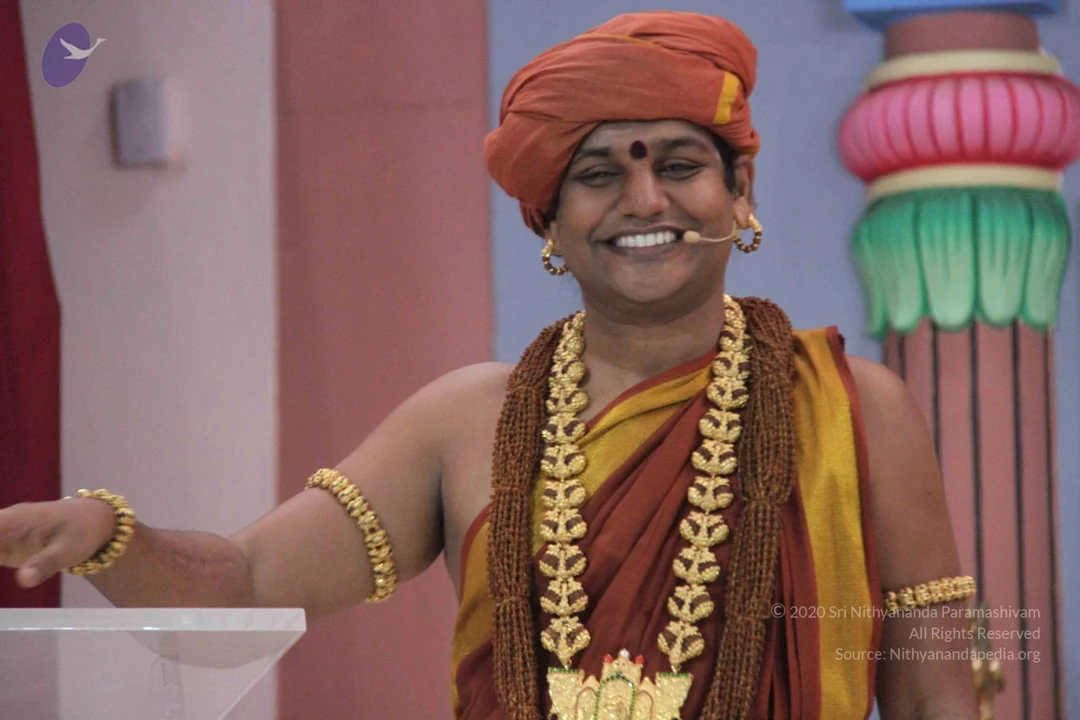
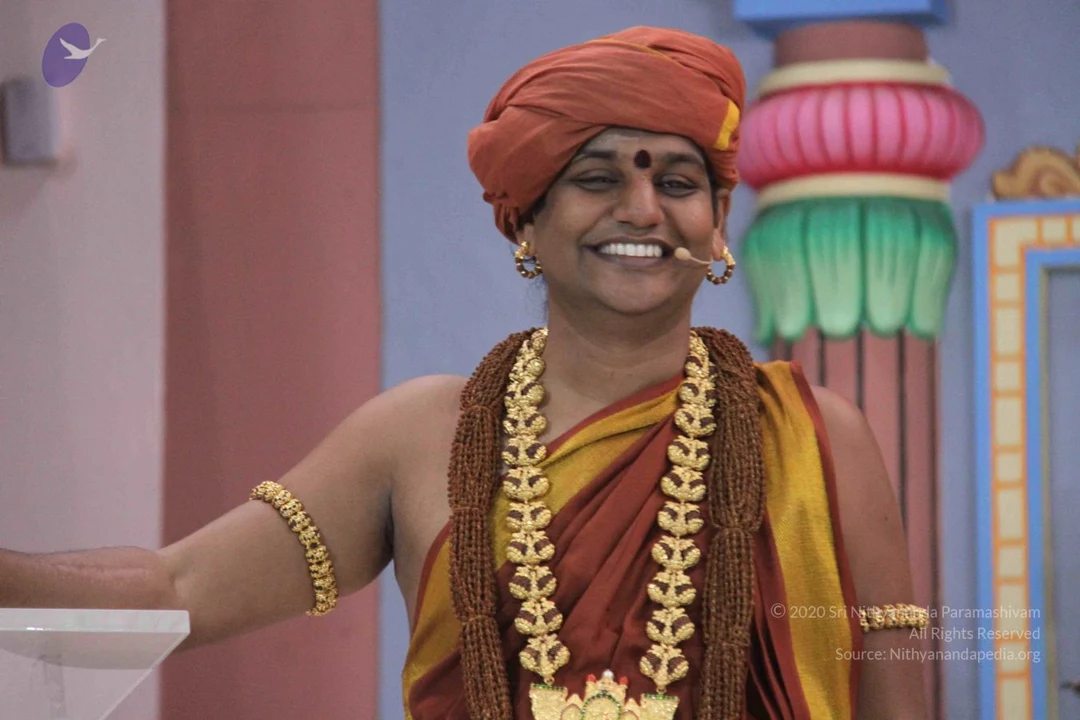
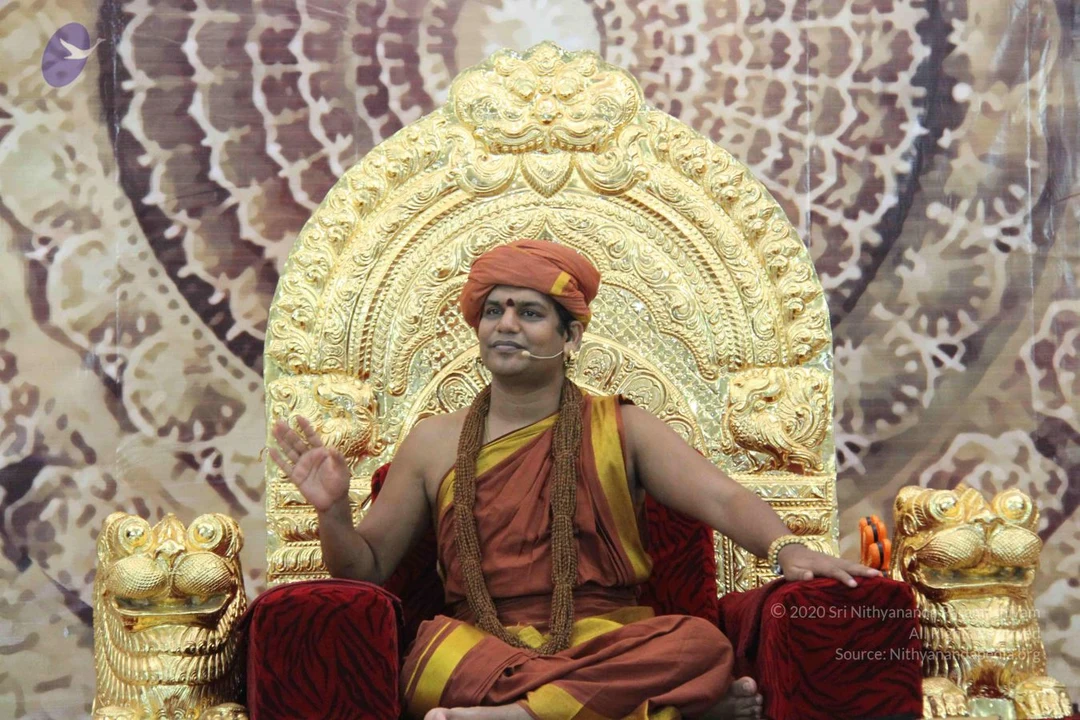
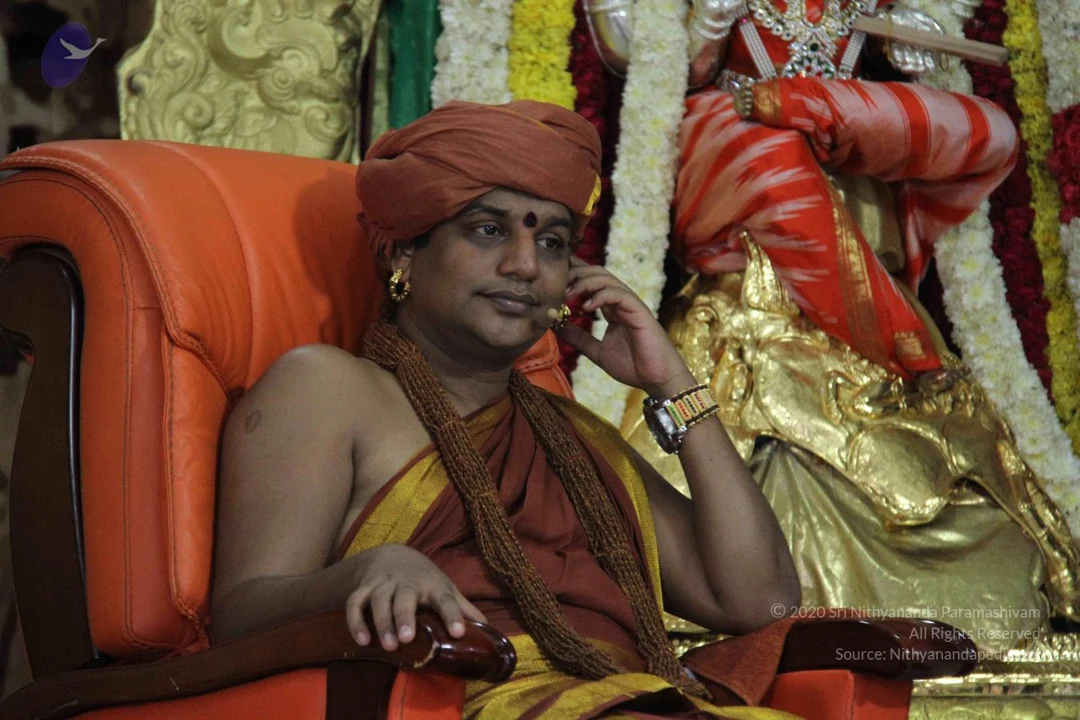
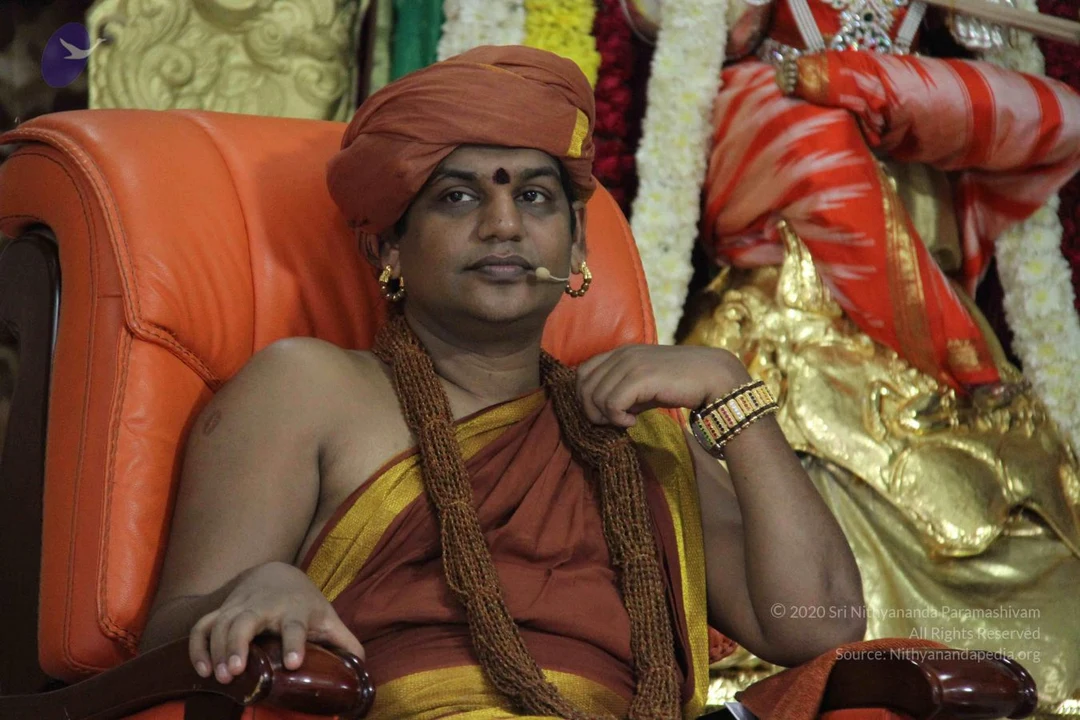
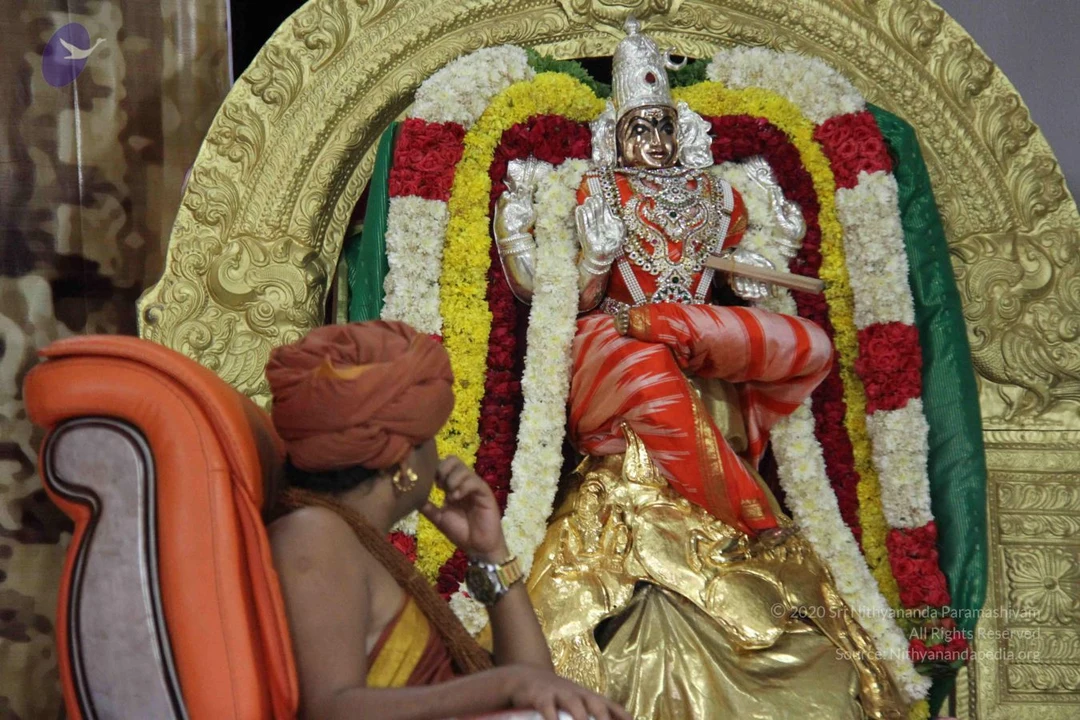
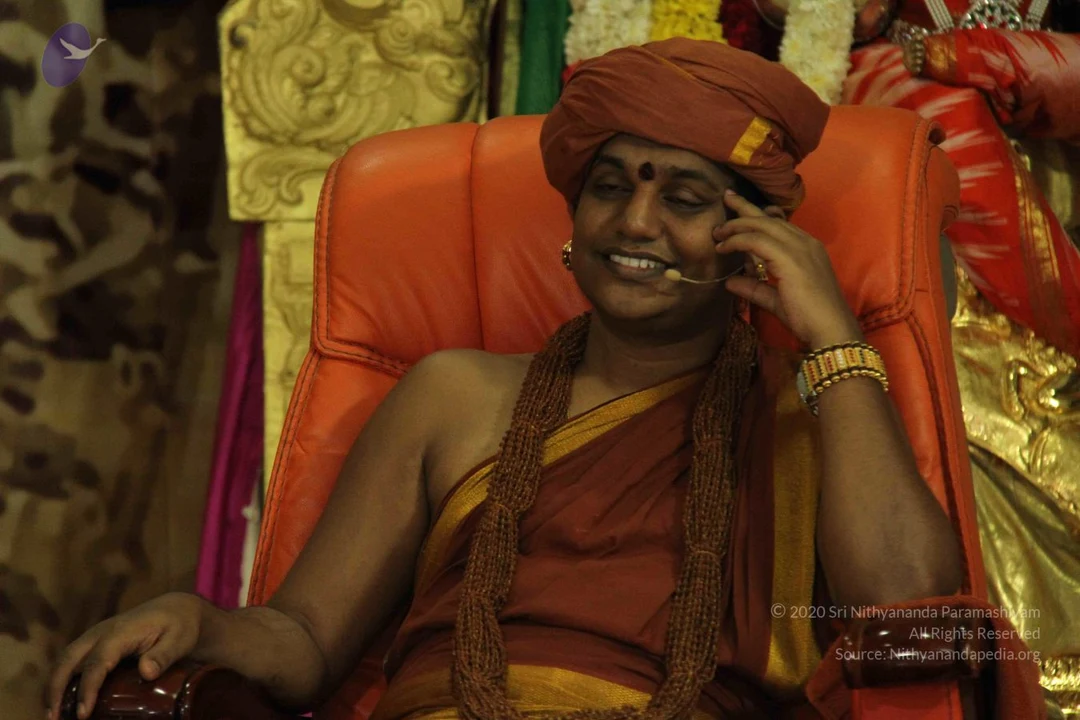
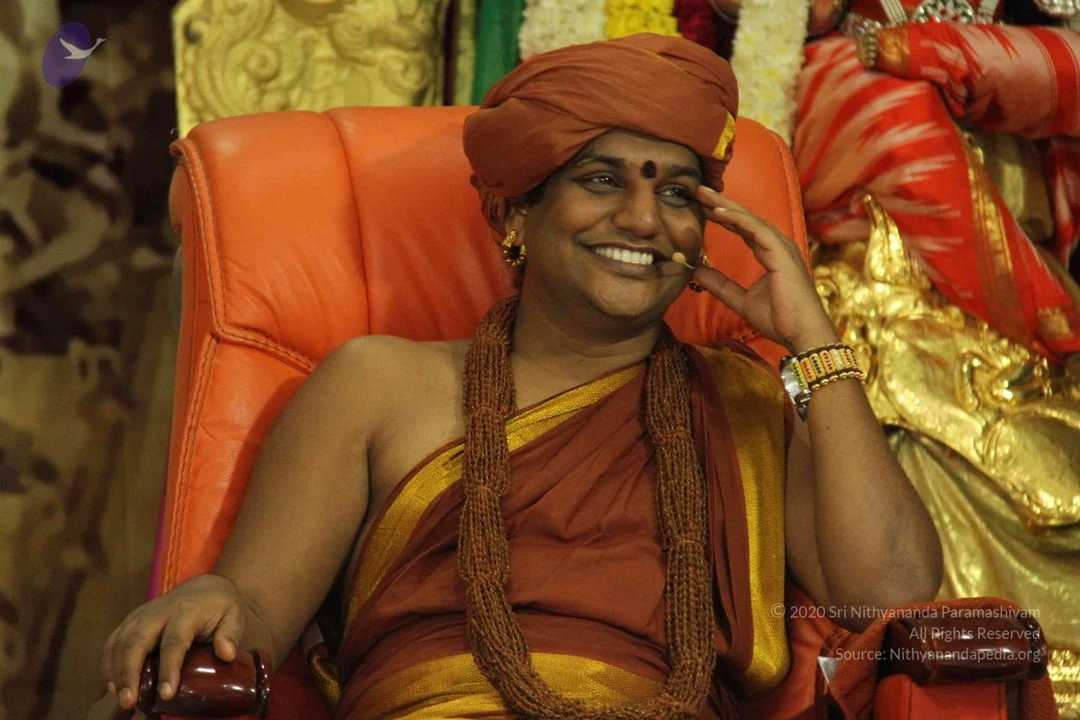
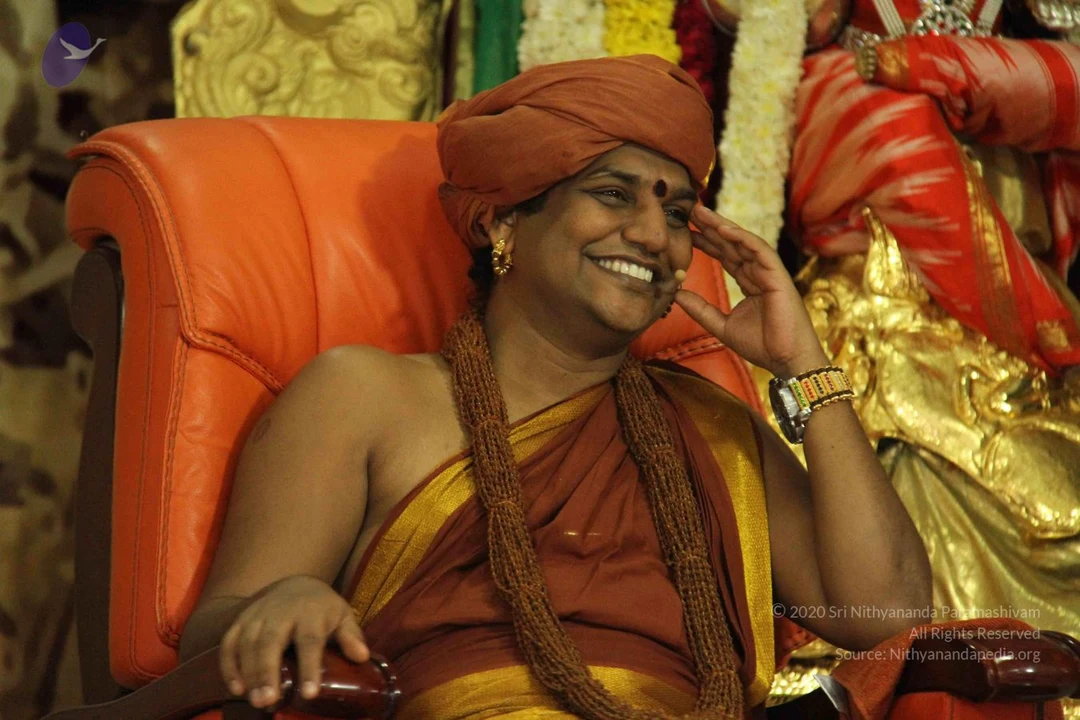
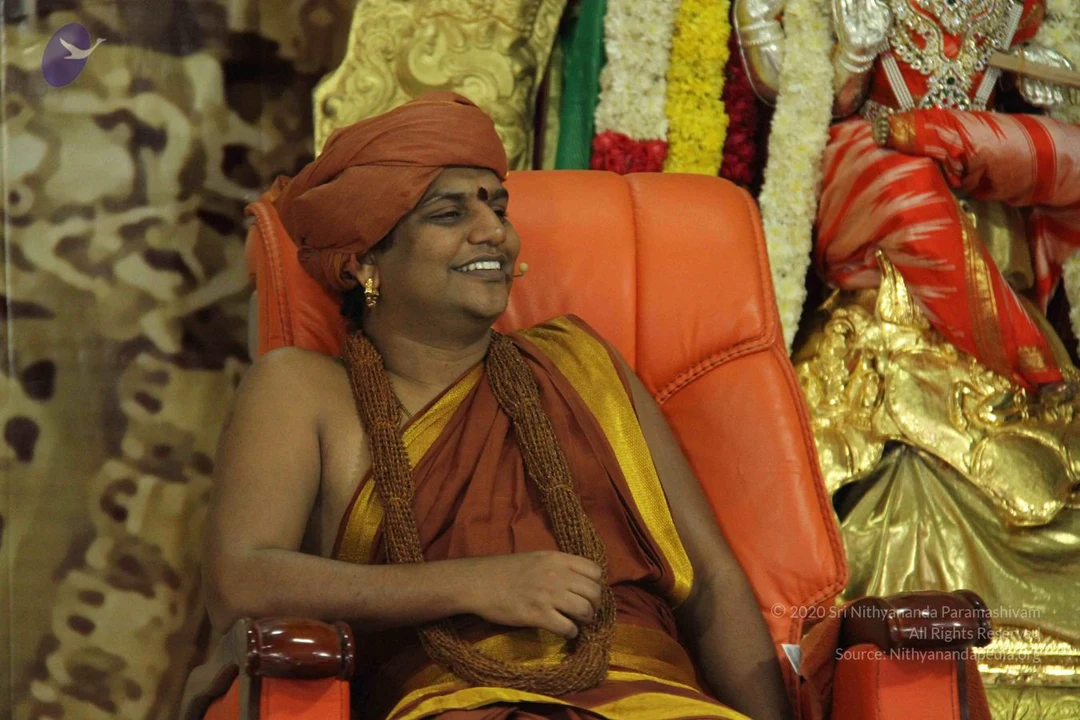
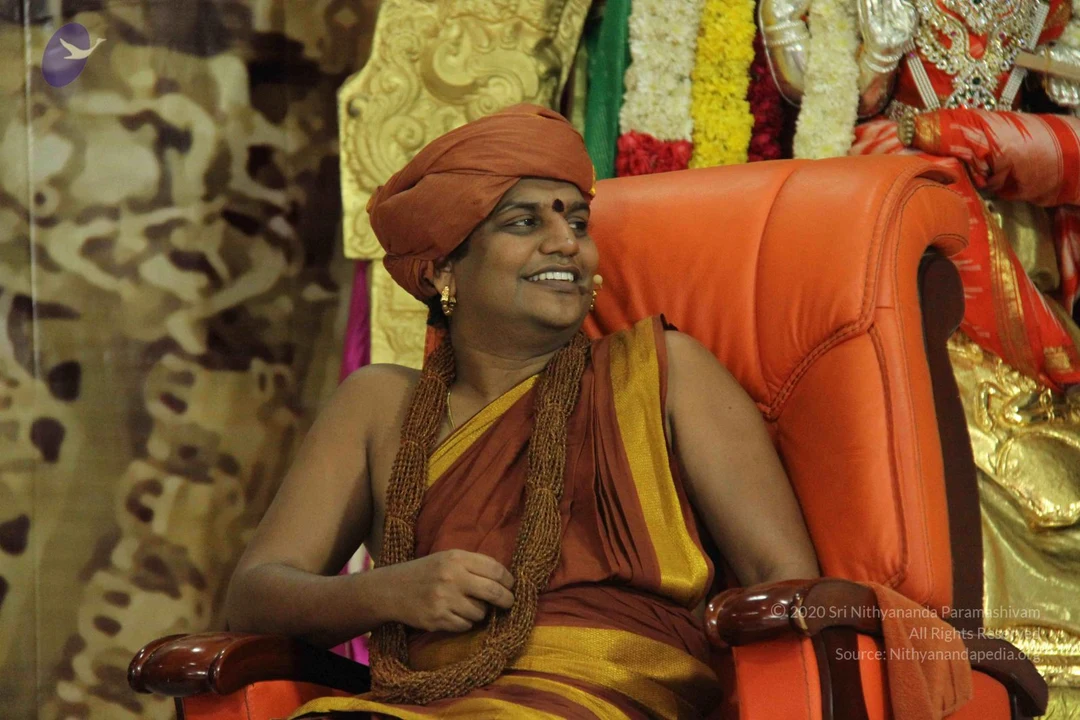
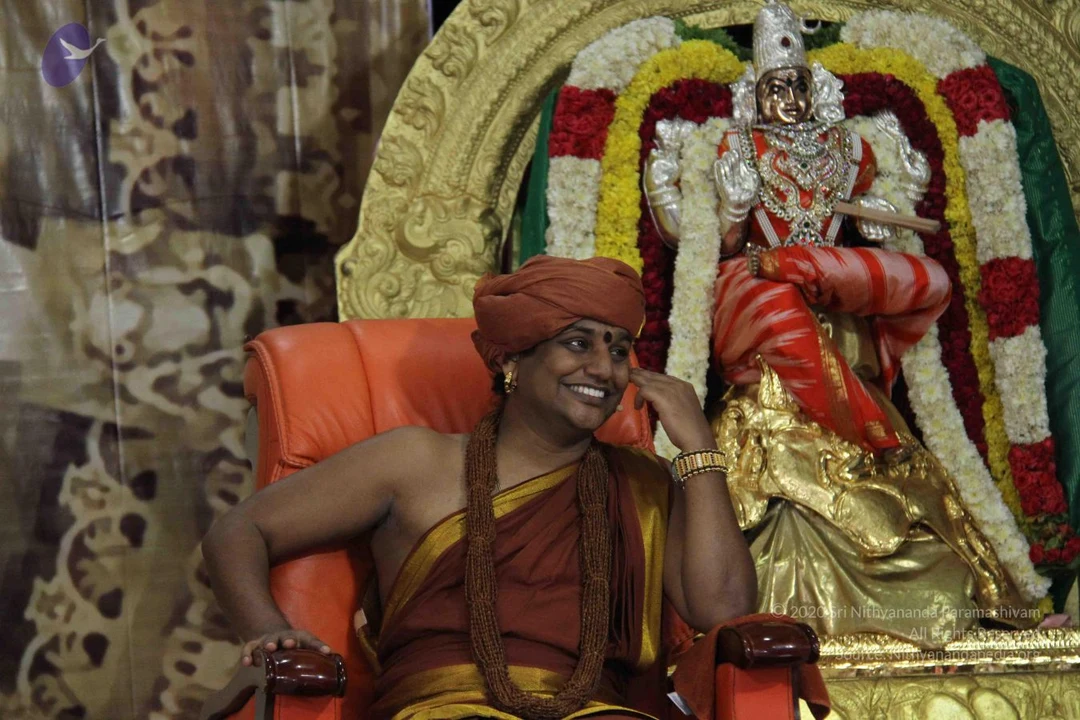
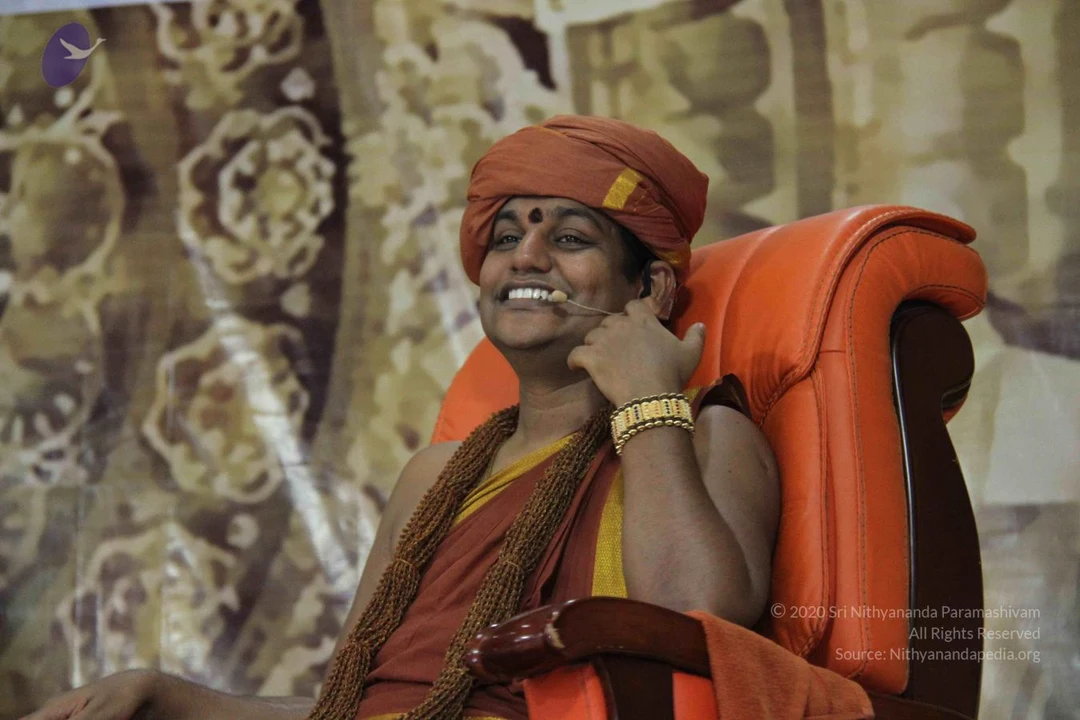
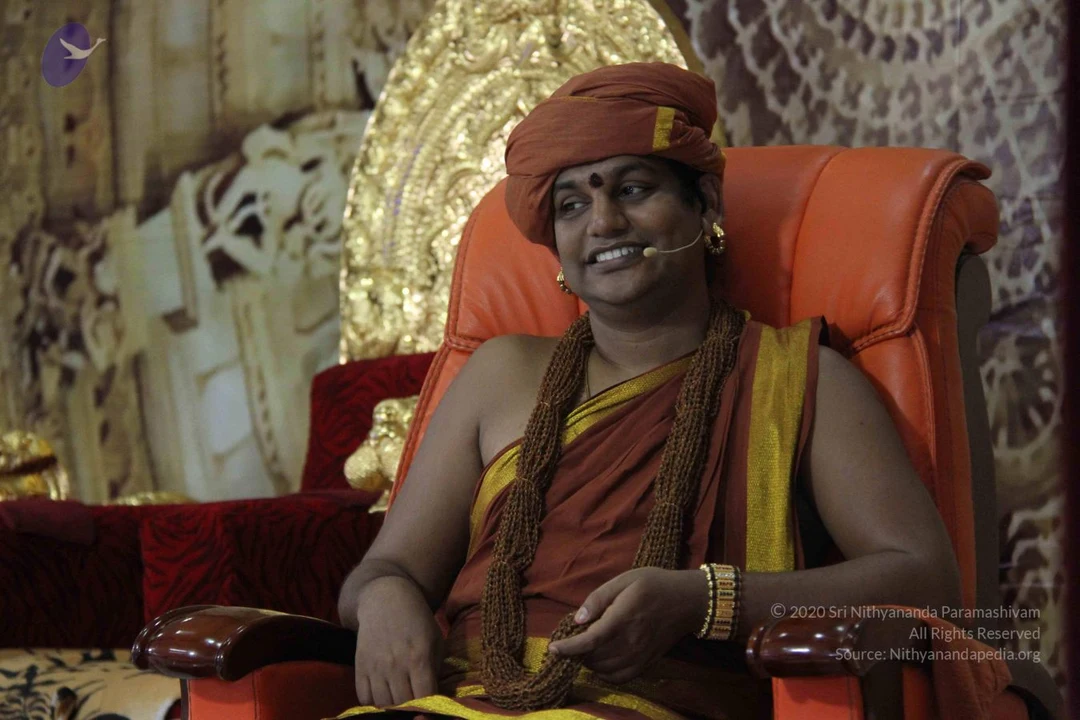
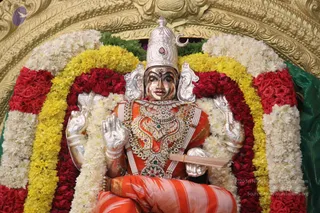
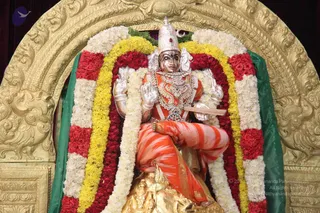
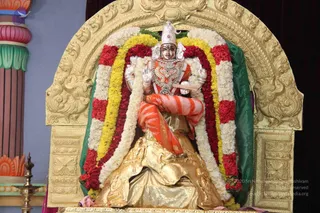
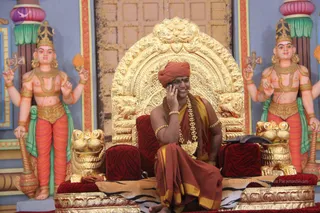
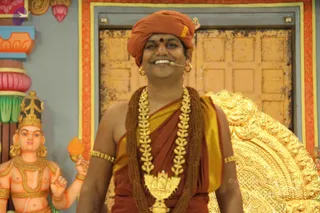
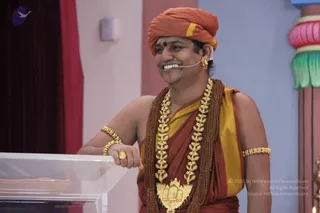
A silver-and-gold deity murti seated in a decorated shrine, framed by bands of white jasmine, yellow marigold and red rose garlands against an ornate gold arch. The figure wears a tall silver crown with a crescent ornament and a red jewel, an elaborate jewelled gold necklace and orange-red garment with white and orange striped lower cloth. It holds a silver hand gesture (abhaya-like mudra) and a small bundled object at the waist. A green fabric is visible at the right edge. No people are visible; this is a statue, so the a person field is none.A silver-faced deity murti seated on a golden throne within a gilded arch, dressed in an orange and red-striped garment with ornate silver-and-gold jewelled necklaces. The murti wears a silver crown and holds a book-like object in one hand, with multiple arms raised. It is framed by thick garlands of white jasmine, yellow marigold, and red rose strands, with green fabric behind. The murti sits on a golden pedestal decorated with small figures. No physical people are visible.A gilded deity murti of Dakshinamurthy seated on a golden throne within an ornate gold arch. The figure wears a white crown, a silver-and-red jeweled necklace, and an orange-red dhoti draped over one leg, with a rudraksha-style mala visible. Garlands of white, yellow, and red flowers frame the figure, and a green backdrop sits behind. A brass oil lamp stands at the left edge beside a colourful pillar. The image is a photo of a statue, with no living people present.A seated man in orange-saffron robes and a matching orange turban sits on an ornate golden throne with lion-head armrests and red velvet cushions. He wears a long rudraksha mala, a ceremonial gold necklace, gold bangles and rings, and smiles while resting his hand near his face, holding a mobile phone to his ear. Two large painted standing figures with gold jewellery and multiple arms flank the throne, one holding a trident-like staff. A tiger-striped cloth covers the dais, and a golden arched backdrop with a wooden door sits behind. Swamiji (probable): the seated figure is a long-haired-style presentation in saffron with rudraksha and gold ornaments, matching the page's description of Swamiji at this satsang.A man stands on a polished white stage in an orange-brown turban and a rust-and-gold dhoti and shawl, wearing a heavy gold-beaded necklace with a large gold pendant and gold armbands. He wears a head microphone. Behind him is an ornate golden throne draped in red cushions and a tiger-skin cloth, flanked by painted pillars and standing lamps. On the right, a gold-framed shrine holds a seated deity murti decorated with red and white garlands. Carved guardian figures stand near the throne.A smiling man in an orange-red turban with a red tilak on his forehead stands in front of a carved golden throne and a wooden door. He wears a head microphone, layered rudraksha malas, a heavy gold ceremonial necklace, gold armlets and a red-and-gold shawl over bare shoulders. To his left stands a painted deity murti with a crown, orange skin, gold jewellery and a raised hand holding a lamp. The setting suggests a satsang hall. Swamiji (probable) is shown in the appearance-based label, based on the turban, rudraksha malas, ornate gold necklace and saffron-toned clothing.

Kalpatharu Dharshan
29 photosSource gallery
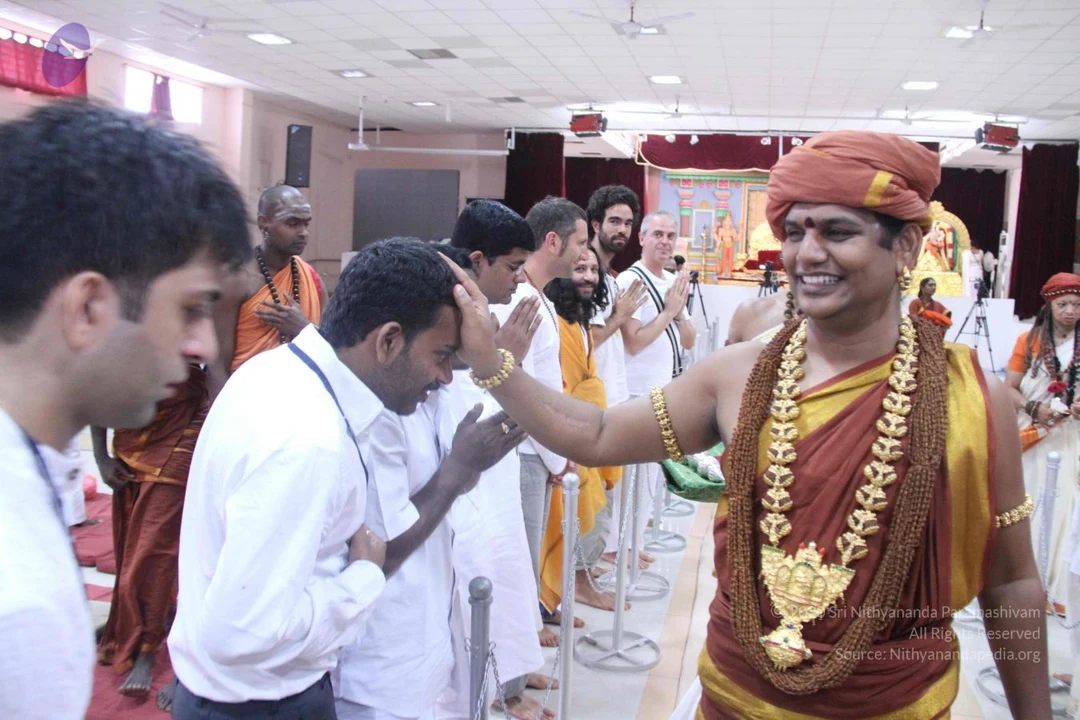
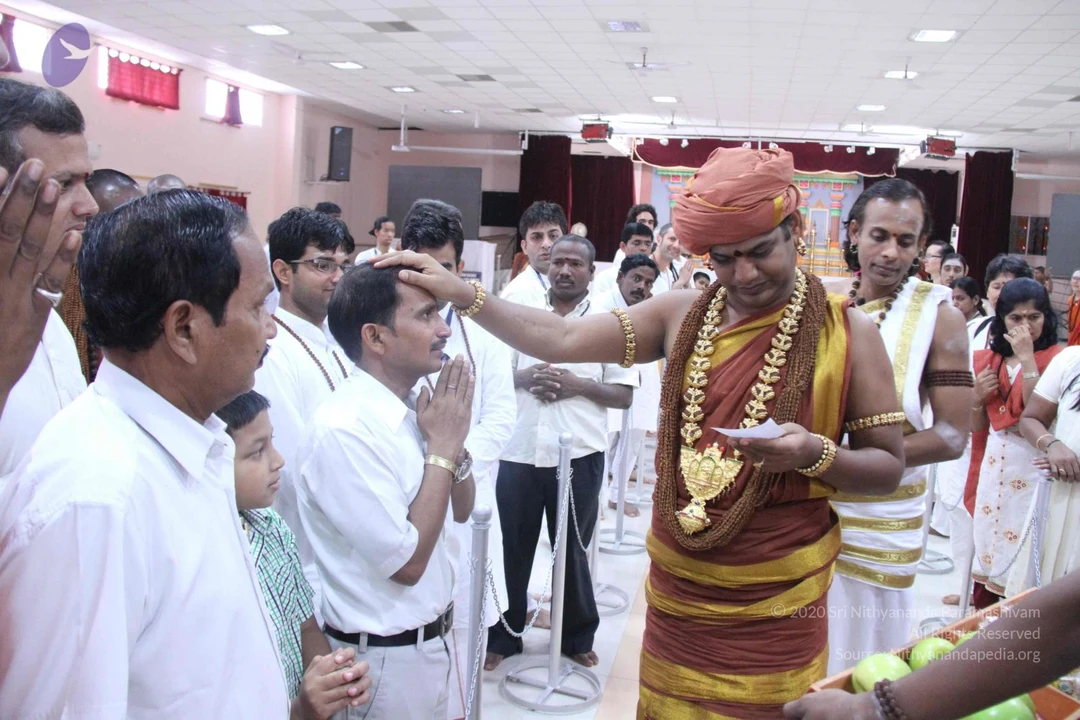
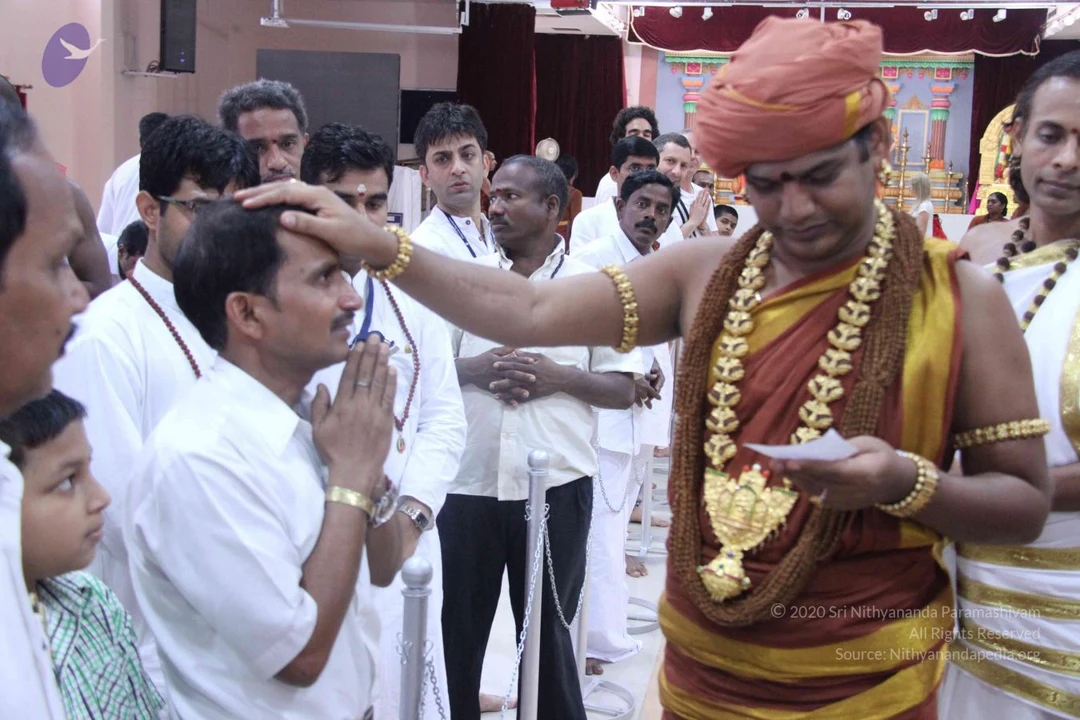
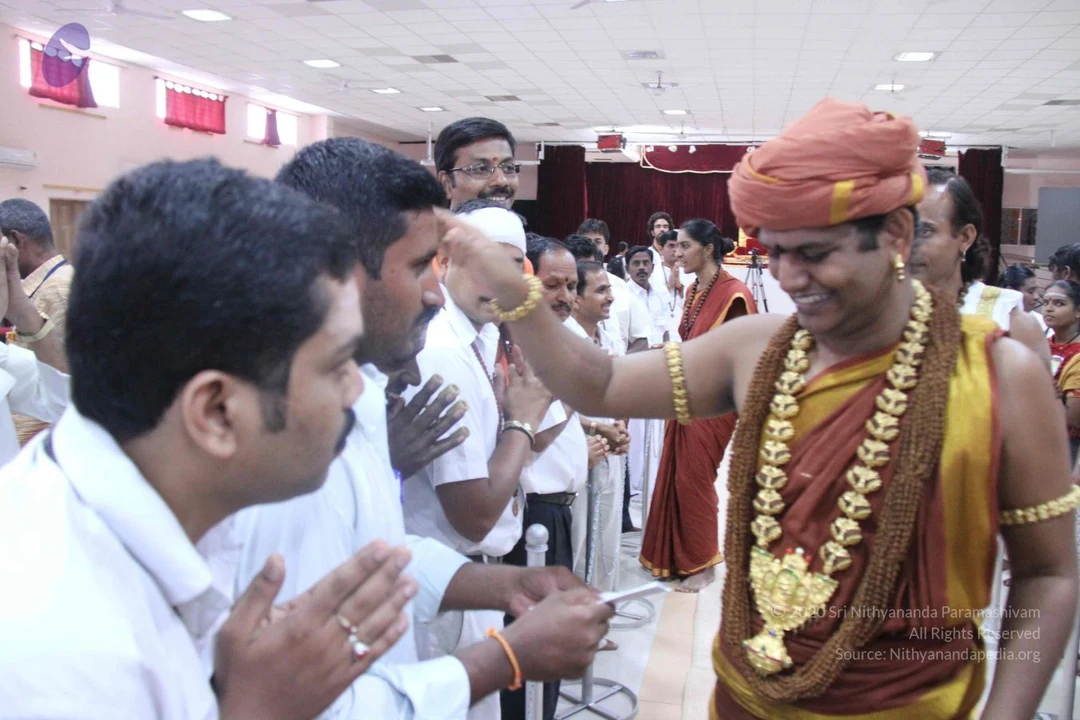
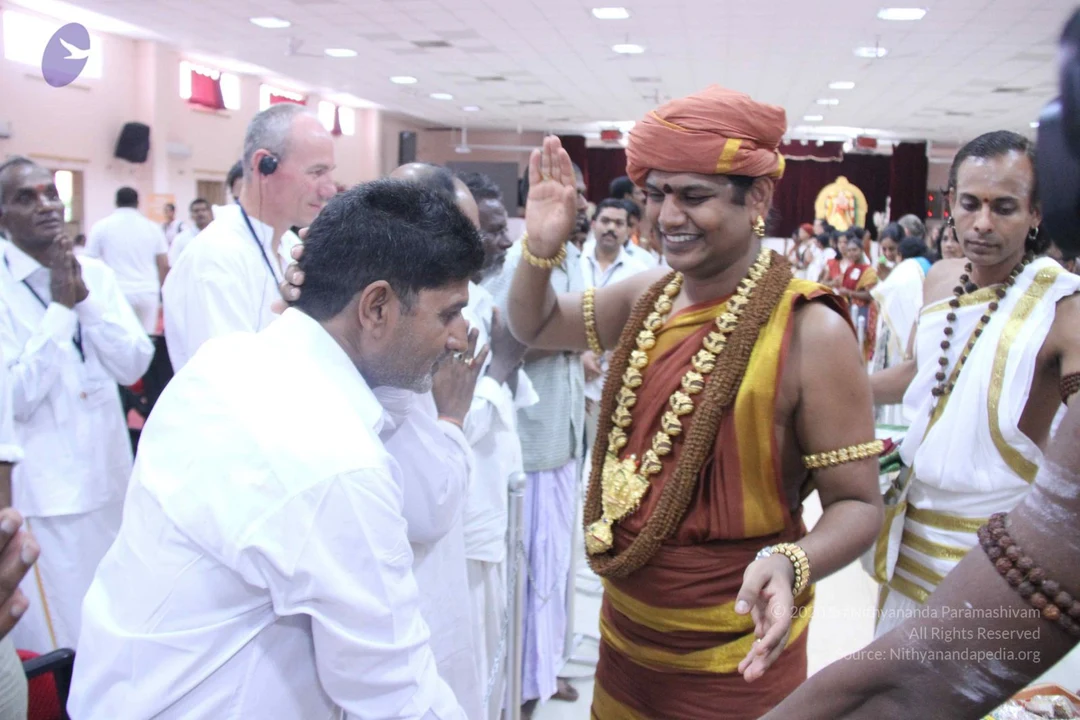
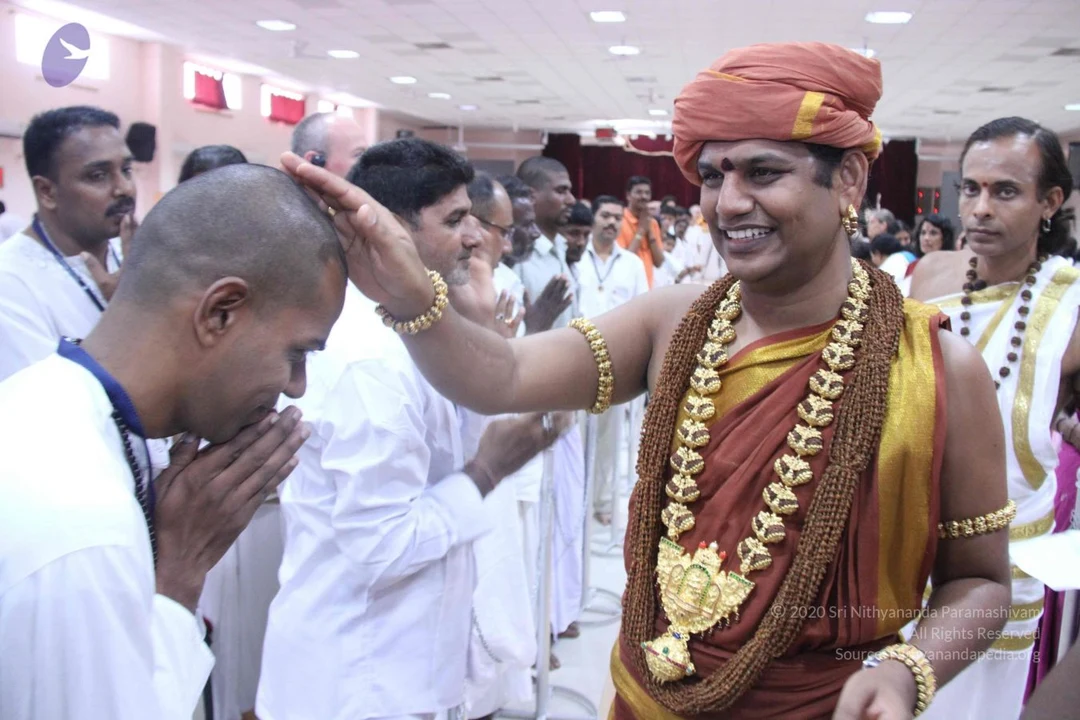
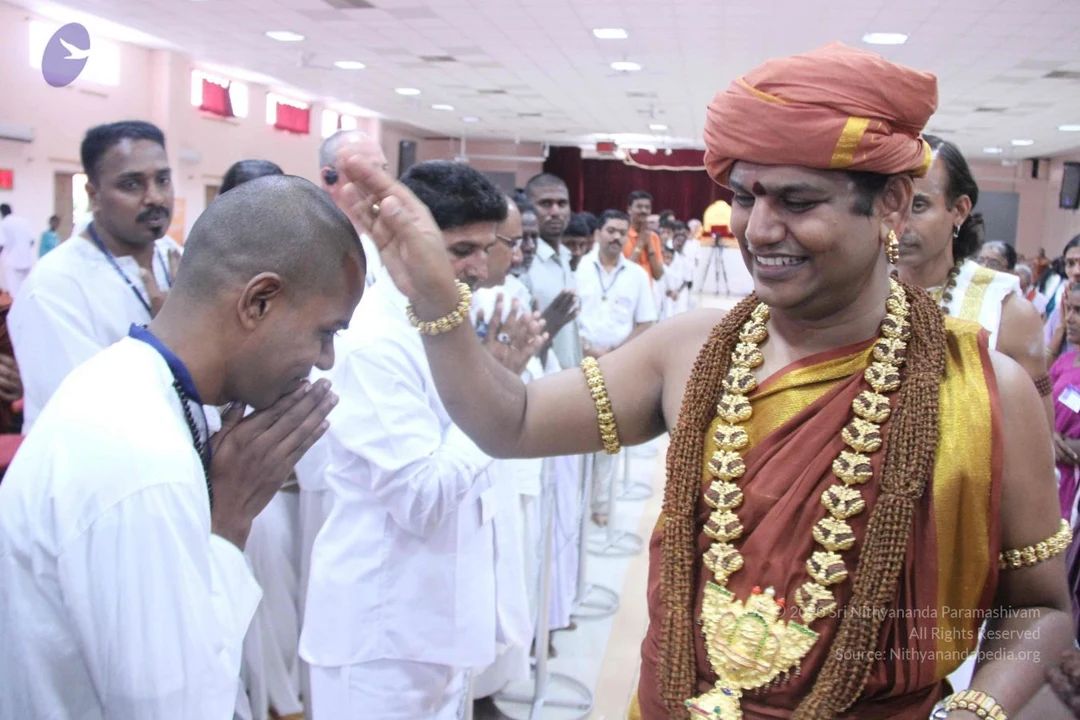
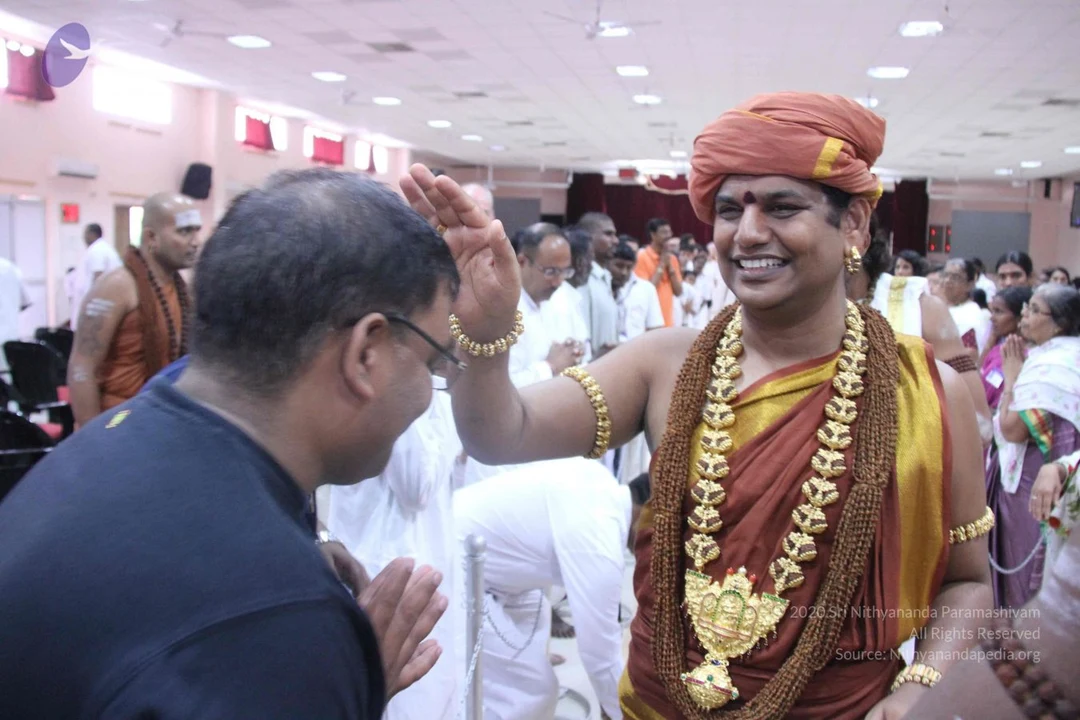
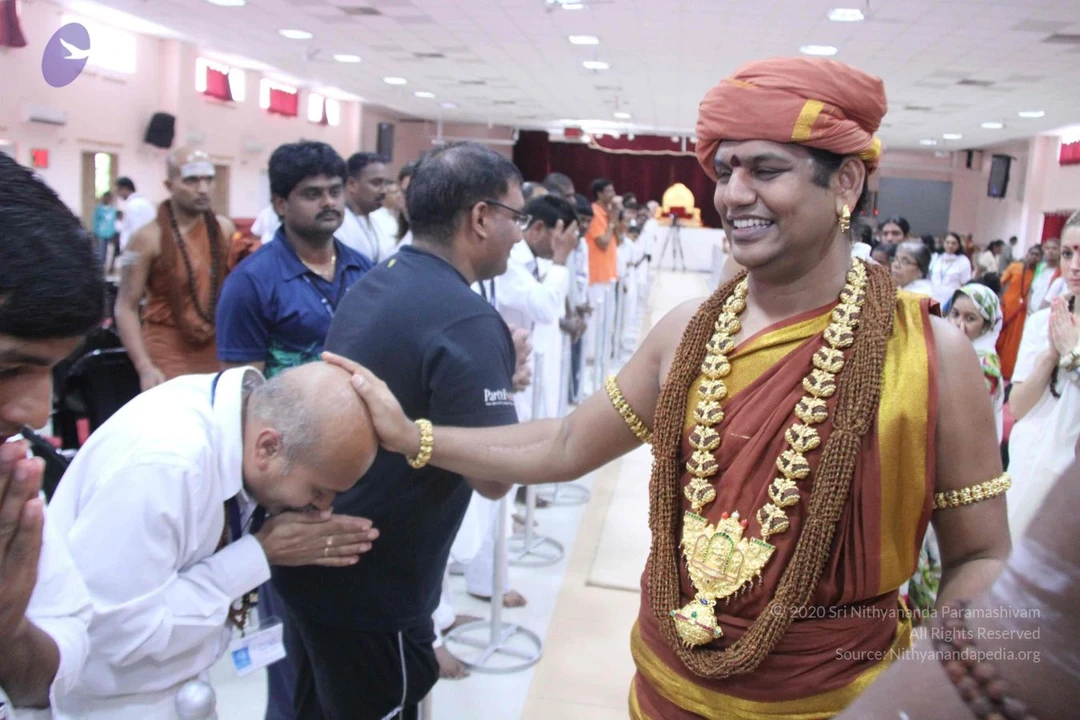
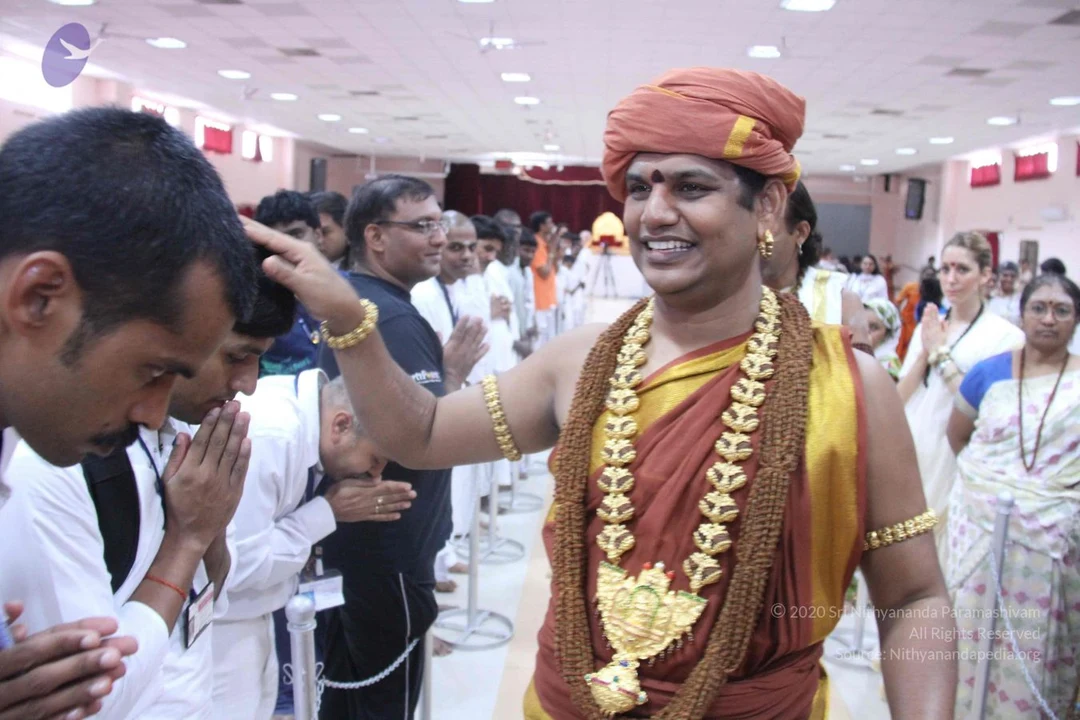
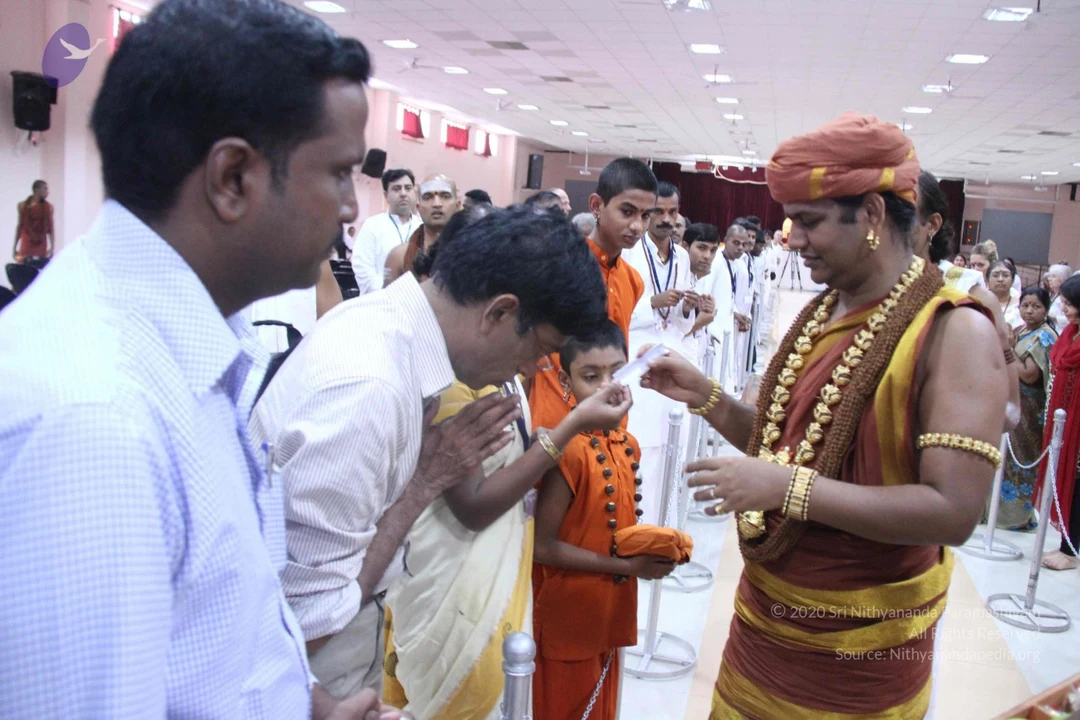
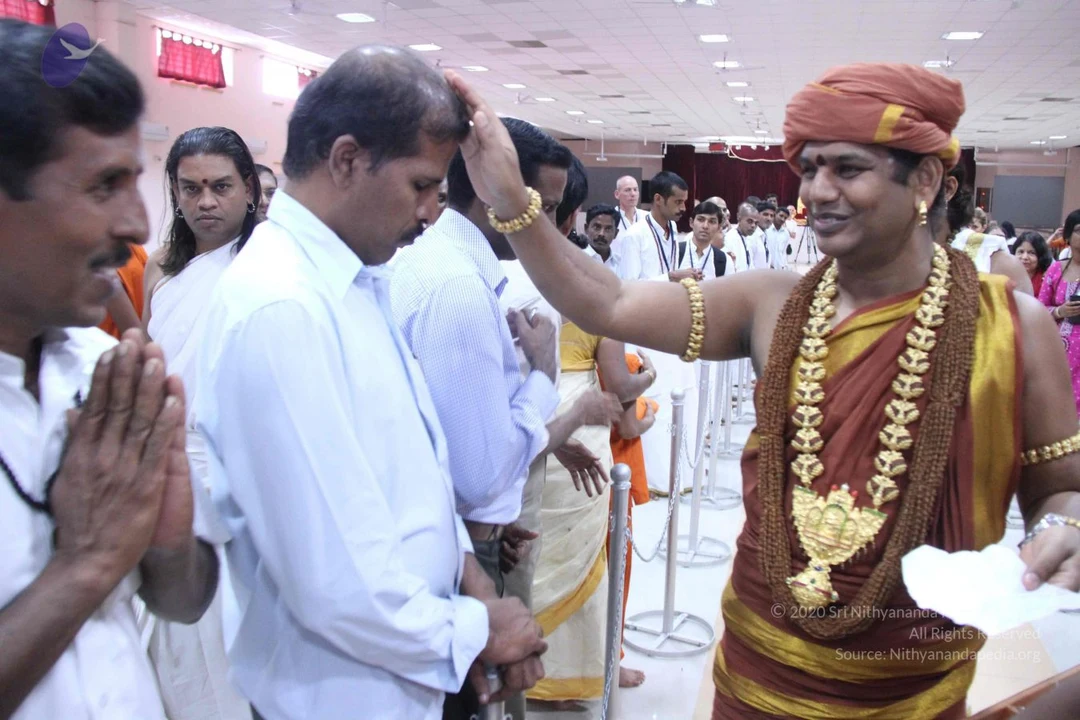
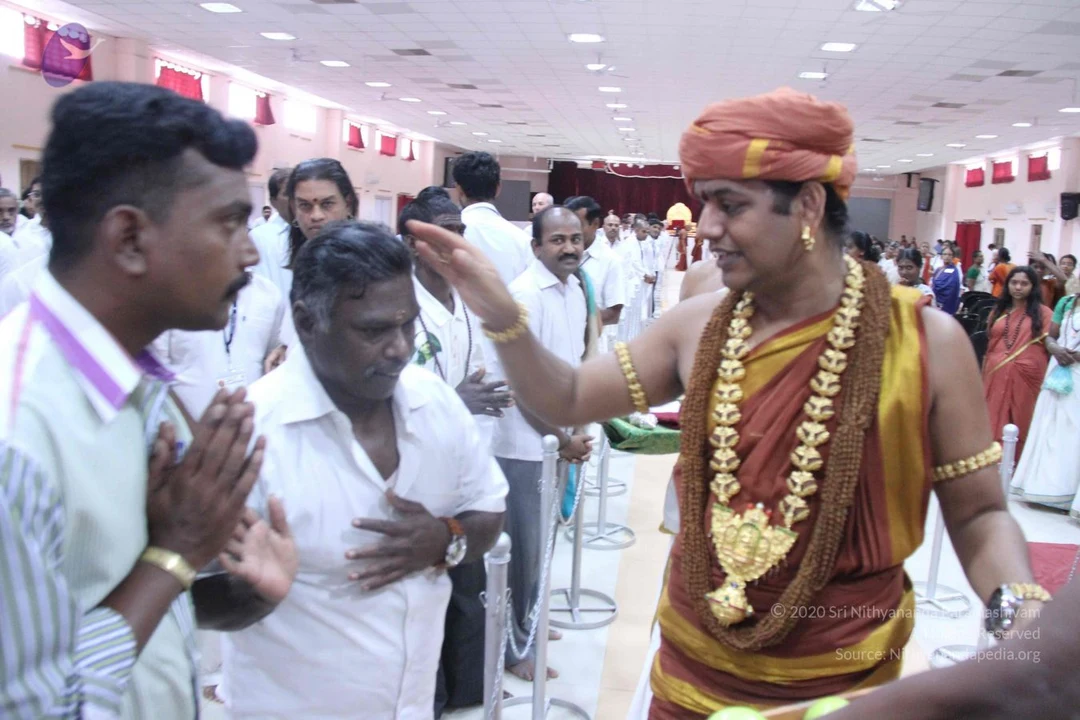
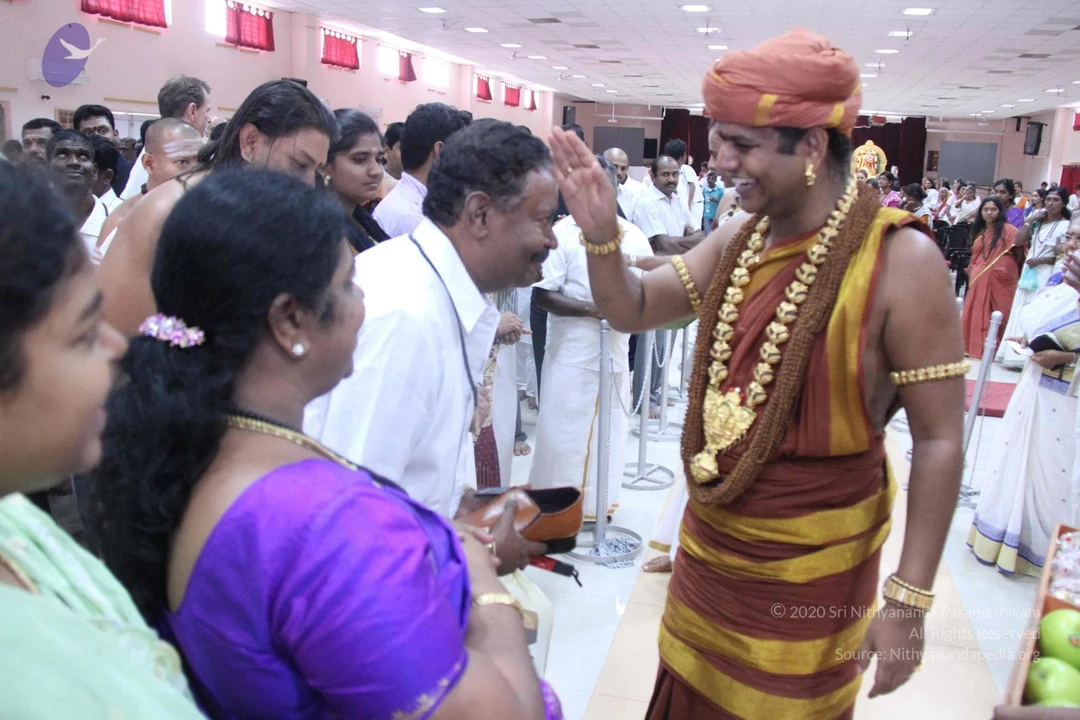
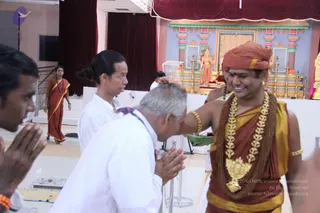
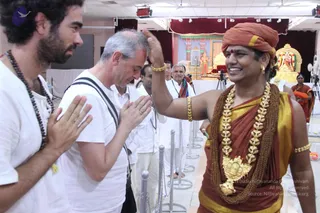
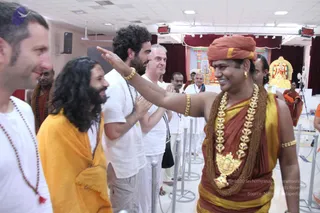
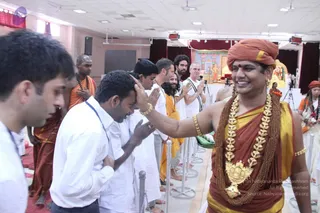
A man in a rust-orange turban and orange-brown robe, wearing a heavy gold necklace and rudraksha-style beaded mala, stands at the right, smiling as he places his hand on the head of a devotee. The devotee in a dark shirt bows with head lowered. A man in white with folded hands and a lanyard stands at the left in namaskar. Behind them, a stage with golden lamps and a throne-like seat is flanked by painted deity figures with multiple arms, and a camera on a tripod is visible. The scene suggests a blessing during a satsang.A man in a white shirt bows with palms pressed together while a smiling man in an orange-red turban, gold-and-rudraksha ceremonial necklaces and gold armband and a saffron-and-gold garment touches the bowing man's head in blessing. Behind them a young man in white and another in orange-red robes stand in a temple hall. A large deity murti in a shrine niche with brass lamps and a golden kalasha-style altar lies behind, with red velvet curtains and a painted pillared backdrop.Indoor photograph in a temple-style hall. A smiling man in an orange-red turban, rust-orange garment with gold border, and heavy gold necklaces and bangles raises his hand in blessing over the bowed head of a grey-haired man in a white t-shirt with a black stripe. To the left, a bearded young man in white clothes and rudraksha beads presses palms together in namaste. Behind them, devotees in white stand near metal barriers, and a large decorated altar with a gold-framed deity image and painted backdrop of a figure with a staff is visible. Cameras on tripods are set up at the right.A photograph of an indoor hall with a red-draped stage backdrop and a golden deity murti in a shrine. In the foreground a man in a brown-red dhoti with a gold-and-brown bead mala and gold necklace, wearing an orange-red turban and gold armlet, reaches out and raises his hand to greet a bearded man in an orange-yellow wrap with long dark hair and a rudraksha mala. Around them stand devotees in white kurtas and white dhotis, with a man in white at left and a bearded man in a white shirt behind them. Metal crowd barriers line the floor, and a few more people stand toward the back near the shrine.A photo inside a hall with red curtains and a decorated deity shrine in the background. A smiling man in a rust-orange turban, rust and gold shawl, and heavy gold ceremonial necklaces with a large pendant stands at right and extends his hand to touch the forehead of a man in white shirt who bows before him. Other devotees in white shirts and orange or saffron robes, some with rudraksha malas, line up behind a metal stanchion. A dark-robed priest stands at left and a woman in an orange sari stands at far right. Cameras and a tripod are visible near the shrine. The smiling man in orange and gold has distinctive ceremonial adornments and a turban, consistent with a person candidate giving blessing.A man in an orange turban and saffron-and-gold dress, wearing a long rudraksha-style bead mala and a large gold ceremonial pendant, places his right hand on the head of a devotee in white shirt and trousers. Other devotees in white stand with folded hands, a small boy in a checked shirt watches, and a woman in a red sari with a red shawl stands nearby. Behind them is a hall with red curtains, a backdrop of colourful decorations, and a tray of green fruit in the lower right corner.

Inner Awakening in Bidadi
82 photosSource gallery
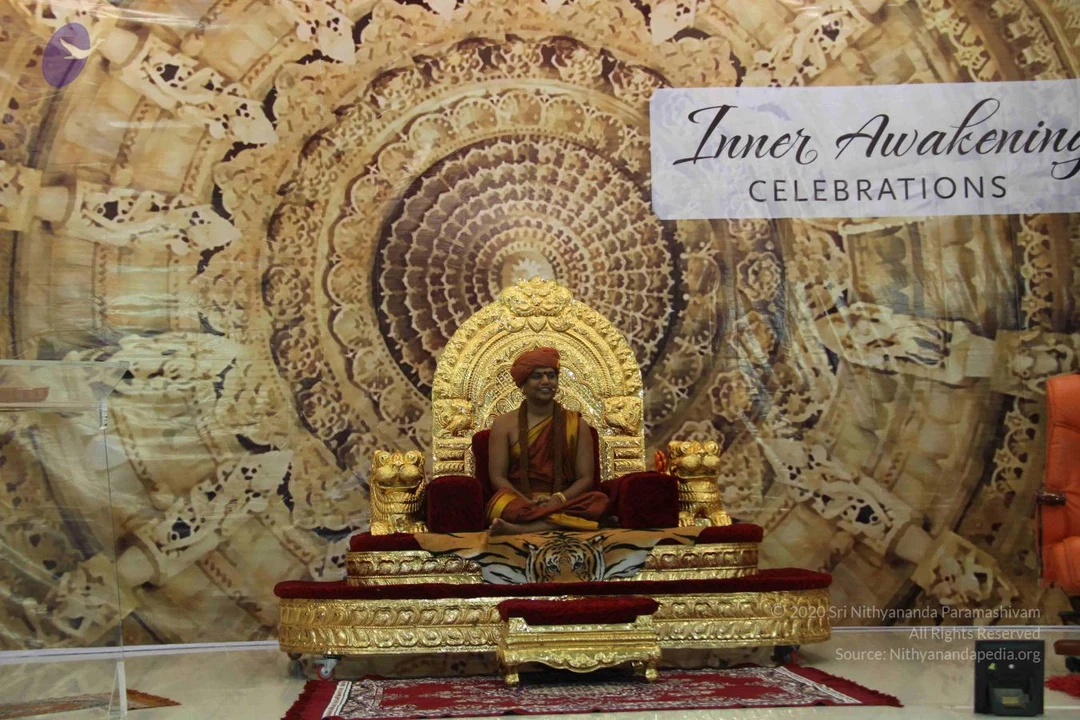
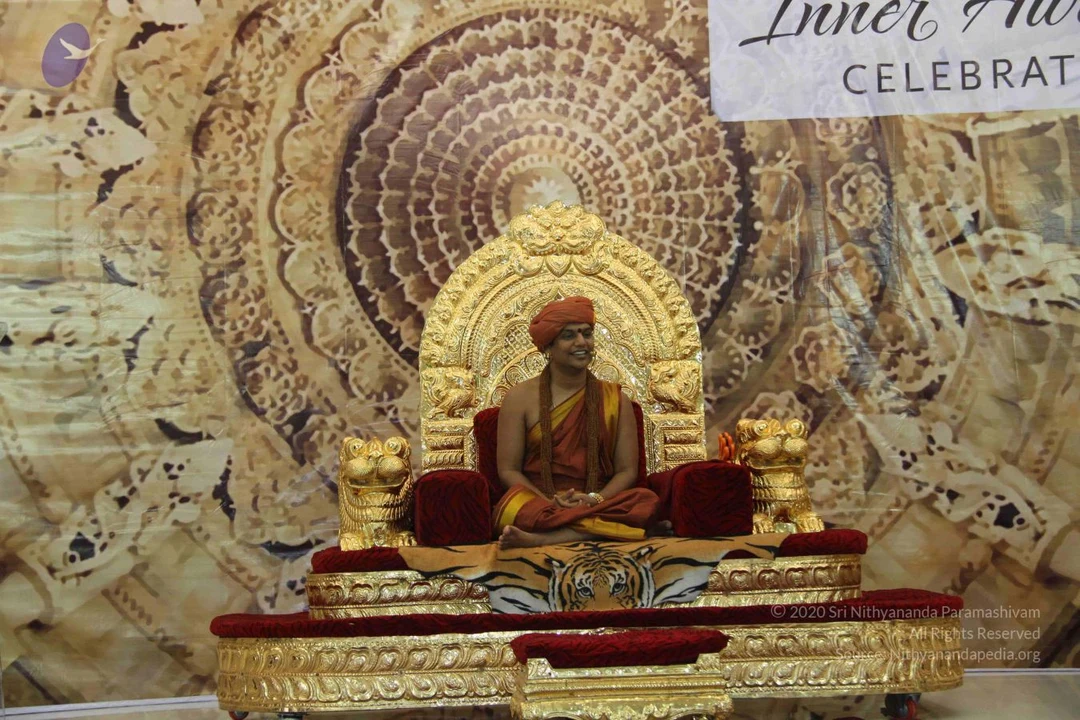
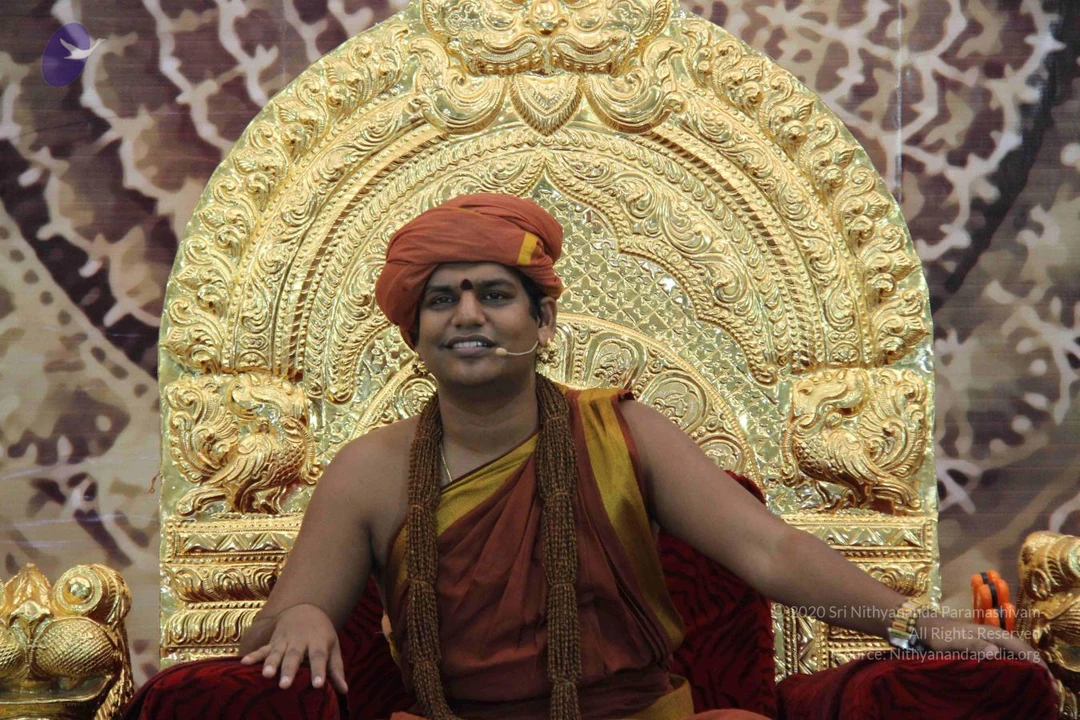
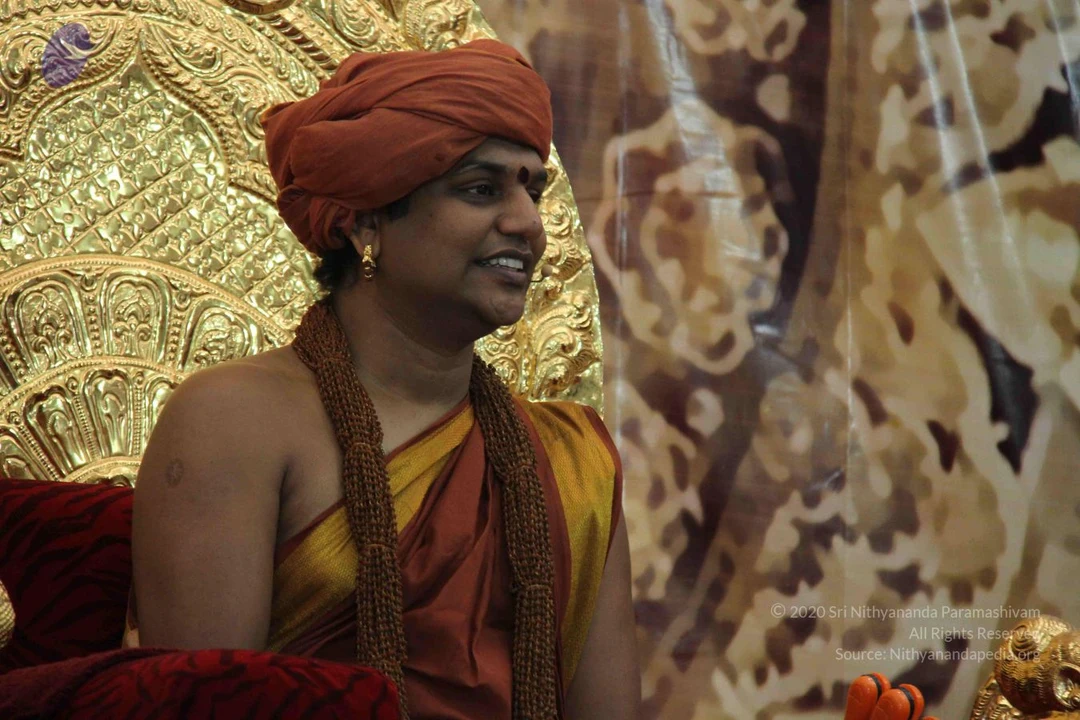
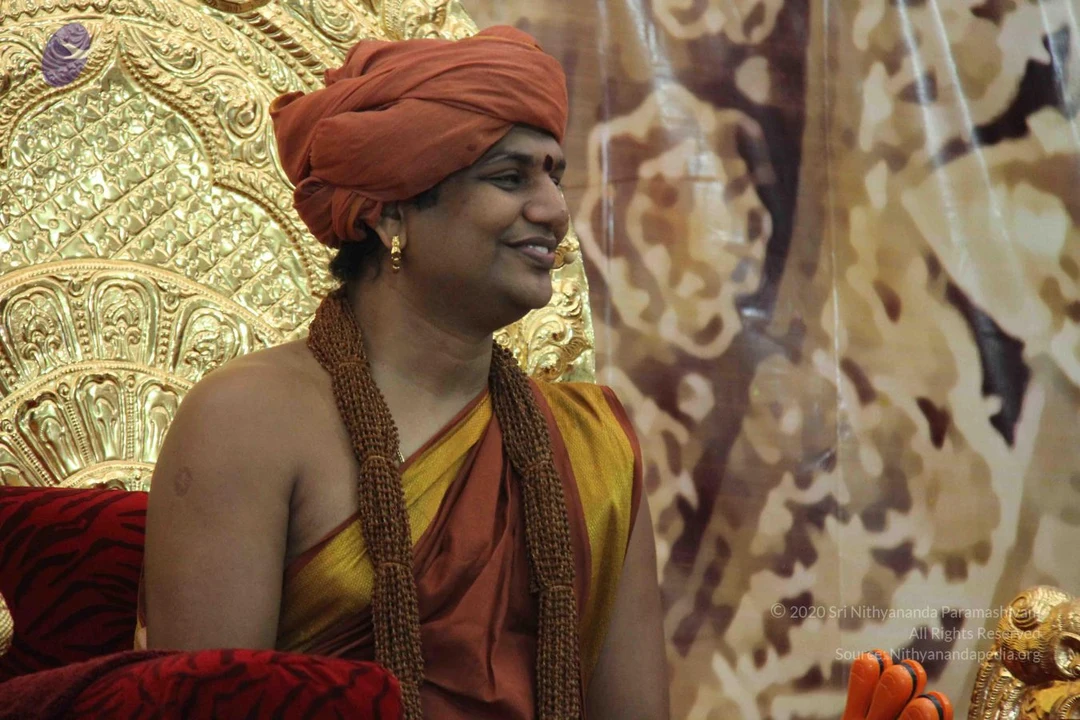
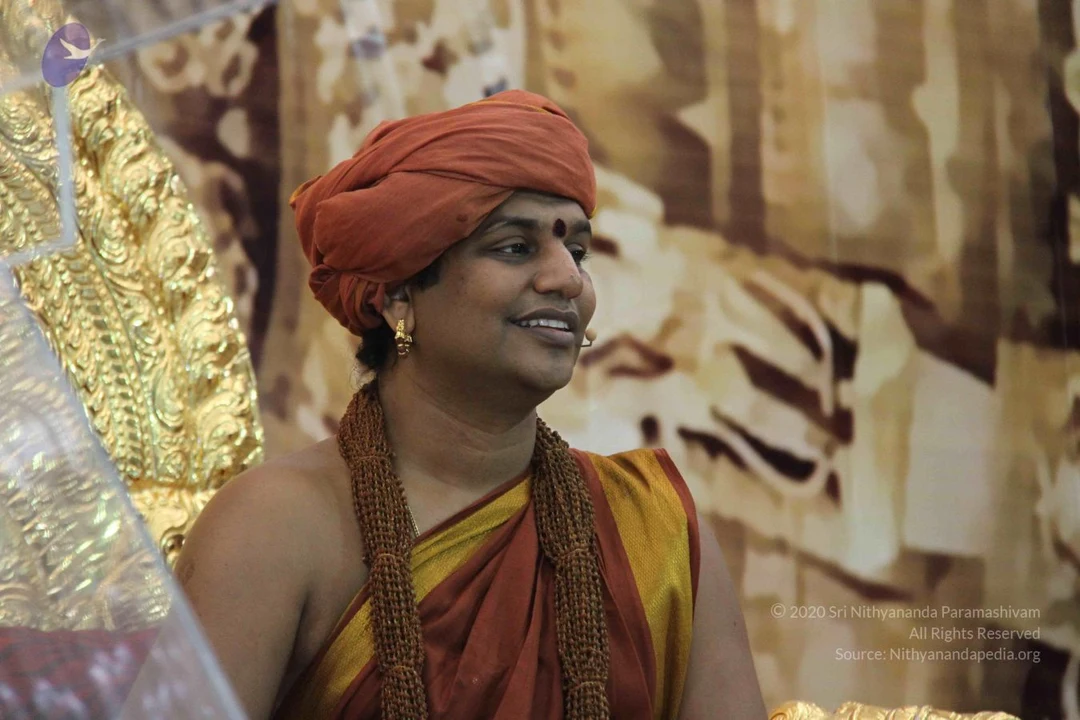
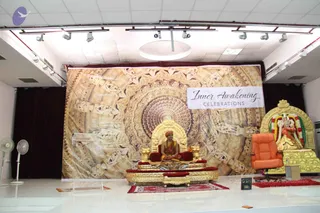
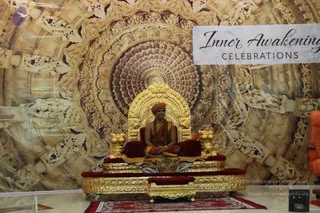
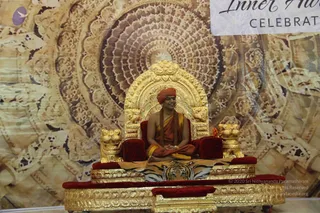
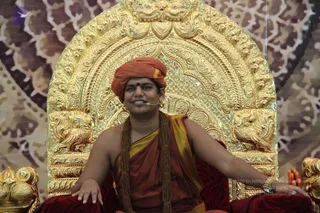
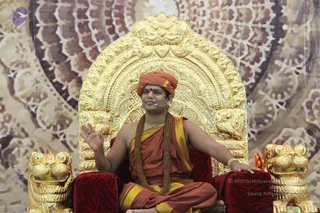
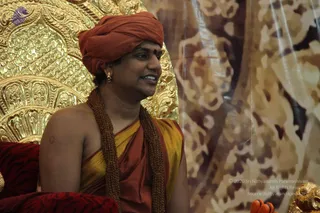
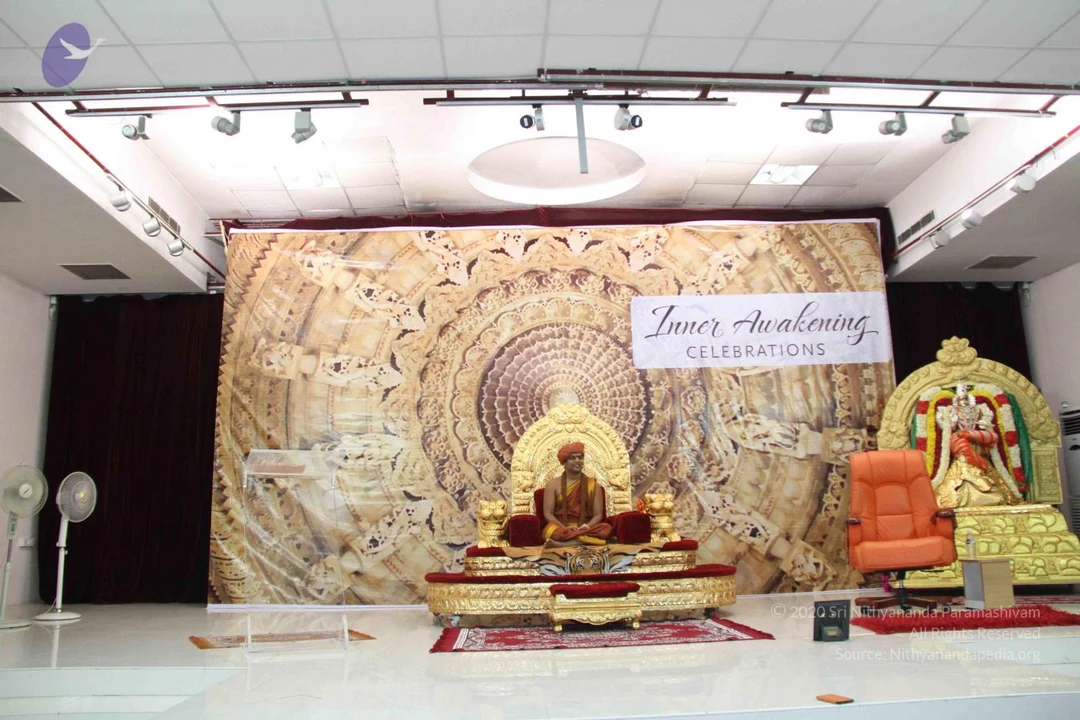
A photograph of an empty stage set for a satsang, with a large ornate golden-brown backdrop of carved temple-style patterns. A banner reads Inner Awakening Celebrations. Centre stage, a gold throne with red cushions holds a seated figure in orange and gold clothing and a turban-like orange head covering, appearing to be a statue or depiction rather than a living person. To the right, a golden throne with garlands and a deity murti is set beside an empty orange leather chair. Fans stand on the floor and ceiling spotlights hang above.A photograph of a seated figure on an ornate golden throne (peetha) with carved lion heads at the armrests and red cushions. The figure wears an orange-saffron head wrap and orange robe with a yellow lower garment, seated cross-legged on a tiger-striped cloth. Behind the throne is a large golden-brown ornamental mandala-style backdrop. A white banner labelled "Inner Awakening CELEBRATIONS" hangs at upper right. A red patterned carpet lies at the base of the throne, and an orange chair is visible at the right edge.A seated figure in an ornate gold throne with carved lion heads and red cushions sits cross-legged on a tiger-skin cloth, hands folded in lap. He wears an orange-red turban, an orange-red robe with yellow border, and a long rudraksha-style mala. Behind him is a large gold-and-brown patterned backdrop with a printed banner reading Inner Awakening celebration at upper right. Swamiji (probable): the cues are a turban, saffron-orange robes, and a mala, with the throne and the page's satsang context. The man is seated and smiling, with a single tiger-skin throne cover.A seated man in a rust-orange turban and rust-and-gold robes sits on an ornate gilded throne with a carved arched backrest and lion-like side carvings. A thick rudraksha-style mala hangs over his chest and a small mic is clipped near his mouth. He smiles with his right hand resting on his knee and his left arm extended outward. Behind him is a patterned maroon backdrop. a person is seated on the peetha as the speaker, identified by the satsang context and the throne with rudraksha mala cues.A man seated cross-legged on an ornate gold throne with carved lion-head armrests and a golden arched back, set against a patterned cream and maroon backdrop. He wears an orange-red turban, an orange and yellow draped cloth, a long brown rudraksha mala, and a gold bangle on his wrist, and a small microphone is clipped near his face. His right hand is raised in an open gesture while his left rests on the armrest. Red velvet cushions line the throne.A photograph of a man seated on an ornate golden throne with a carved gold backrest, wearing an orange-red turban with a red-brown bindi, orange-red and gold shawl draped over the body, and long brown rudraksha-style mala beads hanging on the chest. He smiles and looks to the side while seated before a gold-and-beige patterned hanging. At the lower right, orange-tipped ceremonial items are visible near the frame edge. a person is seated on the throne as the central figure.

Alankar-Deity-Dakshinamurthy

3 photosSource gallery
A silver-faced deity murti seated on a golden throne within a gilded arch, dressed in an orange and red-striped garment with ornate silver-and-gold jewelled necklaces. The murti wears a silver crown and holds a book-like object in one hand, with multiple arms raised. It is framed by thick garlands of white jasmine, yellow marigold, and red rose strands, with green fabric behind. The murti sits on a golden pedestal decorated with small figures. No physical people are visible.A gilded deity murti of Dakshinamurthy seated on a golden throne within an ornate gold arch. The figure wears a white crown, a silver-and-red jeweled necklace, and an orange-red dhoti draped over one leg, with a rudraksha-style mala visible. Garlands of white, yellow, and red flowers frame the figure, and a green backdrop sits behind. A brass oil lamp stands at the left edge beside a colourful pillar. The image is a photo of a statue, with no living people present.A silver-and-gold deity murti seated in a decorated shrine, framed by bands of white jasmine, yellow marigold and red rose garlands against an ornate gold arch. The figure wears a tall silver crown with a crescent ornament and a red jewel, an elaborate jewelled gold necklace and orange-red garment with white and orange striped lower cloth. It holds a silver hand gesture (abhaya-like mudra) and a small bundled object at the waist. A green fabric is visible at the right edge. No people are visible; this is a statue, so the a person field is none.

Nithya-Satsang

13 photosSource gallery
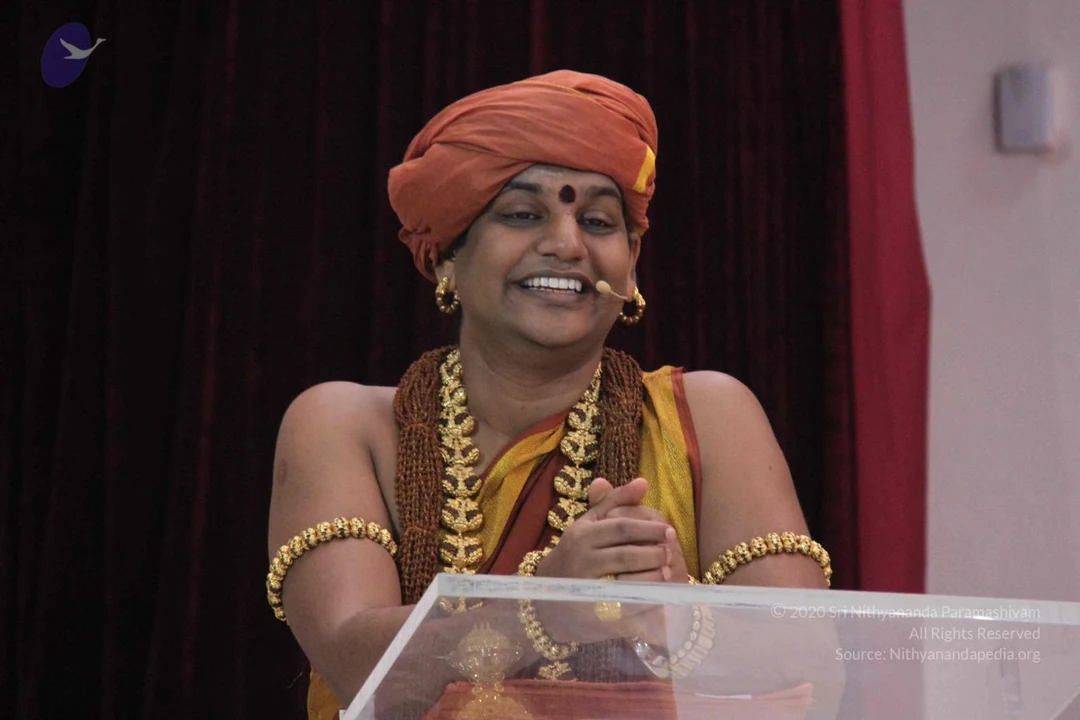
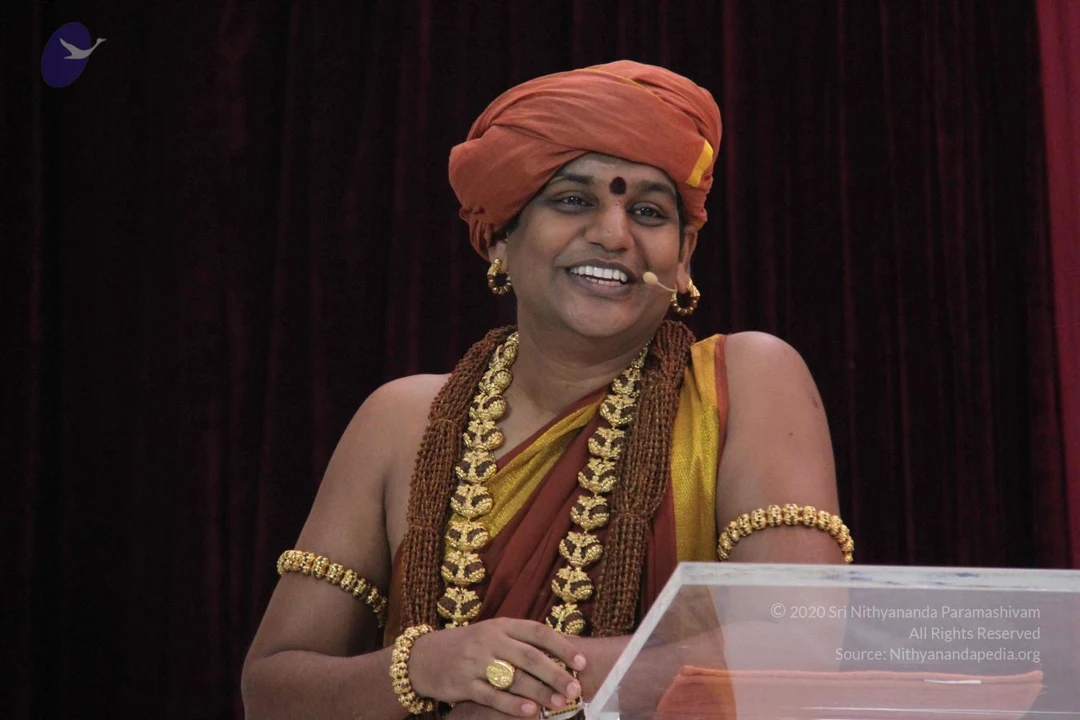
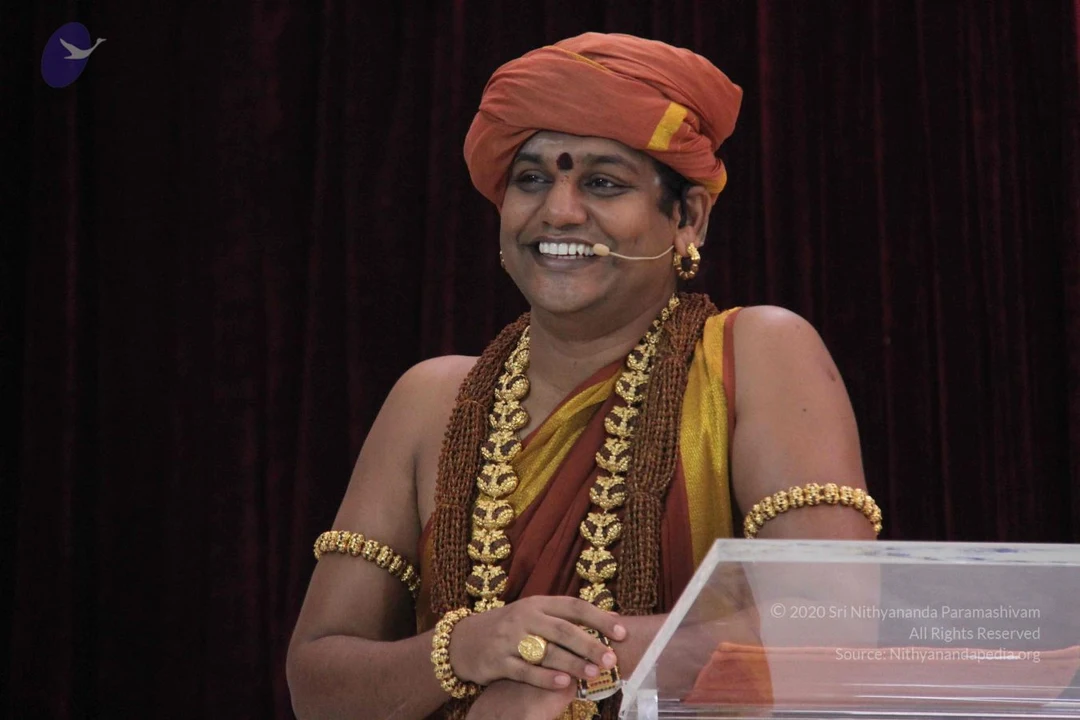
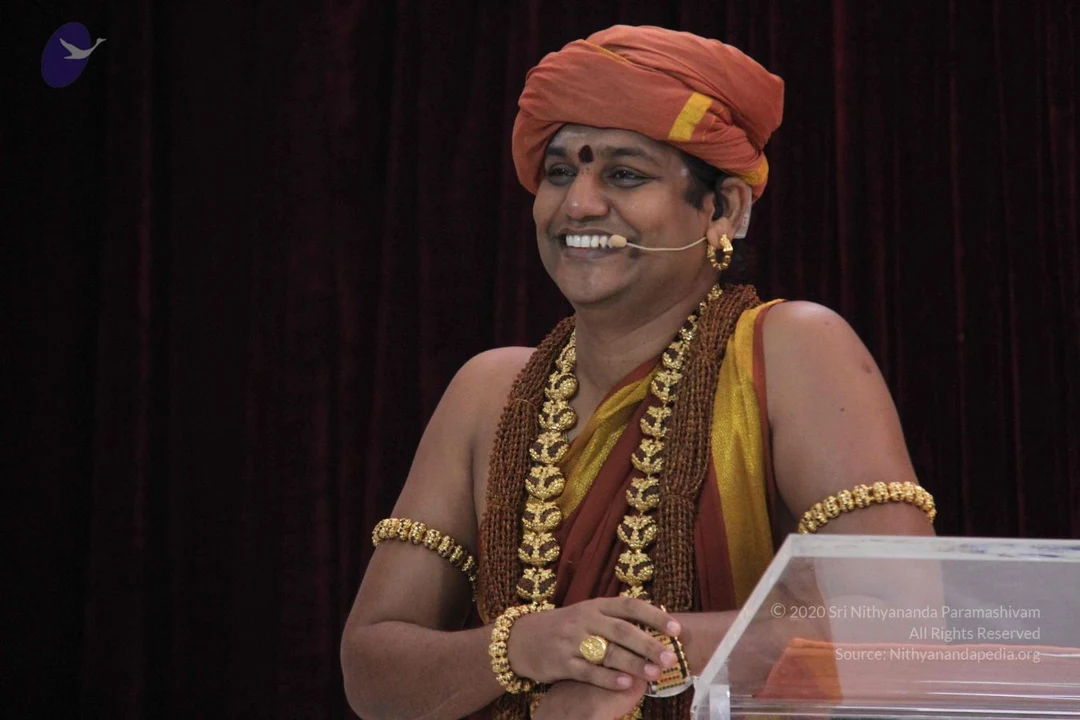
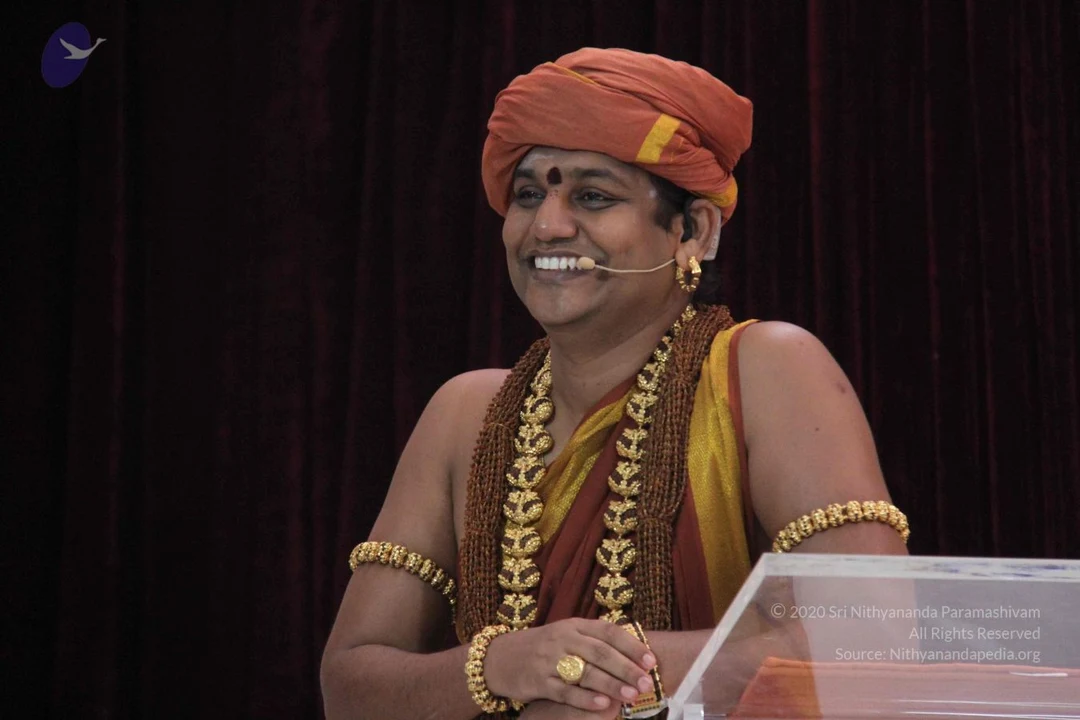
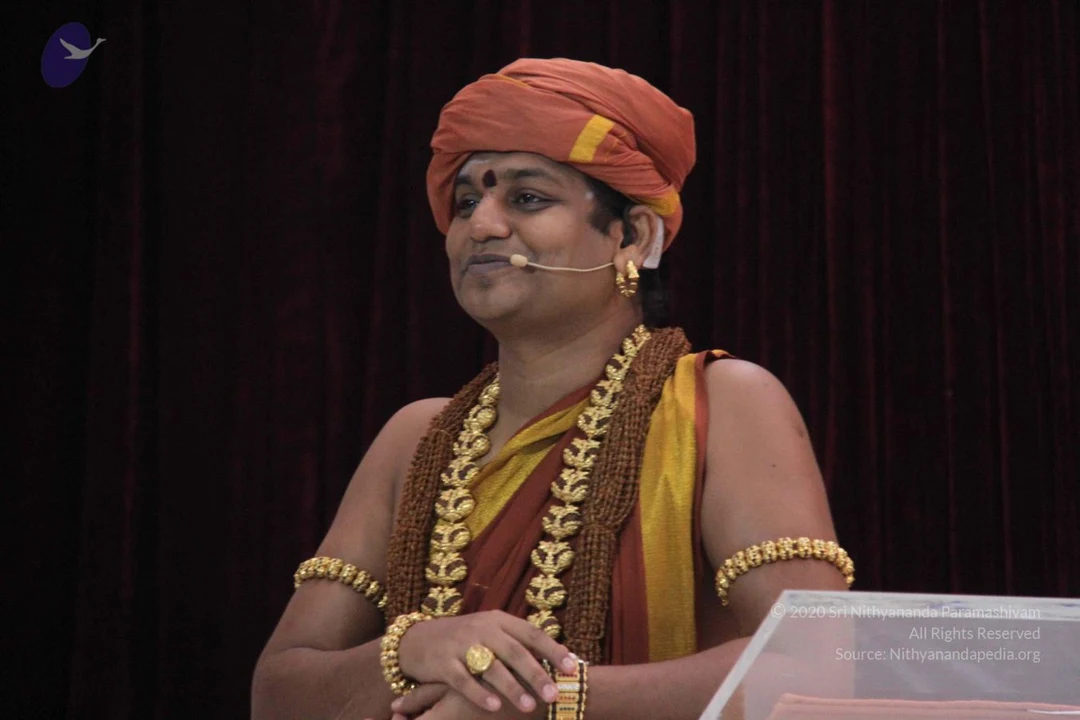
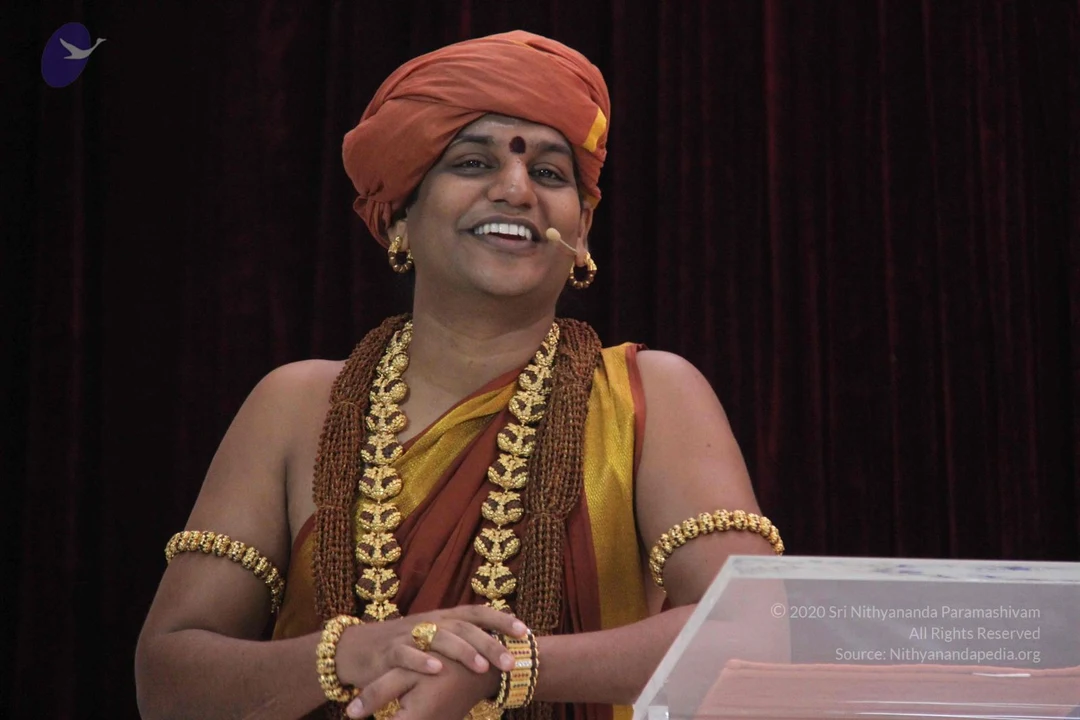
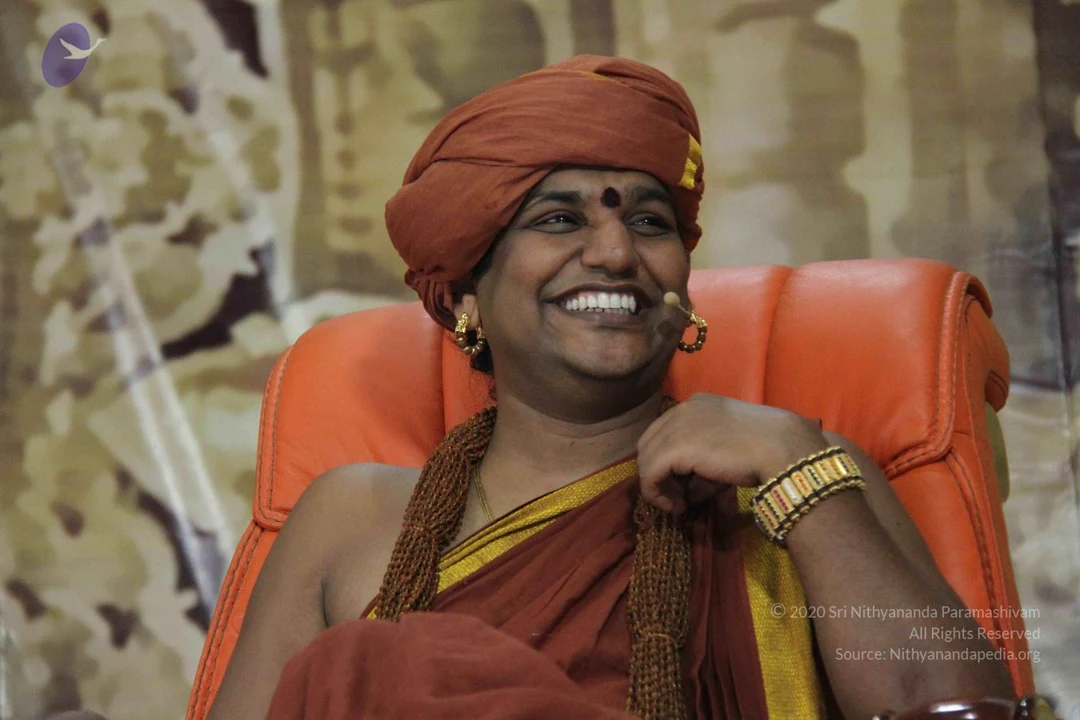
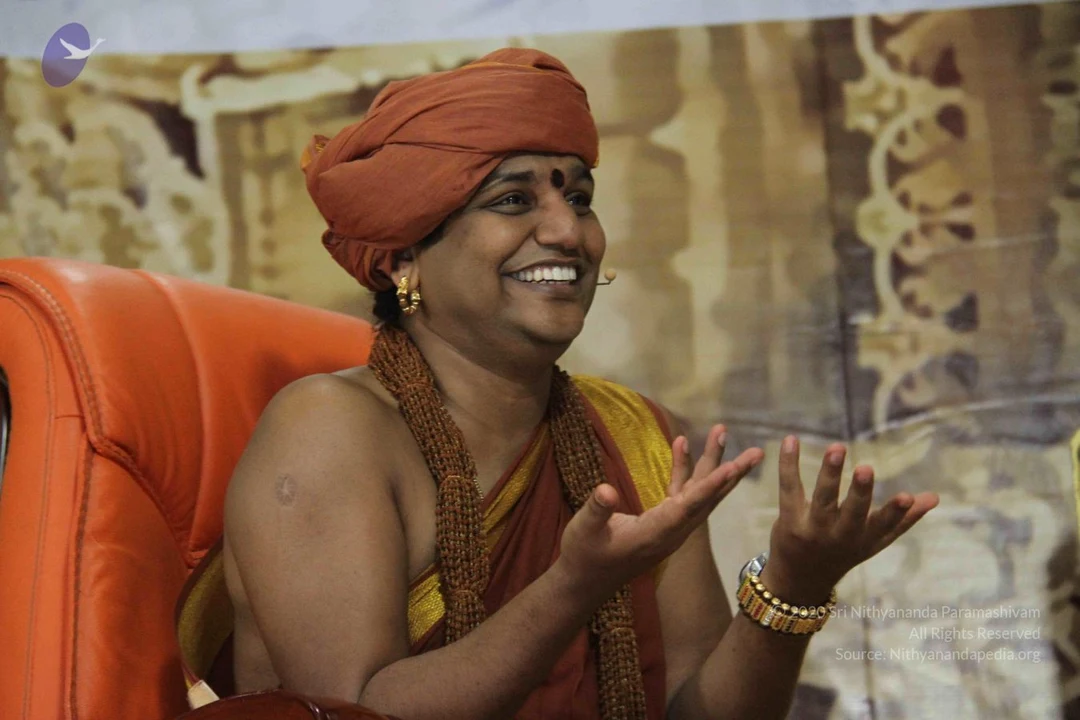
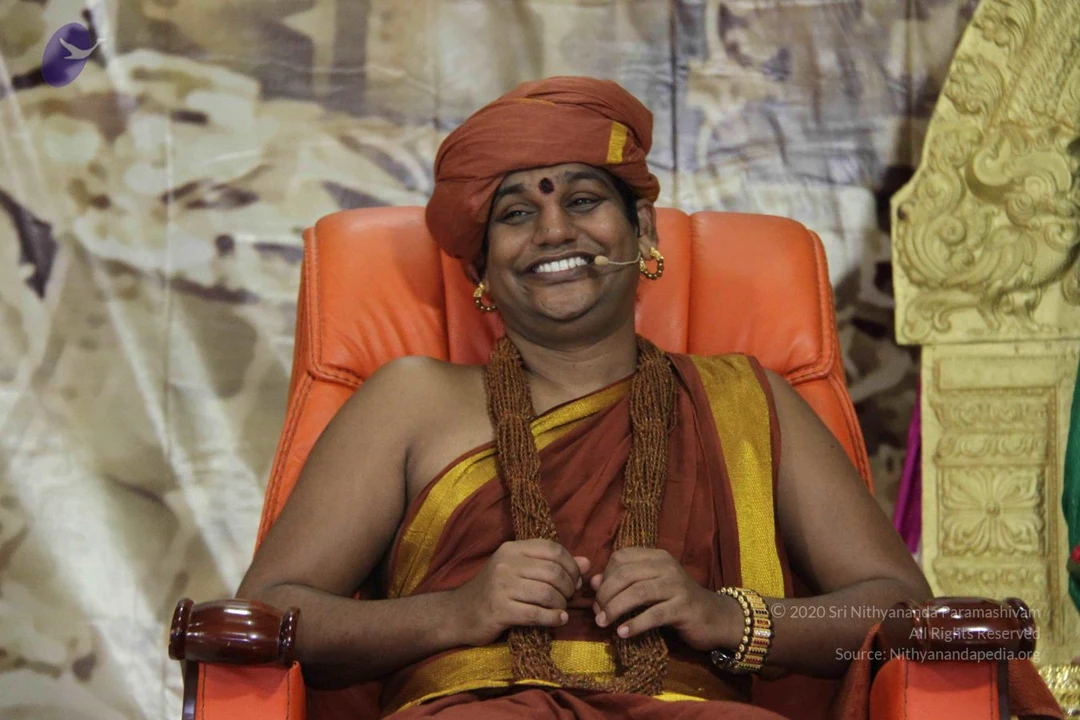
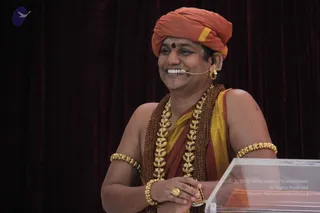
A smiling man in an orange-red turban with a red tilak on his forehead stands in front of a carved golden throne and a wooden door. He wears a head microphone, layered rudraksha malas, a heavy gold ceremonial necklace, gold armlets and a red-and-gold shawl over bare shoulders. To his left stands a painted deity murti with a crown, orange skin, gold jewellery and a raised hand holding a lamp. The setting suggests a satsang hall. Swamiji (probable) is shown in the appearance-based label, based on the turban, rudraksha malas, ornate gold necklace and saffron-toned clothing.A photograph of a satsang hall. A man in saffron-orange clothing with an orange turban, a long beaded mala and a gold necklace stands at a clear acrylic lectern on the left, facing right and speaking. Behind him is a red velvet and gold-trimmed seat draped with a tiger-print cloth. On the right, a golden arch frames a seated deity murti of Shiva dressed in orange and draped with red and white flower garlands and a green cloth, set on a gold pedestal. A pink curtain hangs beside it, and a white air conditioner unit is at the far right. A painted colourful temple backdrop with a partly visible figure appears at the left edge.A smiling person in an orange turban with a red bindi stands behind a clear acrylic lectern, hands clasped, speaking into a headset microphone. They wear a rudraksha mala, layered gold necklaces, gold armlets and a yellow-and-orange garment over bare shoulders. A dark red curtain forms the backdrop. Appearance-based label: a person, giving a satsang discourse, though the cues are not fully certain.A smiling man stands behind a clear acrylic lectern in front of a dark red velvet curtain, speaking with a headset microphone. He wears an orange-red turban, a red-brown robe with gold-yellow edging, a dark rudraksha mala and heavy gold ceremonial necklaces, gold armlets and a gold ring. A red bindi marks his forehead. His hands are clasped on the lectern. Swamiji (probable) is shown in a satsang discourse setting; the cues are the orange turban, rudraksha mala, gold ornaments and the lectern at a teaching event.A smiling man in an orange turban and saffron-and-gold garment stands behind a clear acrylic lectern against a dark maroon velvet curtain. He wears a small red bindi, a headset microphone, gold earrings, multiple layered gold necklaces and a brown rudraksha mala draped over bare shoulders, with gold armbands and a gold ring on his hand. His hands are clasped at the lectern. The appearance is consistent with a Swamiji (probable) speaker giving a satsang discourse, based on turban, saffron clothing, rudraksha mala and ornate gold jewellery.
Sarva-Darshan

5 photosSource gallery
Indoor photograph in a temple-style hall. A smiling man in an orange-red turban, rust-orange garment with gold border, and heavy gold necklaces and bangles raises his hand in blessing over the bowed head of a grey-haired man in a white t-shirt with a black stripe. To the left, a bearded young man in white clothes and rudraksha beads presses palms together in namaste. Behind them, devotees in white stand near metal barriers, and a large decorated altar with a gold-framed deity image and painted backdrop of a figure with a staff is visible. Cameras on tripods are set up at the right.A photograph of an indoor hall with a red-draped stage backdrop and a golden deity murti in a shrine. In the foreground a man in a brown-red dhoti with a gold-and-brown bead mala and gold necklace, wearing an orange-red turban and gold armlet, reaches out and raises his hand to greet a bearded man in an orange-yellow wrap with long dark hair and a rudraksha mala. Around them stand devotees in white kurtas and white dhotis, with a man in white at left and a bearded man in a white shirt behind them. Metal crowd barriers line the floor, and a few more people stand toward the back near the shrine.A photo inside a hall with red curtains and a decorated deity shrine in the background. A smiling man in a rust-orange turban, rust and gold shawl, and heavy gold ceremonial necklaces with a large pendant stands at right and extends his hand to touch the forehead of a man in white shirt who bows before him. Other devotees in white shirts and orange or saffron robes, some with rudraksha malas, line up behind a metal stanchion. A dark-robed priest stands at left and a woman in an orange sari stands at far right. Cameras and a tripod are visible near the shrine. The smiling man in orange and gold has distinctive ceremonial adornments and a turban, consistent with a person candidate giving blessing.Photograph inside a large hall with pink walls, red curtains and a gold-canopied stage in the background. In the foreground a man in an orange-red turban, gold necklaces, a rudraksha-style garland and a saffron-gold wrap smiles and raises one hand toward devotees. Nearby, several people in white shirts and white dhotis stand behind metal crowd barriers; a man in a striped shirt presses his palms together in greeting. The man in the turban shows distinctive adornments including a gold-and-bead mala and ornate gold bangles; the page's a person flag is attributed to this scene, so the appearance-based label is a person for the central figure.Photograph inside a large hall with pink walls and red curtains. A central man in a saffron-orange turban, orange-and-gold silk dhoti, and a heavy gold necklace with a rudraksha mala raises one hand in blessing toward a bowing devotee. Devotees in white kurtas bow with palms pressed together, and a woman in a pink patterned salwar stands nearby. A tray with fruit and offerings sits at lower right, with a golden deity murti visible in the background. Several white-clad onlookers and a man in an orange shawl fill the room.

IA

59 photosSource gallery
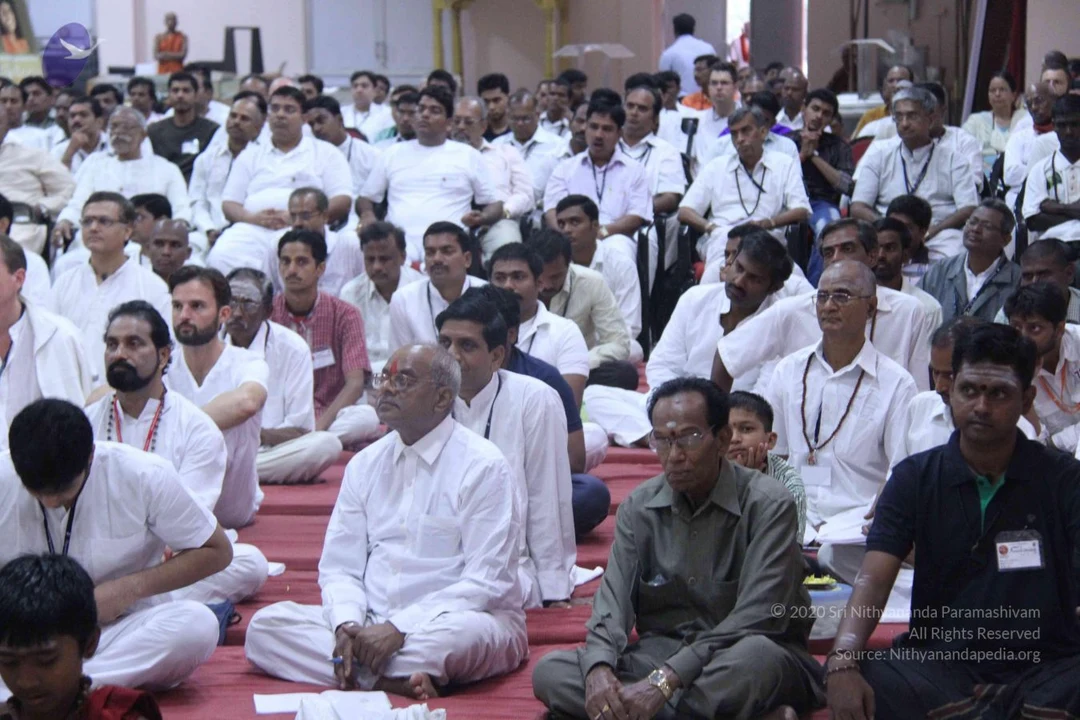
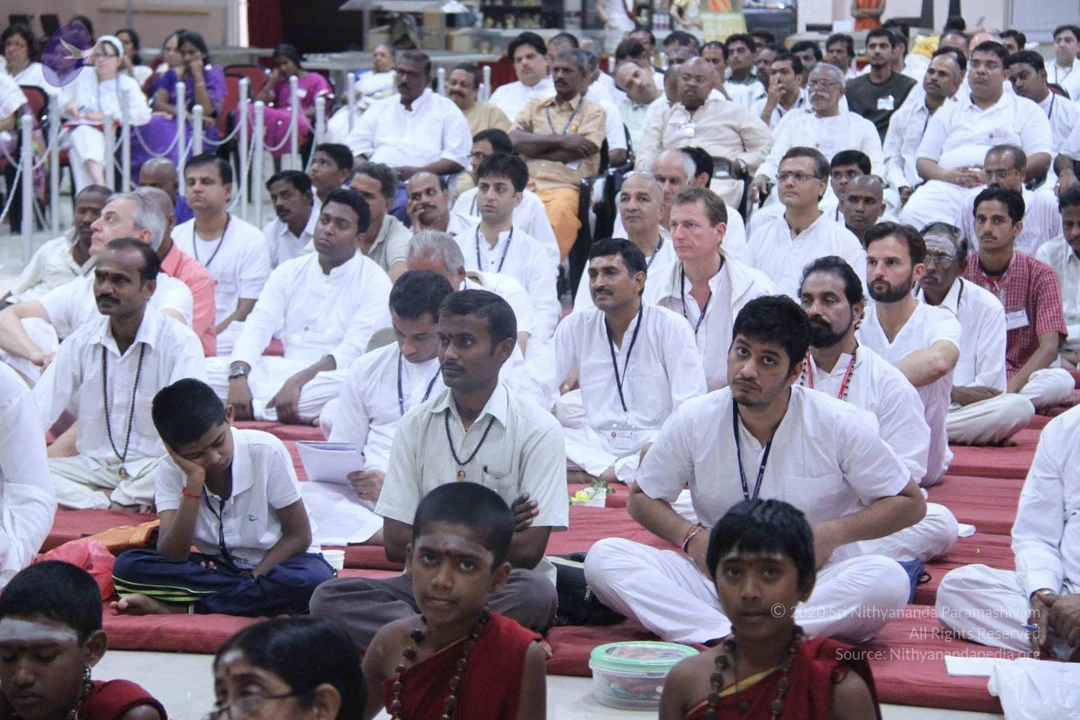
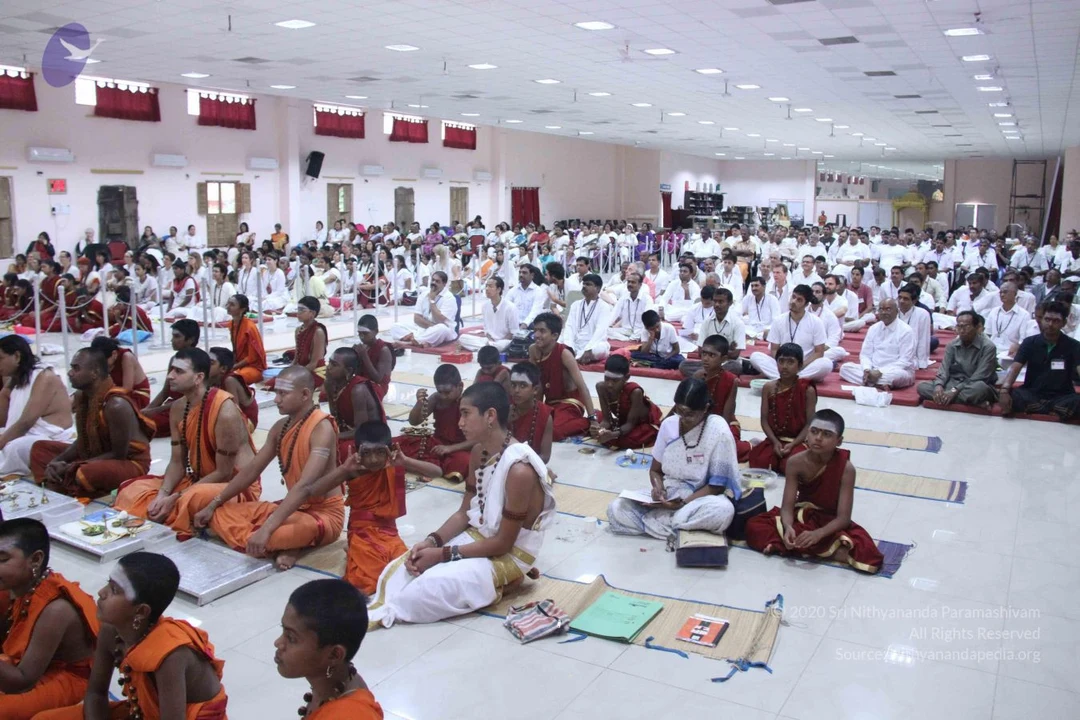
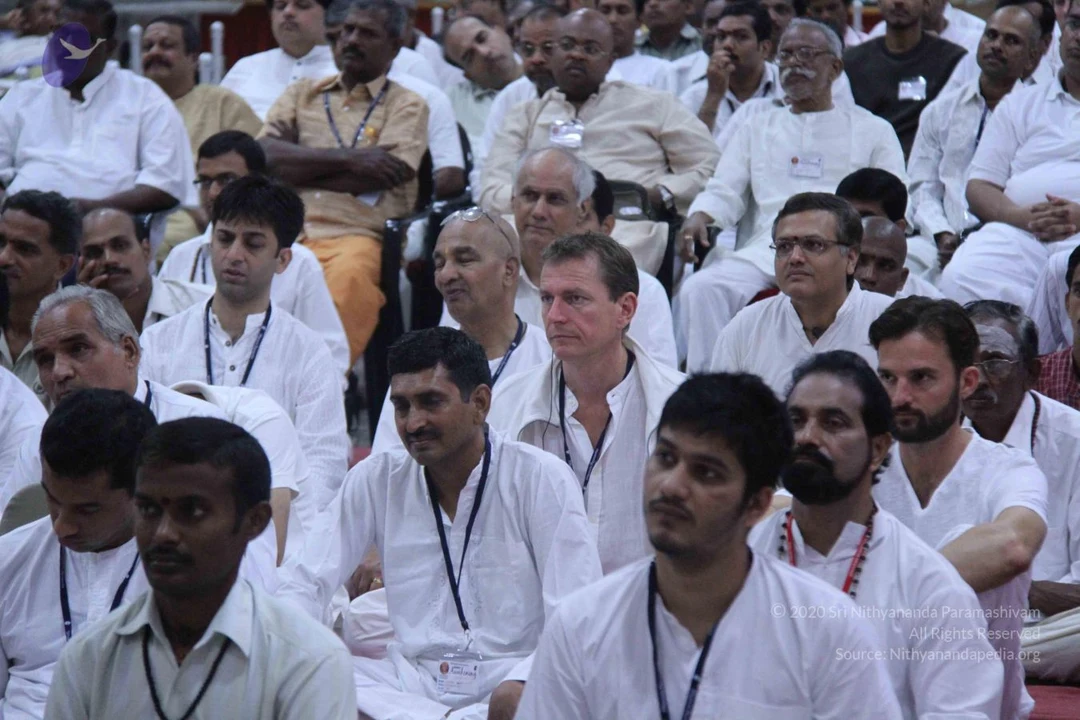
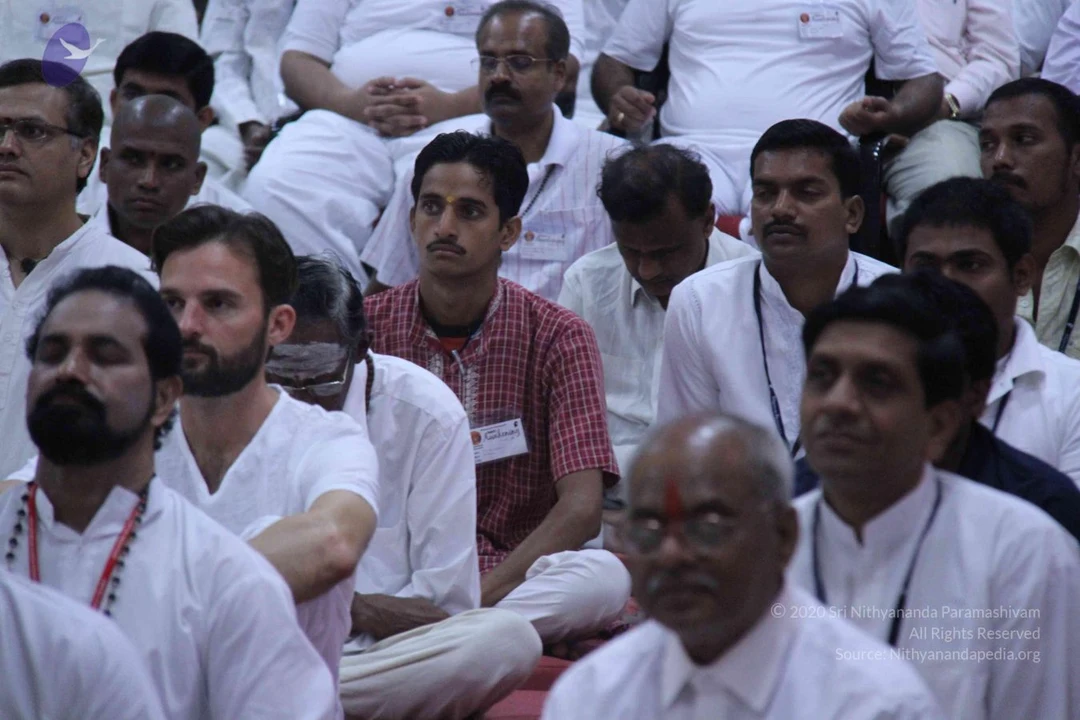
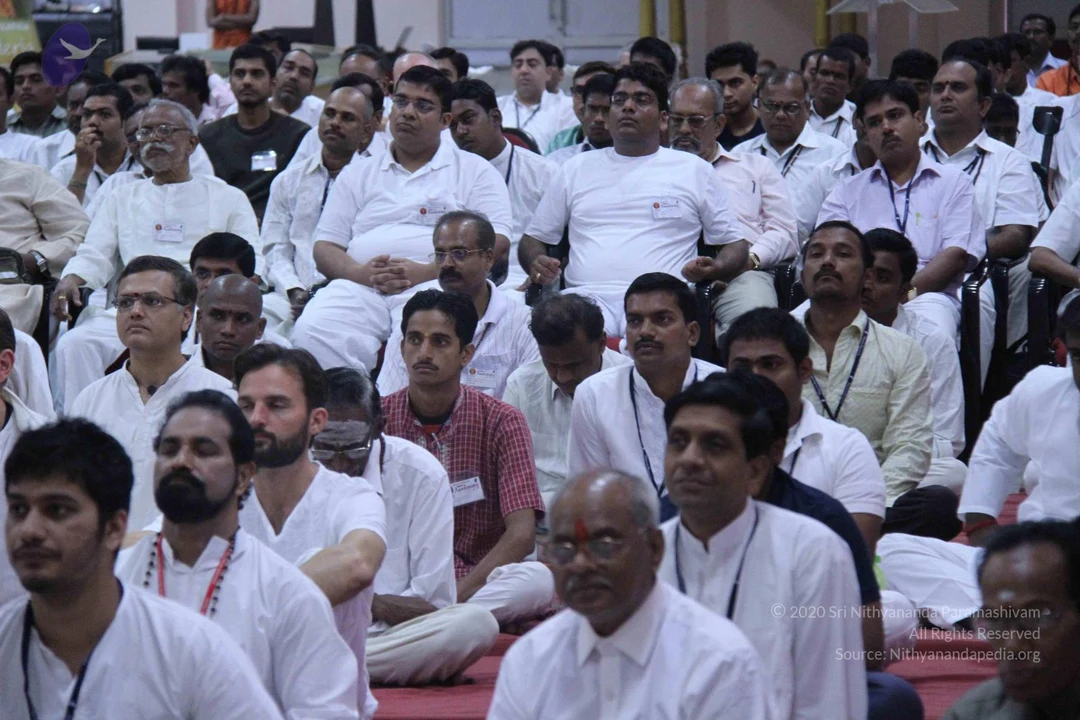
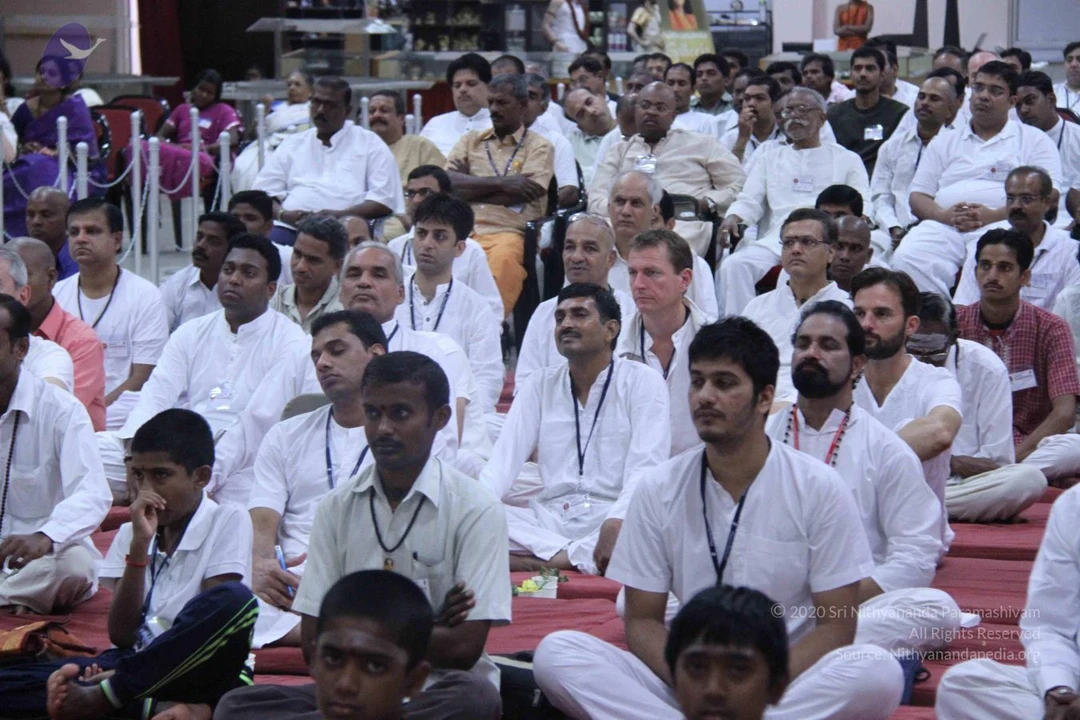
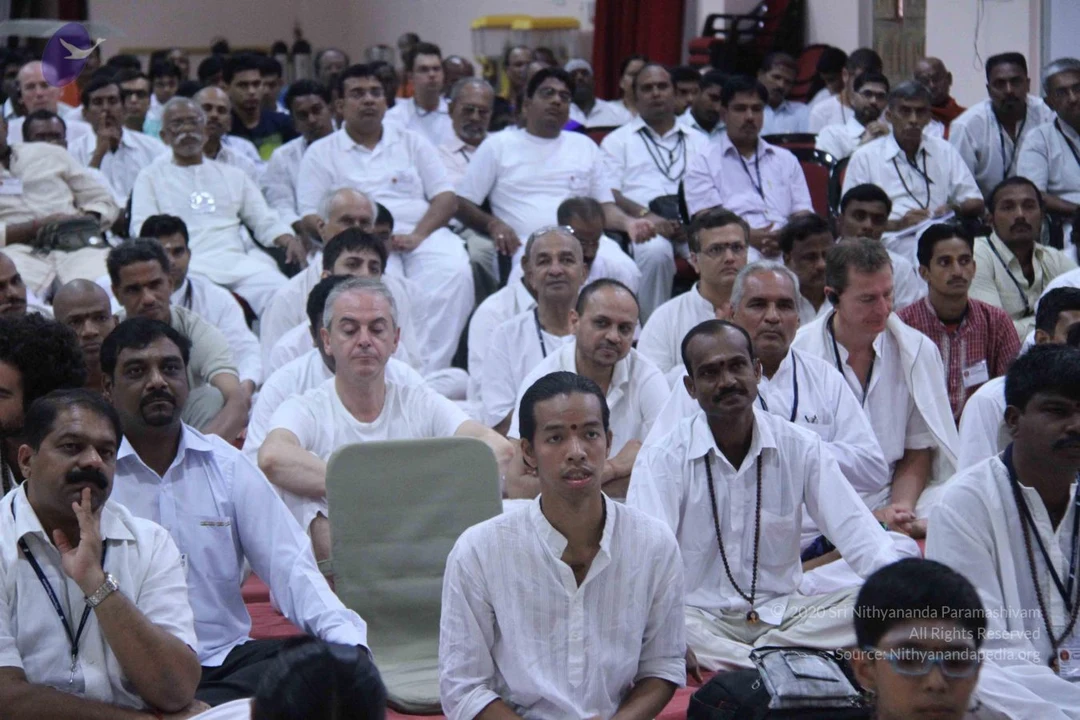
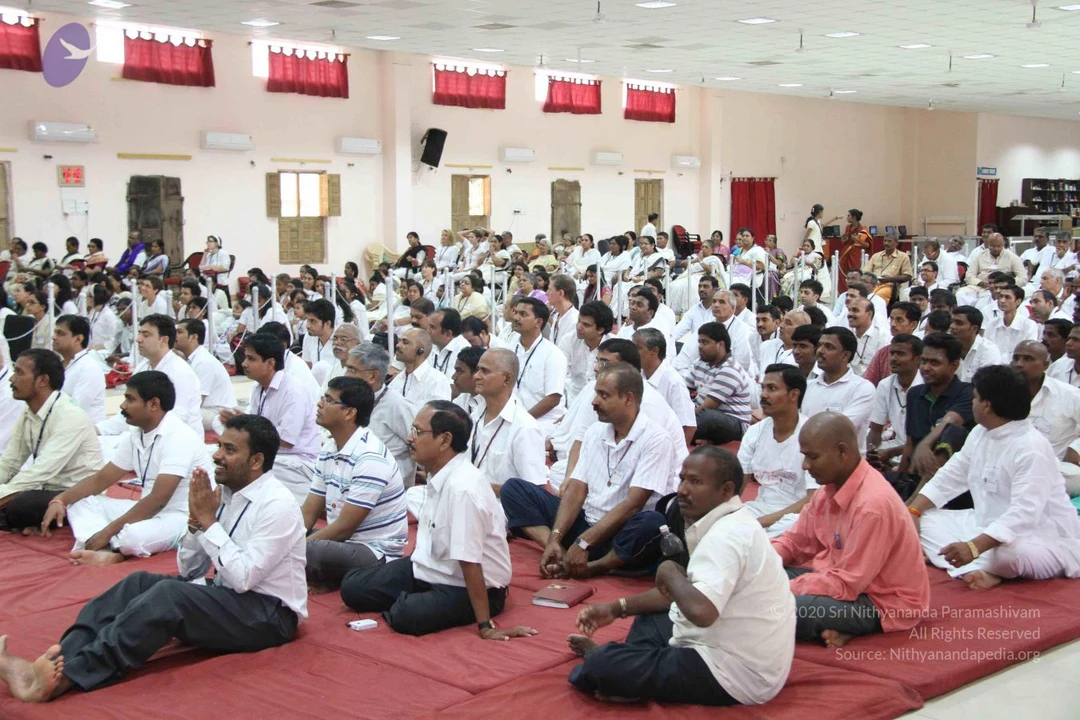
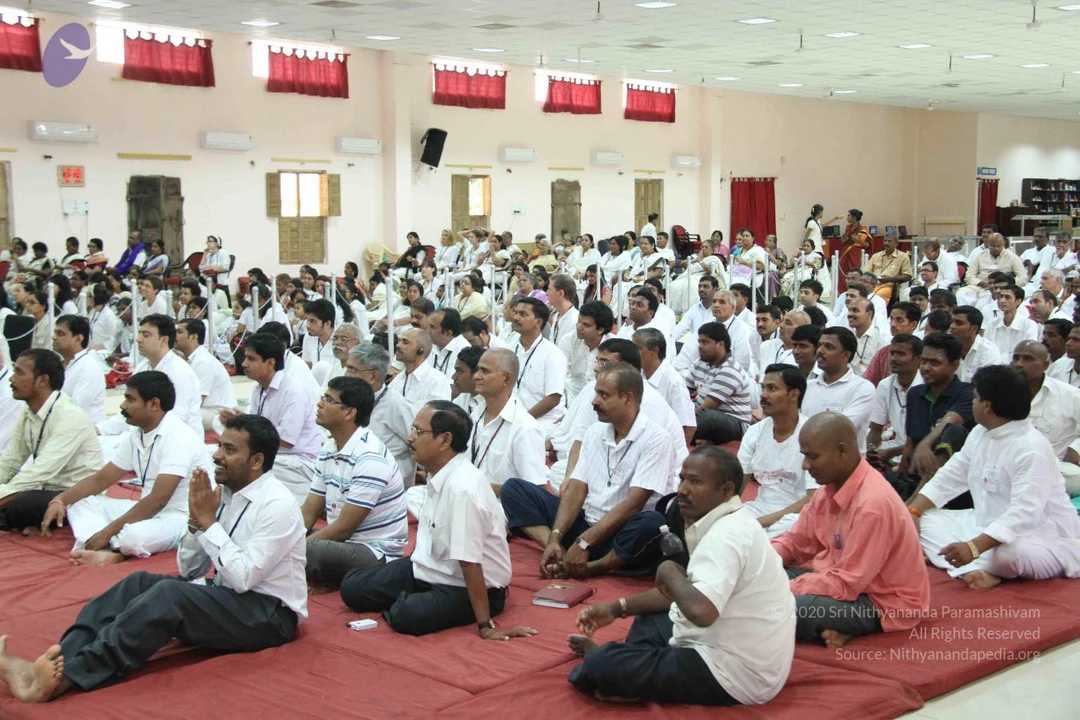
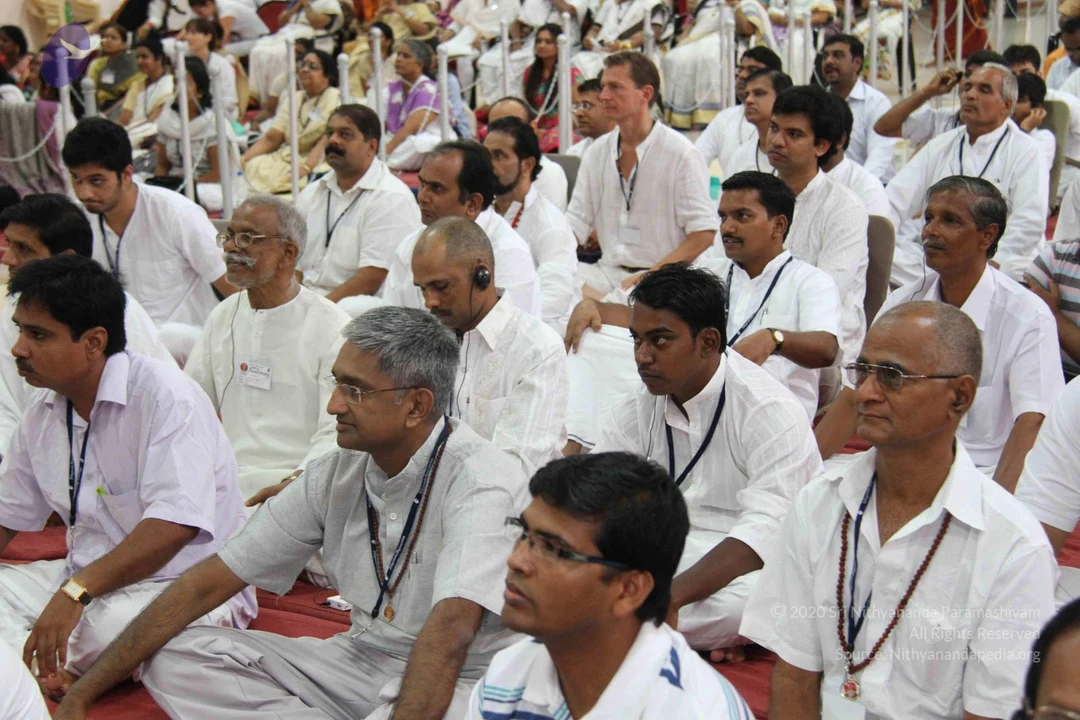
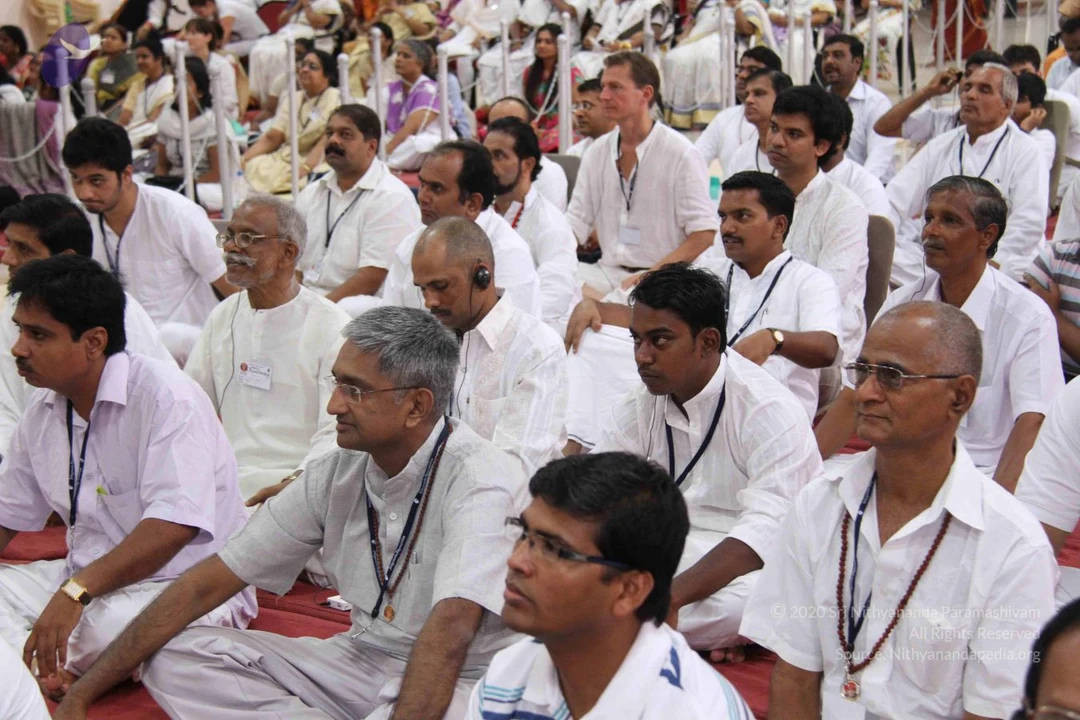
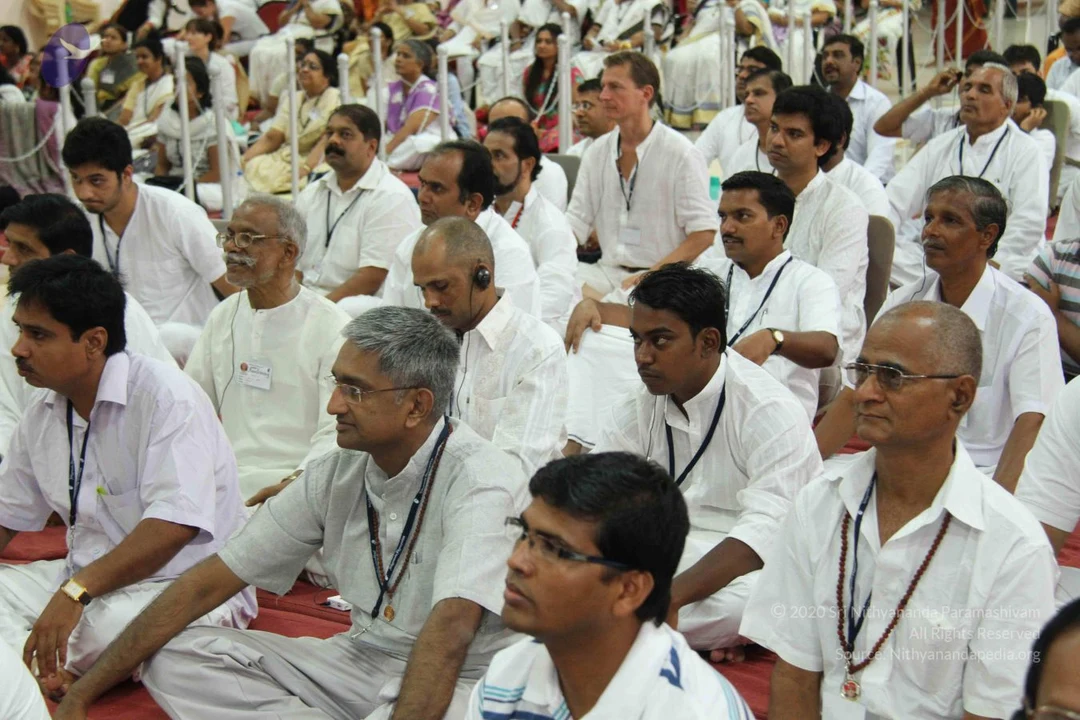
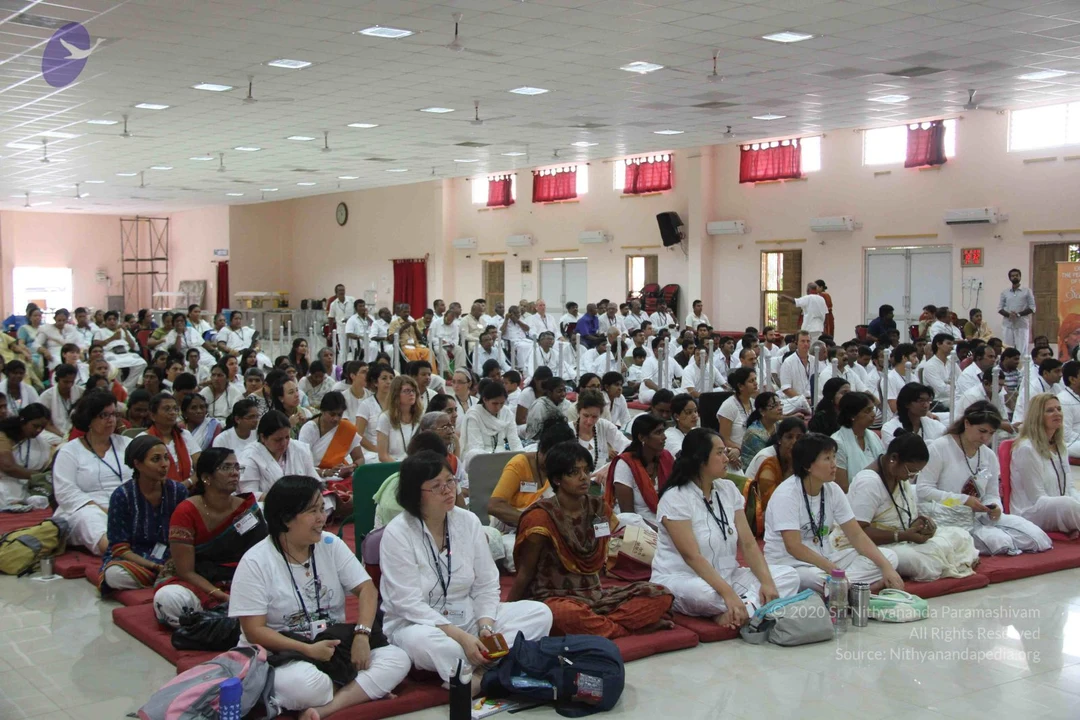
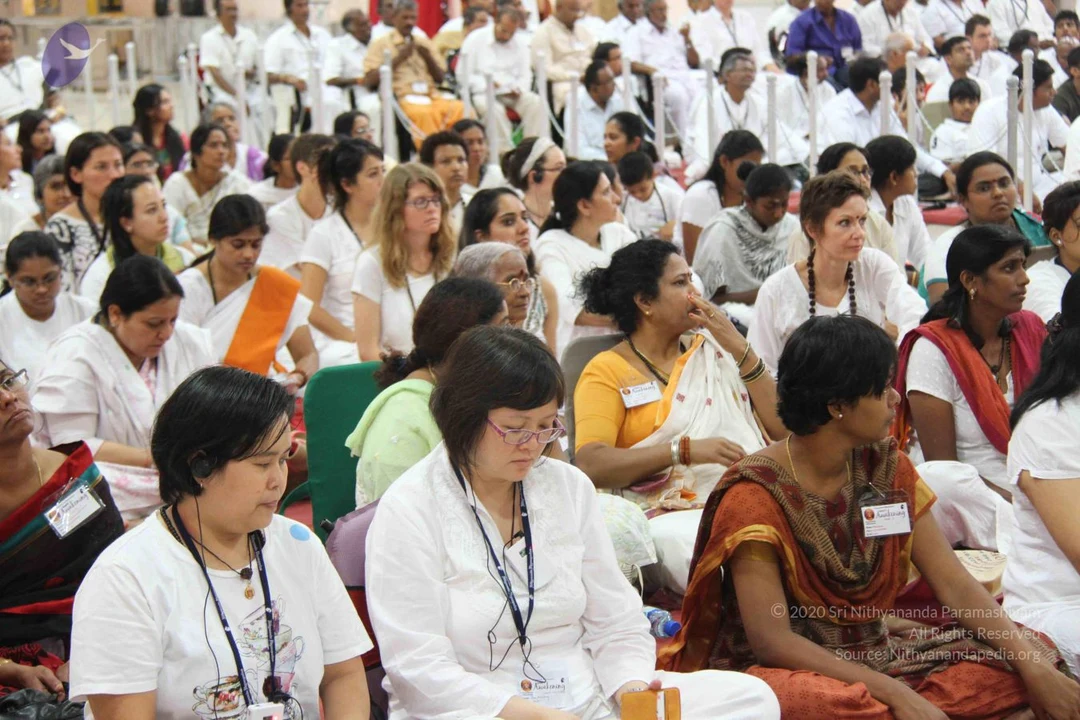
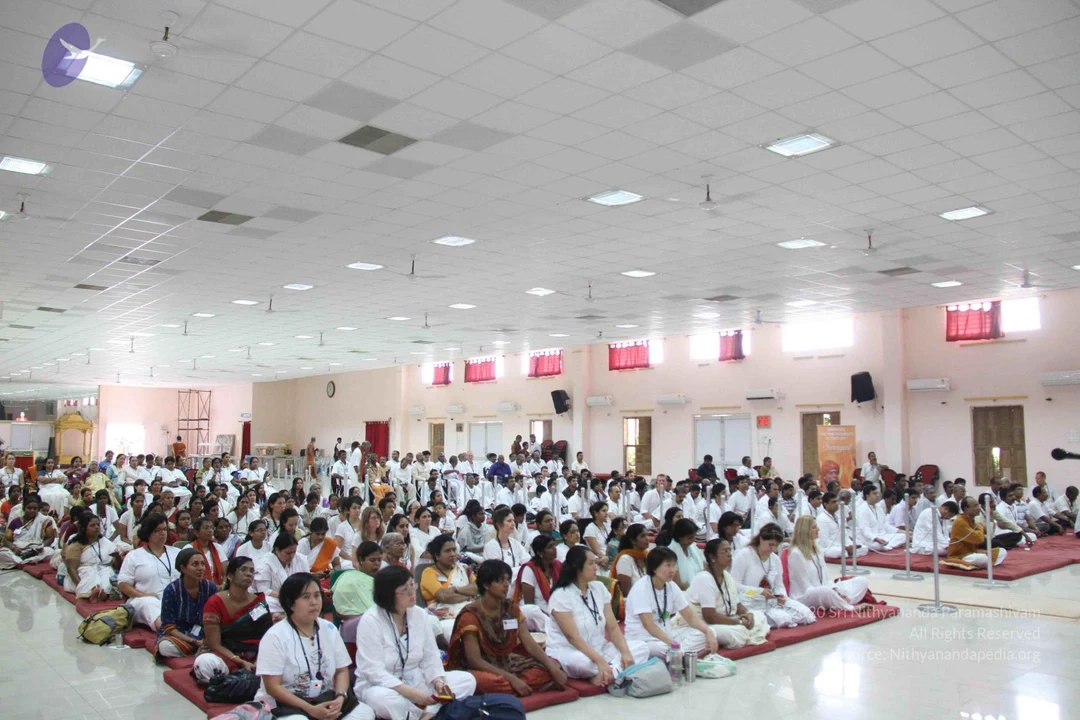
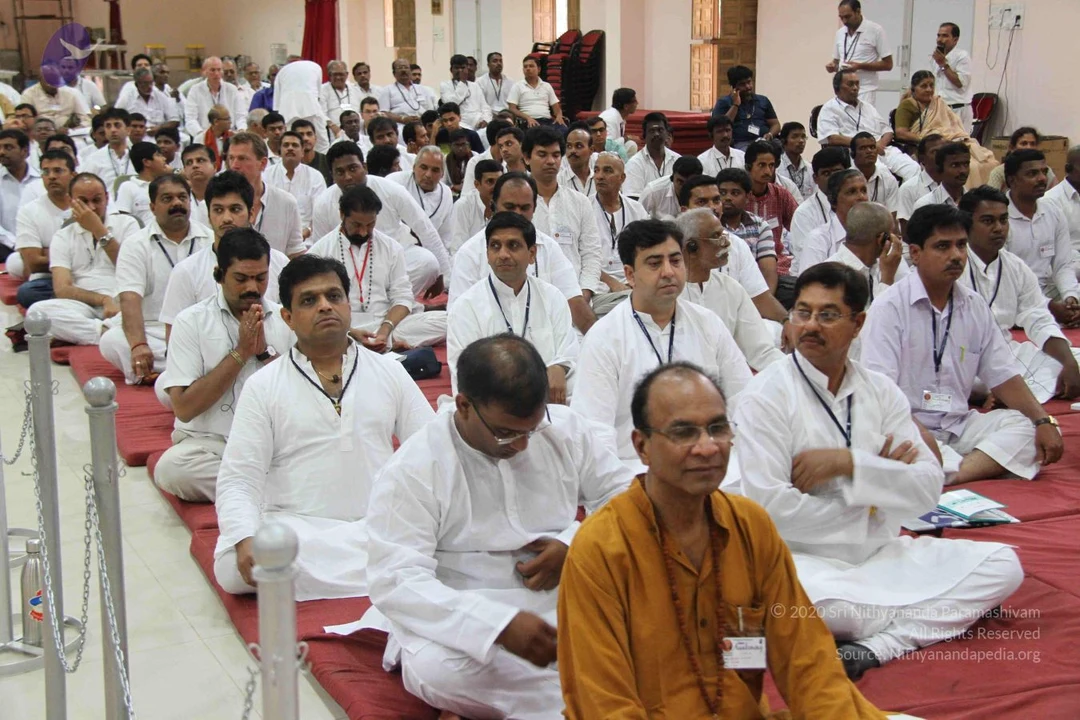
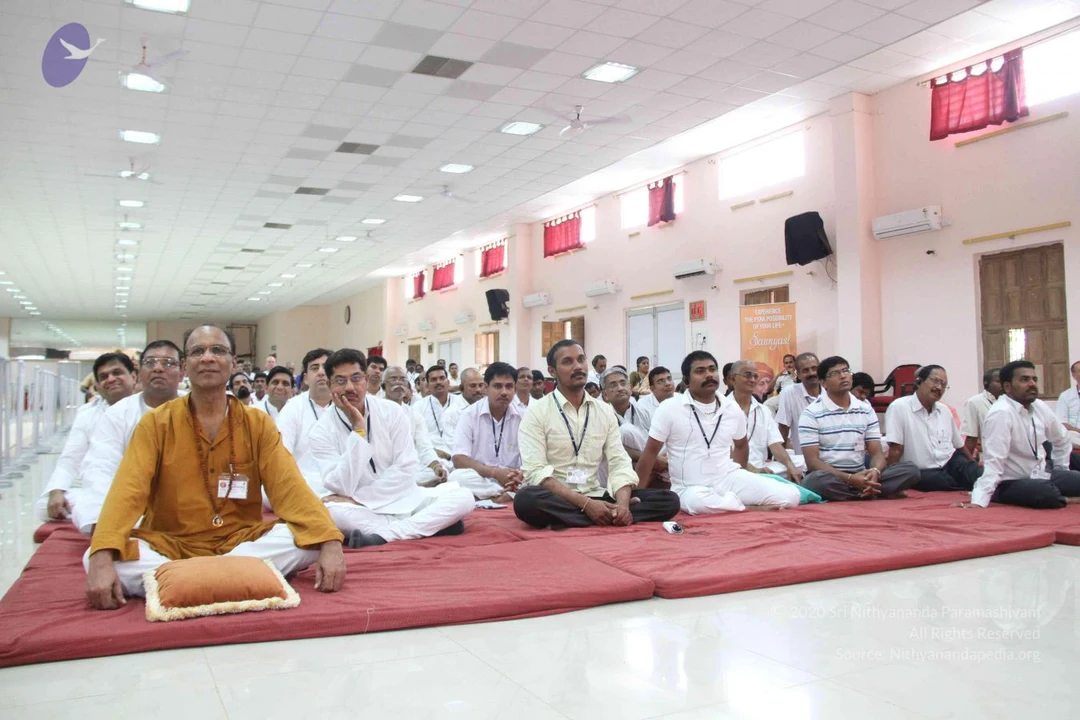
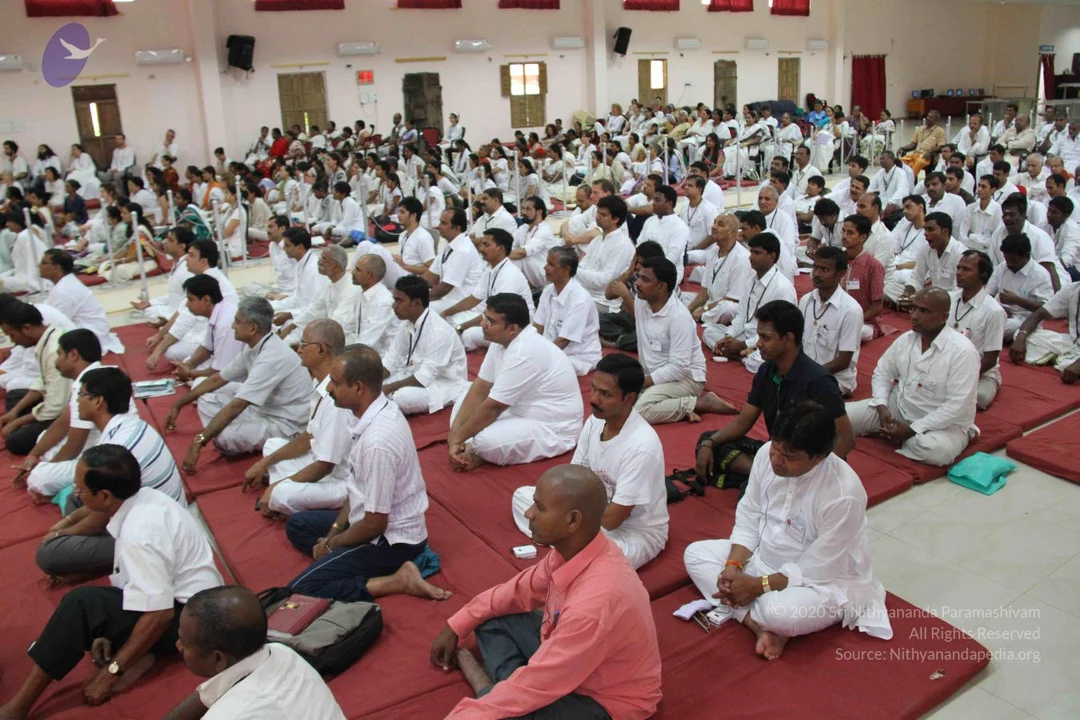
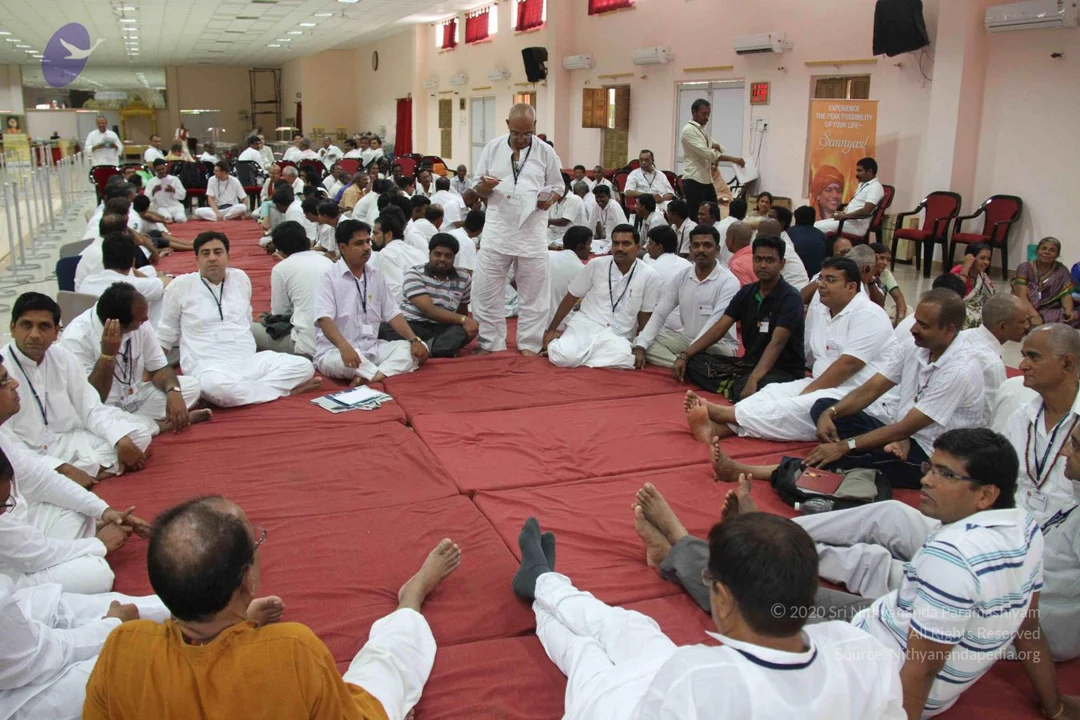
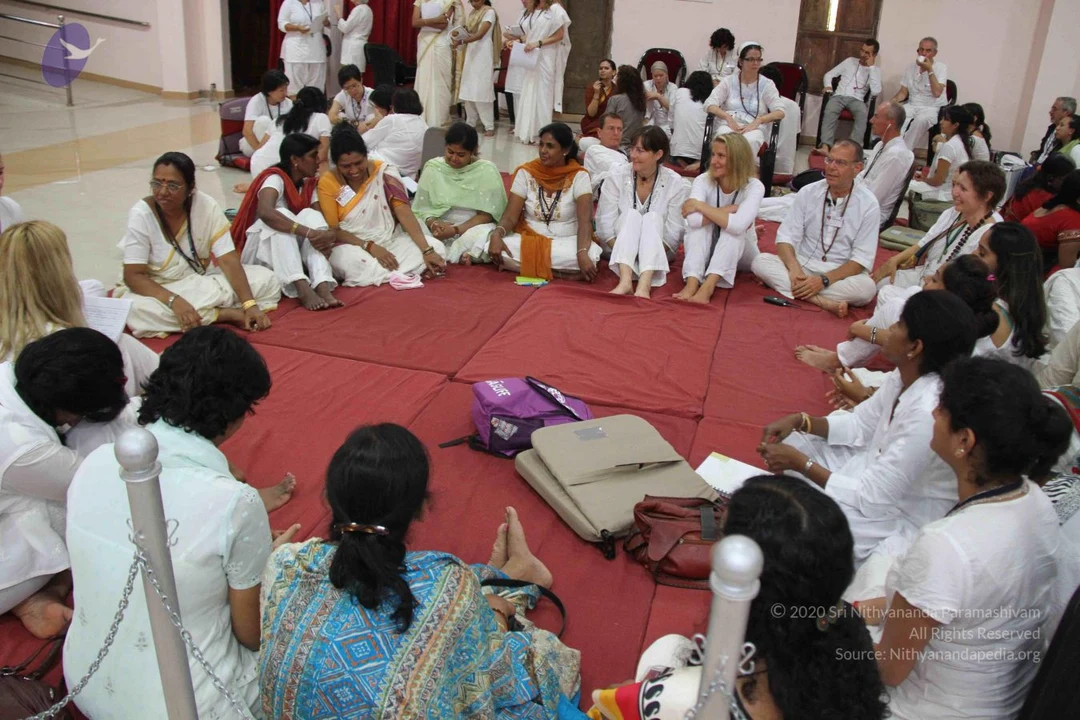
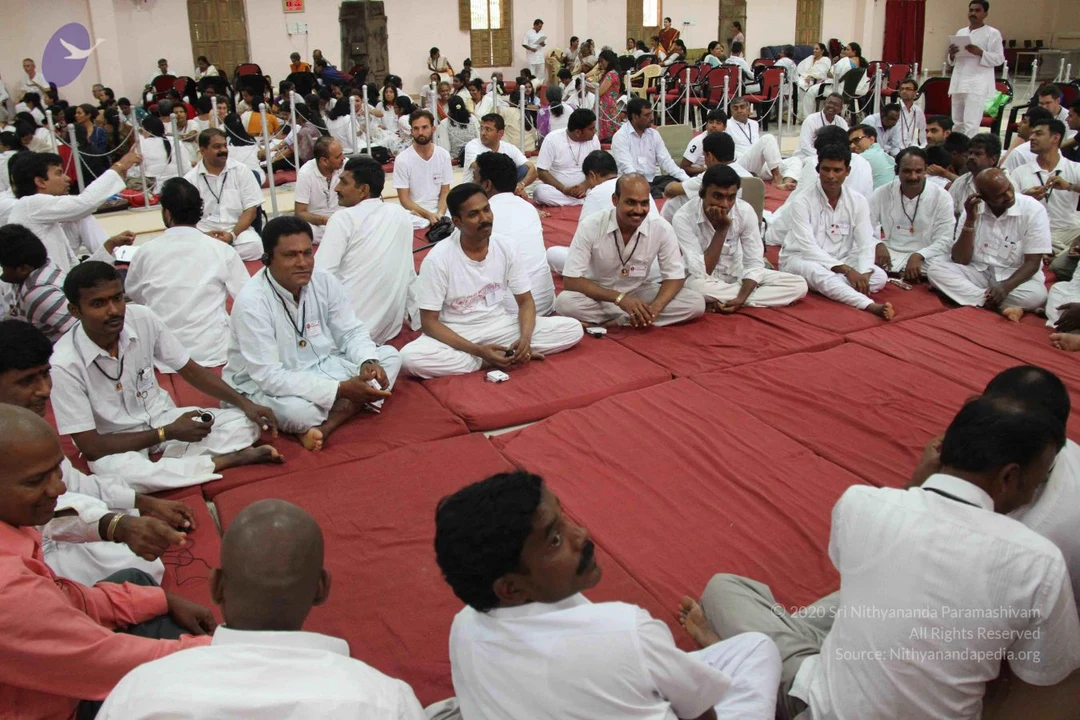
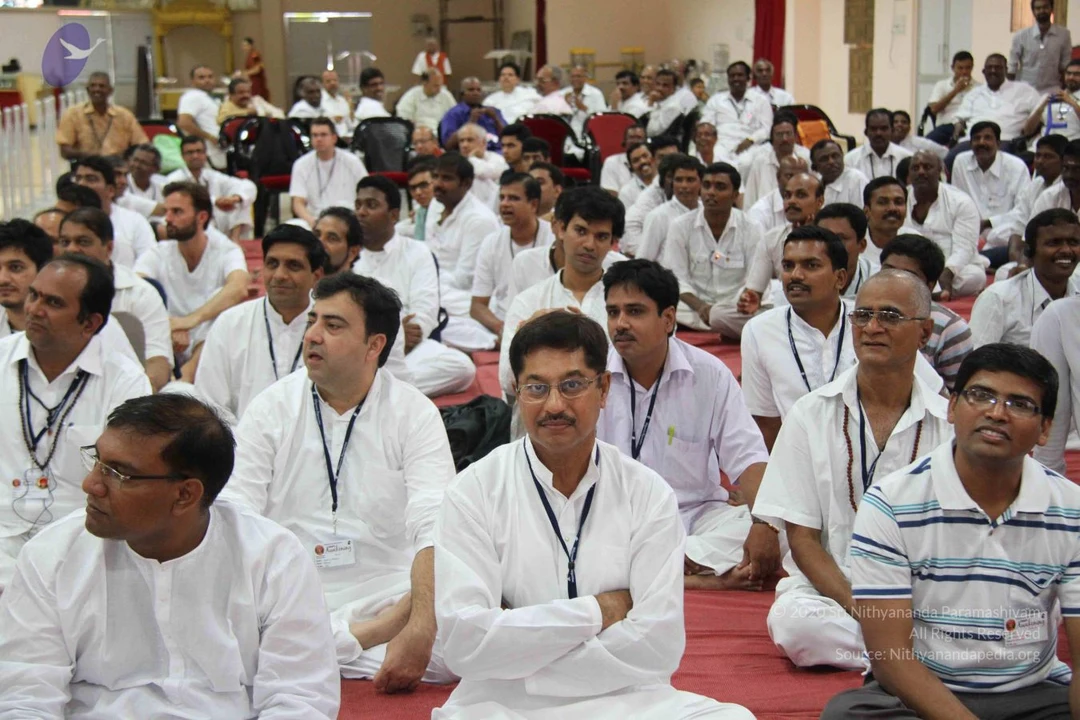
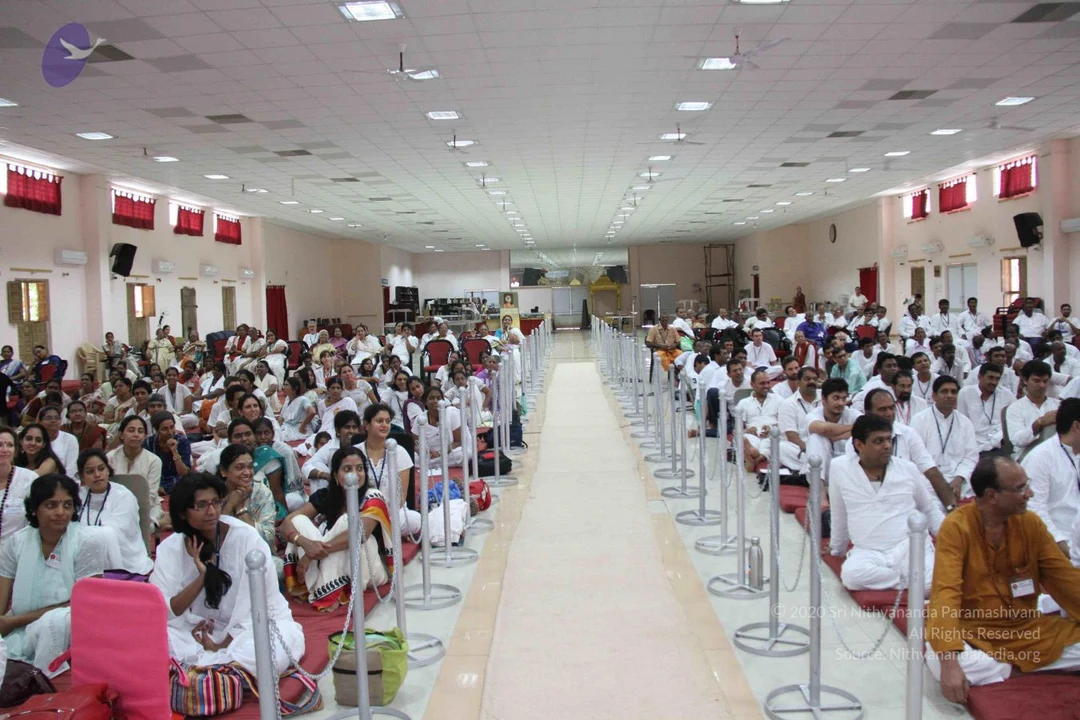
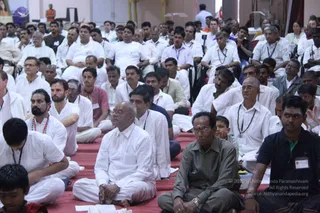
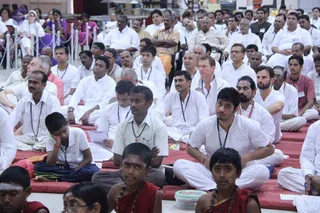
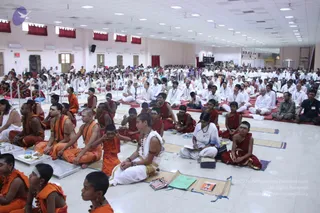
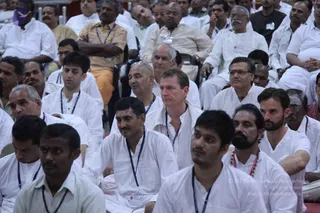
A large hall with pink walls and red curtains holds a seated congregation on white floor mats. In the foreground, shaved-headed young boys in saffron and orange robes with rudraksha malas sit cross-legged, some with white and orange forehead markings. A man in white ritual clothes with a gold-bordered dhoti sits near a low stone-topped seat, and a woman in a white sari with a rudraksha mala sits at right. Rows of devotees in white and orange garments fill the hall, some sitting on mats and others holding books and notebooks. A man in white with a microphone sits toward the centre, and ceiling air-conditioners and a wall-mounted speaker are visible.A large seated audience at a satsang, filling red mats on the floor. Most people wear white dhotis and kurtas, and several have rudraksha malas and tilak marks. A man in a green-grey shirt sits in front with a small boy beside him, and a man in a black polo with a lanyard badge sits at the lower right. In the background a small golden deity figure stands at the top left, and a few people stand near the rear. The scene is a satsang gathering with attendees listening attentively.A large seated audience in white ritual clothes fills a hall during a satsang on dark red floor mats. Most men wear white shirts and white dhotis or trousers, many with blue lanyard badges. In the foreground a young boy in a white shirt rests his cheek on his hand, and two young boys in saffron-red robes with rudraksha malas sit close to the camera, one with sacred ash on his forehead. A man in a light shirt holds papers, and a bearded man in white sits cross-legged at right. A clear plastic container of food sits on the mat. No a person candidate is clearly visible, and the speaker's position is not shown.A wide photograph of a large hall filled with seated devotees on mats and carpets during a satsang. Many men and women in white ritual clothes sit in rows, while boys and young men in saffron and orange robes sit near the front, some with white forehead markings and rudraksha malas. Several young boys in red and maroon robes are also seated among them. Silver offering trays with fruit sit on the floor at the left edge. Red curtains line the windows, and white pillars and ceiling lights frame the room. No single leader is clearly identifiable among the seated participants.A large hall during a satsang, with many seated participants on red and white mats facing forward. In the foreground, several boys and young people in saffron and orange robes with rudraksha malas sit cross-legged, some with white forehead markings. A woman in a white sari sits on a mat with a notebook. Further back, rows of people in white clothes fill the floor, and a group of seated figures in white stands out near a low table with offerings and plates on the left. Red curtains line the windows, and ceiling lights and wall fans are visible. No single figure can be confidently identified as the a person from appearance, so no candidate is named.A large seated audience of devotees fills the frame at a satsang, most men dressed in white kurtas and white dhotis. Many wear blue lanyards with white name badges. A man in the centre foreground wears a white shirt and a blue lanyard, and a bearded man on the right wears a white top with a red-beaded mala. Some attendees wear glasses, and one older man in a tan shirt sits at the top left.